NIST SP 800-170 日本語訳
英語タイトル : Computer Security Division 2013 Annual Report日本語タイトル : コンピュータセキュリティ部門2013年度年次報告書
公開日 : 2014-09-04
原文URL : https://csrc.nist.gov/pubs/sp/800/170/final
翻訳編集 : 自動生成(有志による非公式の日本語訳), 原文取得日 : 2026-09-29, 訳文 : 1668 / 1668 ブロック
[要約] SP 800-170 は、NIST情報技術研究所(ITL)のコンピュータセキュリティ部門が2013会計年度に実施した研究、標準化、連邦政府等への支援活動をまとめた年次報告書です。暗号技術などの各グループの活動、Executive Order 13636に基づく責任、PIVとFIPS 201の改訂作業、SCAPやNVDなどのプログラム、同年度の刊行物を取り上げています。同部門の年度ごとの成果を記録した報告書であり、国内外の機関や標準化団体、産業界との協力による取り組みも紹介しています。
Cloud Computing
クラウドコンピューティング
Security Practices
セキュリティプラクティス
Cybersecurity Framework
サイバーセキュリティフレームワーク
Cybersecurity Framework
サイバーセキュリティフレームワーク
Assets
資産
Roadmap
ロードマップ
Evaluation
評価
Authorization
認可
Security Controls
セキュリティ管理策
FIPS 140-2
FIPS 140-2
Mobile Devices
モバイルデバイス
Biometrics
バイオメトリクス
Continuous Monitoring
継続的監視
Security Practices
セキュリティプラクティス
Critical Infrastructure
重要インフラ
Policy Machine
Policy Machine
Systems
システム
Assets
資産
Verification
検証
Roadmap
ロードマップ
Cloud Computing
クラウドコンピューティング
Security Controls
セキュリティ管理策
Mobile Devices
モバイルデバイス
Computer
コンピュータ
Security
セキュリティ
Division
部門
2013 Annual Report
2013年年次報告書
NIST Special Publication 800-170
NIST Special Publication 800-170
FIPS 140-2
FIPS 140-2
Evaluation
評価
Continuous Monitoring
継続的監視
Authorization
認可
Critical Infrastructure
重要インフラ
Assets
資産
Biometrics Policy Machine
バイオメトリクス Policy Machine
Verification
検証
Systems
システム
NIST Special Publication 800-170
NIST Special Publication 800-170
Computer
コンピュータ
Security
セキュリティ
Division
部門
2013 Annual Report
2013年年次報告書
Patrick O’Reilly, Editor
Patrick O’Reilly(編集者)
Computer Security Division Information Technology Laboratory National Institute of Standards and Technology
コンピュータセキュリティ部門 情報技術研究所 米国国立標準技術研究所
Co-Editors: Chris Johnson Doug Rike Greg Witte
共同編集者: Chris Johnson Doug Rike Greg Witte
G2, Inc.
G2, Inc.
Lorie Richards
Lorie Richards
Facilities Services Division Creative and Printing Service
Facilities Services Division Creative and Printing Service
This publication is available free of charge from
本刊行物は次の場所から無料で入手できる
http://dx.doi.org/10.6028/NIST.SP.800-170
http://dx.doi.org/10.6028/NIST.SP.800-170
June 2014
2014年6月
[米国商務省の紋章。公的な標章のため、この非公式サイトには掲載していません。原本 PDF を参照してください。]
U.S. Department of Commerce
米国商務省
Penny S. Pritzker, Secretary
Penny S. Pritzker 長官
National Institute of Standards and Technology
米国国立標準技術研究所
Dr. Willie E. May, Under Secretary of Commerce for Standards and Technology and Acting Director
Dr. Willie E. May 標準技術担当商務次官兼所長代行
Disclaimer: Any mention of commercial products is for information only; it does not imply NIST recommendation or endorsement, nor does it imply that the products mentioned are necessarily the best available for the purpose.
免責事項: 商用製品への言及はすべて情報提供のみを目的とします。それはNISTによる推奨または支持を意味するものではなく、言及した製品がその目的に対して必ずしも入手可能な最良のものであることを意味するものでもありません。
National Institute of Standards and Technology Special Publication 800-170 Natl. Inst. Stand. Technol. Spec. Pub., 93 pages (June 2014) CODEN: NSPUE2
National Institute of Standards and Technology Special Publication 800-170 Natl. Inst. Stand. Technol. Spec. Pub., 93ページ(2014年6月) CODEN: NSPUE2
Table of Contents
目次
Program & Project Achievements for Fiscal Year 2013
2013会計年度のプログラムおよびプロジェクトの成果
Honors & Awards
表彰および受賞
Acknowledgements
謝辞
Welcome Letter
挨拶状
The Computer Security Division (CSD), a component of the Information Technology Laboratory at the National Institute of Standards and Technology (NIST) is responsible for developing standards, guidelines, tests, and metrics for protection of non-national security federal information systems. NIST standards and guidelines are developed in an open and transparent manner that enlists broad industry and academia expertise from around the world. While developed for federal agency use, these resources are voluntarily adopted by other organizations because they are effective and accepted throughout the world.
Computer Security Division(CSD、コンピュータセキュリティ部門)は、米国国立標準技術研究所(NIST)のInformation Technology Laboratoryを構成する組織であり、国家安全保障に関わらない連邦情報システムを保護するための標準、ガイドライン、試験及び測定基準を開発する責任を負います。NISTの標準及びガイドラインは、世界中の産業界及び学術界の幅広い専門知識を結集する、開かれた透明性のある方法で開発されます。これらの資源は連邦機関での利用のために開発されたものですが、効果的であり世界中で受け入れられているため、他の組織にも自発的に採用されています。
The need for cybersecurity standards and best practices that address interoperability, usability and privacy continues to be critical for the Nation. In Fiscal Year (FY) 2013, CSD continued to align its resources to enable greater development and application of practical, innovative security technologies and methodologies that enhance our ability to address current and future computer and information security challenges. Our foundational research and applied cybersecurity programs continue to advance in many areas including cryptography; identity and access management; cloud, virtualization, and mobile technologies; and advanced security testing and measurement.
相互運用性、ユーザビリティ及びプライバシーに対処するサイバーセキュリティの標準及びベストプラクティスの必要性は、国家にとって引き続き極めて重要です。2013会計年度において、CSDは、現在及び将来のコンピュータセキュリティ及び情報セキュリティの課題に対処する能力を高める、実用的で革新的なセキュリティ技術及び方法論の開発と適用をさらに進められるよう、引き続き資源を整えました。我々の基礎研究及び応用サイバーセキュリティプログラムは、暗号、アイデンティティ及びアクセスの管理、クラウド・仮想化・モバイルの各技術、並びに高度なセキュリティ試験及び測定を含む多くの分野で前進を続けています。
Strong partnerships with diverse stakeholders are vital to the success of our technical programs. In February 2013, the President issued Executive Order 13636 that directed NIST to work collaboratively with industry to develop a voluntary framework - based on existing standards, guidelines, and practices - to improve critical infrastructure cybersecurity practices. NIST held several workshops, meetings, webinars, and informal sessions to gather feedback with the goals of generating content for the framework and discuss several topics that help inform and guide NIST in this effort. In August 2013, we produced a discussion draft of the preliminary framework.
多様な利害関係者との強固なパートナーシップは、我々の技術プログラムの成功に不可欠です。2013年2月、大統領はExecutive Order 13636を発し、重要インフラのサイバーセキュリティの実践を改善するための、既存の標準、ガイドライン及び実践に基づく自主的なフレームワークを、産業界と協力して開発するようNISTに指示しました。NISTは、フレームワークの内容を作成すること、及びこの取り組みにおいてNISTの判断材料となり指針となるいくつかの論点を議論することを目的として、意見を集めるためのワークショップ、会合、ウェビナー及び非公式の会合を数回開催しました。2013年8月、我々は暫定フレームワークの討議用草案を作成しました。
Working closely with standards developing organizations, industry and interagency partners, we are evolving and expanding security automation capabilities to help organizations manage and measure the security of systems and technologies. Our cybersecurity awareness, training, and education programs also exemplify the importance of these partnerships by engaging with academic institutions, federal agencies, small and medium businesses and others to increase awareness and enhance the overall cybersecurity posture of the Nation.
標準化団体、産業界及び省庁間のパートナーと緊密に協力しながら、我々は、組織がシステム及び技術のセキュリティを管理し測定するのを助けるセキュリティ自動化の能力を発展させ、拡大しています。我々のサイバーセキュリティの意識向上、訓練及び教育のプログラムもまた、学術機関、連邦機関、中小企業その他と連携して意識を高め、国家全体のサイバーセキュリティ態勢を強化することにより、こうしたパートナーシップの重要性を示す好例となっています。
Active engagement with the diverse federal community continues to be critical to our success. This interaction is most prominent in our strengthened collaborations with the Department of Defense, the Intelligence Community, and the Committee on National Security Systems to establish a common foundation for information security across the federal government. Through this partnership, NIST released Special Publication (SP) 800-53 Revision 4, Security and Privacy Controls for Federal Information Systems and Organizations, in April 2013. This guideline provides organizations with state-of-the-practice security controls to fundamentally strengthen their systems and the environments in which those systems operate. SP 800-53 Revision 4 and other NIST standards and guidelines contribute to systems that are more resilient in the face of cyber attacks and other threats.
多様な連邦コミュニティとの積極的な関与は、我々の成功にとって引き続き極めて重要です。このやり取りが最も顕著に表れているのは、連邦政府全体にわたる情報セキュリティの共通基盤を確立するための、国防総省、Intelligence Community及びCommittee on National Security Systemsとの協力の強化です。このパートナーシップを通じて、NISTは2013年4月にSpecial Publication (SP) 800-53 Revision 4, Security and Privacy Controls for Federal Information Systems and Organizationsを公表しました。このガイドラインは、組織のシステム及びそのシステムが運用される環境を根本的に強化するための、実務の最新水準にあるセキュリティ管理策を組織に提供します。SP 800-53 Revision 4その他のNISTの標準及びガイドラインは、サイバー攻撃その他の脅威に直面してもよりレジリエントなシステムの実現に寄与します。
Late in FY 2013, news reports about leaked classified documents caused concern from the cryptographic community about the security of NIST cryptographic standards and guidelines. Recognizing community concern regarding some specific standards, we reopened the public comment period for three Special Publications to give the public a second opportunity to view and comment on the documents. This initial step will be followed by a review of our cryptographic development process and NIST cryptographic standards and guidelines in FY 2014.
2013会計年度の終盤、漏えいした機密文書に関する報道により、暗号コミュニティから、NISTの暗号標準及びガイドラインのセキュリティについて懸念が生じた。いくつかの特定の標準に関するコミュニティの懸念を認識し、我々は3件のSpecial Publicationについてパブリックコメント期間を再開し、文書を閲覧して意見を述べる2度目の機会を一般に提供しました。この最初の措置に続いて、2014会計年度には、我々の暗号開発プロセス並びにNISTの暗号標準及びガイドラインの見直しを行います。
For many years, CSD, in collaboration with our global partners across industry, academia, and government, has made great contributions to help secure the nation’s critical information and infrastructure. We look forward to furthering these relationships in FY 2014 as we lead the development and practical implementation of scalable and sustainable information security standards and practices in areas such as cyber-physical and industrial control systems, privacy engineering, security automation, and mobile technologies.
長年にわたり、CSDは、産業界、学術界及び政府にまたがる世界中のパートナーと協力して、国家の重要な情報及びインフラの安全確保を助けるために大きな貢献をしてきました。我々は、サイバーフィジカルシステム及び産業用制御システム、プライバシーエンジニアリング、セキュリティ自動化、モバイル技術といった分野において、拡張可能で持続可能な情報セキュリティの標準及び実践の開発と実用的な実装を主導するにあたり、2014会計年度にこれらの関係をさらに深めることを期待しています。
To participate in any CSD research areas – whether current or future – or to learn more about our programs and activities, please visit http://csrc.nist.gov.
現在のものであれ将来のものであれ、CSDの研究分野に参加するには、又は我々のプログラム及び活動についてさらに知るには、http://csrc.nist.gov を参照されました。
Donna Dodson
Donna Dodson
Chief, Computer Security Division & Deputy Chief Cybersecurity Advisor
コンピュータセキュリティ部門 部門長 & Deputy Chief Cybersecurity Advisor
Computer Security Division (CSD) Management Team
コンピュータセキュリティ部門(CSD)管理チーム
青い枠の中に、えんじ色のシャツを着た男性の上半身のポートレート。 [人物の写真。人物が写っているため、この非公式サイトには掲載していません。原本 PDF を参照してください。]
青い枠の中に、茶色の髪の女性の上半身のポートレート。 [人物の写真。人物が写っているため、この非公式サイトには掲載していません。原本 PDF を参照してください。]
Donna Dodson, Chief, Computer Security Division, Acting Associate Director & Acting Chief Cybersecurity Advisor, Cybersecurity Advisor Office, and Acting Executive Director, National Cybersecurity Center of Excellence
Donna Dodson、コンピュータセキュリティ部門 部門長、Cybersecurity Advisor Office Acting Associate Director & Acting Chief Cybersecurity Advisor、及びNational Cybersecurity Center of Excellence Acting Executive Director
青い枠の中に、眼鏡をかけた短髪の女性の上半身のポートレート。 [人物の写真。人物が写っているため、この非公式サイトには掲載していません。原本 PDF を参照してください。]
青い枠の中に、スーツ姿の短髪の男性の上半身のポートレート。 [人物の写真。人物が写っているため、この非公式サイトには掲載していません。原本 PDF を参照してください。]
Matthew Scholl, Deputy Chief, Computer Security Division and Acting Associate Director of Operations, National Cybersecurity Center of Excellence
Matthew Scholl、コンピュータセキュリティ部門 副部門長、及びNational Cybersecurity Center of Excellence Acting Associate Director of Operations
GROUP MANAGERS
グループマネージャ
青い枠の中に、スーツとネクタイ姿の男性の上半身のポートレート。 [人物の写真。人物が写っているため、この非公式サイトには掲載していません。原本 PDF を参照してください。]
Lily Chen, (Acting Group Manager) Cryptographic Technology Group
Lily Chen(グループマネージャ代行)、Cryptographic Technology Group
青い枠の中に、明るい色のネクタイを着けた若い男性の上半身のポートレート。 [人物の写真。人物が写っているため、この非公式サイトには掲載していません。原本 PDF を参照してください。]
青い枠の中に、眼鏡をかけ、茶色の上着を着た男性の上半身のポートレート。 [人物の写真。人物が写っているため、この非公式サイトには掲載していません。原本 PDF を参照してください。]
Kevin Stine, Security Outreach and Integration Group
Kevin Stine、Security Outreach and Integration Group
Mark (Lee) Badger, Security Components and Mechanisms Group
Mark (Lee) Badger、Security Components and Mechanisms Group
David Ferraiolo, Secure Systems and Applications Group
David Ferraiolo、Secure Systems and Applications Group
Michael Cooper, Security Testing, Validation and Measurement Group
Michael Cooper、Security Testing, Validation and Measurement Group
Computer Security Division Organization
コンピュータセキュリティ部門の組織
The Computer Security Division’s computer scientists, mathematicians, IT specialists, administrative staff and others support CSD’s mission and responsibilities through five groups that are described in the following sections:
コンピュータセキュリティ部門のコンピュータ科学者、数学者、IT専門家、管理スタッフその他の職員は、以下の節で説明する5つのグループを通じて、CSDの使命及び責任を支えています。
•Cryptographic Technology Group
•Cryptographic Technology Group
•Security Components and Mechanisms Group
•Security Components and Mechanisms Group
•Secure Systems and Applications Group
•Secure Systems and Applications Group
•Security Outreach and Integration Group
•Security Outreach and Integration Group
•Security Testing, Validation, and Measurement Group
•Security Testing, Validation, and Measurement Group
Cryptographic Technology Group (CTG)
Cryptographic Technology Group (CTG)
Mission Statement:
使命:
Research, develop, engineer, and standardize cryptographic algorithms, methods, and protocols.
暗号アルゴリズム、暗号方式及び暗号プロトコルを研究、開発、設計及び標準化します。
Overview:
概要:
CTG’s work in the field of cryptography includes researching, analyzing, and standardizing cryptographic technology, such as hash algorithms, symmetric and asymmetric cryptographic techniques, key management, authentication, and random number generation. CTG’s goal is to identify and promote methods to enhance trust in communications, data, and storage through cryptographic technology, encouraging innovative development and helping technology users to manage risk.
暗号分野におけるCTGの業務には、ハッシュアルゴリズム、共通鍵暗号技術及び公開鍵暗号技術、鍵管理、認証、乱数生成といった暗号技術の研究、分析及び標準化が含まれます。CTGの目標は、暗号技術を通じて通信、データ及びストレージに対する信頼を高める方法を特定して普及させ、革新的な開発を促し、技術の利用者がリスクを管理するのを助けることです。
In Fiscal Year (FY) 2013, CTG continued to make an impact in the field of cryptography, both within and outside the Federal Government, by collaborating with national and international agencies, academic and research organizations, and standards bodies to develop interoperable security standards and guidelines. In addition, CTG worked with industry partners to promote the use of NIST-approved cryptographic methods.
2013会計年度において、CTGは、国内外の機関、学術・研究組織及び標準化団体と協力して相互運用可能なセキュリティ標準及びガイドラインを開発することにより、連邦政府の内外で、暗号分野に引き続き影響を与えました。加えて、CTGは産業界のパートナーと協力して、NISTが承認した暗号方式の利用を促進しました。
Federal agency collaborators include the National Security Agency (NSA), the Intelligence Advanced Research Projects Activity (IARPA), the National Telecommunications and Information Administration (NTIA), the National Strategy for Trusted Identities in Cyberspace (NSTIC), General Services Administration (GSA), the United States Postal Service (USPS), and the Election Assistance Commission (EAC).
連邦機関の協力先には、National Security Agency (NSA)、Intelligence Advanced Research Projects Activity (IARPA)、National Telecommunications and Information Administration (NTIA)、National Strategy for Trusted Identities in Cyberspace (NSTIC)、General Services Administration (GSA)、United States Postal Service (USPS)及びElection Assistance Commission (EAC)が含まれます。
CTG also works closely with foreign government agencies, such as the Communications Security Establishment of Canada and Australia’s Defense Signals Agency and Centrelink. Additionally, CTG is active in national and international standards bodies, including the Accredited Standards Committee (ASC) X9 (financial industry standards), the International Organization for Standardization (ISO), the Institute of Electrical and Electronics Engineers (IEEE), the Internet Engineering Task Force (IETF), the American National Standards Institute (ANSI), and the Trusted Computing Group (TCG). Industry collaborators include Intel, Microsoft, and Cisco.
CTGはまた、カナダのCommunications Security Establishment、オーストラリアのDefense Signals Agency及びCentrelinkといった外国政府機関とも緊密に協力しています。さらに、CTGは国内及び国際の標準化団体で活動しており、これにはAccredited Standards Committee (ASC) X9(金融業界の標準)、International Organization for Standardization (ISO)、Institute of Electrical and Electronics Engineers (IEEE)、Internet Engineering Task Force (IETF)、American National Standards Institute (ANSI)及びTrusted Computing Group (TCG)が含まれます。産業界の協力先にはIntel、Microsoft及びCiscoが含まれます。
Academic collaborators include Carnegie Mellon University, Yale University, University of Southern Denmark, the University of Milan, Malaga University, and the University of Lisbon. Research organizations include the Information-technology Promotion Agency (IPA)/Cryptography Research and Evaluation Committees (CRYPTREC) and the Ministry of Economy, Trade and Industry (METI) of Japan.
学術界の協力先には、Carnegie Mellon University、Yale University、University of Southern Denmark、University of Milan、Malaga University及びUniversity of Lisbonが含まれます。研究組織には、日本の独立行政法人情報処理推進機構(IPA)/Cryptography Research and Evaluation Committees (CRYPTREC)及び経済産業省(METI)が含まれます。
Group Manager (Acting):
グループマネージャ(代行):
Dr. Lily Chen, (301) 975-6974, lily.chen@nist.gov
Dr. Lily Chen, (301) 975-6974, lily.chen@nist.gov
Security Components and Mechanisms Group (SCMG)
Security Components and Mechanisms Group (SCMG)
Mission Statement:
使命:
Research, develop, and standardize foundational security mechanisms, protocols, and services.
基盤となるセキュリティメカニズム、プロトコル及びサービスを研究、開発及び標準化します。
Overview:
概要:
The SCMG’s security research focuses on the development and management of foundational building-block security mechanisms and techniques that can be integrated into a wide variety of mission-critical U.S. information systems. The group’s work spans the spectrum from near-term hardening and improvement to the design and analysis of next-generation, leap-ahead security capabilities. Computer security depends fundamentally on the level of trust for computer software and systems. This work, therefore, focuses strongly on assurance building activities ranging from the analysis of software configuration settings to advanced trust architectures to testing tools that surface flaws in software modules. This work also focuses significantly on increasing the applicability and effectiveness of automated techniques, wherever feasible. The SCMG conducts collaborative research with government, industry, and academia. Outputs of this research consist of prototype systems, software tools, demonstrations, NIST Special Publications (SP), NIST Interagency or Internal Reports (NISTIR), and conference and journal papers.
SCMGのセキュリティ研究は、ミッションクリティカルな米国の多種多様な情報システムに組み込むことのできる、基盤的な構成要素となるセキュリティメカニズム及び技法の開発と管理に重点を置いています。このグループの業務は、短期的な堅牢化及び改善から、飛躍的な進歩をもたらす次世代のセキュリティ能力の設計及び分析までの範囲に及びます。コンピュータセキュリティは、コンピュータのソフトウェア及びシステムに対する信頼の水準に根本的に依存しています。したがって、この業務は、ソフトウェアの構成設定の分析から、高度なトラストアーキテクチャ、ソフトウェアモジュールの欠陥を明るみに出す試験ツールに至るまでの、保証を構築する活動に強く重点を置いています。この業務はまた、実行可能な限り、自動化された技法の適用可能性及び有効性を高めることにも大きな重点を置いています。SCMGは、政府、産業界及び学術界と共同研究を行っています。この研究の成果物は、プロトタイプシステム、ソフトウェアツール、デモンストレーション、NIST Special Publications (SP)、NIST Interagency or Internal Reports (NISTIR)並びに会議論文及び学術誌論文からなります。
SCMG works on a variety of topics, such as specifications for the automated exchange of security information between systems, computer security incident handling guidelines, formulation of high-assurance software configuration settings, hardware roots of trust for mobile devices, secure Basic Input Output System (BIOS) layers, combinatorial testing techniques, conformity assessment of software implementing biometric standards, and adoption of Internet Protocol Version 6 and Internet Protocol security extensions. SCMG collaborates extensively with government, academia, and the private sector.
SCMGは、システム間でセキュリティ情報を自動的に交換するための仕様、コンピュータセキュリティインシデント対応のガイドライン、高保証のソフトウェア構成設定の策定、モバイルデバイス向けのハードウェアのroot of trust、セキュアなBasic Input Output System (BIOS)層、組合せ試験の技法、バイオメトリクス標準を実装するソフトウェアの適合性評価、並びにInternet Protocol Version 6及びInternet Protocolのセキュリティ拡張の採用といった、さまざまなテーマに取り組んでいます。SCMGは、政府、学術界及び民間部門と広範に協力しています。
In FY 2013, collaborations have included Carnegie Mellon University (test development environment), Johns Hopkins Applied Physics Lab (practical application of combinatorial coverage measurement tool), North Carolina State University (access control policy testing), University of North Texas and University of Maryland-Baltimore County (test prioritization algorithms), University of Texas at Arlington (covering array generation algorithm), Mexico’s Centro Nacional de Metrología (constraints for testing coverage tool), National Aeronautics and Space Administration (NASA) (practical application for combinatorial coverage measurement), U.S. Air Force Test and Evaluation (a new event sequence testing method), the National Security Agency (secure software tool chain competition development), and the Department of Homeland Security (incident coordination).
2013会計年度の協力先には、Carnegie Mellon University(試験開発環境)、Johns Hopkins Applied Physics Lab(組合せカバレッジ測定ツールの実用的な適用)、North Carolina State University(アクセス制御ポリシーの試験)、University of North Texas及びUniversity of Maryland-Baltimore County(試験の優先順位付けアルゴリズム)、University of Texas at Arlington(カバリングアレイ生成アルゴリズム)、メキシコのCentro Nacional de Metrología(試験カバレッジツールのための制約)、National Aeronautics and Space Administration (NASA)(組合せカバレッジ測定の実用的な適用)、U.S. Air Force Test and Evaluation(新しいイベントシーケンス試験手法)、National Security Agency(セキュアなソフトウェアツールチェーンの競技会の開発)及び国土安全保障省(インシデントの調整)が含まれます。
SCMG accomplishments include the Advanced Combinatorial Testing System (ACTS) software and documentation, the NIST BioCTS 2013 biometric conformance testing tool and test assertions, and a security log analysis tool.
SCMGの成果には、Advanced Combinatorial Testing System (ACTS)のソフトウェア及び文書、バイオメトリクス適合性試験ツールであるNIST BioCTS 2013及びその試験アサーション、並びにセキュリティログ分析ツールが含まれます。
Group Manager:
グループマネージャ:
Mr. Mark (Lee) Badger, (301) 975-3176, mark.badger@nist.gov
Mr. Mark (Lee) Badger, (301) 975-3176, mark.badger@nist.gov
Secure Systems and Applications Group (SSAG)
Secure Systems and Applications Group (SSAG)
Mission Statement:
使命:
Integrate and apply security technologies, standards, and guidelines for computing platforms and information systems.
コンピューティングプラットフォーム及び情報システムのために、セキュリティの技術、標準及びガイドラインを統合し適用します。
Overview:
概要:
SSAG’s security research focuses on the identification of emerging and high-priority technologies and on the development of security solutions that will enhance the security of U.S. critical information infrastructure. The group conducts research and development on behalf of government and industry from the earliest stages of technology development through proof-of-concept, reference and prototype implementations, and demonstrations. SSAG works to transfer new technologies to industry; to produce new standards and guidance for federal agencies and industry; and to develop tests, test methodologies, and assurance methods.
SSAGのセキュリティ研究は、新興の技術及び優先度の高い技術の特定と、米国の重要情報インフラのセキュリティを高めるセキュリティソリューションの開発に重点を置いています。このグループは、技術開発の最も初期の段階から、概念実証、参照実装及びプロトタイプ実装、並びにデモンストレーションに至るまで、政府及び産業界のために研究開発を行っています。SSAGは、新しい技術を産業界に移転すること、連邦機関及び産業界のための新しい標準及びガイダンスを作成すること、並びに試験、試験方法論及び保証手法を開発することに取り組んでいます。
SSAG investigates topics such as mobile device security, cloud computing and virtualization, identity management, access control and authorization management, and software assurance. SSAG research helps federal agencies meet information security requirements that might not be fully addressed by existing technology. The group collaborates extensively with government, academia, and private sector entities.
SSAGは、モバイルデバイスのセキュリティ、クラウドコンピューティング及び仮想化、アイデンティティ管理、アクセス制御及び認可の管理、ソフトウェア保証といったテーマを調査しています。SSAGの研究は、既存の技術では十分に対処されていない可能性のある情報セキュリティ要件を連邦機関が満たすのを助けます。このグループは、政府、学術界及び民間部門の主体と広範に協力しています。
Example successes from this work include tools for access control policy testing, new concepts in access control and policy enforcement, methods for achieving comprehensive policy enforcement and data interoperability across enterprise data services, and test methods for mobile device (smart phone) application security. For example, the SSAG Mobile Application Testing Portal (ATP) went operational for military use (known in the U.S. Army as PANTHR) and is in the process of transitioning to other federal agencies as open source. In support of the Federal Government’s cloud computing initiatives, SSAG led the NIST Security Working Group that published the NIST Cloud Computing - Security Reference Architecture. The SSAG also completed revision of Federal Information Processing Standard (FIPS) 201-2, Personal Identity Verification (PIV) of Federal Employees and Contractors, which was approved by the Secretary of Commerce and published in September of 2013.
この業務から得られた成功例には、アクセス制御ポリシーの試験のためのツール、アクセス制御及びポリシー実施における新しい概念、エンタープライズデータサービス全体にわたる包括的なポリシー実施及びデータの相互運用性を実現する方法、並びにモバイルデバイス(スマートフォン)のアプリケーションセキュリティの試験方法が含まれます。例えば、SSAGのMobile Application Testing Portal (ATP)は軍用として運用を開始し(米陸軍ではPANTHRとして知られる)、オープンソースとして他の連邦機関に移行している最中です。連邦政府のクラウドコンピューティングの取り組みを支援するため、SSAGはNIST Security Working Groupを主導し、同グループはNIST Cloud Computing - Security Reference Architectureを公表しました。SSAGはまた、Federal Information Processing Standard (FIPS) 201-2, Personal Identity Verification (PIV) of Federal Employees and Contractorsの改訂を完了し、これは商務長官の承認を受けて2013年9月に公表されました。
To improve access to new technologies, SSAG chaired, edited, and participated in the development of a wide variety of national and international security standards.
新しい技術へのアクセスを改善するため、SSAGは、国内及び国際の多種多様なセキュリティ標準の開発において、議長を務め、編集を行い、参加しました。
Group Manager:
グループマネージャ:
Mr. David Ferraiolo, (301) 975-3046, david.ferraiolo@nist.gov
Mr. David Ferraiolo, (301) 975-3046, david.ferraiolo@nist.gov
Security Outreach and Integration Group (SOIG)
Security Outreach and Integration Group (SOIG)
Mission Statement:
使命:
Develop, integrate, and promote the mission-specific application of information security standards, guidelines, best practices, and technologies.
情報セキュリティの標準、ガイドライン、ベストプラクティス及び技術について、ミッションに特化した適用を開発、統合及び促進します。
Overview:
概要:
The U.S. economy, citizens, and government rely on information technology (IT); so the protection of IT and information infrastructure is critical. SOIG leverages broad cybersecurity and risk management expertise to develop, integrate, and promote security standards, guidelines, tools, technologies, methodologies, tests, and measurements to address cybersecurity needs in many areas of national and international importance.
米国の経済、国民及び政府は情報技術(IT)に依存しており、そのためIT及び情報インフラの保護は極めて重要です。SOIGは、サイバーセキュリティ及びリスク管理の幅広い専門知識を活用して、国内的及び国際的に重要な多くの分野におけるサイバーセキュリティのニーズに対処するための、セキュリティの標準、ガイドライン、ツール、技術、方法論、試験及び測定を開発、統合及び促進しています。
The SOIG collaborates with stakeholders to address cybersecurity considerations in many diverse program areas, including the Information and Communications Technologies (ICT) supply chain, Smart Grid, Electronic Voting, Health Information Technology, and Cyber Physical and Industrial Control Systems. The group continues to increase its efforts to research, develop, and align cybersecurity standards, practices, and testing methods necessary to foster interoperable and secure public safety communications. In our Federal Information Security Management Act (FISMA) implementation program, the group produces standards and guidelines to help federal agencies build strong cybersecurity risk management programs. In each of these program areas, the group extends outreach to stakeholders across federal, state, and local governments; industry; academia; small businesses; and the public. The SOIG also leads several broad cybersecurity awareness, training, education, and outreach efforts, including the National Initiative for Cybersecurity Education (NICE), the Small- and Medium-sized Business (SMB) outreach program, the Federal Computer Security Managers’ Forum, and the Federal Information Systems Security Educators’ Association (FISSEA).
SOIGは利害関係者と協力して、Information and Communications Technologies (ICT)サプライチェーン、スマートグリッド、電子投票、医療情報技術、並びにサイバーフィジカルシステム及び産業用制御システムを含む、多種多様なプログラム分野におけるサイバーセキュリティ上の考慮事項に対処しています。このグループは、相互運用可能でセキュアな公共安全通信を育成するために必要なサイバーセキュリティの標準、実践及び試験方法を研究し、開発し、整合させる取り組みを引き続き強化しています。我々のFederal Information Security Management Act (FISMA)実施プログラムにおいて、このグループは、連邦機関が強固なサイバーセキュリティリスク管理プログラムを構築するのを助ける標準及びガイドラインを作成しています。これらの各プログラム分野において、このグループは、連邦政府、州政府及び地方政府、産業界、学術界、小規模企業並びに一般の人々にわたる利害関係者にアウトリーチを広げています。SOIGはまた、National Initiative for Cybersecurity Education (NICE)、Small- and Medium-sized Business (SMB)アウトリーチプログラム、Federal Computer Security Managers’ Forum及びFederal Information Systems Security Educators’ Association (FISSEA)を含む、サイバーセキュリティの意識向上、訓練、教育及びアウトリーチに関するいくつかの広範な取り組みを主導しています。
Key to the group’s success is the ability to interact with a broad constituency to ensure that SOIG’s program is consistent with national objectives related to or impacted by information security. Through open and transparent public engagement, collaboration, and cooperation, the group works to address critical cybersecurity challenges, enable greater U.S. industrial competitiveness, and facilitate practical implementation of scalable and sustainable information security standards and practices.
このグループの成功の鍵は、幅広い関係者とやり取りして、SOIGのプログラムが、情報セキュリティに関連する又は情報セキュリティの影響を受ける国家目標と整合するようにする能力です。開かれた透明性のある公衆の関与、協働及び協力を通じて、このグループは、重要なサイバーセキュリティの課題に対処し、米国の産業競争力の強化を可能にし、拡張可能で持続可能な情報セキュリティの標準及び実践の実用的な実装を促進することに取り組んでいます。
Group Manager:
グループマネージャ:
Mr. Kevin Stine, (301) 975-4483, kevin.stine@nist.gov
Mr. Kevin Stine, (301) 975-4483, kevin.stine@nist.gov
Security Testing, Validation, and Measurement Group (STVMG)
Security Testing, Validation, and Measurement Group (STVMG)
Mission Statement:
使命:
Advance information security testing, measurement science, and conformance.
情報セキュリティの試験、測定科学及び適合性を前進させます。
Overview:
概要:
Federal agencies, industry, and the public rely on cryptography for the protection of information and communications used in electronic commerce, critical infrastructure, and other application areas. The STVMG supports testing and validation of underlying cryptographic modules and cryptographic algorithms in consideration of established standards. These cryptographic modules and algorithms enable products and systems to provide security services, such as confidentiality, integrity, and authentication. Although cryptography provides security, poor designs or weak algorithms can render a product insecure and place highly sensitive information at risk. When protecting sensitive data, Federal Government agencies require a minimum level of assurance that cryptographic products meet established security requirements and use only tested and validated cryptographic modules.
連邦機関、産業界及び一般の人々は、電子商取引、重要インフラその他の応用分野で用いられる情報及び通信の保護を暗号に依存しています。STVMGは、確立された標準に照らして、その基礎となる暗号モジュール及び暗号アルゴリズムの試験及び検証を支援しています。これらの暗号モジュール及びアルゴリズムは、製品及びシステムが機密性、完全性、認証といったセキュリティサービスを提供することを可能にします。暗号はセキュリティを提供しますが、設計が不十分であったりアルゴリズムが弱かったりすると、製品が安全でなくなり、機微性の高い情報がリスクにさらされるおそれがあります。機微なデータを保護する際、連邦政府機関は、暗号製品が確立されたセキュリティ要件を満たし、試験され検証された暗号モジュールのみを使用していることについて、最低限の水準の保証を求めます。
STVMG’s testing-focused activities include validating cryptographic algorithm implementations, cryptographic modules, and Security Content Automation Protocol (SCAP)-compliant products; developing test suites and test methods; providing implementation guidance and technical support to industry forums; and conducting education, training, and outreach programs.
STVMGの試験に重点を置いた活動には、暗号アルゴリズム実装、暗号モジュール、およびSecurity Content Automation Protocol(SCAP)準拠製品の検証、テストスイートおよび試験方法の開発、実装ガイダンスの提供と業界フォーラムへの技術支援、ならびに教育、訓練、アウトリーチプログラムの実施が含まれます。
STVMG’s validation programs work together with independent Cryptographic and Security Testing laboratories that are accredited by the NIST National Voluntary Laboratory Accreditation Program (NVLAP). Based on the independent laboratory test report and test evidence, the Validation Program then validates the implementation under test. NIST publishes, through public websites, lists of validations awarded.
STVMGの検証プログラムは、NIST National Voluntary Laboratory Accreditation Program(NVLAP)の認定を受けた独立のCryptographic and Security Testing試験所と連携して運営されています。検証プログラムは、独立試験所の試験報告書と試験証拠に基づいて、試験対象の実装を検証します。NISTは、付与した検証の一覧を公開ウェブサイトで公表しています。
Group Manager:
グループマネージャー:
Mr. Michael Cooper, (301) 975-8077, michael.cooper@nist.gov
Mr. Michael Cooper, (301) 975-8077, michael.cooper@nist.gov
The Computer Security Division Implements the Federal Information Security Management Act
コンピュータセキュリティ部門による連邦情報セキュリティマネジメント法の実施
The CSD Implements the Federal Information Security Management Act
CSDによる連邦情報セキュリティマネジメント法の実施
The E-Government Act, Public Law 107-347, passed by the 107th Congress and signed into law by the President in December 2002, recognized the importance of information security to the economic and national security interests of the United States. Title III of the E-Government Act, entitled the Federal Information Security Management Act (FISMA) of 2002, included duties and responsibilities for the National Institute of Standards and Technology, Information Technology Laboratory, Computer Security Division (CSD). In 2013, CSD addressed its assignments through the following activities:
第107議会で可決され、2002年12月に大統領の署名により成立した電子政府法(E-Government Act、Public Law 107-347)は、米国の経済および国家安全保障上の利益にとって情報セキュリティが重要であることを認めました。電子政府法の第III編は、2002年連邦情報セキュリティマネジメント法(Federal Information Security Management Act、FISMA)と題され、米国国立標準技術研究所の情報技術研究所コンピュータセキュリティ部門(CSD)の任務と責任を定めています。2013年、CSDは以下の活動を通じて、割り当てられた任務に取り組みました。
•Issued two final Federal Information Processing Standards (FIPS): FIPS 186-4, Digital Signature Standard (DSS), which specifies a suite of algorithms that can be used to generate digital signatures, and FIPS 201-2, Personal Identity Verification (PIV) of Federal Employees and Contractors, which specifies the architecture and technical requirements for a common identification standard for Federal employees and contractors.
•2件の連邦情報処理規格(FIPS)の最終版を発行しました。FIPS 186-4, Digital Signature Standard (DSS)は、デジタル署名の生成に使用できる一連のアルゴリズムを規定します。FIPS 201-2, Personal Identity Verification (PIV) of Federal Employees and Contractorsは、連邦政府の職員および契約業者のための共通の身分証明規格について、そのアーキテクチャと技術要件を規定します。
•Issued 25 draft and final NIST Special Publications (SP) that provide management, operational, and technical security guidelines in areas such as personal identity verification, cryptographic key generation, cryptographic key management systems, random bit generators, transport layer security, mobile devices and mobile device forensics, hardware-rooted security in mobile devices, malware incident prevention and handling for desktops and laptops, industrial control systems security, e-authentication, security and privacy controls for federal information systems and organizations, patch management technologies, attribute based access control, and supply chain risk management practices.
•草案および最終版のNIST Special Publication(SP)を25件発行しました。これらは、個人の本人確認(personal identity verification)、暗号鍵の生成、暗号鍵管理システム、乱数ビット生成器、トランスポート層セキュリティ、モバイルデバイスおよびモバイルデバイスのフォレンジック、モバイルデバイスにおけるハードウェアを信頼の基点とするセキュリティ、デスクトップおよびラップトップにおけるマルウェアインシデントの防止と対応、産業用制御システムのセキュリティ、電子認証、連邦政府の情報システムおよび組織のためのセキュリティおよびプライバシー管理策、パッチ管理技術、属性ベースのアクセス制御、サプライチェーンリスク管理の実践などの分野において、管理面、運用面、技術面のセキュリティガイドラインを提供します。
•Issued 13 draft and final NIST Interagency or Internal Reports (NISTIR) on a variety of topics, including cryptographic key management issues and challenges in cloud services, cybersecurity in cyber-physical systems, the SHA-3 cryptographic hash algorithm competition, combinatorial coverage measurement, credential reliability and revocation model for federated identities, security automation, reference certificate policy, trusted geolocation in the cloud, and a glossary of key information security terms.
•草案および最終版のNIST Interagency or Internal Report(NISTIR)を13件発行しました。その主題は多岐にわたり、クラウドサービスにおける暗号鍵管理の課題、サイバーフィジカルシステムにおけるサイバーセキュリティ、SHA-3暗号ハッシュアルゴリズムのコンペティション、組合せ網羅率の測定、フェデレーションされたアイデンティティのためのクレデンシャルの信頼性および失効モデル、セキュリティ自動化、参照用の証明書ポリシー、クラウドにおける信頼できる位置情報、主要な情報セキュリティ用語の用語集などを含みます。
•Performed research and conducted outreach on standards, practices, and technologies to enable prompt and effective computer security incident handling and coordination.
•コンピュータセキュリティインシデントへの迅速かつ効果的な対応と調整を可能にするための標準、実践、技術について、研究とアウトリーチを行いました。
•Continued the successful collaboration with the Office of the Director of National Intelligence (ODNI), the Committee on National Security Systems (CNSS), and the Department of Defense (DOD) to establish a common foundation for information security across the Federal Government, including a structured, yet flexible approach for managing information security risk across an organization. In 2013, this collaboration produced updated guidelines for selecting and specifying security controls, and an updated catalog of security and privacy controls for federal information systems and organizations.
•連邦政府全体に共通する情報セキュリティの基盤を確立するために、国家情報長官室(ODNI)、国家安全保障システム委員会(CNSS)、国防総省(DOD)との実りある協力を継続しました。この基盤には、組織全体で情報セキュリティリスクを管理するための、体系的でありながら柔軟なアプローチが含まれます。2013年、この協力により、セキュリティ管理策の選択と指定に関するガイドラインの更新版と、連邦政府の情報システムおよび組織のためのセキュリティおよびプライバシー管理策のカタログの更新版が作成されました。
•Provided assistance to agencies and the private sector through many outreach efforts associated with the Federal Information Systems Security Educators’ Association (FISSEA), the Federal Computer Security Managers’ Forum, the National Initiative for Cybersecurity Education (NICE), and the Small Business Information Security Corner.
•Federal Information Systems Security Educators’ Association(FISSEA)、Federal Computer Security Managers’ Forum、National Initiative for Cybersecurity Education(NICE)、Small Business Information Security Cornerに関連する多くのアウトリーチ活動を通じて、政府機関および民間部門を支援しました。
•Conducted workshops, awareness briefings, and outreach to CSD customers to ensure comprehension of standards and guidelines, to share ongoing and planned activities, and to aid in scoping guidelines in a collaborative, open, and transparent manner. CSD public workshops addressed a diverse range of information security and technology topics, including cloud and mobile technologies, voting systems security, cyber physical systems, improving trust in the online marketplace, safeguarding health information, attribute based access control, supply chain risk management, improving critical infrastructure cybersecurity, and broad computer security awareness, training, and education forums and events.
•標準およびガイドラインの理解を確実にし、進行中および計画中の活動を共有し、協調的で開かれた透明性のある方法でガイドラインの範囲を定める助けとするために、CSDの顧客を対象にワークショップ、啓発ブリーフィング、アウトリーチを実施しました。CSDの公開ワークショップは、情報セキュリティと技術に関する多様な主題を取り上げました。これには、クラウドおよびモバイル技術、投票システムのセキュリティ、サイバーフィジカルシステム、オンライン市場における信頼の向上、健康情報の保護、属性ベースのアクセス制御、サプライチェーンリスク管理、重要インフラのサイバーセキュリティの向上、ならびにコンピュータセキュリティの意識向上、訓練、教育に関する広範なフォーラムおよびイベントが含まれます。
•Engaged with international standards bodies in a variety of areas, including promoting broader international adoption of security automation specifications. Additionally, NIST continued to lead, in conjunction with the Government of Canada’s Communications Security Establishment, the Cryptographic Module Validation Program (CMVP). The Common Criteria Evaluation and Validation Scheme (CCEVS) and CMVP facilitate security testing of IT products usable by the Federal Government.
•セキュリティ自動化仕様の国際的な採用の拡大を促進することを含め、さまざまな分野で国際標準化団体と連携しました。加えて、NISTは、カナダ政府のCommunications Security Establishmentと共同で、Cryptographic Module Validation Program(CMVP)を引き続き主導しました。Common Criteria Evaluation and Validation Scheme(CCEVS)とCMVPは、連邦政府が使用できるIT製品のセキュリティ試験を促進します。
•Solicited recommendations of the Information Security and Privacy Advisory Board (ISPAB) on draft standards and guidelines, and on information security and privacy issues.
•標準およびガイドラインの草案、ならびに情報セキュリティとプライバシーに関する問題について、Information Security and Privacy Advisory Board(ISPAB)の勧告を求めました。
•Produced the CSD 2013 annual report and released it as a NIST SP. CSD annual reports from fiscal years 2003 through 2013 are available on the Computer Security Resource Center (CSRC) at http://csrc.nist.gov/publications/PubsTC.html#Annual Reports.
•CSDの2013年年次報告書を作成し、NIST SPとして公開しました。2003会計年度から2013会計年度までのCSD年次報告書は、Computer Security Resource Center(CSRC)のhttp://csrc.nist.gov/publications/PubsTC.html#Annual Reportsで入手できます。
Biometrics
バイオメトリクス
Cybersecurity Framework
サイバーセキュリティフレームワーク
Policy Machine
Policy Machine
Roadmap
ロードマップ
Assets
資産
Validated Products List
検証済み製品リスト
Cloud Computing
クラウドコンピューティング
Security Practices
セキュリティの実践
Security Controls
セキュリティ管理策
Mobile Devices
モバイルデバイス
Verification
検証
Continuous Monitoring
継続的監視
FIPS 140-2
FIPS 140-2
Program and Project
プログラムおよびプロジェクト
Achievements for
成果
Fiscal Year 2013
2013会計年度
In FY 2013, CSD continued to research and develop guidance for a broad array of technical areas, including supply chain risk management; security analytics; cloud, mobile, and privacy-enhancing technologies; hardware-enabled security; and cyber-physical and embedded systems. The staff and guest researchers within CSD have collaborated with global partners from government, industry, and academia, making significant contributions to help secure critical information and infrastructure. The following sections describe CSD’s programs and project achievements that include extensive research and development for high-quality, cost-effective security and privacy mechanisms, standards, guidelines, tests, and metrics that address current and future computer and information security challenges.
2013会計年度、CSDは、サプライチェーンリスク管理、セキュリティ分析、クラウド技術、モバイル技術、プライバシー強化技術、ハードウェアにより実現されるセキュリティ、サイバーフィジカルシステムおよび組込みシステムを含む幅広い技術分野について、研究とガイダンスの開発を継続しました。CSDの職員と客員研究員は、政府、産業界、学術界の世界各地のパートナーと協力し、重要な情報とインフラの保護に資する大きな貢献をしました。以下の各節では、CSDのプログラムとプロジェクトの成果を説明します。これらの成果には、コンピュータセキュリティと情報セキュリティの現在および将来の課題に対処する、高品質で費用対効果の高いセキュリティおよびプライバシーのメカニズム、標準、ガイドライン、試験、指標のための広範な研究開発が含まれます。
NIST Responsibilities Under Executive Order 13636, “Improving Critical Infrastructure Cybersecurity”
大統領令13636「Improving Critical Infrastructure Cybersecurity」に基づくNISTの責任
Recognizing that the national and economic security of the United States depends on the reliable functioning of critical infrastructure, the President issued Executive Order (EO) 13636, Improving Critical Infrastructure Cybersecurity, in February 2013. This Executive Order directed NIST to work with stakeholders to develop a voluntary framework – based on existing standards, guidelines, and practices − for reducing cybersecurity risks to critical infrastructure.
米国の国家安全保障と経済安全保障が重要インフラの信頼できる機能に依存していることを認識し、大統領は2013年2月に大統領令(EO)13636, Improving Critical Infrastructure Cybersecurityを発しました。この大統領令はNISTに対し、利害関係者と協力して、重要インフラに対するサイバーセキュリティリスクを低減するための、既存の標準、ガイドライン、実践に基づく任意のフレームワークを策定するよう指示しました。
The Cybersecurity Framework will provide a prioritized, flexible, repeatable, performance-based, and cost-effective approach, including information security measures and controls to help owners and operators of critical infrastructure and other interested entities to identify, assess, and manage cybersecurity-related risk while protecting business confidentiality, individual privacy, and civil liberties. To enable technical innovation and account for organizational differences, the Cybersecurity Framework will not prescribe particular technological solutions or specifications.
サイバーセキュリティフレームワークは、優先順位付けされ、柔軟で、反復可能であり、パフォーマンスに基づき、費用対効果の高いアプローチを提供します。このアプローチには、重要インフラの所有者と運用者およびその他の関心のある主体が、事業上の機密性、個人のプライバシー、市民的自由を保護しながら、サイバーセキュリティ関連のリスクを特定、評価、管理するのに役立つ情報セキュリティの対策と管理策が含まれます。技術革新を可能にし、組織ごとの違いを考慮するため、サイバーセキュリティフレームワークは特定の技術的な解決策や仕様を規定しません。
In FY 2013, NIST worked with a diverse stakeholder community to develop the Framework through an open public process. This process included:
2013会計年度、NISTは多様な利害関係者のコミュニティと協力し、開かれた公開のプロセスを通じてフレームワークを策定しました。このプロセスには以下が含まれます。
•Issuing a Request for Information (RFI) in the Federal Register in February 2013
•2013年2月にFederal Registerで情報提供依頼(RFI)を公示したこと
•Conducting five open workshops to provide the public with additional opportunities to provide input. These workshops were hosted at the Department of Commerce in Washington, D.C. (April 2013), Carnegie Mellon University in Pittsburgh, Pennsylvania (May 2013), the University of California, San Diego (July 2013), the University of Texas at Dallas (September 2013), and the North Carolina State University in Raleigh, North Carolina (November 2013)
•一般の人々が意見を提出する機会をさらに設けるために、公開ワークショップを5回開催したこと。これらのワークショップは、ワシントンD.C.の商務省(2013年4月)、ペンシルベニア州ピッツバーグのCarnegie Mellon University(2013年5月)、University of California, San Diego(2013年7月)、University of Texas at Dallas(2013年9月)、ノースカロライナ州ローリーのNorth Carolina State University(2013年11月)で開催された
•Preparing a Preliminary Cybersecurity Framework for official public review and comment
•正式なパブリックレビューとパブリックコメントに付すためのPreliminary Cybersecurity Frameworkを作成したこと
In FY 2014, NIST will continue to conduct stakeholder outreach and will work collaboratively to further develop and issue the Cybersecurity Framework. NIST will initiate a 45-day public comment period on the Preliminary Cybersecurity Framework, review and adjudicate all public comments received, and issue a final Cybersecurity Framework (version 1.0) in February 2014 as specified in the Executive Order.
2014会計年度、NISTは利害関係者へのアウトリーチを継続し、協力してサイバーセキュリティフレームワークの策定をさらに進め、発行します。NISTは、Preliminary Cybersecurity Frameworkについて45日間のパブリックコメント期間を開始し、受領したすべてのパブリックコメントを検討して採否を判断し、大統領令の定めるとおり2014年2月にサイバーセキュリティフレームワークの最終版(バージョン1.0)を発行します。
http://www.nist.gov/cyberframework
http://www.nist.gov/cyberframework
Contacts:
連絡先:
Mr. Kevin Stine (301) 975-4483 kevin.stine@nist.gov
Mr. Kevin Stine (301) 975-4483 kevin.stine@nist.gov
Mr. Adam Sedgewick (301) 367-4678 adam.sedgewick@nist.gov
Mr. Adam Sedgewick (301) 367-4678 adam.sedgewick@nist.gov
青い画面を表示したノートパソコン、タブレット、スマートフォン。 [装飾の画像。本文を読むのに必要のない装飾のため、この非公式サイトには掲載していません。原本 PDF を参照してください。]
Contributions to National and International Standards Development
国内および国際標準の策定への貢献
Figure 1 (below) shows many of the national and international Standards Developing Organizations (SDOs) involved in cybersecurity standardization. CSD participates in cybersecurity standards activities in many of these organizations, either in leadership positions or as editors and contributors. Many of CSD’s publications have been the basis for both national and international standards projects. This section discusses CSD standards activities in conjunction with InterNational Committee for Information Technology Standards (INCITS) Technical Committee Cyber Security 1 (CS1), where Dan Benigni serves as Chair and U.S. Head of Delegation to subcommittee SC 27, and Sal Francomacaro serves as CS1 Vice Chair.
図1(下記)は、サイバーセキュリティの標準化に関与している国内および国際的な標準化団体(SDO)の多くを示しています。CSDは、これらの団体の多くにおいて、指導的な立場で、あるいはエディタや寄稿者として、サイバーセキュリティ標準化活動に参加しています。CSDの刊行物の多くは、国内および国際の標準化プロジェクトの基礎となってきました。本節では、InterNational Committee for Information Technology Standards(INCITS)のTechnical Committee Cyber Security 1(CS1)と連携したCSDの標準化活動について述べます。CS1では、Dan Benigniが議長および小委員会SC 27への米国代表団長を務め、Sal FrancomacaroがCS1の副議長を務めています。
The International Organization for Standardization (ISO)
国際標準化機構(ISO)
The International Organization for Standardization (ISO) is a network of the national standards institutes of 148 countries, with the representation of one member per country. The scope of ISO covers standardization in all fields except electrical and electronic engineering standards, which are the responsibility of the International Electrotechnical Commission (IEC).
国際標準化機構(ISO)は、148か国の国家標準化機関からなるネットワークであり、各国から1機関が会員として代表します。ISOの対象範囲は、電気および電子工学の標準を除くすべての分野の標準化に及びます。電気および電子工学の標準は、国際電気標準会議(IEC)が担当します。
The IEC prepares and publishes international standards for all electrical, electronic, and related technologies, including electronics, magnetics and electromagnetics, electroacoustics, multimedia, telecommunication, and energy production and distribution, as well as associated general disciplines such as terminology and symbols, electromagnetic compatibility, measurement and performance, dependability, design and development, safety, and the environment.
IECは、電気、電子、および関連するすべての技術について国際標準を作成し、発行します。これには、電子工学、磁気および電磁気、電気音響、マルチメディア、電気通信、エネルギーの生産と配給が含まれ、さらに、用語と記号、電磁両立性、測定と性能、ディペンダビリティ、設計と開発、安全、環境といった関連する一般的な分野も含まれます。
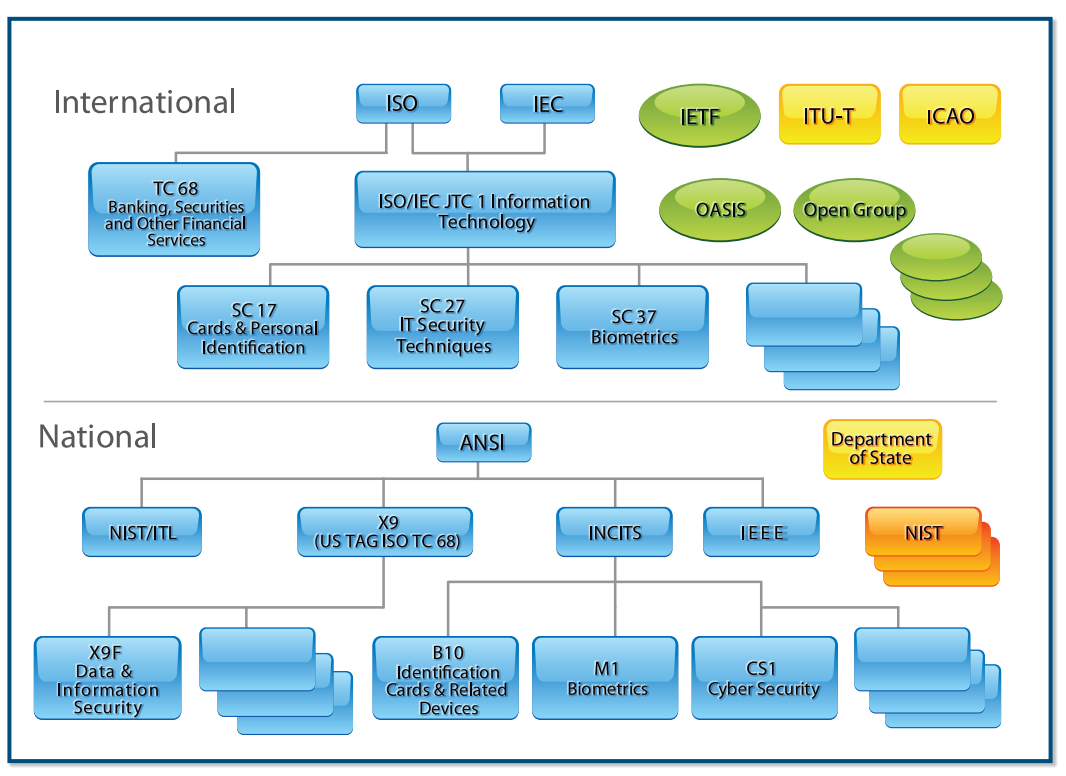
図1:サイバーセキュリティ標準化団体(SDO)。枠で囲まれた組織図で、横線により上の「国際(International)」と下の「国内(National)」に分かれている。国際:ISOとIECがともに「ISO/IEC JTC 1 Information Technology(情報技術)」につながり、ISOは「TC 68 Banking, Securities and Other Financial Services(銀行、証券およびその他の金融サービス)」にもつながる。JTC 1からは「SC 17 Cards & Personal Identification(カードおよび個人識別)」「SC 27 IT Security Techniques(ITセキュリティ技術)」「SC 37 Biometrics(バイオメトリクス)」と、空白の箱の重なりが分岐する。右側には、線でつながらずに、IETF、OASIS、Open Group(緑の楕円。空白の緑の楕円の重なりもある)とITU-T、ICAO(黄色の箱)がある。国内:ANSIからNIST/ITL、「X9(US TAG ISO TC 68)」、INCITS、IEEEが分岐する。X9からは「X9F Data & Information Security(データおよび情報セキュリティ)」と空白の箱の重なりが、INCITSからは「B10 Identification Cards & Related Devices(識別カードおよび関連デバイス)」「M1 Biometrics(バイオメトリクス)」「CS1 Cyber Security(サイバーセキュリティ)」と空白の箱の重なりが分岐する。右側には、線でつながらずに「Department of State(国務省)」(黄色の箱)とNIST(オレンジの箱の重なり)がある。
Figure 1: Cybersecurity Standards Development Organizations (SDOs)
図1:サイバーセキュリティ標準化団体(SDO)
Joint Technical Committee 1 (JTC 1) was formed by ISO and IEC to be responsible for international standardization in the field of information technology. It develops, maintains, promotes, and facilitates IT standards required by global markets, meeting business and user requirements concerning:
Joint Technical Committee 1(JTC 1)は、情報技術分野の国際標準化を担当するために、ISOとIECによって設立されました。JTC 1は、以下に関する事業上および利用者の要求を満たし、世界の市場が必要とするIT標準を策定、維持、推進、促進します。
•Design and development of IT systems and tools
•ITシステムおよびツールの設計と開発
•Performance and quality of IT products and systems
•IT製品およびシステムの性能と品質
•Security of IT systems and information
•ITシステムおよび情報のセキュリティ
•Portability of application programs
•アプリケーションプログラムの可搬性
•Interoperability of IT products and systems
•IT製品およびシステムの相互運用性
•Unified tools and environments
•統一されたツールおよび環境
•Harmonized IT vocabulary
•調和のとれたIT用語
•User-friendly and ergonomically designed user interfaces
•使いやすく人間工学に基づいて設計されたユーザインタフェース
JTC 1 consists of a number of subcommittees (SCs) and working groups that address specific technologies. SCs that produce standards relating to IT security include:
JTC 1は、特定の技術を扱ういくつかの小委員会(SC)と作業グループで構成されます。ITセキュリティに関連する標準を作成するSCには、以下が含まれます。
•SC06 − Telecommunications and Information Exchange Between Systems
•SC06 − Telecommunications and Information Exchange Between Systems
•SC17 − Cards and Personal Identification
•SC17 − Cards and Personal Identification
•SC27− IT Security Techniques
•SC27− IT Security Techniques
•SC37 – Biometrics (Fernando Podio, NIST, Chair)
•SC37 – Biometrics(Fernando Podio、NIST、議長)
JTC 1 also has:
JTC 1には、以下もあります。
•Technical Committee 68 – Financial Services
•Technical Committee 68 – Financial Services
•SC2− Operations and Procedures including Security
•SC2− Operations and Procedures including Security
•SC4– Securities
•SC4– Securities
•SC6− Financial Transaction Cards, Related Media, and Operations
•SC6− Financial Transaction Cards, Related Media, and Operations
•SC7– Software and Systems Engineering
•SC7– Software and Systems Engineering
The American National Standards Institute (ANSI)
米国規格協会(ANSI)
ANSI is a private, nonprofit organization (501(c)(3)) that administers and coordinates the U.S. voluntary standardization and conformity assessment system and facilitates the development of American National Standards (ANS) by accrediting the procedures of SDOs.
ANSIは、米国の任意の標準化および適合性評価の制度を運営、調整する民間の非営利組織(501(c)(3))であり、SDOの手続きを認定することによりAmerican National Standards(ANS)の策定を促進します。
ANSI promotes the use of U.S. standards internationally, advocates U.S. policy and technical positions in international and regional standards organizations, and encourages the adoption of international standards as national standards where they meet the needs of the user community. ANSI is the sole U.S. representative and dues-paying member of the two major non-treaty international standards organizations, ISO and, via the United States National Committee (USNC), the IEC.
ANSIは、米国の標準の国際的な利用を推進し、国際および地域の標準化団体において米国の政策上および技術上の立場を主張し、国際標準が利用者コミュニティのニーズを満たす場合には、それを国家標準として採用することを奨励します。ANSIは、条約に基づかない二つの主要な国際標準化団体であるISOおよびIECにおいて、米国を代表する唯一の機関であり、会費を納める会員です。IECには、United States National Committee(USNC)を通じて参加しています。
INCITS is accredited by ANSI and serves as the ANSI Technical Advisory Group (TAG) for ISO/IEC Joint Technical Committee 1. INCITS is sponsored by the Information Technology Industry (ITI) Council, a trade association representing the leading U.S. providers of information technology products and services.
INCITSはANSIの認定を受けており、ISO/IEC Joint Technical Committee 1に対するANSIのTechnical Advisory Group(TAG)を務めています。INCITSは、情報技術製品およびサービスの米国の主要な提供者を代表する業界団体であるInformation Technology Industry(ITI)Councilの後援を受けています。
INCITS is organized into Technical Committees that focus on the creation of standards for different technology areas. Technical committees that focus on IT security and IT security-related technologies or that may require separate security standards include:
INCITSは、異なる技術分野の標準の作成に重点を置く複数のTechnical Committeeで組織されています。ITセキュリティおよびITセキュリティ関連技術に重点を置く、または個別のセキュリティ標準を必要とする可能性のあるTechnical Committeeには、以下が含まれます。
•B10 – Identification Cards and Related Devices
•B10 – Identification Cards and Related Devices
•CS1 – Cyber Security (Dan Benigni, NIST, Chair; Sal Francomacaro, NIST, Vice Chair; and Richard Kissel, NIST, Principal voting member)
•CS1 – Cyber Security(Dan Benigni、NIST、議長。Sal Francomacaro、NIST、副議長。Richard Kissel、NIST、主たる投票権を持つ委員)
•E22 – Item Authentication
•E22 – Item Authentication
•M1 – Biometrics (Fernando Podio, NIST, Chair)
•M1 – Biometrics(Fernando Podio、NIST、議長)
•T3 –Open Distributed Processing (ODP)
•T3 –Open Distributed Processing (ODP)
•T6 – Radio Frequency Identification (RFID) Technology
•T6 – Radio Frequency Identification (RFID) Technology
•GIT1 – Governance of IT
•GIT1 – Governance of IT
•DAPS38 – Distributed Application Platforms and Services
•DAPS38 – Distributed Application Platforms and Services
As a technical committee of INCITS, CS1 develops United States, national, ANSI-accredited standards in the area of cybersecurity. Its scope encompasses:
INCITSのTechnical Committeeとして、CS1は、サイバーセキュリティの分野において、ANSIの認定を受けた米国の国家標準を策定します。その対象範囲は以下を含みます。
•Management of information security and systems
•情報セキュリティおよびシステムの管理
•Management of third-party information security service providers
•第三者の情報セキュリティサービス提供者の管理
•Intrusion detection
•侵入検知
•Network security
•ネットワークセキュリティ
•Cloud computing security
•クラウドコンピューティングのセキュリティ
•Supply chain risk management
•サプライチェーンリスク管理
•Incident handling
•インシデント対応
•IT security evaluation and assurance
•ITセキュリティの評価と保証
•Security assessment of operational systems
•運用中のシステムのセキュリティアセスメント
•Security requirements for cryptographic modules
•暗号モジュールのセキュリティ要件
•Protection profiles
•プロテクションプロファイル
•Role-based access control
•ロールベースのアクセス制御
•Security checklists
•セキュリティチェックリスト
•Security metrics
•セキュリティ指標
•Cryptographic and non-cryptographic techniques and mechanisms, including confidentiality, entity authentication, non-repudiation, key management, data integrity, message authentication, hash functions, and digital signatures
•暗号技術および非暗号技術による手法とメカニズム。機密性、エンティティ認証、否認防止、鍵管理、データ完全性、メッセージ認証、ハッシュ関数、デジタル署名を含む
•Future service and applications standards supporting the implementation of control objectives and controls as defined in ISO 27001, in the areas of business continuity and outsourcing
•事業継続およびアウトソーシングの分野において、ISO 27001に定義された管理目的および管理策の実施を支援する、将来のサービスおよびアプリケーションの標準
•Identity management, including identity management framework, role-based access control, and single sign-on
•アイデンティティ管理。アイデンティティ管理フレームワーク、ロールベースのアクセス制御、シングルサインオンを含む
•Privacy technologies, including privacy framework, privacy reference architecture, privacy infrastructure, anonymity and credentials, and specific privacy-enhancing technologies
•プライバシー技術。プライバシーフレームワーク、プライバシー参照アーキテクチャ、プライバシーインフラ、匿名性とクレデンシャル、特定のプライバシー強化技術を含む
The scope of CS1 explicitly excludes the areas of work on cybersecurity standardization presently under way in INCITS B10, M1, T3, T10, and T11, as well as other standard groups, such as the Alliance for Telecommunications Industry Solutions (ATIS), the Institute of Electrical and Electronics Engineers, Inc. (IEEE), the Internet Engineering Task Force (IETF), the Travel Industry Association of America (TIAA), and the Accredited Standards Committee (ASC) X9. The CS1 scope of work includes standardization in most of the same cybersecurity areas as are covered in the NIST CSD.
CS1の対象範囲は、INCITS B10、M1、T3、T10、T11で現在進められているサイバーセキュリティ標準化の作業分野を明示的に除外します。また、Alliance for Telecommunications Industry Solutions(ATIS)、米国電気電子学会(IEEE)、Internet Engineering Task Force(IETF)、Travel Industry Association of America(TIAA)、Accredited Standards Committee(ASC)X9などの他の標準化グループで進められている作業分野も同様に除外します。CS1の作業範囲には、NIST CSDが扱うサイバーセキュリティ分野の大半と同じ分野の標準化が含まれます。
As the U.S. TAG to ISO/IEC JTC 1/SC 27, CS1 contributes to the SC 27 program of work on IT Security Techniques in terms of U.S. comments and contributions on SC 27 standards projects; votes on SC 27 standards documents at various stages of development; and nominates U.S. experts to work on various SC 27 projects as editors, coeditors, or in other SC 27 leadership positions. Currently, over a dozen CS1 members are serving as SC 27 document editors or coeditors on various standards projects, including CSD staff Randy Easter and Richard Kissel.
ISO/IEC JTC 1/SC 27に対する米国のTAGとして、CS1は、IT Security Techniquesに関するSC 27の作業プログラムに貢献しています。具体的には、SC 27の標準化プロジェクトに対して米国のコメントと寄書を提出し、策定のさまざまな段階にあるSC 27の標準文書について投票し、SC 27の各種プロジェクトでエディタ、共同エディタ、またはSC 27のその他の指導的な立場として作業する米国の専門家を指名します。現在、12名を超えるCS1の委員が、さまざまな標準化プロジェクトでSC 27文書のエディタまたは共同エディタを務めており、その中にはCSD職員のRandy EasterとRichard Kisselが含まれます。
All input from CS1 is processed through INCITS to ANSI, then to SC 27. CS1 also serves as a conduit for getting U.S.-based new work item proposals and U.S.-developed national standards into the international SC 27 standards development process. In its international efforts, CS1 responded to all calls for U.S. contributions and/or voting positions on all international security standards projects in ISO/IEC JTC1 SC 27 in a consistent, efficient, and timely manner.
CS1からのすべての入力は、INCITSを経てANSIへ、次いでSC 27へと処理されます。CS1は、米国発の新規作業項目提案と米国で策定された国家標準を、SC 27の国際的な標準策定プロセスに持ち込むための経路としての役割も果たします。国際的な取り組みにおいて、CS1は、ISO/IEC JTC1 SC 27のすべての国際セキュリティ標準化プロジェクトに関する、米国の寄書および/または投票上の立場を求めるすべての要請に対し、一貫性をもって、効率的に、かつ適時に対応しました。
NIST contributes to many of CS1’s national and international IT security standards efforts through its membership on CS1, where Dan Benigni serves as the non-voting chair and Richard Kissel as the NIST Principal voting member. Internationally, there are over 100 published standards, and almost all have been adopted as U.S. national standards. There are more than 80 current international standards projects. During FY 2013, 29 new standards were published in SC 27, and most of them have been recommended by CS1 for adoption as U.S. national standards.
NISTは、CS1の委員であることを通じて、CS1による国内および国際のITセキュリティ標準化の取り組みの多くに貢献しています。CS1では、Dan Benigniが投票権のない議長を務め、Richard KisselがNISTの主たる投票権を持つ委員を務めています。国際的には、発行済みの標準が100件を超えており、そのほぼすべてが米国の国家標準として採用されています。現在進行中の国際標準化プロジェクトは80件を超えます。2013会計年度中、SC 27では29件の新しい標準が発行され、その大半について、CS1は米国の国家標準として採用するよう勧告しています。
CSD Contributions to Cybersecurity Standardization in INCITS CS1
INCITS CS1におけるサイバーセキュリティ標準化へのCSDの貢献
CSD’s cybersecurity research also plays a direct role in the Cybersecurity Standardization efforts of CS1 at the national level. Nationally during FY 2013:
CSDのサイバーセキュリティ研究は、国内レベルでのCS1のサイバーセキュリティ標準化の取り組みにおいても、直接的な役割を果たしています。国内では、2013会計年度中に以下がありました。
•The NIST Policy Machine research and development has resulted in three ongoing national standards projects in CS1, each in the early stages of development. They include:
•NIST Policy Machine の研究開発は、CS1 において進行中の3件の国家規格プロジェクトにつながっており、いずれも開発の初期段階にあります。それらは次のとおりです。
•INCITS 499-2013, “Next Generation Access Control –Functional Architecture (NGAC-FA)”, David Ferraiolo, NIST, Editor, Published May 2013
•INCITS 499-2013, “Next Generation Access Control –Functional Architecture (NGAC-FA)”, David Ferraiolo, NIST, Editor、2013年5月発行
•“Next Generation Access Control – Generic Operations & Abstract Data Structures (NGAC-GOADS)”, Project Number: 2195-D, Serban Gavrila, NIST, Editor (Planned Publication FY 2014)
•“Next Generation Access Control – Generic Operations & Abstract Data Structures (NGAC-GOADS)”, Project Number: 2195-D, Serban Gavrila, NIST, Editor(2014会計年度に発行予定)
•“Next Generation Access Control-Implementation Requirements, Protocols and API Definitions (NGAC-IRPADS)”, Project Number: 2193-D
•“Next Generation Access Control-Implementation Requirements, Protocols and API Definitions (NGAC-IRPADS)”, Project Number: 2193-D
Within CS1, liaisons are maintained with nearly 20 organizations, including:
CS1 では、次の組織を含む20近くの組織とのリエゾン関係を維持しています。
•ABA Federated Identity Management Legal (IdM Legal) Task Force
•ABA Federated Identity Management Legal (IdM Legal) Task Force
•American Bar Association (ABA), section on Science and Technology
•American Bar Association (ABA), section on Science and Technology
•Cloud Security Alliance
•Cloud Security Alliance
•Forum of Incident Response and Security Teams (FIRST)
•Forum of Incident Response and Security Teams (FIRST)
•IEEE P1700 and P1619
•IEEE P1700 および P1619
•INCITS T11, M1, GIT1, DAPS38, and PL22
•INCITS T11、M1、GIT1、DAPS38 および PL22
•Internet Security Alliance
•Internet Security Alliance
•Kantara Initiative Identity Assurance Working Group (IAWG)
•Kantara Initiative Identity Assurance Working Group (IAWG)
•Open Group
•Open Group
•SC 7 TAG
•SC 7 TAG
•Scientific Working Group on Digital Evidence (SWGDE)
•Scientific Working Group on Digital Evidence (SWGDE)
•The Storage Networking Industry Association (SNIA)
•The Storage Networking Industry Association (SNIA)
•Trusted Computing Group
•Trusted Computing Group
Dan Benigni also serves as cybersecurity standards coordinator in CSD.
Dan Benigni は、CSD のサイバーセキュリティ規格コーディネーターも務めています。
Contact:
連絡先:
Mr. Daniel Benigni (301) 975-3279 benigni@nist.gov
Mr. Daniel Benigni (301) 975-3279 benigni@nist.gov
Identity Management Standards within INCITS B10 and ISO JTC1/SC 17
INCITS B10 および ISO JTC1/SC 17 におけるアイデンティティ管理規格
CSD supports identity management standardization activities through participation in national and international standards bodies and organizations. CSD actively participates in the INCITS B10 committee, which is focused on interoperability of Identification Cards and Related Devices. CSD staff serves as Chair and Vice Chair of the B10.12 committee, which develops interoperable standards for Integrated Circuit Cards with Contacts. CSD staff also serves as the U.S. Head of delegation to ISO/IEC JTC1 SC 17 Working Groups 4 and 11.
CSD は、国内および国際的な標準化団体・組織への参加を通じて、アイデンティティ管理の標準化活動を支援しています。CSD は、識別カードおよび関連デバイスの相互運用性を主眼とする INCITS B10 委員会に積極的に参加しています。CSD の職員は、接触型 IC カードの相互運用可能な規格を開発する B10.12 委員会の議長および副議長を務めています。CSD の職員は、ISO/IEC JTC1 SC 17 の Working Group 4 および 11 への米国代表団長も務めています。
In addition to chairing the B10.12 committee, CSD provides technical and editorial support in the development of national and international standards. Specifically, CSD staff serves as the technical editor of ANSI 504-1, Generic Identity Command Set (GICS). GICS enables PIV, PIV-Interoperable (PIV-I) and Common Access Card (CAC) card applications, and others, to be built from a single platform. GICS defines an open platform where identity applications can be instantiated, deployed, and used in an interoperable way between the credential issuers and credential users. CSD staff also provides significant input to standards of major interest to U.S. government agencies and U.S. markets. CSD influences the development and revision of ISO/IEC 7816 (Identification Cards, Integrated Circuit Cards), ISO/IEC 24727 (Identification Cards, Integrated Circuit Card Programming Interfaces), and ISO/IEC 24787 (Biometrics “Match On Card” Comparison).
CSD は、B10.12 委員会の議長を務めることに加え、国内規格および国際規格の開発において技術面および編集面の支援を提供しています。具体的には、CSD の職員が ANSI 504-1, Generic Identity Command Set (GICS) のテクニカルエディターを務めています。GICS により、PIV、PIV-Interoperable (PIV-I)、Common Access Card (CAC) などのカードアプリケーションを単一のプラットフォームから構築できるようになります。GICS は、クレデンシャルの発行者と利用者との間で相互運用可能な形でアイデンティティアプリケーションをインスタンス化し、展開し、利用できるオープンなプラットフォームを定義します。CSD の職員は、米国政府機関および米国市場にとって関心の高い規格に対しても、重要なインプットを提供しています。CSD は、ISO/IEC 7816 (Identification Cards, Integrated Circuit Cards)、ISO/IEC 24727 (Identification Cards, Integrated Circuit Card Programming Interfaces) および ISO/IEC 24787 (Biometrics “Match On Card” Comparison) の開発および改訂に影響を与えています。
During FY 2013, INCITS 504 Parts 1, 2, and 4 were published and ISO/IEC 7816 Part 4 was published with significant changes added per NIST’s request. CSD provides contributions and feedback on many other INCITS B10 identity management standards projects.
2013会計年度には、INCITS 504 の Part 1、2 および 4 が発行され、ISO/IEC 7816 Part 4 が NIST の要請による重要な変更を加えて発行されました。CSD は、このほかにも INCITS B10 の多くのアイデンティティ管理規格プロジェクトに対して、寄書およびフィードバックを提供しています。
During the FY 2014, the INCITS B10 committee, along with the active collaboration of CSD staff, plans to publish Part 3 of INCITS 504 and contribute to the publication of several standards of the ISO/IEC 7816 family (all relevant to FIPS 201 specifications). CSD staff will continue actively supporting relevant ID management standard initiatives.
2014会計年度には、INCITS B10 委員会が、CSD 職員の積極的な協力のもと、INCITS 504 の Part 3 を発行し、ISO/IEC 7816 ファミリーのいくつかの規格(いずれも FIPS 201 の仕様に関連する)の発行に貢献することを計画しています。CSD の職員は、関連する ID 管理規格の取組みを引き続き積極的に支援します。
CSD’s investment in these activities is motivated by new technical ideas that emerge from these standards. For example, INCITS 504 is an ID platform that leverages the FIPS 201 infrastructure to support a larger number of government and enterprise initiatives. In particular, INCITS 504 aims to support initiatives such as the NSTIC. ISO/IEC 24727 aims to create an interoperability framework that increases the resilience and scalability of identity management solutions and fosters domestic and international interoperability.
CSD がこれらの活動に投資するのは、これらの規格から新しい技術的アイデアが生まれるからです。例えば、INCITS 504 は、FIPS 201 のインフラストラクチャを活用して、より多くの政府および企業の取組みを支援する ID プラットフォームです。特に、INCITS 504 は NSTIC などの取組みを支援することを目指しています。ISO/IEC 24727 は、アイデンティティ管理ソリューションのレジリエンスおよびスケーラビリティを高め、国内および国際的な相互運用性を促進する相互運用性フレームワークを構築することを目指しています。
Contact:
連絡先:
Mr. Salvatore Francomacaro (301) 975-6414 salvatore.francomacaro@nist.gov
Mr. Salvatore Francomacaro (301) 975-6414 salvatore.francomacaro@nist.gov
Federal Information Security Management Act (FISMA) Implementation Project
連邦情報セキュリティマネジメント法(FISMA)導入プロジェクト
The FISMA Implementation Project focuses on:
FISMA 導入プロジェクトは、次の事項に重点を置いています。
•Developing a comprehensive series of standards and guidelines to help federal agencies build strong cybersecurity programs, defend against increasingly sophisticated cyber attacks, and demonstrate compliance to security requirements set forth in legislation, Executive Orders, Homeland Security Directives, and Office of Management and Budget (OMB) policies
•連邦政府機関が強固なサイバーセキュリティプログラムを構築し、高度化の進むサイバー攻撃から防御し、法令、大統領令、国土安全保障指令および行政管理予算局(OMB)の方針に定められたセキュリティ要件への準拠を実証できるよう支援するための、包括的な一連の標準およびガイドラインを開発すること
•Building common understanding and reference guides for organizations applying the NIST suite of standards and guidelines that support the NIST Risk Management Framework (RMF)
•NIST リスクマネジメントフレームワーク(RMF)を支える NIST の一連の標準およびガイドラインを適用する組織のために、共通理解と参考ガイドを整備すること
•Developing minimum criteria and guidelines for recognizing security assessment organization providers as capable of assessing information systems consistent with NIST standards and guidelines supporting the RMF
•セキュリティアセスメントを提供する組織が、RMF を支える NIST の標準およびガイドラインに沿って情報システムを評価する能力を有すると認めるための、最低限の基準およびガイドラインを開発すること
•Conducting FISMA outreach to public and private sector organizations
•公共部門および民間部門の組織に対するFISMAアウトリーチの実施
During 2013, CSD strengthened its collaboration with the Department of Defense (DoD), the Intelligence Community, and the Committee on National Security Systems (CNSS), in partnership with the Joint Task Force Transformation Initiative, which continues to develop key cybersecurity guidelines for protecting federal information and information systems for the Unified Information Security Framework. Previously, the Joint Task Force developed common security guidance in the critical areas of security controls for information systems and organizations, security assessment procedures to demonstrate security control effectiveness, security authorizations for risk acceptance decisions, and continuous monitoring activities to ensure that decision makers receive the most up-to-date information on the security state of their information systems. In addition, CSD worked with the General Services Administration (GSA) Federal Risk and Authorization Management Program (FedRAMP) to identify security assessment requirements, and prototype a process for approving Third-Party Assessment Organizations (3PAOs) that demonstrate capability in assessing Cloud Service Providers (CSP) information systems for conformance to NIST standards and guidelines.
2013年、CSDは、Joint Task Force Transformation Initiativeと連携して、国防総省(DoD)、インテリジェンスコミュニティ、およびCommittee on National Security Systems(CNSS)との協力を強化しました。Joint Task Force Transformation Initiativeは、Unified Information Security Frameworkのために、連邦政府の情報および情報システムを保護するための主要なサイバーセキュリティガイドラインの策定を続けています。これまでにJoint Task Forceは、情報システムおよび組織のためのセキュリティ管理策、セキュリティ管理策の有効性を実証するためのセキュリティアセスメント手順、リスク受容の判断のためのセキュリティ認可、ならびに意思決定者が自らの情報システムのセキュリティ状態に関する最新の情報を確実に受け取れるようにするための継続的モニタリング活動という重要な領域において、共通のセキュリティガイダンスを策定しました。さらにCSDは、一般調達局(GSA)のFederal Risk and Authorization Management Program(FedRAMP)と協力して、セキュリティアセスメントの要件を特定するとともに、Cloud Service Provider(CSP)の情報システムがNISTの標準およびガイドラインに適合しているかをアセスメントする能力を実証したThird-Party Assessment Organization(3PAO)を承認するプロセスを試作しました。
In FY 2013, CSD worked on the following three initiatives:
2013会計年度、CSDは次の3つの取り組みを進めました。
1. Risk Management and Risk Assessment Guidelines:
1. リスク管理およびリスクアセスメントのガイドライン:
Developed a comprehensive risk assessment guideline examining the relationships among key risk factors, including threats, vulnerabilities, impact, and likelihood. Special Publication (SP) 800-53, Revision 4, Security and Privacy Controls for Federal Information Systems and Organizations, provides a holistic approach to information security and risk management. The publication provides organizations with security controls necessary to appropriately strengthen their information systems and the environments in which those systems operate − contributing to systems that are resilient in the face of attacks and other threats. This “Build It Right” strategy combines with a variety of security controls for “Continuous Monitoring” to give organizations near real-time information that is essential for senior leaders making ongoing risk-based decisions affecting their critical missions and business functions.
脅威、脆弱性、影響、起こりやすさを含む主要なリスク要因の間の関係を検討する、包括的なリスクアセスメントのガイドラインを策定しました。Special Publication (SP) 800-53, Revision 4, Security and Privacy Controls for Federal Information Systems and Organizationsは、情報セキュリティとリスク管理に対する全体的なアプローチを示しています。この刊行物は、組織の情報システムとそれらのシステムが運用される環境を適切に強化するために必要なセキュリティ管理策を組織に提供し、攻撃やその他の脅威に直面してもレジリエントなシステムの実現に寄与します。この「Build It Right」戦略は、「Continuous Monitoring」のための各種のセキュリティ管理策と組み合わさって、ほぼリアルタイムの情報を組織に与えます。この情報は、上級指導者が自組織の重要な任務および業務機能に影響する、リスクに基づく判断を継続的に下すうえで不可欠です。
To take advantage of the expanded set of security and privacy controls, and to give organizations greater flexibility and agility in defending their information systems, the revision introduces the concept of overlays. Overlays provide a structured approach to help organizations tailor security control baselines and develop specialized security plans for specific missions/business functions, environments of operation, and/or technologies. This specialization approach is important as the number of threat-driven controls and control enhancements in the catalog increases and organizations develop risk management strategies to address their specific protection needs within defined risk tolerances.
拡充されたセキュリティ管理策およびプライバシー管理策の集合を活用し、情報システムの防御において組織により大きな柔軟性と機敏性を与えるために、この改訂ではオーバーレイの概念を導入しています。オーバーレイは、組織がセキュリティ管理策ベースラインをテーラリングし、特定の任務・業務機能、運用環境、技術のいずれかまたは複数に向けた専用のセキュリティ計画を策定することを助ける、構造化されたアプローチを提供します。カタログに含まれる脅威主導の管理策および管理策拡張の数が増え、組織が定められたリスク許容度の範囲内で自らに固有の保護ニーズに対処するリスク管理戦略を策定するなかで、この特化のアプローチは重要です。
Figure 2: Generic Risk Model with Key Risk Factors
図2:主要なリスク要因を含む汎用リスクモデル
2. Criteria and Guidelines for Recognizing Security Assessment Provider Organizations:
2. セキュリティアセスメント提供組織を認定するための基準およびガイドライン:
CSD updated proficiency tests and technical requirements for evaluating FedRAMP 3PAO providers’ capability to conduct security assessment of cloud-based information systems for compliance with FISMA in accordance with FedRAMP and ISO/IEC 17020 Inspection Bodies requirements. Additionally, CSD provided input to GSA requirements (including orientation and training) for private sector accreditation body of FedRAMP 3PAOs that resulted in GSA FedRAMP Program Management Office (PMO) selecting one 3PAO private sector accreditation body.
CSDは、FedRAMPおよびISO/IEC 17020 Inspection Bodiesの要件に従い、クラウドベースの情報システムについてFISMAへの準拠に関するセキュリティアセスメントを実施するFedRAMP 3PAO提供者の能力を評価するための、技能試験と技術要件を更新しました。加えてCSDは、FedRAMP 3PAOの民間部門の認定機関に対するGSAの要件(オリエンテーションと訓練を含む)に意見を提供し、その結果、GSA FedRAMP Program Management Office(PMO)は3PAOの民間部門の認定機関を1つ選定しました。
3. FISMA Outreach Activity to Public and Private Sector Organizations:
3. 公共部門および民間部門の組織に対するFISMAアウトリーチ活動:
CSD conducted cybersecurity outreach briefings and provided support to state and local governments as well as private sector organizations on topics of interest, such as effective implementation of the NIST Risk Management Framework. In addition, CSD conducted outreach activities with academic institutions, providing information on NIST’s security standards and guidelines, and exploring new areas of cybersecurity research and development.
CSDは、NIST Risk Management Frameworkの効果的な実装など関心の高い話題について、サイバーセキュリティのアウトリーチ説明会を実施し、州政府および地方政府ならびに民間部門の組織に支援を提供しました。さらにCSDは、学術機関に対するアウトリーチ活動を実施し、NISTのセキュリティ標準およびガイドラインに関する情報を提供するとともに、サイバーセキュリティの研究開発の新たな領域を探りました。
In FY 2013, CSD completed the following outreach activities:
2013会計年度、CSDは次のアウトリーチ活動を完了しました。
•Finalized SP 800-53, Revision 4
•SP 800-53, Revision 4を最終化した
•Collaborated with the ITL Software and Systems Division and the NIST Standards Coordination Office using the International Standard ISO/IEC 17020:2008, Conformity Assessment – Requirements for the operation of various types of bodies performing inspection, in support of GSA in establishing a process for qualifying 3PAOs to conduct security assessments of CSPs information systems consistent with GSA requirements based on NIST standards and guidelines
•NIST標準およびガイドラインに基づくGSAの要件に沿ってCSPの情報システムのセキュリティアセスメントを実施する3PAOの資格を認めるプロセスをGSAが確立することを支援するため、国際標準ISO/IEC 17020:2008, Conformity Assessment – Requirements for the operation of various types of bodies performing inspectionを用いて、ITLのSoftware and Systems DivisionおよびNIST Standards Coordination Officeと協力した
•Developed a preliminary draft of SP 800-53A, Revision 4, Guide for Assessing the Security and Privacy Controls in Federal Information Systems and Organizations
•SP 800-53A, Revision 4, Guide for Assessing the Security and Privacy Controls in Federal Information Systems and Organizationsの予備草案を作成した
•Developed a preliminary draft of SP 800-18, Revision 2, Guide for Developing Security Plans for Federal Information Systems and Organizations
•SP 800-18, Revision 2, Guide for Developing Security Plans for Federal Information Systems and Organizationsの予備草案を作成した
In FY 2014, CSD intends to:
2014会計年度、CSDは次のことを行う予定です。
•Finalize SP 800-53A, Revision 4, Guide for Assessing the Security and Privacy Controls in Federal Information Systems and Organizations
•SP 800-53A, Revision 4, Guide for Assessing the Security and Privacy Controls in Federal Information Systems and Organizationsを最終化する
•Finalize SP 800-60 Revision 2, Guide for Mapping Types of Information and Information Systems to Security Categories
•SP 800-60 Revision 2, Guide for Mapping Types of Information and Information Systems to Security Categoriesを最終化する
•Finalize SP 800-18 Revision 2, Guide for Developing Security Plans for Federal Information Systems and Organizations
•SP 800-18 Revision 2, Guide for Developing Security Plans for Federal Information Systems and Organizationsを最終化する
•Expand cybersecurity outreach to include additional state, local, and tribal governments, as well as private sector organizations and academic institutions
•サイバーセキュリティのアウトリーチを拡大し、さらに多くの州政府、地方政府、部族政府、ならびに民間部門の組織と学術機関を対象に含める
•Continue to support federal agencies in effective implementation of the NIST Risk Management Framework.
•連邦機関によるNIST Risk Management Frameworkの効果的な実装を引き続き支援します。
http://csrc.nist.gov/sec-cert
http://csrc.nist.gov/sec-cert
Contacts:
連絡先:
Dr. Ron Ross, (301) 975-5390, ron.ross@nist.gov
Dr. Ron Ross, (301) 975-5390, ron.ross@nist.gov
Mr. Arnold Johnson, (301) 975-3247, arnold.johnson@nist.gov
Mr. Arnold Johnson, (301) 975-3247, arnold.johnson@nist.gov
Ms. Peggy Himes, (301) 975-2489, peggy.himes@nist.gov
Ms. Peggy Himes, (301) 975-2489, peggy.himes@nist.gov
Ms. Pat Toth, (301) 975-5140, patricia.toth@nist.gov
Ms. Pat Toth, (301) 975-5140, patricia.toth@nist.gov
Ms. Kelley Dempsey, (301) 975-2827, kelley.dempsey@nist.gov
Ms. Kelley Dempsey, (301) 975-2827, kelley.dempsey@nist.gov
Biometric Standards and Associated Conformity Assessment Testing Tools
バイオメトリクス標準および関連する適合性評価試験ツール
The CSD staff responds to government, industry, and market requirements for open systems standards by:
CSDの職員は、オープンシステム標準に対する政府、産業界、市場の要求に、次のことを通じて応えています。
•Accelerating development of formal biometric standards
•公式なバイオメトリクス標準の策定を加速すること
•Providing effective leadership and technical participation in the development of these standards
•これらの標準の策定において、効果的な主導と技術面での参加を行うこと
•Developing Conformance Test Architectures (CTA) and Conformance Test Suites (CTS) designed to test implementations of biometric standards
•バイオメトリクス標準の実装を試験するために設計されたConformance Test Architecture(CTA)およびConformance Test Suite(CTS)を開発すること
•Supporting harmonization of biometric, tokens, and security standards
•バイオメトリクス、トークン、セキュリティの各標準の整合化を支援すること
•Promoting biometric standards adoption
•バイオメトリクス規格の採用を促進すること
•Promoting conformity assessment efforts
•適合性評価の取組みを促進すること
To achieve these project goals, CSD continues to work in close partnership with government agencies, industry partners, and academic institutions. CSD actively participates in a number of biometric standards development projects, contributes to the development of biometric standards, and leads national and international biometric standards bodies. Nationally, CSD’s staff leads the INCITS Technical Committee 1 (M1) – Biometrics; international efforts include ISO JTC 1 and IEC Subcommittee SC 37 - Biometrics - JTC 1/SC 37. CSD plans to continue this work in FY 2014.
これらのプロジェクト目標を達成するため、CSD は、政府機関、産業界のパートナーおよび学術機関と緊密に連携して作業を続けています。CSD は、多数のバイオメトリクス規格開発プロジェクトに積極的に参加し、バイオメトリクス規格の開発に貢献するとともに、国内および国際的なバイオメトリクス標準化団体を主導しています。国内では、CSD の職員が INCITS Technical Committee 1 (M1) – Biometrics を主導しており、国際的な取組みとしては ISO JTC 1 および IEC の Subcommittee SC 37 - Biometrics - JTC 1/SC 37 があります。CSD は、2014会計年度もこの作業を継続する計画です。
During FY 2013, the development of object-oriented CTAs and CTSs to test implementations of biometric standards progressed at an accelerated pace. CSD developed and publicly released two fully functional object-oriented CTAs. One CTA supports CTSs designed to test implementations of Extensible Markup Language (XML) encoded biometric data interchange formats and the other supports CTSs designed to test implementations of ISO/IEC data formats developed by JTC 1/SC 37 as well as PIV profiles of biometric standards. CSD released these test tools as “BioCTS 2013 for ANSI/NIST 1-2011” and “BioCTS 2013 for ISO/IEC” respectively. As depicted in the figure, CTA/CTSs’ key features include search capabilities of the Text Log Outputs (very useful to debug errors in large implementations), formatted test results, and test result basic statistics (on batch of files or individual files).
2013会計年度には、バイオメトリクス規格の実装を試験するためのオブジェクト指向の CTA および CTS の開発が、加速したペースで進みました。CSD は、完全に機能する2つのオブジェクト指向 CTA を開発し、一般に公開しました。一方の CTA は、Extensible Markup Language (XML) で符号化されたバイオメトリックデータ交換フォーマットの実装を試験するために設計された CTS をサポートし、もう一方は、JTC 1/SC 37 が開発した ISO/IEC データフォーマットおよびバイオメトリクス規格の PIV プロファイルの実装を試験するために設計された CTS をサポートします。CSD は、これらの試験ツールをそれぞれ「BioCTS 2013 for ANSI/NIST 1-2011」および「BioCTS 2013 for ISO/IEC」として公開しました。図に示すように、CTA/CTS の主な特長には、テキストログ出力の検索機能(大規模な実装におけるエラーのデバッグに非常に有用である)、整形された試験結果、および試験結果の基本統計(ファイルのバッチ単位または個別ファイル単位)があります。
In addition to previously designed CTSs (e.g., CTS for ANSI/NIST-ITL 1-2011 [AN-2011] traditional encoding transactions and ISO/IEC biometric data interchange format implementations), BioCTS 2013 conformance test software includes a CTS designed to test National Information Exchange Model (NIEM) XML encoded AN-2011 implementations. The functionality of this tool goes beyond the existing basic XML testing techniques, such as schema validation. CSD’s project team concluded that the XML schema validation was insufficient to address full conformance testing of the AN-2011 requirements. The team implemented over 1,200 test assertions beyond the schema validation (validating an XML file against an XSD file) for this standard, including those for AN-2011 Record Types 1, 4, 10, 13, 14, 15, and 17. NISTIR 7957, Conformance Test Architecture and Test Suite for ANSI/NIST-ITL 1-2011 NIEM XML Encoded Transactions (September 2013) and a presentation delivered at the last Biometric Consortium conference discussed these test tools and provided technical implementation details.
BioCTS 2013 適合性試験ソフトウェアには、これまでに設計された CTS(例:ANSI/NIST-ITL 1-2011 [AN-2011] の従来型符号化トランザクション用および ISO/IEC バイオメトリックデータ交換フォーマットの実装用の CTS)に加えて、National Information Exchange Model (NIEM) XML で符号化された AN-2011 の実装を試験するために設計された CTS が含まれています。このツールの機能は、スキーマ検証のような既存の基本的な XML 試験手法の範囲を超えています。CSD のプロジェクトチームは、XML スキーマ検証だけでは AN-2011 の要件に対する完全な適合性試験には不十分であると結論づけました。同チームは、この規格について、スキーマ検証(XML ファイルを XSD ファイルに照らして検証すること)を超える1,200件以上の試験アサーションを実装しました。これには AN-2011 の Record Type 1、4、10、13、14、15 および 17 に対するものが含まれます。NISTIR 7957, Conformance Test Architecture and Test Suite for ANSI/NIST-ITL 1-2011 NIEM XML Encoded Transactions(2013年9月)および前回の Biometric Consortium conference で行われた発表が、これらの試験ツールを取り上げ、実装の技術的詳細を示しました。
BioCTS 2013 conformance test software also includes CTSs to test PIV profiles (e.g., finger minutia and image data formats) and to test implementations of the second-generation face recognition data format developed by JTC 1/SC 37 (published in 2011). The PIV profile of the SC 37 iris data format was aligned with SP 800-76-2, Biometric Specifications for Personal Identity Verification. The face recognition CTS was aligned with the associated conformance testing methodology developed by JTC 1/SC 37.
BioCTS 2013 適合性試験ソフトウェアには、PIV プロファイル(例:指紋マニューシャおよび画像のデータフォーマット)を試験するための CTS、ならびに JTC 1/SC 37 が開発した第2世代の顔認識データフォーマット(2011年発行)の実装を試験するための CTS も含まれています。SC 37 の虹彩データフォーマットの PIV プロファイルは、SP 800-76-2, Biometric Specifications for Personal Identity Verification に整合させました。顔認識の CTS は、JTC 1/SC 37 が開発した関連する適合性試験方法論に整合させました。
BioCTS 2013の案内図。NIST/ITL CSDの生体認証適合性試験ソフトウェアについて、ANSI/NIST-ITL形式や生体データ交換形式向けの試験アーキテクチャと試験スイートを紹介している。 [組織・プログラムのロゴ。ロゴのため、この非公式サイトには掲載していません。原本 PDF を参照してください。]
Figure 3: Biometric Conformance Test Software by NIST/ITL CSD
図3:NIST/ITL CSD によるバイオメトリクス適合性試験ソフトウェア
These conformance-testing tools provide significant functionality, usability, and performance. In addition to supplying an installer version of the CTAs, which supports new and existing CTSs with new graphical user interface enhancements, the CSD project team extended the work to a command line interface version for AN-2011 traditional encoding that runs under Windows and Linux (with Mono). The test tools developed support a Web-based environment. A prototype was developed, tested, and demonstrated at the last Biometric Consortium Conference.
これらの適合性試験ツールは、優れた機能性、ユーザビリティおよび性能を備えています。CSD のプロジェクトチームは、グラフィカルユーザインタフェースを新たに強化して新規および既存の CTS をサポートする CTA のインストーラ版を提供することに加え、作業を拡張して、Windows および Linux(Mono を使用)上で動作する、AN-2011 従来型符号化用のコマンドラインインタフェース版も提供しました。開発された試験ツールは、Web ベースの環境をサポートします。プロトタイプが開発され、試験され、前回の Biometric Consortium Conference で実演されました。
Based on the detailed analysis of the biometric standards (ISO/IEC and AN-2011) required to develop the associated conformance test tools, the CSD team provided technical contributions to the relevant standards bodies. In FY 2013, these included:
CSD のチームは、関連する適合性試験ツールの開発に必要であったバイオメトリクス規格(ISO/IEC および AN-2011)の詳細な分析に基づいて、関係する標準化団体に技術的な寄書を提出しました。2013会計年度には、次のものがありました。
•Over 200 test assertions for AN-2011 Record Type 18 – DNA Data Record
•AN-2011 の Record Type 18 – DNA Data Record に対する200件以上の試験アサーション
•Technical contributions on the AN-2011 standard and the published XML schema
•AN-2011 規格および公開された XML スキーマに関する技術的寄書
•Technical contributions to JTC 1/SC 37 (via INCITS M1) on SC 37 XML namespaces, data elements, schemas, and related items; an XML-based data interchange format framework and DNA data interchange format
•SC 37 の XML 名前空間、データ要素、スキーマおよび関連事項、ならびに XML ベースのデータ交換フォーマットフレームワークおよび DNA データ交換フォーマットに関する、JTC 1/SC 37 への(INCITS M1 を通じた)技術的寄書
In addition to ongoing participation and management of biometric standards activities in INCITS M1 and JTC 1/SC 37, in FY 2014, CSD plans to develop additional CTSs to test implementations of selected international biometric data interchange formats specified in XML encoding (under development in JTC 1/SC 37). The CSD team also plans to develop conformance test assertions for selected record types of the 2013 version of the ANSI/NIST standard and plans to develop the associated CTA/CTS for traditional and XML encoded transactions. The latest version of the ANSI/NIST standard now incorporates extended forensics-related data, such as a dental supplement and additional record types, such as voice data record. The team will continue researching and developing additional test environments support, such as web services and tools in the cloud. The research plan expands to technical interfaces, such as Biometric Application Programming Interface standards specified in Object Oriented Programming and Biometric Information Assurance Services standards.
CSD は、INCITS M1 および JTC 1/SC 37 におけるバイオメトリクス規格活動への継続的な参加およびその運営に加えて、2014会計年度には、XML 符号化で規定される国際的なバイオメトリックデータ交換フォーマット(JTC 1/SC 37 で開発中)のうち選定したものの実装を試験するための CTS を追加で開発する計画です。CSD のチームは、ANSI/NIST 規格の2013年版のうち選定したレコードタイプについて適合性試験アサーションを開発することも計画しており、従来型符号化および XML 符号化のトランザクション用の関連する CTA/CTS を開発する計画です。ANSI/NIST 規格の最新版には、歯科に関する補遺のような拡張された法科学関連データや、音声データレコードのような追加のレコードタイプが新たに組み込まれています。チームは、Web サービスやクラウド上のツールなど、さらなる試験環境のサポートについて研究開発を続けます。研究計画は、オブジェクト指向プログラミングで規定された Biometric Application Programming Interface 規格や Biometric Information Assurance Services 規格といった技術的インタフェースにも広がります。
Outreach efforts in FY 2013 in support of biometric standards development and conformity assessment efforts included:
バイオメトリクス規格の開発および適合性評価の取組みを支援する2013会計年度のアウトリーチ活動には、次のものがありました。
•Contribution of the area editor for articles on biometric standards for Springer’s second edition of the Biometrics Encyclopedia (under development), where 25 papers were reviewed and edited
•Springer の Biometrics Encyclopedia 第2版(編集作業中)におけるバイオメトリクス規格に関する項目のエリアエディターとしての貢献。25本の論文を査読し、編集した
•Keynote talks and presentations on biometric standards and conformity assessment at national and international conferences
•国内会議および国際会議における、バイオメトリクス規格および適合性評価に関する基調講演および発表
•Related technical publications and participation in conference program committees and paper reviews
•関連する技術文献の発表、ならびに会議のプログラム委員会および論文査読への参加
NIST helped develop the program of the 2013 Biometric Consortium Conference, which CSD’s Mr. Fernando Podio co-chaired. Held September 17-19, 2013, in Tampa, Florida, this year’s conference included nearly 1,600 attendees from 30 countries representing government, industry, and academia.
NIST は、2013 Biometric Consortium Conference のプログラムの策定に協力し、CSD の Mr. Fernando Podio が共同議長を務めました。フロリダ州タンパで2013年9月17日から19日まで開催された今年の会議には、政府、産業界および学術界を代表する30か国からの約1,600人が参加しました。
CSD supported a booth at the conference’s technical exposition and presented material regarding the conformance test tool development project. The conference program included sessions on Federal Government programs, advances in biometric technologies and standards, and Biometrics Identity and Security (BIdS) research. NIST’s session highlighted achievements and ongoing biometric research, testing, and standards projects. Over 140 speakers participated in the program.
CSD は、同会議の技術展示会でブースを出展し、適合性試験ツール開発プロジェクトに関する資料を紹介しました。会議のプログラムには、連邦政府のプログラム、バイオメトリクス技術および規格の進展、ならびに Biometrics Identity and Security (BIdS) の研究に関するセッションが含まれていました。NIST のセッションでは、バイオメトリクスの研究、試験および規格に関するプロジェクトの成果と進行中の取組みを紹介しました。このプログラムには140人を超える講演者が参加しました。
ITL’s Biometric Resource Center: http://www.nist.gov/biometrics
ITL の Biometric Resource Center:http://www.nist.gov/biometrics
BioCTS 2013 - Biometric Conformance Test Tool Downloads: http://www.nist.gov/itl/csd/biometrics/biocta_download.cfm#CTAdownloads
BioCTS 2013 - Biometric Conformance Test Tool のダウンロード:http://www.nist.gov/itl/csd/biometrics/biocta_download.cfm#CTAdownloads
Biometric Consortium website: http://www.biometrics.org
Biometric Consortium のウェブサイト:http://www.biometrics.org
Biometric Consortium 2013 conference program (released presentations are linked): http://www.biometrics.org/bc2013/program.pdf
Biometric Consortium 2013 conference のプログラム(公開された発表資料へのリンクあり):http://www.biometrics.org/bc2013/program.pdf
BioCTS 2013のウェブサイトへ誘導するQRコード。 [組織・プログラムのロゴ。ロゴのため、この非公式サイトには掲載していません。原本 PDF を参照してください。]
Contact:
連絡先:
Mr. Fernando Podio (301) 975-2947 fernando.podio@nist.gov
Mr. Fernando Podio (301) 975-2947 fernando.podio@nist.gov
Cybersecurity of Cyber-Physical Systems (CPS)
サイバーフィジカルシステム(CPS)のサイバーセキュリティ
Leveraging CSD’s expertise in cybersecurity for industrial control systems, smart grid, hardware-enabled security, and embedded systems, the division is now researching cybersecurity needs of the broader landscape of cyber-physical systems (CPS). CPS are hybrid networked cyber and engineered physical elements co-designed to create adaptive and predictive systems that respond in real-time to enhance performance with varying degrees of human interaction, and are commonly used in the nation’s critical infrastructure. Such systems control the electrical grid, provide clean water, produce chemicals, and underlie transportation systems. CPS capabilities continue to grow as a result of technological advances, enabling future engines of growth, such as advanced manufacturing, and advancements in safety initiatives, such as autonomous vehicles.
CSD は、産業用制御システム、スマートグリッド、ハードウェアによるセキュリティおよび組込みシステムのサイバーセキュリティに関する専門知識を活用して、現在、より広範なサイバーフィジカルシステム(CPS)の領域におけるサイバーセキュリティのニーズを研究しています。CPS は、ネットワーク化されたサイバー要素と工学的に作られた物理要素とを協調設計したハイブリッドなシステムであり、人間の関与の度合いはさまざまですが、リアルタイムに応答して性能を高める適応的かつ予測的なシステムを形成し、国の重要インフラで広く使用されています。こうしたシステムは、電力網を制御し、清浄な水を供給し、化学物質を生産し、輸送システムの基盤となっています。CPS の能力は技術の進歩に伴って向上し続けており、先進製造のような将来の成長の原動力や、自動運転車のような安全に関する取組みの進展を可能にしています。
Cybersecurity is an important crosscutting discipline that is critical to safeguarding CPS and supporting communications and information infrastructure. CPS presents unique challenges, including the need for real-time response in support of extremely high availability, predictability, and reliability. Despite the ubiquity and criticality of CPS, additional thought is required regarding the design of secure CPS. As a result, there have been numerous successful attacks targeting CPS for the control of critical infrastructure (e.g., Stuxnet, Duqu, Flame, Gauss).
サイバーセキュリティは、CPS およびそれを支える通信・情報インフラを保護するうえで不可欠な、重要な分野横断的領域です。CPS には、極めて高い可用性、予測可能性および信頼性を支えるためのリアルタイム応答の必要性など、固有の課題があります。CPS は広く普及し、重要性も高いにもかかわらず、安全な CPS の設計についてはさらなる検討が必要です。その結果、重要インフラの制御に用いられる CPS を標的とした攻撃が数多く成功しています(例:Stuxnet、Duqu、Flame、Gauss)。
In April 2013, CSD and the Cyber Security Research Alliance (CSRA) co-hosted a 2-day workshop to explore emerging research needs for cybersecurity in CPS with the diverse cyber-physical community at large. The workshop brought together engineering and IT experts who have dealt with security issues related to CPS. Representatives from industry, academia, and government engaged in interactive discussions during the workshop in the areas of supply chain, assurance, threat information, identifying existing tools and practices to secure CPS, security in acquisition and implementation, and trustworthy operations. Attendees were invited to participate in break-out sessions where the discussion topics were briefly framed, allowing the attendees to explore the discussion topics and to share their experiences with integrating security into existing organizations (e.g., lessons learned and examples).
2013年4月、CSD と Cyber Security Research Alliance (CSRA) は、多様なサイバーフィジカル分野のコミュニティ全体とともに、CPS のサイバーセキュリティに関して新たに生じている研究ニーズを探るための2日間のワークショップを共催しました。このワークショップには、CPS に関連するセキュリティ問題に取り組んできたエンジニアリングおよび IT の専門家が集まりました。産業界、学術界および政府の代表者が、ワークショップにおいて、サプライチェーン、保証、脅威情報、CPS を保護するための既存のツールおよびプラクティスの特定、調達および実装におけるセキュリティ、ならびに信頼できる運用の各分野について双方向の議論を行いました。参加者は分科会に招かれ、そこでは議題の枠組みが簡潔に示されたうえで、参加者が議題を掘り下げ、既存の組織にセキュリティを組み込んだ経験(例:教訓や事例)を共有できるようにしました。
CSD, in conjunction with ITL’s Advanced Network Technologies division, Information Access division, and NIST’s Engineering Laboratory, collaborated to develop an initial NIST notional reference architecture for CPS. This notional reference architecture was designed at such a level of abstraction that it can be applied across the breadth of the CPS, yet provides modularization and context for integration. The notional CPS reference architecture was driven from a community need to provide a common lexicon and taxonomy, a common architectural vision to help facilitate interoperability between elements and systems, and promotes communication across the breadth of CPS stakeholders.
CSDは、ITLのAdvanced Network Technologies division、Information Access division、およびNISTのEngineering Laboratoryと連携し、CPSに関するNISTの概念的な参照アーキテクチャの初版を共同で開発しました。この概念的な参照アーキテクチャは、CPSの全範囲にわたって適用できる抽象度で設計されている一方で、モジュール化と統合のためのコンテキストも提供します。この概念的なCPS参照アーキテクチャは、共通の用語体系と分類体系、および要素間・システム間の相互運用性を促進するのに役立つ共通のアーキテクチャビジョンを提供してほしいというコミュニティのニーズから生まれたものであり、CPSの幅広い利害関係者の間のコミュニケーションを促進します。
CSD, in conjunction with NIST’s Engineering Laboratory, will finalize the revision of SP 800-82 in FY 2014. CSD will continue to participate in the International Society of Automation (ISA) 99 Committee, which develops and establishes standards, recommended practices, technical reports, and related information that define procedures for implementing electronically secure industrial automation and control systems and security practices, and for assessing electronic security performance. Leveraging the initial NIST notional reference architecture as a starting point to address the lack of an industry-wide consensus definition, reference architecture, and taxonomy for CPS, CSD will work in collaboration with NIST’s Engineering Laboratory and ITL’s Software and Systems division, and Advanced Networking Technologies division to lead a public-private working group of government, academia, and industry stakeholders. The working group will consist of 5 technical subgroups: 1) Definitions and Taxonomy, 2) Reference Architecture, 3) Use Cases, 4) Cybersecurity and Privacy, and 5) Timing. CSD will lead the Cybersecurity and Privacy subgroup focused on identifying strategies for cybersecurity and privacy in CPS, and work collaboratively with the other subgroups to ensure that cybersecurity is included as a design principle in development.
CSDは、NISTのEngineering Laboratoryと連携し、2014会計年度にSP 800-82の改訂を完了します。CSDは、International Society of Automation (ISA) 99 Committeeへの参加を継続します。同委員会は、電子的に安全な産業オートメーションおよび制御システムとセキュリティプラクティスを実装するための手順、ならびに電子的なセキュリティの実績を評価するための手順を定める標準、推奨プラクティス、技術報告書、および関連情報を開発し、確立しています。CPSについて業界全体で合意された定義、参照アーキテクチャ、および分類体系が存在しないという問題に対処するため、CSDは、NISTの概念的な参照アーキテクチャの初版を出発点として活用し、NISTのEngineering Laboratory、ITLのSoftware and Systems division、およびAdvanced Networking Technologies divisionと協力して、政府、学術界、および産業界の利害関係者からなる官民ワーキンググループを主導します。このワーキンググループは、1) 定義と分類体系、2) 参照アーキテクチャ、3) ユースケース、4) サイバーセキュリティとプライバシー、5) タイミング、という5つの技術サブグループで構成されます。CSDは、CPSにおけるサイバーセキュリティとプライバシーの戦略の特定に焦点を当てたサイバーセキュリティとプライバシーのサブグループを主導し、開発においてサイバーセキュリティが設計原則として確実に含まれるよう、他のサブグループと協力して作業します。
Contacts:
連絡先:
Ms. Tanya Brewer, (301) 975-4534, tbrewer@nist.gov
Ms. Tanya Brewer, (301) 975-4534, tbrewer@nist.gov
Ms. Suzanne Lightman, (301) 975-6442, suzanne.lightman@nist.gov
Ms. Suzanne Lightman, (301) 975-6442, suzanne.lightman@nist.gov
Ms. Vicky Yan Pillitteri, (301) 975-8542, victoria.yan@nist.gov
Ms. Vicky Yan Pillitteri, (301) 975-8542, victoria.yan@nist.gov
Federal Cybersecurity Research & Development (R&D)
連邦政府のサイバーセキュリティ研究開発 (R&D)
The Networking and Information Technology Research and Development (NITRD) Program provides a framework in which many federal agencies come together to coordinate their networking and IT research and development (R&D) efforts. CSD remained committed to the value of communicating its R&D efforts to other federal colleagues and identifying the opportunities to support R&D efforts throughout the Federal Government.
Networking and Information Technology Research and Development (NITRD) Programは、多くの連邦政府機関が集まってネットワーキングおよびITの研究開発 (R&D) の取り組みを調整するための枠組みを提供します。CSDは、自らのR&Dの取り組みを他の連邦政府の関係者に伝えること、および連邦政府全体のR&Dの取り組みを支援する機会を特定することの価値を引き続き重視しました。
In FY 2013, the CSIA Interagency Working Group (IWG) monthly meetings provided an opportunity to learn and share about ongoing research related to the themes and thrusts expressed in the Strategic Plan for the Federal Cybersecurity Research and Development. CSD briefed the working group regarding efforts on Executive Order 13636, “Improving Critical Infrastructure Cybersecurity,” under which NIST has been directed to work with stakeholders to develop a voluntary framework for reducing cyber risks to critical infrastructure. CSD also described work on the Advanced Network Technologies division’s High Assurance Domain project, which exists to foster development and deployment of new network security technologies to increase trust in online communications.
2013会計年度には、CSIA Interagency Working Group (IWG) の月例会議が、Strategic Plan for the Federal Cybersecurity Research and Developmentに示されたテーマと重点領域に関連する進行中の研究について学び、共有する機会となりました。CSDは、Executive Order 13636, “Improving Critical Infrastructure Cybersecurity” に関する取り組みについて同ワーキンググループに説明しました。この大統領令のもとで、NISTは、重要インフラに対するサイバーリスクを低減するための自主的なフレームワークを利害関係者と協力して開発するよう指示されています。CSDはまた、Advanced Network Technologies divisionのHigh Assurance Domainプロジェクトに関する作業についても説明しました。同プロジェクトは、オンライン通信への信頼を高めるための新しいネットワークセキュリティ技術の開発と導入を促進するために存在します。
CSD is also a regular participant in the coordination activities of the federal Special Cyber Operations Research and Engineering (SCORE) Committee. SCORE enables technology transfer through the sharing of NIST cybersecurity expertise and output. The SCORE committee interacts with federal leaders as part of the White House’s Comprehensive National Cybersecurity Initiatives (CNCI).
CSDはまた、連邦政府のSpecial Cyber Operations Research and Engineering (SCORE) Committeeの調整活動にも定期的に参加しています。SCOREは、NISTのサイバーセキュリティに関する専門知識と成果の共有を通じて、技術移転を可能にします。SCORE委員会は、ホワイトハウスのComprehensive National Cybersecurity Initiatives (CNCI) の一環として、連邦政府の指導者と連携しています。
Contacts:
連絡先:
Mr. Bill Newhouse, CSIA IWG, CSIA SSG, (301) 975-2869, william.newhouse@nist.gov
Mr. Bill Newhouse, CSIA IWG, CSIA SSG, (301) 975-2869, william.newhouse@nist.gov
Dr. Ernest McDuffie, SEW Education Team and SCORE rep, (301) 975-8897, ernest.mcduffie@nist.gov
Dr. Ernest McDuffie, SEW Education Team and SCORE rep, (301) 975-8897, ernest.mcduffie@nist.gov
Security Aspects of Electronic Voting
電子投票のセキュリティ面
[装飾の画像。本文を読むのに必要のない装飾のため、この非公式サイトには掲載していません。原本 PDF を参照してください。]
In 2002, Congress passed the Help America Vote Act (HAVA) to encourage the upgrade of voting equipment across the United States. HAVA established the Election Assistance Commission (EAC) and the Technical Guidelines Development Committee (TGDC), chaired by the Director of NIST. HAVA directs NIST to provide technical support to the EAC and TGDC in efforts related to human factors, security, and laboratory accreditation. As part of NIST’s efforts, CSD supports the activities of the EAC related to voting equipment security.
2002年、議会は、米国全土で投票機器の更新を促すためにHelp America Vote Act (HAVA) を可決しました。HAVAは、Election Assistance Commission (EAC) と、NIST長官が議長を務めるTechnical Guidelines Development Committee (TGDC) を設置しました。HAVAは、人的要因、セキュリティ、および試験所認定に関する取り組みにおいて、EACとTGDCに技術支援を提供するようNISTに指示しています。NISTの取り組みの一環として、CSDは投票機器のセキュリティに関するEACの活動を支援しています。
In the past year, NIST supported the EAC by developing responses to public comments on the Voluntary Voting System Guidelines (VVSG) 1.1. The security guidelines were updated in FY 2012 to improve the auditability of voting systems, to provide greater software integrity protections, to expand and improve access control requirements, and to help ensure cryptographic security mechanisms are implemented properly. In addition, CSD supported the efforts of the EAC and Federal Voting Assistance Program (FVAP) of DoD to improve the voting process for citizens under the Uniformed and Overseas Citizens Voting Act (UOCAVA) by leveraging electronic technologies. The team worked with the TDCG’s UOCAVA Working Group to develop a risk analysis on technologies used in current UOCAVA voting processes, including vote-by-mail, online voter registration, electronic ballot delivery, and online ballot marking.
過去1年間、NISTは、Voluntary Voting System Guidelines (VVSG) 1.1に対するパブリックコメントへの回答を作成することにより、EACを支援しました。セキュリティガイドラインは、投票システムの監査可能性を向上させ、ソフトウェアの完全性保護を強化し、アクセス制御要件を拡充および改善し、暗号セキュリティメカニズムが適切に実装されることを確実にするのに役立つよう、2012会計年度に更新されました。加えて、CSDは、電子技術を活用することによりUniformed and Overseas Citizens Voting Act (UOCAVA) の対象となる市民の投票プロセスを改善するという、EACおよびDoDのFederal Voting Assistance Program (FVAP) の取り組みを支援しました。チームは、TDCGのUOCAVA Working Groupと協力し、郵便投票、オンライン有権者登録、投票用紙の電子的配布、およびオンラインでの投票用紙記入を含む、現行のUOCAVA投票プロセスで使用されている技術に関するリスク分析を作成しました。
In FY 2014, NIST will continue to assist the EAC in developing responses to public comments and providing updates to VVSG 1.1. Additionally, CSD will continue to support efforts for the EAC and FVAP to improve the voting process for UOCAVA voters. CSD will continue security research efforts to support future standards development efforts, particularly in the areas of risks to voting systems and innovative voting system architectures.
2014会計年度には、NISTは、パブリックコメントへの回答の作成とVVSG 1.1の更新の提供において、引き続きEACを支援します。さらに、CSDは、UOCAVAの対象となる有権者の投票プロセスを改善するためのEACおよびFVAPの取り組みを引き続き支援します。CSDは、特に投票システムに対するリスクおよび革新的な投票システムアーキテクチャの分野において、将来の標準開発の取り組みを支援するためのセキュリティ研究を継続します。
http://vote.nist.gov
http://vote.nist.gov
Contacts:
連絡先:
Mr. Andrew Regenscheid, (301) 975-5155, andrew.regenscheid@nist.gov
Mr. Andrew Regenscheid, (301) 975-5155, andrew.regenscheid@nist.gov
Mr. Joshua Franklin, (301) 975-8463, joshua.franklin@nist.gov
Mr. Joshua Franklin, (301) 975-8463, joshua.franklin@nist.gov
Health Information Technology Security
医療情報技術のセキュリティ
Health information technology (HIT) enables better patient care through secure use and sharing of health information. It leads to improvements in healthcare quality, reduced medical errors, increased efficiencies in care delivery and administration, and improved population health. Central to reaching these goals is the assurance of the confidentiality, integrity, and availability of health information. CSD works with government, industry, academia, and others to provide security tools, technologies, and methodologies that provide for the security and privacy of health information.
医療情報技術 (HIT) は、医療情報の安全な利用と共有を通じて、より良い患者ケアを可能にします。HITは、医療の質の向上、医療過誤の削減、ケアの提供と管理における効率の向上、および集団の健康の改善をもたらします。これらの目標を達成するうえで中心となるのは、医療情報の機密性、完全性、および可用性の保証です。CSDは、政府、産業界、学術界などと協力し、医療情報のセキュリティとプライバシーを実現するセキュリティツール、技術、および方法論を提供しています。
内部の円盤が見えるハードディスクドライブ。 [装飾の画像。本文を読むのに必要のない装飾のため、この非公式サイトには掲載していません。原本 PDF を参照してください。]
NIST continued its HIT security outreach efforts in FY 2013. NIST and the Department of Health and Human Services’ (DHHS) Office for Civil Rights (OCR) cohosted the sixth annual HIPAA Security Rule conference, “Safeguarding Health Information: Building Assurance through HIPAA Security,” in May 2013 at the Ronald Reagan Building and International Trade Center in Washington, D.C. The conference offered important sessions that focused on broad topics of interest to the healthcare and health IT security community. Over 600 in-person and virtual attendees from federal, state, and local governments, academia, HIPAA-covered entities and business associates, industry groups, and vendors heard from, and interacted with, healthcare, security, and privacy experts on technologies and methodologies for safeguarding health information and for implementing the requirements of the HIPAA Security Rule. Presentations covered a variety of current topics including:
NISTは、2013会計年度もHITセキュリティに関するアウトリーチ活動を継続しました。NISTとDepartment of Health and Human Services (DHHS) のOffice for Civil Rights (OCR) は、2013年5月にWashington, D.C.のRonald Reagan Building and International Trade Centerにおいて、第6回年次HIPAA Security Rule会議 “Safeguarding Health Information: Building Assurance through HIPAA Security” を共催しました。この会議では、医療および医療ITセキュリティのコミュニティが関心を寄せる幅広いトピックに焦点を当てた重要なセッションが提供されました。連邦政府、州政府、地方政府、学術界、HIPAAの適用対象事業体と事業提携者、業界団体、およびベンダーからの、会場とオンラインを合わせて600名を超える参加者が、医療情報を保護するため、およびHIPAA Security Ruleの要件を実装するための技術と方法論について、医療、セキュリティ、およびプライバシーの専門家の話を聞き、交流しました。発表では、以下を含むさまざまな最新のトピックが取り上げられた:
•Updates on the OCR privacy, security, and breach notification audit program
•OCRのプライバシー、セキュリティ、および侵害通知に関する監査プログラムの最新情報
•Patient and provider identity management, HIPAA requirements in cloud and mobile environments
•患者と医療提供者のアイデンティティ管理、クラウド環境およびモバイル環境におけるHIPAAの要件
•HIPAA rule changes affecting breach notification and HIPAA security
•侵害通知とHIPAAセキュリティに影響を及ぼすHIPAA規則の変更
•Cybersecurity Framework for improving critical infrastructure cybersecurity
•重要インフラのサイバーセキュリティを改善するためのCybersecurity Framework
•Health IT activities at the National Cybersecurity Center of Excellence
•National Cybersecurity Center of Excellenceにおける医療ITの活動
•Methods for managing insider threat
•内部者の脅威を管理する方法
•Tools available to manage security settings on end-user devices
•エンドユーザーデバイスのセキュリティ設定を管理するために利用可能なツール
The keynote address was delivered by Eric Dishman, Fellow and General Manager of the Health Strategy & Solutions Group at Intel.
基調講演は、IntelのHealth Strategy & Solutions GroupのFellow兼General ManagerであるEric Dishmanが行いました。
In FY 2014, NIST plans to issue a draft revision to Special Publication (SP) 800-66, An Introductory Resource Guide for Implementing the HIPAA Security Rule. As part of its continued outreach efforts, NIST also plans to co-host the seventh annual Safeguarding Health Information conference with OCR.
2014会計年度には、NISTは、Special Publication (SP) 800-66, An Introductory Resource Guide for Implementing the HIPAA Security Ruleの改訂草案を発行する予定です。継続的なアウトリーチ活動の一環として、NISTはまた、第7回年次Safeguarding Health Information会議をOCRと共催する予定です。
http://www.nist.gov/healthcare/security/
http://www.nist.gov/healthcare/security/
Contact:
連絡先:
Mr. Kevin Stine (301) 975-4483 kevin.stine@nist.gov
Mr. Kevin Stine (301) 975-4483 kevin.stine@nist.gov
Supply Chain Risk Management (SCRM) for Information and Communications Technology (ICT)
情報通信技術 (ICT) のサプライチェーンリスク管理 (SCRM)
Federal agency information systems are increasingly at risk of both intentional and unintentional supply chain compromise. The management of ICT supply chain risk includes ensuring the integrity, security, and resilience of the supply chain and the products and services it delivers (Figure 4). Today’s ICT supply chains have increased complexity, diversity, and scale. Federal Government information systems have rapidly expanded in terms of capability and number, with an increased reliance on outsourcing and commercially available products. These trends have caused federal departments and agencies to have a lack of visibility and understanding of how acquired technology is developed, integrated, and deployed. Supply chain risks also affect the processes, procedures, and practices used to assure the integrity, security, resilience, and quality of products and services. This lack of visibility and understanding, in turn, has decreased federal departments’ and agencies’ control regarding decisions affecting the inherited supply chain risks and the ability to manage those risks.
連邦政府機関の情報システムは、意図的か非意図的かを問わず、サプライチェーンの侵害のリスクにますますさらされています。ICTサプライチェーンリスクの管理には、サプライチェーン、およびそれが提供する製品とサービスの完全性、セキュリティ、およびレジリエンスを確保することが含まれます(図4)。今日のICTサプライチェーンは、複雑さ、多様性、および規模が増大しています。連邦政府の情報システムは、アウトソーシングと市販製品への依存を強めながら、能力と数の両面で急速に拡大してきました。こうした傾向により、連邦政府の省庁および機関は、取得した技術がどのように開発、統合、および導入されているかについての可視性と理解を欠くようになりました。サプライチェーンリスクは、製品とサービスの完全性、セキュリティ、レジリエンス、および品質を保証するために用いられるプロセス、手順、およびプラクティスにも影響を及ぼします。この可視性と理解の欠如は、ひいては、引き継がれるサプライチェーンリスクに影響する意思決定に対する連邦政府の省庁および機関の統制と、それらのリスクを管理する能力を低下させています。
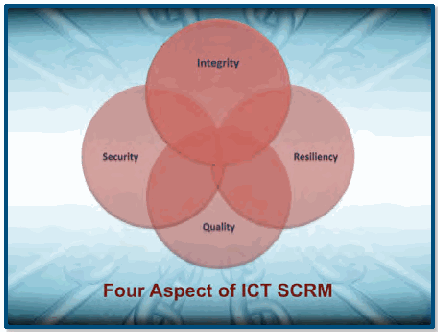
図4: ICT SCRMの4つの要素。青い模様の背景の上に、半透明の赤い円が4つ重なっている。円には Integrity(完全性、上)、Security(セキュリティ、左)、Resiliency(レジリエンス、右)、Quality(品質、下)と記されている。円の下に「Four Aspect of ICT SCRM」(ICT SCRMの4つの側面)という表題がある。
青い回路基板と錠前を背景にした「HIPAA Security Conference(HIPAAセキュリティ会議)」のポスター。 [組織・プログラムのロゴ。ロゴのため、この非公式サイトには掲載していません。原本 PDF を参照してください。]
Figure 4: The Four Elements of ICT SCRM
図4: ICT SCRMの4つの要素
Figure 5: ICT Supply Chain Risk
図5: ICTサプライチェーンリスク
The ICT SCRM project seeks to provide federal agencies with a toolkit of standardized, repeatable, and practical resources to strategically manage supply chain risk throughout the entire lifecycle of systems, products, and services.
ICT SCRMプロジェクトは、システム、製品、およびサービスのライフサイクル全体を通じてサプライチェーンリスクを戦略的に管理するための、標準化され、反復可能で、実用的なリソースからなるツールキットを連邦政府機関に提供することを目指しています。
In October 2012, NIST held a workshop with industry, academic, and government stakeholders to discuss:
2012年10月、NISTは、産業界、学術界、および政府の利害関係者とともにワークショップを開催し、以下について議論した:
•The fundamental underpinnings of ICT SCRM (terms, definitions, characterizations)
•ICT SCRMの基本的な土台(用語、定義、特徴づけ)
•Current and needed commercially reasonable ICT SCRM-related standards and practices (need, scope, and development approach)
•ICT SCRMに関連する、商業的に合理的な標準とプラクティスの現状と必要とされるもの(必要性、範囲、および開発アプローチ)
•Current and needed ICT SCRM tools, technology, and techniques useful in securing the ICT supply chain
•ICTサプライチェーンのセキュリティ確保に役立つICT SCRMのツール、技術、および手法の現状と必要とされるもの
•Current and needed research and resources
•研究とリソースの現状と必要とされるもの
NIST used input from the workshop and additional stakeholder forums to begin developing an initial public draft of NIST SP 800-161, Supply Chain Risk Management Practices for Federal Information Systems and Organizations, which is scheduled to be finalized in FY 2014. This document provides guidance to federal departments and agencies on identifying, assessing, and mitigating ICT supply chain risks at all levels in their organizations and utilizes and builds on existing guidance in the unified information security framework.
NISTは、このワークショップおよびその他の利害関係者フォーラムから得た意見を用いて、NIST SP 800-161, Supply Chain Risk Management Practices for Federal Information Systems and Organizationsの初期公開草案の作成を開始しました。同文書は2014会計年度に最終化される予定です。この文書は、組織のあらゆる階層においてICTサプライチェーンリスクを特定、評価、および軽減することについて、連邦政府の省庁および機関にガイダンスを提供するものであり、統一情報セキュリティフレームワークにおける既存のガイダンスを利用し、それを基礎としています。
Additionally in FY 2013, a grant was awarded to the University of Maryland’s Supply Chain Management Center to support the development and hosting of a web application with the following capabilities:
さらに2013会計年度には、以下の機能を備えたWebアプリケーションの開発とホスティングを支援するため、University of MarylandのSupply Chain Management Centerに助成金が交付された:
•Enterprise Risk Assessments: A three-tier risk analysis system based on the ICT SCRM Community Framework Reference Architecture – A Strategic Assessment/Organizational Readiness, Best Practices and Standards, and a composite network vulnerability map of physical and cyber hubs and nodes, with risk ratings
•エンタープライズリスクアセスメント: ICT SCRM Community Framework Reference Architectureに基づく3階層のリスク分析システム – 戦略的アセスメント/組織の準備状況、ベストプラクティスと標準、および物理的ならびにサイバー上のハブとノードをリスク評価付きで示す複合的なネットワーク脆弱性マップ
•Collaboration/Crowdsourcing Portal: User-documented ICT SCRM use/abuse cases and real-time polling about vulnerabilities and responses
•コラボレーション/クラウドソーシングポータル: ユーザーが文書化したICT SCRMのユースケース/アビューズケース、および脆弱性と対応に関するリアルタイムの投票
•ICT SCRM Initiatives: A dynamic matrix of current industry and public sector ICT SCRM best practices, standards, and policy reform initiatives that can be updated by appropriate individuals from across industry, academia, and government
•ICT SCRMイニシアチブ: 産業界および公共部門における現行のICT SCRMのベストプラクティス、標準、および政策改革イニシアチブを示す動的なマトリクスであり、産業界、学術界、および政府の適切な個人が更新できる
•ICT SCRM Digital Library: An online repository of policy and academic documents related to ICT SCRM
•ICT SCRMデジタルライブラリ: ICT SCRMに関連する政策文書および学術文書のオンラインリポジトリ
In FY 2014, CSD will continue its work to develop and publish draft NIST SP 800-161. It will research and develop tools and guidance to help agencies more effectively manage their ICT supply chain risk. Additionally, NIST will continue to co-chair Working Group 2 of the White House’s Comprehensive National Cybersecurity Initiative (CNCI) 11, Develop a Multi-Pronged Approach for Global Supply Chain Risk Management, and participate in national and international standards activities related to supply chain risk management. Feedback from organizations implementing ICT SCRM programs will be evaluated, and best practices will be accumulated. NIST will continue to engage stakeholders to identify needs and opportunities for providing additional guidance regarding identifying and implementing supply chain protections.
2014会計年度には、CSDは、NIST SP 800-161の草案を作成し公開する作業を継続します。CSDは、各機関がICTサプライチェーンリスクをより効果的に管理するのに役立つツールとガイダンスを研究し、開発します。さらに、NISTは、ホワイトハウスのComprehensive National Cybersecurity Initiative (CNCI) 11, Develop a Multi-Pronged Approach for Global Supply Chain Risk ManagementのWorking Group 2の共同議長を引き続き務め、サプライチェーンリスク管理に関連する国内および国際的な標準化活動に参加します。ICT SCRMプログラムを実施している組織からのフィードバックを評価し、ベストプラクティスを蓄積します。NISTは、サプライチェーン保護の特定と実装に関する追加のガイダンスを提供するためのニーズと機会を特定するため、引き続き利害関係者と連携します。
http://csrc.nist.gov/scrm/
http://csrc.nist.gov/scrm/
ICT SCRM Team email: scrm-nist@nist.gov
ICT SCRMチームの電子メール: scrm-nist@nist.gov
Contacts:
連絡先:
Mr. Jon Boyens, Project Lead, (301) 975-5981, jon.boyens@nist.gov
Mr. Jon Boyens, Project Lead, (301) 975-5981, jon.boyens@nist.gov
Ms. Celia Paulsen, (301) 975-5549, celia.paulsen@nist.gov
Ms. Celia Paulsen, (301) 975-5549, celia.paulsen@nist.gov
Nationwide Public Safety Broadband Network (NPSBN) Security
全国公共安全ブロードバンドネットワーク (NPSBN) のセキュリティ
In February 2012, Congress passed the Middle Class Tax Relief and Job Creation Act. One portion of this legislation calls for the establishment of a nationwide, interoperable public safety broadband network based on Long-Term Evolution (LTE) technology. The network will be deployed and operated by the First Responder Network Authority (FirstNet). The planned National Public Safety Broadband Network (NPSBN) will “create a much needed nationwide interoperable broadband network that will help police, firefighters, emergency medical service professionals and other public safety officials stay safe and do their jobs.” (http://www.ntia.doc.gov/category/public-safety). NIST is directed to establish a list of certified devices and required components for interacting with the nationwide network by public safety officials, vendors, and other interested parties. NIST is directed to conduct research and development that supports the acceleration and advancement of the nationwide network.
2012年2月、議会はMiddle Class Tax Relief and Job Creation Actを可決しました。この法律の一部は、Long-Term Evolution (LTE) 技術に基づく、全国規模の相互運用可能な公共安全ブロードバンドネットワークの構築を求めています。このネットワークは、First Responder Network Authority (FirstNet) によって展開され、運用されます。計画されているNational Public Safety Broadband Network (NPSBN) は、「警察官、消防士、救急医療従事者、およびその他の公共安全担当者が安全を保ち職務を遂行するのに役立つ、強く求められている全国規模の相互運用可能なブロードバンドネットワークを構築する」ものである (http://www.ntia.doc.gov/category/public-safety)。NISTは、公共安全担当者、ベンダー、およびその他の関係者がこの全国ネットワークとやり取りするための、認定済みデバイスおよび必要なコンポーネントのリストを確立するよう指示されています。NISTは、この全国ネットワークの加速と進展を支援する研究開発を実施するよう指示されています。
青空を背景に立つ携帯電話基地局のアンテナ塔。 [装飾の画像。本文を読むのに必要のない装飾のため、この非公式サイトには掲載していません。原本 PDF を参照してください。]
In FY 2013, CSD supported the joint National Telecommunications and Information Administration (NTIA) and NIST Public Safety Communications Research (PSCR) program (http://www.pscr.gov) efforts by developing and establishing security-related activities to support the proposed NPSBN. CSD presented details of the PSCR security-related activities at PSRC’s Annual Public Safety Broadband Stakeholder Conference in June 2013.
2013会計年度には、CSDは、提案されているNPSBNを支援するためのセキュリティ関連活動を策定し確立することにより、National Telecommunications and Information Administration (NTIA) とNISTの共同プログラムであるPublic Safety Communications Research (PSCR) program (http://www.pscr.gov) の取り組みを支援しました。CSDは、2013年6月に開催されたPSRCのAnnual Public Safety Broadband Stakeholder Conferenceにおいて、PSCRのセキュリティ関連活動の詳細を発表しました。
CSD provided comments and contributed text for the security-related aspects of the National Public Safety Telecommunications Council (NPSTC) Public Safety Broadband High-Level Launch Requirements, published in December 2012, that describe, in increasing levels of detail, the technical requirements of the NPSBN infrastructure, equipment, and communications.
CSDは、2012年12月に公開されたNational Public Safety Telecommunications Council (NPSTC) のPublic Safety Broadband High-Level Launch Requirementsのセキュリティ関連の側面について、コメントを提供し、文案を寄稿しました。この文書は、NPSBNのインフラストラクチャ、機器、および通信の技術要件を、段階的に詳細度を高めながら記述しています。
CSD began participating in the standards development process for LTE technology within the 3rd Generation Partnership Project (3GPP) supporting public safety’s security requirements related to Proximity Services (ProSe) and Group Communication System Enablers (GCSE). In addition, CSD broadened its scope within the IETF to include efforts related to public safety.
CSDは、3rd Generation Partnership Project (3GPP) におけるLTE技術の標準開発プロセスへの参加を開始し、Proximity Services (ProSe) およびGroup Communication System Enablers (GCSE) に関連する公共安全分野のセキュリティ要件を支援しています。加えて、CSDは、IETFにおける活動範囲を広げ、公共安全に関連する取り組みを含めました。
In FY 2014, CSD will continue supporting NPSTC’s efforts related to NPSBN and to representing public safety in international standardization efforts, such as IETF and 3GPP. CSD will work to incorporate security capabilities into the PSCR’s Public Safety Broadband Demonstration Network located in Boulder, conduct research into identity management technologies for mobile devices that can support the NPSBN, and investigate ways to enhance the security of mobile applications used by the public safety community. CSD will continue to engage the public safety communications community by participating in events such as PSRC’s Annual Public Safety Broadband Stakeholder Conference.
2014会計年度には、CSDは、NPSBNに関連するNPSTCの取り組みを支援すること、およびIETFや3GPPなどの国際標準化の取り組みにおいて公共安全分野を代表することを継続します。CSDは、Boulderに所在するPSCRのPublic Safety Broadband Demonstration Networkにセキュリティ機能を組み込む作業を行い、NPSBNを支援できるモバイルデバイス向けアイデンティティ管理技術の研究を実施し、公共安全コミュニティが使用するモバイルアプリケーションのセキュリティを強化する方法を調査します。CSDは、PSRCのAnnual Public Safety Broadband Stakeholder Conferenceなどのイベントに参加することにより、公共安全通信のコミュニティとの連携を継続します。
Contacts:
連絡先:
Ms. Sheila Frankel, (301) 975-3297, sheila.frankel@nist.gov
Ms. Sheila Frankel, (301) 975-3297, sheila.frankel@nist.gov
Dr. Nelson Hastings, (301) 975-5237, nelson.hastings@nist.gov
Dr. Nelson Hastings, (301) 975-5237, nelson.hastings@nist.gov
Smart Grid Cybersecurity
スマートグリッドのサイバーセキュリティ
電力量の数値表示がある電力用スマートメーター。 [装飾の画像。本文を読むのに必要のない装飾のため、この非公式サイトには掲載していません。原本 PDF を参照してください。]
Figure 6: Smart Meter
図6: スマートメーター
The major elements of the smart grid are the information technology, the industrial control systems, and the communications infrastructure used to send command information across the electric grid from generation to distribution systems, and to exchange usage and billing information between utilities and their customers. Key to the successful deployment of the smart grid infrastructure is the development of the cybersecurity strategy that includes cybersecurity as a design consideration for new and emerging systems, and an approach to adding cybersecurity into existing systems. The electric grid is critical to the economic and physical well-being of the nation, and emerging cyber threats targeting power systems highlight the need to integrate advanced security to protect critical assets.
スマートグリッドの主要な要素は、情報技術、産業用制御システム、および通信インフラストラクチャです。通信インフラストラクチャは、発電システムから配電システムに至るまで電力網全体に指令情報を送信するため、および電力事業者とその顧客との間で使用量と料金請求の情報を交換するために使用されます。スマートグリッドのインフラストラクチャの導入を成功させる鍵は、サイバーセキュリティ戦略の策定です。この戦略には、新規および新興のシステムに対する設計上の考慮事項としてのサイバーセキュリティと、既存のシステムにサイバーセキュリティを追加するためのアプローチが含まれます。電力網は国家の経済的および物理的な健全性にとって不可欠であり、電力システムを標的とする新たなサイバー脅威は、重要な資産を保護するために高度なセキュリティを統合する必要性を浮き彫りにしています。
In January 2013, the Smart Grid Interoperability Panel (SGIP) became a membership-supported organization. The SGIP Cybersecurity Working Group (CSWG) was renamed the Smart Grid Cybersecurity Committee (SGCC). All three of these groups have been led by a NIST representative since their respective creations, originating with the Cybersecurity Coordination Task Group (CSCTG), created by NIST in support of the Energy Independence and Security Act of 2007. The SGIP SGCC includes additional leadership by a management team, comprised of three volunteer vice-chairs representing the Department of Energy (DOE), an electric utility, and a smart grid vendor, and a volunteer secretariat.
2013年1月、Smart Grid Interoperability Panel (SGIP) は、会員によって支えられる組織となりました。SGIP Cybersecurity Working Group (CSWG) は、Smart Grid Cybersecurity Committee (SGCC) に改称されました。これら3つのグループはいずれも、それぞれの創設以来NISTの代表者が主導してきており、その起源は、Energy Independence and Security Act of 2007を支援するためにNISTが創設したCybersecurity Coordination Task Group (CSCTG) にあります。SGIP SGCCには、これに加えて、Department of Energy (DOE)、電力事業者、およびスマートグリッドベンダーを代表する3名のボランティアの副議長からなる管理チームと、ボランティアの事務局による指導体制があります。
SGIP(スマートグリッド相互運用性パネル)のロゴ。地球状のネットワーク図と「SMART GRID INTEROPERABILITY PANEL」の文字がある。 [組織・プログラムのロゴ。ロゴのため、この非公式サイトには掲載していません。原本 PDF を参照してください。]
During the past year, members of the CSWG/SGCC worked to revise NISTIR 7628, Guidelines for Smart Grid Cybersecurity, to address changes in technologies and implementations since the publication’s original release. The revision updates and expands the development strategy, cryptography and key management, privacy, vulnerability classes, research and development topics, standards review, and key power system use cases to reflect changes in the smart grid environment since 2010. The final version is expected to be posted in FY 2014.
過去1年間、CSWG/SGCC のメンバーは NISTIR 7628, Guidelines for Smart Grid Cybersecurity の改訂に取り組み、初版の公開以降に生じた技術と実装の変化に対応しました。この改訂では、2010年以降のスマートグリッド環境の変化を反映するため、開発戦略、暗号と鍵管理、プライバシー、脆弱性クラス、研究開発の課題、標準のレビュー、主要な電力システムのユースケースを更新し、拡充しています。最終版は2014会計年度に公開される見込みです。
In addition to the revision of NISTIR 7628, the CSWG/SGCC has focused on specific topics such as cybersecurity risk management, security architecture, security testing and certification, Advanced Metering Infrastructure (AMI) security, the development of a User’s Guide for NISTIR 7628, and cloud computing and privacy for the smart grid. Work in these areas is completed through SGCC subgroups, which are created and disbanded in order to meet present needs. The SGCC currently consist of the following subgroups:
NISTIR 7628 の改訂に加えて、CSWG/SGCC は、サイバーセキュリティのリスク管理、セキュリティアーキテクチャ、セキュリティ試験と認証、Advanced Metering Infrastructure (AMI) のセキュリティ、NISTIR 7628 の User’s Guide の作成、スマートグリッドにおけるクラウドコンピューティングとプライバシーといった個別の課題に注力してきました。これらの分野の作業は SGCC のサブグループを通じて行われ、サブグループはその時々の必要に応じて設置され、解散されます。SGCC は現在、次のサブグループで構成されています。
•The Architecture subgroup continues to refine the smart grid cybersecurity architecture in coordination with the SGIP Smart Grid Architecture Committee on the European Union architecture harmonization effort.
•Architecture サブグループは、欧州連合とのアーキテクチャ調和の取り組みについて SGIP Smart Grid Architecture Committee と連携しながら、スマートグリッドのサイバーセキュリティアーキテクチャの改良を続けています。
•The Cloud Computing subgroup is addressing the unique cybersecurity issues of using and managing smart grid applications that utilize the cloud.
•Cloud Computing サブグループは、クラウドを利用するスマートグリッドアプリケーションの使用と管理に特有のサイバーセキュリティ上の課題に取り組んでいます。
•The High-Level Requirements subgroup maintains the high-level security requirements in NISTIR 7628 and develops analyses between NISTIR 7628 and other documents, standards, and guidelines.
•High-Level Requirements サブグループは、NISTIR 7628 の高位セキュリティ要件を維持管理し、NISTIR 7628 とその他の文書、標準、ガイドラインとの間の分析を作成しています。
•The NISTIR 7628 User’s Guide subgroup is developing a User’s Guide for utilities and other entities involved in implementing smart grid systems can use to apply the NISTIR 7628; including the identification, risk assessment and selection of the applicable security requirements needed to secure their smart grid systems.
•NISTIR 7628 User’s Guide サブグループは、電力事業者をはじめスマートグリッドシステムの導入に携わる組織が NISTIR 7628 を適用する際に利用できる User’s Guide を作成しています。これには、自らのスマートグリッドシステムを保護するために必要な、該当するセキュリティ要件の識別、リスクアセスメント、選定が含まれます。
•The Privacy subgroup identifies and describes privacy risks and concerns within developed or emerging interoperability standards for the smart grid, and then determines the most appropriate and feasible practices for mitigating the risks.
•Privacy サブグループは、スマートグリッド向けの策定済みまたは策定中の相互運用性標準におけるプライバシー上のリスクと懸念を識別して記述し、そのうえで、それらのリスクを低減するために最も適切で実行可能なプラクティスを決定しています。
•The Standards subgroup assesses cybersecurity requirements associated with SGIP-identified smart grid standards and other documents for the SGIP Catalog of Standards (CoS). The subgroup has reviewed over 75 documents to date.
•Standards サブグループは、SGIP Catalog of Standards (CoS) のために、SGIP が特定したスマートグリッド標準やその他の文書に関連するサイバーセキュリティ要件を評価しています。同サブグループがこれまでにレビューした文書は75件を超えます。
An example of a SGCC deliverable in 2013 is the analysis of cybersecurity regulations relevant to electricity subsector stakeholders and of NIST security guidance. The analysis identifies the relationship, similarities, and differences among NISTIR 7628, SP 800-53, and the draft North American Electric Reliability Corporation (NERC) Critical Infrastructure Protection Standards (CIP) v5, recognizing that each document has a different scope and audience.
2013年における SGCC の成果物の一例は、電力サブセクターの利害関係者に関係するサイバーセキュリティ規制と、NIST のセキュリティガイダンスとを対象とした分析です。この分析は、各文書の適用範囲と対象読者が異なることを踏まえたうえで、NISTIR 7628、SP 800-53、および North American Electric Reliability Corporation (NERC) Critical Infrastructure Protection Standards (CIP) v5 の草案の間の関係、類似点、相違点を明らかにしています。
The SGCC also supports the SGIP Catalog of Standards (CoS), a compendium of standards, practices, guidelines and other technical documents considered relevant for the development of a robust, secure, and interoperable smart grid. Through the ongoing efforts of the SGCC, these documents are reviewed for cybersecurity, and recommendations are made for how to include cybersecurity in future revisions and in the implementation of the standards. CSD supports the SGCC in assessing the security of cryptographic methods used in these standards, practices, guidelines, and other technical documents. In many cases, the standards bodies have taken the results of the reviews and modified the standards or documents to address our recommendations. The SGCC has worked closely with some of the standards bodies to ensure that the recommendations are interpreted correctly and that the mitigation strategies selected meet the intent of the NISTIR 7628 high-level security requirements. The result is cybersecurity “baked-in” to the standards rather than “bolted-on” after the standard is implemented.
SGCC は SGIP Catalog of Standards (CoS) も支援しています。これは、堅牢で安全かつ相互運用可能なスマートグリッドの開発に関連するとみなされた標準、プラクティス、ガイドライン、その他の技術文書を集成したものです。SGCC の継続的な取り組みを通じて、これらの文書はサイバーセキュリティの観点からレビューされ、将来の改訂や標準の実装にサイバーセキュリティをどのように盛り込むかについて勧告が出されます。CSD は、これらの標準、プラクティス、ガイドライン、その他の技術文書で用いられる暗号方式のセキュリティの評価について SGCC を支援しています。多くの場合、標準化団体はレビューの結果を受けて、我々の勧告に対応するよう標準や文書を修正しています。SGCC は一部の標準化団体と緊密に協力し、勧告が正しく解釈されること、および選択された低減戦略が NISTIR 7628 の高位セキュリティ要件の意図を満たすことを確実にしてきました。その結果、サイバーセキュリティは、標準の実装後に「後付け」されるのではなく、標準に「組み込まれた」ものとなっています。
In FY 2014, CSD will continue to support the SGCC in the evaluation of the cryptographic methods used standards, practices, guidelines, and other technical documents for inclusion in the SGIP CoS.
2014会計年度も CSD は、SGIP CoS への収録に向けて、標準、プラクティス、ガイドライン、その他の技術文書で用いられる暗号方式の評価について、引き続き SGCC を支援します。
Future activities include working with the SGIP Committees, Domain Expert Working Groups, and Priority Action Plans to integrate cybersecurity into their work efforts. The SGCC will establish a new subgroup to produce a cybersecurity risk management process case study to accompany the Department of Energy Risk Management Process guideline. Members of the committee will produce white papers on security defense in depth and breadth, unique cloud computing considerations for the smart grid, as well as a User’s Guide for NISTIR 7628. Additionally, the SGIP SCCC will continue to collaborate with industry, academia, other working groups, and government agencies to address the cybersecurity needs for the smart grid.
今後の活動には、SGIP の Committees、Domain Expert Working Groups、Priority Action Plans と協力し、それぞれの作業にサイバーセキュリティを組み込むことが含まれます。SGCC は新たなサブグループを設置し、エネルギー省の Risk Management Process ガイドラインに付随する、サイバーセキュリティリスク管理プロセスの事例研究を作成します。同委員会のメンバーは、深さと広がりの両面にわたるセキュリティ防御、およびスマートグリッドに特有のクラウドコンピューティング上の考慮事項に関するホワイトペーパーに加え、NISTIR 7628 の User’s Guide を作成します。さらに、SGIP SCCC は、スマートグリッドのサイバーセキュリティ上のニーズに対応するため、産業界、学術界、他のワーキンググループ、政府機関との協力を継続します。
In addition to the SGIP SGCC activities, CSD will also coordinate with NIST’s Engineering Laboratory (EL) and Smart Grid Program Office on the development of a Cybersecurity Smart Grid Test Lab, part of the NIST Smart Grid Testbed Facility now under construction. CSD will also collaborate with ITL’s Software and Systems Division on cybersecurity research in relation to the IEEE 1588, Precision Time Protocol, a standard on time synchronization that is used for the electric grid and other special-purpose industrial automation and measurement networks.
SGIP SGCC の活動に加えて、CSD は、NIST の Engineering Laboratory (EL) および Smart Grid Program Office と連携し、現在建設中の NIST Smart Grid Testbed Facility の一部となる Cybersecurity Smart Grid Test Lab の開発にも取り組みます。CSD はまた、ITL の Software and Systems Division と協力し、IEEE 1588, Precision Time Protocol に関するサイバーセキュリティ研究を行います。これは時刻同期に関する標準であり、電力網のほか、特殊用途の産業オートメーションネットワークや計測ネットワークで使用されています。
http://www.sgip.org
http://www.sgip.org
Contacts:
連絡先:
Ms. Vicky Yan Pillitteri, (301) 975-8542, victoria.yan@nist.gov
Ms. Vicky Yan Pillitteri, (301) 975-8542, victoria.yan@nist.gov
Ms. Tanya Brewer, (301) 975-4534, tbrewer@nist.gov
Ms. Tanya Brewer, (301) 975-4534, tbrewer@nist.gov
Mr. Quynh Dang, (301) 975-3610, qdang@nist.gov
Mr. Quynh Dang, (301) 975-3610, qdang@nist.gov
Cybersecurity Awareness, Training, Education, and Outreach
サイバーセキュリティの意識向上、訓練、教育、アウトリーチ
National Initiative for Cybersecurity Education (NICE)
National Initiative for Cybersecurity Education (NICE)
NIST has served as the lead for the National Initiative for Cybersecurity Education (NICE) since 2010. NICE is responsive to President Obama’s declaration that the “cyber threat is one of the most serious economic and national security challenges we face as a nation” and “America’s economic prosperity in the 21st century will depend on cybersecurity.”
NIST は2010年以来、National Initiative for Cybersecurity Education (NICE) の主導機関を務めています。NICE は、「サイバー脅威は、国家として我々が直面する最も深刻な経済上および国家安全保障上の課題の一つである」、また「21世紀における米国の経済的繁栄はサイバーセキュリティに左右される」というオバマ大統領の宣言に応えるものです。
The goal of NICE is to enhance the overall cybersecurity posture of the United States by accelerating the availability of educational and training resources designed to improve the cyber behavior, skills, and knowledge of every segment of the population, enabling a safer cyberspace for all. NICE addresses this challenging goal by:
NICE の目標は、国民のあらゆる層のサイバー空間での行動、スキル、知識を向上させるための教育・訓練資源を早期に利用できるようにすることによって、米国全体のサイバーセキュリティ態勢を強化し、すべての人にとってより安全なサイバー空間を実現することです。NICE は、次のことによってこの困難な目標に取り組んでいます。
•Raising national awareness about risks in cyberspace
•サイバー空間におけるリスクについての国民の意識を高める
•Broadening the pool of individuals prepared to enter the cybersecurity workforce
•サイバーセキュリティ人材に加わる準備のできた人々の層を広げる
•Cultivating a globally competitive cybersecurity workforce
•国際的な競争力のあるサイバーセキュリティ人材を育成する
This initiative comprises four component areas:
このイニシアティブは、次の4つのコンポーネント領域で構成されています。
•National Cybersecurity Awareness
•国民のサイバーセキュリティ意識向上
•Formal Cybersecurity Education
•正規のサイバーセキュリティ教育
•Cybersecurity Workforce Structure
•サイバーセキュリティ人材の構造
•Cybersecurity Workforce Training and Professional Development
•サイバーセキュリティ人材の訓練と専門能力開発
CSD is home to the NIST NICE Leadership Team (NNLT) that focuses on the following activities:
CSD には NIST NICE Leadership Team (NNLT) が置かれており、同チームは次の活動に注力しています。
•Developing planning documents and building consensus on the strategy and implementation activities of NICE
•計画文書を作成し、NICE の戦略と実施活動について合意を形成する
•Facilitating cross-functional cooperation among NICE component lead agencies
•NICE の各コンポーネントの主導機関の間の部門横断的な協力を促進する
•Fostering communication between the component lead agencies by coordinating meetings, facilitating discussions, and disseminating information
•会合の調整、議論の進行、情報の周知を通じて、コンポーネントの主導機関の間のコミュニケーションを促進する
•Promoting the initiative and its efforts by representing NICE and speaking at cybersecurity events nationwide
•全米各地のサイバーセキュリティ関連イベントで NICE を代表し、講演することにより、このイニシアティブとその取り組みを広報する
•Planning and hosting an annual workshop to promote and support the evolving issues in cybersecurity education
•サイバーセキュリティ教育における変化し続ける課題への取り組みを促進し支援するため、年次ワークショップを企画し、主催する
•Coordinating with other federal initiatives and efforts related to NICE
•NICE に関連する他の連邦政府のイニシアティブや取り組みと連携する
•Maintaining and updating the NICE website
•NICE のウェブサイトを維持管理し、更新する
In FY 2013, NIST stewarded the National Cybersecurity Workforce Framework (NCWF), developed within NICE’s Cybersecurity Workforce Training and Professional Development Component, through government-wide review. NIST also planned, organized and hosted the fourth annual NICE Workshop, “Navigating the National Cybersecurity Education Interstate Highway,” from September 17-19, 2013. The workshop highlighted cybersecurity awareness, education, and training programs that can be adopted, copied, used, or built-on by small businesses, educational institutions, industry, and government at the state, local, tribal and federal levels to advance the strategic goals of NICE.
2013会計年度、NIST は、NICE の「サイバーセキュリティ人材の訓練と専門能力開発」コンポーネントの中で策定された National Cybersecurity Workforce Framework (NCWF) について、政府全体でのレビューを主導しました。NIST はまた、2013年9月17日から19日にかけて、第4回年次 NICE Workshop “Navigating the National Cybersecurity Education Interstate Highway” を企画、準備し、主催しました。このワークショップでは、NICE の戦略目標を前進させるために、小規模企業、教育機関、産業界、ならびに州、地方、部族、連邦の各レベルの政府が採用、模倣、利用、または発展させることのできる、サイバーセキュリティの意識向上、教育、訓練のプログラムを取り上げました。
The NNLT attended more than 100 events, symposia, forums, competitions, educational outreach meetings, and workshops to promote the activities within NICE. The NNLT worked with the Office of Personnel Management (OPM) on the OPM Cross-Agency Priority Goal: “Closing Skills Gap” for IT/Cybersecurity and on the OPM Special Cybersecurity Workforce Project focused on reducing cybersecurity workforce skills gaps. The project will allow agencies to identify and address their needs for cybersecurity skill sets to meet their missions. In accomplishing this project, agencies will also be updating their cybersecurity positions with codes that revise the definitions of and taxonomy used for cybersecurity work. In FY 2013, the NNLT supported DHS in the launch of the National Initiative for Cybersecurity Careers and Studies (NICCS), (http://niccs.us-cert.gov), an online resource for cybersecurity career, education, and training information. NICCS leverages efforts of government, industry, and academia to provide a comprehensive, single resource to address the nation’s cybersecurity knowledge needs.
NNLT は、NICE における活動を広報するため、100を超えるイベント、シンポジウム、フォーラム、競技会、教育アウトリーチ会合、ワークショップに参加しました。NNLT は人事管理局 (OPM) と協力し、IT/サイバーセキュリティに関する OPM Cross-Agency Priority Goal: “Closing Skills Gap”、およびサイバーセキュリティ人材のスキルギャップの縮小に焦点を当てた OPM Special Cybersecurity Workforce Project に取り組みました。このプロジェクトにより、各機関は、自らの任務を果たすために必要なサイバーセキュリティのスキルセットを特定し、その不足に対処できるようになります。このプロジェクトを遂行する中で、各機関は、サイバーセキュリティ業務の定義とそこで用いられる分類体系を改訂するコードによって、サイバーセキュリティ関連の職位の更新も行うことになります。2013会計年度、NNLT は、サイバーセキュリティのキャリア、教育、訓練に関する情報を提供するオンライン資源である National Initiative for Cybersecurity Careers and Studies (NICCS)、(http://niccs.us-cert.gov) の立ち上げにおいて DHS を支援しました。NICCS は、政府、産業界、学術界の取り組みを活用し、国のサイバーセキュリティに関する知識のニーズに応える包括的な単一の資源を提供します。
In FY 2014, NIST will continue to promote the coordination of existing and future cybersecurity education, training, and awareness activities while planning the transition of NICE leadership. NIST will also identify opportunities to extend and integrate NICE activities to raise cybersecurity awareness in the context of other sectors, and promote the NCWF as a resource to be used to identify workforce gaps, lead bi-weekly NICE component meetings, and continue to conduct broad outreach on the NICE program.
2014会計年度、NIST は、NICE の主導体制の移行を計画しつつ、既存および将来のサイバーセキュリティの教育、訓練、意識向上の活動の連携を引き続き促進します。NIST はまた、他のセクターとの関わりの中でサイバーセキュリティの意識を高めるために NICE の活動を拡大し統合する機会を見いだし、人材のギャップを特定するために利用できる資源として NCWF を普及させ、隔週の NICE コンポーネント会合を主宰し、NICE プログラムに関する幅広いアウトリーチを引き続き実施します。
http://www.nist.gov/nice/
http://www.nist.gov/nice/
Contacts:
連絡先:
Dr. Ernest McDuffie, NICE Project Lead, (301) 975-8897, ernest.mcduffie@nist.gov
Dr. Ernest McDuffie, NICE Project Lead, (301) 975-8897, ernest.mcduffie@nist.gov
Mr. Bill Newhouse, NICE Program Lead, (301) 975-2869, william.newhouse@nist.gov
Mr. Bill Newhouse, NICE Program Lead, (301) 975-2869, william.newhouse@nist.gov
Computer Security Division Publications
コンピュータセキュリティ部門の刊行物
FIPS、SP、NISTのチェック項目が付いた書類とペンのイラスト。 [装飾の画像。本文を読むのに必要のない装飾のため、この非公式サイトには掲載していません。原本 PDF を参照してください。]
During FY 2013, CSD continued its efforts to improve the quality of information about its publications on various NIST websites. CSD also explored new ways to make those publications available to CSD’s customers, who access CSD’s technical security publications in various ways: (1) directly from the CSRC website, (2) through the NIST Publications Portal, via Internet search or (3) direct links from digital content, or (4) from external information providers. By the end of FY 2013, CSD had more than 270 current publications in the NIST technical series (FIPS, Special Publications (SPs) and NISTIRs).
2013会計年度、CSD は、NIST の各種ウェブサイトに掲載されている自部門の刊行物に関する情報の品質を向上させる取り組みを継続しました。CSD はまた、それらの刊行物を CSD の利用者に提供する新たな方法も検討しました。利用者は、(1) CSRC ウェブサイトから直接、(2) NIST Publications Portal を通じて、インターネット検索を経由して、または (3) デジタルコンテンツからの直接リンクによって、あるいは (4) 外部の情報提供者から、というさまざまな方法で CSD のセキュリティ技術刊行物にアクセスしています。2013会計年度末の時点で、CSD は NIST の技術シリーズ(FIPS、Special Publications (SPs)、NISTIR)において270件を超える現行の刊行物を有していました。
Providing accurate metadata about publications improves users’ abilities to locate the information they are seeking. In FY 2013, CSD cleaned up the NIST Publications Portal records and PDF metadata for all of its NIST technical series publications and for more than 100 journal articles and conference papers co-authored by CSD staff in recent years. By improving the metadata—such as title, authors, report numbers and keywords—within the PDFs themselves, Internet searches provide more informative results and make NIST’s security publications easier to find. CSD continues to apply those consistent metadata practices to all new publications.
刊行物に関する正確なメタデータを提供すれば、利用者は求める情報を見つけやすくなります。2013会計年度、CSD は、NIST 技術シリーズの自部門の全刊行物と、近年 CSD の職員が共著した100件を超える学術誌論文および会議論文について、NIST Publications Portal のレコードと PDF のメタデータを整理しました。PDF 自体に含まれるメタデータ(タイトル、著者、報告書番号、キーワードなど)を改善することで、インターネット検索はより有益な結果を返すようになり、NIST のセキュリティ刊行物が見つけやすくなります。CSD は、こうした一貫したメタデータの運用を、すべての新規刊行物に引き続き適用しています。
Additionally, CSD expanded the dissemination of its publications to the Association for Computing Machinery (ACM) Digital Library (DL). ACM DL now has a “collection” of NIST Computer Security Publications, which includes SP 800-series publications. CSD initiated an internal project to test the feasibility of creating electronic book (e-book) editions of its FIPS, SPs and NISTIRs, to supplement the PDF editions currently available on CSRC. The aim is to provide a wider range of options for CSD customers to view and use CSD’s technical publications. The pilot project uses the EPUB file format, an open standard for e-books from the International Digital Publication Forum (IDPF). CSD intends to begin posting EPUB versions of selected publications in FY 2014, which will especially benefit users of mobile devices.
加えて、CSD は刊行物の配布先を Association for Computing Machinery (ACM) Digital Library (DL) に拡大しました。ACM DL には現在、NIST Computer Security Publications の「コレクション」があり、これには SP 800 シリーズの刊行物が含まれます。CSD は、現在 CSRC で提供している PDF 版を補完するものとして、FIPS、SP、NISTIR の電子書籍 (e-book) 版を作成することの実現可能性を検証する内部プロジェクトを開始しました。その狙いは、CSD の利用者が CSD の技術刊行物を閲覧し利用するための選択肢を広げることにあります。このパイロットプロジェクトでは、International Digital Publication Forum (IDPF) による電子書籍のオープン標準である EPUB ファイル形式を使用しています。CSD は、選定した刊行物の EPUB 版の掲載を2014会計年度に開始する意向であり、これは特にモバイルデバイスの利用者にとって有益となります。
In FY 2014, CSD intends to explore more ways to improve the consistency of its publications and associated metadata, enhance users’ ability to browse and search publications on CSRC, make more e-book editions available, and expand publication availability on external sites.
2014会計年度、CSD は、刊行物と関連メタデータの一貫性を向上させ、CSRC 上で利用者が刊行物を閲覧・検索する機能を強化し、電子書籍版の提供を増やし、外部サイトでの刊行物の提供を拡大するための方法を、さらに検討する意向です。
http://csrc.nist.gov/publications/
http://csrc.nist.gov/publications/
Contact:
連絡先:
Mr. Jim Foti, (301) 975-8018, jfoti@nist.gov
Mr. Jim Foti, (301) 975-8018, jfoti@nist.gov
Computer Security Resource Center (CSRC)
Computer Security Resource Center (CSRC)
The Computer Security Resource Center (CSRC), CSD’s website, is one of the most visited websites at NIST. CSRC encourages broad sharing of information security tools and practices, provides a resource for information security standards and guidelines, and identifies and links key security web resources to support industry and government users. CSRC is an integral component of all of the work that CSD conducts and produces. It is CSD’s repository for anyone wanting to access these documents and other valuable security-related information. During FY 2013, CSRC had more than 53 million page views and downloads.
CSD のウェブサイトである Computer Security Resource Center (CSRC) は、NIST で最も閲覧されているウェブサイトの一つです。CSRC は、情報セキュリティのツールとプラクティスの幅広い共有を促し、情報セキュリティの標準とガイドラインに関する資源を提供し、産業界と政府の利用者を支援するために主要なセキュリティ関連のウェブ資源を特定してリンクしています。CSRC は、CSD が実施し生み出すあらゆる業務に不可欠な構成要素です。CSRC は、これらの文書やその他の有益なセキュリティ関連情報にアクセスしたいすべての人のための、CSD のリポジトリです。2013会計年度、CSRC のページビューとダウンロードは5,300万件を超えました。
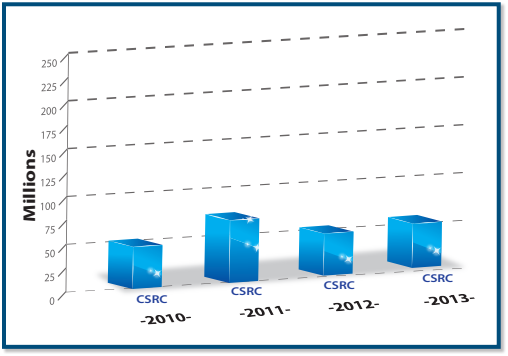
図7: 2013年の CSRC ウェブサイトへのリクエスト総数(2012年10月1日~2013年9月30日)。枠で囲まれた3次元の棒グラフで、縦軸は Millions(百万)、目盛りは0から250まで25刻みである。CSRC と記された青い棒が4本あり、左から2010年、2011年、2012年、2013年を表す。棒に数値は記されていない。
Figure 7: Total Number of CSRC Website Requests for 2013 (Oct. 1, 2012 to Sept. 30, 2013)
図7: 2013年の CSRC ウェブサイトへのリクエスト総数(2012年10月1日~2013年9月30日)
CSRC is the primary gateway for gaining access to NIST computer security publications, standards, and guidelines, and serves as a vital link to CSD’s customers. Publications are organized to help users locate relevant information quickly and are arranged by topic, relevant security control family, and legal requirements.
CSRC は、NIST のコンピュータセキュリティに関する刊行物、標準、ガイドラインにアクセスするための主要な入口であり、CSD の利用者との重要な接点となっています。刊行物は、利用者が関連情報をすばやく見つけられるよう整理されており、トピック別、関連するセキュリティ管理策ファミリー別、法的要件別に配列されています。
During FY 2013, the top ten most downloaded publications were:
2013会計年度にダウンロード数の多かった刊行物の上位10件は、次のとおりです。
1.SP 800-53 Revision 4, Security and Privacy Controls for Federal Information Systems and Organizations
1.SP 800-53 Revision 4, Security and Privacy Controls for Federal Information Systems and Organizations
2.SP 800-12, An Introduction to Computer Security: The NIST Handbook
2.SP 800-12, An Introduction to Computer Security: The NIST Handbook
3.FIPS 140-2, Security Requirements for Cryptographic Modules
3.FIPS 140-2, Security Requirements for Cryptographic Modules
4.FIPS 201-2, Personal Identity Verification (PIV) of Federal Employees and Contractors
4.FIPS 201-2, Personal Identity Verification (PIV) of Federal Employees and Contractors
5.SP 800-100, Information Security Handbook: A Guide for Managers
5.SP 800-100, Information Security Handbook: A Guide for Managers
6.SP 800-30, Revision 1, Guide for Conducting Risk Assessments
6.SP 800-30, Revision 1, Guide for Conducting Risk Assessments
7.SP 800-57, Recommendation for Key Management: Part 1: General
7.SP 800-57, Recommendation for Key Management: Part 1: General
8.SP 800-53, Revision 3, Recommended Security Controls for Federal Information Systems and Organizations
8.SP 800-53, Revision 3, Recommended Security Controls for Federal Information Systems and Organizations
9.NISTIR 7916, Proceedings of the Cybersecurity in Cyber-Physical Systems Workshop, April 23-24, 2012
9.NISTIR 7916, Proceedings of the Cybersecurity in Cyber-Physical Systems Workshop, April 23-24, 2012
10.SP 800-123, Guide to General Server Security
10.SP 800-123, Guide to General Server Security
In the FIPS publication series, the top three most downloaded FIPS were:
FIPS シリーズでダウンロード数の多かった上位3件は、次のとおりです。
1.FIPS 140-2, Security Requirements for Cryptographic Modules
1.FIPS 140-2, Security Requirements for Cryptographic Modules
2.FIPS 201-2, Personal Identity Verification (PIV) of Federal Employees and Contractors
2.FIPS 201-2, Personal Identity Verification (PIV) of Federal Employees and Contractors
3.FIPS 197, Advanced Encryption Standard
3.FIPS 197, Advanced Encryption Standard
In the SP publication series, the top three most downloaded SPs were:
SP シリーズでダウンロード数の多かった上位3件は、次のとおりです。
1.SP 800-53 Revision 4, Security and Privacy Controls for Federal Information Systems and Organizations
1.SP 800-53 Revision 4, Security and Privacy Controls for Federal Information Systems and Organizations
2.SP 800-12, An Introduction to Computer Security: The NIST Handbook
2.SP 800-12, An Introduction to Computer Security: The NIST Handbook
3.SP 800-100, Information Security Handbook: A Guide for Managers
3.SP 800-100, Information Security Handbook: A Guide for Managers
In the NISTIR publication series, the top three most downloaded NISTIRs were:
NISTIR シリーズでダウンロード数の多かった上位3件は、次のとおりです。
1.NISTIR 7916, Proceedings of the Cybersecurity in Cyber-Physical Systems Workshop, April 23-24, 2012
1.NISTIR 7916, Proceedings of the Cybersecurity in Cyber-Physical Systems Workshop, April 23-24, 2012
2.NISTIR 7250, Cell Phone Forensic Tools: An Overview and Analysis
2.NISTIR 7250, Cell Phone Forensic Tools: An Overview and Analysis
3.NISTIR 7896, Third-Round Report of the SHA-3 Cryptographic Hash Algorithm Competition
3.NISTIR 7896, Third-Round Report of the SHA-3 Cryptographic Hash Algorithm Competition
In addition to CSRC, CSD maintains a publication announcement mailing list. This free email list notifies subscribers about publications that have been posted to the CSRC website. The email list is a valuable tool for more than 28,000 subscribers from the Federal Government, industry, academia, and individuals with a personal interest in IT security. Individuals who are interested in subscribing to this list should visit http://csrc.nist.gov/publications/subscribe.html for more information.
CSRC に加えて、CSD は刊行物の告知用メーリングリストを運営しています。この無料のメーリングリストは、CSRC ウェブサイトに掲載された刊行物について購読者に通知します。このメーリングリストは、連邦政府、産業界、学術界の関係者、および IT セキュリティに個人的な関心を持つ人々からなる28,000人を超える購読者にとって、有用なツールとなっています。このリストの購読に関心のある人は、詳細について http://csrc.nist.gov/publications/subscribe.html を参照されました。
Questions on the website should be sent to the CSRC Webmaster at: webmaster-csrc@nist.gov.
ウェブサイトに関する質問は、CSRC Webmaster(webmaster-csrc@nist.gov)宛てに送られました。
Contacts:
連絡先:
Mr. Patrick O’Reilly (301) 975-4751 patrick.oreilly@nist.gov
Mr. Patrick O’Reilly (301) 975-4751 patrick.oreilly@nist.gov
Ms. Judy Barnard (301) 975-5502 jbarnard@nist.gov
Ms. Judy Barnard (301) 975-5502 jbarnard@nist.gov
Federal Computer Security Program Managers’ Forum
Federal Computer Security Program Managers’ Forum
The Federal Computer Security Program Managers’ Forum is sponsored by NIST to promote the sharing of security-related information among federal agencies. The Forum, which serves more than 1,100 members, strives to provide an ongoing opportunity for managers of federal information security programs to exchange information security materials in a timely manner, build upon the experiences of other programs, and reduce possible duplication of effort. It provides a mechanism for NIST to share information directly with federal agency information security program managers in fulfillment of NIST’s leadership mandate under FISMA. It assists NIST in establishing and maintaining relationships with other individuals or organizations that are actively addressing information security issues within the Federal Government. NIST serves as the Secretariat of the Forum, providing necessary administrative and logistical support. Kevin Stine serves as the Chairperson.
Federal Computer Security Program Managers’ Forum は、連邦機関の間でセキュリティ関連情報の共有を促進するために NIST が後援しています。1,100人を超えるメンバーを擁するこの Forum は、連邦政府の情報セキュリティプログラムの管理者が、情報セキュリティに関する資料を適時に交換し、他のプログラムの経験を生かし、起こり得る作業の重複を減らすための継続的な機会を提供することに努めています。Forum は、FISMA に基づく NIST の主導的役割の責務を果たすうえで、NIST が連邦機関の情報セキュリティプログラム管理者と直接情報を共有するための仕組みとなっています。また、連邦政府内で情報セキュリティの課題に積極的に取り組んでいる他の個人や組織との関係を NIST が構築し維持することを助けています。NIST は Forum の事務局を務め、必要な事務面および運営面の支援を提供しています。議長は Kevin Stine が務めています。
The Forum maintains an extensive email subscription service. Participation in the service is only open to Federal Government employees who participate in the management of their organization’s information system security program. There are no membership dues. The Forum also holds bimonthly meetings and an annual 2-day conference to discuss current issues and developments of interest to those responsible for protecting sensitive (unclassified) federal systems. Participation in Forum meetings is open to Federal Government employees, and their designated support contractors, who participate in the management of their organization’s information security program.
Forumは大規模な電子メール配信サービスを運営しています。このサービスに参加できるのは、所属組織の情報システムセキュリティプログラムの管理に携わる連邦政府職員に限られます。会費はありません。Forumはまた、隔月の会合と年1回の2日間のカンファレンスを開催し、機微な(非機密の)連邦システムの保護に責任を負う者が関心を持つ最新の課題と動向について議論しています。Forumの会合には、所属組織の情報セキュリティプログラムの管理に携わる連邦政府職員と、その指定を受けた支援契約業者が参加できます。
Topics of discussion at Forum meetings in FY 2013 included briefings from various federal agencies on Preparing for and Responding to Certification Authority Compromise and Fraudulent Certificate Issuance; Software Assurance: Enabling Security throughout the Software Development Lifecycle; Use of Cybersecurity Function Code; Census Risk Management Program Implementation; National Cybersecurity Center of Excellence (NCCoE); demonstration of Trusted Geolocation in the Cloud; and Policy Machine: Enabling an Enterprise-wide, Data Centric Computing Environment.
2013会計年度のForumの会合で取り上げた議題には、さまざまな連邦機関による次のブリーフィングが含まれます。認証局の危殆化と不正な証明書発行への備えと対応、ソフトウェアアシュアランス:ソフトウェア開発ライフサイクル全体を通じたセキュリティの実現、Cybersecurity Function Codeの利用、国勢調査局におけるリスク管理プログラムの実施、National Cybersecurity Center of Excellence (NCCoE)、クラウドにおけるTrusted Geolocationの実演、Policy Machine:組織全体にわたるデータ中心のコンピューティング環境の実現。
This year’s annual 2-day offsite meeting featured updates on the computer security activities of the Government Accountability Office (GAO), General Services Administration (GSA), Bureau of the Fiscal Service, and NIST. Recent administration guidance directing federal agencies to reduce travel and conference budgets significantly reduced attendance. Technical sessions included briefings on evolving cybersecurity strategies, IT security concerns during a consolidation (merger), supply chain risk management activities, the National Vulnerability Database (NVD), SP 800-53 Revision 4, continuous monitoring, industrial control systems security, and EO 13636.
今年の年1回の2日間の外部会場での会合では、Government Accountability Office (GAO)、General Services Administration (GSA)、Bureau of the Fiscal Service、NISTのコンピュータセキュリティ活動に関する最新情報が報告されました。連邦機関に出張費と会議費の削減を指示する政権の最近の指針により、参加者数は大幅に減少しました。技術セッションでは、進化するサイバーセキュリティ戦略、統合(合併)時のITセキュリティ上の懸念、サプライチェーンリスク管理の活動、National Vulnerability Database (NVD)、SP 800-53 Revision 4、継続的監視、産業用制御システムのセキュリティ、EO 13636に関するブリーフィングが行われました。
On August 8, 2013, a Cybersecurity and Risk Management Training Workshop was held at the Department of Commerce with over 500 registrants. Attendees gained a greater understanding of the Risk Management Framework (RMF) and its practical application. Dr. Ron Ross discussed SP 800-53 Revision 4 and the fundamentals of continuous monitoring. Two afternoon panels discussed case studies regarding RMF and “ongoing authorization.”
2013年8月8日、Cybersecurity and Risk Management Training Workshopが商務省で開催され、500名を超える登録がありました。参加者は、Risk Management Framework (RMF) とその実務への適用について理解を深めました。Dr. Ron Rossは、SP 800-53 Revision 4と継続的監視の基礎について論じた。午後の2つのパネルでは、RMFと「継続的な認可」に関する事例研究が議論されました。
The Forum plays a valuable role in helping NIST and other federal agencies to develop and maintain a strong, proactive stance in the identification and resolution of new strategic and tactical IT security issues as they emerge. The number of members on the email list has grown steadily and provides a valuable resource for federal security program managers. To join, email your name, affiliation, address, phone number, title, and confirmation that you are a federal employee to sec-forum@nist.gov.
Forumは、NISTとその他の連邦機関が、新たに生じる戦略上・戦術上のITセキュリティ課題の特定と解決において、強固で先を見越した姿勢を築き維持するのを助けるうえで、価値ある役割を果たしています。メーリングリストの登録者数は着実に増えており、連邦政府のセキュリティプログラム管理者にとって有用な情報源となっています。参加するには、氏名、所属、住所、電話番号、役職、および連邦政府職員であることの確認を sec-forum@nist.gov に電子メールで送付すること。
http://csrc.nist.gov/groups/SMA/forum/
http://csrc.nist.gov/groups/SMA/forum/
Contacts:
連絡先:
Mr. Kevin Stine Chair (301) 975-4483 kevin.stine@nist.gov
Mr. Kevin Stine Chair (301) 975-4483 kevin.stine@nist.gov
Ms. Peggy Himes Administration (301) 975-2489 peggy.himes@nist.gov
Ms. Peggy Himes Administration (301) 975-2489 peggy.himes@nist.gov
Federal Information Systems Security Educators’ Association (FISSEA)
Federal Information Systems Security Educators’ Association (FISSEA)
The Federal Information Systems Security Educators’ Association (FISSEA), founded in 1987, is an organization run by and for information systems security professionals to assist federal agencies in meeting their information systems security awareness, training, and education responsibilities. FISSEA strives to elevate the general level of information systems security knowledge for the Federal Government and the federal workforce. It also seeks to assist the professional development of its members.
1987年に設立されたFederal Information Systems Security Educators’ Association (FISSEA) は、情報システムセキュリティの専門家が、専門家のために運営する組織であり、連邦機関が情報システムセキュリティの意識向上、訓練、教育に関する責任を果たすのを支援します。FISSEAは、連邦政府と連邦職員の情報システムセキュリティに関する知識の全般的な水準を高めることに努めています。また、会員の専門能力の開発を支援することも目指しています。
FISSEA membership is open to information systems security professionals, professional trainers and educators, and managers responsible for information systems security training programs in federal agencies, as well as contractors of these agencies and faculty members of accredited educational institutions who are involved in information security training and education. There are no membership fees to join FISSEA; all that is required is a willingness to share products, information, and experiences. A working group meets monthly to administer business activities
FISSEAの会員資格は、連邦機関の情報システムセキュリティの専門家、専門の訓練担当者と教育者、情報システムセキュリティ訓練プログラムに責任を負う管理者に加え、これらの機関の契約業者と、認定を受けた教育機関の教員のうち情報セキュリティの訓練と教育に携わる者に開かれています。FISSEAへの入会に会費はかからず、求められるのは成果物、情報、経験を共有する意思だけです。ワーキンググループが毎月会合を開いて業務活動を運営している
FISSEA maintains a website, a mailing list, and participates in a social networking site as a means of communication for its members. NIST assists FISSEA with its operations by providing staff support for several of its activities and by being FISSEA’s host agency.
FISSEAは、会員の連絡手段として、ウェブサイトとメーリングリストを運営し、ソーシャルネットワーキングサイトにも参加しています。NISTは、FISSEAのいくつかの活動に職員による支援を提供し、またFISSEAのホスト機関となることで、その運営を支援しています。
FISSEA membership in 2013 spanned federal agencies, industry, military, contractors, state governments, academia, the press, and foreign organizations to reach over 1,395 members in a total of ten countries. The 700 federal agency members represent 89 agencies from the executive and legislative branches of government.
2013年のFISSEAの会員は、連邦機関、産業界、軍、契約業者、州政府、学術界、報道機関、外国の組織にまたがり、合計10か国で1,395名を超えました。連邦機関の会員700名は、行政府と立法府の89機関に所属しています。
The 26th Annual FISSEA Conference occurred March 19-21, 2013, at NIST. Approximately 140 information systems security professionals and trainers attended from federal agencies, academia, as well as industry representatives from firms that support federal information systems and security programs.
第26回Annual FISSEA Conferenceは、2013年3月19日から21日にNISTで開催されました。連邦機関、学術界に加え、連邦政府の情報システムとセキュリティプログラムを支援する企業からの産業界の代表者など、約140名の情報システムセキュリティの専門家と訓練担当者が参加しました。
Recent government sequestration efforts prevented some from receiving permission to attend, which had a noticeable effect on attendance. NIST’s Pat Toth and Peggy Himes, as well as Gretchen Morris, Susan Hansche, and other members of the FISSEA Technical Working Group, were integral to the effort to support the conference.
政府の最近の歳出強制削減措置のために参加の許可を得られなかった者もおり、これは参加者数に目に見える影響を与えました。NISTのPat TothとPeggy Himes、ならびにGretchen Morris、Susan Hansche、およびFISSEA Technical Working Groupのその他のメンバーは、カンファレンスを支える取り組みに欠かせない存在でした。
This year’s theme was, “Making Connections in Cybersecurity and Information Security Education,” to solicit presentations that reflect current projects, trends, and initiatives that provide for future solutions in federal security programs. Attendees gained new techniques for developing/conducting training, cost-effective practices, workforce development, free resources and contacts, as well as an update on NICE activities.
今年のテーマは「Making Connections in Cybersecurity and Information Security Education」であり、連邦政府のセキュリティプログラムにおける将来の解決策につながる現在のプロジェクト、動向、取り組みを反映した発表を募りました。参加者は、訓練の開発・実施のための新しい手法、費用対効果の高い実践方法、人材育成、無償の資料と連絡先を得たほか、NICEの活動に関する最新情報も得ました。
NIST ITL Computer Security Division Deputy Chief, Matthew Scholl, welcomed attendees. Keynote presentations were given by John J. Suess, VP of IT & CIO, University of Maryland, Baltimore County; Bryant Tow, Vice President, InfraGard National Members Alliance; and Lamont Hames, Chief Development Officer, UNCF Special Programs Corporation. Mr. Hames presented on Expanding the Role of Minorities in Cyber Security.
NIST ITLコンピュータセキュリティ部門のDeputy ChiefであるMatthew Schollが参加者を歓迎しました。基調講演は、University of Maryland, Baltimore CountyのVP of IT & CIOであるJohn J. Suess、InfraGard National Members AllianceのVice PresidentであるBryant Tow、UNCF Special Programs CorporationのChief Development OfficerであるLamont Hamesが行いました。Mr. Hamesは、Expanding the Role of Minorities in Cyber Securityについて発表しました。
Presenters represented NIST, DHS, DOS, DOE, NSA and the Library of Congress as well as private industry and academia. Conference attendees had the opportunity to visit vendors, receive a government best practice poster, and attend a demonstration session, which provided an opportunity for agencies to share about their specific awareness and training programs.
発表者は、NIST、DHS、DOS、DOE、NSA、Library of Congressのほか、民間企業と学術界からも参加しました。カンファレンスの参加者は、ベンダーの展示を訪れ、政府のベストプラクティスのポスターを受け取り、実演セッションに参加する機会を得ました。この実演セッションは、各機関が自らの意識向上・訓練プログラムについて共有する機会となりました。
Traditional FISSEA conference events included announcing the winners of FISSEA contests and awarding prize drawings. Susan Hansche, Avaya Gov/U.S. Department of State, presented the FISSEA Educator of the Year plaque to Mr. J. Paul Wahnish, Career Technical Education Foundation, Inc., for his work in preparing the future workforce. The FISSEA Security Awareness, Training & Education Contest includes five categories from one of FISSEA’s three key areas of Awareness, Training, and Education. The winner is selected from each category and awarded a certificate. The categories include: (1) awareness poster, (2) motivational item (e.g., pens, stress relief items, t-shirts), (3) awareness website, (4) awareness newsletter, and (5) role-based training & education.
FISSEAカンファレンスの恒例行事として、FISSEAコンテストの受賞者の発表と、抽選による賞品の授与が行われました。Avaya Gov/U.S. Department of StateのSusan Hanscheは、将来の人材の育成に取り組んだ功績に対し、Career Technical Education Foundation, Inc.のMr. J. Paul WahnishにFISSEA Educator of the Yearの盾を贈りました。FISSEA Security Awareness, Training & Education Contestには、FISSEAの3つの重点分野である意識向上、訓練、教育のいずれかに属する5つの部門があります。各部門から受賞者が選ばれ、賞状が授与されます。部門は、(1) 意識向上ポスター、(2) 啓発グッズ(例:ペン、ストレス解消グッズ、Tシャツ)、(3) 意識向上ウェブサイト、(4) 意識向上ニュースレター、(5) 役割に基づく訓練 & 教育です。
The winners of the 2013 FISSEA Awareness, Training, and Education Contest are:
2013年のFISSEA Awareness, Training, and Education Contestの受賞者は次のとおりです。
•Poster Winner: Alexis Benjamin – Department of State, Office of Computer Security
•ポスター部門受賞者:Alexis Benjamin – Department of State, Office of Computer Security
•Website Winner: Sara Fitzgerald and Kimberly Conway – Food & Drug Administration (FDA)
•ウェブサイト部門受賞者:Sara FitzgeraldおよびKimberly Conway – Food & Drug Administration (FDA)
•Motivational Item Winner: Jennie Blizzard, Shannon Jones, and Shirley Clement – Federal Reserve Bank
•啓発グッズ部門受賞者:Jennie Blizzard、Shannon Jones、およびShirley Clement – Federal Reserve Bank
•Newsletter Winner: Deborah Coleman – Department of Education, Office of the Chief Information Officer
•ニュースレター部門受賞者:Deborah Coleman – Department of Education, Office of the Chief Information Officer
•Role-Based Training Winner: DISA, SAIC, and Carney, Inc. (submitted by Carmina Carper)
•役割に基づく訓練部門受賞者:DISA、SAIC、およびCarney, Inc.(応募者:Carmina Carper)
Conference attendees selected their Peer’s Choice Awards, and they are...
カンファレンスの参加者はPeer’s Choice Awardsを選出しました。受賞者は次のとおりである...
•Poster Winner: Deborah Coleman – Department of Education, Office of the Chief Information Officer
•ポスター部門受賞者:Deborah Coleman – Department of Education, Office of the Chief Information Officer
•Website Winner: Deborah Coleman – Department of Education, Office of the Chief Information Officer
•ウェブサイト部門受賞者:Deborah Coleman – Department of Education, Office of the Chief Information Officer
•Motivational Item Winner: Chrisan Herrod – University of Maryland University College
•啓発グッズ部門受賞者:Chrisan Herrod – University of Maryland University College
•Newsletter Winner: Sara Fitzgerald and Kimberly Conway – Food & Drug Administration (FDA)
•ニュースレター部門受賞者:Sara FitzgeraldおよびKimberly Conway – Food & Drug Administration (FDA)
•Role-Based Training Winner: Sara Fitzgerald and Kimberly Conway – Food & Drug Administration (FDA)
•役割に基づく訓練部門受賞者:Sara FitzgeraldおよびKimberly Conway – Food & Drug Administration (FDA)
New this year was the Pecha Kucha session on the third day. During Pecha Kucha (Lightning Round) speakers had 6 minutes 40 seconds to present a limited number of slides (20 slides at most), and only 20 seconds per slide. The presentation method is challenging for the speaker and enjoyable for audience members. There were four participants and their fast-paced talks proved to be lively and entertaining.
今年は新たに、3日目にPecha Kuchaセッションが設けられました。Pecha Kucha(ライトニングラウンド)では、発表者は6分40秒の持ち時間で限られた枚数のスライド(最大20枚)を発表し、スライド1枚に使えるのは20秒だけです。この発表形式は、発表者にとっては難しく、聴衆にとっては楽しいものです。4名が参加し、そのテンポの速い講演は活気があり楽しめるものとなりました。
Attendee networking is a valuable benefit of attending the FISSEA conference. The conference continues to be a valuable forum in which individuals from government, industry, and academia who are involved with information systems/cybersecurity workforce development (awareness, training, education, certification, and professionalization) learn of ongoing and planned training and education programs and initiatives. It provides NIST the opportunity to provide assistance to departments and agencies as they work to meet their FISMA responsibilities.
参加者同士の人脈づくりは、FISSEAカンファレンスに参加することの大きな利点です。このカンファレンスは、情報システム/サイバーセキュリティの人材育成(意識向上、訓練、教育、資格認定、専門職化)に携わる政府、産業界、学術界の関係者が、進行中および計画中の訓練・教育のプログラムと取り組みについて知ることのできる、価値ある場であり続けています。また、各省庁がFISMA上の責任を果たそうと取り組む際に、NISTが支援を提供する機会にもなっています。
The 2014 FISSEA conference is planned for March 18-20, 2014, at NIST.
2014年のFISSEAカンファレンスは、2014年3月18日から20日にNISTで開催する予定です。
http://csrc.nist.gov/fissea
http://csrc.nist.gov/fissea
fisseamembership@nist.gov
fisseamembership@nist.gov
Contacts:
連絡先:
Ms. Patricia Toth, (301) 975-5140, patricia.toth@nist.gov
Ms. Patricia Toth, (301) 975-5140, patricia.toth@nist.gov
Ms. Peggy Himes, (301) 975-2489, peggy.himes@nist.gov
Ms. Peggy Himes, (301) 975-2489, peggy.himes@nist.gov
Information Security and Privacy Advisory Board (ISPAB)
Information Security and Privacy Advisory Board (ISPAB)
The ISPAB was originally created by the Computer Security Act of 1987 (P.L. 100-235) as the Computer System Security and Privacy Advisory Board, and amended by Public Law 107-347, The E-Government Act of 2002, Title III, The Federal Information Security Management Act (FISMA) of 2002. The statutory objectives of the Board include identifying emerging managerial, technical, administrative, and physical safeguard issues relative to information security and privacy.
ISPABは当初、Computer Security Act of 1987 (P.L. 100-235) によりComputer System Security and Privacy Advisory Boardとして設置され、Public Law 107-347, The E-Government Act of 2002, Title III, The Federal Information Security Management Act (FISMA) of 2002により改正されました。法律で定められたBoardの目的には、情報セキュリティとプライバシーに関して新たに生じる管理上、技術上、運営上、物理上の保護措置の課題を特定することが含まれます。
In drafting the Computer Security Act of 1987, which created this Advisory Board, the Congress saw a need for an independent, non-federally dominated group of computer security experts to offer its advice to senior government officials on emerging computer security areas. The Board members, with their individual and collective skills, responsibilities, and experiences fulfill this requirement. No other similar group of experts meets regularly to review information security issues involved in unclassified Federal Government computer systems and networks. Also, Title III of the E-Government Act of 2002 reaffirmed the need for this Board by giving it additional responsibilities.
このAdvisory Boardを設置したComputer Security Act of 1987を起草するにあたり、議会は、新たに生じるコンピュータセキュリティの分野について政府高官に助言する、連邦政府が多数を占めない独立したコンピュータセキュリティ専門家の集団が必要であると考えました。Boardのメンバーは、各人の、そして全体としての技能、職責、経験によって、この要件を満たしています。非機密の連邦政府のコンピュータシステムとネットワークに関わる情報セキュリティの課題を検討するために定期的に会合する同様の専門家集団は、ほかに存在しません。さらに、E-Government Act of 2002のTitle IIIは、Boardに追加の責任を与えることで、このBoardの必要性を改めて確認しました。
The ISPAB’s statutory purpose is to advise the Secretary of Commerce, the Director of the NIST, and the Director of the OMB on information security and privacy related issues. Title III of the E-Government Act of 2002 also mandated the Board to thoroughly review all of the proposed information technology standards and guidelines developed under Section 20 of the National Institute of Standards and Technology Act (15 U.S.C. 278g-3) as amended.
法律で定められたISPABの目的は、情報セキュリティとプライバシーに関連する課題について、商務長官、NIST長官、OMB長官に助言することです。E-Government Act of 2002のTitle IIIはまた、改正後のNational Institute of Standards and Technology Act (15 U.S.C. 278g-3) のSection 20に基づいて策定される情報技術の標準とガイドラインの案すべてを綿密にレビューすることをBoardに義務づけました。
The charter (http://csrc.nist.gov/groups/SMA/ispab/documents/ispab_charter-2012-2014.pdf) defines that the Board’s membership should consist of 12 members and a Chairperson. The Secretary of Commerce appoints the Chairperson, and the Board members are selected for their preeminence in the information technology industry or related disciplines. The term of office for each board member is four years.
憲章 (http://csrc.nist.gov/groups/SMA/ispab/documents/ispab_charter-2012-2014.pdf) は、Boardを12名のメンバーと1名の議長で構成すべきことを定めています。議長は商務長官が任命し、Boardのメンバーは情報技術産業または関連分野における卓越性に基づいて選ばれます。Boardの各メンバーの任期は4年です。
The Board is comprised of members from a broad range of interested parties. There are three main categories and each category has four members. Category 1 includes members from outside the Federal Government eminent in the information technology industry, at least one of whom is representative of small or medium-sized companies in such industries. Category 2 also includes members from outside the Federal Government and not employed by or representative of a producer of information but are eminent in the field of information technology, or related disciplines. Category 3 includes experienced information system managers from the Federal Government, including those with experience in information security and privacy, at least one of whom should be from the National Security Agency. Federal members bring a detailed understanding of the federal processing environment; industry brings concerns and experiences regarding product development and market formation, while private computer security experts are able to bring their experiences of commercial cost-effective security measures into Board discussion.
Boardは、幅広い利害関係者からのメンバーで構成されます。主に3つの区分があり、各区分に4名のメンバーがいます。区分1には、情報技術産業において卓越した連邦政府外のメンバーが含まれ、そのうち少なくとも1名は、情報技術産業の中小企業を代表する者です。区分2にも連邦政府外のメンバーが含まれ、情報の生産者に雇用されておらず、その代表でもありませんが、情報技術または関連分野において卓越した者です。区分3には、情報セキュリティとプライバシーの経験を持つ者を含め、連邦政府の経験豊富な情報システム管理者が含まれ、そのうち少なくとも1名はNational Security Agencyの者とすべきです。連邦政府のメンバーは連邦政府の処理環境に関する詳細な理解をもたらし、産業界は製品開発と市場形成に関する懸念と経験をもたらし、民間のコンピュータセキュリティ専門家は費用対効果の高い商用のセキュリティ対策の経験をBoardの議論に持ち込むことができます。
NISTコンピュータセキュリティ部門の関係者11人の集合写真。図注には左からTatiana Laszczak、Chris Boyer、Annie Sokol、Ed Roback、Greg Garcia、Matt Thomlinson、Peter Weinberger、John Centafont、Toby Levin、Matt Scholl、Gale Stoneとある。 [人物の写真。人物が写っているため、この非公式サイトには掲載していません。原本 PDF を参照してください。]
From Left to Right: Tatiana Laszczak, Chris Boyer, Annie Sokol, Ed Roback, Greg Garcia, Matt Thomlinson (Chair), Peter Weinberger, John Centafont, Toby Levin, Matt Scholl, Gale Stone.Not Present for photo: Julie Boughn
左から右へ:Tatiana Laszczak、Chris Boyer、Annie Sokol、Ed Roback、Greg Garcia、Matt Thomlinson(議長)、Peter Weinberger、John Centafont、Toby Levin、Matt Scholl、Gale Stone。写真に写っていない者:Julie Boughn
In October 2012, Matt Thomlinson agreed to assume the responsibilities of Chairperson from Dan Chenok. The Board expressed its gratitude to Dan Chenok for his leadership and contributions to ISPAB both as a member and Chair since 2005. Presently, ISPAB has nine members and a Chairperson. The ISPAB Board members are:
2012年10月、Matt ThomlinsonはDan Chenokから議長の職責を引き継ぐことに同意しました。Boardは、2005年以来メンバーおよび議長としてISPABに指導力を発揮し貢献してきたDan Chenokに謝意を表しました。現在、ISPABには9名のメンバーと1名の議長がいます。ISPABのBoardメンバーは次のとおりです。
•Matthew Thomlinson, (Chair), Microsoft
•Matthew Thomlinson,(議長), Microsoft
•Daniel Chenok (Chair – Retired from the Board in October 2012), IBM Center for The Business of Government
•Daniel Chenok(議長 – 2012年10月にBoardを退任), IBM Center for The Business of Government
•Julie Boughn, Center for Medicare and Medicaid Innovation, Department of Human Health and Services, Centers for Medicare & Medicaid Services (DHHS/CMS)
•Julie Boughn, Center for Medicare and Medicaid Innovation, Department of Human Health and Services, Centers for Medicare & Medicaid Services (DHHS/CMS)
•Christopher Boyer, AT&T
•Christopher Boyer, AT&T
•John Centafont, National Security Agency (NSA)
•John Centafont, National Security Agency (NSA)
•Kevin Fu, The University of Michigan
•Kevin Fu, The University of Michigan
•Gregory Garcia, Garcia Cyber Partners
•Gregory Garcia, Garcia Cyber Partners
•Brian Gouker, NSA - U.S. Army War College
•Brian Gouker, NSA - U.S. Army War College
•Toby Levin, Retired
•Toby Levin, 退職者
•Edward Roback, U.S. Department of Treasury
•Edward Roback, U.S. Department of Treasury
•Phyllis Schneck, (Retired from the Board in September 2013), McAfee, Inc.
•Phyllis Schneck,(2013年9月にBoardを退任), McAfee, Inc.
•Gale Stone, Social Security Administration
•Gale Stone, Social Security Administration
•Peter Weinberger, Google, Inc.
•Peter Weinberger, Google, Inc.
During FY 2013, ISPAB held three meetings, all held in Washington D.C:
2013会計年度に、ISPABは3回の会合を開催しました。いずれもWashington D.Cで開催されました。
•October 10-12, 2012
•2012年10月10日~12日
•February 13-15, 2013
•2013年2月13日~15日
•June 12-14, 2013
•2013年6月12日~14日
It is of particular interest to mention ISPAB’s involvement with the EO Cybersecurity Framework and that prior to opening the ISPAB meeting on February 15, 2013, the Board attended the presentation of cybersecurity policy discussion and launch of the Executive Order (EO) to improve the Cybersecurity of the U.S.’s critical infrastructure at the U.S. Department of Commerce. The President signed the EO and also approved the presidential directive to improve the security and resilience of critical infrastructure in both the cyber and physical realms. Dr. Patrick Gallagher, Under Secretary of Commerce for Standards and Technology and NIST Director, provided the opening remarks on the EO. A group of distinguished panelists presented more information:
特に言及しておきたいのは、ISPABがEOのCybersecurity Frameworkに関与したこと、そして2013年2月15日のISPAB会合の開会に先立ち、Boardが米国商務省で行われたサイバーセキュリティ政策の議論の発表と、米国の重要インフラのサイバーセキュリティを向上させるためのExecutive Order (EO) の発表に出席したことです。大統領はこのEOに署名し、サイバー領域と物理領域の両方における重要インフラのセキュリティとレジリエンスを向上させるための大統領指令も承認しました。Under Secretary of Commerce for Standards and Technology兼NIST長官であるDr. Patrick Gallagherが、EOに関する開会の挨拶を行いました。著名なパネリストの一団が、さらに詳しい情報を説明しました。
•Andy Ozment, Senior Director of Cybersecurity, Executive Office of the President
•Andy Ozment, Senior Director of Cybersecurity, Executive Office of the President
•Samara Moore, Cyber Director for Critical Infrastructure, Executive Office of the President
•Samara Moore, Cyber Director for Critical Infrastructure, Executive Office of the President
•Adam Sedgewick, Senior Information Technology Policy Advisor, National Institute of Standards and Technology
•Adam Sedgewick, Senior Information Technology Policy Advisor, 米国国立標準技術研究所
•Bruce McConnell, Senior Counselor for Cybersecurity, Department of Homeland Security
•Bruce McConnell, Senior Counselor for Cybersecurity, Department of Homeland Security
•Ari Schwartz, Internet Policy Advisor, National Institute of Standards and Technology
•Ari Schwartz, Internet Policy Advisor, 米国国立標準技術研究所
•Jenny Menna, Director, Stakeholder Engagement and Cyber Infrastructure Resilience Division, Department of Homeland Security
•Jenny Menna, Director, Stakeholder Engagement and Cyber Infrastructure Resilience Division, Department of Homeland Security
ISPAB meeting agendas are established based on the Board’s list of emerging issues developed from previous meetings. The meeting agenda topics also include non-work list items that are of immediate security and privacy concerns to the Board. During FY 2013, the Board provided guidance on many issues relating to security and privacy such as:
ISPABの会合の議題は、過去の会合から作成された、Boardの新たな課題の一覧に基づいて設定されます。会合の議題には、この作業一覧にはありませんが、Boardにとってセキュリティとプライバシー上の差し迫った懸念である項目も含まれます。2013会計年度に、Boardはセキュリティとプライバシーに関する次のような多くの課題について助言を行いました。
•Security and Privacy Controls
•セキュリティ管理策とプライバシー管理策
•Digital and Mobile Security
•デジタルとモバイルのセキュリティ
•FISMA as privacy appendix on SP 800-53, metrics, FISMA review, reduction of reporting
•SP 800-53のプライバシー付録としてのFISMA、メトリクス、FISMAのレビュー、報告の削減
•A130 Appendix A
•A130 Appendix A
•GAO Reports: Security and Privacy
•GAOの報告書:セキュリティとプライバシー
•Medical Device Security
•医療機器のセキュリティ
•Cybersecurity – Education, Training, Awareness
•サイバーセキュリティ – 教育、訓練、意識向上
•Cross-Agency Priority (CAP) Goals
•Cross-Agency Priority (CAP) Goals
•Cloud Computing and Security Challenges
•クラウドコンピューティングとセキュリティ上の課題
•Exploring the Future of Privacy for Federal IT
•連邦政府のITにおけるプライバシーの将来の探究
•IT System Performance
•ITシステムの性能
•Supply Chain and Risk Management
•サプライチェーンとリスク管理
•SEC Security Breach Notification
•SECのセキュリティ侵害通知
The presenters at every Board meeting were leaders and experts from private industries, academia, federal agency CIOs, IGs and CISOs.
Boardの各会合の発表者は、民間企業と学術界の指導者と専門家、および連邦機関のCIO、IG、CISOでした。
Copies of the current list of members and their bios, the Board’s charter and past Board activities can be located at http://csrc.nist.gov/groups/SMA/ispab. Information on ISPAB Meetings is published in Federal Register Notice at least 16 days prior to the meeting. Those interested in receiving meeting notices may email name, affiliation, and address to:
現在のメンバーの一覧と経歴、Boardの憲章、Boardの過去の活動は、http://csrc.nist.gov/groups/SMA/ispab で入手できます。ISPABの会合に関する情報は、会合の少なくとも16日前にFederal Register Noticeで公表されます。会合の通知の受け取りを希望する者は、氏名、所属、住所を次の宛先に電子メールで送付すれば十分です。
Contact:
連絡先:
Ms. Annie Sokol DFO, ISPAB (301) 975-2006 annie.sokol@nist.gov
Ms. Annie Sokol DFO, ISPAB (301) 975-2006 annie.sokol@nist.gov
Small and Medium Size Business (SMB) Outreach
中小企業 (SMB) 向けアウトリーチ
Small business owners face a broad range of information security issues. A computer failure or system breach could jeopardize the company’s reputation and may result in significant damage and recovery cost or going out of business. The small business owner who recognizes the threat of computer crime and takes steps to deter inappropriate activities is less likely to become a victim.
中小企業の経営者は、幅広い情報セキュリティの課題に直面しています。コンピュータの故障やシステムへの侵害は、企業の評判を危うくするおそれがあり、多大な損害と復旧費用、あるいは廃業につながることもあります。コンピュータ犯罪の脅威を認識し、不適切な行為を抑止する措置を講じる中小企業の経営者は、被害者になる可能性が低いです。
The U.S. Small Business Administration (SBA) reports that over 27 million U.S. companies - more than 99 percent of all U.S. businesses - are SMBs of 500 employees or fewer (http://www.sba.gov/sites/default/files/allprofiles12.pdf). While the threats to individual SMBs may not be significantly different from those facing larger organizations, a SMB frequently has fewer resources available to protect systems, detect attacks, or respond to security issues. A vulnerability common to a large percentage of SMBs could pose a threat to the nation’s information infrastructure and economic base.
米国中小企業庁(SBA)の報告によれば、2,700万社を超える米国企業、すなわち米国の全企業の99パーセント超が、従業員500人以下のSMBです(http://www.sba.gov/sites/default/files/allprofiles12.pdf)。個々のSMBに対する脅威は、より大きな組織が直面する脅威と大きくは異ならないかもしれませんが、SMBは多くの場合、システムを保護し、攻撃を検知し、セキュリティ上の問題に対応するために利用できる資源が少ない。SMBの大部分に共通する脆弱性は、国家の情報インフラストラクチャおよび経済基盤に対する脅威となりうます。
To help address information security risk, these businesses require assistance with identification of security mechanisms and with practical, cost-effective training. Training helps SMB’s use their limited resources most effectively to address relevant and serious threats. In response to this need, NIST, the SBA, and the Federal Bureau of Investigation (FBI) co-sponsor a series of cyber security training workshops for small businesses. These workshops provide an overview of cyber security threats, vulnerabilities, and corresponding protective tools and techniques, with a special emphasis on information that small business personnel can apply directly.
情報セキュリティリスクへの対処を助けるため、これらの企業は、セキュリティメカニズムの特定と、実用的で費用対効果の高いトレーニングについての支援を必要としています。トレーニングは、SMBが限られた資源を最も効果的に用いて、関連性のある深刻な脅威に対処する助けとなります。このニーズに応えて、NIST、SBAおよび連邦捜査局(FBI)は、小規模企業向けの一連のサイバーセキュリティトレーニングワークショップを共催しています。これらのワークショップは、サイバーセキュリティの脅威、脆弱性、およびそれらに対応する保護のためのツールと技法の概要を提供するものであり、小規模企業の要員が直接適用できる情報に特に重点を置いています。
In FY 2013, the SMB outreach team provided 15 workshops in 15 cities: Toledo, Ohio; Burlington, Vermont; Portland, Maine; Providence, Rhode Island; Lexington, Kentucky; Louisville, Kentucky; Pittsburgh, Pennsylvania; Cleveland, Ohio; Detroit, Michigan; Portland, Oregon; Little Rock, Arkansas; Shreveport, Louisiana; Alexandria, Louisiana; Ruston, Louisiana; and Monroe, Louisiana.
2013会計年度に、SMBアウトリーチチームは次の15都市で15回のワークショップを開催した:オハイオ州Toledo、バーモント州Burlington、メイン州Portland、ロードアイランド州Providence、ケンタッキー州Lexington、ケンタッキー州Louisville、ペンシルベニア州Pittsburgh、オハイオ州Cleveland、ミシガン州Detroit、オレゴン州Portland、アーカンソー州Little Rock、ルイジアナ州Shreveport、ルイジアナ州Alexandria、ルイジアナ州Ruston、およびルイジアナ州Monroe。
In collaboration with the SBA and the FBI, CSD is planning locations for small business cyber security workshops in FY 2014.
CSDは、SBAおよびFBIと協力して、2014会計年度の小規模企業向けサイバーセキュリティワークショップの開催地を計画しています。
http://sbc.nist.gov
http://sbc.nist.gov
Contact:
連絡先:
Mr. Richard Kissel, (301) 975-5017, richard.kissel@nist.gov
Mr. Richard Kissel, (301) 975-5017, richard.kissel@nist.gov
Cryptographic Technology
暗号技術
Cryptographic Standards Program
暗号標準プログラム
Hash Algorithms and the Secure Hash Algorithm (SHA-3) Standard (Draft FIPS 202)
ハッシュアルゴリズムおよびSecure Hash Algorithm(SHA-3)標準(Draft FIPS 202)
In response to vulnerabilities discovered in 2005 in the NIST-approved, government hash algorithm standard, SHA-1, NIST opened a public competition in 2007 to develop a new cryptographic hash algorithm, SHA-3, to augment the hash algorithms specified in FIPS 180-4, Secure Hash Standard. After 64 entries, 3 rounds of the competition, and 5 years of intensive analysis, provided mostly by the world cryptographic community, NIST announced the selection of Keccak as the winning algorithm on October 2, 2012, and summarized its decision in NISTIRs after each round.
NISTが承認した政府のハッシュアルゴリズム標準であるSHA-1に2005年に脆弱性が発見されたことを受けて、NISTは、FIPS 180-4, Secure Hash Standardに規定されたハッシュアルゴリズムを補強する新しい暗号ハッシュアルゴリズムSHA-3を開発するための公開コンペティションを2007年に開始しました。64件の応募、3ラウンドのコンペティション、および主として世界の暗号コミュニティによる5年間の集中的な分析を経て、NISTは2012年10月2日にKeccakを勝者のアルゴリズムとして選定したことを発表しました。また、各ラウンドの後に、その決定をNISTIRにまとめました。
After the competition had ended, NIST invited the winning team to NIST in February 2013, and hosted a 2-day workshop to discuss the Keccak features and options for standardization as the new SHA-3 hash standard. CSD developed a standardization plan and shared with the Keccak designers and subsequently with the cryptographic community at the 2013 RSA Conference, the 2013 Workshop on Cryptographic Hardware and Embedded Systems (CHES), and at the IETF 86 and 87 Workshops. In addition, this standardization plan was posted at the NIST hash website for public comment.
コンペティションの終了後、NISTは2013年2月に勝者のチームをNISTに招き、2日間のワークショップを開催して、Keccakの特徴と、新しいSHA-3ハッシュ標準として標準化する際の選択肢について議論しました。CSDは標準化計画を策定し、Keccakの設計者と共有したうえで、続いて2013 RSA Conference、2013 Workshop on Cryptographic Hardware and Embedded Systems (CHES)、ならびにIETF 86および87のワークショップにおいて暗号コミュニティと共有しました。さらに、この標準化計画は、パブリックコメントを求めるためNISTのハッシュのウェブサイトに掲載されました。
A draft of the SHA-3 Permutation-based Hash Standard (Draft FIPS 202) is being finalized, and NIST is preparing a Federal Register Notice to announce this draft standard. NIST expects to release the draft standard during FY 2014 and plans a 60-day public comment period. After the comment period closes, NIST will analyze the comments, make changes to the document, as appropriate, and propose the draft standard to the Secretary of Commerce for approval as a FIPS. In addition to publishing FIPS 202 in FY 2014, NIST is also considering standardizing a generic “tree hashing” mode and other Keccak features. NIST plans to host a workshop in FY 2014 to discuss these options.
SHA-3 Permutation-based Hash Standard(Draft FIPS 202)の草案は最終調整の段階にあり、NISTはこの標準草案を告知するFederal Register Noticeを準備しています。NISTは、2014会計年度中に標準草案を公表する見込みであり、60日間のパブリックコメント期間を予定しています。コメント期間の終了後、NISTはコメントを分析し、必要に応じて文書を変更したうえで、FIPSとしての承認を求めて標準草案を商務長官に提案します。2014会計年度にFIPS 202を発行することに加えて、NISTは、汎用の「ツリーハッシュ」モードおよびKeccakのその他の特徴を標準化することも検討しています。NISTは、これらの選択肢について議論するためのワークショップを2014会計年度に開催する予定です。
Information about the SHA-3 competition and the SHA-3 standardization effort is available at http://www.nist.gov/hash-competition.
SHA-3コンペティションおよびSHA-3標準化の取り組みに関する情報は、http://www.nist.gov/hash-competition で入手できます。
Contact:
連絡先:
Ms. Shu-jen Chang, (301) 975-2940, shu-jen.chang@nist.gov
Ms. Shu-jen Chang, (301) 975-2940, shu-jen.chang@nist.gov
Hash Algorithm Standards and Security Guidelines
ハッシュアルゴリズム標準およびセキュリティガイドライン
CSD’s Cryptographic Technology Group (CTG) is responsible for the maintenance and development of the FIPS 180-4, Secure Hash Standard (SHS). A hash algorithm processes a message, which can be very large, and produces a condensed representation, called a message digest. A cryptographic hash algorithm is a fundamental component of many cryptographic functions, such as digital signature algorithms, key derivation functions, keyed-hash message authentication codes, and random number generators. Cryptographic hash algorithms are frequently used in Internet protocols and other security applications.
CSDのCryptographic Technology Group (CTG)は、FIPS 180-4, Secure Hash Standard (SHS)の維持と開発を担当しています。ハッシュアルゴリズムは、非常に大きい場合もあるメッセージを処理して、メッセージダイジェストと呼ばれる圧縮された表現を生成します。暗号ハッシュアルゴリズムは、デジタル署名アルゴリズム、鍵導出関数、鍵付きハッシュメッセージ認証コード、乱数生成器など、多くの暗号機能の基本的な構成要素です。暗号ハッシュアルゴリズムは、インターネットプロトコルやその他のセキュリティアプリケーションで頻繁に使用されています。
FIPS 180-4 specifies seven hash algorithms: SHA-1, SHA-224, SHA-256, SHA-384, SHA-512, SHA-512/224 and SHA-512/256. Their security properties in different cryptographic applications are discussed in SP 800-107, Revision 1, Recommendation for Applications Using Approved Hash Algorithms.
FIPS 180-4は、SHA-1、SHA-224、SHA-256、SHA-384、SHA-512、SHA-512/224およびSHA-512/256の7つのハッシュアルゴリズムを規定しています。さまざまな暗号アプリケーションにおけるこれらのセキュリティ特性は、SP 800-107, Revision 1, Recommendation for Applications Using Approved Hash Algorithmsで論じられています。
CSD authored an article, “Changes in Federal Information Processing Standard (FIPS) 180-4, Secure Hash Standard,” which was published in the January 2013 issue of the journal Cryptologia. The article describes the rationale behind the standardization of the SHA-512/224 and SHA-512/256 hash algorithms in FIPS 180-4 and the performance advantage of these two hash algorithms over the SHA-224 and SHA-256 hash algorithms. This article was written to help the adoption of the two new hash algorithms in security protocols and applications to improve performance.
CSDは、“Changes in Federal Information Processing Standard (FIPS) 180-4, Secure Hash Standard,”という論文を執筆し、これは学術誌Cryptologiaの2013年1月号に掲載されました。この論文は、FIPS 180-4においてSHA-512/224およびSHA-512/256ハッシュアルゴリズムを標準化した根拠と、これら2つのハッシュアルゴリズムがSHA-224およびSHA-256ハッシュアルゴリズムに対して持つ性能上の優位性を説明しています。この論文は、性能を向上させるために、セキュリティプロトコルおよびアプリケーションにおけるこの2つの新しいハッシュアルゴリズムの採用を後押しする目的で書かれました。
Contacts:
連絡先:
Mr. Quynh Dang (301) 975-3610 quynh.dang@nist.gov
Mr. Quynh Dang (301) 975-3610 quynh.dang@nist.gov
Ms. Elaine Barker (301) 975-2911 elaine.barker@nist.gov
Ms. Elaine Barker (301) 975-2911 elaine.barker@nist.gov
Transport Layer Security (TLS)
Transport Layer Security (TLS)
SP 800-52, Guidelines for the Selection, Configuration, and Use of Transport Layer Security (TLS) Implementations, provides recommendations regarding TLS server and client implementations. TLS is a widely used cryptographic protocol that provides communication security for a variety of network applications, such as email, e-commerce, and healthcare.
SP 800-52, Guidelines for the Selection, Configuration, and Use of Transport Layer Security (TLS) Implementationsは、TLSのサーバおよびクライアントの実装に関する推奨事項を示しています。TLSは広く使用されている暗号プロトコルであり、電子メール、電子商取引、ヘルスケアなど、さまざまなネットワークアプリケーションに通信のセキュリティを提供します。
The first version of SP 800-52, published in 2005, was withdrawn in March 2013. A draft of SP 800-52 Revision 1 was issued for public review and comment in September 2013. The revision is a substantially different document than the original and includes recommendations providing higher levels of security, both for TLS and aspects of the Public Key Infrastructure (PKI) that TLS relies on. New recommendations include the support of TLS versions 1.1 and 1.2, guidance on certificate profiles and validation methods, TLS extensions, and support for a greater variety of cryptographic algorithms.
2005年に発行されたSP 800-52の初版は、2013年3月に廃止されました。SP 800-52 Revision 1の草案は、2013年9月に公開レビューおよびコメントのために発行されました。この改訂版は元の文書とは大幅に異なる文書であり、TLSと、TLSが依拠する公開鍵基盤(PKI)の諸側面の両方について、より高いレベルのセキュリティを提供する推奨事項を含んでいます。新しい推奨事項には、TLSバージョン1.1および1.2のサポート、証明書プロファイルおよび検証方法に関するガイダンス、TLS拡張、ならびにより多様な暗号アルゴリズムのサポートが含まれます。
The final version of SP 800-52 Revision 1 will be published in FY 2014.
SP 800-52 Revision 1の最終版は、2014会計年度に発行される予定です。
Contacts:
連絡先:
Dr. Kerry McKay (301) 975-4969 kerry.mckay@nist.gov
Dr. Kerry McKay (301) 975-4969 kerry.mckay@nist.gov
Dr. Lily Chen (301) 975-6974 lily.chen@nist.gov
Dr. Lily Chen (301) 975-6974 lily.chen@nist.gov
Random Number Generation (RNG)
乱数生成(RNG)
Random numbers provide the required security for many cryptographic algorithms. For example, random numbers are used to generate the keys needed for encryption and digital signature applications.
乱数は、多くの暗号アルゴリズムに必要なセキュリティを与えます。例えば、乱数は、暗号化およびデジタル署名のアプリケーションに必要な鍵の生成に使用されます。
In the late 1990s, a project to develop more rigorous requirements and specifications for random number generation (RNG) was initiated in coordination with the American National Standards Institute’s (ANSI) Accredited Standards Committee (ASC) X9. The resulting standard (X9.82) contains four parts: Part 1 provides general information; Part 2, which is nearing completion, will provide requirements for entropy sources; Part 3 provides specifications for deterministic random bit generator (DRBG) mechanisms; and Part 4 provides guidance on constructing random bit generators (RBGs) from entropy sources and DRBG mechanisms.
1990年代後半に、乱数生成(RNG)についてより厳密な要求事項と仕様を策定するプロジェクトが、米国国家規格協会(ANSI)のAccredited Standards Committee (ASC) X9と連携して開始されました。その成果である標準(X9.82)は4部で構成されています。Part 1は一般的な情報を提供します。Part 2は完成間近であり、エントロピー源に対する要求事項を定めます。Part 3は決定論的ランダムビット生成器(DRBG)メカニズムの仕様を定めます。Part 4は、エントロピー源およびDRBGメカニズムからランダムビット生成器(RBG)を構成することに関するガイダンスを提供します。
In March 2007, NIST published SP 800-90, Recommendation for Random Number Generation Using Deterministic Random Bit Generators, which contained the DRBG mechanisms in Part 3 of ANS X9.82, plus an additional DRBG mechanism. This recommendation was revised as SP 800-90A, Recommendation for Random Number Generation Using Deterministic Random Bit Generators, in January 2012 to include additional capabilities identified during the development of Part 4 of ANS X9.82. Two additional documents (SP 800-90B, Recommendation for the Entropy Sources Used for Random Bit Generation and SP 800-90C, Recommendation for Random Bit Generator (RBG) Constructions) are under development and are available for public comment. SP 800-90B addresses the development and testing of entropy sources, including descriptions of the validation tests for NIST’s Cryptographic Algorithm Validation Program to validate candidate entropy sources. SP 800-90C provides basic guidance on the construction of RBGs from entropy sources and DRBG mechanisms.
2007年3月に、NISTはSP 800-90, Recommendation for Random Number Generation Using Deterministic Random Bit Generatorsを発行しました。これは、ANS X9.82のPart 3のDRBGメカニズムに加えて、もう1つのDRBGメカニズムを含むものでした。この推奨は、ANS X9.82のPart 4の策定中に特定された追加の機能を含めるため、2012年1月にSP 800-90A, Recommendation for Random Number Generation Using Deterministic Random Bit Generatorsとして改訂されました。さらに2つの文書(SP 800-90B, Recommendation for the Entropy Sources Used for Random Bit GenerationおよびSP 800-90C, Recommendation for Random Bit Generator (RBG) Constructions)が策定中であり、パブリックコメントのために公開されています。SP 800-90Bは、エントロピー源の開発と試験を扱っており、NISTのCryptographic Algorithm Validation Programが候補となるエントロピー源を検証するための検証試験の説明を含みます。SP 800-90Cは、エントロピー源およびDRBGメカニズムからRBGを構成することに関する基本的なガイダンスを提供します。
CSD held a workshop in December 2012 to discuss the drafts of SP 800-90B and C, after which NIST began the adjudication of the comments received during the public comment period and the workshop.
CSDは2012年12月にワークショップを開催してSP 800-90BおよびCの草案について議論し、その後NISTは、パブリックコメント期間中およびワークショップで受け取ったコメントの裁定を開始しました。
In September 2013, articles from major news organizations based on leaked classified documents raised public concern that one of the DRBGs specified in SP 800-90A, the Dual_EC_DRBG, could contain a backdoor. This could allow attackers to successfully predict the secret cryptographic keys that form the foundation for the assurances provided by security products. Taking these concerns seriously, NIST assured the community of its commitment to producing strong cryptographic standards, and took immediate steps to examine and remediate the issue.
2013年9月に、漏洩した機密文書に基づく主要報道機関の記事により、SP 800-90Aに規定されたDRBGの1つであるDual_EC_DRBGにバックドアが含まれている可能性があるという懸念が世間に広がりました。そうであれば、攻撃者は、セキュリティ製品が提供する保証の基礎をなす秘密の暗号鍵を予測することに成功する可能性があります。NISTはこれらの懸念を真剣に受け止め、強力な暗号標準を作成するという自らの責務をコミュニティに対して改めて確約するとともに、この問題を調査し是正するための措置を直ちに講じた。
Shortly after these concerns were raised, CSD published an ITL Bulletin that provided a high-level discussion of the issues, reopened the SP 800-90 series of publications for public comment, and recommended that the Dual_EC_DRBG no longer be used, pending the resolution of the comments. Since that time, NIST has released a revised draft of SP 800-90A that removes the questioned algorithm and addresses other issues that were identified in the public comment process. NIST intends to finalize the revised SP800-90A publication in FY14.
これらの懸念が提起されて間もなく、CSDは、この問題を概括的に論じたITL Bulletinを発行し、SP 800-90シリーズの刊行物をパブリックコメントのために再び公開し、コメントの解決がなされるまでの間、Dual_EC_DRBGをこれ以上使用しないよう推奨しました。それ以降、NISTは、疑義の生じたアルゴリズムを削除し、パブリックコメントの過程で特定されたその他の問題に対処したSP 800-90Aの改訂草案を公表しています。NISTは、改訂されたSP800-90Aを2014会計年度に最終化する意向です。
Contacts:
連絡先:
Ms. Elaine Barker, (301) 975-2911, elaine.barker@nist.gov
Ms. Elaine Barker, (301) 975-2911, elaine.barker@nist.gov
Mr. John Kelsey, (301) 975-5101, john.kelsey@nist.gov
Mr. John Kelsey, (301) 975-5101, john.kelsey@nist.gov
Key Management
鍵管理
NIST continues to provide guidelines on cryptographic key management for the Federal Government, and to coordinate with other national and international organizations, industry, and academia. The guidelines are available at http://csrc.nist.gov/publications.
NISTは、連邦政府向けの暗号鍵管理に関するガイドラインを引き続き提供し、国内外の他の組織、産業界および学術界との調整を続けています。ガイドラインは http://csrc.nist.gov/publications で入手できます。
SP 800-56A, Recommendation for Pair-Wise Key Establishment Schemes Using Discrete Logarithm Cryptography, specifies approved methods for key establishment using Diffie-Hellman and Menezes-Qu-Vanstone (MQV) schemes. This document was first published in 2006 and was revised in May 2013 to provide further clarification and additional methods for key derivation.
SP 800-56A, Recommendation for Pair-Wise Key Establishment Schemes Using Discrete Logarithm Cryptographyは、Diffie-HellmanおよびMenezes-Qu-Vanstone (MQV)のスキームを用いた鍵確立の承認された方法を規定しています。この文書は2006年に初めて発行され、さらなる明確化と鍵導出の追加の方法を提供するために2013年5月に改訂されました。
SP 800-56B, Recommendation for Pair-Wise Key Establishment Schemes Using Integer Factorization Cryptography, was first published in August 2009. It is under revision to provide further clarification and additional methods for key derivation; these changes are consistent with those made in SP 800-56A. The revision of SP 800-56B will be available for public comment in FY 2014.
SP 800-56B, Recommendation for Pair-Wise Key Establishment Schemes Using Integer Factorization Cryptographyは、2009年8月に初めて発行されました。現在、さらなる明確化と鍵導出の追加の方法を提供するために改訂中であり、これらの変更はSP 800-56Aに加えられた変更と整合しています。SP 800-56Bの改訂版は、2014会計年度にパブリックコメントのために公開される予定です。
SP 800-57, Recommendation for Key Management, Part 3: Application-Specific Key Management Guidance, was first published in 2009. A revision of this document has been under development. The revision will include an additional section on the Secure Shell (SSH) protocol and the removal of the Transport Layer Security (TLS) section, which is now being addressed in SP 800-52, Revision 1, Guidelines for the Selection, Configuration, and Use of Transport Layer Security (TLS) Implementations. The revised SP 800-57, Part 3 will be available for public comment in FY 2014.
SP 800-57, Recommendation for Key Management, Part 3: Application-Specific Key Management Guidanceは、2009年に初めて発行されました。この文書の改訂版の策定が進められてきました。改訂版では、Secure Shell (SSH)プロトコルに関する節が追加され、Transport Layer Security (TLS)の節が削除されます。TLSは現在、SP 800-52, Revision 1, Guidelines for the Selection, Configuration, and Use of Transport Layer Security (TLS) Implementationsで扱われています。改訂されたSP 800-57, Part 3は、2014会計年度にパブリックコメントのために公開される予定です。
SP 800-130, A Framework for Designing Cryptographic Key Management Systems, was completed in August 2013 and provides guidance on a Cryptographic Key Management System (CKMS) framework.
SP 800-130, A Framework for Designing Cryptographic Key Management Systemsは、2013年8月に完成し、Cryptographic Key Management System (CKMS)のフレームワークに関するガイダンスを提供しています。
SP 800-152, A Profile for U.S. Federal Cryptographic Key Management Systems (CKMS), is under development. This document is intended to provide refinements of the framework requirements in SP 800-130 that are appropriate for use in a CKMS employed by the Federal Government, plus guidance on its implementation, procurement, installation, configuration, and operation. This document will be available for public comment in early FY 2014.
SP 800-152, A Profile for U.S. Federal Cryptographic Key Management Systems (CKMS)は策定中です。この文書は、SP 800-130のフレームワーク要求事項を、連邦政府が採用するCKMSでの使用に適するよう詳細化したものに加えて、その実装、調達、設置、設定および運用に関するガイダンスを提供することを意図しています。この文書は、2014会計年度の早い時期にパブリックコメントのために公開される予定です。
A new publication will provide guidance on the security strength of a cryptographic key that is used to protect data (i.e., a data-protection key), given the manner in which the key was generated and handled prior to its use to protect the target data. This document, SP 800-158, Key Management: Obtaining a Targeted Security Strength, involves a considerable amount of new research, since it is an area that has not been fully addressed to date. This publication will be available for public comment in FY 2014.
新しい刊行物は、データの保護に使用される暗号鍵(すなわち、データ保護鍵)のセキュリティ強度について、対象データの保護に使用される前にその鍵がどのように生成され取り扱われたかを前提としたガイダンスを提供します。この文書、SP 800-158, Key Management: Obtaining a Targeted Security Strengthは、これまで十分に扱われてこなかった領域であるため、相当量の新たな研究を伴います。この刊行物は、2014会計年度にパブリックコメントのために公開される予定です。
http://csrc.nist.gov/groups/ST/key_mgmt/
http://csrc.nist.gov/groups/ST/key_mgmt/
Contacts:
連絡先:
Ms. Elaine Barker, (301) 975-2911, elaine.barker@nist.gov
Ms. Elaine Barker, (301) 975-2911, elaine.barker@nist.gov
Dr. Dustin Moody, (301) 975-8136, dustin.moody@nist.gov
Dr. Dustin Moody, (301) 975-8136, dustin.moody@nist.gov
Dr. Lily Chen, (301) 975-6974, lily.chen@nist.gov
Dr. Lily Chen, (301) 975-6974, lily.chen@nist.gov
Mr. Ray Perlner, (301) 975-3357, ray.perlner@nist.gov
Mr. Ray Perlner, (301) 975-3357, ray.perlner@nist.gov
Mr. Quynh Dang, (301) 975-3610, quynh.dang@nist.gov
Mr. Quynh Dang, (301) 975-3610, quynh.dang@nist.gov
Digital Signatures
デジタル署名
FIPS 186-4, Digital Signature Standard (DSS), specifies three techniques for the generation and verification of digital signatures that can be used for the protection of data: the Digital Signature Algorithm (DSA), the Elliptic Curve Digital Signature Algorithm (ECDSA), and the Rivest-Shamir-Adleman (RSA) algorithm. A digital signature is represented in a computer as a string of bits and is computed using a set of rules and a set of parameters that allow the identity of the signatory and the integrity of the data to be verified.
FIPS 186-4, Digital Signature Standard (DSS)は、データの保護に使用できるデジタル署名の生成および検証のための3つの技法、すなわちDigital Signature Algorithm (DSA)、Elliptic Curve Digital Signature Algorithm (ECDSA)およびRivest-Shamir-Adleman (RSA)アルゴリズムを規定しています。デジタル署名は、コンピュータ内ではビット列として表現され、署名者の身元とデータの完全性を検証できるようにする一組の規則と一組のパラメータを用いて計算されます。
FIPS 186, first published in 1994, has been revised several times since then. In FY 2013, the Secretary of Commerce approved the latest version of the standard, FIPS 186-4.
FIPS 186は、1994年に初めて発行され、それ以降数回にわたり改訂されてきました。2013会計年度に、商務長官はこの標準の最新版であるFIPS 186-4を承認しました。
Contacts:
連絡先:
Ms. Elaine Barker, (301) 975-2911, elaine.barker@nist.gov
Ms. Elaine Barker, (301) 975-2911, elaine.barker@nist.gov
Dr. Allen Roginsky, (301) 975-3603, allen.roginsky@nist.gov
Dr. Allen Roginsky, (301) 975-3603, allen.roginsky@nist.gov
Block Cipher Modes of Operation
ブロック暗号の利用モード
The engine for many of the techniques in NIST’s cryptographic toolkit is a block cipher algorithm, such as the Advanced Encryption Standard (AES) algorithm or the Triple Data Encryption Algorithm (TDEA). A block cipher transforms some fixed-length binary data (i.e., a “block”) into seemingly random data of the same length. The transformation is determined by the choice of some secret data called the “key.” The key can also be used to recover the original block of data.
NISTの暗号ツールキットに含まれる技法の多くを動かしているのは、Advanced Encryption Standard (AES)アルゴリズムやTriple Data Encryption Algorithm (TDEA)などのブロック暗号アルゴリズムです。ブロック暗号は、ある固定長のバイナリデータ(すなわち「ブロック」)を、同じ長さの一見ランダムなデータに変換します。この変換は、「鍵」と呼ばれる秘密のデータの選択によって決まります。鍵は、元のデータブロックを復元するためにも使用できます。
A method of using the block cipher to protect one or more blocks of data is called a block cipher mode of operation. The approved modes are specified in the SP 800-38 series. Each approved mode provides data confidentiality and/or authenticity/integrity.
ブロック暗号を使用して1つ以上のデータブロックを保護する方法を、ブロック暗号の利用モードと呼びます。承認されたモードは、SP 800-38シリーズに規定されています。承認された各モードは、データの機密性、真正性/完全性、またはその両方を提供します。
In December 2012, NIST approved block cipher modes for key wrapping (i.e., the protection of the confidentiality and integrity of cryptographic keys). In particular, SP 800-38F, Recommendation for Block Cipher Modes of Operation: Methods for Key Wrapping, identifies existing methods that are approved for key wrapping, and also specifies three deterministic authenticated-encryption modes: the AES Key Wrap (KW) mode, the AES Key Wrap with Padding (KWP) mode, and one TDEA mode, called TKW.
2012年12月に、NISTは鍵ラッピング(すなわち、暗号鍵の機密性および完全性の保護)のためのブロック暗号モードを承認しました。具体的には、SP 800-38F, Recommendation for Block Cipher Modes of Operation: Methods for Key Wrappingが、鍵ラッピング用として承認されている既存の方法を特定するとともに、3つの決定論的な認証付き暗号モード、すなわちAES Key Wrap (KW)モード、AES Key Wrap with Padding (KWP)モード、およびTKWと呼ばれる1つのTDEAモードを規定しています。
Block cipher modes can also provide format-preserving encryption (FPE). A format can be a sequence of decimal digits, such as a credit card number or a social security number; formats can also be defined for other sets of characters besides decimal digits. FPE is expected to be very useful because this property facilitates the retrofitting of encryption to existing applications.
ブロック暗号モードは、フォーマット保持暗号化(FPE)を提供することもできます。フォーマットは、クレジットカード番号や社会保障番号のような10進数字の列でありうます。10進数字以外の文字の集合についてフォーマットを定義することもできます。この特性により、既存のアプリケーションに暗号化を後付けすることが容易になるため、FPEは非常に有用であると期待されています。
NIST proposed the approval of three block cipher modes for FPE in Draft SP 800-38G, Recommendation for Block Cipher Modes of Operation: Methods for Format-Preserving Encryption, which was released for a 60-day period of public comment in July 2013. This publication specifies three schemes for FPE: FF1, FF2, and FF3. These schemes were submitted for NIST’s consideration in recent years under the names FFX-base, VAES3, and BPS; the original submission documents are available at http://csrc.nist.gov/groups/ST/toolkit/BCM/modes_development.html, in the FFX and BPS entries under the heading “Encryption Modes.”
NISTは、Draft SP 800-38G, Recommendation for Block Cipher Modes of Operation: Methods for Format-Preserving Encryptionにおいて、FPEのための3つのブロック暗号モードの承認を提案しました。この草案は、2013年7月に60日間のパブリックコメント期間に付されました。この刊行物は、FPEのための3つのスキーム、FF1、FF2およびFF3を規定しています。これらのスキームは、FFX-base、VAES3およびBPSという名称で近年NISTの検討に付すために提出されたものです。元の提出文書は、http://csrc.nist.gov/groups/ST/toolkit/BCM/modes_development.html の“Encryption Modes”という見出しの下にあるFFXおよびBPSの項目で入手できます。
Contact:
連絡先:
Dr. Morris Dworkin, (301) 975-2354, morris.dworkin@nist.gov
Dr. Morris Dworkin, (301) 975-2354, morris.dworkin@nist.gov
Cryptographic Research
暗号研究
Post-Quantum Cryptography
耐量子計算機暗号
In FY 2013, NIST researchers Stephen Jordan, Yi-Kai Liu, Dustin Moody, Ray Perlner, and Daniel Smith-Tone internally presented status reports in the areas of quantum computation, coding-based cryptography, lattice-based cryptography, and multivariate cryptography, which included detailed surveys of the respective fields, as well as security overviews and specific results. The project members also created evaluation criteria to compare proposed post quantum cryptosystems with the end goal of standardization.
2013会計年度に、NISTの研究者であるStephen Jordan、Yi-Kai Liu、Dustin Moody、Ray PerlnerおよびDaniel Smith-Toneは、量子計算、符号ベース暗号、格子ベース暗号および多変数暗号の各分野における状況報告を内部で発表しました。これらの報告には、それぞれの分野の詳細なサーベイに加えて、セキュリティの概観と個別の成果が含まれていました。プロジェクトのメンバーはまた、標準化を最終目標として、提案されている耐量子計算機暗号システムを比較するための評価基準を作成しました。
NIST also engaged the international cryptographic community with presentations and publications. Daniel Smith-Tone and Ray Perlner presented a paper at PQCrypto 2013, in addition to Dr. Smith-Tone speaking at the Joint Romanian Mathematical Society, and the Quantum Cryptanalysis Seminar in Schloss Dagstuhl, Germany. Yi-Kai Liu presented his research at QCrypt 2013, as well as giving a talk at the European Telecommunication Standard Institute (ETSI) Quantum-safe Crypto Workshop. Lily Chen also spoke at the ETSI Quantum-safe Crypto Workshop. Stephen Jordan delivered a keynote address at the 16th Workshop on Quantum Information Processing on a paper that was published in Science magazine. In FY 2013, Dr. Jordan also spoke about research at the Institute for Quantum Information and Matter, the Hughes Research Laboratory, and the Lorentz Center, as well as submitting some research papers for publication.
NISTはまた、発表や刊行物を通じて国際的な暗号コミュニティと関わりました。Daniel Smith-ToneとRay PerlnerはPQCrypto 2013で論文を発表し、加えてSmith-Tone博士は、Joint Romanian Mathematical Society、およびドイツのSchloss Dagstuhlで開催されたQuantum Cryptanalysis Seminarで講演しました。Yi-Kai LiuはQCrypt 2013で自身の研究を発表したほか、European Telecommunication Standard Institute (ETSI) Quantum-safe Crypto Workshopでも講演しました。Lily ChenもETSI Quantum-safe Crypto Workshopで講演しました。Stephen Jordanは、16th Workshop on Quantum Information Processingにおいて、Science誌に掲載された論文について基調講演を行いました。2013会計年度に、Jordan博士はさらに、Institute for Quantum Information and Matter、Hughes Research LaboratoryおよびLorentz Centerで研究について講演し、いくつかの研究論文を掲載に向けて投稿しました。
In FY 2014, NIST will continue to explore the security capacity of purported quantum-resistant technologies with the ultimate goal of uncovering the fundamental mechanisms necessary for efficient, trustworthy, and cost-effective information assurance in the post-quantum market. Upon the successful completion of this phase of the project, NIST will be prepared for possible standardization efforts in this area. NIST will consider hosting a workshop on post-quantum cryptography to discuss practical steps towards this goal.
2014会計年度も、NISTは耐量子とされる技術のセキュリティ上の能力を引き続き探究します。最終的な目標は、ポスト量子の市場において効率的で信頼でき、費用対効果の高い情報保証を実現するために必要な基本的な仕組みを明らかにすることです。プロジェクトのこの段階が成功裏に完了すれば、NISTはこの分野で行われる可能性のある標準化の取り組みに備えられることになります。NISTは、この目標に向けた実際的な手順を議論するため、ポスト量子暗号に関するワークショップの開催を検討します。
Contacts:
連絡先:
Email project Team: pqc@nist.gov
プロジェクトチームのEメール:pqc@nist.gov
Dr. Dustin Moody, (301) 975-8136, dustin.moody@nist.gov
Dr. Dustin Moody, (301) 975-8136, dustin.moody@nist.gov
Dr. Lily Chen, (301) 975-6974, lily.chen@nist.gov
Dr. Lily Chen, (301) 975-6974, lily.chen@nist.gov
Mr. Ray Perlner, (301) 975-3357, ray.perlner@nist.gov
Mr. Ray Perlner, (301) 975-3357, ray.perlner@nist.gov
Dr. Daniel Smith-Tone, (502) 852-6010, daniel.smith@nist.gov
Dr. Daniel Smith-Tone, (502) 852-6010, daniel.smith@nist.gov
Dr. Yi-Kai Liu, (301) 975-6499, yi-kai.liu@nist.gov
Dr. Yi-Kai Liu, (301) 975-6499, yi-kai.liu@nist.gov
NIST Beacon - A Prototype Implementation of a Randomness Beacon
NIST Beacon ― 乱数ビーコンのプロトタイプ実装
NIST has implemented a public source of randomness. The prototype uses two independent, commercially available sources of randomness, each with an independent hardware entropy source.
NISTは、公開の乱数源を実装しました。このプロトタイプは、市販されている二つの独立した乱数源を使用しており、それぞれが独立したハードウェアエントロピー源を備えています。
The Beacon is designed to provide unpredictability, autonomy, and consistency. Unpredictability means that users cannot algorithmically predict bits before they are made available by the source. Autonomy means that the source is resistant to attempts by outside parties to alter the distribution of the random bits. Consistency means that a set of users can access the source in such a way that they are confident that they all receive the same random string.
Beaconは、予測不可能性、自律性、一貫性を提供するように設計されています。予測不可能性とは、乱数源がビットを利用可能にする前に、利用者がそのビットをアルゴリズムによって予測できないことをいいます。自律性とは、ランダムビットの分布を変えようとする外部の者の試みに対して、乱数源が耐性をもつことをいいます。一貫性とは、利用者の集合が、全員が同じランダムな文字列を受け取っていると確信できる方法で乱数源にアクセスできることをいいます。
The Beacon posts bit-strings in blocks of 512 bits every 60 seconds. Each such value is time-stamped and signed by NIST and includes the hash of the previous value to chain the sequence of values together. This prevents anyone, even the Beacon itself, from retroactively changing an output packet without being detected. The Beacon keeps all output packets and makes them available online at https://beacon.nist.gov/home.
Beaconは、60秒ごとに512ビットのブロック単位でビット列を公表します。各値にはタイムスタンプが付され、NISTによる署名が施されるとともに、直前の値のハッシュが含められ、これにより値の列が連鎖します。この仕組みにより、だれであっても、たとえBeacon自身であっても、検知されることなく出力パケットを遡って変更することはできません。Beaconはすべての出力パケットを保持し、https://beacon.nist.gov/home においてオンラインで利用できるようにしています。
Tables of random numbers have probably been used for multiple purposes at least since the Industrial Revolution. In the digital age, algorithmic random number generators have largely replaced those tables. The NIST Randomness Beacon expands the use of public randomness to multiple scenarios in which the latter methods cannot be used. The extra functionalities stem mainly from three features. First, the Beacon-generated numbers cannot be predicted before they are published. Second, the public, time-bound, and authenticated nature of the Beacon allows a user application to prove to anybody that it used truly random numbers not known before a certain point in time. Third, this proof can be presented offline and at any point in the future. For example, the proof could be mailed to a trusted third party, encrypted, and signed by an application, to be opened if needed and authorized.
乱数表は、おそらく遅くとも産業革命のころから、さまざまな目的に使われてきました。デジタル時代には、アルゴリズムによる乱数生成器がこれらの表におおむね取って代わりました。NIST Randomness Beaconは、公開の乱数の用途を、後者の方法が使えないさまざまな場面へと広げます。追加の機能は、主に三つの特徴から生じます。第一に、Beaconが生成した数は、公表される前に予測することができません。第二に、Beaconは公開されており、時刻に結び付けられ、認証されているため、利用者のアプリケーションは、ある時点より前には知られていなかった真にランダムな数を使用したことを、だれに対しても証明できます。第三に、この証明はオフラインで、かつ将来の任意の時点で提示できます。例えば、アプリケーションが証明を暗号化して署名したうえで、信頼できる第三者に郵送しておき、必要が生じ、かつ認可された場合に開封するようにできます。
Although commercially available physical sources of randomness are adequate as entropy sources for currently envisioned applications of the Beacon, NIST is working on developing a source of verifiably random sequences. Given that it is impossible to construct such sequences in any classical physical context, CSD is collaborating with the NIST Physical Measurement Laboratory (PML) to build a quantum source. The aim is to use quantum effects to generate sequences that are guaranteed to be unpredictable, even if an attacker has access to the random source. For more information on this collaboration, see http://www.nist.gov/pml/div684/random_numbers_bell_test.cfm.
市販されている物理的な乱数源は、現在想定されているBeaconの用途のエントロピー源としては十分ですが、NISTは、ランダムであることを検証できる系列の源の開発に取り組んでいます。そのような系列は、古典物理のいかなる状況においても構成できないため、CSDはNIST Physical Measurement Laboratory (PML)と協力して量子的な乱数源を構築しています。その狙いは、量子効果を用いて、攻撃者が乱数源にアクセスできる場合であっても予測不可能であることが保証された系列を生成することです。この協力の詳細については、http://www.nist.gov/pml/div684/random_numbers_bell_test.cfm を参照のこと。
As the bits posted by the Beacon are public, these are not to be used as secret values, such as cryptographic keys or seeds for random number generators used in the construction of cryptographic keys. NIST encourages the community-at-large to research and publish novel ways in which this tool can be used. Some examples of applications are unpredictable sampling, new authentication mechanisms, and secure multi-party computation. More details are available at http://beacon.nist.gov.
Beaconが公表するビットは公開されているため、暗号鍵や、暗号鍵の構成に用いる乱数生成器のシードなどの秘密の値として使用してはなりません。NISTは、このツールの新しい使い方を研究し公表するよう、コミュニティ全体に奨励しています。用途の例としては、予測不可能なサンプリング、新しい認証メカニズム、セキュアなマルチパーティ計算があります。詳細は http://beacon.nist.gov で入手できます。
Contacts:
連絡先:
Dr. Michaela Iorga, (301) 975-8431, michaela.iorga@nist.gov
Dr. Michaela Iorga, (301) 975-8431, michaela.iorga@nist.gov
Dr. René Peralta, (301) 975-8702, rene.peralta@nist.gov
Dr. René Peralta, (301) 975-8702, rene.peralta@nist.gov
Privacy-Enhancing Cryptography Project
プライバシー強化暗号プロジェクト
The privacy-enhancing cryptography project seeks to promote the use of communication protocols that do not unnecessarily reveal private information of communicating parties. There are many technical challenges in doing this, as it is typically hard to separate private data from general data (e.g., to convert a third-party-signed date-of-birth certificate into a certificate that a person is of voting age). Zero-knowledge (ZK) proof techniques and their variants can be used to accomplish this for a large class of assertions. These techniques allow one party to prove to another party that a given statement is true, without conveying any additional information apart from the fact that the statement is indeed true. Although many such ZK protocols are practical, adoption by industry is slow. CSD is following the progress of emerging technologies, such as fully homomorphic encryption (FHE). FHE could potentially solve a large class of problems, by allowing computation on encrypted data without decryption. CSD has also shown that the NIST Randomness Beacon (discussed in the previous section) can be used as a primitive in secure multi-party computation, such as sealed-bid online auctions in which losing bids are never opened.
プライバシー強化暗号プロジェクトは、通信する当事者の個人的な情報を不必要に明らかにしない通信プロトコルの利用を促進することを目指しています。個人的なデータを一般的なデータから切り離すこと(例えば、第三者が署名した生年月日の証明書を、その人物が選挙権年齢に達していることの証明書に変換すること)は通常難しいため、これを実現するうえでは多くの技術的課題があります。ゼロ知識(ZK)証明の技法とその変種を用いれば、広い範囲の主張についてこれを実現できます。これらの技法により、一方の当事者は、ある言明が真であることを、その言明が確かに真であるという事実以外の情報を一切伝えることなく、他方の当事者に証明できます。そのようなZKプロトコルの多くは実用的ですが、産業界での採用は進みが遅い状況です。CSDは、完全準同型暗号(FHE)などの新興技術の進展を追っています。FHEは、暗号化されたデータを復号することなく計算できるようにすることで、広い範囲の問題を解決できる可能性があります。CSDはまた、NIST Randomness Beacon(前の節で述べた)が、落札できなかった入札が決して開封されない封印入札方式のオンラインオークションなど、セキュアなマルチパーティ計算におけるプリミティブとして使用できることを示しました。
Team members continue to be in close collaboration with the NSTIC program and the Federal Cloud Credential Exchange (FCCX) project. In this context, CTG has served as evaluators and in technical support roles. Information about NSTIC and FCCX is available at http://www.nist.gov/nstic/.
チームのメンバーは、NSTICプログラムおよびFederal Cloud Credential Exchange (FCCX)プロジェクトと引き続き緊密に協力しています。この協力において、CTGは評価者および技術支援の役割を務めてきました。NSTICおよびFCCXに関する情報は http://www.nist.gov/nstic/ で入手できます。
Current communication security standards are primarily designed for two-party communication. Future protocols, such as those for identification, commercial transactions, and social media, will necessitate standards for three-party communications (e.g., two parties involved in a commercial transaction and a third party that serves as an enabler of some aspects of the transaction). This is particularly important if standards are to provide privacy protection. NIST has developed some basic protocols for this purpose. One such protocol allows for privacy-preserving identification with the aid of a mediator. In this protocol, the issuer of an assertion, such as “John Smith is an employee of the Department of Commerce,” does not need to know who the consumer of the assertion is, yet it can encrypt the assertion with a key only known to that consumer (i.e., the mediator does not get to see the unencrypted assertion).
現行の通信セキュリティ標準は、主として二者間の通信向けに設計されています。識別、商取引、ソーシャルメディアなどのための将来のプロトコルでは、三者間の通信(例えば、商取引に関与する二者と、その取引の一部の側面を可能にする役割を果たす第三者)のための標準が必要になります。このことは、標準がプライバシー保護を提供しようとする場合に特に重要です。NISTは、この目的のための基本的なプロトコルをいくつか開発しました。そのようなプロトコルの一つは、仲介者の助けを借りて、プライバシーを保護した識別を可能にします。このプロトコルでは、「John SmithはDepartment of Commerceの職員である」といった主張の発行者は、その主張の利用者がだれであるかを知る必要がないにもかかわらず、その利用者だけが知る鍵で主張を暗号化できます(すなわち、仲介者は暗号化されていない主張を見ることがありません)。
Contact:
連絡先:
Dr. René Peralta, (301) 975-8702, rene.peralta@nist.gov
Dr. René Peralta, (301) 975-8702, rene.peralta@nist.gov
Cryptography for Constrained Environments
制約のある環境のための暗号
Pervasive computing is an emerging technical area in which many highly constrained devices (e.g., limited resources, such as program space and RAM) are interconnected, typically communicating wirelessly with one another, and working in concert to accomplish some task. These systems apply to a wide variety of fields. Sample application areas include sensor networks, medical devices, distributed control systems, and the Smart Grid. Security can be very important in each of these areas. For example, an unauthorized party should not be able to take control of an insulin pump or the brakes on a car. There are also privacy concerns, particularly in the area of Health IT.
パーベイシブコンピューティングは新興の技術分野であり、そこでは、制約の厳しい(例えば、プログラム領域やRAMなどの資源が限られた)多数のデバイスが相互に接続され、通常は無線で互いに通信し、協調して何らかのタスクを達成します。こうしたシステムは多種多様な分野に適用されます。適用分野の例としては、センサーネットワーク、医療機器、分散制御システム、スマートグリッドがあります。これらの分野のいずれにおいても、セキュリティは非常に重要になり得ます。例えば、権限のない者がインスリンポンプや自動車のブレーキを制御できてはなりません。また、特にHealth ITの分野では、プライバシーに関する懸念もあります。
Because the majority of the current cryptographic algorithms were designed for desktop/server environments, many of these algorithms cannot operate under these constraints, or if they can be made to operate in these constrained environments, their performance is typically not acceptable. A particular problem is the use of asymmetric (public key) algorithms. These algorithms tend to be much more computational and resource-intensive and are not easily accommodated in such constrained environments.
現行の暗号アルゴリズムの大半はデスクトップ/サーバ環境向けに設計されたため、その多くはこれらの制約の下では動作できないか、あるいはこうした制約のある環境で動作させることができたとしても、その性能は通常受け入れられるものではありません。特に問題となるのは、非対称(公開鍵)アルゴリズムの使用です。これらのアルゴリズムは、計算量と資源の消費がはるかに大きくなる傾向があり、そのような制約のある環境には容易に収まりません。
As a result, CSD is currently focusing on studying the use of the NIST-approved symmetric-key algorithms in constrained environments. Symmetric-key algorithms can perform encryption for confidentiality, and can generate message authentication codes (MAC) for authenticity and integrity. NIST has implemented the Advanced Encryption Standard (AES) to provide both confidentiality and the AES-based message authentication code, CMAC mode, for authentication. Additionally, CTG has implemented the 256-bit version of the Secure Hash Algorithm (SHA-256) to provide a Hash-based Message Authentication Code (HMAC) for authentication. The emerging Keccak algorithm has also been implemented – both the original 1600-bit permutation that won the hash competition (see the SHA-3 report above) and the reduced 800-bit permutation. It has been demonstrated that the Keccak algorithm allows a more efficient construction for computing MACs than SHA-256, which requires the HMAC construction. CTG has also investigated other, non-NIST-approved algorithms for constrained environments.
このため、CSDは現在、NISTが承認した共通鍵アルゴリズムを制約のある環境で使用することの研究に注力しています。共通鍵アルゴリズムは、機密性のための暗号化を実行でき、真正性と完全性のためのメッセージ認証コード(MAC)を生成できます。NISTは、Advanced Encryption Standard (AES)を実装し、機密性と、認証のためのAESベースのメッセージ認証コードであるCMACモードの両方を提供しています。さらにCTGは、Secure Hash Algorithmの256ビット版(SHA-256)を実装し、認証のためのHash-based Message Authentication Code (HMAC)を提供しています。新たに登場したKeccakアルゴリズムも実装されており、ハッシュコンペティションで勝利した元の1600ビットの置換(上記のSHA-3の報告を参照)と、縮小した800ビットの置換の両方が対象です。Keccakアルゴリズムでは、HMAC構成を必要とするSHA-256よりも効率的なMAC計算の構成が可能であることが実証されています。CTGはまた、制約のある環境向けの、NISTが承認していないその他のアルゴリズムも調査しました。
CTG will continue to analyze the resource requirements and performance characteristics of these algorithms, and study their use as building blocks to perform other cryptographic functions beyond encryption.
CTGは、これらのアルゴリズムの資源要件と性能特性の分析を継続し、暗号化以外の暗号機能を実行するための構成要素としての使用を研究します。
Contact:
連絡先:
Mr. Lawrence Bassham, (301) 975-3292, lawrence.bassham@nist.gov
Mr. Lawrence Bassham, (301) 975-3292, lawrence.bassham@nist.gov
New Research Areas in Cryptographic Techniques for Emerging Applications
新たな用途のための暗号技術における新しい研究領域
Stream Ciphers
ストリーム暗号
Stream ciphers are symmetric-key cryptographic primitives that encrypt plaintext bits individually using a time-varying transformation. The performance advantages of dedicated stream ciphers make them more attractive than block ciphers in stream-cipher-type modes (e.g., AES counter mode) for some niche software and hardware applications. In 2004, the European Network of Excellence for Cryptology (ECRYPT) announced the ECRYPT Stream Cipher (eSTREAM) project with the goal of identifying new stream ciphers that offer some performance advantages over AES. The eSTREAM portfolio, published in 2012, includes: 1) four algorithms for software applications: HC-128, Rabbit, Salsa20/12 and Sosemanuk, and 2) three algorithms for hardware applications: Grain, Trivium and Mickey.
ストリーム暗号は、時間とともに変化する変換を用いて平文のビットを一つずつ暗号化する共通鍵暗号プリミティブです。専用のストリーム暗号は性能面で優位性があるため、一部のニッチなソフトウェアおよびハードウェアの用途では、ストリーム暗号型のモード(例えばAESのカウンタモード)で用いるブロック暗号よりも魅力的です。2004年、European Network of Excellence for Cryptology (ECRYPT)は、AESに対して何らかの性能上の優位性をもつ新しいストリーム暗号を特定することを目標として、ECRYPT Stream Cipher (eSTREAM)プロジェクトを発表しました。2012年に公表されたeSTREAMポートフォリオには、1)ソフトウェア用途向けの四つのアルゴリズムであるHC-128、Rabbit、Salsa20/12、Sosemanukと、2)ハードウェア用途向けの三つのアルゴリズムであるGrain、Trivium、Mickeyが含まれています。
The primary focus of the project is to study the eSTREAM candidates and other commonly used stream ciphers for possible standardization. During FY 2013, three internal talks were given: “Stream Ciphers for Constrained Environments,” “Authenticated Encryption In Stream Ciphers,” and “Stream Ciphers For Software Applications.” NIST researchers Meltem Sönmez Turan and Santanu Sarkar were two of the co-authors of “A Chosen IV Related Key Attack on Grain-128,” published at the 18th Australasian Conference on Information Security and Privacy, ACISP 2013. Dr. Turan also published “Related-Key Slide Attacks On Block Ciphers With Secret Components” at the Second International Lightweight Cryptography for Security and Privacy workshop, LightSec 2013.
このプロジェクトの主眼は、標準化の可能性に向けて、eSTREAMの候補やその他の広く使われているストリーム暗号を研究することにあります。2013会計年度には、“Stream Ciphers for Constrained Environments,” “Authenticated Encryption In Stream Ciphers,” および “Stream Ciphers For Software Applications.” の三つの内部講演が行われました。NISTの研究者であるMeltem Sönmez TuranとSantanu Sarkarは、18th Australasian Conference on Information Security and Privacy, ACISP 2013で発表された “A Chosen IV Related Key Attack on Grain-128,” の共著者のうちの二人でした。Dr. Turanはまた、Second International Lightweight Cryptography for Security and Privacy workshop, LightSec 2013において “Related-Key Slide Attacks On Block Ciphers With Secret Components” を発表しました。
After comparing the security and performance of stream ciphers to block ciphers designed for constrained environments, CTG observed that the gate array requirements for block and stream ciphers are comparable, but stream ciphers have a better throughput/area performance characteristic. CTG currently believes that well-designed lightweight block ciphers may be more suitable than stream ciphers for constrained environments. This determination is based upon the following factors: 1) the maturity of literature on block ciphers; 2) the availability of better tools to analyze the security of block ciphers; 3) reduced round attacks on the stream cipher finalists; and 4) lack of flexible key sizes for stream ciphers.
ストリーム暗号のセキュリティと性能を、制約のある環境向けに設計されたブロック暗号と比較した結果、CTGは、ブロック暗号とストリーム暗号とでゲートアレイの所要量は同程度ですが、スループット対面積の性能特性はストリーム暗号のほうが優れていることを確認しました。CTGは現在、制約のある環境には、適切に設計された軽量ブロック暗号のほうがストリーム暗号よりも適している可能性があると考えています。この判断は次の要因に基づいています。1)ブロック暗号に関する文献が成熟していること、2)ブロック暗号のセキュリティを分析するためのより優れたツールが利用できること、3)ストリーム暗号の最終候補に対してラウンド数を削減した攻撃が存在すること、4)ストリーム暗号には柔軟な鍵サイズがないこと。
In FY 2014, NIST will continue to study the security and performance of software-oriented stream ciphers and block ciphers designed for constrained environments.
2014会計年度も、NISTは、ソフトウェア指向のストリーム暗号と、制約のある環境向けに設計されたブロック暗号のセキュリティおよび性能の研究を継続します。
Contacts:
連絡先:
Dr. Lily Chen (301) 975-6974 lily.chen@nist.gov
Dr. Lily Chen (301) 975-6974 lily.chen@nist.gov
Dr. Meltem Sönmez Turan (301) 975-4391 meltem.turan@nist.gov
Dr. Meltem Sönmez Turan (301) 975-4391 meltem.turan@nist.gov
Circuit Research
回路の研究
Cryptographic primitives, such as encryption, digital signatures, and hashing, are implemented as electronic circuits for a wide class of applications. A variety of metrics is relevant to designing “good” circuits. In particular, minimizing the size and maximizing the throughput of a circuit closely translate into the combinatorial problem of designing circuits with few gates and short depth. The project team has shown that solving this design problem, even approximately, is “MAX-SNP Complete.” In practice, this means that it is necessary to settle for heuristics that design “good” circuits, as opposed to provably optimal circuits. It also means that many basic questions are likely to remain unanswered for the foreseeable future, even if quantum computers are ever built. For example, it is unlikely that the minimum number of gates necessary to implement the AES can be found. In the 12 years since the approval of AES, successive improvements have roughly cut the gate count in half. The standard reference for the smallest published circuit for AES is from a study funded by the National Security Agency. CTG improved on this work significantly by designing combinatorial circuits that are smaller (meaning that they are likely to use less energy) and others that are of lower depth (meaning that they are likely to be faster). The general technique was issued a patent held jointly between NIST and the University of Southern Denmark.
暗号化、デジタル署名、ハッシュなどの暗号プリミティブは、幅広い種類の用途のために電子回路として実装されます。「良い」回路の設計には、さまざまな指標が関係します。特に、回路の規模を最小化しスループットを最大化することは、ゲート数が少なく段数の浅い回路を設計するという組合せ問題にほぼそのまま対応します。プロジェクトチームは、この設計問題を解くことが、近似的に解く場合でさえ「MAX-SNP完全」であることを示しました。実際上、これは、最適であることを証明できる回路ではなく、「良い」回路を設計するヒューリスティックで満足せざるを得ないことを意味します。また、たとえ量子コンピュータがいつか構築されたとしても、多くの基本的な問いが当分の間は未解決のまま残る可能性が高いことも意味します。例えば、AESの実装に必要な最小のゲート数が見つかる見込みはわずかです。AESの承認以来12年の間に、改良が重ねられてゲート数はおおよそ半分になりました。公表されているAESの最小回路についての標準的な参照先は、National Security Agencyが資金を提供した研究によるものです。CTGは、より小さい(すなわち、消費エネルギーが少なくなる可能性が高い)組合せ回路と、段数がより浅い(すなわち、より高速になる可能性が高い)組合せ回路を設計することで、この成果を大幅に改良しました。この汎用的な技法については、NISTとUniversity of Southern Denmarkが共同で保有する特許が発行されました。
CTG is also researching circuit-based security metrics for cryptographic functions. For a function to be secure (one-way), it must be the case that any circuit that implements it is sufficiently complex. In particular, a function is insecure if it can be implemented by a circuit containing too few Boolean AND gates. This security metric, namely the number of AND gates necessary and sufficient to implement a function, is referred to as its multiplicative complexity. When comparing two cryptographic functions, all other things being equal, the one with higher multiplicative complexity is preferable. Unfortunately, determining multiplicative complexity is extremely hard. Mathematicians attempted this in the 1970s, but the effort had been largely abandoned by the 1980s. CTG has been able to compute tight bounds for the multiplicative complexity of an important class of functions (the symmetric functions). This theory seems to have wide applicability and it points to exciting directions for both theoretical and applied research in security and cryptography.
CTGは、暗号関数のための回路に基づくセキュリティ指標も研究しています。関数がセキュアである(一方向性をもつ)ためには、その関数を実装するどの回路も十分に複雑でなければなりません。特に、ブール演算のANDゲートが少なすぎる回路で実装できる関数はセキュアではありません。このセキュリティ指標、すなわち関数を実装するのに必要かつ十分なANDゲートの数は、その関数の乗算的計算量と呼ばれます。二つの暗号関数を比較する場合、他の条件がすべて同じであれば、乗算的計算量の大きいほうが望まれます。残念ながら、乗算的計算量を決定することは極めて困難です。数学者は1970年代にこれを試みましたが、その取り組みは1980年代までにおおむね放棄されていました。CTGは、重要な関数のクラス(対称関数)について、乗算的計算量のタイトな上下界を計算することができました。この理論は適用範囲が広いと見られ、セキュリティと暗号の理論研究および応用研究の両方について、興味深い方向を示しています。
A partial list of results includes:
成果の一部を次に挙げます。
•The construction of the smallest known circuits for multiplication in several small finite fields.
•いくつかの小さな有限体における乗算について、知られている中で最小の回路を構成しました。
•The construction of the smallest known circuits for binary multiplication (i.e., multiplication of polynomials of degree n over the Galois Field with two elements).
•2進乗算(すなわち、二つの元からなるガロア体上の次数nの多項式の乗算)について、知られている中で最小の回路を構成しました。
•The construction of optimal circuits – with respect to multiplicative complexity – for all predicates on four bits. There are 65,536 such predicates. Surprisingly, the multiplicative complexity of all these functions turned out to be at most three.
•4ビット上のすべての述語について、乗算的計算量に関して最適な回路を構成しました。そのような述語は65,536個あります。意外なことに、これらすべての関数の乗算的計算量は高々3であることがわかりました。
•Circuits with small multiplicative complexity can be used to design more efficient multiparty computation protocols. Such circuits are useful for protocols that use either partially homomorphic schemes or fully homomorphic schemes. Some of the published circuits are being used as benchmarking tools in those areas.
•乗算的計算量の小さい回路は、より効率的なマルチパーティ計算プロトコルの設計に利用できます。そのような回路は、部分準同型方式または完全準同型方式のいずれかを用いるプロトコルに有用です。公表された回路の一部は、これらの分野でベンチマーク用のツールとして使用されています。
•Significant advances have been made in heuristics for linear circuit complexity, and this is expected to yield improvements to the best-known circuits in this area for years to come.
•線形回路計算量のヒューリスティックにおいて大きな進展があり、これにより、この分野で最良とされる回路が今後何年にもわたって改良されていくと期待されます。
Contact:
連絡先:
Dr. René Peralta, (301) 975-8702, rene.peralta@nist.gov
Dr. René Peralta, (301) 975-8702, rene.peralta@nist.gov
Applied Cryptography
応用暗号
Development of Federal Information Processing Standard (FIPS) 140-3, Security Requirements for Cryptographic Modules
Federal Information Processing Standard (FIPS) 140-3, Security Requirements for Cryptographic Modulesの策定
FIPS 140-2, Security Requirements for Cryptographic Modules, defines the security requirements for the cryptographic modules that perform cryptographic operations. This standard is applicable to all federal agencies that use cryptography-based security systems to protect sensitive information in computer and telecommunication systems (including voice systems), as defined in Section 5131 of the Information Technology Management Reform Act of 1996, Public Law 104-106, and the Federal Information Security Management Act of 2002, Public Law 107-347. The standard must be used in designing and implementing cryptographic modules that federal departments and agencies operate, or that are operated for them under contract.
FIPS 140-2, Security Requirements for Cryptographic Modulesは、暗号処理を実行する暗号モジュールのセキュリティ要件を定めます。この標準は、Information Technology Management Reform Act of 1996, Public Law 104-106のSection 5131およびFederal Information Security Management Act of 2002, Public Law 107-347の定義に従い、コンピュータシステムおよび電気通信システム(音声システムを含む)における機微な情報を保護するために暗号に基づくセキュリティシステムを使用する、すべての連邦機関に適用されます。連邦の省庁および機関が運用する暗号モジュール、または契約に基づいてそれらのために運用される暗号モジュールの設計および実装にあたっては、この標準を使用しなければなりません。
The current version of the standard is FIPS 140-2. Draft FIPS 140-3, a revision proposed to supersede FIPS 140-2, has been developed. The draft revision of the standard adds new security requirements for cryptographic modules to reflect the latest advances in technology and security and to mirror other new or updated standards published by NIST in the areas of cryptography and key management. Additionally, software and firmware requirements are addressed in a new topic area while another new area specifying requirements to protect against noninvasive attacks is also provided.
この標準の現行版はFIPS 140-2です。FIPS 140-2に取って代わるものとして提案された改訂版である草案FIPS 140-3が策定されています。この標準の改訂草案は、技術とセキュリティの最新の進歩を反映し、暗号および鍵管理の分野でNISTが発行した他の新規または更新済みの標準と整合させるために、暗号モジュールに対する新しいセキュリティ要件を追加しています。さらに、ソフトウェアおよびファームウェアの要件が新しい項目領域で扱われ、非侵襲攻撃からの保護に関する要件を規定するもう一つの新しい領域も設けられています。
The standard provides four increasing, qualitative levels of security, intended to cover a wide range of potential applications and environments. The security requirements cover areas related to the secure design, implementation and operation of a cryptographic module. These areas include cryptographic module specification; cryptographic module physical ports and logical interfaces; roles, authentication, and services; software security; operating environment; physical security; physical security – non-invasive attacks; sensitive security parameter management; self-tests; life-cycle assurance; and mitigation of other attacks.
この標準は、想定される幅広い用途と環境に対応することを意図して、段階的に高くなる四つの定性的なセキュリティレベルを定めています。セキュリティ要件は、暗号モジュールのセキュアな設計、実装および運用に関連する領域を対象とします。これらの領域には、暗号モジュールの仕様、暗号モジュールの物理ポートおよび論理インタフェース、役割・認証・サービス、ソフトウェアセキュリティ、動作環境、物理セキュリティ、物理セキュリティ―非侵襲攻撃、機微なセキュリティパラメータの管理、自己テスト、ライフサイクル保証、ならびにその他の攻撃の緩和が含まれます。
The draft of FIPS 140-3 has had two rounds of public review. The resolutions to the public comments received on the second draft of FIPS 140-3 include: 1) a description of the assumed threat models (e.g., attacker’s level of experience, expectations from the cryptographic module) for each of the four security levels; 2) an insertion of missing definitions for terms and acronyms; 3) changes to the Trusted Channel requirements; 4) the removal of the Trusted Role; 5) the inclusion of an identity-based authentication mechanism that would be allowed at Security Level (SL) 2; 6) the addition of a self-initiated cryptographic output capability and remote control capability; 7) the inclusion of additional integrity-technique requirements for the software components of a cryptographic module; 8) a restructure of the annexes and enhancement of the requirements for the allowed operator-authentication mechanisms; 9) an update of the list of the noninvasive attacks covered by the standard; and 10) an update of the requirements for the allowed modifiable operating environments.
FIPS 140-3の草案は、これまでに2回の公開レビューを経ています。FIPS 140-3の第2次草案に寄せられたパブリックコメントへの対応には、次のものが含まれます。1) 四つのセキュリティレベルそれぞれについて想定する脅威モデル(例:攻撃者の経験の水準、暗号モジュールに期待される事項)の記述、2) 欠落していた用語と頭字語の定義の追加、3) Trusted Channelの要件の変更、4) Trusted Roleの削除、5) セキュリティレベル(SL)2で許容されるIDベースの認証メカニズムの追加、6) 自己起動による暗号出力機能と遠隔制御機能の追加、7) 暗号モジュールのソフトウェアコンポーネントに対する完全性技法の要件の追加、8) 附属書の再構成と、許容されるオペレータ認証メカニズムに対する要件の強化、9) この標準が対象とする非侵襲攻撃の一覧の更新、10) 許容される変更可能な動作環境に対する要件の更新。
During the process of addressing the public comments received on the second draft, CSD determined that additional feedback was required from the public to resolve gaps and inconsistencies among the comments received for particular sections of the second draft of FIPS 140-3. As a result, CSD requested additional public comments in August 2012 on several clearly identified sections.
第2次草案に寄せられたパブリックコメントに対処する過程で、CSDは、FIPS 140-3の第2次草案の特定の節に寄せられたコメントの間にある欠落と不整合を解消するには、一般からの追加の意見が必要であると判断しました。このためCSDは、2012年8月、明確に特定した複数の節について追加のパブリックコメントを求めました。
During FY 2013, CSD discussed and addressed all comments received on the identified issues and prepared the updated draft FIPS 140-3 for a final internal review. The completion of the internal review and submission for approval by the Secretary of Commerce are expected in FY 2014.
2013会計年度に、CSDは、特定した論点について寄せられたすべてのコメントを検討して対処し、最終の内部レビューに向けてFIPS 140-3の更新草案を準備しました。内部レビューの完了と、商務長官の承認を得るための提出は、2014会計年度になる見込みです。
http://csrc.nist.gov/groups/ST/FIPS140_3/
http://csrc.nist.gov/groups/ST/FIPS140_3/
Contact:
連絡先:
Dr. Michaela Iorga, (301) 975-8431, michaela.iorga@nist.gov
Dr. Michaela Iorga, (301) 975-8431, michaela.iorga@nist.gov
Authentication
認証
To support the Office of Management and Budget (OMB) Memorandum M-04-04, E-Authentication Guidance for Federal Agencies, NIST developed SP 800-63, Electronic Authentication Guideline. Its subsequent revision, SP 800-63-1 (published at the end of FY 2012) significantly expanded the range of included technologies, such as Security Assertion Markup Language (SAML) assertions. The OMB memorandum defines four levels of authentication in terms of assurance about the validity of an asserted identity. This recommendation covers remote authentication of users (such as employees, contractors, or private individuals) interacting with government IT systems over open networks. It defines technical requirements for each of four levels of assurance in the areas of identity proofing, registration, tokens, management processes, authentication protocols and related assertions.
行政管理予算局(OMB)の覚書M-04-04, E-Authentication Guidance for Federal Agenciesを支援するため、NISTはSP 800-63, Electronic Authentication Guidelineを策定しました。その後の改訂版であるSP 800-63-1(2012会計年度末に公開)では、Security Assertion Markup Language(SAML)アサーションなど、対象とする技術の範囲を大幅に広げました。このOMB覚書は、主張されたアイデンティティの有効性に関する保証の観点から、四つの認証レベルを定義しています。この推奨は、オープンなネットワークを介して政府のITシステムとやり取りする利用者(職員、契約業者、民間の個人など)のリモート認証を対象とします。この推奨は、身元確認、登録、トークン、管理プロセス、認証プロトコル、および関連するアサーションの各分野について、四つの保証レベルそれぞれの技術要件を定義しています。
As more electronic service delivery systems that require authentication and identity management became available, large-scale enrollment and registration issues became a significant problem for agencies, particularly for health care. Enrollment and identity proofing result in much of the up-front cost to agencies of implementing online service delivery and can be a barrier to user adoption. SP 800-63-2, a revision with changes largely limited to identity proofing and credential issuance, was published at the end of FY 2013 and is available at http://csrc.nist.gov/publications/PubsSPs.html.
認証とアイデンティティ管理を必要とする電子的なサービス提供システムが増えるにつれて、大規模な申込みと登録の問題が、各機関にとって、とりわけ医療分野で重大な問題になりました。申込みと身元確認は、オンラインでのサービス提供を実施する際に機関が負担する初期費用の多くを生じさせ、利用者による採用の障壁にもなり得ます。身元確認とクレデンシャルの発行にほぼ限定した変更を加えた改訂版であるSP 800-63-2は、2013会計年度末に公開され、http://csrc.nist.gov/publications/PubsSPs.html で入手できます。
SP 800-63-2 is intended to facilitate more efficient and convenient user enrollment and identity proofing, mainly by exploiting the identity proofing already done for professional licensing, registration, or certification (e.g., for doctors, nurses, lawyers, professional engineers). SP 800-63-2 also reduces the number of cases where postal mailings are required to confirm addresses, saving expense and making registration easier and more immediate for users.
SP 800-63-2は、主として、職業上の免許、登録、または資格認定(例:医師、看護師、弁護士、専門技術者)のためにすでに行われた身元確認を活用することによって、利用者の申込みと身元確認をより効率的かつ便利にすることを意図しています。SP 800-63-2はまた、住所の確認のために郵送が必要となる場合を減らしており、これによって費用を節約するとともに、利用者にとって登録をより容易で即時性の高いものにしています。
In FY 2014, NIST expects its authentication work to be driven by the needs of the ongoing rapid expansion of online service delivery, as experience accumulates and technology progresses. Efforts to develop accreditation programs for e-authentication have revealed problem areas in the text of the specifications, while the rapidly growing and evolving use of mobile devices with Internet access and new capabilities present both challenges and opportunities. Practical business models for large-scale registration and credential issuance seem to indicate that separate organizations should do both, and NIST has been urged to make a clearer delineation of these activities in a future revision of SP 800-63. Unattended biometric authentication is considered problematic for remote authentication in SP 800-63-2, but the relatively high quality and online video/audio capabilities of the current mobile devices, as well as the fingerprint readers in some mobile phones, all deserve fresh consideration. Level 4 identity proofing currently requires an in-person appearance, which is often both expensive for agencies and inconvenient and time consuming for registrants, particularly in rural or remote areas. A comment received during the public review of SP 800-63-2 urged allowing the use of secure kiosks with high-quality video, document scanners and biometric readers that would be linked to a human registration operator in a registration center, as a viable solution. While this was judged to be too complex to evaluate in the schedule for SP 800-63-2, the idea is intriguing and deserves a detailed consideration.
2014会計年度には、経験が蓄積され技術が進歩する中で、NISTの認証に関する作業は、急速に拡大し続けるオンラインでのサービス提供の必要性に牽引されるものとNISTは見込んでいます。電子認証の認定プログラムを開発する取組みによって、仕様の文面にある問題箇所が明らかになりました。一方、インターネットに接続でき新しい機能を備えたモバイルデバイスの利用は急速に拡大し変化しており、課題と機会の両方をもたらしています。大規模な登録とクレデンシャル発行の実用的なビジネスモデルは、この二つを別々の組織が行うべきであることを示しているように見え、NISTは、SP 800-63の将来の改訂でこれらの活動をより明確に区分するよう強く求められています。SP 800-63-2では、無人の生体認証はリモート認証にとって問題があるとされていますが、現在のモバイルデバイスが備える比較的高品質なオンラインの映像・音声機能や、一部の携帯電話が備える指紋リーダーは、いずれも改めて検討するに値します。レベル4の身元確認は現在、対面での出頭を要求しており、これは多くの場合、機関にとって費用がかかるうえ、登録者にとっても、とりわけ農村部や遠隔地では不便で時間がかかります。SP 800-63-2の公開レビューの期間に寄せられたあるコメントは、実行可能な解決策として、高品質の映像、文書スキャナ、および生体情報リーダーを備え、登録センターにいる人間の登録オペレータと接続される安全なキオスクの利用を認めるよう強く求めました。これは、SP 800-63-2の日程の中で評価するには複雑すぎると判断されましたが、この案は興味深く、詳細に検討するに値します。
NIST, therefore, plans to actively consider another incremental revision to SP 800-63-2 in response to the issues noted above and other issues that can be dealt with in time to assist in the intense ongoing efforts to expand online services.
したがってNISTは、上記の論点と、オンラインサービスを拡大するために現在進められている集中的な取組みを支援するのに間に合うよう対処できるその他の論点に対応して、SP 800-63-2のさらなる段階的な改訂を積極的に検討する予定です。
Contact:
連絡先:
Dr. Lily Chen, (301) 975-6974, lily.chen@nist.gov
Dr. Lily Chen, (301) 975-6974, lily.chen@nist.gov
Wireless Networks and Mobile Device Security
無線ネットワークとモバイルデバイスのセキュリティ
Today, wireless networks often provide connections for mobile devices using multiple and different radio technologies. In such a heterogeneous network, a mobile device may switch its between different wireless technologies. The procedure of conducting such a switch is called a “handover.” Inter-technology handover has brought many challenges to existing security solutions, such as the delays caused by access authentication for each handover. CSD has conducted intensive research in the security for media-independent handover (MIH) and has worked closely with the working group of IEEE 802.21 on security solutions for MIH services. The services specified in IEEE 802.21 include information service, event service, and command service. The security mechanisms were developed by Task Group A of IEEE 802.21 and specified in Amendment 2 of IEEE 802.21, which provide MIH message protection and accommodate proactive authentications.
今日、無線ネットワークは多くの場合、複数の異なる無線技術を用いてモバイルデバイスに接続を提供しています。このような異種混在ネットワークでは、モバイルデバイスが異なる無線技術の間で切り替えを行うことがあります。このような切り替えを行う手順は「ハンドオーバー」と呼ばれます。異なる技術間のハンドオーバーは、ハンドオーバーのたびに行われるアクセス認証によって生じる遅延など、既存のセキュリティソリューションに多くの課題をもたらしています。CSDは、メディア非依存ハンドオーバー(MIH)のセキュリティについて集中的に研究を行い、MIHサービスのセキュリティソリューションについてIEEE 802.21の作業部会と緊密に協力してきました。IEEE 802.21で規定されるサービスには、情報サービス、イベントサービス、およびコマンドサービスがあります。セキュリティメカニズムは、IEEE 802.21のTask Group Aが開発し、IEEE 802.21のAmendment 2で規定されたものであり、MIHメッセージの保護を提供し、事前の認証に対応しています。
However, the protection mechanisms specified in Amendment 2 of IEEE 802.21 are only applied to unicast messages; that is, the mechanisms protect messages between a point of service (PoS) and a mobile node. When the services provided by the pervasive heterogeneous networks are extended to other applications, such as Smart Grid applications, the MIH needs to be processed for a group of wireless nodes, such as smart meters, for the reliability of the services. For example, the information may need to be delivered to a group of smart meters. In this case, the multicast message is used to deliver the information. That is, the message is sent from one PoS to multiple wireless nodes. In some of the application environments, such as sensor networks, the groups are formed dynamically. That is, new nodes can be added to the group, and some nodes may need to be removed. Such groups are managed through multicast signals. The protection for multicast messages and group management signals becomes critical. In FY 2013, CSD has worked with IEEE 802.21 to develop security solutions for group management in Task Group D of IEEE 802.21. The solutions include the mechanisms to distribute group keys and for the protection of multicast messages. In FY 2014, CSD will continue to contribute to the development of the IEEE 802.21 Amendment on group management.
しかし、IEEE 802.21のAmendment 2で規定された保護メカニズムは、ユニキャストメッセージにしか適用されません。すなわち、これらのメカニズムは、サービスポイント(PoS)とモバイルノードとの間のメッセージを保護します。広く普及した異種混在ネットワークが提供するサービスをスマートグリッドのアプリケーションなど他のアプリケーションに拡張する場合、サービスの信頼性のために、スマートメーターなどの無線ノードのグループに対してMIHを処理する必要があります。例えば、情報をスマートメーターのグループに配信する必要が生じることがあります。この場合、情報の配信にはマルチキャストメッセージを用います。すなわち、メッセージは一つのPoSから複数の無線ノードに送信されます。センサーネットワークなど一部のアプリケーション環境では、グループが動的に形成されます。すなわち、新しいノードをグループに追加でき、一部のノードは削除する必要が生じることがあります。このようなグループは、マルチキャスト信号によって管理されます。マルチキャストメッセージとグループ管理信号の保護が極めて重要になります。2013会計年度に、CSDは、IEEE 802.21のTask Group Dにおいて、グループ管理のためのセキュリティソリューションを開発するためにIEEE 802.21と協力しました。このソリューションには、グループ鍵を配布するメカニズムと、マルチキャストメッセージを保護するメカニズムが含まれます。2014会計年度に、CSDは、グループ管理に関するIEEE 802.21 Amendmentの開発に引き続き貢献します。
Contact:
連絡先:
Dr. Lily Chen, (301) 975-6974, lily.chen@nist.gov
Dr. Lily Chen, (301) 975-6974, lily.chen@nist.gov
Identity Management
アイデンティティ管理
Personal Identity Verification (PIV) and FIPS 201 Revision Efforts
Personal Identity Verification(PIV)とFIPS 201の改訂の取組み
手に持った個人識別カードを、ドア脇のカードリーダーにかざしている。 [装飾の画像。本文を読むのに必要のない装飾のため、この非公式サイトには掲載していません。原本 PDF を参照してください。]
Figure 8: Personal Identity Verification (PIV) and FIPS 201 Revision Efforts
図8:Personal Identity Verification(PIV)とFIPS 201の改訂の取組み
In response to Homeland Security Presidential Directive-12 (HSPD-12), Policy for a Common Identification Standard for Federal Employees and Contractors, Federal Information Processing Standard (FIPS) 201, Personal Identity Verification (PIV) of Federal Employees and Contractors, was developed and was approved by the Secretary of Commerce in February 2005. HSPD-12 called for the creation of a new identity credential for federal employees and contractors. FIPS 201 is the technical specification for both the PIV identity credential and the PIV system that produces, manages, and uses the credential. Within NIST’s Information Technology Laboratory (ITL), this work is a collaborative effort of the Information Access Division (IAD) and CSD. CSD activities in FY 2013 directly supported the revision and maintenance of the FIPS 201 standard. CSD performed the following activities during FY 2013 to revise the standard:
Homeland Security Presidential Directive-12(HSPD-12), Policy for a Common Identification Standard for Federal Employees and Contractorsを受けて、Federal Information Processing Standard(FIPS)201, Personal Identity Verification (PIV) of Federal Employees and Contractorsが策定され、2005年2月に商務長官によって承認されました。HSPD-12は、連邦職員と契約業者のための新しいアイデンティティクレデンシャルの創設を求めました。FIPS 201は、PIVアイデンティティクレデンシャルと、そのクレデンシャルを作成、管理、利用するPIVシステムの両方についての技術仕様です。NISTのInformation Technology Laboratory(ITL)の中では、この作業はInformation Access Division(IAD)とCSDの共同の取組みです。2013会計年度のCSDの活動は、FIPS 201標準の改訂と維持を直接支援しました。CSDは、この標準を改訂するために、2013会計年度に次の活動を行いました。
•Drafted and published the final release version of FIPS 201-2. FIPS 201-2 reflects the disposition of more than 1,000 comments received from over 40 organizations on the first public comment draft, and over 500 comments received from 36 organizations on the second public comment draft. NIST coordinated with the Office of Management and Budget (OMB), the United States Access Board, Office of Personnel Management (OPM), and other U.S. Government (USG) stakeholders before incorporating changes in the final release version of FIPS 201-2.
•FIPS 201-2の最終リリース版を起草し、公開しました。FIPS 201-2は、最初のパブリックコメント用草案に対して40を超える組織から寄せられた1,000件を超えるコメントと、2回目のパブリックコメント用草案に対して36の組織から寄せられた500件を超えるコメントへの対応結果を反映しています。NISTは、FIPS 201-2の最終リリース版に変更を取り入れる前に、行政管理予算局(OMB)、United States Access Board、人事管理局(OPM)、およびその他の米国政府(USG)の利害関係者と調整しました。
•Prepared and published a draft revision 4 of Special Publication (SP) 800-73 (SP 800-73-4), Interfaces for Personal Identity Verification. The update to the three-part SP details the new PIV Card capabilities introduced in FIPS 201-2 including Virtual Contact Interface (VCI), a secure channel protocol, an on-card biometric comparison mechanism and enforcement a minimum PIN length of six digits.
•Special Publication(SP)800-73の改訂第4版(SP 800-73-4), Interfaces for Personal Identity Verificationの草案を作成し、公開しました。3部構成のこのSPの更新は、FIPS 201-2で導入されたPIVカードの新しい機能を詳述しており、これにはVirtual Contact Interface(VCI)、セキュアチャネルプロトコル、カード上での生体情報照合メカニズム、および6桁というPINの最小長の強制が含まれます。
•Prepared and published a draft revision 4 of SP 800-78 (SP 800-78-4), Cryptographic Algorithms and Key Sizes for Personal Identity Verification. The document has been modified to align with SP 800-73-4 (Draft), and includes the addition of new algorithms and key sizes for the secure messaging protocol and the addition of test requirements with the Cryptographic Algorithm Validation Program (CAVP) validation.
•SP 800-78の改訂第4版(SP 800-78-4), Cryptographic Algorithms and Key Sizes for Personal Identity Verificationの草案を作成し、公開しました。この文書は、SP 800-73-4(草案)と整合するように修正されており、セキュアメッセージングプロトコルのための新しいアルゴリズムと鍵サイズの追加、およびCryptographic Algorithm Validation Program(CAVP)による検証を伴う試験要件の追加を含みます。
•Started drafting an update to SP 800-79, Guidelines for the Accreditation of Personal Identity Verification (PIV) Card Issuers (PCIs), in order to incorporate changes required by FIPS 201-2.
•FIPS 201-2によって必要となる変更を取り入れるため、SP 800-79, Guidelines for the Accreditation of Personal Identity Verification (PIV) Card Issuers (PCIs)の更新の起草を開始しました。
•Started drafting updates to SP 800-85A, PIV Card Application and Middleware Interface Test Guidelines, and SP 800-85B, PIV Data Model Test Guidelines, in order to align these documents with FIPS 201-2, SP 800-73-4, and SP 800-78-4.
•SP 800-85A, PIV Card Application and Middleware Interface Test GuidelinesとSP 800-85B, PIV Data Model Test Guidelinesを、FIPS 201-2、SP 800-73-4、およびSP 800-78-4と整合させるため、これらの文書の更新の起草を開始しました。
•To accommodate mobile devices, NIST started drafting SP 800-157, Derived PIV Credentials. As intended by FIPS 201-2, derived PIV credentials are part of the set of PIV credentials that can be provisioned directly to mobile devices to enable remote enterprise access from the device.
•モバイルデバイスに対応するため、NISTはSP 800-157, Derived PIV Credentialsの起草を開始しました。FIPS 201-2が意図するとおり、派生PIVクレデンシャルは、モバイルデバイスに直接プロビジョニングでき、そのデバイスから組織へのリモートアクセスを可能にするPIVクレデンシャル群の一部です。
In FY 2014, CSD will be focusing on updating the relevant publications associated with FIPS 201-2, including developing a new publication, SP 800-156, Representation of PIV Chain-of-Trust for Import and Export. CSD will also continue to provide technical and strategic inputs to the PIV related initiatives.
2014会計年度に、CSDは、FIPS 201-2に関連する刊行物の更新に注力します。これには、新しい刊行物であるSP 800-156, Representation of PIV Chain-of-Trust for Import and Exportの策定が含まれます。CSDはまた、PIVに関連する取組みに対して、技術的および戦略的な情報を引き続き提供します。
http://csrc.nist.gov/groups/SNS/piv/
http://csrc.nist.gov/groups/SNS/piv/
Contacts:
連絡先:
Ms. Hildegard Ferraiolo, (301) 975-6972, hildegard.ferraiolo@nist.gov
Ms. Hildegard Ferraiolo, (301) 975-6972, hildegard.ferraiolo@nist.gov
Mr. Salvatore Francomacaro, (301) 975 6414, salvatore.francomacaro@nist.gov
Mr. Salvatore Francomacaro, (301) 975 6414, salvatore.francomacaro@nist.gov
Dr. David Cooper, (301) 975-3194, david.cooper@nist.gov
Dr. David Cooper, (301) 975-3194, david.cooper@nist.gov
Mr. Ketan Mehta, (301) 975-8405, ketan.mehta@nist.gov
Mr. Ketan Mehta, (301) 975-8405, ketan.mehta@nist.gov
PIV Program Test Cards
PIVプログラムのテストカード
To facilitate the development of applications and middleware that support the PIV card, CSD developed a set of smart cards for testing. The initial work of developing the test cards was performed during FY 2011 and was completed during FY 2012. In late FY 2012, NIST began selling the test cards as NIST Special Database 33 (http://csrc.nist.gov/groups/SNS/piv/testcards.html).
PIVカードに対応するアプリケーションとミドルウェアの開発を促進するため、CSDは試験用のスマートカード一式を開発しました。テストカードを開発する最初の作業は2011会計年度に行われ、2012会計年度に完了しました。2012会計年度の終盤に、NISTはこのテストカードをNIST Special Database 33(http://csrc.nist.gov/groups/SNS/piv/testcards.html)として販売し始めました。
Over the course of FY 2013, additional sets of test cards were created as the existing inventory of cards were sold. In addition, CSD has maintained a mailing list that has been used by individuals who have purchased the test cards to ask questions about the cards and to exchange advice on their use.
2013会計年度を通じて、既存のカードの在庫が売れるのに応じて、テストカードの追加のセットが作成されました。加えて、CSDはメーリングリストを維持しており、テストカードを購入した個人が、カードについて質問したり、その使い方について助言を交換したりするために利用しています。
For further details on the PIV project, see the Personal Identity Verification (PIV) and FIPS 201 Revision Efforts section.
PIVプロジェクトの詳細については、「Personal Identity Verification(PIV)とFIPS 201の改訂の取組み」の節を参照のこと。
http://csrc.nist.gov/groups/SNS/piv/testcards.html
http://csrc.nist.gov/groups/SNS/piv/testcards.html

図9: PIVテストカード。枠で囲まれたカードの見本で、上部に「NIST Special Database 33」と「NIST Test Personal Identity Verification (PIV) Cards」(NISTテスト用PIVカード)とある。像の頭部の写真と、Affiliation: Employee(所属: 職員)、Agency/Department: Test Department(機関/部局: テスト部局)、Expires: 2030DEC31(有効期限: 2030年12月31日)の欄がある。その下に氏名「CARDHOLDER - PIV TEST, TEST」、丸囲みの W の記号、赤字の「Test Card」「Card 1」がある。
Figure 9: PIV Test Card
図9:PIVテストカード
Contact:
連絡先:
Dr. David Cooper, (301) 975-3194, david.cooper@nist.gov
Dr. David Cooper, (301) 975-3194, david.cooper@nist.gov
NIST Personal Identity Verification Program (NPIVP)
NIST Personal Identity Verification Program(NPIVP)
The objective of the NIST Personal Identity Verification Program (NPIVP) is to validate PIV components for conformance to specifications in FIPS 201 and its companion documents. The two PIV components that come under the scope of NPIVP are PIV Smart Card Application and PIV Middleware. All of the tests under NPIVP are handled by third-party laboratories that are accredited as Cryptographic and Security Testing (CST) Laboratories by the NIST NVLAP and are called accredited NPIVP test facilities. As of September 2013, there were nine such facilities.
NIST Personal Identity Verification Program(NPIVP)の目的は、PIVコンポーネントがFIPS 201とその関連文書の仕様に適合していることを検証することです。NPIVPの対象範囲に入る二つのPIVコンポーネントは、PIV Smart Card ApplicationとPIV Middlewareです。NPIVPの下での試験はすべて、NISTのNVLAPによってCryptographic and Security Testing(CST)Laboratoriesとして認定された第三者の試験所が扱っており、これらは認定NPIVP試験施設と呼ばれます。2013年9月時点で、このような施設は9か所ありました。
In prior years, CSD published SP 800-85A, PIV Card Application and Middleware Interface Test Guidelines, to facilitate development of PIV Smart Card Application and PIV Middleware that conform to interface specifications in SP 800-73, Interfaces for Personal Identity Verification. CSD also developed an integrated toolkit called “PIV Interface Test Runner” for conducting tests on both PIV Card Application and PIV Middleware products, and provided the toolkit to accredited NPIVP test facilities.
これまでの年に、CSDは、SP 800-73, Interfaces for Personal Identity Verificationのインタフェース仕様に適合するPIV Smart Card ApplicationとPIV Middlewareの開発を促進するため、SP 800-85A, PIV Card Application and Middleware Interface Test Guidelinesを公開しました。CSDはまた、PIV Card Application製品とPIV Middleware製品の両方に対して試験を実施するための、「PIV Interface Test Runner」と呼ばれる統合ツールキットを開発し、このツールキットを認定NPIVP試験施設に提供しました。
NPIVP validation utilized the following versions and documents throughout FY 2013:
NPIVPの検証は、2013会計年度を通じて次の版と文書を用いました。
•SP 800-73-3, Interfaces for Personal Identity Verification
•SP 800-73-3, Interfaces for Personal Identity Verification
•SP 800-85A-2, PIV Card Application and Middleware Interface Test Guidelines
•SP 800-85A-2, PIV Card Application and Middleware Interface Test Guidelines
In FY 2013, two new PIV card application products were validated for conformance to SP 800-73-3 and received certificates, bringing the total number of NPIVP validated PIV Card application products to 36. Three PIV Middleware products were validated for conformance to SP 800-73-3 and received certificates, for a total number of 20 NPIVP-validated PIV Middleware products.
2013会計年度には、新たに2件のPIVカードアプリケーション製品がSP 800-73-3への適合について検証されて証明書を受け、NPIVPの検証を受けたPIVカードアプリケーション製品の総数は36件になりました。3件のPIV Middleware製品がSP 800-73-3への適合について検証されて証明書を受け、NPIVPの検証を受けたPIV Middleware製品の総数は20件になりました。
In addition, NPIVP is closely involved in ensuring that all changes in PIV companion documents, such as SP 800-73-3, SP 800-76-2, and SP 800-78-3, are fully reflected in the conformance test document SP 800-85A-2 as well as subsequently in the PIV Test Runner toolkit consequent on the expected publication of FIPS 201-2.
加えて、NPIVPは、SP 800-73-3、SP 800-76-2、SP 800-78-3といったPIV関連文書のすべての変更が、適合性試験文書SP 800-85A-2に完全に反映されること、また、見込まれるFIPS 201-2の公開に伴って、その後PIV Test Runnerツールキットにも完全に反映されることを確実にする作業に深く関与しています。
http://csrc.nist.gov/groups/SNS/piv/npivp
http://csrc.nist.gov/groups/SNS/piv/npivp
Contacts:
連絡先:
Dr. Ramaswamy Chandramouli, (301) 975-5013, mouli@nist.gov
Dr. Ramaswamy Chandramouli, (301) 975-5013, mouli@nist.gov
Ms. Hildegard Ferraiolo, (301) 975-6972, hildegard.ferraiolo@nist.gov
Ms. Hildegard Ferraiolo, (301) 975-6972, hildegard.ferraiolo@nist.gov
Research in Emerging Technologies
新興技術の研究
Cloud Computing and Virtualization
クラウドコンピューティングと仮想化
Cloud computing is a model defined in the NIST SP 800-145, The NIST Definition of Cloud Computing. The foundational technologies that facilitate the use of a computing infrastructure for cloud computing services is virtualization. At the core of a virtualized infrastructure is the virtualized host that provides abstraction of the hardware (e.g., CPU, memory) enabling multiple computing stacks (comprised of the operating system, middleware, and applications) to be run on a single physical machine. The efficiency of such a dynamic and distributed processing environment is counter-balanced by the interoperability, portability, and security challenges inherent to this computing environment. NIST is working in parallel on several projects introduced below that aim to accelerate the Federal Government’s secure adoption of cloud computing by collaborating with standards bodies, public and private sector in developing security, interoperability and portability standards and guidance.
クラウドコンピューティングは、NIST SP 800-145, The NIST Definition of Cloud Computingで定義されたモデルです。コンピューティング基盤をクラウドコンピューティングサービスに利用することを可能にする基礎技術は、仮想化です。仮想化された基盤の中核には仮想化ホストがあり、ハードウェア(例:CPU、メモリ)の抽象化を提供して、複数のコンピューティングスタック(オペレーティングシステム、ミドルウェア、およびアプリケーションで構成される)を1台の物理マシン上で実行できるようにします。このような動的で分散した処理環境の効率性は、このコンピューティング環境に固有の相互運用性、可搬性、およびセキュリティの課題によって相殺されます。NISTは、以下に紹介する複数のプロジェクトに並行して取り組んでいます。これらのプロジェクトは、標準化団体および官民の各部門と協力してセキュリティ、相互運用性、および可搬性の標準とガイダンスを策定することによって、連邦政府によるクラウドコンピューティングの安全な採用を加速することを目指しています。
CSD Role in the NIST Cloud Computing Program
NIST Cloud Computing ProgramにおけるCSDの役割
During FY 2013, the NIST Cloud Computing Team continued to promote the development of publications, national and international standards, and specifications in support of the USG’s effective and secure use of cloud computing as well as providing technical guidance to USG agencies for secure and effective cloud computing adoption.. CSD supports many of the technical standards activities supported by the NIST Cloud Computing Program, with a particular focus on cloud computing security.
2013会計年度に、NIST Cloud Computing Teamは、米国政府によるクラウドコンピューティングの効果的で安全な利用を支援する刊行物、国内および国際標準、ならびに仕様の策定を引き続き推進するとともに、クラウドコンピューティングを安全かつ効果的に採用するための技術的なガイダンスを米国政府機関に提供しました。CSDは、NIST Cloud Computing Programが支援する技術標準の活動の多くを、クラウドコンピューティングのセキュリティに特に重点を置いて支援しています。
•Participated in the development of a revised SP 500-291, NIST Cloud Computing Standards Roadmap. The document, initially published in 2011, was updated in July 2013, and was incorporated into draft SP 500-293, US Government (USG) Cloud Computing Technology Roadmap.
•SP 500-291, NIST Cloud Computing Standards Roadmapの改訂版の策定に参加しました。この文書は、最初は2011年に公開され、2013年7月に更新されて、草案であるSP 500-293, US Government (USG) Cloud Computing Technology Roadmapに取り込まれました。
•Participated in the update to the multi-part draft document SP 500-293, US Government (USG) Cloud Computing Technology Roadmap (Vol. I, II, and III) that defines and prioritizes USG requirements for interoperability, portability, and security for effective cloud computing adoption. It is anticipated that final versions of Volumes I and II of the SP 500-293 will be released by the end of the first quarter, FY 2014.
•複数部構成の草案文書SP 500-293, US Government (USG) Cloud Computing Technology Roadmap(Vol. I、II、およびIII)の更新に参加しました。この文書は、クラウドコンピューティングを効果的に採用するための相互運用性、可搬性、およびセキュリティに関する米国政府の要件を定義し、優先順位を付けるものです。SP 500-293のVolume IとIIの最終版は、2014会計年度の第1四半期末までに公開される見込みです。
•Led the development of the draft SP 500-299, NIST Cloud Computing Security Reference Architecture (SRA). It is anticipated that the final version of the document will be released by the end of the second quarter, FY 2014. SP 500-299 defines a modular framework that provides a formal model and a methodology for the secure adoption of cloud computing by applying a Cloud-adapted Risk Management Framework. The SRA is a security overlay to SP 500-292: NIST Cloud Computing Reference Architecture.
•草案 SP 500-299, NIST Cloud Computing Security Reference Architecture (SRA) の策定を主導しました。この文書の最終版は、2014会計年度の第2四半期末までに公開される見込みです。SP 500-299 は、クラウド向けに調整した Risk Management Framework を適用することにより、クラウドコンピューティングを安全に導入するための形式的なモデルと方法論を提供する、モジュール式の枠組みを定義しています。SRA は、SP 500-292: NIST Cloud Computing Reference Architecture に対するセキュリティオーバーレイです。
•Provided technical support to several Federal Chief Information Officer (CIO) Council committees, including the Cloud Computing Executive Steering Committee, Cloud Computing Advisory Council, the Information Security and Identity Management Workgroup, and the Web 2.0 working group.
•Federal Chief Information Officer (CIO) Council の複数の委員会に技術支援を提供しました。これには、Cloud Computing Executive Steering Committee、Cloud Computing Advisory Council、Information Security and Identity Management Workgroup、および Web 2.0 working group が含まれます。
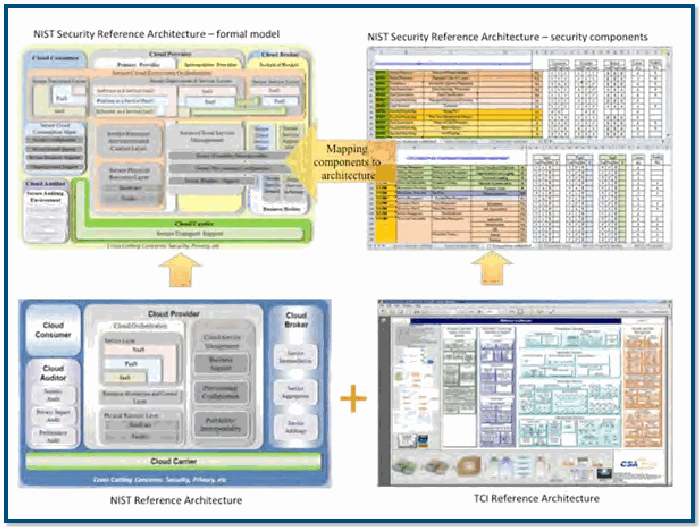
図10: NIST Security Reference Architecture の図。枠で囲まれた4つの区画からなる合成図である。左上は「NIST Security Reference Architecture – formal model」(NISTセキュリティ参照アーキテクチャ – 形式モデル)で、Cloud Consumer(クラウド利用者)、Cloud Provider(クラウド提供者)、Cloud Broker(クラウドブローカー)、Cloud Auditor(クラウド監査者)の列と、下端の Cloud Carrier(クラウドキャリア)の帯からなる階層図である。右上は「NIST Security Reference Architecture – security components」(同 – セキュリティ構成要素)で、構成要素の表計算シートである。「Mapping components to architecture」(構成要素のアーキテクチャへの対応付け)と記された大きな矢印が、シートから形式モデルへ向かう。左下は「NIST Reference Architecture」(NIST参照アーキテクチャ)で、Cloud Consumer、Cloud Auditor、Cloud Provider、Cloud Broker、Cloud Carrier の箱がある。プラス記号で右下の「TCI Reference Architecture」(TCI参照アーキテクチャ)の詳細な構成図と結ばれる。下の2つの区画から上の区画へ上向きの矢印がある。区画内の小さな文字の多くは印刷の大きさでは読めない。
Figure 10: NIST Security Reference Architecture Diagram
図10: NIST Security Reference Architecture の図
CSD staff members contributed significantly to several NIST-hosted events:
CSD の職員は、NIST が主催した次の複数のイベントに大きく貢献しました。
•Sixth Cloud Computing Forum and Workshop: Cloud Computing and Big Data Forum, held in January 2013
•Sixth Cloud Computing Forum and Workshop: Cloud Computing and Big Data Forum(2013年1月開催)
•Seventh Cloud Computing Forum and Workshop: The Intersection of Cloud and Mobility Forum, initially scheduled for October 1-3, 2013, currently rescheduled due to USG shutdown
•Seventh Cloud Computing Forum and Workshop: The Intersection of Cloud and Mobility Forum(当初は2013年10月1日~3日に予定されていたが、米国政府機関の閉鎖により現在は日程が再調整されている)
•First Cloud Forensic Science Workshop, initially scheduled for October 3, 2013, also rescheduled due to USG shutdown.
•First Cloud Forensic Science Workshop(当初は2013年10月3日に予定されていましたが、同じく米国政府機関の閉鎖により日程が再調整されました)。
In support of and advancement of USG cloud computing mandates, CSD staff members provided leadership for several public work groups operating under the NIST Cloud Computing Program. Through these working groups, CSD staff led the development of technical guidelines and recommendations that considered a close collaboration with public, private, academia and other stakeholders.
米国政府のクラウドコンピューティングに関する指令を支援し推進するため、CSD の職員は、NIST Cloud Computing Program の下で活動する複数の公開ワーキンググループを主導しました。これらのワーキンググループを通じて、CSD の職員は、公共部門、民間部門、学術界およびその他の利害関係者との緊密な協力を踏まえた技術的なガイドラインと推奨事項の策定を主導しました。
CSD staff chaired or co-chaired several significant cloud computing efforts in 2013:
CSD の職員は、2013年に、クラウドコンピューティングに関する次の複数の重要な取り組みで議長または共同議長を務めました。
•Chair of the NIST Cloud Computing Security Working Group focused the group on development of SP 500-299 (described above), and on key management research.
•NIST Cloud Computing Security Working Group の議長として、同グループの活動を SP 500-299(前述)の策定と鍵管理の研究に集中させました。
•Co-Chair, NIST Cloud Computing Forensic Science Working Group, led development of Digital Forensics Challenges in a cloud environment.
•NIST Cloud Computing Forensic Science Working Group の共同議長として、クラウド環境における Digital Forensics Challenges の策定を主導しました。
•Co-Chair, NIST Cloud Computing Standards Roadmap Working Group, led development of SP 500291, USG Cloud Computing Standards Roadmap (described above).
•NIST Cloud Computing Standards Roadmap Working Group の共同議長として、SP 500291, USG Cloud Computing Standards Roadmap(前述)の策定を主導しました。
•Chair and Vice-Chair, INCITS CS1 (Cybersecurity) − U.S. Technical Advisory Group (TAG) to the ISO/IEC international committee JTC1/SC27 (IT Security Techniques) − that covers cloud computing taxonomy-related standards and cloud computing security standards.
•INCITS CS1 (Cybersecurity) の議長および副議長。INCITS CS1 は、ISO/IEC の国際委員会 JTC1/SC27 (IT Security Techniques) に対する U.S. Technical Advisory Group (TAG) であり、クラウドコンピューティングの分類体系に関連する標準とクラウドコンピューティングのセキュリティ標準を扱っています。
CSD staff members participate in various standards development organizations, two of which are ISO/IEC JTC 1 Sub Committee 38 – Distributed Application Platforms and Services (SC 38) and ISO/IEC JTC 1 Sub Committee 27 – IT Security Techniques (SC 27). In SC 38, CSD acts as the co-convener for a collaborative ISO/ITU-T initiative on cloud computing taxonomy that includes work on ISO/IEC 17788 – Information Technology – Cloud computing – Overview and Vocabulary. Notably, the genesis for this international body of work is the widely accepted and used cloud computing definition found in SP 800-145, NIST Definition of Cloud Computing.
CSD の職員はさまざまな標準化団体に参加しており、そのうちの2つが ISO/IEC JTC 1 Sub Committee 38 – Distributed Application Platforms and Services (SC 38) と ISO/IEC JTC 1 Sub Committee 27 – IT Security Techniques (SC 27) です。SC 38 において、CSD は、クラウドコンピューティングの分類体系に関する ISO と ITU-T の共同の取り組みの共同コンビーナを務めており、この取り組みには ISO/IEC 17788 – Information Technology – Cloud computing – Overview and Vocabulary に関する作業が含まれます。特筆すべきことに、この国際的な一連の作業の出発点は、SP 800-145, NIST Definition of Cloud Computing に示された、広く受け入れられ利用されているクラウドコンピューティングの定義です。
ISO/IEC 17788 is closely coordinated with another standards activity, ISO/IEC 17789 – Information technology – Cloud Computing – Reference Architecture, which is based on the widely used and accepted NIST publication, SP 500-292. Both ISO/IEC 17788 and 17789 are in the final stages of international balloting before final publication, which is anticipated in the first quarter of calendar year 2014.
ISO/IEC 17788 は、もう1つの標準化活動である ISO/IEC 17789 – Information technology – Cloud Computing – Reference Architecture と緊密に調整されています。後者は、広く利用され受け入れられている NIST の刊行物 SP 500-292 に基づいています。ISO/IEC 17788 と 17789 はいずれも、最終的な発行に先立つ国際投票の最終段階にあり、発行は2014暦年の第1四半期と見込まれています。
CSD staff members are also actively participating in cloud computing security standards, primarily through SC 27, which is responsible for cloud computing security standards. CSD has provided technical contributions based on SP 500-299 and continues to advocate for secure, non-proprietary solutions.
CSD の職員は、クラウドコンピューティングのセキュリティ標準にも積極的に参加しており、その主な場は、クラウドコンピューティングのセキュリティ標準を担当する SC 27 です。CSD は、SP 500-299 に基づく技術的な寄書を提出しており、安全で特定のベンダーに依存しない解決策を引き続き提唱しています。
In FY 2013, the CSD members of the NIST cloud computing team also presented the results of cloud computing research and development, introduced the standards and specifications under development, and provided status of the NIST Cloud Computing Program in a variety of conferences and workshops.
2013会計年度には、NIST のクラウドコンピューティングチームに属する CSD の職員も、さまざまな会議やワークショップにおいて、クラウドコンピューティングの研究開発の成果を発表し、策定中の標準と仕様を紹介し、NIST Cloud Computing Program の状況を報告しました。
Policy Machine – Leveraging Access Control for Cloud Computing
Policy Machine – クラウドコンピューティングのためのアクセス制御の活用
Figure 11: Policy Machine operating environment
図11: Policy Machine の運用環境
NIST Policy Machineの動作環境を示すソフトウェア画面。「POLICY MACHINE Operating Environment」と表示されている。 [NIST のロゴが写っている図。公的な標章のため、この非公式サイトには掲載していません。原本 PDF を参照してください。]
In FY 2013, CSD continued the research and development of a virtualization-based, enterprise-wide controlled delivery of data services for advanced cloud computing through Access Control. NIST and other members of an Ad Hoc INCITS working group are developing a three-part PM standard, under the title of “Next Generation Access Control” (NGAC), under three sub-projects:
2013会計年度に、CSD は、アクセス制御を通じて、高度なクラウドコンピューティングのためのデータサービスを仮想化に基づいて企業全体で制御しつつ提供する仕組みの研究開発を継続しました。NIST と INCITS のアドホックワーキンググループの他のメンバーは、「Next Generation Access Control」(NGAC) という表題の下で、3部構成の PM 標準を、次の3つのサブプロジェクトとして策定しています。
•Project 2193–D: Next Generation Access Control – Implementation Requirements, Protocols and API Definitions
•Project 2193–D: Next Generation Access Control – Implementation Requirements, Protocols and API Definitions
•Project 2194–D: Next Generation Access Control – Functional Architecture
•Project 2194–D: Next Generation Access Control – Functional Architecture
•Project 2195–D: Next Generation Access Control – Generic Operations & Abstract Data Structures
•Project 2195–D: Next Generation Access Control – Generic Operations & Abstract Data Structures
The Policy Machine’s architecture has been adopted by the ANSI/INCITS and is now available as ANSI INCITS 499 – Information technology – Next Generation Access Control – Functional Architecture (NGAC–FA).
Policy Machine のアーキテクチャは ANSI/INCITS に採用され、現在は ANSI INCITS 499 – Information technology – Next Generation Access Control – Functional Architecture (NGAC–FA) として入手できます。
Cryptographic Key Management Issues in Cloud Infrastructures
クラウド基盤における暗号鍵管理の課題
Many of the security capabilities associated with exercise of cloud service rely on cryptographic operations. The key management system (KMS) required to support cryptographic operations for the above tasks can be complex, due to differences in ownership and control of underlying infrastructures on which the KMS and the protected resources are located. CSD developed NISTIR 7956, Cryptographic Key Management Issues & Challenges in Cloud Services to discuss these critical issues.
クラウドサービスの利用に関連するセキュリティ機能の多くは、暗号操作に依存しています。上記の作業のための暗号操作を支えるのに必要な鍵管理システム (KMS) は、KMS と保護対象の資源が置かれている基盤の所有と管理が異なるために、複雑になることがあります。CSD は、これらの重大な課題を論じるために、NISTIR 7956, Cryptographic Key Management Issues & Challenges in Cloud Services を策定しました。
Virtualization Security & Leveraging Virtualization for Security
仮想化のセキュリティとセキュリティのための仮想化の活用
CSD has been researching key areas in cloud and virtualization security producing the following papers:
CSD は、クラウドと仮想化のセキュリティにおける主要な分野を研究しており、次の論文を作成しています。
“Security Assurance Requirements for Hypervisor Deployment Feature” published as part of the proceedings of the 7th International Conference on Digital Society. In FY 2014, CSD will consider feedback from public comments received and publish a (yet unnumbered) Special Publication titled Secure Management Practices for Protection of Hypervisors. In addition, security assurance requirements and security recommendations will be developed for components of virtualized infrastructure other than the hypervisor, such as the guest O/S, VM-based applications, and the virtual network..
「Security Assurance Requirements for Hypervisor Deployment Feature」は、7th International Conference on Digital Society の予稿集の一部として発表されました。2014会計年度に、CSD は、寄せられたパブリックコメントの意見を検討し、Secure Management Practices for Protection of Hypervisors と題する Special Publication(番号は未定)を発行します。加えて、ゲスト O/S、VM ベースのアプリケーション、仮想ネットワークなど、ハイパーバイザ以外の仮想化基盤の構成要素について、セキュリティ保証要件とセキュリティ上の推奨事項を策定します。
Additional information about the NIST Cloud Computing Program is available at:
NIST Cloud Computing Program に関する追加情報は、次の場所で入手できます。
http://www.nist.gov/itl/cloud
http://www.nist.gov/itl/cloud
http://collaborate.nist.gov/twiki-cloud-computing/bin/view/CloudComputing/StandardsRoadmap
http://collaborate.nist.gov/twiki-cloud-computing/bin/view/CloudComputing/StandardsRoadmap
http://collaborate.nist.gov/twiki-cloud-computing/bin/view/CloudComputing/CloudSecurity
http://collaborate.nist.gov/twiki-cloud-computing/bin/view/CloudComputing/CloudSecurity
http://collaborate.nist.gov/twiki-cloud-computing/bin/view/CloudComputing/CloudForensics
http://collaborate.nist.gov/twiki-cloud-computing/bin/view/CloudComputing/CloudForensics
Contacts for each project:
各プロジェクトの連絡先:
Computer Security Division Role in the NIST Cloud Computing Program
NIST Cloud Computing Program におけるコンピュータセキュリティ部門の役割
Dr. Michaela Iorga, Chair, Cloud Computing Security Workgroup, (301) 975-8431, michaela.iorga@nist.gov
Dr. Michaela Iorga, Chair, Cloud Computing Security Workgroup, (301) 975-8431, michaela.iorga@nist.gov
Ms. Annie Sokol, Co-Chair, Cloud Computing Standards Roadmap, (301) 975-2006, annie.sokol@nist.gov
Ms. Annie Sokol, Co-Chair, Cloud Computing Standards Roadmap, (301) 975-2006, annie.sokol@nist.gov
Mr. Daniel Benigni, Chair, INCITS CS1 (Cybersecurity) - US Technical Advisory Group (TAG) to the ISO/IEC international committee JTC1/SC27 (IT Security Techniques), (301) 975-3279, dbenigni@nist.gov
Mr. Daniel Benigni, Chair, INCITS CS1 (Cybersecurity) - US Technical Advisory Group (TAG) to the ISO/IEC international committee JTC1/SC27 (IT Security Techniques), (301) 975-3279, dbenigni@nist.gov
Mr. Salvatore Francomacaro, Vice-Chair, INCITS CS1 (Cybersecurity) - US Technical Advisory Group (TAG) to the ISO/IEC international committee JTC1/SC27 (IT Security Techniques), (301) 975-6414, salvatore.francomacaro@nist.gov
Mr. Salvatore Francomacaro, Vice-Chair, INCITS CS1 (Cybersecurity) - US Technical Advisory Group (TAG) to the ISO/IEC international committee JTC1/SC27 (IT Security Techniques), (301) 975-6414, salvatore.francomacaro@nist.gov
Policy Machine - Leveraging Access Control for Cloud Computing
Policy Machine - クラウドコンピューティングのためのアクセス制御の活用
Mr. David Ferraiolo, (301) 975-3046, david.ferraiolo@nist.gov
Mr. David Ferraiolo, (301) 975-3046, david.ferraiolo@nist.gov
Mr. Serban Gavrila, (301) 975-4242, serban.gavrila@nist.gov
Mr. Serban Gavrila, (301) 975-4242, serban.gavrila@nist.gov
Cryptographic Key Management Issues in Cloud Infrastructures
クラウド基盤における暗号鍵管理の課題
Dr. Ramaswamy Chandramouli, (301) 975-5013, mouli@nist.gov
Dr. Ramaswamy Chandramouli, (301) 975-5013, mouli@nist.gov
Dr. Michaela Iorga, (301) 975-8431, michaela.iorga@nist.gov
Dr. Michaela Iorga, (301) 975-8431, michaela.iorga@nist.gov
Virtualization Security & Leveraging Virtualization for Security
仮想化のセキュリティとセキュリティのための仮想化の活用
Dr. Ramaswamy Chandramouli, (301) 975-5013, mouli@nist.gov
Dr. Ramaswamy Chandramouli, (301) 975-5013, mouli@nist.gov
Mobile Device Security
モバイルデバイスのセキュリティ
Smart phones have become both ubiquitous and indispensable for consumers and business people alike. Although these devices are relatively small and inexpensive, they can be used for voice calls, simple text messages, sending and receiving emails, browsing the web, online banking and ecommerce, social networking, and many functions once limited to laptop and desktop computers. Smart phones and tablet devices have specialized built-in hardware, such as photographic cameras, video cameras, accelerometers, Global Positioning System (GPS) receivers, and removable media readers. They also employ a wide range of wireless interfaces, including infrared, Wireless Fidelity (Wi-Fi), Bluetooth, Near Field Communications (NFC), and one or more types of cellular interfaces that provide network connectivity across the globe. Naturally, just as consumers and business people can realize productivity gains from these technologies, so can government agencies.
スマートフォンは、消費者にとってもビジネスパーソンにとっても、どこにでもある不可欠なものになっています。これらのデバイスは比較的小型で安価ですが、音声通話、簡単なテキストメッセージ、電子メールの送受信、ウェブの閲覧、オンラインバンキングと電子商取引、ソーシャルネットワーキング、さらにかつてはラップトップコンピュータやデスクトップコンピュータに限られていた多くの機能に利用できます。スマートフォンとタブレットデバイスは、写真用カメラ、ビデオカメラ、加速度計、Global Positioning System (GPS) 受信機、リムーバブルメディアリーダーといった専用のハードウェアを内蔵しています。また、赤外線、Wireless Fidelity (Wi-Fi)、Bluetooth、Near Field Communications (NFC)、および世界中でネットワーク接続を提供する1種類以上のセルラーインタフェースを含む、多様な無線インタフェースを採用しています。消費者やビジネスパーソンがこれらの技術から生産性の向上を得られるのと同様に、当然、政府機関もそれを得られます。
Like any new technology, smart phones present new capabilities, but also a number of new security and privacy challenges. As the pace of the technology life cycles continues to increase, current Information Assurance (IA) standards and processes must be updated and new technologies to allow government users to employ the latest technologies that consumers can use without sacrificing privacy and security.
あらゆる新技術と同様に、スマートフォンは新たな能力をもたらす一方で、セキュリティとプライバシーに関する新たな課題も数多くもたらします。技術のライフサイクルの速度が増し続けるなか、政府の利用者が、消費者が利用できる最新の技術をプライバシーとセキュリティを犠牲にすることなく使えるようにするために、現行のInformation Assurance(IA)の標準およびプロセスを更新し、新たな技術を整えなければなりません。
NIST is conducting research in new software assurance methodologies for smart phone software (i.e., apps) and is working with industry to bridge the security gaps present with today’s smart phones. NIST has developed an online beta Application Testing Portal (ATP) for Android that examines app functionality with respect to agency security and privacy guidelines. NIST is working closely with the Defense Advanced Research Projects Agency (DARPA) to transition this software assurance technology to other agencies and making the ATP software available to industry as open source.
NISTは、スマートフォンのソフトウェア(すなわちアプリ)のための新たなソフトウェアアシュアランス手法の研究を行っており、今日のスマートフォンに存在するセキュリティ上のギャップを埋めるために産業界と協力しています。NISTは、Android向けのオンラインのベータ版Application Testing Portal(ATP)を開発しました。これは、機関のセキュリティおよびプライバシーのガイドラインに照らしてアプリの機能を調べるものです。NISTは国防高等研究計画局(DARPA)と緊密に協力して、このソフトウェアアシュアランス技術を他の機関へ移転するとともに、ATPのソフトウェアをオープンソースとして産業界が利用できるようにしています。
Building on this expertise in mobile app software assurance, NIST researchers are developing platform-independent techniques for identifying mobile malware by analyzing mobile app network behavior. NIST researchers are also developing metrics for evaluating the effectiveness of mobile app security test tools.
モバイルアプリのソフトウェアアシュアランスに関するこの専門知識を基に、NISTの研究者は、モバイルアプリのネットワーク上の挙動を分析することでモバイルマルウェアを識別する、プラットフォームに依存しない技法を開発しています。NISTの研究者は、モバイルアプリのセキュリティ試験ツールの有効性を評価するための指標も開発しています。
Contacts:
連絡先:
Dr. Steve Quirolgico, (301) 975-8426, stephen.quirolgico@nist.gov
Dr. Steve Quirolgico, (301) 975-8426, stephen.quirolgico@nist.gov
Dr. Jeffrey Voas, (301) 975-6622, jeff.voas@nist.gov
Dr. Jeffrey Voas, (301) 975-6622, jeff.voas@nist.gov
Dr. Tom Karygiannis, (301) 975-4728, karygiannis@nist.gov
Dr. Tom Karygiannis, (301) 975-4728, karygiannis@nist.gov
Strengthening Internet Security
インターネットセキュリティの強化
USGv6: A Technical Infrastructure to Assist IPv6 Adoption
USGv6:IPv6の導入を支援する技術基盤
Internet Protocol (IP) Version 6 (IPv6) is an updated version of the current Internet Protocol, IPv4. The primary motivations for the development of IPv6 were to increase the number of unique IP addresses available for use and to handle the needs of new Internet applications and devices. In addition, IPv6 was designed with the following goals: increased ease of network management and configuration; expandable IP headers; improved mobility and security; and quality of service controls. IPv6 has been, and continues to be, developed and defined by the Internet Engineering Task Force (IETF).
Internet Protocol(IP)Version 6(IPv6)は、現行のInternet ProtocolであるIPv4を更新した版です。IPv6を開発した主な動機は、利用できる一意のIPアドレスの数を増やすこと、および新たなインターネットアプリケーションと機器のニーズに対応することでした。加えてIPv6は、ネットワークの管理と設定の容易さの向上、拡張可能なIPヘッダ、モビリティとセキュリティの改善、サービス品質の制御という目標のもとに設計されました。IPv6はInternet Engineering Task Force(IETF)によって開発および定義されてきており、現在もそれが続いています。
FY 2012 was a significant year for the deployment of IPv6 in the United States Government. OMB’s Memo of September 10, 2010, Transition to IPv6, required all government agencies to “upgrade public/external facing servers and services (e.g., web, email, Domain Name System (DNS), Internet Service Provider (ISP) services) to operationally use native IPv6 by the end of FY 2012.” NIST worked with the USGv6 Task Force and with individual government agencies to achieve this goal. NIST developed an online monitor to demonstrate which high-level government domains have met this goal with respect to DNS services, email, web servers, and Domain Name System Security Extensions (DNSSEC). In FY 2013, NIST and OMB continued to use this monitor to measure USGv6 compliance with OMB’s requirement.
2012会計年度は、米国政府におけるIPv6の展開にとって重要な年でした。2010年9月10日付のOMBの覚書Transition to IPv6は、すべての政府機関に対し、「2012会計年度末までに、公開/外部向けのサーバ及びサービス(例えば、ウェブ、電子メール、Domain Name System(DNS)、Internet Service Provider(ISP)サービス)を、ネイティブIPv6を運用上使用するようアップグレードする」ことを求めました。NISTは、この目標を達成するために、USGv6 Task Force及び個々の政府機関と協力しました。NISTは、DNSサービス、電子メール、ウェブサーバ及びDomain Name System Security Extensions(DNSSEC)に関して、どの上位の政府ドメインがこの目標を達成したかを示すオンラインモニタを開発しました。2013会計年度に、NISTとOMBは、OMBの要求事項に対するUSGv6の準拠状況を測定するために、このモニタを引き続き使用しました。
FY 2014 will bring additional OMB IPv6 requirements. Agencies will “upgrade internal client applications that communicate with public Internet servers and supporting enterprise networks to operationally use native IPv6 by the end of FY 2014.” NIST is developing online diagnostic tools to help agencies verify compliance to this requirement.
2014会計年度には、OMBによるIPv6の要求事項が追加されます。各機関は、「2014会計年度末までに、公開インターネットサーバと通信する内部クライアントアプリケーション及びそれを支えるエンタープライズネットワークを、ネイティブIPv6を運用上使用するようアップグレードする」ことになります。NISTは、各機関がこの要求事項への準拠を検証するのに役立つオンライン診断ツールを開発しています。
The NIST IPv6 Test Program, whose goal is to provide assurance on IPv6 product conformance and interoperability, continues to operate. In FY 2014, NIST will continue to manage and evolve the USGv6 Test Program. The NIST program is a collaboration between CSD and the Advanced Networking Technology Division.
IPv6製品の適合性及び相互運用性について保証を与えることを目的とするNIST IPv6 Test Programは、引き続き運用されています。2014会計年度に、NISTはUSGv6 Test Programの管理と発展を継続します。このNISTのプログラムは、CSDとAdvanced Networking Technology Divisionとの共同の取り組みです。
http://www.antd.nist.gov/usgv6
http://www.antd.nist.gov/usgv6
Contacts:
連絡先:
Ms. Sheila Frankel, (301) 975-3297, sheila.frankel@nist.gov
Ms. Sheila Frankel, (301) 975-3297, sheila.frankel@nist.gov
Mr. Douglas Montgomery, (301) 975-3630, dougm@nist.gov
Mr. Douglas Montgomery, (301) 975-3630, dougm@nist.gov
Access Control and Privilege Management
アクセス制御及び特権管理
Access Control and Privilege Management Research
アクセス制御及び特権管理の研究
With the advance of current computing technologies and the diverse environments in which these technologies are used, security issues, such as situational awareness, trust management, preservation of privacy in access control, and privilege management systems, are becoming increasingly complex. Practical and conceptual guidance for these topics is needed.
現在のコンピューティング技術の進歩と、これらの技術が使用される環境の多様化に伴い、状況認識、信頼管理、アクセス制御におけるプライバシーの保護、特権管理システムといったセキュリティ上の課題は、ますます複雑になっています。これらの主題について、実践的及び概念的なガイダンスが必要とされています。
In FY 2013, the following research was accomplished for this project: 1) unified enforcement mechanism of data services for use by a Policy Machine (PM) for enterprise computing environment, 2) enhanced the capabilities of the Access Control Policy Tool (ACPT), 3) researched a new fault-detection method for access control rule using Simulated Logic Circuit algorithms, 4) researched formal ABAC models, and completed the development of Special Publication 800-162, Guide to Attribute Based Access Control (ABAC) Definition and Considerations, which provides information of function components as well as enterprise consideration of ABAC.
2013会計年度に、このプロジェクトでは次の研究を達成しました。1)エンタープライズコンピューティング環境向けのPolicy Machine(PM)が使用する、データサービスの統一的な実施メカニズム、2)Access Control Policy Tool(ACPT)の機能の強化、3)Simulated Logic Circuitアルゴリズムを用いた、アクセス制御ルールの新しい障害検出手法の研究、4)形式的なABACモデルの研究、及びSpecial Publication 800-162, Guide to Attribute Based Access Control (ABAC) Definition and Considerationsの策定の完了。同文書は、ABACの機能コンポーネント及びエンタープライズでの考慮事項に関する情報を提供します。
CSD expects that this project will:
CSDは、このプロジェクトが次のことを実現すると期待しています。
•Promote (or accelerate) the adoption of community computing that utilizes the power of shared resources and common trust management schemes
•共有資源の力と共通の信頼管理スキームを活用するコミュニティコンピューティングの採用を促進する(又は加速する)
•Provide guidance in implementing access control models and mechanisms for standalone or enterprise systems
•スタンドアロンシステム又はエンタープライズシステム向けのアクセス制御モデル及びメカニズムの実装に関するガイダンスを提供する
•Increase the security and safety of static (connected) distributed systems by applying the testing and verification tool for the access control policies
•アクセス制御ポリシーの試験及び検証ツールを適用することにより、静的な(接続された)分散システムのセキュリティと安全性を高める
•Assist system architects, security administrators, and security managers whose expertise is related to access control or privilege policy in managing their systems, and in learning the limitations and practical approaches for their applications
•アクセス制御又は特権ポリシーに関する専門性を持つシステムアーキテクト、セキュリティ管理者及びセキュリティマネージャが、自らのシステムを管理し、自らのアプリケーションにおける限界と実践的なアプローチを学ぶことを支援する
•Provide accurate and efficient fault detection and correction technology for implementing access control rules and policies
•アクセス制御のルール及びポリシーを実装するための、正確かつ効率的な障害検出及び修正の技術を提供する
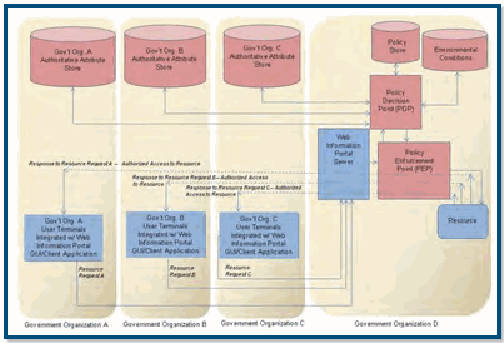
図12:アクセス制御及び特権管理。枠で囲まれた図で、Government Organization A、B、C、D(政府組織A〜D)と記された4つの陰影付きの列がある。A〜C の列には、上に赤い円柱(Gov’t Org. A/B/C Authoritative Attribute Store、政府組織A/B/Cの権威ある属性ストア)、下に青い箱(Gov’t Org. A/B/C User Terminals Integrated w/ Web Information Portal GUI/Client Application、Web情報ポータルのGUI/クライアントアプリケーションと統合した政府組織A/B/Cの利用者端末)がある。D の列には、赤い円柱の Policy Store(ポリシーストア)と Environmental Conditions(環境条件)、赤い箱の Policy Decision Point (PDP)(ポリシー決定点)と Policy Enforcement Point (PEP)(ポリシー施行点)、青い箱の Web Information Portal Server(Web情報ポータルサーバ)と Resource(リソース)がある。各属性ストア、ポリシーストア、環境条件は線で PDP と結ばれ、PDP は PEP と結ばれる。Resource Request A、B、C(リソース要求A〜C)と記された線が利用者端末から Web情報ポータルサーバへ向かい、サーバは PEP と、PEP はリソースと結ばれる。「Response to Resource Request A/B/C – Authorized Access to Resource」(リソース要求A/B/Cへの応答 – リソースへの認可されたアクセス)と記された破線が利用者端末へ戻る。
Figure 12: Access Control and Privilege Management
図12:アクセス制御及び特権管理
Contacts:
連絡先:
Dr. Vincent Hu, (301) 975-4975, vhu@nist.gov
Dr. Vincent Hu, (301) 975-4975, vhu@nist.gov
Mr. David Ferraiolo, (301) 975-3046, david.ferraiolo@nist.gov
Mr. David Ferraiolo, (301) 975-3046, david.ferraiolo@nist.gov
Mr. Rick Kuhn, (301) 975-3337, kuhn@nist.gov
Mr. Rick Kuhn, (301) 975-3337, kuhn@nist.gov
Conformance Verification for Access Control Policies
アクセス制御ポリシーの適合性検証
Access control systems are among the most critical network security components. Faulty policies, misconfigurations, or flaws in software implementation can result in serious vulnerabilities. The specification of access control policies is often a challenging problem. Often a system’s privacy and security are compromised due to the misconfiguration of access control policies instead of the failure of cryptographic primitives or protocols. This problem becomes increasingly severe as software systems become more and more complex and are deployed to manage a large amount of sensitive information and resources organized into sophisticated structures. Identifying discrepancies between policy specifications and their properties (intended function) is crucial because correct implementation and enforcement of policies by applications is based on the premise that the policy specifications are correct. As a result, policy specifications must undergo rigorous verification and validation through systematic testing to ensure that the policy specifications truly encapsulate the desires of the policy authors.
アクセス制御システムは、ネットワークセキュリティの構成要素の中でも最も重要なものの一つです。ポリシーの誤り、設定の誤り、又はソフトウェア実装の欠陥は、深刻な脆弱性をもたらし得ます。アクセス制御ポリシーの仕様化は、多くの場合、難しい問題です。システムのプライバシーとセキュリティは、暗号プリミティブやプロトコルの破綻ではなく、アクセス制御ポリシーの設定の誤りによって損なわれることが多くあります。この問題は、ソフトウェアシステムがますます複雑になり、精巧な構造に編成された大量の機微な情報及び資源を管理するために配備されるにつれて、いっそう深刻になります。ポリシー仕様とその特性(意図された機能)との間の食い違いを特定することは極めて重要です。アプリケーションによるポリシーの正しい実装と実施は、ポリシー仕様が正しいという前提に基づいているからです。したがって、ポリシー仕様は、それがポリシー作成者の意図を真に表現していることを確実にするために、体系的な試験による厳格な検証及び妥当性確認を受けなければなりません。
To formally and precisely capture the security properties that access control should adhere to, access control models are usually written to bridge the rather wide gap in abstraction between policy and mechanism. Thus, an access control model provides unambiguous and precise expression as well as reference for design and implementation of security requirements. Techniques are required for verifying whether an access control model is correctly expressed in the access controls policies and whether the properties are satisfied in the model. In practice, the same access control policies may express multiple access control models or express a single model in addition to extra access control constraints outside of the model. Ensuring the conformance of access control models and policies is a nontrivial and critical task.
アクセス制御が従うべきセキュリティ特性を形式的かつ正確に捉えるために、通常、ポリシーとメカニズムとの間にあるかなり大きな抽象度の隔たりを埋めるものとして、アクセス制御モデルが記述されます。このように、アクセス制御モデルは、セキュリティ要求事項の設計及び実装のための曖昧さのない正確な表現と、その参照先を提供します。アクセス制御モデルがアクセス制御ポリシーに正しく表現されているかどうか、及びモデルにおいて特性が満たされているかどうかを検証するための技法が必要です。実際には、同じアクセス制御ポリシーが複数のアクセス制御モデルを表現することもあれば、単一のモデルに加えて、そのモデルの外にある追加のアクセス制御制約を表現することもあります。アクセス制御のモデルとポリシーの適合性を確保することは、容易ではなく、かつ重要な作業です。
Started in 2009, CSD developed a prototype system, Access Control Policy Tool (ACPT), which allows a user to compose, verify, test, and generate access control policies.
2009年に開始した取り組みとして、CSD は、利用者がアクセス制御ポリシーを作成、検証、テストおよび生成できるプロトタイプシステム Access Control Policy Tool (ACPT) を開発しました。
In FY 2013, ACPT was downloaded by 190 users and organizations. CSD performed prototype testing, enhanced the capability of ACPT by adding privilege inheritance algorithms, applied user cases of Attribute Based, Multi-Level, and Workflow access control models to test ACPT’s performance, and compared to other formal method for performance and usability. CSD also produced a new user manual that explains new capabilities of ACPT. In addition, CSD published a research paper related to ACPT.
2013会計年度に、ACPT は190の利用者と組織によってダウンロードされました。CSD は、プロトタイプのテストを実施し、権限継承アルゴリズムを追加して ACPT の機能を強化し、属性ベース、マルチレベルおよびワークフローのアクセス制御モデルのユースケースを適用して ACPT の性能をテストし、性能と使いやすさについて他の形式手法と比較しました。CSD はまた、ACPT の新しい機能を説明する新しい利用者マニュアルを作成しました。加えて、CSD は ACPT に関連する研究論文を発表しました。
In FY 2014, CSD will continue testing, enhance the capability of ACPT by applying the tool for more complex access control policy combinations, provide model profiles, and improve user interfaces. CSD will also update ACPT based on user feedback and suggestions.
2014会計年度に、CSD はテストを継続し、より複雑なアクセス制御ポリシーの組み合わせにこのツールを適用することによって ACPT の機能を強化し、モデルプロファイルを提供し、ユーザインタフェースを改善します。CSD はまた、利用者からのフィードバックと提案に基づいて ACPT を更新します。
Figure 13: Conformance Verification
図13: 適合性検証
This project is expected to:
このプロジェクトには、次のことが期待されています。
•Provide generic paradigm and framework of access control model/property conformance testing
•アクセス制御のモデルおよび特性の適合性テストに関する汎用的なパラダイムと枠組みを提供する
•Provide templates for specifying access control rules in popular access control models such as Attribute Based, Multilevel, and Workflow models
•属性ベース、マルチレベル、ワークフローの各モデルなど、広く使われているアクセス制御モデルにおいてアクセス制御ルールを規定するためのテンプレートを提供する
•Provide tools or services for checking the security and safety of access control implementation, policy combination, and eXtensible Access Control Markup Language (XACML) policy generation
•アクセス制御の実装、ポリシーの組み合わせ、および eXtensible Access Control Markup Language (XACML) ポリシーの生成について、セキュリティと安全性を確認するためのツールまたはサービスを提供する
•Promote (or accelerate) the adoption of combinatorial testing for large-system (such as access control system) testing
•大規模システム(アクセス制御システムなど)のテストにおける組み合わせテストの採用を促進(または加速)する
http://csrc.nist.gov/groups/SNS/acpt/
http://csrc.nist.gov/groups/SNS/acpt/
Contacts:
連絡先:
Dr. Vincent Hu (301) 975-4975 vhu@nist.gov
Dr. Vincent Hu (301) 975-4975 vhu@nist.gov
Mr. Rick Kuhn (301) 975-3337 kuhn@nist.gov
Mr. Rick Kuhn (301) 975-3337 kuhn@nist.gov
Metrics for Evaluation of Access Control Systems (Real-Time Access Rule Fault Detection)
アクセス制御システムの評価のための指標(アクセスルールの障害のリアルタイム検出)
Specifying correct behaviors of Access Control (AC) policies is a challenging task, especially when an AC policy includes a large number of rules. Identifying discrepancies between AC policies and their intended functionalities is crucial because correct policy behaviors are based on the premise that the policies are correctly specified. Incorrect AC policies result in faults that not only leak but also disable access to information, and faults are especially difficult to detect without support of formal embedded models such as Multi-Level Security (MLS) and Chinese Wall.
アクセス制御 (AC) ポリシーの正しい振る舞いを規定することは、とりわけ AC ポリシーが多数のルールを含む場合には、困難な作業です。ポリシーの正しい振る舞いは、ポリシーが正しく規定されているという前提に基づいているため、AC ポリシーとその意図された機能との食い違いを特定することは極めて重要です。誤った AC ポリシーは、情報を漏えいさせるだけでなく情報へのアクセスを不能にもする障害をもたらし、そうした障害は、Multi-Level Security (MLS) や Chinese Wall のような組み込みの形式モデルの支援がなければ、とりわけ検出が困難です。
Most research on AC model or policy verification techniques are focused on one particular model, and almost all of the research is in applied methods, which require the completed AC policies as the input for verification or test processes to generate fault reports. Even though correct verification is achieved and counterexamples may be generated along with found faults, those methods provide no information about the source of rule faults that might allow conflicts in privilege assignment, leakage of privileges, or conflict of interest permissions. The difficulty in finding the source of faults is increased especially when the AC rules are intricately covering duplicated variables to a degree of complexity. The complexity is due to the fact that a fault might not be caused by one particular rule; for example, rule x grants subject/attribute s access to object/attribute o, and rule y denies the group subject/attribute g, which s is a member of, access to object o. Such conflict can only be resolved by removing either rule x or y, or the g membership of s from the policy. But removing x or y affects other rules that depend on them (e.g., a member of subject group g k is granted access to object o), and removing s’s membership in g will disable g’s legitimate access to other objects/attributes through the membership. Thus, it requires manually analyzing each rule in the policy in order to find the correct solution for the fault.
ACのモデル又はポリシーの検証技法に関する研究の大半は、ある特定のモデルに焦点を当てており、そのほぼすべてが応用的な手法に関するものです。これらの手法は、障害報告を生成する検証又は試験のプロセスへの入力として、完成したACポリシーを必要とします。正しい検証が達成され、発見された障害とともに反例が生成されることがあっても、これらの手法は、特権の割当てにおける競合、特権の漏えい、又は利益相反となる許可を生じさせ得るルールの障害の発生源については、何の情報も提供しません。障害の発生源を見つける難しさは、とりわけ、ACルールが重複した変数を入り組んだ形で扱い、相当に複雑になっている場合に増大します。この複雑さは、障害が一つの特定のルールによって引き起こされるとは限らないことに起因します。例えば、ルールxがサブジェクト/属性sにオブジェクト/属性oへのアクセスを許可し、ルールyが、sがメンバーとなっているグループサブジェクト/属性gに対してオブジェクトoへのアクセスを拒否する場合です。このような競合は、ルールx若しくはyのいずれか、又はsのgへの所属を、ポリシーから取り除くことによってのみ解消できます。しかし、x又はyを取り除くと、それらに依存する他のルール(例えば、サブジェクトグループg kのメンバーにオブジェクトoへのアクセスが許可されている)に影響が及び、sのgへの所属を取り除くと、その所属を通じた他のオブジェクト/属性へのgの正当なアクセスができなくなります。したがって、障害に対する正しい解決策を見つけるには、ポリシー内の各ルールを人手で分析する必要があります。
To address the issue, CSD researched the AC Rule Logic Circuit Simulation (ACRLCS) technique, which enables the AC authors to detect a fault when the fault-causing AC rule is added to the policy, so the fixing can be implemented in real time before adding other rules that further complicate the detecting effort. Rather than checking by retracing the interrelations between rules after the policy is completed, the policy author needs only check the newly added rule against previous “correct” ones. In ACRLCS, AC rules are represented in a Simulated Logic Circuit (SLC). The use of simulation may restrict ACRLCS implementation on a physical electronic circuit; however, the concept can be implemented and computed through simulated software.
この問題に対処するため、CSD は AC Rule Logic Circuit Simulation (ACRLCS) 技法を研究しました。この技法により、AC の作成者は、障害の原因となる AC ルールがポリシーに追加された時点で障害を検出できるので、検出作業をさらに複雑にする他のルールを追加する前に、リアルタイムで修正を実施できます。ポリシーの完成後にルール間の相互関係をたどり直して確認するのではなく、ポリシーの作成者は、新たに追加したルールを、それ以前の「正しい」ルールと照らして確認するだけで十分です。ACRLCS では、AC ルールは Simulated Logic Circuit (SLC) で表現されます。シミュレーションを用いることは、ACRLCS を物理的な電子回路上に実装することを制約する可能性がありますが、この概念はシミュレーションソフトウェアによって実装し計算できます。
In FY 2013, by using the Logic Circuit Simulation (LCS) software, CSD researched the SLC for the simulations of rule and inheritance assignments of AC privileges, formal AC model implementations, and multiple policy combinations. The result is published in the conference paper, Real-Time Access Control Rule Fault Detection Using a Simulated Logic Circuit.
2013会計年度に、CSD は、Logic Circuit Simulation (LCS) ソフトウェアを用いて、AC 権限のルールの割り当てと継承の割り当て、形式的な AC モデルの実装、および複数のポリシーの組み合わせをシミュレーションするための SLC を研究しました。その成果は、会議論文 Real-Time Access Control Rule Fault Detection Using a Simulated Logic Circuit として発表されています。
In FY 2014, CSD is planning to further research the performance of the ACRLCS, and develop a basic reference implementation of the algorithm. Goals for the project include:
2014会計年度に、CSD は、ACRLCS の性能をさらに研究し、このアルゴリズムの基本的な参照実装を開発することを計画しています。このプロジェクトの目標には次のものが含まれます。
•Promote the concept of detecting AC policy faults in real time AC rule composing
•AC ルールの作成中に AC ポリシーの障害をリアルタイムで検出するという概念を普及させる
•Provide an innovative method in specifying AC rules formed by Boolean logic expressions operated on variables of AC rules
•AC ルールの変数に対して演算を行うブール論理式で構成される AC ルールを規定するための、革新的な方法を提供する
•Provide techniques for preventing faults in enforcing fundamental security properties including Cyclic Inheritance, Privilege Escalation, and Separation of Duty
•Cyclic Inheritance、Privilege Escalation、Separation of Duty を含む基本的なセキュリティ特性の実施における障害を防止するための技法を提供する
•Provide new methods for composing standard mandatory AC models such as Role-Based Access Control (RBAC) and MLS as well as some fundamental security properties
•Role-Based Access Control (RBAC) や MLS などの標準的な強制 AC モデル、およびいくつかの基本的なセキュリティ特性を構成するための新しい方法を提供する
Figure 14: Real-time Access Control - Circuit
図14: リアルタイムアクセス制御 - 回路
Contact:
連絡先:
Dr. Vincent Hu (301) 975-4975 vhu@nist.gov
Dr. Vincent Hu (301) 975-4975 vhu@nist.gov
Attribute Based Access Control
属性ベースアクセス制御
Attribute Based Access Control (ABAC) is a logical access control methodology where authorization to perform a set of operations is determined by evaluating attributes associated with the subject, object, requested operations, and, in some cases, environment conditions against policy, rules, or relationships that describe the allowable operations for a given set of attributes. ABAC represents a point on the spectrum of logical access control from simple access control lists to more capable role-based access (RBAC), and finally to a highly flexible method for providing access based on the evaluation of attributes.
Attribute Based Access Control (ABAC) は、論理アクセス制御の方法論の1つです。ABAC では、一連の操作を実行するための認可は、主体、客体、要求された操作、および場合によっては環境条件に関連付けられた属性を、所与の属性の組に対して許容される操作を記述するポリシー、ルールまたは関係に照らして評価することによって決定されます。ABAC は、単純なアクセス制御リストから、より高機能なロールベースアクセス (RBAC) を経て、最終的には属性の評価に基づいてアクセスを提供する非常に柔軟な方法へと至る、論理アクセス制御の連続体上の1点を表しています。
There has not been a comprehensive effort to formally define or guide the implementation of ABAC within the Federal Government. This research provides considerations for using ABAC to improve information sharing within and among organizations while maintaining control of that information. The research serves a two-fold purpose; first, it aims to provide federal agencies with a definition of ABAC and a description of the functional components of ABAC. Second, it provides planning, design, implementation, and operational considerations for employing ABAC within a large enterprise with the goal of improving information sharing while maintaining control of that information.
連邦政府内では、ABAC を形式的に定義する、またはその実装を指導する包括的な取り組みは、これまで行われてこませんでした。この研究は、情報に対する統制を維持しつつ、組織内および組織間の情報共有を改善するために ABAC を利用する際の考慮事項を提供します。この研究には2つの目的があります。第1に、連邦機関に対して ABAC の定義と ABAC の機能構成要素の説明を提供することを目指します。第2に、情報に対する統制を維持しつつ情報共有を改善することを目標として、大規模な企業内で ABAC を採用する際の計画、設計、実装および運用上の考慮事項を提供します。
In FY 2013, CSD completed the writing of SP 800-162, Guide to Attribute Based Access Control (ABAC) Definition and Considerations. SP 800-162 includes terminology and basic understanding of ABAC; ABAC enterprise employment considerations during the initiation, acquisition/development, implementation/assessment, and operations and maintenance phases; and example to demonstrate how ABAC is implemented in a Web Information Portal. CSD also researched ABAC formal models, the result will be presented in a NISTIR, which describes a variety of characteristics and applications of ABAC formal models.
2013会計年度に、CSD は SP 800-162, Guide to Attribute Based Access Control (ABAC) Definition and Considerations の執筆を完了しました。SP 800-162 には、ABAC の用語と基本的な理解、開始、調達/開発、実装/アセスメント、運用および保守の各フェーズにおいて企業が ABAC を採用する際の考慮事項、ならびに Web Information Portal において ABAC がどのように実装されるかを示す例が含まれます。CSD は ABAC の形式モデルも研究しており、その成果は、ABAC の形式モデルのさまざまな特徴と応用を記述する NISTIR において提示されます。
NIST conducted an Attribute Based Access Control Workshop, based on the SP 800-162, on July 17, 2013, in partnership with NSA and the National Cybersecurity Center of Excellence (NCCoE). About 100 individuals from government, industries, and academia/research attended the event. The workshop provided attendees an opportunity to identify, refine, and guide the many interrelated considerations, challenges, and efforts needed to develop ABAC guidance; CSD updated SP 800-162 from the suggestions collected at the workshop.
NIST は、2013年7月17日に、NSA および National Cybersecurity Center of Excellence (NCCoE) と連携して、SP 800-162 に基づく Attribute Based Access Control Workshop を開催しました。政府、産業界および学術・研究機関から約100名がこのイベントに参加しました。このワークショップは、ABAC のガイダンスを策定するために必要となる、相互に関連する多くの考慮事項、課題および取り組みを特定し、洗練させ、方向付ける機会を参加者に提供しました。CSD は、ワークショップで集まった提案を基に SP 800-162 を更新しました。
In FY 2014, CSD will continue research of ABAC formal models as well as details and extended topics of ABAC capabilities, such as Attribute Engineering/Management, Integration with Identity Management, Federation, Situation Awareness (Real Time or Contextual) Mechanism, Policy Management, and Natural Language Policy translation to Digital Policy. The ABAC project will pursue the following objectives:
2014会計年度に、CSD は、ABAC の形式モデルの研究に加え、Attribute Engineering/Management、Integration with Identity Management、Federation、Situation Awareness (Real Time or Contextual) Mechanism、Policy Management、Natural Language Policy から Digital Policy への変換といった、ABAC の機能の詳細と発展的な話題の研究を継続します。ABAC プロジェクトは、次の目標を追求します。
•Provide readers the terminology and basic understanding of ABAC
•読者に ABAC の用語と基本的な理解を提供する
•Provide readers with an overview of the current state of logical access control, a working definition of ABAC, and an explanation of core and enterprise ABAC concepts
•読者に、論理アクセス制御の現状の概要、ABAC の暫定的な定義、および ABAC の中核概念と企業レベルの概念の説明を提供する
•Assist security policy makers in establishing a business case for ABAC implementation, and acquiring an interoperable set of capabilities
•セキュリティポリシーの策定者が、ABAC を実装するためのビジネスケースを確立し、相互運用可能な一連の機能を調達することを支援する
•Assist ABAC developers in developing the operational requirements, and overall enterprise architecture
•ABAC の開発者が、運用要件と企業全体のアーキテクチャを策定することを支援する
•Assist ABAC administrators in establishing or refining business processes to support ABAC
•ABAC の管理者が、ABAC を支える業務プロセスを確立または改善することを支援する
•Promote adoption of ABAC for more secure and flexible method for information sharing in standalone or enterprise environment
•スタンドアロン環境または企業環境において、より安全で柔軟な情報共有の方法として ABAC の採用を促進する
Figure 15: ABAC Access Control Mechanism Chart
図15: ABAC アクセス制御メカニズムの図
http://csrc.nist.gov/projects/abac/
http://csrc.nist.gov/projects/abac/
Contacts:
連絡先:
Dr. Vincent Hu, (301) 975-4975, vhu@nist.gov
Dr. Vincent Hu, (301) 975-4975, vhu@nist.gov
Mr. David Ferraiolo, (301) 975-3046, david.ferraiolo@nist.gov
Mr. David Ferraiolo, (301) 975-3046, david.ferraiolo@nist.gov
Mr. Rick Kuhn, (301) 975-3337, kuhn@nist.gov
Mr. Rick Kuhn, (301) 975-3337, kuhn@nist.gov
Advanced Security Testing and Measurements
高度なセキュリティテストと測定
Security Automation and Continuous Monitoring
セキュリティ自動化と継続的監視
IT organizations operate a diverse set of computing assets which access, route, store, and process information that is critical to the operations of businesses and the missions of government agencies. These IT environments are frequently reconfigured, and are under constant threat of attack. The wide variety of computing products, the speed of configuration change, and the diversity of threats require organizations to maintain situational awareness over their IT assets and to utilize this information to make risk-based decisions.
IT 組織は、企業の業務と政府機関の任務にとって極めて重要な情報にアクセスし、それを経路制御、保存および処理する、多様な計算資産を運用しています。こうした IT 環境は頻繁に再構成され、絶えず攻撃の脅威にさらされています。計算機製品の種類の多さ、構成変更の速さ、および脅威の多様性のために、組織は、自らの IT 資産に関する状況認識を維持し、その情報を利用してリスクに基づく意思決定を行う必要があります。
Security automation utilizes standardized data formats and transport protocols to enable data to be exchanged between business, operational, and security systems that support security processes by:
セキュリティ自動化は、標準化されたデータ形式とトランスポートプロトコルを利用して、業務システム、運用システムおよびセキュリティシステムの間でデータを交換できるようにします。これらのシステムは、次のことによってセキュリティプロセスを支えます。
•Identifying IT assets
•IT 資産を識別する
•Providing awareness over the operational state of computing devices
•計算機デバイスの運用状態を把握できるようにする
•Enabling security reference data to be collected from internal and external sources
•内部および外部の情報源からセキュリティ参照データを収集できるようにする
•Supporting analysis processes that measure the effectiveness of security controls and provide visibility into security risks, enabling risk-based decision making
•セキュリティ管理策の有効性を測定し、セキュリティリスクを可視化する分析プロセスを支援し、リスクに基づく意思決定を可能にすること
Commercial solutions built using security automation specifications enable the collection and harmonization of vast amounts of operational and security data into coherent, comparable information streams to achieve situational awareness that informs timely and active management of diverse IT systems. Through the creation of reference data and guidance, and the international recognition of flexible, open standards, the NIST security automation program works to improve the interoperability, broad acceptance, and adoption of security automation solutions to address current and future security challenges, creating opportunities for innovation.
セキュリティ自動化仕様を用いて構築された商用ソリューションは、膨大な量の運用データおよびセキュリティデータを収集・調和させ、一貫性があり比較可能な情報の流れにまとめることを可能にします。これにより状況認識が得られ、多様なITシステムを適時かつ能動的に管理するための判断材料となります。NISTのセキュリティ自動化プログラムは、参照データおよびガイダンスの作成と、柔軟でオープンな標準の国際的な承認とを通じて、セキュリティ自動化ソリューションの相互運用性、幅広い受容および採用の向上に取り組み、現在および将来のセキュリティ上の課題に対処するとともに、イノベーションの機会を生み出しています。
Specification, Standards, and Guidance Development
仕様、標準およびガイダンスの策定
To support the overarching security automation vision, it is necessary to have specifications that describe the required interactions between systems, standards that document international consensus approaches, and guidance that informs product development and implementation. Through close work with partners in government, industry, and academia, NIST continues to facilitate the definition and development of security automation approaches that enable organizations to understand and manage IT security risks.
セキュリティ自動化の全体的なビジョンを支えるには、システム間に必要な相互作用を記述する仕様、国際的な合意に基づくアプローチを文書化する標準、ならびに製品の開発および実装の指針となるガイダンスが必要です。NISTは、政府、産業界および学術界のパートナーとの緊密な協力を通じて、組織がITセキュリティリスクを理解し管理できるようにするセキュリティ自動化アプローチの定義および開発を引き続き促進しています。
During FY 2013, NIST worked to build on previous security automation work by:
2013会計年度に、NISTは以下により、これまでのセキュリティ自動化の取り組みをさらに発展させました。
•Establishing working groups in standards development organizations to promote international consensus around standardized approaches
•標準化されたアプローチに関する国際的な合意を促進するため、標準化団体内にワーキンググループを設置すること
•Identifying and addressing gaps in the current specifications
•現行の仕様に存在するギャップを特定し、それに対処すること
•Evolving existing approaches to achieve greater scalability and impact
•より高いスケーラビリティと効果を実現するため、既存のアプローチを発展させること
•Providing additional guidance on architectural, design, and analysis concerns
•アーキテクチャ、設計および分析に関する事項について追加のガイダンスを提供すること
•Development and maintenance of tools and reference implementations
•ツールおよび参照実装の開発と保守
NIST is currently working with its partners in various standards development organizations, including the International Organization for Standardization (ISO), the Internet Engineering Task Force (IETF), the Forum of Incident Response and Security Teams (FIRST), and the Trusted Computing Group (TCG), to further mature and broaden adoption of security automation specifications, reference data, and techniques. This area of work is focused on evolving security automation specifications to integrate with existing transport protocols to provide for secure, interoperable exchange of security automation data. Additional work is focused on evolving security metrics and providing consensus guidance on security automation approaches. Through the definition and adoption of security automation standards and guidelines, IT vendors will be able to provide standardized security solutions to their customers. These solutions support continuous monitoring and automated, dynamic network defense capabilities based on analysis of data from operational and security data sources and the collective action of security components.
NISTは現在、International Organization for Standardization (ISO)、Internet Engineering Task Force (IETF)、Forum of Incident Response and Security Teams (FIRST)、Trusted Computing Group (TCG) をはじめとするさまざまな標準化団体のパートナーと協力し、セキュリティ自動化の仕様、参照データおよび技術をさらに成熟させ、その採用を広げることに取り組んでいます。この分野の作業は、セキュリティ自動化仕様を発展させて既存のトランスポートプロトコルと統合し、セキュリティ自動化データを安全かつ相互運用可能な形で交換できるようにすることに重点を置いています。このほか、セキュリティメトリクスの発展と、セキュリティ自動化アプローチに関する合意に基づくガイダンスの提供にも取り組んでいます。セキュリティ自動化の標準およびガイドラインが定義され採用されることにより、ITベンダーは標準化されたセキュリティソリューションを顧客に提供できるようになります。これらのソリューションは、運用データおよびセキュリティデータのソースから得られるデータの分析と、セキュリティコンポーネントの協調した動作とに基づき、継続的監視および自動化された動的なネットワーク防御の能力を支えます。
Security automation work has been focused in two areas: evolution and international adoption of the Security Content Automation Protocol (SCAP) and development of a Continuous Monitoring building block focused on secure software asset management capabilities. The following sections detail this work.
セキュリティ自動化の作業は、2つの分野に重点を置いてきました。すなわち、Security Content Automation Protocol (SCAP) の発展および国際的な採用と、安全なソフトウェア資産管理の能力に焦点を当てた継続的監視ビルディングブロックの開発です。以下の節でこの作業を詳述します。
Security Content Automation Protocol (SCAP)
Security Content Automation Protocol (SCAP)
SCAP is a multipurpose protocol that provides an automated means to collect and assess the state of devices. SCAP supports automated vulnerability checking, verifying the installation of patches, checking security configuration settings, verifying technical control compliance, measuring security, and examining systems for indicators of compromise. SCAP uses the Extensible Markup Language (XML) to standardize the format and nomenclature by which security software products communicate information about software flaws, security configurations, and other aspects of device state. SCAP enables security automation content, also known as “SCAP content,” to be expressed using standardized formats, identifiers, and scoring models. This content can be used by any tool that is conformant to the specifications, to collect and evaluate the state of software installed on a device.
SCAPは、デバイスの状態を収集し評価する自動化された手段を提供する多目的プロトコルです。SCAPは、脆弱性の自動チェック、パッチのインストールの検証、セキュリティ設定のチェック、技術的管理策への準拠の検証、セキュリティの測定、および侵害の痕跡を求めるシステムの調査を支援します。SCAPは、Extensible Markup Language (XML) を用いて、セキュリティソフトウェア製品がソフトウェアの欠陥、セキュリティ設定、その他デバイスの状態に関する情報を伝達する際の形式および命名法を標準化します。SCAPにより、「SCAPコンテンツ」とも呼ばれるセキュリティ自動化コンテンツを、標準化された形式、識別子およびスコアリングモデルを用いて表現できます。このコンテンツは、仕様に適合するどのツールでも、デバイスにインストールされたソフトウェアの状態を収集し評価するために利用できます。
青い盾に白いチェックマークを描いた小さなエンブレム。 [装飾の画像。本文を読むのに必要のない装飾のため、この非公式サイトには掲載していません。原本 PDF を参照してください。]
SCAP has been widely adopted by major software and hardware manufacturers and has become a significant component of information security management and governance programs. SCAP-enabled tools are currently being used by the U.S. Government, critical infrastructure companies, academia, and other businesses, both domestically and internationally. Currently, CSD is leveraging SCAP in multiple areas, both to support its own mission and to enable other agencies and private sector entities to meet their goals. For CSD, SCAP is a critical component of the SCAP Validation Program, the National Vulnerability Database (NVD), and the National Checklist Program (NCP).
SCAPは、主要なソフトウェアおよびハードウェアの製造業者に広く採用されており、情報セキュリティのマネジメントおよびガバナンスのプログラムにおける重要な構成要素となっています。SCAP対応ツールは現在、国内外で、米国政府、重要インフラ企業、学術界、その他の企業によって使用されています。現在、CSDは、自らの使命を支えるためにも、他の機関や民間部門の主体がそれぞれの目標を達成できるようにするためにも、複数の分野でSCAPを活用しています。CSDにとって、SCAPはSCAP Validation Program、National Vulnerability Database (NVD)、およびNational Checklist Program (NCP) の極めて重要な構成要素です。
In September 2012, NIST published SP 800-126 Revision 2, The Technical Specification for the Security Content Automation Protocol (SCAP): SCAP Version 1.2, . That document describes the 11 component specifications composing SCAP.
2012年9月、NISTはSP 800-126 Revision 2, The Technical Specification for the Security Content Automation Protocol (SCAP): SCAP Version 1.2, を公表しました。同文書は、SCAPを構成する11のコンポーネント仕様を記述しています。
Since the release of SCAP 1.2, NIST has worked to improve guidance around the SCAP specifications by promoting broader international adoption of SCAP, encouraging the integration of SCAP into other standards, and by adapting SCAP to address specific gaps and challenges. The following work activities
SCAP 1.2のリリース以降、NISTは、SCAPのより広範な国際的採用を促進し、他の標準へのSCAPの統合を奨励し、特定のギャップや課題に対処するようSCAPを適応させることにより、SCAP仕様をめぐるガイダンスの改善に取り組んできました。以下の作業活動
| SCAP 1.2 Specifications | |
|---|---|
| Specification | Description |
| Languages | |
| Extensible Configuration Checklist Description Format (XCCDF) | Used for authoring security checklists/benchmarks and for reporting results of evaluating them |
| Open Vulnerability and Assessment Language (OVAL) | Used for representing system configuration information, assessing machine state, and reporting assessment results |
| Open Checklist Interactive Language (OCIL) | Used for representing checks that collect information from people or from existing data stores populated by other data collection methods |
| Reporting Formats | |
| Asset Reporting Format (ARF) | Used to express information about assets and to define the relationships between assets and reports |
| Asset Identification | Used to uniquely identify assets based on known identifiers and other asset information |
| Enumerations | |
| Common Platform Enumeration (CPE) | A nomenclature and dictionary of hardware, operating systems, and applications; a method to identify applicability to platforms |
| Common Configuration Enumeration (CCE) | A nomenclature and dictionary of software security configurations |
| Common Vulnerabilities and Exposures (CVE) | A nomenclature and dictionary of security-related software flaws |
| Measurement and Scoring Systems | |
| Common Vulnerability Scoring System (CVSS) | Used for measuring the relative severity of software flaws |
| Common Configuration Scoring System (CCSS) | Used for measuring the relative severity of device security (mis-)configuration issues |
| Content and Result Integrity | |
| Trust Model for Security Automation Data (TMSAD) | Guidance for using digital signatures in a common trust model applied to security automation specifications |
| SCAP 1.2の仕様 | |
|---|---|
| 仕様 | 説明 |
| 言語 | |
| 拡張可能構成チェックリスト記述形式(XCCDF) | セキュリティチェックリスト/ベンチマークの作成と、その評価結果の報告に使用 |
| オープン脆弱性評価言語(OVAL) | システム構成情報の表現、マシン状態の評価、評価結果の報告に使用 |
| オープンチェックリスト対話言語(OCIL) | 人から、または他のデータ収集手段で作成された既存のデータストアから情報を収集するチェックの表現に使用 |
| 報告形式 | |
| 資産報告形式(ARF) | 資産に関する情報を表現し、資産とレポートの関係を定義するために使用 |
| 資産識別 | 既知の識別子やその他の資産情報に基づいて、資産を一意に識別するために使用 |
| 列挙 | |
| 共通プラットフォーム列挙(CPE) | ハードウェア、オペレーティングシステム、アプリケーションの名称体系と辞書。プラットフォームへの適用性を識別する方法 |
| 共通構成列挙(CCE) | ソフトウェアのセキュリティ構成に関する名称体系と辞書 |
| 共通脆弱性識別子(CVE) | セキュリティ関連のソフトウェア欠陥に関する名称体系と辞書 |
| 測定およびスコアリング方式 | |
| 共通脆弱性評価システム(CVSS) | ソフトウェア欠陥の相対的な深刻度の測定に使用 |
| 共通構成スコアリングシステム(CCSS) | デバイスのセキュリティ上の(誤)構成の問題の相対的な深刻度の測定に使用 |
| コンテンツと結果の完全性 | |
| セキュリティ自動化データの信頼モデル(TMSAD) | セキュリティ自動化仕様に適用される共通の信頼モデルでデジタル署名を使用するための指針 |
NIST released draft NISTIR 7946, CVSS Implementation Guidance, which guides analysts scoring IT vulnerabilities using the CVSS Version 2.0. That document is the result of applying the CVSS specification to score over 50,000 vulnerabilities analyzed by the NVD. The report reviews the CVSS base metrics and provides guidance for difficult and/or unique scoring situations and assists vulnerability analysts with scoring particular types of vulnerabilities by identifying common keywords and phrases that often appear in vulnerability alerts. The report includes a collection of scored IT vulnerabilities from the NVD, a justification for each score provided, and a description of the NVD vulnerability scoring process.
NISTは、CVSS Version 2.0を用いてITの脆弱性をスコアリングするアナリスト向けの手引きとなる、NISTIR 7946, CVSS Implementation Guidance の草案を公表しました。同文書は、NVDが分析した50,000件を超える脆弱性のスコアリングにCVSS仕様を適用した結果をまとめたものです。この報告書は、CVSSの基本評価基準を概観し、難しいスコアリング状況や特異なスコアリング状況に対するガイダンスを提供するとともに、脆弱性アラートにしばしば現れる一般的なキーワードや語句を特定することで、脆弱性アナリストが特定の種類の脆弱性をスコアリングする際の助けとなります。報告書には、NVDからスコアリング済みのITの脆弱性を集めたもの、それぞれのスコアの根拠、およびNVDの脆弱性スコアリングプロセスの説明が含まれています。
NIST, in collaboration with industry partners in the IETF, established the Security Automation and Continuous Monitoring (SACM) working group, chartered in July 2013. The current scope of work for SACM includes identifying and/or defining the transport protocols and data formats needed to support the collection and evaluation of device state against expected values and standards for interacting with repositories of security automation content. The initial focus of the SACM working group is on identifying use cases, requirements, and architectural models to inform decisions about existing specifications and standards that can be referenced, required modifications or extensions to existing specifications and standards, and any gaps that need to be addressed. This working group provides a venue for advancing appropriate SCAP specifications into international standards and addressing identified gap areas.
NISTは、IETFにおける産業界のパートナーと協力して、Security Automation and Continuous Monitoring (SACM) ワーキンググループを設立し、同グループは2013年7月に設立認可を受けました。SACMの現在の作業範囲には、期待される値に照らしたデバイスの状態の収集および評価を支援するために必要なトランスポートプロトコルとデータ形式の特定または定義、ならびにセキュリティ自動化コンテンツのリポジトリとやり取りするための標準の特定または定義が含まれます。SACMワーキンググループは当初、ユースケース、要件およびアーキテクチャモデルの特定に重点を置いており、これらは、参照できる既存の仕様および標準、既存の仕様および標準に必要な修正または拡張、ならびに対処が必要なギャップについての判断材料となります。このワーキンググループは、適切なSCAP仕様を国際標準へと進め、特定されたギャップ領域に対処するための場を提供します。
For more information, please refer to: http://datatracker.ietf.org/wg/sacm/charter/
詳細については、次を参照されたい:http://datatracker.ietf.org/wg/sacm/charter/
Additionally, NIST collaborated with industry partners to revise the ISO/IEC 19770-2:2009 standard, Information technology -- Software asset management -- Part 2: Software identification tag, which establishes a specification for tagging software to support identification and management. This software identification (SWID) data model provides a mechanism for software publishers to provide authoritative identification, categorization, software relationship (e.g., dependency, bundling, and patch), file footprint details, and other software metadata for software they publish. This information enhances SCAP use cases by providing authoritative information for creation of CPE names, targeting of checklists, and associating software flaws to products based on a defect in a software library or executable.
さらに、NISTは産業界のパートナーと協力して、ISO/IEC 19770-2:2009標準である Information technology -- Software asset management -- Part 2: Software identification tag の改訂に取り組みました。この標準は、識別および管理を支援するためにソフトウェアにタグを付ける仕様を定めるものです。このソフトウェア識別 (SWID) データモデルは、ソフトウェアの発行者が、自ら発行するソフトウェアについて、権威ある識別情報、分類、ソフトウェア間の関係(例:依存関係、バンドル、パッチ)、ファイルフットプリントの詳細、その他のソフトウェアメタデータを提供するための仕組みを提供します。この情報は、CPE名の作成、チェックリストの適用対象の特定、およびソフトウェアライブラリや実行ファイルの欠陥に基づくソフトウェアの欠陥と製品との関連付けのための権威ある情報を提供することにより、SCAPのユースケースを強化します。
NIST also worked with government and industry partners in the TCG to define a number of specifications related to the Trusted Network Connect (TNC) protocols. The first such publication is the TNC SCAP Messages for IF-M specification that supports carrying SCAP content and results over the TNC protocols. The second is the TNC Enterprise Compliance Profile (ECP) and related specifications that support the exchange of SWID data over the TNC protocols. The ECP enables collection of SWID data from a device for use by external tools to provide software inventory information. SCAP and SWID data collected using these mechanisms may be optionally used for network access control decision making, allowing device state to be evaluated when devices connect and on an ongoing basis thereafter.
NISTはまた、TCGにおける政府および産業界のパートナーと協力して、Trusted Network Connect (TNC) プロトコルに関連するいくつかの仕様を定義しました。その1つ目の刊行物は TNC SCAP Messages for IF-M 仕様であり、TNCプロトコル上でSCAPのコンテンツおよび結果を伝送することを支援します。2つ目は TNC Enterprise Compliance Profile (ECP) および関連仕様であり、TNCプロトコル上でのSWIDデータの交換を支援します。ECPは、デバイスからSWIDデータを収集し、外部ツールがそれを用いてソフトウェアインベントリ情報を提供できるようにします。これらの仕組みを用いて収集されたSCAPデータおよびSWIDデータは、任意でネットワークアクセス制御の意思決定に利用でき、デバイスの接続時およびそれ以降も継続的にデバイスの状態を評価することを可能にします。
For more information on these specifications, please visit:
これらの仕様の詳細については、次を参照されたい:
http://www.trustedcomputinggroup.org/resources/tnc_scap_messages_for_ifm, and
http://www.trustedcomputinggroup.org/resources/tnc_scap_messages_for_ifm、および
http://www.trustedcomputinggroup.org/resources/tnc_endpoint_compliance_profile_specification.
http://www.trustedcomputinggroup.org/resources/tnc_endpoint_compliance_profile_specification。
Finally, NIST participated in two Forum of Incident Response and Security Teams (FIRST) Special Interest Groups (SIG). The CVSS SIG (CVSS-SIG) focused on defining CVSS Revision 3, which is intended to implement improvements to the scoring model based on community feedback. The CVSS-SIG plans to release a draft of the revision in early FY 2014, with a completed approved specification expected in the summer of 2014. The second SIG, the Vulnerability Reporting and Data eXchange SIG (VRDX-SIG), researches and recommends methods for identifying and exchanging vulnerability information across disparate vulnerability databases.
最後に、NISTはForum of Incident Response and Security Teams (FIRST) の2つのSpecial Interest Group (SIG) に参加しました。CVSS SIG (CVSS-SIG) は、CVSS Revision 3の定義に重点を置きました。これは、コミュニティからのフィードバックに基づいてスコアリングモデルの改善を実装することを意図したものです。CVSS-SIGは、2014会計年度の早い時期にこの改訂の草案を公表する計画であり、承認された完成版の仕様は2014年夏に見込まれています。2つ目のSIGであるVulnerability Reporting and Data eXchange SIG (VRDX-SIG) は、異なる脆弱性データベース間で脆弱性情報を識別し交換するための方法を調査し、推奨します。
For more information, please visit: http://www.first.org/global/sigs.
詳細については、次を参照されたい:http://www.first.org/global/sigs。
Through work with international SDOs, SCAP and related security automation capabilities are expected to evolve and expand in support of the growing need to define and measure effective security controls, assess and monitor ongoing aspects of information security, remediate noncompliance, and successfully manage systems in accordance with the Risk Management Framework described in SP 800-37 Revision 1, Guide for Applying the Risk Management Framework to Federal Information Systems: A Security Life Cycle Approach.
国際的なSDOとの協力を通じて、SCAPおよび関連するセキュリティ自動化の能力は、発展し拡大していくことが期待されます。それは、有効なセキュリティ管理策を定義および測定し、情報セキュリティの継続的な側面を評価および監視し、不適合を是正し、SP 800-37 Revision 1, Guide for Applying the Risk Management Framework to Federal Information Systems: A Security Life Cycle Approach に記述されたRisk Management Frameworkに従ってシステムを適切に管理するという、高まりつつあるニーズを支えるためです。
http://scap.nist.gov/
http://scap.nist.gov/
Contact:
連絡先:
Mr. David Waltermire, (301) 975-3390, david.waltermire@nist.gov
Mr. David Waltermire, (301) 975-3390, david.waltermire@nist.gov
Continuous Monitoring
継続的監視
In September 2010, the Department of Homeland Security (DHS) released the Continuous Asset Evaluation, Situational Awareness and Risk Scoring (CAESARS) Reference Architecture Report. This report identifies commonality and strengths in the custom approaches used by civilian agencies to provide solutions that enable the continuous monitoring of IT systems. This report identifies “essential functional components of a security risk scoring system, independent of specific technologies, products, or vendors.” It describes the use of security automation specifications, such as the SCAP, to enable continuous monitoring solutions.
2010年9月、国土安全保障省 (DHS) は、Continuous Asset Evaluation, Situational Awareness and Risk Scoring (CAESARS) Reference Architecture Report を公表しました。この報告書は、ITシステムの継続的監視を可能にするソリューションを提供するために文民機関が用いている独自のアプローチについて、その共通点と強みを明らかにしています。この報告書は、「特定の技術、製品またはベンダーに依存しない、セキュリティリスクスコアリングシステムの不可欠な機能コンポーネント」を特定しています。また、継続的監視ソリューションを可能にするための、SCAPなどのセキュリティ自動化仕様の利用について記述しています。
In October 2010, the Federal Chief Information Officer Council’s Information Security and Identity Management Committee’s (ISIMC) subcommittee on Continuous Monitoring and Risk Scoring saw the need to create a technical initiative to expand upon the CAESARS architecture to better scale it to large enterprises (e.g., the entire U.S. Government). A team of researchers from the NSA Information Assurance Directorate (IAD), the DHS Federal Network Security CAESARS team, and NIST’s Information Technology Laboratory (ITL) worked together to respond to this need. The draft CAESARS Framework Extension (CAESARS-FE) described by Draft NISTIR 7756, CAESARS Framework Extension: An Enterprise Continuous Monitoring Technical Reference Architecture, is the output of this collaboration.
2010年10月、Federal Chief Information Officer CouncilのInformation Security and Identity Management Committee (ISIMC) に置かれたContinuous Monitoring and Risk Scoringに関する小委員会は、CAESARSアーキテクチャを拡張して大規模なエンタープライズ(例:米国政府全体)により適切に対応できるようにするための技術的イニシアチブを立ち上げる必要性を認識しました。NSA Information Assurance Directorate (IAD)、DHS Federal Network SecurityのCAESARSチーム、およびNISTのInformation Technology Laboratory (ITL) の研究者からなるチームが協力して、このニーズに応えました。Draft NISTIR 7756, CAESARS Framework Extension: An Enterprise Continuous Monitoring Technical Reference Architecture に記述されたCAESARS Framework Extension (CAESARS-FE) の草案は、この協力の成果です。
Draft NISTIR 7756 presents an enterprise continuous monitoring (ConMon) technical reference architecture that extends the framework provided by the DHS’s CAESARS architecture. The primary goal of this effort is to enable enterprise ConMon by supporting the development and deployment of capabilities that support automated, enterprise-wide ConMon functions. The concepts, workflows, and subsystems presented in this document can be used by organizations seeking to establish federated queries, orchestration of data collection tasks, data analytics, and presentation and reporting capabilities across a diverse portfolio of security and IT products. CAESARS-FE supports IT operations and network defense capabilities, with compliance reporting as a byproduct of actual security monitoring and improvement. CAESARS-FE enables organizations to design, develop, and deploy ConMon capabilities by leveraging their existing security and IT tools while minimizing custom tool integration efforts. CAESARS-FE defines the requisite functionality needed to ensure the interoperability of vendor products while continuing to encourage security tool vendor participation and innovation.
Draft NISTIR 7756は、DHSのCAESARSアーキテクチャが提供する枠組みを拡張する、エンタープライズ継続的監視 (ConMon) の技術参照アーキテクチャを提示しています。この取り組みの主な目標は、自動化されたエンタープライズ全体のConMon機能を支える能力の開発および導入を支援することにより、エンタープライズConMonを可能にすることです。同文書に示された概念、ワークフローおよびサブシステムは、多様なセキュリティ製品およびIT製品群にわたって、連合クエリ、データ収集タスクのオーケストレーション、データ分析、ならびに提示および報告の能力を確立しようとする組織が利用できます。CAESARS-FEは、IT運用およびネットワーク防御の能力を支援するものであり、コンプライアンス報告は、実際のセキュリティ監視および改善の副産物として得られます。CAESARS-FEは、組織が既存のセキュリティツールおよびITツールを活用しつつ、独自のツール統合作業を最小限に抑えて、ConMon能力を設計、開発および導入することを可能にします。CAESARS-FEは、セキュリティツールベンダーの参加とイノベーションを引き続き奨励しつつ、ベンダー製品の相互運用性を確保するために必要な機能を定義しています。
To advance the state of the art in continuous monitoring capabilities and to further interoperability within commercially available tools, CSD is working within the international standards development community to establish working groups and to author and comment on emerging technical standards in this area. The CAESARS-FE reference architecture will evolve as greater consensus is developed around interoperable, standards-based approaches that enable continuous monitoring of IT systems. In early FY 2014, CSD plans to release an update to NISTIR 7756 that provides additional guidance for development of ConMon architectures and solutions based on ongoing standards activities and feedback.
継続的監視の能力における技術水準を高め、市販のツールにおける相互運用性をさらに進めるため、CSDは国際的な標準化コミュニティの中で、ワーキンググループの設置、ならびにこの分野で新たに策定されつつある技術標準の執筆およびそれに対する意見提出に取り組んでいます。CAESARS-FE参照アーキテクチャは、ITシステムの継続的監視を可能にする、相互運用可能で標準に基づくアプローチについての合意がより広く形成されるにつれて発展していきます。2014会計年度の早い時期に、CSDは、進行中の標準化活動およびフィードバックに基づき、ConMonのアーキテクチャおよびソリューションの開発に関する追加のガイダンスを提供するNISTIR 7756の更新版を公表する計画です。
The NIST National Cybersecurity Center of Excellence (NCCoE) is also working to develop a series of ConMon building blocks that demonstrate cybersecurity solutions that apply across multiple industry sectors. The first building block, currently under development, proposes a standardized approach to software asset management, providing an organization with an integrated view of software throughout its lifecycle. The building block will support:
NISTのNational Cybersecurity Center of Excellence (NCCoE) も、複数の産業分野にまたがって適用できるサイバーセキュリティソリューションを実証する、一連のConMonビルディングブロックの開発に取り組んでいます。現在開発中の最初のビルディングブロックは、ソフトウェア資産管理への標準化されたアプローチを提案するものであり、ライフサイクル全体にわたるソフトウェアの統合的なビューを組織に提供します。このビルディングブロックは、以下を支援します。
•Authorization and verification of software installation media – Verifies that the media is from a trusted software publisher and that the installation media has not been tampered with
•ソフトウェアインストールメディアの認可および検証 – メディアが信頼できるソフトウェア発行者によるものであること、およびインストールメディアが改ざんされていないことを検証する
•Software execution whitelisting – Verifies that the software is authorized to run and has not been tampered with
•ソフトウェア実行のホワイトリスト化 – ソフトウェアが実行を認可されており、改ざんされていないことを検証する
•Publication of installed software inventory – A device that securely communicates what software is installed to an organization-wide database
•インストール済みソフトウェアのインベントリの公開 – どのソフトウェアがインストールされているかを、デバイスが組織全体のデータベースに安全に伝達する
•Software inventory-based network access control – A device’s level of access to a network is determined by what software is or is not present on the device and whether its patches are up to date
•ソフトウェアインベントリに基づくネットワークアクセス制御 – デバイスのネットワークへのアクセスレベルは、そのデバイスにどのソフトウェアが存在するか、または存在しないか、およびそのパッチが最新であるかどうかによって決定される
The building block document, Continuous Monitoring Building Block: Software Asset Management, can be viewed at http://csrc.nist.gov/nccoe/Building-Blocks/conmon.html. In FY 2014, the team will continue to develop this building block and to work with vendors to develop a solutions demonstration. Through this process, CSD provides publically available descriptions of the practical steps needed to implement the technical approaches defined by the building block.
このビルディングブロックの文書である Continuous Monitoring Building Block: Software Asset Management は、http://csrc.nist.gov/nccoe/Building-Blocks/conmon.html で閲覧できます。2014会計年度に、チームはこのビルディングブロックの開発を継続し、ベンダーと協力してソリューションの実証を開発します。このプロセスを通じて、CSDは、ビルディングブロックが定義する技術的アプローチを実装するために必要な実践的手順の説明を、一般に公開する形で提供します。
Contact:
連絡先:
Mr. David Waltermire (301) 975-3390 david.waltermire@nist.gov
Mr. David Waltermire (301) 975-3390 david.waltermire@nist.gov
Security Automation Reference Data
セキュリティ自動化参照データ
Through the NVD and the National Checklist Program (NCP), NIST is providing relevant and important reference data in the areas of vulnerability and configuration management. SCAP, and the programs that leverage it, are moving the information assurance industry towards being able to standardize communications, and the collection and storage of relevant data in standardized formats, and provide automated means for the assessment and remediation of systems for both vulnerabilities and configuration compliance.
NISTは、NVDおよびNational Checklist Program (NCP) を通じて、脆弱性管理および設定管理の分野における適切かつ重要な参照データを提供しています。SCAPおよびそれを活用するプログラムは、情報保証業界を、通信を標準化し、関連データを標準化された形式で収集および保存し、脆弱性と設定への準拠の両面でシステムの評価および是正を行う自動化された手段を提供できる方向へと動かしています。
National Vulnerability Database (NVD)
National Vulnerability Database (NVD)
Security automation reference data is currently housed within the NVD. The NVD is the U.S. Government repository of security automation data based on security automation specifications. This data provides a standards-based foundation for the automation of software asset, vulnerability, and security configuration management; security measurement; and compliance activities. This data supports security automation efforts based on the SCAP. The NVD includes databases of security configuration checklists for the NCP, listings of publicly known software flaws, product names, and impact metrics. A formal validation program tests the ability of vendor products to use some forms of security automation data based on a product’s conformance in support of specific enterprise capabilities.
セキュリティ自動化参照データは現在、NVDに格納されています。NVDは、セキュリティ自動化仕様に基づくセキュリティ自動化データの米国政府のリポジトリです。このデータは、ソフトウェア資産管理、脆弱性管理およびセキュリティ設定管理、セキュリティ測定、ならびにコンプライアンス活動の自動化のための、標準に基づく基盤を提供します。このデータは、SCAPに基づくセキュリティ自動化の取り組みを支えます。NVDには、NCPのためのセキュリティ設定チェックリストのデータベース、公に知られたソフトウェアの欠陥の一覧、製品名、および影響の評価基準が含まれます。正式な検証プログラムが、特定のエンタープライズ能力を支える製品の適合性に基づき、ベンダー製品が一部の形式のセキュリティ自動化データを利用できるかどうかを試験します。
SCAP defines the structure of standardized software flaws and security configuration reference data, also known as SCAP content. This reference data is provided by the NVD (http://nvd.nist.gov/).
SCAPは、標準化されたソフトウェアの欠陥およびセキュリティ設定の参照データ(SCAPコンテンツとも呼ばれる)の構造を定義します。この参照データは、NVD (http://nvd.nist.gov/) によって提供されます。
The NVD is the U.S. Government repository of standards-based vulnerability management reference data. The NVD provides information regarding security vulnerabilities and configuration settings, vulnerability impact metrics, technical assessment methods, and references to remediation assistance and IT product identification data. As of October 2013, the NVD contained the following resources:
NVDは、標準に基づく脆弱性管理参照データの米国政府のリポジトリです。NVDは、セキュリティの脆弱性および設定に関する情報、脆弱性の影響の評価基準、技術的な評価方法、ならびに是正支援およびIT製品識別データへの参照を提供します。2013年10月時点で、NVDには以下のリソースが収録されていました。
•Over 58,000 vulnerability advisories with an average of 8 new vulnerabilities added daily
•58,000件を超える脆弱性アドバイザリ(1日平均8件の新たな脆弱性が追加されている)
•52 SCAP-expressed checklists containing thousands of low-level security configuration checks that can be used by SCAP-validated security products to perform automated evaluations of system state
•SCAPで表現された52件のチェックリスト。これらは数千の低レベルのセキュリティ設定チェックを含み、SCAP検証済みのセキュリティ製品がシステムの状態の自動評価を行うために利用できる
•173 non-SCAP security checklists (e.g., English prose guidance and configuration scripts)
•173件の非SCAPセキュリティチェックリスト(例:英語の文章によるガイダンスおよび設定スクリプト)
•248 U.S. Computer Emergency Readiness Team (US-CERT) alerts, 2,771 US-CERT vulnerability summaries, and 8,140 SCAP machine-readable software flaw checks
•248件のU.S. Computer Emergency Readiness Team (US-CERT) アラート、2,771件のUS-CERT脆弱性サマリー、および8,140件のSCAPによる機械可読なソフトウェア欠陥チェック
•Product dictionary with over 79,000 operating system, application, and hardware name entries
•79,000件を超えるオペレーティングシステム、アプリケーションおよびハードウェアの名称エントリを収録した製品辞書
•42,954 vulnerability advisories translated into Spanish
•スペイン語に翻訳された42,954件の脆弱性アドバイザリ
NVD is hosted and maintained by NIST and is sponsored by the Department of Homeland Security’s US-CERT.
NVDは、NISTがホストおよび保守しており、国土安全保障省のUS-CERTがスポンサーとなっています。
The use of SCAP data by commercial security products, deployed in thousands of organizations worldwide, has extended NVD’s effective reach. Increasing demand for NVD XML data feeds and SCAP-expressed content from the NVD website demonstrates increased adoption of SCAP.
世界中の数千の組織に導入されている商用セキュリティ製品がSCAPデータを利用することで、NVDの実質的な到達範囲は広がっています。NVDのXMLデータフィードと、NVDのウェブサイトで提供されるSCAP表現のコンテンツに対する需要が増えていることは、SCAPの採用が進んでいることを示しています。
NVD continues to play a pivotal role in the Payment Card Industry (PCI) efforts to mitigate vulnerabilities in credit card systems. PCI mandates the use of NVD vulnerability severity scores in measuring the risk to payment card servers worldwide and for prioritizing vulnerability patching. PCI’s use of NVD severity scores helps enhance credit card transaction security and protects consumers’ personal information.
NVDは、クレジットカードシステムの脆弱性を緩和するPayment Card Industry (PCI) の取り組みにおいて、引き続き中心的な役割を果たしています。PCIは、世界中のペイメントカードサーバに対するリスクの測定と、脆弱性へのパッチ適用の優先順位付けに、NVDの脆弱性深刻度スコアを用いることを義務付けています。PCIがNVDの深刻度スコアを用いることは、クレジットカード取引のセキュリティの強化に役立ち、消費者の個人情報を保護します。
Throughout FY 2013, NVD continued to provide access to vulnerability reference data and security checklists. CSD updated the NVD to support the latest CPE Naming specification, CPE 2.3, and produces the official CPE dictionary in multiple formats. NVD now hosts the list of configuration items, complementing the configuration checklist data already maintained. NVD data is substantially increasing the security of networks worldwide and it is a fundamental component of CSD’s security automation infrastructure. CSD plans to update and improve the NVD in FY 2014 to include improvements in user navigation, addition of references to the SP 800-53 Revision 4 security controls content, and the ability to search, browse, and download common configuration enumeration (CCE) list data.
2013会計年度を通じて、NVDは脆弱性の参照データとセキュリティチェックリストへのアクセスを引き続き提供しました。CSDは、最新のCPE Naming仕様であるCPE 2.3に対応するようNVDを更新し、公式のCPE辞書を複数の形式で作成しています。NVDは現在、設定項目のリストも掲載しており、これは既に維持管理されている設定チェックリストのデータを補完するものです。NVDのデータは世界中のネットワークのセキュリティを大幅に高めており、CSDのセキュリティ自動化基盤の基本的な構成要素です。CSDは2014会計年度にNVDを更新・改善する計画であり、これには、ユーザナビゲーションの改善、SP 800-53 Revision 4のセキュリティ管理策のコンテンツへの参照の追加、および共通設定一覧 (CCE) のリストデータを検索、閲覧、ダウンロードする機能が含まれます。
http://nvd.nist.gov
http://nvd.nist.gov
Contact:
連絡先:
Mr. Harold Booth (301) 975-8441 harold.booth@nist.gov
Mr. Harold Booth (301) 975-8441 harold.booth@nist.gov
Computer Security Incident Coordination
コンピュータセキュリティインシデントの連携
Recognizing that even well-engineered and administered computing systems are sometimes successfully attacked, it is important to establish and maintain processes and procedures to recover from attacks when defensive mechanisms are breached. NIST Special Publication (SP) 800-61 Revision 2, Computer Security Incident Handling Guide, provides guidance on establishing and operating a Computer Security Incident Response Team (CSIRT). A wide-ranging attack may affect numerous organizations. When an attack has the potential to affect computing systems in multiple organizations, coordination among separate CSIRTs can make it possible to limit the damage caused by an attack, speed recovery operations, and maintain a higher level of operational security.
適切に設計され管理されているコンピュータシステムであっても攻撃が成功する場合があることを踏まえると、防御の仕組みが破られたときに攻撃から復旧するためのプロセスと手順を確立し、維持することが重要です。NIST Special Publication (SP) 800-61 Revision 2, Computer Security Incident Handling Guideは、Computer Security Incident Response Team (CSIRT) の設置と運用に関するガイダンスを提供しています。広範囲に及ぶ攻撃は、多数の組織に影響を与えることがあります。攻撃が複数の組織のコンピュータシステムに影響を与えるおそれがある場合、別々のCSIRTの間で連携することにより、攻撃による被害を抑え、復旧作業を早め、より高い水準の運用上のセキュリティを維持することが可能になります。
CSD is working with the Department of Homeland Security (DHS) to develop guidance on Computer Security Incident Coordination (CSIC). The goal of CSIC is to help diverse collections of organizations to effectively collaborate in the handling of computer security incidents. Effective collaboration raises numerous issues on how and when to share information between organizations, and in what form information should be shared. Because different organizations may have substantially different capabilities for responding to attacks, diagnosing causes, and handling sensitive attack-related information, guidance must provide a framework to help organizations interoperate despite their organizational differences.
CSDは、国土安全保障省 (DHS) と協力して、Computer Security Incident Coordination (CSIC) に関するガイダンスを策定しています。CSICの目標は、多様な組織の集まりがコンピュータセキュリティインシデントの対応において効果的に協力できるよう支援することです。効果的な協力を行うには、組織間でいつ、どのように情報を共有するか、またどのような形式で情報を共有すべきかについて、数多くの課題が生じます。攻撃への対応、原因の診断、攻撃に関連する機微な情報の取扱いについての能力は組織によって大きく異なることがあるため、ガイダンスは、組織としての違いがあっても各組織が相互運用できるよう支援する枠組みを提供しなければなりません。
This initiative will develop a NIST SP that provides guidance on how organizations can develop collaborative capabilities in advance of incidents in order to be prepared to operate swiftly and with coordination during incidents. The guidance will cover data handling considerations, such as sensitivity, data collection and retention practices, data standards, redaction, and use of tools such as anonymization. The guidance will help incident responders to understand when data can be shared, when it should not be shared, and when sharing is essential. A key element in the approach is the concept of an integrated, functionally-composed incident response team. The objective of a functionally-composed team is to enable each organization to contribute most in technical areas where that organization has higher relative levels of expertise and readiness, thus speeding incident detection, analysis, containment, eradication, and recovery.
この取り組みでは、インシデントの最中に迅速かつ連携して活動できるよう備えるために、組織がインシデントに先立って協力のための能力をどのように整備できるかについてのガイダンスを提供するNIST SPを策定します。このガイダンスは、機微度、データの収集と保持の実務、データ標準、墨消し、匿名化などのツールの利用といった、データの取扱いに関する考慮事項を扱います。このガイダンスは、インシデント対応者が、データを共有できるのはどのような場合か、共有すべきでないのはどのような場合か、共有が不可欠なのはどのような場合かを理解する助けとなります。このアプローチの重要な要素は、機能ごとに編成された統合的なインシデント対応チームという考え方です。機能ごとに編成されたチームの目的は、各組織が相対的に高い水準の専門知識と即応性を持つ技術分野で最大限に貢献できるようにし、それによってインシデントの検知、分析、封じ込め、根絶、復旧を早めることです。
In FY 2014, CSD plans to complete a Draft Special Publication providing guidance for Computer Security Incident Coordination and organize a workshop focused on the issues of incident coordination.
2014会計年度に、CSDは、Computer Security Incident Coordinationに関するガイダンスを提供するSpecial Publicationの草案を完成させ、インシデント連携の課題に焦点を当てたワークショップを開催する計画です。
Contacts:
連絡先:
Mr. Lee Badger (301) 975-3176 lee.badger@nist.gov
Mr. Lee Badger (301) 975-3176 lee.badger@nist.gov
Mr. David Waltermire (301) 975-3390 david.waltermire@nist.gov
Mr. David Waltermire (301) 975-3390 david.waltermire@nist.gov
Incident Handling Automation
インシデント対応の自動化
In recent years, security threats to digital systems have become more prevalent and more sophisticated. While some security threats are generic in nature, others are targeted at specific organizations, assets, and missions. Although computer security defenses may forestall many threats, not all can be prevented, and organizations must therefore develop incident handling capabilities. Incident handling encompasses a variety of tasks ranging from preparation prior to an incident, to timely detection and analysis of an incident, to recovery and repair from the effects of an incident, to post-incident learning and improvement. These tasks need to be performed both internally within specific organizations and externally via coordination across teams of collaborating organizations.
近年、デジタルシステムに対するセキュリティ上の脅威は、より広く見られるようになり、より高度になっています。セキュリティ上の脅威には一般的な性質のものもあれば、特定の組織、資産、ミッションを標的とするものもあります。コンピュータセキュリティの防御によって多くの脅威を未然に防ぐことはできますが、すべてを防げるわけではないため、組織はインシデント対応能力を整備しなければなりません。インシデント対応には、インシデント発生前の準備から、インシデントの適時の検知と分析、インシデントの影響からの復旧と修復、インシデント後の学習と改善まで、さまざまな作業が含まれます。これらの作業は、個々の組織の内部で行うとともに、協力する組織のチーム間の連携を通じて対外的にも行う必要があります。
In the past year, NIST worked with the Department of Homeland Security’s United States Computer Emergency Readiness Team (US-CERT) to develop Revision 2 of NIST Special Publication 800-61, Computer Security Incident Handling Guide. This document provides guidance on developing incident handling capabilities. The document explains the nature of incidents and incident handling processes, the structure and operation of Computer Security Incident Response Teams (CSIRT), and provides guidance on handling an incident and coordinating with other organizations.
この1年間、NISTは国土安全保障省のUnited States Computer Emergency Readiness Team (US-CERT) と協力して、NIST Special Publication 800-61, Computer Security Incident Handling GuideのRevision 2を策定しました。この文書は、インシデント対応能力の整備に関するガイダンスを提供します。この文書は、インシデントの性質とインシデント対応プロセス、Computer Security Incident Response Team (CSIRT) の構成と運用を説明し、インシデントへの対応と他の組織との連携に関するガイダンスを提供します。
SP 800-61 Revision 2 focuses primarily on manual (human) processes for incident handling and the effective use of human judgment, guided by applicable regulation and law, regarding which incident-related information is significant and which incident-related information may be shared. The growing volume of security threats, however, is driving the need for a more agile incident-handling framework that can operate at differing scales and speeds as required.
SP 800-61 Revision 2は主として、インシデント対応のための手作業(人間)によるプロセスと、インシデントに関連するどの情報が重要であり、どの情報を共有してよいかについて、適用される規則と法律に導かれた人間の判断を効果的に用いることに焦点を当てています。しかし、セキュリティ上の脅威の量が増大していることから、必要に応じて異なる規模と速度で運用できる、より機敏なインシデント対応の枠組みが必要になっています。
Working in concert with the DHS, NIST is expanding existing incident handling guidance to enable coordinated information sharing across disparate CSIRTs operating at differing scales and speeds. This work will include the analysis of standardized incident handling data models and the incorporation of these data models, as appropriate, into both CSIRT information sharing processes as well as incident/threat knowledge repositories. This work will describe how mature CSIRTs may operate in a diverse information-sharing network with both operational and strategic CSIRTs, as well as industry knowledge repositories. This may include selective use of security automation where applicable.
NISTはDHSと協調して、既存のインシデント対応ガイダンスを拡張し、異なる規模と速度で活動する別々のCSIRTの間で、連携のとれた情報共有ができるようにしています。この作業には、標準化されたインシデント対応データモデルの分析と、それらのデータモデルを、CSIRTの情報共有プロセスおよびインシデント・脅威の知識リポジトリの両方に適宜取り入れることが含まれます。この作業では、成熟したCSIRTが、運用面のCSIRTと戦略面のCSIRTの双方および産業界の知識リポジトリを含む多様な情報共有ネットワークの中でどのように活動できるかを記述します。これには、適用可能な場合にセキュリティ自動化を選択的に利用することが含まれる場合があります。
In FY 2014, this work will develop Draft SP 800-150, Coordinated Computer Security Incident Handling Guidance.
2014会計年度に、この作業では、SP 800-150, Coordinated Computer Security Incident Handling Guidanceの草案を策定します。
Contacts:
連絡先:
Mr. Lee Badger (301) 975-3176 lee.badger@nist.gov
Mr. Lee Badger (301) 975-3176 lee.badger@nist.gov
Mr. David Waltermire (301) 975-3390 david.waltermire@nist.gov
Mr. David Waltermire (301) 975-3390 david.waltermire@nist.gov
National Checklist Program (NCP)
National Checklist Program (NCP)
There are many threats to information technology (IT), ranging from remotely launched network service exploits to malicious code spread through infected emails, websites, and downloaded files. Vulnerabilities in IT products are discovered daily, and many ready-to-use exploitation techniques are widely available on the Internet. Because IT products are often intended for a wide variety of audiences, restrictive security configuration controls are usually not enabled by default. As a result, many out-of-the box IT products are immediately vulnerable. In addition, identifying a reasonable set of security settings that achieve balanced risk management is a complicated, arduous, and time-consuming task, even for experienced system administrators.
情報技術 (IT) に対する脅威は、遠隔から行われるネットワークサービスの悪用から、感染した電子メール、ウェブサイト、ダウンロードされたファイルを通じて広がる悪意のあるコードまで、数多く存在します。IT製品の脆弱性は日々発見されており、すぐに使える悪用手法の多くがインターネット上で広く入手できます。IT製品は多種多様な利用者を対象とすることが多いため、制限の厳しいセキュリティ設定の管理策は、通常、既定では有効になっていません。その結果、多くのIT製品は、開封してそのままの状態では直ちに脆弱です。加えて、バランスのとれたリスク管理を実現する妥当なセキュリティ設定の組合せを特定することは、経験を積んだシステム管理者にとっても、複雑で骨が折れ、時間のかかる作業です。
To facilitate development of security configuration checklists for IT products and to make checklists more organized and usable, NIST established the National Checklist Program (NCP) in furtherance of its statutory responsibilities under the Federal Information Security Management Act (FISMA) of 2002, Public Law 107-347, and also under the Cyber Security Research and Development Act, which tasks NIST to “develop, and revise as necessary, a checklist setting forth settings and option selections that minimize the security risks associated with each computer hardware or software system that is, or is likely to become, widely used within the Federal Government.” In February 2008, revised Part 39 of the Federal Acquisition Regulation (FAR) was published. Paragraph (d) of section 39.101 states, “In acquiring information technology, agencies shall include the appropriate IT security policies and requirements, including use of common security configurations available from the NIST website at http://checklists.nist.gov. Agency contracting officers should consult with the requiring official to ensure the appropriate standards are incorporated.”
IT製品のセキュリティ設定チェックリストの開発を促進し、チェックリストをより整理された使いやすいものにするために、NISTは、2002年のFederal Information Security Management Act (FISMA)、Public Law 107-347に基づく法定の責任、およびCyber Security Research and Development Actに基づく法定の責任を果たすものとして、National Checklist Program (NCP) を設立しました。後者の法律はNISTに対し、「連邦政府内で広く使用されている、または広く使用される見込みのある各コンピュータハードウェアシステムまたはソフトウェアシステムに関連するセキュリティリスクを最小化する設定およびオプションの選択を示すチェックリストを策定し、必要に応じて改訂する」ことを課しています。2008年2月には、Federal Acquisition Regulation (FAR) の改正されたPart 39が公表されました。section 39.101のparagraph (d) は次のように定めています。「情報技術を調達する際、機関は、NISTのウェブサイトhttp://checklists.nist.govから入手できる共通のセキュリティ設定の使用を含め、適切なITセキュリティの方針および要件を含めなければなりません。機関の契約担当官は、適切な標準が確実に盛り込まれるよう、要求元の担当官と協議すべきです。」
In Memorandum M-08-22, the Office of Management and Budget (OMB) mandated the use of SCAP-validated products for continuous monitoring of Federal Desktop Core Configuration (FDCC) compliance. The NCP strives to encourage and make simple agencies’ compliance with these mandates.
行政管理予算局 (OMB) は、Memorandum M-08-22において、Federal Desktop Core Configuration (FDCC) への準拠の継続的監視にSCAP検証済み製品を使用することを義務付けました。NCPは、機関がこれらの義務に準拠することを促し、容易にするよう努めています。
The goals of the NCP are to:
NCPの目標は次のとおりです。
•Facilitate development and sharing of checklists by providing a formal framework for checklist developers to submit checklists to NIST
•チェックリスト開発者がNISTにチェックリストを提出するための正式な枠組みを提供することにより、チェックリストの開発と共有を促進する
•Provide guidance to developers to help them create standardized, high-quality checklists that conform to common operations environments
•開発者が、一般的な運用環境に適合する、標準化された高品質のチェックリストを作成できるよう、開発者にガイダンスを提供する
•Help developers and users by providing guidelines for making checklists better documented and more usable
•チェックリストをより適切に文書化し、より使いやすくするためのガイドラインを提供することにより、開発者と利用者を支援する
•Encourage software vendors and other parties to develop checklists
•ソフトウェアベンダーおよびその他の関係者にチェックリストの開発を奨励する
•Provide a managed process for the review, update, and maintenance of checklists
•チェックリストのレビュー、更新、保守のための管理されたプロセスを提供する
•Provide an easy-to-use repository of checklists
•使いやすいチェックリストのリポジトリを提供する
•Encourage the use of automation technologies (e.g., SCAP) for checklist application
•チェックリストの適用に自動化技術(例:SCAP)を使用することを奨励する
There are 225 checklists posted on the website; 52 of the checklists are SCAP-expressed and can be used with SCAP-validated products. In FY 2013, a total of 16 SCAP-expressed checklists were contributed to the NCP from other federal agencies and product vendors.
ウェブサイトには225件のチェックリストが掲載されており、そのうち52件はSCAPで表現されていて、SCAP検証済み製品で使用できます。2013会計年度には、他の連邦機関および製品ベンダーから、合計16件のSCAP表現のチェックリストがNCPに提供されました。
Organizations can use checklists obtained from the NCP website for automated security configuration patch assessment. NCP currently hosts SCAP checklists for Internet Explorer 9.0, Internet Explorer 10.0, Office 2010, Red Hat Enterprise Linux, Windows 7, Windows 8, Windows Server 2012, and other products.
組織は、NCPのウェブサイトから入手したチェックリストを、セキュリティ設定とパッチの自動評価に使用できます。NCPは現在、Internet Explorer 9.0、Internet Explorer 10.0、Office 2010、Red Hat Enterprise Linux、Windows 7、Windows 8、Windows Server 2012、およびその他の製品のSCAPチェックリストを掲載しています。
To assist users in identifying automated checklist content, NCP groups checklists into tiers, from Tier I to Tier IV. NCP uses the tiers to rank checklists according to their automation capability. Tier III and IV checklists include SCAP content and have been validated by the SCAP content validation tool as conforming to the requirements outlined in SP 800-126, The Technical Specification for the Security Content Automation Protocol (SCAP). Tier IV checklists are considered production-ready and have been validated by NIST or a NIST recognized authoritative entity to ensure, to the maximum extent possible, interoperability with SCAP-validated products.
利用者が自動化されたチェックリストコンテンツを見分けやすいように、NCPはチェックリストをTier IからTier IVまでの階層に分類しています。NCPはこの階層を用いて、チェックリストを自動化の能力に応じて順位付けします。Tier IIIおよびTier IVのチェックリストはSCAPコンテンツを含み、SP 800-126, The Technical Specification for the Security Content Automation Protocol (SCAP) に示された要件に適合していることが、SCAPコンテンツ検証ツールによって検証されています。Tier IVのチェックリストは本番利用が可能なものとみなされ、SCAP検証済み製品との相互運用性を可能な限り確保するために、NISTまたはNISTが認める権威ある主体によって検証されています。
Tier III checklists use SCAP content to document security settings and should be compatible with SCAP-validated products. Tier II checklists document recommended security settings in a machine-readable, nonstandard format, such as a proprietary format or a product-specific configuration script. Tier I checklists are prose-based and contain no machine-readable content. Users can browse the checklists based on the checklist tier, IT product, IT product category, or authority, and also through a keyword search that searches the checklist name and summary for user specified terms. The search results show the detailed checklist metadata and a link to any SCAP content for the checklist, as well as links to any supporting resources associated with the checklist.
Tier IIIのチェックリストは、SCAPコンテンツを用いてセキュリティ設定を文書化しており、SCAP検証済み製品と互換性があるはずです。Tier IIのチェックリストは、推奨されるセキュリティ設定を、独自形式や製品固有の設定スクリプトなど、機械可読ではあるが標準ではない形式で文書化しています。Tier Iのチェックリストは文章で記述されており、機械可読なコンテンツを含みません。利用者は、チェックリストの階層、IT製品、IT製品のカテゴリ、または発行主体に基づいてチェックリストを閲覧できるほか、利用者が指定した語をチェックリストの名称と概要から探すキーワード検索も利用できます。検索結果には、チェックリストの詳細なメタデータと、そのチェックリストのSCAPコンテンツがあればそれへのリンク、およびそのチェックリストに関連する補助的なリソースがあればそれらへのリンクが表示されます。
To assist checklist developers, the NCP provides both manual and automated interfaces to facilitate submission and maintenance processes. The manual interface consists of a web application that guides the submitter through the data entry process to ensure that all of the required information is submitted. The submission is validated upon review, and a report is returned to the submitting organization, verifying either acceptance or rejection based on the criteria requirements. For instance, Tier III and Tier IV checklists require validation using the SCAP Content Validation Tool (this tool is available for download via http://scap.nist.gov/revision/1.2/#tools).
チェックリスト開発者を支援するために、NCPは、提出と保守のプロセスを円滑にする手動のインタフェースと自動のインタフェースの両方を提供しています。手動のインタフェースは、必要な情報がすべて提出されるよう、提出者をデータ入力の手順に沿って案内するウェブアプリケーションからなります。提出物はレビューの際に検証され、基準の要件に基づく受理または却下を確認する報告が、提出した組織に返されます。たとえば、Tier IIIおよびTier IVのチェックリストは、SCAP Content Validation Toolを用いた検証を必要とします(このツールはhttp://scap.nist.gov/revision/1.2/#toolsからダウンロードできます)。
The NCP is defined in SP 800-70 Revision 2, National Checklist Program for IT Products—Guidelines for Checklist Users and Developers, which can be found at http://csrc.nist.gov/publications/PubsSPs.html.
NCPは、SP 800-70 Revision 2, National Checklist Program for IT Products—Guidelines for Checklist Users and Developersで定義されており、この文書はhttp://csrc.nist.gov/publications/PubsSPs.htmlで入手できます。
http://checklists.nist.gov
http://checklists.nist.gov
Contact:
連絡先:
Mr. Stephen Quinn (301) 975-6967 stephen.quinn@nist.gov
Mr. Stephen Quinn (301) 975-6967 stephen.quinn@nist.gov
United States Government Configuration Baseline (USGCB) / FDCC Baselines
United States Government Configuration Baseline (USGCB) / FDCCベースライン
The United States Government Configuration Baseline (USGCB) initiative creates security configuration baselines for information technology (IT) products widely deployed across the federal agencies. The project evolved from the Federal Desktop Core Configuration (FDCC) mandate originally described in a March 2007 memorandum from the U.S. White House Office of Management and Budget (Memorandum M-07-11). USGCB helps to improve information security and reduce overall IT operating costs by providing commonly accepted security configurations for major operating systems.
United States Government Configuration Baseline (USGCB) の取り組みは、連邦機関全体に広く導入されている情報技術 (IT) 製品のセキュリティ設定ベースラインを作成するものです。このプロジェクトは、米国ホワイトハウスの行政管理予算局による2007年3月の覚書 (Memorandum M-07-11) で最初に示された、Federal Desktop Core Configuration (FDCC) の義務付けから発展しました。USGCBは、主要なオペレーティングシステムについて広く受け入れられたセキュリティ設定を提供することにより、情報セキュリティの向上とIT運用コスト全体の削減に役立ちます。
Through the National Checklist Program described in SP 800-70 Revision 2, National Checklist Program for IT Products: Guidelines for Checklist Users and Developers, a baseline submitter may express interest in submitting a candidate for use in the USGCB program.
SP 800-70 Revision 2, National Checklist Program for IT Products: Guidelines for Checklist Users and Developersに記述されているNational Checklist Programを通じて、ベースラインの提出者は、USGCBプログラムで使用する候補を提出する意向を表明できます。
CSD provides ongoing support for the USGCB automation content, including the creation of patch updates, assisting USGCB users in continuously monitoring and assessing security compliance of information systems. This ongoing monitoring element supports the Risk Management Framework described in SP 800-37 Revision 1, Guide for Applying the Risk Management Framework to Federal Information Systems: A Security Life Cycle Approach.
CSDは、パッチ更新の作成を含め、USGCBの自動化コンテンツを継続的にサポートしており、USGCBの利用者が情報システムのセキュリティ準拠状況を継続的に監視し評価することを支援しています。この継続的な監視の要素は、SP 800-37 Revision 1, Guide for Applying the Risk Management Framework to Federal Information Systems: A Security Life Cycle Approachに記述されているRisk Management Frameworkを支えるものです。
During FY 2013, a supplemental USGCB SCAP 1.0 content for Microsoft Windows XP, Vista and 7 was released to correct an issue with directory server performance caused by the existing USGCB content.
2013会計年度中に、既存のUSGCBコンテンツが原因で生じたディレクトリサーバの性能に関する問題を修正するために、Microsoft Windows XP、Vista、7向けの補足的なUSGCB SCAP 1.0コンテンツが公開されました。
The USGCB Program will continue in FY 2014 to provide ongoing maintenance of the baseline artifacts and to consider additional applicable platforms.
USGCBプログラムは、2014会計年度も引き続き、ベースラインの成果物の継続的な保守を行い、適用可能な追加のプラットフォームを検討します。
Contact:
連絡先:
Mr. Stephen Quinn, (301) 975-6967, stephen.quinn@nist.gov
Mr. Stephen Quinn, (301) 975-6967, stephen.quinn@nist.gov
Apple OS X Security Configuration
Apple OS Xのセキュリティ設定
CSD is working with Apple to develop secure system configuration baselines supporting different operational environments for Apple OS X, Version 10.8, Mountain Lion. These configuration guidelines will assist organizations with hardening OS X technologies and provide a basis for unified controls and settings for OS X workstations and for mobile system security configurations for federal agencies.
CSDはAppleと協力して、Apple OS X, Version 10.8, Mountain Lionについて、異なる運用環境に対応するセキュアなシステム設定ベースラインを策定しています。これらの設定ガイドラインは、組織がOS Xの技術を堅牢化することを支援し、連邦機関向けに、OS Xワークステーションの統一された管理策と設定の基礎、およびモバイルシステムのセキュリティ設定の基礎を提供します。
The configurations will be based on a collection of resources, including the existing NIST OS X configuration guidance, the OS X security configuration guide, the Department of Defense (DoD) OS X Recommended Settings, and the Defense Information Systems Agency (DISA) OS X Security Technical Implementation Guide (STIG). Our team is aggregating appropriately 400 initial settings, determining which settings will be included in the configuration baseline, and determining appropriate values for each included setting. As the desired configuration items are established, our team is developing shell scripts that apply the settings to an OS X 10.8 system. The settings are organized into three key baselines, which are appropriate for different environments:
これらの設定は、既存のNISTのOS X設定ガイダンス、OS Xのセキュリティ設定ガイド、国防総省 (DoD) のOS X Recommended Settings、国防情報システム局 (DISA) のOS X Security Technical Implementation Guide (STIG) を含む、一連のリソースに基づくものとなります。我々のチームは、約400件の初期設定を集約し、どの設定を設定ベースラインに含めるかを決定し、含める各設定について適切な値を決定しているところです。望ましい設定項目が定まるのに合わせて、我々のチームは、それらの設定をOS X 10.8システムに適用するシェルスクリプトを開発しています。設定は、異なる環境にそれぞれ適した3つの主要なベースラインに整理されています。
•Enterprise baseline is appropriate for centrally managed, networked systems.
•Enterpriseベースラインは、集中管理されネットワークに接続されたシステムに適しています。
•Small Office Home Office baseline is appropriate for systems that are deployed remotely but need to connect to enterprise networks.
•Small Office Home Officeベースラインは、遠隔地に配置されるがエンタープライズネットワークに接続する必要のあるシステムに適しています。
•Special Security Limited Functionality baseline is appropriate for systems where security requirements are more stringent and where the implementation of security safeguards is likely to reduce functionality.
•Special Security Limited Functionalityベースラインは、セキュリティ要件がより厳格であり、セキュリティ保護策の実装によって機能が低下する可能性が高いシステムに適しています。
SCAP, defined and discussed in other sections of this report, is used to express configuration settings and check system configuration compliance.
本報告書の他の節で定義し論じているSCAPが、構成設定を表現し、システム設定の準拠状況を確認するために用いられます。
During FY 2013, CSD provided a block of initial settings to Apple and these settings are being posted for the Apple community on a periodic basis for public review, discussion, correction and agreement. Each setting will have a designated Common Configuration Enumeration (CCE) number, which will aid in long-term tracking of the setting. Once these settings are vetted and curated by Apple, these settings will be tested and included in the configuration baselines. In addition, CSD is producing a draft guideline, Guide to Securing Apple OS X 10.8 Systems for IT Professionals. This guidance, similar in structure to the NIST SP 800-68, Windows XP Security Guide, will provide detailed information about the security of Apple OS X 10.8, and will provide security configuration guidelines for the Apple OS X 10.8 operating system.
2013会計年度中に、CSDは初期設定の一群をAppleに提供しました。これらの設定は、公開でのレビュー、議論、修正、合意のために、Appleコミュニティ向けに定期的に掲載されています。各設定には指定されたCommon Configuration Enumeration (CCE) 番号が付与され、設定の長期的な追跡に役立ちます。これらの設定は、Appleによる精査と整理を経た後、テストされ、設定ベースラインに含められます。加えて、CSDはガイドラインの草案であるGuide to Securing Apple OS X 10.8 Systems for IT Professionalsを作成しています。このガイダンスは、NIST SP 800-68, Windows XP Security Guideと構成が似ており、Apple OS X 10.8のセキュリティに関する詳細な情報を提供するとともに、Apple OS X 10.8オペレーティングシステムのセキュリティ設定ガイドラインを提供します。
In FY 2014, CSD plans to complete the scripts for the remaining initial settings and post them to the Apple community for feedback. CSD will also continue the development of the draft Guide to Securing Apple OS X 10.8 Systems for IT Professionals; this documentation will then be made available for public comment.
2014会計年度に、CSDは、残りの初期設定のスクリプトを完成させ、フィードバックを得るためにAppleコミュニティに掲載する計画です。CSDはまた、草案であるGuide to Securing Apple OS X 10.8 Systems for IT Professionalsの策定を継続し、その後この文書をパブリックコメントに付します。
Contacts:
連絡先:
Mr. Lee Badger, (301) 975-3176, lee.badger@nist.gov
Mr. Lee Badger, (301) 975-3176, lee.badger@nist.gov
Ms. Kathy Ton-Nu, (301) 975-3361, kathy.ton-nu@nist.gov
Ms. Kathy Ton-Nu, (301) 975-3361, kathy.ton-nu@nist.gov
Mr. Lawrence Keys, (301) 975-5482, lawrence.keys@nist.gov
Mr. Lawrence Keys, (301) 975-5482, lawrence.keys@nist.gov
Validation Programs
検証プログラム
Security Content Automation Protocol (SCAP) Validation Program
Security Content Automation Protocol (SCAP) 検証プログラム
The SCAP Validation Program performs conformance testing to ensure that products correctly implement SCAP as defined in SP 800-126 Revision 2, The Technical Specification for the Security Content Automation Protocol (SCAP): SCAP Version 1.2. Conformance testing is necessary because SCAP is a complex specification consisting of eleven individual specifications that work together to support various use cases. A single error in product implementation could result in undetected vulnerabilities or policy noncompliance within agency and industry networks.
SCAP Validation Program は、製品が SP 800-126 Revision 2, The Technical Specification for the Security Content Automation Protocol (SCAP): SCAP Version 1.2 の定義どおりに SCAP を正しく実装していることを確認するために、適合性試験を実施します。SCAP は、さまざまなユースケースを支えるために連携して働く11の個別仕様からなる複雑な仕様であるため、適合性試験が必要となります。製品の実装に誤りが1つあるだけで、政府機関や産業界のネットワーク内で脆弱性やポリシー違反が検出されないままになるおそれがあります。
In FY 2013, CSD updated the SCAP Validation Program to support the testing of products against SCAP version 1.2. The division published NISTIR 7511 Revision 3, Security Content Automation Protocol (SCAP) Version 1.2 Validation Program Test Requirements, which introduces a modular approach with respect to the platforms that vendors may support. Public validation test content was published , thus providing reference materials that support conformance testing by industry and end users. The SCAP 1.2 public test content provides vendors with the materials required for quality assurance testing prior to entering formal SCAP testing by an NVLAP accredited SCAP lab. The SCAP Validation Program resources web page was introduced to provide the public with a centralized location for all resources and information necessary to prepare products for SCAP 1.2 validation. The resources provided include documentation, a list of Frequently Asked Questions (FAQ), the SCAP test content, and tools for validating and processing SCAP data streams. CSD updated the SCAP Content Validation Tool (SCAPVal), used for validating that data streams adhere to the SCAP specification, to include support for SCAP 1.2. The update for SCAP 1.2 included open source SCAP reference implementation tools that are used to process SCAP data streams.
2013会計年度に、CSD は SCAP Validation Program を更新し、SCAP バージョン1.2に対する製品の試験に対応しました。同部門は NISTIR 7511 Revision 3, Security Content Automation Protocol (SCAP) Version 1.2 Validation Program Test Requirements を公表しました。この文書は、ベンダーが対応するプラットフォームについてモジュール方式の考え方を導入しています。公開の検証用テストコンテンツも公表され、産業界およびエンドユーザーによる適合性試験を支える参考資料が提供されました。SCAP 1.2 の公開テストコンテンツは、NVLAP の認定を受けた SCAP 試験所による正式な SCAP 試験に入る前の品質保証試験に必要な資料をベンダーに提供します。SCAP Validation Program のリソースを掲載するウェブページが新設され、製品を SCAP 1.2 の検証に向けて準備するのに必要なすべてのリソースと情報を一箇所で一般に提供するようになりました。提供されるリソースには、文書、よくある質問(FAQ)の一覧、SCAP テストコンテンツ、SCAP データストリームを検証および処理するためのツールが含まれます。CSD は、データストリームが SCAP 仕様に従っていることを検証するために用いる SCAP Content Validation Tool (SCAPVal) を更新し、SCAP 1.2 への対応を加えました。SCAP 1.2 向けのこの更新には、SCAP データストリームの処理に用いるオープンソースの SCAP 参照実装ツールが含まれていました。
End users may use the SCAP Validation Program resources page to learn more about the validation program and download reference materials. The program currently has seven independent laboratories accredited for SCAP 1.2 product testing and several products are undergoing testing.
エンドユーザーは、SCAP Validation Program のリソースページを利用して、検証プログラムについてさらに知り、参考資料をダウンロードできます。このプログラムでは現在、7つの独立した試験所が SCAP 1.2 の製品試験について認定を受けており、いくつかの製品が試験中です。
The SCAP Validation Program will expand in FY 2014 to provide enhanced testing support and will focus on increased test coverage by SCAP reference implementation tools. Expansion plans also include improvements in automated testing capabilities.
SCAP Validation Program は2014会計年度に拡張され、試験への支援を強化するとともに、SCAP 参照実装ツールによる試験範囲の拡大に重点を置きます。拡張計画には、自動試験機能の改善も含まれます。
http://scap.nist.gov/validation/
http://scap.nist.gov/validation/
Contact:
連絡先:
Ms. Melanie Cook (301) 975-5259 melanie.cook@nist.gov
Ms. Melanie Cook (301) 975-5259 melanie.cook@nist.gov
Cryptographic Programs and Laboratory Accreditation
暗号プログラムと試験所認定
The Cryptographic Algorithm Validation Program (CAVP) and the Cryptographic Module Validation Program (CMVP) were developed by NIST to support the needs of the user community for strong, independently tested, and commercially available cryptographic algorithms and modules.Through these programs, NIST works with private and governmental sectors and the cryptographic community to achieve security, interoperability, and assurance of correct implementation. The goal of these programs is to support the use of validated algorithms, and modules and to provide federal agencies with a security metric to use in procuring cryptographic modules. The testing carried out by independent third-party laboratories accredited by the NIST National Voluntary Laboratory Accreditation Program (NVLAP) and the validations performed by the CMVP and CAVP programs provide this metric. Federal agencies, industry, and the public can choose cryptographic modules and/or products containing cryptographic modules from the CMVP Validated Modules List and have confidence in the claimed level of security and assurance of correct implementation.
Cryptographic Algorithm Validation Program (CAVP) と Cryptographic Module Validation Program (CMVP) は、強力で、独立に試験され、市販されている暗号アルゴリズムおよび暗号モジュールを求める利用者コミュニティのニーズに応えるために、NIST が開発しました。これらのプログラムを通じて、NIST は民間部門、政府部門および暗号コミュニティと協力し、セキュリティ、相互運用性、および正しく実装されていることの保証を実現します。これらのプログラムの目標は、検証済みのアルゴリズムおよびモジュールの利用を支援すること、ならびに暗号モジュールの調達に用いるセキュリティ指標を連邦政府機関に提供することです。この指標となるのは、NIST の National Voluntary Laboratory Accreditation Program (NVLAP) の認定を受けた独立した第三者試験所が実施する試験と、CMVP および CAVP が行う検証です。連邦政府機関、産業界および一般の人々は、CMVP Validated Modules List から暗号モジュールや暗号モジュールを含む製品を選ぶことができ、主張されているセキュリティレベルと、正しく実装されていることの保証を信頼できます。
Cryptographic algorithm and cryptographic module testing and validation are based on underlying published standards . As federal agencies are required to use validated cryptographic modules for the protection of sensitive non-classified information, the validated modules and the validated algorithms that the modules contain represent the culmination and delivery of the division’s cryptography-based work to the end user.
暗号アルゴリズムおよび暗号モジュールの試験と検証は、その基礎となる公表済みの標準に基づいています。連邦政府機関は、機密指定されていない取扱いに注意を要する情報の保護に検証済みの暗号モジュールを使うことを求められているため、検証済みモジュールとそれに含まれる検証済みアルゴリズムは、同部門の暗号関連の業務がエンドユーザーに届けられる最終的な成果です。
The CAVP and the CMVP are separate, collaborative programs based on a partnership between NIST’s CSD and the Communication Security Establishment Canada (CSEC).. The CAVP and the CMVP validate algorithms and modules used in a wide variety of products, including secure Internet browsers, secure radios, smart cards, space based communications, munitions, security tokens, mobile phones, network and storage devices, and products supporting Public Key Infrastructure (PKI) and electronic commerce. A module may be a standalone product, such as a virtual private network (VPN) or smart card or it could be a module used in several products, such as a toolkit. As a result, a small number of modules may be incorporated within hundreds of products. The CAVP validates cryptographic algorithms that may be integrated in one or more cryptographic modules.
CAVP と CMVP は、NIST の CSD と Communication Security Establishment Canada (CSEC) との提携に基づく、別個の協働プログラムです。CAVP と CMVP は、セキュアなインターネットブラウザー、セキュア無線機、スマートカード、宇宙通信、軍需品、セキュリティトークン、携帯電話、ネットワーク機器およびストレージ機器、ならびに Public Key Infrastructure (PKI) および電子商取引を支える製品など、多種多様な製品で使われるアルゴリズムとモジュールを検証します。モジュールは、仮想プライベートネットワーク(VPN)やスマートカードのような単体の製品である場合もあれば、ツールキットのように複数の製品で使われるモジュールである場合もあります。その結果、少数のモジュールが数百の製品に組み込まれることがあります。CAVP は、1つ以上の暗号モジュールに組み込まれうる暗号アルゴリズムを検証します。
The CAVP and CMVP validation programs provide documented methodologies for conformance testing through defined sets of security requirements. For CAVP, the validation system documents are designed for each FIPS-approved and NIST-recommended cryptographic algorithm. See website for a listing. Security requirements for the CMVP are found in FIPS 140-2, Security Requirements for Cryptographic Modules and the associated test metrics and methods in Derived Test Requirements for FIPS 140-2. The four Annexes to FIPS 140-2 reference the underlying cryptographic algorithm standards or methods. The CMVP developed Derived Test Requirements for FIPS 140-2 defines the test metrics and methods and ensures repeatability of tests and equivalency in results across the testing laboratories.
CAVP と CMVP の検証プログラムは、定義されたセキュリティ要件の集合を通じて、適合性試験のための文書化された方法論を提供します。CAVP については、FIPS で承認された暗号アルゴリズムおよび NIST が推奨する暗号アルゴリズムのそれぞれに対して、検証システム文書が作られています。一覧はウェブサイトを参照のこと。CMVP のセキュリティ要件は FIPS 140-2, Security Requirements for Cryptographic Modules にあり、関連する試験指標と試験方法は Derived Test Requirements for FIPS 140-2 にあります。FIPS 140-2 の4つの附属書は、基礎となる暗号アルゴリズムの標準または方式を参照しています。CMVP が作成した Derived Test Requirements for FIPS 140-2 は、試験指標と試験方法を定義し、試験の再現性と、試験所間での結果の同等性を確保します。
The CMVP reviews the cryptographic modules validation requests and, as a byproduct of the review, is attentive to emerging and/or changing technologies and the evolution of operating environments and complex systems during the module validation review activities. Likewise, the CAVP reviews the cryptographic algorithm validation requests submitted by the accredited laboratories. With these insights, the CAVP and CMVP can perform research and development on evolving test metrics and methods. Based on this research, the CAVP and CMVP publish Implementation Guidance to assist vendors, testing laboratories, and the user community. This guidance provides clarity, consistency of interpretation, and insight for successful conformance testing, validation, and revalidation.
CMVP は暗号モジュールの検証申請を審査し、その審査の副産物として、モジュール検証の審査活動の中で、新たに現れる技術や変化する技術、および運用環境と複雑なシステムの進展に注意を払っています。同様に、CAVP は認定試験所から提出される暗号アルゴリズムの検証申請を審査します。こうして得た知見をもとに、CAVP と CMVP は、進化していく試験指標と試験方法について研究開発を行うことができます。この研究に基づいて、CAVP と CMVP は、ベンダー、試験所および利用者コミュニティを支援するために Implementation Guidance を公表しています。このガイダンスは、適合性試験、検証および再検証を成功させるための明確さ、解釈の一貫性、および知見を提供します。
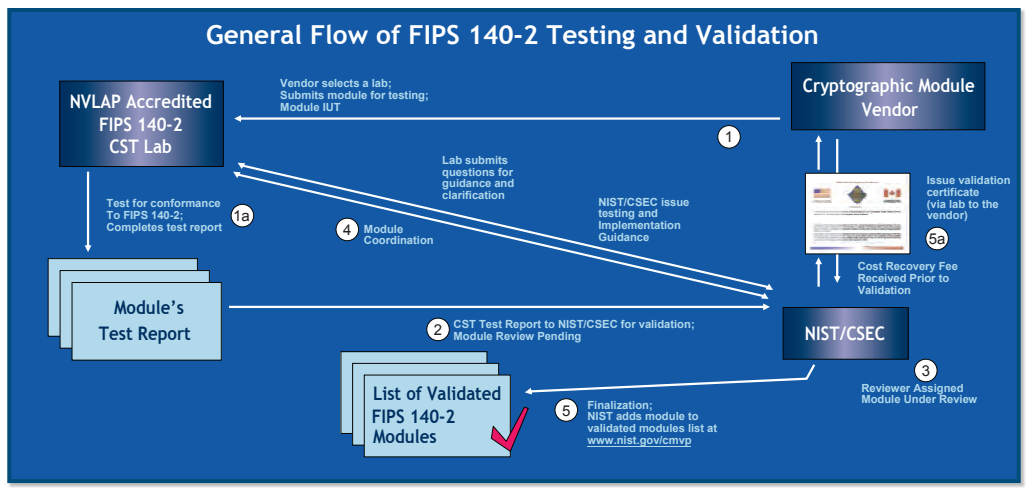
図16:FIPS 140-2 の試験と検証の大まかな流れ。青い背景の図で、表題は「General Flow of FIPS 140-2 Testing and Validation」である。右上に「暗号モジュールベンダー(Cryptographic Module Vendor)」、左上に「NVLAP認定のFIPS 140-2 CST試験所(NVLAP Accredited FIPS 140-2 CST Lab)」、右下に「NIST/CSEC」、左に文書「モジュール試験報告書(Module’s Test Report)」、下中央にチェックマーク付きの文書「検証済みFIPS 140-2モジュール一覧(List of Validated FIPS 140-2 Modules)」があり、ベンダーとNIST/CSECの間に検証証明書の小さな絵がある。番号付きの手順は次のとおり。(1) ベンダーから試験所への矢印、「ベンダーが試験所を選び、モジュールを試験に提出する。試験対象のモジュール(IUT)」。(1a) 試験所から試験報告書への矢印、「FIPS 140-2 への適合性を試験し、試験報告書を完成させる」。(2) 試験報告書からNIST/CSECへの矢印、「検証のためにCST試験報告書をNIST/CSECへ提出。モジュールの審査待ち」。(3) NIST/CSECで「審査者を割り当て、モジュールを審査中」。(4)「モジュールの調整」、試験所とNIST/CSECの間の双方向の矢印で、「試験所が手引きと明確化のための質問を提出する」「NIST/CSECが試験と実装のガイダンスを発行する」と記されている。(5) NIST/CSECから検証済みモジュール一覧への矢印、「完了。NISTがモジュールを www.nist.gov/cmvp の検証済みモジュール一覧に追加する」。(5a) NIST/CSEC、証明書、ベンダーの間の矢印で、「検証証明書を発行する(試験所経由でベンダーへ)」「検証前に費用回収の手数料を受領」と記されている。
Figure 16: General Flow of FIPS 140-2 Testing and Validation
図16:FIPS 140-2 の試験と検証の大まかな流れ
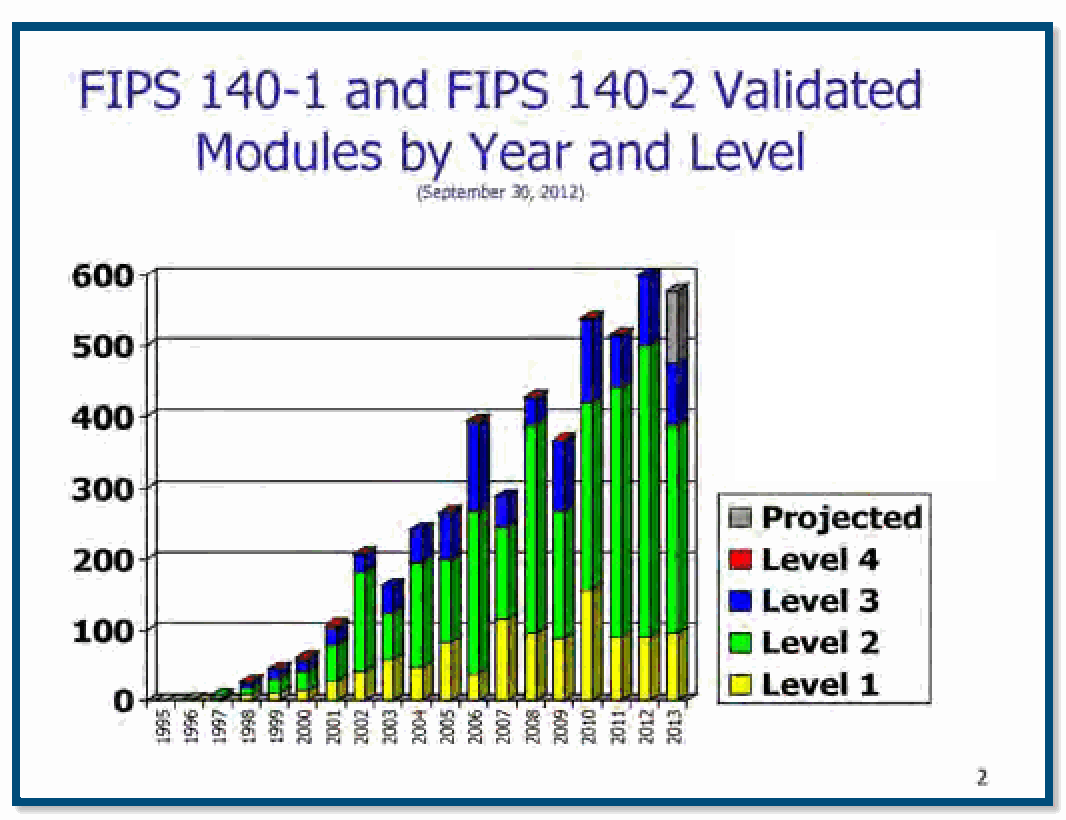
図17:年別・レベル別の FIPS 140-1 および FIPS 140-2 検証済みモジュール。枠で囲まれた積み上げ棒グラフで、表題は「FIPS 140-1 and FIPS 140-2 Validated Modules by Year and Level (September 30, 2012)」(2012年9月30日現在)である。横軸は1995年から2013年まで、縦軸は0から600まで100刻みである。各棒はレベル別に積み上げられ、凡例は Projected(見込み、灰)、Level 4(赤)、Level 3(青)、Level 2(緑)、Level 1(黄)である。棒は1995〜1997年のほぼ0から、2002年に約200、2006年に約390、2010年に約540、2012年に約600まで増え、2013年の棒は約575で、上部が見込み分である。(グラフ右側に印刷されている FIPS 140-2 Validated の認証マークは、このサイトでは掲載していない。)
Figure 17: FIPS 140-1 and FIPS 140-2 Validated Modules by Year and Level
図17:年別・レベル別の FIPS 140-1 および FIPS 140-2 検証済みモジュール
The unique position of the validation programs gives the CMVP the opportunity to acquire insight during the validation review activities and results in practical, timely, and up-to-date guidance that is needed by the testing laboratories and vendors to move their modules out to the user community in a timely and cost-effective manner and with the assurance of third-party conformance testing. This knowledge and insight provide a foundation for future standards development.
検証プログラムという独自の立場にあることで、CMVP は検証の審査活動の中で知見を得る機会を持つ。その結果、試験所とベンダーが、第三者による適合性試験の保証を伴って、モジュールを適時にかつ費用対効果の高い方法で利用者コミュニティに届けるために必要とする、実用的で時宜にかなった最新のガイダンスが生まれる。この知識と知見は、将来の標準策定の基礎となる。
The CAVP and the CMVP have stimulated improved quality and security assurance of cryptographic modules. The latest set of statistics, which are collected quarterly from each of the testing laboratories, shows that 7% of the cryptographic algorithms and 35% of the cryptographic modules brought in for voluntary testing had security flaws that were corrected during testing. To date, over 2,004 cryptographic module validation certificates have been issued, representing over 4,811 modules that were validated by the CMVP. These modules have been developed by more than 425 domestic and international vendors.
CAVP と CMVP は、暗号モジュールの品質とセキュリティ保証の向上を促してきました。各試験所から四半期ごとに収集している最新の統計によれば、任意の試験に持ち込まれた暗号アルゴリズムの7%と暗号モジュールの35%に、試験中に修正されたセキュリティ上の欠陥がありました。これまでに2,004を超える暗号モジュール検証証明書が発行されており、これは CMVP が検証した4,811を超えるモジュールに相当します。これらのモジュールは、国内外の425を超えるベンダーが開発したものです。
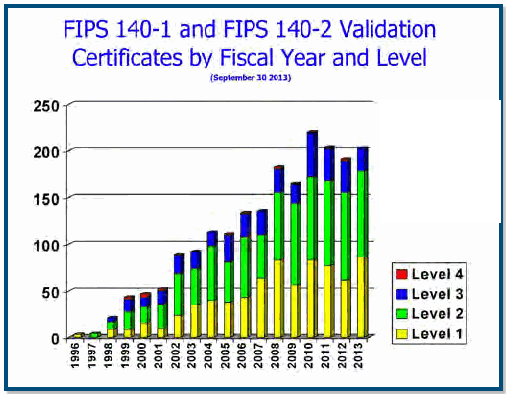
図18:会計年度別・レベル別の FIPS 140-1 および FIPS 140-2 検証証明書。枠で囲まれた積み上げ棒グラフで、表題は「FIPS 140-1 and FIPS 140-2 Validation Certificates by Fiscal Year and Level (September 30 2013)」(2013年9月30日現在)である。横軸は1996年から2013年まで、縦軸は0から250まで50刻みである。各棒はレベル別に積み上げられ、凡例は Level 4(赤)、Level 3(青)、Level 2(緑)、Level 1(黄)である。右上に「FIPS VALIDATED 140-2」のエンブレムがある。棒に数値は記されていない。(グラフ右側に印刷されている FIPS 140-2 Validated の認証マークは、このサイトでは掲載していない。)
Figure 18: FIPS 140-1 and FIPS 140-2 Validation Certificates by Fiscal Year and Level
図18:会計年度別・レベル別の FIPS 140-1 および FIPS 140-2 検証証明書
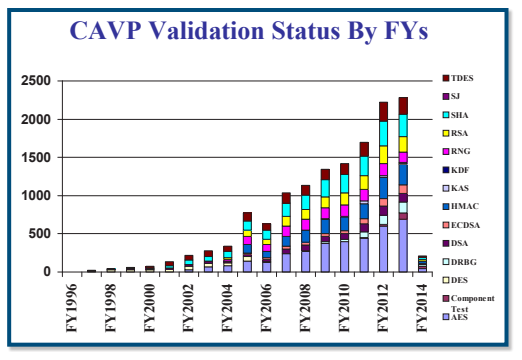
図19:会計年度別の CAVP 検証状況。枠で囲まれた積み上げ棒グラフで、表題は「CAVP Validation Status By FYs」である。横軸は FY1996 から FY2014 までの会計年度(1年おきに表記)、縦軸は0から2500まで500刻みである。各棒はアルゴリズム別に積み上げられ、凡例は TDES、SJ、SHA、RSA、RNG、KDF、KAS、HMAC、ECDSA、DSA、DRBG、DES、Component Test、AES である。棒は1990年代後半のほぼ0から、FY2012 と FY2013 の約2,200まで伸びている。FY2014 の棒は低い。棒に数値は記されていない。
Figure 19: CAVP Validation Status by FYs
図19:会計年度別の CAVP 検証状況
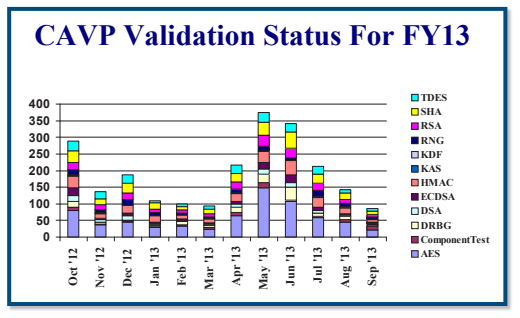
図20:2013会計年度の CAVP 検証状況。枠で囲まれた積み上げ棒グラフで、表題は「CAVP Validation Status For FY13」である。横軸は2012年10月(Oct '12)から2013年9月(Sep '13)までの各月、縦軸は0から400まで50刻みである。各棒はアルゴリズム別に積み上げられ、凡例は TDES、SHA、RSA、RNG、KDF、KAS、HMAC、ECDSA、DSA、DRBG、ComponentTest、AES である。最も高いのは2013年5月(約370)と6月(約340)の棒で、2013年2月、3月、9月の棒は100未満である。棒に数値は記されていない。
Figure 20: CAVP Validation Status for FY 2013
図20:2013会計年度の CAVP 検証状況
The CAVP issued 2,288 algorithm validations and the CMVP issued 191 module validation certificates in FY 2013. The number of algorithms and modules submitted for validation continues to grow, representing significant growth in the number of validations expected to be available in the future.
2013会計年度に、CAVP は2,288件のアルゴリズム検証を発行し、CMVP は191件のモジュール検証証明書を発行しました。検証のために提出されるアルゴリズムとモジュールの数は増え続けており、今後利用可能になると見込まれる検証の数が大きく伸びることを示しています。
http://csrc.nist.gov/groups/STM
http://csrc.nist.gov/groups/STM
Contacts:
連絡先:
CMVP Contact: Mr. Randall J. Easter, (301) 975-4641, randall.easter@nist.gov
CMVP Contact: Mr. Randall J. Easter, (301) 975-4641, randall.easter@nist.gov
CAVP Contact: Ms. Sharon Keller, (301) 975-2910, sharon.keller@nist.gov
CAVP Contact: Ms. Sharon Keller, (301) 975-2910, sharon.keller@nist.gov
Automated Security Testing and Test Suite Development
自動セキュリティ試験とテストスイートの開発
NIST’s CAVP utilizes the requirements and specifications of the algorithm FIPS and Special Publications (SPs) written by the Cryptography Technology Group (CTG) to develop algorithm test suites and automated security testing. The CAVP is responsible for providing assurance that the algorithms contained in modules are implemented correctly. The CAVP does this by designing and developing conformance testing for implementations of these algorithms.
NIST の CAVP は、Cryptography Technology Group (CTG) が作成したアルゴリズムの FIPS および Special Publications (SPs) の要件と仕様を利用して、アルゴリズムのテストスイートと自動セキュリティ試験を開発します。CAVP は、モジュールに含まれるアルゴリズムが正しく実装されていることの保証を提供する責任を負います。CAVP は、これらのアルゴリズムの実装に対する適合性試験を設計し開発することで、これを行います。
| FiscalYear | AES | Comp. | DES | DSA | DRBG | ECDSA | HMAC | KAS | KDF | RNG | RSA | SHA | SJ | TDES | Total |
|---|---|---|---|---|---|---|---|---|---|---|---|---|---|---|---|
| FY1996 | 0 | 0 | 2 | 0 | 0 | 0 | 0 | 0 | 0 | 0 | 0 | 0 | 0 | 0 | 2 |
| FY1997 | 0 | 0 | 11 | 6 | 0 | 0 | 0 | 0 | 0 | 0 | 0 | 7 | 2 | 0 | 26 |
| FY1998 | 0 | 0 | 27 | 9 | 0 | 0 | 0 | 0 | 0 | 0 | 0 | 6 | 0 | 0 | 42 |
| FY1999 | 0 | 0 | 30 | 14 | 0 | 0 | 0 | 0 | 0 | 0 | 0 | 12 | 1 | 0 | 57 |
| FY2000 | 0 | 0 | 29 | 7 | 0 | 0 | 0 | 0 | 0 | 0 | 0 | 12 | 1 | 28 | 77 |
| FY2001 | 0 | 0 | 41 | 15 | 0 | 0 | 0 | 0 | 0 | 0 | 0 | 28 | 0 | 51 | 135 |
| FY2002 | 30 | 0 | 44 | 21 | 0 | 0 | 0 | 0 | 0 | 0 | 0 | 59 | 6 | 58 | 218 |
| FY2003 | 66 | 0 | 49 | 24 | 0 | 0 | 0 | 0 | 0 | 0 | 0 | 63 | 3 | 73 | 278 |
| FY2004 | 82 | 0 | 41 | 17 | 0 | 0 | 0 | 0 | 0 | 28 | 22 | 77 | 0 | 70 | 337 |
| FY2005 | 145 | 0 | 54 | 31 | 0 | 14 | 115 | 0 | 0 | 108 | 80 | 122 | 2 | 102 | 773 |
| FY2006 | 131 | 0 | 3 | 33 | 0 | 19 | 87 | 0 | 0 | 91 | 63 | 120 | 1 | 83 | 631 |
| FY2007 | 238 | 0 | 0 | 63 | 0 | 35 | 127 | 0 | 0 | 137 | 130 | 171 | 1 | 136 | 1038 |
| FY2008 | 271 | 0 | 0 | 77 | 4 | 41 | 158 | 0 | 0 | 137 | 129 | 191 | 0 | 122 | 1130 |
| FY2009 | 373 | 0 | 0 | 71 | 23 | 33 | 193 | 6 | 0 | 142 | 143 | 224 | 1 | 138 | 1347 |
| FY2010 | 399 | 0 | 0 | 70 | 31 | 39 | 179 | 12 | 0 | 150 | 155 | 239 | 0 | 142 | 1416 |
| FY2011 | 440 | 7 | 0 | 102 | 79 | 68 | 201 | 34 | 0 | 148 | 183 | 255 | 0 | 177 | 1694 |
| FY2012 | 599 | 24 | 0 | 121 | 122 | 92 | 283 | 20 | 3 | 157 | 231 | 323 | 1 | 248 | 2224 |
| FY2013 | 689 | 85 | 0 | 106 | 145 | 113 | 276 | 12 | 9 | 132 | 208 | 293 | 0 | 217 | 2285 |
| FY2014 | 48 | 28 | 0 | 9 | 22 | 6 | 26 | 0 | 1 | 2 | 22 | 30 | 0 | 17 | 211 |
| 会計年度 | AES | Comp. | DES | DSA | DRBG | ECDSA | HMAC | KAS | KDF | RNG | RSA | SHA | SJ | TDES | 合計 |
|---|---|---|---|---|---|---|---|---|---|---|---|---|---|---|---|
| FY1996 | 0 | 0 | 2 | 0 | 0 | 0 | 0 | 0 | 0 | 0 | 0 | 0 | 0 | 0 | 2 |
| FY1997 | 0 | 0 | 11 | 6 | 0 | 0 | 0 | 0 | 0 | 0 | 0 | 7 | 2 | 0 | 26 |
| FY1998 | 0 | 0 | 27 | 9 | 0 | 0 | 0 | 0 | 0 | 0 | 0 | 6 | 0 | 0 | 42 |
| FY1999 | 0 | 0 | 30 | 14 | 0 | 0 | 0 | 0 | 0 | 0 | 0 | 12 | 1 | 0 | 57 |
| FY2000 | 0 | 0 | 29 | 7 | 0 | 0 | 0 | 0 | 0 | 0 | 0 | 12 | 1 | 28 | 77 |
| FY2001 | 0 | 0 | 41 | 15 | 0 | 0 | 0 | 0 | 0 | 0 | 0 | 28 | 0 | 51 | 135 |
| FY2002 | 30 | 0 | 44 | 21 | 0 | 0 | 0 | 0 | 0 | 0 | 0 | 59 | 6 | 58 | 218 |
| FY2003 | 66 | 0 | 49 | 24 | 0 | 0 | 0 | 0 | 0 | 0 | 0 | 63 | 3 | 73 | 278 |
| FY2004 | 82 | 0 | 41 | 17 | 0 | 0 | 0 | 0 | 0 | 28 | 22 | 77 | 0 | 70 | 337 |
| FY2005 | 145 | 0 | 54 | 31 | 0 | 14 | 115 | 0 | 0 | 108 | 80 | 122 | 2 | 102 | 773 |
| FY2006 | 131 | 0 | 3 | 33 | 0 | 19 | 87 | 0 | 0 | 91 | 63 | 120 | 1 | 83 | 631 |
| FY2007 | 238 | 0 | 0 | 63 | 0 | 35 | 127 | 0 | 0 | 137 | 130 | 171 | 1 | 136 | 1038 |
| FY2008 | 271 | 0 | 0 | 77 | 4 | 41 | 158 | 0 | 0 | 137 | 129 | 191 | 0 | 122 | 1130 |
| FY2009 | 373 | 0 | 0 | 71 | 23 | 33 | 193 | 6 | 0 | 142 | 143 | 224 | 1 | 138 | 1347 |
| FY2010 | 399 | 0 | 0 | 70 | 31 | 39 | 179 | 12 | 0 | 150 | 155 | 239 | 0 | 142 | 1416 |
| FY2011 | 440 | 7 | 0 | 102 | 79 | 68 | 201 | 34 | 0 | 148 | 183 | 255 | 0 | 177 | 1694 |
| FY2012 | 599 | 24 | 0 | 121 | 122 | 92 | 283 | 20 | 3 | 157 | 231 | 323 | 1 | 248 | 2224 |
| FY2013 | 689 | 85 | 0 | 106 | 145 | 113 | 276 | 12 | 9 | 132 | 208 | 293 | 0 | 217 | 2285 |
| FY2014 | 48 | 28 | 0 | 9 | 22 | 6 | 26 | 0 | 1 | 2 | 22 | 30 | 0 | 17 | 211 |
Figure 21: CAVP Validated Implementation Actual Numbers
図21:CAVP 検証済み実装の実数
The conformance tests consist of a suite of validation tests for each approved cryptographic algorithm. These tests exercise the mathematical formulas and the algorithmic requirements detailed in the algorithm to assure that the detailed specifications are implemented correctly and completely. If the implementer deviates from or excludes any part of these instructions or requirements, the validation test will fail, indicating that the algorithm implementation does not function properly or is incomplete.
適合性試験は、承認された暗号アルゴリズムごとの一連の検証試験からなります。これらの試験は、アルゴリズムに詳述された数式とアルゴリズム上の要件を実際に動かし、詳細な仕様が正しくかつ完全に実装されていることを保証します。実装者がこれらの指示や要件のいずれかの部分から逸脱するか、それを除外すると、検証試験は不合格となり、そのアルゴリズム実装が正しく機能していないか、不完全であることが示されます。
| Cryptographic Algorithm/Component | Special Publication or FIPS |
|---|---|
| Triple Data Encryption Standard (TDES) | SP 800-67, Recommendation for the Triple Data Encryption Algorithm (TDEA) Block Cipher, and SP 800-38A, Recommendation for Block Cipher Modes of Operation– Methods and Techniques |
| Advanced Encryption Standard (AES) | FIPS 197, Advanced Encryption Standard, and SP 800-38A |
| Digital Signature Standard (DSS) | FIPS 186-2, Digital Signature Standard (DSS), with change notice 1, dated October 5, 2001 |
| FIPS 186-4, Digital Signature Standard (DSS), dated July 2013 | |
| Elliptic Curve Digital Signature Algorithm (ECDSA) | FIPS 186-2, Digital Signature Standard (DSS), with change notice 1, dated October 5, 2001 and ANSI X9.62 |
| FIPS 186-4, Digital Signature Standard (DSS), dated July 2013 and ANSI X9.62 | |
| RSA algorithm | ANSI X9.31 and Public Key Cryptography Standards (PKCS) #1 v2.1: RSA Cryptography Standard-2002 |
| FIPS 186-4, Digital Signature Standard (DSS), dated July 2013 and ANSI X9.31 and Public Key Cryptography Standards (PKCS) #1 v2.1: RSA Cryptography Standard-2002 | |
| Hashing algorithms SHA-1, SHA-224, SHA-256, SHA-384, SHA-512, SHA-512/224, SHA-512/256 | FIPS 180-4, Secure Hash Standard (SHS), dated March 2012 |
| Random number generator (RNG) algorithms | FIPS 186-2 Appendix 3.1 and 3.2; ANSI X9.62 Appendix A.4 |
| Deterministic Random Bit Generators (DRBG) | SP 800-90A, Recommendation for Random Number Generation Using Deterministic Random Bit Generators |
| Keyed-Hash Message Authentication Code (HMAC) | FIPS 198-1, The Keyed-Hash Message Authentication Code (HMAC) |
| Counter with Cipher Block Chaining-Message Authentication Code (CCM) mode | SP 800-38C, Recommendation for Block Cipher Modes of Operation: the CCM Mode for Authentication and Confidentiality |
| Cipher-based Message Authentication Code (CMAC) Mode for Authentication | SP 800-38B, Recommendation for Block Cipher Modes of Operation: The CMAC Mode for Authentication |
| 暗号アルゴリズム/コンポーネント | Special PublicationまたはFIPS |
|---|---|
| トリプルデータ暗号化標準(TDES) | SP 800-67「Triple Data Encryption Algorithm(TDEA)ブロック暗号に関する勧告」およびSP 800-38A「ブロック暗号動作モードに関する勧告:方法と技法」 |
| Advanced Encryption Standard(AES) | FIPS 197「Advanced Encryption Standard」およびSP 800-38A |
| Digital Signature Standard(DSS) | FIPS 186-2「Digital Signature Standard(DSS)」変更通知1(2001年10月5日付) |
| FIPS 186-4「Digital Signature Standard(DSS)」(2013年7月付) | |
| 楕円曲線デジタル署名アルゴリズム(ECDSA) | FIPS 186-2「Digital Signature Standard(DSS)」変更通知1(2001年10月5日付)およびANSI X9.62 |
| FIPS 186-4「Digital Signature Standard(DSS)」(2013年7月付)およびANSI X9.62 | |
| RSAアルゴリズム | ANSI X9.31およびPublic Key Cryptography Standards(PKCS)#1 v2.1: RSA Cryptography Standard-2002 |
| FIPS 186-4「Digital Signature Standard(DSS)」(2013年7月付)、ANSI X9.31、およびPublic Key Cryptography Standards(PKCS)#1 v2.1: RSA Cryptography Standard-2002 | |
| ハッシュアルゴリズム SHA-1、SHA-224、SHA-256、SHA-384、SHA-512、SHA-512/ | FIPS 180-4「Secure Hash Standard(SHS)」(2012年3月付) |
| 乱数生成器(RNG)アルゴリズム | FIPS 186-2 付録3.1および3.2;ANSI X9.62 付録A.4 |
| 決定論的乱数ビット生成器(DRBG) | SP 800-90A「決定論的乱数ビット生成器を用いた乱数生成に関する勧告」 |
| 鍵付きハッシュメッセージ認証コード(HMAC) | FIPS 198-1「The Keyed-Hash Message Authentication Code(HMAC)」 |
| Counter with Cipher Block Chaining-Message Authentication Code(CCM)モード | SP 800-38C「ブロック暗号動作モードに関する勧告:認証と機密性のためのCCMモード」 |
| 暗号ベースメッセージ認証コード(CMAC)認証モード | SP 800-38B「ブロック暗号動作モードに関する勧告:認証のためのCMACモード」 |
CAVP-developed validation tests are performed by accredited testing laboratories on a vendor’s algorithm implementation using automated known-answer tests, which compare the result from a cryptographic operation with a specific input against the expected result. They provide a uniform way to assure that the cryptographic algorithm implementation adheres to the detailed specifications.
CAVP が開発した検証試験は、認定試験所がベンダーのアルゴリズム実装に対して、自動化された既知解試験を用いて実施します。この試験は、特定の入力に対する暗号演算の結果を、期待される結果と比較します。これらの試験は、暗号アルゴリズムの実装が詳細な仕様に従っていることを保証する統一的な方法を提供します。
There are several types of validation tests, all designed to satisfy the testing requirements of the cryptographic algorithms and their specifications. These include, but are not limited to, Known-Answer Tests, Monte Carlo Tests, and Multi-Block Message Tests. The Known-Answer Tests are designed to examine the individual components of the algorithm by supplying known values to the variables and verifying the expected result. The Monte Carlo Test is designed to exercise the entire IUT. This test is designed to detect the presence of implementation flaws that are not detected with the controlled input of the Known-Answer Tests. The types of implementation flaws detected by this validation test include pointer problems, insufficient allocation of space, improper error handling, and incorrect behavior of the IUT. The Multi-Block Message Test (MMT) is designed to test the ability of the implementation to process multi-block messages, which require the chaining of information from one block to the next.
検証試験にはいくつかの種類があり、いずれも暗号アルゴリズムとその仕様の試験要件を満たすように設計されています。これには、Known-Answer Tests、Monte Carlo Tests、Multi-Block Message Tests などがありますが、これらに限りません。Known-Answer Tests は、変数に既知の値を与えて期待される結果を検証することで、アルゴリズムの個々の構成要素を調べるように設計されています。Monte Carlo Test は、IUT 全体を動かすように設計されています。この試験は、Known-Answer Tests の統制された入力では検出されない実装上の欠陥の存在を検出するように設計されています。この検証試験で検出される実装上の欠陥の種類には、ポインターの問題、領域の割当て不足、不適切なエラー処理、IUT の誤った動作が含まれます。Multi-Block Message Test (MMT) は、あるブロックから次のブロックへ情報を連鎖させる必要がある複数ブロックのメッセージを、実装が処理できるかを試験するように設計されています。
During the last few years, CSD has expanded its publications beyond only an algorithm’s specification into how an algorithm should be used. Many of these requirements are outside the scope of the algorithm boundary and therefore cannot be tested at the algorithm level by the CAVP. Some of the requirements are within the scope of the CMVP while others are outside the scope of both the CAVP and the CMVP. In the case where the requirement is outside the scope of the CAVP and the CMVP, the fulfillment of the requirements is the responsibility of entities using, installing, or configuring applications or protocols that use the cryptographic algorithms. For example, depending on the design of a cryptographic module, it may not be possible for the module to determine whether a specific key is used for multiple purposes, a situation that is strongly discouraged.
ここ数年、CSD は刊行物の対象を、アルゴリズムの仕様だけから、アルゴリズムをどのように使うべきかにまで広げてきました。これらの要件の多くはアルゴリズム境界の範囲外にあるため、CAVP がアルゴリズムのレベルで試験することはできません。要件の一部は CMVP の範囲内にありますが、CAVP と CMVP のどちらの範囲にも入らないものもあります。要件が CAVP と CMVP の範囲外にある場合、その要件を満たすことは、暗号アルゴリズムを使うアプリケーションやプロトコルを使用、導入または設定する主体の責任です。例えば、暗号モジュールの設計によっては、特定の鍵が複数の目的に使われているかどうかをモジュールが判断できないことがあります。鍵を複数の目的に使うことは、強く非推奨とされている状況です。
The CAVP currently has algorithm validation testing for the following cryptographic algorithms:
CAVP は現在、次の暗号アルゴリズムについてアルゴリズム検証試験を用意しています。
In FY 2014, the CAVP expects to add algorithm validation testing for:
2014会計年度に、CAVPは次のものについてアルゴリズム検証試験を追加する予定です。
| Galois/Counter Mode (GCM) GMAC Mode of Operation | SP 800-38D, Recommendation for Block Cipher Modes of Operation: Galois/Counter Mode (GCM) and GMAC, dated November 2007 |
| XTS Mode of Operation | SP800-38E, Recommendation for Block Cipher Modes of Operation: The XTS-AES Mode for Confidentiality on Block-Oriented Storage Devices, dated January 2010 |
| Key Agreement Schemes and Key Confirmation | SP 800-56A, Recommendation for Pair-Wise Key Establishment Schemes Using Discrete Logarithm Cryptography, dated March 2007 |
| All of SP 800-56A except KDF | SP 800-56A All sections except Section 5.8 Key Derivation Functions for Key Agreement Schemes |
| SP 800-56A Section 5.7.1.2 ECC CDH function | SP 800-56A Section 5.7.1.2 Elliptic Curve Cryptography Cofactor Diffie-Hellman (ECC CDH) Primitive Testing |
| Key-Based Key Derivation functions (KBKDF) | SP 800-108, Recommendation for Key Derivation using Pseudorandom Functions, dated October 2009 |
| Application-Specific Key Derivation functions (ASKDF) (includes KDFs used by IKEv1, IKEv2, TLS, ANS X9.63-2001, SSH, SRTP, SNMP, and TPM) | SP 800-135 (Revision 1) Recommendation for Existing Application Specific key Derivation Functions, dated December 2011 |
| Component test – ECDSA Signature Generation of hash value (This component test verifies the signing of a hash-sized input. It does not verify the hashing of the original message to be signed.) | FIPS 186-4, Digital Signature Standard (DSS), dated July 2013 and ANSI X9.62 |
| Component test – RSA PKCS#1 1.5 Signature Generation of encoded message EM (This component test verifies the signing of an EM. It does not verify the formatting of the EM.) | FIPS 186-4, Digital Signature Standard (DSS), dated July 2013 and Public Key Cryptography Standards (PKCS) #1 v2.1: RSA Cryptography Standard-2002 |
| Component test – RSA PKCS#1 PSS Signature Generation of encoded message EM (This component test verifies the RSASP1 function.) | SP 800-56B, Recommendation for Pair-Wise Key Establishment Schemes Using Integer Factorization Cryptography, August 2009, Section 7.1.2 |
| Galois/Counter Mode(GCM)GMAC動作モード | SP 800-38D, Recommendation for Block Cipher Modes of Operation: Galois/Counter Mode (GCM) and GMAC, dated November 2007 |
| XTS動作モード | SP800-38E, Recommendation for Block Cipher Modes of Operation: The XTS-AES Mode for Confidentiality on Block-Oriented Storage Devices, dated January 2010 |
| 鍵合意方式および鍵確認 | SP 800-56A, Recommendation for Pair-Wise Key Establishment Schemes Using Discrete Logarithm Cryptography, dated March 2007 |
| KDFを除くSP 800-56Aのすべて | SP 800-56A All sections except Section 5.8 Key Derivation Functions for Key Agreement Schemes |
| SP 800-56A 第5.7.1.2節 ECC CDH関数 | SP 800-56A Section 5.7.1.2 Elliptic Curve Cryptography Cofactor Diffie-Hellman (ECC CDH) Primitive Testing |
| 鍵ベース鍵導出関数(KBKDF) | SP 800-108, Recommendation for Key Derivation using Pseudorandom Functions, dated October 2009 |
| アプリケーション固有鍵導出関数(ASKDF)(IKEv1、IKEv2、TLS、ANS X9 | SP 800-135 (Revision 1) Recommendation for Existing Application Specific key Derivation Functions, dated December 2011 |
| コンポーネントテスト – ハッシュ値のECDSA署名生成(このコンポーネントテストは、ハッシュサイズの入力への署名を検証します。署名対象の元のメッセージのハッシュ化は検証しません。) | FIPS 186-4, Digital Signature Standard (DSS), dated July 2013 and ANSI X9.62 |
| コンポーネントテスト – エンコード済みメッセージEMのRSA PKCS#1 1 | FIPS 186-4, Digital Signature Standard (DSS), dated July 2013 and Public Key Cryptography Standards (PKCS) #1 v2.1: RSA Cryptography Standard-2002 |
| コンポーネントテスト – エンコード済みメッセージEMのRSA PKCS#1 PSS署名生成(このコンポーネントテストは、RSASP1関数を検証します。) | SP 800-56B, Recommendation for Pair-Wise Key Establishment Schemes Using Integer Factorization Cryptography, August 2009, Section 7.1.2 |
•SP 800-56C, Recommendation for Key Derivation through Extraction-then-Expansion, November 2011
•SP 800-56C, Recommendation for Key Derivation through Extraction-then-Expansion、2011年11月
•SP 800-132, Recommendation for Password-Based Key Derivation Part 1: Storage Applications, December 2010
•SP 800-132, Recommendation for Password-Based Key Derivation Part 1: Storage Applications、2010年12月
•SP 800-38F, Recommendation for Block Cipher Modes of Operation: Methods for Key Wrapping, December 2012
•SP 800-38F, Recommendation for Block Cipher Modes of Operation: Methods for Key Wrapping、2012年12月
•SP 800-56A Revision 2, Recommendation for Pair-Wise Key Establishment Schemes Using Discrete Logarithm Cryptography, May 2013
•SP 800-56A Revision 2, Recommendation for Pair-Wise Key Establishment Schemes Using Discrete Logarithm Cryptography、2013年5月
http://csrc.nist.gov/groups/STM/cavp
http://csrc.nist.gov/groups/STM/cavp
Contacts:
連絡先:
Ms. Sharon Keller, (301) 975-2910, sharon.keller@nist.gov
Ms. Sharon Keller, (301) 975-2910, sharon.keller@nist.gov
Ms. Elaine Barker, (301) 975-2911, elaine.barker@nist.gov
Ms. Elaine Barker, (301) 975-2911, elaine.barker@nist.gov
ISO Standardization of Security Requirements for Cryptographic Modules
暗号モジュールのセキュリティ要求事項のISO標準化
CSD has contributed to the activities of the International Organization for Standardization/International Electrotechnical Commission (ISO/IEC), which issued ISO/IEC 19790, Security Requirements for Cryptographic Modules, on March 1, 2006, and ISO/IEC 24759, Test Requirements for Cryptographic Modules, on July 1, 2008. These efforts bring consistent testing of cryptographic modules to the global community.
CSDは、国際標準化機構/国際電気標準会議(ISO/IEC)の活動に貢献してきました。ISO/IECは、2006年3月1日にISO/IEC 19790, Security Requirements for Cryptographic Modulesを、2008年7月1日にISO/IEC 24759, Test Requirements for Cryptographic Modulesを発行しました。これらの取り組みは、暗号モジュールの一貫した試験を国際社会にもたらします。
ISO/IEC JTC 1/SC 27 WG 3 completed and published the revisions of both ISO/IEC 19790 and ISO/IEC 24759, for which Randall J. Easter of CSD is the editor. The revision of ISO/IEC 19790 was published August 15, 2012. ISO/IEC 19790:2012 was also adopted by the American National Standards Institute (ANSI). The revision of ISO/IEC 24759 was published January 31, 2014.
ISO/IEC JTC 1/SC 27 WG 3は、ISO/IEC 19790及びISO/IEC 24759の両方の改訂を完了し、発行しました。その編集者はCSDのRandall J. Easterです。ISO/IEC 19790の改訂版は2012年8月15日に発行されました。ISO/IEC 19790:2012は、米国国家規格協会(ANSI)にも採用されました。ISO/IEC 24759の改訂版は2014年1月31日に発行されました。
CSD’s Randall J. Easter is the editor for three ISO/IEC documents. Work is nearing completion on the Technical Report document, ISO/IEC 30104 “Physical Security Attacks, Mitigation Techniques and Security Requirements.” A final draft of ISO/IEC 30104 was completed in December 2013 and circulated for national body comment.
CSDのRandall J. Easterは、三つのISO/IEC文書の編集者です。技術報告書であるISO/IEC 30104 “Physical Security Attacks, Mitigation Techniques and Security Requirements”の作業は、完了に近づいています。ISO/IEC 30104の最終草案は2013年12月に完成し、各国代表団体の意見を求めるために回付されました。
Work is progressing on ISO/IEC 17825 “Testing methods for the mitigation of non-invasive attack classes against cryptographic modules.” The first committee draft of ISO/IEC 17825 was completed in December 2013 and circulated for national body comment.
ISO/IEC 17825 “Testing methods for the mitigation of non-invasive attack classes against cryptographic modules”の作業は進行中です。ISO/IEC 17825の最初の委員会草案は2013年12月に完成し、各国代表団体の意見を求めるために回付されました。
Work is progressing on a new standard document, ISO/IEC 18367 “Cryptographic algorithms and security mechanisms conformance testing.” The third working draft of ISO/IEC 18367 was completed in December 2013 and circulated for national body comment.
新しい標準文書 ISO/IEC 18367 “Cryptographic algorithms and security mechanisms conformance testing.” の作業が進んでいます。ISO/IEC 18367 の第3次作業草案は2013年12月に完成し、各国代表団体の意見を求めるために回付されました。
National body comments for the above four documents will be addressed at the 47th SC 27 WG 3 meeting to be held in Incheon, Korea, in October 2013.
上記の4つの文書に対する各国代表団体の意見は、2013年10月に韓国の仁川で開催される第47回 SC 27 WG 3 会合で取り扱われます。
CSD’s contributions to the development of these international standards create a strong foundation for the adoption of and migration from currently used national standards. In particular, this adoption will promote the international harmonization for the implementation and testing of cryptographic algorithms and modules while accommodating individual country preferences in the choice of approved security functions.
これらの国際標準の策定に対する CSD の貢献は、現在使われている国内標準からの移行と国際標準の採用のための強固な基礎を築きます。特に、この採用は、承認されたセキュリティ機能の選択における各国の意向を受け入れつつ、暗号アルゴリズムおよび暗号モジュールの実装と試験の国際的な整合を促進します。
http://csrc.nist.gov/groups/STM/cmvp/
http://csrc.nist.gov/groups/STM/cmvp/
Contact:
連絡先:
Mr. Randall J. Easter, (301) 975-4641, randall.easter@nist.gov
Mr. Randall J. Easter, (301) 975-4641, randall.easter@nist.gov
Cryptographic System Validation
暗号システムの検証
Current validation programs focus on providing a known level of assurance for cryptographic algorithms and modules. These are used within the context of a larger system to provide cryptographic services as a method of protecting the data within the system. As information systems continue to become more complex, the methods used to implement cryptographic services have also increased in complexity. Problems with the use of cryptography are often introduced through the interaction of cryptographic components with the operating environment. This program seeks to specify how cryptographic components are used as part of a defined cryptographic system to solve problems with a measureable level of assurance, and to introduce automated methods of quantifying the level of assurance.
現行の検証プログラムは、暗号アルゴリズムと暗号モジュールについて既知の保証レベルを提供することに重点を置いています。これらのアルゴリズムとモジュールは、より大きなシステムの中で、システム内のデータを保護する手段として暗号サービスを提供するために使われます。情報システムが複雑になり続けるのに伴い、暗号サービスの実装に使われる方法も複雑さを増しています。暗号の利用に関する問題は、暗号コンポーネントと運用環境との相互作用を通じて持ち込まれることが多くあります。このプログラムは、定義された暗号システムの一部として暗号コンポーネントがどのように使われるかを規定し、測定可能な保証レベルで問題を解決すること、および保証レベルを定量化する自動化された方法を導入することを目指します。
This program will begin the research required to define a reference cryptographic systems architecture and example use cases where cryptographic systems are built from known cryptographic components that cooperate through trust relationships to provide a measureable level of assurance. The architecture should begin at the lowest level with a hardware based root of trust, and each cryptographic component should be added in successive layers to provide assurance in a systematic way. This should allow the development of tests that would measure the correct implementation of cryptographic components as part of a larger system.
このプログラムでは、参照となる暗号システムアーキテクチャと、ユースケースの例を定義するのに必要な研究を開始します。そのユースケースでは、信頼関係を通じて協調する既知の暗号コンポーネントから暗号システムを構築し、測定可能な保証レベルを提供します。このアーキテクチャは、最下層でハードウェアに基づく信頼の基点から始まるべきであり、各暗号コンポーネントは、体系的な方法で保証を提供するように、層を順次重ねる形で追加されるべきです。これにより、より大きなシステムの一部としての暗号コンポーネントが正しく実装されていることを測定する試験を開発できるようになるはずです。
This program will perform research and experimentation in applicable technologies and techniques that will enable the efficient testing of the cryptographic capabilities of each layer, and continuous monitoring capabilities of each cryptographic component, providing the necessary interfaces to establish trust relationships with other cryptographic components. Techniques could include such items as:
このプログラムでは、各層の暗号機能の効率的な試験と、各暗号コンポーネントの継続的監視機能を可能にし、他の暗号コンポーネントとの信頼関係を確立するのに必要なインターフェースを提供する、適用可能な技術と手法について研究と実験を行います。手法には、次のようなものが含まれうます。
•Embedding SCAP like data elements and standard interfaces to query those data elements during design and implementation of cryptographic components that would enable automated testing capabilities;
•暗号コンポーネントの設計および実装の段階で、SCAP に類似したデータ要素と、それらのデータ要素を照会するための標準インターフェースを組み込み、自動試験機能を可能にすること
•Using cryptographic techniques to embed values into the module that would increase the verifiability and assurance that the module provides; and
•暗号技術を用いてモジュールに値を埋め込み、検証可能性と、モジュールが提供する保証を高めること
•Using industry-based secure development techniques to increase the level of trust inherent in software modules starting with design and implementation.
•産業界に基礎を置くセキュア開発手法を用いて、設計と実装の段階から、ソフトウェアモジュールに本来備わる信頼のレベルを高めること
Research into this area of cryptographic system validation holds the promise of automating the validation of all cryptographic components, providing a higher assurance with less manual effort by using SCAP-based ideas to embed data elements that instrument the test harnesses used to validate cryptographic systems. This would also provide the instrumentation that could be leveraged to enable a greater level of situational awareness and security measurement, and potentially to enable continuous monitoring of cryptographic systems.
暗号システム検証というこの分野の研究は、SCAP に基づく考え方を用いて、暗号システムの検証に使うテストハーネスを計装するデータ要素を埋め込むことで、すべての暗号コンポーネントの検証を自動化し、より少ない手作業でより高い保証を提供できる見込みがあります。これはまた、より高い水準の状況認識とセキュリティ測定を可能にし、さらには暗号システムの継続的監視を可能にするために活用できる計装をも提供します。
Contact:
連絡先:
Mr. Michael Cooper, (301) 975-8077, michael.cooper@nist.gov
Mr. Michael Cooper, (301) 975-8077, michael.cooper@nist.gov
Technical Security Metrics
技術的セキュリティ指標
Security Risk Analysis of Enterprise Networks Using Attack Graphs
攻撃グラフを用いた企業ネットワークのセキュリティリスク分析
Protection of computer networks from malicious intrusions is critical to the economy and security of the nation. Vulnerabilities are regularly discovered in software applications, which are exploited to stage cyber attacks. System administrators need objective metrics to guide and justify decision making as they manage the security risk of enterprise networks. The objective of this research is to develop a standard model for security risk analysis of computer networks. A standard model will enable us to answer questions such as “Are we more secure now than yesterday?” or “How does the security of one network configuration compare with another one?” Also, having a standard model to measure network security will allow users, vendors, and researchers to evaluate methodologies and products for network security in a coherent and consistent manner.
悪意のある侵入からコンピュータネットワークを保護することは、国の経済と安全保障にとって極めて重要です。ソフトウェアアプリケーションには脆弱性が日常的に発見されており、それらはサイバー攻撃を仕掛けるために悪用されます。システム管理者は、エンタープライズネットワークのセキュリティリスクを管理するにあたり、意思決定の指針となり、その根拠となる客観的なメトリクスを必要としています。本研究の目的は、コンピュータネットワークのセキュリティリスク分析のための標準モデルを開発することです。標準モデルがあれば、「我々は昨日よりも安全になっているか」や「あるネットワーク構成のセキュリティは別の構成と比べてどうか」といった問いに答えられるようになります。また、ネットワークセキュリティを測定する標準モデルがあれば、利用者、ベンダー及び研究者は、ネットワークセキュリティのための方法論や製品を、筋の通った一貫したやり方で評価できるようになります。
CSD has approached the challenge of network security analysis by capturing vulnerability interdependencies and measuring security based on how real attackers have penetrated networks. CSD’s methodology for security risk analysis is based on attack graphs. CSD analyzes attack paths through a network, providing a probabilistic metric of the overall system risk. Through this metric, CSD analyzes trade-offs between security costs and security benefits.
CSDは、脆弱性間の相互依存関係を捉え、実際の攻撃者がネットワークにどのように侵入してきたかに基づいてセキュリティを測定することにより、ネットワークセキュリティ分析という課題に取り組んできました。CSDのセキュリティリスク分析の方法論は、攻撃グラフに基づいています。CSDはネットワークを通る攻撃経路を分析し、システム全体のリスクについての確率的なメトリクスを提供します。このメトリクスを通じて、CSDはセキュリティのコストとセキュリティの便益との間のトレードオフを分析します。
Computer systems are vulnerable to both known and zero day attacks. Handling zero day vulnerabilities is inherently difficult due to their unpredictable nature. In FY 2013, CSD attempted to assess the risk of unknown attack patterns. CSD developed a new model “k-zero day safety” for zero day attacks. Existing algorithms for computing this metric are not scalable as they assume that a complete zero day attack graph has been generated. CSD has proposed a set of polynomial time algorithms for estimating k-zero day safety. CSD has authored a paper, “An Efficient Approach to Assessing the Risk of Zero-Day Vulnerabilities,” that received the Best Paper Award at the tenth International Conference on Security and Cryptography (SECRYPT 2013), in Reykjavik, Iceland.
コンピュータシステムは、既知の攻撃とゼロデイ攻撃の両方に対して脆弱です。ゼロデイ脆弱性は予測不可能な性質をもつため、その取扱いは本質的に困難です。2013会計年度に、CSDは未知の攻撃パターンのリスクの評価を試みました。CSDは、ゼロデイ攻撃のための新しいモデル「k-zero day safety」を開発しました。このメトリクスを計算する既存のアルゴリズムは、完全なゼロデイ攻撃グラフが生成済みであることを前提としているため、スケーラブルではありません。CSDは、k-zero day safetyを推定するための一連の多項式時間アルゴリズムを提案しました。CSDは論文「An Efficient Approach to Assessing the Risk of Zero-Day Vulnerabilities」を執筆し、この論文はアイスランドのレイキャビクで開催された第10回International Conference on Security and Cryptography (SECRYPT 2013)でBest Paper Awardを受賞しました。
In FY 2014, CSD plans to apply attack graphs to study the effect of diversity for network defense. CSD also plans to publish the results as a NIST report and as white papers in conferences and journals.
2014会計年度に、CSDは攻撃グラフを適用して、ネットワーク防御における多様性の効果を研究する計画です。CSDはまた、その結果をNISTの報告書として、また会議及び学術誌におけるホワイトペーパーとして公表する計画です。
http://csrc.nist.gov/groups/SNS/security-riskanalysis-enterprise-networks/
http://csrc.nist.gov/groups/SNS/security-riskanalysis-enterprise-networks/
Contact:
連絡先:
Dr. Anoop Singhal (301) 975-4432 anoop.singhal@nist.gov
Dr. Anoop Singhal (301) 975-4432 anoop.singhal@nist.gov
Algorithms for Intrusion Measurement
侵入測定のためのアルゴリズム
的の中心にダーツが刺さっているイラスト。 [装飾の画像。本文を読むのに必要のない装飾のため、この非公式サイトには掲載していません。原本 PDF を参照してください。]
Figure 22: Algorithms for Intrusion Measurement
図22:侵入測定のためのアルゴリズム
The Algorithms for Intrusion Measurement (AIM) project, newly formed in FY 2013, furthers measurement science in the area of algorithms used in the field of intrusion detection. The team focuses on both new detection metrics and measurements of scalability (more formally algorithmic complexity). This analysis is applied to different phases of the detection lifecycle to include pre-emptive vulnerability analysis, initial attack detection, alert impact, alert aggregation/correlation, and compact log storage. In performing this work, the AIM project seeks to enhance our nation’s ability to defend itself from network-borne attacks. Much of this scientific research is conducted in partnership with the Army Research Laboratory (ARL). ARL’s participation helps focus the work on solving immediate critical problems facing U.S. Government networks. However, research solutions are made publicly available and are designed to be generally applicable to as many environments as possible.
2013会計年度に新たに発足したAlgorithms for Intrusion Measurement (AIM)プロジェクトは、侵入検知の分野で用いられるアルゴリズムの領域における計測科学を前進させるものです。チームは、新しい検知メトリクスと、スケーラビリティ(より正式にはアルゴリズムの計算量)の測定の両方に重点を置いています。この分析は検知ライフサイクルのさまざまな段階に適用され、それには先制的な脆弱性分析、初期の攻撃検知、アラートの影響、アラートの集約/相関、及びコンパクトなログ保存が含まれます。この作業を行うことで、AIMプロジェクトは、ネットワーク経由の攻撃から自らを防御する我が国の能力を高めることを目指しています。この科学的研究の多くは、Army Research Laboratory (ARL)との連携のもとで行われています。ARLの参加は、米国政府のネットワークが直面している喫緊の重大な問題の解決に作業の焦点を合わせる助けとなっています。ただし、研究で得られた解決策は一般に公開され、できるだけ多くの環境に広く適用できるように設計されています。
In its first year, the AIM project initiated research in each stage of the detection lifecycle with a focus on graph theoretic approaches; it has already obtained several major results. For example, the project has advanced the state of the art in network scan detection, discovering and then thwarting circumvention attacks against a highly cited scan detection algorithm. A paper describing this approach, “Limitations to Threshold Random Walk Scan Detection and Mitigating Enhancements,” was published at the First IEEE Conference on Communications and Network Security. Additionally, the project developed a hypergraph-based algorithm to use Hamming distance to aggregate security alert logs more than an order of magnitude faster than the previous state of the art, while providing enhanced aggregation.
最初の1年に、AIMプロジェクトはグラフ理論的アプローチに重点を置いて検知ライフサイクルの各段階の研究に着手し、すでにいくつかの主要な成果を得ています。例えば、同プロジェクトはネットワークスキャン検知の最先端技術を前進させ、引用数の多いあるスキャン検知アルゴリズムに対する回避攻撃を発見したうえで、それを阻止しました。このアプローチを記述した論文「Limitations to Threshold Random Walk Scan Detection and Mitigating Enhancements」は、First IEEE Conference on Communications and Network Securityで発表されました。さらに、同プロジェクトは、ハミング距離を用いてセキュリティアラートのログを集約するハイパーグラフベースのアルゴリズムを開発しました。このアルゴリズムは、従来の最先端技術よりも1桁以上高速であり、かつ集約の質も向上させています。
In FY 2014, the AIM project will continue its scan detection work and publish its work on log aggregation. It will continue emerging research on log file compression and alert impact analysis. Newly initiated work will include investigation of known-vulnerability based metrics for comparing the attack resistance of different networks or a single network over time.
2014会計年度に、AIMプロジェクトはスキャン検知の作業を継続し、ログ集約に関する成果を公表します。ログファイルの圧縮及びアラートの影響分析に関する萌芽的な研究も継続します。新たに着手する作業には、異なるネットワーク間の、又は単一のネットワークの時間経過に伴う攻撃耐性を比較するための、既知の脆弱性に基づくメトリクスの調査が含まれます。
Contacts:
連絡先:
Mr. Peter Mell (301) 975-5572 peter.mell@nist.gov
Mr. Peter Mell (301) 975-5572 peter.mell@nist.gov
Mr. Mark (Lee) Badger (301) 975-3176 mark.badger@nist.gov
Mr. Mark (Lee) Badger (301) 975-3176 mark.badger@nist.gov
Automated Combinatorial Testing
自動化された組合せテスト
Software developers often encounter failures that result from an unexpected interaction between components. NIST research has shown that most failures are triggered by one or two parameters and progressively fewer by three, four, or more parameters (see graph below), a relationship that is called the Interaction Rule. These results have important implications for testing. If all faults in a system can be triggered by a combination of n or fewer parameters, then testing all n-way combinations of parameters can provide very strong fault detection efficiency. These methods are being applied to software and hardware testing for reliability, safety, and security. CSD’s focus is on empirical results and real-world problems.
ソフトウェア開発者は、コンポーネント間の予期しない相互作用に起因する故障にしばしば遭遇します。NISTの研究は、ほとんどの故障が1つ又は2つのパラメータによって引き起こされ、3つ、4つ、又はそれ以上のパラメータによって引き起こされるものは次第に少なくなることを示しており(下のグラフを参照)、この関係はInteraction Ruleと呼ばれます。これらの結果は、テストにとって重要な意味をもちます。システム内のすべての欠陥がn個以下のパラメータの組合せによって引き起こされうるのであれば、パラメータのすべてのn-way組合せをテストすることで、非常に高い欠陥検出効率が得られます。これらの手法は、信頼性、安全性及びセキュリティのためのソフトウェア及びハードウェアのテストに適用されつつあります。CSDは、実証的な結果と現実世界の問題に重点を置いています。
Project highlights for FY 2013 included completion of a two-year Cooperative Research and Development Agreement (CRADA) with Lockheed Martin Corporation, showing approximately 20% reduction in software test development cost across a variety of projects; publication of the first textbook on combinatorial testing; release of an advanced tool for measuring combinatorial coverage of test sets (jointly with Centro Nacional de Metrología, Mexico); cooperative work with the National Aeronautics and Space Administration (NASA) Independent Verification and Validation (IV&V) Facility analyzing combinatorial coverage measurement for IV&V of space systems; lectures at conferences and research labs;
2013会計年度のプロジェクトの主な成果には、次のものが含まれます。Lockheed Martin Corporationとの2年間のCooperative Research and Development Agreement (CRADA)の完了。これにより、さまざまなプロジェクトにわたってソフトウェアテスト開発コストが約20%削減されることが示されました。組合せテストに関する最初の教科書の出版。テストセットの組合せカバレッジを測定する高度なツールのリリース(メキシコのCentro Nacional de Metrologíaと共同)。宇宙システムのIV&Vのための組合せカバレッジ測定を分析する、National Aeronautics and Space Administration (NASA) Independent Verification and Validation (IV&V) Facilityとの協力作業。会議及び研究所での講演。
Figure 23: Interaction Rule
図23:Interaction Rule
and leading (jointly with IBM personnel) the IEEE Second International Conference on Combinatorial Testing, held with the International Conference on Software Testing.
そして、International Conference on Software Testingと併せて開催されたIEEE Second International Conference on Combinatorial Testingの(IBMの要員と共同での)主導です。
Technology transfer activities included publication of several technical papers; participation in the Maryland Technology Development Corporation (TEDCO) Technology Transfer Workshop; presentation of results of the work with Lockheed Martin; release of enhanced covering array, test prioritization, and fault location tools; plus seminars and lectures at several conferences, universities, and federal agencies.
技術移転活動には、複数の技術論文の発表、Maryland Technology Development Corporation (TEDCO) Technology Transfer Workshopへの参加、Lockheed Martinとの作業の成果の発表、機能を強化したカバリングアレイ、テスト優先順位付け及び欠陥位置特定の各ツールのリリース、並びに複数の会議、大学及び連邦機関でのセミナーと講演が含まれます。
Plans for FY 2014 include a second phase of a project with the NASA IV&V Facility to investigate integration of combinatorial coverage measurement methods in NASA IV&V practices; development of new methods and tools for very large covering arrays (hundreds of variables); lectures at conferences and research labs; and guiding development of a combinatorial software test development environment by graduate students at Carnegie Mellon University which will incorporate NIST software.
2014会計年度の計画には、次のものが含まれます。NASAのIV&Vの実務への組合せカバレッジ測定手法の統合を調査する、NASA IV&V Facilityとのプロジェクトの第2段階。非常に大規模なカバリングアレイ(数百の変数)のための新しい手法及びツールの開発。会議及び研究所での講演。そして、Carnegie Mellon Universityの大学院生による、NISTのソフトウェアを組み込んだ組合せソフトウェアテスト開発環境の開発の指導。
http://csrc.nist.gov/groups/SNS/acts/
http://csrc.nist.gov/groups/SNS/acts/
Contacts:
連絡先:
Mr. Rick Kuhn (301) 975-3337 kuhn@nist.gov
Mr. Rick Kuhn (301) 975-3337 kuhn@nist.gov
Dr. Raghu Kacker (301) 975-2109 raghu.kacker@nist.gov
Dr. Raghu Kacker (301) 975-2109 raghu.kacker@nist.gov
Hardware Roots of Trust
ハードウェアの信頼の基点
Modern computing devices consist of various hardware, firmware, and software components at multiple layers of abstraction. Many security and protection mechanisms are currently rooted in software that, along with all underlying components, must be trustworthy. A vulnerability in any of those components could compromise the trustworthiness of the security mechanisms that rely upon those components. Stronger security assurances may be possible by grounding security mechanisms in roots of trust.
現代のコンピューティングデバイスは、複数の抽象化レイヤーにわたるさまざまなハードウェア、ファームウェア及びソフトウェアのコンポーネントで構成されています。多くのセキュリティ及び保護のメカニズムは、現在のところソフトウェアに根ざしており、そのソフトウェアは、下層にあるすべてのコンポーネントとともに信頼に足るものでなければなりません。それらのコンポーネントのいずれかに脆弱性があれば、それらに依存するセキュリティメカニズムの信頼性が損なわれるおそれがあります。セキュリティメカニズムを信頼の基点に根ざすものとすることで、より強力なセキュリティ保証が可能になりうます。
Roots of trust are highly reliable hardware, firmware, and software components that perform specific, critical security functions. Because roots of trust are inherently trusted, they must be secure by design. As such, many roots of trust are implemented in hardware so that malware cannot tamper with the functions they provide. Roots of trust provide a firm foundation from which to build security and trust.
信頼の基点とは、特定の重要なセキュリティ機能を実行する、信頼性の高いハードウェア、ファームウェア及びソフトウェアのコンポーネントです。信頼の基点は本質的に信頼されるものであるため、設計の段階から安全でなければなりません。そのため、多くの信頼の基点は、それらが提供する機能をマルウェアが改ざんできないように、ハードウェアで実装されています。信頼の基点は、セキュリティと信頼を築くための強固な基盤を提供します。
A focus area for CSD’s roots of trust research in FY 2013 was security for mobile devices. CSD worked with government and industry partners on guidelines on hardware-rooted security features in mobile devices. These guidelines focus on device integrity, isolation, and protected storage features that are supported by roots of trust. Draft SP 800-164, Guidelines on Hardware-Rooted Security in Mobile Devices, was released for public comment in October 2012.
2013会計年度におけるCSDの信頼の基点に関する研究の重点分野は、モバイルデバイスのセキュリティでした。CSDは、政府及び産業界のパートナーとともに、モバイルデバイスにおけるハードウェアに根ざしたセキュリティ機能に関するガイドラインに取り組みました。これらのガイドラインは、信頼の基点によって支えられるデバイスの完全性、分離及び保護されたストレージ機能に重点を置きます。草案SP 800-164, Guidelines on Hardware-Rooted Security in Mobile Devicesは、2012年10月にパブリックコメントのために公開されました。
In FY 2014, CSD will release a revised draft of SP 800-164, based on the feedback received during the public comment period. In addition, CSD is working with the National Cybersecurity Center of Excellence (NCCoE) to encourage the adoption of stronger security technologies in mobile devices. Using draft SP 800-164 as a basis for an NCCoE building block activity, CSD and the NCCoE will invite mobile device, operating system, management software vendors, and application developers to study, demonstrate, and document how to use hardware-backed security solutions.
2014会計年度に、CSDは、パブリックコメント期間中に寄せられたフィードバックに基づき、SP 800-164の改訂草案を公開します。加えて、CSDはNational Cybersecurity Center of Excellence (NCCoE)と協力して、モバイルデバイスにおけるより強力なセキュリティ技術の採用を促しています。草案SP 800-164をNCCoEのビルディングブロック活動の基礎として用い、CSDとNCCoEは、モバイルデバイス、オペレーティングシステム及び管理ソフトウェアのベンダー並びにアプリケーション開発者に対し、ハードウェアに裏付けられたセキュリティソリューションの使い方を研究し、実証し、文書化するよう呼びかけます。
In FY 2013, CSD continued its work to protect fundamental system firmware, commonly known as Basic Input/Output System (BIOS). CSD has been working with key members of the computer industry on the use of roots of trust to improve the security of BIOS.
2013会計年度に、CSDは、一般にBasic Input/Output System (BIOS)として知られる基本的なシステムファームウェアを保護する作業を継続しました。CSDは、信頼の基点を用いてBIOSのセキュリティを向上させることについて、コンピュータ産業の主要なメンバーと協力してきました。
CSD will continue its efforts to secure BIOS and other critical firmware in FY 2014 and will finalize a Special Publication covering BIOS protections for server-class systems. CSD will also release an updated draft of SP 800-155, BIOS Integrity Measurement Guidelines, which will include additional guidelines for server-class systems and other boot firmware. In order to encourage the continued adoption of BIOS protections, CSD also plans to submit SP 800-147, BIOS Protection Guidelines, to ISO for standardization.
CSDは、2014会計年度もBIOS及びその他の重要なファームウェアを保護する取組みを継続し、サーバークラスのシステムのBIOS保護を扱うSpecial Publicationを最終化します。CSDはまた、SP 800-155, BIOS Integrity Measurement Guidelinesの更新草案を公開します。この草案には、サーバークラスのシステム及びその他のブートファームウェアのための追加のガイドラインが含まれます。BIOS保護の継続的な採用を促すため、CSDは、SP 800-147, BIOS Protection Guidelinesを標準化に向けてISOに提出することも計画しています。
Contact:
連絡先:
Mr. Andrew Regenscheid (301) 975-5155 andrew.regenscheid@nist.gov
Mr. Andrew Regenscheid (301) 975-5155 andrew.regenscheid@nist.gov
Biometrics
バイオメトリクス
Cybersecurity Framework
Cybersecurity Framework
Policy Machine
Policy Machine
Roadmap
ロードマップ
Assets
資産
Validated Products List
Validated Products List
Cloud Computing
クラウドコンピューティング
Security Practices
セキュリティプラクティス
Security Controls
セキュリティ管理策
Mobile Devices
モバイルデバイス
Verification
検証
Continuous Monitoring
継続的監視
FIPS 140-2
FIPS 140-2
Honors and Awards
表彰及び受賞
Mr. Richard Kissel
Mr. Richard Kissel
U.S. Department of Commerce Bronze Medal
U.S. Department of Commerce Bronze Medal
Mr. Kissel received a U.S. Department of Commerce Bronze Medal for raising small and medium-sized business (SMB) awareness of information security threats, vulnerabilities, and safeguards through implementation of NIST’s SMB information security outreach program. As the program lead, Mr. Kissel worked collaboratively with the Small Business Administration and the FBI’s InfraGard program to conduct information security training workshops for small businesses with a focus on the tools and techniques these businesses can apply directly. By empowering SMBs, which represent over 95% of all U.S. businesses, to better protect their information, the nation’s overall information infrastructure is strengthened to enhance innovation, competitiveness, and economic security.
Kissel氏は、NISTの中小企業(SMB)向け情報セキュリティアウトリーチプログラムの実施を通じて、情報セキュリティの脅威、脆弱性及び保護策に対する中小企業の意識を高めた功績により、U.S. Department of Commerce Bronze Medalを受賞しました。プログラムのリードとして、Kissel氏はSmall Business Administration及びFBIのInfraGardプログラムと協力し、小規模企業が直接適用できるツールと技法に焦点を当てた、小規模企業向けの情報セキュリティ研修ワークショップを実施しました。米国の全企業の95%超を占めるSMBが自らの情報をよりよく保護できるようにすることで、国全体の情報インフラストラクチャが強化され、イノベーション、競争力及び経済安全保障が高まります。
Mr. Jeremy Grant
Mr. Jeremy Grant
Federal 100 Award
Federal 100 Award
Jeremy Grant is a senior executive advisor for identity management at NIST. He leads the National Strategy for Trusted Identities in Cyberspace (NSTIC) National Program Office, which is working to foster a vibrant marketplace of identity solutions—provided by entities both private and public—that would enhance the security, convenience, and privacy of online transactions. Federal Computer Week included the following description in Mr. Grant’s award: “Through his ability to facilitate dialogue and inspire action among NSTIC’s complex and diverse community of stakeholders, he has helped foster NSTIC’s vision and principles to produce marketable solutions and advanced innovation.” Further details about the award are available at http://fcw.com/articles/2013/03/20/grant-jeremy.aspx.
Jeremy Grantは、NISTのアイデンティティ管理担当上級エグゼクティブアドバイザーです。同氏はNational Strategy for Trusted Identities in Cyberspace (NSTIC) National Program Officeを率いています。同オフィスは、オンライン取引のセキュリティ、利便性及びプライバシーを高める、民間及び公的の両方の主体が提供するアイデンティティソリューションの活気ある市場の育成に取り組んでいます。Federal Computer Weekは、Grant氏の受賞にあたって次の説明を掲載しました。「NSTICの複雑で多様な利害関係者のコミュニティの間で対話を促進し、行動を喚起する能力を通じて、同氏は、市場性のあるソリューションと先進的なイノベーションを生み出すというNSTICのビジョンと原則の醸成に貢献してきました。」この賞の詳細は、http://fcw.com/articles/2013/03/20/grant-jeremy.aspx で入手できます。
FCW Federal 100 Awards
FCW Federal 100 Awards
Three members of the Information Technology Laboratory and the Computer Security Division were named to the 2013 list of the top 100 government, industry and academic leaders in the Federal Government IT community. The award recognizes individuals who are making a difference in the way technology has transformed their agency or accelerated their agency’s mission.
Information Technology Laboratory及びコンピュータセキュリティ部門の3名が、連邦政府のITコミュニティにおける政府、産業界及び学術界のリーダー上位100名の2013年のリストに選ばれました。この賞は、技術によって所属機関のあり方を変革し、又は所属機関のミッションを加速させることに貢献している個人を表彰するものです。
The Federal 100 Awards are sponsored by Federal Computer Week. Recipients are chosen by a panel of government and industry leaders. They were formally honored at a gala on March 20, 2013.
Federal 100 AwardsはFederal Computer Weekが主催しています。受賞者は、政府及び産業界のリーダーからなる選考委員会によって選ばれます。受賞者は、2013年3月20日の祝賀会で正式に表彰されました。
Mr. Jon Boyens
Mr. Jon Boyens
Federal 100 Award
Federal 100 Award
Jon Boyens is a senior information technology security specialist in the Computer Security Division. As lead for NIST’s Information and Communications Technology (ICT) Supply Chain Risk Management (SCRM) project, he identifies and evaluates technologies, tools, techniques, practices, and standards useful in managing risk to the ICT supply chain and co-leads the U.S. Government’s efforts to develop ICT SCRM lifecycle processes and standards. Federal Computer Week included the following description in Mr. Boyens’ award: “He led an integrated team that developed a set of standardized, repeatable practices to help federal agencies manage risks to their information and communications technology supply chain in the face of rapid technological evolution.” Further details about the award are available at: http://fcw.com/articles/2013/03/20/boyens-jon.aspx.
Jon Boyensは、コンピュータセキュリティ部門の上級情報技術セキュリティスペシャリストです。NISTのInformation and Communications Technology (ICT) Supply Chain Risk Management (SCRM)プロジェクトのリードとして、同氏はICTサプライチェーンに対するリスクの管理に有用な技術、ツール、技法、プラクティス及び標準を特定して評価するとともに、ICT SCRMのライフサイクルプロセス及び標準を策定する米国政府の取組みを共同で主導しています。Federal Computer Weekは、Boyens氏の受賞にあたって次の説明を掲載しました。「同氏は、急速な技術の進化に直面するなかで連邦機関が情報通信技術サプライチェーンに対するリスクを管理するのに役立つ、標準化された反復可能な一連のプラクティスを策定した統合チームを率いました。」この賞の詳細は、http://fcw.com/articles/2013/03/20/boyens-jon.aspx で入手できます。
スーツ姿で眼鏡をかけた男性の白黒ポートレート。 [人物の写真。人物が写っているため、この非公式サイトには掲載していません。原本 PDF を参照してください。]
Mr. Adam Sedgewick
Mr. Adam Sedgewick
Federal 100 Award
Federal 100 Award
スーツとネクタイ姿の、笑顔の男性の白黒ポートレート。 [人物の写真。人物が写っているため、この非公式サイトには掲載していません。原本 PDF を参照してください。]
Senior Information Technology Policy Advisor Adam Sedgewick coordinates information technology projects with NIST’s critical partners in the federal arena, including the Chief Information Officers’ (CIO) Council, the Office of Management and Budget (OMB) and the National Security Staff. Federal Computer Week included the following description in Mr. Sedgewick’s award: “[He] focused on government-wide impact while offering process improvements for the council’s internal operations. He added tremendous substantive expertise gleaned from his experience as a cybersecurity and IT policy analyst on Capitol Hill. As senior IT policy adviser at NIST, he continues to shape the government-wide dialogue on cybersecurity reform.” Further details about the award are available at http://fcw.com/articles/2013/03/20/sedgewick-adam.aspx.
上級情報技術政策アドバイザーのAdam Sedgewickは、Chief Information Officers’ (CIO) Council、Office of Management and Budget (OMB)、National Security Staffなど、連邦政府の領域におけるNISTの重要なパートナーとの間で情報技術プロジェクトを調整しています。Federal Computer Weekは、Sedgewick氏の受賞にあたって次の説明を掲載しました。「[同氏は]Councilの内部運営のためのプロセス改善を提案しつつ、政府全体への影響に焦点を当てました。同氏は、Capitol Hillでのサイバーセキュリティ及びIT政策のアナリストとしての経験から得た、極めて豊富な実質的専門知識をもたらしました。NISTの上級IT政策アドバイザーとして、同氏はサイバーセキュリティ改革に関する政府全体の対話を形作り続けています。」この賞の詳細は、http://fcw.com/articles/2013/03/20/sedgewick-adam.aspx で入手できます。
Mr. Joshua Franklin & Ms. Kelley Dempsey
Mr. Joshua Franklin & Ms. Kelley Dempsey
Government Information Security Leadership Award (GISLA)
Government Information Security Leadership Award (GISLA)
[人物の写真。人物が写っているため、この非公式サイトには掲載していません。原本 PDF を参照してください。]
Josh Franklin and Kelley Dempsey won the (ISC)² Government Information Security Leadership Award (GISLA) in the Process/Policy Improvement category for their work on the Federal Mobile Security Baseline and the Mobile Computing Decision Framework. According to (ISC)², the award in this category is given to “An individual or team of senior-level U.S. federal government personnel…whose contribution to the development or implementation of any information security policy or process has significantly improved the security posture of a federal agency, department or government-wide within the last 12 months.” Source: https://www.isc2.org/gisla/Default.aspx.
Josh Franklin及びKelley Dempseyは、Federal Mobile Security Baseline及びMobile Computing Decision Frameworkに関する業績により、(ISC)² Government Information Security Leadership Award (GISLA)のProcess/Policy Improvement部門を受賞しました。(ISC)²によれば、この部門の賞は、「情報セキュリティのポリシー又はプロセスの策定又は実施への貢献により、過去12か月以内に連邦機関、省又は政府全体のセキュリティ態勢を著しく改善した…米国連邦政府の上級レベルの要員の個人又はチーム」に授与されます。出典:https://www.isc2.org/gisla/Default.aspx
Dr. Ron Ross
Dr. Ron Ross
Inaugural Lynn F. McNulty Information Security Leadership Tribute Award
第1回Lynn F. McNulty Information Security Leadership Tribute Award
National Institute of Standards and Technology (NIST) Fellow Ron Ross has been awarded the inaugural Lynn F. McNulty Tribute U.S. Government Information Security Leadership Award. The (ISC)² U.S. Government Advisory Board for Cyber Security (GABCS) announced the award on October 29, 2013, in recognition of Ross’s “key role in establishing cybersecurity requirements for federal agencies for decades.”
米国国立標準技術研究所(NIST)フェローのRon Rossに、第1回のLynn F. McNulty Tribute U.S. Government Information Security Leadership Awardが授与されました。(ISC)² U.S. Government Advisory Board for Cyber Security (GABCS)は、Rossが「数十年にわたり連邦機関のサイバーセキュリティ要件の確立において重要な役割」を果たしたことを称え、2013年10月29日にこの賞を発表しました。
The award was established last year after the death of (ISC)² Fellow and IT security evangelist Lynn F. McNulty, CISSP. McNulty was considered by those in the community as the “pioneer” of government information security. The Tribute Award recognizes a member of the U.S. federal information security community who upholds McNulty’s legacy as a visionary and innovator through outstanding service and commitment.
この賞は、(ISC)²フェローでありITセキュリティのエバンジェリストであったLynn F. McNulty, CISSPの死去を受けて、昨年創設されました。McNultyは、コミュニティの人々から政府の情報セキュリティの「先駆者」とみなされていました。Tribute Awardは、卓越した奉仕と献身を通じて、先見性のある人物かつ革新者としてのMcNultyの遺産を受け継ぐ、米国連邦政府の情報セキュリティコミュニティのメンバーを表彰するものです。
Ross worked with McNulty during the 1990s when McNulty was NIST’s Associate Director of Computer Security.
Rossは、McNultyがNISTのAssociate Director of Computer Securityであった1990年代に、McNultyとともに働きました。
“Ron’s insight and leadership in producing a library of guidance publications over the past decade has greatly contributed to the advancement of information security in government and around the world,” said Peter Gouldmann, CISSP, director of information risk programs, Office of Information Assurance, U.S. Department of State, and member, (ISC)² GABCS. “His highly collaborative approach, incorporating government and industry, has resulted in products that are being adopted and adapted for use on national security systems, transcending the unclassified and classified systems landscape.”
「過去10年にわたり一連のガイダンス文書を作成するにあたってRonが示した洞察とリーダーシップは、政府及び世界中における情報セキュリティの発展に大きく貢献してきた」と、U.S. Department of StateのOffice of Information Assuranceで情報リスクプログラムのディレクターを務め、(ISC)² GABCSのメンバーでもあるPeter Gouldmann, CISSPは述べました。「政府と産業界を取り込む同氏の高度に協調的なアプローチは、国家安全保障システムでの使用のために採用され、適応されつつある成果物を生み出しており、非機密システムと機密システムという領域の垣根を越えています。」
Sources: https://www.isc2.org/GISLA-Lynn-McNulty-Award/defalt.aspx http://www.nist.gov/itl/csd/ross-110513.cfm
出典:https://www.isc2.org/GISLA-Lynn-McNulty-Award/defalt.aspx http://www.nist.gov/itl/csd/ross-110513.cfm
This page is intentionally left blank.
このページは意図的に空白としています。
FY 2013 Computer Security Division Publications
2013会計年度のコンピュータセキュリティ部門の刊行物
The Computer Security Division uses multiple NIST Technical Series to promulgate security standards, guidelines, recommendations, research, and additional background material. Those series include Federal Information Processing Standards (FIPS), NIST Special Publications (SPs), NIST Interagency or Internal Reports (NISTIRs) and Information Technology Laboratory (ITL) Bulletins. Links to these publications are available at http://csrc.nist.gov/publications.
コンピュータセキュリティ部門は、セキュリティに関する標準、ガイドライン、推奨事項、研究及び追加の背景資料を公表するために、複数のNIST Technical Seriesを用いています。これらのシリーズには、Federal Information Processing Standards (FIPS)、NIST Special Publications (SPs)、NIST Interagency or Internal Reports (NISTIRs)及びInformation Technology Laboratory (ITL) Bulletinsが含まれます。これらの刊行物へのリンクは、http://csrc.nist.gov/publications で入手できます。
Additionally, each year CSD staff authors numerous additional publications, including journal articles, conference papers, and other papers that are widely disseminated. They range from basic research to high-level summaries of CSD activities.
これに加えて、CSDの職員は毎年、学術誌の論文、会議論文、その他の論文など、広く配布される出版物を数多く執筆しています。その内容は、基礎研究からCSDの活動の概要まで多岐にわたります。
NIST Technical Series Publications − FIPS, Special Publications, NISTIRs, and ITL Bulletins
NIST Technical Series の出版物 − FIPS、Special Publication、NISTIR、ITL Bulletin
Below are lists of NIST Technical Series publications that CSD released as draft documents or as final publications during FY 2013 (from October 1, 2012 to September 30, 2013). Following the lists are abstracts and contact information for each publication.
以下は、CSDが2013会計年度(2012年10月1日から2013年9月30日まで)に草案または最終版として公開した NIST Technical Series の出版物の一覧です。一覧の後に、各出版物の要旨と連絡先を示します。
| DRAFT PUBLICATIONS | ||
|---|---|---|
| Type & Number | Publication Title | Draft Released Date |
| Federal Information Processing Standards (FIPS) | ||
| No draft FIPS were released in FY 2013. | ||
| Special Publications (SPs) | ||
| SP 800-164 | Guidelines on Hardware-Rooted Security in Mobile Devices | October 2012 |
| SP 800-162 | Guide to Attribute Based Access Control (ABAC) Definition and Considerations | April 2013 |
| SP 800-161 | Supply Chain Risk Management Practices for Federal Information Systems and Organizations | August 2013 |
| SP 800-101 Revision 1 | Guidelines on Mobile Device Forensics | September 2013 |
| SP 800-90 Series (A Revision 1, B, and C) | Random Bit Generators A Revision 1: Recommendation for Random Number Generation Using Deterministic Random Bit Generators B: Recommendation for the Entropy Sources Used for Random Bit Generation C: Recommendation for Random Bit Generator (RBG) Constructions | September 2013 |
| SP 800-78-4 | Cryptographic Algorithms and Key Sizes for Personal Identity Verification | May 2013 |
| SP 800-73-4 | Interfaces for Personal Identity Verification (3 Parts) Part 1- PIV Card Application Namespace, Data Model and Representation Part 2- PIV Card Application Card Command Interface Part 3- PIV Client Application Programming Interface | May 2013 |
| SP 800-63-2 | Electronic Authentication Guideline | February 2012 |
| SP 800-53 Revision 4 | Security and Privacy Controls for Federal Information Systems and Organizations | February 2013 |
| SP 800-52 Revision 1 | Guidelines for the Selection, Configuration, and Use of Transport Layer Security (TLS) Implementations | September 2013 |
| SP 800-38 G | Recommendation for Block Cipher Modes of Operation: Methods for Format-Preserving Encryption | July 2013 |
| NIST Interagency Reports (NISTIRs) | ||
| NISTIR 7946 | CVSS Implementation Guidance | September 2013 |
| NISTIR 7924 | Reference Certificate Policy | April 2013 |
| NISTIR 7904 | Trusted Geolocation in the Cloud: Proof of Concept Implementation | December 2012 |
| NISTIR 7298 Revision 2 | Glossary of Key Information Security Terms | December 2012 |
| 草案刊行物 | ||
|---|---|---|
| 種類・番号 | 刊行物名 | 草案公開日 |
| Federal Information Processing Standards(FIPS) | ||
| 2013会計年度に公開された草案FIPSはありません。 | ||
| Special Publications(SP) | ||
| SP 800-164 | モバイルデバイスにおけるハードウェアを起点とするセキュリティのガイドライン | 2012年10月 |
| SP 800-162 | 属性ベースアクセス制御(ABAC)の定義および考慮事項に関するガイド | 2013年4月 |
| SP 800-161 | 連邦情報システムおよび組織のためのサプライチェーンリスク管理実践 | 2013年8月 |
| SP 800-101 改訂第1版 | モバイルデバイスフォレンジックのガイドライン | 2013年9月 |
| SP 800-90 シリーズ (A改訂第1版、B、およびC) | 乱数ビット生成器 A改訂第1版:決定論的乱数ビット生成器を用いた乱数生成に関する勧告 B:乱数ビット生成に使用するエントロピー源に関する勧告 C:乱数ビット生成器(RBG)の構成に関する勧告 | 2013年9月 |
| SP 800-78-4 | 個人識別検証のための暗号アルゴリズムと鍵長 | 2013年5月 |
| SP 800-73-4 | 個人識別検証のためのインターフェース(3部構成) 第1部 – PIVカードアプリケーションの名前空間、データモデル、および表現 第2部 – PIVカードアプリケーションのカードコマンドインターフェース 第3部 – PIVクライアントアプリケーションプログラミングインターフェース | 2013年5月 |
| SP 800-63-2 | 電子認証ガイドライン | 2012年2月 |
| SP 800-53 改訂第4版 | 連邦情報システムおよび組織のためのセキュリティおよびプライバシー管理策 | 2013年2月 |
| SP 800-52 改訂第1版 | Transport Layer Security(TLS)実装の選択、構成、および使用に関するガイドライン | 2013年9月 |
| SP 800-38 G | ブロック暗号動作モードに関する勧告:フォーマット保存暗号化の方法 | 2013年7月 |
| NIST機関間報告書(NISTIR) | ||
| NISTIR 7946 | CVSS実装ガイダンス | 2013年9月 |
| NISTIR 7924 | リファレンス証明書ポリシー | 2013年4月 |
| NISTIR 7904 | クラウドにおける信頼できる地理的位置:概念実証の実装 | 2012年12月 |
| NISTIR 7298 改訂第2版 | 主要な情報セキュリティ用語の用語集 | 2012年12月 |
| Final (Approved) Publications | ||
|---|---|---|
| Federal Information Processing Standards (FIPS) | ||
| Document Number | Publication Title | Publication Date |
| FIPS 201-2 | Personal Identity Verification (PIV) of Federal Employees and Contractors | August 2013 |
| FIPS 186-4 | Digital Signature Standard (DSS) | July 2013 |
| Special Publications (SPs) | ||
| Document Number | Publication Title | Publication Date |
| SP 800-165 | Computer Security Division 2012 Annual Report | June 2013 |
| SP 800-133 | Recommendation for Cryptographic Key Generation | December 2012 |
| SP 800-130 | A Framework for Designing Cryptographic Key Management Systems | August 2013 |
| SP 800-124 Revision 1 | Guidelines for Managing the Security of Mobile Devices in the Enterprise | June 2013 |
| SP 800-83 Revision 1 | Guide to Malware Incident Prevention and Handling for Desktops and Laptops | July 2013 |
| SP 800-82 Revision 1 | Guide to Industrial Control Systems (ICS) Security | May 2013 |
| SP 800-81-2 | Secure Domain Name System (DNS) Deployment Guide | September 2013 |
| SP 800-76-2 | Biometric Specifications for Personal Identity Verification | July 2013 |
| SP 800-63-2 | Electronic Authentication Guideline | August 2013 |
| SP 800-56A Revision 2 | Recommendation for Pair-Wise Key Establishment Schemes Using Discrete Logarithm Cryptography | May 2013 |
| SP 800-53 Revision 4 | Security and Privacy Controls for Federal Information Systems and Organizations | April 2013 |
| SP 800-40 Revision 3 | Guide to Enterprise Patch Management Technologies | July 2013 |
| SP 800-38F | Recommendation for Block Cipher Modes of Operation: Methods for Key Wrapping | December 2012 |
| NIST Interagency Reports (NISTIRs) | ||
| Document Number | Publication Title | Publication Date |
| NISTIR 7957 | Conformance Test Architecture and Test Suite for ANSI/NIST-ITL 1-2011 NIEM XML Encoded Transactions | September 2013 |
| NISTIR 7956 | Cryptographic Key Management Issues & Challenges in Cloud Services | September 2013 |
| NISTIR 7933 | Requirements and Conformance Test Assertions for ANSI/NIST-ITL 1-2011 Record Type 18 - DNA Record | May 2013 |
| NISTIR 7916 | Proceedings of the Cybersecurity in Cyber-Physical Systems Workshop, April 23-24, 2012 | February 2013 |
| NISTIR 7896 | Third-Round Report of the SHA-3 Cryptographic Hash Algorithm Competition | November 2012 |
| NISTIR 7878 | Combinatorial Coverage Measurement | October 2012 |
| NISTIR 7817 | A Credential Reliability and Revocation Model for Federated Identities | November 2012 |
| NISTIR 7622 | Notional Supply Chain Risk Management Practices for Federal Information Systems | October 2012 |
| NISTIR 7511 Revision 3 | Security Content Automation Protocol (SCAP) Version 1.2 Validation Program Test Requirements | January 2013 |
| NISTIR 7298 Revision 2 | Glossary of Key Information Security Terms | May 2013 |
| 最終版(承認済み)刊行物 | ||
|---|---|---|
| Federal Information Processing Standards(FIPS) | ||
| 文書番号 | 刊行物名 | 刊行日 |
| FIPS 201-2 | 連邦政府職員および契約業者の個人識別検証(PIV) | 2013年8月 |
| FIPS 186-4 | Digital Signature Standard(DSS) | 2013年7月 |
| Special Publications(SP) | ||
| 文書番号 | 刊行物名 | 刊行日 |
| SP 800-165 | Computer Security Division 2012年次報告書 | 2013年6月 |
| SP 800-133 | 暗号鍵生成に関する勧告 | 2012年12月 |
| SP 800-130 | 暗号鍵管理システムを設計するための枠組み | 2013年8月 |
| SP 800-124 改訂第1版 | 企業におけるモバイルデバイスのセキュリティ管理のガイドライン | 2013年6月 |
| SP 800-83 改訂第1版 | デスクトップおよびノートPC向けのマルウェアインシデントの防止と対処のガイド | 2013年7月 |
| SP 800-82 改訂第1版 | 産業用制御システム(ICS)セキュリティガイド | 2013年5月 |
| SP 800-81-2 | セキュアなDomain Name System(DNS)導入ガイド | 2013年9月 |
| SP 800-76-2 | 個人識別検証のための生体認証仕様 | 2013年7月 |
| SP 800-63-2 | 電子認証ガイドライン | 2013年8月 |
| SP 800-56A 改訂第2版 | 離散対数暗号を用いたペアワイズ鍵確立方式に関する勧告 | 2013年5月 |
| SP 800-53 改訂第4版 | 連邦情報システムおよび組織のためのセキュリティおよびプライバシー管理策 | 2013年4月 |
| SP 800-40 改訂第3版 | エンタープライズパッチ管理技術のガイド | 2013年7月 |
| SP 800-38F | ブロック暗号動作モードに関する勧告:鍵ラッピングの方法 | 2012年12月 |
| NIST機関間報告書(NISTIR) | ||
| 文書番号 | 刊行物名 | 刊行日 |
| NISTIR 7957 | ANSI/NIST-ITL 1-2011 NIEM XMLエンコード取引のための適合性テストアーキテクチャおよびテストスイート | 2013年9月 |
| NISTIR 7956 | クラウドサービスにおける暗号鍵管理の課題と問題 | 2013年9月 |
| NISTIR 7933 | ANSI/NIST-ITL 1-2011 レコードタイプ18(DNAレコード)の要件および適合性テストアサーション | 2013年5月 |
| NISTIR 7916 | サイバーフィジカルシステムにおけるサイバーセキュリティ・ワークショップ議事録、2012年4月23~24日 | 2013年2月 |
| NISTIR 7896 | SHA-3暗号ハッシュアルゴリズムコンペティション第3ラウンド報告書 | 2012年11月 |
| NISTIR 7878 | 組合せカバレッジの測定 | 2012年10月 |
| NISTIR 7817 | 連携ID向けのクレデンシャル信頼性および失効モデル | 2012年11月 |
| NISTIR 7622 | 連邦情報システムのための概念的なサプライチェーンリスク管理実践 | 2012年10月 |
| NISTIR 7511 改訂第3版 | Security Content Automation Protocol(SCAP)バージョン1 | 2013年1月 |
| NISTIR 7298 改訂第2版 | 主要な情報セキュリティ用語の用語集 | 2013年5月 |
| Final (Approved) Publications (cont.) | |
|---|---|
| ITL Bulletins | |
| Release Date | Title of Bulletin |
| September 2013 | NIST Opens Draft Special Publication 800-90A, Recommendation for Random Number Generation Using Deterministic Random Bit Generators, For Review and Comment (Supplemental ITL Bulletin for September 2013) |
| September 2013 | ITL Publishes Guidance on Preventing and Handling Malware Incidents |
| August 2013 | ITL Publishes Guidance on Enterprise Patch Management Technologies |
| July 2013 | ITL Issues Guidelines for Managing the Security of Mobile Devices |
| June 2013 | ITL Updates Glossary of Key Information Security Terms |
| May 2013 | ITL Publishes Security and Privacy Controls for Federal Agencies |
| April 2013 | Security Content Automation Protocol (SCAP) Version 1.2 Validation Program Test Requirements |
| March 2013 | NIST to Develop a Cybersecurity Framework to Protect Critical Infrastructure |
| January 2013 | Managing Identity Requirements for Remote Users of Information Systems to Protect System Security and Information Privacy |
| December 2012 | Generating Secure Cryptographic Keys: A Critical Component of Cryptographic Key Management and the Protection of Sensitive Information |
| November 2012 | Practices for Managing Supply Chain Risks to Protect Federal Information Systems |
| October 2012 | Conducting Information Security-Related Risk Assessments: Updated Guidelines for Comprehensive Risk Management Programs |
| 最終版(承認済み)刊行物(続き) | |
|---|---|
| ITL速報 | |
| 公開日 | 速報のタイトル |
| 2013年9月 | NISTが草案Special Publication 800-90A「決定論的乱数ビット生成器を用いた乱数生成に関する勧告」をレビューおよびコメントのため公開(2013年9月ITL補足速報) |
| 2013年9月 | ITLがマルウェアインシデントの防止と対処に関するガイダンスを公開 |
| 2013年8月 | ITLがエンタープライズパッチ管理技術に関するガイダンスを公開 |
| 2013年7月 | ITLがモバイルデバイスのセキュリティ管理に関するガイドラインを発行 |
| 2013年6月 | ITLが主要な情報セキュリティ用語の用語集を更新 |
| 2013年5月 | ITLが連邦機関向けのセキュリティおよびプライバシー管理策を公開 |
| 2013年4月 | Security Content Automation Protocol(SCAP)バージョン1 |
| 2013年3月 | NISTが重要インフラを保護するサイバーセキュリティフレームワークを策定へ |
| 2013年1月 | システムセキュリティと情報プライバシーを保護するための、情報システムの遠隔利用者に対する識別要件の管理 |
| 2012年12月 | 安全な暗号鍵の生成:暗号鍵管理と機微情報の保護の重要な要素 |
| 2012年11月 | 連邦情報システムを保護するためのサプライチェーンリスク管理の実践 |
| 2012年10月 | 情報セキュリティ関連のリスクアセスメントの実施:包括的なリスク管理プログラムのための更新されたガイドライン |
Abstracts of NIST Technical Series Publications Released in FY 2013
2013会計年度に公表されたNIST Technical Series Publicationsの要旨
The following sections provide abstracts and contact information for the draft and final FIPS, NIST SPs, and security-related NISTIRs listed in the previous section. These publications are available at http://csrc.nist.gov/publications.
以下の各節では、前節に掲げた草案及び最終版のFIPS、NIST SP並びにセキュリティ関連のNISTIRについて、要旨と連絡先を示します。これらの刊行物は、http://csrc.nist.gov/publications で入手できます。
Federal Information Processing Standards (FIPS)
Federal Information Processing Standards (FIPS)
FIPS 201-2, Personal Identity Verification (PIV) of Federal Employees and Contractors
FIPS 201-2, Personal Identity Verification (PIV) of Federal Employees and Contractors
This standard specifies the architecture and technical requirements for a common identification standard for federal employees and contractors. The overall goal is to achieve appropriate security assurance for multiple applications by efficiently verifying the claimed identity of individuals seeking physical access to federally controlled government facilities and logical access to government information systems. The standard contains the minimum requirements for a federal personal identity verification system that meets the control and security objectives of Homeland Security Presidential Directive-12 (HSPD-12), including identity proofing, registration, and issuance. The standard also provides detailed specifications that will support technical interoperability among PIV systems of federal departments and agencies. It describes the card elements, system interfaces, and security controls required to securely store, process, and retrieve identity credentials from the card.
この標準は、連邦政府の職員及び契約業者のための共通の身分証明標準について、そのアーキテクチャと技術的要求事項を規定します。全体的な目標は、連邦政府が管理する政府施設への物理アクセス及び政府の情報システムへの論理アクセスを求める個人が主張するアイデンティティを効率的に検証することにより、複数の用途に対して適切なセキュリティ保証を達成することです。この標準には、アイデンティティの証明、登録及び発行を含め、Homeland Security Presidential Directive-12(HSPD-12)の管理目的及びセキュリティ目的を満たす連邦政府の個人識別情報検証システムに対する最小限の要求事項が含まれます。この標準はまた、連邦政府の各省庁のPIVシステム間の技術的な相互運用性を支える詳細な仕様を提供します。さらに、アイデンティティクレデンシャルを安全に格納し、処理し、カードから取り出すために必要なカード要素、システムインタフェース及びセキュリティ管理策を記述します。
Contacts:
連絡先:
Ms. Hildegard Ferraiolo, hildegard.ferraiolo@nist.gov
Ms. Hildegard Ferraiolo, hildegard.ferraiolo@nist.gov
Dr. David Cooper, david.cooper@nist.gov
Dr. David Cooper, david.cooper@nist.gov
Mr. Salvatore Francomacaro, salvatore.francomacaro@nist.gov
Mr. Salvatore Francomacaro, salvatore.francomacaro@nist.gov
Mr. Ketan Mehta, ketan.mehta@nist.gov
Mr. Ketan Mehta, ketan.mehta@nist.gov
Ms. Annie Sokol, annie.sokol@nist.gov
Ms. Annie Sokol, annie.sokol@nist.gov
FIPS 186-4, Digital Signature Standard (DSS)
FIPS 186-4, Digital Signature Standard (DSS)
This standard specifies a suite of algorithms that can be used to generate a digital signature. Digital signatures are used to detect unauthorized modifications to data and to authenticate the identity of the signatory. In addition, the recipient of signed data can use a digital signature as evidence in demonstrating to a third party that the signature was, in fact, generated by the claimed signatory. This is known as non-repudiation, since the signatory cannot easily repudiate the signature at a later time.
この標準は、デジタル署名の生成に使用できる一連のアルゴリズムを規定します。デジタル署名は、データに対する権限のない変更を検出し、署名者のアイデンティティを認証するために使用されます。加えて、署名されたデータの受信者は、その署名が実際に、主張された署名者によって生成されたものであることを第三者に示す際の証拠として、デジタル署名を使用できます。これは否認防止と呼ばれます。署名者が後になってその署名を容易には否認できないからです。
Contact:
連絡先:
Ms. Elaine Barker, elaine.barker@nist.gov
Ms. Elaine Barker, elaine.barker@nist.gov
NIST Special Publications (SPs)
NIST Special Publications (SPs)
SP 800-165, Computer Security Division 2012 Annual Report
SP 800-165, Computer Security Division 2012 Annual Report
Title III of the E-Government Act of 2002, entitled the Federal Information Security Management Act (FISMA) of 2002, requires NIST to prepare an annual public report on activities undertaken in the previous year, and planned for the coming year, to carry out responsibilities under this law. The primary goal of the Computer Security Division (CSD), a component of NIST s Information Technology Laboratory (ITL), is to provide standards and technology that protects information systems against threats to the confidentiality, integrity, and availability of information and services. During FY 2013, CSD successfully responded to numerous challenges and opportunities in fulfilling that mission. Through CSD’s diverse research agenda and engagement in many national priority initiatives, high-quality, cost-effective security and privacy mechanisms were developed and applied that improved information security across the Federal Government and the greater information security community. This annual report highlights the research agenda and activities in which CSD was engaged during FY 2013.
2002年電子政府法(E-Government Act of 2002)の第III編である2002年連邦情報セキュリティマネジメント法(Federal Information Security Management Act (FISMA) of 2002)は、NISTに対し、同法に基づく責任を果たすために前年に実施した活動及び翌年に計画している活動に関する年次の公開報告書を作成することを求めています。NISTのInformation Technology Laboratory(ITL)の一組織であるコンピュータセキュリティ部門(CSD)の主な目標は、情報及びサービスの機密性、完全性及び可用性に対する脅威から情報システムを保護する標準と技術を提供することです。2013会計年度に、CSDは、その使命を果たすうえでの数多くの課題と機会にうまく対応しました。CSDの多様な研究課題と、多くの国家的優先課題への取り組みへの関与を通じて、高品質で費用対効果の高いセキュリティ及びプライバシーのメカニズムが開発され、適用されました。これにより、連邦政府全体及びより広い情報セキュリティコミュニティにおける情報セキュリティが向上しました。この年次報告書は、CSDが2013会計年度に取り組んだ研究課題と活動を取り上げます。
Contacts:
連絡先:
Mr. Patrick O’Reilly, patrick.oreilly@nist.gov
Mr. Patrick O’Reilly, patrick.oreilly@nist.gov
Mr. Kevin Stine, kevin.stine@nist.gov
Mr. Kevin Stine, kevin.stine@nist.gov
Draft SP 800-164, Guidelines on Hardware-Rooted Security in Mobile Devices
草案 SP 800-164, Guidelines on Hardware-Rooted Security in Mobile Devices
Many mobile devices are not capable of providing strong security assurances to end users and organizations. Current mobile devices lack the hardware-based roots of trust that are increasingly built into laptops and other types of hosts. This document focuses on defining the fundamental security primitives and capabilities needed to enable more secure mobile device use. This document is intended to accelerate industry efforts to implement these primitives and capabilities. The guidelines in this document are intended to provide a baseline of security technologies that can be implemented across a wide range of mobile devices to help secure organization-issued mobile devices as well as devices brought into an organization, such as personally-owned devices used in enterprise environments (e.g., Bring Your Own Device (BYOD)).
多くのモバイルデバイスは、エンドユーザ及び組織に対して強固なセキュリティ保証を提供できません。現在のモバイルデバイスには、ラップトップやその他の種類のホストに組み込まれることが増えている、ハードウェアベースの信頼の基点が欠けています。この文書は、モバイルデバイスをより安全に使用できるようにするために必要な、基本的なセキュリティプリミティブ及び機能を定義することに焦点を当てます。この文書は、これらのプリミティブ及び機能を実装する産業界の取り組みを加速することを意図しています。この文書のガイドラインは、組織が支給するモバイルデバイスに加えて、エンタープライズ環境で使用される個人所有のデバイス(例えば、Bring Your Own Device(BYOD))のように組織に持ち込まれるデバイスの安全確保にも役立つよう、幅広いモバイルデバイスに実装できるセキュリティ技術のベースラインを提供することを意図しています。
Contacts:
連絡先:
Dr. Lily Chen, lily.chen@nist.gov
Dr. Lily Chen, lily.chen@nist.gov
Mr. Joshua Franklin, joshua.franklin@nist.gov
Mr. Joshua Franklin, joshua.franklin@nist.gov
Mr. Andrew Regenscheid, andrew.regenscheid@nist.gov
Mr. Andrew Regenscheid, andrew.regenscheid@nist.gov
Draft SP 800-162, Guide to Attribute Based Access Control (ABAC) Definition and Considerations
草案 SP 800-162, Guide to Attribute Based Access Control (ABAC) Definition and Considerations
This document provides federal agencies with a definition of Attribute Based Access Control (ABAC). ABAC is a logical access control methodology where authorization to perform a set of operations is determined by evaluating attributes associated with the subject, object, requested operations, and, in some cases, environment conditions against policy, rules, or relationships that describe the allowable operations for a given set of attributes. This document also provides considerations for using ABAC to improve information sharing within organizations and between organizations while maintaining control of that information.
この文書は、連邦政府機関に対し、Attribute Based Access Control(ABAC)の定義を提供します。ABACは論理アクセス制御の方法論であり、一連の操作を実行するための認可は、サブジェクト、オブジェクト、要求された操作、及び場合によっては環境条件に関連付けられた属性を、所与の属性の組に対して許容される操作を記述するポリシー、ルール又は関係に照らして評価することによって決定されます。この文書はまた、情報に対する統制を維持しながら、組織内及び組織間の情報共有を改善するためにABACを使用する際の考慮事項を示します。
Contacts:
連絡先:
Dr. Vincent Hu, vhu@nist.gov
Dr. Vincent Hu, vhu@nist.gov
Mr. David Ferraiolo, david.ferraiolo@nist.gov
Mr. David Ferraiolo, david.ferraiolo@nist.gov
Mr. Rick Kuhn, rkuhn@nist.gov
Mr. Rick Kuhn, rkuhn@nist.gov
Draft SP 800-161, Supply Chain Risk Management Practices for Federal Information Systems and Organizations
草案 SP 800-161, Supply Chain Risk Management Practices for Federal Information Systems and Organizations
The Information and Communications Technology (ICT) supply chain is a complex, globally distributed system of interconnected networks that are logically long, with geographically diverse routes and multiple tiers of outsourcing. This system of networks includes organizations, people, processes, products, and services and the infrastructure supporting the system development life cycle, including research and development (R&D), design, manufacturing, acquisition, delivery, integration, operations, and disposal/retirement of an organization’s ICT products (i.e., hardware and software) and services.
情報通信技術(ICT)サプライチェーンは、相互接続されたネットワークからなる、複雑で世界中に分散したシステムであり、それらのネットワークは論理的に長く、地理的に多様な経路と多層にわたる外部委託を伴います。このネットワークのシステムには、組織、人、プロセス、製品及びサービスに加えて、組織のICT製品(すなわち、ハードウェア及びソフトウェア)及びサービスの研究開発(R&D)、設計、製造、取得、納入、統合、運用及び廃棄/退役を含む、システム開発ライフサイクルを支えるインフラストラクチャが含まれます。
Today’s ICT supply chains have increased complexity, diversity, and scale, while Federal Government information systems have been rapidly expanding in terms of capability and number, with an increased reliance on outsourcing and commercially available products. These trends have caused federal departments and agencies to have a lack of visibility and understanding throughout the supply chain of how the technology being acquired is developed, integrated, and deployed, as well as the processes, procedures, and practices used to assure the integrity, security, resilience, and quality of the products and services. This lack of visibility and understanding, in turn, has decreased the control federal departments and agencies have with regard to the decisions impacting the inherited risks traversing the supply chain and the ability to effectively manage those risks.
今日のICTサプライチェーンは複雑さ、多様性、規模を増しています。その一方で、連邦政府の情報システムは能力と数の両面で急速に拡大し、外部委託と市販製品への依存を強めています。こうした傾向の結果、連邦政府の各省庁は、調達する技術がどのように開発、統合、導入されるのか、また製品とサービスの完全性、セキュリティ、レジリエンス、品質を保証するためにどのようなプロセス、手順、実務が用いられているのかを、サプライチェーン全体にわたって見通し理解することができなくなっています。この可視性と理解の欠如により、サプライチェーンを伝わって引き継がれるリスクに影響する意思決定に対して連邦政府の各省庁が持つ統制力と、それらのリスクを効果的に管理する能力が低下しています。
SP 800-161 provides guidance to federal departments and agencies on identifying, assessing, and mitigating ICT supply chain risks at all levels in their organizations. SP 800-161 integrates ICT Supply Chain Risk Management (SCRM) into federal agency enterprise risk management activities by applying a multi-tiered SCRM-specific approach, including supply chain risk assessments and supply chain risk mitigation activities and guidance.
SP 800-161は、連邦政府の各省庁に対し、組織のあらゆる階層でICTサプライチェーンのリスクを識別、評価、軽減するためのガイダンスを提供します。SP 800-161は、サプライチェーンリスクアセスメントやサプライチェーンリスク軽減の活動とガイダンスを含む、SCRMに特化した多層的なアプローチを適用することにより、ICTサプライチェーンリスク管理(SCRM)を連邦機関の全組織的なリスク管理活動に統合します。
Contacts:
連絡先:
Mr. Jon Boyens, jon.boyens@nist.gov
Mr. Jon Boyens, jon.boyens@nist.gov
Ms. Celia Paulsen, celia.paulsen@nist.gov
Ms. Celia Paulsen, celia.paulsen@nist.gov
SP 800-133, Recommendation for Cryptographic Key Generation
SP 800-133, Recommendation for Cryptographic Key Generation
Cryptography is often used in an information technology security environment to protect data that is sensitive, has a high value, or is vulnerable to unauthorized disclosure or undetected modification during transmission or while in storage. Cryptography relies upon two basic components: an algorithm (or cryptographic methodology) and a cryptographic key. This Recommendation discusses the generation of the keys to be managed and used by the approved cryptographic algorithms.
暗号技術は、情報技術のセキュリティ環境において、機微なデータ、価値の高いデータ、または伝送中や保存中に不正な開示や検知されない改変を受けやすいデータを保護するために、しばしば用いられます。暗号技術は、アルゴリズム(すなわち暗号の方式)と暗号鍵という2つの基本的な構成要素に依拠します。この推奨は、承認された暗号アルゴリズムが管理し使用する鍵の生成について論じます。
Contacts:
連絡先:
Ms. Elaine Barker, elaine.barker@nist.gov
Ms. Elaine Barker, elaine.barker@nist.gov
Dr. Allen Roginsky, allen.roginsky@nist.gov
Dr. Allen Roginsky, allen.roginsky@nist.gov
SP 800-130, A Framework for Designing Cryptographic Key Management Systems
SP 800-130, A Framework for Designing Cryptographic Key Management Systems
This Framework for Designing Cryptographic Key Management Systems (CKMS) contains topics that should be considered by a CKMS designer when developing a CKMS design specification. For each topic, there are one or more documentation requirements that need to be addressed by the design specification. Thus, any CKMS that addresses each of these requirements would have a design specification that is compliant with this Framework.
この暗号鍵管理システム(CKMS)設計のためのフレームワークは、CKMSの設計者がCKMSの設計仕様を作成する際に検討すべき項目を収めています。各項目には、設計仕様で対処する必要のある文書化要件が1つ以上あります。したがって、これらの要件のそれぞれに対処したCKMSは、このフレームワークに準拠した設計仕様を持つことになります。
Contact:
連絡先:
Ms. Elaine Barker, elaine.barker@nist.gov
Ms. Elaine Barker, elaine.barker@nist.gov
SP 800-124 Revision 1, Guidelines for Managing the Security of Mobile Devices in the Enterprise
SP 800-124 Revision 1, Guidelines for Managing the Security of Mobile Devices in the Enterprise
Mobile devices, such as smart phones and tablets, typically need to support multiple security objectives: confidentiality, integrity, and availability. To achieve these objectives, mobile devices should be secured against a variety of threats. The purpose of this publication is to help organizations centrally manage the security of mobile devices. Laptops are out of the scope of this publication, as are mobile devices with minimal computing capability, such as basic cell phones. This publication provides recommendations for selecting, implementing, and using centralized management technologies, and it explains the security concerns inherent in mobile device use and provides recommendations for securing mobile devices throughout their life cycles. The scope of this publication includes securing both organization-provided and personally-owned (bring your own device (BYOD)) mobile devices. [Supersedes SP 800-124.]
スマートフォンやタブレットなどのモバイルデバイスは、通常、機密性、完全性、可用性という複数のセキュリティ目標を満たす必要があります。これらの目標を達成するには、モバイルデバイスをさまざまな脅威から保護すべきです。この刊行物の目的は、組織がモバイルデバイスのセキュリティを集中管理できるよう支援することです。ノートパソコンはこの刊行物の対象外であり、基本的な携帯電話のように計算能力が最小限のモバイルデバイスも対象外です。この刊行物は、集中管理技術の選定、実装、利用に関する推奨事項を示すとともに、モバイルデバイスの利用に内在するセキュリティ上の懸念を説明し、ライフサイクル全体を通じてモバイルデバイスを保護するための推奨事項を示します。この刊行物の対象には、組織が支給するモバイルデバイスと個人所有(bring your own device(BYOD))のモバイルデバイスの両方の保護が含まれます。[SP 800-124に代わるものです。]
Contact:
連絡先:
Mr. Murugiah Souppaya, murugiah.souppaya@nist.gov
Mr. Murugiah Souppaya, murugiah.souppaya@nist.gov
Draft SP 800-101 Revision 1, Guidelines on Mobile Device Forensics
草案 SP 800-101 Revision 1, Guidelines on Mobile Device Forensics
Mobile device forensics is the science of recovering digital evidence from a mobile device under forensically sound conditions using accepted methods. Mobile device forensics is an evolving specialty in the field of digital forensics. This guide attempts to bridge the gap by providing an in-depth look into mobile devices and explaining technologies involved and their relationship to forensic procedures. This document covers mobile devices with features beyond simple voice communication and text messaging capabilities. This guide also discusses procedures for the validation, preservation, acquisition, examination, analysis, and reporting of digital information.
モバイルデバイスフォレンジックは、広く認められた手法を用い、フォレンジック上健全な条件のもとでモバイルデバイスからデジタル証拠を回収する科学です。モバイルデバイスフォレンジックは、デジタルフォレンジックの分野の中で発展途上にある専門領域です。このガイドは、モバイルデバイスを掘り下げて検討し、関係する技術とそれらのフォレンジック手順との関係を説明することにより、その隔たりを埋めようとするものです。この文書は、単純な音声通話とテキストメッセージの機能を超える機能を備えたモバイルデバイスを対象とします。このガイドは、デジタル情報の妥当性確認、保全、取得、検査、分析、報告の手順についても論じます。
Contact:
連絡先:
Mr. Richard Ayers, richard.ayers@nist.gov
Mr. Richard Ayers, richard.ayers@nist.gov
Draft SP 800-90 Series, Random Bit Generators:
草案 SP 800-90シリーズ、Random Bit Generators:
Draft SP 800-90A Revision 1, Recommendation for Random Number Generation Using Deterministic Random Bit Generators
草案 SP 800-90A Revision 1, Recommendation for Random Number Generation Using Deterministic Random Bit Generators
This Recommendation specifies mechanisms for the generation of random bits using deterministic methods. The methods provided are based on hash functions, block cipher algorithms, or number theoretic problems.
この推奨は、決定論的な方法を用いて乱数ビットを生成する機構を規定します。示される方法は、ハッシュ関数、ブロック暗号アルゴリズム、または数論的問題に基づきます。
Draft SP 800-90B, Recommendation for the Entropy Sources Used for Random Bit Generation
草案 SP 800-90B, Recommendation for the Entropy Sources Used for Random Bit Generation
This Recommendation specifies the design principles and requirements for the entropy sources used by Random Bit Generators, and the tests for the validation of entropy sources. These entropy sources are intended to be combined with Deterministic Random Bit Generator mechanisms that are specified in SP 800-90A to construct Random Bit Generators, as specified in SP 800-90C.
この推奨は、乱数ビット生成器が使用するエントロピー源の設計原則と要件、およびエントロピー源の妥当性確認のための試験を規定します。これらのエントロピー源は、SP 800-90Cの規定に従って乱数ビット生成器を構成するために、SP 800-90Aで規定される決定論的乱数ビット生成器の機構と組み合わせることを意図しています。
Draft SP 800-90C, Recommendation for Random Bit Generator (RBG) Constructions
草案 SP 800-90C, Recommendation for Random Bit Generator (RBG) Constructions
This Recommendation specifies constructions for the implementation of random bit generators (RBGs). An RBG may be a deterministic random bit generator (DRBG) or a nondeterministic random bit generator (NRBG). The constructed RBGs consist of DRBG mechanisms as specified SP 800-90A and entropy sources as specified in SP 800-90B.
この推奨は、乱数ビット生成器(RBG)を実装するための構成を規定します。RBGは、決定論的乱数ビット生成器(DRBG)であることも、非決定論的乱数ビット生成器(NRBG)であることもあります。構成されるRBGは、SP 800-90Aで規定されるDRBG機構と、SP 800-90Bで規定されるエントロピー源から成ります。
Contacts:
連絡先:
Ms. Elaine Barker, elaine.barker@nist.gov
Ms. Elaine Barker, elaine.barker@nist.gov
Dr. John Kelsey, john.kelsey@nist.gov
Dr. John Kelsey, john.kelsey@nist.gov
SP 800-83 Revision 1, Guide to Malware Incident Prevention and Handling for Desktops and Laptops
SP 800-83 Revision 1, Guide to Malware Incident Prevention and Handling for Desktops and Laptops
Malware, also known as malicious code, refers to a program that is covertly inserted into another program with the intent to destroy data, run destructive or intrusive programs, or otherwise compromise the confidentiality, integrity, or availability of the victim’s data, applications, or operating system. Malware is the most common external threat to most hosts, causing widespread damage and disruption and necessitating extensive recovery efforts within most organizations. This publication provides recommendations for improving an organization’s malware incident prevention measures. It also gives extensive recommendations for enhancing an organization’s existing incident response capability so that it is better prepared to handle malware incidents, particularly widespread ones. [Supersedes SP 800-83.]
マルウェアは悪意のあるコードとも呼ばれ、データの破壊、破壊的または侵入的なプログラムの実行、あるいはその他の方法で被害者のデータ、アプリケーション、オペレーティングシステムの機密性、完全性、可用性を損なうことを意図して、別のプログラムにひそかに挿入されるプログラムを指します。マルウェアは、ほとんどのホストにとって最も一般的な外部の脅威であり、広範な損害と混乱を引き起こし、ほとんどの組織に大がかりな復旧作業を強いています。本書は、組織のマルウェアインシデント防止策を改善するための推奨事項を示します。また、組織の既存のインシデント対応能力を強化し、マルウェアインシデント、特に広範囲に及ぶものへの対処に、よりよく備えられるようにするための広範な推奨事項も示します。[SP 800-83 に取って代わります。]
Contact:
連絡先:
Mr. Murugiah Souppaya, murugiah.souppaya@nist.gov
Mr. Murugiah Souppaya, murugiah.souppaya@nist.gov
SP 800-82 Revision 1, Guide to Industrial Control Systems (ICS) Security
SP 800-82 Revision 1, Guide to Industrial Control Systems (ICS) Security
This document provides guidance on how to secure Industrial Control Systems (ICS), including Supervisory Control and Data Acquisition (SCADA) systems, Distributed Control Systems (DCS), and other control system configurations such as Programmable Logic Controllers (PLC), while addressing their unique performance, reliability, and safety requirements. The document provides an overview of ICS and typical system topologies, identifies typical threats and vulnerabilities to these systems, and provides recommended security countermeasures to mitigate the associated risks. [Supersedes SP 800-82.]
本書は、Industrial Control Systems (ICS) を、その固有の性能、信頼性、安全性の要件に対応しつつセキュアにする方法についてのガイダンスを示します。ICSには、Supervisory Control and Data Acquisition (SCADA) システム、Distributed Control Systems (DCS)、および Programmable Logic Controllers (PLC) などのその他の制御システム構成が含まれます。本書は、ICSと典型的なシステムトポロジの概要を示し、これらのシステムに対する典型的な脅威と脆弱性を特定し、関連するリスクを軽減するための推奨されるセキュリティ対策を示します。[SP 800-82 に取って代わります。]
Contact:
連絡先:
Mr. Keith Stouffer, keith.stouffer@nist.gov
Mr. Keith Stouffer, keith.stouffer@nist.gov
SP 800-81-2, Secure Domain Name System (DNS) Deployment Guide
SP 800-81-2, Secure Domain Name System (DNS) Deployment Guide
The Domain Name System (DNS) is a distributed computing system that enables access to Internet resources by user-friendly domain names rather than IP addresses, by translating domain names to IP addresses and back. The DNS infrastructure is made up of computing and communication entities called Name Servers each of which contains information about a small portion of the domain name space. The domain name data provided by DNS is intended to be available to any computer located anywhere in the Internet. This document provides deployment guidelines for securing DNS within an enterprise. Because DNS data is meant to be public, preserving the confidentiality of DNS data is not a concern. The primary security goals for DNS are data integrity and source authentication, which are needed to ensure the authenticity of domain name information and maintain the integrity of domain name information in transit. This document provides extensive guidance on maintaining data integrity and performing source authentication. DNS components are often subjected to denial-of-service attacks intended to disrupt access to the resources whose domain names are handled by the attacked DNS components. This document presents guidelines for configuring DNS deployments to prevent many denial-of-service attacks that exploit vulnerabilities in various DNS components. [Supersedes SP 800-81 Revision 1.]
Domain Name System (DNS) は、ドメイン名をIPアドレスに、またその逆に変換することによって、IPアドレスではなく利用者にわかりやすいドメイン名でインターネット資源にアクセスできるようにする分散コンピューティングシステムです。DNSの基盤は、Name Server と呼ばれる計算・通信エンティティで構成され、その各々がドメイン名空間の小さな一部分についての情報を保持します。DNSが提供するドメイン名データは、インターネット上のどこにあるどのコンピュータからも利用できることを意図しています。本書は、企業内でDNSをセキュアにするための導入ガイドラインを示します。DNSデータは公開を前提としているため、DNSデータの機密性の保持は問題になりません。DNSの主要なセキュリティ目標はデータの完全性と発信元の認証であり、これらはドメイン名情報の真正性を確保し、転送中のドメイン名情報の完全性を維持するために必要です。本書は、データの完全性の維持と発信元の認証の実施について広範なガイダンスを示します。DNSの構成要素は、サービス妨害攻撃の対象になることが多くあります。この攻撃は、攻撃されたDNS構成要素がドメイン名を扱っている資源へのアクセスを妨げることを意図しています。本書は、さまざまなDNS構成要素の脆弱性を悪用する多くのサービス妨害攻撃を防ぐようにDNSの導入環境を構成するためのガイドラインを示します。[SP 800-81 Revision 1 に取って代わります。]
Contact:
連絡先:
Dr. Chandramouli (Mouli) Ramaswamy, mouli@nist.gov
Dr. Chandramouli (Mouli) Ramaswamy, mouli@nist.gov
Draft SP 800-78-4, Cryptographic Algorithms and Key Sizes for Personal Identity Verification
草案 SP 800-78-4, Cryptographic Algorithms and Key Sizes for Personal Identity Verification
FIPS 201 defines requirements for the PIV lifecycle activities, including identity proofing, registration, PIV Card issuance, and PIV Card usage. FIPS 201 also defines the structure of an identity credential that includes cryptographic keys. This document contains the technical specifications needed for the mandatory and optional cryptographic keys specified in FIPS 201, as well as the supporting infrastructure specified in FIPS 201 and the related SP 800-73, Interfaces for Personal Identity Verification, and SP 800-76, Biometric Data Specification for Personal Identity Verification, that rely on cryptographic functions.
FIPS 201 は、身元確認、登録、PIV Card の発行、PIV Card の利用を含む、PIVのライフサイクル活動に対する要件を定めます。FIPS 201 はまた、暗号鍵を含むアイデンティティクレデンシャルの構造も定めます。本書は、FIPS 201 で規定された必須およびオプションの暗号鍵に必要な技術仕様を収めます。あわせて、FIPS 201 ならびに関連する SP 800-73, Interfaces for Personal Identity Verification および SP 800-76, Biometric Data Specification for Personal Identity Verification で規定された、暗号機能に依存する支援基盤に必要な技術仕様も収めます。
Contacts:
連絡先:
Ms. Hildegard (Hildy) Ferraiolo, hildegard.ferraiolo@nist.gov
Ms. Hildegard (Hildy) Ferraiolo, hildegard.ferraiolo@nist.gov
Dr. David Cooper, david.cooper@nist.gov
Dr. David Cooper, david.cooper@nist.gov
Mr. William Burr, william.burr@nist.gov
Mr. William Burr, william.burr@nist.gov
Mr. Tim Polk, william.polk@nist.gov
Mr. Tim Polk, william.polk@nist.gov
SP 800-76-2, Biometric Specifications for Personal Identity Verification
SP 800-76-2, Biometric Specifications for Personal Identity Verification
Homeland Security Presidential Directive HSPD-12, Policy for a Common Identification Standard for Federal Employees and Contractors, called for new standards to be adopted governing interoperable use of identity credentials to allow physical and logical access to Federal Government locations and systems. FIPS 201, Personal Identity Verification (PIV) of Federal Employees and Contractors, was developed to define procedures and specifications for issuance and use of an interoperable identity credential. This document, SP 800-76, is a companion document to FIPS 201. It describes technical acquisition and formatting specifications for the PIV system, including the PIV Card itself. It also establishes minimum accuracy specifications for deployed biometric authentication processes. The approach is to enumerate procedures and formats for collection and preparation of fingerprint, iris, and facial data, and to restrict values and practices included generically in published biometric standards. The primary design objective behind these particular specifications is to enable high performance and universal interoperability. The introduction of iris and face specifications into the current edition adds alternative modalities for biometric authentication and extends coverage to persons for whom fingerprinting is problematic. The addition of on-card comparison offers an alternative to PIN-mediated card activation as well as an additional authentication method.
Homeland Security Presidential Directive HSPD-12, Policy for a Common Identification Standard for Federal Employees and Contractors は、連邦政府の施設およびシステムへの物理的・論理的アクセスを可能にするアイデンティティクレデンシャルの相互運用可能な利用を律する、新しい標準の採用を求めました。FIPS 201, Personal Identity Verification (PIV) of Federal Employees and Contractors は、相互運用可能なアイデンティティクレデンシャルの発行と利用の手順および仕様を定めるために策定されました。本書 SP 800-76 は、FIPS 201 の付随文書です。本書は、PIV Card 自体を含むPIVシステムについて、取得と書式の技術仕様を記述します。また、導入される生体認証プロセスの最低限の精度仕様も定めます。その方針は、指紋、虹彩、顔のデータの収集と準備の手順および書式を列挙し、公開されている生体認証標準に一般的な形で含まれる値と実施方法を制限することです。これらの仕様の背後にある主要な設計目標は、高い性能と普遍的な相互運用性を実現することです。今回の版に虹彩と顔の仕様を導入したことで、生体認証の代替モダリティが加わり、指紋の採取に問題がある人にも対象が広がります。カード上での照合を追加したことで、PINを介したカードの活性化に代わる手段と、追加の認証方法が提供されます。
Contacts:
連絡先:
Dr. Chandramouli (Mouli) Ramaswamy, mouli@nist.gov
Dr. Chandramouli (Mouli) Ramaswamy, mouli@nist.gov
Mr. Patrick Grother, patrick.grother@nist.gov
Mr. Patrick Grother, patrick.grother@nist.gov
Draft SP 800-73-4, Interfaces for Personal Identity Verification (3 Parts)
草案 SP 800-73-4, Interfaces for Personal Identity Verification(3部構成)
Part 1- PIV Card Application Namespace, Data Model and Representation
Part 1- PIV Card Application Namespace, Data Model and Representation
Part 2- PIV Card Application Card Command Interface
Part 2- PIV Card Application Card Command Interface
Part 3- PIV Client Application Programming Interface
Part 3- PIV Client Application Programming Interface
FIPS 201 defines the requirements and characteristics of a government-wide interoperable identity credential. FIPS 201 also specifies that this identity credential must be stored on a smart card. This document, SP 800-73, contains the technical specifications to interface with the smart card to retrieve and use the PIV identity credentials. The specifications reflect the design goals of interoperability and PIV Card functions. The goals are addressed by specifying a PIV data model, card edge interface, and application-programming interface. Moreover, this document enumerates requirements where the international integrated circuit card standards [ISO7816] include options and branches. The specifications go further by constraining implementers’ interpretations of the normative standards. Such restrictions are designed to ease implementation, facilitate interoperability, and ensure performance, in a manner tailored for PIV applications.
FIPS 201 は、政府全体で相互運用可能なアイデンティティクレデンシャルの要件と特性を定めます。FIPS 201 はまた、このアイデンティティクレデンシャルをスマートカードに格納しなければならないと規定します。本書 SP 800-73 は、PIVのアイデンティティクレデンシャルを取り出して利用するための、スマートカードとのインタフェースの技術仕様を収めます。この仕様は、相互運用性と PIV Card の機能という設計目標を反映しています。これらの目標には、PIVデータモデル、カードエッジインタフェース、アプリケーションプログラミングインタフェースを規定することで対応します。さらに本書は、集積回路カードの国際標準 [ISO7816] に選択肢や分岐がある箇所について、要件を列挙します。この仕様はさらに踏み込み、規範となる標準に対する実装者の解釈を制約します。こうした制限は、PIVの用途に合わせた形で、実装を容易にし、相互運用性を促進し、性能を確保するように設計されています。
Contacts:
連絡先:
Dr. Chandramouli (Mouli) Ramaswamy, mouli@nist.gov
Dr. Chandramouli (Mouli) Ramaswamy, mouli@nist.gov
Dr. David Cooper, david.cooper@nist.go
Dr. David Cooper, david.cooper@nist.go
Ms. Hildegard (Hildy) Ferraiolo, hildegard.ferraiolo@nist.gov
Ms. Hildegard (Hildy) Ferraiolo, hildegard.ferraiolo@nist.gov
Mr. Salvatore Francomacaro, salvatore.francomacaro@nist.gov
Mr. Salvatore Francomacaro, salvatore.francomacaro@nist.gov
Mr. Ketan Mehta, ketan.mehta@nist.gov
Mr. Ketan Mehta, ketan.mehta@nist.gov
SP 800-63-2, Electronic Authentication Guideline
SP 800-63-2, Electronic Authentication Guideline
This recommendation provides technical guidelines for federal agencies implementing electronic authentication and is not intended to constrain the development or use of standards outside of this purpose. The recommendation covers remote authentication of users (such as employees, contractors, or private individuals) interacting with government IT systems over open networks. It defines technical requirements for each of four levels of assurance in the areas of identity proofing, registration, tokens, management processes, authentication protocols and related assertions. [Supersedes SP 800-63-1.]
本勧告は、電子認証を実装する連邦機関のための技術的ガイドラインを示すものであり、この目的以外での標準の開発や利用を制約することを意図していません。本勧告は、オープンなネットワークを介して政府のITシステムとやり取りする利用者(職員、請負業者、民間の個人など)のリモート認証を対象とします。身元確認、登録、トークン、管理プロセス、認証プロトコル、および関連するアサーションの各分野において、4つの保証レベルそれぞれに対する技術要件を定めます。[SP 800-63-1 に取って代わります。]
Contacts:
連絡先:
Dr. Lily Chen, lily.chen@nist.gov
Dr. Lily Chen, lily.chen@nist.gov
Mr. William Burr, william.burr@nist.gov
Mr. William Burr, william.burr@nist.gov
SP 800-56A Revision 2, Recommendation for Pair-Wise Key-Establishment Schemes Using Discrete Logarithm Cryptography
SP 800-56A Revision 2, Recommendation for Pair-Wise Key-Establishment Schemes Using Discrete Logarithm Cryptography
This recommendation specifies key-establishment schemes based on the discrete logarithm problem over finite fields and elliptic curves, including several variations of Diffie-Hellman and Menezes-Qu-Vanstone (MQV) key establishment schemes. [Supersedes SP 800-56A.]
本勧告は、有限体上および楕円曲線上の離散対数問題に基づく鍵確立方式を規定します。これには、Diffie-Hellman および Menezes-Qu-Vanstone (MQV) の鍵確立方式のいくつかの変種が含まれます。[SP 800-56A に取って代わります。]
Contacts:
連絡先:
Ms. Elaine Barker, elaine.barker@nist.gov
Ms. Elaine Barker, elaine.barker@nist.gov
Dr. Lily Chen, lily.chen@nist.gov
Dr. Lily Chen, lily.chen@nist.gov
Dr. Allen Roginsky, allen.roginsky@nist.gov
Dr. Allen Roginsky, allen.roginsky@nist.gov
SP 800-53 Revision 4, Security and Privacy Controls for Federal Information Systems and Organizations
SP 800-53 Revision 4, Security and Privacy Controls for Federal Information Systems and Organizations
This publication provides a catalog of security and privacy controls for federal information systems and organizations and a process for selecting controls to protect organizational operations (including mission, functions, image, and reputation), organizational assets, individuals, other organizations, and the Nation from a diverse set of threats including hostile cyber-attacks, natural disasters, structural failures, and human errors (both intentional and unintentional). The security and privacy controls are customizable and implemented as part of an organization-wide process that manages information security and privacy risk. The controls address a diverse set of security and privacy requirements across the Federal Government and critical infrastructure, derived from legislation, Executive Orders, policies, directives, regulations, standards, and/or mission/business needs. The publication also describes how to develop specialized sets of controls, or overlays, tailored for specific types of missions/business functions, technologies, or environments of operation. Finally, the catalog of security controls addresses security from both a functionality perspective (the strength of security functions and mechanisms provided) and an assurance perspective (the measures of confidence in the implemented security capability). Addressing both security functionality and assurance helps to ensure that information technology component products and the information systems built from those products using sound system and security engineering principles are sufficiently trustworthy. [Supersedes SP 800-53 Revision 3.]
本書は、連邦情報システムおよび組織のためのセキュリティ管理策とプライバシー管理策のカタログ、ならびに管理策を選択するプロセスを示します。その目的は、敵対的なサイバー攻撃、自然災害、構造的な故障、人為的な誤り(意図的なものと意図的でないものの両方)を含む多様な脅威から、組織の業務(任務、機能、イメージ、評判を含む)、組織の資産、個人、他の組織、および国家を保護することです。セキュリティ管理策とプライバシー管理策はカスタマイズ可能であり、情報セキュリティとプライバシーのリスクを管理する組織全体のプロセスの一部として実装されます。これらの管理策は、法令、大統領令、ポリシー、指令、規則、標準、および/または任務・業務上の必要性に由来する、連邦政府と重要インフラにわたる多様なセキュリティ要件とプライバシー要件に対応します。本書はまた、特定の種類の任務・業務機能、技術、または運用環境に合わせて調整した専用の管理策の集合、すなわちオーバーレイを策定する方法も記述します。最後に、セキュリティ管理策のカタログは、機能性の観点(提供されるセキュリティ機能とメカニズムの強度)と保証の観点(実装されたセキュリティ能力に対する信頼の尺度)の両方からセキュリティを扱います。セキュリティの機能性と保証の両方を扱うことは、情報技術のコンポーネント製品と、健全なシステム工学およびセキュリティ工学の原則を用いてそれらの製品から構築される情報システムが、十分に信頼に足るものであることを確実にするのに役立ちます。[SP 800-53 Revision 3 に取って代わります。]
Contacts:
連絡先:
NIST FISMA Team, sec-cert@nist.gov
NIST FISMA Team, sec-cert@nist.gov
Dr. Ron Ross, rross@nist.gov
Dr. Ron Ross, rross@nist.gov
Mr. Arnold Johnson
Mr. Arnold Johnson
Ms. Kelley Dempsey, kelley.dempsey@nist.gov
Ms. Kelley Dempsey, kelley.dempsey@nist.gov
Draft SP 800-52 Revision 1, Guidelines for the Selection, Configuration, and Use of Transport Layer Security (TLS) Implementations
草案 SP 800-52 Revision 1, Guidelines for the Selection, Configuration, and Use of Transport Layer Security (TLS) Implementations
Transport Layer Security (TLS) provides mechanisms to protect sensitive data during electronic dissemination across the Internet. This Special Publication provides guidance to the selection and configuration of TLS protocol implementations while making effective use of FIPS and NIST-recommended cryptographic algorithms, and requires that TLS 1.1 configured with FIPS-based cipher suites as the minimum appropriate secure transport protocol and recommends that agencies develop migration plans to TLS 1.2 by January 1, 2015. This publication also identifies TLS extensions for which mandatory support must be provided and other recommended extensions.
Transport Layer Security (TLS) は、インターネットを介した電子的な配布の際に機微なデータを保護するメカニズムを提供します。この Special Publication は、FIPSおよびNIST推奨の暗号アルゴリズムを有効に利用しつつ、TLSプロトコルの実装を選択し設定するためのガイダンスを示します。また、FIPSに基づく暗号スイートで設定した TLS 1.1 を最低限の適切なセキュアトランスポートプロトコルとすることを要求し、各機関が2015年1月1日までに TLS 1.2 への移行計画を策定することを推奨します。本書はまた、サポートが必須であるTLS拡張と、その他の推奨される拡張も特定します。
Contacts:
連絡先:
Ms. Kerry McKay, kerry.mckay@nist.gov
Ms. Kerry McKay, kerry.mckay@nist.gov
Mr. William (Tim) Polk, william.polk@nist.gov
Mr. William (Tim) Polk, william.polk@nist.gov
SP 800-40 Revision 3, Guide to Enterprise Patch Management Technologies
SP 800-40 Revision 3, Guide to Enterprise Patch Management Technologies
Patch management is the process for identifying, acquiring, installing, and verifying patches for products and systems. Patches correct security and functionality problems in software and firmware. There are several challenges that complicate patch management. If organizations do not overcome these challenges, they will be unable to patch systems effectively and efficiently, leading to easily preventable compromises. This publication is designed to assist organizations in understanding the basics of enterprise patch management technologies. It explains the importance of patch management and examines the challenges inherent in performing patch management. It provides an overview of enterprise patch management technologies and it also briefly discusses metrics for measuring the technologies effectiveness and for comparing the relative importance of patches. [Supersedes SP 800-40 Version 2.0.]
パッチ管理とは、製品およびシステムのパッチを特定し、入手し、インストールし、検証するプロセスです。パッチは、ソフトウェアおよびファームウェアのセキュリティ上の問題と機能上の問題を修正します。パッチ管理を難しくする課題がいくつかあります。組織がこれらの課題を克服しなければ、システムに効果的かつ効率的にパッチを適用できず、容易に防げたはずの侵害を招くことになります。本書は、組織が企業向けパッチ管理技術の基本を理解するのを支援することを目的としています。パッチ管理の重要性を説明し、パッチ管理の実施に内在する課題を検討します。企業向けパッチ管理技術の概要を示し、さらに、これらの技術の有効性を測定し、パッチの相対的な重要度を比較するためのメトリクスについても簡潔に論じます。[SP 800-40 Version 2.0 に取って代わります。]
Contact:
連絡先:
Mr. Murugiah Souppaya, murugiah.souppaya@nist.gov
Mr. Murugiah Souppaya, murugiah.souppaya@nist.gov
SP 800-38F, Recommendation for Block Cipher Modes of Operation: Methods for Key Wrapping
SP 800-38F, Recommendation for Block Cipher Modes of Operation: Methods for Key Wrapping
This publication describes cryptographic methods that are approved for key wrapping, i.e., the protection of the confidentiality and integrity of cryptographic keys. In addition to describing existing methods, this publication specifies two new, deterministic authenticated-encryption modes of operation of the Advanced Encryption Standard (AES) algorithm: the AES Key Wrap (KW) mode and the AES Key Wrap With Padding (KWP) mode. An analogous mode with the Triple Data Encryption Algorithm (TDEA) as the underlying block cipher, called TKW, is also specified, to support legacy applications.
本書は、鍵ラッピング、すなわち暗号鍵の機密性と完全性の保護のために承認された暗号手法を記述します。既存の手法を記述することに加えて、本書は Advanced Encryption Standard (AES) アルゴリズムの新しい2つの決定的認証付き暗号利用モード、すなわち AES Key Wrap (KW) モードと AES Key Wrap With Padding (KWP) モードを規定します。レガシーアプリケーションをサポートするために、Triple Data Encryption Algorithm (TDEA) を基礎となるブロック暗号とする類似のモードも規定し、これをTKWと呼びます。
Contact:
連絡先:
Dr. Morris Dworkin, morris.dworkin@nist.gov
Dr. Morris Dworkin, morris.dworkin@nist.gov
Draft SP 800-38 G, Recommendation for Block Cipher Modes of Operation: Methods for Format-Preserving Encryption
草案 SP 800-38 G, Recommendation for Block Cipher Modes of Operation: Methods for Format-Preserving Encryption
This recommendation specifies three methods for format-preserving encryption, called FF1, FF2, and FF3. Each of these methods is a mode of operation of the AES algorithm, which is used to construct a round function within the Feistel structure for encryption.
本勧告は、FF1、FF2、FF3と呼ばれる、フォーマット保存暗号の3つの手法を規定します。これらの手法はいずれもAESアルゴリズムの利用モードであり、AESアルゴリズムは、暗号化のためのFeistel構造の中でラウンド関数を構成するのに用いられます。
Contact:
連絡先:
Dr. Morris Dworkin, morris.dworkin@nist.gov
Dr. Morris Dworkin, morris.dworkin@nist.gov
NIST Interagency Reports (NISTIRs)
NIST Interagency Report(NISTIR)
NISTIR 7957, Conformance Test Architecture and Test Suite for ANSI/NIST-ITL 1-2011 NIEM XML Encoded Transactions
NISTIR 7957, Conformance Test Architecture and Test Suite for ANSI/NIST-ITL 1-2011 NIEM XML Encoded Transactions
The latest version of the ANSI/NIST-ITL standard was published in November 2011 (AN-2011). In addition to specifying Record Types in traditional encoding, the standard includes the specification of National Information Exchange Model (NIEM) Extensible Markup Language (XML) encoding and an associated schema. The Computer Security Division of NIST/ITL developed a Conformance Test Architecture (CTA) and Test Suite (CTS) called “BioCTS for AN-2011 NIEM XML” designed to test implementations of AN-2011 NIEM XML encoded transactions. Validating the XML files to a schema may indicate that the contained data is formatted correctly and individual values are within allowable ranges, assuming that the requirements for that data have been documented in the schema file. However, schemas are not designed to test the internal consistency of implementations (i.e., testing for a relationship between two elements or structures within a transaction). These shortcomings of XML schema files for use in conformance testing necessitate that schemas be used only as a component of a complete testing solution. This complete solution (the test tool) ensures test coverage of requirements through a combination of schema validation and conformance tests of the data in the XML files. This document discusses the test software design including the XML Data Structures used and Classes implemented. It addresses the testing phases and the format of the test results; as well as the user interface and key usability features implemented in this version of the test tool. Details are provided on a modified schema that was required to be used in the tool in order to fully perform tests for all the requirements specified in the AN-2011 standard. Future development steps, including support for the new version of the ANSI/NIST-ITL standard under development, are also discussed.
ANSI/NIST-ITL 標準の最新版は2011年11月に発行されました(AN-2011)。この標準は、従来の符号化による Record Type の規定に加えて、National Information Exchange Model (NIEM) の Extensible Markup Language (XML) 符号化および関連するスキーマの規定を含みます。NIST/ITLのコンピュータセキュリティ部門は、AN-2011 のNIEM XML符号化トランザクションの実装を試験するために、「BioCTS for AN-2011 NIEM XML」と呼ばれる Conformance Test Architecture (CTA) および Test Suite (CTS) を開発しました。XMLファイルをスキーマに照らして検証すれば、そのデータの要件がスキーマファイルに記述されていることを前提として、含まれるデータが正しい書式であり、個々の値が許容範囲内にあることを示せる場合があります。しかし、スキーマは実装の内部的な整合性を試験する(すなわち、トランザクション内の2つの要素または構造の間の関係を試験する)ようには設計されていません。適合性試験に用いるうえでXMLスキーマファイルにこうした欠点があるため、スキーマは完全な試験ソリューションの一構成要素としてのみ用いる必要があります。この完全なソリューション(試験ツール)は、スキーマ検証とXMLファイル内のデータの適合性試験を組み合わせることで、要件に対する試験の網羅を確保します。本書は、使用するXMLデータ構造と実装したクラスを含む、試験ソフトウェアの設計について論じます。また、試験の各段階と試験結果の書式、ならびに試験ツールのこの版に実装したユーザインタフェースと主要なユーザビリティ機能を扱います。AN-2011 標準で規定されたすべての要件について試験を完全に実施するために、ツールで使用する必要があった修正版スキーマの詳細も示します。策定中の ANSI/NIST-ITL 標準の新しい版への対応を含む、今後の開発段階についても論じます。
Contacts:
連絡先:
Mr. Fernando Podio, fernando.podio@nist.gov
Mr. Fernando Podio, fernando.podio@nist.gov
Mr. Dylan Yaga, dylan.yaga@nist.gov
Mr. Dylan Yaga, dylan.yaga@nist.gov
Mr. Christofer McGinnis, christofer.mcginnis@nist.gov
Mr. Christofer McGinnis, christofer.mcginnis@nist.gov
NISTIR 7956, Cryptographic Key Management Issues & Challenges in Cloud Services
NISTIR 7956, Cryptographic Key Management Issues & Challenges in Cloud Services
To interact with various services in the cloud and to store the data generated/processed by those services, several security capabilities are required. The publication considers a core set of features in the three common cloud services: Infrastructure as a Service (IaaS), Platform as a Service (PaaS), and Software as a Service (SaaS). The report identifies a set of security capabilities needed to exercise those features and the cryptographic operations they entail. An analysis of the common state of practice of the cryptographic operations that provide those security capabilities reveals that the management of cryptographic keys takes on an additional complexity in cloud environments compared to enterprise IT environments due to: (a) difference in ownership (between cloud Consumers and cloud Providers) and (b) control of infrastructures on which both the Key Management System (KMS) and protected resources are located. This document identifies the cryptographic key management challenges in the context of architectural solutions that are commonly deployed to perform those cryptographic operations.
クラウド上のさまざまなサービスとやり取りし、それらのサービスが生成・処理するデータを保存するには、いくつかのセキュリティ能力が必要です。本書は、3つの一般的なクラウドサービス、すなわち Infrastructure as a Service (IaaS)、Platform as a Service (PaaS)、Software as a Service (SaaS) における中核的な機能の集合を検討します。本報告書は、それらの機能を利用するのに必要なセキュリティ能力の集合と、それらに伴う暗号操作を特定します。これらのセキュリティ能力を提供する暗号操作について一般的な実務の現状を分析すると、クラウド環境では、企業のIT環境と比べて暗号鍵の管理がさらに複雑になることが明らかになります。その原因は、(a) (クラウドのConsumerとクラウドのProviderの間での)所有の違いと、(b) Key Management System (KMS) と保護対象の資源の両方が置かれる基盤の管理にあります。本書は、これらの暗号操作を実行するために一般に導入されているアーキテクチャ上のソリューションに即して、暗号鍵管理の課題を特定します。
Contacts:
連絡先:
Dr. Chandramouli (Mouli) Ramaswamy, mouli@nist.gov
Dr. Chandramouli (Mouli) Ramaswamy, mouli@nist.gov
Dr. Michaela Iorga, michaela.iorga@nist.gov
Dr. Michaela Iorga, michaela.iorga@nist.gov
Draft NISTIR 7946, CVSS Implementation Guidance
草案 NISTIR 7946, CVSS Implementation Guidance
This Interagency Report provides guidance to individuals scoring IT vulnerabilities using the Common Vulnerability Scoring System (CVSS) Version 2.0 scoring metrics. The guidance in this document is the result of applying the CVSS specification to score over 50,000 vulnerabilities analyzed by the National Vulnerability Database (NVD). An overview of the CVSS base metrics is first presented, followed by guidance for difficult and/or unique scoring situations. To assist vulnerability analysts, common keywords and phrases are identified and accompanied by suggested scores for particular types of software vulnerabilities. The report includes a collection of scored IT vulnerabilities from the NVD, alongside a justification for the provided score. Finally, this report contains a description of the NVD’s vulnerability scoring process.
この Interagency Report は、Common Vulnerability Scoring System (CVSS) Version 2.0 のスコアリング指標を用いて IT の脆弱性を採点する者に向けたガイダンスを提供します。本文書のガイダンスは、National Vulnerability Database (NVD) が分析した 50,000 件を超える脆弱性の採点に CVSS 仕様を適用した結果です。最初に CVSS の基本指標の概要を示し、続いて採点が難しい状況や特殊な状況に対するガイダンスを示します。脆弱性分析者を支援するため、よく現れるキーワードや語句を特定し、特定の種類のソフトウェア脆弱性について推奨されるスコアを併記しています。本報告書には、NVD で採点済みの IT 脆弱性の事例集を、付与したスコアの根拠とともに収録しています。最後に、NVD の脆弱性スコアリングプロセスを説明します。
Contacts:
連絡先:
Mr. Joshua Franklin, joshua.franklin@nist.gov
Mr. Joshua Franklin, joshua.franklin@nist.gov
Mr. Harold Booth, harold.booth@nist.gov
Mr. Harold Booth, harold.booth@nist.gov
NISTIR 7933, Requirements and Conformance Test Assertions for ANSI/NIST-ITL 1-2011 Record Type 18 - DNA Record
NISTIR 7933, Requirements and Conformance Test Assertions for ANSI/NIST-ITL 1-2011 Record Type 18 - DNA Record
CSD, in NIST’s Information Technology Laboratory (NIST/ITL), develops conformance test architectures (CTA) and test suites (CTS) to support users that require conformance to selected biometric standards. Product developers as well as testing laboratories can also benefit from the use of these tools. This project supports the possible establishment of conformity assessment programs for biometrics and also supports NIST/ITL’s Forensic Science Program by making conformance testing tools available that provide developers, users, and purchasers with increased levels of confidence in product quality and increases the probability of successful interoperability of biometrics and forensic data. One of the test tools is a CTA/CTS designed to test implementations of ANSI/NIST-ITL 1-2011 (AN-2011) Data Format for the Interchange of Fingerprint, Facial & Other Biometric Information, for selected Record Types based on 1,200 test assertions previously developed. As part of the process associated with the extension of the first version of BioCTS for AN-2011, NIST/ITL CSD’s staff identified over 200 test assertions necessary to meet the conformance requirements for the AN-2011 Record Type 18- DNA Record. These test assertions are documented using the format specified in SP 500-295, Conformance Testing Methodology for ANSI/NIST-ITL 1- 2011, Data Format for the Interchange of Fingerprint, Facial & Other Biometric Information (Release 1.0).
NIST の Information Technology Laboratory (NIST/ITL) に属する CSD は、特定のバイオメトリクス標準への適合を必要とする利用者を支援するため、適合性試験アーキテクチャ (CTA) と試験スイート (CTS) を開発しています。製品開発者や試験機関も、これらのツールを利用することで利益を得られます。このプロジェクトは、バイオメトリクスに関する適合性評価プログラムの設立の可能性を支援するとともに、NIST/ITL の Forensic Science Program も支援します。その手段は適合性試験ツールの提供であり、これらのツールは開発者、利用者、購入者が製品品質に対して持つ信頼の水準を高め、バイオメトリクスデータおよびフォレンジックデータの相互運用が成功する確率を高めます。試験ツールの一つが、ANSI/NIST-ITL 1-2011 (AN-2011) Data Format for the Interchange of Fingerprint, Facial & Other Biometric Information の実装を試験するために設計された CTA/CTS であり、以前に開発した 1,200 件のテストアサーションに基づいて、選択したレコードタイプを対象とします。AN-2011 向け BioCTS の最初のバージョンを拡張するプロセスの一環として、NIST/ITL CSD の職員は、AN-2011 Record Type 18- DNA Record の適合性要件を満たすために必要な 200 件を超えるテストアサーションを特定しました。これらのテストアサーションは、SP 500-295, Conformance Testing Methodology for ANSI/NIST-ITL 1- 2011, Data Format for the Interchange of Fingerprint, Facial & Other Biometric Information (Release 1.0) に規定された形式で文書化されています。
Contacts:
連絡先:
Mr. Fernando Podio, fernando.podio@nist.gov
Mr. Fernando Podio, fernando.podio@nist.gov
Mr. Dylan Yaga, dylan.yaga@nist.gov
Mr. Dylan Yaga, dylan.yaga@nist.gov
Mr. Christofer McGinnis, christofer.mcginnis@nist.gov
Mr. Christofer McGinnis, christofer.mcginnis@nist.gov
Draft NISTIR 7924, Reference Certificate Policy
草案 NISTIR 7924, Reference Certificate Policy
The purpose of this document is to identify a baseline set of security controls and practices to support the secure issuance of certificates. This baseline was developed with publicly-trusted Certificate Authorities (CA) in mind. These CAs, who issue the certificates used to secure websites and sign software, play a particularly important role online. This document is formatted as a Reference Certificate Policy (CP). We expect different applications and relying party communities will tailor this document based on their specific needs. It was structured and developed so that the CP developer can fill in sections specific to organizational needs and quickly produce a suitable CP. This Reference CP is consistent with the Internet Engineering Task Force (IETF) Public Key Infrastructure X.509 (IETF PKIX) Certificate Policy and Certification Practices Framework.
本文書の目的は、証明書の安全な発行を支えるセキュリティ管理策と実務の基準となる集合を特定することです。このベースラインは、公的に信頼される認証局 (CA) を念頭に置いて策定されました。これらの CA は、ウェブサイトの保護やソフトウェアへの署名に使われる証明書を発行しており、オンラインで特に重要な役割を担っています。本文書は Reference Certificate Policy (CP) の形式をとります。さまざまなアプリケーションや依拠当事者のコミュニティが、それぞれ固有のニーズに基づいて本文書を調整することを想定しています。本文書は、CP の作成者が組織のニーズに固有の節を埋めることで、適切な CP を速やかに作成できるように構成し、策定しました。この Reference CP は、Internet Engineering Task Force (IETF) の Public Key Infrastructure X.509 (IETF PKIX) Certificate Policy and Certification Practices Framework と整合しています。
Contacts:
連絡先:
Mr. Harold Booth, harold.booth@nist.gov
Mr. Harold Booth, harold.booth@nist.gov
Mr. Andrew Regenscheid, andrew.regenscheid@nist.gov
Mr. Andrew Regenscheid, andrew.regenscheid@nist.gov
NISTIR 7916, Proceedings of the Cybersecurity in Cyber-Physical Systems Workshop, April 23-24, 2012
NISTIR 7916, Proceedings of the Cybersecurity in Cyber-Physical Systems Workshop, April 23-24, 2012
This publication contains the proceeding, abstracts, and present slides from the Cybersecurity in Cyber-Physical Systems Workshop of April 23-24, 2012. Some of the cyber-physical systems covered during the first day of the workshop included networked automotive vehicles, networked medical devices, semi-conductor manufacturing, and cyber-physical testbeds. Dr. Farnham Jahanian, National Science Foundation, was the keynote speaker on the first day of the workshop. Day two of the workshop covered the electric smart grid.
本刊行物は、2012年4月23日から24日に開催された Cybersecurity in Cyber-Physical Systems Workshop の議事録、要旨、発表スライドを収録しています。ワークショップ初日に取り上げたサイバーフィジカルシステムには、ネットワーク接続された自動車、ネットワーク接続された医療機器、半導体製造、サイバーフィジカルテストベッドなどが含まれます。初日の基調講演者は National Science Foundation の Dr. Farnham Jahanian でした。2日目は電力スマートグリッドを扱いました。
Contact:
連絡先:
Ms. Tanya Brewer, tanya.brewer@nist.gov
Ms. Tanya Brewer, tanya.brewer@nist.gov
Draft NISTIR 7904, Trusted Geolocation in the Cloud: Proof of Concept Implementation
草案 NISTIR 7904, Trusted Geolocation in the Cloud: Proof of Concept Implementation
This publication explains selected security challenges involving Infrastructure as a Service (IaaS) cloud computing technologies and geolocation. It then describes a proof of concept implementation that was designed to address those challenges. The publication provides sufficient details about the proof of concept implementation so that organizations can reproduce it if desired. The publication is intended to be a blueprint or template that can be used by the general security community to validate and implement the described proof of concept implementation.
本刊行物は、Infrastructure as a Service (IaaS) のクラウドコンピューティング技術と地理位置情報に関わるセキュリティ上の課題をいくつか取り上げて説明します。続いて、それらの課題に対処するために設計した概念実証実装を説明します。本刊行物は、組織が望めば再現できるよう、概念実証実装について十分な詳細を示しています。本刊行物は、セキュリティコミュニティ全般が、説明した概念実証実装を検証し実装するために利用できる青写真またはテンプレートとなることを意図しています。
Contacts:
連絡先:
Mr. Michael Bartock, michael.bartock@nist.gov
Mr. Michael Bartock, michael.bartock@nist.gov
Mr. Murugiah Souppaya, murugiah.souppaya@nist.gov
Mr. Murugiah Souppaya, murugiah.souppaya@nist.gov
NISTIR 7896, Third-Round Report of the SHA-3 Cryptographic Hash Algorithm Competition
NISTIR 7896, Third-Round Report of the SHA-3 Cryptographic Hash Algorithm Competition
NIST opened a public competition on November 2, 2007 to develop a new cryptographic hash algorithm - SHA-3, which will augment the hash algorithms specified in FIPS 180-4, Secure Hash Standard. The competition was NIST’s response to advances in the cryptanalysis of hash algorithms. NIST received 64 submissions in October 2008, and selected 51 first-round candidates on December 10, 2008; 14 second-round candidates on July 24, 2009; and 5 third-round candidates - BLAKE, Grøstl, JH, Keccak and Skein, on December 9, 2010, to advance to the final round of the competition. Eighteen months were provided for the public review of the finalists, and on October 2, 2012, NIST announced the winner algorithm of the SHA-3 competition − Keccak. This report summarizes the evaluation of the 5 finalists, and the selection of the SHA-3 winner.
NIST は2007年11月2日、新しい暗号ハッシュアルゴリズム SHA-3 を開発するための公開コンペティションを開始しました。SHA-3 は、FIPS 180-4, Secure Hash Standard に規定されたハッシュアルゴリズムを補強するものです。このコンペティションは、ハッシュアルゴリズムの暗号解読の進展に対する NIST の対応でした。NIST は2008年10月に 64 件の応募を受け付け、2008年12月10日に第1ラウンドの候補 51 件を、2009年7月24日に第2ラウンドの候補 14 件を、2010年12月9日にコンペティションの最終ラウンドに進む第3ラウンドの候補 5 件(BLAKE、Grøstl、JH、Keccak、Skein)を選定しました。最終候補の公開レビューには18か月の期間を設け、2012年10月2日、NIST は SHA-3 コンペティションの勝者となるアルゴリズムが Keccak であることを発表しました。本報告書は、最終候補 5 件の評価と SHA-3 の勝者の選定を要約します。
Contacts:
連絡先:
Ms. Shu-jen Chang, shu-jen.chang@nist.gov
Ms. Shu-jen Chang, shu-jen.chang@nist.gov
Mr. Ray Perlner, ray.perlner@nist.gov
Mr. Ray Perlner, ray.perlner@nist.gov
Mr. William Burr, william.burr@nist.gov
Mr. William Burr, william.burr@nist.gov
Dr. Meltem Sönmez Turan, meltem.turan@nist.gov
Dr. Meltem Sönmez Turan, meltem.turan@nist.gov
Dr. John Kelsey, john.kelsey@nist.gov
Dr. John Kelsey, john.kelsey@nist.gov
Mr. Lawrence (Larry) Bassham, lawrence.bassham@nist.gov
Mr. Lawrence (Larry) Bassham, lawrence.bassham@nist.gov
NISTIR 7878, Combinatorial Coverage Measurement
NISTIR 7878, Combinatorial Coverage Measurement
Combinatorial testing applies factor covering arrays to test all t-way combinations of input or configuration state space. In some testing situations, it is not practical to use covering arrays, but any set of tests covers at least some portion of t-way combinations up to t [less than or equal to] n. This report describes measures of combinatorial coverage that can be used in evaluating the degree of t-way coverage of any test suite, regardless of whether it was initially constructed for combinatorial coverage.
組合せテストは、因子の被覆配列を適用して、入力または構成の状態空間の t-way の組合せをすべてテストします。テストの状況によっては被覆配列を使うことが現実的でありませんが、どのようなテストの集合であっても、t [以下] n までの t-way の組合せの少なくとも一部は被覆します。本報告書は、任意のテストスイートについて、それが当初から組合せ被覆を目的として構築されたかどうかにかかわらず、t-way の被覆の程度を評価するために使える組合せ被覆の尺度を説明します。
Contact:
連絡先:
Mr. Rick Kuhn, rkuhn@nist.gov
Mr. Rick Kuhn, rkuhn@nist.gov
NISTIR 7817, A Credential Reliability and Revocation Model for Federated Identities
NISTIR 7817, A Credential Reliability and Revocation Model for Federated Identities
A large number of Identity Management Systems (IDMS) are being deployed worldwide that use different technologies for the population of their users. With the diverse set of technologies, and the unique business requirements for organizations to federate, there is no uniform approach to the federation process. Similarly, there is no uniform method to revoke credentials or their associated attribute(s) in a federated community. In the absence of a uniform revocation method, this document seeks to investigate credential and attribute revocation with a particular focus on identifying missing requirements. This document first introduces and analyzes the different types of digital credentials and recommends missing revocation-related requirements for each model in a federated environment. As a second goal, and as a by-product of the analysis and recommendations, this paper suggests a credential reliability and revocation service that serves to eliminate the missing requirements.
世界中で多数の Identity Management System (IDMS) が導入されつつあり、それらは利用者集団に対して異なる技術を用いています。技術が多様であり、組織がフェデレーションを組むうえでの業務要件もそれぞれ固有であるため、フェデレーションのプロセスに統一された手法は存在しません。同様に、フェデレーションを組んだコミュニティにおいて、クレデンシャルやそれに関連付けられた属性を失効させる統一された方法も存在しません。統一された失効方法がない状況を踏まえ、本文書は、欠けている要件の特定に特に重点を置いて、クレデンシャルと属性の失効を調査します。本文書はまず、デジタルクレデンシャルのさまざまな種類を紹介して分析し、フェデレーション環境における各モデルについて、欠けている失効関連の要件を推奨します。第二の目標として、またこの分析と推奨の副産物として、本稿は、欠けている要件を解消する役割を果たすクレデンシャルの信頼性および失効のサービスを提案します。
Contact:
連絡先:
Ms. Hildegard (Hildy) Ferraiolo, hildegard.ferraiolo@nist.gov
Ms. Hildegard (Hildy) Ferraiolo, hildegard.ferraiolo@nist.gov
NISTIR 7622, Notional Supply Chain Risk Management Practices for Federal Information Systems
NISTIR 7622, Notional Supply Chain Risk Management Practices for Federal Information Systems
This publication provides a wide array of practices that, when implemented, will help mitigate supply chain risk to federal information systems. It seeks to equip federal departments and agencies with a notional set of repeatable and commercially reasonable supply chain assurance methods and practices that offer a means to obtain an understanding of, and visibility throughout, the supply chain.
本刊行物は、実施すれば連邦情報システムに対するサプライチェーンリスクの緩和に役立つ、幅広い実務を提供します。連邦政府の各省庁に、反復可能で商業的に合理的なサプライチェーン保証の手法と実務の概念的な集合を備えさせることを目指しており、これらの手法と実務は、サプライチェーンを理解し、その全体を可視化する手段となります。
Contacts:
連絡先:
Mr. Jon Boyens, jon.boyens@nist.gov
Mr. Jon Boyens, jon.boyens@nist.gov
Ms. Celia Paulsen, celia.paulsen@nist.gov
Ms. Celia Paulsen, celia.paulsen@nist.gov
NISTIR 7511 Revision 3, Security Content Automation Protocol (SCAP) Version 1.2 Validation Program Test Requirements
NISTIR 7511 Revision 3, Security Content Automation Protocol (SCAP) Version 1.2 Validation Program Test Requirements
This report defines the requirements and associated test procedures necessary for products to achieve one or more Security Content Automation Protocol (SCAP) validations. Validation is awarded based on a defined set of SCAP capabilities by independent laboratories that have been accredited for SCAP testing by the NIST National Voluntary Laboratory Accreditation Program (NVLAP).
本報告書は、製品が一つ以上の Security Content Automation Protocol (SCAP) の検証を取得するために必要な要件と、それに対応する試験手順を定義します。検証は、定義された一連の SCAP 機能に基づいて、NIST の National Voluntary Laboratory Accreditation Program (NVLAP) から SCAP 試験の認定を受けた独立の試験機関が付与します。
Contacts:
連絡先:
Mr. David Waltermire, david.waltermire@nist.gov
Mr. David Waltermire, david.waltermire@nist.gov
Ms. Melanie Cook, melanie.cook@nist.gov
Ms. Melanie Cook, melanie.cook@nist.gov
Mr. Stephen Quinn, stephen.quinn@nist.gov
Mr. Stephen Quinn, stephen.quinn@nist.gov
NISTIR 7298 Revision 2, Glossary of Key Information Security Terms
NISTIR 7298 Revision 2, Glossary of Key Information Security Terms
NIST has received numerous requests to provide a summary glossary for our publications and other relevant sources, and to make the glossary available to practitioners. As a result of these requests, this glossary of common security terms was extracted from FIPS, the SP 800 series, NISTIRs, and the Committee for National Security Systems Instruction 4009 (CNSSI-4009). This glossary includes most of the terms in the NIST publications. It also contains nearly all of the terms and definitions from CNSSI-4009. This glossary provides a central resource of terms and definitions most commonly used in NIST information security publications and in CNSS information assurance publications. For a given term, all definitions from NIST documents are not included − especially not from the older NIST publications. Since draft documents are not stable, those terms/definitions are not referenced. Each entry in the glossary points to one or more source NIST publications, and/or CNSSI-4009, and/or supplemental sources where appropriate. The NIST publications referenced are the most recent versions of those publications (as of the date of this document). [Supersedes NISTIR 7298 Revision 1 (February 2011)]
NIST は、NIST の刊行物およびその他の関連する情報源についての要約的な用語集を提供し、それを実務者が利用できるようにしてほしいという要望を数多く受けてきました。これらの要望を受け、FIPS、SP 800 シリーズ、NISTIR、および Committee for National Security Systems Instruction 4009 (CNSSI-4009) から、一般的なセキュリティ用語を抽出してこの用語集を作成しました。この用語集は、NIST の刊行物に現れる用語の大部分を収録しています。また、CNSSI-4009 の用語と定義のほぼすべてを収録しています。この用語集は、NIST の情報セキュリティ刊行物および CNSS の情報保証刊行物で最もよく使われる用語と定義を集約した情報源となります。ある用語について、NIST の文書にあるすべての定義を収録しているわけではなく、特に古い NIST 刊行物の定義は収録していません。草案の文書は内容が確定していないため、その用語と定義は参照していません。用語集の各項目は、出典となる一つ以上の NIST 刊行物、CNSSI-4009、および適切な場合には補足的な情報源を示しています。参照している NIST 刊行物は、(本文書の日付時点での)各刊行物の最新版です。[NISTIR 7298 Revision 1(2011年2月)に取って代わる]
Contact:
連絡先:
Mr. Richard Kissel, richard.kissel@nist.gov
Mr. Richard Kissel, richard.kissel@nist.gov
Additional Publications by CSD Authors
CSD の著者によるその他の刊行物
CSD authors actively contribute to the security community by authoring articles in the scholarly literature, participating in technical conferences, contributing to encyclopedias and other books, and publishing other “white papers” that fall outside the scope of NIST Technical Series publications described in the preceding section.
CSD の著者は、学術文献への論文の執筆、技術会議への参加、百科事典その他の書籍への寄稿、および前節で述べた NIST Technical Series の刊行物の範囲に入らないその他の「ホワイトペーパー」の発表を通じて、セキュリティコミュニティに積極的に貢献しています。
The following documents were published during FY 2013. For conference papers, the contributions listed below were accepted for conferences held during FY 2013; in some cases the final proceedings were not published until FY 2014. All NIST authors are identified using italics.
以下の文書は 2013会計年度中に発表されました。会議論文については、2013会計年度中に開催された会議に採択されたものを以下に掲げており、最終的な会議録が 2014会計年度になってから刊行された場合もあります。NIST の著者はすべてイタリック体で示しています。
Links to the preprints and/or final publications of the documents below are available at http://csrc.nist.gov/publications.
以下の文書のプレプリントや最終版へのリンクは、http://csrc.nist.gov/publications で入手できます。
Journal Articles
学術誌論文
J. Boyar, P. Matthews and R.C. Peralta, “Logic Minimization Techniques with Applications to Cryptology,” Journal of Cryptology 26(2), 280-312 (April 2013). doi:10.1007/s00145-012-9124-7.
J. Boyar, P. Matthews and R.C. Peralta, “Logic Minimization Techniques with Applications to Cryptology,” Journal of Cryptology 26(2), 280-312 (April 2013). doi:10.1007/s00145-012-9124-7.
A new technique for combinational logic optimization is described. The technique is a two-step process. In the first step, the non-linearity of a circuit { as measured by the number of non-linear gates it contains { is reduced. The second step reduces the number of gates in the linear components of the already reduced circuit. The technique can be applied to arbitrary combinational logic problems, and often yields improvements even after optimization by standard methods has been performed. In this paper we show the results of our technique when applied to the S-box of the Advanced Encryption Standard (FIPS 197, Advanced Encryption Standard (AES), National Institute of Standards and Technology, 2001).
組合せ論理の最適化のための新しい手法を説明します。この手法は 2 段階のプロセスです。第1段階では、回路の非線形性 ― 回路に含まれる非線形ゲートの数で測る ― を低減します。第2段階では、すでに縮小された回路の線形部分のゲート数を削減します。この手法は任意の組合せ論理の問題に適用でき、標準的な方法による最適化を行った後でも改善が得られることが多くあります。本論文では、この手法を Advanced Encryption Standard の S-box に適用した結果を示す (FIPS 197, Advanced Encryption Standard (AES), National Institute of Standards and Technology, 2001)。
We also show that in the second step, one is faced with an NP-hard problem, the Shortest Linear Program (SLP) problem, which is to minimize the number of linear operations necessary to compute a set of linear forms. In addition to showing that SLP is NP-hard, we show that a special case of the corresponding decision problem is Max SNP-Complete, implying limits to its approximability.
また、第2段階では NP 困難な問題である Shortest Linear Program (SLP) 問題に直面することを示します。これは、線形形式の集合を計算するために必要な線形演算の数を最小化する問題です。SLP が NP 困難であることを示すのに加え、対応する判定問題の特殊な場合が Max SNP 完全であることを示します。これは、その近似可能性に限界があることを意味します。
Previous algorithms for minimizing the number of gates in linear components produced cancellation-free straight-line programs, i.e., programs in which there is no cancellation of variables in GF(2). We show that such algorithms have approximation ratios of at least 3/2 and therefore cannot be expected to yield optimal solutions to non-trivial inputs. The straight-line programs produced by our techniques are not always cancellation-free. We have experimentally verified that, for randomly chosen linear transformations, they are significantly smaller than the circuits produced by previous algorithms.
線形部分のゲート数を最小化する従来のアルゴリズムは、相殺のない直線プログラム、すなわち GF(2) において変数の相殺が生じないプログラムを生成していました。そのようなアルゴリズムの近似比は少なくとも 3/2 であり、したがって自明でない入力に対して最適解を得ることは期待できないことを示します。我々の手法が生成する直線プログラムは、必ずしも相殺がないわけではありません。ランダムに選んだ線形変換について、それらが従来のアルゴリズムの生成する回路よりも大幅に小さいことを実験的に確認しました。
Q.H. Dang, “Changes in Federal Information Processing Standard (FIPS) 180-4, Secure Hash Standard,” Cryptologia 37(1), 69-73 (2013). doi:10.1080/01611194.2012.687431.
Q.H. Dang, “Changes in Federal Information Processing Standard (FIPS) 180-4, Secure Hash Standard,” Cryptologia 37(1), 69-73 (2013). doi:10.1080/01611194.2012.687431.
This paper describes the changes between FIPS 180-3 and FIPS 180-4. FIPS 180-4 specifies two new secure cryptographic hash algorithms: SHA-512/224 and SHA-512/256; it also includes a method for determining initial value(s) for any future SHA-512-based hash algorithm(s). FIPS 180-4 also removes a requirement for the execution of the message length encoding operation.
本論文は、FIPS 180-3 と FIPS 180-4 の間の変更点を説明します。FIPS 180-4 は、新しい安全な暗号ハッシュアルゴリズムとして SHA-512/224 と SHA-512/256 の二つを規定します。また、SHA-512 に基づく将来のハッシュアルゴリズムの初期値を決定する方法も含んでいます。さらに FIPS 180-4 は、メッセージ長の符号化操作の実行に関する要件を一つ削除しています。
D. Ferraiolo, S. Gavrila, and W. Jansen, “Enabling an Enterprise-wide, Data-centric Operating Environment,” Computer (IEEE) 46(4), 94-96 (April 2013). doi:10.1109/MC.2013.130.
D. Ferraiolo, S. Gavrila, and W. Jansen, “Enabling an Enterprise-wide, Data-centric Operating Environment,” Computer (IEEE) 46(4), 94-96 (April 2013). doi:10.1109/MC.2013.130.
Although access control (AC) currently plays an important role in securing data services, if properly envisaged and designed, access control can serve a more vital role in computing than one might expect. The Policy Machine (PM), a framework for AC developed at NIST, was designed with this goal in mind. The PM has evolved beyond just a concept to a prototype implementation and is now being directed toward an open source project.
アクセス制御 (AC) は現在、データサービスの保護において重要な役割を果たしていますが、適切に構想し設計すれば、コンピューティングにおいて予想以上に不可欠な役割を果たしうます。NIST で開発された AC のフレームワークである Policy Machine (PM) は、この目標を念頭に置いて設計されました。PM は単なる概念を超えてプロトタイプ実装へと発展し、現在はオープンソースプロジェクトとする方向で進められています。
D. Maughan, W.D. Newhouse and T. Vagoun, “Introducing the Federal Cybersecurity R&D Strategic Plan,” The Next Wave - The National Security Agency’s Review of Emerging Technologies 19(4), 3-7 (2012).
D. Maughan, W.D. Newhouse and T. Vagoun, “Introducing the Federal Cybersecurity R&D Strategic Plan,” The Next Wave - The National Security Agency’s Review of Emerging Technologies 19(4), 3-7 (2012).
In December 2011, the White House Office of Science and Technology Policy (OSTP) released the Trustworthy Cyberspace: Strategic Plan for the Federal Cybersecurity Research and Development Program —a framework for a set of coordinated federal strategic priorities and objectives for cybersecurity research. The release of this strategic plan marked an important milestone by the Federal Government’s research community. It expresses an understanding of key causes of cybersecurity deficiencies and presents research themes with high potential to significantly improve the security of cyber systems and infrastructure. The strategic plan is a culmination of many efforts within the Federal Government, most notably by the Senior Steering Group for Cybersecurity R&D (CSIA R&D SSG), the Cyber Security and Information Assurance Interagency Working Group (CSIA IWG) of the Federal Networking and IT R&D (NITRD) Program, and by the Special Cyber Operations Research and Engineering Interagency Working Group (SCORE IWG).
2011年12月、White House Office of Science and Technology Policy (OSTP) は、Trustworthy Cyberspace: Strategic Plan for the Federal Cybersecurity Research and Development Program を公表しました。これは、サイバーセキュリティ研究について連邦政府として調整された一連の戦略的な優先事項と目標の枠組みです。この戦略計画の公表は、連邦政府の研究コミュニティにとって重要な節目となりました。同計画は、サイバーセキュリティの欠陥の主な原因についての理解を示し、サイバーシステムとインフラストラクチャのセキュリティを大幅に改善する可能性の高い研究テーマを提示しています。この戦略計画は、連邦政府内の多くの取り組みの集大成であり、とりわけ Senior Steering Group for Cybersecurity R&D (CSIA R&D SSG)、Federal Networking and IT R&D (NITRD) Program の Cyber Security and Information Assurance Interagency Working Group (CSIA IWG)、および Special Cyber Operations Research and Engineering Interagency Working Group (SCORE IWG) の取り組みによるところが大きくあります。
C. McLeman and D. Moody, “Class Numbers via 3-Isogenies and Elliptic Surfaces,” International Journal of Number Theory 9(1), 125-138 (February 2013). doi:10.1142/S179304211250128X.
C. McLeman and D. Moody, “Class Numbers via 3-Isogenies and Elliptic Surfaces,” International Journal of Number Theory 9(1), 125-138 (February 2013). doi:10.1142/S179304211250128X.
We show that a character sum attached to a family of 3-isogenies defined on the fibers of a certain elliptic surface over Fp relates to the class number of the quadratic imaginary number field Q(\sqrt{p}). In this sense, this provides a higher-dimensional analog of some recent class number formulas associated to 2-isogenies of elliptic curves.
Fp 上のある楕円曲面のファイバー上に定義された 3-同種写像の族に付随する指標和が、虚二次体 Q(\sqrt{p}) の類数と関係することを示します。この意味で、本結果は、楕円曲線の 2-同種写像に関連する最近のいくつかの類数公式の高次元における類似を与えます。
J.A. Montenegro, M.J. Fischer, J. Lopez and R.C. Peralta, “Secure Sealed-Bid Online Auctions Using Discreet Cryptographic Proofs,” Mathematical and Computer Modelling 57(11-12), 2583-2595 (June 2013). doi:10.1016/j.mcm.2011.07.027.
J.A. Montenegro, M.J. Fischer, J. Lopez and R.C. Peralta, “Secure Sealed-Bid Online Auctions Using Discreet Cryptographic Proofs,” Mathematical and Computer Modelling 57(11-12), 2583-2595 (June 2013). doi:10.1016/j.mcm.2011.07.027.
This work describes the design and implementation of an auction system using secure multiparty computation techniques. Our aim is to produce a system that is practical under actual field constraints on computation, memory, and communication. The underlying protocol is privacy-preserving, that is, the winning bid is determined without information about the losing bids leaking to either the auctioneer or other bidders. Practical implementation of the protocol is feasible using circuit-based cryptographic proofs along with additively homomorphic bit commitment. Moreover, we propose the development of a Proof Certificate standard. These certificates convey sufficient information to recreate the cryptographic proofs and verify them offline.
本研究は、秘密マルチパーティ計算の技術を用いたオークションシステムの設計と実装を説明します。我々の目的は、計算、メモリ、通信に関する実際の現場の制約のもとで実用になるシステムを作ることです。基礎となるプロトコルはプライバシーを保護します。すなわち、落札額は、落札されなかった入札の情報が競売人にも他の入札者にも漏れることなく決定されます。このプロトコルの実用的な実装は、回路に基づく暗号学的証明と加法準同型ビットコミットメントを用いることで可能となります。さらに、Proof Certificate 標準の策定を提案します。この証明書は、暗号学的証明を再現し、オフラインで検証するのに十分な情報を伝えます。
D. Moody and A.S. Zargar, “On Integer Solutions of x^4+y^4-2z^4-2w^4=0,” Notes on Number Theory and Discrete Mathematics 19(1), 37-43 (2013).
D. Moody and A.S. Zargar, “On Integer Solutions of x^4+y^4-2z^4-2w^4=0,” Notes on Number Theory and Discrete Mathematics 19(1), 37-43 (2013).
In this article, we study the quartic Diophantine equation x^4+y^4-2z^4-2w^4=0. We find non-trivial integer solutions. Furthermore, we show that when a solution has been found, a series of other solutions can be derived. We do so using two different techniques. The first is a geometric method due to Richmond, while the second involves elliptic curves.
本稿では、4次のディオファントス方程式 x^4+y^4-2z^4-2w^4=0 を研究します。自明でない整数解を求めます。さらに、一つの解が見つかると、そこから一連の他の解を導けることを示します。これを二つの異なる手法を用いて行います。一つ目は Richmond による幾何学的方法であり、二つ目は楕円曲線を用いるものです。
W.D. Newhouse, “Securing America’s Digital Infrastructure Through Education,” The Next Wave - The National Security Agency’s Review of Emerging Technologies 19(4), 30-36 (2012).
W.D. Newhouse, “Securing America’s Digital Infrastructure Through Education,” The Next Wave - The National Security Agency’s Review of Emerging Technologies 19(4), 30-36 (2012).
This article provides an overview of the establishment of the National Initiative for Cybersecurity Education (NICE), its government structure, and it goals. Parallels are drawn between the strategic R&D thrust, Developing Scientific Foundations, described in “Trustworthy Cyberspace: Strategic Plan for the Federal Cybersecurity Research and Development Program” published in December 2011 and NICE’s awareness, education, and workforce efforts.
この記事は、National Initiative for Cybersecurity Education(NICE)の設立、その政府内の体制、およびその目標を概説します。2011年12月に公表された “Trustworthy Cyberspace: Strategic Plan for the Federal Cybersecurity Research and Development Program” に記載された戦略的なR&Dの重点分野である Developing Scientific Foundations と、NICEの意識向上、教育、および人材に関する取り組みとの間の類似点を示します。
F.L. Podio, “Advances in Biometric Standardisation – Addressing Global Requirements for Interoperable Biometrics,” International Journal of Biometrics 5(1), 5-19 (2013). doi:10.1504/IJBM.2013.05073.
F.L. Podio, “Advances in Biometric Standardisation – Addressing Global Requirements for Interoperable Biometrics,” International Journal of Biometrics 5(1), 5-19 (2013). doi:10.1504/IJBM.2013.05073.
The paper discusses the current status of biometric standards development activities, with a focus on international standards developments. Published standards, as well as standards under development or planned for the near future, are addressed. The work of Joint Technical Committee 1 of ISO and IEC Subcommittee 37 - Biometrics who is responsible for the development of a large portfolio of biometric standards in support of interoperability and data interchange is addressed. The work of two other JTC 1 Subcommittees, SC 17 Cards and personal identification and SC 27 - IT Security techniques who are also developing biometric standards within their scope of work is discussed. In many cases, the development of biometric standards impacts other standards developments including token-based, security, and telecommunication standards. Specific examples of this impact are provided. Standards activities performed in standards development bodies outside of ISO/IEC JTC 1 are also addressed. They include the work of ISO Technical Committee 68 – Financial Services – SC 2 – Security, and the International Telecommunication Union - Study Group 17- Security. Due to the large international impact and adoption, the development of the ANSI/NIST-ITL standards led by the Information Technology Laboratory of NIST is also addressed. Although a detailed discussion on biometric standards adoption is beyond the scope of this paper, a few examples of global and national biometric standards adoption for verification and identification applications are discussed.
この論文は、国際規格の策定に焦点を当てて、バイオメトリクス規格の策定活動の現状を論じます。発行済みの規格に加え、策定中の規格や近い将来に計画されている規格も取り上げます。相互運用性とデータ交換を支える多数のバイオメトリクス規格の策定を担当する、ISOとIECの Joint Technical Committee 1 の Subcommittee 37 - Biometrics の作業を取り上げます。それぞれの作業範囲内でバイオメトリクス規格を策定している他の2つのJTC 1 Subcommittee、すなわち SC 17 Cards and personal identification と SC 27 - IT Security techniques の作業についても論じます。多くの場合、バイオメトリクス規格の策定は、トークンベースの規格、セキュリティ規格、電気通信規格など、他の規格の策定に影響を与えます。この影響の具体例を示します。ISO/IEC JTC 1 以外の規格策定団体で行われている規格活動も取り上げます。これには、ISO Technical Committee 68 – Financial Services – SC 2 – Security と、International Telecommunication Union - Study Group 17- Security の作業が含まれます。国際的な影響と採用の規模が大きいことから、NISTの Information Technology Laboratory が主導するANSI/NIST-ITL規格の策定も取り上げます。バイオメトリクス規格の採用に関する詳細な議論はこの論文の範囲外ですが、照合および識別の用途における、世界規模および国レベルでのバイオメトリクス規格の採用例をいくつか論じます。
S.M. Radack and D.R. Kuhn, “Protecting Wireless Local Area Networks (WLANs),” IT Professional 14(6), 59-61 (November-December 2012). doi:10.1109/MITP.2012.110.
S.M. Radack and D.R. Kuhn, “Protecting Wireless Local Area Networks (WLANs),” IT Professional 14(6), 59-61 (November-December 2012). doi:10.1109/MITP.2012.110.
This article summarizes the information that was presented in the February 2012 Information Technology Laboratory (ITL) bulletin, Guidelines for Securing Wireless Local Area Networks (WLANs). The bulletin, which was noted by WERB in February 2012, was based on NIST Special Publication (SP) 800-153, Guidelines for Securing Wireless Local Area Networks (WLANs): Recommendations of the National Institute of Standards and Technology. The article summarizes the bulletin for a professional technical publication, and focuses on how organizations can implement sound security practices throughout the life cycles of their WLANs. Information is provided about access to SP 500-153, and to other NIST resources that are available to help organizations improve the security of wireless local area networks, the system development life cycle, and the management of risks to systems.
この記事は、2012年2月の Information Technology Laboratory(ITL)bulletin である Guidelines for Securing Wireless Local Area Networks (WLANs) で示された情報を要約します。このbulletinは、2012年2月にWERBが確認したものであり、NIST Special Publication (SP) 800-153, Guidelines for Securing Wireless Local Area Networks (WLANs): Recommendations of the National Institute of Standards and Technology に基づいています。この記事は、専門技術誌向けにbulletinを要約し、組織がWLANのライフサイクル全体を通じて適切なセキュリティの実践をどのように導入できるかに焦点を当てます。SP 500-153の入手方法、ならびに、無線ローカルエリアネットワークのセキュリティ、システム開発ライフサイクル、およびシステムに対するリスクの管理を組織が改善するうえで役立つ、その他のNISTの資料の入手方法についての情報を示します。
M. Sönmez Turan, “On the Nonlinearity of Maximum-length NFSR Feedbacks,” Cryptography and Communication 4(3-4), 233-243 (December 2012). doi:10.1007/s12095-012-0067-5.
M. Sönmez Turan, “On the Nonlinearity of Maximum-length NFSR Feedbacks,” Cryptography and Communication 4(3-4), 233-243 (December 2012). doi:10.1007/s12095-012-0067-5.
Linear Feedback Shift Registers (LFSR) are the main building block of many classical stream ciphers; however due to their inherent linearity, most of the LFSR-based designs do not offer the desired security levels. In the last decade, using Nonlinear Feedback Shift Registers (NFSR) in stream ciphers became very popular. However, the theory of NFSRs is not well-understood, and there is no efficient method that constructs a cryptographically strong feedback function with maximum period and also, given a feedback function it is hard to predict the period. In this paper, we study the maximum-length NFSRs, focusing on the nonlinearity of their feedback functions. First, we provide some upper bounds on the nonlinearity of the maximum-length feedback functions, and then we study the feedback functions having nonlinearity 2 in detail. We also show some techniques to improve the nonlinearity of a given feedback function using cross-joining.
Linear Feedback Shift Register(LFSR)は、多くの古典的なストリーム暗号の主要な構成要素です。しかし、LFSRに固有の線形性のため、LFSRに基づく設計の大半は望ましいセキュリティレベルを提供しません。この10年間で、ストリーム暗号に Nonlinear Feedback Shift Register(NFSR)を用いることが広く普及しました。しかし、NFSRの理論は十分に理解されておらず、最大周期を持ち暗号学的に強いフィードバック関数を構成する効率的な方法は存在しません。また、フィードバック関数が与えられたときにその周期を予測することも困難です。この論文では、フィードバック関数の非線形度に焦点を当てて、最大長NFSRを研究します。まず、最大長フィードバック関数の非線形度に関するいくつかの上界を示し、次に、非線形度が2のフィードバック関数を詳しく調べます。また、cross-joiningを用いて、与えられたフィードバック関数の非線形度を高める手法もいくつか示します。
Conference Papers
会議論文
M. Albanese, S. Jajodia, A. Singhal and L. Wang, “An Efficient Approach to Assessing the Risk of Zero-Day Vulnerabilities,” 10th International Conference on Security and Cryptography (SECRYPT 2013), Reykjavik, Iceland, July 29-31, 2013.[To be published in a volume of Springer’s Communications in Computer and Information Science series.]
M. Albanese, S. Jajodia, A. Singhal and L. Wang, “An Efficient Approach to Assessing the Risk of Zero-Day Vulnerabilities,” 10th International Conference on Security and Cryptography (SECRYPT 2013), Reykjavik, Iceland, July 29-31, 2013.[Springer の Communications in Computer and Information Science シリーズの1巻に掲載予定。]
*This paper received the Best Paper Award at SECRYPT 2013.
*この論文は SECRYPT 2013 で Best Paper Award を受賞しました。
Computer systems are vulnerable to both known and zero-day attacks. Although known attack patterns can be easily modeled, thus enabling the development of suitable hardening strategies, handling zero-day vulnerabilities is inherently difficult due to their unpredictable nature. Previous research has attempted to assess the risk associated with unknown attack patterns, and a suitable metric to quantify such risk, the k-zero-day safety metric, has been defined. However, existing algorithms for computing this metric are not scalable, and must assume that complete zero-day attack graphs have been generated, which may be infeasible in practice for large networks. In this paper, we propose a set of polynomial algorithms for estimating the k-zero-day safety of possibly large networks efficiently, without pre-computing the entire attack graph. We validate our approach through experiments, and show that the proposed algorithms are computationally efficient and accurate.
コンピュータシステムは、既知の攻撃とゼロデイ攻撃の両方に対して脆弱です。既知の攻撃パターンは容易にモデル化でき、それによって適切な堅牢化戦略を策定できますが、ゼロデイ脆弱性への対処は、その予測不可能な性質のために本質的に困難です。これまでの研究は、未知の攻撃パターンに伴うリスクの評価を試みており、そのようなリスクを定量化するのに適した指標として、k-zero-day safety 指標が定義されています。しかし、この指標を計算する既存のアルゴリズムはスケーラブルでなく、完全なゼロデイ攻撃グラフが生成済みであることを前提としなければなりません。この前提は、大規模なネットワークでは実際には実現できないことがあります。この論文では、攻撃グラフ全体を事前に計算することなく、大規模でありうるネットワークの k-zero-day safety を効率的に推定する、一連の多項式時間アルゴリズムを提案します。実験によってこのアプローチを検証し、提案するアルゴリズムが計算効率に優れ、かつ正確であることを示します。
S. Banik, S. Maitra, S. Sarkar and M. Sönmez Turan, “A Chosen IV Related Key Attack on Grain-128a,” 18th Australasian Conference on Information Security and Privacy (ACISP 2013), Brisbane, Australia, July 1-3, 2013. In Lecture Notes in Computer Science 7959, Information Security and Privacy, C. Boyd and L. Simpson, eds., Springer, Berlin (2013) 13-26. doi:10.1007/978-3-642-39059-3_2.
S. Banik, S. Maitra, S. Sarkar and M. Sönmez Turan, “A Chosen IV Related Key Attack on Grain-128a,” 18th Australasian Conference on Information Security and Privacy (ACISP 2013), Brisbane, Australia, July 1-3, 2013. In Lecture Notes in Computer Science 7959, Information Security and Privacy, C. Boyd and L. Simpson, eds., Springer, Berlin (2013) 13-26. doi:10.1007/978-3-642-39059-3_2.
Due to the symmetric padding used in the stream cipher Grain v1 and Grain-128, it is possible to find Key-IV pairs that generate shifted keystreams efficiently. Based on this observation, Lee et al. presented a chosen IV related Key attack on Grain v1 and Grain-128 at ACISP 2008. Later, the designers introduced Grain-128a having an asymmetric padding. As a result, the existing idea of chosen IV related Key attack does not work on this new design. In this paper, we present a Key recovery attack on Grain-128a, in a chosen IV related Key setting. We show that using around γ·2^32 (γ is a experimentally determined constant and it is sufficient to estimate it as 2^8) related Keys and γ·2^64 chosen IVs, it is possible to obtain 32·γ simple nonlinear equations and solve them to recover the Secret Key in Grain-128a.
ストリーム暗号 Grain v1 および Grain-128 では対称的なパディングが用いられているため、シフトした鍵ストリームを生成するKey-IVの組を効率的に見つけることができます。この観察に基づき、Lee らは ACISP 2008 で、Grain v1 および Grain-128 に対する選択IV関連Key攻撃を発表しました。その後、設計者は非対称なパディングを持つ Grain-128a を導入しました。その結果、選択IV関連Key攻撃の既存の考え方は、この新しい設計には通用しません。この論文では、選択IV関連Keyの設定において、Grain-128a に対するKey回復攻撃を示します。約 γ·2^32 個の関連Key(γ は実験的に決まる定数であり、2^8 と見積もれば十分である)と γ·2^64 個の選択IVを用いることで、32·γ 個の単純な非線形方程式を得て、それらを解くことにより Grain-128a のSecret Keyを回復できることを示します。
J. Boyar, M. Find and R. Peralta, “Four Measures of Nonlinearity,” Eighth International Conference on Algorithms and Complexity (CIAC 2013), Barcelona, Spain, May 22-24, 2013. In Lecture Notes in Computer Science 7878, Algorithms and Complexity, P. G. Spirakis and M. Serna, eds., Springer, Berlin (2013) 61-72. doi:10.1007/978-3-642-38233-8_6.
J. Boyar, M. Find and R. Peralta, “Four Measures of Nonlinearity,” Eighth International Conference on Algorithms and Complexity (CIAC 2013), Barcelona, Spain, May 22-24, 2013. In Lecture Notes in Computer Science 7878, Algorithms and Complexity, P. G. Spirakis and M. Serna, eds., Springer, Berlin (2013) 61-72. doi:10.1007/978-3-642-38233-8_6.
Cryptographic applications, such as hashing, block ciphers and stream ciphers, make use of functions which are simple by some criteria (such as circuit implementations), yet hard to invert almost everywhere. A necessary condition for the latter property is to be “sufficiently distant” from linear, and cryptographers have proposed several measures for this distance. In this paper, we show that four common measures, nonlinearity, algebraic degree, annihilator immunity, and multiplicative complexity, are incomparable in the sense that for each pair of measures, μ1, μ2, there exist functions f1, f2 with μ1(f1) > _μ1(f2) but μ2(f1) < _μ2(f2). We also present new connections between two of these measures. Additionally, we give a lower bound on the multiplicative complexity of collision-free functions.
ハッシュ、ブロック暗号、ストリーム暗号などの暗号アプリケーションは、ある基準(回路実装など)では単純でありながら、ほとんど至るところで逆関数の計算が困難な関数を利用します。後者の性質の必要条件は、線形から「十分に遠い」ことであり、暗号研究者はこの距離についていくつかの尺度を提案してきました。この論文では、一般的な4つの尺度、すなわち非線形度、代数次数、annihilator immunity、および multiplicative complexity が、比較不能であることを示します。ここで比較不能とは、尺度の各組 μ1, μ2 に対して、μ1(f1) > _μ1(f2) であるが μ2(f1) < _μ2(f2) となる関数 f1, f2 が存在するという意味です。また、これらの尺度のうち2つの間の新たな関係も示します。加えて、collision-free な関数の multiplicative complexity の下界を与えます。
R. Chandramouli, “Security Assurance Requirements for Hypervisor Deployment Features,” Seventh International Conference on Digital Society (ICDS 2013), Nice, France, February 24-March 1, 2013, L. Berntzen and C-P Rückemann, eds., Xpert Publishing Services, Wilmington, Delaware (2013) 120-125.
R. Chandramouli, “Security Assurance Requirements for Hypervisor Deployment Features,” Seventh International Conference on Digital Society (ICDS 2013), Nice, France, February 24-March 1, 2013, L. Berntzen and C-P Rückemann, eds., Xpert Publishing Services, Wilmington, Delaware (2013) 120-125.
Virtualized hosts provide abstraction of the hardware resources (e.g., CPU, Memory) enabling multiple computing stacks to be run on a single physical machine. The Hypervisor is the core software that enables this virtualization and hence must be configured to ensure security robustness for the entire virtualization infrastructure. Among the various combination of hypervisor types and hypervisor hardware platforms, we have chosen a reference architecture as the basis for our set of deployment features. For each deployment feature, this paper looks at the configuration options and analyzes the security implications of the options/deployment feature to derive a set of assurance requirements that are (a) provided by each of the configuration options or (b) are required for that deployment feature as a whole regardless of configuration options.
仮想化ホストは、ハードウェア資源(例:CPU、メモリ)を抽象化し、1台の物理マシン上で複数のコンピューティングスタックを実行できるようにします。Hypervisorは、この仮想化を可能にする中核のソフトウェアであり、したがって、仮想化基盤全体のセキュリティ上の堅牢性を確保するように構成しなければなりません。hypervisorの種類とhypervisorのハードウェアプラットフォームのさまざまな組合せの中から、我々は、一連の導入機能の基礎として1つの参照アーキテクチャを選びました。この論文は、導入機能ごとに構成オプションを調べ、オプションおよび導入機能のセキュリティ上の影響を分析して、(a) 各構成オプションによって提供される保証要件、または (b) 構成オプションにかかわらずその導入機能全体として必要とされる保証要件を導き出します。
P. Cheng, L. Wang, S. Jajodia and A. Singhal, “Aggregating CVSS Base Scores for Semantics Rich Network Security Metrics,” 2012 IEEE 31st Symposium on Reliable Distributed Systems (SRDS), Irvine, CA, United States, October 8-11, 2012, IEEE Computer Society, Washington, DC (2012) 31-40. doi:10.1109/SRDS.2012.4.
P. Cheng, L. Wang, S. Jajodia および A. Singhal, “Aggregating CVSS Base Scores for Semantics Rich Network Security Metrics,” 2012 IEEE 31st Symposium on Reliable Distributed Systems (SRDS), Irvine, CA, United States, 2012年10月8日~11日, IEEE Computer Society, Washington, DC (2012) 31-40. doi:10.1109/SRDS.2012.4.
A network security metric is desirable in evaluating the effectiveness of security solutions in distributed systems. Aggregating CVSS scores of individual vulnerabilities provides a practical approach to network security metric. However, existing approaches to aggregating CVSS scores usually cause useful semantics of individual scores to be lost in the aggregated result. In this paper, we address this issue through two novel approaches. First, instead of taking each base score as an input, our approach drills down to the underlying base metric level where dependency relationships have well-defined semantics. Second, our approach interprets and aggregates the base metrics from three different aspects in order to preserve corresponding semantics of the individual scores. Finally, we confirm the advantages of our approaches through simulation.
分散システムにおけるセキュリティ対策の有効性を評価するうえで、ネットワークセキュリティの測定指標が求められています。個々の脆弱性のCVSSスコアを集約することは、ネットワークセキュリティの測定指標を得る実用的な方法です。しかし、CVSSスコアを集約する既存の方法では、個々のスコアが持つ有用な意味が集約結果から失われることが多くあります。本論文では、2つの新しい方法によってこの問題に取り組みます。第1に、我々の方法は、各基本スコアを入力とするのではなく、依存関係の意味が明確に定義されている、その基礎にある基本評価基準のレベルまで掘り下げます。第2に、我々の方法は、個々のスコアの対応する意味を保つために、基本評価基準を3つの異なる側面から解釈し集約します。最後に、シミュレーションによって我々の方法の利点を確認します。
V. C. Hu and K. Scarfone, “Real-Time Access Control Rule Fault Detection Using a Simulated Logic Circuit,” 2013 International Conference on Social Computing (SocialCom), Washington, DC, September 8-14, 2013, IEEE Computer Society, Washington, DC (2013) 494-501. doi:10.1109/SocialCom.2013.76.
V. C. Hu および K. Scarfone, “Real-Time Access Control Rule Fault Detection Using a Simulated Logic Circuit,” 2013 International Conference on Social Computing (SocialCom), Washington, DC, 2013年9月8日~14日, IEEE Computer Society, Washington, DC (2013) 494-501. doi:10.1109/SocialCom.2013.76.
Access control (AC) policies can be implemented based on different AC models, which are fundamentally composed by semantically independent AC rules in expressions of privilege assignments described by attributes of subjects/attributes, actions, objects/attributes, and environment variables of the protected systems. Incorrect implementations of AC policies result in faults that not only leak but also disable access of information, and faults in AC policies are difficult to detect without support of verification or automatic fault detection mechanisms. This research proposes an automatic method through the construction of a simulated logic circuit that simulates AC rules in AC policies or models. The simulated logic circuit allows real-time detection of policy faults including conflicts of privilege assignments, leaks of information, and conflicts of interest assignments. Such detection is traditionally done by tools that perform verification or testing after all the rules of the policy/model are completed, and it provides no information about the source of verification errors. The real-time fault detecting capability proposed by this research allows a rule fault to be detected and fixed immediately before the next rule is added to the policy/model, thus requiring no later verification and saving a significant amount of fault fixing time.
アクセス制御(AC)ポリシーは、さまざまなACモデルに基づいて実装できます。ACモデルは基本的に、意味的に互いに独立したACルールで構成され、ACルールは、保護対象システムの主体/属性、アクション、オブジェクト/属性、環境変数の属性によって記述される権限割り当ての式で表されます。ACポリシーの実装に誤りがあると、情報を漏えいさせるだけでなく情報へのアクセスを不能にもする欠陥が生じます。また、ACポリシーの欠陥は、検証または自動欠陥検出の機構による支援なしには検出が困難です。本研究は、ACポリシーまたはACモデル内のACルールを模擬する模擬論理回路を構築することによる自動的な方法を提案します。この模擬論理回路により、権限割り当ての競合、情報の漏えい、利益相反に関する割り当ての競合を含むポリシーの欠陥を、リアルタイムで検出できます。こうした検出は従来、ポリシー/モデルのすべてのルールが完成した後に検証または試験を行うツールによって行われており、検証エラーの原因についての情報は得られません。本研究が提案するリアルタイムの欠陥検出能力により、ルールの欠陥を、次のルールがポリシー/モデルに追加される前に直ちに検出して修正できます。したがって、後からの検証が不要となり、欠陥の修正にかかる時間を大幅に節約できます。
R. Johnson, Z. Wang, A. Stavrou and J. Voas, “Exposing Software Security and Availability Risks For Commercial Mobile Devices,” Proceedings of the Annual Reliability and Maintainability Symposium, 2013 (RAMS’13), Orlando, Florida, January 28-31, IEEE, New York (2013) 1-7. doi:10.1109/RAMS.2013.6517735.
R. Johnson, Z. Wang, A. Stavrou および J. Voas, “Exposing Software Security and Availability Risks For Commercial Mobile Devices,” Proceedings of the Annual Reliability and Maintainability Symposium, 2013 (RAMS’13), Orlando, Florida, 1月28日~31日, IEEE, New York (2013) 1-7. doi:10.1109/RAMS.2013.6517735.
In this manuscript, we present our efforts towards a framework for exposing the functionality of a mobile application through a combination of static and dynamic program analysis that attempts to explore all available execution paths including libraries. We verified our approach by testing a large number of Android applications with our program to exhibit its functionality and viability. The framework allows complete automation of the execution process so that no user input is required. We also discuss how our static analysis program can be used to inform the execution of the dynamic analysis program. The program can serve as an extensible basis to fulfill other useful purposes such as symbolic execution, program verification, interactive debugger, and other approaches that require deep inspection of an Android application.
本稿では、ライブラリを含む利用可能なすべての実行パスの探索を試みる静的プログラム解析と動的プログラム解析の組み合わせによって、モバイルアプリケーションの機能を明らかにするフレームワークに向けた我々の取り組みを示します。我々は、このプログラムで多数のAndroidアプリケーションを試験することによって我々の方法を検証し、その機能と実用性を示しました。このフレームワークは実行プロセスを完全に自動化できるので、利用者による入力を必要としません。また、静的解析プログラムを動的解析プログラムの実行に役立てる方法についても論じます。このプログラムは、シンボリック実行、プログラム検証、対話型デバッガなど、Androidアプリケーションの詳細な検査を必要とするその他の有用な目的を果たすための、拡張可能な基盤となり得ます。
D.R. Kuhn, I. Dominquez Mendoza, R.N. Kacker and Y. Lei, “Combinatorial Coverage Measurement Concepts and Applications,” International Workshop on Combinatorial Testing 2013 (IWCT 2013), Luxembourg, March 22, 2013, IEEE Computer Society, Washington, DC (2013) 352-361. doi:10.1109/ICSTW.2013.77.
D.R. Kuhn, I. Dominquez Mendoza, R.N. Kacker および Y. Lei, “Combinatorial Coverage Measurement Concepts and Applications,” International Workshop on Combinatorial Testing 2013 (IWCT 2013), Luxembourg, 2013年3月22日, IEEE Computer Society, Washington, DC (2013) 352-361. doi:10.1109/ICSTW.2013.77.
Combinatorial testing applies factor covering arrays to test all t-way combinations of input or configuration state space. In some testing situations, it is not practical to use covering arrays, but any set of tests covers at least some portion of t-way combinations up to t [less than or equal to] n. This report describes measures of combinatorial coverage that can be used in evaluating the degree of t-way coverage of any test suite, regardless of whether it was initially constructed for combinatorial coverage.
組合せテストは、因子の被覆配列を適用して、入力または構成の状態空間のすべてのt-way組合せを試験します。試験の状況によっては被覆配列を用いることが現実的でありませんが、どのようなテストの集合も、t [以下] n の範囲で、t-way組合せの少なくとも一部を網羅します。この報告は、組合せ網羅を目的として当初構成されたかどうかにかかわらず、任意のテストスイートのt-way網羅の度合いを評価するのに使用できる、組合せ網羅率の尺度を説明します。
C. Liu, A. Singhal and D. Wijesekera, “Mapping Evidence Graphs to Attack Graphs,” IEEE International Workshop on Information Forensics and Security 2012 (WIFS 2012), Tenerife, Spain, December 2-5, 2012, IEEE Signal Processing Society, Piscataway, New Jersey (2012) 121-126. doi:10.1109/WIFS.2012.6412636.
C. Liu, A. Singhal および D. Wijesekera, “Mapping Evidence Graphs to Attack Graphs,” IEEE International Workshop on Information Forensics and Security 2012 (WIFS 2012), Tenerife, Spain, 2012年12月2日~5日, IEEE Signal Processing Society, Piscataway, New Jersey (2012) 121-126. doi:10.1109/WIFS.2012.6412636.
Attack graphs compute potential attack paths from a system configuration and known vulnerabilities of a system. Evidence graphs model intrusion evidence and dependencies among them for forensic analysis. In this paper, we show how to map evidence graphs to attack graphs. This mapping is useful for application of attack graphs and evidence graphs for forensic analysis. In addition to helping to refine attack graphs by comparing attack paths in both attack graphs and evidence graphs, important probabilistic information contained in evidence graphs can be used to compute or refine potential attack success probabilities contained in repositories like CVSS. Conversely, attack graphs can be used to add missing evidence or remove irrelevant evidence to build a complete evidence graph. In particular, when attackers use anti-forensics tools to destroy or distort evidence, attack graphs can help investigators recover the attack scenarios and explain the lack of evidence for missing steps. We illustrate the mapping using a database attack as a case study.
攻撃グラフは、システムの構成と既知の脆弱性から、起こり得る攻撃経路を算出します。証拠グラフは、フォレンジック分析のために、侵入の証拠とそれらの間の依存関係をモデル化します。本論文では、証拠グラフを攻撃グラフに対応付ける方法を示します。この対応付けは、攻撃グラフと証拠グラフをフォレンジック分析に適用するうえで有用です。攻撃グラフと証拠グラフの双方の攻撃経路を比較することで攻撃グラフの精緻化に役立つだけでなく、証拠グラフに含まれる重要な確率情報を用いて、CVSSのようなリポジトリに含まれる潜在的な攻撃成功確率を算出または精緻化できます。逆に、攻撃グラフを用いて、欠けている証拠を追加したり無関係な証拠を取り除いたりして、完全な証拠グラフを構築できます。特に、攻撃者がアンチフォレンジックツールを使って証拠を破壊または歪曲した場合、攻撃グラフは、調査担当者が攻撃シナリオを復元し、欠けている手順について証拠がないことを説明する助けとなります。データベースへの攻撃を事例として、この対応付けを例示します。
C. Liu, A. Singhal and D. Wijesekera, “Creating Integrated Evidence Graphs for Network Forensics,” Ninth Annual IFIP WG 11.9 International Conference on Digital Forensics, Orlando, FL, United States, January 28-30, 2013. In IFIP Advances in Information and Communication Technology 410, Advances in Digital Forensics IX, G. Peterson and S. Shenoi, eds., Springer, Berlin (2013) 227-241. doi:10.1007/978-3-642-41148-9_16.
C. Liu, A. Singhal および D. Wijesekera, “Creating Integrated Evidence Graphs for Network Forensics,” Ninth Annual IFIP WG 11.9 International Conference on Digital Forensics, Orlando, FL, United States, 2013年1月28日~30日. 所収: IFIP Advances in Information and Communication Technology 410, Advances in Digital Forensics IX, G. Peterson および S. Shenoi, eds., Springer, Berlin (2013) 227-241. doi:10.1007/978-3-642-41148-9_16.
Evidence Graphs model network intrusion evidence and their dependencies, which helps network forensics analysts collate and visualize dependencies. In particular, probabilistic evidence graph provide a way to link probabilities associated with different attack paths with available evidence. Existing work in evidence graphs assume that all evidence is available as one graph. We show how to merge different evidence graphs with or without the help of attack graphs. We show this by providing algorithms and a case study based on attacks on a fileserver and a database server in a lab network environment. An integrated evidence graphs that show all attacks launched toward a global network are more useful for forensics analysts and network administrators in searching for forensic evidence and safeguarding networks respectively.
証拠グラフは、ネットワーク侵入の証拠とその依存関係をモデル化するものであり、ネットワークフォレンジックの分析担当者が依存関係を照合し可視化する助けとなります。特に、確率的証拠グラフは、異なる攻撃経路に関連付けられた確率を、入手可能な証拠と結び付ける方法を提供します。証拠グラフに関する既存の研究は、すべての証拠が1つのグラフとして入手できることを前提としています。我々は、攻撃グラフの助けを借りる場合と借りない場合のそれぞれについて、異なる証拠グラフを統合する方法を示します。これを、アルゴリズムと、実験用ネットワーク環境におけるファイルサーバとデータベースサーバへの攻撃に基づく事例研究を提示することによって示します。ネットワーク全体に対して仕掛けられたすべての攻撃を示す統合証拠グラフは、フォレンジック分析担当者がフォレンジック証拠を探すうえで、またネットワーク管理者がネットワークを保護するうえで、それぞれより有用です。
R. Perlner and D. Smith, “A Classification of Differential Invariants for Multivariate Post-quantum Cryptosystems,” Fifth International Workshop on Post-Quantum Cryptography (PQCrypto 2013), Limoges, France, June 4-7, 2013. In Lecture Notes in Computer Science 7932, A Classification of Differential Invariants for Multivariate Post-quantum Cryptosystems, P. Gaborit, ed., Springer, Berlin (2013) 165-173. doi:10.1007/978-3-642-38616-9_11.
R. Perlner および D. Smith, “A Classification of Differential Invariants for Multivariate Post-quantum Cryptosystems,” Fifth International Workshop on Post-Quantum Cryptography (PQCrypto 2013), Limoges, France, 2013年6月4日~7日. 所収: Lecture Notes in Computer Science 7932, A Classification of Differential Invariants for Multivariate Post-quantum Cryptosystems, P. Gaborit, ed., Springer, Berlin (2013) 165-173. doi:10.1007/978-3-642-38616-9_11.
Multivariate Public Key Cryptography (MPKC) has become one of a few options for security in the quantum model of computing. Though a few multivariate systems have resisted years of effort from the cryptanalytic community, many such systems have fallen to a surprisingly small pool of techniques. There have been several recent attempts at formalizing more robust security arguments in this venue with varying degrees of applicability. We present an extension of one such recent measure of security against a differential adversary, which has the benefit of being immediately applicable in a general setting on unmodified multivariate schemes.
多変数公開鍵暗号(MPKC)は、量子計算モデルにおいて安全性を確保するための数少ない選択肢の1つとなっています。暗号解読の研究コミュニティによる長年の取り組みに耐えてきた多変数方式も少数ありますが、そうした方式の多くは、驚くほど少数の手法によって破られてきました。この分野では最近、より頑健な安全性の議論を定式化する試みがいくつかなされていますが、その適用可能性の程度はさまざまです。我々は、差分攻撃者に対する安全性について最近提案されたそうした尺度の1つを拡張したものを示します。これには、変更を加えていない多変数方式に対して、一般的な設定でそのまま適用できるという利点があります。
M. Sönmez Turan, “Related-Key Slide Attacks on Block Ciphers with Secret Components,” Second International Workshop on Lightweight Cryptography for Security and Privacy, Gebze, Turkey, May 6-7, 2013. In Lecture Notes in Computer Science 8162, Lightweight Cryptography for Security and Privacy, G. Avoine and O. Kara, eds., Springer, Berlin (2013) 28-42. doi:10.1007/978-3-642-40392-7_3.
M. Sönmez Turan, “Related-Key Slide Attacks on Block Ciphers with Secret Components,” Second International Workshop on Lightweight Cryptography for Security and Privacy, Gebze, Turkey, 2013年5月6日~7日. 所収: Lecture Notes in Computer Science 8162, Lightweight Cryptography for Security and Privacy, G. Avoine および O. Kara, eds., Springer, Berlin (2013) 28-42. doi:10.1007/978-3-642-40392-7_3.
Lightweight cryptography aims to provide sufficient security with low area/power/energy requirements for constrained devices. In this paper, we focus on the lightweight encryption algorithm specified and approved in NRS 009-6-7:2002 by Electricity Suppliers Liaison Committee to be used with tokens in prepayment electricity dispensing systems in South Africa. The algorithm is a 16-round SP network with two 4-to-4 bit S-boxes and a 64-bit permutation. The S-boxes and the permutation are kept secret and provided only to the manufacturers of the system under license conditions. We present related-key slide attacks to recover the secret key and secret components using four scenarios; (i) known S-box and permutation with 2^48 time complexity using 2^16 + 1 chosen plaintexts; (ii) unknown S-box and known permutation with 2^55 time complexity using 2^22.71 + 1 chosen plaintexts; (iii) known S-box and unknown permutation with 2^48 time complexity using 2^16 + 1 chosen plaintexts and 2^12.28 adaptively chosen plaintexts; and finally, (iv) unknown S-box and permutation, with 2^48 time complexity using 2^22.71 + 1 chosen plaintexts and 2^31.29 adaptively chosen plaintexts. We also extend these attacks to recover the secret components in a chosen-key setting with practical complexities.
軽量暗号は、制約のあるデバイス向けに、小さな回路面積/電力/エネルギーの要件で十分な安全性を提供することを目指します。本論文では、南アフリカのプリペイド式電力供給システムでトークンとともに使用するものとして、Electricity Suppliers Liaison CommitteeがNRS 009-6-7:2002で規定し承認した軽量暗号化アルゴリズムを取り上げます。このアルゴリズムは、2つの4ビット入力4ビット出力のS-boxと64ビットの置換を持つ16ラウンドのSPネットワークです。S-boxと置換は秘密とされ、ライセンス条件のもとでシステムの製造業者にのみ提供されます。我々は、秘密鍵と秘密の構成要素を復元する関連鍵スライド攻撃を、次の4つのシナリオについて示します。(i) S-boxと置換が既知の場合で、2^16 + 1個の選択平文を用い、時間計算量は2^48です。(ii) S-boxが未知で置換が既知の場合で、2^22.71 + 1個の選択平文を用い、時間計算量は2^55です。(iii) S-boxが既知で置換が未知の場合で、2^16 + 1個の選択平文と2^12.28個の適応的選択平文を用い、時間計算量は2^48です。そして最後に、(iv) S-boxと置換が未知の場合で、2^22.71 + 1個の選択平文と2^31.29個の適応的選択平文を用い、時間計算量は2^48です。さらに、これらの攻撃を拡張し、選択鍵の設定において現実的な計算量で秘密の構成要素を復元します。
Books and Book Sections
書籍および書籍の章
D.R. Khun, R.N. Kacker and Y. Lei. Introduction to Combinatorial Testing. Boca Raton, Florida: CRC Press, 2013.
D.R. Khun, R.N. Kacker および Y. Lei. Introduction to Combinatorial Testing. Boca Raton, Florida: CRC Press, 2013.
Combinatorial testing of software analyzes interactions among variables using a very small number of tests. This advanced approach has demonstrated success in providing strong, low-cost testing in real-world situations. Introduction to Combinatorial Testing presents a complete self-contained tutorial on advanced combinatorial testing methods for real-world software.
ソフトウェアの組合せテストは、ごく少数のテストを用いて変数間の相互作用を分析します。この先進的な方法は、実世界の状況で強力かつ低コストの試験を提供することに成功しています。Introduction to Combinatorial Testingは、実世界のソフトウェアを対象とする先進的な組合せテスト手法について、それだけで完結した網羅的なチュートリアルを提供します。
The book introduces key concepts and procedures of combinatorial testing, explains how to use software tools for generating combinatorial tests, and shows how this approach can be integrated with existing practice. Detailed explanations and examples clarify how and why to use various techniques. Sections on cost and practical considerations describe tradeoffs and limitations that may impact resources or funding. While the authors introduce some of the theory and mathematics of combinatorial methods, readers can use the methods without in-depth knowledge of the underlying mathematics.
この書籍は、組合せテストの主要な概念と手順を紹介し、組合せテストを生成するソフトウェアツールの使い方を説明し、このアプローチを既存の実践にどのように組み込めるかを示します。詳細な説明と例によって、さまざまな手法をどのように、またなぜ使うのかを明確にします。コストと実務上の考慮事項に関する節では、資源や資金に影響しうるトレードオフと限界を説明します。著者らは組合せ手法の理論と数学の一部を紹介しますが、読者は、基礎となる数学についての深い知識がなくてもこれらの手法を使うことができます。
Accessible to undergraduate students and researchers in computer science and engineering, this book illustrates the practical application of combinatorial methods in software testing. Giving pointers to freely available tools and offering resources on a supplementary website, the book encourages readers to apply these methods in their own testing projects.
この書籍は、計算機科学および工学の学部生や研究者にも理解できる内容であり、ソフトウェアテストにおける組合せ手法の実践的な適用を例示します。無料で利用できるツールを案内し、補足のWebサイトで資料を提供することで、読者がこれらの手法を自身のテストプロジェクトに適用するよう促します。
White Papers
ホワイトペーパー
NIST Cloud Computing Public Security Working Group [M. Iorga], “Challenging Security Requirements for US Government Cloud Computing Adoption,” National Institute of Standards and Technology, Gaithersburg, Maryland, November 27, 2012, 61 pp.
NIST Cloud Computing Public Security Working Group [M. Iorga], “Challenging Security Requirements for US Government Cloud Computing Adoption,” National Institute of Standards and Technology, Gaithersburg, Maryland, November 27, 2012, 61 pp.
The Federal Cloud Strategy, February 8, 2010, outlines a federal cloud computing program that identifies program objectives aimed at accelerating the adoption of cloud computing across the Federal Government. NIST, along with other agencies, was tasked with a key role and specific activities in support of that effort, including the delivery of the NIST Cloud Computing Technology Roadmap and the publication of other Special Publications that address the reference architecture, definitions, and security aspects of cloud computing. In order to achieve adoption of cloud computing for the Federal Government, it is necessary to address the security and privacy concerns that federal agencies have when migrating their services to a cloud environment. To further exacerbate the situation, there are few documented details that directly address how to achieve some security aspects in a cloud environment. The purpose of this document is to provide an overview of the high-priority security and privacy challenges perceived by federal agencies as impediments to the adoption of cloud computing. The document provides descriptions of the existing mitigations to these security and privacy impediments. If no mitigations are listed, then ongoing efforts that could lead to mitigations are described. In the cases where no ongoing efforts were identified, the document makes recommendations for possible mitigation or references existing best practices.
2010年2月8日の Federal Cloud Strategy は、連邦政府全体でのクラウドコンピューティングの採用を加速することを狙いとするプログラム目標を定めた、連邦のクラウドコンピューティングプログラムの概要を示しています。NISTは、他の機関とともに、その取り組みを支援する重要な役割と具体的な活動を課されました。これには、NIST Cloud Computing Technology Roadmap の提供と、クラウドコンピューティングの参照アーキテクチャ、定義、およびセキュリティの側面を扱うその他の Special Publication の発行が含まれます。連邦政府でクラウドコンピューティングの採用を実現するためには、連邦機関が自らのサービスをクラウド環境に移行する際に抱くセキュリティおよびプライバシーの懸念に対処する必要があります。状況をさらに悪くしているのは、クラウド環境でいくつかのセキュリティの側面をどのように実現するかを直接扱った、文書化された詳細がほとんどないことです。この文書の目的は、連邦機関がクラウドコンピューティングの採用の障害と認識している、優先度の高いセキュリティおよびプライバシーの課題を概説することです。この文書は、これらのセキュリティおよびプライバシーの障害に対する既存の緩和策を説明します。緩和策が挙げられていない場合は、緩和策につながりうる進行中の取り組みを説明します。進行中の取り組みが特定されなかった場合には、この文書は、考えられる緩和策を推奨するか、既存のベストプラクティスを参照します。
C. Paulsen and J. Boyens, “Summary of the Workshop on Information and Communication Technologies Supply Chain Risk Management, National Institute of Standards and Technology, October 15-16, 2012,” National Institute of Standards and Technology, Gaithersburg, Maryland, July 10, 2013, 21 pp.
C. Paulsen and J. Boyens, “Summary of the Workshop on Information and Communication Technologies Supply Chain Risk Management, National Institute of Standards and Technology, October 15-16, 2012,” National Institute of Standards and Technology, Gaithersburg, Maryland, July 10, 2013, 21 pp.
There is a great demand from federal departments and agencies for supply chain risk management (SCRM) guidance. This document is a summary of a workshop held October 15-16, 2012 to broadly engage all stakeholders in an effort to set a foundation for NIST’s future work on Information and Communication Technologies SCRM.
連邦政府の省庁からは、サプライチェーンリスク管理(SCRM)に関するガイダンスへの大きな需要があります。本文書は、情報通信技術のSCRMに関するNISTの今後の作業の基盤を築くために、すべての利害関係者に広く関与してもらうことを目的として2012年10月15~16日に開催されたワークショップの概要です。
Opportunities to Engage with CSD and NIST
CSDおよびNISTに関与する機会
Guest Research Internships at NIST
NISTにおける客員研究インターンシップ
Opportunities are available at NIST for 6- to 24-month internships within CSD. Qualified individuals should contact CSD, provide a statement of qualifications, and indicate the area of work that is of interest. Generally speaking, the salary costs are borne by the sponsoring institution; however, in some cases, these guest research internships carry a small monthly stipend paid by NIST. For further information, contact:
NISTでは、CSDにおける6か月から24か月のインターンシップの機会があります。資格を有する者は、CSDに連絡し、資格を記した書面を提出して、関心のある業務分野を示されました。一般に、給与費用は派遣元の機関が負担します。ただし、場合によっては、この客員研究インターンシップに対してNISTから少額の月額手当が支給されます。詳細については、次に問い合わせること。
Ms. Donna Dodson, (301) 975-8443, donna.dodson@nist.gov
Ms. Donna Dodson, (301) 975-8443, donna.dodson@nist.gov
Mr. Matthew Scholl, (301) 975-2941, matthew.scholl@nist.gov
Mr. Matthew Scholl, (301) 975-2941, matthew.scholl@nist.gov
Details at NIST for Government or Military Personnel
政府要員または軍関係者のNISTへの出向
Opportunities are available at NIST for 6- to 24-month details at NIST in CSD. Qualified individuals should contact CSD, provide a statement of qualifications, and indicate the area of work that is of interest. Generally speaking, the salary costs are borne by the sponsoring agency; however, in some cases, agency salary costs may be reimbursed by NIST. For further information, contact:
NISTでは、CSDへの6か月から24か月の出向の機会があります。資格を有する者は、CSDに連絡し、資格を記した書面を提出して、関心のある業務分野を示されました。一般に、給与費用は派遣元の省庁が負担します。ただし、場合によっては、省庁の給与費用をNISTが償還することがあります。詳細については、次に問い合わせること。
Ms. Donna Dodson, (301) 975-8443, donna.dodson@nist.gov
Ms. Donna Dodson, (301) 975-8443, donna.dodson@nist.gov
Mr. Matthew Scholl, (301) 975-2941, matthew.scholl@nist.gov
Mr. Matthew Scholl, (301) 975-2941, matthew.scholl@nist.gov
Federal Computer Security Program Managers’ Forum (FCSPM)
Federal Computer Security Program Managers’ Forum (FCSPM)
The FCSPM Forum is covered in detail in the Outreach section of this report. Membership is free and open to federal employees. For further information, contact:
FCSPM Forumについては、本報告書のアウトリーチの節で詳しく述べています。会員資格は無料であり、連邦政府職員に開かれています。詳細については、次に問い合わせること。
Mr. Kevin Stine, (301) 975-4483, kevin.stine@nist.gov or sec-forum@nist.gov
Mr. Kevin Stine, (301) 975-4483, kevin.stine@nist.gov または sec-forum@nist.gov
Visit the FCSPM Forum website:
FCSPM Forumのウェブサイトは次のとおりです。
http://csrc.nist.gov/groups/SMA/forum/membership.html
http://csrc.nist.gov/groups/SMA/forum/membership.html
Security Research
セキュリティ研究
NIST occasionally undertakes security work, primarily in the area of research, funded by other agencies. Such sponsored work is accepted by NIST when it can cost effectively further the goals of NIST and the sponsoring institution. For further information, contact:
NISTは、他の省庁から資金提供を受けたセキュリティ業務を、主に研究の分野で引き受けることがあります。こうした受託業務は、NISTと依頼元機関の双方の目標を費用対効果の高い形で前進させることができる場合に、NISTが受け入れます。詳細については、次に問い合わせること。
Ms. Donna Dodson, (301) 975-8443, donna.dodson@nist.gov
Ms. Donna Dodson, (301) 975-8443, donna.dodson@nist.gov
Funding Opportunities at NIST
NISTにおける資金提供の機会
NIST funds industrial and academic research in a variety of ways. The Small Business Innovation Research Program funds R&D proposals from small businesses; see www.nist.gov/sbir. CSD also offers other grants to encourage work in specific fields: precision measurement, fire research, and materials science. Grants/awards supporting research at industry, academia, and other institutions are available on a competitive basis through several different Institute offices.
NISTは、さまざまな方法で産業界および学術界の研究に資金を提供しています。Small Business Innovation Research Programは、中小企業からの研究開発(R&D)の提案に資金を提供します。www.nist.gov/sbir を参照のこと。CSDはまた、精密計測、火災研究、材料科学という特定分野での取り組みを奨励するために、その他の助成金も提供しています。産業界、学術界およびその他の機関における研究を支援する助成金・報奨金は、研究所の複数の部局を通じて、競争に基づいて利用できます。
For general information on NIST grants programs, please contact:
NISTの助成金プログラムに関する一般的な情報については、次に問い合わせること。
Mr. Christopher Hunton, (301) 975-5718, christopher.hunton@nist.gov
Mr. Christopher Hunton, (301) 975-5718, christopher.hunton@nist.gov
Funding opportunity information:
資金提供の機会に関する情報:
http://www.nist.gov/director/ocfo/grants/grants.cfm
http://www.nist.gov/director/ocfo/grants/grants.cfm
Biometrics
バイオメトリクス
Cybersecurity Framework
サイバーセキュリティフレームワーク
Policy Machine
Policy Machine
Roadmap
ロードマップ
Assets
資産
Validated Products List
検証済み製品リスト
Cloud Computing
クラウドコンピューティング
Security Practices
セキュリティプラクティス
Security Controls
セキュリティ管理策
Mobile Devices
モバイルデバイス
Verification
検証
Continuous Monitoring
継続的監視
FIPS 140-2
FIPS 140-2
Acknowledgments
謝辞
The editor, Patrick O’Reilly of the Computer Security Division, wishes to thank his colleagues in the Computer Security Division, who provided write-ups on their 2013 project highlights and accomplishments for this annual report (their names are mentioned after each project write-up). The editor would also like to acknowledge Barbara Guttman, Kevin Stine, Jim Foti (ITL, NIST), Greg Witte, Chris Johnson and Doug Rike (G2) for reviewing and providing valuable feedback for this annual report. The Editor also would like to thank Lorie Richards (Facilities Services Division, Creative and Printing Service, NIST) for designing the cover and final layout of our division’s annual report. Finally, the editor would like to thank Joshua Franklin and Michaela Iorga (Computer Security Division, ITL, NIST) for their input with the 2013 annual report cover design.
編集者であるコンピュータセキュリティ部門のPatrick O’Reillyは、本年次報告書のために2013年のプロジェクトのハイライトと成果に関する記事を提供してくれた、コンピュータセキュリティ部門の同僚に感謝します(その氏名は各プロジェクトの記事の後に記載しています)。編集者はまた、本年次報告書をレビューし、貴重なフィードバックを提供してくれたBarbara Guttman、Kevin Stine、Jim Foti(ITL, NIST)、Greg Witte、Chris JohnsonおよびDoug Rike(G2)に謝意を表します。編集者はさらに、当部門の年次報告書の表紙と最終レイアウトをデザインしてくれたLorie Richards(Facilities Services Division, Creative and Printing Service, NIST)に感謝します。最後に、2013年の年次報告書の表紙デザインについて意見を寄せてくれたJoshua FranklinとMichaela Iorga(コンピュータセキュリティ部門, ITL, NIST)に感謝します。
This page is intentionally left blank.
このページは意図的に空白としています。
Cloud Computing
クラウドコンピューティング
Security Practices
セキュリティプラクティス
Cybersecurity Framework
サイバーセキュリティフレームワーク
Cybersecurity Framework
サイバーセキュリティフレームワーク
Assets
資産
Roadmap
ロードマップ
Evaluation
評価
Authorization
認可
Security Controls
セキュリティ管理策
FIPS 140-2
FIPS 140-2
Mobile Devices
モバイルデバイス
Biometrics
バイオメトリクス
Continuous Monitoring
継続的監視
Security Practices
セキュリティプラクティス
Critical Infrastructure
重要インフラ
Policy Machine
Policy Machine
Systems
システム
Assets
資産
Verification
検証
Roadmap
ロードマップ
Cloud Computing
クラウドコンピューティング
Security Controls
セキュリティ管理策
Mobile Devices
モバイルデバイス
Computer
コンピュータ
Security
セキュリティ
Division
部門
2013 Annual Report
2013年 年次報告書
NIST Special Publication 800-170
NIST Special Publication 800-170
FIPS 140-2
FIPS 140-2
Evaluation
評価
Continuous Monitoring
継続的監視