NIST SP 800-176 日本語訳
英語タイトル : Computer Security Division 2014 Annual Report日本語タイトル : コンピュータセキュリティ部門 2014年度年次報告書
公開日 : 2015-08-20
原文URL : https://csrc.nist.gov/pubs/sp/800/176/final
翻訳編集 : 自動生成(有志による非公式の日本語訳), 原文取得日 : 2026-09-28, 訳文 : 1771 / 1771 ブロック
[要約] SP 800-176 は、NISTコンピュータセキュリティ部門(CSD)の2014会計年度における研究活動、成果、連邦政府や情報セキュリティ分野への貢献をまとめた年次報告書です。暗号技術グループなど同部門の5つのグループの紹介、FISMAの実施、NICE、Transport Layer Security、SCAP検証プログラム、PIVとFIPS 201の改訂作業などを取り上げています。暗号分野での国内外の機関や産業界との協力や、クラウドコンピューティングに関する同部門の役割も記録した年度報告です。
回路基板を背景に、指紋や画面状の模様を重ねた手のひらのイラスト。 [装飾の画像。本文を読むのに必要のない装飾のため、この非公式サイトには掲載していません。原本 PDF を参照してください。]
指紋と、数字模様で表現された人物の上半身を示す生体認証のイラスト。 [装飾の画像。本文を読むのに必要のない装飾のため、この非公式サイトには掲載していません。原本 PDF を参照してください。]
「コンピュータセキュリティ部門」の文字が入った、回路基板を思わせる青緑色の横長画像。 [装飾の画像。本文を読むのに必要のない装飾のため、この非公式サイトには掲載していません。原本 PDF を参照してください。]
COMPUTER SECURITY DIVISION
コンピュータセキュリティ部門
ANNUAL REPORT 2014
2014年 年次報告書
NIST SPECIAL PUBLICATION 800-176
NIST SPECIAL PUBLICATION 800-176
NIST SPECIAL PUBLICATION 800-176
NIST SPECIAL PUBLICATION 800-176
COMPUTER SECURITY DIVISION
コンピュータセキュリティ部門
ANNUAL REPORT
年次報告書
2014
2014年
PATRICK O’REILLY, EDITOR Computer Security Division Information Technology Laboratory National Institute of Standards and Technology
PATRICK O’REILLY(編集者) コンピュータセキュリティ部門 情報技術研究所 米国国立標準技術研究所
CO-EDITORS:
共同編集者:
Larry Feldman Greg Witte G2, Inc.
Larry Feldman Greg Witte G2, Inc.
THIS PUBLICATION IS AVAILABLE FREE OF CHARGE FROM http://dx.doi.org/10.6028/NIST.SP.800-176
本書の無料入手先: http://dx.doi.org/10.6028/NIST.SP.800-176
AUGUST 2015
2015年8月
U.S. DEPARTMENT OF COMMERCE
米国商務省
Penny S. Pritzker, Secretary
Penny S. Pritzker 長官
NATIONAL INSTITUTE OF STANDARDS AND TECHNOLOGY Dr. Willie E. May, Under Secretary of Commerce for Standards and Technology and Director
米国国立標準技術研究所 Dr. Willie E. May 標準技術担当商務次官 兼 所長
DISCLAIMER: ANY MENTION OF COMMERCIAL PRODUCTS IS FOR INFORMATION ONLY; IT DOES NOT IMPLY NIST RECOMMENDATION OR ENDORSEMENT, NOR DOES IT IMPLY THAT THE PRODUCTS MENTIONED ARE NECESSARILY THE BEST AVAILABLE FOR THE PURPOSE.
免責事項:商用製品への言及は情報提供のみを目的としており、NISTによる推奨または支持を意味するものではなく、言及した製品がその目的に対して必ずしも最良のものであることを意味するものでもありません。
NATIONAL INSTITUTE OF STANDARDS AND TECHNOLOGY SPECIAL PUBLICATION 800-176 NATL. INST. STAND. TECHNOL. SPEC. PUB., 107 PAGES (AUGUST 2015) CODEN: NSPUE2
米国国立標準技術研究所 SPECIAL PUBLICATION 800-176 NATL. INST. STAND. TECHNOL. SPEC. PUB., 107ページ(2015年8月) CODEN: NSPUE2
TABLE OF CONTENTS
目次
CSD WORK IN NATIONAL AND INTERNATIONAL STANDARDS
国内標準および国際標準におけるCSDの取り組み
Contact: Dr. René Peralta (301) 975-8702 rene.peralta@nist.gov
連絡先: Dr. René Peralta (301) 975-8702 rene.peralta@nist.gov
TABLE OF CONTENTS
目次
WELCOME LETTER
歓迎の挨拶
The Computer Security Division (CSD), a component of the Information Technology Laboratory at the National Institute of Standards and Technology (NIST) is responsible for developing standards, guidelines, tests, and metrics for protection of non-national security federal information systems. NIST standards and guidelines are developed in an open, transparent, and collaborative manner that enlists broad expertise from around the world. While developed for federal agency use, these resources are voluntarily adopted by other organizations because they are effective and accepted globally.
コンピュータセキュリティ部門(CSD)は、米国国立標準技術研究所(NIST)のInformation Technology Laboratoryの一部門であり、国家安全保障に関わらない連邦情報システムを保護するための標準、ガイドライン、試験、指標の開発を担っています。NISTの標準とガイドラインは、世界中の幅広い専門知識を取り入れる、開かれた、透明性のある、協調的な方法で開発されます。これらの資源は連邦機関での利用のために開発されたものですが、有効であり世界的に受け入れられているため、他の組織にも自発的に採用されています。
The need for cybersecurity standards and best practices that address interoperability, usability and privacy continues to be critical for the Nation. CSD continues to align its resources to enable greater development and application of practical, innovative security technologies and methodologies that enhance our ability to address current and future computer and information security challenges. Our foundational research and applied cybersecurity programs continue to advance in many areas including cryptography, roots of trust, identity and access management, advanced security testing and measurement, cyber-physical systems, and public safety networks.
相互運用性、使いやすさ、プライバシーに対応するサイバーセキュリティの標準とベストプラクティスは、引き続き国家にとって極めて重要です。CSDは、現在および将来のコンピュータセキュリティと情報セキュリティの課題に対処する能力を高める、実用的で革新的なセキュリティ技術と方法論の開発と適用をいっそう進められるよう、引き続き資源を配分しています。CSDの基礎研究と応用サイバーセキュリティのプログラムは、暗号、信頼の基点、アイデンティティとアクセスの管理、高度なセキュリティ試験と測定、サイバーフィジカルシステム、公共安全ネットワークを含む多くの分野で前進を続けています。
Trust is crucial to the broad adoption of our standards and guidelines, including our cryptographic standards and guidelines. To ensure that our cryptography resources have been developed according the highest standard of inclusiveness, transparency and security, NIST initiated a formal review of our cryptographic standards development efforts in 2014. We documented and solicited public comment on the principles and rigorous processes we use to engage stakeholders and experts in industry, academia, and government to develop and revise these standards. We anticipate a final report in 2015 that will serve as a basis for our future standards development and revision efforts.
信頼は、暗号の標準とガイドラインを含め、NISTの標準とガイドラインが広く採用されるうえで不可欠です。NISTの暗号関連の資源が、包摂性、透明性、セキュリティの最高の基準に従って開発されていることを確実にするため、NISTは2014年に暗号標準の開発活動の正式なレビューを開始しました。産業界、学術界、政府の利害関係者と専門家の関与を得てこれらの標準を開発し改訂するために用いている原則と厳格なプロセスを文書化し、それについてパブリックコメントを募集しました。2015年には最終報告書がまとまる見込みであり、これは今後の標準の開発と改訂の取り組みの基礎となります。
Increasing the trustworthiness and resilience of the IT infrastructure is a significant undertaking that requires a substantial investment in the architectural design and development of our systems and networks. A disciplined and structured set of systems security engineering processes that starts with and builds on well-established international standards provides an important starting point. Draft Special Publication 800-160, Systems Security Engineering: An Integrated Approach to Building Trustworthy Resilient Systems, issued in May 2014, helps organizations to develop a more defensible and survivable information technology infrastructure. This resource, coupled with other NIST standards and guidelines, contributes to systems that are more resilient in the face of cyber attacks and other threats.
ITインフラストラクチャの信頼性とレジリエンスを高めることは、システムとネットワークのアーキテクチャ設計と開発に相当な投資を必要とする大きな事業です。確立された国際標準を出発点とし、それを土台として築かれる、規律ある体系的なシステムセキュリティエンジニアリングのプロセス群は、重要な出発点となります。2014年5月に発行された草案Special Publication 800-160, Systems Security Engineering: An Integrated Approach to Building Trustworthy Resilient Systemsは、組織がより防御しやすく生存性の高い情報技術インフラストラクチャを開発するのに役立ちます。この資源は、他のNISTの標準とガイドラインと相まって、サイバー攻撃やその他の脅威に直面してもよりレジリエントなシステムの実現に寄与します。
Strong partnerships with diverse stakeholders are vital to the success of our technical programs. In February 2014, NIST issued the Framework for Improving Critical Infrastructure Cybersecurity as directed in Executive Order 13636. The Framework, created through collaboration between industry and government, consists of standards, guidelines, and practices to promote the protection of critical infrastructure. Its approach helps owners and operators of critical infrastructure to manage cybersecurity-related risk. Collaborations continue as NIST works with stakeholders from across the country and around the world. Working closely with standards developing organizations, industry and interagency partners, we are evolving and expanding security automation capabilities to help organizations manage and measure the security of systems and technologies.
多様な利害関係者との強固なパートナーシップは、NISTの技術プログラムの成功に欠かせません。2014年2月、NISTはExecutive Order 13636の指示に従い、Framework for Improving Critical Infrastructure Cybersecurityを発行しました。このFrameworkは、産業界と政府の協働を通じて作成されたものであり、重要インフラの保護を促進するための標準、ガイドライン、プラクティスで構成されます。そのアプローチは、重要インフラの所有者と運用者がサイバーセキュリティに関連するリスクを管理するのに役立ちます。NISTが全米および世界中の利害関係者と作業を進めるなかで、協働は続いています。標準化団体、産業界、省庁間のパートナーと緊密に連携しながら、組織がシステムと技術のセキュリティを管理し測定するのを助けるために、セキュリティ自動化の能力を発展させ拡張しています。
Active engagement with diverse stakeholders continues to be critical to our success. In the federal space, this interaction is most prominent in our strengthened collaborations with the Department of Defense, the Intelligence Community, and the Committee on National Security Systems to establish a common foundation for information security across the federal government. Our cybersecurity awareness, training, and education programs also exemplify the importance of engagements with academic institutions, federal agencies, small and medium businesses and others to increase awareness and enhance the overall cybersecurity posture of the Nation.
多様な利害関係者との積極的な関わりは、引き続きNISTの成功にとって極めて重要です。連邦政府の領域では、この交流は、連邦政府全体にわたる情報セキュリティの共通の基盤を確立するための、国防総省、Intelligence Community、Committee on National Security Systemsとの協働の強化に最も顕著に表れています。NISTのサイバーセキュリティの意識向上、訓練、教育のプログラムもまた、意識を高め、国家全体のサイバーセキュリティ態勢を強化するために、学術機関、連邦機関、中小企業などと関わることの重要性を示す例です。
For many years, CSD, in collaboration with our global partners across industry, academia, and government, has made great contributions to help secure the nation’s critical information and infrastructure. We look forward to strengthening these relationships as we lead the development and practical application of scalable and sustainable information security standards and practices.
CSDは長年にわたり、産業界、学術界、政府にまたがる世界中のパートナーと協働して、国家の重要な情報とインフラストラクチャの保護に大きく貢献してきました。拡張性と持続可能性のある情報セキュリティの標準とプラクティスの開発と実用化を主導していくなかで、これらの関係を強化していきました。
To participate in any CSD research areas – whether current or future – or to learn more about our programs and activities, please visit http://csrc.nist.gov.
CSDの研究分野に、現在のものであれ将来のものであれ参加するには、またはCSDのプログラムと活動について詳しく知るには、http://csrc.nist.gov を参照されました。
Matthew Scholl Acting Division Chief
Matthew Scholl 部門長代行
COMPUTER SECURITY DIVISION (CSD) ORGANIZATION
コンピュータセキュリティ部門(CSD)の組織
MATTHEW SCHOLL
MATTHEW SCHOLL
Acting Chief and, Deputy Chief, Computer Security Division
コンピュータセキュリティ部門 部門長代行 兼 副部門長
GROUP MANAGERS
グループマネージャー
LILY CHEN
LILY CHEN
(Acting Group Manager) Cryptographic Technology Group
(グループマネージャー代行)Cryptographic Technology Group
MARK (LEE) BADGER
MARK (LEE) BADGER
Security Components and Mechanisms Group
Security Components and Mechanisms Group
DAVID FERRAIOLO
DAVID FERRAIOLO
Secure Systems and Applications Group
Secure Systems and Applications Group
KEVIN STINE
KEVIN STINE
Security Outreach and Integration Group
Security Outreach and Integration Group
MICHAEL COOPER
MICHAEL COOPER
Security Testing, Validation and Measurement Group
Security Testing, Validation and Measurement Group
CSDの5つのグループの紹介
The Computer Security Division’s computer scientists, mathematicians, IT specialists, support staff and others support CSD’s mission and responsibilities through five groups that are described in the following sections:
Computer Security Division(CSD)のコンピュータ科学者、数学者、IT専門家、支援スタッフなどは、次の各節で説明する5つのグループを通じて、CSDの使命と責務を支えています。
•Cryptographic Technology Group
•Cryptographic Technology Group
•Security Components and Mechanisms Group
•Security Components and Mechanisms Group
•Secure Systems and Applications Group
•Secure Systems and Applications Group
•Security Outreach and Integration Group
•Security Outreach and Integration Group
•Security Testing, Validation, and Measurement Group
•Security Testing, Validation, and Measurement Group
CRYPTOGRAPHIC TECHNOLOGY GROUP (CTG)
CRYPTOGRAPHIC TECHNOLOGY GROUP (CTG)
MISSION STATEMENT:
使命:
Research, develop, engineer, and standardize cryptographic algorithms, methods, and protocols.
暗号アルゴリズム、暗号方式、暗号プロトコルの研究、開発、エンジニアリング、標準化を行います。
OVERVIEW:
概要:
The Cryptographic Technology Group’s (CTG) work in the field of cryptography includes researching, analyzing and standardizing cryptographic technology, such as hash algorithms, symmetric and asymmetric cryptographic techniques, key management, authentication, and random number generation. The CTG’s goal is to identify and promote methods to enhance trust in communications, data, and storage through cryptographic technology, encouraging innovative development and helping technology users to manage risk.
Cryptographic Technology Group(CTG)の暗号分野における業務には、ハッシュアルゴリズム、共通鍵および非対称鍵の暗号技術、鍵管理、認証、乱数生成といった暗号技術の研究、分析、標準化が含まれます。CTGの目標は、暗号技術を通じて通信、データ、ストレージに対する信頼を高める方法を特定して普及させ、革新的な開発を促し、技術の利用者によるリスク管理を支援することです。
In FY 2014, the CTG continued to make an impact in the field of cryptography, both within and outside the Federal Government, by collaborating with national and international agencies, academic and research organizations, and standards bodies to develop interoperable security standards and guidelines. In addition, the CTG worked with industry partners to promote the use of NIST-approved cryptographic methods.
2014会計年度に、CTGは、国内外の機関、学術・研究組織、標準化団体と協働して相互運用可能なセキュリティ標準とガイドラインを開発することにより、連邦政府の内外で暗号分野に引き続き影響を与えました。加えて、CTGは産業界のパートナーと協力して、NISTが承認した暗号方式の利用を促進しました。
The NIST cryptographic standards’ program standardizes cryptographic primitives, algorithms, schemes, and guidelines in Federal Information Processing Standards (FIPSs), NIST Special Publications (SPs), and NIST Interagency or Internal Reports (NISTIRs). The NIST standardized cryptographic tools have been adopted as standards by standards-setting organizations, such as the Internet Engineering Task Force (IETF), the Institute of Electrical and Electronics Engineers (IEEE), and the Trusted Computing Group (TCG), and have been implemented on a variety of platforms.
NISTの暗号標準プログラムは、暗号プリミティブ、アルゴリズム、スキーム、ガイドラインを、Federal Information Processing Standards (FIPS)、NIST Special Publications (SP)、NIST Interagency or Internal Reports (NISTIR) において標準化しています。NISTが標準化した暗号ツールは、Internet Engineering Task Force (IETF)、Institute of Electrical and Electronics Engineers (IEEE)、Trusted Computing Group (TCG) などの標準化団体によって標準として採用されており、さまざまなプラットフォームに実装されています。
In FY 2014, in response to public concerns about NIST cryptographic standards -in particular, the DUAL_EC_DRBG, a deterministic random number generator specified in SP 800-90A, Recommendation for Random Number Generation Using Deterministic Random Bit Generators—NIST initiated a review of the cryptographic standards development process. The CTG summarized the development process for each cryptographic standard and provided materials and presentations to the NIST Visiting Committee on Advanced Technology (VCAT) and a NIST Committee of Visitors (COV), consisting of experts invited by the VCAT, to conduct the review. A summary for this review is provided in the Cryptographic Standards and Guidelines Process Review section of this annual report.
2014会計年度に、NISTの暗号標準、とりわけSP 800-90A, Recommendation for Random Number Generation Using Deterministic Random Bit Generatorsで規定されている決定論的乱数生成器であるDUAL_EC_DRBGに対する一般の懸念に応えて、NISTは暗号標準の開発プロセスのレビューを開始しました。CTGは各暗号標準の開発プロセスを要約し、レビューを実施するNIST Visiting Committee on Advanced Technology (VCAT) と、VCATが招いた専門家で構成されるNIST Committee of Visitors (COV) に資料と発表を提供しました。このレビューの概要は、本年次報告書のCryptographic Standards and Guidelines Process Reviewの節に記載しています。
CTG researchers were highly engaged and productive in several critical cryptographic areas, such as post-quantum cryptography, elliptic curve cryptography, privacy-enhancing cryptography, and lightweight cryptographic schemes for constrained environments. The CTG has collaborated with many universities internationally, and research results were published in the major cryptography conferences and journals. The CTG also held workshops and conferences, as well as hosted guest researchers.
CTGの研究者は、耐量子計算機暗号、楕円曲線暗号、プライバシー強化暗号、制約のある環境向けの軽量暗号スキームなど、いくつかの重要な暗号分野に深く関与し、成果を上げました。CTGは国際的に多くの大学と協働しており、研究成果は主要な暗号の会議と学術誌で発表されました。CTGはまた、ワークショップと会議を開催し、客員研究員も受け入れました。
Several guidelines on cryptographic applications were published in various areas, such as key management, Internet protocols, and trusted platforms. The CTG contributed to other CSD cybersecurity projects, such as the Smart Grid and Personal Identity Verification (PIV) standards. The CTG also worked closely with the Security Testing, Validation, and Measurement Group of the CSD on FIPS 140-2, Security Requirements for Cryptographic Modules, the Cryptographic Algorithm Validation Program (CAVP), and the Cryptographic Module Validation Programs (CMVP).
鍵管理、インターネットプロトコル、トラステッドプラットフォームなどさまざまな分野で、暗号の応用に関するガイドラインがいくつか公開されました。CTGは、Smart GridやPersonal Identity Verification (PIV) の標準など、CSDの他のサイバーセキュリティプロジェクトに貢献しました。CTGはまた、FIPS 140-2, Security Requirements for Cryptographic Modules、Cryptographic Algorithm Validation Program (CAVP)、Cryptographic Module Validation Programs (CMVP) について、CSDのSecurity Testing, Validation, and Measurement Groupと緊密に連携しました。
GROUP MANAGER (ACTING):
グループマネージャー(代行):
Dr. Lily Chen, (301) 975-6974, lily.chen@nist.gov
Dr. Lily Chen, (301) 975-6974, lily.chen@nist.gov
SECURITY COMPONENTS AND MECHANISMS GROUP (SCMG)
SECURITY COMPONENTS AND MECHANISMS GROUP (SCMG)
MISSION STATEMENT:
使命:
Research, develop, and standardize foundational security mechanisms, protocols, and services.
基盤となるセキュリティメカニズム、プロトコル、サービスの研究、開発、標準化を行います。
OVERVIEW:
概要:
The SCMG’s security research focuses on the development and management of foundational building-block security mechanisms and techniques that can be integrated into a wide variety of mission-critical U.S. information systems. The group’s work spans the spectrum from near-term hardening and improvement of systems, to the design and analysis of next-generation, leap-ahead security capabilities. Computer security depends fundamentally on the level of trust of computer software and systems. This work, therefore, focuses strongly on assurance-building activities ranging from the analysis of software configuration settings, to advanced trust architectures, and to testing tools that identify flaws in software modules. This work also focuses significantly on increasing the applicability and effectiveness of automated techniques, wherever feasible. The SCMG conducts collaborative research with government, industry, and academia. Outputs of this research consist of prototype systems, software tools, demonstrations, guidelines, and other documentary resources.
SCMGのセキュリティ研究は、ミッションクリティカルな米国の多種多様な情報システムに組み込むことのできる、基礎的な構成要素となるセキュリティ機構および技法の開発と管理に重点を置いています。同グループの業務は、システムの短期的な堅牢化と改善から、次世代の飛躍的なセキュリティ機能の設計と分析までの全範囲にわたります。コンピュータセキュリティは、コンピュータのソフトウェアおよびシステムの信頼の水準に根本的に依存します。したがって、この業務は、ソフトウェアの構成設定の分析から、先進的な信頼アーキテクチャ、ソフトウェアモジュールの欠陥を特定する試験ツールにまで及ぶ、保証を構築する活動に強く重点を置いています。この業務はまた、実現可能な限り、自動化技法の適用可能性と有効性を高めることにも大きな重点を置いています。SCMGは、政府、産業界および学術界と共同研究を行います。この研究の成果は、プロトタイプシステム、ソフトウェアツール、デモンストレーション、ガイドラインおよびその他の文書資料からなります。
Collaborating extensively with government, academia, and the private sector, SCMG works on a variety of topics, such as:
SCMGは、政府、学術界および民間部門と広範に協力し、次のようなさまざまなテーマに取り組んでいます。
•Specifications for the automated exchange of security information between systems;
•システム間でセキュリティ情報を自動的に交換するための仕様
•Computer-security incident-handling guidelines;
•コンピュータセキュリティインシデント対応のガイドライン
•Formulation of high-assurance software configuration settings;
•高保証のソフトウェア構成設定の策定
•Hardware roots-of-trust for mobile devices;
•モバイルデバイス向けのハードウェアの信頼の基点
•Secure Basic Input Output System (BIOS) layers;
•セキュアなBasic Input Output System(BIOS)層
•Combinatorial testing techniques;
•組合せテストの技法
•Conformity assessment of software implementing biometric standards; and
•バイオメトリクス標準を実装するソフトウェアの適合性評価
•Adoption of Internet Protocol Version 6 and Internet Protocol security extensions.
•Internet Protocol Version 6およびInternet Protocolセキュリティ拡張の採用
In FY 2014, collaborators and the associated collaborations have included Carnegie Mellon University (test development environment), Johns Hopkins Applied Physics Lab (practical application of combinatorial coverage measurement tool), the University of Texas at Arlington (covering array generation algorithm), Mexico’s Centro Nacional de Metrología (constraints for a testing coverage tool), National Aeronautics and Space Administration (NASA) (practical application for combinatorial coverage measurement), U.S. Air Force Test and Evaluation (a new event sequence testing method), the University of Texas Dallas and East Carolina University (safety-critical systems testing), the National Science Foundation (cybersecurity metrics and assurance building), the National Security Agency (secure software tool chain competition development), and the Department of Homeland Security (incident coordination).
2014会計年度の協力相手とその協力内容は、Carnegie Mellon University(テスト開発環境)、Johns Hopkins Applied Physics Lab(組合せカバレッジ測定ツールの実用的な適用)、University of Texas at Arlington(カバリングアレイ生成アルゴリズム)、メキシコのCentro Nacional de Metrología(テストカバレッジツールのための制約)、米国航空宇宙局(NASA)(組合せカバレッジ測定の実用的な適用)、U.S. Air Force Test and Evaluation(新しいイベントシーケンステスト手法)、University of Texas DallasおよびEast Carolina University(セーフティクリティカルシステムのテスト)、米国国立科学財団(サイバーセキュリティのメトリクスおよび保証の構築)、国家安全保障局(セキュアなソフトウェアツールチェーンのコンペティションの開発)、ならびに国土安全保障省(インシデント対応の調整)でした。
SCMG accomplishments include updates to the Advanced Combinatorial Testing System (ACTS) software and documentation, and the NIST Biometrics Conformance Test Software (BioCTS) 2014 biometric conformance testing tool and test assertions.
SCMGの成果には、Advanced Combinatorial Testing System(ACTS)のソフトウェアおよび文書の更新、ならびにバイオメトリクス適合性試験ツールであるNIST Biometrics Conformance Test Software(BioCTS)2014とそのテストアサーションが含まれます。
GROUP MANAGER:
グループマネージャ:
Mr. Mark (Lee) Badger, (301) 975-3176, lee.badger@nist.gov
Mr. Mark (Lee) Badger, (301) 975-3176, lee.badger@nist.gov
SECURE SYSTEMS AND APPLICATIONS GROUP (SSAG)
SECURE SYSTEMS AND APPLICATIONS GROUP(SSAG)
MISSION STATEMENT
ミッションステートメント
Integrate and apply security technologies, standards and guidelines for computing platforms and information systems.
コンピューティングプラットフォームおよび情報システムのためのセキュリティ技術、標準およびガイドラインを統合し、適用します。
OVERVIEW:
概要:
SSAG’s security research focuses on identifying emerging and high-priority technologies, and on developing security solutions that will have a high impact on the U.S. critical infrastructures. The group conducted research and development on behalf of government and industry from the earliest stages of technology development through proof-of-concept, reference and prototype implementations and demonstrations. In addition, the group worked to transfer new technologies to industry; to produce new standards and guidance for federal agencies and industry; and to develop tests, test methodologies, and assurance methods.
SSAGのセキュリティ研究は、新興の技術および優先度の高い技術を特定すること、ならびに米国の重要インフラに大きな影響を与えるセキュリティソリューションを開発することに重点を置いています。同グループは、技術開発の最初期の段階から、概念実証、参照実装およびプロトタイプ実装、デモンストレーションに至るまで、政府および産業界のために研究開発を行いました。さらに、同グループは、新しい技術を産業界に移転すること、連邦機関および産業界のための新しい標準およびガイダンスを作成すること、ならびに試験、試験方法論および保証手法を開発することに取り組みました。
SSAG investigated the security concerns associated with such areas as mobile devices, cloud computing and virtualization, identity management, access control and authorization management, and software assurance. SSAG’s research helps to meet federal information security requirements that may not be fully addressed by existing technology. The group collaborated extensively with government, academia, and private sector entities.
SSAGは、モバイルデバイス、クラウドコンピューティングおよび仮想化、アイデンティティ管理、アクセス制御および認可管理、ソフトウェア保証などの分野に関連するセキュリティ上の懸念を調査しました。SSAGの研究は、既存の技術では十分に対処されていない可能性のある連邦政府の情報セキュリティ要件を満たすことに役立ちます。同グループは、政府、学術界および民間部門の組織と広範に協力しました。
Example successes from this work include:
この業務による成功例には、次のものがあります。
•Tools for access control policy testing;
•アクセス制御ポリシーのテストのためのツール
•New concepts in access control and policy enforcement;
•アクセス制御およびポリシー実施における新しい概念
•Published several Personal Identity Verification documents;
•Personal Identity Verificationに関する複数の文書の公表
•Methods for achieving comprehensive policy enforcement and data interoperability across enterprise data services; and
•エンタープライズデータサービス全体にわたる包括的なポリシー実施とデータの相互運用性を実現する手法
•Test methods for mobile device (smart phone) application security.
•モバイルデバイス(スマートフォン)のアプリケーションセキュリティのための試験方法
In particular, the SSAG released an open-source reference implementation of ANSI/INCITS 499, Next Generation Access Control. The group also published SP 800-162, Attribute Based Access Control (ABAC) Definition and Considerations, providing the first authoritative definition of ABAC. In support of the Federal Government’s mobile security initiatives, the group published SP 800-163, Vetting the Security of Mobile Applications, to provide agencies with guidelines on how to test mobile applications for government use. In support of the Federal Government’s cloud computing initiatives, the group led the NIST Security Working Group that published the NIST Cloud Computing - Security Reference Architecture. In support of the recently revised FIPS 201-2, Personal Identity Verification (PIV) of Federal Employees and Contractors, six PIV-related 800-series SPs were revised. In addition to these, draft SP 800-157, Guidelines for Derived Personal Identity Verification (PIV) Credentials, was published to guide the implementation and deployment of PIV credentials for mobile devices.
特に、SSAGは、ANSI/INCITS 499, Next Generation Access Controlのオープンソースの参照実装を公開しました。同グループはまた、SP 800-162, Attribute Based Access Control (ABAC) Definition and Considerationsを公表し、ABACの最初の権威ある定義を示しました。連邦政府のモバイルセキュリティの取組みを支援するため、同グループはSP 800-163, Vetting the Security of Mobile Applicationsを公表し、政府での利用に向けてモバイルアプリケーションを試験する方法に関するガイドラインを各機関に提供しました。連邦政府のクラウドコンピューティングの取組みを支援するため、同グループは、NIST Cloud Computing - Security Reference Architectureを公表したNIST Security Working Groupを主導しました。最近改訂されたFIPS 201-2, Personal Identity Verification (PIV) of Federal Employees and Contractorsを支援するため、PIVに関連する800シリーズのSP 6件が改訂されました。これらに加えて、モバイルデバイス向けのPIVクレデンシャルの実装と展開の指針とするため、草案SP 800-157, Guidelines for Derived Personal Identity Verification (PIV) Credentialsが公表されました。
To improve access to new technologies, the group also chaired, edited, and participated in the development of a wide variety of national and international security standards.
新しい技術を利用しやすくするため、同グループはまた、国内および国際の多種多様なセキュリティ標準の策定において、議長および編集者を務め、策定に参加しました。
GROUP MANAGER:
グループマネージャ:
Mr. David Ferraiolo, (301) 975-3046, david.ferraiolo@nist.gov
Mr. David Ferraiolo, (301) 975-3046, david.ferraiolo@nist.gov
SECURITY OUTREACH AND INTEGRATION GROUP (SOIG)
SECURITY OUTREACH AND INTEGRATION GROUP(SOIG)
MISSION STATEMENT:
ミッションステートメント:
Develop, integrate, and promote the mission-specific application of information security standards, guidelines, best practices, and technologies.
情報セキュリティの標準、ガイドライン、ベストプラクティスおよび技術について、ミッションに特化した適用を開発、統合および推進します。
OVERVIEW:
概要:
The U.S. economy, citizens, and government rely on information technology (IT), so the protection of the IT and information infrastructure is critical. SOIG leverages broad cybersecurity and risk-management expertise to develop, integrate, and promote security standards, guidelines, tools, technologies, methodologies, tests, and measurements to address cybersecurity needs in many areas of national and international importance.
米国の経済、国民および政府は情報技術(IT)に依存しており、そのためITおよび情報インフラの保護は極めて重要です。SOIGは、サイバーセキュリティおよびリスク管理に関する幅広い専門知識を活用して、セキュリティの標準、ガイドライン、ツール、技術、方法論、試験および測定を開発、統合および推進し、国内的および国際的に重要な多くの分野におけるサイバーセキュリティのニーズに対処します。
The SOIG collaborates with stakeholders to address cybersecurity considerations in many diverse program areas, including the Information and Communications Technologies (ICT) supply chain, Smart Grid, Electronic Voting, Cyber Physical and Industrial Control Systems, Health Information Technology, and the National Public Safety Broadband Network. The group produces standards and guidelines through the Federal Information Security Management Act (FISMA) implementation program to help federal agencies build strong cybersecurity risk-management programs. In each of these program areas, the group extends outreach to stakeholders across federal, state, and local governments; industry; academia; small businesses; and the public. The SOIG also leads several broad cybersecurity awareness, training, education, and outreach efforts, including the National Initiative for Cybersecurity Education (NICE), the Federal Computer Security Managers’ Forum, and the Federal Information Systems Security Educators’ Association (FISSEA).
SOIGは、利害関係者と協力して、Information and Communications Technologies(ICT)サプライチェーン、スマートグリッド、電子投票、サイバーフィジカルシステムおよび産業用制御システム、医療情報技術、National Public Safety Broadband Networkを含む多種多様なプログラム分野におけるサイバーセキュリティ上の考慮事項に対処します。同グループは、Federal Information Security Management Act(FISMA)実施プログラムを通じて標準およびガイドラインを作成し、連邦機関が強固なサイバーセキュリティリスク管理プログラムを構築できるよう支援します。これらの各プログラム分野において、同グループは、連邦政府、州政府および地方政府、産業界、学術界、中小企業ならびに一般市民にわたる利害関係者にアウトリーチを広げています。SOIGはまた、National Initiative for Cybersecurity Education(NICE)、Federal Computer Security Managers’ Forum、Federal Information Systems Security Educators’ Association(FISSEA)を含む、サイバーセキュリティの意識向上、トレーニング、教育およびアウトリーチに関する複数の幅広い取組みを主導しています。
Key to the group’s success is the ability to interact with a broad constituency to ensure that SOIG’s program is consistent with national objectives related to or impacted by information security. Through open and transparent public engagement, collaboration, and cooperation, the group works to address critical cybersecurity challenges, enable greater U.S. industrial competitiveness, and facilitate the practical implementation of scalable and sustainable information security standards and practices.
同グループの成功の鍵は、幅広い関係者と交流し、SOIGのプログラムが、情報セキュリティに関連する、または情報セキュリティの影響を受ける国家目標と整合するようにする能力です。開かれた透明性のある公衆との関わり、協働および協力を通じて、同グループは、重大なサイバーセキュリティ上の課題に対処し、米国の産業競争力の向上を可能にし、拡張可能で持続可能な情報セキュリティの標準およびプラクティスの実用的な実装を促進することに取り組んでいます。
GROUP MANAGER:
グループマネージャ:
Mr. Kevin Stine, (301) 975-4483, kevin.stine@nist.gov
Mr. Kevin Stine, (301) 975-4483, kevin.stine@nist.gov
SECURITY TESTING, VALIDATION, AND MEASUREMENT GROUP (STVMG)
SECURITY TESTING, VALIDATION, AND MEASUREMENT GROUP(STVMG)
MISSION STATEMENT:
ミッションステートメント:
Advance information security testing, measurement science, and conformance.
情報セキュリティの試験、計測科学および適合性を前進させます。
OVERVIEW:
概要:
Federal agencies, industry, and the public rely on cryptography for the protection of information and communications used in electronic commerce, critical infrastructures, and other application areas. The STVMG supports the testing and validation of cryptographic modules and the cryptographic algorithms specified in NIST standards. These cryptographic modules and algorithms enable products and systems to provide security services, such as confidentiality, integrity authentication, and source authentication. Although cryptography provides security, poor designs or weak algorithms can render a product insecure and place highly sensitive information at risk. When protecting sensitive data, Federal Government agencies require a minimum level of assurance that cryptographic products meet established security requirements and use only tested and validated cryptographic modules and algorithms.
連邦機関、産業界および一般市民は、電子商取引、重要インフラその他の応用分野で用いられる情報および通信の保護を暗号に依存しています。STVMGは、暗号モジュール、およびNISTの標準で規定された暗号アルゴリズムの試験と検証を支援します。これらの暗号モジュールおよびアルゴリズムにより、製品およびシステムは、機密性、完全性認証、発信元認証などのセキュリティサービスを提供できるようになります。暗号はセキュリティを提供しますが、不適切な設計や脆弱なアルゴリズムは、製品を安全でないものにし、極めて機微な情報を危険にさらしうます。機微なデータを保護する際、連邦政府機関は、暗号製品が確立されたセキュリティ要件を満たし、試験および検証を受けた暗号モジュールおよびアルゴリズムのみを使用しているという最低限の水準の保証を求めます。
STVMG’s testing-focused activities include validating cryptographic algorithm implementations, cryptographic modules, and Security Content Automation Protocol (SCAP)-compliant products; developing test suites and test methods; providing implementation guidance and technical support to industry forums; and conducting education, training, and outreach programs.
STVMGの試験に重点を置く活動には、暗号アルゴリズム実装、暗号モジュールおよびSecurity Content Automation Protocol(SCAP)準拠製品の検証、テストスイートおよび試験方法の開発、産業界のフォーラムへの実装ガイダンスおよび技術支援の提供、ならびに教育、トレーニングおよびアウトリーチのプログラムの実施が含まれます。
STVMG’s validation programs work together with independent Cryptographic and Security Testing laboratories that are accredited by the NIST National Voluntary Laboratory Accreditation Program (NVLAP). Based on the independent laboratory test report and test evidence, the Validation Program then validates the implementation under test. NIST publishes, through public websites, lists of the validations awarded.
STVMGの検証プログラムは、NISTのNational Voluntary Laboratory Accreditation Program(NVLAP)の認定を受けた独立のCryptographic and Security Testing試験所と連携して運営されています。検証プログラムは、独立試験所の試験報告書および試験の証拠に基づいて、試験対象の実装を検証します。NISTは、付与した検証の一覧を公開ウェブサイトを通じて公表しています。
GROUP MANAGER:
グループマネージャ:
Mr. Michael Cooper, (301) 975-8077, michael.cooper@nist.gov
Mr. Michael Cooper, (301) 975-8077, michael.cooper@nist.gov
THE COMPUTER SECURITY DIVISION IMPLEMENTS THE FEDERAL INFORMATION SECURITY MANAGEMENT ACT
原本PDFの抜粋画像
コンピュータセキュリティ部門による連邦情報セキュリティマネジメント法の実施
CSD IMPLEMENTS THE FEDERAL INFORMATION SECURITY MANAGEMENT ACT
CSDによるFederal Information Security Management Actの実施
The E-Government Act, Public Law 107-347, passed by the 107th Congress and signed into law by the President in December 2002, recognized the importance of information security to the economic and national security interests of the United States. Title III of the E-Government Act, entitled the Federal Information Security Management Act (FISMA) of 2002, included duties and responsibilities for the National Institute of Standards and Technology, Information Technology Laboratory, Computer Security Division (CSD). In 2014, the CSD addressed its FISMA responsibilities through the following activities:
第107議会で可決され、2002年12月に大統領が署名して成立したE-Government Act(Public Law 107-347)は、米国の経済的利益および国家安全保障上の利益にとっての情報セキュリティの重要性を認めました。E-Government Actの第III編は、Federal Information Security Management Act(FISMA)of 2002と題され、米国国立標準技術研究所Information Technology Laboratoryのコンピュータセキュリティ部門(CSD)の任務と責任を定めていました。2014年、CSDは、次の活動を通じてFISMAに基づく責任を果たしました。
•Issued a draft Federal Information Processing Standard (FIPS): FIPS 202, SHA-3 Standard: Permutation-Based Hash and Extendable-Output Functions, which specifies the Secure Hash Algorithm-3 (SHA-3) family of functions on binary data. Each of the SHA-3 functions is based on an instance of the Keccak algorithm that NIST selected as the winner of the SHA-3 Cryptographic Hash Algorithm Competition.
•Federal Information Processing Standard(FIPS)の草案として、FIPS 202, SHA-3 Standard: Permutation-Based Hash and Extendable-Output Functionsを発行しました。これは、バイナリデータに対するSecure Hash Algorithm-3(SHA-3)ファミリの関数を規定します。SHA-3の各関数は、NISTがSHA-3 Cryptographic Hash Algorithm Competitionの勝者として選定したKeccakアルゴリズムのインスタンスに基づいています。
•Issued 23 draft and final NIST Special Publications (SPs) that provide management, operational, and technical security guidelines in areas such as application whitelisting, attribute-based access control, personal identity verification and derived credentials, key management, BIOS protection, mobile device forensics, secure communications protocol implementations, third-party mobile application vetting, supply chain risk management practices, role-based cybersecurity training, industrial control systems security, systems security engineering, and security and privacy controls assessments.
•草案および最終版のNIST Special Publication(SP)を23件発行しました。これらは、アプリケーションホワイトリスティング、属性ベースアクセス制御、Personal Identity Verificationおよび派生クレデンシャル、鍵管理、BIOS保護、モバイルデバイスフォレンジック、セキュアな通信プロトコルの実装、サードパーティ製モバイルアプリケーションの審査、サプライチェーンリスク管理のプラクティス、役割ベースのサイバーセキュリティトレーニング、産業用制御システムのセキュリティ、システムセキュリティエンジニアリング、セキュリティ管理策およびプライバシー管理策のアセスメントなどの分野において、管理面、運用面および技術面のセキュリティガイドラインを提供します。
•Issued 13 draft and final NIST Interagency or Internal Reports (NISTIRs) on a variety of topics, including smart grid cybersecurity, personal identity verification, Common Vulnerability Scoring System (CVSS) implementation, cloud computing forensics; identity management in Public Safety mobile networks, replication device cybersecurity, automated access management using Secure Shell, and the development process for NIST cryptographic standards and guidelines.
•草案および最終版のNIST Interagency or Internal Report(NISTIR)を13件発行しました。これらは、スマートグリッドのサイバーセキュリティ、Personal Identity Verification、Common Vulnerability Scoring System(CVSS)の実装、クラウドコンピューティングフォレンジック、Public Safetyモバイルネットワークにおけるアイデンティティ管理、複製機器のサイバーセキュリティ、Secure Shellを用いた自動化されたアクセス管理、NISTの暗号標準およびガイドラインの策定プロセスなど、さまざまなテーマを扱います。
•Performed research and conducted outreach on standards, practices, and technologies to enable prompt and effective computer security incident handling and coordination.
•迅速かつ効果的なコンピュータセキュリティインシデントの対応と調整を可能にするための標準、プラクティスおよび技術について、研究を行い、アウトリーチを実施しました。
•Continued the successful collaboration with the Office of the Director of National Intelligence (ODNI), the Committee on National Security Systems (CNSS), and the Department of Defense (DOD) to establish a common foundation for information security across the Federal Government, including a structured, yet flexible approach for managing information security risk across an organization. In 2014, this collaboration produced updated guidelines for assessing security and privacy controls employed in federal information systems and organizations.
•Office of the Director of National Intelligence(ODNI)、Committee on National Security Systems(CNSS)および国防総省(DOD)との実りある協力を継続し、組織全体にわたって情報セキュリティリスクを管理するための、構造化されつつも柔軟なアプローチを含め、連邦政府全体にわたる情報セキュリティの共通の基盤を確立することに取り組みました。2014年、この協力により、連邦政府の情報システムおよび組織で採用されているセキュリティ管理策およびプライバシー管理策をアセスメントするためのガイドラインの更新版が作成されました。
•Provided assistance to agencies and the private sector through many outreach programs, including the National Initiative for Cybersecurity Education (NICE), the Federal Information Systems Security Educators’ Association (FISSEA), and the Federal Computer Security Managers’ Forum.
•National Initiative for Cybersecurity Education(NICE)、Federal Information Systems Security Educators’ Association(FISSEA)、Federal Computer Security Managers’ Forumを含む多くのアウトリーチプログラムを通じて、各機関および民間部門に支援を提供しました。
•Conducted workshops, awareness briefings, and outreach to CSD customers to ensure the comprehension of standards and guidelines, to share ongoing and planned activities, and to aid in scoping guidelines in a collaborative, open, and transparent manner. CSD public workshops addressed a diverse range of information security and technology topics, including cloud and mobile technologies; cyber physical systems; cryptographic key management; safeguarding health information; secure hash algorithms; supply-chain risk management; improving critical infrastructure cybersecurity; broad computer security awareness, training, education, and outreach events; and cybersecurity innovation forums.
•CSDの顧客に対してワークショップ、意識向上のためのブリーフィングおよびアウトリーチを実施し、標準およびガイドラインが確実に理解されるようにし、進行中および計画中の活動を共有し、協働的で開かれた透明性のある形でガイドラインの範囲を定める助けとしました。CSDの公開ワークショップは、クラウド技術およびモバイル技術、サイバーフィジカルシステム、暗号鍵管理、医療情報の保護、セキュアハッシュアルゴリズム、サプライチェーンリスク管理、重要インフラのサイバーセキュリティの向上、コンピュータセキュリティ全般に関する意識向上、トレーニング、教育およびアウトリーチのイベント、ならびにサイバーセキュリティイノベーションフォーラムを含む、情報セキュリティおよび技術に関する多様なテーマを扱いました。
•Engaged with international standards bodies in a variety of areas, including promoting a broader international adoption of security automation specifications. Additionally, NIST’s CSD continued to lead, the Cryptographic Module Validation Program (CMVP), in conjunction with the Government of Canada’s Communications Security Establishment. The Common Criteria Evaluation and Validation Scheme (CCEVS) and CMVP facilitate security testing of IT products usable by the Federal Government.
•セキュリティ自動化仕様のより広範な国際的採用の促進を含むさまざまな分野で、国際標準化団体と連携しました。加えて、NISTのCSDは、カナダ政府のCommunications Security Establishmentと共同で、Cryptographic Module Validation Program(CMVP)を引き続き主導しました。Common Criteria Evaluation and Validation Scheme(CCEVS)およびCMVPは、連邦政府が利用可能なIT製品のセキュリティ試験を促進します。
•Solicited recommendations of the Information Security and Privacy Advisory Board (ISPAB) on draft standards and guidelines, and on information security and privacy issues.
•標準およびガイドラインの草案、ならびに情報セキュリティおよびプライバシーに関する課題について、Information Security and Privacy Advisory Board(ISPAB)の勧告を求めました。
•Produced the CSD 2014 annual report and released it as a NIST SP. CSD annual reports from fiscal years 2003 through 2014 are available on the Computer Security Resource Center (CSRC) at http://csrc.nist.gov/publications/PubsTC.html#AnnualReports.
•CSDの2014年年次報告書を作成し、NIST SPとして公開しました。2003会計年度から2014会計年度までのCSD年次報告書は、Computer Security Resource Center(CSRC)のhttp://csrc.nist.gov/publications/PubsTC.html#AnnualReportsで入手できます。
2014年度のプログラムおよびプロジェクトの成果
PROGRAM AND PROJECT ACHIEVEMENTS FOR FY 2014
2014会計年度のプログラムおよびプロジェクトの成果
In FY 2014, CSD continued to research and develop guidance for a broad array of technical areas, including supply-chain risk management; security analytics; cloud, mobile, and privacy-enhancing technologies; hardware-enabled security; and cyber-physical and embedded systems. The staff and guest researchers within CSD have collaborated with global partners from government, industry, and academia, making significant contributions to help secure critical information and infrastructures. The following sections describe the CSD’s programs and project achievements that include extensive research and development for high-quality, cost-effective security and privacy mechanisms, standards, guidelines, tests, and metrics that address current and future computer and information security challenges.
2014会計年度、CSDは、サプライチェーンリスク管理、セキュリティアナリティクス、クラウド技術、モバイル技術およびプライバシー強化技術、ハードウェアによって実現されるセキュリティ、ならびにサイバーフィジカルシステムおよび組込みシステムを含む幅広い技術分野について、引き続き研究を行い、ガイダンスを策定しました。CSDの職員および客員研究員は、政府、産業界および学術界の世界各地のパートナーと協力し、重要な情報およびインフラの保護を助ける大きな貢献をしてきました。以下の各節では、CSDのプログラムおよびプロジェクトの成果を説明します。これらの成果には、現在および将来のコンピュータセキュリティおよび情報セキュリティの課題に対処する、高品質で費用対効果の高いセキュリティおよびプライバシーの機構、標準、ガイドライン、試験およびメトリクスのための広範な研究開発が含まれます。
NIST RESPONSIBILITIES UNDER EXECUTIVE ORDER 13636, “IMPROVING CRITICAL INFRASTRUCTURE CYBERSECURITY”
Executive Order 13636, “Improving Critical Infrastructure Cybersecurity”に基づくNISTの責任
Recognizing that the national and economic security of the United States depends on the reliable functioning of its critical infrastructure, the President issued Executive Order (EO) 13636, Improving Critical Infrastructure Cybersecurity, in February 2013. This EO directed NIST to work with stakeholders to develop a voluntary framework – based on existing standards, guidelines, and practices − for reducing cybersecurity risks to critical infrastructures.
米国の国家安全保障および経済安全保障が重要インフラの信頼できる機能に依存していることを認識し、大統領は2013年2月にExecutive Order(EO)13636, Improving Critical Infrastructure Cybersecurityを発令しました。このEOはNISTに対し、利害関係者と協力して、重要インフラに対するサイバーセキュリティリスクを低減するための、既存の標準、ガイドラインおよびプラクティスに基づく自主的なフレームワークを策定するよう指示しました。
The Cybersecurity Framework provides a prioritized, flexible, repeatable, performance-based, and cost-effective approach to help owners and operators of critical infrastructures and other interested entities identify, assess, and manage cybersecurity-related risk, while protecting business confidentiality, individual privacy, and civil liberties.
Cybersecurity Frameworkは、優先順位付けされ、柔軟で、反復可能で、パフォーマンスに基づく、費用対効果の高いアプローチを提供します。これは、重要インフラの所有者および運用者ならびにその他の関心を持つ主体が、事業上の機密性、個人のプライバシーおよび市民的自由を保護しつつ、サイバーセキュリティに関連するリスクを特定、アセスメントおよび管理することを助けます。
In FY 2014, NIST continued to work with a diverse stakeholder community to develop the Framework through an open public process. This process included:
2014会計年度、NISTは、開かれた公開のプロセスを通じてFrameworkを策定するため、多様な利害関係者のコミュニティと引き続き協力しました。このプロセスには、次のことが含まれました。
•Preparing a Preliminary Cybersecurity Framework for official public review and comment;
•正式な公開レビューおよびパブリックコメントに付すためのPreliminary Cybersecurity Frameworkの作成
•Hosting a workshop at the North Carolina State University in Raleigh, North Carolina to gather input on the Preliminary Cybersecurity Framework;
•Preliminary Cybersecurity Frameworkに関する意見を集めるための、North Carolina州RaleighのNorth Carolina State Universityにおけるワークショップの開催
•Issuing the Cybersecurity Framework in February 2014 as directed in the Executive Order;
•Executive Orderの指示に従った、2014年2月のCybersecurity Frameworkの発行
•Publishing a companion Cybersecurity Framework Roadmap detailing high-priority areas that should be addressed in order to improve future versions of the Framework; and
•Frameworkの将来のバージョンを改善するために対処すべき優先度の高い分野を詳述した、付随文書であるCybersecurity Framework Roadmapの公表
•The release of a formal Request for Information (RFI), seeking feedback on awareness, experiences with the Framework, and related activities to support the use of the Framework.
•Frameworkの認知度、利用経験、およびFrameworkの利用を支援する関連活動についての意見を求める、正式な情報提供依頼(RFI)の公表。
Since the release of the Framework, NIST’s primary goal has been to raise awareness of the Framework and encourage its use as a tool to help industry sectors and organizations manage cybersecurity risks. NIST has strengthened its collaboration with critical-infrastructure owners and operators, industry leaders, government partners, and other stakeholders, building on interactions over the previous year that were crucial to the Framework’s development.
Frameworkの公表以降、NISTの最大の目標は、Frameworkの認知度を高め、産業分野や組織がサイバーセキュリティリスクを管理するための手段としてその利用を促すことです。NISTは、Frameworkの策定に不可欠であった前年までの交流を土台として、重要インフラの所有者および運用者、産業界のリーダー、政府のパートナー、その他の利害関係者との協力を強化してきました。
In FY 2015, NIST will continue to conduct stakeholder outreach and will work collaboratively with them to further understand stakeholder needs regarding tools and resources to enable a more effective use of the Framework. NIST will conduct additional public workshops, including a forum hosted by the Florida Center for Cybersecurity (FC2) located at the University of South Florida in Tampa on October 29-30, 2014. Periodic updates will be provided and additional events announced through the Framework website.
2015会計年度も、NISTは利害関係者への働きかけを続け、Frameworkをより効果的に利用できるようにするためのツールや資源について利害関係者のニーズをさらに理解するために、利害関係者と協力して取り組みます。NISTは、2014年10月29日から30日にかけてTampaのUniversity of South Floridaに所在するFlorida Center for Cybersecurity (FC2)が主催するフォーラムを含め、公開ワークショップを追加で開催します。定期的な更新情報の提供と追加の催しの告知は、FrameworkのWebサイトを通じて行います。
http://www.nist.gov/cyberframework
http://www.nist.gov/cyberframework
CONTACTS:
連絡先:
Mr. Kevin Stine, (301) 975-4483, kevin.stine@nist.gov
Mr. Kevin Stine, (301) 975-4483, kevin.stine@nist.gov
Mr. Adam Sedgewick, (301) 367-4678, adam.sedgewick@nist.gov
Mr. Adam Sedgewick, (301) 367-4678, adam.sedgewick@nist.gov
CSD WORK IN NATIONAL AND
国内および
INTERNATIONAL STANDARDS
国際標準におけるCSDの活動
CSD’s Part in National and International ISO Security Standards Processes
国内および国際的なISOセキュリティ標準化プロセスにおけるCSDの役割
Figure 1 (below) shows many of the national and international standards-developing organizations (SDOs) involved in cybersecurity standardization. CSD participates in many cybersecurity standards’ activities in many of these organizations, either in leadership positions or as editors and contributors, including the BioAPI Consortium; the Bluetooth Special Interest Group (SIG): Bluetooth Security Expert Group (BT-SEG); the International Telecommunications Union - Telecommunication Standardization Sector (ITU-T); various groups within the Institute of Electrical and Electronics Engineers (IEEE) and the Internet Engineering Task Force (IETF); the North American Security Products Organization (NASPO); the Trusted Computing Group (TCG); and Accredited Standards Committee X9, Inc. (X9) (e.g. Financial Industry Standards X9F). Many of CSD’s publications have been the basis for both national and international standards projects.
図1(下記)は、サイバーセキュリティの標準化に関わる国内および国際的な標準化団体(SDO)の多くを示しています。CSDは、これらの団体の多くにおいて、指導的立場で、あるいはエディタや寄稿者として、多数のサイバーセキュリティ標準化活動に参加しています。その対象には、BioAPI Consortium、Bluetooth Special Interest Group (SIG)のBluetooth Security Expert Group (BT-SEG)、国際電気通信連合 電気通信標準化部門(ITU-T)、Institute of Electrical and Electronics Engineers (IEEE)およびInternet Engineering Task Force (IETF)内の各種グループ、North American Security Products Organization (NASPO)、Trusted Computing Group (TCG)、ならびにAccredited Standards Committee X9, Inc. (X9)(例:Financial Industry Standards X9F)が含まれます。CSDの刊行物の多くは、国内および国際の標準化プロジェクトの基礎となっています。
The following write-ups discuss the CSD’s standards activities in conjunction with the InterNational Committee for Information Technology Standards (INCITS) Technical Committee Cyber Security (CS1), where CSD’s Dan Benigni served as the Chair and U.S. Head of Delegation to subcommittee SC 27, and CSD’s Sal Francomacaro served as the CS1 Vice Chair.
以下の記事では、InterNational Committee for Information Technology Standards (INCITS)のTechnical Committee Cyber Security (CS1)と連携したCSDの標準化活動について述べます。CS1では、CSDのDan Benigniが議長および小委員会SC 27への米国代表団長を務め、CSDのSal FrancomacaroがCS1の副議長を務めました。
The International Organization for Standardization (ISO)
国際標準化機構(ISO)
The International Organization for Standardization (ISO) is a network of the national standards institutes of 148 countries, with representation by one member per country. The scope of ISO covers the standardization in all fields except electrical and electronic engineering standards, which are the responsibility of the International Electrotechnical Commission (IEC).
国際標準化機構(ISO)は、148か国の国家標準化機関からなるネットワークであり、各国から1機関が会員として代表します。ISOの対象範囲は、電気および電子工学の標準を除くすべての分野の標準化に及びます。電気および電子工学の標準は、国際電気標準会議(IEC)が担当します。
Figure 1: SDOs involved in Cybersecurity
図1:サイバーセキュリティに関わるSDO
The IEC prepares and publishes international standards for all electrical, electronic, and related technologies,including electronics, magnetics and electromagnetics, electroacoustics, multimedia, telecommunication, and energy production and distribution, as well as associated general disciplines, such as terminology and symbols, electromagnetic compatibility, measurement and performance, dependability, design and development, safety, and the environment. (http://www.iec.ch/about/)
IECは、電気、電子および関連するすべての技術について国際標準を作成し、発行します。その対象には、電子工学、磁気および電磁気、電気音響、マルチメディア、電気通信、エネルギーの生産および配給のほか、用語および記号、電磁両立性、測定および性能、ディペンダビリティ、設計および開発、安全、環境といった関連する一般分野が含まれます。(http://www.iec.ch/about/)
Joint Technical Committee 1 (JTC 1) was formed by ISO and IEC to be responsible for international standardization in the field of Information Technology (http://www.iso.org/iso/jtc1_home.html). It develops, maintains, promotes, and facilitates the IT standards required by global markets, meeting business and user requirements concerning:
Joint Technical Committee 1 (JTC 1)は、情報技術分野の国際標準化を担当するものとして、ISOとIECによって設立された (http://www.iso.org/iso/jtc1_home.html)。JTC 1は、世界の市場が必要とするIT標準を開発、維持、普及および促進し、次の事項に関する事業上および利用者の要求を満たします。
•Design and development of IT systems and tools;
•ITシステムおよびツールの設計と開発
•Performance and quality of IT products and systems;
•IT製品およびシステムの性能と品質
•Security of IT systems and information;
•ITシステムおよび情報のセキュリティ
•Portability of application programs;
•アプリケーションプログラムの移植性
•Interoperability of IT products and systems;
•IT製品およびシステムの相互運用性
•Unified tools and environments;
•統一されたツールおよび環境
•Harmonized IT vocabulary; and
•調和のとれたIT用語
•User-friendly and ergonomically designed user interfaces.
•使いやすく人間工学的に設計されたユーザインタフェース
JTC 1 consists of a number of subcommittees (SCs) and working groups that address specific technologies. SCs that produce standards relating to IT security include:
JTC 1は、個別の技術を扱う複数の小委員会(SC)および作業グループで構成されます。ITセキュリティに関する標準を作成するSCには、次のものがあります。
•SC 06 - Telecommunications and Information Exchange Between Systems;
•SC 06 - Telecommunications and Information Exchange Between Systems
•SC 17 - Cards and Personal Identification;
•SC 17 - Cards and Personal Identification
•SC 27 - IT Security Techniques; and
•SC 27 - IT Security Techniques
•SC 37 – Biometrics (Note: Fernando Podio, NIST CSD, served as Chair).
•SC 37 – Biometrics(注:NIST CSDのFernando Podioが議長を務めた)
JTC 1 also has:
JTC 1にはこのほか、次のものがあります。
•Technical Committee 68 – Financial Services;
•Technical Committee 68 – Financial Services
•SC 2 - Operations and Procedures, including Security;
•SC 2 - Operations and Procedures, including Security
•SC 4 – Securities;
•SC 4 – Securities
•SC 6 - Financial Transaction Cards, Related Media and Operations;
•SC 6 - Financial Transaction Cards, Related Media and Operations
•SC 7 – Software and Systems Engineering, and
•SC 7 – Software and Systems Engineering
•SC 38 – Distributed application platforms and services (DAPS).
•SC 38 – Distributed application platforms and services (DAPS)
The American National Standards Institute (ANSI)
米国国家規格協会(ANSI)
ANSI is a private, nonprofit (501(c)(3)) organization that administers and coordinates the U.S. voluntary standardization and conformity assessment system, and facilitates the development of American National Standards (ANSs) by accrediting the procedures of SDOs.
ANSIは、米国の任意の標準化および適合性評価の制度を運営、調整する民間の非営利(501(c)(3))団体であり、SDOの手続きを認定することによってAmerican National Standards (ANS)の開発を促進します。
ANSI promotes the use of U.S. standards internationally, advocates U.S. policy and technical positions in international and regional standards organizations, and encourages the adoption of international standards as national standards where they meet the needs of the U.S. user community. ANSI is the sole U.S. representative and dues-paying member of the two major non-treaty international standards organizations: ISO and, via the United States National Committee (USNC), the IEC.
ANSIは、米国の標準の国際的な利用を促進し、国際および地域の標準化団体において米国の政策上および技術上の立場を主張し、国際標準が米国の利用者コミュニティのニーズを満たす場合にはそれを国内標準として採用するよう促します。ANSIは、条約に基づかない二つの主要な国際標準化団体、すなわちISOと、United States National Committee (USNC)を通じたIECにおいて、唯一の米国代表であり、会費を負担する会員です。
INCITS is accredited by ANSI, and serves as the ANSI Technical Advisory Group (TAG) for ISO/IEC Joint Technical Committee 1. INCITS is sponsored by the Information Technology Industry (ITI) Council, a trade association representing the leading U.S. providers of information technology products and services.
INCITSはANSIの認定を受けており、ISO/IEC Joint Technical Committee 1に対するANSIのTechnical Advisory Group (TAG)を務めます。INCITSは、情報技術の製品およびサービスを提供する米国の主要企業を代表する業界団体であるInformation Technology Industry (ITI) Councilの後援を受けています。
INCITS is organized into Technical Committees that focus on the creation of standards for different technology areas. Technical committees that focus on IT security and IT security-related technologies or that may require separate security standards include:
INCITSは、異なる技術分野の標準の作成をそれぞれ担当するTechnical Committeeで構成されます。ITセキュリティおよびITセキュリティ関連技術を扱う、または個別のセキュリティ標準を必要とする可能性のあるTechnical Committeeには、次のものがあります。
•B10 – Identification Cards and Related Devices;
•B10 – Identification Cards and Related Devices
•CS1 – Cyber Security (Dan Benigni, NIST CSD, Chair, Sal Francomacaro, NIST CSD, Vice Chair, and NIST Principal Voting Member);
•CS1 – Cyber Security(NIST CSDのDan Benigniが議長、NIST CSDのSal Francomacaroが副議長およびNISTのPrincipal Voting Member)
•E22 – Item Authentication;
•E22 – Item Authentication
•M1 – Biometrics (Fernando Podio, NIST CSD, Chair);
•M1 – Biometrics(NIST CSDのFernando Podioが議長)
•T3 – Open Distributed Processing (ODP);
•T3 – Open Distributed Processing (ODP)
•T6 – Radio Frequency Identification (RFID) Technology;
•T6 – Radio Frequency Identification (RFID) Technology
•GIT1 – Governance of IT; and
•GIT1 – Governance of IT
•DAPS38 – Distributed Application Platforms and Services.
•DAPS38 – Distributed Application Platforms and Services
As a technical committee of INCITS, CS1 develops United States, national, ANSI-accredited standards in the area of cybersecurity. Its scope encompasses:
CS1は、INCITSのTechnical Committeeとして、サイバーセキュリティの分野でANSIの認定を受けた米国の国内標準を開発します。その対象範囲は次のとおりです。
•Management of information security and systems;
•情報セキュリティおよびシステムのマネジメント
•Management of third-party information security service providers;
•第三者の情報セキュリティサービス提供者の管理
•Intrusion detection;
•侵入検知
•Network security;
•ネットワークセキュリティ
•Cloud computing security;
•クラウドコンピューティングのセキュリティ
•Supply-chain risk management;
•サプライチェーンのリスク管理
•Incident handling;
•インシデント対応
•IT security evaluation and assurance;
•ITセキュリティの評価および保証
•Security assessment of operational systems;
•運用中のシステムのセキュリティアセスメント
•Security requirements for cryptographic modules;
•暗号モジュールのセキュリティ要件
•Protection profiles;
•プロテクションプロファイル
•Role-based access control;
•ロールベースアクセス制御
•Security checklists;
•セキュリティチェックリスト
•Security metrics;
•セキュリティメトリクス
•Cryptographic and non-cryptographic techniques and mechanisms, including confidentiality, entity authentication, non-repudiation, key management, data integrity, message authentication, hash functions, and digital signatures;
•機密性、エンティティ認証、否認防止、鍵管理、データ完全性、メッセージ認証、ハッシュ関数、デジタル署名を含む、暗号および非暗号の技術とメカニズム
•Future service and applications standards supporting the implementation of control objectives and controls as defined in ISO 27001, in the areas of business continuity, and outsourcing;
•事業継続およびアウトソーシングの分野で、ISO 27001に定義された管理目的および管理策の実装を支援する、将来のサービスおよびアプリケーションの標準
•Identity management, including an identity management framework, role-based access control, and single sign-on; and
•アイデンティティ管理フレームワーク、ロールベースアクセス制御、シングルサインオンを含むアイデンティティ管理
•Privacy technologies, including a privacy framework, privacy reference architecture, privacy infrastructure, anonymity and credentials, and specific privacy-enhancing technologies.
•プライバシーフレームワーク、プライバシー参照アーキテクチャ、プライバシー基盤、匿名性およびクレデンシャル、個別のプライバシー強化技術を含むプライバシー技術
The scope of CS1 explicitly excludes the areas of cybersecurity standardization, which is presently under development in INCITS B10, M1, T3, T10, and T11, as well as other standard groups, such as the Alliance for Telecommunications Industry Solutions (ATIS), the IEEE, the IETF, the Travel Industry Association of America (TIAA), and Accredited Standards Committee (ASC) X9. The CS1 scope of work includes standardization in most of the same cybersecurity areas as are covered in the NIST CSD.
CS1の対象範囲からは、INCITSのB10、M1、T3、T10およびT11、ならびにAlliance for Telecommunications Industry Solutions (ATIS)、IEEE、IETF、Travel Industry Association of America (TIAA)、Accredited Standards Committee (ASC) X9などの他の標準化グループで現在開発が進められているサイバーセキュリティ標準化の領域が、明示的に除外されています。CS1の作業範囲には、NIST CSDが扱うサイバーセキュリティ領域の大部分と同じ領域の標準化が含まれます。
As the U.S. TAG to ISO/IEC JTC 1/SC 27, CS1 contributes to the SC 27 program of work on IT Security Techniques in terms of U.S. comments and contributions on SC 27 standards projects; U.S. votes on SC 27 standards documents at various stages of development; and nominates U.S. experts to work on various SC 27 projects as editors, co-editors, or in other SC 27 leadership positions. Currently, over a dozen CS1 members are serving as SC 27 document editors or co-editors on various standards projects.
CS1は、ISO/IEC JTC 1/SC 27に対する米国のTAGとして、IT Security Techniquesに関するSC 27の作業プログラムに貢献しています。具体的には、SC 27の標準化プロジェクトに対する米国の意見および寄書の提出、開発の各段階にあるSC 27の標準文書に対する米国の投票を行い、SC 27の各種プロジェクトにエディタ、共同エディタ、またはSC 27のその他の指導的立場として携わる米国の専門家を指名します。現在、12名を超えるCS1の委員が、各種の標準化プロジェクトでSC 27文書のエディタまたは共同エディタを務めています。
All input from CS1 is processed through INCITS to ANSI, then to SC 27. It is also a conduit for getting U.S.-based new work item proposals and U.S.-developed national standards into the international SC 27 standards development process. In its international efforts, CS1 responded to all calls for U.S. contributions and/or voting positions on all international security standards projects in ISO/IEC JTC 1 SC 27 in a consistent, efficient, and timely manner.
CS1からの入力はすべて、INCITSを経てANSIに、続いてSC 27に送られます。CS1はまた、米国発の新規作業項目提案と米国で開発された国内標準を、SC 27の国際標準開発プロセスに持ち込む経路でもあります。国際的な取り組みにおいて、CS1は、ISO/IEC JTC 1 SC 27のすべての国際セキュリティ標準化プロジェクトについて、米国の寄書や投票上の立場を求めるすべての要請に、一貫した形で、効率的に、かつ遅滞なく対応しました。
NIST’s CSD contributes to many of CS1’s national and international IT security standards efforts through its membership on CS1, where Dan Benigni served as the nonvoting chair and Sal Francomacaro as the NIST Principal voting member. Internationally, there are over 100 published standards, and almost all have been adopted as U.S. national standards. There are more than 100 current international standards projects. During FY 2014, eighteen new standards were published in SC 27, and all of them have been recommended by CS1 for adoption as U.S. national standards.
NISTのCSDは、CS1の委員として、CS1による国内および国際のITセキュリティ標準化の取り組みの多くに貢献しています。CS1では、Dan Benigniが投票権を持たない議長を、Sal FrancomacaroがNISTのPrincipal voting memberを務めました。国際的には、発行済みの標準が100件を超えており、そのほぼすべてが米国の国内標準として採用されています。現在進行中の国際標準化プロジェクトは100件を超えます。2014会計年度には、SC 27で18件の新しい標準が発行され、CS1はそのすべてについて米国の国内標準として採用するよう勧告しました。
CSD’s Role in Cybersecurity Standardization
サイバーセキュリティ標準化におけるCSDの役割
CSD’s cybersecurity research also plays a direct role in the Cybersecurity Standardization efforts of CS1 at the national level. The following is a description of the national-level progress achieved during FY 2014 by CSD and CS1.
CSDのサイバーセキュリティ研究は、国内レベルでのCS1のサイバーセキュリティ標準化の取り組みにおいても直接的な役割を果たしています。以下に、2014会計年度にCSDとCS1が国内レベルで達成した進展を述べます。
The NIST Policy Machine research and development has resulted in three ongoing national standards projects in CS1 in the early stages of development. They include:
NIST Policy Machineの研究開発からは、CS1において開発の初期段階にある三つの国内標準化プロジェクトが生まれ、現在進行しています。それらは次のとおりです。
•Next Generation Access Control –Functional Architecture (NGAC-FA), project number INCITS 499-2013, was published in FY 2013 and is recently beginning an early revision;
•Next Generation Access Control –Functional Architecture (NGAC-FA)。プロジェクト番号はINCITS 499-2013であり、2013会計年度に発行され、最近、早期の改訂が始まったところです。
•Next Generation Access Control – Generic Operations & Abstract Data Structures (NGAC-GOADS). Serban Gavrila, NIST CSD, is the editor. The project is assigned project number 2195-D, and the document (planned for publication in FY 2015) is out for second public review; and
•Next Generation Access Control – Generic Operations & Abstract Data Structures (NGAC-GOADS)。NIST CSDのSerban Gavrilaがエディタです。このプロジェクトにはプロジェクト番号2195-Dが割り当てられており、文書(2015会計年度に発行予定)は2回目の公開レビューにかけられています。
•Next Generation Access Control -Implementation Requirements, Protocols and API Definitions (NGAC-IR-PADS). Project number is 2193-D has been assigned.
•Next Generation Access Control -Implementation Requirements, Protocols and API Definitions (NGAC-IR-PADS)。プロジェクト番号2193-Dが割り当てられています。
Dan Benigni also served as cybersecurity standards coordinator in CSD.
Dan Benigniは、CSDのサイバーセキュリティ標準コーディネータも務めました。
CONTACT:
連絡先:
Mr. Salvatore Francomacaro, (301) 975-6414, salvatore.francomacaro@nist.gov
Mr. Salvatore Francomacaro, (301) 975-6414, salvatore.francomacaro@nist.gov
(Editor Note: Mr. Dan Benigni led this program until his recent retirement.)
(編集者注:Mr. Dan Benigniは、先ごろ退職するまでこのプログラムを率いました。)
Identity Management Standards within INCITS B10 and ISO JTC1/SC17
INCITS B10およびISO JTC1/SC17におけるアイデンティティ管理標準
CSD supports identity management standardization activities through participation in national and international standards bodies and organizations. CSD actively participates in the INCITS B10 committee, which is focused on the interoperability of Identification Cards and Related Devices. CSD has contributed and provided valuable feedback to many INCITS B10 standards in the development process. In addition, CSD also participates in the B10.12 committee. The B10.12 committee develops interoperable standards for Integrated Circuit Cards with Contacts, and it is the US TAG (Technical Advisory Group) for the international ISO/IEC JTC 1 SC 17 Working Groups 4 and 11. During FY 2014, Mr. Salvatore Francomacaro, a CSD staff member; served as the U.S. Head of delegation to ISO/IEC JTC 1 SC 17 WG4 and WG11.
CSDは、国内および国際の標準化団体や組織への参加を通じて、アイデンティティ管理の標準化活動を支援しています。CSDは、Identification Cards and Related Devicesの相互運用性を扱うINCITS B10委員会に積極的に参加しています。CSDは、開発過程にある多くのINCITS B10標準に寄与し、有益なフィードバックを提供してきました。加えて、CSDはB10.12委員会にも参加しています。B10.12委員会は、Integrated Circuit Cards with Contactsの相互運用可能な標準を開発しており、国際的なISO/IEC JTC 1 SC 17のWorking Group 4および11に対する米国のTAG (Technical Advisory Group)です。2014会計年度には、CSDの職員であるMr. Salvatore Francomacaroが、ISO/IEC JTC 1 SC 17 WG4およびWG11への米国代表団長を務めました。
CSD provides technical and editorial support in the development of national and international standards. Specifically, a CSD staff member serves as the technical editor of ANSI 504-1, Generic Identity Command Set (GICS). GICS enables PIV, PIV-Interoperable (PIV-I) and Common Access Card (CAC) card applications, and others, to be built from a single platform. GICS defines an open platform where identity applications can be instantiated, deployed, and used in an interoperable way between the credential issuers and credential users. During FY 2014, INCITS 504 Parts 1 and 2 have started an amendment process to better align them with the new NIST SP 800-73-4 (PIV) specifications.
CSDは、国内および国際標準の開発において、技術面および編集面の支援を提供しています。具体的には、CSDの職員1名が、ANSI 504-1, Generic Identity Command Set (GICS)のテクニカルエディタを務めています。GICSは、PIV、PIV-Interoperable (PIV-I)、Common Access Card (CAC)などのカードアプリケーションを単一のプラットフォームから構築できるようにします。GICSは、クレデンシャルの発行者とクレデンシャルの利用者との間で相互運用可能な形でアイデンティティアプリケーションをインスタンス化、展開、利用できるオープンなプラットフォームを定義します。2014会計年度には、新しいNIST SP 800-73-4 (PIV)の仕様との整合を高めるために、INCITS 504 Part 1およびPart 2の修正手続きが開始されました。
CSD staff also provided significant input to standards of major interest to U.S. government agencies and U.S. markets. CSD played a role in the development and revision of:
CSDの職員は、米国政府機関および米国市場にとって関心の高い標準にも重要な意見を提供しました。CSDは、次の標準の開発および改訂において役割を果たしました。
•ISO/IEC 7816 (Identification Cards, Integrated Circuit Cards);
•ISO/IEC 7816 (Identification Cards, Integrated Circuit Cards)
•ISO/IEC 24727 (Identification Cards, Integrated Circuit Card Programming Interfaces); and
•ISO/IEC 24727 (Identification Cards, Integrated Circuit Card Programming Interfaces)
•ISO/IEC 24787 (Biometrics “Match On Card” Comparison).
•ISO/IEC 24787 (Biometrics “Match On Card” Comparison)
During FY 2015, the INCITS B10 committee, along with the active collaboration of CSD staff, plans to:
2015会計年度に、INCITS B10委員会は、CSD職員の積極的な協力を得て、次のことを計画しています。
•Publish Part 3 of INCITS 504;
•INCITS 504のPart 3を発行します。
•Complete the amendment process for INCITS 504 Part 1 and 2; and
•INCITS 504 Part 1およびPart 2の修正手続きを完了します。
•Contribute to the publication of several revisions of the ISO/IEC 7816 family of standards (all relevant to FIPS 201 specifications).
•ISO/IEC 7816ファミリーの標準(いずれもFIPS 201の仕様に関連する)の複数の改訂版の発行に貢献します。
CSD staff will continue to actively support relevant ID management standard initiatives, such as ISO/IEC 19286 (Integrated Circuit Card (ICC) protocols and services ensuring privacy) and ISO/IEC 18328 (ICC managed Devices).
CSDの職員は、ISO/IEC 19286 (Integrated Circuit Card (ICC) protocols and services ensuring privacy)やISO/IEC 18328 (ICC managed Devices)など、関連するID管理標準の取り組みを引き続き積極的に支援します。
CSD’s investment in these activities is motivated by new technical ideas that emerge from these ISO standards. For example, INCITS 504 is an ID platform that leverages the FIPS 201 infrastructure to support a larger number of government and enterprise initiatives. In particular, INCITS 504 aims to support initiatives such as the National Strategy for Trusted Identities in Cyberspace (NSTIC). ISO/IEC 24727 aims to create an interoperability framework that increases the resilience and scalability of identity management solutions and to foster domestic and international interoperability.
CSDがこれらの活動に投資する動機は、これらのISO標準から生まれる新しい技術的着想にあります。例えば、INCITS 504は、FIPS 201の基盤を活用して、より多くの政府および企業の取り組みを支援するIDプラットフォームです。とりわけ、INCITS 504は、National Strategy for Trusted Identities in Cyberspace (NSTIC)などの取り組みを支援することを目指しています。ISO/IEC 24727は、アイデンティティ管理ソリューションのレジリエンスと拡張性を高める相互運用性フレームワークを構築し、国内および国際的な相互運用性を促進することを目指しています。
CONTACT:
連絡先:
Mr. Salvatore Francomacaro, (301) 975-6414, salvatore.francomacaro@nist.gov
Mr. Salvatore Francomacaro, (301) 975-6414, salvatore.francomacaro@nist.gov
FEDERAL INFORMATION SECURITY MANAGEMENT ACT (FISMA) IMPLEMENTATION PROJECT
連邦情報セキュリティマネジメント法(FISMA)実施プロジェクト
The FISMA Implementation Project focuses on:
FISMA実施プロジェクトは、次の事項に重点を置きます。
•Developing a comprehensive series of standards and guidelines to help federal agencies build strong cyber-security programs, defend against increasingly sophisticated cyber-attacks, and demonstrate compliance to security requirements set forth in legislation, Executive Orders, Homeland Security Directives, and Office of Management and Budget (OMB) policies;
•連邦機関が強固なサイバーセキュリティプログラムを構築し、巧妙化の進むサイバー攻撃から防御し、法令、大統領令、Homeland Security Directive、および行政管理予算局(OMB)の方針に定められたセキュリティ要件への準拠を実証できるよう支援する、包括的な一連の標準およびガイドラインを策定します。
•Building a common understanding and reference guides for organizations applying the NIST suite of standards and guidelines that support the NIST Risk Management Framework (RMF);
•NIST Risk Management Framework (RMF)を支えるNISTの一連の標準およびガイドラインを適用する組織のために、共通理解と参照ガイドを構築します。
•Developing minimum criteria and guidelines for recognizing security-assessment organization providers as capable of assessing information systems consistent with NIST standards and guidelines supporting the RMF; and
•RMFを支えるNISTの標準およびガイドラインに沿って情報システムを評価する能力を有するものとして、セキュリティ評価機関を認めるための最低基準およびガイドラインを策定します。
•Conducting FISMA outreach to public and private-sector organizations.
•公共部門および民間部門の組織に対してFISMAに関する普及活動を行います。
During FY 2014, CSD continued to strengthen its collaboration with the Department of Defense (DOD), the Intelligence Community, and the Committee on National Security Systems (CNSS), in partnership with the Joint Task Force (JTF) Transformation Initiative. The JTF partners continue to develop and update key cybersecurity guidelines for protecting federal information and information systems as part of the Unified Information Security Framework. Previously, the Joint Task Force developed common security guidance in the critical areas of security controls for information systems and organizations, security assessment procedures to demonstrate security control effectiveness, security authorizations for risk acceptance decisions, and continuous monitoring activities to ensure that decision makers receive the most up-to-date information on the security state of their information systems. In addition, CSD began work with the General Services Administration (GSA) Federal Risk and Authorization Management Program (FedRAMP) to develop a high-impact security control baseline overlay for FedRAMP cloud systems in accordance with NIST standards and guidelines.
2014会計年度に、CSDは、Joint Task Force (JTF) Transformation Initiativeと連携して、国防総省(DOD)、インテリジェンスコミュニティ、およびCommittee on National Security Systems (CNSS)との協力を引き続き強化しました。JTFのパートナーは、Unified Information Security Frameworkの一環として、連邦の情報および情報システムを保護するための主要なサイバーセキュリティガイドラインの策定と更新を続けています。これまでにJoint Task Forceは、情報システムおよび組織のセキュリティ管理策、セキュリティ管理策の有効性を実証するためのセキュリティ評価手順、リスク受容の判断のためのセキュリティ認可、および意思決定者が情報システムのセキュリティ状態に関する最新の情報を確実に受け取れるようにするための継続的監視活動という重要な領域で、共通のセキュリティガイダンスを策定しました。加えて、CSDは、NISTの標準およびガイドラインに従ってFedRAMPのクラウドシステム向けの高影響のセキュリティ管理策ベースラインオーバーレイを策定するために、一般調達局(GSA)のFederal Risk and Authorization Management Program (FedRAMP)との作業を開始しました。
In FY 2014, CSD worked on the following three initiatives:
2014会計年度に、CSDは次の三つの取り組みを進めました。
Risk Management Guidelines:
リスク管理ガイドライン:
•SP 800-53 Revision 4, Security and Privacy Controls for Federal Information Systems and Organizations, provides organizations with the security controls necessary to appropriately strengthen their information systems and the environments in which those systems operate, and with a process for selecting the appropriate controls, which contributes to systems that are resilient in the face of attacks and other threats. This “Build It Right” strategy is reinforced with the May 2014 publication of the Initial Public Draft (IPD) of SP 800-160, Systems Security Engineering: An Integrated Approach to Building Trustworthy Resilient Systems. The implementation of SPs 800-53 and 800-160, combined with the implementation of SP 800-37, Guide for Applying the Risk Management Framework to Federal Information Systems, and SP 800-137, Information Security Continuous Monitoring for Federal Information Systems and Organizations, provide organizations with near real-time information that is essential for senior leaders making ongoing risk-based decisions affecting their critical missions and business functions.
•SP 800-53 Revision 4, Security and Privacy Controls for Federal Information Systems and Organizations は、情報システムとそのシステムが運用される環境を適切に強化するために必要なセキュリティ管理策と、適切な管理策を選択するためのプロセスを組織に提供します。これは、攻撃やその他の脅威に直面しても回復力を保つシステムの実現に寄与します。この「Build It Right」戦略は、2014年5月に公表された SP 800-160, Systems Security Engineering: An Integrated Approach to Building Trustworthy Resilient Systems の初期公開草案(IPD)によって補強されています。SP 800-53 と SP 800-160 の実装に、SP 800-37, Guide for Applying the Risk Management Framework to Federal Information Systems と SP 800-137, Information Security Continuous Monitoring for Federal Information Systems and Organizations の実装を組み合わせることで、組織はほぼリアルタイムの情報を得られます。この情報は、重要なミッションや事業機能に影響するリスクベースの意思決定を継続的に行う上級幹部にとって不可欠です。
Guidelines for a Role-Based Information Security Training Model:
役割ベースの情報セキュリティ訓練モデルに関するガイドライン:
•SP 800-16, A Role-Based Model for Federal Information Technology/Cybersecurity Training, describes a process for developing information technology/cybersecurity role-based training. Its primary focus is to provide a comprehensive, yet flexible, methodology for the development of training courses or modules for personnel who have been identified as having significant information technology/cybersecurity responsibilities within agencies. Agencies can use SP 800-16 to tailor the Role-Based Security Training to meet the needs of their own organization.
•SP 800-16, A Role-Based Model for Federal Information Technology/Cybersecurity Training は、情報技術/サイバーセキュリティの役割ベースの訓練を開発するプロセスを記述しています。その主眼は、機関内で情報技術/サイバーセキュリティに関する重要な責任を負うと特定された要員向けの訓練コースまたはモジュールを開発するための、包括的でありながら柔軟な方法論を提供することにあります。機関は SP 800-16 を用いて、役割ベースのセキュリティ訓練を自組織のニーズに合わせて調整できます。
FISMA Outreach Activity to Public and Private Sector Organizations:
公共部門および民間部門の組織に対する FISMA アウトリーチ活動:
•CSD conducted cybersecurity outreach briefings and provided support to state and local governments, as well as private sector organizations, on topics of interest, such as an effective implementation of the NIST RMF. In addition, CSD conducted outreach activities with academic institutions, providing information on NIST’s security standards and guidelines, exploring new areas of cybersecurity research and development, and serving on cybersecurity advisory panels.
•CSD は、NIST RMF の効果的な実装など関心の高いテーマについて、州政府および地方政府、ならびに民間部門の組織に対し、サイバーセキュリティのアウトリーチ説明会を実施し、支援を提供しました。加えて、CSD は学術機関に対するアウトリーチ活動も行い、NIST のセキュリティ標準およびガイドラインに関する情報を提供し、サイバーセキュリティの研究開発の新たな領域を探り、サイバーセキュリティの諮問パネルに委員として参加しました。
In FY 2014, CSD completed the following activities:
2014会計年度に、CSD は以下の活動を完了しました。
•Published the IPD of SP 800-53A Revision 4, Assessing Security and Privacy Controls in Federal Information Systems and Organizations, and began public comment adjudication;
•SP 800-53A Revision 4, Assessing Security and Privacy Controls in Federal Information Systems and Organizations の IPD を公表し、パブリックコメントの裁定を開始しました。
•Published errata versions of SPs 800-37 Revision 1 and 800-53 Revision 4 to make necessary clarifications and ensure consistency with subsequently published/revised NIST SPs and new/updated federal policy requirements;
•SP 800-37 Revision 1 および SP 800-53 Revision 4 の正誤訂正版を公表し、必要な明確化を行うとともに、その後に公表・改訂された NIST SP および新規・更新された連邦政策上の要件との一貫性を確保しました。
•Published Supplemental Guidance on Ongoing Authorization to assist federal agencies in transitioning from the static point-in-time information system security assessment and authorization model to the dynamic, near real-time ongoing assessment and authorization model;
•Supplemental Guidance on Ongoing Authorization を公表し、連邦機関が、ある一時点における静的な情報システムのセキュリティアセスメントおよび認可のモデルから、動的でほぼリアルタイムの継続的なアセスメントおよび認可のモデルへ移行するのを支援しました。
•Collaborated with the Department of Homeland Security (DHS) to develop a multiple-volume Interagency Report on Automation Support for Ongoing Assessments, which is based on NIST standards and guidelines; and
•国土安全保障省(DHS)と協力し、NIST の標準およびガイドラインに基づく、複数巻からなる Interagency Report on Automation Support for Ongoing Assessments を策定しました。
•Continued the development of a preliminary draft of SP 800-18 Revision 2, Guide for Developing Security Plans for Federal Information Systems and Organizations.
•SP 800-18 Revision 2, Guide for Developing Security Plans for Federal Information Systems and Organizations の予備草案の策定を継続しました。
In FY 2015, CSD intends to:
2015会計年度に、CSD は以下を行う予定です。
•Finalize SP 800-53A Revision 4, Assessing Security and Privacy Controls in Federal Information Systems and Organizations;
•SP 800-53A Revision 4, Assessing Security and Privacy Controls in Federal Information Systems and Organizations を最終化します。
•Publish an errata update to SP 800-53 Revision 4;
•SP 800-53 Revision 4 の正誤訂正の更新版を公表します。
•Begin the automation of the SP 800-53 revision and public comment process in support of more timely updates to counter threats and keep up with technological advancements;
•脅威に対抗し技術の進歩に追随するためのより適時な更新を支えるべく、SP 800-53 の改訂およびパブリックコメントのプロセスの自動化に着手します。
•Finalize SP 800-16, A Role-Based Model for Federal Information Technology / CyberSecurity Training;
•SP 800-16, A Role-Based Model for Federal Information Technology / CyberSecurity Training を最終化します。
•Finalize SP 800-160, Systems Security Engineering: An Integrated Approach to Building Trustworthy Resilient Systems;
•SP 800-160, Systems Security Engineering: An Integrated Approach to Building Trustworthy Resilient Systems を最終化します。
•Publish the IPD of SP 800-171, Protecting Controlled Unclassified Information in Nonfederal Information Systems and Organizations;
•SP 800-171, Protecting Controlled Unclassified Information in Nonfederal Information Systems and Organizations の IPD を公表します。
•Begin the development of SP 800-60 Revision 2, Guide for Mapping Types of Information and Information Systems to Security Categories;
•SP 800-60 Revision 2, Guide for Mapping Types of Information and Information Systems to Security Categories の策定に着手します。
•Finalize SP 800-18 Revision 2, Guide for Developing Security Plans for Federal Information Systems and Organizations;
•SP 800-18 Revision 2, Guide for Developing Security Plans for Federal Information Systems and Organizations を最終化します。
•Expand cybersecurity outreach to include additional state, local, and tribal governments, as well as private sector organizations and academic institutions; and
•サイバーセキュリティのアウトリーチを拡大し、さらに多くの州政府、地方政府および部族政府、ならびに民間部門の組織および学術機関を対象に含めます。
•Continue to support federal agencies in the effective implementation of the NIST RMF.
•NIST RMF の効果的な実装について、連邦機関への支援を継続します。
http://csrc.nist.gov/groups/SMA/fisma
http://csrc.nist.gov/groups/SMA/fisma
CONTACTS:
連絡先:
Dr. Ron Ross, (301) 975-5390, ron.ross@nist.gov
Dr. Ron Ross, (301) 975-5390, ron.ross@nist.gov
Ms. Pat Toth, (301) 975-5140, patricia.toth@nist.gov
Ms. Pat Toth, (301) 975-5140, patricia.toth@nist.gov
Ms. Kelley Dempsey, (301) 975-2827, kelley.dempsey@nist.gov
Ms. Kelley Dempsey, (301) 975-2827, kelley.dempsey@nist.gov
Ms. Peggy Himes, (301) 975-2489, peggy.himes@nist.gov
Ms. Peggy Himes, (301) 975-2489, peggy.himes@nist.gov
BIOMETRIC STANDARDS AND ASSOCIATED CONFORMITY ASSESSMENT TESTING TOOLS
生体認証標準および関連する適合性評価試験ツール
NIST’s CSD supports the development of biometric conformance-testing methodology standards and other conformity-assessment efforts through active technical participation in the development of these standards and the development of associated conformance-test architectures and test suites. These test tools are developed to promote the adoption of these standards and to support users that require conformance to selected biometric standards, product developers and testing labs. CSD’s project team contributes to the development of biometric standards and leads the InterNational Committee for Information Technology Standards (INCITS) Technical Committee M1 – Biometrics and International Organization for Standardization (ISO) and the International Electrotechnical Commission (IEC) Joint Technical Committee (JTC) 1 Subcommittee (SC) 37 – Biometrics standards bodies. The CSD plans to continue this work in FY 2015.
NIST の CSD は、生体認証の適合性試験方法論の標準の策定に技術面で積極的に参加し、関連する適合性試験アーキテクチャおよびテストスイートを開発することを通じて、これらの標準の策定およびその他の適合性評価の取り組みを支援しています。これらの試験ツールは、当該標準の採用を促進するとともに、選択された生体認証標準への適合を必要とする利用者、製品開発者および試験所を支援するために開発されています。CSD のプロジェクトチームは生体認証標準の策定に寄与しており、標準化団体である InterNational Committee for Information Technology Standards (INCITS) Technical Committee M1 – Biometrics、および国際標準化機構(ISO)と国際電気標準会議(IEC)の Joint Technical Committee (JTC) 1 Subcommittee (SC) 37 – Biometrics を主導しています。CSD は2015会計年度もこの作業を継続する計画です。
The development of the two versions of the Biometric Conformance Test Software (BioCTS) continued. “BioCTS for ANSI/NIST” (which targets biometric transactions based on the NIST SP 500-290, and SP 500-290 Revision 1 - Data Format for the Interchange of Fingerprint, Facial & Other Biometric Information) received enhanced testing features for XML files, as well as updates to begin supporting the revision of SP 500-290; for more information see: http://www.nist.gov/itl/iad/ig/ansi_standard.cfm. “BioCTS for ISO/IEC” (which targets several ISO/IEC biometric data interchange formats and profiles) received updates to add additional conformance test suites (CTSs) for selected PIV Profiles of biometric data formats (as specified in SP 800-76-2), as well as support for ISO/IEC 19794-4:2011 Amendment 2, which is an XML encoding for the finger image data format. The latest versions of BioCTS were released in September 2014, together with documentation and sample data.
Biometric Conformance Test Software (BioCTS) の2つのバージョンの開発を継続しました。「BioCTS for ANSI/NIST」(NIST SP 500-290 および SP 500-290 Revision 1 - Data Format for the Interchange of Fingerprint, Facial & Other Biometric Information に基づく生体認証トランザクションを対象とする)には、XML ファイル向けの試験機能の強化と、SP 500-290 の改訂版への対応を開始するための更新が加えられました。詳細は http://www.nist.gov/itl/iad/ig/ansi_standard.cfm を参照のこと。「BioCTS for ISO/IEC」(ISO/IEC の複数の生体認証データ交換フォーマットおよびプロファイルを対象とする)には、生体認証データフォーマットの選択された PIV プロファイル(SP 800-76-2 に規定)向けの適合性テストスイート(CTS)を追加する更新が加えられ、さらに、指画像データフォーマットの XML 符号化である ISO/IEC 19794-4:2011 Amendment 2 への対応も加えられました。BioCTS の最新バージョンは、文書およびサンプルデータとともに2014年9月に公開されました。
Intensive research was performed to study the feasibility of implementing the existing conformance-testing tools within a cloud-computing setting. This research was conducted on an Apache Hadoop platform, investigating implementation requirements, benefits and potential applications for biometric conformance testing. To progress the work beyond the original goal of research, the development of a solution was performed, resulting in a working implementation of an existing CSD BioCTS CTS (developed in Microsoft C#) being incorporated into a Linux and Java-based Apache Hadoop MapReduce job. This work successfully overcame several initial implementation problems, and resulted in a release package and methodology for using BioCTS software in Apache Hadoop (for more information on Apache Hadoop see: https://hadoop.apache.org/). The process, problems, and methods used to overcome them were presented at Global Identity Summit 2014. BioCTS Web, an ASP.NET Web application that runs existing BioCTS CTSs, was updated to support more testing suites. For more information on BioCTS in the Cloud, see: http://www.nist.gov/itl/csd/biometrics/biocts_cloud.cfm.
既存の適合性試験ツールをクラウドコンピューティング環境に実装することの実現可能性を調べるため、集中的な研究を行いました。この研究は Apache Hadoop プラットフォーム上で実施し、生体認証の適合性試験に関する実装要件、利点および想定される応用を調査しました。当初の目標であった研究の段階を超えて作業を進めるためにソリューションの開発を行い、その結果、CSD の既存の BioCTS CTS(Microsoft C# で開発)を、Linux と Java に基づく Apache Hadoop MapReduce ジョブに組み込んだ、実際に動作する実装が得られました。この作業では、実装上の初期の問題をいくつか克服し、BioCTS ソフトウェアを Apache Hadoop で使用するためのリリースパッケージと方法論が得られました(Apache Hadoop の詳細は https://hadoop.apache.org/ を参照してください)。その過程、問題、および問題の克服に用いた方法は、Global Identity Summit 2014 で発表しました。既存の BioCTS CTS を実行する ASP.NET Web アプリケーションである BioCTS Web は、より多くのテストスイートに対応するよう更新しました。BioCTS in the Cloud の詳細は http://www.nist.gov/itl/csd/biometrics/biocts_cloud.cfm を参照のこと。
Figure 2: BioCTS in the Cloud
図2:BioCTS in the Cloud
In addition to the conformance test tools, additional supporting tools were developed and released to benefit users of the test tools. They include a Data Extractor, which allows users to extract data from an ANSI/NIST-ITL formatted file; a Directory Hash Summary program, which allows users to generate a SHA-256 hash value for every file within the a given directory recursively; and enhanced statistical features within BioCTS for both versions of BioCTS. In addition, advanced editing features were incorporated in BioCTS for ANSI/NIST.
適合性試験ツールに加え、試験ツールの利用者に役立つ補助ツールも追加で開発し、公開しました。これには、ANSI/NIST-ITL 形式のファイルからデータを抽出できる Data Extractor、指定したディレクトリ内のすべてのファイルについて再帰的に SHA-256 ハッシュ値を生成できる Directory Hash Summary プログラム、および BioCTS の両バージョンにおける統計機能の強化が含まれます。加えて、BioCTS for ANSI/NIST には高度な編集機能を組み込みました。
BioCTS 2014(NIST/ITL CSDの生体適合性試験ソフトウェア)の機能紹介。ANSI/NIST-ITL-1:2011、NIEM XML形式の取引データ、ISO/IEC・ANSI/INCITSの生体データ交換形式、NIST SP 800-76-2のPIVプロファイル向け試験アーキテクチャとテストスイートを示す。2014年の追加機能として、従来形式とNIEM XML向けCTS、複数種類のグラフによる統計表示、ファイル作成機能を紹介している。 [NIST のロゴが写っている図。公的な標章のため、この非公式サイトには掲載していません。原本 PDF を参照してください。]
雲形の図に「BioCTS in the Cloud」とあり、下部にBioCTS WebとBioCTS on Apache Hadoopのロゴおよび無線通信を示す波形がある。 [組織・プログラムのロゴ。ロゴのため、この非公式サイトには掲載していません。原本 PDF を参照してください。]
Figure 3: Biometric Conformance Test Software by CSD
図3:CSD による Biometric Conformance Test Software
The BioCTS software installer files, as well the ancillary tools and sample data can be downloaded from: http://www.nist.gov/itl/csd/biometrics/biocta_download.cfm.
BioCTS ソフトウェアのインストーラファイル、ならびに補助ツールおよびサンプルデータは、http://www.nist.gov/itl/csd/biometrics/biocta_download.cfm からダウンロードできます。
A number of technical contributions towards the development of ANSI/NIST and international standards were submitted. They included technical contributions on international biometric data interchange formats and their associated conformance testing methodologies, as well as on the SP 500-290 Revision 1 and the associated NIEM XML Schema. A member of the project team, Dylan Yaga, CSD, received the INCITS Standards Service Award for his technical excellence, performance and dedication towards supporting the development of biometric standards. (Further details of Dylan’s award is located in the Honors and Awards section of this annual report - page 77.)
ANSI/NIST 標準および国際標準の策定に向けて、多数の技術的寄書を提出しました。これには、国際的な生体認証データ交換フォーマットおよびそれに関連する適合性試験方法論に関する技術的寄書のほか、SP 500-290 Revision 1 および関連する NIEM XML Schema に関する技術的寄書が含まれます。プロジェクトチームの一員である CSD の Dylan Yaga は、生体認証標準の策定の支援における技術的卓越性、実績および献身に対して、INCITS Standards Service Award を受賞しました。(Dylan の受賞の詳細は、本年次報告書の「Honors and Awards」の節(77ページ)に記載しています。)
Outreach efforts in FY 2014 in support of biometric standards development and conformity assessment included contributions on the test tools to the standards developers (in support of ongoing development projects), and presentations on ANSI/NIST and international biometric standards and related conformity assessment activities. The work included the development of technical publications, the review of research papers for external publications, and participation in conference program committees. This effort included participation in the program development of the Global Identity Summit conference (previously the Biometric Consortium Conferences), which was held September 16-18, 2014, in Tampa, Florida. The conference included nearly 1500 attendees from 30 countries representing government, industry, and academia. NIST’s CSD supported a booth at the conference’s technical exposition and a member of the project team (Dylan Yaga) presented material regarding the conformance test tool development project. Over 140 speakers participated in the program.
生体認証標準の策定および適合性評価を支援する2014会計年度のアウトリーチの取り組みには、(進行中の策定プロジェクトを支援するための)標準策定者に対する試験ツールに関する寄与や、ANSI/NIST および国際的な生体認証標準と関連する適合性評価活動に関する発表が含まれました。この作業には、技術出版物の作成、外部出版物向けの研究論文の査読、および会議のプログラム委員会への参加が含まれました。この取り組みには、2014年9月16日から18日にフロリダ州タンパで開催された Global Identity Summit 会議(旧 Biometric Consortium Conferences)のプログラム策定への参加も含まれました。この会議には、政府、産業界および学術界を代表する、30か国からの約1500人が参加しました。NIST の CSD は会議の技術展示会にブースを出展し、プロジェクトチームの一員(Dylan Yaga)が適合性試験ツールの開発プロジェクトに関する資料を発表しました。プログラムには140人を超える講演者が参加しました。
Global Identity Summit conference program including released presentations: http://www.biometrics.org/bc2014/program.pdf
Global Identity Summit 会議のプログラム(公開された発表資料を含む):http://www.biometrics.org/bc2014/program.pdf
BioCTS 2014 - Biometric Conformance Test Tool Downloads: http://www.nist.gov/itl/csd/biometrics/biocta_download.cfm
BioCTS 2014 - Biometric Conformance Test Tool Downloads: http://www.nist.gov/itl/csd/biometrics/biocta_download.cfm
CONTACT:
連絡先:
Mr. Dylan Yaga, (301) 975-6004, dylan.yaga@nist.gov
Mr. Dylan Yaga, (301) 975-6004, dylan.yaga@nist.gov
(Editor Note: Mr. Fernando Podio led this program until his recent retirement.)
(編集者注:Mr. Fernando Podio は、先ごろ退職するまでこのプログラムを率いていました。)
FEDERAL CYBERSECURITY RESEARCH & DEVELOPMENT (R&D)
連邦サイバーセキュリティ研究開発(R&D)
The Networking and Information Technology Research and Development (NITRD) Program provides a framework in which many federal agencies come together to coordinate their networking and IT research and development (R&D) efforts. CSD remained committed to the value of communicating its R&D efforts to other federal colleagues and identifying the opportunities to support R&D efforts throughout the Federal Government.
Networking and Information Technology Research and Development (NITRD) Program は、多くの連邦機関が集まってネットワーキングおよび IT の研究開発(R&D)の取り組みを調整するための枠組みを提供しています。CSD は、自らの R&D の取り組みを他の連邦機関の関係者に伝えること、および連邦政府全体の R&D の取り組みを支援する機会を特定することの価値を引き続き重視しました。
In FY 2014, the NITRD Cyber Security and Information Assurance (CSIA) Interagency Working Group (IWG) monthly meetings provided an opportunity to learn and share information about ongoing research related to the themes and thrusts expressed in the Strategic Plan for the Federal Cybersecurity Research and Development. NIST’s CSD briefed the IWG on initiatives in privacy engineering, combinatorial testing, android application testing, cyber-physical systems, big data, the National Initiative for Cybersecurity Education (NICE), and usability.
2014会計年度には、NITRD Cyber Security and Information Assurance (CSIA) Interagency Working Group (IWG) の月例会合が、Strategic Plan for the Federal Cybersecurity Research and Development に示されたテーマおよび重点に関連する進行中の研究について、情報を得て共有する機会となりました。NIST の CSD は、プライバシーエンジニアリング、組合せテスト、Android アプリケーションのテスト、サイバーフィジカルシステム、ビッグデータ、National Initiative for Cybersecurity Education (NICE)、およびユーザビリティにおけるイニシアチブについて、IWG に説明しました。
With the NITRD CSIA Senior Steering Group, CSD participated in the dialogue and planning that resulted in the creation of the National Privacy Research Forum to address concerns about privacy that were voiced in recent President’s Council of Advisors on Science and Technology (PCAST) reports and to develop a strategic plan for privacy R&D in FY 2015.
CSD は、NITRD CSIA Senior Steering Group とともに対話と計画立案に参加しました。その結果、近年の President’s Council of Advisors on Science and Technology (PCAST) の報告書で表明されたプライバシーに関する懸念に対処し、2015会計年度にプライバシー R&D の戦略計画を策定するための National Privacy Research Forum が創設されました。
CSD is also a regular participant in the coordination activities of the federal Special Cyber Operations Research and Engineering (SCORE) Committee. SCORE enables technology transfer through the sharing of NIST cybersecurity expertise and output. The SCORE committee interacts with federal leaders and reports to the National Science & Technology Council’s Committee on Homeland & National Security.
CSD は、連邦の Special Cyber Operations Research and Engineering (SCORE) Committee の調整活動にも定期的に参加しています。SCORE は、NIST のサイバーセキュリティに関する専門知識と成果の共有を通じて、技術移転を可能にしています。SCORE 委員会は連邦の指導者層と連携し、National Science & Technology Council の Committee on Homeland & National Security に報告します。
CONTACT:
連絡先:
Mr. Bill Newhouse, (301) 975-2869, william.newhouse@nist.gov
Mr. Bill Newhouse, (301) 975-2869, william.newhouse@nist.gov
SECURITY ASPECTS OF ELECTRONIC VOTING
電子投票のセキュリティ面
In 2002, Congress passed the Help America Vote Act (HAVA) to encourage the upgrade of voting equipment across the United States. HAVA established the Election Assistance Commission (EAC) and the Technical Guidelines Development Committee (TGDC), chaired by the Director of NIST. HAVA directs NIST to provide technical support to the EAC and TGDC in efforts related to human factors, security, and laboratory accreditation. As part of NIST’s efforts, CSD supports the activities of the EAC related to voting equipment security.
2002年、連邦議会は、米国全土で投票機器の更新を促すために Help America Vote Act (HAVA) を可決しました。HAVA は、Election Assistance Commission (EAC) と、NIST 長官が議長を務める Technical Guidelines Development Committee (TGDC) を設置しました。HAVA は NIST に対し、ヒューマンファクター、セキュリティおよび試験所認定に関する取り組みにおいて、EAC と TGDC に技術支援を提供するよう指示しています。NIST の取り組みの一環として、CSD は投票機器のセキュリティに関する EAC の活動を支援しています。
In the past year, NIST continued to support the EAC in finalizing changes to the Voluntary Voting System Guidelines (VVSG) 1.1. The security guidelines were updated in FY 2012 to improve the auditability of voting systems, to provide greater software integrity protections, to expand and improve access-control requirements, and to help ensure that cryptographic security mechanisms are implemented properly. In addition, CSD supported the efforts of the EAC and Federal Voting Assistance Program (FVAP) of DOD to improve the voting process for citizens under the Uniformed and Overseas Citizens Voting Act (UOCAVA) by leveraging electronic technologies. The team worked with the TDCG’s UOCAVA Working Group to develop a risk analysis on the technologies used in current UOCAVA voting processes, including vote-by-mail, online voter registration, electronic ballot delivery, and online ballot marking.
この1年間、NIST は Voluntary Voting System Guidelines (VVSG) 1.1 への変更の最終化について、EAC への支援を継続しました。セキュリティガイドラインは2012会計年度に更新されており、その目的は、投票システムの監査可能性を高めること、ソフトウェアの完全性保護を強化すること、アクセス制御要件を拡充し改善すること、および暗号によるセキュリティメカニズムが適切に実装されるようにすることでした。加えて CSD は、電子技術を活用して Uniformed and Overseas Citizens Voting Act (UOCAVA) の対象となる市民の投票プロセスを改善しようとする、EAC および DOD の Federal Voting Assistance Program (FVAP) の取り組みを支援しました。チームは TDCG の UOCAVA Working Group と協力し、郵便投票、オンライン有権者登録、投票用紙の電子的交付、オンラインでの投票用紙への記入など、現行の UOCAVA 投票プロセスで用いられている技術に関するリスク分析を作成しました。
Finally, CSD began working with NIST’s Systems and Software Division (SSD) to explore applying software assurance concepts to electronic voting systems. The initial work in this area applies the Common Weakness Enumeration (CWE) list of software weaknesses to voting systems. The CWE was used to assist in the categorization of reported vulnerabilities within voting voting-system security security-analysis reports. Additionally, the vulnerabilities within the CWE are being mapped to the Voluntary Voting System Guidelines (VVSG)—both the current and upcoming standard.
最後に、CSD は NIST の Systems and Software Division (SSD) と協力して、ソフトウェアアシュアランスの概念を電子投票システムに適用することの検討を開始しました。この分野における最初の作業では、ソフトウェアの弱点の一覧である Common Weakness Enumeration (CWE) を投票システムに適用しています。CWE は、投票システムのセキュリティ分析報告書で報告された脆弱性を分類する助けとして用いられました。さらに、CWE 内の脆弱性を、Voluntary Voting System Guidelines (VVSG) の現行の標準と今後の標準の両方に対応付ける作業が進められています。
Proposed plans for FY 2015, NIST will continue researching the applicability of software assurance concepts to electronic voting systems and continue to support efforts to improve the voting process for UOCAVA voters. Additionally, CSD will continue security research efforts to support future standards development efforts, particularly in the areas of risks to voting systems and innovative voting system architectures.
2015会計年度に向けて提案されている計画として、NIST はソフトウェアアシュアランスの概念の電子投票システムへの適用可能性に関する研究を継続し、UOCAVA 有権者の投票プロセスを改善する取り組みへの支援を継続します。さらに CSD は、特に投票システムに対するリスクおよび革新的な投票システムアーキテクチャの分野において、将来の標準策定の取り組みを支えるセキュリティ研究を継続します。
http://vote.nist.gov
http://vote.nist.gov
CONTACTS:
連絡先:
Mr. Andrew Regenscheid, (301) 975-5155, andrew.regenscheid@nist.gov
Mr. Andrew Regenscheid, (301) 975-5155, andrew.regenscheid@nist.gov
Mr. Joshua Franklin, (301) 975-8463, joshua.franklin@nist.gov
Mr. Joshua Franklin, (301) 975-8463, joshua.franklin@nist.gov
HEALTH INFORMATION TECHNOLOGY SECURITY
医療情報技術のセキュリティ
Health Information Technology (HIT) enables better patient care through the secure use and sharing of health information. HIT leads to improvements in healthcare quality, reduced medical errors, increased efficiencies in care delivery and administration, and improved population health. Central to reaching these goals is the assurance of the confidentiality, integrity, and availability of health information. CSD works with government, industry, academia, and others to provide security tools, technologies, and methodologies that provide for the security and privacy of health information.
医療情報技術(HIT)は、医療情報の安全な利用と共有を通じて、より良い患者ケアを可能にします。HIT は、医療の質の向上、医療過誤の削減、ケアの提供および管理における効率の向上、ならびに集団の健康の改善をもたらします。これらの目標を達成するうえで中心となるのは、医療情報の機密性、完全性および可用性の保証です。CSD は、政府、産業界、学術界その他と協力し、医療情報のセキュリティとプライバシーを確保するセキュリティツール、技術および方法論を提供しています。
NIST CSD continued its HIT security outreach efforts in FY 2014. NIST and the Department of Health and Human Services’ (DHHS) Office for Civil Rights (OCR) co-hosted the seventh annual HIPAA Security Rule conference, Safeguarding Health Information: Building Assurance through HIPAA Security, in September 2014 in Washington, D.C. The conference offered important sessions that focused on broad topics of interest to the healthcare and health IT security community. Over 600 in-person and virtual attendees from federal, state, and local governments, academia, HIPAA-covered entities and business associates, industry groups, and vendors heard from, and interacted with, healthcare, security, and privacy experts on technologies and methodologies for safeguarding health information and for implementing the requirements of the HIPAA Security Rule. Presentations and panel discussions covered a variety of security management and technical assurance topics, including:
NIST の CSD は、2014会計年度も HIT セキュリティのアウトリーチの取り組みを継続しました。NIST と保健福祉省(DHHS)の Office for Civil Rights (OCR) は、2014年9月にワシントン D.C. で、第7回となる年次の HIPAA Security Rule 会議 Safeguarding Health Information: Building Assurance through HIPAA Security を共催しました。この会議では、医療および医療 IT のセキュリティコミュニティが関心を寄せる幅広いテーマに焦点を当てた重要なセッションが提供されました。連邦政府、州政府および地方政府、学術界、HIPAA の適用対象事業体およびビジネスアソシエイト、業界団体、ならびにベンダーから、会場およびオンラインで600人を超える参加者が集まり、医療情報を保護し HIPAA Security Rule の要件を実装するための技術および方法論について、医療、セキュリティおよびプライバシーの専門家の話を聞き、意見を交わしました。発表およびパネルディスカッションでは、セキュリティ管理および技術的保証に関する次のような多様なテーマが取り上げられました。
•Updates on the OCR audit and enforcement programs;
•OCR の監査プログラムおよび執行プログラムに関する最新情報
•Use of the NIST Cybersecurity Framework in the healthcare sector;
•医療分野における NIST Cybersecurity Framework の利用
•Safeguarding data using cryptographic technologies and strong identity and access management;
•暗号技術ならびに強固なアイデンティティ管理およびアクセス管理を用いたデータの保護
•Strategies for engaging the executive leadership to privacy and security risks; and
•経営幹部にプライバシーおよびセキュリティのリスクへの関与を促すための戦略
•Case studies on safeguarding patient information, and lessons learned for health data breaches.
•患者情報の保護に関する事例研究、および医療データ侵害から得られた教訓
Keynote addresses were delivered by Darren Dworkin, Senior Vice President of Enterprise Information Systems and Chief Information Officer (CIO) of Cedars-Sinai Health System, and Daniel Solove, the John Marshall Harlan Research Professor of Law at the George Washington University Law School.
基調講演は、Cedars-Sinai Health System の Senior Vice President of Enterprise Information Systems 兼最高情報責任者(CIO)である Darren Dworkin と、George Washington University Law School の John Marshall Harlan Research Professor of Law である Daniel Solove が行いました。
In FY 2015, NIST CSD will continue to work with diverse healthcare stakeholders, including partners in government and industry, to identify opportunities to strengthen the sector’s cybersecurity risk management efforts by using the NIST Cybersecurity Framework. As part of its continued outreach efforts, NIST CSD also plans to co-host the eighth annual Safeguarding Health Information conference with OCR.
2015会計年度も、NIST CSDは、政府および産業界のパートナーを含む医療分野の多様な利害関係者と引き続き協力し、NIST Cybersecurity Frameworkを用いて同分野のサイバーセキュリティリスク管理の取り組みを強化する機会を特定します。また、継続的なアウトリーチ活動の一環として、NIST CSDは、第8回となる年次のSafeguarding Health Information conferenceをOCRと共催することも計画しています。
http://www.nist.gov/healthcare/security/
http://www.nist.gov/healthcare/security/
CONTACT:
連絡先:
Mr. Kevin Stine, (301) 975-4483, kevin.stine@nist.gov
Mr. Kevin Stine, (301) 975-4483, kevin.stine@nist.gov
SUPPLY-CHAIN RISK MANAGEMENT (SCRM) FOR INFORMATION AND COMMUNICATIONS TECHNOLOGY (ICT)
情報通信技術(ICT)のサプライチェーンリスク管理(SCRM)
Information and communication technologies (ICT) rely on a complex, globally distributed, and interconnected supply-chain ecosystem that is long, has geographically diverse routes, and consists of multiple tiers of outsourcing. In addition, Federal Government information systems have rapidly expanded in terms of capability and number, with an increased reliance on outsourcing and commercially available products.
情報通信技術(ICT)は、複雑で、世界中に分散し、相互に接続されたサプライチェーンのエコシステムに依存しています。このエコシステムは長大で、地理的に多様な経路をもち、何層にも重なる外部委託で構成されています。加えて、連邦政府の情報システムは能力と数の両面で急速に拡大しており、外部委託と市販製品への依存を強めています。
These trends have caused federal departments and agencies to have a lack of visibility and understanding throughout the supply chain of how the technology being acquired is developed, integrated and deployed, as well as the processes, procedures, and practices used to assure the integrity, security, resilience, and quality of the products and services. This lack of visibility and understanding, in turn, has decreased the control that federal departments and agencies have with regard to the decisions impacting the inherited risks traversing the supply chain and the ability to effectively manage those risks. Figure 4 (below) shows how ICT supply-chain risk may be derived from adversarial or non-adversarial threats, as well as external or internal vulnerabilities. The likelihood of an event and the potential impact of an event are also key factors.
こうした傾向の結果、連邦政府の各省庁は、調達する技術がどのように開発、統合、導入されるのか、また製品とサービスの完全性、セキュリティ、レジリエンス、品質を保証するためにどのようなプロセス、手順、実践が用いられているのかを、サプライチェーン全体にわたって見通し、理解することができなくなっています。この可視性と理解の欠如は、サプライチェーンを通じて引き継がれるリスクに影響する意思決定について連邦政府の各省庁がもつ統制力と、そのリスクを効果的に管理する能力を低下させています。図4(下)は、ICTサプライチェーンリスクが、敵対的な脅威または非敵対的な脅威と、外部または内部の脆弱性からどのように生じうるかを示しています。事象の発生可能性と、事象がもたらしうる影響も重要な要素です。
This project seeks to provide federal agencies with a standardized, repeatable, and feasible toolkit of technical and intelligence resources to strategically manage supply-chain risk throughout the entire lifecycle of systems, products and services.
このプロジェクトは、システム、製品、サービスのライフサイクル全体を通じてサプライチェーンリスクを戦略的に管理するための、標準化され、繰り返し利用でき、実行可能な、技術的リソースとインテリジェンスリソースのツールキットを連邦機関に提供することを目指しています。
In FY 2014, CSD reviewed and addressed comments from the initial public draft of SP 800-161, Supply Chain Risk Management Practices for Federal Information Systems and Organizations. This document provides guidance to federal departments and agencies on identifying, assessing, and mitigating ICT supply-chain risks at all levels in their organizations and utilizes and builds on existing guidance in the unified information security framework. A second public draft of the document was published in June 2014.
2014会計年度に、CSDは SP 800-161, Supply Chain Risk Management Practices for Federal Information Systems and Organizations の最初の公開草案に寄せられたコメントを検討し、対応しました。この文書は、連邦政府の各省庁に対し、組織のあらゆるレベルでICTサプライチェーンリスクを特定、評価、低減するためのガイダンスを提供するものであり、統一情報セキュリティフレームワークの既存のガイダンスを利用し、それを基礎としています。この文書の第2次公開草案は2014年6月に公表されました。
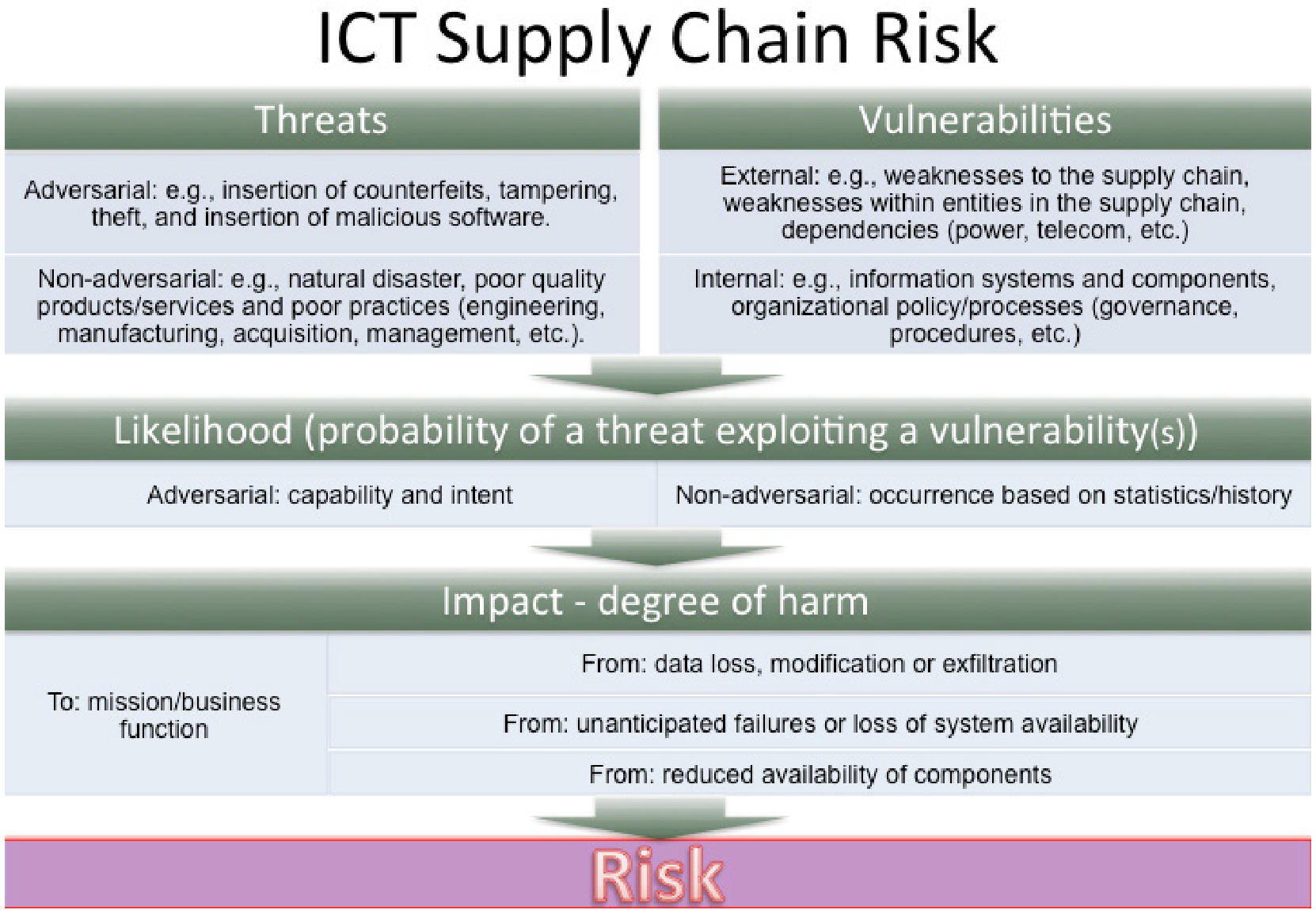
図4:ICTサプライチェーンリスク。ICT Supply Chain Risk と題した層状の図で、上から下へ層の間に下向きの矢印がある。最上層は 2 列で、脅威(Threats)には「敵対的:例として、偽造品の混入、改ざん、盗難、悪意のあるソフトウェアの混入」と「非敵対的:例として、自然災害、低品質の製品・サービス、不適切な慣行(エンジニアリング、製造、調達、管理など)」、脆弱性(Vulnerabilities)には「外部:例として、サプライチェーンに対する弱点、サプライチェーン内の主体の弱点、依存関係(電力、通信など)」と「内部:例として、情報システムとコンポーネント、組織の方針・プロセス(ガバナンス、手順など)」がある。次の層は可能性(脅威が脆弱性を悪用する確率)で、「敵対的:能力と意図」「非敵対的:統計・履歴に基づく発生」がある。その次の層は影響(被害の程度)で、「対象:ミッション・業務機能」と、「原因:データの喪失、改変、持ち出し」「原因:予期しない障害またはシステム可用性の喪失」「原因:コンポーネントの入手可能性の低下」がある。最下層はリスク(Risk)である。
Figure 4: ICT Supply Chain Risk
図4:ICTサプライチェーンリスク
In June 2014, the University of Maryland Supply Chain Management Center of the R. H. Smith School of Business completed the fourth phase of a multi-year research project through a NIST grant awarded in 2013. Previous phases of the project resulted in the development of a Cyber Risk Portal where users can conduct ICT supply-chain risk self-assessments and gain access to a number of resources. This phase of the project deployed wide-scale testing of the portal and made improvements to the security infrastructure and applications.
2014年6月、University of Maryland の R. H. Smith School of Business に属する Supply Chain Management Center は、2013年に交付されたNISTの助成金による複数年の研究プロジェクトの第4フェーズを完了しました。このプロジェクトのこれまでのフェーズでは、利用者がICTサプライチェーンリスクの自己評価を実施し、多数のリソースを利用できる Cyber Risk Portal が開発されました。今回のフェーズでは、このポータルの大規模な試験を実施し、セキュリティ基盤とアプリケーションを改善しました。
NIST awarded the University of Maryland Supply Chain Management Center an additional grant in 2014 to define an effective engagement model that will enable representatives of stakeholder organizations to come together in person and online to learn how to map and manage their critical ICT supply-chain risks using the portal-based tool set. The project will be completed in April 2015.
NISTは2014年に、University of Maryland Supply Chain Management Center に追加の助成金を交付しました。その目的は、利害関係をもつ組織の代表者が対面とオンラインで集まり、ポータルを基盤とするツール群を使って自組織の重要なICTサプライチェーンリスクを洗い出し、管理する方法を学べるようにする、効果的な参加モデルを定めることです。このプロジェクトは2015年4月に完了する予定です。
In FY 2015, CSD will:
2015会計年度に、CSDは次のことを行います。
•Publish SP 800-161;
•SP 800-161 を公表します。
•Research and develop tools and guidance to help agencies effectively conduct criticality analysis and other aspects needed to manage supply-chain risk;
•各機関が重要度分析や、サプライチェーンリスクの管理に必要なその他の側面を効果的に実施できるよう支援するツールとガイダンスを研究、開発します。
•Continue to co-chair Working Group 2 of the White House’s Comprehensive National Cybersecurity Initiative (CNCI) 11, Develop a Multi-Pronged Approach for Global Supply Chain Risk Management; and
•ホワイトハウスの Comprehensive National Cybersecurity Initiative (CNCI) 11, Develop a Multi-Pronged Approach for Global Supply Chain Risk Management の Working Group 2 の共同議長を引き続き務めます。
•Begin researching best practices and developing an organizational strategy for supply-chain risk management in response to the NIST Roadmap for Improving Critical Infrastructure Cybersecurity.
•NIST Roadmap for Improving Critical Infrastructure Cybersecurity に対応して、サプライチェーンリスク管理のベストプラクティスの調査と組織的戦略の策定を開始します。
ICT SCRM Team email: scrm-nist@nist.gov
ICT SCRMチームの電子メール:scrm-nist@nist.gov
CONTACTS:
連絡先:
Mr. Jon Boyens, (301) 975-5549, jon.boyens@nist.gov
Mr. Jon Boyens, (301) 975-5549, jon.boyens@nist.gov
Ms. Celia Paulsen, (301) 975-5981, celia.paulsen@nist.gov
Ms. Celia Paulsen, (301) 975-5981, celia.paulsen@nist.gov
NATIONWIDE PUBLIC SAFETY BROADBAND NETWORK (NPSBN) CYBERSECURITY
全米公共安全ブロードバンドネットワーク(NPSBN)のサイバーセキュリティ
青空を背景に、複数の無線通信アンテナを取り付けた塔を写した写真。 [装飾の画像。本文を読むのに必要のない装飾のため、この非公式サイトには掲載していません。原本 PDF を参照してください。]
Source: http://www.pscr.gov/
出典:http://www.pscr.gov/
In February 2012, Congress passed the Middle Class Tax Relief and Job Creation Act. One portion of this legislation calls for the establishment of a nationwide, interoperable public-safety broadband network based on the 3rd Generation Partnership Project’s (3GPP) Long-Term Evolution (LTE) technology. The network will be deployed and operated by the First Responder Network Authority (FirstNet). The planned National Public Safety Broadband Network (NPSBN) will “create a much needed nationwide interoperable broadband network that will help police, firefighters, emergency medical service professionals and other public safety officials stay safe and do their jobs.”(http://www.ntia.doc.gov/category/public-safety). NIST is directed to establish a list of certified devices and required components to be used by public safety officials, vendors, and other interested parties for interacting with the nationwide network. NIST is also directed to conduct research and development that supports the acceleration and advancement of the nationwide network.
2012年2月、連邦議会は Middle Class Tax Relief and Job Creation Act を可決しました。この法律の一部は、3rd Generation Partnership Project(3GPP)の Long-Term Evolution(LTE)技術に基づく、全米規模の相互運用可能な公共安全ブロードバンドネットワークの構築を求めています。このネットワークは First Responder Network Authority(FirstNet)が展開し、運用します。計画されている National Public Safety Broadband Network(NPSBN)は、「警察官、消防士、救急医療従事者、その他の公共安全担当者が安全を保ち、職務を遂行する助けとなる、強く必要とされてきた全米規模の相互運用可能なブロードバンドネットワークを構築する」(http://www.ntia.doc.gov/category/public-safety)。NISTは、公共安全担当者、ベンダー、その他の関係者がこの全米ネットワークとやり取りするために使用する、認証済みのデバイスと必須コンポーネントの一覧を定めるよう指示されています。NISTはまた、この全米ネットワークの加速と発展を支援する研究開発を実施するよう指示されています。
In FY 2014, CSD supported the joint National Telecommunications and Information Administration (NTIA) and NIST Public Safety Communications Research (PSCR) program (http://www.pscr.gov) with efforts in public-safety mobile-application security, identity management, and enabling cybersecurity capabilities on the PSCR 700 MHz LTE demonstration network located in Boulder, Colorado. In February 2014, CSD, in cooperation with the Association of Public-Safety Communications Officials (APCO) International and FirstNet, held a half-day workshop titled “Public Safety Mobile Application Security Requirements”. The outcome of that workshop is captured in Draft NISTIR 8018, Public Safety Mobile Application Security Requirements Workshop Summary. At PSRC’s Annual Public Safety Broadband Stakeholder Conference in June 2014, CSD organized and moderated a panel titled “Mobile Applications Security for Public Safety”.
2014会計年度に、CSDは、National Telecommunications and Information Administration(NTIA)とNISTの共同による Public Safety Communications Research(PSCR)プログラム(http://www.pscr.gov)を支援し、公共安全向けモバイルアプリケーションのセキュリティ、アイデンティティ管理、およびコロラド州ボルダーにあるPSCRの700 MHz LTE実証ネットワーク上でのサイバーセキュリティ機能の実現に取り組みました。2014年2月、CSDは Association of Public-Safety Communications Officials(APCO)International および FirstNet と協力して、“Public Safety Mobile Application Security Requirements”と題する半日のワークショップを開催しました。このワークショップの成果は、Draft NISTIR 8018, Public Safety Mobile Application Security Requirements Workshop Summary にまとめられています。2014年6月に開催されたPSRCの Annual Public Safety Broadband Stakeholder Conference では、CSDが“Mobile Applications Security for Public Safety”と題するパネルを企画し、司会を務めました。
CSD developed Draft NISTIR 8014, Considerations for Identity Management in Public Safety Mobile Networks, that provides a brief introduction to identity management, summarizes existing guidance (including OMB-04-04, E-Authentication Guidance for Federal Agencies; Homeland Security Presidential Directive 12 (HSPD12): Policy for a Common Identification Standard for Federal Employees and Contractors; and NIST SP 800-63-2, Electronic Authentication Guideline), and describes possible identity tokens/credentials that could be supported by mobile devices.
CSDは、NISTIR 8014, Considerations for Identity Management in Public Safety Mobile Networksの草案を作成しました。この文書は、アイデンティティ管理を簡潔に紹介し、既存のガイダンス(OMB-04-04, E-Authentication Guidance for Federal Agencies、Homeland Security Presidential Directive 12 (HSPD12): Policy for a Common Identification Standard for Federal Employees and Contractors、およびNIST SP 800-63-2, Electronic Authentication Guidelineを含む)を要約し、モバイルデバイスがサポートしうるアイデンティティトークン/クレデンシャルについて説明するものです。
CSD participated in the standards development process for LTE technology within the 3rd Generation Partnership Project (3GPP) supporting security requirements for public safety that are related to Proximity Services (ProSe), Group Communication System Enablers (GCSE), and Mission Critical Push-To-Talk (MCPTT). In addition, CSD broadened its scope within the Internet Engineering Task Force (IETF) to include efforts related to public safety.
CSDは、3rd Generation Partnership Project (3GPP)におけるLTE技術の標準策定プロセスに参加し、Proximity Services (ProSe)、Group Communication System Enablers (GCSE)、およびMission Critical Push-To-Talk (MCPTT)に関連する公共安全のためのセキュリティ要件を支援しました。さらに、CSDはInternet Engineering Task Force (IETF)における活動範囲を広げ、公共安全に関連する取り組みも対象に含めました。
In FY 2015, CSD will continue representing public safety in international standardization efforts, such as the IETF and 3GPP. CSD will work to implement and exercise cybersecurity capabilities in the PSCR 700 MHz LTE demonstration network, conduct research into mobile authentication solutions to support the different public-safety disciplines, and investigate mobile application-security services to support the security requirements of public-safety mobile applications. CSD will continue to engage the public-safety communications community by organizing workshops and conferences; and participating in events such as APCO’s Annual Meeting, PSRC’s Annual Public Safety Broadband Stakeholder Conference, and the International Wireless Communications Expo (IWCE).
2015会計年度も、CSDは、IETFや3GPPなどの国際標準化の取り組みにおいて、引き続き公共安全分野を代表します。CSDは、PSCRの700 MHz LTE実証ネットワークにサイバーセキュリティ機能を実装して運用を試すこと、公共安全のさまざまな専門分野を支援するためのモバイル認証ソリューションを研究すること、および公共安全向けモバイルアプリケーションのセキュリティ要件を支えるモバイルアプリケーションセキュリティサービスを調査することに取り組みます。CSDは、ワークショップや会議を開催し、またAPCOのAnnual Meeting、PSRCのAnnual Public Safety Broadband Stakeholder Conference、International Wireless Communications Expo (IWCE)などのイベントに参加することにより、公共安全通信のコミュニティとの関わりを継続します。
CONTACTS:
連絡先:
Ms. Sheila Frankel, (301) 975-3297, sheila.frankel@nist.gov
Ms. Sheila Frankel, (301) 975-3297, sheila.frankel@nist.gov
Dr. Nelson Hastings, (301) 975-5237, nelson.hastings@nist.gov
Dr. Nelson Hastings, (301) 975-5237, nelson.hastings@nist.gov
SECURITY OF CYBER-PHYSICAL SYSTEMS (CPS)
サイバーフィジカルシステム(CPS)のセキュリティ
Cyber-Physical Systems (CPS) will provide the next generation of “smart,” co-design and co-engineered interacting networks of physical and computational components. CPS is commonly used in the nation’s critical infrastructure and includes systems in the electric grid, manufacturing, healthcare, and transportation sectors. Composed of heterogeneous, potentially distributed components and systems, CPS provides a promise of increased efficiency and interaction between the digital and physical worlds. However, assuring that these emerging and evolving systems are reliable, robust, resilient, trustworthy, secure, and that they protect the privacy of information poses a unique cybersecurity challenge.
サイバーフィジカルシステム(CPS)は、物理的な構成要素と計算を担う構成要素とが相互に作用する、協調設計され協調して構築された次世代の「スマート」なネットワークをもたらします。CPSは国の重要インフラで広く使われており、電力網、製造、医療、運輸の各分野のシステムを含みます。異種の、場合によっては分散した構成要素やシステムから成るCPSは、効率の向上と、デジタル世界と物理世界との間の相互作用の拡大を約束します。しかし、新たに登場し進化を続けるこれらのシステムが、信頼性、堅牢性、レジリエンス、信用性、セキュリティを備え、かつ情報のプライバシーを保護することを保証するのは、サイバーセキュリティ上の固有の課題です。
CPS present unique challenges, including the need for integration with legacy components and allowance for emerging technologies, and real-time response in support of extremely high availability, predictability, and reliability. Cybersecurity is an important crosscutting discipline that is critical to the safe and resilient design, development and operation of CPS. Addressing the opportunities and challenges of CPS requires a broad collaboration to develop a common foundation to work from, including a consensus definition, vocabulary, reference architecture, and a shared understanding of the essential roles of timing, cybersecurity and data interoperability. CSD is researching the cybersecurity needs of the broader landscape of CPS, by leveraging CSD’s expertise in cybersecurity in different domains and applications of CPS (such as industrial control systems, smart grid, hardware-enabled security, and embedded systems).
CPSには固有の課題があります。レガシーな構成要素との統合や新興技術への対応が必要であること、きわめて高い可用性、予測可能性、信頼性を支えるリアルタイム応答が必要であることなどです。サイバーセキュリティは、CPSの安全でレジリエントな設計、開発、運用に不可欠な、分野横断的で重要な領域です。CPSの機会と課題に対処するには、合意に基づく定義、語彙、参照アーキテクチャ、ならびにタイミング、サイバーセキュリティ、データ相互運用性が果たす本質的な役割についての共通理解を含め、作業の拠りどころとなる共通基盤を築くための幅広い協働が必要です。CSDは、CPSのさまざまな領域や応用(産業用制御システム、スマートグリッド、ハードウェアを活用したセキュリティ、組込みシステムなど)におけるサイバーセキュリティの専門知識を活用して、CPSのより広い全体像にわたるサイバーセキュリティ上のニーズを研究しています。
In June 2014, NIST established the CPS Public Working Group (PWG), which is open to all, to foster and capture inputs from those involved in CPS, both nationally and globally. CSD is working in collaboration with NIST’s Engineering Laboratory (EL) Smart Grid and Cyber-Physical Systems Program Office, NIST’s Physical Measurement Laboratory Time and Frequency Division, ITL’s Software and Systems Division and ITL’s Advanced Networking Technologies Division to lead a public-private working group of government, academia, and industry stakeholders. The CPS PWG consists of five technical subgroups:
2014年6月、NISTはCPS Public Working Group (PWG)を設立しました。これは誰でも参加できるもので、国内外のCPS関係者からの意見を促し、集約することを目的とします。CSDは、NISTのEngineering Laboratory (EL) Smart Grid and Cyber-Physical Systems Program Office、NISTのPhysical Measurement Laboratory Time and Frequency Division、ITLのSoftware and Systems Division、およびITLのAdvanced Networking Technologies Divisionと協力して、政府、学術界、産業界の利害関係者から成る官民のワーキンググループを主導しています。CPS PWGは、次の5つの技術サブグループで構成されます。
•Definition, Vocabulary, and Reference Architecture;
•定義、語彙、および参照アーキテクチャ
•Use Cases;
•ユースケース
•Cybersecurity and Privacy;
•サイバーセキュリティおよびプライバシー
•Data Interoperability; and
•データ相互運用性
•Timing and Synchronization.
•タイミングおよび同期
Each subgroup consists of co-leads from academia, industry and NIST. CSD co-leads the Cybersecurity and Privacy subgroup focused on identifying strategies for cybersecurity and privacy in CPS, and will work collaboratively with the other subgroups to ensure that cybersecurity is included as a design principle during development.
各サブグループは、学術界、産業界、およびNISTからの共同リーダーで構成されます。CSDは、CPSにおけるサイバーセキュリティとプライバシーの戦略の特定に重点を置く「サイバーセキュリティおよびプライバシー」サブグループの共同リーダーを務めており、開発の過程でサイバーセキュリティが設計原則として確実に組み込まれるよう、他のサブグループと協働します。
In 2015, the CPS PWG will publish an integrated Framework that includes the work of the five technical subgroups and begin work on a CPS Technology Roadmap, which will identify opportunities for a coordinated effort on key technical challenges. The CPS PWG deliverables will be technology and business-model neutral, and freely available online and intended for open use by all stakeholders.
2015年に、CPS PWGは5つの技術サブグループの成果を盛り込んだ統合的なFrameworkを公表するとともに、CPS Technology Roadmapの作成に着手します。このロードマップは、主要な技術課題に対して連携して取り組む機会を特定するものです。CPS PWGの成果物は、技術およびビジネスモデルに対して中立であり、オンラインで無償で入手でき、すべての利害関係者が自由に利用できることを意図しています。
Additionally, in 2015, CSD, in conjunction with NIST’s Engineering Laboratory, Intelligent Systems Division, will finalize SP 800-82 Revision 2, Guide to Industrial Control Systems Security. CSD will also continue to participate in the International Society of Automation (ISA) 99 Committee, which develops and establishes standards, recommended practices, technical reports, and related information that define procedures for implementing electronically secure industrial automation and control systems and security practices, and for assessing electronic security performance.
加えて2015年には、CSDは、NISTのEngineering Laboratory、Intelligent Systems Divisionと共同で、SP 800-82 Revision 2, Guide to Industrial Control Systems Securityを最終化します。CSDはまた、International Society of Automation (ISA) 99 Committeeへの参加も継続します。同委員会は、電子的にセキュアな産業用オートメーションおよび制御システムならびにセキュリティプラクティスを実装するための手順、および電子的セキュリティの性能を評価するための手順を定める標準、推奨プラクティス、技術報告書、および関連情報を開発し、制定しています。
http://www.nist.gov/cps/
http://www.nist.gov/cps/
http://www.nist.gov/cps/cpspwg.cfm
http://www.nist.gov/cps/cpspwg.cfm
CONTACTS:
連絡先:
Ms. Victoria Yan Pillitteri, (301) 975-8542, victoria.pillitteri@nist.gov
Ms. Victoria Yan Pillitteri, (301) 975-8542, victoria.pillitteri@nist.gov
Ms. Suzanne Lightman, (301) 975-6442, suzanne.lightman@nist.gov
Ms. Suzanne Lightman, (301) 975-6442, suzanne.lightman@nist.gov
SMART GRID CYBERSECURITY
スマートグリッドのサイバーセキュリティ
スマート電力メーターの写真。円形メーターの前面に小型LCD表示と機器ラベル、バーコードがある。 [装飾の画像。本文を読むのに必要のない装飾のため、この非公式サイトには掲載していません。原本 PDF を参照してください。]
Figure 5: Smart Meter
図5:スマートメーター
The major elements of the smart grid are: information technology, industrial control systems/operational technology, and the communications infrastructure. The infrastructure is used to send command information across the electric grid from generation to distribution systems, and to exchange usage and billing information between utilities and their customers. Key to the successful deployment of the smart grid infrastructure is the development of the cybersecurity strategy that includes cybersecurity as a design consideration for new and emerging systems, and an approach to adding cybersecurity into existing systems. The electric grid is critical to the economic and physical well-being of the nation, and emerging cyber threats targeting power systems highlight the need to integrate advanced security to protect critical assets.
スマートグリッドの主要な要素は、情報技術、産業用制御システム/運用技術、および通信インフラです。このインフラは、発電から配電システムに至るまで電力網全体に指令情報を送るため、また電力事業者とその顧客との間で使用量および課金の情報をやり取りするために使われます。スマートグリッドのインフラを首尾よく展開するうえで鍵となるのは、新規および新興のシステムについてサイバーセキュリティを設計上の考慮事項として含め、かつ既存のシステムにサイバーセキュリティを追加するアプローチを含む、サイバーセキュリティ戦略の策定です。電力網は国の経済的および物理的な安寧にとって不可欠であり、電力システムを標的とする新たなサイバー脅威は、重要な資産を保護するために高度なセキュリティを組み込む必要があることを浮き彫りにしています。
「SGIP」「Smart Grid Interoperability Panel」の文字を、ネットワーク状の地球図に重ねたロゴ(スマートグリッド相互運用性パネル)。 [組織・プログラムのロゴ。ロゴのため、この非公式サイトには掲載していません。原本 PDF を参照してください。]
The Smart Grid Interoperability Panel (SGIP) became a membership-supported organization in January 2013. The SGIP Cybersecurity Working Group (CSWG) was renamed the Smart Grid Cybersecurity Committee (SGCC), and continues to be led by a NIST representative in support of responsibilities identified in the Energy Independence and Security Act of 2007. The SGCC chair is a voting member of the SGIP Technical Committee, and serves as an ex-officio Director of the Board. In addition, the SGIP SGCC continues to include additional leadership by a management team comprised of three volunteer vice-chairs (representing the Department of Energy (DOE), an electric utility, and a smart grid vendor) and a volunteer secretariat.
Smart Grid Interoperability Panel (SGIP)は、2013年1月に会員の支援によって運営される組織となりました。SGIP Cybersecurity Working Group (CSWG)はSmart Grid Cybersecurity Committee (SGCC)に改称され、Energy Independence and Security Act of 2007に定められた責務を果たすため、引き続きNISTの代表者が主導しています。SGCCの議長はSGIP Technical Committeeの議決権を持つメンバーであり、職権上の理事として理事会に加わっています。加えて、SGIP SGCCには引き続き、ボランティアの副議長3名(エネルギー省(DOE)、電力事業者、およびスマートグリッドベンダーをそれぞれ代表する)から成る運営チームと、ボランティアの事務局による指導体制も置かれています。
In 2014, the SGCC contributed to the update of NISTIR 7628 Revision 1, Guidelines for Smart Grid Cybersecurity, which was published in September, following a public comment period and comment resolution by the SGCC members. The revision updates and expands the development strategy, cryptography and key management, privacy, vulnerability classes, research and development topics, standards review, and key power-system use cases to reflect changes in the smart grid environment since 2010. In addition to the revision of NISTIR 7628, the SGCC have focused on developing documents to be published through SGIP on cybersecurity risk management, a User’s Guide for NISTIR 7628, cloud computing for the smart grid, and a mapping between NISTIR 7628 and the Framework for Improving Critical Infrastructure Cybersecurity. Work in these areas is completed through SGCC subgroups, which are created and disbanded on an as-needed basis.
2014年、SGCCはNISTIR 7628 Revision 1, Guidelines for Smart Grid Cybersecurityの改訂に貢献しました。同文書は、パブリックコメント期間とSGCCメンバーによるコメントへの対応を経て、9月に公表されました。この改訂では、2010年以降のスマートグリッド環境の変化を反映するため、開発戦略、暗号および鍵管理、プライバシー、脆弱性クラス、研究開発のテーマ、標準のレビュー、ならびに電力システムの主要なユースケースを更新し、拡充しています。NISTIR 7628の改訂に加えて、SGCCは、SGIPを通じて公表する文書の作成に注力してきました。その対象は、サイバーセキュリティリスク管理、NISTIR 7628のUser’s Guide、スマートグリッド向けのクラウドコンピューティング、およびNISTIR 7628とFramework for Improving Critical Infrastructure Cybersecurityとの対応付けです。これらの領域の作業は、必要に応じて設置および解散されるSGCCのサブグループを通じて進められます。
The SGCC also continues to support the SGIP Catalog of Standards (CoS), a compendium of standards, practices, guidelines and other technical documents considered relevant for the development of a robust, secure, and interoperable smart grid. Through the ongoing efforts of the SGCC, these documents are reviewed for cybersecurity, and recommendations are made for including cybersecurity in future revisions and in the implementation of the standards. CSD supports the SGCC in assessing the security of the cryptographic methods used in these standards, practices, guidelines, and other technical documents. In many cases, the standards bodies have taken the results of the reviews and modified the standards or documents to address NIST recommendations. The SGCC has worked closely with some of the standards bodies to ensure that the recommendations are interpreted correctly and that the mitigation strategies selected meet the intent of the NISTIR 7628 high-level security requirements. The result is cybersecurity “baked-in” to the standards, rather than “bolted-on” after the standard is implemented.
SGCCはまた、SGIP Catalog of Standards (CoS)への支援も継続しています。これは、堅牢でセキュアかつ相互運用可能なスマートグリッドの開発に関連すると考えられる標準、プラクティス、ガイドライン、その他の技術文書を集成したものです。SGCCの継続的な取り組みにより、これらの文書はサイバーセキュリティの観点からレビューされ、標準の将来の改訂および実装にサイバーセキュリティを盛り込むための勧告が行われます。CSDは、これらの標準、プラクティス、ガイドライン、その他の技術文書で使われている暗号方式のセキュリティの評価において、SGCCを支援しています。多くの場合、標準化団体はレビューの結果を受けて、NISTの勧告に対応するよう標準または文書を修正しています。SGCCは、勧告が正しく解釈され、選択された緩和策がNISTIR 7628の高レベルセキュリティ要件の趣旨を満たすことを確実にするため、いくつかの標準化団体と緊密に連携してきました。その結果、サイバーセキュリティは、標準が実装された後に「後付け」されるのではなく、標準に「作り込まれる」ことになります。
Future activities include working with the SGIP Committees, Domain Expert Working Groups, and Priority Action Plans to integrate cybersecurity into their work efforts. Additionally, the SGIP SGCC will continue to collaborate with industry, academia, other working groups, and government agencies to address the cybersecurity needs for the smart grid.
今後の活動には、SGIPのCommittees、Domain Expert Working Groups、およびPriority Action Plansと協力して、それぞれの作業にサイバーセキュリティを組み込むことが含まれます。加えて、SGIP SGCCは、スマートグリッドのサイバーセキュリティ上のニーズに対処するため、産業界、学術界、他のワーキンググループ、および政府機関との協働を継続します。
In FY 2015, CSD will continue to support the SGCC in the evaluation of the cryptographic methods used in standards, practices, guidelines, and other technical documents for inclusion in the SGIP CoS. In addition to the SGIP SGCC activities, CSD will also coordinate with NIST’s Engineering Laboratory (EL) and Smart Grid Program Office on the development of a Cybersecurity Smart Grid Test Lab, part of the NIST Smart Grid Testbed Facility now under construction. CSD will also collaborate with ITL’s Software and Systems Division on cybersecurity research in relation to the IEEE 1588, Precision Time Protocol, a standard on time synchronization that is used for the electric grid and other special-purpose industrial automation and measurement networks.
2015会計年度も、CSDは、SGIP CoSへの収録に向けた、標準、プラクティス、ガイドライン、その他の技術文書で使われている暗号方式の評価において、引き続きSGCCを支援します。SGIP SGCCの活動に加えて、CSDは、現在建設中のNIST Smart Grid Testbed Facilityの一部であるCybersecurity Smart Grid Test Labの整備について、NISTのEngineering Laboratory (EL)およびSmart Grid Program Officeとも連携します。CSDはまた、IEEE 1588, Precision Time Protocolに関するサイバーセキュリティ研究について、ITLのSoftware and Systems Divisionと協働します。IEEE 1588は、電力網やその他の特殊用途の産業用オートメーションおよび計測ネットワークで使われる時刻同期の標準です。
http://www.nist.gov/smartgrid
http://www.nist.gov/smartgrid
http://www.sgip.org
http://www.sgip.org
CONTACTS:
連絡先:
Ms. Victoria Yan Pillitteri, (301) 975-8542, victoria.pillitteri@nist.gov
Ms. Victoria Yan Pillitteri, (301) 975-8542, victoria.pillitteri@nist.gov
Ms. Tanya Brewer, (301) 975-4534, tbrewer@nist.gov
Ms. Tanya Brewer, (301) 975-4534, tbrewer@nist.gov
Mr. Quynh Dang, (301) 975-3610, qdang@nist.gov
Mr. Quynh Dang, (301) 975-3610, qdang@nist.gov
CYBERSECURITY AWARENESS, TRAINING, EDUCATION, AND OUTREACH
サイバーセキュリティの意識向上、トレーニング、教育、およびアウトリーチ
National Initiative for Cybersecurity Education (NICE)
National Initiative for Cybersecurity Education (NICE)
NIST has been the lead for the National Initiative for Cybersecurity Education (NICE) since its inception in 2010. NICE is responsive to President Obama’s declaration that the “cyber threat is one of the most serious economic and national security challenges we face as a nation” and “America’s economic prosperity in the 21st century will depend on cybersecurity.”
NISTは、2010年の発足以来、National Initiative for Cybersecurity Education (NICE)を主導してきました。NICEは、「サイバー脅威は、我々が国家として直面する経済上および国家安全保障上の最も深刻な課題の一つである」、そして「21世紀における米国の経済的繁栄はサイバーセキュリティにかかっている」というObama大統領の宣言に応えるものです。
NICE is an initiative that enhances the overall cybersecurity posture of the United States by accelerating the availability of educational and training resources designed to improve the cybersecurity skills, and knowledge of our nation’s students and workforce.
NICEは、国の学生および労働力のサイバーセキュリティに関する技能と知識を向上させるために設計された教育およびトレーニングのリソースを、より早く利用できるようにすることで、米国全体のサイバーセキュリティ態勢を強化するイニシアチブです。
NIST’s CSD is leading the NICE initiative working from the strengths and energy of more than 20 federal departments and agencies leveraging each of their relationships with academia and industry sectors to ensure coordination, cooperation, focus, public engagement, technology transfer and sustainability. NIST will highlight these activities, engage various stakeholder groups and create forums for sharing information and leveraging best practices.
NISTのCSDは、20を超える連邦の省庁および機関の強みと活力を基盤としてNICEイニシアチブを主導しており、各機関が学術界および産業界の各分野との間に持つ関係を活用して、調整、協力、焦点の明確化、一般市民の関与、技術移転、および持続可能性を確保しています。NISTは、これらの活動を広く紹介し、さまざまな利害関係者グループの参画を促し、情報を共有しベストプラクティスを活用するための場を設けます。
CSD is home to the NIST NICE Leadership Team that focuses on the following activities:
CSDには、次の活動に重点を置くNIST NICE Leadership Teamが置かれています。
•Developing planning documents and building consensus on the strategy and implementation activities of NICE;
•計画文書を作成し、NICEの戦略および実施活動について合意を形成すること
•Utilizing a newly established public-private working group to make progress towards NICE’s goals;
•新たに設立された官民のワーキンググループを活用して、NICEの目標に向けて前進すること
•Promoting the use of data-driven initiatives within NICE;
•NICEの中で、データに基づくイニシアチブの活用を促進すること
•Facilitating cross-functional cooperation among federal departments and agencies by coordinating meetings, facilitating discussions, and disseminating information;
•会合の調整、議論の進行、および情報の周知を通じて、連邦の省庁および機関の間の部門横断的な協力を促進すること
•Promoting the initiative and its efforts by representing NICE and speaking at cybersecurity events nationwide;
•全米各地のサイバーセキュリティ関連イベントでNICEを代表し講演することにより、このイニシアチブとその取り組みを広めること
•Planning and hosting an annual workshop to promote and support the evolving issues in cybersecurity workforce and education; and
•サイバーセキュリティの労働力および教育における変化し続ける課題への取り組みを促進し支援するための年次ワークショップを企画し、主催すること
•Coordinating with other federal initiatives and efforts related to NICE.
•NICEに関連する他の連邦のイニシアチブおよび取り組みと連携すること
The NICE leadership team attended many events, symposia, forums, competitions, educational outreach meetings, and workshops to promote the activities within NICE. The team continued its leadership of the Office of Personnel Management (OPM) Cross-Agency Priority Goal: “Closing Skills Gap” for IT/Cybersecurity focused on reducing cybersecurity workforce gaps and supported the goals of the White House’s Ready to Work initiative.
NICE leadership teamは、NICEにおける活動を広めるため、多くのイベント、シンポジウム、フォーラム、競技会、教育アウトリーチの会合、およびワークショップに参加しました。同チームは、サイバーセキュリティ労働力の不足の縮小に重点を置く、IT/サイバーセキュリティに関するOffice of Personnel Management (OPM)のCross-Agency Priority Goal「Closing Skills Gap」を引き続き主導し、White HouseのReady to Workイニシアチブの目標を支援しました。
In FY 2015, CSD will continue to promote the coordination of existing and future cybersecurity education, training, and workforce activities. The Fifth annual NICE Workshop will take place on November 5-6, 2014 in Columbia, Maryland (http://csrc.nist.gov/nice/events.html). The CSD will also identify opportunities to extend and integrate the NICE focus on cybersecurity workforce, education, and training within NIST Special Publications and informational reports while promoting the value of the National Cybersecurity Workforce Framework (NCWF) and the forthcoming Department of Defense Cyberspace Workforce Strategy as resources that address cybersecurity workforce needs.
2015会計年度も、CSDは、サイバーセキュリティに関する既存および将来の教育、トレーニング、および労働力関連の活動の連携を引き続き促進します。第5回となる年次のNICE Workshopは、2014年11月5日から6日にかけてMaryland州Columbiaで開催されます(http://csrc.nist.gov/nice/events.html)。CSDはまた、サイバーセキュリティの労働力、教育、およびトレーニングに対するNICEの重点を、NIST Special Publicationsおよび情報提供用の報告書の中に広げ、組み込む機会を特定するとともに、サイバーセキュリティ労働力のニーズに対応するリソースとして、National Cybersecurity Workforce Framework (NCWF)および近く公表されるDepartment of Defense Cyberspace Workforce Strategyの価値を広めます。
http://www.nist.gov/nice/
http://www.nist.gov/nice/
CONTACTS:
連絡先:
Mr. Bill Newhouse, NICE Program Manager, (301) 975-2869, william.newhouse@nist.gov
Mr. Bill Newhouse, NICE Program Manager, (301) 975-2869, william.newhouse@nist.gov
Dr. Ernest McDuffie (retired), FY 2014 NICE Lead
Dr. Ernest McDuffie (retired), FY 2014 NICE Lead
Computer Security Resource Center (CSRC)
Computer Security Resource Center (CSRC)
The CSRC, CSD’s website, is one of the most visited websites at NIST. CSRC encourages the broad sharing of information security tools and practices, provides a resource for information security standards and guidelines, and identifies and links key security web resources to support industry and government users. CSRC is an integral component of all of the work that CSD conducts and produces. It is CSD’s repository for anyone wanting to access these documents and other valuable security-related information. During FY 2014, CSRC had more than 54 million page views and downloads.
CSDのウェブサイトであるCSRCは、NISTの中で最も閲覧されているウェブサイトの一つです。CSRCは、情報セキュリティのツールとプラクティスの幅広い共有を促し、情報セキュリティの標準およびガイドラインに関するリソースを提供し、産業界および政府の利用者を支援するために主要なセキュリティ関連のウェブリソースを特定してリンクしています。CSRCは、CSDが実施し生み出すすべての成果に不可欠な構成要素です。これらの文書やその他の有益なセキュリティ関連情報を入手したい人のための、CSDのリポジトリです。2014会計年度中、CSRCのページ閲覧数およびダウンロード数は5,400万件を超えました。
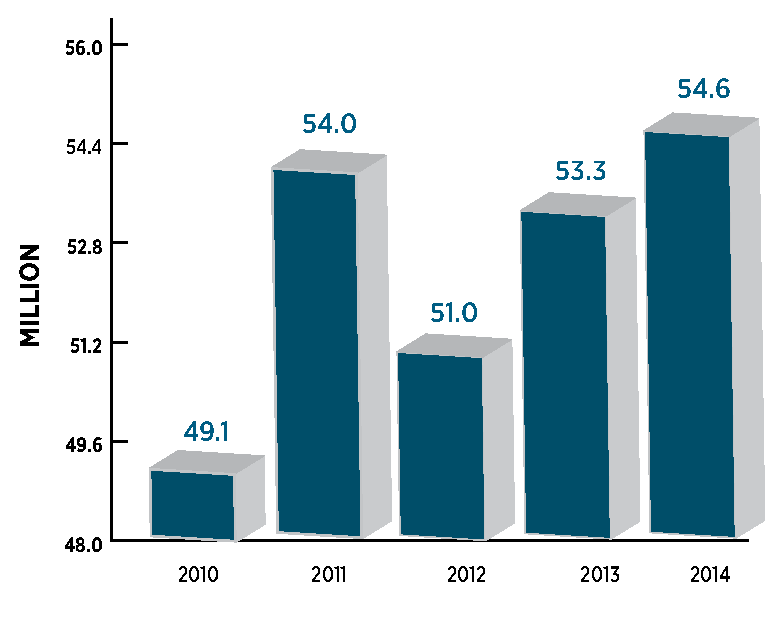
図6:過去5年間のCSRCウェブサイト訪問者数。縦軸を MILLION(百万)とし、48.0 から 56.0 までの棒グラフである。各年の値は、2010 年 49.1、2011 年 54.0、2012 年 51.0、2013 年 53.3、2014 年 54.6 である。
Figure 6: CSRC Website Visitors For Past 5 Years
図6:過去5年間のCSRCウェブサイト訪問者数
CSRC is the primary gateway for gaining access to NIST computer security publications, standards, and guidelines, and serves as a vital link to CSD’s customers. Publications are organized to help users locate relevant information quickly and are arranged by topic, relevant security control family, and legal requirements.
CSRCは、NISTのコンピュータセキュリティに関する刊行物、標準、およびガイドラインを入手するための主要な入口であり、CSDの顧客との重要な接点となっています。刊行物は、利用者が関連情報をすばやく見つけられるよう整理されており、トピック別、関連するセキュリティ管理策ファミリー別、および法的要件別に配列されています。
In addition to CSRC, CSD maintains a publication announcement mailing list. This free e-mail list notifies subscribers about publications that have been posted to the CSRC website, along with announcing new CSD-sponsored events and important news or announcements. The e-mail list is a valuable tool for more than 56 000 subscribers from the Federal Government, industry, academia, and individuals with a personal interest in IT security worldwide. Individuals who are interested in subscribing to this list should visit http://csrc.nist.gov/publications/subscribe.html for more information.
CSRCに加えて、CSDは刊行物の告知用メーリングリストを運営しています。この無料の電子メールリストは、CSRCウェブサイトに掲載された刊行物について購読者に通知するとともに、CSDが主催または後援する新たなイベントや、重要なニュースまたは告知も知らせます。この電子メールリストは、連邦政府、産業界、学術界の関係者、およびITセキュリティに個人的な関心を持つ世界中の個人から成る56 000人を超える購読者にとって、有益なツールです。このリストの購読に関心のある人は、詳細について http://csrc.nist.gov/publications/subscribe.html を参照されました。
During FY 2014, the CSRC underwent what the CSD terms as “Quick Fixes” to the CSRC website. These “Quick Fixes” will improve the overall navigation experience on CSRC. The CSRC homepage was streamlined by providing hot topics (these hot topics are the most popular projects/programs that have webpages), updated references in the Useful Resources section, and an improved News and Events section. The homepage was condensed to reduce the amount of scrolling on the page. Another improvement made to the CSRC website was the dropdown menus, which appear on all pages. In previous years, the division’s projects/programs listings were placed under the division’s group layout. Now, the projects/programs listings are under their own category (Ex. Education & Outreach category, a project falling under this category: Small and Medium-Sized Business (SMB) Outreach). The CSRC team created an A to Z listing of the webpages for all of CSD’s projects/programs in order to ease the finding of a particular area.
2014会計年度中、CSRCウェブサイトには、CSDが「Quick Fixes」と呼ぶ改修が行われました。これらの「Quick Fixes」は、CSRCにおけるナビゲーション全体の使い勝手を向上させます。CSRCのホームページは、ホットトピック(ウェブページを持つプロジェクト/プログラムのうち最も人気のあるもの)の提供、Useful Resourcesセクションの参照先の更新、およびNews and Eventsセクションの改善により、簡素化されました。ホームページは、ページ上でのスクロール量を減らすために圧縮されました。CSRCウェブサイトに加えられたもう一つの改善は、すべてのページに表示されるドロップダウンメニューです。これまでは、部門のプロジェクト/プログラムの一覧は、部門のグループ構成の下に置かれていました。現在は、プロジェクト/プログラムの一覧は独自のカテゴリーの下に置かれている(例:Education & Outreachカテゴリー。このカテゴリーに属するプロジェクトとして、Small and Medium-Sized Business (SMB) Outreachがあります)。CSRCチームは、特定の領域を見つけやすくするため、CSDのすべてのプロジェクト/プログラムのウェブページのAからZまでの一覧を作成しました。
Plans for FY 2015 for the CSRC website will include moving the CSRC website to a content management system (CMS). Moving to a CMS is expected to improve the website’s functionality.
CSRCウェブサイトに関する2015会計年度の計画には、CSRCウェブサイトをコンテンツ管理システム(CMS)に移行することが含まれます。CMSへの移行により、ウェブサイトの機能が向上すると期待されます。
Questions on the website can be sent to the CSRC Webmaster at: webmaster-csrc@nist.gov.
ウェブサイトに関する質問は、CSRC Webmaster(webmaster-csrc@nist.gov)宛てに送ることができます。
CONTACTS:
連絡先:
Mr. Patrick O’Reilly (301) 975-4751 patrick.oreilly@nist.gov
Mr. Patrick O’Reilly (301) 975-4751 patrick.oreilly@nist.gov
Ms. Judy Barnard (301) 975-5502 jbarnard@nist.gov
Ms. Judy Barnard (301) 975-5502 jbarnard@nist.gov
Federal Computer Security Program Managers’ Forum
Federal Computer Security Program Managers’ Forum
The Federal Computer Security Program Managers’ Forum is sponsored by NIST to promote the sharing of security-related information among federal agencies. The Forum, which serves more than 1100 members, strives to provide an ongoing opportunity for managers of federal information security programs to exchange information security materials in a timely manner, build upon the experiences of other programs, and reduce possible duplication of effort. It provides a mechanism for NIST to share information directly with federal agency information security program managers in fulfillment of NIST’s leadership mandate under FISMA. It assists NIST in establishing and maintaining relationships with other individuals or organizations that are actively addressing information security issues within the Federal Government. NIST’s CSD serves as the Secretariat of the Forum, providing necessary administrative and logistical support. Patricia Toth serves as the Chairperson.
Federal Computer Security Program Managers’ Forumは、連邦機関の間でセキュリティ関連情報の共有を促進するために、NISTが後援しています。1100名を超える会員を擁するこのForumは、連邦政府の情報セキュリティプログラムの管理者が、情報セキュリティに関する資料を適時に交換し、他のプログラムの経験を活かし、作業の重複を減らすための継続的な機会を提供するよう努めています。Forumは、FISMAの下でNISTに課された指導的役割を果たすうえで、NISTが連邦機関の情報セキュリティプログラム管理者と直接情報を共有するための仕組みとなっています。また、連邦政府内で情報セキュリティの課題に積極的に取り組んでいる他の個人や組織との関係を、NISTが築き維持する助けにもなっています。NISTのCSDはForumの事務局を務め、必要な管理面および運営面の支援を提供しています。議長はPatricia Tothが務めています。
The Forum maintains an extensive email subscription service. Participation in the service is only open to Federal Government employees who participate in the management of their organization’s information system security program. The Forum also holds bimonthly meetings and an annual two-day conference to discuss current issues and developments of interest to those responsible for protecting sensitive (unclassified) federal systems.
Forumは、大規模な電子メール配信サービスを運営しています。このサービスに参加できるのは、所属組織の情報システムセキュリティプログラムの管理に携わる連邦政府職員に限られます。Forumはまた、機微な(非機密の)連邦システムの保護に責任を負う人々にとって関心のある現在の課題や動向を議論するため、隔月の会合と年1回の2日間のカンファレンスを開催しています。
Topics of discussion at Forum meetings in FY 2014 included briefings from various federal agencies on Controlled Unclassified Information (CUI) Implementation Activities, Cross Agency Priority (CAP) Goals, Automated Assessment Practicals, Automated Assessment Concepts Supporting Information Security Continuous Monitoring (ISCM), NIST’s Role in Ongoing Assessments, Ongoing Authorization Clarifying and Amplifying Guidance, and the National Cybersecurity Framework.
2014会計年度のForum会合で取り上げられた議題には、さまざまな連邦機関によるブリーフィングとして、Controlled Unclassified Information (CUI) Implementation Activities、Cross Agency Priority (CAP) Goals、Automated Assessment Practicals、Automated Assessment Concepts Supporting Information Security Continuous Monitoring (ISCM)、NIST’s Role in Ongoing Assessments、Ongoing Authorization Clarifying and Amplifying Guidance、およびNational Cybersecurity Frameworkが含まれていました。
This year’s annual two-day offsite meeting featured updates on the computer security activities of the Government Accountability Office (GAO), General Services Administration (GSA), Bureau of the Fiscal Service, Department of State, National Security Council, Department of Homeland Security (DHS), and NIST. Technical sessions included briefings on updates from NIST Computer Security Division (CSD), FedRAMP Overview and Security Processes, Supply Chain Risk Management, Ongoing Authorization, Fiscal Service’s Risk-Based ISCM Strategy, Derived PIV Credentials, Cybersecurity Training, Incident Response, White House Initiatives, FY 2015 FISMA Metrics and recent updates to the FISMA publications.
今年の年次の2日間のオフサイト会合では、Government Accountability Office (GAO)、General Services Administration (GSA)、Bureau of the Fiscal Service、国務省、National Security Council、国土安全保障省 (DHS)、およびNISTのコンピュータセキュリティ活動に関する最新情報が紹介されました。技術セッションでは、NISTコンピュータセキュリティ部門 (CSD) からの最新情報、FedRAMP Overview and Security Processes、Supply Chain Risk Management、Ongoing Authorization、Fiscal Service’s Risk-Based ISCM Strategy、Derived PIV Credentials、Cybersecurity Training、Incident Response、White House Initiatives、FY 2015 FISMA Metrics、およびFISMA関連刊行物の最近の更新に関するブリーフィングが行われました。
The Forum plays a valuable role in helping NIST and other federal agencies to develop and maintain a strong, proactive stance in the identification and resolution of new strategic and tactical IT security issues as they emerge. The number of members on the email list has grown steadily and provides a valuable resource for federal security program managers. To join, email your name, affiliation, address, phone number, title, and confirmation that you are a federal employee to sec-forum@nist.gov.
このフォーラムは、戦略上および戦術上の新たなITセキュリティ課題が生じたときに、NISTと他の連邦機関がそれを特定し解決するうえで、強固で先を見越した姿勢を築き、維持するのを助ける貴重な役割を果たしています。電子メールリストの登録者数は着実に増加しており、このリストは連邦政府のセキュリティプログラム管理者にとって貴重なリソースとなっています。参加するには、氏名、所属、住所、電話番号、役職、および連邦政府職員であることの確認を、電子メールで sec-forum@nist.gov に送付します。
http://csrc.nist.gov/groups/SMA/forum/
http://csrc.nist.gov/groups/SMA/forum/
CONTACTS:
連絡先:
Ms. Patricia Toth, Chair, (301) 975-5140, ptoth@nist.gov
Ms. Patricia Toth, Chair, (301) 975-5140, ptoth@nist.gov
Ms. Peggy Himes, Administration, (301) 975-2489, peggy.himes@nist.gov
Ms. Peggy Himes, Administration, (301) 975-2489, peggy.himes@nist.gov
Federal Information Systems Security Educators’ Association (FISSEA)
Federal Information Systems Security Educators’ Association (FISSEA)
The Federal Information Systems Security Educators’ Association (FISSEA), founded in 1987, is an organization run by NIST for information system security professionals to assist federal agencies in meeting their information system’s security awareness, training, and education responsibilities. FISSEA strives to elevate the general level of information system security knowledge for the Federal Government and the federal workforce. It also seeks to assist the professional development of its members.
1987年に設立された Federal Information Systems Security Educators’ Association(FISSEA)は、情報システムセキュリティの専門家のためにNISTが運営する組織であり、連邦機関が情報システムのセキュリティに関する意識向上、訓練、教育の責任を果たすのを支援します。FISSEAは、連邦政府と連邦職員の情報システムセキュリティに関する知識の全般的な水準を高めることに努めています。また、会員の専門能力の開発を支援することも目指しています。
FISSEA membership is open to information system security professionals, professional trainers and educators, and managers responsible for information system security training programs in federal agencies, as well as contractors of these agencies and faculty members of accredited educational institutions who are involved in information security training and education. To become a FISSEA member; all that is required is a willingness to share products, information, and experiences. A working group meets monthly to administer business activities.
FISSEAの会員資格は、連邦機関の情報システムセキュリティの専門家、専門のトレーナーと教育者、情報システムセキュリティ訓練プログラムを担当する管理者のほか、これらの機関の契約業者、および認定を受けた教育機関の教員で情報セキュリティの訓練と教育に携わる者に開かれています。FISSEAの会員になるために必要なのは、成果物、情報、経験を共有する意思だけです。作業グループが毎月会合を開き、運営業務を処理しています。
FISSEA maintains a website, a mailing list, and participates in a social networking site as a means of communication for its members. NIST’s CSD assists FISSEA with its operations by providing staff support for several of its activities and by being FISSEA’s host agency.
FISSEAは、会員のための連絡手段として、ウェブサイトとメーリングリストを運営し、ソーシャルネットワーキングサイトにも参加しています。NISTのCSDは、FISSEAのいくつかの活動に職員による支援を提供し、またFISSEAのホスト機関となることで、その運営を支援しています。
FISSEA membership in 2014 spanned federal agencies, industry, military, contractors, state governments, academia, the press, and foreign organizations in a total of ten countries. The 700 federal agency members represent 89 agencies from the executive and legislative branches of government.
2014年のFISSEAの会員は、連邦機関、産業界、軍、契約業者、州政府、学術界、報道機関、外国の組織にまたがり、合計10か国に及びました。連邦機関の会員700人は、政府の行政府と立法府の89機関に所属しています。
The 27th Annual FISSEA Conference occurred March 18-20, 2014, at NIST. Approximately 180 information system security professionals and trainers attended from federal agencies, academia, and industry.
27th Annual FISSEA Conference は、2014年3月18日から20日までNISTで開催されました。連邦機関、学術界、産業界から、情報システムセキュリティの専門家とトレーナー約180人が参加しました。
This year’s theme was, “Partners in Performance: Shaping the Future of Cybersecurity Awareness, Education, and Training.” The program team solicited presentations that reflected current projects, trends, and future initiatives in federal security programs. Attendees gained new techniques for developing/conducting training, cost-effective practices, workforce development, free resources and contacts, as well as an update on National Initiative for Cybersecurity Education (NICE) activities.
今年のテーマは“Partners in Performance: Shaping the Future of Cybersecurity Awareness, Education, and Training.”でした。プログラムチームは、連邦政府のセキュリティプログラムにおける現行のプロジェクト、動向、今後の取り組みを反映した発表を募集しました。参加者は、訓練の開発と実施のための新しい手法、費用対効果の高い実践、人材開発、無料のリソースと人脈を得たほか、National Initiative for Cybersecurity Education(NICE)の活動に関する最新情報も得ました。
Keynote presentations were given by: Dr. Ron Ross, NIST Fellow, CSD; Ambassador Karen Kornbluh, Executive Vice President of External Affairs for Nielsen, former U.S. Ambassador to the Organization for Economic Cooperation and Development (OECD); and Ms. Linda Cureton, Chief Executive Officer and Founder of Muse Technologies, Inc. (former NASA CIO).
基調講演は次の各氏が行いました。CSDのNISTフェローである Dr. Ron Ross、Nielsen の対外関係担当エグゼクティブバイスプレジデントで、元 Organization for Economic Cooperation and Development(OECD)米国大使の Ambassador Karen Kornbluh、および Muse Technologies, Inc. の最高経営責任者兼創業者(元NASA CIO)の Ms. Linda Cureton です。
Presenters represented NIST, DHS, DOS, NSA, NASA, IRS, private industry and academia. Attendees had an opportunity to visit fifteen vendors on the second day. A Government Best Practice Poster and Demonstration session was held on the third day, which provided an opportunity for agencies to share and tell about their specific awareness and training programs. In addition, there was a panel discussion of former FISSEA Educator of the Year recipients - influential leaders who have demonstrated a superior level of expertise, effectiveness, and dedication to the advancement of the information system security awareness, training and education profession. They discussed their best and worst ideas for improving cybersecurity programs, shared significant activities, and answered questions.
発表者は、NIST、DHS、DOS、NSA、NASA、IRS、民間企業、学術界から参加しました。参加者には、2日目に15のベンダーの展示を訪れる機会がありました。3日目には Government Best Practice Poster and Demonstration セッションが開かれ、各機関がそれぞれの意識向上プログラムと訓練プログラムを共有し、紹介する機会となりました。さらに、FISSEA Educator of the Year の過去の受賞者によるパネルディスカッションも行われました。受賞者は、情報システムセキュリティの意識向上、訓練、教育という専門分野の発展に対して、卓越した水準の専門知識、有効性、献身を示してきた影響力のある指導者です。受賞者らは、サイバーセキュリティプログラムを改善するための最良のアイデアと最悪のアイデアを論じ、重要な活動を紹介し、質問に答えました。
FISSEAのバナーの横で表彰盾を持つSam Maroon氏の写真。バナーにはFISSEAのロゴと「Awareness · Training · Education · Outreach」(意識啓発・訓練・教育・普及)の文字がある。 [人物の写真。人物が写っているため、この非公式サイトには掲載していません。原本 PDF を参照してください。]
2014 FISSEA Educator of the Year Award: Sam Maroon, FITSI Foundation / Wounded Warrior Cyber Combat Academy
2014 FISSEA Educator of the Year Award:Sam Maroon, FITSI Foundation / Wounded Warrior Cyber Combat Academy
The FISSEA Educator of the Year Award was established to recognize and honor a contemporary who is making special efforts to create, build, manage, or inspire an information system security awareness, training, or education program. This year’s Educator of the Year award was presented to Sam Maroon, Federal IT Security Institute (FITSI) Foundation/ Wounded Warrior Cyber Combat Academy. The nomination letter recommending him for this award made the following statements: “Mr. Maroon deserves this award for his unflagging work supporting this country’s injured servicemen and women in transitioning them to the cyber battlefield through the Wounded Warrior Cyber Combat Academy. … He has donated at least 300 hours of his own personal time…” The full nomination letters are posted on the FISSEA website.
FISSEA Educator of the Year Awardは、情報システムセキュリティの意識向上、トレーニング、または教育のプログラムを創設し、構築し、管理し、あるいは鼓舞するために格別の努力をしている同時代の人物を認め、称えるために設けられました。今年のEducator of the Year awardは、Federal IT Security Institute (FITSI) Foundation/ Wounded Warrior Cyber Combat AcademyのSam Maroonに授与されました。同氏をこの賞に推薦する推薦状には、次のように述べられていました。「Maroon氏は、Wounded Warrior Cyber Combat Academyを通じて、この国の負傷した軍人男女がサイバー戦場へ移行するのを支援するたゆまぬ活動により、この賞に値します。…同氏は少なくとも300時間の私的な時間を提供してきた…」推薦状の全文は、FISSEAのウェブサイトに掲載されています。
FISSEA conference events also included announcing the winners of FISSEA contests and awarding prize drawings. The FISSEA Security Awareness, Training & Education Contest includes five categories from one of FISSEA’s three key areas of Awareness, Training, and Education. The winner is selected from each category and awarded a certificate. The categories include: (1) awareness poster, (2) motivational item (e.g., pens, stress relief items, t-shirts), (3) awareness website, (4) awareness newsletter, and (5) role-based training & education.
FISSEAカンファレンスの催しには、FISSEAコンテストの受賞者の発表と抽選の賞品の授与も含まれていました。FISSEA Security Awareness, Training & Education Contestは、FISSEAの3つの主要領域である意識向上、トレーニング、および教育のいずれかに属する5つの部門からなります。各部門から受賞者が選ばれ、賞状が授与されます。部門は、(1) 意識向上ポスター、(2) 動機付け用品(例:ペン、ストレス解消グッズ、Tシャツ)、(3) 意識向上ウェブサイト、(4) 意識向上ニュースレター、および (5) 役割ベースのトレーニング & 教育です。
The winners of the 2014 FISSEA Awareness, Training and Education Contest are:
2014 FISSEA Awareness, Training and Education Contestの受賞者は次のとおりです。
•Poster Winner: Alexis Benjamin – Department of State, Office of Computer Security;
•ポスター部門受賞者:Alexis Benjamin – Department of State, Office of Computer Security
•Website Winner: Emma Gilli, Daisy Karaiosifoglou, Dan Acuff, and Nicole Rousseau – United Technologies Corporation;
•ウェブサイト部門受賞者:Emma Gilli、Daisy Karaiosifoglou、Dan Acuff、およびNicole Rousseau – United Technologies Corporation
•Motivational Item Winner: Kimberly Conway, Sara Fitzgerald, and Steven Van Brackle – Food and Drug Administration;
•動機付け用品部門受賞者:Kimberly Conway、Sara Fitzgerald、およびSteven Van Brackle – Food and Drug Administration
•Newsletter Winner: Jane Moser – Employment and Social Development Canada; and
•ニュースレター部門受賞者:Jane Moser – Employment and Social Development Canada
•Role-Based Training Winner: Susan Farrand, Supply Chain Risk Management Resource Center, DOE.
•役割ベースのトレーニング部門受賞者:Susan Farrand、Supply Chain Risk Management Resource Center, DOE
Peers Choice Award winners voted on at the March Conference:
3月のカンファレンスで投票により選ばれたPeers Choice Awardの受賞者は次のとおりです。
•Poster Winner: Deborah Coleman – Department of Education OCIO Information Assurance Services;
•ポスター部門受賞者:Deborah Coleman – Department of Education OCIO Information Assurance Services
•Website Winner: Kimberly Conway, Sara Fitzgerald, Steven Van Brackle – Food and Drug Administration;
•ウェブサイト部門受賞者:Kimberly Conway、Sara Fitzgerald、Steven Van Brackle – Food and Drug Administration
•Motivational Item Winner: Nicole Rousseau – United Technologies Corporation;
•動機付け用品部門受賞者:Nicole Rousseau – United Technologies Corporation
•Newsletter Winner: Kimberly Conway, Sara Fitzgerald, Steven Van Brackle – Food and Drug Administration; and
•ニュースレター部門受賞者:Kimberly Conway、Sara Fitzgerald、Steven Van Brackle – Food and Drug Administration
•Role-Based Training Winner: Susan Farrand – Supply Chain Risk Management Resource Center, Department of Energy.
•役割ベースのトレーニング部門受賞者:Susan Farrand – Supply Chain Risk Management Resource Center, Department of Energy
Attendee networking is a valuable benefit of attending the FISSEA conference. The conference continues to be a valuable forum in which individuals from government, industry, and academia who are involved with information systems/cybersecurity workforce development (awareness, training, education, certification, and professionalization) learn of ongoing and planned training and education programs and initiatives. It provides NIST the opportunity to provide assistance to departments and agencies as they work to meet their FISMA responsibilities.
参加者同士の人脈づくりは、FISSEAカンファレンスに参加することの貴重な利点です。このカンファレンスは、情報システム/サイバーセキュリティ人材の育成(意識向上、トレーニング、教育、資格認定、および専門職化)に携わる政府、産業界、学術界の人々が、進行中および計画中のトレーニング・教育のプログラムや取組みについて知る貴重な場であり続けています。また、各省庁がFISMA上の責任を果たそうと取り組む際に、NISTが支援を提供する機会にもなっています。
The 2015 FISSEA conference is planned for March 24-25, 2015, at NIST.
2015年のFISSEAカンファレンスは、2015年3月24日~25日にNISTで開催される予定です。
http://csrc.nist.gov/fissea
http://csrc.nist.gov/fissea
fisseamembership@nist.gov
fisseamembership@nist.gov
CONTACTS:
連絡先:
Ms. Patricia Toth, (301) 975-5140, patricia.toth@nist.gov
Ms. Patricia Toth, (301) 975-5140, patricia.toth@nist.gov
Ms. Peggy Himes, (301) 975-2489, peggy.himes@nist.gov
Ms. Peggy Himes, (301) 975-2489, peggy.himes@nist.gov
Information Security and Privacy Advisory Board (ISPAB)
Information Security and Privacy Advisory Board (ISPAB)
The Information Security and Privacy Advisory Board (ISPAB) is a federal advisory committee with specific statutory objectives to identify emerging managerial, technical, administrative, and physical safeguard issues related to information security and privacy. The Board was originally created by the Computer Security Act of 1987 (P.L. 100-235) as the Computer System Security and Privacy Advisory Board (CSSPAB) within the Department of Commerce. The CSSPAB was chartered in May 1988 in accordance with the Federal Advisory Committee Act, as amended, 5 U.S.C., App. In December 2002, Public Law 107-347, The E-Government Act of 2002, Title III, The Federal Information Security Management Act (FISMA) of 2002, Section 21 of the National Institute of Standards and Technology Act (15 U.S.C. 278g-4) amended the statutory authority of the Board and renamed it the Information Security and Privacy Advisory Board.
Information Security and Privacy Advisory Board (ISPAB) は、情報セキュリティおよびプライバシーに関して新たに生じつつある管理面、技術面、運用管理面、および物理面の保護措置の課題を特定するという、法律で定められた特定の目的を持つ連邦諮問委員会です。同委員会は当初、Computer Security Act of 1987 (P.L. 100-235) により、商務省内にComputer System Security and Privacy Advisory Board (CSSPAB) として創設されました。CSSPABは、改正されたFederal Advisory Committee Act(5 U.S.C., App.)に従って、1988年5月に設立認可を受けました。2002年12月、Public Law 107-347, The E-Government Act of 2002, Title III, The Federal Information Security Management Act (FISMA) of 2002、すなわちNational Institute of Standards and Technology Actの第21条 (15 U.S.C. 278g-4) により、同委員会の法的権限が改正され、名称がInformation Security and Privacy Advisory Boardに改められました。
Since the inception of this Advisory Board in 1987, ISPAB successfully renewed its charter with proper authority every two years. The legislative history for Public Law 100-235 and Public Law 107-347 underscores that Congress intended that the Board be a continuing body. The Board plays a central and unique role in providing the government with expert advice concerning information security and privacy issues that may affect federal information systems. No other similar group of experts meets regularly to review information security issues involved in unclassified Federal Government computer systems and networks. Also, Title III of the E-Government Act of 2002 reaffirmed the need for this Board by giving it additional responsibilities: to thoroughly review all of the proposed information technology standards and guidelines developed under Section 20 of the National Institute of Standards and Technology Act (15 U.S.C. 278g-3), as amended.
1987年にこの諮問委員会が発足して以来、ISPABは2年ごとに、しかるべき権限の下でその設立認可を更新してきました。Public Law 100-235およびPublic Law 107-347の立法経緯は、議会が同委員会を継続的な組織とする意図であったことをはっきりと示しています。同委員会は、連邦情報システムに影響を及ぼし得る情報セキュリティおよびプライバシーの課題について、政府に専門的な助言を提供するという、中心的かつ独自の役割を担っています。非機密の連邦政府のコンピュータシステムおよびネットワークに関わる情報セキュリティの課題を検討するために定期的に会合する同様の専門家集団は、ほかに存在しません。さらに、E-Government Act of 2002のTitle IIIは、同委員会に追加の責任、すなわち改正されたNational Institute of Standards and Technology Actの第20条 (15 U.S.C. 278g-3) の下で策定される情報技術の標準およびガイドラインの案すべてを徹底的にレビューする責任を与えることにより、同委員会の必要性を再確認しました。
Congress indicated the long-term need for the Board by setting the term of Board members at a minimum of four years. The charter (http://csrc.nist.gov/groups/SMA/ispab/documents/ispab_charter_2014-2016.pdf) requires that the NIST Director appoint the Chairman and all twelve members of the Board. They are selected for their preeminence in the information technology industry or related disciplines.
議会は、委員の任期を最短4年と定めることにより、同委員会が長期にわたって必要であることを示しました。設立認可書 (http://csrc.nist.gov/groups/SMA/ispab/documents/ispab_charter_2014-2016.pdf) は、NIST長官が委員長および12名の委員全員を任命することを求めています。委員は、情報技術産業または関連分野における卓越性に基づいて選ばれます。
The Charter also stipulates that Board members be selected from three main categories, with each category providing four members. Category 1 includes members from outside the Federal Government who are eminent in the information technology industry, at least one of whom is representative of small or medium-sized companies in such industries. Category 2 also includes members from outside the Federal Government and not employed by or representative of a producer of information, but who are eminent in the field of information technology, or related disciplines. Category 3 includes experienced information system managers from the Federal Government, including those with experience in information security and privacy, at least one of whom should be from the National Security Agency. The categorization of Board members is intended to meet ISPAB’s statutory objectives. Federal members bring a detailed understanding of the federal processing environment; industry brings concerns and experiences regarding product development and market formation, while private computer security experts are able to bring their experiences of commercial cost-effective security measures into Board discussion.
設立認可書はまた、委員を3つの主要な区分から選び、各区分から4名ずつを出すことを定めています。区分1は、連邦政府外の、情報技術産業において卓越した委員からなり、そのうち少なくとも1名はその産業の中小企業を代表する者とします。区分2も連邦政府外の委員からなりますが、情報の生産者に雇用されておらず、かつその代表でもなく、情報技術の分野または関連分野において卓越した者とします。区分3は、連邦政府の経験豊富な情報システム管理者からなり、情報セキュリティおよびプライバシーの経験を持つ者を含み、そのうち少なくとも1名はNational Security Agencyの者とすべきです。委員をこのように区分するのは、ISPABの法律上の目的を満たすためです。連邦政府の委員は連邦政府の処理環境についての詳細な理解をもたらし、産業界は製品開発および市場形成に関する懸念と経験をもたらし、民間のコンピュータセキュリティ専門家は、商業的で費用対効果の高いセキュリティ対策についての経験を委員会の議論に持ち込むことができます。
ISPAB年次委員会の集合写真。左からEd Roback、Annie Sokol、Greg Garcia、Gale Stone、Peter Weinberger、Matt Thomlinson(議長)、Dave Cullinane、Chris Boyer、Matt Scholl、Kevin Fu、John Centafont、Toby Levin。 [人物の写真。人物が写っているため、この非公式サイトには掲載していません。原本 PDF を参照してください。]
Presently, the ISPAB Chairperson is Matt Thomlinson, Senior Vice President, Microsoft Security, who assumed the chair in October 2012. He is supported by the following Board members:
現在、ISPABの委員長はMicrosoft SecurityのSenior Vice PresidentであるMatt Thomlinsonであり、2012年10月に委員長に就任しました。同氏を次の委員が支えています。
•Julie Boughn, (formerly from Center for Medicare & Medicaid, Innovation Centers for Medicare & Medicaid Services (CMS));
•Julie Boughn, (元 Center for Medicare & Medicaid, Innovation Centers for Medicare & Medicaid Services (CMS))
•Christopher Boyer, AT&T;
•Christopher Boyer, AT&T
•John Centafont, National Security Agency (NSA);
•John Centafont, National Security Agency (NSA)
•David Cullinane, Security Starfish, LLC;
•David Cullinane, Security Starfish, LLC
•Kevin Fu, The University of Michigan;
•Kevin Fu, The University of Michigan
•Gregory Garcia, Financial Services Sector Coordinating Council (FSSCC);
•Gregory Garcia, Financial Services Sector Coordinating Council (FSSCC)
•Toby Levin, Retired (formerly from U.S. Department of Homeland Security);
•Toby Levin, 退職(元 U.S. Department of Homeland Security)
•Edward Roback, U.S. Department of Treasury;
•Edward Roback, U.S. Department of Treasury
•Gale Stone, Social Security Administration; and
•Gale Stone, Social Security Administration
•Peter Weinberger, Google, Inc.
•Peter Weinberger, Google, Inc.
During FY 2014, ISPAB held three meetings, all in Washington D.C:
2014会計年度中、ISPABは3回の会合を、いずれもWashington D.Cで開催しました。
•December 19-20, 2013 – this meeting was to replace the meeting scheduled for October 10-12, 2013 that was cancelled due to a government shutdown;
•2013年12月19日~20日 – この会合は、2013年10月10日~12日に予定されていたが政府機関の閉鎖により中止された会合に代わるものであった
•March 12-14, 2014; and
•2014年3月12日~14日
•June 11-13, 2014.
•2014年6月11日~13日
During the December 2013 meeting, the Board developed a FY 2014 work plan. The resulting plan included the following areas of focus:
2013年12月の会合において、委員会は2014会計年度の作業計画を策定しました。この計画には、次の重点領域が含まれていました。
•Coordination with Office of Management and Budget (OMB), and other federal agencies, such as National Security Agency (NSA) and U.S. Department of Homeland Security (DHS), on all matters relating to information security and privacy;
•情報セキュリティおよびプライバシーに関するあらゆる事項についての、Office of Management and Budget (OMB) およびNational Security Agency (NSA) や国土安全保障省 (DHS) などの他の連邦機関との調整
•Cybersecurity technical transfer and implementation interests, considering items of particular note to individual industry sectors;
•個々の産業セクターにとって特に重要な事項を考慮した、サイバーセキュリティの技術移転および実装に関する関心事項
•Updates from the Privacy and Civil Liberties Oversight Board (PCLOB);
•Privacy and Civil Liberties Oversight Board (PCLOB) からの最新情報
•Updates from NIST’s CSD regarding cybersecurity and cryptographic work;
•サイバーセキュリティおよび暗号に関する作業についての、NISTのCSDからの最新情報
•Updates regarding embedded software security, including medical device security;
•医療機器のセキュリティを含む、組込みソフトウェアのセキュリティに関する最新情報
•Considerations surrounding Trusted Internet Connections, DHS Enhanced Cybersecurity Services (ECS) and special needs for critical infrastructures;
•Trusted Internet Connections、DHS Enhanced Cybersecurity Services (ECS)、および重要インフラの特別なニーズをめぐる検討事項
•Procurement and requirements to reduce supply-chain risk;
•サプライチェーンのリスクを低減するための調達および要件
•Cross-Agency Priority Goals (CAP Goals) for cybersecurity;
•サイバーセキュリティに関するCross-Agency Priority Goals (CAP Goals)
•Information sharing with a focus on information security and privacy;
•情報セキュリティおよびプライバシーに焦点を当てた情報共有
•Updates regarding FISMA, the related security controls (SP 800-53), and FedRAMP; and
•FISMA、関連するセキュリティ管理策 (SP 800-53)、およびFedRAMPに関する最新情報
•Updates of other critical NIST publications.
•その他の重要なNIST刊行物の更新
In addition to the work-plan focus areas, the Board also considered the following topics during FY 2014:
作業計画の重点領域に加えて、委員会は2014会計年度中に次の議題も検討しました。
•Internet of Things (IOT);
•Internet of Things (IOT)
•Cryptography and NIST Cryptography processes;
•暗号およびNISTの暗号に関するプロセス
•Transportation Sector and Vehicle-to-Vehicle Communication;
•運輸セクターおよびVehicle-to-Vehicle Communication
•GAO reports relating to information security and privacy;
•情報セキュリティおよびプライバシーに関するGAOの報告書
•Big Data and Privacy;
•ビッグデータとプライバシー
•Controlled Unclassified Information (CUI) Program;
•Controlled Unclassified Information (CUI) Program
•Federal Cloud Credential Exchange (FCCX) and the NSTIC; and
•Federal Cloud Credential Exchange (FCCX) およびNSTIC
•National Cybersecurity Center of Excellence (NCCoE) Updates.
•National Cybersecurity Center of Excellence (NCCoE) の最新情報
The presenters at each Board meeting were leaders and experts representing private industry; academia; federal agency CIOs, IGs and CISOs.
各回の委員会会合の発表者は、民間産業界、学術界、ならびに連邦機関のCIO、IGおよびCISOを代表する指導者や専門家でした。
Copies of the current list of members and their biographies, the Board’s charter and past Board activities are located at http://csrc.nist.gov/groups/SMA/ispab. Information on ISPAB Meetings is published in Federal Register Notices at least 16 days prior to the meeting. Those interested in receiving meeting notices and other notices relating to NIST work in information security and privacy may email their name, affiliation, and address to Annie Sokol at the address below.
現在の委員名簿とその略歴、委員会の設立認可書、および委員会の過去の活動は、http://csrc.nist.gov/groups/SMA/ispab に掲載されています。ISPABの会合に関する情報は、会合の少なくとも16日前にFederal Register Noticesで公表されます。会合の通知や、情報セキュリティおよびプライバシーにおけるNISTの作業に関するその他の通知の受け取りを希望する者は、氏名、所属、および住所を下記のアドレスのAnnie Sokol宛てに電子メールで送れば足ります。
CONTACT:
連絡先:
Ms. Annie Sokol, Designated Federal Officer (DFO), ISPAB, (301) 975-2006, annie.sokol@nist.gov
Ms. Annie Sokol, Designated Federal Officer (DFO), ISPAB, (301) 975-2006, annie.sokol@nist.gov
Small and Medium Size Business (SMB) Cybersecurity Workshop Outreach
中小企業 (SMB) 向けサイバーセキュリティワークショップによるアウトリーチ
Small business owners face a broad range of information security issues. A computer failure or system breach could jeopardize the company’s reputation and may result in significant damage and recovery cost or going out of business. The small business owner who recognizes the threat of computer crime and takes steps to deter inappropriate activities is less likely to become a victim.
小規模企業の経営者は、幅広い情報セキュリティの課題に直面しています。コンピュータの障害やシステムへの侵入は、企業の評判を危うくするおそれがあり、重大な損害と復旧費用をもたらしたり、廃業に至ったりすることもあります。コンピュータ犯罪の脅威を認識し、不適切な活動を抑止する措置を講じる小規模企業の経営者は、被害者になる可能性が低くなります。
The U.S. Small Business Administration (SBA) reports that over 27 million U.S. companies - more than 99 percent of all U.S. businesses - are SMBs of 500 employees or fewer (http://www.sba.gov/sites/default/files/allprofiles12.pdf). While the threats to individual small and medium-size businesses (SMBs) may not be significantly different from those facing larger organizations, a SMB frequently has fewer resources available to protect systems, detect attacks, or respond to security issues. A vulnerability common to a large percentage of SMBs could pose a threat to the nation’s information infrastructure and economic base.
U.S. Small Business Administration (SBA) の報告によれば、2700万社を超える米国企業、すなわち米国の全企業の99パーセント超が、従業員500名以下のSMBである (http://www.sba.gov/sites/default/files/allprofiles12.pdf)。個々の中小企業 (SMB) に対する脅威は、より大きな組織が直面する脅威と大きく異ならないかもしれませんが、SMBは多くの場合、システムを保護し、攻撃を検知し、セキュリティ上の問題に対応するために利用できる資源が少ない。SMBの大部分に共通する脆弱性は、国の情報インフラおよび経済基盤に対する脅威となり得ます。
To help address information security risk, these businesses require assistance with the identification of security mechanisms and with practical, cost-effective training. Training helps SMB’s use their limited resources most effectively to address relevant and serious threats. In response to this need, NIST, the SBA, and the Federal Bureau of Investigation (FBI) co-sponsor a series of cybersecurity training workshops for small businesses. These workshops provide an overview of cybersecurity threats, vulnerabilities, and corresponding protective tools and techniques, with a special emphasis on information that small business personnel can apply directly.
情報セキュリティリスクへの対処を助けるために、これらの企業は、セキュリティメカニズムの特定と、実践的で費用対効果の高いトレーニングについての支援を必要としています。トレーニングは、SMBが限られた資源を最も効果的に使い、自らに関係する深刻な脅威に対処する助けとなります。このニーズに応えて、NIST、SBA、およびFederal Bureau of Investigation (FBI) は、小規模企業向けの一連のサイバーセキュリティトレーニングワークショップを共催しています。これらのワークショップは、サイバーセキュリティの脅威、脆弱性、およびそれらに対応する保護のためのツールと技法の概要を提供し、小規模企業の従業員が直接適用できる情報に特に重点を置いています。
In FY 2014, NIST, in collaboration with the FBI and the SBA, focused on implementing a three-year renewal of the co-sponsorship agreement that governs this cybersecurity workshop outreach program.
2014会計年度に、NISTはFBIおよびSBAと協力して、このサイバーセキュリティワークショップによるアウトリーチプログラムを規定する共催協定の3年間の更新を実施することに注力しました。
http://csrc.nist.gov/groups/SMA/sbc/
http://csrc.nist.gov/groups/SMA/sbc/
CONTACT:
連絡先:
Ms. Patricia Toth, 301-975-5140, patricia.toth@nist.gov
Ms. Patricia Toth, 301-975-5140, patricia.toth@nist.gov
(Editor Note: Mr. Richard Kissel led this program until his recent retirement.)
(編集者注:Mr. Richard Kisselは、最近退職するまでこのプログラムを率いていました。)
CRYPTOGRAPHIC STANDARDS PROGRAM
暗号標準プログラム
Hash Algorithms and the Secure Hash Algorithm-3 (SHA-3) Standard (Draft FIPS 202)
ハッシュアルゴリズムおよびSecure Hash Algorithm-3 (SHA-3) Standard(Draft FIPS 202)
NIST opened a public competition in 2007 to develop a new cryptographic hash algorithm, SHA-3, to augment the hash algorithms specified in the Secure Hash Standard, FIPS 180-4. The competition ended on October 2, 2012 when NIST announced the selection of Keccak as the winning algorithm for standardization as the new SHA-3 Standard. NIST consulted with the Keccak designers and the cryptographic community, and then developed a SHA-3 standardization plan, which was presented at numerous cryptography conferences in 2013, and posted at the NIST hash website, indicated below, for public feedback.
NISTは、Secure Hash StandardであるFIPS 180-4に規定されたハッシュアルゴリズムを補強する新しい暗号ハッシュアルゴリズムSHA-3を開発するため、2007年に公開のコンペティションを開始しました。コンペティションは、NISTが新しいSHA-3 Standardとして標準化する勝者アルゴリズムにKeccakを選定したと発表した2012年10月2日に終了しました。NISTはKeccakの設計者および暗号コミュニティと協議したうえでSHA-3の標準化計画を策定し、この計画を2013年に数多くの暗号関連のカンファレンスで発表するとともに、一般からのフィードバックを得るため、下記に示すNISTのハッシュのウェブサイトに掲載しました。
On May 28, 2014, NIST CSD announced Draft FIPS 202, SHA-3 Standard: Permutation-Based Hash and Extendable-Output Functions, in the Federal Register (79 FR 30549) and requested comments. The announcement also proposed a revision of the Applicability Clause (#6) of the Announcement Section of FIPS 180-4, Secure Hash Standard, to allow the use of hash algorithms specified in either FIPS 180-4 or FIPS 202 for federal applications that require a cryptographic hash algorithm. The revision was necessary because the original text in FIPS 180-4 mandates the use of hash algorithms specified in FIPS 180-4 only. The other sections of FIPS 180-4 remain unchanged. The ninety-day public comment period for Draft FIPS 202 and the revision in FIPS 180-4 ended on August 26, 2014.
2014年5月28日、NIST CSDはDraft FIPS 202, SHA-3 Standard: Permutation-Based Hash and Extendable-Output FunctionsをFederal Register (79 FR 30549) で公告し、コメントを求めました。この公告ではまた、暗号ハッシュアルゴリズムを必要とする連邦政府のアプリケーションにおいて、FIPS 180-4またはFIPS 202のいずれかに規定されたハッシュアルゴリズムを使用できるようにするため、FIPS 180-4, Secure Hash StandardのAnnouncement SectionのApplicability Clause (#6) の改訂も提案されました。FIPS 180-4の元の文言は、FIPS 180-4に規定されたハッシュアルゴリズムのみの使用を義務付けているため、この改訂が必要でした。FIPS 180-4の他の節に変更はありません。Draft FIPS 202およびFIPS 180-4の改訂に対する90日間のパブリックコメント期間は、2014年8月26日に終了しました。
The CSD also hosted a SHA-3 workshop at the University of California, Santa Barbara, on August 22, 2014 to obtain feedback on the proposed SHA-3 Standard, and on additional modes of operation based on SHA-3 that are being considered for standardization. Approximately 75 participants from around the world attended the workshop.
CSDはまた、提案されたSHA-3 Standard、および標準化が検討されているSHA-3に基づく追加の利用モードについてフィードバックを得るため、2014年8月22日にUniversity of California, Santa BarbaraでSHA-3ワークショップを開催しました。世界各地から約75名の参加者がワークショップに出席しました。
The CSD received much feedback throughout the year, especially during the week of the workshop. Official comments received on Draft FIPS 202 and on the revision of the Applicability Clause of FIPS 180-4 are posted at http://csrc.nist.gov/groups/ST/hash/sha-3/fips-202-public-comments-aug2014.html. CSD is in the process of addressing these comments, and incorporating them, as appropriate, in the final versions of FIPS 202 and FIPS 180-4, to be approved by the Secretary of Commerce. NIST will announce the final approval by the Secretary in the Federal Register.
CSDは年間を通じて、特にワークショップの週に多くのフィードバックを受け取りました。Draft FIPS 202およびFIPS 180-4のApplicability Clause(適用条項)の改訂に対して寄せられた公式コメントは、http://csrc.nist.gov/groups/ST/hash/sha-3/fips-202-public-comments-aug2014.html に掲載されています。CSDはこれらのコメントへの対応を進めており、商務長官の承認を受けることになるFIPS 202およびFIPS 180-4の最終版に、適宜これらを反映しているところです。NISTは、長官による最終承認をFederal Registerで公表します。
Information about the SHA-3 standardization effort is available at: http://csrc.nist.gov/groups/ST/hash/sha-3/sha-3_standardization.html.
SHA-3の標準化の取り組みに関する情報は、http://csrc.nist.gov/groups/ST/hash/sha-3/sha-3_standardization.html で入手できます。
CONTACT:
連絡先:
Ms. Shu-jen Chang, (301) 975-2940, shu-jen.chang@nist.gov
Ms. Shu-jen Chang, (301) 975-2940, shu-jen.chang@nist.gov
Random Number Generation (RNG)
乱数生成(RNG)
Random numbers are required for the security for many cryptographic algorithms. For example, random numbers are used to generate the keys needed for encryption and digital signature applications.
乱数は、多くの暗号アルゴリズムの安全性のために必要です。例えば、乱数は、暗号化やデジタル署名の用途に必要な鍵の生成に使用されます。
In the late 1990s, a project to develop more rigorous requirements and specifications for random number generation (RNG) was initiated in coordination with the American National Standards Institute’s (ANSI) Accredited Standards Committee (ASC) X9. The resulting standard (American National Standard (ANS) X9.82) contains four parts: Part 1 provides general information; Part 2, which is nearing completion, will provide requirements for entropy sources; Part 3 provides specifications for deterministic random bit generator (DRBG) mechanisms; and Part 4 provides guidance on constructing random bit generators (RBGs) from entropy sources and DRBG mechanisms.
1990年代後半に、乱数生成(RNG)に関するより厳密な要件と仕様を策定するプロジェクトが、American National Standards Institute(ANSI)のAccredited Standards Committee(ASC)X9と連携して開始されました。その成果である規格(American National Standard(ANS)X9.82)は4部で構成されます。Part 1は一般的な情報を提供します。Part 2は完成間近であり、エントロピー源に関する要件を提供する予定です。Part 3は決定論的乱数ビット生成器(DRBG)メカニズムの仕様を提供します。Part 4は、エントロピー源とDRBGメカニズムから乱数ビット生成器(RBG)を構成するためのガイダンスを提供します。
In March 2007, CSD published SP 800-90, Recommendation for Random Number Generation Using Deterministic Random Bit Generators, which contained the DRBG mechanisms in Part 3 of ANS X9.82, plus an additional DRBG mechanism. This recommendation was revised as SP 800-90A in January 2012 to include additional capabilities identified during the development of Part 4 of ANS X9.82.
2007年3月、CSDはSP 800-90, Recommendation for Random Number Generation Using Deterministic Random Bit Generatorsを公表しました。これには、ANS X9.82のPart 3にあるDRBGメカニズムに加えて、もう1つのDRBGメカニズムが含まれていました。この勧告は、ANS X9.82のPart 4の策定中に明らかになった追加機能を含めるため、2012年1月にSP 800-90Aとして改訂されました。
In September 2013, articles from major news organizations, based on leaked classified documents, raised public concern that one of the DRBGs specified in SP 800-90A could contain a backdoor, namely, the Dual_EC_DRBG, which is based on the use of elliptic curves. This weakness could allow attackers to successfully predict the secret cryptographic keys that form the foundation for the assurances provided by security products. CSD immediately published an ITL Bulletin (September 2013, visit the CSRC ITL Bulletins page http://csrc.nist.gov/publications/PubsITLSB.html) that provided a high-level discussion of the issues, reopened the SP 800-90 series of publications for public comment, and recommended that the Dual_EC_DRBG no longer be used, pending the resolution of the comments. In April 2014, another public comment period was held on a revision of SP 800-90A that removed the Dual_EC_DRBG from the document. An additional public comment period was held in late 2014 that included additional changes suggested during the April 2014 comment period.
2013年9月、流出した機密文書に基づく主要報道機関の記事により、SP 800-90Aで規定されているDRBGの1つ、すなわち楕円曲線の使用に基づくDual_EC_DRBGにバックドアが含まれている可能性があるという懸念が社会に広がりました。この弱点により、攻撃者は、セキュリティ製品が提供する保証の基盤となる秘密の暗号鍵の予測に成功するおそれがあります。CSDは直ちにITL Bulletin(2013年9月。CSRCのITL Bulletinsのページ http://csrc.nist.gov/publications/PubsITLSB.html を参照)を公表し、その中で問題点を概括的に論じ、SP 800-90シリーズの刊行物を再びパブリックコメントに付し、コメントへの対応が決着するまでDual_EC_DRBGを使用しないよう勧告しました。2014年4月には、文書からDual_EC_DRBGを削除したSP 800-90Aの改訂版について、再度パブリックコメント期間が設けられました。2014年後半にはさらにパブリックコメント期間が設けられ、2014年4月のコメント期間中に提案された追加の変更が盛り込まれました。
Two additional documents (SP 800-90B, Recommendation for the Entropy Sources Used for Random Bit Generation, and SP 800-90C, Recommendation for Random Bit Generator (RBG) Constructions) are under development, and the initial drafts were made available for public comment in 2012. SP 800-90B addresses the development and testing of entropy sources, including descriptions of the validation tests for NIST’s Cryptographic Algorithm Validation Program to validate candidate entropy sources. SP 800-90C provides basic guidance on the construction of RBGs from entropy sources and DRBG mechanisms. These documents have undergone further changes as a result of the public comments and discussions with industry representatives. Updated drafts will be provided for another public comment period in early FY 2015.
さらに2つの文書(SP 800-90B, Recommendation for the Entropy Sources Used for Random Bit GenerationおよびSP 800-90C, Recommendation for Random Bit Generator (RBG) Constructions)が策定中であり、最初の草案は2012年にパブリックコメントに付されました。SP 800-90Bは、エントロピー源の開発と試験を扱っており、NISTのCryptographic Algorithm Validation Programが候補となるエントロピー源を検証するための検証試験の説明を含みます。SP 800-90Cは、エントロピー源とDRBGメカニズムからRBGを構成することに関する基本的なガイダンスを提供します。これらの文書には、パブリックコメントおよび産業界の代表者との議論の結果として、さらに変更が加えられました。更新した草案は、2015会計年度の初めに再度パブリックコメントに付される予定です。
CONTACTS:
連絡先:
Ms. Elaine Barker, (301) 975-2911, elaine.barker@nist.gov
Ms. Elaine Barker, (301) 975-2911, elaine.barker@nist.gov
Mr. John Kelsey, (301) 975-5101, john.kelsey@nist.gov
Mr. John Kelsey, (301) 975-5101, john.kelsey@nist.gov
Dr. Meltem Sönmez Turan, (301) 975-4391, meltem.turan@nist.gov
Dr. Meltem Sönmez Turan, (301) 975-4391, meltem.turan@nist.gov
Dr. Kerry McKay, (301) 975-4969, kerry.mckay@nist.gov
Dr. Kerry McKay, (301) 975-4969, kerry.mckay@nist.gov
Block Cipher Modes of Operation
ブロック暗号の利用モード
The engine for many of the techniques in NIST’s cryptographic toolkit is a block cipher algorithm, such as the Advanced Encryption Standard (AES) algorithm or the Triple Data Encryption Algorithm (TDEA). A block cipher transforms some fixed-length binary data (i.e., a “block”) into seemingly random data of the same length. The transformation is determined by the choice of some secret data called the “key.” The same key is used to reverse the transformation and recover the original block of data. A cryptographic technique that is constructed from a block cipher is called a mode of operation.
NISTの暗号ツールキットに含まれる技術の多くは、Advanced Encryption Standard(AES)アルゴリズムやTriple Data Encryption Algorithm(TDEA)などのブロック暗号アルゴリズムを中核としています。ブロック暗号は、ある固定長のバイナリデータ(すなわち「ブロック」)を、同じ長さの、一見ランダムなデータに変換します。この変換は、「鍵」と呼ばれる秘密のデータの選択によって決まります。変換を逆にたどって元のデータブロックを復元するときにも、同じ鍵を使用します。ブロック暗号から構成される暗号技術を、利用モードと呼びます。
NIST’s CSD is developing AES modes of operation for format-preserving encryption (FPE), based on proposals that were submitted from the private sector. A format can be a sequence of decimal digits, such as a credit card number or a social security number (SSN); formats can also be defined for other sets of characters besides decimal digits. FPE produces ciphertext with the same format as the corresponding plaintext, so that, for example, an encrypted SSN still looks like a valid SSN. FPE is expected to facilitate the retrofitting of encryption to existing applications. For example, FPE could be applied to database systems, so that the sensitive data could be targeted for encryption without disrupting the underlying data fields/pathways.
NISTのCSDは、民間部門から提出された提案に基づいて、フォーマット保持暗号化(FPE)のためのAESの利用モードを策定しています。フォーマットは、クレジットカード番号や社会保障番号(SSN)のような10進数字の列であることがあります。10進数字以外の文字集合に対してフォーマットを定義することもできます。FPEは、対応する平文と同じフォーマットの暗号文を生成するため、例えば、暗号化されたSSNは依然として有効なSSNのように見えます。FPEにより、既存のアプリケーションに暗号化を後付けすることが容易になると期待されています。例えば、FPEをデータベースシステムに適用すれば、基盤となるデータフィールドやデータ経路を乱すことなく、機微なデータを対象として暗号化できる可能性があります。
Draft SP 800-38G, Recommendation for Block Cipher Modes of Operation: Methods for Format-Preserving Encryption, which was released for public comment in July 2013, included three methods for FPE called FF1, FF2, and FF3. These methods are modes of operation of the AES that are intended to support a security strength of 128 bits or more.
2013年7月にパブリックコメントのために公開されたDraft SP 800-38G, Recommendation for Block Cipher Modes of Operation: Methods for Format-Preserving Encryptionには、FF1、FF2およびFF3と呼ばれる3つのFPE方式が含まれていました。これらの方式はAESの利用モードであり、128ビット以上のセキュリティ強度をサポートすることを意図しています。
As part of the public review of Draft SP 800-38G and as part of its routine consultation with other agencies, NIST was advised by the National Security Agency that the FF2 mode in the draft could not support 128 bits of security strength for some use cases. NIST independently confirmed this assessment, and in June 2014, NIST’s CSD announced its intention to remove FF2 from the document.
Draft SP 800-38Gの公開レビューの一環として、また他機関との定例の協議の一環として、NISTはNational Security Agencyから、草案中のFF2モードは一部のユースケースにおいて128ビットのセキュリティ強度をサポートできないとの指摘を受けました。NISTはこの評価を独自に確認し、2014年6月、NISTのCSDは、FF2を文書から削除する意向を発表しました。
The FF2 mode was designed for the payment card industry and submitted for NIST’s consideration in 2011 by VeriFone Systems, Inc. NIST’s analysis does not imply any practical vulnerability for the implementations of FF2 in the payment card industry. Nevertheless, in order for FF2 to meet NIST’s security requirements for other potential applications, VeriFone Systems, Inc. has indicated that it will submit a revised proposal for NIST CSD to review. Meanwhile, CSD expects to finalize SP 800-38G with FF1 and FF3 in FY 2015.
FF2モードは決済カード業界向けに設計されたものであり、2011年にVeriFone Systems, Inc.がNISTの検討に付すために提出しました。NISTの分析は、決済カード業界におけるFF2の実装に実際上の脆弱性があることを意味するものではありません。とはいえ、FF2が他の潜在的な用途についてNISTのセキュリティ要件を満たすようにするため、VeriFone Systems, Inc.は、NIST CSDのレビューに付す改訂提案を提出する意向を示しています。その一方で、CSDは、FF1およびFF3を含むSP 800-38Gを2015会計年度に最終化する見込みです。
CONTACT:
連絡先:
Dr. Morris Dworkin, (301) 975-2354, morris.dworkin@nist.gov
Dr. Morris Dworkin, (301) 975-2354, morris.dworkin@nist.gov
Key Management
鍵管理
NIST’s CSD continues to provide guidelines on cryptographic key management for the Federal Government, and to coordinate with other national and international organizations, industry, and academia.
NISTのCSDは、連邦政府向けに暗号鍵管理に関するガイドラインを引き続き提供するとともに、他の国内および国際的な組織、産業界ならびに学術界との調整を続けています。
SP 800-56B, Recommendation for Pair-Wise Key Establishment Schemes Using Integer Factorization Cryptography, was first published in August 2009. This publication specifies approved methods for automated key establishment using Rivest, Shamir, Adleman (RSA) key-transport and key-agreement schemes. In an RSA key-transport scheme, one party (called the sender) generates a key to be used in subsequent communications and sends it to another party (called the receiver), encrypted using the receiver’s public key. In a key-agreement scheme, two parties contribute information that is used by each party to compute a shared secret, which is then used to derive a key that is known by both parties. The 2009 version approved the use of 1024- and 2048-bit keys for both key-transport and key-agreement schemes, and in the case of the key-agreement schemes, specified two approved methods for key derivation, both using an approved hash function. SP 800-56B has been revised to remove the use of 1024-bit keys because they no longer provide adequate protection for federal information, and to approve the use of 3072-bit keys. This revision also includes the approval of additional key-derivation methods specified in SP 800-56C, Recommendation for Key Derivation through Extraction-then-Expansion, and SP 800-135, Recommendation for Existing Application-Specific Key Derivation Functions, and the use of Hash-based Message Authentication Code (HMAC), as well as a hash function, during the key-derivation process. HMAC is specified in FIPS 198-1, The Keyed-Hash Message Authentication Code (HMAC). The revision of SP 800-56B was published in September 2014.
SP 800-56B, Recommendation for Pair-Wise Key Establishment Schemes Using Integer Factorization Cryptographyは、2009年8月に初めて公表されました。この刊行物は、Rivest, Shamir, Adleman(RSA)の鍵配送方式および鍵合意方式を用いた自動鍵確立のための承認された方法を規定しています。RSA鍵配送方式では、一方の当事者(送信者と呼ぶ)が以後の通信で使用する鍵を生成し、これを受信者の公開鍵で暗号化して、もう一方の当事者(受信者と呼ぶ)に送信します。鍵合意方式では、2つの当事者が情報を出し合い、各当事者がその情報を用いて共有シークレットを計算します。次いで、この共有シークレットを用いて、両当事者が知る鍵を導出します。2009年版は、鍵配送方式と鍵合意方式の両方について1024ビットおよび2048ビットの鍵の使用を承認し、鍵合意方式については、いずれも承認されたハッシュ関数を使用する2つの承認された鍵導出方法を規定していました。SP 800-56Bは、1024ビットの鍵がもはや連邦政府の情報を十分に保護できないことからその使用を削除し、3072ビットの鍵の使用を承認するよう改訂されました。この改訂には、SP 800-56C, Recommendation for Key Derivation through Extraction-then-ExpansionおよびSP 800-135, Recommendation for Existing Application-Specific Key Derivation Functionsで規定されている追加の鍵導出方法の承認、ならびに鍵導出の過程でハッシュ関数に加えてHash-based Message Authentication Code(HMAC)を使用することの承認も含まれます。HMACは、FIPS 198-1, The Keyed-Hash Message Authentication Code (HMAC)で規定されています。SP 800-56Bの改訂版は、2014年9月に公表されました。
SP 800-57, Recommendation for Key Management, Part 3: Application-Specific Key Management Guidance, was first published in 2009. This document addresses the key-management issues of currently available cryptographic mechanisms, including the use of Public Key Infrastructures (PKI) and several commonly used security protocols. A revision of this document was provided for public comment in May 2014 that updated the guidance provided in the 2009 version, included an additional section on the Secure Shell (SSH) protocol and removed the TLS section, which is now being addressed in SP 800-52 Revision 1, Guidelines for the Selection, Configuration, and Use of Transport Layer Security (TLS) Implementations. The final version of SP 800-57, Part 3 will be published in early 2015.
SP 800-57, Recommendation for Key Management, Part 3: Application-Specific Key Management Guidanceは、2009年に初めて公表されました。この文書は、現在利用可能な暗号メカニズムの鍵管理上の課題を扱っており、Public Key Infrastructure(PKI)の利用や、広く使われているいくつかのセキュリティプロトコルも対象としています。この文書の改訂版が2014年5月にパブリックコメントに付されました。改訂版は、2009年版のガイダンスを更新し、Secure Shell(SSH)プロトコルに関する節を追加し、TLSの節を削除しました。TLSは現在、SP 800-52 Revision 1, Guidelines for the Selection, Configuration, and Use of Transport Layer Security (TLS) Implementationsで扱われています。SP 800-57, Part 3の最終版は、2015年の初めに公表される予定です。
SP 800-152, A Profile for U.S. Federal Cryptographic Key Management Systems (CKMS), is under development to provide guidance on the CKMSs to be used by the Federal Government. This document provides refinements of the requirements for CKMS designers that are specified in SP 800-130, A Framework for Designing Cryptographic Key Management Systems. SP 800-152 also provides requirements and recommendations for the service providers of CKMSs used by federal agencies and their contractors, as well as guidance for the federal agencies in selecting a CKMS that supports the security and management policies of those agencies. A draft of this document was provided for public comment in FY 2013, and a workshop was held in March 2013 to discuss the draft. A second draft has been under development throughout FY 2014 to address the received comments and issues raised at the workshop. This draft will be available for public comment in December 2014.
SP 800-152, A Profile for U.S. Federal Cryptographic Key Management Systems (CKMS)は、連邦政府が使用するCKMSに関するガイダンスを提供するために策定中です。この文書は、SP 800-130, A Framework for Designing Cryptographic Key Management Systemsで規定されているCKMS設計者向けの要件をさらに具体化します。SP 800-152はまた、連邦機関およびその契約業者が使用するCKMSのサービス提供者に対する要件と推奨事項を示すとともに、連邦機関が自機関のセキュリティポリシーおよび管理ポリシーをサポートするCKMSを選定する際のガイダンスを提供します。この文書の草案は2013会計年度にパブリックコメントに付され、草案について議論するためのワークショップが2013年3月に開催されました。寄せられたコメントとワークショップで提起された課題に対応するため、2014会計年度を通じて第2草案の策定が進められてきました。この草案は、2014年12月にパブリックコメントに付される予定です。
A new NIST publication is under development that provides guidance on the security strength of a cryptographic key that is used to protect data (i.e., a data-protection key), given the manner in which the key was generated and handled prior to its use to protect the target data. This document, SP 800-158, Key Management: Obtaining a Targeted Security Strength, involves a considerable amount of new research, since it is an area that has not been fully addressed to date. This publication will be available for public comment in FY 2015.
データの保護に使用される暗号鍵(すなわち、データ保護鍵)のセキュリティ強度について、対象データの保護に使用されるまでにその鍵がどのように生成され取り扱われたかを踏まえたガイダンスを提供する、新たなNIST刊行物が策定中です。この文書、SP 800-158, Key Management: Obtaining a Targeted Security Strengthは、これまで十分に扱われてこなかった領域であるため、相当量の新たな研究を伴います。この刊行物は、2015会計年度にパブリックコメントに付される予定です。
Additional key-management work to be conducted in FY 2015 includes revisions to the following publications:
2015会計年度に実施するその他の鍵管理に関する作業には、次の刊行物の改訂が含まれます。
•SP 800-56A, Recommendation for Pair-Wise Key-Establishment Schemes Using Discrete Logarithm Cryptography: This revision will align SP 800-56A more closely with SP 800-56B, including the addition of 3072-bit keys for the finite-field Diffie-Hellman key-agreement schemes.
•SP 800-56A, Recommendation for Pair-Wise Key-Establishment Schemes Using Discrete Logarithm Cryptography:この改訂では、有限体Diffie-Hellman鍵合意方式への3072ビットの鍵の追加を含め、SP 800-56AをSP 800-56Bとより整合させます。
•SP 800-57 Part 1, Recommendation for Key Management: Part 1: General: The revision will include an update of the approved key sizes for cryptographic algorithms, and reference the new SHA-3 hash functions specified in FIPS 202, SHA-3 Standard: Permutation-Based Hash and Extendable-Output Functions.
•SP 800-57 Part 1, Recommendation for Key Management: Part 1: General:この改訂では、暗号アルゴリズムについて承認された鍵サイズを更新し、FIPS 202, SHA-3 Standard: Permutation-Based Hash and Extendable-Output Functionsで規定される新しいSHA-3ハッシュ関数を参照します。
•SP 800-131A, Transitions: Recommendation for Transitioning the Use of Cryptographic Algorithms and Key Lengths: This document will be revised to include references to the SHA-3 hash functions and to update guidance on the continued use of cryptographic algorithms and key sizes by the Federal government.
•SP 800-131A, Transitions: Recommendation for Transitioning the Use of Cryptographic Algorithms and Key Lengths:この文書は、SHA-3ハッシュ関数への参照を含め、連邦政府による暗号アルゴリズムおよび鍵サイズの継続使用に関するガイダンスを更新するよう改訂されます。
http://csrc.nist.gov/groups/ST/key_mgmt
http://csrc.nist.gov/groups/ST/key_mgmt
CONTACTS:
連絡先:
Ms. Elaine Barker, (301) 975-2911, elaine.barker@nist.gov
Ms. Elaine Barker, (301) 975-2911, elaine.barker@nist.gov
Dr. Dustin Moody, (301) 975-8136, dustin.moody@nist.gov
Dr. Dustin Moody, (301) 975-8136, dustin.moody@nist.gov
Dr. Lily Chen, (301) 975-6974, lily.chen@nist.gov
Dr. Lily Chen, (301) 975-6974, lily.chen@nist.gov
Mr. Ray Perlner, (301) 975-3357, ray.perlner@nist.gov
Mr. Ray Perlner, (301) 975-3357, ray.perlner@nist.gov
Mr. Quynh Dang, (301) 975-3610, quynh.dang@nist.gov
Mr. Quynh Dang, (301) 975-3610, quynh.dang@nist.gov
Transport Layer Security
Transport Layer Security
SP 800-52 Revision 1, Guidelines for the Selection, Configuration, and Use of Transport Layer Security (TLS) Implementations, provides recommendations regarding TLS server and client implementations. TLS is a widely used cryptographic protocol that provides communication security for a variety of network applications, such as email, e-commerce, and healthcare.
SP 800-52 Revision 1, Guidelines for the Selection, Configuration, and Use of Transport Layer Security (TLS) Implementationsは、TLSのサーバおよびクライアントの実装に関する推奨事項を提供します。TLSは広く使用されている暗号プロトコルであり、電子メール、電子商取引、ヘルスケアなど、さまざまなネットワークアプリケーションに通信のセキュリティを提供します。
The first version of SP 800-52, published in 2005, was withdrawn in March 2013. In September 2013, CSD announced Draft SP 800-52 Revision 1. Changes to the document were made based on comments received during the public comment period, which ended in mid-December 2013. The final version of SP 800-52 Revision 1 was published in April 2014.
2005年に公表されたSP 800-52の初版は、2013年3月に廃止されました。2013年9月、CSDはDraft SP 800-52 Revision 1を発表しました。2013年12月中旬に終了したパブリックコメント期間中に寄せられたコメントに基づいて、文書に変更が加えられました。SP 800-52 Revision 1の最終版は、2014年4月に公表されました。
SP 800-52 Revision 1 is a significant update to the original guidance and includes recommendations providing higher levels of security. New recommendations include the support of TLS versions 1.1 and 1.2, guidance on certificate profiles and validation methods, TLS extensions, and support for a greater variety of cryptographic algorithms.
SP 800-52 Revision 1は、当初のガイダンスを大幅に更新したものであり、より高いレベルのセキュリティを提供する推奨事項を含みます。新たな推奨事項には、TLSバージョン1.1および1.2のサポート、証明書プロファイルと検証方法に関するガイダンス、TLS拡張、ならびにより多様な暗号アルゴリズムのサポートが含まれます。
The Internet Engineering Task Force (IETF) is actively developing extensions that can be used to add functionality to TLS. The CSD’s Cryptographic Technology Group (CTG) will review updates and additions to the TLS protocol in the second half of FY 2015. If there are changes that should be incorporated into SP 800-52, the development of a new revision will begin.
Internet Engineering Task Force(IETF)は、TLSに機能を追加するために使用できる拡張を活発に策定しています。CSDのCryptographic Technology Group(CTG)は、2015会計年度の後半に、TLSプロトコルの更新と追加をレビューします。SP 800-52に取り入れるべき変更があれば、新たな改訂版の策定を開始します。
CONTACTS:
連絡先:
Dr. Lily Chen, (301) 975-6974, lily.chen@nist.gov
Dr. Lily Chen, (301) 975-6974, lily.chen@nist.gov
Dr. Kerry McKay, (301) 975-4969, kerry.mckay@nist.gov
Dr. Kerry McKay, (301) 975-4969, kerry.mckay@nist.gov
CRYPTOGRAPHIC RESEARCH
暗号研究
Post-Quantum Cryptography
耐量子計算機暗号
In recent years, there has been a substantial amount of research on quantum computers – machines that exploit quantum mechanical phenomena to solve problems that are difficult or intractable for conventional computers. If large-scale quantum computers are ever built, they will be able to break the existing infrastructure of public-key cryptography. The focus of the Post Quantum Cryptography project is to identify candidate quantum-resistant systems that are secure against both quantum and classical computers, as well as the impact that such post-quantum algorithms will have on current protocols and security infrastructures.
近年、量子コンピュータに関する研究が相当量行われています。量子コンピュータとは、量子力学的現象を利用して、従来のコンピュータでは困難な、または手に負えない問題を解く機械です。大規模な量子コンピュータが仮に構築されれば、既存の公開鍵暗号の基盤を破ることができるようになります。Post Quantum Cryptographyプロジェクトが重点を置くのは、量子コンピュータと古典コンピュータの両方に対して安全な、耐量子性を持つ方式の候補を特定すること、ならびにそのような耐量子計算機アルゴリズムが現行のプロトコルおよびセキュリティ基盤に与える影響を明らかにすることです。
In FY 2014, CSD researchers internally presented status reports in the areas of quantum computation, coding-based cryptography, lattice-based cryptography, and multivariate cryptography, which included detailed surveys of the respective fields, as well as security overviews and specific results. The project members also created evaluation criteria to compare proposed post quantum cryptosystems with the end goal of standardization.
2014会計年度に、CSDの研究者は、量子計算、符号ベース暗号、格子ベース暗号および多変数暗号の各分野について、内部で状況報告を行いました。これらの報告には、各分野の詳細なサーベイのほか、安全性の概観および個別の成果が含まれていました。プロジェクトのメンバーはまた、標準化を最終目標として、提案されている耐量子計算機暗号システムを比較するための評価基準を作成しました。
CSD staff also engaged the international cryptographic community with presentations and publications. Presentations were made at the 2014 Conference on Theory of Quantum Computation, Communication, and Cryptography, CRYPTO 2014, and PQCrypto 2014 Conference. CSD staff were invited to give talks at QCrypt 2014, and at the PQCrypto 2014 Conference. A CSD staff member gave a course on quantum algorithms. CSD staff helped organize the joint NIST-University of Maryland Workshop on Quantum Information and Computer Science. CSD also contributed to the European Telecommunications Standards Institute whitepaper on quantum-safe cryptography. The CSD also hosted two leading experts in the field, Dr. Jintai Ding and Dr. Vadim Lyubashevsky, for extended visits.
CSDの職員は、発表や論文を通じて国際的な暗号コミュニティとも交流しました。発表は、2014 Conference on Theory of Quantum Computation, Communication, and Cryptography、CRYPTO 2014およびPQCrypto 2014 Conferenceで行いました。CSDの職員は、QCrypt 2014およびPQCrypto 2014 Conferenceで招待講演を行いました。CSDの職員1名が、量子アルゴリズムに関する講義を行いました。CSDの職員は、NISTとUniversity of Marylandの共催によるWorkshop on Quantum Information and Computer Scienceの開催に協力しました。CSDはまた、量子安全暗号に関するEuropean Telecommunications Standards Instituteのホワイトペーパーにも貢献しました。CSDはさらに、この分野の第一人者であるDr. Jintai DingとDr. Vadim Lyubashevskyの2名を長期滞在で受け入れました。
In FY 2015, the CSD will continue to explore the security capacity of purported quantum-resistant technologies with the ultimate goal of uncovering the fundamental mechanisms necessary for efficient, trustworthy, and cost-effective information assurance in the post-quantum market. Upon the successful completion of this phase of the project, CSD will be prepared for possible standardization efforts in this area. The CSD will hold a workshop on cybersecurity in a post-quantum world in March of 2015.
2015会計年度に、CSDは、耐量子性を持つとされる技術のセキュリティ上の能力を引き続き調査します。その最終的な目標は、耐量子時代の市場において、効率的で信頼でき、費用対効果の高い情報保証に必要な基本的メカニズムを明らかにすることです。プロジェクトのこの段階が成功裏に完了すれば、CSDは、この分野で行われる可能性のある標準化の取り組みに備えが整うことになります。CSDは、2015年3月に、耐量子時代のサイバーセキュリティに関するワークショップを開催します。
CONTACTS:
連絡先:
Email project team: pqc@nist.gov
プロジェクトチームの電子メール:pqc@nist.gov
Dr. Dustin Moody, (301) 975-8136, dustin.moody@nist.gov
Dr. Dustin Moody, (301) 975-8136, dustin.moody@nist.gov
Dr. Lily Chen, (301) 975-6974, lily.chen@nist.gov
Dr. Lily Chen, (301) 975-6974, lily.chen@nist.gov
Dr. Yi-Kai Liu, (301) 975-6499, yi-kai.liu@nist.gov
Dr. Yi-Kai Liu, (301) 975-6499, yi-kai.liu@nist.gov
Privacy-Enhancing Cryptography
プライバシー強化暗号
The privacy-enhancing cryptography project seeks to promote the use of communication protocols that do not reveal unneeded private information of the communicating parties. There are many technical challenges in doing this, as it is typically hard to separate private data from general data (e.g. to convert a third-party-signed date-of-birth certificate into a certificate indicating that a person is of voting age). Zero-knowledge (ZK) proof techniques and their variants can be used to accomplish this for a large class of assertions. These techniques allow one party to prove to another party that a given statement is true, without conveying any additional information apart from the fact that the statement is indeed true. However, even though many such ZK protocols are practical, adoption by industry is slow. CSD’s CTG is also following the progress of emerging technologies, such as fully homomorphic encryption (FHE). FHE could potentially solve a large class of problems by allowing computation on encrypted data without decryption. CTG has also shown that the NIST Randomness Beacon (discussed below) can be used as a primitive in secure multi-party computation, such as sealed-bid online auctions, in which losing bids are never opened.
プライバシー強化暗号プロジェクトは、通信する当事者の不必要な個人情報を明かさない通信プロトコルの利用を促進することを目指しています。これを行うには多くの技術的課題があります。個人データを一般的なデータから切り離すこと(例えば、第三者が署名した生年月日の証明書を、その人物が選挙権年齢に達していることを示す証明書に変換すること)は、通常は難しいためです。ゼロ知識(ZK)証明の技術とその変種を用いれば、広範なクラスの主張についてこれを実現できます。これらの技術により、一方の当事者は、ある命題が真であることを、その命題が確かに真であるという事実以外の追加情報を一切伝えることなく、他方の当事者に証明できます。しかし、そのようなZKプロトコルの多くは実用的であるにもかかわらず、産業界での採用のペースは緩やかです。CSDのCTGは、完全準同型暗号(FHE)などの新興技術の進展も追っています。FHEは、暗号化されたデータを復号せずにそのまま計算できるようにすることで、広範なクラスの問題を解決する可能性があります。CTGはまた、NIST Randomness Beacon(後述)が、落札されなかった入札が決して開封されない封印入札方式のオンラインオークションのような、秘密マルチパーティ計算におけるプリミティブとして使用できることも示しました。
Team members continue to work in collaboration with the National Strategy for Trusted Identities in Cyberspace (NSTIC) program and the Federal Cloud Credential Exchange (FCCX) project. In this context, CTG has served as evaluators and in technical support roles. Information about NSTIC and FCCX is available at http://www.nist.gov/nstic/.
チームのメンバーは、National Strategy for Trusted Identities in Cyberspace (NSTIC) プログラムおよび Federal Cloud Credential Exchange (FCCX) プロジェクトとの協働を続けています。この中でCTGは、評価者および技術支援の役割を務めてきました。NSTICとFCCXに関する情報は http://www.nist.gov/nstic/ で入手できます。
Current communication security standards are primarily designed for two-party communication. CTG believes that future protocols, such as those for identification, commercial transactions, and social media, will necessitate standards for three-party communications (e.g., two parties involved in a commercial transaction and a third party that serves as an enabler of some aspects of the transaction). This is particularly important if standards are to provide privacy protection. CTG has developed some basic protocols for this purpose. One such protocol allows for privacy-preserving identification with the aid of a mediator. In this protocol, the issuer of an assertion, such as “John Smith is an employee of the Department of Commerce,” does not need to know who the consumer of the assertion is, yet it can encrypt the assertion with a key only known to that consumer (i.e. the mediator cannot see the unencrypted assertion).
現在の通信セキュリティ標準は、主に二者間の通信を対象に設計されています。CTGは、識別、商取引、ソーシャルメディアなどのための将来のプロトコルでは、三者間通信(例えば、商取引に関与する二者と、その取引の一部の側面を可能にする役割を担う第三者)のための標準が必要になると考えています。これは、標準によってプライバシー保護を提供しようとする場合に特に重要です。CTGは、この目的のための基本的なプロトコルをいくつか開発しました。そのようなプロトコルの一つは、仲介者の助けを借りて、プライバシーを保護した識別を可能にします。このプロトコルでは、「John Smithは商務省の職員である」といったアサーションの発行者は、そのアサーションの利用者が誰であるかを知る必要がないにもかかわらず、その利用者だけが知る鍵でアサーションを暗号化できます(すなわち、仲介者は暗号化されていないアサーションを見ることができません)。
CONTACT:
連絡先:
Dr. René Peralta, (301) 975-8702, rene.peralta@nist.gov
Dr. René Peralta, (301) 975-8702, rene.peralta@nist.gov
Cryptographic Standards and Guidelines Process Review
暗号標準およびガイドラインの策定プロセスのレビュー
In September 2013, news reports about leaked classified documents raised concerns over the trustworthiness of the Dual Elliptic Curve Deterministic Random Bit Generator (Dual_EC_DRBG), which is included in SP 800-90A, Recommendation for Random Number Generation Using Deterministic Random Bit Generators. In response to these concerns, NIST initiated an internal review, reopened public comment on SP 800-90A, and invited an independent review of its standards development processes.
2013年9月、流出した機密文書に関する報道により、SP 800-90A, Recommendation for Random Number Generation Using Deterministic Random Bit Generators に収録されている Dual Elliptic Curve Deterministic Random Bit Generator (Dual_EC_DRBG) の信頼性に対する懸念が生じた。これらの懸念を受けて、NISTは内部レビューを開始し、SP 800-90Aに対するパブリックコメントの受付を再開し、自らの標準策定プロセスに対する独立したレビューを求めました。
As a first step, NIST’s CSD solicited public comments to obtain feedback on the following: the processes used to develop standards, and the mechanisms used to engage experts in industry, academia and government to develop them. As part of this process, the team compiled information about the principles, processes and procedures that drive NIST cryptographic standards development efforts. This supports guidance to help the public understand how such standards are developed. This information was published in draft NISTIR 7977, NIST Cryptographic Standards and Guidelines Development Process.
最初の段階として、NISTのCSDは、標準の策定に用いるプロセス、および標準を策定するために産業界、学術界、政府の専門家の参加を得る仕組みについて意見を得るため、パブリックコメントを募集しました。このプロセスの一環として、チームは、NISTの暗号標準策定の取り組みを方向づける原則、プロセスおよび手順に関する情報をまとめました。これは、そうした標準がどのように策定されるかを一般の人々が理解する助けとなるガイダンスを支えるものです。この情報は、草案 NISTIR 7977, NIST Cryptographic Standards and Guidelines Development Process として公表されました。
NIST’s federal advisory committee, the Visiting Committee on Advanced Technology (VCAT), was asked to review NIST’s cryptographic standards program. The VCAT formed a Committee of Visitors (COV) with invited experts from standards organizations, industry, and the cryptographic research community to assist in this review. During three meetings in April and May 2014, the COV reviewed NIST’s cryptographic standards development process, including the events that led up to the inclusion of the Dual_EC_DRBG in SP 800-90A; the development of the SP 800-38 series of block cipher modes; and the selection and status of the recommended elliptic curves in FIPS 186-4, the Digital Signature Standard. As part of the review, the COV provided recommendations for process improvement, as well as some specific technical considerations and criteria for NIST’s cryptographic standards and processes.
NISTの連邦諮問委員会である Visiting Committee on Advanced Technology (VCAT) は、NISTの暗号標準プログラムをレビューするよう求められました。VCATは、このレビューを支援するため、標準化団体、産業界、および暗号研究コミュニティから招いた専門家による Committee of Visitors (COV) を設置しました。2014年4月および5月の3回の会合において、COVはNISTの暗号標準策定プロセスをレビューしました。その対象には、SP 800-90AにDual_EC_DRBGが収録されるに至った経緯、ブロック暗号利用モードを扱うSP 800-38シリーズの策定、ならびに FIPS 186-4, Digital Signature Standard における推奨楕円曲線の選定と現状が含まれます。レビューの一環として、COVは、プロセス改善のための勧告に加え、NISTの暗号標準およびプロセスに関するいくつかの具体的な技術的考慮事項と基準を示しました。
Based on the COV’s recommendations, the VCAT produced a report detailing recommendations for NIST’s cryptographic standards program. The VCAT recommendations called for NIST to increase its staff of cryptography experts and implement more explicit processes for ensuring openness and transparency to strengthen its cryptography efforts.
COVの勧告に基づいて、VCATは、NISTの暗号標準プログラムに対する勧告を詳述した報告書を作成しました。VCATの勧告は、暗号に関する取り組みを強化するため、暗号専門家の職員を増員し、公開性と透明性を確保するためのより明示的なプロセスを導入するようNISTに求めました。
NIST has posted the full VCAT report, including the individual recommendations from the COV, on the NIST website, as well as the briefing documents provided to assist in the review.
NISTは、COVからの個々の勧告を含むVCAT報告書の全文と、レビューを支援するために提供された説明資料を、NISTのウェブサイトに掲載しています。
NIST CSD is working to implement the recommendations of the VCAT. In response to comments received from the public, and the recommendations from the VCAT and COV, NIST CSD is working on a revision to NISTIR 7977 that will provide more detailed processes and procedures. These additions will ensure that there is a clear record of the contributions to NIST standards and guidelines, and will establish a maintenance process that ensures that publications remain current. Additionally, NIST will continue to strengthen capabilities with new hires, guest researchers, contracts and external collaborations with researchers, industry and standards organizations. Finally, NIST CSD will work with the cryptographic community to evaluate other technical concerns raised by the VCAT’s review and take appropriate remediating actions.
NIST CSDは、VCATの勧告の実施に取り組んでいます。一般から寄せられたコメント、ならびにVCATおよびCOVからの勧告を受けて、NIST CSDは、より詳細なプロセスと手順を示すNISTIR 7977の改訂に取り組んでいます。これらの追加事項は、NISTの標準およびガイドラインに対する寄与の明確な記録が残ることを確実にし、刊行物が最新の状態に保たれることを確実にする維持管理プロセスを確立します。加えて、NISTは、新規採用、客員研究員、契約、ならびに研究者、産業界および標準化団体との外部協力により、能力の強化を続けます。最後に、NIST CSDは暗号コミュニティと協力して、VCATのレビューで提起されたその他の技術的懸念を評価し、適切な是正措置を講じます。
http://www.nist.gov/director/vcat/index.cfm
http://www.nist.gov/director/vcat/index.cfm
http://www.nist.gov/director/vcat/cryptographic-standards-guidelines-process.cfm
http://www.nist.gov/director/vcat/cryptographic-standards-guidelines-process.cfm
CONTACT:
連絡先:
Mr. Andrew Regenscheid, (301) 975-5155, andrew.regenscheid@nist.gov
Mr. Andrew Regenscheid, (301) 975-5155, andrew.regenscheid@nist.gov
NEW RESEARCH AREAS IN CRYPTOGRAPHIC TECHNIQUES FOR EMERGING APPLICATIONS
新たな応用に向けた暗号技術における新しい研究領域
Circuit Complexity Research
回路計算量の研究
Cryptographic functions, such as encryption, digital signatures, and hashing, are implemented as electronic circuits for a wide class of applications. In practice, it is important to be able to minimize the size of these circuits. This problem is closely related to designing small combinational circuits. These circuits use only binary AND, XOR and NEGATION gates, i.e. multiplication, addition, and “+1” in arithmetic modulo 2. A combinational circuit on four variables is depicted below. The project team has shown that finding optimal combinational circuits is MAX-SNP Complete. In practice, this means that it is necessary to settle for heuristics that design “good” circuits, as opposed to provably optimal circuits. The CSD’s CTG has developed and implemented new heuristics for the circuit minimization problem. Two patents have been granted related to this work, the last one in FY 2014. These are held jointly between NIST and the University of Southern Denmark.
暗号化、デジタル署名、ハッシュなどの暗号関数は、幅広い種類の応用のために電子回路として実装されます。実用上、これらの回路の規模を最小化できることが重要です。この問題は、小さな組合せ回路の設計と密接に関係しています。これらの回路は、二入力のAND、XORおよびNEGATIONゲート、すなわち2を法とする算術における乗算、加算および「+1」のみを用います。4変数の組合せ回路を下に示します。プロジェクトチームは、最適な組合せ回路を見つける問題がMAX-SNP完全であることを示しました。実用上、これは、最適であることが証明可能な回路ではなく、「良い」回路を設計するヒューリスティクスで妥協する必要があることを意味します。CSDのCTGは、回路最小化問題のための新しいヒューリスティクスを開発し、実装しました。この研究に関連して2件の特許が認められており、そのうち後のものは2014会計年度に認められました。これらの特許は、NISTと University of Southern Denmark が共同で保有しています。
CSD’s CTG is also researching circuit-based security metrics for cryptographic functions. For a function to be secure (one-way), it must be the case that any circuit that implements it is sufficiently complex. In particular, a function is insecure if it can be implemented by a circuit containing too few Boolean AND gates. This security metric, namely the number of AND gates necessary and sufficient to implement a function, is referred to as its multiplicative complexity. Unfortunately, determining multiplicative complexity is extremely hard. Mathematicians attempted this in the 1970s, but the effort had been largely abandoned by the 1980s. CTG has been able to compute tight bounds for the multiplicative complexity of an important class of functions: the symmetric functions. In the process, the CTG research team developed tools that have wide applicability for both theoretical and applied research in security and cryptography.
CSDのCTGは、暗号関数に対する回路に基づくセキュリティ指標の研究も行っています。関数が安全(一方向性)であるためには、その関数を実装するどの回路も十分に複雑でなければなりません。特に、ごく少数のブールANDゲートしか含まない回路で実装できる関数は安全でありません。このセキュリティ指標、すなわち関数を実装するのに必要かつ十分なANDゲートの数は、その関数の乗法的計算量と呼ばれます。残念ながら、乗法的計算量を求めることは極めて困難です。数学者たちは1970年代にこれを試みましたが、その取り組みは1980年代までにほぼ放棄されていました。CTGは、重要な関数のクラスである対称関数の乗法的計算量について、タイトな上下界を計算することができました。その過程で、CTGの研究チームは、セキュリティおよび暗号の理論研究と応用研究の両方に広く適用できるツールを開発しました。
Multiparty computation is a technique that allows a group of people to compute a function of their inputs without revealing the inputs themselves. Examples of this are: i) holding an election; ii) conducting closed-bid auctions in which only the winning bid is determined; iii) proving to a third party that an entity’s encrypted attributes satisfy some requirement, such as “over 21 and (US citizen or Canadian citizen)”. The protocols that solve multiparty computation problems often encrypt bits using arithmetic modulo 2. The complexity of such protocols largely depends on the number of multiplications required − hence, the importance of expressing functions as circuit computations with few multiplication (AND) gates. Some of the published circuits are now the standard reference for benchmarking tools in multiparty computation.
マルチパーティ計算は、複数の人々からなるグループが、各自の入力そのものを明かすことなく、それらの入力の関数を計算できるようにする技術です。その例としては、i) 選挙の実施、ii) 落札額のみが決定される封印入札方式のオークションの実施、iii) あるエンティティの暗号化された属性が「21歳を超えており、かつ(米国市民またはカナダ市民)である」といった何らかの要件を満たすことを第三者に証明すること、があります。マルチパーティ計算の問題を解くプロトコルは、多くの場合、2を法とする算術を用いてビットを暗号化します。そのようなプロトコルの計算量は、必要となる乗算の回数に大きく依存します。それゆえ、関数を、乗算(AND)ゲートの少ない回路計算として表現することが重要になります。公表された回路の一部は、現在、マルチパーティ計算のツールをベンチマークするための標準的な基準となっています。
A partial list of new results consists of:
新しい成果の一部を以下に挙げます。
•The construction of the smallest known circuits for multiplication in several small finite fields;
•いくつかの小さな有限体における乗算について、知られている中で最小の回路を構成したこと。
•The construction of the smallest known circuits for the multiplication of polynomials of degree n over the Galois Field with two elements (for small values of n); and
•2元ガロア体上のn次多項式の乗算について、(小さなnの値に対して)知られている中で最小の回路を構成したこと。
•The construction of optimal circuits - with respect to the multiplicative complexity - for all predicates on four bits. There are 65 536 such predicates. Surprisingly, the multiplicative complexity of all these functions turned out to be at most three.
•4ビット上のすべての述語について、乗法的計算量に関して最適な回路を構成したこと。そのような述語は65 536個あります。驚くべきことに、これらすべての関数の乗法的計算量は高々3であることが判明しました。
Additionally, our circuits use no more than seven nonlinear gates (XOR, XNOR). This is quite hard. Consider the following predicate (arithmetic is modulo 2):
加えて、我々の回路が用いる非線形ゲート(XOR、XNOR)は7個以下です。これはかなり難しいことです。次の述語を考えます(算術は2を法とします)。
f = x₁ + x₂ + x₃ + x₄ + x₁x₂ + x₁x₃ + x₁x₄ + x₂x₃ + x₂x₄ + x₁x₂x₃ + x₁x₂x₄ + x₁x₂x₃x₄.
f = x₁ + x₂ + x₃ + x₄ + x₁x₂ + x₁x₃ + x₁x₄ + x₂x₃ + x₂x₄ + x₁x₂x₃ + x₁x₂x₄ + x₁x₂x₃x₄.
Computing the last term requires three multiplications. So it is quite surprising that the full expression can be computed using only three multiplications; however, this has been shown to be the case for f and all other predicates on four bits. The circuit depicted below computes f using 3 multiplications and 6 additions.
最後の項を計算するには3回の乗算が必要です。したがって、式全体をわずか3回の乗算で計算できるというのはかなり驚くべきことです。しかし、fおよび4ビット上の他のすべての述語について、そのとおりであることが示されています。下に示す回路は、3回の乗算と6回の加算を用いてfを計算します。
•A proof that the maximum multiplicative complexity of predicates on five bits (there are more than 4 billion such predicates) is four. The proof is constructive, meaning the circuits can actually be built. This result appears in the proceedings of the Third International Workshop on Lightweight Cryptography for Security & Privacy (Springer-Verlag).
•5ビット上の述語(そのような述語は40億個を超える)の乗法的計算量の最大値が4であることの証明。この証明は構成的であり、すなわち回路を実際に構築できます。この成果は、Third International Workshop on Lightweight Cryptography for Security & Privacy の会議録(Springer-Verlag)に掲載されています。
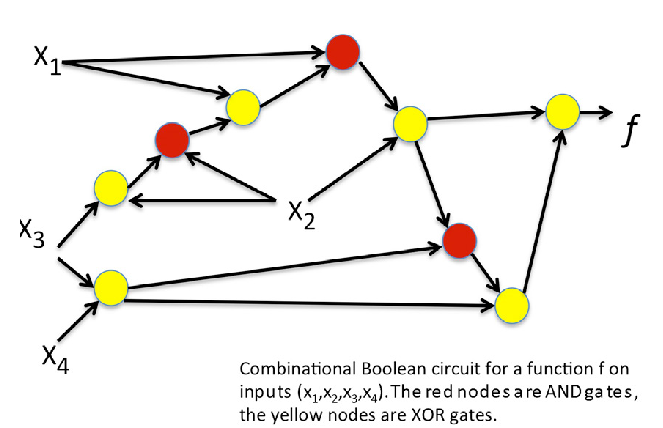
図7:組合せブール回路。入力 x1、x2、x3、x4 から出力 f へ向かう有向グラフで、赤い節点 3 個と黄色い節点 6 個からなる。図中に「入力 (x1,x2,x3,x4) 上の関数 f の組合せブール回路。赤い節点は AND ゲート、黄色い節点は XOR ゲートである」と記されている。
Figure 7: Combinational Boolean Circuit
図7:組合せブール回路
The page http://cs-www.cs.yale.edu/homes/~peralta/CircuitStuff/CMT.html contains many of our results.
ページ http://cs-www.cs.yale.edu/homes/~peralta/CircuitStuff/CMT.html に、我々の成果の多くが掲載されています。
CONTACT:
連絡先:
Dr. René Peralta, (301) 975-8702, rene.peralta@nist.gov
Dr. René Peralta, (301) 975-8702, rene.peralta@nist.gov
Cryptography for Constrained Environments
制約のある環境のための暗号
There are several emerging areas in which highly constrained devices are interconnected, typically communicating wirelessly with one another, and working in concert to accomplish some task. Examples of these areas include: sensor networks, healthcare, distributed control systems, the Internet of Things, cyber physical systems, and the smart grid. Security and privacy can be very important in all of these areas. Because the majority of current cryptographic algorithms were designed for desktop/server environments, many of these algorithms do not fit into the constrained resources. If current algorithms can be made to fit into the limited resources of constrained environments, their performance is typically not acceptable.
高度に制約されたデバイスが相互に接続され、通常は無線で互いに通信し、協調して何らかのタスクを達成するという新たな領域がいくつか現れています。こうした領域の例としては、センサーネットワーク、ヘルスケア、分散制御システム、Internet of Things、サイバーフィジカルシステム、スマートグリッドがあります。これらすべての領域において、セキュリティとプライバシーは非常に重要になり得ます。現在の暗号アルゴリズムの大多数はデスクトップ/サーバー環境向けに設計されたため、これらのアルゴリズムの多くは制約のある資源に収まりません。現在のアルゴリズムを制約のある環境の限られた資源に収めることができたとしても、その性能は通常、許容できるものではありません。
CSD’s Cryptographic Technology Group (CTG) is studying the use of the NIST-approved symmetric-key algorithms in constrained environments. CTG has developed microcontroller implementations of the Advanced Encryption Standard (AES) to provide both confidentiality and the AES-based message authentication code, Cipher-based Message Authentication Code (CMAC), for authentication. Additionally, CTG has implemented the 256-bit version of the Secure Hash Algorithm (SHA-256) to provide a Hash-based Message Authentication Code (HMAC) for authentication. SHA-3, as specified in Draft FIPS 202, SHA-3 Standard: Permutation-Based Hash and Extendable-Output Functions, and a variant of Keccak using an 800-bit permutation has also been implemented. CTG has demonstrated that SHA-3 allows a more efficient construction for computing Message authentication codes (MACs) than the HMAC construction, which is required when using SHA-256. CTG has also investigated other, non-NIST-approved algorithms for constrained environments.
CSDの Cryptographic Technology Group (CTG) は、NISTが承認した共通鍵アルゴリズムを制約のある環境で使用することについて研究しています。CTGは、機密性と、認証のためのAESに基づくメッセージ認証コードである Cipher-based Message Authentication Code (CMAC) の両方を提供するために、Advanced Encryption Standard (AES) のマイクロコントローラ実装を開発しました。加えて、CTGは、認証のための Hash-based Message Authentication Code (HMAC) を提供するために、Secure Hash Algorithm の256ビット版 (SHA-256) を実装しました。草案 FIPS 202, SHA-3 Standard: Permutation-Based Hash and Extendable-Output Functions に規定されているSHA-3、および800ビットの置換を用いるKeccakの変種も実装されました。CTGは、SHA-3を用いると、SHA-256を使用する場合に必要となるHMAC構成よりも効率的な構成でメッセージ認証コード(MAC)を計算できることを実証しました。CTGはまた、制約のある環境向けの、NISTが承認していない他のアルゴリズムについても調査しました。
CTG has also begun to examine applications in constrained environments to determine whether NIST should develop a lightweight encryption standard. CTG has talked with industry experts to understand challenges, limitations, and work from other standardization bodies in this area. Also, CTG has had internal discussions on additional considerations for a lightweight standard, as restrictions on its use would be necessary in order to prevent the adoption of a lightweight cipher where the strong protection of AES is required.
CTGはまた、NISTが軽量暗号の標準を策定すべきかどうかを判断するため、制約のある環境における応用の検討を開始しました。CTGは、この分野における課題、制限、および他の標準化団体による作業を理解するため、産業界の専門家と話し合いました。また、CTGは、軽量標準に関する追加の考慮事項について内部で議論を行いました。AESによる強力な保護が求められる場面で軽量暗号が採用されることを防ぐためには、その使用に対する制限が必要になるからです。
CTG is preparing a report that describes the current state and challenges in target application areas, and provides a survey of lightweight primitives, including block and stream ciphers that have been proposed for constrained environments. CTG researchers also studied efficient implementations of the Boolean functions used in lightweight primitives and published Multiplicative Complexity of Boolean Functions on Four and Five Variables at the Third International Workshop on Lightweight Cryptography for Security & Privacy (LightSec 2014).
CTGは、対象とする応用領域の現状と課題を記述し、制約のある環境向けに提案されているブロック暗号およびストリーム暗号を含む軽量プリミティブの調査結果を示す報告書を準備しています。CTGの研究者はまた、軽量プリミティブで用いられるブール関数の効率的な実装について研究し、Third International Workshop on Lightweight Cryptography for Security & Privacy (LightSec 2014) において Multiplicative Complexity of Boolean Functions on Four and Five Variables を発表しました。
In FY 2015, CTG will continue to analyze the resource requirements and performance characteristics of lightweight primitives, and study their use as building blocks to perform various cryptographic objectives. Additionally, CTG will investigate specific application areas in order to determine functionality and resource requirements in the area of cryptography for constrained environments.
2015会計年度に、CTGは、軽量プリミティブの資源要件と性能特性の分析を続け、さまざまな暗号上の目的を果たすための構成要素としてそれらを使用することについて研究します。加えて、CTGは、制約のある環境のための暗号の分野における機能要件と資源要件を明らかにするため、特定の応用領域を調査します。
CONTACTS:
連絡先:
Mr. Lawrence Bassham, (301) 975-3292, lawrence.bassham@nist.gov
Mr. Lawrence Bassham, (301) 975-3292, lawrence.bassham@nist.gov
Dr. Kerry McKay, (301) 975-4969, kerry.mckay@nist.gov
Dr. Kerry McKay, (301) 975-4969, kerry.mckay@nist.gov
Dr. Meltem Sönmez Turan, (301) 975-4391, meltem.turan@nist.gov
Dr. Meltem Sönmez Turan, (301) 975-4391, meltem.turan@nist.gov
NIST Randomness Beacon
NIST Randomness Beacon
NIST has implemented a source of public randomness. The prototype, called the Beacon, uses two independent, commercially available sources of randomness, each with an independent hardware entropy source.
NISTは、公開の乱数源を実装しました。Beaconと呼ばれるこのプロトタイプは、市販されている2つの独立した乱数源を使用しており、それぞれが独立したハードウェアエントロピー源を備えています。
The Beacon is designed to provide unpredictability, autonomy, and consistency. Unpredictability means that users cannot algorithmically predict bits before they are made available by the source. Autonomy means that the source is resistant to attempts by outside parties to alter the distribution of the random bits. Consistency means that a set of users can access the source in such a way that they are confident that they all receive the same random string.
Beaconは、予測不可能性、自律性、および一貫性を提供するように設計されています。予測不可能性とは、ビットが乱数源によって利用可能にされる前に、利用者がそれらをアルゴリズムによって予測できないことを意味します。自律性とは、乱数ビットの分布を変えようとする外部の者の試みに対して、乱数源が耐性を持つことを意味します。一貫性とは、一群の利用者が、全員が同じ乱数列を受け取っていると確信できる方法で乱数源にアクセスできることを意味します。
The Beacon posts bit-strings in blocks of 512 bits every 60 seconds. Each such value is time-stamped and signed by NIST, and includes the hash of the previous value to chain the sequence of values together. This prevents all, even the Beacon itself, from retroactively changing an output packet without being detected. The Beacon keeps all output packets and makes them available online at https://beacon.nist.gov/home.
Beaconは、60秒ごとに512ビットのブロック単位でビット列を公表します。それぞれの値にはタイムスタンプが付され、NISTによって署名されており、値の列を連鎖させるために直前の値のハッシュが含まれています。これにより、Beacon自身を含むいかなる者も、検知されることなく出力パケットを遡って変更することはできません。Beaconはすべての出力パケットを保持し、https://beacon.nist.gov/home においてオンラインで利用可能にしています。
Tables of random numbers have probably been used for multiple purposes, at least since the Industrial Revolution. In the digital age, algorithmic random number generators have largely replaced these tables. The NIST Randomness Beacon expands the use of public randomness to multiple scenarios in which the latter methods cannot be used. The extra functionalities stem mainly from three features. First, the Beacon-generated numbers cannot be predicted before they are published. Second, the public, time-bound, and authenticated nature of the Beacon allows a user application to prove to anybody that it used truly random numbers not known before a certain point in time. Third, this proof can be presented offline and at any point in the future. For example, the proof could be mailed to a trusted third party, encrypted and signed by an application, only to be opened if needed and authorized.
乱数表は、おそらく少なくとも産業革命以来、さまざまな目的に使われてきました。デジタル時代においては、アルゴリズムによる乱数生成器がこれらの表にほぼ取って代わりました。NIST Randomness Beacon は、公開の乱数の利用を、これら後者の方法を用いることができない多様な場面へと広げます。追加の機能は主に3つの特徴に由来します。第一に、Beaconが生成する数は、公表される前に予測することができません。第二に、Beaconは公開されており、時刻に結び付けられ、かつ認証されているという性質を持つため、利用者のアプリケーションは、ある時点より前には知られていなかった真にランダムな数を使用したことを、誰に対しても証明できます。第三に、この証明はオフラインで、かつ将来の任意の時点で提示できます。例えば、この証明をアプリケーションが暗号化し署名した上で、信頼できる第三者に郵送しておき、必要が生じ、かつ認可された場合にのみ開封されるようにすることができます。
Although commercially available physical sources of randomness are adequate as entropy sources for currently envisioned applications of the Beacon, NIST is working on developing a source of verifiably random sequences. Given that it is impossible to construct such sequences in any classical physical context, CSD is collaborating with the NIST Physical Measurement Laboratory (PML) to build a quantum source. The aim is to use quantum effects to generate sequences that are guaranteed to be unpredictable, even if an attacker has access to the random source. For more information on this collaboration, see http://www.nist.gov/pml/div684/random_numbers_bell_test.cfm.
市販されている物理的な乱数源は、現在想定されているBeaconの応用のためのエントロピー源としては十分ですが、NISTは、検証可能な形でランダムである列の源の開発に取り組んでいます。そのような列を古典物理学のいかなる枠組みにおいても構成することは不可能であるため、CSDは、量子的な乱数源を構築するために NIST Physical Measurement Laboratory (PML) と協力しています。その狙いは、量子効果を利用して、たとえ攻撃者が乱数源にアクセスできたとしても予測不可能であることが保証される列を生成することです。この協力に関する詳細は、http://www.nist.gov/pml/div684/random_numbers_bell_test.cfm を参照のこと。
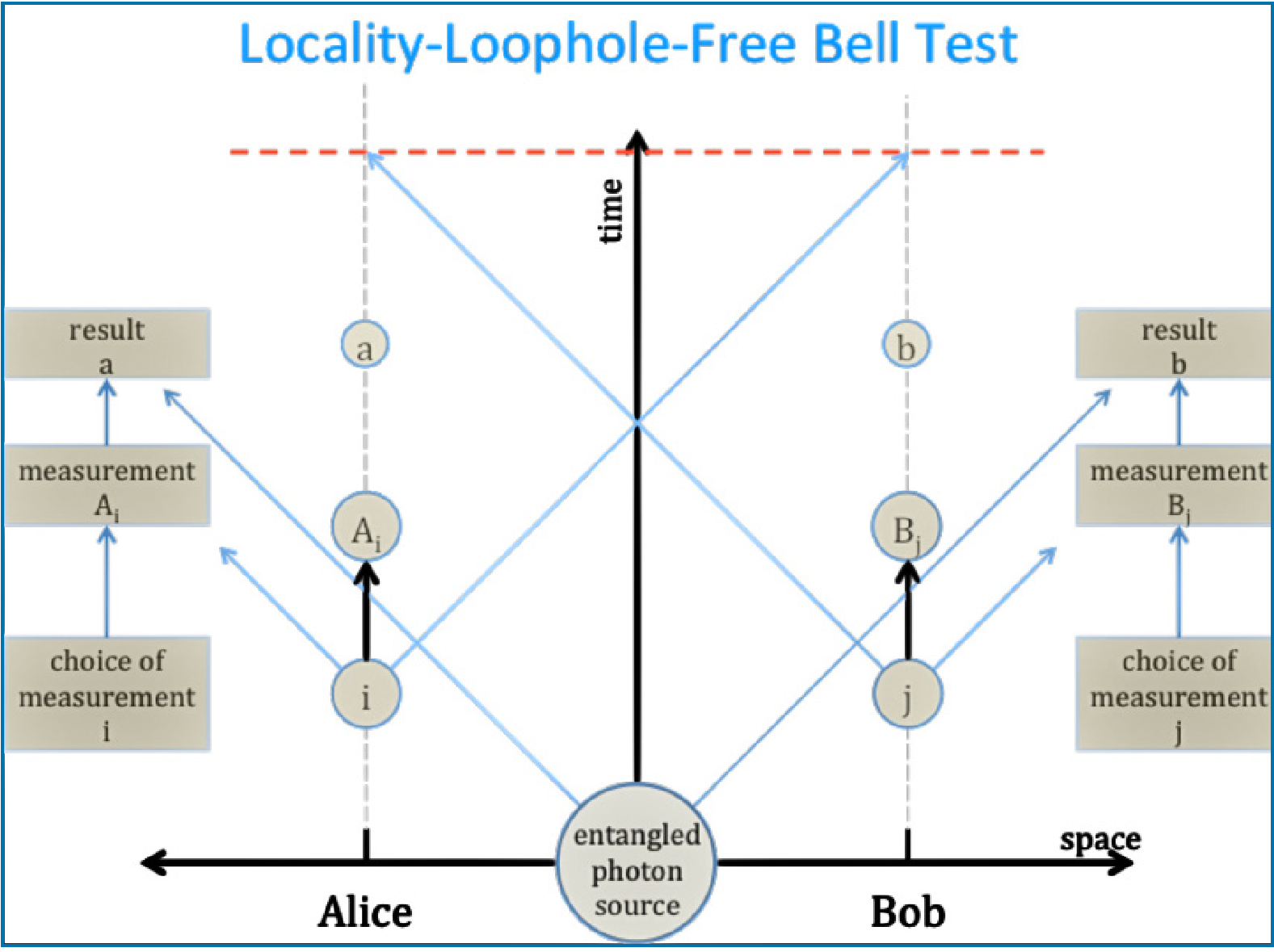
図8:局所性の抜け穴のないベルテストを示す時空図。Locality-Loophole-Free Bell Test と題し、横軸が空間(space)、縦軸が時間(time)の図である。原点にもつれた光子の源(entangled photon source)があり、左に Alice、右に Bob がいる。Alice の上の破線の縦線上に節点 i、Ai、a、Bob の上に節点 j、Bj、b がある。光源と i、j から水色の斜線(光円錐)が伸び、上部を赤い破線の横線が横切る。両側の箱は、Alice について「測定の選択 i → 測定 Ai → 結果 a」、Bob について「測定の選択 j → 測定 Bj → 結果 b」を示す。
Figure 8: A Space-time Diagram Illustrating a Locality-loophole-free Bell Test
図8:局所性の抜け穴のないベルテストを示す時空図
Since the bits posted by the Beacon are public, these bits are not to be used as secret values, such as cryptographic keys or seeds for random number generators used in the construction of cryptographic keys. NIST encourages the community-at-large to research and publish novel ways in which this tool can be used. Some examples of applications are unpredictable sampling, new authentication mechanisms, and secure multi-party computation. To learn more about the NIST Randomness Beacon project, please visit the project’s website at: http://beacon.nist.gov.
Beaconが公表するビットは公開されているため、これらのビットを、暗号鍵や、暗号鍵の生成に用いる乱数生成器のシードといった秘密の値として使用してはなりません。NISTは、このツールの新しい利用方法を研究し公表するよう、コミュニティ全体に奨励しています。応用の例としては、予測不可能なサンプリング、新しい認証メカニズム、安全なマルチパーティ計算があります。NIST Randomness Beacon プロジェクトの詳細については、プロジェクトのウェブサイト http://beacon.nist.gov を参照されました。
CONTACT:
連絡先:
Dr. René Peralta, (301) 975-8702, rene.peralta@nist.gov
Dr. René Peralta, (301) 975-8702, rene.peralta@nist.gov
Wireless and Mobile Security
無線およびモバイルのセキュリティ
Today, wireless networks often provide connections for mobile devices using multiple and different radio technologies. In such a heterogeneous network, a mobile device may switch its connection between different wireless technologies. The procedure for conducting such a switch is called a “handover.” Media-independent handover (MIH) is a set of services specified in IEEE 802.21 to assist the handover. When the services provided by the pervasive heterogeneous networks are extended to other applications, such as Smart Grid applications, the MIH needs to be processed by a group of wireless nodes, such as smart meters, for balancing the network load and for reliability. In this case, the information may need to be delivered to a group of smart meters using a multicast message, which is used to deliver the information. That is, the message is sent from one point-of-service (PoS) to multiple wireless nodes. In some of the application environments, such as sensor networks, the groups are formed dynamically. That is, new nodes can be added to the group, and some nodes in the group may need to be removed. Such groups are managed through multicast signals.
今日、無線ネットワークは、複数の異なる無線技術を用いてモバイルデバイスに接続を提供することが多くあります。そのような異種混在ネットワークでは、モバイルデバイスは、異なる無線技術の間で接続を切り替えることがあります。そのような切り替えを行う手順は「ハンドオーバー」と呼ばれます。Media-independent handover (MIH) は、ハンドオーバーを支援するためにIEEE 802.21で規定された一連のサービスです。広く普及した異種混在ネットワークが提供するサービスをスマートグリッドの応用など他の応用に拡張する場合、ネットワーク負荷の分散と信頼性のために、スマートメーターなどの無線ノードのグループがMIHを処理する必要があります。この場合、情報の配信に用いられるマルチキャストメッセージによって、スマートメーターのグループに情報を届ける必要が生じ得ます。すなわち、メッセージは1つの point-of-service (PoS) から複数の無線ノードへ送信されます。センサーネットワークなど一部の応用環境では、グループは動的に形成されます。すなわち、新しいノードをグループに追加することができ、グループ内の一部のノードを削除する必要が生じることもあります。そのようなグループは、マルチキャスト信号を通じて管理されます。
Amendment 2 of IEEE 802.21 provides protection mechanisms for unicast messages, that is, mechanisms that protect messages between a PoS and a single mobile node. However, the protection for multicast messages and group management signals is critical. In FY 2014, CSD has worked with IEEE 802.21 to develop security solutions for group management in Task Group D of IEEE 802.21. The solutions, specified in IEEE 802.21 Amendment 4, include the mechanisms to distribute group keys and for the protection of multicast messages. A draft of Amendment 4 has been approved through sponsor ballot. In FY 2015, CSD will continue to contribute to a broader scope of IEEE 802 wireless standards.
IEEE 802.21のAmendment 2は、ユニキャストメッセージの保護メカニズム、すなわちPoSと単一のモバイルノードとの間のメッセージを保護するメカニズムを規定しています。しかし、マルチキャストメッセージとグループ管理シグナルの保護も極めて重要です。2014会計年度に、CSDはIEEE 802.21と協力し、IEEE 802.21のTask Group Dにおいてグループ管理のためのセキュリティソリューションを開発しました。IEEE 802.21 Amendment 4に規定されたこのソリューションには、グループ鍵を配布するメカニズムとマルチキャストメッセージを保護するメカニズムが含まれます。Amendment 4の草案は、スポンサー投票を経て承認されました。2015会計年度も、CSDはより広い範囲のIEEE 802無線標準に引き続き貢献します。
CONTACT:
連絡先:
Dr. Lily Chen, (301) 975-6974, lily.chen@nist.gov
Dr. Lily Chen, (301) 975-6974, lily.chen@nist.gov
検証プログラム [装飾の画像。本文を読むのに必要のない装飾のため、この非公式サイトには掲載していません。原本 PDF を参照してください。]
VALIDATION PROGRAMS
検証プログラム
Federal agencies, industry, and the public rely on many of the standards and specifications supported by NIST’s CSD. Poor implementations of these standards or specifications may render a particular product insecure, potentially placing sensitive information at risk. CSD operates several validation programs that help provide a level of assurance that products meet established security requirements and conform to published specifications. To that end, the Security Testing, Validation, and Measurement Group (STVMG) develops test suites and test methods; provides implementation guidance and technical support to industry forums; and conducts education, training, and outreach programs.
連邦機関、産業界および一般市民は、NISTのCSDが支える標準や仕様の多くに依拠しています。これらの標準や仕様の実装が不適切であると、その製品は安全でなくなり、機微な情報が危険にさらされるおそれがあります。CSDは、製品が確立されたセキュリティ要件を満たし、公開された仕様に適合していることについて一定水準の保証を与える助けとなる、複数の検証プログラムを運営しています。そのために、Security Testing, Validation, and Measurement Group (STVMG) は、テストスイートとテスト手法を開発し、実装ガイダンスと産業界のフォーラムへの技術支援を提供し、教育、訓練および普及啓発のプログラムを実施しています。
STVMG’s validation programs work together with independent laboratories that are accredited by the NIST National Voluntary Laboratory Accreditation Program (NVLAP). Based on the independent laboratory test report and test evidence, the validation programs described below validate the implementation under test. The CSD subsequently publishes lists of the validations awarded on public websites.
STVMGの検証プログラムは、NIST National Voluntary Laboratory Accreditation Program (NVLAP) の認定を受けた独立の試験所と連携して進められます。以下に述べる各検証プログラムは、独立の試験所による試験報告書と試験の証拠に基づいて、試験対象の実装を検証します。その後、CSDは、与えた検証の一覧を公開ウェブサイトに掲載します。
Cryptographic System Validation
暗号システムの検証
Current validation programs focus on providing a known level of assurance for cryptographic algorithms and modules. These modules are used within the context of a larger system to provide cryptographic services as a method of protecting the data within the system. As information systems continue to become more complex, the methods used to implement cryptographic services have also increased in complexity. Problems with the use of cryptography are often introduced through the interaction of cryptographic components with the operating environment. This program seeks to specify how cryptographic components are used as part of a defined cryptographic system to solve problems with a measureable level of assurance, and to introduce automated methods of quantifying the level of assurance that has been provided.
現行の検証プログラムは、暗号アルゴリズムと暗号モジュールについて既知の水準の保証を与えることに重点を置いています。これらのモジュールは、より大きなシステムの中で、システム内のデータを保護する手段として暗号サービスを提供するために使われます。情報システムが複雑になり続けるにつれて、暗号サービスの実装に用いられる手法も複雑さを増してきました。暗号の利用に関する問題は、暗号コンポーネントと動作環境との相互作用を通じて持ち込まれることが多くあります。このプログラムは、暗号コンポーネントを定義された暗号システムの一部としてどのように使えば、測定可能な水準の保証をもって問題を解決できるかを規定すること、および与えられた保証の水準を定量化する自動化された手法を導入することを目指しています。
This program will begin the research required to define a reference cryptographic systems architecture and example use cases where cryptographic systems are built from known cryptographic components that cooperate through trust relationships to provide a measureable level of assurance. The architecture should begin at the lowest level with a hardware-based root of trust, and each cryptographic component should be added in successive layers to provide assurance in a systematic way. This should allow the development of tests that would measure the correct implementation of cryptographic components as part of a larger system.
このプログラムでは、参照用の暗号システムアーキテクチャと、利用例を定義するのに必要な研究に着手します。ここでいう利用例とは、既知の暗号コンポーネントが信頼関係を通じて連携し、測定可能な水準の保証を与えるように暗号システムが構築されている例です。このアーキテクチャは、最下層のハードウェアベースの信頼の基点から始め、各暗号コンポーネントを層として順に積み重ねることで、体系的に保証を与えるものとすべきです。これにより、より大きなシステムの一部としての暗号コンポーネントが正しく実装されているかを測定するテストを開発できるようになるはずです。
This program will perform research and experimentation in applicable technologies and techniques that will enable the efficient testing of the cryptographic capabilities of each layer, and continuous monitoring capabilities of each cryptographic component, providing the necessary interfaces to establish trust relationships with other cryptographic components. Techniques could include such items as:
このプログラムでは、各層の暗号機能の効率的なテストと、各暗号コンポーネントの継続的監視機能を可能にし、他の暗号コンポーネントとの信頼関係を確立するのに必要なインタフェースを提供する、適用可能な技術と技法について、研究と実験を行います。技法には、次のようなものが考えられます。
•Embedding SCAP-like data elements and standard interfaces to query those data elements during the design and implementation of cryptographic components that would enable automated testing capabilities;
•暗号コンポーネントの設計と実装の段階で、SCAPに類するデータ要素と、それらのデータ要素を照会する標準インタフェースを組み込み、自動テスト機能を可能にすること
•Using cryptographic techniques to embed values into the module that would increase the verifiability and assurance that the module provides; and
•暗号技術を用いてモジュールに値を埋め込み、モジュールが与える検証可能性と保証を高めること
•Using industry-based secure development techniques to increase the level of trust inherent in software modules starting with design and implementation.
•産業界で用いられているセキュア開発の技法を用いて、設計と実装の段階から、ソフトウェアモジュールに本来備わる信頼の水準を高めること
Research into this area of cryptographic system validation holds the promise of automating the validation of all cryptographic components, providing a higher assurance with less manual effort by using SCAP-based ideas to embed data elements that instrument the test harnesses used to validate cryptographic systems. This would also provide the instrumentation that could be leveraged to enable a greater level of situational awareness and security measurement, and potentially, to enable continuous monitoring of cryptographic systems.
暗号システムの検証というこの分野の研究には、すべての暗号コンポーネントの検証を自動化できる見込みがあります。SCAPに基づく考え方を用いて、暗号システムの検証に使うテストハーネスを計装するデータ要素を埋め込むことにより、より少ない手作業でより高い保証を与えられます。これはまた、状況認識とセキュリティ測定の水準を高めるために活用でき、さらには暗号システムの継続的監視を可能にしうる計装も提供することになります。
CONTACT:
連絡先:
Mr. Michael Cooper, (301) 975-8077, michael.cooper@nist.gov
Mr. Michael Cooper, (301) 975-8077, michael.cooper@nist.gov
Cryptographic Programs and Laboratory Accreditation
暗号プログラムと試験所認定
The Cryptographic Algorithm Validation Program (CAVP) and the Cryptographic Module Validation Program (CMVP) were developed in collaboration between NIST and the Communications Security Establishment (CSE) of Canada to support the respective federal user communities for strong, independently tested, and commercially available cryptographic algorithms and modules. Through these programs, NIST and CSE work with international government, public and private sectors as a part of the cryptographic community to achieve standards-based security and assurance of correct implementation. The goal of these programs is to provide federal agencies with a security metric to use in procuring and deploying cryptographic modules and promote the use of validated algorithms and modules by industry and the public. The testing carried out by independent third-party laboratories accredited by the NIST National Voluntary Laboratory Accreditation Program (NVLAP), and the validations performed by the CAVP and CMVP programs provide this metric. Federal agencies, industry, and the public can choose cryptographic modules and/or products containing cryptographic modules from the CMVP Validated Modules List and have confidence in the claimed level of security and assurance of correct implementation.
Cryptographic Algorithm Validation Program (CAVP) とCryptographic Module Validation Program (CMVP) は、強力で、独立に試験され、商用で入手できる暗号アルゴリズムと暗号モジュールを求めるそれぞれの国の連邦政府の利用者コミュニティを支えるために、NISTとカナダのCommunications Security Establishment (CSE) が協力して開発したものです。これらのプログラムを通じて、NISTとCSEは、暗号コミュニティの一員として各国の政府、公共部門および民間部門と協力し、標準に基づくセキュリティと、実装が正しいことの保証を実現しています。これらのプログラムの目標は、連邦機関が暗号モジュールを調達し配備する際に用いるセキュリティの指標を提供すること、および産業界と一般市民による検証済みアルゴリズムと検証済みモジュールの利用を促進することです。この指標は、NIST National Voluntary Laboratory Accreditation Program (NVLAP) の認定を受けた独立の第三者試験所が実施する試験と、CAVPおよびCMVPが行う検証によって与えられます。連邦機関、産業界および一般市民は、CMVP Validated Modules Listから暗号モジュールや暗号モジュールを含む製品を選ぶことができ、主張されているセキュリティの水準と、実装が正しいことの保証を信頼できます。
Cryptographic algorithm and cryptographic module testing and validation are based on published NIST standards. As federal agencies are required to use validated cryptographic modules for the protection of sensitive non-classified information, the validated modules and the validated algorithms that the modules contain represent the culmination and delivery of the CSD’s cryptography-based work to the end user.
暗号アルゴリズムと暗号モジュールの試験および検証は、公開されたNISTの標準に基づいています。連邦機関は、機微であるが機密指定されていない情報の保護に検証済みの暗号モジュールを使うことを義務づけられているので、検証済みモジュールとそれに含まれる検証済みアルゴリズムは、CSDの暗号関連の業務の集大成であり、それがエンドユーザに届けられたものです。
The CAVP and the CMVP are separate collaborative programs. The CAVP and the CMVP validate algorithms and modules, respectively, that are used in a wide variety of products, including Internet browsers, radios, smart cards, space-based communications, munitions, security tokens, mobile phones, network and storage devices, and products supporting the Public Key Infrastructure (PKI) and electronic commerce. A module may be a standalone product, such as a virtual private network (VPN) or smart card, or it could be a module embedded in many products, such as a cryptographic-based toolkit. As a result, a small number of modules may be incorporated within hundreds of products. The CAVP validates cryptographic algorithms that may be integrated in one or more cryptographic modules.
CAVPとCMVPは、別個の協力プログラムです。CAVPはアルゴリズムを、CMVPはモジュールを検証します。これらは、インターネットブラウザ、無線機、スマートカード、宇宙通信、軍需品、セキュリティトークン、携帯電話、ネットワーク機器とストレージ機器、公開鍵基盤 (PKI) や電子商取引を支える製品など、多種多様な製品で使われています。モジュールは、仮想プライベートネットワーク (VPN) やスマートカードのように単体の製品である場合もあれば、暗号ツールキットのように多くの製品に組み込まれるモジュールである場合もあります。その結果、少数のモジュールが何百もの製品に組み込まれることがあります。CAVPは、1つ以上の暗号モジュールに組み込まれうる暗号アルゴリズムを検証します。
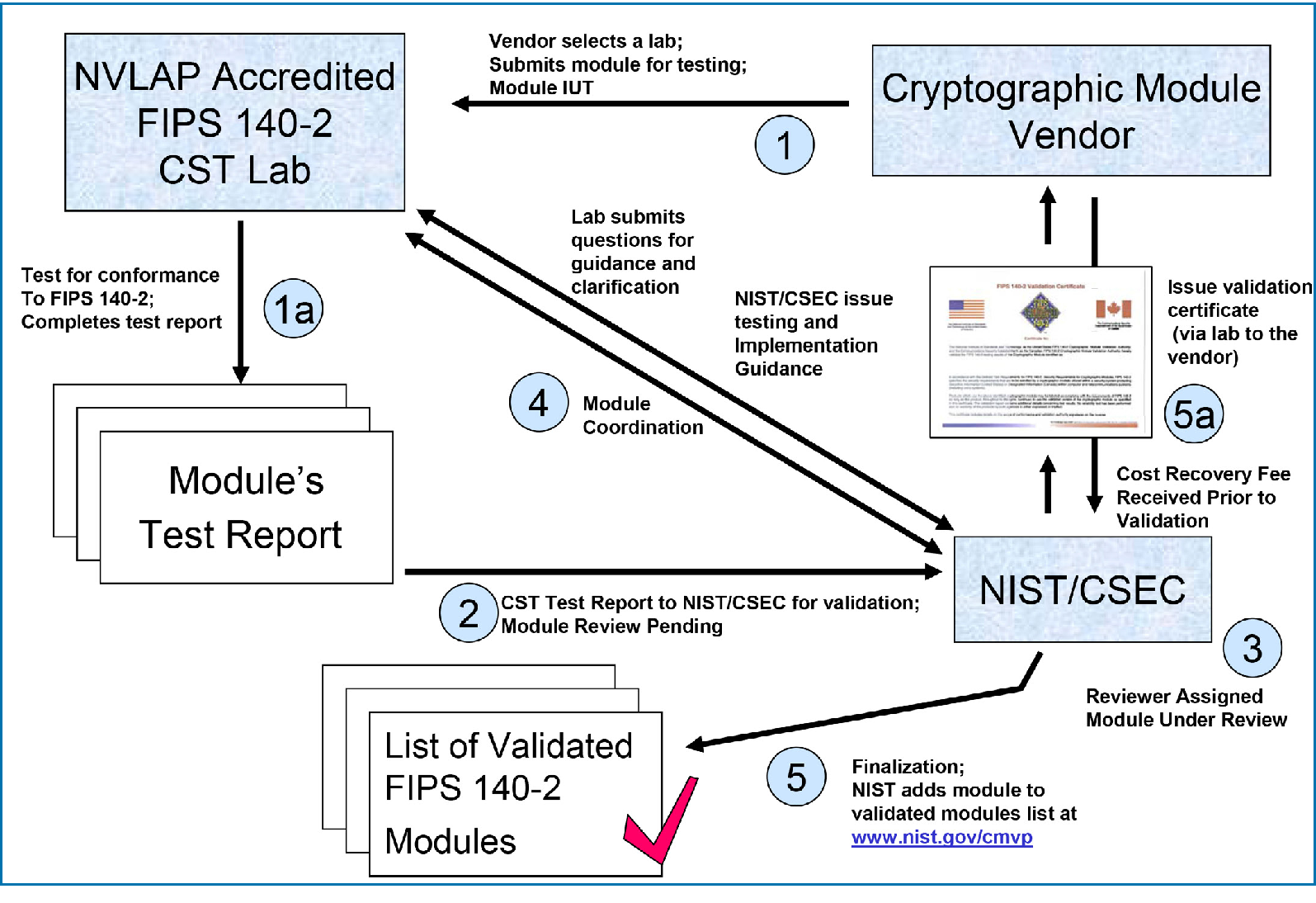
図9:FIPS 140-2の試験と検証の全体の流れ。番号付きの手順を示す流れ図である。1:Cryptographic Module Vendor(暗号モジュールベンダー)が試験所を選び、試験対象のモジュール(Module IUT)を NVLAP Accredited FIPS 140-2 CST Lab(NVLAP 認定の FIPS 140-2 CST 試験所)に提出する。1a:試験所が FIPS 140-2 への適合を試験し、試験報告書を完成させ、Module's Test Report(モジュールの試験報告書)ができる。2:CST 試験報告書が検証のため NIST/CSEC に送られ、モジュールはレビュー待ちとなる。3:NIST/CSEC でレビュー担当者が割り当てられ、モジュールがレビュー中となる。4:Module Coordination(モジュールの調整)として、試験所と NIST/CSEC の間に 2 本の矢印があり、「試験所が指針と説明を求める質問を提出する」「NIST/CSEC が試験および実装指針に関する課題を提起する」と記されている。5:最終確定として、NIST がモジュールを www.nist.gov/cmvp の検証済みモジュール一覧に追加する。これはチェックマーク付きの「List of Validated FIPS 140-2 Modules」の束で示される。5a:検証証明書を(試験所経由でベンダーへ)発行する。証明書の画像があり、NIST/CSEC から証明書へ、証明書からベンダーへ上向きの矢印がある。NIST/CSEC へ向かう下向きの矢印には「検証の前に費用回収の料金を受領」と記されている。
Figure 9: General Flow of FIPS 140-2 Testing and Validation
図9:FIPS 140-2の試験と検証の全体の流れ
The CAVP and CMVP validation programs provide documented methodologies for conformance testing through defined sets of security requirements. For the CAVP, the validation system documents are designed for each FIPS-approved and NIST-recommended cryptographic algorithm. See the website for a listing (see http://csrc.nist.gov/groups/STM/cavp/). Security requirements for the CMVP are found in FIPS 140-2, Security Requirements for Cryptographic Modules, and the associated test metrics and methods in Derived Test Requirements for FIPS 140-2, Security Requirements for Cryptographic Modules (DTR). The four Annexes to FIPS 140-2 reference the underlying cryptographic algorithm standards or methods. The CMVP-developed Implementation Guidance for FIPS PUB 140-2 and the Cryptographic Validation Program (IG) provides programmatic and implementation guidance across all of the referenced documents. The information provided in the DTR and IG documents ensures the repeatability of tests and the equivalency in results across the testing laboratories. The Implementation Guidance provides clarity, consistency of interpretation, and insight for successful conformance testing, validation, and revalidation.
CAVPとCMVPの検証プログラムは、定義されたセキュリティ要件の集合を通じて、適合性試験のための文書化された方法論を提供します。CAVPでは、FIPS承認およびNIST推奨の暗号アルゴリズムごとに、検証システムの文書が作られています。一覧はウェブサイトを参照されました(http://csrc.nist.gov/groups/STM/cavp/ を参照してください)。CMVPのセキュリティ要件はFIPS 140-2, Security Requirements for Cryptographic Modulesに、関連する試験の指標と手法はDerived Test Requirements for FIPS 140-2, Security Requirements for Cryptographic Modules (DTR) に定められています。FIPS 140-2の4つのAnnexは、基礎となる暗号アルゴリズムの標準または方式を参照しています。CMVPが作成したImplementation Guidance for FIPS PUB 140-2 and the Cryptographic Validation Program (IG) は、参照されるすべての文書にわたって、プログラム運営上および実装上のガイダンスを提供します。DTRとIGの文書が提供する情報により、試験の再現性と、試験所間での結果の同等性が確保されます。Implementation Guidanceは、適合性試験、検証および再検証を成功させるための明確さ、解釈の一貫性および知見を提供します。
The unique position of the validation programs gives the CAVP and CMVP the opportunity to acquire insight during the validation review activities and results in practical, timely, and up-to-date guidance that is needed by the testing laboratories and vendors to move their modules out to the user community in a timely and cost-effective manner and with the assurance of third-party conformance testing. This knowledge and insight provide a foundation for current and future standards and tools development.
検証プログラムという独自の立場にあるため、CAVPとCMVPは検証の審査活動の中で知見を得る機会があり、その結果、実用的で時宜にかなった最新のガイダンスが生まれます。このガイダンスは、試験所とベンダが、第三者による適合性試験の保証を伴って、モジュールを適時にかつ費用対効果の高い方法で利用者コミュニティに送り出すために必要なものです。この知識と知見は、現在および将来の標準とツールの開発の基礎となります。
The CMVP reviews the cryptographic module validation requests from the testing laboratories and, as a byproduct of the review, is attentive to emerging and/or changing technologies. These insights into the evolution of operating environments and complex systems allow, the CMVP to perform research and development on evolving test metrics and methods and future requirements for cryptographic modules. This research is used to assist developers of cryptographic modules, testing laboratories, and the user community when developing new standards.
CMVPは、試験所からの暗号モジュールの検証申請を審査し、その審査の副産物として、新たに現れる技術や変化していく技術に注意を払っています。動作環境と複雑なシステムの進化に関するこうした知見により、CMVPは、発展していく試験の指標と手法、および暗号モジュールに対する将来の要件について研究開発を行うことができます。この研究は、新しい標準を開発する際に、暗号モジュールの開発者、試験所および利用者コミュニティを支援するために使われます。
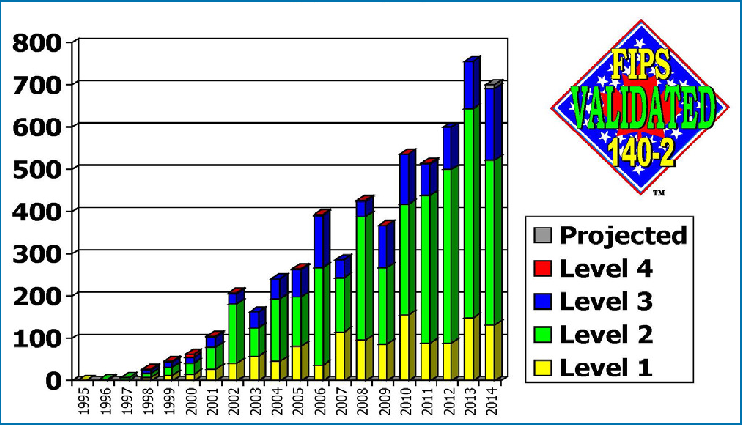
図10:暦年別およびレベル別のFIPS 140-1およびFIPS 140-2検証済みモジュール。1995 年から 2014 年までの積み上げ棒グラフで、縦軸は 0 から 800 である。各棒は Level 1(黄)、Level 2(緑)、Level 3(青)、Level 4(赤)に分かれ、2014 年の棒の上には灰色の Projected(見込み)がある。ほとんどの棒で Level 2 が最大の部分を占め、最も高い棒は 2013 年の約 750 である。右上に FIPS VALIDATED 140-2 の標章がある。
Figure 10: FIPS 140-1 and FIPS 140-2 Validated Modules by Calendar Year and Level
図10:暦年別およびレベル別のFIPS 140-1およびFIPS 140-2検証済みモジュール
The CAVP and the CMVP have stimulated improved quality and security assurance of cryptographic algorithm implementations and modules. The latest set of statistics, which are collected quarterly from each of the testing laboratories, shows that 5 % (dropped from 7 % in FY 2013) of the cryptographic algorithms and 54 % (increased from 35 % in FY 2013) of the cryptographic modules brought in for voluntary testing had security flaws that were corrected during testing. By the end of FY 2014, the CMVP had validated and issued a total of 2258 cryptographic module validation certificates that represent 5785 modules. These modules have been developed by more than 475 domestic and international vendors. Likewise, to date, the CAVP has issued approximately 15 963 validations, representing the algorithm validations of approximately 17 approved algorithms.
CAVPとCMVPは、暗号アルゴリズムの実装と暗号モジュールの品質およびセキュリティ保証の向上を促してきました。各試験所から四半期ごとに収集している統計の最新版によれば、任意の試験のために持ち込まれた暗号アルゴリズムの5 %(2013会計年度の7 %から低下)と、暗号モジュールの54 %(2013会計年度の35 %から上昇)にセキュリティ上の欠陥があり、それらは試験中に修正されました。2014会計年度末までに、CMVPは合計2258件の暗号モジュール検証証明書を検証のうえ発行しており、これは5785個のモジュールに相当します。これらのモジュールは、国内外の475を超えるベンダによって開発されました。同様に、CAVPはこれまでに約15 963件の検証を発行しており、これは約17種類の承認済みアルゴリズムについてのアルゴリズム検証に当たります。
Figure 11: FIPS 140-1 and FIPS 140-2 Validation Certificates by Fiscal Year and Level
図11:会計年度別およびレベル別のFIPS 140-1およびFIPS 140-2検証証明書
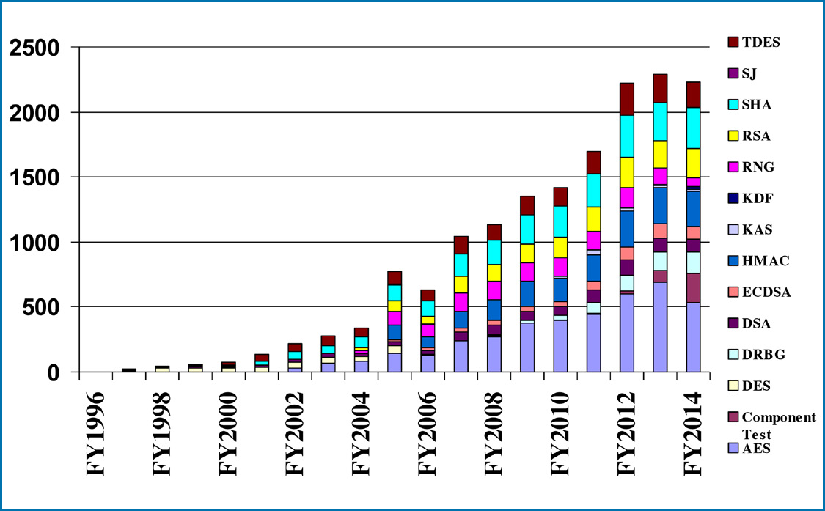
図12:会計年度別のCAVP検証状況。FY1996 から FY2014 までの会計年度ごとの検証件数の積み上げ棒グラフで、縦軸は 0 から 2500 である。凡例は上から TDES、SJ、SHA、RSA、RNG、KDF、KAS、HMAC、ECDSA、DSA、DRBG、DES、Component Test、AES である。棒は 1990 年代後半のほぼ 0 から、FY2012〜FY2014 の約 2,200〜2,300 まで増え、後半の年では AES が最大の部分を占める。
Figure 12: CAVP Validation Status by FYs
図12:会計年度別のCAVP検証状況
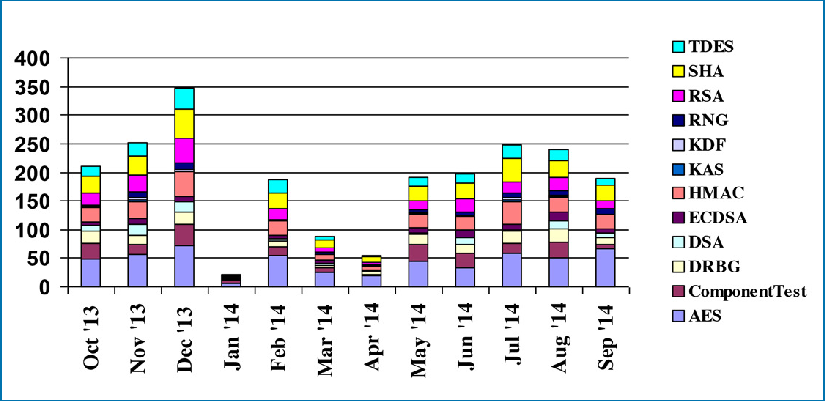
図13:2014会計年度のCAVP検証状況。Oct '13 から Sep '14 までの月ごとの検証件数の積み上げ棒グラフで、縦軸は 0 から 400 である。凡例は上から TDES、SHA、RSA、RNG、KDF、KAS、HMAC、ECDSA、DSA、DRBG、ComponentTest、AES である。最も高い棒は Dec '13 の約 350、最も低いのは Jan '14 の約 20 と Apr '14 の約 55 で、ほかの月はおおむね約 90 から 250 の間である。
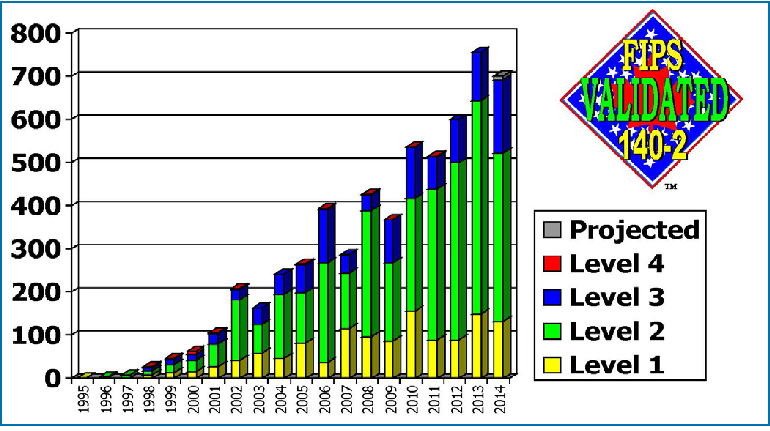
図11:会計年度別およびレベル別のFIPS 140-1およびFIPS 140-2検証証明書。1995 年から 2014 年までの積み上げ棒グラフで、縦軸は 0 から 800 である。各棒は Level 1(黄)、Level 2(緑)、Level 3(青)、Level 4(赤)に分かれ、2014 年の棒の上には灰色の Projected(見込み)がある。ほとんどの棒で Level 2 が最大の部分を占め、最も高い棒は 2013 年の約 750 である。右上に FIPS VALIDATED 140-2 の標章がある。
Figure 13: CAVP Validation Status for FY 2014
図13:2014会計年度のCAVP検証状況
The CAVP issued approximately 2200 algorithm validations in FY 2014. Included in this total, is the 3000th Advanced Encryption Standard (AES) validation, a significant milestone for the CAVP. The CMVP issued 191 module validation certificates in FY 2014. The number of algorithms and modules submitted for validation continues to grow, representing significant growth in the number of validations expected to be available in the future.
CAVPは、2014会計年度に約2200件のアルゴリズム検証を発行しました。この合計には、CAVPにとって重要な節目である、Advanced Encryption Standard (AES) の3000件目の検証が含まれます。CMVPは、2014会計年度に191件のモジュール検証証明書を発行しました。検証のために提出されるアルゴリズムとモジュールの数は増え続けており、これは今後利用可能になると見込まれる検証の数が大きく増えることを示しています。
http://csrc.nist.gov/groups/STM
http://csrc.nist.gov/groups/STM
CONTACTS:
連絡先:
CMVP Contact: Dr. Apostol Vassilev, (301) 975-3221, apostol.vassilev@nist.gov
CMVPの連絡先:Dr. Apostol Vassilev, (301) 975-3221, apostol.vassilev@nist.gov
CAVP Contact: Ms. Sharon Keller, (301) 975-2910, sharon.keller@nist.gov
CAVPの連絡先:Ms. Sharon Keller, (301) 975-2910, sharon.keller@nist.gov
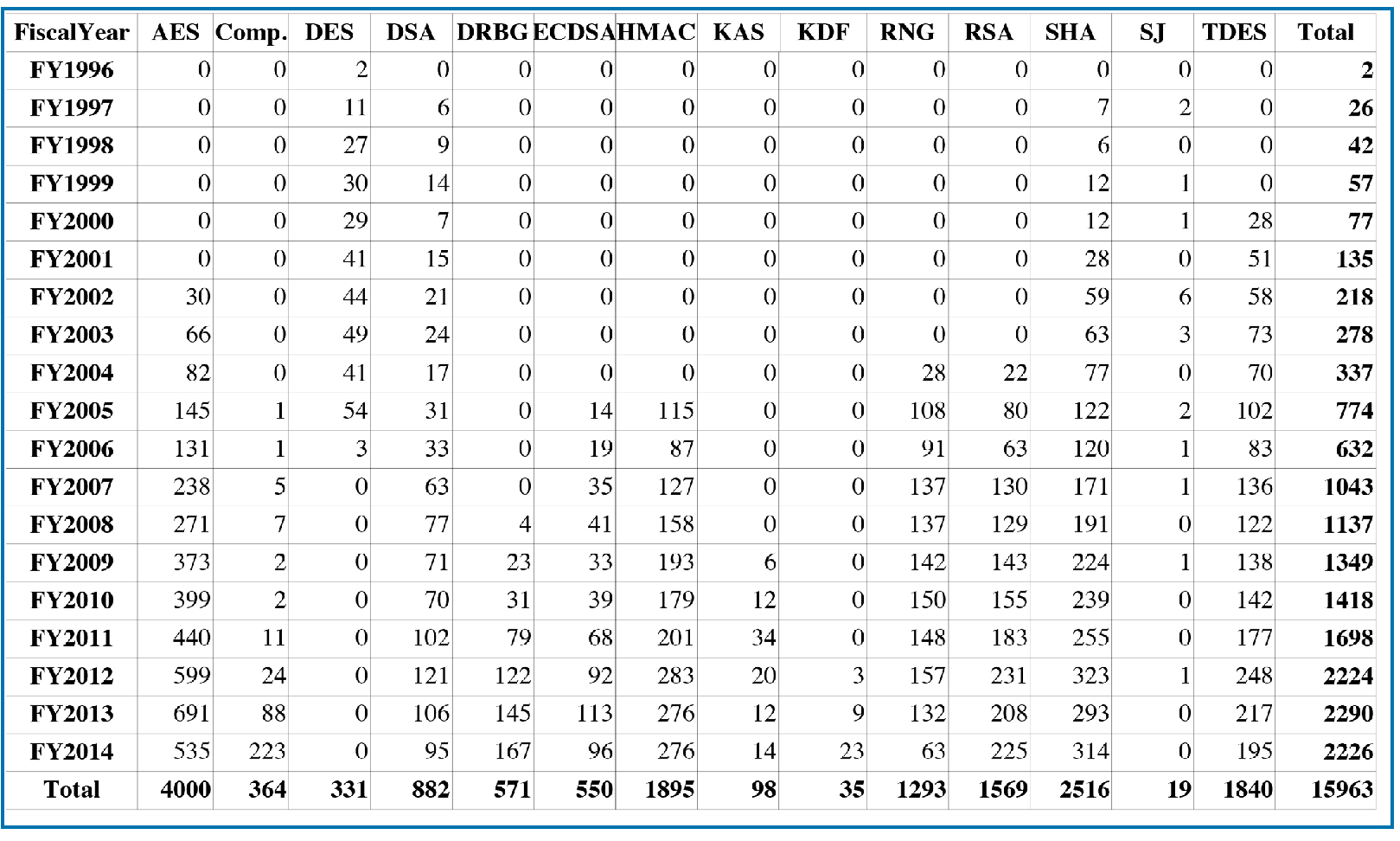
図14:CAVP検証済み実装の実数。会計年度(行)とアルゴリズム(列)ごとの検証件数の表である。列は Fiscal Year、AES、Comp.、DES、DSA、DRBG、ECDSA、HMAC、KAS、KDF、RNG、RSA、SHA、SJ、TDES、Total である。各行の値は次のとおり。FY1996 0, 0, 2, 0, 0, 0, 0, 0, 0, 0, 0, 0, 0, 0, 2;FY1997 0, 0, 11, 6, 0, 0, 0, 0, 0, 0, 0, 7, 2, 0, 26;FY1998 0, 0, 27, 9, 0, 0, 0, 0, 0, 0, 0, 6, 0, 0, 42;FY1999 0, 0, 30, 14, 0, 0, 0, 0, 0, 0, 0, 12, 1, 0, 57;FY2000 0, 0, 29, 7, 0, 0, 0, 0, 0, 0, 0, 12, 1, 28, 77;FY2001 0, 0, 41, 15, 0, 0, 0, 0, 0, 0, 0, 28, 0, 51, 135;FY2002 30, 0, 44, 21, 0, 0, 0, 0, 0, 0, 0, 59, 6, 58, 218;FY2003 66, 0, 49, 24, 0, 0, 0, 0, 0, 0, 0, 63, 3, 73, 278;FY2004 82, 0, 41, 17, 0, 0, 0, 0, 0, 28, 22, 77, 0, 70, 337;FY2005 145, 1, 54, 31, 0, 14, 115, 0, 0, 108, 80, 122, 2, 102, 774;FY2006 131, 1, 3, 33, 0, 19, 87, 0, 0, 91, 63, 120, 1, 83, 632;FY2007 238, 5, 0, 63, 0, 35, 127, 0, 0, 137, 130, 171, 1, 136, 1043;FY2008 271, 7, 0, 77, 4, 41, 158, 0, 0, 137, 129, 191, 0, 122, 1137;FY2009 373, 2, 0, 71, 23, 33, 193, 6, 0, 142, 143, 224, 1, 138, 1349;FY2010 399, 2, 0, 70, 31, 39, 179, 12, 0, 150, 155, 239, 0, 142, 1418;FY2011 440, 11, 0, 102, 79, 68, 201, 34, 0, 148, 183, 255, 0, 177, 1698;FY2012 599, 24, 0, 121, 122, 92, 283, 20, 3, 157, 231, 323, 1, 248, 2224;FY2013 691, 88, 0, 106, 145, 113, 276, 12, 9, 132, 208, 293, 0, 217, 2290;FY2014 535, 223, 0, 95, 167, 96, 276, 14, 23, 63, 225, 314, 0, 195, 2226;Total 4000, 364, 331, 882, 571, 550, 1895, 98, 35, 1293, 1569, 2516, 19, 1840, 15963。
Figure 14: CAVP Validated Implementation Actual Numbers
図14:CAVP検証済み実装の実数
Automated Security Testing and Test Suite Development
自動セキュリティ試験とテストスイートの開発
The Cryptographic Algorithm Validation Program (CAVP), a collaborative program between NIST and the Communications Security Establishment (CSE) of Canada, utilizes the requirements and specifications of NIST standards (i.e., FIPS and Special Publications), to develop algorithm validation test suites and automated security testing. The CAVP is responsible for providing assurance that the cryptographic algorithm implementations contained in cryptographic modules are implemented according to the specifications in the standards. The CAVP accomplishes this by designing and developing conformance testing specific to each cryptographic algorithm.
Cryptographic Algorithm Validation Program (CAVP) は、NISTとカナダのCommunications Security Establishment (CSE) との協力プログラムであり、NISTの標準(すなわちFIPSとSpecial Publication)の要件と仕様を用いて、アルゴリズム検証テストスイートと自動セキュリティ試験を開発しています。CAVPは、暗号モジュールに含まれる暗号アルゴリズムの実装が標準の仕様どおりに実装されていることを保証する責任を負います。CAVPは、暗号アルゴリズムごとに固有の適合性試験を設計し開発することで、これを果たしています。
The conformance testing consists of a suite of validation tests for each approved cryptographic algorithm. These validation tests exercise the algorithmic requirements and mathematical formulas detailed in the algorithm to assure that the detailed specifications are implemented correctly and completely. If the implementer deviates from the specifications in the standard or excludes any part of these specifications or requirements, the validation test will detect the deviations and fail. The validation testing will indicate that the algorithm implementation does not function properly or is incomplete.
適合性試験は、承認済みの暗号アルゴリズムごとの一連の検証テストからなります。これらの検証テストは、アルゴリズムに詳述されたアルゴリズム上の要件と数式を実際に動かして確かめ、詳細な仕様が正しくかつ完全に実装されていることを保証します。実装者が標準の仕様から逸脱したり、これらの仕様や要件の一部を除外したりすると、検証テストはその逸脱を検出して不合格となります。検証試験は、そのアルゴリズム実装が正しく機能していないこと、または不完全であることを示すことになります。
The cryptographic algorithm validation tests designed and developed by the CAVP are performed by independent third-party laboratories accredited by the NIST National Voluntary Laboratory Accreditation Program (NVLAP). The laboratory works with vendors to validate their cryptographic algorithm implementations. The suite of validation tests for each algorithm ensures the repeatability of tests and the equivalency in results across the testing laboratories.
CAVPが設計し開発した暗号アルゴリズム検証テストは、NIST National Voluntary Laboratory Accreditation Program (NVLAP) の認定を受けた独立の第三者試験所が実施します。試験所は、ベンダと協力して、ベンダの暗号アルゴリズム実装を検証します。アルゴリズムごとの一連の検証テストにより、試験の再現性と、試験所間での結果の同等性が確保されます。
There are several types of validation tests, all designed to satisfy the testing requirements of the cryptographic algorithms and their specifications. These include, but are not limited to, Known-Answer Tests, Monte Carlo Tests, and Multi-Block Message Tests. The Known-Answer Tests are designed to examine the individual components of the algorithm by supplying known values to the variables and verifying the expected result. Negative testing is also performed by supplying known incorrect values to assure that the implementation recognizes values that are not allowed. The Monte Carlo Test is designed to exercise the entire implementation under test (IUT). This test is designed to detect the presence of implementation flaws that are not detected with the controlled input of the Known-Answer Tests. The types of implementation flaws detected by this validation test include pointer problems, insufficient allocation of space, improper error handling, and incorrect behavior of the IUT. The Multi-Block Message Test (MMT) is designed to test the ability of the implementation to process multi-block messages, which require the chaining of information from one block to the next.
検証テストにはいくつかの種類があり、いずれも暗号アルゴリズムとその仕様の試験要件を満たすように設計されています。これには、Known-Answer Test、Monte Carlo Test、Multi-Block Message Testなどが含まれますが、これらに限られません。Known-Answer Testは、変数に既知の値を与え、期待される結果を確認することで、アルゴリズムの個々の構成要素を調べるように設計されています。また、既知の誤った値を与えて、許容されない値を実装が認識することを確かめるネガティブテストも行います。Monte Carlo Testは、試験対象実装 (IUT) の全体を動かすように設計されています。このテストは、Known-Answer Testの統制された入力では検出されない実装上の欠陥の存在を検出するように設計されています。この検証テストで検出される実装上の欠陥の種類には、ポインタの問題、領域の割当て不足、不適切なエラー処理、IUTの誤った動作などがあります。Multi-Block Message Test (MMT) は、あるブロックから次のブロックへ情報を連鎖させる必要がある複数ブロックのメッセージを、実装が処理できるかを試験するように設計されています。
During the last few years, the CTG has expanded its publications to not only contain the algorithm’s specifications, but also to include requirements on an algorithm’s use. Many of these usage requirements do not fall within the scope of the CAVP because the CAVP focuses on the correctness of the instructions within the algorithm’s boundary. If these additional algorithm usage requirements are not considered applicable to the algorithm’s implementation, they cannot be tested at the algorithm level by the CAVP, but may be tested by the Cryptographic Module Validation Program (CMVP) if the requirements are considered applicable to the cryptographic module. However, some of these usage requirements may be considered to be outside the scope of both the algorithm implementation and cryptographic module. In this latter case, the fulfillment of the requirements is the responsibility of entities using, installing, or configuring applications or protocols that use the cryptographic algorithms. For example, depending on the design of a cryptographic module, it may not be possible for the module to determine whether a specific key is used for multiple purposes, a situation that is strongly discouraged.
ここ数年、CTGは、その刊行物にアルゴリズムの仕様だけでなく、アルゴリズムの使用に関する要件も含めるようになりました。これらの使用上の要件の多くは、CAVPの対象範囲に入りません。CAVPは、アルゴリズムの境界内にある命令の正しさに焦点を当てているからです。これらの追加的なアルゴリズム使用上の要件がアルゴリズムの実装に適用されるとみなされない場合、CAVPがアルゴリズムのレベルで試験することはできませんが、その要件が暗号モジュールに適用されるとみなされるのであれば、Cryptographic Module Validation Program (CMVP) が試験できる場合があります。しかし、これらの使用上の要件の中には、アルゴリズム実装と暗号モジュールのいずれの範囲にも入らないとみなされるものもありうます。この後者の場合、要件を満たす責任は、その暗号アルゴリズムを使うアプリケーションやプロトコルを使用、インストールまたは設定する主体にあります。たとえば、暗号モジュールの設計によっては、特定の鍵が複数の目的に使われているかどうかをモジュールが判定できないことがありますが、鍵をそのように使うことは強く戒められています。
The CAVP currently has algorithm validation testing for the following cryptographic algorithms:
CAVPは現在、次の暗号アルゴリズムについてアルゴリズム検証試験を用意しています。
| CRYPTOGRAPHIC ALGORITHM/COMPONENT | SPECIAL PUBLICATION OR FIPS |
|---|---|
| Triple Data Encryption Standard (TDES) | SP 800-67, Recommendation for the Triple Data Encryption Algorithm (TDEA) Block Cipher, and SP 800-38A, Recommendation for Block Cipher Modes of Operation–Methods and Techniques |
| Advanced Encryption Standard (AES) | FIPS 197, Advanced Encryption Standard, and SP 800-38A, Recommendation for Block Cipher Modes of Operation–Methods and Techniques |
| Digital Signature Standard (DSS) | FIPS 186-2, Digital Signature Standard (DSS), with change notice 1 |
| FIPS 186-4, Digital Signature Standard (DSS) | |
| Elliptic Curve Digital Signature Algorithm (ECDSA) | FIPS 186-2, Digital Signature Standard (DSS), with change notice 1 and ANS X9.62 |
| FIPS 186-4, Digital Signature Standard (DSS), and ANS X9.62 | |
| RSA algorithm | ANSI X9.31 and Public Key Cryptography Standards (PKCS) #1 v2.1: RSA Cryptography Standard-2002 |
| FIPS 186-4, Digital Signature Standard (DSS), and ANSI X9.31 and Public Key Cryptography Standards (PKCS) #1 v2.1: RSA Cryptography Standard-2002 | |
| Hashing algorithms SHA-1, SHA-224, SHA-256, SHA-384, SHA-512, SHA-512/224, SHA-512/256 | FIPS 180-4, Secure Hash Standard (SHS) |
| Random number generator (RNG) algorithms | FIPS 186-2 Appendix 3.1 and 3.2; ANS X9.62 Appendix A.4 |
| Deterministic Random Bit Generators (DRBG) | SP 800-90A, Recommendation for Random Number Generation Using Deterministic Random Bit Generators |
| 暗号アルゴリズム/コンポーネント | Special PublicationまたはFIPS |
|---|---|
| トリプルデータ暗号化標準(TDES) | SP 800-67, Recommendation for the Triple Data Encryption Algorithm (TDEA) Block Cipher、およびSP 800-38A, Recommendation for Block Cipher Modes of Operation–Methods and Techniques |
| Advanced Encryption Standard(AES) | FIPS 197, Advanced Encryption Standard、およびSP 800-38A, Recommendation for Block Cipher Modes of Operation–Methods and Techniques |
| Digital Signature Standard(DSS) | FIPS 186-2, Digital Signature Standard (DSS), 変更通知1付き |
| FIPS 186-4, Digital Signature Standard (DSS) | |
| 楕円曲線デジタル署名アルゴリズム(ECDSA) | FIPS 186-2, Digital Signature Standard (DSS), 変更通知1付き、およびANS X9.62 |
| FIPS 186-4, Digital Signature Standard (DSS)、およびANS X9.62 | |
| RSAアルゴリズム | ANSI X9.31およびPublic Key Cryptography Standards (PKCS) #1 v2.1: RSA Cryptography Standard-2002 |
| FIPS 186-4, Digital Signature Standard (DSS)、ANSI X9.31、およびPublic Key Cryptography Standards (PKCS) #1 v2.1: RSA Cryptography Standard-2002 | |
| ハッシュアルゴリズム SHA-1、SHA-224、SHA-256、SHA-384、SHA-512、SHA-512/ | FIPS 180-4, Secure Hash Standard (SHS) |
| 乱数生成器(RNG)アルゴリズム | FIPS 186-2 付録3.1および3.2;ANS X9.62 付録A.4 |
| 決定論的乱数ビット生成器(DRBG) | SP 800-90A, Recommendation for Random Number Generation Using Deterministic Random Bit Generators |
| Cryptographic Algorithm/Component | Special Publication or FIPS |
|---|---|
| Keyed-Hash Message Authentication Code (HMAC) | FIPS 198-1, The Keyed-Hash Message Authentication Code (HMAC) |
| Counter with Cipher Block Chaining-Message Authentication Code (CCM) mode | SP 800-38C, Recommendation for Block Cipher Modes of Operation: the CCM Mode for Authentication and Confidentiality |
| Cipher-based Message Authentication Code (CMAC) Mode for Authentication | SP 800-38B, Recommendation for Block Cipher Modes of Operation: The CMAC Mode for Authentication |
| Galois/Counter Mode (GCM) GMAC Mode of Operation | SP 800-38D, Recommendation for Block Cipher Modes of Operation: Galois/Counter Mode (GCM) and GMAC |
| XTS Mode of Operation | SP 800-38E, Recommendation for Block Cipher Modes of Operation: The XTS-AES Mode for Confidentiality on Block-Oriented Storage Devices |
| Key Wrapping | SP 800-38F, Recommendation for Block Cipher Modes of Operation: Methods for Key Wrapping |
| Key Agreement Schemes and Key Confirmation | SP 800-56A, Recommendation for Pair-Wise Key Establishment Schemes Using Discrete Logarithm Cryptography, dated March 2007 |
| All of SP 800-56A except KDF | SP 800-56A, Key Derivation Functions for Key Agreement Schemes: All sections except Section 5.8 |
| SP 800-56A Section 5.7.1.2 ECC CDH function | SP 800-56A, Section 5.7.1.2 Elliptic Curve Cryptography Cofactor Diffie-Hellman (ECC CDH) Primitive Testing |
| Key-Based Key Derivation functions (KBKDF) | SP 800-108, Recommendation for Key Derivation using Pseudorandom Functions |
| Application-Specific Key Derivation functions (ASKDF) (includes KDFs used by IKEv1, IKEv2, TLS, ANS X9.63-2001, SSH, SRTP, SNMP, and TPM) | SP 800-135 (Revision 1) Recommendation for Existing Application Specific key Derivation Functions |
| Component test – ECDSA Signature Generation of hash value (This component test verifies the signing of a hash-sized input. It does not verify the hashing of the original message to be signed.) | FIPS 186-4, Digital Signature Standard (DSS), and ANS X9.62 |
| Component test – RSA PKCS#1 1.5 Signature Generation of encoded message EM (This component test verifies the signing of an EM. It does not verify the formatting of the EM.) | FIPS 186-4, Digital Signature Standard (DSS), and Public Key Cryptography Standards (PKCS) #1 v2.1: RSA Cryptography Standard-2002 |
| Component test – RSA PKCS#1 PSS Signature Generation of encoded message EM (This component test verifies the RSASP1 function.) | SP 800-56B, Recommendation for Pair-Wise Key Establishment Schemes Using Integer Factorization Cryptography, August 2009, Section 7.1.2 |
| 暗号アルゴリズム/コンポーネント | Special PublicationまたはFIPS |
|---|---|
| 鍵付きハッシュメッセージ認証コード(HMAC) | FIPS 198-1, The Keyed-Hash Message Authentication Code (HMAC) |
| Counter with Cipher Block Chaining-Message Authentication Code(CCM)モード | SP 800-38C, Recommendation for Block Cipher Modes of Operation: the CCM Mode for Authentication and Confidentiality |
| 暗号ベースメッセージ認証コード(CMAC)の認証モード | SP 800-38B, Recommendation for Block Cipher Modes of Operation: The CMAC Mode for Authentication |
| Galois/Counter Mode(GCM)およびGMAC動作モード | SP 800-38D, Recommendation for Block Cipher Modes of Operation: Galois/Counter Mode (GCM) and GMAC |
| XTS動作モード | SP 800-38E, Recommendation for Block Cipher Modes of Operation: The XTS-AES Mode for Confidentiality on Block-Oriented Storage Devices |
| 鍵ラッピング | SP 800-38F, Recommendation for Block Cipher Modes of Operation: Methods for Key Wrapping |
| 鍵合意方式および鍵確認 | SP 800-56A, Recommendation for Pair-Wise Key Establishment Schemes Using Discrete Logarithm Cryptography, dated March 2007 |
| KDFを除くSP 800-56Aのすべて | SP 800-56A, Key Derivation Functions for Key Agreement Schemes: All sections except Section 5.8 |
| SP 800-56A 第5.7.1.2節 ECC CDH関数 | SP 800-56A, Section 5.7.1.2 Elliptic Curve Cryptography Cofactor Diffie-Hellman (ECC CDH) Primitive Testing |
| 鍵ベース鍵導出関数(KBKDF) | SP 800-108, Recommendation for Key Derivation using Pseudorandom Functions |
| アプリケーション固有鍵導出関数(ASKDF)(IKEv1、IKEv2、TLS、ANS X9 | SP 800-135 (Revision 1) Recommendation for Existing Application Specific key Derivation Functions |
| コンポーネントテスト – ハッシュ値のECDSA署名生成(このコンポーネントテストは、ハッシュサイズの入力への署名を検証します。このコンポーネントテストは、署名対象の元のメッセージのハッシュ化を検証しません。) | FIPS 186-4, Digital Signature Standard (DSS), およびANS X9.62 |
| コンポーネントテスト – エンコード済みメッセージ EM のRSA PKCS#1 1 | FIPS 186-4, Digital Signature Standard (DSS), およびPublic Key Cryptography Standards (PKCS) #1 v2.1: RSA Cryptography Standard-2002 |
| コンポーネントテスト – エンコード済みメッセージ EM のRSA PKCS#1 PSS署名生成(このコンポーネントテストは、RSASP1関数を検証します。) | SP 800-56B, Recommendation for Pair-Wise Key Establishment Schemes Using Integer Factorization Cryptography, August 2009, Section 7.1.2 |
In FY 2015, the CAVP expects to add algorithm validation testing for:
2015会計年度に、CAVPは次のものについてアルゴリズム検証試験を追加する見込みです。
•SP 800-56C, Recommendation for Key Derivation through Extraction-then-Expansion, November 2011;
•SP 800-56C, Recommendation for Key Derivation through Extraction-then-Expansion, 2011年11月
•SP 800-132, Recommendation for Password-Based Key Derivation Part 1: Storage Applications, December 2010; and
•SP 800-132, Recommendation for Password-Based Key Derivation Part 1: Storage Applications, 2010年12月
•SP 800-56A Revision 2, Recommendation for Pair-Wise Key Establishment Schemes Using Discrete Logarithm Cryptography, May 2013.
•SP 800-56A Revision 2, Recommendation for Pair-Wise Key Establishment Schemes Using Discrete Logarithm Cryptography, 2013年5月
http://csrc.nist.gov/groups/STM/cavp
http://csrc.nist.gov/groups/STM/cavp
CONTACTS:
連絡先:
Ms. Sharon Keller (301) 975-2910 sharon.keller@nist.gov
Ms. Sharon Keller (301) 975-2910 sharon.keller@nist.gov
Ms. Elaine Barker (301) 975-2911 elaine.barker@nist.gov
Ms. Elaine Barker (301) 975-2911 elaine.barker@nist.gov
ISO Standardization of Security Requirements for Cryptographic Modules
暗号モジュールのセキュリティ要件のISO標準化
CSD has contributed to the activities of the International Organization for Standardization/International Electrotechnical Commission (ISO/IEC), which issued ISO/IEC 19790, Security Requirements for Cryptographic Modules, on March 1, 2006, and ISO/IEC 24759, Test Requirements for Cryptographic Modules, on July 1, 2008.
CSDは、国際標準化機構/国際電気標準会議 (ISO/IEC) の活動に貢献してきました。ISO/IECは、2006年3月1日にISO/IEC 19790, Security Requirements for Cryptographic Modulesを、2008年7月1日にISO/IEC 24759, Test Requirements for Cryptographic Modulesを発行しました。
These efforts bring consistent testing of cryptographic modules to the global community by providing ISO-equivalent standards representing NIST FIPS 140-2, Security Requirements for Cryptographic Modules and Derived Test Requirements [DTR] for FIPS PUB 140-2, Security Requirements for Cryptographic Modules.
これらの取組みは、NIST FIPS 140-2, Security Requirements for Cryptographic ModulesとDerived Test Requirements [DTR] for FIPS PUB 140-2, Security Requirements for Cryptographic Modulesに対応する、ISOとしての同等の標準を提供することで、暗号モジュールの一貫した試験を世界のコミュニティにもたらします。
ISO/IEC JTC 1/SC 27 WG 3 completed and published revisions of ISO/IEC 19790:2006 and ISO/IEC 24759:2008, for which Randall J. Easter of NIST’s CSD was the principal editor. The revision of ISO/IEC 19790 was published on August 15, 2012. The revision of ISO/IEC 24759 was published on January 31, 2014. Both ISO/IEC standards were also adopted by the American National Standards Institute (ANSI). The two ISO/IEC revisions were developed with international support and the collaboration of governments, industry and academia. The NIST CMVP and the NVLAP-accredited testing laboratories worked closely with ISO in the standards revision.
ISO/IEC JTC 1/SC 27 WG 3は、ISO/IEC 19790:2006とISO/IEC 24759:2008の改訂版を完成させ、発行しました。これらの改訂では、NISTのCSDのRandall J. Easterが主任エディタを務めました。ISO/IEC 19790の改訂版は2012年8月15日に発行されました。ISO/IEC 24759の改訂版は2014年1月31日に発行されました。両方のISO/IEC標準は、American National Standards Institute (ANSI) にも採用されました。この2つのISO/IEC改訂版は、国際的な支援と、政府、産業界および学術界の協力のもとで開発されました。NISTのCMVPとNVLAP認定の試験所は、標準の改訂においてISOと緊密に協力しました。
ISO/IEC 19790:2012 specifies the security requirements for a cryptographic module utilized within a security system protecting sensitive information in computer and telecommunication systems. This international standard defines four security levels for cryptographic modules to provide for a wide spectrum of data sensitivity (e.g. low value administrative data, million dollar funds transfers, life-protecting data, personal identity information, and sensitive information used by a government) and a diversity of application environments (e.g. a guarded facility, an office,
ISO/IEC 19790:2012は、コンピュータシステム及び電気通信システムにおいて機微な情報を保護するセキュリティシステムの中で利用される暗号モジュールのセキュリティ要件を規定しています。この国際規格は、暗号モジュールに四つのセキュリティレベルを定義しており、データの機微性の幅広い範囲(例えば、価値の低い管理用データ、百万ドル規模の資金移動、生命の保護に関わるデータ、個人識別情報、政府が使用する機微な情報)及び多様な利用環境(例えば、警備された施設、オフィス、
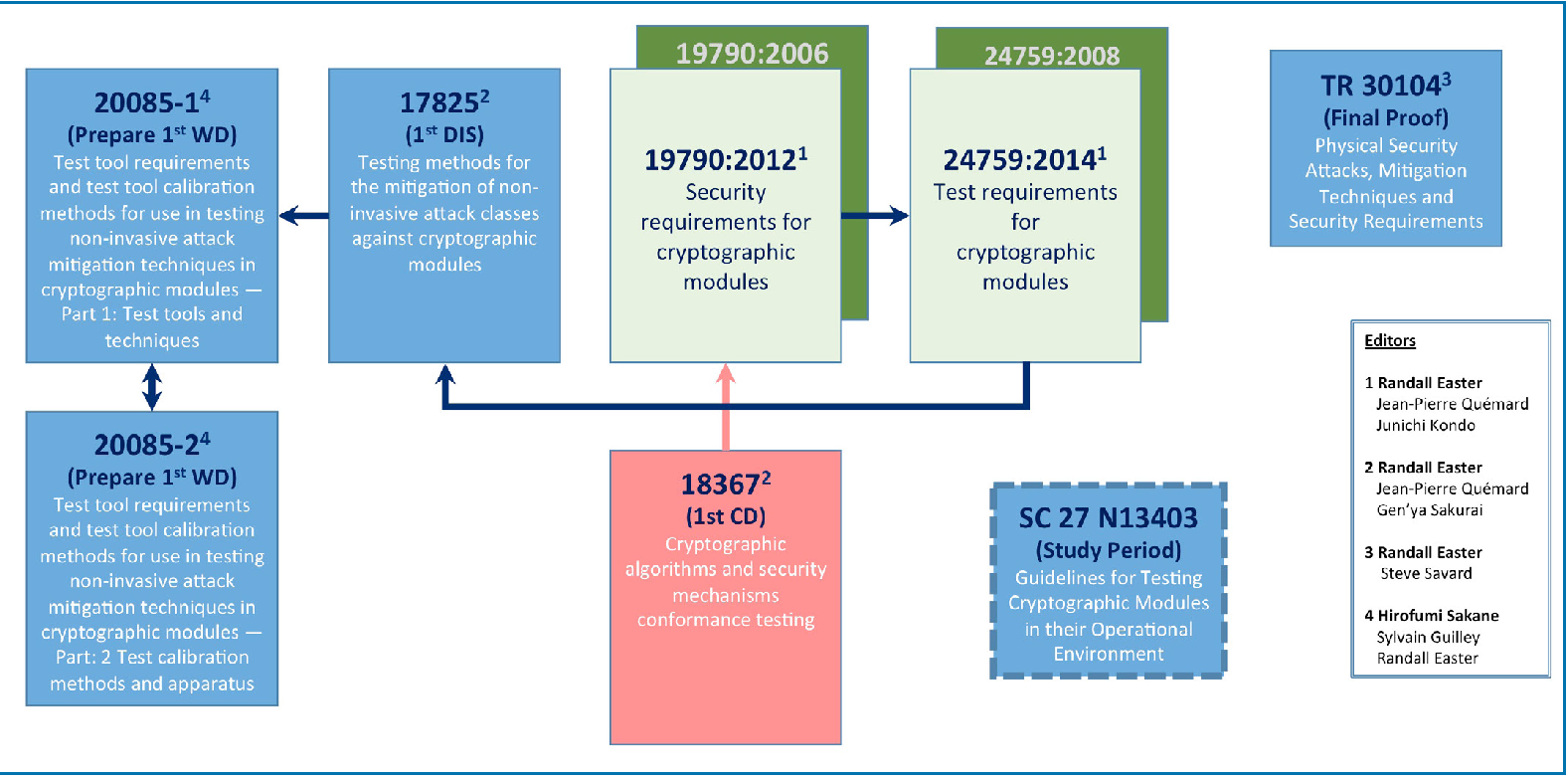
図15:暗号モジュール試験 – ISO規格。ISO/IEC の文書の関係を示す図である。中央の 19790:2012(暗号モジュールのセキュリティ要件)は緑の 19790:2006 の箱の手前に描かれ、矢印で 24759:2014(暗号モジュールの試験要件)につながる。24759:2014 は緑の 24759:2008 の箱の手前に描かれている。24759:2014 から 17825(1st DIS。暗号モジュールに対する非侵襲攻撃クラスの緩和策の試験方法)へ矢印があり、17825 は 20085-1(Prepare 1st WD。暗号モジュールの非侵襲攻撃緩和技術の試験に用いる試験ツール要件と試験ツール校正方法 — Part 1:試験ツールと技法)を指す。20085-1 は両方向矢印で 20085-2(Prepare 1st WD。同 — Part 2:試験校正方法と装置)とつながる。桃色の箱 18367(1st CD。暗号アルゴリズムとセキュリティメカニズムの適合性試験)は上の 19790:2012 を指す。別に、TR 30104(Final Proof。物理的セキュリティ攻撃、緩和技術、セキュリティ要件)と、破線の枠の SC 27 N13403(Study Period。運用環境における暗号モジュールの試験の指針)の箱がある。上付きの 1〜4 は編集者の一覧(Editors)を指し、1 は Randall Easter、Jean-Pierre Quémard、Junichi Kondo、2 は Randall Easter、Jean-Pierre Quémard、Gen'ya Sakurai、3 は Randall Easter、Steve Savard、4 は Hirofumi Sakane、Sylvain Guilley、Randall Easter である。
Figure 15: Cryptographic Module Testing – ISO Standards
図15:暗号モジュール試験 – ISO規格
The security requirements cover areas relative to the design and implementation of a cryptographic module. These areas include cryptographic module specification; cryptographic module interfaces; roles, services, and authentication; software/firmware security; the operational environment; physical security; non-invasive security; sensitive security parameter management; self-tests; life-cycle assurance; and mitigation of other attacks.
このセキュリティ要件は、暗号モジュールの設計と実装に関連する領域を対象とします。これらの領域には、暗号モジュールの仕様、暗号モジュールのインタフェース、役割・サービス・認証、ソフトウェア/ファームウェアのセキュリティ、動作環境、物理的セキュリティ、非侵襲セキュリティ、センシティブセキュリティパラメータの管理、自己テスト、ライフサイクル保証、その他の攻撃の軽減が含まれます。
CSD’s Randall J. Easter is the principal editor of the following draft ISO/IEC documents:
CSDの Randall J. Easter は、次のISO/IEC文書の草案の主任編集者です。
•ISO/IEC 17825, Testing methods for the mitigation of non-invasive attack classes against cryptographic modules;
•ISO/IEC 17825, Testing methods for the mitigation of non-invasive attack classes against cryptographic modules
•ISO/IEC 18367, Cryptographic algorithms and security mechanisms conformance testing; and
•ISO/IEC 18367, Cryptographic algorithms and security mechanisms conformance testing
•ISO/IEC TS 30104, Physical Security Attacks, Mitigation Techniques and Security Requirements.
•ISO/IEC TS 30104, Physical Security Attacks, Mitigation Techniques and Security Requirements
CSD’s contributions to the development of these international standards create a strong foundation for the adoption of and migration from currently used national standards. In particular, this adoption will promote the international harmonization for the implementation and testing of cryptographic algorithms and modules, while accommodating individual country preferences in the choice of approved security functions.
これらの国際標準の策定に対するCSDの貢献は、国際標準の採用と、現在使用されている国内標準からの移行に向けた強固な基盤を築きます。とりわけ、この採用は、承認されたセキュリティ機能の選択における各国の意向を許容しつつ、暗号アルゴリズムと暗号モジュールの実装と試験に関する国際的な調和を促進します。
http://csrc.nist.gov/groups/STM/cmvp/
http://csrc.nist.gov/groups/STM/cmvp/
CONTACT:
連絡先:
Mr. Randy Easter, (301) 975-4641, randall.easter@nist.gov
Mr. Randy Easter, (301) 975-4641, randall.easter@nist.gov
Security Content Automation Protocol (SCAP) Validation Program
Security Content Automation Protocol (SCAP) Validation Program
The SCAP Validation Program performs conformance testing to ensure that products correctly implement SCAP, as defined in SP 800-126 Revision 2, The Technical Specification for the Security Content Automation Protocol (SCAP): SCAP Version 1.2. Conformance testing is necessary because SCAP is a complex collection of eleven individual specifications that work together to support various use cases. A single error in product implementation could result in undetected vulnerabilities or policy noncompliance within an organization’s networks.
SCAP Validation Program は、製品が SP 800-126 Revision 2, The Technical Specification for the Security Content Automation Protocol (SCAP): SCAP Version 1.2 で定義されたSCAPを正しく実装していることを確認するために、適合性試験を実施します。適合性試験が必要なのは、SCAPが、さまざまなユースケースを支えるために連携して働く11の個別仕様からなる複雑な集合体だからです。製品の実装に誤りが1つあるだけで、組織のネットワーク内の脆弱性やポリシー違反が検出されないままになるおそれがあります。
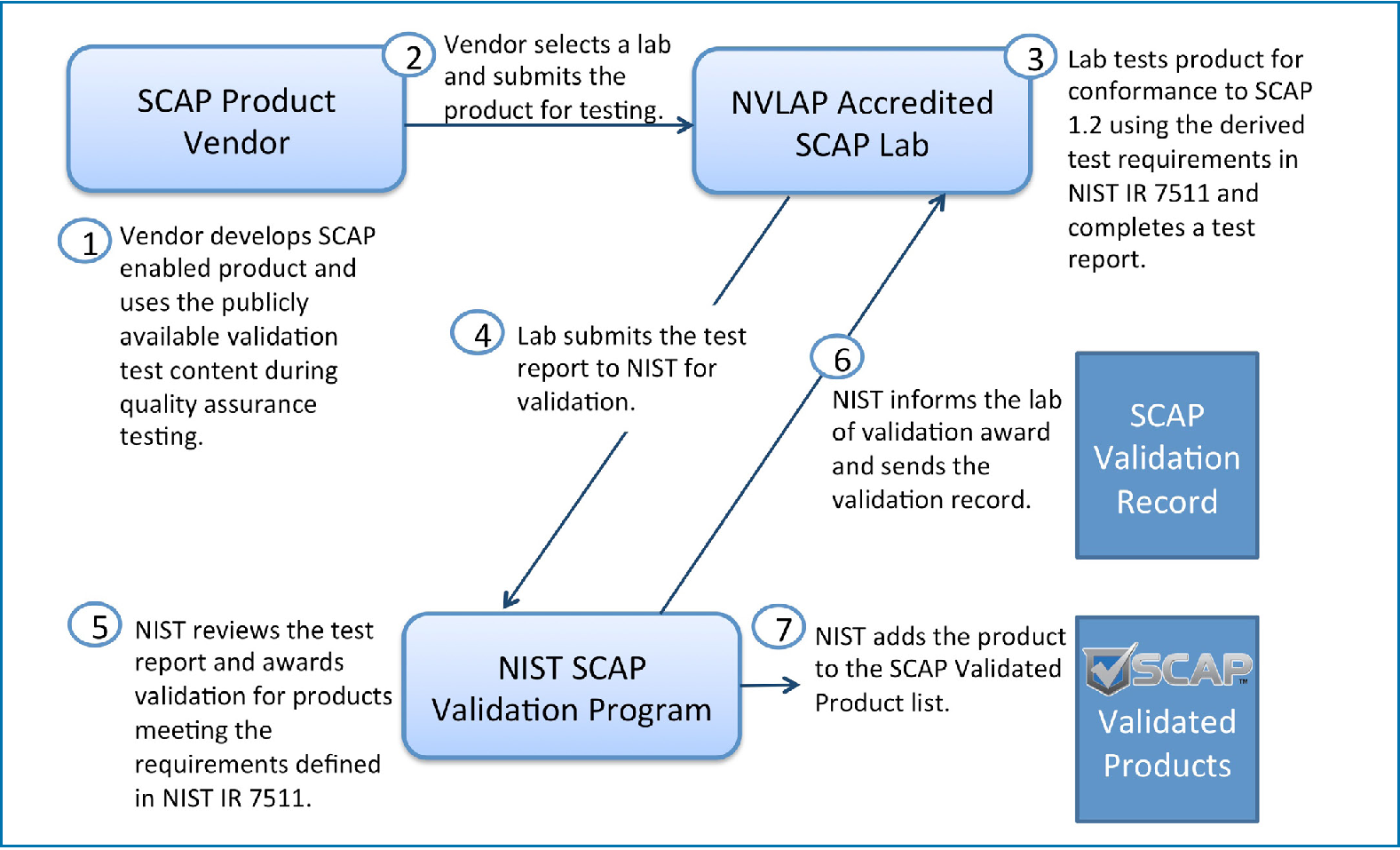
図16:SCAP 1.2の検証プロセス。SCAP Product Vendor(SCAP 製品ベンダー)、NVLAP Accredited SCAP Lab(NVLAP 認定 SCAP 試験所)、NIST SCAP Validation Program の 3 つの角丸の箱の間で、番号付きの手順を示す流れ図である。1:ベンダーが SCAP 対応製品を開発し、品質保証試験で公開されている検証テストコンテンツを使う。2:ベンダーが試験所を選び、製品を試験に提出する(ベンダーから試験所への矢印)。3:試験所が NIST IR 7511 から導いた試験要件を用いて製品の SCAP 1.2 への適合を試験し、試験報告書を完成させる。4:試験所が検証のため試験報告書を NIST に提出する(試験所から NIST SCAP Validation Program への矢印)。5:NIST が試験報告書をレビューし、NIST IR 7511 に定める要件を満たす製品に検証を与える。6:NIST が試験所に検証の付与を通知し、検証記録を送る(NIST から試験所への矢印)。その横に SCAP Validation Record の箱がある。7:NIST が製品を SCAP 検証済み製品一覧に追加する(SCAP のロゴ付きの Validated Products の箱への矢印)。
Figure 16: SCAP 1.2 Validation Process
図16:SCAP 1.2の検証プロセス
The test requirements for SCAP 1.2 are defined in NISTIR 7511 Revision 3, Security Content Automation Protocol (SCAP) Version 1.2 Validation Program Test Requirements. In general, vendors may opt for product validation for one or more SCAP capabilities or operating systems. Currently, the program offers testing on Microsoft Windows and Red Hat Enterprise Linux platforms. The validation process starts when a vendor voluntarily submits an SCAP-enabled product to a NVLAP-accredited laboratory. Once the lab completes product testing, and all validation requirements are met, the lab submits a test report to the SCAP Validation Program for review. NIST reviews the test report and will award a validation if all requirements have been met. Once a validation is awarded, the SCAP Validation Record is sent to the lab, and the newly validated product is posted on the SCAP Validated Products web page.
SCAP 1.2の試験要件は、NISTIR 7511 Revision 3, Security Content Automation Protocol (SCAP) Version 1.2 Validation Program Test Requirementsに定義されています。一般に、ベンダーは一つ以上のSCAP機能又はオペレーティングシステムについて製品の検証を選択できます。現在、このプログラムはMicrosoft Windows及びRed Hat Enterprise Linuxのプラットフォームでの試験を提供しています。検証プロセスは、ベンダーがSCAP対応製品をNVLAP認定試験所に任意で提出した時点で始まります。試験所が製品の試験を完了し、すべての検証要件が満たされると、試験所は試験報告書をSCAP検証プログラムに提出してレビューを受けます。NISTは試験報告書をレビューし、すべての要件が満たされていれば検証を授与します。検証が授与されると、SCAP Validation Recordが試験所に送付され、新たに検証された製品がSCAP Validated Productsのウェブページに掲載されます。
The SCAP Validation Program resources web page (http://scap.nist.gov/validation) was introduced in FY 2013, and was updated in FY 2014 to provide the public with a centralized location for all resources and information necessary for preparing products for SCAP 1.2 validation. Resources include documentation, a list of Frequently Asked Questions (FAQ), the SCAP validation-test content, and tools for validating and processing SCAP data streams. The SCAP validation-test content should be used by vendors for quality assurance testing prior to entering formal SCAP testing with an NVLAP accredited laboratory. The open-source tools that are available for download may be used by SCAP content authors for testing SCAP source content. The SCAP Content Validation Tool (SCAPVal) may be used to determine if the content conforms to the SCAP specification. Open-source SCAP reference implementation tools, such as the SCAP Reference Implementation Tool, may be used to process SCAP data streams.
SCAP検証プログラムのリソース用ウェブページ(http://scap.nist.gov/validation)は2013会計年度に開設され、2014会計年度に更新されました。このページは、SCAP 1.2の検証に向けて製品を準備するために必要なすべてのリソースと情報を一か所にまとめて一般に提供するものです。リソースには、文書、よくある質問(FAQ)の一覧、SCAP検証試験用コンテンツ、並びにSCAPデータストリームを検証及び処理するためのツールが含まれます。SCAP検証試験用コンテンツは、ベンダーがNVLAP認定試験所での正式なSCAP試験に入る前の品質保証試験に使用するとよいです。ダウンロード可能なオープンソースのツールは、SCAPコンテンツの作成者がSCAPソースコンテンツを試験するために使用できます。SCAP Content Validation Tool (SCAPVal) は、コンテンツがSCAP仕様に適合しているかどうかを判定するために使用できます。SCAP Reference Implementation ToolなどのオープンソースのSCAP参照実装ツールは、SCAPデータストリームを処理するために使用できます。
End users may use information on the SCAP Validation web page to learn about SCAP validation and find products that have been awarded validations. The validation records that are posted on the SCAP Validated Products page state the product version that was tested in the laboratory, along with details about the validation, such as the tested platforms, SCAP capabilities, the validation test suite version, and the lab that performed the product test.
エンドユーザは、SCAP Validationのウェブページの情報を利用して、SCAP検証について知り、検証を授与された製品を探すことができます。SCAP Validated Productsのページに掲載される検証記録には、試験所で試験された製品のバージョンとともに、試験対象のプラットフォーム、SCAP機能、検証試験スイートのバージョン、製品試験を実施した試験所など、検証の詳細が記載されています。
In FY 2014, five products successfully completed testing and were awarded validations. Several products are in various stages of validation testing and are expected to be awarded validations in FY 2015. The current list of SCAP 1.2 validated products may be found on the SCAP Validated Products list at https://nvd.nist.gov/SCAP-Validated-Tools/.
2014会計年度には、5製品が試験を完了し、検証を授与されました。いくつかの製品が検証試験の様々な段階にあり、2015会計年度に検証を授与される見込みです。SCAP 1.2で検証された製品の最新の一覧は、https://nvd.nist.gov/SCAP-Validated-Tools/ のSCAP Validated Productsの一覧で確認できます。
In FY 2015, the SCAP Validation Program plans to provide enhanced testing support and will focus on validation test content for new operating systems. Expansion plans also include improvements in automated testing capabilities.
2015会計年度に、SCAP検証プログラムは試験支援を強化する計画であり、新しいオペレーティングシステム向けの検証試験用コンテンツに重点を置きます。拡張計画には、自動試験機能の改善も含まれます。
http://scap.nist.gov/validation
http://scap.nist.gov/validation
CONTACT:
連絡先:
Ms. Melanie Cook, (301) 975-5259, melanie.cook@nist.gov
Ms. Melanie Cook, (301) 975-5259, melanie.cook@nist.gov
アイデンティティ管理 [装飾の画像。本文を読むのに必要のない装飾のため、この非公式サイトには掲載していません。原本 PDF を参照してください。]
IDENTITY MANAGEMENT
アイデンティティ管理
Personal Identity Verification (PIV) and FIPS 201 Revision Efforts
Personal Identity Verification (PIV) 及びFIPS 201の改訂作業
施設のドア横に設置されたカードリーダーに、職員が手に持ったPIVカードをかざしている。 [装飾の画像。本文を読むのに必要のない装飾のため、この非公式サイトには掲載していません。原本 PDF を参照してください。]
Figure 17: Government Employees Use PIV Cards for Facility Access
図17:政府職員は施設への入館にPIVカードを使用する
In response to Homeland Security Presidential Directive-12 (HSPD-12), Policy for a Common Identification Standard for Federal Employees and Contractors, FIPS 201, Personal Identity Verification (PIV) of Federal Employees and Contractors, was developed and was approved by the Secretary of Commerce in February 2005. HSPD-12 called for the creation of a new identity credential for federal employees and contractors. FIPS 201 is the technical specification for both the PIV identity credential and the PIV system that produces, manages, and uses the credential. Within NIST’s Information Technology Laboratory (ITL), this work is a collaborative effort of the Information Access Division (IAD) and CSD. CSD activities in FY 2014 directly supported the recently revised FIPS 201-2 by updating the relevant publications associated with FIPS 201-2 and by developing two new publications. CSD performed the following activities during FY 2014 in support of HSPD-12:
Homeland Security Presidential Directive-12 (HSPD-12), Policy for a Common Identification Standard for Federal Employees and Contractorsを受けて、FIPS 201, Personal Identity Verification (PIV) of Federal Employees and Contractorsが策定され、2005年2月に商務長官により承認されました。HSPD-12は、連邦政府の職員及び契約業者のための新しいアイデンティティクレデンシャルの創設を求めました。FIPS 201は、PIVアイデンティティクレデンシャルと、そのクレデンシャルを生成、管理及び使用するPIVシステムの双方の技術仕様です。NISTのInformation Technology Laboratory (ITL) において、この作業はInformation Access Division (IAD) とCSDの共同作業です。2014会計年度のCSDの活動は、FIPS 201-2に関連する出版物を更新し、二つの新しい出版物を作成することにより、最近改訂されたFIPS 201-2を直接支援しました。CSDは、HSPD-12を支援するため、2014会計年度に次の活動を実施しました。
•Published Draft NISTIR 7863, Cardholder Authentication for the PIV Digital Signature Key. The document provides clarification for the requirement in FIPS 201-2 that a PIV cardholder perform an explicit user action prior to each use of the digital signature key stored on the card.
•Draft NISTIR 7863, Cardholder Authentication for the PIV Digital Signature Keyを公表しました。この文書は、カードに格納されたデジタル署名鍵を使用するたびに、その前にPIVカード保持者が明示的なユーザ操作を行うというFIPS 201-2の要件を明確化しています。
•Published two new draft documents to accommodate e-authentication with mobile devices:
•モバイルデバイスによる電子認証に対応するため、二つの新しい文書草案を公表しました。
•Draft SP 800-157, Guidelines for Derived Personal Identity Verification (PIV) Credentials, defines the technical details for implementing and deploying derived PIV credentials on mobile devices, such as smart phones and tablets. As intended by FIPS 201-2, a derived PIV credential is a PIV credential that can be provisioned directly to a mobile device to enable remote enterprise access from the device.
•Draft SP 800-157, Guidelines for Derived Personal Identity Verification (PIV) Credentialsは、スマートフォンやタブレットなどのモバイルデバイス上に派生PIVクレデンシャルを実装し展開するための技術的詳細を定義しています。FIPS 201-2が意図しているとおり、派生PIVクレデンシャルとは、モバイルデバイスに直接プロビジョニングでき、そのデバイスから組織へのリモートアクセスを可能にするPIVクレデンシャルです。
•Draft NISTIR 7981, Mobile, PIV, and Authentication, analyzes and summarizes various current and near-term options for remote authentication with mobile devices that leverage both the investment in the PIV infrastructure and the unique security capabilities of mobile devices.
•Draft NISTIR 7981, Mobile, PIV, and Authenticationは、モバイルデバイスによるリモート認証について、PIV基盤への投資とモバイルデバイス固有のセキュリティ機能の両方を活用する、現在及び近い将来の様々な選択肢を分析し要約しています。
•Completed the comment resolution of Draft SP 800-73-4, Interfaces for Personal Identity Verification, and published a revised draft. The three-part SP details the new PIV Card capabilities introduced in FIPS 201-2, including a Virtual Contact Interface (VCI), a secure channel protocol, an on-card biometric comparison mechanism and an enforcement of a minimum PIN length of six digits.
•Draft SP 800-73-4, Interfaces for Personal Identity Verificationに対するコメントへの対応を完了し、改訂草案を公表しました。3部構成のこのSPは、FIPS 201-2で導入されたPIVカードの新しい機能を詳述しており、これにはVirtual Contact Interface (VCI)、セキュアチャネルプロトコル、カード上での生体情報照合の仕組み、及び6桁という最小PIN長の強制が含まれます。
•Completed the comment resolution of Draft SP 800-78-4, Cryptographic Algorithms and Key Sizes for Personal Identity Verification, and published a revised draft. The document has been modified to align with Draft SP 800-73-4, and includes the addition of new algorithms and key sizes for the secure messaging protocol and the addition of test requirements with the Cryptographic Algorithm Validation Program (CAVP) validation.
•Draft SP 800-78-4, Cryptographic Algorithms and Key Sizes for Personal Identity Verificationに対するコメントへの対応を完了し、改訂草案を公表しました。この文書はDraft SP 800-73-4と整合するように修正されており、セキュアメッセージングプロトコル用の新しいアルゴリズム及び鍵長の追加と、Cryptographic Algorithm Validation Program (CAVP) の検証による試験要件の追加を含んでいます。
•Published Draft SP 800-79, Guidelines for the Accreditation of Personal Identity Verification (PIV) Card Issuers (PCIs). The draft document incorporates changes required by FIPS 201-2, including a new set of issuer controls for Derived PIV Credentials Issuers.
•Draft SP 800-79, Guidelines for the Accreditation of Personal Identity Verification (PIV) Card Issuers (PCIs) を公表しました。この文書草案は、FIPS 201-2により必要となった変更を取り入れており、これにはDerived PIV Credentials Issuers向けの新しい一連の発行者管理策が含まれます。
•Prepared Draft SP 800-85A-4, PIV Card Application and Middleware Interface Test Guidelines, and published Draft SP 800-85B-4, PIV Data Model Test Guidelines, in order to align these documents with FIPS 201-2, SP 800-73-4, and SP 800-78-4.
•Draft SP 800-85A-4, PIV Card Application and Middleware Interface Test Guidelinesを作成し、Draft SP 800-85B-4, PIV Data Model Test Guidelinesを公表しました。これは、これらの文書をFIPS 201-2、SP 800-73-4及びSP 800-78-4と整合させるためです。
•As the NIST PIV Validation Authority, completed the transition phase from FIPS 201-1 to FIPS 201-2 for validated PIV Card Applications and PIV Middleware.
•NIST PIV Validation Authorityとして、検証済みのPIV Card Application及びPIV Middlewareについて、FIPS 201-1からFIPS 201-2への移行フェーズを完了しました。
•Created additional sets of test cards for the inventory of PIV test cards. These test cards are available for purchase and facilitate the development of applications and middleware that support the PIV card (see http://csrc.nist.gov/groups/SNS/piv/testcards.html).
•PIVテストカードの在庫に、テストカードのセットを追加で作成しました。これらのテストカードは購入可能であり、PIVカードに対応するアプリケーション及びミドルウェアの開発を容易にします(http://csrc.nist.gov/groups/SNS/piv/testcards.html を参照してください)。
In FY 2015, CSD will continue to focus on updating the relevant publications associated with FIPS 201-2, including developing two new publications: SP 800-156, Representation of PIV Chain-of-Trust for Import and Export, and SP 800-166, Guidelines for Testing Derived Personal Identity Verification (PIV) Credentials. CSD will also continue to provide technical and strategic inputs to the PIV-related initiatives.
2015会計年度も、CSDはFIPS 201-2に関連する出版物の更新に引き続き重点を置きます。これには、二つの新しい出版物、SP 800-156, Representation of PIV Chain-of-Trust for Import and Export及びSP 800-166, Guidelines for Testing Derived Personal Identity Verification (PIV) Credentialsの作成が含まれます。CSDはまた、PIV関連の取り組みに対して技術的及び戦略的な情報提供を続けます。
http://csrc.nist.gov/groups/SNS/piv/
http://csrc.nist.gov/groups/SNS/piv/
CONTACTS:
連絡先:
Ms. Hildegard Ferraiolo, (301) 975-6972, hildegard.ferraiolo@nist.gov
Ms. Hildegard Ferraiolo, (301) 975-6972, hildegard.ferraiolo@nist.gov
Dr. David Cooper, (301) 975-3194, david.cooper@nist.gov
Dr. David Cooper, (301) 975-3194, david.cooper@nist.gov
Mr. Salvatore Francomacaro, (301) 975-6414, salvatore.francomacaro@nist.gov
Mr. Salvatore Francomacaro, (301) 975-6414, salvatore.francomacaro@nist.gov
Mr. Ketan Mehta, (301) 975-8405, ketan.mehta@nist.gov
Mr. Ketan Mehta, (301) 975-8405, ketan.mehta@nist.gov
NIST Personal Identity Verification Program (NPIVP) & Revisions to FIPS 201-2 Companion Documents
NIST Personal Identity Verification Program (NPIVP) & FIPS 201-2関連文書の改訂
The objective of the NIST Personal Identity Verification Program (NPIVP) is to validate PIV components for conformance to the specifications in FIPS 201, Personal Identity Verification (PIV) of Federal Employees and Contractors, and its companion documents. The two PIV components that come under the scope of NPIVP are the PIV Smart Card Application and the PIV Middleware. NPIVP test facilities that perform the two types of tests are the Cryptographic and Security Testing (CST) Laboratories that have been accredited by the NIST National Voluntary Laboratory Accreditation Program (NVLAP). As of September 2014, there were nine such facilities.
NIST Personal Identity Verification Program (NPIVP) の目的は、PIVコンポーネントがFIPS 201, Personal Identity Verification (PIV) of Federal Employees and Contractors及びその関連文書の仕様に適合していることを検証することです。NPIVPの対象範囲に入る二つのPIVコンポーネントは、PIV Smart Card ApplicationとPIV Middlewareです。この2種類の試験を実施するNPIVP試験機関は、NISTのNational Voluntary Laboratory Accreditation Program (NVLAP) により認定されたCryptographic and Security Testing (CST) Laboratoriesです。2014年9月時点で、このような機関は9か所ありました。
The interface specifications for the PIV Smart Card Application and PIV Middleware are found in a FIPS 201-associated document, namely, SP 800-73 (the latest published version SP 800-73-3) - Interfaces for Personal Identity Verification. The conformance tests for these specifications are detailed in SP 800-85A (the latest published version is SP 800-85A-2) - PIV Card Application and Middleware Interface Test Guidelines. To implement these tests and to generate conformance test reports, CSD also developed an integrated toolkit called “PIV Interface Test Runner,” which conducts tests on both PIV Card Application and PIV Middleware products, and provides the toolkit to accredited NPIVP test facilities.
PIV Smart Card Application及びPIV Middlewareのインタフェース仕様は、FIPS 201の関連文書であるSP 800-73(公表済みの最新版はSP 800-73-3)- Interfaces for Personal Identity Verificationに記載されています。これらの仕様に対する適合性試験は、SP 800-85A(公表済みの最新版はSP 800-85A-2)- PIV Card Application and Middleware Interface Test Guidelinesに詳述されています。これらの試験を実施し適合性試験報告書を生成するために、CSDは、PIV Card Application製品とPIV Middleware製品の両方に対して試験を行う「PIV Interface Test Runner」という統合ツールキットも開発し、認定されたNPIVP試験機関にこのツールキットを提供しています。
In 2014, CSD’s activity focused on the transitioning of PIV Card Application and PIV Middleware products from FIPS 201-1 to FIPS 201-2 compliance. Coordinating with the test facilities, FIPS 201-1 products were identified and placed on the Removed Products List (RPL). Nine PIV card application products and fifteen PIV middleware products were affected. With this change, there are 27 NPIVP validated PIV card application products, and five PIV Middleware products listed.
2014年のCSDの活動は、PIV Card Application製品及びPIV Middleware製品をFIPS 201-1準拠からFIPS 201-2準拠へ移行させることに重点を置きました。試験機関と調整して、FIPS 201-1の製品を特定し、Removed Products List (RPL) に掲載しました。PIVカードアプリケーション製品9件とPIVミドルウェア製品15件が影響を受けました。この変更により、NPIVPで検証済みとして掲載されているのは、PIVカードアプリケーション製品27件とPIV Middleware製品5件です。
In addition, NPIVP is closely involved in ensuring that all changes in PIV companion documents, such as SP 800-73-4, SP 800-76-2, Biometric Specifications for Personal Identity Verification, and SP 800-78-4, Cryptographic Algorithms and Key Sizes for Personal Identity Verification, are fully reflected in the updated versions of the conformance test documents, SP 800-85A and SP 800-85B, as well as in the “PIV Interface Test Runner” toolkit. Currently, the NPIVP team is guiding the development of the “PIV Interface Test Runner” toolkit for validating PIV Card application and PIV Middleware products for conformance to the specifications in SP 800-73-4, SP 800-76-2 and SP 800-78-4.
さらに、NPIVPは、SP 800-73-4、SP 800-76-2, Biometric Specifications for Personal Identity Verification、SP 800-78-4, Cryptographic Algorithms and Key Sizes for Personal Identity VerificationといったPIV関連文書のすべての変更が、適合性試験文書であるSP 800-85A及びSP 800-85Bの更新版、並びに「PIV Interface Test Runner」ツールキットに完全に反映されるよう、緊密に関与しています。現在、NPIVPチームは、PIV Card Application製品及びPIV Middleware製品がSP 800-73-4、SP 800-76-2及びSP 800-78-4の仕様に適合していることを検証するための「PIV Interface Test Runner」ツールキットの開発を指導しています。
http://csrc.nist.gov/groups/SNS/piv/npivp
http://csrc.nist.gov/groups/SNS/piv/npivp
CONTACTS:
連絡先:
Dr. Ramaswamy Chandramouli, (301) 975-5013, mouli@nist.gov
Dr. Ramaswamy Chandramouli, (301) 975-5013, mouli@nist.gov
Ms. Hildegard Ferraiolo, (301) 975-6972, hildegard.ferraiolo@nist.gov
Ms. Hildegard Ferraiolo, (301) 975-6972, hildegard.ferraiolo@nist.gov
先端技術分野の研究 [装飾の画像。本文を読むのに必要のない装飾のため、この非公式サイトには掲載していません。原本 PDF を参照してください。]
RESEARCH IN EMERGING TECHNOLOGIES
新興技術の研究
Cloud Computing and Virtualization
クラウドコンピューティングと仮想化
The model for Cloud Computing is defined in SP 800-145, The NIST Definition of Cloud Computing. The foundational technology that facilitates the use of a computing infrastructure for cloud-computing services is virtualization. At the core of a virtualized infrastructure is the virtualized host that provides an abstraction of the hardware (e.g., CPU, memory) that enables multiple computing stacks (comprised of the operating system, middleware, and applications) to be run on a single physical machine. The efficiency of such a dynamic and distributed processing environment is counterbalanced by the interoperability, portability, and security challenges inherent to this computing environment. NIST’s CSD is working in parallel on several projects (introduced below) that aim to accelerate the Federal Government’s adoption of secure cloud computing by collaborating with standards bodies, and public and private sectors in developing security, interoperability and portability standards and guidance.
クラウドコンピューティングのモデルは、SP 800-145, The NIST Definition of Cloud Computingに定義されています。コンピューティング基盤をクラウドコンピューティングサービスに利用することを可能にする基礎技術が仮想化です。仮想化基盤の中核には仮想化ホストがあり、これがハードウェア(例えば、CPU、メモリ)の抽象化を提供することで、複数のコンピューティングスタック(オペレーティングシステム、ミドルウェア及びアプリケーションで構成される)を1台の物理マシン上で実行できるようになります。このような動的で分散した処理環境の効率性の反面、このコンピューティング環境には相互運用性、可搬性及びセキュリティの課題が内在しています。NISTのCSDは、標準化団体並びに官民の各部門と協力してセキュリティ、相互運用性及び可搬性の標準とガイダンスを策定することにより、連邦政府による安全なクラウドコンピューティングの導入を加速することを目指す複数のプロジェクト(以下に紹介する)に並行して取り組んでいます。
CSD Role in the NIST Cloud Computing Program
NIST Cloud Computing ProgramにおけるCSDの役割
During FY 2013, the NIST Cloud Computing Team continued to promote the development of publications, national and international standards, and specifications in support of the United States Government’s (USG) effective and secure use of cloud computing, as well as providing technical guidance to USG agencies for secure and effective cloud-computing adoption. CSD supports many of the technical standards activities supported by the NIST Cloud Computing Program, with a particular focus on cloud-computing security. Activities included the following:
2013会計年度に、NIST Cloud Computing Teamは、米国政府(USG)によるクラウドコンピューティングの効果的かつ安全な利用を支援する出版物、国内及び国際標準、並びに仕様の策定を引き続き推進するとともに、安全かつ効果的なクラウドコンピューティングの導入に向けてUSGの各機関に技術的ガイダンスを提供しました。CSDは、NIST Cloud Computing Programが支援する技術標準活動の多くを、クラウドコンピューティングのセキュリティに特に重点を置いて支援しています。活動には次のものが含まれました。
•Led the development of the draft SP 500-299, NIST Cloud Computing Security Reference Architecture (SRA). SP 500-299 defines a modular framework that provides a formal model and a methodology for the secure adoption of cloud computing by applying a Cloud-adapted Risk Management Framework (CRMF). The SRA is a security overlay to SP 500-292, NIST Cloud Computing Reference Architecture. During FY 2014, the draft document was completed, posted for public comments, and the received comments were addressed.
•SP 500-299, NIST Cloud Computing Security Reference Architecture (SRA) の草案の策定を主導しました。SP 500-299は、Cloud-adapted Risk Management Framework (CRMF) を適用することでクラウドコンピューティングを安全に導入するための形式的なモデルと方法論を提供する、モジュール式のフレームワークを定義しています。SRAは、SP 500-292, NIST Cloud Computing Reference Architectureに対するセキュリティオーバーレイです。2014会計年度に、この文書草案は完成し、パブリックコメントのために掲示され、寄せられたコメントへの対応が行われました。
•Co-led the development of the NISTIR 8006, Cloud Forensics Challenges.
•NISTIR 8006, Cloud Forensics Challengesの策定を共同で主導しました。
•Led the development of an internal draft document, Cloud-adapted Risk Management Framework: Guide for Applying the Risk Management Framework to Cloud-based Federal Information Systems. The document introduces a cloud customer-centric approach to applying the risk management framework to cloud-based information systems. This internal draft has not yet been released for public comment; it is currently planned for future publication in the NIST SP 800 series.
•内部草案文書 Cloud-adapted Risk Management Framework: Guide for Applying the Risk Management Framework to Cloud-based Federal Information Systems の策定を主導しました。この文書は、クラウドベースの情報システムにリスク管理フレームワークを適用するための、クラウド利用者を中心に据えたアプローチを導入します。この内部草案はまだパブリックコメントに付されておらず、現時点ではNIST SP 800シリーズとして将来公表する予定です。
•Led the research and development of the data that constitutes the foundation of an internal draft document, Security and Privacy Controls for Cloud-based Federal Information Systems. The document will provide a cloud overlay of NIST SP 800-53 Revision 4 security controls for cloud-based ecosystems. This internal draft has not yet been released for public comment; it is currently planned for future publication in the NIST SP 800 series.
•内部草案文書 Security and Privacy Controls for Cloud-based Federal Information Systems の基礎をなすデータの研究開発を主導しました。この文書は、クラウドベースのエコシステムを対象に、NIST SP 800-53 Revision 4 のセキュリティ管理策のクラウド向けオーバーレイを提供します。この内部草案はまだパブリックコメントに付されておらず、現時点ではNIST SP 800シリーズとして将来公表する予定です。
CSD staff members:
CSDの職員は次のことを行いました。
•Organized and contributed to the seventh NIST Cloud Computing Forum and Workshop: The Intersection of Cloud and Mobility Forum, March 25-27, 2014; and,
•2014年3月25日から27日に開催された第7回の NIST Cloud Computing Forum and Workshop: The Intersection of Cloud and Mobility Forum を企画し、これに貢献しました。
•Organized and contributed to the first NIST Cloud Computing Forensic Science Workshop, March 24, 2014.
•2014年3月24日に開催された第1回の NIST Cloud Computing Forensic Science Workshop を企画し、これに貢献しました。
In support of USG cloud-computing mandates, CSD staff members provided leadership for several public cloud working groups operating under the NIST Cloud Computing Program. These working groups focus on meeting the high priority requirements contained in SP 500-293, U.S. Government Cloud Computing Technology Roadmap.
米国政府のクラウドコンピューティングに関する指令を支援するため、CSDの職員は、NIST Cloud Computing Program の下で活動する複数の公開クラウド作業グループを主導しました。これらの作業グループは、SP 500-293, U.S. Government Cloud Computing Technology Roadmap に含まれる優先度の高い要件を満たすことに重点を置いています。
CSD staff chaired or co-chaired several significant cloud computing efforts in 2014:
CSDの職員は、2014年に、クラウドコンピューティングに関するいくつかの重要な取り組みで議長または共同議長を務めました。
•Co-Chaired the NIST Cloud Computing Security Working Group. Led the group on the development of the SP 500-299, NIST Cloud Computing Security Reference Architecture; SP 800-163, Cloud-adapted Risk Management Framework: Guide for Applying the Risk Management Framework to Cloud-based Federal Information Systems; SP 800-174, Security and Privacy Controls for Cloud-based Federal Information Systems (all three described above); and on researching cryptographic key-management challenges in cloud ecosystems.
•NIST Cloud Computing Security Working Group の共同議長を務めました。SP 500-299, NIST Cloud Computing Security Reference Architecture、SP 800-163, Cloud-adapted Risk Management Framework: Guide for Applying the Risk Management Framework to Cloud-based Federal Information Systems、SP 800-174, Security and Privacy Controls for Cloud-based Federal Information Systems(3件とも上述)の策定と、クラウドエコシステムにおける暗号鍵管理の課題の調査について、このグループを主導しました。
•Co-Chaired the NIST Cloud Computing Forensic Science Working Group. Led the development of NISTIR 8006, NIST Cloud Computing Forensics Challenges.
•NIST Cloud Computing Forensic Science Working Group の共同議長を務めました。NISTIR 8006, NIST Cloud Computing Forensics Challenges の策定を主導しました。
•Co-Chaired the NIST Cloud Computing Interoperability and Portability Working Group. Addressed issues facing cloud computing with respect to interoperability and portability, standards, and common and functional terminologies. The goal is to develop guidance and best practices for cloud-computing interoperability and portability that best enable business necessities, such as the ability to exchange, use and reuse information/data in a cloud environment.
•NIST Cloud Computing Interoperability and Portability Working Group の共同議長を務めました。相互運用性とポータビリティ、標準、および共通の用語と機能に関する用語について、クラウドコンピューティングが直面する課題に取り組みました。目標は、クラウド環境で情報/データを交換、利用、再利用する能力といった事業上の必要を最もよく実現する、クラウドコンピューティングの相互運用性とポータビリティに関するガイダンスとベストプラクティスを策定することです。
•Co-editor for ISO/IEC AWI 19941 Information technology – Cloud computing – Interoperability and Portability. This is an effort to develop a standard that focuses on defining the types of cloud-computing interoperability and portability; the relationship and interactions between interoperability and portability; the contexts where interoperability and portability are relevant in cloud computing, with respect to the cloud-computing reference architecture; and the common terminology and concepts used to describe interoperability and portability, particularly as they relate to cloud services.
•ISO/IEC AWI 19941 Information technology – Cloud computing – Interoperability and Portability の共同編集者を務めました。これは、次の事項の定義に重点を置く標準を策定する取り組みです。すなわち、クラウドコンピューティングの相互運用性とポータビリティの種類、相互運用性とポータビリティの関係と相互作用、クラウドコンピューティングの参照アーキテクチャに照らして、クラウドコンピューティングにおいて相互運用性とポータビリティが関係する文脈、そして、とくにクラウドサービスとの関連で相互運用性とポータビリティを記述するために用いる共通の用語と概念です。
•Chair and Vice-Chair of INCITS CS1 (Cybersecurity) − U.S. Technical Advisory Group (TAG) to the ISO/IEC international committee JTC1/SC27 (IT Security Techniques). This group is concerned with the development of cloud-computing taxonomy-related standards and cloud computing security standards.
•INCITS CS1 (Cybersecurity) の議長と副議長を務めました。これは、ISO/IECの国際委員会 JTC1/SC27 (IT Security Techniques) に対する U.S. Technical Advisory Group (TAG) です。このグループは、クラウドコンピューティングの分類体系に関する標準と、クラウドコンピューティングのセキュリティ標準の策定を扱っています。
CSD staff members participated in various standards development organizations, two of which are ISO/IEC JTC 1 Sub Committee 38 – Distributed Application Platforms and Services (SC 38) and ISO/IEC JTC 1 Sub Committee 27 – IT Security Techniques (SC 27). In SC 38, CSD acts as the co-convener for a collaborative ISO/ITU-T initiative on cloud computing taxonomy that includes publication of ISO/IEC 17788 – Information Technology – Cloud computing – Overview and Vocabulary, and ISO/IEC 17789 Information technology – Cloud computing – Reference Architecture. These standards are a joint collaborative work between ITU-T and ISO, and they are approved to be available at no charge. Notably, the genesis for this international body of work is the widely accepted and used cloud-computing definition found in SP 800-145, NIST Definition of Cloud Computing.
CSDの職員は、さまざまな標準化団体に参加しました。そのうちの2つが、ISO/IEC JTC 1 Sub Committee 38 – Distributed Application Platforms and Services (SC 38) と ISO/IEC JTC 1 Sub Committee 27 – IT Security Techniques (SC 27) です。SC 38では、CSDは、クラウドコンピューティングの分類体系に関するISOとITU-Tの共同イニシアティブの共同コンビーナを務めています。このイニシアティブには、ISO/IEC 17788 – Information Technology – Cloud computing – Overview and Vocabulary と ISO/IEC 17789 Information technology – Cloud computing – Reference Architecture の発行が含まれます。これらの標準はITU-TとISOの共同作業の成果であり、無償で提供することが承認されています。特筆すべきことに、この国際的な一連の成果の出発点は、SP 800-145, NIST Definition of Cloud Computing に示され、広く受け入れられ使用されているクラウドコンピューティングの定義です。
There are three new standards under development:
現在、3つの新しい標準が策定中です。
•ISO/IEC 19086 Information Technology - Cloud Computing - Service Level Agreement (SLA) Framework. This international standard has three parts, where Part 1 specifies an overview of SLAs for cloud services, identification of the relationship between the master service agreement and the SLA, SLA concepts and requirements that can be used to build SLAs, and terms and metrics commonly used in SLAs for cloud services. This standard is for the benefit and use of both the provider and customer. Part 2 specifies a model and metrics for describing and measuring properties of the concepts and components in 19086. This standard is for the benefit and use of both the provider and customer, and Part 3 specifies core conformance requirements for SLAs for cloud services for ISO/IEC 19086.
•ISO/IEC 19086 Information Technology - Cloud Computing - Service Level Agreement (SLA) Framework。この国際標準は3つのパートからなります。Part 1は、クラウドサービスのSLAの概要、基本サービス契約とSLAの関係の特定、SLAの構築に使用できるSLAの概念と要件、およびクラウドサービスのSLAで一般に使用される用語とメトリクスを規定します。この標準は、プロバイダと利用者の双方の利益と利用のためのものです。Part 2は、19086の概念と構成要素の特性を記述し測定するためのモデルとメトリクスを規定します。この標準は、プロバイダと利用者の双方の利益と利用のためのものです。Part 3は、ISO/IEC 19086について、クラウドサービスのSLAの中核となる適合性要件を規定します。
•ISO/IEC 19941 Information Technology - Cloud Computing – Interoperability and Portability. This international standard specifies cloud-computing interoperability and portability types; the relationship and interactions between these two aspects; and common terminology and concepts used to discuss interoperability and portability, particularly relating to cloud services.
•ISO/IEC 19941 Information Technology - Cloud Computing – Interoperability and Portability。この国際標準は、クラウドコンピューティングの相互運用性とポータビリティの種類、この2つの側面の関係と相互作用、および、とくにクラウドサービスとの関連で相互運用性とポータビリティを論じるために用いる共通の用語と概念を規定します。
•ISO/IEC 19944 Information Technology - Cloud Computing - Data and their Flow across Devices and Cloud Services. This International Standard defines the reference architecture for mobile-to-cloud ecosystems, while providing the necessary structure that allows for data-flow transparency between portable devices and the cloud services ecosystem.
•ISO/IEC 19944 Information Technology - Cloud Computing - Data and their Flow across Devices and Cloud Services。この国際規格は、モバイルからクラウドに至るエコシステムの参照アーキテクチャを定義するとともに、携帯機器とクラウドサービスのエコシステムとの間でデータフローの透明性を確保するために必要な構造を提供します。
CSD staff members are also actively participating in the development of cloud-computing security standards, primarily through INCITS CS1, SC 27, which is responsible for cloud-computing security standards for ISO. CSD has provided technical contributions based on SP 500-299 and continues to advocate for secure, non-proprietary solutions. There is a continued contribution to a number of cloud-related standards, including the recently approved international standard, ISO/IEC 27018, Information technology – Security techniques – Code of practice for protection of personal identifiable information (PII) in public clouds acting as PII processors, ISO/IEC WD 27036-4, Information technology – Information security for supplier relationships – Part 4: Guidelines for security of Cloud services, and the commencement of a study period on cloud components, controls and capabilities.
CSD の職員は、クラウドコンピューティングのセキュリティ標準の策定にも積極的に参加しています。その主な場は、ISO においてクラウドコンピューティングのセキュリティ標準を担当する INCITS CS1、SC 27 です。CSD は SP 500-299 に基づく技術的な寄与を行っており、安全で非プロプライエタリなソリューションを引き続き提唱しています。クラウドに関連する多数の標準への寄与も続いており、これには、最近承認された国際規格である ISO/IEC 27018, Information technology – Security techniques – Code of practice for protection of personal identifiable information (PII) in public clouds acting as PII processors、ISO/IEC WD 27036-4, Information technology – Information security for supplier relationships – Part 4: Guidelines for security of Cloud services、およびクラウドのコンポーネント、管理策、能力に関するスタディピリオドの開始が含まれます。
In FY 2014, the CSD members of the NIST cloud-computing team continued research in key areas of cloud security, cloud interoperability and portability, cloud metrics, cloud services, and cloud SLAs. They also presented the results of cloud-computing research and development, introduced the standards and specifications under development, and provided the status of the NIST Cloud-Computing Program in a variety of domestic and international conferences and workshops. CSD staff continues to engage industry and federal agencies for inputs and collaborative work through working groups, publications, and networking.
2014会計年度に、NIST のクラウドコンピューティングチームに属する CSD のメンバーは、クラウドセキュリティ、クラウドの相互運用性と可搬性、クラウドメトリクス、クラウドサービス、クラウド SLA という主要分野の研究を継続しました。また、国内外のさまざまな会議やワークショップにおいて、クラウドコンピューティングの研究開発の成果を発表し、策定中の標準と仕様を紹介し、NIST Cloud-Computing Program の状況を報告しました。CSD の職員は、ワーキンググループ、刊行物、人的交流を通じて、意見の収集と共同作業のために産業界および連邦機関との連携を続けています。
Additional information about the NIST Cloud Computing Program is available at:
NIST Cloud Computing Program に関する追加情報は、次の場所で入手できる:
http://www.nist.gov/itl/cloud
http://www.nist.gov/itl/cloud
http://collaborate.nist.gov/twiki-cloud-computing/bin/view/CloudComputing/StandardsRoadmap
http://collaborate.nist.gov/twiki-cloud-computing/bin/view/CloudComputing/StandardsRoadmap
http://collaborate.nist.gov/twiki-cloud-computing/bin/view/CloudComputing/CloudSecurity
http://collaborate.nist.gov/twiki-cloud-computing/bin/view/CloudComputing/CloudSecurity
http://collaborate.nist.gov/twiki-cloud-computing/bin/view/CloudComputing/CloudForensics
http://collaborate.nist.gov/twiki-cloud-computing/bin/view/CloudComputing/CloudForensics
CONTACTS:
連絡先:
Dr. Michaela Iorga, Chair, Cloud Computing Security Workgroup, (301) 975-8431, michaela.iorga@nist.gov
Dr. Michaela Iorga, Chair, Cloud Computing Security Workgroup, (301) 975-8431, michaela.iorga@nist.gov
Ms. Annie Sokol, Co-Chair, Cloud Computing Standards Roadmap, (301) 975-2006, annie.sokol@nist.gov
Ms. Annie Sokol, Co-Chair, Cloud Computing Standards Roadmap, (301) 975-2006, annie.sokol@nist.gov
Mr. Daniel Benigni, 2014 Chair, INCITS CS1 (Cybersecurity) - U.S. Technical Advisory Group (TAG) to the ISO/IEC international committee JTC1/SC27 (IT Security Techniques), (For 2015 – contact Mr. Salvatore Francomacaro – contact information below)
Mr. Daniel Benigni, 2014 Chair, INCITS CS1 (Cybersecurity) - U.S. Technical Advisory Group (TAG) to the ISO/IEC international committee JTC1/SC27 (IT Security Techniques)(2015年については Mr. Salvatore Francomacaro に連絡すること。連絡先は下記のとおり)
Mr. Salvatore Francomacaro, Vice-Chair, INCITS CS1 (Cybersecurity) - U.S. Technical Advisory Group (TAG) to the ISO/IEC international committee JTC1/SC27 (IT Security Techniques), (301) 975-6414, salvatore.francomacaro@nist.gov
Mr. Salvatore Francomacaro, Vice-Chair, INCITS CS1 (Cybersecurity) - U.S. Technical Advisory Group (TAG) to the ISO/IEC international committee JTC1/SC27 (IT Security Techniques), (301) 975-6414, salvatore.francomacaro@nist.gov
Cryptographic Key Management Issues in Cloud Infrastructures
クラウド基盤における暗号鍵管理の課題
Dr. Ramaswamy Chandramouli, (301) 975-5013, mouli@nist.gov
Dr. Ramaswamy Chandramouli, (301) 975-5013, mouli@nist.gov
Dr. Michaela Iorga, (301) 975-8431, michaela.iorga@nist.gov
Dr. Michaela Iorga, (301) 975-8431, michaela.iorga@nist.gov
Policy Machine – Leveraging Access Control for Cloud Computing
Policy Machine – クラウドコンピューティングのためのアクセス制御の活用
ポリシーマシンの操作画面のスクリーンショット。左側にメッセージ一覧と入力フォームを持つ複数のウィンドウ、中央に「POLICY MACHINE」ロゴと「Operating Environment」の表示、右側に階層的な項目一覧を配置している。 [NIST のロゴが写っている図。公的な標章のため、この非公式サイトには掲載していません。原本 PDF を参照してください。]
Figure 18: Policy Machine Operating Environment
図18: Policy Machine の動作環境
In FY 2014, CSD continued the research and development of a virtualization-based, enterprise-wide controlled delivery of data services for advanced cloud computing through Access Control. This included the publication of a detailed Policy Machine specification as NISTIR 7987, Policy Machine: Features, Architecture, and Specification, in May 2014. The team also published a description of the benefits and an approach of the Policy Machine’s integration of Access Control and Data Services as a conference paper, On the Unification of Access Control and Data Service, in the proceedings of the IEEE 15th International Conference of Information Reuse and Integration, August 2014. In addition, CSD released its reference implementation of the Policy Machine as open source (available at GitHub).
2014会計年度に、CSD は、アクセス制御を通じて、高度なクラウドコンピューティング向けのデータサービスを仮想化に基づいて企業全体で統制して提供する技術の研究開発を続けました。その一環として、2014年5月に、Policy Machine の詳細な仕様を NISTIR 7987, Policy Machine: Features, Architecture, and Specification として発行しました。また、チームは、Policy Machine によるアクセス制御とデータサービスの統合の利点と手法を説明した会議論文 On the Unification of Access Control and Data Service を、2014年8月の IEEE 15th International Conference of Information Reuse and Integration の予稿集で発表しました。さらに、CSD は、Policy Machine の参照実装をオープンソースとして公開しました(GitHub で入手できます)。
NIST and other members of an Ad Hoc INCITS working group are developing a three-part Policy Machine standard, under the title of Next Generation Access Control (NGAC), under three sub-projects:
NIST と INCITS のアドホック作業グループの他のメンバーは、Next Generation Access Control (NGAC) という名称のもとで、3部構成の Policy Machine 標準を、次の3つのサブプロジェクトで策定しています。
•Project 2193–D: Next Generation Access Control – Implementation Requirements, Protocols and API Definitions;
•Project 2193–D: Next Generation Access Control – Implementation Requirements, Protocols and API Definitions
•Project 2194–D: Next Generation Access Control – Functional Architecture; and
•Project 2194–D: Next Generation Access Control – Functional Architecture
•Project 2195–D: Next Generation Access Control – Generic Operations & Abstract Data Structures.
•Project 2195–D: Next Generation Access Control – Generic Operations & Abstract Data Structures
The Policy Machine’s architecture was the basis for the NGAC work within INCITS. An initial standard from this work was published in 2013 and is now available from the ANSI e-standards store as INCITS 499 – NGAC Functional Architecture (NGAC–FA). The standard resulting from Project 2195–D: NGAC Generic Operations & Abstract Data Structures (NGAC-GOADS), has begun the approval process, and is expected to reach the second Public Review stage in the summer of 2015.
Policy Machine のアーキテクチャは、INCITS における NGAC の作業の基礎となりました。この作業による最初の標準は2013年に発行され、現在は INCITS 499 – NGAC Functional Architecture (NGAC–FA) として ANSI の e-standards store から入手できます。Project 2195–D: NGAC Generic Operations & Abstract Data Structures (NGAC-GOADS) から生まれる標準は、承認手続きが始まっており、2015年夏に2回目の Public Review の段階に達する見込みです。
In FY 2015, CSD plans to issue a new version of its open-source distribution to reflect new features and enhanced performance, and publish a NISTIR 7987 revision to reflect greater consistence with NGAC’s suite of standards.
2015会計年度に、CSD は、新機能と性能の向上を反映したオープンソース配布物の新しいバージョンを公開するとともに、NGAC の一連の標準との整合性を高めた NISTIR 7987 の改訂版を発行する予定です。
http://csrc.nist.gov/pm/
http://csrc.nist.gov/pm/
CONTACTS:
連絡先:
Mr. David Ferraiolo, (301) 975-3046, david.ferraiolo@nist.gov
Mr. David Ferraiolo, (301) 975-3046, david.ferraiolo@nist.gov
Mr. Serban Gavrila, (301) 975-4242, serban.gavrila@nist.gov
Mr. Serban Gavrila, (301) 975-4242, serban.gavrila@nist.gov
Virtualization Security & Leveraging Virtualization for Security
仮想化のセキュリティ & セキュリティのための仮想化の活用
In FY 2014, CSD continued its research in key areas of cloud and virtualization security by producing two conference papers and one SP:
2014会計年度に、CSD は、クラウドと仮想化のセキュリティの主要分野で研究を続け、2本の会議論文と1件の SP を作成しました。
•Conference Papers: “Analysis of Protection Options for Virtualized Infrastructures in Infrastructure as a Service Cloud” and “Deployment-driven Security Configuration for Virtual Networks;” and
•会議論文: “Analysis of Protection Options for Virtualized Infrastructures in Infrastructure as a Service Cloud” および “Deployment-driven Security Configuration for Virtual Networks;”
•Special Publication: SP 800-125A, Security Recommendations for Hypervisor Deployment (submitted for public comment).
•Special Publication: SP 800-125A, Security Recommendations for Hypervisor Deployment(パブリックコメントに付しました)。
The focus of research for FY 2015 in the area of Virtualized Infrastructures is two-pronged. The first approach will focus on identifying the security requirements for various use cases involved in offering cloud services using virtualized infrastructures and analyzing the protection options to meet those security requirements in terms of their features, security strengths and architectural foundation. The second approach will focus on deriving secure configuration operations in a specific area of virtualized infrastructure – the Virtual Network – leveraging state-of-the-art architectural paradigms, such as the Software-defined network (SDN). The security recommendations for Hypervisor deployment will cover two areas: one based on architectural choices, and the other based on configuration parameters. For developing the configuration parameters that form the basis of security recommendations, the following approach will be adopted:
仮想化インフラストラクチャの分野における2015会計年度の研究は、2つの方向に重点を置きます。第1のアプローチでは、仮想化インフラストラクチャを用いたクラウドサービスの提供に関わるさまざまなユースケースについてセキュリティ要件を特定し、それらのセキュリティ要件を満たすための保護の選択肢を、機能、セキュリティ強度、およびアーキテクチャ上の基盤の観点から分析することに重点を置きます。第2のアプローチでは、Software-defined network (SDN) などの最新のアーキテクチャパラダイムを活用して、仮想化インフラストラクチャの特定の領域である仮想ネットワークについて、セキュアな構成操作を導き出すことに重点を置きます。ハイパーバイザの導入に関するセキュリティ上の推奨事項は、アーキテクチャ上の選択に基づくものと、構成パラメータに基づくものの2つの領域を扱います。セキュリティ上の推奨事項の基礎となる構成パラメータの策定には、次のアプローチを採用します。
•The baseline functions of the hypervisor will be identified along with their associated interfaces and threat sources; and
•ハイパーバイザのベースライン機能を、それに関連するインタフェースおよび脅威源とともに特定します。
•The protection measures against those threats will then form the security recommendations for hypervisor deployment. The security recommendations will cover all known implementations of baseline functions, making them applicable across multiple hypervisor designs.
•次に、それらの脅威に対する保護手段が、ハイパーバイザの導入に関するセキュリティ上の推奨事項となります。このセキュリティ上の推奨事項は、ベースライン機能の既知の実装をすべて対象とするため、複数のハイパーバイザ設計に適用できます。
CONTACT:
連絡先:
Dr. Ramaswamy Chandramouli, (301) 975-5013, mouli@nist.gov
Dr. Ramaswamy Chandramouli, (301) 975-5013, mouli@nist.gov
モバイルセキュリティ [装飾の画像。本文を読むのに必要のない装飾のため、この非公式サイトには掲載していません。原本 PDF を参照してください。]
MOBILE SECURITY
モバイルセキュリティ
Smart phones have become both ubiquitous and indispensable for consumers and business people alike. Although these devices are relatively small and inexpensive, they can be used for voice calls, simple text messages, sending and receiving emails, browsing the web, online banking and e-commerce, social networking, and many functions once limited to laptop and desktop computers. Smart phones and tablet devices have specialized built-in hardware, such as photographic cameras, video cameras, accelerometers, Global Positioning System (GPS) receivers, and removable media readers. They also employ a wide range of wireless interfaces, including infrared, Wireless Fidelity (Wi-Fi), Bluetooth, Near Field Communications (NFC), and one or more types of cellular interfaces that provide network connectivity across the globe. Naturally, just as consumers and businesses can realize productivity gains from these technologies, so can government agencies.
スマートフォンは、消費者にもビジネスパーソンにも、広く普及した不可欠なものとなりました。これらのデバイスは比較的小型で安価ですが、音声通話、簡単なテキストメッセージ、電子メールの送受信、ウェブの閲覧、オンラインバンキングと電子商取引、ソーシャルネットワーキングのほか、かつてはノートパソコンやデスクトップコンピュータに限られていた多くの機能に利用できます。スマートフォンとタブレットデバイスは、写真用カメラ、ビデオカメラ、加速度センサ、Global Positioning System (GPS) 受信機、リムーバブルメディアリーダなどの専用ハードウェアを内蔵しています。また、赤外線、Wireless Fidelity (Wi-Fi)、Bluetooth、Near Field Communications (NFC) のほか、世界中でネットワーク接続を提供する1種類以上のセルラーインタフェースなど、多様な無線インタフェースを採用しています。当然ながら、消費者や企業がこれらの技術によって生産性を向上できるのと同様に、政府機関も生産性を向上できます。
Like any new technology, smart phones present new capabilities, but also a number of new security and privacy challenges. As the pace of the technology life cycles continues to increase, current Information Assurance (IA) standards and processes must be updated and new technologies adopted to allow government users to employ the latest technologies that consumers can use without sacrificing privacy and security.
あらゆる新技術と同様に、スマートフォンは新しい能力をもたらしますが、セキュリティとプライバシーに関する多くの新しい課題ももたらします。技術のライフサイクルの進行が速まり続けるなか、消費者が利用できる最新技術を、政府の利用者がプライバシーとセキュリティを犠牲にせずに利用できるようにするために、現行の Information Assurance (IA) の標準とプロセスを更新し、新しい技術を採用しなければなりません。
NIST is conducting research in software-assurance methodologies for smart phone software (i.e., applications, commonly referred to as “apps”) and is working with other government agencies and industry to bridge the security gaps present with today’s smart phones. For example, NIST developed an app-vetting system and framework for managing an organization’s app-vetting process with respect to the organization’s security and privacy policies and requirements. This system was used by the Defense Advanced Research Projects Agency (DARPA) to vet apps prior to being deployed on thousands of military mobile devices for use in the current U.S. war theater, the 2013 Presidential Inauguration, and the 2014 Boston Marathon.
NIST は、スマートフォンのソフトウェア(すなわちアプリケーション。一般に「アプリ」と呼ばれる)を対象とするソフトウェア保証の方法論を研究しており、今日のスマートフォンにあるセキュリティ上のギャップを埋めるために、他の政府機関および産業界と協力しています。たとえば、NIST は、アプリ審査システムと、組織のセキュリティとプライバシーに関する方針および要件に照らして組織のアプリ審査プロセスを管理するためのフレームワークを開発しました。このシステムは、Defense Advanced Research Projects Agency (DARPA) が、現在の米国の戦域、2013年の大統領就任式、および2014年のボストンマラソンで使用する数千台の軍用モバイルデバイスにアプリを配備する前に、アプリを審査するために使用しました。
NIST’s work in mobile security has earned the 2014 Government Computer News (GCN) award for Information Technology Excellence and the 2013 U.S. Department of Commerce Gold Medal Award. For FY 2015, NIST will continue to develop and transition mobile security-related technologies, publish guidance on issues of mobile security, and provide mobile security expertise to industry and other government agencies.
モバイルセキュリティにおける NIST の取り組みは、情報技術の卓越性に対する2014年の Government Computer News (GCN) award と、2013年の U.S. Department of Commerce Gold Medal Award を受賞しました。2015会計年度に、NIST は、モバイルセキュリティ関連技術の開発と移転、モバイルセキュリティの課題に関するガイダンスの発行、および産業界と他の政府機関へのモバイルセキュリティの専門知識の提供を続けます。
CONTACTS:
連絡先:
Dr. Steve Quirolgico, (301) 975-8426, steveq@nist.gov
Dr. Steve Quirolgico, (301) 975-8426, steveq@nist.gov
Dr. Jeffrey Voas, (301) 975-6622, jeff.voas@nist.gov
Dr. Jeffrey Voas, (301) 975-6622, jeff.voas@nist.gov
Dr. Tom Karygiannis, (301) 975-4728, karygiannis@nist.gov
Dr. Tom Karygiannis, (301) 975-4728, karygiannis@nist.gov
インターネットセキュリティの強化 [装飾の画像。本文を読むのに必要のない装飾のため、この非公式サイトには掲載していません。原本 PDF を参照してください。]
STRENGTHENING INTERNET SECURITY
インターネットセキュリティの強化
USGv6: A Technical Infrastructure to Assist IPv6 Adoption
USGv6: IPv6 の導入を支援する技術基盤
Internet Protocol (IP) Version 6 (IPv6) is an updated version of the current Internet Protocol, IPv4. The primary motivations for the development of IPv6 were to increase the number of unique IP addresses available for use and to handle the needs of new Internet applications and devices. In addition, IPv6 was designed with the following goals: increased ease of network management and configuration, expandable IP headers, improved mobility and security, and the quality of service controls. IPv6 has been, and continues to be, developed and defined by the Internet Engineering Task Force (IETF).
Internet Protocol (IP) Version 6 (IPv6) は、現行の Internet Protocol である IPv4 を更新したバージョンです。IPv6 を開発した主な動機は、利用できる一意の IP アドレスの数を増やすことと、新しいインターネットアプリケーションおよびデバイスのニーズに対応することでした。加えて、IPv6 は、ネットワークの管理と構成の容易化、拡張可能な IP ヘッダ、モビリティとセキュリティの向上、およびサービス品質の制御を目標として設計されました。IPv6 は、Internet Engineering Task Force (IETF) がこれまで開発、定義してきたものであり、現在もその作業が続いています。
FY 2012 was a significant year for the deployment of IPv6 in the United States Government (USG). OMB’s Memo of September 10, 2010, Transition to IPv6, required all government agencies to “upgrade public/external facing servers and services (e.g., web, email, Domain Name System (DNS), Internet Service Provider (ISP) services) to operationally use IPv6 by the end of FY 2012.” NIST worked with the USGv6 Task Force and with individual government agencies to achieve this goal. NIST developed an online monitor to demonstrate which high-level government domains have met this goal with respect to DNS services, email, web servers, and Domain Name System Security Extensions (DNSSEC). In FY 2013, NIST and OMB continued to use this monitor to measure USGv6 compliance with OMB’s requirement.
2012会計年度は、米国政府 (USG) における IPv6 の展開にとって重要な年でした。OMB の2010年9月10日付の覚書 Transition to IPv6 は、すべての政府機関に対して、「公開または外部向けのサーバおよびサービス(たとえば、ウェブ、電子メール、Domain Name System (DNS)、Internet Service Provider (ISP) のサービス)を、2012会計年度末までに IPv6 を運用で使用するようアップグレードする」ことを要求しました。NIST は、この目標を達成するために、USGv6 Task Force および個々の政府機関と協力しました。NIST は、DNS サービス、電子メール、ウェブサーバ、および Domain Name System Security Extensions (DNSSEC) について、どの上位の政府ドメインがこの目標を達成したかを示すオンラインモニタを開発しました。2013会計年度に、NIST と OMB は、OMB の要件に対する USGv6 の準拠状況を測定するために、このモニタを引き続き使用しました。
Additional OMB IPv6 requirements were mandated for FY 2014. Agencies were required to “upgrade internal client applications that communicate with public Internet servers and supporting enterprise networks to operationally use IPv6 by the end of FY 2014.” NIST developed online diagnostic tools to help agencies verify compliance to this requirement.
2014会計年度については、OMB の IPv6 に関する追加の要件が義務づけられました。各機関は、「公開インターネットサーバと通信する内部クライアントアプリケーション、およびそれを支えるエンタープライズネットワークを、2014会計年度末までに IPv6 を運用で使用するようアップグレードする」ことを要求されました。NIST は、各機関がこの要件への準拠を検証するのに役立つオンライン診断ツールを開発しました。
The NIST IPv6 Test Program, whose goal is to provide assurance on IPv6 product conformance and interoperability, continues to operate. In FY 2015, NIST will continue to manage and evolve the USGv6 Test Program and to help federal agencies fulfill OMB mandates and monitor compliance to those mandates. The NIST program is a collaboration between CSD and the Advanced Networking Technology Division.
IPv6 製品の適合性と相互運用性について保証を与えることを目標とする NIST IPv6 Test Program は、引き続き運営されています。2015会計年度に、NIST は、USGv6 Test Program の管理と発展を続け、連邦機関が OMB の義務を果たし、その義務への準拠状況を監視することを引き続き支援します。この NIST のプログラムは、CSD と Advanced Networking Technology Division の共同の取り組みです。
http://www.antd.nist.gov/usgv6
http://www.antd.nist.gov/usgv6
CONTACTS:
連絡先:
Ms. Sheila Frankel, (301) 975-3297, sheila.frankel@nist.gov
Ms. Sheila Frankel, (301) 975-3297, sheila.frankel@nist.gov
アクセス制御と特権管理 [装飾の画像。本文を読むのに必要のない装飾のため、この非公式サイトには掲載していません。原本 PDF を参照してください。]
Mr. Douglas Montgomery, (301) 975-3630, dougm@nist.gov
Mr. Douglas Montgomery, (301) 975-3630, dougm@nist.gov
ACCESS CONTROL AND PRIVILEGE MANAGEMENT
アクセス制御と特権管理
Access Control and Privilege Management Research
アクセス制御と特権管理の研究
With the advance of current computing technologies and the diverse environments in which these technologies are used, security issues, such as situational awareness, trust management, preservation of privacy in access control, and privilege-management systems, are becoming increasingly complex. Practical and conceptual guidance for these topics is needed.
現在のコンピューティング技術の進歩と、それらの技術が使われる環境の多様化に伴い、状況認識、信頼管理、アクセス制御におけるプライバシーの保護、特権管理システムなどのセキュリティ上の課題は、ますます複雑になっています。これらのテーマについて、実務面と概念面のガイダンスが必要です。
In FY 2014, the following research was accomplished for this project:
2014会計年度に、このプロジェクトでは次の研究を達成しました。
•Enhanced the unified enforcement mechanism of data services for use by a Policy Machine (PM) for an enterprise computing environment;
•エンタープライズコンピューティング環境向けに、Policy Machine (PM) が使用するデータサービスの統一的な実施メカニズムを強化しました。
•Enhanced the capabilities of the Access Control Policy Tool (ACPT);
•Access Control Policy Tool (ACPT) の機能を強化しました。
•Implemented a fault-detection method for an access control rule using Simulated Logic Circuit algorithms;
•Simulated Logic Circuit のアルゴリズムを用いて、アクセス制御規則の障害検出手法を実装しました。
•Studied formal Attribute-Based Access Control (ABAC) models;
•Attribute-Based Access Control (ABAC) の形式モデルを研究しました。
•Published the SP 800-162, Guide to Attribute Based Access Control (ABAC) Definition and Considerations, which provides information for function components, as well as an enterprise consideration of ABAC;
•SP 800-162, Guide to Attribute Based Access Control (ABAC) Definition and Considerations を発行しました。この文書は、ABAC の機能コンポーネントに関する情報と、エンタープライズにおける考慮事項を示しています。
•Studied an Access Control scheme for Big Data Processing; and
•ビッグデータ処理のためのアクセス制御方式を研究しました。
•Studied an assurance mechanism for ABAC attributes.
•ABAC の属性に対する保証メカニズムを研究しました。
In FY 2015, CSD will continue the above research, and present the most updated results in CSD’s CSRC website. CSD expects that this project will:
2015会計年度に、CSD は上記の研究を続け、最新の成果を CSD の CSRC ウェブサイトで公表します。CSD は、このプロジェクトに次のことを期待しています。
•Promote (or accelerate) the adoption of community computing that utilizes the power of shared resources and common trust-management schemes;
•共有資源の力と共通の信頼管理方式を利用するコミュニティコンピューティングの採用を促進します(または加速します)。
•Provide guidance for implementing access control models and mechanisms for standalone or enterprise systems;
•スタンドアロンシステムまたはエンタープライズシステム向けのアクセス制御モデルおよびメカニズムを実装するためのガイダンスを提供します。
•Increase the security and safety of static (connected) distributed systems by applying the testing and verification tool for the access control policies;
•アクセス制御方針のテストおよび検証ツールを適用することにより、静的な(接続された)分散システムのセキュリティと安全性を高めます。
•Assist system architects, security administrators, and security managers whose expertise is related to access control or privilege policy in managing their systems and in learning the limitations and practical approaches for their applications; and
•アクセス制御または特権方針に関する専門性をもつシステムアーキテクト、セキュリティ管理者、およびセキュリティマネージャが、自らのシステムを管理し、自らのアプリケーションにおける限界と実用的なアプローチを学ぶことを支援します。
•Provide accurate and efficient fault detection and correction technology for implementing access control rules and policies.
•アクセス制御の規則と方針を実装するための、正確で効率的な障害検出および訂正の技術を提供します。
See Figure 19 on next page for chart of Access Control and Privilege Management.
アクセス制御と特権管理の図は、次ページの図19を参照のこと。
CONTACTS:
連絡先:
Dr. Vincent Hu, (301) 975-4975, vhu@nist.gov
Dr. Vincent Hu, (301) 975-4975, vhu@nist.gov
Mr. David Ferraiolo, (301) 975-3046, david.ferraiolo@nist.gov
Mr. David Ferraiolo, (301) 975-3046, david.ferraiolo@nist.gov
Mr. Rick Kuhn, (301) 975-3337, kuhn@nist.gov
Mr. Rick Kuhn, (301) 975-3337, kuhn@nist.gov
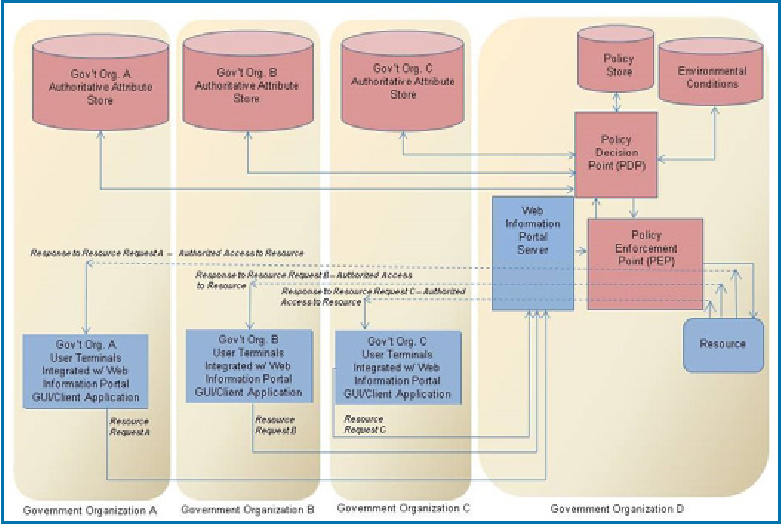
図19: アクセス制御と特権管理。Government Organization A、B、C、D の 4 列からなる図である。A、B、C はそれぞれ、上部に Gov't Org. Authoritative Attribute Store(権威ある属性ストア。円柱)、下部に Gov't Org. User Terminals Integrated w/ Web Information Portal GUI/Client Application(Web 情報ポータルの GUI・クライアントアプリケーションを統合した利用者端末)を持つ。組織 D には、Policy Store と Environmental Conditions(円柱)、Policy Decision Point (PDP)、Policy Enforcement Point (PEP)、Web Information Portal Server、Resource がある。各組織の属性ストアから PDP へ線が引かれ、Policy Store と Environmental Conditions も PDP に、PDP は PEP につながる。各組織の利用者端末から Resource Request A、B、C の線が Web Information Portal Server へ向かい、サーバーは PEP と Resource につながる。各組織の利用者端末へ戻る破線には、Response to Resource Request A(B、C)– Authorized Access to Resource と記されている。
Figure 19: Access Control and Privilege Management
図19: アクセス制御と特権管理
Conformance Verification for Access-Control Policies
アクセス制御方針の適合性検証
To formally and precisely capture the security properties that access control (AC) should adhere to, access control models are usually written to bridge the rather wide gap in abstraction between policy and mechanism. Thus, an access-control model provides unambiguous and precise expression, as well as a reference for design and implementation of security requirements. Techniques are required for verifying whether an access-control model is correctly expressed in the access-control policies and whether the properties are satisfied in the model.
アクセス制御 (AC) が従うべきセキュリティ特性を形式的かつ正確に捉えるために、通常はアクセス制御モデルを記述して、方針とメカニズムの間にあるかなり大きな抽象度の隔たりを埋めます。したがって、アクセス制御モデルは、あいまいさのない正確な表現を与えるとともに、セキュリティ要件の設計と実装のよりどころとなります。アクセス制御モデルがアクセス制御方針に正しく表現されているかどうか、およびモデルにおいて特性が満たされているかどうかを検証する技法が必要です。
Most research on AC model or policy verification techniques are focused on one particular model, and almost all of the research is in applied methods, which require the completed AC policies as the input for verification or test processes to generate fault reports. Even though correct verification is achieved, and counterexamples may be generated when faults were found, those methods provide no information about the source of faults that might allow conflicts in privilege assignment, leakage of privileges, or conflict of interest permissions. The difficulty in finding the source of faults is increased, especially when the AC rules are intricately covering duplicated variables to a degree of complexity. The complexity is due to the fact that a fault might not be caused by one particular rule. Thus, it requires manually analyzing each rule in the policy in order to find the correct solution for the fault.
AC のモデルまたは方針の検証技法に関する研究の大半は、特定の1つのモデルに焦点を当てており、また、ほぼすべての研究は応用的な手法に関するものです。それらの手法は、障害報告を生成する検証またはテストのプロセスへの入力として、完成した AC 方針を必要とします。正しい検証が行われ、障害が見つかったときに反例が生成されることがあるとしても、それらの手法は、特権の割り当てにおける競合、特権の漏えい、または利益相反となる許可を生じさせうる障害の発生源について、何の情報も与えません。障害の発生源を見つける難しさは、特に、AC 規則が重複した変数を複雑に入り組んだ形で扱っている場合に増します。この複雑さは、1つの障害が特定の1つの規則によって引き起こされるとは限らないことによります。そのため、障害に対する正しい解決策を見つけるには、方針内の各規則を人手で分析する必要があります。
To address the issue, CSD researched the AC Rule Logic Circuit Simulation (ACRLCS) technique, which enables the AC authors to detect a fault when the fault-causing AC rule is added to the policy, so the fix can be implemented in real time before adding other rules that further complicate the detecting effort. Rather than checking by retracing the interrelations between rules after the policy is completed, the policy author needs to only check the newly added rule against previous “correct” ones. In ACRLCS, AC rules are represented in a Simulated Logic Circuit (SLC). The use of simulation may restrict ACRLCS implementation on a physical electronic circuit; however, the concept can be implemented and computed through simulated software. In FY 2014, CSD accomplished the following:
この問題に対処するために、CSD は、AC Rule Logic Circuit Simulation (ACRLCS) の技法を研究しました。この技法により、AC の作成者は、障害の原因となる AC 規則が方針に追加された時点で障害を検出できるため、検出作業をさらに複雑にする他の規則を追加する前に、リアルタイムで修正を実施できます。方針の完成後に規則間の相互関係をたどり直して検査するのではなく、方針の作成者は、新たに追加した規則を、それまでの「正しい」規則と照らして検査するだけで足ります。ACRLCS では、AC 規則を Simulated Logic Circuit (SLC) で表現します。シミュレーションを用いることにより、物理的な電子回路上での ACRLCS の実装は制約される可能性がありますが、この概念は、シミュレーションを行うソフトウェアによって実装し、計算できます。2014会計年度に、CSD は次のことを達成しました。
•Researched the ACRLCS, and implemented a prototype access control rule composing system - the Access Control Rule Logic Circuit Simulation System;
•ACRLCS を研究し、アクセス制御規則を作成するシステムのプロトタイプである Access Control Rule Logic Circuit Simulation System を実装しました。
•Worked with industrial and academic organizations in exploring new capabilities that helped to improve the usability of the AC tools (ACPT and ACRLCS);
•産業界および学術界の組織と協力して、AC ツール(ACPT と ACRLCS)の使いやすさの向上に役立つ新しい機能を検討しました。
•Enhanced the capability of ACPT by improving user interfaces and adding privilege inheritance and multiple policy combination algorithms;
•ユーザインタフェースを改善し、特権の継承と複数の方針結合アルゴリズムを追加することにより、ACPT の機能を強化しました。
•Performed prototype testing; and
•プロトタイプのテストを実施しました。
•ACPT was downloaded by 277 users and organizations.
•ACPT は、277の利用者および組織によってダウンロードされました。
In FY 2015, CSD is planning to conduct further research on the new capabilities and enhance performance of the ACPT and ACRLCS.
2015会計年度に、CSD は、新しい機能についてさらに研究を行い、ACPT と ACRLCS の性能を向上させる予定です。
ACPT(Access Control Policy Tool、アクセス制御ポリシーツール)バージョン1.0の画面。ソフトウェアの起動画面にNISTロゴとAutomated Software Engineering Research Group(NC State University)のロゴを表示している。 [NIST のロゴが写っている図。公的な標章のため、この非公式サイトには掲載していません。原本 PDF を参照してください。]
Figure 20: Conformance Verification
図20: 適合性検証
This project is expected to:
このプロジェクトには、次のことが期待されます。
•Provide a generic paradigm and framework of access control model/property conformance testing;
•アクセス制御のモデルおよび特性の適合性テストについて、汎用的なパラダイムとフレームワークを提供します。
•Provide templates for specifying access control rules in popular access control models, such as the Attribute Based, Multilevel, and Workflow models;
•Attribute Based、Multilevel、Workflow の各モデルなど、広く使われているアクセス制御モデルでアクセス制御規則を記述するためのテンプレートを提供します。
•Provide tools or services for checking the security and safety of an access control implementation, policy combination, and eXtensible Access Control Markup Language (XACML) policy generation;
•アクセス制御の実装、方針の結合、および eXtensible Access Control Markup Language (XACML) 方針の生成について、セキュリティと安全性を検査するためのツールまたはサービスを提供します。
•Promote (or accelerate) the adoption of combinatorial testing for large-system testing (such as an access control system);
•大規模システム(アクセス制御システムなど)のテストに対する組合せテストの採用を促進します(または加速します)。
•Promote the concept of detecting AC policy faults in real time AC rule composing;
•AC 規則をリアルタイムで作成する際に AC 方針の障害を検出するという概念を普及させます。
•Provide an innovative method in specifying AC rules formed by Boolean logic expressions operated on variables of AC rules;
•AC 規則の変数に対して演算を行うブール論理式で構成される AC 規則を記述する、革新的な手法を提供します。
•Provide techniques for preventing faults in enforcing fundamental security properties, including Cyclic Inheritance, Privilege Escalation, and Separation of Duty; and
•Cyclic Inheritance、Privilege Escalation、Separation of Duty などの基本的なセキュリティ特性を実施する際の障害を防止する技法を提供します。
•Provide new methods for composing standard mandatory AC models, such as Role-Based Access Control (RBAC) and Multi-Level Security (MLS), as well as some fundamental security properties.
•Role-Based Access Control (RBAC) や Multi-Level Security (MLS) といった標準的な強制アクセス制御モデル、およびいくつかの基本的なセキュリティ特性を合成するための新しい手法を提供します。
http://csrc.nist.gov/groups/SNS/acpt/
http://csrc.nist.gov/groups/SNS/acpt/
CONTACTS:
連絡先:
Dr. Vincent Hu (301) 975-4975 vhu@nist.gov
Dr. Vincent Hu (301) 975-4975 vhu@nist.gov
Mr. Rick Kuhn (301) 975-3337 kuhn@nist.gov
Mr. Rick Kuhn (301) 975-3337 kuhn@nist.gov
Attribute-Based Access Control
属性ベースアクセス制御
Attribute-Based Access Control (ABAC) is a logical access control methodology where an authorization to perform a set of operations is determined by evaluating the attributes associated with the subject, object, requested operations, and, in some cases, environment conditions against policy, rules, or relationships that describe the allowable operations for a given set of attributes. ABAC represents a point on the spectrum of logical access control, from simple access control lists to more capable role-based access (RBAC), and finally, to a highly flexible method for providing access based on the evaluation of attributes.
Attribute-Based Access Control (ABAC) は論理アクセス制御の方法論の一つであり、一連の操作を実行するための認可を、サブジェクト、オブジェクト、要求された操作、および場合によっては環境条件に関連付けられた属性を、所与の属性の組に対して許容される操作を記述したポリシー、規則または関係に照らして評価することにより決定します。ABAC は、単純なアクセス制御リストから、より高機能なロールベースアクセス (RBAC) を経て、最終的には属性の評価に基づいてアクセスを与える極めて柔軟な手法に至る、論理アクセス制御のスペクトル上の一点に位置します。
There has not been a comprehensive effort to formally define or guide the implementation of ABAC within the Federal Government. This research provides considerations for using ABAC to improve information sharing within and among organizations, while maintaining control of that information. The research serves a two-fold purpose. First, it aims to provide federal agencies with a definition of ABAC and a description of the functional components of ABAC. Second, it provides planning, design, implementation, and operational considerations for employing ABAC within a large enterprise with the goal of improving information sharing while maintaining control of that information. In addition to the core concept (i.e. definition and consideration), ABAC research includes technologies such as attribute assurance, attribute engineering/management, identity system integration, attribute federation, situational awareness (real time or contextual) mechanism, policy management, and natural-language policy translation to digital policy.
連邦政府内では、ABAC を正式に定義し、またはその実装を導くための包括的な取組みはこれまで行われてこませんでした。本研究は、情報に対する統制を維持しつつ、組織内および組織間の情報共有を改善するために ABAC を利用する際の考慮事項を示します。本研究の目的は二つあります。第一に、連邦機関に対して ABAC の定義と ABAC の機能構成要素の説明を提供することを目指します。第二に、情報に対する統制を維持しつつ情報共有を改善することを目標として、大規模なエンタープライズ内で ABAC を採用する際の計画、設計、実装および運用上の考慮事項を提供します。中核となる概念(すなわち定義と考慮事項)に加えて、ABAC の研究には、属性の保証、属性のエンジニアリング/管理、アイデンティティシステムの統合、属性のフェデレーション、状況認識(リアルタイムまたは文脈的)の仕組み、ポリシー管理、自然言語のポリシーからデジタルポリシーへの変換といった技術が含まれます。
In FY 2014, CSD published SP 800-162, Guide to Attribute Based Access Control (ABAC) Definition and Considerations. SP 800-162 includes terminology and basic understanding of ABAC; ABAC enterprise-employment considerations during the initiation, acquisition/development, implementation/assessment, and operations and maintenance phases; and an example to demonstrate how ABAC is implemented in a Web Information Portal. CSD also researched ABAC formal models; the result will be presented in a NISTIR that will describe a variety of characteristics and applications of ABAC formal models. CSD also started research on the Attribute Assurance of ABAC in partnership with the National Security Agency (NSA), the National Strategy for Trusted Identities in Cyberspace (NSTIC), and the National Cybersecurity Center of Excellence (NCCoE); CSD developed a white paper based on the mechanism for defining the levels of assurance of ABAC attributes, as well as collecting use cases, current standards, and engineering experiences through a Request for Information (RFI) and working with ABAC user/commercial product communities.
2014会計年度に、CSD は SP 800-162, Guide to Attribute Based Access Control (ABAC) Definition and Considerations を公表しました。SP 800-162 には、ABAC の用語と基本的な理解、開始、取得/開発、実装/アセスメント、運用および保守の各フェーズにおけるエンタープライズでの ABAC 採用に関する考慮事項、ならびに Web 情報ポータルにおいて ABAC がどのように実装されるかを示す例が含まれています。CSD は ABAC の形式モデルについても研究しました。その成果は、ABAC の形式モデルのさまざまな特性と応用を記述する NISTIR として提示される予定です。CSD はまた、National Security Agency (NSA)、National Strategy for Trusted Identities in Cyberspace (NSTIC) および National Cybersecurity Center of Excellence (NCCoE) と連携して、ABAC の属性の保証に関する研究を開始しました。CSD は、ABAC の属性の保証レベルを定義する仕組みに基づくホワイトペーパーを作成するとともに、Request for Information (RFI) および ABAC の利用者/商用製品のコミュニティとの協働を通じて、ユースケース、現行の標準およびエンジニアリング上の経験を収集しました。
In FY 2015, CSD will continue the research of ABAC formal models, as well as details and extended topics of ABAC capabilities, such as Attribute Assurance, ABAC implementation examples, and ABAC standards. The ABAC project will pursue the following objectives:
2015会計年度に、CSD は ABAC の形式モデルの研究を継続するとともに、属性の保証、ABAC の実装例、ABAC の標準といった、ABAC の能力に関する詳細および発展的なトピックの研究も継続します。ABAC プロジェクトは次の目標を追求します。
•Provide readers with the terminology and a basic understanding of ABAC;
•読者に ABAC の用語と基本的な理解を提供します。
•Provide readers with an overview of the current state of logical access control, a working definition of ABAC, and an explanation of the core and enterprise ABAC concepts;
•読者に、論理アクセス制御の現状の概観、ABAC の作業上の定義、ならびに ABAC の中核概念およびエンタープライズ概念の説明を提供します。
•Assist security policy makers in establishing a business case for ABAC implementation, and acquiring an interoperable set of capabilities;
•セキュリティポリシーの策定者が、ABAC 実装のビジネスケースを確立し、相互運用可能な一連の能力を取得することを支援します。
•Assist ABAC developers in developing the operational requirements and overall enterprise architecture;
•ABAC の開発者が、運用要件および全体的なエンタープライズアーキテクチャを策定することを支援します。
•Assist ABAC administrators in establishing or refining business processes to support ABAC; and
•ABAC の管理者が、ABAC を支える業務プロセスを確立または改善することを支援します。
•Promote the adoption of ABAC for a more secure and flexible method for information sharing in a standalone or enterprise environment.
•スタンドアロン環境またはエンタープライズ環境における、より安全で柔軟な情報共有の手法として、ABAC の採用を促進します。
http://csrc.nist.gov/projects/abac/
http://csrc.nist.gov/projects/abac/
CONTACTS:
連絡先:
Dr. Vincent Hu, (301) 975-4975, vhu@nist.gov
Dr. Vincent Hu, (301) 975-4975, vhu@nist.gov
Mr. David Ferraiolo, (301) 975-3046, david.ferraiolo@nist.gov
Mr. David Ferraiolo, (301) 975-3046, david.ferraiolo@nist.gov
Mr. Rick Kuhn, (301) 975-3337, kuhn@nist.gov
Mr. Rick Kuhn, (301) 975-3337, kuhn@nist.gov
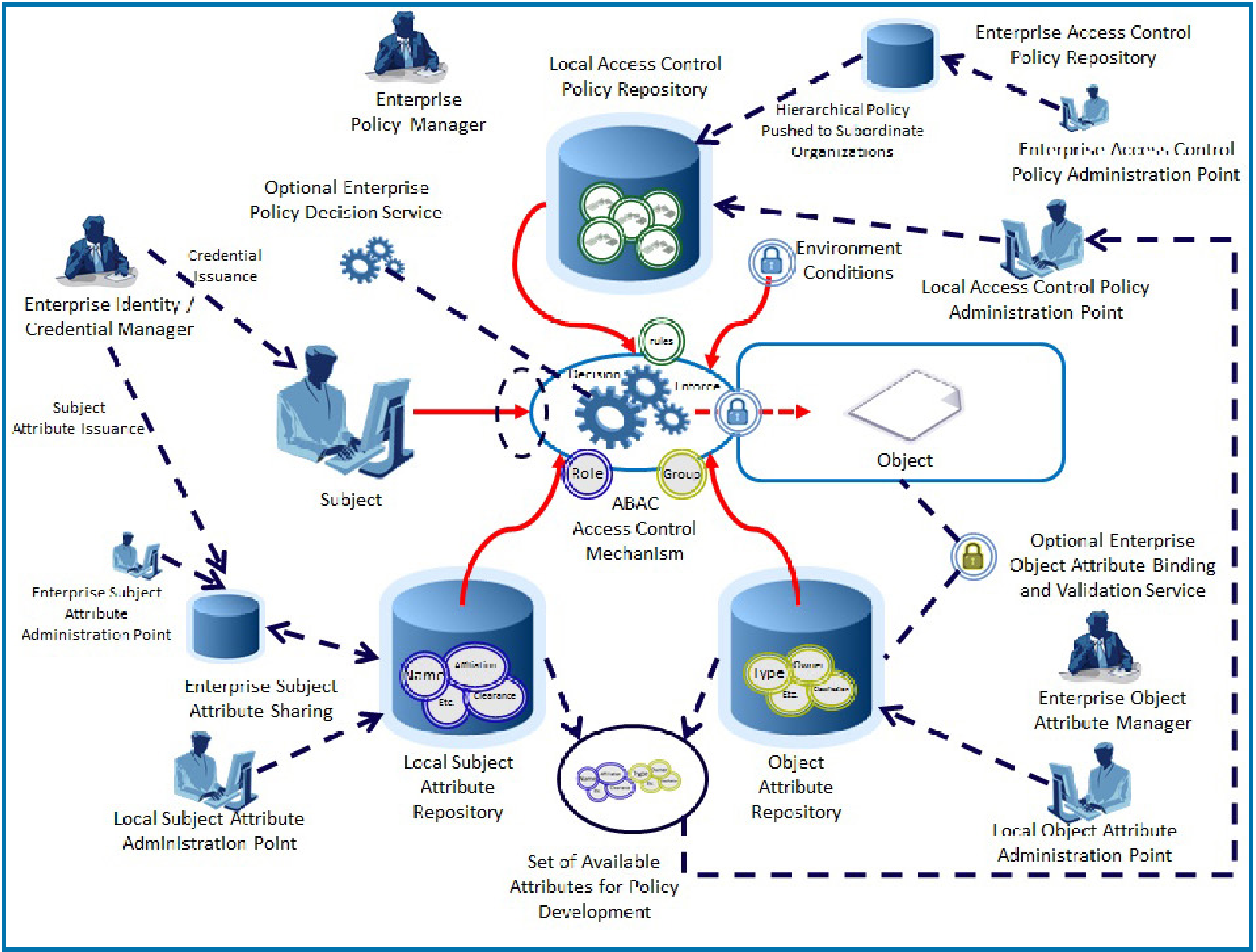
図 21:ABAC のアクセス制御メカニズムの図。ABAC Access Control Mechanism と記した楕円を中心とし、楕円の中に Decision と Enforce と記した歯車と、rules、Role、Group と記した小さな円がある。コンピューターに向かう Subject(主体)から赤い矢印がメカニズムに入り、赤い破線の矢印が錠を通って Object(客体)へ出る。メカニズムには、上の Local Access Control Policy Repository(ローカルのアクセス制御ポリシーリポジトリ)、Environment Conditions(環境条件)、Local Subject Attribute Repository(Name、Affiliation、Clearance、Etc.)、Object Attribute Repository(Type、Owner、Classification、Etc.)から赤い矢印が入る。破線の矢印は管理と供給を示し、Enterprise Identity / Credential Manager(Subject への Credential Issuance と Subject Attribute Issuance)、Enterprise Subject Attribute Administration Point と Enterprise Subject Attribute Sharing、Local Subject Attribute Administration Point、Optional Enterprise Policy Decision Service、Enterprise Policy Manager、Enterprise Access Control Policy Repository(Enterprise Access Control Policy Administration Point から供給され、Hierarchical Policy Pushed to Subordinate Organizations)、Local Access Control Policy Administration Point、Optional Enterprise Object Attribute Binding and Validation Service、Enterprise Object Attribute Manager、Local Object Attribute Administration Point がある。2 つの属性リポジトリは Set of Available Attributes for Policy Development(ポリシー策定に使える属性の集合)に流れ込み、それは Local Access Control Policy Administration Point へ戻る。
Figure 21: ABAC Access Control Mechanism Chart
図 21:ABAC のアクセス制御メカニズムの図
ADVANCED SECURITY TESTING AND MEASUREMENTS
高度なセキュリティ試験および測定
Security Automation and Continuous Monitoring
セキュリティ自動化および継続的監視
IT organizations operate a diverse set of computing assets that access, route, store, and process information that is critical to the operations of businesses and the missions of government agencies. These IT environments are frequently reconfigured, and are under constant threat of attack. The wide variety of computing products, the speed of configuration change, and the diversity of threats require organizations to maintain situational awareness over their IT assets and to utilize this information to make risk-based decisions.
IT 組織は、企業の業務や政府機関の任務にとって極めて重要な情報にアクセスし、それを転送、保存および処理する多様なコンピューティング資産を運用しています。こうした IT 環境は頻繁に再構成され、絶えず攻撃の脅威にさらされています。コンピューティング製品の種類の多さ、構成変更の速さ、および脅威の多様さのために、組織は自らの IT 資産に対する状況認識を維持し、その情報を利用してリスクに基づく意思決定を行う必要があります。
Security automation utilizes standardized data formats and transport protocols to enable data to be exchanged between business, operational, and security systems that support security processes by:
セキュリティ自動化は、標準化されたデータ形式とトランスポートプロトコルを利用して、業務システム、運用システムおよびセキュリティシステムの間でデータを交換できるようにします。これらのシステムは、次のことによってセキュリティプロセスを支えます。
•Identifying IT assets;
•IT 資産を識別します。
•Providing awareness over the operational state of computing devices;
•コンピューティングデバイスの運用状態を把握できるようにします。
•Enabling security reference data to be collected from internal and external sources; and
•内部および外部の情報源からセキュリティ参照データを収集できるようにします。
•Supporting analysis processes that measure the effectiveness of security controls and provide visibility into security risks, enabling risk-based decision making.
•セキュリティ管理策の有効性を測定し、セキュリティリスクを可視化する分析プロセスを支え、リスクに基づく意思決定を可能にします。
Commercial solutions built using security-automation specifications enable the collection and harmonization of vast amounts of operational and security data into coherent, comparable information streams to achieve situational awareness that allows timely and active management of diverse IT systems. Through the creation of reference data and guidance, and the international recognition of flexible, open standards, the NIST security-automation program works to improve the interoperability, broad acceptance, and adoption of security-automation solutions to address current and future security challenges, creating opportunities for innovation.
セキュリティ自動化の仕様を用いて構築された商用ソリューションは、膨大な量の運用データおよびセキュリティデータを収集し、一貫性のある比較可能な情報の流れへと整合させることを可能にし、多様な IT システムを適時かつ能動的に管理できる状況認識を実現します。NIST のセキュリティ自動化プログラムは、参照データとガイダンスの作成、および柔軟でオープンな標準の国際的な認知を通じて、現在および将来のセキュリティ上の課題に対処するセキュリティ自動化ソリューションの相互運用性、幅広い受容および採用の向上に取り組み、イノベーションの機会を創出しています。
Specification, Standards, and Guidance Development
仕様、標準およびガイダンスの策定
To support the overarching security automation vision, it is necessary to have specifications that describe the required interactions between systems, standards that document international consensus approaches, and guidance that informs product developers and implementers. Through close work with partners in government, industry, and academia, NIST CSD continues to facilitate the definition and development of security automation approaches that enable organizations to understand and manage IT security risks.
セキュリティ自動化の包括的なビジョンを支えるには、システム間に求められる相互作用を記述する仕様、国際的な合意に基づくアプローチを文書化する標準、および製品の開発者と実装者に情報を提供するガイダンスが必要です。NIST CSD は、政府、産業界および学術界のパートナーとの緊密な協働を通じて、組織が IT セキュリティリスクを理解し管理できるようにするセキュリティ自動化のアプローチの定義と策定を引き続き促進しています。
During FY 2014, CSD worked to build on previous security automation work by:
2014会計年度に、CSD は次のことによって、これまでのセキュリティ自動化の作業を発展させることに取り組みました。
•Participating in working groups in standards development organizations to promote international consensus around standardized approaches;
•標準化されたアプローチに関する国際的な合意を促進するため、標準化団体の作業部会に参加します。
•Identifying and addressing gaps in the current specifications;
•現行の仕様における欠落を特定し、それに対処します。
•Evolving existing approaches to achieve greater scalability and impact;
•既存のアプローチを発展させ、より高い拡張性と効果を実現します。
•Providing additional guidance on architectural, design, and analysis concerns; and
•アーキテクチャ、設計および分析に関する事項について追加のガイダンスを提供します。
•The development and maintenance of tools and reference implementations.
•ツールおよび参照実装の開発と保守。
CSD is currently working with its partners in various standards-development organizations, including the International Organization for Standardization (ISO), the Internet Engineering Task Force (IETF), the Forum of Incident Response and Security Teams (FIRST), and the Trusted Computing Group (TCG), to further mature and broaden the adoption of security-automation specifications, reference data, and techniques. This area of work is focused on evolving security-automation specifications to integrate with existing transport protocols to provide for the secure, interoperable exchange of security-automation data. Additional work is focused on evolving security metrics and providing consensus guidance on security-automation approaches. Through the definition and adoption of security-automation standards and guidelines, IT vendors will be able to provide standardized security solutions to their customers. These solutions support continuous monitoring and automated, dynamic network defense capabilities based on the analysis of data from operational and security data sources and the collective action of security components.
CSD は現在、International Organization for Standardization (ISO)、Internet Engineering Task Force (IETF)、Forum of Incident Response and Security Teams (FIRST) および Trusted Computing Group (TCG) を含むさまざまな標準化団体のパートナーと協働し、セキュリティ自動化の仕様、参照データおよび技法をさらに成熟させ、その採用を広げることに取り組んでいます。この分野の作業は、セキュリティ自動化の仕様を発展させて既存のトランスポートプロトコルと統合し、セキュリティ自動化データを安全かつ相互運用可能な形で交換できるようにすることに重点を置いています。そのほかの作業は、セキュリティメトリクスを発展させること、およびセキュリティ自動化のアプローチに関する合意に基づくガイダンスを提供することに重点を置いています。セキュリティ自動化の標準およびガイドラインの定義と採用を通じて、IT ベンダーは標準化されたセキュリティソリューションを顧客に提供できるようになります。これらのソリューションは、運用データおよびセキュリティデータの情報源から得たデータの分析と、セキュリティ構成要素の協調動作に基づく、継続的監視および自動化された動的なネットワーク防御の能力を支えます。
Security-automation work has been focused in two areas: the evolution and international adoption of the Security Content Automation Protocol (SCAP), and the development of a Continuous Monitoring building block focused on secure software asset management capabilities. The following sections detail this work.
セキュリティ自動化の作業は二つの分野に重点を置いてきました。Security Content Automation Protocol (SCAP) の発展と国際的な採用、および安全なソフトウェア資産管理の能力に焦点を当てた継続的監視のビルディングブロックの開発です。以下の各節でこの作業を詳述します。
Security Content Automation Protocol (SCAP)
Security Content Automation Protocol (SCAP)
SCAP is a multipurpose protocol that provides an automated means to collect and assess the state of devices. SCAP supports automated vulnerability checking, verifying the installation of patches, checking-security configuration settings, verifying technical-control compliance, measuring security, and examining systems for indicators of a compromise. SCAP uses the Extensible Markup Language (XML) to standardize the format and nomenclature by which security software products communicate information about software flaws, security configurations, and other aspects of device state. SCAP enables security-automation content, also known as “SCAP content,” to be expressed using standardized formats, identifiers, and scoring models. This content can be used by any tool that is conformant to the specifications, to collect and evaluate the state of software installed on a device.
SCAP は、デバイスの状態を収集し評価するための自動化された手段を提供する多目的のプロトコルです。SCAP は、自動化された脆弱性チェック、パッチの導入の検証、セキュリティ構成設定のチェック、技術的管理策への適合の検証、セキュリティの測定、および侵害の兆候についてのシステムの調査を支援します。SCAP は Extensible Markup Language (XML) を使用して、セキュリティソフトウェア製品がソフトウェアの欠陥、セキュリティ構成、およびデバイスの状態のその他の側面に関する情報を伝達する際の形式と命名法を標準化します。SCAP により、「SCAP コンテンツ」とも呼ばれるセキュリティ自動化コンテンツを、標準化された形式、識別子およびスコアリングモデルを用いて表現できます。このコンテンツは、仕様に適合する任意のツールが、デバイスに導入されたソフトウェアの状態を収集し評価するために使用できます。
SCAP has been widely adopted by major software and hardware manufacturers and has become a significant component of information-security-management and governance programs. SCAP-enabled tools are currently being used by the U.S. Government, critical-infrastructure companies, academia, and other businesses, both domestically and internationally. Currently, CSD is leveraging SCAP in multiple areas, both to support its own mission and to enable other agencies and private-sector entities to meet their goals. For CSD, SCAP is a critical component of the SCAP Validation Program, the National Vulnerability Database (NVD), and the National Checklist Program (NCP).
SCAP は主要なソフトウェアおよびハードウェアの製造業者に広く採用されており、情報セキュリティ管理およびガバナンスのプログラムの重要な構成要素となっています。SCAP 対応ツールは現在、国内外で、米国政府、重要インフラ企業、学術界およびその他の企業によって使用されています。現在 CSD は、自らの任務を支えるためにも、他の機関および民間部門の主体がその目標を達成できるようにするためにも、複数の分野で SCAP を活用しています。CSD にとって SCAP は、SCAP Validation Program、National Vulnerability Database (NVD) および National Checklist Program (NCP) の極めて重要な構成要素です。
In September 2012, CSD published SP 800-126 Revision 2, The Technical Specification for the Security Content Automation Protocol (SCAP): SCAP Version 1.2. That document describes the 11 component specifications composing SCAP. See Table on next page.
2012年9月に、CSD は SP 800-126 Revision 2, The Technical Specification for the Security Content Automation Protocol (SCAP): SCAP Version 1.2 を公表しました。同文書は、SCAP を構成する 11 のコンポーネント仕様を記述しています。次ページの表を参照のこと。
Since the release of SCAP 1.2, CSD has worked to improve guidance around the SCAP specifications by promoting a broader international adoption of SCAP, encouraging the integration of SCAP into other standards, and by adapting SCAP to address specific gaps and challenges. The sections describe work activities performed during FY 2014.
SCAP 1.2 のリリース以降、CSD は、SCAP のより広範な国際的採用を促進し、他の標準への SCAP の統合を奨励し、特定の欠落や課題に対処するよう SCAP を適応させることによって、SCAP 仕様に関するガイダンスの改善に取り組んできました。以下の各節では、2014会計年度に実施した作業活動を記述します。
CSD has continued its collaboration with industry partners in the IETF Security Automation and Continuous Monitoring (SACM) working group. This working group provides a venue for advancing appropriate SCAP specifications into international standards and addressing identified gap areas. The current scope of work for SACM includes identifying and/or defining the transport protocols and data formats needed to support the collection and evaluation of a device state against the expected values and standards for interacting with repositories of security-automation content. Over the past twelve months, the SACM working group has been working on identifying use cases, requirements, and architectural models to inform decisions about existing specifications and standards that can be referenced, required modifications or extensions to existing specifications and standards, and any gaps that need to be addressed.
CSD は、IETF Security Automation and Continuous Monitoring (SACM) 作業部会における産業界のパートナーとの協力を継続してきました。この作業部会は、適切な SCAP 仕様を国際標準へと進め、特定された欠落領域に対処するための場を提供します。SACM の現在の作業範囲には、期待される値に照らしたデバイスの状態の収集と評価を支えるために必要なトランスポートプロトコルおよびデータ形式、ならびにセキュリティ自動化コンテンツのリポジトリとやり取りするための標準を特定し、または定義することが含まれます。過去 12 か月にわたり、SACM 作業部会は、参照できる既存の仕様および標準、既存の仕様および標準に必要な修正または拡張、ならびに対処が必要な欠落に関する判断の材料とするため、ユースケース、要件およびアーキテクチャモデルの特定に取り組んできました。
The working group has been developing the following Internet drafts:
同作業部会は、次の Internet-Draft を作成しています。
| INTERNET DRAFT | PURPOSE |
|---|---|
| https:/ | Definition of the common terminology used within a number of working-group documents. |
| https:/ | Description of use cases and related capabilities to guide the development of requirements, architecture, and specifications for data models and transports. |
| https:/ | Listing architectural and specification requirements for SACM specifications. |
| インターネットドラフト | 目的 |
|---|---|
| https:/ | 複数のワーキンググループ文書で使用される共通用語の定義。 |
| https:/ | データモデルおよびトランスポートの要件、アーキテクチャ、仕様の策定を導くための、ユースケースと関連する機能の記述。 |
| https:/ | SACM仕様に対するアーキテクチャ要件および仕様要件の一覧。 |
| SCAP 1.2 SPECIFICATIONS | |
|---|---|
| SPECIFICATION | DESCRIPTION |
| Languages | |
| Extensible Configuration Checklist Description Format (XCCDF) | Used for authoring security checklists/benchmarks and for reporting results of evaluating them |
| Open Vulnerability and Assessment Language (OVAL) | Used for representing system-configuration information, assessing machine state, and reporting assessment results |
| Open Checklist Interactive Language (OCIL) | Used for representing checks that collect information from people or from existing data stores populated by other data collection methods |
| Reporting Formats | |
| Asset Reporting Format (ARF) | Used to express information about assets and to define the relationships between assets and reports |
| Asset Identification | Used to uniquely identify assets based on known identifiers and other asset information |
| Enumerations | |
| Common Platform Enumeration (CPE) | A nomenclature and dictionary of hardware, operating systems, and applications; a method to identify applicability to platforms |
| Common Configuration Enumeration (CCE) | A nomenclature and dictionary of software-security configurations |
| Common Vulnerabilities and Exposures (CVE) | A nomenclature and dictionary of security-related software flaws |
| Measurement and Scoring Systems | |
| Common Vulnerability Scoring System (CVSS) | Used for measuring the relative severity of software flaws |
| Common Configuration Scoring System (CCSS) | Used for measuring the relative severity of device security (mis-)configuration issues |
| Content and Result Integrity | |
| Trust Model for Security Automation Data (TMSAD) | Guidance for using digital signatures in a common trust model applied to security-automation specifications |
| SCAP 1.2の仕様 | |
|---|---|
| 仕様 | 説明 |
| 言語 | |
| 拡張可能構成チェックリスト記述形式(XCCDF) | セキュリティチェックリスト/ベンチマークの作成と、その評価結果の報告に使用 |
| オープン脆弱性評価言語(OVAL) | システム構成情報の表現、マシン状態の評価、評価結果の報告に使用 |
| オープンチェックリスト対話言語(OCIL) | 人から、または他のデータ収集手段で作成された既存のデータストアから情報を収集するチェックの表現に使用 |
| 報告形式 | |
| 資産報告形式(ARF) | 資産に関する情報を表現し、資産とレポートの関係を定義するために使用 |
| 資産識別 | 既知の識別子やその他の資産情報に基づいて、資産を一意に識別するために使用 |
| 列挙 | |
| 共通プラットフォーム列挙(CPE) | ハードウェア、オペレーティングシステム、アプリケーションの名称体系と辞書。プラットフォームへの適用性を識別する方法 |
| 共通構成列挙(CCE) | ソフトウェアのセキュリティ構成に関する名称体系と辞書 |
| 共通脆弱性識別子(CVE) | セキュリティ関連のソフトウェア欠陥に関する名称体系と辞書 |
| 測定およびスコアリング方式 | |
| 共通脆弱性評価システム(CVSS) | ソフトウェア欠陥の相対的な深刻度の測定に使用 |
| 共通構成スコアリングシステム(CCSS) | デバイスのセキュリティ上の(誤)構成の問題の相対的な深刻度の測定に使用 |
| コンテンツと結果の完全性 | |
| セキュリティ自動化データの信頼モデル(TMSAD) | セキュリティ自動化仕様に適用される共通の信頼モデルでデジタル署名を使用するための指針 |
For more information, please refer to: http://datatracker.ietf.org/wg/sacm/charter/
詳細については、次を参照のこと:http://datatracker.ietf.org/wg/sacm/charter/
Additionally, CSD collaborated with industry partners to revise the ISO/IEC 19770-2:2009 standard, Information technology—Software asset management—Part 2: Software identification tag, which establishes a specification for tagging software to support identification and management. This software-identification (SWID) data model defines a mechanism for software publishers to provide authoritative identification, categorization, software relationship (e.g., dependency, bundling, and patch), executable and library footprint details, and other metadata for software that they publish. This information enhances the SCAP use cases by providing authoritative information for the creation of Common Platform Enumeration (CPE) names, the targeting of checklists, and associating software flaws to products based on a defect in a software library or executable.
さらに CSD は、産業界のパートナーと協力して、ISO/IEC 19770-2:2009 規格 Information technology—Software asset management—Part 2: Software identification tag を改訂しました。同規格は、識別と管理を支えるためにソフトウェアにタグを付ける仕様を定めるものです。このソフトウェア識別 (SWID) データモデルは、ソフトウェア発行者が、自ら発行するソフトウェアについて、権威ある識別情報、分類、ソフトウェア間の関係(例えば、依存、バンドルおよびパッチ)、実行可能ファイルおよびライブラリのフットプリントの詳細、ならびにその他のメタデータを提供するための仕組みを定義します。この情報は、Common Platform Enumeration (CPE) 名の作成、チェックリストの適用対象の特定、およびソフトウェアライブラリまたは実行可能ファイルの欠陥に基づくソフトウェアの欠陥と製品との関連付けのための権威ある情報を提供することにより、SCAP のユースケースを強化します。
CSD also worked with government and industry partners in the TCG to define a number of specifications related to the Trusted Network Connect (TNC) protocols. The first such publication is the TNC SCAP Messages for IF-M specification that supports carrying SCAP content and results over the TNC protocols. The second is the TNC Enterprise Compliance Profile (ECP) and related specifications that support the exchange of SWID data over the TNC protocols. The ECP enables the collection of SWID data from a device for use by external tools to provide software inventory information. SCAP and SWID data collected using these mechanisms may be optionally used for network access-control decision making, allowing the device state to be evaluated when devices connect and on an ongoing basis thereafter.
CSD はまた、TCG において政府および産業界のパートナーと協働し、Trusted Network Connect (TNC) プロトコルに関連する多数の仕様を定義しました。その最初の公表物は TNC SCAP Messages for IF-M 仕様であり、TNC プロトコル上で SCAP コンテンツおよび結果を運ぶことを支援します。二つ目は TNC Enterprise Compliance Profile (ECP) および関連仕様であり、TNC プロトコル上での SWID データの交換を支援します。ECP は、ソフトウェアインベントリ情報を提供する外部ツールで使用するために、デバイスから SWID データを収集することを可能にします。これらの仕組みを用いて収集された SCAP および SWID のデータは、任意でネットワークアクセス制御の意思決定に使用でき、デバイスの接続時およびそれ以降も継続的にデバイスの状態を評価できるようにします。
For more information on these specifications, please visit: http://www.trustedcomputinggroup.org/resources/tnc_scap_messages_for_ifm, and http://www.trustedcomputinggroup.org/resources/tnc_endpoint_compliance_profile_specification.
これらの仕様の詳細については、次を参照のこと:http://www.trustedcomputinggroup.org/resources/tnc_scap_messages_for_ifm および http://www.trustedcomputinggroup.org/resources/tnc_endpoint_compliance_profile_specification。
Finally, CSD has worked with the Forum of Incident Response and Security Teams (FIRST) by participating in two Special Interest Groups (SIG). The CVSS SIG (CVSS-SIG) focused on defining CVSS Revision 3, which is intended to implement improvements to the scoring model, based on community feedback. The CVSS-SIG is currently working on the CVSS revision, which will be released in FY 2015. The second SIG, the Vulnerability Reporting and Data eXchange SIG (VRDX-SIG), researches and recommends methods for identifying and exchanging vulnerability information across disparate vulnerability databases.
最後に、CSD は二つの Special Interest Group (SIG) に参加することにより、Forum of Incident Response and Security Teams (FIRST) と協働してきました。CVSS SIG (CVSS-SIG) は CVSS Revision 3 の定義に重点を置きました。CVSS Revision 3 は、コミュニティからのフィードバックに基づいてスコアリングモデルの改善を実装することを意図しています。CVSS-SIG は現在 CVSS の改訂に取り組んでおり、これは 2015会計年度にリリースされる予定です。二つ目の SIG である Vulnerability Reporting and Data eXchange SIG (VRDX-SIG) は、異なる脆弱性データベースの間で脆弱性情報を識別し交換するための手法を調査し、推奨します。
For more information, please visit: http://www.first.org/global/sigs.
詳細については、次を参照のこと:http://www.first.org/global/sigs。
Through work with international SDOs, SCAP and related security-automation capabilities are expected to evolve and expand in support of the growing need to define and measure effective security controls, assess and monitor ongoing aspects of information security, remediate noncompliance, and successfully manage systems in accordance with the Risk Management Framework described in SP 800-37 Revision 1, Guide for Applying the Risk Management Framework to Federal Information Systems: A Security Life Cycle Approach. Standards that are developed and published by these SDOs will be considered for inclusion in future revisions of SCAP.
国際的な SDO との作業を通じて、SCAP および関連するセキュリティ自動化の能力は、有効なセキュリティ管理策を定義し測定すること、情報セキュリティの継続的な側面を評価し監視すること、不適合を是正すること、および SP 800-37 Revision 1, Guide for Applying the Risk Management Framework to Federal Information Systems: A Security Life Cycle Approach に記述された Risk Management Framework に従ってシステムを適切に管理することへの高まる必要性を支えるべく、発展し拡大すると見込まれます。これらの SDO が策定し公表する標準は、SCAP の将来の改訂に含めることが検討されます。
http://scap.nist.gov/
http://scap.nist.gov/
CONTACT:
連絡先:
Mr. David Waltermire (301) 975-3390 david.waltermire@nist.gov
Mr. David Waltermire (301) 975-3390 david.waltermire@nist.gov
Continuous Monitoring
継続的監視
In September 2010, the Department of Homeland Security (DHS) released the Continuous Asset Evaluation, Situational Awareness and Risk Scoring (CAESARS) Reference Architecture Report. This report identifies commonality and strengths in the custom approaches used by civilian agencies to provide solutions that enable the continuous monitoring of IT systems. This report identifies “essential functional components of a security risk-scoring system, independent of specific technologies, products, or vendors.” It describes the use of security-automation specifications, such as the SCAP, to enable continuous monitoring solutions.
2010年9月に、Department of Homeland Security (DHS) は Continuous Asset Evaluation, Situational Awareness and Risk Scoring (CAESARS) Reference Architecture Report を公表しました。この報告書は、IT システムの継続的監視を可能にするソリューションを提供するために文民機関が用いている独自のアプローチに共通する点と長所を特定しています。この報告書は、「特定の技術、製品またはベンダーに依存しない、セキュリティリスクスコアリングシステムの不可欠な機能構成要素」を特定しています。また、継続的監視のソリューションを可能にするための、SCAP などのセキュリティ自動化の仕様の利用について記述しています。
In October 2010, the Federal Chief Information Officer Council’s Information Security and Identity Management Committee’s (ISIMC) subcommittee on Continuous Monitoring and Risk Scoring saw the need to create a technical initiative to expand upon the CAESARS architecture to better scale it to large enterprises (e.g., the entire U.S. Government). A team of researchers from the NSA Information Assurance Directorate (IAD), the DHS Federal Network Security CAESARS team, and CSD worked together to respond to this need. The draft CAESARS Framework Extension (CAESARS-FE) described by Draft NISTIR 7756, CAESARS Framework Extension: An Enterprise Continuous Monitoring Technical Reference Architecture, is the output of this collaboration.
2010年10月に、Federal Chief Information Officer Council の Information Security and Identity Management Committee (ISIMC) の Continuous Monitoring and Risk Scoring 小委員会は、CAESARS アーキテクチャを拡張して大規模なエンタープライズ(例えば、米国政府全体)により適切に対応できるようにする技術的イニシアチブを立ち上げる必要があると判断しました。NSA Information Assurance Directorate (IAD)、DHS Federal Network Security の CAESARS チームおよび CSD の研究者からなるチームが、この必要性に応えるために協働しました。Draft NISTIR 7756, CAESARS Framework Extension: An Enterprise Continuous Monitoring Technical Reference Architecture に記述された CAESARS Framework Extension (CAESARS-FE) の草案は、この協力の成果です。
Draft NISTIR 7756 presents an enterprise continuous-monitoring (ConMon) technical reference architecture that extends the framework provided by the DHS’s CAESARS architecture. The primary goal of this effort is to enable enterprise ConMon by supporting the development and deployment of capabilities that support automated, enterprise-wide ConMon functions. The concepts, workflows, and subsystems presented in this document can be used by organizations seeking to establish federated queries, an orchestration of data-collection tasks, data analytics, and presentation and reporting capabilities across a diverse portfolio of security and IT products. CAESARS-FE supports IT operations and network-defense capabilities, with compliance reporting as a byproduct of actual security monitoring and improvement. CAESARS-FE enables organizations to design, develop, and deploy ConMon capabilities by leveraging their existing security and IT tools, while minimizing custom tool-integration efforts. CAESARS-FE defines the requisite functionality needed to ensure the interoperability of vendor products, while continuing to encourage security-tool-vendor participation and innovation.
草案 NISTIR 7756 は、DHS の CAESARS アーキテクチャが提供する枠組みを拡張した、エンタープライズ継続的監視(ConMon)の技術参照アーキテクチャを提示します。この取組みの第一の目標は、自動化された組織全体の ConMon 機能を支える能力の開発と展開を支援することにより、エンタープライズ ConMon を可能にすることです。本文書で提示する概念、ワークフロー及びサブシステムは、多様なセキュリティ製品及び IT 製品の全体にわたって、連合クエリ、データ収集タスクのオーケストレーション、データ分析、並びに提示及び報告の能力を確立しようとする組織が利用できます。CAESARS-FE は IT 運用及びネットワーク防御の能力を支援し、コンプライアンス報告は実際のセキュリティ監視及び改善の副産物として得られます。CAESARS-FE により、組織は、独自のツール統合作業を最小限に抑えつつ、既存のセキュリティツール及び IT ツールを活用して ConMon 能力を設計、開発及び展開できます。CAESARS-FE は、ベンダー製品の相互運用性を確保するために必要な機能を定義する一方で、セキュリティツールベンダーの参加と革新を引き続き促します。
To advance the state-of-the-art in continuous-monitoring capabilities and to further interoperability within commercially available tools, CSD is working with the IETF SACM working group to develop data-model and transport standards to support enterprise continuous monitoring. The CAESARS-FE reference architecture will evolve as consensus is developed within SACM around interoperable, standards-based approaches that enable continuous monitoring of IT systems. CSD is working to complete an update to NISTIR 7756 that provides additional guidance for the development of ConMon architectures and solutions based on ongoing standards activities and feedback.
継続的監視能力の最先端を前進させ、市販ツール間の相互運用性をさらに高めるため、CSD は IETF SACM ワーキンググループと協力し、エンタープライズ継続的監視を支えるデータモデル及びトランスポートの標準を策定しています。CAESARS-FE 参照アーキテクチャは、IT システムの継続的監視を可能にする相互運用可能な標準ベースのアプローチについて SACM 内で合意が形成されるのに合わせて発展していきます。CSD は、進行中の標準化活動及び寄せられたフィードバックに基づき、ConMon のアーキテクチャ及びソリューションの開発に関する追加のガイダンスを提供する NISTIR 7756 の改訂の完成に向けて作業を進めています。
The NIST National Cybersecurity Center of Excellence (NCCoE) is also working to develop a series of ConMon building blocks that demonstrate cybersecurity solutions that apply across multiple industry sectors. The first building block, currently under development, proposes a standardized approach to software-asset management, providing an organization with an integrated view of software throughout its lifecycle. The building block will support:
NIST の National Cybersecurity Center of Excellence(NCCoE)も、複数の産業分野に共通して適用できるサイバーセキュリティソリューションを実証する、一連の ConMon ビルディングブロックの開発に取り組んでいます。現在開発中の最初のビルディングブロックは、ソフトウェア資産管理に対する標準化されたアプローチを提案するものであり、ライフサイクル全体にわたるソフトウェアの統合的な把握を組織に提供します。このビルディングブロックは以下を支援します。
•Authorization and verification of software installation media—The ability to verify that software media is from a trusted publisher and that the integrity of the installation media has been maintained;
•ソフトウェアインストール媒体の認可及び検証—ソフトウェア媒体が信頼できる発行元からのものであること、及びインストール媒体の完全性が維持されていることを検証する能力。
•Software-execution whitelisting—The execution environment verifies that the software to be executed, is authorized for execution, and that the executable file(s) and any associated shared libraries have not been tampered with;
•ソフトウェア実行のホワイトリスティング—実行環境が、実行しようとするソフトウェアが実行を認可されていること、並びに実行可能ファイル及び関連する共有ライブラリが改ざんされていないことを検証します。
•Publication of an installed software inventory—When connected to an authorized network, a device’s full or updated software inventory is securely reported to an external configuration-management database that aggregates the software inventory of multiple devices for further analysis; and
•インストール済みソフトウェアインベントリの公開—認可されたネットワークに接続されたとき、デバイスのソフトウェアインベントリの全体又は更新分が、外部の構成管理データベースに安全に報告されます。このデータベースは、さらなる分析のために複数のデバイスのソフトウェアインベントリを集約します。
•Software inventory-based network access control—Control access to network resources at the time of a connect operation, based on the published, installed-software inventory. Access to network resources can be limited if software is outdated or patches are not installed in accordance with digital policies.
•ソフトウェアインベントリに基づくネットワークアクセス制御—公開されたインストール済みソフトウェアインベントリに基づき、接続操作の時点でネットワーク資源へのアクセスを制御します。ソフトウェアが古い場合、又はデジタルポリシーに従ってパッチが適用されていない場合には、ネットワーク資源へのアクセスを制限できます。
When used together, these capabilities enable the enterprise-wide management of the software that is allowed to be installed and executed. The collected information will also provide software-version information to support license, vulnerability and patch management needs. If historic software-inventory information is maintained, retroactive analysis techniques can be applied on this data to determine historic vulnerable conditions in support of incident-response and recovery processes. Finally, using the collected software inventory, network access can be controlled, enabling the device to be connected to a remediation network, if necessary, so that the appropriate software changes can be made before allowing the device full access to the operational network.
これらの能力を併用すると、インストール及び実行を許可するソフトウェアを組織全体で管理できます。収集した情報は、ライセンス管理、脆弱性管理及びパッチ管理の必要に応えるソフトウェアバージョン情報も提供します。過去のソフトウェアインベントリ情報を保持していれば、このデータに遡及的な分析手法を適用して過去の脆弱な状態を特定し、インシデント対応及び復旧のプロセスを支援できます。最後に、収集したソフトウェアインベントリを用いてネットワークアクセスを制御できるため、必要な場合にはデバイスを修復用ネットワークに接続させ、適切なソフトウェア変更を行った後に、運用ネットワークへの完全なアクセスをそのデバイスに許可できます。
The building-block document, Continuous Monitoring Building Block: Software Asset Management, can be viewed at http://nccoe.nist.gov/content/continuous-monitoring. In early FY 2015, the team will publish an update to the building-block document and will begin work with vendors to develop a solutions demonstration. Through this process, CSD provides publicly available descriptions of the practical steps needed to implement the technical approaches defined by the building block.
ビルディングブロック文書 Continuous Monitoring Building Block: Software Asset Management は http://nccoe.nist.gov/content/continuous-monitoring で閲覧できます。2015会計年度の初めに、チームはこのビルディングブロック文書の改訂版を公表し、ソリューションの実証を開発するためにベンダーとの作業を開始します。このプロセスを通じて、CSD は、ビルディングブロックが定める技術的アプローチを実装するために必要な実務上の手順の記述を、公開された形で提供します。
CONTACT:
連絡先:
Mr. David Waltermire, (301) 975-3390, david.waltermire@nist.gov
Mr. David Waltermire, (301) 975-3390, david.waltermire@nist.gov
Security Automation Reference Data
セキュリティ自動化の参照データ
Through the National Vulnerability Database (NVD) and the National Checklist Program (NCP), NIST is providing relevant and important reference data in the areas of vulnerability and configuration management. SCAP, and the programs that leverage it, are moving the information assurance industry towards being able to standardize communications and the collection and storage of relevant data in standardized formats, and to provide an automated means for the assessment and remediation of systems for both vulnerabilities and configuration compliance.
NIST は、National Vulnerability Database(NVD)及び National Checklist Program(NCP)を通じて、脆弱性管理及び構成管理の分野における有用かつ重要な参照データを提供しています。SCAP 及びそれを活用するプログラムは、情報保証業界を、通信並びに関連データの収集及び標準形式での保存を標準化でき、かつ脆弱性と構成コンプライアンスの双方についてシステムの評価及び修復を自動化された手段で行える方向へと動かしています。
National Vulnerability Database (NVD)
National Vulnerability Database(NVD)
Security automation reference data is currently housed within the NVD. The NVD is the U.S. Government repository of security automation data based on security automation specifications. This data provides a standards-based foundation for the automation of software asset, vulnerability, and security configuration management; security measurement; and compliance activities. This data supports security automation efforts based on the SCAP. The NVD includes databases of security configuration checklists for the NCP, listings of publicly known software flaws, product names, and impact metrics. A formal validation program tests the ability of vendor products to use some forms of security automation data, based on a product’s conformance in support of specific enterprise capabilities.
セキュリティ自動化の参照データは、現在 NVD に収容されています。NVD は、セキュリティ自動化仕様に基づくセキュリティ自動化データを収める米国政府のリポジトリです。このデータは、ソフトウェア資産管理、脆弱性管理及びセキュリティ構成管理、セキュリティ測定、並びにコンプライアンス活動を自動化するための標準ベースの基盤を提供します。このデータは、SCAP に基づくセキュリティ自動化の取組みを支えます。NVD には、NCP のセキュリティ構成チェックリストのデータベース、公知のソフトウェア欠陥の一覧、製品名及び影響度メトリクスが含まれます。正式な検証プログラムが、特定のエンタープライズ能力を支援するうえでの製品の適合性に基づき、ベンダー製品が一部の形式のセキュリティ自動化データを利用できるかを試験します。
SCAP defines the structure of standardized software flaws and security configuration reference data, also known as SCAP content. This reference data is provided by the NVD (http://nvd.nist.gov/).
SCAP は、標準化されたソフトウェア欠陥及びセキュリティ構成の参照データの構造を定義しており、この参照データは SCAP コンテンツとも呼ばれます。この参照データは NVD(http://nvd.nist.gov/)が提供します。
As of October 2014, the NVD contained the following resources:
2014年10月時点で、NVD は以下の資源を収めていました。
•Over 65 000 vulnerability advisories, with an average of 40 new vulnerabilities added daily;
•65 000件を超える脆弱性アドバイザリ。1日平均40件の新たな脆弱性が追加されています。
•56 SCAP-expressed checklists containing thousands of low-level security configuration checks that can be used by SCAP-validated security products to perform automated evaluations of the system state;
•SCAP で表現された56件のチェックリスト。数千件の低水準のセキュリティ構成チェックを含み、SCAP 検証済みのセキュリティ製品がシステム状態の自動評価を行うために利用できます。
•197 non-SCAP security checklists (e.g., English prose guidance and configuration scripts);
•SCAP 以外の197件のセキュリティチェックリスト(例:英語の文章によるガイダンス及び構成スクリプト)。
•248 U.S. Computer Emergency Readiness Team (US-CERT) alerts; 3690 US-CERT vulnerability summaries; and 10 286 SCAP machine-readable software flaw checks;
•248件の U.S. Computer Emergency Readiness Team(US-CERT)アラート、3690件の US-CERT 脆弱性サマリ、及び10 286件の SCAP 機械可読ソフトウェア欠陥チェック。
•A product dictionary with over 97 000 operating system, application, and hardware name entries; and
•97 000件を超えるオペレーティングシステム、アプリケーション及びハードウェアの名称エントリを収めた製品辞書。
•50 038 vulnerability advisories translated into Spanish.
•スペイン語に翻訳された50 038件の脆弱性アドバイザリ。
NVD is hosted and maintained by NIST and is sponsored by the Department of Homeland Security’s US-CERT.
NVD は NIST がホストし維持しており、国土安全保障省の US-CERT が後援しています。
The use of SCAP data by commercial security products, deployed in thousands of organizations worldwide, has extended NVD’s effective reach. Increasing demand for NVD XML data feeds (i.e., mechanisms that provide updated data from data sources) and SCAP-expressed content from the NVD website demonstrates an increased adoption of SCAP.
世界中の数千の組織に導入されている商用セキュリティ製品が SCAP データを利用することで、NVD の実質的な到達範囲は広がっています。NVD の XML データフィード(すなわち、データソースから更新データを提供する仕組み)及び NVD ウェブサイトの SCAP で表現されたコンテンツに対する需要の増加は、SCAP の採用が拡大していることを示しています。
The NVD continues to play a pivotal role in the Payment Card Industry (PCI) efforts to mitigate vulnerabilities in credit card systems. PCI mandates the use of NVD vulnerability severity scores in measuring the risk to payment card servers worldwide and for prioritizing vulnerability patching. PCI’s use of NVD severity scores helps enhance credit card transaction security and protects consumers’ personal information.
NVD は、クレジットカードシステムの脆弱性を緩和する Payment Card Industry(PCI)の取組みにおいて、引き続き中心的な役割を果たしています。PCI は、世界中のペイメントカードサーバに対するリスクの測定及び脆弱性へのパッチ適用の優先順位付けに、NVD の脆弱性深刻度スコアを用いることを義務付けています。PCI による NVD 深刻度スコアの利用は、クレジットカード取引のセキュリティの向上に役立ち、消費者の個人情報を保護します。
During FY 2014, the NVD infrastructure has been significantly changed to improve responsiveness and availability and to position the NVD for future improvements, which will be coming soon. NVD now hosts the SP 800-53 Revision 4 security controls content and will host the SP 800-53A Revision 4 content when that publication becomes final. NVD data is substantially increasing the security of networks worldwide, and it is a fundamental component of CSD’s security automation infrastructure. CSD plans for the NVD in FY 2015 include improvements in the organization and layout of the NVD to assist new users in locating content, the addition of visualization options of the NVD data for security researchers, and an implementation of the forthcoming release of the Common Vulnerability Scoring System (CVSS) version 3 specifications from FIRST.
2014会計年度中に、NVD の基盤は、応答性及び可用性を改善し、かつ近く実施される今後の改善に NVD を備えさせるために、大幅に変更されました。NVD は現在 SP 800-53 Revision 4 のセキュリティ管理策のコンテンツをホストしており、SP 800-53A Revision 4 が最終版になった時点でそのコンテンツもホストします。NVD のデータは世界中のネットワークのセキュリティを大きく高めており、CSD のセキュリティ自動化基盤の根幹をなす構成要素です。2015会計年度の NVD に関する CSD の計画には、新規利用者がコンテンツを見つけやすくするための NVD の構成及びレイアウトの改善、セキュリティ研究者向けの NVD データの可視化オプションの追加、並びに FIRST から近く公開される Common Vulnerability Scoring System(CVSS)バージョン3仕様の実装が含まれます。
http://nvd.nist.gov
http://nvd.nist.gov
CONTACT:
連絡先:
Mr. Harold Booth, (301) 975-8441, harold.booth@nist.gov
Mr. Harold Booth, (301) 975-8441, harold.booth@nist.gov
Computer Security Incident Coordination
コンピュータセキュリティインシデントの連携
Recognizing that even well-engineered and administered computing systems are sometimes successfully attacked, it is important to establish and maintain processes and procedures for responding to and recovering from attacks. SP 800-61 Revision 2, Computer Security Incident Handling Guide, provides guidance that helps organizations establish and operate a Computer Security Incident Response Team (CSIRT). When an attack has the potential to affect computing systems in multiple organizations, information sharing and coordination among organizations can make it possible to reduce the impact of the attack, speed recovery operations, and maintain a higher level of operational security.
適切に設計され管理されたコンピューティングシステムであっても攻撃が成功する場合があることを踏まえると、攻撃に対応し攻撃から復旧するためのプロセス及び手順を確立し維持することが重要です。SP 800-61 Revision 2, Computer Security Incident Handling Guide は、組織が Computer Security Incident Response Team(CSIRT)を設置し運用するのに役立つガイダンスを提供します。ある攻撃が複数の組織のコンピューティングシステムに影響を及ぼすおそれがある場合、組織間の情報共有及び連携によって、攻撃の影響を低減し、復旧作業を迅速化し、より高い水準の運用セキュリティを維持することが可能になります。
CSD is working with the Department of Homeland Security (DHS) to develop guidance on Computer Security Incident Coordination (CSIC). The goal of CSIC is to help diverse collections of organizations to effectively collaborate in the handling of computer security incidents. Effective collaboration raises numerous issues on how and when to share information between organizations, and in what form information should be shared. Because each organization may have substantially different capabilities for responding to attacks, diagnosing causes, and handling sensitive incident-related information, guidance is needed to help organizations interoperate despite these organizational differences.
CSD は、国土安全保障省(DHS)と協力して、Computer Security Incident Coordination(CSIC)に関するガイダンスを策定しています。CSIC の目標は、多様な組織の集まりがコンピュータセキュリティインシデントの取扱いにおいて効果的に協働できるよう支援することです。効果的な協働には、組織間でいつ、どのように情報を共有するか、またどのような形式で情報を共有すべきかについて、数多くの課題が伴います。攻撃への対応、原因の診断、及びインシデントに関連する機微な情報の取扱いに関する能力は組織ごとに大きく異なりうるため、こうした組織間の違いがあっても組織が相互運用できるよう支援するガイダンスが必要です。
The CSIC initiative is focused on the development of a Special Publication (SP) that provides guidance on how organizations can establish information sharing and coordination capabilities in advance of incidents in order to be prepared to operate swiftly and with coordination during incidents. The guidance covers information sharing architectures; risk-informed incident response capabilities; data privacy and sensitivity; data collection and retention practices; and the use of open standards for information exchange, redaction, and guidance on how an organization can establish, participate in, and maintain coordination and information-sharing relationships.
CSIC イニシアティブは、インシデント発生時に迅速かつ連携して行動する準備を整えておくために、組織がインシデントに先立って情報共有及び連携の能力をどのように確立できるかについてのガイダンスを提供する Special Publication(SP)の策定に重点を置いています。このガイダンスは、情報共有アーキテクチャ、リスク情報を踏まえたインシデント対応能力、データのプライバシー及び機微性、データの収集及び保持の実務、並びに情報交換のためのオープン標準の利用、編集による秘匿(redaction)、さらに組織が連携及び情報共有の関係をどのように確立し、それに参加し、維持できるかについてのガイダンスを扱います。
The CSIC guidance will help incident responders, network defenders, and operations personnel consider what information could be shared, the circumstances under which sharing is permitted, whom it can be shared with, and how the information should be protected. One of the key objectives of information sharing and coordination is to enable organizations to harness the collective knowledge and experience of their sharing partners to enhance protective measures, speed incident detection, augment analysis capabilities, and enhance containment, eradication, and recovery processes.
CSIC ガイダンスは、インシデント対応者、ネットワーク防御担当者及び運用要員が、どの情報を共有しうるか、共有が許される状況、共有できる相手、及びその情報をどのように保護すべきかを検討するのに役立ちます。情報共有及び連携の主要な目的の一つは、組織が共有パートナーの集合的な知識と経験を活用して、防護措置を強化し、インシデントの検知を迅速化し、分析能力を補強し、封じ込め、根絶及び復旧のプロセスを強化できるようにすることです。
In early FY 2015, CSD plans to release a Draft SP that provides guidance for Computer Security Incident Coordination. After the public comment period for the draft, a final version of the publication will be prepared and released later in the fiscal year.
2015会計年度の初めに、CSD は Computer Security Incident Coordination に関するガイダンスを提供する草案 SP を公表する計画です。草案に対するパブリックコメント期間の後、この刊行物の最終版を作成し、同会計年度中に公表します。
CONTACTS:
連絡先:
Mr. Lee Badger, (301) 975-3176, lee.badger@nist.gov
Mr. Lee Badger, (301) 975-3176, lee.badger@nist.gov
Mr. David Waltermire, (301) 975-3390, david.waltermire@nist.gov
Mr. David Waltermire, (301) 975-3390, david.waltermire@nist.gov
Mr. Christopher Johnson, (301) 975-3247, christopher.johnson@nist.gov
Mr. Christopher Johnson, (301) 975-3247, christopher.johnson@nist.gov
National Checklist Program (NCP)
National Checklist Program(NCP)
There are many threats to information technology (IT), ranging from remotely launched network service exploits to malicious code spread through infected emails, websites, and downloaded files. Vulnerabilities in IT products are discovered daily, and many ready-to-use exploitation techniques are widely available on the Internet. Because IT products are often intended for a wide variety of audiences, restrictive security configuration controls are usually not enabled by default. As a result, many out-of-the box IT products are immediately vulnerable. In addition, identifying a reasonable set of security settings that achieve balanced risk management is a complicated, arduous, and time-consuming task, even for experienced system administrators.
情報技術(IT)に対する脅威は数多く、遠隔から仕掛けられるネットワークサービスへのエクスプロイトから、感染した電子メール、ウェブサイト及びダウンロードファイルを通じて拡散する悪意のあるコードにまで及びます。IT 製品の脆弱性は日々発見されており、すぐに使える多くの悪用手法がインターネット上で広く入手できます。IT 製品は多種多様な利用者を想定していることが多いため、制限の厳しいセキュリティ構成の制御は、通常、既定では有効になっていません。その結果、多くの IT 製品は、箱から出したままの状態では直ちに脆弱です。加えて、均衡のとれたリスク管理を実現する妥当なセキュリティ設定の組を特定することは、経験豊富なシステム管理者にとってさえ、複雑で骨が折れ、時間のかかる作業です。
To facilitate the development of security configuration checklists for IT products and to make checklists more organized and usable, NIST’s CSD established the National Checklist Program (NCP) in furtherance of its statutory responsibilities under the Federal Information Security Management Act (FISMA) of 2002, Public Law 107-347, and also under the Cybersecurity Research and Development Act, which tasks NIST to “develop, and revise as necessary, a checklist setting forth settings and option selections that minimize the security risks associated with each computer hardware or software system that is, or is likely to become, widely used within the Federal Government.” In February 2008, revised Part 39 of the Federal Acquisition Regulation (FAR) was published. Paragraph (d) of section 39.101 states, “In acquiring information technology, agencies shall include the appropriate IT security policies and requirements, including use of common security configurations available from the NIST website at http://checklists.nist.gov. Agency contracting officers should consult with the requiring official to ensure the appropriate standards are incorporated.”
IT 製品のセキュリティ構成チェックリストの開発を促進し、チェックリストをより整理された使いやすいものにするため、NIST の CSD は、2002年の Federal Information Security Management Act(FISMA)(Public Law 107-347)に基づく法定の責務、及び Cybersecurity Research and Development Act に基づく法定の責務を果たすために、National Checklist Program(NCP)を設立しました。後者の法律は、NIST に対し、「連邦政府内で広く使用されている、又は広く使用されるようになる見込みのある、コンピュータのハードウェア又はソフトウェアの各システムに関連するセキュリティリスクを最小化する設定及びオプション選択を定めたチェックリストを策定し、必要に応じて改訂する」ことを課しています。2008年2月、Federal Acquisition Regulation(FAR)の改正された Part 39 が公布されました。section 39.101 の paragraph (d) は次のように定めています。「情報技術の取得に際し、各機関は、NIST のウェブサイト http://checklists.nist.gov で入手できる共通セキュリティ構成の使用を含め、適切な IT セキュリティのポリシー及び要求事項を含めなければなりません。各機関の契約担当官は、適切な標準が組み込まれることを確実にするため、要求元の担当官と協議すべきです。」
In Memorandum M-08-22, the Office of Management and Budget (OMB) mandated the use of SCAP-validated products for continuous monitoring of Federal Desktop Core Configuration (FDCC) compliance. The NCP strives to encourage and assist federal agencies with these mandates.
Memorandum M-08-22 において、行政管理予算局(OMB)は、Federal Desktop Core Configuration(FDCC)への適合の継続的監視に SCAP 検証済み製品を使用することを義務付けました。NCP は、これらの義務に関して連邦機関を促し、支援することに努めています。
The goals of the NCP are to:
NCP の目標は以下のとおりです。
•Facilitate the development and sharing of checklists by providing a formal framework for checklist developers to submit checklists to NIST;
•チェックリスト開発者が NIST にチェックリストを提出するための正式な枠組みを提供することにより、チェックリストの開発及び共有を促進します。
•Provide guidance to developers to help them create standardized, high-quality checklists that conform to common operation environments;
•開発者が、共通の運用環境に適合する、標準化された高品質のチェックリストを作成できるよう、開発者にガイダンスを提供します。
•Help developers and users by providing guidelines for making checklists better documented and more usable;
•チェックリストの文書化を充実させ、より使いやすくするためのガイドラインを提供することにより、開発者及び利用者を支援します。
•Encourage software vendors and other parties to develop checklists;
•ソフトウェアベンダー及びその他の関係者にチェックリストの開発を促します。
•Provide a managed process for the review, update, and maintenance of checklists;
•チェックリストのレビュー、更新及び保守のための、管理されたプロセスを提供します。
•Provide an easy-to-use repository of checklists; and
•チェックリストの使いやすいリポジトリを提供します。
•Encourage the use of automation technologies (e.g., SCAP) for checklist application.
•チェックリストの適用に自動化技術(例:SCAP)を利用することを促します。
There are 253 checklists posted on the website (http://checklists.nist.gov); 120 of the checklists, addressing 48 platforms, are SCAP-expressed and can be used with SCAP-validated products. The majority of the SCAP-expressed checklists have been posted in the past three years, demonstrating continual use and adoption of this automated means of expressing checklist content.
ウェブサイト(http://checklists.nist.gov)には253件のチェックリストが掲載されています。そのうち48のプラットフォームを対象とする120件は SCAP で表現されており、SCAP 検証済み製品とともに使用できます。SCAP で表現されたチェックリストの大半は過去3年間に掲載されたものであり、チェックリストの内容を表現するこの自動化された手段が継続的に利用され、採用されていることを示しています。
Organizations can use checklists obtained from the NCP website for automated security configuration patch assessment. The NCP currently hosts SCAP checklists for Internet Explorer 9.0, Internet Explorer 10.0, Office 2010, Red Hat Enterprise Linux, Windows 7, Windows 8, Windows Server 2012, and other products.
組織は、NCP のウェブサイトから入手したチェックリストを、セキュリティ構成及びパッチの自動評価に利用できます。NCP は現在、Internet Explorer 9.0、Internet Explorer 10.0、Office 2010、Red Hat Enterprise Linux、Windows 7、Windows 8、Windows Server 2012 及びその他の製品の SCAP チェックリストをホストしています。
To assist users in identifying automated checklist content, NCP groups these checklists into tiers, from Tier I to Tier IV. The NCP uses the tiers to rank checklists according to their automation capability. Tier III and IV checklists include SCAP content and have been validated by the SCAP content validation tool as conforming to the requirements outlined in SP 800-126, The Technical Specification for the Security Content Automation Protocol (SCAP). Tier IV checklists are considered production-ready and have been validated by NIST or a NIST recognized authoritative entity to ensure interoperability with SCAP-validated products to the maximum extent possible.
利用者が自動化されたチェックリストコンテンツを識別しやすくするため、NCP はこれらのチェックリストを Tier I から Tier IV までの階層に分類しています。NCP は、この階層を用いて、チェックリストを自動化の能力に応じて順位付けします。Tier III 及び Tier IV のチェックリストは SCAP コンテンツを含み、SP 800-126, The Technical Specification for the Security Content Automation Protocol (SCAP) に示された要求事項に適合していることが SCAP コンテンツ検証ツールによって検証されています。Tier IV のチェックリストは実運用に供しうるものとみなされ、SCAP 検証済み製品との相互運用性を最大限確保するために、NIST 又は NIST が認めた権威ある主体による検証を受けています。
Tier III checklists use SCAP content to document security settings and should be compatible with SCAP-validated products. Tier II checklists document recommended security settings in a machine-readable, nonstandard format, such as a proprietary format or a product-specific configuration script. Tier I checklists are prose-based and contain no machine-readable content. Users can browse the checklists, based on the checklist tier, IT product, IT product category, or authority, and through a keyword search that searches the checklist name and summary for user specified terms. The search results show the detailed checklist metadata and a link to any SCAP content for the checklist, as well as links to any supporting resources associated with the checklist.
Tier III のチェックリストは、SCAP コンテンツを用いてセキュリティ設定を文書化しており、SCAP 検証済み製品と互換性があるはずです。Tier II のチェックリストは、推奨されるセキュリティ設定を、独自形式や製品固有の構成スクリプトなど、機械可読ではあるが標準ではない形式で文書化しています。Tier I のチェックリストは文章による記述であり、機械可読なコンテンツを含みません。利用者は、チェックリストの階層、IT 製品、IT 製品の分類又は発行主体に基づいてチェックリストを閲覧でき、また、利用者が指定した語をチェックリストの名称及び概要から検索するキーワード検索も利用できます。検索結果には、チェックリストの詳細なメタデータ、そのチェックリストの SCAP コンテンツがある場合はそれへのリンク、及びそのチェックリストに関連する補助資料がある場合はそれらへのリンクが表示されます。
To assist checklist developers, the NCP provides both manual and automated interfaces to facilitate submission and maintenance processes. The manual interface consists of a web application that guides the submitter through the data entry process to ensure that all of the required information is submitted. The submission is validated upon review, and a report is returned to the submitting organization, verifying either acceptance or rejection, based on the criteria requirements. For instance, Tier III and Tier IV checklists require validation using the SCAP Content Validation Tool (this tool is available for download via http://scap.nist.gov/revision/1.2/#tools).
チェックリスト開発者を支援するため、NCP は、提出及び保守のプロセスを容易にする手動のインタフェースと自動のインタフェースの両方を提供しています。手動インタフェースは、必要な情報がすべて提出されるよう、提出者にデータ入力の手順を案内するウェブアプリケーションからなります。提出物はレビューの際に検証され、基準となる要求事項に基づいて受理又は却下のいずれであるかを確認する報告が提出組織に返されます。例えば、Tier III 及び Tier IV のチェックリストには、SCAP Content Validation Tool による検証が必要です(このツールは http://scap.nist.gov/revision/1.2/#tools からダウンロードできます)。
The NCP is defined in SP 800-70 Revision 2, National Checklist Program for IT Products—Guidelines for Checklist Users and Developers, which can be found at http://csrc.nist.gov/publications/PubsSPs.html.
NCP は SP 800-70 Revision 2, National Checklist Program for IT Products—Guidelines for Checklist Users and Developers で定義されており、同文書は http://csrc.nist.gov/publications/PubsSPs.html で入手できます。
http://checklists.nist.gov
http://checklists.nist.gov
CONTACT:
連絡先:
Mr. Stephen Quinn, (301) 975-6967, stephen.quinn@nist.gov
Mr. Stephen Quinn, (301) 975-6967, stephen.quinn@nist.gov
United States Government Configuration Baseline (USGCB) / FDCC Baselines
United States Government Configuration Baseline (USGCB) / FDCC ベースライン
The United States Government Configuration Baseline (USGCB) initiative creates security configuration baselines for information technology (IT) products widely deployed across the federal agencies. The project evolved from the Federal Desktop Core Configuration (FDCC) mandate originally described in a March 2007 memorandum from the U.S. White House Office of Management and Budget (Memorandum M-07-11). USGCB helps to improve information security and reduce overall IT operating costs by providing commonly accepted security configurations for major operating systems.
United States Government Configuration Baseline (USGCB) イニシアティブは、連邦機関に広く導入されている情報技術 (IT) 製品のセキュリティ設定ベースラインを作成します。このプロジェクトは、米国ホワイトハウスの行政管理予算局による2007年3月の覚書 (Memorandum M-07-11) で最初に示された Federal Desktop Core Configuration (FDCC) の義務付けから発展したものです。USGCB は、主要なオペレーティングシステムについて広く受け入れられたセキュリティ設定を提供することで、情報セキュリティの向上と IT 運用コスト全体の削減に役立ちます。
Through the National Checklist Program described in SP 800-70 Revision 2, National Checklist Program for IT Products: Guidelines for Checklist Users and Developers, a baseline submitter may express interest in submitting a candidate for use in the USGCB program.
SP 800-70 Revision 2, National Checklist Program for IT Products: Guidelines for Checklist Users and Developers に記載されている National Checklist Program を通じて、ベースラインの提出者は、USGCB プログラムで使用する候補を提出する意向を表明できます。
CSD provides ongoing support for the USGCB automation content, including periodic updates, assisting USGCB users in continuously monitoring and assessing security compliance of information systems. This ongoing monitoring element supports the Risk Management Framework described in SP 800-37 Revision 1, Guide for Applying the Risk Management Framework to Federal Information Systems: A Security Life Cycle Approach. It also supports the Core functions of the Cybersecurity Framework, providing USGCB users with settings that protect digital assets and enable detection of suspicious activity.
CSD は、定期的な更新を含め、USGCB の自動化コンテンツを継続的に支援しており、USGCB の利用者が情報システムのセキュリティ準拠状況を継続的に監視し、評価するのを助けています。この継続的な監視の要素は、SP 800-37 Revision 1, Guide for Applying the Risk Management Framework to Federal Information Systems: A Security Life Cycle Approach に記載されているリスク管理フレームワークを支えます。また、Cybersecurity Framework のコア機能も支えており、デジタル資産を保護し、不審な活動の検知を可能にする設定を USGCB の利用者に提供します。
During FY 2015, the USGCB Program will continue to provide ongoing maintenance of the baseline artifacts and to consider additional applicable platforms.
2015会計年度には、USGCB プログラムはベースラインの成果物の保守を引き続き行い、適用可能な追加のプラットフォームを検討します。
The USGCB’s team email address is: usgcb@nist.gov.
USGCB チームの電子メールアドレスは usgcb@nist.gov です。
CONTACT:
連絡先:
Mr. Stephen Quinn, (301) 975-6967, stephen.quinn@nist.gov
Mr. Stephen Quinn, (301) 975-6967, stephen.quinn@nist.gov
Apple OS X Security Configuration
Apple OS X のセキュリティ設定
CSD is working with Apple Incorporated to develop secure system configuration baselines supporting different operational environments for Apple OS X Version 10.8, “Mountain Lion.” These configuration guidelines will assist organizations with hardening OS X technologies and provide a basis for unified controls and settings for OS X workstations and for mobile system security configurations for federal agencies.
CSD は Apple Incorporated と協力して、Apple OS X Version 10.8「Mountain Lion」について、異なる運用環境に対応する安全なシステム設定ベースラインを開発しています。これらの設定ガイドラインは、組織が OS X 技術を堅牢化するのを助け、連邦機関における OS X ワークステーションの統一された管理策と設定、およびモバイルシステムのセキュリティ設定の基礎を提供します。
The configurations will be based on a collection of resources, including the existing NIST OS X configuration guidance, the OS X security configuration guide, the Department of Defense (DOD) OS X Recommended Settings, and the Defense Information Systems Agency (DISA) OS X Security Technical Implementation Guide (STIG). The project team is aggregating 400 initial settings, determining which settings will be included in the configuration baseline, and determining appropriate values for each included setting. As the desired configuration items are established, the team is developing shell scripts that apply the settings to an OS X 10.8 system. The settings are organized into three key baselines, which are appropriate for different environments:
これらの設定は、既存の NIST の OS X 設定ガイダンス、OS X のセキュリティ設定ガイド、国防総省 (DOD) の OS X Recommended Settings、国防情報システム局 (DISA) の OS X Security Technical Implementation Guide (STIG) を含む一連の資料に基づくものとなります。プロジェクトチームは、400件の初期設定を集約し、どの設定を設定ベースラインに含めるかを決定し、含める各設定の適切な値を決定しています。望ましい設定項目が定まるのに合わせて、チームはそれらの設定を OS X 10.8 システムに適用するシェルスクリプトを開発しています。設定は、それぞれ異なる環境に適した3つの主要なベースラインに整理されている:
•The Enterprise baseline is appropriate for centrally managed, networked systems.
•Enterprise ベースラインは、集中管理され、ネットワークに接続されたシステムに適しています。
•The Small Office Home Office baseline is appropriate for systems that are deployed remotely, but need to connect to enterprise networks.
•Small Office Home Office ベースラインは、遠隔地に配備されますが、エンタープライズネットワークに接続する必要があるシステムに適しています。
•The Special Security Limited Functionality baseline is appropriate for systems where security requirements are more stringent and where the implementation of security safeguards is likely to reduce functionality.
•Special Security Limited Functionality ベースラインは、セキュリティ要件がより厳しく、セキュリティ保護策の実装によって機能が低下する可能性が高いシステムに適しています。
SCAP, defined and discussed in other sections of this report, is used to express configuration settings and check system configuration compliance.
SCAP は、本報告書の他の節で定義および説明されており、設定を表現し、システム設定の準拠状況を確認するために使用されます。
During FY 2013, CSD provided a block of initial settings to Apple and these settings were posted for the Apple community on a periodic basis for public review, discussion, correction and agreement. Each setting has a designated Common Configuration Enumeration (CCE) number, which aids in long-term tracking of the setting. Once these settings are vetted by Apple, the settings will then be tested and included in the configuration baselines. In addition, CSD is producing a draft guideline, Guide to Securing Apple OS X 10.8 Systems for IT Professionals. This guidance, similar in structure to the SP 800-68, Windows XP Security Guide, will provide detailed information about the security of Apple OS X 10.8, and will provide security configuration guidelines for all users of the Apple OS X 10.8 operating system.
2013会計年度に、CSD は初期設定のまとまりを Apple に提供し、これらの設定は、公開レビュー、議論、修正および合意のために、Apple コミュニティ向けに定期的に掲載されました。各設定には Common Configuration Enumeration (CCE) 番号が割り当てられており、設定の長期的な追跡に役立ちます。これらの設定は、Apple による精査を経た後、テストされ、設定ベースラインに含められます。加えて、CSD はガイドライン草案 Guide to Securing Apple OS X 10.8 Systems for IT Professionals を作成しています。このガイダンスは、SP 800-68, Windows XP Security Guide と同様の構成であり、Apple OS X 10.8 のセキュリティに関する詳細な情報を提供するとともに、Apple OS X 10.8 オペレーティングシステムのすべての利用者に向けたセキュリティ設定ガイドラインを提供します。
During FY 2014, a majority of all proposed settings were scripted. The corresponding spreadsheet batches have been sent to Apple for feedback; approximately 230 settings are now completed. Settings have also been implemented on OS X 10.9, when possible. Work on the draft guideline, Guide to Securing Apple OS X 10.8 Systems for IT Professionals, was temporarily suspended while configuration setting research was performed, but will be resumed in FY 2015.
2014会計年度には、提案されたすべての設定の過半数がスクリプト化されました。対応するスプレッドシートのまとまりは、フィードバックを得るために Apple に送付されており、現在までに約230件の設定が完了しています。設定は、可能な場合には OS X 10.9 にも実装されました。ガイドライン草案 Guide to Securing Apple OS X 10.8 Systems for IT Professionals の作業は、設定の調査を行っている間は一時的に中断されていましたが、2015会計年度に再開されます。
In FY 2015, CSD plans to finish scripting the few remaining OS X settings. The draft publication, Guide to Securing Apple OS X 10.8 Systems for IT Professionals will also be completed and made available for public comment. One of the script’s three profiles will be deployed on select CSD systems to test the extended use of a system with a specific profile applied. CSD plans to continue improving the script after all settings are implemented.
2015会計年度に、CSD は残りわずかな OS X 設定のスクリプト化を完了する予定です。草案 Guide to Securing Apple OS X 10.8 Systems for IT Professionals も完成させ、パブリックコメントに付します。スクリプトの3つのプロファイルのうちの1つを選定した CSD のシステムに配備し、特定のプロファイルを適用したシステムの長期使用をテストします。CSD は、すべての設定が実装された後もスクリプトの改良を続ける予定です。
CONTACTS:
連絡先:
Mr. Mark Trapnell, (301) 975-4091, mark.trapnell@nist.gov
Mr. Mark Trapnell, (301) 975-4091, mark.trapnell@nist.gov
Mr. Lee Badger, (301) 975-3176, lee.badger@nist.gov
Mr. Lee Badger, (301) 975-3176, lee.badger@nist.gov
Mr. Lawrence Keys, (301) 975-5482, lawrence.keys@nist.gov
Mr. Lawrence Keys, (301) 975-5482, lawrence.keys@nist.gov
Ms. Kathy Ton-Nu, (301) 975-3361, kathy.ton-nu@nist.gov
Ms. Kathy Ton-Nu, (301) 975-3361, kathy.ton-nu@nist.gov
TECHNICAL SECURITY METRICS
技術的セキュリティメトリクス
Security Risk Analysis of Enterprise Networks Using Attack Graphs
攻撃グラフを用いたエンタープライズネットワークのセキュリティリスク分析
The protection of computer networks from malicious intrusions is critical to the economy and security of the nation. Vulnerabilities are regularly discovered in software applications that are exploited to stage cyber attacks. System administrators need objective metrics to guide and justify decision making as they manage the security risk of enterprise networks. The objective of this research is to develop a standard model for security risk analysis of computer networks. A standard model will enable NIST to answer questions such as “Are we more secure now than yesterday?” or “How does the security of one network configuration compare with another one?” Also, having a standard model to measure network security will allow users, vendors, and researchers to evaluate methodologies and products for network security in a coherent and consistent manner.
悪意のある侵入からコンピュータネットワークを保護することは、国家の経済と安全保障にとって極めて重要です。ソフトウェアアプリケーションには脆弱性が日常的に発見され、それらはサイバー攻撃を仕掛けるために悪用されます。システム管理者は、エンタープライズネットワークのセキュリティリスクを管理するにあたり、意思決定を導き、その根拠を示すための客観的なメトリクスを必要としています。本研究の目的は、コンピュータネットワークのセキュリティリスク分析のための標準モデルを開発することです。標準モデルがあれば、NIST は「現在は昨日よりも安全か」あるいは「あるネットワーク構成のセキュリティは別の構成と比べてどうか」といった問いに答えられるようになります。また、ネットワークセキュリティを測定する標準モデルがあれば、利用者、ベンダー、研究者は、ネットワークセキュリティのための方法論や製品を、首尾一貫した形で評価できるようになります。
CSD has approached the challenge of network security analysis by capturing vulnerability interdependencies and measuring security, based on how real attackers have penetrated networks. CSD’s methodology for security risk analysis is based on attack graphs. CSD analyzes attack paths through a network, providing a probabilistic metric of the overall system risk. Through this metric, CSD analyzes trade-offs between security costs and security benefits.
CSD は、脆弱性の相互依存関係を捉え、実際の攻撃者がネットワークに侵入した方法に基づいてセキュリティを測定することで、ネットワークセキュリティ分析の課題に取り組んできました。CSD のセキュリティリスク分析の方法論は、攻撃グラフに基づいています。CSD はネットワーク内の攻撃経路を分析し、システム全体のリスクを表す確率的なメトリクスを提供します。このメトリクスを通じて、CSD はセキュリティのコストとセキュリティの便益との間のトレードオフを分析します。
Computer systems are vulnerable to both known and zero-day attacks. Handling zero-day vulnerabilities is inherently difficult, due to their unpredictable nature. In FY 2014, CSD attempted to model network diversity for evaluating the resilience of networks against zero-day attacks. CSD developed a formal model for network diversity as a security metric for evaluating the robustness of networks against potential zero-day attacks. CSD has proposed a new metric based on the least and average attacking effort. CSD has authored a paper, “Modeling Network Diversity for Evaluating the Robustness of Networks against Zero- Day Attacks,” that was presented at the 19th European Symposium on Research in Computer Security (ESORICS), Wroclaw, Poland, September 7-11, 2014.
コンピュータシステムは、既知の攻撃とゼロデイ攻撃の両方に対して脆弱です。ゼロデイ脆弱性への対処は、その予測不可能な性質のために本質的に困難です。2014会計年度に、CSD は、ゼロデイ攻撃に対するネットワークのレジリエンスを評価するために、ネットワークの多様性のモデル化を試みました。CSD は、潜在的なゼロデイ攻撃に対するネットワークの堅牢性を評価するためのセキュリティメトリクスとして、ネットワークの多様性の形式モデルを開発しました。CSD は、最小および平均の攻撃労力に基づく新しいメトリクスを提案しています。CSD は論文「Modeling Network Diversity for Evaluating the Robustness of Networks against Zero- Day Attacks」を執筆し、この論文は2014年9月7日から11日にポーランドのWroclawで開催された 19th European Symposium on Research in Computer Security (ESORICS) で発表されました。
In FY 2015, CSD plans to develop new techniques and metrics to detect stealthy attacks on Cloud Computing using Bayesian Networks. CSD also plans to publish the results as a NIST report and as white papers in conferences and journals.
2015会計年度に、CSD は、ベイジアンネットワークを用いてクラウドコンピューティングに対するステルス性の高い攻撃を検知するための新しい技法とメトリクスを開発する予定です。CSD はまた、その成果を NIST の報告書として、また会議や学術誌におけるホワイトペーパーとして公表する予定です。
http://csrc.nist.gov/groups/SNS/security-risk-analysis-enterprise-networks/
http://csrc.nist.gov/groups/SNS/security-risk-analysis-enterprise-networks/
CONTACT:
連絡先:
Dr. Anoop Singhal, (301) 975-4432, anoop.singhal@nist.gov
Dr. Anoop Singhal, (301) 975-4432, anoop.singhal@nist.gov
Algorithms for Intrusion Measurement
侵入測定のためのアルゴリズム
The Algorithms for Intrusion Measurement (AIM) project furthers measurement science in the area of the algorithms used in the field of intrusion detection. The team focuses on both new detection metrics and measurements of scalability (more formally called algorithmic complexity). This analysis is applied to different phases of the detection lifecycle to include preemptive vulnerability analysis, initial attack detection, alert impact, alert aggregation/correlation, and compact log storage. In performing this work, the AIM project seeks to enhance the nation’s ability to defend itself from network-borne attacks. This scientific research is conducted in partnership with the Army Research Laboratory (ARL) and the University of Maryland. ARL’s participation helps focus the work on solving immediately critical problems facing U.S. Government networks. However, research solutions are made publicly available and are designed to be generally applicable to as many environments as possible.
Algorithms for Intrusion Measurement (AIM) プロジェクトは、侵入検知の分野で使用されるアルゴリズムの領域における計測科学を推進します。チームは、新しい検知メトリクスと、スケーラビリティ(より正式にはアルゴリズムの計算量と呼ばれる)の測定の両方に重点を置いています。この分析は、検知ライフサイクルのさまざまな段階に適用され、それには先制的な脆弱性分析、初期の攻撃検知、アラートの影響、アラートの集約・相関分析、コンパクトなログ保存が含まれます。この作業を行うことで、AIM プロジェクトは、ネットワーク経由の攻撃から国家が自らを防御する能力の強化を目指しています。この科学的研究は、Army Research Laboratory (ARL) および University of Maryland と連携して実施されています。ARL の参加は、米国政府のネットワークが直面している喫緊の重大な問題の解決に作業を集中させるのに役立っています。ただし、研究で得られた解決策は一般に公開され、できる限り多くの環境に広く適用できるように設計されています。
In FY 2014, the AIM project completed research pertaining to several stages of the detection lifecycle through the application of graph theoretic approaches: security log compression, alert aggregation, and network threat propagation. The project team accomplished the following:
2014会計年度に、AIM プロジェクトは、グラフ理論的アプローチの適用を通じて、検知ライフサイクルのいくつかの段階、すなわちセキュリティログの圧縮、アラートの集約、ネットワーク上の脅威の伝播に関する研究を完了しました。プロジェクトチームは次のことを達成した:
•The research team enabled significantly tighter compression for security logs, compared to using standard compression algorithms alone, and accomplished it using less processing time. The invention was a lightweight packing process that takes advantage of the restricted semantics and regular format of certain kinds of log files to render them substantially more amenable to compression with standard algorithms (research published by the Military Communications Conference, 2014). The team achieved a reduction of compressed file sizes to as little as 21 % of that of maximally compressed files without packing, and reduced overall compression times up to 64 %.
•研究チームは、標準的な圧縮アルゴリズムのみを使用する場合と比べて、セキュリティログを大幅に高い圧縮率で圧縮できるようにし、しかもそれをより短い処理時間で実現しました。考案されたのは軽量なパッキング処理であり、特定の種類のログファイルの限定された意味論と規則的な形式を利用して、それらを標準的なアルゴリズムによる圧縮に格段に適したものにする(研究は Military Communications Conference, 2014 で発表されました)。チームは、圧縮後のファイルサイズを、パッキングなしで最大限に圧縮したファイルのわずか 21 % にまで削減し、全体の圧縮時間を最大 64 % 短縮しました。
•To aid in the human analysis of such intrusion and security logs, the team designed an efficient approach to visually compress groups of related logs (as opposed to the previous work that reduced the actual size on a disk). The team designed a user-adjustable log aggregation approach using varying Hamming distances to quickly and losslessly aggregate alerts (research published by the International Journal of Network Security and its Applications). The result is a reduction in the cognitive load on analysts by minimizing the overall number of alerts and the number of data elements that need to be reviewed in order for an analyst to evaluate the set of original alerts.
•このような侵入ログおよびセキュリティログを人間が分析するのを助けるために、チームは、関連するログのグループを視覚的に圧縮する効率的なアプローチを設計した(ディスク上の実際のサイズを削減した先の研究とは対照的です)。チームは、さまざまなハミング距離を用いてアラートを迅速かつロスレスに集約する、利用者が調整可能なログ集約アプローチを設計した(研究は International Journal of Network Security and its Applications で発表されました)。その結果、アラートの総数と、分析者が元のアラート群を評価するために確認しなければならないデータ要素の数が最小化され、分析者の認知的負荷が軽減されます。
•The research team addressed the problem of determining how far an attack may have spread in a network when a perimeter incursion has been detected. To accomplish this, the team created metrics and an algorithm for bounding the scope of network ingress attacks using the network tainting invention (research published by IEEE Conference on Software Security and Reliability, 2014). This approach provides an efficient means by which to stage and prioritize network forensics examinations.
•研究チームは、境界への侵入が検知されたときに、攻撃がネットワーク内でどこまで広がった可能性があるかを判定するという問題に取り組みました。これを実現するために、チームは、ネットワークテインティングという考案を用いて、ネットワーク侵入攻撃の範囲の上限を定めるためのメトリクスとアルゴリズムを作成した(研究は IEEE Conference on Software Security and Reliability, 2014 で発表されました)。このアプローチは、ネットワークフォレンジック調査を段階的に進め、優先順位を付けるための効率的な手段を提供します。
In FY 2015, the AIM project will work on measuring Internet resilience to attacks by colluding countries, the detection of persistent and stealthy network scanning, and efficient representations and algorithms for modeling and defending attack paths within a network.
2015会計年度に、AIM プロジェクトは、結託した国々による攻撃に対するインターネットのレジリエンスの測定、持続的でステルス性の高いネットワークスキャンの検知、ならびにネットワーク内の攻撃経路をモデル化し防御するための効率的な表現とアルゴリズムに取り組みます。
CONTACT:
連絡先:
Mr. Peter Mell (301) 975-5572 peter.mell@nist.gov
Mr. Peter Mell (301) 975-5572 peter.mell@nist.gov
Automated Combinatorial Testing
自動化された組合せテスト
Software developers often encounter failures that result from an unexpected interaction between components. NIST research has shown that most failures are triggered by one or two parameters, and progressively fewer by three, four, or more parameters (see the graph below), a relationship that is called the Interaction Rule. These results have important implications for testing. If all faults in a system can be triggered by a combination of n or fewer parameters, then testing all n-way combinations of parameters can provide very strong fault detection efficiency. These methods are being applied to software and hardware testing for reliability, safety, and security. CSD’s focus is on empirical results and real-world problems.
ソフトウェア開発者は、コンポーネント間の予期しない相互作用に起因する故障にしばしば遭遇します。NIST の研究は、大部分の故障が1つまたは2つのパラメータによって引き起こされ、3つ、4つ、またはそれ以上のパラメータによって引き起こされるものは次第に少なくなることを示しており(下のグラフを参照)、この関係は Interaction Rule と呼ばれます。これらの結果は、テストにとって重要な意味を持ちます。システム内のすべての欠陥が n 個以下のパラメータの組合せによって引き起こされ得るのであれば、パラメータのすべての n-way の組合せをテストすることで、非常に高い欠陥検出効率が得られます。これらの手法は、信頼性、安全性およびセキュリティのためのソフトウェアおよびハードウェアのテストに適用されています。CSD は、実証的な結果と現実世界の問題に重点を置いています。
Project highlights for FY 2014 included the publication of a report on a two-year Cooperative Research and Development Agreement (CRADA) with Lockheed Martin Corporation, showing approximately a 20 % reduction in software test development cost across a variety of projects, with a 20 % to 50 % improvement in test coverage; the development of a parallel algorithm for fault location, demonstrated on 22 000 variables; nine invited lectures at conferences and research labs; leading (jointly with IBM personnel) the IEEE Third International Conference on Combinatorial Testing, held with the International Conference on Software Testing; and a joint project with Carnegie Mellon University developing an advanced test environment that incorporates combinatorial methods.
2014会計年度のプロジェクトの主な成果は次のとおりです。Lockheed Martin Corporation との2年間の Cooperative Research and Development Agreement (CRADA) に関する報告書の公表(さまざまなプロジェクトにわたってソフトウェアテスト開発コストが約 20 % 削減され、テストカバレッジが 20 % から 50 % 向上したことを示した)、22 000 個の変数で実証された、欠陥位置特定のための並列アルゴリズムの開発、会議および研究所での9件の招待講演、International Conference on Software Testing と併催された IEEE Third International Conference on Combinatorial Testing の(IBM の担当者と共同での)主導、ならびに組合せ手法を取り入れた高度なテスト環境を開発する Carnegie Mellon University との共同プロジェクト。
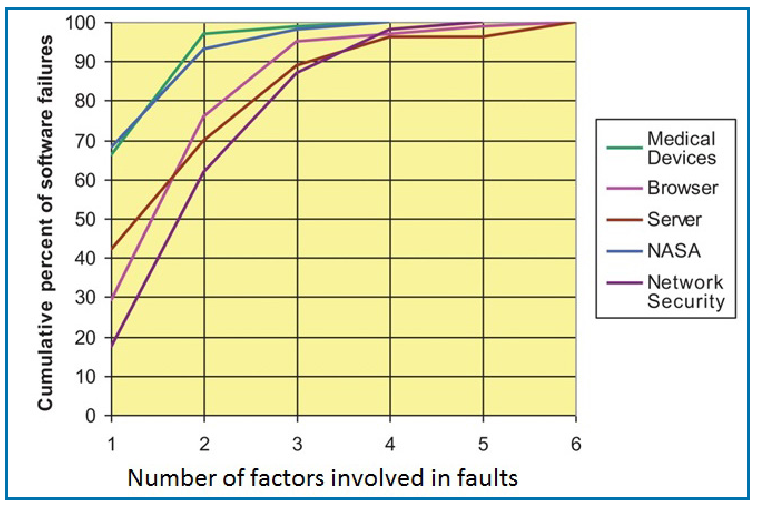
図22: Interaction Rule。横軸が Number of factors involved in faults(障害に関与する要因の数。1〜6)、縦軸が Cumulative percent of software failures(ソフトウェア障害の累積割合。0〜100)の折れ線グラフである。系列は Medical Devices、Browser、Server、NASA、Network Security の 5 つである。要因 1 では、Medical Devices 約 67、NASA 約 68、Server 約 42、Browser 約 29、Network Security 約 17 から始まり、要因 2 ではそれぞれ約 97、93、70、76、62 となり、要因 6 までにすべて 100 に達する。
Figure 22: Interaction Rule
図22: Interaction Rule
Technology transfer activities included the publication of several technical papers; a presentation of the results of the work with Lockheed Martin; a release of enhanced covering array, test prioritization, and fault location tools; plus seminars and lectures at several conferences, universities, and federal agencies.
技術移転活動には、複数の技術論文の公表、Lockheed Martin との作業の成果の発表、強化された被覆配列ツール、テスト優先順位付けツールおよび欠陥位置特定ツールの公開、ならびに複数の会議、大学および連邦機関でのセミナーと講演が含まれました。
Plans for FY 2015 include a follow-up project with the NASA IV&V Facility to investigate the integration of combinatorial coverage measurement methods in NASA Independent Verification and Validation (IV&V) practices; the release of test a development environment as an open source project (jointly with Carnegie Mellon University); lectures at conferences and research labs; and a joint development of enhanced fault location tools with Johns Hopkins University Applied Physics Lab.
2015会計年度の計画には、NASA の Independent Verification and Validation (IV&V) の実務に組合せカバレッジ測定手法を統合することを調査する、NASA IV&V Facility とのフォローアッププロジェクト、テスト開発環境のオープンソースプロジェクトとしての公開(Carnegie Mellon University と共同)、会議および研究所での講演、ならびに Johns Hopkins University Applied Physics Lab との強化された欠陥位置特定ツールの共同開発が含まれます。
http://csrc.nist.gov/groups/SNS/acts/
http://csrc.nist.gov/groups/SNS/acts/
CONTACTS:
連絡先:
Mr. Rick Kuhn (301) 975-3337 kuhn@nist.gov
Mr. Rick Kuhn (301) 975-3337 kuhn@nist.gov
Dr. Raghu Kacker (301) 975-2109 raghu.kacker@nist.gov
Dr. Raghu Kacker (301) 975-2109 raghu.kacker@nist.gov
Roots of Trust
信頼の基点
Modern computing devices consist of various hardware, firmware, and software components at multiple layers of abstraction. Many security and protection mechanisms are currently rooted in software that, along with all underlying components, must be trusted and not tampered with. A vulnerability in any of those components could compromise the trustworthiness of the security mechanisms that rely upon those components. Stronger security assurances may be possible by grounding security mechanisms in roots of trust.
現代のコンピューティングデバイスは、複数の抽象化層にわたるさまざまなハードウェア、ファームウェアおよびソフトウェアのコンポーネントで構成されています。現在、多くのセキュリティ機構および保護機構はソフトウェアに根ざしており、そのソフトウェアは、その下にあるすべてのコンポーネントとともに、信頼でき、改ざんされていないものでなければなりません。これらのコンポーネントのいずれかに脆弱性があれば、それらのコンポーネントに依存するセキュリティ機構の信頼性が損なわれるおそれがあります。セキュリティ機構の基盤を信頼の基点に置くことで、より強固なセキュリティ保証が可能になり得ます。
Roots of trust are highly reliable and secure hardware, firmware, and software components that perform specific, critical security functions. Because roots of trust are inherently trusted, they must be secure by their design. As such, many roots of trust are implemented in hardware or protected firmware so that malware cannot tamper with the functions they provide. Roots of trust provide a firm foundation from which to build security and trust.
信頼の基点とは、特定の重要なセキュリティ機能を実行する、信頼性と安全性が極めて高いハードウェア、ファームウェアおよびソフトウェアのコンポーネントです。信頼の基点は本質的に信頼されるものであるため、設計によって安全でなければなりません。そのため、多くの信頼の基点は、それらが提供する機能をマルウェアが改ざんできないように、ハードウェアまたは保護されたファームウェアに実装されます。信頼の基点は、セキュリティと信頼を構築するための強固な土台を提供します。
NIST CSD’s work aims to encourage the use of roots of trust in computers to provide stronger security assurances. A focus area for this work has been securing mobile devices, using roots of trust to provide device integrity, data and application isolation, and protected storage. As part of this work, CSD is revising SP 800-164, Guidelines on Hardware-Rooted Security in Mobile Devices, based on the public comments that were received on the draft. A revised draft will be released in FY 2015.
NIST CSD の作業は、より強固なセキュリティ保証を提供するために、コンピュータにおける信頼の基点の利用を促進することを目的としています。この作業の重点領域の1つはモバイルデバイスのセキュリティ確保であり、信頼の基点を用いてデバイスの完全性、データおよびアプリケーションの分離、ならびに保護されたストレージを提供します。この作業の一環として、CSD は、草案に寄せられたパブリックコメントに基づいて、SP 800-164, Guidelines on Hardware-Rooted Security in Mobile Devices を改訂しています。改訂された草案は2015会計年度に公開されます。
Meanwhile, the draft guideline is being used as the basis for an effort with the National Cybersecurity Center of Excellence (NCCoE) to encourage the adoption of stronger security technologies in mobile devices. Using draft SP 800-164 as a foundational document, the NCCoE and CSD developed the Mobile Device Security for Enterprises building block, which will demonstrate commercially available technologies that provide protection to both organization-issued and personally owned mobile platforms. The NCCoE will invite mobile device, operating system, and management software vendors, as well as application developers, to participate in this building block activity and demonstrate how their technologies could be used together to meet existing security requirements.
一方、このガイドライン草案は、モバイルデバイスにおけるより強固なセキュリティ技術の採用を促進するための、National Cybersecurity Center of Excellence (NCCoE) との取り組みの基礎として使用されています。SP 800-164 の草案を基礎文書として、NCCoE と CSD は Mobile Device Security for Enterprises ビルディングブロックを開発しました。これは、組織が支給するモバイルプラットフォームと個人所有のモバイルプラットフォームの両方を保護する、商用として入手可能な技術を実証するものです。NCCoE は、モバイルデバイス、オペレーティングシステムおよび管理ソフトウェアのベンダー、ならびにアプリケーション開発者に対し、このビルディングブロックの活動に参加し、各自の技術を組み合わせて既存のセキュリティ要件をどのように満たせるかを実証するよう呼びかけます。
The CSD also continued its work to protect platform firmware in FY 2014. Boot firmware, commonly known as the Basic Input/Output System (BIOS), is a critical firmware component, due to its unique and privileged position within modern computing architectures. CSD has been working with key members of the computer industry on the use of roots of trust to improve the security of BIOS. In order to encourage the continued adoption of BIOS protections, The CSD submitted SP 800-147, BIOS Protection Guidelines, to ISO for international standardization. CSD will continue these standards efforts in FY 2015, and conduct research on protections for other critical platform firmware.
CSD は、2014会計年度にもプラットフォームファームウェアを保護する作業を継続しました。一般に Basic Input/Output System (BIOS) として知られるブートファームウェアは、現代のコンピューティングアーキテクチャにおいて特有の特権的な位置を占めるため、極めて重要なファームウェアコンポーネントです。CSD は、BIOS のセキュリティを向上させるための信頼の基点の利用について、コンピュータ業界の主要なメンバーと協力してきました。BIOS 保護の継続的な採用を促進するために、CSD は SP 800-147, BIOS Protection Guidelines を国際標準化のために ISO に提出しました。CSD は、2015会計年度もこれらの標準化の取り組みを継続し、その他の重要なプラットフォームファームウェアの保護に関する研究を行います。
CONTACT:
連絡先:
Mr. Andrew Regenscheid (301) 975-5155 andrew.regenscheid@nist.gov
Mr. Andrew Regenscheid (301) 975-5155 andrew.regenscheid@nist.gov

栄誉と受賞
Department of Commerce Gold Medal Award
商務省ゴールドメダル賞
Tom Karygiannis, Stephen Quirolgico, and Jeffrey Voas (CSD)
Tom Karygiannis、Stephen Quirolgico、Jeffrey Voas(CSD)
Additional recipients of this award were: Brian Antonishek, Anthony Downs, Lisa Fronczek, Craig Schlenoff, and Brian Weiss (all from the NIST Engineering Laboratory, Intelligent Systems Division)
この賞のその他の受賞者は次のとおりである:Brian Antonishek、Anthony Downs、Lisa Fronczek、Craig Schlenoff、Brian Weiss(いずれも NIST Engineering Laboratory, Intelligent Systems Division 所属)
米国商務省ゴールドメダル賞の受賞者らが並び、中央で金色の額装賞状を掲げる集合写真。 [人物の写真。人物が写っているため、この非公式サイトには掲載していません。原本 PDF を参照してください。]
From Left to Right: Secretary of Commerce Penny Pritzker, Brian Weiss, Craig Schlenoff, Brian Antonishek, Anthony Downs, Lisa Fronczek, Stephen Quirolgico, Jeff Voas, Tom Karygiannis, and Patrick Gallagher, NIST Director
左から右へ:商務長官 Penny Pritzker、Brian Weiss、Craig Schlenoff、Brian Antonishek、Anthony Downs、Lisa Fronczek、Stephen Quirolgico、Jeff Voas、Tom Karygiannis、NIST 所長 Patrick Gallagher
The NIST team led a multi-organizational effort (NIST/George Mason University/DARPA) that developed innovative methods for security, testing, and evaluation of hardware and software to securely deploy off-the-shelf smartphones and applications in military field operations. NIST introduced software assurance methods, power and reliability analysis techniques, and standards-based cryptographic solutions that empowered the USG to securely deploy modified commercial solutions, reduce development costs, enhance the combat capability of U.S. troops, and save U.S. soldiers’ lives.
NIST のチームは、複数組織(NIST、George Mason University、DARPA)による取り組みを主導し、市販のスマートフォンとアプリケーションを軍の野外作戦に安全に配備するための、ハードウェアおよびソフトウェアのセキュリティ、試験、評価に関する革新的な手法を開発しました。NIST は、ソフトウェア保証の手法、電力および信頼性の解析技術、標準に基づく暗号ソリューションを導入しました。これにより米国政府は、改変した商用ソリューションを安全に配備し、開発コストを削減し、米軍部隊の戦闘能力を高め、米国兵士の命を救うことが可能になりました。
Department of Commerce Gold Medal Award
商務省ゴールドメダル賞
Sheila Frankel (CSD)
Sheila Frankel (CSD)
Additional recipients of this award were: Mark Carson, Douglas Montgomery, Stephen Nightingale, Darrin Santay, (all from the Information Laboratory (ITL), Advanced Network Technologies Division)
この賞のその他の受賞者は次のとおりである:Mark Carson、Douglas Montgomery、Stephen Nightingale、Darrin Santay(いずれも Information Laboratory (ITL) の Advanced Network Technologies Division 所属)
米国商務省ゴールドメダル賞の受賞者ら7人が並び、中央で金色の額装賞状を掲げる集合写真。 [人物の写真。人物が写っているため、この非公式サイトには掲載していません。原本 PDF を参照してください。]
From Left to Right: Secretary of Commerce Penny Pritzker, Darren Santay, Stephen Nightingale, Mark Carson, Doug Montgomery, Sheila Frankel, Patrick Gallagher, NIST Director
左から右へ:商務長官 Penny Pritzker、Darren Santay、Stephen Nightingale、Mark Carson、Doug Montgomery、Sheila Frankel、NIST 所長 Patrick Gallagher
The group is recognized for technical leadership and innovation in the development and execution of the USGv6 Program that enabled the U.S. Government to meet aggressive OMB milestones for the adoption of IPv6 technologies. The team developed the critical standards, acquisition profiles, accreditation and testing programs, test suites, procurement guides, security guides, and operational test and measurement tools necessary to significantly improve the maturity of commercial IPv6 products and to guide the USG in their acquisition, deployment, and secure use. The NIST USGv6 Program provided a vital catalyst to the Internet industry and established the USG as a world leader in ensuring the continued growth and continuity of the Internet.
このグループは、USGv6 Program の策定と実施における技術的リーダーシップと革新性を評価されたものです。同プログラムにより、米国政府は IPv6 技術の導入について OMB が定めた意欲的なマイルストーンを達成できました。チームは、市販の IPv6 製品の成熟度を大幅に高め、米国政府によるその調達、導入、安全な利用を導くために必要な、重要な標準、調達プロファイル、認定および試験のプログラム、テストスイート、調達ガイド、セキュリティガイド、ならびに運用上の試験・測定ツールを開発しました。NIST USGv6 Program は、インターネット業界にとって不可欠な触媒となり、インターネットの継続的な成長と継続性を確保するうえで米国政府を世界のリーダーとして確立しました。
Department of Commerce Bronze Medal Award
商務省銅メダル賞
Richard Kissel, CSD
Richard Kissel, CSD
3人の男性が並び、中央の男性が額装された賞状を持つ記念写真。 [人物の写真。人物が写っているため、この非公式サイトには掲載していません。原本 PDF を参照してください。]
Mr. Kissel is recognized for raising small and medium-sized business (SMB) awareness of information security threats, vulnerabilities, and safeguards through implementation of NIST’s SMB information security outreach program. As the program lead, Mr. Kissel worked collaboratively with the Small Business Administration and the FBI’s InfraGard program to conduct information security training workshops for small businesses with a focus on the tools and techniques these businesses can apply directly. By empowering SMBs, which represent over 95 percent of all U.S. businesses, to better protect their information, the nation’s overall information infrastructure is strengthened to enhance innovation, competitiveness, and economic security.
Kissel 氏は、NIST の中小企業(SMB)向け情報セキュリティアウトリーチプログラムの実施を通じて、情報セキュリティ上の脅威、脆弱性、保護策に対する中小企業の意識を高めたことを評価されました。プログラムの責任者として、Kissel 氏は Small Business Administration および FBI の InfraGard プログラムと協力し、中小企業が直接適用できるツールと技法に重点を置いた、中小企業向けの情報セキュリティ研修ワークショップを実施しました。米国の全企業の95パーセント超を占める中小企業が自らの情報をより適切に保護できるようにすることで、国全体の情報インフラが強化され、イノベーション、競争力、経済安全保障が高まります。
Stuart Katzke, Gallery of Distinguished Scientists, Engineers and Administrators
Stuart Katzke、Gallery of Distinguished Scientists, Engineers and Administrators
Stuart Katzke博士の、スーツとネクタイ姿のカラー肖像写真。 [人物の写真。人物が写っているため、この非公式サイトには掲載していません。原本 PDF を参照してください。]
Dr. Katzke was recognized for his outstanding contributions in the field of cybersecurity, including his role as the founding director of NIST’s Computer Security Division. He was honored as a nationally and internationally recognized leader in the development of cybersecurity standards during his tenure at NIST ITL from 1975 through 1999, and again during 2001 through 2008.
Katzke 博士は、NIST のコンピュータセキュリティ部門の初代部門長としての役割を含む、サイバーセキュリティ分野における顕著な貢献を評価されました。同氏は、1975年から1999年まで、および再び2001年から2008年までの NIST ITL 在職中に、サイバーセキュリティ標準の策定において国内外で認められた指導者として表彰されました。
Naomi Lefkovitz氏の白黒ポートレート。 [人物の写真。人物が写っているため、この非公式サイトには掲載していません。原本 PDF を参照してください。]
Naomi Lefkovitz, FierceGovernment IT “Fierce 15” Awardee
Naomi Lefkovitz、FierceGovernment IT「Fierce 15」受賞者
Ms. Lefkovitz is the Senior Privacy Policy Adviser for the NIST ITL. She was recognized as an innovator for her work in privacy and identity management, including her diligent support of privacy considerations for the National Strategy for Trusted Identities in Cyberspace (NSTIC). She represented the challenging and sensitive considerations to safeguard the privacy of individuals, while supporting several important information security and risk management initiatives, including the Framework for Improving Critical Infrastructure Cybersecurity. More information about this award is available from: http://www.fiercegovernmentit.com/special-reports/fiercegovernmentits-2013-fierce-15.
Lefkovitz 氏は、NIST ITL の Senior Privacy Policy Adviser です。同氏は、National Strategy for Trusted Identities in Cyberspace (NSTIC) におけるプライバシー上の考慮事項への熱心な支援を含む、プライバシーおよびアイデンティティ管理に関する業績により、イノベーターとして評価されました。同氏は、Framework for Improving Critical Infrastructure Cybersecurity を含む、情報セキュリティおよびリスク管理に関するいくつかの重要な取り組みを支援しつつ、個人のプライバシーを保護するための困難で慎重な扱いを要する考慮事項を代弁しました。この賞の詳細は次から入手できる:http://www.fiercegovernmentit.com/special-reports/fiercegovernmentits-2013-fierce-15。
Kevin Stine氏のスーツ姿のカラー肖像写真。 [人物の写真。人物が写っているため、この非公式サイトには掲載していません。原本 PDF を参照してください。]
Kevin Stine, FierceGovernment IT “Fierce 15” Awardee
Kevin Stine、FierceGovernment IT「Fierce 15」受賞者
The Fierce 15 award is designed to recognize genuine groundbreaking innovation in IT. Mr. Stine was recognized as an innovator in the Federal Government and, with Naomi Lefkovitz’s award from previous page, demonstrated ITL’s commitment to creativity and innovation. The award recognized those orchestrating “some of the most progressive projects underway in government and work tirelessly to make government more efficient, service- and mission-oriented, and accountable.” Mr. Stine was specifically awarded for his work in developing the Framework for Improving Critical Infrastructure Cybersecurity. His leadership of a global collaboration with public and private sector operators of critical infrastructure, and the subsequent open public review and comment process, represent CSD’s synergistic approach. More information about this award is available from: http://www.fiercegovernmentit.com/special-reports/fiercegovernmentits-2013-fierce-15.
Fierce 15 賞は、IT における真に画期的なイノベーションを表彰することを目的としています。Stine 氏は連邦政府におけるイノベーターとして評価され、前ページの Naomi Lefkovitz の受賞とともに、創造性とイノベーションに対する ITL の取り組みを示しました。この賞は、「政府内で進行中の最も進歩的なプロジェクトのいくつかを指揮し、政府をより効率的で、サービスと使命を重視し、説明責任を果たすものにするためにたゆまず努力している」人々を表彰するものです。Stine 氏は特に、Framework for Improving Critical Infrastructure Cybersecurity の策定における業績により受賞しました。重要インフラを運用する官民の事業者との世界規模の協働を同氏が主導したこと、およびそれに続く公開のパブリックレビューとコメントのプロセスは、CSD の相乗効果を重視するアプローチを表しています。この賞の詳細は次から入手できる:http://www.fiercegovernmentit.com/special-reports/fiercegovernmentits-2013-fierce-15。
Matthew Scholl, Federal 100 Award
Matthew Scholl、Federal 100 Award
Matthew Scholl氏のえんじ色のシャツを着たカラー肖像写真。 [人物の写真。人物が写っているため、この非公式サイトには掲載していません。原本 PDF を参照してください。]
Matthew Scholl was recognized for his strategic direction and leadership of several initiatives, including the Framework for Improving Critical Infrastructure Cybersecurity, Digital Government Strategy, and Federal cross-agency priority goals on cybersecurity. Federal Computer Week recognized his work enabling “the secure configuration of all government Windows-based desktop computers, [increasing] security of credit card transactions worldwide, and [establishment of] industry tools to effectively implement and monitor secure configurations.” The Federal 100 Awards are presented to leaders who have played pivotal roles that affect how the Federal Government acquires, develops and manages IT. Mr. Scholl was recognized as exemplifying that spirit through his successful leadership in CSD, including efforts to transform continuous security monitoring by expanding the use of automated tools. More information about this recognition is available from: http://fcw.com/articles/2014/03/10/fed100_scholl-matthew.aspx.
Matthew Scholl は、Framework for Improving Critical Infrastructure Cybersecurity、Digital Government Strategy、およびサイバーセキュリティに関する連邦政府の省庁横断優先目標を含む、いくつかの取り組みにおける戦略的方向付けとリーダーシップを評価されました。Federal Computer Week は、「政府のすべての Windows ベースのデスクトップコンピュータのセキュアな構成、世界中のクレジットカード取引のセキュリティの[向上]、およびセキュアな構成を効果的に実装し監視するための業界ツールの[確立]」を可能にした同氏の業績を評価しました。Federal 100 Awards は、連邦政府による IT の調達、開発、管理のあり方に影響を与える中心的な役割を果たした指導者に贈られます。Scholl 氏は、自動化ツールの利用拡大により継続的なセキュリティ監視を変革する取り組みを含む、CSD における優れたリーダーシップを通じて、その精神を体現していると評価されました。この表彰の詳細は次から入手できる:http://fcw.com/articles/2014/03/10/fed100_scholl-matthew.aspx。
Dylan Yaga, 2014 InterNational Committee for Information Technology Standards (INCITS) Service Award
Dylan Yaga、2014 InterNational Committee for Information Technology Standards (INCITS) Service Award
Dylan Yaga氏の青いシャツとネクタイ姿のカラー肖像写真。 [人物の写真。人物が写っているため、この非公式サイトには掲載していません。原本 PDF を参照してください。]
Mr. Yaga received the 2014 InterNational Committee for Information Technology Standards (INCITS) Service Award. This is an honorary award presented to participants who have provided outstanding service to the INCITS organization through committee work or duties. INCITS recognized his numerous contributions to the INCITS/M1 - Biometrics standards community, his detailed review of requirements in the biometric data interchange format standards and associated conformance testing methodology projects. His contributions to the first and second generation of data format standards have improved and promoted the successful development of national and international biometric standards. More information about this award is available from: http://www.incits.org/news-events/annual-awards.
Yaga 氏は、2014 InterNational Committee for Information Technology Standards (INCITS) Service Award を受賞しました。これは、委員会の作業または職務を通じて INCITS 組織に顕著な貢献をした参加者に贈られる名誉賞です。INCITS は、INCITS/M1 - Biometrics 標準コミュニティに対する同氏の数多くの貢献と、バイオメトリックデータ交換フォーマット標準および関連する適合性試験方法論のプロジェクトにおける要件の詳細なレビューを評価しました。第1世代および第2世代のデータフォーマット標準に対する同氏の貢献は、国内および国際的なバイオメトリック標準の策定を改善し、その成功を促進しました。この賞の詳細は次から入手できる:http://www.incits.org/news-events/annual-awards。
コンピュータセキュリティ部門の刊行物
Computer Security Division Publications
コンピュータセキュリティ部門の刊行物
During FY 2014, CSD staff authored a significant number of computer/information security-related guidelines, recommendations, and research through the NIST technical series, journal articles, conference papers, and other published documents.
2014会計年度中、CSD の職員は、NIST の技術シリーズ、学術誌論文、会議論文、その他の刊行文書を通じて、コンピュータ/情報セキュリティに関連する相当数のガイドライン、推奨事項、研究成果を執筆しました。
In the NIST technical series, CSD solicited public comments on forty draft publications, including one FIPS, 28 SPs and 11 NISTIRs. The FIPS had a 90-day comment period, while the other publications averaged 45 days. In particular, Draft NISTIR 7977, NIST Cryptographic Standards and Guidelines Development Process (discussed in this annual report in the Cryptographic Standards and Guidelines Process Review section), sought feedback on the NIST mechanisms used to engage experts in industry, academia and government to develop cryptographic standards.
NIST の技術シリーズにおいて、CSD は、FIPS 1件、SP 28件、NISTIR 11件を含む40件の草案刊行物についてパブリックコメントを募集しました。FIPS のコメント期間は90日であり、その他の刊行物は平均45日でした。特に、Draft NISTIR 7977, NIST Cryptographic Standards and Guidelines Development Process(本年次報告書の Cryptographic Standards and Guidelines Process Review の節で述べる)は、暗号標準を策定するために産業界、学術界、政府の専門家の参画を得る目的で NIST が用いている仕組みについて、意見を求めました。
青い背景に、NISTの刊行物を示す文書とペンを重ねたイラスト。 [装飾の画像。本文を読むのに必要のない装飾のため、この非公式サイトには掲載していません。原本 PDF を参照してください。]
Nine SPs and four NISTIRs were issued as final publications, including new documents, revisions or updated revisions. CSD also continued to have its work published monthly in ITL Bulletins, which summarize the various publications and projects occurring across CSD. Those interested in being notified of new and draft publications may visit http://csrc.nist.gov and subscribe to email alerts.
SP 9件と NISTIR 4件が、新規文書、改訂版または更新された改訂版を含む最終版の刊行物として発行されました。CSD はまた、CSD 全体で進行しているさまざまな刊行物とプロジェクトを要約する ITL Bulletins において、その成果を引き続き毎月公表しました。新規刊行物および草案刊行物の通知を希望する者は、http://csrc.nist.gov にアクセスして電子メールアラートを購読できます。
Seeking to expand the availability of its publications in formats besides PDFs, CSD began converting some of its newer and most-downloaded publications into the .EPUB format, which is commonly used by e-book readers on mobile platforms. More than 28 e-books were posted during FY 2014 on the Computer Security Resource Center (CSRC) publications pages, http://csrc.nist.gov/publications/.
刊行物を PDF 以外の形式でも利用できるようにするため、CSD は、比較的新しい刊行物およびダウンロード数の特に多い刊行物の一部を、モバイルプラットフォーム上の電子書籍リーダーで広く使われている .EPUB 形式に変換し始めました。2014会計年度中に、28点を超える電子書籍が Computer Security Resource Center (CSRC) の刊行物ページ http://csrc.nist.gov/publications/ に掲載されました。
Publications are available for download from CSRC (http://csrc.nist.gov/), and FIPS (http://csrc.nist.gov/publications/PubsFIPS.html), SPs (http://csrc.nist.gov/publications/PubsSPs.html) and NISTIRs (http://csrc.nist.gov/publications/PubsNISTIRs.html) issued since mid-2012 have been posted on a server maintained by the NIST Library and assigned Digital Object Identifiers (DOIs). During FY 2014, Google Scholar began crawling the NIST Library server, resulting in significantly greater exposure and availability of CSD’s technical series publications. The following lists the CSD-authored FIPS, SPs and NISTIRs that were most-downloaded during FY 2014:
刊行物は CSRC (http://csrc.nist.gov/) からダウンロードできます。また、2012年半ば以降に発行された FIPS (http://csrc.nist.gov/publications/PubsFIPS.html)、SP (http://csrc.nist.gov/publications/PubsSPs.html)、NISTIR (http://csrc.nist.gov/publications/PubsNISTIRs.html) は、NIST Library が管理するサーバーに掲載され、Digital Object Identifier (DOI) が付与されています。2014会計年度中に Google Scholar が NIST Library のサーバーのクロールを開始し、その結果、CSD の技術シリーズ刊行物の露出と入手しやすさが大幅に高まりました。以下に、CSD が執筆した FIPS、SP、NISTIR のうち、2014会計年度中に最も多くダウンロードされたものを挙げる:
Top 10 Most-Downloaded CSD publications in NIST Technical Series (i.e., FIPS, SP 800s, NISTIRs, and ITL Bulletins):
NIST 技術シリーズ(すなわち FIPS、SP 800、NISTIR、ITL Bulletins)のうち、最も多くダウンロードされた CSD 刊行物の上位10件:
•SP 800-53 Revision 4, Security and Privacy Controls for Federal Information Systems and Organizations;
•SP 800-53 Revision 4, Security and Privacy Controls for Federal Information Systems and Organizations;
•FIPS 201-2, Personal Identity Verification (PIV) of Federal Employees and Contractors;
•FIPS 201-2, Personal Identity Verification (PIV) of Federal Employees and Contractors;
•SP 800-30 Revision 1, Guide for Conducting Risk Assessments;
•SP 800-30 Revision 1, Guide for Conducting Risk Assessments;
•NISTIR 7298 Revision 2, Glossary of Key Information Security Terms;
•NISTIR 7298 Revision 2, Glossary of Key Information Security Terms;
•FIPS 186-4, Digital Signature Standard (DSS);
•FIPS 186-4, Digital Signature Standard (DSS);
•SP 800-82 Revision 1, Guide to Industrial Control Systems (ICS) Security;
•SP 800-82 Revision 1, Guide to Industrial Control Systems (ICS) Security;
•SP 800-162, Guide to Attribute Based Access Control (ABAC) Definition and Considerations;
•SP 800-162, Guide to Attribute Based Access Control (ABAC) Definition and Considerations;
•SP 800-63-2, Electronic Authentication Guideline;
•SP 800-63-2, Electronic Authentication Guideline;
•SP 800-165, 2012 Computer Security Division Annual Report; and
•SP 800-165, 2012 Computer Security Division Annual Report;および
•SP 800-37 Revision 1, Guide for Applying the Risk Management Framework to Federal Information Systems: A Security Life Cycle Approach.
•SP 800-37 Revision 1, Guide for Applying the Risk Management Framework to Federal Information Systems: A Security Life Cycle Approach。
Top 3 FIPS:
FIPS の上位3件:
•FIPS 201-2, Personal Identity Verification (PIV) of Federal Employees and Contractors;
•FIPS 201-2, Personal Identity Verification (PIV) of Federal Employees and Contractors;
•FIPS 186-4, Digital Signature Standard (DSS); and
•FIPS 186-4, Digital Signature Standard (DSS);および
•FIPS 140-2, Security Requirements for Cryptographic Modules.
•FIPS 140-2, Security Requirements for Cryptographic Modules。
Top 3 NISTIRs:
NISTIR の上位3件:
•NISTIR 7298 Revision 2, Glossary of Key Information Security Terms;
•NISTIR 7298 Revision 2, Glossary of Key Information Security Terms;
•NISTIR 7622, Notional Supply Chain Risk Management Practices for Federal Information Systems; and
•NISTIR 7622, Notional Supply Chain Risk Management Practices for Federal Information Systems;および
•NISTIR 7896, Third-Round Report of the SHA-3 Cryptographic Hash Algorithm Competition.
•NISTIR 7896, Third-Round Report of the SHA-3 Cryptographic Hash Algorithm Competition。
Top 3 ITL Bulletins:
ITL Bulletins の上位3件:
•December 2013, The National Vulnerability Database (NVD): Overview;
•2013年12月、The National Vulnerability Database (NVD): Overview;
•February 2014, Framework for Improving Critical Infrastructure Cybersecurity; and
•2014年2月、Framework for Improving Critical Infrastructure Cybersecurity;および
•June 2014, ITL Forensic Science Program.
•2014年6月、ITL Forensic Science Program。
Additionally, CSD shares its ongoing research efforts through other publications, such as journal articles, conference papers, books and other whitepapers. Although these publications can be found through NIST’s Publications Portal (http://www.nist.gov/publication-portal.cfm), in FY 2014 CSD began posting a bibliography of those documents on CSRC (http://csrc.nist.gov/publications/articles/), including links to preprints and the final publications. During FY 2014, more than 25 such documents were published, and are listed in the next section (FY 2014 Computer Security Division Publications) of this annual report. Notably, the Framework for Improving Critical Infrastructure Cybersecurity, Version 1.0, described earlier in this annual report, was downloaded more than 34 000 times.
さらに、CSD は、学術誌論文、会議論文、書籍、その他のホワイトペーパーといった他の刊行物を通じて、進行中の研究活動を共有しています。これらの刊行物は NIST の Publications Portal (http://www.nist.gov/publication-portal.cfm) で見つけることができますが、CSD は2014会計年度に、プレプリントおよび最終刊行物へのリンクを含む、それらの文書の文献目録を CSRC (http://csrc.nist.gov/publications/articles/) に掲載し始めました。2014会計年度中にそのような文書が25点超刊行されており、本年次報告書の次の節(FY 2014 Computer Security Division Publications)に列挙しています。特筆すべきこととして、本年次報告書で先に述べた Framework for Improving Critical Infrastructure Cybersecurity, Version 1.0 は、34 000回を超えてダウンロードされました。
CSD also dipped into its archives and posted a new page on CSRC, http://csrc.nist.gov/publications/history/nissc/, with full-text copies of proceedings from its 23 computer security conferences, held from 1979-2000 under various names: National Information Systems Security Conference (NISSC; 1995-2000), National Computer Security Conference (NCSC; 1985-1994), DOD/NBS Computer Security Conference (1984) and Seminar on the DOD Computer Security Initiative (1979-1983).
CSD はまた、保管資料を掘り起こし、CSRC に新しいページ http://csrc.nist.gov/publications/history/nissc/ を掲載しました。このページには、1979年から2000年までさまざまな名称で開催された23回のコンピュータセキュリティ会議の議事録の全文が収められています。その名称は、National Information Systems Security Conference (NISSC; 1995-2000)、National Computer Security Conference (NCSC; 1985-1994)、DOD/NBS Computer Security Conference (1984)、Seminar on the DOD Computer Security Initiative (1979-1983) です。
In FY 2015, besides expanding its library of available e-books, CSD intends to greatly improve the publication search, browse capabilities on CSRC, and provide additional details and cross references for each publication.
2015会計年度には、CSD は、利用可能な電子書籍のライブラリを拡充するほか、CSRC における刊行物の検索および閲覧の機能を大幅に改善し、各刊行物について追加の詳細情報と相互参照を提供する予定です。
CONTACT:
連絡先:
Mr. Jim Foti, (301) 975-8018, jfoti@nist.gov
Mr. Jim Foti, (301) 975-8018, jfoti@nist.gov
青から水色のグラデーション背景に「FY 2014 COMPUTER SECURITY DIVISION PUBLICATIONS」と白字で記した横長の見出し帯(2014年度コンピュータセキュリティ部門刊行物)。 [装飾の画像。本文を読むのに必要のない装飾のため、この非公式サイトには掲載していません。原本 PDF を参照してください。]
FY 2014 COMPUTER SECURITY DIVISION PUBLICATIONS
2014会計年度のコンピュータセキュリティ部門の刊行物
The Computer Security Division uses multiple NIST Technical Series to promulgate security standards, guidelines, recommendations, research, and additional background material. Those series include FIPS, NIST SPs, NISTIRs and Information Technology Laboratory (ITL) Bulletins. Links to these publications are available at http://csrc.nist.gov/publications.
コンピュータセキュリティ部門は、セキュリティに関する標準、ガイドライン、推奨事項、研究成果、および追加の背景資料を公布するために、複数の NIST Technical Series を用いています。これらのシリーズには、FIPS、NIST SP、NISTIR、および Information Technology Laboratory (ITL) Bulletins が含まれます。これらの刊行物へのリンクは http://csrc.nist.gov/publications で入手できます。
Additionally, each year CSD staff author numerous additional publications, including journal articles, conference papers, and other papers that are widely disseminated. They range from basic research to high-level summaries of CSD activities.
さらに、CSD の職員は毎年、学術誌論文、会議論文、その他広く配布される論文を含む、数多くの刊行物を別途執筆しています。その内容は、基礎研究から CSD の活動の概括的な要約にまで及びます。
NIST Technical Series Publications − FIPS, SPs, NISTIRs, and ITL Bulletins
NIST Technical Series の刊行物 − FIPS、SP、NISTIR、ITL Bulletins
Below are lists of NIST Technical Series publications that CSD released as draft documents or as final publications during FY 2014 (from October 1, 2013 to September 30, 2014). Following the lists are abstracts and contact information for each publication.
以下は、CSD が2014会計年度中(2013年10月1日から2014年9月30日まで)に草案文書または最終版の刊行物として公開した NIST Technical Series 刊行物の一覧です。一覧の後に、各刊行物の要旨と連絡先を示します。
| DRAFT PUBLICATIONS | ||
|---|---|---|
| FEDERAL INFORMATION PROCESSING STANDARDS (FIPS) | ||
| Publication Number | Publication Title | Draft Released Date |
| FIPS 202 | SHA-3 Standard: Permutation-Based Hash and Extendable-Output Functions | May 2014 |
| 草案刊行物 | ||
|---|---|---|
| 連邦情報処理標準(FIPS) | ||
| 刊行物番号 | 刊行物名 | 草案公開日 |
| FIPS 202 | SHA-3標準:置換ベースのハッシュ関数および拡張出力関数 | 2014年5月 |
| SPECIAL PUBLICATIONS (SPs) | ||
|---|---|---|
| Publication Number | Publication Title | Draft Released Date |
| SP 800-167 | Guide to Application Whitelisting | August 2014 |
| SP 800-163 | Technical Considerations for Vetting 3rd Party Mobile Applications | August 2014 |
| SP 800-161 (Second Draft) | Supply Chain Risk Management Practices for Federal Information Systems and Organizations | June 2014 |
| SP 800-160 | Systems Security Engineering: An Integrated Approach to Building Trustworthy Resilient Systems | May 2014 |
| SP 800-157 | Guidelines for Derived Personal Identity Verification (PIV) Credentials | March 2014 |
| SP 800-152 | A Profile for U.S. Federal Cryptographic Key Management Systems | January 2014 |
| SP 800-90A Revision 1 (Second Draft) | Recommendation for Random Number Generation Using Deterministic Random Bit Generators | April 2014 |
| SP 800-85B-4 | PIV Data Model Conformance Test Guidelines | August 2014 |
| SP 800-82 Revision 2 | Guide to Industrial Control Systems (ICS) Security | May 2014 |
| SP 800-79-2 | Guidelines for the Authorization of Personal Identity Verification Card Issuers (PCI) and Derived PIV Credential Issuers (DPCI) | June 2014 |
| SP 800-78-4 | Cryptographic Algorithms and Key Sizes for Personal Identity Verification | May 2014 |
| SP 800-73-4 | Interfaces for Personal Identity Verification | May 2014 |
| SP 800-57 Part 3, Revision 1 | Recommendation for Key Management: Application-Specific Key Management Guidance | May 2014 |
| SP 800-56B Revision 1 | Guidelines for Derived Personal Identity Verification (PIV) Credentials | March 2014 (Approved as Final: September 2014) |
| SP 800-53A Revision 4 | Assessing Security and Privacy Controls in Federal Information Systems and Organizations: Building Effective Assessment Plans | July 2014 |
| SP 800-53 Revision 4, Appendix H | International Information Security Standards: Security Control Mappings for ISO/IEC 27001 and 15408 | August 2014 |
| SP 800-16 Revision 1 (Second Draft) (Third Draft) | A Role-Based Model For Federal Information Technology/ CyberSecurity Training | October 2013 March 2014 |
| 特別刊行物(SP) | ||
|---|---|---|
| 刊行物番号 | 刊行物名 | 草案公開日 |
| SP 800-167 | アプリケーションホワイトリスティングのガイド | 2014年8月 |
| SP 800-163 | サードパーティ製モバイルアプリケーションの審査における技術的考慮事項 | 2014年8月 |
| SP 800-161(第2次草案) | 連邦情報システムおよび組織のためのサプライチェーンリスク管理実践 | 2014年6月 |
| SP 800-160 | システムセキュリティエンジニアリング:信頼できるレジリエントなシステム構築への統合的アプローチ | 2014年5月 |
| SP 800-157 | 派生個人識別検証(PIV)クレデンシャルのガイドライン | 2014年3月 |
| SP 800-152 | 米国連邦暗号鍵管理システムのプロファイル | 2014年1月 |
| SP 800-90A 改訂第1版(第2次草案) | 決定論的乱数ビット生成器を用いた乱数生成に関する勧告 | 2014年4月 |
| SP 800-85B-4 | PIVデータモデル適合性テストのガイドライン | 2014年8月 |
| SP 800-82 改訂第2版 | 産業用制御システム(ICS)セキュリティガイド | 2014年5月 |
| SP 800-79-2 | 個人識別検証カード発行者(PCI)および派生PIVクレデンシャル発行者(DPCI)の認可に関するガイドライン | 2014年6月 |
| SP 800-78-4 | 個人識別検証のための暗号アルゴリズムと鍵長 | 2014年5月 |
| SP 800-73-4 | 個人識別検証のためのインターフェース | 2014年5月 |
| SP 800-57 第3部 改訂第1版 | 鍵管理に関する勧告:アプリケーション固有の鍵管理ガイダンス | 2014年5月 |
| SP 800-56B 改訂第1版 | 派生個人識別検証(PIV)クレデンシャルのガイドライン | 2014年3月(最終版として承認:2014年9月) |
| SP 800-53A 改訂第4版 | 連邦情報システムおよび組織におけるセキュリティおよびプライバシー管理策の評価:有効なアセスメント計画の構築 | 2014年7月 |
| SP 800-53 改訂第4版 付録H | 国際的な情報セキュリティ標準:ISO/IEC 27001および15408に対するセキュリティ管理策の対応付け | 2014年8月 |
| SP 800-16 改訂第1版(第2次草案) (第3次草案) | 連邦政府の情報技術/サイバーセキュリティ訓練のためのロールベースモデル | 2013年10月 2014年3月 |
| NIST INTERAGENCY OR INTERNAL REPORTS (NISTIRs) | ||
|---|---|---|
| Publication Number | Publication Title | Draft Released Date |
| NISTIR 8023 | Risk Management for Replication Devices (RDs) | September 2014 |
| NISTIR 8018 | Public Safety Mobile Application Security Requirements Workshop Summary | July 2014 |
| NISTIR 8014 | Considerations for Identity Management in Public Safety Mobile Networks | July 2014 |
| NISTIR 8006 | NIST Cloud Forensic Science Challenges | June 2014 |
| NISTIR 7981 | Mobile, PIV, and Authentication | March 2014 |
| NISTIR 7977 | NIST Cryptographic Standards and Guidelines Development Process | February 2014 |
| NISTIR 7966 | Security of Automated Access Management Using Secure Shell (SSH) | August 2014 |
| NISTIR 7924 (Second Draft) | Reference Certificate Policy | May 2014 |
| NISTIR 7863 | Cardholder Authentication for the PIV Digital Signature Key | December 2013 |
| NISTIR 7628 Revision 1 | Guidelines to Smart Grid CyberSecurity | October 2013 (Approved as Final September 2014) |
| NIST機関間報告書または内部報告書(NISTIR) | ||
|---|---|---|
| 刊行物番号 | 刊行物名 | 草案公開日 |
| NISTIR 8023 | 複製デバイス(RD)のリスク管理 | 2014年9月 |
| NISTIR 8018 | 公共安全モバイルアプリケーションのセキュリティ要件ワークショップの概要 | 2014年7月 |
| NISTIR 8014 | 公共安全モバイルネットワークにおけるアイデンティティ管理に関する考慮事項 | 2014年7月 |
| NISTIR 8006 | NISTクラウドフォレンジックサイエンスの課題 | 2014年6月 |
| NISTIR 7981 | モバイル、PIV、および認証 | 2014年3月 |
| NISTIR 7977 | NIST暗号標準およびガイドラインの策定プロセス | 2014年2月 |
| NISTIR 7966 | Secure Shell(SSH)を用いた自動化アクセス管理のセキュリティ | 2014年8月 |
| NISTIR 7924(第2次草案) | リファレンス証明書ポリシー | 2014年5月 |
| NISTIR 7863 | PIVデジタル署名鍵のカード所持者認証 | 2013年12月 |
| NISTIR 7628 改訂第1版 | スマートグリッドのサイバーセキュリティに関するガイドライン | 2013年10月(2014年9月に最終版として承認) |
青い横長の帯に「FINAL APPROVED PUBLICATIONS」(承認済み最終刊行物)と白字で記した見出し。 [装飾の画像。本文を読むのに必要のない装飾のため、この非公式サイトには掲載していません。原本 PDF を参照してください。]
| FINAL APPROVED PUBLICATIONS |
|---|
| FEDERAL INFORMATION PROCESSING STANDARDS (FIPS) |
| NO FINAL APPROVED FIPS RELEASED DURING FY 2014. |
| 最終承認済み刊行物 |
|---|
| 連邦情報処理標準(FIPS) |
| 2014会計年度中に公開された最終承認済みFIPSはありません。 |
| SPECIAL PUBLICATIONS (SPs) | ||
|---|---|---|
| Publication Number | Publication Title | Publication Date |
| SP 800-170 | Computer Security Division 2013 Annual Report | June 2014 |
| SP 800-168 | Approximate Matching: Definition and Terminology | May 2014 |
| SP 800-162 | Guide to Attribute Based Access Control (ABAC) Definition and Considerations | January 2014 |
| SP 800-147B | BIOS Protection Guidelines for Servers | August 2014 |
| SP 800-101 Revision 1 | Guidelines on Mobile Device Forensics | May 2014 |
| SP 800-56B Revision 1 | Guidelines for Derived Personal Identity Verification (PIV) Credentials | September 2014 |
| SP 800-53 Revision 4 [Errata] | Security and Privacy Controls for Federal Information Systems and Organizations | April 2013 (original release date); updated January 15, 2014 |
| 特別刊行物(SP) | ||
|---|---|---|
| 刊行物番号 | 刊行物名 | 刊行日 |
| SP 800-170 | Computer Security Division 2013年次報告書 | 2014年6月 |
| SP 800-168 | 近似マッチング:定義と用語 | 2014年5月 |
| SP 800-162 | 属性ベースアクセス制御(ABAC)の定義および考慮事項に関するガイド | 2014年1月 |
| SP 800-147B | サーバー向けBIOS保護ガイドライン | 2014年8月 |
| SP 800-101 改訂第1版 | モバイルデバイスフォレンジックのガイドライン | 2014年5月 |
| SP 800-56B 改訂第1版 | 派生個人識別検証(PIV)クレデンシャルのガイドライン | 2014年9月 |
| SP 800-53 改訂第4版[正誤表] | 連邦情報システムおよび組織のためのセキュリティおよびプライバシー管理策 | 2013年4月(初版公開日);2014年1月15日更新 |
| SPECIAL PUBLICATIONS (SPs) (cont.) | ||
|---|---|---|
| Publication Number | Publication Title | Publication Date |
| SP 800-52 Revision 1 | Guidelines for the Selection, Configuration, and Use of Transport Layer Security (TLS) Implementations | April 2014 |
| SP 800-37 Revision 1 [Errata] | Guide for Applying the Risk Management Framework to Federal Information Systems: a Security Life Cycle Approach | February 2010 (original release date); updated June 5, 2014 |
| 特別刊行物(SP)(続き) | ||
|---|---|---|
| 刊行物番号 | 刊行物名 | 刊行日 |
| SP 800-52 改訂第1版 | Transport Layer Security(TLS)実装の選択、構成、および使用に関するガイドライン | 2014年4月 |
| SP 800-37 改訂第1版[正誤表] | 連邦情報システムへのリスクマネジメントフレームワーク適用ガイド:セキュリティライフサイクルアプローチ | 2010年2月(初版公開日);2014年6月5日更新 |
| NIST INTERAGENCY OR INTERNAL REPORTS (NISTIRs) | ||
|---|---|---|
| Publication Number | Publication Title | Publication Date |
| NISTIR 7987 | Policy Machine: Features, Architecture, and Specification | May 2014 |
| NISTIR 7946 | CVSS Implementation Guidance | April 2014 |
| NISTIR 7849 | A Methodology for Developing Authentication Assurance Level Taxonomy for Smart Card-based Identity Verification | March 2014 |
| NIST機関間報告書または内部報告書(NISTIR) | ||
|---|---|---|
| 刊行物番号 | 刊行物名 | 刊行日 |
| NISTIR 7987 | ポリシーマシン:機能、アーキテクチャ、仕様 | 2014年5月 |
| NISTIR 7946 | CVSS実装ガイダンス | 2014年4月 |
| NISTIR 7849 | スマートカードベースの本人確認における認証保証レベル分類体系の策定方法論 | 2014年3月 |
| ITL BULLETINS | |
|---|---|
| Publication Date | Bulletin Title |
| September 2014 | Release of NIST Interagency Report 7628 Revision 1, Guidelines for Smart Grid Cybersecurity |
| August 2014 | Policy Machine: Towards A General-Purpose, Enterprise-Wide Operating Environment |
| July 2014 | Release of NIST Interagency Report 7946, CVSS Implementation Guidance |
| June 2014 | ITL Forensic Science Program |
| May 2014 | Small and Medium-Size Business Information Security Outreach Program |
| April 2014 | Release of NIST SP 800-52 Revision 1, Guidelines for the Selection, Configuration, and Use of Transport Layer Security (TLS) Implementations |
| March 2014 | Attribute Based Access Control (ABAC) Definition and Considerations |
| February 2014 | Framework for Improving Critical Infrastructure Cybersecurity |
| January 2014 | A Profile of the Key Management Framework for the Federal Government |
| December 2013 | The National Vulnerability Database (NVD): Overview |
| November 2013 | ITL Releases Preliminary Cybersecurity Framework |
| October 2013 | ITL Updates Federal Information Processing Standard (FIPS) for Personal Identity Verification (PIV) of Federal Employees and Contractors |
| ITL速報 | |
|---|---|
| 刊行日 | 速報のタイトル |
| 2014年9月 | NIST機関間報告書7628改訂第1版「スマートグリッドのサイバーセキュリティに関するガイドライン」の公開 |
| 2014年8月 | ポリシーマシン:汎用の企業全体向けオペレーティング環境に向けて |
| 2014年7月 | NIST機関間報告書7946「CVSS実装ガイダンス」の公開 |
| 2014年6月 | ITLフォレンジックサイエンスプログラム |
| 2014年5月 | 中小企業向け情報セキュリティアウトリーチプログラム |
| 2014年4月 | NIST SP 800-52改訂第1版「Transport Layer Security(TLS)実装の選択、構成、および使用に関するガイドライン」の公開 |
| 2014年3月 | 属性ベースアクセス制御(ABAC)の定義および考慮事項 |
| 2014年2月 | 重要インフラのサイバーセキュリティを改善するためのフレームワーク |
| 2014年1月 | 連邦政府向け鍵管理フレームワークのプロファイル |
| 2013年12月 | National Vulnerability Database(NVD):概要 |
| 2013年11月 | ITLが予備版のサイバーセキュリティフレームワークを公開 |
| 2013年10月 | ITLが連邦職員および契約業者の個人識別検証(PIV)のための連邦情報処理標準(FIPS)を更新 |
ABSTRACTS OF NIST TECHNICAL SERIES PUBLICATIONS RELEASED IN FY 2014
2014会計年度に公開された NIST Technical Series 刊行物の要旨
The following sections provide abstracts and contact information for the draft and final FIPS, NIST SPs, and security-related NISTIRs listed in the previous section. These publications are available at http://csrc.nist.gov/publications.
以下の各節では、前節に列挙した草案および最終版の FIPS、NIST SP、ならびにセキュリティ関連の NISTIR について、要旨と連絡先を示します。これらの刊行物は http://csrc.nist.gov/publications で入手できます。
FIPS
FIPS
DRAFT FIPS 202, SHA-3 Standard: Permutation-Based Hash and Extendable-Output Functions
DRAFT FIPS 202, SHA-3 Standard: Permutation-Based Hash and Extendable-Output Functions
This standard specifies the Secure Hash Algorithm-3 (SHA-3) family of functions on binary data. Each of the SHA-3 functions is based on an instance of the Keccak algorithm that NIST selected as the winner of the SHA-3 Cryptographic Hash Algorithm Competition. This Standard also specifies the Keccak-p family of mathematical permutations, including the permutation that underlies Keccak, in order to facilitate the development of additional permutation-based cryptographic functions.
この標準は、バイナリデータに対する Secure Hash Algorithm-3 (SHA-3) 関数ファミリーを規定します。SHA-3 の各関数は、NIST が SHA-3 Cryptographic Hash Algorithm Competition の勝者として選定した Keccak アルゴリズムのインスタンスに基づいています。この標準はまた、置換に基づく暗号関数のさらなる開発を促進するため、Keccak の基礎となる置換を含む、数学的置換の Keccak-p ファミリーも規定します。
The SHA-3 family consists of four cryptographic hash functions, called SHA3-224, SHA3-256, SHA3-384, and SHA3-512, and two extendable-output functions (XOFs), called SHAKE128 and SHAKE256.
SHA-3 ファミリーは、SHA3-224、SHA3-256、SHA3-384、SHA3-512 と呼ばれる4つの暗号ハッシュ関数と、SHAKE128 および SHAKE256 と呼ばれる2つの拡張可能出力関数(XOF)から成ります。
Hash functions are components for many important information security applications, including 1) the generation and verification of digital signatures, 2) key derivation, and 3) pseudorandom bit generation. The hash functions specified in this Standard supplement the SHA-1 hash function and the SHA-2 family of hash functions that are specified in FIPS 180-4, The Secure Hash Standard.
ハッシュ関数は、1) デジタル署名の生成と検証、2) 鍵導出、3) 疑似乱数ビット生成を含む、多くの重要な情報セキュリティアプリケーションの構成要素です。この標準で規定するハッシュ関数は、FIPS 180-4, The Secure Hash Standard で規定されている SHA-1 ハッシュ関数および SHA-2 ハッシュ関数ファミリーを補完します。
Extendable-output functions are different from hash functions, but it is possible to use them in similar ways, with the flexibility to be adapted directly to the requirements of individual applications, subject to additional security considerations.
拡張可能出力関数はハッシュ関数とは異なりますが、追加のセキュリティ上の考慮事項に従うことを条件に、同様の方法で使用することができ、個々のアプリケーションの要件に直接適合させられる柔軟性を備えます。
CONTACTS:
連絡先:
Dr. Morris Dworkin, morris.dworkin@nist.gov
Dr. Morris Dworkin, morris.dworkin@nist.gov
Ms. Shu-jen Chang, shu-jen.chang@nist.gov
Ms. Shu-jen Chang, shu-jen.chang@nist.gov
NIST SPs
NIST SP
SP 800-170, Computer Security Division 2013 Annual Report
SP 800-170, Computer Security Division 2013 Annual Report
Title III of the E-Government Act of 2002, entitled the Federal Information Security Management Act (FISMA) of 2002, requires NIST to prepare an annual public report on activities undertaken in the previous year, and planned for the coming year, to carry out responsibilities under this law. The primary goal of the Computer Security Division (CSD), a component of NIST s Information Technology Laboratory (ITL), is to provide standards and technology that protects information systems against threats to the confidentiality, integrity, and availability of information and services. During FY 2013, CSD successfully responded to numerous challenges and opportunities in fulfilling that mission. Through CSD’s diverse research agenda and engagement in many national priority initiatives, high-quality, cost-effective security and privacy mechanisms were developed and applied that improved information security across the Federal Government and the greater information security community. This annual report highlights the research agenda and activities in which CSD was engaged during FY 2013.
Federal Information Security Management Act (FISMA) of 2002 と題された E-Government Act of 2002 の Title III は、同法に基づく責務を遂行するために前年に実施した活動および翌年に計画している活動について、年次の公開報告書を作成することを NIST に義務付けています。NIST の Information Technology Laboratory (ITL) の一部門であるコンピュータセキュリティ部門(CSD)の主要な目標は、情報およびサービスの機密性、完全性、可用性に対する脅威から情報システムを保護する標準と技術を提供することです。2013会計年度中、CSD は、その使命を果たすにあたり、数多くの課題と機会にうまく対応しました。CSD の多様な研究課題と、多くの国家的優先課題への関与を通じて、高品質で費用対効果の高いセキュリティおよびプライバシーの仕組みが開発、適用され、連邦政府全体およびより広い情報セキュリティコミュニティにおける情報セキュリティが向上しました。この年次報告書は、2013会計年度中に CSD が取り組んだ研究課題と活動の要点を示します。
CONTACTS:
連絡先:
Mr. Patrick O’Reilly, patrick.oreilly@nist.gov
Mr. Patrick O’Reilly, patrick.oreilly@nist.gov
Mr. Kevin Stine, kevin.stine@nist.gov
Mr. Kevin Stine, kevin.stine@nist.gov
SP 800-168, Approximate Matching: Definition and Terminology
SP 800-168, Approximate Matching: Definition and Terminology
Approximate matching is a promising technology for designed to identify similarities between two digital artifacts. It is used to find objects that resemble each other or to find objects that are contained in another object. This can be very useful for filtering data for security monitoring, digital forensics, or other applications.
近似マッチングは、2つのデジタルアーティファクト間の類似性を識別するために設計された有望な技術です。互いに似ているオブジェクトを見つけるため、または別のオブジェクトに含まれているオブジェクトを見つけるために用いられます。これは、セキュリティ監視、デジタルフォレンジック、その他の用途においてデータをフィルタリングするうえで非常に有用となりうます。
CONTACTS:
連絡先:
Mr. Douglas White, Software and Systems Division, ITL, douglas.white@nist.gov
Mr. Douglas White, Software and Systems Division, ITL, douglas.white@nist.gov
Ms. Barbara Guttman, Software and Systems Division, ITL, barbara.guttman@nist.gov
Ms. Barbara Guttman, Software and Systems Division, ITL, barbara.guttman@nist.gov
DRAFT SP 800-167, Guide to Application Whitelisting
DRAFT SP 800-167, Guide to Application Whitelisting
An application whitelist is a list of applications and application components that are authorized to be used in an organization. Application whitelisting technologies use whitelists to control which applications are permitted to execute on a host. This helps to stop the execution of malware, unlicensed software, and other unauthorized software. This publication is intended to assist organizations in understanding the basics of application whitelisting. It also explains planning and implementation for whitelisting technologies throughout the security deployment lifecycle.
アプリケーションホワイトリストとは、組織内での使用が認可されているアプリケーションおよびアプリケーション構成要素の一覧です。アプリケーションホワイトリスト技術は、ホワイトリストを用いて、ホスト上でどのアプリケーションの実行を許可するかを制御します。これは、マルウェア、ライセンスのないソフトウェア、その他の認可されていないソフトウェアの実行を阻止するのに役立ちます。この刊行物は、組織がアプリケーションホワイトリストの基本を理解するのを支援することを意図しています。また、セキュリティ導入ライフサイクル全体にわたるホワイトリスト技術の計画と実装についても説明します。
CONTACTS:
連絡先:
Mr. Adam Sedgewick, adam.sedgewick@nist.gov
Mr. Adam Sedgewick, adam.sedgewick@nist.gov
Mr. Murugiah Souppaya, murugiah.souppaya@nist.gov
Mr. Murugiah Souppaya, murugiah.souppaya@nist.gov
DRAFT SP 800-163, Technical Considerations for Vetting 3rd Party Mobile Applications
DRAFT SP 800-163, Technical Considerations for Vetting 3rd Party Mobile Applications
Today’s commercially available mobile devices (e.g., smart phones, tablets) are handheld computing platforms with wireless capabilities, geographic localization, cameras, and microphones. Similar to computing platforms such as desktops and laptops, the user experience with a mobile device is tied to the software apps and the tools and utilities available. The purpose of this document is to provide guidance for vetting 3rd party software applications (apps) for mobile devices. Mobile app vetting is intended to assess a mobile app’s operational characteristics of secure behavior and reliability (including performance) so that organizations can determine if the app is acceptable for use in their expected environment.
今日市販されているモバイルデバイス(例:スマートフォン、タブレット)は、無線機能、地理的位置特定、カメラ、マイクを備えたハンドヘルド型のコンピューティングプラットフォームです。デスクトップやラップトップなどのコンピューティングプラットフォームと同様に、モバイルデバイスのユーザー体験は、利用可能なソフトウェアアプリおよびツールやユーティリティと結び付いています。この文書の目的は、モバイルデバイス向けのサードパーティ製ソフトウェアアプリケーション(アプリ)を審査するためのガイダンスを提供することです。モバイルアプリの審査は、モバイルアプリの動作特性であるセキュアな挙動と信頼性(性能を含む)を評価し、そのアプリが想定される環境での使用に受け入れられるかどうかを組織が判断できるようにすることを意図しています。
CONTACTS:
連絡先:
Dr. Jeff Voas, jeff.voas@nist.gov
Dr. Jeff Voas, jeff.voas@nist.gov
Dr. Stephen Quirolgico, stephen.quirolgico@nist.gov
Dr. Stephen Quirolgico, stephen.quirolgico@nist.gov
SP 800-162, Guide to Attribute Based Access Control (ABAC) Definition and Considerations
SP 800-162, Guide to Attribute Based Access Control (ABAC) Definition and Considerations
This document provides federal agencies with a definition of attribute based access control (ABAC). ABAC is a logical access control methodology where authorization to perform a set of operations is determined by evaluating attributes associated with the subject, object, requested operations, and, in some cases, environment conditions against policy, rules, or relationships that describe the allowable operations for a given set of attributes. This document also provides considerations for using ABAC to improve information sharing within organizations and between organizations while maintaining control of that information.
この文書は、連邦機関に対して属性ベースアクセス制御(ABAC)の定義を示します。ABACは論理アクセス制御の方法論であり、一連の操作を実行するための認可を、サブジェクト、オブジェクト、要求された操作、および場合によっては環境条件に関連付けられた属性を、所与の属性の組に対して許容される操作を記述したポリシー、規則または関係に照らして評価することによって決定します。この文書はまた、情報に対する統制を維持しつつ、組織内および組織間の情報共有を改善するためにABACを用いる際の考慮事項も示します。
CONTACTS:
連絡先:
Dr. Vincent Hu, vhu@nist.gov
Dr. Vincent Hu, vhu@nist.gov
Mr. David Ferraiolo, david.ferraiolo@nist.gov
Mr. David Ferraiolo, david.ferraiolo@nist.gov
Mr. Richard (Rick) Kuhn, kuhn@nist.gov
Mr. Richard (Rick) Kuhn, kuhn@nist.gov
DRAFT SP 800-161 (Second Draft), Supply Chain Risk Management Practices for Federal Information Systems and Organizations
草案 SP 800-161(第2次草案)、Supply Chain Risk Management Practices for Federal Information Systems and Organizations
Federal agencies are concerned about the risks associated with information and communications technology (ICT) products and services that may contain potentially malicious functionality, are counterfeit, or are vulnerable due to poor manufacturing and development practices within the ICT supply chain. These risks are associated with the federal agencies decreased visibility into, understanding of, and control over how the technology that they acquire is developed, integrated and deployed, as well as the processes, procedures, and practices used to assure the integrity, security, resilience, and quality of the products and services.
連邦機関は、悪意のある機能を含んでいるおそれがある、偽造品である、またはICTサプライチェーン内の不適切な製造・開発の実践のために脆弱である情報通信技術(ICT)の製品およびサービスに伴うリスクを懸念しています。これらのリスクは、連邦機関が取得する技術がどのように開発、統合および展開されるか、ならびに製品およびサービスの完全性、セキュリティ、レジリエンスおよび品質を保証するために用いられるプロセス、手順および実践について、連邦機関の可視性、理解および統制が低下していることに関連しています。
This publication provides guidance to federal agencies on identifying, assessing, and mitigating ICT supply chain risks at all levels of their organizations. This publication integrates ICT supply chain risk management (SCRM) into federal agency risk management activities by applying a multitiered, SCRM-specific approach, including guidance on supply chain risk assessment and mitigation activities.
この刊行物は、組織のすべての階層においてICTサプライチェーンリスクを特定、評価および低減することについて、連邦機関に指針を示します。この刊行物は、サプライチェーンリスクの評価および低減の活動に関する指針を含む、SCRMに特化した多階層のアプローチを適用することにより、ICTサプライチェーンリスク管理(SCRM)を連邦機関のリスク管理活動に統合します。
CONTACTS:
連絡先:
Mr. Jon Boyens, jon.boyens@nist.gov
Mr. Jon Boyens, jon.boyens@nist.gov
Ms. Celia Paulsen, celica.paulsen@nist.gov
Ms. Celia Paulsen, celica.paulsen@nist.gov
DRAFT SP 800-160, Systems Security Engineering: An Integrated Approach to Building Trustworthy Resilient Systems
草案 SP 800-160、Systems Security Engineering: An Integrated Approach to Building Trustworthy Resilient Systems
This publication addresses the actions necessary for developing a more defensible and survivable IT infrastructure—including the component products, systems, and services that compose the infrastructure. It starts with and builds upon well-established International Standards for systems and software engineering published by the International Organization for Standardization (ISO), International Electrotechnical Commission (IEC), and the Institute of Electrical and Electronic Engineers (IEEE), and infuses systems security engineering techniques, methods, and practices into those systems/software engineering processes. The ultimate objective is to address cybersecurity issues from a stakeholder requirements and protection needs perspective and to use already established organizational processes to ensure such requirements/needs are addressed early in the life cycle of the system.
この刊行物は、より防御可能で存続可能なITインフラストラクチャ(そのインフラストラクチャを構成するコンポーネント製品、システムおよびサービスを含む)を開発するために必要な行動を扱います。国際標準化機構(ISO)、国際電気標準会議(IEC)およびInstitute of Electrical and Electronic Engineers(IEEE)が発行した、システムおよびソフトウェアエンジニアリングに関する確立された国際規格を出発点としてその上に構築し、それらのシステム/ソフトウェアエンジニアリングのプロセスに、システムセキュリティエンジニアリングの技法、方法および実践を組み入れます。最終的な目的は、利害関係者の要件および保護ニーズの観点からサイバーセキュリティの課題に対処すること、ならびに組織の既に確立されたプロセスを用いて、そうした要件/ニーズがシステムのライフサイクルの早期に確実に対処されるようにすることです。
CONTACT:
連絡先:
Dr. Ron Ross, rross@nist.gov
Dr. Ron Ross, rross@nist.gov
DRAFT SP 800-157, Guidelines for Derived Personal Identity Verification (PIV) Credentials
草案 SP 800-157、Guidelines for Derived Personal Identity Verification (PIV) Credentials
This recommendation provides technical guidelines for the implementation of standards-based, secure, reliable, interoperable PKI-based identity credentials that are issued by federal departments and agencies to individuals who possess and prove control over a valid PIV Card. The scope of this document includes requirements for initial issuance, maintenance and termination of these credentials, certificate policies and cryptographic specifications, technical specifications for permitted cryptographic token types and the command interfaces for the removable implementations of such cryptographic tokens.
この勧告は、有効なPIVカードを所持し、それに対する制御を証明する個人に対して連邦の省庁および機関が発行する、標準に基づき、安全で、信頼でき、相互運用可能なPKIベースのアイデンティティクレデンシャルの実装に関する技術的ガイドラインを示します。この文書の範囲には、これらのクレデンシャルの初回発行、維持管理および終了に関する要件、証明書ポリシーおよび暗号仕様、許容される種類の暗号トークンの技術仕様、ならびにそのような暗号トークンの取り外し可能な実装のためのコマンドインタフェースが含まれます。
CONTACTS:
連絡先:
Ms. Hildegard (Hildy) Ferraiolo, hildegard.ferraiolo@nist.gov
Ms. Hildegard (Hildy) Ferraiolo, hildegard.ferraiolo@nist.gov
Mr. David Cooper, david.cooper@nist.gov
Mr. David Cooper, david.cooper@nist.gov
Mr. Salvatore Francomacaro, salvatore.francomacaro@nist.gov
Mr. Salvatore Francomacaro, salvatore.francomacaro@nist.gov
Mr. Andy Regenscheid, andrew.regednscheid@nist.gov
Mr. Andy Regenscheid, andrew.regednscheid@nist.gov
DRAFT SP 800-152, A Profile for U. S. Federal Cryptographic Key Management Systems (CKMS)
草案 SP 800-152、A Profile for U. S. Federal Cryptographic Key Management Systems (CKMS)
This Profile for U.S. Federal Cryptographic Key Management Systems (FCKMSs) contains requirements for their design, implementation, procurement, installation, configuration, management, operation, and use by U.S. federal organizations. The Profile is based on SP 800-130, A Framework for Designing Cryptographic Key Management Systems (CKMS).
この米国連邦暗号鍵管理システム(FCKMS)のためのプロファイルは、米国連邦組織によるFCKMSの設計、実装、調達、設置、構成、管理、運用および利用に関する要件を収めています。このプロファイルは、SP 800-130、A Framework for Designing Cryptographic Key Management Systems (CKMS) に基づいています。
CONTACT:
連絡先:
Ms. Elaine Barker, elaine.barker@nist.gov
Ms. Elaine Barker, elaine.barker@nist.gov
SP 800-147B, BIOS Protection Guidelines for Servers
SP 800-147B、BIOS Protection Guidelines for Servers
Modern computers rely on fundamental system firmware, commonly known as the Basic Input/Output System (BIOS), to facilitate the hardware initialization process and transition control to the hypervisor or operating system. Unauthorized modification of BIOS firmware by malicious software constitutes a significant threat because of the BIOS’s unique and privileged position within the PC architecture. The guidelines in this document include requirements on servers to mitigate the execution of malicious or corrupt BIOS code. They apply to BIOS firmware stored in the BIOS flash, including the BIOS code, the cryptographic keys that are part of the Root of Trust for Update, and static BIOS data. This guide is intended to provide server platform vendors with recommendations and guidelines for a secure BIOS update process.
現代のコンピュータは、ハードウェアの初期化プロセスを進め、ハイパーバイザまたはオペレーティングシステムに制御を移すために、一般にBasic Input/Output System(BIOS)として知られる基本的なシステムファームウェアに依存しています。BIOSはPCアーキテクチャの中で固有の特権的な位置を占めるため、悪意のあるソフトウェアによるBIOSファームウェアの不正な改変は重大な脅威となります。この文書のガイドラインには、悪意のある、または破損したBIOSコードの実行を緩和するためのサーバに対する要件が含まれます。これらは、BIOSコード、Root of Trust for Updateの一部である暗号鍵、および静的なBIOSデータを含む、BIOSフラッシュに格納されたBIOSファームウェアに適用されます。この手引きは、安全なBIOS更新プロセスに関する推奨事項およびガイドラインをサーバプラットフォームのベンダーに示すことを意図しています。
CONTACT:
連絡先:
Mr. Andy Regenscheid, andy.regenscheid@nist.gov
Mr. Andy Regenscheid, andy.regenscheid@nist.gov
SP 800-101 Revision 1, Guidelines on Mobile Device Forensics
SP 800-101 Revision 1、Guidelines on Mobile Device Forensics
Mobile device forensics is the science of recovering digital evidence from a mobile device under forensically sound conditions using accepted methods. Mobile device forensics is an evolving specialty in the field of digital forensics. This guide attempts to bridge the gap by providing an in-depth look into mobile devices and explaining the technologies involved and their relationship to forensic procedures. This document covers mobile devices with features beyond simple voice communication and text messaging capabilities. This guide also discusses procedures for the validation, preservation, acquisition, examination, analysis, and reporting of digital information.
モバイルデバイスフォレンジックは、一般に認められた方法を用いて、フォレンジックとして健全な条件の下でモバイルデバイスからデジタル証拠を回復する科学です。モバイルデバイスフォレンジックは、デジタルフォレンジックの分野の中で発展途上にある専門領域です。この手引きは、モバイルデバイスを詳しく取り上げ、関係する技術およびそれらとフォレンジック手順との関係を説明することによって、その隔たりを埋めようとするものです。この文書は、単純な音声通信およびテキストメッセージングの能力を超える機能を備えたモバイルデバイスを対象とします。この手引きはまた、デジタル情報の妥当性確認、保全、取得、検査、分析および報告の手順についても論じます。
CONTACT:
連絡先:
Mr. Richard (Rick) Ayers, Software and Systems Division, ITL, richard.ayers@nist.gov
Mr. Richard (Rick) Ayers, Software and Systems Division, ITL, richard.ayers@nist.gov
DRAFT SP 800-90A Revision 1, Recommendation for Random Number Generation Using Deterministic Random Bit Generators
草案 SP 800-90A Revision 1、Recommendation for Random Number Generation Using Deterministic Random Bit Generators
This recommendation specifies mechanisms for the generation of random bits using deterministic methods. The methods provided are based on either hash functions, block cipher algorithms or number theoretic problems.
この勧告は、決定論的な方法を用いた乱数ビットの生成のためのメカニズムを規定します。示される方法は、ハッシュ関数、ブロック暗号アルゴリズムまたは数論的問題のいずれかに基づいています。
CONTACTS:
連絡先:
Ms. Elaine Barker, elaine.barker@nist.gov
Ms. Elaine Barker, elaine.barker@nist.gov
Dr. John Kelsey, john.kelsey@nist.gov
Dr. John Kelsey, john.kelsey@nist.gov
DRAFT SP 800-85B-4, PIV Data Model Test Guidelines
草案 SP 800-85B-4、PIV Data Model Test Guidelines
FIPS 201, Personal Identity Verification (PIV) of Federal Employees and Contractors, describes a variety of data model components as a part of the PIV logical credentials. Such components include biometric elements in the form of fingerprint information and facial imagery and security elements such as electronic keys, certificates, and signatures. FIPS 201 incorporates by reference NIST SP 800-73-4 Interfaces for Personal Identity Verification, which specifies elements related to the PIV card interface, NIST SP 800-76 Biometric Specifications for Personal Identity Verification, which specifies the biometric requirements, and NIST SP 800-78 Cryptographic Algorithms and Key Sizes for Personal Identity Verification, which specifies acceptable cryptographic algorithms and key sizes for PIV systems.
FIPS 201、Personal Identity Verification (PIV) of Federal Employees and Contractors は、PIV論理クレデンシャルの一部として、さまざまなデータモデルの構成要素を記述しています。そうした構成要素には、指紋情報および顔画像の形をとる生体要素、ならびに電子鍵、証明書および署名などのセキュリティ要素が含まれます。FIPS 201は、PIVカードのインタフェースに関する要素を規定するNIST SP 800-73-4 Interfaces for Personal Identity Verification、生体認証の要件を規定するNIST SP 800-76 Biometric Specifications for Personal Identity Verification、およびPIVシステムで受け入れられる暗号アルゴリズムと鍵長を規定するNIST SP 800-78 Cryptographic Algorithms and Key Sizes for Personal Identity Verification を、参照により取り込んでいます。
A robust testing framework and guidelines to provide assurance that a particular component or system is compliant with FIPS 201 and supporting standards should exist to build the necessary PIV infrastructure to support common unified processes and systems for government-wide use. NIST developed test guidelines in two parts. The first part addresses test requirements for the interface to the PIV card, which are provided in NIST SP 800-85A PIV Card Application and Middleware Interface Test Guidelines (SP 800-73-3 Compliance). The second part provides test requirements for the PIV data model and is provided in this document. This document specifies the derived test requirements, and the detailed test assertions and conformance tests for testing the PIV data model.
政府全体で利用する共通の統一されたプロセスおよびシステムを支えるのに必要なPIVインフラストラクチャを構築するためには、特定のコンポーネントまたはシステムがFIPS 201およびそれを支える標準に適合しているという保証を与える、堅牢な試験の枠組みおよびガイドラインが存在すべきです。NISTは試験ガイドラインを2部構成で作成しました。第1部はPIVカードとのインタフェースに関する試験要件を扱い、これはNIST SP 800-85A PIV Card Application and Middleware Interface Test Guidelines (SP 800-73-3 Compliance) に示されています。第2部はPIVデータモデルに関する試験要件を示すもので、この文書がそれに当たります。この文書は、PIVデータモデルを試験するための派生試験要件、ならびに詳細な試験アサーションおよび適合性試験を規定します。
CONTACTS:
連絡先:
Dr. Ramaswamy (Mouli) Chandramouli, mouli@nist.gov
Dr. Ramaswamy (Mouli) Chandramouli, mouli@nist.gov
Ms. Hildegard (Hildy) Ferraiolo, hildegard.ferraiolo@nist.gov
Ms. Hildegard (Hildy) Ferraiolo, hildegard.ferraiolo@nist.gov
Mr. Ketan Mehta, ketan.mehta@nist.gov
Mr. Ketan Mehta, ketan.mehta@nist.gov
DRAFT SP 800-82 Revision 2, Guide to Industrial Control Systems (ICS) Security
草案 SP 800-82 Revision 2、Guide to Industrial Control Systems (ICS) Security
This document provides guidance on how to secure Industrial Control Systems (ICS), including Supervisory Control and Data Acquisition (SCADA) systems, Distributed Control Systems (DCS), and other control system configurations such as Programmable Logic Controllers (PLC), while addressing their unique performance, reliability, and safety requirements. The document provides an overview of ICS and typical system topologies, identifies typical threats and vulnerabilities to these systems, and provides recommended security countermeasures to mitigate the associated risks.
この文書は、Supervisory Control and Data Acquisition(SCADA)システム、分散制御システム(DCS)、およびプログラマブルロジックコントローラ(PLC)などのその他の制御システム構成を含む産業用制御システム(ICS)について、それらに固有の性能、信頼性および安全性の要件に対処しつつ、どのようにセキュリティを確保するかに関する指針を示します。この文書は、ICSおよび典型的なシステムトポロジーの概要を示し、これらのシステムに対する典型的な脅威および脆弱性を特定し、関連するリスクを低減するための推奨されるセキュリティ対策を示します。
CONTACTS:
連絡先:
Mr. Keith Stouffer, keith.stouffer@nist.go
Mr. Keith Stouffer, keith.stouffer@nist.go
Ms. Suzanne Lightman, suzanne.lightman@nist.gov
Ms. Suzanne Lightman, suzanne.lightman@nist.gov
Ms. Vicky Pillitteri, victoria.pillitteri@nist.gov
Ms. Vicky Pillitteri, victoria.pillitteri@nist.gov
DRAFT SP 800-79-2, Guidelines for the Authorization of Personal Identity Verification Card Issuers (PCI) and Derived PIV Credential Issuers (DPCI)
草案 SP 800-79-2、Guidelines for the Authorization of Personal Identity Verification Card Issuers (PCI) and Derived PIV Credential Issuers (DPCI)
The purpose of this SP is to provide appropriate and useful guidelines for assessing the reliability of issuers of PIV Cards and Derived PIV Credentials. These issuers store personal information and issue credentials based on OMB policies and on the standards published in response to HSPD-12 and therefore are the primary target of the assessment and authorization under this guideline. The reliability of an issuer is of utmost importance when one organization (e.g., a federal agency) is required to trust the identity credentials of individuals that were created and issued by another federal agency. This trust will only exist if organizations relying on the credentials issued by a given organization have the necessary level of assurance that the reliability of the issuing organization has been established through a formal authorization process.
このSPの目的は、PIVカードおよびDerived PIV Credentialの発行者の信頼性を評価するための、適切かつ有用なガイドラインを示すことです。これらの発行者は、個人情報を保管し、OMBのポリシーおよびHSPD-12に対応して発行された標準に基づいてクレデンシャルを発行するため、このガイドラインの下での評価および認可の主たる対象となります。ある組織(例えば連邦機関)が、別の連邦機関によって作成および発行された個人のアイデンティティクレデンシャルを信頼するよう求められる場合、発行者の信頼性は極めて重要です。この信頼は、ある組織が発行したクレデンシャルに依拠する組織が、発行組織の信頼性が正式な認可プロセスを通じて確立されているという必要な水準の保証を得ている場合にのみ成り立ちます。
CONTACTS:
連絡先:
Dr. Ramaswamy (Mouli) Chandramouli, mouli@nist.gov
Dr. Ramaswamy (Mouli) Chandramouli, mouli@nist.gov
Ms. Hildegard (Hildy) Ferraiolo, hildegard.ferraiolo@nist.gov
Ms. Hildegard (Hildy) Ferraiolo, hildegard.ferraiolo@nist.gov
DRAFT SP 800-78-4, Cryptographic Algorithms and Key Sizes for Personal Identity Verification
草案 SP 800-78-4、Cryptographic Algorithms and Key Sizes for Personal Identity Verification
FIPS 201 defines requirements for the PIV lifecycle activities including identity proofing, registration, PIV Card issuance, and PIV Card usage. FIPS 201 also defines the structure of an identity credential that includes cryptographic keys. This document contains the technical specifications needed for the mandatory and optional cryptographic keys specified in FIPS 201 as well as the supporting infrastructure specified in FIPS 201 and the related SP 800-73, Interfaces for Personal Identity Verification, and SP 800-76, Biometric Data Specification for Personal Identity Verification, that rely on cryptographic functions.
FIPS 201は、身元確認、登録、PIVカードの発行およびPIVカードの利用を含む、PIVライフサイクルの活動に関する要件を定義しています。FIPS 201はまた、暗号鍵を含むアイデンティティクレデンシャルの構造も定義しています。この文書は、FIPS 201で規定された必須およびオプションの暗号鍵、ならびにFIPS 201および関連するSP 800-73、Interfaces for Personal Identity Verification、およびSP 800-76、Biometric Data Specification for Personal Identity Verification で規定された、暗号機能に依存する支援インフラストラクチャに必要な技術仕様を収めています。
CONTACTS:
連絡先:
Mr. William (Tim) Polk, william.polk@nist.gov
Mr. William (Tim) Polk, william.polk@nist.gov
Ms. Donna Dodson, donna.dodson@nist.gov
Ms. Donna Dodson, donna.dodson@nist.gov
Ms. Hildegard Ferraiolo, hildegard.ferraiolo@nist.gov
Ms. Hildegard Ferraiolo, hildegard.ferraiolo@nist.gov
Dr. David Cooper, david.cooper@nist.gov
Dr. David Cooper, david.cooper@nist.gov
DRAFT SP 800-73-4, Interfaces for Personal Identity Verification
草案 SP 800-73-4、Interfaces for Personal Identity Verification
FIPS 201 defines the requirements and characteristics of a government-wide interoperable identity credential. FIPS 201 also specifies that this identity credential must be stored on a smart card. This document, SP 800-73, contains the technical specifications to interface with the smart card to retrieve and use the PIV identity credentials. The specifications reflect the design goals of interoperability and PIV Card functions. The goals are addressed by specifying a PIV data model, card edge interface, and application programming interface. Moreover, this document enumerates requirements where the international integrated circuit card standards include options and branches. The specifications go further by constraining implementers’ interpretations of the normative standards. Such restrictions are designed to ease implementation, facilitate interoperability, and ensure performance, in a manner tailored for PIV applications.
FIPS 201は、政府全体で相互運用可能なアイデンティティクレデンシャルの要件および特性を定義しています。FIPS 201はまた、このアイデンティティクレデンシャルをスマートカードに格納しなければならないことも規定しています。この文書SP 800-73は、PIVアイデンティティクレデンシャルを取り出して利用するためにスマートカードとインタフェースをとるための技術仕様を収めています。この仕様は、相互運用性およびPIVカードの機能という設計目標を反映しています。これらの目標には、PIVデータモデル、カードエッジインタフェースおよびアプリケーションプログラミングインタフェースを規定することによって対処しています。さらにこの文書は、ICカードの国際規格に選択肢や分岐が含まれている箇所について、要件を列挙しています。この仕様はさらに踏み込んで、規範となる標準に対する実装者の解釈を制約しています。こうした制限は、PIVの用途に合わせた形で、実装を容易にし、相互運用性を促進し、性能を確保するよう設計されています。
CONTACTS:
連絡先:
Dr. Ramaswamy (Mouli) Chandramouli, mouli@nist.gov
Dr. Ramaswamy (Mouli) Chandramouli, mouli@nist.gov
Dr. David Cooper, david.cooper@nist.gov
Dr. David Cooper, david.cooper@nist.gov
Ms. Hildegard (Hildy) Ferraiolo, hildegard.ferraiolo@nist.gov
Ms. Hildegard (Hildy) Ferraiolo, hildegard.ferraiolo@nist.gov
Mr. Salvatore Francomacaro, salvatore.francomacaro@nist.gov
Mr. Salvatore Francomacaro, salvatore.francomacaro@nist.gov
Mr. Ketan Mehta, ketan.mehta@nist.gov
Mr. Ketan Mehta, ketan.mehta@nist.gov
DRAFT SP 800-57 Part 3, Revision 1, Recommendation for Key Management: Application-Specific Key Management Guidance
草案 SP 800-57 Part 3, Revision 1、Recommendation for Key Management: Application-Specific Key Management Guidance
SP 800-57 provides cryptographic key management guidance. It consists of three parts. Part 1 provides general guidance and best practices for the management of cryptographic keying material. Part 2 provides guidance on policy and security planning requirements for U.S. government agencies. Finally, Part 3 provides guidance when using the cryptographic features of current systems.
SP 800-57は、暗号鍵管理に関する指針を示します。これは3部で構成されます。Part 1は、暗号鍵素材の管理に関する一般的な指針およびベストプラクティスを示します。Part 2は、米国政府機関のためのポリシーおよびセキュリティ計画の要件に関する指針を示します。最後に、Part 3は、現行のシステムの暗号機能を利用する際の指針を示します。
CONTACTS:
連絡先:
Ms. Elaine Barker, elaine.barker@nist.gov
Ms. Elaine Barker, elaine.barker@nist.gov
Mr. Quynh Dang, quynh.dang@nist.gov
Mr. Quynh Dang, quynh.dang@nist.gov
SP 800-56B Revision 1, Guidelines for Derived Personal Identity Verification (PIV) Credentials
SP 800-56B Revision 1、Guidelines for Derived Personal Identity Verification (PIV) Credentials
This recommendation specifies key-establishment schemes using integer factorization cryptography, based on ANS X9.44, Key Establishment Using Integer Factorization Cryptography, which was developed by the Accredited Standards Committee (ASC) X9, Inc.
この勧告は、Accredited Standards Committee (ASC) X9, Inc. が策定したANS X9.44、Key Establishment Using Integer Factorization Cryptography に基づき、素因数分解暗号を用いた鍵確立方式を規定します。
CONTACTS:
連絡先:
Ms. Elaine Barker, elaine.barker@nist.gov
Ms. Elaine Barker, elaine.barker@nist.gov
Dr. Lily Chen, lily.chen@nist.gov
Dr. Lily Chen, lily.chen@nist.gov
Dr. Dustin Moody, dustin.moody@nist.gov
Dr. Dustin Moody, dustin.moody@nist.gov
DRAFT SP 800-53A Revision 4, Assessing Security and Privacy Controls in Federal Information Systems and Organizations: Building Effective Assessment Plans
草案 SP 800-53A Revision 4、Assessing Security and Privacy Controls in Federal Information Systems and Organizations: Building Effective Assessment Plans
This publication provides a set of procedures for conducting assessments of security controls and privacy controls employed within federal information systems and organizations. The assessment procedures, executed at various phases of the system development life cycle, are consistent with the security and privacy controls in NIST SP 800-53 Revision 4. The procedures are customizable and can be easily tailored to provide organizations with the needed flexibility to conduct security control assessments and privacy control assessments that support organizational risk management processes and that are aligned with the stated risk tolerance of the organization. Information on building effective security assessment plans and privacy assessment plans is also provided along with guidance on analyzing assessment results.
この刊行物は、連邦情報システムおよび組織の中で採用されているセキュリティ管理策およびプライバシー管理策のアセスメントを実施するための一連の手順を示します。このアセスメント手順は、システム開発ライフサイクルのさまざまな段階で実行されるものであり、NIST SP 800-53 Revision 4のセキュリティ管理策およびプライバシー管理策と整合しています。この手順はカスタマイズ可能であり、組織のリスク管理プロセスを支え、組織が表明したリスク許容度に沿ったセキュリティ管理策アセスメントおよびプライバシー管理策アセスメントを実施するのに必要な柔軟性を組織に与えるよう、容易に調整できます。効果的なセキュリティアセスメント計画およびプライバシーアセスメント計画の作成に関する情報も、アセスメント結果の分析に関する指針とともに示されます。
CONTACT:
連絡先:
NIST FISMA Team Joint Task Force Transformation Initiative sec-cert@nist.gov
NIST FISMA Team Joint Task Force Transformation Initiative sec-cert@nist.gov
SP 800-53 Revision 4 (Updated), Security and Privacy Controls for Federal Information Systems and Organizations
SP 800-53 Revision 4(更新版)、Security and Privacy Controls for Federal Information Systems and Organizations
This publication provides a catalog of security and privacy controls for federal information systems and organizations and a process for selecting controls to protect organizational operations (including mission, functions, image, and reputation), organizational assets, individuals, other organizations, and the Nation from a diverse set of threats including hostile cyber attacks, natural disasters, structural failures, and human errors (both intentional and unintentional). The security and privacy controls are customizable and implemented as part of an organization-wide process that manages information security and privacy risk. The controls address a diverse set of security and privacy requirements across the Federal Government and critical infrastructure, derived from legislation, Executive Orders, policies, directives, regulations, standards, and/or mission/business needs. The publication also describes how to develop specialized sets of controls, or overlays, tailored for specific types of missions/business functions, technologies, or environments of operation. Finally, the catalog of security controls addresses security from both a functionality perspective (the strength of security functions and mechanisms provided) and an assurance perspective (the measures of confidence in the implemented security capability). Addressing both security functionality and assurance helps to ensure that information technology component products and the information systems built from those products using sound system and security engineering principles are sufficiently trustworthy.
この刊行物は、連邦情報システムおよび組織のためのセキュリティ管理策およびプライバシー管理策のカタログ、ならびに敵対的なサイバー攻撃、自然災害、構造的な故障および人的過誤(意図的なものと意図的でないものの両方)を含む多様な脅威から、組織の業務(ミッション、機能、イメージおよび評判を含む)、組織の資産、個人、他の組織および国家を保護するための管理策を選択するプロセスを示します。セキュリティ管理策およびプライバシー管理策はカスタマイズ可能であり、情報セキュリティおよびプライバシーのリスクを管理する組織全体のプロセスの一部として実装されます。これらの管理策は、法令、大統領令、ポリシー、指令、規則、標準、および/またはミッション/業務上のニーズに由来する、連邦政府および重要インフラ全体にわたる多様なセキュリティおよびプライバシーの要件に対処します。この刊行物はまた、特定の種類のミッション/業務機能、技術または運用環境に合わせて調整された専用の管理策の組、すなわちオーバーレイをどのように作成するかも記述しています。最後に、このセキュリティ管理策のカタログは、機能性の観点(提供されるセキュリティ機能およびメカニズムの強度)と保証の観点(実装されたセキュリティ能力に対する信頼の尺度)の両方からセキュリティを扱います。セキュリティの機能性と保証の両方に対処することは、情報技術のコンポーネント製品、および健全なシステムエンジニアリングおよびセキュリティエンジニアリングの原則を用いてそれらの製品から構築される情報システムが、十分に信頼に足るものとなることを確実にするのに役立ちます。
CONTACT:
連絡先:
NIST FISMA Team Joint Task Force Transformation Initiative sec-cert@nist.gov
NIST FISMA Team Joint Task Force Transformation Initiative sec-cert@nist.gov
DRAFT SP 800-53 Revision 4 Appendix H, International Information Security Standards: Security Control Mappings for ISO/IEC 27001 and 15408
草案 SP 800-53 Revision 4 Appendix H、International Information Security Standards: Security Control Mappings for ISO/IEC 27001 and 15408
This update to Appendix H was initiated due to the 2013 revision to ISO/IEC 27001, which occurred after the final publication of SP 800-53 Revision 4. In addition to considering the new content in ISO/IEC 27001 for the mapping tables, new mapping criteria were employed in conducting the mapping analysis. The new criteria are intended to produce more accurate results—that is, to successfully meet the mapping criteria, the implementation of the mapped controls should result in an equivalent information security posture. While mapping exercises may by their very nature, include a degree of subjectivity, the new criteria attempts to minimize that subjectivity to the greatest extent possible.
Appendix Hのこの更新は、SP 800-53 Revision 4の最終版の発行後に行われたISO/IEC 27001の2013年改訂を受けて着手されました。対応表のためにISO/IEC 27001の新しい内容を検討したことに加え、対応付けの分析を行うにあたって新しい対応付け基準を採用しました。新しい基準は、より正確な結果を得ることを意図しています。すなわち、対応付け基準を満たすためには、対応付けられた管理策の実装が同等の情報セキュリティ態勢をもたらすべきです。対応付けの作業はその性質上ある程度の主観を含みうますが、新しい基準はその主観を可能な限り小さくしようとするものです。
CONTACT:
連絡先:
NIST FISMA Team Joint Task Force Transformation Initiative sec-cert@nist.gov
NIST FISMA Team Joint Task Force Transformation Initiative sec-cert@nist.gov
SP 800-52 Revision 1, Guidelines for the Selection, Configuration, and Use of Transport Layer Security (TLS) Implementations
SP 800-52 Revision 1、Guidelines for the Selection, Configuration, and Use of Transport Layer Security (TLS) Implementations
Transport Layer Security (TLS) provides mechanisms to protect sensitive data during electronic dissemination across the Internet. This SP provides guidance to the selection and configuration of TLS protocol implementations while making effective use of FIPS and NIST-recommended cryptographic algorithms, and requires that TLS 1.1 configured with FIPS-based cipher suites as the minimum appropriate secure transport protocol and recommends that agencies develop migration plans to TLS 1.2 by January 1, 2015. This SP also identifies TLS extensions for which mandatory support must be provided and other recommended extensions.
Transport Layer Security(TLS)は、インターネット上で機微なデータを電子的に配布する際にそれを保護する仕組みを提供します。本SPは、FIPSおよびNIST推奨の暗号アルゴリズムを有効に活用しつつ、TLSプロトコル実装を選定し設定するための指針を示します。また、FIPSに基づく暗号スイートで設定したTLS 1.1を、適切な安全なトランスポートプロトコルの最低限とすることを要求し、各機関が2015年1月1日までにTLS 1.2への移行計画を策定することを推奨します。本SPはさらに、サポートを必須とするTLS拡張と、その他の推奨される拡張を示します。
CONTACTS:
連絡先:
Dr. Kerry McKay kerry.mckay@nist.gov
Dr. Kerry McKay kerry.mckay@nist.gov
Mr. Tim Polk william.polk@nist.gov
Mr. Tim Polk william.polk@nist.gov
SP 800-37 Revision 1 (Updated), Guide for Applying the Risk Management Framework to Federal Information Systems: a Security Life Cycle Approach
SP 800-37 Revision 1(更新版)、Guide for Applying the Risk Management Framework to Federal Information Systems: a Security Life Cycle Approach
The purpose of SP 800-37 Revision 1 is to provide guidelines for applying the Risk Management Framework to federal information systems to include conducting the activities of security categorization, security control selection and implementation, security control assessment, information system authorization, and security control monitoring.
SP 800-37 Revision 1の目的は、連邦情報システムにリスク管理フレームワークを適用するための指針を示すことです。その適用には、セキュリティ分類、セキュリティ管理策の選択と実装、セキュリティ管理策のアセスメント、情報システムの認可、セキュリティ管理策の監視という活動の実施が含まれます。
CONTACT:
連絡先:
NIST FISMA Team, Joint Task Force Transformation Initiative, sec-cert@nist.gov
NIST FISMA Team, Joint Task Force Transformation Initiative, sec-cert@nist.gov
DRAFT SP 800-16 Revision 1 (Second & Third Drafts), A Role-Based Model for Federal Information Technology / Cybersecurity Training
草案 SP 800-16 Revision 1(第2次・第3次草案)、A Role-Based Model for Federal Information Technology / Cybersecurity Training
Meeting security responsibilities and providing for the confidentiality, integrity, and availability of information in today’s highly networked environment can be a difficult task. Each individual that owns, uses, relies on, or manages information and information technology (IT) systems must fully understand their specific security responsibilities. This includes ownership of the information and the role individuals have in protecting information. Information that requires protection includes information they own, information provided to them as part of their work and information they may come into contact with.
高度にネットワーク化された今日の環境において、セキュリティ上の責任を果たし、情報の機密性、完全性、可用性を確保することは、難しい課題となり得ます。情報および情報技術(IT)システムを所有、利用、信頼、または管理する各個人は、自らに固有のセキュリティ上の責任を十分に理解しなければなりません。これには、情報の所有と、情報の保護において個人が担う役割が含まれます。保護を要する情報には、自らが所有する情報、業務の一環として提供された情報、および接する可能性のある情報が含まれます。
This document describes information technology/cybersecurity role-based training for the Federal Departments and Agencies and Organizations (Federal Organizations) and contractor support in these roles. Its primary focus is to provide a comprehensive, yet flexible, training methodology for the development of training courses or modules for personnel who have been identified as having significant information technology/cybersecurity responsibilities. This document is intended to be used by Federal information technology/cybersecurity training personnel and their contractors to assist in designing role-based training courses or modules for Federal Organizations personnel and contractors who have been identified as having significant responsibilities for information technology/cybersecurity. This publication should also be read, reviewed, or understood at a fairly high level by several audiences including the Organizational Heads through the leadership chain to the individual. Some of the titles include, but not limited to, the IT Managers, Senior Agency Information Security Officer (SAISO), Certified Information Systems Security Officer (CISSO), Information Systems Security Officer (ISSO), Information Assurance Manager (IAM), and Program Manager (PM).
本文書は、連邦の省庁および組織(連邦組織)と、これらの役割を担う請負業者の支援要員を対象とした、情報技術/サイバーセキュリティの役割ベースの訓練について記述します。その主眼は、情報技術/サイバーセキュリティに関して重要な責任を負うと特定された要員向けの訓練コースまたはモジュールを開発するための、包括的でありながら柔軟な訓練方法論を提供することにあります。本文書は、連邦の情報技術/サイバーセキュリティ訓練担当者およびその請負業者が利用し、情報技術/サイバーセキュリティに関して重要な責任を負うと特定された連邦組織の要員および請負業者向けに、役割ベースの訓練コースまたはモジュールを設計する際の助けとすることを意図しています。本書はまた、組織の長から指揮系統を経て個人に至るまでの複数の読者層が、かなり高い水準で読み、レビューし、または理解しておくべきものでもあります。該当する職名には、IT Manager、Senior Agency Information Security Officer(SAISO)、Certified Information Systems Security Officer(CISSO)、Information Systems Security Officer(ISSO)、Information Assurance Manager(IAM)、Program Manager(PM)などがありますが、これらに限りません。
CONTACT:
連絡先:
Ms. Patricia Toth, ptoth@nist.gov
Ms. Patricia Toth, ptoth@nist.gov
NISTIRs
NISTIR
DRAFT NISTIR 8023, Risk Management for Replication Devices (RDs)
草案 NISTIR 8023、Risk Management for Replication Devices (RDs)
This publication provides guidance on protecting the confidentiality, integrity, and availability of information processed, stored, or transmitted on replication devices (RDs). It suggests appropriate countermeasures in the context of the System Development Life Cycle. A security risk assessment template is also provided to help organizations determine the risk associated with replication devices.
本書は、複製機器(RD)で処理、保存、または伝送される情報の機密性、完全性、可用性を保護するための指針を示します。システム開発ライフサイクルの文脈に沿って、適切な対抗策を提案します。また、組織が複製機器に伴うリスクを判定する助けとなるよう、セキュリティリスクアセスメントのテンプレートも提供します。
CONTACTS:
連絡先:
Ms. Kelley Dempsey, kelley.dempsey@nist.gov
Ms. Kelley Dempsey, kelley.dempsey@nist.gov
Ms. Celia Paulsen, celia.paulsen@nist.gov
Ms. Celia Paulsen, celia.paulsen@nist.gov
DRAFT NISTIR 8018, Public Safety Mobile Application Security Requirements Workshop Summary
草案 NISTIR 8018、Public Safety Mobile Application Security Requirements Workshop Summary
This document captures the input received from the half-day workshop titled “Public Safety Mobile Application Security Requirements” organized by the Association of Public-Safety Communications Officials (APCO) International, in cooperation with FirstNet and the Department of Commerce and held on February 25, 2014. This first-of-its-kind workshop was attended by public safety practitioners, mobile application developers, industry experts, and government officials who contributed their experience and knowledge to provide input in identifying security requirements for public safety mobile applications.
本文書は、「Public Safety Mobile Application Security Requirements」と題する半日のワークショップで得られた意見をまとめたものです。このワークショップは、Association of Public-Safety Communications Officials (APCO) InternationalがFirstNetおよび商務省の協力を得て企画し、2014年2月25日に開催されました。この種のものとして初めてとなる本ワークショップには、公共安全の実務者、モバイルアプリケーション開発者、産業界の専門家、政府関係者が参加し、それぞれの経験と知識を持ち寄って、公共安全向けモバイルアプリケーションのセキュリティ要件の特定に向けた意見を提供しました。
CONTACTS:
連絡先:
Mr. Nelson Hastings, nelson.hastings@nist.gov
Mr. Nelson Hastings, nelson.hastings@nist.gov
Ms. Barbara Guttman, Software and Systems Division, barbara.guttman@nist.gov
Ms. Barbara Guttman, Software and Systems Division, barbara.guttman@nist.gov
Mr. Michael Ogata, Software and Systems Division, michael.ogata@nist.gov
Mr. Michael Ogata, Software and Systems Division, michael.ogata@nist.gov
DRAFT NISTIR 8014, Considerations for Identity Management in Public Safety Mobile Networks
草案 NISTIR 8014、Considerations for Identity Management in Public Safety Mobile Networks
This document analyzes approaches to identity management for public safety networks in an effort to assist individuals developing technical and policy requirements for public safety use. These considerations are scoped into the context of their applicability to public safety communications networks with a particular focus on the nationwide public safety broadband network (NPSBN) based on the Long Term Evolution (LTE) family of standards. A short background on identity management is provided alongside a review of applicable federal and industry guidance. Considerations are provided for identity proofing, selecting tokens, and the authentication process. While specific identity management technologies are analyzed, the document does not preclude other identity management technologies from being used in public safety communications networks.
本文書は、公共安全用途の技術要件および政策要件を策定する者を支援するために、公共安全ネットワークにおけるアイデンティティ管理の手法を分析します。ここで示す考慮事項は、公共安全通信ネットワークへの適用可能性という文脈に範囲を絞っており、とりわけLong Term Evolution(LTE)規格群に基づく全米公共安全ブロードバンドネットワーク(NPSBN)に重点を置いています。アイデンティティ管理に関する簡潔な背景説明とあわせて、適用可能な連邦および産業界の指針をレビューします。身元確認、トークンの選択、および認証プロセスについての考慮事項を示します。特定のアイデンティティ管理技術を分析していますが、本文書は、公共安全通信ネットワークでそれ以外のアイデンティティ管理技術を用いることを排除するものではありません。
CONTACTS:
連絡先:
Mr. Nelson Hastings, nelson.hastings@nist.gov
Mr. Nelson Hastings, nelson.hastings@nist.gov
Mr. Joshua Franklin, joshua.franklin@nist.gov
Mr. Joshua Franklin, joshua.franklin@nist.gov
DRAFT NISTIR 8006, NIST Cloud Computing Forensic Science Challenges
草案 NISTIR 8006、NIST Cloud Computing Forensic Science Challenges
This document summarizes the research performed by the members of the NIST Cloud Computing Forensic Science Working Group, and aggregates, categorizes and discusses the forensics challenges faced by experts when responding to incidents that have occurred in a cloud-computing ecosystem. The challenges are presented along with the associated literature that references them. The immediate goal of the document is to begin a dialogue on forensic science concerns in cloud computing ecosystems. The long-term goal of this effort is to gain a deeper understanding of those concerns (challenges) and to identify technologies and standards that can mitigate them.
本文書は、NIST Cloud Computing Forensic Science Working Groupのメンバーが行った調査研究を要約し、クラウドコンピューティングのエコシステムで発生したインシデントに対応する際に専門家が直面するフォレンジック上の課題を集約、分類し、論じます。各課題は、それに言及している関連文献とともに示します。本文書の当面の目標は、クラウドコンピューティングのエコシステムにおけるフォレンジック科学上の懸念について対話を始めることです。この取り組みの長期的な目標は、それらの懸念(課題)への理解を深め、それらを緩和できる技術および標準を特定することです。
CONTACTS:
連絡先:
NIST Cloud Computing Forensic Science Working Group (NIST), nistir8006@nist.gov
NIST Cloud Computing Forensic Science Working Group (NIST), nistir8006@nist.gov
Dr. Michaela Iorga, michaela.iorga@nist.gov
Dr. Michaela Iorga, michaela.iorga@nist.gov
NISTIR 7987, Policy Machine: Features, Architecture, and Specification
NISTIR 7987、Policy Machine: Features, Architecture, and Specification
The ability to control access to sensitive data in accordance with policy is perhaps the most fundamental security requirement. Despite over four decades of security research, the limited ability for existing access control mechanisms to enforce a comprehensive range of policy persists. While researchers, practitioners and policy makers have specified a large variety of access control policies to address real-world security issues, only a relatively small subset of these policies can be enforced through off-the-shelf technology, and even a smaller subset can be enforced by any one mechanism. This report describes an access control framework, referred to as the Policy Machine (PM), which fundamentally changes the way policy is expressed and enforced. The report gives an overview of the PM and the range of policies that can be specified and enacted. The report also describes the architecture of the PM and the properties of the PM model in detail.
機微なデータへのアクセスをポリシーに従って制御できることは、おそらく最も基本的なセキュリティ要件です。40年を超えるセキュリティ研究にもかかわらず、既存のアクセス制御機構は広範なポリシーを包括的に強制する能力が限られているという状況が続いています。研究者、実務者、政策立案者は、現実世界のセキュリティ問題に対処するために多種多様なアクセス制御ポリシーを規定してきましたが、既製の技術で強制できるのはそのうち比較的小さな部分集合にすぎず、単一の機構で強制できるのはさらに小さな部分集合です。本報告書は、Policy Machine(PM)と呼ぶアクセス制御フレームワークについて記述します。PMは、ポリシーの表現と強制の方法を根本から変えるものです。本報告書は、PMの概要と、規定し施行できるポリシーの範囲を示します。また、PMのアーキテクチャとPMモデルの特性を詳細に記述します。
CONTACTS:
連絡先:
Mr. David Ferraiolo, david.ferraiolo@nist.gov
Mr. David Ferraiolo, david.ferraiolo@nist.gov
Mr. Serban Gavrila, serban.gavrila@nist.gov
Mr. Serban Gavrila, serban.gavrila@nist.gov
DRAFT NISTIR 7981, Mobile, PIV, and Authentication
草案 NISTIR 7981、Mobile, PIV, and Authentication
The purpose of this document is to analyze various current and near-term options for remote electronic authentication from mobile devices that leverage both the investment in the PIV infrastructure and the unique security capabilities of mobile devices, such as smart phones and tablets.
本文書の目的は、モバイルデバイスからのリモート電子認証について、現在および近い将来に利用できるさまざまな選択肢を分析することです。対象とするのは、PIV基盤への投資と、スマートフォンやタブレットなどのモバイルデバイスに固有のセキュリティ機能の双方を活用する選択肢です。
CONTACTS:
連絡先:
Ms. Hildegard (Hildy) Ferraiolo, hildegard.ferraiolo@nist.gov
Ms. Hildegard (Hildy) Ferraiolo, hildegard.ferraiolo@nist.gov
Dr. David Cooper, david.cooper@nist.gov
Dr. David Cooper, david.cooper@nist.gov
Mr. Andy Regenscheid, andrew.regenscheid@nist.gov
Mr. Andy Regenscheid, andrew.regenscheid@nist.gov
Mr. Salvatore (Sal) Francomacaro, salvatore.francomacaro@nist.gov
Mr. Salvatore (Sal) Francomacaro, salvatore.francomacaro@nist.gov
DRAFT NISTIR 7977, NIST Cryptographic Standards and Guidelines Development Process
草案 NISTIR 7977、NIST Cryptographic Standards and Guidelines Development Process
This document describes the principles, processes and procedures that drive cryptographic standards development efforts. This draft document will be revised based on the feedback received during the public comment period, and the revised publication will serve as basis for NIST’s future standards development efforts. It will also serve as the basis for the review of NIST’s existing body of cryptographic standards and guidelines.
本文書は、暗号標準の開発作業を方向づける原則、プロセス、および手続について記述します。この草案は、パブリックコメント期間中に寄せられた意見に基づいて改訂され、改訂後の刊行物はNISTの今後の標準開発作業の基礎となります。また、NISTの既存の暗号標準および指針の全体をレビューする際の基礎ともなります。
CONTACTS:
連絡先:
Dr. Lily Chen, lily.chen@nist.gov
Dr. Lily Chen, lily.chen@nist.gov
Mr. Andy Regenscheid, andrew.regenscheid@nist.gov
Mr. Andy Regenscheid, andrew.regenscheid@nist.gov
DRAFT NISTIR 7966, Security of Automated Access Management Using Secure Shell (SSH)
草案 NISTIR 7966、Security of Automated Access Management Using Secure Shell (SSH)
Hosts must be able to access other hosts in an automated fashion, often with very high privileges, for a variety of reasons, including file transfers, disaster recovery, privileged access management, software and patch management, and dynamic cloud provisioning. This is often accomplished using the Secure Shell (SSH) protocol. The SSH protocol supports several mechanisms for authentication, with public key authentication being recommended for automated access with SSH. Management of automated access requires proper provisioning, termination, and monitoring processes, just as interactive access by normal users does. However, the security of SSH-based automated access has been largely ignored to date. This publication assists organizations in understanding the basics of SSH automated access management in an enterprise, focusing on the management of SSH access tokens.
ホストは、ファイル転送、災害復旧、特権アクセス管理、ソフトウェアおよびパッチの管理、クラウドの動的プロビジョニングなど、さまざまな理由から、多くの場合は非常に高い特権で、他のホストに自動的にアクセスできなければなりません。これは多くの場合、Secure Shell(SSH)プロトコルを用いて実現されます。SSHプロトコルは複数の認証機構をサポートしており、SSHによる自動アクセスには公開鍵認証が推奨されています。自動アクセスの管理には、通常の利用者による対話的アクセスとまったく同様に、適切なプロビジョニング、終了、および監視のプロセスが必要です。しかし、SSHに基づく自動アクセスのセキュリティは、これまでほとんど顧みられてこませんでした。本書は、SSHアクセストークンの管理に焦点を当て、組織が企業におけるSSH自動アクセス管理の基本を理解する助けとなるものです。
CONTACT:
連絡先:
Mr. Murugiah Souppaya, murugiah.souppaya@nist.gov
Mr. Murugiah Souppaya, murugiah.souppaya@nist.gov
NISTIR 7946, CVSS Implementation Guidance
NISTIR 7946、CVSS Implementation Guidance
This NISTIR provides guidance to individuals scoring IT vulnerabilities using the Common Vulnerability Scoring System (CVSS) Version 2.0 scoring metrics. The guidance in this document is the result of applying the CVSS specification to score over 50,000 vulnerabilities analyzed by the National Vulnerability Database (NVD). An overview of the CVSS base metrics is first presented followed by guidance for difficult and/or unique scoring situations. To assist vulnerability analysts, common keywords and phrases are identified and accompanied by suggested scores for particular types of software vulnerabilities. The report includes a collection of scored IT vulnerabilities from the NVD, alongside a justification for the provided score. Finally, this report contains a description of the NVD’s vulnerability scoring process.
本NISTIRは、Common Vulnerability Scoring System(CVSS)Version 2.0の評価基準を用いてITの脆弱性をスコアリングする者に指針を示します。本文書の指針は、National Vulnerability Database(NVD)が分析した50,000件を超える脆弱性のスコアリングにCVSS仕様を適用した結果に基づきます。まずCVSSの基本評価基準の概要を示し、続いて、スコアリングが困難な状況や特異な状況についての指針を示します。脆弱性分析者を支援するため、よく使われるキーワードや語句を特定し、それぞれに特定の種類のソフトウェア脆弱性について推奨されるスコアを添えています。本報告書には、NVDのスコアリング済みIT脆弱性を集めたものを、付与したスコアの根拠とともに収録しています。最後に、本報告書はNVDの脆弱性スコアリングプロセスについて記述します。
CONTACTS:
連絡先:
Mr. Joshua Franklin, joshua.franklin@nist.gov
Mr. Joshua Franklin, joshua.franklin@nist.gov
Mr. Harold Booth, harold.booth@nist.gov
Mr. Harold Booth, harold.booth@nist.gov
DRAFT NISTIR 7924 (Second Draft), Reference Certificate Policy
草案 NISTIR 7924(第2次草案)、Reference Certificate Policy
The purpose of this document is to identify a baseline set of security controls and practices to support the secure issuance of certificates. This baseline was developed with publicly-trusted Certificate Authorities (CAs) in mind. These CAs, who issue the certificates used to secure websites using TLS and verify the authenticity of software, play a particularly important role online. This document formatted as a Reference Certificate Policy (CP). We expect different applications and relying party communities will tailor this document based on their specific needs. It was structured and developed so that the CP developer can fill in sections specific to organizational needs and quickly produce a suitable CP. This Reference CP is consistent with the Internet Engineering Task Force (IETF) Public Key Infrastructure X.509 (IETF PKIX) Certificate Policy and Certification Practices Framework.
本文書の目的は、証明書の安全な発行を支えるセキュリティ管理策および実務のベースラインを特定することです。このベースラインは、公的に信頼される認証局(CA)を念頭に置いて策定されました。これらのCAは、TLSを用いたウェブサイトの保護やソフトウェアの真正性の検証に使われる証明書を発行しており、オンラインにおいてとりわけ重要な役割を果たしています。本文書はReference Certificate Policy(CP)の形式をとっています。さまざまなアプリケーションおよび依拠当事者のコミュニティが、それぞれ固有のニーズに基づいて本文書をテーラリングすることを想定しています。本文書は、CPの作成者が組織のニーズに固有の節を埋めることで、適切なCPを速やかに作成できるように構成し策定しました。このReference CPは、Internet Engineering Task Force(IETF)Public Key Infrastructure X.509(IETF PKIX)のCertificate Policy and Certification Practices Frameworkと整合しています。
CONTACTS:
連絡先:
Mr. Harold Booth, harold.booth@nist.gov
Mr. Harold Booth, harold.booth@nist.gov
Mr. Andy Regenscheid, andrew.regenscheid@nist.gov
Mr. Andy Regenscheid, andrew.regenscheid@nist.gov
DRAFT NISTIR 7863, Cardholder Authentication for the PIV Digital Signature Key
草案 NISTIR 7863、Cardholder Authentication for the PIV Digital Signature Key
FIPS 201-2 requires explicit user action by the Personal Identity Verification (PIV) cardholder as a condition for use of the digital signature key stored on the card. This document clarifies the requirement for explicit user action to encourage the development of compliant applications and middleware that use the digital signature key.
FIPS 201-2は、カードに格納されたデジタル署名鍵を使用する条件として、Personal Identity Verification(PIV)カード保持者による明示的なユーザ操作を要求しています。本文書は、デジタル署名鍵を使用する適合したアプリケーションおよびミドルウェアの開発を促すために、この明示的なユーザ操作の要件を明確にします。
CONTACTS:
連絡先:
Mr. William (Tim) Polk, william.polk@nist.gov
Mr. William (Tim) Polk, william.polk@nist.gov
Ms. Hildegard (Hildy) Ferraiolo, hildegard.ferraiolo@nist.gov
Ms. Hildegard (Hildy) Ferraiolo, hildegard.ferraiolo@nist.gov
Dr. David Cooper, david.cooper@nist.gov
Dr. David Cooper, david.cooper@nist.gov
NISTIR 7849, A Methodology for Developing Authentication Assurance Level Taxonomy for Smart Card-based Identity Verification
NISTIR 7849、A Methodology for Developing Authentication Assurance Level Taxonomy for Smart Card-based Identity Verification
Smart cards (smart identity tokens) are now being extensively deployed for identity verification for controlling access to Information Technology (IT) resources as well as physical resources. Depending upon the sensitivity of the resources and the risk of wrong identification, different authentication use cases are being deployed. Assignment of authentication strength for each of the use cases is often based on: (a) the total number of three common orthogonal authentication factors – What You Know, What You Have and What You are, and (b) the entropy associated with each factor chosen. The objective of this paper is to analyze the limitation of this approach and present a methodology for assigning authentication strengths based on the strength of pair wise bindings between the five entities involved in smart card based authentications – the card (token), the token secret, the card holder, the card issuer, and the person identifier stored in the card. The rationale for the methodology is based on the following three observations: (a) The form factor of the smart identity token introduces some threats of misuse; (b) the common set of credentials objects provisioned to a smart card embody bindings to address those threats and (c) the strength of an authentication use case should therefore be based on the number and type of binding verifications that are performed in the constituent authentication mechanisms. The use of the methodology for developing an authentication assurance level taxonomy for two real world smart identity token deployments is also illustrated.
スマートカード(スマートアイデンティティトークン)は現在、情報技術(IT)資源および物理的資源へのアクセスを制御するための本人確認に広く導入されています。資源の機微度と誤った識別のリスクに応じて、異なる認証ユースケースが導入されています。各ユースケースへの認証強度の割り当ては、多くの場合、(a)互いに直交する3つの一般的な認証要素、すなわち知っているもの(What You Know)、持っているもの(What You Have)、本人そのもの(What You are)のうち用いる要素の総数と、(b)選択した各要素に伴うエントロピーに基づいています。本論文の目的は、この手法の限界を分析し、スマートカードに基づく認証に関与する5つのエンティティ、すなわちカード(トークン)、トークンの秘密、カード保持者、カード発行者、およびカードに格納された個人識別子の間の、対ごとの結び付きの強度に基づいて認証強度を割り当てる方法論を提示することです。この方法論の根拠は、次の3つの観察に基づきます。(a)スマートアイデンティティトークンのフォームファクタは、悪用の脅威をいくつかもたらします。(b)スマートカードにプロビジョニングされる一般的なクレデンシャルオブジェクト群は、それらの脅威に対処するための結び付きを具現化しています。(c)したがって、認証ユースケースの強度は、それを構成する認証機構で行われる結び付きの検証の数と種類に基づくべきです。現実世界における2つのスマートアイデンティティトークンの導入事例について、認証保証レベルの分類体系を策定するためにこの方法論を用いる例も示します。
CONTACT:
連絡先:
Dr. Ramaswamy (Mouli) Chandramouli, mouli@nist.gov
Dr. Ramaswamy (Mouli) Chandramouli, mouli@nist.gov
NISTIR 7628 Revision 1, Guidelines for Smart Grid CyberSecurity
NISTIR 7628 Revision 1、Guidelines for Smart Grid CyberSecurity
This three-volume report, Guidelines for Smart Grid Cybersecurity, presents an analytical framework that organizations can use to develop effective cybersecurity strategies tailored to their particular combinations of Smart Grid-related characteristics, risks, and vulnerabilities. Organizations in the diverse community of Smart Grid stakeholders—from utilities to providers of energy management services to manufacturers of electric vehicles and charging stations—can use the methods and supporting information presented in this report as guidance for assessing risk and identifying and applying appropriate security requirements. This approach recognizes that the electric grid is changing from a relatively closed system to a complex, highly interconnected environment. Each organization’s cybersecurity requirements should evolve as technology advances and as threats to grid security inevitably multiply and diversify.
3巻からなる本報告書Guidelines for Smart Grid Cybersecurityは、組織が、スマートグリッドに関連する特性、リスク、および脆弱性の固有の組み合わせに合わせた、効果的なサイバーセキュリティ戦略を策定するために利用できる分析フレームワークを提示します。スマートグリッドの利害関係者からなる多様なコミュニティに属する組織は、電力会社からエネルギー管理サービスの提供者、電気自動車および充電ステーションの製造業者に至るまで、本報告書が提示する手法と補足情報を、リスクをアセスメントし、適切なセキュリティ要件を特定して適用するための指針として利用できます。このアプローチは、電力網が比較的閉じたシステムから、複雑で高度に相互接続された環境へと変化しつつあることを踏まえています。各組織のサイバーセキュリティ要件は、技術の進歩に応じて、また電力網のセキュリティに対する脅威が必然的に増加し多様化するのに応じて、発展していくべきです。
CONTACTS:
連絡先:
The Smart Grid Interoperability Panel–Smart Grid Cybersecurity Committee
The Smart Grid Interoperability Panel–Smart Grid Cybersecurity Committee
Ms. Tanya Brewer, tanya.brewer@nist.gov
Ms. Tanya Brewer, tanya.brewer@nist.gov
Ms. Vicky Pillitteri, vicky.pillitteri@nist.gov
Ms. Vicky Pillitteri, vicky.pillitteri@nist.gov
ADDITIONAL PUBLICATIONS BY CSD AUTHORS
CSDの著者によるその他の刊行物
CSD authors actively contribute to the security community by authoring articles in the scholarly literature, participating in technical conferences, contributing to encyclopedias and other books, and publishing other “white papers” that fall outside the scope of NIST Technical Series publications described in the preceding section.
CSDの著者は、学術文献への論文の執筆、技術会議への参加、百科事典その他の書籍への寄稿、および前節で述べたNIST Technical Seriesの刊行物の範囲に含まれないその他の「ホワイトペーパー」の公表を通じて、セキュリティコミュニティに積極的に貢献しています。
The following documents were published during FY 2014. For conference papers, the contributions listed below were either i) accepted for a conference held during FY 2014, or ii) accepted for a conference held prior to FY 2014 with a final proceeding published in FY 2014 (and not listed in an earlier CSD Annual Report). All NIST authors of a publication are identified using italics.
以下の文書は2014会計年度中に公表されたものです。会議論文については、以下に掲げる寄稿は、i)2014会計年度中に開催された会議に採択されたもの、または ii)2014会計年度より前に開催された会議に採択され、最終的な会議録が2014会計年度に刊行されたもの(かつ、過去のCSD年次報告書に掲載されていないもの)のいずれかです。各刊行物のNIST所属の著者はすべてイタリック体で示しています。
Links to the preprints and/or final publications of the documents below are available at http://csrc.nist.gov/publications/articles.
以下の文書のプレプリントおよび/または最終刊行物へのリンクは、http://csrc.nist.gov/publications/articles で入手できます。
Journal Articles
学術誌論文
I. Bojanova and D.R. Kuhn, “IT Pro Conference on Information Systems Governance,” IT Professional 16(4), 4-6 (July/August 2014). doi: 10.1109/MITP.2014.55.
I. Bojanova and D.R. Kuhn, “IT Pro Conference on Information Systems Governance,” IT Professional 16(4), 4-6 (July/August 2014). doi: 10.1109/MITP.2014.55.
Approximately 100 IT professionals participated in the 2014 IT Pro Conference on Information Systems Governance, held at NIST on May 22, 2014 (www.computer.org/itproconf). Information systems governance focuses on properly managing IT resources to achieve organizational goals. The conference was designed to bring together IT professionals from industry, government, and academia to discuss new challenges in information systems and share ways of overcoming such challenges. Sponsored by IEEE, NIST, and Noblis, the conference featured three keynotes and 12 presentations, focusing on the following key questions: 1) How can we get the most value from IT while still delivering successful projects and reliable information systems and infrastructure? 2) How can we secure critical systems while keeping pace with advances in technology? and 3)What changes are on the horizon for technology and business leaders?
2014年5月22日にNISTで開催された2014 IT Pro Conference on Information Systems Governance(www.computer.org/itproconf)には、約100名のIT専門家が参加しました。情報システムガバナンスは、組織の目標を達成するためにIT資源を適切に管理することに焦点を当てます。この会議は、産業界、政府、学術界のIT専門家が一堂に会し、情報システムにおける新たな課題を議論し、そうした課題を克服する方法を共有することを目的として企画されました。IEEE、NIST、およびNoblisが後援したこの会議では、3件の基調講演と12件の発表が行われ、次の主要な問いに焦点が当てられました。1)プロジェクトを成功させ、信頼性の高い情報システムと基盤を提供し続けながら、ITから最大の価値を引き出すにはどうすればよいか。2)技術の進歩に遅れずについていきながら、重要なシステムをどのように保護できますか。3)技術およびビジネスの指導者にとって、どのような変化が間近に迫っていますか。
R. Bryce and D.R. Kuhn, “Software Testing,” Computer (IEEE Computer) 47(2), 21-22 (February 2014). doi: 10.1109/MC.2014.45.
R. Bryce and D.R. Kuhn, “Software Testing,” Computer (IEEE Computer) 47(2), 21-22 (February 2014). doi: 10.1109/MC.2014.45.
[Guest editor introduction to a special issue presenting papers focused on important problems within the Software Testing community.]
[Software Testingコミュニティにおける重要な問題に焦点を当てた論文を掲載する特集号への、ゲストエディタによる序文。]
W. Burr, H. Ferraiolo and D. Waltermire, “NIST and Computer Security,” IT Professional 16(2), 31-37 (March-April 2014). doi: 10.1109/MITP.2013.88.
W. Burr, H. Ferraiolo and D. Waltermire, “NIST and Computer Security,” IT Professional 16(2), 31-37 (March-April 2014). doi: 10.1109/MITP.2013.88.
The U.S. NIST’s highly visible work in four key areas—cryptographic standards, role-based access control, identification card standards, and security automation—has and continues to shape computer and information security at both national and global levels. This article is part of a special issue on NIST contributions to IT.
暗号標準、ロールベースアクセス制御、身分証明カード標準、セキュリティ自動化という4つの主要分野における米国NISTの注目度の高い取り組みは、国内及び世界の両方のレベルでコンピュータセキュリティと情報セキュリティを形作ってきており、現在も形作り続けています。この記事は、ITに対するNISTの貢献を取り上げた特集号の一部です。
F. Izadi, F. Khoshnam, D. Moody and A.S. Zargar, “Elliptic Curves Arising from Brahmagupta Quadrilaterals,” Bulletin of the Australian Mathematical Society 90(1), 47-56 (August 2014). doi: 10.1017/S0004972713001172.
F. Izadi, F. Khoshnam, D. Moody 及び A.S. Zargar, “Elliptic Curves Arising from Brahmagupta Quadrilaterals,” Bulletin of the Australian Mathematical Society 90(1), 47-56 (2014年8月). doi: 10.1017/S0004972713001172.
A Brahmagupta quadrilateral is a cyclic quadrilateral whose sides, diagonals, and area are all integer values. In this article, we characterize the notions of Brahmagupta, introduced by K. R. S. Sastry, by means of elliptic curves. Motivated by these characterizations, we use Brahmagupta quadrilaterals to construct infinite families of elliptic curves with torsion group ℤ/2ℤ x ℤ/2ℤ having ranks (at least) 4, 5, and 6. Furthermore, by specializing we give examples from these families of specific curves with rank 9.
Brahmagupta四辺形とは、辺、対角線及び面積がすべて整数値である円に内接する四辺形です。この論文では、K. R. S. Sastryが導入したBrahmaguptaの諸概念を、楕円曲線を用いて特徴付けます。これらの特徴付けを動機として、Brahmagupta四辺形を用いて、ねじれ群がℤ/2ℤ x ℤ/2ℤであり、階数が(少なくとも)4、5及び6である楕円曲線の無限族を構成します。さらに、特殊化によって、これらの族から階数9の具体的な曲線の例を示します。
R. Kissel, “Avoiding Accidental Data Loss,” IT Professional 15(5), 12-15 (September-October 2013). doi: 10.1109/MITP.2013.75.
R. Kissel, “Avoiding Accidental Data Loss,” IT Professional 15(5), 12-15 (2013年9月-10月). doi: 10.1109/MITP.2013.75.
Does your organization have systematic procedures to remove sensitive data from obsolete equipment, or do you use a somewhat ad hoc process for the cleanup and disposal of old gear? Careless disposal of data storage hardware has led to costly and embarrassing incidents for organizations that discovered too late that their control over media sanitization was inadequate. The guidelines presented here will help organizations review their sanitization procedures and develop a more sound process if needed.
あなたの組織には、使われなくなった機器から機微なデータを除去するための体系的な手順があるだろうか。それとも、古い機器のデータ消去と廃棄を、いくぶん場当たり的なプロセスで行っているだろうか。データ記憶ハードウェアの不注意な廃棄は、媒体のサニタイズに対する統制が不十分であったことに気付くのが遅すぎた組織に、高くつき、かつ不名誉なインシデントをもたらしてきました。ここに示すガイドラインは、組織が自らのサニタイズ手順を見直し、必要であればより健全なプロセスを策定するのに役立ちます。
R. Marin-Lopez, F. Bernal-Hidalgo, S. Das, L. Chen and Y. Ohba, “A New Standard for Securing Media-Independent Handover: IEEE 802.21a,” IEEE Wireless Communications 20(6), 82-90 (December 2013). doi: 10.1109/MWC.2013.6704478.
R. Marin-Lopez, F. Bernal-Hidalgo, S. Das, L. Chen 及び Y. Ohba, “A New Standard for Securing Media-Independent Handover: IEEE 802.21a,” IEEE Wireless Communications 20(6), 82-90 (2013年12月). doi: 10.1109/MWC.2013.6704478.
When enabling handover between different radio interfaces (e.g., handover from 3G to Wi-Fi), reducing network access authentication latency and securing handover related signaling messages are major challenging problems, amongst many others. The IEEE 802 Local Area Network (LAN)/ Metropolitan Area Network (MAN) Standards committee has recently finished its standardization work in this area by defining the IEEE standard 802.21a-2012. The mechanisms introduced in this standard are aimed to protect the IEEE standard 802.21-2008 messages and services and to reduce handover latency by introducing the concept of proactive authentication. We provide a comprehensive survey of this standard and describe how the defined mechanisms can be used to reduce the overall latency during handover between access networks using heterogeneous radio interfaces.
異なる無線インタフェース間のハンドオーバー(例えば、3GからWi-Fiへのハンドオーバー)を可能にする際には、他の多くの問題の中でも、ネットワークアクセス認証の遅延を低減することと、ハンドオーバーに関連するシグナリングメッセージを保護することが、主要な難題です。IEEE 802 Local Area Network (LAN)/ Metropolitan Area Network (MAN) Standards committeeは、IEEE標準802.21a-2012を定めることにより、この分野における標準化作業を最近完了しました。この標準で導入された仕組みは、IEEE標準802.21-2008のメッセージ及びサービスを保護すること、並びにプロアクティブ認証の概念を導入することによってハンドオーバーの遅延を低減することを目的としています。我々は、この標準を包括的に概観し、定義された仕組みを用いて、異種の無線インタフェースを使用するアクセスネットワーク間のハンドオーバーにおける全体の遅延をどのように低減できるかを説明します。
E. McDuffie and V.P. Piotrowski, “The Future of Cybersecurity Education,” Computer (IEEE Computer) 47(8), 67-69 (August 2014). doi: 10.1109/MC.2014.224.
E. McDuffie 及び V.P. Piotrowski, “The Future of Cybersecurity Education,” Computer (IEEE Computer) 47(8), 67-69 (2014年8月). doi: 10.1109/MC.2014.224.
By fostering public-private partnerships in cybersecurity education, the U.S. government is motivating federal agencies, industry, and academia to work more closely together to defend cyberspace.
米国政府は、サイバーセキュリティ教育における官民連携を促進することによって、連邦機関、産業界及び学術界がサイバー空間を防御するためにより緊密に協力するよう促しています。
P. Mell and R. Harang, “Reducing the Cognitive Load on Analysts through Hamming Distance Based Alert Aggregation,” International Journal of Network Security & Its Applications (IJNSA) 6(5), 35-50 (September 2014).
P. Mell 及び R. Harang, “Reducing the Cognitive Load on Analysts through Hamming Distance Based Alert Aggregation,” International Journal of Network Security & Its Applications (IJNSA) 6(5), 35-50 (2014年9月).
Previous work introduced the idea of grouping alerts at a Hamming distance of 1 to achieve alert aggregation; such aggregated meta-alerts were shown to increase alert interpret-ability. However, a mean of 84 023 daily Snort alerts were reduced to a still formidable 14 099 meta-alerts. In this work, we address this limitation by investigating several approaches that all contribute towards reducing the burden on the analyst and providing timely analysis. We explore minimizing the number of both alerts and data fields by aggregating at Hamming distances greater than 1. We show how increasing bin sizes can improve aggregation rates. And we provide a new aggregation algorithm that operates up to an order of magnitude faster at Hamming distance 1. Lastly, we demonstrate the broad applicability of this approach through empirical analysis of Windows security alerts, Snort alerts, netflow records, and DNS logs.
先行研究は、ハミング距離1でアラートをグループ化してアラートの集約を実現するという考え方を導入し、そのように集約されたメタアラートがアラートの解釈しやすさを高めることを示しました。しかし、1日当たり平均84 023件のSnortアラートは、依然として手に負えない14 099件のメタアラートに減ったにすぎませんでした。この研究では、いずれも分析者の負担の軽減と適時の分析の提供に寄与する複数のアプローチを調べることによって、この限界に取り組みます。1より大きいハミング距離で集約することにより、アラートとデータフィールドの両方の数を最小化することを探ります。ビンのサイズを大きくすることで集約率をどのように改善できるかを示します。また、ハミング距離1において最大で1桁高速に動作する新しい集約アルゴリズムを提供します。最後に、Windowsのセキュリティアラート、Snortアラート、netflowレコード及びDNSログの実証的分析を通じて、このアプローチが広く適用できることを実証します。
V.Y. Pillitteri, “NIST Cybersecurity Framework Addresses Risks to Critical Infrastructure,” ei Magazine 19 (6), 20-21 (June 2014).
V.Y. Pillitteri, “NIST Cybersecurity Framework Addresses Risks to Critical Infrastructure,” ei Magazine 19 (6), 20-21 (2014年6月).
On February 12, 2014, President Obama issued a statement that, “[c]yber threats pose one the gravest national security dangers that the United States faces. To better defend our nation against this systemic challenge, one year ago I signed an Executive Order directing the Administration to take steps to improve information sharing with the private sector, raise the level of cybersecurity across our critical infrastructure, and enhance privacy and civil liberties.” That Executive Order, E.O. 13636, Improving Critical Infrastructure Cybersecurity, directed the National Institute of Standards and Technology (NIST) to develop a voluntary, risk-based Cybersecurity Framework (“Framework”)—based on existing industry standards and best practices—to help organizations manage cybersecurity risk. The resulting Framework was created through a yearlong collaboration between government and industry.
2014年2月12日、オバマ大統領は次の声明を発表しました。「サイバー脅威は、米国が直面する国家安全保障上の最も重大な危険の一つです。この体系的な課題から我が国をよりよく防御するため、1年前に私は、民間部門との情報共有を改善し、我が国の重要インフラ全体のサイバーセキュリティの水準を引き上げ、プライバシーと市民的自由を強化するための措置を講じるよう政権に指示する大統領令に署名しました。」その大統領令であるE.O. 13636, Improving Critical Infrastructure Cybersecurityは、組織がサイバーセキュリティリスクを管理するのを助けるために、既存の業界標準とベストプラクティスに基づく、自主的でリスクベースのCybersecurity Framework(「Framework」)を策定するよう米国国立標準技術研究所(NIST)に指示しました。その結果であるFrameworkは、政府と産業界の1年にわたる協働を通じて作成されました。
A.L. Roginsky, K. Christensen and M. Mostowfi, “Delay Behavior of On-Off Scheduling: Extending Idle Periods,” Applied Mathematics & Information Sciences 7(6), 2123-2136 (November 2013). doi: 10.12785/amis/070603.
A.L. Roginsky, K. Christensen 及び M. Mostowfi, “Delay Behavior of On-Off Scheduling: Extending Idle Periods,” Applied Mathematics & Information Sciences 7(6), 2123-2136 (2013年11月). doi: 10.12785/amis/070603.
On-off scheduling of systems that have the ability to sleep can be used to extend system idle periods and enable greater opportunities for energy savings from sleeping. In this paper, we achieve a theoretical understanding of the delay behavior of on-off scheduling as it may apply to communications links and other systems capable of sleeping. We consider a single-server coalescing queue with a scheduler that schedules on-off periods for the server in order to extend idle periods of the downstream link. At the start of an off period (duration T_off) the server stops serving jobs immediately if idle, or after processing a job already in service. Service of any queued and arriving jobs begins at the start of the next on period (duration T_on). On and off periods are fixed. We solve for the scheduling queue behavior as a function of T_off, T_on, interarrival time t, service time x, and time of first arrival g for periodic job arrivals. Results are closed form and have both theoretical and practical significance.
スリープする能力を持つシステムのオンオフスケジューリングは、システムのアイドル期間を延ばし、スリープによる省エネルギーの機会を増やすために用いることができます。この論文では、通信リンクその他のスリープ可能なシステムに適用され得るオンオフスケジューリングの遅延挙動について、理論的な理解を得ます。下流リンクのアイドル期間を延ばすためにサーバのオン期間とオフ期間をスケジュールするスケジューラを備えた、単一サーバのコアレッシング待ち行列を考えます。オフ期間(持続時間T_off)の開始時に、サーバは、アイドルであれば直ちに、そうでなければ既に処理中のジョブを処理した後に、ジョブの処理を停止します。待ち行列にあるジョブ及び到着するジョブの処理は、次のオン期間(持続時間T_on)の開始時に始まります。オン期間とオフ期間は固定です。周期的なジョブ到着について、T_off、T_on、到着間隔t、サービス時間x及び最初の到着時刻gの関数として、スケジューリング待ち行列の挙動を解きます。結果は閉形式であり、理論的にも実用的にも意義があります。
A.T. Vassilev and T.A. Hall, “The Importance of Entropy to Information Security,” Computer (IEEE Computer) 47(2), 78-81 (February 2014). doi: 10.1109/MC.2014.47.
A.T. Vassilev 及び T.A. Hall, “The Importance of Entropy to Information Security,” Computer (IEEE Computer) 47(2), 78-81 (2014年2月). doi: 10.1109/MC.2014.47.
The strength of cryptographic keys is an active challenge in academic research and industrial practice. In this paper, we discuss the entropy as fundamentally important concept for generating hard-to-guess, i.e., strong, cryptographic keys and outline the difficulties in generating and estimating the available entropy for cryptographic needs. We consider traditional entropy estimation in cryptographic applications and motivate the development of new spectral techniques for estimation.
暗号鍵の強度は、学術研究と産業界の実務において現在も続く課題です。この論文では、推測が困難な、すなわち強い暗号鍵を生成するうえで根本的に重要な概念としてエントロピーを論じ、暗号用途に利用可能なエントロピーを生成し推定することの難しさを概説します。暗号アプリケーションにおける従来のエントロピー推定を検討し、推定のための新しいスペクトル手法を開発する動機を示します。
L. Wang, S. Jajodia, A. Singhal, P. Cheng and S. Noel, “k-Zero Day Safety: A Network Security Metric for Measuring the Risk of Unknown Vulnerabilities,” IEEE Transactions on Dependable and Secure Computing 11(1), 30-44 (January-February 2014). doi: 10.1109/TDSC.2013.24.
L. Wang, S. Jajodia, A. Singhal, P. Cheng 及び S. Noel, “k-Zero Day Safety: A Network Security Metric for Measuring the Risk of Unknown Vulnerabilities,” IEEE Transactions on Dependable and Secure Computing 11(1), 30-44 (2014年1月-2月). doi: 10.1109/TDSC.2013.24.
By enabling a direct comparison of different security solutions with respect to their relative effectiveness, a network security metric may provide quantifiable evidences to assist security practitioners in securing computer networks. However, research on security metrics has been hindered by difficulties in handling zero day attacks exploiting unknown vulnerabilities. In fact, the security risk of unknown vulnerabilities has been considered as something unmeasurable due to the less predictable nature of software flaws. This causes a major difficulty to security metrics, because a more secure configuration would be of little value if it were equally susceptible to zero day attacks. In this paper, we propose a novel security metric, k-zero day safety, to address this issue. Instead of attempting to rank unknown vulnerabilities, the described metric counts how many such vulnerabilities would be required for compromising network assets; a larger count implies more security since the likelihood of having more unknown vulnerabilities available, applicable, and exploitable all at the same time will be significantly lower. We formally define the metric, analyze the complexity of computing the metric, devise heuristic algorithms for intractable cases, and finally demonstrate through case studies that applying the metric to existing network security practices may generate actionable knowledge.
ネットワークセキュリティメトリクスは、異なるセキュリティソリューションをその相対的な有効性に関して直接比較できるようにすることで、セキュリティ実務者がコンピュータネットワークを保護するのを助ける定量化可能な証拠を提供し得ます。しかし、セキュリティメトリクスの研究は、未知の脆弱性を悪用するゼロデイ攻撃を扱うことの難しさによって妨げられてきました。実際、未知の脆弱性のセキュリティリスクは、ソフトウェアの欠陥が予測しにくい性質を持つために、測定できないものと見なされてきました。このことは、セキュリティメトリクスにとって大きな困難を生じさせます。より安全な構成であっても、ゼロデイ攻撃に対して同じように脆弱であるならば、ほとんど価値がないからです。この論文では、この問題に対処するために、新しいセキュリティメトリクスであるk-zero day safetyを提案します。ここで述べるメトリクスは、未知の脆弱性を順位付けしようとするのではなく、ネットワーク資産を侵害するためにそのような脆弱性がいくつ必要になるかを数えます。その数が大きいほどセキュリティが高いことを意味します。より多くの未知の脆弱性が、すべて同時に入手可能で、適用可能で、かつ悪用可能である可能性は著しく低くなるからです。我々は、このメトリクスを形式的に定義し、メトリクスの計算の複雑性を分析し、計算困難な場合のためのヒューリスティックアルゴリズムを考案し、最後に、このメトリクスを既存のネットワークセキュリティ実務に適用することで実行に移せる知見が得られることを、事例研究を通じて実証します。
L. Wilbanks, D.R. Kuhn and W. Chou, “IT Risks,” IT Professional 16(1), 20-21 (January-February 2014). doi: 10.1109/MITP.2014.7.
L. Wilbanks, D.R. Kuhn 及び W. Chou, “IT Risks,” IT Professional 16(1), 20-21 (2014年1月-2月). doi: 10.1109/MITP.2014.7.
Risk management is a common phrase when managing information, from the Chief Information Security Officer (CISO) to the programmer. We acknowledge that risk management is the identification, assessment and prioritization of risks and reflects how we manage uncertainty. These are some areas of risk that we have come to accept, their mitigation strategies are part of our development, part of our everyday work. Most IT professionals would agree that IT is good at identifying and managing the risks. But is that really the case or has risk management/mitigation become a buzz word for us?
リスク管理は、最高情報セキュリティ責任者(CISO)からプログラマに至るまで、情報を管理する際によく使われる言葉です。我々は、リスク管理とはリスクの特定、アセスメント及び優先順位付けであり、我々が不確実性をどのように管理するかを反映するものであると認識しています。これらは我々が受け入れるようになったリスクの領域の一部であり、その低減戦略は我々の開発の一部であり、日々の業務の一部です。ITの専門家の大半は、ITはリスクの特定と管理に長けているということに同意するでしょう。しかし、本当にそうなのだろうか。それとも、リスク管理/リスク低減は我々にとっての流行語になってしまったのだろうか。
Conference Papers
会議論文
R. Chandramouli, “Analysis of Protection Options for Virtualized Infrastructures in Infrastructure as a Service Cloud,” Fifth International Conference on Cloud Computing, GRIDs, and Virtualization (CLOUD COMPUTING 2014), Venice, Italy, May 25-29, 2014, pp. 37-43.
R. Chandramouli, “Analysis of Protection Options for Virtualized Infrastructures in Infrastructure as a Service Cloud,” Fifth International Conference on Cloud Computing, GRIDs, and Virtualization (CLOUD COMPUTING 2014), Venice, Italy, 2014年5月25日~29日, pp. 37-43.
Infrastructure as a Service (IaaS) is one of the three main cloud service types where the cloud consumer consumes a great variety of resources such as computing (Virtual Machines or VMs), virtual network, storage and utility programs (DBMS). Any large-scale offering of this service is feasible only through a virtualized infrastructure at the service provider. At the minimum, this infrastructure is made up of resources such as Virtualized hosts together with associated virtual network and hardware/software for data storage An IaaS’s consumer’s total set of interactions with these resources constitute the set of use cases for IaaS cloud service. These use cases have associated security requirements and these requirements are met by protection options enabled by available security solutions/technologies. The purpose of this paper is to analyze these protection options from the viewpoint of: (a) Security functionality they can provide and (b) the architecture that governs their deployment, so that IaaS consumers can decide on the most appropriate security configuration for their VM instances depending upon the profile of the applications running in them.
Infrastructure as a Service (IaaS)は、3つの主要なクラウドサービス種別の1つであり、クラウド利用者は、コンピューティング(仮想マシン、すなわちVM)、仮想ネットワーク、ストレージ、ユーティリティプログラム(DBMS)といった多種多様なリソースを利用します。このサービスの大規模な提供は、サービス提供者における仮想化インフラストラクチャを通じてのみ実現可能です。このインフラストラクチャは、最低限、仮想化ホスト並びにそれに付随する仮想ネットワーク及びデータストレージ用のハードウェア/ソフトウェアといったリソースで構成されます。IaaSの利用者がこれらのリソースとの間で行うやり取りの全体が、IaaSクラウドサービスのユースケースの集合を構成します。これらのユースケースにはセキュリティ要件が伴い、これらの要件は、利用可能なセキュリティソリューション/技術によって可能になる保護オプションによって満たされます。この論文の目的は、IaaSの利用者が、VMインスタンスの中で動作するアプリケーションのプロファイルに応じて、そのVMインスタンスに最も適したセキュリティ構成を決定できるように、これらの保護オプションを、(a) それらが提供できるセキュリティ機能、及び (b) それらの展開を規定するアーキテクチャという観点から分析することです。
I. Dominguez, D.R. Kuhn, R.N. Kacker, and Y. Lei, “CCM: A Tool for Measuring Combinatorial Coverage of System State Space” [poster], 2013 ACM / IEEE International Symposium on Empirical Software Engineering and Measurement (ESEM 2013), Baltimore, Maryland, October 10-11, 2013, p. 291. doi: 10.1109/ESEM.2013.44.
I. Dominguez, D.R. Kuhn, R.N. Kacker, 及び Y. Lei, “CCM: A Tool for Measuring Combinatorial Coverage of System State Space” [ポスター], 2013 ACM / IEEE International Symposium on Empirical Software Engineering and Measurement (ESEM 2013), Baltimore, Maryland, 2013年10月10日~11日, p. 291. doi: 10.1109/ESEM.2013.44.
This poster presents some measures of combinatorial coverage that can be helpful in estimating residual risk related to insufficient testing of rare interactions, and a tool for computing these measures.
このポスターは、まれな相互作用のテストが不十分であることに関連する残留リスクを推定するのに役立ち得る、組合せカバレッジのいくつかの尺度と、これらの尺度を計算するためのツールを示します。
D. Ferraiolo, S. Gavrila and W. Jansen, “On the Unification of Access Control and Data Services,” 15th IEEE Conference on Information Reuse and Integration (IRI 2014), San Francisco, California, August 13-15, 2014, pp. 450-457. doi: 10.1109/IRI.2014.7051924.
D. Ferraiolo, S. Gavrila 及び W. Jansen, “On the Unification of Access Control and Data Services,” 15th IEEE Conference on Information Reuse and Integration (IRI 2014), San Francisco, California, 2014年8月13日~15日, pp. 450-457. doi: 10.1109/IRI.2014.7051924.
A primary objective of enterprise computing (via a data center, cloud, etc.) is the controlled delivery of data services (DS). Typical DSs include applications such as email, workflow, and records management, as well as system level features, such as file and access control management. Although access control (AC) currently plays an important role in imposing control over the execution of DS capabilities, AC can be more fundamental to computing than one might expect. That is, if properly designed, a single AC mechanism can simultaneously implement, control, and deliver capabilities of multiple DSs. The Policy Machine (PM) is an AC framework that has been designed with this objective in mind. This paper describes the PM features that provide a generic AC mechanism to implement DS capabilities, and comprehensively enforces mission tailored access control policies across DSs.
(データセンター、クラウドなどを介した)エンタープライズコンピューティングの主要な目的は、データサービス(DS)を統制された形で提供することです。典型的なDSには、電子メール、ワークフロー、記録管理といったアプリケーションのほか、ファイル管理やアクセス制御管理といったシステムレベルの機能が含まれます。アクセス制御(AC)は現在、DSの機能の実行を統制するうえで重要な役割を果たしていますが、ACは、一般に想像されるよりもコンピューティングにとって根本的なものになり得ます。すなわち、適切に設計されていれば、単一のAC機構が、複数のDSの機能を同時に実装し、制御し、提供することができます。Policy Machine (PM)は、この目的を念頭に置いて設計されたACフレームワークです。この論文は、DSの機能を実装するための汎用的なAC機構を提供し、任務に合わせて調整されたアクセス制御ポリシーをDS全体にわたって包括的に強制するPMの機能を説明します。
L. Ghandehari, J. Czerwonka, Y. Lei, S. Shafiee, R.N. Kacker and D.R. Kuhn, “An Empirical Comparison of Combinatorial and Random Testing,” Third International Workshop on Combinatorial Testing (IWCT 2014), in Proceedings of the Seventh IEEE International Conference on Software, Testing, Verification and Validation (ICST 2014), Cleveland, Ohio, March 31 - April 4, 2014, pp. 68-77. doi: 10.1109/ICSTW.2014.8.
L. Ghandehari, J. Czerwonka, Y. Lei, S. Shafiee, R.N. Kacker 及び D.R. Kuhn, “An Empirical Comparison of Combinatorial and Random Testing,” Third International Workshop on Combinatorial Testing (IWCT 2014), in Proceedings of the Seventh IEEE International Conference on Software, Testing, Verification and Validation (ICST 2014), Cleveland, Ohio, 2014年3月31日~4月4日, pp. 68-77. doi: 10.1109/ICSTW.2014.8.
Some conflicting results have been reported on the comparison between t-way combinatorial testing and random testing. In this paper, we report a new study that applies t-way and random testing to the Siemens suite. In particular, we investigate the stability of the two techniques. We measure both code coverage and fault detection effectiveness. Each program in the Siemens suite has a number of faulty versions. In addition, mutation faults are used to better evaluate fault detection effectiveness in terms of both number and diversity of faults. The experimental results show that in most cases, t-way testing performed as good as or better than random testing. There are few cases where random testing performed better, but with a very small margin. Overall, the differences between the two techniques are not as significant as one would have probably expected. We discuss the practical implications of the results. We believe that more studies are needed to better understand the comparison of the two techniques.
t-way組合せテストとランダムテストの比較については、いくつかの相反する結果が報告されています。この論文では、t-wayテストとランダムテストをSiemens suiteに適用した新たな研究を報告します。特に、2つの手法の安定性を調べます。コードカバレッジと欠陥検出の有効性の両方を測定します。Siemens suiteの各プログラムには、欠陥のあるバージョンがいくつかあります。加えて、欠陥の数と多様性の両面から欠陥検出の有効性をよりよく評価するために、ミューテーション欠陥を用います。実験結果は、ほとんどの場合において、t-wayテストがランダムテストと同等以上の成績を収めたことを示しています。ランダムテストのほうが成績が良かった場合も少数ありますが、その差はごくわずかです。全体として、2つの手法の差は、おそらく予想されていたほど大きくはありません。我々は、この結果の実務上の含意を論じます。2つの手法の比較をよりよく理解するには、さらなる研究が必要であると考えます。
J. Hagar, D.R. Kuhn, R.N. Kacker and T. Wissink, “Introducing Combinatorial Testing in a Large Organization: Pilot Project Experience Report” [poster], Third International Workshop on Combinatorial Testing (IWCT 2014), in Proceedings of the Seventh IEEE International Conference on Software, Testing, Verification and Validation (ICST 2014), Cleveland, Ohio, March 31 - April 4, 2014, p. 153. doi: 10.1109/ICSTW.2014.70.
J. Hagar, D.R. Kuhn, R.N. Kacker 及び T. Wissink, “Introducing Combinatorial Testing in a Large Organization: Pilot Project Experience Report” [ポスター], Third International Workshop on Combinatorial Testing (IWCT 2014), in Proceedings of the Seventh IEEE International Conference on Software, Testing, Verification and Validation (ICST 2014), Cleveland, Ohio, 2014年3月31日~4月4日, p. 153. doi: 10.1109/ICSTW.2014.70.
This poster gives an overview of the experience of eight pilot projects, over two years, applying combinatorial testing in a large aerospace organization. While results varied across the different pilot projects, overall it was estimated that CT would save roughly 20 % of testing cost, with 20 % to 50 % improved test coverage.
このポスターは、大規模な航空宇宙組織において2年間にわたり組合せテストを適用した8つのパイロットプロジェクトの経験を概説します。結果はパイロットプロジェクトごとに異なりましたが、全体として、CTはテストコストをおよそ20 %節減し、テストカバレッジを20 %から50 %改善すると推定されました。
D.R. Kuhn, R.N. Kacker and Y. Lei, “Estimating Fault Detection Effectiveness” [poster], Third International Workshop on Combinatorial Testing (IWCT 2014), in Proceedings of the Seventh IEEE International Conference on Software, Testing, Verification and Validation (ICST 2014), Cleveland, Ohio, March 31 - April 4, 2014, p.154. doi: 10.1109/ICSTW.2014.69.
D.R. Kuhn, R.N. Kacker 及び Y. Lei, “Estimating Fault Detection Effectiveness” [ポスター], Third International Workshop on Combinatorial Testing (IWCT 2014), in Proceedings of the Seventh IEEE International Conference on Software, Testing, Verification and Validation (ICST 2014), Cleveland, Ohio, 2014年3月31日~4月4日, p.154. doi: 10.1109/ICSTW.2014.69.
A t-way covering array can detect t-way faults; however, they generally include other combinations beyond t-way as well. For example, a particular test set of all 5-way combinations is shown capable of detecting all seeded faults in a test program, despite the fact that it contains up to 9-way faults. This poster gives an overview of methods for estimating fault detection effectiveness of a test set based on combinatorial coverage for a class of software. Detection effectiveness depends on the distribution of t-way faults, which is not known. However based on past experience one could say for example the fraction of 1-way faults is F₁ = 60 %, 2-way faults F₂ = 25 % F₃ = 10 % and F₄ = 5 %. Such information could be used in determining the required strength t. It is shown that the fault detection effectiveness of a test set may be affected significantly by the t-way fault distribution, overall, simple coverage at each level of t, number of values per variable, and minimum t-way coverage. Using these results, we develop practical guidance for testers.
t-wayカバリングアレイはt-wayの欠陥を検出できますが、一般に、t-wayを超える他の組合せも含んでいます。例えば、すべての5-way組合せからなるある特定のテストセットは、テストプログラムが9-wayまでの欠陥を含んでいるにもかかわらず、そのプログラムに埋め込まれたすべての欠陥を検出できることが示されています。このポスターは、あるクラスのソフトウェアについて、組合せカバレッジに基づいてテストセットの欠陥検出の有効性を推定する方法を概説します。検出の有効性はt-way欠陥の分布に依存しますが、その分布は分かっていません。しかし、過去の経験に基づいて、例えば1-way欠陥の割合はF₁ = 60 %、2-way欠陥はF₂ = 25 %、F₃ = 10 %、F₄ = 5 %であると言うことはできるでしょう。このような情報は、必要な強度tを決定する際に利用できます。テストセットの欠陥検出の有効性は、t-way欠陥の分布、全体のカバレッジ、tの各レベルにおける単純カバレッジ、変数当たりの値の数、及び最小t-wayカバレッジによって大きく左右され得ることを示します。これらの結果を用いて、テスト担当者のための実用的な指針を策定します。
C. Liu, A. Singhal and D. Wijesekera, “A Model Towards Using Evidence from Security Events for Network Attack Analysis,” 11th International Workshop on Security in Information Systems (WOSIS 2014), Lisbon, Portugal, April 27, 2014. doi: 10.5220/0004980300830095.
C. Liu, A. Singhal 及び D. Wijesekera, “A Model Towards Using Evidence from Security Events for Network Attack Analysis,” 11th International Workshop on Security in Information Systems (WOSIS 2014), Lisbon, Portugal, 2014年4月27日. doi: 10.5220/0004980300830095.
Constructing an efficient and accurate model from security events to determine an attack scenario for an enterprise network is challenging. In this paper, we discuss how to use evidence obtained from security events to construct an attack scenario and build an evidence graph. To achieve the accuracy and completeness of the evidence graph, we use Prolog inductive and abductive reasoning to correlate evidence by reasoning the causality, and use an anti-forensics database and a corresponding attack graph to find the missing evidence. In addition, because the constructed scenario and supplied evidence might need to stand up in the court of law, the federal rules of evidence are also taken into account to predetermine the admissibility of the evidence.
セキュリティイベントから効率的で正確なモデルを構築し、エンタープライズネットワークに対する攻撃シナリオを特定することは困難です。この論文では、セキュリティイベントから得られた証拠を用いて攻撃シナリオを構築し、証拠グラフを作成する方法を論じます。証拠グラフの正確性と完全性を達成するために、Prologによる帰納推論と仮説推論を用い、因果関係を推論することで証拠を相互に関連付けるとともに、アンチフォレンジックデータベースと対応する攻撃グラフを用いて欠落している証拠を見つけます。加えて、構築されたシナリオと提出された証拠は法廷での審理に耐える必要が生じ得るため、証拠の許容性をあらかじめ判断するために連邦証拠規則も考慮に入れます。
P.M. Mell and R. Harang, “Limitations to Threshold Random Walk Scan Detection and Mitigating Enhancements,” 2013 IEEE Conference on Communications and Network Security (CNS), Washington, DC, October 14-16, 2013, pp. 332-340. doi: 10.1109/CNS.2013.6682723.
P.M. Mell 及び R. Harang, “Limitations to Threshold Random Walk Scan Detection and Mitigating Enhancements,” 2013 IEEE Conference on Communications and Network Security (CNS), Washington, DC, 2013年10月14日~16日, pp. 332-340. doi: 10.1109/CNS.2013.6682723.
This paper discusses limitations in one of the most widely cited single source scan detection algorithms: threshold random walk (TRW). If an attacker knows that TRW is being employed, these limitations enable full circumvention allowing undetectable high speed full horizontal and vertical scanning of target networks from a single Internet Protocol address. To mitigate the discovered limitations, we provide three enhancements to TRW and analyze the increased cost in computational complexity and memory. Even with these mitigations in place, circumvention is still possible but only through collaborative scanning (something TRW was not designed to detect) with a significant increase in the required level of effort and usage of resources.
本論文は、単一送信元によるスキャンの検知アルゴリズムとして最も広く引用されているものの一つである threshold random walk(TRW)の限界を論じます。TRW が使用されていることを攻撃者が知っている場合、これらの限界によって検知を完全に回避でき、単一の Internet Protocol アドレスから標的ネットワークに対して、検知されない高速かつ全面的な水平スキャンおよび垂直スキャンを行えます。発見した限界を緩和するために、TRW に対する三つの拡張を示し、それに伴う計算量とメモリのコスト増加を分析します。これらの緩和策を講じてもなお回避は可能ですが、それは協調スキャン(TRW が検知の対象として設計されていないもの)による場合に限られ、必要な労力の水準と資源の使用量は大幅に増加します。
P.M. Mell and R. Harang, “Using Network Tainting to Bound the Scope of Network Ingress Attacks,” Eighth International Conference on Software Security and Reliability (SERE 2014), San Francisco, California, June 30-July 2, 2014, pp. 206-215. doi: 10.1109/SERE.2014.34.
P.M. Mell and R. Harang, “Using Network Tainting to Bound the Scope of Network Ingress Attacks,” Eighth International Conference on Software Security and Reliability (SERE 2014), San Francisco, California, 2014年6月30日~7月2日, pp. 206-215. doi: 10.1109/SERE.2014.34.
This research describes a novel security metric, network taint, which is related to software taint analysis. We use it here to bound the possible malicious influence of a known compromised node through monitoring and evaluating network flows. The result is a dynamically changing defense-in-depth map that shows threat level indicators gleaned from monotonically decreasing threat chains. We augment this analysis with concepts from the complex networks research area in forming dynamically changing security perimeters and measuring the cardinality of the set of threatened nodes within them. In providing this, we hope to advance network incident response activities by providing a rapid automated initial triage service that can guide and prioritize investigative activities.
本研究は、ソフトウェアのテイント解析に関連する新しいセキュリティ指標であるネットワークテイントについて述べます。ここではこの指標を、ネットワークフローの監視と評価を通じて、侵害されたことが判明しているノードが及ぼしうる悪意ある影響の範囲を限定するために用います。その結果として、単調に減少する脅威の連鎖から得られる脅威レベルの指標を示す、動的に変化する多層防御マップが得られます。さらに、複雑ネットワークの研究分野の概念を用いてこの分析を補強し、動的に変化するセキュリティ境界を形成して、その内部で脅威にさらされているノードの集合の濃度を測定します。これを提供することで、調査活動を導き優先順位付けできる、迅速で自動化された初期トリアージサービスを実現し、ネットワークインシデント対応活動を前進させたいと考えています。
M. Sönmez Turan, R. Peralta, “The Multiplicative Complexity of Boolean Functions on Four and Five Variables,” Third International Workshop on Lightweight Cryptography for Security & Privacy (LightSec 2014), Istanbul, Turkey, September 1-2, 2014. In Lecture Notes in Computer Science 8898, Lightweight Cryptography for Security and Privacy, T. Eisenbarth and E. Öztürk, eds., Berlin: Springer, 2015, pp. 21-33. doi: 10.1007/978-3-319-16363-5_2.
M. Sönmez Turan, R. Peralta, “The Multiplicative Complexity of Boolean Functions on Four and Five Variables,” Third International Workshop on Lightweight Cryptography for Security & Privacy (LightSec 2014), Istanbul, Turkey, 2014年9月1日~2日. In Lecture Notes in Computer Science 8898, Lightweight Cryptography for Security and Privacy, T. Eisenbarth and E. Öztürk, eds., Berlin: Springer, 2015, pp. 21-33. doi: 10.1007/978-3-319-16363-5_2.
A generic way to design lightweight cryptographic primitives is to construct simple rounds using small nonlinear components such as 4x4 S-boxes and use these iteratively (e.g., PRESENT and SPONGENT). In order to efficiently implement the primitive, efficient implementations of its internal components are needed. Multiplicative complexity of a function is the minimum number of AND gates required to implement it by a circuit over the basis (AND, XOR, NOT). It is known that multiplicative complexity is exponential in the number of input bits n. Thus it came as a surprise that circuits for all 65 536 functions on four bits were found which used at most three AND gates. In this paper, we verify this result and extend it to five-variable Boolean functions. We show that the multiplicative complexity of a Boolean function with five variables is at most four.
軽量暗号プリミティブを設計する一般的な方法は、4x4 の S-box のような小さな非線形部品を用いて単純なラウンドを構成し、それを反復して用いることである(例えば PRESENT や SPONGENT)。プリミティブを効率よく実装するには、その内部部品の効率的な実装が必要です。関数の乗算的複雑度とは、基底(AND、XOR、NOT)上の回路でその関数を実装するのに必要な AND ゲートの最小数です。乗算的複雑度は入力ビット数 n に対して指数関数的であることが知られています。それゆえ、4ビット上の 65 536 個の関数すべてについて、高々三つの AND ゲートしか用いない回路が見つかったことは驚きでした。本論文では、この結果を検証し、5変数のブール関数に拡張します。5変数のブール関数の乗算的複雑度が高々4であることを示します。
L. Wang, M. Zhang, S. Jajodia, A. Singhal and M. Albanese, “Modeling Network Diversity for Evaluating the Robustness of Networks against Zero-Day Attacks,” 19th European Symposium on Research in Computer Security (ESORICS 2014), Wroclaw, Poland, September 7-11, 2014. In Lecture Notes in Computer Science 8713, Computer Security – ESORICS 2014, M. Kutyłowski and J. Vaidya, eds., Berlin: Springer, 2014, pp. 494-511. doi: 10.1007/978-3-319-11212-1_28.
L. Wang, M. Zhang, S. Jajodia, A. Singhal and M. Albanese, “Modeling Network Diversity for Evaluating the Robustness of Networks against Zero-Day Attacks,” 19th European Symposium on Research in Computer Security (ESORICS 2014), Wroclaw, Poland, 2014年9月7日~11日. In Lecture Notes in Computer Science 8713, Computer Security – ESORICS 2014, M. Kutyłowski and J. Vaidya, eds., Berlin: Springer, 2014, pp. 494-511. doi: 10.1007/978-3-319-11212-1_28.
The interest in diversity as a security mechanism has recently been revived in various applications, such as Moving Target Defense (MTD), resisting worms in sensor networks, and improving the robustness of network routing. However, most existing efforts on formally modeling diversity have focused on a single system running diverse software replicas or variants. At a higher abstraction level, as a global property of the entire network, diversity and its impact on security have received limited attention. In this paper, we take the first step towards formally modeling network diversity as a security metric for evaluating the robustness of networks against potential zero day attacks. Specifically, we first devise a biodiversity-inspired metric based on the effective number of distinct resources. We then propose two complementary diversity metrics, based on the least and the average attacking efforts, respectively. Finally, we evaluate algorithm and metrics through simulation.
セキュリティの仕組みとしての多様性への関心は、Moving Target Defense(MTD)、センサーネットワークにおけるワームへの耐性、ネットワークルーティングの堅牢性の向上など、さまざまな応用において近年再び高まっています。しかし、多様性を形式的にモデル化する既存の取り組みの大半は、多様なソフトウェアの複製または変種を実行する単一のシステムに焦点を当ててきました。より高い抽象度で、ネットワーク全体の大域的な性質として見た多様性と、それがセキュリティに及ぼす影響は、限られた注目しか受けてこませんでした。本論文では、潜在的なゼロデイ攻撃に対するネットワークの堅牢性を評価するためのセキュリティ指標として、ネットワークの多様性を形式的にモデル化することに向けた第一歩を踏み出します。具体的には、まず、相異なる資源の実効数に基づく、生物多様性に着想を得た指標を考案します。次に、最小の攻撃労力と平均の攻撃労力にそれぞれ基づく、相補的な二つの多様性指標を提案します。最後に、シミュレーションによってアルゴリズムと指標を評価します。
Books and Book Sections
書籍および書籍の章
Y. Cheng, J. Deng, J. Li, S. DeLoach, A. Singhal and X. Ou, “Metrics of Security,” Cyber Defense and Situational Awareness, edited by A. Knott, C. Wang and R.F. Erbacher (Advances in Information Security 62), Berlin: Springer, 2014, pp. 263-295. doi: 10.1007/978-3-319-11391-3_13.
Y. Cheng, J. Deng, J. Li, S. DeLoach, A. Singhal and X. Ou, “Metrics of Security,” Cyber Defense and Situational Awareness, edited by A. Knott, C. Wang and R.F. Erbacher (Advances in Information Security 62), Berlin: Springer, 2014, pp. 263-295. doi: 10.1007/978-3-319-11391-3_13.
Discussion of challenges and ways of improving Cyber Situational Awareness dominated our previous chapters. However, we have not yet touched on how to quantify any improvement we might achieve. Indeed, to get an accurate assessment of network security and provide sufficient Cyber Situational Awareness (CSA), simple but meaningful metrics—the focus of the Metrics of Security chapter—are necessary. The adage, “what can’t be measured can’t be effectively managed,” applies here. Without good metrics and the corresponding evaluation methods, security analysts and network operators cannot accurately evaluate and measure the security status of their networks and the success of their operations. In particular, this chapter explores two distinct issues: (i) how to define and use metrics as quantitative characteristics to represent the security state of a network, and (ii) how to define and use metrics to measure CSA from a defender’s point of view.
これまでの章では、Cyber Situational Awareness を向上させるうえでの課題と方法についての議論が中心でした。しかし、達成しうる向上をどのように定量化するかについては、まだ触れていません。実際、ネットワークセキュリティを正確に評価し、十分な Cyber Situational Awareness(CSA)を提供するには、単純でありながら意味のある指標が必要であり、これが Metrics of Security の章の主題です。「測定できないものは効果的に管理できない」という格言がここに当てはまります。優れた指標とそれに対応する評価方法がなければ、セキュリティアナリストとネットワーク運用者は、自らのネットワークのセキュリティ状態と運用の成否を正確に評価および測定できません。特に、この章では二つの別個の問題を検討します。すなわち、(i) ネットワークのセキュリティ状態を表す定量的な特性として指標をどのように定義し使用するか、および (ii) 防御者の視点から CSA を測定するための指標をどのように定義し使用するか、です。
White Papers
ホワイトペーパー
K. Dempsey, R. Ross and K. Stine, “Supplemental Guidance on Ongoing Authorization: Transitioning to Near Real-Time Risk Management,” NIST, Gaithersburg, Maryland, June 2014, 13 pp.
K. Dempsey, R. Ross and K. Stine, “Supplemental Guidance on Ongoing Authorization: Transitioning to Near Real-Time Risk Management,” NIST, Gaithersburg, Maryland, 2014年6月, 13 pp.
Office of Management and Budget (OMB) Memorandum M-14-03, Enhancing the Security of Federal Information and Information Systems, reminds federal agencies that, “our nation’s security and economic prosperity depend on ensuring the confidentiality, integrity and availability of federal information and information systems,” and directs NIST to “publish guidance establishing a process and criteria for agencies to conduct ongoing assessments and authorization.” The following guidance clarifies and amplifies current NIST guidance on security authorization contained in Special Publications 800-37, 800-39, 800-53, 800-53A, and 800-137.
行政管理予算局(OMB)の覚書 M-14-03, Enhancing the Security of Federal Information and Information Systems は、「わが国の安全保障と経済的繁栄は、連邦政府の情報および情報システムの機密性、完全性および可用性を確保することにかかっている」ことを連邦政府機関に改めて示し、NIST に対して「機関が継続的なアセスメントと認可を実施するためのプロセスと基準を定めるガイダンスを公表する」よう指示しています。以下のガイダンスは、Special Publications 800-37、800-39、800-53、800-53A および 800-137 に含まれる、セキュリティ認可に関する NIST の現行ガイダンスを明確化し、補足するものです。
K. Dempsey, G. Witte and D. Rike, “Summary of NIST SP 800-53, Revision 4: Security and Privacy Controls for Federal Information Systems and Organizations,” NIST, Gaithersburg, Maryland, February 19, 2014, 13 pp.
K. Dempsey, G. Witte and D. Rike, “Summary of NIST SP 800-53, Revision 4: Security and Privacy Controls for Federal Information Systems and Organizations,” NIST, Gaithersburg, Maryland, 2014年2月19日, 13 pp.
The white paper provides an overview of SP 800-53, Revision 4, Security and Privacy Controls for Federal Information Systems and Organizations, which was published April 30, 2013.
このホワイトペーパーは、2013年4月30日に公表された SP 800-53, Revision 4, Security and Privacy Controls for Federal Information Systems and Organizations の概要を示します。
“Framework for Improving Critical Infrastructure Cybersecurity, Version 1.0,” NIST, Gaithersburg, Maryland, February 12, 2014, 41 pp.
“Framework for Improving Critical Infrastructure Cybersecurity, Version 1.0,” NIST, Gaithersburg, Maryland, 2014年2月12日, 41 pp.
The national and economic security of the United States depends on the reliable functioning of critical infrastructure. Cybersecurity threats take advantage of the increased complexity and connectivity of critical infrastructure systems, placing the Nation’s security at risk. To better protect these systems, the President issued Executive Order 13636, Improving Critical Infrastructure Cybersecurity, on February 12, 2013. The Executive Order established that “[i]t is the Policy of the United States to enhance the security and resilience of the Nation’s critical infrastructure and to maintain a cyber environment that encourages efficiency, innovation, and economic prosperity while promoting safety, security, business confidentiality, privacy, and civil liberties.” In enacting this policy, the Executive Order calls for the development of a voluntary risk-based Cybersecurity Framework—a set of industry standards and best practices to help organizations manage cybersecurity risks. The resulting Framework, created through collaboration between government and the private sector, uses a common language to address and manage cybersecurity risk in a cost-effective way based on business needs without placing additional regulatory requirements on businesses. The Framework enables organizations—regardless of size, degree of cybersecurity risk, or cybersecurity sophistication—to apply the principles and best practices of risk management to improving the security and resilience of critical infrastructure. The Framework provides organization and structure to today’s multiple approaches to cybersecurity by assembling standards, guidelines, and practices that are working effectively in industry today. Moreover, because it references globally recognized standards for cybersecurity, the Framework can also be used by organizations located outside the United States and can serve as a model for international cooperation on strengthening critical infrastructure cybersecurity.
米国の国家安全保障と経済安全保障は、重要インフラが確実に機能することに依存しています。サイバーセキュリティの脅威は、重要インフラシステムの複雑性と接続性の増大につけ込み、国家の安全を危険にさらしています。これらのシステムをより適切に保護するため、大統領は2013年2月12日に Executive Order 13636, Improving Critical Infrastructure Cybersecurity を発出しました。この大統領令は、「国家の重要インフラのセキュリティとレジリエンスを強化し、安全、セキュリティ、事業上の機密性、プライバシーおよび市民的自由を促進しつつ、効率、イノベーションおよび経済的繁栄を促すサイバー環境を維持することが、米国の政策である」と定めました。この政策を実施するにあたり、大統領令は、任意参加でリスクベースの Cybersecurity Framework、すなわち組織がサイバーセキュリティリスクを管理するのに役立つ一連の業界標準とベストプラクティスの策定を求めています。その結果として生まれた Framework は、政府と民間部門の協働によって作成されたものであり、共通の言語を用いて、事業者に追加の規制要件を課すことなく、事業上のニーズに基づき費用対効果の高い方法でサイバーセキュリティリスクに対処し、これを管理します。Framework によって、組織は、規模、サイバーセキュリティリスクの程度、サイバーセキュリティの成熟度にかかわらず、リスク管理の原則とベストプラクティスを重要インフラのセキュリティとレジリエンスの向上に適用できます。Framework は、今日の産業界で効果的に機能している標準、ガイドラインおよびプラクティスをまとめることで、サイバーセキュリティに対する今日の多様なアプローチに体系と構造を与えます。さらに、サイバーセキュリティに関して世界的に認められた標準を参照しているため、Framework は米国外に所在する組織も使用でき、重要インフラのサイバーセキュリティ強化に関する国際協力のモデルとなりうます。
Smart Grid Interoperability Panel, Smart Grid Cybersecurity Committee (NIST contributors include V.Y. Pillitteri and T.L. Brewer), “Cybersecurity User’s Guide to the Guidelines for Smart Grid Cybersecurity (NISTIR 7628 Vol. 1 2010),” February 26, 2014, 30 pp.
Smart Grid Interoperability Panel, Smart Grid Cybersecurity Committee (NIST からの寄稿者には V.Y. Pillitteri および T.L. Brewer が含まれる), “Cybersecurity User’s Guide to the Guidelines for Smart Grid Cybersecurity (NISTIR 7628 Vol. 1 2010),” 2014年2月26日, 30 pp.
While the NISTIR 7628 document covers many significant cybersecurity topics, this User’s Guide is focused primarily on the application of NISTIR 7628 Volume 1 in the context of an organization’s cybersecurity risk management practices. The User’s Guide provides an end-to-end implementation guide for an organization’s Smart Grid cybersecurity activities, and references the Department of Energy Electricity Subsector Cybersecurity Risk Management Process to provide the cybersecurity risk management framework and organizational structure needed before system-specific controls identified in NISTIR 7628 can be applied. The User’s Guide was developed with significant involvement by utilities.
NISTIR 7628 の文書はサイバーセキュリティに関する多くの重要な主題を扱っていますが、この User’s Guide は主として、組織のサイバーセキュリティリスク管理の実務という文脈における NISTIR 7628 Volume 1 の適用に焦点を当てています。User’s Guide は、組織のスマートグリッドサイバーセキュリティ活動のための一貫した実装ガイドを提供するとともに、エネルギー省の Electricity Subsector Cybersecurity Risk Management Process を参照して、NISTIR 7628 で特定されたシステム固有の管理策を適用する前に必要となるサイバーセキュリティリスク管理の枠組みと組織構造を提供します。User’s Guide は、電力・公益事業者の多大な関与を得て作成されました。
ACRONYMS
略語
3GPP — 3rd Generation Partnership Project
3GPP — 3rd Generation Partnership Project
ABA — American Bar Association
ABA — American Bar Association(米国法曹協会)
ABAC — Attribute Based Access Control
ABAC — Attribute Based Access Control(属性ベースアクセス制御)
AC — Access Control
AC — Access Control(アクセス制御)
ACPT — Access Control Policy Tool
ACPT — Access Control Policy Tool
ACRLCS — AC Rule Logic Circuit Simulation
ACRLCS — AC Rule Logic Circuit Simulation
ACTS — Advanced Combinatorial Testing System
ACTS — Advanced Combinatorial Testing System
AES — Advanced Encryption Standard
AES — Advanced Encryption Standard
AIM — Algorithms for Intrusion Measurement
AIM — Algorithms for Intrusion Measurement
AMI — Advanced Metering Infrastructure
AMI — Advanced Metering Infrastructure(高度メータリングインフラ)
ANS — American National Standards
ANS — American National Standards(米国国家規格)
ANSI — American National Standards Institute
ANSI — American National Standards Institute(米国国家規格協会)
API — Application programming interface
API — Application programming interface(アプリケーションプログラミングインタフェース)
ARF — Asset Reporting Format
ARF — Asset Reporting Format
ARL — Army Research Laboratory
ARL — Army Research Laboratory(米国陸軍研究所)
ASC — Accredited Standards Committee
ASC — Accredited Standards Committee
ATIS — Alliance for Telecommunications Industry Solutions
ATIS — Alliance for Telecommunications Industry Solutions
BioCTS — Biometrics Conformance Test Software
BioCTS — Biometrics Conformance Test Software
BIOS — Basic Input/Output System
BIOS — Basic Input/Output System(基本入出力システム)
CAC — Common Access Card
CAC — Common Access Card(共通アクセスカード)
CAESARS — Continuous Asset Evaluation, Situational Awareness and Risk Scoring
CAESARS — Continuous Asset Evaluation, Situational Awareness and Risk Scoring
CAESARS-FE — CAESARS Framework Extension
CAESARS-FE — CAESARS Framework Extension
CAs — Certificate Authorities
CAs — Certificate Authorities(認証局)
CAVP — Cryptographic Algorithm Validation Program
CAVP — Cryptographic Algorithm Validation Program
CCE — Common Configuration Enumeration
CCE — Common Configuration Enumeration
CCEVS — Common Criteria Evaluation and Validation Scheme
CCEVS — Common Criteria Evaluation and Validation Scheme
CCSS — Common Configuration Scoring System
CCSS — Common Configuration Scoring System
CERT — Computer Emergency Readiness Team
CERT — Computer Emergency Readiness Team
CIO — Chief Information Officer
CIO — Chief Information Officer(最高情報責任者)
CISO — Chief Information Security Officer
CISO — Chief Information Security Officer(最高情報セキュリティ責任者)
CKMS — Cryptographic Key Management System
CKMS — Cryptographic Key Management System(暗号鍵管理システム)
CMAC — Cipher-based Message Authentication Code
CMAC — Cipher-based Message Authentication Code(暗号ベースメッセージ認証コード)
CMVP — Cryptographic Module Validation Program
CMVP — Cryptographic Module Validation Program
CNCI — Comprehensive National Cybersecurity Initiatives
CNCI — Comprehensive National Cybersecurity Initiatives
CNSS — Committee on National Security Systems
CNSS — Committee on National Security Systems(国家安全保障システム委員会)
ConMon — Continuous monitoring
ConMon — Continuous monitoring(継続的監視)
CP — Certificate Policy
CP — Certificate Policy(証明書ポリシー)
CPE — Common Platform Enumeration
CPE — Common Platform Enumeration
CPS — Cyber-Physical Systems
CPS — Cyber-Physical Systems(サイバーフィジカルシステム)
CRADA — Cooperative Research and Development Agreement
CRADA — Cooperative Research and Development Agreement(共同研究開発契約)
CRMF — Cloud-adapted Risk Management Framework
CRMF — Cloud-adapted Risk Management Framework
CS1 — Cyber Security 1
CS1 — Cyber Security 1
CSD — Computer Security Division
CSD — Computer Security Division(コンピュータセキュリティ部門)
CSIA — Cyber Security and Information Assurance
CSIA — Cyber Security and Information Assurance
CSIC — Computer Security Incident Coordination
CSIC — Computer Security Incident Coordination
CSIRT — Computer Security Incident Response Team
CSIRT — Computer Security Incident Response Team(コンピュータセキュリティインシデント対応チーム)
CSPs — Critical Security Parameters
CSPs — Critical Security Parameters(クリティカルセキュリティパラメータ)
CSRC — Computer Security Resource Center
CSRC — Computer Security Resource Center
CST — Cryptographic and Security Testing
CST — Cryptographic and Security Testing(暗号およびセキュリティ試験)
CSWG — Cyber Security Working Group
CSWG — Cyber Security Working Group
CTAs — Conformance Test Architectures
CTAs — Conformance Test Architectures(適合性試験アーキテクチャ)
CTG — Cryptographic Technology Group
CTG — Cryptographic Technology Group
CTSs — Conformance Test Suites
CTSs — Conformance Test Suites(適合性試験スイート)
CVE — Common Vulnerabilities and Exposures
CVE — Common Vulnerabilities and Exposures(共通脆弱性識別子)
CVSS — Common Vulnerability Scoring System
CVSS — Common Vulnerability Scoring System(共通脆弱性評価システム)
DARPA — Defense Advanced Research Projects Agency
DARPA — Defense Advanced Research Projects Agency(国防高等研究計画局)
DCS — Distributed Control Systems
DCS — Distributed Control Systems(分散制御システム)
DHS — Department of Homeland Security
DHS — Department of Homeland Security(国土安全保障省)
DHHS — Department of Health and Human Services
DHHS — Department of Health and Human Services(保健福祉省)
DISA — Defense Information Systems Agency
DISA — Defense Information Systems Agency(国防情報システム局)
DNS — Domain Name System
DNS — Domain Name System(ドメインネームシステム)
DNSSEC — Domain Name System Security Extensions
DNSSEC — Domain Name System Security Extensions
DOD — Department of Defense
DOD — Department of Defense(国防総省)
DOE — Department of Energy
DOE — Department of Energy(エネルギー省)
DRBG — Deterministic random bit generator
DRBG — Deterministic random bit generator(決定論的乱数ビット生成器)
DSS — Digital Signature Standard
DSS — Digital Signature Standard(デジタル署名標準)
EAC — Election Assistance Commission
EAC — Election Assistance Commission(選挙支援委員会)
ECDSA — Elliptic Curve Digital Signature Algorithm
ECDSA — Elliptic Curve Digital Signature Algorithm(楕円曲線デジタル署名アルゴリズム)
ECP — Enterprise Compliance Profile
ECP — Enterprise Compliance Profile
EL — Engineering Laboratory
EL — Engineering Laboratory
EO — Executive Order
EO — Executive Order(大統領令)
FAQ — Frequently Asked Questions
FAQ — Frequently Asked Questions(よくある質問)
FAR — Federal Acquisition Regulation
FAR — Federal Acquisition Regulation(連邦調達規則)
FBI — Federal Bureau of Investigation
FBI — Federal Bureau of Investigation(連邦捜査局)
FCCX — Federal Cloud Credential Exchange
FCCX — Federal Cloud Credential Exchange
FDCC — Federal Desktop Core Configuration
FDCC — Federal Desktop Core Configuration
FedRAMP — Federal Risk and Authorization Management Program
FedRAMP — Federal Risk and Authorization Management Program
FHE — fully homomorphic encryption
FHE — fully homomorphic encryption(完全準同型暗号)
FIPS — Federal Information Processing Standard
FIPS — Federal Information Processing Standard(連邦情報処理標準)
FIRST — Forum of Incident Response and Security Teams
FIRST — Forum of Incident Response and Security Teams
FirstNet — First Responder Network Authority
FirstNet — First Responder Network Authority
FISMA — Federal Information Security Management Act
FISMA — Federal Information Security Management Act(連邦情報セキュリティマネジメント法)
FISSEA — Federal Information Systems Security Educators’ Association
FISSEA — Federal Information Systems Security Educators’ Association
FITSI — Federal IT Security Institute
FITSI — Federal IT Security Institute
FPE — format-preserving encryption
FPE — format-preserving encryption(フォーマット保持暗号)
FVAP — Federal Voting Assistance Program
FVAP — Federal Voting Assistance Program(連邦投票支援プログラム)
FY — Fiscal Year
FY — Fiscal Year(会計年度)
GAO — Government Accountability Office
GAO — Government Accountability Office(政府説明責任局)
GCM — Galois/Counter Mode
GCM — Galois/Counter Mode
GCSE — Group Communication System Enablers
GCSE — Group Communication System Enablers
GICS — Generic Identity Command Set
GICS — Generic Identity Command Set
GPS — Global Positioning System
GPS — Global Positioning System(全地球測位システム)
GSA — General Services Administration
GSA — General Services Administration(一般調達局)
HAVA — Help America Vote Act
HAVA — Help America Vote Act(米国投票支援法)
HIT — Health information technology
HIT — Health information technology(医療情報技術)
HMAC — Hash-based Message Authentication Code
HMAC — Hash-based Message Authentication Code(ハッシュベースメッセージ認証コード)
HSPD-12 — Homeland Security Presidential Directive-12
HSPD-12 — Homeland Security Presidential Directive-12(国土安全保障大統領指令第12号)
IA — Information Assurance
IA — Information Assurance(情報保証)
IaaS — Infrastructure as a Service
IaaS — Infrastructure as a Service
IAD — Information Access Division
IAD — Information Access Division
IAD — Information Assurance Directorate
IAD — Information Assurance Directorate
IAWG — Identity Assurance Working Group
IAWG — Identity Assurance Working Group
ICS — Industrial Control Systems
ICS — Industrial Control Systems(産業用制御システム)
ICT — Information and Communications Technologies
ICT — Information and Communications Technologies(情報通信技術)
IEEE — Institute of Electrical and Electronics Engineers
IEEE — Institute of Electrical and Electronics Engineers
INCITS — InterNational Committee for Information Technology Standards
INCITS — InterNational Committee for Information Technology Standards
IP — Internet Protocol
IP — Internet Protocol(インターネットプロトコル)
IPv6 — Internet Protocol Version 6
IPv6 — Internet Protocol Version 6(インターネットプロトコルバージョン6)
IR — Interagency or Internal Report
IR — Interagency or Internal Report
ISP — Internet Service Provider
ISP — Internet Service Provider(インターネットサービスプロバイダ)
IT — information technology
IT — information technology(情報技術)
ITL — Information Technology Laboratory
ITL — Information Technology Laboratory(情報技術研究所)
IUT — Implementation under test
IUT — Implementation under test(試験対象実装)
IV&V — Independent Verification and Validation
IV&V — Independent Verification and Validation(独立した検証および妥当性確認)
ISPAB — Information Security and Privacy Advisory Board
ISPAB — Information Security and Privacy Advisory Board
ISIMC — Information Security and Identity Management Committee’s
ISIMC — Information Security and Identity Management Committee’s
ISO — International Organization for Standardization
ISO — International Organization for Standardization(国際標準化機構)
ISA — International Society of Automation
ISA — International Society of Automation
ITI — the Information Technology Industry
ITI — the Information Technology Industry
IWG — Interagency Working Group
IWG — Interagency Working Group(省庁間作業部会)
JTC 1 — Joint Technical Committee 1
JTC 1 — Joint Technical Committee 1(第1合同技術委員会)
LTE — Long-Term Evolution
LTE — Long-Term Evolution
MACs — Message authentication codes
MACs — Message authentication codes(メッセージ認証コード)
MIH — Media-independent handover
MIH — Media-independent handover(メディア非依存ハンドオーバー)
MMT — Multi-Block Message Test
MMT — Multi-Block Message Test
MLS — Multi-Level Security
MLS — Multi-Level Security(マルチレベルセキュリティ)
NASA — National Aeronautics and Space Administration
NASA — National Aeronautics and Space Administration(米国航空宇宙局)
NCCoE — National Cybersecurity Center of Excellence
NCCoE — National Cybersecurity Center of Excellence
NCP — National Checklist Program
NCP — National Checklist Program
NFC — Near Field Communications
NFC — Near Field Communications(近距離無線通信)
NGAC-FA — Next Generation Access Control – Functional Architecture
NGAC-FA — Next Generation Access Control – Functional Architecture
NGAC-GOADS — Next Generation Access Control – Generic Operations & Abstract Data Structures
NGAC-GOADS — Next Generation Access Control – Generic Operations & Abstract Data Structures
NGAC-IRPADS — Next Generation Access Control-Implementation Requirements, Protocols and API Definitions
NGAC-IRPADS — Next Generation Access Control-Implementation Requirements, Protocols and API Definitions
NICCS — National Initiative for Cybersecurity Careers and Studies
NICCS — National Initiative for Cybersecurity Careers and Studies
NICE — National Initiative for Cybersecurity Education
NICE — National Initiative for Cybersecurity Education
NIEM — National Information Exchange Model
NIEM — National Information Exchange Model
NISTIR — NIST Interagency or Internal Report
NISTIR — NIST Interagency or Internal Report
NITRD — Networking and Information Technology Research and Development
NITRD — Networking and Information Technology Research and Development
NNLT — NIST NICE Leadership Team
NNLT — NIST NICE Leadership Team
NPIVP — NIST Personal Identity Verification Program
NPIVP — NIST Personal Identity Verification Program
NPSBN — National Public Safety Broadband Network
NPSBN — National Public Safety Broadband Network(全米公共安全ブロードバンドネットワーク)
NSA — National Security Agency
NSA — National Security Agency(国家安全保障局)
NSTIC — National Strategy for Trusted Identities in Cyberspace
NSTIC — National Strategy for Trusted Identities in Cyberspace
NTIA — National Telecommunications and Information Administration
NTIA — National Telecommunications and Information Administration(電気通信情報局)
NVD — National Vulnerability Database
NVD — National Vulnerability Database
NVLAP — National Voluntary Laboratory Accreditation Program
NVLAP — National Voluntary Laboratory Accreditation Program
OCIL — Open Checklist Interactive Language
OCIL — Open Checklist Interactive Language
OCR — Office for Civil Rights
OCR — Office for Civil Rights(公民権局)
ODNI — Office of the Director of National Intelligence
ODNI — Office of the Director of National Intelligence(国家情報長官室)
ODP — Open Distributed Processing
ODP — Open Distributed Processing(開放型分散処理)
OMB — Office of Management and Budget
OMB — Office of Management and Budget(行政管理予算局)
OPM — Office of Personnel Management
OPM — Office of Personnel Management(人事管理局)
OVAL — Open Vulnerability and Assessment Language
OVAL — Open Vulnerability and Assessment Language
PCI — Payment Card Industry
PCI — Payment Card Industry(ペイメントカード業界)
PIV — Personal Identity Verification
PIV — Personal Identity Verification
PIV-I — PIV-Interoperable
PIV-I — PIV-Interoperable
PKI — Public Key Infrastructure
PKI — Public Key Infrastructure(公開鍵基盤)
PKIX — Public Key Infrastructure X.509
PKIX — Public Key Infrastructure X.509
PLC — Programmable Logic Controllers
PLC — Programmable Logic Controllers(プログラマブルロジックコントローラ)
PM — Policy Machine
PM — Policy Machine
PML — Physical Measurement Laboratory
PML — Physical Measurement Laboratory
PoS — Point of service
PoS — Point of service(ポイントオブサービス)
PSCR — Public Safety Communications Research
PSCR — Public Safety Communications Research
RBAC — Role-Based Access Control
RBAC — Role-Based Access Control(ロールベースアクセス制御)
RBGs — Random bit generators
RBGs — Random bit generators(乱数ビット生成器)
R&D — Research and development
R&D — Research and development(研究開発)
RFI — Request for Information
RFI — Request for Information(情報提供依頼)
RFID — Radio Frequency Identification
RFID — Radio Frequency Identification(無線周波数識別)
RMF — Risk Management Framework
RMF — Risk Management Framework(リスク管理フレームワーク)
RNG — Random number generation
RNG — Random number generation(乱数生成)
RPL — Removed Products List
RPL — Removed Products List
RSA — Rivest, Shamir, Adleman
RSA — Rivest, Shamir, Adleman
SACM — Security Automation and Continuous Monitoring
SACM — Security Automation and Continuous Monitoring
SBA — Small Business Administration
SBA — Small Business Administration(中小企業庁)
SC — Subcommittee
SC — Subcommittee(分科委員会)
SCADA — Supervisory Control and Data Acquisition
SCADA — Supervisory Control and Data Acquisition(監視制御およびデータ収集)
SCAP — Security Content Automation Protocol
SCAP — Security Content Automation Protocol
SCAPVal — SCAP Content Validation Tool
SCAPVal — SCAP Content Validation Tool
SCMG — Security Components and Mechanisms Group
SCMG — Security Components and Mechanisms Group
SCORE — Special Cyber Operations Research and Engineering
SCORE — Special Cyber Operations Research and Engineering
SCRM — Supply Chain Risk Management
SCRM — Supply Chain Risk Management(サプライチェーンリスク管理)
SDO — Standards Developing Organizations
SDO — Standards Developing Organizations(標準化団体)
SEW — Social, Economic, and Workforce
SEW — Social, Economic, and Workforce
SGCC — Smart Grid Cybersecurity Committee
SGCC — Smart Grid Cybersecurity Committee
SGIP — Smart Grid Interoperability Panel
SGIP — Smart Grid Interoperability Panel
SHS — Secure Hash Standard
SHS — Secure Hash Standard
SIG — Special Interest Groups
SIG — Special Interest Groups
SLC — Simulated Logic Circuit
SLC — Simulated Logic Circuit
SMBs — Small and medium-size businesses
SMBs — Small and medium-size businesses(中小企業)
SNIA — Storage Networking Industry Association
SNIA — Storage Networking Industry Association
SOIG — Security Outreach and Integration Group
SOIG — Security Outreach and Integration Group
SP — Special Publications
SP — Special Publications
SRA — Security Reference Architecture
SRA — Security Reference Architecture(セキュリティ参照アーキテクチャ)
SSAG — Secure Systems and Applications Group
SSAG — Secure Systems and Applications Group
SSP — Sensitive Security Parameters
SSP — Sensitive Security Parameters(機微なセキュリティパラメータ)
STIG — Security Technical Implementation Guide
STIG — Security Technical Implementation Guide
STVMG — Security Testing, Validation, and Measurement Group
STVMG — Security Testing, Validation, and Measurement Group
SWGDE — Scientific Working Group on Digital Evidence
SWGDE — Scientific Working Group on Digital Evidence
SWID — Software identification
SWID — Software identification(ソフトウェア識別)
TAG — Technical Advisory Group
TAG — Technical Advisory Group(技術諮問グループ)
TCG — Trusted Computing Group
TCG — Trusted Computing Group
TDEA — Triple Data Encryption Algorithm
TDEA — Triple Data Encryption Algorithm
TGDC — Technical Guidelines Development Committee
TGDC — Technical Guidelines Development Committee
TIAA — Travel Industry Association of America
TIAA — Travel Industry Association of America
TLS — Transport Layer Security
TLS — Transport Layer Security
TMSAD — Trust Model for Security Automation Data
TMSAD — Trust Model for Security Automation Data
TNC — Trusted Network Connect
TNC — Trusted Network Connect
TS — Technical Specification
TS — Technical Specification(技術仕様書)
UOCAVA — Uniformed and Overseas Citizens Voting Act
UOCAVA — Uniformed and Overseas Citizens Voting Act
USG — U.S. Government
USG — U.S. Government(米国政府)
USGCB — United States Government Configuration Baseline
USGCB — United States Government Configuration Baseline
USNC — United States National Committee
USNC — United States National Committee
VCI — Virtual Contact Interface
VCI — Virtual Contact Interface
VMs — Virtual Machines
VMs — Virtual Machines(仮想マシン)
VPN — Virtual private network
VPN — Virtual private network(仮想プライベートネットワーク)
VRDX-SIG — Vulnerability Reporting and Data eXchange SIG
VRDX-SIG — Vulnerability Reporting and Data eXchange SIG
VVSG — Voluntary Voting System Guidelines
VVSG — Voluntary Voting System Guidelines
Wi-Fi — Wireless Fidelity
Wi-Fi — Wireless Fidelity
XACML — eXtensible Access Control Markup Language
XACML — eXtensible Access Control Markup Language
XCCDF — Extensible Configuration Checklist Description Format
XCCDF — Extensible Configuration Checklist Description Format
XML — Extensible Markup Language
XML — Extensible Markup Language
CSDおよびNISTと関わる機会
OPPORTUNITIES TO ENGAGE WITH CSD AND NIST
CSDおよびNISTとの連携の機会
Guest Research Internships at NIST
NISTにおける客員研究インターンシップ
Opportunities are available at NIST for 6- to 24-month internships within CSD. Qualified individuals should contact CSD, provide a statement of qualifications, and indicate the area of work that is of interest. The salary costs are generally borne by the sponsoring institution; however, in some cases, these guest research internships carry a small monthly stipend paid by NIST.
NISTでは、CSD内で6か月から24か月のインターンシップの機会を提供しています。資格を満たす者は、CSDに連絡して資格・経歴を記した書面を提出し、関心のある業務分野を示されました。給与費用は通常、派遣元の機関が負担します。ただし、場合によっては、この客員研究インターンシップに対してNISTが少額の月額手当を支給します。
For further information, contact: Mr. Matthew Scholl (301) 975-2941 matthew.scholl@nist.gov
詳細についての問い合わせ先: Mr. Matthew Scholl (301) 975-2941 matthew.scholl@nist.gov
Details at NIST for Government or Military Personnel
政府要員または軍関係者のNISTへの出向
Opportunities are available at NIST for 6- to 24-month details at NIST in CSD. Qualified individuals should contact CSD, provide a statement of qualifications, and indicate the area of work that is of interest. Generally speaking, salary costs are borne by the sponsoring agency; however, in some cases, agency salary costs may be reimbursed by NIST. For further information, contact:
NISTでは、CSDへの6か月から24か月の出向の機会を提供しています。資格を満たす者は、CSDに連絡して資格・経歴を記した書面を提出し、関心のある業務分野を示されました。給与費用は原則として派遣元の機関が負担します。ただし、場合によっては、機関の給与費用をNISTが償還することがあります。詳細についての問い合わせ先:
Mr. Matthew Scholl (301) 975-2941 matthew.scholl@nist.gov
Mr. Matthew Scholl (301) 975-2941 matthew.scholl@nist.gov
Federal Computer Security Program Managers’ Forum (FCSPM)
Federal Computer Security Program Managers’ Forum (FCSPM)
The FCSPM Forum is covered in detail in the Outreach section of this report. Membership is free and open to federal employees.
FCSPM Forumについては、本報告書のアウトリーチの節で詳しく述べています。会員資格は無料であり、連邦政府職員であれば誰でも参加できます。
For further information, contact: Mr. Kevin Stine (301) 975-4483 kevin.stine@nist.gov or sec-forum@nist.gov
詳細についての問い合わせ先: Mr. Kevin Stine (301) 975-4483 kevin.stine@nist.gov または sec-forum@nist.gov
Visit the FCSPM Forum website: http://csrc.nist.gov/groups/SMA/forum/membership.html
FCSPM Forumのウェブサイト: http://csrc.nist.gov/groups/SMA/forum/membership.html
Security Research
セキュリティ研究
NIST occasionally undertakes security work, primarily in the area of research, funded by other agencies. Such sponsored work is accepted by NIST when it can cost effectively further the goals of NIST and the sponsoring institution.
NISTは、他の機関から資金提供を受けたセキュリティ業務を、主に研究の分野で時折引き受けています。NISTは、こうした委託業務がNISTと委託元機関の双方の目標を費用対効果の高い形で前進させることができる場合に、これを受け入れます。
For further information, contact: Mr. Matthew Scholl (301) 975-2941 matthew.scholl@nist.gov
詳細についての問い合わせ先: Mr. Matthew Scholl (301) 975-2941 matthew.scholl@nist.gov
Funding Opportunities at NIST
NISTにおける資金提供の機会
NIST funds industrial and academic research in a variety of ways. The Small Business Innovation Research Program funds R&D proposals from small businesses; see www.nist.gov/sbir. CSD also offers other grants to encourage work in specific fields: precision measurement, fire research, and materials science. Grants/awards supporting research at industry, academia, and other institutions are available on a competitive basis through several different Institute offices. For general information on NIST grants programs, please contact:
NISTは、さまざまな方法で産業界および学術界の研究に資金を提供しています。Small Business Innovation Research Programは、中小企業からのR&D提案に資金を提供します。www.nist.gov/sbir を参照されました。CSDはまた、精密測定、火災研究、材料科学といった特定分野の研究を奨励するため、その他の助成金も提供しています。産業界、学術界およびその他の機関における研究を支援する助成金・報奨金は、研究所内の複数の部署を通じて、競争に基づいて提供されています。NISTの助成金プログラムに関する一般的な情報についての問い合わせ先:
Mr. Christopher Hunton (301) 975-5718 christopher.hunton@nist.gov
Mr. Christopher Hunton (301) 975-5718 christopher.hunton@nist.gov
Funding opportunity information: http://www.nist.gov/director/grants/grants.cfm
資金提供の機会に関する情報: http://www.nist.gov/director/grants/grants.cfm
「謝辞」見出しの装飾帯 [装飾の画像。本文を読むのに必要のない装飾のため、この非公式サイトには掲載していません。原本 PDF を参照してください。]
ACKNOWLEDGEMENTS
謝辞
The editor, Patrick O’Reilly of the Computer Security Division, wishes to thank his colleagues in the Computer Security Division, who provided write-ups on their 2014 project highlights and accomplishments for this annual report (their names are mentioned after each project write-up). The editor would also like to acknowledge Elaine Barker, Lisa Carnahan, Kevin Stine, Jim Foti (NIST); Greg Witte and Larry Feldman (G2) for reviewing and providing valuable feedback for this annual report.
編集者であるコンピュータセキュリティ部門のPatrick O’Reillyは、この年次報告書のために2014年のプロジェクトの主要な取り組みと成果についての記事を寄せてくれたコンピュータセキュリティ部門の同僚に感謝します(各人の名前は、それぞれのプロジェクトの記事の後に記載しています)。編集者はまた、この年次報告書をレビューし、有益なフィードバックを提供してくれたElaine Barker、Lisa Carnahan、Kevin Stine、Jim Foti(NIST)、ならびにGreg WitteおよびLarry Feldman(G2)に謝意を表します。
The editor would also like to acknowledge Kristen Dill of Dill and Company, Inc. for designing the cover and inside layout for the 2014 annual report.
編集者はまた、2014年の年次報告書の表紙および本文レイアウトをデザインしてくれたDill and Company, Inc.のKristen Dillに謝意を表します。
「商標情報」見出しの装飾帯 [装飾の画像。本文を読むのに必要のない装飾のため、この非公式サイトには掲載していません。原本 PDF を参照してください。]
TRADEMARK INFORMATION
商標に関する情報
All names are trademarks or registered trademarks of their respective owners.
すべての名称は、それぞれの所有者の商標または登録商標です。