NIST SP 800-188 日本語訳
英語タイトル : De-Identifying Government Datasets: Techniques and Governance日本語タイトル : 政府データセットの非識別化:技法とガバナンス
公開日 : 2023-09-14
原文URL : https://csrc.nist.gov/pubs/sp/800/188/final
翻訳編集 : 自動生成(有志による非公式の日本語訳), 原文取得日 : 2026-09-27, 訳文 : 1212 / 1212 ブロック
[要約] SP 800-188 は、政府のデータセットに対する非識別化技術の選択、使用、評価に関するガイダンスと、そのガバナンスのフレームワークを提供します。非識別化の導入、データ共有モデルやガバナンスの管理、識別子の削除・準識別子の変換・合成データ・対話型クエリインターフェースといった技術的手順を扱います。政府のシステムエンジニア、データサイエンティスト、開示審査委員会などが想定読者で、意図的なデータ公開による開示リスクの低減を最終的な目的とします。
NIST Special Publication
NIST 特別刊行物
NIST SP 800-188
NIST SP 800-188
De-Identifying Government Datasets:
政府データセットの非識別化:
Techniques and Governance
技術とガバナンス
Simson Garfnkel Joseph Near Aref N. Dajani Phyllis Singer Barbara Guttman
Simson Garfinkel Joseph Near Aref N. Dajani Phyllis Singer Barbara Guttman
This publication is available free of charge from: https://doi.org/10.6028/NIST.SP.800-188
本出版物は以下より無料で入手可能です:https://doi.org/10.6028/NIST.SP.800-188
[NIST のロゴ。公的な標章のため、この非公式サイトには掲載していません。原本 PDF を参照してください。]
NIST Special Publication
NIST特別刊行物
NIST SP 800-188
NIST SP 800-188
De-Identifying Government Datasets:
政府データセットの非識別化:
Techniques and Governance
技術とガバナンス
Simson Garfinkel Barbara Guttman Software Quality Group Software and Systems Division
Simson Garfinkel Barbara Guttman ソフトウェア品質グループ ソフトウェア・システム部門
Software and Systems Division
ソフトウェア・システム部門
Joseph Near
Joseph Near
Department of Computer Science University of Vermont
バーモント大学 コンピュータサイエンス学科
Aref N. Dajani Phyllis Singer
Aref N. Dajani、Phyllis Singer
Center for Enterprise Dissemination
エンタープライズ普及センター(Center for Enterprise Dissemination)
US Census Bureau
米国国勢調査局
This publication is available free of charge from: https://doi.org/10.6028/NIST.SP.800-188
本出版物は以下より無料で入手可能です:https://doi.org/10.6028/NIST.SP.800-188
September 2023
2023年9月
[米国商務省の紋章。公的な標章のため、この非公式サイトには掲載していません。原本 PDF を参照してください。]
U.S. Department of Commerce Gina M. Raimondo, Secretary
米国商務省 ジーナ・M・レモンド長官
National Institute of Standards and Technology
米国国立標準技術研究所
Laurie E. Locascio, NIST Director and Under Secretary of Commerce for Standards and Technology
Laurie E. Locascio、NIST所長兼標準・技術担当商務次官
Certain commercial equipment, instruments, software, or materials, commercial or non-commercial, are identifed in this paper in order to specify the experimental procedure adequately. Such identifcation does not imply recommendation or endorsement of any product or service by NIST, nor does it imply that the materials or equipment identifed are necessarily the best available for the purpose.
実験手順を適切に規定するため、特定の商用機器、計器、ソフトウェア、または材料(商用または非商用)を本稿で特定しています。このような特定は、NISTによるいかなる製品やサービスの推奨や支持を意味するものではなく、特定された材料や機器がその目的に必ずしも最適であることを意味するものでもありません。
There may be references in this publication to other publications currently under development by NIST in accordance with its assigned statutory responsibilities. The information in this publication, including concepts and methodologies, may be used by federal agencies even before the completion of such companion publications. Thus, until each publication is completed, current requirements, guidelines, and procedures, where they exist, remain operative. For planning and transition purposes, federal agencies may wish to closely follow the development of these new publications by NIST.
本出版物には、割り当てられた法的責任に従ってNISTが現在策定中の他の出版物への言及が含まれている場合があります。概念や方法論を含む本出版物の情報は、そうした関連出版物の完成前であっても連邦機関によって利用される場合があります。したがって、各出版物が完成するまでは、現行の要件、ガイドライン、および手順(存在する場合)が有効なままです。計画策定および移行の目的で、連邦機関はNISTによるこれらの新しい出版物の策定状況を注視することを検討してもよいです。
Organizations are encouraged to review all draft publications during public comment periods and provide feedback to NIST. Many NIST cybersecurity publications, other than the ones noted above, are available at https://csrc.nist.gov/publications.
各組織は、パブリックコメント期間中にすべてのドラフト出版物をレビューし、NISTにフィードバックを提供することが推奨されます。上記以外の多くのNISTサイバーセキュリティ関連出版物は、https://csrc.nist.gov/publications で入手可能です。
This document is presented with the hope that its content may be of interest to the general privacy community. The views in this document are those of the authors, and do not represent those of the U.S. Census Bureau.
本書は、その内容がプライバシー全般に関わるコミュニティの関心を引く可能性があることを期待して提示されるものです。本書における見解は著者らのものであり、米国国勢調査局の見解を代表するものではありません。
Authority This publication has been developed by NIST in accordance with its statutory responsibilities under the Federal Information Security Modernization Act (FISMA) of 2014, 44 U.S.C. § 3551 et seq., Public Law (P.L.) 113-283. NIST is responsible for developing information security standards and guidelines, including minimum requirements for federal information systems, but such standards and guidelines shall not apply to national security systems without the express approval of appropriate federal offcials exercising policy authority over such systems. This guideline is consistent with the requirements of the Offce of Management and Budget (OMB) Circular A-130.
権限 本出版物は、2014年連邦情報セキュリティ近代化法(FISMA)、合衆国法典第44編第3551条以下、公法(P.L.)113-283に基づく法定責任に従ってNISTによって作成されました。NISTは、連邦情報システムの最低限の要求事項を含む情報セキュリティ基準およびガイドラインの作成を担当していますが、当該システムに対してポリシー権限を行使する適切な連邦職員の明示的な承認なしに、そのような基準およびガイドラインが国家安全保障システムに適用されてはなりません。このガイドラインは、行政管理予算局(OMB)Circular A-130の要求事項と整合しています。
Nothing in this publication should be taken to contradict the standards and guidelines made mandatory and binding on federal agencies by the Secretary of Commerce under statutory authority. Nor should these guidelines be interpreted as altering or superseding the existing authorities of the Secretary of Commerce, Director of the OMB, or any other federal offcial. This publication may be used by nongovernmental organizations on a voluntary basis and is not subject to copyright in the United States. Attribution would, however, be appreciated by NIST.
本出版物のいかなる記述も、商務長官が法定権限に基づき連邦機関に対して義務付け、拘束力を持たせた基準およびガイドラインと矛盾するものと解釈されるべきではありません。また、これらのガイドラインが、商務長官、OMB局長、またはその他の連邦職員の既存の権限を変更したり、それに取って代わったりするものとして解釈されるべきでもありません。本出版物は、非政府組織によって自発的に使用される場合があり、米国内では著作権の対象とはなりません。ただし、NISTへの帰属表示(出典明記)を行っていただければ幸いです。
NIST Technical Series Policies Copyright, Use, and Licensing Statements NIST Technical Series Publication Identifer Syntax
NISTテクニカルシリーズのポリシー 著作権、使用、ライセンスに関する声明 NISTテクニカルシリーズ出版物識別子構文
Publication History Approved by the NIST Editorial Review Board on 2023-09-07.
発行履歴 2023-09-07にNIST編集審査委員会によって承認されました。
How to cite this NIST Technical Series Publication: Garfnkel S, Guttman B, Near J, Dajani AN, Singer P (2023) De-Identifying Government Datasets: Techniques and Governance. (National Institute of Standards and Technology, Gaithersburg, MD), NIST Special Publication (SP) NIST SP 800-188. https://doi.org/10.6028/NIST.SP.800-188
本NISTテクニカルシリーズ出版物の引用方法:Garfinkel S, Guttman B, Near J, Dajani AN, Singer P (2023) De-Identifying Government Datasets: Techniques and Governance. (National Institute of Standards and Technology, Gaithersburg, MD), NIST Special Publication (SP) NIST SP 800-188. https://doi.org/10.6028/NIST.SP.800-188
Author ORCID iDs
著者の ORCID iD
Simson Garfinkel: 0000-0003-1294-2831
Simson Garfinkel: 0000-0003-1294-2831
Joseph Near: 0000-0002-3203-3742
Joseph Near: 0000-0002-3203-3742
Aref N. Dajani: 0000-0003-0361-5409
Aref N. Dajani: 0000-0003-0361-5409
Phyllis Singer: 0000-0002-8885-7273
Phyllis Singer: 0000-0002-8885-7273
Contact Information
連絡先
sp800-188@nist.gov
sp800-188@nist.gov
National Institute of Standards and Technology Attn: Software and Systems Division, Information Technology Laboratory 100 Bureau Drive (Mail Stop 8970) Gaithersburg, MD 20899-8970
米国国立標準技術研究所 宛先:情報技術研究所 ソフトウェア・システム部門 100 Bureau Drive (Mail Stop 8970) Gaithersburg, MD 20899-8970
All comments are subject to release under the Freedom of Information Act (FOIA).
すべてのコメントは情報自由法(FOIA)に基づく公開の対象となります。
Abstract
概要
De-identifcation is a general term for any process of removing the association between a set of identifying data and the data subject. This document describes the use of de-identifcation with the goal of preventing or limiting disclosure risks to individuals and establishments while still allowing for the production of meaningful statistical analysis. Government agencies can use de-identifcation to reduce the privacy risk associated with collecting, processing, archiving, distributing, or publishing government data. Previously, NIST IR 8053, De-Identifcation of Personal Information, provided a detailed survey of de-identifcation and re-identifcation techniques. This document provides specifc guidance to government agencies that wish to use de-identifcation. Before using de-identifcation, agencies should evaluate their goals for using de-identifcation and the potential risks that releasing de-identifed data might create. Agencies should decide upon a data-sharing model, such as publishing de-identifed data, publishing synthetic data based on identi-fed data, providing a query interface that incorporates de-identifcation, or sharing data in non-public protected enclaves. Agencies can create a Disclosure Review Board to over-see the process of de-identifcation. They can also adopt a de-identifcation standard with measurable performance levels and perform re-identifcation studies to gauge the risk asso-ciated with de-identifcation. Several specifc techniques for de-identifcation are available, including de-identifcation by removing identifers, transforming quasi-identifers, and gen-erating synthetic data using models. People who perform de-identifcation generally use special-purpose software tools to perform the data manipulation and calculate the likely risk of re-identifcation. However, not all tools that merely mask personal information pro-vide suffcient functionality for performing de-identifcation. This document also includes an extensive list of references, a glossary, and a list of specifc de-identifcation tools, which is only included to convey the range of tools currently available and is not intended to imply a recommendation or endorsement by NIST.
非識別化(de-identification)は、一連の識別データとデータ主体との間の関連付けを除去するあらゆるプロセスの総称です。本書では、有意義な統計分析の生成を可能にしつつ、個人および事業所に対する開示リスクを防止または制限することを目的とした非識別化の使用について説明します。政府機関は、非識別化を使用して、政府データの収集、処理、アーカイブ、配布、または公開に関連するプライバシーリスクを低減できます。以前に発行されたNIST IR 8053『De-Identification of Personal Information(個人情報の非識別化)』では、非識別化および再識別化の技術に関する詳細な調査が提供されました。本書は、非識別化の利用を希望する政府機関に具体的なガイダンスを提供します。非識別化を使用する前に、機関は非識別化を使用する目的と、非識別化されたデータを公開することによって生じる可能性のある潜在的なリスクを評価する必要があります。機関は、非識別化されたデータの公開、識別データに基づく合成データの公開、非識別化を組み込んだクエリインターフェースの提供、または非公開の保護されたエンクレーブ内でのデータの共有など、データ共有モデルを決定する必要があります。機関は、非識別化のプロセスを監督するために開示審査委員会(Disclosure Review Board)を設置できます。また、測定可能な性能レベルを備えた非識別化基準を採用し、非識別化に関連するリスクを測定するために再識別化の調査を実施することもできます。識別子の削除による非識別化、準識別子の変換、モデルを使用した合成データの生成など、非識別化のためのいくつかの具体的な技術が利用可能です。非識別化を実施する者は、通常、データの操作を実行し、再識別化の可能性のあるリスクを計算するために専用のソフトウェアツールを使用します。ただし、単に個人情報をマスキングするだけのすべてのツールが、非識別化を実行するのに十分な機能を提供するわけではありません。また、本書には、参考文献の広範なリスト、用語集、および具体的な非識別化ツールのリストも含まれていますが、これは現在利用可能なツールの範囲を伝えるためだけに含まれており、NISTによる推奨または支持を意味するものではありません。
Keywords
キーワード
data life cycle; de-identification; differential privacy; direct identifiers; Disclosure Review Board; k-anonymity; privacy; pseudonymization; quasi-identifiers; re-identification; synthetic data; The Five Safes.
データライフサイクル、非識別化、差分プライバシー、直接識別子、開示審査委員会、k-匿名性、プライバシー、仮名化、準識別子、再識別化、合成データ、The Five Safes。
Reports on Computer Systems Technology
コンピュータシステム技術に関する報告
The Information Technology Laboratory (ITL) at the National Institute of Standards and Technology (NIST) promotes the U.S. economy and public welfare by providing technical leadership for the Nation’s measurement and standards infrastructure. ITL develops tests, test methods, reference data, proof of concept implementations, and technical analyses to advance the development and productive use of information technology. ITL’s responsi-bilities include the development of management, administrative, technical, and physical standards and guidelines for the cost-effective security and privacy of other than national security-related information in federal information systems. The Special Publication 800-series reports on ITL’s research, guidelines, and outreach efforts in information system security, and its collaborative activities with industry, government, and academic organiza-tions.
米国国立標準技術研究所(NIST)の情報技術研究所(ITL)は、国の測定および標準インフラストラクチャに対する技術的リーダーシップを提供することにより、米国経済と公共の福祉を促進しています。ITLは、情報技術の開発と生産的な利用を推進するために、テスト、テスト方法、参照データ、概念実証実装、および技術分析を開発しています。ITLの責務には、連邦情報システムにおける国家安全保障関連以外の情報の費用対効果の高いセキュリティおよびプライバシーのための、マネジメント面、管理面、技術面、および物理面の標準とガイドラインの開発が含まれます。Special Publication 800シリーズは、情報システムセキュリティにおけるITLの研究、ガイドライン、アウトリーチ活動、ならびに産業界、政府、学術組織との連携活動について報告しています。
Patent Disclosure Notice
特許開示に関する通知
NOTICE: ITL has requested that holders of patent claims whose use may be required for compliance with the guidance or requirements of this publication disclose such patent claims to ITL. However, holders of patents are not obligated to respond to ITL calls for patents and ITL has not undertaken a patent search in order to identify which, if any, patents may apply to this publication.
通知:ITLは、本出版物のガイダンスまたは要件に準拠するためにその使用が必要となる可能性がある特許クレームの保有者に対し、当該特許クレームをITLに開示するよう要請しています。ただし、特許権者はITLからの特許提供の要請に応じる義務を負うものではなく、ITLは本出版物に適用される可能性のある特許を(存在するとしても)特定するための特許調査を実施していません。
As of the date of publication and following call(s) for the identification of patent claims whose use may be required for compliance with the guidance or requirements of this publication, no such patent claims have been identified to ITL.
発行日時点において、また本出版物のガイダンスまたは要件への準拠に使用が必要となる可能性がある特許クレームの特定要請を行った後も、そのような特許クレームはITLに特定されていません。
No representation is made or implied by ITL that licenses are not required to avoid patent infringement in the use of this publication.
本出版物の使用において特許侵害を回避するためにライセンスが不要であることを、ITLが表明または暗示するものではありません。
Table of Contents
目次
2. Introducing De-Identification
2. 非識別化の導入
3.2.1. Probability of Re-Identification
3.2.1. 再識別の確率
3.7.1. Benefits of Standards
3.7.1. 標準の利点
4.6.3. Re-Identification Studies
4.6.3. 再識別研究
•5.2. De-Identification Tools
•5.2. 非識別化ツール
•参考文献
List of Tables
表の一覧
List of Figures
図目次
Acknowledgments
謝辞
The authors wish to thank the U.S. Census Bureau for its help in researching and preparing this publication, with specifc thanks to John Abowd, Ron Jarmin, Christa Jones, and Laura McKenna. The authors would also like to thank Luk Arbuckle, Andrew Baker, Paul Black, Daniel Barth-Jones, Christi Dant, Khaled El Emam, Robert Gellman, Tom Krenzke, Naomi Lefkovitz, Bradley Malin, Kevin Mangold, John Moehrke, Linda Sanchez, Denise Sturdy, and Chris Traver for providing comments on previous drafts and their valuable insights, all of which were helpful in creating this publication.
著者らは、本出版物の調査および作成において支援をいただいた米国国勢調査局に感謝します。特にJohn Abowd氏、Ron Jarmin氏、Christa Jones氏、Laura McKenna氏に深く感謝します。また、以前の草案に対するコメントおよび貴重な知見を提供し、本出版物の作成に大きく寄与されたLuk Arbuckle氏、Andrew Baker氏、Paul Black氏、Daniel Barth-Jones氏、Christi Dant氏、Khaled El Emam氏、Robert Gellman氏、Tom Krenzke氏、Naomi Lefkovitz氏、Bradley Malin氏、Kevin Mangold氏、John Moehrke氏、Linda Sanchez氏、Denise Sturdy氏、Chris Traver氏にも感謝の意を表します。
The authors also wish to thank several organizations that provided useful comments on previous drafts of this publication: Anonos (with comments from Odia Kagan Partner, Chair of GDPR Com-pliance and International Privacy, Fox Rothschild LLP); the Association for Computing Machinery’s U.S. Technology Policy Committee; the Defense Contract Management Agency (DCMA) Informa-tion Assurance Directorate; the Electronic Privacy Information Center; the Interagency Council on Statistical Policy/Federal Committee on Statistical Methodology (FCSM) Disclosure Review Board Community of Practice; the Offce of the Chief Privacy Offcer within the U.S. Department of Education; the Offce of Planning, Research, and Evaluation (OPRE) within the Administration for Children and Families at the U.S. Department of Health and Human Services; the Millennium Challenge Corporation (MCC) Department of Policy and Evaluation; Integrating the Healthcare Enterprise (IHE), an ANSI-accredited standards organization focused on healthcare standards; the Privacy Tools Project at Harvard University (including Micah Altman, Stephen Chong, Kobbi Nis-sim, David O’Brien, Salil Vadhan, and Alexandra Wood); Tumult Labs (Gerome Miklau and David Pujol); the United Health Group (Peter Dumont and Ying Zhu); and the U.S. Agency for Interna-tional Development Chief Data Offcer (Brandon Pustejovsky).
また著者らは、本出版物の以前の草案に対して有益なコメントを提供した以下の複数の組織に感謝する:Anonos(Fox Rothschild LLPのパートナー兼GDPRコンプライアンスおよび国際プライバシー担当チェアであるOdia Kagan氏によるコメントを含む)、米国計算機学会(Association for Computing Machinery)米国技術政策委員会、国防契約管理庁(DCMA)情報保証総局、電子プライバシー情報センター、統計政策機関間評議会/連邦統計方法論委員会(FCSM)開示審査委員会コミュニティ・オブ・プラクティス、米国教育省チーフ・プライバシー・オフィサー室、米国保健福祉省子ども・家族局内計画・研究・評価室(OPRE)、ミレニアム・チャレンジ・コーポレーション(MCC)政策・評価部門、Integrating the Healthcare Enterprise(IHE、ヘルスケア標準に焦点を当てたANSI認定標準化組織)、ハーバード大学Privacy Tools Project(Micah Altman氏、Stephen Chong氏、Kobbi Nissim氏、David O’Brien氏、Salil Vadhan氏、Alexandra Wood氏を含む)、Tumult Labs(Gerome Miklau氏およびDavid Pujol氏)、United Health Group(Peter Dumont氏およびYing Zhu氏)、米国国際開発庁チーフ・データ・オフィサー(Brandon Pustejovsky氏)。
Author Contributions
著者の貢献
Simson Garfnkel: Conceptualization, Supervision, Writing (original draft preparation); Joseph Near: Writing (original draft preparation); Aref N. Dajani: Writing (original draft preparation of the section on re-identifcation studies); Phyllis Singer: Writing (original draft preparation of the section on re-identifcation studies); Barbara Guttman: Conceptualization, Supervision, Writing.
Simson Garfnkel: 概念化、指導・監督、執筆(初稿の作成);Joseph Near: 執筆(初稿の作成);Aref N. Dajani: 執筆(再識別研究に関するセクションの初稿作成);Phyllis Singer: 執筆(再識別研究に関するセクションの初稿作成);Barbara Guttman: 概念化、指導・監督、執筆。
Executive Summary
エグゼクティブサマリー
Every federal agency creates and maintains internal datasets that are vital for fulflling its mission. The Foundation for Evidence-based Policymaking Act of 2018 [2] and its Phase 1 implementation memorandum M-19-23 [168] mandate that agencies also collect and publish their government data in open, machine-readable formats when it is appropriate to do so. Agencies can use de-identifcation to make government datasets available while protecting the privacy of the individuals whose data are contained within those datasets.
すべての連邦機関は、自らの使命を果たすために不可欠な内部データセットを作成・維持しています。2018年証拠に基づく政策立案推進法(Foundation for Evidence-based Policymaking Act of 2018)[2]およびそのフェーズ1実施覚書M-19-23 [168]は、機関に対し、適切である場合には政府データをオープンかつ機械可読な形式で収集・公開することも義務付けています。機関は非識別化(de-identification)を利用して、データセット内にデータが含まれる個人のプライバシーを保護しつつ、政府データセットを利用可能にすることができます。
The U.S. Government defnes personally identifable information (PII) as “information that can be used to distinguish or trace an individual’s identity, either alone or when combined with other information that is linked or linkable to a specifc individual.”[4]
米国政府は、個人識別情報(PII)を「単独で、または特定の個人に関連付けられているかもしくは関連付け可能な他の情報と組み合わされた場合に、個人の身元を区別または追跡するために使用できる情報」と定義しています[4]。
For decades, de-identifcation based on simply removing identifying information was thought to be suffcient to prevent the re-identifcation of individuals in large datasets. Since the mid 1990s, a growing body of research has demonstrated the reverse, resulting in new privacy attacks that are capable of re-identifying individuals in “de-identifed” data releases. For several years, the goals of such attacks appeared to be embarrassing the publishing agency and achieving academic distinction for the privacy researcher [65]. More recently, as high-resolution de-identifed geolocation data have become commercially available, re-identifcation techniques have been used by journalists, activists, and malicious actors [130, 170, 90] to learn information about individuals that was intended to be kept confdential. These attacks highlight the defciencies in traditional approaches to de-identifcation.
数十年にわたり、識別情報を単に削除することに基づく非識別化は、大規模なデータセットにおける個人の再識別を防ぐのに十分であると考えられていました。1990年代半ば以降、それとは逆のことを示す研究が蓄積され、その結果、「非識別化された」公開データの中から個人を再識別できる新たなプライバシー攻撃が生まれました。数年間は、そうした攻撃の目的は、公開した機関に恥をかかせることと、プライバシー研究者が学術的な名声を得ることであるように見えました [65]。より最近では、高解像度の非識別化された位置情報データが商業的に入手可能になるにつれ、再識別の技術は、ジャーナリスト、活動家、および悪意のある者によって、秘匿されるはずであった個人に関する情報を知るために用いられてきました [130, 170, 90]。これらの攻撃は、非識別化に対する従来のアプローチの欠陥を浮き彫りにしています。
Formal models of privacy, like k-anonymity [151] and differential privacy [52], use mathematically rigorous approaches that are designed to allow for the controlled use of confdential data while minimizing the privacy loss suffered by the data subjects.1 Because there is an inherent trade-off between the accuracy of published data and the amount of privacy protection afforded to data subjects, most formal methods have some kind of parameter that can be adjusted to control the “privacy cost” of a particular data release. Informally, a data release with a low privacy cost causes little additional privacy risk to the participants, while a higher privacy cost results in more privacy risk. When they are available and have suffcient functionality for the task at hand, formal privacy methods should be preferred over informal ad hoc methods.
k-匿名性 [151] や差分プライバシー [52] のようなプライバシーの形式モデルは、データ主体が被るプライバシー損失を最小限に抑えつつ、秘匿データの管理された利用を可能にするよう設計された、数学的に厳密なアプローチを用います。1公開データの正確性とデータ主体に与えられるプライバシー保護の程度との間には本質的なトレードオフがあるため、ほとんどの形式的手法は、特定のデータ公開の「プライバシーコスト」を制御するために調整できる何らかのパラメータを持ちます。非形式的に言えば、プライバシーコストの低いデータ公開は参加者に追加のプライバシーリスクをほとんど生じさせず、プライバシーコストが高いほどプライバシーリスクは大きくなります。形式的プライバシー手法が利用可能であり、目的とする作業に対して十分な機能を持つ場合には、非形式的なアドホックな手法よりも形式的プライバシー手法を優先すべきです。
Decisions and practices regarding the de-identifcation and release of government data can be integral to the mission and proper functioning of a government agency. As such, an agency’s leadership should manage these activities in a way that ensures performance and
政府データの非識別化および公開に関する決定と実務は、政府機関の使命と適切な機能にとって不可欠なものとなり得ます。したがって、機関のリーダーシップは、これらの活動を、パフォーマンスおよび
Establishing a DRB may seem like an expensive and complicated administrative undertaking for some agencies. However, a properly constituted DRB and the development of consistent procedures regarding data release should enable agencies to lower the risks associated with each data release, which is likely to save agency resources in the long term. Agencies can create or adopt standards to guide those performing de-identifcation and regarding the accuracy of de-identifed data. If accuracy goals exist, then techniques such as differential privacy can be used to make the data suffciently accurate for the intended purpose but not unnecessarily more accurate, which can limit the amount of privacy loss. However, agencies must carefully choose and implement accuracy requirements. If data accuracy and privacy goals cannot be well-maintained, then releases of data that are not suffciently accurate can result in incorrect scientifc conclusions and policy decisions.
一部の機関にとって、DRB の設置は費用がかかり複雑な管理上の取り組みに見えるかもしれません。しかし、適切に構成された DRB と、データ公開に関する一貫した手順の策定により、機関は各データ公開に伴うリスクを低減できるはずであり、長期的には機関の資源の節約につながる可能性が高いです。機関は、非識別化を行う者の指針となる規格や、非識別化されたデータの正確性に関する規格を作成または採用できます。正確性の目標が存在する場合、差分プライバシーなどの技術を用いることで、意図した目的に対して十分に正確であるが不必要に正確すぎないデータにすることができ、これによりプライバシー損失の量を抑えることができます。ただし、機関は正確性の要件を慎重に選択し、実装しなければなりません。データの正確性とプライバシーの目標を適切に両立できない場合、十分に正確でないデータを公開すると、誤った科学的結論や政策決定を招くおそれがあります。
Agencies should consider performing de-identifcation with trained individuals using software specifcally designed for that purpose. While it is possible to perform de-identifcation with off-the-shelf software like a commercial spreadsheet or fnancial planning program, such programs typically lack the key functions required for sophisticated de-identifcation. As a result, they may encourage the use of simplistic de-identifcation methods, such as deleting columns that contain sensitive data categories and manually searching and removing individual data cells that appear sensitive.2 This may result in a dataset that appears de-identifed but still contains signifcant disclosure risks.
政府機関は、非識別化専用に設計されたソフトウェアを用いて、訓練を受けた担当者が非識別化を行うことを検討すべきです。市販の表計算ソフトや財務計画ソフトのような既製のソフトウェアで非識別化を行うことも可能ではありますが、そうしたプログラムには通常、高度な非識別化に必要な主要機能が欠けています。その結果、機微なデータ区分を含む列を削除したり、機微と思われる個々のデータセルを手作業で探して除去したりといった、単純な非識別化手法の使用を助長しかねない。2これにより、非識別化されているように見えても、依然として重大な開示リスクを含むデータセットになるおそれがあります。
Finally, different countries have different standards and policies regarding the defnition and use of de-identifed data. Information that is regarded as de-identifed in one jurisdiction may be regarded as being identifable in another. This may be especially relevant in the case of international scientifc collaborations and illustrates the need for agencies that perform de-identifcation to create mechanisms for data scientists, attorneys, and policymakers to coordinate on these topics.
最後に、非特定化データの定義と使用に関して、国ごとに異なる基準やポリシーが存在します。ある司法管轄区で非特定化されていると見なされる情報が、別の司法管轄区では特定可能であると見なされる場合があります。これは国際的な科学協力の場合に特に関連する可能性があり、非特定化を実施する機関が、データサイエンティスト、弁護士、政策立案者がこれらのトピックについて連携するためのメカニズムを構築する必要性を示しています。
1. Introduction
1. はじめに
The U.S. Government collects, maintains, and uses many kinds of datasets. Every federal agency creates and maintains internal datasets that are vital for fulflling its mission, such as delivering services to citizens or ensuring regulatory compliance. There are also 13 princi-pal federal statistical agencies, three recognized statistical units, and over 100 other federal statistical programs that collect, compile, process, analyze, and distribute information for statistical purposes [156, 121].
米国政府は、多種多様なデータセットを収集、維持、利用しています。すべての連邦機関は、国民へのサービス提供や規制遵守の確保など、その使命を果たすために不可欠な内部データセットを作成し、維持しています。また、統計目的で情報を収集、編纂、処理、分析、配布する13の主要な連邦統計機関、3つの承認された統計部門、および100を超えるその他の連邦統計プログラムが存在します [156, 121]。
Government programs collect information from individuals and organizations for taxation, public benefts, public health, licensing, employment, censuses, and the production of of-fcial statistics. While privacy is integral, many individuals and organizations that provide information to the Government do not typically have the right to opt out of such requests. For example, people and establishments in the United States must respond to mandatory U.S. Census Bureau surveys.
政府のプログラムは、課税、公的給付、公衆衛生、許認可、雇用、国勢調査、および公式統計の作成のために、個人や組織から情報を収集しています。プライバシーは不可欠であるものの、政府に情報を提供する多くの個人や組織には、通常、そのような要求をオプトアウトする権利はありません。例えば、米国の個人および事業所は、米国国勢調査局の義務的調査に回答しなければなりません。
Agencies make many of their datasets available to the public. The U.S. Government publishes data to promote commerce, scientifc research, and public transparency. Many datasets contain some data elements that should not be made public, and it is necessary to remove such information before making the rest of the dataset available. Some datasets are so sensitive that they cannot be made publicly available at all but can be available on a limited basis to qualifed, vetted researchers in protected enclaves. In some cases, agencies may also elect to release summary statistics of sensitive data or create synthetic datasets that resemble the original data but that have a lower disclosure risk [9, 99].
各機関は、保有するデータセットの多くを一般に公開しています。米国政府は、商業、科学研究、および公共の透明性を促進するためにデータを公開しています。多くのデータセットには公開すべきでないデータ要素が一部含まれており、データセットの残りの部分を公開する前に、そのような情報を削除する必要があります。一部のデータセットは非常に機微であるため、一般公開することはまったくできませんが、保護されたエンクレーブ内で、資格を満たし審査を受けた研究者に対して限定的に利用可能とすることはできます。場合によっては、機関は機微なデータの要約統計量を公開することや、元のデータに類似しつつも開示リスクがより低い合成データセットを作成することを選択することもあります [9, 99]。
There is frequent tension between the goals of privacy protection and the release of use-ful data to the public. One way that the Government attempts to resolve this tension is with an offcial promise of confdentiality to individuals and organizations regarding the information that they provide [132]. Other information is created by the Government as a consequence of providing government services. This information – sometimes called administrative data – is also increasingly being used and made available for statistical pur-poses and must be protected.
プライバシー保護の目標と有用なデータの一般への公開との間には、頻繁に対立が生じます。政府がこの対立を解決しようとする1つの方法は、個人や組織が提供する情報について、それらの個人や組織に対し公式な機密保持の約束を行うことです [132]。その他の情報は、政府サービスの提供の結果として政府によって生成されます。行政データとも呼ばれることがあるこの情報は、統計目的での利用や提供もますます行われるようになっており、保護されなければなりません。
A bedrock principle of offcial statistical programs is that data provided to the Government should generally remain confdential and not be used in a way that would pose a privacy or confdentiality risk to the individual or the organization providing the data. One justifcation for this principle is that it helps to ensure high data accuracy. If data providers believe that the information they provide will remain confdential, they may be willing to provide accurate information.
公式統計プログラムの基本的な原則は、政府に提供されたデータは一般に機密として保持されるべきであり、データを提供する個人または組織にプライバシーまたは機密性のリスクをもたらすような方法で使用されてはならないということです。この原則の根拠の1つは、それがデータの高い正確性を確保するのに役立つということです。データ提供者が、自分たちの提供する情報の機密性が保たれると信じれば、正確な情報を提供する気になる可能性があります。
In 2018, the U.S. Congress passed three laws that signifcantly increased the need for ex-pertise regarding privacy-preserving data analysis and data publishing techniques, such as de-identifcation:
2018年、米国議会は、非識別化などのプライバシー保護データ分析およびデータ公開技術に関する専門知識の必要性を大幅に高める3つの法律を可決した:
1.The Foundations for Evidence-Based Policymaking Act of 2018 [2], commonly called the Evidence Act, requires federal agencies to track all of their data in data inventories, report public datasets to https://data.gov, perform systematic evidence-making and evaluation activities, and engage in capacity-building so that the federal workforce can meet the requirements of data-centric, evidence-based operations. The Evidence Act is based on the fndings of the U.S. Commission on Evidence-Based Policymaking [34] and is implemented in part by Offce of Management and Budget (OMB) Memorandum M-19-23 [168].
1.通称エビデンス法と呼ばれる2018年証拠に基づく政策立案推進法 [2] は、連邦機関に対し、データインベントリですべてのデータを追跡し、公開データセットを https://data.gov に報告し、体系的なエビデンス作成および評価活動を実施し、連邦職員がデータを中心とした証拠に基づく業務の要件を満たせるように能力構築に取り組むことを義務付けています。エビデンス法は、証拠に基づく政策立案に関する米国委員会の調査結果 [34] に基づいており、行政管理予算局(OMB)覚書 M-19-23 [168] によって部分的に実施されています。
The Evidence Act contains specifc guidance requiring that agencies publishing data take into account “(A) risks and restrictions related to the disclosure of personally identifable information, including the risk that an individual data asset in isolation does not pose a privacy or confdentiality risk but when combined with other available information may pose such a risk;” and “(B) security considerations, including the risk that information in an individual data asset in isolation does not pose a security risk but when combined with other available information may pose such a risk” [2].
エビデンス法には、データを公開する機関に対して、「(A) 個々のデータ資産単独ではプライバシーや機密性のリスクをもたらしませんが、他の入手可能な情報と組み合わされた場合にそのようなリスクをもたらす可能性があるというリスクを含め、個人を特定可能な情報の開示に関連するリスクおよび制限」、ならびに「(B) 個々のデータ資産に含まれる情報単独ではセキュリティリスクをもたらしませんが、他の入手可能な情報と組み合わされた場合にそのようなリスクをもたらす可能性があるというリスクを含め、セキュリティ上の配慮」を考慮することを義務付ける具体的なガイダンスが含まれています [2]。
The Evidence Act incorporated and reauthorized The Confdential Information Protection and Statistical Effciency Act of 2002, now called the 2018 CIPSEA. Part B, “Confdential Information Protection,” provides for the legal protection of “data or information acquired by an agency under a pledge of confdentiality for ex-clusively statistical purposes shall not be disclosed by an agency in identifable form for any use other than an exclusively statistical purpose, except with the informed consent of the respondent.”
エビデンス法は、2002年機密情報保護および統計効率化法(現在は2018年CIPSEAと呼ばれる)を統合し、再承認しました。パートBの「機密情報保護」は、「もっぱら統計目的のために守秘義務の誓約のもとで機関によって取得されたデータまたは情報は、回答者のインフォームド・コンセントがある場合を除き、もっぱら統計目的以外のいかなる用途のためにも、特定可能な形式で機関によって開示されてはならない」という法的保護を定めています。
Finally, the 2018 CIPSEA promotes Offce of Management and Budget Statistical Policy Directive 1, “Fundamental Responsibilities of Federal Statistical Agencies and Recognized Statistical Units,”[100] to statute as 44 U.S. Code §§ 3561-4.”
最後に、2018年CIPSEAは、行政管理予算局(OMB)の統計政策指令第1号「連邦統計機関および公認統計部局の基本的責任」[100]を、合衆国法典第44編第3561条~第3564条として法律に格上げしています。
2.The Open, Public, Electronic and Necessary (OPEN) Government Data Act, which was passed as part of the Evidence Act, requires that the U.S. Government publish data in machine-readable, open, non-proprietary formats when possible. This act largely codifed presidential Executive Order 13642 of May 9, 2013, “Making Open and Machine Readable the New Default for Government Information” [115] and its implementation in OMB Memorandum M-13-13 [24].
2.Evidence Act(根拠に基づく政策形成推進法)の一部として可決されたOPEN(Open, Public, Electronic and Necessary)Government Data Act(オープン・政府データ法)は、米国政府に対し、可能な限り機械可読でオープン、かつ非プロプライエタリな形式でデータを公開することを義務付けています。この法律は、2013年5月9日の大統領令第13642号「政府情報の新たなデフォルトをオープンかつ機械可読にすること」[115]およびOMB覚書M-13-13におけるその実施内容[24]を大幅に法制化したものです。
3.The Geospatial Data Act of 2018 requires that government agencies make invento-ries of their geospatial data and that public geospatial data be registered on the U.S. Government’s public geospatial platform at https://www.geoplatform.gov/.
3.2018年地理空間データ法(Geospatial Data Act of 2018)は、政府機関に対して地理空間データの目録を作成すること、および公開地理空間データを米国政府の公開地理空間プラットフォーム(https://www.geoplatform.gov/)に登録することを義務付けています。
Other laws, regulations, and policies that govern the release of statistics and data to the public enshrine this principle of confdentiality. For example:
一般への統計およびデータの公開を規定するその他の法律、規制、および方針も、この機密保持の原則を定めています。例えば以下の通りです。
•US Code Title 13 §§ 8(b) and 9 governs the confdentiality of information provided to the Census Bureau and prohibits “any publication whereby the data furnished by any particular establishment or individual under this title can be identifed” [160].
•合衆国法典第13編第8条(b)および第9条は、国勢調査局に提供された情報の機密保持を規定し、「本編に基づき特定の事業所または個人から提供されたデータが特定され得るいかなる公表」も禁止しています[160]。
•US Code Title 26, Section 6103 governs the confdentiality of information provided to the U.S. Government on tax returns and other return information. These rules are now spelled out in IRS Publication 1075, “Tax Information Security Guidelines for Federal, State and Local Agencies,” published by the Internal Revenue Service (IRS) Offce of Safeguards [122].
•合衆国法典第26編第6103条は、納税申告書およびその他の申告情報に関して米国政府に提供された情報の機密保持を規定しています。これらの規則は現在、内国歳入庁(IRS)保護局発行のIRS Publication 1075「連邦、州、および地方自治体向け税務情報セキュリティガイドライン」に詳述されています[122]。
•The Privacy Act of 1974 covers the release of personal information of U.S. citizens and lawful permanent residents by the Government. The Act recognizes that the disclosure of records for statistical purposes is acceptable if the data are not “individually identifiable” [133, at a(b)(5)].
•1974年プライバシー法(Privacy Act of 1974)は、政府による米国市民および合法的永住者の個人情報の公開を対象としています。同法は、データが「個人を識別可能」でない場合には、統計目的での記録の開示は許容されると認めている[133, at a(b)(5)]。
Federal laws and regulations recognize that it is not possible to eliminate all privacy risk when deidentifying data. Guidance from the U.S. Department of Health and Human Services (HHS) on the Health Insurance Portability and Accountability Act (HIPAA) de-identification standards notes that “[b]oth methods [the Safe Harbor and expert determination methods for de-identification], even when properly applied, yield de-identified data that retains some risk of identification. Although the risk is very small, it is not zero, and there is a possibility that de-identified data could be linked back to the identity of the patient to which it corresponds” [166].
連邦の法令は、データを非識別化する際にすべてのプライバシーリスクを除去することは不可能であると認めています。医療保険の携行性と責任に関する法律(HIPAA)の非識別化基準に関する米国保健福祉省(HHS)のガイダンスは、「[非識別化のためのセーフハーバー方式と専門家判断方式の]いずれの方式も、適切に適用された場合でさえ、識別のリスクをいくらか保持した非識別化データを生じます。そのリスクはごく小さいがゼロではなく、非識別化データが対応する患者の身元に再び結び付けられる可能性がある」と述べている[166]。
U.S. law also balances privacy risk with other factors, such as transparency, accountability, and the opportunity for public good. An example of this balance is the handling of personally identifiable information collected by the Census Bureau as part of the decennial census. This information remains confidential for 72 years and is then transferred to the National Archives and Records Administration, where it is released to the public [161, 5].
米国法はまた、プライバシーリスクを、透明性、説明責任、公益の機会といった他の要素と比較衡量しています。この均衡の一例が、10年ごとの国勢調査の一環として国勢調査局(Census Bureau)が収集する個人識別情報の取り扱いです。この情報は72年間秘匿された後、国立公文書記録管理局(National Archives and Records Administration)に移管され、そこで一般に公開される[161, 5]。
De-identification is “a general term for any process of removing the association between a set of identifying data and the data subject”[85]. This document describes the use of de-identification with the goal of preventing or limiting disclosure risks to individuals and establishments while still allowing for the production of aggregate statistics.34 De-identification is not a single technique but a collection of approaches, algorithms, and tools that can be applied to different kinds of data with differing levels of effectiveness. In general, the potential risk to privacy posed by a dataset’s release decreases as increasingly manipulative de-identification techniques are employed, but data accuracy and – in some cases – the ultimate utility of the de-identified dataset decreases as well.
非識別化(de-identification)とは「一連の識別データとデータ主体との関連付けを取り除くあらゆるプロセスを指す一般的な用語」です[85]。本文書は、集計統計の作成を可能にしつつ、個人および事業所に対する開示リスクを防止または制限することを目的とした非識別化の利用について記述します。34非識別化は単一の技法ではなく、さまざまな種類のデータに適用でき、その有効性の程度も異なるアプローチ、アルゴリズム、ツールの集合です。一般に、より強くデータを操作する非識別化技法を用いるほど、データセットの公開がプライバシーにもたらす潜在的リスクは低下しますが、データの正確性と、場合によっては非識別化されたデータセットの最終的な有用性も低下します。
Accuracy is traditionally defined as the “closeness of computations or estimates to the exact or true values that the statistics were intended to measure” [71].5 The data accuracy of de-identified data, therefore, refers to the degree to which inferences drawn on the de-identified data will be consistent with inferences drawn on the original data. Data accuracy can be measured by the ratio of a value computed with de-identified data to the same value computed using the underlying true confidential value. Because there are many potential computations that may be performed with de-identified data, de-identified data that are accurate for one purpose may not be accurate for another. As accuracy decreases, statistical power may be lost, rendering some inferences no longer possible. Alternatively, new biases and errors may be introduced, resulting in incorrect inferences.
正確性(accuracy)は伝統的に「統計が測定しようとした厳密な値または真の値に対する、計算または推定の近さ」と定義されています [71]。5したがって、非識別化されたデータのデータ正確性とは、非識別化されたデータに基づいて導かれる推論が、元のデータに基づいて導かれる推論とどの程度一致するかを指します。データ正確性は、非識別化されたデータで計算した値と、基礎となる真の機密値を用いて計算した同じ値との比によって測定できます。非識別化されたデータで行われうる計算は多数あるため、ある目的にとって正確な非識別化データが別の目的にとっては正確でない場合があります。正確性が低下すると統計的検出力が失われ、一部の推論が行えなくなる可能性があります。あるいは、新たなバイアスや誤差が持ち込まれ、誤った推論につながる可能性もあります。
In economics, utility is traditionally defined as “the satisfaction derived from consumption of a good or service”[71]. Data utility, therefore, refers to the value that data users can derive from data in general. When speaking of de-identified data, utility comes from two public goods: the uses of the data and the privacy protection afforded by the de-identification process.
経済学において、効用(utility)は伝統的に「財またはサービスの消費から得られる満足」と定義されています[71]。したがって、データ有用性とは、データ利用者がデータ全般から引き出すことのできる価値を指します。非識別化されたデータについていえば、有用性は 2 つの公共財、すなわちデータの利用と、非識別化プロセスによってもたらされるプライバシー保護から生じます。
In general, data accuracy decreases as more aggressive de-identifcation techniques are employed. Therefore, any effort that involves the release of data that contain personal information typically involves making a trade-off between identifability and data accuracy. However, increased privacy protections do not necessarily result in decreased data utility for certain specifed purposes.
一般に、より積極的な非識別化技術が採用されるにつれて、データの正確性は低下します。したがって、個人情報を含むデータの公開を伴ういかなる取り組みも、通常、識別可能性とデータの正確性との間でのトレードオフを行うことを伴います。しかしながら、プライバシー保護の強化が、特定の指定された目的に対するデータ有用性の低下を必ずしももたらすとは限りません。
Some users of de-identified data may be able to use the data to make inferences regarding specific individuals or establishments by virtue of their inclusion in the dataset rather than on the basis of a statistical model based on the sampled population. Such users may even be able to re-identify the data subjects. Both of these uses undo the privacy goals of de-identification.
非識別化されたデータの利用者の中には、標本抽出された母集団に基づく統計モデルによってではなく、特定の個人または事業所がデータセットに含まれていることを手がかりに、それらに関する推論をデータから導くことができる者もいます。そのような利用者は、データ主体を再識別することさえできる場合があります。これらの利用はいずれも、非識別化のプライバシー上の目標を損ないます。
In general:
一般に:
•Agencies that release data should understand what data they are releasing, what other data may already be publicly or privately available, and the protection methods that they have employed to protect against the risk of re-identifcation.
•データを公開する機関は、自らがどのようなデータを公開しているのか、他にどのようなデータが既に公的または私的に利用可能であるか、そして再識別のリスクを防ぐためにどのような保護手法を採用しているのかを理解しておくべきです。
•Agencies should be aware that it is diffcult if not impossible to recall a data release, so de-identifed data that are published will remain in the public domain indefnitely. Thus, it is insuffcient to only plan and implement a solution that works today but
•機関は、データ公開を取り消すことは不可能とは言わないまでも困難であり、公開された非識別化データは無期限に公共領域に残ることに留意すべきです。したがって、現在は機能するものの、
•Agencies should clearly explain how they continue to monitor and improve to protect privacy.
•機関は、プライバシーを保護するために監視と改善をどのように継続しているかを明確に説明すべきです。
•Agencies should aim to make an informed decision about the fidelity of the data that they release by systematically evaluating the risks and benefits and choosing de-identification techniques and data-sharing models that are tailored to their requirements.
•政府機関は、リスクと便益を体系的に評価し、自らの要件に合わせた非識別化技法とデータ共有モデルを選択することによって、公開するデータの忠実度について情報に基づく意思決定を行うことを目指すべきです。
•When telling individuals that their de-identified information will be released, agencies should disclose that privacy risks may remain despite de-identification.
•個人に対して、その非識別化された情報が公開されることを伝える際、政府機関は、非識別化を行ってもプライバシーリスクが残る可能性があることを開示すべきです。
Planning is essential for successful de-identification and data release. In a research environment, this planning should include the research design, data collection, protection of identifiers, disclosure analysis, and data-sharing strategy. In an operational environment, this planning includes a comprehensive analysis of the purpose of the data release, the expected use of the released data, the privacy-related risks, and the privacy-protecting controls. Both cases should review the appropriateness of various privacy controls given the risks, intended uses, and the ways that those controls could fail. See Sec. 3.6, “Disclosure Review Boards” for a discussion of how a Disclosure Review Board (DRB) or an Institutional Review Board (IRB) can be used to make this process orderly, predictable, and repeatable.
非識別化とデータ公開を成功させるには計画が不可欠です。研究環境では、この計画には研究デザイン、データ収集、識別子の保護、開示分析、データ共有戦略を含めるべきです。運用環境では、この計画には、データ公開の目的、公開データの想定される利用、プライバシー関連のリスク、およびプライバシー保護管理策の包括的な分析が含まれます。いずれの場合も、リスク、意図された利用、およびそれらの管理策が機能しなくなりうる経路を踏まえて、各種のプライバシー管理策の妥当性をレビューすべきです。開示審査委員会(DRB)または施設内審査委員会(IRB)を用いてこのプロセスを秩序立った、予測可能で、反復可能なものにする方法については、3.6 節「開示審査委員会」を参照のこと。
De-identifcation can have signifcant time, labor, and data processing costs. However, when properly executed, this effort can result in data that have high value for a research community and the general public while still adequately protecting individual privacy.
非特定化には、多大な時間、労力、およびデータ処理コストがかかる場合があります。しかし、適切に実行されれば、この取り組みにより、個人のプライバシーを十分に保護しつつ、研究コミュニティや一般社会にとって高い価値を持つデータをもたらすことができます。
1.1. Document Purpose and Scope
1.1. 文書の目的と適用範囲
This document provides guidance on the selection, use, and evaluation of de-identifcation techniques for U.S. Government datasets. It also provides a framework that can be adapted by federal agencies to shape the governance of de-identifcation processes. The ultimate goal of this document is to reduce disclosure risks that might result from an intentional data release. However, this document does not provide step-by-step guidance for de-identifying the vast range of possible datasets held by U.S. Government agencies. For each dataset that is to be de-identifed, agencies must rely on experts and have their proposed efforts reviewed by an appropriate governance procedure.
本書は、米国政府のデータセットに対する非識別化技術の選択、使用、および評価に関するガイダンスを提供します。また、連邦機関が非識別化プロセスのガバナンスを策定するために適応できるフレームワークも提供します。本書の最終的な目的は、意図的なデータ公開によって生じる可能性のある開示リスクを低減することです。ただし、本書は米国政府機関が保持する可能性のある広範なデータセットを非識別化するための段階的なガイダンスを提供するものではありません。非識別化の対象となる個々のデータセットについて、各機関は専門家に頼り、提案された取り組みを適切なガバナンス手順によって審査させなければなりません。
1.2. Intended Audience
1.2. 想定読者
This document is intended for use by government system engineers, security officers, data scientists, privacy officers, disclosure review boards, and other officials. It is also designed to be generally informative to researchers and academics involved in the technical aspects of de-identifying government data. While this document assumes a high-level understanding of information system security technologies, it is intended to be accessible to a wide audience.
本文書は、政府のシステムエンジニア、セキュリティ担当者、データサイエンティスト、プライバシー担当者、開示審査委員会、およびその他の職員による利用を意図しています。また、政府データの非識別化の技術的側面に関わる研究者や学術関係者にとっても広く参考になるよう作成されています。本文書は情報システムのセキュリティ技術について概略的な理解を前提としていますが、幅広い読者が理解できることを意図しています。
1.3. Organization
1.3. 構成
The remainder of this publication is organized as follows:
本出版物の以降の部分は、以下のように構成されています。
•Section 2, “Organization,” presents a background on the science and terminology of de-identifcation.
•第2節「Organization」では、非特定化の科学と用語に関する背景を説明します。
•Section 3, “Terminology,” provides guidance to agencies on the establishment of or improvement to a program that makes privacy-sensitive data available to researchers and the public.
•第3節「用語(Terminology)」では、プライバシーに配慮が必要なデータを研究者や一般市民に利用可能にするプログラムの確立または改善に関するガイダンスを各機関に提供します。
•Section 4, “Physical Enclaves,” provides specifc technical guidance for performing de-identifcation using a variety of mathematical approaches.
•第4節「物理的エンクレーブ(Physical Enclaves)」では、さまざまな数学的アプローチを用いて非識別化を実施するための具体的な技術的ガイダンスを提供しています。
•Section 5, “Re-Identifcation Studies,” provides a recommended set of features that should be in de-identifcation tools, which may be useful for potential purchasers or developers of such software. This section also provides information for evaluating both de-identifcation tools and de-identifed datasets.
•第5節「再識別研究(Re-Identification Studies)」では、非識別化ツールに備えるべき推奨される一連の機能を提供しており、これはそのようなソフトウェアの潜在的な購入者や開発者にとって有用である可能性があります。また本節では、非識別化ツールおよび非識別化されたデータセットの双方を評価するための情報も提供しています。
•Section 6, “Evaluating Data Accuracy,” presents the conclusion.
•第6節「データの正確性の評価(Evaluating Data Accuracy)」では、結論を述べています。
Following the conclusion is a list of all publications referenced in this document, as well as an appendix that includes standards, related NIST publications, other selected publications by the U.S. and other governments, reports, books, and articles of inter-est. A second appendix provides a list of symbols, abbreviations, and acronyms. The third appendix contains a glossary.
結論に続いて、本文書で参照されているすべての出版物のリスト、ならびに規格、関連するNIST出版物、米国およびその他の政府によるその他の選定された出版物、報告書、書籍、関心のある論文を含む付録が記載されています。第2の付録では、記号、略語、頭字語のリストを提供しています。第3の付録には用語集が含まれています。
2. Introducing De-Identifcation
2. 非識別化の導入
If the information derived from personal data remains in a de-identifed dataset, the dataset may inadvertently reveal attributes related to specifc individuals. When this happens, the privacy protection provided by de-identifcation is compromised. Even if a specifc individ-ual cannot be matched to a specifc data record, de-identifed data can be used to improve the accuracy of inferences regarding individuals whose de-identifed data are in the dataset. This so-called inference risk cannot be eliminated if there is any information in the de-identifed data, but it can be managed or reduced to an acceptable level. Thus, the decision of how or whether to de-identify data should be made in conjunction with decisions over how the de-identifed data will be used, shared, or released.
個人データから導出された情報が非識別化されたデータセット内に残っている場合、そのデータセットによって特定の個人に関する属性が不用意に明らかになってしまう可能性があります。これが生じた場合、非識別化によってもたらされるプライバシー保護は損なわれます。特定の個人を特定のデータレコードと照合できない場合であっても、非識別化されたデータは、データセット内に非識別化データが含まれている個人に関する推論の精度を高めるために使用される可能性があります。このいわゆる推論リスクは、非識別化データに何らかの情報が含まれる限り完全に排除することはできませんが、管理したり許容可能な水準まで低減したりすることは可能です。したがって、データをどのように、あるいはそもそも非識別化すべきかどうかの決定は、非識別化されたデータがどのように利用、共有、公開されるかに関する決定と併せて下されるべきです。
De-identifcation is especially important for government agencies, businesses, and other or-ganizations that seek to make data available to outsiders. For example, signifcant medical research is made possible through the sharing of de-identifed patient information under the framework established by the HIPAA Privacy Rule, which is the primary U.S. regulation that provides for the privacy of medical, billing, enrollment, payment, and claims records, as well as “other records that are used, in whole or in part, by or for the covered entity to make decisions about individuals” [119]. The HIPAA Privacy Rule de-identifcation framework applies to both government organizations charged with protecting government datasets and to private-sector organizations, such as health plans and health care providers.
非識別化は、外部に対してデータを利用可能にしようとする政府機関、企業、その他の組織にとって特に重要です。例えば、重要な医療研究は、HIPAAプライバシールールによって確立された枠組みの下で、非識別化された患者情報を共有することによって可能となっています。この規則は、医療、請求、登録、支払、給付請求に関する記録、ならびに「対象事業者が個人に関する決定を行うために、全体的または部分的に使用されるその他の記録」のプライバシーを規定する米国の主要な規制です [119]。HIPAAプライバシールールの非識別化の枠組みは、政府のデータセットを保護する責務を負う政府機関と、医療保険プランや医療提供者などの民間部門の組織の双方に適用されます。
Agencies may also be required to de-identify records when responding to a Freedom of Information Act (FOIA) [164, 163] request in a manner that is consistent with Exemption 6, which protects information about individuals in “personnel and medical fles and similar fles” when the disclosure of such information “would constitute a clearly unwarranted in-vasion of personal privacy,” and Exemption 7(C), which is limited to information compiled for law enforcement purposes and protects personal information when disclosure “could reasonably be expected to constitute an unwarranted invasion of personal privacy.” The meaning of these exemptions has been clarifed by multiple cases before the U.S. Supreme Court [134, 145, 146]. However, agencies should consider the cumulative privacy impact of multiple FOIA requests and potential releases, as previous releases may be combined with future releases to learn information about individuals that the agency had previously attempted to protect from public release.
また、情報自由法(FOIA)[164, 163] の開示請求に対応する際、機関は適用除外6(Exemption 6)および適用除外7(C)(Exemption 7(C))と整合する方法で記録を非識別化することが求められる場合があります。適用除外6は、そのような情報の開示が「個人のプライバシーに対する明らかに不当な侵害を構成する」場合に「人事・医療記録および類似のファイル」に含まれる個人に関する情報を保護するものであり、適用除外7(C)は、法執行目的で収集された情報に限定され、開示によって「個人のプライバシーに対する不当な侵害を構成すると合理的に予想され得る」場合に個人情報を保護するものです。これらの適用除外の意味は、米国連邦最高裁判所での複数の判例によって明確化されています [134, 145, 146]。しかし、機関は複数のFOIA請求と潜在的な公開がもたらす累積的なプライバシーへの影響を検討すべきです。過去の公開が将来の公開と組み合わされることで、機関が以前に一般公開から保護しようと試みた個人に関する情報が判明してしまう可能性があるためです。
2.1. Historical Context
2.1. 歴史的背景
The modern practice of de-identifcation can be broken down into three distinct phases:
非識別化の現代的な実践は、3つの明確な段階に分けることができます。
1.1. For four decades, official statistical agencies have researched and investigated methods broadly termed statistical disclosure limitation (SDL) or statistical disclosure control (SDC) [61, 38, 47].6 Statistical agencies created these methods so that they could release statistical tables and public use files (PUF) to allow users to learn information and perform original research while protecting the privacy of the individuals in the dataset. SDL is widely used in contemporary statistical reporting.
1.1. 過去40年間にわたり、公的統計機関は、統計的開示制限(statistical disclosure limitation: SDL)または統計的開示制御(statistical disclosure control: SDC)と総称される手法を研究し、調査してきました [61, 38, 47]。6 統計機関がこれらの手法を作ったのは、データセットに含まれる個人のプライバシーを保護しつつ、利用者が情報を得て独自の研究を行えるように、統計表や一般公開用ファイル(public use files: PUF)を公開できるようにするためです。SDLは現代の統計報告で広く使われています。
•2. In the 1990s, there was a significant increase in the release of microdata files for public use in the form of both individual responses from surveys and administrative records. Initially, these releases merely stripped obviously identifiable information, such as names and Social Security numbers (what are now called direct identifiers). Following some releases, researchers discovered that it was possible to re-identify individuals’ data by triangulating some of the remaining data (now called quasi-identifiers or indirect identifiers [37]). The research resulted in the creation of the k-anonymity model for protecting privacy [153, 137, 138, 152],7 which is reflected in the Office of Civil Rights guidance on how to apply de-identification in a manner consistent with the HIPAA Privacy Rule [118]. Today, variants of k-anonymity are commonly used for sharing medical microdata, even though some mechanisms that implement k-anonymity have been demonstrated to be reversible [32].
•2. 1990年代には、調査の個票と行政記録の両方の形で、公開用ミクロデータファイルの公開が大幅に増加しました。当初、これらの公開では、氏名や社会保障番号(現在、直接識別子と呼ばれるもの)など、明らかに識別可能な情報を取り除くだけでした。いくつかの公開の後、研究者たちは、残りのデータの一部(現在、準識別子または間接識別子と呼ばれるもの[37])を三角測量的に突き合わせることで、個人のデータを再識別できることを発見しました。この研究から、プライバシー保護のためのk-匿名性モデルが生まれ[153, 137, 138, 152],7 これは、HIPAAプライバシー規則に沿った形で非識別化を適用する方法に関する公民権局(Office of Civil Rights)のガイダンスに反映されている[118]。今日では、k-匿名性を実装する一部のメカニズムが可逆であることが実証されているにもかかわらず[32]、医療ミクロデータの共有にはk-匿名性の変種が広く用いられています。
•3. In the 2000s, research in theoretical computer science and cryptography developed the theory of differential privacy [53], which is based on a mathematical definition of the privacy loss to an individual that results from queries on a database containing that individual’s personal information compared to the same queries on a database that does not.8 Differential privacy is termed a formal model for privacy protection because its definitions for privacy and privacy loss are based on mathematical proofs.9
•3. 2000年代には、理論計算機科学と暗号学の研究により差分プライバシーの理論が構築された[53]。これは、ある個人の個人情報を含むデータベースに対するクエリと、それを含まないデータベースに対する同じクエリとを比較したときに、その個人に生じるプライバシー損失の数学的定義に基づくものです。8差分プライバシーは、プライバシーとプライバシー損失の定義が数学的証明に基づいていることから、プライバシー保護の形式的モデルと呼ばれます。9
This does not mean that algorithms that implement differential privacy eliminate all privacy risk. Rather, it means that the amount of privacy risk that results from the use of these algorithms can be mathematically bounded. These mathematical limits on privacy risk have created considerable interest in differential privacy in academia, commerce, and business.
これは、差分プライバシーを実装するアルゴリズムがすべてのプライバシーリスクを除去することを意味するのではありません。むしろ、これらのアルゴリズムの使用から生じるプライバシーリスクの量を数学的に上界で抑えられることを意味します。プライバシーリスクに対するこうした数学的な上限により、学術界、商業界、産業界において差分プライバシーへの関心が大きく高まっています。
During the first decade of the 21st century, there was a growing awareness within the U.S. Government about the risks that could result from the improper handling and inadvertent release of personal identifying and financial information. This realization, combined with a growing number of inadvertent data disclosures within the U.S. Government, resulted in President George W. Bush signing Executive Order 13402, which established an Identity Theft Task Force on May 10, 2006 [25]. One year later, the Office of Management and Budget (OMB) issued Memorandum M-07-16 [80], which required federal agencies to develop and implement breach notification policies. As part of this effort, NIST issued Special Publication (SP) 800-122, Guide to Protecting the Confidentiality of Personally Identifiable Information (PII) [103]. These policies and documents had the specific goal of limiting the accessibility of information that could be directly used for identity theft but did not create a framework for processing government datasets so that they could be released without impacting the privacy of the data subjects.
21 世紀の最初の 10 年間に、米国政府内では、個人識別情報および金融情報の不適切な取扱いと不注意による公開から生じうるリスクについての認識が高まりました。この認識と、米国政府内での不注意によるデータ開示の件数の増加が相まって、George W. Bush 大統領が大統領令 13402 に署名し、2006 年 5 月 10 日に個人情報窃盗対策タスクフォース(Identity Theft Task Force)が設置されました [25]。その 1 年後、行政管理予算局(OMB)は Memorandum M-07-16 [80] を発出し、連邦政府機関に対して侵害通知の方針を策定し実施することを求めました。この取組みの一環として、NIST は Special Publication (SP) 800-122, Guide to Protecting the Confidentiality of Personally Identifiable Information (PII) [103] を発行しました。これらの方針と文書は、個人情報窃盗に直接利用されうる情報へのアクセス可能性を制限するという具体的な目標をもっていましたが、データ主体のプライバシーに影響を与えずに政府のデータセットを公開できるよう処理するための枠組みを作り出すものではありませんでした。
In 2015, NIST published NIST Interagency or Internal Report (IR) 8053, De-Identifcation of Personal Information [66], which provided an overview of de-identifcation issues and terminology. It also summarized signifcant publications involving de-identifcation and re-identifcation. However, NIST IR 8053 did not make recommendations regarding the appropriateness of de-identifcation or specifc de-identifcation algorithms. The following year, NIST convened the Government Data De-Identifcation Stakeholder’s Meeting [67].
2015年、NISTはNIST省庁間または内部報告書(IR)8053『個人情報の非識別化(De-Identification of Personal Information)』[66]を出版し、非識別化の課題と用語の概要を示しました。また、非識別化および再識別化に関する重要な出版物の要約も行いました。しかし、NIST IR 8053は、非識別化の妥当性や特定の非識別化アルゴリズムに関する推奨事項を提示しませんでした。翌年、NISTは政府データ非識別化ステークホルダー会議(Government Data De-Identification Stakeholder’s Meeting)[67]を開催しました。
In 2016, OMB revised Circular A-130, “Managing Information as a Strategic Resource,” refecting changes in law and advances in technology. The revision was also designed to ensure consistency between executive orders, presidential directives, NIST standards and guidelines, and other OMB policies. A-130 defnes personally identifable information (PII) as “information that can be used to distinguish or trace an individual’s identity, either alone or when combined with other information that is linked or linkable to a specifc individual.”[4]
2016年、OMBは法律の改正と技術の進歩を反映し、通達A-130「戦略的資源としての情報の管理(Managing Information as a Strategic Resource)」を改定しました。この改定は、大統領令、大統領指令、NISTの標準およびガイドライン、その他のOMB方針の間での整合性を確保することも意図していました。A-130では、個人を特定できる情報(PII)を「単独で、または特定の個人にリンクされているかもしくはリンク可能な他の情報と組み合わされた場合に、個人の身元を識別または追跡するために使用できる情報」と定義しています[4]。
De-identification is one of several models for allowing the controlled sharing of data derived from confidential data about individuals.10 Other models include the use of data processing enclaves, where computations are performed with confidential data using computers that are physically isolated from the outside world. That isolation might be performed with locked doors and guards, or it might be performed using silicon and encryption, as is the case with enclaves implemented on some modern microprocessors. Another approach is to use mathematical techniques, such as secure multi-party computation, so that computations can be carried out on confidential data held by multiple parties without ever bringing all of the confidential data together in a single location. Researchers have introduced more than 80 different privacy metrics in an attempt to characterize privacy and privacy loss in different settings [169].
非識別化は、個人に関する機密データから派生したデータの管理された共有を可能にするいくつかのモデルの一つです。10他のモデルとしては、データ処理エンクレーブの利用があります。これは、外部から物理的に隔離されたコンピュータを用いて、機密データに対する計算を行うものです。この隔離は施錠された扉と警備員によって実現される場合もあれば、最新のマイクロプロセッサの一部に実装されたエンクレーブのように、シリコンと暗号化によって実現される場合もあります。別のアプローチは、セキュアマルチパーティ計算などの数学的技法を用いて、複数の当事者が保有する機密データをすべて単一の場所に集めることなく、それらに対する計算を実行できるようにするものです。研究者は、さまざまな状況におけるプライバシーとプライバシー損失を特徴付けようとして、80 を超える異なるプライバシー指標を提案しています [169]。
Techniques for privacy-preserving data-sharing and analysis can be layered to provide stronger protection than any single technique would provide in isolation. Such complementary models are discussed in Sec. 3.4. For a more complete description of data-sharing models, privacy-preserving data publishing, and privacy-preserving data mining, see NIST IR 8053.
プライバシーを保護するデータ共有・分析の技法は、重ねて用いることで、単一の技法を単独で用いる場合よりも強力な保護を提供できます。こうした相補的なモデルについては 3.4 節で論じます。データ共有モデル、プライバシー保護データ公開、プライバシー保護データマイニングのより詳しい説明については、NIST IR 8053 を参照のこと。
Many of the techniques discussed in this publication (e.g., fully synthetic data and differential privacy) currently have limited use within the Federal Government due to cost, time constraints, and the sophistication required of practitioners. However, these techniques are likely to see increased use as agencies seek to make datasets that include identifying information available.
本書で論じる技法の多く(例:完全合成データや差分プライバシー)は、コスト、時間的制約、および実務者に求められる高度な専門性のため、現在のところ連邦政府内での利用は限られています。しかし、政府機関が識別情報を含むデータセットを利用可能にしようとするにつれて、これらの技法の利用は増えていくと考えられます。
2.2. Terminology
2.2. 用語
While each of the de-identification traditions has developed its own terminology and mathematical models, they share many underlying goals and concepts. Where terminology differs, this document relies on the terminology developed in previous documents by the U.S. Government and standards organizations. This document uses the terms privacy risk and informational risk to refer in aggregate to various types of disclosure risk, as defined later in this section.
非識別化の各伝統はそれぞれ独自の用語と数学モデルを発展させてきましたが、それらは多くの根本的な目標と概念を共有しています。用語が異なる場合、本文書は米国政府および標準化団体がこれまでの文書で定めた用語に依拠します。本文書は、本節の後半で定義する各種の開示リスクを総称する用語として、プライバシーリスクおよび情報リスクという用語を用います。
De-identification is a “general term for any process of removing the association between a set of identifying data and the data subject” [85]. This document is specifically concerned with de-identification techniques that have the goal of preventing or limiting disclosure risks to individuals and establishments while still allowing for the production of aggregate statistics. As a result, this document devotes attention to noise-introducing techniques, such as differential privacy and the creation of synthetic datasets that are based on privacy-preserving models. De-identification takes an original dataset and produces de-identified data. This document uses the term dataset to refer to the collected data and assumes that data collection is completed before de-identification begins. However, many of the processes and techniques described are also applicable in other collection models (e.g., streaming data).
非識別化とは「一連の識別データとデータ主体との関連付けを取り除くあらゆるプロセスを指す一般的な用語」です [85]。本文書は特に、集計統計の作成を可能にしつつ、個人および事業所に対する開示リスクを防止または制限することを目的とする非識別化技法を対象とします。そのため本文書は、差分プライバシーや、プライバシー保護モデルに基づく合成データセットの作成など、ノイズを導入する技法に注意を払います。非識別化は、元のデータセットを入力とし、非識別化されたデータを生成します。本文書では、収集されたデータをデータセットという用語で指し、非識別化の開始前にデータ収集が完了していることを前提とします。ただし、記述するプロセスや技法の多くは、他の収集モデル(例:ストリーミングデータ)にも適用できます。
Re-identification is the “process by which information is attributed to de-identified data in order to identify the individual to whom the de-identified data relate”[117]. This definition is from the Organization for Economic Cooperation and Development (OECD) Legal Instruments Recommendation of the Council on Health Data Governance (2016).
再識別(re-identification)とは「非識別化されたデータが関係する個人を識別するために、非識別化されたデータに情報を結び付けるプロセス」です[117]。この定義は、経済協力開発機構(OECD)の Legal Instruments Recommendation of the Council on Health Data Governance (2016) によるものです。
Re-identification risk is the likelihood that a third party can re-identify data subjects in a de-identified dataset. Re-identification risk is typically a function of the adverse impacts that would arise if re-identification were to occur and the likelihood of occurrence. Re-identification risk is a specific form of privacy risk that can result from the release or use of de-identified data.
再識別リスクとは、第三者が非識別化されたデータセット内のデータ主体を再識別できる可能性です。再識別リスクは通常、再識別が発生した場合に生じる悪影響と、その発生の可能性の関数です。再識別リスクは、非識別化されたデータの公開または利用から生じうるプライバシーリスクの特定の形態です。
Redaction is the removal of information from a document or dataset for legal or security purposes. Also known as suppression, redaction is a kind of de-identifying technique that relies on the removal of information. In general, redaction alone is insuffcient to provide formal privacy guarantees, such as differential privacy. Redaction may also reduce the accuracy of the dataset since the use of selective redaction may result in the introduction of non-ignorable bias.
墨消し/削除(redaction)とは、法的またはセキュリティ上の目的で文書やデータセットから情報を除去することです。抑制(suppression)としても知られる墨消しは、情報の除去に依存する非識別化技術の一種です。一般に、差分プライバシーのような形式的なプライバシー保証を提供するには、墨消し単独では不十分です。また、選択的な墨消しの使用によって無視できないバイアスが導入される可能性があるため、墨消しはデータセットの精度を低下させる可能性もあります。
Anonymization is a “process that removes the association between the identifying dataset and the data subject” [85]. This term is reserved for de-identifcaiton processes that cannot be reversed.
匿名化(anonymization)とは、「識別データセットとデータ主体との間の関連付けを除去するプロセス」です [85]。この用語は、元に戻すことができない非識別化プロセスのために予約されています。
Some authors use the terms de-identification and anonymization interchangeably. In some contexts, the term anonymization is used to describe the destruction of a table that maps pseudonyms to real identifiers.11 Both of these uses are potentially misleading, as many de-identification procedures can be readily reversed if a dataset is discovered that maps a unique attribute or combination of attributes to identities. For example, a medical dataset may contain a list of names, medical identifiers, the rooms where a patient was seen, the time that the patient was seen, and the results of a medical test. Such a dataset could be de-identified by removing the name and medical identification numbers. However, the dataset of medical test results should not be considered anonymized because the tests can be re-identified if the dataset is joined with a second dataset of room numbers, times, and names. Since it is not possible to know whether such an auxiliary dataset exists, this publication recommends avoiding the word anonymization and using the word de-identification instead. Because of the inconsistencies in the use and definitions of the word “anonymization,” this document avoids the term except in this section and in the titles of some references.
非識別化(de-identification)と匿名化(anonymization)という用語を同義に用いる著者もいます。文脈によっては、匿名化という用語は、仮名を実際の識別子に対応付ける表を破棄することを表すのに用いられます。11これらの用法はいずれも誤解を招くおそれがあります。というのも、一意な属性または属性の組み合わせを身元に対応付けるデータセットが発見されれば、多くの非識別化手順は容易に元に戻されうるからです。例えば、医療データセットには、氏名、医療識別子、患者が診察を受けた部屋、診察を受けた時刻、医療検査の結果の一覧が含まれることがあります。このようなデータセットは、氏名と医療識別番号を除去することで非識別化できるでしょう。しかし、検査結果のデータセットを部屋番号、時刻、氏名からなる第2のデータセットと結合すれば検査結果は再識別されうるため、医療検査結果のデータセットは匿名化されたものと見なすべきではありません。そのような補助データセットが存在するかどうかを知ることは不可能であるため、本書は匿名化という語を避け、代わりに非識別化という語を用いることを推奨します。「匿名化」という語の用法と定義には一貫性がないため、本書では本節と一部の参考文献の表題を除き、この用語を用いません。
Pseudonymization is a “particular type of [de-identification]12 that both removes the association with a data subject and adds an association between a particular set of characteristics relating to the data subject and one or more pseudonyms” [85]. The term coded is frequently used in healthcare settings to describe data that have been pseudonymized. Pseudonymization is commonly used so that multiple observations of an individual over time can be matched and so that an individual can be re-identified if there is a policy reason to do so. Although pseudonymous data are typically re-identified by consulting a key that may be highly protected, the existence of the pseudonym identifiers frequently increases the risk of re-identification through other means.
仮名化(pseudonymization)とは、「データ主体との関連を除去するとともに、そのデータ主体に関する特定の特性の集合と1つ以上の仮名との間に関連を付加する、特定の種類の[非識別化]12」である[85]。医療の場面では、仮名化されたデータを表すのにコード化(coded)という用語がよく用いられます。仮名化は一般に、ある個人に関する時間をまたいだ複数の観測を照合できるようにするため、また、政策上の理由がある場合に個人を再識別できるようにするために用いられます。仮名化データの再識別は通常、厳重に保護されうる鍵を参照して行われますが、仮名識別子が存在すること自体が、他の手段による再識別のリスクを高めることが多くあります。
Non-public personal information is used to describe personal information that is in a dataset that is not publicly available. Non-public personal information is not necessarily identifying.
非公開個人情報(non-public personal information)とは、一般に公開されていないデータセットに含まれる個人情報を表すのに用いられる用語です。非公開個人情報は必ずしも識別性を持つとは限りません。
The definition of identifying information above suggests that it is easy – or at least possible – to distinguish personal information from identifying information. However, many techniques for de-identification require an expert to make this distinction and protect only the identifying information. Indeed, as understanding of privacy risk develops, it is increasingly apparent that all information is potentially identifying information, and it is necessary to thoughtfully engage in prioritizing the concerns of balancing privacy threats with scientific data accuracy.
上記の識別情報の定義は、個人情報と識別情報を区別することが容易である、あるいは少なくとも可能であることを示唆しています。しかし、多くの非識別化技法では、専門家がこの区別を行い、識別情報のみを保護する必要があります。実際、プライバシーリスクについての理解が進むにつれ、あらゆる情報が潜在的に識別情報でありうることがますます明らかになっており、プライバシーへの脅威と科学的なデータ正確性との均衡をとるうえでの懸念事項に、慎重に優先順位を付けて取り組む必要があります。
This document envisions a de-identification process in which an original dataset that contains personal information is algorithmically processed to produce de-identified data. The result may be a de-identified dataset; aggregate statistics, such as summary tables; or a synthetic dataset in which the data are created by a model. This kind of de-identification is envisioned as a batch process. Alternatively, the de-identification process may be a system that accepts queries and returns responses that do not leak more identifying information than is allowable by policy. De-identified results may be corrected or updated and re-released on a periodic basis. The accumulated leakage of information from multiple releases may be significant, even if the leakage from a single release is small. Issues that arise from multiple releases are discussed in Sec. 3.4, “Data-Sharing Models.”
本書が想定する非識別化プロセスでは、個人情報を含む元のデータセットをアルゴリズムで処理して非識別化データを生成します。その結果は、非識別化データセット、集計表などの集計統計、またはモデルによってデータを生成した合成データセットのいずれかとなりうます。この種の非識別化はバッチ処理として想定されています。あるいは、非識別化プロセスは、クエリを受け付け、ポリシーで許容される以上の識別情報を漏らさない応答を返すシステムであってもよいです。非識別化された結果は、定期的に修正または更新されて再公開されることがあります。1回の公開による漏洩が小さくても、複数回の公開による情報漏洩の累積は大きくなりうます。複数回の公開から生じる問題は、3.4節「データ共有モデル」で論じます。
Disclosure is generally the exposure of data beyond the original collection use case. According to the traditional SDL literature,
開示とは、一般に、当初の収集の用途を超えてデータが露出することです。従来のSDLの文献によれば、
“Disclosure relates to inappropriate attribution of information to a data subject, whether an individual or an organization. Disclosure occurs when a data subject is identified from a released file (identity disclosure), sensitive information about a data subject is revealed through the released file (attribute disclosure), or the released data substantially make it possible to determine the value of some characteristic of an individual more accurately than otherwise would have been possible (inferential disclosure).” [132, p. 23–24, emphasis in original]
「開示は、個人であれ組織であれ、データ主体への情報の不適切な帰属に関係します。開示は、公開されたファイルからデータ主体が識別された場合(身元開示)、公開されたファイルを通じてデータ主体に関する機微な情報が明らかになった場合(属性開示)、または公開されたデータによって、個人のある特性の値を、そうでない場合よりも大幅に正確に特定できるようになった場合(推論開示)に生じます。」[132, p. 23–24、強調は原文のとおり]
A similar defnition appears in the Glossary of Statistical Terms:
同様の定義が『統計用語集(Glossary of Statistical Terms)』にも記載されています。
Disclosure
開示
Disclosure relates to the inappropriate attribution of information to a data subject, whether an individual or an organisation. Disclosure has two components: identification and attribution. [71]
開示は、個人であれ組織であれ、データ主体への情報の不適切な帰属に関係します。開示には、識別と帰属という2つの要素があります。[71]
This traditional definition for disclosure can be ambiguous and can produce incorrect conclusions. An alternative formulation in plain language is that a confidentiality breach occurs when an inference about the attribute associated with a particular entity is improved through the use of that entity’s data in producing the statistical output. Privacy-eroding inference in this manner is distinct from inferences that can be drawn independent of the entity’s data and through generalizable inference from the larger population.
この従来の開示の定義は曖昧になりうるし、誤った結論を導きうます。平易な言葉による別の定式化としては、統計的出力の作成にある実体のデータが用いられたことにより、その実体に関連する属性についての推論が改善されたときに、機密性の侵害が生じる、というものがあります。このようなプライバシーを侵食する推論は、当該実体のデータとは無関係に導くことができる推論や、より大きな母集団からの一般化可能な推論とは区別されます。
The definitions from differential privacy are more nuanced than those from traditional SDL. They put a bound on the relative probability of disclosure by comparing when an individual is in the frame and out of the frame (either by removal or replacement from the frame) [49, 50]. Abowd and Hawes show how these privacy-preserving definitions relate to identity and attribute disclosures [7, p. 12].
差分プライバシーにおける定義は、従来のSDLにおける定義よりも精緻です。これらの定義は、ある個人がフレームに含まれている場合と含まれていない場合(フレームからの除外または置換のいずれかによる)を比較することで、開示の相対的な確率に上限を設けます [49, 50]。AbowdとHawesは、これらのプライバシー保護の定義がアイデンティティ開示および属性開示とどのように関連するかを示しています [7, p. 12]。
According to Kifer et al., the “confdentiality-breaching versions of identity, attribute and inferential disclosure all have the same mathematical formulation” [88, p. 4]. Careful def-initions show that identity and attribute disclosure are merely high-confdence cases of inferential disclosure. Additional information about disclosure can be found in Sec. 3.1.
Kiferらによると、「機密性を侵害する形態のアイデンティティ開示、属性開示、推論的開示は、いずれも同じ数学的定式化を持つ」とされています [88, p. 4]。綿密な定義によれば、アイデンティティ開示および属性開示は、推論的開示の確信度が高いケースに過ぎないことが示されます。開示に関する追加情報は3.1節に記載されています。
Disclosure limitation is a general term for the practice of allowing summary information or queries on data within a dataset to be released without revealing information about spe-cifc individuals whose personal information is contained within the dataset. Thus, de-identifcation is a kind of disclosure limitation technique. Every disclosure limitation pro-cess introduces inaccuracy into the results [14, 11].
開示制限(disclosure limitation)とは、データセット内に個人情報が含まれている特定の個人に関する情報を明らかにすることなく、データセット内のデータに対する要約情報やクエリの公開を可能にする実践全般を指す総称です。したがって、非識別化は開示制限手法の一種です。あらゆる開示制限プロセスは、結果に不正確さをもたらします [14, 11]。
A primary goal of disclosure limitation is to protect the privacy of individuals while avoid-ing the introduction of non-ignorable biases [8] (e.g., bias that might lead a social scientist to come to the wrong conclusion) into the de-identifed dataset. One way to measure the amount of bias that has been introduced by the de-identifcation process is to compare statistics or models generated by analyzing the original dataset with those that are gener-ated by analyzing the de-identifed datasets. Such biases introduced by the de-identifcation process are typically unrelated to any statistical biases that may also exist in the original data.
開示制限の主な目標は、非識別化されたデータセットに無視できないバイアス [8](例えば、社会科学者が誤った結論に達する原因となり得るバイアス)が導入されるのを避けつつ、個人のプライバシーを保護することです。非識別化プロセスによって導入されたバイアスの大きさを測定する1つの方法は、元のデータセットを分析して生成された統計量やモデルと、非識別化されたデータセットを分析して生成されたそれらとを比較することです。非識別化プロセスによって生じるこのようなバイアスは、通常、元のデータにも存在する可能性のある統計的バイアスとは無関係です。
Formal models of privacy can quantify the privacy protection offered by a de-identifcation process. With methods based on differential privacy, this measurement takes the form of a number called privacy loss, which quantifes the additional risk that an adversary might learn something new about an individual as the result of a de-identifed data release. When a de-identifcation process is associated with low privacy loss, releasing the data it produces should result in only a small amount of additional risk for individuals in the input dataset. Some formal models, such as differential privacy, allow for composing the privacy losses of multiple data releases to quantify the increased privacy loss to individuals from each release, even if an attacker attempts to combine the releases in unanticipated ways. Other formal models, such as k-anonymity, do not have this capability.
プライバシーの形式モデルは、非識別化プロセスによって提供されるプライバシー保護を定量化できます。差分プライバシーに基づく手法では、この測定値はプライバシー損失(privacy loss)と呼ばれる数値の形をとります。これは、非識別化されたデータ公開の結果として、攻撃者が個人について何らかの新しい情報を知る可能性があるという追加のリスクを定量化するものです。非識別化プロセスに伴うプライバシー損失が低い場合、それが生成するデータを公開しても、入力データセット内の個人に対する追加のリスクはわずかなものにとどまるはずです。差分プライバシーなどの一部の形式モデルでは、複数のデータ公開のプライバシー損失を合成(コンポジション)して、攻撃者が予期しない方法で公開データを組み合わせようとした場合であっても、各公開から個人に生じる累積プライバシー損失を定量化することができます。k-匿名性などの他の形式モデルには、この機能がありません。
An upper bound on the total acceptable privacy loss of many data releases is often called a privacy loss budget or simply a privacy budget. This number quantifes the total privacy loss to an individual who participates in all of the releases.
多数のデータ公開において許容可能な総プライバシー損失の上限は、プライバシー損失予算(privacy loss budget)、または単にプライバシー予算(privacy budget)と呼ばれることがよくあります。この数値は、すべての公開に参加する個人に対する全体的なプライバシー損失を定量化します。
Differential privacy [53] is a rigorous mathematical defnition of disclosure that consid-ers the increase in accuracy with which an individual’s confdential data may be estimated as a result of a mathematical analysis based on that data being made publicly available. Statisticians, mathematicians, and other kinds of privacy engineers then develop mathe-matical algorithms called mechanisms, which process data in a way that is consistent with the defnition. Differential privacy limits properly defne inferential disclosure by adding non-deterministic noise (random values) to the results of mathematical operations before the results are reported. Differential privacy is based on information theory and makes no distinction between which data are considered identifying and which are not. Nor does using differential privacy require classifying data as direct identifers, quasi-identifers, or non-identifying values. Instead, the most widely used variants of differential privacy – such as ε-DP, (ε,δ)-DP, and zero-Concentrated Differential Privacy [23] – assume that all values in a confdential record must be protected.
差分プライバシー[53]は、データが公開されることに基づく数学的分析の結果として個人の機密データが推定されうる精度の向上を考慮した、開示に関する厳密な数学的定義です。統計学者、数学者、およびその他の種類のプライバシーエンジニアは、この定義に合致する方法でデータを処理するメカニズムと呼ばれる数学的アルゴリズムを開発します。差分プライバシーの制限は、結果が報告される前に数学的演算の結果に非決定論的ノイズ(ランダムな値)を追加することによって、推論による開示を適切に定義します。差分プライバシーは情報理論に基づいており、どのデータが識別可能とみなされ、どのデータがそうでないかを区別しません。また、差分プライバシーの使用において、データを直接識別子、準識別子、または非識別値として分類する必要もありません。その代わりに、ε-DP、(ε,δ)-DP、zero-Concentrated Differential Privacy [23]など、最も広く使用されている差分プライバシーの変種では、機密レコード内のすべての値を保護しなければならないと想定しています。
Differential privacy’s mathematical defnition is based on the intuition that the distinctive attributes that contribute to an individuals’ data privacy cannot be violated by the analysis of a dataset that does not contain that individual’s data. As a result, the mathematical defnition of differential privacy is based on the idea of bounding the ratio of information gain possible from an analysis of a dataset with and without the data of any possible single individual. The defnition is usually satisfed by adding random noise to the result of a query, ensuring that the added noise masks that hypothetical individual’s contribution. The degree of sameness is defned by the parameter ε (epsilon) or ρ (rho). The smaller the parameter ε or ρ, the more noise is added, and the more diffcult it is to distinguish the contribution of a single individual. The result is increased privacy for all individuals – both those in the sample and those in the population from which the sample is drawn who are not present in the dataset. The research literature describes differential privacy being used to solve a variety of tasks, including statistical analysis, machine learning, and data sanitization [51]. However, the theory and practice of differential privacy is still in their infancy, and at present, they are not suffciently well-developed enough to produce privacy-protecting synthetic microdata that preserve interactions between more than a few independent variables.13
差分プライバシーの数学的定義は、個人のデータプライバシーに寄与する特徴的な属性は、その個人のデータを含まないデータセットの分析によって侵害されることはあり得ないという直感に基づいています。その結果、差分プライバシーの数学的定義は、任意の単一の個人のデータが存在する場合と存在しない場合のデータセットの分析から得られる可能性のある情報利得の比率を制限するという考え方に基づいています。この定義は通常、クエリの結果にランダムノイズを追加し、追加されたノイズによってその仮想的な個人の寄与が確実に隠蔽されるようにすることで満たされます。類似性の度合いはパラメータε(イプシロン)またはρ(ロー)によって定義されます。パラメータεまたはρが小さいほど、追加されるノイズが多くなり、単一の個人の寄与を区別することがより困難になります。その結果、サンプルに含まれる個人と、サンプルが抽出された母集団のうちデータセットに存在しない個人の両方を含む、すべての個人のプライバシーが向上します。研究文献では、統計分析、機械学習、データサニタイズ[51]など、さまざまなタスクを解決するために差分プライバシーが使用されていることが説明されています。しかし、差分プライバシーの理論と実践はいまだ初期段階にあり、現時点では、少数の独立変数間の相互作用を保持するプライバシー保護合成マイクロデータを生成できるほど十分には発展していません。13
Differential privacy can be implemented in an online query system or in a batch mode in which an entire dataset is de-identifed at one time. In common usage, the phrase “differ-ential privacy” is used to describe both the formal mathematical framework for evaluating privacy loss and for algorithms that provably provide those formal privacy guarantees. Be-cause of the potential for ambiguity, users of differential privacy should clearly state what they mean by the term and what is actually differentially private in their system and data release.
差分プライバシーは、オンラインクエリシステム、またはデータセット全体を一度に非識別化するバッチモードで実装できます。一般的な用法では、「差分プライバシー」という語句は、プライバシー損失を評価するための正式な数学的フレームワークと、それらの正式なプライバシー保証を証明可能に提供するアルゴリズムの両方を説明するために使用されます。曖昧さが生じる可能性があるため、差分プライバシーの利用者は、その用語が何を意味するのか、また自身のシステムやデータ公開において何が実際に差分プライベートであるのかを明確に述べるべきです。
Algorithms that implement differential privacy do not guarantee that privacy will be pre-served. Instead, these algorithms place mathematical bounds on what an attacker can learn about the confdential information that was used to produce a specifc data publication. Ad-ditionally, the privacy guarantee is limited to the privacy loss that an individual experiences based on an analysis of their own data and not from the what the same individual might experience from a statistical analysis of a dataset drawn from a population that does not include the their personal data (see Sec. 3.2.1, “Probability of Re-Identifcation”).
差分プライバシーを実装するアルゴリズムは、プライバシーが保護されることを保証するものではありません。その代わりに、これらのアルゴリズムは、特定のデータ公開物を生成するために使用された機密情報について攻撃者が知りうる事柄に対して数学的な境界を設けます。さらに、プライバシー保証は、個人が自身のデータに基づく分析によって経験するプライバシー損失に限定されており、自身の個人データを含まない母集団から抽出されたデータセットの統計分析から同一の個人が経験する可能性のある損失には及びません(3.2.1節「再識別の確率」を参照してください)。
K-anonymity [137, 152] is a framework for quantifying the diffculty of singling out indi-vidual data records based on attributes termed quasi-identifers14 that are potentially iden-tifying. The technique is based on the concept of an equivalence class – the set of records that have the same values on the quasi-identifers. A dataset is said to be k-anonymous if there are no fewer than k matching records for every specifc combination of quasi-identifers. For example, if a dataset that has the quasi-identifers (birth year) and (state) has k = 4 anonymity, then there must be at least four records for every combination of (birth year, state). Subsequent work has refned k-anonymity by adding requirements for the di-versity of the sensitive attributes within each equivalence class (known as l-diversity [98]) and requiring that the resulting data be statistically close to the original data (known as t-closeness [94]).
k-匿名性(K-anonymity)[137, 152]は、潜在的に識別可能である準識別子14と呼ばれる属性に基づいて個々のデータレコードを特定することの困難さを定量化するためのフレームワークです。この手法は同値類(準識別子において同じ値を持つレコードの集合)の概念に基づいています。準識別子のすべての特定の組み合わせに対して一致するレコードがk件以上存在する場合、データセットはk-匿名であると言われます。例えば、(生年)および(州)の準識別子を持つデータセットがk = 4の匿名性を持つ場合、(生年、州)のすべての組み合わせに対して少なくとも4つのレコードが存在しなければなりません。その後の研究では、各同値類内の機微な属性の多様性に関する要件を追加したり(l-多様性[98]として知られる)、結果として得られるデータが元のデータと統計的に近いことを要求したりする(t-近接性[94]として知られる)ことによって、k-匿名性が改良されています。
Dozens of other privacy metrics beyond differential privacy and k-anonymity have been proposed. See “Technical Privacy Metrics: A Systematic Survey” for a more comprehen-sive listing [169].
差分プライバシーやk-匿名性以外にも、何十ものプライバシー指標が提案されてきました。より包括的なリストについては、“Technical Privacy Metrics: A Systematic Survey” [169] を参照されました。
All privacy techniques require the use of subject-matter experts (SMEs) to design the spe-cifc application of the technique and to validate that it has been implemented properly. For example, differential privacy requires experts to validate that all uses of confdential data go through the differential privacy mechanism, while k-anonymity requires the use of experts to determine the set of quasi-identifers by distinguishing between identifying and non-identifying information.
すべてのプライバシー技術は、その技術の具体的な適用を設計し、それが適切に実装されていることを検証するために専門分野の専門家(SME)を必要とします。例えば、差分プライバシーでは機密データのすべての利用が差分プライバシーメカニズムを経由することを専門家が検証する必要があり、一方でk-匿名性では識別情報と非識別情報を区別することによって準識別子のセットを決定するために専門家を活用する必要があります。
The k-anonymity technique and its subsequent refnements defne formal privacy models but come with an important drawback: k-anonymity and related techniques are not compo-sitional. That is, they do not quantify the cumulative privacy loss of multiple data releases, and multiple releases can interact in unpredictable ways, resulting in a catastrophic loss of privacy.
k-匿名性技術およびその後の改良は形式的なプライバシーモデルを定義していますが、重大な欠点を伴います。すなわち、k-匿名性および関連技術は合成可能性(compositional)を持ちません。つまり、それらは複数のデータ公開による累積的なプライバシー損失を定量化せず、複数の公開が予測不可能な形で相互作用し、プライバシーの壊滅的な喪失をもたらす可能性があります。
Finally, confdentiality breaches are not the only kinds of risks that can result from the re-lease of de-identifed data. Analysts working with de-identifed data often have no way of knowing if the de-identifcation process resulted in the addition of signifcant noise or bias in the resulting data. Thus, de-identifcation operations intended to protect the confdential-ity of data could result in inaccurate research fndings. For agencies with research missions, this threatens the integrity and reputation of the agency and calls into question the ability of the agency to fulfll its mission objectives. Such research might also cause harm if it is used to support harmful policies. Thus, agencies that release de-identifed data should explore options for describing the statistical impact that the de-identifcation process has on the data.
最後に、機密性の侵害だけが非識別化データの公開から生じ得るリスクの種類ではありません。非識別化データを扱うアナリストは、非識別化プロセスによって得られたデータに重大なノイズや偏り(バイアス)が付加されたかどうかを知る手立てがないことが多くあります。したがって、データの機密性を保護することを目的とした非識別化処理が、不正確な研究結果をもたらす可能性があります。研究を使命とする機関にとって、これは機関の完全性や評判を脅かし、使命とする目的を達成する機関の能力に疑問を投げかけることになります。そのような研究は、有害な政策を裏付けるために利用された場合、害をもたらす可能性もあります。したがって、非識別化データを公開する機関は、非識別化プロセスがデータに与える統計的影響を説明するための選択肢を模索すべきです。
3. Governance and Management of Data De-Identifcation
3. データの非識別化のガバナンスと管理
The decisions and practices regarding the de-identifcation and release of government data can be integral to the mission and proper functioning of a government agency. As such, these activities should be managed by an agency’s leadership in a way that ensures that performance and results are consistent with the agency’s mission and legal authority. As discussed above, the need for attention arises from the conficting goals of data trans-parency and privacy protection. Although many agencies once assumed that it was rela-tively straightforward to remove privacy-sensitive data from a dataset so that the remainder could be released without restriction, history shows that this is not the case [66, §2.4, §3.6].
政府データの非識別化および公開に関する決定や実務は、政府機関の使命および適切な機能に不可欠なものとなり得ます。そのため、これらの活動は、パフォーマンスと結果が機関の使命および法的権限と整合することを保証する方法で、機関のリーダーシップによって管理されるべきです。上述のように、配慮の必要性は、データの透明性とプライバシー保護という相反する目標から生じます。多くの機関はかつて、データセットからプライバシーに配慮すべきデータを削除することは比較的容易であり、残りのデータは制限なく公開できると考えていましたが、歴史はそうではないことを示しています [66, §2.4, §3.6]。
Given this history, there may be a tendency for government agencies to either over-protect data or to simply avoid their release. Limiting the release of data clearly limits the privacy risk that might result from a data release. However, it also creates costs and risks for other government agencies, external organizations, and society. For example, in the absence of a data release, external organizations may suffer the cost of recollecting the data (if it is even possible to do so) or the risk of making poor decisions with insuffcient information.
こうした経緯を考慮すると、政府機関にはデータを過剰に保護するか、単に公開を避ける傾向が生じる可能性があります。データの公開を制限することは、データ公開から生じる可能性のあるプライバシーリスクを明確に抑制します。しかし、それは他の政府機関、外部組織、そして社会にとってもコストとリスクを生み出します。例えば、データが公開されない場合、外部組織はデータを再収集するコスト(それが可能であるとしても)を被ったり、不十分な情報のもとで誤った意思決定を下すリスクを負ったりする可能性があります。
This section begins with a discussion of why agencies may wish to de-identify data and how they should balance the benefts of data release with risks to the data subjects. It then discusses where de-identifcation fts within the data life cycle. It concludes by discussing the options that agencies have for adopting de-identifcation standards.15
本節は、機関がデータの非識別化を望む理由と、データの公開による利益とデータ主体へのリスクのバランスをどのように取るべきかについての議論から始まります。次に、データのライフサイクルの中で非識別化がどこに位置付けられるかについて論じます。最後に、機関が非識別化基準を採用するにあたって取り得る選択肢を議論して締めくくります。15
3.1. Identifying the Goals and Intended Uses of De-Identifcation
3.1. 非特定化の目標と意図された用途の特定
Before engaging in de-identifcation, agencies should clearly articulate their goals regard-ing transparency and disclosure limitation in making a data release. They should then develop a written plan that explains how de-identifcation will be used to accomplish those goals.
非識別化に着手する前に、機関はデータ公開を行う際の透明性および開示制限に関する目標を明確にすべきです。その後、それらの目標を達成するために非識別化をどのように使用するかを説明する文書化された計画を策定すべきです。
For example:
例:
•Federal statistical agencies collect, process, and publish data for use by researchers, business planners, and other purposes. These agencies are likely to have established standards and methodologies for de-identifcation. As these agencies evaluate new approaches for de-identifcation, they should document their rationale for adopting legacy versus new approaches, evaluate how successful their approaches have been over time, and address inconsistencies between data releases.
•連邦統計機関は、研究者による利用、事業計画立案、およびその他の目的のためにデータを収集、処理、公開しています。これらの機関は、非特定化のための確立された基準や手法を有している可能性が高いです。これらの機関が非特定化の新しいアプローチを評価する際には、従来のアプローチと新しいアプローチの採用に関する根拠を文書化し、時間とともに自らのアプローチがどの程度成功したかを評価し、データ公開間の不整合に対処すべきです。
•Federal awarding agencies are allowed under OMB Circular A-110 to require that institutions of higher education, hospitals, and other non-proft organizations that receive federal grants provide the U.S. Government with “the right to (1) obtain, reproduce, publish or otherwise use the data frst produced under an award; and (2) authorize others to receive, reproduce, publish, or otherwise use such data for Federal Purposes” [120, see §36 (c) (1) and (2)]. To realize this policy, awarding agencies can require that awardees establish data management plans for making re-search data publicly available. Such data are used for a variety of purposes, including transparency and reproducibility. In general, research data that contain personal in-formation should be de-identifed by the awardee prior to public release. Awarding agencies may establish de-identifcation standards to ensure the protection of per-sonal information and may consider audits to ensure that awardees have performed de-identifcation in an appropriate manner.
•連邦助成機関は、OMBサーキュラーA-110の下で、連邦補助金を受け取る高等教育機関、病院、その他の非営利団体に対し、米国政府に「(1) 助成金の下で最初に作成されたデータを取得、複製、公開、またはその他の方法で使用する権利、および (2) 連邦の目的のために他者がそのようなデータを受領、複製、公開、またはその他の方法で使用することを許可する権利」を提供することを義務付けることが認められています [120, §36 (c) (1) および (2) を参照]。この方針を実現するために、助成機関は受託者に対し、研究データを公に利用可能にするためのデータ管理計画を策定するよう要求することができます。そのようなデータは、透明性や再現性など、多様な目的に使用されます。一般に、個人情報を含む研究データは、公開前に受託者によって非特定化されるべきです。助成機関は、個人情報の保護を確実にするための非特定化基準を策定することができ、受託者が適切な方法で非特定化を実施したことを確実にするための監査を検討することができます。
•Federal research agencies may wish to make de-identifed data available to the pub-lic to further the objectives of research transparency and allow others to reproduce and build upon their results. These agencies are generally prohibited from publish-ing research data that contain personal information, thus requiring the use of de-identifcation.
•連邦研究機関は、研究の透明性という目的を推進し、他者がそれらの結果を再現し発展させることができるようにするため、非識別化されたデータを一般に公開することを望む場合があります。これらの機関は一般に個人情報を含む研究データの公開を禁止されているため、非識別化の使用が必要となります。
•All federal agencies that wish to make administrative or operational data available for transparency, accountability, or program oversight or to enable academic research may wish to employ de-identifcation to avoid sharing the sensitive personally iden-tifable information of employees, customers, or others. These agencies may wish to evaluate the effectiveness of simple feld suppression, de-identifcation that involves aggregation, and the creation and release of synthetic data as alternatives for realizing their commitment to open data.
•透明性、説明責任、またはプログラムの監督のために、あるいは学術研究を可能にするために、行政データや運用データを利用可能にすることを希望するすべての連邦機関は、職員、顧客、またはその他の者の機微な個人識別情報の共有を避けるために非識別化の採用を検討してもよいです。これらの機関は、オープンデータへの取り組みを実現するための代替手段として、単純なフィールド抑制、集約を伴う非識別化、ならびに合成データの作成および公開の有効性を評価することを検討してもよいです。
Agencies may wish to seek legal guidance as to whether or not de-identifcation is permitted and what laws, regulations, and policies – if any – would cover de-identifed data.
機関は、非識別化が許可されているかどうか、また、どのような法律、規制、および方針が(もしあれば)非識別化されたデータに適用されるかについて、法的助言を求めることを検討してもよいです。
3.2. Evaluating the Risks and Benefits That Arise from De-Identified Data Releases
3.2. 非識別化データの公開から生じるリスクと利益の評価
Once the purpose of the data release is understood, agencies should identify the risks that might result from the data release and weigh them against the possible benefts.
データ公開の目的が理解されたら、機関はデータ公開から生じる可能性のあるリスクを特定し、それらを起こり得る利益と比較検討すべきです。
Risk assessments should be based on objective scientifc factors and consider the best in-terests of the individuals in the dataset, the responsibilities of the agency holding the data, and the anticipated benefts to society. The goal of a risk evaluation is not to eliminate risk but to identify risks that can be reduced while still meeting the objectives of the data re-lease, and then deciding whether the residual risk is justifed by the data release goals. An agency decision-making process may choose to accept or reject the risk that might result from a release of de-identifed data, but participants in the risk assessment should not be empowered to prevent risk from being documented and discussed. Centralized processes also allow for the standardization of the risk assessment and the amount of “acceptable risk” across different programs’ releases.
リスク評価は客観的な科学的要因に基づくべきであり、データセット内の個人の最善の利益、データを保有する機関の責任、および社会への期待される利益を考慮すべきです。リスク評価の目標はリスクを排除することではなく、データ公開の目的を達成しつつ低減できるリスクを特定し、その上で残留リスクがデータ公開目標によって正当化されるかどうかを判断することです。機関の意思決定プロセスは、非識別化されたデータの公開から生じる可能性のあるリスクを受け入れるか拒絶するかを選択してもよいですが、リスク評価の参加者にリスクの文書化や議論を妨げる権限が与えられるべきではありません。また、一元化されたプロセスにより、リスク評価や、異なるプログラムの公開全体における「許容可能なリスク」の量の標準化が可能になります。
As part of their risk analysis, agencies should specifcally evaluate the anticipated negative actions that might result from re-identifcation, as well as strategies for remediation. It is diffcult to measure re-identifcation risk in ways that are both general and meaningful. Such calculations may result in different levels of risk for different groups. There may be some individuals in a dataset who would be signifcantly adversely impacted by re-identifcation and for whom the likelihood of re-identifcation might be quite high, but these individuals may represent a tiny fraction of the entire dataset. This represents an important area for research in the feld of risk communication.
リスク分析の一環として、機関は、再識別化から生じる可能性のある予測される悪影響と、その是正のための戦略を具体的に評価すべきです。一般的かつ有意義な方法で再識別化リスクを測定することは困難です。そのような計算は、異なるグループに対して異なるレベルのリスクをもたらす可能性があります。データセット内には、再識別化によって重大な悪影響を受け、かつ再識別化の可能性が極めて高い個人が存在する場合もありますが、これらの個人はデータセット全体のごくわずかな割合にすぎない可能性があります。これは、リスクコミュニケーションの分野における重要な研究領域を表しています。
NIST provides guidance for conducting privacy risk assessments in NIST Internal Report (NISTIR) 8062, “An Introduction to Privacy Engineering and Risk Management in Federal Systems” [22], the NIST Privacy Framework: A Tool for Improving Privacy through Enter-prise Risk Management, and the NIST Privacy Risk Assessment Methodology (PRAM) [20], all of which can be downloaded from the NIST privacy engineering resources page located at https://www.nist.gov/itl/applied-cybersecurity/privacy-engineering/resources.
NISTは、NIST内部報告書(NISTIR)8062「連邦システムにおけるプライバシーエンジニアリングおよびリスクマネジメント入門」[22]、NISTプライバシーフレームワーク:組織のリスクマネジメントを通じたプライバシー向上のためのツール、およびNISTプライバシーリスク評価手法(PRAM)[20]においてプライバシーリスク評価を実施するためのガイダンスを提供しており、これらはすべてhttps://www.nist.gov/itl/applied-cybersecurity/privacy-engineering/resourcesにあるNISTのプライバシーエンジニアリングリソースのページからダウンロードできます。
Less has been published regarding quantitative approaches for assessing the beneft of data releases. An Organization for Economic Cooperation and Development (OECD) report on the organization’s Open, Useful, and Re-usable data (OURdata) Index states:
データ公開の利点を評価するための定量的なアプローチに関して発表されたものはより少ない。経済協力開発機構(OECD)による同機構のオープン・有用・再利用可能データ(OURdata)指標に関する報告書には次のように述べられている:
Open government data promotes transparency, accountability and value creation by making government data available to all with no restriction for its re-use. Public bodies produce and commission huge quantities of data and information. By making their datasets available, public institutions become more transparent and accountable to citizens. By encouraging the use, reuse and free distribution of datasets, governments promote business creation and innovative, citizen-centric services. [116]
オープン政府データは、政府データを再利用の制限なしに誰もが利用できるようにすることで、透明性、説明責任、価値創造を促進します。公的機関は膨大な量のデータや情報を生み出し、委託しています。自らのデータセットを利用可能にすることで、公的機関は市民に対してより透明性が高く、説明責任を果たすようになります。データセットの利用、再利用、および無償配布を奨励することにより、政府はビジネスの創出と革新的な市民中心のサービスを促進します。[116]
The OURdata index rates more than 30 countries according to their data availability and accessibility and government support for data reuse, but these metrics are relative because the report does not attempt to quantify the benefts of data release. At a 2018 conference, Ben Snaith, Peter Wells, and Anna Scott of the Open Data Institute wrote, “Is it possible to measure the value of data? Many now recognise how important data is [sic], but how it should be governed and regulated is often confused by a lack of consensus on how it can be valued” [142].
OURdata指標は、データの可用性とアクセシビリティ、およびデータ再利用に対する政府の支援に基づいて30か国以上を評価していますが、同報告書はデータ公開の利点を定量化することを試みていないため、これらの指標は相対的なものです。2018年のカンファレンスにおいて、Open Data InstituteのBen Snaith、Peter Wells、Anna Scottは、「データの価値を測定することは可能か?現在では多くの人がデータがどれほど重要であるかを認識しているが[原文ママ]、データの価値をどのように評価できるかについての合意が欠如しているため、それをどのように統制・規制すべきかがしばしば混乱している」と書いています[142]。
When conducting a risk analysis, agencies should consider whether the de-identified data will be made publicly available or only be distributed in a controlled manner with some sort of data-sharing agreement. Controlled distributions combined with data-sharing agreements that prohibit re-identification can significantly lower the risk of re-identification while still preserving many of the potential benefits, such as increased data-sharing and improved decision-making.
リスク分析を行う際、政府機関は、非識別化されたデータを一般に公開するのか、それとも何らかのデータ共有契約の下で管理された方法でのみ配布するのかを検討すべきです。再識別を禁止するデータ共有契約と組み合わせた管理された配布は、データ共有の拡大や意思決定の改善といった潜在的な便益の多くを維持しつつ、再識別のリスクを大幅に低減できます。
3.2.1. Probability of Re-Identifcation
3.2.1. 再特定化の確率
As discussed in Sec. 2.2, “Terminology,” potential impacts on individuals include inferential disclosure. Dwork [49, p. 1] first noted that “In 1977 Dalenius articulated a desideratum for statistical databases: nothing about an individual should be learnable from the database that cannot be learned without access to the database.” She proved “a general impossibility showing that a formalization of Dalenius’ goal along the lines of semantic security cannot be achieved.” Dwork and Naor [50, p. 95] proved that for any useful output algorithm, “there exists auxiliary information that an adversary might possess in the context of which the output ... would be disclosive.” Both papers refine the definition of inferential disclosure to distinguish between a confidentiality or privacy breach and a scientific or generalizable inference by “shift[ing] from absolute guarantees about disclosures to relative ones: any given disclosure – indeed, any output at all of the privacy mechanism – should be, within a small multiplicative factor, just as likely independent of whether any individual opts in to, or opts out of, the database” [50, p. 103].
2.2 節「用語」で論じたように、個人への潜在的な影響には推論による開示が含まれます。Dwork [49, p. 1] は最初に「1977 年に Dalenius は統計データベースに望まれる要件を明確に述べました。すなわち、データベースにアクセスしなければ知りえない個人に関する事柄は、データベースから知りうるものであってはならない」と指摘しました。彼女は「意味的安全性の線に沿った Dalenius の目標の形式化は達成できないことを示す、一般的な不可能性」を証明しました。Dwork と Naor [50, p. 95] は、有用な出力アルゴリズムであればいかなるものについても「敵対者が保有しうる補助情報であって、その文脈において出力が……開示的となるものが存在する」ことを証明しました。両論文は、推論による開示の定義を精緻化し、「開示に関する絶対的な保証から相対的な保証へと移行します[ことによって]。すなわち、いかなる開示も――実際にはプライバシーメカニズムのいかなる出力も――任意の個人がデータベースへの参加を選択するか不参加を選択するかにかかわらず、小さな乗法的係数の範囲内で、同程度の確率で生じるべきである」[50, p. 103] として、機密性またはプライバシーの侵害と、科学的または一般化可能な推論とを区別しています。
It is necessary to “distinguish between identity and attribute inferences that depend upon the use of the protected entity’s data and those that are possible without using the protected entity’s information” [7, p. 12]. A confidentiality breach occurs when an inference about the attribute associated with a particular entity depends too much on the use of that entity’s data in producing the statistical output. According to Kifer et al. [88, p. 4], “(t)he differential privacy framework for SDL methods is designed precisely for the purpose of distinguishing between confidentiality breaches and valid scientific inferences.”
「保護対象の実体のデータの利用に依存する識別および属性の推論と、保護対象の実体の情報を用いずとも可能な推論とを区別する」必要があります [7, p. 12]。機密性の侵害は、特定の実体に関連付けられた属性についての推論が、統計出力の作成においてその実体のデータを用いたことに過度に依存している場合に発生します。Kifer ら [88, p. 4] によれば、「SDL 手法のための差分プライバシーの枠組みは、まさに機密性の侵害と妥当な科学的推論とを区別する目的のために設計されています」。
Re-identification probability16 is the probability that an individual’s identity will be correctly inferred by an outside party using information contained in a de-identified dataset. This outside party was originally termed a data intruder, although the terms adversary and attacker are also used in the literature, borrowing from the colorful language of information security.
再識別確率16とは、外部の当事者が非識別化されたデータセットに含まれる情報を用いて、個人の身元を正しく推論する確率です。この外部の当事者は、当初はデータ侵入者(data intruder)と呼ばれていましたが、情報セキュリティの色彩豊かな言葉遣いを借りて、文献では敵対者(adversary)や攻撃者(attacker)という用語も用いられます。
Different kinds of re-identifcation probabilities for this data intruder can be calculated. Here are several kinds of probabilities, as well as proposals for new, declarative, self-describing names:
このデータ侵入者について、さまざまな種類の再識別確率を計算できます。以下に、いくつかの種類の確率と、新たな、宣言的で自己記述的な名称の提案を示します。
Known inclusion re-identifcation probability (KIRP) is the probability of fnding a record that matches a specifc individual known to be in the sample. KIRP can be expressed
既知の包含再識別確率(KIRP: Known inclusion re-identification probability)とは、サンプルに含まれることが判明している特定の個人に一致するレコードを発見する確率です。KIRPは、
Unknown inclusion re-identification probability (UIRP) is the probability of finding the record that matches a specific individual without first knowing whether the individual is in the dataset. UIRP can be expressed as a probability for an individual record in the dataset averaged over the entire population (AUIRP).18
未知の包含再識別確率(Unknown inclusion re-identification probability: UIRP)とは、ある個人がデータセットに含まれているかどうかを事前に知らない状態で、その特定の個人に一致するレコードを見つける確率です。UIRPは、データセット内の個々のレコードについての確率を母集団全体で平均したもの(AUIRP)として表すことができます。18
Record-matching probability (RMP) is the probability of finding the record that matches a specific individual chosen from the population. Other useful metrics include the average record-matching probability (ARMP), which is the probability averaged over the entire dataset, and the maximum RMP for all of the individual records.
レコード照合確率(RMP)とは、母集団から選ばれた特定の個人に一致するレコードを発見する確率です。その他の有用な指標として、データセット全体で平均した確率である平均レコード照合確率(ARMP)や、すべての個々のレコードにおけるRMPの最大値があります。
Inclusion probability (IP) is the probability that a specific individual’s presence in the dataset can be inferred.
包含確率(Inclusion probability: IP)とは、特定の個人がデータセットに含まれていることを推測できる確率です。
Whether it is necessary to quantitatively estimate these probabilities depends on the specifics of each intended data release. For example, many cities publicly disclose whether taxes have been paid on a property. Given that this information is already a matter of public record, it may not be necessary to consider inclusion probability when a dataset of property taxpayers for a specific dataset is released. Likewise, there may be some attributes in a dataset that are already public and may not need to be protected with disclosure limitation techniques. However, the existence of such attributes may pose a re-identification risk for other information in the dataset or in other de-identified datasets. The fact that information is public may not negate the responsibility of an agency to provide protection for that information, as the aggregation and distribution of information may cause privacy risks that were not otherwise present. Agencies may also be legally prohibited from releasing copies of information that are similar to information that is already in the public domain.
これらの確率を定量的に推定する必要があるかどうかは、意図する各データ公開の具体的な内容によります。例えば、多くの市は、ある不動産について税が納付されたかどうかを公開しています。この情報がすでに公記録の事項であることを考えると、特定のデータセットについて不動産納税者のデータセットを公開する際に、包含確率を考慮する必要はないかもしれません。同様に、データセット内には、すでに公開されており、開示制限手法で保護する必要のない属性があるかもしれません。しかし、そのような属性の存在が、当該データセット内または他の非識別化データセット内の他の情報に対する再識別リスクとなる可能性があります。情報の集約と配布によって、それまで存在しなかったプライバシーリスクが生じうるため、情報が公開されているという事実によって、その情報を保護する政府機関の責任が否定されるとは限りません。また、政府機関は、すでにパブリックドメインにある情報と類似した情報の複製を公開することを法的に禁じられている場合もあります。
Although disclosures are commonly thought to be discrete events involving the release of specifc data, such as an individual’s name matched to a record, disclosures can result from the release of data that merely changes a data intruder’s probabilistic belief. For example, a disclosure might change an intruder’s estimate that a specifc individual is present in a dataset from a 50 % probability to 90 %. The intruder still does not know if the individual is in the dataset or not (and the individual might not, in fact, be in the dataset), but a probabilistic disclosure has still occurred because the intruder’s estimate of the individual has been changed by the data release. This is similar to the (p,q) rule (also known as the ambiguity rule) in the SDL literature (see 105).
開示は一般に、レコードと照合された個人の氏名など、特定のデータの公開を伴う個別的な事象であると考えられがちですが、データ侵入者の確率的信念を単に変化させるようなデータの公開によっても開示が生じる可能性があります。例えば、ある開示によって、特定の個人がデータセット内に存在するという侵入者の推定が、50 %の確率から90 %に変化する場合があります。侵入者はその個人がデータセット内にいるかどうかを依然として把握しておらず(また、実際にはその個人がデータセット内に存在しない可能性もある)、しかし、データ公開によって当該個人に対する侵入者の推定が変化したため、確率的開示は依然として生じています。これは、SDL文献における(p,q)ルール(あいまい性ルールとしても知られる)と類似しています(105を参照してください)。
It may be diffcult to estimate specifc re-identifcation probabilities, as the ability to re-identify depends on vulnerabilities such as the original dataset, the de-identifcation tech-nique, and the availability of additional data (publicly available or privately held) that can be linked with the de-identifed data, as well as specifc threats, such as the technical skill of the data intruder and the intruder’s available resources and motivation. It is likely that the true probability of re-identifcation increases over time as vulnerabilities are likely to increase, such as improvement in re-identifcation techniques and the availability of more contextual information.
特定の再識別確率を推定することは困難である場合があります。なぜなら、再識別を行う能力は、元のデータセット、非識別化手法、非識別化されたデータとリンク可能な追加データ(一般に公開されているもの、または非公開で保持されているもの)の入手可能性などの脆弱性や、データ侵入者の技術的スキル、侵入者が利用可能なリソースや動機などの特定の脅威に左右されるためです。再識別手法の向上や、より多くの文脈情報の入手可能性など、脆弱性は増加する可能性が高いため、再識別の真の確率は時間の経過とともに増加する可能性が高いです。
Some researchers have claimed that computing these probabilities “is a fundamentally meaningless exercise” because the calculations are based on assumptions that cannot be validated (e.g., the lack of a database that could link specifc quasi-identifers or sensitive, non-identifying values to identities) [108]. To avoid such a “meaningless exercise,” de-identifcation practitioners must become experts in the range of relevant data that is in both public and private datasets, especially those that are sold by data brokers. Such knowledge must include the quasi-identifers that the datasets contain, their accuracy, and the abil-ity to generate nearly complete population registers. It is important to recognize practical limitations that apply to potential data intruders and not assume omniscient or omnipotent capabilities to the detriment of the practical data privacy or accuracy trade-offs. However, it is also important to account for unknown datasets that may become available in the future.
一部の研究者は、これらの確率の計算は検証不可能な仮定(例えば、特定の準識別子や機微な非識別値をアイデンティティとリンクできるデータベースが存在しないことなど)に基づいているため、「根本的に無意味な作業である」と主張しています [108]。このような「無意味な作業」を回避するために、非識別化の実務者は、公開データセットおよび非公開データセット(特にデータブローカーによって販売されているもの)の双方に含まれる関連データの範囲に関する専門家にならなければなりません。そのような知識には、データセットに含まれる準識別子、それらの正確性、およびほぼ完全な住民登録簿を生成する能力が含まれていなければなりません。潜在的なデータ侵入者に適用される現実的な制約を認識し、実務的なデータのプライバシーや正確性のトレードオフを損なうような全知全能の能力を想定しないことが重要です。ただし、将来利用可能になるかもしれない未知のデータセットを考慮することも重要です。
De-identifcation practitioners have traditionally quantifed re-identifcation probability based in part on the skills and abilities of a potential data intruder. In some cases, datasets that were thought to have little possibility for exploitation were deemed to have a lower re-identifcation probability than datasets that contained sensitive or otherwise valuable infor-mation. It is not appropriate to consider the degree of potential exploitation when attempt-ing to evaluate the re-identifcation probability of government datasets that will be publicly released.
非識別化の実務者は従来、潜在的なデータ侵入者のスキルや能力に部分的に基づいて再識別確率を定量化してきました。場合によっては、悪用の可能性がほとんどないと考えられたデータセットは、機微な情報やその他の価値のある情報を含むデータセットよりも再識別確率が低いとみなされていました。一般に公開される政府データセットの再識別確率を評価しようとする際に、悪用の潜在的な度合いを考慮することは適切ではありません。
•Although a specifc de-identifed dataset may not be recognized as sensitive, re-identifying that dataset may be an important step in re-identifying another dataset that is sensitive. Alternatively, the data intruder may merely wish to embarrass the government agency. Thus, adversaries may have a strong incentive to re-identify datasets that are otherwise innocuous.
•特定の非識別化されたデータセットは機微なものとして認識されないかもしれませんが、そのデータセットを再識別することが、機微である別のデータセットを再識別する上での重要なステップとなる場合があります。あるいは、データ侵入者は単に政府機関に恥をかかせたいだけかもしれません。したがって、攻撃者には、他の点では無害であるデータセットを再識別する強い動機が存在する可能性があります。
•Although the public may not generally be skilled in re-identifcation, many resources on the internet make it easy to acquire specialized datasets, tools, and experts for specifc re-identifcation challenges. Family members, friends, colleagues, and oth-ers may also possess substantial personal knowledge about individuals in the data that can be used for re-identifcation.
•一般の人々は通常、再識別に関するスキルを持っていないかもしれませんが、インターネット上の多くのリソースにより、特定の再識別の課題に応じた専門的なデータセット、ツール、専門家を容易に入手できます。また、家族、友人、同僚なども、データ内の個人に関する実質的な個人知識を保持している可能性があり、それを再識別に利用することができます。
De-identifcation practitioners should assume that de-identifed government datasets could be subjected to sustained, worldwide re-identifcation attempts, and they should gauge their de-identifcation requirements accordingly. Of course, it is unrealistic to assume that all of the world’s resources will be used to attempt to re-identify every publicly re-leased fle. Therefore, de-identifcation requirements should be gauged using a risk assess-ment [97]. More information on conducting risk assessments can be found in NIST SP 800-30, Guide for Conducting Risk Assessments [149], in NISTIR 8062 [22], and using the NIST PRAM [20] discussed in Sec. 3.2. Members of at-risk and vulnerable populations19 may be more susceptible to having their identities disclosed by de-identifed data than other populations because the characteristic that makes these individuals vulnerable may also make them stand out in the dataset. Like-wise, residents of areas with small populations may be more susceptible to having their identities disclosed than residents of areas with large populations. Individuals with multi-ple traits will generally be more identifable if the individual’s location is geographically restricted. For example, data belonging to a person who is labeled as a pregnant, unem-ployed veteran will be more identifable if restricted to Baltimore County, Maryland, than to all of North America.
非識別化の実務者は、非識別化された政府のデータセットが持続的かつ世界規模の再識別化の試みにさらされる可能性があると想定すべきであり、それに応じて非識別化要件を評価すべきです。当然ながら、公表されたすべてのファイルを再識別化する試みに世界中の全リソースが投入されると想定するのは非現実的です。したがって、非識別化要件はリスクアセスメント[97]を用いて評価されるべきです。リスクアセスメントの実施に関する詳細情報は、NIST SP 800-30『Guide for Conducting Risk Assessments』[149]、NISTIR 8062[22]、および3.2節で論じるNIST PRAM[20]に記載されています。ハイリスク層および脆弱な層19の構成員は、それらの個人を脆弱にしている特性によってデータセット内で際立ってしまう可能性があるため、他の集団よりも非識別化データによって身元が開示されやすい場合があります。同様に、人口の少ない地域の居住者は、人口の多い地域の居住者よりも身元が開示されやすい可能性があります。個人の所在地が地理的に限定されている場合、複数の特性を持つ個人は一般により識別されやすくなります。例えば、「妊娠中」「無職」「退役軍人」とラベル付けされた個人に属するデータは、北米全体に限定される場合よりも、メリーランド州ボルチモア郡に限定される場合の方が識別されやすくなります。
If agencies determine that the potential for harm is large in a contemplated data release, one way to manage the risk is by increasing the level of de-identifcation and accepting a lower data accuracy level. This lower level should be communicated to users of the dataset. Other options include data controls, such as restricting the availability of data to qualifed researchers in a data enclave.
検討中のデータ公開において危害の潜在的可能性が大きいと機関が判断した場合、そのリスクを管理する1つの方法は、非識別化のレベルを引き上げ、より低いデータ精度レベルを受け入れることです。このより低いレベルは、データセットの利用者に伝えられるべきです。その他の選択肢には、データエンクレーブ内の資格を持つ研究者にデータの利用可能性を限定するなど、データ管理策が含まれます。
3.2.2. Adverse Impacts of Re-Identifcation
3.2.2. 再識別化による悪影響
As part of a risk analysis, agencies should attempt to enumerate the specifc kinds of ad-verse impacts that can result from the re-identifcation of de-identifed information. These can include potential impacts on individuals, the agency, and society.
リスク分析の一環として、機関は非識別化された情報の再識別化から生じる可能性のある具体的な種類の悪影響を列挙するよう努めるべきです。これらには、個人、機関、および社会に対する潜在的な影響が含まれ得ます。
Potential adverse impacts on individuals include:
個人に対する潜在的な悪影響には以下が含まれます。
•Increased availability of personal information that leads to an increased risk of fraud, identity theft, discrimination, or abuse
•個人情報の入手可能性の増大により、詐欺、身元盗難(なりすまし)、差別、または悪用のリスクが高まること
•Increased availability of an individual’s location that puts that person at risk for bur-glary, property crime, assault, or other kinds of violence
•個人の所在情報の入手可能性が高まり、その人物が空き巣、財産犯罪、暴行、またはその他の種類の暴力のリスクにさらされること
•Increased availability of an individual’s non-public personal information that causes psychological harm by exposing potentially embarrassing information or information that the individual may not otherwise choose to reveal to the public or to family members and that potential affects opportunities in the economic marketplace (e.g., employment, housing, college admission)
•個人の非公開個人情報の入手可能性が増大し、当惑を招きかねない情報や、個人が公衆や家族に対して通常であれば開示することを選択しない可能性がある情報が暴露されることで精神的危害が生じ、さらに経済市場における機会(例:雇用、住宅、大学進学)に潜在的に影響が及ぶこと
Potential adverse impacts on agencies include:
機関に対する潜在的な悪影響には、以下が含まれる:
•Mandatory reporting under breach reporting laws, regulations, or policies
•侵害報告に関する法律、規制、または方針に基づく義務的報告
•Embarrassment or reputational damage
•当惑または評判の毀損
•Respondents who provide data may lose faith in the data, may hesitate to provide data, or may feel compelled to provide inaccurate information in future data collec-tions
•データを提供する回答者がデータへの信頼を失う、データの提供を躊躇する、または将来のデータ収集において不正確な情報を提供せざるを得ないと感じる可能性
•Harm to agency operations if some aspect of those operations required that the de-identifed data remain confdential (e.g., an agency that is forced to discontinue a scientifc experiment because the data release may have biased the study participants)
•業務の何らかの側面において非識別化データの機密性が維持されることが求められていた場合における、機関の業務への損害(例:データ公開によって研究参加者にバイアスが生じた可能性があるために、科学的実験の中止を余儀なくされる機関)
•Financial impacts that result from the harm to individuals (e.g., lawsuits)
•個人への危害から生じる金銭的影響(例:訴訟)
•Civil or criminal sanctions against employees or contractors that result from a data release contrary to U.S. law
•米国法に反するデータ公開から生じる、従業員または請負業者に対する民事または刑事上の制裁
The cascading impacts of re-identifcation and other breaches threaten all agencies, not just the agency that owns the re-identifed data. Potential adverse impacts include:
再識別やその他の侵害による連鎖的な影響は、再識別されたデータを保有する機関だけでなく、すべての機関を脅かします。潜在的な悪影響には以下が含まれます。
•Undermining the reputation of researchers in general and the willingness of the pub-lic to support or tolerate research and provide accurate information to government agencies and researchers
•研究者全般に対する評判や、研究を支援または容認し、政府機関や研究者に正確な情報を提供するという一般市民の意欲を損なうこと
•Engendering a lack of trust in government – individuals may stop consenting to the use of their data, may stop providing data, or may provide false data
•政府に対する不信感を生み出すこと – 個人が自身のデータの使用への同意をやめたり、データの提供を停止したり、あるいは虚偽のデータを提供する可能性がある
•Damaging the practice of using de-identifed information – de-identifcation is an important tool for promoting research and accountability, and poorly executed de-identifcation efforts may negatively impact the public’s view of this technique and limit its use
•非識別化された情報を使用する慣行を損なうこと – 非識別化は研究と説明責任を促進するための重要なツールであり、不適切に実施された非識別化の取り組みは、この技術に対する一般の認識に悪影響を及ぼし、その使用を制限する可能性がある
Please see the NIST PRAM [20]
NIST PRAM [20] を参照すること
One way to calculate the upper bound on an impact to an individual or agency is to es-timate the impact that would result from the inadvertent release of the original dataset. This approach will not calculate the upper bound on the societal impact, however, since that impact includes reputational damage to the practice of de-identifcation itself. That is, every time data are compromised because of a poorly executed de-identifcation effort, it becomes harder to justify the use of de-identifcation in future data releases.
個人または機関に対する影響の上限を算出する1つの方法は、元のデータセットが不注意により公開された場合に生じる影響を見積もることです。ただし、この社会的影響には非識別化の慣行自体に対する風評被害が含まれるため、このアプローチでは社会的影響の上限を算出することはできません。つまり、不適切に実施された非識別化の取り組みによってデータが侵害されるたびに、将来のデータ公開において非識別化の使用を正当化することがより困難になります。
As part of a risk analysis process, organizations should enumerate the specifc measures that they will take to minimize the risk of successful re-identifcation. Organizations may wish to consider both the actual risk and the perceived risk to those in the dataset and in the broader community.
リスク分析プロセスの一環として、組織は再識別化の成功リスクを最小限に抑えるために講じる具体的な対策を列挙すべきです。組織は、データセット内の人々およびより広範なコミュニティにとっての実際のリスクと認識されるリスクの両方を考慮してもよいです。
As part of the risk assessment, an organization may determine that there is no way to achieve the de-identifcation goal in terms of data accuracy and identifability. In these cases, the organization will need to decide whether it should adopt additional measures to protect privacy (e.g., administrative controls or data use agreements), accept a higher level of risk, or choose not to proceed with the project.
リスク評価の一環として、組織はデータの正確性と識別可能性の観点から非識別化の目標を達成する方法がないと判断する場合があります。このような場合、組織はプライバシーを保護するための追加の対策(例:管理的統制やデータ利用合意書など)を採用するか、より高いレベルのリスクを受け入れるか、またはプロジェクトを続行しないことを選択するかを決定する必要があります。
The “Privacy Risk Assessment” section of the NIST Privacy Engineering Program web-site20 contains tools and use cases for agencies and others interested in conducting privacy risk assessments.
NISTプライバシーエンジニアリングプログラムのウェブサイト20の「Privacy Risk Assessment(プライバシーリスクアセスメント)」セクションには、プライバシーリスクアセスメントの実施に関心のある機関やその他の関係者向けのツールやユースケースが掲載されています。
3.2.3. Impacts Other Than Re-Identifcation
3.2.3. 再特定以外の影響
The use of de-identifed data can lead to adverse impacts other than re-identifcation, though risk assessments that evaluate the risks of re-identifcation can address these other risks as well. Such risks might include:
非識別化されたデータの使用は再識別化以外の悪影響をもたらす可能性がありますが、再識別化のリスクを評価するリスクアセスメントによって、これらの他のリスクにも対処することができます。そのようなリスクには以下のようなものが含まれ得る:
•The risk of excessive inferential disclosures
•過度な推論的開示のリスク
•The risk that the de-identifcation process may introduce bias or inaccuracies into the dataset that result in incorrect decisions21
•非識別化プロセスによってデータセットにバイアスや不正確さが混入し、誤った意思決定につながるリスク21
•The risk that releasing a de-identifed dataset may reveal non-public information about an agency’s policies or practices
•非識別化されたデータセットを公開することで、機関のポリシーや慣行に関する非公開情報が明らかになるリスク
•The risk that data may be overly generic or imprecise and of very little use to the intended recipients
•データが過度に一般的または不正確になり、想定される受領者にとってほとんど有用でなくなるリスク
It preferable to use de-identifcation processes that include assessments of data accuracy, including bias and variability components (e.g., confdence intervals based on root mean squared error). When it does not provide information that may aid data intruders, it is also useful to reveal the de-identifcation process itself so that analysts can understand any potential inaccuracies that might be introduced by the de-identifcation. This is consistent with Kerckhoffs’s principle [86], a widely accepted system design principle that holds that the security of a system should not rely on the secrecy of the methods that it employs.
バイアスや変動性の要素(例:二乗平均平方根誤差に基づく信頼区間)を含むデータの正確性の評価が組み込まれた非特定化プロセスを使用することが望まれます。データ侵入者を支援しかねない情報を提供することにならない場合は、アナリストが非特定化によって混入する可能性のある潜在的な不正確さを理解できるよう、非特定化プロセス自体を明らかにすることも有用です。これは、システムのセキュリティはそのシステムが採用する方式の秘密性に依存すべきではないとする、広く受け入れられているシステム設計原則であるケルクホフスの原理 [86] と整合しています。
3.2.4. Remediation
3.2.4. 是正措置
As part of a risk analysis process, agencies should attempt to enumerate the techniques that could be used to mitigate or remediate harm that would result from a successful re-identifcation of de-identifed information. Remediation could include victim education, the procurement of monitoring or security services, the issuance of new identifers, or other measures.
リスク分析プロセスの一環として、機関は非識別化された情報の再識別化が成功した場合にもたらされる危害を緩和または是正するために使用できる技術の列挙を試みるべきです。是正措置には、被害者への教育、監視またはセキュリティサービスの調達、新しい識別子の発行、あるいはその他の措置が含まれ得ます。
3.3. Data Life Cycle
3.3. データライフサイクル
The NIST Big Data Interoperability Framework defnes the data life cycle as “the set of pro-cesses in an application that transform raw data into actionable knowledge” [112]. The data life cycle can be used in the de-identifcation process to help analyze the expected benefts, intended uses, privacy threats, and vulnerabilities of de-identifed data. As such, the data life cycle concept can be used to select appropriate privacy controls based on a reasoned analysis of the threats. For example, the NIST Privacy Framework [113] and other privacy-by-design concepts [28] can be employed to decrease the number of identifers collected, thus minimizing the requirements for de-identifcation prior to data release. The data life cycle can also be used to design a tiered access mechanism based on this analysis [12].
NIST Big Data Interoperability Frameworkでは、データライフサイクルを「生データを実用的な知識に変換するアプリケーション内のプロセスの集合」と定義しています [112]。データライフサイクルは、非識別化されたデータの期待される利点、意図された用途、プライバシーの脅威、および脆弱性の分析を支援するために、非識別化プロセスで使用できます。そのため、データライフサイクルの概念は、脅威の合理的な分析に基づいて適切なプライバシー管理策を選択するために使用できます。例えば、NIST Privacy Framework [113] やその他のプライバシーバイデザインの概念 [28] を採用して、収集される識別子の数を減らし、データ公開前の非識別化要件を最小限に抑えることができます。また、データライフサイクルは、この分析に基づいて階層化されたアクセスメカニズムを設計するためにも使用できます [12]。
Several data life cycles have been proposed, but none are widely accepted as a standard.
いくつかのデータライフサイクルが提案されていますが、標準として広く受け入れられているものはありません。
Michener et al. [105] (Figure 1) describe the data life cycle as a true cycle: → Assure → Describe → Deposit → Preserve → Discover → Integrate → Analyze → Collect
Michenerら [105](図1)は、データライフサイクルを真のサイクルとして次のように記述している:→ Assure(保証)→ Describe(記述)→ Deposit(寄託)→ Preserve(保存)→ Discover(発見)→ Integrate(統合)→ Analyze(分析)→ Collect(収集)
Stobierski [148] also describes the data life cycle as a cycle with different steps: Generation → Collection → Processing → Storage → Management → Analysis → Visualization → Interpretation → Generation
Stobierski [148] も、データライフサイクルを異なるステップを持つサイクルとして次のように記述している:Generation(生成)→ Collection(収集)→ Processing(処理)→ Storage(保管)→ Management(管理)→ Analysis(分析)→ Visualization(可視化)→ Interpretation(解釈)→ Generation(生成)
De-identifcation does not ft into a circular data life cycle model, as the data owner typ-ically retains access to the identifed data. However, if the organization employs de-identifcation, it could be performed during Collect or between Collect and Assure if iden-tifed data were collected but the identifying information was not actually needed. Alter-natively, de-identifcation could be applied after Describe and prior to Deposit to avoid archiving identifying information.
データ所有者は通常、識別されたデータへのアクセス権を保持しているため、非識別化は循環型データライフサイクルモデルには適合しません。しかし、組織が非識別化を採用する場合、識別されたデータが収集されたものの識別情報が実際には必要でなかったならば、Collect(収集)中、またはCollectとAssure(保証)の間で実施することが可能です。あるいは、識別情報のアーカイブを避けるために、Describe(記述)の後かつDeposit(寄託)の前に非識別化を適用することもできます。
Chisholm and others [30] (Figure 2) describe the data life cycle as a linear process with a fork for data publication: Data Capture → Data Maintenance → Data Synthesis → Data Usage → {Data Publication and Data Archival → Data Purging}
Chisholmら [30](図2)は、データライフサイクルをデータ公開のための分岐を持つ線形プロセスとして説明している:Data Capture → Data Maintenance → Data Synthesis → Data Usage → {Data Publication and Data Archival → Data Purging}
Using this formulation, de-identifcation can take place either during Data Capture or fol-lowing Data Usage. However, agencies should consider data release requirements from
この定式化を用いると、非識別化はData Capture中、またはData Usageの後のいずれかで行うことができます。しかし、各機関は、次のものから生じるデータ公開要件を検討すべき
Fig. 1. The data life cycle as described by Michener et al. [105]
図1 Michenerらによるデータライフサイクル[105]
Fig. 2. Chisholm’s view of the data life cycle is a linear process with a branching point after data usage [30]
図2 Chisholmによるデータライフサイクルの見方:データ利用の後に分岐点を持つ線形のプロセス[30]
For example, if specifc identifers are not needed for maintenance, synthesis, and usage, then those identifers should not be collected. If fully identifed data are needed within the organization, the identifying information can be removed prior to the data being published, shared, or archived. Applying de-identifcation throughout the data life cycle minimizes privacy risk and signifcantly eases the process of public release. However, agencies should be cognizant of the potential loss of future utility if identifers are permanently removed. For this reason, agencies may wish to retain an identifed dataset or data-linking informa-tion, as it may be diffcult to predict future needs.
例えば、維持管理、統合、および利用に特定の識別子が必要ない場合、それらの識別子は収集されるべきではありません。組織内で完全に特定されたデータが必要とされる場合、データが公開、共有、またはアーカイブされる前に識別情報を削除することができます。データライフサイクル全体にわたって非識別化を適用することは、プライバシーリスクを最小限に抑え、一般公開のプロセスを大幅に容易にします。しかし、機関は識別子が恒久的に削除された場合の将来の有用性の潜在的損失を認識しておくべきです。このため、将来のニーズを予測することは困難な場合があることから、機関は識別されたデータセットまたはデータリンケージ情報を保持することを望む場合があります。
Altman et al. [97] (Figures 3 and 4) propose a “modern approach to privacy-aware gov-ernment data releases” that incorporates progressive levels of de-identifcation as well as different kinds of access and administrative controls in line with the sensitivity of the data.
Altmanら [97](図3および4)は、データの機密度に応じて異なる種類のアクセス制御および管理制御とともに、漸進的なレベルの非識別化を組み込んだ「プライバシーに配慮した政府データ公開への現代的アプローチ」を提案しています。
Agencies that perform de-identifcation should document that:
非識別化を実施する機関は、以下の事項を文書化すべきである:
•The techniques used to perform the de-identifcation are theoretically sound and gen-erally accepted.22
•非識別化の実施に使用された手法が理論的に妥当であり、一般に認められていること。22
•The software used to perform the de-identifcation is reliable for the intended task.
•非特定化の実施に使用されたソフトウェアが、意図されたタスクに対して信頼できること。
•The individuals who performed the de-identifcation were suitably qualifed.
•非識別化を実施した担当者が適切な資格を有していたこと。
•The tests that were used to evaluate the effectiveness of the de-identifcation were validated for that purpose.
•非識別化の有効性を評価するために使用されたテストは、その目的のために検証されていること。
•Ongoing monitoring is in place to ensure the continued effectiveness of the de-identifcation strategy.
•非識別化戦略の継続的な有効性を確保するために、継続的なモニタリングが実施されていること。
Fig. 3. Altman’s “modern approach to privacy-aware government data releases” [97]
図3 Altmanによる「プライバシーに配慮した政府データ公開への現代的アプローチ」[97]
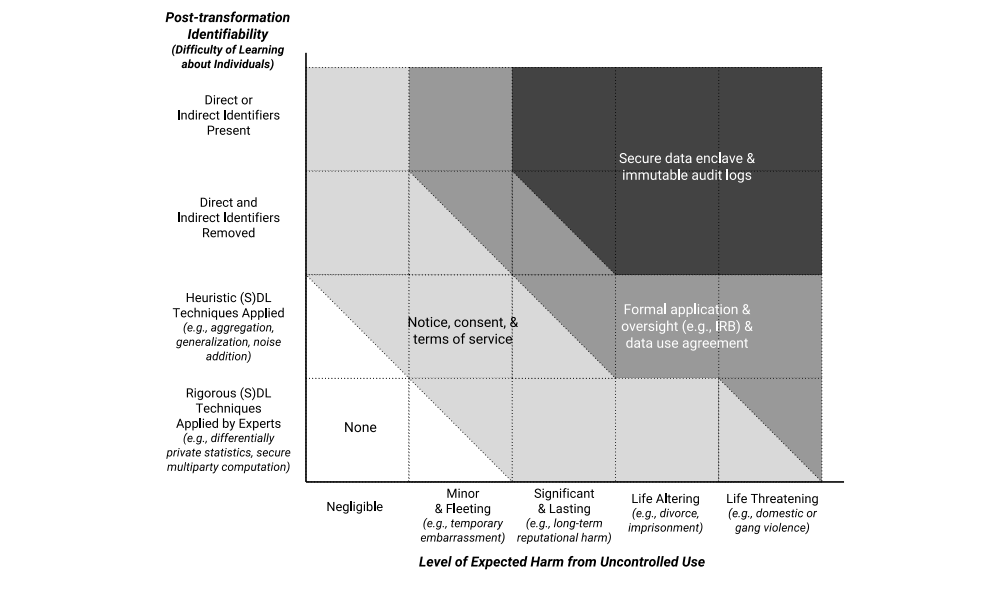
図4 変換後の識別可能性、想定される危害の程度、データ公開に対して選択したプライバシー管理策の適合性の関係を示すAltmanの概念図[97]。点線で4行5列に区切られた格子である。縦軸は「変換後の識別可能性(個人について知ることの難しさ)」で、行は上から「直接または間接の識別子が存在」「直接および間接の識別子を除去」「ヒューリスティックな(S)DL手法を適用(例:集約、一般化、ノイズの付加)」「専門家が厳格な(S)DL手法を適用(例:差分プライバシーを満たす統計、セキュアマルチパーティ計算)」である。横軸は「管理されない利用から想定される危害の程度」で、列は左から「無視できる」「軽微で一時的(例:一時的な恥ずかしさ)」「重大で持続的(例:長期的な評判の毀損)」「人生を変える(例:離婚、投獄)」「生命を脅かす(例:家庭内暴力やギャングの暴力)」である。格子は斜めの境界で4段階の濃さに塗り分けられ、右上ほど濃い。各領域には「なし」(白、左下)、「通知、同意、および利用規約」(薄い灰色)、「正式な申請および監督(例:IRB)およびデータ利用契約」(中間の灰色)、「セキュアなデータエンクレーブおよび改変不能な監査ログ」(濃い灰色、右上)と記されている。
Fig. 4. Altman’s conceptual diagram of the relationship between post-transformation identifiability, the level of expected harm, and the suitability of selected privacy controls for a data release [97]
図4 変換後の識別可能性、想定される危害の程度、データ公開に対して選択したプライバシー管理策の適合性の関係を示すAltmanの概念図[97]
No matter where de-identification is applied in the data life cycle, agencies should document the answers to the following questions for each de-identified dataset:
データライフサイクルのどの段階で非識別化を適用するかにかかわらず、政府機関は、非識別化した各データセットについて、以下の問いへの答えを文書化すべきです。
•Are direct identifers collected with the dataset?
•直接識別子がデータセットとともに収集されていますか。
•Even if direct identifers are not collected, is it still possible to identify the data subjects through the presence of quasi-identifers?
•直接識別子が収集されていない場合でも、準識別子の存在によってデータ主体を識別することは依然として可能か。
•Where in the data life cycle is de-identifcation performed? Is it performed in only one place or in multiple places?
•データライフサイクルのどの段階で非識別化を行いますか。それは1か所だけで行うか、それとも複数の場所で行いますか。
•Is the original dataset retained after de-identifcation?
•非識別化の後も元のデータセットを保持しますか。
•Is there a key or map retained so that specifc data elements can be re-identifed later?
•特定のデータ要素を後で再識別できるように、鍵または対応表を保持しますか。
•How are decisions made regarding de-identifcation and re-identifcation?
•非識別化と再識別に関する判断はどのように行いますか。
•Are there specifc datasets that can be used to re-identify the de-identifed data? If so, what controls are in place to prevent intentional or unintentional re-identifcation?
•非識別化データを再識別するために利用できる特定のデータセットがありますか。ある場合、意図的または意図しない再識別を防ぐためにどのような管理策を講じていますか。
•Is it a problem if some records in a dataset are re-identifed?
•データセット内の一部のレコードが再識別されると問題になりますか。
•Is there a mechanism that will inform the de-identifying agency if there is an attempt to re-identify the de-identifed dataset? Is there a mechanism that will inform the agency if the attempt is successful?
•非識別化を行う機関に対し、データセットを再識別しようとする試みがあったと通知する仕組みはありますか。その試みが成功した場合に機関へ通知する仕組みはありますか。
3.4. Data-Sharing Models
3.4. データ共有モデル
Agencies should decide on the data-sharing model that will be used to make the data available outside of the agency after the data have been de-identified [66, p. 14]. Specific models combine security, privacy and disassociability techniques to reduce privacy risks to individuals.
政府機関は、データを非識別化した後、機関外部でデータを利用可能にするために用いるデータ共有モデルを決定すべきである[66, p. 14]。具体的なモデルは、セキュリティ、プライバシー、および非関連付け(disassociability)の手法を組み合わせて、個人に対するプライバシーリスクを低減します。
Here we use the term security to refer to techniques that limit who can view the data, and privacy to refer to techniques that limit what information the data contains. Disassociability is the degree to which the information in the data can be used while limiting the association to individuals or devices beyond the operational requirements of the system. These con-cepts can be considered independently. In practice, however, who has access to the data and the degree to which the data are associated with individuals or devices makes a signifcant difference to the expected risk of disclosure and, therefore, infuences the extent to which privacy techniques must be used to limit the presence of sensitive personally identifable information in the data.
ここでは、データを閲覧できる者を制限する手法を「セキュリティ」、データに含まれる情報を制限する手法を「プライバシー」と呼びます。関連付けの抑制度とは、システムの運用要件を超えて、データ内の情報を個人またはデバイスと結び付けずに利用できる度合いです。これらの概念は個別に考えることができます。しかし実際には、誰がデータにアクセスできるか、またデータが個人やデバイスとどの程度関連付けられているかによって、情報開示の予想リスクは大きく変わります。そのため、データに含まれる機微な個人識別情報を制限するために必要なプライバシー手法の範囲にも影響します。
The Advanced Encryption Standard (AES) symmetric encryption algorithm, which is one of several traditional encryption algorithms, is an example of a security technique since it allows only the party holding the encryption key to view the data. However, advanced cryptographic techniques that combine secure multiparty cryptography with the application of differential privacy can provide both security, privacy and even disassociability capabilities (see Sec. 3.9.2).
いくつかある従来の暗号アルゴリズムの1つであるAdvanced Encryption Standard(AES)共通鍵暗号アルゴリズムは、暗号鍵を保持する当事者だけがデータを閲覧できるようにすることから、セキュリティ手法の一例です。一方、安全なマルチパーティ暗号と差分プライバシーの適用を組み合わせた高度な暗号技術は、セキュリティ、プライバシー、さらには非関連付けの機能まで提供できます(3.9.2節を参照してください)。
A number of possible models exist at different points in the spectrum of security and privacy protections. Figure 4 summarizes this spectrum: its x-axis describes various privacy techniques that can limit the informational content of the data; its y-axis describes how much harm would occur if the underlying information were disclosed; and the regions of the graph are labeled with suggested security techniques. Some common combinations of security and privacy techniques include:
セキュリティとプライバシーの保護の範囲の中で、さまざまな位置にいくつものモデルがありうます。図4はこの範囲をまとめたものです。そのx軸はデータの情報量を制限しうるさまざまなプライバシー手法を、y軸は基礎となる情報が開示された場合にどの程度の危害が生じるかを表し、グラフの各領域には推奨されるセキュリティ手法がラベル付けされています。セキュリティ手法とプライバシー手法の一般的な組み合わせには、次のようなものがあります。
The release-and-forget model [123]. The de-identified data may be released to the public, typically by being published on the internet. It can be difficult or impossible for an organization to recall the data once released in this fashion and may limit information for future releases.
公開して回収しないモデル(release-and-forget model) [123]。 非識別化したデータは、通常はインターネット上で公表することによって、一般に公開されることがあります。この方法で一度公開したデータを組織が回収することは困難または不可能な場合があり、将来の公開で提供する情報を制限することになる可能性があります。
The Data Use Agreement (DUA) model. The de-identified data may be made available under a legally binding data use agreement that details what can and cannot be done with the data. Typically, DUAs include security provisions and may prohibit attempted re-identification, linking to other data, and redistribution of the data without a similarly binding DUA. A DUA will typically be negotiated between the data holder and qualified researchers (the “qualified investigator model” [58]) or members of the general public (e.g., citizen scientists or the media), although they may be simply posted on the internet with a click-through license agreement that must be agreed to before the data can be downloaded (the “click-through model” [58]).
データ利用契約(DUA)モデル。非識別化データは、そのデータで行ってよいことと行ってはならないことを詳述した、法的拘束力のあるデータ利用契約の下で提供されることがあります。DUAには通常、セキュリティに関する規定が含まれ、再識別の試み、他のデータとの連結、および同様の拘束力を持つDUAなしでのデータの再配布を禁止することがあります。DUAは通常、データ保有者と資格のある研究者(「資格のある研究者モデル(qualified investigator model)」[58])または一般市民(例えば市民科学者やメディア)との間で交渉されますが、データをダウンロードする前に同意しなければならないクリックスルー型の使用許諾契約としてインターネット上に単に掲示されることもある(「クリックスルーモデル(click-through model)」[58])。
The synthetic data with validation model. Statistical disclosure limitation techniques are applied to the original dataset and used to create a synthetic dataset that contains many of the aspects of the original dataset but does not contain disclosing information. The synthetic dataset is released, either publicly or to vetted researchers. The synthetic dataset can then be used as a proxy for the original dataset, and if constructed well, the results of statistical analyses should be similar. If used in conjunction with the enclave model, researchers may use the synthetic dataset to develop queries and/or analytic software. These queries and/or software can then be taken to the enclave or provided to the agency and applied on the original data. There are a growing number of techniques for using differential privacy to create synthetic data.
検証付き合成データモデル。元のデータセットに統計的開示制限手法を適用して、元のデータセットの多くの側面を備えつつ開示につながる情報を含まない合成データセットを作成します。合成データセットは、一般に、または審査を経た研究者に公開されます。合成データセットは元のデータセットの代わりとして使用でき、適切に構築されていれば、統計分析の結果は類似したものとなるはずです。エンクレーブモデルと併用する場合、研究者は合成データセットを用いてクエリや分析ソフトウェアを開発できます。これらのクエリやソフトウェアは、その後エンクレーブに持ち込むか政府機関に提供して、元のデータに適用することができます。差分プライバシーを用いて合成データを作成する手法は増えつつあります。
The enclave model [58, 114, 141]. The de-identified data may be kept in a segregated enclave that restricts the export of the original data and instead accepts queries from qualified researchers, runs the queries on the de-identified data, and responds with results. Enclaves can be physical or virtual and can operate under a variety of different models. For example, vetted researchers may travel to the enclave to perform their research, as is done with the Federal Statistical Research Data Centers operated by the U.S. Census Bureau. Enclaves may be used to implement the verification step of the synthetic data with validation model. Queries made in the enclave model may be vetted automatically or manually (e.g., by the DRB). Vetting can try to screen for queries that might violate privacy or are inconsistent with the stated purpose of the research. However, even vetted queries may lead to unanticipated privacy risks when the results are released and combined with external data.
エンクレーブモデル[58, 114, 141]。非識別化データは、元のデータの持ち出しを制限する隔離されたエンクレーブに保管されることがあります。エンクレーブは代わりに、資格のある研究者からクエリを受け付け、そのクエリを非識別化データに対して実行し、結果を返します。エンクレーブは物理的なものでも仮想的なものでもよく、さまざまなモデルの下で運用できます。例えば、米国国勢調査局(U.S. Census Bureau)が運営するFederal Statistical Research Data Centersで行われているように、審査を経た研究者がエンクレーブに出向いて研究を行うことがあります。エンクレーブは、検証付き合成データモデルの検証段階を実施するために用いることもできます。エンクレーブモデルで行われるクエリは、自動的に、または手作業で(例えばDRBによって)審査されることがあります。審査では、プライバシーを侵害するおそれのあるクエリや、表明された研究目的と整合しないクエリを選別しようとすることができます。しかし、審査を経たクエリであっても、その結果が公開され外部のデータと組み合わされると、予期しないプライバシーリスクにつながることがあります。
Sharing models should consider the possibility of multiple or periodic releases. Just as repeated queries to the same dataset may leak personal data from the dataset, repeated de-identified releases (whether from the same dataset or from different datasets that contain some of the same individuals) by an agency may result in compromising the privacy of individuals unless each subsequent release is viewed in light of the previous release. Even if a contemplated release of a de-identified dataset does not directly reveal identifying information, federal agencies should ensure that the release – combined with previous releases – will also not reveal identifying information [167].
データ共有モデルでは、複数回または定期的にデータを公開する可能性を考慮する必要があります。同じデータセットに対するクエリの反復が個人データを漏えいさせる場合があるのと同様に、機関が非識別化データを繰り返し公開すると(同じデータセットからの場合も、共通の個人を含む別々のデータセットからの場合も)、後続の各公開を以前の公開と照らして評価しない限り、個人のプライバシーが損なわれるおそれがあります。公開予定の非識別化データセットが単独では識別情報を直接明らかにしない場合でも、過去の公開情報と組み合わせたときに識別情報が明らかにならないことを連邦機関が確認すべきです [167]。
Instead of sharing an entire dataset, the data owner may choose to release a sample. If only a sample is released, the probability of re-identification decreases because a data intruder will not know whether a specific individual from the data universe is present in the de-identified dataset [57]. However, releasing only a sample may decrease the statistical power of tests on the data, may cause users to draw incorrect inferences if proper statistical sampling methods are not used, or may not align with agency goals regarding transparency and accountability.
データセット全体を共有する代わりに、データ保有者はサンプルを公開してもよいです。サンプルだけを公開すれば、データ侵入者は対象母集団の特定の個人が非識別化データセットに含まれるかどうかを知ることができないため、再識別の可能性は低下します [57]。ただし、サンプルのみの公開はデータに対する検定の統計的検出力を低下させたり、適切な統計的サンプリング手法を使わない場合に誤った推論を招いたり、透明性と説明責任に関する機関の目標に合わなかったりする可能性があります。
3.5. The Five Safes
3.5. Five Safes(5つのセーフガード)
Agencies should use a repeatable methodology for evaluating the terms under which data will be made available, such as The Five Safes [42, 16]. The Five Safes was created in the United Kingdom to assist a national statistical agency in evaluating proposed collaborative projects with a larger research community. The framework was developed to assist in “designing, describing and evaluating” data access systems. Here, the term “data access system” is viewed broadly as any mechanism that allows outsiders to gain access to the agency’s confdential data. That is, a data access system might include setting up an enclave for academic researchers who undergo extensive background checks, but it also includes publishing data on the internet.
機関は、Five Safes [42, 16] など、データを利用可能にする条件を評価するための再現可能な方法を用いるべきです。Five Safesは、英国で国立統計機関が、より広い研究コミュニティとの共同プロジェクトの提案を評価するために作成されました。この枠組みは、データアクセスシステムの「設計、記述、評価」を支援する目的で開発されました。ここでは「データアクセスシステム」を、外部の者が機関の機密データにアクセスできるようにする仕組み全般を指す広い意味で用います。たとえば、詳細な身元調査を受けた研究者向けのエンクレーブを設置することも、データをインターネット上で公開することも、データアクセスシステムに含まれます。
The Five Safes framework derives its name from the use of fve categories (called “risk” or “access” dimensions) that are used in the evaluation:
Five Safesの枠組みは、評価に用いる5つのカテゴリ(「リスク」または「アクセス」の次元と呼ばれる)にちなんで名付けられています。
1.Safe projects. Is this use of the data appropriate?
1.Safe projects(安全なプロジェクト)。データのこの利用目的は適切か。
2.Safe people. Can the researchers be trusted to use it in an appropriate manner?
2.Safe people(安全な利用者)。研究者はデータを適切な方法で利用する信頼に足りますか。
3.Safe data. Is there a disclosure risk in the data itself?
3.Safe data(安全なデータ)。データ自体に情報開示のリスクがありますか。
4.Safe settings. Does the access facility limit unauthorized use?
4.Safe settings(安全な環境)。アクセス施設は不正利用を制限していますか。
5.Safe outputs. Are the statistical results non-disclosive?
5.Safe outputs(安全な出力)。統計結果から情報が開示されませんか。
The legal, moral, and ethical reviews of each of these dimensions are independent of the others. In practice, this might mean that the project is safe (the proposed use of the appropriate), the people are safe (e.g., the researchers are noted academics with respected histories of collaborative work), the data are safe (i.e., there is no disclosure risk in the data), and the output is safe (i.e., it will not disclose personal information). However, because the setting is not safe (perhaps the facility has poor internal security), the project should not go forward. In this example, the Five Safes framework would provide a decision-maker with the tools to separate each of these dimensions and resolve the problems so that the project can proceed.
これらの各次元に関する法的、道徳的、倫理的な審査は、互いに独立しています。実際には、これは、プロジェクトは安全であり(提案された利用は適切である)、人は安全であり(例えば研究者が共同研究で定評のある著名な学者である)、データは安全であり(すなわちデータに開示リスクがない)、出力は安全である(すなわち個人情報を開示しない)が、設定が安全でない(おそらく施設の内部セキュリティが不十分である)ため、プロジェクトを進めるべきではない、ということを意味する場合があります。この例では、Five Safesフレームワークは、意思決定者がこれらの各次元を切り分けて問題を解決し、プロジェクトを進められるようにするための手段を提供することになります。
One of the positive aspects of the Five Safes framework is that it forces data controllers to consider many different aspects of data release when evaluating data access proposals. It is common for data owners to “focus on one, and only one, particular issue (such as the legal framework surrounding access to their data or [Information Technology] (IT) solutions).” With the Five Safes, people who may be specialists in one area are forced to consider (or to explicitly not consider) aspects of privacy protection with which they may not be familiar and might otherwise overlook.
Five Safesの利点の1つは、データ管理者に対し、データアクセス提案を評価する際にデータ公開のさまざまな側面を検討させることです。データ保有者が「1つの特定の問題だけ(たとえば、データアクセスを取り巻く法的枠組みや[情報技術](IT)ソリューションだけ)に注目する」ことは珍しくありません。Five Safesを用いると、ある分野の専門家も、十分に詳しくないために見落とす可能性のあるプライバシー保護の側面を検討する(または明示的に検討対象外とする)よう促されます。
The so-called evidence-based, default-open, risk-managed, user-centered (EDRU) approach [73, 136], which provides tools for putting these decisions into context and weighing potential risks against potential benefts.
いわゆる、エビデンスに基づく、原則公開、リスク管理、利用者中心(EDRU)アプローチ [73, 136]。これは、これらの判断を文脈に即して行い、潜在的なリスクと潜在的な利益を比較衡量するための手段を提供するものです。
Agencies should determine if a framework such as The Five Safes is appropriate for designing access systems, evaluating existing systems, communication, and training.
政府機関は、アクセスシステムの設計、既存システムの評価、コミュニケーション、および研修に、The Five Safesのようなフレームワークが適切かどうかを判断すべきです。
3.6. Disclosure Review Boards
3.6. 情報開示審査委員会
Disclosure Review Boards (DRBs), also known as Data Release Boards, are administrative bodies created within an organization that are charged with ensuring that intended disclosures meet the policy and procedural requirements of that organization. DRBs provide organizations with a structured approach for identifying, managing and documenting risks associated with data publishing in a systematic, consistent and accountable manner. DRBs can act as a center to keep records and release reports. DRBs also allow for the accumulation of disclosure avoidance expertise within an organization and can serve as centers of training and advocacy for proper disclosure handling practices. As such, DRBs can be a powerful tool to allow agencies and their Chief Data Officers to comply with the legal requirements of the Evidence Act and with its implementation memorandum M-19-23. [168]23
開示審査委員会(DRB)は、データ公開委員会(Data Release Board)とも呼ばれ、意図した開示が組織の方針上および手続上の要件を満たすことを確保する任務を負う、組織内に設置された管理機関です。DRBは、データの公表に伴うリスクを、体系的で一貫性があり説明責任を果たせる方法で特定、管理、文書化するための構造化されたアプローチを組織に提供します。DRBは、記録を保管し、報告書を公開する拠点として機能できます。また、DRBによって組織内に開示回避の専門知識を蓄積することができ、DRBは適切な開示の取り扱い実務に関する研修と啓発の拠点としての役割を果たしうます。したがって、DRBは、政府機関とその最高データ責任者(Chief Data Officer)が、Evidence Actとその実施に関する覚書M-19-23の法的要件を遵守するための強力な手段となりうます。[168]23
DRBs should be governed by a written mission statement and charter (or equivalent document) that are ideally approved by the same mechanisms that the organization uses to approve other organization-wide policies.
DRBは、組織全体に適用される他の方針を組織が承認する際と同じ仕組みによって承認されることが望ましい、書面の使命声明および規程(またはそれに相当する文書)に基づいて運営すべきです。
The DRB should have a mission statement that guides its activities. For example, the U.S. Department of Education’s DRB has the mission statement:
DRBは、その活動を導く使命声明を持つべきです。たとえば、米国教育省のDRBの使命声明は次のとおりです。
The Mission of the Department of Education Disclosure Review Board (ED-DRB) is to review proposed data releases by the Department’s principal offices (POs) through a collaborate technical assistance, aiding the Department to release as much useful data as possible, while protecting the privacy of individuals and the confidentiality of their data, as required by law. [54]
米国教育省情報開示審査委員会(ED-DRB)の使命は、教育省の主要部局(PO)が提案するデータ公開を、協働的な技術支援を通じて審査し、法律で義務付けられた個人のプライバシーとデータの機密性を保護しつつ、可能な限り有用なデータを教育省が公開できるよう支援することです [54]。
Most DRBs are established to weigh the interests of data release against those of individual privacy protection. However, a DRB may also be chartered to consider group harms [66, p. 13] that can result from the release of a dataset. Such harms go beyond the harm to the privacy interests of a specific individual.
多くのDRBは、データ公開の利益と個人のプライバシー保護の利益を比較衡量するために設置されます。しかし、データセットの公開によって生じ得る集団への危害 [66, p. 13] を検討する権限を付与されるDRBもあります。こうした危害は、特定の個人のプライバシー権益に対する危害を超えます。
The DRB charter specifies the mechanics of how the mission is implemented. A formal, written charter promotes transparency in the decision-making process and ensures consistency in the application of its policies. The DRB charter should frame the DRB’s responsibilities in reference to existing organizational policies and components, as well as applicable regulations and laws. Some agencies may balance these concerns by employing data use models other than de-identification (e.g., by establishing data enclaves where a limited number of vetted researchers can access sensitive datasets in a way that provides data value while minimizing the possibility for harm or by authorizing the use of secure multi-party computation, homomorphic encryption, or other privacy-preserving data analytics to compute various statistics). In those agencies, a DRB would be empowered to approve the use of such mechanisms.
DRBの規程は、使命をどのように実行するかを定めます。正式な書面の規程は、意思決定プロセスの透明性を高め、方針の一貫した適用を確保します。規程では、既存の組織方針や組織体制、適用される規制および法律に照らして、DRBの責任を明確にすべきです。機関によっては、非識別化以外のデータ利用モデルを採用して、これらの課題に対処することがある(例:審査済みの限られた研究者が機微なデータセットにアクセスできるエンクレーブを設け、データの価値を活用しながら危害の可能性を最小化する方法、安全なマルチパーティ計算、準同型暗号、その他のプライバシー保護型データ分析を用いて統計量を計算する方法)。こうした機関では、DRBにそれらの仕組みの利用を承認する権限が付与されます。
Certain agencies may engage in data disclosure on a routine basis (e.g., research and evaluation agencies), in which case it may be beneficial for the DRB to establish policies and procedures for de-identification rather than being responsible for every review. The DRB charter should clearly specify how the group will provide oversight and ensure organizational accountability to the agreed-upon policies.
研究・評価を行う機関など、日常的にデータを公開する機関もあります。その場合、DRBがすべての案件を個別審査するのではなく、非識別化に関する方針と手順を定める方が有益なことがあります。DRBの規程では、グループがどのように監督を行い、合意された方針に対する組織の説明責任を確保するかを明確にすべきです。
the Information Quality Act (IQA), record disclosure laws and policy, and the Paperwork Reduction Act (PRA).” (p. 23) The memo’s further states that an agency’s Annual Evaluation Plans will discuss how infor-mation will be disseminated and used while taking into account “applicable law and policies governing the collection, use, and disclosure of data and information.” (p. 35) Footnote 34 on p. 22 cites section 202(e) of the evidence act noting that the Chief Data Offcer “shall be designated on the basis of demonstrated training and experience in data management, governance (including creation, application, and maintenance ofdata standards), collection, analysis, protection, use, and dissemination, including with respect to any statistical and related techniques to protect and de-identify confdential data.”
情報品質法(IQA)、記録開示に関する法令および方針、ならびに文書作成削減法(PRA)」(p.23)。このメモランダムはさらに、機関の年次評価計画には、「データおよび情報の収集、利用、開示を規定する適用法および方針」を考慮しながら、情報をどのように普及し利用するかを記載するとしています(p.35)。p.22の脚注34は、Evidence Act第202(e)節を引用し、最高データ責任者は「データ管理、ガバナンス(データ標準の作成、適用および維持を含む)、収集、分析、保護、利用および普及、ならびに機密データを保護し非識別化するための統計その他の関連手法について、実証された訓練と経験を基準に指名しなければならない」と述べています。
The DRB charter should also specify the DRB’s composition. To be effective, the DRB should include representatives from multiple groups and experts in both technology and privacy policy. Specifcally, DRBs may wish to have as members:
DRBの規程では、DRBの構成も定めるべきです。効果的なDRBには、複数のグループの代表者と、技術およびプライバシー政策の両分野の専門家を含めるべきです。具体的には、次の者を委員に加えることを検討できます。
•Individuals who represent the interests of potential users (such individuals need not come from outside of the organization)
•データの潜在的な利用者の利益を代表する者(組織外の者である必要はありません)。
•Representation from among the public, specifcally from groups represented in the datasets if they have a limited scope
•一般市民の代表者。特にデータセットの対象範囲が限定されている場合は、そのデータセットに含まれる集団の代表者。
•Representation from the organization’s leadership team, such as the Senior Agency Offcial for Privacy [4, Appendix II, section 4] (such representation helps to establish the DRB’s credibility with the rest of the organization)
•組織の幹部チームの代表者。たとえばプライバシー担当上級機関職員 [4, Appendix II, section 4]。このような代表者の参加は、組織内でDRBの信頼性を高めます。
•A representative of the organization’s senior privacy offcial
•組織の上級プライバシー担当職員の代表者。
•Subject-matter experts
•対象分野の専門家。
•Outside experts
•外部の専門家
The charter should establish rules for ensuring a quorum and specify whether members can designate alternates on a standing or meeting-by-meeting basis. The DRB should specify the mechanism by which members are nominated and approved, their tenure, conditions for removal, and removal procedures.24
憲章では、定足数を確保するための規則を定め、メンバーが常任または会議ごとに代理を指名できるかどうかを規定すべきです。DRBは、メンバーの推薦・承認の仕組み、任期、解任の条件および解任の手続を規定すべきです。24
The charter should set policy expectations for record keeping and reporting, including whether records and reports are considered public or restricted. For example, the charter could direct the DRB to issue an annual report with a list of every dataset that was approved for release. The charter should indicate whether it is possible to exclude sensitive decisions from these reporting requirements and the mechanism for doing so. Ideally, the charter should be a public document to promote transparency.
憲章では、記録の保持と報告に関する方針上の期待事項を定めるべきであり、記録と報告を公開とみなすか制限付きとみなすかも含めます。たとえば憲章は、公開が承認されたすべてのデータセットの一覧を記載した年次報告書の発行をDRBに指示することができます。憲章では、機微な決定をこれらの報告要件から除外できるかどうかと、その仕組みを示すべきです。透明性を高めるため、憲章は、理想的には公開文書であるべきです。
To meet its requirement of evaluating data releases, the DRB should require that written applications be submitted to the DRB that specify the nature of the dataset, the de-identification methodology, and the result. An application may require that the proposer present the re-identification risk, the risk to individuals if the dataset is re-identified, and a proposed plan for detecting and mitigating successful re-identification. In addition, the DRB should require that when individuals are informed that their information will be de-identified, they also be informed that privacy risks may remain despite de-identification.
データ公開を評価するという要件を満たすため、DRBは、データセットの性質、非識別化の手法およびその結果を明記した書面による申請をDRBに提出するよう求めるべきです。申請では、提案者に対し、再識別のリスク、データセットが再識別された場合に個人に及ぶリスク、および再識別の成功を検知し緩和するための計画案の提示を求めることができます。さらにDRBは、個人に対してその情報が非識別化されることを通知する際には、非識別化を行ってもプライバシーリスクが残りうることもあわせて通知するよう求めるべきです。
The DRB should keep accurate records of its request memos, their associated documentation, the DRB decision, and the actual files released. These records should be appropriately archived and curated so that they can be recovered. In the case of large data releases, the definitive version of the released data should be curated using an externally validated procedure, such as a recorded cryptographic hash value or signature, and a digital object identifier (DOI) [83].
DRB は、依頼メモ、関連する文書、DRB の決定、および実際に公開されたファイルの正確な記録を保持すべきです。これらの記録は、復元できるよう適切にアーカイブおよびキュレーションされるべきです。大規模なデータ公開の場合、公開データの決定版は、記録された暗号ハッシュ値または署名、およびデジタルオブジェクト識別子(DOI)など、外部から検証された手順を用いてキュレーションされるべきです [83]。
DRBs may wish to institute a two-step process in which the applicant first proposes and receives approval for a specific de-identification process that will be applied to a specific dataset and then submits and receives approval for the release of the dataset that has been de-identified according to the proposal. However, because it is theoretically impossible to predict the results of applying an arbitrary process to an arbitrary dataset [31, 159], the DRB should be empowered to reject a proposed release of a dataset even if it has been de-identified in accordance with an approved procedure because performing the de-identification may demonstrate that the procedure was insufficient to protect privacy. The DRB should be able to delegate the responsibility of reviewing the de-identified dataset, but such responsibility should not be delegated to the individual or group that performed the de-identification.
DRBは2段階のプロセスを導入することもできます。このプロセスでは、申請者はまず特定のデータセットに適用する特定の非識別化プロセスを提案して承認を受け、次に、その提案に従って非識別化したデータセットの公開を申請して承認を受けます。ただし、任意のデータセットに任意のプロセスを適用した結果を予測することは理論的に不可能であるため[31, 159]、承認済みの手順に従って非識別化されたデータセットであっても、DRBはその公開案を却下する権限を持つべきです。実際に非識別化を行ってみることで、その手順がプライバシー保護に不十分であったと判明する場合があるからです。DRBは非識別化されたデータセットをレビューする責任を委任できるべきですが、その責任を非識別化を実施した個人またはグループに委任すべきではありません。
The DRB charter should specify whether the DRB needs to approve each data release by the organization or if it may grant blanket approval for all data of a specifc type that are de-identifed according to a specifc methodology. The charter should specify the duration of the approval. Given advances in the science and technology of de-identifcation, a Board should not be empowered to grant release authority for an indefnite or unlimited amount of time.
DRBが組織によるすべてのデータ公開を個別に承認する必要があるのか、それとも特定の手法で非識別化された特定種類のデータを一括承認できるのかを、DRBの規程に明記すべきです。承認の有効期間も規程に明記すべきです。非識別化に関する科学技術が進歩していることを踏まえ、委員会に無期限または無制限に公開権限を付与できるようにすべきではありません。
In most cases, a single privacy protection methodology will be insufficient to protect the varied datasets that an agency may wish to release. That is, different techniques might best optimize the trade-off between re-identification risk and data usability, depending on the specifics of each kind of dataset. Nevertheless, the DRB may wish to develop guidance, recommendations, and training materials regarding specific de-identification techniques that are to be used. Agencies that standardize on a small number of de-identification techniques will gain familiarity with these techniques and are likely to have results with a higher level of consistency and success than those that have no such guidance or standardization.
ほとんどの場合、単一のプライバシー保護手法では、機関が公開しようとする多様なデータセットを保護するには不十分です。つまり、再識別リスクとデータの有用性とのトレードオフを最も適切に最適化する手法は、データセットの種類ごとの特性に応じて異なりうます。それでもDRBは、使用すべき特定の非識別化手法に関するガイダンス、推奨事項および研修資料を作成することもできます。少数の非識別化手法に標準化した機関は、それらの手法に習熟し、そうしたガイダンスや標準化を持たない機関よりも一貫性が高く、成功する結果を得られる可能性が高いです。
Although it is envisioned that DRBs will work in a cooperative, collaborative, and congenial manner with those inside an agency seeking to release de-identified data, there will at times be a disagreement of opinion. For this reason, the DRB’s charter should state whether the DRB has the final say over disclosure matters or if the DRB’s decisions can be overruled, by whom, and by what procedure. For example, an agency might give the DRB final say over disclosure matters but allow the agency’s leadership to replace members of the DRB as necessary. Alternatively, the DRB’s rulings may merely be advisory, with all data releases being individually approved by agency leadership or its delegates.25
DRBは、非識別化データの公開を求める機関内の者と協調的・協働的かつ友好的に業務を行うことが想定されていますが、意見の相違が生じることもあります。このため、DRBの憲章では、開示に関する事項についてDRBが最終決定権を持つのか、それともDRBの決定が覆されうるのか、覆されうる場合は誰がどの手続で覆すのかを明記すべきです。たとえば機関は、開示に関する事項の最終決定権をDRBに与える一方で、機関の指導部が必要に応じてDRBのメンバーを交代できるようにすることができます。あるいは、DRBの裁定は単なる助言にとどめ、すべてのデータ公開を機関の指導部またはその代理者が個別に承認することもできます。25
Agencies should decide whether the DRB charter will include any kind of performance timetables or be bound by a service-level agreement (SLA) that defnes a level of service to which the DRB commits.
DRBの規程に業務処理の期限を含めるか、またはDRBが約束するサービス水準を定義したサービスレベル合意(SLA)の適用を受けるかを、機関は決定すべきです。
The key elements of a Disclosure Review Board include:
情報開示審査委員会(DRB)の主な要素は次のとおりです。
•A written mission statement and charter
•書面の使命声明および規程。
•Members who represent different groups within the organization, including leader-ship
•組織内の異なるグループ(幹部層を含む)を代表する委員。
•The Board receives written applications to release de-identifed data
•非識別化データの公開に関する書面申請を受け付けること。
•The Board reviews both the proposed methodology and the results of applying the methodology
•提案された手法と、その手法を適用した結果の両方を審査すること。
•Applications should identify the risks associated with data release, including re-identifcation probability, potentially adverse events that would result if individuals are re-identifed, and a mitigation strategy if re-identifcation takes place
•申請書では、データ公開に伴うリスクを明示すべきです。これには、再識別の可能性、個人が再識別された場合に生じ得る有害事象、および再識別が起きた場合の軽減策を含みます。
•Approvals may be valid for multiple releases but should not be valid indefnitely
•承認は複数回の公開に有効でもよいですが、無期限に有効とすべきではありません。
•Reliable records management for applications, approvals, and released data
•申請、承認、および公開データに関する信頼できる記録管理。
•Mechanisms for dispute resolution
•紛争を解決する仕組み。
•Timetable or service-level agreement (SLA)
•スケジュールまたはサービスレベル合意(SLA)。
•Legal and technical understanding of privacy
•プライバシーに関する法的・技術的な理解
Example outputs of a DRB include specifying access methods for different kinds of data releases, establishing acceptable levels of re-identifcation risk, and maintaining detailed records of previous data releases that ideally include the dataset that was released and the privacy-preserving methodology that was employed.
DRBが出す成果の例には、データ公開の種類ごとにアクセス方法を定めること、許容可能な再識別リスク水準を設定すること、過去のデータ公開の詳細な記録を維持することが含まれます。記録には、公開したデータセットと、用いたプライバシー保護手法を含めることが望まれます。
There is some similarity between DRBs as envisioned here and the Institutional Review Board (IRBs) system created by the Common Rule26 for regulating human subject research in the United States. For example, both IRB and DRB members require an understanding of ethical principles, public policy and an understanding of how the collection and release of data can cause harms to individuals. However, there are also important differences:
ここで想定するDRBには、米国で人を対象とする研究を規制する共通規則(Common Rule)26によって設立された機関審査委員会(IRB)制度との類似点があります。たとえば、IRBとDRBの委員はいずれも、倫理原則と公共政策、およびデータの収集・公開が個人に危害を及ぼす仕組みに関する理解が必要です。ただし、重要な相違点もあります。
•While the purpose of IRBs is to protect human subjects involved in human subject research, DRBs are charged with protecting data subjects, institutions, and – poten-tially – society as a whole.
•IRBは人を対象とする研究に参加する被験者を保護することを目的とするのに対し、DRBはデータ主体、機関、そして場合によっては社会全体を保護する責任を負います。
•Whereas IRBs are required to have “at least one member whose primary concerns are in nonscientific areas” and “at least one member who is not otherwise affiliated with the institution and who is not part of the immediate family of a person who is affiliated with the institution,” there are no such requirements for members on a DRB.
•IRBには「主たる関心が非科学的分野にあるメンバーを少なくとも1名」および「当該機関に所属しておらず、当該機関に所属する者の近親者でもないメンバーを少なくとも1名」置くことが求められているのに対し、DRBのメンバーにはそのような要件はありません。
•Whereas IRBs give approval for research and then typically receive reports only during an annual review or when a research project terminates, DRBs may be involved at multiple points during the process.
•IRBは研究を承認した後、通常は年次レビューの際または研究プロジェクトの終了時にのみ報告を受けるのに対し、DRBはプロセスの複数の時点で関与することがあります。
•Whereas approval of an IRB is required before research with human subjects can commence, DRBs are typically involved after research has taken place and prior to the release of data or other research fndings.
•人を対象とする研究を開始する前にIRBの承認が必要であるのに対し、DRBは通常、研究の実施後、データまたはその他の研究成果を公開する前に関与します。
•Whereas service on an IRB requires knowledge of the Common Rule [165], service on a DRB requires knowledge of the Evidence Act [2] and agency-specifc privacy rules, as well as a working knowledge of statistics and computation techniques.
•IRBの委員を務めるにはCommon Rule [165] の知識が必要です。一方、DRBの委員にはEvidence Act [2] と機関固有のプライバシー規則に関する知識、および統計と計算手法の実務的な理解が必要です。
3.7. De-Identifcation and Standards
3.7. 非識別化と規格
Agencies can rely on de-identification standards to provide standardized terminology, procedures, and performance criteria for de-identification efforts. Agencies can adopt existing de-identification standards or create their own. De-identification standards can be prescriptive or risk-based.
機関は、非識別化の取り組みに標準化された用語、手順および性能基準を与えるものとして、非識別化標準に依拠することができます。機関は既存の非識別化標準を採用することも、独自の標準を作成することもできます。非識別化標準には、規範的なものとリスクベースのものがあります。
3.7.1. Benefts of Standards
3.7.1. 規格の利点
De-identifcation standards assist agencies with the process of de-identifying data prior to public release. Without standards, data owners may be unwilling to share data, as they may be unable to assess whether a procedure for de-identifying is suffcient to minimize privacy risk.
非識別化規格は、データを一般公開する前に非識別化するプロセスを機関が進めるうえで役立ちます。規格がなければ、データ保有者は、プライバシーリスクを最小化するのに非識別化手順が十分かどうかを評価できず、データ共有をためらう可能性があります。
Standards can increase the availability of individuals with appropriate training by identifying a specific body of knowledge and practice that training should address. Absent standards, agencies may forego opportunities to share data. De-identification standards can help practitioners develop a community, as well as certification and accreditation processes.
標準は、研修で扱うべき特定の知識体系と実務を特定することにより、適切な研修を受けた人材を確保しやすくすることができます。標準がなければ、機関はデータ共有の機会を逃すおそれがあります。非識別化標準は、実務者がコミュニティを形成し、認定・認証のプロセスを整備するのにも役立ちます。
Standards decrease uncertainty and provide data owners and custodians with best practices to follow. Courts can consider standards as acceptable practices that should generally be followed. In the event of litigation, an agency can point to the standard and say that it followed good data practice.
規格は不確実性を減らし、データ保有者や管理者が従うべきベストプラクティスを示します。裁判所は、一般に従うべき適切な実務として規格を考慮できます。訴訟になった場合、機関は規格に従ったことを示し、適切なデータ取扱いを実践したと説明できます。
3.7.2. Prescriptive De-Identifcation Standards
3.7.2. 処方的な非識別化規格
A prescriptive de-identification standard specifies an algorithmic procedure that – if followed – results in data that are de-identified to a previously established benchmark. This approach focuses on the process of de-identification rather than on the specific properties of the de-identified data.
規範的な非識別化標準は、従えばあらかじめ定められたベンチマークまで非識別化されたデータが得られるアルゴリズム的手順を規定します。このアプローチは、非識別化されたデータの具体的な特性ではなく、非識別化のプロセスに焦点を当てます。
The Safe Harbor method of the HIPAA Privacy Rule [3] is an example of a prescriptive de-identifcation standard. The intent of the Safe Harbor method is to “provide covered entities with a simple method to determine if the information is adequately de-identifed” [118]. It does this by specifying that health information is considered to be de-identifed through the removal of 18 kinds of identifers and the explicit assurance that the entity does not have actual knowledge that the remaining information can be used to identify an individual who is the subject of the information. Once de-identifed, the dataset is no longer subject to HIPAA privacy, security, and breach notifcation regulations. Nevertheless, “a covered en-tity may require the recipient of de-identifed information to enter into a data use agreement to access fles with known disclosure risk” [118].
HIPAAプライバシー規則 [3] のSafe Harbor(セーフハーバー)方式は、規範的な非識別化標準の例です。Safe Harbor方式は、「対象事業者が情報を適切に非識別化できたかを判断する簡便な方法を提供する」ことを目的とします [118]。この方式では、18種類の識別子を削除し、残った情報を使って対象者を識別できると対象事業者が実際に認識していないことを明示的に保証することで、健康情報を非識別化済みとみなします。非識別化されたデータセットは、HIPAAのプライバシー、セキュリティ、および侵害通知に関する規則の適用対象ではなくなります。それでも、「既知の情報開示リスクがあるファイルへのアクセスに際して、対象事業者は、非識別化情報の受領者にデータ利用契約の締結を求めることができる」[118]。
As noted on page 5, Guidance from the U.S. Department of Health and Human Ser-vices (HHS) on the Health Insurance Portability and Accountability Act (HIPAA) de-identifcation standards states that even when properly applied, both the Safe Harbor and expert determination methods for de-identifcation ”yield de-identifed data that retains some risk of identifcation. Although the risk is very small, it is not zero, and there is a possibility that de-identifed data could be linked back to the identity of the patient to which it corresponds” [166]. Specifcally, the combination of quasi-identifers (indirect identifers) left in the de-identifed dataset (e.g., race, gender, income and education level) may raise re-identifcation issues.
5ページで述べたように、米国保健福祉省(HHS)のHIPAA非識別化標準に関するガイダンスは、Safe Harbor方式と専門家判断方式のどちらも適切に適用した場合でさえ、「識別リスクがある程度残るデータを生み出します。リスクは非常に小さいがゼロではなく、非識別化データが対応する患者の身元に結び付けられる可能性がある」[166] としています。特に、非識別化データセットに残された準識別子(間接識別子)(例:人種、性別、所得、教育水準)の組合せが再識別の問題を引き起こすことがあります。
The Privacy Rule states that a covered entity that employs the Safe Harbor method must have no “actual knowledge” that the information – once de-identifed – could still be used to re-identify individuals. However, covered entities are not obligated to employ experts or mount re-identifcation attacks against datasets to verify that the use of the Safe Harbor method has in fact resulted in data that cannot be re-identifed.
プライバシー規則では、Safe Harbor方式を採用する対象事業者は、情報を非識別化した後も個人の再識別に利用できるという「実際の認識」があってはならないと定めています。しかし、Safe Harbor方式によってデータが実際に再識別不能になったかを確認するために、対象事業者が専門家を起用したり、データセットへの再識別攻撃を実施したりする義務はありません。
Prescriptive standards have the advantage of being relatively easy for users to follow, but developing, testing, and validating such standards can be burdensome. Because prescriptive de-identifcation standards do not depend on the particulars of a specifc case, there is a tendency for them to be more conservative than is necessary, resulting in a decrease in data for corresponding levels of risk. Even so, there is typically no mathematically provable assurance that following a procedure specifed by the standard actually produces the intended privacy-preserving outcome.
処方的規格は利用者が比較的容易に従えるという利点がある一方、作成、試験、検証には負担がかかります。処方的な非識別化規格は個々の事例に依存しないため、必要以上に保守的になりやすく、同じリスク水準に対して利用可能なデータ量が減ることがあります。それでも、規格で定めた手順に従えば意図したプライバシー保護が実現するという、数学的に証明可能な保証は通常得られません。
Agencies that create prescriptive de-identifcation standards should ensure that data de-identifed according to the standards have a suffciently small risk of being re-identifed consistent with the intended level of privacy protection. Such assurances frequently cannot be made unless formal privacy techniques (e.g., differential privacy) are employed, and the assurances made by differential privacy are unlike the simplistic absolute assurances made in the context of traditional SDL techniques. Agencies may nevertheless determine that public policy goals furthered by having an easy-to-use prescriptive standard outweighs the risk of a standard that does not have provable privacy guarantees.27 If such determinations are made, they should be clearly documented.
規範的な非識別化標準を作成する機関は、その標準に従って非識別化されたデータの再識別リスクが、意図したプライバシー保護の水準に見合うほど十分に小さいことを確保すべきです。このような保証は、形式的なプライバシー手法(例:差分プライバシー)を用いない限り得られないことが多く、また差分プライバシーが与える保証は、従来のSDL手法の文脈で示される単純な絶対的保証とは異なります。それでも機関は、使いやすい規範的標準を持つことで推進される公共政策上の目標が、証明可能なプライバシー保証を持たない標準のリスクを上回ると判断することもありうます。27そのような判断を行う場合は、明確に文書化すべきです。
Prescriptive de-identification standards carry the risk that the standard may not sufficiently de-identify to avoid the risk of re-identification, especially as methodology advances and more data sources become available. A second risk is that different agencies (or governments) may adopt inconsistent rules. In such cases, information that is legally de-identified for one purpose or in one jurisdiction may not be legally de-identified in another.
規定的な非識別化標準には、とりわけ手法が進歩し、より多くのデータソースが利用可能になるにつれて、標準による非識別化が再識別のリスクを避けるのに十分でなくなるおそれがあります。第2のリスクは、機関(または政府)ごとに一貫しない規則が採用されるおそれがあることです。その場合、ある目的または管轄で法的に非識別化されている情報が、別の目的や管轄では法的に非識別化されたものとならない場合があります。
3.7.3. Risk-Based De-Identifcation Standards
3.7.3. リスクベースの非識別化規格
Risk-based de-identifcation standards specify the properties that de-identifed data must have rather than the process that was used to create the de-identifed data. For example, under the “Expert Determination” method of the HIPAA Privacy Rule, a technique for de-identifying is suffcient if an appropriate expert applying generally accepted statistical and scientifc principles and methods “determines that the risk is very small that the information could be used, alone or in combination with other reasonably available information, by an anticipated recipient to identify an individual who is a subject of the information” [118]. The rule requires that experts document their methods and the results of their analyses.
リスクベースの非識別化標準は、非識別化データの作成に用いたプロセスではなく、非識別化データが備えるべき特性を規定します。たとえばHIPAA Privacy Ruleの「専門家判断(Expert Determination)」方式では、一般に認められた統計学的・科学的な原則と手法を適用する適切な専門家が、「想定される受領者が、当該情報を単独で、または合理的に入手可能な他の情報と組み合わせて用い、当該情報の主体である個人を識別するリスクが非常に小さいと判断する」場合に、その非識別化手法は十分であるとされます[118]。同規則は、専門家に対し、その手法と分析結果を文書化することを求めています。
Risk-based standards have the advantage of allowing users many different ways to solve a problem by leaving room for innovation. Another advantage is that they can require the desired outcome rather than specifying an aspirational mechanism.
リスクベースの規格には、革新の余地を残すことで、利用者が問題を解決するための多様な方法を選べるという利点があります。もう一つの利点は、目指すべき手段を規定する代わりに、望ましい結果そのものを要求できることです。
There are two fundamental challenges with the risk-based approach:
リスクベースのアプローチには、次の2つの根本的な課題があります。
•This approach depends on having experts with knowledge of all prior releases of related data.
•このアプローチの実施には、関連データの過去のすべての公開を把握する専門家が必要です。
•The assurance that the experts provide may not be valid if additional data are released or come to light.
•追加データが公開されたり明らかになったりすると、専門家が示した保証が有効でなくなる可能性があります。
Risk-based standards should be suffciently detailed to perform in a manner that is reliable and repeatable. For example, standards that call for the use of experts can specify how an expert’s expertise should be determined. Standards that call for the reduction of risk to an acceptable level should provide a procedure for determining that level.
リスクベースの規格は、信頼性と再現性のある形で機能するよう、十分に詳細であるべきです。たとえば、専門家の利用を求める規格では、専門家の知識・技能をどのように判定すべきかを定められます。リスクを許容可能な水準まで低減するよう求める規格では、その水準を決定する手続きを示すべきです。
3.8. Education, Training, and Research
3.8. 教育、研修および研究
De-identifying data in a manner that preserves privacy can be a complex mathematical, statistical, administrative, and data-driven process. Frequently, the opportunities for identity disclosure will vary from dataset to dataset. Privacy-protecting mechanisms developed for one dataset may not be appropriate for others. For these reasons, agencies that engage in de-identifcation should ensure that their workers have adequate education and training in the subject domain. Agencies may wish to establish education or certifcation requirements for those who work directly with the datasets or to adopt industry standards, such as the HITRUST De-Identifcation Framework [101]. Because de-identifcation techniques are modality-dependent, agencies using de-identifcation may need to institute research efforts to develop and test appropriate data release methodologies.
プライバシーを保護する形でデータを非識別化することは、数学的、統計的、管理的かつデータ駆動の複雑なプロセスとなりうます。身元開示の機会はデータセットごとに異なることが多くあります。あるデータセット向けに開発したプライバシー保護の仕組みが、他のデータセットには適切でない場合もあります。こうした理由から、非識別化を行う機関は、職員がその分野について十分な教育と研修を受けていることを確保すべきです。機関は、データセットを直接扱う者に対する教育要件や認定要件を設けること、あるいはHITRUST De-Identification Framework[101]などの業界標準を採用することもできます。非識別化手法はデータの形式(モダリティ)に依存するため、非識別化を用いる機関は、適切なデータ公開手法を開発し検証するための研究活動を立ち上げる必要が生じる場合があります。
Although some de-identifcation standards may call for training data recipients [82], this is typically not an option for government datasets that are made freely available on the public internet.
一部の非識別化規格ではデータ受領者への研修を求める場合があるが [82]、インターネット上で自由に公開される政府データセットでは、通常それは選択肢になりません。
3.9. Alternative Approaches for Computing Statistics on Confidential Information
3.9. 機密情報に関する統計量を計算するための代替手法
In addition to de-identifcation, there are other technologies and methodologies that can secure sensitive data. Many of these approaches can complement de-identifcation and further reduce privacy risk to data subjects. Combining techniques is an example of defense in depth and should be considered whenever possible. The NIST Privacy Framework [113] provides more information about additional measures for defense in depth.
非識別化に加えて、機微なデータを保護できる技術や手法はほかにもあります。こうした手法の多くは非識別化を補完し、データ主体のプライバシーリスクをさらに軽減します。複数の技法を組み合わせることは多層防御の一例であり、可能な限り検討すべきです。多層防御のための追加対策については、NISTプライバシーフレームワーク [113] に詳細があります。
3.9.1. Encryption and Access Control
3.9.1. 暗号化とアクセス制御
Encrypting sensitive data at rest can prevent attackers from obtaining the data directly (e.g., by compromising the server that stores it). Encryption can also serve as a form of access control (i.e., it can control who can access the data) because examining the data requires access to the encryption keys. If the original data (with identities) are retained, they should be stored encrypted, and access should be limited. Even after de-identifcation, more sensitive data not intended for public release can be provided to select individuals by limiting access via encryption.
保存時に機微なデータを暗号化すると、攻撃者がそのデータを直接入手すること(例:保管サーバーの侵害)を防げます。暗号化はアクセス制御の一形態にもなります。データを調べるには暗号鍵へのアクセスが必要だからです。識別情報を含む元データを保持する場合は、暗号化して保管し、アクセスを制限すべきです。非識別化した後も、一般公開を意図しない機微なデータは、暗号化によってアクセスを制限し、選定した利用者に提供できます。
3.9.2. Secure Computation
3.9.2. セキュア計算
Two technologies enable computing on encrypted data without decrypting it:
次の2つの技術を使うと、暗号化データを復号せずに計算を実行できます。
1.Fully-homomorphic encryption (FHE) [70] allows a server to compute a function f (x) on an encrypted value x without decrypting it. The result is a new encrypted value that can only be decrypted by someone who holds the original encryption key.
1.完全準同型暗号(FHE)[70] では、サーバーが暗号化された値 x を復号せずに関数 f(x) を計算できます。計算結果も新たな暗号化値となり、元の暗号鍵を持つ者だけが復号できます。
•2. Secure multi-party computation (MPC) [95] allows multiple servers to jointly compute a function f(x1,...,xk), where each server provides one of the inputs xi, and no server learns any of the others’ inputs.
•2. セキュアマルチパーティ計算(MPC)[95]では、複数のサーバが関数f(x1,...,xk)を共同で計算できます。各サーバは入力xiの1つを提供し、どのサーバも他のサーバの入力を知ることはありません。
Note that even when secure computing approaches are employed, the outputs of the computations can still compromise privacy if they are not protected with a formal privacy mechanism, such as differential privacy.
なお、セキュアな計算の手法を用いた場合でも、計算の出力を差分プライバシーなどの形式的なプライバシー機構で保護しなければ、その出力によってプライバシーが損なわれうます。
For more information on secure computation techniques and the efforts of the U.S. government to advance their use, see the National Strategy to Advance Privacy-Preserving Data Sharing and Analytics [41].
セキュアな計算の手法と、その利用を推進する米国政府の取り組みについての詳細は、National Strategy to Advance Privacy-Preserving Data Sharing and Analytics[41]を参照されました。
3.9.3. Trusted Execution Environments
3.9.3. 信頼できる実行環境
Trusted execution environments (TEEs) (also called trusted hardware enclaves or secure hardware enclaves) are another approach for computing encrypted data. TEEs are implemented in computer hardware, typically within the silicon of a modern central processing unit (CPU), and protect programs that run on that CPU from the surrounding environment. For example, a TEE can cause data from a computer’s CPU to be automatically encrypted when written to main memory and decrypted when read back to the CPU. In this way, data in memory are protected from other devices that can access memory, such as a network interface card. In addition to encryption, TEEs typically support attestation so that a program running on a TEE can attest to a remote system that the result is a true, legitimate, and faithful execution of the program.
信頼できる実行環境(TEE)(信頼できるハードウェアエンクレーブ、またはセキュアハードウェアエンクレーブとも呼ばれる)は、暗号化されたデータを計算するもう1つの手法です。TEEはコンピュータのハードウェア、通常は最新の中央処理装置(CPU)のシリコン内に実装され、そのCPU上で動作するプログラムを周囲の環境から保護します。たとえばTEEは、コンピュータのCPUからメインメモリに書き込まれるデータを自動的に暗号化し、CPUに読み戻す際に復号させることができます。これにより、メモリ上のデータは、ネットワークインタフェースカードなど、メモリにアクセスできる他のデバイスから保護されます。暗号化に加え、TEEは通常、構成証明(アテステーション)をサポートしており、TEE上で動作するプログラムは、その結果がプログラムの真正で正当かつ忠実な実行によるものであることをリモートシステムに証明できます。
Traditional cloud services require trusting the cloud provider, who may have a compromised environment (e.g., an operating system that records encryption keys). A TEE decreases the need for trust because it allows a user to validate that they are communicating with the remote program and offers assurance that no other program running on the cloud provider can access the program’s data. Secure enclaves can thus allow untrusted infrastructure to operate on sensitive data in much the same way as technologies like FHE and MPC.
従来のクラウドサービスでは、クラウドプロバイダを信頼する必要がありますが、プロバイダの環境が侵害されている(例:暗号鍵を記録するオペレーティングシステム)可能性もあります。TEEは、利用者が通信相手がリモートのプログラムであることを検証できるようにし、クラウドプロバイダ上で動作する他のプログラムがそのプログラムのデータにアクセスできないという保証を与えるため、信頼の必要性を低減します。したがってセキュアエンクレーブは、FHEやMPCなどの技術とほぼ同様に、信頼できない基盤上で機微なデータを処理することを可能にします。
Intel’s Software Guard Extensions (SGX) [140], ARM’s TrustZone [131], and AMD’s Secure Encrypted Virtualization (SEV) [13] are all examples of secure hardware enclaves. All of these products are designed to provide similar security to cryptographic techniques while also providing performance similar to a single CPU operating on unencrypted data. These secure hardware products are necessarily complex, and various implementation errors have been discovered that can allow attackers to defeat their security protections. Secure hardware enclaves certainly offer increased security for data compared to plaintext computation, but agencies should carefully consider the trade-off between performance and security when choosing between secure hardware and cryptographic techniques.
IntelのSoftware Guard Extensions(SGX)[140]、ARMのTrustZone[131]、AMDのSecure Encrypted Virtualization(SEV)[13]は、いずれもセキュアハードウェアエンクレーブの例です。これらの製品はすべて、暗号技術と同等のセキュリティを提供しつつ、暗号化されていないデータを処理する単一のCPUと同等の性能を提供するよう設計されています。こうしたセキュアハードウェア製品は必然的に複雑であり、攻撃者がそのセキュリティ保護を破ることを可能にするさまざまな実装上の誤りが発見されています。セキュアハードウェアエンクレーブは、平文での計算と比べてデータのセキュリティを確かに高めますが、機関はセキュアハードウェアと暗号技術のいずれかを選択する際に、性能とセキュリティのトレードオフを慎重に検討すべきです。
3.9.4. Physical Enclaves
3.9.4. 物理的エンクレーブ
For extremely sensitive data, a physical enclave ( Sec. 3.4) may provide additional security. In this model, data are stored on a computer that is not connected to any network and are accessible only via physical access to a particular room. Access to the data are then controlled by limiting access to the room. This approach can be quite cumbersome.
極めて機微なデータには、物理的エンクレーブ(3.4節)が追加のセキュリティを提供する場合があります。この方式では、ネットワークに接続されていないコンピュータにデータを保管し、特定の部屋に物理的に入室した場合に限りアクセスできます。したがって、部屋への入室を制限することでデータアクセスを管理します。この方式はかなり煩雑になる場合があります。
4. Technical Steps for Data De-Identifcation
4. データ非識別化の技術的手順
The goal of de-identifcation is to transform data in a way that protects privacy while pre-serving the validity of inferences drawn on that data within the context of a target use case. This section discusses technical options for performing de-identifcation and verifying the result of a de-identifcation procedure.
非識別化の目的は、対象となる用途の範囲内でデータから導かれる推論の妥当性を保ちながら、プライバシーを保護する方法でデータを変換することです。この節では、非識別化を実施する技術的な選択肢と、非識別化手順の結果を検証する方法について説明します。
Agencies should adopt a detailed, written process for de-identifying data prior to com-mencing work on a de-identifcation project. The details of the process will depend on the particular de-identifcation approach that is pursued. In developing technical steps for data de-identifcation, agencies may wish to consider existing de-identifcation stan-dards, such as the HIPAA Privacy Rule [166, 3], ISO/IEC 27559:2022 (“Privacy enhancing data de-identifcation framework”) [82], the IHE De-Identifcation Handbook [79], or the HITRUST De-Identifcation Framework [101].
機関は、非識別化プロジェクトに着手する前に、データを非識別化するための詳細な書面手順を採用すべきです。手順の詳細は、採用する非識別化手法によって異なります。技術的手順を作成する際には、HIPAAプライバシー規則 [166, 3]、ISO/IEC 27559:2022「プライバシー強化型データ非識別化フレームワーク」[82]、IHE非識別化ハンドブック [79]、HITRUST非識別化フレームワーク [101] などの既存規格を検討してもよいです。
4.1. Determine the Privacy, Data Usability, and Access Objectives
4.1. プライバシー、データの有用性、およびアクセスに関する目標の決定
Agencies intent on de-identifying data for release should understand the nature of the data that they intend to de-identify and determine the policies and standards that will be used to determine acceptable levels of data accuracy, de-identifcation, and the risk of re-identifcation. For example:
公開を目的としてデータを非識別化する機関は、対象データの性質を理解し、データの正確性、非識別化の程度、および再識別リスクの許容水準を判断するために用いる方針と規格を決定すべきです。たとえば、次の点があります。
•Where did the data come from?
•データはどこから取得しましたか。
•What promises were made when the data were collected?
•データを収集した時点で、どのような約束がなされましたか。
•What are the legal and regulatory requirements regarding data privacy and release?
•データプライバシーおよび公開に関する法的・規制上の要件は何か。
•What is the purpose of the data release?
•データを公開する目的は何か。
•What is the intended use of the data?
•データの想定用途は何か。
•What data-sharing model ( Sec. 3.4) will be used?
•どのデータ共有モデル(3.4節)を用いますか。
•Which standards for privacy protection or de-identifcation will be used?
•プライバシー保護または非識別化には、どの規格を用いますか。
•What is the level of risk that the project is willing to accept?
•このプロジェクトが許容するリスク水準はどの程度か。
•What are the goals for limiting re-identifcation? For example:
•再識別を制限する目標は何か。たとえば、次のものがあります。
•No one can be re-identifed.
•誰も再識別されません。
•Only a few people can be re-identifed.
•再識別される人はごく少数に限られます。
•Only a few people can be re-identifed in theory, but no one will actually be re-identifed in practice.
•理論上はごく少数の人が再識別される可能性がありますが、実際には誰も再識別されません。
•Only outliers can be re-identifed.
•外れ値に該当する人だけが再識別されます。
•Only people who are not outliers can be re-identifed.
•外れ値に該当しない人だけが再識別されます。
•There is a small percentage chance of re-identifcation that is shared by every-one in the dataset.
•データセット内の全員に共通して、再識別の可能性はごくわずかです。
•There is a small percentage chance of re-identifcation, but some people in the dataset are signifcantly more likely to be re-identifed, and the re-identifcation probability is somehow bounded.
•再識別の可能性はわずかですが、データセット内でも再識別される可能性が大幅に高い人が一部存在し、再識別確率には何らかの上限があります。
•What harm might result from re-identifcation, and what techniques will be used to mitigate those harms?
•再識別によってどのような危害が生じ得ますか。また、その危害を軽減するためにどのような手法を用いますか。
•How should compliance with that level of risk be determined?
•そのリスク水準への適合をどのように判断すべきか。
Some goals and objectives are synergistic, while others are in opposition.
一部の目標や目的は相乗効果をもたらす一方、互いに相反するものもあります。
4.2. Conducting a Data Survey
4.2. データ調査の実施
Different kinds of data require different kinds of de-identifcation techniques. As a result, an important early step in the de-identifcation of government data is to identify the data modalities that are present in the dataset and formulate a plan for de-identifcation that takes the goals for data release, data accuracy, privacy protection, and the best available science into account.
データの種類によって、適切な非識別化手法は異なります。そのため、政府データを非識別化する際の重要な初期手順は、データセットに含まれるデータモダリティを特定し、データ公開の目標、データの正確性、プライバシー保護、利用可能な最良の科学的知見を考慮した非識別化計画を策定することです。
For example:
たとえば、次のようなものがあります。
•Tabular containing numeric and categorical data is the subject of most de-identifcation research and practice. Such tabular data are most often de-identifed by using tech-niques based on the designation and removal of direct identifers and the manipula-tion of quasi-identifers. The chief criticism of de-identifcation based on direct and quasi-identifers is that administrative determinations of quasi-identifers may miss variables that can be uniquely identifying when combined and linked with external data, including data that are not available when the de-identifcation is performed but become available in the future.
•数値データおよびカテゴリデータを含む表形式データは、非識別化研究・実務の大部分を占めます。通常、この種のデータは直接識別子を指定して削除し、準識別子を操作する手法で非識別化されます。直接識別子と準識別子に基づく非識別化への主な批判は、準識別子を運用上の判断で定める方法では、外部データと組み合わせて連結した場合に個人を一意に特定できる変数を見落とす可能性があることです。この外部データには、非識別化を実行した時点では利用できないが将来利用可能になるデータも含まれます。
The k-anonymity [151] technique is commonly used for performing and evaluating the de-identifcation of tabular numeric and categorical data. However, risk determi-nations based on this kind of de-identifcation will be incorrect if direct and quasi-identifers are not properly classifed. For example, if there are quasi-identifers that are not identifed or subjected to k-anonymity, then it may be possible to re-identify records in the de-identifed dataset. Furthermore, because the mechanisms used to implement k-anonymity are data-dependent, it is possible to reverse-engineer the ap-plication of these mechanisms on the data and recover the data that were thought to be detected [32].
表形式の数値データおよびカテゴリデータの非識別化を実施・評価する手法として、k-匿名性 [151] が広く用いられています。しかし、直接識別子と準識別子が適切に分類されていなければ、この種の非識別化に基づくリスク判定は誤ります。たとえば、特定されず、k-匿名性の対象にもならない準識別子があれば、非識別化データセット内のレコードを再識別できる可能性があります。さらに、k-匿名性の実装に用いる仕組みはデータに依存するため、そのデータへの適用方法をリバースエンジニアリングし、非識別化済みと考えられていたデータを復元できる可能性があります [32]。
Tabular data may also be used to create a synthetic dataset that preserves some infer-ence validity but does not have a one-to-one correspondence to the original dataset.
表形式データは、推論の妥当性をある程度保ちながら、元のデータセットと一対一に対応しない合成データセットの作成にも使用できます。
•Dates and times require special attention when de-identifying because temporal in-formation is inherently linked to an external dataset: the natural progression of time. Some dates and times (e.g., February 22, 1732) are highly identifying, while others are not. Dates that refer to matters of public record (e.g., date of birth, death, or home purchase) should be routinely taken as having high re-identifcation potential. Dates may also form the basis of linkages between dataset records or even within a record. For example, a record may contain the date of admission, the date of discharge, and the number of days in residence. Thus, care should be taken when de-identifying dates to locate and properly handle potential linkages and relationships. Applying different techniques to different felds may result in information being left in a dataset that can be used for re-identifcation. Specifc issues regarding date de-identifcation are discussed in Sec. 4.3.4, “De-Identifying Dates”[.]
•日付と時刻は、時間情報が外部データセット、すなわち時間の自然な経過と本質的に結び付いているため、非識別化の際に特別な注意を要します。日付によっては(例:1732年2月22日)個人を強く特定できますが、そうでないものもあります。公的記録に関係する日付(例:出生、死亡、住宅購入の日付)は、再識別の可能性が高いものとして通常扱うべきです。日付は、データセット内のレコード間、または一つのレコード内の情報を結び付ける基礎にもなり得ます。たとえば、レコードに入院日、退院日、入院日数が含まれることがあります。そのため、日付を非識別化する際は、関連付けや関係性の可能性を見つけ、適切に処理するよう注意すべきです。フィールドごとに異なる手法を適用すると、再識別に利用できる情報がデータセットに残ることがあります。日付の非識別化に関する具体的な問題は、4.3.4節「日付の非識別化」で説明します。
•Geographic and map data also require special attention when de-identifying, as some locations can be highly identifying, other locations are not identifying at all, and some locations are only identifying at specifc times. As with dates and times, de-identifying geographic locations is challenging because locations inherently link to an external reality, and some locations during specifc time periods are highly corre-lated with specifc individuals (e.g., 38.8977° N, 77.0365° W). Identifying locations can be de-identifed through the use of perturbation or generalization. The effec-tiveness of such de-identifcation techniques for protecting privacy in the presence of external information has not been well-characterized [66, p. 37][143]. Specifc issues regarding geographical de-identifcation are discussed in Sec. 4.3.5, “De-Identifying Geographical Locations and Geolocation Data.”
•地理データや地図データも、非識別化の際に特別な注意を要します。場所によって個人を強く特定できるもの、まったく特定につながらないもの、特定の時点でのみ特定につながるものがあるためです。日付や時刻と同じく、地理的位置は現実世界と本質的に結び付いており、特定の期間の場所が特定の個人と強く相関する場合があるため(例:北緯38.8977度、西経77.0365度)、地理的位置の非識別化は困難です。特定につながる位置情報は、摂動または一般化によって非識別化できます。外部情報が存在する状況でプライバシーを保護するこれらの非識別化手法の有効性は、十分には明らかになっていません [66, p. 37][143]。地理的位置およびジオロケーションデータの非識別化に関する具体的な問題は、4.3.5節「地理的位置とジオロケーションデータの非識別化」で説明します。
•Unstructured text may contain direct identifers, such as a person’s name, or may contain additional information that can serve as a quasi-identifer. Finding such iden-tifers invariably requires domain-specifc knowledge [66, p. 30]. Note that unstruc-tured text may be present in tabular datasets and require special attention.29
•非構造化テキストには、人名などの直接識別子や、準識別子として機能する追加情報が含まれる場合があります。そのような識別子を見つけるには、常に分野固有の知識が必要です [66, p. 30]。なお、非構造化テキストは表形式データセットにも含まれることがあり、特別な注意が必要です。29
•Photos and video may contain identifying information, such as printed names (e.g., name tags), as well as metadata in the fle format. A range of biometric techniques also exists for matching photos of individuals against a dataset of photos and identi-fers [66, p. 32].
•写真や動画には、名札に印刷された氏名などの識別情報に加え、ファイル形式に含まれるメタデータが含まれる場合があります。また、個人の写真を写真および識別子のデータセットと照合する生体認証技術も数多くあります [66, p. 32]。
•Medical imagery poses additional problems over photographs and video due to the presence of technical, medically-specifc information. For example, identifying in-formation may be present in the image itself (e.g., a photo may show an identifying
•医用画像には、技術情報や医学固有の情報が含まれるため、写真や動画よりも追加の問題があります。たとえば、画像自体に識別情報が含まれることがある(例:識別につながる
•Genetic sequences and other kinds of sequence information can be identifed by us-ing existing databanks that match sequences and identities. There is also evidence that genetic sequences from individuals who are not in datasets can be matched through genealogical triangulation – a process that uses genetic information and other information as quasi-identifers to single out a specifc identity [66, p. 36]. At present, there is no known method to reliably de-identify genetic sequences. Specifc issues regarding the de-identifcation of genetic information is discussed in Sec. 4.3.6, “De-Identifying Genomic Information.”
•遺伝子配列やその他の配列情報は、配列と個人の身元を照合する既存のデータバンクを使って特定できる場合があります。データセットに含まれていない人の遺伝子配列も、系譜学的三角測量によって照合できるという証拠があります。これは、遺伝情報とその他の情報を準識別子として用いて、特定の人物を割り出す手法です [66, p. 36]。現在、遺伝子配列を確実に非識別化する既知の方法はありません。遺伝情報の非識別化に関する具体的な問題は、4.3.6節「ゲノム情報の非識別化」で説明します。
In many cases, data are complex and contain multiple modalities. Such mixtures may complicate risk determinations.
多くの場合、データは複雑で、複数のモダリティを含みます。このような混在により、リスクの判定が難しくなることがあります。
4.3. De-Identifcation by Removing Identifers and Transforming Quasi-Identifers
4.3 識別子の削除と準識別子の変換による非識別化
De-identifcation based on removing identifers and transforming quasi-identifers is one of the most common approaches currently in use. It has the advantage of being conceptually straightforward, and there is a long institutional history of using this approach within both federal statistical agencies and the healthcare industry. This approach has the disadvantage of not being based on formal methods for ensuring privacy protection.
識別子の削除と準識別子の変換に基づく非識別化は、現在広く用いられている手法の一つです。概念的に分かりやすく、連邦統計機関と医療業界の双方で長年利用されてきた利点があります。一方で、プライバシー保護を保証する形式的手法に基づいていないという欠点があります。
Below is a sample process for de-identifying data by removing identifers and transforming quasi-identifers:30
以下に、識別子を削除し、準識別子を変換してデータを非識別化する手順の例を示します。30
1.Determine the re-identifcation risk threshold. The organization determines accept-able risk for working with the dataset and possibly mitigating controls based on strong precedents and standards.31
1.再識別リスクのしきい値を定めます。組織は、確かな先例や基準に基づき、データセットの利用に許容できるリスクと、必要に応じて講じる緩和策を決定します。31
2.Determine the information in the dataset that could be used to identify the data sub-jects. Identifying information can include:
2.データ主体の特定に利用され得る、データセット内の情報を特定します。識別情報には、次のものが含まれ得ます。
Direct identifiers, such as names, phone numbers, and other information that unambiguously identifies an individual.
直接識別子。氏名、電話番号など、個人を一意に特定する情報。
Quasi-identifers that could be used in a linkage attack. Typically, quasi-identifers identify multiple individuals and can be used to triangulate a specifc individual.
リンク攻撃に利用され得る準識別子。通常、準識別子は複数の個人に該当し、それらを手掛かりとして特定の個人を絞り込むことができます。
High-dimensional data [10] can be used to single out data records and, thus, constitute a unique pattern that could be identifying if the values exist in a secondary source to link against.32
高次元データ [10] は、データレコードを選び出す(single out)ために使うことができます。したがって、照合先となる二次的な情報源にその値が存在する場合には、識別につながり得る固有のパターンを構成します。32
3.Determine the direct identifers in the dataset. An expert determines the elements in the dataset that only serve to identify the data subjects.
3.データセット内の直接識別子を特定します。専門家が、データ主体の識別だけに使われるデータセット内の要素を特定します。
4.Mask (transform) direct identifers. The direct identifers are either removed or re-placed with pseudonyms. Options for performing this operation are discussed in Sec. 4.3.1.
4.直接識別子をマスキング(変換)します。直接識別子を削除するか、仮名に置き換えます。この処理の選択肢については4.3.1節で説明します。
5.Perform threat modeling. The organization determines the additional information they might be able to use for re-identifcation, including both quasi-identifers and non-identifying values that a data intruder might use for re-identifcation.
5.脅威モデリングを行います。組織は、準識別子と、データ侵入者が再識別に利用し得る識別性のない値の両方を含め、再識別に利用できる可能性のある追加情報を特定します。
6.Determine minimal acceptable data accuracy. The organization determines what uses can or will be made with the de-identifed data.
6.許容できるデータの正確性の最低水準を定めます。組織は、非識別化データをどのような用途に使うか、または使えるかを決定します。
7.Determine the transformation process that will be used to manipulate the quasi-identifers. Pay special attention to the data felds that contain dates and geographical information, removing or recoding as necessary.
7.準識別子を操作するために用いる変換プロセスを決定します。日付や地理情報を含むデータフィールドに特に注意し、必要に応じて削除または再コード化します。
8.Import (sample) data from the source dataset. Because the effort to acquire data from the source (identifed) dataset may be substantial, some researchers recommend conducting a test data import run to assist in planning [58].
8.ソースデータセットからデータを(サンプル)取り込みます。ソース(識別済み)データセットからデータを取得する作業は大きな負担となる場合があるため、計画に役立てる目的でテストデータの取り込みを行うことを推奨する研究者もいます [58]。
9.Review the results of the trial de-identifcation. Correct any coding or algorithmic errors that are detected.
9.非識別化の試行結果を確認します。検出されたコーディング上またはアルゴリズム上の誤りを修正します。
10.Transform the quasi-identifers for the entire dataset.
10.データセット全体の準識別子を変換します。
11.Evaluate the actual re-identifcation risk, which is calculated. As part of this evalua-tion, every aspect of the released dataset should be considered in light of the question, “Can this information be used to identify someone?”
11.算出される実際の再識別リスクを評価します。この評価では、「この情報を使って誰かを特定できるか」という問いに照らして、公開するデータセットのあらゆる側面を検討すべきです。
12.Compare the actual re-identifcation risk with the threshold specifed by the policy-makers.
12.実際の再識別リスクを、政策決定者が定めたしきい値と比較します。
13.If the data do not pass the actual risk threshold, adjust the procedure and repeat Steps 11 and 12. For example, additional transformations may be required. Alternatively, it may be necessary to remove outliers. Removing data will of course impact data quality, but it will also protect the privacy of the individuals whose data have been removed.
13.データが実際のリスクしきい値を満たさない場合は、手順を調整し、ステップ11と12を繰り返します。たとえば、追加の変換が必要になることがあります。外れ値の削除が必要な場合もあります。データの削除はもちろんデータ品質に影響しますが、削除されたデータに関する個人のプライバシーも保護します。
As noted on 13, this document uses the phrase de-identifcation to describe this process and recommends avoiding the phrase anonymization, which is typically used to indicate that the de-identifcation process cannot be reversed, and there is no technical mechanism to ensure that de-identifed data cannot be re-identifed.
13ページで述べたように、本書ではこのプロセスを表す語として「非識別化」(de-identification)を用い、「匿名化」(anonymization)の使用は避けることを推奨しています。「匿名化」は通常、非識別化プロセスを元に戻せないことを示すために使われますが、非識別化データが再識別されないことを保証する技術的な仕組みは存在しません。
4.3.1. Removing or Transforming of Direct Identifers
4.3.1 直接識別子の削除または変換
There are many possible processes for removing direct identifers from a dataset, including:
データセットから直接識別子を削除する方法には、次のようなものがあります。
•Removal and replacement. Replace identifers with the value used by the database to indicate a missing value, such as NULL or NA.
•削除と置換。識別子を、データベースで欠損値を示すために用いる値(NULLやNAなど)に置き換えます。
•Masking. Replace identifers with a repeating character, such as XXXXXX or 999999.
•マスキング。識別子をXXXXXXや999999などの同じ文字の繰り返しに置き換えます。
•Encryption. Encrypt the identifers with a strong encryption algorithm. After en-cryption, the key can be discarded to prevent decryption. However, if there is a desire to employ the same transformation at a later point in time, the key should be stored in a secure location that is separate from the de-identifed dataset. Encryption used for this purpose carries special risks that need to be addressed with specifc controls (see Sec. 4.3.2 for further information).
•暗号化。強力な暗号アルゴリズムで識別子を暗号化します。暗号化後、復号を防ぐために鍵を破棄できます。ただし、後日同じ変換を再度適用したい場合は、鍵を、非識別化済みデータセットとは別の安全な場所に保管すべきです。この目的で用いる暗号化には、特定の管理策で対処する必要のある特有のリスクがあります(詳細は4.3.2節を参照してください)。
•Hashing with a keyed hash. A keyed hash is a special kind of hash function that pro-duces different hash values for different keys. The hash key should have suffcient randomness to defeat a brute force attack aimed at recovering the hash key (e.g., SHA-256 HMAC [26] with a 256-bit randomly generated key). As with encryption, the key should be secret and should be discarded unless there is a desire for repeata-bility. Hashing used for this purpose carries special risks that need to be addressed with specifc controls (see Sec. 4.3.2 below for further information). Hashing with-out a key generally does not confer security because an attacker can brute force all possible values to be hashed.
•鍵付きハッシュによるハッシュ化。鍵付きハッシュは、鍵が異なると異なるハッシュ値を生成する特殊なハッシュ関数です。ハッシュ鍵には、鍵の復元を狙う総当たり攻撃に耐える十分なランダム性を持たせるべきです(例:ランダム生成した256ビット鍵を使うSHA-256 HMAC [26])。暗号化と同様に、鍵は秘密にし、再現性が必要でない限り破棄すべきです。この目的で用いるハッシュ化にも、特定の管理策で対処する必要のある特有のリスクがあります(詳細は下記4.3.2節を参照してください)。鍵を使わないハッシュ化は、攻撃者がハッシュ化対象の全値を総当たりできるため、一般にセキュリティをもたらしません。
•Replacement with keywords. This approach transforms identifers such as George Washington to PATIENT. Note that some keywords may be equally identifying, such as transforming George Washington to PRESIDENT.
•キーワードへの置換。この方法では、George Washingtonなどの識別子をPATIENTに変換します。ただし、George WashingtonをPRESIDENTに変換する場合のように、キーワード自体が同程度に識別性を持つことがあります。
•Replacement with realistic surrogate values. This approach transforms identifers, such as George Washington, to surrogates that blend in, such as Abraham Polk.33
•現実味のある代替値への置換。この方法では、George Washingtonなどの識別子を、Abraham Polkのように周囲になじむ代替値に変換します。33
Encryption, hashing with a keyed hash, and replacement with realistic surrogate values are pseudonymization techniques. The technique used to remove direct identifiers should be clearly documented for users of the dataset – especially if the technique of replacement by realistic surrogate names is used – so that future data users have documentation that the dataset has been de-identified.
暗号化、鍵付きハッシュによるハッシュ化、および現実的な代替値への置換は、仮名化の手法です。直接識別子の除去に用いた手法は、データセットの利用者のために明確に文書化すべきです。特に、現実的な代替名による置換の手法を用いる場合はそうです。これにより、将来のデータ利用者は、データセットが非識別化されていることを示す文書を得られます。
Carefully consider the application of pseudonyms given the source of the direct identifer. Applying this method to certain values, like last name, can subject the de-identifed data to frequency distribution attacks for re-identifcation.
直接識別子の出所を踏まえ、仮名の適用を慎重に検討すること。姓などの特定の値にこの方法を適用すると、頻度分布攻撃による非識別化データの再識別につながるおそれがあります。
If the agency plans to make data available for longitudinal research and contemplates multiple data releases, then the transformation process should be repeatable, and the resulting transformed identities should be pseudonyms. The mapping between the direct identifier and the pseudonym is performed using a lookup table or a repeatable transformation. In either case, the release of the lookup table or the information used for the repeatable transformation will result in compromised identities. Thus, the lookup table or the information for the transformation must be highly protected. When using a lookup table, the pseudonym must be randomly assigned.
機関が縦断的研究のためにデータを提供する予定であり、複数回のデータ公開を想定している場合は、変換プロセスを再現可能なものとし、変換後の識別子を仮名とすべきです。直接識別子と仮名との対応付けは、ルックアップテーブルまたは再現可能な変換を用いて行います。いずれの場合も、ルックアップテーブルや再現可能な変換に用いる情報が漏えいすると、身元が侵害されることになります。したがって、ルックアップテーブルや変換のための情報は厳重に保護しなければなりません。ルックアップテーブルを用いる場合、仮名は無作為に割り当てなければなりません。
A signifcant risk of using a repeatable transformation is that a data intruder may be able to determine the transformation and, thus, gain the capability to re-identify all of the records in the dataset.
再現可能な変換を使う大きなリスクは、データ侵入者が変換方法を突き止め、その結果、データセット内のすべてのレコードを再識別できるようになる可能性があることです。
When multiple organizations use the same pseudonymization scheme, they can trade data and perform matching on the pseudonyms. This approach is sometimes called privacy-preserving record linkage (PPRL). However, even when matching is probabilistic (as is the case with PPRL techniques that employ Bloom filters), this practice allows the organizations to re-identify each other’s shared datasets. Some PPRL approaches perform record linkage within a secure data enclave to minimize the risk of unauthorized re-identification [111]. As an alternative, organizations can participate in a private set intersection protocol, of which there are many in the cryptographic literature [102, 45, 89].
複数の組織が同じ仮名化方式を用いる場合、それらの組織はデータを交換し、仮名に基づいて照合を行うことができます。この手法はプライバシー保護レコードリンケージ(PPRL)と呼ばれることがあります。しかし、照合が確率的である場合(Bloom filterを用いるPPRL手法がこれに当たる)であっても、この方法では各組織が互いの共有データセットを再識別できてしまいます。PPRL手法の中には、権限のない再識別のリスクを最小化するため、セキュアデータエンクレーブ内でレコードリンケージを行うものもあります[111]。代替策として、組織はプライベート集合積(private set intersection)プロトコルに参加することができます。このプロトコルは暗号の文献で数多く提案されています[102, 45, 89]。
4.3.2. Special Security Note Regarding the Encryption or Hashing of Direct Identifiers
4.3.2. 直接識別子の暗号化またはハッシュ化に関するセキュリティ上の特記事項
The transformation of direct identifers through encryption or hashing carries special risks, as errors in procedure or the release of the key used in the encryption or hashing operation can compromise identities for the entire dataset. There is no way to verify that a key has not been released.
暗号化またはハッシュ化による直接識別子の変換には特有のリスクがあります。手順上の誤りや、暗号化・ハッシュ化に使用した鍵の漏えいにより、データセット全体の身元情報が侵害される可能性があるためです。鍵が漏えいしていないことを検証する方法はありません。
If a hashing key is not used or is discovered by an attacker, it is possible for an attacker to perform a brute force search and determine the original values of identifers that have been hashed.
ハッシュ鍵を使用しない場合や、攻撃者に鍵を知られた場合、攻撃者は総当たり検索を行い、ハッシュ化された識別子の元の値を特定できる可能性があります。
When information is protected with encryption, the security of the encrypted data depends entirely on the security of the encryption key. If a key is improperly chosen, it may be possible for a data intruder to discover the key using a brute force search. Because there is no visual difference between data that are encrypted with a strong encryption key and data that are encrypted with a weak key, organizations must utilize administrative controls to ensure that keys are both unpredictable and suitably protected.
情報を暗号化で保護する場合、暗号化データの安全性は暗号鍵の安全性に全面的に依存します。鍵の選び方が適切でないと、データ侵入者が総当たり検索で鍵を見つける可能性があります。強力な暗号鍵で暗号化したデータと弱い鍵で暗号化したデータは見た目で区別できないため、組織は管理的な統制を用いて鍵の予測困難性と適切な保護を確保する必要があります。
Because encryption may be reversed and both approaches may be the subject of a success-ful brute force attack, the use of encryption or hashing to protect direct identifers is not recommended [66, 154].
暗号化は元に戻せる可能性があり、どちらの方法も総当たり攻撃に成功されるおそれがあるため、直接識別子の保護に暗号化またはハッシュ化を使うことは推奨されません [66, 154]。
4.3.3. De-Identifying Numeric Quasi-Identifers
4.3.3 数値の準識別子の非識別化
Once a determination is made regarding quasi-identifers, they should be transformed. A variety of techniques are available to transform quasi-identifers:
準識別子を特定したら、変換すべきです。準識別子の変換には、さまざまな手法があります。
•Top and bottom coding. Outlier values that are above or below certain values are coded appropriately. For example, the Safe Harbor method under the HIPAA Privacy Rule calls for ages over 89 to be “aggregated into a single category of age 90 or older” [162, § 164.514 (b)(2)].
•上限・下限コーディング。一定の値を上回る、または下回る外れ値を適切にコード化します。たとえば、HIPAAプライバシー規則のセーフハーバー方式では、89歳を超える年齢を「90歳以上の単一カテゴリーに集約」するよう求めています [162, § 164.514 (b)(2)]。
•Micro aggregation. Individual microdata are combined into small groups that pre-serve data analysis capabilities while providing for some disclosure protection.
•マイクロアグリゲーション。個々のマイクロデータを小さなグループにまとめ、情報開示に対する一定の保護を提供しながら、データ分析の能力を維持します。
•Generalize categories with small counts. When preparing contingency tables, sev-eral categories with small values may be combined. For example, rather than re-porting that there are two people with blue eyes, one person with green eyes, and one person with hazel eyes, it may be reported that there are four people with blue, green, or hazel eyes.
•件数の少ないカテゴリーを一般化します。分割表を作成する際、件数の少ない複数のカテゴリーをまとめることがあります。たとえば、青い目の人が2人、緑の目の人が1人、ヘーゼル色の目の人が1人と報告する代わりに、青・緑・ヘーゼル色の目の人が4人と報告できます。
•Data suppression. Cells in contingency tables with counts lower than a predefned threshold can be suppressed to prevent the identifcation of attribute combinations with small numbers [171].
•データ抑制。件数の少ない属性の組合せが識別されるのを防ぐため、分割表で事前に定めたしきい値を下回る件数のセルを抑制できます [171]。
•Blanking and imputing. Specifc values that are highly identifying can be removed and replaced with imputed values.
•空欄化と補完。個人を強く特定できる特定の値を削除し、補完値に置き換えることができます。
•Attribute or record swapping. Attributes or data values are swapped within a set of similar records. For example, data that represent families in two similar towns within a county might be swapped. “Swapping has the additional quality of removing any 100-percent assurance that a given record belongs to a given household” [160, p. 31] while preserving the accuracy of regional statistics, such as sums and averages. In this case, the average number of children per family in the county would be un-affected by data swapping. However, swapping may damage or destroy important relationships within the data and introduce systematic biases, depending on how the swapping candidates are selected, so it must be performed carefully to avoid these issues.
•属性またはレコードの入れ替え。同様のレコードの集合内で属性またはデータ値を交換します。たとえば、同じ郡内にある似た2つの町の世帯を表すデータを入れ替えることがあります。「入れ替えには、あるレコードが特定の世帯に属するという100%の確実性を取り除く効果もある」[160, p. 31]一方、合計や平均など地域統計の正確性は保たれます。この場合、郡内の1世帯当たりの子どもの平均数は、データの入れ替えによる影響を受けません。ただし、交換候補の選び方によっては、入れ替えにより重要なデータ間の関係が損なわれたり破壊されたりし、系統的な偏りが生じたりするため、こうした問題を避けるよう慎重に実施する必要があります。
•Noise addition. Also called “noise infusion,” and “noise injection” (and occasion-ally “partially synthetic data”), this approach adds small random values to attributes.
•ノイズの追加。「ノイズ注入」や「ノイズ投入」(場合によっては「部分合成データ」)とも呼ばれ、属性に小さなランダム値を加える方法です。
For example, instead of reporting that a person is 84 years old, the person may be reported as being 79 years old. Noise addition increases variance in reported statis-tics and leads to regression dilution, also known as attenuation bias, in estimated regression coeffcients and decreased correlations among attributes [47, 8]. When combined with a requirement for the non-negative reporting of attributes, such as age or population, noise addition may also introduce systematic bias since more val-ues are increased in value than decreased.
たとえば、ある人の年齢を84歳と報告する代わりに、79歳と報告することがあります。ノイズの追加は、報告される統計の分散を大きくし、推定回帰係数の回帰希釈(減衰バイアスとも呼ばれる)を引き起こし、属性間の相関を弱めます [47, 8]。年齢や人口など、属性の値を非負で報告する要件と組み合わせると、減少する値より増加する値の方が多くなるため、系統的な偏りが生じることもあります。
These techniques (and others) are described in detail in several publications, including:
これらの手法(およびその他の手法)は、次のものを含む複数の出版物で詳しく説明されています。
•The Data Protection Toolkit (BETA). A website maintained by the Federal Com-mittee on Statistical Methodology for the purpose of promoting data access while protecting confdentiality throughout the federal statistical system [40], which can be found at https://nces.ed.gov/fcsm/dpt.
•Data Protection Toolkit(ベータ版)。連邦統計方法論委員会が、連邦統計システム全体で機密性を保護しながらデータへのアクセスを促進する目的で運営しているウェブサイト [40]。URL:https://nces.ed.gov/fcsm/dpt。
•The Anonymisation Decision-Making Framework (2nd Edition). By Mark El-liot, Elaine MacKey and Kieron O’Hara, UKAN, University of Manchester, Manch-ester, UK, 2020. This 119-page book provides tutorials and worked examples for de-identifying data and calculating risk [56].
•The Anonymisation Decision-Making Framework(第2版)。Mark Elliot、Elaine MacKey、Kieron O’Hara著、UKAN、マンチェスター大学(英国マンチェスター)、2020年。119ページの本書には、データの非識別化とリスク計算に関するチュートリアルと実例が掲載されています [56]。
•IHE IT Infrastructure Handbook: De-Identifcation. Integrating the Healthcare Enterprise, June 6, 2014. IHE offers a variety of guides, including one on de-identifcation at http://www.ihe.net/User Handbooks [78].
•IHE IT Infrastructure Handbook: De-Identification。Integrating the Healthcare Enterprise、2014年6月6日。IHEは、非識別化に関するものを含め、さまざまなガイドを提供しています。URL:http://www.ihe.net/User Handbooks [78]。
Swapping and noise addition both introduce noise into the dataset, such that records lit-erally contain incorrect data. Certain kinds of noise addition have been mathematically proven to provide formal privacy guarantees. Swapping has no such guarantees.
入れ替えとノイズの追加はいずれもデータセットにノイズを加えるため、レコードには文字どおり誤ったデータが含まれることになります。ノイズ追加の一部の手法は、形式的なプライバシー保証を提供することが数学的に証明されています。一方、入れ替えにはそのような保証はありません。
All of these techniques impact data accuracy, but whether they impact data utility depends on the downstream uses of the data. For example, top-coding household incomes will not impact a measurement of the 90-10 quantile ratio, but it will impact a measurement of the top 1 % of household incomes [129].
これらの手法はいずれもデータの正確性に影響しますが、データの有用性への影響は、その後の用途によって異なります。たとえば、世帯所得に上限コーディングを適用しても所得の90–10分位比の測定には影響しませんが、上位1%の世帯所得の測定には影響します [129]。
Statistical agencies should document the specifc statistical disclosure techniques that they used when performing statistical disclosure limitation. Where possible, statistical agencies should document the specifc parameters used in data-protecting transformations [8]. This documentation should accompany the release of de-identifed data. Without such trans-parency, data users may reach erroneous conclusions regarding their working data [72, 150, 76, 6].
統計的開示制限を行った統計機関は、使用した具体的な統計的開示制限手法を文書化すべきです。可能な場合、データ保護のための変換に用いた具体的なパラメーターも文書化すべきです [8]。この文書は、非識別化済みデータの公開に添付すべきです。このような透明性がなければ、データ利用者は分析対象のデータについて誤った結論に至る可能性があります [72, 150, 76, 6]。
4.3.4. De-Identifying Dates
4.3.4 日付の非識別化
Dates can exist in many ways in a dataset. Dates may be in particular kinds of typed columns, such as a date of birth or the date of an encounter. Dates may be present as a number, such as the number of days since an epoch like January 1, 1900. Dates may be present in free text narratives or in photographs (e.g., a photograph that shows a calendar or a picture of a computer screen with date information).
データセットにはさまざまな形で日付が含まれます。生年月日や診療日など、日付型の特定の列に含まれることがあります。1900年1月1日などの基準日からの日数のように、数値で表される場合もあります。自由記述の文章や写真に含まれることもあります(例:カレンダーが写った写真、または日付情報が表示されたコンピューター画面の写真)。
Several strategies have been developed for de-identifying dates:
日付を非識別化するために、いくつかの方法が開発されています。
•Under the Safe Harbor method of the HIPAA Privacy Rule, dates must be general-ized to no greater specifcity than the year (e.g., July 4, 1776, becomes 1776) [132, §164.514 (b)(2)].
•HIPAAプライバシー規則のセーフハーバー方式では、日付の一般化は年より細かくならないようにする必要があります(例:1776年7月4日を1776年とする)[132, §164.514 (b)(2)]。
•Dates within a single person’s record can be systematically adjusted by a random amount. For example, the dates of a hospital admission and discharge might be systematically moved the same number of days – a date of admission and discharge of July 4, 1776, and July 9, 1776, become Sept. 10, 1777, and Sept. 15, 1777, respectively [118]. However, this does not eliminate the risk that a data intruder will make inferences based on the interval between dates.
•一人の記録内の日付を、ランダムな量だけ一貫してずらすことができます。たとえば、入院日と退院日を同じ日数だけずらし、1776年7月4日と7月9日を、それぞれ1777年9月10日と9月15日にする方法があります [118]。ただし、日付間隔に基づくデータ侵入者の推論リスクはなくなりません。
•In addition to a systematic shift, the intervals between dates can be perturbed to protect against re-identifcation attacks that involve identifable intervals while still maintaining the order of events.
•一貫した日付のずらしに加え、再識別攻撃で特定可能な期間が利用されることを防ぎながら、出来事の順序を保つため、日付間の間隔に摂動を加えることができます。
•Some dates cannot be arbitrarily changed without compromising data accuracy. For example, it may be necessary to preserve the day of the week, whether a day is a workday or a holiday, or a relationship to a holiday or event.
•データの正確性を損なわずに任意に変更できない日付もあります。たとえば、曜日、平日か祝日か、祝日や出来事との関係を保つ必要がある場合があります。
•Some ages can be randomly adjusted without impacting data accuracy while others cannot. For example, in many cases, the age of an individual can be randomly ad-justed ±2 years if the person is over the age of 25 but not if their age is between one and three. However, individuals become eligible for specifc benefts at specifc ages, such as Social Security retirement at age 62, so changes to ages around these milestones may also result in data accuracy problems.
•データの正確性に影響せずに年齢をランダムに調整できる場合もあれば、できない場合もあります。たとえば、多くの場合、25歳を超える人の年齢は±2年の範囲でランダムに調整できますが、1歳から3歳までの年齢ではできません。一方、62歳での社会保障年金受給開始のように、特定の年齢で給付の受給資格が生じる場合もあるため、こうした節目付近で年齢を変えるとデータの正確性に問題が生じることがあります。
4.3.5. De-Identifying Geographical Locations and Geolocation Data
4.3.5 地理的位置とジオロケーションデータの非識別化
Geographical data can exist in many ways in a dataset. Geographical locations may be indicated by map coordinates (e.g., 39.1351966, -77.2164013), a street address (e.g., 100 Bureau Drive), or a postal code (e.g., 20899). Geographical locations can also be embedded in textual narratives.
地理データは、データセット内にさまざまな形で存在します。地理的位置は、地図座標(例:39.1351966, -77.2164013)、住所(例:100 Bureau Drive)、郵便番号(例:20899)で示される場合があります。地理的位置が文章中に埋め込まれていることもあります。
Some geographical locations are less likely to be identifying (e.g., a crowded train station), while others may be highly identifying (e.g., a house in which a single person lives). Other locations may be identifying at some times of day and not others or during some months or some years. The amount of noise required to de-identify geographical locations signif-cantly depends on the availability of external data, including geographical surveys. Identity may be shielded in an urban environment by adding ±100 m, whereas a rural environment may require ±5 km or more to introduce suffcient ambiguity.
混雑した駅のように個人を特定しにくい場所もあれば、一人暮らしの人の家のように強く特定できる場所もあります。時刻、月、年によって特定性が変わる場所もあります。地理的位置を非識別化するために必要なノイズの量は、地理調査などの外部データをどの程度利用できるかに大きく左右されます。都市部では±100 mの追加で身元を保護できる場合がありますが、十分な曖昧さを生み出すには、農村部では±5 km以上が必要となることがあります。
A prescriptive de-identifcation rule – even one that accounts for varying population densi-ties – may still be insuffcient for de-identifcation if the rule fails to consider the interac-tion between geographic locations and other quasi-identifers in the dataset. Randomized transformations should be made with caution to avoid the creation of inconsistencies in underlying data (e.g., moving the location of a residence along a coast into a body of water or across geopolitical boundaries).
人口密度の違いを考慮する規範的な非識別化ルールでも、地理的位置とデータセット内の他の準識別子との相互作用を考慮しなければ、非識別化には不十分な場合があります。基礎データに矛盾が生じないよう、ランダム化変換は慎重に行うべきです(例:海岸沿いの居住地を水域内や行政境界の反対側へ移動するなど)。
Single locations may become identifying if they represent locations linked to a single in-dividual that are recorded over time (e.g., a work/home commuting pair). Such behavioral time-location patterns can be quite distinct and allow for re-identifcation even with a small number of recorded locations per individual [107, 106]. In 2021, one study concluded that “[t]he risk of re-identifcation remains high even in country-scale location datasets” [60].
一つの場所でも、単一の個人に結び付いた場所として一定期間にわたり記録される場合(例:自宅と職場の組)は、個人を特定できる可能性があります。このような行動に基づく時刻・位置のパターンは非常に特徴的で、個人ごとの記録場所が少数でも再識別につながることがあります [107, 106]。2021年のある研究は、「国全体規模の位置データセットであっても、再識別リスクは依然として高い」と結論付けました [60]。
Data of higher resolution are typically more identifying. For example, in July 2021, the Catholic publication The Pillar published a report in which it had purchased the de-identifed geolocation information for users of a homosexual dating platform. With these data, the journalists identifed a prominent Catholic offcial as a user of the platform by sim-ply matching the geolocation data to the offcial’s residence. The offcial promptly resigned [130].
一般に、解像度が高いデータほど個人を特定しやすくなります。たとえば2021年7月、カトリック系出版物The Pillarは、同性愛者向け出会い系サービスの利用者に関する非識別化済み位置情報を購入したとする報告を発表しました。記者らはそのデータをあるカトリック教会の著名な関係者の居住地と照合するだけで、その人物がサービスの利用者であると特定しました。その人物は間もなく辞任しました [130]。
4.3.6. De-Identifying Genomic Information
4.3.6 ゲノム情報の非識別化
Deoxyribonucleic acid (DNA) is the molecule inside human cells that carries the genetic instructions used for the proper functioning of living organisms. DNA present in the cell nucleus is inherited from both parents, while DNA present in the mitochondria is only inherited from an organism’s mother. DNA is a repeating polymer that is made from four chemical bases: adenine (A), guanine (G), cytosine (C), and thymine (T). Human DNA consists of roughly 3 billion bases, of which 99 % are the same in all people [69].
デオキシリボ核酸(DNA)は、生命体が適切に機能するための遺伝的指示を運ぶ、人間の細胞内にある分子です。細胞核内のDNAは両親から受け継がれますが、ミトコンドリア内のDNAは生物の母親からのみ受け継がれます。DNAは、アデニン(A)、グアニン(G)、シトシン(C)、チミン(T)という4種類の化学塩基からなる反復ポリマーです。ヒトDNAはおよそ30億個の塩基からなり、そのうち99%はすべての人に共通です [69]。
Modern technology allows for the complete specifc sequence of an individual’s DNA to be determined within a certain accepted error threshold, and full-genome sequencing is increasingly common as costs have dropped signifcantly below $1000 per genome in the United States. Even less expensive is the use of a DNA microarray to probe for the presence or absence of specifc DNA sequences at predetermined points in the genome. This ap-proach is typically used to determine the presence or absence of specifc single nucleotide polymorphisms (SNPs) [68]. DNA sequences and SNPs are the same for monozygotic (identical) twins, individuals resulting from divided embryos, and clones. With these ex-ceptions, it is believed that no two humans have the same complete DNA sequence. Indi-vidual SNPs may be shared by many individuals, but a suffciently large number of SNPs that show suffcient variability is generally believed to produce a combination that is unique to an individual.
現代の技術では、許容される一定の誤差範囲内で個人のDNAの全配列を特定できます。米国ではゲノム当たりの費用が大幅に下がり1,000ドルを大きく下回ったため、全ゲノムシーケンシングがますます一般的になっています。さらに低価格なのは、DNAマイクロアレイを用いてゲノム上のあらかじめ定められた位置にある特定DNA配列の有無を調べる方法です。この方法は通常、特定の一塩基多型(SNP)の有無を判定するために用いられます [68]。DNA配列とSNPは、一卵性(同一)双生児、分割した胚に由来する個人、クローンでは同じです。これらの例外を除き、完全なDNA配列が同じ人間は二人といないと考えられています。個々のSNPを多くの人が共有することはありますが、十分な変異を示す十分な数のSNPがあれば、一般にその組合せは個人固有になると考えられています。
Thus, there are some sections of the DNA sequence and some combinations of SNPs that have high variability within the human population and others that have signifcant con-servation between individuals within a specifc population or group. When there is high variability, DNA sequences and SNPs can be used to match an individual with a historical sample that has been analyzed and entered into a dataset. The inheritability of genetic in-formation has also allowed researchers to determine the surnames and even the complete identities of some individuals [74].
したがって、ヒト集団内で変異性が高いDNA配列の領域やSNPの組合せがある一方、特定の集団やグループ内で個人間の差がほとんどない領域もあります。変異性が高い場合、DNA配列やSNPを使い、分析してデータセットに登録済みの過去のサンプルと個人を照合できます。遺伝情報が受け継がれる性質を利用して、研究者が一部の人の姓や完全な身元まで特定した例もあります [74]。
As the number of individuals who have their DNA and SNPs measured increases, scientists are realizing that the characteristics of DNA and SNPs in individuals may be more com-plicated than the preceding paragraphs imply. DNA changes as individuals age because of senescence, transcription errors, and mutation. DNA methylation, which can impact the functioning of DNA, also changes over time [19]. Individuals who are made up of DNA from multiple individuals – typically the result of the fusion of twins in early pregnancy – are known as chimera or mosaic. In 2015, a man in the United States failed a paternity test because the genes in his saliva were different from those in his sperm [87]. A hu-man chimera was identifed in 1953 because the person’s blood contained a mixture of two blood types: A and O [48]. The incidence of human chimeras is unknown.
DNAやSNPの測定を受ける人が増えるにつれ、DNAやSNPの特性は前段落が示唆するより複雑であることが分かってきています。老化、転写エラー、突然変異により、DNAは加齢に伴って変化します。DNAの働きに影響を与えるDNAメチル化も時間の経過とともに変化します [19]。複数人に由来するDNAから構成される個人(通常は妊娠初期に双生児が融合した結果)は、キメラまたはモザイクと呼ばれます。2015年、米国のある男性は、唾液と精子の遺伝子が異なっていたため、父子鑑定に失敗しました [87]。1953年には、血液にA型とO型の2種類が混在していたことから、ヒトキメラが特定されました [48]。ヒトキメラの発生率は不明です。
Because of the high variability inherent in DNA, complete DNA sequences may be iden-tifable by linking with an external dataset. Likewise, biological samples for which DNA can be extracted may be identifable. Subsections of an individual’s DNA sequence and collections of highly variable SNPs may be identifable unless it is known that there are many individuals who share the region of DNA or those SNPs. Furthermore, genetic infor-mation may not only identify an individual but could also identify an individual’s ancestors, siblings, and descendants. It is also possible to identify certain diseases and whether an in-dividual is at risk for certain hereditary conditions. For example, the presence of the HER2 gene code is a marker for breast cancer risk.
DNAに本質的に高い変異性があるため、完全なDNA配列は外部データセットとの照合によって識別される可能性があります。同様に、DNAを抽出できる生物学的サンプルも識別される可能性があります。個人のDNA配列の一部や、変異性の高いSNPの集合は、そのDNA領域やSNPを共有する人が多数いると分かっていない限り、識別可能な場合があります。さらに、遺伝情報から個人だけでなく、その祖先、兄弟姉妹、子孫も識別できる可能性があります。特定の疾患や、遺伝性疾患にかかるリスクを特定できる場合もあります。たとえば、HER2遺伝子コードの存在は乳がんリスクの指標です。
4.3.7. De-Identifying Text Narratives and Qualitative Information
4.3.7 文章形式の語りと定性的情報の非識別化
Researchers must devote specifc attention when they de-identify text narratives and other kinds of qualitative information. Many approaches developed in the 1980s and 1990s that provided reasonable privacy assurances at the time may no longer provide adequate protec-tion in an era with high-quality internet search and social media [126, 127, 125]. This is an area of active research.
研究者は、文章形式の語りやその他の定性的情報を非識別化する際、特に注意を払う必要があります。インターネット検索やソーシャルメディアの質が高まった現在では、1980年代や1990年代に妥当なプライバシー保証を提供していた多くの手法でも、十分な保護を提供できない場合があります [126, 127, 125]。この分野では現在も研究が進んでいます。
4.3.8. Challenges Posed by Aggregation Techniques
4.3.8 集約手法がもたらす課題
Aggregation does not necessarily provide privacy protection, especially when data are pre-sented in multiple data releases.
特に複数回にわたってデータが公開される場合、集約によって必ずしもプライバシーが保護されるとは限りません。
4.3.8.1. Example
4.3.8.1 例
Consider a hypothetical example of a school that reports on its website the number of students performing below, at, and above grade level at the start of the school year (Table 1).
ある学校が学年の始めに、成績が学年相当未満、学年相当、学年相当超の各水準にある生徒数をウェブサイトで報告する仮想例を考えます(表1)。
Reading Level at Start of School Year # of Students Below grade level
学年初めの読解力水準 生徒数 学年相当未満
30-39
30–39
At grade level
学年相当
50-59
50–59
Above grade level
学年相当超
20-29
20–29
Table 1. Reading levels at a hypothetical school, as measured by entrance examinations and reported at the start of the school year on October 1. (See example, Sec. 4.3.8)
表1 仮想の学校における読解力水準。入学試験で測定し、学年初めの10月1日に報告しました。(4.3.8節の例を参照)
Reading Level at Start of School Year # of Students Below grade level
学年初めの読解力水準 生徒数 学年相当未満
30-39
30–39
At grade level
学年相当
50-59
50–59
Above grade level
学年相当超
30-39
30–39
Table 2. Reading levels at a hypothetical school, as measured by entrance examinations and reported one month into the school year on November 1 after a single new student has transferred to the school. (See example, Sec. 4.3.8)
表2 仮想の学校における読解力水準。入学試験で測定し、新しい生徒1人が転入した後、学年開始から1か月後の11月1日に報告しました。(4.3.8節の例を参照)
Then consider that a single new student enrolls at the school on October 15, and the school updates the table on its website (Table 2). Since the examination is only taken once, it is possible to infer that the student who joined the school is likely performing above grade level by comparing the two tables. This reveals protected information. Moreover, if a person who views both tables knows the specifc student who enrolled in October, they have learned a private fact about that student.
新しい生徒が1人、10月15日に入学し、学校がウェブサイトの表を更新したとします(表2)。試験は一度しか行われないため、2つの表を比較すると、入学した生徒の成績が学年相当を上回っている可能性が高いと推測できます。これにより保護対象情報が明らかになります。さらに、両方の表を見た人が10月に入学した生徒を知っていれば、その生徒に関する非公開の事実を知ることになります。
Aggregation does not inherently protect privacy, and aggregation alone is not suffcient to provide formal privacy guarantees. Other ad hoc rules that have been proposed include the threshold rule, the dominance rule, and the ambiguity rule. However, as has been noted, “aggregated data provides a false sense of security” [15]. An alternative is to use aggregation primitives based on formal privacy, which can provide aggregations that have provable privacy guarantees while remaining highly accurate in many cases. Such methods work through the addition of carefully calibrated noise.
集約は本質的にプライバシーを保護するものではなく、集約だけでは形式的なプライバシー保証を提供するには不十分です。提案されてきたその他の場当たり的な規則には、しきい値規則、優越規則、曖昧性規則があります。しかし、指摘されているように、「集約データは誤った安心感を与える」[15]。別の方法は、形式的なプライバシーに基づく集約プリミティブを用いることです。これにより、多くの場合、高い正確性を維持しながら、証明可能なプライバシー保証を備えた集約が可能になります。このような方法では、慎重に調整したノイズを追加します。
4.3.9. Challenges Posed by High-Dimensional Data
4.3.9 高次元データがもたらす課題
Even after removing all of the unique identifers and manipulating the quasi-identifers, data can still be identifying if they are of suffciently high dimensionality and if there is a way to link the supposedly non-identifying values to an identity.34
固有識別子をすべて削除し、準識別子を加工した後でも、データの次元が十分に高く、識別性のないはずの値を個人の身元に結び付ける方法があれば、個人を特定できる場合があります。34
4.3.10. Challenges Posed by Linked Data
4.3.10 連結データがもたらす課題
Data can be linked in many ways. Pseudonyms allow data records from the same individual to be linked together over time. Family identifers, such as distinctive family names or some kinds of genetic information, may allow data from parents to be linked with their children. Device identifers allow data to be linked to physical devices and potentially link together all data coming from the same device. Data can also be linked to geographical locations.
データはさまざまな方法で連結できます。仮名を使うと、同じ個人のデータレコードを時間の経過に沿って連結できます。特徴的な姓などの家族識別子や、特定の種類の遺伝情報を手掛かりに、親のデータを子どものデータに結び付けられる場合があります。デバイス識別子によって、データを物理デバイスに結び付け、同じデバイスから得られたすべてのデータを相互に連結できる可能性もあります。データを地理的位置に結び付けることもできます。
Data linkage increases the risk of re-identification by providing more attributes that can be used to distinguish the true identity of a data record from others in the population. For example, survey responses that are linked together by household are more readily re-identified than survey responses that are not linked. Heart rate measurements may not be considered identifying, but, given a long sequence of tests, each individual in a dataset would have a unique constellation of heart rate measurements, and the dataset could be susceptible to being linked with another dataset that contains the same values.35 Geographical location data can – when linked over time – create individual behavioral time-location patterns that can be used to classify and single out an individual within unlabeled data, even with a small number of recorded locations per individual [107, 106].
データの連結(data linkage)は、データレコードの真の身元を母集団内の他者と区別するために使用できる属性を増やすことで、再識別のリスクを高めます。例えば、世帯単位で連結された調査回答は、連結されていない調査回答よりも再識別されやすい傾向があります。心拍数の測定値は識別情報とはみなされないかもしれませんが、長い一連の検査があれば、データセット内の各個人は固有の心拍数測定値の組合せをもつことになり、そのデータセットは同じ値を含む別のデータセットと連結される可能性があります。35地理的位置データは、時間を通じて連結されると、個人ごとの記録位置が少数であっても、ラベルのないデータの中から個人を分類し特定するために使用できる個人の行動上の時間・位置パターンを生み出しうます [107, 106]。
Dependencies between records may result in record linkages even when there is no explicit linkage identifer. For example, it may be that an organization has new employees take a profciency test within seven days of being hired. This information would allow links to be drawn between an employee dataset that accurately reported an employee’s start date and a training dataset that accurately reported the date that the test was administered, even if the sponsoring organization did not intend for the two datasets to be linkable.
レコード間の依存関係により、明示的な連結識別子がなくてもレコードが連結される場合があります。たとえば、ある組織で新入社員が採用後7日以内に技能試験を受けるとします。この情報があれば、従業員の入社日を正確に報告する従業員データセットと、試験日を正確に報告する研修データセットを連結できる可能性があります。後援組織が2つのデータセットの連結を意図していなかった場合でも同様です。
4.3.11. Challenges Posed by Composition
4.3.11 合成がもたらす課題
In computer science, the term composition refers to combining multiple functions to create more complicated ones. One of the defining characteristics of complex systems is that they have unpredictable behavior, even when they are composed of very simple components. A challenge of composition is to develop approaches for limiting or eliminating such unpredictable behavior. Typically, this is done by proactively limiting the primitives that can be composed. De-identification is such a primitive that statisticians and data scientists must carefully control to ensure that the results of de-identification efforts can be composed. Without such controls, the results of composition can become unpredictable.
コンピュータサイエンスにおいて、合成(composition)という用語は、複数の関数を組み合わせてより複雑な関数を作ることを指します。複雑なシステムの決定的な特徴の一つは、非常に単純な構成要素から成る場合であっても、予測できない振る舞いをすることです。合成における課題は、そのような予測できない振る舞いを制限または排除するためのアプローチを開発することです。通常これは、合成できるプリミティブをあらかじめ制限することによって行われます。非識別化はそのようなプリミティブであり、統計学者やデータサイエンティストは、非識別化の取組みの結果を合成できるよう、これを慎重に管理しなければなりません。そのような管理がなければ、合成の結果は予測できないものになりうます。
Specifcally, it is important to understand whether the techniques used for de-identifying will retain their privacy guarantees when they are subject to composition. For example, if the same dataset is made available through two different de-identifcation regimes, what will happen to the privacy guarantees if the two downstream datasets are recombined? One of the primary advantages of differential privacy is that its operators are composable: if two
具体的には、非識別化に用いる手法を合成した場合にも、プライバシー保証が維持されるかを理解することが重要です。たとえば、同じデータセットを異なる2つの非識別化方式で提供した場合、提供先で2つのデータセットを再結合すると、プライバシー保証はどうなるだろうか。差分プライバシーの主な利点の一つは、その演算子が合成可能であることです。つまり、2つの
Composition concerns can arise when:
合成に関する懸念は、次の場合に生じることがあります。
•The same dataset is provided to multiple downstream users.
•同じデータセットを複数の下流利用者に提供します。
•Snapshots of a dataset are published on a periodic basis.
•データセットのスナップショットを定期的に公開します。
•Changes in computer technology result in new aspects of a dataset being made avail-able.
•コンピューター技術の変化により、データセットの新たな側面が利用可能になります。
•Legal proceedings require that aspects of the dataset (attributes or a subset of records) be made available without de-identifcation.
•法的手続きにより、データセットの一部(属性または一部のレコード)を非識別化せずに提供する必要があります。
Privacy risk can result from unanticipated composition, which is one of the reasons that released datasets should be subjected to periodic review and reconsideration.
予期しない合成によりプライバシーリスクが生じることがあります。これが、公開済みデータセットを定期的な見直しと再検討の対象とすべき理由の一つです。
4.3.12. Potential Failures of De-Identifcation
4.3.12 非識別化が失敗する可能性
The de-identifcation process outlined in this section can fail to prevent a disclosure for a number of different reasons. In addition, failures of data utility can also occur, in which the de-identifcation process removes too much information, and the de-identifed dataset is not useful for its intended purpose.
本節で概説した非識別化プロセスは、さまざまな理由で情報開示を防げない場合があります。また、データの有用性が損なわれる失敗も起こり得ます。非識別化プロセスで情報を削除しすぎると、非識別化済みデータセットが本来の目的に役立たなくなる場合があります。
•If an inappropriate risk threshold is selected, then the risk of re-identifcation may be higher than intended. Agencies should consider risk thresholds carefully and se-lect the most conservative threshold possible that achieves the utility goals of the release.
•不適切なしきい値を選ぶと、再識別のリスクが意図した水準より高くなる場合があります。機関はリスクしきい値を慎重に検討し、公開データの有用性目標を達成できる範囲で最も保守的なしきい値を選択すべきです。
•If direct or quasi-identifers are missed, then identifying information may remain in the de-identifed dataset, leading to increased re-identifcation risk. Agencies should be mindful of the ways in which personal information can be used to identify individ-uals and – in ambiguous situations – assume that such information can be identifying when combined with other datasets.
•直接識別子または準識別子を見落とすと、非識別化済みデータセットに識別情報が残り、再識別リスクが高まる可能性があります。機関は、個人情報がどのように個人の特定に使われるかに留意し、判断が曖昧な場合は、他のデータセットと組み合わせると識別につながる可能性があるものとして扱うべきです。
•If threats are missed during threat modeling, then the re-identifcation risk could be higher than intended. In particular, if other datasets that could be linked with the de-identifed dataset are not considered, then the risk could be much higher than anticipated. Agencies should carefully consider existing and future data releases during threat modeling.
•脅威モデリングで脅威を見落とすと、再識別リスクが想定より高くなる可能性があります。特に、非識別化済みデータセットと連結できる他のデータセットを考慮していない場合、リスクは予想を大きく上回る可能性があります。機関は脅威モデリングの際、既存および将来のデータ公開を慎重に検討すべきです。
•If the selected transformations fail to remove identifying information, then the risk of de-identifcation could be higher than intended. Agencies should select trans-formations with well-understood properties and a history of successful use.
•選択した変換で識別情報を削除できない場合、非識別化のリスクが想定より高くなる可能性があります。機関は、性質がよく理解され、使用実績のある変換を選択すべきです。
•If the de-identifed dataset does not produce accurate results for its intended use, then it may not satisfy the goals of the data release. Future data custodians may be forced to oversee additional data releases, and those future releases might be com-bined with the already released datasets in unforeseen ways. Agencies should under-stand how the de-identifed data will be used and make sure to carefully evaluate its utility for those purposes before releasing it.
•非識別化済みデータセットが想定用途に対して正確な結果を生まない場合、データ公開の目標を満たせない可能性があります。将来のデータ管理者が追加のデータ公開を監督せざるを得なくなり、その後の公開データが、予期しない形で既に公開済みのデータセットと組み合わされる可能性があります。機関は、非識別化済みデータの用途を理解し、公開前にその用途に対する有用性を慎重に評価すべきです。
4.3.13. Post-Release Monitoring
4.3.13 公開後のモニタリング
Following the release of a de-identifed dataset, the releasing agency should monitor it to ensure that the assumptions made during the de-identifcation remain valid. This is because – absent the destruction of historical data – the identifability of a dataset can increase over time. For example, the de-identifed dataset may contain information that can be linked to an internal dataset that is later the subject of a data breach. In such a situation, the data breach could also result in the re-identifcation of the de-identifed dataset. The de-identifed dataset might also be linked to an external dataset released by a completely separate organization. Agencies have no control over the release of such datasets, and even monitoring may be challenging in this situation. In some cases, the de-identifed dataset might be linked with privately held data, making monitoring impossible.
非識別化済みデータセットの公開後、公開機関は、非識別化時に置いた前提が引き続き有効であることを確認するため、データセットを監視すべきです。これは、過去のデータが破棄されない限り、時間の経過とともにデータセットの識別可能性が高まることがあるためです。たとえば、非識別化済みデータセットに含まれる情報が、後日データ侵害の対象となる内部データセットと連結可能な場合があります。そのような状況では、データ侵害によって非識別化済みデータセットの再識別も起こり得ます。また、まったく別の組織が公開した外部データセットと連結されることもあります。機関はこのようなデータセットの公開を管理できず、この場合は監視さえ困難な場合があります。非識別化済みデータセットが非公開データと連結されると、監視が不可能になる場合もあります。
Agencies should develop an action plan that specifes what the agency should do if post-release monitoring suggests the possibility of unwanted re-identifcation. For example, agencies may wish to use this information as grounds to determine the new probability of re-identifcation ( Sec. 3.2.1) as a result of the new public information. Based on the results of such research, agencies may wish to revise their policies or even notify the public.
機関は、公開後の監視によって望ましくない再識別の可能性が示された場合に何をすべきかを定めた対応計画を策定すべきです。たとえば、新たに公開された情報を踏まえた再識別確率(3.2.1節)の再評価に、この情報を利用できます。その調査結果に基づき、機関は方針の改定や、一般への通知を検討できます。
Agencies may wish to make releasing units responsible for post-release monitoring or to centralize the post-release monitoring in a single location. However, proper post-release monitoring requires knowledge of the datasets that have been released and the kinds of data that would allow for a re-identifcation attack. These requirements are likely to increase costs to organizations that wish to delegate post-release monitoring to other organizations or third parties. One way to decrease the requirement for post-release monitoring is to perform the de-identifcation using a privacy model that does not make assumptions about the background information available to the data intruder.
機関は、公開を担当する部署に公開後のモニタリングを担わせるか、一か所に集約することができます。ただし、適切な公開後モニタリングには、公開済みデータセットと、再識別攻撃を可能にする種類のデータに関する知識が必要です。公開後のモニタリングを他の組織や第三者に委託する場合、こうした要件によって組織の費用が増える可能性があります。データ侵入者が利用できる背景情報を前提としないプライバシーモデルを用いて非識別化することは、公開後のモニタリング要件を減らす一つの方法です。
4.4. Synthetic Data
4.4 合成データ
An alternative to de-identifying using the technique presented in the previous section is to use the original dataset to create a synthetic dataset [46, p. 8].
前節で示した手法で非識別化する代わりに、元のデータセットを使って合成データセットを作成する方法があります [46, p. 8]。
Synthetic data can be created using two approaches:
合成データは、次の2つの方法で作成できます。
| Data adjective | Description |
|---|---|
| Datasets without formal guarantees: | |
| Partially synthetic | Data produced by selectively replacing rows, columns, or cells in an existing data set with values produced by a statistical model [96] or by the addition of unrelated statistical noise. This approach is sometimes called blank-and-impute ( Sec. 4.4.1). |
| Datasets with formal guarantees if the original dataset is not used to create the data: | |
| Test | Data that resemble the original dataset in terms of structure and the range of values but for which there is no attempt to ensure that inferences drawn on the test data will be like those drawn on the original data. Test data may also include extreme values that are not in the original data but are present for testing software ( Sec. 4.4.2). |
| Realistic | Better for clarity: Data that have a characteristic that is like the original data but (1) are not developed by modifying the original data and (2) contain no information that is privacy-sensitive ( Sec. 4.4.3). |
| Datasets with formal guarantees when formal techniques are used: | |
| Fully synthetic | Data produced by applying the techniques of partial synthesis to every row, column, and cell such that there is no one-to-one mapping between the records of the original and synthetic datasets. |
| データの形容語 | 説明 |
|---|---|
| 形式的保証のないデータセット: | |
| 部分合成 | 既存のデータセットの行、列、またはセルを選択的に置き換え、統計モデルが生成した値 [96]、または無関係な統計ノイズを追加して作成したデータ。この方法は「空欄化と補完(blank-and-impute)」と呼ばれることもあります(4 |
| 元のデータセットをデータの作成に使用しない場合に形式的保証を備えるデータセット: | |
| テスト | 構造や値の範囲は元のデータセットに似ていますが、テストデータから導かれる推論が元のデータから導かれる推論と同様になるようにする試みは行わないデータ。テストデータには、元のデータにはありませんが、ソフトウェアのテストのために存在する極端な値が含まれる場合もあります(4 |
| 現実的 | より明確に言えば、元のデータに似た特性を持ちますが、(1) 元のデータを改変して作成したものではなく、(2) プライバシーに関わる情報を含まないデータ(4 |
| 形式的手法を用いた場合に形式的保証を備えるデータセット: | |
| 完全合成 | 部分合成の手法をすべての行、列、セルに適用して作成したデータ。元のデータセットのレコードと合成データセットのレコードの間に一対一の対応は存在しません。 |
Table 3. Adjectives used for describing data in data releases ( Sec. 4.4.4).
表3 データ公開におけるデータの説明に用いる形容詞(4.4.4節)
1.Sampling an existing dataset and either adding noise to specifc cells that are likely to have a high risk of disclosure or replacing those cells with imputed values. This is known as a “partially synthetic” dataset (see Table 3).
1.既存のデータセットをサンプリングし、開示リスクが高いと考えられる特定のセルにノイズを加えるか、それらのセルを補完値に置き換えます。これは「部分合成」データセットと呼ばれます(表3を参照してください)。
2.Using the existing dataset to create a model and then using that model to create a synthetic dataset. This is known as a “fully synthetic” dataset (see Table 3).
2.既存のデータセットを使ってモデルを作成し、そのモデルを使って合成データセットを作成します。これは「完全合成」データセットと呼ばれます(表3を参照してください)。
In both cases, formal privacy techniques can be used to quantify the privacy protection offered by the synthetic dataset.
どちらの場合も、形式的プライバシー保護手法を用いて、合成データセットが提供するプライバシー保護を定量化できます。
4.4.1. Partially Synthetic Data
4.4.1 部分合成データ
A partially synthetic dataset is one in which an existing dataset is sampled, and either noise is added to specifc cells that are likely to have a high risk of disclosure, or else the contents of those cells are replaced with imputed values that are typically based on probabilistic models. For example, data that belong to two families in adjoining towns may be swapped to protect the identity of the families. Alternatively, the data for an outlier variable may be removed and replaced with a range value that is incorrect (e.g., replacing the value “60” with the range “30-35”). It is considered best practice for the data publisher to indicate that some values have been modifed or otherwise imputed but not to reveal the specifc values that have been modifed.
部分合成データセットとは、既存のデータセットをサンプリングし、開示リスクが高いと考えられる特定のセルにノイズを加えるか、通常は確率モデルに基づく補完値でセルの内容を置き換えたものです。たとえば、隣接する町に住む2世帯のデータを入れ替えて、各世帯の身元を保護する場合があります。また、外れ値となる変数のデータを削除し、誤った範囲値(例:「60」を「30~35」に置き換える)で置き換えることもできます。データ公開者は、一部の値を変更または補完したことを示し、変更した具体的な値は明かさないことがベストプラクティスとされています。
4.4.2. Test Data
4.4.2 テストデータ
It is also possible to create test data that are syntactically valid but do not convey accurate information when analyzed. Such data can be used for software development. When creating test data, it is useful for the names, addresses, and other information in the data to be conspicuously non-natural so that the test data are not inadvertently confused with true confidential data. For example, use the name “FIRSTNAME1 LASTNAME2” rather than “JOHN SMITH.”
構文上は妥当ですが、分析しても正確な情報を伝えないテストデータを作成することも可能です。そのようなデータはソフトウェア開発に使用できます。テストデータを作成する際には、データ中の氏名、住所、その他の情報を明らかに不自然なものにしておくと、テストデータが真の機密データと誤って混同されないので有用です。例えば、“JOHN SMITH” ではなく “FIRSTNAME1 LASTNAME2” という名前を用います。
4.4.3. Realistic Test Data
4.4.3 現実的なテストデータ
Test data that can be mistaken for real data are sometimes called realistic test data. Such data may be required for some kinds of software testing or validation—for example, software that applies a statistical model to names in an attempt to identify typos or inadvertent repetitions. Provided that the realistic test data are not developed using confidential data or a model based on the confidential data, realistic test data will not compromise the content of confidential data. However, it can be difficult to develop such data, and it can be inadvertently confused with confidential data, potentially causing operational difficulties.
実データと取り違えられるおそれがあるテストデータは、リアルなテストデータと呼ばれることがあります。そのようなデータは、ある種のソフトウェアテストや検証に必要となる場合があります。たとえば、誤記や不注意による重複を見つけるために、氏名に統計モデルを適用するソフトウェアです。リアルなテストデータが機密データや機密データに基づくモデルを用いて作成されたものでない限り、リアルなテストデータが機密データの内容を危険にさらすことはありません。しかし、そのようなデータの作成は難しい場合があり、また機密データと誤って混同されて、運用上の問題を引き起こすおそれがあります。
4.4.4. Fully Synthetic Data
4.4.4 完全合成データ
A fully synthetic dataset is a dataset for which there is no one-to-one mapping between data in the original dataset and data in the de-identifed dataset. One approach to creating a fully synthetic dataset is to use the original dataset to create a high-fdelity model – that is, a model with many parameters that is functionally close to the reality that it models – and then to use a simulation to produce individual data elements that are consistent with the model. Special efforts must be taken to maintain marginal and joint probabilities when creating partially or fully synthetic data.
完全合成データセットとは、元のデータセットのデータと非識別化済みデータセットのデータが一対一に対応しないデータセットです。完全合成データセットを作る方法の一つは、まず元のデータセットを用いて高忠実度モデル、すなわち多数のパラメーターを持ち、モデル化対象の現実に機能的に近いモデルを作成し、次にシミュレーションを用いてそのモデルに合致する個々のデータ要素を生成することです。部分合成データまたは完全合成データを作成する際は、周辺確率と同時確率を維持するために特別な配慮が必要です。
Fully synthetic datasets cannot provide more information to the downstream user than was contained in the original model. Nevertheless, some users may prefer to work with the fully synthetic dataset instead of the model for a variety of reasons:
完全合成データセットは、元のモデルに含まれていた以上の情報を下流利用者に提供することはできません。それでも、さまざまな理由から、モデルより完全合成データセットの方を使いたい利用者もいます。
•Synthetic data provide users with the ability to develop queries and other techniques that can be applied to the real data without exposing real data to users during the development process. The queries and techniques can then be provided to the data owner, who can run them on the real data and provide the results to the users.
•合成データを使うと、開発中に実データを利用者に公開せずに、実データに適用できるクエリやその他の手法を開発できます。開発したクエリや手法をデータ所有者に渡し、実データで実行して結果を利用者に提供してもらうことができます。
•Many hypotheses not represented exactly in the original model may be informed by the synthetic data because they are correlated with hypotheses (effects) that are in the model.
•元のモデルで厳密には表現されていない多くの仮説も、モデル内の仮説(効果)と相関しているため、合成データから知見を得られることがあります。
•Some users may place more trust in a synthetic dataset than in a model.
•モデルよりも合成データセットの方を信頼する利用者もいます。
•When researchers form their hypotheses from synthetic data and then verify their fndings on actual data, they can be protected from pretest estimation and false dis-covery bias [8, p. 257].
•研究者が合成データから仮説を立て、実データで発見を検証すると、事前検定による推定バイアスや偽発見バイアスから保護できます [8, p. 257]。
Because of the possibility of false discovery, analysts should be able to validate their dis-coveries against the original data to ensure that the things they discover are in the original data and not artifacts of the data generation process.
偽発見の可能性があるため、分析者は、発見した事柄がデータ生成過程の産物ではなく実データに存在することを確認できるよう、元データを使って発見内容を検証できるべきです。
Both high-fdelity models and synthetic data generated from models may leak personal information that is potentially re-identifable. The amount of leakage can be controlled us-ing formal privacy models (e.g., differential privacy) that typically involve the introduction of noise. Section 4.4.7 describes the construction of fully synthetic data with differential privacy.
高忠実度モデルも、モデルから生成された合成データも、再識別につながる可能性のある個人情報を漏えいする場合があります。漏えい量は、通常ノイズの追加を伴う形式的なプライバシーモデル(例:差分プライバシー)によって制御できます。4.4.7節では、差分プライバシーを用いて完全合成データを構築する方法を説明します。
There are several advantages for agencies that choose to release de-identifed data as a fully synthetic dataset:
非識別化データを完全合成データセットとして公開することには、機関にとって次のような利点があります。
•It can be very diffcult to map records to actual people if the synthetic dataset is suffciently large.
•合成データセットが十分に大きければ、レコードを実在する人物に対応付けることは非常に困難です。
•The privacy guarantees can potentially be mathematically established and proven ( Sec. 4.4.7).
•プライバシー保証を数学的に確立し、証明できる可能性があります(4.4.7節)。
•The privacy guarantees can remain in force even if there are future data releases.
•将来データが公開されても、プライバシー保証が維持される可能性があります。
Fully synthetic data also have these disadvantages and limitations:
完全合成データには、次のような欠点や制約もあります。
•It is not possible to create pseudonyms that map back to actual people because the records are fully fabricated.
•レコードが完全に人工的に作られているため、実在する人物に対応付けられる仮名を作ることはできません。
•The data release may be less useful for accountability or transparency. For example, investigators equipped with a synthetic data release would be unable to fnd the actual “people” who make up the release because they would not actually exist.
•データ公開は、説明責任や透明性の確保にあまり役立たない可能性があります。たとえば、合成データを公開しても、そこに含まれる「人」は実在しないため、調査者は実際の人物を見つけることができません。
•For traditional models (such as Gaussian mixture models), it may be diffcult to fnd meaningful correlations or abnormalities in synthetic data that are not represented in the model. For example, if a model contains only main effects and frst-order inter-actions, then all second-order interactions can only be estimated from the synthetic data to the extent that their design is correlated with the main or frst-order interac-tions. For models based on modern deep learning techniques, it may be diffcult to quantify the extent to which the model is memorizing (and potentially re-generating) the training data.
•ガウス混合モデルなどの従来型モデルでは、モデルに表現されていない意味のある相関や異常を合成データから見つけることが難しい場合があります。たとえば、モデルに主効果と1次の交互作用しか含まれていない場合、2次の交互作用を合成データから推定できるのは、その設計が主効果または1次の交互作用と相関する範囲に限られます。最新の深層学習手法に基づくモデルでは、モデルが訓練データをどの程度記憶し、再生成している可能性があるかを定量化することが難しい場合があります。
•Users of the data may not realize that the data are synthetic. Simply providing doc-umentation that the data are fully synthetic may not be suffcient public notifcation since the dataset may be separated from the documentation. Instead, it is best to in-dicate in the data themselves that the values are synthetic. For example, names like “SYNTHETIC PERSON” or “FIRSTNAME1 LASTNAME1” may be placed in the data.
•データ利用者が、データが合成されたものだと気付かない場合があります。データが完全合成であることを記載した文書を提供するだけでは、データセットと文書が分離する可能性があるため、一般への十分な通知にならないことがあります。データ自体に合成値であることを示すのが最善です。たとえば、データ内の氏名に「SYNTHETIC PERSON」や「FIRSTNAME1 LASTNAME1」を使う方法があります。
•Releasing a synthetic dataset may not be regarded by the public as a legitimate act of transparency, or the public may question the validity of the synthetic dataset based on its perceived lack of relationship to the original dataset. These concerns can be addressed through public education and by documenting the accuracy of the synthetic dataset.
•合成データセットの公開は、正当な透明性確保の措置として一般に受け止められない場合があります。また、元のデータセットとの関係が明確でないように見えるため、合成データセットの妥当性を疑問視されることもあります。こうした懸念には、一般向けの教育と、合成データセットの正確性の文書化によって対処できます。
In addition, it can be extremely challenging to construct the high-fdelity models that enable good synthetic datasets. The best known techniques for constructing these models are designed around ensuring that specifc properties of the data (e.g., correlations between certain data attributes) are preserved. Models constructed this way may not necessarily refect other properties that were present in the original data.
さらに、質の高い合成データセットを可能にする高忠実度モデルの構築は非常に困難な場合があります。こうしたモデルの構築で最もよく知られた手法は、特定のデータ特性(例:特定の属性間の相関)を保持することを重視しています。この方法で構築したモデルは、元データに存在する他の特性を必ずしも反映しない場合があります。
It is often possible to construct very high-fdelity models when the desirable properties of the synthetic data are known in advance (e.g., when it is known what questions future analysts will want to answer using the synthetic data) or when using modern deep learn-ing techniques. Constructing synthetic data that faithfully represent all properties of the original data while enforcing strong privacy guarantees is impossible.
合成データに求める特性が事前に分かっている場合(例:将来の分析者が合成データを使って回答したい質問が分かっている場合)や、最新の深層学習手法を使う場合は、非常に高忠実度のモデルを構築できることがよくあります。強力なプライバシー保証を適用しつつ、元データのすべての特性を忠実に表す合成データを構築することは不可能です。
4.4.5. Synthetic Data with Validation
4.4.5 検証機能を備えた合成データ
Agencies that share or publish synthetic data can optionally provide a verifcation service that takes queries or algorithms developed with synthetic data and applies them to actual data. The results of these queries or algorithms can then be compared with the results of running the same queries on the synthetic data, and the researchers can be warned if the results are signifcantly different. Alternatively, results can be provided to the researchers after the application of additional statistical disclosure limitation.
合成データを共有または公開する機関は、任意で検証サービスを提供できます。このサービスでは、合成データを使って開発されたクエリやアルゴリズムを受け取り、実データに適用します。次に、クエリやアルゴリズムを実データで実行した結果を合成データ上での結果と比較し、結果に大きな差があれば研究者に警告できます。別の方法として、追加の統計的開示制限を適用した後、結果を研究者に提供することもできます。
4.4.6. Synthetic Data and Open Data Policy
4.4.6 合成データとオープンデータ政策
Releases of synthetic data can be confusing to the lay public.
合成データの公開は、一般の人々にとって分かりにくい場合があります。
•It may not be clear to data users that the synthetic data release is actually synthetic. Members of the public may assume that the synthetic data are simply an operational dataset that has had identifying columns suppressed.
•データ利用者には、公開された合成データが実際に合成されたものだと分からない場合があります。一般の人々は、識別情報を含む列だけを抑制した通常の運用データセットだと考える可能性があります。
•Synthetic data may contain synthetic individuals who appear similar to actual indi-viduals in the population.
•合成データには、母集団内の実在する人物に似た架空の人物が含まれる場合があります。
•Fully synthetic datasets do not have a zero-disclosure risk because they still contain information derived from non-public information about individuals. The disclosure risk may be greater when synthetic data are created with traditional statistical mod-eling or data imputing techniques rather than formal privacy models, such as differ-ential privacy, which have provisions for tracking the accumulated privacy loss that results from multiple data operations, as discussed in Sec. 4.4.7.
•完全合成データセットの情報開示リスクはゼロではありません。非公開の個人情報から得た情報が依然として含まれているためです。差分プライバシーなど、複数のデータ操作によって累積するプライバシー損失を追跡する仕組みを備えた形式的プライバシーモデルではなく、従来の統計モデリングやデータ補完手法で合成データを作成する場合、情報開示リスクがより大きくなる可能性があります(4.4.7節で説明)。
4.4.7. Creating a Synthetic Dataset with Diferential Privacy
4.4.7 差分プライバシーを用いた合成データセットの作成
A growing number of mathematical algorithms have been developed for creating syn-thetic datasets that meet the mathematical defnition of privacy provided by differential privacy [53]. Most of these algorithms will transform a dataset that contains private data into a new dataset containing synthetic data that provides reasonably accurate results in re-sponse to a variety of queries. However, there is no algorithm or implementation currently in existence that can be used by a person who is unskilled in the area of differential privacy. This is an area of active research.
差分プライバシーが示す数学的なプライバシーの定義を満たす合成データセットを作成するため、数多くの数学的アルゴリズムが開発されてきています [53]。これらのアルゴリズムの多くは、個人情報を含むデータセットを、さまざまなクエリに対して妥当な精度で答えを返す合成データセットに変換します。ただし、現在、差分プライバシーの専門知識を持たない人が利用できるアルゴリズムや実装はありません。この分野では現在も研究が進んでいます。
The idea of differential privacy is that the result of a data analysis function \(\kappa\) applied to a dataset should not change very much if an arbitrary person \(p\)’s data are added to or removed from a dataset \(D\). That is, \(\kappa(D) \approx \kappa(D - p)\). The degree to which the two values are approximately equal is determined by the privacy loss parameter \(\varepsilon\).
差分プライバシーの考え方は、データセットに適用したデータ分析関数 \(\kappa\) の結果が、任意の個人 \(p\) のデータをデータセット \(D\) に追加または削除しても大きく変わらないようにすることです。すなわち、\(\kappa(D) \approx \kappa(D - p)\) です。2つの値がどの程度近似的に等しいかは、プライバシー損失パラメーター \(\varepsilon\) で決まります。
In the mathematical formulation of pure differential privacy, \(\varepsilon\) can range from \(0\) to \(\infty\). When \(\varepsilon = 0\), the output of \(\kappa\) does not depend on the input dataset. When \(\varepsilon = \infty\), the output of \(\kappa\) is entirely dependent upon the input dataset, such that changing a single record results in an unambiguous measurable change in \(\kappa\)’s output. Thus, larger values of \(\varepsilon\) provide for more accuracy but result in increased privacy loss.
純粋差分プライバシーの数学的定式化では、\(\varepsilon\) は \(0\) から \(\infty\) までの値を取りうます。\(\varepsilon = 0\) の場合、\(\kappa\) の出力は入力データセットに依存しません。\(\varepsilon = \infty\) の場合、\(\kappa\) の出力は入力データセットに完全に依存するため、レコードを1件変更すると \(\kappa\) の出力に明確で測定可能な変化が生じます。したがって、\(\varepsilon\) の値が大きいほど精度は高まりますが、プライバシー損失も増加します。
When ε is set appropriately, differential privacy limits the privacy loss that a data subject experiences from the use of their private data to the maximum privacy loss necessary for a given statistical purpose. Note that this particular notion of privacy does not protect all secrets about a person. It only protects the secrets that an observer would not have been able to learn if the person’s data were not present in the dataset. Stated another way, differential privacy protects individuals from additional harm that may result from their participation in the data analysis but does not protect them from harm that would have occurred even if their data were not present. For example, if a study concludes that residents of Vermont overwhelmingly drive 4-wheel-drive vehicles, one might conclude that a particular Vermonter drives a 4-wheel-drive vehicle even if that individual did not participate in the study. Differential privacy does not attempt to prevent inferences of this type.
εを適切に設定すると、差分プライバシーにより、特定の統計目的に必要なプライバシー損失の最大量に、個人データの利用によってデータ主体が受けるプライバシー損失を制限できます。ただし、このプライバシー概念は個人に関するすべての秘密を保護するわけではありません。その人のデータがデータセットに含まれていなければ、観察者が知り得なかった秘密だけを保護します。言い換えると、差分プライバシーは、データ分析への参加によって新たに生じる可能性のある損害から個人を保護しますが、その人のデータが含まれていなくても生じていた損害からは保護しません。たとえば、バーモント州の住民は圧倒的多数が四輪駆動車を運転しているという研究結果から、その研究に参加していない特定の住民も四輪駆動車を運転していると推測できる場合があります。差分プライバシーは、この種の推論を防ごうとするものではありません。
Many academic papers on differential privacy assume a value of 1.0 for ε but do not explain the rationale of the choice. Some researchers who work in the field of differential privacy have tried mapping existing privacy regulations to the choice of ε, but these efforts invariably result in values of ε ≠ 1. Principled approaches for setting ε are a subject of current academic research [93, 93, 92, 104].
差分プライバシーに関する学術論文の多くは、εの値を1.0と仮定していますが、その選択の根拠を説明していません。差分プライバシーの分野の研究者の中には、既存のプライバシー規制をεの選択に対応付けようと試みた者もいますが、こうした試みは決まってε ≠ 1の値に行き着きます。εを設定するための原理的な手法は、現在の学術研究の主題です[93, 93, 92, 104]。
There are relatively few scholarly publications regarding the deployment of differential privacy in real-world situations, and there are few papers that provide guidance on choosing appropriate values of ε. Thus, agencies that are interested in using differential privacy algorithms to allow for the querying of sensitive datasets or the creation of synthetic data should ensure that the techniques are appropriately implemented and that the privacy protections are appropriate for the desired application. Tools area now under development to help visualize and understand the error and risks associated with different privacy parameters.
実世界における差分プライバシーの導入に関する学術出版物は比較的少なく、εの適切な値の選び方についての指針を示す論文も少ない。したがって、機微なデータセットへの問い合わせや合成データの作成を可能にするために差分プライバシーのアルゴリズムを利用しようとする機関は、その手法が適切に実装されていること、およびプライバシー保護が目的とする用途に適していることを確保すべきです。異なるプライバシーパラメータに伴う誤差とリスクを可視化し理解するのに役立つツールが、現在開発されています。
Despite these difficulties, differential privacy has been successfully used in a growing number of real-world deployments, including the Census Bureau’s OnTheMap interactive tool, the 2020 Census, and the College Scorecard website developed by the Internal Revenue Service and the U.S. Department of Education.
こうした困難にもかかわらず、差分プライバシーは実世界での導入事例を増やしつつあり、成功を収めています。その例として、Census BureauのOnTheMap対話型ツール、2020年国勢調査、そして内国歳入庁と米国教育省が開発したCollege Scorecard Webサイトがあります。
For additional information, please see the NIST Differential Privacy blog series at https://www.nist.gov/itl/applied-cybersecurity/privacy-engineering/collaboration-space/focus-areas/de-id/dp-blog, and the NIST de-identification tool location at https://www.nist.gov/itl/applied-cybersecurity/privacy-engineering/collaboration-space/focus-areas/de-id/tools.
詳細については、NIST Differential Privacyブログシリーズ(https://www.nist.gov/itl/applied-cybersecurity/privacy-engineering/collaboration-space/focus-areas/de-id/dp-blog)およびNISTの非識別化ツールの掲載ページ(https://www.nist.gov/itl/applied-cybersecurity/privacy-engineering/collaboration-space/focus-areas/de-id/tools)を参照されました。
4.5. De-Identifying with an Interactive Query Interface
4.5 対話型クエリインターフェースによる非識別化
Another model for granting public access to de-identifed agency information is to construct an interactive query interface that allows members of the public or qualifed investigators to run queries over the agency’s dataset. This option has been developed by several agencies, and there are many ways that it can be implemented. For example:
機関の情報を非識別化したうえで一般にアクセス可能にする別の方法は、一般の人々や資格を有する調査者が機関のデータセットに対してクエリを実行できる対話型クエリインターフェースを構築することです。複数の機関がこの方法を開発しており、実装方法もさまざまです。たとえば、次のような方法があります。
•If the queries are run on actual data, the results can be altered through the addition of noise to protect privacy, potentially satisfying a formal privacy model, such as differential privacy. Alternatively, individual queries can be reviewed by agency staff to verify that privacy thresholds are maintained.
•実データに対してクエリを実行する場合、プライバシーを保護するためにノイズを追加して結果を変更することで、差分プライバシーなどの形式的なプライバシーモデルを満たせる可能性があります。別の方法として、機関の職員が個々のクエリを確認し、プライバシーしきい値が保たれていることを検証できます。
•Queries can be run on synthetic data. In this case, the agency can also run queries on the actual data and warn the external researchers if the queries run on synthetic data deviate signifcantly from the queries run on the actual data (ensuring that the warning itself does not compromise the privacy of some individual).
•合成データに対してクエリを実行する方法もあります。この場合、機関は実データに対してもクエリを実行し、合成データ上の結果が実データ上の結果から大きく逸脱する場合は、外部の研究者に警告できます(ただし、その警告自体が個人のプライバシーを損なわないようにします)。
•Query interfaces can be made freely available on the public internet, or they can be made available in a restricted manner to qualifed researchers operating in secure locations.
•クエリインターフェースは、公開インターネット上で自由に利用できるようにするか、安全な場所で活動する資格を有する研究者に制限して提供できます。
A significant privacy risk with interactive queries is that each query results in additional privacy loss [44].36 That is, the query interface alone will not protect privacy but should be combined with additional privacy protections. For example, query interfaces should incorporate privacy mechanisms, such as adding noise to results with differential privacy, and log both queries and query results in order to deter and detect malicious use.
対話型問い合わせに伴う重大なプライバシーリスクは、問い合わせのたびにプライバシー損失が追加で生じることです[44]。36つまり、問い合わせインタフェースだけではプライバシーは保護されず、追加のプライバシー保護策と組み合わせるべきです。たとえば問い合わせインタフェースには、差分プライバシーによって結果にノイズを加えるなどのプライバシー機構を組み込み、悪意ある利用を抑止・検知するために問い合わせとその結果の両方をログに記録すべきです。
When formal privacy is desired, an advantage of synthetic data is that the privacy loss budget can be spent on creating the synthetic dataset rather than on responding to interactive queries. This approach can also result in consistent query results for all users of the query interface.
形式的なプライバシー保証が求められる場合、合成データを使う利点の一つは、プライバシー損失予算を対話型クエリへの応答ではなく、合成データセットの作成に充てられることです。この方法では、クエリインターフェースを利用するすべての人に一貫したクエリ結果を提供できる場合もあります。
4.6. Validating a De-Identifed Dataset
4.6 非識別化済みデータセットの検証
Agencies should validate datasets after they are de-identifed to ensure that the resulting dataset meets the agency’s goals in terms of both data usefulness and privacy protection.
機関は、非識別化後にデータセットを検証し、データの有用性とプライバシー保護の両面で目標を満たしていることを確認すべきです。
4.6.1. Validating Data Usefulness
4.6.1 データの有用性の検証
De-identification can decrease the usefulness of the resulting dataset. It is, therefore, important to ensure that the de-identified dataset is still useful for the intended application. Otherwise, there is no reason to go through the expense of de-identification and added risk of releasing the de-identified data.
非識別化によって、得られるデータセットの有用性が低下することがあります。したがって、非識別化したデータセットが目的とする用途に引き続き役立つことを確認することが重要です。そうでなければ、非識別化の費用をかけ、非識別化データを公開することによるリスクを追加で負う理由はありません。
There are several approaches to validating data usefulness. For example, insiders can perform statistical calculations on both the original dataset and the de-identifed dataset and compare the results to see if the de-identifcation resulted in unacceptable changes. Agencies can engage trusted outsiders to examine the de-identifed dataset and determine whether the data could be used for the intended purpose.
データの有用性を検証する方法はいくつかあります。たとえば、内部担当者が元のデータセットと非識別化済みデータセットの両方で統計計算を行い、結果を比較して、非識別化によって許容できない変更が生じていないか確認できます。機関は信頼できる外部の人に非識別化済みデータセットを調べてもらい、想定用途に使えるかを判断してもらうこともできます。
Recognizing that there is an inherent trade-off between data accuracy and privacy protection, agencies can adopt accuracy goals for the data that they make available to a broad audience. An accuracy goal specifies how accurate the data must be in order to be fit for an intended use. Limiting data accuracy to this goal is an important technique for protecting the privacy of data subjects.
データの正確性とプライバシー保護との間には本質的なトレードオフがあることを踏まえ、機関は、幅広い利用者に提供するデータについて正確性目標を採用することができます。正確性目標は、データが意図した用途に適するために必要な正確性の程度を規定します。データの正確性をこの目標の水準に制限することは、データ主体のプライバシーを保護するための重要な手法です。
4.6.2. Validating Privacy Protection
4.6.2 プライバシー保護の検証
There are several approaches to validating the privacy protection provided by de-identifcation, including:
非識別化によるプライバシー保護を検証する方法には、次のようなものがあります。
•Examining the resulting data fles to make sure that no identifying information is unintentionally included in fle data or metadata.
•作成したデータファイルを調べ、識別情報がファイルデータまたはメタデータに意図せず含まれていないことを確認します。
•Examining the resulting data files to make sure that the data satisfy k-anonymity, if such a standard is desired.
•k-匿名性のような基準を求める場合は、得られたデータファイルを調べ、データがk-匿名性を満たしていることを確認すること。
•Critically evaluating all default assumptions used by software that performs data modifcation or modeling.
•データの変更またはモデル化を行うソフトウェアで用いられるすべての既定の前提を批判的に評価します。
•Conducting a motivated intruder test to see if reasonably competent outside indi-viduals can perform re-identifcation using publicly available datasets, commercially available datasets, or even private datasets that might be available to certain data intruders. Motivations for an intruder can include prurient interest, causing embar-rassment or harm, revealing private facts about public fgures, or engaging in a rep-utation attack. Details for how to conduct a motivated intruder test can be found in Anonymisation: Managing data protection risk code of practice, published by the United Kingdom’s Information Commissioner’s Offce [81].
•動機を持つ侵入者テストを実施し、外部の適切な能力を備えた人が、公開データセット、市販データセット、または一部のデータ侵入者が利用できる可能性のある非公開データセットを使って再識別できるかを調べます。侵入者の動機には、性的な好奇心、当人に恥をかかせるまたは危害を加えること、公人の私的事実を明かすこと、評判を傷つける攻撃などがあります。動機を持つ侵入者テストの実施方法については、英国情報コミッショナー事務局が公開した実務規範『Anonymisation: Managing data protection risk』[81]を参照すること。
•Providing the team conducting the motivated intruder test with some confdential agency data to understand how a data intruder might be able to take advantage of data leaked as a result of a breach or a hostile insider.
•侵害や悪意ある内部関係者による漏えいをデータ侵入者がどう利用するかを理解できるよう、動機を持つ侵入者テストを行うチームに、機関の機密データを一部提供します。
Ideally, studies should report re-identifcation results for such motivated intruder tests for both vulnerable populations and the general population.
理想的には、研究で、こうした動機を持つ侵入者テストによる再識別の結果を、脆弱な集団と一般集団の双方について報告すべきです。
These approaches do not provide provable guarantees on the protection offered by formal privacy techniques, but they may be useful as part of an overall agency risk assessment.37 Applications that require provable privacy guarantees should rely on formal privacy meth-ods, such as differential privacy, when planning their data releases.
これらの方法は、形式的なプライバシー手法が提供する保護を証明可能な形で保証するものではありませんが、機関全体のリスク評価の一部として有用な場合があります。37証明可能なプライバシー保証を必要とする用途では、データ公開の計画時に差分プライバシーなどの形式的なプライバシー手法を採用すべきです。
Validating the privacy protection of de-identifed data is greatly simplifed by using vali-dated de-identifcation software, as discussed in Sec. 5, “Re-Identifcation Studies.”
5節「再識別研究」で説明する、検証済みの非識別化ソフトウェアを使うことで、非識別化データのプライバシー保護を大幅に検証しやすくなります。
4.6.3. Re-Identifcation Studies
4.6.3 再識別研究
Re-identifcation studies are motivated intruder tests. These studies can identify issues that would allow external actors to successfully re-identify de-identifed data. Re-identifcation studies look for vulnerabilities in a dataset that could be used for re-identifying data sub-jects. They do not determine whether someone with intimate knowledge of a specifc re-spondent can fnd that respondent in the database. The only way to protect a single specifc individual perceived to be at high risk of re-identifcation is through data perturbation (e.g., noise addition) or information reduction (e.g., removing the observation altogether).
再識別研究は、動機を持つ侵入者テストです。外部の主体が非識別化済みデータを再識別することを可能にする問題を特定できます。再識別研究では、データセット内でデータ主体の再識別に利用され得る脆弱性を探します。特定の回答者について詳しい知識を持つ人が、その回答者をデータベースから見つけられるかどうかを判定するものではありません。再識別リスクが高いと見なされる特定の個人を保護する唯一の方法は、データへの摂動(例:ノイズの追加)または情報の削減(例:その個人の観測値全体の削除)です。
The key statistic calculated in re-identifcation studies is the conditional re-identifcation rate. This statistic is a proxy for disclosure risk. The rate is the number of confrmed links between the dataset and another dataset divided by the number of putative (suspected) links expressed as a percentage. If the conditional re-identifcation rate falls above an agreed upon threshold for any publication strata, it suggests that the data should not be released outside of a controlled environment.
再識別研究で算出する主要な統計量は、条件付き再識別率です。この統計量は情報開示リスクの代理指標です。これは、データセットと別のデータセットとの間で確認されたリンク数を、推定(疑わしい)リンク数で割って百分率で表した値です。公開対象のいずれかの層で条件付き再識別率が合意済みのしきい値を上回る場合、管理された環境の外部にデータを公開すべきでないことが示唆されます。
Re-identifcation studies are often an iterative process. If a re-identifcation study uncovers problems with the de-identifed data, the data curator can engage with subject-matter ex-perts, make changes to the dataset, and perform another re-identifcation study. Changes to the dataset might involve coarsening linking variables, eliminating highly disclosive link-ing variables from the microdata to be released, or coarsening strata. This continues until the study concludes that the de-identifed data can be disseminated.
再識別研究は反復的に行われることがよくあります。研究によって非識別化データの問題が見つかった場合、データ管理者は分野の専門家と協力してデータセットを変更し、再び再識別研究を実施できます。変更には、連結変数の粒度を粗くすること、公開するマイクロデータから開示性の高い連結変数を削除すること、または層の区分を粗くすることなどが含まれます。非識別化データを配布できると研究で結論付けられるまで、これを繰り返します。
There are broadly two types of re-identifcation studies:
再識別研究には、大きく分けて次の2種類があります。
1.Micro (or targeted) re-identifcation studies, where one looks for a specifc person. A well-known example is that of former Governor William Weld of Massachusetts, whose medical records in a hospital discharge summary record were linked to voter records [18]. As noted earlier, some individual targets are supremely hard to protect as there is often extensive publicly available information about them.
1.ミクロ(または対象限定型)再識別研究では、特定の個人を探します。有名な例として、マサチューセッツ州の元知事William Weldの退院要約に記録された医療情報が、有権者記録と連結された事例があります [18]。前述のとおり、個人によっては公開情報が大量にあるため、保護が極めて困難です。
2.Macro (or wholesale) re-identifcation studies, where one seeks to re-identify a large number of individuals. Such studies can be used to understand the overall risk or identify specifc potential vulnerabilities, especially in datasets with structures on multiple scales or that are highly heterogeneous, such as the U.S. Census Bureau’s simulated reconstruction-abetted re-identifcation attack on the 2010 Census [75] and the study of re-identifcation risk of a clinical study report anonymized under Euro-pean Medicines Agency (EMA) Policy 0070 and Health Canada Regulations [21]. Alternatively, such studies can be performed to embarrass or discredit the organiza-tion releasing the data. Such studies rely on linking easily procurable external data to the protected microdata that are being released. A variety of metrics can be calcu-lated to uncover putative links, and several methods can be used to confrm putative links.
2.マクロ(または一括型)再識別研究では、多数の個人の再識別を試みます。このような研究は、全体的なリスクの把握や、特定の潜在的脆弱性の特定に役立ちます。特に、複数の尺度の構造を持つ、または非常に不均質なデータセットが対象となります。例として、米国国勢調査局による2010年国勢調査データのシミュレーションを用いた再構成支援再識別攻撃 [75]、および欧州医薬品庁(EMA)方針0070とカナダ保健省規則に基づいて匿名化された臨床試験報告書の再識別リスクに関する研究 [21] があります。また、このような研究はデータ公開組織に恥をかかせたり、信用を失わせたりする目的で行われることもあります。こうした研究では、容易に入手できる外部データを、公開対象である保護済みマイクロデータと連結します。推定リンクを見つけるためにさまざまな指標を算出でき、推定リンクを確認する方法も複数あります。
Formal privacy parameters often appear opaque and elusive to non-theoreticians. Subject-matter experts and decision-makers more clearly understand disclosure risk after reviewing the results of re-identifcation studies.
形式的なプライバシーパラメーターは、理論を専門としない人には不透明で捉えにくいことがよくあります。再識別研究の結果を確認すると、分野の専門家や意思決定者は情報開示リスクをより明確に理解できます。
External intruders may attempt to calculate for themselves re-identifcation rates as part of an academic review of the agency’s work. They may even purport to have successfully linked their external data to a de-identifed dataset. However, external intruders do not have access to the confdential data on which the de-identifed data were based, so there is no way for the external intruders to validate their work: the calculations may be low or high, and the linkages may be correct or incorrect. By conducting a re-identifcation study a priori, those who seek to disseminate the de-identifed data know how successful the external intruder’s re-identifcation attempt was if both parties have access to the same external internal data.
外部の侵入者は、機関の業務に関する学術的な検討の一環として、独自に再識別率を算出しようとする場合があります。また、自らの外部データを非識別化済みデータセットに正しく連結できたと主張することさえあります。しかし、外部の侵入者は非識別化データの基になった機密データを利用できないため、自らの試みを検証する方法がありません。算出結果は過小または過大であり、連結結果も正しい場合と誤っている場合があります。事前に再識別研究を実施しておけば、双方が同じ外部データを利用できる場合、外部侵入者の再識別の試みがどの程度成功するかを、データを公開する側が把握できます。
The conditional re-identifcation rate is identical to the metric of precision in the record linkage and health science literature. It represents the ratio of true positives to the sum of true positives and false positives. Data owners should not be alarmed if an external organization reports a relatively high suspected re-identifcation rate as long as they know that the conditional re-identifcation rate is low [59, 77, 139].
条件付き再識別率は、レコード連結および健康科学の文献における適合率という指標と同じです。真陽性数を真陽性数と偽陽性数の合計で割った値です。外部組織が比較的高い推定再識別率を報告しても、条件付き再識別率が低いと分かっている限り、データ所有者は警戒する必要はありません [59, 77, 139]。
Confrmed re-identifcation rates are defned in Sec. 3.2.1 as re-identifcation probabilities. On its own, a low confrmed re-identifcation probability does not indicate that an organiza-tion should disseminate a de-identifed dataset. Even when a confrmed rate is low, a high conditional rate should direct an organization to not disseminate the de-identifed micro-data.
確認済み再識別率は、3.2.1節で再識別確率として定義されています。確認済み再識別確率が低いというだけでは、組織が非識別化済みデータセットを公開すべきだとは言えません。確認済み再識別率が低くても、条件付き再識別率が高ければ、組織は非識別化済みマイクロデータを公開すべきではありません。
Re-identifcation studies may identify problems that can direct improvements to any or-ganization’s disclosure avoidance methods. Re-identifcation studies are not designed to replace legacy or modern provable privacy methods but to act as a quality control to vali-date that the methods – old and new – protect as they were designed.
再識別研究によって問題が見つかれば、組織の情報開示回避手法を改善できます。再識別研究は、従来または最新の証明可能なプライバシー手法に取って代わるためのものではありません。旧来および新規の手法が、設計どおりに保護することを検証する品質管理として機能します。
5. Software Requirements, Evaluation, and Validation
ソフトウェアの要件、評価、および検証
Agencies should clearly defne the requirements for de-identifcation algorithms and the software that implements those algorithms. They should be sure that the algorithms that they intend to use are validated, that the software implements the algorithms as expected, and that the data that result from the operation of the software are correct.
機関は、非識別化アルゴリズムと、それを実装するソフトウェアの要件を明確に定義すべきです。使用予定のアルゴリズムが検証済みであること、ソフトウェアが想定どおりアルゴリズムを実装していること、ソフトウェアの処理結果が正確であることを確認すべきです。
Today, there a growing number of algorithms and tools for performing de-identifcation, data masking, and other privacy-preserving operations. NIST maintains a list of some of these tools38. Such tools are also increasingly being evaluated in academic litera-ture [144] and by NIST [135, 1]. Although there are no widely accepted performance standards or certifcation procedures at present, NIST is conducting a series of Collabo-rative Challenges “designed to spur research, innovation, and understanding of data dei-dentifcation techniques.” Details of the NIST Collaborative Challenges program can be found at https://www.nist.gov/itl/applied-cybersecurity/privacy-engineering/collaboration-space/challenges/collaborative-0.
現在、非識別化、データマスキング、その他のプライバシー保護処理を行うアルゴリズムやツールが増えています。NISTはその一部を一覧にしています。38このようなツールは、学術文献 [144] やNIST [135, 1] による評価も増えています。現時点で広く受け入れられた性能基準や認証手順はありませんが、NISTは「データ非識別化技術に関する研究、革新、理解を促進することを目的とした」共同チャレンジを一連で実施しています。NISTの共同チャレンジプログラムの詳細:https://www.nist.gov/itl/applied-cybersecurity/privacy-engineering/collaboration-space/challenges/collaborative-0。
5.1. Evaluate the Privacy-Preserving Techniques
5.1 プライバシー保護技術の評価
Software evaluation should begin with a determination of the privacy preserving techniques used by the software. The agency should determine that the algorithm is appropriate for the task at hand and that it has not been superseded by a new algorithm or approach that provides a more appropriate risk/utility trade-off.
ソフトウェア評価は、まずそのソフトウェアが用いるプライバシー保護技術を特定することから始めるべきです。機関は、そのアルゴリズムが当該作業に適切であり、より適切なリスクと有用性のバランスを提供する新しいアルゴリズムや方法に置き換えられていないことを確認すべきです。
There have been decades of research in the feld of statistical disclosure limitation and de-identifcation, and understanding in the feld has evolved over time. Agencies should not base their technical evaluation of a technique solely on the fact that the technique has been published in peer-reviewed literature or that the agency has a long history of using the technique and has not experienced any problems. Instead, it is necessary to evaluate proposed techniques through the totality of scientifc experience and with regard to current threats.
統計的開示制限と非識別化の分野では数十年にわたって研究が行われ、分野の知見も時とともに進化しています。機関は、手法が査読付き文献で発表されていることや、長年使ってきて問題がなかったことだけを根拠に、その手法の技術評価を行うべきではありません。科学的知見全体と現時点の脅威を踏まえて、提案された手法を評価する必要があります。
Traditional statistical disclosure limitation and de-identifcation techniques base their risk assessments – in part – on an expectation of what kinds of data are available to a data intruder to conduct a linkage attack. Where possible, these assumptions should be docu-mented and published along with a description of the privacy-preserving techniques that were used to transform the datasets prior to release so that they can be reviewed by external experts and the scientifc community.
従来型の統計的開示制限および非識別化手法では、リスク評価の一部として、データ侵入者が連結攻撃に利用できるデータの種類を想定します。可能な場合は、これらの前提を文書化し、公開前にデータセットを変換するために使用したプライバシー保護技術の説明と併せて公表すること。外部の専門家や科学コミュニティが検討できるようにするためです。
Because our understanding of privacy technology and the capabilities of privacy attacks are rapidly evolving, techniques that have been previously established should be periodically reviewed. New vulnerabilities may be discovered in techniques that have been previously accepted. Alternatively, new techniques may be developed that allow agencies to reevaluate the trade-offs they have made with respect to privacy risk and data usability.
プライバシー技術に関する知見や、プライバシー攻撃の能力は急速に進化しています。そのため、既に確立された手法も定期的に見直すべきです。過去に受け入れられた手法で新たな脆弱性が見つかることがあります。また、新たな手法が開発され、機関がプライバシーリスクとデータの使いやすさのトレードオフを再評価できる場合もあります。
5.2. De-Identifcation Tools
5.2 非識別化ツール
A de-identifcation tool is a program that is involved in the creation of de-identifed datasets.
非識別化ツールとは、非識別化済みデータセットの作成に関わるプログラムです。
5.2.1. De-Identifcation Tool Features
5.2.1 非識別化ツールの機能
De-identifcation tools may perform many functions, including:
非識別化ツールは、次のような多くの機能を実行できます。
•Detecting identifying information
•識別情報の検出
•Calculating re-identifcation risk
•再識別リスクの算出
•Performing de-identifcation
•非識別化の実行
•Mapping identifers to pseudonyms
•識別子と仮名の対応付け
•Providing for the selective revelation of pseudonyms
•仮名の選択的な開示を可能にすること
De-identifcation tools may handle a variety of data modalities. For example, tools may be designed for tabular data or for multimedia. Tools may attempt to de-identify all data types or be developed for specifc modalities. A potential risk of using de-identifcation tools is that a tool could be equipped to handle some but not all of the different modalities in a dataset. For example, a tool could de-identify the categorical information in a table according to a de-identifcation standard but might not detect or attempt to address the presence of identifying information in a text feld. For this reason, de-identifcation tools should be validated for the specifc kinds of data that the agency intends to use.
非識別化ツールは、さまざまな種類のデータを扱うことがあります。たとえば、表形式データ用やマルチメディア用のツールがあります。すべてのデータ形式を非識別化しようとするツールもあれば、特定の形式に特化したツールもあります。非識別化ツールを使う潜在的なリスクの一つは、データセット内の複数の形式のうち、一部だけを扱える可能性があることです。たとえば、表のカテゴリ情報には非識別化標準を適用できても、テキストフィールド内の識別情報を検出または処理しないツールもあります。このため、機関は使用予定の特定のデータ形式について、非識別化ツールを検証すべきです。
5.2.2. Data Provenance and File Formats
5.2.2 データの来歴とファイル形式
Output fles created by de-identifcation tools and data masking tools can record provenance information, such as metadata regarding input datasets, the de-identifcation methods used, and the resulting decrease in data accuracy. Output fles can also be explicitly marked to in-dicate that they have been de-identifed. For example, de-identifcation profles that are part of the Digital Imaging and Communications in Medicine (DICOM) specifcation indicate which elements are direct versus quasi-identifers and which de-identifcation algorithms have been employed [43, Appendix E, “Attribute Confdentiality Profles”].
非識別化ツールやデータマスキングツールが作成する出力ファイルには、入力データセットに関するメタデータ、使用した非識別化手法、データの正確性の低下など、来歴情報を記録できます。出力ファイルに非識別化済みであることを明示することもできます。たとえば、Digital Imaging and Communications in Medicine(DICOM)仕様の非識別化プロファイルでは、どの要素が直接識別子または準識別子か、どの非識別化アルゴリズムを用いたかを示します [43, Appendix E, “Attribute Confidentiality Profiles”]。
5.2.3. Data Masking Tools
5.2.3 データマスキングツール
Data masking tools are programs that can remove or replace designated felds in a dataset while maintaining relationships between tables. These tools can be used to remove direct identifers but generally cannot identify or modify quasi-identifers in a manner consistent with a privacy policy or risk analysis.
データマスキングツールは、テーブル間の関係を維持しながら、データセット内の指定フィールドを削除または置換するプログラムです。直接識別子の削除には使用できますが、プライバシーポリシーやリスク分析に沿って準識別子を特定または変更することは、一般にできません。
Data masking tools were developed to allow software developers and testers access to datasets that contain realistic test data while providing minimal privacy protection. Absent additional controls or data manipulations, data masking tools should not be used for the de-identifcation of datasets that are intended for public release nor as the sole mechanism to ensure confdentiality in non-public data sharing.
データマスキングツールは、プライバシー保護を最小限にとどめながら、現実味のあるテストデータを含むデータセットにソフトウェア開発者やテスターがアクセスできるように開発されました。追加の管理策またはデータ加工を行わない場合、公開用データセットの非識別化には使用すべきではありません。また、非公開データの共有において機密性を確保する唯一の手段としても使用すべきではありません。
5.3. Evaluating De-Identifcation Software
5.3 非識別化ソフトウェアの評価
Once techniques are evaluated and approved, agencies should ensure that the techniques are faithfully executed by their chosen software. Privacy software evaluation should consider the trade-off between data usability and privacy protection. Privacy software evaluation should also seek to detect and minimize the chances of tool error and user error.
手法を評価して承認した後、機関は選択したソフトウェアがその手法を忠実に実行することを確認すべきです。プライバシーソフトウェアの評価では、データの有用性とプライバシー保護のトレードオフを考慮すべきです。また、ツールの誤りや利用者の誤りが発生する可能性を検出し、最小限に抑える方法も検討すべきです。
For example, agencies should verify:
たとえば、機関は次の点を検証すべきです。
•Correctness. The software properly implements the chosen algorithms.
•正確性。ソフトウェアが選択したアルゴリズムを適切に実装していること。
•Containment. The software does not leak identifying information in expected or unexpected ways, such as through the inaccuracies of foating-point arithmetic or the differences in execution time (if observable to a data intruder).
•封じ込め。浮動小数点演算の不正確さや実行時間の違い(データ侵入者が観測できる場合)など、想定内または想定外の方法でソフトウェアが識別情報を漏えいしないこと。
•Usability. The software can be operated effciently and with minimal error, and users can detect and correct errors when they happen.
•使いやすさ。ソフトウェアを効率的かつ誤りを最小限に抑えて操作でき、利用者が誤りを検出して修正できること。
Agencies should also evaluate the performance of the de-identifcation software, such as:
機関は、次のような非識別化ソフトウェアの性能も評価すべきです。
•Effciency. How long does it take to run on a dataset of a typical size?
•効率性。一般的な規模のデータセットを処理するのにどのくらい時間がかかりますか。
•Scalability. How much does it slow down when moving from a dataset of N to 100N?
•拡張性。データセットの規模をNから100Nに増やしたとき、処理速度がどの程度低下しますか。
•Repeatability. If the tool is run twice on the same dataset, are the results similar? If two different people run the tool, do they get similar results?
•再現性。同じデータセットにツールを2回実行した場合、結果は類似しますか。異なる2人がツールを実行した場合、同様の結果が得られますか。
•Transparency. Is the tool’s algorithm documented? Is the tool’s source code avail-able? Is it possible for interested researchers or members of the public to obtain the tool and test it for themselves? These characteristics are common for open-source software but may not be present in proprietary software.
•透明性。ツールのアルゴリズムは文書化されていますか。ソースコードは利用できますか。関心を持つ研究者や一般の人々がツールを入手して自ら検証できますか。こうした特徴はオープンソースソフトウェアでは一般的ですが、プロプライエタリソフトウェアには備わっていない場合があります。
Ideally, software should be able to track the accumulated privacy leakage from multiple data releases.
理想的には、複数回のデータ公開によって累積するプライバシー漏えいを追跡できるソフトウェアが望まれます。
5.4. Evaluating Data Accuracy
5.4 データの正確性の評価
The feld of statistical disclosure limitation (SDL) has developed approaches for gauging the impact of SDL techniques on microdata [172]. The literature examines the mathe-matical impact of SDL procedures (e.g., sampling, recoding, suppression, rounding, and noise addition) and computes the possible impact on various statistical measurements. A growing body of evidence indicates the need for agencies to evaluate the accuracy of the de-identifed data to verify that the accuracy is suffcient for the intended use.
統計的開示制限(SDL)の分野では、SDL手法がマイクロデータに与える影響を測定する方法が開発されています [172]。文献では、SDL手順(例:サンプリング、再コード化、抑制、丸め、ノイズの追加)が数学的にどのような影響を与えるかを検討し、さまざまな統計測定値への影響を算出しています。非識別化データの正確性が想定用途に十分であることを確認するため、機関による評価が必要だという証拠が増えています。
For example:
たとえば、次のような事例があります。
•Researchers at the Massachusetts Institute of Technology (MIT) and Harvard ap-plied k-anonymity de-identifcation to educational data collected by a massive open online course operated by MITx and HarvardX on the edX platform and found that de-identifcation resulted in meaningful biases that changed the meaning of some statistics. In one case, de-identifcation decreased the reported number of enrolled female students from 29 % to 26 % because of the need to suppress attributes for specifc microdata [39].
•マサチューセッツ工科大学(MIT)とハーバード大学の研究者は、MITxとHarvardXがedXプラットフォーム上で運営する大規模公開オンライン講座の教育データにk-匿名性による非識別化を適用しました。その結果、意味を変えるような有意な偏りが一部の統計に生じたことが分かりました。ある事例では、特定のマイクロデータの属性を抑制する必要があったため、在籍する女子学生の報告人数が29%から26%に減少しました [39]。
•Researchers at the University of Wisconsin and the Marshfeld Clinic Research Foun-dation performed an experiment in which they created a machine learning statistical model for Warfarin dosing based on clinical data. They showed that while differen-tial privacy could prevent training data extraction (also known as “model inversion”) from a trained model, levels of noise that offered suffcient privacy protection also resulted in decreased statistical performance in their simulated clinical trials. Using their vintage-2013 differential privacy models, they found that “for privacy budgets effective at preventing attacks, patients would be exposed to increased risk of stroke, bleeding events, and mortality” [63].
•ウィスコンシン大学とMarshfield Clinic Research Foundationの研究者は、臨床データに基づくワルファリン投与量の機械学習統計モデルを作成する実験を行いました。差分プライバシーによって、訓練済みモデルから訓練データを抽出すること(「モデル反転」とも呼ばれる)を防げる一方、十分なプライバシー保護を提供する水準のノイズを用いると、模擬臨床試験で統計性能が低下することを示しました。2013年時点の差分プライバシーモデルを用いた研究では、「攻撃防止に有効なプライバシー予算では、患者が脳卒中、出血事象、および死亡のリスク増加にさらされる」と報告されました [63]。
Approaches for evaluating data accuracy include [91]:
データの正確性を評価する方法には、次のものがあります [91]。
•Demonstrating that machine learning algorithms trained on the de-identifed data can accurately predict the original data and vice versa
•非識別化データで訓練した機械学習アルゴリズムが元データを正確に予測できること、およびその逆も成立することを示します。
•Verifying that statistical distributions do not incur undue bias because of the de-identifcation procedure
•非識別化処理によって統計分布に過度の偏りが生じないことを検証します。
•Publishing suffcient information about the statistical properties of the disclosure lim-itation methods to permit the correction of inferences using those properties
•統計的開示制限手法の統計的特性について、これらの特性を使って推論を補正できるだけの情報を公開します。
Agencies can create or adopt standards regarding the accuracy of de-identifed data. If data accuracy cannot be well-maintained along with data privacy goals, then the release of data that are inaccurate for statistical analyses could potentially result in incorrect scientifc conclusions and incorrect policy decisions.
機関は、非識別化データの正確性に関する基準を作成または採用できます。データのプライバシー目標と両立させながら正確性を十分に保てない場合、統計分析に不正確なデータを公開すると、科学的結論や政策決定を誤る可能性があります。
6. Conclusion
6. 結論
Government agencies can use de-identifcation technology to make datasets available to researchers and the public while minimizing the compromise of privacy of the people con-tained within the data.
政府機関は、データに含まれる人々のプライバシー侵害を最小限に抑えながら、研究者や一般の人々がデータセットを利用できるよう、非識別化技術を活用できます。
There are currently three primary models available for de-identifcation:
現在、非識別化には主に次の3つのモデルがあります。
1.Agencies can make data available with traditional de-identifcation techniques that rely on the suppression of identifying information (direct identifers) and the manip-ulation of information that partially identifes (quasi-identifers).
1.機関は、識別情報(直接識別子)を抑制し、個人を部分的に特定する情報(準識別子)を操作する従来型の非識別化手法を用いて、データを利用可能にできます。
2.Agencies can create synthetic datasets.
2.機関は合成データセットを作成できます。
3.Agencies can make data available through a query interface.
3.機関はクエリインターフェースを通じてデータを利用可能にできます。
These models can be mixed within a single dataset to provide different kinds of access for different users or intended uses.
一つのデータセット内でこれらのモデルを組み合わせ、利用者または想定用途に応じて異なるアクセス方法を提供できます。
Privacy protection can be strengthened when agencies employ formal models for privacy protection, such as differential privacy, because the mathematical models that these sys-tems use are designed to ensure privacy protection irrespective of future data releases or developments in re-identifcation technology. However, the mathematics underlying these systems is very new, and there is little experience within the Government in using these systems. Thus, agencies should understand the implications of these systems before de-ploying them in place of traditional de-identifcation approaches that do not offer formal privacy guarantees.
機関が差分プライバシーなどの形式的なプライバシー保護モデルを採用すると、プライバシー保護を強化できます。こうしたシステムが用いる数学的モデルは、将来のデータ公開や再識別技術の進展にかかわらずプライバシーを保護するよう設計されているためです。ただし、その基盤となる数学は非常に新しく、政府機関による利用実績も限られています。したがって機関は、形式的なプライバシー保証がない従来型の非識別化手法に代えてこうしたシステムを導入する前に、その影響を理解すべきです。
Agencies that use de-identifcation should establish appropriate governance structures to support de-identifcation, data release, and post-release monitoring. Such structures will typically include a Disclosure Review Board as well as appropriate education, training, and research efforts.
非識別化を行う機関は、非識別化、データ公開、公開後のモニタリングを支える適切なガバナンス体制を確立すべきです。通常、このような体制には情報開示審査委員会に加え、適切な教育、研修、研究活動が含まれます。
A summary of this document’s advice for practitioners appears in Figure 5.
実務担当者向けの本書の助言の概要を図5に示します。
In closing, it is important to remember that different jurisdictions may have different stan-dards and policies regarding the defnition and use of de-identifed data. Information that is considered de-identifed in one jurisdiction may be regarded as being identifable in an-other.
最後に、非識別化データの定義や利用に関する基準と方針は、法域によって異なる場合があることを忘れてはなりません。ある法域で非識別化済みと見なされる情報が、別の法域では識別可能と見なされることがあります。
Governance and Management (Section 3) Managing de-identifcation includes identify-ing the goals of the de-identifcation process and considering risks to participants in the data release. To guide this process, this document describes several tools:
ガバナンスと管理(第3節) 非識別化の管理では、非識別化プロセスの目標を特定し、データ公開に参加する人々へのリスクを考慮します。このプロセスを導くため、本書では次のようなツールを説明しています。
•Consider all phases of the data life cycle ( Sec. 3.3).
•データライフサイクルのすべての段階を検討します(3.3節)。
•Consider different data sharing models ( Sec. 3.4), including complementary protections like data use agreements, synthetic data, and enclaves.
•データ使用契約、合成データ、エンクレーブなどの補完的な保護策を含め、さまざまなデータ共有モデルを検討します(3.4節)。
•Leverage the Five Safes ( Sec. 3.5), a methodology for evaluating risk.
•リスク評価の方法論であるFive Safesを活用します(3.5節)。
•Form a Disclosure Review Board ( Sec. 3.6) to oversee the implementation of de-identifcation policies.
•非識別化方針の実施を監督する情報開示審査委員会を設置します(3.6節)。
•Follow existing de-identifcation standards when possible ( Sec. 3.7).
•可能な場合は、既存の非識別化標準に従います(3.7節)。
Technical Steps (Section 4) The technical process of de-identification should leverage the best practices developed over the past several decades. In particular, NIST recommends that agencies:
技術的な手順(第4節) 非識別化の技術的なプロセスでは、過去数十年にわたって開発されてきたベストプラクティスを活用すべきです。特に、NISTは機関に対して次の事項を推奨します。
•Conduct a data survey ( Sec. 4.2) to identify de-identifcation requirements specifc to the data.
•データ調査を実施し、データ固有の非識別化要件を特定します(4.2節)。
•Identify identifers and quasi-identifers in the data, and select a method for de-identifying each one ( Sec. 4.3).
•データ内の識別子と準識別子を特定し、それぞれを非識別化する方法を選択します(4.3節)。
•Consider the existing auxiliary data ( Sec. 4.3) that could be used to enable a re-identifcation attack.
•再識別攻撃を可能にするために利用され得る既存の補助データを検討します(4.3節)。
•Practice defense in depth by combining security measures with de-identifcation when possible, and consider using synthetic data ( Sec. 4.4) or an interactive query interface ( Sec. 4.5).
•可能な場合は、セキュリティ対策と非識別化を組み合わせて多層防御を行い、合成データ(4.4節)または対話型クエリインターフェース(4.5節)の利用を検討します。
•When possible, use formal privacy techniques to quantify privacy loss asso-ciated with the release of de-identifed data ( Sec. 4.4.7).
•可能な場合は、非識別化データの公開に伴うプライバシー損失を定量化するため、形式的なプライバシー手法を用います(4.4.7節)。
•Validate the utility and privacy of the de-identifed data ( Sec. 4.6). In partic-ular, establish accuracy goals for de-identifcation so that the data are not more accurate than required for the intended purpose.
•非識別化データの有用性とプライバシーを検証します(4.6節)。特に、想定用途に必要な精度を超えないよう、非識別化に関する正確性目標を定めます。
Software (Section 5) In general, agencies should:
ソフトウェア(第5節) 機関は一般に、次の事項を行うべきです。
•Utilize automated, repeatable, software-based approaches for performing de-identifcation.
•非識別化を実施する際は、自動化され、再現可能なソフトウェアベースの方法を利用します。
•Carefully consider the software used to implement de-identifcation to ensure that the algorithms used have been validated and that the software correctly implements those algorithms.
•非識別化を実装するソフトウェアを慎重に検討し、用いるアルゴリズムが検証済みであること、およびソフトウェアがそのアルゴリズムを正しく実装していることを確認します。
•Consider the effciency, scalability, and repeatability properties of software tools, and evaluate the accuracy of the tool’s output.
•ソフトウェアツールの効率性、拡張性、再現性を検討し、ツールの出力の正確性を評価します。
Fig. 5. Advice for Practitioners: A Summary
図5 実務担当者への助言:概要
References
参考文献
[1] July 27, 2020. URL: https://www.nist.gov/blogs/cybersecurity-insights/differential-privacy-privacy-preserving-data-analysis-introduction-our.
[1] 2020年7月27日。URL:https://www.nist.gov/blogs/cybersecurity-insights/differential-privacy-privacy-preserving-data-analysis-introduction-our。
[2] 115th Congress (2017–2018). Public Law 115-435: The Foundations for Evidence-Based Policymaking Act of 2018. 2018. URL: https://www.congress.gov/bill/115th-congress/house-bill/4174.
[2] 第115回米国議会(2017~2018年)。Public Law 115-435: The Foundations for Evidence-Based Policymaking Act of 2018(2018年証拠に基づく政策立案の基盤法)。2018年。URL:https://www.congress.gov/bill/115th-congress/house-bill/4174。
[3] 45 CFR 164 Health Insurance Portability and Accountability Act of 1996 (HIPAA) Privacy Rule Safe Harbor method Standard: De-identificationof protected health information.
[3] 45 CFR 164 Health Insurance Portability and Accountability Act of 1996 (HIPAA) Privacy Rule Safe Harbor method Standard: De-identificationof protected health information(1996年医療保険の相互運用性と説明責任に関する法律(HIPAA)プライバシー規則、セーフハーバー方式、標準:保護対象保健情報の非識別化)。
[4] 81 FR 49689: Revision of OMB Circular No. A-130, “Managing Information as a Strategic Resource. July 28, 2016. URL: https://www.cio.gov/policies-and-priorities/circular-a-130/.
[4] 81 FR 49689: Revision of OMB Circular No. A-130, “Managing Information as a Strategic Resource(OMB通達A-130号「戦略的資源としての情報の管理」の改訂)。2016年7月28日。URL:https://www.cio.gov/policies-and-priorities/circular-a-130/。
[5] 95th Congress. Public Law 95-416. Oct. 5, 1978. URL: https://www.census.gov/history/pdf/NARA_Legislation.pdf.
[5] 第95回米国議会。Public Law 95-416。1978年10月5日。URL:https://www.census.gov/history/pdf/NARA_Legislation.pdf。
[6] John Abowd et al. “The 2020 Census Disclosure Avoidance System TopDown Algorithm”. In: Harvard Data Science Review Special Issue 2 (June 24, 2022). URL: https://hdsr.mitpress.mit.edu/pub/7evz361i.
[6] John Abowd et al. “The 2020 Census Disclosure Avoidance System TopDown Algorithm”. In: Harvard Data Science Review Special Issue 2 (2022年6月24日). URL: https://hdsr.mitpress.mit.edu/pub/7evz361i.
[7] John M. Abowd and Michael B.Hawes. “Confidentiality Protection in the 2020 US Census of Population and Housing”. In: Annual Review of Statistics and Its Application 10.1 (2023). DOI: 10.1146/annurev-statistics-010422-034226. URL: https://doi.org/10.1146/annurev-statistics-010422-034226.
[7] John M. Abowd and Michael B.Hawes. “Confidentiality Protection in the 2020 US Census of Population and Housing”. In: Annual Review of Statistics and Its Application 10.1 (2023). DOI: 10.1146/annurev-statistics-010422-034226. URL: https://doi.org/10.1146/annurev-statistics-010422-034226.
[8] John M. Abowd and Ian M. Schmutte. Economic Analysis and Statistical Disclosure Limitation. Mar. 19, 2015. URL: https://www.brookings.edu/bpea-articles/economic-analysis-and-statistical-disclosure-limitation/.
[8] John M. Abowd、Ian M. Schmutte。Economic Analysis and Statistical Disclosure Limitation。2015年3月19日。URL:https://www.brookings.edu/bpea-articles/economic-analysis-and-statistical-disclosure-limitation/。
[9] John M. Abowd and Lars Vilhuber. “How Protective are Synthetic Data?” In: Lecture Notes in Computer Science: Privacy in Statistical Databases 5262 (2008), pp. 239–246. URL: https://link.springer.com/chapter/10.1007/978-3-540-87471-3_20.
[9] John M. Abowd、Lars Vilhuber。“How Protective are Synthetic Data?” Lecture Notes in Computer Science: Privacy in Statistical Databases 5262(2008年)、239–246ページ。URL:https://link.springer.com/chapter/10.1007/978-3-540-87471-3_20。
[10] Charu C. Aggarwal. “On K-Anonymity and the Curse of Dimensionality”. In: Proceedings of the 31st International Conference on Very Large Data Bases. VLDB ’05. Trondheim, Norway: VLDB Endowment, 2005, pp. 901–909. ISBN: 1595931546.
[10] Charu C. Aggarwal. “On K-Anonymity and the Curse of Dimensionality”. In: Proceedings of the 31st International Conference on Very Large Data Bases. VLDB ’05. Trondheim, Norway: VLDB Endowment, 2005, pp. 901–909. ISBN: 1595931546.
[11] J. Trent Alexander, Michael Davern, and Betsey Stevenson. “Inaccurate age and sex data in the census PUMS files: Evidence and implications”. In: Public Opinion Quarterly 74 (3 2010), pp. 551–569. URL: https://doi.org/10.1093/poq/nfq033.
[11] J. Trent Alexander, Michael Davern, and Betsey Stevenson. “Inaccurate age and sex data in the census PUMS files: Evidence and implications”. In: Public Opinion Quarterly 74 (3 2010), pp. 551–569. URL: https://doi.org/10.1093/poq/nfq033.
[12] Micah Altman et al. “Towards a Modern Approach to Privacy-Aware Government Data Releases”. In: Berkeley Technology Law Journal 30 (3), pp. 1967–2072. URL:
[12] Micah Altmanほか。「Towards a Modern Approach to Privacy-Aware Government Data Releases」。Berkeley Technology Law Journal 30(3)、1967–2072ページ。URL:
http://papers.ssrn.com/sol3/papers.cfm?abstract id=2779266.
http://papers.ssrn.com/sol3/papers.cfm?abstract id=2779266。
[13] AMD. AMD Secure Encrypted Virtualization (SEV). Last accessed July 13, 2022.
[13] AMD。AMD Secure Encrypted Virtualization(SEV)。最終アクセス日:2022年7月13日。
2022.URL: https://developer.amd.com/sev/.
2022.URL:https://developer.amd.com/sev/。
[14] Olivia Angiuli, Joe Blitzstein, and Jim Waldo. “How to De-Identify Your Data”. In: Commun. ACM 58.12 (Nov. 2015), pp. 48–55. ISSN: 0001-0782. DOI: 10.1145/
[14] Olivia Angiuli、Joe Blitzstein、Jim Waldo。「How to De-Identify Your Data」。Commun. ACM 58.12(2015年11月)、48–55ページ。ISSN:0001-0782。DOI:10.1145/
2814340.URL: https://doi.org/10.1145/2814340.
2814340.URL:https://doi.org/10.1145/2814340。
[15] Luk Arbuckle. “Aggregated data provides a false sense of security”. In: Privacy Tech (Apr. 27, 2020).
[15] Luk Arbuckle。“Aggregated data provides a false sense of security”。Privacy Tech(2020年4月27日)。
[16] Luk Arbuckle and Felix Ritchie. “The Five Safes of Risk-Based Anonymization”. In: IEEE Security & Privacy 17.5 (2019), pp. 84–89. DOI: 10.1109/MSEC.2019.
[16] Luk Arbuckle、Felix Ritchie。「The Five Safes of Risk-Based Anonymization」。IEEE Security & Privacy 17.5(2019年)、84–89ページ。DOI:10.1109/MSEC.2019.
2929282.
2929282。
[17] ASTM International. ASTM E1869-04 (Reapproved 2014) Standard Guide for Confidentiality, Privacy, Access, and Data Security Principles for Health Information Including Electronic Health Records. 2014.
[17] ASTM International。ASTM E1869-04 (Reapproved 2014) Standard Guide for Confidentiality, Privacy, Access, and Data Security Principles for Health Information Including Electronic Health Records(ASTM E1869-04(2014年再承認)電子医療記録を含む医療情報の機密性、プライバシー、アクセス、データセキュリティ原則に関する標準ガイド)。2014年。
[18] Daniel Barth-Jones. The ‘Re-Identification’ of Governor William Weld’s Medical Information: A Critical Re-Examination of Health Data Identification Risks and Privacy Protections, Then and Now. July 2012. URL: https://ssrn.com/abstract=2076397%20or%20http://dx.doi.org/10.2139/ssrn.2076397.
[18] Daniel Barth-Jones。The ‘Re-Identification’ of Governor William Weld’s Medical Information: A Critical Re-Examination of Health Data Identification Risks and Privacy Protections, Then and Now(William Weld知事の医療情報の「再識別」:過去と現在の医療データ識別リスクおよびプライバシー保護の批判的再検討)。2012年7月。URL:https://ssrn.com/abstract=2076397%20or%20http://dx.doi.org/10.2139/ssrn.2076397
[19] Hans T Bjornsson et al. “Intra-individual Change Over Time in DNA Methylation with Familial Clustering”. In: JAMA 299 (24 June 25, 2008), pp. 2877–2833. URL:
[19] Hans T Bjornssonほか。「Intra-individual Change Over Time in DNA Methylation with Familial Clustering」。JAMA 299(2008年6月25日、第24号)、2877–2833ページ。URL:
https://pubmed.ncbi.nlm.nih.gov/18577732/.
https://pubmed.ncbi.nlm.nih.gov/18577732/。
[20] Kaitlin Boeckl, ed. NIST Privacy Risk Assessment Methodology (PRAM). Jan. 16,
[20] Kaitlin Boeckl編。NIST Privacy Risk Assessment Methodology (PRAM)。1月16日、
2020.URL: https://www.nist.gov/privacy-framework/nist-pram.
2020.URL:https://www.nist.gov/privacy-framework/nist-pram。
[21] Janice Branson et al. “Evaluating the re-identification risk of a clinical study report anonymized under EMA Policy 0070 and Health Canada Regulations”. In: Trials 21.1 (Feb. 18, 2020), p. 200. DOI: 10 . 1186 / s13063 - 020 - 4120 - y. URL: https :
[21] Janice Bransonほか。「Evaluating the re-identification risk of a clinical study report anonymized under EMA Policy 0070 and Health Canada Regulations」。Trials 21.1(2020年2月18日)、200ページ。DOI:10.1186/s13063-020-4120-y。URL:https:
//doi.org/10.1186/s13063-020-4120-y.
//doi.org/10.1186/s13063-020-4120-y。
[22] Sean Brooks et al. An introduction to privacy engineering and risk management in federal systems. Gaithersburg, MD, 2017. DOI: 10.6028/NIST.IR.8062. URL:
[22] Sean Brooksほか。An introduction to privacy engineering and risk management in federal systems。メリーランド州ゲイザースバーグ、2017年。DOI:10.6028/NIST.IR.8062。URL:
https://nvlpubs.nist.gov/nistpubs/ir/2017/NIST.IR.8062.pdf.
https://nvlpubs.nist.gov/nistpubs/ir/2017/NIST.IR.8062.pdf。
[23] Mark Bun and Thomas Steinke. “Concentrated Differential Privacy: Simplifications, Extensions, and Lower Bounds”. In: CoRR abs/1605.02065 (2016). arXiv:
[23] Mark Bun、Thomas Steinke。「Concentrated Differential Privacy: Simplifications, Extensions, and Lower Bounds」。CoRR abs/1605.02065(2016年)。arXiv:
1605.02065. URL: http://arxiv.org/abs/1605.02065.
1605.02065。URL:http://arxiv.org/abs/1605.02065。
[24] Sylvia M. Burwell. Open Data Policy-Managing Information as an Asset. May 9,
[24] Sylvia M. Burwell。Open Data Policy-Managing Information as an Asset。5月9日、
2013.URL: https : / / obamawhitehouse . archives . gov / sites / default / files / omb / memoranda/2013/m-13-13.pdf.
2013.URL:https://obamawhitehouse.archives.gov/sites/default/files/omb/memoranda/2013/m-13-13.pdf。
[25] George Bush. Executive Order 13402:Strengthening Federal Efforts to Protect Against Identity Theft. May 10, 2006. URL: https://www.gpo.gov/fdsys/pkg/FR-2006-05-15/pdf/06-4552.pdf.
[25] George Bush。Executive Order 13402:Strengthening Federal Efforts to Protect Against Identity Theft(大統領令13402号:個人情報窃盗から保護するための連邦政府の取り組みの強化)。2006年5月10日。URL:https://www.gpo.gov/fdsys/pkg/FR-2006-05-15/pdf/06-4552.pdf
[26] G. Camarillo, C. Holmberg, and Y. Gao. Re-INVITE and Target-Refresh Request Handling in the Session Initiation Protocol (SIP). RFC 6141 (Proposed Standard). Internet Engineering Task Force, Mar. 2011. URL: www.ietf.org/rfc/rfc6141.txt.
[26] G. Camarillo, C. Holmberg, and Y. Gao. Re-INVITE and Target-Refresh Request Handling in the Session Initiation Protocol (SIP). RFC 6141 (Proposed Standard). Internet Engineering Task Force, 2011年3月. URL: www.ietf.org/rfc/rfc6141.txt.
[27] David Carrell et al. “Hiding in plain sight: Use of realistic surrogates to reduce exposure of protected health information in clinical text”. In: Journal of the American Medical Informatics Association : JAMIA 20 (2 July 2012), pp. 342–348. DOI:
[27] David Carrell et al. “Hiding in plain sight: Use of realistic surrogates to reduce exposure of protected health information in clinical text”. In: Journal of the American Medical Informatics Association : JAMIA 20 (2 2012年7月), pp. 342–348. DOI:
10.1136/amiajnl-2012-001034.
10.1136/amiajnl-2012-001034。
[28] Ann Cavoukian. Privacy by Design: The 7 Foundational Principles. Ontario, CA, Jan. 2011. URL: https://www.ipc.on.ca/wp-content/uploads/Resources/7foundationalprinciples.pdf.
[28] Ann Cavoukian。Privacy by Design: The 7 Foundational Principles(プライバシー・バイ・デザイン:7つの基本原則)。カナダ、オンタリオ州、2011年1月。URL:https://www.ipc.on.ca/wp-content/uploads/Resources/7foundationalprinciples.pdf
[29] Census Bureau Data Stewardship Program. DS025: Organization of the Disclosure Review Board. Dec. 19, 2019. URL: https://www2.census.gov/foia/ds_policies/ds025.pdf.
[29] Census Bureau Data Stewardship Program。DS025: Organization of the Disclosure Review Board(DS025:情報開示審査委員会の組織)。2019年12月19日。URL:https://www2.census.gov/foia/ds_policies/ds025.pdf
[30] Malcolm Chisholm. “7 Phases of a Data Life Cycle”. In: Information Management (July 9, 2015). URL: http://www.information-management.com/news/data-management/Data-Life-Cycle-Defined-10027232-1.html.
[30] Malcolm Chisholm。「7 Phases of a Data Life Cycle」(データライフサイクルの7段階)。Information Management(2015年7月9日)。URL:http://www.information-management.com/news/data-management/Data-Life-Cycle-Defined-10027232-1.html
[31] A. Church. “A Note on the ‘Entscheidungsproblem’”. In: Journal of Symbolic Logic 1 (1936), pp. 40–41.
[31] A. Church。「A Note on the ‘Entscheidungsproblem’」(「決定問題」に関する覚書)。Journal of Symbolic Logic 1(1936年)、40–41ページ。
[32] Aloni Cohen. “Attacks on Deidentification’s Defenses”. In: 31st USENIX Security Symposium (USENIX Security 22). Boston, MA: USENIX Association, Aug. 2022, pp. 1469–1486. ISBN: 978-1-939133-31-1. URL: https://www.usenix.org/conference/usenixsecurity22/presentation/cohen.
[32] Aloni Cohen。「Attacks on Deidentification’s Defenses」(非識別化の防御に対する攻撃)。31st USENIX Security Symposium (USENIX Security 22)(第31回USENIXセキュリティシンポジウム)。マサチューセッツ州ボストン:USENIX Association、2022年8月、1469–1486ページ。ISBN:978-1-939133-31-1。URL:https://www.usenix.org/conference/usenixsecurity22/presentation/cohen
[33] Aloni Cohen and Kobbi Nissim. “Towards formalizing the GDPR’s notion of singling out”. In: Proceedings of the National Academy of Sciences 117.15 (2020), pp. 8344–8352. DOI: 10.1073/pnas.1914598117. eprint: https://www.pnas.org/doi/pdf/10.1073/pnas.1914598117. URL: https://www.pnas.org/doi/abs/10.1073/pnas.1914598117.
[33] Aloni Cohen and Kobbi Nissim. “Towards formalizing the GDPR’s notion of singling out”. In: Proceedings of the National Academy of Sciences 117.15 (2020), pp. 8344–8352. DOI: 10.1073/pnas.1914598117. eprint: https://www.pnas.org/doi/pdf/10.1073/pnas.1914598117. URL: https://www.pnas.org/doi/abs/10.1073/pnas.1914598117.
1914598117.
1914598117。
[34] Commission on Evidence-Based Policymaking. The Promise of Evidence-Based Policymaking. Sept. 2017. URL: https://www.acf.hhs.gov/opre/project/commission-evidence-based-policymaking-cep.
[34] Commission on Evidence-Based Policymaking。The Promise of Evidence-Based Policymaking(証拠に基づく政策立案の展望)。2017年9月。URL:https://www.acf.hhs.gov/opre/project/commission-evidence-based-policymaking-cep
[35] Donna Daily. “Disclosure Avoidance Protections for the American Community Survey”. In: Random Samplings (Dec. 14, 2022). URL: https://www.census.gov/newsroom/blogs/random-samplings/2022/12/disclosure-avoidance-protections-acs.html.
[35] Donna Daily。「Disclosure Avoidance Protections for the American Community Survey」(米国コミュニティ調査における開示回避の保護策)。Random Samplings(2022年12月14日)。URL:https://www.census.gov/newsroom/blogs/random-samplings/2022/12/disclosure-avoidance-protections-acs.html
[36] Tore Dalenius. “Finding a needle in a haystack – or identifying anonymous census records”. In: Journal of Offcial Statistics 2 (3 1986), pp. 329–336.
[36] Tore Dalenius。「Finding a Needle in a Haystack – or Identifying Anonymous Census Records(干し草の山から針を探す、または匿名の国勢調査レコードを特定します)」。Journal of Official Statistics 2(3、1986年)、329–336ページ。
[37] Tore Dalenius. “Finding a Needle in a Haystack, or Identifying Anonymous Census Records”. In: Journal of Official Statistics 2 (3 1986), pp. 329–336.
[37] Tore Dalenius. “Finding a Needle in a Haystack, or Identifying Anonymous Census Records”. In: Journal of Official Statistics 2 (3 1986), pp. 329–336.
[38] Tore Dalenius. “Towards a methodology for statistical disclosure control”. In: Statistik Tidskrift 15 (1977), pp. 429–444.
[38] Tore Dalenius. “Towards a methodology for statistical disclosure control”. In: Statistik Tidskrift 15 (1977), pp. 429–444.
[39] Jon P. Daries et al. “Privacy, Anonymity, and Big Data in the Social Sciences”. In: Communications of the ACM 57 (6 Sept. 2014), pp. 56–63.
[39] Jon P. Daries et al. “Privacy, Anonymity, and Big Data in the Social Sciences”. In: Communications of the ACM 57 (6 Sept. 2014), pp. 56–63.
[40] Data Protection Toolkit: Report and Resources on Statistical Disclosure Limitation Methodology and Tiered Data Access (formerly “Statistical Policy Working Paper #22”), rev. 2022.01. Nov. 28, 2022. URL: https://nces.ed.gov/fcsm/dpt.
[40] Data Protection Toolkit: Report and Resources on Statistical Disclosure Limitation Methodology and Tiered Data Access (formerly “Statistical Policy Working Paper #22”), rev. 2022.01. Nov. 28, 2022. URL: https://nces.ed.gov/fcsm/dpt.
[41] Tess DeBlanc-Knowles et al. National Strategy to Advance Privacy-Preserving Data Sharing and Analytics. Mar. 2023. URL: https://www.whitehouse.gov/wp-content/uploads/2023/03/National-Strategy-to-Advance-Privacy-Preserving-Data-Sharing-and-Analytics.pdf.
[41] Tess DeBlanc-Knowles et al. National Strategy to Advance Privacy-Preserving Data Sharing and Analytics. Mar. 2023. URL: https://www.whitehouse.gov/wp-content/uploads/2023/03/National-Strategy-to-Advance-Privacy-Preserving-Data-Sharing-and-Analytics.pdf.
[42] Tanvi Desai, Felix Ritchie, and Richard Welpton. Economics Working Paper Series 1601. 2016. URL: http://dx.doi.org/10.13140/RG.2.1.3661.1604.
[42] Tanvi Desai, Felix Ritchie, and Richard Welpton. Economics Working Paper Series 1601. 2016. URL: http://dx.doi.org/10.13140/RG.2.1.3661.1604.
[43] DICOM Standards Committee. DICOM PS3.15 2016e — Security and System Management Profiles. 2016. URL: http://dicom.nema.org/medical/dicom/current/output/html/part15.html#chapter_E.
[43] DICOM Standards Committee. DICOM PS3.15 2016e — Security and System Management Profiles. 2016. URL: http://dicom.nema.org/medical/dicom/current/output/html/part15.html#chapter_E.
[44] Irit Dinur and Kobbi Nissim. “Revealing Information While Preserving Privacy”. In: Proceedings of the Twenty-second ACM SIGMOD-SIGACT-SIGART Symposium on Principles of Database Systems. PODS ’03. San Diego, California: ACM, 2003, pp. 202–210. ISBN: 1-58113-670-6. DOI: 10.1145/773153.773173. URL: doi.acm.org/10.1145/773153.773173.
[44] Irit Dinur and Kobbi Nissim. “Revealing Information While Preserving Privacy”. In: Proceedings of the Twenty-second ACM SIGMOD-SIGACT-SIGART Symposium on Principles of Database Systems. PODS ’03. San Diego, California: ACM, 2003, pp. 202–210. ISBN: 1-58113-670-6. DOI: 10.1145/773153.773173. URL: doi.acm.org/10.1145/773153.773173.
[45] Changyu Dong, Liqun Chen, and Zikai Wen. “When Private Set Intersection Meets Big Data: An Efficient and Scalable Protocol”. In: Proceedings of the 2013 ACM SIGSAC Conference on Computer and Communications Security. CCS ’13. Berlin, Germany: Association for Computing Machinery, 2013, pp. 789–800. ISBN: 9781450324779. DOI: 10.1145/2508859.2516701. URL: https://doi.org/10.1145/2508859.2516701.
[45] Changyu Dong, Liqun Chen, and Zikai Wen. “When Private Set Intersection Meets Big Data: An Efficient and Scalable Protocol”. In: Proceedings of the 2013 ACM SIGSAC Conference on Computer and Communications Security. CCS ’13. Berlin, Germany: Association for Computing Machinery, 2013, pp. 789–800. ISBN: 9781450324779. DOI: 10.1145/2508859.2516701. URL: https://doi.org/10.1145/2508859.2516701.
[46] Jörg Drechsler, Stefan Bender, and Susanne Rässler. Comparing fully and partially synthetic datasets for statistical disclosure control in the German IAB Establishment Panel (Working paper 11). New York, 2007. URL: http://fdz.iab.de/342/section.aspx/Publikation/k080530j05.
[46] Jörg Drechsler, Stefan Bender, and Susanne Rässler. Comparing fully and partially synthetic datasets for statistical disclosure control in the German IAB Establishment Panel (Working paper 11). New York, 2007. URL: http://fdz.iab.de/342/section.aspx/Publikation/k080530j05.
[47] George T. Duncan, Mark Elliot, and Juan-José Salazar-Gonzalez. Statistical Confidentiality: Principles and Practice. Springer, 2011, p. 113.
[47] George T. Duncan, Mark Elliot, and Juan-José Salazar-Gonzalez. Statistical Confidentiality: Principles and Practice. Springer, 2011, p. 113.
[48] I. Dunsford et al. “A human blood-group chimera”. In: British Medical Journal 81 (July 11, 1953). URL: https://www.ncbi.nlm.nih.gov/pmc/articles/PMC2028470/.
[48] I. Dunsford et al. “A human blood-group chimera”. In: British Medical Journal 81 (July 11, 1953). URL: https://www.ncbi.nlm.nih.gov/pmc/articles/PMC2028470/.
[49] Cynthia Dwork. “Differential Privacy”. In: 33rd International Colloquium on Automata, Languages and Programming, part II (ICALP 2006). Vol. 4052. Lecture Notes in Computer Science. Springer Verlag, July 2006, pp. 1–12. ISBN: 3-540-35907-9. URL: https://www.microsoft.com/en-us/research/publication/differential-privacy/.
[49] Cynthia Dwork。「Differential Privacy」(差分プライバシー)。33rd International Colloquium on Automata, Languages and Programming, part II (ICALP 2006)(第33回オートマトン・言語・プログラミング国際コロキウム 第II部)。第4052巻。Lecture Notes in Computer Science。Springer Verlag、2006年7月、1–12ページ。ISBN:3-540-35907-9。URL:https://www.microsoft.com/en-us/research/publication/differential-privacy/
[50] Cynthia Dwork and Moni Naor. “On the Difficulties of Disclosure Prevention in Statistical Databases or The Case for Differential Privacy”. In: Journal of Privacy and Confidentiality 2.1 (Sept. 2010), pp. 93–107. DOI: 10.29012/jpc.v2i1.585. URL: https://journalprivacyconfidentiality.org/index.php/jpc/article/view/585.
[50] Cynthia Dwork and Moni Naor. “On the Difficulties of Disclosure Prevention in Statistical Databases or The Case for Differential Privacy”. 所収:Journal of Privacy and Confidentiality 2.1(2010年9月), pp. 93–107. DOI: 10.29012/jpc.v2i1.585. URL: https://journalprivacyconfidentiality.org/index.php/jpc/article/view/585.
[51] Cynthia Dwork and Aaron Roth. “The Algorithmic Foundations of Differential Privacy”. In: Foundations and Trends in Theoretical Computer Science. Vol. 9. 3–4.
[51] Cynthia Dwork and Aaron Roth. “The Algorithmic Foundations of Differential Privacy”. 所収:Foundations and Trends in Theoretical Computer Science. Vol. 9. 3–4.
NOW, 2014, pp. 211–407.
NOW、2014年、211–407ページ。
[52] Cynthia Dwork et al. “Calibrating Noise to Sensitivity in Private Data Analysis”. In: Theory of Cryptography. Ed. by Shai Halevi and Tal Rabin. Berlin, Heidelberg: Springer Berlin Heidelberg, 2006, pp. 265–284. ISBN: 978-3-540-32732-5.
[53] Cynthia Dwork et al. “Calibrating Noise to Sensitivity in Private Data Analysis”. In: Proceedings of the Third Conference on Theory of Cryptography. TCC’06. New York, NY: Springer-Verlag, 2006, pp. 265–284. ISBN: 3540327312. DOI: 10.1007/11681878_14. URL: doi.org/10.1007/11681878_14.
[52] Cynthia Dworkほか。「Calibrating Noise to Sensitivity in Private Data Analysis」(プライベートデータ分析における感度に合わせたノイズの調整)。Theory of Cryptography。Shai Halevi、Tal Rabin編。ベルリン、ハイデルベルク:Springer Berlin Heidelberg、2006年、265–284ページ。ISBN:978-3-540-32732-5。
[53] Cynthia Dworkほか。「Calibrating Noise to Sensitivity in Private Data Analysis」(プライベートデータ分析における感度に合わせたノイズの調整)。Proceedings of the Third Conference on Theory of Cryptography(第3回暗号理論会議議事録)。TCC’06。ニューヨーク州ニューヨーク:Springer-Verlag、2006年、265–284ページ。ISBN:3540327312。DOI:10.1007/11681878_14。URL:doi.org/10.1007/11681878_14
[54] Department of Education (ED) Disclosure Review Board (DRB). The Data Disclosure Decision. Version 1.0. 2015. URL: https://s3.amazonaws.com/sitesusa/wp-content/uploads/sites/1151/2016/10/The-Data-Disclosure-Decision-Department-of-Education-Case-Study_Mar-2015.pdf.
[54] Department of Education(ED)Disclosure Review Board(DRB)。The Data Disclosure Decision(データ開示に関する決定)。バージョン1.0。2015年。URL:https://s3.amazonaws.com/sitesusa/wp-content/uploads/sites/1151/2016/10/The-Data-Disclosure-Decision-Department-of-Education-Case-Study_Mar-2015.pdf
[55] M J. Elliot and A. Dale. Scenarios of attack: the data intruder’s perspective on statistical disclosure risk. English. 1999.
[55] M J. Elliot、A. Dale。Scenarios of attack: the data intruder’s perspective on statistical disclosure risk(攻撃シナリオ:データ侵入者の視点から見た統計的開示リスク)。英語。1999年。
[56] Mark Elliot, Elaine Mackey, and Kieron O’Hara. The Anonymisation Decision-Making Framework: European Practitioners’ Guide. Oxford Road, Manchester, UK: UKAN, University of Manchester, 2020. URL: https://ukanon.net/framework/.
[56] Mark Elliot, Elaine Mackey, and Kieron O’Hara. The Anonymisation Decision-Making Framework: European Practitioners’ Guide. Oxford Road, Manchester, UK: UKAN, University of Manchester, 2020. URL: https://ukanon.net/framework/.
[57] El Emam. Methods for the de-identification of electronic health records for genomic research. 2011. URL: https://genomemedicine.biomedcentral.com/articles/10.
[57] El Emam. Methods for the de-identification of electronic health records for genomic research. 2011. URL: https://genomemedicine.biomedcentral.com/articles/10.
1186/gm239.
1186/gm239。
[58] K. El Emam and B. Malin. “Appendix B: Concepts and Methods for De-Identifying Clinical Trial Data”. In: Sharing Clinical Trial Data: Maximizing Benefits, Minimizing Risk. Washington, DC: Institute of Medicine of the National Academies, The National Academies Press, 2015.
[58] K. El Emam、B. Malin。「Appendix B: Concepts and Methods for De-Identifying Clinical Trial Data」(付録B:臨床試験データの非識別化に関する概念と手法)。Sharing Clinical Trial Data: Maximizing Benefits, Minimizing Risk(臨床試験データの共有:利益の最大化とリスクの最小化)。ワシントンD.C.:Institute of Medicine of the National Academies、The National Academies Press、2015年。
[59] Khaled El Emam and Luk Arbuckle. Anonymizing Health Data: Case Studies and Methods to Get you Started. Sebastopol, CA: O’Reilly Media, 2013.
[59] Khaled El Emam、Luk Arbuckle。Anonymizing Health Data: Case Studies and Methods to Get You Started(医療データの匿名化:事例研究と実践のための手法)。米国カリフォルニア州セバストポル:O’Reilly Media、2013年。
[60] Ali Farzanehfar, Florimond Houssiau, and Yves-Alexandre de Montjoye. “The risk of re-identification remains high even in country-scale location datasets”. In: Patterns 2.3 (2021), p. 100204. ISSN: 2666-3899. DOI: https://doi.org/10.1016/j.patter.2021.100204. URL: https://www.sciencedirect.com/science/article/pii/S2666389921000143.
[60] Ali Farzanehfar, Florimond Houssiau, and Yves-Alexandre de Montjoye. “The risk of re-identification remains high even in country-scale location datasets”. 所収:Patterns 2.3 (2021), p. 100204. ISSN: 2666-3899. DOI: https://doi.org/10.1016/j.patter.2021.100204. URL: https://www.sciencedirect.com/science/article/pii/S2666389921000143.
[61] I. P. Fellegi. “On the Question of Statistical Confidentiality”. In: Journal of the American Statistical Association 67.337 (1972), pp. 7–18. DOI: 10.1080/01621459.1972.10481199.
[61] I. P. Fellegi. “On the Question of Statistical Confidentiality”. In: Journal of the American Statistical Association 67.337 (1972), pp. 7–18. DOI: 10.1080/01621459.1972.10481199.
1972.10481199.
1972.10481199。
[62] Matthew Fredrikson et al. “Privacy in Pharmacogenetics: An End-to-End Case Study of Personalized Warfarin Dosing”. In: 23rd USENIX Security Symposium. San Diego, CA, Aug. 20, 2014. URL: https://www.usenix.org/system/files/conference/usenixsecurity14/sec14-paper-fredrikson-privacy.pdf.
[63] Matthew Fredrikson et al. “Privacy in Pharmacogenetics: An End-to-End Case Study of Personalized Warfarin Dosing”. In: Proceedings of the 23rd USENIX Conference on Security Symposium. SEC’14. San Diego, CA: USENIX Association, 2014, pp. 17–32. ISBN: 9781931971157.
[62] Matthew Fredriksonほか。「Privacy in Pharmacogenetics: An End-to-End Case Study of Personalized Warfarin Dosing(薬理遺伝学におけるプライバシー:個別化ワルファリン投与のエンドツーエンド事例研究)」。23rd USENIX Security Symposium。米国カリフォルニア州サンディエゴ、2014年8月20日。URL:https://www.usenix.org/system/files/conference/usenixsecurity14/sec14-paper-fredrikson-privacy.pdf。
[63] Matthew Fredriksonほか。「Privacy in Pharmacogenetics: An End-to-End Case Study of Personalized Warfarin Dosing(薬理遺伝学におけるプライバシー:個別化ワルファリン投与のエンドツーエンド事例研究)」。Proceedings of the 23rd USENIX Conference on Security Symposium。SEC’14。米国カリフォルニア州サンディエゴ:USENIX Association、2014年、17–32ページ。ISBN:9781931971157。
[64] Katherine L. Frohlich and Louise Potvin. “Transcending the known in public health practice: the inequality paradox: the population approach and vulnerable populations”. In: Am J Public Health 98 (2 Feb. 2008), pp. 216–21. DOI: 10.2105/AJPH.
[64] Katherine L. Frohlich and Louise Potvin. “Transcending the known in public health practice: the inequality paradox: the population approach and vulnerable populations”. 所収:Am J Public Health 98(2号、2008年2月), pp. 216–21. DOI: 10.2105/AJPH.
2007.114777.
2007.114777。
[65] Simson Garfinkel. De-Identification of Personally Identifiable Information. Tech. rep. NIST IR 8053. National Institute of Science and Technology, Nov. 2015. URL: http://nvlpubs.nist.gov/nistpubs/ir/2015/NIST.IR.8053.pdf.
[65] Simson Garfinkel. De-Identification of Personally Identifiable Information. 技術報告書 NIST IR 8053. National Institute of Science and Technology, 2015年11月. URL: http://nvlpubs.nist.gov/nistpubs/ir/2015/NIST.IR.8053.pdf.
[66] Simson L. Garfinkel. De-identification of personal information. 2015. DOI: 10.6028/NIST.IR.8053. URL: https://nvlpubs.nist.gov/nistpubs/ir/2015/NIST.IR.8053.pdf.
[66] Simson L. Garfinkel. De-identification of personal information. 2015. DOI: 10.6028/NIST.IR.8053. URL: https://nvlpubs.nist.gov/nistpubs/ir/2015/NIST.IR.8053.pdf.
[67] Simson L. Garfinkel. Government Data De-Identification Stakeholder’s Meeting June 29, 2016 Meeting Report. 2016. DOI: 10.6028/NIST.IR.8150. URL: https://nvlpubs.nist.gov/nistpubs/ir/2016/NIST.IR.8150.pdf.
[67] Simson L. Garfinkel. Government Data De-Identification Stakeholder’s Meeting June 29, 2016 Meeting Report. 2016. DOI: 10.6028/NIST.IR.8150. URL: https://nvlpubs.nist.gov/nistpubs/ir/2016/NIST.IR.8150.pdf.
[68] Genetics Home Reference. What are single nucleotide polymorphisms (SNPs)? Last access June 16, 2022. 2022. URL: https://ghr.nlm.nih.gov/primer/genomicresearch/snp.
[68] Genetics Home Reference。What are single nucleotide polymorphisms (SNPs)?(一塩基多型(SNP)とは何か)。最終アクセス日:2022年6月16日。2022年。URL:https://ghr.nlm.nih.gov/primer/genomicresearch/snp。
[69] Genetics Home Reference. What is DNA. Last access June 16, 2022. 2022. URL: https://ghr.nlm.nih.gov/primer/basics/dna.
[69] Genetics Home Reference. What is DNA. 2022年6月16日最終アクセス. 2022. URL: https://ghr.nlm.nih.gov/primer/basics/dna.
[70] Craig Gentry. “A Fully Homomorphic Encryption Scheme”. AAI3382729. PhD thesis. Stanford, CA, USA, 2009. ISBN: 9781109444506.
[70] Craig Gentry。「A Fully Homomorphic Encryption Scheme(完全準同型暗号方式)」。AAI3382729。博士論文。米国カリフォルニア州スタンフォード、2009年。ISBN:9781109444506。
[71] Glossary of Statistical Terms. OECD, 2007. URL: https://stats.oecd.org/glossary/detail.asp?ID=4884.
[71] Glossary of Statistical Terms(統計用語集)。OECD、2007年。URL:https://stats.oecd.org/glossary/detail.asp?ID=4884。
[72] Ruobin Gong, Erica L. Groshen, and Salil Vadhan. “Harnessing the Known Unknowns: Differential Privacy and the 2020 Census”. In: Harvard Data Science Review Special Issue 2 (June 24, 2022). URL: https://hdsr.mitpress.mit.edu/pub/fgyf5cne.
[72] Ruobin Gong、Erica L. Groshen、Salil Vadhan。「Harnessing the Known Unknowns: Differential Privacy and the 2020 Census(既知の未知を活用する:差分プライバシーと2020年国勢調査)」。Harvard Data Science Review Special Issue 2(2022年6月24日)。URL:https://hdsr.mitpress.mit.edu/pub/fgyf5cne。
[73] E. Green and F. Richie. “Data Access Project: Final Report”. In: (June 2016). URL: https://eprints.uwe.ac.uk/31874.
[73] E. Green and F. Richie. “Data Access Project: Final Report”. In: (2016年6月). URL: https://eprints.uwe.ac.uk/31874.
[74] Melissa Gymrek et al. “Identifying Personal Genomes by Surname Inference”. In:
[74] Melissa Gymrekほか。「Identifying Personal Genomes by Surname Inference(姓の推定による個人ゲノムの特定)」。In:
Science 339 (6117 Jan. 2013), pp. 321–329.
Science 339(6117、2013年1月)、321–329ページ。
[75] Michael Hawes. The Census Bureau’s Simulated Reconstruction-Abetted Re-identification Attack on the 2010 Census. May 7, 2021. URL: https://www.census.gov/data/academy/webinars/2021/disclosure-avoidance-series/simulated-reconstruction-abetted-re-identification-attack-on-the-2010-census.html.
[75] Michael Hawes。The Census Bureau’s Simulated Reconstruction-Abetted Re-identification Attack on the 2010 Census(国勢調査局による、2010年国勢調査に対する再構成支援型再識別攻撃のシミュレーション)。2021年5月7日。URL:https://www.census.gov/data/academy/webinars/2021/disclosure-avoidance-series/simulated-reconstruction-abetted-re-identification-attack-on-the-2010-census.html。
[76] Michael B. Hawes. “Implementing Differential Privacy: Seven Lessons From the 2020 United States Census”. In: Harvard Data Science Review 2.2 (Apr. 30, 2020).
[76] Michael B. Hawes。「Implementing Differential Privacy: Seven Lessons From the 2020 United States Census(差分プライバシーの実装:2020年米国国勢調査から得られた7つの教訓)」。Harvard Data Science Review 2.2(2020年4月30日)。
[77] TN Herzog, FJ Scheuren, and WE Winkler. Data Quality and Record Linkage Techniques. New York/London: Springer, 2007.
[77] TN Herzog、FJ Scheuren、WE Winkler。Data Quality and Record Linkage Techniques(データ品質とレコード連結の手法)。ニューヨーク/ロンドン:Springer、2007年。
[78] IHE IT Infrastructure Technical Committee. IHE IT Infrastructure Handbook. June 6, 2014. URL: https://www.ihe.net/wp-content/uploads/uploadedFiles/Documents/ITI/IHE_ITI_Handbook_De-Identification_Rev1.1_2014-06-06.pdf.
[78] IHE IT Infrastructure Technical Committee. IHE IT Infrastructure Handbook. 2014年6月6日. URL: https://www.ihe.net/wp-content/uploads/uploadedFiles/Documents/ITI/IHE_ITI_Handbook_De-Identification_Rev1.1_2014-06-06.pdf.
[79] IHE IT Infrastructure Technical Committee. IHE IT Infrastructure Handbook: De-Identification. Integrating the Healthcare Enterprise, Mar. 14, 2014. URL: https://ihe.net/uploadedFiles/Documents/ITI/IHE_ITI_Handbook_De-Identification_Rev1.0_2014-03-14.pdf.
[79] IHE IT Infrastructure Technical Committee。IHE IT Infrastructure Handbook: De-Identification(IHE ITインフラストラクチャーハンドブック:非識別化)。Integrating the Healthcare Enterprise、2014年3月14日。URL:https://ihe.net/uploadedFiles/Documents/ITI/IHE_ITI_Handbook_De-Identification_Rev1.0_2014-03-14.pdf。
[80] Clay Johnson III. OMB Memorandum M-07-16: Safeguarding Against and Responding to the Breach of Personally Identifiable Information. Replaced by M-17-12. May 2007. URL: https://georgewbush-whitehouse.archives.gov/omb/memoranda/fy2007/m07-16.pdf.
[80] Clay Johnson III。OMB Memorandum M-07-16: Safeguarding Against and Responding to the Breach of Personally Identifiable Information(OMB覚書M-07-16:個人識別可能情報の侵害に対する保護と対応)。M-17-12により置き換えられました。2007年5月。URL:https://georgewbush-whitehouse.archives.gov/omb/memoranda/fy2007/m07-16.pdf。
[81] Information Commissioner’s Office. Anonymisation: code of practice, managing data protection risk. 2012. URL: https://ico.org.uk/media/1061/anonymisation-code.pdf.
[81] Information Commissioner’s Office。Anonymisation: code of practice, managing data protection risk.(匿名化:データ保護リスク管理の実務規範)。2012年。URL:https://ico.org.uk/media/1061/anonymisation-code.pdf。
[82] ISO. ISO/IEC 27559:2022 — Information security, cybersecurity and privacy protection — Privacy enhancing data de-identification framework. 2022. URL: https://www.iso.org/standard/71677.html.
[82] ISO. ISO/IEC 27559:2022 — Information security, cybersecurity and privacy protection — Privacy enhancing data de-identification framework. 2022. URL: https://www.iso.org/standard/71677.html.
[83] ISO 26324:2012, Information and documentation – Digital object identifier system. Geneva, Switzerland, 2012. URL: https://www.iso.org/standard/43506.html.
[83] ISO 26324:2012, Information and documentation – Digital object identifier system. Geneva, Switzerland, 2012. URL: https://www.iso.org/standard/43506.html.
[84] ISO/IEC 24760-1:2011, Information technology – Security techniques – A framework for identity management – Part 1: Terminology and concepts. 2011.
[84] ISO/IEC 24760-1:2011, Information technology – Security techniques – A framework for identity management – Part 1: Terminology and concepts. 2011.
[85] ISO/TS 25237:2008(E) Health Informatics — Pseudonymization. Geneva, Switzerland, 2008.
[85] ISO/TS 25237:2008(E) Health Informatics — Pseudonymization.(保健医療情報―仮名化)。スイス、ジュネーブ、2008年。
[86] Auguste Kerckhoffs. “II. Desiderata De La Cryptographie Militaire”. In: Journal des sciences militaires IX (Jan. 1883), pp. 5–38.
[86] Auguste Kerckhoffs。「II. Desiderata De La Cryptographie Militaire(II. 軍用暗号に求められる要件)」。Journal des sciences militaires IX(1883年1月)、5–38ページ。
[87] Shehab Khan. ““Human chimera”: Man fails paternity test because genes in his saliva are different to those in sperm”. In: The Independent (Oct. 24, 2015).
[88] Daniel Kifer et al. “Bayesian and Frequentist Semantics for Common Variations of Differential Privacy: Applications to the 2020 Census”. In: arXiv preprint arXiv:2209.03310 (2022).
[87] Shehab Khan。「“Human chimera”: Man fails paternity test because genes in his saliva are different to those in sperm(「ヒトキメラ」:唾液と精子の遺伝子が異なるために父子鑑定で否定された男性)」。The Independent(2015年10月24日)。
[88] Daniel Kiferほか。「Bayesian and Frequentist Semantics for Common Variations of Differential Privacy: Applications to the 2020 Census(差分プライバシーの一般的な変種に対するベイズ的および頻度論的な意味論:2020年国勢調査への適用)」。arXiv preprint arXiv:2209.03310(2022年)。
[89] Vladimir Kolesnikov et al. “Efficient Batched Oblivious PRF with Applications to Private Set Intersection”. In: Proceedings of the 2016 ACM SIGSAC Conference on Computer and Communications Security. CCS ’16. Vienna, Austria: Association for Computing Machinery, 2016, pp. 818–829. ISBN: 9781450341394. DOI: 10.1145/2976749.2978381. URL: https://doi.org/10.1145/2976749.2978381.
[90] Leah Krehling. De-Identification Guideline. Tech. rep. WL-2020-01. Department of Electrical and Computer Engineering, Western University, 2020, p. 45.
[91] Sandra Lechner and Winfried Pohlmeier. “To Blank or Not to Blank? A Comparison of the Effects of Disclosure Limitation Methods on Nonlinear Regression Estimates”. In: Privacy in Statistical Databases, Lecture Notes in Computer Science 3050 (2004), pp. 187–200.
[89] Vladimir Kolesnikovほか。「Efficient Batched Oblivious PRF with Applications to Private Set Intersection(効率的なバッチ型紛失PRFと秘匿共通集合計算への応用)」。Proceedings of the 2016 ACM SIGSAC Conference on Computer and Communications Security。CCS ’16。オーストリア、ウィーン:Association for Computing Machinery、2016年、818–829ページ。ISBN:9781450341394。DOI:10.1145/2976749.2978381。URL:https://doi.org/10.1145/2976749.2978381。
[90] Leah Krehling。De-Identification Guideline(非識別化ガイドライン)。技術報告書WL-2020-01。Western University電気・コンピューター工学科、2020年、45ページ。
[91] Sandra Lechner、Winfried Pohlmeier。「To Blank or Not to Blank? A Comparison of the Effects of Disclosure Limitation Methods on Nonlinear Regression Estimates(空欄にすべきか否か:開示制限手法が非線形回帰推定値に及ぼす影響の比較)」。Privacy in Statistical Databases, Lecture Notes in Computer Science 3050(2004年)、187–200ページ。
[92] Jaewoo Lee and Chris Clifton. “Differential Identifiability”. In: Proceedings of the 18th ACM SIGKDD International Conference on Knowledge Discovery and Data Mining. KDD ’12. Beijing, China: Association for Computing Machinery, 2012, pp. 1041–1049. ISBN: 9781450314626. DOI: 10.1145/2339530.2339695. URL: https://doi.org/10.1145/2339530.2339695.
[92] Jaewoo Lee and Chris Clifton. “Differential Identifiability”. 所収:Proceedings of the 18th ACM SIGKDD International Conference on Knowledge Discovery and Data Mining. KDD ’12. Beijing, China: Association for Computing Machinery, 2012, pp. 1041–1049. ISBN: 9781450314626. DOI: 10.1145/2339530.2339695. URL: https://doi.org/10.1145/2339530.2339695.
[93] Jaewoo Lee and Chris Clifton. “How Much Is Enough? Choosing \(\varepsilon\) for Differential Privacy”. In: Information Security. Ed. by Xuejia Lai, Jianying Zhou, and Hui Li. Berlin, Heidelberg: Springer Berlin Heidelberg, 2011, pp. 325–340. ISBN: 978-3-642-24861-0.
[93] Jaewoo Lee、Chris Clifton。「How Much Is Enough? Choosing \(\varepsilon\) for Differential Privacy(どれだけあれば十分か:差分プライバシーのためのイプシロンの選択)」。Information Security。Xuejia Lai、Jianying Zhou、Hui Li編。ベルリン、ハイデルベルク:Springer Berlin Heidelberg、2011年、325–340ページ。ISBN:978-3-642-24861-0。
[94] Ninghui Li, Tiancheng Li, and Suresh Venkatasubramanian. “t-Closeness: Privacy Beyond k-Anonymity and l-Diversity”. In: 2007 IEEE 23rd International Conference on Data Engineering. 2007, pp. 106–115. DOI: 10.1109/ICDE.2007.367856.
[94] Ninghui Li, Tiancheng Li, and Suresh Venkatasubramanian. “t-Closeness: Privacy Beyond k-Anonymity and l-Diversity”. 所収:2007 IEEE 23rd International Conference on Data Engineering. 2007, pp. 106–115. DOI: 10.1109/ICDE.2007.367856.
[95] Yehuda Lindell. “Secure Multiparty Computation”. In: Commun. ACM 64.1 (Dec. 2020), pp. 86–96. ISSN: 0001-0782. DOI: 10.1145/3387108. URL: https://doi.org/10.1145/3387108.
[95] Yehuda Lindell. “Secure Multiparty Computation”. 所収:Commun. ACM 64.1(2020年12月), pp. 86–96. ISSN: 0001-0782. DOI: 10.1145/3387108. URL: https://doi.org/10.1145/3387108.
[96] Roderick JA Little. “Statistical analysis of masked data”. In: Journal of Official Statistics 9 (2 1993), pp. 407–426.
[96] Roderick JA Little。「Statistical analysis of masked data(マスキングされたデータの統計分析)」。Journal of Official Statistics 9(2、1993年)、407–426ページ。
[97] M. Altman M et al. “Towards a Modern Approach to Privacy-Aware Government Data Release”. In: Berkeley Journal of Technology Law Internet (2016). URL: https://lawcat.berkeley.edu/record/1127405?ln=en.
[97] M. Altman M et al. “Towards a Modern Approach to Privacy-Aware Government Data Release”. 所収:Berkeley Journal of Technology Law Internet (2016). URL: https://lawcat.berkeley.edu/record/1127405?ln=en.
[98] Ashwin Machanavajjhala et al. “l-diversity: Privacy beyond k-anonymity”. In: Proc.
[98] Ashwin Machanavajjhalaほか。「l-diversity: Privacy beyond k-anonymity(l多様性:k-匿名性を超えるプライバシー)」。In: Proc.
22nd Intnl. Conf. Data Engg. (ICDE). 2006.
第22回データエンジニアリング国際会議(ICDE)、2006年。
[99] Ashwin Machanavajjhala et al. “Privacy: Theory meets Practice on the Map”. In: 2008 IEEE 24th International Conference on Data Engineering. 2008, pp. 277–286. DOI: 10.1109/ICDE.2008.4497436.
[99] Ashwin Machanavajjhala et al. “Privacy: Theory meets Practice on the Map”. 所収:2008 IEEE 24th International Conference on Data Engineering. 2008, pp. 277–286. DOI: 10.1109/ICDE.2008.4497436.
[100] Management and Budget Office. Statistical Policy Directive No. 1: Fundamental Responsibilities of Federal Statistical Agencies and Recognized Statistical Units. Dec. 2, 2014. URL: https://www.federalregister.gov/documents/2014/12/02/2014-28326/statistical-policy-directive-no-1-fundamental-responsibilities-of-federal-statistical-agencies-and.
[100] Management and Budget Office(行政管理予算局)。Statistical Policy Directive No. 1: Fundamental Responsibilities of Federal Statistical Agencies and Recognized Statistical Units(統計政策指令第1号:連邦統計機関および認定統計部門の基本的責任)。2014年12月2日。URL:https://www.federalregister.gov/documents/2014/12/02/2014-28326/statistical-policy-directive-no-1-fundamental-responsibilities-of-federal-statistical-agencies-and。
[101] Sean Martin. When De-identifying Patient Information, Follow the HITRUST Framework. Sept. 8, 2016. URL: https://hitrustalliance.net/de-identifying-patient-information-follow-hitrust-framework/.
[101] Sean Martin。When De-identifying Patient Information, Follow the HITRUST Framework(患者情報を非識別化する際はHITRUSTフレームワークに従います)。2016年9月8日。URL:https://hitrustalliance.net/de-identifying-patient-information-follow-hitrust-framework/。
[102] Daniel A. Mayer et al. “Implementation and Performance Evaluation of Privacy-Preserving Fair Reconciliation Protocols on Ordered Sets”. In: Proceedings of the First ACM Conference on Data and Application Security and Privacy. CODASPY ’11. San Antonio, TX, USA: Association for Computing Machinery, 2011, pp. 109–120. ISBN: 9781450304665. DOI: 10.1145/1943513.1943529. URL: https://doi.org/10.1145/1943513.1943529.
[102] Daniel A. Mayer et al. “Implementation and Performance Evaluation of Privacy-Preserving Fair Reconciliation Protocols on Ordered Sets”. 所収:Proceedings of the First ACM Conference on Data and Application Security and Privacy. CODASPY ’11. San Antonio, TX, USA: Association for Computing Machinery, 2011, pp. 109–120. ISBN: 9781450304665. DOI: 10.1145/1943513.1943529. URL: https://doi.org/10.1145/1943513.1943529.
[103] E McCallister, T Grance, and K A Scarfone. Guide to protecting the confidentiality of Personally Identifiable Information (PII). Gaithersburg, MD, 2010. DOI: 10.6028/NIST.SP.800-122. URL: https://nvlpubs.nist.gov/nistpubs/Legacy/SP/nistspecialpublication800-122.pdf.
[103] E McCallister、T Grance、K A Scarfone。Guide to protecting the confidentiality of Personally Identifiable Information (PII)(個人識別可能情報(PII)の機密性保護ガイド)。メリーランド州ゲイザースバーグ、2010年。DOI:10.6028/NIST.SP.800-122。URL:https://nvlpubs.nist.gov/nistpubs/Legacy/SP/nistspecialpublication800-122.pdf。
[104] Luise Mehner, Saskia Nuñez von Voigt, and Florian Tschorsch. “Towards Explaining Epsilon: A Worst-Case Study of Differential Privacy Risks”. In: 2021 IEEE European Symposium on Security and Privacy Workshops (EuroS&PW). 2021, pp. 328–331. DOI: 10.1109/EuroSPW54576.2021.00041.
[104] Luise Mehner、Saskia Nuñez von Voigt、Florian Tschorsch。「Towards Explaining Epsilon: A Worst-Case Study of Differential Privacy Risks(イプシロンの説明に向けて:差分プライバシーのリスクに関する最悪ケースの研究)」。2021 IEEE European Symposium on Security and Privacy Workshops (EuroS&PW)。2021年、328–331ページ。DOI:10.1109/EuroSPW54576.2021.00041。
[105] William K. Michener et al. “Participatory design of DataONE—Enabling cyber-infrastructure for the biological and environmental sciences”. In: Ecological Informatics 11 (2012). Data platforms in integrative biodiversity research, pp. 5–15. ISSN: 1574-9541. DOI: https://doi.org/10.1016/j.ecoinf.2011.08.007. URL: https://www.sciencedirect.com/science/article/pii/S1574954111000768.
[105] William K. Michener et al. “Participatory design of DataONE—Enabling cyber-infrastructure for the biological and environmental sciences”. 所収:Ecological Informatics 11 (2012). Data platforms in integrative biodiversity research, pp. 5–15. ISSN: 1574-9541. DOI: https://doi.org/10.1016/j.ecoinf.2011.08.007. URL: https://www.sciencedirect.com/science/article/pii/S1574954111000768.
[106] Yves-Alexandre de Montjoye et al. “Unique in the Crowd: The Privacy Bounds of Human Mobility”. In: Nature Scientific Reports 3 (1376 2013).
[106] Yves-Alexandre de Montjoye et al. “Unique in the Crowd: The Privacy Bounds of Human Mobility”. 所収:Nature Scientific Reports 3 (1376 2013).
[107] Yves-Alexandre de Montjoye et al. “Unique in the Shopping Mall: On the Reidentifiability of Credit Card Metadata”. In: Science 347 (536 2015).
[107] Yves-Alexandre de Montjoye et al. “Unique in the Shopping Mall: On the Reidentifiability of Credit Card Metadata”. 所収:Science 347 (536 2015).
[108] Arvind Narayanan and Ed Felten. No silver bullet: De-identification still doesn’t work. Working Paper. July 9, 2014. URL: http://randomwalker.info/publications/no-silver-bullet-de-identification.pdf.
[108] Arvind Narayanan、Ed Felten。No silver bullet: De-identification still doesn’t work(特効薬はない:非識別化は依然として機能しません)。ワーキングペーパー。2014年7月9日。URL:http://randomwalker.info/publications/no-silver-bullet-de-identification.pdf。
[109] Arvind Narayanan and Vitaly Shmatikov. “Robust De-anonymization of Large Sparse Datasets”. In: 2008 IEEE Symposium on Security and Privacy (sp 2008). 2008, pp. 111–125. DOI: 10.1109/SP.2008.33.
[109] Arvind Narayanan、Vitaly Shmatikov。「Robust De-anonymization of Large Sparse Datasets」(大規模な疎データセットの堅牢な匿名化解除)。2008 IEEE Symposium on Security and Privacy (sp 2008)所収。2008年、111–125ページ。DOI:10.1109/SP.2008.33。
[110] National Center for Environmental Health. Planning for an Emergency: Strategies for Identifying and Engaging At-Risk Groups. Centers for Disease Control, 2015. URL: https://www.cdc.gov/nceh/hsb/disaster/atriskguidance.pdf.
[111] National COVID Cohort Collaborative. N3C Privacy-Preserving Record Linkage. Last accessed February 18, 2023. 2023. URL: https://covid.cd2h.org/PPRL.
[112] NIST Big Data Interoperability Framework: Volume 1, Definitions. 2015. DOI: 10.6028/NIST.SP.1500-1. URL: https://nvlpubs.nist.gov/nistpubs/SpecialPublications/NIST.SP.1500-1.pdf.
[110] National Center for Environmental Health。Planning for an Emergency: Strategies for Identifying and Engaging At-Risk Groups(緊急事態への備え:リスクの高い集団を特定し関与させるための戦略)。Centers for Disease Control、2015年。URL:https://www.cdc.gov/nceh/hsb/disaster/atriskguidance.pdf。
[111] National COVID Cohort Collaborative。N3C Privacy-Preserving Record Linkage(N3Cプライバシー保護型レコード連結)。最終アクセス日:2023年2月18日。2023年。URL:https://covid.cd2h.org/PPRL。
[112] NIST Big Data Interoperability Framework: Volume 1, Definitions(NISTビッグデータ相互運用性フレームワーク:第1巻、定義)。2015年。DOI:10.6028/NIST.SP.1500-1。URL:https://nvlpubs.nist.gov/nistpubs/SpecialPublications/NIST.SP.1500-1.pdf。
[113] NIST Privacy Framework: A Tool for Improving Privacy Through Enterprise Risk Management, Version 1.0. Gaithersburg, MD, 2022. DOI: 10.6028/NIST.CSWP.10. URL: https://nvlpubs.nist.gov/nistpubs/CSWP/NIST.CSWP.01162020.pdf.
[114] Christine M. O’Keefe and James O. Chipperfield. “A Summary of Attack Methods and Confidentiality Protection Measures for Fully Automated Remote Analysis Systems”. In: International Statistical Review / Revue Internationale de Statistique 81.3 (2013), pp. 426–455. ISSN: 03067734, 17515823. URL: http://www.jstor.org/stable/43299645 (visited on 06/28/2022).
[113] NIST Privacy Framework: A Tool for Improving Privacy Through Enterprise Risk Management, Version 1.0(NISTプライバシーフレームワーク:エンタープライズリスク管理を通じてプライバシーを改善するためのツール、バージョン1.0)。メリーランド州ゲイザースバーグ、2022年。DOI:10.6028/NIST.CSWP.10。URL:https://nvlpubs.nist.gov/nistpubs/CSWP/NIST.CSWP.01162020.pdf。
[114] Christine M. O’Keefe、James O. Chipperfield。「A Summary of Attack Methods and Confidentiality Protection Measures for Fully Automated Remote Analysis Systems」(完全自動型遠隔分析システムに対する攻撃手法と機密性保護対策の概要)。International Statistical Review / Revue Internationale de Statistique 81.3(2013年)、426–455ページ。ISSN:03067734、17515823。URL:http://www.jstor.org/stable/43299645(2022年6月28日閲覧)。
[115] Barack Obama. Executive Order 13642—Making Open and Machine Readable the New Default for Government Information. May 9, 2013. URL: https://obamawhitehouse.archives.gov/the-press-office/2013/05/09/executive-order-making-open-and-machine-readable-new-default-government-.
[115] Barack Obama。Executive Order 13642—Making Open and Machine Readable the New Default for Government Information(大統領令13642号―オープンかつ機械可読であることを政府情報の新たな既定とします)。2013年5月9日。URL:https://obamawhitehouse.archives.gov/the-press-office/2013/05/09/executive-order-making-open-and-machine-readable-new-default-government-。
[116] OECD Director of Public Governance. OECD Open, Useful and Re-usable data (OURdata) Index: 2019. 2020. URL: https://www.oecd.org/gov/digital-government/ourdata-index-policy-paper-2020.pdf.
[116] OECD Director of Public Governance(OECD公共ガバナンス局長)。OECD Open, Useful and Re-usable data (OURdata) Index: 2019(OECDオープン・有用・再利用可能データ(OURdata)指数:2019年)。2020年。URL:https://www.oecd.org/gov/digital-government/ourdata-index-policy-paper-2020.pdf。
[117] OECD Legal Instruments. Recommendation of the Council on Health Data Governance. Dec. 12, 2016. URL: https://legalinstruments.oecd.org/en/instruments/OECD-LEGAL-0433.
[117] OECD Legal Instruments. Recommendation of the Council on Health Data Governance. 2016年12月12日. URL: https://legalinstruments.oecd.org/en/instruments/OECD-LEGAL-0433.
[118] Office of Civil Rights, US Department of Health and Human Services. Guidance Regarding Methods for De-identification of Protected Health Information in Accordance with the Health Insurance Portability and Accountability Act (HIPAA) Privacy Rule. Nov. 26, 2012. URL: http://www.hhs.gov/hipaa/for-professionals/privacy/special-topics/de-identification/.
[118] 米国保健福祉省公民権局。Guidance Regarding Methods for De-identification of Protected Health Information in Accordance with the Health Insurance Portability and Accountability Act (HIPAA) Privacy Rule(医療保険の相互運用性と説明責任に関する法律(HIPAA)プライバシー規則に基づく保護対象医療情報の非識別化方法に関するガイダンス)。2012年11月26日。URL:http://www.hhs.gov/hipaa/for-professionals/privacy/special-topics/de-identification/。
[119] Office of Civil Rights, US Department of Health and Human Services. Individuals’ Right under HIPAA to Access their Health Information 45 CFR § 164.524. Last accessed June 17, 2022. 2022. URL: https://www.hhs.gov/hipaa/for-professionals/privacy/guidance/access/index.html.
[119] 米国保健福祉省公民権局。Individuals’ Right under HIPAA to Access their Health Information 45 CFR § 164.524(HIPAAに基づく個人の自己の医療情報へのアクセス権、45 CFR § 164.524)。最終アクセス日:2022年6月17日。2022年。URL:https://www.hhs.gov/hipaa/for-professionals/privacy/guidance/access/index.html。
[120] Office of Management and Budget. Circular A110 Revised 11/19/93, as further amended 9/30/99. URL: https://obamawhitehouse.archives.gov/omb/circulars_a110/.
[120] 行政管理予算局。Circular A110 Revised 11/19/93, as further amended 9/30/99(通達A110、1993年11月19日改訂、1999年9月30日追加改正)。URL:https://obamawhitehouse.archives.gov/omb/circulars_a110/。
[121] Office of Management and Budget. Statistical Programs and Standards. 2022. URL: https://www.whitehouse.gov/omb/information-regulatory-affairs/statistical-programs-standards/.
[121] 行政管理予算局。Statistical Programs and Standards(統計プログラムおよび標準)。2022年。URL:https://www.whitehouse.gov/omb/information-regulatory-affairs/statistical-programs-standards/。
[122] Office of Safeguards, US Internal Revenue Service. Publication 1075: Tax Information Security Guidelines For Federal, State and Local Agencies. 2021. URL: https://www.irs.gov/pub/irs-pdf/p1075.pdf.
[122] Office of Safeguards, US Internal Revenue Service. Publication 1075: Tax Information Security Guidelines For Federal, State and Local Agencies. 2021. URL: https://www.irs.gov/pub/irs-pdf/p1075.pdf.
[123] Paul Ohm. “Broken Promises of Privacy: Responding to the Surprising Failure of Anonymization”. In: UCLA Law Review 57 (July 13, 2012), pp. 1701–1778.
[124] OHRP-Guidance on Research Involving Private Information or Biological Specimens. Aug. 16, 2008. URL: http://www.hhs.gov/ohrp/policy/cdebiol.html.
[125] Joanne Pascale and Thomas Mayer. “Alternative Methods for Exploring Confidentiality Issues Related to Dependent Interviewing”. In: (Dec. 11, 2002).
[126] Joanne Pascale et al. Issue Paper on Disclosure Review for Information Products with Qualitative Research Findings. Mar. 2, 2020. URL: https://www.census.gov/library/working-papers/2020/adrm/rsm2020-01.html.
[123] Paul Ohm。「Broken Promises of Privacy: Responding to the Surprising Failure of Anonymization」(プライバシーの約束の破綻:匿名化の予想外の失敗への対応)。UCLA Law Review 57(2012年7月13日)、1701–1778ページ。
[124] OHRP-Guidance on Research Involving Private Information or Biological Specimens(非公開情報または生物学的試料を伴う研究に関するOHRPガイダンス)。2008年8月16日。URL:http://www.hhs.gov/ohrp/policy/cdebiol.html。
[125] Joanne Pascale、Thomas Mayer。「Alternative Methods for Exploring Confidentiality Issues Related to Dependent Interviewing」(依存型インタビューに関する機密性の問題を検討する代替手法)。(2002年12月11日)。
[126] Joanne Pascaleほか。Issue Paper on Disclosure Review for Information Products with Qualitative Research Findings(定性的研究結果を含む情報製品の開示審査に関する論点文書)。2020年3月2日。URL:https://www.census.gov/library/working-papers/2020/adrm/rsm2020-01.html。
[127] Joanne Pascale et al. “Protecting the Identity of Participants in Qualitative Research”. In: Journal of Survey Statistics and Methodology 10.3 (Jan. 2022), pp. 549–567. ISSN: 2325-0984. DOI: 10.1093/jssam/smab048. eprint: https://academic.oup.com/jssam/article-pdf/10/3/549/44275508/smab048.pdf. URL: https://doi.org/10.1093/jssam/smab048.
[127] Joanne Pascale et al. “Protecting the Identity of Participants in Qualitative Research”. 所収:Journal of Survey Statistics and Methodology 10.3(2022年1月), pp. 549–567. ISSN: 2325-0984. DOI: 10.1093/jssam/smab048. eprint: https://academic.oup.com/jssam/article-pdf/10/3/549/44275508/smab048.pdf. URL: https://doi.org/10.1093/jssam/smab048.
[128] Andrew Peterson. “Why the names of six people who complained of sexual assault were published online by Dallas police”. In: The Washington Post (Apr. 29, 2016). URL: https://www.washingtonpost.com/news/the-switch/wp/2016/04/29/why-the-names-of-six-people-who-complained-of-sexual-assault-were-published-online-by-dallas-police/.
[128] Andrew Peterson。「Why the names of six people who complained of sexual assault were published online by Dallas police」(性的暴行を訴えた6人の氏名がダラス警察によってオンラインで公開された理由)。The Washington Post(2016年4月29日)。URL:https://www.washingtonpost.com/news/the-switch/wp/2016/04/29/why-the-names-of-six-people-who-complained-of-sexual-assault-were-published-online-by-dallas-police/。
[129] Thomas Piketty and Emmanuel Saez. “Income Inequality in the United States 1913-1998”. In: Quarterly Journal of Economics 118 (1 2003), pp. 1–41.
[130] “Pillar Investigates: USCCB gen sec Burrill resigns after sexual misconduct allegations”. In: The Pillar (July 2021). URL: https://www.pillarcatholic.com/p/pillar-investigates-usccb-gen-sec.
[129] Thomas Piketty、Emmanuel Saez。「Income Inequality in the United States 1913-1998」(米国の所得格差、1913~1998年)。Quarterly Journal of Economics 118(1、2003年)、1–41ページ。
[130] 「Pillar Investigates: USCCB gen sec Burrill resigns after sexual misconduct allegations」(Pillar調査:性的不品行の疑惑を受けて米国カトリック司教協議会事務総長Burrillが辞任)。The Pillar(2021年7月)。URL:https://www.pillarcatholic.com/p/pillar-investigates-usccb-gen-sec。
[131] Sandro Pinto and Nuno Santos. “Demystifying Arm TrustZone: A Comprehensive Survey”. In: ACM Comput. Surv. 51.6 (Jan. 2019). ISSN: 0360-0300. DOI: 10.1145/3291047. URL: https://doi.org/10.1145/3291047.
[131] Sandro Pinto and Nuno Santos. “Demystifying Arm TrustZone: A Comprehensive Survey”. 所収:ACM Comput. Surv. 51.6(2019年1月). ISSN: 0360-0300. DOI: 10.1145/3291047. URL: https://doi.org/10.1145/3291047.
[132] Private Lives and Public Policies: Confidentiality and Accessibility of Government Statistics. Panel on Confidentiality and Data Access, National Research Council, 1993, p. 288. URL: http://www.nap.edu/catalog/2122/.
[132] Private Lives and Public Policies: Confidentiality and Accessibility of Government Statistics(私生活と公共政策:政府統計の機密性とアクセス可能性)。Panel on Confidentiality and Data Access(機密性とデータアクセスに関する委員会)、National Research Council、1993年、288ページ。URL:http://www.nap.edu/catalog/2122/。
[133] Public Law 93-579: The Privacy Act of 1974. 88 Stat. 1896, 5 U.S.C. § 552a. 1974.
[133] Public Law 93-579: The Privacy Act of 1974. 88 Stat. 1896, 5 U.S.C. § 552a. 1974.
[134] William H. Rehnquist. Department of State v. Washington Post Co., 456 U.S. 595 (1982). 1982. URL: https://www.loc.gov/item/usrep456595/.
[134] William H. Rehnquist. Department of State v. Washington Post Co., 456 U.S. 595 (1982). 1982. URL: https://www.loc.gov/item/usrep456595/.
[135] Diane Ridgeway et al. Challenge Design and Lessons Learned from the 2018 Differential Privacy Challenges. 2021. DOI: 10.6028/NIST.TN.2151. URL: https://nvlpubs.nist.gov/nistpubs/TechnicalNotes/NIST.TN.2151.pdf.
[135] Diane Ridgeway et al. Challenge Design and Lessons Learned from the 2018 Differential Privacy Challenges. 2021. DOI: 10.6028/NIST.TN.2151. URL: https://nvlpubs.nist.gov/nistpubs/TechnicalNotes/NIST.TN.2151.pdf.
[136] Felix Ritchie. “Microdata access and privacy: What have we learned over twenty years?” In: Journal of Privacy and Confidentiality 11.1 (Feb. 2021). DOI: 10.29012/jpc.766. URL: https://journalprivacyconfidentiality.org/index.php/jpc/article/view/766.
[136] Felix Ritchie. “Microdata access and privacy: What have we learned over twenty years?” 所収:Journal of Privacy and Confidentiality 11.1(2021年2月). DOI: 10.29012/jpc.766. URL: https://journalprivacyconfidentiality.org/index.php/jpc/article/view/766.
[137] Pierangela Samarati and Latanya Sweeney. “Protecting privacy when disclosing information: k-anonymity and its enforcement through generalization and suppression”. In: Proceedings of the IEEE Symposium on Research in Security and Privacy (May 1998).
[137] Pierangela Samarati and Latanya Sweeney. “Protecting privacy when disclosing information: k-anonymity and its enforcement through generalization and suppression”. 所収:Proceedings of the IEEE Symposium on Research in Security and Privacy(1998年5月).
[138] Pierangela Samarti. “Protecting Respondents’ Identities in Microdata Release”. In: IEEE Transactions on Knowledge and Data Engineering 13 (6 Nov. 2001), pp. 1010–1027.
[138] Pierangela Samarti。「Protecting Respondents’ Identities in Microdata Release」(マイクロデータ公開における回答者の身元保護)。IEEE Transactions on Knowledge and Data Engineering 13(6、2001年11月)、1010–1027ページ。
[139] M Scaiano et al. “unified framework for evaluating the risk of re-identification of text de-identification tools”. In: Journal of Biomedical Informatics 63 (Oct. 2016), pp. 174–183.
[139] M Scaianoほか。「unified framework for evaluating the risk of re-identification of text de-identification tools」(テキスト非識別化ツールの再識別リスクを評価するための統一フレームワーク)。Journal of Biomedical Informatics 63(2016年10月)、174–183ページ。
[140] Matthias Schunter. “Intel Software Guard Extensions: Introduction and Open Research Challenges”. In: Proceedings of the 2016 ACM Workshop on Software PROtection. SPRO ’16. Vienna, Austria: Association for Computing Machinery, 2016, p. 1. ISBN: 9781450345767. DOI: 10.1145/2995306.2995307. URL: https://doi.org/10.1145/2995306.2995307.
[140] Matthias Schunter. “Intel Software Guard Extensions: Introduction and Open Research Challenges”. 所収:Proceedings of the 2016 ACM Workshop on Software PROtection. SPRO ’16. Vienna, Austria: Association for Computing Machinery, 2016, p. 1. ISBN: 9781450345767. DOI: 10.1145/2995306.2995307. URL: https://doi.org/10.1145/2995306.2995307.
[141] M Seastrom. “Licensing”. In: Confidentiality, Disclosure and Data Access: Theory and Practical Application for Statistical Agencies. Ed. by P. Doyle et al. Elsevier Science, 2001.
[141] M Seastrom。「Licensing」(ライセンス供与)。Confidentiality, Disclosure and Data Access: Theory and Practical Application for Statistical Agencies(機密性、開示、データアクセス:統計機関のための理論と実践的応用)所収。P. Doyleほか編。Elsevier Science、2001年。
[142] Ben Snaith, Peter Wells, and Anna Scott. Data’s value: how and why should we measure it? Aug. 9, 2018. URL: https://www.theodi.org/article/datas-value-how-and-why-should-we-measure-it/.
[142] Ben Snaith、Peter Wells、Anna Scott。Data’s value: how and why should we measure it?(データの価値:どのように、なぜ測定すべきか)。2018年8月9日。URL:https://www.theodi.org/article/datas-value-how-and-why-should-we-measure-it/。
[143] Philip Steel and Jon Sperling. The Impact of Multiple Geographies and Geographic Detail on Disclosure Risk: Interactions between Census Tract and ZIP Code Tabulation Geography. 2001. URL: https://www.census.gov/content/dam/Census/library/working-papers/2001/adrm/steel-sperling-2001.pdf.
[143] Philip Steel、Jon Sperling。The Impact of Multiple Geographies and Geographic Detail on Disclosure Risk: Interactions between Census Tract and ZIP Code Tabulation Geography(複数の地理区分と地理的詳細度が開示リスクに及ぼす影響:国勢調査統計区と郵便番号集計地域の相互作用)。2001年。URL:https://www.census.gov/content/dam/Census/library/working-papers/2001/adrm/steel-sperling-2001.pdf。
[144] Jackson M. Steinkamp et al. “Evaluation of Automated Public De-Identification Tools on a Corpus of Radiology Reports”. In: Radiol Artif Intell 2 (6 Oct. 14, 2020). URL: https://www.ncbi.nlm.nih.gov/pmc/articles/PMC8082401/.
[144] Jackson M. Steinkamp et al. “Evaluation of Automated Public De-Identification Tools on a Corpus of Radiology Reports”. 所収:Radiol Artif Intell 2(6号、2020年10月14日). URL: https://www.ncbi.nlm.nih.gov/pmc/articles/PMC8082401/.
[145] John Paul Stevens. U.S. Dept. of Justice v. Reporters Committee For Freedom of Press, 489 U.S. 749 (1989). 1988. URL: https://www.loc.gov/item/usrep489749/.
[145] John Paul Stevens. U.S. Dept. of Justice v. Reporters Committee For Freedom of Press, 489 U.S. 749 (1989). 1988. URL: https://www.loc.gov/item/usrep489749/.
[146] John Paul Stevens. United States Department of State v. Ray et al., 502 U.S. 164 (1991). 1991. URL: https://www.loc.gov/item/usrep502164/.
[146] John Paul Stevens. United States Department of State v. Ray et al., 502 U.S. 164 (1991). 1991. URL: https://www.loc.gov/item/usrep502164/.
[147] Kevin Stine et al. Volume I: guide for mapping types of information and information systems to security categories. Gaithersburg, MD, 2008. DOI: 10.6028/NIST.SP.800-60v1r1. URL: https://nvlpubs.nist.gov/nistpubs/Legacy/SP/nistspecialpublication800-60v1r1.pdf.
[147] Kevin Stineほか。Volume I: guide for mapping types of information and information systems to security categories(第I巻:情報および情報システムの種類をセキュリティカテゴリに対応付けるためのガイド)。メリーランド州ゲイザースバーグ、2008年。DOI:10.6028/NIST.SP.800-60v1r1。URL:https://nvlpubs.nist.gov/nistpubs/Legacy/SP/nistspecialpublication800-60v1r1.pdf。
[148] Tim Stobierski. In: Business Insights (Feb. 2, 2021). URL: https://online.hbs.edu/blog/post/data-life-cycle.
[148] Tim Stobierski。Business Insights(2021年2月2日)。URL:https://online.hbs.edu/blog/post/data-life-cycle。
[149] Gary Stoneburner, Alice Goguen, and Alexis Feringa. Risk management guide for information technology systems: recommendations of the National Institute of Standards and Technology. Gaithersburg, MD, 2002. DOI: 10.6028/NIST.SP.800-30. URL: https://nvlpubs.nist.gov/nistpubs/Legacy/SP/nistspecialpublication800-30.pdf.
[149] Gary Stoneburner, Alice Goguen, and Alexis Feringa. Risk management guide for information technology systems: recommendations of the National Institute of Standards and Technology. Gaithersburg, MD, 2002. DOI: 10.6028/NIST.SP.800-30. URL: https://nvlpubs.nist.gov/nistpubs/Legacy/SP/nistspecialpublication800-30.pdf.
[150] Teresa A. Sullivan. “Coming to Our Census: How Social Statistics Underpin Our Democracy (and Republic)”. In: Harvard Data Science Review 2.1 (Jan. 31, 2020).
[150] Teresa A. Sullivan。「Coming to Our Census: How Social Statistics Underpin Our Democracy (and Republic)(国勢調査に向けて:社会統計が民主主義(および共和国)を支える仕組み)」。Harvard Data Science Review 2.1(2020年1月31日)。
[151] Latanya Sweeney. “k-anonymity: a model for protecting privacy”. In: International Journal on Uncertainty, Fuzziness and Knowledge-based Systems 10 (5 2002), pp. 557–570.
[151] Latanya Sweeney。「k-anonymity: a model for protecting privacy(k-匿名性:プライバシー保護のモデル)」。International Journal on Uncertainty, Fuzziness and Knowledge-based Systems 10(5、2002年)、557–570ページ。
[152] Latanya Sweeney. “k-anonymity: a model for protecting privacy”. In: Int. J. Uncertain. Fuzziness Knowl.-Based Syst. 10 (5 Oct. 2002), pp. 557–570. URL: http://dx.doi.org/10.1142/S0218488502001648.
[152] Latanya Sweeney. “k-anonymity: a model for protecting privacy”. 所収:Int. J. Uncertain. Fuzziness Knowl.-Based Syst. 10(5号、2002年10月), pp. 557–570. URL: http://dx.doi.org/10.1142/S0218488502001648.
[153] Latanya Sweeney. “Weaving Technology and Policy Together to Maintain Confidentiality”. In: Journal of Law, Medicine and Ethics 25 (1997), pp. 98–110.
[154] Vanessa Teague, Chris Culnane, and Dr Ben Rubinstein. “The Simple Process Of Re-Identifying Patients In Public Health Records”. In: Engineering & Technology (Dec. 18, 2017). URL: https://pursuit.unimelb.edu.au/articles/the-simple-process-of-re-identifying-patients-in-public-health-records.
[153] Latanya Sweeney。「Weaving Technology and Policy Together to Maintain Confidentiality(機密性を維持するための技術と政策の連携)」。Journal of Law, Medicine and Ethics 25(1997年)、98–110ページ。
[154] Vanessa Teague、Chris Culnane、Dr Ben Rubinstein。「The Simple Process Of Re-Identifying Patients In Public Health Records(公衆衛生記録の患者を再識別する簡単な手順)」。Engineering & Technology(2017年12月18日)。URL:https://pursuit.unimelb.edu.au/articles/the-simple-process-of-re-identifying-patients-in-public-health-records。
[155] “The Debate Over ‘Re-Identification’ Of Health Information: What Do We Risk?” In: Health Affairs Blog (Aug. 10, 2012). DOI: 10.1377/hblog20120810.021952. URL: https://www.healthaffairs.org/do/10.1377/forefront.20120810.021952.
[156] Title V of the E-Government Act of 2002: Confidential Information Protection and Statistical Efficiency Act (CIPSEA) PL 107–347,116 Stat. 2899, 44 USC § 101 Section 502(8).
[155] 「The Debate Over ‘Re-Identification’ Of Health Information: What Do We Risk?(医療情報の『再識別』をめぐる議論:どのようなリスクがあるのか)」。Health Affairs Blog(2012年8月10日)。DOI:10.1377/hblog20120810.021952。URL:https://www.healthaffairs.org/do/10.1377/forefront.20120810.021952。
[156] Title V of the E-Government Act of 2002: Confidential Information Protection and Statistical Efficiency Act (CIPSEA) PL 107–347,116 Stat. 2899, 44 USC § 101 Section 502(8)(2002年電子政府法第V編:機密情報保護・統計効率法(CIPSEA)、Public Law 107–347、116 Stat. 2899、44 USC § 101 第502条(8))。
[157] TransCelerate Biopharma, Inc. Data De-identification and Anonymization of Individual Patient Data in Clinical Studies—A Model Approach. 2013.
[158] Michael Carl Tschantz and Jeannette M. Wing. Formal Methods for Privacy. Tech. rep. CMU-CS-09-154. Pittsburg, PA: Carnegie Mellon University, Aug. 2009. URL: http://reports-archive.adm.cs.cmu.edu/anon/2009/CMU-CS-09-154.pdf.
[159] A. M. Turing. “On Computable Numbers, with an Application to the Entscheidungsproblem”. In: Proceedings of the London Mathematical Society, Series 2 (42 1936), pp. 230–265.
[157] TransCelerate Biopharma, Inc.。Data De-identification and Anonymization of Individual Patient Data in Clinical Studies—A Model Approach(臨床研究における個々の患者データの非識別化と匿名化:モデルとなる手法)。2013年。
[158] Michael Carl Tschantz、Jeannette M. Wing。Formal Methods for Privacy(プライバシーの形式的手法)。技術報告書CMU-CS-09-154。米国ペンシルベニア州ピッツバーグ:Carnegie Mellon University、2009年8月。URL:http://reports-archive.adm.cs.cmu.edu/anon/2009/CMU-CS-09-154.pdf。
[159] A. M. Turing。「On Computable Numbers, with an Application to the Entscheidungsproblem(計算可能数について、決定問題への応用を含みます)」。Proceedings of the London Mathematical Society, Series 2(42、1936年)、230–265ページ。
[160] US Census Bureau. Census Confidentiality and Privacy: 1790-2002. 2003. URL: https://www.census.gov/prod/2003pubs/conmono2.pdf.
[160] US Census Bureau. Census Confidentiality and Privacy: 1790-2002. 2003. URL: https://www.census.gov/prod/2003pubs/conmono2.pdf.
[161] US Census Bureau. The “72-Year Rule”. Jan. 26, 2022. URL: https://www.census.gov/history/www/genealogy/decennial_census_records/the_72_year_rule_1.html.
[162] US Congress. Public Law 104-191: Health Insurance Portability and Accountability Act of 1996 (HIPAA). Aug. 1996. URL: https://www.congress.gov/bill/104th-congress/house-bill/3103.
[161] 米国国勢調査局。The “72-Year Rule”(「72年ルール」)。2022年1月26日。URL:https://www.census.gov/history/www/genealogy/decennial_census_records/the_72_year_rule_1.html。
[162] 米国議会。Public Law 104-191: Health Insurance Portability and Accountability Act of 1996 (HIPAA)(公法104-191:1996年医療保険の相互運用性と説明責任に関する法律(HIPAA))。1996年8月。URL:https://www.congress.gov/bill/104th-congress/house-bill/3103。
[163] US Congress. Public Law 114-185: FOIA Improvement Act of 2016. 2016. URL: https://www.congress.gov/114/plaws/publ185/PLAW-114publ185.pdf.
[163] US Congress. Public Law 114-185: FOIA Improvement Act of 2016. 2016. URL: https://www.congress.gov/114/plaws/publ185/PLAW-114publ185.pdf.
[164] US Congress. The Freedom Of Information Act, 5 U.S.C. § 552. 2022. URL: https://www.justice.gov/oip/freedom-information-act-5-usc-552.
[164] US Congress. The Freedom Of Information Act, 5 U.S.C. § 552. 2022. URL: https://www.justice.gov/oip/freedom-information-act-5-usc-552.
[165] US Department of Health and Human Services. 45 CFR Part 46: Federal Policy for the Protection of Human Subjects. Jan. 19, 2017. URL: https://www.govinfo.gov/content/pkg/FR-2017-01-19/pdf/2017-01058.pdf.
[165] 米国保健福祉省。45 CFR Part 46: Federal Policy for the Protection of Human Subjects(45 CFR Part 46:連邦人間被験者保護方針)。2017年1月19日。URL:https://www.govinfo.gov/content/pkg/FR-2017-01-19/pdf/2017-01058.pdf。
[166] US Department of Health and Human Services. Guidance Regarding Methods for De-identification of Protected Health Information in Accordance with the Health Insurance Portability and Accountability Act (HIPAA) Privacy Rule. 2012. URL: https://www.hhs.gov/hipaa/for-professionals/privacy/special-topics/de-identification/index.html.
[166] 米国保健福祉省。Guidance Regarding Methods for De-identification of Protected Health Information in Accordance with the Health Insurance Portability and Accountability Act (HIPAA) Privacy Rule(医療保険の相互運用性と説明責任に関する法律(HIPAA)プライバシー規則に基づく保護対象医療情報の非識別化方法に関するガイダンス)。2012年。URL:https://www.hhs.gov/hipaa/for-professionals/privacy/special-topics/de-identification/index.html。
[167] Joel Havermann, plaintiff—Appellant v. Carolyn W. Colvin, Acting Commissioner of the Social Security Administration, Defendant— Appellee, No. 12-2453, US Court of Appeals for the Fourth Circuit, 537 Fed. Appx. 142; 2013 US App. Aug 1, 2013. Joel Havemann v. Carolyn W. Colvin, Civil No. JFM-12-1325. 2015 US Dist. LEXIS 27560. Mar. 6, 2015.
[167] Joel Havermann, plaintiff—Appellant v. Carolyn W. Colvin, Acting Commissioner of the Social Security Administration, Defendant— Appellee, No. 12-2453, US Court of Appeals for the Fourth Circuit, 537 Fed. Appx. 142; 2013 US App. Aug 1, 2013. Joel Havemann v. Carolyn W. Colvin, Civil No. JFM-12-1325. 2015 US Dist. LEXIS 27560. Mar. 6, 2015.
[168] Russell T. Vought. Phase 1 Implementation of the Foundations for Evidence-Based Policymaking Act of 2018: Learning Agendas, Personnel, and Planning Guidance. URL: https://www.whitehouse.gov/wp-content/uploads/2019/07/M-19-23.pdf.
[168] Russell T. Vought. Phase 1 Implementation of the Foundations for Evidence-Based Policymaking Act of 2018: Learning Agendas, Personnel, and Planning Guidance. URL: https://www.whitehouse.gov/wp-content/uploads/2019/07/M-19-23.pdf.
[169] Isabel Wagner and David Eckhoff. “Technical Privacy Metrics: A Systematic Survey”. In: ACM Comput. Surv. 51.3 (June 2018). ISSN: 0360-0300. DOI: 10.1145/3168389. URL: https://doi.org/10.1145/3168389.
[169] Isabel Wagner and David Eckhoff. “Technical Privacy Metrics: A Systematic Survey”. 所収:ACM Comput. Surv. 51.3(2018年6月). ISSN: 0360-0300. DOI: 10.1145/3168389. URL: https://doi.org/10.1145/3168389.
[170] Charlie Warzel and Stuart A. Thompson. “How Your Phone Betrays Democracy”. In: The New York Times (Dec. 2019). URL: https://www.nytimes.com/interactive/2019/12/21/opinion/location-data-democracy-protests.html.
[170] Charlie Warzel、Stuart A. Thompson。「How Your Phone Betrays Democracy(あなたのスマートフォンが民主主義を裏切る仕組み)」。The New York Times(2019年12月)。URL:https://www.nytimes.com/interactive/2019/12/21/opinion/location-data-democracy-protests.html。
[171] Cathy Wasserman and Eric Ossiander. Department of Health Agency Standards for Reporting Data with Small Numbers. May 2018. URL: https://doh.wa.gov/sites/default/files/legacy/Documents/1500//SmallNumbers.pdf.
[171] Cathy Wasserman、Eric Ossiander。Department of Health Agency Standards for Reporting Data with Small Numbers(小さな件数のデータを報告するための保健省機関基準)。2018年5月。URL:https://doh.wa.gov/sites/default/files/legacy/Documents/1500//SmallNumbers.pdf。
[172] Leon Willenborg and Ton de Waal. “Chapter 3 Data Analytic Impact of SDC Techniques on Microdata”. In: Elements of Statistical Disclosure Control (2012), pp. 72–92.
[172] Leon Willenborg、Ton de Waal。「Chapter 3 Data Analytic Impact of SDC Techniques on Microdata(第3章:SDC手法がマイクロデータのデータ分析に及ぼす影響)」。Elements of Statistical Disclosure Control(2012年)、72–92ページ。
Appendix A. Standards
付録A 標準
•ASTM E1869-04(2014) Standard Guide for Confdentiality, Privacy, Access, and Data Security Principles for Health Information Including Electronic Health Records
•ASTM E1869-04(2014年再承認)医療情報(電子医療記録を含む)の機密性、プライバシー、アクセス、データセキュリティ原則に関する標準ガイド。
•DICOM PS3.15 2016d – Security and System Management Profiles Chapter E Attribute Confidentiality Profiles, DICOM Standards Committee, NEMA 2016. http://dicom.nema.org/medical/dicom/current/output/html/part15.html#chapter_E
•DICOM PS3.15 2016d – Security and System Management Profiles Chapter E Attribute Confidentiality Profiles, DICOM Standards Committee, NEMA, 2016年. http://dicom.nema.org/medical/dicom/current/output/html/part15.html#chapter_E
•HITRUST De-Identification Working Group (2015, March). De-Identification Framework: A Consistent, Managed Methodology for the De-Identification of Personal Data and the Sharing of Compliance and Risk Information. Frisco, TX: HITRUST. Retrieved from https://hitrustalliance.net/de-identification-license-agreement/
•HITRUST De-Identification Working Group(2015年3月). De-Identification Framework: A Consistent, Managed Methodology for the De-Identification of Personal Data and the Sharing of Compliance and Risk Information. Frisco, TX: HITRUST. 取得先:https://hitrustalliance.net/de-identification-license-agreement/
•ISO 8000-2:2012(E) Data quality – Part 2: Vocabulary, 2012. ISO, Geneva, Switzerland. 2012.
•ISO 8000-2:2012(E) Data quality – Part 2: Vocabulary, 2012. ISO, Geneva, Switzerland. 2012.
•ISO/IEC 27559:2022 Privacy enhancing data de-identifcation framework. ISO, Geneva, Switzerland. 2022.
•ISO/IEC 27559:2022 プライバシー強化型データ非識別化フレームワーク。ISO、スイス、ジュネーブ。2022年。
•ISO/IEC 20889:2018, Information technology – Security techniques – Privacy enhancing data de-identification techniques. ISO, Geneva, Switzerland. 2018.
•ISO/IEC 20889:2018, Information technology – Security techniques – Privacy enhancing data de-identification techniques. ISO, Geneva, Switzerland. 2018.
•ISO/IEC 27000:2014 Information technology – Security techniques – Information security management systems – Overview and vocabulary. ISO, Geneva, Switzerland. 2012.
•ISO/IEC 27000:2014 Information technology – Security techniques – Information security management systems – Overview and vocabulary. ISO, Geneva, Switzerland. 2012.
•ISO/IEC 24760-1:2011 Information technology – Security techniques – A framework for identity management – Part 1: Terminology and concepts. ISO, Geneva, Switzerland. 2011.
•ISO/IEC 24760-1:2011 Information technology – Security techniques – A framework for identity management – Part 1: Terminology and concepts. ISO, Geneva, Switzerland. 2011.
•ISO/TS 25237:2008(E) Health Informatics – Pseudonymization. ISO, Geneva, Switzerland. 2008.
•ISO/TS 25237:2008(E) Health Informatics – Pseudonymization. ISO, Geneva, Switzerland. 2008.
•IHE IT Infrastructure Handbook, De-Identification, Integrating the Healthcare Enterprise, June 6, 2014. http://www.ihe.net/User_Handbooks/
•IHE IT Infrastructure Handbook, De-Identification, Integrating the Healthcare Enterprise、2014年6月6日。http://www.ihe.net/User_Handbooks/
Appendix A.1. NIST Publications
付録A.1 NIST刊行物
•NIST Privacy Framework: A Tool for Improving Privacy Through Enterprise Risk Management, Version 1.0. Gaithersburg, MD, 2022. DOI: 10.6028/NIST.CSWP.10. URL: https://nvlpubs.nist.gov/nistpubs/CSWP/NIST.CSWP.01162020.pdf
•NIST Privacy Framework: A Tool for Improving Privacy Through Enterprise Risk Management, Version 1.0. Gaithersburg, MD, 2022. DOI: 10.6028/NIST.CSWP.10. URL: https://nvlpubs.nist.gov/nistpubs/CSWP/NIST.CSWP.01162020.pdf
•Kevin Stine et al. Volume I: guide for mapping types of information and information systems to security categories. Gaithersburg, MD, 2008. DOI: 10.6028/NIST.SP.800-60v1r1. URL: https://nvlpubs.nist.gov/nistpubs/Legacy/SP/nistspecialpublication800-60v1r1.pdf
•Kevin Stineほか。Volume I: guide for mapping types of information and information systems to security categories. Gaithersburg, MD, 2008. DOI: 10.6028/NIST.SP.800-60v1r1. URL: https://nvlpubs.nist.gov/nistpubs/Legacy/SP/nistspecialpublication800-60v1r1.pdf
•Simson L. Garfinkel. De-identification of personal information. 2015. DOI: 10.6028/NIST.IR.8053. URL: https://nvlpubs.nist.gov/nistpubs/ir/2015/NIST.IR.8053.pdf
•Simson L. Garfinkel. De-identification of personal information. 2015年. DOI: 10.6028/NIST.IR.8053. URL: https://nvlpubs.nist.gov/nistpubs/ir/2015/NIST.IR.8053.pdf
•Simson L. Garfinkel. Government Data De-Identification Stakeholder’s Meeting June 29, 2016 Meeting Report. 2016. DOI: 10.6028/NIST.IR.8150. URL: https://nvlpubs.nist.gov/nistpubs/ir/2016/NIST.IR.8150.pdf
•Simson L. Garfinkel. Government Data De-Identification Stakeholder’s Meeting June 29, 2016 Meeting Report. 2016年. DOI: 10.6028/NIST.IR.8150. URL: https://nvlpubs.nist.gov/nistpubs/ir/2016/NIST.IR.8150.pdf
Appendix A.2. Other U.S. Government Publications
付録A.2 その他の米国政府刊行物
•Census Confdentiality and Privacy: 1790-2002, US Census Bureau, 2003. https: //www.census.gov/prod/2003pubs/conmono2.pdf
•Census Confidentiality and Privacy: 1790–2002(国勢調査の機密性とプライバシー:1790~2002年)。米国国勢調査局、2003年。https://www.census.gov/prod/2003pubs/conmono2.pdf
•Coded Private Information or Specimens Use in Research (2008), Guidance, U.S. Department of Health & Human Services, Offce of Human Research Protections, October 16, 2008 http://www.hhs.gov/ohrp/policy/cdebiol.html
•Coded Private Information or Specimens Use in Research(コード化された非公開情報または試料の研究利用)(2008年)、ガイダンス。米国保健福祉省人間研究保護局、2008年10月16日。http://www.hhs.gov/ohrp/policy/cdebiol.html
•Data De-identifcation: An Overview of Basic Terms, Privacy Technical Assistance Center, US Department of Education. May 2013. http://ptac.ed.gov/sites/default/ fles/data deidentifcation terms.pdf
•Data De-identification: An Overview of Basic Terms(データ非識別化:基本用語の概要)。Privacy Technical Assistance Center、米国教育省。2013年5月。http://ptac.ed.gov/sites/default/files/data_deidentification_terms.pdf
•Data Disclosure Decision, Department of Education (ED) Disclosure Review Board (DRB), A Product of the Federal CIO Council Innovation Committee. Version 1.0, 2015.
•Data Disclosure Decision(データ開示に関する決定)。米国教育省(ED)情報開示審査委員会(DRB)、連邦CIO協議会イノベーション委員会の成果。バージョン1.0、2015年。
•Data Protection Toolkit: Report and Resources on Statistical Disclosure Limitation, Methodology and Tiered Data Access (formerly “Statistical Policy Working Paper #22”), rev. 2022.01 (11/28/2022).https://nces.ed.gov/fcsm/dpt
•Data Protection Toolkit: Report and Resources on Statistical Disclosure Limitation, Methodology and Tiered Data Access(データ保護ツールキット:統計的開示制限、方法論、段階的データアクセスに関する報告書および資料。旧称「Statistical Policy Working Paper #22」)、改訂版2022.01(2022年11月28日)。https://nces.ed.gov/fcsm/dpt
•Disclosure Avoidance Techniques at the US Census Bureau: Current Practices and Research, Research Report Series (Disclosure Avoidance #2014-02), Amy Lauger, Billy Wisniewski, and Laura McKenna, Center for Disclosure Avoidance Research, US Census. Bureau, September 26, 2014. https://www.census.gov/srd/CDAR/cdar2014-02_Discl_Avoid_Techniques.pdf
•Disclosure Avoidance Techniques at the US Census Bureau: Current Practices and Research, Research Report Series (Disclosure Avoidance #2014-02), Amy Lauger, Billy Wisniewski, and Laura McKenna, Center for Disclosure Avoidance Research, US Census. Bureau, 2014年9月26日. https://www.census.gov/srd/CDAR/cdar2014-02_Discl_Avoid_Techniques.pdf
•Frequently Asked Questions – Disclosure Avoidance, Privacy Technical Assistance Center, U.S. Department of Education. October 2012 (revised July 2015). http: //ptac.ed.gov/sites/default/fles/FAQ Disclosure Avoidance.pdf
•Frequently Asked Questions – Disclosure Avoidance(よくある質問―情報開示回避)。Privacy Technical Assistance Center、米国教育省。2012年10月(2015年7月改訂)。http://ptac.ed.gov/sites/default/files/FAQ-Disclosure-Avoidance.pdf
•• Guidance Regarding Methods for De-identification of Protected Health Information in Accordance with the Health Insurance Portability and Accountability Act (HIPAA) Privacy Rule, U.S. Department of Health & Human Services, Office for Civil Rights, November 26, 2012. http://www.hhs.gov/ocr/privacy/hipaa/understanding/coveredentities/De-identification/hhs_deid_guidance.pdf
•• Guidance Regarding Methods for De-identification of Protected Health Information in Accordance with the Health Insurance Portability and Accountability Act (HIPAA) Privacy Rule, U.S. Department of Health & Human Services, Office for Civil Rights、2012年11月26日。http://www.hhs.gov/ocr/privacy/hipaa/understanding/coveredentities/De-identification/hhs_deid_guidance.pdf
•Data Release Policy for Vital Statistics Micro-data Files, U.S. Centers for Disease Control and Prevention, April 1, 2019. http://www.cdc.gov/nchs/nvss/dvs data release. htm
•Data Release Policy for Vital Statistics Micro-data Files(人口動態統計マイクロデータファイルのデータ公開方針)。米国疾病予防管理センター、2019年4月1日。http://www.cdc.gov/nchs/nvss/dvs_data_release.htm
•Linking Data for Health Services Research: A Framework and Instructional Guide. Dusetzina SB, Tyree S, Meyer AM, Meyer A, Green L, Carpenter WR. (Prepared by the University of North Carolina at Chapel Hill under Contract No. 290-2010-000141.) AHRQ Publication No. 14-EHC033-EF. Rockville, MD: Agency for Healthcare Research and Quality; September 2014.
•Linking Data for Health Services Research: A Framework and Instructional Guide. Dusetzina SB, Tyree S, Meyer AM, Meyer A, Green L, Carpenter WR. (Prepared by the University of North Carolina at Chapel Hill under Contract No. 290-2010-000141.) AHRQ Publication No. 14-EHC033-EF. Rockville, MD: Agency for Healthcare Research and Quality、2014年9月。
•National Center for Health Statistics Data Release and Access Policy for Micro-data and Compressed Vital Statistics File, Centers for Disease Control, April 26, 2011. http://www.cdc.gov/nchs/nvss/dvs data release.htm
•National Center for Health Statistics Data Release and Access Policy for Micro-data and Compressed Vital Statistics File(国立保健統計センターのマイクロデータおよび圧縮人口動態統計ファイルのデータ公開・アクセス方針)。米国疾病予防管理センター、2011年4月26日。http://www.cdc.gov/nchs/nvss/dvs_data_release.htm
•National Center for Health Statistics Policy on Micro-Data Dissemination, Centers for Disease Control, July 2002. https://www.cdc.gov/nchs/data/nchs_microdata_release_policy_4-02a.pdf
•National Center for Health Statistics Policy on Micro-Data Dissemination, Centers for Disease Control、2002年7月。https://www.cdc.gov/nchs/data/nchs_microdata_release_policy_4-02a.pdf
•National Strategy to Advance Privacy-Preserving Data Sharing and Analytics, A report by the Fast-Track Action Committee on Advancing Privacy-Preserving Data Sharing and Analytics Networking and Information Technology Research and Development Subcommittee of the National Science and Technology Council, March 2023 https://www.whitehouse.gov/wp-content/uploads/2023/03/National-Strategy-to-Advance-Privacy-Preserving-Data-Sharing-and-Analytics.pdf
•National Strategy to Advance Privacy-Preserving Data Sharing and Analytics, A report by the Fast-Track Action Committee on Advancing Privacy-Preserving Data Sharing and Analytics Networking and Information Technology Research and Development Subcommittee of the National Science and Technology Council、2023年3月。https://www.whitehouse.gov/wp-content/uploads/2023/03/National-Strategy-to-Advance-Privacy-Preserving-Data-Sharing-and-Analytics.pdf
•OHRP-Guidance on Research Involving Private Information or Biological Specimens (2008), Department of Health & Human Services, Office of Human Research Protections (OHRP), August 16, 2008. http://www.hhs.gov/ohrp/policy/cdebiol.html
•OHRP-Guidance on Research Involving Private Information or Biological Specimens (2008), Department of Health & Human Services, Office of Human Research Protections (OHRP)、2008年8月16日。http://www.hhs.gov/ohrp/policy/cdebiol.html
•OMB Circular A-130, Managing Information as a Strategic Resource, July 2016.
•OMB通達A-130「情報を戦略的資源として管理する」、2016年7月。
•Privacy and Confidentiality Research and the U.S. Census Bureau, Recommendations Based on a Review of the Literature, Thomas S. Mayer, Statistical Research Division, US Bureau of the Census. February 7, 2002. https://www.census.gov/library/working-papers/2002/adrm/rsm2002-01.html
•Privacy and Confidentiality Research and the U.S. Census Bureau, Recommendations Based on a Review of the Literature, Thomas S. Mayer, Statistical Research Division, US Bureau of the Census. 2002年2月7日。https://www.census.gov/library/working-papers/2002/adrm/rsm2002-01.html
Selected Publications by Other Governments
その他の政府機関による選定刊行物
•Privacy business resource 4: De-identification of data and information, Office of the Australian Information Commissioner, Australian Government, April 2014. http://www.oaic.gov.au/images/documents/privacy/privacy-resources/privacy-business-resources/privacy_business_resource_4.pdf
•Privacy business resource 4: De-identification of data and information, Office of the Australian Information Commissioner, Australian Government、2014年4月。http://www.oaic.gov.au/images/documents/privacy/privacy-resources/privacy-business-resources/privacy_business_resource_4.pdf
•Opinion 05/2014 on Anonymisation Techniques, Article 29 Data Protection Working Party, 0829/14/EN WP216, Adopted on 10 April 2014.
•Opinion 05/2014 on Anonymisation Techniques(匿名化技術に関する意見書05/2014)。第29条データ保護作業部会、0829/14/EN WP216、2014年4月10日採択。
•Anonymisation: Managing data protection risk, Code of Practice 2012, Information Commissioner’s Office. https://ico.org.uk/media/for-organisations/documents/1061/anonymisation-code.pdf. 108 pages.
•Anonymisation: Managing data protection risk, Code of Practice 2012, Information Commissioner’s Office. https://ico.org.uk/media/for-organisations/documents/1061/anonymisation-code.pdf. 108ページ。
•The Anonymisation Decision-Making Framework, Mark Elliot, Elaine Mackey, Kieron O’Hara and Caroline Tudor, UKAN, University of Manchester, July 2016. http: //ukanon.net/ukan-resources/ukan-decision-making-framework/
•The Anonymisation Decision-Making Framework, Mark Elliot, Elaine Mackey, Kieron O’Hara and Caroline Tudor, UKAN, University of Manchester, 2016年7月。http: //ukanon.net/ukan-resources/ukan-decision-making-framework/
Reports and Books
報告書および書籍
•The Algorithmic Foundations of Differential Privacy, Cynthia Dwork and Aaron Roth, (Foundations and Trends in Theoretical Computer Science). Now Publishers, August 11, 2014. https://www.cis.upenn.edu/∼aaroth/privacybook.html
•The Algorithmic Foundations of Differential Privacy, Cynthia Dwork and Aaron Roth, (Foundations and Trends in Theoretical Computer Science). Now Publishers、2014年8月11日。https://www.cis.upenn.edu/∼aaroth/privacybook.html
•Anonymizing Health Data, Khaled El Emam and Luk Arbuckle, O’Reilly, 2013.
•Anonymizing Health Data(医療データの匿名化)。Khaled El Emam、Luk Arbuckle著。O’Reilly、2013年。
•Building an Anonymization Pipeline, Luk Arbuckle and Khaled El Emam, O’Reilly, 2020.
•Building an Anonymization Pipeline(匿名化パイプラインの構築)。Luk Arbuckle、Khaled El Emam著。O’Reilly、2020年。
•Confdentiality, Disclosure and Data Access: Theory and Practical Applications for Statistical Agencies, P. Doyle and J. Lane, North-Holland Publishing, Dec 31, 2001.
•Confidentiality, Disclosure and Data Access: Theory and Practical Applications for Statistical Agencies(機密性、情報開示、データアクセス:統計機関における理論と実践)。P. Doyle、J. Lane著。North-Holland Publishing、2001年12月31日。
•Guide to the De-Identifcation of Personal Health Information, Khaled El Emam, CRC Press, 2013.
•Guide to the De-Identification of Personal Health Information(個人医療情報の非識別化ガイド)。Khaled El Emam著。CRC Press、2013年。
•Private Lives and Public Policies: Confidentiality and Accessibility of Government Statistics (1993), George T. Duncan, Thomas B. Jabine, and Virginia A. de Wolf, Editors; Panel on Confidentiality and Data Access; Commission on Behavioral and Social Sciences and Education; Division of Behavioral and Social Sciences and Education; National Research Council, 1993. https://dx.doi.org/10.17226/2122
•Private Lives and Public Policies: Confidentiality and Accessibility of Government Statistics (1993), George T. Duncan, Thomas B. Jabine, and Virginia A. de Wolf、編;Panel on Confidentiality and Data Access; Commission on Behavioral and Social Sciences and Education; Division of Behavioral and Social Sciences and Education; National Research Council, 1993. https://dx.doi.org/10.17226/2122
•Sharing Clinical Trial Data: Maximizing Benefts, Minimizing Risk, Committee on Strategies for Responsible Sharing of Clinical Trial Data, Board on Health Sciences Policy, Institute of Medicine of the National Academies, The National Academies Press, Washington, DC. 2015.
•Sharing Clinical Trial Data: Maximizing Benefits, Minimizing Risk(臨床試験データの共有:利益の最大化とリスクの最小化)。臨床試験データの責任ある共有に関する戦略委員会、保健科学政策委員会、Institute of Medicine of the National Academies、National Academies Press、米国ワシントンD.C.、2015年。
•Statistical Confdentiality: Principles and Practice, George T. Duncan, Mark Elliot, Juan-Jose´ Salazar-Gonzalez, Springer, 2011.
•Statistical Confidentiality: Principles and Practice(統計的機密性:原則と実践)。George T. Duncan、Mark Elliot、Juan-José Salazar-Gonzalez著。Springer、2011年。
•Statistical Disclosure Control, Anco Hundepool, Josep Domingo-Ferrer, Luisa Franconi, Sarah Giessing, Eric Schulte Nordholt, Keith Spicer, Peter-Paul de Wolf, Wiley, September 2012.
•Statistical Disclosure Control, Anco Hundepool, Josep Domingo-Ferrer, Luisa Franconi, Sarah Giessing, Eric Schulte Nordholt, Keith Spicer, Peter-Paul de Wolf, Wiley、2012年9月。
•Statistical Disclosure Control for Microdata: Methods and Applications in R, Matthias Templ, Springer, 2017.
•Statistical Disclosure Control for Microdata: Methods and Applications in R(マイクロデータの統計的開示制御:Rによる手法と応用)。Matthias Templ著。Springer、2017年。
•Statistical Disclosure Control for Microdata: A Practice Guide for sdcMicro, Thijs Benschop and Matthew Welch, The World Bank, 2019.
•Statistical Disclosure Control for Microdata: A Practice Guide for sdcMicro(マイクロデータの統計的開示制御:sdcMicroの実践ガイド)。Thijs Benschop、Matthew Welch著。世界銀行、2019年。
How-To Articles
ハウツー記事
•Leah Krehling, De-Identification Guideline, WHISPERLAB, Technical Report WL-2020-01, Department of Electrical and Computer Engineering, Western University, 2020.
•Leah Krehling, De-Identification Guideline, WHISPERLAB, Technical Report WL-2020-01, Department of Electrical and Computer Engineering, Western University、2020年。
•Olivia Angiuli, Joe Blitstein, and Jim Waldo, How to De-Identify Your Data, Communications of the ACM, December 2015.
•Olivia Angiuli, Joe Blitstein, and Jim Waldo, How to De-Identify Your Data, Communications of the ACM、2015年12月。
•Jo¨rg Drechsler, Stefan Bender, Susanne Ra¨ssler, Comparing fully and partially syn-thetic datasets for statistical disclosure control in the German IAB Establishment Panel. 2007, United Nations, Economic Commission for Europe. Working paper, 11, New York, 8 p.
•Jörg Drechsler, Stefan Bender, Susanne Rässler, Comparing fully and partially synthetic datasets for statistical disclosure control in the German IAB Establishment Panel. 2007, United Nations, Economic Commission for Europe. Working paper, 11, New York, 8ページ。
•Ebaa Fayyoumi and B. John Oommen, A survey on statistical disclosure control and micro-aggregation techniques for secure statistical databases. 2010, Software Practice and Experience. 40, 12 (November 2010), 1161-1188. DOI=10.1002/spe.v40:12 https://dx.doi.org/10.1002/spe.v40:12
•Ebaa Fayyoumi and B. John Oommen, A survey on statistical disclosure control and micro-aggregation techniques for secure statistical databases. 2010, Software Practice and Experience. 40, 12 (2010年11月), 1161-1188. DOI=10.1002/spe.v40:12 https://dx.doi.org/10.1002/spe.v40:12
•Jingchen Hu, Jerome P. Reiter, and Quanli Wang, Disclosure Risk Evaluation for Fully Synthetic Categorical Data, Privacy in Statistical Databases, pp. 185-199,
•Jingchen Hu、Jerome P. Reiter、Quanli Wang。Disclosure Risk Evaluation for Fully Synthetic Categorical Data(完全合成カテゴリーデータの情報開示リスク評価)。Privacy in Statistical Databases、185–199ページ、
2014.https://link.springer.com/chapter/10.1007/978-3-319-11257-2 15
2014.https://link.springer.com/chapter/10.1007/978-3-319-11257-2_15
•Matthias Templ, Bernhard Meindl, Alexander Kowarik and Shuang Chen, Introduction to Statistical Disclosure Control (SDC), IHSN Working Paper No. 007, International Household Survey Network, August 2014. http://www.ihsn.org/home/sites/default/files/resources/ihsn-working-paper-007-Oct27.pdf
•Matthias Templ, Bernhard Meindl, Alexander Kowarik and Shuang Chen, Introduction to Statistical Disclosure Control (SDC), IHSN Working Paper No. 007, International Household Survey Network、2014年8月。http://www.ihsn.org/home/sites/default/files/resources/ihsn-working-paper-007-Oct27.pdf
•Natalie Shlomo, Statistical Disclosure Control Methods for Census Frequency Tables, International Statistical Review (2007), 75, 2, 199-217. https://www.jstor.org/stable/41508461
•Natalie Shlomo, Statistical Disclosure Control Methods for Census Frequency Tables, International Statistical Review (2007), 75, 2, 199-217. https://www.jstor.org/stable/41508461
Appendix B. List of Symbols, Abbreviations, and Acronyms
付録B 記号、略語、頭字語の一覧
Selected acronyms and abbreviations used in this paper are defned below.
本書で用いる主な頭字語と略語を以下に示します。
ACM Association for Computing Machinery
ACM Association for Computing Machinery(計算機学会)
AHRQ Agency for Healthcare Research and Quality
AHRQ Agency for Healthcare Research and Quality(医療研究・品質庁)
AMD Advanced Micro Devices
AMD Advanced Micro Devices(アドバンスト・マイクロ・デバイセズ)
ARM Advanced RISC Machines (formerly Acron RISC Machine)
ARM Advanced RISC Machines(先進RISCマシン。旧称:Acorn RISC Machine)
ARMP Average Record Matching Probability
ARMP Average Record Matching Probability(平均レコード照合確率)
ASTM ASTM (formerly the American Society for Testing and Materials)
ASTM ASTM(旧称:American Society for Testing and Materials、米国試験材料協会)
CED-DA Center for Enterprise Dissemination-Disclosure Avoidance
CED-DA Center for Enterprise Dissemination-Disclosure Avoidance(企業データ配布・情報開示回避センター)
CFR Code of Federal Regulations
CFR Code of Federal Regulations(連邦規則集)
CIO Chief Information Offcer
CIO Chief Information Officer(最高情報責任者)
CIPSEA The Confdential Information Protection and Statistical Effciency Act of 2002
CIPSEA The Confidential Information Protection and Statistical Efficiency Act of 2002(2002年機密情報保護・統計効率法)
CNSS Committee on National Security Systems
CNSS Committee on National Security Systems(国家安全保障システム委員会)
CNSSI Committee on National Security Systems Instruction
CNSSI Committee on National Security Systems Instruction(国家安全保障システム委員会指針)
CPU Central Processing Unit
CPU Central Processing Unit(中央処理装置)
CRC (formerly the Chemical Rubber Company)
CRC(旧称:Chemical Rubber Company、ケミカル・ラバー社)
DCMA Defense Contract Management Agency
DCMA Defense Contract Management Agency(国防契約管理局)
DICOM Digital Imaging and Communications in Medicine
DICOM Digital Imaging and Communications in Medicine(医療におけるデジタル画像と通信)
DOI Digital Object Identifer
DOI Digital Object Identifier(デジタルオブジェクト識別子)
DRB Disclosure Review Board
DRB Disclosure Review Board(情報開示審査委員会)
DUA Data Use Agreement
DUA Data Use Agreement(データ使用契約)
EDDRB Department of Education Disclosure Review Board
EDDRB Department of Education Disclosure Review Board(教育省情報開示審査委員会)
FCSM Federal Committee on Statistical Methodology
FCSM Federal Committee on Statistical Methodology(連邦統計方法論委員会)
FHE Fully-Homomorphic Encryption
FHE Fully-Homomorphic Encryption(完全準同型暗号)
FISMA Federal Information Security Modernization Act
FISMA Federal Information Security Modernization Act(連邦情報セキュリティ近代化法)
FOIA — Freedom of Information Act
FOIA — 情報自由法(Freedom of Information Act)
HHS Health and Human Services
HHS Health and Human Services(保健福祉省)
HIPAA Health Insurance Portability and Accountability Act
HIPAA Health Insurance Portability and Accountability Act(医療保険の相互運用性と説明責任に関する法律)
HITRUST (formerly the Health Industry Trust Alliance)
HITRUST(旧称:Health Industry Trust Alliance、医療業界信頼アライアンス)
IAB Institut für Arbeitsmarkt-und Berufsforschung (Germany’s Institute for Employment and Research)
IAB Institut für Arbeitsmarkt-und Berufsforschung(ドイツの雇用研究所)
ICSP Interagency Council on Statistical Policy
ICSP Interagency Council on Statistical Policy(統計政策省庁間評議会)
IEC International Electrotechnical Commission
IEC International Electrotechnical Commission(国際電気標準会議)
IHE Integrating the Healthcare Enterprise
IHE Integrating the Healthcare Enterprise(医療機関統合)
IHSN International Household Survey Network
IHSN International Household Survey Network(国際世帯調査ネットワーク)
IRB Institutional Review Board
IRB Institutional Review Board(研究倫理審査委員会)
IRS Internal Revenue Service
IRS Internal Revenue Service(内国歳入庁)
ISO (formerly International Organization for Standardization)
ISO(旧称:International Organization for Standardization、国際標準化機構)
ISO/TS ISO Technical Standard
ISO/TS ISO Technical Standard(ISO技術標準)
ITL Information Technology Laboratory
ITL Information Technology Laboratory(情報技術研究所)
KIRP Known Inclusion Re-Identifcation Probability
KIRP Known Inclusion Re-Identification Probability(既知包含再識別確率)
MCC Millennium Challenge Corporation
MCC Millennium Challenge Corporation(ミレニアム・チャレンジ・コーポレーション)
MIT Massachusetts Institute of Technology
MIT Massachusetts Institute of Technology(マサチューセッツ工科大学)
MPC Multi-Party Computation
MPC Multi-Party Computation(マルチパーティ計算)
NEMA National Electrical Manufacturers Association
NEMA National Electrical Manufacturers Association(全米電機製造業者協会)
NIST National Institute of Standards and Technology
NIST National Institute of Standards and Technology(米国国立標準技術研究所)
NIST IR National Institute of Standards and Technology Interagency or Internal Report
NIST IR National Institute of Standards and Technology Interagency or Internal Report(米国国立標準技術研究所省庁間・内部報告書)
NIST SP National Institute of Standards and Technology Special Publication
NIST SP National Institute of Standards and Technology Special Publication(米国国立標準技術研究所特別刊行物)
OECD Organisation for Economic Cooperation and Development
OECD Organisation for Economic Cooperation and Development(経済協力開発機構)
OHRP Offce for Human Research Protections
OHRP Office for Human Research Protections(人間研究保護局)
OMB Offce of Management and Budget
OMB Office of Management and Budget(行政管理予算局)
OPRE Offce of Planning, Research and Evaluation
OPRE Office of Planning, Research and Evaluation(計画・調査・評価局)
PEC Privacy-Enhancing Cryptography
PEC Privacy-Enhancing Cryptography(プライバシー強化暗号)
PHI Protected Health Information
PHI Protected Health Information(保護対象医療情報)
PII Personally Identifiable Information
PII Personally Identifiable Information(個人識別情報)
PUF Public Use File
PUF Public Use File(一般公開ファイル)
RMP Record-Matching Probability
RMP Record-Matching Probability(レコード照合確率)
SDC Statistical Disclosure Control
SDC Statistical Disclosure Control(統計的開示制御)
SDL Statistical Disclosure Limitation
SDL Statistical Disclosure Limitation(統計的開示制限)
SHA Secure Hash Algorithm
SHA Secure Hash Algorithm(セキュアハッシュアルゴリズム)
SLA Service-Level Agreement
SLA Service-Level Agreement(サービスレベル合意)
SME Subject-Matter Expert
SME Subject-Matter Expert(分野の専門家)
TEE Trusted Execution Environments
TEE Trusted Execution Environment(信頼された実行環境)
UIRP Unknown Inclusion Re-Identifcation Probability
UIRP Unknown Inclusion Re-Identification Probability(未知包含再識別確率)
UKAN United Kingdom Advocacy Network
UKAN United Kingdom Advocacy Network(英国アドボカシー・ネットワーク)
WHISPERLAB Western Information Security and Privacy Research Laboratory
WHISPERLAB Western Information Security and Privacy Research Laboratory(ウェスタン大学情報セキュリティ・プライバシー研究所)
Appendix C. Glossary
付録 C. 用語集
Selected terms used in the publication are defined below. Where noted, the definition is sourced from another publication.
本書で用いる主な用語を以下に定義します。注記がある場合、その定義は他の刊行物から引用したものです。
accuracy — Closeness of computations or estimates to the exact or true values that the statistics were intended to measure. (OECD Glossary)
accuracy(正確性) — 計算または推定が、統計が測定しようとした厳密な値または真の値にどれだけ近いか。(OECD Glossary)
ambiguity rule — See p,q rule.
ambiguity rule(曖昧性規則) — p,q rule(p,q規則)を参照してください。
anonymity — Condition in identification whereby an entity can be recognized as distinct, without sufficient identity information to establish a link to a known identity. (ISO/IEC 24760-1:2011)
anonymity(匿名性) — 識別において、あるエンティティを他と区別して認識できますが、既知の身元との関連付けを確立するのに十分な識別情報がない状態。(ISO/IEC 24760-1:2011)
anonymization — A process that removes the association between the identifying dataset and the data subject. (ISO 25237-2008)
anonymization(匿名化) — 識別用データセットとデータ主体との間の関連付けを除去するプロセス。(ISO 25237-2008)
anticipated re-identification rate — When an organization contemplates performing re-identification, the re-identification rate that the resulting de-identified data are likely to have.
anticipated re-identification rate(想定再識別率) — 組織が再識別の実施を想定する場合に、結果として得られる非識別化データが持つと見込まれる再識別率。
attacker — A person who seeks to exploit potential vulnerabilities of a system.
attacker(攻撃者) — システムの潜在的な脆弱性を悪用しようとする者。
attribute — Characteristic or property of an entity that can be used to describe its state, appearance, or other aspect. (ISO/IEC 24760-1:2011)[84]
attribute(属性) — エンティティの状態、外観、その他の側面を記述するために使用できる、エンティティの特徴または性質。(ISO/IEC 24760-1:2011)[84]
attribute disclosure — Re-identification event in which an entity learns confidential information about a data principal, without necessarily identifying the data principal. (ISO/IEC 20889:2018)
attribute disclosure(属性開示) — エンティティが、データ主体を必ずしも識別することなく、そのデータ主体に関する機密情報を知る再識別事象。(ISO/IEC 20889:2018)
brute force attack — In cryptography, an attack that involves trying all possible combinations to find a match.
brute force attack(総当たり攻撃) — 暗号において、一致するものを見つけるために、可能なすべての組み合わせを試す攻撃。
characteristic — Distinguishing feature. (ISO 8000-2:2012(E))
characteristic(特性) — 区別するための特徴。(ISO 8000-2:2012(E))
coded — 1. Identifying information (such as name or social security number) that would enable the investigator to readily ascertain the identity of the individual to whom the private information or specimens pertain has been replaced with a number, letter, symbol, or combination thereof (i.e., the code); 2. A key to decipher the code exists, enabling linkage of the identifying information to the private information or specimens. [124]
coded(コード化) — 1. 調査者が、非公開情報または試料の対象となる個人の身元を容易に確認できるような識別情報(氏名や社会保障番号など)が、数字、文字、記号、またはそれらの組み合わせ(すなわちコード)に置き換えられていること。2. コードを解読する鍵が存在し、識別情報を非公開情報または試料に結び付けられること。[124]
confidentiality — Data confidentiality is a property of data, usually resulting from legislative measures, which prevents it from unauthorized disclosure. (OECD Glossary of Statistical Terms)
confidentiality(機密性) — データの機密性とは、通常は立法措置によって生じるデータの性質であり、データが許可なく開示されることを防ぐものです。(OECD Glossary of Statistical Terms)
control — Measure that is modifying risk. Note: controls include any process, policy, device, practice, or other actions that modify risk. (ISO/IEC 27000:2014)
control(管理策) — リスクを修正する手段。注:管理策には、リスクを修正するあらゆるプロセス、方針、装置、慣行、その他の措置が含まれます。(ISO/IEC 27000:2014)
correct re-identifications — Putative re-identifications that correctly infer an individual’s identity and associated data.
correct re-identifications(正しい再識別) — 個人の身元と関連データを正しく推論した、推定上の再識別。
covered entity — Under HIPAA, a health plan, a health care clearinghouse, or a health care provider that conducts certain health care transactions electronically (e.g., billing). (HIPAA Privacy Rule)
covered entity(対象事業体) — HIPAAにおいて、医療保険者、医療情報交換機関、または特定の医療取引(請求など)を電子的に行う医療提供者。(HIPAA Privacy Rule)
data — Re-interpretable representation of information in a formalized manner suitable for communication, interpretation, or processing. (ISO 8000-2:2012(E))
data(データ) — 伝達、解釈、または処理に適した、形式化された方法による情報の再解釈可能な表現。(ISO 8000-2:2012(E))
data accuracy — Closeness of agreement between a property value and the true value. (ISO 8000-2:2012(E)
data accuracy(データの正確性) — 性質の値と真の値との一致の近さ。(ISO 8000-2:2012(E)
data dictionary — Collection of data dictionary entries that allows lookup by entity identifier. (ISO 8000-2:2012(E))
data dictionary(データ辞書) — エンティティ識別子で検索できる、データ辞書項目の集合。(ISO 8000-2:2012(E))
data dictionary entry — Description of an entity type containing, at a minimum, an unambiguous identifier, a term, and a definition. (ISO 8000-2:2012(E))
data dictionary entry(データ辞書項目) — エンティティ型の記述であり、少なくとも、曖昧さのない識別子、用語、および定義を含むもの。(ISO 8000-2:2012(E))
data intruder — A data user who attempts to disclose information about a population through identification or attribution. (OECD Glossary of Statistical Terms)
data intruder(データ侵入者) — 識別または帰属を通じて、母集団に関する情報を開示しようとするデータ利用者。(OECD Glossary of Statistical Terms)
data life cycle — The set of processes in an application that transform raw data into actionable knowledge. (NIST SP 1500-1)
data life cycle(データライフサイクル) — アプリケーションにおいて、生データを実用的な知識に変換する一連のプロセス。(NIST SP 1500-1)
data subjects — Persons to whom data refer. (ISO/TS 25237:2008)
data subjects(データ主体) — データが示す対象の人。(ISO/TS 25237:2008)
data use agreement — Executed agreement between a data provider and a data recipient that specifies the terms under which the data can be used.
data use agreement(データ使用契約) — データ提供者とデータ受領者の間で締結された契約であり、データを使用できる条件を定めるもの。
data universe — All possible data within a specified domain.
data universe(データユニバース) — 指定された領域内で可能なすべてのデータ。
dataset — A collection of data.
dataset(データセット) — データの集合。
dataset with identifiers — A dataset that contains information that directly identifies individuals.
dataset with identifiers(識別子付きデータセット) — 個人を直接識別する情報を含むデータセット。
dataset without identifiers — A dataset that does not contain direct identifiers.
dataset without identifiers(識別子なしデータセット) — 直接識別子を含まないデータセット。
de-identification — A general term for any process of removing the association between a set of identifying data and the data subject.[85]
de-identification(非識別化) — 一連の識別データとデータ主体との間の関連付けを除去するあらゆるプロセスの総称。[85]
de-identification model — An approach to the application of data de-identification techniques that enables the calculation of re-identification risk. (ISO/IEC 20889:2018)
de-identification model(非識別化モデル) — データ非識別化技法を適用する方法であって、再識別リスクの算出を可能にするもの。(ISO/IEC 20889:2018)
de-identification process — A general term for any process of removing the association between a set of identifying data and the data principal. (ISO/TS 25237:2008)
de-identification process(非識別化プロセス) — 一連の識別データとデータ主体(data principal)との間の関連付けを除去するあらゆるプロセスの総称。(ISO/TS 25237:2008)
de-identified information — Records that have had enough PII removed or obscured such that the remaining information does not identify an individual, and there is no reasonable basis to believe that the information can be used to identify an individual.
de-identified information(非識別化情報) — 十分なPIIが除去または不明瞭化され、残りの情報が個人を識別せず、かつその情報が個人の識別に使用できると信じる合理的な根拠がない記録。
differential privacy — A rigorous mathematical definition of disclosure that considers the risk that an individual’s confidential data may be learned as a result of a mathematical analysis based on that data being made publicly available.
differential privacy(差分プライバシー) — 開示に関する厳密な数学的定義であり、個人の機密データが、そのデータに基づく数学的分析が公開された結果として知られてしまうリスクを考慮するもの。
direct identifier — An attribute that alone enables unique identification of a data principal within a specific operational context. 39 (ISO/IEC 20889:2018)
direct identifier(直接識別子) — 特定の運用上の文脈において、それだけでデータ主体(data principal)を一意に識別できる属性。39(ISO/IEC 20889:2018)
direct identifying data — Data that directly identify a single individual. (ISO/TS 25237:2008)
direct identifying data(直接識別データ) — 単一の個人を直接識別するデータ。(ISO/TS 25237:2008)
disclosure — Divulging of, or provision of access to, data. (ISO/TS 25237:2008)
disclosure(開示) — データを明かすこと、またはデータへのアクセスを提供すること。(ISO/TS 25237:2008)
disclosure limitation — Statistical methods used to hinder anyone from identifying an individual respondent or establishment by analyzing published data, especially by manipulating mathematical and arithmetical relationships among the data. p. 21][160]
disclosure limitation(開示制限) — 公表されたデータの分析によって、回答者個人や事業所が識別されることを妨げるために用いる統計的手法。特に、データ間の数学的・算術的関係を操作することによります。p. 21][160]
disassociability — Enabling the processing of PII or events without association to individuals or devices beyond the operational requirements of the system. (NISTIR 8062)
disassociability(非関連付け可能性) — システムの運用上の要件を超える個人や装置との関連付けを行わずに、PIIまたは事象を処理できるようにすること。(NISTIR 8062)
dominance rule — Synonym of the (n,k) rule. (OECD Glossary of Statistical Terms)
dominance rule(支配規則) — (n,k) rule((n,k)規則)の同義語。(OECD Glossary of Statistical Terms)
effectiveness — The extent to which planned activities are realized and planned results achieved. (ISO/IEC 27000:2014)
effectiveness(有効性) — 計画された活動が実現され、計画された結果が達成された程度。(ISO/IEC 27000:2014)
entity — An item inside or outside an information and communication technology system, such as a person, an organization, a device, a subsystem, or a group of such items that has recognizably distinct existence. (ISO/IEC 24760-1:2011)
entity(エンティティ) — 情報通信技術システムの内部または外部にある項目(人、組織、装置、サブシステム、またはそれらの項目の集合など)であって、明確に区別できる存在を持つもの。(ISO/IEC 24760-1:2011)
expert determination — Within the context of de-identification, refers to the Expert Determination method for de-identifying protected health information in accordance with the HIPAA Privacy Rule de-identification standard.
expert determination(専門家判断) — 非識別化の文脈では、HIPAAプライバシー規則の非識別化標準に従って保護対象保健情報を非識別化するための、専門家判断(Expert Determination)方式を指します。
Federal Committee on Statistical Methodology (FCSM) — An interagency committee dedicated to improving the quality of Federal statistics. The FCSM was created by the Office of Management and Budget (OMB) to inform and advise OMB and the Interagency Council on Statistical Policy (ICSP) on methodological and statistical issues that affect the quality of Federal data. (fscm.sites.usa.gov)
Federal Committee on Statistical Methodology(FCSM、連邦統計方法論委員会) — 連邦統計の質の向上に取り組む省庁間委員会。FCSMは、連邦データの質に影響する方法論上および統計上の問題について、行政管理予算局(OMB)と統計政策省庁間評議会(ICSP)に情報提供し助言するために、OMBによって設置されました。(fscm.sites.usa.gov)
genomic information — Information based on an individual’s genome, such as a sequence of DNA or the results of genetic testing.
genomic information(ゲノム情報) — DNA配列や遺伝子検査の結果など、個人のゲノムに基づく情報。
harm — Any adverse effects that would be experienced by an individual (i.e., that may be socially, physically, or financially damaging) or an organization if the confidentiality of PII were breached.
harm — PIIの機密性が侵害された場合に、個人または組織が被るあらゆる悪影響(すなわち、社会的、身体的または経済的に損害を与え得るもの)。
Health Insurance Portability and Accountability Act of 1996 (HIPAA) — A federal statute that called on the federal Department of Health and Human Services to establish regulatory standards to protect the privacy and security of individually identifiable health information. See https://www.hhs.gov/hipaa/for-professionals/index.html.
Health Insurance Portability and Accountability Act of 1996 (HIPAA) — 個人を識別可能な健康情報のプライバシーとセキュリティを保護するための規制基準を定めるよう、連邦の保健福祉省に求めた連邦法。https://www.hhs.gov/hipaa/for-professionals/index.html を参照してください。
HIPAA Privacy Rule — Establishes national standards to protect individuals’ medical records and other personal health information and applies to health plans, health care clearinghouses, and those health care providers that conduct certain health care transactions electronically. (HIPAA Privacy Rule, 45 CFR 160, 162, 164). See https://www.hhs.gov/hipaa/for-professionals/privacy/index.html.
HIPAA Privacy Rule — 個人の医療記録その他の個人健康情報を保護するための全国的な基準を定めるものであり、医療保険プラン、医療情報クリアリングハウス、および特定の医療取引を電子的に行う医療提供者に適用されます。(HIPAA Privacy Rule, 45 CFR 160, 162, 164)。https://www.hhs.gov/hipaa/for-professionals/privacy/index.html を参照してください。
identification — The process of using claimed or observed attributes of an entity to single out the entity among other entities in a set of identities. (ISO/TS 25237:2008)
identification — 主張された、または観察されたエンティティの属性を用いて、アイデンティティの集合内の他のエンティティの中からそのエンティティを特定するプロセス。(ISO/TS 25237:2008)
identifier Set of attributes in a dataset that enables unique identification of a data principal within a specific operational context. (ISO/TS 20889:2018)
識別子 特定の運用コンテキスト内でデータ主体を一意に識別できる、データセット内の属性の集合。(ISO/TS 20889:2018)
identifying information information that can be used to distinguish or trace an individual’s identity, either alone or when combined with other information that is linked or linkable to a specific individual. (OMB M-17-12)
識別情報 単独で、または特定の個人に結び付けられているか結び付けることのできる他の情報と組み合わせて、個人の身元を区別または追跡するために使用できる情報。(OMB M-17-12)
imputation A procedure for entering a value for a specific data item where the response is missing or unusable. (OECD Glossary of Statistical Terms)
補完 回答が欠落しているか使用できない特定のデータ項目に値を入力する手順。(OECD統計用語集)
inference Refers to the ability to deduce the identity of a person associated with a set of data through “clues” contained in that information. This analysis permits determination of the individual’s identity based on a combination of facts associated with that person even though specific identifiers have been removed, like name and social security number. (ASTM E1869-04)[17]
推論 情報に含まれる「手掛かり」を通じて、データの集合に関連する人物の身元を推定する能力を指します。この分析によって、氏名や社会保障番号のような特定の識別子が削除されていても、その人物に関連する事実の組合せに基づいて個人の身元を特定できます。(ASTM E1869-04)[17]
information — Knowledge concerning objects, such as facts, events, things, processes, or ideas, including concepts, that within a certain context has a particular meaning. (ISO 8000-2:2012(E))
information — 事実、事象、事物、プロセス、アイデアなどの対象(概念を含む)に関する知識であり、ある文脈において特定の意味を持つもの。(ISO 8000-2:2012(E))
k-anonymity A technique “to release person-specific data such that the ability to link to other information using the quasi-identifier is limited” [151]. The k-anonymity technique achieves this through suppression of identifiers and output perturbation, although recent work has shown that the k-anonymity mechanism can be reversed in some instances [32].
k-匿名性 「準識別子を使って他の情報と連結する能力が制限されるように、個人単位のデータを公開する」手法 [151]。k-匿名性の手法は、識別子の抑制と出力の摂動によってこれを実現しますが、近年の研究では、k-匿名性のメカニズムを覆せる場合があることが示されています [32]。
l-diversity — A refinement to the k-anonymity approach that assures that groups of records specified by the same identifiers have sufficient diversity to prevent inferential disclosure. [98]
l-diversity — k-匿名性の手法を改良したもので、同じ識別子によって特定されるレコードのグループが、推論による開示を防ぐのに十分な多様性を持つことを保証するもの。[98]
masking — The process of systematically removing a field or replacing it with a value in a way that does not preserve the analytic utility of the value, such as replacing a phone number with asterisks or a randomly generated pseudonym. [59]
masking — フィールドを体系的に削除するか、値の分析上の有用性を保たない形で別の値に置き換えるプロセス。たとえば、電話番号をアスタリスクやランダムに生成された仮名に置き換えることなどが該当します。[59]
motivated intruder test The ‘motivated intruder’ is taken to be a person who starts without any prior knowledge but who wishes to identify the individual from whose personal data the anonymised data have been derived. This test is meant to assess whether the motivated intruder would be successful. [81]
動機を持つ侵入者テスト 「動機を持つ侵入者」とは、事前知識を一切持たずに始めますが、匿名化データの基になった個人データの本人を特定しようとする人物をいいます。このテストは、動機を持つ侵入者が特定に成功するかどうかを評価するためのものです。[81]
\((\mathrm{n},\mathrm{k})\) rule A cell is regarded as confidential, if the \(\mathrm{n}\) largest units contribute more than \(\mathrm{k}\) % to the cell total, e.g., \(\mathrm{n}=2\) and \(\mathrm{k}=85\) means that a cell is defined as risky if the two largest units contribute more than 85 % to the cell total. The \(\mathrm{n}\) and \(\mathrm{k}\) are given by the statistical authority. In some NSOs [national statistical office] the values of \(\mathrm{n}\) and \(\mathrm{k}\) are confidential. (OECD Glossary of Statistical Terms)
\((\mathrm{n},\mathrm{k})\) 規則 上位 \(\mathrm{n}\) 個の単位がセル合計に占める寄与が \(\mathrm{k}\) % を超える場合に、そのセルを機密と見なします。たとえば、\(\mathrm{n}=2\) かつ \(\mathrm{k}=85\) は、上位2個の単位の寄与がセル合計の 85 % を超える場合に、そのセルをリスクがあると定義することを意味します。\(\mathrm{n}\) と \(\mathrm{k}\) は統計当局が定めます。一部のNSO[国家統計局]では、\(\mathrm{n}\) と \(\mathrm{k}\) の値は機密です。(OECD統計用語集)
noise A convenient term for a series of random disturbances borrowed through communication engineering, from the theory of sound. In communication theory, noise results in the possibility of a signal sent, \(\mathrm{x}\), being different from the signal received, \(\mathrm{y}\), and the latter has a probability distribution conditional upon \(\mathrm{x}\). If the disturbances consist of impulses at random intervals, it is sometimes known as “shot noise.” (OECD Glossary of Statistical Terms)
ノイズ 一連のランダムな擾乱を指す便利な用語で、音の理論から通信工学を経て借用されました。通信理論では、ノイズによって、送信された信号 \(\mathrm{x}\) が受信された信号 \(\mathrm{y}\) と異なる可能性が生じ、後者は \(\mathrm{x}\) を条件とする確率分布を持ちます。擾乱がランダムな間隔のインパルスから成る場合、「ショットノイズ」と呼ばれることがあります。(OECD統計用語集)
noise addition A de-identification technique that modifies a dataset by adding random values to the values of a selected attribute. (ISO/TS 20889:2018)
ノイズの追加 選択した属性の値にランダムな値を加えることで、データセットを変更する非識別化手法。(ISO/TS 20889:2018)
noise infusion — See noise addition.
noise infusion — noise addition を参照してください。
noise injection — See noise addition.
noise injection — noise addition を参照してください。
non-deterministic noise — A random value that cannot be predicted.
non-deterministic noise — 予測できないランダムな値。
non-ignorable bias — In the context of de-identification, a bias that results from the suppression or redaction of data based on the value of the suppressed data.
non-ignorable bias — 非識別化の文脈において、抑制または削除されたデータの値に基づいてデータを抑制または削除した結果生じるバイアス。
non-public personal information — Information about a person that is not publicly known; called “private information” in some other publications.
non-public personal information — 一般には知られていない個人に関する情報。ほかの刊行物では「プライベート情報」と呼ばれることもあります。
\(\mathrm{p},\mathrm{q}\) rule It is assumed that out of publicly available information the contribution of one individual to the cell total can be estimated to within \(\mathrm{q}\) per cent (\(\mathrm{q}\)=error before publication); after the publication of the statistic the value can be estimated to within \(\mathrm{p}\) percent (\(\mathrm{p}\)=error after publication). In the \((\mathrm{p},\mathrm{q})\) rule the ratio \(\mathrm{p}/\mathrm{q}\) represents the information gain through publication. If the information gain is unacceptable, the cell is declared as confidential. The parameter values \(\mathrm{p}\) and \(\mathrm{q}\) are determined by the statistical authority and, thus, define the acceptable level of information gain. In some [National Statistical Organizations] the values of \(\mathrm{p}\) and \(\mathrm{q}\) are confidential. (OECD Glossary of Statistical Terms)
\(\mathrm{p},\mathrm{q}\) 規則 公開されている情報から、セル合計に対する個人1人の寄与を \(\mathrm{q}\) パーセント以内の誤差で推定できると仮定します(\(\mathrm{q}\)=公表前の誤差)。統計量の公表後は、その値を \(\mathrm{p}\) パーセント以内の誤差で推定できます(\(\mathrm{p}\)=公表後の誤差)。\((\mathrm{p},\mathrm{q})\) 規則では、比 \(\mathrm{p}/\mathrm{q}\) が公表による情報利得を表します。情報利得が許容できない場合、そのセルは機密と宣言されます。パラメーター値 \(\mathrm{p}\) と \(\mathrm{q}\) は統計当局が決定し、それによって許容可能な情報利得の水準が定まります。一部の[National Statistical Organizations]では、\(\mathrm{p}\) と \(\mathrm{q}\) の値は機密です。(OECD Glossary of Statistical Terms)
personal data Any information relating to an identified or identifiable natural person (data subject). (ISO/TS 25237:2008)
個人データ 識別された、または識別可能な自然人(データ主体)に関するあらゆる情報。(ISO/TS 25237:2008)
personal identifier Information with the purpose of uniquely identifying a person within a given context. (ISO/TS 25237:2008)
個人識別子 所与の文脈の中で個人を一意に識別することを目的とする情報。(ISO/TS 25237:2008)
personal information — See personal data.
personal information — personal data を参照してください。
personally identifiable information (PII) Information that can be used to distinguish or trace an individual’s identity, either alone or when combined with other information that is linked or linkable to a specific individual. (A-130)
個人識別情報(PII) 単独で、または特定の個人に関連付けられた、もしくは関連付け可能な他の情報と組み合わせて、個人の身元を区別または追跡するために使用できる情報。(A-130)
perturbation-based methods Perturbation-based methods falsify the data before publication by introducing an element of error purposely for confidentiality reasons. This error can be inserted in the cell values after the table is created, which means the error is introduced to the output of the data and will, therefore, be referred to as output perturbation, or the error can be inserted in the original data on the microdata level, which is the input of the tables one wants to create; the method with then be referred to as data perturbation – input perturbation being the better but uncommonly used expression. Possible methods are: rounding; random perturbation; [and] disclosure control methods for microstatistics applied to macrostatistics. (OECD Glossary of Statistical Terms)
摂動ベースの手法 摂動ベースの手法は、機密保持のために誤差の要素を意図的に導入し、公表前のデータを偽ります。この誤差は、表の作成後にセル値へ挿入できます。この場合、誤差はデータの出力に導入されるため、出力摂動と呼ばれます。あるいは、作成したい表の入力であるマイクロデータの水準で元データに誤差を挿入することもでき、この場合の手法はデータ摂動と呼ばれます。入力摂動という表現のほうが適切ですが、あまり使われません。考えられる手法には、丸め、ランダム摂動、[および]マクロ統計に適用するミクロ統計向けの開示制御手法があります。(OECD統計用語集)
privacy — Freedom from intrusion into the private life or affairs of an individual when that intrusion results from undue or illegal gathering and use of data about that individual. (ISO/IEC 2382-8:1998, definition 08-01-23)
privacy — 個人に関するデータの不当または違法な収集と利用によって、その個人の私生活や私事への侵入が生じる場合に、そうした侵入を受けないこと。(ISO/IEC 2382-8:1998, definition 08-01-23)
privacy loss A measure of the extent to which a data release may reveal information that is specific to an individual.
プライバシー損失 データの公開によって、個人に固有の情報がどの程度明らかになりうるかを示す尺度。
privacy loss budget — An upper bound on the cumulative total privacy loss for individuals.
privacy loss budget — 個人に生じるプライバシー損失の累積総量の上限。
privacy risk — The likelihood that individuals will experience problems resulting from data processing, and the impact should they occur. (NIST Privacy Framework Version 1.0)
privacy risk — データ処理に起因する問題を個人が被る可能性と、それが生じた場合の影響。(NIST Privacy Framework Version 1.0)
property value Instance of a specific value together with an identifier for a data dictionary entry that defines a property. (ISO 8000-2:2012(E))
プロパティ値 特定の値の実体と、プロパティを定義するデータ辞書項目の識別子とを組み合わせたもの。(ISO 8000-2:2012(E))
protected health information (PHI) — Individually identifiable health information: (1) Except as provided in paragraph (2) of this definition, that is: (i) Transmitted by electronic media; (ii) Maintained in electronic media; or (iii) Transmitted or maintained in any other form or medium. (2) Protected health information excludes individually identifiable health information in: (i) Education records covered by the Family Educational Rights and Privacy Act, as amended, 20 USC. 1232g; (ii) Records described at 20 USC. 1232g(a)(4)(B)(iv); and (iii) Employment records held by a covered entity in its role as employer. (HIPAA Privacy Rule, 45 CFR 160.103). See https://www.hhs.gov/hipaa/for-professionals/privacy/laws-regulations/index.html.
protected health information (PHI) — 個人を識別可能な健康情報であって、(1) 本定義の (2) に定める場合を除き、次のいずれかに該当するもの:(i) 電子媒体によって送信されるもの、(ii) 電子媒体に保持されるもの、(iii) その他の形式または媒体で送信または保持されるもの。(2) 保護対象健康情報には、次に含まれる個人を識別可能な健康情報は含まれない:(i) 改正後の Family Educational Rights and Privacy Act(20 USC. 1232g)の対象となる教育記録、(ii) 20 USC. 1232g(a)(4)(B)(iv) に規定される記録、(iii) 対象事業者が雇用主として保持する雇用記録。(HIPAA Privacy Rule, 45 CFR 160.103)。https://www.hhs.gov/hipaa/for-professionals/privacy/laws-regulations/index.html を参照してください。
pseudonym — Personal identifier that is different from the normally used personal identifier. (ISO/TS 25237:2008)
pseudonym — 通常使用される個人識別子とは異なる個人識別子。(ISO/TS 25237:2008)
pseudonymization De-identification technique that replaces an identifier (or identifiers) for a data principal with a pseudonym in order to hide the identity of that data principal. (ISO/TS 20889:2018)
仮名化 データ主体の身元を隠すために、そのデータ主体の識別子(1つまたは複数)を仮名に置き換える非識別化手法。(ISO/TS 20889:2018)
putative re-identifications — Apparent re-identifications that may or may not be correct.
putative re-identifications — 正しい場合も誤っている場合もある、見かけ上の再識別。
quality — Degree to which a set of inherent characteristics fulfils requirements. (ISO 8000-2:2012(E))
quality — 一連の固有の特性が要求事項を満たす程度。(ISO 8000-2:2012(E))
quasi-identifier A variable that can be used to identify an individual through association with another variable.
準識別子 他の変数との関連付けによって個人を識別するために使用できる変数。
re-identification A process by which information is attributed to de-identified data in order to identify the individual to whom the de-identified data relate. (OECD-LEGAL-0433)[117]
再識別 非識別化済みデータに情報を帰属させ、そのデータが関係する個人を識別するプロセス。(OECD-LEGAL-0433)[117]
re-identification precision The ratio of correct re-identifications to the sum of correct and incorrect apparent re-identifications.
再識別の適合率 正しい再識別の数の、見かけ上の再識別のうち正しいものと誤ったものの合計に対する比率。
re-identification probability — The probability that an individual’s identity will be correctly inferred by an outside party using information contained in a de-identified dataset.
re-identification probability — 匿名化済みデータセットに含まれる情報を用いて、外部の者が個人の身元を正しく推定する確率。
re-identification rate — The percentage of records in a dataset that can be re-identified.
re-identification rate — データセット内のレコードのうち、再識別可能なものの割合。
re-identification risk The likelihood that a third party can re-identify data subjects in a de-identified dataset.
再識別リスク 第三者が非識別化済みデータセット内のデータ主体を再識別できる可能性。
recipient Natural or legal person, public authority, agency, or any other body to whom data are disclosed. (ISO/TS 25237:2008)
受領者 データの開示先となる自然人もしくは法人、公的機関、行政機関、またはその他の団体。(ISO/TS 25237:2008)
redaction The removal of information from a document or dataset for legal or security purposes.
墨消し 法的またはセキュリティ上の目的で、文書またはデータセットから情報を削除すること。
requirement — A need or expectation that is stated, generally implied or obligatory. (ISO 8000-2:2012(E))
requirement — 明示されている、一般に暗黙のうちに了解されている、または義務として課されているニーズまたは期待。(ISO 8000-2:2012(E))
risk — A measure of the extent to which an entity is threatened by a potential circumstance or event, and typically a function of: (i) the adverse impacts that would arise if the circumstance or event occurs; and (ii) the likelihood of occurrence. (CNSSI No. 4009)
risk — 潜在的な状況または事象によって主体が脅かされる程度の尺度であり、通常、(i) その状況または事象が発生した場合に生じる悪影響と、(ii) 発生の可能性の関数です。(CNSSI No. 4009)
risk assessment — The process of identifying, estimating, and prioritizing risks to organizational operations (including mission, functions, image, reputation), organizational assets, individuals, other organizations, and the Nation, resulting from the operation of an information system. Part of risk management, incorporates threat and vulnerability analyses, and considers mitigations provided by security controls planned or in place. Synonymous with risk analysis. (NIST SP 800-39)
risk assessment — 情報システムの運用から生じる、組織の業務(ミッション、機能、イメージ、評判を含む)、組織の資産、個人、他の組織および国家に対するリスクを特定、推定し、優先順位を付けるプロセス。リスク管理の一部であり、脅威と脆弱性の分析を組み込み、計画済みまたは実施済みのセキュリティ管理策による軽減策を考慮します。リスク分析と同義。(NIST SP 800-39)
Safe Harbor — Within the context of de-identification, refers to the Safe Harbor method for de-identifying protected health information in accordance with the Health Insurance Portability and Accountability Act (HIPAA) Privacy Rule. See https://www.hhs.gov/hipaa/for-professionals/privacy/special-topics/de-identification/index.html.
Safe Harbor — 匿名化の文脈では、Health Insurance Portability and Accountability Act (HIPAA) Privacy Rule に従って保護対象健康情報を匿名化する Safe Harbor 方式を指します。https://www.hhs.gov/hipaa/for-professionals/privacy/special-topics/de-identification/index.html を参照してください。
statistical disclosure limitation (also statistical disclosure control) The set of methods to reduce the risk of disclosing information on individuals, businesses or other organizations. Such methods are only related to the dissemination step and are usually based on restricting the amount of or modifying the data released. (OECD Glossary of Statistical Terms)
統計的開示制限(統計的開示制御ともいう) 個人、企業またはその他の組織に関する情報が開示されるリスクを低減するための一連の手法。これらの手法は公表の段階にのみ関係し、通常は公開するデータの量を制限するか、公開するデータを変更することに基づきます。(OECD統計用語集)
suppression — One of the most commonly used ways of protecting sensitive cells in a table is via suppression. It is obvious that in a row or column with a suppressed sensitive cell, at least one additional cell must be suppressed, or the value in the sensitive cell could be calculated exactly by subtraction from the marginal total. For this reason, certain other cells must also be suppressed. These are referred to as secondary suppressions. (OECD Glossary of Statistical Terms)
suppression — 表中の機微なセルを保護するために最もよく用いられる方法の一つが秘匿です。秘匿した機微なセルを含む行または列では、少なくとももう一つのセルを秘匿しなければならないことは明らかです。そうしなければ、周辺合計からの減算によって機微なセルの値を正確に算出できてしまうからです。このため、他の特定のセルも秘匿する必要があります。これを二次秘匿と呼びます。(OECD Glossary of Statistical Terms)
synthetic data generation A process in which seed data are used to create artificial data that have some of the statistical characteristics of the seed data.
合成データ生成 シードデータを用いて、シードデータの統計的特性の一部を備えた人工データを作成するプロセス。
threshold rule — Usually, with the threshold rule, a cell in a table of frequencies is defined to be sensitive if the number of respondents is less than some specified number. Some agencies require at least five respondents in a cell, others require three. When thresholds are not respected, an agency may restructure tables and combine categories or use cell suppression, rounding or the confidentiality edit, or provide other additional protection in order to satisfy the rule. (OECD Glossary of Statistical Terms)
threshold rule — 閾値ルールでは通常、度数表のセルは、回答者数が指定した数未満である場合に機微であると定義されます。セルに少なくとも5人の回答者を求める機関もあれば、3人を求める機関もあります。閾値が守られない場合、機関はこのルールを満たすために、表を再構成してカテゴリを統合したり、セル秘匿、丸め、機密性編集を用いたり、その他の追加的な保護を施したりすることがあります。(OECD Glossary of Statistical Terms)
validation model The synthetic data user is provided with some statistics computed directly on the confidential data using the same statistical formulas that were applied to the synthetic data.
検証モデル 合成データの利用者に、合成データに適用したものと同じ統計式を用いて機密データに対して直接計算した統計量の一部を提供します。
verification model The synthetic data user is provided with statistics that measure the similarity of the synthetic data result to the same output computed from the confidential data.
確認モデル 合成データの利用者に、合成データによる結果が、機密データから計算した同じ出力とどの程度類似しているかを測る統計量を提供します。