NIST SP 800-203 日本語訳
英語タイトル : 2017 NIST/ITL Cybersecurity Program Annual Report日本語タイトル : 2017年 NIST/ITLサイバーセキュリティプログラム年次報告書
公開日 : 2018-07-02
原文URL : https://csrc.nist.gov/pubs/sp/800/203/final
翻訳編集 : 自動生成(有志による非公式の日本語訳), 原文取得日 : 2026-09-27, 訳文 : 2569 / 2569 ブロック
[要約] SP 800-203 は、2017会計年度における NIST 情報技術研究所(ITL)のサイバーセキュリティプログラムの活動をまとめた年次報告書です。国際的な IT セキュリティ標準への関与、リスク管理、サイバーセキュリティアプリケーション、ソフトウェアアシュアランス、暗号標準プログラム、検証プログラム、アイデンティティおよびアクセス管理、新興技術の研究、NCCoE などの項目別に成果を紹介します。各プロジェクトのハイライトと成果を ITL の関係者が寄せた原稿として編集したもので、編集者は Patrick O’Reilly と Kristina Rigopoulos です。
ANNUAL REPORT
年次報告書
NIST/ITL CYBERSECURITY PROGRAM
NIST/ITLサイバーセキュリティプログラム
NIST SPECIAL PUBLICATION 800-203
NIST SPECIAL PUBLICATION 800-203
THIS PAGE IS INTENTIONALLY LEFT BLANK
このページは意図的に空白としている
ANNUAL REPORT 2017
年次報告書 2017
NIST/ITL CYBERSECURITY PROGRAM
NIST/ITLサイバーセキュリティプログラム
PATRICK O’REILLY, EDITOR
PATRICK O’REILLY、編集者
Computer Security Division Information Technology Laboratory
コンピュータセキュリティ部門 情報技術研究所
KRISTINA RIGOPOULOS, EDITOR
KRISTINA RIGOPOULOS、編集者
Applied Cybersecurity Division Information Technology Laboratory
応用サイバーセキュリティ部門 情報技術研究所
CO-EDITORS:
共同編集者:
Larry Feldman
Larry Feldman
Greg Witte
Greg Witte
G2, Inc. Annapolis Junction, Maryland
G2, Inc. メリーランド州Annapolis Junction
THIS PUBLICATION IS AVAILABLE FREE OF CHARGE FROM
本書は以下から無料で入手できる
https://doi.org/10.6028/NIST.SP.800-203
https://doi.org/10.6028/NIST.SP.800-203
JULY 2018
2018年7月
U.S. DEPARTMENT OF COMMERCE
米国商務省
Wilbur L. Ross, Jr., Secretary
Wilbur L. Ross, Jr.、長官
NATIONAL INSTITUTE OF STANDARDS AND TECHNOLOGY
米国国立標準技術研究所
Walter Copan, NIST Director and Under Secretary of Commerce for Standards and Technology
Walter Copan、NIST所長 兼 標準技術担当商務次官
AUTHORITY
権限
This publication has been developed by the National Institute of Standards and Technology (NIST) in accordance with its statutory responsibilities under the Federal Information Security Modernization Act (FISMA) of 2014, 44 U.S.C. § 3541 et seq., Public Law (P.L.) 113-283. NIST is responsible for developing information security standards and guidelines, including minimum requirements for federal information systems, but such standards and guidelines shall not apply to national security systems without the express approval of appropriate federal officials exercising policy authority over such systems. This guideline is consistent with the requirements of the Office of Management and Budget (OMB) Circular A-130.
本書は、2014年連邦情報セキュリティ近代化法(Federal Information Security Modernization Act(FISMA) of 2014、44 U.S.C. § 3541 et seq.、Public Law (P.L.) 113-283)に基づく法定の責務に従い、米国国立標準技術研究所(NIST)が作成したものです。NISTは、連邦情報システムに対する最低限の要件を含め、情報セキュリティの標準およびガイドラインを策定する責任を負います。ただし、こうした標準およびガイドラインは、国家安全保障システムに対する政策上の権限を行使する適切な連邦政府職員の明示的な承認がない限り、当該システムには適用されません。本ガイドラインは、行政管理予算局(OMB)Circular A-130の要件に整合しています。
Nothing in this publication should be taken to contradict the standards and guidelines made mandatory and binding on federal agencies by the Secretary of Commerce under statutory authority. Nor should these guidelines be interpreted as altering or superseding the existing authorities of the Secretary of Commerce, Director of the OMB, or any other federal official. This publication may be used by nongovernmental organizations on a voluntary basis and is not subject to copyright in the United States. Attribution would, however, be appreciated by NIST.
本書のいかなる記述も、商務長官が法定の権限に基づいて連邦機関に対し義務づけ、拘束力を持たせた標準およびガイドラインと矛盾するものと解してはなりません。また、本ガイドラインを、商務長官、OMB長官、その他の連邦政府職員の既存の権限を変更し、またはそれに取って代わるものと解釈してはなりません。本書は、非政府組織が任意に使用することができ、米国内では著作権の対象となりません。ただし、出典を明記してもらえればNISTとしては幸いです。
National Institute of Standards and Technology Special Publication 800-203
National Institute of Standards and Technology Special Publication 800-203
Natl. Inst. Stand. Technol. Spec. Publ. 800-203, 175 pages (July 2018)
Natl. Inst. Stand. Technol. Spec. Publ. 800-203, 175 pages (July 2018)
CODEN: NSPUE2
CODEN: NSPUE2
This publication is available free of charge from:
本書は以下から無料で入手できます。
https://doi.org/10.6028/NIST.SP.800-203
https://doi.org/10.6028/NIST.SP.800-203
REPORTS ON COMPUTER SYSTEMS TECHNOLOGY
コンピュータシステム技術に関する報告書
The Information Technology Laboratory (ITL) at NIST promotes the U.S. economy and public welfare by providing technical leadership for the Nation’s measurement and standards infrastructure. ITL develops tests, test methods, reference data, proof of concept implementations, and technical analyses to advance the development and productive use of information technology. ITL’s responsibilities include the development of management, administrative, technical, and physical standards and guidelines for the cost-effective security and privacy of other than national security-related information in federal information systems. The Special Publication 800-series reports on ITL’s research, guidelines, and outreach efforts in information system security, and its collaborative activities with industry, government, and academic organizations.
NISTの情報技術研究所(ITL)は、国の計測および標準の基盤に対して技術的な主導力を発揮することにより、米国の経済と公共の福祉を促進しています。ITLは、情報技術の開発と生産的な利用を前進させるために、試験、試験方法、参照データ、概念実証の実装、および技術的分析を開発しています。ITLの責務には、連邦情報システムにおける国家安全保障関連以外の情報について、費用対効果の高いセキュリティとプライバシーを実現するための、管理面、運用管理面、技術面および物理面の標準とガイドラインの策定が含まれます。Special Publication 800シリーズは、情報システムセキュリティに関するITLの研究、ガイドライン、アウトリーチの取り組み、ならびに産業界、政府、学術機関との協働活動について報告するものです。
ACKNOWLEDGMENTS
謝辞
The editors, Patrick O’Reilly of the Computer Security Division (CSD) and Kristina Rigopoulos of the Applied Cybersecurity Division (ACD), would like to thank their ITL colleagues who provided write-ups on their project highlights and accomplishments for this annual report (their names are mentioned after each project write-up). The editors would also like to acknowledge Elaine Barker (CSD) a Lisa Carnahan (Standards Coordination Office, NIST), for reviewing and providing valuable feedback for this annual report.
編集者であるコンピュータセキュリティ部門(CSD)のPatrick O’Reillyおよび応用サイバーセキュリティ部門(ACD)のKristina Rigopoulosは、本年次報告書のために各プロジェクトのハイライトと成果に関する原稿を寄せてくれたITLの同僚に感謝します(その氏名は各プロジェクトの原稿の後に記載しています)。編集者はまた、本年次報告書を査読し、有益な意見を寄せてくれたElaine Barker(CSD)およびLisa Carnahan(Standards Coordination Office、NIST)にも謝意を表します。
The editors would also like to acknowledge Natasha Hanacek (Graphic Designer, NIST Public Affairs Office) for designing the cover and inside layout for this annual report.
編集者はまた、本年次報告書の表紙と本文レイアウトをデザインしたNatasha Hanacek(グラフィックデザイナー、NIST Public Affairs Office)にも謝意を表します。
DISCLAIMER
免責事項
Any mention of commercial products or organizations is for informational purposes only; it is not intended to imply recommendation or endorsement by the National Institute of Standards and Technology, nor is it intended to imply that the products identified are necessarily the best available for the purpose.
商用の製品または組織への言及は、情報提供のみを目的としています。米国国立標準技術研究所による推奨または支持を意味するものではなく、また、挙げられた製品がその目的に対して必ずしも最良のものであることを意味するものでもありません。
TRADEMARK INFORMATION
商標に関する情報
All names are trademarks or registered trademarks of their respective owners.
すべての名称は、それぞれの所有者の商標または登録商標です。
TABLE OF CONTENTS
目次
NATIONAL CYBERSECURITY CENTER OF EXCELLENCE (NCCoE)
National Cybersecurity Center of Excellence (NCCoE)
ITL PUBLICATIONS RELEASED DURING FY 2017
2017会計年度に公表されたITL刊行物
THIS PAGE IS INTENTIONALLY LEFT BLANK
このページは意図的に空白としている
WELCOME LETTER
挨拶状
If recent events involving the security of information and operations have taught us anything, it is that cybersecurity, and the way cybersecurity risks are managed, are no longer solely the domain of the information technology specialist. Cybersecurity risk management issues are becoming increasingly familiar topics in executive management offices and boardrooms. That is as true for businesses as it is for federal and other government organizations.
情報と業務のセキュリティをめぐる最近の出来事から学んだことがあるとすれば、それは、サイバーセキュリティと、サイバーセキュリティリスクの管理のあり方が、もはや情報技術の専門家だけの領分ではなくなったということです。サイバーセキュリティのリスク管理の問題は、経営幹部の執務室や取締役会でも、次第になじみのある話題となりつつあります。これは、企業にも、連邦政府その他の政府組織にも同じように当てはまります。
No doubt that is because every year brings more troubling reports of organizations experiencing financial and reputational damage from both novel and well-known threats and vulnerabilities. But what does not get nearly as much attention are the impressive advances that so many organizations have been making in thoughtfully and successfully securing their information and processes and the systems upon which those organizations, their leaders, and their customers depend.
その理由が、新手の脅威と脆弱性からも既知の脅威と脆弱性からも、組織が財務上の損害や評判上の損害を被っているという憂慮すべき報告が年を追って増えていることにあるのは間違いありません。しかし、それに比べてほとんど注目されていないのが、非常に多くの組織が、自らの情報とプロセス、そして組織、その指導者、顧客が依存するシステムを、思慮深く、かつ首尾よく保護するうえで遂げてきた目覚ましい進歩です。
That’s where the cybersecurity work of the National Institute of Standards and Technology (NIST) comes into play. For nearly 50 years, we have been helping organizations to succeed in building the strategies and in employing the tools needed to better recognize, anticipate, and manage cybersecurity risks. Our diverse cybersecurity activities are an essential ingredient in carrying out the NIST Information Technology Laboratory’s mission: to cultivate trust in information and technology. We do that by conducting foundational and applied cybersecurity research to produce and advance cybersecurity standards, best practices, measurements, and reference resources. While NIST has an explicit statutory mission to focus on federal government agencies, our work can and is being heavily leveraged by large and small businesses, state and local agencies, and other organizations. Ultimately, this benefits taxpayers, investors, consumers, our digital economy, and our national security.
そこで役割を果たすのが、米国国立標準技術研究所(NIST)のサイバーセキュリティに関する取り組みです。50年近くにわたり、我々は、組織がサイバーセキュリティリスクをよりよく認識し、予測し、管理するために必要な戦略を構築し、ツールを利用できるよう支援してきました。我々の多様なサイバーセキュリティ活動は、情報と技術に対する信頼を育むというNIST Information Technology Laboratoryの使命を遂行するうえで不可欠な要素です。我々は、サイバーセキュリティに関する基礎研究と応用研究を行い、サイバーセキュリティの標準、ベストプラクティス、測定、参照リソースを作成し発展させることによって、この使命を果たしています。NISTには連邦政府機関に重点を置くという法律上の明示的な使命がありますが、我々の成果は大小の企業、州および地方の機関、その他の組織でも活用でき、実際に大いに活用されています。最終的には、これが納税者、投資家、消費者、デジタル経済、そして国家安全保障の利益となります。
However, we don’t work alone. To the contrary, all cybersecurity efforts at NIST are based on input from, and often in cooperation with, the private sector and other government agencies.
しかし、我々は単独で取り組んでいるわけではありません。むしろ、NISTにおけるサイバーセキュリティの取り組みはすべて、民間部門および他の政府機関からの意見に基づいており、多くの場合それらと協力して進めています。
We also don’t work in the dark. NIST prides itself on being transparent, open, and collaborative. When we actively engage the private and public sectors, we rely on and use experts from around the country – and around the globe – to complement the talents of our own staff. Exposing our thinking to others helps to improve the quality, relevance, and likely use of the end product.
また、我々は密室で作業しているわけでもありません。NISTは、透明で、開かれており、協調的であることを誇りとしています。民間部門および公共部門と積極的に関わる際には、国内各地、さらには世界各地の専門家に頼り、その力を借りて、NIST職員の能力を補っています。我々の考えを外部に示すことは、最終的な成果物の品質、妥当性、および利用される見込みを高めることに役立ちます。
This report features some of our most significant accomplishments during Fiscal Year (FY) 2017 in risk management, cryptography, identity and access management, vulnerability management, education and workforce development, and internet and communications infrastructure, as well as our efforts to transition our work into common practice. Below are just a few highlights of the work carried out in 2017.
本報告書は、2017会計年度(FY)におけるリスク管理、暗号、アイデンティティおよびアクセス管理、脆弱性管理、教育および人材育成、インターネットおよび通信インフラストラクチャの各分野での特に重要な成果のいくつかと、我々の成果を一般的な実務へ移行させるための取り組みを紹介します。以下は、2017年に実施した取り組みのハイライトのごく一部です。
•In recent years, there has been a substantial amount of research on quantum computers – machines that exploit quantum mechanical phenomena to solve problems that are difficult or intractable for conventional computers. If large-scale quantum computers are ever built, they will be able to break the existing infrastructure of public-key cryptography. Employing NIST’s proven approach of worldwide open competitions, in 2016 we solicited submissions for quantum-resistant public-key cryptographic algorithms for standards. These algorithms must be secure against both quantum and classical computers and should interoperate with existing communications protocols and networks. We now are engaging the cryptographic community in the difficult work of determining how the 69 submissions we received in 2017 meet the competition’s exacting requirements.
•近年、量子コンピュータ、すなわち量子力学的現象を利用して、従来のコンピュータでは困難または解決不能な問題を解く機械について、相当な量の研究が行われています。大規模な量子コンピュータが構築されれば、公開鍵暗号の既存のインフラストラクチャを破ることができるようになります。世界規模の公開コンペティションという実績のあるNISTの手法を用いて、我々は2016年に、標準化に向けた耐量子公開鍵暗号アルゴリズムの提案を募集しました。これらのアルゴリズムは、量子コンピュータと古典コンピュータの両方に対して安全でなければならず、既存の通信プロトコルおよびネットワークと相互運用できるべきです。現在我々は、2017年に受領した69件の提案がコンペティションの厳格な要件をどのように満たしているかを判定するという困難な作業に、暗号コミュニティとともに取り組んでいます。
•In instances where many devices are interconnected and working in concert to accomplish some task, security and privacy can be very important but hard to achieve due to limited capabilities available to handle modern cryptographic algorithms. This includes automotive systems, sensor networks, healthcare, distributed control systems, the smart grid, and cyber-physical systems and the Internet of Things (IoT). Recognizing this special challenge and in order to gain greater awareness and involvement with the cryptographic community, NIST shared its findings in this area (known as lightweight cryptography) and presented our plans to address standardization issues for community feedback.
•多数のデバイスが相互に接続され、連携して何らかのタスクを遂行する場合、セキュリティとプライバシーは非常に重要となり得ますが、現代の暗号アルゴリズムを扱うために利用できる能力が限られているため、その実現は困難です。これには、自動車システム、センサーネットワーク、ヘルスケア、分散制御システム、スマートグリッド、サイバーフィジカルシステム、およびInternet of Things(IoT)が含まれます。この特有の課題を認識し、暗号コミュニティにおける認知を高め、その関与を深めるために、NISTはこの分野(軽量暗号として知られる)における知見を共有し、標準化上の課題に対処するための計画を提示して、コミュニティからのフィードバックを求めました。
•NIST improved two widely used guidelines that provide senior leaders with the information they need to make risk-based decisions affecting critical mission and business functions. We proposed revisions to Security and Privacy Controls for Information Systems and Organizations (Special Publication (SP) 800-53) and Risk Management Framework for Information Systems and Organizations (SP 800-37). The latter provides a closer link between risk management processes and activities at various organizational levels. It demonstrates how the Cybersecurity Framework can be implemented using established Risk Management Framework processes. Both publications will be finalized in 2018.
•NISTは、重要なミッションおよび業務機能に影響を与えるリスクベースの意思決定を行うために上級指導者が必要とする情報を提供する、広く利用されている2つのガイドラインを改善しました。我々は、Security and Privacy Controls for Information Systems and Organizations(Special Publication (SP) 800-53)およびRisk Management Framework for Information Systems and Organizations(SP 800-37)の改訂を提案しました。後者は、組織のさまざまなレベルにおけるリスク管理のプロセスと活動をより密接に結び付けるものです。また、確立されたRisk Management Frameworkのプロセスを用いてCybersecurity Frameworkを実装する方法を示しています。両刊行物は2018年に最終版となる予定です。
•Reflecting a growing recognition of the link between cybersecurity and privacy risk management, we collaborated with internal and external partners to integrate privacy requirements and considerations into SP 800-53 and SP 800-37 risk management guidelines as well as our latest version of NIST’s Digital Identity Guidelines (SP 800-63-3), which covers digital identity from the initial risk assessment to the deployment of federated identity solutions. These guidelines build the foundation needed to make privacy and security equal, quality attributes in trustworthy systems. We focused on encouraging the adoption of trusted identities through digital identity standards for federal agencies and internationally.
•サイバーセキュリティとプライバシーのリスク管理との結び付きに対する認識の高まりを反映して、我々は内外のパートナーと協力し、リスク管理ガイドラインであるSP 800-53およびSP 800-37、ならびにNISTのDigital Identity Guidelinesの最新版(SP 800-63-3)に、プライバシーの要件と考慮事項を統合しました。SP 800-63-3は、最初のリスクアセスメントからフェデレーション型アイデンティティソリューションの導入までのデジタルアイデンティティを対象としています。これらのガイドラインは、信頼できるシステムにおいてプライバシーとセキュリティを対等な品質特性とするために必要な基盤を築くものです。我々は、連邦政府機関向けおよび国際的なデジタルアイデンティティ標準を通じて、信頼されるアイデンティティの採用を促進することに注力しました。
•The supply chain that provides the information and operational technology (IT/OT) upon which we all depend has evolved into a complex, globally distributed, dynamic ecosystem enabling the development of highly refined, sophisticated, cost-effective, and reusable solutions. In FY 2017, we published a proposed process model providing a method to identify and prioritize IT/OT systems and components. The approach aims to increase an organization’s ability to make cost-effective risk decisions by determining the systems and components that have the greatest impact on the organization and that would potentially cause the most harm if compromised.
•我々すべてが依存している情報技術および運用技術(IT/OT)を提供するサプライチェーンは、複雑で、世界中に分散した、動的なエコシステムへと進化しており、高度に洗練され、精巧で、費用対効果が高く、再利用可能なソリューションの開発を可能にしています。2017会計年度に、我々はIT/OTのシステムおよびコンポーネントを特定し、優先順位付けする手法を提供するプロセスモデルの案を公表しました。このアプローチは、組織に最も大きな影響を与え、侵害された場合に最も大きな損害をもたらすおそれのあるシステムおよびコンポーネントを判定することにより、費用対効果の高いリスク判断を行う組織の能力を高めることを目的としています。
•As NIST continues to collaborate with stakeholders to raise awareness and encourage the use of the voluntary Cybersecurity Framework, we solicited public comments on a draft update of the first (2014) version and hosted a widely attended workshop that charted progress and shared issues to which NIST now has given additional attention. In May 2017, the President’s Executive Order 13800 directed federal agency heads to use the Cybersecurity Framework to manage cybersecurity risk. In response, NIST released draft guidance on how the Risk Management Framework and Cybersecurity Framework can work together to help agencies develop, implement, and continuously improve their information security programs. After incorporating public comments, NIST released the Baldrige Cybersecurity Excellence Builder, a self-assessment tool based in part on the Cybersecurity Framework, to help organizations better understand the effectiveness of their cybersecurity risk management efforts.
•NISTは、任意で利用するCybersecurity Frameworkの認知を高め、その利用を促進するために利害関係者との協力を続けており、その中で、最初の版(2014年)を更新する草案についてパブリックコメントを募集するとともに、多数の参加者を集めたワークショップを開催しました。このワークショップでは進捗を整理し、課題を共有しました。NISTは現在、それらの課題にさらに注意を向けています。2017年5月、大統領のExecutive Order 13800は、連邦政府機関の長に対し、サイバーセキュリティリスクを管理するためにCybersecurity Frameworkを使用するよう指示しました。これを受けてNISTは、各機関が情報セキュリティプログラムを策定し、実施し、継続的に改善するうえで、Risk Management FrameworkとCybersecurity Frameworkをどのように併用できるかに関するガイダンスの草案を公表しました。またNISTは、パブリックコメントを反映したうえで、Cybersecurity Frameworkに一部基づく自己評価ツールであるBaldrige Cybersecurity Excellence Builderを公表しました。これは、組織が自らのサイバーセキュリティリスク管理の取り組みの有効性をよりよく理解できるよう支援するものです。
•In FY 2017, NIST’s National Cybersecurity Center of Excellence (NCCoE) began taking full advantage of its expanded, more capable facilities to accelerate the adoption of standards-based, security technologies. Healthcare and financial services were two areas that had notable progress, including the development of new draft practice guides on securing wireless infusion pumps and on managing access rights for the financial sector. NCCoE also leveraged industry partners’ expertise to produce a guide on how organizations can develop strategies to recover operating systems, user files, applications, and other IT assets from data corruption events such as ransomware. The guide also offers insights on auditing, reporting, and investigations following a company’s discovery of such destructive security incidents. Other guides addressed the authentication of mobile device users with personal identity verification credentials and how organizations can use attribute-based access controls to better manage employee access to data and networks.
•2017会計年度に、NISTのNational Cybersecurity Center of Excellence(NCCoE)は、拡張され機能が向上した施設を全面的に活用し始め、標準に基づくセキュリティ技術の採用を加速させました。ヘルスケアと金融サービスは顕著な進展があった2つの分野であり、無線輸液ポンプのセキュリティ確保に関する実践ガイドおよび金融部門におけるアクセス権の管理に関する実践ガイドの新たな草案が作成されました。NCCoEはまた、業界パートナーの専門知識を活用して、ランサムウェアなどのデータ破損事象からオペレーティングシステム、ユーザーファイル、アプリケーション、その他のIT資産を復旧するための戦略を組織がどのように策定できるかに関するガイドを作成しました。このガイドは、企業がそのような破壊的なセキュリティインシデントを発見した後の監査、報告、および調査に関する知見も提供しています。その他のガイドでは、personal identity verificationクレデンシャルによるモバイルデバイス利用者の認証や、従業員によるデータおよびネットワークへのアクセスをよりよく管理するために組織が属性ベースのアクセス制御をどのように利用できるかを扱いました。
•The NIST-led National Initiative for Cybersecurity Education (NICE) made noteworthy strides in FY 2017 to foster, energize, and promote a robust network and an integrated ecosystem of cybersecurity education, training, and workforce development. We published the NICE Cybersecurity Workforce Framework, establishing a taxonomy and common lexicon to describe all cybersecurity work and workers, irrespective of where or for whom the work is performed. NICE launched “CyberSeek,”an online tool that provides a visualization of the demand for and the supply of cybersecurity workers across the country as well as career pathways in cybersecurity. Via NICE, NIST served as the Commerce Department’s lead, working with the Department of Homeland Security (DHS) to analyze U.S. cybersecurity workforce issues and offer recommendations in response to the President’s May 2017 Executive Order.
•NISTが主導するNational Initiative for Cybersecurity Education(NICE)は、2017会計年度に、サイバーセキュリティの教育、訓練、および人材育成に関する強固なネットワークと統合されたエコシステムを育成し、活性化し、促進するうえで注目すべき進展を遂げました。我々はNICE Cybersecurity Workforce Frameworkを公表し、業務がどこで、誰のために行われるかにかかわらず、あらゆるサイバーセキュリティ業務および従事者を記述するための分類体系と共通の用語を確立しました。NICEは「CyberSeek」を立ち上げました。これは、全米におけるサイバーセキュリティ人材の需要と供給、およびサイバーセキュリティ分野のキャリアパスを可視化するオンラインツールです。NISTはNICEを通じて商務省の主導役を務め、Department of Homeland Security(DHS)と協力して米国のサイバーセキュリティ人材に関する課題を分析し、2017年5月の大統領のExecutive Orderに対応する勧告を提示しました。
Looking ahead - with full knowledge that new challenges are constantly emerging - we are moving towards collaborating with industry, government agencies, and others who use NIST’s cybersecurity research, standards, and guides. For example, in FY 2018 NIST is assigning higher priority to the cybersecurity and privacy aspects of the Internet of Things (IoT). Researchers in our Cybersecurity for IoT program are working with industry to produce guidance and best practices, as well as to perform research and coordinate standards within and across sectors in the digital economy. We are reviewing international standards-based approaches to the IoT challenges and ramping up our IoT-related identity work. NIST is also launching a project to provide organizations with practical guidance to reduce the vulnerability of IoT devices to botnets and other automated distributed threats, while also limiting the utility of compromised devices to malicious actors. Such efforts are paving the way toward more secure IoT devices in the future.
今後に向けて、新たな課題が絶えず生じていることを十分に認識したうえで、我々は、NISTのサイバーセキュリティに関する研究、標準、およびガイドを利用する産業界、政府機関、その他の関係者との協力に向けて進んでいます。例えば、2018会計年度にNISTは、Internet of Things(IoT)のサイバーセキュリティおよびプライバシーの側面に、より高い優先度を割り当てています。我々のCybersecurity for IoTプログラムの研究者は、産業界と協力してガイダンスおよびベストプラクティスを作成するとともに、研究を実施し、デジタル経済の各部門内および部門間で標準の調整を行っています。我々は、IoTの課題に対する国際標準に基づくアプローチを検討しており、IoTに関連するアイデンティティの取り組みを強化しています。NISTはまた、IoTデバイスのボットネットその他の自動化された分散型脅威に対する脆弱性を低減し、同時に侵害されたデバイスが悪意のある行為者にとって持つ有用性を限定するための実践的なガイダンスを組織に提供するプロジェクトを開始しています。こうした取り組みは、将来のより安全なIoTデバイスへの道を開いています。
In addition to the work in IoT, NIST has embarked on a project to automate much of the testing required under the cryptographic validation programs. We expect that automated cryptographic algorithm testing will be complete in 2018, and we will then begin developing methods to automate the testing of cryptographic modules. These efforts in automation are intended to provide a higher trust in the assurance claims made by the product developers, but do so in an efficient, and cost-effective manner that allows the vendors’ conformance efforts to keep pace with the changing IT landscape. By investing in a more robust testing infrastructure, NIST hopes that product vendors will take advantage of this service by validating their products more often, which will produce more secure products.
IoTに関する取り組みに加えて、NISTは、暗号の検証プログラムで要求される試験の多くを自動化するプロジェクトに着手しました。暗号アルゴリズム試験の自動化は2018年に完了する見込みであり、その後、暗号モジュールの試験を自動化する方法の開発を開始します。こうした自動化の取り組みは、製品開発者による保証の主張に対してより高い信頼を与えることを意図していますが、それを、ベンダーの適合性確保の取り組みが変化するIT環境に追随できるような、効率的で費用対効果の高い方法で行うことを意図しています。より堅牢な試験インフラストラクチャに投資することにより、製品ベンダーがこのサービスを活用して自社製品の検証をより頻繁に行うようになり、その結果、より安全な製品が生み出されることをNISTは期待しています。
In reporting on our accomplishments, NIST welcomes all suggestions about how we can improve our work. We do this so that we can provide the nation with the kind of cybersecurity information and tools needed to cultivate trust in information and technology while advancing and protecting our economy and our nation.
成果の報告にあたり、NISTは、我々の取り組みをどのように改善できるかについてのあらゆる提案を歓迎します。これは、経済と国家を発展させ保護しつつ、情報と技術に対する信頼を育むために必要なサイバーセキュリティの情報とツールを国に提供できるようにするためです。
All projects in this report include contact information for the key NIST contacts. Let us hear from you.
本報告書のすべてのプロジェクトには、NISTの主要な担当者の連絡先情報を記載しています。ご意見をお寄せいただきました。
Donna F. Dodson,
Donna F. Dodson,
NIST Chief Cybersecurity Advisor
NIST Chief Cybersecurity Advisor
BACKGROUND INFORMATION OF ANNUAL REPORT
年次報告書の背景情報
This Annual Report provides the opportunity to describe the many cybersecurity program highlights and accomplishments from throughout the NIST Information Technology Laboratory (ITL). The report is organized into several sections, each section is identified by a title page.
本年次報告書は、NIST Information Technology Laboratory(ITL)全体にわたるサイバーセキュリティプログラムの多くのハイライトと成果を説明する機会となるものです。本報告書はいくつかのセクションで構成されており、各セクションは扉ページによって識別されます。
Please note: This Annual Report covers the Federal Government’s Fiscal Year (FY) 2017, from October 1, 2016 to September 30, 2017.
注記:本年次報告書は、連邦政府の2017会計年度(FY)、すなわち2016年10月1日から2017年9月30日までを対象とします。
ITL, an operating unit under NIST, contains seven divisions. Cybersecurity work is conducted by each, and is the sole focus of the Applied Cybersecurity and Computer Security Divisions. Throughout this Annual Report, there are references to particular division activities, and often to work by groups within those divisions. Primarily, the authors of each segment of the report have attributed accomplishments to ITL, since the ITL staff have been involved with each cybersecurity program included in this Annual Report. At the end of each program/project write-up, one or more points of contact are provided and may be used to address questions or requests for more information. Many sections also include additional references that readers may find valuable.
ITLはNIST傘下の業務単位であり、7つの部門を有します。サイバーセキュリティに関する業務は各部門で実施されており、Applied Cybersecurity Divisionおよびコンピュータセキュリティ部門はこれに専念しています。本年次報告書の全体を通じて、特定の部門の活動への言及があり、それらの部門内のグループによる業務への言及も多くあります。本年次報告書に含まれる各サイバーセキュリティプログラムにはITLの職員が関与してきたため、報告書の各部分の著者は、主として成果をITLに帰属させています。各プログラム/プロジェクトの記述の末尾には1名以上の連絡窓口が記載されており、質問や詳細情報の依頼に利用できます。多くのセクションには、読者にとって有益と思われる追加の参考資料も含まれています。
Below is a condensed hierarchical chart of ITL’s structure:
以下は、ITLの組織構造を簡略化した階層図です。
INFORMATION TECHNOLOGY LABORATORY (ITL) OFFICE
INFORMATION TECHNOLOGY LABORATORY (ITL) OFFICE
Charles Romine, Director
Charles Romine, Director
Jim St. Pierre, Deputy Director
Jim St. Pierre, Deputy Director
Applied Cybersecurity Division (ACD)
Applied Cybersecurity Division (ACD)
Kevin Stine, Division Chief
Kevin Stine, Division Chief
Computer Security Division (CSD)
コンピュータセキュリティ部門(CSD)
Matthew Scholl, Division Chief
Matthew Scholl, Division Chief
Applied and Computational Mathematics Division (ACMD)
Applied and Computational Mathematics Division (ACMD)
Ronald F Boisvert, Division Chief
Ronald F Boisvert, Division Chief
Advanced Network Technologies Division (ANTD)
Advanced Network Technologies Division (ANTD)
Abdella Battou, Division Chief
Abdella Battou, Division Chief
Information Access Division (IAD)
Information Access Division (IAD)
Shahram Orandi, Division Chief
Shahram Orandi, Division Chief
Software and Systems Division (SSD)
Software and Systems Division (SSD)
Ram Sriram, Division Chief
Ram Sriram, Division Chief
ITL’s Cybersecurity Program is pleased to share these achievements and accomplishments made during the 2017 Fiscal Year in this Annual Report.
ITLのサイバーセキュリティプログラムは、2017会計年度に達成したこれらの実績と成果を本年次報告書で紹介できることを喜ばしく思います。
THE INFORMATION TECHNOLOGY LABORATORY IMPLEMENTS THE FEDERAL INFORMATION SECURITY MANAGEMENT ACT
Information Technology LaboratoryによるFederal Information Security Management Actの実施
This section contains a list of the major activities that were accomplished during FY 2017 by the ITL Cybersecurity Program. Detailed explanations of these activities are provided in the next section.
本セクションには、ITLのサイバーセキュリティプログラムが2017会計年度に達成した主要な活動の一覧を記載します。これらの活動の詳細な説明は次のセクションで行います。
INFORMATION TECHNOLOGY LABORATORY (ITL) CYBERSECURITY PROGRAM IMPLEMENTS FEDERAL INFORMATION SECURITY MANAGEMENT ACT
Information Technology Laboratory(ITL)サイバーセキュリティプログラムによるFederal Information Security Management Actの実施
The E-Government Act, Public Law 107-347, passed by the 107th Congress and signed into law by the President in December 2002, recognized the importance of information security to the economic and national security interests of the United States. Title III of the E-Government Act, titled the Federal Information Security Management Act (FISMA) of 2002, included the duties and responsibilities for the National Institute of Standards and Technology, Information Technology Laboratory (ITL). There are multiple divisions within ITL that are involved with cybersecurity programs and projects. The work is being conducted collaboratively between the divisions. In December 2014, the 113th Congress updated FISMA as the Federal Information Security Modernization Act (Public Law 113-283). NIST ITL responsibilities were unchanged in the update. In FY 2017, the ITL Cybersecurity Program addressed its assignment through the following major activities:
第107議会で可決され、2002年12月に大統領の署名により成立したE-Government Act(Public Law 107-347)は、米国の経済および国家安全保障上の利益にとっての情報セキュリティの重要性を認めました。E-Government ActのTitle IIIは、Federal Information Security Management Act(FISMA)of 2002と題され、米国国立標準技術研究所のInformation Technology Laboratory(ITL)の任務と責任を定めました。ITL内には、サイバーセキュリティのプログラムおよびプロジェクトに関与する部門が複数あります。業務は部門間で協力して実施されています。2014年12月、第113議会はFISMAをFederal Information Security Modernization Act(Public Law 113-283)として更新しました。この更新においてNIST ITLの責任に変更はなかった。2017会計年度に、ITLのサイバーセキュリティプログラムは、以下の主要な活動を通じてその任務に取り組みました。
•Forty-one NIST Special Publications (SP) (20 approved as final and 21 drafts) were issued, providing management, operational, and technical security guidelines in a variety of topic areas, including:
•41件のNIST Special Publication(SP)(最終版として承認されたもの20件、草案21件)を発行し、次のものを含むさまざまな分野で、管理面、運用面、および技術面のセキュリティガイドラインを提供しました。
The 2016 Annual Report, the National Initiative for Cybersecurity Education (NICE) Cybersecurity Workforce Framework, attribute-based access control and access control standards and policies, application container security, Secure Hash Algorithm-3 (SHA-3) derived functions, cybersecurity event recovery, data integrity, recovering from ransomware and other destructive events, securing Apple OS X 10.10 systems, protecting controlled unclassified information in nonfederal information systems and organizations, systems security engineering, cyber threat information sharing, bluetooth security, the National Checklist Program, digital identity guidelines, block cipher modes of operation, the Cipher-Based Message Authentication Code (CMAC) - a Mode for Authentication, an introduction to information security, a report of the workshop on software measures and metrics to reduce security vulnerabilities, platform firmware resiliency, fog computing, de-identifying government datasets, Long Term Evolution (LTE) security, trustworthy email, security recommendations for hypervisor deployment, the Triple Data Encryption Algorithm (TDEA) Block Cipher, key-derivation methods in key-establishment schemes, pair-wise key-establishment schemes using discrete logarithm cryptography, security and privacy controls, a risk management framework for information systems and organizations, personal identity verification (PIV) credentials, access rights management for the financial services sector, securing wireless infusion pumps in healthcare delivery organizations, situational awareness for electric utilities, and domain name systems-based electronic mail security.
2016年の年次報告書、National Initiative for Cybersecurity Education(NICE)Cybersecurity Workforce Framework、属性ベースのアクセス制御ならびにアクセス制御の標準およびポリシー、アプリケーションコンテナのセキュリティ、Secure Hash Algorithm-3(SHA-3)派生関数、サイバーセキュリティ事象からの復旧、データ完全性、ランサムウェアその他の破壊的事象からの復旧、Apple OS X 10.10システムのセキュリティ確保、連邦政府以外の情報システムおよび組織における管理対象非機密情報の保護、システムセキュリティエンジニアリング、サイバー脅威情報の共有、Bluetoothのセキュリティ、National Checklist Program、デジタルアイデンティティガイドライン、ブロック暗号の利用モード、認証用のモードであるCipher-Based Message Authentication Code(CMAC)、情報セキュリティ入門、セキュリティ脆弱性を低減するためのソフトウェアの測定およびメトリクスに関するワークショップの報告、プラットフォームファームウェアのレジリエンス、フォグコンピューティング、政府データセットの非識別化、Long Term Evolution(LTE)のセキュリティ、信頼できる電子メール、ハイパーバイザの導入に関するセキュリティ推奨事項、Triple Data Encryption Algorithm(TDEA)ブロック暗号、鍵確立方式における鍵導出手法、離散対数暗号を用いたペアワイズ鍵確立方式、セキュリティおよびプライバシーの管理策、情報システムおよび組織のためのリスク管理フレームワーク、personal identity verification(PIV)クレデンシャル、金融サービス部門におけるアクセス権管理、医療提供組織における無線輸液ポンプのセキュリティ確保、電力事業者のための状況認識、ならびにドメインネームシステムに基づく電子メールセキュリティ。
•Fifteen NIST Interagency/Internal Reports (NISTIR) (10 approved as final and 5 drafts) were issued on a variety of topics, including:
•15件のNIST Interagency/Internal Report(NISTIR)(最終版として承認されたもの10件、草案5件)を、次のものを含むさまざまなトピックについて発行しました。
A criticality analysis process model, security assurance challenges for container deployment, the cybersecurity framework for federal agencies, a cybersecurity framework manufacturing profile, dramatically reducing software vulnerabilities, code complexity on software analysis, identifying uniformity with entropy and divergence, enhancing resilience of the Internet and communications ecosystem, mobile application vetting services for public safety, lightweight cryptography, privacy engineering and risk management in federal systems, automation support for security control assessments, and small business information security.
重要度分析のプロセスモデル、コンテナ導入におけるセキュリティ保証上の課題、連邦政府機関向けのサイバーセキュリティフレームワーク、サイバーセキュリティフレームワークの製造業プロファイル、ソフトウェア脆弱性の劇的な低減、ソフトウェア解析におけるコードの複雑度、エントロピーとダイバージェンスによる一様性の識別、インターネットおよび通信エコシステムのレジリエンス強化、公共安全のためのモバイルアプリケーション審査サービス、軽量暗号、連邦政府システムにおけるプライバシーエンジニアリングおよびリスク管理、セキュリティ管理策のアセスメントに対する自動化支援、ならびに小規模企業の情報セキュリティ。
•Formally Launched a Post-Quantum Cryptography (PQC) Standardization Process:
•Post-Quantum Cryptography(PQC)標準化プロセスの正式な開始:
The research community has actively responded to the NIST Call for Proposals to solicit, evaluate, and standardize quantum-resistant public key cryptography (also known as post-quantum cryptography (PQC)) algorithms. Upon the submission deadline, NIST received 82 submissions from 26 countries and 6 continents, among which 69 submissions are considered as complete and proper. The NIST Post-Quantum Cryptography team has worked closely with the submitters and the research community to evaluate and analyze the first-round candidates.
研究コミュニティは、耐量子公開鍵暗号(post-quantum cryptography(PQC)とも呼ばれる)アルゴリズムを募集し、評価し、標準化するためのNISTのCall for Proposalsに積極的に応じた。提出期限までに、NISTは6大陸26か国から82件の提案を受領し、そのうち69件が完全かつ適切なものと認められました。NIST Post-Quantum Cryptographyチームは、提案者および研究コミュニティと緊密に協力して、第1ラウンドの候補を評価し分析しています。
•Lightweight Cryptography Standards for the Internet of Things (IoT):
•Internet of Things(IoT)向けの軽量暗号標準:
The Internet of Things (IoT) tethers heterogeneous “things” together. Some of the “things” are resource constrained. Lightweight cryptography provides critical tools for IoT security. To better understand the need for dedicated lightweight cryptography, the NIST team released a white paper in 2017 to specify two major portfolios for lightweight cryptography primitives. NIST will announce a call for proposals on lightweight cryptography primitives in 2018.
Internet of Things(IoT)は、異種の「モノ」同士をつなぎ合わせます。「モノ」の中には、リソースに制約のあるものもあります。軽量暗号は、IoTのセキュリティに不可欠な手段を提供します。専用の軽量暗号の必要性をよりよく理解するため、NISTのチームは2017年にホワイトペーパーを公表し、軽量暗号プリミティブの主要な2つのポートフォリオを規定しました。NISTは2018年に、軽量暗号プリミティブの提案募集を発表する予定です。
•A NIST / Industry joint working group continued the development of automated cryptographic implementation testing:
•NISTと産業界の合同作業部会は、暗号実装の自動試験の開発を継続した:
After working with industry on the protocol necessary to exchange cryptographic test data in an automated fashion, the development of the cryptographic algorithm testing service to be hosted at NIST is fully under way, with the full implementation expected in FY 2018. (See: http://csrc.nist.gov/projects/acvt).
暗号試験データを自動的にやり取りするために必要なプロトコルについて産業界と協力して取り組んだ後、NISTがホストする暗号アルゴリズム試験サービスの開発が本格的に進んでおり、完全な実装は2018会計年度になる見込みです。(参照: http://csrc.nist.gov/projects/acvt)。
•Published an Initial Public Draft of Special Publication (SP) 800-53, Revision 5:
•Special Publication(SP)800-53, Revision 5の初期公開草案の公表:
NIST SP 800-53 Revision 5, Security and Privacy Controls for Information Systems and Organizations, is a comprehensive set of safeguarding measures that are applicable to all types of computing platforms, including traditional IT systems, cloud and mobile systems, industrial/process control systems, and Internet of Things (IoT) devices. The safeguarding measures in the update to this publication include a full integration of security and privacy controls to protect the operations and assets of organizations and the personal privacy of individuals. Additionally, this update promotes the integration with different risk management and cybersecurity approaches and lexicons, including the Cybersecurity Framework. The Initial Public Comment period resulted in over 3000 comments from over 115 different stakeholders representing the public and private sectors, and academia.
NIST SP 800-53 Revision 5, Security and Privacy Controls for Information Systems and Organizationsは、従来のITシステム、クラウドシステムおよびモバイルシステム、産業用/プロセス制御システム、Internet of Things(IoT)デバイスを含む、あらゆる種類のコンピューティングプラットフォームに適用できる包括的な保護策の集合です。この刊行物の改訂版における保護策では、組織の業務と資産、および個人のプライバシーを保護するために、セキュリティ管理策とプライバシー管理策が完全に統合されています。さらに、この改訂版は、Cybersecurity Frameworkを含む、さまざまなリスク管理およびサイバーセキュリティのアプローチや用語体系との統合を促進します。初回のパブリックコメント期間には、官民両部門および学術界を代表する115を超えるさまざまな利害関係者から、3000件を超えるコメントが寄せられました。
•Published a Discussion Draft of SP 800-37, Revision 2:
•SP 800-37, Revision 2の討議用草案の公表:
This update to NIST SP 800-37 Revision 2, Risk Management Framework for Information Systems and Organizations: A System Life Cycle Approach for Security and Privacy, responds to the call by the Defense Science Board, the President’s Executive Order on Strengthening the Cybersecurity of Federal Networks and Critical Infrastructure, and the Office of Management and Budget Memorandum M-17-25, to develop the next-generation Risk Management Framework (RMF) for systems and organizations. This update provides linkage and communication between the risk management processes and activities at the executive and operational levels of the organization; demonstrates how the Cybersecurity Framework can be implemented using the established NIST risk management processes (i.e., developing a Federal use case); and integrates privacy concepts into the RMF. This discussion draft was issued to inform a public workshop for RMF stakeholders and featured discussions on the risk management methodologies used in various sectors and potential opportunities to improve the RMF.
NIST SP 800-37 Revision 2, Risk Management Framework for Information Systems and Organizations: A System Life Cycle Approach for Security and Privacyへのこの改訂は、システムおよび組織のための次世代のRisk Management Framework(RMF)を開発するよう求める、Defense Science Board、大統領令Strengthening the Cybersecurity of Federal Networks and Critical Infrastructure、および行政管理予算局の覚書M-17-25の要請に応えるものです。この改訂は、組織の経営層レベルと運用レベルにおけるリスク管理のプロセスおよび活動の間に、つながりと意思疎通をもたらし、確立されたNISTのリスク管理プロセスを用いてCybersecurity Frameworkをどのように実装できるかを示し(すなわち、連邦政府のユースケースを作成し)、プライバシーの概念をRMFに統合します。この討議用草案は、RMFの利害関係者を対象とした公開ワークショップに情報を提供するために発行されたものであり、このワークショップでは、さまざまな分野で用いられているリスク管理の方法論と、RMFを改善できる可能性のある機会について議論が行われました。
•The Cyber Supply Chain Risk Management (C-SCRM) program continued to work with stakeholders to develop and improve FISMA-related guidance on C-SCRM:
•Cyber Supply Chain Risk Management(C-SCRM)プログラムは、C-SCRMに関するFISMA関連のガイダンスを策定し改善するために、利害関係者との協力を継続した:
C-SCRM controls were significantly modified in a draft of NIST SP 800-53, Security and Privacy Controls for Information Systems and Organizations, to better align with other guidance. A working group co-chaired by NIST and the Department of Defense
C-SCRMの管理策は、他のガイダンスとの整合性を高めるために、NIST SP 800-53, Security and Privacy Controls for Information Systems and Organizationsの草案において大幅に修正されました。NISTと国防総省が共同議長を務める作業部会は、
completed a revision of Committee On National Security Systems Directives (CNSSD) Number 505, Supply Chain Risk Management, which assigns responsibilities and establishes minimum criteria for the development and deployment of supply chain risk management capabilities for national security systems. Also, NIST collaborated with over 3,000 stakeholders through the Software and Supply Chain Assurance (SSCA) Forum and email list service. The effort, initiated in 2003, is co-led by NIST, the Department of Homeland Security (DHS), the Department of Defense (DOD) and the U.S. General Services Administration (GSA) and provides a venue for government, industry, and academic participants from around the world to discuss cyber supply chain risks, effective practices and mitigation strategies, tools and technologies, and any gaps related to the people, processes, or technologies involved.
Committee On National Security Systems Directives(CNSSD)Number 505, Supply Chain Risk Managementの改訂を完了しました。この文書は、国家安全保障システムのためのサプライチェーンリスク管理能力の開発と展開について、責任を割り当て、最低限の基準を定めるものです。また、NISTは、Software and Supply Chain Assurance(SSCA)Forumおよびメーリングリストサービスを通じて、3,000を超える利害関係者と協力しました。2003年に開始されたこの取り組みは、NIST、国土安全保障省(DHS)、国防総省(DOD)および米国共通役務庁(GSA)が共同で主導しており、世界中の政府、産業界、学術界の参加者が、サイバーサプライチェーンのリスク、効果的な実践と緩和戦略、ツールと技術、ならびに関係する人、プロセス、技術に関するあらゆるギャップについて議論する場を提供しています。
•The goal of the ITL’s Usable Security and Privacy project team is to provide guidance for policymakers, system engineers and security professionals so that they can make better decisions that enhance the usability of cybersecurity in their organizations:
•ITLのUsable Security and Privacyプロジェクトチームの目標は、政策立案者、システムエンジニアおよびセキュリティ専門家が、自組織におけるサイバーセキュリティのユーザビリティを高める、よりよい意思決定を行えるようにガイダンスを提供することである:
The Usable Security and Privacy team contributed usability chapters to SP 800-63, Digital Identity Guidelines, marking the first time there were dedicated usability chapters in this flagship NIST security publication. In addition, the usability team also completed a long-term operational phishing evaluation, demonstrating the importance of individual user context in explaining phishing email click decisions.
Usable Security and Privacyチームは、SP 800-63, Digital Identity Guidelinesにユーザビリティの章を寄稿しました。NISTを代表するこのセキュリティ刊行物に、ユーザビリティに特化した章が設けられたのはこれが初めてです。加えて、ユーザビリティチームは、長期にわたる実運用環境でのフィッシング評価も完了し、フィッシングメールをクリックするかどうかの判断を説明するうえで、個々のユーザーの状況が重要であることを示しました。
•Method developed for efficient automated testing of systems used in Artificial Intelligence (AI) applications:
•人工知能(AI)アプリケーションで使用されるシステムの効率的な自動試験のための手法の開発:
NIST developed a method of automatically testing and verifying rule-based systems to a high degree of assurance. The method uses a mathematical construct known as a covering array to exhaustively test all components of rules used in many classes of artificial intelligence applications, for a large subset of such applications. The method was incorporated into a proof-of-concept software tool that is freely available.
NISTは、ルールベースシステムを高い保証度で自動的に試験し検証する手法を開発しました。この手法は、カバリングアレイ(covering array)として知られる数学的構成物を用い、多くの種類の人工知能アプリケーションで使用されるルールのすべての構成要素を、そうしたアプリケーションの大きな部分集合について網羅的に試験します。この手法は、無償で利用できる概念実証用のソフトウェアツールに組み込まれました。
•Final Draft of a NIST Special Publication providing guidance on how to securely configure Apple OS X systems:
•Apple OS Xシステムを安全に設定する方法についてのガイダンスを提供するNIST Special Publicationの最終草案:
NIST developed this publication to assist IT professionals in securing Apple OS X 10.10 desktop and laptop systems within various environments. It provides detailed information about the security features of OS X 10.10 and security configuration guidelines. The publication recommends and explains tested, secure settings with the objective of simplifying the administrative burden of improving the security of OS X 10.10 systems in three types of environments: Standalone, Managed, and Specialized Security-Limited Functionality.
NISTは、IT専門家がさまざまな環境においてApple OS X 10.10のデスクトップおよびラップトップシステムを保護する際の助けとなるよう、この刊行物を作成しました。この刊行物は、OS X 10.10のセキュリティ機能に関する詳細な情報と、セキュリティ設定のガイドラインを提供します。また、Standalone、Managed、Specialized Security-Limited Functionalityの3種類の環境において、OS X 10.10システムのセキュリティを向上させるための管理上の負担を軽減することを目的として、試験済みの安全な設定を推奨し、説明しています。
•Began the integration of privacy into the Risk Management Framework documents:
•Risk Management Framework関連文書へのプライバシーの統合の開始:
A July 2016 update to Office of Management and Budget (OMB) Circular A-130 requires federal agencies to apply the Risk Management Framework to privacy programs - managing privacy risk beyond compliance with privacy laws, regulations and policies. In alignment with this policy, the Privacy Engineering Program in ITL has been working to integrate privacy into the Risk Management Framework documents, providing one unified security and privacy approach – as seen in the initial draft of SP 800-53rev5 and the discussion draft of SP 800-37rev2.
行政管理予算局(OMB)Circular A-130の2016年7月の改訂は、連邦政府機関に対し、Risk Management Frameworkをプライバシープログラムに適用すること、すなわち、プライバシーに関する法律、規則および方針への準拠にとどまらずにプライバシーリスクを管理することを要求しています。この方針に沿って、ITLのPrivacy Engineering Programは、Risk Management Framework関連文書にプライバシーを統合し、セキュリティとプライバシーを一体化した単一のアプローチを提供することに取り組んできました。これは、SP 800-53rev5の初期草案およびSP 800-37rev2の討議用草案に見られるとおりです。
•Introduced concepts for privacy engineering and risk management as the foundation for the integration of privacy into the Risk Management Framework documents:
•Risk Management Framework関連文書へのプライバシーの統合の基盤となる、プライバシーエンジニアリングおよびリスク管理の概念の導入:
The Privacy Engineering Program in ACD published NISTIR 8062, An Introduction to Privacy Engineering and Risk Management in Federal Systems. This publication establishes the basis for a common vocabulary to facilitate better understanding and communication of privacy risk within federal systems, and the effective implementation of privacy principles. It introduces two key components to support the application of privacy engineering and risk management: privacy engineering objectives and a privacy risk model. These concepts lay the foundation for the integration of privacy into the Risk Management Framework (as seen in the latest revisions of SP 800-53 and SP 800-37).
ACDのPrivacy Engineering Programは、NISTIR 8062, An Introduction to Privacy Engineering and Risk Management in Federal Systemsを公表しました。この刊行物は、連邦政府システムにおけるプライバシーリスクのよりよい理解と意思疎通、およびプライバシー原則の効果的な実装を促進するための、共通の語彙の基礎を確立します。また、プライバシーエンジニアリングおよびリスク管理の適用を支える2つの主要な構成要素として、プライバシーエンジニアリングの目的とプライバシーリスクモデルを導入しています。これらの概念は、Risk Management Frameworkへのプライバシーの統合の基盤となります(SP 800-53およびSP 800-37の最新の改訂版に見られるとおりです)。
•Comprehensive Security Guidance for Virtualized Infrastructures and Contributions to Standards Development:
•仮想化インフラストラクチャのための包括的なセキュリティガイダンスと標準策定への貢献:
A set of security recommendations for server virtualization were updated in the publication of SP 800-125A, Security Recommendations for Hypervisor Deployment on Servers, by including emerging use cases. NIST security guidance for this technology now covers hardware, hypervisor (the core server virtualization software), virtual network and management modules. The active participation of NIST in the editorial team for the International Organization For Standardization/International Electrotechnical Commission (ISO/IEC) 21878, Security guidelines for design and implementation of virtualized servers, has advanced the standard from a working draft in October 2016 to a Draft International Standard (DIS) in October 2017. In the area of OS virtualization, the potential solutions for security countermeasures outlined in SP 800-190, Application Container Security Guide, were examined, and security assurance requirements for each solution were developed to guide actual security configurations. These security assurance requirements were published in NISTIR 8176, Security Assurance Requirements for Linux Application Container Deployments, for the open source Linux platform where application containers are ubiquitously developed and deployed.
サーバー仮想化に関する一連のセキュリティ推奨事項は、SP 800-125A, Security Recommendations for Hypervisor Deployment on Serversの公表において、新たに登場したユースケースを含めることによって更新されました。この技術に関するNISTのセキュリティガイダンスは、現在、ハードウェア、ハイパーバイザー(サーバー仮想化の中核となるソフトウェア)、仮想ネットワークおよび管理モジュールを対象としています。NISTが国際標準化機構/国際電気標準会議(ISO/IEC)21878, Security guidelines for design and implementation of virtualized serversの編集チームに積極的に参加したことにより、この標準は2016年10月の作業草案から2017年10月のDraft International Standard(DIS)へと進みました。OS仮想化の分野では、SP 800-190, Application Container Security Guideに概説されているセキュリティ対策の解決策候補を検討し、実際のセキュリティ設定の指針となるよう、それぞれの解決策についてセキュリティ保証要件を策定しました。これらのセキュリティ保証要件は、アプリケーションコンテナが広く開発され展開されているオープンソースのLinuxプラットフォームを対象として、NISTIR 8176, Security Assurance Requirements for Linux Application Container Deploymentsで公表されました。
•Established the NIST Cybersecurity Program for the Internet of Things (IoT):
•NIST Cybersecurity Program for the Internet of Things(IoT)の設立:
ITL created a program for IoT cybersecurity that supports the development and application of standards, guidelines, and related tools to improve IoT cybersecurity. Program establishment included creating an inventory of NIST-wide efforts related to IoT cybersecurity, coordinating among NIST IoT efforts, and convening a team of subject-matter experts to begin drafting guidance on managing IoT cybersecurity and privacy risks.
ITLは、IoTのサイバーセキュリティを向上させるための標準、ガイドラインおよび関連ツールの開発と適用を支援する、IoTサイバーセキュリティのプログラムを創設しました。プログラムの設立にあたっては、IoTのサイバーセキュリティに関連するNIST全体の取り組みの一覧を作成し、NISTのIoT関連の取り組みの間で調整を行い、IoTのサイバーセキュリティリスクおよびプライバシーリスクの管理に関するガイダンスの起草に着手するために、当該分野の専門家からなるチームを招集しました。
•The IoT Program convened cross-sector stakeholders to inform IoT cybersecurity efforts:
•IoT Programは、IoTサイバーセキュリティの取り組みに反映させるため、分野横断的な利害関係者を招集した:
The IoT Cybersecurity Program coordinated outreach to a range of public and private-sector stakeholders to inform them of NIST’s IoT cybersecurity work and collect feedback to inform future work. This included sessions at the Cybersecurity Framework Workshop in 2017, the Industrial Internet Consortium (IIC) quarterly meeting, and planning a colloquium with industry, government, and academic participants.
IoT Cybersecurity Programは、官民両部門のさまざまな利害関係者に対するアウトリーチを調整し、NISTのIoTサイバーセキュリティに関する作業を知らせるとともに、今後の作業に反映させるためのフィードバックを収集しました。これには、2017年のCybersecurity Framework Workshopでのセッション、Industrial Internet Consortium(IIC)の四半期会合でのセッション、および産業界、政府、学術界の参加者によるコロキウムの計画が含まれます。
•The National Initiative for Cybersecurity Excellence (NICE) program provided numerous communication channels and maintained a visible high-level presence in supporting its mission to the cybersecurity workforce and education fields:
•National Initiative for Cybersecurity Excellence(NICE)プログラムは、数多くの情報伝達手段を提供し、サイバーセキュリティの人材および教育の分野に対する使命を支えるうえで、高い水準で目に見える存在感を維持した:
The NICE program published three eNewsletters; launched an updated and refreshed the NICE Website to better meet the needs of the NICE Community and visitors; produced 3 new one-page reports and updated the content of three others; produced two ITL Science Day posters; established a LinkedIn presence and hashtag for Tweets from the @NISTCyber twitter account; developed a NICE Multimedia page; participated in seven conference exhibit displays; and hosted ten webinar sessions.
NICEプログラムは、eNewsletterを3号発行し、NICEコミュニティと訪問者のニーズによりよく応えるためにNICEのウェブサイトを更新・刷新して公開し、1ページの報告書を新たに3件作成するとともに別の3件の内容を更新し、ITL Science Dayのポスターを2件作成し、LinkedInでの発信の場と、Twitterアカウント@NISTCyberからのツイート用のハッシュタグを設け、NICE Multimediaページを作成し、7件のカンファレンスで展示を行い、ウェビナーのセッションを10回主催しました。
•The NICE Program also developed and published two NIST publications to support the Cybersecurity Workforce:
•NICE Programは、サイバーセキュリティ人材を支援するために、2件のNIST刊行物も作成し公表した:
During FY 2017, the NICE Program published NIST Special Publication 800-181, National Initiative for Cybersecurity Education (NICE) Cybersecurity Workforce Framework, and the Draft NIST Interagency Report (NISTIR) 8193, National Initiative for Cybersecurity Education (NICE) Framework Work Role Capability Indicators: Indicators for Performing Work Roles. The national need for a common lexicon to describe and organize the cybersecurity workforce and the requisite knowledge, skills, and abilities (KSAs) led to the creation of the NICE Cybersecurity Workforce Framework (NICE Framework). The NICE Framework defines the spectrum of cybersecurity work as well as tasks and for over 50 common Work Roles. While the Work Roles have made the NICE Framework easier to associate with specific positions, they do not provide organizations with guidance on how to determine if a cybersecurity worker can perform a Work Role. NISTIR 8193 is intended to help organizations address this challenge by identifying capability indicators or recommended education, certification, training, experiential learning, and continuous learning that could signal an increased ability to perform a given Work Role.
2017会計年度中に、NICE Programは、NIST Special Publication 800-181, National Initiative for Cybersecurity Education (NICE) Cybersecurity Workforce Framework、およびDraft NIST Interagency Report(NISTIR)8193, National Initiative for Cybersecurity Education (NICE) Framework Work Role Capability Indicators: Indicators for Performing Work Rolesを公表しました。サイバーセキュリティ人材と、必要とされる知識、スキルおよび能力(KSA)を記述し整理するための共通の用語体系が国として必要とされたことが、NICE Cybersecurity Workforce Framework(NICE Framework)の作成につながりました。NICE Frameworkは、サイバーセキュリティ業務の全範囲と、50を超える一般的なWork Roleについてのタスクを定義しています。Work Roleによって、NICE Frameworkを特定の職位に結び付けることは容易になりましたが、Work Roleは、サイバーセキュリティ従事者があるWork Roleを遂行できるかどうかを判断する方法についてのガイダンスを組織に提供するものではありません。NISTIR 8193は、あるWork Roleを遂行する能力の高まりを示唆しうる能力指標、すなわち推奨される教育、資格認定、訓練、経験学習および継続学習を特定することによって、組織がこの課題に対処できるよう支援することを意図しています。
•The NICE program provided strategic outreach and engagement with stakeholders throughout FY 2017:
•NICEプログラムは、2017会計年度を通じて、利害関係者に対する戦略的なアウトリーチと関与を行った:
The NICE Program increased its outreach efforts to include new academic, industry, and government organizations, including international stakeholders through various meetings and collaborative efforts including the NICE Working Group and NICE Interagency Coordinating Council.
NICE Programは、NICE Working GroupやNICE Interagency Coordinating Councilを含むさまざまな会合および協働の取り組みを通じて、アウトリーチ活動を拡大し、国際的な利害関係者を含む、学術界、産業界および政府の新たな組織を対象に加えました。
•Seven NIST National Cybersecurity Center of Excellence (NCCoE) Special Publications (SP) 1800 Series Practice Guides (one revised draft and six new drafts) were issued, providing management, operational, and technical security guidelines in topic areas including:
•NIST National Cybersecurity Center of Excellence(NCCoE)のSpecial Publication(SP)1800シリーズのPractice Guideが7件(改訂草案1件と新規草案6件)発行されました。これらは、次のようなトピック領域において、管理面、運用面および技術面のセキュリティガイドラインを提供する:
Attribute Based Access Control, Domain Name Systems-Based Email Security, Situational Awareness for the Electric Utilities, Securing Wireless Infusion Pumps in Healthcare Delivery Organizations, Managing Access Rights in the Financial Services Sector, Data Integrity: Recovering from Ransomware and Other Destructive Events, and Derived Personal Identity Verification (PIV) Credentials.
Attribute Based Access Control、Domain Name Systems-Based Email Security、Situational Awareness for the Electric Utilities、Securing Wireless Infusion Pumps in Healthcare Delivery Organizations、Managing Access Rights in the Financial Services Sector、Data Integrity: Recovering from Ransomware and Other Destructive Events、およびDerived Personal Identity Verification (PIV) Credentials。
•The ITL Software Assurance and Quality Program researched and improved how to assess a tool’s ability to detect and identify code problems in the Software Assurance Metrics And Tool Evaluation (SAMATE) program:
•ITLのSoftware Assurance and Quality Programは、Software Assurance Metrics And Tool Evaluation(SAMATE)プログラムにおいて、コードの問題を検出し特定するツールの能力を評価する方法を研究し、改善した:
The SAMATE program has three primary components: the Software Assurance Reference Dataset (SARD), the Static Analysis Tool Exposition (SATE), and the Bugs Framework (BF). Mobile applications and test cases used in former Static Analysis Tool Expositions were added to SARD. In 2017, the sixth instance of SATE began.
SAMATEプログラムには、Software Assurance Reference Dataset(SARD)、Static Analysis Tool Exposition(SATE)、およびBugs Framework(BF)という3つの主要な構成要素があります。過去のStatic Analysis Tool Expositionで使用されたモバイルアプリケーションとテストケースが、SARDに追加されました。2017年には、第6回のSATEが始まりました。
•ITL’s Computer Forensics Team researched ways to improve the methods for securely acquiring, storing and analyzing digital evidence quickly and efficiently:
•ITLのComputer Forensics Teamは、デジタル証拠を安全に、かつ迅速かつ効率的に取得、保管および分析するための手法を改善する方法を研究した:
ITL promoted the efficient and effective use of computer technology to investigate crimes. The project team developed tools for testing computer forensic software, including test criteria and test sets. ITL also maintains the National Software Reference Library (NSRL) – a vast archive of published software applications that is an important resource for both criminal investigators and historians. The NSRL published four releases of the Reference Data Set (RDS) that continues to be the premier software resource. The NSRL was expanded to include mobile apps and to include the profiles obtained from installing and exercising applications.
ITLは、犯罪捜査におけるコンピュータ技術の効率的かつ効果的な利用を推進しました。プロジェクトチームは、試験基準やテストセットを含む、コンピュータフォレンジックソフトウェアを試験するためのツールを開発しました。ITLは、National Software Reference Library(NSRL)も維持しています。これは、公開されたソフトウェアアプリケーションの膨大なアーカイブであり、犯罪捜査官と歴史研究者の双方にとって重要な資源です。NSRLは、Reference Data Set(RDS)を4回リリースしました。RDSは、引き続き最も優れたソフトウェア資源です。NSRLは拡張され、モバイルアプリと、アプリケーションをインストールして動作させることによって得られるプロファイルが含まれるようになりました。
•Ongoing involvement and outreach support among various programs:
•さまざまなプログラムにおける継続的な関与とアウトリーチ支援:
ITL provided assistance to agencies and the private sector through many outreach programs, including the National Initiative for Cybersecurity Education (NICE), the Federal Information Systems Security Educators’ Association (FISSEA), and the Federal Computer Security Managers’ Forum.
ITLは、National Initiative for Cybersecurity Education(NICE)、Federal Information Systems Security Educators’ Association(FISSEA)、Federal Computer Security Managers’ Forumを含む多くのアウトリーチプログラムを通じて、政府機関および民間部門に支援を提供しました。
•Continued support and involvement of the Information Security and Privacy Advisory Board (ISPAB):
•Information Security and Privacy Advisory Board(ISPAB)への継続的な支援と関与:
NIST solicited recommendations from the Information Security and Privacy Advisory Board (ISPAB) on draft standards and guidelines regarding information security and privacy issues.
NISTは、情報セキュリティおよびプライバシーの問題に関する標準およびガイドラインの草案について、Information Security and Privacy Advisory Board(ISPAB)に勧告を求めました。
•In support of FISMA activities, ITL conducted workshops, awareness briefings, webinars, and various outreach to ITL customers:
•FISMAの活動を支援するため、ITLは、ITLの顧客に向けてワークショップ、啓発ブリーフィング、ウェビナーおよびさまざまなアウトリーチを実施した:
The ITL Cybersecurity Program hosted or provided at least 55 different cybersecurity events throughout FY 2017. These outreach activities were open to the public or for federal agencies. These events covered various Cybersecurity topics – to see the complete list of these events, please see Appendix B at the back of this Annual Report for further details. If a website URL is available for these events – the URLs have been provided.
ITL Cybersecurity Programは、2017会計年度を通じて、少なくとも55件の異なるサイバーセキュリティ関連イベントを主催または提供しました。これらのアウトリーチ活動は、一般に公開されたもの、または連邦政府機関向けのものでした。これらのイベントは、サイバーセキュリティのさまざまなトピックを扱いました。イベントの完全な一覧と詳細については、本年次報告書の巻末のAppendix Bを参照されました。これらのイベントについてウェブサイトのURLがある場合は、そのURLを記載しています。
•Annual Reports:
•年次報告書:
The ITL Fiscal Year 2017 Cybersecurity Program Annual Report (formerly titled Computer Security Division Annual Report) was produced and released as a NIST SP. This report, and previously released CSD annual reports from fiscal years 2003 through 2017, are available on the Computer Security Resource Center (CSRC) website at https://csrc.nist.gov/publications/search?topics-lg=3363%7Cannual+reports
ITL Fiscal Year 2017 Cybersecurity Program Annual Report(旧称はComputer Security Division Annual Report)が作成され、NIST SPとして公表されました。この報告書、および2003会計年度から2017会計年度までの既刊のCSD年次報告書は、Computer Security Resource Center(CSRC)のウェブサイト https://csrc.nist.gov/publications/search?topics-lg=3363%7Cannual+reports で入手できます。
ITLサイバーセキュリティプログラムおよびプロジェクト
The next section describes accomplishments that were achieved during FY 2017 (covering the time frame October 1, 2016 to September 30, 2017) for the NIST ITL Cybersecurity Program.
次のセクションでは、NIST ITLサイバーセキュリティプログラムについて、FY 2017(2016年10月1日から2017年9月30日までの期間)中に達成された成果を説明します。
(Editors’ Note: Acronyms used throughout this Annual Report are generally defned when frst used. A complete list of Acronyms used in this report is provided in Appendix A of this Annual Report.)
(編者注:本年次報告書全体で使用されている頭字語は、通常、初出時に定義されます。本報告書で使用されている頭字語の完全な一覧は、本年次報告書の付録Aに記載されています。)
ITL INVOLVEMENT WITH INTERNATIONAL IT SECURITY STANDARDS
国際的なITセキュリティ標準へのITLの関与
ITL Involvement with National and International IT Security Standards Work
国内および国際的なITセキュリティ標準化作業へのITLの関与
Figure 1 shows many of the national and international standards-developing organizations (SDOs) involved in cybersecurity standardization. Various ITL staff participate in many cybersecurity standards’ activities either in leadership positions or as editors and contributors, including the American National Standards Institute (ANSI); the International Organization for Standardization (ISO); the International Electrotechnical Commission (IEC); the Biometric Application Programming Interface (BioAPI) Consortium; the Bluetooth Special Interest Group (SIG); the Bluetooth Security Expert Group (BT-SEG); the International Telecommunications Union - Telecommunication Standardization Sector (ITU-T); various groups within the Institute of Electrical and Electronics Engineers (IEEE) and the Internet Engineering Task Force (IETF); the North American Security Products Organization (NASPO); the Trusted Computing Group (TCG); and Accredited Standards Committee X9, Inc. (ASC X9, Inc.) (e.g., X9F – Data & Information Security Subcommittee). Many of ITL’s publications have been the basis for both national and international standards projects.
図1は、サイバーセキュリティの標準化に関わる国内および国際的な標準開発組織(SDO)の多くを示しています。ITLのさまざまな職員が、主導的な立場で、あるいはエディタや寄稿者として、多くのサイバーセキュリティ標準化活動に参加しています。参加先には、American National Standards Institute (ANSI)、国際標準化機構(ISO)、国際電気標準会議(IEC)、Biometric Application Programming Interface (BioAPI) Consortium、Bluetooth Special Interest Group (SIG)、Bluetooth Security Expert Group (BT-SEG)、国際電気通信連合 電気通信標準化部門(ITU-T)、Institute of Electrical and Electronics Engineers (IEEE) およびInternet Engineering Task Force (IETF) 内のさまざまなグループ、North American Security Products Organization (NASPO)、Trusted Computing Group (TCG)、Accredited Standards Committee X9, Inc. (ASC X9, Inc.)(例えば、X9F – Data & Information Security Subcommittee)が含まれます。ITLの刊行物の多くが、国内および国際的な標準化プロジェクトの基礎となっています。
Focus on ISO and ANSI Standardization (ISO/IEC JTC1 SC27 IT Security)
ISOおよびANSIの標準化への注力(ISO/IEC JTC1 SC27 IT Security)
The following paragraphs discuss ITL staff activities in conjunction with the InterNational Committee for Information Technology Standards (INCITS) Technical Committee Cybersecurity 1 (CS1), where ITL’s Mr. Sal Francomacaro serves as the CS1 Vice Chair. CS1 is the U.S. counterpart for the ISO/IEC SC27 committee for IT Security.
以下の段落では、InterNational Committee for Information Technology Standards (INCITS) Technical Committee Cybersecurity 1 (CS1) に関連するITL職員の活動を述べます。CS1では、ITLのSal Francomacaro氏がVice Chairを務めています。CS1は、IT Securityを担当するISO/IEC SC27委員会に対応する米国側の組織です。
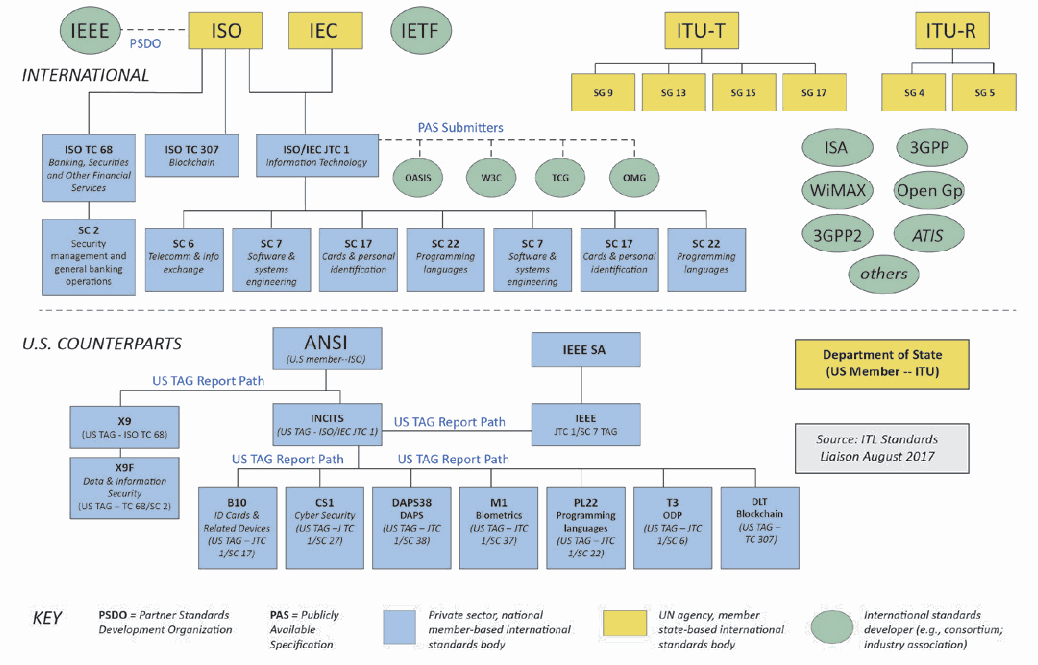
図1:サイバーセキュリティに関わるSDO。破線で上段の INTERNATIONAL(国際)と下段の U.S. COUNTERPARTS(米国の対応組織)に分けた組織図である。国際側:IEEE は ISO と PSDO と記した破線で結ばれ、ISO・IEC(黄)と IETF(緑)がある。ISO は ISO TC 68(Banking, Securities and Other Financial Services)とその下の SC 2(Security management and general banking operations)、および ISO TC 307(Blockchain)につながる。ISO と IEC は共同で ISO/IEC JTC 1(Information Technology)につながる。JTC 1 からは「PAS Submitters」の破線で OASIS、W3C、TCG、OMG へつながり、下位に SC 6(Telecomm & info exchange)、SC 7(Software & systems engineering)、SC 17(Cards & personal identification)、SC 22(Programming languages)、さらに再び SC 7、SC 17、SC 22 が並ぶ。ITU-T の下に SG 9、SG 13、SG 15、SG 17、ITU-R の下に SG 4、SG 5 がある。独立した緑の楕円として ISA、3GPP、WiMAX、Open Gp、3GPP2、ATIS、others がある。米国側:ANSI(U.S member--ISO)から「US TAG Report Path」で X9(US TAG - ISO TC 68)へつながり、X9 には X9F(Data & Information Security, US TAG - TC 68/SC 2)がある。また、ANSI から INCITS(US TAG - ISO/IEC JTC 1)へつながる。INCITS から「US TAG Report Path」で IEEE SA の下の IEEE(JTC 1/SC 7 TAG)へつながり、さらに「US TAG Report Path」で B10(ID Cards & Related Devices, US TAG - JTC 1/SC 17)、CS1(Cyber Security, US TAG - JTC 1/SC 27)、DAPS38(DAPS, US TAG - JTC 1/SC 38)、M1(Biometrics, US TAG - JTC 1/SC 37)、PL22(Programming languages, US TAG - JTC 1/SC 22)、T3(ODP, US TAG - JTC 1/SC 6)、DLT(Blockchain, US TAG - TC 307)へつながる。ほかに Department of State(US Member -- ITU)と「Source: ITL Standards Liaison August 2017」の注記がある。凡例(KEY):PSDO=Partner Standards Development Organization、PAS=Publicly Available Specification、青の箱=民間部門の国家会員制国際標準化団体、黄の箱=国連機関で加盟国単位の国際標準化団体、緑の楕円=国際標準の開発者(コンソーシアム、業界団体など)。
Figure 1: SDOs involved in Cybersecurity
図1:サイバーセキュリティに関わるSDO
IT Security Techniques Standards – ISO/IEC SC27
ITセキュリティ技術の標準 – ISO/IEC SC27
The ITL staff actively participate with JTC1/SC27 and its working groups to develop standards for the protection of information and communications technology (ICT). This includes generic methods, techniques and guidelines to address both security and privacy aspects, such as:
ITLの職員は、JTC1/SC27およびその作業部会に積極的に参加し、情報通信技術(ICT)を保護するための標準を策定しています。これには、次のような、セキュリティとプライバシーの両面に対処するための汎用的な手法、技術およびガイドラインが含まれる:
•Management of information and ICT security; in particular, information security management systems, security processes, and security controls and services;
•情報セキュリティおよびICTセキュリティの管理。特に、情報セキュリティマネジメントシステム、セキュリティプロセス、ならびにセキュリティ管理策およびセキュリティサービス。
•Cryptographic and other security mechanisms, including but not limited to, mechanisms for protecting the accountability, availability, integrity and confidentiality of information;
•暗号およびその他のセキュリティメカニズム。情報の責任追跡性、可用性、完全性および機密性を保護するためのメカニズムを含みますが、これらに限定されません。
•Security management support documentation, including terminology and guidelines as well as procedures for the registration of security components;
•セキュリティ管理を支援する文書。用語およびガイドライン、ならびにセキュリティ構成要素の登録手続きを含みます。
•Security aspects of identity management, biometrics and privacy;
•アイデンティティ管理、バイオメトリクスおよびプライバシーのセキュリティ面。
•Conformance assessment, accreditation and auditing requirements in the area of information security management systems; and
•情報セキュリティマネジメントシステムの分野における適合性評価、認定および監査の要求事項。および
•Security evaluation criteria and methodology.
•セキュリティ評価の基準と方法論。
The ITL staff also engages in active liaison and collaboration with appropriate bodies to ensure the proper development and application of SC 27 standards and technical reports in relevant areas.
ITLの職員は、関連分野においてSC 27の標準および技術報告書が適切に策定され適用されるよう、しかるべき団体との積極的なリエゾンおよび協力にも携わっています。
CONTACT:
連絡先:
Mr. Salvatore Francomacaro, (301) 975-6414, salfra@nist.gov
Mr. Salvatore Francomacaro, (301) 975-6414, salfra@nist.gov
NIST Cybersecurity Framework – International Standardization
NIST Cybersecurity Framework – 国際標準化
The NIST/ITL staff actively participate with JTC1/SC27 and its working groups to support the NIST Cybersecurity Framework International Standardizations strategy.
NIST/ITLの職員は、JTC1/SC27およびその作業部会に積極的に参加し、NIST Cybersecurity Frameworkの国際標準化戦略を支援しています。
The main focus for FY 2017 was the development of a Technical Specification based on ISO/IEC 27101 – Guidelines for developing cybersecurity frameworks. This Technical Specification (TS) represents the work done by a U.S. group on NIST Cybersecurity Framework and should serve as a guideline for other organizations considering creating a new cybersecurity framework.
2017会計年度の主な重点は、ISO/IEC 27101 – Guidelines for developing cybersecurity frameworksに基づくTechnical Specificationの策定でした。このTechnical Specification(TS)は、米国のグループがNIST Cybersecurity Frameworkについて行った作業を反映したものであり、新たなサイバーセキュリティフレームワークの作成を検討している他の組織にとっての指針となるはずです。
The NIST staff was also active in the definition of another ISO Technical Specification: Cybersecurity Overview and Concepts. This TS should target any user concerned with cybersecurity, but is particularly targeted toward decision makers. It should cover, among other things, what cybersecurity IS and IS NOT, how it applies to existing standards, and how it fits in with the other ISO/IEC 27000 series of standards.
NISTの職員は、もう1つのISO技術仕様書(Technical Specification)であるCybersecurity Overview and Conceptsの策定にも積極的に関与しました。このTSは、サイバーセキュリティに関心を持つあらゆる利用者を対象とすべきものですが、とりわけ意思決定者に向けたものです。このTSは、とりわけ、サイバーセキュリティとは何であり何でないのか、それが既存の規格にどのように適用されるのか、そしてISO/IEC 27000シリーズの他の規格とどのように整合するのかを扱うべきです。
The NIST staff will increase participation and effort on these activities during FY 2018.
NISTの職員は、2018会計年度中、これらの活動への参加と取り組みを強化します。
CONTACT:
連絡先:
Mr. Matt Barrett, (301) 975-6259, matthew.barrett@nist.gov
Mr. Matt Barrett, (301) 975-6259, matthew.barrett@nist.gov
ISO Standardization of Security Requirements for Cryptographic Modules
暗号モジュールのセキュリティ要件のISO標準化
ITL is also the principal editor, co-editor, and contributor to many ISO/IEC documents by the ISO/IEC International Organization for Standardization. ITL’s contributions to the development of these international standards help to create a strong foundation for the adoption of and migration from currently used national standards. In particular, this adoption promotes international harmonization for the implementation and testing of cryptographic algorithms and modules, while accommodating individual country preferences in the choice of approved security functions.
ITLはまた、ISO/IEC(国際標準化機構)による多くのISO/IEC文書の主任編集者、共同編集者および寄稿者でもあります。これらの国際規格の策定に対するITLの貢献は、国際規格の採用と、現在使用されている国内規格からの移行のための強固な基盤を築くのに役立っています。特に、この採用は、承認されたセキュリティ機能の選択における各国の意向を受け入れつつ、暗号アルゴリズムおよび暗号モジュールの実装と試験に関する国際的な調和を促進します。
ITL has contributed to the activities of ISO/IEC JTC 1 SC/27, which published ISO/IEC 19790, Security Requirements for Cryptographic Modules, on March 1, 2006, and ISO/IEC 24759, Test Requirements for Cryptographic Modules, on July 1, 2008. ISO/IEC 19790 specifies the security requirements for a cryptographic module utilized within a security system protecting sensitive information in computer and telecommunication systems. These efforts bring consistent testing of cryptographic modules to the global community by providing ISO-equivalent standards representing Federal Information Processing Standard (FIPS) 140-2, Security Requirements for Cryptographic Modules and Derived Test Requirements [DTR] for FIPS 140-2, Security Requirements for Cryptographic Modules. Mr. Randall Easter (CSD) continues as the principal editor for these standards.
ITLは、ISO/IEC JTC 1 SC/27の活動に貢献してきました。同委員会は、2006年3月1日にISO/IEC 19790, Security Requirements for Cryptographic Modulesを、2008年7月1日にISO/IEC 24759, Test Requirements for Cryptographic Modulesを発行しました。ISO/IEC 19790は、コンピュータシステムおよび電気通信システムにおいて機微な情報を保護するセキュリティシステムの中で利用される暗号モジュールのセキュリティ要件を規定しています。これらの取り組みは、Federal Information Processing Standard (FIPS) 140-2, Security Requirements for Cryptographic ModulesおよびDerived Test Requirements [DTR] for FIPS 140-2, Security Requirements for Cryptographic Modulesに相当するISO規格を提供することにより、暗号モジュールの一貫した試験を世界のコミュニティにもたらしています。Mr. Randall Easter(CSD)は、引き続きこれらの規格の主任編集者を務めています。
ISO/IEC JTC 1/SC 27 Working Group (WG) 3 completed and published revisions, followed with updated corrections, of ISO/IEC 19790:2006 and ISO/IEC 24759:2008. The second revision of ISO/IEC 19790 was published on August 15, 2012. The second revision of ISO/IEC 24759 was published on January 31, 2014 and the third revision was published March 2017. Both ISO/IEC standards are available through the American National Standards Institute (ANSI) (see: http://webstore.ansi.org/RecordDetail.aspx?sku=ISO%2FIEC+19790%3A2012). The two ISO/IEC revisions were developed with international support and the collaboration of governments, industry and academia.
ISO/IEC JTC 1/SC 27 Working Group (WG) 3は、ISO/IEC 19790:2006およびISO/IEC 24759:2008の改訂版を完成させて発行し、その後、更新された訂正を発行しました。ISO/IEC 19790の第2版は2012年8月15日に発行されました。ISO/IEC 24759の第2版は2014年1月31日に発行され、第3版は2017年3月に発行されました。いずれのISO/IEC規格も、American National Standards Institute (ANSI)を通じて入手できます(参照:http://webstore.ansi.org/RecordDetail.aspx?sku=ISO%2FIEC+19790%3A2012)。この2つのISO/IEC改訂版は、国際的な支援と、政府、産業界および学術界の協力を得て策定されました。
The revision of ISO/IEC 19790:2012 addresses new security areas, such as defined software module boundaries, degraded modes of operation, trusted channels, two-factor authentication, software security, mitigation of fault induction and side-channel attacks, operational self-tests for algorithms, and lifecycle assurance from design to end-of-life.
ISO/IEC 19790:2012の改訂は、新たなセキュリティ領域を扱っています。たとえば、定義されたソフトウェアモジュール境界、縮退動作モード、トラステッドチャネル、二要素認証、ソフトウェアセキュリティ、故障誘発攻撃およびサイドチャネル攻撃の緩和、アルゴリズムの動作時自己テスト、設計から寿命終了までのライフサイクル保証です。
Figure 2 is a chart of the ISO/IEC standards, as explained above, in which CSD has played a part during the development process.
図2は、上で説明したとおり、策定過程においてCSDが役割を果たしたISO/IEC規格の図です。
In addition to the aforementioned standards, International Standards ISO/IEC 17825, Testing methods for the mitigation of non-invasive attack classes against cryptographic modules, was published on January 15, 2016 and ISO/IEC 18367, Cryptographic algorithms and security mechanisms conformance testing, was published on December 15, 2016. Mr. Easter was the editor of both standards.
上記の規格に加えて、国際規格ISO/IEC 17825, Testing methods for the mitigation of non-invasive attack classes against cryptographic modulesが2016年1月15日に、ISO/IEC 18367, Cryptographic algorithms and security mechanisms conformance testingが2016年12月15日に発行されました。Mr. Easterは、両規格の編集者でした。
International Standard ISO/IEC 17825 specifies the non-invasive attack mitigation test metrics for determining conformance to the requirements specified in ISO/IEC 19790 for Security Levels 3 and 4. The test metrics are associated with the security functions specified in ISO/IEC 19790. Testing will be conducted at the defined boundary of the cryptographic module and using Input/Output (I/O) available at the defined boundary.
国際規格ISO/IEC 17825は、セキュリティレベル3および4についてISO/IEC 19790に規定された要件への適合性を判定するための、非侵襲攻撃の緩和に関する試験指標を規定しています。この試験指標は、ISO/IEC 19790に規定されたセキュリティ機能に対応付けられています。試験は、暗号モジュールの定義された境界において、その境界で利用可能な入出力(I/O)を用いて実施されます。
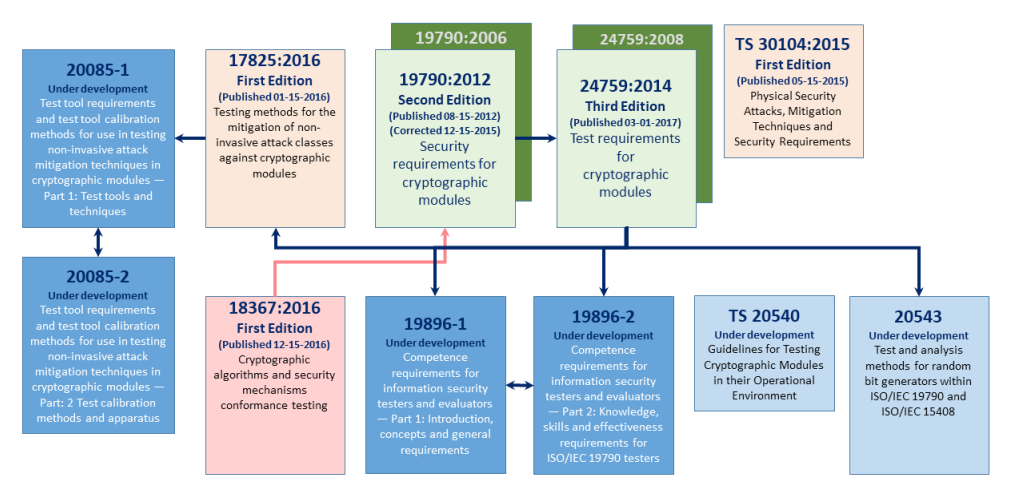
図2:暗号モジュール試験 – ISO規格。ISO/IEC 規格を色分けした箱と矢印で示した図である。上段:20085-1(Under development。非侵襲攻撃緩和技術の試験に用いる試験ツール要件と試験ツール校正方法 — Part 1: Test tools and techniques)、17825:2016(First Edition、2016-01-15 発行。暗号モジュールに対する非侵襲攻撃クラスの緩和の試験方法)、19790:2012(Second Edition、2012-08-15 発行、2015-12-15 訂正。暗号モジュールのセキュリティ要件。背後に 19790:2006 が重なる)、24759:2014(Third Edition、2017-03-01 発行。暗号モジュールの試験要件。背後に 24759:2008 が重なる)、TS 30104:2015(First Edition、2015-05-15 発行。物理的セキュリティ攻撃、緩和技術およびセキュリティ要件)。下段:20085-2(Under development。同名の Part 2: Test calibration methods and apparatus)、18367:2016(First Edition、2016-12-15 発行。暗号アルゴリズムおよびセキュリティメカニズムの適合性試験)、19896-1(Under development。情報セキュリティの試験者・評価者の力量要件 — Part 1: 序論、概念および一般要件)、19896-2(Under development。同 — Part 2: ISO/IEC 19790 試験者の知識・技能・有効性の要件)、TS 20540(Under development。運用環境における暗号モジュールの試験の指針)、20543(Under development。ISO/IEC 19790 および ISO/IEC 15408 における乱数ビット生成器の試験・分析方法)。矢印:17825:2016 から 20085-1 へ、20085-1 と 20085-2 は双方向、19790:2012 から 24759:2014 へ。24759:2014 からの接続線が 17825:2016、19896-1、19896-2、20543 へ延びる。18367:2016 から 19790:2012 へ桃色の線が延び、19896-1 と 19896-2 は双方向の矢印で結ばれる。TS 30104:2015 と TS 20540 には接続線がない。
Figure 2: Cryptographic Module Testing – ISO Standards
図2:暗号モジュール試験 – ISO規格
International Standard ISO/IEC 18367 describes conformance testing methods for cryptographic algorithms and security mechanisms. Conformance testing assures that an implementation of a cryptographic algorithm or security mechanism is correct whether implemented in hardware, software or firmware. It also confirms that it runs correctly in a specific operating environment. Testing may consist of known-answer or Monte Carlo testing, or a combination of test methods. Testing may be performed on the actual implementation or modeled in a simulation environment.
国際規格ISO/IEC 18367は、暗号アルゴリズムおよびセキュリティメカニズムの適合性試験の方法を記述しています。適合性試験は、暗号アルゴリズムまたはセキュリティメカニズムの実装が、ハードウェア、ソフトウェア、ファームウェアのいずれで実装されているかにかかわらず正しいことを保証します。また、その実装が特定の動作環境において正しく動作することも確認します。試験は、既知解試験もしくはモンテカルロ試験、または複数の試験方法の組み合わせで構成されることがあります。試験は、実際の実装に対して実施されることもあれば、シミュレーション環境でモデル化して実施されることもあります。
The test methods used by testing laboratories to test whether the cryptographic module conforms to the requirements specified in ISO/IEC 19790 and the test metrics specified in this International Standard for each of the associated security functions specified in ISO/IEC 19790 are specified in ISO/IEC 24759. The test approach employed in this International Standard is an efficient “push-button” approach: the tests are technically sound, repeatable and have moderate costs.
暗号モジュールがISO/IEC 19790に規定された要件、およびISO/IEC 19790に規定された関連する各セキュリティ機能についてこの国際規格に規定された試験指標に適合しているかどうかを試験するために試験機関が用いる試験方法は、ISO/IEC 24759に規定されています。この国際規格で採用されている試験アプローチは、効率的な「プッシュボタン」方式です。すなわち、試験は技術的に妥当であり、再現可能であり、費用も中程度です。
FOR MORE INFORMATION, SEE:
詳細については、以下を参照:
https://csrc.nist.gov/Projects/Cryptographic-Module-Validation-Program
https://csrc.nist.gov/Projects/Cryptographic-Module-Validation-Program
CONTACT:
連絡先:
Mr. Randall J. Easter, (240) 361-8777, randall.easter@nist.gov
Mr. Randall J. Easter, (240) 361-8777, randall.easter@nist.gov
Next Generation Access Control Standards
次世代アクセス制御規格
ITL has continued the development of an advanced Attribute Based Access Control (ABAC) framework called the Policy Machine, which was designed to be in alignment with an emerging ANSI/INCITS standard under the title of “Next Generation Access Control” (NGAC).
ITLは、Policy Machineと呼ばれる高度な属性ベースアクセス制御(Attribute Based Access Control、ABAC)フレームワークの開発を継続してきました。Policy Machineは、「Next Generation Access Control」(NGAC)という名称で策定が進むANSI/INCITS規格と整合するように設計されました。
The NIST Policy Machine research and development effort has resulted in three ongoing national standards projects in CS1 that are in the early stages of development. They include:
NISTのPolicy Machineの研究開発の取り組みは、CS1において進行中の3つの国内規格プロジェクトにつながっており、これらは策定の初期段階にあります。それらは以下のとおりです。
•Next Generation Access Control – Functional Architecture (NGAC-FA). Project number INCITS 499-2013, was published in FY 2013 and is currently under revision.
•Next Generation Access Control – Functional Architecture (NGAC-FA)。プロジェクト番号INCITS 499-2013であり、2013会計年度に発行され、現在改訂中です。
•Next Generation Access Control – Generic Operations & Abstract Data Structures (NGAC-GOADS). Serban Gavrila, ITL, is the editor. The project is assigned project number 2195-D, and the document was published during FY 2016.
•Next Generation Access Control – Generic Operations & Abstract Data Structures (NGAC-GOADS)。ITLのSerban Gavrilaが編集者です。このプロジェクトにはプロジェクト番号2195-Dが割り当てられており、文書は2016会計年度中に発行されました。
•Next Generation Access Control – Implementation Requirements, Protocols and API Definitions (NGAC-IRPADS). Project number 2193-D has been assigned. This part will be published in FY 2018.
•Next Generation Access Control – Implementation Requirements, Protocols and API Definitions (NGAC-IRPADS)。プロジェクト番号2193-Dが割り当てられています。この部は2018会計年度に発行される予定です。
CONTACTS:
連絡先:
Mr. David Ferraiolo, (301) 975-3046, david.ferraiolo@nist.gov
Mr. David Ferraiolo, (301) 975-3046, david.ferraiolo@nist.gov
Mr. Serban Gavrila, (301) 975-4343, serban.gavrila@nist.gov
Mr. Serban Gavrila, (301) 975-4343, serban.gavrila@nist.gov
Identity Management Devices and Standards
アイデンティティ管理のデバイスと規格
In the area of Identity Tokens and Secure elements, ITL has provided the technical and editorial support of Mr. Ketan Mehta (CSD) in the development and amendment of American National Standard (ANS) 504, Generic Identity Command Set (GICS). GICS enables Personal Identity Verification (PIV), PIV-Interoperable (PIV-I) and Common Access Card (CAC) applications, and others, to be built from a single platform. GICS defines an open platform where identity applications can be instantiated, deployed, and used in an interoperable way between the credential issuers and credential users that aligns with the last revision of the NIST SP 800-73-4, Interfaces for Personal Identity Verification, (PIV) specifications.
アイデンティティトークンおよびセキュアエレメントの分野において、ITLは、American National Standard (ANS) 504, Generic Identity Command Set (GICS)の策定と修正に、Mr. Ketan Mehta(CSD)による技術面および編集面の支援を提供してきました。GICSは、Personal Identity Verification (PIV)、PIV-Interoperable (PIV-I)、Common Access Card (CAC)などのアプリケーションを単一のプラットフォームから構築できるようにします。GICSは、クレデンシャルの発行者と利用者の間で相互運用可能な形でアイデンティティアプリケーションをインスタンス化し、展開し、使用できるオープンなプラットフォームを定義しており、これはNIST SP 800-73-4, Interfaces for Personal Identity Verification, (PIV)の仕様の最新の改訂と整合しています。
During FY 2017, the ITL staff:
2017会計年度中、ITLの職員は以下を行いました。
•Contributed to the publication of several revisions of the ISO/IEC 7816 family of standards (Identification cards - Integrated circuit cards), which are all relevant to FIPS 201, Personal Identity Verification (PIV) of Federal Employees and Contractors, specifications;
•ISO/IEC 7816規格群(Identification cards - Integrated circuit cards)の複数の改訂版の発行に貢献しました。これらはいずれも、FIPS 201, Personal Identity Verification (PIV) of Federal Employees and Contractorsの仕様に関連するものです。
•Pursued the standardization and harmonization of identity standards that were developed in the U.S.;
•米国で策定されたアイデンティティ規格の標準化と調和を推進しました。
•Developed requirements and identified standards gaps for Mobile Driving Licenses;
•モバイル運転免許証に関する要件を策定し、規格上のギャップを特定しました。
•Actively participated in the development of a standards for Mobile Driving Licenses;
•モバイル運転免許証に関する規格の策定に積極的に参加しました。
•Enhanced the Machine-Readable Travel Documents (ePassport) data model to address privacy and security concerns; and
•プライバシーとセキュリティに関する懸念に対処するため、機械可読渡航文書(ePassport)のデータモデルを強化しました。
•Contributed to the development of a standard for privacy-enhanced security protocols for secure elements.
•セキュアエレメント向けのプライバシー強化型セキュリティプロトコルに関する規格の策定に貢献しました。
The ITL staff will continue to actively support relevant ID management standard initiatives, such as ISO/IEC 19286, Integrated circuit card (ICC) Privacy-enhancing protocols and services, and ISO/IEC 18328, ICC managed devices.
ITLの職員は、ISO/IEC 19286, Integrated circuit card (ICC) Privacy-enhancing protocols and servicesやISO/IEC 18328, ICC managed devicesなど、関連するID管理規格の取り組みを引き続き積極的に支援します。
Web Authentication/FIDO:
Web認証/FIDO:
ITL participates in the development of online authentication specifications. These specifications are developed by the Fast Identities Online (FIDO) alliance, which is a consortium of private organizations. ITL also participates in the development of similar specifications (called WebAuthn) for web browsers that are being developed by the World Wide Web Consortium (W3C). Both the FIDO and WebAuthn specifications enable relying parties to create cryptographic tokens on the end-user’s device and subsequently use this cryptographic token to authenticate the end user. These specifications provide multi-factor authentication directives, and they are designed to mitigate common threat vectors for Internet communications, such as phishing, man-in-the-middle, and replay attacks.
ITLは、オンライン認証の仕様の策定に参加しています。これらの仕様は、民間組織のコンソーシアムであるFast Identities Online (FIDO) allianceによって策定されています。ITLはまた、World Wide Web Consortium (W3C)が策定を進めている、Webブラウザ向けの同様の仕様(WebAuthnと呼ばれる)の策定にも参加しています。FIDOとWebAuthnのいずれの仕様も、依拠当事者がエンドユーザのデバイス上に暗号トークンを作成し、その後この暗号トークンを使用してエンドユーザを認証できるようにします。これらの仕様は多要素認証の指示を定めており、フィッシング、中間者攻撃、リプレイ攻撃など、インターネット通信における一般的な脅威ベクトルを緩和するように設計されています。
ePassport:
ePassport:
ITL participates in the development of an ISO/IEC standard (ISO/IEC 7501) for electronic Passports. Specifically, ITL is contributing to the development of passport data structure and its access control. ITL reviews and comments on authentication protocols that are developed to ensure strong user authentication and to protect personally identifiable passport data.
ITLは、電子パスポートに関するISO/IEC規格(ISO/IEC 7501)の策定に参加しています。具体的には、ITLはパスポートのデータ構造とそのアクセス制御の策定に貢献しています。ITLは、強固な利用者認証を確保し、個人を識別できるパスポートデータを保護するために策定される認証プロトコルをレビューし、コメントしています。
Mobile Driver License:
モバイル運転免許証:
ITL is also participating in the development of an ISO standard (ISO/IEC 18013) for an International Mobile Driver License (DL). ITL gathered and discussed functional and security requirements for Mobile DLs, and is now developing two models: offline and online. Once these models are fully defined, ITL plans to write technical specifications for each model.
ITLはまた、国際モバイル運転免許証(DL)に関するISO規格(ISO/IEC 18013)の策定にも参加しています。ITLは、モバイルDLの機能要件およびセキュリティ要件を収集して議論し、現在はオフラインとオンラインの2つのモデルを策定しています。これらのモデルが完全に定義された後、ITLは各モデルの技術仕様を作成する予定です。
CONTACTS:
連絡先:
Mr. Salvatore Francomacaro, (301) 975-6414, salvatore.francomacaro@nist.gov
Mr. Salvatore Francomacaro, (301) 975-6414, salvatore.francomacaro@nist.gov
Mr. Ketan Mehta, (301) 975-8405, ketan.mehta@nist.gov
Mr. Ketan Mehta, (301) 975-8405, ketan.mehta@nist.gov
Identity Management International Standardization with ISO/IEC SC27
ISO/IEC SC27におけるアイデンティティ管理の国際標準化
During FY 2017, NIST ACD’s Trusted Identities Group (TIG) collaborated with representatives from the United Kingdom (U.K.) Cabinet Office and the Canadian Treasury Board to identify commonalities and work to align the digital identity standards and requirements among the respective national digital identity programs, particularly SP 800-63-3 for the U.S. and the U.K. Good Practice Guides (GPG). The goal in these efforts is to promote a vibrant market of internationally viable identity services and advance the secure exchange of digital identities while protecting the privacy of the subjects of those identities for cross-border transactions and mutual recognition. While primarily focused on developing a framework that would facilitate the establishment of a common set of requirements and standards across the three national programs, there was increasing interest from other national programs and industry in the work products and methodologies developed by this collaborative work. As a result, the group provided this work to the international community as a series of aligned joint contributions for international standardization.
2017会計年度中、NIST ACDのTrusted Identities Group (TIG)は、英国(U.K.)のCabinet OfficeおよびカナダのTreasury Boardの代表者と協力して、それぞれの国のデジタルアイデンティティプログラムの間で共通点を特定し、デジタルアイデンティティの規格と要件、特に米国のSP 800-63-3と英国のGood Practice Guides (GPG)を整合させる作業を行いました。これらの取り組みの目標は、国際的に通用するアイデンティティサービスの活発な市場を促進し、国境を越えたトランザクションと相互承認のために、アイデンティティの主体のプライバシーを保護しつつ、デジタルアイデンティティの安全な交換を前進させることです。主な焦点は、3か国のプログラムにわたって共通の要件と規格の確立を促すフレームワークの策定にありましたが、この共同作業で作成された成果物と方法論に対して、他国のプログラムや産業界からの関心が高まっていきました。その結果、同グループは、国際標準化に向けた一連の整合された共同寄書として、この作業の成果を国際コミュニティに提供しました。
The TIG contributions, in collaboration with their British and Canadian partners, were focused on establishing a synchronized core set of international identity management standards within the scope of the activities of ISO/IEC JTC 1/SC 27/WG 5, which oversees the development of international standards for identity management and privacy. The team provided contributions to synchronize and align the following ISO/IEC standards with the U.K., Canadian, and U.S. harmonization work:
TIGの寄書は、英国およびカナダのパートナーと協力したものであり、アイデンティティ管理とプライバシーに関する国際規格の策定を統括するISO/IEC JTC 1/SC 27/WG 5の活動範囲内で、同期の取れた中核的な国際アイデンティティ管理規格群を確立することに焦点を当てていました。同チームは、以下のISO/IEC規格を英国、カナダ、米国の調和作業と同期させ整合させるための寄書を提供しました。
•ISO/IEC 29115 Information Technology — Security techniques — Entity authentication assurance framework – a major revision is required to align with SP 800-63 B and GPG 44;
•ISO/IEC 29115 Information Technology — Security techniques — Entity authentication assurance framework – SP 800-63 BおよびGPG 44と整合させるには大幅な改訂が必要です。
•ISO/IEC 29003 Information technology — Security techniques — Identity proofing;
•ISO/IEC 29003 Information technology — Security techniques — Identity proofing
•ISO 31000 Risk management framework applied to identity-related risk, a new work project for a new international standard that will be aligned with the risk management section of NIST SP 800-63-3;
•ISO 31000 Risk management frameworkをアイデンティティ関連のリスクに適用するもの。NIST SP 800-63-3のリスク管理の節と整合させる新しい国際規格のための新規作業プロジェクトです。
•Identity related standards landscape, a new work project to establish a clear and aligned landscape for ISO/IEC identity standards and administrative processes and to establish rules for how the development and maintenance of an aligned set of identity management standards could be coordinated and managed within ISO/IEC WG5; and
•アイデンティティ関連規格の全体像(Identity related standards landscape)。ISO/IECのアイデンティティ規格と運営プロセスについて明確で整合の取れた全体像を確立するとともに、整合されたアイデンティティ管理規格群の策定と保守をISO/IEC WG5の中でどのように調整し管理できるかに関する規則を確立するための新規作業プロジェクトです。
•Identity assurance framework, a new work project for a new international standard that will be aligned with the identity assurance components of SP 800-63A and the U.K. GPG 45.
•アイデンティティ保証フレームワーク(Identity assurance framework)。SP 800-63Aおよび英国のGPG 45のアイデンティティ保証の構成要素と整合させる新しい国際規格のための新規作業プロジェクトです。
CONTACT:
連絡先:
Mr. David Temoshok, (202) 482-5475, david.temoshok@nist.gov
Mr. David Temoshok, (202) 482-5475, david.temoshok@nist.gov
Blockchains
ブロックチェーン
During FY 2017, NIST participated in standards activities exploring blockchain technologies, architectures, and use cases. These included participation in a new blockchain study group sponsored by the American Standards Committee X9, the financial services committee of the American National Standards Institute (ANSI), and continued work in the International Standards Organization (ISO) Technical Committee (TC) for Blockchains and Distributed Ledger Technologies (ISO/TC 307). Established in 2016, the initial objectives of ISO/TC 307 include defining key terms and concepts, exploring reference architectures, investigating use cases, and identifying identity and privacy implications within blockchain technologies and architectures. NIST has been participating in these activities via the national mirror committee within the InterNational Committee for Information Technology Standards (INCITS). ISO/TC 307 will meet in November 2017, where the reports on these topics will be reviewed and new work will be established.
2017会計年度中、NISTは、ブロックチェーンの技術、アーキテクチャおよびユースケースを探る標準化活動に参加しました。これには、American National Standards Institute (ANSI)の金融サービス委員会であるAmerican Standards Committee X9が主催する新しいブロックチェーン研究グループへの参加と、International Standards Organization (ISO)のブロックチェーンおよび分散台帳技術に関するTechnical Committee (TC)(ISO/TC 307)における継続的な作業が含まれます。ISO/TC 307は2016年に設立され、その当初の目的には、主要な用語と概念の定義、参照アーキテクチャの探究、ユースケースの調査、ブロックチェーンの技術とアーキテクチャにおけるアイデンティティおよびプライバシーへの影響の特定が含まれます。NISTは、InterNational Committee for Information Technology Standards (INCITS)内の国内ミラー委員会を通じてこれらの活動に参加してきました。ISO/TC 307は2017年11月に会合を開き、そこでこれらのテーマに関する報告書がレビューされ、新たな作業が立ち上げられます。
CONTACTS:
連絡先:
Mr. Dylan Yaga, (301)-975-6004, dylan.yaga@nist.gov
Mr. Dylan Yaga, (301)-975-6004, dylan.yaga@nist.gov
Dr. Lily Chen, (301) 975-6974, lily.chen@nist.gov
Dr. Lily Chen, (301) 975-6974, lily.chen@nist.gov
Internet of Things (IoT)
モノのインターネット(IoT)
NIST/ITL has contributed to standardization activities for the IoT architecture and vocabulary during FY 2017 in three primary areas:
NIST/ITLは、2017会計年度中、IoTのアーキテクチャと語彙に関する標準化活動に、主に次の3つの場で貢献しました。
•The Industrial Internet Consortium (IIC);
•Industrial Internet Consortium (IIC)
•ISO/IEC SC41, Internet of Things and related technologies; and
•ISO/IEC SC41, Internet of Things and related technologies
•IEEE P2413, Standard for an Architectural Framework for the Internet of Things (IoT).
•IEEE P2413, Standard for an Architectural Framework for the Internet of Things (IoT)
Focus was on the architecture, vocabulary, and recently, edge computing. In addition to working on standards related to these areas, NIST staff member Eric Simmon is the chair of the IIC commenting working group for reviewing the IEEE p2413 draft standard and is the liaison between ISO/IEC SC41-ISO/IEC SC38 (cloud computing).
焦点は、アーキテクチャ、語彙、そして最近ではエッジコンピューティングに置かれました。これらの分野に関連する規格に取り組むことに加えて、NISTの職員であるEric Simmonは、IEEE p2413規格草案をレビューするためのIICのコメント作業グループの議長であり、ISO/IEC SC41とISO/IEC SC38(クラウドコンピューティング)の間のリエゾンでもあります。
The NIST staff has also participated to the activities in ISO/IEC SC27 relative to IoT Security. This activity will be further developed during FY 2018.
NISTの職員は、IoTセキュリティに関するISO/IEC SC27の活動にも参加しました。この活動は、2018会計年度中にさらに展開されます。
CONTACTS:
連絡先:
Mr. Eric Simmon, (301) 975-3956, eric.simmon@nist.gov
Mr. Eric Simmon, (301) 975-3956, eric.simmon@nist.gov
Ms. Katerina Megas, (202) 441-1147, katerina.megas@nist.gov
Ms. Katerina Megas, (202) 441-1147, katerina.megas@nist.gov
Cloud Computing Standards Developed Within ISO/IEC JTC 1
ISO/IEC JTC 1内で策定されるクラウドコンピューティング規格
ITL is actively engaged with several key players in the Federal Government which look broadly at questions of IT standards, how to influence them, and how to use them. These participants include the Office of Management and Budget (OMB) E-Gov Office and Office of Information and Regulatory Affairs, the federal Chief Information Officers (CIO) Council, the Interagency Council on Standards Policy (ICSP), and the General Services Administration (GSA) Office of Government-wide Policy. Our goal in chairing the Standards Working Group is to solicit requirements from federal agencies, find the appropriate voluntary standards committee that is addressing these requirements and encourage participation to ensure the government requirements are being adequately met. Where standards are needed, ITL works closely with U.S. industry, standards development organizations, other government agencies, and leaders in the global standards community to develop standards that will support secure cloud computing.
ITLは、IT規格の問題、すなわち規格にどのように影響を与え、どのように利用するかを幅広く検討している連邦政府内の複数の主要な関係者と積極的に連携しています。これらの関係者には、Office of Management and Budget (OMB)のE-Gov OfficeおよびOffice of Information and Regulatory Affairs、連邦のChief Information Officers (CIO) Council、Interagency Council on Standards Policy (ICSP)、ならびにGeneral Services Administration (GSA)のOffice of Government-wide Policyが含まれます。Standards Working Groupの議長を務めるにあたっての我々の目標は、連邦政府機関から要件を募り、それらの要件に取り組んでいる適切な任意規格の委員会を見つけ、政府の要件が十分に満たされるように参加を促すことです。規格が必要とされる場合、ITLは、米国の産業界、標準化団体、他の政府機関、および世界の標準化コミュニティのリーダーと緊密に協力して、安全なクラウドコンピューティングを支える規格を策定します。
ITL participation helps to ensure the alignment of NIST standards with those of ISO/IEC JTC 1 subcommittees, such as SC 27 IT Security techniques, SC 38 Cloud Computing and Distributed Platforms, and their U.S. counterparts, ANSI/ INCITS Cyber Security 1 (CS 1) and Cloud 38. The large number of standards being developed in SC 27 covering areas such as security, cryptography, privacy, supply chain, personally identifiable information (PII) processing or virtualization security, harmonize with many cloud computing standards being developed by these subcommittees.
ITLの参加は、NISTの規格と、SC 27 IT Security techniquesやSC 38 Cloud Computing and Distributed PlatformsなどのISO/IEC JTC 1の分科委員会、およびそれらに対応する米国の組織であるANSI/ INCITS Cyber Security 1 (CS 1)やCloud 38の規格との整合を確保するのに役立っています。セキュリティ、暗号、プライバシー、サプライチェーン、個人を識別できる情報(PII)の処理、仮想化セキュリティなどの分野を対象としてSC 27で策定されている多数の規格は、これらの分科委員会が策定している多くのクラウドコンピューティング規格と調和しています。
The focus of implementing cloud computing is even more critical since the White House released an IT Modernization Report in September 2017 that includes recommendations for agencies to take steps to secure and modernize federal IT networks. Those steps for modernizing and consolidating networks point to cloud computing, modernization of government-hosted applications, and better security for legacy systems. Federal modernization efforts, such as those connected with the Modernizing Government Technology Act, may further enable agencies to accelerate investments in cloud and other new technologies.
ホワイトハウスが2017年9月にIT Modernization Reportを公表し、その中に、政府機関が連邦のITネットワークを安全にし近代化するための措置を講じるべきであるとの勧告が含まれていることから、クラウドコンピューティングの導入に注力することは、なおいっそう重要になっています。ネットワークを近代化し統合するためのこれらの措置は、クラウドコンピューティング、政府がホストするアプリケーションの近代化、およびレガシーシステムのセキュリティ向上を指し示しています。Modernizing Government Technology Actに関連するものなど、連邦政府の近代化の取り組みは、政府機関がクラウドやその他の新技術への投資を加速することを、さらに後押しする可能性があります。
Ms. Annie Sokol is a member of ITL’s Cloud Computing team and is the CSD representative in the standards development program. ITL provides technical and editorial representation in the development of national and international standards in both SC 27 and SC 38. Ms. Sokol is the co-editor of ISO/IEC 19941, Information technology–Cloud computing–Interoperability and portability, which is expected to be published by the end of 2017. The document is intended to establish a common understanding of cloud computing interoperability and portability. Both interoperability and portability offer more choices to cloud users by limiting the effects of being locked-in to any cloud service or cloud service provider. ISO/IEC 19941 joins many published cloud computing standards that were developed from NIST publications, such as:
Ms. Annie Sokolは、ITLのクラウドコンピューティングチームの一員であり、標準化プログラムにおけるCSDの代表です。ITLは、SC 27とSC 38の両方において、国内規格および国際規格の策定に技術面および編集面の代表を送っています。Ms. Sokolは、ISO/IEC 19941, Information technology–Cloud computing–Interoperability and portabilityの共同編集者であり、同規格は2017年末までに発行される見込みです。この文書は、クラウドコンピューティングの相互運用性と可搬性についての共通理解を確立することを意図しています。相互運用性と可搬性はいずれも、特定のクラウドサービスまたはクラウドサービスプロバイダへのロックインの影響を抑えることにより、クラウド利用者により多くの選択肢を提供します。ISO/IEC 19941は、NISTの刊行物をもとに策定され、すでに発行されている多くのクラウドコンピューティング規格に加わるものであり、そうした規格には以下のようなものがあります。
•ISO/IEC 17788, Information technology -- Cloud computing -- Overview and vocabulary;
•ISO/IEC 17788, Information technology -- Cloud computing -- Overview and vocabulary、
•ISO/IEC 17789, Information technology -- Cloud computing -- Reference architecture; and,
•ISO/IEC 17789, Information technology -- Cloud computing -- Reference architecture、および
•ISO/IEC 19086, Information technology -- Cloud computing -- Service level agreement (SLA) framework.
•ISO/IEC 19086, Information technology -- Cloud computing -- Service level agreement (SLA) framework。
CONTACT:
連絡先:
Ms. Annie Sokol, (301) 975-2006, annie.sokol@nist.gov
Ms. Annie Sokol, (301) 975-2006, annie.sokol@nist.gov
RISK MANAGEMENT
リスク管理
Framework for Improving Critical Infrastructure Cybersecurity (Cybersecurity Framework)
Framework for Improving Critical Infrastructure Cybersecurity(Cybersecurity Framework)
Recognizing that the national and economic security of the United States depends on the reliable functioning of its critical infrastructure, the President issued Executive Order (EO) 13636: Improving Critical Infrastructure Cybersecurity, in February of 2013. This EO directed NIST to work with stakeholders to develop a voluntary framework – based on existing standards, guidelines, and practices − for reducing cybersecurity risks to critical infrastructures.
米国の国家安全保障と経済安全保障が重要インフラの確実な機能に依存していることを認識し、大統領は2013年2月に大統領令(EO)13636: Improving Critical Infrastructure Cybersecurity を発出しました。このEOは、重要インフラに対するサイバーセキュリティリスクを低減するための自主的なフレームワークを、既存の標準、ガイドライン及びプラクティスに基づき、利害関係者と協力して策定するようNISTに指示しました。
The Cybersecurity Framework that was developed provides a prioritized, flexible, repeatable, performance-based, and cost-effective approach to help critical infrastructure owners and operators—as well as other interested entities—identify, assess, and manage cybersecurity-related risk while protecting business confidentiality, individual privacy, and civil liberties.
策定された Cybersecurity Framework は、重要インフラの所有者及び運用者、並びにその他の関心を持つ主体が、事業上の機密性、個人のプライバシー及び市民的自由を保護しつつ、サイバーセキュリティ関連のリスクを特定し、アセスメントし、管理することを支援するための、優先順位付けされ、柔軟で、反復可能で、パフォーマンスに基づく、費用対効果の高いアプローチを提供します。
In FY 2017, NIST continued to work with a diverse stakeholder community to support the use and understanding of the Cybersecurity Framework. This process included:
2017会計年度、NISTは、Cybersecurity Framework の利用と理解を支援するため、多様な利害関係者コミュニティとの協力を継続しました。このプロセスには次のものが含まれます。
•Publication of a draft Framework 1.1 to clarify, refine, and enhance the Cybersecurity Framework, drawing upon comments received from a public review process launched in January 2017;
•2017年1月に開始した公開レビュープロセスで寄せられたコメントを踏まえ、Cybersecurity Framework を明確化し、洗練し、強化するための Framework 1.1 の草案を公表したこと
•Conducting a public workshop at NIST in Gaithersburg, MD to gather input about the current use of the Framework and feedback regarding the initial public draft;
•Framework の現在の利用状況に関する意見と初期公開草案に対するフィードバックを収集するため、メリーランド州ゲイザースバーグのNISTで公開ワークショップを開催したこと
•Releasing the 1.0 version of the Baldrige Cybersecurity Excellence Builder, a self-assessment tool to help organizations better understand the effectiveness of their cybersecurity risk-management efforts;
•組織が自らのサイバーセキュリティリスク管理の取組みの有効性をより良く理解することを支援する自己アセスメントツールである Baldrige Cybersecurity Excellence Builder のバージョン1.0をリリースしたこと
•Updates to the Framework website with a catalog of industry resources, upcoming NIST speaking events, and an extensive frequently-asked-question knowledge base;
•産業界のリソースのカタログ、今後予定されているNISTの講演イベント、及び充実したよくある質問のナレッジベースを加えて、Framework のウェブサイトを更新したこと
•Provision of outreach for small- and medium-sized businesses (SMBs), including guidance provided by the Applied Cybersecurity Division (ACD) in NIST Interagency Report (NISTIR) 7621 Rev. 1, Small Business Information Security: The Fundamentals;
•中小企業(SMB)向けのアウトリーチを実施したこと。これには、Applied Cybersecurity Division(ACD)が NIST Interagency Report(NISTIR)7621 Rev. 1, Small Business Information Security: The Fundamentals で提供したガイダンスが含まれる
•Coordinating with critical infrastructure owners and operators, regulators, and other industry organizations through a variety of meetings and industry events to ensure the understanding and use of the Framework;
•Framework の理解と利用を確実にするため、さまざまな会合や業界イベントを通じて、重要インフラの所有者及び運用者、規制当局、並びにその他の業界団体と調整したこと
•Analyzing various industry work products (such as mapping documents) for Framework correctness;
•産業界のさまざまな作業成果物(マッピング文書など)を、Framework に照らした正確性の観点から分析したこと
•Consulting with state and local governments, and the governments of other nations regarding their alignment with both the principles and the cybersecurity outcomes of the Framework;
•州政府及び地方政府、並びに他国の政府と、Framework の原則及びサイバーセキュリティ成果の双方との整合について協議したこと
•Consulting with international organizations and standards bodies to demonstrate and ensure continued alignment with voluntary international standards; and
•自主的な国際標準との整合が継続していることを示し、かつ確実にするため、国際機関及び標準化団体と協議したこと
•Working with both industry and regulatory organizations to apply the Framework in ways that bring efficiencies to the regulatory process.
•規制プロセスに効率性をもたらす形で Framework を適用するため、産業界と規制機関の双方と協力したこと
Since the release of the Framework, NIST’s primary goal has been to raise awareness of the Framework and encourage its use as a tool to help industry sectors and organizations manage cybersecurity risks. NIST has strengthened its collaboration with critical infrastructure owners and operators, industry leaders, government partners, and other stakeholders— building on previous years’ interactions that were crucial to the Framework’s development.
Framework のリリース以来、NISTの主たる目標は、Framework の認知度を高め、産業セクターや組織がサイバーセキュリティリスクを管理するのに役立つツールとしてその利用を促すことでした。NISTは、Framework の策定に不可欠であった過年度のやり取りを土台として、重要インフラの所有者及び運用者、業界のリーダー、政府のパートナー、並びにその他の利害関係者との協力を強化してきました。
In May 2017, Executive Order 13800 was released, directing federal agency heads to use the Framework to manage agencies’ cybersecurity risk. NIST released draft NISTIR 8170, The Cybersecurity Framework: Implementation Guidance for Federal Agencies, to provide information on how Federal agencies can use the Cybersecurity Framework—and in particular, how the Risk Management Framework and Cybersecurity Framework work together to help agencies develop, implement, and continuously improve their information security programs.
2017年5月、Executive Order 13800 が発出され、連邦機関の長に対し、機関のサイバーセキュリティリスクを管理するために Framework を使用するよう指示しました。NISTは、連邦機関が Cybersecurity Framework をどのように利用できるか、とりわけ Risk Management Framework と Cybersecurity Framework がどのように連携して機関の情報セキュリティプログラムの策定、実施及び継続的改善を支援するかについての情報を提供するため、NISTIR 8170, The Cybersecurity Framework: Implementation Guidance for Federal Agencies の草案を公表しました。
In FY 2018, NIST will continue to conduct stakeholder outreach and will work collaboratively to further understand stakeholder needs regarding tools and resources to enable more effective use of the Framework. Version 1.1 of the Framework is expected to be published, and NIST will continue to identify ways for the Framework to contribute to risk management initiatives.
2018会計年度、NISTは利害関係者へのアウトリーチを引き続き実施し、Framework のより効果的な利用を可能にするツールやリソースに関する利害関係者のニーズをさらに理解するため、協調して取り組みます。Framework のバージョン1.1が公表される見込みであり、NISTは、Framework がリスク管理の取組みに貢献する方法を引き続き特定していきます。
FOR MORE INFORMATION, SEE:
詳細情報の参照先:
https://www.nist.gov/cyberframework
https://www.nist.gov/cyberframework
CONTACTS:
連絡先:
Mr. Matt Barrett (301) 975-6259 matthew.barrett@nist.gov
Mr. Matt Barrett (301) 975-6259 matthew.barrett@nist.gov
Mr. Jeff Marron (301) 975-3846 jeffrey.marron@nist.gov
Mr. Jeff Marron (301) 975-3846 jeffrey.marron@nist.gov
Federal Information Security Management Act (FISMA) Implementation Project
Federal Information Security Management Act(FISMA)実施プロジェクト
The FISMA Implementation Project focuses on:
FISMA実施プロジェクトは、次の事項に重点を置いています。
•Developing a comprehensive series of standards and guidelines to help federal and nonfederal organizations build effective information security programs, defend against increasingly sophisticated cyber-attacks, and demonstrate compliance to security requirements set forth in legislation, Executive Orders, Homeland Security Directives, and OMB policies; and
•連邦及び非連邦の組織が、効果的な情報セキュリティプログラムを構築し、ますます高度化するサイバー攻撃から防御し、法律、大統領令、国土安全保障指令及びOMBのポリシーに定められたセキュリティ要件への準拠を実証することを支援するための、包括的な一連の標準及びガイドラインを策定すること
•Conducting outreach to public and private-sector organizations to facilitate the application of the suite of standards and guidelines that support the NIST Risk Management Framework (RMF) (see https://csrc.nist.gov/Projects/Risk-Management).
•NIST Risk Management Framework(RMF)を支える一連の標準及びガイドラインの適用を促進するため、公共部門及び民間部門の組織に対するアウトリーチを実施すること(https://csrc.nist.gov/Projects/Risk-Management を参照してください)。
During FY 2017, the ITL FISMA Implementation project continued to strengthen collaboration through the Joint Task Force (JTF) Transformation Initiative, which includes the Department of Defense (DoD), the Intelligence Community (IC), the Committee on National Security Systems (CNSS), and various federal agencies. The JTF partners continue to develop and update key cybersecurity guidelines for protecting federal information and information systems as part of the Unified Information Security Framework. Previously, the JTF developed common security guidance in the critical areas of security controls for information systems and organizations, security assessment procedures to demonstrate security control effectiveness, security authorizations for risk acceptance decisions, and continuous monitoring activities to ensure that decision makers receive the most up-to-date information on the security state of their information systems. In addition, ITL continued to work with the Department of Homeland Security (DHS) to develop guidelines for automation support for security control assessments on a security capability basis and in accordance with the NIST RMF as well as on developing guidance and a security controls overlay to protect federal high value assets.
2017会計年度中、ITLのFISMA実施プロジェクトは、Joint Task Force(JTF)Transformation Initiative を通じた協力の強化を継続しました。これには国防総省(DoD)、インテリジェンスコミュニティ(IC)、Committee on National Security Systems(CNSS)、及びさまざまな連邦機関が参加しています。JTFのパートナーは、Unified Information Security Framework の一環として、連邦の情報及び情報システムを保護するための主要なサイバーセキュリティガイドラインの策定と更新を続けています。これまでにJTFは、情報システム及び組織のためのセキュリティ管理策、セキュリティ管理策の有効性を実証するためのセキュリティアセスメント手順、リスク受容の判断のためのセキュリティ認可、並びに意思決定者が自らの情報システムのセキュリティ状態に関する最新の情報を確実に受け取れるようにするための継続的監視活動という重要分野について、共通のセキュリティガイダンスを策定しました。加えて、ITLは国土安全保障省(DHS)との協力を継続し、セキュリティ能力を単位とし、かつNIST RMFに従ったセキュリティ管理策アセスメントの自動化支援に関するガイドラインの策定、並びに連邦の高価値資産を保護するためのガイダンス及びセキュリティ管理策オーバーレイの策定に取り組みました。
In FY 2017, the ITL FISMA Team worked on the following initiatives:
2017会計年度、ITLのFISMAチームは次の取組みを進めました。
•System Security Engineering Initiative: The final version of Special Publication (SP) 800-160, Systems Security Engineering: Considerations for a Multidisciplinary Approach in the Engineering of Trustworthy Secure Systems, was published to address the engineering-driven actions necessary to develop more defensible and survivable systems—including the components that compose and the services that depend on those systems. To ensure that the publication provides the utmost clarity and focus for our customers, several of the supporting appendices from the second public draft are being recast into their own publications. SP 800-160 is the flagship publication for the NIST Systems Security Engineering Initiative. NIST publications specifically addressing several key systems security engineering considerations (i.e., resilience, software assurance, and hardware assurance) will be developed and published, beginning in 2018. Additionally, the interaction of the NIST RMF with the life cycle processes in SP 800-160, will be described in future updates to existing RMF standards and guidelines.
•System Security Engineering Initiative: Special Publication(SP)800-160, Systems Security Engineering: Considerations for a Multidisciplinary Approach in the Engineering of Trustworthy Secure Systems の最終版が公表されました。これは、より防御しやすく生存性の高いシステム(そのシステムを構成するコンポーネント及びそのシステムに依存するサービスを含む)を開発するために必要な、エンジニアリング主導の活動を扱うものです。この刊行物が利用者に最大限の明確さと焦点を提供できるよう、第2次公開草案にあった補足的な付録のいくつかは、独立した刊行物として作り直されているところです。SP 800-160 は、NIST Systems Security Engineering Initiative の中核となる刊行物です。システムセキュリティエンジニアリング上の主要な考慮事項のいくつか(すなわち、レジリエンス、ソフトウェア保証及びハードウェア保証)を個別に扱うNIST刊行物が、2018年から順次策定され、公表される予定です。さらに、NIST RMFと SP 800-160 のライフサイクルプロセスとの相互関係が、既存のRMFの標準及びガイドラインの今後の更新において記述される予定です。
•Risk Management Guidelines: Work continued on SP 800-53 Revision 5, Security and Privacy Controls for Information Systems and Organizations. The initial public draft was published after collaboration with a federal interagency working group, the OMB, NIST, other agency privacy professionals, and our JTF partners. SP 800-53 provides organizations with the security and privacy controls necessary to appropriately strengthen their systems and the environments in which those systems operate, and provides a process for selecting the appropriate controls, which contributes to systems that are resilient in the face of attacks and other threats and protect an individual’s privacy. The FISMA Team, in conjunction with the same group of collaborators, also published a discussion draft of SP 800-37 Revision 2, Risk Management Framework for Information Systems and Organizations. SP 800-37 Revision 2 provides a closer link between risk
•リスク管理ガイドライン: SP 800-53 Revision 5, Security and Privacy Controls for Information Systems and Organizations に関する作業を継続しました。初期公開草案は、連邦省庁間ワーキンググループ、OMB、NIST、その他の機関のプライバシー専門家、及びJTFのパートナーとの協力を経て公表されました。SP 800-53 は、組織のシステム及びそのシステムが運用される環境を適切に強化するために必要なセキュリティ管理策及びプライバシー管理策を組織に提供するとともに、適切な管理策を選択するためのプロセスを提供します。このプロセスは、攻撃その他の脅威に直面してもレジリエントであり、個人のプライバシーを保護するシステムの実現に寄与します。FISMAチームは、同じ協力者グループと連携して、SP 800-37 Revision 2, Risk Management Framework for Information Systems and Organizations の討議用草案も公表しました。SP 800-37 Revision 2 は、リスク
management processes and activities at the executive level of the organization, with risk management activities at the system and operational level; institutionalizes enterprise-wide risk management preparatory activities to facilitate a more efficient and cost-effective execution of the Risk Management Framework at the system and operational level; demonstrates how the Cybersecurity Framework can be implemented using the established Risk Management Framework processes; and integrates privacy concepts into the Risk Management Framework. The implementation of SP 800-53, SP 800-37, and SP 800-137, Information Security Continuous Monitoring for Federal Information Systems and Organizations, provides organizations with near real-time information that is essential for senior leaders making ongoing risk-based decisions affecting their critical missions and business functions.
管理のプロセス及び活動(組織の経営層レベルにおけるもの)と、システムレベル及び運用レベルにおけるリスク管理活動との、より緊密な結び付きを提供し、システムレベル及び運用レベルでの Risk Management Framework の実行をより効率的で費用対効果の高いものにするための、全組織的なリスク管理の準備活動を制度化し、確立された Risk Management Framework のプロセスを用いて Cybersecurity Framework をどのように実装できるかを示し、プライバシーの概念を Risk Management Framework に統合します。SP 800-53、SP 800-37、及び SP 800-137, Information Security Continuous Monitoring for Federal Information Systems and Organizations を実施することにより、組織は、重要なミッション及び事業機能に影響する継続的なリスクベースの意思決定を行う上級指導者にとって不可欠な、ほぼリアルタイムの情報を得ることができます。
•FISMA Outreach Activity to Public and Private-Sector Organizations: Cybersecurity outreach briefings were conducted and support was provided to all levels of private-sector organizations and government (including federal, state and local entities) on multiple information security topics of interest. These included, for example, an effective implementation of the NIST RMF, contingency planning, interconnection security agreements, security-focused configuration management, and information security for small businesses. In addition, the ITL FISMA Team responded to hundreds of inquiries from customers, served on cybersecurity advisory panels, conducted outreach activities with academic institutions, provided information on NIST’s security standards and guidelines, and explored new areas of cybersecurity research and development.
•公共部門及び民間部門の組織に対するFISMAアウトリーチ活動: 関心の高い複数の情報セキュリティのテーマについて、あらゆるレベルの民間部門の組織及び政府(連邦、州及び地方の主体を含む)に対し、サイバーセキュリティのアウトリーチ説明会を実施し、支援を提供しました。テーマには、例えば、NIST RMFの効果的な実施、緊急時対応計画、相互接続セキュリティ協定、セキュリティに重点を置いた構成管理、及び中小企業向けの情報セキュリティが含まれます。加えて、ITLのFISMAチームは、利用者からの数百件の問い合わせに回答し、サイバーセキュリティの諮問パネルに参加し、学術機関に対するアウトリーチ活動を実施し、NISTのセキュリティ標準及びガイドラインに関する情報を提供し、サイバーセキュリティ研究開発の新たな領域を探究しました。
•Collaboration with JTF partners and other federal organizations: The FISMA Team worked closely with JTF partners to ensure that the five JTF publications remain current, and to designate additional Special Publications as JTF guidance. The five JTF publications are:
•JTFのパートナー及びその他の連邦組織との協力: FISMAチームは、JTFの5つの刊行物を最新の状態に保ち、追加のSpecial PublicationをJTFガイダンスとして指定するため、JTFのパートナーと緊密に協力しました。JTFの5つの刊行物は次のとおりです。
1.SP 800-30, Guide for Conducting Risk Assessments;
1.SP 800-30, Guide for Conducting Risk Assessments
2.SP 800-37, Guide for Applying the Risk Management Framework to Federal Information Systems: a Security Life Cycle Approach;
2.SP 800-37, Guide for Applying the Risk Management Framework to Federal Information Systems: a Security Life Cycle Approach
3.SP 800-39, Managing Information Security Risk: Organization, Mission, and Information System View;
3.SP 800-39, Managing Information Security Risk: Organization, Mission, and Information System View
4.SP 800-53, Security and Privacy Controls for Federal Information Systems and Organizations; and
4.SP 800-53, Security and Privacy Controls for Federal Information Systems and Organizations
5.SP 800-53A, Assessing Security and Privacy Controls in Federal Information Systems and Organizations: Building Effective Assessment Plans.
5.SP 800-53A, Assessing Security and Privacy Controls in Federal Information Systems and Organizations: Building Effective Assessment Plans
The FISMA Team also collaborated with DoD, the IC, DHS, the National Archives and Records Administration (NARA), the Federal Emergency Management Agency (FEMA), the Government Accountability Office (GAO), the OMB, the General Services Administration (GSA), the Small Business Administration (SBA), and the Inspectors General (IGs) on multiple projects to ensure consistency with FISMA-related guidance and to protect information in a way that is commensurate with risk. In addition, the FISMA Team served as co-chairs on the CNSS working groups.
FISMAチームはまた、FISMA関連のガイダンスとの一貫性を確保し、リスクに見合った形で情報を保護するため、複数のプロジェクトにおいて、DoD、IC、DHS、National Archives and Records Administration(NARA)、Federal Emergency Management Agency(FEMA)、Government Accountability Office(GAO)、OMB、General Services Administration(GSA)、Small Business Administration(SBA)、及び監察総監(IG)と協力しました。加えて、FISMAチームは、CNSSのワーキンググループの共同議長を務めました。
In FY 2017, the FISMA Team completed the following activities:
2017会計年度、FISMAチームは次の活動を完了しました。
•Published the final version of SP 800-160, Systems Security Engineering: Considerations for a Multidisciplinary Approach in the Engineering of Trustworthy Secure Systems;
•SP 800-160, Systems Security Engineering: Considerations for a Multidisciplinary Approach in the Engineering of Trustworthy Secure Systems の最終版を公表した
•Published the initial public draft of SP 800-53 Revision 5, Security and Privacy Controls for Systems and Organizations;
•SP 800-53 Revision 5, Security and Privacy Controls for Systems and Organizations の初期公開草案を公表した
•Published the discussion draft of SP 800-37 Revision 2, Risk Management Framework for Federal Information Systems: A System Life Cycle Approach for Security and Privacy;
•SP 800-37 Revision 2, Risk Management Framework for Federal Information Systems: A System Life Cycle Approach for Security and Privacy の討議用草案を公表した
•Published the final version of SP 800-171 Revision 1, Protecting Controlled Unclassified Information in Nonfederal Information Systems and Organizations, to provide guidance to federal agencies for the protection of Controlled Unclassified Information when such information is resident in nonfederal systems and organizations;
•Controlled Unclassified Information が非連邦のシステム及び組織に所在する場合の当該情報の保護について連邦機関にガイダンスを提供するため、SP 800-171 Revision 1, Protecting Controlled Unclassified Information in Nonfederal Information Systems and Organizations の最終版を公表した
•Published final versions of NIST Interagency Report (NISTIR) 8011, Automation Support for Ongoing Assessments, Volume 1 - Overview, and Volume 2 - Hardware Asset Management, and adjudicated public comments in partnership with DHS;
•NIST Interagency Report(NISTIR)8011, Automation Support for Ongoing Assessments, Volume 1 - Overview 及び Volume 2 - Hardware Asset Management の最終版を公表し、DHSと連携してパブリックコメントの裁定を行った
•Published the final version of An Introduction to Information Security;
•An Introduction to Information Security の最終版を公表した
•Continued the development of a web application to automate the process for updating SP 800-53 in order to keep it as current and relevant as possible;
•SP 800-53 を可能な限り最新かつ有用な状態に保つため、その更新プロセスを自動化するウェブアプリケーションの開発を継続した
•Continued the development of SP 800-60, Revision 2, Guide for Mapping Types of Information and Information Systems to Security Categories, in partnership with the National Archives and Records Administration (NARA);
•National Archives and Records Administration(NARA)と連携して、SP 800-60, Revision 2, Guide for Mapping Types of Information and Information Systems to Security Categories の策定を継続した
•Continued the development of the initial public draft of SP 800-18 Revision 2, Guide for Developing System Security and Privacy Plans; and
•SP 800-18 Revision 2, Guide for Developing System Security and Privacy Plans の初期公開草案の策定を継続した
•Continued the development of the initial public draft of SP 800-47 Revision 1, Information Exchange and System Connections.
•SP 800-47 Revision 1, Information Exchange and System Connections の初期公開草案の策定を継続しました。
In FY 2018, the FISMA Team intends to:
2018会計年度、FISMAチームは次のことを予定しています。
•Continue work on SP 800-160 companion publications;
•SP 800-160 の関連刊行物に関する作業を継続する
•Finalize and publish the final version of SP 800-53 Revision 5, Security and Privacy Controls for Information Systems and Organizations;
•SP 800-53 Revision 5, Security and Privacy Controls for Information Systems and Organizations を完成させ、最終版を公表する
•Finalize and publish the final version of SP 800-37 Revision 2, Risk Management Framework for Federal Information Systems: A System Life Cycle Approach for Security and Privacy;
•SP 800-37 Revision 2, Risk Management Framework for Federal Information Systems: A System Life Cycle Approach for Security and Privacy を完成させ、最終版を公表する
•Complete the development of and operationalize the web application for the automated support of SP 800-53 updates and the public comment process;
•SP 800-53 の更新及びパブリックコメントのプロセスを自動化して支援するウェブアプリケーションの開発を完了し、運用を開始する
•Continue the collaboration with DHS to develop and publish additional NISTIR 8011 volumes;
•DHSとの協力を継続し、NISTIR 8011 の追加の巻を策定して公表する
•Finalize and publish the initial public draft of SP 800-60 Revision 2, Guide for Mapping Types of Information and Information Systems to Security Categories, in partnership with NARA and OMB;
•NARA及びOMBと連携して、SP 800-60 Revision 2, Guide for Mapping Types of Information and Information Systems to Security Categories の初期公開草案を完成させ、公表する
•Publish the initial public draft and final version of SP 800-53A, Assessing Security and Privacy Controls in Information Systems and Organizations;
•SP 800-53A, Assessing Security and Privacy Controls in Information Systems and Organizations の初期公開草案及び最終版を公表する
•Publish the initial public draft and final version of SP 800-171A, Assessing Security Controls in Nonfederal Systems;
•SP 800-171A, Assessing Security Controls in Nonfederal Systems の初期公開草案及び最終版を公表する
•Continue the development of SP 800-18 Revision 2, Guide for Developing System Security and Privacy Plans;
•SP 800-18 Revision 2, Guide for Developing System Security and Privacy Plans の策定を継続する
•Finalize and publish SP 800-47 Revision 1, Information Exchange and System Connections;
•SP 800-47 Revision 1, Information Exchange and System Connections を完成させ、公表する
•Update the RMF online course to Hypertext Markup Language version 5 (HTML5) and verify consistency with SP 800-37 Revision 2;
•RMFのオンラインコースを Hypertext Markup Language バージョン5(HTML5)に更新し、SP 800-37 Revision 2 との一貫性を検証する
•Expand cybersecurity outreach to include additional state, local, and tribal governments, as well as private-sector organizations and academic institutions;
•サイバーセキュリティのアウトリーチを拡大し、より多くの州政府、地方政府及び部族政府、並びに民間部門の組織及び学術機関を対象に含める
•Continue to support federal agencies in the effective implementation of the RMF; and
•RMFの効果的な実施について、連邦機関への支援を継続する
•Continue the collaboration with JTF partners and other federal organizations.
•JTFのパートナー及びその他の連邦組織との協力を継続します。
FOR MORE INFORMATION, SEE:
詳細情報の参照先:
https://csrc.nist.gov/projects/risk-management
https://csrc.nist.gov/projects/risk-management
CONTACTS:
連絡先:
The ITL FISMA Team email is: sec-cert@nist.gov
ITL FISMAチームの電子メールアドレス:sec-cert@nist.gov
Dr. Ron Ross, (301) 975-5390, ron.ross@nist.gov
Dr. Ron Ross, (301) 975-5390, ron.ross@nist.gov
Ms. Victoria Pillitteri, (301) 975-8542, victoria.pillitteri@nist.gov
Ms. Victoria Pillitteri, (301) 975-8542, victoria.pillitteri@nist.gov
Mr. Nedim Goren, (301) 975-5233, nedim.goren@nist.gov
Mr. Nedim Goren, (301) 975-5233, nedim.goren@nist.gov
Ms. Jody Jacobs, (301) 975-4728, jody.jacobs@nist.gov
Ms. Jody Jacobs, (301) 975-4728, jody.jacobs@nist.gov
Ms. Kelley Dempsey, (301) 975-2827, kelley.dempsey@nist.gov
Ms. Kelley Dempsey, (301) 975-2827, kelley.dempsey@nist.gov
Editor’s Note:
編集者注:
Ms. Peggy Himes worked on this project until her recent retirement.
Peggy Himes氏は、最近退職するまで本プロジェクトに従事していました。
Privacy Engineering Program
プライバシーエンジニアリングプログラム
The NIST Privacy Engineering Program (PEP) supports the development of trustworthy information systems by applying measurement science and system engineering principles to the creation of frameworks, risk models, guidance, tools, and standards that protect privacy and, by extension, civil liberties.
NIST Privacy Engineering Program(PEP)は、測定科学とシステムエンジニアリングの原則を、プライバシーを保護し、ひいては市民的自由を守るフレームワーク、リスクモデル、ガイダンス、ツール、標準の作成に適用することで、信頼できる情報システムの開発を支援しています。
In FY 2017, the PEP focused on advancing the development of privacy engineering and risk management processes and the deployment of privacy-enhancing technologies (as well as positioning NIST as a leader in privacy research). Many of the PEP’s efforts in FY 2017 were fueled by the OMB’s July 2016 update to Circular A-130, which emphasized federal agencies’ responsibilities to manage privacy risk, not just compliance risk, and now requires them to apply the NIST Risk Management Framework to their privacy programs.
2017会計年度に、PEPは、プライバシーエンジニアリングおよびリスク管理プロセスの開発、ならびにプライバシー強化技術の展開の推進に注力しました(あわせて、NISTをプライバシー研究のリーダーに位置づけることにも取り組みました)。2017会計年度のPEPの取り組みの多くは、OMBによる2016年7月のCircular A-130の改訂に後押しされたものです。この改訂は、連邦機関が、コンプライアンスリスクだけでなくプライバシーリスクを管理する責任を負うことを強調し、現在は、NIST Risk Management Frameworkを各機関のプライバシープログラムに適用することを求めています。
Advancement of Privacy Engineering and Risk Management
プライバシーエンジニアリング及びリスク管理の推進
In January 2017, the PEP reached a major milestone in advancing the development of privacy engineering and risk management processes with the finalization of NISTIR 8062, An Introduction to Privacy Engineering and Risk Management in Federal Systems (see https://doi.org/10.6028/NIST.IR.8062). NISTIR 8062 introduces the concept of applying systems engineering practices to privacy and provides a new model for conducting privacy risk assessments on federal systems. It also presents the PEP’s initial roadmap (See Figure 3) for guidance development to help agencies more effectively meet new obligations under the revised Circular A-130.
2017年1月、PEPは、NISTIR 8062, An Introduction to Privacy Engineering and Risk Management in Federal Systems(https://doi.org/10.6028/NIST.IR.8062 を参照)を最終化し、プライバシーエンジニアリングおよびリスク管理プロセスの開発を進める上で大きな節目に達しました。NISTIR 8062は、システムエンジニアリングの実践をプライバシーに適用するという概念を紹介し、連邦システムでプライバシーリスクアセスメントを実施するための新たなモデルを提供します。また、改訂後のCircular A-130に基づく新たな義務を各機関がより効果的に果たせるよう、ガイダンス策定に向けたPEPの当初のロードマップ(図3を参照)も示しています。
In FY 2017, the PEP team collaborated with internal and external partners to successfully integrate privacy requirements and considerations into SP 800-63-3, Digital Identity Guidelines. The PEP team also collaborated to integrate privacy into the draft revisions of SPs 800-53, Revision 5, Security and Privacy Controls for Information Systems and Organizations, and 800-37, Revision 2, Risk Management Framework for Information Systems and Organizations, building the foundation of making privacy and security equal quality attributes in trustworthy systems. The PEP team also contributed privacy concepts to the Trusted Identities Group (TIG) measurement science effort, draft NISTIR 8112, Attribute Metadata.
2017会計年度に、PEPチームは、内部および外部のパートナーと協力し、SP 800-63-3, Digital Identity Guidelines にプライバシー要件と考慮事項を統合することに成功しました。PEPチームはまた、SP 800-53 Revision 5, Security and Privacy Controls for Information Systems and Organizations、およびSP 800-37 Revision 2, Risk Management Framework for Information Systems and Organizations の改訂案へのプライバシーの統合でも協力し、信頼できるシステムにおいてプライバシーとセキュリティを同等の品質属性とするための基盤を築きました。PEPチームは、Trusted Identities Group(TIG)の測定科学の取り組みであるNISTIR 8112(草案), Attribute Metadata にも、プライバシーの概念を提供しました。
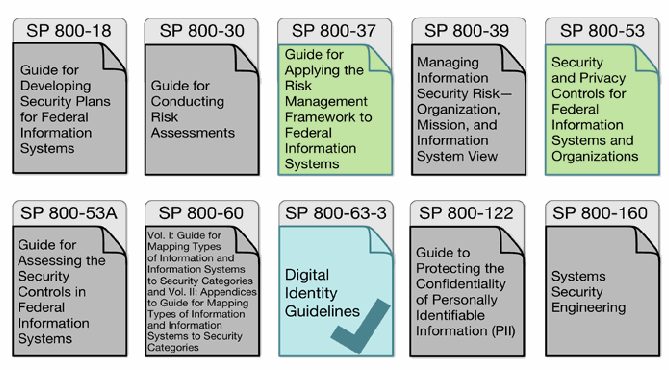
図3: プライバシーリスク管理をNIST SPに統合するためのPEPガイダンスのロードマップ。2017会計年度に進行中の統合を緑色で強調している。文書アイコン10個を2段に並べた図である。上段:SP 800-18(Guide for Developing Security Plans for Federal Information Systems)、SP 800-30(Guide for Conducting Risk Assessments)、SP 800-37(Guide for Applying the Risk Management Framework to Federal Information Systems。緑)、SP 800-39(Managing Information Security Risk—Organization, Mission, and Information System View)、SP 800-53(Security and Privacy Controls for Federal Information Systems and Organizations。緑)。下段:SP 800-53A(Guide for Assessing the Security Controls in Federal Information Systems)、SP 800-60(Vol. I: Guide for Mapping Types of Information and Information Systems to Security Categories および Vol. II: Appendices to Guide for Mapping Types of Information and Information Systems to Security Categories)、SP 800-63-3(Digital Identity Guidelines。水色でチェックマーク付き)、SP 800-122(Guide to Protecting the Confidentiality of Personally Identifiable Information (PII))、SP 800-160(Systems Security Engineering)。その他のアイコンは灰色である。
Figure 3: PEP guidance roadmap for integrating privacy risk management into NIST SPs, featuring integrations underway during FY 2017 (highlighted in green).
図3: プライバシーリスク管理をNIST SPに統合するためのPEPガイダンスのロードマップ。2017会計年度に進行中の統合を緑色で強調しています。
The PEP team also contributed to ongoing standards and framework development efforts in the International Organization for Standardization (ISO), Institute of Electrical and Electronics Engineers (IEEE), and the Fast Identity Online (FIDO) Alliance. Specifically, the PEP team worked on ISO/IEC 27552, which is a privacy-focused sector-specific extension of the information security-focused ISO/IEC 27001, and ISO/IEC 27550, a technical report on privacy engineering. The PEP team also supported the development of IEEE P7002, an effort in its early stages that also addresses privacy engineering. The PEP team also engaged with FIDO to help develop privacy-enhancing authentication specifications.
PEPチームは、国際標準化機構(ISO)、Institute of Electrical and Electronics Engineers (IEEE)、Fast Identity Online (FIDO) Allianceで進行中の標準およびフレームワークの開発にも貢献しました。具体的には、情報セキュリティに重点を置くISO/IEC 27001を、プライバシーに重点を置いて分野別に拡張するISO/IEC 27552と、プライバシーエンジニアリングに関する技術報告書であるISO/IEC 27550に取り組みました。PEPチームはまた、同じくプライバシーエンジニアリングを扱う初期段階の取り組みであるIEEE P7002の開発を支援しました。さらにFIDOとも連携し、プライバシーを強化する認証仕様の開発を支援しました。
Continuing the ongoing series of NIST workshops on privacy engineering and risk management, building off the concepts introduced in NISTIR 8062, the PEP team hosted the June 2017 workshop, “Privacy Risk Assessment: A Prerequisite for Privacy Risk Management” (see https://www.nist.gov/news-events/events/2017/06/privacy-risk-assessment-prerequisite-privacy-risk-management). Feedback received included the need for further integration of privacy into risk management and security guidance, a privacy-specific risk assessment model, and a toolset to manage privacy risk. These takeaways aligned well with the PEP team’s ongoing efforts and goals for future work.
PEPチームは、プライバシーエンジニアリングとリスク管理に関するNISTの一連のワークショップを継続し、NISTIR 8062で導入した概念を土台として、2017年6月にワークショップ “Privacy Risk Assessment: A Prerequisite for Privacy Risk Management” を開催しました(https://www.nist.gov/news-events/events/2017/06/privacy-risk-assessment-prerequisite-privacy-risk-management を参照してください)。寄せられたフィードバックでは、リスク管理およびセキュリティのガイダンスへのプライバシーのさらなる統合、プライバシーに特化したリスクアセスメントモデル、プライバシーリスクを管理するためのツールセットが必要であるとの指摘がありました。これらの指摘は、PEPチームが進めている取り組みや今後の作業の目標とよく合致していました。
In support of a privacy-specific risk assessment tool, the PEP team continued socializing the use of its Privacy Risk Assessment Methodology (PRAM) inside and outside the Federal Government. As of FY 2017, more than 30 public- and private-sector organizations have used or are using the PRAM, including participants in NIST’s trusted identities pilots and a few federal agencies.
プライバシーに特化したリスクアセスメントツールを支えるため、PEPチームは、Privacy Risk Assessment Methodology (PRAM) の利用を連邦政府の内外に広める活動を続けました。2017会計年度の時点で、公共部門と民間部門の30を超える組織がPRAMを利用したか、または利用しています。これには、NISTのtrusted identitiesパイロットの参加者と少数の連邦機関が含まれます。
The PEP team also collaborated on projects at the National Cybersecurity Center of Excellence (NCCoE), including the Privacy-Enhancing Identity Federation building block, which demonstrates the use of the NIST privacy engineering objectives (see https://nccoe.nist.gov/projects/building-blocks/privacy-enhanced-identity-brokers).
PEPチームは、National Cybersecurity Center of Excellence (NCCoE) のプロジェクトにも協力しました。その一つがPrivacy-Enhancing Identity Federationビルディングブロックであり、これはNISTのプライバシーエンジニアリング目標の利用を実証するものです(https://nccoe.nist.gov/projects/building-blocks/privacy-enhanced-identity-brokers を参照してください)。
NIST Leadership in Privacy
プライバシーにおけるNISTのリーダーシップ
The PEP team built upon NIST’s leadership role in privacy by serving in leadership positions and contributing to privacy expertise organizations across the public and private sectors. These leadership positions included: the chair of the Federal Privacy Council’s Risk Management Task Force and co-chair of the Networking and Information Technology Research and Development (NITRD) Program’s Privacy Research and Development (R&D) Interagency Working Group. The PEP team also participated in the Internet Policy Task Force’s Privacy Working Group, the FIDO Alliance’s Privacy and Public Policy Working Group, and the Identity Ecosystem Steering Group.
PEPチームは、公共部門と民間部門のプライバシー専門組織で主導的な役職を務め、貢献することにより、プライバシーにおけるNISTの主導的役割をさらに強めました。これらの役職には、Federal Privacy CouncilのRisk Management Task Forceの議長と、Networking and Information Technology Research and Development (NITRD) ProgramのPrivacy Research and Development (R&D) Interagency Working Groupの共同議長が含まれます。PEPチームはまた、Internet Policy Task ForceのPrivacy Working Group、FIDO AllianceのPrivacy and Public Policy Working Group、Identity Ecosystem Steering Groupにも参加しました。
Looking Forward
今後の展望
In FY 2018, the PEP team will continue developing privacy risk management guidance for agencies, including finalizing SP 800-53 Revision 5, and SP 800-37 Revision 2. The PEP team will also collaborate with internal and external stakeholders to kick off the integration of privacy guidance into SP 800-53A Revision 5, Assessing Security and Privacy Controls in Federal Information Systems and Organizations, and implement the provisions of other documents laid out in the guidance roadmap. The PEP team will continue supporting the development of international standards focused on privacy engineering and risk management.
2018会計年度に、PEPチームは、SP 800-53 Revision 5とSP 800-37 Revision 2の最終化を含め、各機関向けのプライバシーリスク管理ガイダンスの開発を続けます。PEPチームはまた、内部および外部の利害関係者と協力して、SP 800-53A Revision 5, Assessing Security and Privacy Controls in Federal Information Systems and Organizationsへのプライバシーガイダンスの統合に着手し、ガイダンスのロードマップに示されたその他の文書に関する定めを実施します。PEPチームは、プライバシーエンジニアリングとリスク管理に重点を置いた国際標準の開発を引き続き支援します。
The PEP team will place a greater focus on its goal of advancing the deployment of privacy-enhancing technologies. The PEP team has already begun exploring whether stakeholders see a need for an online space where collaborators can discuss, learn about, and improve upon tools, solutions, and processes that support privacy engineering and risk management. The PEP team will also explore the management of privacy risk in leading-edge domains, such as the internet of things (IoT) and artificial intelligence (AI). Specifically, the PEP team will collaborate with NIST’s Cybersecurity for the IoT program to tackle IoT-specific privacy challenges through workshops and guidance.
PEPチームは、プライバシー強化技術の導入を前進させるという目標にこれまで以上に重点を置きます。PEPチームはすでに、プライバシーエンジニアリングとリスク管理を支えるツール、ソリューション、プロセスについて、協力者が議論し、学び、改良できるオンラインの場を利害関係者が必要と考えているかどうかの調査を始めています。PEPチームはまた、internet of things (IoT) や人工知能(AI)などの最先端の領域におけるプライバシーリスクの管理についても検討します。具体的には、NISTのCybersecurity for the IoTプログラムと協力し、ワークショップとガイダンスを通じてIoTに固有のプライバシー上の課題に取り組みます。
The PEP team will continue to seek leadership opportunities in public- and private-sector organizations to strengthen NIST’s position as a leader in privacy. Finally, the PEP team will continue working with a variety of organizations to manage privacy risk using the PRAM, such as using it in the NCCoE’s Mobile Device Security building block.
PEPチームは、プライバシーの分野を主導する組織としてのNISTの地位を強化するため、公共部門と民間部門の組織で主導的な役割を担う機会を引き続き求めます。最後に、PEPチームは、NCCoEのMobile Device SecurityビルディングブロックでPRAMを用いるなど、PRAMを用いたプライバシーリスクの管理に向けて、さまざまな組織との協働を続けます。
FOR MORE INFORMATION, SEE:
詳細情報の参照先:
https://www.nist.gov/itl/privacy-engineering
https://www.nist.gov/itl/privacy-engineering
CONTACTS:
連絡先:
PEP Team email: privacyeng@nist.gov
PEPチームの電子メール: privacyeng@nist.gov
Ms. Naomi Lefkovitz, (301) 975-2924, naomi.lefkovitz@nist.gov
Ms. Naomi Lefkovitz, (301) 975-2924, naomi.lefkovitz@nist.gov
Ms. Ellen Nadeau, (202) 306-4033, ellen.nadeau@nist.gov
Ms. Ellen Nadeau, (202) 306-4033, ellen.nadeau@nist.gov
Ms. Katie Boeckl, (240) 753-9674, kaitlin.boeckl@nist.gov
Ms. Katie Boeckl, (240) 753-9674, kaitlin.boeckl@nist.gov
Cyber Supply Chain Risk Management (C-SCRM)
サイバーサプライチェーンリスク管理(C-SCRM)
Figure 4: C-SCRM Disciplines
図4: C-SCRMの関連分野
Over the last several years, providing information and operational technology (IT/OT) for a supply chain has evolved into a complex, globally distributed, dynamic ecosystem enabling the development of highly refined, sophisticated, cost-effective, and reusable solutions. This ecosystem is composed of assorted entities with multiple tiers of outsourcing, global distribution routes, diverse technologies, and varying laws, policies, procedures, and practices, all of which interact throughout the life cycle of a system. Factors that allow for low-cost products, rapid innovation, and other benefits also increase the risk that the supply chain may be compromised in a way that results in risks to the end user and reduce the overall competitiveness of U.S. companies.
過去数年の間に、サプライチェーンのための情報技術及び運用技術(IT/OT)の提供は、高度に洗練され、精巧で、費用対効果が高く、再利用可能なソリューションの開発を可能にする、複雑でグローバルに分散した動的なエコシステムへと発展してきました。このエコシステムは、多層にわたるアウトソーシング、グローバルな流通経路、多様な技術、並びにさまざまな法律、ポリシー、手順及びプラクティスを伴う各種の主体で構成されており、これらはすべてシステムのライフサイクル全体を通じて相互に作用します。低コストの製品、迅速なイノベーション、その他の便益を可能にする要因は、同時に、サプライチェーンが侵害され、その結果としてエンドユーザーにリスクが生じ、米国企業の全体的な競争力が低下するリスクも高めます。
Cyber Supply Chain Risk Management (C-SCRM) lies at the intersection of information security, supply chain management, and enterprise risk management (Figure 4); it is the process of identifying, assessing, and mitigating the risks associated with the distributed and interconnected nature of IT/OT product and service supply chains. C-SCRM covers the entire life cycle of a system (including design, development, maintenance, and destruction), as supply chain threats and vulnerabilities may intentionally or unintentionally compromise an IT/OT product or service at any stage. These cyber supply chain risks may include the use of counterfeits, unauthorized production, tampering, theft, and insertion of malicious software and hardware, as well as poor manufacturing and development practices. As shown in Figure 5, C-SCRM is concerned with and involves a range of subjects, including safety, integrity, quality, reliability, and others, all within an overall environment of awareness.
サイバーサプライチェーンリスク管理(C-SCRM)は、情報セキュリティ、サプライチェーン管理、及びエンタープライズリスク管理が交わるところに位置します(図4)。これは、IT/OTの製品及びサービスのサプライチェーンが持つ分散的かつ相互接続的な性質に伴うリスクを特定し、アセスメントし、低減するプロセスです。サプライチェーンの脅威及び脆弱性は、意図的であるか否かを問わず、どの段階でもIT/OTの製品又はサービスを侵害し得るため、C-SCRMはシステムのライフサイクル全体(設計、開発、保守及び廃棄を含む)を対象とします。こうしたサイバーサプライチェーンリスクには、偽造品の使用、無許可の生産、改ざん、窃取、悪意のあるソフトウェア及びハードウェアの挿入のほか、粗悪な製造及び開発のプラクティスが含まれ得ます。図5に示すとおり、C-SCRMは、安全性、完全性、品質、信頼性などを含む幅広い主題に関わり、それらを包含しており、そのすべてが意識向上という全体的な環境の中に置かれています。
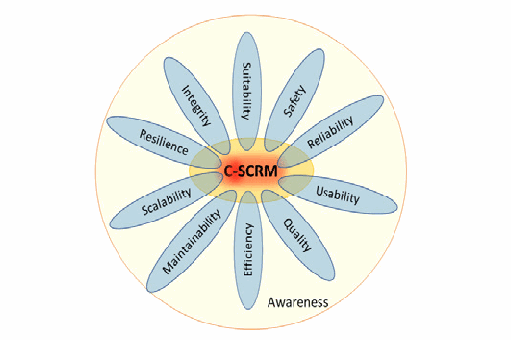
図5: C-SCRMの諸側面。Awareness(意識)と記した円の中に花の形を描いた図である。中心に C-SCRM があり、その周囲に10枚の花弁が上から時計回りに Suitability(適合性)、Safety(安全性)、Reliability(信頼性)、Usability(ユーザビリティ)、Quality(品質)、Efficiency(効率)、Maintainability(保守性)、Scalability(拡張性)、Resilience(レジリエンス)、Integrity(完全性)と並ぶ。
Figure 5: C-SCRM Aspects
図5: C-SCRMの諸側面
In FY 2017, NIST drafted NISTIR 8179, Criticality Analysis Process Model, a method for identifying and prioritizing IT/OT systems and components. This model is intended to increase an organization’s ability to make cost-effective risk decisions by determining the systems and components that have the most impact on the organization and that would potentially cause the most harm if compromised. Figure 6 shows an overview of the model, which includes separate analyses at the program, system, and component level, and then a trace-back exercise to complete the analysis. NIST will finalize this publication in FY 2018 and will begin to research and write guidance that builds on this model to identify critical suppliers and service providers.
2017会計年度に、NISTは、IT/OTシステム及びコンポーネントを特定し優先順位付けする手法であるNISTIR 8179, Criticality Analysis Process Modelの草案を作成しました。このモデルは、組織に最も大きな影響を与え、侵害された場合に最も大きな害を及ぼすおそれのあるシステム及びコンポーネントを判定することによって、費用対効果の高いリスク判断を下す組織の能力を高めることを意図しています。図6は、このモデルの概要を示しており、モデルにはプログラム、システム及びコンポーネントの各レベルでの個別の分析と、その後に分析を完結させるためのトレースバック作業が含まれます。NISTは、2018会計年度にこの刊行物を最終化し、このモデルに基づいて重要な供給者及びサービスプロバイダを特定するためのガイダンスの調査と執筆を開始します。
Figure 6: Criticality Analysis Process Overview
図6:重要度分析プロセスの概要
During 2017, NIST continued to research the state of C-SCRM in both the public and private sectors, related standards and initiatives, effective practices, and metrics. NIST joined with the GSA and the University of Maryland under a contract and grant awarded in FY 2016 to conduct cyber analytics research on the effectiveness of various risk management practices. The effort neared conclusion in FY 2017 and found correlations between certain practices and publicly disclosed data breaches. A report on the research will be published in FY 2018.
2017年を通じて、NISTは、官民両部門におけるC-SCRMの現状、関連する標準及び取組み、効果的な実践、並びにメトリクスについての調査を継続しました。NISTは、2016会計年度に交付された契約及び助成金の下でGSA及びUniversity of Marylandと協力し、各種のリスク管理の実践の有効性に関するサイバーアナリティクス研究を実施しました。この取組みは2017会計年度に終盤に達し、特定の実践と公に開示されたデータ侵害との間に相関があることを見いだしました。この研究に関する報告書は2018会計年度に公表されます。
Similarly, NIST began research in FY 2017 to identify metrics that are currently used in organizations to measure information security risks. This research included a review of over 200 published standards, academic papers, organizational white-papers, and other documents and interviews with a dozen industry experts on the state of metrics in this field. The research will be continued and published in FY 2018.
同様に、NISTは、情報セキュリティリスクを測定するために組織で現在使用されているメトリクスを特定する調査を2017会計年度に開始しました。この調査には、200件を超える公表済みの標準、学術論文、組織のホワイトペーパー及びその他の文書のレビューと、この分野におけるメトリクスの現状についての12名の業界専門家へのインタビューが含まれました。この調査は継続され、2018会計年度に公表されます。
NIST continued to co-chair a working group with the DoD to revise CNSSD 505, Supply Chain Risk Management, which assigns responsibilities and establishes minimum criteria for the development and deployment of supply chain risk management capabilities for national security systems. In FY 2017, the group completed the revision of CNSSD 505 and developed a self-assessment tool to help agencies measure their capabilities and compare those capabilities to those of other agencies.
NISTは、CNSSD 505, Supply Chain Risk Managementを改訂するためのワーキンググループの共同議長をDoDとともに引き続き務めました。CNSSD 505は、国家安全保障システムのためのサプライチェーンリスク管理能力の開発及び展開について、責任を割り当て、最低限の基準を定めるものです。2017会計年度に、このグループはCNSSD 505の改訂を完了し、各機関が自らの能力を測定し、その能力を他の機関の能力と比較するのに役立つ自己評価ツールを開発しました。
NIST also sponsored the Software and Supply Chain Assurance (SSCA) Forum and Working Groups, the purpose of which is to bring together a stakeholder community of government, industry, and academic experts in this field. Meetings are held three to four times a year and cover a variety of subjects of interest to attendees (see the website at https://csrc.nist.gov/scrm/ssca).
NISTはまた、Software and Supply Chain Assurance (SSCA) Forum及びワーキンググループを主催しました。その目的は、この分野における政府、産業界及び学界の専門家からなる利害関係者のコミュニティを一堂に集めることです。会合は年に3~4回開催され、参加者が関心を持つさまざまな主題を扱います(ウェブサイト https://csrc.nist.gov/scrm/ssca を参照してください)。
NIST began working in FY 2017 to integrate C-SCRM into existing risk management programs and processes. The draft Cybersecurity Framework v1.1 and Draft SP 800-53 Revision 5 were both updated to better include up-to-date C-SCRM guidance. In FY 2018, NIST will continue this work by including or updating existing C-SCRM concepts in other publications as they are developed.
NISTは、C-SCRMを既存のリスク管理プログラム及びプロセスに統合する作業を2017会計年度に開始しました。Cybersecurity Framework v1.1の草案及びSP 800-53 Revision 5の草案はいずれも、最新のC-SCRMガイダンスをより適切に取り込むよう更新されました。2018会計年度に、NISTは、他の刊行物が作成される際にそれらに既存のC-SCRMの概念を盛り込み、又は更新することによって、この作業を継続します。
In FY 2018, NIST will continue to collaborate with stakeholders in government, industry, and academia to conduct research, produce needed standards and guidance, and seek opportunities to create greater awareness across all sectors and types and sizes of organizations. NIST will:
2018会計年度に、NISTは、政府、産業界及び学界の利害関係者との協力を継続し、研究を実施し、必要とされる標準及びガイダンスを作成し、あらゆる部門並びにあらゆる種類及び規模の組織にわたって認識を高める機会を追求します。NISTは次のことを行います。
•Update SP 800-161 based on the final publication of SP 800-53 Revision 5,
•SP 800-53 Revision 5の最終版の公表に基づいてSP 800-161を更新します。
•Continue developing industry supply chain risk management case studies,
•産業界のサプライチェーンリスク管理の事例研究の作成を継続します。
•Develop a draft NISTIR on SCRM “principles”,
•SCRMの「原則」に関するNISTIRの草案を作成します。
•Develop a NISTIR on Supply Chain Interdependency Analysis, and
•Supply Chain Interdependency Analysisに関するNISTIRを作成します。
•Continue research and work on metrics and cyber risk analytics.
•メトリクス及びサイバーリスクアナリティクスに関する研究と作業を継続します。
FOR MORE INFORMATION, SEE:
詳細情報:
https://scrm.nist.gov
https://scrm.nist.gov
CONTACTS:
連絡先:
Cyber SCRM Team email: scrm-nist@nist.gov
Cyber SCRM Team email: scrm-nist@nist.gov
Ms. Celia Paulsen, (301) 975-5981, celia.paulsen@nist.gov
Ms. Celia Paulsen, (301) 975-5981, celia.paulsen@nist.gov
Mr. Jon Boyens, (301) 975-5549, jon.boyens@nist.gov
Mr. Jon Boyens, (301) 975-5549, jon.boyens@nist.gov
Software and Supply Chain Assurance Forum
Software and Supply Chain Assurance Forum
Cyber supply chain risk management (hardware and software assurance and assured services) has become a topic of core strategic concern for business and government leaders worldwide and is an essential component of an enterprise risk management strategy. The Software and Supply Chain Assurance (SSCA) Forum provides a venue for government, industry, and academic participants from around the world to share their knowledge and expertise regarding cyber supply chain risks, effective practices and mitigation strategies, tools and technologies, and any gaps related to the people, processes, or technologies involved.
サイバーサプライチェーンリスク管理(ハードウェア及びソフトウェアのアシュアランス並びに保証されたサービス)は、世界中の企業及び政府の指導者にとって中核的な戦略上の関心事となっており、エンタープライズリスク管理戦略の不可欠な構成要素です。Software and Supply Chain Assurance (SSCA) Forumは、世界各地の政府、産業界及び学界からの参加者が、サイバーサプライチェーンリスク、効果的な実践及び低減戦略、ツール及び技術、並びに関与する人、プロセス又は技術に関するギャップについて、知識と専門性を共有する場を提供します。
The effort, initiated in 2003, is co-led by NIST, DHS, DoD and GSA, and serves approximately 3,000 stakeholders. Participants represent a diverse group of career professionals, including government officials, chief information security officers, those in academia with cybersecurity and supply chain specialties, system administrators, engineers, consultants, vendors, software developers, managers, analysts, specialists in IT and cybersecurity, and many more fields. The SSCA Forum meets two to three times per year and is free and open to all interested participants, both nationally and internationally.
2003年に開始されたこの取組みは、NIST、DHS、DoD及びGSAが共同で主導しており、約3,000の利害関係者に資しています。参加者は多様な職業専門家の集団を代表しており、政府職員、最高情報セキュリティ責任者、サイバーセキュリティ及びサプライチェーンを専門とする学界関係者、システム管理者、エンジニア、コンサルタント、ベンダ、ソフトウェア開発者、管理者、アナリスト、IT及びサイバーセキュリティの専門家、並びにその他多くの分野の者が含まれます。SSCA Forumは年に2~3回会合を開き、国内外を問わず、関心のあるすべての参加者に無料で開かれています。
While the general intent is to share information, the SSCA Forum also offers government and private-sector participants an opportunity to openly collaborate by presenting and receiving feedback on current and potential future work. Most events are two to three days long and contain a mixture of discussion and presentation. To encourage open interaction, SSCA Forum meetings operate under the Chatham House Rule, meaning “participants are free to use the information received, but neither the identity nor the affiliation of the speaker(s), nor that of any other participant, may be revealed,” though most speakers allow NIST to post their presentations.
全般的な趣旨は情報の共有ですが、SSCA Forumは、政府及び民間部門の参加者に対し、現在の作業及び将来の作業の候補を発表してフィードバックを受けることによって率直に協力する機会も提供します。ほとんどのイベントは2~3日間にわたり、討議と発表を織り交ぜた構成です。率直な交流を促すため、SSCA Forumの会合はChatham House Ruleの下で運営されます。これは、「参加者は受け取った情報を自由に使用できますが、発言者の身元及び所属も、他のいかなる参加者の身元及び所属も明らかにしてはならない」ことを意味します。ただし、ほとんどの発表者は、NISTが発表資料を掲載することを認めています。
The SSCA Forum also maintains an extensive email subscription service. To receive information about upcoming meetings and related publications and activities, please sign up for the SSCA Forum mailing list, operated by NIST, by sending a blank email to sw.assurance-join@nist.gov.
SSCA Forumはまた、大規模な電子メール購読サービスを維持しています。今後の会合並びに関連する刊行物及び活動についての情報を受け取るには、sw.assurance-join@nist.gov に空の電子メールを送信して、NISTが運営するSSCA Forumのメーリングリストに登録されました。
FOR MORE INFORMATION, SEE:
詳細情報:
https://csrc.nist.gov/Projects/Supply-Chain-Risk-Management/SSCA
https://csrc.nist.gov/Projects/Supply-Chain-Risk-Management/SSCA
CONTACTS:
連絡先:
Ms. Celia Paulsen, (301) 975-5981, celia.paulsen@nist.gov
Ms. Celia Paulsen, (301) 975-5981, celia.paulsen@nist.gov
Mr. Jon Boyens, (301) 975-5549, jon.boyens@nist.gov
Mr. Jon Boyens, (301) 975-5549, jon.boyens@nist.gov
BIOMETRIC STANDARDS AND ASSOCIATED CONFORMITY ASSESSMENT TESTING TOOLS
バイオメトリクス標準及び関連する適合性評価試験ツール
ITL supports the development of biometric conformance testing methodology standards and other conformity assessment efforts through active technical participation in the development of these standards and the development of associated conformance test software, architectures and test suites, collectively known as Biometric Conformance Test Software (BioCTS). These test tools are developed to promote the adoption of these standards and to support users, product developers, and testing labs that require conformance to selected biometric standards. ITL contributes to the development of biometric standards and participates in the INCITS Technical Committee M1 – Biometrics and related subcommittees and in ISO/IEC Joint Technical Committee (JTC) 1 Subcommittee (SC) 37 – Biometrics standards bodies.
ITLは、バイオメトリクスの適合性試験方法論の標準の開発及びその他の適合性評価の取組みを、これらの標準の開発への積極的な技術的参加と、関連する適合性試験ソフトウェア、アーキテクチャ及びテストスイート(総称してBiometric Conformance Test Software (BioCTS)と呼ばれる)の開発を通じて支援しています。これらの試験ツールは、これらの標準の採用を促進するとともに、選定されたバイオメトリクス標準への適合を必要とする利用者、製品開発者及び試験機関を支援するために開発されています。ITLは、バイオメトリクス標準の開発に貢献しており、標準化団体であるINCITS Technical Committee M1 – Biometrics及び関連する小委員会、並びにISO/IEC Joint Technical Committee (JTC) 1 Subcommittee (SC) 37 – Biometricsに参加しています。
In early 2017, a suite of BioCTS applications was released to support user-defined requirements and profiles for ANSI/NIST-ITL (AN-ITL) specifications. These applications make use of configuration files to dynamically generate parsing rules and conformance requirements for nearly any version or profile of the AN-ITL standard. The configuration files utilize an Extensible Markup Language (XML)-based format called ANSI/NIST-ITL Machine Readable Tables (MRTs) (see Figure 7 for an example output). The BioCTS AN-ITL applications that use MRTs are collectively referred to as BioCTS AN MRT.
2017年初めに、ANSI/NIST-ITL (AN-ITL)仕様についての利用者定義の要求事項及びプロファイルをサポートするBioCTSアプリケーション群がリリースされました。これらのアプリケーションは、構成ファイルを利用して、AN-ITL標準のほぼあらゆるバージョン又はプロファイルに対する構文解析規則及び適合性要求事項を動的に生成します。構成ファイルは、ANSI/NIST-ITL Machine Readable Tables (MRTs)と呼ばれる、Extensible Markup Language (XML)に基づく形式を利用します(出力例については図7を参照してください)。MRTを使用するBioCTS AN-ITLアプリケーションは、総称してBioCTS AN MRTと呼ばれます。
The development of BioCTS applications traditionally relied on the publication of Conformance Testing Methodology (CTM) documentation, which specified the test assertions required to assess conformance to requirements found in the related biometric standard. Manual software development was then required to code each of the assertions listed in the CTM documentation. This process required a large amount of development time after the publication of the standard and related CTM, and often resulted in long delays in the release of conformance tools. This approach also defined conformance tests statically, meaning that:
BioCTSアプリケーションの開発は、従来、Conformance Testing Methodology (CTM)文書の公表に依拠していました。CTM文書は、関連するバイオメトリクス標準にある要求事項への適合性を評価するために必要なテストアサーションを規定するものでした。その後、CTM文書に列挙された各アサーションをコード化するために、手作業によるソフトウェア開発が必要でした。このプロセスは、標準及び関連するCTMの公表後に多大な開発時間を要し、適合性ツールのリリースに長い遅延をもたらすことが多かった。この手法はまた、適合性試験を静的に定義するものでした。これは次のことを意味します。
•End users with domain-specific requirements or user-defined fields were not able to modify the conformance tests or parsing rules.
•分野固有の要求事項又は利用者定義のフィールドを持つエンドユーザは、適合性試験又は構文解析規則を変更することができませんでした。
•Any modification to the base standard requirements or subsequent revision of the standard required a new release of BioCTS applications.
•基本標準の要求事項に何らかの変更があった場合、又は標準がその後改訂された場合には、BioCTSアプリケーションの新たなリリースが必要でした。
To alleviate these issues, the new version of BioCTS was designed to allow a modification of test assertions and parsing rules. This approach required a configuration file to specify requirements and allow the software to respond to the needs of the end user.
これらの問題を軽減するため、BioCTSの新バージョンは、テストアサーション及び構文解析規則の変更を可能にするよう設計されました。この手法では、要求事項を規定し、ソフトウェアがエンドユーザのニーズに対応できるようにするための構成ファイルが必要でした。
BioCTS AN MRT had two releases in FY 2017. The first release included a command line interface (CLI) as well as a graphical user interface (GUI). It supported Level-1 testing, file format testing that checks for the allowed content, length, and value for five different standards and profiles specified within the AN MRTs. Since the MRT files can be combined to support multiple standards, updates and profiles, BioCTS AN MRT was designed to allow users to test against multiple standards during a single test.
BioCTS AN MRTは、2017会計年度に2回リリースされました。最初のリリースには、コマンドラインインタフェース(CLI)及びグラフィカルユーザインタフェース(GUI)が含まれていました。このリリースは、AN MRT内で規定された5つの異なる標準及びプロファイルについてレベル1試験、すなわち許容される内容、長さ及び値を検査するファイル形式試験をサポートしました。MRTファイルは複数の標準、更新及びプロファイルをサポートするよう組み合わせることができるため、BioCTS AN MRTは、利用者が1回の試験で複数の標準に対して試験できるよう設計されました。
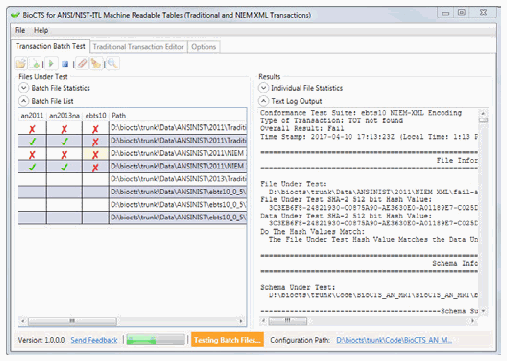
図7 - BioCTS AN MRTによる1回の試験での複数の標準に対する試験。アプリケーションウィンドウ「BioCTS for ANSI/NIST-ITL Machine Readable Tables (Traditional and NIEM XML Transactions)」のスクリーンショットである。File と Help のメニュー、Transaction Batch Test(選択中)・Traditional Transaction Editor・Options のタブがある。左の「Files Under Test」欄(Batch File Statistics、Batch File List)には D:\biocts\trunk\Data\ANSINIST\… 以下のファイルパスが並び、an2011・an2013na・ebts10 の列に緑のチェックと赤の×で結果が示される。右の「Results」欄(Individual File Statistics、Text Log Output)には、「Conformance Test Suite: ebts10 NIEM-XML Encoding」「Type of Transaction: TOT not found」「Overall Result: Fail」で始まるテキストログと、ファイル名および SHA-2 512 ビットのハッシュ値の項目が表示されている。ステータスバーには Version 1.0.0.0、Send Feedback、進捗バー、「Testing Batch Files...」、Configuration Path が表示されている。
Figure 7 - BioCTS AN MRT Testing Multiple Standards Within Single Test
図7 - BioCTS AN MRTによる1回の試験での複数の標準に対する試験
The second release included further refinements of the existing tools, and expanded the testing capabilities to include Level-2 testing, or the testing of inter-field as well as inter-record relationships, checking data between two or more related data fields. The current release of BioCTS AN MRT supports all Level-1 and Level-2 tests defined by the MRTs.
2回目のリリースでは、既存のツールにさらに改良が加えられ、試験能力が拡張されてレベル2試験、すなわち2つ以上の関連するデータフィールド間でデータを検査する、フィールド間及びレコード間の関係の試験が含まれるようになりました。BioCTS AN MRTの現行リリースは、MRTによって定義されたすべてのレベル1試験及びレベル2試験をサポートしています。
Work on BioCTS AN MRT continued through FY 2017, and an additional release that supports expanded character sets, as well as additional enhancements, is expected to be released in FY 2018.
BioCTS AN MRTに関する作業は2017会計年度を通じて継続され、拡張された文字集合のサポート及びその他の機能強化を含む追加のリリースが2018会計年度に行われる見込みです。
FOR MORE INFORMATION, SEE:
詳細情報:
BioCTS - Biometric Conformance Test Tool Homepage:
BioCTS - Biometric Conformance Test Toolのホームページ:
https://www.nist.gov/itl/csd/biometrics/biometric-conformance-test-software-biocts
https://www.nist.gov/itl/csd/biometrics/biometric-conformance-test-software-biocts
BioCTS AN MRT:
BioCTS AN MRT:
https://www.nist.gov/itl/csd/biometrics/biocts-machine-readable-tables
https://www.nist.gov/itl/csd/biometrics/biocts-machine-readable-tables
BioCTS AN MRT Changelog:
BioCTS AN MRTの変更履歴:
https://www.nist.gov/file/384611
https://www.nist.gov/file/384611
BioCTS AN MRT User Guide:
BioCTS AN MRT User Guide:
https://www.nist.gov/file/384606
https://www.nist.gov/file/384606
CONTACT:
連絡先:
Mr. Dylan Yaga, (301) 975-6004, dylan.yaga@nist.gov
Mr. Dylan Yaga, (301) 975-6004, dylan.yaga@nist.gov
CYBERSECURITY APPLICATIONS
サイバーセキュリティの応用
Security Aspects of Electronic Voting
電子投票のセキュリティ面
In 2002, Congress passed the Help America Vote Act (HAVA) to encourage the upgrade of voting equipment across the United States. HAVA established the Election Assistance Commission (EAC) and the Technical Guidelines Development Committee (TGDC), chaired by the Director of NIST. HAVA directs NIST to provide technical support to the EAC and TGDC in efforts related to human factors, security, and laboratory accreditation.
2002年、議会は、米国全土で投票機器の更新を促すためにHelp America Vote Act (HAVA)を可決しました。HAVAは、Election Assistance Commission (EAC)と、NIST長官が議長を務めるTechnical Guidelines Development Committee (TGDC)を設置しました。HAVAは、ヒューマンファクター、セキュリティ及び試験所認定に関する取組みにおいてEAC及びTGDCに技術支援を提供するようNISTに指示しています。
NIST and the EAC established a set of public working groups to inform the development of a new version of the Volunary Voting Systems Guidelines (VVSG). The NIST and EAC goals are to accelerate the development and adoption of the VVSG by leading these working groups in close consultation with election officials, voting system manufacturers, standards bodies, academic researchers, and other members of the public. These working groups focus on multiple voting system technology areas, including accessibility, usability, interoperability, security, testing and certification.
NIST及びEACは、Volunary Voting Systems Guidelines (VVSG)の新バージョンの開発に資する情報を得るため、一連の公開ワーキンググループを設置しました。NIST及びEACの目標は、選挙管理者、投票システム製造業者、標準化団体、学術研究者及びその他の一般の人々と緊密に協議しながらこれらのワーキンググループを主導することによって、VVSGの開発及び採用を加速することです。これらのワーキンググループは、アクセシビリティ、ユーザビリティ、相互運用性、セキュリティ、試験及び認証を含む、投票システム技術の複数の領域に焦点を当てています。
The cybersecurity public working group designed principles and guidelines to form the basis for the security requirements in the new version of the VVSG. Although 15 principles exist, the security-related principles include auditability, ballot secrecy, physical security, access control, system integrity, detection and monitoring, and data protection. Many of these principles are already included in previous iterations of the federal standards, whereas others are new areas of focus (e.g., system integrity). These principles and guidelines were presented to, and adopted by, the Technical Guidelines and Development Committee (TGDC).
サイバーセキュリティ公開ワーキンググループは、VVSGの新バージョンにおけるセキュリティ要求事項の基礎となる原則及びガイドラインを策定しました。原則は15項目ありますが、セキュリティに関連する原則には、監査可能性、投票の秘密、物理的セキュリティ、アクセス制御、システム完全性、検知及び監視、並びにデータ保護が含まれます。これらの原則の多くは連邦標準のこれまでの版にすでに含まれていますが、新たな重点領域であるものもあります(例:システム完全性)。これらの原則及びガイドラインは、Technical Guidelines and Development Committee (TGDC)に提示され、採択されました。
In FY 2018, NIST will continue leading the public working groups to inform the development of voting system requirements based on the principles and guidelines. Additionally, test assertions will be developed to improve the quality and consistency of testing activities by accredited voting system test laboratories (VSTLs).
2018会計年度に、NISTは、原則及びガイドラインに基づく投票システム要求事項の開発に資する情報を得るため、公開ワーキンググループの主導を継続します。加えて、認定された投票システム試験所(VSTL)による試験活動の品質及び一貫性を向上させるために、テストアサーションが開発されます。
FOR MORE INFORMATION, SEE:
詳細情報:
https://vote.nist.gov
https://vote.nist.gov
CONTACTS:
連絡先:
Mr. Joshua Franklin, (301) 975-8463, joshua.franklin@nist.gov
Mr. Joshua Franklin, (301) 975-8463, joshua.franklin@nist.gov
Ms. Gema Howell, (301) 975-6299, gema.howell@nist.gov
Ms. Gema Howell, (301) 975-6299, gema.howell@nist.gov
Mr. Andrew Regenscheid, (301) 975-5155, andrew.regenenscheid@nist.gov
Mr. Andrew Regenscheid, (301) 975-5155, andrew.regenenscheid@nist.gov
Nationwide Public Safety Broadband Network (NPSBN) Cybersecurity
Nationwide Public Safety Broadband Network (NPSBN)のサイバーセキュリティ
Source: https://www.pscr.gov/
出典:https://www.pscr.gov/
In February 2012, Congress passed the Middle Class Tax Relief and Job Creation Act. One portion of this legislation calls for the establishment of a nationwide, interoperable public-safety broadband network based on the 3rd Generation Partnership Project’s (3GPP) Long Term Evolution (LTE) technology. The network will be deployed and operated by the First Responder Network Authority (FirstNet). The planned Nationwide Public Safety Broadband Network (NPSBN) will “create a much needed nationwide interoperable broadband network that will help police, firefighters, emergency medical service professionals and other public safety officials stay safe and do their jobs” (see https://www.ntia.doc.gov/category/public-safety). NIST is directed to conduct research and development that supports the acceleration and advancement of the nationwide network.
2012年2月、議会はMiddle Class Tax Relief and Job Creation Actを可決しました。この法律の一部は、3rd Generation Partnership Project (3GPP)のLong Term Evolution (LTE)技術に基づく、全国規模で相互運用可能な公共安全ブロードバンドネットワークの構築を求めています。このネットワークは、First Responder Network Authority (FirstNet)によって展開され、運用されます。計画されているNationwide Public Safety Broadband Network (NPSBN)は、「警察、消防士、救急医療サービスの専門家及びその他の公共安全担当官が安全を保ち、職務を遂行するのに役立つ、切実に必要とされている全国規模の相互運用可能なブロードバンドネットワークを創出する」ものです(https://www.ntia.doc.gov/category/public-safety を参照してください)。NISTは、この全国規模のネットワークの加速及び進展を支援する研究開発を実施するよう指示されています。
In FY 2017, CSD, ACD, and the NCCoE continued to support the joint National Telecommunications and Information Administration (NTIA) and NIST Public Safety Communications Research (PSCR) program (see https://www.pscr.gov) with efforts in public-safety mobile-application security, identity management, data and application isolation technologies, wearable devices, and broadband standards. The PSCR’s Annual Public Safety Broadband Stakeholder Conference, held in June 2017, continued to be a valuable venue for ITL to provide updates on each of our ongoing projects. The conference also provided a venue to directly interface with the public safety and first responder communities.
2017会計年度に、CSD、ACD及びNCCoEは、公共安全向けモバイルアプリケーションのセキュリティ、アイデンティティ管理、データ及びアプリケーションの分離技術、ウェアラブルデバイス、並びにブロードバンド標準に関する取組みによって、National Telecommunications and Information Administration (NTIA)とNISTの共同によるPublic Safety Communications Research (PSCR)プログラム(https://www.pscr.gov を参照)への支援を継続しました。2017年6月に開催されたPSCRのAnnual Public Safety Broadband Stakeholder Conferenceは、ITLが進行中の各プロジェクトの最新状況を報告する貴重な場であり続けました。この会議はまた、公共安全及びファーストレスポンダのコミュニティと直接交流する場も提供しました。
The mobile devices that will operate on the NPSBN will be utilized in unique ways when compared to their public counterparts. The same device(s) will likely be shared between public safety officials as each individual goes on and off duty. Furthermore, there will be a need for flexible distribution and credentialing of devices and users in situations where multiple public safety organizations are called into action. To facilitate these needs NIST, through the NCCoE, piloted a proof-of-concept single sign on (SSO) for mobile applications on iOS and Android.
NPSBN上で動作するモバイルデバイスは、一般向けのデバイスと比べて独特な方法で利用されることになります。各人が勤務に就き、また勤務を離れるのに伴い、同じデバイスが公共安全担当官の間で共用される可能性が高いです。さらに、複数の公共安全組織が出動を要請される状況では、デバイス及び利用者への柔軟な配布及びクレデンシャル付与が必要となります。これらのニーズに応えるため、NISTは、NCCoEを通じて、iOS及びAndroid上のモバイルアプリケーション向けのシングルサインオン(SSO)の概念実証を試行しました。
Due to the vital nature of first responder activities, the mobile applications that will serve public safety in their mission will require more scrutiny when evaluated for software bugs and vulnerabilities than applications targeted at the public. In FY 2017, NIST continued to expand its expertise in mobile application vetting tools and practices. In addition to publishing NISTIR 8136, An Overview of Mobile Application Vetting Services for Public Safety, ACD, in conjunction with NIST Software and System’s Division (SSD), expanded the Static Analysis Tool Exposition (SATE) to include mobile application analysis for the first time. This exposition seeks to improve methods for measuring the effectiveness of mobile application vetting tools.
ファーストレスポンダの活動は極めて重要な性質を持つため、公共安全の任務遂行に供されるモバイルアプリケーションは、ソフトウェアのバグ及び脆弱性について評価される際に、一般向けのアプリケーションよりも綿密な精査を必要とします。2017会計年度に、NISTは、モバイルアプリケーションの審査ツール及び実践に関する専門性の拡充を継続しました。NISTIR 8136, An Overview of Mobile Application Vetting Services for Public Safetyを公表したことに加え、ACDは、NISTのSoftware and System’s Division (SSD)と連携して、Static Analysis Tool Exposition (SATE)を拡張し、初めてモバイルアプリケーションの分析を対象に含めました。このエクスポジションは、モバイルアプリケーション審査ツールの有効性を測定する方法の改善を目指しています。
ITL continued to participate in the standards development process for LTE technology within the 3rd Generation Partnership Project (3GPP), supporting security requirements for public safety that are related to Proximity Services (ProSe), Group Communication System Enablers (GCSE), and Mission Critical Push-To-Talk (MCPTT). NIST also broadened its participation in 3GPP’s 5th Generation Mobile Networks (5G). In addition, researchers broadened their scope within the Internet Engineering Task Force (IETF) to include efforts related to public safety.
ITLは、3rd Generation Partnership Project (3GPP)におけるLTE技術の標準開発プロセスへの参加を継続し、Proximity Services (ProSe)、Group Communication System Enablers (GCSE)及びMission Critical Push-To-Talk (MCPTT)に関連する公共安全向けのセキュリティ要求事項を支援しました。NISTはまた、3GPPの5th Generation Mobile Networks (5G)への参加を拡大しました。加えて、研究者らは、Internet Engineering Task Force (IETF)における活動範囲を広げ、公共安全に関連する取組みを含めました。
In FY 2018, CSD and ACD will continue to strengthen NIST’s relationship with both public safety and commercial telecom stakeholders. Work concerning mobile application vetting and cyber security will continue to evolve as NIST refines both its methods for tool evaluation as well as its corpus of test cases used in those evaluations. PSCR is working diligently to fund grants and prize challenges to both solve current problems and fill future gaps in public safety broadband technology. In FY 2018, ITL will also take on a crucial role in this work by providing cybersecurity expertise and guidance in the administration of these awards.
2018会計年度に、CSD及びACDは、公共安全及び商用通信事業の双方の利害関係者とNISTとの関係の強化を継続します。モバイルアプリケーションの審査及びサイバーセキュリティに関する作業は、NISTがツール評価の方法とその評価で使用するテストケースのコーパスの双方を洗練させるのに伴い、引き続き発展していきます。PSCRは、公共安全ブロードバンド技術における現在の問題を解決するとともに将来のギャップを埋めるため、助成金及び懸賞型チャレンジへの資金提供に精力的に取り組んでいます。2018会計年度に、ITLは、これらの助成及び賞の運営においてサイバーセキュリティの専門性及びガイダンスを提供することによって、この作業でも重要な役割を担います。
CONTACTS:
連絡先:
Mr. Michael Ogata, (301) 975-6993, michael.ogata@nist.gov
Mr. Michael Ogata, (301) 975-6993, michael.ogata@nist.gov
Dr. Nelson Hastings, (301) 975-5237, nelson.hastings@nist.gov
Dr. Nelson Hastings, (301) 975-5237, nelson.hastings@nist.gov
Cybersecurity for Industrial Control Systems
産業用制御システムのサイバーセキュリティ
NIST’s Industrial Control System (ICS) cybersecurity effort is focused on providing guidance and insights into the domain of securing connected physical systems. ACD is supporting the NIST Engineering Laboratory’s (EL) effort to develop and implement guidance aimed at effectively securing ICS, initially focusing on Smart Manufacturing Environments. Using an ICS cybersecurity testbed, a portion of which is shown in Figure 8, NIST will measure the network and operational performance of these systems when instrumented with cybersecurity protections, in accordance with the best practices and requirements prescribed by national and international standards and guidelines. Examples of such standards and guidelines include International Society of Automation (ISA) standard ISA/IEC-62443 and SP 800-82 Revision 2, Guide to Industrial Control Systems (ICS) Security (see https://nvlpubs.nist.gov/nistpubs/SpecialPublications/NIST.SP.800-82r2.pdf).
NISTの産業用制御システム(ICS)サイバーセキュリティの取り組みは、接続された物理システムのセキュリティ確保という領域について、ガイダンスと知見を提供することに重点を置いています。ACDは、ICSのセキュリティを効果的に確保するためのガイダンスを策定し実装するNIST Engineering Laboratory(EL)の取り組みを支援しており、当初はスマート製造環境に重点を置いています。NISTは、図8にその一部を示すICSサイバーセキュリティテストベッドを用いて、国内および国際的な標準とガイドラインが定めるベストプラクティスと要件に従ってサイバーセキュリティ保護を組み込んだ場合の、これらのシステムのネットワーク性能と運用性能を測定します。こうした標準とガイドラインの例として、International Society of Automation(ISA)の標準であるISA/IEC-62443と、SP 800-82 Revision 2, Guide to Industrial Control Systems (ICS) Security(https://nvlpubs.nist.gov/nistpubs/SpecialPublications/NIST.SP.800-82r2.pdf を参照)があります。
Industrial Control Systems are an essential component in manufacturing environments. Increasing reliance on technology, communication, and the interconnectivity of ICS and IT has expanded the potential vulnerabilities and increased the potential risk to manufacturing operations. While these manufacturing systems become smarter and increasingly connected, providing a tremendous increase in value and efficiency, they also present a new challenge: “How is cybersecurity effectively applied to this connected domain?”
産業用制御システムは、製造環境に不可欠な構成要素です。技術と通信への依存、およびICSとITの相互接続性への依存が高まったことで、潜在的な脆弱性が拡大し、製造業務に対する潜在的なリスクが増大しています。これらの製造システムは、より高機能になり、接続性を増すことで、価値と効率を飛躍的に高める一方、「この接続された領域にサイバーセキュリティをどのように効果的に適用するか」という新たな課題も生んでいます。
Figure 8: Collaborative robotics portion of the ICS cybersecurity testbed
図8:ICSサイバーセキュリティテストベッドの協働ロボット部分
The ICS cybersecurity team has used existing standards, in conjunction with the NIST Framework for Improving Critical Infrastructure Cybersecurity, to develop a target profile for applying cybersecurity protections within manufacturing environments. The development of this profile helps establish a roadmap for reducing cybersecurity risk for manufacturers that is aligned with manufacturing sector goals and industry best practices. The profile tailors existing cybersecurity control language to be more aligned with operational technology environments, focusing on desired cybersecurity outcomes to identify opportunities for improving the current cybersecurity posture of a manufacturing system. Through a session during the 2016 Cybersecurity Framework Workshop and two public comment periods, the team solicited feedback from industry partners to help solidify the content in the profile. The Cybersecurity Framework Manufacturing Profile was published as NISTIR 8183 (see https://nvlpubs.nist.gov/nistpubs/ir/2017/NIST.IR.8183.pdf).
ICSサイバーセキュリティチームは、既存の標準をNISTのFramework for Improving Critical Infrastructure Cybersecurityと併せて用い、製造環境にサイバーセキュリティ保護を適用するための目標プロファイルを策定しました。このプロファイルの策定は、製造部門の目標と業界のベストプラクティスに整合した、製造業者のサイバーセキュリティリスクを低減するためのロードマップの確立に役立ちます。このプロファイルは、既存のサイバーセキュリティ管理策の文言を運用技術(OT)環境により適合するように調整したものであり、望ましいサイバーセキュリティの成果に焦点を当てることで、製造システムの現在のサイバーセキュリティ態勢を改善する機会を特定します。チームは、2016 Cybersecurity Framework Workshopでのセッションと2回のパブリックコメント期間を通じて、業界パートナーからフィードバックを募り、プロファイルの内容を固めました。Cybersecurity Framework Manufacturing Profileは、NISTIR 8183として公表されました(https://nvlpubs.nist.gov/nistpubs/ir/2017/NIST.IR.8183.pdf を参照してください)。
In 2018, NIST will continue the process of applying the guidance presented in the Manufacturing Profile by implementing the recommended cybersecurity controls within the ICS cybersecurity testbed. This application of cybersecurity controls in an ICS environment will enable the measuring and understanding of the network and operational performance impacts that cybersecurity protections have on these systems. In addition to providing performance data, this project will produce documentation relating to the implementation intricacies and special requirements presented by these non-traditional environments.
2018年に、NISTは、推奨されるサイバーセキュリティ管理策をICSサイバーセキュリティテストベッドに実装することにより、Manufacturing Profileに示されたガイダンスを適用する作業を継続します。ICS環境にサイバーセキュリティ管理策をこのように適用することで、サイバーセキュリティ保護がこれらのシステムのネットワーク性能と運用性能に及ぼす影響を測定し、理解できるようになります。このプロジェクトは、性能データを提供することに加えて、こうした非従来型の環境がもたらす実装上の複雑さと特別な要件に関する文書を作成します。
FOR MORE INFORMATION, SEE:
詳細情報:
https://www.nist.gov/itl/privacy-engineering
https://www.nist.gov/itl/privacy-engineering
CONTACTS:
連絡先:
Mr. Jeffrey Cichonski, (301) 975-3293, jeffrey.cichonski@nist.gov
Mr. Jeffrey Cichonski, (301) 975-3293, jeffrey.cichonski@nist.gov
Mr. Keith Stouffer (EL), (301) 975-3877, keith.stouffer@nist.gov
Mr. Keith Stouffer (EL), (301) 975-3877, keith.stouffer@nist.gov
Smart Grid Cybersecurity
スマートグリッドのサイバーセキュリティ
In December 2007, Congress passed the Energy Independence and Security Act (EISA) that gave NIST a leading role in the coordination and acceleration of smart grid interoperability and security standards in collaboration with the private sector. The NIST Smart Grid program is led by the Engineering Laboratory (EL) with support from the Physical Measurement and Information Technology Laboratories. The objective of the program is to advance the measurement science that will increase asset utilization and efficiency, improve grid reliability, and enable greater use of renewable energy sources in the grid through research, standardization, testing and implementation of the NIST Smart Grid Interoperability Framework.
2007年12月、連邦議会はEnergy Independence and Security Act(EISA)を可決し、民間部門と協力してスマートグリッドの相互運用性とセキュリティの標準を調整し、その策定を加速するうえでの主導的な役割をNISTに与えました。NISTのスマートグリッドプログラムは、Engineering Laboratory(EL)が主導し、Physical Measurement LaboratoryとInformation Technology Laboratoryが支援しています。このプログラムの目的は、NIST Smart Grid Interoperability Frameworkの研究、標準化、試験および実装を通じて、資産の稼働率と効率を高め、グリッドの信頼性を向上させ、グリッドにおける再生可能エネルギー源の利用拡大を可能にする計測科学を前進させることです。
In the Spring of 2017, the Smart Grid Interoperability Panel (SGIP) merged with the Smart Electric Power Alliance (SEPA). SEPA’s Smart Grid Cybersecurity Committee (SGCC) is led by an ITL representative. The SGCC conducts regular outreach regarding cybersecurity issues related to the smart grid, including such topics as identity and key management. Examples of this outreach include bi-weekly calls and support to the SEPA Grid Evolution Summit held on July 25-27, 2017 in Washington, D.C., where the SGCC held its annual face-to-face meeting and included a presentation on the public key infrastructure by ACD’s Tim Polk. In addition to participating in SEPA’s SGCC, CSD and ACD personnel are participating in SEPA’s OpenFMB working groups to support cybersecurity capabilities.
2017年春、Smart Grid Interoperability Panel(SGIP)はSmart Electric Power Alliance(SEPA)と統合しました。SEPAのSmart Grid Cybersecurity Committee(SGCC)は、ITLの代表者が主導しています。SGCCは、アイデンティティ管理や鍵管理などのトピックを含め、スマートグリッドに関連するサイバーセキュリティの課題について定期的にアウトリーチを行っています。このアウトリーチの例として、隔週の電話会議と、2017年7月25日から27日にWashington, D.C.で開催されたSEPA Grid Evolution Summitへの支援があります。同サミットでは、SGCCが年次の対面会合を開き、ACDのTim Polkによる公開鍵基盤に関する発表も行われました。CSDとACDの要員は、SEPAのSGCCへの参加に加えて、サイバーセキュリティ機能を支援するためにSEPAのOpenFMBワーキンググループにも参加しています。
In FY 2017, researchers from ITL worked on defining a grid edge experiment to understand the performance impact of cybersecurity capabilities on resource-constrained components of the grid. In addition, researchers explored how to leverage and incorporate cybersecurity risk management into the next version of the Smart Grid Interoperability Framework. ITL experts supported the Department of Energy (DoE) Cyber Resilient Energy Delivery Consortium (CREDC) program by participating in their Annual Industry Workshop in Tempe, AZ and program peer review held in Washington, D.C. Through a grant to the University of New Hampshire, NIST supported research into adding security mechanisms to the IEEE 1588 Precision Time Protocol (PTP).
2017会計年度に、ITLの研究者は、リソースに制約のあるグリッドの構成要素に対してサイバーセキュリティ機能が及ぼす性能上の影響を理解するための、グリッドエッジ実験の定義に取り組みました。加えて、研究者は、Smart Grid Interoperability Frameworkの次期バージョンにサイバーセキュリティのリスク管理をどのように活用し、組み込むかを検討しました。ITLの専門家は、Tempe, AZで開催されたAnnual Industry Workshopと、Washington, D.C.で開催されたプログラムのピアレビューに参加することにより、Department of Energy(DoE)のCyber Resilient Energy Delivery Consortium(CREDC)プログラムを支援しました。NISTは、University of New Hampshireへの助成金を通じて、IEEE 1588 Precision Time Protocol(PTP)にセキュリティメカニズムを追加する研究を支援しました。
In FY 2018, ITL will continue to coordinate with EL and the Smart Grid Program in the development of the next version of the NIST Smart Grid Interoperability Framework 2.0 and in an execution of the grid edge experiment on the NIST Smart Grid Testbed. ITL will continue to chair SEPA’s SGCC and support the DoE CREDC program, and will look for and explore opportunities to collaborate with the National Renewable Energy Laboratory (NREL) about smart grid cybersecurity.
2018会計年度に、ITLは、次期バージョンであるNIST Smart Grid Interoperability Framework 2.0の策定と、NIST Smart Grid Testbedでのグリッドエッジ実験の実施について、ELおよびスマートグリッドプログラムとの連携を継続します。ITLは、引き続きSEPAのSGCCの議長を務め、DoEのCREDCプログラムを支援するとともに、スマートグリッドのサイバーセキュリティについてNational Renewable Energy Laboratory(NREL)と協力する機会を探し、検討します。
FOR MORE INFORMATION, SEE:
詳細情報:
https://www.nist.gov/engineering-laboratory/smart-grid
https://www.nist.gov/engineering-laboratory/smart-grid
https://www.nist.gov/programs-projects/cybersecurity-smart-grid-systems
https://www.nist.gov/programs-projects/cybersecurity-smart-grid-systems
https://sepapower.org
https://sepapower.org
CONTACT:
連絡先:
Dr. Nelson Hastings, (301) 975-5237, nelson.hastings@nist.gov
Dr. Nelson Hastings, (301) 975-5237, nelson.hastings@nist.gov
SOFTWARE ASSURANCE & QUALITY
ソフトウェア保証 & 品質
Outstanding computer security is based on software implementations that minimize the existence of vulnerabilities. To develop processes that deliver high-quality software, it is vital to be able to find, characterize, and categorize vulnerabilities, weaknesses, and faults that appear in code. Processes can then be improved to preclude these faults, detect them earlier, or build in mitigations for them. The NIST Software Assurance Metrics And Tool Evaluation (SAMATE) program promotes effective software assurance processes and also evaluates methods for automated tools to provide confidence that software is free from vulnerabilities. The SAMATE program has three primary components: the Software Assurance Reference Dataset (SARD), the Static Analysis Tool Exposition (SATE), and the Bugs Framework (BF).
優れたコンピュータセキュリティは、脆弱性の存在を最小限に抑えたソフトウェア実装に基づきます。高品質のソフトウェアを生み出すプロセスを開発するには、コードに現れる脆弱性、弱点および欠陥を発見し、その特徴を明らかにし、分類できることが不可欠です。そうすれば、これらの欠陥を未然に防ぐ、より早期に検出する、またはそれらに対する緩和策を組み込むようにプロセスを改善できます。NISTのSoftware Assurance Metrics And Tool Evaluation(SAMATE)プログラムは、効果的なソフトウェア保証プロセスを推進するとともに、ソフトウェアに脆弱性がないという確信を与える自動化ツールの手法を評価します。SAMATEプログラムには、Software Assurance Reference Dataset(SARD)、Static Analysis Tool Exposition(SATE)、Bugs Framework(BF)という3つの主要な構成要素があります。
SARD is a public repository of hundreds of thousands of computer programs with known security flaws (see https://samate.nist.gov/SARD). The programs are primarily in five computer languages, C, C++, Java, PHP, and C#, and include synthetic test cases (small programs written as tests), open-source production programs, and production programs with vulnerabilities injected. See Figure 9 for a graph of the size, type, and languages of the test cases. This rich collection allows software developers to assess tools and helps tool developers to refine their techniques.
SARDは、既知のセキュリティ上の欠陥をもつ数十万のコンピュータプログラムを収めた公開リポジトリです(https://samate.nist.gov/SARD を参照してください)。プログラムは主にC、C++、Java、PHP、C#の5つのコンピュータ言語で書かれており、合成テストケース(テストとして書かれた小さなプログラム)、オープンソースの実運用プログラム、および脆弱性を注入した実運用プログラムを含みます。テストケースの規模、種類および言語のグラフについては、図9を参照のこと。この豊富なコレクションにより、ソフトウェア開発者はツールを評価でき、ツール開発者は自らの技法を洗練させることができます。
SARD includes contributions from government organizations, such as the Defense Advanced Research Project Agency (DARPA), the National Security Agency (NSA), the Intelligence Advanced Research Projects Activity (IARPA), academia, and industry. In FY 2017, mobile applications and test cases used in former Static Analysis Tool Expositions were added to SARD.
SARDには、Defense Advanced Research Project Agency(DARPA)、National Security Agency(NSA)、Intelligence Advanced Research Projects Activity(IARPA)などの政府機関、学術界および産業界からの提供物が含まれます。2017会計年度には、モバイルアプリケーションと、過去のStatic Analysis Tool Expositionで使用されたテストケースがSARDに追加されました。
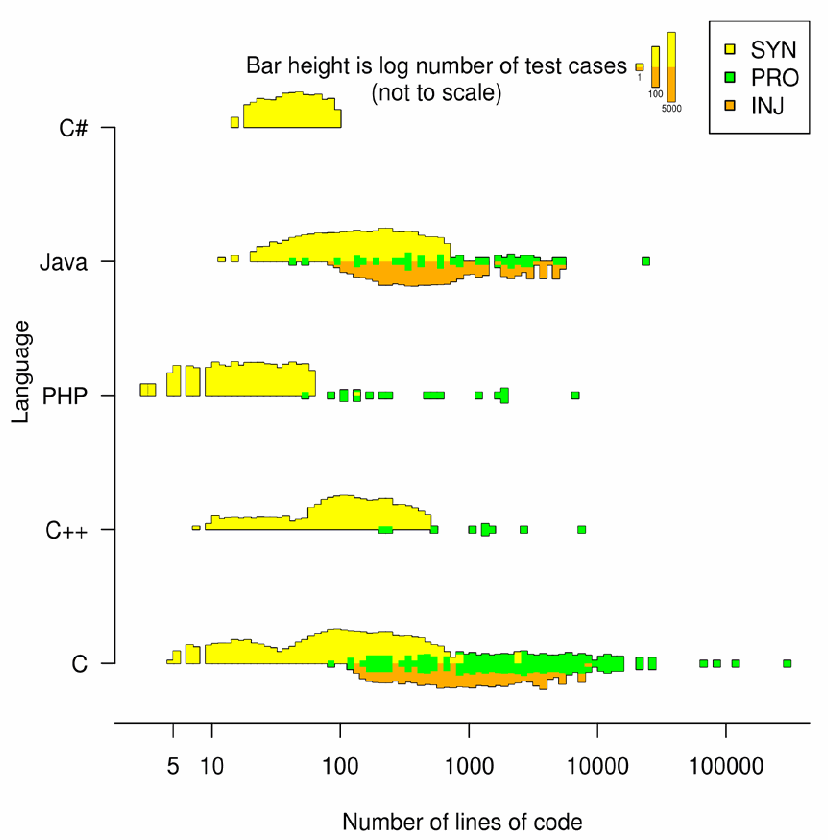
図9:SARDにおけるテストケースの規模、種類および言語のグラフ。縦軸が言語(上から C#、Java、PHP、C++、C)、横軸がコード行数(Number of lines of code。対数目盛で 5、10、100、1000、10000、100000)のグラフである。各言語の基線に沿った棒で、テストケースの種類 SYN(黄、線の上)、PRO(緑、線上)、INJ(橙、線の下)を示す。「Bar height is log number of test cases (not to scale)」(棒の高さはテストケース数の対数。縮尺は正確でない)と注記され、1、100、5000 件の高さを示す小さな目盛がある。C# は SYN のみで、およそ 15〜100 行である。Java は SYN が約 10〜数百行、INJ が約 100〜数千行、PRO が約 2万行まで分布する。PHP は SYN が数行〜約 60 行で、PRO が数千行まで点在する。C++ は SYN が 10 行未満〜数百行、PRO が数千行まで分布する。C は SYN が約 5〜1,000 行超、INJ が約 100〜数千行、PRO が 10万行を超える範囲まで分布する。
Figure 9: Graph of Size, Type, and Languages Of Test Cases in SARD
図9:SARDにおけるテストケースの規模、種類および言語のグラフ
The sixth instance of SATE began in FY 2017. The SAMATE prepares test cases to measure the strengths of tools in finding source code that may lead to serious breaches. More than a dozen tool makers will run their software analysis tools on these test cases. NIST researchers, aided by others in the software assurance community, analyzed the tool reports and publicly reported their experiences at a workshop. The purpose of SATE is to understand the state of technology and society’s justified confidence in software. SATE VI has three tracks: the classic track, a track to assess mobile application vetting services, and the Ockham track for sound analysis. For more information, see https://samate.nist.gov/SATE.html.
SATEの第6回は2017会計年度に始まりました。SAMATEは、重大な侵害につながるおそれのあるソースコードを発見するうえでのツールの強みを測定するために、テストケースを準備します。十数社を超えるツールメーカーが、これらのテストケースに対して自社のソフトウェア解析ツールを実行します。NISTの研究者は、ソフトウェア保証コミュニティの他の関係者の支援を受けてツールのレポートを分析し、その経験をワークショップで公に報告しました。SATEの目的は、技術の現状と、ソフトウェアに対して社会が抱く正当な確信を理解することです。SATE VIには、クラシックトラック、モバイルアプリケーション審査サービスを評価するトラック、および健全な解析のためのOckhamトラックという3つのトラックがあります。詳細については、https://samate.nist.gov/SATE.html を参照のこと。
Just as the medical profession has vocabulary to precisely indicate anatomy, symptoms, and diseases, the BF seeks to improve the science of secure software by providing orthogonal, unambiguous language for software professionals. The BF comprises classes of software faults, including their attributes, causes, and consequences. Figure 10 illustrates the causal graph for buffer overflow (BOF) faults. FY 2017 updates include eight classes (including three cryptography classes):
医療の専門職が解剖学的構造、症状および疾患を正確に示す語彙をもつのと同様に、BFは、直交的で曖昧さのない言語をソフトウェアの専門家に提供することにより、セキュアなソフトウェアの科学を向上させることを目指しています。BFは、ソフトウェア欠陥のクラスから成り、各クラスの属性、原因および結果を含みます。図10は、バッファオーバーフロー(BOF)欠陥の因果グラフを示しています。2017会計年度の更新には、次の8つのクラス(3つの暗号クラスを含む)が含まれます。
1.Injection (INJ)–SQL, OS, etc.;
1.Injection(INJ)–SQL、OSなど
2.Control of Interaction Frequency (CIF);
2.Control of Interaction Frequency(CIF)
3.Buffer Overflow (BOF);
3.Buffer Overflow(BOF)
4.Faulty Operation (FOP)–integer overflow, divide by zero, etc.;
4.Faulty Operation(FOP)–整数オーバーフロー、ゼロ除算など
5.Memory Allocation (MAL)–double free, use after free, etc.;
5.Memory Allocation(MAL)–二重解放、解放後使用など
6.Encryption (ENC)–including decryption,
6.Encryption(ENC)–復号を含む
7.Verification (VRF), and
7.Verification(VRF)
8.Key Management (KMN).
8.Key Management(KMN)
Definitions, examples, and causal graphs of these classes and links to publications are available at https://samate.nist.gov/BF.
これらのクラスの定義、例および因果グラフと、刊行物へのリンクは、https://samate.nist.gov/BF で入手できます。
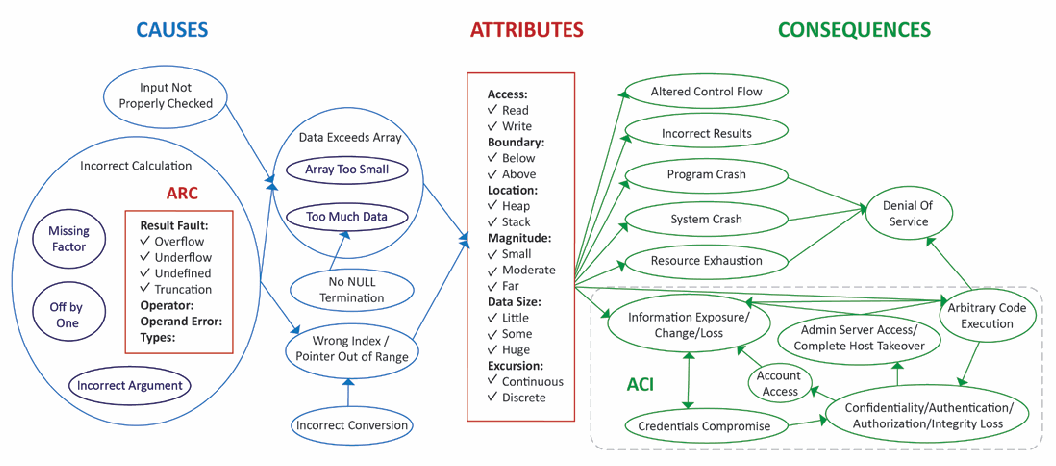
図10:バッファオーバーフローの因果グラフ。CAUSES(原因)、ATTRIBUTES(属性)、CONSEQUENCES(結果)の3列からなるグラフである。原因:Input Not Properly Checked(入力の不適切な検査)から Data Exceeds Array(データが配列を超える。内部に Array Too Small と Too Much Data)へ矢印が向かう。大きな楕円 Incorrect Calculation(ARC)は Missing Factor、Off by One、Incorrect Argument と、「Result Fault: Overflow, Underflow, Undefined, Truncation; Operator:; Operand Error:; Types:」の箱を含み、Data Exceeds Array と Wrong Index / Pointer Out of Range(不正なインデックス/範囲外のポインタ)へ矢印が向かう。No NULL Termination は Too Much Data へ、Incorrect Conversion は Wrong Index / Pointer Out of Range へ矢印が向かう。Data Exceeds Array と Wrong Index / Pointer Out of Range の両方から属性の箱へ矢印が向かう。属性:Access(Read、Write)、Boundary(Below、Above)、Location(Heap、Stack)、Magnitude(Small、Moderate、Far)、Data Size(Little、Some、Huge)、Excursion(Continuous、Discrete)。属性から結果の Altered Control Flow、Incorrect Results、Program Crash、System Crash、Resource Exhaustion、Information Exposure/Change/Loss、Arbitrary Code Execution へ矢印が向かう。Program Crash、System Crash、Resource Exhaustion、Arbitrary Code Execution から Denial Of Service へ矢印が向かう。ACI と記した破線の領域には Information Exposure/Change/Loss、Arbitrary Code Execution、Admin Server Access/Complete Host Takeover、Account Access、Credentials Compromise、Confidentiality/Authentication/Authorization/Integrity Loss があり、その中で Arbitrary Code Execution と Admin Server Access から Information Exposure へ、Information Exposure と Credentials Compromise は双方向、Credentials Compromise から Confidentiality/Authentication/Authorization/Integrity Loss へ、そこから Account Access と Admin Server Access へ、Account Access から Information Exposure へ、Arbitrary Code Execution から Confidentiality/Authentication/Authorization/Integrity Loss へ矢印が向かう。
Figure 10: Causal Graph for Buffer Overflow
図10:バッファオーバーフローの因果グラフ
CONTACT:
連絡先:
Dr. Paul E. Black (301) 975-4794 paul.black@nist.goV
Dr. Paul E. Black (301) 975-4794 paul.black@nist.goV
FEDERAL CYBERSECURITY RESEARCH AND DEVELOPMENT (R&D)
連邦政府のサイバーセキュリティ研究開発(R&D)
Networking and Information Technology Research and Development (NITRD) program provides a framework in which many federal agencies come together to coordinate their networking and IT research and development (R&D) efforts. NIST remained committed to the value of communicating its R&D efforts to other federal colleagues and identifying the opportunities to support R&D efforts throughout the Federal Government.
Networking and Information Technology Research and Development(NITRD)プログラムは、多くの連邦機関が集まってネットワーキングとITの研究開発(R&D)の取り組みを調整するための枠組みを提供します。NISTは、自らのR&Dの取り組みを他の連邦機関の同僚に伝えること、および連邦政府全体のR&Dの取り組みを支援する機会を特定することの価値を、引き続き重視しました。
NIST is a consistent presence at the monthly cybersecurity meetings with Bill Newhouse, National Cybersecurity Center of Excellence (NCCoE) Security Engineer and the National Initiative for Cybersecurity Education (NICE) Deputy Director, as the co-chair of the Cyber Security and Information Assurance Interagency Working Group (CSIA IWG). During FY 2017, NIST provided updates to the CSIA IWG describing the updates to the NIST Cybersecurity Framework, SP 800-53, Security and Privacy Controls for Information Systems and Organizations, and the NICE program.
NISTは、月例のサイバーセキュリティ会合に継続して参加しており、National Cybersecurity Center of Excellence(NCCoE)のSecurity Engineerであり、National Initiative for Cybersecurity Education(NICE)のDeputy DirectorでもあるBill Newhouseが、Cyber Security and Information Assurance Interagency Working Group(CSIA IWG)の共同議長を務めています。2017会計年度に、NISTは、NIST Cybersecurity Framework、SP 800-53, Security and Privacy Controls for Information Systems and Organizations、およびNICEプログラムの更新について、CSIA IWGに最新情報を提供しました。
Naomi Lefkowitz, Senior Privacy Policy Advisor at NIST, co-chairs the Privacy R&D IWG, which coordinates the multidisciplinary research and development conducted by NITRD agencies that seek to produce knowledge and technologies that identify and mitigate emerging risks to our privacy, and that enables individuals, companies, and the government to benefit from technological advancements while being able to effectively balance the resulting benefits with resulting risks to privacy. The activity involves research into and development of methods for characterizing privacy expectations, understanding privacy violations, engineering privacy-protecting systems, recovering from privacy violations, and the impact of privacy on public policy and of public policy on privacy.
NISTのSenior Privacy Policy AdvisorであるNaomi Lefkowitzは、Privacy R&D IWGの共同議長を務めています。同IWGは、NITRD参加機関が実施する学際的な研究開発を調整します。この研究開発は、プライバシーに対する新たなリスクを特定して緩和する知識と技術を生み出すこと、ならびに個人、企業および政府が、技術の進歩から得られる便益とそれに伴うプライバシーへのリスクとの均衡を効果的にとりつつ、その進歩の恩恵を受けられるようにする知識と技術を生み出すことを目指しています。この活動には、プライバシーに関する期待の特徴づけ、プライバシー侵害の理解、プライバシーを保護するシステムのエンジニアリング、およびプライバシー侵害からの回復のための手法の研究開発と、プライバシーが公共政策に及ぼす影響および公共政策がプライバシーに及ぼす影響の研究開発が含まれます。
Ram Sriram is the co-chair of NITRD’s Software Productivity, Sustainability, and Quality (SPSQ) Interagency Working Group (IWG). Robert B. Bohn is the co-chair of NITRD’s Faster Administration of S&T Education and Research (FASTER) Community of Practice (CoP). Barry I. Schneider is co-chair of High End Computing (HEC) IWG. Chris Greer and Al Wavering from NIST’s Engineering Laboratory co-chair NITRD’s Cyber Physical Systems (CPS) IWG and the High Confidence Software and Systems (HCSS) IWG, respectively.
Ram Sriramは、NITRDのSoftware Productivity, Sustainability, and Quality(SPSQ)Interagency Working Group(IWG)の共同議長です。Robert B. Bohnは、NITRDのFaster Administration of S&T Education and Research(FASTER)Community of Practice(CoP)の共同議長です。Barry I. Schneiderは、High End Computing(HEC)IWGの共同議長です。NISTのEngineering Laboratoryに所属するChris GreerとAl Waveringは、それぞれNITRDのCyber Physical Systems(CPS)IWGとHigh Confidence Software and Systems(HCSS)IWGの共同議長を務めています。
Tim Polk is the principal NIST participant in the biweekly coordination activities of the federal Special Cyber Operations Research and Engineering (SCORE) Committee. SCORE enables technology transfer through the sharing of NIST cybersecurity expertise and publications with researchers throughout the Federal Government. The SCORE committee interacts with federal leaders and reports to the National Science and Technology Council’s Committee on Homeland and National Security.
Tim Polkは、連邦政府のSpecial Cyber Operations Research and Engineering(SCORE)Committeeが隔週で行う調整活動における、NISTの主たる参加者です。SCOREは、NISTのサイバーセキュリティに関する専門知識と刊行物を連邦政府全体の研究者と共有することを通じて、技術移転を可能にします。SCORE委員会は、連邦政府の指導者と交流し、National Science and Technology CouncilのCommittee on Homeland and National Securityに報告します。
All the NIST leaders for interagency coordination leverage these working groups and committees to communicate powerfully about NIST’s research, frameworks, and publications and bring back insights and activities relevant to NIST’s work.
省庁間調整を担うNISTのリーダーは全員、これらのワーキンググループと委員会を活用して、NISTの研究、フレームワークおよび刊行物について力強く発信し、NISTの業務に関連する知見と活動を持ち帰っています。
FOR MORE INFORMATION, SEE:
詳細情報:
https://www.nitrd.gov
https://www.nitrd.gov
CONTACT:
連絡先:
Mr. Bill Newhouse (301) 975-0232 william.newhouse@nist.gov
Mr. Bill Newhouse (301) 975-0232 william.newhouse@nist.gov
COMPUTER FORENSICS
コンピュータフォレンジック
Digital evidence includes software, hardware, and data on computers and mobile devices (e.g., audio, video, and image files). Digital evidence can be a part of investigating most crimes, since material relevant to the crime may be recorded in digital form. Methods for securely acquiring, storing and analyzing digital evidence quickly and efficiently are critical. ITL promotes the efficient and effective use of computer technology to investigate crimes. The project team develops tools for testing computer forensic software, including test criteria and test sets. ITL also maintains the National Software Reference Library (NSRL) – a vast archive of published software applications that is an important resource for both criminal investigators and historians.
デジタル証拠には、コンピュータとモバイルデバイス上のソフトウェア、ハードウェアおよびデータ(例:音声、動画および画像のファイル)が含まれます。犯罪に関連する資料はデジタル形式で記録されている場合があるため、デジタル証拠は、ほとんどの犯罪の捜査の一部になり得ます。デジタル証拠を迅速かつ効率的に、セキュアに取得、保管および分析する手法は極めて重要です。ITLは、犯罪捜査におけるコンピュータ技術の効率的かつ効果的な利用を推進しています。プロジェクトチームは、テスト基準とテストセットを含め、コンピュータフォレンジックソフトウェアをテストするためのツールを開発しています。ITLは、National Software Reference Library(NSRL)も維持しています。NSRLは、公表されたソフトウェアアプリケーションの膨大なアーカイブであり、犯罪捜査官と歴史家の双方にとって重要な資源です。
National Software Reference Library(NSRL)のロゴ。大きな『NSRL』の文字と正式名称『National Software Reference Library』が示されている。 [組織・プログラムのロゴ。ロゴのため、この非公式サイトには掲載していません。原本 PDF を参照してください。]
National Software Reference Library
全米ソフトウェア参照ライブラリ
The NSRL is designed to collect software from various sources and incorporate file profiles computed from this software into a Reference Data Set (RDS) of information. The RDS can be used by law enforcement, government, and industry organizations to review files on a computer by matching file profiles in the RDS. This will help alleviate much of the effort involved in determining which files are important as evidence on computers or file systems that have been seized as part of criminal investigations. The NSRL also provides a research environment to promote the development of new forensics techniques and other applications in computer science.
NSRLは、さまざまな情報源からソフトウェアを収集し、そのソフトウェアから算出したファイルプロファイルを、情報の Reference Data Set(RDS)に取り込むように設計されています。RDSは、法執行機関、政府機関、産業界の組織が、RDS内のファイルプロファイルと照合することによって、コンピュータ上のファイルを確認するために利用できます。これにより、犯罪捜査の一環として押収されたコンピュータやファイルシステムにおいて、どのファイルが証拠として重要かを判断する作業の多くを軽減できます。NSRLはまた、新たなフォレンジック技術やコンピュータサイエンスにおけるその他の応用の開発を促進するための研究環境も提供します。
The RDS continues to be the premier software resource and, in FY 2017, the NSRL published four releases. There are currently 23,000 microcomputer applications and 160,000 mobile device applications yielding a combined total of 326 million files. In FY 2017, the NSRL was expanded to include mobile applications and to include the profiles obtained from installing and exercising applications.
RDSは引き続き最高水準のソフトウェア資源であり、2017会計年度にNSRLは4回のリリースを公開しました。現在、23,000件のマイクロコンピュータ向けアプリケーションと160,000件のモバイルデバイス向けアプリケーションがあり、合計で3億2,600万ファイルとなります。2017会計年度に、NSRLはモバイルアプリケーションを含むように拡張されたほか、アプリケーションをインストールして動作させて得られたプロファイルも含むように拡張されました。
[NIST のロゴ。公的な標章のため、この非公式サイトには掲載していません。原本 PDF を参照してください。]
Computer Forensics Tool Testing Project
Computer Forensics Tool Testing プロジェクト
There is a critical need in the law enforcement community to ensure the reliability of computer forensic tools. The goal of the Computer Forensic Tool Testing (CFTT) project at NIST is to establish a methodology for testing computer forensic software tools by the development of general tool specifications, test procedures, test criteria, test sets, and test hardware. The project is intended to provide the information necessary for toolmakers to improve tools, for users to make informed choices about acquiring and using computer forensics tools, and for interested parties to understand the capabilities of the tools. The project team’s approach for testing computer forensic tools is based on well-recognized international methodologies for conformance testing and quality testing that ensures that forensic software tools consistently produce accurate and objective test results.
法執行コミュニティには、コンピュータフォレンジックツールの信頼性を確保する重大なニーズがあります。NISTのComputer Forensic Tool Testing(CFTT)プロジェクトの目標は、一般的なツール仕様、テスト手順、テスト基準、テストセット、およびテスト用ハードウェアを開発することにより、コンピュータフォレンジックソフトウェアツールを試験する方法論を確立することです。本プロジェクトは、ツール開発者がツールを改善するため、利用者がコンピュータフォレンジックツールの入手と使用について十分な情報に基づいて選択するため、および関係者がツールの能力を理解するために必要な情報を提供することを意図しています。プロジェクトチームのコンピュータフォレンジックツールの試験アプローチは、フォレンジックソフトウェアツールが正確かつ客観的な試験結果を一貫して生成することを保証する、適合性試験および品質試験に関する広く認められた国際的な方法論に基づいています。
In FY 2016, the CFTT project expanded to allow forensics testers to use the NIST testing methodology in their own labs and to produce standardized test reports for disk imaging forensic tools. In FY 2017, federated testing was further expanded with three major updates: a revision to disk-imaging testing, the addition of mobile device tool testing and hardware write-blocker testing. In FY 2018, the project will be expanded to support string searching and forensic media preparation. The forensic community is beginning to use federated testing to test tools and share test reports. The CFTT project also maintains the Forensics Tool Catalog and the Computer Forensics Reference Data Sets (CFReDS). The Tool Catalog website is a community-sourced catalog of forensic tools aided by a taxonomy of forensic tools. The Tool Catalog grew by 17 tools in FY 2017. The CFReDS data sets are used in a variety of settings, such as university classes, to try out forensics tools on known data.
2016会計年度に、CFTTプロジェクトは、フォレンジックの試験担当者が自らのラボでNISTの試験方法論を使用し、ディスクイメージングのフォレンジックツール向けの標準化された試験報告書を作成できるように拡張されました。2017会計年度には、フェデレーテッドテストが3つの主要な更新によってさらに拡張されました。すなわち、ディスクイメージングテストの改訂、モバイルデバイスツールテストの追加、およびハードウェア書き込みブロッカーのテストの追加です。2018会計年度には、文字列検索およびフォレンジックメディアの準備をサポートするようプロジェクトを拡張する予定です。フォレンジックコミュニティは、ツールの試験や試験報告書の共有にフェデレーテッドテストを使い始めています。CFTTプロジェクトはまた、Forensics Tool CatalogとComputer Forensics Reference Data Sets(CFReDS)も維持しています。Tool Catalogのウェブサイトは、フォレンジックツールの分類体系に支えられた、コミュニティが情報を提供するフォレンジックツールのカタログです。Tool Catalogは、2017会計年度に17個のツールが増えました。CFReDSのデータセットは、既知のデータに対してフォレンジックツールを試すために、大学の授業などさまざまな場面で使用されています。
FOR MORE INFORMATION, SEE:
詳細情報:
https://www.nsrl.nist.gov, https://toolcatalog.nist.gov, https://www.cfreds.nist.gov. and https://www.cftt.nist.gov
https://www.nsrl.nist.gov, https://toolcatalog.nist.gov, https://www.cfreds.nist.gov. および https://www.cftt.nist.gov
CONTACTS:
連絡先:
Mr. Doug White, (301) 975-4761, doug.white@nist.gov
Mr. Doug White, (301) 975-4761, doug.white@nist.gov
Dr. Jim Lyle, (301) 975-3270, james.lyle@nist.gov
Dr. Jim Lyle, (301) 975-3270, james.lyle@nist.gov
Figure 11: The Seven Categories of the NICE Framework
図11:NICE Frameworkの7つのカテゴリ
CYBERSECURITY AWARENESS, TRAINING, EDUCATION, AND OUTREACH
サイバーセキュリティの意識向上、トレーニング、教育およびアウトリーチ
National Initiative for Cybersecurity Education (NICE)
National Initiative for Cybersecurity Education(NICE)
Since 2010 NIST’s National Initiative for Cybersecurity Education (NICE) seeks to foster, energize, and promote a robust network and an integrated ecosystem of cybersecurity education, training, and workforce development. NICE has been focusing on efforts to achieve this by aligning to three goals: 1) accelerate learning and skills development, 2) nurture a diverse learning community, and 3) guide career development and workforce planning.
2010年以来、NISTのNational Initiative for Cybersecurity Education(NICE)は、サイバーセキュリティの教育、トレーニングおよび人材開発の強固なネットワークと統合されたエコシステムを育成し、活性化し、推進することを目指しています。NICEは、1)学習とスキル開発を加速する、2)多様な学習コミュニティを育む、3)キャリア開発と人材計画を導く、という3つの目標に沿うことによって、これを達成する取り組みに注力してきました。
In support of goal 1, in November 2016, CyberSeek was launched to provide a visualization of the demand for and supply of cybersecurity workers across the nation (see http://cyberseek.org). At its launch, the tool also provided a visualization of career pathways in cybersecurity. The data from this tool, in part, has helped NICE develop an executive overview white paper on Cybersecurity Workforce Demand. In FY 2017, NICE also supported goal one through the development of a paper regarding Cybersecurity Apprenticeships. This report and other white papers developed by NICE authors are available at https://www.nist.gov/itl/applied-cybersecurity/nice/resources/one-pagers.
目標1を支援するため、2016年11月にCyberSeekが公開され、全米のサイバーセキュリティ人材の需要と供給が可視化されました(http://cyberseek.org を参照してください)。このツールは公開時点で、サイバーセキュリティ分野のキャリアパスの可視化も提供していました。このツールのデータは、NICEがCybersecurity Workforce Demandに関する経営層向け概要のホワイトペーパーを作成するうえで一部役立ちました。2017会計年度には、NICEはCybersecurity Apprenticeshipsに関する文書の作成を通じても目標1を支援しました。この報告書と、NICEの著者が作成したその他のホワイトペーパーは、https://www.nist.gov/itl/applied-cybersecurity/nice/resources/one-pagers で入手できます。
In support of goal 2, NICE hosted a Veterans in Cybersecurity Workshop in March 2017. This workshop convened approximately 40 representatives of federal and state government, branches of the military, industry, and workforce development organizations to explore issues, discuss initiatives and better understand the gaps that exist in helping our veterans transition to careers in cybersecurity.
目標2を支援するため、NICEは2017年3月にVeterans in Cybersecurity Workshopを主催しました。このワークショップには、連邦政府および州政府、軍の各部門、産業界、人材開発組織の代表者約40名が集まり、退役軍人がサイバーセキュリティ分野の職業へ移行するのを支援するうえでの課題を探り、取り組みについて議論し、存在するギャップへの理解を深めました。
In support of goal 3, NICE published SP 800-181, The NICE Framework, in August 2017 (see https://nist.gov/nice/framework). The NICE Framework establishes a taxonomy and common lexicon that is to be used to describe all cybersecurity work and workers, irrespective of where or for whom the work is performed. Figure 11 shows the seven categories of the NICE Framework. These categories further break down into Specialty Areas, Work Roles, Tasks, and Knowledge, Skills, and Abilities (KSAs).
目標3を支援するため、NICEは2017年8月にSP 800-181, The NICE Frameworkを公表しました(https://nist.gov/nice/framework を参照してください)。NICE Frameworkは、業務がどこで、誰のために行われるかにかかわらず、あらゆるサイバーセキュリティ業務とその従事者を記述するために用いる分類体系と共通の用語体系を定めています。図11は、NICE Frameworkの7つのカテゴリを示しています。これらのカテゴリは、さらにSpecialty Areas、Work Roles、Tasks、およびKnowledge, Skills, and Abilities(KSAs)に細分されます。
NICEのClarence WilliamsとRodney Petersenが、CyberSecureGov会議のNISTブースで参加者と話している。 [NIST のロゴが写っている図。公的な標章のため、この非公式サイトには掲載していません。原本 PDF を参照してください。]
Figure 12: Clarence Williams, Lead for Government Engagement at NICE, and Rodney Petersen, Director of NICE, speak with an attendee at the CyberSecureGov Conference in Washington, D.C.
図12:ワシントンD.C.で開催されたCyberSecureGov Conferenceで参加者と話す、NICEのLead for Government EngagementであるClarence Williamsと、NICEのDirectorであるRodney Petersen
NICE continued its coordination with academic, industry and government partners throughout the year at various meetings, workshops and events. In August 2017, NICE held a workshop in Chicago, Illinois. This workshop, along with a Request for Information that NICE issued, provided information to inform work and to prepare a report to the President on the findings and recommendations about supporting the growth and sustainment of the nation’s cybersecurity workforce in the public and private sectors.
NICEは、年間を通じてさまざまな会合、ワークショップ、イベントにおいて、学術界、産業界、政府のパートナーとの連携を継続しました。2017年8月、NICEはイリノイ州シカゴでワークショップを開催しました。このワークショップは、NICEが発出した情報提供依頼(Request for Information)とともに、業務の参考となる情報を提供し、また、公共部門および民間部門における米国のサイバーセキュリティ人材の拡大と維持の支援に関する調査結果と勧告について大統領への報告書を作成するための情報を提供しました。
In FY 2018, NICE will continue to promote and coordinate annual NICE activities such as the NICE Quarterly eNewsletter; the NICE Webinar Series; the NICE Conference to be held on November 7-8, 2017 in Dayton, Ohio; and the NICE K-12 Cybersecurity Education Conference to be held December 4-5, 2017 in Nashville, Tennessee. NICE will also kick off the first annual National Cybersecurity Career Awareness Week on November 13-18, 2017 to focus local, regional, and national interest to inspire, educate, and engage children through adults to pursue careers in cybersecurity.
2018会計年度には、NICEは、NICE Quarterly eNewsletter、NICE Webinar Series、2017年11月7日~8日にオハイオ州デイトンで開催されるNICE Conference、2017年12月4日~5日にテネシー州ナッシュビルで開催されるNICE K-12 Cybersecurity Education Conferenceといった、NICEの年次活動の推進と調整を継続します。NICEはまた、2017年11月13日~18日に第1回の年次National Cybersecurity Career Awareness Weekを開始します。これは、地方、地域、全国の関心を集め、子どもから大人までがサイバーセキュリティ分野の職業を目指すよう、意欲を喚起し、教育し、関与を促すことを目的とします。
FOR MORE INFORMATION, SEE:
詳細情報:
https://www.nist.gov/itl/applied-cybersecurity/nice
https://www.nist.gov/itl/applied-cybersecurity/nice
CONTACTS:
連絡先:
Mr. Rodney Petersen, (301) 975-8897, rodney@nist.gov
Mr. Rodney Petersen, (301) 975-8897, rodney@nist.gov
Ms. Danielle Santos, (301) 975-5048, danielle.santos@nist.gov
Ms. Danielle Santos, (301) 975-5048, danielle.santos@nist.gov
Computer Security Resource Center (CSRC)
Computer Security Resource Center(CSRC)
For more than 20 years, the CSRC website has provided stakeholders with significant information about ITL’s cybersecurity research and testing programs. Consistently one of the most-visited websites at NIST, CSRC is used by several ITL divisions to communicate information about NIST’s cybersecurity and privacy programs and projects, research, validation testing, software tools, and other areas of interest to NIST’s customers in government, industry, academia and elsewhere, both within the U.S. and globally.
CSRCのウェブサイトは20年以上にわたり、ITLのサイバーセキュリティ研究および試験プログラムに関する重要な情報を利害関係者に提供してきました。CSRCは一貫してNISTで最も訪問者の多いウェブサイトの一つであり、ITLの複数の部門が、NISTのサイバーセキュリティおよびプライバシーに関するプログラムとプロジェクト、研究、検証試験、ソフトウェアツール、ならびに米国内外の政府、産業界、学術界などにおけるNISTの顧客が関心を持つその他の分野について情報を伝えるために利用しています。
The CSRC website serves as a primary NIST repository of cybersecurity and privacy standards, guidelines, and technical documents. Refer to the Publications Released in FY 2017 section of this annual report for details about the ITL Cybersecurity Program’s publications released in FY 2017.
CSRCのウェブサイトは、サイバーセキュリティおよびプライバシーに関する標準、ガイドライン、技術文書を収めるNISTの主要なリポジトリとして機能しています。2017会計年度に公表されたITL Cybersecurity Programの刊行物の詳細については、本年次報告書の「Publications Released in FY 2017」の節を参照されました。
CSRC’s most significant event occurred in September 2017, with the launch of a completely redesigned, content management system-based website. In addition to aligning with the main NIST website’s look and feel, the new CSRC website is organized around several primary content types to make information easier to find and maintain: projects, publications, news, events and presentations. A new taxonomy of topics is used to tag content site-wide, and an online, searchable glossary of information security terminology expands on the terms identified in NISTIR 7298 Revision 2. One of the most noticeable changes is a vastly improved publications section, in terms of content, searchability, and browsing. At the end of FY 2017, the site provided detailed information about more than 1,200 of NIST’s current and historical information security publications.
CSRCにとって最も重要な出来事は2017年9月に起きました。全面的に再設計され、コンテンツ管理システムを基盤とするウェブサイトが公開されたのです。新しいCSRCのウェブサイトは、NISTのメインウェブサイトの外観と操作感に合わせたことに加え、情報を見つけやすく、維持しやすくするために、プロジェクト、刊行物、ニュース、イベント、プレゼンテーションという複数の主要なコンテンツ種別を軸に構成されています。サイト全体のコンテンツへのタグ付けにはトピックの新しい分類体系が用いられ、情報セキュリティ用語のオンラインで検索可能な用語集は、NISTIR 7298 Revision 2で示された用語を拡充しています。最も目立つ変更の一つは、内容、検索性、閲覧のしやすさの点で大幅に改善された刊行物セクションです。2017会計年度末時点で、このサイトは、NISTの現行および過去の情報セキュリティ刊行物1,200件以上について詳細な情報を提供していました。
The CSRC Redesign Team designed the site’s architecture and interface to significantly improve site navigation, search, and the ability of ITL staff to maintain and contribute content. The site also uses responsive design to greatly improve CSRC’s usability on mobile devices. More than 21,000 individual content items were transferred from the legacy site, and in February 2017, ITL successfully launched a beta version of the new site. Feedback from beta-site users over seven months was incorporated by the CSRC Redesign Team to fix bugs, implement enhancements, and refine the site’s look and feel. The team considered all comments it received, and made every effort to implement those suggestions. After making significant, gradual improvements to the beta site, NIST launched the new CSRC on September 18, 2017, while simultaneously retiring the legacy site.
CSRC Redesign Teamは、サイト内の移動、検索、およびITLの職員がコンテンツを維持し投稿する能力を大幅に改善するように、サイトのアーキテクチャとインタフェースを設計しました。このサイトはレスポンシブデザインも採用しており、モバイルデバイスでのCSRCの使いやすさが大きく向上しています。旧サイトから21,000件を超える個別のコンテンツ項目が移行され、2017年2月、ITLは新サイトのベータ版の公開に成功しました。CSRC Redesign Teamは、7か月にわたってベータサイトの利用者から寄せられたフィードバックを取り入れ、不具合を修正し、機能強化を実装し、サイトの外観と操作感を洗練させました。チームは受け取ったすべてのコメントを検討し、それらの提案を実現するためにあらゆる努力を払いました。ベータサイトに重要な改善を段階的に加えたのち、NISTは2017年9月18日に新しいCSRCを公開し、同時に旧サイトを廃止しました。
In FY 2018, the CSRC Redesign Team will continue to enhance the content, functionality and usability of the new site, striving to provide a better and more useful experience to site users.
2018会計年度には、CSRC Redesign Teamは新サイトの内容、機能、使いやすさの向上を継続し、サイト利用者により良く、より有用な体験を提供するよう努めます。
The CSRC team maintains an email subscription list with more than 78,000 subscribers worldwide. Subscribers receive notifications when news updates, event details, and publication information—including the release of draft publications for public comment—are posted to CSRC. To review the available lists and subscribe, visit https://csrc.nist.gov/ and in the page footer click either the envelope icon or the “Subscribe to CSRC Updates” link. Additional NIST/ITL Cybersecurity topics are available including: Federal Information Security Management Act (FISMA) news; Cybersecurity Framework; National Initiative for Cybersecurity Education (NICE); ITL’s Trusted Identity Group (TIG), and several lists for the NCCoE.
CSRCチームは、世界中に78,000人を超える購読者を持つ電子メール購読リストを維持しています。購読者は、ニュースの更新、イベントの詳細、および刊行物の情報(パブリックコメントのための草案刊行物の公表を含む)がCSRCに掲載されると通知を受け取ります。利用可能なリストを確認して購読するには、https://csrc.nist.gov/ にアクセスし、ページのフッターにある封筒のアイコンか「Subscribe to CSRC Updates」のリンクをクリックします。そのほかにも、NIST/ITLのサイバーセキュリティに関するトピックが利用可能であり、Federal Information Security Management Act(FISMA)のニュース、Cybersecurity Framework、National Initiative for Cybersecurity Education(NICE)、ITLのTrusted Identity Group(TIG)、およびNCCoEの複数のリストが含まれます。
FOR MORE INFORMATION, SEE:
詳細情報:
https://csrc.nist.gov
https://csrc.nist.gov
CONTACTS:
連絡先:
Questions regarding the CSRC website can be sent to the CSRC Webmasters at: webmaster-csrc@nist.gov
CSRCのウェブサイトに関する質問は、CSRC Webmasters宛てに次のアドレスへ送ることができる:webmaster-csrc@nist.gov
Mr. Patrick O’Reilly, (301) 975-4751, patrick.oreilly@nist.gov
Mr. Patrick O’Reilly, (301) 975-4751, patrick.oreilly@nist.gov
Ms. Nicole Keller, (301) 975-3648, nicole.keller@nist.gov
Ms. Nicole Keller, (301) 975-3648, nicole.keller@nist.gov
Federal Computer Security Managers’ (FCSM) Forum
Federal Computer Security Managers’ (FCSM) Forum
The Federal Computer Security Managers’ Forum (the Forum) is sponsored by NIST to promote the sharing of security-related information among federal agencies. The Forum, which serves more than 1,000 members, strives to provide an ongoing opportunity for managers of federal information security programs to exchange information security materials in a timely manner, build upon the experiences of other programs, and to reduce possible duplication of efforts. It provides a mechanism for NIST to share information directly with federal agency information security managers in fulfillment of NIST’s leadership mandate under FISMA. The Forum also assists NIST in establishing and maintaining relationships with other individuals and organizations that are actively addressing information security issues within the Federal Government. During FY 2017, CSD’s Victoria Pillitteri and Jody Jacobs served as Co-Chairs, and Peggy Himes from ACD served as the Secretariat of the Forum, providing administrative and logistical support. Additionally, during FY 2017, the FCSM webpage was significantly restructured and updated to ensure that presentation information, both current and archived, is delivered as efficiently and effectively as possible.
Federal Computer Security Managers’ Forum(以下「Forum」)は、連邦機関の間でセキュリティ関連情報の共有を促進するためにNISTが後援しています。1,000人を超える会員を擁するForumは、連邦政府の情報セキュリティプログラムの管理者が、情報セキュリティに関する資料を適時に交換し、他のプログラムの経験を活かし、起こり得る取り組みの重複を減らすための継続的な機会を提供するよう努めています。Forumは、FISMAの下でNISTに課された主導的役割を果たすうえで、NISTが連邦機関の情報セキュリティ管理者と直接情報を共有するための仕組みとなっています。Forumはまた、連邦政府内で情報セキュリティの課題に積極的に取り組んでいる他の個人や組織との関係をNISTが構築し維持することも支援しています。2017会計年度には、CSDのVictoria PillitteriとJody Jacobsが共同議長を務め、ACDのPeggy HimesがForumの事務局を務めて、運営面および実務面の支援を提供しました。加えて、2017会計年度には、現行のものと保存されたものの両方のプレゼンテーション情報をできる限り効率的かつ効果的に提供できるよう、FCSMのウェブページが大幅に再構成され、更新されました。
The Forum maintains an extensive email subscription service/listserv. Participation in the service is restricted to those Federal and State Government employees and their designated support contractors with a role in the management of their organization’s information system security program. The email listserv offers an open forum for information sharing of best practices and recommendations, and serves as a resource for this community of interest.
Forumは、広範な電子メール購読サービス/リストサーブを維持しています。このサービスへの参加は、自組織の情報システムセキュリティプログラムの管理に役割を持つ連邦政府および州政府の職員と、その指定された支援請負業者に限られます。この電子メールのリストサーブは、ベストプラクティスや推奨事項を情報共有するための開かれた場を提供し、この関心共同体のための情報源として機能しています。
The Forum conducts quarterly meetings and an annual two-day conference for a discussion of current issues and topics of interest to those responsible for supporting the information security programs of federal agencies.
Forumは、連邦機関の情報セキュリティプログラムの支援に責任を負う人々が関心を持つ現在の課題やトピックについて議論するため、四半期ごとの会合と年1回の2日間の会議を開催しています。
Discussion topics at the quarterly FCSM meetings in FY 2017 included briefings on:
2017会計年度の四半期ごとのFCSM会合における議題には、次の事項に関する説明が含まれていました。
•The National Cybersecurity Center of Excellence (NCCoE) - Federally Funded Research and Development Center (FFRDC),
•National Cybersecurity Center of Excellence(NCCoE)- Federally Funded Research and Development Center(FFRDC)、
•Developing an information security continuous monitoring (ISCM) Assessment Methodology,
•情報セキュリティ継続的監視(ISCM)のアセスメント方法論の策定、
•Security Automation and Continuous Monitoring,
•セキュリティ自動化と継続的監視、
•Demonstration of a Continuous Diagnostic Monitoring Instance,
•Continuous Diagnostic Monitoringのインスタンスの実演、
•Guidance for Assigning New Cybersecurity Codes to Positions with IT/Cybersecurity/Cyber-related Functions and the New Cybercareers.gov Site,
•IT/サイバーセキュリティ/サイバー関連の職務を持つ職位への新しいサイバーセキュリティコードの割り当てに関するガイダンス、および新しいCybercareers.govサイト、
•Using Risk Management to Improve Privacy in Federal Systems,
•リスク管理を用いた連邦政府システムにおけるプライバシーの向上、
•National Cybersecurity and Communications Integration Center (NCCIC) 101, and
•National Cybersecurity and Communications Integration Center(NCCIC)101、および
•Creating a Cybersecurity Scorecard for a Federal Agency.
•連邦機関のためのサイバーセキュリティスコアカードの作成。
FY 2017’s annual two-day meeting was held at NIST on June 20-21, 2017 with over 220 attendees. Presentations included the current technical, operational and management information systems security topics and updates on the information system security activities of OMB, General Services Administration (GSA), Department of Homeland Security (DHS), Department of Health and Human Services (HHS), NARA, Internal Revenue Service (IRS), National Weather Service (NOAA), Office of Personnel Management (OPM), and NIST. A first ever “ask the experts” panel was held where attendees could ask subject matter experts on security, privacy, and procurement-related questions. Most presentations from the two-day offsite and monthly meetings are available online (see https://csrc.nist.gov/Projects/Forum/Archived-Events-and-Presentations).
2017会計年度の年1回の2日間の会合は、2017年6月20日~21日にNISTで開催され、220人を超える参加者がありました。プレゼンテーションには、情報システムセキュリティに関する技術面、運用面、管理面の最新のトピックと、OMB、General Services Administration(GSA)、Department of Homeland Security(DHS)、Department of Health and Human Services(HHS)、NARA、Internal Revenue Service(IRS)、National Weather Service(NOAA)、Office of Personnel Management(OPM)、およびNISTの情報システムセキュリティ活動に関する最新情報が含まれていました。参加者がセキュリティ、プライバシー、調達に関する質問を各分野の専門家に尋ねることができる、初めての「ask the experts」パネルが開かれました。2日間のオフサイト会合および月例会合のプレゼンテーションの大半は、オンラインで入手できます(https://csrc.nist.gov/Projects/Forum/Archived-Events-and-Presentations を参照してください)。
The following is a list of presentations that were given at the annual two-day meeting:
以下は、年1回の2日間の会合で行われたプレゼンテーションの一覧です。
•Overview of SP 800-184, Guide for Cybersecurity Event Recovery
•Overview of SP 800-184, Guide for Cybersecurity Event Recovery
•FedRAMP Tailored
•FedRAMP Tailored
•Overview of the Software Quality Assurance Project and Software Assurance Marketplace
•Overview of the Software Quality Assurance Project and Software Assurance Marketplace
•Applying the Cybersecurity Framework in Federal Agencies: Presentation and Panel Discussion
•Applying the Cybersecurity Framework in Federal Agencies: Presentation and Panel Discussion
•Top Down vs. Bottom Up Governance of Risk, What’s Best?
•Top Down vs. Bottom Up Governance of Risk, What’s Best?
•Cybersecurity Dashboard on a Shoestring Budget
•Cybersecurity Dashboard on a Shoestring Budget
•High Vulnerability Asset Overlay
•High Vulnerability Asset Overlay
•Pushing Computers to the Edge: Next Generation Security and Privacy Controls for Systems and IoT Devices
•Pushing Computers to the Edge: Next Generation Security and Privacy Controls for Systems and IoT Devices
•Infusing Cybersecurity into the Government Acquisition Process
•Infusing Cybersecurity into the Government Acquisition Process
•Government Accountability Office Update
•Government Accountability Office Update
•“Ask the Experts” Panel
•“Ask the Experts” Panel
•NIST Interagency Report 8011, Automation Support for Security Control Assessments
•NIST Interagency Report 8011, Automation Support for Security Control Assessments
The Forum plays a valuable role in helping NIST and other federal agencies develop and maintain a strong, proactive stance in the identification and resolution of new strategic and tactical IT security issues as they emerge. The email list of interested parties has steadily increased in size and provides a valuable resource for Federal and State security program managers.
Forumは、新たな戦略的・戦術的なITセキュリティの課題が現れた際に、NISTおよび他の連邦機関がその特定と解決において強固で先を見越した姿勢を築き、維持するのを助けるうえで、貴重な役割を果たしています。関心を持つ関係者の電子メールリストは着実に規模を拡大しており、連邦政府および州政府のセキュリティプログラム管理者にとって貴重な情報源となっています。
FOR MORE INFORMATION, SEE:
詳細情報:
https://csrc.nist.gov/Projects/Forum
https://csrc.nist.gov/Projects/Forum
CONTACTS:
連絡先:
Ms. Victoria Pillitteri, (301) 975-8542, victoria.pillitteri@nist.gov
Ms. Victoria Pillitteri, (301) 975-8542, victoria.pillitteri@nist.gov
Ms. Jody Jacobs, (301) 975-4728, jody.jacobs@nist.gov
Ms. Jody Jacobs, (301) 975-4728, jody.jacobs@nist.gov
Federal Information Systems Security Educators’ Association (FISSEA)
Federal Information Systems Security Educators’ Association (FISSEA)
The Federal Information Systems Security Educators’ Association (FISSEA), founded in 1987, is an organization hosted by NIST for information system security professionals to assist federal agencies in meeting their information system’s security awareness, training, and education responsibilities. FISSEA strives to elevate the general level of information system security knowledge for the Federal Government and the federal workforce. It also seeks to assist the professional development of its members.
1987年に設立されたFederal Information Systems Security Educators’ Association(FISSEA)は、情報システムセキュリティの専門家のためにNISTがホストする組織であり、連邦機関が自らの情報システムのセキュリティに関する意識向上、トレーニング、教育の責任を果たすのを支援します。FISSEAは、連邦政府および連邦政府職員の情報システムセキュリティに関する知識の全般的な水準を高めるよう努めています。また、会員の専門能力の開発を支援することも目指しています。
FISSEA membership is open to information system security professionals, professional trainers and educators, and managers responsible for information system security training programs in federal agencies, as well as contractors of these agencies and faculty members of accredited educational institutions who are involved in information security training and education. Willingness to share products, information, and experiences is all that is required to become a FISSEA member. A working group meets monthly to administer business activities.
FISSEAの会員資格は、情報システムセキュリティの専門家、専門のトレーナーおよび教育者、連邦機関において情報システムセキュリティのトレーニングプログラムに責任を負う管理者のほか、これらの機関の請負業者、および情報セキュリティのトレーニングと教育に携わる認定教育機関の教員に開かれています。FISSEAの会員になるために求められるのは、成果物、情報、経験を共有する意思だけです。ワーキンググループが毎月会合を開き、業務活動を運営しています。
FISSEA maintains a website and a mailing list, and participates in a social networking site as a means of communication for its members. CSD assists FISSEA with its operations by providing staff support for several of its activities and by being FISSEA’s host agency.
FISSEAは、会員のための連絡手段として、ウェブサイトとメーリングリストを維持し、ソーシャルネットワーキングサイトに参加しています。CSDは、FISSEAの複数の活動に職員による支援を提供し、またFISSEAのホスト機関となることで、その運営を支援しています。
The 30th Annual FISSEA Conference occurred on June 19, 2017 at NIST. The FISSEA audience included managers responsible for information systems security awareness, training, certifications, workforce identification, compliance, etc. in federal agencies; contractors providing awareness and training support; and faculty members of accredited educational institutions who are involved in information security training and education. Clarence Williams, Peggy Himes, Gretchen Morris (DB Consulting Group/NASA), and other members of the FISSEA Working Group, were integral to the effort to support the conference.
第30回の年次FISSEA Conferenceは、2017年6月19日にNISTで開催されました。FISSEAの参加者には、連邦機関において情報システムセキュリティの意識向上、トレーニング、資格認定、人材の特定、コンプライアンスなどに責任を負う管理者、意識向上およびトレーニングの支援を提供する請負業者、情報セキュリティのトレーニングと教育に携わる認定教育機関の教員が含まれていました。Clarence Williams、Peggy Himes、Gretchen Morris(DB Consulting Group/NASA)、およびFISSEA Working Groupのその他のメンバーは、会議を支える取り組みに不可欠な役割を果たしました。
This year’s theme was “Securing the Future to Infinity and Beyond: Improving Cybersecurity through Awareness, Training, and Education”. Attendees gained new techniques for developing/conducting training, cost-effective practices, considerations for compliance, and free resources and contacts. Over 150 cybersecurity training professionals attended the one-day conference.
今年のテーマは「Securing the Future to Infinity and Beyond: Improving Cybersecurity through Awareness, Training, and Education」でした。参加者は、トレーニングの開発/実施のための新しい手法、費用対効果の高い実践方法、コンプライアンスに関する考慮事項、ならびに無料のリソースと人脈を得ました。150人を超えるサイバーセキュリティのトレーニング専門家が、この1日間の会議に参加しました。
NIST’s ITL Director, Charles Romine, welcomed attendees to the event. FISSEA Lifetime Member, Louis Numkin, provided a historical timeline of FISSEA, recognizing 30 years of providing a platform for security specialists to collaborate, network, and learn.
NISTのITL DirectorであるCharles Romineが、参加者を歓迎する挨拶を行いました。FISSEAのLifetime MemberであるLouis Numkinは、FISSEAの歴史を年表で紹介し、セキュリティの専門家が協力し、人脈を築き、学ぶための場を30年にわたり提供してきたことを称えました。
Presenters represented NIST, DHS, DoD, HHS, private industry, and academia. Attendees had an opportunity to share about their specific awareness and training programs throughout the conference.
発表者は、NIST、DHS、DoD、HHS、民間企業、学術界を代表する人々でした。参加者には、会議全体を通じて、各自の意識向上およびトレーニングのプログラムについて共有する機会がありました。
The FISSEA Educator of the Year Award was established to recognize and honor a contemporary who is making special efforts to create, build, manage, or inspire an information systems security awareness, training, or education program. Gretchen Morris, 2015 FISSEA Educator of the Year, presented the 2016 FISSEA Educator of the Year Award to Professor Sushil Jajodia of George Mason University. Mrs. Morris shared Mr. Jajodia’s contributions to the cybersecurity education industry by characterizing his contributions in three ways: as an educationist, a researcher, and a thought leader. Professor Jajodia was presented with a plaque as recognition of his achievements in the security community.
FISSEA Educator of the Year Awardは、情報システムセキュリティの意識向上、トレーニング、または教育のプログラムを創設し、構築し、管理し、あるいは鼓舞するために特別な努力をしている同時代の人物を表彰し、称えるために設けられました。2015年のFISSEA Educator of the YearであるGretchen Morrisが、2016年のFISSEA Educator of the Year AwardをGeorge Mason UniversityのSushil Jajodia教授に授与しました。Morris氏は、Jajodia氏のサイバーセキュリティ教育業界への貢献を、教育者、研究者、思想的指導者という3つの側面から特徴づけて紹介しました。Jajodia教授には、セキュリティコミュニティにおける功績を称える盾が贈られました。
Other traditional FISSEA conference events included announcing the winners of the FISSEA security contest. The FISSEA Security Awareness, Training & Education Contest includes five categories from one of FISSEA’s three key areas of Awareness, Training, and Education. A winner is selected from each category and awarded a certificate. The categories include: (1) an awareness poster; (2) an awareness website; (3) a motivational item (e.g., trinkets, pens, stress relief items and t-shirts); (4) an awareness newsletter; (5) an interactive scenario/exercise; and (6) an awareness video
FISSEAの会議におけるその他の恒例行事には、FISSEAのセキュリティコンテストの受賞者の発表がありました。FISSEA Security Awareness, Training & Education Contestには、FISSEAの3つの主要分野である意識向上、トレーニング、教育のいずれかに属する5つの部門があります。各部門から受賞者が1名選ばれ、賞状が授与されます。部門は次のとおりです。(1)意識向上ポスター、(2)意識向上ウェブサイト、(3)動機づけのための品物(例:小物、ペン、ストレス解消グッズ、Tシャツ)、(4)意識向上ニュースレター、(5)対話型のシナリオ/演習、(6)意識向上ビデオ
2017 FISSEA Awareness, Training, and Education Contest Winners
2017年FISSEA Awareness, Training, and Education Contestの受賞者
Awarded Certificates at the Conference (selected by an impartial judging committee prior to the conference):
会議で賞状を授与された受賞者(会議に先立ち、公平な審査委員会が選定):
•Poster: K Rudolph, G. Mark Hardy, Niomi Rosenberg, Andrew Ellis, John Ippolito, & Sam Carter, Native Intelligence, Inc. and Friends
•ポスター:K Rudolph, G. Mark Hardy, Niomi Rosenberg, Andrew Ellis, John Ippolito, & Sam Carter, Native Intelligence, Inc. and Friends
•Website: The Security Training and Awareness Program Team, Employment and Social Development Canada (ESDC).
•ウェブサイト:The Security Training and Awareness Program Team, Employment and Social Development Canada (ESDC).
•Motivational Item: K Rudolph, Native Intelligence, Inc.
•動機づけのための品物:K Rudolph, Native Intelligence, Inc.
•Newsletter: IHS Policy & Security Awareness Team, Indian Health Service
•ニュースレター:IHS Policy & Security Awareness Team, Indian Health Service
•Security Training Scenarios: Division of Information Security; Policy & Security Awareness Team, Office of Information Technology, Indian Health Service
•セキュリティトレーニングのシナリオ:Division of Information Security; Policy & Security Awareness Team, Office of Information Technology, Indian Health Service
•Video: Rita John, John Creery, Chelsea O’Hara, Nellie MacNeil, Kyle Bachan, Tim Herman, Rosanne Trudel, & Sapna Kalhan, IFDS Canada
•ビデオ:Rita John, John Creery, Chelsea O’Hara, Nellie MacNeil, Kyle Bachan, Tim Herman, Rosanne Trudel, & Sapna Kalhan, IFDS Canada
Publicly available YouTube video Uniform Resource Locator (URL): https://youtu.be/KBJCO6F4r2g
一般公開されているYouTubeビデオのUniform Resource Locator(URL):https://youtu.be/KBJCO6F4r2g
Peer’s Choice Awards (selected by peers during the conference):
Peer’s Choice Awards(会議中に参加者同士で選定):
•Poster: K Rudolph, G. Mark Hardy, Niomi Rosenberg, Andrew Ellis, John Ippolito, & Sam Carter, Native Intelligence, Inc. and Friends
•ポスター:K Rudolph, G. Mark Hardy, Niomi Rosenberg, Andrew Ellis, John Ippolito, & Sam Carter, Native Intelligence, Inc. and Friends
•Website: Valerie Hayward, InfoSight, Inc.
•ウェブサイト:Valerie Hayward, InfoSight, Inc.
•Motivational Item: K Rudolph, Native Intelligence, Inc.
•動機づけのための品物:K Rudolph, Native Intelligence, Inc.
•Newsletter: Kim Brumley, Margaret McDermott, Hiyan Sisson & Robert Cunningham, Department of Veterans Affairs
•ニュースレター:Kim Brumley, Margaret McDermott, Hiyan Sisson & Robert Cunningham, Department of Veterans Affairs
•Security Training Scenarios: K Rudolph, Niomi Rosenberg & Sam Carter, Native Intelligence, Inc. and Friends
•セキュリティトレーニングのシナリオ:K Rudolph, Niomi Rosenberg & Sam Carter, Native Intelligence, Inc. and Friends
•Video: TIE Rita John, John Creery, Chelsea O’Hara, Nellie MacNeil, Kyle Bachan, Tim Herman, Rosanne Trudel, & Sapna Kalhan, IFDS Canada and Cheryl Seaman & Stephanie Erickson, The National Institutes of Health
•ビデオ:同点 Rita John, John Creery, Chelsea O’Hara, Nellie MacNeil, Kyle Bachan, Tim Herman, Rosanne Trudel, & Sapna Kalhan, IFDS Canada および Cheryl Seaman & Stephanie Erickson, The National Institutes of Health
FISSEA attendees have reported that social interaction and networking at the conference are beneficial. The conference continues to be a valuable forum for individuals from government, industry, and academia who are involved with developing, maintaining, and/or supporting security programs. Attendees gain insights regarding information security awareness, training, education, certification, and professionalization. Attendees also learn of ongoing and planned training and education programs and cybersecurity initiatives. The conference provides NIST with the opportunity to provide assistance to departments and agencies as they work to meet their FISMA responsibilities. The FISSEA website provides links to the conference program and presentations (see https://csrc.nist.gov/Projects/Federal-Info Systems-Security-Educators-Assoc.)
FISSEAの参加者からは、会議での交流や人脈づくりが有益であるとの報告が寄せられています。この会議は、セキュリティプログラムの策定、維持、及び/又は支援に携わる政府、産業界、学術界の関係者にとって、引き続き価値のある場となっています。参加者は、情報セキュリティの意識向上、トレーニング、教育、資格認定、専門職化に関する知見を得ます。また、進行中及び計画中のトレーニング・教育プログラムやサイバーセキュリティの取組みについても知ることができます。この会議は、各省庁がFISMA上の責任を果たそうと取り組むなかで、NISTがそれらの省庁を支援する機会となっています。FISSEAのウェブサイトには、会議のプログラム及び発表資料へのリンクが掲載されています(https://csrc.nist.gov/Projects/Federal-Info Systems-Security-Educators-Assoc. を参照してください)。
The next conference will be held at NIST on March 14-15, 2018.
次回の会議は、2018年3月14日~15日にNISTで開催されます。
FOR MORE INFORMATION, SEE:
詳細情報:
https://csrc.nist.gov/Projects/Federal-Info-Systems-Security-Educators-Assoc
https://csrc.nist.gov/Projects/Federal-Info-Systems-Security-Educators-Assoc
CONTACTS:
連絡先:
Mr. Clarence Williams, (240) 672-8723, clarence.williams@nist.gov
Mr. Clarence Williams, (240) 672-8723, clarence.williams@nist.gov
Ms. Rae’chell Finch, (202) 482-0935, raechell.finch@nist.gov
Ms. Rae’chell Finch, (202) 482-0935, raechell.finch@nist.gov
Information Security and Privacy Advisory Board (ISPAB)
Information Security and Privacy Advisory Board (ISPAB)
Since the inception of this Advisory Board in 1987, the Information Security and Privacy Advisory Board (ISPAB) has successfully renewed its charter with proper authority every two years. The Board plays a central and unique role in providing the government with expert advice concerning information security and privacy issues that may affect federal information systems. Title III of the E-Government Act of 2002 reaffirmed the need for this Board by giving it an additional responsibility: to thoroughly review all of the proposed information technology standards and guidelines developed under Section 20 of the National Institute of Standards and Technology Act (15 U.S. Code (U.S.C.) 278g-3), as amended.
Information Security and Privacy Advisory Board (ISPAB) は、1987年に諮問委員会として発足して以来、2年ごとに正当な権限の下で設立認可(charter)を更新してきました。同委員会は、連邦情報システムに影響を及ぼしうる情報セキュリティ及びプライバシーの問題について、政府に専門的な助言を提供するという中心的かつ独自の役割を担っています。2002年電子政府法(E-Government Act of 2002)の第III編は、改正後の米国国立標準技術研究所法(National Institute of Standards and Technology Act)第20条(15 U.S. Code (U.S.C.) 278g-3)に基づいて策定される情報技術の標準及びガイドラインの案すべてを徹底的にレビューするという責任を追加することで、同委員会の必要性を再確認しました。
The ISPAB is a federal advisory committee with specific statutory objectives to identify emerging managerial, technical, administrative, and physical safeguard issues related to information security and privacy. The Board was originally created by the Computer Security Act of 1987 (P.L. 100-235) as the Computer System Security and Privacy Advisory Board (CSSPAB) within the Department of Commerce. The CSSPAB was chartered in May 1988 in accordance with the Federal Advisory Committee Act, as amended. The 2002 FISMA legislation amended the statutory authority of the Board and provided its current name.
ISPABは連邦諮問委員会であり、情報セキュリティ及びプライバシーに関連して新たに生じる管理上、技術上、運営上、物理上の保護措置の問題を特定するという、法律に定められた具体的な目的をもちます。同委員会は当初、1987年コンピュータセキュリティ法(Computer Security Act of 1987)(P.L. 100-235) により、商務省内のComputer System Security and Privacy Advisory Board (CSSPAB) として創設されました。CSSPABは、改正後の連邦諮問委員会法(Federal Advisory Committee Act)に従い、1988年5月に設立認可を受けました。2002年のFISMA立法は、同委員会の法的権限を改正し、現在の名称を与えました。
The duties of the Board, as stipulated in FISMA, include:
FISMAに規定された同委員会の任務には、次のものが含まれます。
•Identification of emerging managerial, technical, administrative, and physical safeguard issues relative to information security and privacy;
•情報セキュリティ及びプライバシーに関連して新たに生じる管理上、技術上、運営上、物理上の保護措置の問題を特定すること。
•Advising NIST, DHS and the Director of the OMB on information security and privacy issues pertaining to Federal Government information systems (including the thorough review of proposed standards and guidelines developed under 15 U.S.C. 278g-3 - Computer Standards Program); and
•連邦政府の情報システムに関する情報セキュリティ及びプライバシーの問題について、NIST、DHS及びOMB長官に助言すること(15 U.S.C. 278g-3 - Computer Standards Program に基づいて策定される標準及びガイドラインの案の徹底的なレビューを含みます)。
•Annually reporting its findings to the Secretary of Commerce, the Director of the OMB, the Director of NSA, and the appropriate committees of Congress.
•調査結果を商務長官、OMB長官、NSA長官及び連邦議会の所管委員会に毎年報告すること。
Congress indicated the long-term need for the Board by setting the term of Board members to four years. The charter requires that the NIST Director appoint the Chairperson and all 12 members of the Board. They are selected for their preeminence in the information technology industry or related disciplines.
連邦議会は、委員の任期を4年と定めることで、同委員会が長期にわたって必要であることを示しました。設立認可書(charter)は、NIST所長が議長及び12名の委員全員を任命することを求めています。委員は、情報技術産業又は関連分野における卓越性に基づいて選任されます。
The charter stipulates that Board members be selected from three main categories, with each category providing four members. Category 1 includes members from outside the Federal Government who are eminent in the information technology industry, at least one of whom is a representative of small or medium-sized companies in such industries. Category 2 also includes members from outside the Federal Government who are eminent in the field of information technology or related disciplines, but who are not employed by or representative of a producer of information. Category 3 includes those from the Federal Government who are experienced in information system management, including those with experience in information security and privacy, at least one of whom should be from the National Security Agency. The diversity of these categories helps the Board to meet its statutory objectives. Federal members bring a detailed understanding of the federal processing environment; industry brings concerns and experiences regarding product development and market formation, while private computer security experts are able to bring their experiences of commercial cost-effective security measures into Board discussions.
設立認可書は、委員を3つの主要な区分から選任し、各区分から4名ずつを出すことを規定しています。区分1は、情報技術産業において卓越した連邦政府外の者からなり、そのうち少なくとも1名は当該産業の中小企業を代表する者とします。区分2も、情報技術又は関連分野において卓越した連邦政府外の者からなりますが、情報の生産者に雇用されておらず、その代表でもない者とします。区分3は、情報システム管理の経験をもつ連邦政府の者からなり、情報セキュリティ及びプライバシーの経験をもつ者を含み、そのうち少なくとも1名は国家安全保障局(National Security Agency)の者とすべきです。これらの区分の多様性は、同委員会が法律に定められた目的を果たす助けとなっています。連邦政府の委員は連邦政府の処理環境についての詳細な理解をもたらし、産業界は製品開発や市場形成に関する懸念と経験をもたらし、民間のコンピュータセキュリティ専門家は、費用対効果の高い商用のセキュリティ対策についての経験を委員会の議論に持ち込むことができます。
Chris Boyer is currently the Chair of ISPAB. Mr. Boyer, the Assistant Vice President for Global Public Policy at AT&T, joined the Board in 2012 and assumed the responsibilities of the Chair in January 2016 (see list of Board members https://csrc.nist.gov/Projects/ISPAB/Members).
現在のISPAB議長はChris Boyerです。AT&TのAssistant Vice President for Global Public PolicyであるBoyer氏は、2012年に同委員会に加わり、2016年1月に議長の職務を引き継ぎました(委員の一覧は https://csrc.nist.gov/Projects/ISPAB/Members を参照してください)。
During FY 2017, ISPAB held three meetings, all in Washington, D.C.:
2017会計年度中、ISPABは3回の会合を開催し、いずれもWashington, D.C.で行われました。
•June 28-30, 2017;
•2017年6月28日~30日
•March 29-31, 2017; and
•2017年3月29日~31日
•October 26-28, 2016.
•2016年10月26日~28日
In keeping with previous practices at the first meeting of each fiscal year, the Board established a work plan for FY 2017. The resulting plan included the following areas of focus:
各会計年度の最初の会合におけるこれまでの慣行に従い、同委員会は2017会計年度の作業計画を策定しました。策定された計画には、次の重点分野が含まれていました。
•Cryptography, and specifically NIST R&D;
•暗号、特にNISTの研究開発(R&D)
•Metrics – success measures for security and privacy;
•メトリクス – セキュリティ及びプライバシーの成功指標
•Trust in NIST (accountability and success);
•NISTへの信頼(説明責任と成功)
•Quantum-resistant encryption;
•耐量子暗号
•Identity management;
•アイデンティティ管理
•Privacy engineering;
•プライバシーエンジニアリング
•FISMA – Continuous Diagnostics and Mitigation (CDM) and Federal Risk and Authorization Management Program (FedRAMP);
•FISMA – Continuous Diagnostics and Mitigation (CDM) 及び Federal Risk and Authorization Management Program (FedRAMP)
•High-Value Asset cybersecurity;
•高価値資産(High-Value Asset)のサイバーセキュリティ
•Cybersecurity; and
•サイバーセキュリティ
•Updates of other critical NIST publications.
•その他の重要なNIST刊行物の更新
In aligning with the work-plan focus areas, the Board expanded its work to include the following:
作業計画の重点分野に合わせるなかで、同委員会は作業範囲を広げ、次の事項を含めました。
•Acquisition, Supply Chain Security, and Open Source trustworthy software;
•調達、サプライチェーンセキュリティ、及びオープンソースの信頼できるソフトウェア
•Mobile Devices and the Protection of Sensitive Information;
•モバイルデバイスと機微な情報の保護
•Machine Learning and Artificial Intelligence;
•機械学習と人工知能
•The NIST Cybersecurity Framework;
•NIST Cybersecurity Framework
•The Federal Information Security Management Act (FISMA);
•Federal Information Security Management Act (FISMA)
•Emerging Technologies; and
•新興技術
•The National Cybersecurity Center of Excellence (NCCoE).
•National Cybersecurity Center of Excellence (NCCoE)
The presenters at each Board meeting were leaders and experts representing private industry, academia, federal agency Chief Information Officers (CIOs), Inspector Generals (IGs) and Chief Information Security Officers (CISOs).
各会合の発表者は、民間産業界、学術界、連邦機関の最高情報責任者(CIO)、監察総監(IG)及び最高情報セキュリティ責任者(CISO)を代表する指導者や専門家でした。
Copies of the current list of members and their biographies, the Board’s charter and past Board activities are located at https://csrc.nist.gov/Projects/ISPAB. Information on ISPAB meetings is published in Federal Register Notices at least 16 days prior to the meeting. Those interested in receiving meeting notices and other notices relating to NIST work in information security and privacy may email their name, affiliation, and address to Matthew Scholl at the address below.
現在の委員一覧とその経歴、同委員会の設立認可書及び過去の活動内容は、https://csrc.nist.gov/Projects/ISPAB に掲載されています。ISPABの会合に関する情報は、会合の少なくとも16日前までにFederal Register Noticesで公表されます。会合の通知や、情報セキュリティ及びプライバシーに関するNISTの業務についてのその他の通知の受領を希望する者は、氏名、所属及び住所を下記のMatthew Schollのアドレス宛てに電子メールで送れば十分です。
FOR MORE INFORMATION, SEE:
詳細情報:
https://csrc.nist.gov/Projects/ISPAB
https://csrc.nist.gov/Projects/ISPAB
CONTACT:
連絡先:
Mr. Matthew Scholl, (301) 975-2941, matthew.scholl@nist.gov
Mr. Matthew Scholl, (301) 975-2941, matthew.scholl@nist.gov
Small and Medium Size Business (SMB) Cybersecurity Outreach Program
Small and Medium Size Business (SMB) Cybersecurity Outreach Program
Small- and medium-sized businesses (SMBs)— representing approximately 95% of all businesses— are the backbone of the U.S. economy. SMBs cannot always justify an extensive security program or even full-time staff devoted to information security. Faced with limited resources and budgets, SMBs need practical solutions and training that enable them to cost-effectively address their cybersecurity risks. NIST has partnered with other federal agencies and public-private organizations to help address these needs.
中小企業(SMB)は全企業の約95%を占め、米国経済の屋台骨です。SMBは、大がかりなセキュリティプログラムはもとより、情報セキュリティ専任の常勤職員を置くことさえ正当化できない場合があります。限られた資源と予算に直面するSMBには、サイバーセキュリティリスクに費用対効果よく対処できるようにする実用的な解決策とトレーニングが必要です。NISTは、こうしたニーズへの対応を支援するため、他の連邦機関及び官民の組織と連携してきました。
During FY 2017, the Small Business Outreach Program accomplished the following:
2017会計年度中、Small Business Outreach Programは次の成果を上げました。
•Partnered with other federal agencies to catalog and evaluate existing cybersecurity educational materials designed for SMB use;
•他の連邦機関と連携し、SMB向けに作られた既存のサイバーセキュリティ教育資料を目録化し、評価しました。
•Collaborated with federal partners, led by the Small Business Administration (SBA) and the Department of Homeland Security (DHS), on the development of the Small Business Development Center Cyber Strategy;
•中小企業庁(SBA)及び国土安全保障省(DHS)が主導する連邦政府のパートナーと協力し、Small Business Development Center Cyber Strategyの策定に取り組みました。
•Reviewed available SMB training programs from federal partners and the National Cyber Security Alliance (NCSA);
•連邦政府のパートナー及びNational Cyber Security Alliance (NCSA) が提供しているSMB向けトレーニングプログラムをレビューしました。
•Evaluated existing NIST SMB-focused educational materials such as reports, presentations, and online content;
•報告書、発表資料、オンラインコンテンツなど、SMBに焦点を当てたNISTの既存の教育資料を評価しました。
•Updated the Small Business Corner website to reflect program updates and simplify SMB contact with NIST;
•Small Business Cornerウェブサイトを更新し、プログラムの更新内容を反映するとともに、SMBがNISTに連絡しやすくしました。
•Initiated the development of the NIST strategic plan for small business outreach, reflecting requirements in new Congressional legislation; and
•連邦議会の新たな立法における要求事項を反映した、中小企業向けアウトリーチに関するNISTの戦略計画の策定に着手しました。
•Published Revision 1 of NISTIR 7621, Small Business Information Security: The Fundamentals. This publication presents cybersecurity fundamentals for SMBs in straightforward, non-technical language (see https://www.nist.gov/publications/small-business-information-security-fundamentals).
•NISTIR 7621, Small Business Information Security: The Fundamentals の Revision 1 を公表しました。この刊行物は、SMB向けのサイバーセキュリティの基礎を、平易で専門用語を用いない言葉で示しています(https://www.nist.gov/publications/small-business-information-security-fundamentals を参照してください)。
In FY 2018, the Small Business Outreach Program will continue to collaborate with federal and other partners to understand the cybersecurity needs of SMBs and identify and/or develop materials and training to meet those needs.
2018会計年度には、Small Business Outreach Programは引き続き連邦政府その他のパートナーと協力し、SMBのサイバーセキュリティ上のニーズを把握するとともに、そのニーズを満たす資料及びトレーニングを特定及び/又は開発します。
FOR MORE INFORMATION, SEE:
詳細情報:
https://www.nist.gov/programs-projects/small-business-corner-sbc
https://www.nist.gov/programs-projects/small-business-corner-sbc
CONTACTS:
連絡先:
Email: smallbizsecurity@nist.gov
Email: smallbizsecurity@nist.gov
Dr. Nelson Hastings, (301) 975-5237, nelson.hastings@nist.gov
Dr. Nelson Hastings, (301) 975-5237, nelson.hastings@nist.gov
Ms. Marian Merritt, (240) 338-2033, marian.merritt@nist.gov
Ms. Marian Merritt, (240) 338-2033, marian.merritt@nist.gov
Mr. Jeff Marron, (301) 975-3846, jeffrey.marron@nist.gov
Mr. Jeff Marron, (301) 975-3846, jeffrey.marron@nist.gov
Mr. Matthew Barrett, (301) 975-3267, matthew.barrett@nist.gov
Mr. Matthew Barrett, (301) 975-3267, matthew.barrett@nist.gov
CRYPTOGRAPHIC STANDARDS PROGRAM
暗号標準プログラム
Cryptographic Hash Algorithms
暗号ハッシュアルゴリズム
Cryptographic hash functions, which transform arbitrarily long input data into a fixed-length output, are a fundamental tool for information security, e.g., digital signatures, pseudorandom functions, and key derivation.
暗号ハッシュ関数は、任意の長さの入力データを固定長の出力に変換するものであり、デジタル署名、擬似ランダム関数、鍵導出など、情報セキュリティの基本的な道具です。
NIST has standardized two families of Secure Hash Algorithms (SHA): SHA-1 and SHA-2 in Federal Information Processing Standard (FIPS) 180, and SHA-3 in FIPS 202.
NISTは、Secure Hash Algorithm (SHA) の2つのファミリーを標準化しています。すなわち、Federal Information Processing Standard (FIPS) 180のSHA-1及びSHA-2と、FIPS 202のSHA-3です。
The SHA-1 function—which was published in the original version of FIPS 180 in 1995, and which is still specified along with the SHA-2 family in FIPS 180-4— has been deprecated for many years, because it could no longer be relied upon to provide the important property of “collision resistance.” In fact, in 2017 a SHA-1 collision (different inputs with the same output) was published by researchers at Centrum Wiskunde & Informatica (CWI) Institute of Amsterdam and Google, based on the seminal cryptanalysis in 2005 by Xiaoyun Wang of Shandong University.
SHA-1関数は、1995年にFIPS 180の最初の版で公表され、現在もFIPS 180-4においてSHA-2ファミリーとともに規定されていますが、「衝突耐性」という重要な性質を提供するものとしてもはや信頼できなくなったため、長年にわたり非推奨とされてきました。実際、2017年には、Shandong UniversityのXiaoyun Wangによる2005年の先駆的な暗号解析に基づき、AmsterdamのCentrum Wiskunde & Informatica (CWI) InstituteとGoogleの研究者がSHA-1の衝突(同じ出力をもつ異なる入力)を公表しました。
Wang’s research was the main impetus to the development of SHA-3 through a public competition, which NIST initiated in 2007. The winning algorithm, KECCAK, was chosen in part because its components could easily be adapted to provide a variety of functionalities.
Wangの研究は、NISTが2007年に開始した公開コンペティションによるSHA-3の開発の主たる契機となりました。勝者となったアルゴリズムKECCAKが選ばれた理由の一つは、その構成要素をさまざまな機能の提供に容易に適合させられることでした。
FIPS 202 realized some of this potential by including two eXtendable Output Functions (XOFs), which allow variable-length outputs, in addition to its four hash functions. The two XOFs are called SHAKE128 and SHAKE256; the numerical suffix indicates the supported security strength. FIPS 202 also supports a flexible scheme for “domain separation” between different functions, which ensures that different named functions will produce unrelated outputs.
FIPS 202は、4つのハッシュ関数に加えて、可変長の出力を可能にする2つのeXtendable Output Function (XOF) を含めることで、この可能性の一部を実現しました。2つのXOFはSHAKE128及びSHAKE256と呼ばれ、数字の接尾辞はサポートされるセキュリティ強度を示します。FIPS 202はまた、異なる関数間の「ドメイン分離」のための柔軟な方式もサポートしており、これにより、名称の異なる関数が互いに無関係な出力を生成することが保証されます。
In December 2016, NIST further expanded the uses of KECCAK with the publication SP 800-185, SHA-3 Derived Functions: cSHAKE, KMAC, TupleHash and ParallelHash. It provides four new types of functions, as indicated in the title, each with the same two supported security strengths:
2016年12月、NISTはSP 800-185, SHA-3 Derived Functions: cSHAKE, KMAC, TupleHash and ParallelHash の公表により、KECCAKの用途をさらに拡大しました。同文書は、表題が示すとおり4種類の新しい関数を提供しており、いずれも同じ2つのセキュリティ強度をサポートします。
•cSHAKE128 and cSHAKE256 are XOFs that can be “customized” for individual users or applications, so that their outputs would be unrelated to any other SHAKE variants;
•cSHAKE128及びcSHAKE256は、個々の利用者やアプリケーション向けに「カスタマイズ」できるXOFであり、その出力は他のいかなるSHAKEの変種とも無関係になります。
•KMAC128 and KMAC256 are keyed-hash functions with variable-length outputs, i.e., pseudorandom functions (PRFs);
•KMAC128及びKMAC256は、可変長の出力をもつ鍵付きハッシュ関数、すなわち擬似ランダム関数(PRF)です。
•TupleHash128 and TupleHash256 are hash functions on tuples of input strings; and
•TupleHash128及びTupleHash256は、入力文字列のタプルに対するハッシュ関数です。
•ParallelHash128 and ParallelHash256 are hash functions that can exploit parallel processing to efficiently hash long messages.
•ParallelHash128及びParallelHash256は、並列処理を活用して長いメッセージを効率的にハッシュできるハッシュ関数です。
NIST is currently considering the development of a parallelizable hashing mode and XOF mode for generic hash functions (e.g., SHA-2). These modes would allow the SHA-2 family to achieve some of the functionality of the SHA-3 family.
NISTは現在、汎用のハッシュ関数(例えばSHA-2)向けの並列化可能なハッシュモード及びXOFモードの開発を検討しています。これらのモードにより、SHA-2ファミリーでもSHA-3ファミリーの機能の一部を実現できるようになります。
FOR MORE INFORMATION, SEE:
詳細情報:
https://csrc.nist.gov/projects/hash-functions/sha-3-standardization
https://csrc.nist.gov/projects/hash-functions/sha-3-standardization
CONTACT:
連絡先:
Dr. Morrie Dworkin, (301) 975-2354, morris.dworkin@nist.gov
Dr. Morrie Dworkin, (301) 975-2354, morris.dworkin@nist.gov
(Editors’ Note: Ms. Shu-jen Chang supported this program until her recent retirement)
(編集者注:Ms. Shu-jen Changは、最近退職するまでこのプログラムを支援していた)
Triple Data Encryption Algorithm (TDEA)
Triple Data Encryption Algorithm (TDEA)
SP 800-67: Recommendation for the Triple Data Encryption Algorithm (TDEA) Block Cipher:
SP 800-67: Recommendation for the Triple Data Encryption Algorithm (TDEA) Block Cipher:
The TDEA algorithm is specified in SP 800-67 Revision 1. This publication includes a specification of the Data Encryption Algorithm (DEA) engine that was originally specified in FIPS 46, The Data Encryption Standard, in 1977 and was withdrawn as an approved algorithm in 2005.
TDEAアルゴリズムは、SP 800-67 Revision 1で規定されています。この刊行物には、Data Encryption Algorithm (DEA) エンジンの仕様が含まれています。DEAは当初、1977年にFIPS 46, The Data Encryption Standard で規定され、2005年に承認アルゴリズムとしては廃止されました。
A security analysis and practical demonstration of attacks on TDEA in several real-world protocols was posted in FY 2017 by Karthikeyan Bhargavan and Gaëtan Leurent of Inria (Paris) and is available at https://sweet32.info/. This article provides evidence that the collision attack on TDEA represents a serious security vulnerability for many common uses of these protocols — including the Hyper Text Transfer Protocol Secure (HTTPS) protocol for secure Internet connections. Moreover, the analysis shows that the security vulnerability remains serious unless more stringent limits are imposed on the amount of data that can be encrypted under a single three-key bundle than the current data limit recommended by NIST in SP 800-67, Revision 1.
いくつかの実世界のプロトコルにおけるTDEAへの攻撃について、その安全性解析と実証が、Inria (Paris) のKarthikeyan Bhargavan及びGaëtan Leurentによって2017会計年度に公開されており、https://sweet32.info/ で入手できます。この論文は、TDEAに対する衝突攻撃が、これらのプロトコルの多くの一般的な用途において深刻なセキュリティ脆弱性となることを示す証拠を提示しています。その対象には、安全なインターネット接続のためのHyper Text Transfer Protocol Secure (HTTPS) プロトコルも含まれます。さらにこの解析は、単一の3鍵バンドルの下で暗号化できるデータ量に、NISTがSP 800-67, Revision 1で推奨している現行のデータ上限よりも厳しい上限を課さない限り、このセキュリティ脆弱性が深刻なままであることを示しています。
In response to this article, NIST posted a notice announcing plans to reduce the maximum amount of plaintext allowed to be encrypted under a single TDEA three-key bundle from 2^32 to 2^20 (64-bit) blocks, and to revise SP 800-67 accordingly. In addition, NIST plans to disallow TDEA for TLS, IPsec and possibly other protocols (see https://csrc.nist.gov/News/2017/Update-to-Current-Use-and-Deprecation-of-TDEA for the announcement).
この論文を受けて、NISTは、単一のTDEA 3鍵バンドルの下で暗号化を許容する平文の最大量を2^32ブロックから2^20ブロック(64ビットブロック)に引き下げ、それに合わせてSP 800-67を改訂する計画を知らせる告知を掲載しました。加えて、NISTは、TLS、IPsec、及び場合によってはその他のプロトコルでのTDEAの使用を禁止することを計画しています(この告知については https://csrc.nist.gov/News/2017/Update-to-Current-Use-and-Deprecation-of-TDEA を参照してください)。
In late FY 2017, a revision of SP 800-67 was provided for public comment that included the above restriction on the usage of TDEA for each three-key TDEA key bundle. SP 800-67 Rev 2 will be published in early FY 2018.
2017会計年度の終盤に、SP 800-67の改訂版がパブリックコメントに付されました。この改訂版には、3鍵TDEAの各鍵バンドルについて、TDEAの使用に関する上記の制限が盛り込まれています。SP 800-67 Rev 2は、2018会計年度の早期に公表される予定です。
CONTACT:
連絡先:
Ms. Elaine Barker, (301) 975-2911, elaine.barker@nist.gov
Ms. Elaine Barker, (301) 975-2911, elaine.barker@nist.gov
Random Bit Generation
ランダムビット生成
Random bits are required for the secure use of most cryptographic algorithms. For example, random bits are used to generate the keys needed for encryption and digital signature applications. CSD began work on the specification of random bit generators in the late 1990s. Information on the Random Bit Generation project is available at https://csrc.nist.gov/projects/random-bit-generation.
ランダムビットは、ほとんどの暗号アルゴリズムを安全に使用するために必要です。例えば、ランダムビットは、暗号化やデジタル署名のアプリケーションに必要な鍵の生成に用いられます。CSDは1990年代後半にランダムビット生成器の仕様策定に着手しました。Random Bit Generationプロジェクトに関する情報は、https://csrc.nist.gov/projects/random-bit-generation で入手できます。
This project consists of the development of three NIST Special Publications (SPs). SP 800-90A, Recommendation for Random Number Generation Using Deterministic Random Bit Generators, was initially published in 2007 and last revised in 2015. It specifies several deterministic algorithms that can be used for the generation of pseudorandom bits – a sequence of bits produced by an algorithm, rather than a random physical phenomenon that produces a truly random sequence. Two additional documents (SP 800-90B and SP 800-90C) are under development, and the latest drafts were made available for public comment in 2016 via the Special Publications page: https://csrc.nist.gov/publications/PubsSPs.html.
このプロジェクトは、3つのNIST Special Publication (SP) の策定からなります。SP 800-90A, Recommendation for Random Number Generation Using Deterministic Random Bit Generators は、2007年に最初に公表され、2015年に最後の改訂が行われました。同文書は、擬似ランダムビットの生成に使用できるいくつかの決定論的アルゴリズムを規定しています。擬似ランダムビットとは、真にランダムな列を生み出すランダムな物理現象によってではなく、アルゴリズムによって生成されるビット列です。さらに2つの文書(SP 800-90B及びSP 800-90C)が策定中であり、最新の草案は2016年に、Special Publicationsのページ(https://csrc.nist.gov/publications/PubsSPs.html)を通じてパブリックコメントに付されました。
SP 800-90B, Recommendation for the Entropy Sources Used for Random Bit Generation, addresses the development and testing of entropy sources. Figure 13 illustrates the model that the Recommendation uses to describe an entropy source and its components: a noise source, health tests, and an optional conditioning component.
SP 800-90B, Recommendation for the Entropy Sources Used for Random Bit Generation は、エントロピー源の開発と試験を扱います。図13は、同Recommendationがエントロピー源とその構成要素、すなわちノイズ源、ヘルステスト、及び任意の調整コンポーネントを記述するために用いるモデルを示しています。
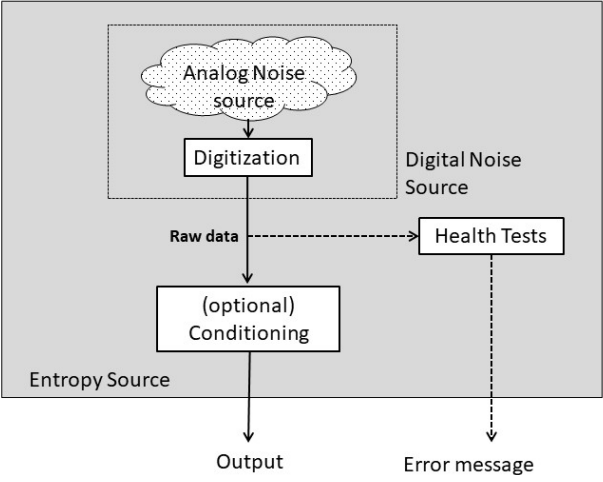
図13:エントロピー源モデル。Entropy Source(エントロピー源)と記した網掛けの箱の中に、点線の箱 Digital Noise Source(デジタルノイズ源)があり、その中で Analog Noise source(アナログノイズ源。雲形)から Digitization(デジタル化)へ矢印が向かう。デジタル化の出力(Raw data、生データ)は下の (optional) Conditioning(任意の調整)へ進み、破線の矢印で Health Tests(ヘルステスト)にも渡る。調整からエントロピー源の外の Output(出力)へ、ヘルステストから破線の矢印で Error message(エラーメッセージ)へ矢印が向かう。
Figure 13: Entropy Source Model
図13:エントロピー源モデル
In Figure 13, the noise source contains the entropy-providing activity (e.g., the output of ring oscillators); if the activity being sampled does not produce binary data, then the noise source includes a digitization process. Health tests are intended to detect whether the noise source and the entropy source (as a whole) continues to operate as expected. The optional conditioning component is responsible for reducing bias and/or increasing the entropy rate of the bits to eventually be output by the entropy source.
図13において、ノイズ源は、エントロピーを供給する活動(例えば、リングオシレータの出力)を含みます。サンプリングされる活動がバイナリデータを生成しない場合、ノイズ源にはデジタル化処理が含まれます。ヘルステストは、ノイズ源及びエントロピー源(全体として)が期待どおりに動作し続けているかどうかを検出するためのものです。任意の調整コンポーネントは、エントロピー源が最終的に出力するビットの偏りを減らすこと、及び/又はそのエントロピーレートを高めることを担います。
SP 800-90B includes descriptions of the tests for NIST’s Cryptographic Algorithm Validation Program (CAVP) and Cryptographic Module Validation Program (CMVP) to validate candidate entropy sources. During FY 2017, CSD finalized the test descriptions for the initial publication of SP 800-90B, which is expected to be published in early FY 2018. CSD will begin a revision of the document in FY 2018 to address issues that were not included in the initial version of the document and any lessons learned during validation testing by the CAVP and CMVP labs.
SP 800-90Bには、NISTのCryptographic Algorithm Validation Program (CAVP) 及びCryptographic Module Validation Program (CMVP) がエントロピー源の候補を検証するための試験の記述が含まれています。2017会計年度中、CSDはSP 800-90Bの初版に向けて試験の記述を確定させました。初版は2018会計年度の早期に公表される見込みです。CSDは、初版に含まれなかった課題と、CAVP及びCMVPの試験所による検証試験で得られる教訓に対処するため、2018会計年度に同文書の改訂に着手します。
The initial version of SP 800-90B will be available via the Special Publications page: https://csrc.nist.gov/publications/PubsSPs.html.
SP 800-90Bの初版は、Special Publicationsのページ(https://csrc.nist.gov/publications/PubsSPs.html)を通じて入手可能になります。
In May 2017, a presentation “A Tale of Two Entropy Source Validation Approaches: NIST 800 90B vs. BSI AIS 31” was provided by Meltem Sönmez Turan at the ICMC17 International Cryptographic Module Conference held in Washington D.C.
2017年5月、Washington D.C.で開催されたICMC17 International Cryptographic Module Conferenceにおいて、Meltem Sönmez Turanが「A Tale of Two Entropy Source Validation Approaches: NIST 800 90B vs. BSI AIS 31」と題する発表を行いました。
SP 800-90C, Recommendation for Random Bit Generator (RBG) Constructions, provides basic guidance on the construction of Random Bit Generators (RBGs) from the entropy sources validated against the requirements of SP 800-90B and the Deterministic Random Bit Generators (DRBG) algorithms of SP 800-90A. SP 800-90C includes constructions for both non-deterministic random bit generators (NRBGs; also known as true random number generators) and deterministic random bit generators (DRBGs; also known as pseudorandom number generators). Two general models are provided in SP 800-90C, as shown in Figure 14 and Figure 15.
SP 800-90C, Recommendation for Random Bit Generator (RBG) Constructions は、SP 800-90Bの要求事項に照らして検証されたエントロピー源と、SP 800-90AのDeterministic Random Bit Generator (DRBG) アルゴリズムとからRandom Bit Generator (RBG) を構成する方法について、基本的な指針を提供します。SP 800-90Cには、非決定論的ランダムビット生成器(NRBG。真性乱数生成器とも呼ばれる)と決定論的ランダムビット生成器(DRBG。擬似乱数生成器とも呼ばれる)の両方の構成法が含まれています。SP 800-90Cでは、図14及び図15に示すとおり、2つの一般的なモデルが示されています。
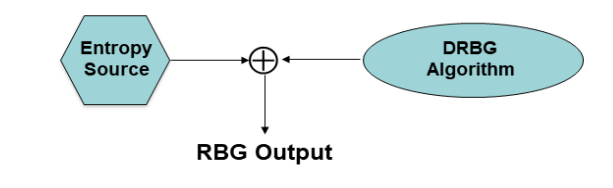
図14:XOR-NRBG。Entropy Source(エントロピー源。六角形)と DRBG Algorithm(DRBG アルゴリズム。楕円)の出力がそれぞれ両者の間にある排他的論理和の記号に入り、その出力が下の RBG Output(RBG 出力)へ向かう。
Figure 14: XOR-NRBG
図14:XOR-NRBG
Figure 14 depicts the construction of one of the NRBGs – the XOR-NRBG. In this construction, each bit output by the entropy source (as discussed in SP 800-90B) is exclusive-ORed with a bit of output from a DRBG algorithm specified in SP 800-90A.
図14は、NRBGの一つであるXOR-NRBGの構成を示しています。この構成では、(SP 800-90Bで論じられている)エントロピー源が出力する各ビットが、SP 800-90Aで規定されたDRBGアルゴリズムの出力の1ビットと排他的論理和されます。
Figure 15: DRBG and Oversampling NRBG
図15:DRBG及びオーバーサンプリングNRBG
Figure 15 depicts the construction used for the DRBGs and the second NRBG design – the Oversampling NRBG. In this construction. the entropy source repeatedly provides input to the DRBG algorithm to produce the requested output.
図15は、DRBGおよび第2のNRBG設計であるOversampling NRBGに用いられる構成を示しています。この構成では、エントロピー源がDRBGアルゴリズムに繰り返し入力を与え、要求された出力を生成します。
The difference between DRBGs and NRBGs is the availability of the entropy source and the frequency of requesting output from the entropy source. For a DRBG, an entropy source is only required for seeding the DRBG; after the initial seeding process, further requests for entropy-source output depend on the implementation and application. For the Oversampling NRBG, the entropy source must always be available and is accessed whenever bits are requested from the NRBG by a consuming application.
DRBGとNRBGの違いは、エントロピー源の可用性と、エントロピー源に出力を要求する頻度にあります。DRBGでは、エントロピー源が必要になるのはDRBGにシードを与えるときだけです。最初のシード設定処理の後にエントロピー源の出力をさらに要求するかどうかは、実装とアプリケーションに依存します。Oversampling NRBGでは、エントロピー源が常に利用可能でなければならず、利用側アプリケーションがNRBGにビットを要求するたびにエントロピー源にアクセスします。
The latest draft of SP 800-90C is available via the Special Publications page: https://csrc.nist.gov/publications/PubsSPs.html.
SP 800-90Cの最新の草案は、Special Publicationsのページ https://csrc.nist.gov/publications/PubsSPs.html から入手できます。
Plans for FY 2018:
2018会計年度の計画:
The RBG development team has the following goals for FY 2018:
RBG開発チームは、2018会計年度に次の目標を掲げています。
•Publish the initial version of SP 800-90B and post the comments received during the last public comment period, along with their resolutions. The testing of entropy sources by the CAVP and CMVP will begin as soon as possible after publication.
•SP 800-90Bの初版を発行し、直近のパブリックコメント期間に寄せられたコメントを、その対応結果とともに掲載します。CAVPおよびCMVPによるエントロピー源の試験は、発行後できるだけ早く開始します。
•Monitor the testing of SP 800-90B in the CAVP and CMVP labs to determine problems that need to be addressed in the next version of SP 800-90B. In some cases, the problems may be addressed by additions to the FIPS 140-2 Implementation Guidance document until SP 800-90B is revised. The Implementation Guidance document is available at https://csrc.nist.gov/groups/STM/cmvp/documents/fips140-2/FIPS1402IG.pdf.
•CAVPおよびCMVPの試験機関におけるSP 800-90Bの試験を監視し、SP 800-90Bの次版で対処すべき問題を特定します。場合によっては、SP 800-90Bが改訂されるまでの間、FIPS 140-2 Implementation Guidance文書への追記によって問題に対処することがあります。Implementation Guidance文書は https://csrc.nist.gov/groups/STM/cmvp/documents/fips140-2/FIPS1402IG.pdf から入手できます。
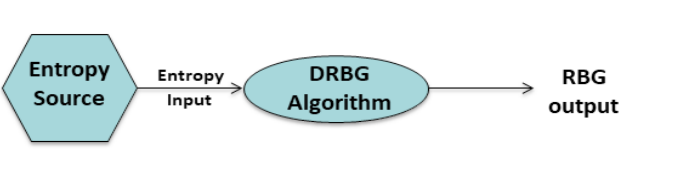
図15:DRBGおよびオーバーサンプリングNRBG。Entropy Source(エントロピー源。六角形)から Entropy Input(エントロピー入力)が DRBG Algorithm(DRBG アルゴリズム。楕円)に渡り、そこから RBG output(RBG 出力)へ矢印が向かう。
•Begin a revision of SP 800-90B to address issues not included in the initial version of SP 800-90B, as well as any issues that surface during CAVP and CMVP entropy source validation.
•SP 800-90Bの初版に含まれなかった課題、およびCAVPとCMVPによるエントロピー源の検証の過程で表面化する課題に対処するため、SP 800-90Bの改訂に着手します。
•Finalize and publish 800-90C, posting the comments received and their resolution, along with the document.
•800-90Cを最終化して発行し、寄せられたコメントとその対応結果を文書とともに掲載します。
•Complete plans for testing SP 800-90C.
•SP 800-90Cの試験計画を完成させます。
FOR MORE INFORMATION, SEE:
詳細情報:
https://csrc.nist.gov/projects/random-bit-generation
https://csrc.nist.gov/projects/random-bit-generation
CONTACTS:
連絡先:
Ms. Elaine Barker, (301) 975-2911, elaine.barker@nist.gov
Ms. Elaine Barker, (301) 975-2911, elaine.barker@nist.gov
Mr. John Kelsey, (301) 975-5101, john.kelsey@nist.gov
Mr. John Kelsey, (301) 975-5101, john.kelsey@nist.gov
Dr. Meltem Sönmez Turan, (301) 975-4391, meltem.turan@nist.gov
Dr. Meltem Sönmez Turan, (301) 975-4391, meltem.turan@nist.gov
Dr. Kerry McKay, (301) 975-4969, kerry.mckay@nist.gov
Dr. Kerry McKay, (301) 975-4969, kerry.mckay@nist.gov
The NIST Randomness Beacon
NIST Randomness Beacon
NIST has implemented a source of public randomness, which is available at https://beacon.nist.gov/home. It uses two independent, commercially available sources of randomness, each with an independent hardware entropy source and SP 800-90A-approved components.
NISTは公開乱数源を実装しており、https://beacon.nist.gov/home で利用できます。この乱数源は、独立した2つの市販の乱数源を使用しており、それぞれが独立したハードウェアエントロピー源とSP 800-90Aで承認されたコンポーネントを備えています。
The NIST Beacon is designed to provide unpredictability, autonomy, and consistency. Unpredictability means that users cannot algorithmically predict bits before they are made available by the source. Autonomy means that the source is resistant to attempts by outside parties to alter the distribution of the random bits. Consistency means that a set of users can access the source in such a way that they are confident of receiving the same random string.
NIST Beaconは、予測不可能性、自律性、一貫性を提供するように設計されています。予測不可能性とは、乱数源がビットを公開する前に、利用者がそのビットをアルゴリズムによって予測できないことをいいます。自律性とは、外部の者が乱数ビットの分布を変えようとする試みに対して、乱数源が耐性を持つことをいいます。一貫性とは、複数の利用者が、同じ乱数列を受け取っていると確信できる形で乱数源にアクセスできることをいいます。
The NIST Beacon posts bit-strings in blocks of 512 bits every 60 seconds. Each such value is time-stamped and signed to form a packet that also includes the hash of the previous value to chain the sequence of values together. This prevents all parties, even the source, from retroactively changing an output packet without being detected. The NIST Beacon keeps all output packets. At any point in time, the full history of outputs is available to users.
NIST Beaconは、60秒ごとに512ビットのブロック単位でビット列を公開します。各値にはタイムスタンプと署名が付されてパケットを構成し、このパケットには、値の列を連鎖させるために直前の値のハッシュも含まれます。これにより、乱数源自身を含むいかなる当事者も、検出されることなく出力パケットを事後的に変更することはできません。NIST Beaconはすべての出力パケットを保持します。利用者は、いつの時点でも出力の全履歴を利用できます。
Tables of random numbers have probably been used for multiple purposes at least since the Industrial Revolution. In the digital age, algorithmic pseudorandom number generators (PRNGs) have largely replaced these tables. The NIST Beacon expands the use of randomness to multiple scenarios in which neither tables nor PRNGs can be used. The extra functionalities stem mainly from three features. First, the Beacon-generated numbers cannot be predicted before they are published. Second, the public, time-bound, and authenticated nature of the Beacon allows a user application to prove to anybody that it used truly random numbers not known before a certain point in time. Third, this proof can be presented offline and at any point in the future.
乱数表は、おそらく少なくとも産業革命のころからさまざまな目的に使われてきました。デジタル時代には、アルゴリズムによる擬似乱数生成器(PRNG)がこれらの表にほぼ取って代わりました。NIST Beaconは、乱数表もPRNGも使えない複数の場面に乱数の用途を広げます。追加の機能は主に3つの特徴から生じます。第1に、Beaconが生成する数は、公開される前に予測できません。第2に、Beaconが公開され、時刻に結び付けられ、真正性が保証されているため、利用側アプリケーションは、ある時点より前には知られていなかった真の乱数を使用したことを誰に対しても証明できます。第3に、この証明はオフラインで、かつ将来のどの時点でも提示できます。
Although commercially available physical sources of randomness are adequate as entropy sources for currently envisioned implementations of the NIST Beacon, the NIST Randomness Beacon project team is working on developing a source of verifiably random sequences. In collaboration with NIST physicists from the Physical Measurement Laboratory (PML), the project team aims to use quantum non-locality to build an entropy source whose unpredictability is guaranteed by the laws of physics. In FY 2016, a major milestone was achieved, namely, a strong loophole-free test of local realism (where individual particles are governed by elements of reality, even if these elements are hidden) (see https://www.nist.gov/news-events/news/2015/11/nist-team-proves-spooky-action-distance-really-real).
市販の物理乱数源は、現在想定されているNIST Beaconの実装のエントロピー源として十分ですが、NIST Randomness Beaconプロジェクトチームは、検証可能な乱数列の源の開発に取り組んでいます。プロジェクトチームは、Physical Measurement Laboratory(PML)に所属するNISTの物理学者と協力し、量子非局所性を利用して、予測不可能性が物理法則によって保証されるエントロピー源を構築することを目指しています。2016会計年度には、大きな節目となる成果、すなわち局所実在性(個々の粒子は、たとえ隠れているとしても実在の要素によって支配されるという考え方)の、抜け穴のない強力な検証が達成されました(https://www.nist.gov/news-events/news/2015/11/nist-team-proves-spooky-action-distance-really-real を参照してください)。
The project team has also made progress in helping other institutions set up interoperable sources. This is important because multiple sources can be combined in such a way that all sources would have to be compromised in order to degrade the common random strings. It is expected that the University of Chile will start operating their own randomness beacon during FY 2018.
プロジェクトチームは、他の機関が相互運用可能な乱数源を設置するのを支援する取り組みでも進展を見せました。これが重要なのは、複数の乱数源を組み合わせることで、共通の乱数列の品質を低下させるにはすべての乱数源を侵害しなければならないようにできるからです。University of Chileは、2018会計年度中に独自のランダムネスビーコンの運用を開始する見込みです。
As of the end of FY 2017, the NIST Beacon has been functioning without major interruptions for more than four years. During this time, the project team has received valuable input from a growing community of users. As a result, the project team has redesigned the Application Programming Interface (API) and the architecture. The changes provide higher security and availability, as well as better interoperability. Version 2.0 of the NIST Beacon is scheduled to be deployed during November 2017.
2017会計年度末の時点で、NIST Beaconは4年以上にわたり大きな中断なく稼働しています。この間、プロジェクトチームは、拡大を続ける利用者コミュニティから貴重な意見を受け取ってきました。その結果、プロジェクトチームはApplication Programming Interface(API)とアーキテクチャを再設計しました。この変更により、セキュリティと可用性が高まり、相互運用性も向上します。NIST Beaconのバージョン2.0は、2017年11月中に展開される予定です。
NIST encourages the community of users to research and publish novel ways in which this tool can be used.
NISTは、利用者コミュニティがこのツールの新たな利用方法を研究し、公表することを奨励します。
FOR MORE INFORMATION, SEE:
詳細情報:
https://www.nist.gov/programs-projects/nist-randomness-beacon
https://www.nist.gov/programs-projects/nist-randomness-beacon
CONTACT:
連絡先:
Dr. René Peralta, (301) 975-8702, rene.peralta@nist.gov
Dr. René Peralta, (301) 975-8702, rene.peralta@nist.gov
Entropy as a Service (EaaS)
Entropy as a Service(EaaS)
The security of cryptography today depends on having strong keys and keeping them secret. The ability to generate strong cryptographic keys is directly related to having access to unpredictable random data, but generating truly unpredictable random data on common computing devices is hard and unreliable. As a result, weak keys are widely used in cryptographic applications, thus compromising the security of the sensitive data protected by them – potentially with disastrous consequences.
今日の暗号のセキュリティは、強い鍵を持ち、それを秘密に保つことに依存しています。強い暗号鍵を生成できるかどうかは、予測不可能な乱数データを利用できるかどうかに直結しますが、一般的なコンピューティングデバイス上で真に予測不可能な乱数データを生成することは難しく、信頼性にも欠けます。その結果、暗号アプリケーションでは弱い鍵が広く使われており、それらの鍵で保護される機微なデータのセキュリティが損なわれています。これは壊滅的な結果を招くおそれがあります。
A primary goal of this project is to provide high quality, truly unpredictable random data to devices on the Internet to enable them to generate strong cryptographic keys and attest the strength of the keys used to protect data in transit or at rest, thereby enabling cryptographic system strength attestation. Achieving this goal would provide a solid basis for achieving the goals of the Automated Cryptographic Validation Testing project (see https://csrc.nist.gov/projects/acvt) as well as addressing the problems targeted by the Cryptographic Programs and Laboratory Accreditation (see the next section: Validated Programs), where entropy estimation has persisted as one of the most difficult and labor-consuming activities, causing problems for all parties involved: the industry, the testing laboratories and the government validators.
このプロジェクトの主な目標は、高品質で真に予測不可能な乱数データをインターネット上のデバイスに提供することです。これによりデバイスは、強い暗号鍵を生成し、転送中または保存中のデータの保護に使用する鍵の強度を証明できるようになり、ひいては暗号システムの強度の証明が可能になります。この目標を達成すれば、Automated Cryptographic Validation Testingプロジェクト(https://csrc.nist.gov/projects/acvt を参照)の目標を達成するための確かな基盤が得られます。また、Cryptographic Programs and Laboratory Accreditation(次節「Validated Programs」を参照)が対象とする問題への対処にもつながります。そこでは、エントロピーの推定が最も難しく最も手間のかかる作業の一つであり続けており、産業界、試験機関、政府の検証担当者という関係者すべてに問題をもたらしています。
Random data obtained from sources of true randomness that are based on unpredictable physical phenomena, such as quantum effects, is much better suited for cryptographic applications. CSD is collaborating with the NIST Physical Measurement Laboratory (PML) to build a quantum source. The aim is to use quantum effects to generate sequences that are guaranteed to be unpredictable, even if an attacker has access to the random source. (For more information on this collaboration, see https://www.nist.gov/pml/div684/random_numbers_bell_test.cfm).
量子効果などの予測不可能な物理現象に基づく真の乱数源から得られる乱数データは、暗号アプリケーションにはるかに適しています。CSDは、NIST Physical Measurement Laboratory(PML)と協力して量子乱数源を構築しています。その狙いは、量子効果を利用し、攻撃者が乱数源にアクセスできる場合でも予測不可能であることが保証される数列を生成することです。(この協力の詳細は https://www.nist.gov/pml/div684/random_numbers_bell_test.cfm を参照してください。)
This EaaS project aims to develop a system and protocols for obtaining random data with high entropy from one or more remote sources. The high-level architecture is shown in Figure 16. The architecture of the Entropy-as-a-Service system consists of two main parts: the client-side and the server-side. The critical components of the system are the quantum device, the EaaS server and a secure device in the client systems that is capable of providing strong isolation and protection for the cryptographic keys stored inside the device and offering a set of basic cryptographic services.
このEaaSプロジェクトは、1つ以上のリモートの乱数源から高いエントロピーを持つ乱数データを取得するためのシステムとプロトコルを開発することを目指しています。高レベルのアーキテクチャを図16に示します。Entropy-as-a-Serviceシステムのアーキテクチャは、クライアント側とサーバ側という2つの主要部分で構成されます。システムの重要なコンポーネントは、量子デバイス、EaaSサーバ、およびクライアントシステム内のセキュアデバイスです。このセキュアデバイスは、内部に保存された暗号鍵に対して強力な分離と保護を提供し、基本的な暗号サービス一式を提供できるものです。
The EaaS server is continuously fed random data from the attached quantum source. The data enters a first in, first out (FIFO)-like buffer in the server’s Random Access Memory (RAM), and, when a client request arrives, the server reads the top value from the buffer, signs and encrypts it, and then sends it to the requester. The FIFO buffer shifts after every request and when new data comes from the random source. The EaaS server ensures that the FIFO buffer is erased prior to server shutdown and never copied to disk. Open implementations can help ensure that this occurs.
EaaSサーバには、接続された量子乱数源から乱数データが継続的に供給されます。データはサーバのRandom Access Memory(RAM)内にあるfirst in, first out(FIFO)型のバッファに入ります。クライアントの要求が届くと、サーバはバッファの先頭の値を読み出し、署名と暗号化を施したうえで要求元に送信します。FIFOバッファは、要求のたびに、また乱数源から新しいデータが届いたときにシフトします。EaaSサーバは、サーバのシャットダウン前にFIFOバッファが消去され、ディスクに決してコピーされないことを確実にします。オープンな実装は、これが確実に行われるようにするのに役立ちます。
The client system consists of a classic computing device enabled with a dedicated hardware component capable of storing secret cryptographic keys and seeds. A dedicated software application bridges the communication between EaaS and the hardware component. Examples of secure hardware components are the Trusted Platform Module (TPM), TrustZone technology in Advanced Reduced Instruction Set Computing (RISC) Machine (ARM) processors, and Identity Protection Technology in Intel processors. Recently, an alternative innovative technology has emerged that allows extracting unique cryptographic keys from the imperfections of memory Static Random Access Memory (SRAM) cells used in common computers. The idea behind this technology is to extract PUF-like unique data from the SRAM chip, which is then used to construct a unique key. This technology is quite interesting for EaaS applications on the client side because it eliminates the need to provision an initial key for accessing EaaS. If a client system or device does not have a secure hardware component, it can still use EaaS. The presence of a hardware component simply provides further guarantees to the system or device user, when present.
クライアントシステムは、秘密の暗号鍵とシードを保存できる専用のハードウェアコンポーネントを備えた古典的なコンピューティングデバイスで構成されます。専用のソフトウェアアプリケーションが、EaaSとハードウェアコンポーネントの間の通信を橋渡しします。セキュアなハードウェアコンポーネントの例としては、Trusted Platform Module(TPM)、Advanced Reduced Instruction Set Computing(RISC)Machine(ARM)プロセッサのTrustZone技術、IntelプロセッサのIdentity Protection Technologyがあります。最近、一般的なコンピュータで使われるStatic Random Access Memory(SRAM)のメモリセルの不完全性から固有の暗号鍵を抽出できる、革新的な代替技術が登場しました。この技術の背後にある考え方は、SRAMチップからPUFに類する固有のデータを抽出し、それを用いて固有の鍵を構成するというものです。この技術は、EaaSにアクセスするための初期鍵をプロビジョニングする必要をなくすため、クライアント側のEaaSアプリケーションにとって非常に興味深いものです。クライアントのシステムまたはデバイスがセキュアなハードウェアコンポーネントを備えていない場合でも、EaaSを使用することはできます。ハードウェアコンポーネントは、それが存在する場合に、システムまたはデバイスの利用者にさらなる保証を与えるにすぎません。
EaaS uses the Hyper Text Transfer Protocol (HTTP) to transfer entropy payloads from the server to clients. To secure this transmission, the server encrypts the data using the client’s public key and digitally signs the payload with the server’s own private key.
EaaSは、Hyper Text Transfer Protocol(HTTP)を使用して、エントロピーのペイロードをサーバからクライアントに転送します。この伝送を保護するため、サーバはクライアントの公開鍵でデータを暗号化し、サーバ自身の秘密鍵でペイロードにデジタル署名します。
Client devices mix this data with locally available random data to seed random number generators to generate strong cryptographic keys and other random values independently from the remote sources.
クライアントデバイスは、このデータをローカルで利用可能な乱数データと混合して乱数生成器にシードを与え、リモートの乱数源から独立して、強い暗号鍵やその他の乱数値を生成します。
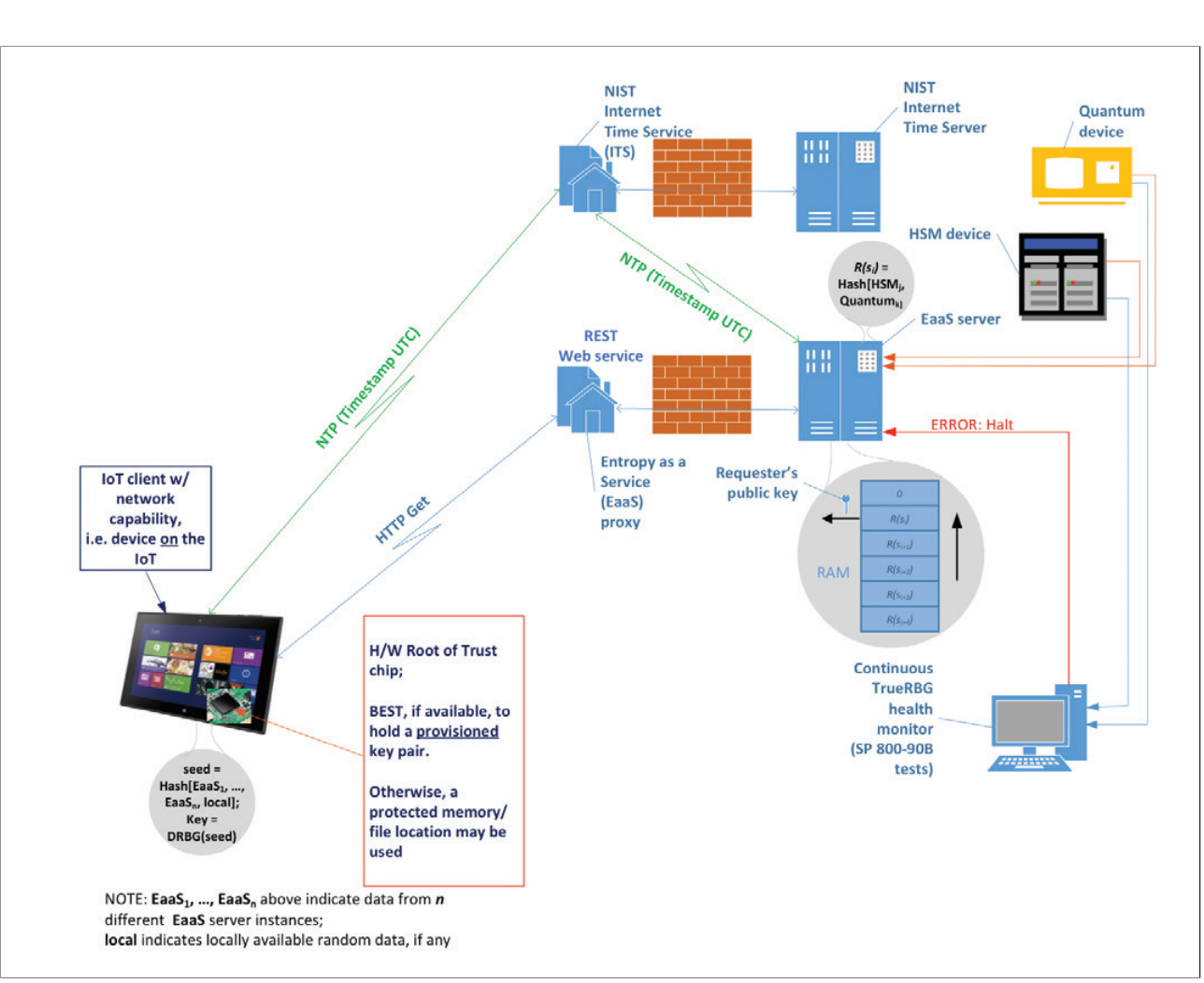
図16:EaaSの高レベルアーキテクチャ。ネットワーク構成図である。ネットワーク機能を持つ IoT クライアント(IoT 上のデバイス。タブレットで描かれる)は、NIST Internet Time Service(ITS)と NTP(Timestamp UTC)をやり取りする。ITS はファイアウォールを挟んで NIST Internet Time Server の手前にあり、EaaS サーバとも NTP(Timestamp UTC)をやり取りする。クライアントは REST Web サービス(Entropy as a Service(EaaS)プロキシ)に HTTP Get を送り、プロキシはファイアウォールを通じて EaaS サーバにつながる。Quantum device(量子デバイス)と HSM device(HSM デバイス)が EaaS サーバに入力し(吹き出し:R(s_i) = Hash[HSM_j, Quantum_k])、同時に Continuous TrueRBG health monitor(SP 800-90B tests)にも入力する。ヘルスモニタは EaaS サーバへ「ERROR: Halt」を送る。サーバの下には RAM のスタックがあり、0、R(s_i) と、添字が増えていく R(s) の項目が並ぶ。スタックの横に上向きの矢印があり、Requester's public key(要求者の公開鍵)がスタックに付され、左へ出る矢印がある。クライアントの吹き出し:「seed = Hash[EaaS_1, ..., EaaS_n, local]; Key = DRBG(seed)」、および「H/W Root of Trust chip。可能なら、プロビジョニングされた鍵ペアを保持するのが最善。そうでなければ、保護されたメモリやファイルの場所を使用してもよい」。注記:上記の EaaS_1, ..., EaaS_n は n 個の異なる EaaS サーバインスタンスからのデータを示し、local はローカルで利用できるランダムデータ(あれば)を示す。
Figure 16: High-level Architecture of EaaS
図16:EaaSの高レベルアーキテクチャ
With the conceptual system architecture and protocols defined, the project team continues to engage with industry and academia to obtain feedback on the approach and identify possibilities for collaborative approaches to solving important cybersecurity challenges in the domains of cryptography and supply-chain management (e.g., integrated circuit counterfeiting). A published paper on EaaS in IEEE Computer magazine generated a lot of interest among the public, including companies from the U.S. and Canada who approached the team and asked for assistance in implementing and hosting their own EaaS servers. The team started a technology transfer effort to help with this. The team also continues the collaboration with a team of researchers at the University of Florida who work under a NIST research grant to explore ways to leverage EaaS in protecting against integrated circuit counterfeiting and thereby help secure a supply chain. The University of Florida researchers working on this grant obtained interesting security results that identified security vulnerabilities in widely used protocols for intellectual property protection in integrated circuit manufacturing and resulted in proposals for new secure protocols that eliminated these vulnerabilities.
概念的なシステムアーキテクチャとプロトコルが定義されたことを受け、プロジェクトチームは産業界および学術界との対話を続けています。その目的は、このアプローチに対するフィードバックを得ること、ならびに暗号およびサプライチェーン管理の領域における重要なサイバーセキュリティ上の課題(例:集積回路の偽造)を協力して解決する可能性を見いだすことです。IEEE Computer誌に掲載されたEaaSに関する論文は一般から大きな関心を集め、米国およびカナダの企業がチームに連絡を取り、自社のEaaSサーバの実装とホスティングについて支援を求めてきました。チームは、これを支援するための技術移転の取り組みを開始しました。チームはまた、University of Floridaの研究者チームとの協力も継続しています。この研究者チームは、NISTの研究助成を受けて、集積回路の偽造からの保護にEaaSを活用し、それによってサプライチェーンのセキュリティ確保に役立てる方法を探っています。この助成の下で研究を行うUniversity of Floridaの研究者は、興味深いセキュリティ上の成果を得ました。その成果は、集積回路製造における知的財産保護のために広く使われているプロトコルのセキュリティ脆弱性を特定し、これらの脆弱性を解消する新しいセキュアなプロトコルの提案につながりました。
The team continues to develop the system to provide a publicly accessible NIST EaaS instance in FY 2018. The team succeeded in establishing a non-disclosure agreement and a collaboration with Intrinsic ID, Inc. – a company with complementing technology for constructing the initial key on the client side by extracting it from SRAM memory cells. The team also established a collaborative relationship with Crypto4A and 2Keys Corp. from Canada on developing a common protocol for EaaS. The team coordinated with the research team working on the NIST Beacon for developing common back-end components for the two services. The team plans to leverage these common components in the NIST EaaS implementation.
チームは、2018会計年度に一般からアクセス可能なNIST EaaSインスタンスを提供できるよう、システムの開発を続けています。チームは、Intrinsic ID, Inc.との間で秘密保持契約を締結し、協力関係を築くことに成功しました。同社は、SRAMのメモリセルから抽出することによってクライアント側で初期鍵を構成するための、補完的な技術を持つ企業です。チームはまた、EaaSの共通プロトコルの開発について、カナダのCrypto4Aおよび2Keys Corp.とも協力関係を築きました。チームは、NIST Beaconに取り組んでいる研究チームと調整し、2つのサービスに共通のバックエンドコンポーネントを開発することにしました。チームは、これらの共通コンポーネントをNIST EaaSの実装に活用する予定です。
CONTACT:
連絡先:
Dr. Apostol Vassilev (301) 975-3221 apostol.vassilev@nist.gov
Dr. Apostol Vassilev (301) 975-3221 apostol.vassilev@nist.gov
Block Cipher Modes of Operation
ブロック暗号の利用モード
The engine for many of the techniques in CSD’s cryptographic toolkit is a block cipher algorithm, such as the Advanced Encryption Standard (AES) algorithm. A block cipher transforms some fixed-length binary data (i.e., a “block” of data) into seemingly random data of the same length. The transformation is determined by the choice of some secret data called the “key.” The same key is used to reverse the transformation and recover the original block of data. A cryptographic technique (e.g., for encryption and/or authentication) that is constructed from a block cipher is called a “mode of operation.”
CSDの暗号ツールキットに含まれる技術の多くは、Advanced Encryption Standard(AES)アルゴリズムなどのブロック暗号アルゴリズムを原動力としています。ブロック暗号は、ある固定長のバイナリデータ(すなわちデータの「ブロック」)を、一見ランダムに見える同じ長さのデータに変換します。この変換は、「鍵」と呼ばれる秘密データの選択によって決まります。変換を逆にたどって元のデータブロックを復元するときにも、同じ鍵を使用します。ブロック暗号から構成される暗号技術(例:暗号化や認証のための技術)を「利用モード」と呼びます。
Several modes of operation have been specified in the SP 800-38 series of publications. The latest installment in the series, Special Publication 800-38G, Recommendation for Block Cipher Modes of Operation: Methods for Format-Preserving Encryption, was published in 2016. It specifies two AES modes of operation, called FF1 and FF3, for “format-preserving encryption” (FPE), based on proposals that were submitted from the private sector, specifically, the payments industry.
SP 800-38シリーズの刊行物では、いくつかの利用モードが規定されています。このシリーズの最新の文書であるSpecial Publication 800-38G, Recommendation for Block Cipher Modes of Operation: Methods for Format-Preserving Encryptionは、2016年に発行されました。この文書は、民間部門、具体的には決済業界から提出された提案に基づき、「フォーマット保持暗号化」(FPE)のための、FF1およびFF3と呼ばれる2つのAES利用モードを規定しています。
Recently, two academic researchers, Vaudenay and Dürak, developed a cryptanalytic attack on the FF3 mode. On April 12, 2017, CSD posted an announcement that summarizes the attack and outlines CSD’s plans to revise FF3 in a new draft of SP 800-38G in FY 2018; see https://csrc.nist.gov/News/2017/Recent-Cryptanalysis-of-FF3.
最近、学術研究者であるVaudenayとDürakの2名が、FF3モードに対する暗号解読攻撃を開発しました。2017年4月12日、CSDは、この攻撃を要約するとともに、2018会計年度にSP 800-38Gの新しい草案でFF3を改訂するというCSDの計画の概要を示す告知を掲載しました。https://csrc.nist.gov/News/2017/Recent-Cryptanalysis-of-FF3 を参照してください。
In FY 2018, CSD also plans to revisit SP 800-38D, which specifies the Galois/Counter Mode (GCM) for authenticated encryption. In particular, the security of GCM depends critically on the requirement for the uniqueness of the “nonce” input; CSD plans to seek public comment on how to best update the guidance for achieving this property.
2018会計年度には、CSDは、認証付き暗号化のためのGalois/Counter Mode(GCM)を規定するSP 800-38Dの見直しも計画しています。とりわけ、GCMのセキュリティは、「ノンス」入力が一意であるという要件に決定的に依存します。CSDは、この性質を実現するためのガイダンスをどのように更新するのが最善かについて、パブリックコメントを求める予定です。
FOR MORE INFORMATION, SEE:
詳細情報:
https://csrc.nist.gov/projects/block-cipher-techniques
https://csrc.nist.gov/projects/block-cipher-techniques
CONTACT:
連絡先:
Dr. Morris Dworkin (301) 975-2354 morris.dworkin@nist.gov
Dr. Morris Dworkin (301) 975-2354 morris.dworkin@nist.gov
Key Management
鍵管理
Key management is required for applying numerous cryptographic technologies and is considered one of the most critical aspects associated with the use of cryptography. The CSD began providing guidance in managing the keys used for cryptographic applications in the late 1990s to early 2000s. Information on the CSD’s key management project is available at https://csrc.nist.gov/projects/key-management.
鍵管理は、数多くの暗号技術を適用するうえで必要であり、暗号の利用に関わる最も重要な側面の一つと考えられています。CSDは、1990年代後半から2000年代前半にかけて、暗号アプリケーションで使用する鍵の管理に関するガイダンスの提供を始めました。CSDの鍵管理プロジェクトに関する情報は https://csrc.nist.gov/projects/key-management から入手できます。
SP 800-56A, Recommendation for Pair-Wise Key Establishment Schemes Using Discrete Logarithm Cryptography:
SP 800-56A, Recommendation for Pair-Wise Key Establishment Schemes Using Discrete Logarithm Cryptography:
In FY 2017, SP 800-56A was revised. SP 800-56A was originally published in 2006, and was previously revised in 2007 and 2013. This document specifies Diffie-Hellman (DH) and Menezes-Qu-Vanstone (MQV) key-agreement schemes, both elliptic curve and finite field versions. Key agreement results in keying material that is shared between the participants. A key-agreement scheme is a procedure in which both parties contribute information that is used in generating a cryptographic key. A key-agreement scheme is defined by a cryptographic algorithm, together with other information that must be available by both parties when establishing keys. The schemes are intended for use in communication protocols (e.g., Transport Layer Security (TLS), one of the protocols used by the Internet). The key-establishment schemes in SP 800-56A use public key algorithms, and each participant in a key-agreement transaction uses a pair of keys—a public key and a private key. The key-agreement process includes the generation of a shared secret (which is not itself considered to be a cryptographic key), and the derivation of keying material using the shared secret. Several key-agreement schemes are specified in SP 800-56A. Figure 17 below provides a simplified example of one of the key-agreement schemes. In this example, each party:
2017会計年度に、SP 800-56Aが改訂されました。SP 800-56Aは2006年に初めて発行され、これまでに2007年と2013年に改訂されています。この文書は、Diffie-Hellman(DH)およびMenezes-Qu-Vanstone(MQV)の鍵合意スキームを、楕円曲線版と有限体版の両方について規定しています。鍵合意の結果として、参加者間で共有される鍵素材が得られます。鍵合意スキームとは、暗号鍵の生成に使用される情報を両当事者が提供する手順です。鍵合意スキームは、暗号アルゴリズムと、鍵を確立する際に両当事者が利用できなければならないその他の情報とによって定義されます。これらのスキームは、通信プロトコル(例:インターネットで使用されるプロトコルの一つであるTransport Layer Security(TLS))での使用を意図しています。SP 800-56Aの鍵確立スキームは公開鍵アルゴリズムを使用し、鍵合意トランザクションの各参加者は、公開鍵と秘密鍵からなる鍵ペアを使用します。鍵合意の処理には、共有シークレット(それ自体は暗号鍵とはみなされない)の生成と、その共有シークレットを用いた鍵素材の導出が含まれます。SP 800-56Aでは、いくつかの鍵合意スキームが規定されています。下の図17は、鍵合意スキームの一つを簡略化した例を示しています。この例では、各当事者は次のことを行います。
1.Generates a key pair (either prior to or during the key-agreement transaction);
1.鍵ペアを生成します(鍵合意トランザクションの前、またはその最中に)。
2.Obtains the public key of the other party;
2.相手方の公開鍵を取得します。
3.Computes a shared secret using one’s own keys and the other party’s public key; and
3.自身の鍵と相手方の公開鍵を用いて共有シークレットを計算します。
4.Derives one or more keys from the shared secret.
4.共有シークレットから1つ以上の鍵を導出します。
A revision of SP 800-56A was provided for public comment in FY 2017 as a draft of SP 800-56A Rev. 3. This revision includes the following changes:
SP 800-56Aの改訂版は、2017会計年度にSP 800-56A Rev. 3の草案としてパブリックコメントに付されました。この改訂には、次の変更が含まれます。
•Added the KECCAK Message Authentication Code (KMAC) to the list of approved MAC functions; KMAC is specified in SP 800-185, SHA-3 Derived Functions: cSHAKE, KMAC, TupleHash and ParallelHash.
•承認されたMAC関数のリストに、KECCAK Message Authentication Code(KMAC)を追加しました。KMACは、SP 800-185, SHA-3 Derived Functions: cSHAKE, KMAC, TupleHash and ParallelHashで規定されています。
•The elliptic curves to be used in the elliptic curve Diffie-Hellman and MQV schemes will henceforward be specifed in SP 800-186, a new publication under development that will include the elliptic curves currently specified in FIPS 186-4, Digital Signature Standard (DSS), along with additional approved elliptic curves for key agreement and digital signatures.
•楕円曲線 Diffie-Hellman 方式および MQV 方式で使用する楕円曲線は、今後、策定中の新しい文書である SP 800-186 で規定します。SP 800-186 には、現在 FIPS 186-4, Digital Signature Standard (DSS) で規定されている楕円曲線に加え、鍵共有およびデジタル署名用に新たに承認された楕円曲線が収録されます。
•The key-derivation functions were moved to SP 800-56C: Recommendation for Key-Derivation Methods in Key-Derivation Schemes (see below).
•鍵導出関数は、SP 800-56C: Recommendation for Key-Derivation Methods in Key-Derivation Schemes に移されました(下記参照)。
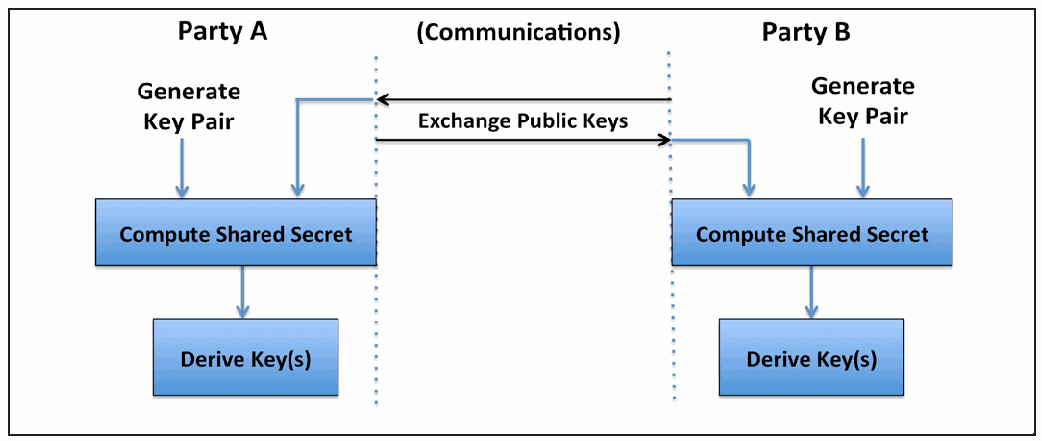
図17:鍵共有の例。Party A(当事者 A)と Party B(当事者 B)の間に、点線で挟んだ (Communications)(通信)の領域があり、そこで Exchange Public Keys(公開鍵の交換)を双方向の矢印で行う。各側で、Generate Key Pair(鍵ペアの生成)と受け取った公開鍵が Compute Shared Secret(共有シークレットの計算)に入り、そこから Derive Key(s)(鍵の導出)へ進む。
Figure 17: Key-Agreement Example
図17:鍵共有の例
•Encourages the use of pre-defined domain parameter groups for the finite field Diffie-Hellman and MQV schemes. Domain parameters are used to generate keys and compute the shared secret. The domain-parameter groups include the “safe primes” that are used in the Transport Layer Security (TLS) and Internet Key Exchange (IKE) protocols.
•有限体 Diffie-Hellman 方式および MQV 方式について、事前定義されたドメインパラメータ群の使用を推奨します。ドメインパラメータは、鍵の生成と共有シークレットの計算に使用されます。このドメインパラメータ群には、Transport Layer Security (TLS) プロトコルおよび Internet Key Exchange (IKE) プロトコルで使用されている「安全素数」が含まれます。
A more complete list of changes is provided in an appendix of SP 800-56A Rev. 3. SP 800-56A Rev. 3 will be published in early FY 2018 and will be available via the CSD publications page at https://csrc.nist.gov/publications. This web page may also be used to access FIPS 186-4, SP 800-185, and (eventually) SP 800-186.
変更点のより完全な一覧は、SP 800-56A Rev. 3 の附属書に記載されています。SP 800-56A Rev. 3 は2018会計年度の早い時期に公表される予定であり、CSD の刊行物ページ https://csrc.nist.gov/publications から入手できるようになります。このウェブページからは、FIPS 186-4、SP 800-185、および(いずれは)SP 800-186 にもアクセスできます。
Information about SP 800-56A is also available at https://csrc.nist.gov/publications/detail/sp/800-56a/rev-3/draft.
SP 800-56A に関する情報は、https://csrc.nist.gov/publications/detail/sp/800-56a/rev-3/draft からも入手できます。
SP 800-56C: Recommendation for Key-Derivation Methods in Key-Establishment Schemes:
SP 800-56C: Recommendation for Key-Derivation Methods in Key-Establishment Schemes:
SP 800-56C specifies techniques for the derivation of keys from a shared secret generated during a key-establishment scheme defined in SP 800-56A and SP 800-56B. SP 800-56A is discussed above. SP 800-56B: Recommendation for Pairwise Key-Establishment Schemes Using Integer Factorization Cryptography, is available via https://csrc.nist.gov/publications.
SP 800-56C は、SP 800-56A および SP 800-56B で定義された鍵確立方式の実行中に生成される共有シークレットから鍵を導出する技法を規定しています。SP 800-56A については上で述べました。SP 800-56B: Recommendation for Pairwise Key-Establishment Schemes Using Integer Factorization Cryptography は、https://csrc.nist.gov/publications から入手できます。
SP 800-56C had included only one method for key derivation – a two-step key-derivation procedure that used either the Keyed-Hash Message Authentication Code (HMAC) or the Cipher-based Message Authentication Code (CMAC) algorithm during the process. HMAC is specified in FIPS 198-1: The Keyed-Hash Message Authentication Code (HMAC), and CMAC is specified for AES in SP 800-38B: Recommendation for Block Cipher Modes of Operation: the CMAC Mode of Authentication. These documents are available via https://csrc.nist.gov/publications.
SP 800-56C には、これまで鍵導出の方法が1つしか含まれていませんでした。それは、処理の過程で Keyed-Hash Message Authentication Code (HMAC) アルゴリズムまたは Cipher-based Message Authentication Code (CMAC) アルゴリズムのいずれかを使用する2段階の鍵導出手順です。HMAC は FIPS 198-1: The Keyed-Hash Message Authentication Code (HMAC) で規定されており、CMAC は AES について SP 800-38B: Recommendation for Block Cipher Modes of Operation: the CMAC Mode of Authentication で規定されています。これらの文書は https://csrc.nist.gov/publications から入手できます。
A revision of SP 800-56C was provided for public comment in FY 2017 as a draft of SP 800-56C Rev. 1. This revision includes the following changes:
SP 800-56C の改訂版は、SP 800-56C Rev. 1 の草案として2017会計年度にパブリックコメントに付されました。この改訂には次の変更が含まれます。
•The single-step key derivation functions specified in SP 800-56A and SP 800-56B were moved into SP 800-56C, as well as the references to SP 800-135: Recommendation for Existing Application-Specific Key Derivation Functions. Note that the relevant changes to SP 800-56B (i.e., to remove the key derivation functions from the document) have not been performed yet; those changes will be initiated in FY 2018 (see below).
•SP 800-56A および SP 800-56B で規定されていた1段階の鍵導出関数が、SP 800-135: Recommendation for Existing Application-Specific Key Derivation Functions への参照とともに、SP 800-56C に移されました。なお、SP 800-56B に対する関連の変更(すなわち、同文書から鍵導出関数を削除すること)はまだ行われておらず、この変更には2018会計年度に着手します(下記参照)。
•KMAC, as specified in Draft SP 800-185, SHA-3 Derived Functions: cSHAKE, KECCAK Message Authentication Code (KMAC), TupleHash and ParallelHash, is allowed for the single-step key derivation functions.
•Draft SP 800-185, SHA-3 Derived Functions: cSHAKE, KECCAK Message Authentication Code (KMAC), TupleHash and ParallelHash で規定されている KMAC を、1段階の鍵導出関数に使用することが認められます。
Changes to the document are discussed in an appendix of SP 800-56C Rev. 1. SP 800-56A Rev. 3 will be published in early FY 2018 and will be available via the CSD publications page at https://csrc.nist.gov/publications. SP 800-135 and SP 800-185 are also available using that address.
文書の変更点は、SP 800-56C Rev. 1 の附属書で説明されています。SP 800-56A Rev. 3 は2018会計年度の早い時期に公表される予定であり、CSD の刊行物ページ https://csrc.nist.gov/publications から入手できるようになります。SP 800-135 および SP 800-185 も同じアドレスから入手できます。
Information on SP 800-56C is also available at https://csrc.nist.gov/publications/detail/sp/800-56c/rev-1/draft.
SP 800-56C に関する情報は、https://csrc.nist.gov/publications/detail/sp/800-56c/rev-1/draft からも入手できます。
New Key Management Publications Under Development:
策定中の新しい鍵管理関連刊行物:
A new document was started in FY 2016 on key storage and recovery by an organization (e.g., key backup and archiving). This document is intended to serve as a guideline for the storage and recovery of cryptographic keys that are not under the direct control of the entity using those keys (e.g., the owner). This includes the backup and archiving of copies of the keys and the metadata associated with them. The document will also discuss the recovery of those keys when required (e.g., by the key’s owner or the owner’s organization).
組織による鍵の保管と回復(例えば、鍵のバックアップやアーカイブ)に関する新しい文書の作成が、2016会計年度に開始されました。この文書は、鍵を使用するエンティティ(例えば、所有者)の直接の管理下にない暗号鍵の保管と回復に関するガイドラインとなることを意図しています。これには、鍵の複製およびそれに付随するメタデータのバックアップとアーカイブが含まれます。この文書では、必要な場合(例えば、鍵の所有者または所有者の組織が必要とする場合)のそれらの鍵の回復についても論じます。
Plans for FY 2018:
2018会計年度の計画:
During FY 2018, the CSD is expecting to accomplish the following key management tasks:
2018会計年度に、CSD は鍵管理に関する次の作業を達成する見込みです。
•Publish the revisions of SP 800-56A and SP 800-56C.
•SP 800-56A および SP 800-56C の改訂版を公表します。
•Begin the revision of SP 800-56B and post it for public comment.
•SP 800-56B の改訂に着手し、パブリックコメントのために掲載します。
•Begin revisions of SP 800-131A, Transitions: Recommendation for Transitioning the Use of Cryptographic Algorithms and Key Lengths, to address the use of Triple Data Encryption Algorithm (TDEA), SP 800-56A, SP 800-56B, KMAC and other SHA-3 derived functions specified in SP 800-185. A statement about the advent of quantum-resistant algorithms will also be included.
•SP 800-131A, Transitions: Recommendation for Transitioning the Use of Cryptographic Algorithms and Key Lengths の改訂に着手し、Triple Data Encryption Algorithm (TDEA)、SP 800-56A、SP 800-56B、KMAC、および SP 800-185 で規定されているその他の SHA-3 派生関数の使用を取り上げます。耐量子アルゴリズムの到来に関する記述も含めます。
•Begin revisions of SP 800-57, Part 2, Recommendation for Key Management, Part 2: Best Practices for Key Management Organization, to update the guidance.
•SP 800-57, Part 2, Recommendation for Key Management, Part 2: Best Practices for Key Management Organization の改訂に着手し、ガイダンスを更新します。
•Revise SP 800-57, Part 3, Recommendation for Key Management, Part 3: Application-Specific Key Management Guidance, to provide revised guidance on the use of the Internet Protocol Security (IPsec) protocol.
•SP 800-57, Part 3, Recommendation for Key Management, Part 3: Application-Specific Key Management Guidance を改訂し、Internet Protocol Security (IPsec) プロトコルの使用に関する改訂版のガイダンスを提供します。
•Continue the development of the organizational key-storage and recovery publication.
•組織による鍵の保管と回復に関する刊行物の策定を継続します。
•Resume work on SP 800-71, Recommendation for Key Establishment Using Symmetric Block Ciphers.
•SP 800-71, Recommendation for Key Establishment Using Symmetric Block Ciphers の作業を再開します。
FOR MORE INFORMATION, SEE:
詳細情報:
https://csrc.nist.gov/projects/key-management/cryptographic-key-management-systems
https://csrc.nist.gov/projects/key-management/cryptographic-key-management-systems
CONTACTS:
連絡先:
Ms. Elaine Barker, (301) 975-2911, elaine.barker@nist.gov
Ms. Elaine Barker, (301) 975-2911, elaine.barker@nist.gov
Mr. Quynh Dang, (301) 975-3610, quynh.dang@nist.gov
Mr. Quynh Dang, (301) 975-3610, quynh.dang@nist.gov
Dr. Lily Chen, (301) 975-6974, lily.chen@nist.gov
Dr. Lily Chen, (301) 975-6974, lily.chen@nist.gov
Dr. Allen Roginsky, (301) 975-8136, allen.roginsky@nist.gov
Dr. Allen Roginsky, (301) 975-8136, allen.roginsky@nist.gov
Transport Layer Security
Transport Layer Security
SP 800-52 Guidelines for the Selection, Configuration, and Use of Transport Layer Security (TLS) Implementations, provides recommendations regarding TLS server and client implementations. TLS is a widely used cryptographic protocol that provides communication security for a variety of network applications, such as email, e-commerce, and healthcare.
SP 800-52 Guidelines for the Selection, Configuration, and Use of Transport Layer Security (TLS) Implementations は、TLS のサーバ実装およびクライアント実装に関する推奨事項を示しています。TLS は広く使用されている暗号プロトコルであり、電子メール、電子商取引、医療など、さまざまなネットワークアプリケーションに通信のセキュリティを提供します。
SP 800-52 was first published in June of 2005, and SP 800-52 Revision 1 was published in 2014. Since the first revision, CSD has been following developments in TLS implementations, including updates and attacks. In FY 2016, a second revision was initiated that updates TLS recommendations to include mitigations for recent attacks, synchronizes cryptographic algorithm recommendations with other NIST Special Publications, and provides more flexibility to system administrators in choosing which TLS features they should support. There is also guidance for implementations of TLS version 1.3, a significant update to TLS. SP 800-52 Revision 2 will be posted for public review and comment in FY 2018.
SP 800-52 は2005年6月に初めて公表され、SP 800-52 Revision 1 は2014年に公表されました。この最初の改訂以降、CSD は、更新や攻撃を含む TLS 実装の動向を追ってきました。2016会計年度には2回目の改訂に着手しました。この改訂は、TLS に関する推奨事項を更新して最近の攻撃への緩和策を盛り込み、暗号アルゴリズムに関する推奨事項を他の NIST Special Publication と整合させ、どの TLS 機能をサポートすべきかを選択するうえでシステム管理者により大きな柔軟性を与えるものです。TLS の大幅な更新である TLS バージョン 1.3 の実装に関するガイダンスも含まれます。SP 800-52 Revision 2 は、2018会計年度に公開レビューおよびコメントのために掲載される予定です。
CSD has been contributing to the development of testssl.sh (see https://github.com/drwetter/testssl.sh), an open-source program that tests TLS-enabled servers, providing information about the protocols and cipher suites supported, in addition to checking for some well-known flaws. In FY 2018, CSD will be contributing code to testssl.sh that adds support for TLS version 1.3. When the draft of SP 800-52 Revision 2 is posted for public comment, CSD intends to make a draft version of this code available that includes some checks for conformance to SP 800-52 Revision 2.
CSD は、testssl.sh(https://github.com/drwetter/testssl.sh を参照)の開発に貢献してきました。testssl.sh は TLS 対応サーバをテストするオープンソースのプログラムであり、いくつかの既知の欠陥の有無を確認するほか、サポートされているプロトコルと暗号スイートに関する情報を提供します。2018会計年度に、CSD は TLS バージョン 1.3 のサポートを追加するコードを testssl.sh に提供します。SP 800-52 Revision 2 の草案がパブリックコメントのために掲載される際に、CSD は、SP 800-52 Revision 2 への適合性に関するいくつかの確認を含む、このコードの草案版を利用可能にするつもりです。
CONTACTS:
連絡先:
Dr. Kerry McKay, (301) 975-4969, kerry.mckay@nist.gov
Dr. Kerry McKay, (301) 975-4969, kerry.mckay@nist.gov
Dr. David Cooper, (301) 975-3194, david.cooper@nist.gov
Dr. David Cooper, (301) 975-3194, david.cooper@nist.gov
Cryptographic Recommendations for the Internet Protocol Security (IPsec) and Internet Key Exchange (IKE)
Internet Protocol Security (IPsec) および Internet Key Exchange (IKE) に関する暗号上の推奨事項
IPsec is a suite of protocols for securing Internet communications at the network layer and operates within the Internet Protocol (IP). It is frequently used to establish Virtual Private Networks (VPNs), requiring both parties to share keying material, which can be established using the Internet Key Exchange (IKE) protocol, and enabling telecommuters or travelers to gain secure access to their enterprise networks. IPsec provides the cryptographic security functions for both versions of the Internet Protocol, IPv4 and IPv6.
IPsec は、インターネット通信をネットワーク層で保護するためのプロトコル群であり、Internet Protocol (IP) の中で動作します。IPsec は Virtual Private Network (VPN) の確立によく使用されます。その際、両当事者は鍵素材を共有する必要があり、この鍵素材は Internet Key Exchange (IKE) プロトコルを用いて確立できます。これにより、在宅勤務者や出張者は自組織のエンタープライズネットワークに安全にアクセスできるようになります。IPsec は、Internet Protocol の両バージョンである IPv4 と IPv6 の双方に暗号によるセキュリティ機能を提供します。
CSD has provided cryptographic guidance for using IPsec and IKE in SP 800-57 part 3, Section 3: Internet Protocol Security (IPsec). From the beginning of FY 2017, CSD has been working on a revision of the section and plans to publish it as a standalone Special Publication. This SP will update and expand the existing cryptographic guidelines. The important technical updates include disallowing Triple DES and recommending AES-GCM authenticated encryption instead of the CipherBlock Chaining (CBC) mode.
CSD は、IPsec および IKE の使用に関する暗号上のガイダンスを、SP 800-57 part 3 の Section 3: Internet Protocol Security (IPsec) で提供してきました。2017会計年度の初めから、CSD はこの節の改訂に取り組んでおり、これを独立した Special Publication として公表する計画です。この SP は、既存の暗号上のガイドラインを更新し、拡充します。重要な技術的更新には、Triple DES を不許可とすること、および CipherBlock Chaining (CBC) モードに代えて AES-GCM 認証付き暗号を推奨することが含まれます。
CSD expects to release the draft SP in FY 2018 for public comments. The SP will be harmonized with an upcoming revision of SP 800-77, Guide to IPsec VPNs.
CSD は、この SP の草案を2018会計年度にパブリックコメントのために公開する見込みです。この SP は、近く予定されている SP 800-77, Guide to IPsec VPNs の改訂と整合を図ります。
CONTACTS:
連絡先:
Ms. Elaine Barker, (301) 975-2911, elaine.barker@nist.gov
Ms. Elaine Barker, (301) 975-2911, elaine.barker@nist.gov
Mr. Quynh Dang, (301) 975-3610, quynh.dang@nist.gov
Mr. Quynh Dang, (301) 975-3610, quynh.dang@nist.gov
Elliptic Curve Cryptography
楕円曲線暗号
Elliptic curve cryptography is critical to the adoption of strong cryptography during the migration to higher security strengths. One of the main advantages of elliptic curve cryptography is that users can achieve the same level of security as other systems, but with a much shorter key length. NIST has standardized elliptic curve cryptography for digital signature algorithms in FIPS 186: Digital Signature Standard (DSS), and for key establishment schemes in SP 800-56A: Recommendation for Pair-Wise Key Establishment Schemes Using Discrete Logarithm Cryptography.
楕円曲線暗号は、より高いセキュリティ強度への移行において強力な暗号を普及させるうえで極めて重要です。楕円曲線暗号の主な利点の1つは、利用者が他の方式と同じレベルのセキュリティを、はるかに短い鍵長で実現できることです。NIST は、デジタル署名アルゴリズム用の楕円曲線暗号を FIPS 186: Digital Signature Standard (DSS) で、鍵確立方式用の楕円曲線暗号を SP 800-56A: Recommendation for Pair-Wise Key Establishment Schemes Using Discrete Logarithm Cryptography で標準化しています。
In FIPS 186-4, NIST recommends 15 elliptic curves of varying security strengths for use in these elliptic curve cryptographic standards. However, the provenance of the curves is not fully specified in the standard, leading to recent public concerns that there could be a hidden weakness in these curves. NIST is not aware of any vulnerability in these curves when they are implemented correctly and used as described in NIST standards and guidelines.
NIST は FIPS 186-4 において、これらの楕円曲線暗号標準で使用するために、セキュリティ強度の異なる15個の楕円曲線を推奨しています。しかし、これらの曲線の由来は同標準の中で完全には明示されておらず、そのため、これらの曲線に隠れた弱点があるのではないかという懸念が近年、一般から示されています。NIST は、これらの曲線が正しく実装され、NIST の標準およびガイドラインに記載されたとおりに使用される場合について、いかなる脆弱性も把握していません。
More than 15 years have now passed since these curves were developed, and the community now knows more about the security of elliptic curve cryptography and practical implementation issues. Advances within the cryptographic community have led to the development of new elliptic curves and algorithms whose designers claim to offer better performance and are easier to implement in a secure manner. Some of these curves are under consideration in voluntary, consensus-based Standards Developing Organizations.
これらの曲線が開発されてからすでに15年以上が経過しており、コミュニティは現在、楕円曲線暗号のセキュリティと実装上の実際的な問題について、より多くのことを知っています。暗号コミュニティにおける進展により、新しい楕円曲線とアルゴリズムが開発されており、その設計者は、これらがより優れた性能を提供し、安全に実装しやすいと主張しています。これらの曲線の一部は、任意参加で合意に基づく標準化機関において検討されています。
In FY 2017, NIST utilized feedback received to revise and improve FIPS 186-4. In particular, NIST plans to add new elliptic curves to the current recommended set. The entire collection of recommended curves and their specification will be moved to a new publication SP 800-186: Recommendations for Discrete-Logarithm Based Cryptography: Elliptic Curve Domain Parameters. In addition, new deterministic digital signature schemes will be included in FIPS 186. It is expected that the revised draft version of FIPS 186-5 (and SP 800-186) will be available for public comment in early FY 2018.
2017会計年度に、NIST は寄せられたフィードバックを活用して FIPS 186-4 を改訂し、改善しました。特に、NIST は現行の推奨曲線の集合に新しい楕円曲線を追加する計画です。推奨曲線全体とその仕様は、新しい刊行物である SP 800-186: Recommendations for Discrete-Logarithm Based Cryptography: Elliptic Curve Domain Parameters に移されます。加えて、新しい決定論的デジタル署名方式が FIPS 186 に収録されます。FIPS 186-5(および SP 800-186)の改訂草案は、2018会計年度の早い時期にパブリックコメントに付される見込みです。
CONTACTS:
連絡先:
Email project team: EllipticCurves@nist.gov
プロジェクトチームの電子メール:EllipticCurves@nist.gov
Dr. Dustin Moody, (301) 975-8136, dustin.moody@nist.gov
Dr. Dustin Moody, (301) 975-8136, dustin.moody@nist.gov
Dr. Lily Chen, (301) 975-6974, lily.chen@nist.gov
Dr. Lily Chen, (301) 975-6974, lily.chen@nist.gov
Mr. Andrew Regenscheid, (301) 975-5155, andrew.regenscheid@nist.gov
Mr. Andrew Regenscheid, (301) 975-5155, andrew.regenscheid@nist.gov
Post-Quantum Cryptography
耐量子計算機暗号
In recent years, there has been a substantial amount of research on quantum computers – machines that exploit quantum mechanical phenomena to solve problems that are difficult or intractable for conventional computers. If large-scale quantum computers are ever built, they will be able to break the existing infrastructure of public-key cryptography (see Table 1). The focus of the Post-Quantum Cryptography (PQC) project is to identify candidate quantum-resistant systems that are secure against both quantum and classical computers—as well as the impact that such post-quantum algorithms will have on current protocols and security infrastructures.
近年、量子コンピュータに関する研究が相当な量で行われています。量子コンピュータとは、量子力学的現象を利用して、従来のコンピュータには困難または手に負えない問題を解く機械です。大規模な量子コンピュータが構築されることがあれば、公開鍵暗号の既存の基盤を破ることができるようになります(表1参照)。Post-Quantum Cryptography (PQC) プロジェクトが焦点を当てているのは、量子コンピュータと古典コンピュータの両方に対して安全な耐量子方式の候補を特定すること、ならびに、そうした耐量子計算機暗号アルゴリズムが現行のプロトコルおよびセキュリティ基盤に及ぼす影響を明らかにすることです。
NIST researchers have held regular seminars throughout FY 2017. The presentation topics included the latest published results and security analyses, as well as status reports on quantum computation, hash-based signatures, coding-based cryptography, lattice-based cryptography, and multivariate cryptography. Through these presentations and discussions, the project team has made significant progress in understanding the strengths and weaknesses of the existing cryptographic schemes in each category.
NIST の研究者は、2017会計年度を通じて定期的にセミナーを開催しました。発表のテーマには、公表された最新の成果とセキュリティ分析のほか、量子計算、ハッシュベース署名、符号ベース暗号、格子ベース暗号、および多変数暗号に関する状況報告が含まれました。これらの発表と議論を通じて、プロジェクトチームは、各カテゴリの既存の暗号方式の強みと弱みについての理解を大きく進めました。
The NIST team also continues to be productive in post-quantum cryptography research. The results have been published at major conferences, such as Real World Cryptography, Number Theory Methods in Cryptography, Selected Areas in Cryptography, Post-Quantum Cryptography (PQCrypto), and AsiaCrypt. NIST researchers have given many presentations at venues, such as the European Telecommunication Standardisation Institute (ETSI) Quantum-Safe Workshop, to increase awareness of the upcoming migration to post-quantum cryptography, and to engage with stakeholders in the U.S. and other countries. NIST has also sponsored other research, education, and research events.
NIST のチームは、耐量子計算機暗号の研究でも引き続き成果を上げています。その成果は、Real World Cryptography、Number Theory Methods in Cryptography、Selected Areas in Cryptography、Post-Quantum Cryptography (PQCrypto)、AsiaCrypt などの主要な会議で発表されています。NIST の研究者は、European Telecommunication Standardisation Institute (ETSI) Quantum-Safe Workshop などの場で数多くの発表を行い、来たるべき耐量子計算機暗号への移行に対する認識を高めるとともに、米国および他国の利害関係者との連携を図ってきました。NIST はまた、その他の研究、教育、および研究イベントを後援してきました。
| TABLE 1: IMPACT OF QUANTUM COMPUTING ON COMMON CRYPTOGRAPHIC ALGORITHMS | |||
|---|---|---|---|
| CRYPTOGRAPHIC ALGORITHM | TYPE | PURPOSE | IMPACT FROM LARGE-SCALE QUANTUM COMPUTER |
| AES | Symmetric key | Encryption | Larger key sizes likely needed |
| SHA-2, SHA-3 | --------------- | Hash functions | Larger output likely needed |
| RSA | Public Key | Signatures, key establishment | No longer secure |
| ECDSA, ECDH (Elliptic Curve Cryptography) | Public key | Signatures, key exchange | No longer secure |
| DSA, DH (Finite Field Cryptography) | Public key | Signatures, key exchange | No longer secure |
| 表1:量子コンピューティングが一般的な暗号アルゴリズムに与える影響 | |||
|---|---|---|---|
| 暗号アルゴリズム | 種類 | 目的 | 大規模量子コンピューターの影響 |
| AES | 共通鍵 | 暗号化 | より長い鍵長が必要となる可能性が高い |
| SHA-2, SHA-3 | --------------- | ハッシュ関数 | より長い出力が必要となる可能性が高い |
| RSA | 公開鍵 | 署名、鍵確立 | 安全ではなくなる |
| ECDSA、ECDH(楕円曲線暗号) | 公開鍵 | 署名、鍵交換 | 安全ではなくなる |
| DSA、DH(有限体暗号) | 公開鍵 | 署名、鍵交換 | 安全ではなくなる |
In 2016, NIST published NISTIR 8105: Report on Post-Quantum Cryptography, which shared the team’s current understanding about the status of quantum computing and post-quantum cryptography. Shortly thereafter, NIST began the Post-Quantum Standardization Process, a thorough multi-year effort with the objective of creating new quantum-resistant cryptographic standards for public-key encryption and digital signatures (see https://www.nist.gov/pqcrypto). These functionalities are much more complex than AES or SHA-3, and will require fundamentally new techniques to address several open research questions in this area (for example, how to measure security against quantum attacks when a quantum computer has not yet been built). Submitters from around the world are invited to propose quantum-resistant cryptosystems for consideration by NIST as part of the PQC standardization process. In December 2016, after resolving and assessing public comments, NIST issued the final submission requirements and evaluation criteria. NIST has received several proposals, and the final submission deadline is in November 2017.
2016年に、NIST は NISTIR 8105: Report on Post-Quantum Cryptography を公表し、量子コンピューティングと耐量子計算機暗号の状況に関するチームの現時点での理解を共有しました。その後まもなく、NIST は Post-Quantum Standardization Process を開始しました。これは、公開鍵暗号化とデジタル署名のための新しい耐量子暗号標準を作成することを目的とする、複数年にわたる徹底した取り組みです(https://www.nist.gov/pqcrypto を参照してください)。これらの機能は AES や SHA-3 よりもはるかに複雑であり、この分野のいくつかの未解決の研究課題(例えば、量子コンピュータがまだ構築されていない状況で、量子攻撃に対するセキュリティをどのように測定するか)に対処するために、根本的に新しい技法を必要とします。世界中の提案者に対し、PQC 標準化プロセスの一環として NIST が検討する耐量子暗号方式を提案するよう呼びかけています。2016年12月、NIST はパブリックコメントを処理し評価したうえで、最終的な提出要件と評価基準を公表しました。NIST はすでにいくつかの提案を受け取っており、最終的な提出期限は2017年11月です。
In FY 2018, NIST will continue to explore the security and feasibility of purported quantum-resistant technologies submitted to the Post-Quantum Standardization Process. NIST will hold a public workshop in April 2018, co-located with the PQCrypto conference in Florida, during which submitters will be invited to present their algorithms. The Post-Quantum Standardization Process will proceed with multiple rounds of public evaluation and analysis, with the goal of selecting algorithms for standardization by NIST after three to five years of analysis.
2018会計年度に、NIST は、Post-Quantum Standardization Process に提出された、耐量子であるとされる技術のセキュリティと実現可能性を引き続き調査します。NIST は2018年4月に、フロリダで開催される PQCrypto 会議に併催して公開ワークショップを開催し、その場で提案者に各自のアルゴリズムを発表してもらいます。Post-Quantum Standardization Process は、公開の評価と分析を複数ラウンド重ねて進められ、3年から5年の分析を経て NIST が標準化するアルゴリズムを選定することを目標とします。
FOR MORE INFORMATION, SEE:
詳細情報:
https://www.nist.gov/pqcrypto
https://www.nist.gov/pqcrypto
CONTACTS:
連絡先:
Email project team: pqc@nist.gov
プロジェクトチームの電子メール:pqc@nist.gov
Dr. Dustin Moody, (301) 975-8136, dustin.moody@nist.gov
Dr. Dustin Moody, (301) 975-8136, dustin.moody@nist.gov
Dr. Lily Chen, (301) 975-6974, lily.chen@nist.gov
Dr. Lily Chen, (301) 975-6974, lily.chen@nist.gov
Dr. Yi-Kai Liu, (301) 975-6499, yi-kai.liu@nist.gov
Dr. Yi-Kai Liu, (301) 975-6499, yi-kai.liu@nist.gov
Circuit Complexity
回路計算量
Cryptographic functions, such as those used for encryption, digital signatures, and hashing, are implemented as electronic circuits for a wide class of applications. In practice, it is important to be able to reduce the size and depth of these circuits. Size impacts energy consumption and power requirements. Depth largely determines the speed at which the functions are evaluated by the circuit. This reduction problem is closely related to designing small (and low-depth) combinational circuits, which contain only logical gates (i.e., no registers are used, and there is no clock). Figure 18 below shows one such circuit, for performing inversion in GF(2^4).
暗号化、デジタル署名、ハッシュ化に使用されるものなどの暗号関数は、幅広い種類のアプリケーション向けに電子回路として実装されます。実際には、これらの回路のサイズと深さを削減できることが重要です。サイズは、エネルギー消費量と所要電力に影響します。深さは、回路が関数を評価する速度をおおむね決定します。この削減問題は、小さな(かつ深さの浅い)組合せ回路の設計と密接に関係しています。組合せ回路は論理ゲートのみを含みます(すなわち、レジスタは使用されず、クロックもありません)。下の図18は、そのような回路の1つであり、GF(2^4) における逆元計算を行うものです。
Finding optimal combinational circuits is MAX-SNP Complete. In practice, this means that it is necessary to settle for methods that design “good” circuits, as opposed to provably optimal circuits. CSD has developed and implemented new solutions for the circuit-minimization problem. There is a tradeoff between the size and depth of circuits. Heuristics that do well with respect to one of these metrics tend to do so at the expense of the other one. In cooperation with colleagues at the University of Southern Denmark, CSD developed a new heuristic that simultaneously reduces size and depth.
最適な組合せ回路を見つける問題は MAX-SNP 完全です。実際上、これは、最適であることが証明可能な回路ではなく、「良い」回路を設計する方法で妥協する必要があることを意味します。CSD は、回路最小化問題に対する新しい解法を開発し、実装しました。回路のサイズと深さの間にはトレードオフがあります。これらの指標の一方について良い結果を出すヒューリスティックは、もう一方を犠牲にしてそうする傾向があります。CSD は、University of Southern Denmark の研究者と協力して、サイズと深さを同時に削減する新しいヒューリスティックを開発しました。
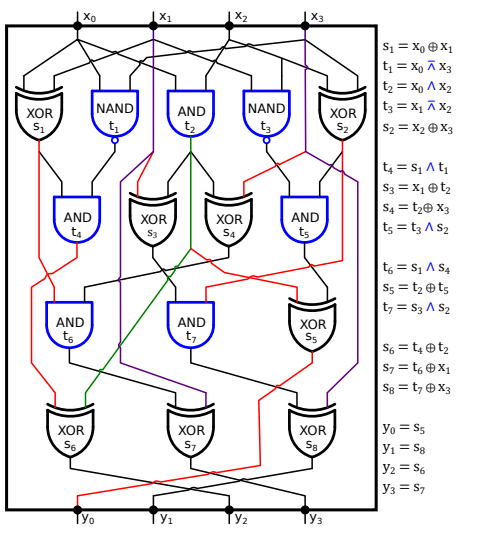
図18:GF(2^4) における逆元計算。上端に入力 x0、x1、x2、x3、下端に出力 y0、y1、y2、y3 がある組合せ回路で、ゲートは4層に並ぶ:XOR s1、NAND t1、AND t2、NAND t3、XOR s2/AND t4、XOR s3、XOR s4、AND t5/AND t6、AND t7、XOR s5/XOR s6、XOR s7、XOR s8。回路の横に次の式がある:s1 = x0 ⊕ x1、t1 = x0 NAND x3、t2 = x0 ∧ x2、t3 = x1 NAND x2、s2 = x2 ⊕ x3/t4 = s1 ∧ t1、s3 = x1 ⊕ t2、s4 = t2 ⊕ x3、t5 = t3 ∧ s2/t6 = s1 ∧ s4、s5 = t2 ⊕ t5、t7 = s3 ∧ s2/s6 = t4 ⊕ t2、s7 = t6 ⊕ x1、s8 = t7 ⊕ x3/y0 = s5、y1 = s8、y2 = s6、y3 = s7。
Figure 18: Inversion in GF(2^4)
図18:GF(2^4) における逆元計算
CSD is also researching circuit-based security metrics for cryptographic functions. For a function to be secure (in particular, one-way), it must be the case that any circuit that implements it is sufficiently complex. In particular, a function is insecure if it can be implemented by a circuit containing too few Boolean AND gates. This security metric — the number of AND gates necessary and sufficient to implement a function — is called multiplicative complexity. Unfortunately, determining multiplicative complexity is extremely hard. In previous years, the CSD was able to determine the multiplicative complexity of all Boolean functions on up to five input bits. This year the team was able to do the same for all functions on six inputs (there are 2^64 such functions). ITL was able to exhibit specific functions on n bits which are impossible to calculate with fewer than n AND gates. Also as a result of this classification, it was possible to determine the multiplicative complexity of the symmetric function Σ(8,4) – problems that had remained unresolved for many years.
CSD は、暗号関数に対する回路ベースのセキュリティ指標についても研究しています。関数が安全である(特に、一方向性を持つ)ためには、それを実装するどの回路も十分に複雑でなければなりません。特に、ブール AND ゲートの数が少なすぎる回路で実装できる関数は安全でありません。このセキュリティ指標、すなわち関数を実装するのに必要十分な AND ゲートの数は、乗法的計算量と呼ばれます。残念ながら、乗法的計算量を決定することは極めて困難です。過去の年度に、CSD は入力が5ビットまでのすべてのブール関数の乗法的計算量を決定することができました。今年度、チームは6入力のすべての関数(そのような関数は 2^64 個ある)について同じことを行うことができました。ITL は、n 個未満の AND ゲートでは計算できない n ビット上の具体的な関数を示すことができました。また、この分類の結果として、対称関数 Σ(8,4) の乗法的計算量を決定することが可能になりました。これらは長年にわたり未解決のままであった問題です。
Secure multi-party computation is a technique that allows a group of people to compute a function of their inputs without revealing the inputs themselves. Examples of this are: 1) holding an election; 2) conducting closed-bid auctions in which only the winning bid is determined; 3) proving to a third party that a person’s encrypted attributes satisfy some requirement, such as being “over 21 and (U.S. citizen or Canadian citizen)”. The protocols that solve secure multi-party computation problems often encrypt bits using arithmetic modulo 2. The complexity of such protocols largely depends on the number of multiplications required. Hence, expressing functions as a circuit with only a few multiplication (AND) gates is important. Some of the circuits published are now a standard reference for the benchmarking of secure multi-party computation protocols.
秘密マルチパーティ計算は、複数の人からなるグループが、各自の入力そのものを明かすことなく、それらの入力の関数を計算できるようにする技術です。その例として、1) 選挙の実施、2) 落札額だけが決定される封印入札方式のオークションの実施、3) ある人の暗号化された属性が、「21歳以上かつ(米国市民またはカナダ市民)」といった何らかの要件を満たすことの第三者への証明、が挙げられます。秘密マルチパーティ計算の問題を解くプロトコルは、多くの場合、2を法とする算術を用いてビットを暗号化します。そのようなプロトコルの計算量は、必要となる乗算の回数に大きく左右されます。したがって、関数を少数の乗算(AND)ゲートだけからなる回路として表現することが重要です。公表された回路のいくつかは、今では秘密マルチパーティ計算プロトコルのベンチマークにおける標準的な参照先となっています。
The results on circuit size and depth, and on multiplicative complexity were presented at the 2nd International Workshop on Boolean Functions and their Applications (Bergen, Norway). Circuits are periodically posted at https://csrc.nist.gov/Projects/Circuit-Complexity/Circuit-Problems.
回路のサイズと深さ、および乗法的計算量に関する成果は、2nd International Workshop on Boolean Functions and their Applications(ノルウェー、ベルゲン)で発表されました。回路は https://csrc.nist.gov/Projects/Circuit-Complexity/Circuit-Problems に定期的に掲載されています。
CONTACT:
連絡先:
Dr. René Peralta, (301) 975-8702, rene.peralta@nist.gov
Dr. René Peralta, (301) 975-8702, rene.peralta@nist.gov
Lightweight Cryptography
軽量暗号
There are several emerging areas in which highly constrained devices are interconnected and working in concert to accomplish a task. Examples of these areas include automotive systems, sensor networks, healthcare, distributed control systems, the Internet of Things (IoT), cyber-physical systems, and the smart grid. Security and privacy can be very important in these areas. Because most of the modern cryptographic algorithms were designed for desktop/server environments, many of these algorithms cannot be implemented in the constrained devices used by these applications. When current NIST-approved algorithms can be engineered to fit into the limited resources of constrained environments, their performance may not be acceptable. For these reasons, NIST started a lightweight cryptography project in 2013 that was tasked with determining the need and developing a strategy for the standardization of lightweight cryptographic algorithms.
高度に制約されたデバイスが相互に接続され、協調して1つのタスクを遂行する新興分野がいくつかあります。こうした分野の例として、自動車システム、センサーネットワーク、ヘルスケア、分散制御システム、モノのインターネット(IoT)、サイバーフィジカルシステム、スマートグリッドが挙げられます。これらの分野では、セキュリティとプライバシーが非常に重要になり得ます。現代の暗号アルゴリズムの大半はデスクトップ/サーバ環境向けに設計されたため、その多くは、これらの用途で使われる制約されたデバイスには実装できません。現行のNIST承認アルゴリズムを、制約された環境の限られた資源に収まるように設計できたとしても、その性能は許容できるものにならない場合があります。これらの理由から、NISTは2013年に軽量暗号プロジェクトを開始しました。このプロジェクトの任務は、軽量暗号アルゴリズムの標準化の必要性を見極め、そのための戦略を策定することでした。
In October 2016, CSD held the Second Lightweight Cryptography Workshop for representatives from government, industry, and academia. The workshop led to the publication of NISTIR 8114, Report on Lightweight Cryptography. This report provides an overview of the lightweight cryptography project at NIST, and describes a plan for the standardization of lightweight cryptographic algorithms. A draft whitepaper, Profiles for the Lightweight Cryptography Standardization Process, was released for public comment in order to receive community feedback on the goals for the first set of NIST lightweight cryptography standards. The functionality that will be requested for this first set of standards are authenticated encryption with associated data (AEAD) with optional hashing. A call for algorithm submissions for the lightweight cryptography portfolio will be announced in FY 2018, along with details of the selection process.
2016年10月、CSDは政府、産業界、学術界の代表者を対象に Second Lightweight Cryptography Workshop を開催しました。このワークショップは、NISTIR 8114, Report on Lightweight Cryptography の公表につながりました。この報告書は、NISTにおける軽量暗号プロジェクトの概要を示し、軽量暗号アルゴリズムの標準化計画を述べています。NISTの軽量暗号標準の第1弾の目標についてコミュニティからフィードバックを得るため、ホワイトペーパーの草案 Profiles for the Lightweight Cryptography Standardization Process がパブリックコメントに付されました。この第1弾の標準で求められる機能は、関連データ付き認証暗号(AEAD)であり、ハッシュ機能は任意です。軽量暗号ポートフォリオのためのアルゴリズムの公募は、選定プロセスの詳細とともに、2018会計年度に公表される予定です。
NISTIR 8114 and the Lightweight Cryptography project were featured in the June 2017 ITL bulletin, and CSD presented a poster on the project during ITL Science Day in October 2016. The Lightweight Cryptography project was presented at several venues in FY 2017, including Real World Crypto, HighLight: High Security Lightweight Cryptography, and the rump sessions of the Eurocrypt and Crypto conferences.
NISTIR 8114と軽量暗号プロジェクトは2017年6月のITL bulletinで取り上げられ、CSDは2016年10月の ITL Science Day でこのプロジェクトに関するポスター発表を行いました。軽量暗号プロジェクトは、2017会計年度に、Real World Crypto、HighLight: High Security Lightweight Cryptography、ならびに Eurocrypt および Crypto の各会議のランプセッションなど、複数の場で発表されました。
FOR MORE INFORMATION, SEE:
詳細情報:
https://www.nist.gov/programs-projects/lightweight-cryptography
https://www.nist.gov/programs-projects/lightweight-cryptography
https://csrc.nist.gov/publications/detail/itl-bulletin/2017/06/toward-standardizing-lightweight-cryptography/final
https://csrc.nist.gov/publications/detail/itl-bulletin/2017/06/toward-standardizing-lightweight-cryptography/final
CONTACTS:
連絡先:
Mr. Lawrence Bassham, (301) 975-3292, lawrence.bassham@nist.gov
Mr. Lawrence Bassham, (301) 975-3292, lawrence.bassham@nist.gov
Dr. Kerry McKay, (301) 975-4969, kerry.mckay@nist.gov
Dr. Kerry McKay, (301) 975-4969, kerry.mckay@nist.gov
Dr. Meltem Sönmez Turan, (301) 975-4391, meltem.turan@nist.gov
Dr. Meltem Sönmez Turan, (301) 975-4391, meltem.turan@nist.gov
Cryptography Applications in Wireless and Mobile Security
無線およびモバイルセキュリティにおける暗号の応用
Today, wireless networks have been integrated into modern communication systems that connect mobile devices using multiple radio technologies. Such heterogeneous networks demand integrated security solutions. CSD has worked closely with different working groups in the IEEE 802 LAN/MAN Standards Committee since 2006 and made solid contributions to the security solutions for wireless networks. The NIST team has been involved in the IEEE 802.11 and IEEE 802.21 working groups to develop standards for cryptographic key management schemes for the mobility environment. NIST cryptographic standards have been extensively used in the wireless standards developed in the IEEE 802 community.
今日、無線ネットワークは、複数の無線技術を用いてモバイルデバイスを接続する現代の通信システムに統合されています。そのような異種混在ネットワークは、統合されたセキュリティソリューションを必要とします。CSDは2006年以来、IEEE 802 LAN/MAN Standards Committee のさまざまなワーキンググループと緊密に協力し、無線ネットワークのセキュリティソリューションに確かな貢献をしてきました。NISTのチームは、IEEE 802.11および IEEE 802.21 のワーキンググループに参加し、モビリティ環境向けの暗号鍵管理方式の標準を策定してきました。NISTの暗号標準は、IEEE 802コミュニティで策定された無線標準に広く用いられています。
In FY 2017, NIST researchers continuously collaborated with the IEEE 802.21 Working Group. IEEE 802.21 “Media Independent Handover Services Framework” was published, and IEEE 802.21.1 “Media Independent Services” was finalized for publication. These new standards address the future connectivity and management requirements of Smart Grid, IoT and Smart Home networks, where multimode wireless devices and smart end nodes incorporate different wireless interfaces, and need to switch among the networks during an ongoing communication session, while maintaining the same security posture. IEEE 802.21 and IEEE 802.21.1 adopted NIST standardized cryptographic algorithms, such as ECDSA, as specified in FIPS 186-4, and AES-CCM, as specified in SP 800-38C.
2017会計年度、NISTの研究者は IEEE 802.21 Working Group と継続的に協力しました。IEEE 802.21 “Media Independent Handover Services Framework” が発行され、IEEE 802.21.1 “Media Independent Services” が発行に向けて最終化されました。これらの新しい標準は、スマートグリッド、IoT、スマートホームの各ネットワークにおける将来の接続性と管理の要件に対応します。これらのネットワークでは、マルチモードの無線デバイスやスマートエンドノードが異なる無線インタフェースを備え、進行中の通信セッションの間に、同じセキュリティ態勢を維持しながらネットワークを切り替える必要があります。IEEE 802.21と IEEE 802.21.1 は、FIPS 186-4で規定されるECDSAや、SP 800-38Cで規定されるAES-CCMなど、NISTが標準化した暗号アルゴリズムを採用しました。
The recently revealed KRACK attack on the IEEE 802.11 wireless network leads to generating the same key stream in the case of AES-CCM, or recovering the authentication key, in the case of AES-GCM through a man-in-the-middle attack to create a counter reset condition. The KRACK attack confirms that it is essential to make sure that the special features and assumptions for using each cryptographic algorithm are considered in the protocol design so that the requirements are satisfied to assure security in any circumstance.
最近明らかになったIEEE 802.11無線ネットワークに対するKRACK攻撃は、中間者攻撃によってカウンタがリセットされる状態を作り出し、AES-CCMの場合には同一の鍵ストリームを生成させ、AES-GCMの場合には認証鍵を復元します。KRACK攻撃は、どのような状況でもセキュリティを確保するための要件が満たされるよう、各暗号アルゴリズムを使用する際の固有の特性と前提をプロトコル設計で確実に考慮することが不可欠であることを裏付けています。
In FY 2018, CSD will continue to contribute to IEEE 802 wireless standards. CSD will work with the IEEE 802.11 working group to develop countermeasures for the KRACK attack.
2018会計年度も、CSDはIEEE 802無線標準への貢献を続けます。CSDはIEEE 802.11ワーキンググループと協力して、KRACK攻撃への対策を開発します。
CONTACT:
連絡先:
Dr. Lily Chen, (301) 975 -6974, lily.chen@nist.gov
Dr. Lily Chen, (301) 975 -6974, lily.chen@nist.gov
Blockchains
ブロックチェーン
CSD began studying the use of blockchains, which have been suggested as a solution for many applications. A blockchain is a distributed database that maintains a continuously growing list of records called blocks that are secured from undetected modification using a hash function. Each block contains a link to the previous block. A new block is added to the chain only when multiple parties (possibly mutually untrusted parties) agree to its accuracy. In essence, a blockchain is a mutually agreed-upon record of history.
CSDは、多くの用途の解決策として提案されているブロックチェーンの利用について研究を始めました。ブロックチェーンは、ブロックと呼ばれるレコードの、継続的に増え続けるリストを保持する分散データベースであり、各ブロックはハッシュ関数によって、検知されない改変から保護されます。各ブロックは、直前のブロックへのリンクを含みます。新しいブロックは、複数の当事者(互いに信頼していない当事者である場合もある)がその正確性に合意した場合にのみ、チェーンに追加されます。要するに、ブロックチェーンは、相互に合意された履歴の記録です。
Figure 19 illustrates three blocks in a blockchain, where each block contains at least one transaction, a nonce and the hash value of the previous block in the chain.
図19は、ブロックチェーン内の三つのブロックを示しています。各ブロックは、少なくとも一つのトランザクション、ノンス、およびチェーン内の直前のブロックのハッシュ値を含みます。
The most well-known example of the use of a blockchain is BitCoin and similar digital currencies. However, the use of blockchains has been proposed for other applications, such as smart contracts and various ledgering applications.
ブロックチェーンの利用例として最もよく知られているのは、BitCoinおよび類似のデジタル通貨です。しかし、ブロックチェーンの利用は、スマートコントラクトやさまざまな台帳用途など、他の用途についても提案されています。
Many organizations have suggested applications for the use of blockchains, some of which may not be appropriate. CSD is investigating the use of blockchains to determine which application types are appropriate for using blockchains and which are not. CSD is monitoring the proposed uses of cryptography to assure that current cryptographic techniques are used properly and whether new techniques are required.
多くの組織がブロックチェーンを利用する用途を提案していますが、その中には適切でないものもあり得ます。CSDは、どの種類の用途がブロックチェーンの利用に適し、どれが適さないかを判断するため、ブロックチェーンの利用を調査しています。CSDは、現行の暗号技術が適切に使用されることを確保し、新たな技術が必要かどうかを見極めるため、提案されている暗号の利用を注視しています。
During FY 2017, NIST participated in standards activities exploring blockchain technologies, architectures, and use cases. These included participation in a new blockchain study group sponsored by American Standards Committee X9, the financial services committee of the American National Standards Institute (ANSI), and continued work in the International Standards Organization (ISO) Technical Committee (TC) for Blockchains and Distributed Ledger Technologies (ISO/TC 307). Established in 2016, the initial objectives of ISO/TC 307 include defining key terms and concepts, exploring reference architectures, investigating use cases, and identifying identity and privacy implications within blockchain technologies and architectures. NIST has been participating in these activities via the national mirror committee within the InterNational Committee for Information Technology Standards (INCITS). ISO/TC 307 will meet in November 2017, where the reports on these topics will be reviewed and new work will be established.
2017会計年度に、NISTはブロックチェーンの技術、アーキテクチャ及びユースケースを検討する標準化活動に参加しました。これには、米国規格協会(ANSI)の金融サービス委員会である American Standards Committee X9 が主催する新しいブロックチェーン研究グループへの参加と、国際標準化機構(ISO)のブロックチェーン及び分散台帳技術に関する専門委員会(TC)(ISO/TC 307)での継続的な作業が含まれます。ISO/TC 307は2016年に設置され、その当初の目的には、主要な用語と概念の定義、参照アーキテクチャの検討、ユースケースの調査、並びにブロックチェーンの技術及びアーキテクチャにおけるアイデンティティとプライバシーへの影響の特定が含まれます。NISTは、InterNational Committee for Information Technology Standards(INCITS)内の国内対応委員会を通じて、これらの活動に参加してきました。ISO/TC 307は2017年11月に会合を開き、そこでこれらの主題に関する報告書がレビューされ、新たな作業項目が設定される予定です。
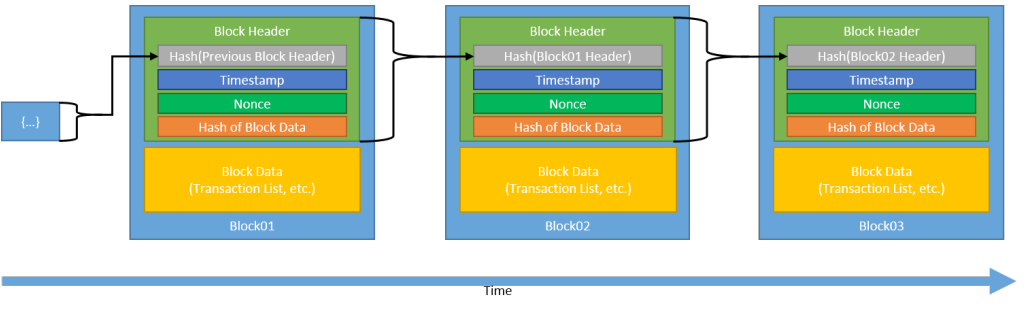
図19:ブロックチェーンの例。Time(時間)と記した矢印の上に、Block01、Block02、Block03 の3つのブロックが左から右へ並ぶ。各ブロックは Block Header(ブロックヘッダ)を持ち、その中にハッシュ欄、Timestamp(タイムスタンプ)、Nonce(ノンス)、Hash of Block Data(ブロックデータのハッシュ)があり、その下に Block Data (Transaction List, etc.)(ブロックデータ。トランザクションのリストなど)がある。ハッシュ欄は、Block01 では Hash(Previous Block Header)(前のブロックヘッダのハッシュ)で、{...} と示した先行ブロックから矢印を受ける。Block02 では Hash(Block01 Header)、Block03 では Hash(Block02 Header) である。各ブロックのヘッダから括弧付きの矢印が次のブロックのハッシュ欄へ向かう。
Figure 19: Example of a Blockchain
図19:ブロックチェーンの例
During FY 2017, CSD established the NIST Internal Blockchain Workbench to support internal research exploring blockchain technologies and use cases. The workbench itself is hosted on internal servers, and is currently running two blockchains – the first is a permissioned blockchain utilizing the MultiChain blockchain platform; the second is Ethereum, which has been configured to run only within the workbench. In addition to the blockchain software itself, the workbench has demonstration applications with source code, software development tools and several diagnostic tool suites available for researchers to utilize. NIST/ITL plans to continue advancing the capabilities of the workbench and expanding the types of blockchains available in FY 2018.
2017会計年度に、CSDは、ブロックチェーンの技術とユースケースを検討する内部研究を支援するために、NIST Internal Blockchain Workbench を立ち上げました。このワークベンチ自体は内部サーバ上でホストされており、現在二つのブロックチェーンを稼働させています。一つ目は MultiChain ブロックチェーンプラットフォームを利用した許可型ブロックチェーンであり、二つ目は Ethereum で、ワークベンチ内でのみ動作するように構成されています。ワークベンチには、ブロックチェーンソフトウェアそのものに加えて、ソースコード付きのデモンストレーション用アプリケーション、ソフトウェア開発ツール及び複数の診断ツール群があり、研究者が利用できます。NIST/ITLは、2018会計年度も引き続きワークベンチの機能を向上させ、利用可能なブロックチェーンの種類を拡充する計画です。
CONTACTS:
連絡先:
Ms. Elaine Barker, (301) 975-2911, ebarker@nist.gov
Ms. Elaine Barker, (301) 975-2911, ebarker@nist.gov
Mr. John Kelsey, (301) 975-5101, john.kelsey@nist.gov
Mr. John Kelsey, (301) 975-5101, john.kelsey@nist.gov
Dr. René Peralta, (301) 975-8702, rene.peralta@nist.gov
Dr. René Peralta, (301) 975-8702, rene.peralta@nist.gov
Mr. Andrew Regenscheid, (301) 975-5155, andrew.regenscheid@nist.gov
Mr. Andrew Regenscheid, (301) 975-5155, andrew.regenscheid@nist.gov
Mr. Dylan Yaga, (301) 975-6004, dylan.yaga@nist.gov
Mr. Dylan Yaga, (301) 975-6004, dylan.yaga@nist.gov
VALIDATION PROGRAMS
検証プログラム
Federal agencies, industry, and the public rely on many of the standards and specifications supported by ITL. Poor implementations of these standards or specifications may render a product insecure, potentially placing sensitive information at risk. ITL operates several validation programs that help provide a level of assurance that products meet established security requirements and conform to published specifications. To that end, the CSD develops test suites and test methods; provides implementation guidance and technical support to industry forums; and conducts education, training, and outreach programs.
連邦政府機関、産業界及び一般の人々は、ITLが支援する標準及び仕様の多くに依拠しています。これらの標準又は仕様の実装が不十分であると、製品が安全でなくなり、機微な情報がリスクにさらされるおそれがあります。ITLは、製品が確立されたセキュリティ要件を満たし、公開された仕様に適合していることについて一定水準の保証を提供するのに役立つ、複数の検証プログラムを運営しています。そのために、CSDは、テストスイートとテスト方法を開発し、産業界のフォーラムに実装ガイダンスと技術支援を提供し、教育、訓練及びアウトリーチのプログラムを実施しています。
CSD’s validation programs work together with independent laboratories that are accredited by the National Voluntary Laboratory Accreditation Program (NVLAP). Based on independent laboratory test reports and test evidence provided by the labs, the validation programs described below validate the implementation-under-test. Awarded validations are subsequently published on NIST websites.
CSDの検証プログラムは、米国自主試験所認定プログラム(NVLAP)の認定を受けた独立試験所と連携して運営されています。以下に述べる検証プログラムは、独立試験所の試験報告書と試験所が提供する試験証拠に基づいて、試験対象の実装を検証します。付与された検証結果は、その後NISTのウェブサイトで公開されます。
Cryptographic Algorithm Validation Program (CAVP)
暗号アルゴリズム検証プログラム(CAVP)
The Cryptographic Algorithm Validation Program (CAVP) provides federal agencies in the United States and Canada with assurance that a cryptographic algorithm has been implemented completely and correctly, as specified in its approved Federal Information Processing Standard (FIPS-Approved) or NIST-recommended cryptographic algorithm standard. The CAVP was established in 2013 as a joint program in collaboration between NIST and the Communications Security Establishment (CSE) of Canada. Prior to this date, the CAVP’s functions were included in the Cryptographic Module Validation Program (CMVP). With the increase in the number and complexity of FIPS-Approved and NIST-recommended cryptographic algorithms, it was deemed necessary to establish the CAVP as an independent program.
暗号アルゴリズム検証プログラム(CAVP)は、暗号アルゴリズムが、承認された連邦情報処理規格(FIPS承認)又はNIST推奨の暗号アルゴリズム標準に規定されたとおりに、完全かつ正しく実装されているという保証を、米国及びカナダの連邦政府機関に提供します。CAVPは、NISTとカナダの通信保安局(CSE)が協力する共同プログラムとして2013年に設立されました。それ以前は、CAVPの機能は暗号モジュール検証プログラム(CMVP)に含まれていました。FIPS承認及びNIST推奨の暗号アルゴリズムの数と複雑さが増したことから、CAVPを独立したプログラムとして設立する必要があると判断されました。
The CAVP’s goal is to provide federal agencies with a security metric list to use in validating cryptographic algorithm implementations, and promote the use of validated algorithms by industry and the public. The testing is carried out by independent third-party laboratories accredited by the NVLAP, and the validations performed by the CAVP program provide this metric. Federal agencies, industry, and the public can choose validated implementations of cryptographic algorithms from the CAVP Validated Algorithms List and have confidence in the claimed level of security and assurance of correct implementation.
CAVPの目標は、暗号アルゴリズム実装の検証に用いるセキュリティ指標のリストを連邦政府機関に提供し、産業界及び一般の人々による検証済みアルゴリズムの利用を促進することです。試験は、NVLAPの認定を受けた独立の第三者試験所によって実施され、CAVPが行う検証がこの指標を提供します。連邦政府機関、産業界及び一般の人々は、CAVPの検証済みアルゴリズムリストから暗号アルゴリズムの検証済み実装を選ぶことができ、主張されているセキュリティの水準と、正しく実装されているという保証を信頼することができます。
The validation of cryptographic algorithms by the CAVP is a prerequisite to the validation of a
CAVPによる暗号アルゴリズムの検証は、あるものの検証の前提条件となる
cryptographic module by the CMVP and is also used by other programs outside of NIST as well. Since federal agencies are required to use validated cryptographic modules for the protection of sensitive unclassified information, the validated modules and the validated algorithms that the modules contain represent the culmination and delivery of CSD’s cryptography-based work to the end user.
暗号モジュールにおけるCMVPによるものであり、NIST外部の他のプログラムでも利用されています。連邦機関は、機微だが機密指定されていない情報の保護に、検証済みの暗号モジュールを使用することが義務付けられているため、検証済みモジュールとそれに含まれる検証済みアルゴリズムは、CSDの暗号に基づく業務の集大成であり、それをエンドユーザーに届けるものです。
The CAVP validation program provides documented methodologies for conformance testing through defined sets of security requirements. For the CAVP, a validation system document is designed for each FIPS-approved or NIST-recommended cryptographic algorithm. See the website for a listing (see https://csrc.nist.gov/groups/STM/cavp/). The four Annexes to FIPS 140-2 reference the underlying cryptographic algorithm standards or methods.
CAVPの検証プログラムは、定義されたセキュリティ要件の集合を通じて、適合性試験のための文書化された方法論を提供します。CAVPでは、FIPS承認またはNIST推奨の暗号アルゴリズムごとに検証システム文書が作成されます。一覧についてはウェブサイトを参照してください(https://csrc.nist.gov/groups/STM/cavp/ を参照してください)。FIPS 140-2の4つの附属書は、基礎となる暗号アルゴリズムの標準または方式を参照しています。
By the end of FY 2017, the CAVP had issued approximately 28,710 validations, representing the algorithm validations of approximately 18 approved algorithms, including 5 modes of operation.
2017会計年度末までに、CAVPは約28,710件の検証を発行しました。これは、5つの利用モードを含む約18の承認アルゴリズムについてのアルゴリズム検証に相当します。
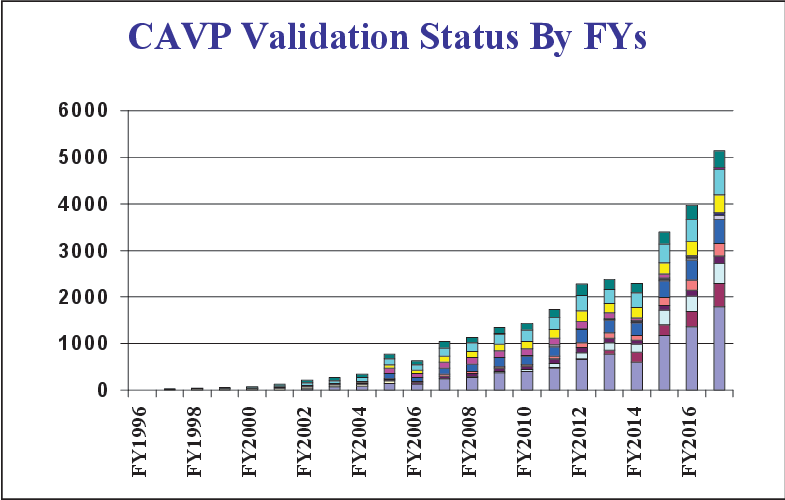
図20:会計年度別のCAVP検証状況。「CAVP Validation Status By FYs」と題した積み上げ棒グラフで、FY1996 から FY2017 までの会計年度ごとに1本の棒がある(軸ラベルは1年おきに FY1996、FY1998、…、FY2016)。縦軸は 0〜6000 である。各棒は色分けした区分を積み上げている(凡例はない)。合計はおよそ FY2003 まではほぼ 0 で、FY2007〜FY2010 ごろに約 1,000〜1,400、FY2012〜FY2014 に約 2,300 となり、最後の3年は約 3,400、約 4,000、5,100 強である。
Figure 20: CAVP Validation Status by Fiscal Year
図20:会計年度別のCAVP検証状況
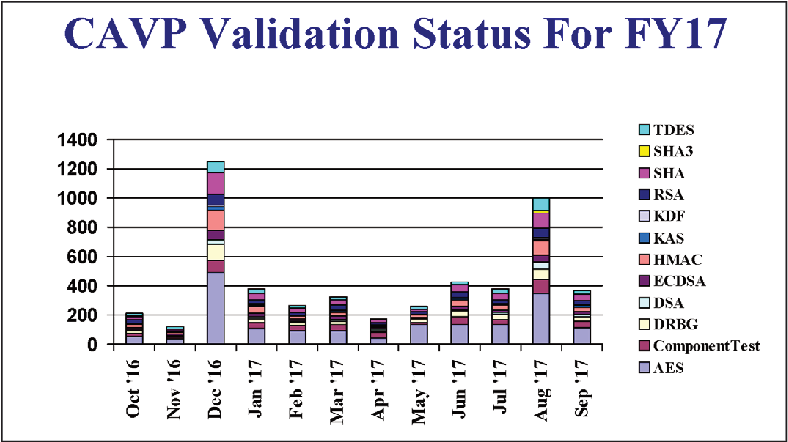
図21:2017会計年度のCAVP検証状況。「CAVP Validation Status For FY17」と題した積み上げ棒グラフで、Oct '16 から Sep '17 まで月ごとに1本の棒がある。縦軸は 0〜1400 である。凡例(上から):TDES、SHA3、SHA、RSA、KDF、KAS、HMAC、ECDSA、DSA、DRBG、ComponentTest、AES。最も高いのは Dec '16 の約 1,250、次が Aug '17 の約 1,000 で、その他の月は約 120(Nov '16)から約 420(Jun '17)の範囲にある。Dec '16(約 490)と Aug '17(約 350)では、最下段の AES が最大の区分である。
Figure 21: CAVP Validation Status for FY 2017
図21:2017会計年度のCAVP検証状況
| FiscalYear | AES | Comp. | DES | DSA | DRBG | ECDSA | HMAC | KAS | KDF | RNG | RSA | SHA | SJ | TDES | Total |
|---|---|---|---|---|---|---|---|---|---|---|---|---|---|---|---|
| FY1996 | 0 | 0 | 2 | 0 | 0 | 0 | 0 | 0 | 0 | 0 | 0 | 0 | 0 | 0 | 2 |
| FY1997 | 0 | 0 | 11 | 6 | 0 | 0 | 0 | 0 | 0 | 0 | 0 | 7 | 2 | 0 | 26 |
| FY1998 | 0 | 0 | 27 | 9 | 0 | 0 | 0 | 0 | 0 | 0 | 0 | 6 | 0 | 0 | 42 |
| FY1999 | 0 | 0 | 30 | 14 | 0 | 0 | 0 | 0 | 0 | 0 | 0 | 12 | 1 | 0 | 57 |
| FY2000 | 0 | 0 | 29 | 7 | 0 | 0 | 0 | 0 | 0 | 0 | 0 | 12 | 1 | 28 | 77 |
| FY2001 | 0 | 0 | 41 | 15 | 0 | 0 | 0 | 0 | 0 | 0 | 0 | 28 | 0 | 51 | 135 |
| FY2002 | 30 | 0 | 44 | 21 | 0 | 0 | 0 | 0 | 0 | 0 | 0 | 59 | 6 | 58 | 218 |
| FY2003 | 66 | 0 | 49 | 24 | 0 | 0 | 0 | 0 | 0 | 0 | 0 | 63 | 3 | 73 | 278 |
| FY2004 | 82 | 0 | 41 | 17 | 0 | 0 | 0 | 0 | 0 | 28 | 22 | 77 | 0 | 70 | 337 |
| FY2005 | 145 | 1 | 54 | 31 | 0 | 14 | 115 | 0 | 0 | 108 | 80 | 122 | 2 | 102 | 774 |
| FY2006 | 131 | 1 | 3 | 33 | 0 | 19 | 87 | 0 | 0 | 91 | 63 | 120 | 1 | 83 | 632 |
| FY2007 | 238 | 5 | 0 | 63 | 0 | 35 | 127 | 0 | 0 | 137 | 130 | 171 | 1 | 136 | 1043 |
| FY2008 | 271 | 7 | 0 | 77 | 4 | 41 | 158 | 0 | 0 | 137 | 129 | 191 | 0 | 122 | 1137 |
| FY2009 | 373 | 2 | 0 | 71 | 23 | 33 | 193 | 6 | 0 | 142 | 143 | 224 | 1 | 138 | 1349 |
| FY2010 | 406 | 2 | 0 | 70 | 31 | 39 | 179 | 12 | 0 | 150 | 155 | 239 | 0 | 142 | 1425 |
| FY2011 | 476 | 11 | 0 | 102 | 79 | 68 | 201 | 34 | 0 | 148 | 183 | 255 | 0 | 177 | 1734 |
| FY2012 | 654 | 24 | 0 | 121 | 122 | 92 | 283 | 20 | 3 | 157 | 231 | 323 | 1 | 248 | 2279 |
| FY2013 | 778 | 88 | 0 | 106 | 145 | 113 | 276 | 12 | 9 | 132 | 208 | 293 | 0 | 217 | 2377 |
| FY2014 | 595 | 223 | 0 | 95 | 167 | 96 | 276 | 14 | 23 | 63 | 225 | 314 | 0 | 196 | 2287 |
| FY2015 | 1179 | 226 | 0 | 99 | 320 | 164 | 355 | 32 | 35 | 80 | 243 | 396 | 0 | 258 | 3387 |
| FY2016 | 1357 | 329 | 0 | 125 | 339 | 214 | 422 | 50 | 32 | 23 | 305 | 463 | 0 | 303 | 3967 |
| FY2017 | 1786 | 503 | 0 | 170 | 426 | 271 | 508 | 88 | 52 | 0 | 391 | 547 | 0 | 371 | 5147 |
| Total | 8567 | 1422 | 331 | 1276 | 1656 | 1199 | 3180 | 268 | 154 | 1396 | 2508 | 3922 | 19 | 2773 | 28710 |
| 会計年度 | AES | Comp. | DES | DSA | DRBG | ECDSA | HMAC | KAS | KDF | RNG | RSA | SHA | SJ | TDES | 合計 |
|---|---|---|---|---|---|---|---|---|---|---|---|---|---|---|---|
| FY1996 | 0 | 0 | 2 | 0 | 0 | 0 | 0 | 0 | 0 | 0 | 0 | 0 | 0 | 0 | 2 |
| FY1997 | 0 | 0 | 11 | 6 | 0 | 0 | 0 | 0 | 0 | 0 | 0 | 7 | 2 | 0 | 26 |
| FY1998 | 0 | 0 | 27 | 9 | 0 | 0 | 0 | 0 | 0 | 0 | 0 | 6 | 0 | 0 | 42 |
| FY1999 | 0 | 0 | 30 | 14 | 0 | 0 | 0 | 0 | 0 | 0 | 0 | 12 | 1 | 0 | 57 |
| FY2000 | 0 | 0 | 29 | 7 | 0 | 0 | 0 | 0 | 0 | 0 | 0 | 12 | 1 | 28 | 77 |
| FY2001 | 0 | 0 | 41 | 15 | 0 | 0 | 0 | 0 | 0 | 0 | 0 | 28 | 0 | 51 | 135 |
| FY2002 | 30 | 0 | 44 | 21 | 0 | 0 | 0 | 0 | 0 | 0 | 0 | 59 | 6 | 58 | 218 |
| FY2003 | 66 | 0 | 49 | 24 | 0 | 0 | 0 | 0 | 0 | 0 | 0 | 63 | 3 | 73 | 278 |
| FY2004 | 82 | 0 | 41 | 17 | 0 | 0 | 0 | 0 | 0 | 28 | 22 | 77 | 0 | 70 | 337 |
| FY2005 | 145 | 1 | 54 | 31 | 0 | 14 | 115 | 0 | 0 | 108 | 80 | 122 | 2 | 102 | 774 |
| FY2006 | 131 | 1 | 3 | 33 | 0 | 19 | 87 | 0 | 0 | 91 | 63 | 120 | 1 | 83 | 632 |
| FY2007 | 238 | 5 | 0 | 63 | 0 | 35 | 127 | 0 | 0 | 137 | 130 | 171 | 1 | 136 | 1043 |
| FY2008 | 271 | 7 | 0 | 77 | 4 | 41 | 158 | 0 | 0 | 137 | 129 | 191 | 0 | 122 | 1137 |
| FY2009 | 373 | 2 | 0 | 71 | 23 | 33 | 193 | 6 | 0 | 142 | 143 | 224 | 1 | 138 | 1349 |
| FY2010 | 406 | 2 | 0 | 70 | 31 | 39 | 179 | 12 | 0 | 150 | 155 | 239 | 0 | 142 | 1425 |
| FY2011 | 476 | 11 | 0 | 102 | 79 | 68 | 201 | 34 | 0 | 148 | 183 | 255 | 0 | 177 | 1734 |
| FY2012 | 654 | 24 | 0 | 121 | 122 | 92 | 283 | 20 | 3 | 157 | 231 | 323 | 1 | 248 | 2279 |
| FY2013 | 778 | 88 | 0 | 106 | 145 | 113 | 276 | 12 | 9 | 132 | 208 | 293 | 0 | 217 | 2377 |
| FY2014 | 595 | 223 | 0 | 95 | 167 | 96 | 276 | 14 | 23 | 63 | 225 | 314 | 0 | 196 | 2287 |
| FY2015 | 1179 | 226 | 0 | 99 | 320 | 164 | 355 | 32 | 35 | 80 | 243 | 396 | 0 | 258 | 3387 |
| FY2016 | 1357 | 329 | 0 | 125 | 339 | 214 | 422 | 50 | 32 | 23 | 305 | 463 | 0 | 303 | 3967 |
| FY2017 | 1786 | 503 | 0 | 170 | 426 | 271 | 508 | 88 | 52 | 0 | 391 | 547 | 0 | 371 | 5147 |
| 合計 | 8567 | 1422 | 331 | 1276 | 1656 | 1199 | 3180 | 268 | 154 | 1396 | 2508 | 3922 | 19 | 2773 | 28710 |
Figure 22: Validated Implementation Actual Numbers
図22:検証済み実装の実数
The CAVP issued approximately 5,000 algorithm validations in FY 2017, an increase of approximately 100 validations from the previous year. The increase in validations is attributed to an increase in cryptographic modules being validated and other outside programs now requiring CAVP validated implementations, e.g., the National Information Assurance Partnership (NIAP).
CAVPは2017会計年度に約5,000件のアルゴリズム検証を発行し、前年より約100件増加しました。検証件数の増加は、検証される暗号モジュールが増えたことと、National Information Assurance Partnership(NIAP)など外部の他のプログラムがCAVP検証済みの実装を要求するようになったことによるものです。
The number of algorithms submitted for validation continues to grow, representing significant growth in the number of validations expected to be available in the future.
検証のために提出されるアルゴリズムの数は増え続けており、今後利用可能になると見込まれる検証の件数が大きく伸びることを示しています。
FOR MORE INFORMATION, SEE:
詳細情報:
https://csrc.nist.gov/groups/computer-security-division/security-testing-validation-and-measurement
https://csrc.nist.gov/groups/computer-security-division/security-testing-validation-and-measurement
CONTACT:
連絡先:
Mr. Harold Booth, (301) 975-8441, harold.booth@nist.gov
Mr. Harold Booth, (301) 975-8441, harold.booth@nist.gov
(Editors’ Note: Sharon Keller worked on this program until her recent retirement.)
(編集者注:Sharon Keller は、最近退職するまでこのプログラムに携わっていました。)
Cryptographic Module Validation Program (CMVP)
Cryptographic Module Validation Program(CMVP)
The Cryptographic Module Validation Program (CMVP) was developed to support the federal user communities for strong, independently tested, and commercially available cryptographic modules. Through this program, the CMVP works with international government, public and private sectors as a part of the cryptographic community to achieve standards-based security and assurance of correct implementation. The goal is to provide federal agencies with a security metric list to use in procuring and deploying validated cryptographic modules, and promote the use of those modules by industry and the public. The testing performed by independent third-party laboratories accredited by NVLAP, and the validations performed by the CMVP program provide this metric. Federal agencies, industry, and the public can choose cryptographic modules and/or products containing cryptographic modules from the CMVP Validated Modules List and have confidence in the claimed level of security and assurance of correct implementation.
Cryptographic Module Validation Program(CMVP)は、強力で、独立した試験を受けた、市販の暗号モジュールを求める連邦政府のユーザーコミュニティを支援するために策定されました。このプログラムを通じて、CMVPは暗号コミュニティの一員として各国の政府、公共部門および民間部門と協力し、標準に基づくセキュリティと、実装が正しいことの保証を実現します。その目標は、連邦機関が検証済み暗号モジュールを調達し導入する際に用いるセキュリティ指標の一覧を提供し、産業界と一般の人々によるそれらのモジュールの利用を促進することです。NVLAPの認定を受けた独立した第三者試験所が実施する試験と、CMVPプログラムが実施する検証が、この指標を提供します。連邦機関、産業界、一般の人々は、CMVP Validated Modules List から暗号モジュールや暗号モジュールを含む製品を選ぶことができ、表明されているセキュリティのレベルと、実装が正しいことの保証を信頼できます。
Cryptographic module testing and validation are based on published NIST standards. Since federal agencies are required to use validated cryptographic modules for the protection of sensitive unclassified information, the validated modules and the validated algorithms that the modules contain represent the culmination and delivery of the CSD’s cryptography-based work to the end user.
暗号モジュールの試験と検証は、公表されたNISTの標準に基づいています。連邦機関は、機微だが機密指定されていない情報の保護に、検証済みの暗号モジュールを使用することが義務付けられているため、検証済みモジュールとそれに含まれる検証済みアルゴリズムは、CSDの暗号に基づく業務の集大成であり、それをエンドユーザーに届けるものです。
The CMVP validates modules that are used in a wide variety of products, including Internet browsers, radios, smart cards, space-based communications, munitions, security tokens, mobile phones, network and storage devices, and products supporting the Public Key Infrastructure (PKI) and electronic commerce. A module may be a standalone product, such as a virtual private network (VPN) or smart card, or it could be a module embedded in many products, such as a cryptographic-based toolkit. As a result, a small number of modules may be incorporated within hundreds of products.
CMVPは、インターネットブラウザ、無線機、スマートカード、宇宙通信、軍需品、セキュリティトークン、携帯電話、ネットワーク機器およびストレージ機器、ならびに公開鍵基盤(PKI)や電子商取引を支える製品など、多種多様な製品で使われるモジュールを検証します。モジュールは、仮想プライベートネットワーク(VPN)やスマートカードのような独立した製品である場合もあれば、暗号ツールキットのように多数の製品に組み込まれるモジュールである場合もあります。その結果、少数のモジュールが数百の製品に組み込まれることがあります。
The theme for FY 2017 was modernization. As part of the launch of the new Computer Security Resource Center (CSRC) web site, the CMVP web pages were redesigned and now have a new look with additional functionality. The CMVP was automated to improve its validation processes, the Cryptographic Validation Program (CVP) Certification Exam was developed, and collaboration was continued with the Cryptographic Modules User Forum (CMUF) to publish new CMVP Implementation Guidance (IG).
2017会計年度のテーマは近代化でした。新しい Computer Security Resource Center(CSRC)ウェブサイトの公開の一環として、CMVPのウェブページは再設計され、機能が追加された新しい外観になりました。CMVPは検証プロセスを改善するために自動化され、Cryptographic Validation Program(CVP)Certification Exam が開発され、新しいCMVP Implementation Guidance(IG)を公表するために Cryptographic Modules User Forum(CMUF)との協力が継続されました。
The CMVP uses an automation system to manage the validation workflow. This automation continues to reduce the administrative overhead for the program allowing the staff to focus on addressing the technical needs of the community. The automated system tracks the status of each submission and identifies the order that the submission should be reviewed, based on when the submission was added to the CMVP queue. In FY 2017, the CMVP awarded 271 new certificates. Figure 23 displays the number of certificates that were issued by security level.
CMVPは、検証のワークフローを管理するために自動化システムを使用しています。この自動化により、プログラムの事務的な負担は減り続けており、職員はコミュニティの技術的なニーズへの対応に集中できます。自動化システムは、各提出物の状況を追跡し、提出物がCMVPの待ち行列に追加された時点に基づいて、その提出物を審査すべき順序を特定します。2017会計年度に、CMVPは271件の新しい証明書を交付しました。図23は、発行された証明書の数をセキュリティレベル別に示しています。
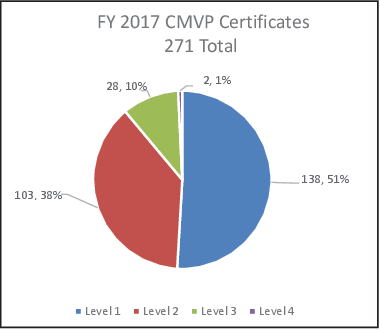
図23:2017会計年度のセキュリティレベル別CMVP証明書。「FY 2017 CMVP Certificates 271 Total」と題した円グラフである:Level 1 が 138(51%)、Level 2 が 103(38%)、Level 3 が 28(10%)、Level 4 が 2(1%)。
Figure 23: FY 2017 CMVP Certificates by Security Level
図23:2017会計年度のセキュリティレベル別CMVP証明書
Initially, this system automated the creation and transmittal of billing invoices, but then was further enhanced to allow laboratories to submit those invoices in advance of the report submission. For laboratories and vendors who elect to take advantage of this, the amount of time that submissions wait in the queue prior to being assigned has been reduced, which in turn lessens the overall time to validation. This enhancement provides significant time savings and was achieved due to the continued collaborative effort between the CMVP and NIST Receivables.
当初、このシステムは請求書の作成と送付を自動化していましたが、その後さらに機能が拡張され、試験所が報告書の提出に先立って請求書を提出できるようになりました。これを利用することを選んだ試験所とベンダーについては、提出物が割り当てられるまで待ち行列で待つ時間が短縮され、その結果、検証までの全体の時間が短くなっています。この機能拡張は大幅な時間の節約をもたらすものであり、CMVPと NIST Receivables との継続的な協力によって実現しました。
In order to provide a greater transparency to the laboratories, the CMVP sends a weekly report to each laboratory providing a status of each of their submissions. The CMVP provides those reports to apprise the laboratories of the current state of each submission along with their respective payment status. This has mitigated the number of status requests that need to be addressed by the CMVP.
試験所に対する透明性を高めるため、CMVPは各試験所に週次報告を送り、その試験所の各提出物の状況を知らせています。CMVPは、各提出物の現在の状態とそれぞれの支払状況を試験所に知らせるために、これらの報告を提供しています。これにより、CMVPが対応しなければならない状況照会の件数が減りました。
Since August 2015, the CMVP produces a separate Implementation Under Test (IUT) list from the Modules In Process (MIP) list. The IUT list is merely provided as a marketing service for vendors. However, to encourage this list to be kept up to date, the CMVP implemented a new policy to drop IUT entries that are greater than 18 months old. The MIP list continues to reflect the status of the current work that is actively in the validation process.
2015年8月以降、CMVPは、Modules In Process(MIP)リストとは別に Implementation Under Test(IUT)リストを作成しています。IUTリストは、ベンダー向けのマーケティングサービスとして提供されているにすぎません。しかし、このリストが最新の状態に保たれるよう促すため、CMVPは、18か月を超えたIUTの項目を削除するという新しい方針を導入しました。MIPリストは、引き続き、検証プロセスで現に進行している作業の状況を反映しています。
In February 2017, the CMVP adopted the five year Validation Sunsetting Policy that moved all FIPS 140-1 validation entries and all validations that were completed prior to February 1, 2012 from the Active Validation List to the Historical Validation List. This was done to ensure that modules on the Active Validation List are compliant with the latest standards and guidance. In January 2018, the CMVP will drop modules to the historical list that have not been validated within two years of report or billing submission, whichever occurred first. This is to encourage the completion of projects and to ensure that the MIP list reflects modules that are actively in the validation process.
2017年2月、CMVPは5年間の Validation Sunsetting Policy を採用し、FIPS 140-1のすべての検証項目と、2012年2月1日より前に完了したすべての検証を、Active Validation List から Historical Validation List に移しました。これは、Active Validation List に載っているモジュールが最新の標準とガイダンスに適合していることを確実にするために行われました。2018年1月、CMVPは、報告書の提出または請求の提出のいずれか早いほうから2年以内に検証されなかったモジュールを、履歴リストに落とす予定です。これは、プロジェクトの完了を促すとともに、MIPリストが検証プロセスで現に進行しているモジュールを反映することを確実にするためです。
In order to demonstrate proficiency in the technical areas addressed by Handbook 150-17, NVLAP Cryptographic and Security Testing, the CMVP activated the CVP Certification Exam in July 2017. This exam is now required as part of the initial and renewal accreditation process. The proficiency testing was previously handled by the NVLAP/CMVP technical assessors at the onsite audit, but is now being managed through a third-party testing facility. Each laboratory must have a minimum of two testers who pass the exam to be eligible for initial or renewal accreditation. The certification will remain with the individual tester making it easier to access the laboratory’s overall competency, as its staff may change over time. In support of this effort, the CMVP also created a web site and user’s guide that provides information on this new certification process.
Handbook 150-17, NVLAP Cryptographic and Security Testing が扱う技術分野における熟達度を実証するため、CMVPは2017年7月に CVP Certification Exam の運用を開始しました。この試験は現在、初回認定および更新認定のプロセスの一部として必須になっています。熟達度の試験は、以前は現地審査の際にNVLAP/CMVPの技術審査員が担当していましたが、現在は第三者の試験施設を通じて運営されています。各試験所は、初回認定または更新認定の資格を得るために、この試験に合格した試験者を少なくとも2名擁していなければなりません。認証は個々の試験者に付随して保持されるため、試験所の職員が時とともに入れ替わっても、試験所全体の力量を評価しやすくなります。この取り組みを支援するため、CMVPは、この新しい認証プロセスに関する情報を提供するウェブサイトと利用者ガイドも作成しました。
In September 2017, the NIST CSRC launched a new website. In support of that effort, the CMVP updated its web pages to include both basic and advanced search capabilities. The basic search results in the list of all active validated modules. The more advanced search allows the user to search on specific fields and to retrieve historical and revoked certificates. For each validation, there are links provided to related files that direct the user to the module’s security policy and to the applicable consolidated certificate. The consolidated certificates are generated once a month and include the individual validations that were completed within that particular month. The posting of the most current CMVP IG document was also separated from the archived versions that are still accessible for historical reference.
2017年9月、NISTのCSRCは新しいウェブサイトを公開しました。この取り組みを支援するため、CMVPは自らのウェブページを更新し、基本検索と詳細検索の両方の機能を備えるようにしました。基本検索では、有効な検証済みモジュールすべての一覧が得られます。より高度な検索では、利用者は特定の項目を対象に検索でき、履歴扱いの証明書や取り消された証明書を取得できます。各検証には関連ファイルへのリンクが用意されており、利用者はそこからモジュールのセキュリティポリシーと、該当する統合証明書にたどり着けます。統合証明書は月に1回生成され、その月に完了した個々の検証を含みます。また、最新のCMVP IG文書の掲載は、過去の版のアーカイブから切り離されました。過去の版は、履歴の参照用として引き続き閲覧できます。
The CMVP has maintained the relationship with the CMUF by supporting the monthly CMUF general membership meetings and the CMUF working groups. The working groups are chaired by a member of industry and/or laboratory personnel. Each working group includes a representative from the CMVP. The current working group tasks include the Revalidation and Response to Common Vulnerabilities and Exposures (CVEs), ROM Integrity Testing in Constrained Devices, and Testing Equivalency. Working groups are dissolved once discussions on the topics are completed, and guidance is typically published.
CMVPは、毎月のCMUF一般会員会合とCMUFのワーキンググループを支援することで、CMUFとの関係を維持してきました。ワーキンググループの議長は、産業界のメンバーまたは試験所の職員、あるいはその両方が務めます。各ワーキンググループには、CMVPの代表者が1名含まれます。ワーキンググループが現在取り組んでいる課題には、Revalidation and Response to Common Vulnerabilities and Exposures (CVEs)、ROM Integrity Testing in Constrained Devices、Testing Equivalency があります。ワーキンググループは、その議題に関する議論が完了すると解散し、通常はガイダンスが公表されます。
In order to provide predicable support for vendors and laboratories needing guidance, the CMVP implemented a quarterly IG release process. New draft IGs and revisions to currently posted IGs are sent out once a month to the laboratories for comments. Vendors are encouraged to provide their feedback, so draft IGs are also posted on the CMUF Forum. The comments are adjudicated by the CMVP, and the finalized IGs are incorporated into the main IG document, which is posted quarterly on the CMVP web site.
ガイダンスを必要とするベンダーと試験所に予測可能な支援を提供するため、CMVPは四半期ごとのIG公表プロセスを導入しました。新しいIGの草案と、掲載済みのIGの改訂は、月に1回、意見を求めるために試験所に送付されます。ベンダーにもフィードバックの提供を奨励しているため、IGの草案は CMUF Forum にも掲載されます。意見はCMVPが裁定し、最終化されたIGは、CMVPのウェブサイトに四半期ごとに掲載されるIG本体の文書に組み込まれます。
For FY 2018, the CMVP is anticipating the approval of FIPS 140-3. When approved, the CMVP will create the necessary documents and processes to support the transition from FIPS 140-2 to FIPS 140-3. The CMVP will continue to:
2018会計年度について、CMVPは FIPS 140-3 の承認を見込んでいます。承認されれば、CMVPは、FIPS 140-2から FIPS 140-3 への移行を支えるために必要な文書とプロセスを作成します。CMVPは、引き続き次のことを行います。
•Invest in automation to streamline the validation process and improve review consistency,
•検証プロセスを効率化し、審査の一貫性を高めるために、自動化に投資します。
•Strengthen its relationship with the CMUF by collaborating on new and improved technical guidance and programmatic issues, and
•新しい技術ガイダンスや改善された技術ガイダンス、およびプログラム運営上の課題について協力することで、CMUFとの関係を強化します。
•Support the ICMC committee to continue strengthening the relationship with vendors and laboratories.
•ベンダーおよび試験所との関係を引き続き強化するために、ICMC委員会を支援します。
FOR MORE INFORMATION, SEE:
詳細情報:
https://csrc.nist.gov/projects/cryptographic-module-validation-program/module-validation-lists
https://csrc.nist.gov/projects/cryptographic-module-validation-program/module-validation-lists
https://wsr.pearsonvue.com/nist-cmvp
https://wsr.pearsonvue.com/nist-cmvp
CONTACT:
連絡先:
Ms. Beverly Trapnell, (301) 975-6745, beverly.trapnell@nist.gov
Ms. Beverly Trapnell, (301) 975-6745, beverly.trapnell@nist.gov
Automated Cryptographic Validation (ACV) Testing
Automated Cryptographic Validation(ACV)Testing
The Cryptographic Module Validation Program (CMVP) was established on July 17, 1995 by NIST to validate cryptographic modules for conformance to the Federal Information Processing Standards (FIPS) 140-1, Security Requirements for Cryptographic Modules, and other FIPS cryptography-based standards. FIPS 140-2 was released on May 25, 2001 and supersedes FIPS 140-1.
Cryptographic Module Validation Program(CMVP)は、Federal Information Processing Standards (FIPS) 140-1, Security Requirements for Cryptographic Modules およびその他の暗号に基づくFIPS標準への暗号モジュールの適合性を検証するために、1995年7月17日にNISTによって設立されました。FIPS 140-2は2001年5月25日に公表され、FIPS 140-1に取って代わっています。
The current implementation of the CMVP is shown in Figure 24 below. The CMVP leverages the National Voluntary Laboratory Accreditation Program (NVLAP) accredited Cryptographic and Security Testing (CST) laboratories for validation testing against the Derived Test Requirements (DTR), Implementation Guidance (IG), and applicable CMVP programmatic guidance. According to existing guidance, the CST laboratories must perform 100 % independent testing of the modules submitted by the vendors.
CMVPの現在の実施形態を、以下の図24に示します。CMVPは、National Voluntary Laboratory Accreditation Program(NVLAP)の認定を受けた Cryptographic and Security Testing(CST)試験所を活用し、Derived Test Requirements(DTR)、Implementation Guidance(IG)、および適用されるCMVPのプログラム運営上のガイダンスに照らした検証試験を行っています。既存のガイダンスによれば、CST試験所は、ベンダーが提出したモジュールについて100 %独立した試験を実施しなければなりません。
The structure and the rules under which the CMVP operates worked well for the level of the technology utilized by the Federal Government when the program was created more than two decades ago. As technology progresses and cryptography becomes ubiquitous in the federal IT infrastructure, the plethora of cryptographic module validations has proven to outstrip available human resources for vendors, third-party testing laboratories and federal validators alike. As the number and complexity of modules to be validated increases, the existing methodologies face a limit on their ability to catch and eliminate all possible defects that could compromise the security. Testing is exceedingly long — well beyond typical product-development cycles across a wide range of technologies — yet costly and ineffective. The resulting validated modules often do not provide useful interfaces for integration into IT systems to enable run-time monitoring of modules for compliance with FISMA.
CMVPを運営する体制と規則は、20年以上前の制度創設当時に連邦政府が利用していた技術の水準に対しては、うまく機能していました。しかし技術が進歩し、暗号が連邦政府のITインフラストラクチャのいたるところで使われるようになるにつれ、暗号モジュールの検証件数は膨大になり、ベンダー、第三者試験機関、連邦政府の検証担当者のいずれにおいても、確保できる人的資源では追いつかないことが明らかになりました。検証対象となるモジュールの数と複雑さが増すにつれ、既存の方法論は、セキュリティを損なうおそれのある欠陥をすべて検出して取り除く能力の限界に直面しています。試験には極めて長い期間を要し、幅広い技術分野における一般的な製品開発サイクルを大きく超えているうえ、費用がかさみ、効果的でもありません。その結果として得られる検証済みモジュールは、FISMAへの準拠についてモジュールを実行時に監視できるようにするための、ITシステムへの統合に役立つインタフェースを備えていないことが多くあります。
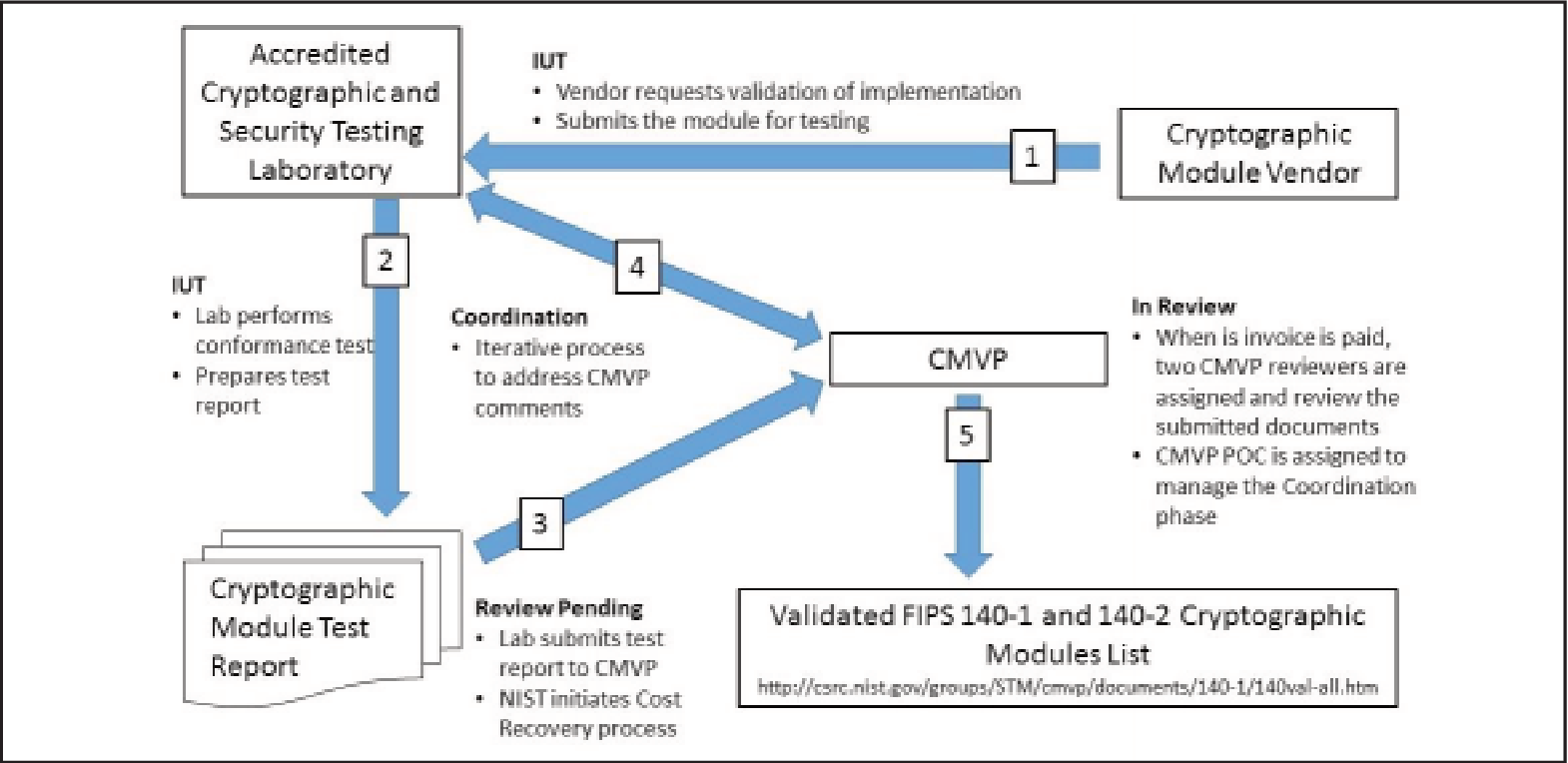
図24:現行の検証フロー。番号付きの矢印で示した流れ図である。1:Cryptographic Module Vendor(暗号モジュールベンダ)から Accredited Cryptographic and Security Testing Laboratory(認定された暗号・セキュリティ試験所)へ(IUT:ベンダが実装の検証を依頼する、モジュールを試験に提出する)。2:試験所から下の Cryptographic Module Test Report(暗号モジュール試験報告書)へ(IUT:試験所が適合性試験を行う、試験報告書を作成する)。3:試験報告書から CMVP へ(Review Pending:試験所が試験報告書を CMVP に提出する、NIST が費用回収の手続きを開始する)。4:試験所と CMVP の間の双方向の矢印(Coordination:CMVP のコメントに対処する反復的なプロセス)。CMVP には In Review の注記がある:請求書が支払われると、2名の CMVP レビュー担当者が割り当てられ、提出文書をレビューする。CMVP の POC が割り当てられ、Coordination の段階を管理する。5:CMVP から下の Validated FIPS 140-1 and 140-2 Cryptographic Modules List(http://csrc.nist.gov/groups/STM/cmvp/documents/140-1/140val-all.htm)へ。
Figure 24: Current Validation Flow
図24:現行の検証フロー
NIST recognizes the need to improve the efficiency and effectiveness of cryptographic module testing to reduce the time and cost required for testing, while providing a high level of assurance for Federal Government consumers.
NISTは、連邦政府の利用者に高い水準の保証を提供しつつ、試験に要する時間と費用を削減するために、暗号モジュール試験の効率と有効性を高める必要があると認識しています。
The principal goals of this project are to collaborate with commercial or open source producers of cryptographic capabilities and government consumers of FIPS 140-validated modules to:
このプロジェクトの主要な目標は、暗号機能を提供する商用またはオープンソースの開発者、およびFIPS 140検証済みモジュールを利用する政府機関と協力して、次のことを行うことです。
•Improve the efficiency and effectiveness of cryptographic module testing by adopting the best practices used by industry;
•産業界で用いられているベストプラクティスを採用することにより、暗号モジュール試験の効率と有効性を高めます。
•Develop test procedures and techniques that provide assurance of module compliance to FIPS 140 in an automated manner, based on machine-readable artifacts or evidence (examples of machine readable artifacts are XML or JavaScript Object Notation (JSON) files containing logs from performed tests and the corresponding results – see examples at https://github.com/usnistgov/ACVP); and
•機械可読な成果物または証拠に基づいて、モジュールがFIPS 140に準拠していることの保証を自動化された方法で提供する試験手順と試験技法を開発する(機械可読な成果物の例としては、実施した試験のログとそれに対応する結果を収めたXMLファイルやJavaScript Object Notation (JSON) ファイルがあります。例は https://github.com/usnistgov/ACVP を参照してください)。
•Identify techniques and procedures that provide continued assurance of operational compliance to FIPS 140 for cryptographic modules throughout their lifecycle.
•暗号モジュールのライフサイクル全体にわたって、運用時にFIPS 140に準拠していることの保証を継続して提供する技法と手順を特定します。
The scope of this project is broken into multiple phases to be performed over several years:
このプロジェクトの範囲は、数年をかけて実施する複数のフェーズに分かれています。
Phase 1
フェーズ1
•Identify potential approaches,
•候補となるアプローチを特定します。
•Select the best technical approach or approaches to prototype, and
•プロトタイプを作成する対象として、最良の技術的アプローチを1つまたは複数選定します。
•Document the technical approach.
•技術的アプローチを文書化します。
Phase 2
フェーズ2
•Develop working prototypes, and
•動作するプロトタイプを開発します。
•Evaluate the prototypes against the principal goals.
•主要な目標に照らしてプロトタイプを評価します。
Phase 3
フェーズ3
•Publish a draft, provide a review period, adjudicate the comments, and publish the final version.
•草案を公開し、レビュー期間を設け、コメントを裁定したうえで、最終版を公開します。
Phase 4
フェーズ4
•Integrate the final version into the operational CMVP program.
•最終版を、運用中のCMVPプログラムに組み入れます。
The new structure of the CMVP is shown in Figure 25. It leverages automation through computer analysis of test results.
CMVPの新しい体制を図25に示します。この体制では、試験結果をコンピュータで分析することにより自動化を活用します。
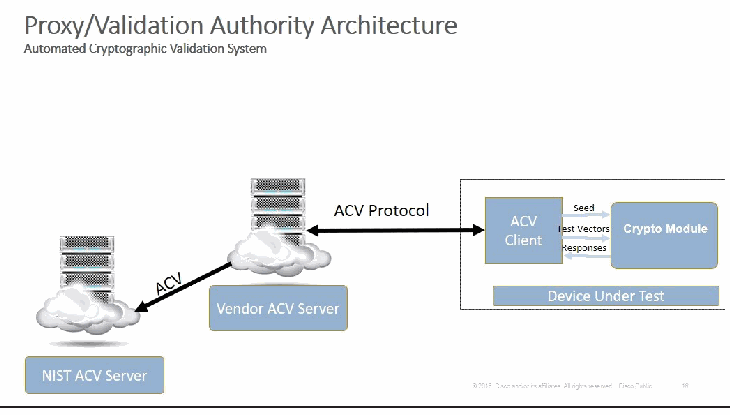
図25:自動化を活用する更新後のCMVPの体制。「Proxy/Validation Authority Architecture」と題し、副題を「Automated Cryptographic Validation System」とするスライドである。Vendor ACV Server(ベンダの ACV サーバ)は NIST ACV Server へ ACV を送り、Device Under Test(試験対象デバイス)内の ACV Client と ACV Protocol を双方向でやり取りする。デバイス内では、ACV Client が Crypto Module(暗号モジュール)へ Seed と Test Vectors を送り、暗号モジュールが Responses を返す。小さな著作権表示で Cisco の名が記されている。
Figure 25: Updated CMVP Structure Leveraging Automation
図25:自動化を活用する更新後のCMVPの体制
Currently, the project is focused on completing the documentation of the technical approach for automating the algorithm testing and finalizing the implementation of the automated algorithm testing server. The team is also working on researching the approaches for automating the software module testing. The team working on this project, in collaboration with industry, established a demonstration algorithm testing server that is currently capable of testing over 30 algorithms (see https://demo.acvts.nist.gov/acvp/home). The work is progressing, and new algorithms are added to it on an ongoing basis. Eventually, this demonstration functionality will be transferred into the production server for algorithm validation testing. The team developed criteria for participation in the automated testing for commercial companies wishing to validate their cryptographic algorithm implementations. The criteria are positioned as an annex to NIST Handbook 150-17, NVLAP Cryptographic and Security Testing, which NVLAP uses to accredit laboratories. This criteria will be used, beginning in FY 2018, to establish a new testing scope for algorithm testing.
現在、このプロジェクトは、アルゴリズム試験を自動化するための技術的アプローチの文書化を完了させること、および自動アルゴリズム試験サーバの実装を完成させることに注力しています。チームは、ソフトウェアモジュール試験を自動化するアプローチの調査にも取り組んでいます。このプロジェクトに取り組むチームは、産業界と協力して実証用のアルゴリズム試験サーバを立ち上げており、このサーバは現在、30を超えるアルゴリズムを試験できます(https://demo.acvts.nist.gov/acvp/home を参照してください)。作業は進行中であり、新しいアルゴリズムが継続的に追加されています。最終的には、この実証用の機能は、アルゴリズム検証試験のための本番サーバに移されます。チームは、自社の暗号アルゴリズム実装の検証を希望する民間企業が自動試験に参加するための基準を策定しました。この基準は、NVLAPが試験機関の認定に用いるNIST Handbook 150-17, NVLAP Cryptographic and Security Testingの附属書として位置づけられています。この基準は、2018会計年度から、アルゴリズム試験のための新たな試験範囲を設定するために用いられます。
The project activities are structured by work areas in order for subject-matter experts to more narrowly focus on program needs and develop solutions:
プロジェクトの活動は、各分野の専門家がプログラムのニーズにより的を絞って取り組み、解決策を開発できるよう、作業分野ごとに構成されています。
1.Algorithm and Protocol Testing;
1.アルゴリズムおよびプロトコルの試験
2.Cryptographic Module Testing,
2.暗号モジュールの試験
a.Software,
a.ソフトウェア
b.Modules in cloud environments,
b.クラウド環境におけるモジュール
c.Hardware; and
c.ハードウェア
3.Positioning and relationships to other government validation programs.
3.他の政府検証プログラムに対する位置づけおよびそれらとの関係
The project has several planned deliverables, including the identification of prospective technical approaches that adopt industry best practices and produce artifacts that are machine readable and map to FIPS 140 DTR requirements, and a selection of the best technical and feasible approaches.
このプロジェクトでは複数の成果物を計画しており、これには、産業界のベストプラクティスを採用し、機械可読でFIPS 140 DTRの要求事項に対応づけられる成果物を生み出す技術的アプローチの候補の特定、および技術的に最良でかつ実現可能なアプローチの選定が含まれます。
CONTACT:
連絡先:
Dr. Apostol Vassilev, (301) 975-3221, apostol.vassilev@nist.gov
Dr. Apostol Vassilev, (301) 975-3221, apostol.vassilev@nist.gov
Automated Security Testing and Test Suite Development
自動セキュリティ試験およびテストスイートの開発
The CAVP utilizes the requirements and specifications of the NIST standards (i.e., FIPS and Special Publications) to develop algorithm validation test suites and an automated security testing tool. The CAVP is responsible for providing assurance that the cryptographic algorithm implementations contained in cryptographic modules are implemented according to the specifications in the standards. The CAVP accomplishes this by designing and developing conformance testing specific to each cryptographic algorithm.
CAVPは、NIST標準(すなわちFIPSおよびSpecial Publication)の要求事項と仕様を用いて、アルゴリズム検証テストスイートと自動セキュリティ試験ツールを開発しています。CAVPは、暗号モジュールに含まれる暗号アルゴリズム実装が標準の仕様どおりに実装されていることの保証を提供する責任を負います。CAVPは、暗号アルゴリズムごとに固有の適合性試験を設計し開発することによって、これを実現しています。
The conformance testing consists of a suite of validation tests for each approved cryptographic algorithm. These validation tests exercise the algorithmic requirements and mathematical formulas to assure that the detailed specifications are implemented correctly and completely. If the implementer deviates from the specifications in the standard or excludes any part of these specifications or requirements, the validation test will detect the deviations and fail. The validation testing will indicate that the algorithm implementation does not function properly or is incomplete.
適合性試験は、承認された暗号アルゴリズムごとの一連の検証試験で構成されます。これらの検証試験は、アルゴリズムに関する要求事項と数式を実際に動作させて、詳細な仕様が正しくかつ漏れなく実装されていることを確かめます。実装者が標準の仕様から逸脱したり、仕様や要求事項の一部を除外したりした場合、検証試験はその逸脱を検出し、不合格となります。検証試験は、そのアルゴリズム実装が正しく機能していないこと、または不完全であることを示します。
The cryptographic algorithm validation tests designed and developed by the CAVP are used by independent third-party laboratories accredited by NVLAP. The laboratory works with vendors to validate their cryptographic algorithm implementations. The suite of validation tests for each algorithm ensures the repeatability of tests and the equivalency of results across the testing laboratories.
CAVPが設計し開発した暗号アルゴリズム検証試験は、NVLAPの認定を受けた独立した第三者試験機関によって用いられます。試験機関はベンダーと協力して、ベンダーの暗号アルゴリズム実装を検証します。アルゴリズムごとの一連の検証試験により、試験の再現性と、試験機関の間での結果の同等性が確保されます。
There are several types of validation tests, all designed to satisfy the testing requirements of the cryptographic algorithms and their specifications. These include Known-Answer Tests, Monte Carlo Tests, and Multi-Block Message Tests. The Known-Answer Tests are designed to examine the individual components of the algorithm by supplying known values to the variables and verifying the expected result. Negative testing is also performed by supplying known incorrect values to assure that the implementation recognizes values that are not allowed. The Monte Carlo Test is designed to exercise the entire implementation-under-test (IUT). This test is designed to detect the presence of implementation flaws that are not detected with the controlled input of the Known-Answer Tests. The types of implementation flaws detected by this validation test include pointer problems, insufficient allocation of space, improper error handling, and incorrect behavior of the IUT. The Multi-Block Message Test (MMT) is designed to test the ability of the implementation to process multi-block messages, which requires the chaining of information from one block to the next.
検証試験にはいくつかの種類があり、いずれも暗号アルゴリズムとその仕様に関する試験要求事項を満たすように設計されています。これには、Known-Answer Test、Monte Carlo Test、Multi-Block Message Testが含まれます。Known-Answer Testは、変数に既知の値を与え、期待される結果が得られることを検証することによって、アルゴリズムの個々の構成要素を調べるように設計されています。また、既知の不正な値を与えることによるネガティブテストも実施し、許容されない値を実装が認識することを確かめます。Monte Carlo Testは、試験対象実装(IUT)の全体を動作させるように設計されています。この試験は、Known-Answer Testの統制された入力では検出されない実装上の欠陥の存在を検出するように設計されています。この検証試験で検出される実装上の欠陥の種類には、ポインタの問題、領域の割り当て不足、不適切なエラー処理、IUTの誤った動作が含まれます。Multi-Block Message Test(MMT)は、複数ブロックからなるメッセージを処理する実装の能力を試験するように設計されており、その処理には、あるブロックから次のブロックへと情報を連鎖させることが必要です。
During the last few years, CSD has expanded its publications to contain not only the algorithm’s specifications, but also requirements for an algorithm’s use. Many of these usage requirements do not fall within the scope of the CAVP, because the CAVP focuses on the correctness of the instructions within the algorithm’s boundary. If these additional algorithm usage requirements are not considered applicable to the algorithm’s implementation, they cannot be tested at the algorithm level by the CAVP, but may be tested by the CMVP if the requirements are considered applicable to the cryptographic module. However, some of these usage requirements may be outside the scope of both the algorithm implementation and cryptographic module. In this latter case, the fulfillment of the requirements is the responsibility of entities using, installing, or configuring applications or protocols that use the cryptographic algorithms. For example, depending on the design of a cryptographic module, it may not be possible for the module to determine whether a specific key is used for multiple purposes, a situation that is strongly discouraged.
ここ数年、CSDは刊行物の内容を拡充し、アルゴリズムの仕様だけでなく、アルゴリズムの使用に関する要求事項も記載するようになりました。これらの使用上の要求事項の多くは、CAVPの範囲には含まれません。CAVPは、アルゴリズムの境界内にある命令の正しさに焦点を当てているからです。これらの追加的なアルゴリズム使用上の要求事項がアルゴリズムの実装に適用されるものとみなされない場合、CAVPがアルゴリズムのレベルで試験することはできませんが、その要求事項が暗号モジュールに適用されるものとみなされるならば、CMVPが試験することがあります。しかし、これらの使用上の要求事項の中には、アルゴリズム実装と暗号モジュールのどちらの範囲にも含まれないものがありうます。この後者の場合、要求事項を満たすことは、暗号アルゴリズムを使用するアプリケーションまたはプロトコルを使用、導入、または設定する主体の責任です。たとえば、暗号モジュールの設計によっては、特定の鍵が複数の目的に使用されているかどうかをモジュールが判定できないことがあります。鍵を複数の目的に使用することは、避けるよう強く求められている状況です。
The CAVP currently has algorithm validation testing for the following cryptographic algorithms:
CAVPは現在、次の暗号アルゴリズムについてアルゴリズム検証試験を用意しています。
SHAの各種を示す写真。右側にSHA-1、SHA-224(SHA-2)、SHA-256(SHA-2)、SHA-384(SHA-2)、SHA-512(SHA-2)のラベルが縦に並ぶ。 [装飾の画像。本文を読むのに必要のない装飾のため、この非公式サイトには掲載していません。原本 PDF を参照してください。]
Credit: Shutterstock/Olivier Le Moal
提供:Shutterstock/Olivier Le Moal
Various Types of SHAs
さまざまな種類のSHA
| TABLE 2: CRYPTOGRAPHIC ALGORITHMS & NIST TECHNICAL DOCUMENTS (FIPS & SPs) | |
|---|---|
| CRYPTOGRAPHIC ALGORITHM/COMPONENT | FEDERAL INFORMATION PROCESSING STANDARD (FIPS), SPECIAL PUBLICATION (SP) OR OTHER REFERENCE DOCUMENT |
| Triple Data Encryption Standard (TDES) | SP 800-67, Recommendation for the Triple Data Encryption Algorithm (TDEA) Block Cipher, and |
| SP 800-38A, Recommendation for Block Cipher Modes of Operation–Methods and Techniques | |
| Advanced Encryption Standard (AES) | FIPS 197, Advanced Encryption Standard, and |
| SP 800-38A, Recommendation for Block Cipher Modes of Operation–Methods and Techniques | |
| Digital Signature Algorithm (DSA) | FIPS 186-2, Digital Signature Standard (DSS), with change notice 1 and |
| FIPS 186-4, Digital Signature Standard (DSS) | |
| Elliptic Curve Digital Signature Algorithm (ECDSA) | FIPS 186-2, Digital Signature Standard (DSS), with change notice 1 and ANS X9.62 and |
| FIPS 186-4, Digital Signature Standard (DSS) and ANS X9.62 | |
| RSA Algorithm | FIPS 186-4, Digital Signature Standard (DSS) and |
| ANS X9.31 and Public Key Cryptography Standards (PKCS) #1 v2.1: RSA Cryptography Standard-2002 | |
| Hashing algorithms SHA-1, SHA-224, SHA-256, SHA-384, SHA-512, SHA-512/224, SHA-512/256 | FIPS 180-4, Secure Hash Standard (SHS) |
| Hashing algorithms SHA3-224, SHA3-256, SHA3-384, SHA3-512 | FIPS 202, SHA-3 Standard: Permutation-Based Hash and Extendable-Output Functions, August 2015 |
| SHA-3 Extendable-Output Functions (XOFs) SHAKE128, SHAKE256 | FIPS 202, SHA-3 Standard: Permutation-Based Hash and Extendable-Output Functions, August 2015 |
| Random Number Generator (RNG) algorithms | FIPS 186-2 Appendix 3.1 and 3.2; ANS X9.62 Appendix A.4 |
| Deterministic Random Bit Generators (DRBG) | SP 800-90A, Recommendation for Random Number Generation Using Deterministic Random Bit Generators |
| Keyed-Hash Message Authentication Code (HMAC) using SHA-1, SHA-2 and SHA-3 | FIPS 198-1, The Keyed-Hash Message Authentication Code (HMAC) |
| Cipher-based Message Authentication Code (CMAC) Mode for Authentication | SP 800-38B, Recommendation for Block Cipher Modes of Operation: The CMAC Mode for Authentication |
| 表2:暗号アルゴリズムおよびNIST技術文書(FIPSおよびSP) | |
|---|---|
| 暗号アルゴリズム/構成要素 | 連邦情報処理規格(FIPS)、特別刊行物(SP)またはその他の参照文書 |
| Triple Data Encryption Standard (TDES) | SP 800-67, Recommendation for the Triple Data Encryption Algorithm (TDEA) Block Cipher、および |
| SP 800-38A, Recommendation for Block Cipher Modes of Operation–Methods and Techniques | |
| Advanced Encryption Standard (AES) | FIPS 197, Advanced Encryption Standard、および |
| SP 800-38A, Recommendation for Block Cipher Modes of Operation–Methods and Techniques | |
| Digital Signature Algorithm (DSA) | FIPS 186-2, Digital Signature Standard (DSS), with change notice 1、および |
| FIPS 186-4, Digital Signature Standard (DSS) | |
| Elliptic Curve Digital Signature Algorithm (ECDSA) | FIPS 186-2, Digital Signature Standard (DSS), with change notice 1 and ANS X9.62、および |
| FIPS 186-4, Digital Signature Standard (DSS) and ANS X9.62 | |
| RSA Algorithm | FIPS 186-4, Digital Signature Standard (DSS) and |
| ANS X9.31 and Public Key Cryptography Standards (PKCS) #1 v2.1: RSA Cryptography Standard-2002 | |
| ハッシュアルゴリズム:SHA-1、SHA-224、SHA-256、SHA-384、SHA-512、SHA-512/ | FIPS 180-4, Secure Hash Standard (SHS) |
| ハッシュアルゴリズム:SHA3-224、SHA3-256、SHA3-384、SHA3-512 | FIPS 202, SHA-3 Standard: Permutation-Based Hash and Extendable-Output Functions, August 2015 |
| SHA-3拡張出力関数(XOF):SHAKE128、SHAKE256 | FIPS 202, SHA-3 Standard: Permutation-Based Hash and Extendable-Output Functions, August 2015 |
| 乱数生成器(RNG)アルゴリズム | FIPS 186-2 Appendix 3.1 and 3.2; ANS X9.62 Appendix A.4 |
| 決定論的乱数ビット生成器(DRBG) | SP 800-90A, Recommendation for Random Number Generation Using Deterministic Random Bit Generators |
| SHA-1、SHA-2およびSHA-3を用いる鍵付きハッシュメッセージ認証コード(HMAC) | FIPS 198-1, The Keyed-Hash Message Authentication Code (HMAC) |
| 認証用の暗号ベースメッセージ認証コード(CMAC)モード | SP 800-38B, Recommendation for Block Cipher Modes of Operation: The CMAC Mode for Authentication |
| TABLE 2 (CONT): CRYPTOGRAPHIC ALGORITHMS & NIST TECHNICAL DOCUMENTS (FIPS & SPs) | |
|---|---|
| CRYPTOGRAPHIC ALGORITHM/COMPONENT | FEDERAL INFORMATION PROCESSING STANDARD (FIPS), SPECIAL PUBLICATION (SP) OR OTHER REFERENCE DOCUMENT |
| Counter with Cipher Block Chaining-Message Authentication Code (CCM) Mode | SP 800-38C, Recommendation for Block Cipher Modes of Operation: the CCM Mode for Authentication and Confdentiality |
| GCM, Galois Message Authentication Code (GMAC), and eXtended Packet Number (XPN) Modes | SP 800-38D, Recommendation for Block Cipher Modes of Operation: Galois/Counter Mode (GCM) and GMAC |
| XTS-AES Mode XOR–encrypt–XOR (XEX) Tweakable Block Cipher with Ciphertext Stealing mode | SP 800-38E, Recommendation for Block Cipher Modes of Operation: The XTS-AES Mode for Confdentiality on Block-Oriented Storage Devices |
| Key Wrapping | SP 800-38F, Recommendation for Block Cipher Modes of Operation: Methods for Key Wrapping |
| DH and MQV Key Agreement Schemes and Key Confrmation | SP 800-56A, Recommendation for Pair-Wise Key Establishment Schemes Using Discrete Logarithm Cryptography, dated March 2007 |
| All of SP 800-56A schemes without the Key Derivation Functions (KDF) | SP 800-56A, Key Derivation Functions for Key Agreement Schemes: All sections except Section 5.8 |
| SP 800-56A Section 5.7.1.2 ECC CDH function | SP 800-56A, Section 5.7.1.2 Elliptic Curve Cryptography Cofactor Dife-Hellman (ECC CDH) Primitive Testing |
| Key-Based Key Derivation functions (KBKDF) | SP 800-108, Recommendation for Key Derivation using Pseudorandom Functions |
| Application-Specifc Key Derivation functions (ASKDF) (includes the KDFs used by Internet Key Exchange (IKE) v1, IKEv2, Transport Layer Security (TLS), American National Standard (ANS) X9.63-2001, Secure Shell (SSH), Secure Real-time Transport Protocol (SRTP), Simple Network Management Protocol (SNMP), and Trusted Platform Module (TPM) | SP 800-135 (Revision 1) Recommendation for Existing Application-Specifc key Derivation Functions |
| Component test – ECDSA Signature Generation of a hash value (This component test verifes the signing of a hash-sized input. It does not verify the hashing of the original message to be signed.) | FIPS 186-4, Digital Signature Standard (DSS), and ANS X9.62 |
| Component test – RSA PKCS#1 1.5 Signature Generation of encoded message (EM) (This component test verifes the signing of an EM. It does not verify the formatting of the EM.) | FIPS 186-4, Digital Signwature Standard (DSS), and Public Key Cryptography Standards (PKCS) #1 v2.1: RSA Cryptography Standard-2002 |
| Component test – RSA PKCS#1 Probabilistic Signature Scheme (PSS) Signature Generation of encoded message EM (This component test verifes the RSASP1 function.) | SP 800-56B, Recommendation for Pair-Wise Key Establishment Schemes Using Integer Factorization Cryptography, August 2009, Section 7.1.2 |
| 表2(続き):暗号アルゴリズムおよびNIST技術文書(FIPSおよびSP) | |
|---|---|
| 暗号アルゴリズム/構成要素 | 連邦情報処理規格(FIPS)、特別刊行物(SP)またはその他の参照文書 |
| 暗号ブロック連鎖メッセージ認証コード付きカウンタ(CCM)モード | SP 800-38C, Recommendation for Block Cipher Modes of Operation: the CCM Mode for Authentication and Confidentiality |
| GCM、ガロアメッセージ認証コード(GMAC)および拡張パケット番号(XPN)モード | SP 800-38D, Recommendation for Block Cipher Modes of Operation: Galois/Counter Mode (GCM) and GMAC |
| XTS-AESモード:XOR–encrypt–XOR(XEX)tweakable block cipherのciphertext stealingモード | SP 800-38E, Recommendation for Block Cipher Modes of Operation: The XTS-AES Mode for Confidentiality on Block-Oriented Storage Devices |
| 鍵ラッピング | SP 800-38F, Recommendation for Block Cipher Modes of Operation: Methods for Key Wrapping |
| DHおよびMQV鍵合意方式と鍵確認 | SP 800-56A, Recommendation for Pair-Wise Key Establishment Schemes Using Discrete Logarithm Cryptography, dated March 2007 |
| 鍵導出関数(KDF)を除くSP 800-56Aの全方式 | SP 800-56A, Key Derivation Functions for Key Agreement Schemes: All sections except Section 5.8 |
| SP 800-56A Section 5.7.1.2 ECC CDH関数 | SP 800-56A, Section 5.7.1.2 Elliptic Curve Cryptography Cofactor Diffie-Hellman (ECC CDH) Primitive Testing |
| 鍵ベース鍵導出関数(KBKDF) | SP 800-108, Recommendation for Key Derivation using Pseudorandom Functions |
| アプリケーション固有鍵導出関数(ASKDF)(Internet Key Exchange(IKE)v1、IKEv2、Transport Layer Security(TLS)、American National Standard(ANS)X9 | SP 800-135 (Revision 1) Recommendation for Existing Application-Specific key Derivation Functions |
| コンポーネント試験:ECDSAハッシュ値署名生成(この試験はハッシュ長の入力への署名を検証します。署名対象の元メッセージのハッシュ計算は検証しません。) | FIPS 186-4, Digital Signature Standard (DSS), and ANS X9.62 |
| コンポーネント試験:RSA PKCS#1 1 | FIPS 186-4, Digital Signature Standard (DSS), and Public Key Cryptography Standards (PKCS) #1 v2.1: RSA Cryptography Standard-2002 |
| コンポーネント試験:RSA PKCS#1確率的署名方式(PSS)による符号化メッセージ(EM)の署名生成(この試験はRSASP1関数を検証します。) | SP 800-56B, Recommendation for Pair-Wise Key Establishment Schemes Using Integer Factorization Cryptography, August 2009, Section 7.1.2 |
In the future, the CAVP expects to add algorithm validation testing for:
将来、CAVPは次のものについてアルゴリズム検証試験を追加する見込みです。
•SP 800-38G, Recommendation for Block Cipher Modes of Operation: Methods for Format-Preserving Encryption;
•SP 800-38G, Recommendation for Block Cipher Modes of Operation: Methods for Format-Preserving Encryption
•SP 800-56C, Recommendation for Key Derivation through Extraction-then-Expansion;
•SP 800-56C, Recommendation for Key Derivation through Extraction-then-Expansion
•SP 800-132, Recommendation for Password-Based Key Derivation Part 1: Storage Applications; and
•SP 800-132, Recommendation for Password-Based Key Derivation Part 1: Storage Applications
•SP 800-56A Revision 2, Recommendation for Pair-Wise Key Establishment Schemes Using Discrete Logarithm Cryptography.
•SP 800-56A Revision 2, Recommendation for Pair-Wise Key Establishment Schemes Using Discrete Logarithm Cryptography
FOR MORE INFORMATION, SEE:
詳細については次を参照:
https://csrc.nist.gov/projects/cryptographic-algorithm-validation-program
https://csrc.nist.gov/projects/cryptographic-algorithm-validation-program
CONTACTS:
連絡先:
Mr. Harold Booth, (301) 975-8441, harold.booth@nist.gov
Mr. Harold Booth, (301) 975-8441, harold.booth@nist.gov
Ms. Elaine Barker, (301) 975-2911, elaine.barker@nist.gov
Ms. Elaine Barker, (301) 975-2911, elaine.barker@nist.gov
(Editors’ Note: Sharon Keller worked on this program until her recent retirement.)
(編集者注:Sharon Kellerは、先ごろ退職するまでこのプログラムに携わっていました。)
Security Content Automation Protocol (SCAP) Validation Program
Security Content Automation Protocol (SCAP) Validation Program
The SCAP Validation Program performs conformance testing to ensure that products correctly implement SCAP, as defined in SP 800-126 Revision 2, The Technical Specification for the Security Content Automation Protocol (SCAP): SCAP Version 1.2. Conformance testing is necessary because SCAP is a complex collection of eleven individual specifications that work together to support various use cases. A single error in product implementation could result in undetected vulnerabilities or policy noncompliance within an organization’s networks.
SCAP Validation Programは、SP 800-126 Revision 2, The Technical Specification for the Security Content Automation Protocol (SCAP): SCAP Version 1.2で定義されているSCAPを製品が正しく実装していることを確かめるために、適合性試験を実施しています。適合性試験が必要なのは、SCAPが、さまざまなユースケースを支えるために連携して働く11の個別仕様からなる複雑な集合体だからです。製品の実装に誤りが1つあるだけで、組織のネットワーク内の脆弱性やポリシー不適合が検出されないままになるおそれがあります。
The test requirements for SCAP 1.2 are defined in NISTIR 7511, Security Content Automation Protocol (SCAP) Version 1.2 Validation Program Test Requirements. In general, vendors may opt for product validation for one or more SCAP capabilities or operating systems. Currently, the program offers testing on Microsoft Windows, Red Hat Enterprise Linux, and Apple Mac OS platforms. The validation process starts when a vendor voluntarily submits an SCAP-enabled product to an NVLAP-accredited laboratory. Once the lab completes product testing, the lab submits a test report to the SCAP Validation Program at NIST for review. NIST reviews the test report and awards a validation if all requirements have been met. Once a validation is awarded, the SCAP Validation Record is sent to the lab, and the information about the newly validated product is posted on the SCAP Validated Products web page. Figure 26 illustrates the SCAP 1.2 Validation Process.
SCAP 1.2の試験要求事項は、NISTIR 7511, Security Content Automation Protocol (SCAP) Version 1.2 Validation Program Test Requirementsで定義されています。一般に、ベンダーは、1つ以上のSCAP機能またはオペレーティングシステムについて製品の検証を受けることを選択できます。現在、このプログラムは、Microsoft Windows、Red Hat Enterprise Linux、Apple Mac OSの各プラットフォームでの試験を提供しています。検証プロセスは、ベンダーがSCAP対応製品をNVLAP認定試験機関に任意で提出した時点で始まります。試験機関は製品試験を完了すると、レビューを受けるために試験報告書をNISTのSCAP Validation Programに提出します。NISTは試験報告書をレビューし、すべての要求事項が満たされていれば検証を授与します。検証が授与されると、SCAP Validation Recordが試験機関に送付され、新たに検証された製品に関する情報がSCAP Validated Productsのウェブページに掲載されます。図26はSCAP 1.2の検証プロセスを示しています。
製品検証を表す写真。ノートパソコンの画面に緑のチェックマークと「TESTED」(試験済み)が表示され、手に持ったカードがキーボード上に差し出されている。カードの細かな印字は一部が手で隠れており判読できない。 [装飾の画像。本文を読むのに必要のない装飾のため、この非公式サイトには掲載していません。原本 PDF を参照してください。]
Credit: Shutterstock/Rawpixel.com
提供:Shutterstock/Rawpixel.com
Computer monitor displaying that a product has been tested.
製品が試験済みであることを表示しているコンピュータのモニター。
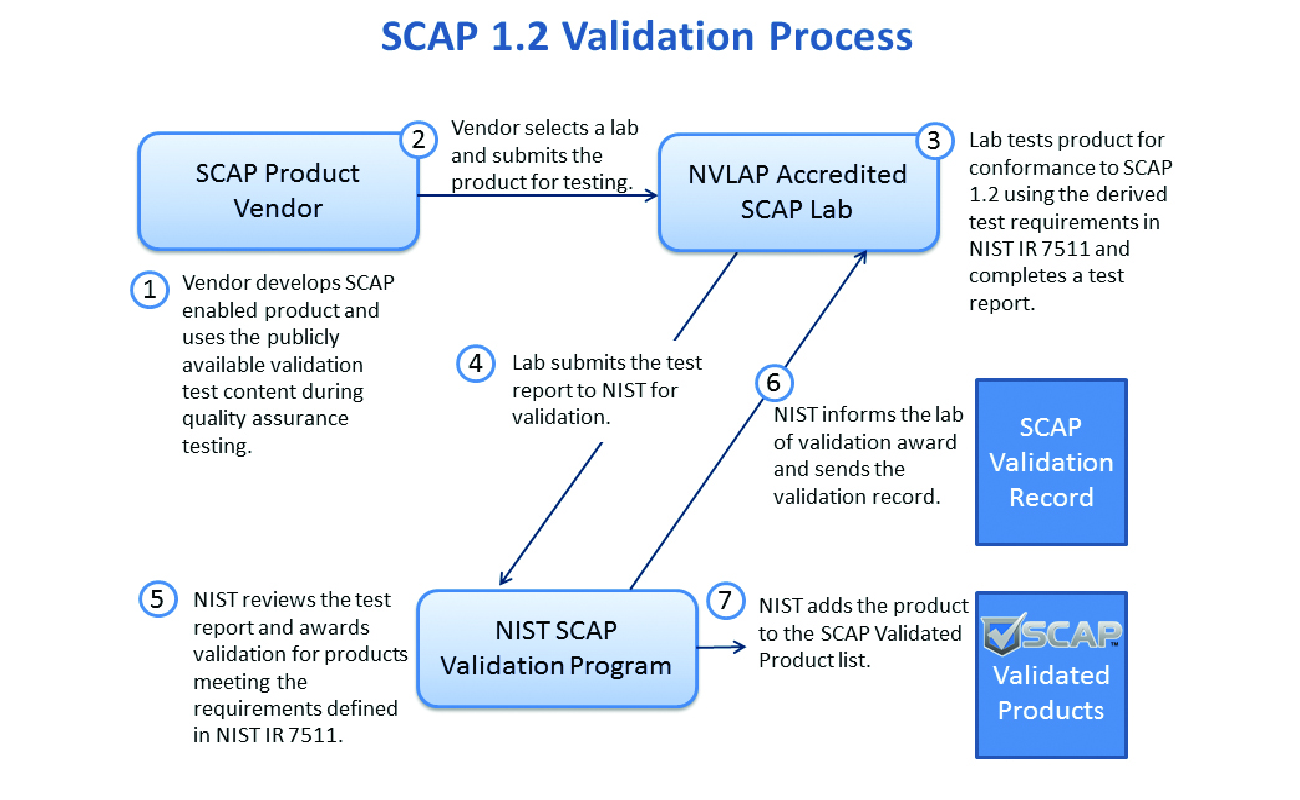
図26:SCAP 1.2の検証プロセス。「SCAP 1.2 Validation Process」と題し、7つの番号付きの手順を示す図である。1:ベンダが SCAP 対応製品を開発し、品質保証試験の際に公開されている検証用テストコンテンツを使用する(SCAP Product Vendor)。2:ベンダが試験所を選び、製品を試験に提出する(SCAP Product Vendor から NVLAP Accredited SCAP Lab への矢印)。3:試験所が NIST IR 7511 の導出試験要件を用いて SCAP 1.2 への適合性について製品を試験し、試験報告書を作成する。4:試験所が検証のため試験報告書を NIST に提出する(試験所から NIST SCAP Validation Program への矢印)。5:NIST が試験報告書をレビューし、NIST IR 7511 に定める要件を満たす製品に検証を認定する。6:NIST が検証の認定を試験所に通知し、検証記録を送付する(NIST SCAP Validation Program から試験所への矢印。SCAP Validation Record の箱)。7:NIST が製品を SCAP Validated Product リストに追加する(SCAP ロゴと「Validated Products」の箱への矢印)。
Figure 26: SCAP 1.2 Validation Process
図26:SCAP 1.2の検証プロセス
All resources and information necessary for preparing products for SCAP 1.2 validation are published on the SCAP Validation Program web page (see https://scap.nist.gov/validation). The most current NISTIR 7511 revision, as well as SCAP capabilities and supported platforms, are available on the home page (see https://scap.nist.gov/validation). The resources page includes documentation, a list of Frequently Asked Questions (FAQ), the SCAP validation-test content, and tools for validating and processing SCAP data streams. The SCAP validation-test content should be used by vendors for quality assurance testing prior to entering formal SCAP testing with an NVLAP-accredited laboratory. The open-source tools that are available for download may be used by SCAP content authors for testing the SCAP source content. The SCAP Content Validation Tool (SCAPVal) may be used to determine if the content conforms to the SCAP specification. SCAP validated products may be used to process SCAP data streams for use cases such as checking compliance of target systems to a configuration checklist.
SCAP 1.2の検証に向けて製品を準備するために必要なリソースと情報はすべて、SCAP Validation Programのウェブページで公開されています(https://scap.nist.gov/validation を参照してください)。NISTIR 7511の最新の改訂版、ならびにSCAP機能および対応プラットフォームは、ホームページで入手できます(https://scap.nist.gov/validation を参照してください)。リソースのページには、文書類、よくある質問(FAQ)の一覧、SCAP検証試験コンテンツ、およびSCAPデータストリームを検証し処理するためのツールが掲載されています。SCAP検証試験コンテンツは、ベンダーがNVLAP認定試験機関による正式なSCAP試験に入る前の品質保証試験に使用するべきものです。ダウンロードできるオープンソースのツールは、SCAPコンテンツの作成者がSCAPソースコンテンツを試験するために使用できます。SCAP Content Validation Tool (SCAPVal) は、コンテンツがSCAP仕様に適合しているかどうかを判定するために使用できます。SCAP検証済み製品は、対象システムが設定チェックリストに準拠しているかどうかの確認といったユースケースのために、SCAPデータストリームを処理する目的で使用できます。
End users may use information on the SCAP Validation web page to learn about SCAP validation and find products that have been awarded validations. The validation records that are posted on the SCAP Validated Products page identify the product versions that were tested in the laboratory, along with details about each validation, such as the tested platforms, SCAP capabilities, the validation test suite version, and the lab that performed the product test.
エンドユーザーは、SCAP Validationのウェブページにある情報を使って、SCAP検証について知り、検証を授与された製品を見つけることができます。SCAP Validated Productsのページに掲載されている検証記録は、試験機関で試験された製品のバージョンを特定するとともに、試験対象のプラットフォーム、SCAP機能、検証テストスイートのバージョン、製品試験を実施した試験機関といった、各検証の詳細を示しています。
In FY 2017, NISTIR 7511 was updated in preparation for testing conformance to SCAP 1.3, and the validation test content was updated to include test coverage for SCAP 1.3 and support for new platforms. Support for Microsoft Windows 10 and Mac OS 10.11 was released in FY 2017; updates for SCAP 1.3 will be released in FY 2018.
2017会計年度には、SCAP 1.3への適合性を試験するための準備としてNISTIR 7511が更新され、検証試験コンテンツは、SCAP 1.3に対する試験の網羅範囲と新しいプラットフォームへの対応を含むように更新されました。Microsoft Windows 10およびMac OS 10.11への対応は2017会計年度にリリースされました。SCAP 1.3に向けた更新は2018会計年度にリリースされます。
Vendors continued to benefit from the openly available SCAP validation test suite reference material. Access to the validation test suite enables vendors to test products during development and provides a means for verifying SCAP conformance after operational products are patched. Through the use of the reference materials, vendors that market their products to federal agencies may better prepare for formal validation testing with NVLAP accredited laboratories. Vendors focused on the critical infrastructure, and for which formal validation testing may not be required, have access to reference material that ensures that scanning products are correctly processing SCAP content. Approximately 86% of configuration scanning products are SCAP-validated, and SCAP product vendors continue to engage with the SCAP Validation Program on new releases of the validation test content. The current list of SCAP 1.2-validated products may be found on the SCAP Validated Products list at https://nvd.nist.gov/scap/validated-tools.
ベンダーは、公開されているSCAP検証テストスイートの参考資料から引き続き恩恵を受けました。検証テストスイートを利用できることで、ベンダーは開発中に製品を試験でき、運用中の製品にパッチを適用した後にSCAPへの適合性を検証する手段も得られます。参考資料を使用することにより、連邦政府機関に製品を販売するベンダーは、NVLAP認定試験機関による正式な検証試験に向けて、よりよく準備できます。重要インフラストラクチャに注力しており、正式な検証試験が要求されない場合があるベンダーも、スキャン製品がSCAPコンテンツを正しく処理していることを確かめられる参考資料を利用できます。設定スキャン製品の約86%がSCAP検証済みであり、SCAP製品のベンダーは、検証試験コンテンツの新しいリリースに関して、引き続きSCAP Validation Programと連携しています。SCAP 1.2検証済み製品の最新の一覧は、SCAP Validated Productsの一覧(https://nvd.nist.gov/scap/validated-tools)で確認できます。
In FY 2018, NISTIR 7511 for SCAP 1.3 and the associated validation test suite reference material will be released. In addition, the program will continue to add support for new platforms (i.e., Windows Server 2016 and Mac OS 10.12). The program will continue to collaborate with vendors, laboratories, and the Security Automation team on updating validation resources in a meaningful way that meets the needs of federal agencies and the critical infrastructure. Coordination with the Security Automation team ensures that validation resources are developed and released in conjunction with new releases of SCAP.
2018会計年度には、SCAP 1.3に対応するNISTIR 7511と、それに関連する検証テストスイートの参考資料がリリースされます。加えて、このプログラムは、新しいプラットフォーム(すなわちWindows Server 2016およびMac OS 10.12)への対応を引き続き追加します。このプログラムは、連邦政府機関と重要インフラストラクチャのニーズを満たす有意義な形で検証用リソースを更新することについて、ベンダー、試験機関、およびSecurity Automationチームと引き続き協力します。Security Automationチームとの調整により、検証用リソースがSCAPの新しいリリースに合わせて開発されリリースされることが確保されます。
FOR MORE INFORMATION, SEE:
詳細については次を参照:
https://scap.nist.gov/validation/
https://scap.nist.gov/validation/
CONTACT:
連絡先:
Mr. Michael Cooper, (301) 975-8077, michael.cooper@nist.gov
Mr. Michael Cooper, (301) 975-8077, michael.cooper@nist.gov
(Editors’ Note: Melanie Cook supported this program until her recent departure from NIST.)
(編集者注:Melanie Cookは、先ごろNISTを離れるまでこのプログラムを支援していました。)
IDENTITY AND ACCESS MANAGEMENT
アイデンティティおよびアクセス管理
NIST Personal Identity Verification Program (NPIVP)
NIST Personal Identity Verification Program (NPIVP)
The objective of the NIST Personal Identity Verification Program (NPIVP) is to validate Personal Identity Verification (PIV) products for conformance to the specifications in FIPS 201, Personal Identity Verification (PIV) of Federal Employees and Contractors. There are three companion technical documents:
NIST Personal Identity Verification Program (NPIVP) の目的は、Personal Identity Verification (PIV) 製品が、FIPS 201, Personal Identity Verification (PIV) of Federal Employees and Contractorsの仕様に適合していることを検証することです。関連する技術文書は次の3つです。
1.SP 800-73, Interfaces for Personal Identity Verification;
1.SP 800-73, Interfaces for Personal Identity Verification
2.SP 800-76, Biometric Specifications for Personal Identity Verification; and
2.SP 800-76, Biometric Specifications for Personal Identity Verification
3.SP 800-78, Cryptographic Algorithms and Key Sizes for Personal Identity Verification.
3.SP 800-78, Cryptographic Algorithms and Key Sizes for Personal Identity Verification
The two main products are: the PIV Card Application and the PIV Middleware. The guidelines for performing the conformance tests for these products are themselves outlined in two technical documents (SP 800-85A, PIV Card Application and Middleware Interface Test Guidelines (SP 800-73-4 Compliance), and SP 800-85B, PIV Data Model Test Guidelines); they specify a two-step process that first involves the development of Derived Test Requirements (DTRs) and then the actual test procedures. To implement these tests and to generate conformance test reports, CSD also developed test modules for testing the PIV card application and PIV middleware. These modules were provided to NPIVP test facilities for testing and certifying the vendor submissions in the two PIV product categories. NPIVP test facilities are Cryptographic and Security Testing (CST) Laboratories that were accredited by the NVLAP. NPIVP also assisted NVLAP in the accreditation of laboratories by developing technology-focused assessment criteria. An additional software module to perform conformance testing for the PIV data model was also developed by CSD to enable GSA to provide a toolkit to agencies for testing fully personalized PIV cards prior to card issuance.
主要な製品は、PIV Card ApplicationとPIV Middlewareの2つです。これらの製品の適合性試験を実施するためのガイドラインは、それ自体が2つの技術文書(SP 800-85A, PIV Card Application and Middleware Interface Test Guidelines (SP 800-73-4 Compliance)、およびSP 800-85B, PIV Data Model Test Guidelines)に概説されています。これらの文書は、まずDerived Test Requirements (DTR) を策定し、次に実際の試験手順を策定するという2段階のプロセスを規定しています。これらの試験を実施し、適合性試験報告書を作成するために、CSDは、PIVカードアプリケーションとPIVミドルウェアを試験するための試験モジュールも開発しました。これらのモジュールは、2つのPIV製品カテゴリーにおけるベンダーの提出物を試験し認証するために、NPIVPの試験施設に提供されました。NPIVPの試験施設は、NVLAPの認定を受けたCryptographic and Security Testing (CST) 試験機関です。NPIVPはまた、技術に焦点を当てた審査基準を策定することにより、NVLAPによる試験機関の認定を支援しました。さらに、GSAが、個人情報を完全に書き込んだPIVカードをカード発行前に試験するためのツールキットを各機関に提供できるようにするために、PIVデータモデルの適合性試験を実施する追加のソフトウェアモジュールもCSDが開発しました。
FIPS 201 specifies the architecture and technical requirements for the PIV cards. Since the start of the NPIVP, FIPS 201 has undergone two revisions and the companion technical documents even more revisions. The two test guidelines documents have also been updated to be consistent with the specification documents. The NPIVP team was fully involved in the review, analysis and development of these revisions of specification documents and have also ensured that these revisions are fully reflected in the two test guidelines documents as well as in the test software modules. The latest versions of all documents (as of September 2017) with their URLs, as well as the URL for the list of accredited NPIVP labs are given below:
FIPS 201は、PIVカードのアーキテクチャと技術的要求事項を規定しています。NPIVPの開始以来、FIPS 201は2回改訂されており、関連する技術文書はそれ以上の回数改訂されています。2つの試験ガイドライン文書も、仕様文書と整合するように更新されています。NPIVPチームは、仕様文書のこれらの改訂のレビュー、分析、策定に全面的に関与し、また、これらの改訂が2つの試験ガイドライン文書と試験ソフトウェアモジュールに漏れなく反映されるようにしてきました。すべての文書の最新版(2017年9月現在)とそのURL、および認定を受けたNPIVP試験機関の一覧のURLを次に示します。
Specification Documents:
仕様文書:
•FIPS 201-2, Personal Identity Verification (PIV) of Federal Employees and Contractors – (see https://nvlpubs.nist.gov/nistpubs/FIPS/NIST. FIPS.201-2.pdf)
•FIPS 201-2, Personal Identity Verification (PIV) of Federal Employees and Contractors –(https://nvlpubs.nist.gov/nistpubs/FIPS/NIST. FIPS.201-2.pdf を参照)
•SP 800-73-4 Parts 1-3, Interfaces for Personal Identity Verification (see https://doi.org/10.6028/NIST.SP.800-73-4)
•SP 800-73-4 Parts 1-3, Interfaces for Personal Identity Verification(https://doi.org/10.6028/NIST.SP.800-73-4 を参照)
•SP 800-76-2, Biometric Specifications for Personal Identity Verification (see https://doi.org/10.6028/NIST.SP.800-76-2)
•SP 800-76-2, Biometric Specifications for Personal Identity Verification(https://doi.org/10.6028/NIST.SP.800-76-2 を参照)
•SP 800-78-4, Cryptographic Algorithms and Key Sizes for Personal Identity Verification (see https://doi.org/10.6028/NIST. SP.800-78-4)
•SP 800-78-4, Cryptographic Algorithms and Key Sizes for Personal Identity Verification(https://doi.org/10.6028/NIST. SP.800-78-4 を参照)
Test Guidelines Documents:
試験ガイドライン文書:
•SP 800-85A-4, PIV Card Application and Middleware Interface Test Guidelines (SP 800-73-4 Compliance) (see https://doi.org/10.6028/NIST.SP.800-85A-4)
•SP 800-85A-4, PIV Card Application and Middleware Interface Test Guidelines (SP 800-73-4 Compliance)(https://doi.org/10.6028/NIST.SP.800-85A-4 を参照)
•Draft SP 800-85B-4, PIV Data Model Test Guidelines (see https://csrc.nist.gov/CSRC/media/Publications/sp/800-85b/4/draft/documents/sp800_85b-4_draft.pdf )
•草案 SP 800-85B-4, PIV Data Model Test Guidelines(https://csrc.nist.gov/CSRC/media/Publications/sp/800-85b/4/draft/documents/sp800_85b-4_draft.pdf を参照)
List of Accredited NPIVP Labs
認定NPIVP試験所の一覧
As of September 2017, there are six accredited NPIVP labs (see https://csrc.nist.gov/projects/nist-s-personal-identity-verification-program/testing-facilities).
2017年9月時点で、認定されたNPIVP試験所は6つあります(https://csrc.nist.gov/projects/nist-s-personal-identity-verification-program/testing-facilities を参照してください)。
During FY 2017, NPIVP did a major redesign of the test software modules. The three software modules for PIV card application conformance testing, PIV Middleware conformance testing and PIV data model conformance testing were all integrated into a single comprehensive toolkit to eliminate redundancies and inconsistencies in software codes performing the same functionality and to make the maintenance of the overall toolkit much easier. Further tests pertaining to different card interfaces (Contact, Contactless, Secure Messaging and Virtual Contact) for the same command were grouped together for easy accessibility. The redesigned test toolkit (now called the SP 800-73-4 PIV Test Runner for PIV Card Applications, Middleware and Data Model) has been made freely available to the public and can be downloaded at https://csrc.nist.gov/Projects/NIST-Personal-Identity-Verification-Program/Software-Downloads.
2017会計年度に、NPIVPは試験用ソフトウェアモジュールを大幅に再設計しました。PIVカードアプリケーションの適合性試験、PIVミドルウェアの適合性試験、PIVデータモデルの適合性試験のための3つのソフトウェアモジュールを、単一の包括的なツールキットにすべて統合しました。これは、同じ機能を実行するソフトウェアコードの冗長性と不整合をなくし、ツールキット全体の保守を大幅に容易にするためです。さらに、同一のコマンドについて、異なるカードインタフェース(Contact、Contactless、Secure Messaging、Virtual Contact)に関する試験を、利用しやすいようにまとめました。再設計した試験ツールキット(現在の名称は SP 800-73-4 PIV Test Runner for PIV Card Applications, Middleware and Data Model)は一般に無償で公開されており、https://csrc.nist.gov/Projects/NIST-Personal-Identity-Verification-Program/Software-Downloads からダウンロードできます。
NPIVP’s PIV Card Application Validation List is available at https://csrc.nist.gov/Projects/NIST-Personal-Identity-Verification-Program/Validation-Lists/PIV-Card-Application-Validation-List.
NPIVPのPIV Card Application Validation Listは、https://csrc.nist.gov/Projects/NIST-Personal-Identity-Verification-Program/Validation-Lists/PIV-Card-Application-Validation-List で入手できます。
The PIV Middleware Validation List is available at https://csrc.nist.gov/Projects/NIST-Personal-Identity-Verification-Program/Validation-Lists/SP-800-73-4-PIV-Middleware-Validation-List.
PIV Middleware Validation Listは、https://csrc.nist.gov/Projects/NIST-Personal-Identity-Verification-Program/Validation-Lists/SP-800-73-4-PIV-Middleware-Validation-List で入手できます。
During FY 2017, five PIV card application products were certified and validated.
2017会計年度には、5つのPIVカードアプリケーション製品が認証され、検証されました。
FOR MORE INFORMATION, SEE:
詳細情報:
https://csrc.nist.gov/Projects/NIST-Personal-Identity-Verification-Program
https://csrc.nist.gov/Projects/NIST-Personal-Identity-Verification-Program
CONTACTS:
連絡先:
Dr. Ramaswamy Chandramouli (301) 975-5013 mouli@nist.gov
Dr. Ramaswamy Chandramouli (301) 975-5013 mouli@nist.gov
Ms. Hildegard Ferraiolo (301) 975-6972 hildegard.ferraiolo@nist.gov
Ms. Hildegard Ferraiolo (301) 975-6972 hildegard.ferraiolo@nist.gov
Personal Identity Verification (PIV)
Personal Identity Verification(PIV)
施設のドア横にあるカードリーダーへ人物がPIVカードをかざしている。リーダー上部に赤い光が点灯し、背景にドアハンドルが見える。 [装飾の画像。本文を読むのに必要のない装飾のため、この非公式サイトには掲載していません。原本 PDF を参照してください。]
Figure 27: Government Employees Use PIV Cards for Facility Access
図27:政府職員は施設への入退にPIVカードを使用する
In response to Homeland Security Presidential Directive-12 (HSPD-12), Policy for a Common Identification Standard for Federal Employees and Contractors, the following NIST standard was developed, FIPS 201, Personal Identity Verification (PIV) of Federal Employees and Contractors. FIPS 201 was approved by the Secretary of Commerce in February 2005. HSPD-12 called for the creation of a new identity credential for federal employees and contractors. FIPS 201 is the technical specification for both the PIV identity credential and the PIV system that produces, manages, and uses the credential. Within NIST’s ITL, this work is a collaborative effort of the CSD and the IAD. CSD activities in FY 2017 directly supported the latest revision of FIPS 201 (i.e., FIPS 201-2) by updating the relevant publications associated with FIPS 201-2 and by initiating implementations of the credential on mobile devices. CSD performed the following activities during FY 2017 in support of HSPD-12:
Homeland Security Presidential Directive-12(HSPD-12), Policy for a Common Identification Standard for Federal Employees and Contractors に対応して、NIST標準である FIPS 201, Personal Identity Verification (PIV) of Federal Employees and Contractors が策定されました。FIPS 201は2005年2月に商務長官によって承認されました。HSPD-12は、連邦政府の職員および契約業者のための新しいアイデンティティクレデンシャルの創設を求めました。FIPS 201は、PIVアイデンティティクレデンシャルと、そのクレデンシャルを生成、管理、使用するPIVシステムの両方についての技術仕様です。NISTのITLの中では、この作業はCSDとIADの共同の取り組みです。2017会計年度のCSDの活動は、FIPS 201-2に関連する出版物を更新すること、およびモバイルデバイス上でのクレデンシャルの実装に着手することによって、FIPS 201の最新の改訂版(すなわちFIPS 201-2)を直接支援しました。CSDは2017会計年度に、HSPD-12を支援するために次の活動を行いました。
•Coordinated with the revision team in the ACD to update SP 800-63, titled The Digital Identity Guidelines, and ensured close alignment with the PIV Standard in areas of enrollment, identity proofing, authentication and credential lifecycle management.
•The Digital Identity Guidelines と題する SP 800-63 を更新するため、ACDの改訂チームと調整し、登録、アイデンティティ証明、認証、クレデンシャルのライフサイクル管理の各分野でPIV標準と緊密に整合するようにしました。
•With industry CRADA partners, built sample solutions at the NCCoE to demonstrate the issuance and use of PIV Credentials on mobile devices using commercial technologies. For more information visit https://nccoe.nist.gov/projects/building-blocks/piv-credentials.
•産業界のCRADAパートナーとともに、商用技術を用いたモバイルデバイス上でのPIVクレデンシャルの発行と使用を実証するため、NCCoEでサンプルソリューションを構築しました。詳細は https://nccoe.nist.gov/projects/building-blocks/piv-credentials を参照のこと。
•Coordinated cybersecurity-related updates with vendors, departments and agencies to ease migration to stronger cryptography for identity credentials and for a PIV system that produces, manages, and uses the credential -- to include the sunset of the Triple Data Encryption Algorithm (TDEA), the upgrade to Deterministic Random Number Generator (DRBG).
•アイデンティティクレデンシャル、およびそのクレデンシャルを生成、管理、使用するPIVシステムについて、より強力な暗号への移行を容易にするため、サイバーセキュリティ関連の更新をベンダ、省庁および機関と調整しました。これには、Triple Data Encryption Algorithm(TDEA)の廃止と、Deterministic Random Number Generator(DRBG)への更新が含まれます。
In FY 2018, CSD will continue to focus on updating the relevant publications associated with FIPS 201-2, including finalizing SP 800-116 Revision 1. CSD will also continue to provide technical and strategic inputs to the PIV-related initiatives.
2018会計年度も、CSDは引き続き、SP 800-116 Revision 1 の最終化を含め、FIPS 201-2に関連する出版物の更新に注力します。CSDはまた、PIV関連の取り組みに対して技術的および戦略的な情報を引き続き提供します。
FOR MORE INFORMATION, SEE:
詳細情報:
https://csrc.nist.gov/projects/piv
https://csrc.nist.gov/projects/piv
CONTACTS:
連絡先:
Dr. Ramaswamy Chandramouli, (301) 975-5013, mouli@nist.gov
Dr. Ramaswamy Chandramouli, (301) 975-5013, mouli@nist.gov
Ms. Hildegard Ferraiolo, (301) 975-6972, hildegard.ferraiolo@nist.gov
Ms. Hildegard Ferraiolo, (301) 975-6972, hildegard.ferraiolo@nist.gov
Access Control and Privilege Management
アクセス制御と特権管理
With the advance of the current computing technologies and the diverse environments in which they are used, access control issues, such as situational awareness, trust management, the preservation of privacy, and privilege-management systems, are becoming increasingly complex. This project is intended to provide practical and conceptual guidance for these issues.
現在のコンピューティング技術の進歩と、それらが使われる環境の多様化に伴い、状況認識、信頼管理、プライバシーの保護、特権管理システムといったアクセス制御の課題は、ますます複雑になっています。本プロジェクトは、これらの課題について実践的および概念的なガイダンスを提供することを目的とします。
In FY 2017, the following activities were accomplished:
2017会計年度には、次の活動を達成しました。
•Published a conference paper: Access Control for Distributed Processing Systems: Use Cases and General Considerations, which discussed fundamental requirements as well as some general access control implementations for distributed system environments.
•会議論文 Access Control for Distributed Processing Systems: Use Cases and General Considerations を発表しました。この論文は、分散システム環境のための基本的な要件と、いくつかの一般的なアクセス制御の実装を論じたものです。
•Continued working on attribute considerations for access mechanism implementation; the results will be presented in the internal draft of a NIST SP, Attribute Consideration for Access Control Systems (no publication number has been assigned to this internal draft SP), which is scheduled to be released during FY 2018).
•アクセス機構の実装における属性の考慮事項についての作業を継続しました。その結果は、NIST SPの内部草案である Attribute Consideration for Access Control Systems(この内部草案SPには出版物番号がまだ割り当てられていない)で示す予定であり、同草案は2018会計年度中に公開する予定です)。
•Added new functions in NIST’s Access Control Policy Tool (ACPT) for efficiently combining access control policies for systems that require multi-policy access control.
•複数ポリシーによるアクセス制御を必要とするシステムのために、アクセス制御ポリシーを効率的に組み合わせる新しい機能を、NISTのAccess Control Policy Tool(ACPT)に追加しました。
•Researched a general Access Control (AC) framework for distributed systems, including Big Data, Cloud, IoT, and the Smart Grid.
•Big Data、Cloud、IoT、Smart Gridを含む分散システムのための、汎用的なアクセス制御(AC)フレームワークを研究しました。
In FY 2018, CSD will continue the above research. CSD expects that this project will:
2018会計年度も、CSDは上記の研究を継続します。CSDは、本プロジェクトが次のことを実現すると見込んでいます。
•Promote (or accelerate) the adoption of community computing that utilizes the power of shared resources and common trust-management schemes;
•共有リソースの力と共通の信頼管理方式を活用するコミュニティコンピューティングの導入を促進します(または加速します)。
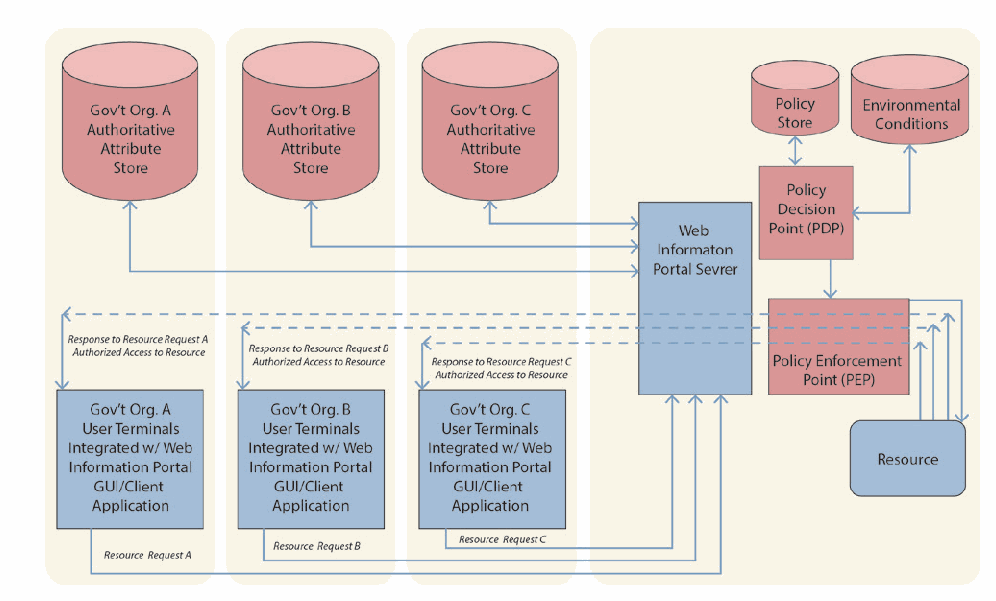
図28:アクセス制御と特権管理。網掛けの4列で構成された図である。最初の3列は Gov't Org. A、B、C で、それぞれ Authoritative Attribute Store(権威ある属性ストア。桃色の円筒)が双方向の矢印で Web Informaton Portal Sevrer(原文の表記どおり)と結ばれ、「User Terminals Integrated w/ Web Information Portal GUI/Client Application」の箱がポータルサーバへ Resource Request A/B/C(リソース要求)を送り、「Response to Resource Request A/B/C, Authorized Access to Resource」(リソース要求への応答、リソースへの許可されたアクセス)と記した破線の矢印を受け取る。4列目には Web Informaton Portal Sevrer、Policy Store(ポリシーストア)と Environmental Conditions(環境条件。いずれも円筒)があり、後二者は双方向の矢印で Policy Decision Point(PDP)と結ばれる。PDP から下の Policy Enforcement Point(PEP)へ矢印が向かい、PEP から Resource(リソース)へ矢印が向かう。Resource からの線が、各ユーザ端末へ戻る破線の応答矢印に接続している。
•Provide guidance for implementing AC models and mechanisms for standalone or network systems;
•スタンドアロンシステムまたはネットワークシステムのためのACモデルおよびAC機構を実装するためのガイダンスを提供します。
•Increase the security and safety of static (connected) distributed systems by applying the testing and verification tool for the AC policies;
•ACポリシーのための試験・検証ツールを適用することによって、静的な(接続された)分散システムのセキュリティと安全性を高めます。
•Assist system architects, security administrators, and security managers whose expertise is related to AC or privilege policy in managing their systems and in learning the limitations and practical approaches for their applications; and
•ACまたは特権ポリシーに関わる専門性を持つシステムアーキテクト、セキュリティ管理者、セキュリティマネージャが、自らのシステムを管理し、自らのアプリケーションにおける限界と実践的なアプローチを学ぶことを支援します。
•Provide accurate and efficient fault detection and correction technology for implementing AC rules and policies.
•ACのルールおよびポリシーを実装するための、正確で効率的な障害の検出および修正の技術を提供します。
Figure 28 illustrates the application of AC and privilege management within and among organizations.
図28は、組織内および組織間におけるACと特権管理の適用を示しています。
Figure 28: Access Control and Privilege Management
図28:アクセス制御と特権管理
CONTACTS:
連絡先:
Dr. Vincent Hu, (301) 975-4975, vhu@nist.gov
Dr. Vincent Hu, (301) 975-4975, vhu@nist.gov
Mr. David Ferraiolo, (301) 975-3046, david.ferraiolo@nist.gov
Mr. David Ferraiolo, (301) 975-3046, david.ferraiolo@nist.gov
Mr. Rick Kuhn, (301) 975-3337, kuhn@nist.gov
Mr. Rick Kuhn, (301) 975-3337, kuhn@nist.gov
Conformance Verification for Access Control Policies
アクセス制御ポリシーの適合性検証
Access control (AC) systems are among the most critical network security components. Faulty policies, misconfigurations, or flaws in software implementation can result in serious vulnerabilities. The specification of AC policies is often a challenging problem. Often, a system’s privacy and security are compromised due to the misconfiguration of AC policies, instead of the failure of cryptographic primitives or protocols. This problem becomes increasingly severe as software systems become more and more complex, and are deployed to manage a large amount of sensitive information and resources that are organized into sophisticated structures. Identifying discrepancies between policy specifications and their intended properties is crucial because the correct implementation and enforcement of policies by applications is based on the premise that the policy specifications are correct. As a result, policy specifications must undergo rigorous verification and validation through systematic testing to ensure that the policy specifications truly encapsulate the desires of the policy authors.
アクセス制御(AC)システムは、ネットワークセキュリティの構成要素の中でも最も重要なものの一つです。誤りのあるポリシー、設定の誤り、またはソフトウェア実装の欠陥は、深刻な脆弱性をもたらしうます。ACポリシーの仕様を定めることは、しばしば困難な問題です。システムのプライバシーとセキュリティは、暗号プリミティブやプロトコルの破綻ではなく、ACポリシーの設定の誤りによって損なわれることが多くあります。この問題は、ソフトウェアシステムがますます複雑になり、高度な構造に編成された大量の機微な情報やリソースを管理するために導入されるにつれて、いっそう深刻になります。アプリケーションによるポリシーの正しい実装と施行は、ポリシー仕様が正しいという前提に基づいているため、ポリシー仕様とその意図された特性との食い違いを特定することがきわめて重要です。したがって、ポリシー仕様がポリシー作成者の意図を真に表していることを確実にするために、ポリシー仕様は体系的な試験による厳密な検証と妥当性確認を受けなければなりません。
To formally and precisely capture the security properties that AC should adhere to, access control models are usually written to bridge the rather wide gap in abstraction between policy and mechanism. Thus, an AC model provides unambiguous and precise expression as well as a reference for the design and implementation of security requirements. Techniques are required for verifying whether an AC model is correctly expressed in the AC policies, and whether the properties are satisfied in the model.
ACが従うべきセキュリティ特性を形式的かつ正確に捉えるために、通常はアクセス制御モデルが記述され、ポリシーと機構の間にあるかなり大きな抽象度の隔たりを埋めます。このように、ACモデルは、曖昧さのない正確な表現を与えるとともに、セキュリティ要件の設計と実装のための参照となります。ACモデルがACポリシーに正しく表現されているかどうか、また特性がモデルにおいて満たされているかどうかを検証するための技法が必要です。
Most research on AC model or policy verification techniques is focused on one particular model, and almost all of the research is in applied methods, which require the completed AC policies as the input for the verification or test processes to generate fault reports. Even though correct verification is achieved, and counter-examples may be generated when faults are found, those methods provide no information about the source of faults that might allow conflicts in privilege assignment, the leakage of privileges, or a conflict-of-interest in permissions. The difficulty in finding the source of faults is increased, especially when the AC rules are intricately covering duplicated variables to a degree of complexity. The complexity is because a fault might not be caused by one particular access rule but by multiple rules that conflict. Thus, it requires manually analyzing each rule in the policy to find the correct solution for correcting the fault.
ACモデルまたはポリシーの検証技法に関する研究の大半は、特定の一つのモデルに焦点を当てており、またほぼすべての研究は応用的な手法に関するものです。これらの手法は、検証または試験のプロセスが障害報告を生成するための入力として、完成したACポリシーを必要とします。正しい検証が達成され、障害が見つかったときに反例が生成されることはあっても、これらの手法は、特権の割当てにおける競合、特権の漏えい、または許可における利益相反を許してしまうかもしれない障害の原因については、何の情報も提供しません。障害の原因を見つける難しさは、とりわけACルールが重複する変数を複雑に入り組んだ形で扱っている場合に増大します。この複雑さは、障害が特定の一つのアクセスルールによってではなく、競合する複数のルールによって引き起こされることがあるためです。したがって、障害を修正する正しい解決策を見つけるには、ポリシー内の各ルールを手作業で分析する必要があります。
To address the issue, CSD developed the ACPT, shown in Figure 29, which allows a user to compose, verify, test, and generate access control policies. CSD also researched the AC Rule Logic Circuit Simulation (ACRLCS) technique, which enables the AC authors to detect a fault when the fault-causing AC rule is added to the policy, so the fix can be implemented in real time before adding other rules that further complicate the detecting effort, rather than checking by retracing the interrelations between rules after the policy is completed.
この問題に対処するため、CSDは図29に示すACPTを開発しました。ACPTにより、利用者はアクセス制御ポリシーを作成、検証、試験、生成できます。CSDはまた、AC Rule Logic Circuit Simulation(ACRLCS)技法を研究しました。この技法により、AC作成者は、障害の原因となるACルールがポリシーに追加された時点で障害を検出できます。そのため、ポリシーの完成後にルール間の相互関係をたどり直して確認するのではなく、検出作業をさらに複雑にする他のルールを追加する前に、リアルタイムで修正を行うことができます。
In FY 2017, CSD accomplished the following:
2017会計年度に、CSDは次のことを達成しました。
•Published SP 800-192, Verification and Test Methods for Access Control Policies/Models, an article, Access Control Policy Verification in IEEE Computer, and a conference paper, Differentiation Non-Isomorphic Graphs for Graph Analytics;
•SP 800-192, Verification and Test Methods for Access Control Policies/Models、IEEE Computer 掲載の論文 Access Control Policy Verification、および会議論文 Differentiation Non-Isomorphic Graphs for Graph Analytics を発表しました。
•Enhanced the capability of ACPT by including additional functions for the specifications of subject inheritance, separation of duty requirements, and better user interfaces for policy model specification;
•サブジェクトの継承の仕様、職務分離要件の仕様のための機能を追加し、ポリシーモデルの仕様のためのユーザインタフェースを改善することによって、ACPTの能力を強化しました。
•Enhanced the usability and fixed bugs of the ACRLCS (the Access Control Rule Logic Circuit Simulation System) to provide more policy composing and user interface capability for policy fault detection;
•ACRLCS(Access Control Rule Logic Circuit Simulation System)のユーザビリティを高め、バグを修正して、ポリシーの障害検出のためのポリシー作成機能とユーザインタフェース機能を拡充しました。
•Supported two Small Business Innovation Research (SBIR) Phase II projects for the access control tool and embeded function developments; and
•アクセス制御ツールおよび組込み機能の開発のための、2件のSmall Business Innovation Research(SBIR)Phase IIプロジェクトを支援しました。
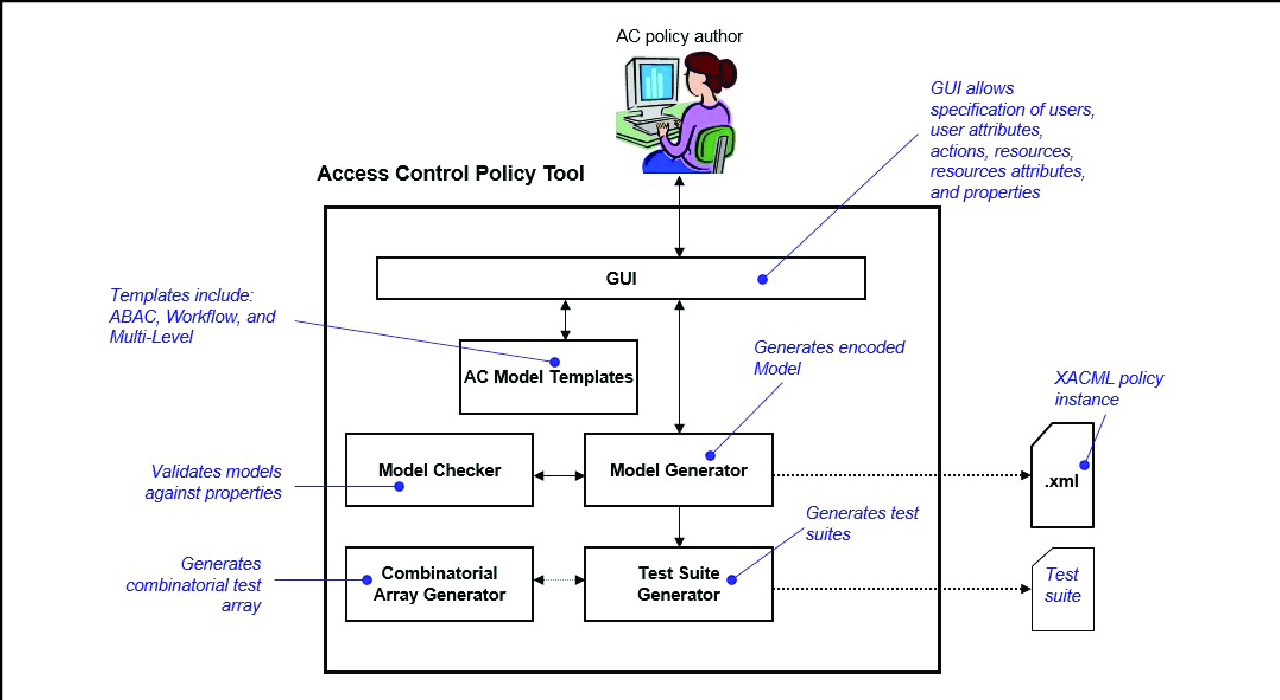
図29:Access Control Policy Tool(ACPT)。AC policy author(AC ポリシー作成者。コンピュータに向かう人物)が、Access Control Policy Tool と記した枠内の GUI と双方向でやり取りする。枠内では、GUI が双方向の矢印で AC Model Templates(AC モデルテンプレート)および Model Generator(モデル生成器)と結ばれ、Model Checker(モデル検査器)と Model Generator は双方向、Model Generator から下の Test Suite Generator(テストスイート生成器)へ矢印が向かい、Combinatorial Array Generator(組合せ配列生成器)と Test Suite Generator は点線の双方向の矢印で結ばれる。Model Generator から .xml ファイル(XACML ポリシーインスタンス)へ、Test Suite Generator から Test suite(テストスイート)の文書へ点線の矢印が向かう。吹き出し:GUI でユーザ、ユーザ属性、アクション、リソース、リソース属性およびプロパティを指定できる。テンプレートには ABAC、Workflow、Multi-Level が含まれる。エンコードされたモデルを生成する。プロパティに照らしてモデルを検証する。テストスイートを生成する。組合せテスト配列を生成する。
Figure 29: Access Control Policy Tool (ACPT)
図29:Access Control Policy Tool(ACPT)
•Worked with industrial and academic rganizations in exploring new capabilities that helped to improve the usability of the AC tools (ACPT and ACRLCS), resulting in additional usage; ACPT was downloaded by 475 users and organizations.
•産業界および学術界の組織と協力して、ACツール(ACPTおよびACRLCS)のユーザビリティの向上に役立つ新しい機能を探求し、その結果、利用が拡大しました。ACPTは475の利用者および組織によってダウンロードされました。
In FY 2018, CSD is planning to conduct further research on efficient testing technology, develop new capabilities, and to enhance the performance of the ACPT and ACRLCS.
2018会計年度に、CSDは、効率的な試験技術についてさらに研究を行い、新しい機能を開発し、ACPTおよびACRLCSの性能を高めることを計画しています。
Figure 29 shows the system architecture of the NIST ACPT, which allows access control policy authors to compose, verify, and test access control policy implementation.
図29は、NIST ACPTのシステムアーキテクチャを示しています。ACPTにより、アクセス制御ポリシーの作成者は、アクセス制御ポリシーの実装を作成、検証、試験できます。
Figure 30 provides an example of access control rule implementation in ACRLCS, which allows the online detection of access control rule composition faults.
図30は、ACRLCSにおけるアクセス制御ルールの実装の例を示しています。ACRLCSにより、アクセス制御ルールの作成における障害をオンラインで検出できます。
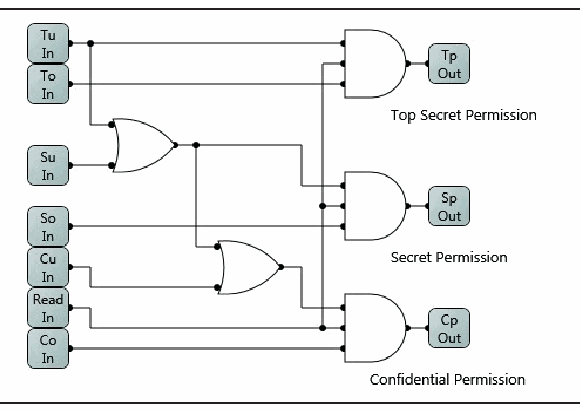
図30:アクセス制御ルールの実装。左に入力 Tu In、To In、Su In、So In、Cu In、Read In、Co In、右に出力 Tp Out(Top Secret Permission)、Sp Out(Secret Permission)、Cp Out(Confidential Permission)がある論理回路である。Tp の AND ゲートには Tu、To、Read が入る。OR ゲートが Tu と Su を合わせ、その出力が So および Read とともに Sp の AND ゲートに入る。2つ目の OR ゲートが1つ目の OR の出力と Cu を合わせ、その出力が Read および Co とともに Cp の AND ゲートに入る。
Figure 30: Access Control Rule Implementation
図30:アクセス制御ルールの実装
This project is expected to:
本プロジェクトは、次のことを実現すると期待されます。
•Provide a generic paradigm and framework of access control model/property conformance testing;
•アクセス制御のモデルおよび特性の適合性試験のための、汎用的なパラダイムとフレームワークを提供します。
•Provide templates for specifying access control rules in popular access control models, such as the Attribute Based, Multi-level, and Workflow models;
•Attribute Based、Multi-level、Workflowの各モデルなど、広く使われているアクセス制御モデルでアクセス制御ルールを規定するためのテンプレートを提供します。
•Provide tools or services for checking the security and safety of an access control implementation, policy combination, and eXtensible Access Control Markup Language (XACML) policy generation;
•アクセス制御の実装のセキュリティと安全性の確認、ポリシーの組合せ、およびeXtensible Access Control Markup Language(XACML)ポリシーの生成のためのツールまたはサービスを提供します。
•Promote (or accelerate) the adoption of combinatorial testing for large-system testing (such as an access control system);
•大規模システム(アクセス制御システムなど)の試験のための組合せテストの導入を促進します(または加速します)。
•Promote the concept of detecting AC policy faults in real-time AC rule composing;
•ACルールの作成中にリアルタイムでACポリシーの障害を検出するという考え方を普及させます。
•Provide an innovative method for specifying AC rules formed by Boolean logic expressions operated on variables of AC rules;
•ACルールの変数に対して作用するブール論理式によって構成されるACルールを規定するための、革新的な手法を提供します。
•Provide techniques for preventing faults in enforcing fundamental security properties, including Cyclic Inheritance, Privilege Escalation, and Separation of Duty; and
•Cyclic Inheritance、Privilege Escalation、Separation of Dutyを含む基本的なセキュリティ特性の施行における障害を防ぐための技法を提供します。
•Provide new methods for composing standard mandatory AC models, such as Attribute Based Access Control (ABAC) and Multi-Level Security (MLS) as well as some fundamental security properties.
•Attribute Based Access Control(ABAC)やMulti-Level Security(MLS)などの標準的な強制ACモデル、およびいくつかの基本的なセキュリティ特性を構成するための新しい手法を提供します。
FOR MORE INFORMATION, SEE:
詳細情報:
https://csrc.nist.gov/projects/access-control-policy-tool
https://csrc.nist.gov/projects/access-control-policy-tool
CONTACTS:
連絡先:
Dr. Vincent Hu, (301) 975-4975, vhu@nist.gov
Dr. Vincent Hu, (301) 975-4975, vhu@nist.gov
Mr. Rick Kuhn, (301) 975-3337, kuhn@nist.gov
Mr. Rick Kuhn, (301) 975-3337, kuhn@nist.gov
Attribute Based Access Control
Attribute Based Access Control
Attribute Based Access Control (ABAC) is a logical access control methodology where an authorization to perform a set of operations is determined by evaluating the attributes associated with the subject, object, requested operations, and, in some cases, environmental conditions against policy, rules, or relationships that describe the allowable operations for a given set of attributes. For example, access to a database could be restricted to users with particular attributes, such as membership in a group (e.g., employees) and other conditions (e.g., part of the Human Resource Department). ABAC represents a point on the spectrum of logical access control, from simple access control lists to more capable Role Based Access Control (RBAC), and finally, to a highly flexible method for providing access based on the evaluation of attributes.
Attribute Based Access Control(ABAC)は、論理アクセス制御の方法論の一つです。ABACでは、一連の操作を実行するための認可は、サブジェクト、オブジェクト、要求された操作、および場合によっては環境条件に関連付けられた属性を、所与の属性の組に対して許容される操作を記述するポリシー、ルール、または関係に照らして評価することによって決定されます。例えば、データベースへのアクセスを、あるグループへの所属(例:従業員)などの特定の属性と、その他の条件(例:人事部門の一員であること)を持つ利用者に制限することができます。ABACは、単純なアクセス制御リストから、より高機能なRole Based Access Control(RBAC)を経て、最終的には属性の評価に基づいてアクセスを提供するきわめて柔軟な方式に至る、論理アクセス制御の連続体の上の一点を表しています。
CSD is conducting research that provides information for using ABAC to improve information sharing within and among organizations based on the planning, design, implementation, and operational considerations. The research also includes technologies such as attribute assurance, attribute engineering/management, identity system integration, attribute federation, situational awareness (real-time or contextual) mechanisms, policy management, and natural-language policy translation to digital policy. Figure 31 illustrates the interaction of many of these components.
CSDは、計画、設計、実装、運用の各面の考慮事項に基づき、ABACを用いて組織内および組織間の情報共有を改善するための情報を提供する研究を行っています。この研究は、属性の保証、属性のエンジニアリングおよび管理、アイデンティティシステムの統合、属性のフェデレーション、状況認識(リアルタイムまたはコンテキストに基づく)の機構、ポリシー管理、自然言語ポリシーからデジタルポリシーへの変換といった技術も対象としています。図31は、これらの構成要素の多くの相互作用を示しています。
The goal of this research is to improve information sharing, while maintaining control of that information for federal agencies.
この研究の目標は、連邦機関のために、情報の管理を維持しながら情報共有を改善することです。
In FY 2017, the project team:
2017会計年度に、プロジェクトチームは次のことを行いました。
•Published the book Attribute-Based Access Control by Artech House. The book contains discussions covering almost all aspects of ABAC;
•書籍 Attribute-Based Access Control をArtech Houseから出版しました。同書は、ABACのほぼすべての側面にわたる議論を収めています。
•Published a conference paper: Verification of Resilience Policies that Assist Attribute Based Access Control. The paper presents research results of access privilege blocking and privilege leaking; and
•会議論文 Verification of Resilience Policies that Assist Attribute Based Access Control を発表しました。この論文は、アクセス特権の遮断と特権の漏えいに関する研究成果を示しています。
•Worked with government, industry and academic organizations in exploring diverse models (e.g., Next Generation Access Control - NGAC) and applications (e.g., distributed systems: Cloud, Bigdata, IoT applications) of ABAC.
•政府、産業界、学術界の組織と協力して、ABACの多様なモデル(例:Next Generation Access Control - NGAC)および応用(例:分散システム:Cloud、Bigdata、IoTアプリケーション)を探求しました。
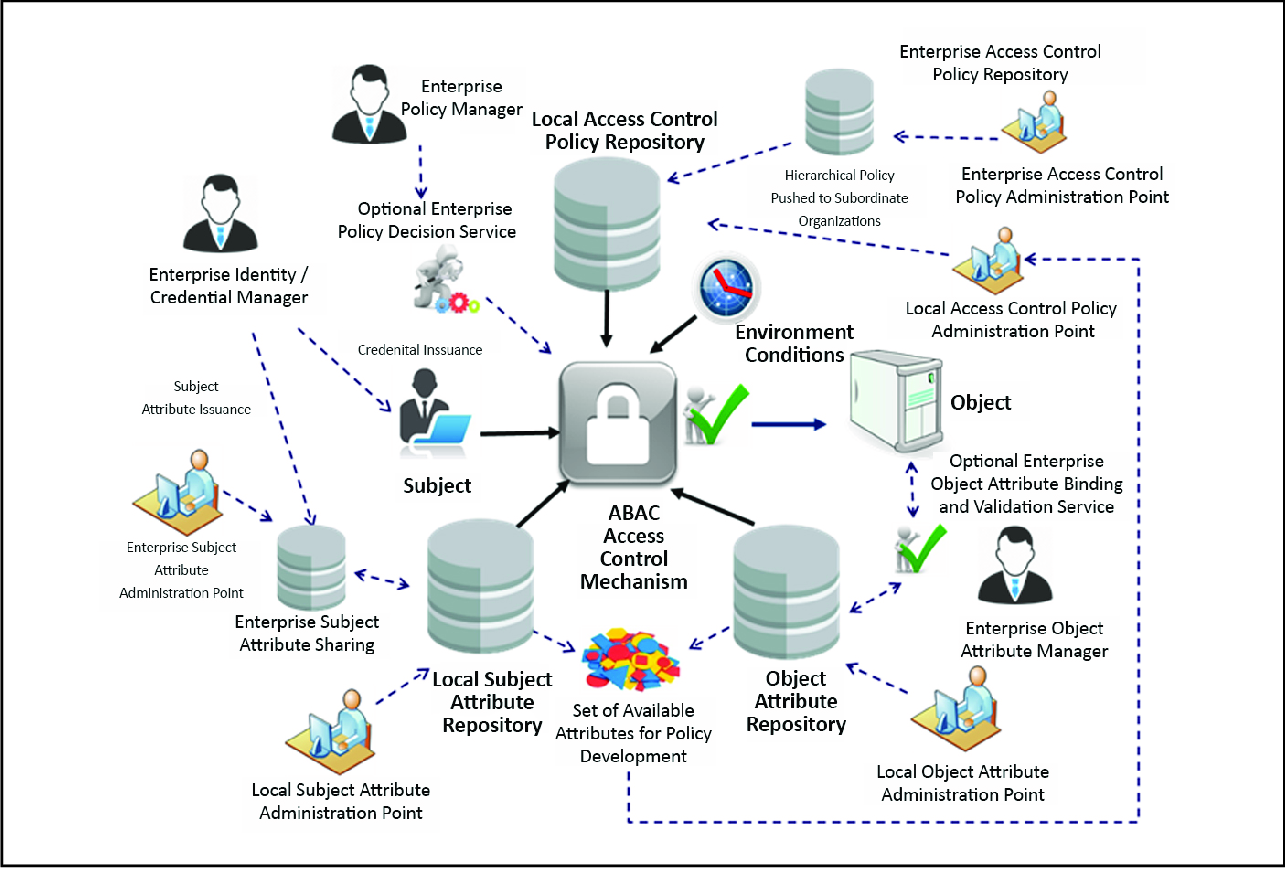
図31:ABACアクセス制御機構の図。中央に ABAC Access Control Mechanism(ABAC アクセス制御機構。南京錠のアイコン)があり、Local Access Control Policy Repository(ローカルのアクセス制御ポリシーリポジトリ)、Environment Conditions(環境条件)、Subject(主体)、Local Subject Attribute Repository(ローカルの主体属性リポジトリ)、Object Attribute Repository(客体属性リポジトリ)から実線の矢印を受け、Object(客体)へ矢印(チェックマーク付き)を送る。破線の矢印:Enterprise Policy Manager から Optional Enterprise Policy Decision Service へ、そこから機構へ。Enterprise Identity / Credential Manager から Subject へ(Credenital Issuance。原文の表記どおり)、および Enterprise Subject Attribute Sharing へ(Subject Attribute Issuance)。Enterprise Subject Attribute Administration Point から Enterprise Subject Attribute Sharing へ、後者は Local Subject Attribute Repository と双方向。Local Subject Attribute Administration Point から Local Subject Attribute Repository へ。Enterprise Access Control Policy Administration Point から Enterprise Access Control Policy Repository へ、そこから Local Access Control Policy Repository へ(Hierarchical Policy Pushed to Subordinate Organizations、下位組織へ配布される階層的なポリシー)。Local Access Control Policy Administration Point から Local Access Control Policy Repository へ。Object と Optional Enterprise Object Attribute Binding and Validation Service は双方向で、後者は Object Attribute Repository とも双方向。Local Object Attribute Administration Point から Object Attribute Repository へ。その横に Enterprise Object Attribute Manager がある。2つの属性リポジトリから Set of Available Attributes for Policy Development(ポリシー策定に利用できる属性の集合)へ矢印が向かい、そこから破線が Local Access Control Policy Administration Point へ延びる。
Figure 31: ABAC Access Control Mechanism Chart
図31:ABACアクセス制御機構の図
In FY 2018, CSD will continue the research of ABAC formal models, as well as the details and extended topics of ABAC capabilities, such as attribute considerations, ABAC implementation examples, ABAC mechanisms, and ABAC standards. The ABAC project will pursue the following objectives:
2018会計年度も、CSDは、ABACの形式モデルの研究、ならびに属性の考慮事項、ABACの実装例、ABACの機構、ABACの標準といった、ABACの能力に関する詳細および拡張的なトピックの研究を継続します。ABACプロジェクトは、次の目的を追求します。
•Provide readers with an overview of the current state of logical access control, a working definition of ABAC, and an explanation of the core and enterprise ABAC concepts;
•論理アクセス制御の現状の概要、ABACの実用的な定義、およびコアABACとエンタープライズABACの概念の説明を読者に提供します。
•Assist security policy makers in establishing a business case for ABAC implementation and acquiring an interoperable set of capabilities;
•セキュリティポリシーの策定者が、ABAC導入のビジネスケースを確立し、相互運用可能な一連の能力を調達することを支援します。
•Assist ABAC developers in developing the operational requirements and overall enterprise architecture;
•ABACの開発者が、運用要件およびエンタープライズアーキテクチャ全体を策定することを支援します。
•Assist ABAC administrators in establishing or refining business processes to support ABAC;
•ABACの管理者が、ABACを支える業務プロセスを確立または改良することを支援します。
•Promote the adoption of ABAC for a more secure and flexible method for information sharing in a standalone or enterprise environment; and
•スタンドアロン環境またはエンタープライズ環境における、より安全で柔軟な情報共有の方式として、ABACの導入を促進します。
•Provide testing methods for ABAC policy and implementations.
•ABACのポリシーおよび実装のための試験方法を提供します。
FOR MORE INFORMATION, SEE:
詳細情報:
https://csrc.nist.gov/projects/abac/
https://csrc.nist.gov/projects/abac/
CONTACTS:
連絡先:
Dr. Vincent Hu, (301) 975-4975, vhu@nist.gov
Dr. Vincent Hu, (301) 975-4975, vhu@nist.gov
Mr. David Ferraiolo, (301) 975-3046, david.ferraiolo@nist.gov
Mr. David Ferraiolo, (301) 975-3046, david.ferraiolo@nist.gov
Mr. Rick Kuhn, (301) 975-3337, kuhn@nist.gov
Mr. Rick Kuhn, (301) 975-3337, kuhn@nist.gov
Trusted Identities Program
Trusted Identities Program
By promoting the government and commercial adoption of privacy-enhancing, secure, interoperable, and easy-to-use digital identity solutions, ACD works alongside its partners to drive trust, convenience, and innovation in the marketplace of identity solutions (see https://www.nist.gov/itl/tig). ACD is committed to advancing measurement science, technology, and standards adoption to improve digital identity for individuals and organizations alike.
ACDは、プライバシーを強化し、安全で、相互運用可能で、使いやすいデジタルアイデンティティソリューションの政府および民間での導入を促進することによって、パートナーとともに、アイデンティティソリューションの市場における信頼、利便性、イノベーションを推進しています(https://www.nist.gov/itl/tig を参照してください)。ACDは、個人と組織の双方のためにデジタルアイデンティティを改善するべく、計測科学、技術、および標準の採用を前進させることに取り組んでいます。
In FY 2017, the Trusted Identities Program was a key participant and driving force in the digital identity arena for NIST’s National Cybersecurity Center of Excellence (NCCoE). Many identity-related projects initiated at the NCCoE leveraged the technical expertise and experiences of, and the foundational guidelines and practices issued by, ACD and NIST’s broader identity program.
2017会計年度に、Trusted Identities Programは、NISTのNational Cybersecurity Center of Excellence(NCCoE)にとって、デジタルアイデンティティの分野における主要な参加者であり推進力でした。NCCoEで開始されたアイデンティティ関連のプロジェクトの多くは、ACDおよびNISTのより広範なアイデンティティプログラムの技術的な専門知識と経験、ならびにそれらが発行した基礎的なガイドラインとプラクティスを活用しました。
Through these collaborative efforts, projects this year focused on driving the adoption of trusted identities through digital identity standards, including for federal agencies. NIST also engaged the community on standards and guidelines development, including issuing SP 800-63-3, Digital Identity Guidelines, collaborating with other countries to advance high-assurance online identity standards, and participating in the OpenID Foundation and Fast Identity Online (FIDO) Alliance.
これらの協力的な取り組みを通じて、今年のプロジェクトは、連邦政府機関向けのものを含むデジタルアイデンティティ標準によって、信頼できるアイデンティティの採用を促進することに重点を置きました。NISTはまた、標準およびガイドラインの策定についてコミュニティと関わりました。これには、SP 800-63-3, Digital Identity Guidelinesの発行、高保証のオンラインアイデンティティ標準を前進させるための他国との協力、OpenID FoundationおよびFast Identity Online (FIDO) Allianceへの参加が含まれます。
ACD also focused on building trust in digital identity technologies by advancing measurement science in the identity space—which included measuring the strength of authenticators and evaluating attribute metadata. The team also continued work with numerous external partners through trusted identities pilots, seeding the market with innovative technologies and providing solutions.
ACDはまた、アイデンティティ分野における計測科学を前進させることによって、デジタルアイデンティティ技術に対する信頼の構築にも重点を置きました。これには、認証器の強度の測定や属性メタデータの評価が含まれます。チームはまた、信頼できるアイデンティティのパイロットを通じて多数の外部パートナーとの作業を継続し、革新的な技術を市場に送り出すとともに、ソリューションを提供しました。
Updated Digital Identity Guidelines
デジタルアイデンティティガイドラインの更新
In June of 2017, ACD finalized the latest revision to SP 800-63-3, which covers digital identity from initial risk assessment to deployment of federated identity solutions. Digital identity in both agencies and the market place have changed dramatically since the publication’s last revision in 2013; the latest update was designed to give agencies more options and to align with international standards. One of the most significant updates is replacing levels of assurance with three individual components of the digital identity flow for more flexibility in design and operations: the identity, authenticator, and federation assurance levels. Identity proofing was also updated to further mitigate the potential for mass breaches of personal information.
2017年6月、ACDはSP 800-63-3の最新の改訂を完成させました。この文書は、最初のリスクアセスメントからフェデレーション型アイデンティティソリューションの導入までのデジタルアイデンティティを扱います。政府機関と市場の双方におけるデジタルアイデンティティは、この文書が前回改訂された2013年以降、劇的に変化しています。最新の更新は、政府機関により多くの選択肢を与え、国際標準と整合させることを意図したものです。最も重要な更新の一つは、設計と運用の柔軟性を高めるために、保証レベル(levels of assurance)を、デジタルアイデンティティのフローを構成する三つの個別の要素、すなわちアイデンティティ保証レベル、認証器保証レベル、フェデレーション保証レベルに置き換えたことです。身元確認(identity proofing)も、個人情報の大量漏えいの可能性をさらに低減するために更新されました。
Over the course of a year, the document evolved with the help of the community. For this revision, GitHub was used to interact in near-real-time with the community and received a tremendous response: over 1,400 comments were submitted, and the web version of the publication drew over 74,000 unique visitors between May 2016 and May 2017. ACD will continue to use this approach in the future during the development of new volumes and document revisions.
1年をかけて、この文書はコミュニティの助けを得て発展しました。今回の改訂では、コミュニティとほぼリアルタイムでやり取りするためにGitHubを利用し、非常に大きな反響を得ました。1,400件を超えるコメントが提出され、この文書のウェブ版には2016年5月から2017年5月までの間に74,000人を超えるユニークビジターが訪れました。ACDは今後も、新しい分冊の策定や文書の改訂に際してこの手法を使い続けます。
International Standards Alignment
国際標準との整合
ACD, the United Kingdom Cabinet Office, and the Canada Treasury Board have been collaborating to compare national frameworks for identity assurance with the intention of creating a broad and competitive global market for identity solutions and enabling cross-border credential interoperability. Building on recent updates to guidance documents like NIST’s SP 800-63-3 and the UK’s Good Practice Guides, the group made several recommendations for the International Organization for Standardization’s (ISO’s) suite of identity standards. These recommendations included the development of a new standard that provides an overall approach to identity and authentication risk management and assurance; organizations could leverage this when developing their models for assessing and managing identity-based risks and threats.
ACD、United Kingdom Cabinet Office、Canada Treasury Boardは、アイデンティティソリューションの広範で競争的な世界市場を創出し、国境を越えたクレデンシャルの相互運用性を可能にすることを意図して、アイデンティティ保証に関する各国のフレームワークを比較するために協力してきました。NISTのSP 800-63-3や英国のGood Practice Guidesといったガイダンス文書の最近の更新を踏まえ、このグループは国際標準化機構(ISO)の一連のアイデンティティ標準についていくつかの勧告を行いました。これらの勧告には、アイデンティティおよび認証のリスク管理と保証に対する全体的なアプローチを示す新しい標準の策定が含まれていました。組織は、アイデンティティに基づくリスクと脅威を評価し管理するためのモデルを策定する際に、これを活用できます。
The group also recommended refocusing ISO/IEC 29115, Entity Authentication Assurance Framework, to address authentication threats and risks exclusively. These updates should contain a threat model, controls and mitigations, and guidance on how these can be combined to achieve defined risk management outcomes for authentication events.
このグループはまた、ISO/IEC 29115, Entity Authentication Assurance Frameworkの焦点を改め、認証の脅威とリスクのみを扱うものにすることを勧告しました。これらの更新には、脅威モデル、管理策および緩和策、ならびに認証イベントについて定義されたリスク管理の成果を達成するためにこれらをどう組み合わせることができるかに関するガイダンスを含めるべきです。
NIST staff members served as the Federal Government lead for all activities in the (Fast IDentity Online) FIDO Alliance, which focuses on creating strong authentication specifications to create an identity ecosystem. During 2017, ACD participation included active membership and contribution in technical and privacy working groups, as well as international plenary participation in Hong Kong, Vancouver, Madrid, and Sydney.
NISTの職員は、(Fast IDentity Online) FIDO Allianceにおけるすべての活動について連邦政府のリードを務めました。FIDO Allianceは、アイデンティティエコシステムを創出するための強力な認証の仕様を作成することに重点を置いています。2017年中のACDの参加には、技術およびプライバシーのワーキンググループにおける積極的な参加と貢献、ならびに香港、バンクーバー、マドリード、シドニーでの国際総会への参加が含まれていました。
Additionally, ACD supported standardization efforts including iGov (see https://openid.net/wg/igov). The iGov is working toward an OpenID Connect specification that will enable users to authenticate and share consented attribute information with public-sector services across the globe. The resulting profile will enable standardized integration with public-sector relying parties (RPs) in multiple jurisdictions.
加えて、ACDはiGovを含む標準化の取り組みを支援しました(https://openid.net/wg/igov を参照してください)。iGovは、利用者が世界中の公共部門のサービスに対して認証を行い、同意した属性情報を共有できるようにするOpenID Connectの仕様の策定に取り組んでいます。その成果となるプロファイルは、複数の法域における公共部門の依拠当事者(RP)との標準化された統合を可能にします。
Authenticator Strength of Function
認証器の機能強度
NIST is working to produce a framework for evaluating and comparing the strength of authentication solutions, starting with the Strength of Function for Authenticators – Biometrics (SOFA-B). The team began with a focus on biometrics, due to the increased availability of biometric solutions in the consumer space and the need for improved security guidance regarding the use of those solutions as authenticators. The end goal is a framework to assess and combine authentication technologies, as well as to compare biometrics’ effectiveness to that of passwords and other authenticators. Using the SOFA-B framework, RPs will be able to determine the overall strength of biometric authentication, considering matching performance, presentation attack detection, and the effort required to break – or spoof – a system.
NISTは、認証ソリューションの強度を評価し比較するためのフレームワークの作成に取り組んでおり、その手始めがStrength of Function for Authenticators – Biometrics (SOFA-B)です。チームは、消費者向け分野で生体認証ソリューションが利用しやすくなったこと、およびそれらのソリューションを認証器として利用することに関するセキュリティガイダンスの改善が必要であることから、まず生体認証に焦点を当てました。最終的な目標は、認証技術を評価し組み合わせるとともに、生体認証の有効性をパスワードやその他の認証器の有効性と比較するためのフレームワークです。SOFA-Bフレームワークを用いることで、RPは、照合性能、提示攻撃の検知、およびシステムを破る(すなわち、なりすます)のに必要な労力を考慮して、生体認証の全体的な強度を判断できるようになります。
With the draft of NISTIR 8112: A Proposed Schema for Evaluating Federated Attributes, the TIG aims to give RPs greater insight into how attributes assist with risk-based business decision-making. RPs can examine this metadata and determine if they have the confidence they need in the attribute value before making an authorization decision. This NISTIR is being treated like an implementers’ draft, an approach focused on real-world implementation results and lessons learned before finalizing the document. ACD plans to advance SOFA-B and attribute metadata efforts to their next stages in FY 2018.
NISTIR 8112: A Proposed Schema for Evaluating Federated Attributesの草案によって、TIGは、属性がリスクに基づく業務上の意思決定にどのように役立つかについて、RPがより深く理解できるようにすることを目指しています。RPはこのメタデータを調べ、認可の判断を下す前に、属性値について必要な確信が得られているかどうかを判断できます。このNISTIRは実装者向け草案のように扱われています。これは、文書を最終版とする前に、実世界での実装の結果と得られた教訓に重点を置く手法です。ACDは、2018会計年度にSOFA-Bと属性メタデータの取り組みを次の段階に進めることを計画しています。
Innovative Digital Identity Solutions
革新的なデジタルアイデンティティソリューション
ACD has advanced trusted digital identity solutions by building partnerships that stem from the trusted identities pilots. These pilots develop and deploy technology, models, and frameworks that would not otherwise exist in the marketplace, and have impacted more than 8.8 million individuals to date. In FY 2017, the pilots made remarkable progress: the 24 projects now involve more than 190 partner organizations across 12 sectors — including the development or deployment of 16 multi-factor authentication solutions.
ACDは、信頼できるアイデンティティのパイロットから生まれたパートナーシップを築くことによって、信頼できるデジタルアイデンティティソリューションを前進させてきました。これらのパイロットは、そうでなければ市場に存在しなかったであろう技術、モデル、フレームワークを開発し導入するものであり、現在までに880万人を超える個人に影響を与えています。2017会計年度に、パイロットは目覚ましい進展を遂げました。24件のプロジェクトには現在、12の分野にわたる190を超えるパートナー組織が参加しており、その中には16件の多要素認証ソリューションの開発または導入が含まれます。
In FY 2018, NIST, through the NCCoE, will fully integrate identity management standards, best practices, and technical approaches into projects that are foundational to the work of the NCCoE and many of its stakeholders and projects, including the Internet of Things. The project will also continue to advance the digital identity marketplace by collaborating with partners on measurement science, technology, and standards adoption, and develop guidance to meet today’s digital identity needs.
2018会計年度に、NISTはNCCoEを通じて、アイデンティティ管理の標準、ベストプラクティス、技術的アプローチを、NCCoEならびにその多くの利害関係者およびプロジェクトの活動の基礎となるプロジェクト(モノのインターネットを含む)に完全に統合します。このプロジェクトはまた、計測科学、技術、標準の採用についてパートナーと協力することによってデジタルアイデンティティ市場を引き続き前進させ、今日のデジタルアイデンティティのニーズを満たすガイダンスを策定します。
FOR MORE INFORMATION, SEE:
詳細情報:
https://www.nist.gov/itl/tig
https://www.nist.gov/itl/tig
CONTACTS:
連絡先:
Dr. Nelson Hastings, (301) 975-5237, nelson.hastings@nist.gov
Dr. Nelson Hastings, (301) 975-5237, nelson.hastings@nist.gov
Ms. Kristina Rigopoulos, (202) 309-4791, kristina.rigopoulos@nist.gov
Ms. Kristina Rigopoulos, (202) 309-4791, kristina.rigopoulos@nist.gov
(Editors’ Note: Paul Grassi supported this program until his recent departure from NIST.)
(編集者注:Paul Grassiは、最近NISTを離れるまでこのプログラムを支援しました。)
RESEARCH IN EMERGING TECHNOLOGIES
新興技術の研究
Secure Development Toolchain Competitions
セキュアな開発ツールチェーンのコンペティション
Many security weaknesses in federal information systems stem from software security vulnerabilities induced by software flaws present in current-generation software products. CSD tracks software security vulnerabilities (in the National Vulnerability Database), and seeks techniques for the measurement of security vulnerabilities and techniques that reduce the impact and prevalence of security vulnerabilities in newly developed products or in new versions of existing products.
連邦政府の情報システムにおけるセキュリティ上の弱点の多くは、現世代のソフトウェア製品に存在するソフトウェアの欠陥によって生じる、ソフトウェアのセキュリティ脆弱性に起因しています。CSDは、ソフトウェアのセキュリティ脆弱性を(National Vulnerability Database で)追跡するとともに、セキュリティ脆弱性を測定する技法と、新規に開発される製品又は既存製品の新バージョンにおけるセキュリティ脆弱性の影響と発生頻度を低減する技法を探求しています。
One approach to reducing the number of security vulnerabilities in software is to improve the development tools that are available. By identifying languages and software development tools that support a reduction of vulnerabilities, and by stimulating the creation of better tools and tool usage techniques, the approach has the potential to help developers produce applications with fewer vulnerabilities. While it is impossible to assure the total absence of security vulnerabilities in this way, it might well be possible to rule out specific, significant classes of vulnerabilities that currently provide the basis for many serious exploits.
ソフトウェアのセキュリティ脆弱性の数を減らす一つのアプローチは、利用可能な開発ツールを改善することです。このアプローチは、脆弱性の低減を支援する言語とソフトウェア開発ツールを特定し、より優れたツールとツール利用技法の創出を促すことによって、開発者がより脆弱性の少ないアプリケーションを作成するのを助ける可能性があります。この方法でセキュリティ脆弱性が全く存在しないことを保証することは不可能ですが、現在多くの深刻なエクスプロイトの基礎となっている、特定の重大な脆弱性のクラスを排除することは十分に可能かもしれません。
CSD is developing an empirical, competitive approach to finding the most effective and usable combinations of tools to produce software systems that are relatively free of exploitable vulnerabilities. Multiple competitions are planned that will be based on an idea developed during the Designing a Secure Systems Engineering Competition Workshop that was conducted by the National Science Foundation in 2010. The workshop proposed a competition for the development of a set of tools to help non-security-expert developers to rapidly build a significant application with zero vulnerabilities, as detected by an extensive public test suite.
CSDは、悪用可能な脆弱性が比較的少ないソフトウェアシステムを作成するための、最も効果的で使いやすいツールの組合せを見いだす、経験的かつ競技形式のアプローチを開発しています。複数の競技会が計画されており、それらは、米国国立科学財団が2010年に開催した Designing a Secure Systems Engineering Competition Workshop で練り上げられたアイデアに基づくものとなります。このワークショップは、セキュリティの専門家でない開発者が、広範な公開テストスイートによって検出される脆弱性がゼロである相当規模のアプリケーションを迅速に構築するのを助ける、一連のツールの開発を競う競技会を提案しました。
The participants in the planned competitions will implement software systems to solve challenge problems using software development tool chains (“toolchains”) of their own choosing, within specified time periods. The toolchains will be free to include existing technologies (e.g., existing software libraries and frameworks, code generators, reusable source code, or bug-finding tools), novel technologies, or any combination thereof. Each competition will apply time pressure by simulating a deadline in the software development process, increasing the likelihood of an introduction of security flaws. The objective of the toolchains will be to detect or prevent security flaws while still supporting the quick-paced software development of applications with rich feature sets. Through the demonstration of security-flaw avoidance in a time-constrained setting, CSD will seek to show that wide-scale improvements in the overall security of software products can be realized without sacrificing a time-to-market goal. The competitions, which will be open to all interested parties, will aim to provide consistent application and measurement of commercial and research software development, composition, and reuse techniques.
計画されている競技会の参加者は、自ら選んだソフトウェア開発ツールチェーン(「ツールチェーン」)を用いて、指定された期間内に、課題問題を解くソフトウェアシステムを実装します。ツールチェーンには、既存の技術(例えば、既存のソフトウェアライブラリやフレームワーク、コードジェネレータ、再利用可能なソースコード、バグ発見ツール)、新規の技術、又はそれらの任意の組合せを自由に含めることができます。各競技会では、ソフトウェア開発プロセスにおける締切りを模擬することで時間的な圧力をかけ、セキュリティ上の欠陥が入り込む可能性を高めます。ツールチェーンの目的は、豊富な機能を備えたアプリケーションの速いペースでのソフトウェア開発を支援しつつ、セキュリティ上の欠陥を検出又は防止することです。CSDは、時間の制約がある状況でセキュリティ上の欠陥を回避できることを実証することによって、市場投入までの時間に関する目標を犠牲にすることなく、ソフトウェア製品の全体的なセキュリティを広範に改善できることを示そうとしています。この競技会は、関心のあるすべての者に開かれ、商用及び研究段階のソフトウェアの開発、合成及び再利用の技法を、一貫した形で適用し測定することを目指します。
In FY 2017, CSD personnel documented the Toolchain Infrastructure (TCI) in a collection of documents that included a concept of operations, system design specification, and administrator’s and users guides. These documents helped inform the development of a python-based prototype of the TCI. The prototype development effort included automated unit test scripts for the TCI and the configuration and deployment of the TCI hardware. The team also refined a selected challenge problem by updating the problem descriptions, requirements, and test cases; and developed an exemplar challenge problem solution in python.
2017会計年度に、CSDの要員は、運用構想、システム設計仕様書、並びに管理者ガイド及びユーザガイドを含む一連の文書に Toolchain Infrastructure(TCI)を文書化しました。これらの文書は、python ベースのTCIのプロトタイプの開発に役立てられました。プロトタイプの開発作業には、TCI用の自動化された単体テストスクリプトと、TCIのハードウェアの構成及び配備が含まれました。チームはまた、問題の記述、要件及びテストケースを更新することによって、選定した一つの課題問題を洗練し、python で課題問題の模範解を開発しました。
In FY 2018, CSD plans to complete the development and testing of the TCI prototype. The team will enhance the prototype to further improve its reliability and reproducibility, perform extensive testing of the TCI, and publicly announce the first toolchain competition.
2018会計年度に、CSDは、TCIのプロトタイプの開発と試験を完了する計画です。チームは、プロトタイプを強化してその信頼性と再現性をさらに向上させ、TCIの広範な試験を実施し、最初のツールチェーン競技会を公表します。
CONTACTS:
連絡先:
Mr. Lee Badger, (301) 975-3176, lee.badger@nist.gov
Mr. Lee Badger, (301) 975-3176, lee.badger@nist.gov
Mr. Christopher Johnson, (301) 975-3247, christopher.johnson@nist.gov
Mr. Christopher Johnson, (301) 975-3247, christopher.johnson@nist.gov
Networks of Things
Networks of Things
The Internet of Things (IoT) increasingly appears to be the next great technology revolution. It is expected to impact everything from healthcare delivery, to how food is produced, to how we work, to all forms of transportation and communication, and to virtually all forms of automation. IoT will impact everyone, and in multiple ways.
モノのインターネット(IoT)は、次の大きな技術革命であるとの見方がますます強まっています。IoTは、医療の提供から、食料の生産方法、私たちの働き方、あらゆる形態の輸送と通信、そして事実上あらゆる形態の自動化に至るまで、すべてに影響を与えると予想されています。IoTはすべての人に、しかも複数の形で影響を与えます。
With a technology revolution of such large impact on society, it is imperative that IoT-based systems can be trusted. This means that they should exhibit secure, reliable, and private behaviors as well as many other attributes associated with quality. Privacy is particularly important because IoT-based systems will likely produce huge amounts of data as a result of sensing and surveillance. This is the “big data” challenge associated with IoT. Therefore, techniques, tools, and methods to mitigate the numerous “trust” challenges are needed before these automated IoT-based networks manage much of daily life.
社会にこれほど大きな影響を与える技術革命である以上、IoTベースのシステムが信頼できるものであることが不可欠です。これは、IoTベースのシステムが、安全で、信頼性があり、プライバシーを守る振る舞いを示すとともに、品質に関連するその他多くの属性を備えるべきであることを意味します。IoTベースのシステムは、センシングと監視の結果として膨大な量のデータを生み出す可能性が高いため、プライバシーは特に重要です。これが、IoTに関連する「ビッグデータ」の課題です。したがって、こうした自動化されたIoTベースのネットワークが日常生活の多くを管理するようになる前に、数多くの「信頼」の課題を緩和するための技法、ツール及び方法が必要です。
In July 2016, NIST released SP 800-183, Networks of ‘Things’, which addressed the question: “What is the science, if any, underlying IoT?” After releasing that document, NIST has begun to look at how to apply the principles in the document in a practical setting, with a focus on healthcare. NIST has also looked at the security and privacy of virtual assistants, and how a network of things with low inherent testability can be tested.
2016年7月に、NISTは SP 800-183, Networks of ‘Things’ を公表しました。同文書は、「IoTの基礎にある科学があるとすれば、それは何か」という問いを扱ったものです。同文書の公表後、NISTは、医療に焦点を当てて、同文書の原則を実際の場面にどのように適用するかの検討を始めました。NISTはまた、バーチャルアシスタントのセキュリティとプライバシー、及び本来的な試験容易性が低い network of things をどのように試験できるかについても検討しました。
Future work in this area will refine the definitions of the five core networks of things building blocks as presented in SP 800-183. For example, instead of considering all temperature sensors as equal, NIST will create categories of sensors for various applications and vertical domains. Furthermore, a small IoT lab to test “low-energy” devices is being architected. In addition, NIST plans to present these results in Revision 1 of SP 800-183, which are expected to be produced in by the end of 2018.
この分野における今後の作業では、SP 800-183 で提示された、networks of things の五つの中核的な構成要素の定義を洗練します。例えば、NISTは、すべての温度センサを同等のものとみなすのではなく、様々な用途と業種別領域に応じたセンサの区分を作成します。さらに、「低消費電力」デバイスを試験するための小規模なIoTラボの設計が進められています。加えて、NISTはこれらの成果を SP 800-183 の Revision 1 で提示する計画であり、同改訂版は2018年末までに作成される見込みです。
FOR MORE INFORMATION, SEE:
詳細については、以下を参照のこと:
SP 800-183, Networks of ‘Things’, https://dx.doi.org/10.6028/NIST.SP.800-183
SP 800-183, Networks of ‘Things’, https://dx.doi.org/10.6028/NIST.SP.800-183
https://www.nist.gov/topics/internet-things-iot
https://www.nist.gov/topics/internet-things-iot
CONTACT:
連絡先:
Dr. Jeffrey Voas, (301) 975-6622, jeff.voas@nist.gov
Dr. Jeffrey Voas, (301) 975-6622, jeff.voas@nist.gov
Cloud Computing Security and Forensics
クラウドコンピューティングのセキュリティ及びフォレンジック
The term “cloud computing” was initially coined in 1997 by Professor Ramnath Chellappa of Emory University. During his talk, Intermediaries in Cloud-Computing, which was presented at the Institute for Operations Research and the Management Sciences (INFORMS) meeting in Dallas, Texas, he referred to a cloud as an important new “computing paradigm where the boundaries of computing will be determined by economic rationale rather than technical limits alone.” The international IT literature and media later provided many definitions, models, and architectures, but it was not until 2011, when NIST published SP 800-145, The NIST Definition of Cloud Computing, that the world coalesced on the cloud deployment and service models, definitions and descriptions provided in SP 800-145.
「クラウドコンピューティング」という用語は、1997年にエモリー大学の Ramnath Chellappa 教授によって初めて作られました。同教授は、テキサス州ダラスで開かれた Institute for Operations Research and the Management Sciences(INFORMS)の会合で行った講演 Intermediaries in Cloud-Computing の中で、クラウドを、「コンピューティングの境界が技術的な限界だけでなく経済的な合理性によって決まるコンピューティングパラダイム」という重要な新しいものとして言及しました。その後、国際的なITの文献やメディアが多くの定義、モデル及びアーキテクチャを示しましたが、世界が SP 800-145 の示すクラウドの展開モデル及びサービスモデル、定義並びに記述にまとまったのは、NISTが SP 800-145, The NIST Definition of Cloud Computing を公表した2011年になってからでした。
Following the December 2010 Federal Government’s “Cloud First” policy issued as part of the 25-point plan for the U.S. Federal Government’s (USG) IT modernization and reform, NIST assumed a technical leadership role for the federal agencies’ efforts related to the adoption and development of cloud computing standards. The goal was to accelerate the Federal Government’s adoption of secure and effective cloud computing solutions to reduce costs and improve services.
米国連邦政府(USG)のITの近代化と改革のための25項目の計画の一部として2010年12月に出された連邦政府の「クラウドファースト」政策を受けて、NISTは、クラウドコンピューティングの標準の採用と開発に関する連邦政府機関の取組みにおいて、技術面での主導的役割を担いました。その目標は、コストを削減しサービスを向上させるために、安全で効果的なクラウドコンピューティングソリューションの連邦政府による採用を加速することでした。
In addition to the initial definition of cloud computing, NIST built a USG cloud computing technology roadmap that focused on security, interoperability, and portability requirements, and lead efforts to develop standards and guidelines in close collaboration with standards bodies, the private sector, and other stakeholders. NIST also developed a cloud computing reference architecture, a security reference architecture and, during 2017, focused on developing the guidance for applying a risk-based approach to cloud adoption and the guidance for leveraging the NIST Cybersecurity Framework in the process of architecting a cloud-based system secured with SP 800-53 Revision 4 security and privacy controls.
クラウドコンピューティングの最初の定義に加えて、NISTは、セキュリティ、相互運用性及び可搬性の要件に焦点を当てたUSGのクラウドコンピューティング技術ロードマップを構築し、標準化団体、民間部門その他の利害関係者と緊密に協力して、標準とガイドラインを開発する取組みを主導しました。NISTはまた、クラウドコンピューティングの参照アーキテクチャとセキュリティ参照アーキテクチャを開発し、2017年には、クラウドの採用にリスクベースのアプローチを適用するためのガイダンスと、SP 800-53 Revision 4 のセキュリティ管理策及びプライバシー管理策で保護されるクラウドベースのシステムを設計する過程で NIST Cybersecurity Framework を活用するためのガイダンスの開発に注力しました。
During FY 2017, NIST also researched the security challenges encountered when leveraging application containers and microservices for the implementation of cloud-based federal information systems, along with the impact on the system’s security posture. Details regarding the latest projects are provided below.
2017会計年度に、NISTはまた、クラウドベースの連邦情報システムの実装にアプリケーションコンテナとマイクロサービスを活用する際に直面するセキュリティ上の課題と、それがシステムのセキュリティ態勢に与える影響についても研究しました。最新のプロジェクトの詳細を以下に示します。
CSD Role in the NIST Cloud Computing Program
NIST Cloud Computing Program におけるCSDの役割
During FY 2017, NIST continued to promote the development of publications, national and international standards, and specifications in support of the USG’s effective and secure use of cloud computing, as well as providing technical guidance to federal agencies for secure and effective cloud-computing adoption. During FY 2017, NIST’s cloud computing security and forensic science activities included the development of the following guidance and/or recommendations:
2017会計年度に、NISTは、USGによるクラウドコンピューティングの効果的で安全な利用を支援する刊行物、国内標準及び国際標準、並びに仕様の開発を引き続き推進するとともに、安全で効果的なクラウドコンピューティングの採用に向けた技術的ガイダンスを連邦政府機関に提供しました。2017会計年度におけるNISTのクラウドコンピューティングのセキュリティ及びフォレンジック科学に関する活動には、次のガイダンス及び/又は推奨事項の開発が含まれた:
•NIST Draft SP 800-173, Guide for Applying the Risk Management Framework to Cloud-based Federal Information Systems. This publication initially focused on providing guidance in using the Risk Management Framework described in SP 800-37 Revision 1, Guide for Applying the Risk Management Framework to Federal Information Systems: a Security Life Cycle Approach, to issue an authorization to operate for cloud-based information systems. As SP 800-37 underwent revision in late FY 2017, and is anticipated to be finalized in early FY 2018, the draft of SP 800-173 will be updated to reflect all changes incorporated in the SP 800-37 Rev. 2 and will be posted for public comment after publication of SP 800-37 Rev. 2.
•NIST Draft SP 800-173, Guide for Applying the Risk Management Framework to Cloud-based Federal Information Systems。この刊行物は当初、SP 800-37 Revision 1, Guide for Applying the Risk Management Framework to Federal Information Systems: a Security Life Cycle Approach に記述されたリスク管理フレームワークを用いて、クラウドベースの情報システムに運用認可を発行する際のガイダンスを提供することに焦点を当てていました。SP 800-37 は2017会計年度の終盤に改訂作業に入り、2018会計年度の初めに最終化される見込みであるため、SP 800-173 の草案は、SP 800-37 Rev. 2 に取り込まれたすべての変更を反映するように更新され、SP 800-37 Rev. 2 の公表後にパブリックコメントに付されます。
•NIST Draft SP 800-174, Security and Privacy Controls for Cloud-based Federal Information Systems. This document provides a methodology that leverages the NIST Cybersecurity Framework (CSF) to architect a cloud-based information system and to identify security controls deemed necessary to implement in order to secure the system. The document will be available for public comment in the first quarter of FY 2018. The document will be accompanied by a tool, Cloud Security Architecture Tool (CSAT), that implements the methodology described in SP 800-174 and allows users to customize their data and tailor their security controls. The tool repository is available at: https://github.com/usnistgov/CloudSecurityArchitectureTool.
•NIST Draft SP 800-174, Security and Privacy Controls for Cloud-based Federal Information Systems。この文書は、NIST Cybersecurity Framework(CSF)を活用してクラウドベースの情報システムを設計し、そのシステムを保護するために実装が必要と判断されるセキュリティ管理策を特定する方法論を提供します。この文書は、2018会計年度の第1四半期にパブリックコメントに付されます。この文書には、SP 800-174 に記述された方法論を実装し、利用者が自らのデータをカスタマイズしてセキュリティ管理策をテーラリングできるようにするツールである Cloud Security Architecture Tool(CSAT)が付属します。このツールのリポジトリは次の場所で利用できる:https://github.com/usnistgov/CloudSecurityArchitectureTool。
NIST is also leading the research and development of the projects listed below:
NISTはまた、以下に挙げるプロジェクトの研究開発を主導している:
•Members of the NIST Cloud Security Working Group, in collaboration with the Cloud Security Alliance’s members, researched the security challenges encountered when leveraging application containers and microservices for the implementation of cloud-based information systems. Based on this research, ITL will publish (in early FY 2018) the NIST Interagency Report (NISTIR) documenting the findings and will provide recommendations based on the best practices for mitigating the identified challenges.
•NIST Cloud Security Working Group のメンバーは、Cloud Security Alliance のメンバーと協力して、クラウドベースの情報システムの実装にアプリケーションコンテナとマイクロサービスを活用する際に直面するセキュリティ上の課題を研究しました。この研究に基づいて、ITLは(2018会計年度の初めに)その知見を文書化した NIST Interagency Report(NISTIR)を公表し、特定された課題を緩和するためのベストプラクティスに基づく推奨事項を提供します。
•Members of the NIST Cloud Security Working Group are researching the security challenges encountered when implementing cloud-based federated identity solutions and the impact on the overall system’s security posture. Based on this research, NIST will issue an interagency report documenting the findings and will provide recommendations based on the best practices for mitigating the identified challenges.
•NIST Cloud Security Working Group のメンバーは、クラウドベースのフェデレーション型アイデンティティソリューションを実装する際に直面するセキュリティ上の課題と、それがシステム全体のセキュリティ態勢に与える影響を研究しています。この研究に基づいて、NISTはその知見を文書化した interagency report を発行し、特定された課題を緩和するためのベストプラクティスに基づく推奨事項を提供します。
•Members of the NIST Cloud Forensic Science Working Group are working on defining a cloud forensics reference architecture that leverages SP 500-299: Cloud Security Reference Architecture and NISTIR 8006, NIST Cloud Computing Forensic Science Challenges. In support of U.S. cloud-computing mandates, CSD staff members provide leadership for several public cloud working groups operating under the NIST Cloud Computing Program. These working groups focus on meeting the high-priority requirements described in SP 500-293, U.S. Government Cloud Computing Technology Roadmap.
•NIST Cloud Forensic Science Working Group のメンバーは、SP 500-299: Cloud Security Reference Architecture と NISTIR 8006, NIST Cloud Computing Forensic Science Challenges を活用したクラウドフォレンジックの参照アーキテクチャの定義に取り組んでいます。米国のクラウドコンピューティングに関する義務付けを支援するために、CSDの職員は、NIST Cloud Computing Program の下で活動する複数の公開のクラウド作業グループを主導しています。これらの作業グループは、SP 500-293, U.S. Government Cloud Computing Technology Roadmap に記述された優先度の高い要件を満たすことに注力しています。
CSD staff co-chaired several significant cloud computing efforts in 2017:
CSDの職員は、2017年に、クラウドコンピューティングに関する複数の重要な取組みで共同議長を務めた:
•Co-Chaired the NIST Cloud Computing Security Working Group and led the working group on the development of the NIST research on Application Containers and Microservices – security challenges and best practices. The result of this effort will materialize in FY 2018 into the development of a NIST Interagency Report and a NIST Special Publication.
•NIST Cloud Computing Security Working Group の共同議長を務め、アプリケーションコンテナとマイクロサービスのセキュリティ上の課題とベストプラクティスに関するNISTの研究の取りまとめにおいて、同作業グループを主導しました。この取組みの成果は、2018会計年度に、NIST Interagency Report 及び NIST Special Publication の作成という形で結実します。
•Co-Chaired the NIST Cloud Computing Forensic Science Working Group and led the development of SP 800-201, Cloud Forensics Reference Architecture, which is currently in progress.
•NIST Cloud Computing Forensic Science Working Groupの共同議長を務め、現在作業中であるSP 800-201, Cloud Forensics Reference Architectureの策定を主導しました。
•Co-Chaired the NIST Cloud Computing Interoperability and Portability Working Group and addressed issues facing cloud computing with respect to interoperability and portability, standards, and common and functional terminologies. CSD staff members participated in various standards development organizations, all listed in the section of this report dedicated to international standards. In FY 2018, NIST will continue collaboration with the private sector, academia and other public-sector entities on developing guidance and specifications that support the broad adoption of innovative cloud solutions. Some of the very effective frameworks for such collaborations that NIST is hosting are the public working groups, with international participation.
•NIST Cloud Computing Interoperability and Portability Working Groupの共同議長を務め、相互運用性と可搬性、標準、ならびに共通の用語および機能に関する用語について、クラウドコンピューティングが直面する課題に取り組みました。CSDの職員はさまざまな標準化団体に参加しており、そのすべてが本報告書の国際標準を扱う節に列挙されています。2018会計年度に、NISTは、革新的なクラウドソリューションの広範な採用を支えるガイダンスと仕様の策定について、民間部門、学術界、その他の公共部門の組織との協力を継続します。こうした協力のためにNISTが主催している非常に効果的な枠組みの一部が、国際的な参加を得ているパブリックワーキンググループです。
FOR MORE INFORMATION SEE:
詳細情報:
https://www.nist.gov/itl/cloud
https://www.nist.gov/itl/cloud
CONTACT:
連絡先:
Dr. Michaela Iorga, (301) 975-8431, michaela.iorga@nist.gov
Dr. Michaela Iorga, (301) 975-8431, michaela.iorga@nist.gov
Fog Computing
フォグコンピューティング
Ubiquitous deployment of smart, interconnected devices is estimated to reach as high as 50 billion units by 2020. This exponential increase is fueled by the proliferation of mobile devices (e.g., mobile phones and tablets), smart sensors serving different vertical markets (e.g., smart power grids, autonomous transportation, industrial controls, smart cities, wearables, etc), wireless sensors and actuators networks. New concepts and technologies are needed to manage this growing fleet of Internet of Things (IoT) devices in a manner that ensures minimal latency across a distributed and decentralized model.
相互接続されたスマートデバイスのユビキタスな展開は、2020年までに500億台にも達すると推定されています。この指数関数的な増加は、モバイルデバイス(例えば、携帯電話やタブレット)、さまざまな垂直市場(例えば、スマート電力網、自律輸送、産業制御、スマートシティ、ウェアラブルなど)に用いられるスマートセンサー、無線のセンサーおよびアクチュエータのネットワークの普及によって加速されています。増え続けるこのモノのインターネット(IoT)デバイス群を、分散型かつ非集中型のモデル全体で遅延を最小限に抑える形で管理するには、新しい概念と技術が必要です。
Researchers working with system and network engineers are continually developing innovative solutions to fill the technological gaps. Many of these solutions or computational paradigms have begun to be referred to as fog computing, mist computing, cloudlets, or edge computing. Lacking broad consensus on the distinction among these concepts, NIST facilitated an effort to better define these topics to help facilitate meaningful conversations among practitioners and researchers.
システムエンジニアやネットワークエンジニアと協働する研究者は、技術上の空白を埋める革新的なソリューションを絶えず開発しています。これらのソリューションまたは計算パラダイムの多くは、フォグコンピューティング、ミストコンピューティング、クラウドレット、あるいはエッジコンピューティングと呼ばれ始めています。これらの概念の区別について広い合意がないことから、NISTは、実務者と研究者の間の有意義な対話を促す助けとなるよう、これらの主題をより適切に定義する取り組みを進めました。
During FY 2017, NIST collaborated with the IoT community to develop SP 500-325, Fog Computing Conceptual Model. This publication provides the conceptual model of fog computing and its subsidiary concept, mist computing, and identifies these concepts in relation to cloud computing, cloudlets, and edge computing.
2017会計年度中に、NISTはIoTコミュニティと協力してSP 500-325, Fog Computing Conceptual Modelを策定しました。この文書は、フォグコンピューティングとその下位概念であるミストコンピューティングの概念モデルを示し、これらの概念をクラウドコンピューティング、クラウドレット、エッジコンピューティングとの関係において位置づけています。
The fog computing research will continue in FY 2018 with the development of the draft of SP 800-199, Security and Privacy Controls for Fog-based Information Systems. This document, also referred to as the fog computing overlay, will identify the security and privacy controls specific to fog computing ecosystems, allowing users of this computational model to build resilient and survivable standalone fog computing environments that are more resistant to penetration attacks and are capable of limiting the damage from attacks when they occur.
フォグコンピューティングの研究は2018会計年度も継続し、SP 800-199, Security and Privacy Controls for Fog-based Information Systemsの草案を策定します。フォグコンピューティングオーバーレイとも呼ばれるこの文書は、フォグコンピューティングのエコシステムに固有のセキュリティ管理策およびプライバシー管理策を特定します。これにより、この計算モデルの利用者は、侵入攻撃に対する耐性がより高く、攻撃が発生した際にその被害を限定できる、レジリエントで存続可能な独立型のフォグコンピューティング環境を構築できるようになります。
CONTACTS:
連絡先:
Dr. Michaela Iorga, (301) 975-8431, michaela.iorga@nist.gov
Dr. Michaela Iorga, (301) 975-8431, michaela.iorga@nist.gov
Mr. Ned Goren, (301) 975-5233, nedim.goren@nist.gov
Mr. Ned Goren, (301) 975-5233, nedim.goren@nist.gov
NIST Cybersecurity for IoT Program
NIST Cybersecurity for IoT Program
NIST’s Cybersecurity for IoT Program develops and applies standards, guidelines, and related tools to improve the cybersecurity of connected devices and the environments in which they are deployed. By collaborating among stakeholders across government, industry, international bodies, and academia, the program aims to cultivate trust and foster an environment that enables innovation. (see https://www.nist.gov/programs-projects/nist-cybersecurity-iot-program).
NISTのCybersecurity for IoT Programは、接続されたデバイスとそれらが導入される環境のサイバーセキュリティを向上させるために、標準、ガイドライン、関連ツールを策定し適用します。政府、産業界、国際機関、学術界にわたる利害関係者間で協力することによって、このプログラムは信頼を育み、イノベーションを可能にする環境を醸成することを目指しています。(https://www.nist.gov/programs-projects/nist-cybersecurity-iot-program を参照してください)。
In FY 2017, during the nascent phase of the Program, the team focused on engaging and collaborating with stakeholders across government, industry, international bodies, and academia to understand the IoT threat landscape and determine whether there is stakeholder interest in NIST guidance for securing their IoT ecosystems. To this end, the Program hosted the IoT Cybersecurity Colloquium in Gaithersburg to better understand the overall threat landscape from the point of view of the community (see https://www.nist.gov/news-events/events/2017/10/iot-cybersecurity-colloquium). The presenters discussed specific security and privacy risks and NIST’s role in supporting these areas. The team is currently drafting a NISTIR on the presentations, themes, and community feedback.
2017会計年度、プログラムの初期段階において、チームは、IoTの脅威の状況を理解し、IoTエコシステムを保護するためのNISTのガイダンスに利害関係者の関心があるかどうかを見極めるために、政府、産業界、国際機関、学術界にわたる利害関係者と関わり、協力することに重点を置きました。この目的のため、プログラムは、コミュニティの視点から見た脅威の全体的な状況をよりよく理解するために、ゲイザースバーグでIoT Cybersecurity Colloquiumを開催しました(https://www.nist.gov/news-events/events/2017/10/iot-cybersecurity-colloquium を参照してください)。発表者は、具体的なセキュリティリスクとプライバシーリスク、およびこれらの分野を支援するうえでのNISTの役割について議論しました。チームは現在、発表内容、主題、コミュニティからのフィードバックに関するNISTIRを起草しています。
Additionally, NIST and DHS co-chair the IoT Task Group of the Interagency International Cybersecurity Standardization Working Group (IICS WG). The IICS WG established the Task Group to determine the present state of international IoT cybersecurity standards. The Task Group has 54 federal employee participants representing 13 agencies and will convene in early FY 2018 to determine the next steps for its draft report. If approved, NIST is prepared to take this document through the NISTIR process in FY 2018 to collect industry input on specific areas, such as market adoption and challenges associated with the adoption of existing standards.
加えて、NISTとDHSは、Interagency International Cybersecurity Standardization Working Group (IICS WG)のIoT Task Groupの共同議長を務めています。IICS WGは、IoTのサイバーセキュリティに関する国際標準の現状を見極めるために、このTask Groupを設置しました。Task Groupには13の機関を代表する54名の連邦政府職員が参加しており、報告書草案についての次の段階を決定するために2018会計年度の初めに会合を開きます。承認されれば、NISTは、市場での採用や既存の標準の採用に伴う課題といった特定の分野について産業界の意見を集めるために、2018会計年度にこの文書をNISTIRのプロセスにかける用意があります。
In FY 2018, the Cybersecurity for IoT Program will continue collaborating with stakeholders as NIST begins drafting guidance for IoT security and privacy. As part of the drafting process, the team will hold town-hall meetings for input on discussion drafts. The document is intended to educate federal agencies on common high-level security and privacy risks for IoT, and to introduce practical risk management considerations for IoT product selection, deployment, protection, and operation.
2018会計年度に、Cybersecurity for IoT Programは、NISTがIoTのセキュリティとプライバシーに関するガイダンスの起草を開始するのに合わせて、利害関係者との協力を継続します。起草プロセスの一環として、チームは討議用草案についての意見を得るためにタウンホールミーティングを開催します。この文書は、IoTに共通する高レベルのセキュリティリスクとプライバシーリスクについて連邦政府機関を啓発し、IoT製品の選定、導入、保護、運用に関する実践的なリスク管理上の考慮事項を紹介することを意図しています。
Additional information regarding the broad portfolio of NIST activities for supporting secure IoT can be found on our program website.
セキュアなIoTを支援するためのNISTの幅広い活動群に関する追加情報は、我々のプログラムのウェブサイトで見ることができます。
FOR MORE INFORMATION, SEE:
詳細情報:
https://www.nist.gov/programs-projects/nist-cybersecurity-iot-program
https://www.nist.gov/programs-projects/nist-cybersecurity-iot-program
CONTACTS:
連絡先:
Ms. Kat Megas, (202) 441-1147, katerina.megas@nist.gov
Ms. Kat Megas, (202) 441-1147, katerina.megas@nist.gov
Mr. Ben Piccarreta, (202) 802-1861, benjamin.piccarreta@nist.gov
Mr. Ben Piccarreta, (202) 802-1861, benjamin.piccarreta@nist.gov
Policy Machine – Next Generation Access Control
Policy Machine – 次世代アクセス制御
CSD has continued the development of an advanced Attribute Based Access Control (ABAC) framework called the Policy Machine, which is designed to be in alignment with an emerging ANSI/INCITS standard under the title of “Next Generation Access Control” (NGAC).
CSDは、Policy Machineと呼ばれる高度な属性ベースアクセス制御(ABAC)フレームワークの開発を継続してきました。これは、「Next Generation Access Control」(NGAC)という名称で策定が進んでいるANSI/INCITS標準と整合するように設計されています。
The Policy Machine (PM) is a fundamental reworking of traditional access control into a form suited to the needs of a modern, distributed, interconnected enterprise. The PM is based on a flexible infrastructure that can provide access control services for several different types of resources that are accessed by different types of applications and users. The PM infrastructure is scalable and can support policies of various types simultaneously while remaining manageable in the face of changing technology, organizational restructuring, and increasing amounts of data. The PM provides a framework capable of supporting combinations of both current access control approaches and newly conceived types of policy without extensions.
Policy Machine(PM)は、従来のアクセス制御を、現代の分散され相互接続されたエンタープライズのニーズに適した形へと根本的に作り直したものです。PMは、さまざまな種類のアプリケーションと利用者がアクセスする複数の異なる種類のリソースに対してアクセス制御サービスを提供できる、柔軟な基盤に基づいています。PMの基盤はスケーラブルであり、技術の変化、組織の再編、データ量の増加に直面しても管理可能な状態を保ちながら、さまざまな種類のポリシーを同時にサポートできます。PMは、現行のアクセス制御手法と新たに考案された種類のポリシーの両方の組み合わせを、拡張なしにサポートできるフレームワークを提供します。
NIST and other members of an Ad Hoc INCITS working group are continuing to develop a three-part NGAC standard. This work is being conducted under three sub-projects:
NISTとINCITSのアドホックワーキンググループの他のメンバーは、3部構成のNGAC標準の策定を続けています。この作業は三つのサブプロジェクトの下で行われています。
•Project 2193–D: Next Generation Access Control – Implementation Requirements, Protocols and API Definitions;
•Project 2193–D: Next Generation Access Control – Implementation Requirements, Protocols and API Definitions
•Project 2194–D: Next Generation Access Control – Functional Architecture; and
•Project 2194–D: Next Generation Access Control – Functional Architecture
•Project 2195–D: Next Generation Access Control – Generic Operations and Abstract Data Structures.
•Project 2195–D: Next Generation Access Control – Generic Operations and Abstract Data Structures
An initial standard from this work was published in 2013 and is now available from ANSI as INCITS 499: NGAC Functional Architecture (NGAC-FA) (see http://www.techstreet.com/standards/incits/499_draft?product_id=1827386). However, based on experience with similar efforts (e.g., Project 2193-D, Project 2195-D, and the revised NISTIR 7987, Policy Machine: Features, Architecture, and Specification). This standard has been updated and was in the process of formal publication at the end of FY 2017.
この作業による最初の標準は2013年に発行され、現在はINCITS 499: NGAC Functional Architecture (NGAC-FA)としてANSIから入手できます(http://www.techstreet.com/standards/incits/499_draft?product_id=1827386 を参照してください)。しかし、類似の取り組み(例えば、Project 2193-D、Project 2195-D、および改訂されたNISTIR 7987, Policy Machine: Features, Architecture, and Specification)で得られた経験に基づき、この標準は更新されており、2017会計年度末の時点で正式な発行の手続き中でした。
In addition, as of the end of FY 2017, the work on Project 2193-D had been submitted to ANSI as INCITS 525: NGAC Implementation Requirements, Protocols and API Definitions (NGAC-IRPADS), for approval for an initial public review.
加えて、2017会計年度末の時点で、Project 2193-Dの成果は、最初のパブリックレビューの承認を得るために、INCITS 525: NGAC Implementation Requirements, Protocols and API Definitions (NGAC-IRPADS)としてANSIに提出されていました。
The standard for Project 2195-D has been approved and is now available from the ANSI e-standards store as INCITS 526: NGAC Generic Operations and Abstract Data Structures (NGAC-GOADS).
Project 2195-Dの標準は承認されており、現在はINCITS 526: NGAC Generic Operations and Abstract Data Structures (NGAC-GOADS)としてANSIのe-standards storeから入手できます。
The eXtensible Access Control Markup Language (XACML) and NGAC are very different ABAC standards with similar goals and objectives. What are the similarities and differences between these two standards? What are their comparative advantages and disadvantages? To answer these questions, in October 2016 NIST published SP 800-178, A Comparison of Attribute Based Access Control (ABAC) Standards for Data Service Applications: Extensible Access Control Markup Language (XACML) and Next Generation Access Control (NGAC), to describe and compare these standards with respect to the criteria derived from ABAC issues or considerations identified by SP 800-162, Guide to Attribute Based Access Control (ABAC) Definition and Considerations: operational efficiency, attribute and policy management, scope and type of policy support, and support for administrative review and resource discovery.
eXtensible Access Control Markup Language (XACML)とNGACは、類似した目標と目的を持つ、大きく異なるABAC標準です。これら二つの標準の類似点と相違点は何か。それぞれの相対的な長所と短所は何か。これらの問いに答えるために、NISTは2016年10月にSP 800-178, A Comparison of Attribute Based Access Control (ABAC) Standards for Data Service Applications: Extensible Access Control Markup Language (XACML) and Next Generation Access Control (NGAC)を発行しました。この文書は、SP 800-162, Guide to Attribute Based Access Control (ABAC) Definition and Considerationsが特定したABACの課題または考慮事項から導いた基準、すなわち運用効率、属性およびポリシーの管理、サポートするポリシーの範囲と種類、ならびに管理上のレビューとリソース発見のサポートに関して、これらの標準を記述し比較します。
In FY 2017, CSD issued the first version of the Policy Machine Web Services through GitHub as an open-source distribution to support widespread experimentation of web-based applications. The current version of the web services supports most NGAC functionality. In order to provide an example of web-based clients, CSD is planning to issue an administrative interface for policy management, which will also include a user interface with PIV authentication (if feasible) and some sample applications (e.g., email, file management, records management, document editor, workflow, etc.).
2017会計年度に、CSDは、ウェブベースのアプリケーションによる幅広い実験を支援するために、Policy Machine Web Servicesの最初のバージョンをオープンソースの配布物としてGitHubを通じて公開しました。このウェブサービスの現行バージョンは、NGACの機能の大部分をサポートしています。ウェブベースのクライアントの例を示すために、CSDはポリシー管理のための管理インタフェースを公開することを計画しています。これには、(実現可能であれば)PIV認証を備えたユーザインタフェースと、いくつかのサンプルアプリケーション(例えば、電子メール、ファイル管理、記録管理、文書エディタ、ワークフローなど)も含まれます。
In FY 2018, CSD will continue improving the Web services version of the Policy Machine to include the remaining NGAC functionalities and more applications to provide different use cases to support the community’s use of the Policy Machine.
2018会計年度に、CSDはPolicy Machineのウェブサービス版の改善を継続し、NGACの残りの機能と、さまざまなユースケースを示すためのより多くのアプリケーションを加えて、コミュニティによるPolicy Machineの利用を支援します。
FOR MORE INFORMATION, SEE:
詳細情報:
https://csrc.nist.gov/projects/policy-machine/
https://csrc.nist.gov/projects/policy-machine/
CONTACTS:
連絡先:
Mr. David Ferraiolo, (301) 975-3046, david.ferraiolo@nist.gov
Mr. David Ferraiolo, (301) 975-3046, david.ferraiolo@nist.gov
Ms. Gopi Katwala, (301) 975-6182, gopi.katwala@nist.gov
Ms. Gopi Katwala, (301) 975-6182, gopi.katwala@nist.gov
Security for a Virtualized Infrastructure
仮想化基盤のセキュリティ
The objective of this project is to focus on security concerns in virtualization technology; the project was started at a time when the technology was just beginning to gain traction in data centers used for supporting enterprise IT applications as well as for providing cloud services. An IT infrastructure can be looked upon as having five components or resources: Hardware, Operating System (OS), and Applications that collectively form a compute node, together with network and storage components that provide the function of interconnecting the computing nodes and supporting a persistent medium for storing data respectively. Any of these five resources can be virtualized by building an abstraction layer on top of it, facilitating efficient utilization of that resource by other components or resources as well as providing a degree of isolation among the utilizing components.
本プロジェクトの目的は、仮想化技術におけるセキュリティ上の懸念に焦点を当てることです。本プロジェクトは、エンタープライズITアプリケーションの支援やクラウドサービスの提供に用いられるデータセンターで、この技術がちょうど普及し始めた時期に開始されました。ITインフラストラクチャは、5つのコンポーネントまたはリソースから成るとみなすことができます。すなわち、全体として1つのコンピュートノードを構成するハードウェア、オペレーティングシステム(OS)、アプリケーションと、コンピューティングノードを相互接続する機能を提供するネットワークコンポーネント、およびデータを格納する永続的な媒体を支えるストレージコンポーネントです。これら5つのリソースはいずれも、その上に抽象化層を構築することで仮想化できます。これにより、他のコンポーネントやリソースがそのリソースを効率的に利用しやすくなるとともに、利用する側のコンポーネント間にある程度の分離がもたらされます。
The earliest component to be virtualized was the hardware (ubiquitously referred to as Server Virtualization) through an abstraction layer (software module) called the Hypervisor. This gave rise to an architecture where multiple computing stacks (called Virtual Machines or VMs) each with a different OS can be run on a single physical host (called a virtualized host). To connect the various VMs residing in a single physical host, an approach to networking (called the Virtual Network) had to be implemented. The Virtual Network used the software analogs of hardware network devices such as network interface cards (NICs) and switches. Thus, the Virtual Network (which was later extended to connect virtualized hosts themselves in addition to VMs inside a single virtualized host) became an integral part of the server virtualization infrastructure. From FY 2014 to FY 2016, this project focused on providing guidelines for the secure configuration and deployment of hypervisors and virtual networks.
最初に仮想化されたコンポーネントはハードウェアであり(広くサーバ仮想化と呼ばれる)、ハイパーバイザと呼ばれる抽象化層(ソフトウェアモジュール)によって実現されました。これにより、それぞれ異なるOSを持つ複数のコンピューティングスタック(仮想マシンまたはVMと呼ばれる)を、単一の物理ホスト(仮想化ホストと呼ばれる)上で実行できるアーキテクチャが生まれました。単一の物理ホスト内に存在するさまざまなVMを接続するために、ネットワーキングの一手法(仮想ネットワークと呼ばれる)を実装する必要がありました。仮想ネットワークは、ネットワークインタフェースカード(NIC)やスイッチといったハードウェアネットワーク機器に相当するソフトウェアを用いました。こうして仮想ネットワーク(後に、単一の仮想化ホスト内のVMに加えて、仮想化ホスト同士を接続するよう拡張された)は、サーバ仮想化インフラストラクチャの不可欠な一部となりました。2014会計年度から2016会計年度にかけて、本プロジェクトは、ハイパーバイザおよび仮想ネットワークの安全な構成と導入のためのガイドラインの提供に注力しました。
The next component to be virtualized was the OS itself. The application component of the computing stack was packaged into multiple self-contained lightweight software elements called Application Containers. The abstraction of the OS itself was enabled by a software module called “Container Runtime”. This form of virtualization brought in several new technology components involved in building containers, storing them in repositories (called registries) and deploying and managing them (through a process called orchestration) as logical groups (called clusters). The resulting computing stack with all these new components is shown in Figure 32 as the Container Technology stack.
次に仮想化されたコンポーネントはOSそのものです。コンピューティングスタックのアプリケーションコンポーネントは、アプリケーションコンテナと呼ばれる、自己完結した軽量な複数のソフトウェア要素にパッケージ化されました。OSそのものの抽象化は、「コンテナランタイム」と呼ばれるソフトウェアモジュールによって可能になりました。この形態の仮想化は、コンテナを構築し、リポジトリ(レジストリと呼ばれる)に格納し、論理的なグループ(クラスタと呼ばれる)として(オーケストレーションと呼ばれるプロセスを通じて)導入・管理することに関わる、いくつかの新たな技術コンポーネントをもたらしました。これらの新たなコンポーネントをすべて含む、結果としてのコンピューティングスタックを、コンテナ技術スタックとして図32に示します。
With the increasing adoption of application container technology for deploying, managing and maintaining applications, NIST identified threats to components involved in supporting containers as well as the security countermeasures to mitigate the effect of those threats through SP 800-190, Application Container Security Guide (see https://nvlpubs.nist.gov/nistpubs/SpecialPublications/NIST.SP.800-190.pdf).
アプリケーションの導入、管理および保守にアプリケーションコンテナ技術が採用されることが増えていることから、NISTは、SP 800-190, Application Container Security Guide(https://nvlpubs.nist.gov/nistpubs/SpecialPublications/NIST.SP.800-190.pdf を参照)を通じて、コンテナを支えるコンポーネントに対する脅威と、それらの脅威の影響を緩和するためのセキュリティ対策を特定しました。
In FY 2017, building on the information in SP 800-190, this project examined potential security solutions that provide the necessary countermeasures as well as the kind of security assurance requirements that each solution should satisfy in accordance with NISTIR 8176, Security Assurance Requirements for Linux Application Container Deployments (see https://nvlpubs.nist.gov/nistpubs/ir/2017/NIST.IR.8176.pdf). Because security solutions for containers vary significantly based on
2017会計年度に、本プロジェクトはSP 800-190の情報を基礎として、必要な対策を提供するセキュリティソリューションの候補と、各ソリューションが満たすべきセキュリティ保証要件の種類を、NISTIR 8176, Security Assurance Requirements for Linux Application Container Deployments(https://nvlpubs.nist.gov/nistpubs/ir/2017/NIST.IR.8176.pdf を参照)に沿って検討しました。コンテナ向けのセキュリティソリューションは
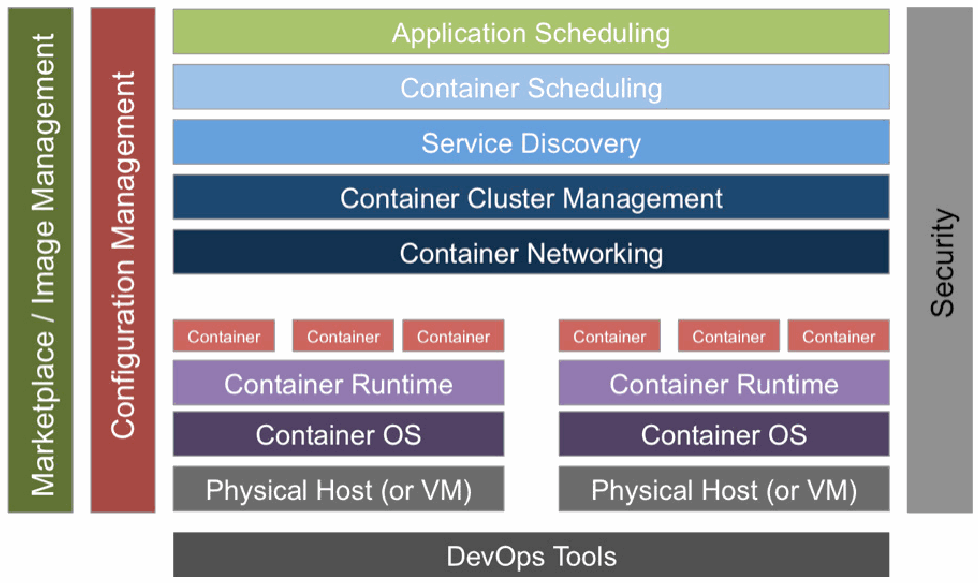
図32:コンテナ技術スタック。層構造の図である。中央に上から Application Scheduling(アプリケーションのスケジューリング)、Container Scheduling(コンテナのスケジューリング)、Service Discovery(サービスディスカバリ)、Container Cluster Management(コンテナクラスタ管理)、Container Networking(コンテナネットワーキング)が並ぶ。その下に同じ構成のスタックが2つあり、それぞれ3つの Container(コンテナ)の下に Container Runtime(コンテナランタイム)、Container OS(コンテナ OS)、Physical Host (or VM)(物理ホストまたは VM)が重なる。最下段の DevOps Tools(DevOps ツール)は両方にまたがる。縦の帯として、左に Marketplace / Image Management(マーケットプレイス/イメージ管理)と Configuration Management(構成管理)、右に Security(セキュリティ)がある。
Figure 32: Container Technology Stack
図32:コンテナ技術スタック
the OS component (shown as Container OS in Figure 32) and because of their ubiquitous usage in container deployments, NISTIR 8176 focused on Linux OS-based environments. This decision enabled detailed security assurance requirements to be defined. Furthermore, the team recognized that there are multiple hypervisor products for server virtualization in current infrastructures. This observation led the team to modify previous security recommendations to improve countermeasures against potential threats to the hypervisor. These countermeasures are agnostic to any specific architecture of the hypervisor platform. The modified recommendations were published for public comment in the second draft of SP 800-125A, Security Recommendations for Hypervisor Deployment (see https://csrc.nist.gov/publications/detail/sp/800-125a/draft).
OSコンポーネント(図32ではContainer OSとして示す)によって大きく異なること、またLinux OSベースの環境がコンテナの導入で広く使用されていることから、NISTIR 8176はLinux OSベースの環境に焦点を当てました。この決定により、詳細なセキュリティ保証要件を定義することが可能になりました。さらにチームは、現在のインフラストラクチャにはサーバ仮想化のためのハイパーバイザ製品が複数存在することを認識しました。この認識に基づき、チームは、ハイパーバイザに対する潜在的な脅威への対策を改善するため、以前のセキュリティ推奨事項を修正しました。これらの対策は、ハイパーバイザプラットフォームの特定のアーキテクチャに依存しません。修正された推奨事項は、SP 800-125A, Security Recommendations for Hypervisor Deploymentの第2草案(https://csrc.nist.gov/publications/detail/sp/800-125a/draft を参照)として、パブリックコメントに付すために公表されました。
NIST contributed significant material that led to the creation of ISO/IEC Committee Draft 21878, Security Guidelines for Design and Implementation of Virtualized Servers, in April 2017. The draft was co-edited by a CSD computer scientist and drew from information in seven NIST conference papers and four technical publications regarding security for the virtualized infrastructure.
NISTは、2017年4月のISO/IEC Committee Draft 21878, Security Guidelines for Design and Implementation of Virtualized Serversの作成につながる重要な資料を提供しました。この草案はCSDのコンピュータ科学者が共同編集したものであり、仮想化インフラストラクチャのセキュリティに関するNISTの会議論文7本および技術文書4本の情報に基づいています。
NIST recognizes that application container technology is being increasingly used to develop applications with microservices-based architectures. In FY 2018, this project plans to focus on security issues arising from technology components involved in that architecture. Developments in virtual networking and virtual storage technologies will be monitored to update our security recommendations for secure deployment of these technologies.
NISTは、マイクロサービスベースのアーキテクチャを持つアプリケーションの開発に、アプリケーションコンテナ技術がますます使用されるようになっていることを認識しています。2018会計年度に、本プロジェクトは、そのアーキテクチャに関わる技術コンポーネントから生じるセキュリティ上の問題に注力する計画です。仮想ネットワーキング技術および仮想ストレージ技術の動向を注視し、これらの技術を安全に導入するためのセキュリティ推奨事項を更新します。
CONTACT:
連絡先:
Dr. Ramaswamy Chandramouli (301) 975-5013 mouli@nist.gov
Dr. Ramaswamy Chandramouli (301) 975-5013 mouli@nist.gov
Cyber Threat Information Sharing
サイバー脅威情報の共有
As cyber attacks increase in both sophistication and frequency, it is important to collect and analyze cyber threat information from a variety of internal and external sources, and use it to develop, enhance, and deploy proactive, threat-informed, cyber defense capabilities. Cyber threat information includes indicators (i.e., artifacts or observable events that suggest that an attack is imminent, that an attack is underway, or that a compromise may have already occurred); information about the tactics, techniques, and procedures (TTPs) of actors; recommended courses of action; and other information that is used to characterize threats. Because threat actors often use the same TTPs against multiple targets, exchanging cyber threat information allows organizations to leverage the collective knowledge, experience, and analysis capabilities of their peers, thereby increasing the overall awareness and security of an entire sharing community. Through the exchange of cyber threat information, organizations can gain a more complete understanding of their threat environment by correlating their observations with those of others.
サイバー攻撃が高度化し、頻度も増すなか、組織内外のさまざまな情報源からサイバー脅威情報を収集・分析し、それを用いて、脅威情報に基づく能動的なサイバー防御能力を開発、強化および展開することが重要です。サイバー脅威情報には、インジケータ(すなわち、攻撃が差し迫っていること、攻撃が進行中であること、または侵害がすでに発生した可能性があることを示唆する痕跡や観測可能な事象)、攻撃者の戦術、技術および手順(TTP)に関する情報、推奨される対処方針、ならびに脅威を特徴づけるために用いられるその他の情報が含まれます。脅威アクターは複数の標的に対して同じTTPを用いることが多いため、サイバー脅威情報を交換することで、組織は同様の立場にある他の組織の知識、経験および分析能力を集合的に活用でき、それによって共有コミュニティ全体の認識とセキュリティが全般的に向上します。サイバー脅威情報の交換を通じて、組織は自らの観測結果を他組織のものと相関させ、自らの脅威環境をより完全に理解できます。
CSD has established a cyber threat information-sharing initiative, which is focused on providing guidance on how an organization can establish information sharing and coordination capabilities that enhance or augment their existing cybersecurity practices. The guidance covers threat-informed detection, protection and response capabilities; data privacy and sensitivity; data collection and retention practices; the use of open standards for information exchange; de-identification and anonymization; and guidance on how an organization can establish, participate in, and maintain coordination and information-sharing relationships. The guidance will help incident responders, network defenders, and operations personnel consider what information is sharable, the circumstances under which sharing is allowed, with whom the information may be shared, and how the information should be protected.
CSDはサイバー脅威情報共有の取り組みを立ち上げました。この取り組みは、組織が既存のサイバーセキュリティの実践を強化または補強する情報共有・調整能力をどのように確立できるかについてのガイダンスの提供に重点を置いています。このガイダンスは、脅威情報に基づく検知・防御・対応の能力、データのプライバシーと機微性、データの収集・保持の実践、情報交換のためのオープン標準の利用、非識別化と匿名化、および組織が調整・情報共有の関係をどのように確立し、それに参加し、維持できるかについてのガイダンスを対象とします。このガイダンスは、インシデント対応者、ネットワーク防御担当者および運用担当者が、どの情報が共有可能か、どのような状況で共有が許されるか、誰と情報を共有してよいか、そして情報をどのように保護すべきかを検討するのに役立ちます。
In October 2016, CSD published SP 800-150, Guide to Cyber Threat Information Sharing. This publication helps organizations prepare for an exchange of cyber threat information, both consuming cyber threat information from external sources and producing information for other organizations to use. Organizations may have different capabilities for detecting threats, responding to attacks, diagnosing causes, and handling sensitive incident-related information, but this guidance is intended to help organizations collaborate and exchange cyber threat information despite these organizational differences.
2016年10月、CSDはSP 800-150, Guide to Cyber Threat Information Sharingを公表しました。この文書は、組織がサイバー脅威情報の交換、すなわち外部の情報源からのサイバー脅威情報の利用と、他組織が利用する情報の作成の両方に備えるのに役立ちます。脅威の検知、攻撃への対応、原因の診断、およびインシデントに関連する機微な情報の取扱いに関する能力は組織によって異なりうますが、このガイダンスは、そうした組織間の違いがあっても、組織が協力してサイバー脅威情報を交換できるよう支援することを意図しています。
In May 2017, NIST conducted a Threat Intelligence Working Session as part of the Cybersecurity Framework Workshop. The working session provided an opportunity for attendees to provide comments on the use of cyber threat intelligence in the Framework, to help shape future enhancements to the Framework, and to share experiences regarding the use of cyber threat intelligence in the Framework. NIST used the feedback received during the workshop and the public review process as input when updating the Cybersecurity Framework Version 1.1 and its roadmap.
2017年5月、NISTはCybersecurity Framework Workshopの一環としてThreat Intelligence Working Sessionを実施しました。このワーキングセッションは、参加者が、Frameworkにおけるサイバー脅威インテリジェンスの利用についてコメントを寄せ、Frameworkの今後の改善の方向づけに寄与し、Frameworkにおけるサイバー脅威インテリジェンスの利用に関する経験を共有する機会となりました。NISTは、ワークショップおよびパブリックレビューの過程で寄せられたフィードバックを、Cybersecurity Framework Version 1.1とそのロードマップを更新する際の入力として用いました。
Throughout the year, CSD engaged with government, industry, and academia to research protocols, data models, and standards that enable cyber threat information sharing and support near real-time cybersecurity decision-making and security operations.
年間を通じて、CSDは政府、産業界および学術界と連携し、サイバー脅威情報の共有を可能にし、準リアルタイムのサイバーセキュリティ上の意思決定とセキュリティ運用を支えるプロトコル、データモデルおよび標準を研究しました。
In FY 2018, CSD plans to continue to conduct research, prepare guidance, and take part in standards development activities that foster greater interoperability and increase the operational tempo through near real-time cyber threat information sharing, including:
2018会計年度に、CSDは、準リアルタイムのサイバー脅威情報共有を通じて相互運用性を高め、運用のテンポを上げる研究の実施、ガイダンスの作成および標準開発活動への参加を継続する計画です。これには以下が含まれます。
•Expressing cyber threat information using machine-readable formats,
•機械可読な形式を用いたサイバー脅威情報の表現
•Developing automated mechanisms for exchanging cyber threat information,
•サイバー脅威情報を交換するための自動化されたメカニズムの開発
•Describing automated courses of action,
•自動化された対処方針の記述
•Publishing cyber threat information metadata, and
•サイバー脅威情報のメタデータの公開
•Safeguarding cyber threat information.
•サイバー脅威情報の保護
NIST will also help foster cyber threat information sharing by supporting information-sharing initiatives by public and private-sector organizations, including:
NISTはまた、以下を含む公共部門および民間部門の組織による情報共有の取り組みを支援することで、サイバー脅威情報の共有の促進に寄与します。
•Information Sharing and Analysis Centers (ISACs),
•Information Sharing and Analysis Centers(ISAC)
•Information Sharing and Analysis Organizations (ISAOs),
•Information Sharing and Analysis Organizations(ISAO)
•Federal/State/Local agencies,
•連邦・州・地方の機関
•Law Enforcement,
•法執行機関
•Fusion Centers, and
•Fusion Centers
•Sector Coordinating Councils.
•Sector Coordinating Councils
CONTACTS:
連絡先:
Mr. Christopher Johnson, (301) 975-3247, christopher.johnson@nist.gov
Mr. Christopher Johnson, (301) 975-3247, christopher.johnson@nist.gov
Mr. Lee Badger, (301) 975-3176, lee.badger@nist.gov
Mr. Lee Badger, (301) 975-3176, lee.badger@nist.gov
Mr. David Waltermire, (301) 975-3390, david.waltermire@nist.gov
Mr. David Waltermire, (301) 975-3390, david.waltermire@nist.gov
The Ontology of Authentication
認証のオントロジー
Over the past 30 years, NIST recommendations have included the usage of passwords, biometrics, authentication hardware devices, and Public Key Infrastructure (PKI) solutions for enterprise authentication applications. Recently, CSD began researching general authentication features. This investigation was prompted by the general call to move away from passwords toward the growing number of alternative authentication methods (e.g., biometrics, smart cards, etc.). A notional ontology of authentication is in development that includes a detailed taxonomy and an assessment approach to aid in definitively comparing alternatives.
過去30年にわたり、NISTの推奨事項には、エンタープライズの認証用途におけるパスワード、バイオメトリクス、認証用ハードウェアデバイスおよび公開鍵基盤(PKI)ソリューションの使用が含まれてきました。最近、CSDは認証の一般的な特性の研究を始めました。この調査は、パスワードから離れ、数が増えつつある代替の認証方式(例えば、バイオメトリクス、スマートカードなど)へ移行すべきだという一般的な要請を契機としています。現在、認証の概念的なオントロジーを開発中であり、これには詳細な分類体系と、代替手段を明確に比較するのに役立つ評価手法が含まれます。
As the research matures, it is possible to draft a concept map (see Figure 33) to highlight key components. There are many intertwining aspects of authentication, such as the relationships with Identity Management and Authorization. As more of the aspects of authentication are identified and defined, better development and use of authentication is expected.
研究が成熟するにつれ、主要な構成要素を明示する概念マップ(図33を参照)を起草することが可能になっています。認証には、アイデンティティ管理や認可との関係など、互いに絡み合う側面が数多くあります。認証の側面がより多く特定され定義されるにつれて、認証の開発と利用が改善されると期待されます。
The structure of the authentication taxonomy (see Figure 34) to encapsulate current and emerging mechanisms continues to be refined as recent updates expand the diversity of mechanisms. The taxonomy includes entity authentication as a wide assortment of commonly used human-machine, machine-machine, and human-human methods, all of which are termed confirmation. Attestation is the term used for affirming expectations of objects.
現行および新興のメカニズムを包含するための認証の分類体系の構造(図34を参照)は、最近の更新によってメカニズムの多様性が広がるなか、引き続き精緻化されています。この分類体系は、エンティティ認証を、一般に用いられる人間対機械、機械対機械、人間対人間の多種多様な方式として含んでおり、これらはすべてconfirmation(確認)と呼ばれます。attestation(アテステーション)は、オブジェクトに対する期待が満たされていることを確証することを指す用語です。
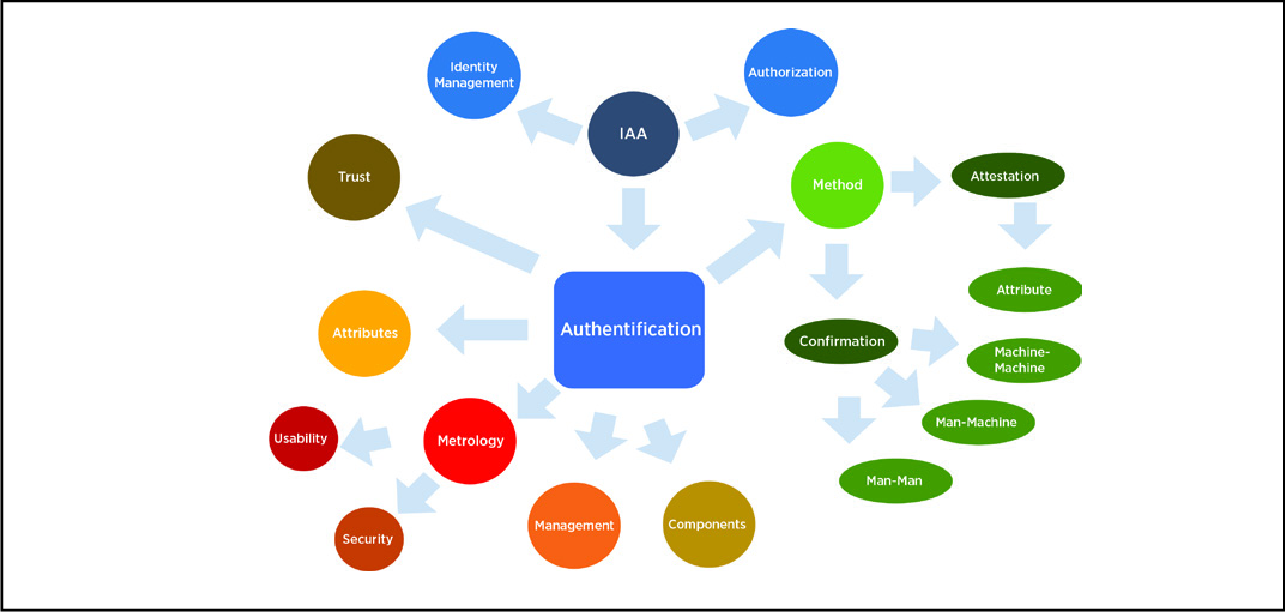
図33:認証の概念マップ草案。円を矢印で結んだ概念マップである。IAA から Identity Management(アイデンティティ管理)、Authorization(認可)、Authentification(原文の表記どおり。認証)へ矢印が向かう。Authentification から Trust(信頼)、Attributes(属性)、Metrology(計量)、Management(管理)、Components(構成要素)、Method(方法)へ矢印が向かう。Metrology から Usability(ユーザビリティ)と Security(セキュリティ)へ、Method から Attestation(証明)と Confirmation(確認)へ、Attestation から Attribute(属性)へ、Confirmation から Machine-Machine、Man-Machine、Man-Man へ矢印が向かう。
Figure 33: Draft Authentication Concept Map
図33:認証の概念マップ草案
The notional authentication ontology attempts to define an assessment framework that is useful for better understanding, comparing, and determining the appropriateness of authentication technologies to a specific use-case. The assessment framework separates attributes into security, usability, deployability, and manageability categories (see Figure 35). It is important to note that each category may overlap or impact the others. Security and usability are of special interest; while usability is often thought of as a tradeoff to security, both must be satisfied for the user to support the security of the system. To state the issue another way, there appears to be a relation between how much we must ask of the operator and how willing the operator is to support security rather than (mis)manage it.
この概念的な認証オントロジーは、認証技術をより良く理解し、比較し、特定のユースケースに対する適切性を判断するのに有用な評価フレームワークを定義しようとするものです。この評価フレームワークは、属性をセキュリティ、ユーザビリティ、導入容易性および管理容易性のカテゴリに分けます(図35を参照してください)。各カテゴリが他のカテゴリと重なったり、影響を及ぼしたりしうることに留意することが重要です。セキュリティとユーザビリティは特に関心の対象です。ユーザビリティはしばしばセキュリティとのトレードオフと考えられますが、ユーザがシステムのセキュリティを支えるためには、その両方が満たされなければなりません。この問題を言い換えれば、操作者にどれだけのことを求めなければならないかと、操作者がセキュリティを(誤って)管理するのではなく、どれだけ進んで支えようとするかとの間には、関係があるように見えます。
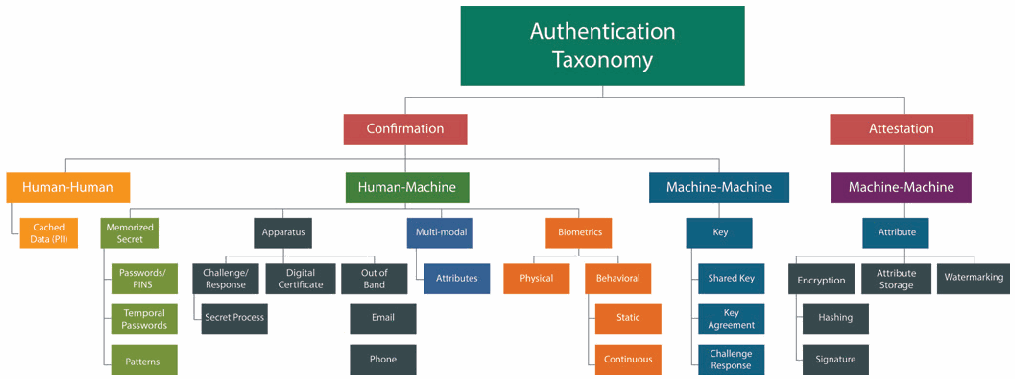
図34:認証の分類体系草案。最上位の Authentication Taxonomy(認証の分類体系)から Confirmation(確認)と Attestation(証明)に分かれる木構造である。Confirmation の下に Human-Human、Human-Machine、Machine-Machine、Attestation の下に Machine-Machine がある。Human-Human:Cached Data (PII)。Human-Machine:Memorized Secret(記憶シークレット。Passwords/PINS、Temporal Passwords、Patterns)、Apparatus(装置。Challenge/Response とその下の Secret Process、Digital Certificate、Out of Band とその下の Email と Phone)、Multi-modal(Attributes)、Biometrics(生体認証。Physical、Behavioral とその下の Static と Continuous)。Confirmation の Machine-Machine:Key(Shared Key、Key Agreement、Challenge Response)。Attestation の Machine-Machine:Attribute(Encryption とその下の Hashing と Signature、Attribute Storage、Watermarking)。原本では最下段の箱が下端で切れている。
Figure 34: Draft Authentication Taxonomy
図34:認証の分類体系草案
図35:認証の適合性評価枠組み。中央の2×2配置は左上がセキュリティ、右上が配備可能性、左下がユーザビリティ、右下が管理容易性。四区画の外側に上下左右へ向く矢印がある。 [装飾の画像。本文を読むのに必要のない装飾のため、この非公式サイトには掲載していません。原本 PDF を参照してください。]
Figure 35: Suitability Framework for Authentication
図35:認証の適合性フレームワーク
Specific methods of assessment in these categories are not developed and are expected to be unique to each authentication mechanism and dependent on the environment. The assessment framework also includes integration with the programmatic categories of deployability and manageability. What is known is that these are unlikely to be reduced to a single value, but will have to be assessed across several independent constructs.
これらのカテゴリにおける具体的な評価方法は開発されておらず、認証メカニズムごとに固有で、環境に依存するものになると予想されます。この評価フレームワークには、導入容易性および管理容易性というプログラム面のカテゴリとの統合も含まれます。分かっているのは、これらが単一の値に集約される見込みは低く、いくつかの独立した構成概念にわたって評価しなければならないということです。
Future programmatic efforts will be focused toward a NISTIR to describe the research results, encourage further discussion with the community, and provide recommendations for future standards development efforts. The goal is to move toward specifying independent strength requirements rather than specific implementation requirements. Upon completion of the NISTIR, work will begin on a suitability matrix that will aid the user in determining how best to apply and assess the assessment framework. Concerns as to the adoptability of this approach will be addressed. Additional work to identify interdependencies among identity management and authorization controls and requirements should aid in unifying the approach. As a clear assessment approach is defined, future identity management, authentication, and authorization process implementations can address vulnerabilities of individual or combined solutions.
今後のプログラム面の取り組みは、研究結果を記述し、コミュニティとのさらなる議論を促し、将来の標準開発の取り組みに向けた推奨事項を示すNISTIRの作成に向けられます。目標は、特定の実装要件ではなく、独立した強度要件を規定する方向へ進むことです。このNISTIRの完成後、評価フレームワークをどのように適用し評価するのが最善かをユーザが判断するのに役立つ適合性マトリクスの作業を開始します。このアプローチの採用可能性に関する懸念にも対処します。アイデンティティ管理と認可の管理策および要件の間の相互依存関係を特定する追加の作業は、アプローチの統一に役立つはずです。明確な評価手法が定義されれば、将来のアイデンティティ管理、認証および認可のプロセスの実装は、個々のソリューションまたは組み合わせたソリューションの脆弱性に対処できるようになります。
CONTACT:
連絡先:
Dr. Kim Schaffer, (301) 975-8375, kim.schaffer@nist.gov
Dr. Kim Schaffer, (301) 975-8375, kim.schaffer@nist.gov
Cognitive-based Approach to System Security Assessment (CASSA)
システムセキュリティ評価への認知ベースのアプローチ(CASSA)
The increase in information systems’ complexity, due to the aggregation of broader-spectrum services and functionality within one system, challenges security professionals that are required to plan, analyze, design, implement and maintain systems compliant to various regulatory requirements supported by diverse sets of security controls, processes and procedures. For example, Veteran Affairs’ hospital systems are often required to meet FISMA, Payment Card Industry (PCI) and Health Insurance Portability and Accountability Act (HIPAA) requirements simultaneously. Assessing and maintaining the security posture of such complex information systems through manual procedures leveraging paper-driven approaches is colossal, inefficient, and often unreliable.
より広範なサービスと機能が1つのシステムに集約されることによる情報システムの複雑さの増大は、多様なセキュリティ管理策、プロセスおよび手順に支えられたさまざまな規制要件に適合するシステムを計画、分析、設計、実装および維持することを求められるセキュリティ専門家にとって、難題となっています。例えば、退役軍人省の病院システムは、FISMA、Payment Card Industry(PCI)およびHealth Insurance Portability and Accountability Act(HIPAA)の要件を同時に満たすことを求められることが多くあります。このような複雑な情報システムのセキュリティ態勢を、紙ベースの手法に頼った手作業の手順で評価し維持することは、膨大な作業であり、非効率で、しばしば信頼性に欠けます。
NIST is researching methodologies for enhancing the security assessment and the near-real-time monitoring of complex systems. The team is leveraging cognitive approaches to provide continuous feedback by highlighting relevant threats, rendering security enhancements, or augmenting solutions to maintain/increase systems’ security postures.
NISTは、複雑なシステムのセキュリティ評価と準リアルタイムの監視を強化するための方法論を研究しています。チームは認知的アプローチを活用して、関連する脅威を明示し、セキュリティ強化策を提示し、またはソリューションを補強することで継続的なフィードバックを提供し、システムのセキュリティ態勢を維持・向上させようとしています。
During FY 2017, NIST completed a feasibility assessment and created the project’s research plan, identifying milestones and deliverables. In FY 2018 and subsequent years, the team will continue the Cognitive-based Approach to Security Controls Assessment (CASSA) by researching methods to:
2017会計年度に、NISTは実現可能性の評価を完了し、マイルストーンと成果物を特定したプロジェクトの研究計画を作成しました。2018会計年度以降、チームは、以下を行う方法を研究することにより、Cognitive-based Approach to Security Controls Assessment(CASSA)を継続します。
•Identify the relationships between implemented security and privacy controls for a targeted information system;
•対象とする情報システムに実装されたセキュリティ管理策とプライバシー管理策の間の関係を特定します。
•Analyze the implementation of the security and privacy controls, providing, as feedback, a rendered set of suggestions to enhance the security posture of the system;
•セキュリティ管理策およびプライバシー管理策の実装を分析し、システムのセキュリティ態勢を強化するための一連の提案をフィードバックとして提示します。
•Identify documented and undocumented vulnerabilities relevant to the system;
•システムに関連する、文書化された脆弱性および文書化されていない脆弱性を特定します。
•Identify the minimum-resistance penetration path into the system, providing, as feedback, rendered recommendations for mitigating the risk; and
•システムへの最小抵抗の侵入経路を特定し、リスクを緩和するための推奨事項をフィードバックとして提示します。
•Perform continuous monitoring and analysis of the system, factoring in the above steps while providing rendered suggestions for system enhancements.
•上記の各ステップを考慮に入れてシステムの継続的な監視と分析を行い、システム強化のための提案を提示します。
CONTACTS:
連絡先:
Dr. Michaela Iorga, (301) 975-8431, michaela.iorga@nist.gov
Dr. Michaela Iorga, (301) 975-8431, michaela.iorga@nist.gov
Dr. Dmitry Cousin, (301) 975-5727, dmitry.cousin@nist.gov
Dr. Dmitry Cousin, (301) 975-5727, dmitry.cousin@nist.gov
Open Security Controls Assessment Language (OSCAL)
Open Security Controls Assessment Language(OSCAL)
NIST is proposing the development of the Open Security Controls Assessment Language, or OSCAL, a hierarchical, formatted, XML-based (and JSON translation) schema that provides a standard for representing different categories of information pertaining to the publication, implementation, and assessment of security controls.
NISTは、Open Security Controls Assessment Language(OSCAL)の開発を提案しています。OSCALは、階層的で書式化された、XMLベースの(およびJSONへの変換を備えた)スキーマであり、セキュリティ管理策の公表、実装および評価に関するさまざまなカテゴリの情報を表現するための標準を提供します。
OSCAL is attempting to address a number of challenges around security controls and security controls assessment. The core challenge, and one of the primary reasons for creating OSCAL, is that concepts like security controls and profiles are represented today largely in proprietary ways. In many cases they are written in prose documents that are imprecise, lead to differences in interpretation, and are not machine-readable, meaning that the prose instructions require someone to do data entry into a tool in order for the tool to use the information.
OSCALは、セキュリティ管理策およびセキュリティ管理策の評価をめぐる多くの課題に対処しようとしています。中核となる課題であり、OSCALを作成する主な理由の1つでもあるのは、セキュリティ管理策やプロファイルといった概念が、今日では主に独自の方法で表現されていることです。多くの場合、それらは散文の文書で書かれており、不正確で、解釈の違いを生み、機械可読ではありません。つまり、ツールがその情報を使用するには、散文で書かれた指示を誰かがツールにデータ入力する必要があります。
Organizations are also struggling with information systems that have many different components, and some components require the use of different profiles per component, which is commonly the case with cloud environments. Also, the cloud environments can be multitenant or have mixed ownership of components. We need to be able to assess the security of these systems against a number of requirements, owners, etc.—to do this simultaneously and provide these views to stakeholders.
組織はまた、多数の異なるコンポーネントを持つ情報システムにも苦慮しており、コンポーネントごとに異なるプロファイルの使用を必要とするコンポーネントもあります。これはクラウド環境ではよくあることです。また、クラウド環境はマルチテナントであったり、コンポーネントの所有者が混在していたりすることがあります。我々は、こうしたシステムのセキュリティを多数の要件、所有者などに照らして評価できる必要があります。しかもそれを同時に行い、これらのビューをステークホルダーに提供できなければなりません。
In addition, there are situations where a single system needs to support multiple regulatory frameworks. For example, the U.S. Department of Veterans Affairs is a federal agency (with Federal Information Security Modernization Act (FISMA) and NIST Cybersecurity Framework requirements) and a healthcare institution (with Health Insurance Portability and Accountability Act (HIPAA) requirements) that has credit card transactions (with requirements specified in the Payment Card Industry Data Security Standard (PCI DSS)). There is no shortage of requirements for some organizations that have multiple regulatory frameworks. Assessing a plethora of security controls rooted on different standards with different formatting is a complex process that is currently largely manual or leverages proprietary, specifically customized approaches and tools.
加えて、単一のシステムが複数の規制の枠組みに対応しなければならない状況もあります。例えば、U.S. Department of Veterans Affairsは、連邦機関(Federal Information Security Modernization Act (FISMA)およびNIST Cybersecurity Frameworkの要件が課される)であると同時に医療機関(Health Insurance Portability and Accountability Act (HIPAA)の要件が課される)でもあり、さらにクレジットカード取引(Payment Card Industry Data Security Standard (PCI DSS)に定められた要件が課される)も扱っています。複数の規制の枠組みが適用される組織の中には、要件に事欠かないところもあります。書式の異なるさまざまな標準に由来する多数のセキュリティ管理策を評価することは複雑なプロセスであり、現在のところ大部分が手作業で行われているか、独自に個別カスタマイズされた手法やツールに頼っています。
OSCAL attempts to standardize how security controls are represented, how a control implementation for a given system is represented, and how that information is best used. It supports the generation of standardized reports that can be used by both humans and machines. That means that formats are needed that can be generated by machines for communicating with other machines, but can also be easily reformatted so that humans can read the information. By standardizing the representation of this information, OSCAL information can be interoperable because of a well-defined specification with information that’s going to be used, imported, and subsquently used for security control assessments. The goal is to keep OSCAL as simple as possible and provide extensive automation for tools it uses.
OSCALは、セキュリティ管理策の表現方法、特定のシステムにおける管理策の実装の表現方法、およびそれらの情報の最適な利用方法を標準化しようとするものです。OSCALは、人間と機械の双方が利用できる標準化された報告書の生成を支援します。つまり、機械が他の機械と通信するために生成でき、かつ人間がその情報を読めるように容易に再整形できる形式が必要になります。こうした情報の表現を標準化することで、OSCALの情報は相互運用可能になります。利用され、インポートされ、その後セキュリティ管理策の評価に用いられる情報について、明確に定義された仕様があるためです。目標は、OSCALを可能な限り単純に保ち、OSCALが使用するツールに広範な自動化を提供することです。
During FY 2017, NIST focused on developing the control catalog schema and the profile schema, focusing on addressing a large number of user stories that describe features, attributes or characteristics. The team validated the approach with use cases from SP 800-53 Rev. 4, SP 800-53 Rev. 5 (draft), ISO/IEC 27001 and 27002, and COBIT 5.
2017会計年度に、NISTは管理策カタログのスキーマとプロファイルのスキーマの開発に注力し、機能、属性または特性を記述した多数のユーザーストーリーへの対応に重点を置きました。チームは、SP 800-53 Rev. 4、SP 800-53 Rev. 5(草案)、ISO/IEC 27001および27002、ならびにCOBIT 5のユースケースを用いてこの手法の妥当性を確認しました。
In the next year, NIST will continue the development of the other schemas pertaining to the project (e.g., the framework schema, implementation schema and System Security Plan (SSP) representation, assessment schema, etc.).
来年度、NISTはこのプロジェクトに関わるその他のスキーマ(例えば、フレームワークスキーマ、実装スキーマおよびSystem Security Plan (SSP)の表現、評価スキーマなど)の開発を継続します。
CONTACTS:
連絡先:
Dr. Michaela Iorga, (301) 975-8431, michaela.iorga@nist.gov
Dr. Michaela Iorga, (301) 975-8431, michaela.iorga@nist.gov
Mr. David Waltermire, (301) 975-3390, david.waltermire@nist.gov
Mr. David Waltermire, (301) 975-3390, david.waltermire@nist.gov
NATIONAL CYBERSECURITY CENTER OF EXCELLENCE
国立サイバーセキュリティ・センター・オブ・エクセレンス
The National Cybersecurity Center of Excellence (NCCoE), established in 2012 by NIST in partnership with the State of Maryland and Montgomery County, Md., is a collaborative hub – convening experts from industry, academia, and government to work on critical problems in cybersecurity. The NCCoE’s collaborations focus on providing practical guidance to technical, real-world cybersecurity challenges using standards-based, commercially available technologies.
国立サイバーセキュリティ・センター・オブ・エクセレンス(NCCoE)は、NISTがメリーランド州及びメリーランド州モンゴメリー郡と連携して2012年に設立した協働の拠点であり、産業界、学術界及び政府の専門家を集めて、サイバーセキュリティにおける重要な問題に取り組んでいます。NCCoEの協働は、標準に基づく市販の技術を用いて、技術的で現実的なサイバーセキュリティの課題に対する実践的なガイダンスを提供することに焦点を当てています。
Project Lifecycle
プロジェクトのライフサイクル
To help accelerate businesses’ adoption of standards-based, secure technologies, the NCCoE works collaboratively with stakeholders to:
標準に基づく安全な技術を企業が採用するのを加速させるために、NCCoEは利害関係者と協力して次のことを行う:
•Define and articulate: The NCCoE works with industry stakeholders, cybersecurity professionals, academic experts, government agencies, and others to identify and define pressing cybersecurity issues.
•定義と明確化:NCCoEは、業界のステークホルダー、サイバーセキュリティの専門家、学術界の専門家、政府機関などと協力し、差し迫ったサイバーセキュリティ上の課題を特定して定義します。
•Organize and engage: The NCCoE then collaborates with stakeholders to refine a project’s scope and develop detailed technical descriptions of the problem. The NCCoE also engages technology vendors via an open call through the Federal Register, to build a potential example solution.
•組織化と関与:続いてNCCoEは、ステークホルダーと協力してプロジェクトの範囲を絞り込み、問題の詳細な技術的記述を作成します。また、Federal Registerによる公募を通じて技術ベンダーの参加を得て、解決策の例となりうるものを構築します。
•Implement and test: The NCCoE works with technology vendors that have standards-based, commercially available products that can be used as part of the example implementation. These vendors sign a Cooperative Research and Development Agreement (CRADA) and help build a reference design, identify gaps in the build; and refine the example implementation until there is a practical, usable, repeatable reference design that addresses the business problem.
•実装と試験:NCCoEは、実装例の一部として使用できる、標準に基づいた市販製品を持つ技術ベンダーと協力します。これらのベンダーはCooperative Research and Development Agreement (CRADA)に署名し、リファレンス設計の構築と、構築物におけるギャップの特定を支援します。さらに、ビジネス上の問題に対処する、実用的で使いやすく再現可能なリファレンス設計が得られるまで、実装例の改良を支援します。
•Publish and transfer: The NCCoE provides details of the reference design, standards mapping, lab implementation, and more in a NIST SP 1800 series, a three-volume document that provides applicable guidance for executives, CISOs or IT directors, and IT staff.
•公表と移転:NCCoEは、リファレンス設計、標準へのマッピング、ラボでの実装などの詳細をNIST SP 1800シリーズとして提供します。これは3巻構成の文書であり、経営幹部、CISOまたはIT責任者、ITスタッフのそれぞれに適した手引きを提供します。
Types of Collaborators & Partnerships
協力者とパートナーシップの種類
Vendors, industry stakeholders, academic experts and others participate in the center through a variety of collaborative mechanisms as described below:
ベンダー、業界のステークホルダー、学術界の専門家などは、以下に述べるさまざまな協力の仕組みを通じてセンターに参加します。
•Communities of Interest: A Community of Interest (COI) is a group of professionals and advisors that share business insights, technical expertise, challenges, and perspectives to guide NCCoE projects. The NCCoE relies on this robust collaboration with experts and innovators to provide real-world cybersecurity challenges and inform the reference designs for standards-based cybersecurity integrations that address business needs.
•Communities of Interest:Community of Interest (COI)は、ビジネス上の知見、技術的専門知識、課題、視点を共有してNCCoEのプロジェクトを導く、専門家と助言者のグループです。NCCoEは、専門家やイノベーターとのこの強固な協力に依拠して、現実世界のサイバーセキュリティ上の課題の提供を受け、ビジネス上のニーズに対処する標準ベースのサイバーセキュリティ統合のリファレンス設計に知見を反映させています。
•Technology Collaborators: Vendors who would like to participate in a center project reply to a Federal Register call for participation. Vendors who are chosen to participate sign a CRADA and contribute their expertise, hardware, or software to the reference design for a specific problem.
•Technology Collaborators:センターのプロジェクトへの参加を希望するベンダーは、Federal Registerに掲載される参加募集に応募します。参加者として選ばれたベンダーはCRADAに署名し、特定の問題に対するリファレンス設計に、自社の専門知識、ハードウェア、またはソフトウェアを提供します。
•National Cybersecurity Excellence Partnership (NCEP): The NCCoE also works with technology vendors via the NCEP program, wherein vendors sign MOUs to establish a deeper partnership with the NCCoE. NCEPs can provide hardware, software, knowledge, personnel, and can designate guest researchers to work at the center in person or remotely. The NCCoE currently has 31 NCEPs, from Fortune 50 market leaders to smaller companies specializing in IT security.
•National Cybersecurity Excellence Partnership (NCEP):NCCoEは、NCEPプログラムを通じても技術ベンダーと協力しています。このプログラムでは、ベンダーがMOUに署名し、NCCoEとのより深いパートナーシップを確立します。NCEPは、ハードウェア、ソフトウェア、知識、人員を提供でき、センターに常駐して、または遠隔で作業する客員研究員を指名できます。NCCoEには現在、Fortune 50に入る市場のリーダーからITセキュリティを専門とする小規模な企業まで、31のNCEPがあります。
For more information on NCCoE Partnerships, see https://nccoe.nist.gov/partners.
NCCoEのパートナーシップの詳細については、https://nccoe.nist.gov/partners を参照のこと。
SP 1800 Series: Practical Cybersecurity Guidance
SP 1800シリーズ:実践的なサイバーセキュリティの手引き
NCCoE projects result in a NIST Special Publication (SP) 1800 document – a three-volume practice guide, which is a complement to NIST’s SP 800 series documents. SP 1800 documents contain an Executive Summary for business executives, a second volume for security program managers that details security approaches and maps security capabilities to the NIST Cybersecurity Framework as well as other relevant standards, and a third volume for the cybersecurity implementation staff that details the steps needed for another entity to recreate the NCCoE’s example solution.
NCCoEのプロジェクトの成果は、NIST Special Publication (SP) 1800文書となります。これは3巻構成の実践ガイドであり、NISTのSP 800シリーズの文書を補完するものです。SP 1800文書は、企業の経営幹部向けのExecutive Summary、セキュリティプログラムの管理者向けの第2巻、サイバーセキュリティの実装担当者向けの第3巻からなります。第2巻は、セキュリティのアプローチを詳述し、セキュリティ機能をNIST Cybersecurity Frameworkやその他の関連する標準に対応付けます。第3巻は、他の組織がNCCoEの解決策の例を再現するために必要な手順を詳述します。
In FY 2017, the center published seven practice guides (up from two in FY 2016 and three in FY 2015) that provide practical guidance, including a reference design and implementation details, on standards-based secure technologies:
2017会計年度に、同センターは、標準に基づく安全な技術について、参照設計や実装の詳細を含む実践的なガイダンスを提供するプラクティスガイドを7件公表しました(2016会計年度の2件、2015会計年度の3件から増加)。
1.SP 1800-3, Revision 2, Attribute Based Access Control;
1.SP 1800-3, Revision 2, Attribute Based Access Control、
2.SP 1800-6, DNS-Based Email Security;
2.SP 1800-6, DNS-Based Email Security、
3.SP 1800-7, Situational Awareness for the Electric Utilities;
3.SP 1800-7, Situational Awareness for the Electric Utilities、
4.SP 1800-8, Securing Wireless Infusion Pumps in Healthcare Delivery Organizations;
4.SP 1800-8, Securing Wireless Infusion Pumps in Healthcare Delivery Organizations、
5.SP 1800-9, Managing Access Rights in the Financial Services Sector;
5.SP 1800-9, Managing Access Rights in the Financial Services Sector、
6.SP 1800-11, Data Integrity: Recovering from Ransomware and Other Destructive Events; and
6.SP 1800-11, Data Integrity: Recovering from Ransomware and Other Destructive Events、および
7.SP 1800-12, Derived Personal Identity Verification (PIV) Credentials.
7.SP 1800-12, Derived Personal Identity Verification (PIV) Credentials。
For more information about NCCoE projects, visit https://nccoe.nist.gov/projects.
NCCoEのプロジェクトの詳細については、https://nccoe.nist.gov/projects を参照のこと。
Example: Impact of Guidance on Wireless Infusion Pumps
事例:無線輸液ポンプに関するガイダンスの影響
Medical devices like infusion pumps were once standalone instruments. Today, infusion pumps connect wirelessly to a variety of healthcare systems, networks, and other devices. Connecting infusion pumps to point-of-care medication systems and electronic health records can improve healthcare delivery processes, but it also increases cybersecurity risks that could affect operations or safety. Tampering with the wireless infusion pump ecosystem, whether intentionally or otherwise, can expose a healthcare delivery organization to serious risks, including breaches of protected health information, loss or disruption of healthcare services, damage to an organization’s reputation, productivity, and revenue, or even loss of life.
輸液ポンプのような医療機器は、かつては単体で動作する機器でした。今日、輸液ポンプはさまざまな医療システム、ネットワーク、その他の機器に無線で接続します。輸液ポンプをポイントオブケアの投薬システムや電子健康記録に接続すれば、医療提供のプロセスを改善できますが、業務や安全に影響を及ぼしうるサイバーセキュリティリスクも増大します。無線輸液ポンプのエコシステムに対する改ざんは、意図的か否かにかかわらず、医療提供組織を重大なリスクにさらしうます。こうしたリスクには、保護対象保健情報の侵害、医療サービスの喪失または中断、組織の評判、生産性および収益への損害、さらには人命の喪失が含まれます。
The NCCoE worked with a community-of-interest made up of various components of the healthcare ecosystem to define the challenge of using wireless infusion pumps securely, identify relevant standards and best practices, and create a representative architecture.
NCCoEは、医療エコシステムのさまざまな構成主体からなる関係者コミュニティ(community-of-interest)と協力して、無線輸液ポンプを安全に使用するうえでの課題を定義し、関連する標準とベストプラクティスを特定し、代表的なアーキテクチャを作成しました。
The NCCoE then developed a lab implementation to demonstrate how healthcare delivery organizations can use standards-based, commercially available cybersecurity technologies and industry best practices. Working with five major infusion pump manufacturers, which accounted for 85 % of the market in America, and innovative cybersecurity technology vendors, the NCCoE helped highlight where security capabilities could be built into the pumps to strengthen the cybersecurity of the devices, pump ecosystem, and healthcare enterprise. This has led to multiple pump manufacturers incorporating security capabilities into the next generation versions of their pumps.
次にNCCoEは、医療提供組織が、標準に基づく市販のサイバーセキュリティ技術と業界のベストプラクティスをどのように利用できるかを実証するため、ラボ実装を開発しました。NCCoEは、米国市場の85 %を占める大手輸液ポンプメーカー5社、および革新的なサイバーセキュリティ技術ベンダーと協力し、機器、ポンプのエコシステム、および医療事業体のサイバーセキュリティを強化するために、ポンプのどこにセキュリティ機能を組み込めるかを明らかにすることに貢献しました。その結果、複数のポンプメーカーが自社ポンプの次世代版にセキュリティ機能を組み込むに至っています。
Collaborating Across Government
政府横断の協力
The NCCoE’s Work for Others (WFO) Program, governed by the NCCoE’s Program Management Office (PMO), facilitates the engagement of other agencies with NIST’s National Cybersecurity Federally Funded Research and Development Center (FFRDC). Since 2015, the WFO program has continuously grown and currently has several interagency agreements in place, which support projects for the U.S. Coast Guard, the U.S. Department of Transportation, the U.S. Air Force, and the Department of Homeland Security.
NCCoEのWork for Others (WFO) Programは、NCCoEのProgram Management Office (PMO)が統括しており、NISTのNational Cybersecurity Federally Funded Research and Development Center (FFRDC)に他の機関が関与することを促進します。2015年以降、WFOプログラムは継続的に拡大しており、現在は複数の省庁間協定が締結されています。これらの協定は、U.S. Coast Guard、U.S. Department of Transportation、U.S. Air Force、および国土安全保障省のためのプロジェクトを支えています。
Example of Government Collaboration: U.S. Coast Guard and Sector CSF Profiles
政府との協力の例:U.S. Coast Guardとセクター別CSFプロファイル
In early FY 2017, the U.S. Coast Guard (USCG) and industry representatives worked with NIST to develop the Maritime Bulk Liquids Transfer Cybersecurity Framework (CSF) Profile. This profile template helps organizations in the complex and sophisticated supply chain of the oil and natural gas industry assess and monitor their cybersecurity risk (see https://www.dco. uscg.mil/Portals/9/CG-FAC/Documents/Maritime_BLT_CSF.pdf?ver=2017-07-19-070544-223). Building on the success of this CSF profile, the USCG asked for two more profiles to be completed: Mobile Off-Shore Drilling Units and Passenger Vessels.
2017会計年度の初めに、U.S. Coast Guard (USCG)と業界の代表者は、NISTと協力してMaritime Bulk Liquids Transfer Cybersecurity Framework (CSF) Profileを策定しました。このプロファイルのテンプレートは、石油・天然ガス産業の複雑で高度なサプライチェーンに属する組織が、自らのサイバーセキュリティリスクを評価し監視するのに役立つ(https://www.dco. を参照
The goal of these profiles is to provide maritime sub-sectors with guidance for applying the CSF, leveraging the framework to create a sub-sector profile that individual companies can tailor and use to prioritize resources and identify cybersecurity gaps. This project has helped showcase how the NCCoE can apply standards and best practices to real-world industry challenges to help companies more easily take advantage of existing guidance.
これらのプロファイルの目標は、海事のサブセクターにCSFを適用するための手引きを提供することであり、このフレームワークを活用してサブセクターのプロファイルを作成します。個々の企業は、このプロファイルを自社に合わせて調整し、リソースの優先順位付けとサイバーセキュリティ上のギャップの特定に使用できます。このプロジェクトは、NCCoEが標準とベストプラクティスを現実世界の業界の課題に適用し、企業が既存の手引きをより容易に活用できるよう支援できることを示すのに役立ちました。
Workshops & Events
ワークショップとイベント
図36:インターネットおよび通信エコシステムのレジリエンス向上ワークショップの会場写真。講演者が登壇し、参加者が聴講している。背景パネルにはメリーランド州、NIST、NCCoEのロゴが見える。スクリーンには世界地図と小さな英語の見出しが投影されているが、詳細な文字は判読困難。 [NIST のロゴが写っている図。公的な標章のため、この非公式サイトには掲載していません。原本 PDF を参照してください。]
Figure 36: The Enhancing Resilience of the Internet and Communications Ecosystem Workshop
図36:Enhancing Resilience of the Internet and Communications Ecosystem Workshop
Throughout FY 2017, the NCCoE hosted and participated in numerous workshops to define, refine, and provide guidance on technical cybersecurity challenges facing businesses today.
2017会計年度を通じて、NCCoEは数多くのワークショップを主催し、またそれらに参加して、今日の企業が直面する技術的なサイバーセキュリティ上の課題を定義し、絞り込み、それらに関する手引きを提供しました。
For example, the NCCoE hosted NIST’s Workshop on “Enhancing Resilience of the Internet and Communications Ecosystem,” which brought together over a hundred cybersecurity technologists, vendors, researchers, and subject matter experts. Executive Order 13800, “Strengthening the Cybersecurity of Federal Networks and Critical Infrastructure,” required the Secretaries of Commerce and Homeland Security to “jointly lead an open and transparent process to identify and promote action by appropriate stakeholders to improve the resilience of the internet and communications ecosystem and to encourage collaboration with the goal of dramatically reducing threats perpetrated by automated and distributed attacks (e.g., botnets).” The workshop was designed to allow stakeholders to explore a range of current and emerging solutions addressing automated, distributed threats in an open and transparent manner. The workshop’s proceedings were detailed in NISTIR 8192, published in FY 2017 (see https://csrc.nist.gov/publications/detail/nistir/8192/final). Beyond NISTIR 8192, the workshop led to the launch of two new NCCoE projects: Mitigating IoT Based Automated Distributed Threats and TLS Server Certificate Management.
例えば、NCCoEはNISTのワークショップ“Enhancing Resilience of the Internet and Communications Ecosystem”を主催しました。このワークショップには、100人を超えるサイバーセキュリティの技術者、ベンダー、研究者、および当該分野の専門家が集まりました。Executive Order 13800 “Strengthening the Cybersecurity of Federal Networks and Critical Infrastructure”は、商務長官と国土安全保障長官に対し、「インターネットと通信のエコシステムのレジリエンスを向上させるための適切なステークホルダーによる行動を特定して促進し、自動化された分散型の攻撃(例えばボットネット)による脅威を劇的に減らすことを目標として協力を奨励する、開かれた透明性のあるプロセスを共同で主導する」ことを求めました。このワークショップは、自動化された分散型の脅威に対処する現行および新興のさまざまな解決策を、ステークホルダーが開かれた透明性のある形で検討できるように設計されました。ワークショップの議事内容は、2017会計年度に公表されたNISTIR 8192に詳述されています(https://csrc.nist.gov/publications/detail/nistir/8192/final を参照してください)。NISTIR 8192に加えて、このワークショップはNCCoEの2つの新規プロジェクト、Mitigating IoT Based Automated Distributed ThreatsとTLS Server Certificate Managementの立ち上げにつながりました。
Additionally, the regularly held NCCoE Speaker Series showcases thought leaders that highlight critical cybersecurity issues of national importance across various industries. The Speaker Series is jointly hosted by the NCCoE, Maryland Department of Commerce, and Montgomery County Department of Economic Development in collaboration with the Maryland Tech Council. This year, the NCCoE hosted four Speaker Series events, whose topics ranged from how small businesses can utilize the NIST CSF, to cybersecurity threats in the hospitality sector, to the psychology behind insider threats.
さらに、定期的に開催されるNCCoE Speaker Seriesでは、さまざまな業界にまたがる国家的に重要なサイバーセキュリティ上の重大な問題を取り上げるオピニオンリーダーを紹介しています。このSpeaker Seriesは、NCCoE、Maryland Department of Commerce、およびMontgomery County Department of Economic Developmentが、Maryland Tech Councilと協力して共催しています。今年、NCCoEはSpeaker Seriesのイベントを4回開催しました。その主題は、小規模企業がNIST CSFをどのように活用できるかから、ホスピタリティ分野におけるサイバーセキュリティ上の脅威、内部者による脅威の背後にある心理にまで及びました。
The NCCoE also hosted multiple in-person workshops with its NCEP partners – in February at the RSA Conference and in September at Juniper Networks’ headquarters in Sunnyvale, CA. The workshops brought together dozens of top cybersecurity experts from nearly all the partner organizations to discuss critical cybersecurity challenges, from identity to artificial intelligence, that may benefit from NCCoE guidance.
NCCoEはまた、NCEPパートナーとの対面のワークショップを複数回開催しました。2月にはRSA Conferenceで、9月にはカリフォルニア州SunnyvaleにあるJuniper Networksの本社で開催しました。これらのワークショップには、ほぼすべてのパートナー組織から数十人の一流のサイバーセキュリティ専門家が集まり、アイデンティティから人工知能まで、NCCoEの手引きが役立ちうるサイバーセキュリティ上の重大な課題について議論しました。
Learn more about the NCCoE’s events at https://nccoe.nist.gov/events.
NCCoEのイベントの詳細については、https://nccoe.nist.gov/events を参照のこと。
Looking Ahead
今後の展望
Building on the robust stakeholder engagement seen in FY 2017, the NCCoE expects to accelerate the number of projects undertaken in FY 2018, reinforcing the importance of the Healthcare, Financial Services, and Energy industries as well as expanding work in identity and access management, the Internet of Things, and Internet infrastructure.
2017会計年度に見られたステークホルダーの活発な関与を土台として、NCCoEは2018会計年度に着手するプロジェクトの数を加速的に増やすことを見込んでいます。これにより、ヘルスケア、金融サービス、エネルギーの各業界の重要性を改めて強調するとともに、アイデンティティおよびアクセス管理、Internet of Things、インターネットインフラストラクチャにおける取り組みを拡大します。
FOR MORE INFORMATION SEE:
詳細情報:
https://nccoe.nist.gov
https://nccoe.nist.gov
CONTACTS:
連絡先:
Ms. Donna Dodson, (301) 975-3669, donna.dodson@nist.gov
Ms. Donna Dodson, (301) 975-3669, donna.dodson@nist.gov
Mr. Tim McBride, (301) 975-0214, timothy.mcbride@nist.gov
Mr. Tim McBride, (301) 975-0214, timothy.mcbride@nist.gov
Mr. Tim Polk, (301) 975-3348, william.polk@nist.gov
Mr. Tim Polk, (301) 975-3348, william.polk@nist.gov
Ms. KarenWaltermire, (301) 975-0221, karen.waltermire@nist.gov
Ms. KarenWaltermire, (301) 975-0221, karen.waltermire@nist.gov
INTERNET INFRASTRUCTURE PROTECTION
インターネットインフラストラクチャの保護
ITL’s Internet Infrastructure Protection (IIP) program, led by the Advanced Network Technologies Division (ANTD), works with industry to develop the measurement science and new standards necessary to ensure the resilience and security of the global Internet. The research focuses on the development of measurement and modeling techniques necessary to understand, predict, and control the behavior of Internet-scale networked information systems. The ITL staff use these techniques to guide the design, analysis, and standardization of new technologies aimed at improving the robustness of the Internet’s core infrastructure. Recent efforts have focused on enhancing the security of several of the foundational routing and communications protocols - the Internet’s Domain Name System (DNS), Border Gateway Protocol (BGP), and Electronic mail (Email) and messaging infrastructures. In addition, the IIP program addresses other systemic vulnerabilities in core Internet technologies such as those that enable massive scale Distributed Denial of Service (DDoS) attacks.
ITLのInternet Infrastructure Protection (IIP)プログラムは、Advanced Network Technologies Division (ANTD)が主導しており、産業界と協力して、グローバルなインターネットのレジリエンスとセキュリティを確保するために必要な計測科学と新しい標準を開発しています。研究の重点は、インターネット規模のネットワーク化された情報システムの挙動を理解し、予測し、制御するために必要な計測技術およびモデル化技術の開発にあります。ITLの職員はこれらの技術を用いて、インターネットの中核インフラストラクチャの堅牢性向上を目的とする新技術の設計、分析および標準化の指針としています。最近の取り組みでは、基盤となるいくつかのルーティングプロトコルおよび通信プロトコル、すなわちインターネットのDomain Name System (DNS)、Border Gateway Protocol (BGP)、ならびに電子メール(Email)およびメッセージングのインフラストラクチャのセキュリティ強化に重点を置いてきました。加えてIIPプログラムは、大規模なDistributed Denial of Service (DDoS)攻撃を可能にする脆弱性など、インターネットの中核技術に存在するその他の構造的な脆弱性にも取り組んでいます。
The Robust Inter-Domain Routing (RIDR) project aims to remedy serious security and robustness vulnerabilities in the Internet’s global BGP routing system. In FY 2017, the ITL staff, working with its Internet Engineering Task Force (IETF) partners, completed the design and standardization of the BGPsec Protocol Specification (RFC8205) and
Robust Inter-Domain Routing (RIDR)プロジェクトは、インターネットのグローバルなBGPルーティングシステムに存在する、セキュリティと堅牢性に関する重大な脆弱性の是正を目指しています。2017会計年度に、ITLの職員はInternet Engineering Task Force (IETF)のパートナーと協力して、BGPsec Protocol Specification (RFC8205)および
インターネットルーターのセキュリティ図。左側の緑色の正規BGP経路はEnterprise Aのスタブネットワークからトランジットネットワークを通り、インターネットのその他の領域へ進む。右側では攻撃者のボーダールーターがトランジットネットワークへ偽造BGP経路を注入し、Enterprise A宛てデータ通信を攻撃者のネットワークへハイジャックする。ホスティングサービスプロバイダーのスタブネットワークへの経路も示す。図中文字:インターネットルーターのセキュリティ、インターネットのその他の領域、トランジットネットワーク、ボーダールーター、Enterprise Aのスタブネットワーク、ホスティングサービスプロバイダーのスタブネットワーク、Enterprise A宛ての正規BGP経路、BGP攻撃、Enterprise A宛ての偽造BGP経路、Enterprise A宛てデータ通信を攻撃者のネットワークへハイジャック。 [NIST のロゴが写っている図。公的な標章のため、この非公式サイトには掲載していません。原本 PDF を参照してください。]
supporting specifications. BGPsec provides the ability to use digital signatures to prevent both malicious and accidental unauthorized routing messages from effecting Internet global routing operations.
関連する支援仕様。BGPsecは、デジタル署名を用いて、悪意によるものであれ偶発的なものであれ、権限のないルーティングメッセージがインターネットのグローバルなルーティング運用に影響を及ぼすことを防ぐ機能を提供します。
RPKI/BGPSecの鍵形ロゴ。中央に「RPKI / BGPSec」、周囲に「頑健なドメイン間ルーティング」「ボーダーゲートウェイプロトコル」と記されている。 [組織・プログラムのロゴ。ロゴのため、この非公式サイトには掲載していません。原本 PDF を参照してください。]
In addition to standards development, NIST developed and released an open source reference implementation of emerging IETF BGPsec specifications, on-line test tools to foster their adoption and measurement systems to track their operational deployment. Figure 37 is a visualization generated by one such monitoring tool that shows the current state of Route Origin Authorizations (ROAs) in the global Resource Public Key Infrastructure (RPKI). The RPKI has been designed to provide the trust infrastructure upon which Internet routing security technologies can be based.
標準の策定に加えて、NISTは、策定途上にあるIETFのBGPsec仕様のオープンソースの参照実装、その採用を促進するためのオンラインテストツール、および運用環境への展開状況を追跡するための計測システムを開発し、公開しました。図37は、そのような監視ツールの一つが生成した可視化であり、グローバルなResource Public Key Infrastructure (RPKI)におけるRoute Origin Authorizations (ROAs)の現状を示しています。RPKIは、インターネットのルーティングセキュリティ技術が拠り所とできるトラストインフラストラクチャを提供するよう設計されています。
In FY 2017, as BGPsec and RPKI technology specifications and implementations matured, ITL shifted its efforts to focus on technology transition and operational issues associated with the new secure routing technologies. The ITL staff and its collaborators published research results on high-speed BGPsec implementations that attempt to minimize the operational performance impact of routing security. Figure 38 illustrates a prototype model for investigating and validating the emerging BGP security extensions and supporting protocols.
2017会計年度には、BGPsecおよびRPKIの技術仕様と実装が成熟したことに伴い、ITLは取り組みの重点を、新しいセキュアルーティング技術に関わる技術移行と運用上の課題へと移しました。ITLの職員とその協力者は、ルーティングセキュリティが運用性能に及ぼす影響を最小限に抑えようとする高速なBGPsec実装に関する研究成果を公表しました。図38は、策定途上にあるBGPセキュリティ拡張とそれを支えるプロトコルを調査し検証するためのプロトタイプモデルを示しています。
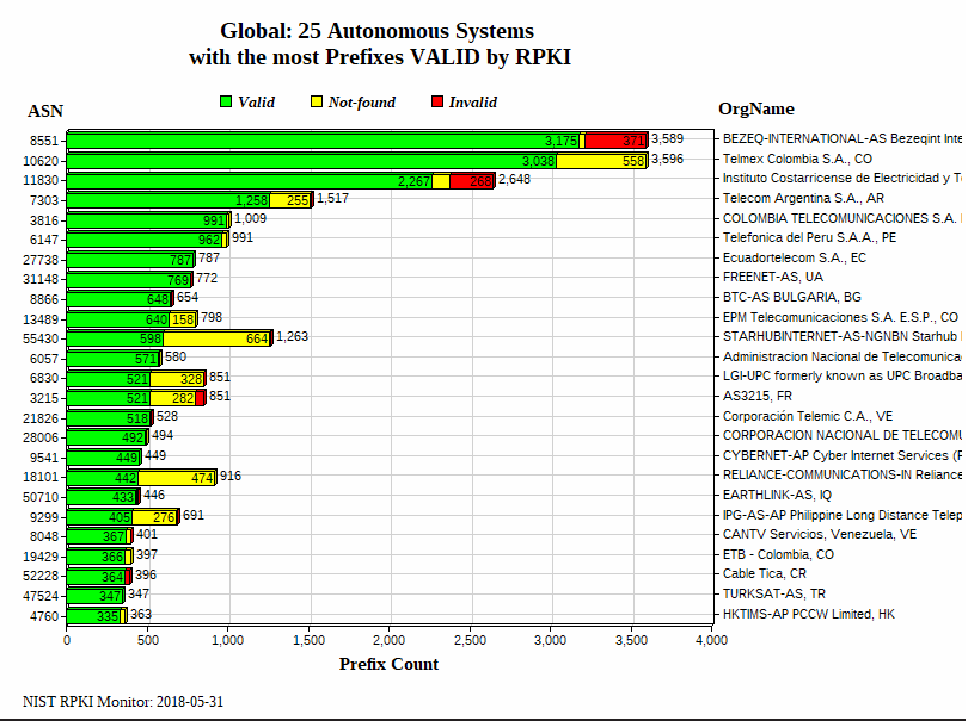
図37:BGP広告の大半がRPKIによって保護されているグローバルネットワークの計測。「Global: 25 Autonomous Systems with the most Prefixes VALID by RPKI」と題した横向きの積み上げ棒グラフである。左に ASN、右に OrgName(組織名。右端で途切れている)があり、横軸は Prefix Count(プレフィックス数)0〜4,000、区分は Valid(有効。緑)、Not-found(該当なし。黄)、Invalid(無効。赤)である。各棒(ASN、組織名:有効の数、表示された該当なしまたは無効の数、合計):8551 BEZEQ-INTERNATIONAL-AS Bezeqint:3,175、無効 371、3,589。10620 Telmex Colombia S.A., CO:3,038、該当なし 558、3,596。11830 Instituto Costarricense de Electricidad y T…:2,267、無効 268、2,648。7303 Telecom Argentina S.A., AR:1,258、該当なし 255、1,517。3816 COLOMBIA TELECOMUNICACIONES S.A.:991、1,009。6147 Telefonica del Peru S.A.A., PE:962、991。27738 Ecuadortelecom S.A., EC:787、787。31148 FREENET-AS, UA:769、772。8866 BTC-AS BULGARIA, BG:648、654。13489 EPM Telecomunicaciones S.A. E.S.P., CO:640、該当なし 158、798。55430 STARHUBINTERNET-AS-NGNBN Starhub:598、該当なし 664、1,263。6057 Administracion Nacional de Telecomunica…:571、580。6830 LGI-UPC formerly known as UPC Broadba…:521、該当なし 328、851。3215 AS3215, FR:521、該当なし 282、851。21826 Corporación Telemic C.A., VE:518、528。28006 CORPORACION NACIONAL DE TELECOMU…:492、494。9541 CYBERNET-AP Cyber Internet Services:449、449。18101 RELIANCE-COMMUNICATIONS-IN Reliance:442、該当なし 474、916。50710 EARTHLINK-AS, IQ:433、446。9299 IPG-AS-AP Philippine Long Distance Telep…:405、該当なし 276、691。8048 CANTV Servicios, Venezuela, VE:367、401。19429 ETB - Colombia, CO:366、397。52228 Cable Tica, CR:364、396。47524 TURKSAT-AS, TR:347、347。4760 HKTIMS-AP PCCW Limited, HK:335、363。下部に「NIST RPKI Monitor: 2018-05-31」とある。
Figure 37: Measurement of global networks with most BGP announcements protected by RPKI.
図37:BGP広告の大半がRPKIによって保護されているグローバルネットワークの計測。
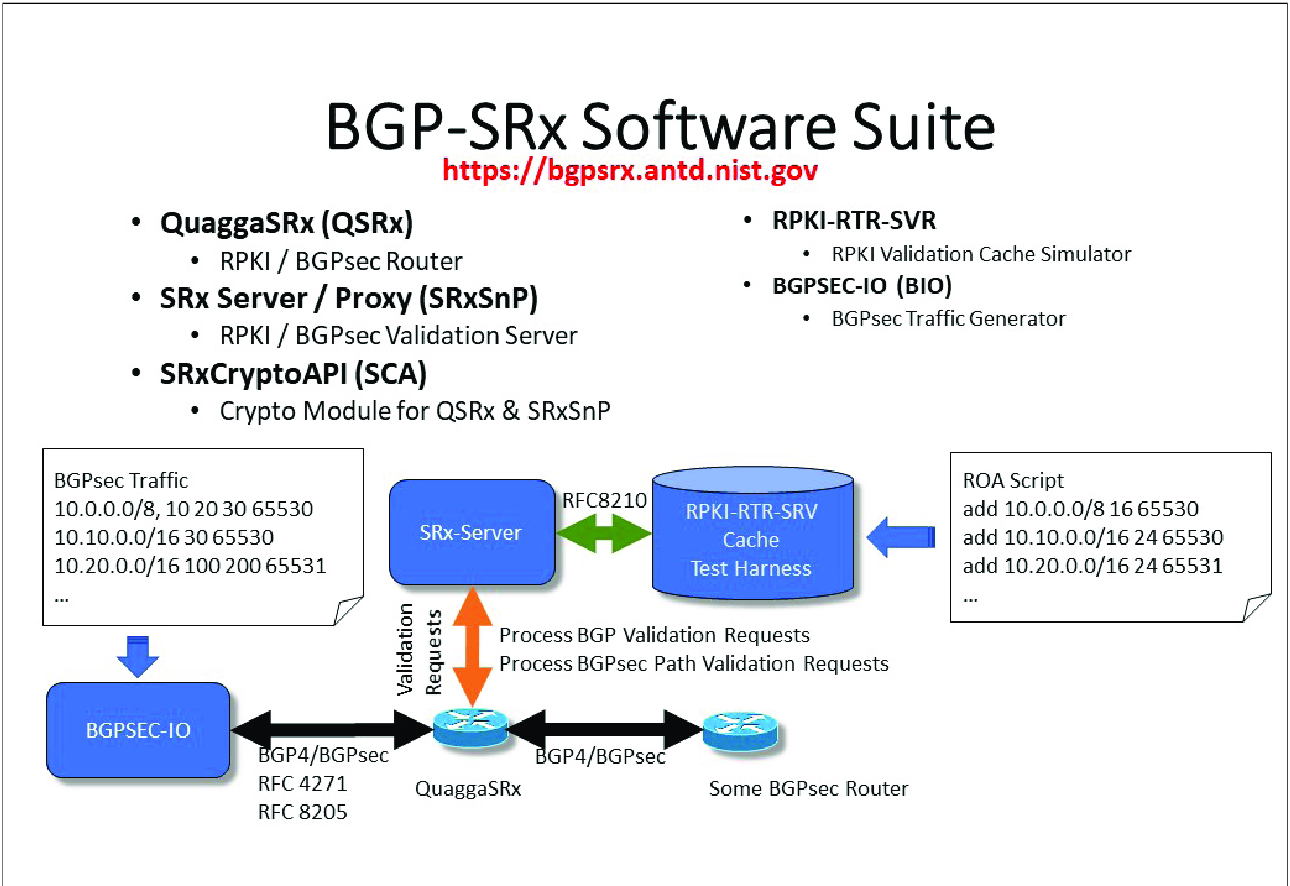
図38:NISTのBGPsecプロトタイプおよびテストツール。「BGP-SRx Software Suite」と題し、https://bgpsrx.antd.nist.gov を示すスライドである。構成要素の一覧:QuaggaSRx (QSRx):RPKI / BGPsec ルータ。SRx Server / Proxy (SRxSnP):RPKI / BGPsec 検証サーバ。SRxCryptoAPI (SCA):QSRx と SRxSnP 用の暗号モジュール。RPKI-RTR-SVR:RPKI 検証キャッシュのシミュレータ。BGPSEC-IO (BIO):BGPsec トラフィック生成器。下の図:BGPsec Traffic のメモ(10.0.0.0/8, 10 20 30 65530/10.10.0.0/16 30 65530/10.20.0.0/16 100 200 65531/...)が BGPSEC-IO に入り、BGPSEC-IO は QuaggaSRx と BGP4/BGPsec(RFC 4271、RFC 8205)をやり取りする。QuaggaSRx は Some BGPsec Router と BGP4/BGPsec をやり取りする。QuaggaSRx は SRx-Server へ Validation Requests を送る(Process BGP Validation Requests、Process BGPsec Path Validation Requests)。SRx-Server と RPKI-RTR-SRV Cache Test Harness は RFC8210 で双方向に結ばれ、ROA Script のメモ(add 10.0.0.0/8 16 65530/add 10.10.0.0/16 24 65530/add 10.20.0.0/16 24 65531/...)がキャッシュのテストハーネスに入る。
Figure 38: NIST BGPsec prototypes and test tools
図38:NISTのBGPsecプロトタイプおよびテストツール
To further facilitate technology transition, a new NCCoE Secure Inter-Domain Routing (SIDR) project was initiated with industry partners to conduct a proof-of-concept evaluation of the current state of secure routing technologies in realistic deployment settings.
技術移行をさらに促進するため、産業界のパートナーとともに新たなNCCoE Secure Inter-Domain Routing (SIDR)プロジェクトが開始されました。このプロジェクトでは、現実的な展開環境におけるセキュアルーティング技術の現状について、概念実証による評価を行います。
A second thrust of ITL’s RIDR project is addressing the wide-spread problem of BGP “route leaks” – accidental routing policy violations that often result in large-scale outages in global Internet routing. The ITL staff have lead the development of IETF specifications that define the problem space (see RFC 7809, Problem Definition and Classification of BGP Route Leaks) and the corresponding proposed mitigation techniques.
ITLのRIDRプロジェクトの第二の柱は、広く見られるBGPの「ルートリーク」の問題への対処です。ルートリークとは、偶発的なルーティングポリシー違反であり、グローバルなインターネットルーティングにおける大規模な障害をしばしば引き起こします。ITLの職員は、この問題領域を定義するIETF仕様(RFC 7809, Problem Definition and Classification of BGP Route Leaksを参照)と、それに対応する緩和技術の提案の策定を主導してきました。
FOR MORE INFORMATION:
詳細情報:
NIST RPKI monitor https://rpki-monitor.antd.nist.gov/
NIST RPKI monitor https://rpki-monitor.antd.nist.gov/
Robust Inter-Domain Routing Project https://www.nist.gov/programs-projects/robust-inter-domain-routing
Robust Inter-Domain Routing Project https://www.nist.gov/programs-projects/robust-inter-domain-routing
NCCoE Secure-Inter-Domain Routing Project https://nccoe.nist.gov/projects/building-blocks/secure-inter-domain-routing
NCCoE Secure-Inter-Domain Routing Project https://nccoe.nist.gov/projects/building-blocks/secure-inter-domain-routing
CONTACTS:
連絡先:
Mr. Doug Montgomery, (301) 975-3630, dougm@nist.gov
Mr. Doug Montgomery, (301) 975-3630, dougm@nist.gov
Dr. Kotikalapudi Sriram, (301) 975-3973, ksriram@nist.gov
Dr. Kotikalapudi Sriram, (301) 975-3973, ksriram@nist.gov
ADVANCED SECURITY TESTING AND MEASUREMENTS
高度なセキュリティ試験および計測
Security Automation and Continuous Monitoring
セキュリティ自動化および継続的監視
IT organizations operate a diverse set of computing assets that access, route, store, and process information that is critical to the operations of businesses and the missions of government agencies. These IT environments are under constant threat of attack and are frequently undergoing change, with new and updated software being deployed along with updated configurations. The wide variety of computing products, the dynamic nature of software, the speed of configuration change, and the diversity of threats require organizations to maintain situational awareness over their IT assets and to utilize this information to make informed risk-based decisions.
IT組織は、企業の業務や政府機関のミッションにとって極めて重要な情報にアクセスし、それを経路制御し、保存し、処理する多様なコンピューティング資産を運用しています。こうしたIT環境は絶えず攻撃の脅威にさらされており、新しいソフトウェアや更新されたソフトウェアが、更新された構成とともに導入されることで、頻繁に変化しています。コンピューティング製品の種類の多さ、ソフトウェアの動的な性質、構成変更の速さ、および脅威の多様性のために、組織は自らのIT資産について状況認識を維持し、その情報を活用して、十分な情報に基づくリスクベースの意思決定を行う必要があります。
Security automation utilizes standardized data formats and transport protocols to enable data to be exchanged between business, operational, and security systems that support security processes by:
セキュリティ自動化は、標準化されたデータ形式とトランスポートプロトコルを利用して、業務システム、運用システムおよびセキュリティシステムの間でデータを交換できるようにします。これらのシステムは、次のことによってセキュリティプロセスを支えます。
•Identifying IT assets, including hardware, software, and data;
•ハードウェア、ソフトウェアおよびデータを含むIT資産を識別します。
•Providing awareness over the operational state of computing devices;
•コンピューティング機器の運用状態を把握できるようにします。
•Enabling security reference data to be collected from internal and external sources; and
•内部および外部の情報源からセキュリティ参照データを収集できるようにします。
•Supporting analysis processes that measure the effectiveness of security controls and provide visibility into security risks, enabling risk-based decision making.
•セキュリティ管理策の有効性を測定し、セキュリティリスクを可視化する分析プロセスを支援し、リスクベースの意思決定を可能にします。
Commercial solutions built using security automation specifications enable the collection and harmonization of vast amounts of operational and security data into coherent, comparable information streams to achieve situational awareness that allows the timely and active management of diverse IT systems. Through the creation of reference data and guidance and the international recognition of flexible, open standards, the NIST security automation program works to improve the interoperability, broad acceptance, and adoption of security automation solutions to address current and future security challenges, creating opportunities for innovation.
セキュリティ自動化の仕様を用いて構築された商用ソリューションは、膨大な量の運用データおよびセキュリティデータを収集し、一貫性があり比較可能な情報の流れへと調和させることを可能にします。これにより、多様なITシステムを適時かつ能動的に管理できるようにする状況認識が得られます。NISTのセキュリティ自動化プログラムは、参照データとガイダンスの作成、および柔軟でオープンな標準の国際的な認知を通じて、セキュリティ自動化ソリューションの相互運用性、幅広い受容および採用を向上させ、現在および将来のセキュリティ上の課題に対処するとともに、イノベーションの機会を創出するよう取り組んでいます。
Specification, Standards, and Guidance Development
仕様、標準およびガイダンスの策定
To support the overarching security automation vision, it is necessary to have specifications that describe the required interactions between systems, standards that document international consensus approaches, and guidance for product developers and implementers. Through close work with partners in government, industry, and academia, CSD continues to facilitate the definition and development of security automation approaches that enable organizations to understand and manage IT security risks.
セキュリティ自動化の包括的なビジョンを支えるには、システム間で必要となるやり取りを記述する仕様、国際的な合意に基づく手法を文書化した標準、ならびに製品開発者および実装者向けのガイダンスが必要です。CSDは、政府、産業界および学術界のパートナーとの緊密な協力を通じて、組織がITセキュリティリスクを理解し管理できるようにするセキュリティ自動化手法の定義と開発を引き続き促進しています。
During FY 2017, CSD has continued to build on previous security automation work, as follows:
2017会計年度に、CSDはこれまでのセキュリティ自動化の取り組みを基礎として、次のとおり作業を続けました。
•Identified and addressed gaps in the current specifications;
•現行の仕様におけるギャップを特定し、それに対処しました。
•Evolved existing approaches to achieve greater scalability and impact;
•既存の手法を発展させ、拡張性と効果を高めました。
•Participated in working groups in standards development organizations to promote international consensus around standardized approaches;
•標準化機関の作業部会に参加し、標準化された手法に関する国際的な合意形成を推進しました。
•Provided additional guidance on architectural, design, and analysis concerns; and
•アーキテクチャ、設計および分析に関する事項について、追加のガイダンスを提供しました。
•Developed and maintained tools and reference implementations.
•ツールおよび参照実装を開発し、維持しました。
CSD is currently working with its partners in various standards-development organizations, including ISO, IETF, the Organization for the Advancement of Structured Information Standards (OASIS), the Forum of Incident Response and Security Teams (FIRST), and the Trusted Computing Group (TCG), to further mature and broaden the adoption of security automation specifications, reference data, and techniques. This area of work is focused on evolving security automation specifications to integrate with existing transport protocols to provide for the secure, interoperable exchange of security automation data. Additional work is focused on evolving security metrics and providing consensus guidance on security automation approaches. Through the definition and adoption of security automation standards and guidelines, IT vendors will be able to provide standardized security solutions to their customers. These solutions support continuous monitoring and automated, dynamic network defense capabilities, based on the analysis of data from operational and security data sources and the collective action of security components.
CSDは現在、ISO、IETF、Organization for the Advancement of Structured Information Standards (OASIS)、Forum of Incident Response and Security Teams (FIRST)、Trusted Computing Group (TCG)など、さまざまな標準化機関のパートナーと協力して、セキュリティ自動化の仕様、参照データおよび技法をさらに成熟させ、その採用を広げる取り組みを進めています。この分野の作業は、セキュリティ自動化の仕様を既存のトランスポートプロトコルと統合できるよう発展させ、セキュリティ自動化データの安全で相互運用可能な交換を実現することに重点を置いています。このほか、セキュリティメトリクスの発展と、セキュリティ自動化手法に関する合意に基づくガイダンスの提供にも重点を置いています。セキュリティ自動化の標準およびガイドラインの定義と採用によって、ITベンダーは標準化されたセキュリティソリューションを顧客に提供できるようになります。これらのソリューションは、運用データおよびセキュリティデータの情報源から得られるデータの分析と、セキュリティコンポーネントの協調動作に基づいて、継続的監視と、自動化された動的なネットワーク防御機能を支えます。
Additionally, CSD is working with the vulnerability community to enable the automated analysis of metrics such as the Common Vulnerability Scoring System (CVSS), establishing a baseline of the minimum information needed to properly inform the vulnerability management process, and facilitating the sharing of vulnerability information across language barriers. To assist in this work, a public draft of NISTIR 8138, Vulnerability Description Ontology (VDO): A Framework for Characterizing Vulnerabilities, was created to foster a conversation and collect feedback on the best mechanisms to improve the degree of automation within vulnerability management processes. CSD is planning to develop this document iteratively by releasing additional drafts in FY 2018 to ensure participation from as many stakeholders in the vulnerability community as possible.
さらにCSDは、脆弱性コミュニティと協力して、Common Vulnerability Scoring System (CVSS)などのメトリクスの自動分析を可能にすること、脆弱性管理プロセスに適切な情報を与えるために最低限必要な情報のベースラインを確立すること、および言語の壁を越えた脆弱性情報の共有を促進することに取り組んでいます。この作業を支援するため、NISTIR 8138, Vulnerability Description Ontology (VDO): A Framework for Characterizing Vulnerabilitiesの公開草案が作成されました。その目的は、脆弱性管理プロセスにおける自動化の度合いを高める最良の仕組みについて議論を促し、フィードバックを収集することです。CSDは、脆弱性コミュニティのできるだけ多くの利害関係者の参加を確保するため、2018会計年度に追加の草案を公表し、この文書を反復的に策定していく予定です。
Security automation standardization work has been focused in three areas: the evolution and international adoption of the Security Content Automation Protocol (SCAP), the development of software asset management standards to support operational and cybersecurity use cases, and the development of security automation consensus standards. The following sections detail this work.
セキュリティ自動化の標準化作業は、次の三つの分野に重点を置いてきました。すなわち、Security Content Automation Protocol (SCAP)の発展と国際的な採用、運用およびサイバーセキュリティのユースケースを支えるソフトウェア資産管理標準の策定、ならびにセキュリティ自動化に関する合意標準の策定です。以下の各節でこの作業を詳述します。
Security Content Automation Protocol (SCAP)
Security Content Automation Protocol (SCAP)
SCAP is a multipurpose protocol that provides an automated means to collect and assess the state of devices. SCAP supports automated vulnerability checking, verifying the installation of patches, checking security configuration settings, verifying technical-control compliance, measuring security, and examining systems for indicators of a compromise. SCAP uses the Extensible Markup Language (XML) to standardize the format and nomenclature by which security software products communicate information about software flaws, security configurations, and other aspects of the device state. SCAP enables security automation content, also known as “SCAP content,” to be expressed using standardized formats, identifiers, and scoring models. This content can be used by any tool that is conformant to the specifications to collect and evaluate the state of software installed on a device.
SCAPは、機器の状態を収集し評価するための自動化された手段を提供する多目的プロトコルです。SCAPは、自動化された脆弱性チェック、パッチの適用状況の検証、セキュリティ構成設定のチェック、技術的管理策への準拠の検証、セキュリティの測定、および侵害の兆候を探すためのシステムの検査を支援します。SCAPはExtensible Markup Language (XML)を用いて、セキュリティソフトウェア製品がソフトウェアの欠陥、セキュリティ構成、および機器の状態のその他の側面に関する情報を伝達する際の形式と命名法を標準化します。SCAPにより、「SCAPコンテンツ」とも呼ばれるセキュリティ自動化コンテンツを、標準化された形式、識別子およびスコアリングモデルを用いて表現できます。このコンテンツは、仕様に適合するあらゆるツールで利用でき、機器にインストールされたソフトウェアの状態を収集し評価するために使うことができます。
脆弱性スキャンを表すイメージ。人物が青いデジタル画面を操作し、画面には「VULNERABILITY SCANNING」、複数の錠前アイコン、コード状のパターンが表示されている。 [人物の写真。人物が写っているため、この非公式サイトには掲載していません。原本 PDF を参照してください。]
Credit: Shutterstock/Den Rise
提供:Shutterstock/Den Rise
SCAP has been widely adopted by major software and hardware manufacturers and has become a significant component of information security management and governance programs. SCAP-enabled tools are currently being used by the U.S. Government, critical infrastructure companies, academia, and other businesses, both domestically and internationally. Currently, CSD is leveraging SCAP in multiple areas, both to support its own mission and to enable other agencies and private-sector entities to meet their goals. For CSD, SCAP is a critical component of the SCAP Validation Program, the National Vulnerability Database (NVD), and the National Checklist Program (NCP).
SCAPは主要なソフトウェアメーカーおよびハードウェアメーカーに広く採用されており、情報セキュリティの管理およびガバナンスのプログラムにおける重要な構成要素となっています。SCAP対応ツールは現在、国内外で、米国政府、重要インフラ企業、学術界、その他の企業によって利用されています。現在CSDは、自らのミッションを支えるためにも、他の機関や民間部門の事業体がそれぞれの目標を達成できるようにするためにも、複数の分野でSCAPを活用しています。CSDにとってSCAPは、SCAP Validation Program、National Vulnerability Database (NVD)、およびNational Checklist Program (NCP)の極めて重要な構成要素です。
In September 2012, CSD published SP 800-126 Revision 2, The Technical Specification for the Security Content Automation Protocol (SCAP): SCAP Version 1.2. That document describes the 11 component specifications composing SCAP. See Table 3 for details.
2012年9月、CSDはSP 800-126 Revision 2, The Technical Specification for the Security Content Automation Protocol (SCAP): SCAP Version 1.2を公表しました。同文書は、SCAPを構成する11のコンポーネント仕様について記述しています。詳細は表3を参照のこと。
Since the release of SCAP 1.2, CSD has worked to improve guidance for using SCAP specifications. In FY 2015, CSD released draft NISTIR 8058, Security Content Automation Protocol (SCAP) Version 1.2 Content Style Guide: Best Practices for Creating and Maintaining SCAP 1.2 Content, which provides guidance for SCAP 1.2 content creators to ensure that stylistic variations in SCAP 1.2 content are addressed in a way that improves the accuracy and consistency of results, avoids performance problems, reduces user effort, lowers content maintenance burdens, and enables content reuse. To achieve this, NISTIR 8058 documents best practices for content creation and encourages their use by SCAP content authors and maintainers. Feedback on this document is welcomed and will help CSD to work toward producing a final version of this NISTIR 8058.
SCAP 1.2 のリリース以降、CSD は SCAP 仕様の利用に関するガイダンスの改善に取り組んできました。2015会計年度に、CSD は草案 NISTIR 8058, Security Content Automation Protocol (SCAP) Version 1.2 Content Style Guide: Best Practices for Creating and Maintaining SCAP 1.2 Content を公表しました。この文書は SCAP 1.2 コンテンツの作成者に向けたガイダンスを提供するものであり、SCAP 1.2 コンテンツにおける記述様式のばらつきを、結果の正確性と一貫性を高め、性能上の問題を回避し、利用者の手間を減らし、コンテンツ保守の負担を軽減し、コンテンツの再利用を可能にする形で扱えるようにします。そのために NISTIR 8058 は、コンテンツ作成のベストプラクティスを文書化し、SCAP コンテンツの作成者および保守担当者にその利用を促しています。この文書に対するフィードバックを歓迎しており、寄せられたフィードバックは、CSD がこの NISTIR 8058 の最終版の作成に向けて作業を進めるうえで役立ちます。
Credit: Shutterstock/Titima Ongkantong
提供:Shutterstock/Titima Ongkantong
CSD is actively working on an SCAP 1.3 revision. In July 2016, CSD posted drafts for public comment of SP 800-126 Revision 3 and SP 800-126A. SP 800-126 Revision 3, is The Technical Specification for the Security Content Automation Protocol (SCAP): SCAP Version 1.3. SP 800-126A is SCAP 1.3 Component Specification Version Updates: An Annex to NIST Special Publication 800-126 Revision 3. These publications collectively document the draft requirements for SCAP 1.3. SP 800-126A is a new publication that allows SCAP 1.3 to take advantage of selected minor version updates of SCAP component specifications, as well as designated Open Vulnerability and Assessment Language (OVAL) platform schema revisions. The SCAP 1.3 revision includes the following changes:
CSD は SCAP 1.3 への改訂に積極的に取り組んでいます。2016年7月、CSD は SP 800-126 Revision 3 および SP 800-126A の草案をパブリックコメントに付すために掲載しました。SP 800-126 Revision 3 は The Technical Specification for the Security Content Automation Protocol (SCAP): SCAP Version 1.3 です。SP 800-126A は SCAP 1.3 Component Specification Version Updates: An Annex to NIST Special Publication 800-126 Revision 3 です。これらの刊行物は、全体として SCAP 1.3 の要求事項の草案を文書化しています。SP 800-126A は新規の刊行物であり、これにより SCAP 1.3 は、SCAP コンポーネント仕様の選定されたマイナーバージョン更新、および指定された Open Vulnerability and Assessment Language (OVAL) プラットフォームスキーマの改訂を利用できるようになります。SCAP 1.3 への改訂には、次の変更が含まれます。
•Adoption of the Open Vulnerability and Assessment Language (OVAL) 5.11.1, which was released in April 2015;
•2015年4月にリリースされた Open Vulnerability and Assessment Language (OVAL) 5.11.1 の採用
•Adoption of the Common Vulnerability Scoring System (CVSS) v3, which was released in June 2015;
•2015年6月にリリースされた Common Vulnerability Scoring System (CVSS) v3 の採用
•Removal of support for CVSSv2; and
•CVSSv2 のサポートの削除
•Deprecation of support for older specification revisions and SCAP 1.0.
•旧版の仕様および SCAP 1.0 のサポートの非推奨化
CSD is currently working to publish the final versions of the publications described above in early FY 2018. CSD has published a beta release of an updated version of SCAPVal, the SCAP content validation tool. A final version of this tool will be provided after the SP 800-126 documents have been finalized. CSD is also working to update the SCAP Validation Program to support SCAP 1.3, with an update to NISTIR 5711 to be posted in early FY 2018. More information on SCAP 1.3 can be found at: https://csrc.nist.gov/Projects/Security-Content-Automation-Protocol/SCAP-Releases/SCAP-1-3.
CSD は現在、上記の刊行物の最終版を2018会計年度の早い時期に公表できるよう作業を進めています。CSD は、SCAP コンテンツ検証ツールである SCAPVal の更新版のベータリリースを公開しました。このツールの最終版は、SP 800-126 の各文書が確定した後に提供されます。CSD はまた、SCAP 1.3 をサポートするよう SCAP Validation Program の更新にも取り組んでおり、NISTIR 5711 の更新版を2018会計年度の早い時期に掲載する予定です。SCAP 1.3 の詳細については、次を参照されたい:https://csrc.nist.gov/Projects/Security-Content-Automation-Protocol/SCAP-Releases/SCAP-1-3.
CSD is also starting to plan an SCAP 2.0 release (SCAP v2). This release will further define the interfaces and use of transport protocols for SCAP tools to provide component-level interoperability between products supporting various SCAP functions. By providing more interoperability, SCAP v2 will provide the basic software and configuration posture information needed to make and automate management decisions for networked devices as part of the license, vulnerability and configuration management practices, supporting improved networked device hygiene. Furthermore, the posture information provided by SCAP v2 products will provide much of the context needed to prevent, detect, and respond to network attacks. This additional context will enable SCAP v2 information to be applied for application whitelisting, the detection of anomalous behavior, the gathering and use of indicators, the use of machine-readable threat information, and for orchestrating courses of action. CSD is preparing a draft whitepaper for release in early FY 2018 that will outline an approach, a development plan identifying the new and revised specifications that will be needed, and a transition plan for moving from SCAP 1.x to SCAP 2.0. A discussion draft of the SCAP 2.0 specification addressing software asset management and vulnerability management use cases will also be published in FY 2018 as a way to start a broader conversation with the SCAP community about where to focus next on the development of SCAP 2.0.
CSD は SCAP 2.0 リリース(SCAP v2)の計画にも着手しています。このリリースでは、SCAP ツールのインタフェースとトランスポートプロトコルの利用をさらに詳しく定義し、各種の SCAP 機能をサポートする製品間でコンポーネントレベルの相互運用性を実現します。相互運用性が高まることにより、SCAP v2 は、ライセンス管理、脆弱性管理および構成管理の実務の一環として、ネットワーク接続された機器に関する管理上の判断を下し、それを自動化するために必要となる、ソフトウェアと構成の態勢に関する基本的な情報を提供し、ネットワーク接続された機器の衛生状態の改善を支援します。さらに、SCAP v2 製品が提供する態勢情報は、ネットワーク攻撃を防止し、検知し、それに対応するために必要なコンテキストの多くを提供します。この追加のコンテキストにより、SCAP v2 の情報を、アプリケーションホワイトリスティング、異常な挙動の検知、インジケータの収集と利用、機械可読な脅威情報の利用、および一連の対処方針のオーケストレーションに適用できるようになります。CSD は、2018会計年度の早い時期の公表に向けてホワイトペーパーの草案を準備しており、この文書では、アプローチ、必要となる新規および改訂の仕様を特定した開発計画、ならびに SCAP 1.x から SCAP 2.0 へ移行するための移行計画の概要を示します。また、ソフトウェア資産管理と脆弱性管理のユースケースを扱う SCAP 2.0 仕様の討議用草案も2018会計年度に公表する予定であり、これを、SCAP 2.0 の開発において次にどこへ重点を置くかについて、SCAP コミュニティとのより広い対話を始めるきっかけとします。
| TABLE 3: SCAP 1.2 SPECIFICATIONS | |
|---|---|
| SPECIFICATIONS | DESCRIPTION |
| Languages | |
| Extensible Confguration Checklist Description Format (XCCDF) 1.2 | Used for authoring security checklists/benchmarks and for reporting the results of evaluating them |
| Open Vulnerability and Assessment Language (OVAL) 5.11.2 | Used for representing system-confguration information, assessing machine state, and reporting assessment results |
| Open Checklist Interactive Language (OCIL) 2.0 | Used for representing checks that collect information from people or from existing data stores populated by other data collection methods |
| Reporting Formats | |
| Asset Reporting Format (ARF) 1.1 | Used to express information about assets and to defne the relationships between assets and reports |
| Asset Identifcation 1.1 | Used to uniquely identify assets based on known identifers and other asset information |
| Identifcation Schemes | |
| Common Platform Enumeration (CPE) 2.3 | A nomenclature and dictionary of hardware, operating systems, and applications; a method to identify the applicability to platforms |
| Software Identifcation (SWID) Tags 2015 | A structured metadata format for describing a released software product |
| Common Confguration Enumeration (CCE) 5 | A nomenclature and dictionary of software-security confgurations |
| Common Vulnerabilities and Exposures (CVE) | A nomenclature and dictionary of security-related software faws |
| Measurement and Scoring Systems | |
| Common Vulnerability Scoring System (CVSS) | Used for measuring the relative severity of software faws |
| Common Confguration Scoring System (CCSS) | Used for measuring the relative severity of device security (mis-)confguration issues |
| Content and Result Integrity | |
| Trust Model for Security Automation Data (TMSAD) | Guidance for using digital signatures in a common trust model applied to security automation specifcations |
| 表3:SCAP 1.2仕様 | |
|---|---|
| 仕様 | 説明 |
| 言語 | |
| Extensible Configuration Checklist Description Format (XCCDF) 1.2 | セキュリティチェックリスト/ベンチマークの作成、およびその評価結果の報告に使用する |
| Open Vulnerability and Assessment Language (OVAL) 5.11.2 | システム構成情報の表現、マシン状態の評価、評価結果の報告に使用する |
| Open Checklist Interactive Language (OCIL) 2.0 | 人、または他のデータ収集方法で入力された既存データストアから情報を収集するチェック項目の表現に使用する |
| 報告形式 | |
| Asset Reporting Format (ARF) 1.1 | 資産に関する情報を表現し、資産と報告書の関係を定義するために使用する |
| Asset Identification 1.1 | 既知の識別子やその他の資産情報に基づいて、資産を一意に識別するために使用する |
| 識別方式 | |
| Common Platform Enumeration (CPE) 2.3 | ハードウェア、オペレーティングシステム、アプリケーションの名称体系および辞書。プラットフォームへの適用可否を識別する方法 |
| Software Identification (SWID) Tags 2015 | リリース済みソフトウェア製品を記述する構造化メタデータ形式 |
| Common Configuration Enumeration (CCE) 5 | ソフトウェアセキュリティ構成の名称体系および辞書 |
| Common Vulnerabilities and Exposures (CVE) | セキュリティ関連ソフトウェア欠陥の名称体系および辞書 |
| 測定およびスコアリングシステム | |
| Common Vulnerability Scoring System (CVSS) | ソフトウェア欠陥の相対的な深刻度の測定に使用する |
| Common Configuration Scoring System (CCSS) | 機器のセキュリティ構成の誤りに関する相対的な深刻度の測定に使用する |
| コンテンツおよび結果の完全性 | |
| Trust Model for Security Automation Data (TMSAD) | セキュリティ自動化仕様に適用する共通の信頼モデルで、デジタル署名を使用するための指針 |
Software Asset Management Standards
ソフトウェア資産管理の標準
CSD has been collaborating with industry partners to promote the adoption of ISO/IEC 19770-2:2015, Information technology—Software asset management—Part 2: Software identification tag, which establishes a specification for tagging software to support identification and management. The software identification (SWID) data model defined by this standard describes an XML format for software publishers to provide authoritative identification, categorization, software relationships (e.g., dependency, bundling, and patching), executable and library footprint details, and other metadata for software. This information can be used to support operational and cybersecurity use cases around managing software deployments, managing software licenses, managing software vulnerabilities and related software patches, and assessing secure software configurations.
CSD は、ISO/IEC 19770-2:2015, Information technology—Software asset management—Part 2: Software identification tag の採用を促進するため、産業界のパートナーと協力してきました。この標準は、識別と管理を支援するためにソフトウェアにタグを付与する仕様を定めています。この標準が定義するソフトウェア識別(SWID)データモデルは、ソフトウェア発行者が、ソフトウェアについての権威ある識別情報、分類、ソフトウェア間の関係(例:依存関係、バンドル、パッチ適用)、実行ファイルおよびライブラリのフットプリントの詳細、その他のメタデータを提供するための XML フォーマットを記述しています。この情報は、ソフトウェアの展開の管理、ソフトウェアライセンスの管理、ソフトウェアの脆弱性および関連するソフトウェアパッチの管理、ならびにセキュアなソフトウェア構成の評価に関わる、運用上およびサイバーセキュリティ上のユースケースを支援するために利用できます。
To supplement the requirements in ISO/IEC 19770-2:2015, CSD collaborated with DHS, NSA, and MITRE on the development of NISTIR 8060, Guidelines for the Creation of Interoperable Software Identification (SWID) Tags. NISTIR 8060, published in April 2016, provides an overview of the capabilities and usage of SWID tags as part of a comprehensive software lifecycle. This report introduces SWID tags in an operational context, provides guidelines for the creation of interoperable SWID tags, and highlights key usage scenarios for which SWID tags are applicable. Figure 39 illustrates several types of SWID tags (as indicated in the legend) and how these support multiple elements of the software product life cycle, including deployment, installation, patching, upgrading and removal.
ISO/IEC 19770-2:2015 の要求事項を補足するため、CSD は DHS、NSA および MITRE と協力して、NISTIR 8060, Guidelines for the Creation of Interoperable Software Identification (SWID) Tags を作成しました。2016年4月に公表された NISTIR 8060 は、包括的なソフトウェアライフサイクルの一部としての SWID タグの機能と使用法を概説しています。この報告書は、運用の文脈に即して SWID タグを紹介し、相互運用可能な SWID タグを作成するためのガイドラインを示し、SWID タグを適用できる主要な利用シナリオを取り上げています。図39は、(凡例に示すとおり)数種類の SWID タグと、それらが展開、インストール、パッチ適用、アップグレードおよび削除を含むソフトウェア製品ライフサイクルの複数の要素をどのように支援するかを示しています。
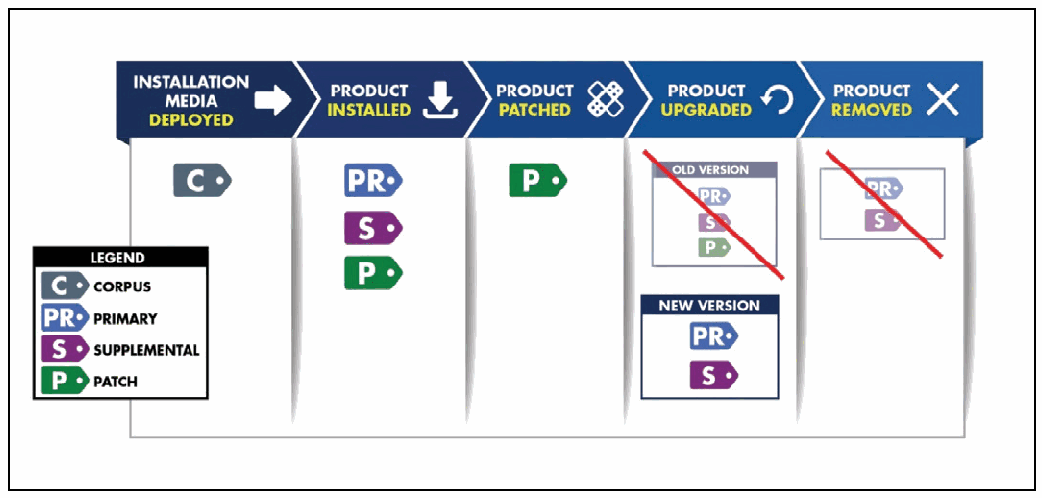
図39:SWID タグによるソフトウェア製品ライフサイクルの支援。左から右へ5つの段階 Installation Media Deployed(インストール媒体の配布)、Product Installed(製品のインストール)、Product Patched(製品へのパッチ適用)、Product Upgraded(製品のアップグレード)、Product Removed(製品の削除)を帯で示し、各段階の下にその時点の SWID タグの種類を示す図である。Installation Media Deployed:C。Product Installed:PR、S、P。Product Patched:P。Product Upgraded:赤線で消された Old Version(旧版)の箱(PR、S、P)と、New Version(新版)の箱(PR、S)。Product Removed:赤線で消された箱(PR、S)。凡例:C=Corpus、PR=Primary、S=Supplemental、P=Patch。
Figure 39: SWID Tags Support the Software Product Lifecycle
図39:SWID タグによるソフトウェア製品ライフサイクルの支援
Additionally, in FY 2017, NIST has worked with the IETF to integrate SWID tags into the Network Endpoint Assessment (NEA) protocol, through the Software Inventory Message and Attributes (SWIMA) for PA-TNC specification (see https://datatracker.ietf.org/doc/draft-ietf-sacm-nea-swima-patnc/). This draft Request for Comments (RFC) will be published soon, describing a method for the automated, event-based collection of software inventory information using SWID tag information.
さらに2017会計年度には、NIST は IETF と協力し、Software Inventory Message and Attributes (SWIMA) for PA-TNC 仕様(https://datatracker.ietf.org/doc/draft-ietf-sacm-nea-swima-patnc/ を参照)を通じて、SWID タグを Network Endpoint Assessment (NEA) プロトコルに統合する作業を進めてきました。この Request for Comments (RFC) 草案は近く公表される予定であり、SWID タグ情報を用いてソフトウェアインベントリ情報をイベント駆動で自動収集する方法を記述しています。
The information provided within SWID tags enhances the SCAP use cases by providing authoritative information that can be used to create Common Platform Enumeration (CPE) names, to support the targeting of checklists, and to associate software flaws to products, based on a defect in a software library or executable. In FY 2017, CSD published a SWID tag validation tool (see https://scap.nist.gov/specifications/swid/), called SWIDVal, that can validate a SWID tag document against the ISO/IEC 19770-2:2015 and NISTIR 8060 requirements.
SWID タグに含まれる情報は、Common Platform Enumeration (CPE) 名の作成、チェックリストの適用対象の特定、およびソフトウェアライブラリや実行ファイルの欠陥に基づくソフトウェアの欠陥と製品との関連付けに利用できる権威ある情報を提供することで、SCAP のユースケースを強化します。2017会計年度に、CSD は SWIDVal という SWID タグ検証ツール(https://scap.nist.gov/specifications/swid/ を参照)を公開しました。このツールは、SWID タグ文書を ISO/IEC 19770-2:2015 および NISTIR 8060 の要求事項に照らして検証できます。
Development of Security Automation Consensus Standards
セキュリティ自動化に関するコンセンサス標準の開発
CSD has been promoting the broad international adoption of SCAP by encouraging the integration of SCAP into other standards, and by adapting SCAP to address specific gaps and challenges. CSD has continued its collaboration with its industry partners in the IETF Security Automation and Continuous Monitoring (SACM) working group. This working group provides a venue for advancing appropriate SCAP specifications into international standards and addressing identified gap areas. The current scope of work for SACM includes identifying and/or defining the transport protocols and data formats needed to support the collection and evaluation of details regarding a device’s state against the expected values. The SACM working group has been working on identifying use cases, requirements, and architectural models to provide information to facilitate decisions about existing specifications and standards that can be referenced, required modifications or extensions to existing specifications and standards, and any gaps that need to be addressed. CSD is working with DHS, the Center for Internet Security (CIS), and the TCG to bring existing work into the IETF SACM working group, including OVAL and specifications related to the Trusted Network Connect (TNC) protocol.
CSD は、SCAP を他の標準に統合するよう働きかけること、および特定のギャップや課題に対処できるよう SCAP を適応させることにより、SCAP の広範な国際的採用を促進してきました。CSD は、IETF Security Automation and Continuous Monitoring (SACM) ワーキンググループにおいて、産業界のパートナーとの協力を継続しています。このワーキンググループは、適切な SCAP 仕様を国際標準へと発展させ、特定されたギャップ領域に対処するための場を提供しています。SACM の現在の作業範囲には、機器の状態に関する詳細を収集し、それを期待値に照らして評価することを支援するために必要なトランスポートプロトコルとデータフォーマットを特定すること、または定義すること、あるいはその両方が含まれます。SACM ワーキンググループは、ユースケース、要求事項およびアーキテクチャモデルの特定に取り組んでおり、それによって、参照できる既存の仕様および標準、既存の仕様および標準に必要な修正または拡張、ならびに対処が必要なギャップに関する判断を助ける情報を提供しようとしています。CSD は DHS、Center for Internet Security (CIS) および TCG と協力し、OVAL や Trusted Network Connect (TNC) プロトコルに関連する仕様を含む既存の成果を IETF SACM ワーキンググループに持ち込む作業を進めています。
For more information, please refer to: http://datatracker.ietf.org/wg/sacm/charter/.
詳細については、次を参照されたい:http://datatracker.ietf.org/wg/sacm/charter/.
Also, within the IETF, CSD has been collaborating with the Managed Incident Lightweight Exchange (MILE) working group in order to develop the Resource-Oriented Lightweight Information Exchange (ROLIE) specification. This specification seeks to address the security automation information discovery and dissemination use cases by defining how tools are expected to communicate with security automation information repositories. ROLIE allows for the transport, retrieval, and storage of any security automation-relevant information types. The ROLIE draft has undergone two major revisions, with the final draft nearing completion. In addition, CSD has begun the process of collaborating with MILE and other stakeholders to create extension drafts for ROLIE that address a number of information types, including vulnerability, configuration checklist, and software metadata information types.
また IETF 内では、CSD は Resource-Oriented Lightweight Information Exchange (ROLIE) 仕様を策定するため、Managed Incident Lightweight Exchange (MILE) ワーキンググループと協力してきました。この仕様は、ツールがセキュリティ自動化情報のリポジトリとどのように通信すべきかを定義することにより、セキュリティ自動化情報の発見と配布に関するユースケースへの対処を目指しています。ROLIE は、セキュリティ自動化に関連するあらゆる種類の情報の転送、取得および保存を可能にします。ROLIE の草案は2度の大きな改訂を経ており、最終草案は完成に近づいています。加えて CSD は、MILE および他の利害関係者と協力して、脆弱性、構成チェックリストおよびソフトウェアメタデータの各情報種別を含む、いくつかの情報種別を扱う ROLIE の拡張草案を作成する作業を開始しました。
The main ROLIE draft can be found at https://datatracker.ietf.org/doc/draft-ietf-mile-rolie/. Additional information on ROLIE and on the extension drafts can be found in the working repository on GitHub: https://github.com/CISecurity/ROLIE/.
ROLIE の本体の草案は https://datatracker.ietf.org/doc/draft-ietf-mile-rolie/ で参照できます。ROLIE および拡張草案に関する追加情報は、GitHub 上の作業用リポジトリで参照できる:https://github.com/CISecurity/ROLIE/.
CSD also worked with its government and industry partners in the TCG to define a number of specifications related to the Trusted Network Connect (TNC) protocol. The first such publication is the TNC SCAP Messages for IF-M specification that supports carrying the SCAP content and results over the TNC protocols. IF-M is a messaging protocol that helps communicate measurement information about endpoints for evaluation against security policy. The second is the TNC Endpoint Compliance Profile (ECP) and related specifications that support the exchange of SWID data over the TNC protocols. The ECP enables the collection of SWID data from a device for use by external tools to provide software inventory information. SCAP and SWID data collected using these mechanisms may be optionally used for network access control decision making, allowing the device state to be evaluated when devices connect and on an ongoing basis thereafter.
CSD はまた、TCG に参加する政府および産業界のパートナーと協力し、Trusted Network Connect (TNC) プロトコルに関連するいくつかの仕様を定義しました。その第一の刊行物は TNC SCAP Messages for IF-M 仕様であり、TNC プロトコル上で SCAP コンテンツと結果を運ぶことをサポートします。IF-M は、セキュリティポリシーに照らした評価のために、エンドポイントに関する測定情報を伝達するのに役立つメッセージングプロトコルです。第二は TNC Endpoint Compliance Profile (ECP) および関連する仕様であり、TNC プロトコル上での SWID データの交換をサポートします。ECP は、機器から SWID データを収集し、外部ツールがそれを利用してソフトウェアインベントリ情報を提供できるようにします。これらの仕組みを用いて収集した SCAP データおよび SWID データは、任意でネットワークアクセス制御の判断に利用でき、機器の接続時およびそれ以降も継続的に機器の状態を評価することが可能になります。
For more information on this specification, please visit: http://www.trustedcomputinggroup.org/resources/tnc_endpoint_compliance_profile_specification.
この仕様の詳細については、次を参照されたい:http://www.trustedcomputinggroup.org/resources/tnc_endpoint_compliance_profile_specification.
Updated versions of the ECP and SWID-related specifications, along with a usage scenario around vulnerability assessment, are currently being worked on in the SACM and MILE working groups, which are available through the locations indicated in Table 4.
ECP および SWID 関連仕様の更新版は、脆弱性評価に関する利用シナリオとともに、現在 SACM および MILE ワーキンググループで作業が進められており、表4に示す場所から入手できます。
The SACM and MILE working groups have been developing the following related Internet Drafts:
SACM および MILE ワーキンググループは、次の関連する Internet Draft を策定しています。
| INTERNET DRAFT | PURPOSE |
|---|---|
| https:/ | A Concise Binary Object Representation (CBOR) [RFC7049] based specifcation for representing SWID tag for use with constrained IoT devices. |
| https:/ | Specifes the Endpoint Compliance Profle (ECP), that describes the use of IETF and TNC protocols and interfaces to support the ongoing assessment of endpoint posture and the controlled exposure of collected posture information to authorized security applications. |
| https:/ | Extends the PA-TNC specifcation [RFC5792] to provide specifc attributes and message exchanges allowing endpoints to report their installed software inventory information to a NEA server. |
| https:/ | The ROLIE protocol supporting a resource-oriented approach for security automation information publication, discovery, and sharing. |
| https:/ | An extension to ROLIE to support the exchange of SWID-based software information. |
| https:/ | Defnition of the common terminology used within several working-group documents. |
| Internet-Draft | 目的 |
|---|---|
| https:/ | 制約のあるIoTデバイスで使うSWIDタグを表現するための、Concise Binary Object Representation(CBOR)[RFC7049]に基づく仕様。 |
| https:/ | Endpoint Compliance Profile(ECP)を定めます。IETFおよびTNCのプロトコルとインターフェースを用い、エンドポイントの状態を継続的に評価するとともに、収集した状態情報を認可されたセキュリティアプリケーションに制御された形で公開する方法を記述します。 |
| https:/ | PA-TNC仕様[RFC5792]を拡張し、エンドポイントがインストール済みソフトウェアのインベントリ情報をNEAサーバーへ報告できるようにする属性とメッセージ交換を定めます。 |
| https:/ | セキュリティ自動化情報の公開、探索、共有に、リソース指向の方式を用いるROLIEプロトコル。 |
| https:/ | SWIDに基づくソフトウェア情報の交換を支援するROLIE拡張。 |
| https:/ | 複数のワーキンググループ文書で使用する共通用語の定義。 |
Additionally, CSD has several members who are actively engaged on the CVE Board, which is working to improve the assignment of CVE identifiers for vulnerabilities, with the overall goal of improving the automated processing of vulnerabilities and the timeliness of CVE identifier issuance.
さらに、CSD の複数のメンバーが CVE Board に積極的に参加しています。CVE Board は、脆弱性の自動処理と CVE 識別子の発行の適時性を改善することを全体的な目標として、脆弱性に対する CVE 識別子の割り当ての改善に取り組んでいます。
Finally, CSD has worked with FIRST by participating in two Special Interest Groups (SIGs). The CVSS SIG (CVSS-SIG) is focused on maintaining and improving the CVSS scoring model, based on community feedback. The CVSS-SIG published CVSS Revision 3 (CVSS v3) in June 2015. The second SIG, the Vulnerability Reporting and Data eXchange SIG (VRDX-SIG), researches and recommends methods for identifying and exchanging vulnerability information across disparate vulnerability databases.
最後に、CSD は2つの Special Interest Group (SIG) に参加することで FIRST と協力してきました。CVSS SIG (CVSS-SIG) は、コミュニティからのフィードバックに基づいて CVSS のスコアリングモデルを維持し改善することに重点を置いています。CVSS-SIG は2015年6月に CVSS Revision 3 (CVSS v3) を公表しました。もう一つの SIG である Vulnerability Reporting and Data eXchange SIG (VRDX-SIG) は、異なる脆弱性データベース間で脆弱性情報を識別し交換する方法を調査し、推奨しています。
For more information, please visit: http://www.first.org/global/sigs.
詳細については、次を参照されたい:http://www.first.org/global/sigs.
Through work with international standards-developing organizations (SDOs), SCAP and its related security automation capabilities are expected to evolve and expand in support of the growing need to define and measure effective security controls, assess and monitor ongoing aspects of information security, remediate noncompliance, and successfully manage systems in accordance with the Risk Management Framework described in SP 800-37 Revision 1, Guide for Applying the Risk Management Framework to Federal Information Systems: A Security Life Cycle Approach. Standards that are developed and published by these SDOs will be considered for inclusion in future revisions of SCAP.
国際的な標準化団体(SDO)との作業を通じて、SCAP および関連するセキュリティ自動化機能は発展し、拡大していくと見込まれます。それは、有効なセキュリティ管理策を定義して測定し、情報セキュリティの継続的な側面を評価して監視し、不適合を是正し、SP 800-37 Revision 1, Guide for Applying the Risk Management Framework to Federal Information Systems: A Security Life Cycle Approach に記述された Risk Management Framework に従ってシステムを適切に管理するという、高まりつつあるニーズを支えるためです。これらの SDO が策定し公表する標準は、SCAP の将来の改訂に取り入れることが検討されます。
FOR MORE INFORMATION, SEE:
詳細情報:
https://scap.nist.gov/
https://scap.nist.gov/
CONTACT:
連絡先:
Mr. David Waltermire, (301) 975-3390, david.waltermire@nist.gov
Mr. David Waltermire, (301) 975-3390, david.waltermire@nist.gov
Security Automation Reference Data
セキュリティ自動化の参照データ
Through the National Vulnerability Database and the National Checklist Program (see below), NIST is providing relevant and important reference data in the areas of vulnerability and configuration management. SCAP and the programs that leverage it are moving the information assurance industry toward being able to standardize communications and toward the collection and storage of relevant data in standardized formats, as well as providing an automated means for the assessment and remediation of systems for both vulnerabilities and configuration compliance.
National Vulnerability Database および National Checklist Program(後述)を通じて、NIST は脆弱性管理および構成管理の分野において、関連性が高く重要な参照データを提供しています。SCAP およびそれを活用するプログラムは、情報保証業界を、通信を標準化できる状態へ、また関連データを標準化されたフォーマットで収集し保存する方向へと導くとともに、脆弱性と構成の適合性の両面についてシステムを評価し是正するための自動化された手段を提供しています。
National Vulnerability Database (NVD)
National Vulnerability Database (NVD)
Security automation reference data is currently housed within the NVD. The NVD is a comprehensive cybersecurity vulnerability database that allows the tracking of vulnerability trends over time. This trending service allows users to assess changes in vulnerability discovery rates within specific products or within specific types of vulnerabilities. NVD data is represented using the SCAP specifications. The NVD includes databases of security configuration checklists for the NCP, listings of publicly known software flaws, product names, and impact metrics. A formal validation program tests the ability of vendor products to use some forms of security automation data, based on a product’s conformance in support of specific enterprise capabilities.
セキュリティ自動化の参照データは、現在 NVD に収容されています。NVD は、脆弱性の傾向を時間の経過に沿って追跡できる、包括的なサイバーセキュリティ脆弱性データベースです。この傾向分析サービスにより、利用者は、特定の製品内または特定の種類の脆弱性内での脆弱性発見率の変化を評価できます。NVD のデータは SCAP 仕様を用いて表現されています。NVD には、NCP のためのセキュリティ構成チェックリストのデータベース、公知のソフトウェアの欠陥の一覧、製品名、および影響度の評価基準が含まれます。正式な検証プログラムが、特定のエンタープライズ機能をサポートする製品の適合性に基づいて、ベンダー製品が一部の形式のセキュリティ自動化データを利用できるかどうかを試験します。
SCAP defines the structure of standardized software flaws and security configuration reference data, also known as SCAP content. This reference data is provided by the NVD.
SCAP は、標準化されたソフトウェアの欠陥およびセキュリティ構成の参照データ(SCAP コンテンツとも呼ばれる)の構造を定義しています。この参照データは NVD が提供しています。
As of the end of September 2017, the NVD contained the following resources:
2017年9月末時点で、NVD は次のリソースを収録していました。
•Over 96,000 vulnerability advisories, with an average of 62 new vulnerabilities added daily;
•96,000件を超える脆弱性アドバイザリ。新たな脆弱性が1日平均62件追加されています。
•183 SCAP-expressed checklists across 123 platforms containing thousands of low-level security configuration checks that can be used by SCAP-validated security products to perform automated evaluations of the system state;
•123のプラットフォームにわたる、SCAP で表現された183件のチェックリスト。これらは数千件の低水準のセキュリティ構成チェックを含み、SCAP の検証を受けたセキュリティ製品がシステム状態の自動評価を行うために利用できます。
•293 non-SCAP security checklists (e.g., English prose guidance and configuration scripts);
•SCAP 以外のセキュリティチェックリスト293件(例:英語の文章によるガイダンスや構成スクリプト)。
•249 U.S. Computer Emergency Readiness Team (US-CERT) alerts; 4,467 US-CERT vulnerability summaries; and 10,286 SCAP machine-readable software flaw checks; and
•U.S. Computer Emergency Readiness Team (US-CERT) のアラート249件、US-CERT の脆弱性サマリー4,467件、および SCAP の機械可読なソフトウェア欠陥チェック10,286件。
•A product dictionary with over 124,000 operating system, application, and hardware name entries; and over 75,000 vulnerability advisories translated into Spanish.
•オペレーティングシステム、アプリケーションおよびハードウェアの名称エントリを124,000件以上収録した製品辞書、ならびにスペイン語に翻訳された75,000件を超える脆弱性アドバイザリ。
NVD is hosted and maintained by NIST and is sponsored by the Department of Homeland Security’s US-CERT.
NVD は NIST がホストし維持管理しており、国土安全保障省の US-CERT が後援しています。
The use of SCAP data by commercial security products, deployed in thousands of organizations worldwide, has extended NVD’s effective reach. Increasing demand for NVD XML data feeds (i.e., mechanisms that provide updated data from data sources) and SCAP-expressed content from the NVD website demonstrates an increased adoption of SCAP.
世界中の数千の組織に導入されている商用セキュリティ製品が SCAP データを利用することにより、NVD の実質的な到達範囲は広がっています。NVD の XML データフィード(すなわち、データソースから更新されたデータを提供する仕組み)と、NVD のウェブサイトから提供される SCAP で表現されたコンテンツに対する需要の増加は、SCAP の採用が拡大していることを示しています。
In the past year, the NVD began providing CVSS base scores following the CVSS v3 specification within the data feeds and completed a major enhancement to the overall user interface. The NVD has also seen a significant increase (almost three fold) in vulnerabilities received and analyzed over the previous year. Overall, the NVD has experienced an average download growth rate of over 10 % per month.
この1年間に、NVD は CVSS v3 仕様に従った CVSS 基本スコアをデータフィード内で提供し始め、ユーザインタフェース全体の大幅な機能強化を完了しました。また NVD では、受領し分析した脆弱性の件数が前年に比べて大幅に(約3倍に)増加しました。全体として、NVD のダウンロード数は月平均10 % を超える伸び率で増加しています。
FOR MORE INFORMATION, SEE:
詳細情報:
https://nvd.nist.gov
https://nvd.nist.gov
CONTACT:
連絡先:
Mr. Robert Byers, (301) 975-3279, robert.byers@nist.gov
Mr. Robert Byers, (301) 975-3279, robert.byers@nist.gov
National Checklist Program (NCP)
National Checklist Program (NCP)
There are many threats to IT, ranging from remotely launched network service exploits to malicious code spread through infected emails, websites, and downloaded files. Vulnerabilities in IT products are discovered daily, and many ready-to-use exploitation techniques are widely available on the Internet. Because IT products are often intended for a wide variety of audiences, restrictive security configuration controls are usually not enabled by default. As a result, many out-of-the box IT products are immediately vulnerable. In addition, identifying a reasonable set of security settings that achieve balanced risk management is a complicated, arduous, and time-consuming task, even for experienced system administrators.
IT に対する脅威は、遠隔から仕掛けられるネットワークサービスへのエクスプロイトから、感染した電子メール、ウェブサイトおよびダウンロードされたファイルを通じて広がる悪意のあるコードまで、数多く存在します。IT 製品の脆弱性は日々発見されており、すぐに使える悪用手法の多くがインターネット上で広く入手できます。IT 製品は多種多様な利用者を想定していることが多いため、制限の厳しいセキュリティ構成の管理策は、通常、既定では有効になっていません。その結果、多くの IT 製品は、箱から出したままの状態では直ちに脆弱です。加えて、バランスの取れたリスク管理を実現する妥当なセキュリティ設定の組み合わせを特定することは、経験豊富なシステム管理者にとっても、複雑で骨が折れ、時間のかかる作業です。
セキュリティ設定のイメージ。スーツ姿の人物がタブレットを持ち、その画面の上に鍵マーク付きの青いクラウドと歯車の図が重ねて表示されている。図中に文字ラベルはない。 [装飾の画像。本文を読むのに必要のない装飾のため、この非公式サイトには掲載していません。原本 PDF を参照してください。]
Credit: Shutterstock/Natali_ Mis
提供:Shutterstock/Natali_ Mis
To facilitate the development of security configuration checklists for IT products and to make checklists more organized and usable, CSD established the National Checklist Program (NCP) in furtherance of its statutory responsibilities under the Federal Information Security Management Act (FISMA) of 2002, Public Law 107-347, and also under the Cybersecurity Research and Development Act, which mandates that NIST “develop, and revise as necessary, a checklist setting forth settings and option selections that minimize the security risks associated with each computer hardware or software system that is, or is likely to become, widely used within the Federal Government.” In February 2008, a revision of Part 39 of the Federal Acquisition Regulation (FAR) was published. Paragraph (d) of section 39.101 states, “In acquiring information technology, agencies shall include the appropriate IT security policies and requirements, including the use of common security configurations available from the NIST website at https://checklists.nist.gov. Agency contracting officers should consult with the requiring official to ensure that the appropriate standards are incorporated.”
IT製品のセキュリティ設定チェックリストの開発を促進し、チェックリストをより整理された使いやすいものにするため、CSDはNational Checklist Program(NCP)を設立しました。これは、2002年のFederal Information Security Management Act(FISMA)(Public Law 107-347)に基づく法定の責務を果たすためのものであり、またCybersecurity Research and Development Actに基づくものでもあります。同法はNISTに対し、「連邦政府内で広く使用されている、または広く使用されるようになる可能性の高い各コンピュータハードウェアまたはソフトウェアシステムに関連するセキュリティリスクを最小化する設定およびオプション選択を示すチェックリストを策定し、必要に応じて改訂する」ことを義務付けています。2008年2月には、Federal Acquisition Regulation(FAR)のPart 39の改訂が公表されました。39.101条の(d)項は次のように定めています。「情報技術を調達する際、各機関は、NISTのウェブサイトhttps://checklists.nist.govで入手できる共通のセキュリティ設定の使用を含め、適切なITセキュリティのポリシーおよび要件を盛り込まなければなりません。各機関の契約担当官は、適切な標準が確実に組み込まれるよう、要求元の担当官と協議すべきです。」
In Memorandum M-08-22, OMB mandated the use of SCAP-validated products for the continuous monitoring of Federal Desktop Core Configuration (FDCC) compliance. The NCP strives to encourage and assist federal agencies with these mandates.
OMBはMemorandum M-08-22において、Federal Desktop Core Configuration(FDCC)への準拠の継続的監視にSCAP検証済み製品を使用することを義務付けました。NCPは、連邦機関がこれらの義務に対応することを奨励し、支援するよう努めています。
The goals of the NCP are to:
NCPの目標は次のとおりです。
•Facilitate the development and sharing of checklists by providing a formal framework for checklist developers to submit checklists to NIST;
•チェックリスト開発者がNISTにチェックリストを提出するための正式な枠組みを提供することにより、チェックリストの開発と共有を促進します。
•Provide guidance to developers to help them create standardized, high quality checklists that conform to common operation environments;
•共通の運用環境に適合する、標準化された高品質のチェックリストを開発者が作成できるよう、ガイダンスを提供します。
•Help developers and users by providing guidelines for making checklists better documented and more usable;
•チェックリストの文書化を充実させ、より使いやすくするためのガイドラインを提供することにより、開発者と利用者を支援します。
•Encourage software vendors and other parties to develop checklists;
•ソフトウェアベンダーおよびその他の関係者にチェックリストの開発を奨励します。
•Provide a managed process for the review, update, and maintenance of checklists;
•チェックリストのレビュー、更新および保守のための管理されたプロセスを提供します。
•Provide an easy-to-use repository of checklists; and
•使いやすいチェックリストのリポジトリを提供します。
•Encourage the use of automation technologies (e.g., SCAP) for checklist application.
•チェックリストの適用に自動化技術(例:SCAP)を使用することを奨励します。
At the end of FY 2017, there are a total of 476 checklists posted on the NCP website (see https://checklists.nist.gov/). Of that total, 183 of the checklists, addressing 123 platforms, are SCAP-expressed and can be used with SCAP-validated products.
2017会計年度末時点で、NCPのウェブサイト(https://checklists.nist.gov/を参照)には合計476件のチェックリストが掲載されています。このうち、123のプラットフォームを対象とする183件のチェックリストはSCAPで表現されており、SCAP検証済み製品で使用できます。
Organizations can use the checklists obtained from the NCP website for automated security configuration patch assessment. The NCP currently provides metadata and links to the latest operating systems and applications checklists, including MacOS 10.10, Windows 10, Internet Explorer 11.0, Internet Explorer 10.0, Office 2016, Red Hat Enterprise Linux, and other products.
組織は、NCPのウェブサイトから入手したチェックリストを、セキュリティ設定およびパッチの自動評価に使用できます。NCPは現在、MacOS 10.10、Windows 10、Internet Explorer 11.0、Internet Explorer 10.0、Office 2016、Red Hat Enterprise Linuxおよびその他の製品を含む、最新のオペレーティングシステムおよびアプリケーションのチェックリストについて、メタデータとリンクを提供しています。
To assist users in identifying automated checklist content, NCP groups these checklists into tiers, from Tier I to Tier IV. The NCP uses the tiers to rank checklists according to their automation capability. Tier III and IV checklists include fully vetted SCAP content that has successfully demonstrated conformance to the requirements outlined in SP 800-126. Tier III & IV checklists are considered production-ready and are intended for use with SCAP-validated products. Tier II checklists document the recommended security settings in a machine-readable format such as the XCCDF-only (i.e., no OVAL content), proprietary format, or product-specific configuration script. Tier I checklists are prose-based and contain no machine-readable content.
利用者が自動化されたチェックリストコンテンツを見分けられるよう、NCPはこれらのチェックリストをTier IからTier IVまでの階層に分類しています。NCPはこの階層を用いて、チェックリストを自動化の能力に応じて順位付けしています。Tier IIIおよびTier IVのチェックリストは、SP 800-126に示された要件への適合が実証され、十分に審査されたSCAPコンテンツを含みます。Tier III & IVのチェックリストは本番環境で使用できる水準にあるとみなされ、SCAP検証済み製品での使用を意図しています。Tier IIのチェックリストは、XCCDFのみ(すなわちOVALコンテンツなし)の形式、独自形式、製品固有の設定スクリプトといった機械可読な形式で、推奨されるセキュリティ設定を記述しています。Tier Iのチェックリストは文章で記述されたものであり、機械可読なコンテンツを含みません。
Users can browse the checklists, based on the checklist tier, IT product, IT product category, or authority, and through a keyword search that searches the checklist name and summary for user-specified terms. The search results show the detailed checklist metadata and a link to any SCAP content for the checklist, as well as links to any supporting resources associated with the checklist.
利用者は、チェックリストの階層、IT製品、IT製品のカテゴリまたは発行元に基づいてチェックリストを閲覧できるほか、利用者が指定した語をチェックリストの名称と概要から検索するキーワード検索も利用できます。検索結果には、チェックリストの詳細なメタデータ、そのチェックリストのSCAPコンテンツがある場合はそのリンク、およびチェックリストに関連する補助的なリソースへのリンクが表示されます。
To assist checklist developers, the NCP provides both manual and automated interfaces to facilitate the submission and maintenance processes. The manual interface consists of a web application that guides the submitter through the data entry process to ensure that all the required information is submitted. The submission is validated upon review, and a report is returned to the submitting organization, verifying either acceptance or rejection, based on the criteria requirements. For instance, Tier III and Tier IV checklists require validation using the SCAP Content Validation Tool (this tool is available for download via https://scap.nist.gov/).
チェックリスト開発者を支援するため、NCPは提出および保守のプロセスを円滑にする手動と自動の両方のインターフェースを提供しています。手動のインターフェースは、必要な情報がすべて提出されるよう、提出者をデータ入力の手順に沿って案内するウェブアプリケーションです。提出物はレビューの際に検証され、基準の要件に基づいて受理または却下のいずれかを確認する報告書が提出元の組織に返送されます。たとえば、Tier IIIおよびTier IVのチェックリストは、SCAP Content Validation Toolによる検証を必要とします(このツールはhttps://scap.nist.gov/からダウンロードできます)。
The NCP is defined in SP 800-70 Revision 3, National Checklist Program for IT Products—Guidelines for Checklist Users and Developers, which can be found at https://csrc.nist.gov/publications/PubsSPs.html.
NCPは、SP 800-70 Revision 3, National Checklist Program for IT Products—Guidelines for Checklist Users and Developersで定義されており、同文書はhttps://csrc.nist.gov/publications/PubsSPs.htmlで入手できます。
In 2017, NIST released a draft version of SP 800-70 Revision 4, which can be viewed at https://csrc.nist.gov/CSRC/media/Publications/sp/800-70/rev-4/draft/documents/sp800-70r4-draft.pdf. SP 800-70 Revision 4 will be published as final in FY 2018, and the checklists.nist.gov website will be modified to reflect the updated document.
2017年、NISTはSP 800-70 Revision 4の草案を公開しました。草案はhttps://csrc.nist.gov/CSRC/media/Publications/sp/800-70/rev-4/draft/documents/sp800-70r4-draft.pdfで閲覧できます。SP 800-70 Revision 4は2018会計年度に最終版として発行される予定であり、checklists.nist.govのウェブサイトは更新後の文書を反映するよう変更されます。
FOR MORE INFORMATION, SEE:
詳細情報:
https://checklists.nist.gov
https://checklists.nist.gov
CONTACT:
連絡先:
Mr. Stephen Quinn, (301) 975-6967, stephen.quinn@nist.gov
Mr. Stephen Quinn, (301) 975-6967, stephen.quinn@nist.gov
Apple macOS Security Configuration
Apple macOSのセキュリティ設定
CSD’s macOS security configuration team is working to develop secure system configuration baselines supporting different operational environments for Apple macOS version 10.12, “Sierra.” These configuration guidelines will assist organizations with hardening macOS technologies and provide a basis for unified controls and settings for federal macOS workstation and mobile system security configurations. The configurations are based on a collection of resources, including the existing NIST macOS configuration guidance, the Defense Information Systems Agency (DISA) macOS Security Technical Implementation Guide (STIG), and the Center for Internet Security (CIS) macOS Security Benchmark.
CSDのmacOSセキュリティ設定チームは、Apple macOSバージョン10.12「Sierra」について、異なる運用環境に対応する安全なシステム設定ベースラインの開発に取り組んでいます。これらの設定ガイドラインは、組織がmacOS技術を堅牢化することを支援し、連邦政府のmacOSワークステーションおよびモバイルシステムのセキュリティ設定について、統一された管理策と設定の基礎を提供します。これらの設定は、既存のNISTのmacOS設定ガイダンス、Defense Information Systems Agency(DISA)のmacOS Security Technical Implementation Guide(STIG)、Center for Internet Security(CIS)のmacOS Security Benchmarkなど、一連のリソースに基づいています。
The project team researched and tested approximately 270 settings for macOS 10.12. The configuration set has been significantly reduced due to changes in the operating system’s features and default setting values. Among other collected data, each setting has a designated Common Configuration Enumeration (CCE) number, which aids in its long-term tracking. Figure 40 illustrates the various categories that comprise the baselines. Note that a higher quantity of settings in a category does not imply greater importance over other categories.
プロジェクトチームは、macOS 10.12について約270の設定を調査し、試験しました。オペレーティングシステムの機能および既定の設定値が変更されたため、設定の集合は大幅に縮小されました。収集されたその他のデータに加え、各設定にはCommon Configuration Enumeration(CCE)番号が割り当てられており、これが長期にわたる追跡に役立ちます。図40は、ベースラインを構成する各種のカテゴリを示しています。あるカテゴリの設定数が多いことは、そのカテゴリが他のカテゴリより重要であることを意味しない点に注意されました。
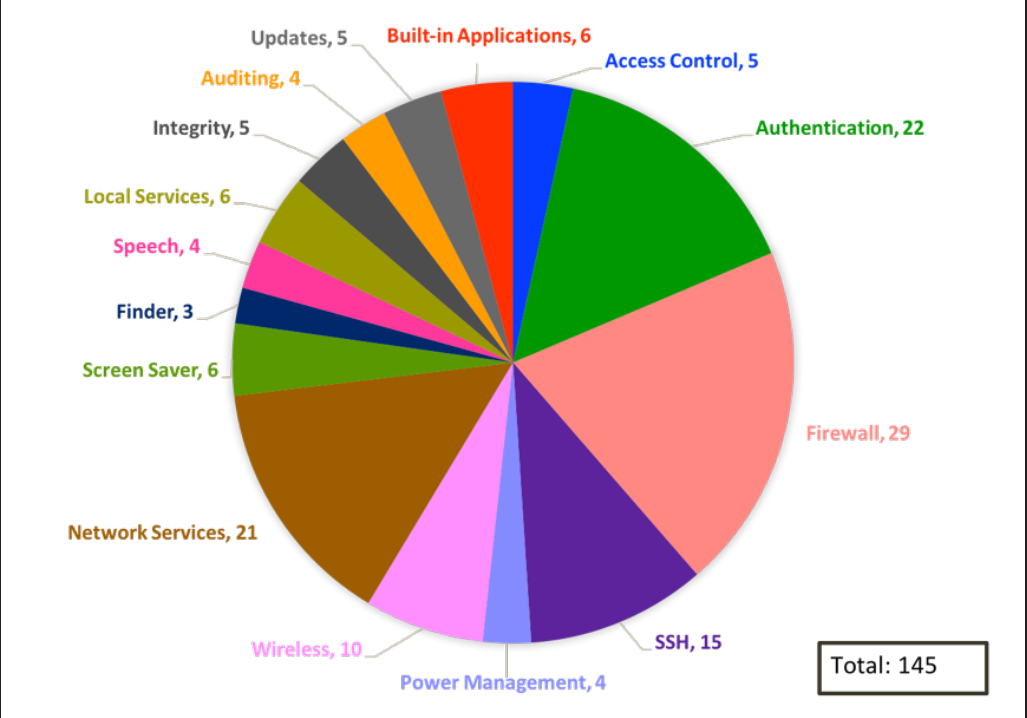
図40:設定のカテゴリ。設定項目をカテゴリ別に示した円グラフで、合計(Total)は 145 である。Firewall 29、Authentication 22、Network Services 21、SSH 15、Wireless 10、Built-in Applications 6、Local Services 6、Screen Saver 6、Access Control 5、Updates 5、Integrity 5、Auditing 4、Speech 4、Power Management 4、Finder 3。
Figure 40: Configuration Categories
図40:設定のカテゴリ
The shell scripts that apply the settings to a macOS 10.12 system are organized into three key baselines, which are appropriate for different environments:
設定をmacOS 10.12システムに適用するシェルスクリプトは、異なる環境に適した3つの主要なベースラインに整理されています。
•The Standalone baseline describes small, informal computer installations that are used for home or business purposes;
•Standaloneベースラインは、家庭用または業務用に使用される小規模で非公式なコンピュータ設備を対象とします。
•The Managed baseline is appropriate for centrally managed, networked systems; and
•Managedベースラインは、集中管理されネットワークに接続されたシステムに適しています。
•The Specialized Security-Limited Functionality (SSLF) baseline is appropriate for systems where security requirements are more stringent and where the implementation of security safeguards is likely to reduce functionality.
•Specialized Security-Limited Functionality(SSLF)ベースラインは、セキュリティ要件がより厳格で、セキュリティ保護策の実装によって機能が低下する可能性が高いシステムに適しています。
In FY 2017, the final version of SP 800-179, Guide to Securing Apple OS X 10.10 Systems for IT Professionals was published. This document explains the settings, their security significance, and how to configure them for the three baselines described above. The project team then focused on updating the guide, script and spreadsheet of settings for Apple macOS 10.12 systems.
2017会計年度には、SP 800-179, Guide to Securing Apple OS X 10.10 Systems for IT Professionalsの最終版が発行されました。この文書は、各設定、そのセキュリティ上の意義、および上記の3つのベースラインに合わせて設定する方法を説明しています。その後、プロジェクトチームは、Apple macOS 10.12システム向けに、このガイド、スクリプトおよび設定のスプレッドシートを更新することに注力しました。
In FY 2018, the team plans to:
2018会計年度に、チームは次のことを計画しています。
•Produce an updated guide for macOS 10.12;
•macOS 10.12向けに更新したガイドを作成します。
•Continue to refine the script and add more settings to the configuration; and
•引き続きスクリプトを改良し、設定構成にさらに多くの設定を追加します。
•Investigate macOS 10.13, “High Sierra.”
•macOS 10.13「High Sierra」を調査します。
FOR MORE INFORMATION, SEE:
詳細情報:
https://csrc.nist.gov/projects/apple-os-x-security-configuration
https://csrc.nist.gov/projects/apple-os-x-security-configuration
https://github.com/usnistgov/applesec
https://github.com/usnistgov/applesec
CONTACTS:
連絡先:
Mr. Mark Trapnell, (301) 975-4091, mark.trapnell@nist.gov
Mr. Mark Trapnell, (301) 975-4091, mark.trapnell@nist.gov
Mr. Lee Badger, (301) 975-3176, lee.badger@nist.gov
Mr. Lee Badger, (301) 975-3176, lee.badger@nist.gov
Mr. Murugiah Souppaya, (301) 975-8443, murugiah.souppaya@nist.gov
Mr. Murugiah Souppaya, (301) 975-8443, murugiah.souppaya@nist.gov
TECHNICAL SECURITY METRICS
技術的セキュリティメトリクス
Security Risk Analysis of Enterprise Networks Using Attack Graphs
攻撃グラフを用いた企業ネットワークのセキュリティリスク分析
The protection of computer networks from malicious intrusions is critical to the economy and security of the nation. Vulnerabilities are regularly discovered in software applications that are exploited to stage cyber attacks. System administrators need objective metrics to guide and justify decision making as they manage the security risk of enterprise networks. The objective of this research is to develop a standard model for the security risk analysis of computer networks. A standard model will enable an organization to answer questions such as “Are we more secure now than yesterday?” or “How does the security of one network configuration compare with another one?” Also, having a standard model to measure network security will allow users, vendors, and researchers to evaluate methodologies and products for network security in a coherent and consistent manner.
悪意のある侵入からコンピュータネットワークを保護することは、国家の経済と安全保障にとって極めて重要です。ソフトウェアアプリケーションには脆弱性が定期的に発見され、それが悪用されてサイバー攻撃が行われます。システム管理者は、企業ネットワークのセキュリティリスクを管理するにあたり、意思決定の指針となり、その根拠を示せる客観的なメトリクスを必要としています。本研究の目的は、コンピュータネットワークのセキュリティリスク分析のための標準モデルを開発することです。標準モデルがあれば、組織は「我々は昨日よりも安全になっているか」や「あるネットワーク構成のセキュリティは別の構成と比べてどうか」といった問いに答えられるようになります。また、ネットワークセキュリティを測定する標準モデルがあれば、利用者、ベンダーおよび研究者は、ネットワークセキュリティのための方法論と製品を、筋の通った一貫した方法で評価できるようになります。
CSD has approached the challenge of network security analysis by capturing vulnerability interdependencies and measuring security, based on how real attackers have penetrated networks. The methodology used for security risk analysis is based on attack graphs. CSD analyzes attack paths through a network, providing a probabilistic metric of the overall system risk. Through this metric, trade-offs between security costs and security benefits are analyzed.
CSDは、脆弱性の相互依存関係を捉え、実際の攻撃者がネットワークに侵入した方法に基づいてセキュリティを測定することにより、ネットワークセキュリティ分析の課題に取り組んできました。セキュリティリスク分析に用いる方法論は、攻撃グラフに基づいています。CSDはネットワークを通る攻撃経路を分析し、システム全体のリスクを表す確率的なメトリクスを提供します。このメトリクスを通じて、セキュリティのコストとセキュリティの便益との間のトレードオフが分析されます。
Computer systems are vulnerable to both known and zero-day attacks. Enterprises have begun to move parts of their networks from a traditional infrastructure into cloud computing environments. Cloud providers offer virtual servers that can be rented on demand by users. This paradigm enables cloud customers to acquire computing resources with high efficiency, low cost and great flexibility. However, it also introduces many security problems that need to be solved. Considered as an emerging branch of forensics that combine network and systems forensics, cloud forensics addresses post-incident analysis of systems with the complexities of distributed processing, multi-tenancy and virtualization. CSD has developed a framework that shows what evidence can be used to reconstruct corresponding attack scenarios in the cloud, and discusses how this framework can be applied to automate the forensics analysis in the cloud with the objective of saving a forensics investigator’s time.
コンピュータシステムは、既知の攻撃とゼロデイ攻撃の両方に対して脆弱です。企業は、ネットワークの一部を従来のインフラストラクチャからクラウドコンピューティング環境へ移行し始めています。クラウドプロバイダーは、利用者がオンデマンドで借りられる仮想サーバを提供しています。この方式により、クラウドの顧客は高い効率、低いコストおよび大きな柔軟性でコンピューティング資源を取得できます。しかし、これは解決を要する多くのセキュリティ問題ももたらします。クラウドフォレンジックは、ネットワークフォレンジックとシステムフォレンジックを組み合わせた、フォレンジックの新興の分野とみなされており、分散処理、マルチテナンシーおよび仮想化という複雑さを伴うシステムのインシデント後の分析を扱います。CSDは、クラウドにおける対応する攻撃シナリオを再構成するためにどの証拠を使用できるかを示す枠組みを開発しました。この枠組みは、フォレンジック調査担当者の時間を節約することを目的として、クラウドにおけるフォレンジック分析を自動化するためにどのように適用できるかについても論じています。
CSD has also developed a layered graphical model to analyze the impact of cyber attacks on business processes and services. The model has three layers: the upper layer models that the business processes and their dependencies, the middle layer constructs attack scenarios using evidences in log files, and the lowest layer reconstructs the missing attack steps using system calls. Based on the graph produced from the three layers, the model computes a quantitative impact on the business processes. CSD has developed a case study that shows the usability of this model and how it can be applied for both forensics analysis and for mitigating the impact of cyber attacks on the enterprise infrastructure. CSD published two papers in this area:
CSDはまた、サイバー攻撃がビジネスプロセスおよびサービスに与える影響を分析するための階層型のグラフモデルも開発しました。このモデルは3つの層を持ちます。上位層はビジネスプロセスとその依存関係をモデル化し、中間層はログファイル内の証拠を用いて攻撃シナリオを構築し、最下層はシステムコールを用いて欠落している攻撃ステップを再構成します。3つの層から生成されたグラフに基づき、モデルはビジネスプロセスへの定量的な影響を算出します。CSDは、このモデルの有用性と、フォレンジック分析および企業インフラストラクチャに対するサイバー攻撃の影響の緩和の両方にこのモデルを適用する方法を示す事例研究を作成しました。CSDはこの分野で2本の論文を発表しました。
1.Identifying Evidence for Cloud Forensics Analysis, International Federation for Information Processing (IFIP) International Conference on Digital Forensics, Orlando, FL, January 29 - February 1, 2017.
1.Identifying Evidence for Cloud Forensics Analysis, International Federation for Information Processing (IFIP) International Conference on Digital Forensics, Orlando, FL, 2017年1月29日~2月1日。
2.Towards Actionable Mission Impact Assessment in the Context of Cloud Computing, 31st IFIP WG 11.3 Conference on Data and Application Security and Privacy, Philadelphia, July 19-21, 2017.
2.Towards Actionable Mission Impact Assessment in the Context of Cloud Computing, 31st IFIP WG 11.3 Conference on Data and Application Security and Privacy, Philadelphia, 2017年7月19~21日。
In FY 2018, CSD plans to develop new techniques and metrics for Cloud Computing forensics analysis and mission impact analysis. CSD also plans to publish the results as a NIST report and as white papers in conferences and journals.
2018会計年度に、CSDはクラウドコンピューティングのフォレンジック分析およびミッション影響分析のための新しい技法とメトリクスを開発することを計画しています。CSDはまた、その成果をNISTの報告書として、ならびに会議および学術誌におけるホワイトペーパーとして発表することも計画しています。
FOR MORE INFORMATION, SEE:
詳細情報:
https://csrc.nist.gov/projects/measuring-security-risk-in-enterprise-networks/
https://csrc.nist.gov/projects/measuring-security-risk-in-enterprise-networks/
CONTACT:
連絡先:
Dr. Anoop Singhal, (301) 975-4432, anoop.singhal@nist.gov
Dr. Anoop Singhal, (301) 975-4432, anoop.singhal@nist.gov
Algorithms for Intrusion Measurement
侵入測定のためのアルゴリズム
The Algorithms for Intrusion Measurement (AIM) project furthers measurement science in designing and implementing algorithms to both detect attackers and limit their ability to intrude into a system. Most of the work leverages graph theory (the math of dots and lines) and algorithmic complexity analysis (the math around fast computation). In performing this work, the AIM project seeks to enhance the nation’s ability to defend itself from network-borne attacks.
Algorithms for Intrusion Measurement(AIM)プロジェクトは、攻撃者を検知するとともに、攻撃者がシステムに侵入する能力を制限するアルゴリズムの設計と実装において、計測科学を前進させるものです。作業の大部分は、グラフ理論(点と線の数学)とアルゴリズムの計算量解析(高速な計算に関する数学)を活用しています。この作業を通じて、AIMプロジェクトは、ネットワーク経由の攻撃から国家が自らを防御する能力を高めることを目指しています。
In FY 2017, the AIM project completed research in several areas: it proved that an important access control system is scalable, created novel metrics for defense-in-depth measurement, and identified an important intrusion detection approach. More specifically, the project team accomplished the following:
2017会計年度に、AIMプロジェクトはいくつかの領域で研究を完了しました。重要なアクセス制御システムがスケーラブルであることを証明し、多層防御の測定のための新規のメトリクスを作成し、重要な侵入検知のアプローチを特定しました。より具体的には、プロジェクトチームは次のことを達成しました。
•The team proved that the NGAC model is scalable by providing a fast-linear time, decision algorithm when existing reference implementations used slow cubic algorithms. This enables enterprises to reduce insider threats by tightly controlling data access through simultaneous instantiation of multiple access control policies (the research was published in the Journal of Wireless Mobile Networks, Ubiquitous Computing, and Dependable Applications and the Proceedings of the 2016 International Workshop on Managing Insider Security Threats).
•チームは、既存の参照実装が低速な3乗時間のアルゴリズムを使用していたのに対し、高速な線形時間の判定アルゴリズムを提供することにより、NGACモデルがスケーラブルであることを証明しました。これにより企業は、複数のアクセス制御ポリシーを同時にインスタンス化してデータアクセスを厳密に制御することで、内部者の脅威を低減できる(この研究は、Journal of Wireless Mobile Networks, Ubiquitous Computing, and Dependable ApplicationsおよびProceedings of the 2016 International Workshop on Managing Insider Security Threatsに掲載されました)。
•The team created novel metrics to measure the defense-in-depth posture of network systems. They proved that the metrics are extremely difficult to calculate (NP-Hard), and thus provided efficient and accurate approximation algorithms (this research was published in the proceedings of the Proceedings of the 2nd Annual Industrial Control System Security Workshop).
•チームは、ネットワークシステムの多層防御の態勢を測定する新規のメトリクスを作成しました。チームは、このメトリクスの計算が極めて困難である(NP-Hard)ことを証明したうえで、効率的かつ正確な近似アルゴリズムを提供した(この研究は、Proceedings of the 2nd Annual Industrial Control System Security Workshopの論文集に掲載されました)。
•The team discovered that n-gram anomaly detection (the most successful anomaly detection method to date) can act primarily as a signature system. This happens, in a form we call micro-signatures, when removing attacks from within test data in order to train on a clean set of data. This result reveals a new methodology for hybrid anomaly/signature detection systems while also calling into question many past anomaly detection results (this research was published in the proceedings of the International Symposium on Foundations and Practice of Security).
•チームは、n-gram異常検知(現在までで最も成功している異常検知手法)が、主としてシグネチャシステムとして働きうることを発見しました。これは、クリーンなデータ集合で学習するために試験データ内から攻撃を除去する際に、我々がマイクロシグネチャと呼ぶ形で生じます。この結果は、異常検知とシグネチャ検知のハイブリッドシステムのための新しい方法論を明らかにする一方で、過去の多くの異常検知の結果に疑問を投げかけるものでもある(この研究は、International Symposium on Foundations and Practice of Securityの論文集に掲載されました)。
In FY 2018, the AIM project will work on evaluating the privacy of global Internet traffic, architectures for cryptocurrencies to limit criminal behavior, secure methods for transactions involving digital goods, and how to publish trustworthy random numbers using blockchains and smart contracts.
2018会計年度に、AIMプロジェクトは、世界規模のインターネットトラフィックのプライバシーの評価、犯罪行為を制限するための暗号通貨のアーキテクチャ、デジタル財を伴う取引のための安全な方法、およびブロックチェーンとスマートコントラクトを用いて信頼できる乱数を公開する方法に取り組みます。
FOR MORE INFORMATION, SEE:
詳細情報:
https://csrc.nist.gov/projects/aim
https://csrc.nist.gov/projects/aim
CONTACT:
連絡先:
Mr. Peter Mell, (301) 975-5572, peter.mell@nist.gov
Mr. Peter Mell, (301) 975-5572, peter.mell@nist.gov
Automated Combinatorial Testing
自動化された組合せテスト
Software engineers often encounter failures that result from an unexpected interaction between components. A NIST investigation of actual failures has shown that most failures are triggered by one or two parameters, and progressively fewer by three, four, or more parameters (see Figure 41); this relationship is called the Interaction Rule. These results have important implications for testing software and systems. If all faults in a system can be triggered by a combination of n or fewer parameters, then testing all n-way combinations of parameters with a practical number of tests can provide strong fault detection efficiency. These methods are being applied to software and hardware testing for reliability, safety, and security. CSD’s focus is on empirical results and the impact on real-world problems.
ソフトウェア技術者は、コンポーネント間の予期しない相互作用に起因する故障にしばしば遭遇します。実際の故障に関するNISTの調査によれば、ほとんどの故障は1つまたは2つのパラメータによって引き起こされ、3つ、4つ、またはそれ以上のパラメータによって引き起こされる故障は段階的に少なくなります(図41を参照してください)。この関係はInteraction Ruleと呼ばれます。これらの結果は、ソフトウェアおよびシステムのテストに重要な意味を持ちます。システム内のすべての障害がn個以下のパラメータの組合せによって引き起こされうるのであれば、実用的な数のテストでパラメータのすべてのn-way組合せをテストすることにより、高い障害検出効率が得られます。これらの手法は、信頼性、安全性およびセキュリティのためのソフトウェアおよびハードウェアのテストに適用されつつあります。CSDは、実証的な結果と現実の問題への影響に重点を置いています。
Project highlights for FY 2017 include the development of a mathematical model that closely replicates the evolution and distribution of t-way failures found in empirical studies; invited lectures at conferences and universities; leading the Sixth International Workshop on Combinatorial Testing, held in conjunction with the Ninth IEEE International Conference on Software Testing; the development of combinatorial test methods specific to text search, with a demonstration of their practical application; and the development of combinatorial test methods specific to cryptographic software that discovered previously unknown faults in AES algorithm implementations. Collaborators include researchers from the University of Texas at Arlington, the University of Texas at Dallas, Loyola University of Maryland, East Carolina University, Duke University, Texas A&M, and the Air Force Institute of Technology.
2017会計年度のプロジェクトの主な成果には、次のものがあります。実証研究で見いだされたt-way故障の推移と分布を精度よく再現する数学モデルの開発、会議および大学での招待講演、Ninth IEEE International Conference on Software Testingと併催されたSixth International Workshop on Combinatorial Testingの主導、テキスト検索に特化した組合せテスト手法の開発とその実用的な適用の実証、およびAESアルゴリズムの実装にそれまで知られていなかった障害を発見した、暗号ソフトウェアに特化した組合せテスト手法の開発です。共同研究者には、University of Texas at Arlington、University of Texas at Dallas、Loyola University of Maryland、East Carolina University、Duke University、Texas A&MおよびAir Force Institute of Technologyの研究者が含まれます。
Technology transfer activities included the publication of a number of technical papers and software distributions; input to DoD recommendations on software test and verification; the release of enhanced combinatorial measurement tools; input modeling and fault location tools; the development of new test methods and tools specific to cryptography; the development of new test methods and tools specific to full-text search; and seminars at conferences, universities, and federal agencies.
技術移転活動には、多数の技術論文の発表とソフトウェアの配布、ソフトウェアのテストおよび検証に関するDoDの勧告への情報提供、強化された組合せ測定ツールの公開、入力モデリングツールおよび障害位置特定ツール、暗号に特化した新しいテスト手法とツールの開発、全文検索に特化した新しいテスト手法とツールの開発、ならびに会議、大学および連邦機関でのセミナーが含まれます。
Plans for FY 2018 include the development of methods and tools for testing cyber-physical systems and IoT systems; a potential application to place smart contract functions on a blockchain; methods for reducing the generation cost of high-assurance and life-critical software requirements; a trial use of prototype methods and tools for oracle-free testing methods; the analysis of empirical data on failures; further development of methods and tools for fault localization; and seminars, workshops, and tutorials at professional meetings and research labs.
2018会計年度の計画には、サイバーフィジカルシステムおよびIoTシステムをテストするための手法とツールの開発、スマートコントラクトの機能をブロックチェーン上に配置するための応用の可能性、高保証で人命に関わるソフトウェアの要件の生成コストを削減する手法、オラクルを必要としないテスト手法のための試作の手法とツールの試用、故障に関する実証データの分析、障害位置特定のための手法とツールのさらなる開発、ならびに専門家の会合および研究機関でのセミナー、ワークショップおよびチュートリアルが含まれます。
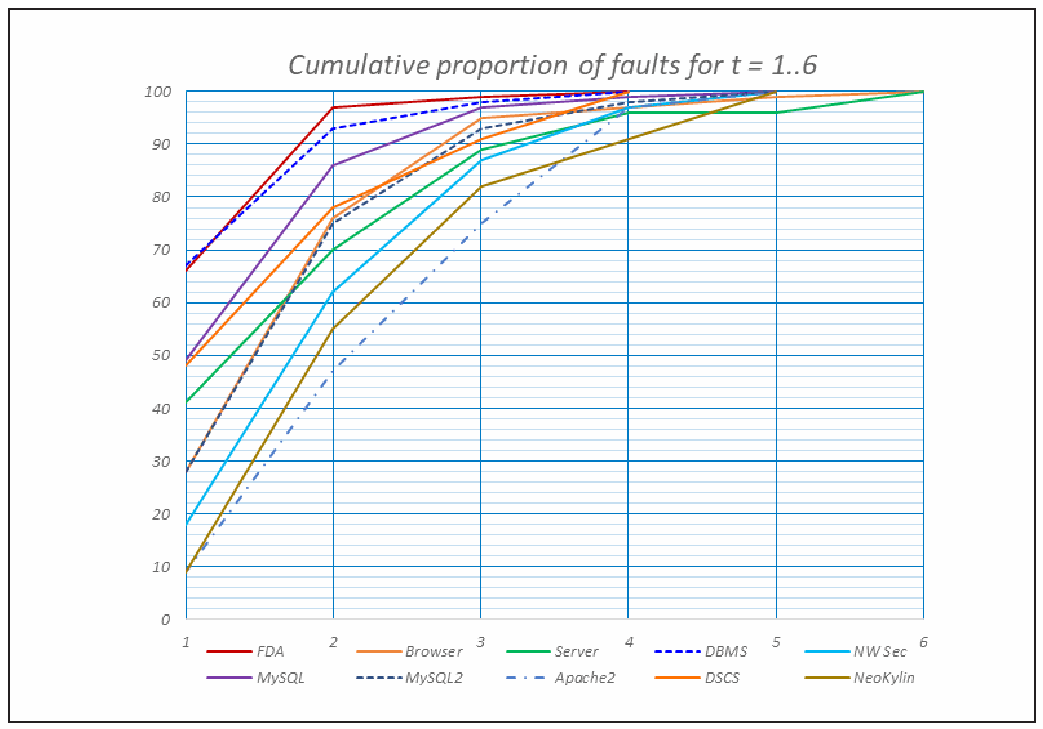
図41:t = 1..6における故障の分布。「Cumulative proportion of faults for t = 1..6」(t = 1..6 における故障の累積割合)と題した折れ線グラフである。横軸は t(1〜6)、縦軸は 0〜100(パーセント)である。系列は FDA、Browser、Server、DBMS、NW Sec、MySQL、MySQL2、Apache2、DSCS、NeoKylin の10本である。t = 1 での値は約 9(Apache2、NeoKylin)から約 66〜67(FDA、DBMS)まで、t = 2 では約 46(Apache2)から約 97(FDA)までに分布する。すべての系列が t = 4〜6 までに約 100 に達する。最後は Server で、t = 4 と 5 では約 96 にとどまり、t = 6 で 100 に達する。
Figure 41: Distribution of failures at t = 1..6
図41:t = 1..6における故障の分布
FOR MORE INFORMATION, SEE:
詳細情報:
https://csrc.nist.gov/projects/automated-combinatorial-testing-for-software
https://csrc.nist.gov/projects/automated-combinatorial-testing-for-software
CONTACTS:
連絡先:
Dr. Rick Kuhn, (301) 975-3337, kuhn@nist.gov
Dr. Rick Kuhn, (301) 975-3337, kuhn@nist.gov
Dr. Raghu Kacker, (301) 975-2109, raghu.kacker@nist.gov
Dr. Raghu Kacker, (301) 975-2109, raghu.kacker@nist.gov
Roots of Trust
Roots of Trust
Modern computing devices consist of various hardware, firmware, and software components at multiple layers of abstraction (see Figure 42). Many security and protection mechanisms are currently rooted in software that, along with all underlying components, must be trusted and not tampered with. A vulnerability in any of those components could compromise the trustworthiness of the security mechanisms that rely upon those components. Stronger security assurances may be possible by grounding security mechanisms in roots of trust.
現代のコンピューティングデバイスは、複数の抽象化レイヤにまたがるさまざまなハードウェア、ファームウェアおよびソフトウェアのコンポーネントで構成されます(図42を参照してください)。現在、多くのセキュリティ機構および保護機構はソフトウェアに根ざしており、そのソフトウェアは、下層にあるすべてのコンポーネントとともに、信頼でき、かつ改ざんされていないものでなければなりません。それらのコンポーネントのいずれかに脆弱性があれば、そのコンポーネントに依存するセキュリティ機構の信頼性が損なわれるおそれがあります。セキュリティ機構の基盤を信頼の基点(roots of trust)に置くことで、より強いセキュリティ保証が可能になりうます。
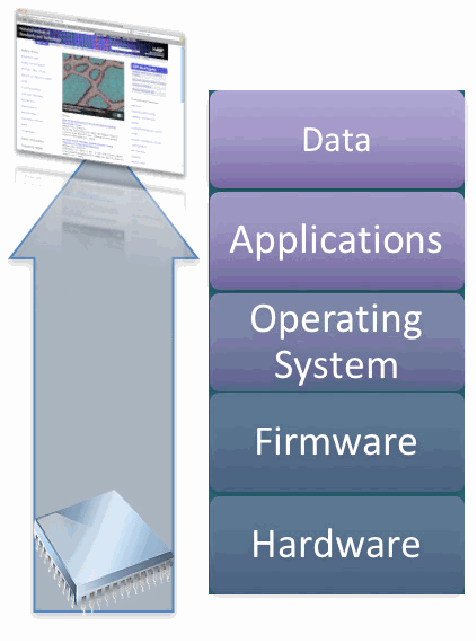
図42:モバイルコンピューティングデバイス内の抽象化レイヤ。下から Hardware(ハードウェア)、Firmware(ファームウェア)、Operating System(オペレーティングシステム)、Applications(アプリケーション)、Data(データ)の層を積み重ねた図である。左側には、下端のチップから上端のウェブページの画面へ向かう大きな上向きの矢印がある。
Figure 42: Layers of Abstraction within a Mobile Computing Device
図42:モバイルコンピューティングデバイス内の抽象化レイヤ
Roots of trust are highly reliable and secure hardware, firmware, and software components that perform specific, critical security functions. Because roots of trust are inherently trusted, they must be secure by their design. As such, many roots of trust are implemented in hardware or protected firmware so that malware cannot tamper with the functions they provide. Roots of trust provide a firm foundation from which to build security and trust.
信頼の基点とは、特定の重要なセキュリティ機能を実行する、信頼性と安全性の高いハードウェア、ファームウェアおよびソフトウェアのコンポーネントです。信頼の基点は本質的に信頼されるものであるため、設計の段階で安全でなければなりません。そのため、多くの信頼の基点は、それが提供する機能をマルウェアが改ざんできないように、ハードウェアまたは保護されたファームウェアに実装されます。信頼の基点は、セキュリティと信頼を構築するための強固な土台となります。
This project aims to encourage the use of roots of trust in computers to provide stronger security assurances. A focus area for this work has been securing firmware. Previous work in this project described methods to protect boot firmware as part of the SP 800-147 series, now standardized by ISO/IEC JTC 1/SC 27, IT Security Techniques, as ISO/IEC 19678:2015, Information Technology – BIOS Protection Guidelines.
本プロジェクトは、より強いセキュリティ保証を提供するために、コンピュータにおける信頼の基点の利用を促すことを目的とします。この作業の重点領域の一つは、ファームウェアの保護です。本プロジェクトのこれまでの作業では、SP 800-147シリーズの一部としてブートファームウェアを保護する方法を記述しており、これは現在、ISO/IEC JTC 1/SC 27, IT Security Techniquesにより、ISO/IEC 19678:2015, Information Technology – BIOS Protection Guidelinesとして標準化されています。
A new effort in FY 2017 built upon that earlier work focused on boot firmware to research and develop techniques and guidelines for securing firmware throughout the platform. Released for public comment in May 2017, SP 800-193, Platform Resiliency Guidelines, provides technical guidelines and recommendations supporting the resiliency of platform firmware and data against potentially destructive attacks. These draft guidelines promote resiliency in the platform by describing security mechanisms for protecting the platform against unauthorized changes, detecting unauthorized changes that occur, and secure recovery from attacks.
2017会計年度の新たな取り組みは、ブートファームウェアに焦点を当てたこの従来の作業を土台として、プラットフォーム全体のファームウェアを保護するための技術およびガイドラインを研究し、開発するものでした。2017年5月にパブリックコメントに付されたSP 800-193, Platform Resiliency Guidelinesは、破壊的になりうる攻撃に対するプラットフォームのファームウェアおよびデータのレジリエンスを支える技術的なガイドラインと推奨事項を示します。この草案ガイドラインは、認可されていない変更からプラットフォームを保護し、発生した認可されていない変更を検知し、攻撃から安全に復旧するためのセキュリティ機構を記述することで、プラットフォームのレジリエンスを高めます。
These new draft guidelines have been the basis for discussions with industry, standards organizations, and consortiums over technologies, standards, and specifications that can improve the resiliency of computer platforms using roots of trust. Based on these discussions, NIST expects to finalize SP 800-193 in FY 2018 and continue outreach to stakeholders in government, industry, and academia to encourage the development of more secure and reliable systems.
この新しい草案ガイドラインは、信頼の基点を用いてコンピュータプラットフォームのレジリエンスを向上させうる技術、標準および仕様について、産業界、標準化団体およびコンソーシアムと議論する際の基礎となってきました。これらの議論に基づき、NISTは2018会計年度にSP 800-193を最終化し、より安全で信頼性の高いシステムの開発を促すために、政府、産業界および学術界の利害関係者への働きかけを続ける見込みです。
FOR MORE INFORMATION, SEE:
詳細情報:
https://csrc.nist.gov/projects/hardware-roots-of-trust
https://csrc.nist.gov/projects/hardware-roots-of-trust
CONTACT:
連絡先:
Mr. Andrew Regenscheid, (301) 975-5155, andrew.regenscheid@nist.gov
Mr. Andrew Regenscheid, (301) 975-5155, andrew.regenscheid@nist.gov
USABILITY AND SECURITY
ユーザビリティとセキュリティ
The goal of the Usable Security and Privacy team, part of ITL’s Information Access Division (IAD), is to provide guidance for policymakers, system engineers and security professionals so that they can make better decisions that enhance the usability of cybersecurity in their organizations.
ITLのInformation Access Division (IAD) に属するUsable Security and Privacyチームの目標は、政策立案者、システムエンジニアおよびセキュリティ専門家が、自組織におけるサイバーセキュリティのユーザビリティを高めるより良い判断を下せるように、ガイダンスを提供することです。
During FY 2017, the team contributed usability chapters to SP 800-63, Digital Identity Guidelines, marking the first time that there were dedicated usability chapters in this publication.
2017会計年度に、同チームはSP 800-63, Digital Identity Guidelinesにユーザビリティの章を寄稿しました。この刊行物にユーザビリティ専用の章が設けられたのは、これが初めてです。
Phishing Awareness Training and Evaluation
フィッシング意識向上トレーニングと評価
During FY 2017, the usability team completed a long-term operational phishing evaluation, demonstrating the importance of individual user context in explaining phishing email click decisions; this collaboration provided the supporting data necessary to interpret the previously puzzling variability in click rates observed across prior years of operational phishing awareness training exercises.
2017会計年度に、ユーザビリティチームは長期にわたる運用環境でのフィッシング評価を完了し、フィッシングメールをクリックするかどうかの判断を説明するうえで、個々のユーザの状況が重要であることを実証しました。この共同作業により、過去数年の運用環境でのフィッシング意識向上トレーニング演習を通じて観測され、それまで不可解であったクリック率のばらつきを解釈するために必要な裏付けデータが得られました。
The team performed research regarding attacks known as phishing, where a sender initiates an email containing fraudulent information with the intent of inducing the recipient to reveal sensitive information. Phishing continues to be an escalating cyber threat facing organizations of all types and sizes, including industry, academia, and government. To help combat the phishing threat, many organizations utilize phishing awareness training to make employees and students more aware of phishing threats and consequences. Phishing awareness training systems often use software to emulate real-world threats and thus train people to recognize and avoid falling victim to phishing attacks. Using this type of embedded training system, researchers in the usability group partnered with NIST’s OISM (Office of Information Systems Management) and OSHE (Office of Safety Health and Environment) to complete three phishing awareness training exercises with corresponding surveys, culminating a multi-year phishing awareness evaluation.
同チームは、フィッシングとして知られる攻撃に関する研究を行いました。フィッシングでは、送信者が、受信者に機微な情報を明かさせることを意図して、詐欺的な情報を含む電子メールを送り付けます。フィッシングは、産業界、学術界および政府を含む、あらゆる種類と規模の組織が直面する、深刻化し続けるサイバー脅威です。フィッシングの脅威への対抗に役立てるため、多くの組織は、フィッシングの脅威とその影響に対する従業員および学生の意識を高めるフィッシング意識向上トレーニングを利用しています。フィッシング意識向上トレーニングシステムは、多くの場合、ソフトウェアを用いて現実の脅威を模擬し、それによって人々がフィッシング攻撃を見分け、その被害者にならないよう訓練します。ユーザビリティグループの研究者は、この種の組み込み型トレーニングシステムを用い、NISTのOISM (Office of Information Systems Management) およびOSHE (Office of Safety Health and Environment) と連携して、対応する調査を伴う3回のフィッシング意識向上トレーニング演習を完了し、複数年にわたるフィッシング意識向上評価を締めくくりました。
With the data developed, usability researchers have successfully answered both an operational assessment question, Why are users clicking or not clicking on phishing links and attachments?, as well as the larger institution’s trial deployment question, Why are click rates so variable? In contrast to previous research that was primarily performed in laboratory settings, the present work examines 4.5 years of in situ embedded simulated phishing emails. The results have provided additional insights into the rationale that leads some users to become victims of phishing attacks and malicious software. Given the variety of phishing premises and user contexts, no amount of training will consistently reduce click rates to zero, but the findings helped better understand the user’s role in early detection, combined with technological solutions, and determined that awareness training and reporting should be fully supported and even incentivized in the workforce.
得られたデータにより、ユーザビリティ研究者は、運用上の評価の問いである「なぜユーザはフィッシングのリンクや添付ファイルをクリックするのか、あるいはしないのか」と、より大きな、組織としての試行導入に関する問いである「なぜクリック率はこれほどばらつくのか」の両方に答えることができました。主に実験室環境で行われた従来の研究とは対照的に、本研究は、4.5年間にわたって実環境に組み込まれた模擬フィッシングメールを調べています。その結果から、一部のユーザがフィッシング攻撃や悪意のあるソフトウェアの被害者になるに至る理由について、さらなる知見が得られました。フィッシングの口実とユーザの状況が多様であることを踏まえると、どれだけトレーニングを重ねてもクリック率を一貫してゼロに下げることはできません。しかし、この知見は、技術的な解決策と組み合わせた早期検知におけるユーザの役割の理解を深めるのに役立ち、意識向上トレーニングと報告は、職場において全面的に支援され、さらには奨励策の対象とされるべきであるとの結論に至りました。
FOR MORE INFORMATION, SEE:
詳細情報:
https://www.nist.gov/itl
https://www.nist.gov/itl
CONTACTS:
連絡先:
Mrs. Mary Theofanos, (301) 975-5889, mary.theofanos@nist.gov
Mrs. Mary Theofanos, (301) 975-5889, mary.theofanos@nist.gov
Ms. Kristen Greene, (301) 975-8119, kristen.greene@nist.gov
Ms. Kristen Greene, (301) 975-8119, kristen.greene@nist.gov
Ms. Michelle Steves, (301) 975-3537, michelle.steves@nist.gov
Ms. Michelle Steves, (301) 975-3537, michelle.steves@nist.gov
Digital Identity Guidelines
Digital Identity Guidelines
SP 800-63, Digital Identity Guidelines, was finalized and published in June, 2017. After more than a year of work NIST has released a suite of documents covering digital identity from initial risk assessment to deployment of federated identity solutions. The SP suite has also been reorganized. SP 800-63-3 is the base document associated with SP 800-63A, 800-63B, and 800-63C that covers the various components of a digital identity system.
SP 800-63, Digital Identity Guidelinesは、2017年6月に最終化され、公表されました。1年を超える作業を経て、NISTは、最初のリスクアセスメントからフェデレーション型アイデンティティソリューションの導入までのデジタルアイデンティティを扱う一連の文書を公開しました。このSP文書群は再編成もされています。SP 800-63-3は基本文書であり、デジタルアイデンティティシステムのさまざまな構成要素を扱うSP 800-63A、800-63Bおよび800-63Cと関連付けられています。
In 2004, NIST published the initial version of Special Publication (SP) 800-63, Electronic Authentication Guideline. Since then, two revisions have been published, SP 800-63-2 being published in August 2013. In late 2015, NIST started considering a significant update to SP 800-63-2 in response to market innovation, evolving federal requirements, and an advanced threat landscape targeting remote authentication. As the first step in revising the publication, NIST solicited recommendations from experts (including those in industry, government, and educational fields) on which sections of the document needed revision. Usability surfaced in many comments as always latent in many security considerations. The usability team was invited to participate in and contribute to this year-long major revision effort. The team participated in weekly meetings with the project team, performed literature reviews, compiled results from our own usable security research, and wrote usability chapters in each of the suite of documents in the new SP 800-63.
2004年に、NISTはSpecial Publication (SP) 800-63, Electronic Authentication Guidelineの初版を公表しました。それ以降、2回の改訂版が公表されており、SP 800-63-2は2013年8月に公表されました。2015年後半、NISTは、市場におけるイノベーション、変化する連邦政府の要件、およびリモート認証を標的とする高度化した脅威の状況に対応して、SP 800-63-2の大幅な更新の検討を始めました。この刊行物を改訂する最初の段階として、NISTは、文書のどの節に改訂が必要かについて、専門家(産業界、政府および教育分野の専門家を含む)から提言を募りました。多くのコメントにおいて、ユーザビリティは、多くのセキュリティ上の考慮事項に常に潜在するものとして浮かび上がりました。ユーザビリティチームは、1年に及ぶこの大規模な改訂作業に参加し、貢献するよう招かれました。同チームは、プロジェクトチームとの週次会議に参加し、文献レビューを行い、自らのユーザブルセキュリティ研究の成果を取りまとめ、新しいSP 800-63の文書群の各文書にユーザビリティの章を執筆しました。
Specifically, for SP 800-63A, Digital Identity Guidelines: Enrollment and Identity Proofing, the usability chapter was written to raise implementers’ awareness of usability considerations associated with enrollment and identity proofing. For SP 800-63B, Digital Identity Guidelines: Authentication and Lifecycle Management, the usability chapter provides usability considerations and guidance on authentication, as integrating usability into the development process can lead to authentication solutions that are secure and usable while addressing users’ authentication needs and organizations’ business goals. For SP 800-63C, Digital Identity Guidelines: Federation and Assertions, the usability chapter provides considerations and guidance to understand user perspectives on online identity, trust and benefits, and user mental models and beliefs in order to promote good user experience with federated identity systems.
具体的には、SP 800-63A, Digital Identity Guidelines: Enrollment and Identity Proofingについては、登録および身元確認に関連するユーザビリティ上の考慮事項に対する実装者の意識を高めるために、ユーザビリティの章を執筆しました。SP 800-63B, Digital Identity Guidelines: Authentication and Lifecycle Managementについては、ユーザビリティの章は、認証に関するユーザビリティ上の考慮事項とガイダンスを示します。開発プロセスにユーザビリティを組み入れることで、ユーザの認証上のニーズと組織の事業目標に対応しつつ、安全で使いやすい認証ソリューションを実現できるためです。SP 800-63C, Digital Identity Guidelines: Federation and Assertionsについては、ユーザビリティの章は、フェデレーション型アイデンティティシステムにおける良好なユーザエクスペリエンスを促すために、オンラインアイデンティティ、信頼および便益に対するユーザの見方、ならびにユーザのメンタルモデルと信念を理解するための考慮事項とガイダンスを示します。
FOR MORE INFORMATION, SEE:
詳細情報:
https://csrc.nist.gov/publications/detail/sp/800-63/3/final
https://csrc.nist.gov/publications/detail/sp/800-63/3/final
CONTACTS:
連絡先:
Mrs. Mary Theofanos, (301) 975-5889, mary.theofanos@nist.gov
Mrs. Mary Theofanos, (301) 975-5889, mary.theofanos@nist.gov
Dr. Yee-Yin Choong, (301) 975-3248, yee-yin.choong@nist.gov
Dr. Yee-Yin Choong, (301) 975-3248, yee-yin.choong@nist.gov
Ms. Kristen Greene, (301) 975-8119, kristen.greene@nist.gov
Ms. Kristen Greene, (301) 975-8119, kristen.greene@nist.gov
HONORS AND AWARDS
栄誉と表彰
This section recognizes ITL staff who have received honors and/or awards for their cybersecurity accomplishments.
本節では、サイバーセキュリティにおける業績に対して栄誉または表彰を受けたITL職員を紹介します。
NIST Bronze Medal Award
NIST Bronze Medal Award
The Bronze Medal Award is the highest recognition awarded by NIST. The award, approved by the Director, recognizes work that has resulted in more effective and efficient management systems as well as the demonstration of unusual initiative or creative ability in the development and improvement of methods and procedures. It is also given for significant contributions affecting major programs, scientific accomplishments, and superior performance of assigned tasks for at least five consecutive years.
Bronze Medal Awardは、NISTが授与する最高の表彰です。この賞は所長が承認するものであり、より効果的かつ効率的なマネジメントシステムをもたらした業績、ならびに方法および手順の開発と改善において並外れた主体性または創造力を示したことを表彰します。また、主要なプログラムに影響を及ぼす顕著な貢献、科学上の業績、および与えられた任務における少なくとも5年連続の優れた成績に対しても授与されます。
Jeff Cichonski (Applied Cybersecurity Division); Lee Badger, Mike Bartock, David Cooper, Hildegard (Hildy) Ferraiolo, and Murugiah Souppaya (Computer Security Division); Paul Black and Barbara Guttman (Software and Systems Division).
Jeff Cichonski(Applied Cybersecurity Division)、Lee Badger、Mike Bartock、David Cooper、Hildegard (Hildy) FerraioloおよびMurugiah Souppaya(コンピュータセキュリティ部門)、Paul BlackおよびBarbara Guttman(Software and Systems Division)。
NIST銅賞を受賞した職員7名の集合写真。屋外で前列と後列に分かれて立つ。キャプション記載の後列(左から):B. Guttman、L. Badger、J. Cichonski、M. Bartock。前列:P. Black、H. Ferraiolo、D. Cooper。不在:M. Souppaya。 [人物の写真。人物が写っているため、この非公式サイトには掲載していません。原本 PDF を参照してください。]
(Left to Right) Back row: B. Guttman, L. Badger, J. Cichonski, M. Bartock Front row: P. Black, H. Ferraiolo, D. Cooper Absent: M. Souppaya
(左から右へ)後列:B. Guttman、L. Badger、J. Cichonski、M. Bartock 前列:P. Black、H. Ferraiolo、D. Cooper 欠席:M. Souppaya
The group is recognized for addressing a series of near-term needs and providing a long-term strategy to improve our nation’s cybersecurity. The White House-led Cybersecurity National Action Plan of January 2016 prioritized critical cybersecurity areas and directed NIST to produce tools, references, and guidelines to help organizations strengthen the identification and authentication of privileged users, assist in recovering from cybersecurity incidents, self-assess their security capabilities, and identify methods to reduce vulnerabilities in software. The items developed by this team were exceptionally clear, consistent, and actionable, and have led to cybersecurity improvements in all sectors.
このグループは、一連の短期的なニーズに対応し、米国のサイバーセキュリティを向上させるための長期的な戦略を示したことで表彰されました。ホワイトハウスが主導した2016年1月のCybersecurity National Action Planは、重要なサイバーセキュリティ分野に優先順位を付け、NISTに対し、組織が特権ユーザの識別と認証を強化し、サイバーセキュリティインシデントからの復旧を支援し、自らのセキュリティ能力を自己評価し、ソフトウェアの脆弱性を減らす方法を特定することに役立つツール、参考資料およびガイドラインを作成するよう指示しました。このチームが開発した成果物は、際立って明確で、一貫性があり、実行に移せるものであり、あらゆる分野でサイバーセキュリティの改善につながっています。
Donna Dodson氏の肖像写真。肩までの構図で、暗色のジャケットを着て微笑んでいる。 [人物の写真。人物が写っているため、この非公式サイトには掲載していません。原本 PDF を参照してください。]
Donna Dodson | One of CyberScoop’s 2017 Top Women in Cybersecurity
Donna Dodson | CyberScoopの2017 Top Women in Cybersecurityの一人
Awarding Organization: CyberScoop
授与組織:CyberScoop
Donna Dodson is the NIST chief cybersecurity advisor. Donna has been named one of CyberScoop’s 2017 Top Women in Cybersecurity! Donna Dodson has multiple roles at NIST. In addition to being the chief cybersecurity advisor to Acting NIST Director Kent Rochford, she is associate director of the Information Technology Laboratory — one of six labs at NIST — and director of the National Cybersecurity Center of Excellence.
Donna Dodsonは、NISTの首席サイバーセキュリティアドバイザーです。Donnaは、CyberScoopの2017 Top Women in Cybersecurityの一人に選ばれました。Donna DodsonはNISTで複数の役割を担っています。NIST所長代行Kent Rochfordの首席サイバーセキュリティアドバイザーであることに加え、NISTにある6つの研究所の一つである情報技術研究所の副所長、およびNational Cybersecurity Center of Excellenceの所長を務めています。
See NIST Press Release: https://www.nist.gov/about-us/nist-awards/donna-dodson-one-cyberscoops-2017-top-women-cybersecurity
NISTのプレスリリースを参照:https://www.nist.gov/about-us/nist-awards/donna-dodson-one-cyberscoops-2017-top-women-cybersecurity
Source: https://www.cyberscoop.com/top-women-in-cybersecurity-donna-dodson/
出典:https://www.cyberscoop.com/top-women-in-cybersecurity-donna-dodson/
Rodney Petersen | 2016 Government Leadership of the Year
Rodney Petersen | 2016 Government Leadership of the Year
Awarding Organization: The Colloquium for Information Systems Security Education (CISSE)
授与組織:The Colloquium for Information Systems Security Education (CISSE)
Rodney Petersen is the director of the National Initiative for Cybersecurity Education (NICE) at the National Institute of Standards and Technology (NIST). He previously served as the Managing Director of the EDUCAUSE Washington Office and a Senior Government Relations Officer.
Rodney Petersenは、米国国立標準技術研究所(NIST)のNational Initiative for Cybersecurity Education (NICE) のディレクターです。それ以前は、EDUCAUSE Washington OfficeのManaging DirectorおよびSenior Government Relations Officerを務めました。
Rodney Petersen氏の肖像写真。スーツ姿で正面を向いている。 [人物の写真。人物が写っているため、この非公式サイトには掲載していません。原本 PDF を参照してください。]
He founded and directed the EDUCAUSE Cybersecurity Initiative and was the lead staff liaison for the Higher Education Information Security Council. Prior to joining EDUCAUSE, he worked at two different times for the University of Maryland - first as Campus Compliance Officer in the Office of the President and later as the Director of IT Policy and Planning in the Office of the Vice President and Chief Information Officer. He also completed one year of federal service as an Instructor in the Academy for Community Service for AmeriCorps’ National Civilian Community Corps. He is the co-editor of a book entitled “Computer and Network Security in Higher Education.” He received his law degree from Wake Forest University and bachelors degrees in political science and business administration from Alma College. He was awarded a certificate as an Advanced Graduate Specialist in Education Policy, Planning, and Administration from the University of Maryland.
同氏は、EDUCAUSE Cybersecurity Initiativeを創設して指揮し、Higher Education Information Security Councilの主任スタッフリエゾンを務めました。EDUCAUSEに加わる前は、University of Marylandに2度にわたって勤務し、最初はOffice of the PresidentのCampus Compliance Officerとして、後にはOffice of the Vice President and Chief Information OfficerのDirector of IT Policy and Planningとして働きました。また、AmeriCorpsのNational Civilian Community CorpsのAcademy for Community ServiceでInstructorとして1年間の連邦政府勤務も終えています。同氏は、「Computer and Network Security in Higher Education」と題する書籍の共編者です。Wake Forest Universityで法学の学位を、Alma Collegeで政治学および経営学の学士号を取得しました。また、University of MarylandからAdvanced Graduate Specialist in Education Policy, Planning, and Administrationの修了証を授与されました。
Source: https://cisse.info/about/award-recipients/634-2016-government-leadership-of-the-year-rodney-petersen
出典:https://cisse.info/about/award-recipients/634-2016-government-leadership-of-the-year-rodney-petersen
NICEの国際的リーダーシップ賞受賞者6名の集合写真。室内で横一列に並び、後ろにNICE(国家サイバーセキュリティ教育イニシアティブ)のバナーがある。写真captionの左から:William(Bill)Newhouse、Marian Merritt、Rodney Petersen、Danielle Santos、Clarence Williams、Davina Pruitt-Mingle。 [人物の写真。人物が写っているため、この非公式サイトには掲載していません。原本 PDF を参照してください。]
Rodney Petersen and NICE Team - Received the Exemplary International Leadership in Cybersecurity Education and Workforce Development Award
Rodney PetersenとNICEチーム ― Exemplary International Leadership in Cybersecurity Education and Workforce Development Awardを受賞
(Left to Right): William (Bill) Newhouse, Marian Merritt. Rodney Petersen, Danielle Santos, Clarence Williams, and Davina Pruitt-Mingle
(左から右へ):William (Bill) Newhouse、Marian Merritt。Rodney Petersen、Danielle Santos、Clarence Williams、Davina Pruitt-Mingle
Awarding Organization: Cyber New Brunswick of Canada
授与組織:カナダのCyber New Brunswick
The National Initiative for Cybersecurity Education (NICE) team, which received an award for Exemplary International Leadership in Cybersecurity Education and Workforce Development from Cyber New Brunswick at Canada’s inaugural Cybersecurity Education and Workforce Summit (CyberSmart 2017).
National Initiative for Cybersecurity Education (NICE)チーム。カナダで初めて開催されたCybersecurity Education and Workforce Summit (CyberSmart 2017)において、Cyber New BrunswickからExemplary International Leadership in Cybersecurity Education and Workforce Developmentの賞を受けました。
Source: https://www.nist.gov/about-us/nist-awards/rodney-petersen-and-nice-team-received-exemplary-international-leadership
出典:https://www.nist.gov/about-us/nist-awards/rodney-petersen-and-nice-team-received-exemplary-international-leadership
The National Initiative for Cybersecurity Education (NICE) was awarded a recognition plaque at the National Cybersecurity Summit
National Initiative for Cybersecurity Education (NICE)がNational Cybersecurity Summitで表彰の盾を授与
Awarding Organization: National Cybersecurity Summit
授与組織:National Cybersecurity Summit
The National Initiative for Cybersecurity Education (NICE) Program Office received an honor of recognition at the National Cybersecurity Summit in Huntsville, Alabama. NICE received this award for its leadership in advancing cybersecurity education, training, and workforce development efforts for the nation.
National Initiative for Cybersecurity Education (NICE) Program Officeは、アラバマ州Huntsvilleで開催されたNational Cybersecurity Summitで表彰を受けました。NICEは、国のためにサイバーセキュリティの教育、訓練、および人材育成の取り組みを前進させた指導力により、この賞を受けました。
ITL CYBERSECURITY PROGRAM PUBLICATIONS RELEASED IN FY 2017
2017会計年度に発行されたITLサイバーセキュリティプログラムの刊行物
This section provides a compilation of ITL cybersecurity publications released during FY 2017 (from October 1, 2016 to September 30, 2017). The first portion lists technical documents, while the second portion provides abstracts that briefly summarize each document (technical and non-technical).
本節は、2017会計年度(2016年10月1日から2017年9月30日まで)に発行されたITLのサイバーセキュリティ関連刊行物をまとめたものです。前半では技術文書を一覧にし、後半では各文書(技術文書および非技術文書)を簡潔に要約した抄録を示します。
DRAFT PUBLICATIONS
草案刊行物
There were no draft FIPS released during FY 2017.
2017会計年度に公開されたFIPSの草案はなかった。
| TABLE 5: SPECIAL PUBLICATIONS (SPs) | ||
|---|---|---|
| PUBLICATION NUMBER | TITLE | DRAFT RELEASED |
| SP 800-193 | Platform Firmware Resiliency Guidelines | May 2017 |
| SP 800-191 | The NIST Defnition of Fog Computing | August 2017 |
| SP 800-190 (2 Drafts) | Application Container Security Guide | April 2017 July 2017 |
| SP 800-188 (2nd Draft) | De-Identifying Government Datasets | December 2016 |
| SP 800-187 | Guide to LTE Security | November 2016 |
| SP 800-177 Rev. 1 | Trustworthy Email | September 2017 |
| SP 800-125A (2nd Draft) | Security Recommendations for Hypervisor Deployment | September 2017 |
| SP 800-70 Rev. 4 | National Checklist Program for IT Products: Guidelines for Checklist Users and Developers | August 2017 |
| SP 800-67 Rev. 2 | Recommendation for the Triple Data Encryption Algorithm (TDEA) Block Cipher | July 2017 |
| SP 800-56C Rev. 1 | Recommendation for Key Derivation through Extraction-then-Expansion | August 2017 |
| SP 800-56A Rev. 3 | Recommendation for Pair-Wise Key-Establishment Schemes Using Discrete Logarithm Cryptography | August 2017 |
| SP 800-53 Rev. 5 | Security and Privacy Controls for Information Systems and Organizations | August 2017 |
| SP 800-37 Rev. 2 (Discussion Draft) | Risk Management Framework for Information Systems and Organizations: A System Life Cycle Approach for Security and Privacy | September 2017 |
| SP 1800-12 | Derived Personal Identity Verifcation (PIV) Credentials | September 2017 |
| SP 1800-11 | Data Integrity: Recovering from Ransomware and Other Destructive Events | September 2017 |
| SP 1800-9 | Access Rights Management for the Financial Services Sector | August 2017 |
| SP 1800-8 | Securing Wireless Infusion Pumps in Healthcare Delivery Organizations | May 2017 |
| SP 1800-7 | Situational Awareness for Electric Utilities | February 2017 |
| SP 1800-6 | Domain Name Systems-Based Electronic Mail Security | November 2016 |
| SP 1800-3 (2nd Draft) | Attribute Based Access Control | September 2017 |
| 表5:特別刊行物(SP) | ||
|---|---|---|
| 刊行物番号 | タイトル | 草案公開時期 |
| SP 800-193 | Platform Firmware Resiliency Guidelines | 2017年5月 |
| SP 800-191 | The NIST Definition of Fog Computing | 2017年8月 |
| SP 800-190(草案2件) | Application Container Security Guide | 2017年4月 2017年7月 |
| SP 800-188(第2次草案) | De-Identifying Government Datasets | 2016年12月 |
| SP 800-187 | Guide to LTE Security | 2016年11月 |
| SP 800-177 Rev. 1 | Trustworthy Email | 2017年9月 |
| SP 800-125A(第2次草案) | Security Recommendations for Hypervisor Deployment | 2017年9月 |
| SP 800-70 Rev. 4 | National Checklist Program for IT Products: Guidelines for Checklist Users and Developers | 2017年8月 |
| SP 800-67 Rev. 2 | Recommendation for the Triple Data Encryption Algorithm (TDEA) Block Cipher | 2017年7月 |
| SP 800-56C Rev. 1 | Recommendation for Key Derivation through Extraction-then-Expansion | 2017年8月 |
| SP 800-56A Rev. 3 | Recommendation for Pair-Wise Key-Establishment Schemes Using Discrete Logarithm Cryptography | 2017年8月 |
| SP 800-53 Rev. 5 | Security and Privacy Controls for Information Systems and Organizations | 2017年8月 |
| SP 800-37 Rev. 2(協議用草案) | Risk Management Framework for Information Systems and Organizations: A System Life Cycle Approach for Security and Privacy | 2017年9月 |
| SP 1800-12 | Derived Personal Identity Verification (PIV) Credentials | 2017年9月 |
| SP 1800-11 | Data Integrity: Recovering from Ransomware and Other Destructive Events | 2017年9月 |
| SP 1800-9 | Access Rights Management for the Financial Services Sector | 2017年8月 |
| SP 1800-8 | Securing Wireless Infusion Pumps in Healthcare Delivery Organizations | 2017年5月 |
| SP 1800-7 | Situational Awareness for Electric Utilities | 2017年2月 |
| SP 1800-6 | Domain Name Systems-Based Electronic Mail Security | 2016年11月 |
| SP 1800-3(第2次草案) | Attribute Based Access Control | 2017年9月 |
| TABLE 6: NIST INTERNAL OR INTERAGENCY REPORTS (NISTIRs) | ||
|---|---|---|
| PUBLICATION NUMBER | TITLE | DRAFT RELEASED |
| NISTIR 8179 | Criticality Analysis Process Model: Prioritizing Systems and Components | July 2017 |
| NISTIR 8176 | Security Assurance Challenges for Container Deployment | August 2017 |
| NISTIR 8170 | The Cybersecurity Framework: Implementation Guidance for Federal Agencies | May 2017 |
| NISTIR 8151 | Dramatically Reducing Software Vulnerabilities: Report to the White House Ofce of Science and Technology Policy | October 2016 |
| NISTIR 8139 | Identifying Uniformity with Entropy and Divergence | February 2017 |
| 表6:NIST内部報告書または省庁間報告書(NISTIR) | ||
|---|---|---|
| 刊行物番号 | タイトル | 草案公開時期 |
| NISTIR 8179 | Criticality Analysis Process Model: Prioritizing Systems and Components | 2017年7月 |
| NISTIR 8176 | Security Assurance Challenges for Container Deployment | 2017年8月 |
| NISTIR 8170 | The Cybersecurity Framework: Implementation Guidance for Federal Agencies | 2017年5月 |
| NISTIR 8151 | Dramatically Reducing Software Vulnerabilities: Report to the White House Office of Science and Technology Policy | 2016年10月 |
| NISTIR 8139 | Identifying Uniformity with Entropy and Divergence | 2017年2月 |
FINAL APPROVED PUBLICATIONS
最終承認済み刊行物
There were no FIPS released during FY 2017.
2017会計年度に公開されたFIPSはなかった。
| TABLE 7: FINAL SPs | ||
|---|---|---|
| PUBLICATION NUMBER | TITLE | FINAL RELEASED |
| SP 800-195 | 2016 NIST/ITL Cybersecurity Program Annual Report | September 2017 |
| SP 800-192 | Verifcation and Test Methods for Access Control Policies/ Models | June 2017 |
| SP 800-190 | Application Container Security Guide | September 2017 |
| SP 800-185 | SHA-3 Derived Functions: cSHAKE, KMAC, TupleHash, and ParallelHash | December 2016 |
| SP 800-184 | Guide for Cybersecurity Event Recovery | December 2016 |
| SP 800-181 | National Initiative for Cybersecurity Education (NICE) Cybersecurity Workforce Framework | August 2017 |
| SP 800-179 | Guide to Securing Apple OS X 10.10 Systems for IT Professionals: A NIST Security Confguration Checklist | December 2016 |
| SP 800-178 | A Comparison of Attribute Based Access Control (ABAC) Standards for Data Service Applications: Extensible Access Control Markup Language (XACML) and Next Generation Access Control (NGAC) | October 2016 |
| SP 800-171 Rev. 1 | Protecting Controlled Unclassifed Information in Nonfederal Information Systems and Organizations | December 2016 |
| SP 800-160 | Systems Security Engineering: Considerations for a Multidisciplinary Approach in the Engineering of Trustworthy Secure Systems | November 2016 |
| SP 800-150 | Guide to Cyber Threat Information Sharing | October 2016 |
| SP 800-121 Rev. 2 | Guide to Bluetooth Security | May 2017 |
| SP 800-70 Rev. 3 (update) | National Checklist Program for IT Products: Guidelines for Checklist Users and Developers | December 2016 |
| SP 800-63-3 | Digital Identity Guidelines | June 2017 |
| SP 800-63A | Digital Identity Guidelines: Enrollment and Identity Proofng | June 2017 |
| SP 800-63B | Digital Identity Guidelines: Authentication and Lifecycle Management | June 2017 |
| SP 800-63C | Digital Identity Guidelines: Federation and Assertions | June 2017 |
| SP 800-38B (update) | Recommendation for Block Cipher Modes of Operation: the CMAC Mode for Authentication | October 2016 |
| SP 800-12 Rev. 1 | An Introduction to Information Security | June 2017 |
| SP 500-320 | Report of the Workshop on Software Measures and Metrics to Reduce Security Vulnerabilities (SwMM-RSV) | October 2016 |
| 表7:最終版SP | ||
|---|---|---|
| 刊行物番号 | タイトル | 最終公開日 |
| SP 800-195 | 2016 NIST/ITL Cybersecurity Program Annual Report | 2017年9月 |
| SP 800-192 | Verification and Test Methods for Access Control Policies/ Models | 2017年6月 |
| SP 800-190 | Application Container Security Guide | 2017年9月 |
| SP 800-185 | SHA-3 Derived Functions: cSHAKE, KMAC, TupleHash, and ParallelHash | 2016年12月 |
| SP 800-184 | Guide for Cybersecurity Event Recovery | 2016年12月 |
| SP 800-181 | National Initiative for Cybersecurity Education (NICE) Cybersecurity Workforce Framework | 2017年8月 |
| SP 800-179 | Guide to Securing Apple OS X 10.10 Systems for IT Professionals: A NIST Security Configuration Checklist | 2016年12月 |
| SP 800-178 | A Comparison of Attribute Based Access Control (ABAC) Standards for Data Service Applications: Extensible Access Control Markup Language (XACML) and Next Generation Access Control (NGAC) | 2016年10月 |
| SP 800-171 Rev. 1 | Protecting Controlled Unclassified Information in Nonfederal Information Systems and Organizations | 2016年12月 |
| SP 800-160 | Systems Security Engineering: Considerations for a Multidisciplinary Approach in the Engineering of Trustworthy Secure Systems | 2016年11月 |
| SP 800-150 | Guide to Cyber Threat Information Sharing | 2016年10月 |
| SP 800-121 Rev. 2 | Guide to Bluetooth Security | 2017年5月 |
| SP 800-70 Rev. 3(更新) | National Checklist Program for IT Products: Guidelines for Checklist Users and Developers | 2016年12月 |
| SP 800-63-3 | Digital Identity Guidelines | 2017年6月 |
| SP 800-63A | Digital Identity Guidelines: Enrollment and Identity Proofing | 2017年6月 |
| SP 800-63B | Digital Identity Guidelines: Authentication and Lifecycle Management | 2017年6月 |
| SP 800-63C | Digital Identity Guidelines: Federation and Assertions | 2017年6月 |
| SP 800-38B(更新) | Recommendation for Block Cipher Modes of Operation: the CMAC Mode for Authentication | 2016年10月 |
| SP 800-12 Rev. 1 | An Introduction to Information Security | 2017年6月 |
| SP 500-320 | Report of the Workshop on Software Measures and Metrics to Reduce Security Vulnerabilities (SwMM-RSV) | 2016年10月 |
| TABLE 8: FINAL NISTIRs | ||
|---|---|---|
| PUBLICATION NUMBER | TITLE | FINAL RELEASED |
| NISTIR 8192 | Enhancing Resilience of the Internet and Communications Ecosystem: a NIST Workshop Proceedings | September 2017 |
| NISTIR 8183 | Cybersecurity Framework Manufacturing Profle | August 2017 |
| NISTIR 8165 | Impact of Code Complexity on Software Analysis | February 2017 |
| NISTIR 8151 | Dramatically Reducing Software Vulnerabilities: Report to the White House Ofce of Science and Technology Policy | November 2016 |
| NISTIR 8136 | An Overview of Mobile Application Vetting Services for Public Safety | January 2017 |
| NISTIR 8114 | Report on Lightweight Cryptography | March 2017 |
| NISTIR 8062 | An Introduction to Privacy Engineering and Risk Management in Federal Systems | January 2017 |
| NISTIR 8011 Volume 1 | Automation Support for Security Control Assessments: Overview | June 2017 |
| NISTIR 8011 Volume 2 | Automation Support for Security Control Assessments: Hardware Asset Management | June 2017 |
| NISTIR 7621 Rev. 1 | Small Business Information Security: The Fundamentals | November 2016 |
| 表8:最終版NISTIR | ||
|---|---|---|
| 刊行物番号 | タイトル | 最終公開日 |
| NISTIR 8192 | インターネットおよび通信エコシステムのレジリエンス強化:NISTワークショップ論文集 | 2017年9月 |
| NISTIR 8183 | サイバーセキュリティ・フレームワーク製造業プロファイル | 2017年8月 |
| NISTIR 8165 | コードの複雑さがソフトウェア分析に及ぼす影響 | 2017年2月 |
| NISTIR 8151 | ソフトウェア脆弱性の大幅削減:ホワイトハウス科学技術政策局への報告書 | 2016年11月 |
| NISTIR 8136 | 公共安全向けモバイルアプリ審査サービスの概要 | 2017年1月 |
| NISTIR 8114 | 軽量暗号に関する報告書 | 2017年3月 |
| NISTIR 8062 | 連邦システムにおけるプライバシー工学とリスク管理の入門 | 2017年1月 |
| NISTIR 8011 第1巻 | セキュリティ管理策評価の自動化支援:概要 | 2017年6月 |
| NISTIR 8011 第2巻 | セキュリティ管理策評価の自動化支援:ハードウェア資産管理 | 2017年6月 |
| NISTIR 7621 Rev. 1 | 中小企業の情報セキュリティ:基礎 | 2016年11月 |
ITL BULLETINS
ITL BULLETINS
| TABLE 9: FY 2017 ITL BULLETINS | |
|---|---|
| PUBLICATION DATE | BULLETIN TITLE |
| September 2017 | Updating the Keys for DNS Security |
| August 2017 | Understanding the Major Update to NIST SP 800-63: Digital Identity Guidelines |
| July 2017 | Updated NIST Guidance for Bluetooth Security |
| June 2017 | Toward Standardizing Lightweight Cryptography |
| May 2017 | Cyber-Threat Intelligence and Information Sharing |
| April 2017 | Building the Bridge Between Privacy and Cybersecurity for Federal Systems |
| March 2017 | Fundamentals of Small Business Information Security |
| February 2017 | Guide for Cybersecurity Incident Recovery |
| January 2017 | Dramatically Reducing Software Vulnerabilities |
| December 2016 | Rethinking Security Through Systems Security Engineering |
| November 2016 | Exploring the Next Generation of Access Control Methodologies |
| October 2016 | Making Email Trustworthy |
| 表9:ITLの2017会計年度速報 | |
|---|---|
| 公開年月 | 速報タイトル |
| 2017年9月 | DNSセキュリティ用鍵の更新 |
| 2017年8月 | NIST SP 800-63大幅改訂の理解:デジタルアイデンティティガイドライン |
| 2017年7月 | Bluetoothセキュリティに関するNISTガイダンスの更新 |
| 2017年6月 | 軽量暗号の標準化に向けて |
| 2017年5月 | サイバー脅威インテリジェンスと情報共有 |
| 2017年4月 | 連邦システムのプライバシーとサイバーセキュリティをつなぐ |
| 2017年3月 | 中小企業の情報セキュリティの基礎 |
| 2017年2月 | サイバーセキュリティインシデント復旧ガイド |
| 2017年1月 | ソフトウェア脆弱性の大幅削減 |
| 2016年12月 | システムセキュリティ工学を通じたセキュリティの再考 |
| 2016年11月 | 次世代アクセス制御方式の探求 |
| 2016年10月 | 電子メールを信頼できるものにする |
OTHER NIST PUBLICATIONS
その他のNIST刊行物
NIST released other publications in FY 2017, as “White Papers,” and as Concept Papers and Project Descriptions from NCCoE.
NISTは2017会計年度に、“White Papers”として、またNCCoEのConcept PapersおよびProject Descriptionsとして、その他の刊行物を発行しました。
| TABLE 10: OTHER FY 2017 PUBLICATIONS | ||
|---|---|---|
| PUBLICATION TYPE | PUBLICATION TITLE | RELEASE DATE |
| Project Description (Final) (Draft) | Capabilities Assessment for Securing Manufacturing Industrial Control Systems | March 2017 November 2016 |
| Project Description (Final) | Mobile Application Single Sign-On: for Public Safety and First Responders | November 2016 |
| Project Description (Final) (Draft) | Secure Inter-Domain Routing--Part 1: Route Hijacks | July 2017 May 2017 |
| Project Description (Final) (Draft) | Securing Property Management Systems: Cybersecurity for the Hospitality Sector | September 2017 April 2017 |
| Project Description (Draft) | Trusted Geolocation in the Cloud | May 2017 |
| White Paper (Final) | Baldrige Cybersecurity Excellence Builder: Key questions for improving your organization's cybersecurity performance | April 2017 |
| White Paper (Draft) | Cybersecurity Framework Manufacturing Profle | March 2017 |
| White Paper (Draft) | Framework for Improving Critical Infrastructure Cybersecurity, Version 1.1 | January 2017 |
| White Paper (Draft) | Profles for the Lightweight Cryptography Standardization Process | April 2017 |
| 表10:2017会計年度のその他の刊行物 | ||
|---|---|---|
| 刊行物の種類 | 刊行物名 | 公開年月 |
| プロジェクト説明(最終版)(草案) | Capabilities Assessment for Securing Manufacturing Industrial Control Systems | 2017年3月 2016年11月 |
| プロジェクト説明(最終版) | Mobile Application Single Sign-On: for Public Safety and First Responders | 2016年11月 |
| プロジェクト説明(最終版)(草案) | Secure Inter-Domain Routing--Part 1: Route Hijacks | 2017年7月 2017年5月 |
| プロジェクト説明(最終版)(草案) | Securing Property Management Systems: Cybersecurity for the Hospitality Sector | 2017年9月 2017年4月 |
| プロジェクト説明(草案) | Trusted Geolocation in the Cloud | 2017年5月 |
| ホワイトペーパー(最終版) | Baldrige Cybersecurity Excellence Builder: Key questions for improving your organization's cybersecurity performance | 2017年4月 |
| ホワイトペーパー(草案) | Cybersecurity Framework Manufacturing Profle | 2017年3月 |
| ホワイトペーパー(草案) | Framework for Improving Critical Infrastructure Cybersecurity, Version 1.1 | 2017年1月 |
| ホワイトペーパー(草案) | Profles for the Lightweight Cryptography Standardization Process | 2017年4月 |
ITL CYBERSECURITY PROGRAM RELATED PUBLICATIONS
ITLサイバーセキュリティプログラムの関連刊行物
NIST Technical Series Publications and Other NIST Publications
NIST Technical Series刊行物およびその他のNIST刊行物
The tables above list NIST Technical Series cybersecurity publications posted by ITL—either as draft or final publications—during FY 2017 (from October 1, 2016 to September 30, 2017). Abstracts and links to the full text of these publications are provided in the sections that follow.
上の表は、2017会計年度(2016年10月1日から2017年9月30日まで)にITLが公開したNIST Technical Seriesのサイバーセキュリティ関連刊行物を、草案か最終版かを問わず一覧にしたものです。これらの刊行物の要旨と全文へのリンクは、以降の節に示します。
During FY 2017, the ITL staff authored a significant number of standards, guidelines, recommendations and other research papers related to cybersecurity. These were published as NIST technical series documents (e.g., Federal Information Processing Standards (FIPS), Special Publications (SP), NIST Internal or Interagency Reports (NISTIRs), and Information Technology Laboratory (ITL) Bulletins), as other NIST publications, or as externally-published documents (e.g., journal articles, conference papers, books, and other papers).
2017会計年度に、ITLの職員は、サイバーセキュリティに関連する多数の標準、ガイドライン、推奨事項、およびその他の研究論文を執筆しました。これらは、NISTテクニカルシリーズの文書(例: Federal Information Processing Standards(FIPS)、Special Publications(SP)、NIST Internal or Interagency Reports(NISTIR)、Information Technology Laboratory(ITL)Bulletin)、その他のNIST刊行物、または外部で公表される文書(例: 学術誌論文、会議論文、書籍、その他の論文)として公表されました。
In FY 2017, ITL published 20 NIST Special Publications, 10 NISTIRs and 12 ITL Bulletins in the areas of cybersecurity and privacy. Additionally, ITL continued to engage stakeholders by posting numerous draft documents for public comment, including 21 Special Publications, 5 NISTIRs, 4 NCCoE Project Descriptions, and 4 NIST “white papers.” ITL research was also published externally as 15 journal articles, 17 conference papers and 2 external “white papers.” They are listed in the following sections, with abstracts.
2017会計年度に、ITLは、サイバーセキュリティおよびプライバシーの分野で、20件のNIST Special Publication、10件のNISTIR、12件のITL Bulletinを公開しました。さらに、ITLは、21件のSpecial Publication、5件のNISTIR、4件のNCCoEプロジェクト記述書、4件のNIST「ホワイトペーパー」を含む多数の草案文書をパブリックコメント用に掲載し、引き続き利害関係者と関わりました。ITLの研究は、15件の学術誌論文、17件の会議論文、2件の外部「ホワイトペーパー」としても外部で公表されました。これらは、要旨とともに以降の節に一覧で示します。
Top 10 Most Downloaded FIPS/SPs/NISTIRs – published in FY 2017
2017会計年度に公開されたダウンロード数上位10件のFIPS/SP/NISTIR
1.SP 800-160, Systems Security Engineering: Considerations for a Multidisciplinary Approach in the Engineering of Trustworthy Secure Systems (54,557 downloads)
1.SP 800-160, Systems Security Engineering: Considerations for a Multidisciplinary Approach in the Engineering of Trustworthy Secure Systems(54,557ダウンロード)
2.SP 800-184, Guide for Cybersecurity Event Recovery (49,929)
2.SP 800-184, Guide for Cybersecurity Event Recovery(49,929)
3.SP 800-63-3, Digital Identity Guidelines (49,535)
3.SP 800-63-3, Digital Identity Guidelines(49,535)
4.SP 800-171 Rev. 1, Protecting Controlled Unclassified Information in Nonfederal Systems and Organizations (43,552)
4.SP 800-171 Rev. 1, Protecting Controlled Unclassified Information in Nonfederal Systems and Organizations(43,552)
5.NISTIR 7621 Rev. 1, Small Business Information Security: The Fundamentals (42,912)
5.NISTIR 7621 Rev. 1, Small Business Information Security: The Fundamentals(42,912)
6.SP 800-63B, Digital Identity Guidelines: Authentication and Lifecycle Management (40,152)
6.SP 800-63B, Digital Identity Guidelines: Authentication and Lifecycle Management(40,152)
7.NISTIR 8151, Dramatically Reducing Software Vulnerabilities: Report to the White House Office of Science and Technology Policy (34,868)
7.NISTIR 8151, Dramatically Reducing Software Vulnerabilities: Report to the White House Office of Science and Technology Policy(34,868)
8.SP 800-181, National Initiative for Cybersecurity Education (NICE) Cybersecurity Workforce Framework (31,782)
8.SP 800-181, National Initiative for Cybersecurity Education (NICE) Cybersecurity Workforce Framework(31,782)
9.SP 800-179, Guide to Securing Apple OS X 10.10 Systems for IT Professionals: A NIST Security Configuration Checklist (25,851)
9.SP 800-179, Guide to Securing Apple OS X 10.10 Systems for IT Professionals: A NIST Security Configuration Checklist(25,851)
10.SP 800-63A, Digital Identity Guidelines: Enrollment and Identity Proofing (14,699)
10.SP 800-63A, Digital Identity Guidelines: Enrollment and Identity Proofing(14,699)
Top 10 Most-Downloaded FIPS/SPs/NISTIRs – all years
全期間のダウンロード数上位10件のFIPS/SP/NISTIR
1.SP 800-53 Rev. 4, Security and Privacy Controls for Federal Information Systems and Organizations (376,759 downloads)
1.SP 800-53 Rev. 4, Security and Privacy Controls for Federal Information Systems and Organizations(376,759ダウンロード)
2.SP 800-61 Rev. 2, Computer Security Incident Handling Guide (185,976)
2.SP 800-61 Rev. 2, Computer Security Incident Handling Guide(185,976)
3.SP 800-145, The NIST Definition of Cloud Computing (147,801)
3.SP 800-145, The NIST Definition of Cloud Computing(147,801)
4.SP 800-171, Protecting Controlled Unclassified Information in Nonfederal Information Systems and Organizations (147,208)
4.SP 800-171, Protecting Controlled Unclassified Information in Nonfederal Information Systems and Organizations(147,208)
5.SP 800-30 Rev. 1, Guide for Conducting Risk Assessments (112,526)
5.SP 800-30 Rev. 1, Guide for Conducting Risk Assessments (112,526)
6.SP 800-88 Rev. 1, Guidelines for Media Sanitization (77,150)
6.SP 800-88 Rev. 1, Guidelines for Media Sanitization (77,150)
7.SP 800-82 Rev. 2, Guide to Industrial Control Systems (ICS) Security (66,663)
7.SP 800-82 Rev. 2, Guide to Industrial Control Systems (ICS) Security (66,663)
8.SP 800-53A Rev. 4, Assessing Security and Privacy Controls in Federal Information Systems and Organizations: Building Effective Assessment Plans (65,389)
8.SP 800-53A Rev. 4, Assessing Security and Privacy Controls in Federal Information Systems and Organizations: Building Effective Assessment Plans (65,389)
9.NISTIR 7298 Rev. 2, Glossary of Key Information Security Terms (57,689)
9.NISTIR 7298 Rev. 2, Glossary of Key Information Security Terms (57,689)
10.SP 800-160, Systems Security Engineering: Considerations for a Multidisciplinary Approach in the Engineering of Trustworthy Secure Systems (54,557)
10.SP 800-160, Systems Security Engineering: Considerations for a Multidisciplinary Approach in the Engineering of Trustworthy Secure Systems (54,557)
FY 2018 Plans
2018会計年度の計画
The Computer Security Division will leverage the capabilities of the new CSRC platform to enhance the searching and browsing functionality of the website’s publications section. The CSRC development team will also explore ways to improve the automated sharing of publication information with other NIST offices. Finally, NIST will continue to expand its library of cybersecurity and privacy publications, both through NIST technical publication series and external publishing opportunities.
コンピュータセキュリティ部門は、新しいCSRCプラットフォームの機能を活用して、ウェブサイトの刊行物セクションの検索機能と閲覧機能を強化します。CSRCの開発チームはまた、NISTの他の部署との間で刊行物情報の自動共有を改善する方法を探ります。最後に、NISTは、NISTの技術刊行物シリーズと外部での出版機会の両方を通じて、サイバーセキュリティとプライバシーに関する刊行物の蓄積を引き続き拡充します。
FOR MORE INFORMATION, SEE:
詳細については、以下を参照:
https://csrc.nist.gov/publications
https://csrc.nist.gov/publications
CONTACTS:
連絡先:
Mr. Jim Foti, (301) 975-8018, jfoti@nist.gov
Mr. Jim Foti, (301) 975-8018, jfoti@nist.gov
Mr. Patrick O’Reilly, (301) 975-4751, patrick.oreilly@nist.gov
Mr. Patrick O’Reilly, (301) 975-4751, patrick.oreilly@nist.gov
Abstracts of Publications Released in FY 2017
2017会計年度に発行された刊行物の抄録
The following sections provide abstracts of security- and privacy-related NIST Special Publications (SP), NIST Internal or Interagency Reports (NISTIR), and other NIST publications listed in the previous section. If a publication was released as a draft and final publication during FY 2017, only the final publication is listed below. Any updated publications, with minor technical or editorial changes, identified in the tables above as “updates,” are not listed below. Technical reports (SP and NISTIR series) are arranged in reverse numerical order by report number.
以下の各節では、前節に掲げた、セキュリティおよびプライバシーに関連するNIST Special Publications (SP)、NIST Internal or Interagency Reports (NISTIR)、およびその他のNIST刊行物の抄録を示します。ある刊行物が2017会計年度中に草案と最終版の両方として発行された場合は、最終版のみを以下に掲載します。技術的または編集上の軽微な変更を伴う更新版の刊行物で、上記の表において“updates”とされているものは、以下には掲載しません。技術報告書(SPシリーズおよびNISTIRシリーズ)は、報告書番号の降順に並べています。
NIST SPECIAL PUBLICATIONS (SP) SP 800 SERIES – COMPUTER SECURITY
NIST SPECIAL PUBLICATIONS (SP) SP 800シリーズ ― コンピュータセキュリティ
SP 800-195
SP 800-195
2016 NIST/ITL Cybersecurity Program Annual Report
2016 NIST/ITL Cybersecurity Program Annual Report
September 2017
2017年9月
https://csrc.nist.gov/publications/detail/sp/800-195/final
https://csrc.nist.gov/publications/detail/sp/800-195/final
https://doi.org/10.6028/NIST.SP.800-195
https://doi.org/10.6028/NIST.SP.800-195
Title III of the E-Government Act of 2002, entitled the Federal Information Security Management Act (FISMA) of 2002, requires NIST to prepare an annual public report on activities undertaken in the previous year, and planned for the coming year, to carry out responsibilities under this law. The primary goal of the NIST’s Information Technology Laboratory (ITL) Cybersecurity Program, is to provide standards and technology that protects information systems against threats to the confidentiality, integrity, and availability of information and services. During Fiscal Year 2016 (FY 2016), the ITL Cybersecurity Program successfully responded to numerous challenges and opportunities in fulfilling that mission. Through ITL’s diverse research agenda and engagement in many national priority initiatives, high-quality, cost-effective security and privacy mechanisms were developed and applied that improved information security across the Federal Government and the greater information security community. This annual report highlights the research agenda and activities in which ITL Cybersecurity Program was engaged during FY 2016.
E-Government Act of 2002の第III編であるFederal Information Security Management Act (FISMA) of 2002は、同法に基づく責任を果たすために前年に実施した活動と翌年に計画している活動について、公開の年次報告書を作成することをNISTに求めています。NISTのInformation Technology Laboratory (ITL)のサイバーセキュリティプログラムの主要な目標は、情報およびサービスの機密性、完全性、可用性に対する脅威から情報システムを保護する標準と技術を提供することです。2016会計年度の間、ITLサイバーセキュリティプログラムは、その使命を果たすうえで数多くの課題と機会にうまく対応しました。ITLの多様な研究課題と、国家的な優先度の高い多くの取り組みへの関与を通じて、高品質で費用対効果の高いセキュリティおよびプライバシーのメカニズムが開発され、適用され、連邦政府全体とより広い情報セキュリティコミュニティの情報セキュリティが向上しました。この年次報告書は、ITLサイバーセキュリティプログラムが2016会計年度に取り組んだ研究課題と活動の要点を示します。
SP 800-193 (DRAFT)
SP 800-193(草案)
Platform Firmware Resiliency Guidelines
Platform Firmware Resiliency Guidelines
May 2017 (public comment period: May 30 – July 14, 2017)
2017年5月(パブリックコメント期間:2017年5月30日~7月14日)
https://csrc.nist.gov/publications/detail/sp/800-193/draft
https://csrc.nist.gov/publications/detail/sp/800-193/draft
This document provides technical guidelines and recommendations supporting the resiliency of platform firmware and data against potentially destructive attacks. The platform is a collection of the fundamental hardware and firmware components needed to boot and operate a system. A successful attack on platform firmware could render a system inoperable, perhaps permanently or requiring reprogramming by the original manufacturer, resulting in significant disruptions to users. The technical guidelines in this document promote resiliency in the platform by describing security mechanisms for protecting the platform against unauthorized changes, detecting unauthorized changes that occur, and recovery from attacks rapidly and securely. Implementers, including Original Equipment Manufacturers (OEMs) and component/device suppliers, can use these guidelines to build stronger security mechanisms into platforms. System administrators, security professionals, and users can use this document to guide procurement strategies and priorities for future systems.
この文書は、破壊的となりうる攻撃に対するプラットフォームのファームウェアとデータのレジリエンスを支える、技術的なガイドラインと推奨事項を示します。プラットフォームとは、システムを起動して動作させるために必要な、基本的なハードウェアおよびファームウェアのコンポーネントの集合です。プラットフォームファームウェアへの攻撃が成功すると、システムが動作不能になるおそれがあります。その状態は恒久的なものとなることも、元の製造業者による再プログラミングを要することもあり、結果として利用者に重大な混乱をもたらします。この文書の技術的ガイドラインは、プラットフォームを不正な変更から保護し、発生した不正な変更を検知し、攻撃から迅速かつ安全に復旧するためのセキュリティメカニズムを記述することにより、プラットフォームのレジリエンスを促進します。Original Equipment Manufacturers (OEMs)やコンポーネント・デバイスの供給者を含む実装者は、これらのガイドラインを用いて、より強固なセキュリティメカニズムをプラットフォームに組み込むことができます。システム管理者、セキュリティ専門家、および利用者は、将来のシステムの調達戦略と優先順位を定める際の指針としてこの文書を使用できます。
SP 800-192
SP 800-192
Verification and Test Methods for Access Control Policies/Models
Verification and Test Methods for Access Control Policies/Models
June 2017
2017年6月
https://csrc.nist.gov/publications/detail/sp/800-192/final
https://csrc.nist.gov/publications/detail/sp/800-192/final
https://doi.org/10.6028/NIST.SP.800-192
https://doi.org/10.6028/NIST.SP.800-192
Access control systems are among the most critical of computer security components. Faulty policies, misconfigurations, or flaws in software implementations can result in serious vulnerabilities. To formally and precisely capture the security properties that access control should adhere to, access control models are usually written, bridging the gap in abstraction between policies and mechanisms. Identifying discrepancies between policy specifications and their intended function is crucial because correct implementation and enforcement of policies by applications is based on the premise that the policy specifications are correct. As a result, policy specifications represented by models must undergo rigorous verification and validation through systematic verification and testing to ensure that the policy specifications truly encapsulate the desires of the policy authors. Verifying the conformance of access control policies and models is a non-trivial and critical task, and one important aspect of such verification is to formally check the inconsistency and incompleteness of the model and safety requirements of the policy, because an access control model and its implementation do not necessarily explicitly express the policy, which can also be implicitly embedded by mixing with direct access constraints or other access control models.
アクセス制御システムは、コンピュータセキュリティのコンポーネントのなかでも最も重要なものの一つです。ポリシーの欠陥、設定の誤り、またはソフトウェア実装の不具合は、深刻な脆弱性につながりうます。アクセス制御が従うべきセキュリティ特性を形式的かつ正確に捉えるために、通常はアクセス制御モデルが記述され、ポリシーとメカニズムの間にある抽象度の隔たりを埋めます。ポリシー仕様とその意図された機能との食い違いを特定することは極めて重要です。アプリケーションによるポリシーの正しい実装と強制は、ポリシー仕様が正しいという前提に基づいているからです。したがって、モデルによって表現されたポリシー仕様は、体系的な検証と試験による厳密な検証と妥当性確認を経なければなりません。これは、ポリシー仕様がポリシー作成者の要望を真に包含していることを確実にするためです。アクセス制御のポリシーおよびモデルの適合性を検証することは、自明ではない重要な作業です。そのような検証の重要な側面の一つは、モデルの不整合と不完全性、およびポリシーの安全性要件を形式的に検査することです。アクセス制御モデルとその実装は、必ずしもポリシーを明示的に表現するとは限らず、ポリシーは、直接的なアクセス制約や他のアクセス制御モデルと混ざり合うことで暗黙的に埋め込まれることもあるからです。
SP 800-191 (DRAFT)
SP 800-191(草案)
The NIST Definition of Fog Computing
The NIST Definition of Fog Computing
August 2017 (public comment period: August 21 – September 21, 2017)
2017年8月(パブリックコメント期間:2017年8月21日~9月21日)
https://csrc.nist.gov/publications/detail/sp/800-191/draft
https://csrc.nist.gov/publications/detail/sp/800-191/draft
Managing the data generated by Internet of Things (IoT) sensors is one of the biggest challenges faced when deploying an IoT system. Traditional cloud-based IoT systems are challenged by the large scale, heterogeneity, and high latency witnessed in some cloud ecosystems. One solution is to decentralize applications, management, and data analytics into the network itself using a distributed and federated computing model. This approach has become known as fog computing. This document presents a formal definition of fog and mist computing and how they relate to cloud-based computing models for IoT. This document further characterizes important properties and aspects of fog computing, including service models, deployment strategies, and provides a baseline of what fog computing is, and how it may be used.
Internet of Things (IoT)のセンサーが生成するデータの管理は、IoTシステムを展開する際に直面する最大の課題の一つです。従来のクラウドベースのIoTシステムは、一部のクラウドエコシステムで見られる規模の大きさ、異種性、および高い遅延という課題に直面しています。一つの解決策は、分散型かつ連合型のコンピューティングモデルを用いて、アプリケーション、管理、およびデータ分析をネットワークそのものの中へ分散させることです。このアプローチは、フォグコンピューティングとして知られるようになりました。この文書は、フォグコンピューティングとミストコンピューティングの形式的な定義と、それらがIoT向けのクラウドベースのコンピューティングモデルとどのように関係するかを示します。この文書はさらに、サービスモデルや展開戦略を含む、フォグコンピューティングの重要な特性と側面を特徴づけ、フォグコンピューティングとは何か、およびどのように使用されうるかについての基準を示します。
SP 800-190
SP 800-190
Application Container Security Guide
Application Container Security Guide
September 2017 (also issued as two public drafts during FY 2017)
2017年9月(2017会計年度中に2回の公開草案としても発行)
https://csrc.nist.gov/publications/detail/sp/800-190/final
https://csrc.nist.gov/publications/detail/sp/800-190/final
https://doi.org/10.6028/NIST.SP.800-190
https://doi.org/10.6028/NIST.SP.800-190
Application container technologies, also known as containers, are a form of operating system virtualization combined with application software packaging. Containers provide a portable, reusable, and automatable way to package and run applications. This publication explains the potential security concerns associated with the use of containers and provides recommendations for addressing these concerns.
アプリケーションコンテナ技術は、単にコンテナとも呼ばれ、オペレーティングシステムの仮想化とアプリケーションソフトウェアのパッケージングを組み合わせた一形態です。コンテナは、アプリケーションをパッケージ化して実行するための、可搬性があり、再利用可能で、自動化可能な方法を提供します。本書は、コンテナの利用に伴って生じうるセキュリティ上の懸念を説明し、それらの懸念に対処するための推奨事項を示します。
SP 800-188 (2nd DRAFT)
SP 800-188(第2次草案)
De-Identifying Government Datasets
De-Identifying Government Datasets
December 2016 (public comment period: December 15-31, 2016)
2016年12月(パブリックコメント期間:2016年12月15日~31日)
https://csrc.nist.gov/publications/detail/sp/800-188/draft
https://csrc.nist.gov/publications/detail/sp/800-188/draft
De-identification is a process that is applied to a dataset to reduce the risk of linking information revealed in the dataset to specific individuals. Government agencies can use de-identification to reduce the privacy risk associated with collecting, processing, archiving, distributing or publishing government data. Previously NIST published NISTIR 8053, De-Identification of Personal Information, which provided a survey of de-identification and re-identification techniques. This document provides specific guidance to government agencies that wish to use de-identification. Before using de-identification, agencies should evaluate their goals in using de-identification and the potential risks that de-identification might create. Agencies should decide upon a de-identification release model, such as publishing de-identified data, publishing synthetic data based on identified data, or providing a query interface that incorporates de-identification of the identified data. Agencies can create a Disclosure Review Board to oversee the process of de-identification; they can also adopt a de-identification standard with measurable performance levels. Several specific techniques for de-identification are available, including de-identification by removing identifiers, transforming quasi-identifiers and the use of formal privacy models. People performing de-identification generally use special-purpose software tools to perform the data manipulation and calculate the likely risk of re-identification. However, not all tools that merely mask personal information provide sufficient functionality for performing de-identification. This document also includes an extensive list of references, a glossary, and a list of specific de-identification tools, although the mention of these tools is only to be used to convey the range of tools currently available, and is not intended to imply recommendation or endorsement by NIST.
非識別化とは、データセットで明らかにされる情報が特定の個人に結び付けられるリスクを低減するために、データセットに適用されるプロセスです。政府機関は、政府データの収集、処理、保管、配布または公表に伴うプライバシーリスクを低減するために非識別化を利用できます。NISTは以前にNISTIR 8053, De-Identification of Personal Informationを発行し、非識別化および再識別の技術を概観しました。本文書は、非識別化の利用を望む政府機関に対して具体的なガイダンスを示します。非識別化を利用する前に、機関は、非識別化を利用する目的と、非識別化が生じさせうる潜在的なリスクを評価すべきです。機関は、非識別化したデータの公表、識別可能なデータに基づく合成データの公表、または識別可能なデータの非識別化を組み込んだクエリインタフェースの提供といった、非識別化の公開モデルを決定すべきです。機関は、非識別化のプロセスを監督するDisclosure Review Boardを設置できます。また、測定可能な性能レベルを備えた非識別化の標準を採用することもできます。非識別化には、識別子の除去、準識別子の変換、形式的プライバシーモデルの利用など、いくつかの具体的な技術が利用できます。非識別化を行う者は一般に、データを操作し、再識別の起こりうるリスクを算出するために、専用のソフトウェアツールを用います。しかし、個人情報を単にマスクするだけのツールのすべてが、非識別化を行うのに十分な機能を備えているわけではありません。本文書には、広範な参考文献リスト、用語集、および具体的な非識別化ツールのリストも含まれています。ただし、これらのツールへの言及は、現在利用可能なツールの範囲を伝えることのみを目的としており、NISTによる推奨または支持を意味するものではありません。
SP 800-187 (DRAFT)
SP 800-187(草案)
Guide to LTE Security
Guide to LTE Security
November 2017 (public comment period: November 21 – December 22, 2017)
2017年11月(パブリックコメント期間:2017年11月21日~12月22日)
https://csrc.nist.gov/publications/detail/sp/800-187/draft
https://csrc.nist.gov/publications/detail/sp/800-187/draft
Cellular technology plays an increasingly large role in society, as it has become the primary portal to the Internet for a large segment of the population. One of the main drivers making this change possible is the deployment of 4th generation (4G) Long Term Evolution (LTE) cellular technologies. This document serves as a guide to the fundamentals of how LTE networks operate and explores the LTE security architecture. This is followed by an analysis of the threats posed to LTE networks and supporting mitigations.
セルラー技術は、人口の大きな部分にとってインターネットへの主要な入口となっており、社会において果たす役割がますます大きくなっています。この変化を可能にしている主な原動力の一つが、第4世代(4G)のLTE(Long Term Evolution)セルラー技術の展開です。本文書は、LTEネットワークがどのように動作するかの基礎についての手引きであり、LTEのセキュリティアーキテクチャを検討します。続いて、LTEネットワークにもたらされる脅威とそれに対応する緩和策を分析します。
SP 800-185
SP 800-185
SHA-3 Derived Functions: cSHAKE, KMAC, TupleHash, and ParallelHash
SHA-3 Derived Functions: cSHAKE, KMAC, TupleHash, and ParallelHash
December 2016
2016年12月
https://csrc.nist.gov/publications/detail/sp/800-185/final
https://csrc.nist.gov/publications/detail/sp/800-185/final
https://doi.org/10.6028/NIST.SP.800-185
https://doi.org/10.6028/NIST.SP.800-185
This Recommendation specifies four SHA-3-derived functions: cSHAKE, KMAC, TupleHash, and ParallelHash. cSHAKE is a customizable variant of the SHAKE functions defined in FIPS 202. KMAC (for KECCAK Message Authentication Code) is a variable-length message authentication code algorithm based on KECCAK; it can also be used as a pseudorandom function. TupleHash is a variable-length hash function designed to hash tuples of input strings unambiguously. ParallelHash is a variable-length hash function that can hash very long messages in parallel.
本勧告は、SHA-3から派生した4つの関数、cSHAKE、KMAC、TupleHashおよびParallelHashを規定します。cSHAKEは、FIPS 202で定義されたSHAKE関数のカスタマイズ可能な変種です。KMAC(KECCAK Message Authentication Codeの略)は、KECCAKに基づく可変長のメッセージ認証コードアルゴリズムであり、擬似ランダム関数としても利用できます。TupleHashは、入力文字列のタプルを曖昧さなくハッシュするように設計された可変長ハッシュ関数です。ParallelHashは、非常に長いメッセージを並列にハッシュできる可変長ハッシュ関数です。
SP 800-184
SP 800-184
Guide for Cybersecurity Event Recovery
Guide for Cybersecurity Event Recovery
December 2016
2016年12月
https://csrc.nist.gov/publications/detail/sp/800-184/final
https://csrc.nist.gov/publications/detail/sp/800-184/final
https://doi.org/10.6028/NIST.SP.800-184
https://doi.org/10.6028/NIST.SP.800-184
In light of an increasing number of cybersecurity events, organizations can improve resilience by ensuring that their risk management processes include comprehensive recovery planning. Identifying and prioritizing organization resources helps to guide effective plans and realistic test scenarios. This preparation enables rapid recovery from incidents when they occur and helps to minimize the impact on the organization and its constituents. Additionally, continually improving recovery planning by learning lessons from past events, including those of other organizations, helps to ensure the continuity of important mission functions. This publication provides tactical and strategic guidance regarding the planning, playbook development, testing, and improvement of recovery planning. It also provides an example scenario that demonstrates guidance and informative metrics that may be helpful for improving resilience of information systems.
サイバーセキュリティ事象の増加を踏まえ、組織は、自らのリスク管理プロセスに包括的な復旧計画の策定を確実に含めることにより、レジリエンスを向上させることができます。組織のリソースを特定して優先順位を付けることは、効果的な計画と現実的な試験シナリオの策定に役立ちます。この準備により、インシデントが発生した際に迅速に復旧でき、組織とその関係者への影響を最小限に抑えやすくなります。加えて、他の組織の事象を含む過去の事象から教訓を学んで復旧計画の策定を継続的に改善することは、重要な任務機能の継続性の確保に役立ちます。この刊行物は、復旧計画策定の計画、プレイブックの作成、試験、および改善に関する、戦術的および戦略的な手引きを提供します。また、手引きの内容を具体的に示すシナリオの例と、情報システムのレジリエンスの向上に役立ちうる参考となるメトリクスも示します。
SP 800-181
SP 800-181
National Initiative for Cybersecurity Education (NICE) Cybersecurity Workforce Framework
National Initiative for Cybersecurity Education (NICE) Cybersecurity Workforce Framework
August 2017
2017年8月
https://csrc.nist.gov/publications/detail/sp/800-181/final
https://csrc.nist.gov/publications/detail/sp/800-181/final
https://doi.org/10.6028/NIST.SP.800-181
https://doi.org/10.6028/NIST.SP.800-181
This publication describes the National Initiative for Cybersecurity Education (NICE) Cybersecurity Workforce Framework (NICE Framework), a reference structure that describes the interdisciplinary nature of the cybersecurity work. It serves as a fundamental reference resource for describing and sharing information about cybersecurity work and the knowledge, skills, and abilities (KSAs) needed to complete tasks that can strengthen the cybersecurity posture of an organization. As a common, consistent lexicon that categorizes and describes cybersecurity work, the NICE Framework improves communication about how to identify, recruit, develop, and retain cybersecurity talent. The NICE Framework is a reference source from which organizations or sectors can develop additional publications or tools that meet their needs to define or provide guidance on different aspects of cybersecurity workforce development, planning, training, and education.
この刊行物は、National Initiative for Cybersecurity Education (NICE) Cybersecurity Workforce Framework (NICE Framework)について述べます。これは、サイバーセキュリティ業務の学際的な性質を記述する参照構造です。NICE Frameworkは、サイバーセキュリティ業務と、組織のサイバーセキュリティ態勢を強化しうるタスクを遂行するために必要な知識、スキル、および能力 (KSAs)について記述し、情報を共有するための基本的な参照資料となります。サイバーセキュリティ業務を分類して記述する、共通の一貫した用語体系として、NICE Frameworkは、サイバーセキュリティ人材を特定し、採用し、育成し、定着させる方法に関する意思疎通を改善します。NICE Frameworkは、組織やセクターが、サイバーセキュリティ人材の育成、計画、訓練、および教育のさまざまな側面を定義し、またはそれらに関する手引きを提供するという自らのニーズを満たす追加の刊行物やツールを作成する際の、拠り所となる参照元です。
SP 800-179
SP 800-179
Guide to Securing Apple OS X 10.10 Systems for IT Professionals: A NIST Security Configuration Checklist
Guide to Securing Apple OS X 10.10 Systems for IT Professionals: A NIST Security Configuration Checklist
December 2016
2016年12月
https://csrc.nist.gov/publications/detail/sp/800-179/final
https://csrc.nist.gov/publications/detail/sp/800-179/final
https://doi.org/10.6028/NIST.SP.800-179
https://doi.org/10.6028/NIST.SP.800-179
This publication assists IT professionals in securing Apple OS X 10.10 desktop and laptop systems within various environments. It provides detailed information about the security features of OS X 10.10 and security configuration guidelines. The publication recommends and explains tested, secure settings with the objective of simplifying the administrative burden of improving the security of OS X 10.10 systems in three types of environments: Standalone, Managed, and Specialized Security-Limited Functionality.
本刊行物は、IT専門家がさまざまな環境においてApple OS X 10.10のデスクトップおよびラップトップシステムをセキュアにすることを支援します。OS X 10.10のセキュリティ機能に関する詳細な情報と、セキュリティ設定のガイドラインを提供します。本刊行物は、テスト済みのセキュアな設定を推奨し、説明します。その目的は、Standalone、Managed、Specialized Security-Limited Functionalityという3種類の環境において、OS X 10.10システムのセキュリティを向上させる際の管理上の負担を軽減することです。
SP 800-178
SP 800-178
A Comparison of Attribute Based Access Control (ABAC) Standards for Data Service Applications: Extensible Access Control Markup Language (XACML) and Next Generation Access Control (NGAC)
A Comparison of Attribute Based Access Control (ABAC) Standards for Data Service Applications: Extensible Access Control Markup Language (XACML) and Next Generation Access Control (NGAC)
October 2016
2016年10月
https://csrc.nist.gov/publications/detail/sp/800-178/final
https://csrc.nist.gov/publications/detail/sp/800-178/final
https://doi.org/10.6028/NIST.SP.800-178
https://doi.org/10.6028/NIST.SP.800-178
The Extensible Access Control Markup Language (XACML) and Next Generation Access Control (NGAC) are very different Attribute Based Access Control (ABAC) standards with similar goals and objectives. An objective of both is to provide a standardized way for expressing and enforcing vastly diverse access control policies on various types of data services. However, the two standards differ with respect to the manner in which access control policies are specified and implemented. This document describes XACML and NGAC, and then compares them with respect to five criteria. The goal of this publication is to help ABAC users and vendors make informed decisions when addressing future data service policy enforcement requirements.
Extensible Access Control Markup Language (XACML)とNext Generation Access Control (NGAC)は、類似した目標と目的を持ちながらも、大きく異なるAttribute Based Access Control (ABAC)標準です。両者に共通する目的の一つは、さまざまな種類のデータサービスに対して、極めて多様なアクセス制御ポリシーを表現し、強制するための標準化された方法を提供することです。しかし、この二つの標準は、アクセス制御ポリシーを規定し、実装する方法において異なります。本文書は、XACMLとNGACについて説明したうえで、五つの基準に関して両者を比較します。本刊行物の目標は、ABACの利用者およびベンダーが、将来のデータサービスにおけるポリシー強制の要件に対処する際に、十分な情報に基づいて判断を下せるよう支援することです。
SP 800-177 Revision 1 (DRAFT)
SP 800-177 Revision 1(草案)
Trustworthy Email
Trustworthy Email
September 2017 (public comment period: September 13 – October 13, 2017)
2017年9月(パブリックコメント期間:2017年9月13日~10月13日)
https://csrc.nist.gov/publications/detail/sp/800-177/rev-1/draft
https://csrc.nist.gov/publications/detail/sp/800-177/rev-1/draft
This document gives recommendations and guidelines for enhancing trust in email. The primary audience includes enterprise email administrators, information security specialists and network managers. This guideline applies to federal IT systems and will also be useful for small or medium-sized organizations. Technologies recommended in support of core Simple Mail Transfer Protocol (SMTP) and the Domain Name System (DNS) include mechanisms for authenticating a sending domain: Sender Policy Framework (SPF), Domain Keys Identified Mail (DKIM) and Domain based Message Authentication, Reporting and Conformance (DMARC). Recommendations for email transmission security include Transport Layer Security (TLS) and associated certificate authentication protocols. Recommendations for email content security include the encryption and authentication of message content using S/MIME (Secure/Multipurpose Internet Mail Extensions) and associated certificate and key distribution protocols.
本文書は、電子メールの信頼性を高めるための推奨事項とガイドラインを示します。主な対象読者は、企業の電子メール管理者、情報セキュリティの専門家およびネットワーク管理者です。本ガイドラインは連邦政府のITシステムに適用されるものであり、中小規模の組織にとっても有用です。中核となるSimple Mail Transfer Protocol (SMTP)およびDomain Name System (DNS)を支えるものとして推奨される技術には、送信ドメインを認証するための仕組みであるSender Policy Framework (SPF)、Domain Keys Identified Mail (DKIM)およびDomain based Message Authentication, Reporting and Conformance (DMARC)が含まれます。電子メールの伝送のセキュリティに関する推奨事項には、Transport Layer Security (TLS)および関連する証明書認証プロトコルが含まれます。電子メールの内容のセキュリティに関する推奨事項には、S/MIME (Secure/Multipurpose Internet Mail Extensions)ならびに関連する証明書および鍵の配布プロトコルを用いた、メッセージ内容の暗号化と認証が含まれます。
SP 800-171 Revision 1
SP 800-171 Revision 1
Protecting Controlled Unclassified Information in Nonfederal Information Systems and Organizations
Protecting Controlled Unclassified Information in Nonfederal Information Systems and Organizations
December 2016
2016年12月
https://csrc.nist.gov/publications/detail/sp/800-171/rev-1/final
https://csrc.nist.gov/publications/detail/sp/800-171/rev-1/final
https://doi.org/10.6028/NIST.SP.800-171r1
https://doi.org/10.6028/NIST.SP.800-171r1
The protection of Controlled Unclassified Information (CUI) while residing in nonfederal information systems and organizations is of paramount importance to federal agencies and can directly impact the ability of the Federal Government to successfully carry out its designated missions and business operations. This publication provides federal agencies with recommended requirements for protecting the confidentiality of CUI: (i) when the CUI is resident in nonfederal information systems and organizations; (ii) when the information systems where the CUI resides are not used or operated by contractors of federal agencies or other organizations on behalf of those agencies; and (iii) where there are no specific safeguarding requirements for protecting the confidentiality of CUI prescribed by the authorizing law, regulation, or government-wide policy for the CUI category or subcategory listed in the CUI Registry. The requirements apply to all components of nonfederal information systems and organizations that process, store, or transmit CUI, or provide security protection for such components. The CUI requirements are intended for use by federal agencies in contractual vehicles or other agreements established between those agencies and nonfederal organizations.
Controlled Unclassified Information (CUI)が連邦政府外の情報システムおよび組織に存在する間、これを保護することは、連邦機関にとって極めて重要であり、連邦政府が指定された任務および業務を成功裏に遂行する能力に直接影響し得ます。本刊行物は、次の場合にCUIの機密性を保護するための推奨要件を連邦機関に提供します。(i) CUIが連邦政府外の情報システムおよび組織に存在する場合、(ii) CUIが存在する情報システムが、連邦機関の請負業者またはその他の組織によって当該機関に代わって使用または運用されているものではない場合、(iii) CUI Registryに掲載されたCUIのカテゴリまたはサブカテゴリについて、根拠となる法律、規則または政府全体の方針が、CUIの機密性を保護するための特定の保護要件を定めていない場合。これらの要件は、連邦政府外の情報システムおよび組織の構成要素のうち、CUIを処理、保存もしくは伝送するもの、またはそのような構成要素にセキュリティ保護を提供するもののすべてに適用されます。CUIに関する要件は、連邦機関と連邦政府外の組織との間で締結される契約手段またはその他の合意において、連邦機関が使用することを意図しています。
SP 800-160
SP 800-160
Systems Security Engineering: Considerations for a Multidisciplinary Approach in the Engineering of Trustworthy Secure Systems
Systems Security Engineering: Considerations for a Multidisciplinary Approach in the Engineering of Trustworthy Secure Systems
November 2016
2016年11月
https://csrc.nist.gov/publications/detail/sp/800-160/final
https://csrc.nist.gov/publications/detail/sp/800-160/final
https://doi.org/10.6028/NIST.SP.800-160
https://doi.org/10.6028/NIST.SP.800-160
With the continuing frequency, intensity, and adverse consequences of cyber-attacks, disruptions, hazards, and other threats to federal, state, and local governments, the military, businesses, and the critical infrastructure, the need for trustworthy secure systems has never been more important to the long-term economic and national security interests of the United States. Engineering-based solutions are essential to managing the growing complexity, dynamicity, and interconnectedness of today’s systems, as exemplified by cyber-physical systems and systems-of-systems, including the Internet of Things. This publication addresses the engineering-driven perspective and actions necessary to develop more defensible and survivable systems, inclusive of the machine, physical, and human components that compose the systems and the capabilities and services delivered by those systems. It starts with and builds upon a set of well-established International Standards for systems and software engineering published by the International Organization for Standardization
連邦政府、州政府および地方政府、軍、企業ならびに重要インフラに対するサイバー攻撃、混乱、ハザードその他の脅威は、頻度、激しさおよび悪影響のいずれにおいても衰えることなく続いており、米国の長期的な経済上および国家安全保障上の利益にとって、信頼に足るセキュアなシステムの必要性はかつてないほど高まっています。Internet of Thingsを含むサイバーフィジカルシステムやシステム・オブ・システムズに代表されるように、今日のシステムは複雑性、動的性および相互接続性を増しており、これを管理するにはエンジニアリングに基づく解決策が不可欠です。本刊行物は、より防御しやすく生存性の高いシステムを開発するために必要な、エンジニアリング主導の視点と行動を扱います。ここでいうシステムには、システムを構成する機械的、物理的および人的な構成要素、ならびにそれらのシステムが提供する能力とサービスが含まれます。本刊行物は、International Organization for Standardizationが発行した、システムおよびソフトウェアエンジニアリングに関する確立された一連の国際規格を出発点とし、それを土台としている
(ISO), the International Electrotechnical Commission (IEC), and the Institute of Electrical and Electronics Engineers (IEEE) and infuses systems security engineering methods, practices, and techniques into those systems and software engineering activities. The objective is to address security issues from the protection needs, concerns, and requirements of perspective stakeholders and to use established engineering processes to ensure that such needs, concerns, and requirements are addressed with appropriate fidelity and rigor, early and in a sustainable manner throughout the life cycle of the system.
(ISO)、International Electrotechnical Commission (IEC)、およびInstitute of Electrical and Electronics Engineers (IEEE)。また、それらのシステムおよびソフトウェアエンジニアリングの活動に、システムセキュリティエンジニアリングの手法、プラクティスおよび技法を組み入れます。その目的は、想定されるステークホルダーの保護のニーズ、懸念および要件の観点からセキュリティの課題に対処し、確立されたエンジニアリングプロセスを用いて、そうしたニーズ、懸念および要件が、システムのライフサイクル全体を通じて、早期に、かつ持続可能な形で、適切な忠実度と厳密さをもって扱われることを確実にすることです。
SP 800-150
SP 800-150
Guide to Cyber Threat Information Sharing October 2016 https://csrc.nist.gov/publications/detail/sp/800-150/final https://doi.org/10.6028/NIST.SP.800-150
Guide to Cyber Threat Information Sharing 2016年10月 https://csrc.nist.gov/publications/detail/sp/800-150/final https://doi.org/10.6028/NIST.SP.800-150
Cyber threat information is any information that can help an organization identify, assess, monitor, and respond to cyber threats. Cyber threat information includes indicators of compromise; tactics, techniques, and procedures used by threat actors; suggested actions to detect, contain, or prevent attacks; and the findings from the analyses of incidents. Organizations that share cyber threat information can improve their own security postures as well as those of other organizations. This publication provides guidelines for establishing and participating in cyber threat information sharing relationships. This guidance helps organizations establish information sharing goals, identify cyber threat information sources, scope information-sharing activities, develop rules that control the publication and distribution of threat information, engage with existing sharing communities, and make effective use of threat information in support of the organization’s overall cybersecurity practices.
サイバー脅威情報とは、組織がサイバー脅威を特定し、評価し、監視し、それに対応するのに役立ちうるあらゆる情報です。サイバー脅威情報には、侵害の痕跡(indicators of compromise)、脅威アクターが用いる戦術、技術および手順、攻撃を検知、封じ込めまたは防止するために提案される措置、ならびにインシデントの分析から得られた知見が含まれます。サイバー脅威情報を共有する組織は、自組織のセキュリティ態勢だけでなく、他の組織のセキュリティ態勢も改善できます。本書は、サイバー脅威情報の共有関係を確立し、それに参加するためのガイドラインを示します。このガイダンスは、組織が、情報共有の目標を定め、サイバー脅威情報の情報源を特定し、情報共有活動の範囲を定め、脅威情報の公表と配布を統制する規則を策定し、既存の共有コミュニティに関与し、組織全体のサイバーセキュリティの実践を支えるために脅威情報を効果的に活用することを支援します。
SP 800-125A (2nd Draft)
SP 800-125A(第2次草案)
Security Recommendations for Hypervisor Deployment September 2017 (public comment period: September 14 – October 6, 2017) https://csrc.nist.gov/publications/detail/sp/800-125a/draft
Security Recommendations for Hypervisor Deployment 2017年9月(パブリックコメント期間:2017年9月14日~10月6日) https://csrc.nist.gov/publications/detail/sp/800-125a/draft
The Hypervisor is a piece of software that provides an abstraction of all physical resources (such as CPU, Memory, Network and Storage) and thus enables multiple computing stacks (basically made of an O/S and application programs, and optionally a middleware in some instances) called Virtual Machines (VMs) to be run on a single physical host. In addition, it may have the functionality to define a network within the single physical host (called a virtual network) to enable communication among the VMs resident on that host as well as with physical and virtual machines outside the host. With all this functionality, the hypervisor has the responsibility to mediate access to physical resources, provide run-time isolation among resident VMs and enable a virtual network that provides security-preserving communication flow among the VMs and between the VMs and the external network. To design a hypervisor with the core functionality described above, there are architectural options, with each option presenting a different size of Trusted Computing Base (TCB) and hence, a different degree of ease in providing the required security assurance. Hence, in providing security recommendations for the hypervisor, two different approaches have been adopted in this document – one approach based on architectural options that provide the ease of security assurance and the second approach based on configuration choices that form part of its core administrative functions such as the management of VMs, hypervisor host, hypervisor software and virtual networks.
ハイパーバイザは、すべての物理リソース(CPU、メモリ、ネットワーク、ストレージなど)を抽象化するソフトウェアであり、これによって、仮想マシン(VM)と呼ばれる複数のコンピューティングスタック(基本的にはO/Sとアプリケーションプログラムからなり、場合によってはミドルウェアを含む)を単一の物理ホスト上で実行できるようにします。加えて、単一の物理ホストの内部にネットワーク(仮想ネットワークと呼ばれる)を定義する機能を備えることがあり、これによって、そのホスト上にあるVM同士の通信、およびホスト外部の物理マシンや仮想マシンとの通信が可能になります。これらすべての機能を備えることから、ハイパーバイザは、物理リソースへのアクセスを仲介し、ホスト上のVM間に実行時の分離を提供し、VM間およびVMと外部ネットワークとの間でセキュリティを保った通信フローを提供する仮想ネットワークを実現する責任を負います。上記の中核機能を備えたハイパーバイザを設計するには、アーキテクチャ上の選択肢がいくつかあり、選択肢ごとにTrusted Computing Base(TCB)の大きさが異なるため、必要なセキュリティ保証を提供する容易さの程度も異なります。そこで、本文書ではハイパーバイザに関するセキュリティ上の推奨事項を示すにあたり、2つの異なるアプローチを採用しています。1つは、セキュリティ保証を容易にするアーキテクチャ上の選択肢に基づくアプローチであり、もう1つは、VM、ハイパーバイザホスト、ハイパーバイザソフトウェア、仮想ネットワークの管理といった中核的な管理機能の一部をなす構成上の選択に基づくアプローチです。
SP 800-121 Revision 2
SP 800-121 Revision 2
Guide to Bluetooth Security May 2017 https://csrc.nist.gov/publications/detail/sp/800-121/rev-2/final https://doi.org/10.6028/NIST.SP.800-121r2
Guide to Bluetooth Security 2017年5月 https://csrc.nist.gov/publications/detail/sp/800-121/rev-2/final https://doi.org/10.6028/NIST.SP.800-121r2
Bluetooth wireless technology is an open standard for short-range radio frequency communication that is used primarily to establish wireless personal area networks (WPANs) that has been integrated into many types of business and consumer devices. This publication provides information on the security capabilities of Bluetooth and gives recommendations to organizations employing Bluetooth regarding how to secure those wireless technologies effectively. The Bluetooth versions within the scope of this publication are versions 1.1, 1.2, 2.0 + Enhanced Data Rate (EDR), 2.1 + EDR, 3.0 + High Speed (HS), 4.0, 4.1, and 4.2. Versions 4.0 and later support the low energy feature of Bluetooth.
Bluetooth無線技術は、短距離無線周波数通信のためのオープン標準であり、主に無線パーソナルエリアネットワーク(WPAN)の確立に用いられ、多くの種類の業務用機器および消費者向け機器に組み込まれています。本刊行物は、Bluetoothのセキュリティ機能に関する情報を提供し、Bluetoothを利用する組織に対して、この無線技術を効果的に保護する方法についての推奨事項を示します。本刊行物の対象となるBluetoothのバージョンは、1.1、1.2、2.0 + Enhanced Data Rate (EDR)、2.1 + EDR、3.0 + High Speed (HS)、4.0、4.1、4.2です。バージョン4.0以降は、Bluetoothのlow energy機能をサポートしています。
SP 800-70 Revision 4 (DRAFT)
SP 800-70 Revision 4(草案)
National Checklist Program for IT Products: Guidelines for Checklist Users and Developers
National Checklist Program for IT Products: Guidelines for Checklist Users and Developers
August 2017 (public comment period: August 1-30, 2017)
2017年8月(パブリックコメント期間:2017年8月1日~30日)
https://csrc.nist.gov/publications/detail/sp/800-70/rev-4/draft
https://csrc.nist.gov/publications/detail/sp/800-70/rev-4/draft
A security configuration checklist is a document that contains instructions or procedures for configuring an information technology (IT) product to an operational environment, for verifying that the product has been configured properly, and/or for identifying unauthorized changes to the product. Using these checklists can minimize the attack surface, reduce vulnerabilities, lessen the impact of successful attacks, and identify changes that might otherwise go undetected. To facilitate the development of checklists and to make checklists more organized and usable, NIST established the National Checklist Program (NCP). This publication explains how to use the NCP to find and retrieve checklists, and it also describes the policies, procedures, and general requirements for participation in the NCP.
セキュリティ設定チェックリストとは、情報技術(IT)製品を運用環境に合わせて設定するため、製品が適切に設定されていることを検証するため、および/または製品に対する認可されていない変更を特定するための指示または手順を記載した文書です。これらのチェックリストを使用することで、攻撃対象領域を最小化し、脆弱性を減らし、成功した攻撃の影響を軽減し、そうでなければ検知されないおそれのある変更を特定することができます。チェックリストの開発を促進し、チェックリストをより整理された使いやすいものにするため、NISTはNational Checklist Program (NCP)を設立しました。本刊行物は、NCPを使用してチェックリストを検索し取得する方法を説明するとともに、NCPへの参加に関する方針、手順および一般要件についても記述します。
SP 800-67 Revision 2 (DRAFT)
SP 800-67 Revision 2(草案)
Recommendation for the Triple Data Encryption Algorithm (TDEA) Block Cipher
Recommendation for the Triple Data Encryption Algorithm (TDEA) Block Cipher
July 2017 (public comment period: July 18 – October 2, 2017)
2017年7月(パブリックコメント期間:2017年7月18日~10月2日)
https://csrc.nist.gov/publications/detail/sp/800-67/rev-2/draft
https://csrc.nist.gov/publications/detail/sp/800-67/rev-2/draft
This publication specifies the Triple Data Encryption Algorithm (TDEA), including its primary component cryptographic engine, the Data Encryption Algorithm (DEA). When implemented in an SP 800-38-series-compliant mode of operation and in a FIPS 140-2-compliant cryptographic module, TDEA may be used by federal organizations to protect sensitive unclassified data. Protection of data during transmission or while in storage may be necessary to maintain the confidentiality and integrity of the information represented by the data. This Recommendation defines the mathematical steps required to cryptographically protect data using TDEA and to subsequently process such protected data. TDEA is made available for use by federal agencies within the context of a total security program consisting of physical security procedures, good information management practices, and computer system/network access controls.
本刊行物は、Triple Data Encryption Algorithm (TDEA)を、その主要な構成要素である暗号エンジンData Encryption Algorithm (DEA)を含めて規定します。SP 800-38シリーズに準拠した動作モードで、かつFIPS 140-2に準拠した暗号モジュールに実装された場合、連邦政府の組織は、機微だが機密指定されていないデータを保護するためにTDEAを使用してもよいです。データが表す情報の機密性と完全性を維持するために、伝送中または保存中のデータの保護が必要となることがあります。本推奨は、TDEAを使用してデータを暗号によって保護し、その後そのように保護されたデータを処理するために必要な数学的手順を定義します。TDEAは、物理的セキュリティ手順、適切な情報管理の実践、およびコンピュータシステム/ネットワークのアクセス制御からなる総合的なセキュリティプログラムの枠組みの中で、連邦機関が使用できるように提供されます。
SP 800-63-3
SP 800-63-3
Digital Identity Guidelines
Digital Identity Guidelines
June 2017
2017年6月
https://csrc.nist.gov/publications/detail/sp/800-63/3/final
https://csrc.nist.gov/publications/detail/sp/800-63/3/final
https://doi.org/10.6028/NIST.SP.800-63-3
https://doi.org/10.6028/NIST.SP.800-63-3
These guidelines provide technical requirements for federal agencies implementing digital identity services and are not intended to constrain the development or use of standards outside of this purpose. The guidelines cover identity proofing and authentication of users (such as employees, contractors, or private individuals) interacting with government IT systems over open networks. They define technical requirements in each of the areas of identity proofing, registration, authenticators, management processes, authentication protocols, federation, and related assertions. This publication supersedes SP 800-63-2.
本ガイドラインは、デジタルアイデンティティサービスを実装する連邦機関に対して技術要件を提供するものであり、この目的以外での標準の開発または使用を制約することを意図していません。本ガイドラインは、オープンなネットワークを介して政府のITシステムとやり取りする利用者(職員、請負業者、民間の個人など)の身元確認および認証を対象とします。身元確認、登録、認証器、管理プロセス、認証プロトコル、フェデレーションおよび関連するアサーションの各領域について技術要件を定義します。本刊行物はSP 800-63-2に代わるものです。
SP 800-63A
SP 800-63A
Digital Identity Guidelines: Enrollment and Identity Proofing
Digital Identity Guidelines: Enrollment and Identity Proofing
June 2017
2017年6月
https://csrc.nist.gov/publications/detail/sp/800-63a/final
https://csrc.nist.gov/publications/detail/sp/800-63a/final
https://doi.org/10.6028/NIST.SP.800-63a
https://doi.org/10.6028/NIST.SP.800-63a
These guidelines provide technical requirements for federal agencies implementing digital identity services and are not intended to constrain the development or use of standards outside of this purpose. This guideline focuses on the enrollment and verification of an identity for use in digital authentication. Central to this is a process known as identity proofing in which applicants provide evidence to a credential service provider (CSP) that reliably identifies them, thereby allowing the CSP to assert that identification is at a useful identity assurance level. This document defines technical requirements for each of three identity assurance levels. This publication supersedes corresponding sections of SP 800-63-2.
本ガイドラインは、デジタルアイデンティティサービスを実装する連邦機関に対して技術要件を提供するものであり、この目的以外での標準の開発または使用を制約することを意図していません。本ガイドラインは、デジタル認証で使用するアイデンティティの登録と検証に焦点を当てます。その中心となるのは、身元確認と呼ばれるプロセスです。このプロセスでは、申請者が自身を確実に識別する証拠をクレデンシャルサービスプロバイダ(CSP)に提出し、それによってCSPは、その識別が有用なアイデンティティ保証レベルにあることを表明できるようになります。本文書は、三つのアイデンティティ保証レベルのそれぞれについて技術要件を定義します。本刊行物はSP 800-63-2の対応する節に代わるものです。
SP 800-63B
SP 800-63B
Digital Identity Guidelines: Authentication and Lifecycle Management June 2017 https://csrc.nist.gov/publications/detail/sp/800-63b/final https://doi.org/10.6028/NIST.SP.800-63b
Digital Identity Guidelines: Authentication and Lifecycle Management 2017年6月 https://csrc.nist.gov/publications/detail/sp/800-63b/final https://doi.org/10.6028/NIST.SP.800-63b
These guidelines provide technical requirements for federal agencies implementing digital identity services and are not intended to constrain the development or use of standards outside of this purpose. These guidelines focus on the authentication of subjects interacting with government systems over open networks, establishing that a given claimant is a subscriber who has been previously authenticated. The result of the authentication process may be used locally by the system performing the authentication or may be asserted elsewhere in a federated identity system. This document defines technical requirements for each of the three authenticator assurance levels. This publication supersedes corresponding sections of SP 800-63-2.
本ガイドラインは、デジタルアイデンティティサービスを実装する連邦政府機関に対する技術要件を示すものであり、この目的以外での標準の開発や利用を制約することを意図するものではありません。本ガイドラインは、オープンなネットワークを介して政府のシステムとやり取りする主体の認証に焦点を当て、ある要求者が以前に認証された加入者であることを確立します。認証プロセスの結果は、認証を実行するシステムがローカルで使用することもあれば、フェデレーション型アイデンティティシステムの中の別の場所でアサートされることもあります。本文書は、3つの認証器保証レベルのそれぞれについて技術要件を定義します。本刊行物は、SP 800-63-2の対応する節に取って代わります。
SP 800-63C
SP 800-63C
Digital Identity Guidelines: Federation and Assertions June 2017 https://csrc.nist.gov/publications/detail/sp/800-63c/final https://doi.org/10.6028/NIST.SP.800-63c
Digital Identity Guidelines: Federation and Assertions 2017年6月 https://csrc.nist.gov/publications/detail/sp/800-63c/final https://doi.org/10.6028/NIST.SP.800-63c
This document and its companion documents, SP 800-63, SP 800-63A, and SP 800-63B, provide technical and procedural guidelines to agencies for the implementation of federated identity systems and for assertions used by federations. This publication supersedes corresponding sections of SP 800-63-2. These guidelines provide technical requirements for federal agencies implementing digital identity services and are not intended to constrain the development or use of standards outside of this purpose. This guideline focuses on the use of federated identity and the use of assertions to implement identity federations. Federation allows a given credential service provider to provide authentication and (optionally) subscriber attributes to a number of separately-administered relying parties. Similarly, relying parties may use more than one credential service provider.
本文書およびその関連文書であるSP 800-63、SP 800-63A、SP 800-63Bは、フェデレーション型アイデンティティシステムの実装、およびフェデレーションで用いられるアサーションについて、政府機関に技術的および手続き的なガイドラインを提供します。本刊行物は、SP 800-63-2の対応する節に取って代わります。本ガイドラインは、デジタルアイデンティティサービスを実装する連邦政府機関に対する技術要件を示すものであり、この目的以外での標準の開発や利用を制約することを意図するものではありません。本ガイドラインは、フェデレーション型アイデンティティの利用、およびアイデンティティフェデレーションを実装するためのアサーションの利用に焦点を当てます。フェデレーションによって、あるクレデンシャルサービスプロバイダは、個別に管理されている複数のリライングパーティに対して、認証および(任意で)加入者の属性を提供できるようになります。同様に、リライングパーティは複数のクレデンシャルサービスプロバイダを利用することができます。
SP 800-56C Revision 1 (DRAFT)
SP 800-56C Revision 1(草案)
Recommendation for Key Derivation Methods in Key-Establishment Schemes August 2017 (public comment period: August 7 – November 6, 2017) https://csrc.nist.gov/publications/detail/sp/800-56c/rev-1/draft
Recommendation for Key Derivation Methods in Key-Establishment Schemes 2017年8月(パブリックコメント期間:2017年8月7日~11月6日) https://csrc.nist.gov/publications/detail/sp/800-56c/rev-1/draft
This Recommendation specifies techniques for the derivation of keying material from a shared secret established during a key-establishment scheme defined in SP 800-56A or SP 800-56B.
本勧告は、SP 800-56AまたはSP 800-56Bで定義された鍵確立方式の中で確立された共有シークレットから、鍵素材を導出するための手法を規定します。
SP 800-56A Revision 3 (DRAFT)
SP 800-56A Revision 3(草案)
Recommendation for Pair-Wise Key-Establishment Schemes Using Discrete Logarithm Cryptography August 2017 (public comment period: August 7 – November 6, 2017) https://csrc.nist.gov/publications/detail/sp/800-56a/rev-3/draft
Recommendation for Pair-Wise Key-Establishment Schemes Using Discrete Logarithm Cryptography 2017年8月(パブリックコメント期間:2017年8月7日~11月6日) https://csrc.nist.gov/publications/detail/sp/800-56a/rev-3/draft
This Recommendation specifies key-establishment schemes based on the discrete logarithm problem over finite fields and elliptic curves, including several variations of Diffie-Hellman and Menezes-Qu-Vanstone (MQV) key-establishment schemes.
本勧告は、有限体上および楕円曲線上の離散対数問題に基づく鍵確立方式を規定します。これには、Diffie-HellmanおよびMenezes-Qu-Vanstone(MQV)鍵確立方式のいくつかの変種が含まれます。
SP 800-53 Revision 5 (DRAFT)
SP 800-53 Revision 5(草案)
Security and Privacy Controls for Information Systems and Organizations August 2017 (public comment period: August 15 – September 12, 2017) https://csrc.nist.gov/publications/detail/sp/800-53/rev-5/draft
Security and Privacy Controls for Information Systems and Organizations 2017年8月(パブリックコメント期間:2017年8月15日~9月12日) https://csrc.nist.gov/publications/detail/sp/800-53/rev-5/draft
This publication provides a catalog of security and privacy controls for federal information systems and organizations to protect organizational operations and assets, individuals, other organizations, and the nation from a diverse set of threats including hostile attacks, natural disasters, structural failures, human errors, and privacy risks. The controls are flexible and customizable and implemented as part of an organization-wide process to manage risk. The controls address diverse requirements derived from mission and business needs, laws, Executive Orders, directives, regulations, policies, standards, and guidelines. The publication describes how to develop specialized sets of controls, or overlays that are tailored for specific types of missions and business functions, technologies, environments of operation, and sector-specific applications. Finally, the consolidated catalog of controls addresses security and privacy from a functionality perspective (i.e., the strength of functions and mechanisms) and an assurance perspective (i.e., the measure of confidence in the security or privacy capability). Addressing both functionality and assurance ensures that information technology products and the information systems that rely on those products are sufficiently trustworthy.
本刊行物は、敵対的な攻撃、自然災害、構造的な故障、人為的ミス、プライバシーリスクを含む多様な脅威から、組織の業務および資産、個人、他の組織、ならびに国家を保護するために、連邦政府の情報システムおよび組織向けのセキュリティ管理策およびプライバシー管理策のカタログを提供します。管理策は柔軟でカスタマイズ可能であり、リスクを管理するための組織全体のプロセスの一部として実装されます。管理策は、ミッションおよび業務上のニーズ、法律、大統領令、指令、規則、方針、標準、ガイドラインから導かれる多様な要件に対応します。本刊行物は、特定の種類のミッションおよび業務機能、技術、運用環境、ならびに分野固有のアプリケーションに合わせて調整された、特化した管理策の集合、すなわちオーバーレイを策定する方法を説明します。最後に、統合された管理策カタログは、機能の観点(すなわち、機能およびメカニズムの強度)と保証の観点(すなわち、セキュリティまたはプライバシーの能力に対する信頼の尺度)から、セキュリティとプライバシーを扱います。機能と保証の両方を扱うことで、情報技術製品およびそれらの製品に依存する情報システムが十分に信頼に足るものであることが確保されます。
SP 800-37 Revision 2 (Discussion Draft)
SP 800-37 Revision 2(ディスカッション草案)
Risk Management Framework for Information Systems and Organizations: A System Life Cycle Approach for Security and Privacy September 2017 https://csrc.nist.gov/publications/detail/sp/800-37/rev-2/draft
Risk Management Framework for Information Systems and Organizations: A System Life Cycle Approach for Security and Privacy 2017年9月 https://csrc.nist.gov/publications/detail/sp/800-37/rev-2/draft
This publication provides guidelines for applying the Risk Management Framework (RMF) to information systems and organizations. The RMF includes a disciplined, structured, and flexible process for organizational asset valuation; security and privacy control selection, implementation, and assessment; system and control authorizations; and continuous monitoring. It also includes enterprise-level activities to better prepare organizations to execute the RMF at the system level. The RMF promotes the concept of near real-time risk management and ongoing system authorization through the implementation of continuous monitoring processes; provides senior leaders and executives with the necessary information to make cost-effective, risk management decisions about the systems supporting their missions and business functions; and integrates security and privacy controls into the system development life cycle. Applying the RMF tasks enterprise-wide helps to link essential risk management processes at the system level to risk management processes at the organization level. In addition, it establishes responsibility and accountability for the security and privacy controls deployed within organizational systems and inherited by those systems. The RMF incorporates concepts from the Framework for Improving Critical Infrastructure Cybersecurity that complements the currently established risk management processes mandated by the Office of Management and Budget and the Federal Information Security Modernization Act.
本刊行物は、リスク管理フレームワーク(RMF)を情報システムおよび組織に適用するためのガイドラインを提供します。RMFは、組織の資産評価、セキュリティ管理策およびプライバシー管理策の選択・実装・評価、システムおよび管理策の運用認可、ならびに継続的監視のための、規律ある、構造化された、柔軟なプロセスを含みます。また、組織がシステムレベルでRMFを実行するための準備をよりよく整えられるようにする、エンタープライズレベルの活動も含みます。RMFは、継続的監視プロセスの実装を通じて、ほぼリアルタイムのリスク管理と継続的なシステムの運用認可という概念を推進し、上級指導者および幹部に対して、ミッションおよび業務機能を支えるシステムについて費用対効果の高いリスク管理上の判断を下すために必要な情報を提供し、セキュリティ管理策およびプライバシー管理策をシステム開発ライフサイクルに統合します。RMFのタスクをエンタープライズ全体に適用することは、システムレベルの不可欠なリスク管理プロセスを組織レベルのリスク管理プロセスに結び付けるのに役立ちます。加えて、組織のシステム内に導入された、およびそれらのシステムが継承するセキュリティ管理策およびプライバシー管理策に対する責任と説明責任を確立します。RMFは、Framework for Improving Critical Infrastructure Cybersecurityの概念を取り入れており、このフレームワークは、Office of Management and BudgetおよびFederal Information Security Modernization Actによって義務付けられている現行のリスク管理プロセスを補完するものです。
SP 800-12 Revision 1
SP 800-12 Revision 1
An Introduction to Information Security June 2017 https://csrc.nist.gov/publications/detail/sp/800-12/rev-1/final https://doi.org/10.6028/NIST.SP.800-12r1
An Introduction to Information Security 2017年6月 https://csrc.nist.gov/publications/detail/sp/800-12/rev-1/final https://doi.org/10.6028/NIST.SP.800-12r1
Organizations rely heavily on the use of information technology (IT) products and services to run their day-to-day activities. Ensuring the security of these products and services is of the utmost importance for the success of the organization. This publication introduces the information security principles that organizations may leverage to understand the information security needs of their respective systems.
組織は、日々の活動を遂行するために、情報技術(IT)製品およびサービスの利用に大きく依存しています。これらの製品およびサービスのセキュリティを確保することは、組織の成功にとって極めて重要です。本刊行物は、組織がそれぞれのシステムの情報セキュリティ上のニーズを理解するために活用できる情報セキュリティの原則を紹介します。
SP 1800 SERIES – CYBERSECURITY PRACTICE GUIDES
SP 1800シリーズ – サイバーセキュリティ実践ガイド
SP 1800-12 (DRAFT)
SP 1800-12(草案)
Derived Personal Identity Verification (PIV) Credentials September 2017 (public comment period: September 29 – November 29, 2017) https://nccoe.nist.gov/projects/building-blocks/piv-credentials
Derived Personal Identity Verification (PIV) Credentials 2017年9月(パブリックコメント期間:2017年9月29日~11月29日) https://nccoe.nist.gov/projects/building-blocks/piv-credentials
Federal Information Processing (FIPS) Standards Publication 201-2, Personal Identity Verification (PIV) of Federal Employees and Contractors, establishes a standard for a PIV system based on secure and reliable forms of identity credentials that are issued by the Federal Government to its employees and contractors. These credentials are intended to authenticate individuals who require access to federally controlled facilities, information systems, and applications.
Federal Information Processing (FIPS) Standards Publication 201-2, Personal Identity Verification (PIV) of Federal Employees and Contractorsは、連邦政府が職員および契約業者に発行する、安全で信頼性の高い形式のアイデンティティクレデンシャルに基づくPIVシステムの標準を定めています。これらのクレデンシャルは、連邦政府が管理する施設、情報システム、およびアプリケーションへのアクセスを必要とする個人を認証することを目的としています。
In 2005, when FIPS 201 was first published, logical access was geared toward traditional computing devices (i.e., desktop and laptop computers), where the PIV card provides common authentication mechanisms through integrated smart card readers across the Federal Government. With the emergence of computing devices such as tablets, convertible computers, and, in particular, mobile devices, the use of PIV cards has proved challenging. Mobile devices lack the integrated smart card readers found in laptop and desktop computers and require separate card readers attached to devices to provide authentication services. To extend the value of PIV systems into mobile devices that do not have PIV Card readers, NIST developed technical guidelines on the implementation or lifecycle of identity credentials that are issued by federal departments and agencies to individuals who possess and prove control over a valid PIV card.
FIPS 201が最初に発行された2005年当時、論理アクセスは従来型のコンピューティングデバイス(すなわち、デスクトップおよびラップトップコンピュータ)を想定しており、そこではPIVカードが、内蔵のスマートカードリーダーを通じて連邦政府全体に共通の認証の仕組みを提供しています。タブレット、コンバーチブルコンピュータ、そしてとりわけモバイルデバイスといったコンピューティングデバイスの登場により、PIVカードの使用は困難であることが明らかになりました。モバイルデバイスには、ラップトップおよびデスクトップコンピュータに見られる内蔵のスマートカードリーダーがなく、認証サービスを提供するにはデバイスに別個のカードリーダーを取り付ける必要があります。PIVカードリーダーを持たないモバイルデバイスにPIVシステムの価値を拡張するため、NISTは、有効なPIVカードを所持し、それを管理下に置いていることを証明する個人に対して連邦政府の省庁および機関が発行するアイデンティティクレデンシャルの、実装またはライフサイクルに関する技術ガイドラインを策定しました。
These NIST guidelines, published in 2014, describe Derived PIV Credentials (DPCs), which leverage the identity proofing and vetting results of current and valid PIV credentials. To demonstrate the DPC’s guidelines, the NCCoE at NIST built a security architecture in its laboratory using commercial technology to manage the lifecycle of DPCs, demonstrating the process that enables a PIV Card holder to establish DPCs in a mobile device that then can be used to allow the PIV Card holder to access websites that require PIV authentication. This project resulted in a freely available NIST Cybersecurity Practice Guide that demonstrates how an organization can continue to provide two-factor authentication for users with a mobile device that leverages the strengths of the PIV standard. Although this project is primarily aimed at the federal sector’s needs, it is also relevant to mobile device users with smart card based credentials in the private sector.
2014年に発行されたこれらのNISTガイドラインは、Derived PIV Credentials (DPC)について記述しています。DPCは、現行の有効なPIVクレデンシャルの身元確認および身元審査の結果を活用するものです。DPCのガイドラインを実証するため、NISTのNCCoEは、商用技術を用いてDPCのライフサイクルを管理するセキュリティアーキテクチャを自らのラボに構築しました。これにより、PIVカード保有者がモバイルデバイス内にDPCを確立し、そのDPCを使ってPIV認証を必要とするウェブサイトにアクセスできるようにするプロセスを実証しました。このプロジェクトの成果として、PIV標準の強みを活用するモバイルデバイスを持つ利用者に対し、組織が二要素認証を引き続き提供できる方法を実証するNIST Cybersecurity Practice Guideが、無償で利用可能な形で公開されました。このプロジェクトは主として連邦部門のニーズを対象としていますが、スマートカードに基づくクレデンシャルを持つ民間部門のモバイルデバイス利用者にも関連します。
SP 1800-11 (DRAFT)
SP 1800-11(草案)
Data Integrity: Recovering from Ransomware and Other Destructive Events
Data Integrity: Recovering from Ransomware and Other Destructive Events
September 2017 (public comment period: September 6 – November 6, 2017)
2017年9月(パブリックコメント期間:2017年9月6日~11月6日)
https://nccoe.nist.gov/projects/building-blocks/data-integrity
https://nccoe.nist.gov/projects/building-blocks/data-integrity
Businesses face a near-constant threat of destructive malware, ransomware, malicious insider activities, and even honest mistakes that can alter or destroy critical data. These data corruption events could cause a significant loss to a company’s reputation, business operations, and bottom line. These types of adverse events that ultimately impact data integrity can compromise critical corporate information, including emails, employee records, financial records, and customer data. It is imperative for organizations to recover quickly from a data integrity attack and trust the accuracy and precision of the recovered data. The NCCoE at NIST built a laboratory environment to explore methods to effectively recover from a data corruption event in various Information Technology (IT) enterprise environments. NCCoE also implemented the auditing and reporting IT system use to support incident recovery and investigations. This NIST Cybersecurity Practice Guide demonstrates how organizations can implement technologies to take immediate action following a data corruption event. The example solution outlined in this guide encourages the effective monitoring and detection of data corruption in standard, enterprise components as well as custom applications and data composed of open-source and commercially available components.
企業は、重要なデータを改変または破壊し得る破壊的なマルウェア、ランサムウェア、悪意のある内部者の活動、さらには悪意のない誤りという脅威に、ほぼ絶え間なくさらされています。こうしたデータ破損事象は、企業の評判、事業運営および収益に重大な損失をもたらすおそれがあります。最終的にデータの完全性に影響を及ぼすこの種の有害事象は、電子メール、従業員記録、財務記録、顧客データを含む企業の重要な情報を危殆化させ得ます。組織にとって、データの完全性に対する攻撃から迅速に復旧し、復旧したデータの正確さと精密さを信頼できることが不可欠です。NISTのNCCoEは、さまざまな情報技術(IT)エンタープライズ環境において、データ破損事象から効果的に復旧する方法を探究するためのラボ環境を構築しました。NCCoEはまた、インシデントからの復旧と調査を支援するため、ITシステムの使用に関する監査および報告を実装しました。このNIST Cybersecurity Practice Guideは、データ破損事象の発生後に即座に対応するための技術を、組織がどのように実装できるかを実証します。本ガイドに概説されているソリューション例は、標準的なエンタープライズコンポーネントに加え、オープンソースおよび市販のコンポーネントで構成されるカスタムアプリケーションとデータにおいても、データ破損の効果的な監視と検知を促すものです。
SP 1800-9 (DRAFT)
SP 1800-9(草案)
Access Rights Management for the Financial Services Sector
Access Rights Management for the Financial Services Sector
August 2017 (public comment period: August 31 – October 31, 2017)
2017年8月(パブリックコメント期間:2017年8月31日~10月31日)
https://nccoe.nist.gov/projects/use-cases/access-rights-management
https://nccoe.nist.gov/projects/use-cases/access-rights-management
Managing access to resources (data) is complicated because internal systems multiply and acquisitions add to the complexity of an organization’s IT infrastructure. Identity and access management (IdAM) is the set of technology, policies, and processes that are used to manage access to resources. Access rights management (ARM) is the subset of those technologies, policies, and processes that manage the rights of individuals and systems to access resources (data). In other words, an ARM system enables a company to give the right person the right access to the right resources at the right time.
リソース(データ)へのアクセスの管理は複雑です。内部システムが増え続け、さらに買収によって組織のITインフラストラクチャの複雑さが増すためです。アイデンティティおよびアクセス管理(IdAM)とは、リソースへのアクセスを管理するために用いられる技術、ポリシーおよびプロセスの総体です。アクセス権管理(ARM)とは、それらの技術、ポリシーおよびプロセスのうち、個人およびシステムがリソース(データ)にアクセスする権利を管理する部分です。言い換えれば、ARMシステムは、企業が適切な人に、適切なリソースへの適切なアクセスを、適切な時に与えることを可能にします。
The goal of this project is to demonstrate an ARM solution that is a standards-based technical approach to coordinating and automating updates to and improving the security of the repositories (directories) that maintain the user access information across an organization. The coordination improves cybersecurity by ensuring that user access information is updated accurately (according to access policies), including disabling accounts or revoking access privileges as user resource access needs change. Cybersecurity is also improved through better monitoring for unauthorized changes (e.g., privilege escalation). The system executes user access changes across the enterprise according to corporate access policies quickly, simultaneously, and consistently.
本プロジェクトの目標は、組織全体でユーザーのアクセス情報を保持するリポジトリ(ディレクトリ)の更新を調整・自動化し、そのセキュリティを向上させる、標準に基づく技術的アプローチであるARMソリューションを実証することです。この調整により、ユーザーのリソースアクセスのニーズが変化するのに応じて、アカウントの無効化やアクセス権限の失効を含め、ユーザーのアクセス情報が(アクセスポリシーに従って)正確に更新されることが確実になり、サイバーセキュリティが向上します。無許可の変更(例:権限昇格)の監視が改善されることによっても、サイバーセキュリティは向上します。このシステムは、企業全体にわたるユーザーのアクセスの変更を、企業のアクセスポリシーに従って、迅速に、同時に、かつ一貫して実行します。
The ARM reference design and example implementation are described in this NIST Cybersecurity “Access Rights Management” practice guide. This project resulted from discussions among NCCoE staff and members of the financial services sector. This NIST Cybersecurity Practice Guide also describes our collaborative efforts with technology providers and financial services stakeholders to address the security challenges of ARM. It provides a modular, open, end-to-end example implementation that can be tailored to financial services companies of varying sizes and sophistication. The use case scenario that provides the underlying impetus for the functionality presented in the guide is based on normal day-to-day business operations. Although the reference solution was demonstrated with a certain suite of products, the guide does not endorse these specific products. Instead, it presents the NIST Cybersecurity Framework (CSF) core functions and subcategories, as well as the financial industry guidelines that a company’s security personnel can use to identify similar standards-based products that can be integrated quickly and cost-effectively with a company’s existing tools and infrastructure.
ARMのリファレンスデザインと実装例は、本NISTサイバーセキュリティプラクティスガイド「Access Rights Management」に記載されています。本プロジェクトは、NCCoEのスタッフと金融サービス部門の関係者との議論から生まれました。本NISTサイバーセキュリティプラクティスガイドはまた、ARMのセキュリティ上の課題に対処するための、技術提供者および金融サービスの利害関係者との共同の取り組みも記述しています。本書は、規模や成熟度の異なる金融サービス企業に合わせて調整できる、モジュール式でオープンな、エンドツーエンドの実装例を提供します。本ガイドに示された機能の根底にある動機となるユースケースのシナリオは、通常の日常業務に基づいています。参照ソリューションは特定の製品群を用いて実証されましたが、本ガイドはこれらの特定の製品を推奨するものではありません。その代わりに、企業のセキュリティ担当者が、企業の既存のツールおよびインフラストラクチャと迅速かつ費用対効果の高い形で統合できる、標準に基づく同様の製品を特定するために利用できる、NIST Cybersecurity Framework(CSF)のコア機能およびサブカテゴリー、ならびに金融業界のガイドラインを示しています。
Planning for the deployment of the design gives an organization the opportunity to review and audit the access control information in their directories and get a more global, correlated, disambiguated view of the user access roles and attributes that are currently in effect.
設計の導入を計画することで、組織はディレクトリ内のアクセス制御情報をレビューおよび監査し、現在有効なユーザーのアクセスロールと属性について、より全体的で、相互に関連付けられ、曖昧さのない見方を得る機会を得られます。
SP 1800-8 (DRAFT)
SP 1800-8(草案)
Securing Wireless Infusion Pumps in Healthcare Delivery Organizations
医療提供組織における無線輸液ポンプのセキュリティ確保
May 2017 (public comment period: May 8 – July 7, 2017)
2017年5月(意見募集期間:2017年5月8日~7月7日)
https://nccoe.nist.gov/projects/use_cases/medical_devices
https://nccoe.nist.gov/projects/use_cases/medical_devices
Medical devices, such as infusion pumps, were once standalone instruments that interacted only with the patient or medical provider. But today’s medical devices connect to a variety of health care systems, networks, and other tools within a healthcare delivery organization (HDO). Connecting devices to point-of-care medication systems and electronic health records can improve healthcare delivery processes; however, increasing the connectivity capabilities also creates cybersecurity risks. Potential threats include unauthorized access to patient health information, changes to prescribed drug doses, and interference with a pump’s function.
輸液ポンプなどの医療機器は、かつては患者や医療提供者とのみやり取りする単独の機器でした。しかし今日の医療機器は、医療提供組織(HDO)内のさまざまな医療システム、ネットワーク、その他のツールに接続しています。機器を、診療現場の投薬システムや電子健康記録に接続することで、医療提供プロセスを改善できますが、接続機能の増加はサイバーセキュリティリスクももたらします。潜在的な脅威には、患者の健康情報への無許可のアクセス、処方された薬剤の用量の変更、ポンプの機能への干渉があります。
The NCCoE at NIST analyzed risk factors in and around the infusion pump ecosystem using a questionnaire-based risk assessment to develop an example implementation that demonstrates how HDOs can use standards-based, commercially available cybersecurity technologies to better protect the infusion pump ecosystem, including patient information and drug library dosing limits. This practice guide will help HDOs implement current cybersecurity standards and best practices to reduce their cybersecurity risk, while maintaining the performance and usability of wireless infusion pumps.
NIST の NCCoE は、質問票に基づくリスクアセスメントを用いて、輸液ポンプのエコシステムおよびその周辺にあるリスク要因を分析し、HDOが、標準に基づく市販のサイバーセキュリティ技術を用いて、患者情報や薬剤ライブラリの投与量上限を含む輸液ポンプのエコシステムをより適切に保護する方法を示す、実装例を開発しました。本プラクティスガイドは、HDOが、無線輸液ポンプの性能と使いやすさを維持しながら、現行のサイバーセキュリティ標準とベストプラクティスを実装してサイバーセキュリティリスクを低減するのに役立ちます。
SP 1800-7 (DRAFT)
SP 1800-7(草案)
Situational Awareness for Electric Utilities
電力事業者のための状況認識
February 2017 (public comment period: February 16 – April 17, 2017)
2017年2月(意見募集期間:2017年2月16日~4月17日)
https://nccoe.nist.gov/projects/use_cases/situational_awareness
https://nccoe.nist.gov/projects/use_cases/situational_awareness
This NIST Cybersecurity Practice Guide describes our collaborative efforts with technology providers and energy-sector stakeholders to address the security challenges that energy providers face in deploying a comprehensive situational awareness capability. It offers a technical approach to meeting the challenge, and also incorporates a business-value mind-set by identifying the strategic considerations involved in implementing new technologies. The guide provides a modular, end-to-end example solution that can be tailored and implemented by energy providers of varying sizes and sophistication. It shows energy providers how we met the challenge using open source and commercially available tools and technologies that are consistent with cybersecurity standards. The use case is based on an everyday operational business scenario that provides the underlying impetus for the functionality presented in the guide. Test cases were defined with industry participation to provide multiple examples of the capabilities necessary to provide situational awareness.
本NISTサイバーセキュリティプラクティスガイドは、エネルギー事業者が包括的な状況認識能力を導入する際に直面するセキュリティ上の課題に対処するため、技術提供者およびエネルギー部門の利害関係者と共同で行った取り組みについて記述しています。この課題に対応する技術的アプローチを示すとともに、新技術の導入に伴う戦略的な検討事項を特定し、ビジネス価値を重視する考え方も取り入れています。本ガイドは、規模や成熟度の異なるエネルギー事業者が調整して導入できる、モジュール式のエンドツーエンドのソリューション例を提供します。サイバーセキュリティ標準に整合するオープンソースおよび市販のツールと技術を用いて課題にどう対処したかを、エネルギー事業者に示します。ユースケースは、本ガイドに示す機能の根底にある動機となる、日常の業務シナリオに基づいています。状況認識に必要な能力を提供する複数の例を示すため、業界の参加を得てテストケースを定義しました。
SP 1800-6 (DRAFT)
SP 1800-6(草案)
Domain Name Systems-Based Electronic Mail Security November 2016 (public comment period: November 2 – December 19, 2016) https://nccoe.nist.gov/projects/building-blocks/secured-email
Domain Name Systems-Based Electronic Mail Security 2016年11月(パブリックコメント期間:2016年11月2日~12月19日) https://nccoe.nist.gov/projects/building-blocks/secured-email
This document proposes a reference guide on how to architect, install, and configure a security platform for trustworthy email exchanges across organizational boundaries. The project includes reliable authentication of mail servers, digitally signing and encrypting email, and binding cryptographic key certificates to sources and servers. The example solutions and architectures presented are based upon standards-based and commercially available products. The example solutions presented can be used by any organization implementing Domain Name System-based electronic mail security.
本文書は、組織の境界をまたぐ信頼できる電子メール交換のためのセキュリティプラットフォームを設計、導入、設定する方法に関するリファレンスガイドを提案します。このプロジェクトには、メールサーバの信頼性の高い認証、電子メールへのデジタル署名と暗号化、および暗号鍵の証明書と送信元およびサーバとの結び付けが含まれます。提示するソリューション例とアーキテクチャ例は、標準に準拠した市販の製品に基づいています。提示するソリューション例は、Domain Name Systemベースの電子メールセキュリティを実装するあらゆる組織が利用できます。
SP 1800-3 (2nd DRAFT)
SP 1800-3(第2次草案)
Attribute Based Access Control September 2017 (public comment period: September 20 – October 20, 2017) https://nccoe.nist.gov/projects/building-blocks/attribute-based-access-control
Attribute Based Access Control 2017年9月(パブリックコメント期間:2017年9月20日~10月20日) https://nccoe.nist.gov/projects/building-blocks/attribute-based-access-control
Enterprises rely upon strong access control mechanisms to ensure that corporate resources (e.g., applications, networks, systems, and data) are not exposed to anyone other than an authorized user. As business requirements change, enterprises need highly flexible access control mechanisms that can adapt. The application of attribute based policy definitions enables enterprises to accommodate a diverse set of business cases. This NCCoE practice guide details a collaborative effort between the NCCoE and technology providers to demonstrate a standards-based approach to Attribute Based Access Control (ABAC). This guide discusses potential security risks facing organizations, benefits that may result from the implementation of an ABAC system, and the approach that the NCCoE took in developing a reference architecture and build. It includes a discussion of major architecture design considerations, an explanation of security characteristics achieved by the reference design, and a mapping of the security characteristics to applicable standards and security control families. For parties interested in adopting all or part of the NCCoE reference architecture, this guide includes a detailed description of the installation, configuration, and integration of all components.
企業は、認可された利用者以外に企業の資源(例えば、アプリケーション、ネットワーク、システム、データ)がさらされないようにするために、強力なアクセス制御の仕組みに依存しています。事業上の要件が変化するのに伴い、企業にはそれに適応できる柔軟性の高いアクセス制御の仕組みが必要になります。属性ベースのポリシー定義を適用することで、企業は多様なビジネスケースに対応できるようになります。このNCCoEプラクティスガイドは、Attribute Based Access Control(ABAC)に対する標準ベースのアプローチを実証するための、NCCoEと技術提供者との共同の取り組みを詳述します。本ガイドは、組織が直面する潜在的なセキュリティリスク、ABACシステムの実装によって得られる可能性のある利点、およびNCCoEがリファレンスアーキテクチャとビルドを開発する際に採用したアプローチについて論じます。また、アーキテクチャ設計上の主要な考慮事項についての議論、リファレンス設計によって達成されるセキュリティ特性の説明、およびそれらのセキュリティ特性と、該当する標準およびセキュリティ管理策ファミリとの対応付けを含みます。NCCoEリファレンスアーキテクチャの全部または一部の採用に関心のある関係者のために、本ガイドはすべての構成要素の導入、設定、統合についての詳細な説明を含みます。
SP 500 SERIES—COMPUTER SYSTEMS TECHNOLOGY
SP 500シリーズ—コンピュータシステム技術
SP 500-320
SP 500-320
Report of the Workshop on Software Measures and Metrics to Reduce Security Vulnerabilities (SwMM-RSV) November 2016 https://doi.org/10.6028/NIST.SP.500-320
Report of the Workshop on Software Measures and Metrics to Reduce Security Vulnerabilities (SwMM-RSV) 2016年11月 https://doi.org/10.6028/NIST.SP.500-320
The NIST workshop on Software Measures and Metrics to Reduce Security Vulnerabilities (SwMM-RSV) was held on 12 July 2016. The goal of this workshop was to gather ideas on how the Federal Government can identify, improve, package, deliver, or boost the use of software measures and metrics to significantly reduce vulnerabilities.
NISTのワークショップであるSoftware Measures and Metrics to Reduce Security Vulnerabilities(SwMM-RSV)は、2016年7月12日に開催されました。このワークショップの目標は、脆弱性を大幅に削減するために、連邦政府がソフトウェアの測定尺度とメトリクスをどのように特定、改善、パッケージ化、提供し、またはその利用を促進できるかについてのアイデアを集めることでした。
This report contains observations and recommendations from the workshop participants and includes position statements submitted to the workshop, presentations at the workshop, and related material. Ideas from the workshop were included in the Dramatically Reducing Software Vulnerabilities report, requested of NIST by the White House Office of Science and Technology Policy in Spring 2016.
本報告書は、ワークショップ参加者による所見と推奨事項を収め、ワークショップに提出されたポジションステートメント、ワークショップでの発表、および関連資料を含みます。ワークショップで得られたアイデアは、2016年春にWhite House Office of Science and Technology PolicyがNISTに求めた報告書Dramatically Reducing Software Vulnerabilitiesに盛り込まれました。
NIST INTERNAL / INTERAGENCY REPORTS (NISTIR)
NIST内部報告書/省庁間報告書(NISTIR)
NISTIR 8192
NISTIR 8192
Enhancing Resilience of the Internet and Communications Ecosystem: a NIST Workshop Proceedings September 2017 https://csrc.nist.gov/publications/detail/nistir/8192/final https://doi.org/10.6028/NIST.IR.8192
Enhancing Resilience of the Internet and Communications Ecosystem: a NIST Workshop Proceedings 2017年9月 https://csrc.nist.gov/publications/detail/nistir/8192/final https://doi.org/10.6028/NIST.IR.8192
These proceedings document the July 11-12, 2017 “Enhancing Resilience of the Internet and Communications Ecosystem” workshop led by the National Institute of Standards and Technology. Executive Order 13800, “Strengthening the Cybersecurity of Federal Networks and Critical Infrastructure” required the Secretaries of Commerce and Homeland Security to “jointly lead an open and transparent process to identify and promote action by appropriate stakeholders to improve the resilience of the Internet and communications ecosystem, and to encourage collaboration with the goal of dramatically reducing threats perpetrated by automated and distributed attacks (e.g., botnets).” The workshop was designed to allow stakeholders to explore a range of current and emerging solutions addressing automated, distributed threats in an open and transparent manner. The workshop attracted 150 participants from diverse stakeholder communities and was conducted under Chatham House Rules.
この会議録は、米国国立標準技術研究所が主導して2017年7月11~12日に開催したワークショップ“Enhancing Resilience of the Internet and Communications Ecosystem”を記録したものです。Executive Order 13800“Strengthening the Cybersecurity of Federal Networks and Critical Infrastructure”は、商務長官と国土安全保障長官に対し、「インターネットおよび通信のエコシステムのレジリエンスを向上させるために適切な利害関係者による行動を特定して促進し、かつ自動化された分散型の攻撃(例えば、ボットネット)によってもたらされる脅威を劇的に削減することを目標とした協力を奨励する、開かれた透明性のあるプロセスを共同で主導する」ことを求めました。このワークショップは、自動化された分散型の脅威に対処する現行および新興のさまざまなソリューションを、利害関係者が開かれた透明性のある形で検討できるように設計されました。ワークショップには多様な利害関係者コミュニティから150人が参加し、Chatham House Rulesの下で実施されました。
NISTIR 8183
NISTIR 8183
Cybersecurity Framework Manufacturing Profile September 2017 https://csrc.nist.gov/publications/detail/nistir/8183/final https://doi.org/10.6028/NIST.IR.8183
Cybersecurity Framework Manufacturing Profile 2017年9月 https://csrc.nist.gov/publications/detail/nistir/8183/final https://doi.org/10.6028/NIST.IR.8183
This document provides the NIST Cybersecurity Framework (CSF) implementation details developed for the manufacturing environment. The “Manufacturing Profile” of the Cybersecurity Framework can be used as a roadmap for reducing cybersecurity risk for manufacturers that is aligned with manufacturing-sector goals and industry best practices. This Manufacturing Profile provides a voluntary, risk-based approach for managing cybersecurity activities and reducing cyber risk to manufacturing systems. The Manufacturing Profile is meant to enhance but not replace current cybersecurity standards and industry guidelines that the manufacturer is embracing.
本文書は、製造環境向けに策定されたNIST Cybersecurity Framework(CSF)の実装の詳細を提供します。Cybersecurity Frameworkの“Manufacturing Profile”は、製造業者のサイバーセキュリティリスクを低減するためのロードマップとして利用でき、製造セクターの目標および業界のベストプラクティスと整合しています。このManufacturing Profileは、サイバーセキュリティ活動を管理し、製造システムに対するサイバーリスクを低減するための、自主的でリスクベースのアプローチを提供します。Manufacturing Profileは、製造業者が採用している現行のサイバーセキュリティ標準および業界ガイドラインを強化することを意図したものであり、それらに取って代わるものではありません。
NISTIR 8179 (DRAFT)
NISTIR 8179(草案)
Criticality Analysis Process Model: Prioritizing Systems and Components July 2017 (public comment period: July 10 – August 18, 2017) https://csrc.nist.gov/publications/detail/nistir/8179/draft
Criticality Analysis Process Model: Prioritizing Systems and Components 2017年7月(パブリックコメント期間:2017年7月10日~8月18日) https://csrc.nist.gov/publications/detail/nistir/8179/draft
In the modern world where complex systems and systems-of-systems are integral to the functioning of society and businesses, it is increasingly important to be able to understand and manage risks that these systems and components may present to the missions that they support. However, in the world of finite resources, it is not possible to apply equal protection to all assets. This publication describes a comprehensive Criticality Analysis Process Model – a structured method of prioritizing programs, systems, and components based on their importance to the goals of an organization and the impact that their inadequate operation or loss may present to those goals. A criticality analysis can help organizations identify and better understand the systems, subsystems, components and subcomponents that are most essential to their operations and the environment in which they operate. That understanding facilitates better decision making related to the management of an organization’s information assets, including information security risk management, project management, acquisition, maintenance, and upgrade decisions. The Model is structured to logically follow how organizations design and implement projects and systems, can be used as a component of a holistic and comprehensive risk management approach that considers all risks, and can be used with a variety of risk management standards and guidelines.
複雑なシステムやシステム・オブ・システムズが社会と事業の機能に不可欠となっている現代の世界では、これらのシステムや構成要素が、それらが支えるミッションにもたらしうるリスクを理解し管理できることがますます重要になっています。しかし、資源が有限である以上、すべての資産に等しい保護を適用することはできません。本刊行物は、包括的なCriticality Analysis Process Modelを記述します。これは、プログラム、システム、構成要素を、組織の目標に対する重要性と、それらの不十分な動作または喪失がその目標にもたらしうる影響に基づいて優先順位付けする、構造化された手法です。重要度分析は、組織が自らの業務およびその業務を行う環境にとって最も不可欠なシステム、サブシステム、構成要素、下位構成要素を特定し、よりよく理解するのに役立ちます。その理解は、情報セキュリティリスク管理、プロジェクト管理、調達、保守、アップグレードに関する意思決定を含め、組織の情報資産の管理に関するよりよい意思決定を促します。このModelは、組織がプロジェクトとシステムを設計し実装する流れに論理的に沿うように構成されており、すべてのリスクを考慮する全体的かつ包括的なリスク管理アプローチの構成要素として利用でき、さまざまなリスク管理の標準およびガイドラインとともに利用できます。
NISTIR 8176 (DRAFT)
NISTIR 8176(草案)
Security Assurance Challenges for Container Deployment August 2017 (public comment period: August 1-25, 2017) https://csrc.nist.gov/publications/detail/nistir/8176/draft
Security Assurance Challenges for Container Deployment 2017年8月(パブリックコメント期間:2017年8月1日~25日) https://csrc.nist.gov/publications/detail/nistir/8176/draft
Application containers are slowly being adopted in enterprise IT infrastructures. Security guidelines and countermeasures have been proposed to address the security concerns associated with the deployment of application container platforms. To assess the effectiveness of the security solutions implemented based on these recommendations, it is necessary to analyze the solutions and outline the security assurance requirements they must satisfy to meet their intended objectives. This is the contribution of this document. The focus is on application containers on a Linux platform.
アプリケーションコンテナは、企業のITインフラストラクチャに徐々に採用されつつあります。アプリケーションコンテナプラットフォームの展開に伴うセキュリティ上の懸念に対処するために、セキュリティガイドラインと対策が提案されてきました。これらの推奨事項に基づいて実装されたセキュリティソリューションの有効性を評価するには、そのソリューションを分析し、意図した目的を達成するためにそれらが満たさなければならないセキュリティ保証要件を概説する必要があります。これが本文書の貢献です。対象はLinuxプラットフォーム上のアプリケーションコンテナです。
NISTIR 8170 (DRAFT)
NISTIR 8170(草案)
The Cybersecurity Framework: Implementation Guidance for Federal Agencies May 2017 (public comment period: May 12 – June 30, 2017) https://csrc.nist.gov/publications/detail/nistir/8170/draft
The Cybersecurity Framework: Implementation Guidance for Federal Agencies 2017年5月(パブリックコメント期間:2017年5月12日~6月30日) https://csrc.nist.gov/publications/detail/nistir/8170/draft
This publication assists federal agencies in strengthening their cybersecurity risk management by helping them to determine an appropriate implementation of the Framework for Improving Critical Infrastructure Cybersecurity (known as the Cybersecurity Framework). Federal agencies can use the Cybersecurity Framework to complement the existing suite of NIST security and privacy risk management standards, guidelines, and practices developed in response to the Federal Information Security Management Act, as amended (FISMA). The relationship between the Cybersecurity Framework and the National Institute of Standards and Technology (NIST) Risk Management Framework are discussed in eight use cases.
本刊行物は、Framework for Improving Critical Infrastructure Cybersecurity(Cybersecurity Frameworkとして知られる)の適切な実装を連邦機関が決定できるよう支援することにより、連邦機関によるサイバーセキュリティリスク管理の強化を支援します。連邦機関は、改正後のFederal Information Security Management Act(FISMA)に対応して策定された、セキュリティおよびプライバシーのリスク管理に関するNISTの既存の一連の標準、ガイドライン、プラクティスを補完するために、Cybersecurity Frameworkを利用できます。Cybersecurity Frameworkと米国国立標準技術研究所(NIST)のRisk Management Frameworkとの関係を、8つのユースケースで論じます。
NISTIR 8165
NISTIR 8165
Impact of Code Complexity on Software Analysis February 2017 https://csrc.nist.gov/publications/detail/nistir/8165/final https://nvlpubs.nist.gov/nistpubs/ir/2017/NIST. IR.8165.pdf
Impact of Code Complexity on Software Analysis 2017年2月 https://csrc.nist.gov/publications/detail/nistir/8165/final https://nvlpubs.nist.gov/nistpubs/ir/2017/NIST. IR.8165.pdf
The Software Assurance Metrics and Tool Evaluation (SAMATE) team studied thousands of warnings from static analyzers. Tools have difficulty distinguishing between the absence of a weakness and the presence of a weakness that is buried in otherwise-irrelevant code elements. This paper presents classes of these code elements, which we call “code complexities.”
Software Assurance Metrics and Tool Evaluation(SAMATE)チームは、静的解析ツールが出力した数千件の警告を調査しました。ツールは、弱点が存在しない場合と、本来は無関係なコード要素の中に弱点が埋もれて存在する場合とを区別することが困難です。本論文は、このようなコード要素の分類を提示します。我々はこれらを“code complexities”と呼びます。
These code elements have been present in software assurance testing regimens as part of the generation strategy for test cases when evaluating static analyzers. The benefits of using code complexity include the development of coding guidelines, boosting the diversification of the test cases.
これらのコード要素は、静的解析ツールを評価する際のテストケース生成戦略の一部として、ソフトウェア保証のテスト体系の中に以前から存在していました。コード複雑性を利用する利点には、コーディングガイドラインの策定、テストケースの多様化の促進が含まれます。
NISTIR 8151
NISTIR 8151
Dramatically Reducing Software Vulnerabilities: Report to the White House Office of Science and Technology Policy November 2016 https://csrc.nist.gov/publications/detail/nistir/8151/final https://doi.org/10.6028/NIST.IR.8151
Dramatically Reducing Software Vulnerabilities: Report to the White House Office of Science and Technology Policy 2016年11月 https://csrc.nist.gov/publications/detail/nistir/8151/final https://doi.org/10.6028/NIST.IR.8151
The call for a dramatic reduction in software vulnerability is heard from multiple sources, recently from the February 2016 Federal Cybersecurity Research and Development Strategic Plan. This plan starts by describing well-known risks; current systems perform increasingly vital tasks and are widely known to possess vulnerabilities. These vulnerabilities are often not easy to discover and are difficult to correct. Cybersecurity has not kept pace, and the pace that is needed is rapidly accelerating. The goal of this report is to present a list of specific technical approaches that have the potential to make a dramatic difference in reducing vulnerabilities – by stopping them before they occur, by finding them before they are exploited or by reducing their impact.
ソフトウェアの脆弱性を劇的に削減せよという要請は複数の方面から出されており、最近では2016年2月のFederal Cybersecurity Research and Development Strategic Planから出されています。この計画は、よく知られたリスクの記述から始まります。すなわち、現在のシステムはますます重要な作業を担うようになっており、脆弱性を持つことが広く知られています。これらの脆弱性は多くの場合発見が容易でなく、修正も困難です。サイバーセキュリティはその歩みに追いついておらず、必要とされる歩みの速さは急速に増しています。本報告書の目標は、脆弱性を、発生する前に阻止すること、悪用される前に発見すること、またはその影響を低減することによって、脆弱性の削減に劇的な違いをもたらす可能性のある具体的な技術的アプローチの一覧を提示することです。
NISTIR 8139 (DRAFT)
NISTIR 8139(草案)
Identifying Uniformity with Entropy and Divergence February 2017 (public comment period: February 2 – March 9, 2017) https://csrc.nist.gov/publications/detail/nistir/8139/draft
Identifying Uniformity with Entropy and Divergence 2017年2月(パブリックコメント期間:2017年2月2日~3月9日) https://csrc.nist.gov/publications/detail/nistir/8139/draft
Entropy models are frequently utilized in tests identifying either the qualities of randomness or the randomness uniformity of formal and/or observed distributions. SP 800-22 and SP 800-90 (A, B, and C) discuss tests and methods leveraging both Shannon and min entropies. Shannon and min entropies represent two particular cases of Renyi entropy, which is a more general, one-parameter entropy model. Renyi entropy insightfully unifies Hartley, Shannon, collision, and min entropies and belongs to the class of one parameter entropy models, such as entropies named after Havrda-Charvat-Daroczy, Tsallis, Abe, and Kaniadakis. Renyi entropy, along with the other members of the one-parameter entropy models class, can be viewed as a case of the Sharma-Mittal entropy, which is a bi-parametric generalized entropy model. This NISTIR focuses on using Renyi and Tsallis entropy and divergence models to analyze similarities and differences between the probability distributions of interest. The report introduces extensions for the traditional uniformity identification and measurement techniques that were proposed in SP 800-22 and SP 800-90.
エントロピーモデルは、形式的な分布および/または観測された分布について、ランダム性の質またはランダム性の一様性を識別する検定で頻繁に利用されます。SP 800-22およびSP 800-90(A、B、C)は、シャノンエントロピーと最小エントロピーの両方を活用する検定と手法を論じています。シャノンエントロピーと最小エントロピーは、より一般的な1パラメータのエントロピーモデルであるRenyiエントロピーの2つの特殊な場合に当たります。Renyiエントロピーは、Hartleyエントロピー、シャノンエントロピー、衝突エントロピー、最小エントロピーを見通しよく統一するものであり、Havrda-Charvat-Daroczy、Tsallis、Abe、Kaniadakisの名を冠したエントロピーなどの1パラメータエントロピーモデルのクラスに属します。Renyiエントロピーは、1パラメータエントロピーモデルのクラスの他の要素とともに、2パラメータの一般化エントロピーモデルであるSharma-Mittalエントロピーの一つの場合とみなすことができます。このNISTIRは、RenyiおよびTsallisのエントロピーモデルとダイバージェンスモデルを用いて、関心のある確率分布の間の類似点と相違点を分析することに焦点を当てます。本報告書は、SP 800-22およびSP 800-90で提案された従来の一様性の識別および測定の技法に対する拡張を導入します。
NISTIR 8136
NISTIR 8136
An Overview of Mobile Application Vetting Services for Public Safety January 2017 https://csrc.nist.gov/publications/detail/nistir/8136/final https://doi.org/10.6028/NIST.IR.8136
An Overview of Mobile Application Vetting Services for Public Safety 2017年1月 https://csrc.nist.gov/publications/detail/nistir/8136/final https://doi.org/10.6028/NIST.IR.8136
The Middle Class Tax Relief Act of 2012 mandated the creation of the first nationwide, high-speed communications network dedicated for public safety. The law instantiated a new federal entity, the Federal Responder Network Authority (FirstNet), to build, maintain, and operate a new Long Term Evolution (LTE) network. This network has the potential to equip first responders with a modern array of network devices. Mobile applications are an important resource that will be utilized by this network. However, current mobile application developers may not be aware of the unique needs and requirements that must be met for operation on FirstNet’s network. It would benefit the public safety community to leverage the mobile application vetting services and infrastructures that already exist. These services currently target the general public and enterprise markets. This document is intended to be an overview of existing mobile application vetting services, the features these services provide and how they relate to public safety’s needs. It is also meant to aid public safety organizations when choosing which mobile application vetting services are used to evaluate relevant mobile applications.
Middle Class Tax Relief Act of 2012は、公共安全専用の初の全国規模の高速通信ネットワークの創設を義務付けました。同法は、新しいLong Term Evolution(LTE)ネットワークを構築、維持、運用するために、新たな連邦組織であるFederal Responder Network Authority(FirstNet)を設立しました。このネットワークは、ファーストレスポンダーに最新の各種ネットワーク機器を装備させる可能性を持ちます。モバイルアプリケーションは、このネットワークで利用される重要な資源です。しかし、現在のモバイルアプリケーション開発者は、FirstNetのネットワーク上での運用のために満たさなければならない固有のニーズと要件を認識していない可能性があります。すでに存在するモバイルアプリケーション審査サービスおよびインフラストラクチャを活用することは、公共安全コミュニティにとって有益でしょう。これらのサービスは現在、一般消費者市場と企業市場を対象としています。本文書は、既存のモバイルアプリケーション審査サービス、これらのサービスが提供する機能、およびそれらが公共安全のニーズとどのように関係するかを概観することを意図しています。また、関連するモバイルアプリケーションの評価にどのモバイルアプリケーション審査サービスを用いるかを公共安全組織が選択する際の助けとなることも意図しています。
NISTIR 8114
NISTIR 8114
Report on Lightweight Cryptography March 2017 https://csrc.nist.gov/publications/detail/nistir/8114/final https://doi.org/10.6028/NIST.IR.8114
Report on Lightweight Cryptography 2017年3月 https://csrc.nist.gov/publications/detail/nistir/8114/final https://doi.org/10.6028/NIST.IR.8114
The current NIST-approved cryptographic standards were designed to perform well on general-purpose computers. In recent years, there has been an increased deployment of small computing devices that have limited resources with which to implement cryptography. When current NIST-approved algorithms can be engineered to fit into the limited resources of constrained environments, their performance may not be acceptable. For these reasons, NIST started a lightweight cryptography project that was tasked with learning more about the issues and developing a strategy for the standardization of lightweight cryptographic algorithms. This report provides an overview of the lightweight cryptography project at NIST, and describes plans for the standardization of lightweight cryptographic algorithms.
現在のNIST承認の暗号標準は、汎用コンピュータ上で良好に動作するように設計されました。近年、暗号を実装するための資源が限られた小型のコンピューティングデバイスの展開が増加しています。現在のNIST承認アルゴリズムを、制約のある環境の限られた資源に収まるように設計できたとしても、その性能は許容できないものとなる可能性があります。これらの理由から、NISTは軽量暗号プロジェクトを開始しました。このプロジェクトは、こうした課題についての理解を深め、軽量暗号アルゴリズムの標準化のための戦略を策定することを任務としました。本報告書は、NISTにおける軽量暗号プロジェクトの概要を示し、軽量暗号アルゴリズムの標準化の計画を記述します。
NISTIR 8062
NISTIR 8062
An Introduction to Privacy Engineering and Risk Management in Federal Systems January 2017 https://csrc.nist.gov/publications/detail/nistir/8062/final https://doi.org/10.6028/NIST.IR.8062
An Introduction to Privacy Engineering and Risk Management in Federal Systems 2017年1月 https://csrc.nist.gov/publications/detail/nistir/8062/final https://doi.org/10.6028/NIST.IR.8062
This document provides an introduction to the concepts of privacy engineering and risk management for federal systems. These concepts establish the basis for a common vocabulary to facilitate a better understanding and communication of privacy risks within federal systems and the effective implementation of privacy principles. This publication introduces two key components to support the application of privacy engineering and risk management: privacy engineering objectives and a privacy risk model.
本文書は、連邦システムのためのプライバシーエンジニアリングとリスク管理の概念を紹介します。これらの概念は、連邦システムにおけるプライバシーリスクについてのよりよい理解と伝達、およびプライバシー原則の効果的な実装を促す共通の語彙の基礎を確立します。本刊行物は、プライバシーエンジニアリングとリスク管理の適用を支える2つの主要な構成要素、すなわちプライバシーエンジニアリング目標とプライバシーリスクモデルを導入します。
NISTIR 8011 Volume 1
NISTIR 8011 Volume 1
Automation Support for Security Control Assessments: Overview June 2017 https://csrc.nist.gov/publications/detail/nistir/8011/vol-1/final https://doi.org/10.6028/NIST.IR.8011-1
Automation Support for Security Control Assessments: Overview 2017年6月 https://csrc.nist.gov/publications/detail/nistir/8011/vol-1/final https://doi.org/10.6028/NIST.IR.8011-1
This volume introduces concepts to support the automated assessment of most of the security controls in SP 800-53. Referencing SP 800-53A, the controls are divided into more granular parts (called determination statements) to be assessed. The parts of the control assessed by each determination statement are called control items. The control items are then grouped into the appropriate security capabilities. As suggested by SP 800-53 Revision 4, security capabilities are groups of controls that support a common purpose. For effective automated assessment, testable defect checks are defined that bridge the determination statements to the broader security capabilities to be achieved and to the SP 800-53 security control items themselves. The defect checks correspond to security sub-capabilities— called sub-capabilities because each is part of a larger capability. Capabilities and sub-capabilities are both designed with the purpose of addressing a series of attack steps. Automated assessments (in the form of defect checks) are performed using the test assessment method defined in SP 800-53A by comparing a desired and actual state (or behavior).
本巻は、SP 800-53のセキュリティ管理策の大部分について、その自動アセスメントを支える概念を導入します。SP 800-53Aを参照して、管理策を、アセスメントの対象となるより粒度の細かい部分(判定文と呼ぶ)に分割します。各判定文によってアセスメントされる管理策の部分を管理策項目と呼びます。次に、管理策項目を適切なセキュリティ能力にグループ化します。SP 800-53 Revision 4が示唆するとおり、セキュリティ能力とは、共通の目的を支える管理策のグループです。効果的な自動アセスメントのために、テスト可能な欠陥チェックを定義します。欠陥チェックは、判定文を、達成すべきより広いセキュリティ能力およびSP 800-53のセキュリティ管理策項目そのものに橋渡しします。欠陥チェックはセキュリティ下位能力に対応します。下位能力と呼ぶのは、それぞれがより大きな能力の一部だからです。能力と下位能力はいずれも、一連の攻撃ステップに対処することを目的として設計されています。自動アセスメント(欠陥チェックの形をとる)は、SP 800-53Aで定義されたテストというアセスメント手法を用い、望ましい状態(または挙動)と実際の状態(または挙動)を比較することによって実施します。
NISTIR 8011 Volume 2
NISTIR 8011 Volume 2
Automation Support for Security Control Assessments: Hardware Asset Management June 2017 https://csrc.nist.gov/publications/detail/nistir/8011/vol-2/final https://doi.org/10.6028/NIST.IR.8011-2
Automation Support for Security Control Assessments: Hardware Asset Management 2017年6月 https://csrc.nist.gov/publications/detail/nistir/8011/vol-2/final https://doi.org/10.6028/NIST.IR.8011-2
The NISTIR 8011 volumes focus on each individual information security capability, adding tangible detail to the more general overview given in NISTIR 8011 Volume 1, and providing a template for transition to a detailed, NIST standards-compliant automated assessment. This document, Volume 2 of NISTIR 8011, addresses the Hardware Asset Management (HWAM) information security capability. The focus of the HWAM capability is to manage the risks created by unmanaged and/or unauthorized devices on a network. Unmanaged devices are targets that attackers can use to gain and more easily maintain a persistent platform from which to attack the rest of the network.
NISTIR 8011の各巻は、個々の情報セキュリティ能力に焦点を当て、NISTIR 8011 Volume 1で示したより一般的な概要に具体的な詳細を加え、NIST標準に準拠した詳細な自動アセスメントへ移行するためのテンプレートを提供します。本文書、すなわちNISTIR 8011のVolume 2は、Hardware Asset Management(HWAM)情報セキュリティ能力を扱います。HWAM能力の焦点は、ネットワーク上の管理されていないデバイスおよび/または認可されていないデバイスによって生じるリスクを管理することです。管理されていないデバイスは、攻撃者が、ネットワークの残りの部分を攻撃するための永続的な足場を獲得し、より容易に維持するために利用できる標的です。
NISTIR 7621 Revision 1
NISTIR 7621 Revision 1
Small Business Information Security: The Fundamentals November 2016 https://csrc.nist.gov/publications/detail/nistir/7621/rev-1/final https://doi.org/10.6028/NIST.IR.7621r1
Small Business Information Security: The Fundamentals 2016年11月 https://csrc.nist.gov/publications/detail/nistir/7621/rev-1/final https://doi.org/10.6028/NIST.IR.7621r1
NIST developed this interagency report as a reference guideline about cybersecurity for small businesses. This document is intended to present the fundamentals of a small business information security program in non-technical language.
NISTは、小規模事業者向けのサイバーセキュリティに関する参考ガイドラインとして、この省庁間報告書を策定しました。本文書は、小規模事業者の情報セキュリティプログラムの基本を、専門用語を用いない言葉で提示することを意図しています。
ITL BULLETINS
ITL Bulletin
Building the Bridge Between Privacy and Cybersecurity for Federal Systems
Building the Bridge Between Privacy and Cybersecurity for Federal Systems
April 2017 https://csrc.nist.gov/publications/detail/itl-bulletin/2017/04/building-bridge-b/w-privacy--cybersecurity-for-federal-systems/final
2017年4月 https://csrc.nist.gov/publications/detail/itl-bulletin/2017/04/building-bridge-b/w-privacy--cybersecurity-for-federal-systems/final
This bulletin summarizes the information in NISTIR 8062, An Introduction to Privacy Engineering and Risk Management in Federal Information Systems, which provides an introduction to the concepts of privacy engineering and risk management for federal information systems. NISTIR 8062 introduces two key components to support the application of privacy engineering and risk management: privacy engineering objectives and a privacy risk model.
この速報は、NISTIR 8062, An Introduction to Privacy Engineering and Risk Management in Federal Information Systems の内容を要約したものです。NISTIR 8062 は、連邦情報システムにおけるプライバシーエンジニアリングとリスク管理の概念を紹介しています。NISTIR 8062 は、プライバシーエンジニアリングとリスク管理の適用を支える二つの主要な構成要素として、プライバシーエンジニアリングの目標とプライバシーリスクモデルを導入しています。
Cyber-Threat Intelligence and Information Sharing
Cyber-Threat Intelligence and Information Sharing
May 2017 https://csrc.nist.gov/publications/detail/itl-bulletin/2017/05/cyber-threat-intelligence-and-information-sharing/final
2017年5月 https://csrc.nist.gov/publications/detail/itl-bulletin/2017/05/cyber-threat-intelligence-and-information-sharing/final
This bulletin, based on SP 800-150, Guide to Cyber Threat Information Sharing, introduces cyber threat intelligence and information sharing concepts, describes the benefits and challenges of sharing, clarifies the importance of trust, and introduces specific data handling considerations. It also describes how cyber threat intelligence and information sharing can help increase the efficiency and effectiveness of an organization’s cybersecurity capabilities.
この速報は、SP 800-150, Guide to Cyber Threat Information Sharing に基づき、サイバー脅威インテリジェンスと情報共有の概念を紹介し、共有の利点と課題を説明し、信頼の重要性を明らかにし、データの取扱いに関する具体的な考慮事項を紹介しています。また、サイバー脅威インテリジェンスと情報共有が、組織のサイバーセキュリティ能力の効率と有効性の向上にどのように役立つかも説明しています。
Dramatically Reducing Software Vulnerabilities
Dramatically Reducing Software Vulnerabilities
January 2017 https://csrc.nist.gov/publications/detail/itl-bulletin/2017/01/dramatically-reducing-software-vulnerabilities/final
2017年1月 https://csrc.nist.gov/publications/detail/itl-bulletin/2017/01/dramatically-reducing-software-vulnerabilities/final
This bulletin summarized the information presented in NISTIR 8151, Dramatically Reducing Software Vulnerabilities: Report to the White House Office of Science and Technology Policy. The publication starts by describing well-known security risks and presents a list of specific technical approaches that have the potential to make a dramatic difference in reducing vulnerabilities.
この速報は、NISTIR 8151, Dramatically Reducing Software Vulnerabilities: Report to the White House Office of Science and Technology Policy に示された内容を要約したものです。同文書は、まずよく知られたセキュリティリスクを説明し、脆弱性の削減に劇的な効果をもたらす可能性のある具体的な技術的アプローチの一覧を示しています。
Exploring the Next Generation of Access Control Methodologies
Exploring the Next Generation of Access Control Methodologies
November 2016 https://csrc.nist.gov/publications/detail/itl-bulletin/2016/11/exploring-the-next-generation-of-ac-methodologies/final
2016年11月 https://csrc.nist.gov/publications/detail/itl-bulletin/2016/11/exploring-the-next-generation-of-ac-methodologies/final
This bulletin summarizes the information presented in SP 800-178, A Comparison of Attribute Based Access Control (ABAC) Standards for Data Service Applications. The publication describes the Extensible Access Control Markup Language (XACML) and Next Generation Access Control (NGAC), and then compares them with respect to five criteria. The goal of this publication is to help ABAC users and vendors make informed decisions when addressing future data service policy enforcement requirements.
この速報は、SP 800-178, A Comparison of Attribute Based Access Control (ABAC) Standards for Data Service Applications に示された内容を要約したものです。同文書は、Extensible Access Control Markup Language (XACML) と Next Generation Access Control (NGAC) を説明したうえで、五つの基準に照らして両者を比較しています。同文書の目的は、ABAC の利用者とベンダーが、データサービスにおけるポリシー適用の将来の要件に対処する際に、十分な情報に基づいて判断できるよう支援することです。
Fundamentals of Small Business Information Security
Fundamentals of Small Business Information Security
March 2017 https://csrc.nist.gov/publications/detail/itl-bulletin/2017/03/fundamentals-of-small-business-information-security/final
2017年3月 https://csrc.nist.gov/publications/detail/itl-bulletin/2017/03/fundamentals-of-small-business-information-security/final
This bulletin summarizes the information in NISTIR 7621, Revision 1, Small Business Information Security: The Fundamentals. The bulletin presents the fundamentals of a small business information security program.
この速報は、NISTIR 7621, Revision 1, Small Business Information Security: The Fundamentals の内容を要約したものです。この速報は、小規模事業者の情報セキュリティプログラムの基本を示しています。
Guide for Cybersecurity Incident Recovery
Guide for Cybersecurity Incident Recovery
February 2017 https://csrc.nist.gov/publications/detail/itl-bulletin/2017/02/guide-for-cybersecurity-incident-recovery/final
2017年2月 https://csrc.nist.gov/publications/detail/itl-bulletin/2017/02/guide-for-cybersecurity-incident-recovery/final
This bulletin summarizes the information presented in SP 800-184, Guide for Cybersecurity Event Recovery. The publication provides organizations with strategic guidance for planning, playbook developing, testing and improvements of recovery planning following a cybersecurity event.
この速報は、SP 800-184, Guide for Cybersecurity Event Recovery に示された内容を要約したものです。同文書は、サイバーセキュリティ事象の後の復旧計画について、その策定、プレイブックの作成、テスト及び改善に関する戦略的な手引きを組織に提供しています。
Making Email Trustworthy
Making Email Trustworthy
October 2016 https://csrc.nist.gov/publications/detail/itl-bulletin/2016/10/making-email-trustworthy/final
2016年10月 https://csrc.nist.gov/publications/detail/itl-bulletin/2016/10/making-email-trustworthy/final
This bulletin summarizes the information presented in SP 800-177, Trustworthy Email. This publication gives recommendations and guidelines for enhancing trust in email. This guideline applies to federal IT systems and will also be useful for any small or medium sized organizations.
この速報は、SP 800-177, Trustworthy Email に示された内容を要約したものです。同文書は、電子メールの信頼性を高めるための推奨事項とガイドラインを示しています。このガイドラインは連邦政府の IT システムに適用されるものであり、中小規模のあらゆる組織にとっても有用です。
Rethinking Security Through Systems Security Engineering
Rethinking Security Through Systems Security Engineering
December 2016 https://csrc.nist.gov/publications/detail/itl-bulletin/2016/12/rethinking-security-through-systems-security-engineering/final
2016年12月 https://csrc.nist.gov/publications/detail/itl-bulletin/2016/12/rethinking-security-through-systems-security-engineering/final
This bulletin summarizes the information presented in SP 800-160, Systems Security Engineering: Considerations for a Multidisciplinary Approach in the Engineering of Trustworthy Secure Systems. The publication addresses the engineering-driven perspective and actions necessary to develop more defensible and survivable systems, inclusive of the machine, physical, and human components that compose the systems and the capabilities and services delivered by those systems.
この速報は、SP 800-160, Systems Security Engineering: Considerations for a Multidisciplinary Approach in the Engineering of Trustworthy Secure Systems に示された内容を要約したものです。同文書は、より防御しやすく存続性の高いシステムを開発するために必要な、エンジニアリング主導の視点と行動を扱っています。ここでいうシステムには、システムを構成する機械、物理及び人間の各構成要素と、システムが提供する能力及びサービスが含まれます。
Toward Standardizing Lightweight Cryptography
Toward Standardizing Lightweight Cryptography
June 2017 https://csrc.nist.gov/publications/detail/itl-bulletin/2017/06/toward-standardizing-lightweight-cryptography/final
2017年6月 https://csrc.nist.gov/publications/detail/itl-bulletin/2017/06/toward-standardizing-lightweight-cryptography/final
This bulletin summarizes the information in NISTIR 8114, Report on Lightweight Cryptography, which provides an overview of the lightweight cryptography project at NIST and describes plans for the standardization of lightweight cryptography algorithms.
この速報は、NISTIR 8114, Report on Lightweight Cryptography の内容を要約したものです。同文書は、NIST における軽量暗号プロジェクトの概要を示し、軽量暗号アルゴリズムの標準化の計画を説明しています。
Understanding the Major Update to NIST SP 800-63: Digital Identity Guidelines
Understanding the Major Update to NIST SP 800-63: Digital Identity Guidelines
August 2017 https://csrc.nist.gov/publications/detail/itl-bulletin/2017/08/update-nist-sp-800-63-digital-identity-guidelines/final
2017年8月 https://csrc.nist.gov/publications/detail/itl-bulletin/2017/08/update-nist-sp-800-63-digital-identity-guidelines/final
This bulletin outlines the updates that NIST recently made in its four-volume Special Publication (SP) 800-63, Digital Identity Guidelines, which provides agencies with technical guidelines regarding the digital authentication of users to federal networked systems.
この速報は、NIST が全4巻の Special Publication (SP) 800-63, Digital Identity Guidelines に最近加えた更新の概要を示しています。同文書は、連邦政府のネットワークシステムに対する利用者のデジタル認証に関する技術的ガイドラインを各機関に提供するものです。
Updated NIST Guidance for Bluetooth Security
Updated NIST Guidance for Bluetooth Security
July 2017 https://csrc.nist.gov/publications/detail/itl-bulletin/2017/07/updated-nist-guidance-for-bluetooth-security/final
2017年7月 https://csrc.nist.gov/publications/detail/itl-bulletin/2017/07/updated-nist-guidance-for-bluetooth-security/final
This bulletin summarizes the information in SP 800-121 Revision 2, Guide to Bluetooth Security, which provides information on the security capabilities of Bluetooth and provides recommendations to organizations employing Bluetooth wireless technologies on securing them effectively.
この速報は、SP 800-121 Revision 2, Guide to Bluetooth Security の内容を要約したものです。同文書は、Bluetooth のセキュリティ機能に関する情報を提供し、Bluetooth 無線技術を採用する組織に対して、それを効果的に保護するための推奨事項を示しています。
Updating the Keys for DNS Security
Updating the Keys for DNS Security
September 2017 https://csrc.nist.gov/publications/detail/itl-bulletin/2017/09/updating-keys-for-dns-security/final
2017年9月 https://csrc.nist.gov/publications/detail/itl-bulletin/2017/09/updating-keys-for-dns-security/final
To help maintain the reliability and integrity of the Internet’s Domain Name System (DNS), NIST is working with specialists from around the world to update the keys used by the DNS Security Extensions (DNSSEC) protocol to authenticate DNS data and avoid integrity issues such as domain name hijacking.
インターネットの Domain Name System (DNS) の信頼性と完全性の維持に資するため、NIST は世界各国の専門家と協力して、DNS Security Extensions (DNSSEC) プロトコルが DNS データを認証し、ドメイン名ハイジャックなどの完全性の問題を回避するために使用する鍵の更新に取り組んでいます。
PROJECT DESCRIPTIONS (NCCOE)
プロジェクトの説明(NCCOE)
Capabilities Assessment for Securing Manufacturing Industrial Control Systems: Cybersecurity for Manufacturing
Capabilities Assessment for Securing Manufacturing Industrial Control Systems: Cybersecurity for Manufacturing
March 2017 https://nccoe.nist.gov/projects/use-cases/capabilities-assessment-securing-manufacturing-industrial-control-systems
2017年3月 https://nccoe.nist.gov/projects/use-cases/capabilities-assessment-securing-manufacturing-industrial-control-systems
Industrial Control Systems (ICS) monitor and control physical processes in many different industries and sectors. Cyber attacks against ICS devices present a real threat to organizations that employ ICS to monitor and control manufacturing processes. The NIST Engineering Laboratory (EL), in conjunction with the National Cybersecurity Center of Excellence, will produce a series of example solutions demonstrating four cybersecurity capabilities for manufacturing organizations. Each example solution will highlight an individual capability: Behavioral Anomaly Detection, ICS Application Whitelisting, Malware Detection and Mitigation, and ICS Data Integrity.
産業用制御システム(ICS)は、多種多様な産業及び分野で物理プロセスを監視し制御しています。ICS デバイスに対するサイバー攻撃は、製造プロセスの監視と制御に ICS を用いる組織にとって現実の脅威です。NIST Engineering Laboratory (EL) は、National Cybersecurity Center of Excellence と連携して、製造業の組織向けに四つのサイバーセキュリティ機能を実証する一連のソリューション例を作成します。各ソリューション例は、Behavioral Anomaly Detection(振る舞い異常検知)、ICS Application Whitelisting(ICS アプリケーションのホワイトリスト化)、Malware Detection and Mitigation(マルウェアの検知と緩和)、ICS Data Integrity(ICS データの完全性)のうち一つの機能を取り上げます。
This capabilities assessment document is part one of a four-part series and addresses only behavioral anomaly detection capabilities. With these capabilities in place, manufacturers may find it easier to detect anomalous conditions, control what programs and applications are executed in their operating environments, mitigate malware attacks, and ensure the integrity of critical operational data. For each of the four capabilities listed above, the NIST EL and the NCCoE will map the security characteristics to the NIST Cybersecurity Framework (CSF), which will provide standards-based security controls for manufacturers. In addition, the EL and the NCCoE will implement each of the capabilities in two distinct but related lab settings: a robotics-based manufacturing enclave and a process control enclave that resembles what is being used by chemical manufacturing industries. This project will result in a publicly available NIST Cybersecurity Practice Guide, a detailed implementation guide of the practical steps needed to implement the cybersecurity example solution that addresses this challenge.
この機能評価文書は全4部からなるシリーズの第1部であり、振る舞い異常検知の機能だけを扱います。これらの機能を備えることで、製造事業者は、異常な状態の検知、運用環境で実行されるプログラムとアプリケーションの制御、マルウェア攻撃の緩和、重要な運用データの完全性の確保を行いやすくなる可能性があります。上記の四つの機能のそれぞれについて、NIST EL と NCCoE はセキュリティ特性を NIST Cybersecurity Framework (CSF) に対応付けます。これにより、標準に基づくセキュリティ管理策が製造事業者に提供されます。加えて、EL と NCCoE は、各機能を、別個ではあるが関連する二つの実験環境に実装します。一つはロボットを用いた製造エンクレーブであり、もう一つは化学製造業で使われているものに類似したプロセス制御エンクレーブです。このプロジェクトの成果として、NIST Cybersecurity Practice Guide が一般に公開されます。これは、この課題に対処するサイバーセキュリティのソリューション例を実装するために必要な実践的手順を詳述した実装ガイドです。
Mobile Application Single Sign-On: For Public Safety and First Responders
Mobile Application Single Sign-On: For Public Safety and First Responders
November 2016 https://nccoe.nist.gov/projects/use-cases/mobile-sso
2016年11月 https://nccoe.nist.gov/projects/use-cases/mobile-sso
Mobile platforms offer a significant operational advantage to public safety stakeholders by giving them access to mission critical information and services while deployed in the field, during training and exercises, or participating in day-to-day business and preparations during non-emergency periods. However, these advantages can be limited if unnecessary or complex authentication requirements stand in the way of an official providing emergency services, especially when any delay – even seconds – is a matter of containing or exacerbating an emergency situation. The vast diversity of public safety personnel, missions, and operational environments magnifies the need for a nimble authentication solution for public safety.
モバイルプラットフォームは、公共安全の関係者に運用上の大きな利点をもたらします。現場に展開しているとき、訓練や演習の最中、あるいは非緊急時の日常業務や準備に携わっているときに、任務に不可欠な情報やサービスにアクセスできるようになるからです。しかし、不要な、あるいは複雑な認証要件が緊急サービスを提供する職員の妨げになると、これらの利点は損なわれうます。わずか数秒であっても、遅延が緊急事態を封じ込められるか悪化させるかを左右する場合には、なおさらです。公共安全の要員、任務及び運用環境がきわめて多様であることが、公共安全向けの機敏な認証ソリューションの必要性をいっそう大きくしています。
This project will explore various multifactor authenticators currently in use by the public safety community, or those potentially offered in the future as their next generation networks are brought online. The effort will not only build an interoperable solution that can accept various authenticators to speed access to online systems while maintaining an appropriate amount of security, but will also focus on delivering single sign-on (SSO) capabilities to both native and web/browser-based applications. It is not enough to have an authenticator that is easy to use; this project sets out to identify technical options for the public safety community to consider deploying to ensure that individuals in the field are not kept from meeting their mission goals by unnecessary authentication prompts. This project will result in a freely available NIST Cybersecurity Practice Guide, detailing the technical decisions, trade-offs, lessons learned, and implementation instructions based on market-dominant standards, such that public safety organizations can accelerate the deployment of a range of mobile authentication and SSO services to their population of users.
このプロジェクトは、公共安全コミュニティで現在使用されている各種の多要素オーセンティケータと、次世代ネットワークの稼働に伴って将来提供される可能性のあるオーセンティケータを調査します。この取組みは、適切な水準のセキュリティを維持しながらオンラインシステムへのアクセスを迅速にするために、各種のオーセンティケータを受け入れられる相互運用可能なソリューションを構築するだけでなく、ネイティブアプリケーションと Web/ブラウザベースのアプリケーションの双方にシングルサインオン(SSO)機能を提供することにも重点を置きます。オーセンティケータが使いやすいだけでは十分でありません。このプロジェクトは、現場の要員が不要な認証プロンプトによって任務目標の達成を妨げられないようにするために、公共安全コミュニティが導入を検討できる技術的選択肢を特定することを目指します。このプロジェクトの成果として、NIST Cybersecurity Practice Guide が無償で公開されます。このガイドは、市場で主流の標準に基づく技術的判断、トレードオフ、得られた教訓及び実装手順を詳述するものであり、公共安全組織は、これによって自らの利用者に向けた各種のモバイル認証サービスと SSO サービスの導入を加速できます。
Secure Inter-Domain Routing—Part 1: Route Hijacks
Secure Inter-Domain Routing—Part 1: Route Hijacks
July 6, 2017 https://nccoe.nist.gov/projects/building-blocks/secure-inter-domain-routing
2017年7月6日 https://nccoe.nist.gov/projects/building-blocks/secure-inter-domain-routing
Since the creation of the Internet, the Border Gateway Protocol (BGP) has been the default routing protocol to route traffic among organizations (Internet Service Providers (ISPs) and Autonomous Systems (ASes)). While the BGP protocol performs adequately in identifying viable paths that reflect local routing policies and preferences to destinations, the lack of built-in security allows the protocol to be exploited. As a result, attacks against Internet routing functions are a significant and systemic threat to Internet-based information systems. The consequences of these attacks can: (1) deny access to Internet services; (2) detour Internet traffic to permit eavesdropping and to facilitate on-path attacks on endpoints (sites); (3) misdeliver Internet network traffic to malicious endpoints; (4) undermine IP address-based reputation and filtering systems; and (5) cause routing instability in the Internet.
インターネットの誕生以来、Border Gateway Protocol (BGP) は、組織(インターネットサービスプロバイダ(ISP)及び自律システム(AS))の間でトラフィックをルーティングするための既定のルーティングプロトコルです。BGP プロトコルは、宛先に至る経路のうち、ローカルのルーティングポリシーと優先設定を反映した利用可能なものを特定するという点では十分に機能しますが、セキュリティが組み込まれていないため、プロトコルを悪用される余地があります。その結果、インターネットのルーティング機能に対する攻撃は、インターネットを基盤とする情報システムにとって重大かつシステミックな脅威となっています。これらの攻撃は、次の結果をもたらしうます。(1) インターネットサービスへのアクセスを妨げます。(2) インターネットトラフィックを迂回させて、盗聴を可能にし、エンドポイント(サイト)に対する経路上の攻撃を容易にします。(3) インターネットのネットワークトラフィックを悪意のあるエンドポイントに誤配送します。(4) IP アドレスに基づくレピュテーションシステム及びフィルタリングシステムを損ないます。(5) インターネットにルーティングの不安定を引き起こします。
To improve the security of inter-domain routing traffic exchange, NIST has begun the development of a Special Publication (SP 800-189 – in preparation) that provides security recommendations for the use of inter-domain protocols and routing technologies. These recommendations aim to protect the integrity of Internet traffic exchange. Implementing BGP Route Origin Validation (ROV) based upon the Resource Public Key Infrastructure (RPKI) can mitigate accidental and malicious attacks associated with route hijacking. The NCCoE understands that organizations and individuals have Internet performance expectations and requirements to protect against malicious cyber attacks. It is expected that eventual wide-scale deployment of RPKI-based ROV will significantly enhance the overall security and robustness of the Internet. This project will result in a NIST Cybersecurity Practice Guide—a publicly available description of the solution and practical steps needed to implement practices that effectively demonstrate the security and functionality of all components of ROV.
ドメイン間ルーティングにおけるトラフィック交換のセキュリティを向上させるため、NIST は、ドメイン間プロトコルとルーティング技術の使用に関するセキュリティ上の推奨事項を示す Special Publication(SP 800-189 – 準備中)の作成を開始しました。これらの推奨事項は、インターネットのトラフィック交換の完全性を保護することを目的とします。Resource Public Key Infrastructure (RPKI) に基づく BGP Route Origin Validation (ROV) を実装すれば、経路ハイジャックに関連する偶発的な攻撃と悪意のある攻撃を緩和できます。NCCoE は、組織と個人が、インターネットの性能に対する期待と、悪意のあるサイバー攻撃から保護するための要件をもっていることを理解しています。RPKI に基づく ROV がいずれ広範に導入されれば、インターネット全体のセキュリティと堅牢性が大きく向上すると期待されます。このプロジェクトの成果として、NIST Cybersecurity Practice Guide が作成されます。これは、ROV の全構成要素のセキュリティと機能を効果的に実証するプラクティスを実装するために必要な、ソリューションと実践的手順を記述した一般公開の文書です。
Securing Property Management Systems: Cybersecurity for the Hospitality Sector (DRAFT)
Securing Property Management Systems: Cybersecurity for the Hospitality Sector (DRAFT)
April 28, 2017 https://nccoe.nist.gov/projects/use_cases/securing-property-management-systems
2017年4月28日 https://nccoe.nist.gov/projects/use_cases/securing-property-management-systems
Hospitality organizations rely on Property Management Systems (PMS) for daily tasks, planning, and record keeping. As the operations hub, the PMS interfaces with several services and components within a hotel’s IT system, such as Point-of-Sale (POS) systems, door locks, Wi-Fi networks, and other guest service applications. Adding to the complexity of connections, external business partners’ components and services are also typically connected to the PMS, such as on-premise spas or restaurants, online travel agents, and customer relationship management partners or applications (on-premise or cloud-based). The numerous connections to, and users of the PMS, could provide a broader surface for attack by malicious actors. The draft describes methods to improve the security of the PMS, and how these methods can help protect the business from network intrusions that might lead to data breaches and fraud.
ホスピタリティ業界の組織は、日常業務、計画及び記録管理を Property Management System (PMS) に依存しています。PMS は業務の中枢として、POS(Point-of-Sale)システム、ドアロック、Wi-Fi ネットワーク、その他の宿泊客向けサービスアプリケーションなど、ホテルの IT システム内のいくつものサービス及び構成要素と接続します。接続をさらに複雑にしているのは、外部のビジネスパートナーの構成要素とサービスも、通常は PMS に接続されることです。施設内のスパやレストラン、オンライン旅行代理店、顧客関係管理のパートナーやアプリケーション(オンプレミス又はクラウドベース)がその例です。PMS への接続と PMS の利用者が多数に上ることは、悪意のある行為者に、より広い攻撃対象領域を与えるおそれがあります。この草案は、PMS のセキュリティを向上させる方法と、データ侵害や不正行為につながりうるネットワーク侵入から事業を保護するうえで、これらの方法がどのように役立つかを説明しています。
Based on industry research and in collaboration with hospitality industry stakeholders, the NCCoE is starting a project that aims to help hospitality organizations implement stronger security measures within and around the PMS, with a focus on the POS system through network segmentation, point-to-point encryption, data tokenization, multifactor authentication for remote and partner access, network and user behavior analytics, and business-only usage restrictions. In collaboration with the hospitality business community and technology vendors who implement standards that improve cybersecurity, the NCCoE will explore methods to strengthen the security of the PMS and its connections and will develop an example implementation composed of open-source and commercially available components. This project will produce a NIST Cybersecurity Practice Guide—a freely available description of the solution and practical steps needed to effectively secure the PMS and its many connections within the hotel IT system.
NCCoE は、業界調査に基づき、ホスピタリティ業界の関係者と協力して、ホスピタリティ業界の組織が PMS の内部と周辺に、より強力なセキュリティ対策を実装できるよう支援することを目的とするプロジェクトを開始します。このプロジェクトは POS システムに重点を置き、ネットワークセグメンテーション、ポイントツーポイント暗号化、データのトークン化、リモートアクセス及びパートナーからのアクセスに対する多要素認証、ネットワークと利用者の振る舞いの分析、業務目的に限定する利用制限を手段とします。NCCoE は、ホスピタリティ業界のビジネスコミュニティ及びサイバーセキュリティを向上させる標準を実装する技術ベンダーと協力して、PMS とその接続のセキュリティを強化する方法を調査し、オープンソースの構成要素と市販の構成要素からなる実装例を開発します。このプロジェクトは NIST Cybersecurity Practice Guide を作成します。これは、ホテルの IT システム内で PMS とその多数の接続を効果的に保護するために必要な、ソリューションと実践的手順を記述した無償公開の文書です。
OTHER NIST PUBLICATIONS
その他の NIST 文書
Baldrige Cybersecurity Excellence Builder: Key questions for improving your organization’s cybersecurity performance, v1.0
Baldrige Cybersecurity Excellence Builder: Key questions for improving your organization’s cybersecurity performance, v1.0
April 2017
2017年4月
https://www.nist.gov/baldrige/products-services/baldrige-cybersecurity-initiative
https://www.nist.gov/baldrige/products-services/baldrige-cybersecurity-initiative
The Baldrige Cybersecurity Excellence Builder is a voluntary self-assessment tool that enables organizations to better understand the effectiveness of their cybersecurity risk management efforts. It helps your organization identify strengths and opportunities for improvement in managing cybersecurity risk based on your organization’s mission, needs, and objectives. The Baldrige Cybersecurity Excellence Builder combines concepts in the Framework for Improving Critical Infrastructure Cybersecurity (Cybersecurity Framework) and the Baldrige Excellence Framework. Like those two sources, it is not a one-size-fits-all approach. It is adaptable and scalable to your organization’s needs, goals, capabilities, and environment. It does not prescribe how you should structure your organization’s cybersecurity policies and operations. Through interrelated sets of open-ended questions, it encourages you to use the approaches that best fit your organization. Using this self-assessment, you can:
Baldrige Cybersecurity Excellence Builder は、組織が自らのサイバーセキュリティリスク管理の取組みの有効性をよりよく理解できるようにする、任意の自己評価ツールです。このツールは、組織のミッション、ニーズ及び目標に基づき、サイバーセキュリティリスクの管理における強みと改善の機会を組織が特定するのに役立ちます。Baldrige Cybersecurity Excellence Builder は、Framework for Improving Critical Infrastructure Cybersecurity(Cybersecurity Framework)と Baldrige Excellence Framework の概念を組み合わせています。これら二つの出典と同様に、すべてに一律に当てはまるアプローチではありません。組織のニーズ、目標、能力及び環境に合わせて適応させ、規模を調整することができます。組織のサイバーセキュリティポリシーと運用をどのように構成すべきかを規定するものではありません。相互に関連する自由回答式の質問群を通じて、組織に最も適したアプローチを用いるよう促します。この自己評価を用いることで、次のことができます。
•Determine cybersecurity-related activities that are important to your business strategy and critical service delivery;
•事業戦略と重要サービスの提供にとって重要な、サイバーセキュリティ関連の活動を明らかにします。
•Prioritize your investments in managing cybersecurity risk;
•サイバーセキュリティリスクの管理への投資に優先順位を付けます。
•Determine how best to enable your workforce, customers, suppliers, partners, and collaborators to be risk conscious and security aware, and to fulfill their cybersecurity roles and responsibilities;
•従業員、顧客、供給者、パートナー及び協力者が、リスクを意識しセキュリティを認識したうえで、サイバーセキュリティ上の役割と責任を果たせるようにする最善の方法を明らかにします。
•Assess the effectiveness and efficiency of your use of cybersecurity standards, guidelines, and practices;
•サイバーセキュリティの標準、ガイドライン及びプラクティスの利用の有効性と効率を評価します。
•Assess the cybersecurity results you achieve; and
•達成したサイバーセキュリティ上の成果を評価します。
•Identify strengths to leverage and priorities for improvement.
•活用すべき強みと、改善の優先事項を特定します。
Framework for Improving Critical Infrastructure Cybersecurity, Version 1.1 (DRAFT)
Framework for Improving Critical Infrastructure Cybersecurity, Version 1.1 (DRAFT)
January 10, 2017
2017年1月10日
https://www.nist.gov/file/344211
https://www.nist.gov/file/344211
The national and economic security of the United States depends on the reliable functioning of its critical infrastructure. Cybersecurity threats take advantage of the increased complexity and connectivity of critical infrastructure systems, placing the nation’s security at risk. To better protect these systems, the President issued Executive Order 13636, Improving Critical Infrastructure Cybersecurity, on February 12, 2013. The Executive Order established that “[i]t is the Policy of the United States to enhance the security and resilience of the nation’s critical infrastructure and to maintain a cyber environment that encourages efficiency, innovation, and economic prosperity while promoting safety, security, business confidentiality, privacy, and civil liberties.” In enacting this policy, the Executive Order calls for the development of a voluntary risk-based Cybersecurity Framework - a set of industry standards and best practices to help organizations manage cybersecurity risks. The resulting Framework, created through collaboration between government and the private sector, uses a common language to address and manage cybersecurity risk in a cost-effective way, based on business needs without placing additional regulatory requirements on businesses. The Framework enables organizations—regardless of size, degree of cybersecurity risk, or cybersecurity sophistication—to apply the principles and the best risk management practices to improve the security and resilience of the critical infrastructure. The Framework provides organization and structure to today’s multiple approaches to cybersecurity by assembling standards, guidelines, and practices that are working effectively in industry today. Moreover, because it references globally recognized standards for cybersecurity, the Framework can also be used by organizations located outside the United States and can serve as a model for international cooperation on strengthening critical infrastructure cybersecurity.
米国の国家安全保障と経済安全保障は、重要インフラが確実に機能することに依存しています。サイバーセキュリティ上の脅威は、重要インフラシステムの複雑性と接続性の増大につけ込み、国家の安全をリスクにさらしています。これらのシステムをより適切に保護するため、大統領は2013年2月12日に Executive Order 13636, Improving Critical Infrastructure Cybersecurity を発出しました。この大統領令は、「国家の重要インフラのセキュリティとレジリエンスを強化し、安全、セキュリティ、事業上の機密性、プライバシー、および市民的自由を促進しつつ、効率性、イノベーション、および経済的繁栄を促すサイバー環境を維持することが、米国の政策である」と定めました。この政策を実施するにあたり、大統領令は、自主的に利用するリスクベースの Cybersecurity Framework、すなわち組織がサイバーセキュリティリスクを管理するのに役立つ一連の業界標準およびベストプラクティスの策定を求めています。その結果として政府と民間部門の協働により作成された Framework は、共通の言語を用いて、事業上のニーズに基づき、企業に追加の規制要件を課すことなく、費用対効果の高い方法でサイバーセキュリティリスクに対処し、これを管理します。Framework により、組織は、その規模、サイバーセキュリティリスクの程度、またはサイバーセキュリティの成熟度にかかわらず、原則と最良のリスク管理の実践を適用して、重要インフラのセキュリティとレジリエンスを向上させることができます。Framework は、今日の業界で有効に機能している標準、ガイドライン、および実践をまとめることにより、サイバーセキュリティに対する今日の多様なアプローチに整理と構造を与えます。さらに、Framework はサイバーセキュリティについて世界的に認知された標準を参照しているため、米国外に所在する組織も利用でき、重要インフラのサイバーセキュリティ強化に関する国際協力のモデルとなり得ます。
Profiles for the Lightweight Cryptography Standardization Process (DRAFT)
Profiles for the Lightweight Cryptography Standardization Process (DRAFT)
April 2017
2017年4月
https://csrc.nist.gov/publications/detail/white-paper/2017/04/26/profiles-for-lightweight-cryptography-standardization-process/draft
https://csrc.nist.gov/publications/detail/white-paper/2017/04/26/profiles-for-lightweight-cryptography-standardization-process/draft
This document describes the first two profiles for NIST’s lightweight cryptography project. Profile I provides authenticated encryption with associated data (AEAD) and hashing functionalities for both hardware-oriented and software-oriented constrained environments. Profile II provides only AEAD in hardware-oriented constrained environments.
この文書は、NIST の軽量暗号プロジェクトにおける最初の2つのプロファイルを記述します。Profile I は、ハードウェア指向およびソフトウェア指向の双方の制約のある環境向けに、関連データ付き認証暗号(AEAD)とハッシュの機能を提供します。Profile II は、ハードウェア指向の制約のある環境において AEAD のみを提供します。
EXTERNAL PUBLICATIONS
外部刊行物
The following journal articles and conference papers were published during FY 2017. For conference papers, the contributions listed below were either i) accepted for a conference held during FY 2017, or ii) accepted for a conference held prior to FY 2017 with final proceedings published in FY 2017 (and not listed in an earlier Annual Report). All NIST authors are identified using italics; publications are arranged alphabetically by author.
以下の学術誌論文および会議論文は、2017会計年度中に発表されたものです。会議論文については、以下に掲げる寄稿は、i) 2017会計年度中に開催された会議に採択されたもの、または ii) 2017会計年度より前に開催された会議に採択され、最終的な会議録が2017会計年度に刊行されたもの(かつ、以前の年次報告書に掲載されていないもの)のいずれかです。NIST の著者はすべて斜体で示し、刊行物は著者名のアルファベット順に配列しています。
Links to document preprints are available at https://csrc.nist.gov/publications.
文書のプレプリントへのリンクは https://csrc.nist.gov/publications で入手できます。
WHITE PAPERS
ホワイトペーパー
J. Alperin-Sheriff and D. Apon. Tightly Secure Short Signatures from Weak PRFs. Cryptology ePrint Archive, Report 2017/563, June 7, 2017, 26 pp.
J. Alperin-Sheriff and D. Apon. Tightly Secure Short Signatures from Weak PRFs. Cryptology ePrint Archive, Report 2017/563, 2017年6月7日, 26 pp.
http://ia.cr/2017/563
http://ia.cr/2017/563
The Boyen-Li signature scheme [Asiacrypt’16] is a major theoretical breakthrough. Via a clever homomorphic evaluation of a pseudorandom function over their verification key, they achieve a reduction loss in security that is linear in the underlying security parameter and entirely independent of the number of message queries made, while still maintaining short signatures (consisting of a single short lattice vector). All previous schemes with such an independent reduction loss in security required a linear number of such lattice vectors, and even in the classical world, the only schemes achieving short signatures relied on non-standard assumptions.
Boyen-Li 署名方式 [Asiacrypt’16] は、理論上の大きなブレークスルーです。同方式は、検証鍵上で擬似ランダム関数を巧妙に準同型評価することにより、短い署名(単一の短い格子ベクトルからなる)を維持しながら、安全性における帰着損失を、基礎となるセキュリティパラメータについて線形で、かつ行われるメッセージクエリの数にまったく依存しないものにしています。安全性の帰着損失がこのようにクエリ数に依存しない従来の方式はいずれも、そのような格子ベクトルを線形個必要としており、古典的な世界においてさえ、短い署名を実現する方式は非標準的な仮定に依拠するものだけでした。
We improve on their result, providing a verification key that is smaller by a linear factor, a significantly tighter reduction with only a constant loss, and signing and verification algorithms that could plausibly run in about 1 second. Our main idea is to change the scheme in a manner that allows us to replace the pseudorandom function evaluation with an evaluation of a much more efficient weak pseudorandom function.
我々は彼らの結果を改良し、線形倍だけ小さい検証鍵、定数の損失しか伴わない大幅にタイトな帰着、および約1秒で実行できる見込みのある署名アルゴリズムと検証アルゴリズムを与えます。我々の主要なアイデアは、擬似ランダム関数の評価を、はるかに効率的な弱擬似ランダム関数の評価に置き換えられるように方式を変更することです。
As a matter of independent interest, we give an improved method of the randomized inversion of the G gadget matrix, which reduces the noise growth rate in homomorphic evaluations performed in a large number of lattice-based cryptographic schemes, without incurring the high cost of sampling discrete Gaussian functions.
それ自体として興味深い事項として、我々は G ガジェット行列のランダム化逆演算の改良手法を与えます。この手法は、離散ガウス関数のサンプリングという高いコストを負うことなく、多数の格子ベース暗号方式で行われる準同型評価における雑音の増加率を低減します。
S. Breiner, J. Ross, and C. Miller. Graphical Methods in Device-Independent Quantum Cryptography. arXiv.org, Report 1705.09213, May 25, 2017, 15 pp.
S. Breiner, J. Ross, and C. Miller. Graphical Methods in Device-Independent Quantum Cryptography. arXiv.org, Report 1705.09213, 2017年5月25日, 15 pp.
https://arxiv.org/abs/1705.09213
https://arxiv.org/abs/1705.09213
We introduce a framework for graphical security proofs in device-independent quantum cryptography using the methods of categorical quantum mechanics. We are optimistic that this approach will make some of the highly complex proofs in quantum cryptography more accessible, facilitate the discovery of new proofs, and enable automated proof verification. As an example of our framework, we reprove a recent result from device-independent quantum cryptography: any linear randomness expansion protocol can be converted into an unbounded randomness expansion protocol. We give a graphical exposition of a proof of this result and implement parts of it in the Globular proof assistant.
我々は、圏論的量子力学の手法を用いて、デバイス非依存量子暗号における図式的な安全性証明のための枠組みを導入します。我々は、このアプローチが、量子暗号における非常に複雑な証明の一部をより理解しやすいものにし、新たな証明の発見を促し、証明の自動検証を可能にすると楽観しています。この枠組みの例として、我々はデバイス非依存量子暗号における最近の結果、すなわち、任意の線形乱数拡大プロトコルは非有界な乱数拡大プロトコルに変換できるという結果を証明し直します。我々はこの結果の証明を図式的に説明し、その一部を証明支援系 Globular で実装します。
JOURNAL ARTICLES
学術誌論文
P. Black, I. Bojanova. Defeating Buffer Overflow: A Trivial but Dangerous Bug. IT Professional 18(6), pp. 58-61 (November/December 2016).
P. Black, I. Bojanova. Defeating Buffer Overflow: A Trivial but Dangerous Bug. IT Professional 18(6), pp. 58-61 (2016年11月/12月).
https://doi.org/10.1109/MITP.2016.117
https://doi.org/10.1109/MITP.2016.117
With the C programming language comes buffer overflows. Because it is unlikely that the use of C will stop any time soon, the authors present some ways to deal with buffer overflows—both how to detect and how to prevent them.
C プログラミング言語にはバッファオーバーフローがつきものです。C の使用が近いうちになくなる見込みは薄いため、著者らはバッファオーバーフローに対処するいくつかの方法、すなわち検出する方法と防止する方法の両方を提示します。
L. Chen. Cryptography Standards in Quantum Time: New Wine in an Old Wineskin? IEEE Security & Privacy 15(4), pp. 51-57 (July/August 2017).
L. Chen. Cryptography Standards in Quantum Time: New Wine in an Old Wineskin? IEEE Security & Privacy 15(4), pp. 51-57 (2017年7月/8月).
https://doi.org/10.1109/MSP.2017.3151339
https://doi.org/10.1109/MSP.2017.3151339
The history of cryptography standards is reviewed, with a view to planning for the challenges, uncertainties, and strategies that the standardization of post-quantum cryptography will entail.
耐量子計算機暗号の標準化に伴う課題、不確実性、および戦略に備えた計画を立てることを念頭に、暗号標準の歴史を振り返ります。
J. Chung, M. Iorga, J. Voas and S. Lee. Alexa, Can I Trust You? Computer (IEEE Computer) 50(9), pp. 100-104 (September 2017).
J. Chung, M. Iorga, J. Voas and S. Lee. Alexa, Can I Trust You? Computer (IEEE Computer) 50(9), pp. 100-104 (2017年9月).
https://doi.org/10.1109/MC.2017.3571053
https://doi.org/10.1109/MC.2017.3571053
Several recent incidents highlight significant security and privacy risks associated with intelligent virtual assistants (IVAs). Better diagnostic testing of IVA ecosystems can reveal such vulnerabilities and lead to more trustworthy systems.
最近のいくつかのインシデントは、インテリジェント仮想アシスタント(IVA)に関連する重大なセキュリティおよびプライバシーのリスクを浮き彫りにしています。IVA エコシステムの診断テストを改善すれば、そのような脆弱性を明らかにし、より信頼できるシステムにつなげることができます。
A.A. Ciss and D. Moody. Geometric Progressions on Elliptic Curves. Glasnik Matematicki 52(1), pp. 1-10 (2017).
A.A. Ciss and D. Moody. Geometric Progressions on Elliptic Curves. Glasnik Matematicki 52(1), pp. 1-10 (2017).
https://web.math.pmf.unizg.hr/glasnik/vol_52/no1_01.html
https://web.math.pmf.unizg.hr/glasnik/vol_52/no1_01.html
In this paper, we look at long geometric progressions on different models of elliptic curves, namely Weierstrass curves, Edwards and twisted Edwards curves, Huff curves and general quartics curves. By a geometric progression on an elliptic curve, we mean the existence of rational points on the curve whose x-coordinates (or y-coordinates) are in geometric progression. We find infinite families of twisted Edwards curves and Huff curves with geometric progressions of length 5, an infinite family of Weierstrass curves with 8-term progressions, as well as infinite families of quartic curves containing 10-term geometric progressions.
本論文では、楕円曲線のさまざまなモデル、すなわち Weierstrass 曲線、Edwards 曲線および twisted Edwards 曲線、Huff 曲線、ならびに一般の4次曲線の上の長い等比数列を考察します。楕円曲線上の等比数列とは、x 座標(または y 座標)が等比数列をなす有理点がその曲線上に存在することをいいます。我々は、長さ5の等比数列をもつ twisted Edwards 曲線および Huff 曲線の無限族、8項の数列をもつ Weierstrass 曲線の無限族、ならびに10項の等比数列を含む4次曲線の無限族を見いだします。
F. Izadi, F. Khoshnam and D. Moody. Heron Quadrilaterals via Elliptic Curves. Rocky Mountain Journal of Mathematics 47(4), pp. 1227-1258 (2017).
F. Izadi, F. Khoshnam and D. Moody. Heron Quadrilaterals via Elliptic Curves. Rocky Mountain Journal of Mathematics 47(4), pp. 1227-1258 (2017).
https://doi.org/10.1216/RMJ-2017-47-4-1227
https://doi.org/10.1216/RMJ-2017-47-4-1227
A Heron quadrilateral is a cyclic quadrilateral whose area and side lengths are rational. In this work, we establish a correspondence between Heron quadrilaterals and a family of elliptic curves of the form y² = x³ + ax² − n²x. This correspondence generalizes the notions of Goins and Maddox who established a similar connection between Heron triangles and elliptic curves. We further study this family of elliptic curves, looking at their torsion groups and ranks. We also explore their connection with the a=0 case of congruent numbers. Congruent numbers are positive integers equal to the area of a right triangle with rational side lengths.
Heron 四角形とは、面積と辺の長さが有理数である円に内接する四角形です。本研究では、Heron 四角形と、y² = x³ + ax² − n²x の形の楕円曲線の族との間の対応を確立します。この対応は、Heron 三角形と楕円曲線との間に同様の関係を確立した Goins と Maddox の考えを一般化するものです。我々はさらにこの楕円曲線の族を研究し、そのねじれ群と階数を調べます。また、a=0 の場合の合同数との関係も探ります。合同数とは、辺の長さが有理数である直角三角形の面積に等しい正の整数です。
F. Khoshnam and D. Moody. High Rank Elliptic Curves with Torsion ℤ/4ℤ Induced by Kihara’s Elliptic Curves. INTEGERS: The electronic journal of combinatorial number theory 16, article no. A70, pp. 1-12 (October 5, 2016).
F. Khoshnam and D. Moody. High Rank Elliptic Curves with Torsion ℤ/4ℤ Induced by Kihara’s Elliptic Curves. INTEGERS: The electronic journal of combinatorial number theory 16, article no. A70, pp. 1-12 (2016年10月5日).
http://math.colgate.edu/~integers/vol16.html
http://math.colgate.edu/~integers/vol16.html
Working over the field ℚ(t), Kihara constructed an elliptic curve with torsion group ℤ/4ℤ and five independent rational points, showing that the rank is at least five. Following his approach, we give a new infinite family of elliptic curves with torsion group ℤ/4ℤ and rank at least five. This matches the current record for such curves. In addition, we give specific examples of these curves with ranks 10 and 11.
Kihara は、体 ℚ(t) 上で、ねじれ群が ℤ/4ℤ で5個の独立な有理点をもつ楕円曲線を構成し、階数が5以上であることを示しました。我々は彼のアプローチに従い、ねじれ群が ℤ/4ℤ で階数が5以上の楕円曲線の新たな無限族を与えます。これは、そのような曲線についての現在の記録に並ぶものです。加えて、階数が10および11であるこれらの曲線の具体例を与えます。
D.R. Kuhn, R.N. Kacker and Y. Lei. Measuring and Specifying Combinatorial Coverage of Test Input Configurations. Innovations in Systems and Software Engineering 12(4), pp. 249-261 (December 2016).
D.R. Kuhn, R.N. Kacker and Y. Lei. Measuring and Specifying Combinatorial Coverage of Test Input Configurations. Innovations in Systems and Software Engineering 12(4), pp. 249-261 (2016年12月).
https://doi.org/10.1007/s11334-015-0266-2
https://doi.org/10.1007/s11334-015-0266-2
A key issue in testing is how many tests are needed for a required level of coverage or fault detection. Estimates are often based on error rates in initial testing, or on code coverage. For example, tests may be run until a desired level of statement or branch coverage is achieved. Combinatorial methods present an opportunity for a different approach to estimating the required test-set size using characteristics of the test set. This paper describes methods for estimating the coverage of, and ability to detect, t-way interaction faults of a test set, based on a covering array. We also develop a connection between (static) combinatorial coverage and (dynamic) code coverage, such that if a specific condition is satisfied, 100 % branch coverage is assured. Using these results, we propose practical recommendations for using combinatorial coverage in specifying test requirements, and for improving estimates of the fault detection capacity of a test set.
テストにおける重要な論点は、求められる水準のカバレッジまたは欠陥検出を得るためにいくつのテストが必要かということです。見積りは、初期テストでのエラー率やコードカバレッジに基づくことが多くあります。たとえば、所望の水準のステートメントカバレッジまたはブランチカバレッジが達成されるまでテストを実行することがあります。組合せ手法は、テストセットの特性を用いて必要なテストセットの大きさを見積もるという、別のアプローチの機会をもたらします。本論文は、カバリングアレイに基づき、テストセットの t-way 相互作用欠陥に対するカバレッジおよび検出能力を見積もる方法を記述します。また、(静的な)組合せカバレッジと(動的な)コードカバレッジとの間の関係を導き、特定の条件が満たされれば100 % のブランチカバレッジが保証されることを示します。これらの結果を用いて、テスト要件の規定に組合せカバレッジを用いるため、およびテストセットの欠陥検出能力の見積りを改善するための実用的な推奨事項を提案します。
N. Laplante, P. Laplante and J. Voas. Caring: An Undiscovered Super “Ility” of Smart Healthcare. IEEE Software 33(6), pp. 16-19 (November/December 2016).
N. Laplante, P. Laplante and J. Voas. Caring: An Undiscovered Super “Ility” of Smart Healthcare. IEEE Software 33(6), pp. 16-19 (2016年11月/12月).
https://doi.org/10.1109/MS.2016.136
https://doi.org/10.1109/MS.2016.136
As new and exciting healthcare applications arise that use smart technologies, the Internet of Things, data analytics, and other technologies, a critical problem is emerging: the potential loss of caring. Although these exciting technologies have improved patient care by allowing for better assessment, surveillance, and treatment, their use can disassociate the caregiver from the patient, essentially removing the “care” from healthcare. So, you can view caring as an undiscovered -ility that ranks at least as important as other well-known -ilities in healthcare systems.
スマート技術、Internet of Things、データ分析、その他の技術を用いる新しく魅力的なヘルスケアアプリケーションが登場するにつれて、ある重大な問題が生じつつあります。それは、ケアする心(caring)が失われるおそれです。これらの魅力的な技術は、より良い評価、監視、および治療を可能にすることで患者のケアを向上させてきましたが、その利用は介護者を患者から切り離し、実質的にヘルスケアから「ケア」を取り除いてしまうことがあります。したがって、caring は、ヘルスケアシステムにおけるよく知られた他の -ility と少なくとも同程度に重要な、未発見の -ility とみなすことができます。
P. Laplante, M. Kassab, N. Laplante and J. Voas. Building Caring Healthcare Systems in the Internet of Things. IEEE Systems Journal 99, pp. 1-8 (February 22, 2017).
P. Laplante, M. Kassab, N. Laplante and J. Voas. Building Caring Healthcare Systems in the Internet of Things. IEEE Systems Journal 99, pp. 1-8 (2017年2月22日).
https://doi.org/10.1109/JSYST.2017.2662602
https://doi.org/10.1109/JSYST.2017.2662602
The nature of healthcare and the computational and physical technologies and constraints present a number of challenges to systems designers and implementers. In spite of the challenges, there is a significant market for systems and products to support caregivers in their tasks as the number of people needing assistance grows substantially. In this paper, we present a structured approach for describing the Internet of Things (IoT) for healthcare systems. We illustrate the approach for three use cases and discuss relevant quality issues that arise – in particular, the need to consider caring as a requirement.
ヘルスケアの性質、ならびに計算上および物理上の技術と制約は、システムの設計者と実装者に多くの課題を突きつけます。そうした課題にもかかわらず、支援を必要とする人の数が大幅に増加するなか、介護者の業務を支援するシステムおよび製品には大きな市場があります。本論文では、ヘルスケアシステム向けの Internet of Things(IoT)を記述するための構造化されたアプローチを提示します。このアプローチを3つのユースケースについて例示し、そこで生じる関連する品質上の論点、とりわけ caring を要件として考慮する必要性を論じます。
P. Mell, J. Shook, R. Harang and S. Gavrila. Linear Time Algorithms to Restrict Insider Access using Multi-Policy Access Control Systems. Journal of Wireless Mobile Networks, Ubiquitous Computing, and Dependable Applications 8(1), pp. 4-25 (March 2017).
P. Mell, J. Shook, R. Harang and S. Gavrila. Linear Time Algorithms to Restrict Insider Access using Multi-Policy Access Control Systems. Journal of Wireless Mobile Networks, Ubiquitous Computing, and Dependable Applications 8(1), pp. 4-25 (2017年3月).
https://doi.org/10.22667/JOWUA.2017.03.31.004
https://doi.org/10.22667/JOWUA.2017.03.31.004
An important way to limit malicious insiders from distributing sensitive information is to restrict access as tightly as possible. This has always been the goal in the design of access control mechanisms, but individual approaches can be inadequate. Approaches that instantiate multiple methods simultaneously have been shown to restrict access with more precision. However, those approaches have had limited scalability (resulting in exponential calculations in some cases).
悪意のある内部者による機微な情報の流布を抑える重要な方法は、アクセスを可能な限り厳しく制限することです。これはアクセス制御メカニズムの設計において常に目標とされてきましたが、個々のアプローチでは不十分なことがあります。複数の方式を同時に具体化するアプローチは、より高い精度でアクセスを制限できることが示されています。しかし、それらのアプローチはスケーラビリティに限界がありました(場合によっては指数的な計算となります)。
In this work, we provide an implementation of the Next Generation Access Control (NGAC) standard from the American National Standards Institute (ANSI) and demonstrate that it scales. The existing publicly available reference implementations all use cubic algorithms for policy decisions, and thus, NGAC was widely viewed as not scalable. Our approach provides an easy to understand graph algorithm that performs policy decisions in linear time at the worst. However, in practice, the algorithm runs considerably faster. We also provide a default linear-time mechanism to visualize and review user access rights for an ensemble of access control mechanisms. Our visualization appears to be a simple file directory hierarchy, but in reality is an automatically generated structure abstracted from the underlying access control graph that works with any set of simultaneously instantiated access control policies. It also provides an implicit mechanism for symbolic linking that provides a powerful access capability. Our work has thus lead to the first efficient implementation of NGAC while enabling user privilege review through a novel visualization approach.
本研究では、American National Standards Institute(ANSI)の Next Generation Access Control(NGAC)標準の実装を提供し、それがスケールすることを実証します。公開されている既存の参照実装はいずれもポリシー判定に3乗オーダーのアルゴリズムを用いており、そのため NGAC はスケーラブルでないと広くみなされていました。我々のアプローチは、最悪の場合でも線形時間でポリシー判定を行う、理解しやすいグラフアルゴリズムを提供します。もっとも、実際にはこのアルゴリズムはそれよりかなり高速に動作します。また、アクセス制御メカニズムの集合体について利用者のアクセス権を可視化しレビューするための、既定の線形時間メカニズムも提供します。我々の可視化は単純なファイルディレクトリ階層のように見えますが、実際には、基礎となるアクセス制御グラフから抽象化されて自動生成される構造であり、同時に具体化された任意のアクセス制御ポリシーの集合に対して機能します。さらに、強力なアクセス能力をもたらすシンボリックリンクのための暗黙のメカニズムも提供します。このように、我々の研究は NGAC の最初の効率的な実装をもたらすとともに、新規の可視化アプローチによって利用者の権限のレビューを可能にしました。
C. Miller and Y. Shi. Randomness in Nonlocal Games Between Mistrustful Players. Quantum Information & Computation 17(7&8), pp. 595-610 (June 2017).
C. Miller and Y. Shi. Randomness in Nonlocal Games Between Mistrustful Players. Quantum Information & Computation 17(7&8), pp. 595-610 (2017年6月).
https://doi.org/10.26421/QIC17.7-8
https://doi.org/10.26421/QIC17.7-8
If two quantum players at a nonlocal game $G$ achieve a superclassical score, then their measurement outcomes must be at least partially random from the perspective of any third player. This is the basis for device-independent quantum cryptography. In this paper we address a related question: does a superclassical score at $G$ guarantee that one player has created randomness from the perspective of the other player? We show that for complete-support games, the answer is yes; even if the second player is given the first player’s input at the conclusion of the game, he cannot perfectly recover her output. Thus, some amount of local randomness (i.e., randomness possessed by only one player) is always obtained when randomness is certified from nonlocal games with quantum strategies. This is in contrast to non-signaling game strategies, which may produce global randomness without any local randomness. We discuss potential implications for cryptographic protocols between mistrustful parties.
非局所ゲーム $G$ において2人の量子プレイヤーが古典的限界を超えるスコアを達成するならば、彼らの測定結果は、任意の第三のプレイヤーから見て少なくとも部分的にランダムでなければなりません。これがデバイス非依存量子暗号の基礎です。本論文では、関連する次の問いを扱います。$G$ における古典的限界を超えるスコアは、一方のプレイヤーが他方のプレイヤーから見てランダム性を生成したことを保証しますか。我々は、完全サポートのゲームについては答えが肯定的であることを示します。すなわち、ゲームの終了時に第二のプレイヤーに第一のプレイヤーの入力が与えられたとしても、第二のプレイヤーは第一のプレイヤーの出力を完全には復元できません。したがって、量子戦略を用いる非局所ゲームからランダム性が認証されるときには、ある量の局所的ランダム性(すなわち、一方のプレイヤーのみが保有するランダム性)が常に得られます。これは、局所的ランダム性をまったく伴わずに大域的ランダム性を生成し得る非シグナリングのゲーム戦略とは対照的です。我々は、互いに信頼しない当事者間の暗号プロトコルへの潜在的な含意を論じます。
D. Moody and A.A. Ciss. Arithmetic Progressions on Conics. Journal of Integer Sequences 20(1), article no. 17.2.6, pp. 1-8 (December 27, 2016).
D. Moody and A.A. Ciss. Arithmetic Progressions on Conics. Journal of Integer Sequences 20(1), article no. 17.2.6, pp. 1-8 (2016年12月27日).
https://cs.uwaterloo.ca/journals/JIS/VOL20/Moody/moody7.html
https://cs.uwaterloo.ca/journals/JIS/VOL20/Moody/moody7.html
In this paper, we look at long arithmetic progressions on conics. By an arithmetic progression on a curve, we mean the existence of rational points on the curve whose x-coordinates are in arithmetic progression. We revisit arithmetic progressions on the unit circle, constructing 3-term progressions of points in the first quadrant containing an arbitrary rational point on the unit circle. We also provide infinite families of 3-term progressions on the unit hyperbola, as well as conics ax² + cy² = 1 containing arithmetic progressions as long as 8 terms.
本論文では、円錐曲線上の長い等差数列を考察します。曲線上の等差数列とは、x 座標が等差数列をなす有理点がその曲線上に存在することをいいます。我々は単位円上の等差数列を再考し、単位円上の任意の有理点を含む、第1象限内の点からなる3項の数列を構成します。また、単位双曲線上の3項の数列の無限族、ならびに最長8項の等差数列を含む円錐曲線 ax² + cy² = 1 も与えます。
D. Simos, D.R. Kuhn, A. Voyiatzis and R.N. Kacker. Combinatorial Methods in Security Testing. Computer (IEEE) 49(10), pp. 80-83 (October 2016).
D. Simos, D.R. Kuhn, A. Voyiatzis and R.N. Kacker. Combinatorial Methods in Security Testing. Computer (IEEE) 49(10), pp. 80-83 (2016年10月).
https://doi.org/10.1109/MC.2016.314
https://doi.org/10.1109/MC.2016.314
Combinatorial methods can make software security testing much more efficient and effective than conventional approaches.
組合せ手法は、ソフトウェアのセキュリティテストを従来のアプローチよりもはるかに効率的かつ効果的なものにできます。
J. Torres-Jimenez, I. Izquierdo-Marquez, D. Ramirez-Acuna and R. Peralta. Near-Optimal Algorithm to Count Occurrences of Subsequences of a Given Length. Discrete Mathematics, Algorithms and Applications 9(3), 10 pp. (June 2017).
J. Torres-Jimenez, I. Izquierdo-Marquez, D. Ramirez-Acuna and R. Peralta. Near-Optimal Algorithm to Count Occurrences of Subsequences of a Given Length. Discrete Mathematics, Algorithms and Applications 9(3), 10 pp. (2017年6月).
https://doi.org/10.1142/S1793830917500422
https://doi.org/10.1142/S1793830917500422
For k ∈ ℤ⁺, define Σₖ as the set of integers {0,1,…, k–1}. Given an integer n and a string t of length m ≥ n over Σₖ, we count the number of times that each one of the kⁿ distinct strings of length n over Σₖ occurs as a subsequence of t. Our algorithm makes only one scan of t and solves the problem in time complexity mkⁿ⁻¹ and space complexity m+kⁿ. These are very close to best possible results.
k ∈ ℤ⁺ に対し、Σₖ を整数の集合 {0,1,…, k–1} と定義します。整数 n と、Σₖ 上の長さ m ≥ n の文字列 t が与えられたとき、Σₖ 上の長さ n の kⁿ 個の相異なる文字列のそれぞれが t の部分列として出現する回数を数えます。我々のアルゴリズムは t を1回走査するだけで、時間計算量 mkⁿ⁻¹、空間計算量 m+kⁿ でこの問題を解きます。これらは最良の結果にきわめて近いものです。
J. Voas and D.R. Kuhn. What Happened to Software Metrics? Computer (IEEE Computer) 50(5), pp. 88-98 (May 2017).
J. Voas and D.R. Kuhn. What Happened to Software Metrics? Computer (IEEE Computer) 50(5), pp. 88-98 (2017年5月).
https://doi.org/10.1109/MC.2017.144
https://doi.org/10.1109/MC.2017.144
In the 1980’s, the software quality community was all “a buzz” with seemingly endless “potential” approaches for producing higher quality software. At the forefront of that was software metrics, along with the corresponding software testing techniques and tools and process improvement schemes that relied on the software metrics. We asked a panel of 7 software metrics experts 11 questions to help explain the last 40 years of software measurement and where they believe we stand today. Our experts are: (1) Taghi Khoshgoftaar (Florida Atlantic University), (2) Edward F. Miller (Software Research, Inc.), (3) Vic Basili (University of Maryland, retired), (4) Jim Bieman (Colorado State University), (5) Ram Chillarege (Chillarege, Inc.), (6) Adam Porter (Fraunhofer Institute), and (7) Alain Abran (University of Québec). We did not ask rhetorical questions, but rather questions that we believe remain unanswered, and if answered, could form a foundation for improved or new software metrics and software measurement.
1980年代、ソフトウェア品質のコミュニティは、より高品質なソフトウェアを作るための「有望」とされる手法が次々と現れ、その話題で「持ちきり」でした。その最前線にあったのがソフトウェアメトリクスであり、それに対応するソフトウェアテストの技法とツール、およびソフトウェアメトリクスに依拠するプロセス改善の枠組みでした。我々は、ソフトウェアメトリクスの専門家7名からなるパネルに11の質問を行い、ソフトウェア測定の過去40年間と、現在の到達点についての専門家の見解を説明する手がかりとしました。専門家は、(1) Taghi Khoshgoftaar (Florida Atlantic University)、(2) Edward F. Miller (Software Research, Inc.)、(3) Vic Basili (University of Maryland、退職)、(4) Jim Bieman (Colorado State University)、(5) Ram Chillarege (Chillarege, Inc.)、(6) Adam Porter (Fraunhofer Institute)、(7) Alain Abran (University of Québec) です。我々は修辞的な質問は行わず、いまだ答えが出ていないと我々が考える質問、すなわち答えが得られれば、ソフトウェアメトリクスおよびソフトウェア測定の改良または新規開発の基礎となり得る質問を行いました。
CONFERENCE PAPERS
会議論文
N. Alhebaishi, L. Wang, S. Jajodia and A. Singhal. Threat Modeling for Cloud Data Center Infrastructures. 9th International Symposium on Foundations and Practice of Security (FPS 2016), Québec City, Québec, Canada, October 24-26, 2016. In Lecture Notes in Computer Science 10128, Foundations and Practice of Security (Revised Selected Papers), pp. 302-319.
N. Alhebaishi, L. Wang, S. Jajodia and A. Singhal. Threat Modeling for Cloud Data Center Infrastructures. 9th International Symposium on Foundations and Practice of Security (FPS 2016), Québec City, Québec, Canada, October 24-26, 2016. In Lecture Notes in Computer Science 10128, Foundations and Practice of Security (Revised Selected Papers), pp. 302-319.
https://doi.org/10.1007/978-3-319-51966-1_20
https://doi.org/10.1007/978-3-319-51966-1_20
Cloud computing has undergone rapid expansion throughout the last decade. Many companies and organizations have made the transition from traditional data centers to the cloud due to its flexibility and lower cost. However, traditional data centers are still being relied upon by those who are less certain about the security of cloud computing. This problem is highlighted by the fact that there only exist limited efforts on threat modeling for cloud data centers. In this paper, we conduct comprehensive threat modeling exercises based on two representative cloud infrastructures using several popular threat modeling methods, including attack surface, attack trees, attack graphs, and security metrics based on attack trees and attack graphs, respectively. Those threat modeling efforts provide cloud providers with practical lessons and the means toward better evaluating, understanding, and improving their cloud infrastructures. Our results may also improve confidence in potential cloud tenants by providing them a clearer picture about potential threats in cloud infrastructures and corresponding solutions.
クラウドコンピューティングは、過去10年間に急速に拡大してきました。多くの企業や組織が、その柔軟性と低コストを理由に、従来型のデータセンターからクラウドへ移行しています。しかし、クラウドコンピューティングのセキュリティに確信を持てない者は、依然として従来型のデータセンターに頼っています。この問題は、クラウドデータセンターを対象とした脅威モデリングの取り組みが限られたものしか存在しないという事実によって浮き彫りになっています。本論文では、代表的な2つのクラウド基盤に基づき、広く使われているいくつかの脅威モデリング手法、すなわち攻撃対象領域、攻撃木、攻撃グラフ、ならびに攻撃木および攻撃グラフのそれぞれに基づくセキュリティメトリクスを用いて、包括的な脅威モデリングの演習を行います。これらの脅威モデリングの取り組みは、クラウド事業者に対し、実践的な教訓と、自らのクラウド基盤をより適切に評価し、理解し、改善するための手段を提供します。また、我々の結果は、クラウド基盤における潜在的な脅威とそれに対応する解決策をより明確に示すことにより、クラウドの利用を検討しているテナントの信頼を高める可能性もあります。
D. Borbor, L. Wang, S. Jajodia and A. Singhal. Securing Networks Against Unpatchable and Unknown Vulnerabilities Using Heterogeneous Hardening Options. 31st IFIP Annual Conference on Data and Applications Security and Privacy (DBSEC 2017), Philadelphia, Pennsylvania, July 19-21, 2017. In Lecture Notes in Computer Science 10359, DBSec 2017: Data and Applications Security and Privacy XXXI, pp. 509-528.
D. Borbor, L. Wang, S. Jajodia and A. Singhal. Securing Networks Against Unpatchable and Unknown Vulnerabilities Using Heterogeneous Hardening Options. 31st IFIP Annual Conference on Data and Applications Security and Privacy (DBSEC 2017), Philadelphia, Pennsylvania, July 19-21, 2017. In Lecture Notes in Computer Science 10359, DBSec 2017: Data and Applications Security and Privacy XXXI, pp. 509-528.
https://doi.org/10.1007/978-3-319-61176-1_28
https://doi.org/10.1007/978-3-319-61176-1_28
The administrators of a mission critical network usually have to worry about nontraditional threats, e.g., how to live with known, but unpatchable vulnerabilities, and how to improve the network’s resilience against potentially unknown vulnerabilities. To this end, network hardening is a well-known preventive security solution that aims to improve network security by taking proactive actions, namely, hardening options. However, most existing network hardening approaches rely on a single hardening option, such as disabling unnecessary services, which becomes less effective when it comes to dealing with unknown and unpatchable vulnerabilities. A heterogeneous approach is lacking that can combine different hardening options in an optimal way to deal with both unknown and unpatchable vulnerabilities. In this paper, we propose such an approach by unifying multiple hardening options, such as firewall rule modification, disabling services, service diversification, and access control, under the same model. We then apply security metrics designed for evaluating network resilience against unknown and unpatchable vulnerabilities, and consequently derive optimal hardening solutions that maximize security under given cost constraints.
ミッションクリティカルなネットワークの管理者は通常、従来とは異なる脅威を懸念しなければなりません。たとえば、既知ではあるがパッチを適用できない脆弱性とどのように共存するか、未知である可能性のある脆弱性に対するネットワークのレジリエンスをどのように高めるか、といったことです。このため、ネットワークの堅牢化は、予防的な措置、すなわち堅牢化オプションを講じることによってネットワークセキュリティの向上を図る、よく知られた予防的セキュリティ対策となっています。しかし、既存のネットワーク堅牢化手法の大半は、不要なサービスの無効化といった単一の堅牢化オプションに依存しており、未知の脆弱性やパッチを適用できない脆弱性に対処する場合には有効性が下がります。未知の脆弱性とパッチを適用できない脆弱性の両方に対処するために、異なる堅牢化オプションを最適な形で組み合わせることのできる異種混合型の手法が欠けています。本論文では、ファイアウォールルールの変更、サービスの無効化、サービスの多様化、アクセス制御といった複数の堅牢化オプションを同一のモデルの下に統合することにより、そのような手法を提案します。次に、未知の脆弱性およびパッチを適用できない脆弱性に対するネットワークのレジリエンスを評価するために設計されたセキュリティメトリクスを適用し、その結果として、与えられたコスト制約の下でセキュリティを最大化する最適な堅牢化の解を導出します。
D. Ferraiolo, S. Gavrila, G. Katwala and J. Roberts. Imposing Fine-grain Next Generation Access Control over Database Queries. Proceedings of the 2nd ACM Workshop on Attribute Based Access Control (ABAC ‘17), Scottsdale, Arizona, March 24, 2017, pp. 9-15.
D. Ferraiolo, S. Gavrila, G. Katwala and J. Roberts. Imposing Fine-grain Next Generation Access Control over Database Queries. Proceedings of the 2nd ACM Workshop on Attribute Based Access Control (ABAC ‘17), Scottsdale, Arizona, March 24, 2017, pp. 9-15.
https://doi.org/10.1145/3041048.3041050
https://doi.org/10.1145/3041048.3041050
In this paper, we describe a system that leverages the ANSI/INCITS Next Generation Access Control (NGAC) standard, called Next-generation Database Access Control (NDAC), for accessing data in tables, rows, and columns in existing Relational Database Management System (RDBMS) products. NDAC imposes access control at the data level, eliminating the need for implementing and managing access control in applications and/or through the use of proprietary RDBMS mechanisms. Consequently, the same policies can protect multiple databases from queries sent from multiple applications. Furthermore, NDAC not only provides control down to the field level, but to varying fields of select rows. NDAC is unique in achieving this granularity of control without the use and coordination of multiple protection mechanisms. Operationally, users issue wide sweeping queries, and NDAC allows access to the optimal amount of data permissible for the user. The method includes an Access Manager for trapping and enforcing policy over the SQL queries issued by applications, as well as a Translator for converting SQL statements to NGAC inputs and converting NGAC authorization responses to either an access deny or one or more permitted SQL statements.
本論文では、ANSI/INCITSのNext Generation Access Control (NGAC) 標準を活用し、既存のリレーショナルデータベース管理システム (RDBMS) 製品における表、行、列のデータにアクセスするためのシステムであるNext-generation Database Access Control (NDAC) について述べます。NDACはデータのレベルでアクセス制御を課すため、アプリケーション内で、および/またはRDBMS独自の仕組みを用いて、アクセス制御を実装し管理する必要がなくなります。その結果、複数のアプリケーションから送られるクエリに対して、同じポリシーで複数のデータベースを保護できます。さらに、NDACはフィールドのレベルまで制御できるだけでなく、選択された行ごとに異なるフィールドに対しても制御できます。複数の保護の仕組みを使用し連携させることなくこの粒度の制御を実現している点で、NDACは他に例がありません。運用上は、利用者が広範囲にわたるクエリを発行し、NDACがその利用者に許容される最適な量のデータへのアクセスを許可します。この方式には、アプリケーションが発行するSQLクエリを捕捉してポリシーを強制するAccess Managerと、SQL文をNGACの入力に変換し、NGACの認可応答をアクセス拒否または1つ以上の許可されたSQL文のいずれかに変換するTranslatorが含まれます。
M. Find, A. Golovnev, E.A. Hirsch and A.S. Kulikov. A Better-Than-3n Lower Bound for the Circuit Complexity of an Explicit Function. Proceedings. 57th Annual IEEE Symposium on Foundations of Computer Science (FOCS 2016), New Brunswick, New Jersey, October 9-11, 2016, pp. 89-98.
M. Find, A. Golovnev, E.A. Hirsch and A.S. Kulikov. A Better-Than-3n Lower Bound for the Circuit Complexity of an Explicit Function. Proceedings. 57th Annual IEEE Symposium on Foundations of Computer Science (FOCS 2016), New Brunswick, New Jersey, October 9-11, 2016, pp. 89-98.
https://doi.org/10.1109/FOCS.2016.19
https://doi.org/10.1109/FOCS.2016.19
We consider Boolean circuits over the full binary basis. We prove a (3+1/86)n-o(n) lower bound on the size of such a circuit for an explicitly defined predicate, namely an affine disperser for sublinear dimension. This improves the 3n-o(n) bound of Norbert Blum (1984). The proof is based on the gate elimination technique extended with the following three ideas. We generalize the computational model by allowing circuits to contain cycles; this in turn allows us to perform affine substitutions. We use a carefully chosen circuit complexity measure to track the progress of the gate elimination process. Finally, we use quadratic substitutions that may be viewed as delayed affine substitutions.
完全な2項基底上のブール回路を考えます。明示的に定義された述語、すなわち劣線形次元に対するアフィンディスパーサについて、そのような回路のサイズの下界 (3+1/86)n-o(n) を証明します。これは、Norbert Blum (1984) による 3n-o(n) の下界を改善するものです。証明は、ゲート除去法を以下の3つのアイデアで拡張したものに基づきます。第一に、回路が閉路を含むことを許すことで計算モデルを一般化します。これにより、アフィン代入を行うことが可能になります。第二に、慎重に選んだ回路計算量の尺度を用いて、ゲート除去の過程の進行を追跡します。最後に、遅延されたアフィン代入とみなすことのできる2次代入を用います。
Y. Hanatani, N. Ogura, Y. Ohba, L. Chen and S. Das. Secure Multicast Group Management and Key Distribution in IEEE 802.21. 3rd International Conference on Research in Security Standardisation (SSR 2016), Gaithersburg, Maryland, December 5-6, 2016. In Lecture Notes in Computer Science 10074, Security Standardisation Research. SSR 2016, pp. 227-243.
Y. Hanatani, N. Ogura, Y. Ohba, L. Chen and S. Das. Secure Multicast Group Management and Key Distribution in IEEE 802.21. 3rd International Conference on Research in Security Standardisation (SSR 2016), Gaithersburg, Maryland, December 5-6, 2016. In Lecture Notes in Computer Science 10074, Security Standardisation Research. SSR 2016, pp. 227-243.
https://doi.org/10.1007/978-3-319-49100-4_10
https://doi.org/10.1007/978-3-319-49100-4_10
Controlling a large number of devices such as sensors and smart end points is always a challenge where scalability and security are indispensable. This is even more important when it comes to periodic configuration updates to a large number of such devices belonging to one or more groups. One solution could be to take a group of devices as a unit of control and then manage them through a group communication mechanism. An obvious challenge to this approach is how to create such groups dynamically and manage them securely. Moreover, there need to be mechanisms in place by which members of the group can be removed and added dynamically.
センサーやスマートエンドポイントなどの多数のデバイスを制御することは、スケーラビリティとセキュリティが不可欠である場合、常に難題です。1つまたは複数のグループに属するそのような多数のデバイスに対して設定を定期的に更新する場合には、このことはいっそう重要になります。1つの解決策として、デバイスのグループを制御の単位とし、グループ通信の仕組みを通じてそれらを管理することが考えられます。この手法の明白な課題は、そのようなグループをどのように動的に作成し、安全に管理するかです。さらに、グループのメンバーを動的に削除および追加できる仕組みが整っている必要があります。
In this paper, we propose a technique that has been recently standardized in IEEE 802.21 (IEEE Std 802.21d™-2015) with the objective of providing a standard-based solution to the above challenges. The approach relies on the Logical Key Hierarchy (LKH) based key distribution mechanism, but optimizes the number of encryption and decryption operations by using a “Complete Subtree”. It leverages the IEEE 802.21 framework, services, and protocol for communication and management, and provides a scalable and secure way to manage (e.g., add and remove) devices from one or more groups. We describe the group key distribution protocol in detail and provide a security analysis of the scheme along with some performance results from a prototype implementation.
本論文では、上記の課題に対して標準に基づく解決策を提供することを目的として、IEEE 802.21において最近標準化された技術 (IEEE Std 802.21d™-2015) を提案します。この手法は、Logical Key Hierarchy (LKH) に基づく鍵配送の仕組みに依拠しつつ、「Complete Subtree」を用いることで暗号化および復号の演算回数を最適化します。通信と管理にはIEEE 802.21のフレームワーク、サービスおよびプロトコルを活用し、1つまたは複数のグループに対するデバイスの管理(たとえば追加と削除)を行う、スケーラブルで安全な方法を提供します。グループ鍵配送プロトコルを詳細に説明し、この方式のセキュリティ解析を、プロトタイプ実装から得られたいくつかの性能結果とともに示します。
R. Harang and P. Mell. Micro-Signatures: The Effectiveness of Known Bad N-Grams for Network Anomaly Detection. 9th International Symposium on Foundations and Practice of Security, Québec City, Québec, Canada, October 24-26, 2016. In Lecture Notes in Computer Science 10128, Foundations and Practice of Security (Revised Selected Papers), pp. 36-47.
R. Harang and P. Mell. Micro-Signatures: The Effectiveness of Known Bad N-Grams for Network Anomaly Detection. 9th International Symposium on Foundations and Practice of Security, Québec City, Québec, Canada, October 24-26, 2016. In Lecture Notes in Computer Science 10128, Foundations and Practice of Security (Revised Selected Papers), pp. 36-47.
https://doi.org/10.1007/978-3-319-51966-1_3
https://doi.org/10.1007/978-3-319-51966-1_3
Network intrusion detection is broadly divided into signature and anomaly detection. The former identifies patterns associated with known attacks, and the latter attempts to learn a “normal” pattern of activity and provides an alert when behaviors outside of those norms is detected. The n-gram methodology has arguably been the most successful technique for network anomaly detection. In this work, we discovered that when training data is sanitized, n-gram anomaly detection is not primarily anomaly detection, as it receives the majority of its performance from an implicit non-anomaly subsystem that neither uses typical signatures nor is anomaly-based (though it is closely related to both). We find that for our data, these “micro-signatures” provide the vast majority of the detection capability. This finding changes how we understand and approach n-gram based ‘anomaly’ detection. By understanding the foundational principles upon which it operates, we can then better explore how to optimally improve it.
ネットワーク侵入検知は、シグネチャ検知と異常検知に大別されます。前者は既知の攻撃に関連するパターンを識別し、後者は「正常な」活動のパターンを学習しようと試み、その正常範囲から外れた挙動が検知されたときに警告を発します。n-gramによる方法論は、ネットワーク異常検知において最も成功した技法であると言ってもよいです。本研究で我々は、訓練データがサニタイズされている場合、n-gram異常検知は本質的には異常検知ではないことを発見しました。その性能の大部分は、典型的なシグネチャを用いるわけでも異常に基づくわけでもない(ただし両者と密接に関連している)、暗黙の非異常サブシステムから得られているからです。我々のデータでは、これらの「マイクロシグネチャ」が検知能力の大部分をもたらしていることがわかりました。この知見は、n-gramに基づく「異常」検知の理解の仕方と取り組み方を変えるものです。それが動作する基礎的な原理を理解することにより、それを最適に改善する方法をより適切に探究できるようになります。
J. Jones, T. Khan, K. Laskey, A. Nelson, M. Laamanen and D. White. Inferring Previously Uninstalled Applications from Digital Traces. Proceedings of the 11th Annual Conference on Digital Forensics, Security and Law (ADFSL), Daytona Beach, Florida, May 24-26, 2017, pp. 113-130.
J. Jones, T. Khan, K. Laskey, A. Nelson, M. Laamanen and D. White. Inferring Previously Uninstalled Applications from Digital Traces. Proceedings of the 11th Annual Conference on Digital Forensics, Security and Law (ADFSL), Daytona Beach, Florida, May 24-26, 2017, pp. 113-130.
http://commons.erau.edu/adfsl/2016/wednesday/3/
http://commons.erau.edu/adfsl/2016/wednesday/3/
In this paper, we present an approach and experimental results to suggest the past presence of an application after the application has been uninstalled and the system has remained in use. Current techniques rely on the recovery of intact artifacts and traces, e.g., whole files, Windows Registry entries, or log file entries, while our approach requires no intact artifact recovery and leverages trace evidence in the form of residual partial files. In the case of recently uninstalled applications or an instrumented infrastructure, artifacts and traces may be intact and complete. In most cases, however, digital artifacts and traces are altered, destroyed, and disassociated over time, due to normal system operation and deliberate obfuscation activity. As a result, analysts are often presented with partial and incomplete artifacts and traces from which defensible conclusions must be drawn.
本論文では、アプリケーションがアンインストールされ、その後もシステムが使用され続けた後に、そのアプリケーションが過去に存在したことを示唆するための手法と実験結果を示します。現在の技法は、ファイル全体、Windowsレジストリのエントリ、ログファイルのエントリといった、損なわれていないアーティファクトや痕跡の復元に依存しています。これに対し、我々の手法は損なわれていないアーティファクトの復元を必要とせず、残存する部分的なファイルという形の痕跡証拠を活用します。最近アンインストールされたアプリケーションや、計測の仕組みを組み込んだ基盤の場合には、アーティファクトや痕跡が損なわれず完全な形で残っていることがあります。しかし多くの場合、デジタルのアーティファクトや痕跡は、通常のシステム動作や意図的な隠蔽活動によって、時間の経過とともに改変され、破壊され、関連付けを失います。その結果、分析者は、部分的で不完全なアーティファクトや痕跡を与えられ、そこから擁護可能な結論を導かなければならないことが多くあります。
In this work, we match the sectors from a hard disk of interest to a previously constructed catalog of full files captured while various applications were installed, used, and uninstalled. The sectors composing the files in the catalog are not necessarily unique to each file or application, so we use an inverse frequency-weighting scheme to compute the inferential value of matched sectors. Similarly, we compute the fraction of full files associated with each application that is matched, where each file with a sector match is weighted by the fraction of total catalog sectors matched for that file. We compared results using both the sector-weighted and file-weighted values for known ground truth-test images and final-snapshot images from the M57 Patents Scenario data set. The file-weighted measure was slightly more accurate than the sector-weighted measure, although both identified all of the uninstalled applications in the test images and a high percentage of installed and uninstalled applications in the M57 data set, with minimal false positives for both sets.
本研究では、対象とするハードディスクのセクタを、さまざまなアプリケーションをインストールし、使用し、アンインストールする間に取得した完全なファイルからなる、あらかじめ構築したカタログと照合します。カタログ内のファイルを構成するセクタは、必ずしも各ファイルまたは各アプリケーションに固有ではないため、逆頻度による重み付け方式を用いて、一致したセクタの推論上の価値を計算します。同様に、各アプリケーションに関連付けられた完全なファイルのうち一致したものの割合を計算します。その際、セクタが一致した各ファイルは、そのファイルについてカタログ内の全セクタのうち一致したものの割合で重み付けします。正解が既知のテストイメージと、M57 Patents Scenarioデータセットの最終スナップショットイメージについて、セクタ重み付けの値とファイル重み付けの値の両方を用いた結果を比較しました。ファイル重み付けの尺度はセクタ重み付けの尺度よりもわずかに正確でしたが、どちらも、テストイメージ内のアンインストール済みアプリケーションのすべてと、M57データセット内のインストール済みおよびアンインストール済みアプリケーションの高い割合を識別し、いずれのデータセットでも偽陽性はごくわずかでした。
The key contribution of our work is the suggestion of uninstalled applications through weighted measurement of residual file fragments. Our experimental results indicate that past application activity can be reliably indicated even after an application has been uninstalled, and the host system has been rebooted and used. The rapid and reliable indication of previously uninstalled applications is useful for cyber defense, law enforcement, and intelligence operations.
我々の研究の主な貢献は、残存するファイル断片の重み付き測定によって、アンインストールされたアプリケーションを示唆することです。我々の実験結果は、アプリケーションがアンインストールされ、ホストシステムが再起動されて使用された後であっても、過去のアプリケーションの活動を高い信頼性で示せることを示しています。過去にアンインストールされたアプリケーションを迅速かつ高い信頼性で示すことは、サイバー防御、法執行および情報活動に有用です。
L. Khati, N. Mouha and D. Vergnaud. Full Disk Encryption: Bridging Theory and Practice. RSA Conference 2017, San Francisco, California, February 14-17, 2017. In Lecture Notes in Computer Science 10159, Topics in Cryptology – CT-RSA 2017, pp. 241-257.
L. Khati, N. Mouha and D. Vergnaud. Full Disk Encryption: Bridging Theory and Practice. RSA Conference 2017, San Francisco, California, February 14-17, 2017. In Lecture Notes in Computer Science 10159, Topics in Cryptology – CT-RSA 2017, pp. 241-257.
https://doi.org/10.1007/978-3-319-52153-4_14
https://doi.org/10.1007/978-3-319-52153-4_14
We revisit the problem of Full Disk Encryption (FDE), which refers to the encryption of each sector of a disk volume. In the context of FDE, it is assumed that there is no space to store additional data, such as an IV (Initialization Vector) or a MAC (Message Authentication Code) value. We formally define the security notions in this model against chosen-plaintext and chosen-ciphertext attacks. Then, we classify various FDE modes of operation according to their security in this setting, in the presence of various restrictions on the queries of the adversary. We found that our approach leads to new insights for both theory and practice. Moreover, we introduce the notion of a diversifier, which does not require additional storage, but allows the plaintext of a particular sector to be encrypted to different ciphertexts. We show how a 2-bit diversifier can be implemented in the EagleTree simulator for solid state drives (SSDs), while decreasing the total number of Input/Output Operations Per Second (IOPS) by only 4 %.
我々は、ディスクボリュームの各セクタを暗号化することを指すFull Disk Encryption (FDE) の問題を再検討します。FDEの文脈では、IV (Initialization Vector) やMAC (Message Authentication Code) の値といった追加のデータを格納する領域はないものと仮定されます。我々は、このモデルにおける選択平文攻撃および選択暗号文攻撃に対する安全性の概念を形式的に定義します。次に、攻撃者のクエリにさまざまな制限がある場合について、この設定における安全性に応じて各種のFDE暗号利用モードを分類します。我々の手法が、理論と実践の両方に新たな知見をもたらすことがわかりました。さらに、追加の記憶領域を必要としませんが、特定のセクタの平文を異なる暗号文へと暗号化できるようにするdiversifierの概念を導入します。ソリッドステートドライブ (SSD) 用のEagleTreeシミュレータにおいて、Input/Output Operations Per Second (IOPS) の総数の低下をわずか4 %に抑えつつ、2ビットのdiversifierを実装できることを示します。
D.R. Kuhn, M. Raunak and R.N. Kacker. An Analysis of Vulnerability Trends, 2008-2016. Proceedings. 2017 IEEE International Conference on Software Quality, Reliability and Security (Companion Volume) (QRS-C 2017), Prague, Czech Republic, July 25-29, 2017, pp. 587-588.
D.R. Kuhn, M. Raunak and R.N. Kacker. An Analysis of Vulnerability Trends, 2008-2016. Proceedings. 2017 IEEE International Conference on Software Quality, Reliability and Security (Companion Volume) (QRS-C 2017), Prague, Czech Republic, July 25-29, 2017, pp. 587-588.
https://doi.org/10.1109/QRS-C.2017.106
https://doi.org/10.1109/QRS-C.2017.106
Computer security has been a subject of serious study for at least 40 years, and a steady stream of innovations has improved our ability to protect networks and applications. But attackers have adapted and changed methods over the years as well. Where do we stand today in the battle between attackers and defenders? Are attackers gaining ground, as it often seems when reading press accounts of the latest data exposure? This analysis seeks to answer these questions using data from the U.S. National Vulnerability Database (NVD), and to identify classes of vulnerabilities where improvements will be most cost effective.
コンピュータセキュリティは少なくとも40年にわたって本格的な研究の対象となっており、絶え間なく続く技術革新によって、ネットワークとアプリケーションを保護する能力は向上してきました。しかし攻撃者もまた、年月とともに適応し、手口を変えてきました。攻撃者と防御者の戦いにおいて、我々は現在どのような位置にいるのか。最新のデータ流出に関する報道を読むとしばしばそう思えるように、攻撃者が優勢になりつつあるのか。本分析は、米国のNational Vulnerability Database (NVD) のデータを用いてこれらの問いに答えること、および改善の費用対効果が最も高い脆弱性の種類を特定することを目指します。
C. Liu, A. Singhal and D. Wijesekera. Identifying Evidence for Cloud Forensic Analysis. IFIP WG 11.3 International Conference on Digital Forensics, Orlando, Florida, January 30 – February 1, 2017. In IFIP Advances in Information and Communication Technology 511, Advances in Digital Forensics XIII, Revised Selected Papers, pp. 111-130.
C. Liu, A. Singhal and D. Wijesekera. Identifying Evidence for Cloud Forensic Analysis. IFIP WG 11.3 International Conference on Digital Forensics, Orlando, Florida, January 30 – February 1, 2017. In IFIP Advances in Information and Communication Technology 511, Advances in Digital Forensics XIII, Revised Selected Papers, pp. 111-130.
https://doi.org/10.1007/978-3-319-67208-3_7
https://doi.org/10.1007/978-3-319-67208-3_7
Cloud computing provides benefits such as increased flexibility, scalability and cost savings to enterprises. However, it introduces several challenges to digital forensic investigations. Current forensic analysis frameworks and tools are largely intended for offline investigations, and it is assumed that the logs are under investigator control. In cloud computing, however, evidence can be distributed across several machines, most of which would be outside the control of the investigator. Other challenges include the dependence of forensically valuable data on the cloud deployment model, large volumes of data, proprietary data formats, multiple isolated virtual machine instances running on a single physical machine and inadequate tools for conducting cloud forensic investigations.
クラウドコンピューティングは、柔軟性の向上、スケーラビリティ、コスト削減といった利点を企業にもたらします。しかし、デジタルフォレンジック調査にはいくつかの課題をもたらします。現在のフォレンジック分析のフレームワークとツールは、主としてオフラインでの調査を意図したものであり、ログは調査者の管理下にあると仮定されています。しかしクラウドコンピューティングでは、証拠が複数のマシンに分散していることがあり、その大半は調査者の管理の及ばないところにあります。その他の課題として、フォレンジック上の価値を持つデータがクラウドの展開モデルに依存すること、データ量が膨大であること、データ形式が独自仕様であること、単一の物理マシン上で互いに分離された複数の仮想マシンインスタンスが動作すること、クラウドのフォレンジック調査を行うためのツールが不十分であることが挙げられます。
This research demonstrates that evidence from multiple sources can be used to reconstruct cloud attack scenarios. The sources include: (i) intrusion detection system and application software logs; (ii) cloud service API calls; and (iii) system calls from virtual machines. A forensic analysis framework for cloud computing environments is presented that considers logged data related to activities in the application layer as well as lower layers. A Prolog-based forensic analysis tool is used to automate the correlation of evidence from clients and the cloud service provider in order to reconstruct attack scenarios in a forensic investigation.
本研究は、複数の情報源から得られる証拠を用いて、クラウドに対する攻撃シナリオを再構成できることを実証します。情報源には、(i) 侵入検知システムおよびアプリケーションソフトウェアのログ、(ii) クラウドサービスのAPI呼び出し、(iii) 仮想マシンからのシステムコールが含まれます。アプリケーション層およびそれより下位の層における活動に関連する記録データを考慮に入れた、クラウドコンピューティング環境向けのフォレンジック分析フレームワークを提示します。フォレンジック調査において攻撃シナリオを再構成するために、Prologに基づくフォレンジック分析ツールを用いて、クライアントとクラウドサービス事業者から得られる証拠の相関付けを自動化します。
P. Mell, S. Gavrila and J. Shook. Restricting Insider Access through Efficient Implementation of Multi-Policy Access Control Systems. MIST ‘16: Proceedings of the 8th ACM CCS International Workshop on Managing Insider Security Threats, Vienna, Austria, October 24-28, 2016, pp. 13-22.
P. Mell, S. Gavrila and J. Shook. Restricting Insider Access through Efficient Implementation of Multi-Policy Access Control Systems. MIST ‘16: Proceedings of the 8th ACM CCS International Workshop on Managing Insider Security Threats, Vienna, Austria, October 24-28, 2016, pp. 13-22.
https://doi.org/10.1145/2995959.2995961
https://doi.org/10.1145/2995959.2995961
The American National Standards Organization has standardized an access control approach, Next Generation Access Control (NGAC), that enables the simultaneous instantiation of multiple access control policies. For large complex enterprises, this is critical to limiting the legally authorized access by insiders. However, the specifications describe the required access control capabilities but not the related algorithms. Existing reference implementations have inefficient algorithms and thus, do not fully express the NGAC’s ability to scale.
American National Standards Organizationは、複数のアクセス制御ポリシーを同時にインスタンス化できるアクセス制御の手法であるNext Generation Access Control (NGAC) を標準化しています。大規模で複雑な企業にとって、これは、内部者による法的に認可されたアクセスを制限するうえで極めて重要です。しかし、仕様書は、必要とされるアクセス制御の機能を記述しているものの、関連するアルゴリズムは記述していません。既存の参照実装はアルゴリズムが非効率であり、そのためNGACの持つスケーラビリティを十分に発揮できていません。
For example, the primary NGAC reference implementation took several minutes to simply display the set of files accessible to a user on a moderately sized system. To solve this problem, we provide efficient algorithms, reducing the overall complexity from cubic to quadratic. Our other major contribution is to provide a novel mechanism for administrators and users to review allowed access rights. We provide an interface that appears to be a simple file directory hierarchy but in reality is an automatically generated structure abstracted from the underlying access control graph that works with any set of simultaneously instantiated access control policies. Our work thus provides the first efficient implementation of NGAC while enabling user privilege review through a novel visualization approach. It thereby enables the efficient simultaneous instantiation of multiple access control policies that is needed to best limit insider access to information (and thereby limit information leakage).
たとえば、NGAC の主要な参照実装は、中規模のシステムで、あるユーザーがアクセスできるファイルの集合を表示するだけで数分を要していました。この問題を解決するために、我々は効率的なアルゴリズムを示し、全体の計算量を3乗から2乗に引き下げます。もう一つの主要な貢献は、許可されたアクセス権を管理者とユーザーがレビューするための新しい仕組みを提供することです。我々が提供するインターフェースは、単純なファイルディレクトリ階層のように見えますが、実際には、基盤となるアクセス制御グラフから抽象化して自動生成された構造であり、同時にインスタンス化されたアクセス制御ポリシーのどのような集合に対しても機能します。このように本研究は、NGAC の初めての効率的な実装を提供するとともに、新しい可視化手法によってユーザー特権のレビューを可能にします。これにより、内部者による情報へのアクセスを最もよく制限する(ひいては情報漏えいを抑える)ために必要となる、複数のアクセス制御ポリシーの効率的な同時インスタンス化が可能になります。
P. Mell, J. Shook and R. Harang. Measuring and Improving the Effectiveness of Defense-in-Depth Postures. Proceedings of the 2nd Annual Industrial Control System Security Workshop (ICSS ‘16), Los Angeles, California, December 6, 2016, pp. 15-22.
P. Mell, J. Shook and R. Harang. Measuring and Improving the Effectiveness of Defense-in-Depth Postures. Proceedings of the 2nd Annual Industrial Control System Security Workshop (ICSS ‘16), Los Angeles, California, December 6, 2016, pp. 15-22.
https://doi.org/10.1145/3018981.3018986
https://doi.org/10.1145/3018981.3018986
Defense-in-depth is an important security architecture principle that has significant application to industrial control systems (ICS), cloud services, storehouses of sensitive data, and many other areas. We claim that an ideal defense-in-depth posture is “deep,” containing many layers of security, and “narrow,” the number of node independent attack paths is minimized. Unfortunately, accurately calculating both depth and width is difficult using standard graph algorithms because of a lack of independence between multiple vulnerability instances (i.e., if an attacker can penetrate a particular vulnerability on one host, then they can likely penetrate the same vulnerability on another host). To address this, we represent known weaknesses and vulnerabilities as a type of colored attack graph. We measure depth and width through solving the shortest color path and minimum color cut problems. We prove both of these to be NP-Hard and thus, for our solution, we provide a suite of greedy heuristics. We then empirically apply our approach to large randomly generated networks as well as to ICS networks generated from a published ICS attack template. Lastly, we discuss how to use these results to help guide improvements to defense-in-depth postures.
多層防御は重要なセキュリティアーキテクチャの原則であり、産業用制御システム(ICS)、クラウドサービス、機微なデータの保管庫、その他多くの領域に広く適用されます。我々は、理想的な多層防御の態勢とは、多数のセキュリティ層を含む「深い」ものであり、かつノード独立な攻撃経路の数が最小化された「狭い」ものであると主張します。残念ながら、複数の脆弱性インスタンスの間には独立性がない(すなわち、攻撃者があるホスト上の特定の脆弱性を突破できるなら、別のホスト上の同じ脆弱性も突破できる可能性が高い)ため、標準的なグラフアルゴリズムを用いて深さと幅の両方を正確に計算することは困難です。これに対処するために、我々は既知の弱点と脆弱性を一種の彩色攻撃グラフとして表現します。深さと幅は、最短色経路問題と最小色カット問題を解くことによって測定します。我々はこの両方の問題が NP 困難であることを証明し、そのため解法として一連の貪欲ヒューリスティックを示します。次に、ランダムに生成した大規模ネットワークと、公開されている ICS 攻撃テンプレートから生成した ICS ネットワークに、我々の手法を実験的に適用します。最後に、これらの結果を多層防御の態勢の改善の指針として用いる方法を論じます。
D. Moody, R. Perlner and D. Smith-Tone. Improved Attacks for Characteristic-2 Parameters of the Cubic ABC Simple Matrix Encryption Scheme. 8th International Workshop on Post-Quantum Cryptography (PQCrypto 2017), Utrecht, The Netherlands, June 26-28, 2017. In Lecture Notes in Computer Science 10346, Post-Quantum Cryptography - PQCrypto 2017, pp. 255-271.
D. Moody, R. Perlner and D. Smith-Tone. Improved Attacks for Characteristic-2 Parameters of the Cubic ABC Simple Matrix Encryption Scheme. 8th International Workshop on Post-Quantum Cryptography (PQCrypto 2017), Utrecht, The Netherlands, June 26-28, 2017. In Lecture Notes in Computer Science 10346, Post-Quantum Cryptography - PQCrypto 2017, pp. 255-271.
https://doi.org/10.1007/978-3-319-59879-6_15
https://doi.org/10.1007/978-3-319-59879-6_15
In the last few years multivariate public key cryptography has experienced an infusion of new ideas for encryption. Among these new strategies is the ABC Simple Matrix family of encryption schemes that utilize the structure of a large matrix algebra to construct effectively invertible systems of nonlinear equations hidden by an isomorphism of polynomials. One promising approach to cryptanalyzing these schemes has been structural cryptanalysis, based on applying a strategy similar to MinRank attacks to the discrete differential. These attacks however have been significantly more expensive when applied to parameters using fields of characteristic 2, which have been the most common choice for published parameters. This disparity is especially great for the cubic version of the Simple Matrix Encryption Scheme.
ここ数年、多変数公開鍵暗号には、暗号化のための新しい着想が次々に持ち込まれてきました。こうした新しい方策の一つが ABC Simple Matrix 系の暗号化方式であり、大きな行列代数の構造を利用して、多項式の同型によって隠された、効率的に逆演算できる非線形方程式系を構成します。これらの方式を解読する有望な手法の一つが構造的暗号解読であり、MinRank 攻撃に類似した方策を離散微分に適用することに基づいています。しかし、これらの攻撃は、標数2の体を用いるパラメータに適用すると大幅にコストが高くなっていました。標数2の体は、公表されたパラメータで最も一般的に選ばれてきたものです。この差は、Simple Matrix Encryption Scheme の3次版でとりわけ大きいものです。
In this work, we demonstrate a technique that can be used to implement a structural attack that is as efficient against parameters of characteristic 2 as are attacks against analogous parameters over higher characteristic fields. This attack demonstrates that, not only is the cubic simple matrix scheme susceptible to structural attacks, but that the published parameters claiming 80 bits of security are less secure than claimed (albeit only slightly.)
本研究では、標数2のパラメータに対して、より高い標数の体上の類似のパラメータに対する攻撃と同程度に効率的な構造的攻撃を実装するために使える技法を示します。この攻撃は、3次の simple matrix 方式が構造的攻撃に弱いことだけでなく、80ビットのセキュリティを主張する公表済みパラメータの安全性が、主張されているよりも(わずかではあるが)低いことを示しています。
Similar techniques can also be applied to improve structural attacks against the original Simple Matrix Encryption scheme, but they represent only a modest improvement over previous structural attacks. This work therefore demonstrates that choosing a field of characteristic 2 for the Simple Matrix Encryption Scheme or its cubic variant will not provide any additional security value.
同様の技法は、元の Simple Matrix Encryption Scheme に対する構造的攻撃の改良にも適用できますが、従来の構造的攻撃に比べてわずかな改善にとどまります。したがって本研究は、Simple Matrix Encryption Scheme またはその3次の変種に標数2の体を選んでも、セキュリティ上の価値が何ら追加されないことを示しています。
A. Petzoldt, M.-S. Chen, J. Ding and B.-Y. Yang. HMFEv - An Efficient Multivariate Signature Scheme. 8th International Workshop on Post-Quantum Cryptography (PQCrypto 2017), Utrecht, The Netherlands, June 26-28, 2017. In Lecture Notes in Computer Science 10346, Post-Quantum Cryptography - PQCrypto 2017, pp. 205-223.
A. Petzoldt, M.-S. Chen, J. Ding and B.-Y. Yang. HMFEv - An Efficient Multivariate Signature Scheme. 8th International Workshop on Post-Quantum Cryptography (PQCrypto 2017), Utrecht, The Netherlands, June 26-28, 2017. In Lecture Notes in Computer Science 10346, Post-Quantum Cryptography - PQCrypto 2017, pp. 205-223.
https://doi.org/10.1007/978-3-319-59879-6_12
https://doi.org/10.1007/978-3-319-59879-6_12
Multivariate Cryptography, as one of the main candidates for establishing post-quantum cryptosystems, provides strong, efficient and well-understood digital signature schemes such as Unbalanced Oil-Vinegar (UOV), Rainbow, and Gui. While Gui provides very short signatures, it is, for efficiency reasons, restricted to very small finite fields, which makes it hard to scale it to higher levels of security and leads to large key sizes.
多変数暗号は、耐量子暗号システムを確立するための主要な候補の一つであり、Unbalanced Oil-Vinegar(UOV)、Rainbow、Gui といった、強力かつ効率的で、よく理解されたデジタル署名方式を提供します。Gui は非常に短い署名を実現しますが、効率上の理由から非常に小さな有限体に制限されており、そのため、より高いセキュリティレベルへ拡張することが難しく、鍵サイズも大きくなります。
In this paper we propose a signature scheme called HMFEv (“Hidden Medium Field Equations”), which can be seen as a multivariate version of HFEv (“Hidden Field Equation”). We obtain our scheme by applying the Vinegar Variation to the Multi-HFE encryption scheme of Chen et al. We show both theoretically and by experiments that our new scheme is secure against direct and Rank attacks. In contrast to other schemes of the HFE family such as Gui, HMFEv can be defined over arbitrary base fields and therefore is much more efficient in terms of both performance and memory requirements. Our scheme is therefore a good candidate for the upcoming standardization of post-quantum signature schemes.
本論文では、HMFEv(“Hidden Medium Field Equations”)と呼ぶ署名方式を提案します。これは HFEv(“Hidden Field Equation”)の多変数版とみなすことができます。我々は、Chen らの Multi-HFE 暗号化方式に Vinegar Variation を適用することでこの方式を得ます。我々の新しい方式が直接攻撃と Rank 攻撃に対して安全であることを、理論と実験の両面から示します。Gui のような HFE 系の他の方式と異なり、HMFEv は任意の基礎体上で定義でき、そのため性能とメモリ要件の両面ではるかに効率的です。したがって我々の方式は、今後予定されている耐量子署名方式の標準化の有力な候補です。
M. Raunak, D.R. Kuhn and R.N. Kacker. Combinatorial Testing of Full Text Search in Web Applications. Proceedings. 2017 IEEE International Conference on Software Quality, Reliability and Security (Companion Volume) (QRS-C 2017), Prague, Czech Republic, July 25-29, 2017, pp. 100-107.
M. Raunak, D.R. Kuhn and R.N. Kacker. Combinatorial Testing of Full Text Search in Web Applications. Proceedings. 2017 IEEE International Conference on Software Quality, Reliability and Security (Companion Volume) (QRS-C 2017), Prague, Czech Republic, July 25-29, 2017, pp. 100-107.
https://doi.org/10.1109/QRS-C.2017.24
https://doi.org/10.1109/QRS-C.2017.24
Database-driven web applications are some of the most widely developed systems today. In this paper, we demonstrate the use of combinatorial testing for testing database-supported web applications, especially where full-text search is provided or many combinations of search options are utilized. We develop test-case selection techniques, where test strings are synthesized using characters or string fragments that may lead to system failure. We have applied our approach to the National Vulnerability Database (NVD) application and have discovered a number of “corner-cases” that had not been identified previously. We also present simple heuristics for isolating the fault-causing factors that can lead to such system failures. The test method and input model described in this paper have immediate application to other systems that provide complex full text search.
データベース駆動のウェブアプリケーションは、今日最も広く開発されているシステムの一つです。本論文では、データベースに支えられたウェブアプリケーション、とりわけ全文検索が提供されている場合や、検索オプションの組合せが多数利用される場合のテストに、組合せテストを用いる方法を示します。我々は、システム障害を引き起こすおそれのある文字または文字列の断片を用いてテスト文字列を合成する、テストケース選択の技法を開発します。我々はこの手法を National Vulnerability Database(NVD)のアプリケーションに適用し、これまで特定されていなかった多数の「コーナーケース」を発見しました。また、そのようなシステム障害につながりうる、障害を引き起こす因子を切り分けるための簡単なヒューリスティックも示します。本論文で述べるテスト手法と入力モデルは、複雑な全文検索を提供する他のシステムにもただちに適用できます。
X. Sun, A. Singhal and P. Liu. Towards Actionable Mission Impact Assessment in the Context of Cloud Computing. 31st IFIP Annual Conference on Data and Applications Security and Privacy (DBSEC 2017), Philadelphia, Pennsylvania, July 19-21, 2017. In Lecture Notes in Computer Science 10359, DBSec 2017: Data and Applications Security and Privacy XXXI, pp. 259-274.
X. Sun, A. Singhal and P. Liu. Towards Actionable Mission Impact Assessment in the Context of Cloud Computing. 31st IFIP Annual Conference on Data and Applications Security and Privacy (DBSEC 2017), Philadelphia, Pennsylvania, July 19-21, 2017. In Lecture Notes in Computer Science 10359, DBSec 2017: Data and Applications Security and Privacy XXXI, pp. 259-274.
https://doi.org/10.1007/978-3-319-61176-1_14
https://doi.org/10.1007/978-3-319-61176-1_14
Today’s cyber-attacks toward enterprise networks often undermine and even fail the mission assurance of victim networks. Mission cyber resilience (or active cyber defense) is critical to prevent or minimize the negative consequences that would impact missions. Without effective mission impact assessment, mission cyber resilience cannot be really achieved. However, there is an overlooked gap between mission impact assessment and cyber resilience due to the non-mission-centric nature of current research. This gap is even widened in the context of cloud computing. The gap essentially accounts for the weakest link between missions and attack-resilient systems, and also explains why the existing impact analysis is not really actionable.
今日の企業ネットワークに対するサイバー攻撃は、被害を受けたネットワークのミッション保証を損ない、ときには破綻させます。ミッションのサイバーレジリエンス(すなわち能動的サイバー防御)は、ミッションに影響を及ぼす悪い結果を防ぐ、または最小化するうえで極めて重要です。効果的なミッション影響評価がなければ、ミッションのサイバーレジリエンスを真に達成することはできません。しかし、現在の研究はミッション中心ではないため、ミッション影響評価とサイバーレジリエンスの間には、見過ごされてきたギャップがあります。このギャップはクラウドコンピューティングの文脈ではさらに広がります。このギャップこそが、ミッションと攻撃に耐えるシステムとの間の最も弱い環の本質的な原因であり、既存の影響分析がなぜ実際の行動に結び付けられないのかも説明します。
This paper initiates efforts to bridge this gap by developing a novel graphical model that interconnects the mission dependency graphs and cloud-level attack graphs. Our case study shows that the new cloud-applicable model is able to bridge the gap between mission impact assessment and cyber resilience. As a result, it can significantly improve the effectiveness of the cyber resilience analysis of mission critical systems.
本論文は、ミッション依存関係グラフとクラウドレベルの攻撃グラフを相互に結び付ける新しいグラフィカルモデルを開発することによって、このギャップを埋める取組みに着手します。我々の事例研究は、クラウドに適用できるこの新しいモデルが、ミッション影響評価とサイバーレジリエンスの間のギャップを埋められることを示しています。その結果、ミッションクリティカルなシステムのサイバーレジリエンス分析の有効性を大幅に高めることができます。
S. Vilkomir, A. Alluri, D.R. Kuhn and R.N. Kacker. Combinatorial and MC/DC Coverage Levels of Random Testing. 2017 IEEE International Conference on Software Quality Reliability and Security (QRS-C 2017), Prague, Czech Republic, July 25-29, 2017, pp. 61-68.
S. Vilkomir, A. Alluri, D.R. Kuhn and R.N. Kacker. Combinatorial and MC/DC Coverage Levels of Random Testing. 2017 IEEE International Conference on Software Quality Reliability and Security (QRS-C 2017), Prague, Czech Republic, July 25-29, 2017, pp. 61-68.
https://doi.org/10.1109/QRS-C.2017.19
https://doi.org/10.1109/QRS-C.2017.19
Software testing criteria differ in their effectiveness, the numbers of test cases required, and the processes of test generation. Specific criteria often are compared to random testing, and in some cases, random testing shows a surprisingly high level of effectiveness. One reason that this is the case is that any random test set has a specific level of coverage according to any coverage criterion. The numerical evaluation of coverage levels of random testing according to various coverage criteria is an interesting research task and is important in understanding the relationship between different testing approaches.
ソフトウェアテストの基準は、その有効性、必要なテストケースの数、およびテスト生成のプロセスにおいて異なります。個々の基準はしばしばランダムテストと比較され、場合によっては、ランダムテストが驚くほど高い有効性を示すことがあります。その理由の一つは、どのようなランダムなテスト集合も、どのカバレッジ基準に照らしても一定のカバレッジ水準を持つことにあります。さまざまなカバレッジ基準に照らしたランダムテストのカバレッジ水準の数値的評価は、興味深い研究課題であり、異なるテスト手法の間の関係を理解するうえで重要です。
In this paper, we performed an experimental evaluation of the coverage levels of random testing for two criteria: Modified Condition/Decision Coverage (MC/DC) and combinatorial t-way testing. Our experiments showed that, when the number of random test cases increased, a high level of coverage was reached rapidly, both for MC/DC and t-way. However, many more random tests are required to reach 100 % coverage. An unexpected result was that there were significant differences in the measurement of partial MC/DC coverage by various tools. The results may be used to select optimal methods for practical testing and develop new testing methods based on the integration of existing approaches.
本論文では、Modified Condition/Decision Coverage(MC/DC)と組合せ t-way テストという二つの基準について、ランダムテストのカバレッジ水準を実験的に評価しました。我々の実験では、ランダムなテストケースの数を増やすと、MC/DC でも t-way でも、高いカバレッジ水準に速やかに到達することが示されました。しかし、100 % のカバレッジに到達するには、はるかに多くのランダムテストが必要です。予想外の結果として、部分的な MC/DC カバレッジの測定値がツールによって大きく異なっていました。これらの結果は、実務上のテストに最適な手法を選択するため、また既存の手法の統合に基づく新しいテスト手法を開発するために利用できます。
APPENDICES
付録
The next section contains 3 Appendices (List of Acronyms, NIST/ITL Cybersecurity Events, and Ways to Engage with ITL Cybersecurity Program and NIST).
次のセクションには、三つの付録(略語一覧、NIST/ITL のサイバーセキュリティ関連イベント、ITL サイバーセキュリティプログラムおよび NIST に関与する方法)を収めます。
APPENDIX A: ACRONYMS
付録 A: 略語
3GPP — 3rd Generation Partnership Project
3GPP — 3rd Generation Partnership Project(第3世代パートナーシッププロジェクト)
4G — 4th Generation
4G — 4th Generation(第4世代)
5G — 5th Generation
5G — 5th Generation(第5世代)
ABAC — Attribute Based Access Control
ABAC — Attribute Based Access Control(属性ベースアクセス制御)
AC — Access Control
AC — Access Control(アクセス制御)
ACD — Applied Cybersecurity Division
ACD — Applied Cybersecurity Division(応用サイバーセキュリティ部門)
ACM — Association for Computing Machinery
ACM — Association for Computing Machinery(米国計算機学会)
ACPT — Access Control Policy Tool
ACPT — Access Control Policy Tool(アクセス制御ポリシーツール)
ACRLCS — Access Control Rule Logic Circuit Simulation
ACRLCS — Access Control Rule Logic Circuit Simulation(アクセス制御ルール論理回路シミュレーション)
ADFSL — Annual Conference on Digital Forensics, Security and Law
ADFSL — Annual Conference on Digital Forensics, Security and Law(デジタルフォレンジック・セキュリティ・法に関する年次会議)
AEAD — Authenticated Encryption with Associated Data
AEAD — Authenticated Encryption with Associated Data(関連データ付き認証付き暗号)
AES — Advanced Encryption Standard
AES — Advanced Encryption Standard(高度暗号化標準)
AI — Artificial Intelligence
AI — Artificial Intelligence(人工知能)
AIM — Algorithms for Intrusion Measurement
AIM — Algorithms for Intrusion Measurement(侵入測定のためのアルゴリズム)
AN-ITL — ANSI/NIST-ITL
AN-ITL — ANSI/NIST-ITL
ANS — American National Standard
ANS — American National Standard(米国国家規格)
ANSI — American National Standards Institute
ANSI — American National Standards Institute(米国国家規格協会)
ANTD — Advanced Network Technologies Division
ANTD — Advanced Network Technologies Division(先進ネットワーク技術部門)
API — Application Programming Interface
API — Application Programming Interface(アプリケーションプログラミングインターフェース)
ARF — Asset Reporting Format
ARF — Asset Reporting Format(資産報告フォーマット)
ARM — Access Rights Management
ARM — Access Rights Management(アクセス権管理)
ARM — (also) Advanced Reduced Instruction Set Computing (RISC) Machine
ARM — (別義)Advanced Reduced Instruction Set Computing (RISC) Machine
AS — Autonomous System
AS — Autonomous System(自律システム)
ASKDF — Application-Specific Key Derivation Functions
ASKDF — Application-Specific Key Derivation Functions(アプリケーション固有の鍵導出関数)
BF — Bugs Framework
BF — Bugs Framework(バグフレームワーク)
BGP — Border Gateway Protocol
BGP — Border Gateway Protocol(ボーダーゲートウェイプロトコル)
BioCTS — Biometric Conformance Test Software
BioCTS — Biometric Conformance Test Software(バイオメトリクス適合性試験ソフトウェア)
BIOS — Basic Input/Output System
BIOS — Basic Input/Output System(基本入出力システム)
BOF — Buffer Overflow
BOF — Buffer Overflow(バッファオーバーフロー)
CASSA — Cognitive-based Approach to System Security Assessment
CASSA — Cognitive-based Approach to System Security Assessment(システムセキュリティ評価への認知ベースのアプローチ)
CAVP — Cryptographic Algorithm Validation Program
CAVP — Cryptographic Algorithm Validation Program(暗号アルゴリズム検証プログラム)
CBC — CipherBlock Chaining
CBC — CipherBlock Chaining(暗号ブロック連鎖)
CBOR — Concise Binary Object Representation
CBOR — Concise Binary Object Representation(簡潔なバイナリオブジェクト表現)
CCE — Common Configuration Enumeration
CCE — Common Configuration Enumeration(共通設定一覧)
CCM — Counter with Cipher Block Chaining-Message Authentication Code
CCM — Counter with Cipher Block Chaining-Message Authentication Code(暗号ブロック連鎖メッセージ認証コード付きカウンタ)
CCSS — Common Configuration Scoring System
CCSS — Common Configuration Scoring System(共通設定評価システム)
CDH — Co-factor Diffie-Hellman
CDH — Co-factor Diffie-Hellman(コファクター Diffie-Hellman)
CDM — Continuous Diagnostics and Mitigation
CDM — Continuous Diagnostics and Mitigation(継続的診断および緩和)
CFReDS — Computer Forensics Reference Data Sets
CFReDS — Computer Forensics Reference Data Sets(コンピュータフォレンジック参照データセット)
CFTT — Computer Forensic Tool Testing
CFTT — Computer Forensic Tool Testing(コンピュータフォレンジックツール試験)
CIF — Control of Interaction Frequency
CIF — Control of Interaction Frequency(相互作用頻度の制御)
CIO — Chief Information Officer
CIO — Chief Information Officer(最高情報責任者)
CIS — Center for Internet Security
CIS — Center for Internet Security
CLI — Command Line Interface
CLI — Command Line Interface(コマンドラインインターフェース)
CMAC — Cipher-based Message Authentication Code
CMAC — Cipher-based Message Authentication Code(暗号ベースメッセージ認証コード)
CMUF — Cryptographic Modules User Forum
CMUF — Cryptographic Modules User Forum(暗号モジュールユーザーフォーラム)
CMVP — Cryptographic Module Validation Program
CMVP — Cryptographic Module Validation Program(暗号モジュール検証プログラム)
CNSS — Committee on National Security Systems
CNSS — Committee on National Security Systems(国家安全保障システム委員会)
CNSSD — CNSS Directive
CNSSD — CNSS Directive(CNSS 指令)
CoP — Community of Practice
CoP — Community of Practice(実践コミュニティ)
CPE — Common Platform Enumeration
CPE — Common Platform Enumeration(共通プラットフォーム一覧)
CPS — Cyber-Physical Systems
CPS — Cyber-Physical Systems(サイバーフィジカルシステム)
CRADA — Cooperative Research and Development Agreement
CRADA — Cooperative Research and Development Agreement(共同研究開発契約)
CREDC — Cyber Resilient Energy Delivery Consortium
CREDC — Cyber Resilient Energy Delivery Consortium
C-SCRM — Cyber Supply Chain Risk Management
C-SCRM — Cyber Supply Chain Risk Management(サイバーサプライチェーンリスク管理)
CSD — Computer Security Division
CSD — Computer Security Division(コンピュータセキュリティ部門)
CSE — Communications Security Establishment
CSE — Communications Security Establishment(カナダ通信保安局)
CSF — Cybersecurity Framework
CSF — Cybersecurity Framework(サイバーセキュリティフレームワーク)
CSIA — Cybersecurity and Information Assurance
CSIA — Cybersecurity and Information Assurance(サイバーセキュリティおよび情報保証)
CSP — Credential Service Provider
CSP — Credential Service Provider(クレデンシャルサービスプロバイダ)
CSRC — Cloud Security Rubik’s Cube
CSRC — Cloud Security Rubik’s Cube(クラウドセキュリティのルービックキューブ)
CSRC — (also) Computer Security Resource Center
CSRC — (別義)Computer Security Resource Center(コンピュータセキュリティリソースセンター)
CSSPAB — Computer System Security and Privacy Advisory Board
CSSPAB — Computer System Security and Privacy Advisory Board(コンピュータシステムセキュリティ・プライバシー諮問委員会)
CST — Cryptographic and Security Testing
CST — Cryptographic and Security Testing(暗号およびセキュリティ試験)
CTG — Cryptographic Technology Group
CTG — Cryptographic Technology Group(暗号技術グループ)
CTM — Conformance Testing Methodology
CTM — Conformance Testing Methodology(適合性試験方法論)
CUI — Controlled Unclassified Information
CUI — Controlled Unclassified Information(管理対象非機密情報)
CVE — Common Vulnerabilities and Exposures
CVE — Common Vulnerabilities and Exposures(共通脆弱性識別子)
CVP — Cryptographic Validation Program
CVP — Cryptographic Validation Program(暗号検証プログラム)
CVSS — Common Vulnerability Scoring System
CVSS — Common Vulnerability Scoring System(共通脆弱性評価システム)
CVSS-SIG — CVSS Special Interest Group
CVSS-SIG — CVSS Special Interest Group(CVSS 分科会)
CWI — Centrum Wiskunde & Informatica
CWI — Centrum Wiskunde & Informatica(オランダ国立数学・計算機科学研究所)
DARPA — Defense Advanced Research Project Agency
DARPA — Defense Advanced Research Project Agency(国防高等研究計画局)
DDoS — Distributed Denial of Service
DDoS — Distributed Denial of Service(分散型サービス拒否)
DEA — Data Encryption Algorithm
DEA — Data Encryption Algorithm(データ暗号化アルゴリズム)
DH — Diffie-Hellman
DH — Diffie-Hellman
DHS — Department of Homeland Security
DHS — Department of Homeland Security(国土安全保障省)
DISA — Defense Information Systems Agency
DISA — Defense Information Systems Agency(国防情報システム局)
DKIM — Domain Keys Identified Mail
DKIM — Domain Keys Identified Mail
DMARC — Domain-based Message Authentication, Reporting and Conformance
DMARC — Domain-based Message Authentication, Reporting and Conformance(ドメインベースのメッセージ認証・報告・適合)
DNS — Domain Name System
DNS — Domain Name System(ドメインネームシステム)
DNSSEC — Domain Name System Security Extensions
DNSSEC — Domain Name System Security Extensions(ドメインネームシステムセキュリティ拡張)
DoD — Department of Defense
DoD — Department of Defense(国防総省)
DoE — Department of Energy
DoE — Department of Energy(エネルギー省)
DPC — Derived PIV Credentials
DPC — Derived PIV Credentials(派生 PIV クレデンシャル)
DRBG — Deterministic Random Bit Generator
DRBG — Deterministic Random Bit Generator(決定論的乱数ビット生成器)
DSA — Digital Signature Algorithm
DSA — Digital Signature Algorithm(デジタル署名アルゴリズム)
DSS — Digital Signature Standard
DSS — Digital Signature Standard(デジタル署名標準)
DTR — Derived Test Requirements
DTR — Derived Test Requirements(派生試験要件)
EaaS — Entropy as a Service
EaaS — Entropy as a Service(サービスとしてのエントロピー)
ECC — Elliptic Curve Cryptography
ECC — Elliptic Curve Cryptography(楕円曲線暗号)
ECP — Enterprise Compliance Profile
ECP — Enterprise Compliance Profile(エンタープライズコンプライアンスプロファイル)
EDR — Enhanced Data Rate
EDR — Enhanced Data Rate(拡張データレート)
EISA — Energy Independence and Security Act
EISA — Energy Independence and Security Act(エネルギー自立・安全保障法)
EL — Engineering Laboratory
EL — Engineering Laboratory(工学研究所)
EM — Encoded Message
EM — Encoded Message(符号化メッセージ)
EO — Executive Order
EO — Executive Order(大統領令)
ESDC — Employment and Social Development Canada
ESDC — Employment and Social Development Canada(カナダ雇用・社会開発省)
ETSI — European Telecommunication Standardisation Institute
ETSI — European Telecommunication Standardisation Institute(欧州電気通信標準化機構)
FAQ — Frequently Asked Questions
FAQ — Frequently Asked Questions(よくある質問)
FAR — Federal Acquisition Regulation
FAR — Federal Acquisition Regulation(連邦調達規則)
FASTER — Faster Administration of S&T Education and Research
FASTER — Faster Administration of S&T Education and Research
FCSM — Federal Computer Security Managers
FCSM — Federal Computer Security Managers(連邦コンピュータセキュリティ管理者)
FDCC — Federal Desktop Core Configuration
FDCC — Federal Desktop Core Configuration(連邦デスクトップ基準設定)
FDE — Full Disk Encryption
FDE — Full Disk Encryption(フルディスク暗号化)
FEMA — Federal Emergency Management Agency
FEMA — Federal Emergency Management Agency(連邦緊急事態管理庁)
FFRDC — Federally Funded Research and Development Center
FFRDC — Federally Funded Research and Development Center(連邦政府出資研究開発センター)
FIDO — Fast Identities Online
FIDO — Fast Identities Online
FIFO — First In, First Out
FIFO — First In, First Out(先入れ先出し)
FIPS — Federal Information Processing Standard
FIPS — Federal Information Processing Standard(連邦情報処理規格)
FIRST — Forum of Incident Response and Security Teams
FIRST — Forum of Incident Response and Security Teams
FirstNet — First Responder Network Authority
FirstNet — First Responder Network Authority(ファーストレスポンダーネットワーク庁)
FISMA — Federal Information Security Management Act
FISMA — Federal Information Security Management Act(連邦情報セキュリティマネジメント法)
FISSEA — Federal Information Systems Security Educators’ Association
FISSEA — Federal Information Systems Security Educators’ Association(連邦情報システムセキュリティ教育者協会)
FOP — Faulty Operation
FOP — Faulty Operation(誤った演算)
FPE — Format-Preserving Encryption
FPE — Format-Preserving Encryption(フォーマット保持暗号化)
FY — Fiscal Year
FY — Fiscal Year(会計年度)
GAO — Government Accountability Office
GAO — Government Accountability Office(政府説明責任局)
GCM — Galois/Counter Mode
GCM — Galois/Counter Mode(ガロア/カウンタモード)
GCSE — Group Communication System Enablers
GCSE — Group Communication System Enablers(グループ通信システムイネーブラ)
GMAC — Galois Message Authentication Code
GMAC — Galois Message Authentication Code(ガロアメッセージ認証コード)
GSA — General Services Administration
GSA — General Services Administration(一般調達局)
GUI — Graphical User Interface
GUI — Graphical User Interface(グラフィカルユーザーインターフェース)
HAVA — Help America Vote Act
HAVA — Help America Vote Act(米国投票支援法)
HDO — Healthcare Delivery Organization
HDO — Healthcare Delivery Organization(医療提供組織)
HFEv — Hidden Field Equation
HFEv — Hidden Field Equation
HHS — Health and Human Services
HHS — Health and Human Services(保健福祉省)
HIMSS — Healthcare Information and Management Systems Society
HIMSS — Healthcare Information and Management Systems Society(医療情報管理システム協会)
HIPAA — Health Insurance Portability and Accountability Act
HIPAA — Health Insurance Portability and Accountability Act(医療保険の相互運用性と説明責任に関する法律)
HMAC — Hash-based Message Authentication Code
HMAC — Hash-based Message Authentication Code(ハッシュベースメッセージ認証コード)
HMFEv — Hidden Medium Field Equation
HMFEv — Hidden Medium Field Equation
HS — High Speed
HS — High Speed(高速)
HSPD-12 — Homeland Security Presidential Directive-12
HSPD-12 — Homeland Security Presidential Directive-12(国土安全保障大統領指令第12号)
HTML5 — Hypertext Markup Language version 5
HTML5 — Hypertext Markup Language version 5(ハイパーテキストマークアップ言語バージョン5)
HTTP — Hyper Text Transfer Protocol
HTTP — Hyper Text Transfer Protocol(ハイパーテキスト転送プロトコル)
HTTPS — Hyper Text Transfer Protocol Secure
HTTPS — Hyper Text Transfer Protocol Secure(セキュアなハイパーテキスト転送プロトコル)
HWAM — Hardware Asset Management
HWAM — Hardware Asset Management(ハードウェア資産管理)
IAD — Information Access Division
IAD — Information Access Division(情報アクセス部門)
IARPA — Intelligence Advanced Research Projects Activity
IARPA — Intelligence Advanced Research Projects Activity(インテリジェンス高等研究計画活動)
IC — Intelligence Community
IC — Intelligence Community(インテリジェンスコミュニティ)
ICMC — International Cryptographic Module Conference
ICMC — International Cryptographic Module Conference
ICS — Industrial Control Systems
ICS — Industrial Control Systems(産業用制御システム)
ICSP — Interagency Council on Standards Policy
ICSP — Interagency Council on Standards Policy(標準政策に関する省庁間協議会)
IdAM — Identity and Access Management
IdAM — Identity and Access Management(アイデンティティおよびアクセス管理)
IEC — International Electrotechnical Commission
IEC — International Electrotechnical Commission(国際電気標準会議)
IEEE — Institute of Electrical and Electronics Engineers
IEEE — Institute of Electrical and Electronics Engineers(米国電気電子学会)
IETF — Internet Engineering Task Force
IETF — Internet Engineering Task Force(インターネット技術タスクフォース)
IFIP — International Federation for Information Processing
IFIP — International Federation for Information Processing(情報処理国際連合)
IG — Implementation Guidance
IG — Implementation Guidance(実装ガイダンス)
IGs — Inspector Generals
IGs — Inspector Generals(監察総監)
IICS WG — Interagency International Cybersecurity Standardization Working Group
IICS WG — Interagency International Cybersecurity Standardization Working Group(省庁間国際サイバーセキュリティ標準化作業部会)
IIP — Internet Infrastructure Protection
IIP — Internet Infrastructure Protection(インターネット基盤の保護)
IKE — Internet Key Exchange
IKE — Internet Key Exchange(インターネット鍵交換)
INCITS — InterNational Committee for Information Technology Standards
INCITS — InterNational Committee for Information Technology Standards(情報技術規格国際委員会)
INFORMS — Institute for Operations Research and the Management Sciences
INFORMS — Institute for Operations Research and the Management Sciences
INJ — Injection
INJ — Injection(インジェクション)
I/O — Input/Output
I/O — Input/Output(入出力)
IOPS — Input/Output Operations Per Second
IOPS — Input/Output Operations Per Second(1秒当たりの入出力操作数)
IoT — Internet of Things
IoT — Internet of Things(モノのインターネット)
IP — Internet Protocol
IP — Internet Protocol(インターネットプロトコル)
IPSec — Internet Protocol Security
IPSec — Internet Protocol Security(インターネットプロトコルセキュリティ)
IRS — Internal Revenue Service
IRS — Internal Revenue Service(内国歳入庁)
ISA — International Society of Automation
ISA — International Society of Automation(国際計測制御学会)
ISACs — Information Sharing and Analysis Centers
ISACs — Information Sharing and Analysis Centers(情報共有分析センター)
ISAOs — Information Sharing and Analysis Organizations
ISAOs — Information Sharing and Analysis Organizations(情報共有分析組織)
ISCM — Information Security Continuous Monitoring
ISCM — Information Security Continuous Monitoring(情報セキュリティの継続的監視)
ISO — International Organization for Standardization
ISO — International Organization for Standardization(国際標準化機構)
ISP — Internet Service Provider
ISP — Internet Service Provider(インターネットサービスプロバイダ)
ISPAB — Information Security and Privacy Advisory Board
ISPAB — Information Security and Privacy Advisory Board(情報セキュリティ・プライバシー諮問委員会)
IT — Information Technology
IT — Information Technology(情報技術)
ITL — Information Technology Laboratory
ITL — Information Technology Laboratory(情報技術研究所)
IUT — Implementation Under Test
IUT — Implementation Under Test(試験対象実装)
IV — Initialization Vector
IV — Initialization Vector(初期化ベクトル)
IVA — Intelligent Virtual Assistant
IVA — Intelligent Virtual Assistant(インテリジェント仮想アシスタント)
IWG — Interagency Working Group
IWG — Interagency Working Group(省庁間作業部会)
JSON — JavaScript Object Notation
JSON — JavaScript Object Notation
JTF — Joint Task Force
JTF — Joint Task Force(合同タスクフォース)
JTC 1 — Joint Technical Committee 1
JTC 1 — Joint Technical Committee 1(合同技術委員会1)
KBKDF — Key-Based Key Derivation Functions
KBKDF — Key-Based Key Derivation Functions(鍵ベースの鍵導出関数)
KDF — Key Derivation Functions
KDF — Key Derivation Functions(鍵導出関数)
KMAC — KECCAK Message Authentication Code
KMAC — KECCAK Message Authentication Code(KECCAK メッセージ認証コード)
KMN — Key Management
KMN — Key Management(鍵管理)
KSAs — Knowledge, Skills, and Abilities
KSAs — Knowledge, Skills, and Abilities(知識、スキルおよび能力)
LKH — Logical Key Hierarchy
LKH — Logical Key Hierarchy(論理鍵階層)
LTE — Long Term Evolution
LTE — Long Term Evolution
MAC — Message Authentication Code
MAC — Message Authentication Code(メッセージ認証コード)
MAL — Memory Allocation
MAL — Memory Allocation(メモリ割当て)
MC/DC — Modified Condition/Decision Coverage
MC/DC — Modified Condition/Decision Coverage(改良条件/判定カバレッジ)
MCPTT — Mission Critical Push-To-Talk
MCPTT — Mission Critical Push-To-Talk(ミッションクリティカルプッシュツートーク)
MILE — Managed Incident Lightweight Exchange
MILE — Managed Incident Lightweight Exchange
MIP — Modules-In-Process
MIP — Modules-In-Process
MLS — Multi-Level Security
MLS — マルチレベルセキュリティ
MMT — Multi-Block Message Test
MMT — 複数ブロックメッセージテスト
MQV — Menezes-Qu-Vanstone
MQV — Menezes-Qu-Vanstone
MRT — Machine Readable Table
MRT — 機械可読テーブル
NARA — National Archives and Records Administration
NARA — 米国国立公文書記録管理局
NCCIC — National Cybersecurity and Communications Integration Center
NCCIC — National Cybersecurity and Communications Integration Center
NCCoE — National Cybersecurity Center of Excellence
NCCoE — National Cybersecurity Center of Excellence
NCP — National Checklist Program
NCP — National Checklist Program
NCSA — National Cyber Security Alliance
NCSA — National Cyber Security Alliance
NDAC — Next-generation Database Access Control
NDAC — Next-generation Database Access Control
NEA — Network Endpoint Assessment
NEA — Network Endpoint Assessment
NGAC — Next Generation Access Control
NGAC — Next Generation Access Control
NGAC-GOADS — Next Generation Access Control – Generic Operations & Abstract Data Structures
NGAC-GOADS — Next Generation Access Control – Generic Operations & Abstract Data Structures
NGAC-IRPADS — Next Generation Access Control-Implementation Requirements, Protocols and API Definitions
NGAC-IRPADS — Next Generation Access Control-Implementation Requirements, Protocols and API Definitions
NIAP — National Information Assurance Partnership
NIAP — National Information Assurance Partnership
NIC — Network Interface Card
NIC — ネットワークインタフェースカード
NICE — National Initiative for Cybersecurity Education
NICE — National Initiative for Cybersecurity Education
NIST — National Institute of Standards and Technology
NIST — 米国国立標準技術研究所
NISTIR — NIST Interagency Report
NISTIR — NIST Interagency Report
NITRD — Networking and Information Technology Research and Development
NITRD — Networking and Information Technology Research and Development
NOAA — National Oceanic and Atmospheric Administration
NOAA — 米国海洋大気庁
NoT — Network of Things
NoT — モノのネットワーク
NPIVP — NIST Personal Identity Verification Program
NPIVP — NIST Personal Identity Verification Program
NPSBN — National Public Safety Broadband Network
NPSBN — 全米公共安全ブロードバンドネットワーク
NRBG — Non-deterministic Random Bit Generator
NRBG — 非決定論的ランダムビット生成器
NREL — National Renewable Energy Laboratory
NREL — 米国国立再生可能エネルギー研究所
NSA — National Security Agency
NSA — 米国国家安全保障局
NSRL — National Software Reference Library
NSRL — National Software Reference Library
NTIA — National Telecommunications and Information Administration
NTIA — 米国電気通信情報庁
NVD — National Vulnerability Database
NVD — National Vulnerability Database
NVLAP — National Voluntary Laboratory Accreditation Program
NVLAP — National Voluntary Laboratory Accreditation Program
OASIS — Organization for the Advancement of Structured Information Standards
OASIS — Organization for the Advancement of Structured Information Standards
OCIL — Open Checklist Interactive Language
OCIL — Open Checklist Interactive Language
OEMs — Original Equipment Manufacturers
OEMs — 相手先ブランド製造業者
OISM — Office of Information Systems Management
OISM — Office of Information Systems Management
OMB — Office of Management and Budget
OMB — 行政管理予算局
OPM — Office of Personnel Management
OPM — 人事管理局
OS — Operating System
OS — オペレーティングシステム
OSCAL — Open Security Controls Assessment Language
OSCAL — Open Security Controls Assessment Language
OSHE — Office of Safety, Health and Environment
OSHE — Office of Safety, Health and Environment
OVAL — Open Vulnerability and Assessment Language
OVAL — Open Vulnerability and Assessment Language
PCI — Payment Card Industry
PCI — ペイメントカード業界
DSS PCI — Data Security Standard Payment Card Industry
DSS PCI — Data Security Standard Payment Card Industry
PEP — Privacy Engineering Program
PEP — Privacy Engineering Program
PII — Personally Identifiable Information
PII — 個人を識別できる情報
PIV — Personal Identity Verification
PIV — Personal Identity Verification
PKCS — Public Key Cryptography Standards
PKCS — Public Key Cryptography Standards
PKI — Public Key Infrastructure
PKI — 公開鍵基盤
P.L. — Public Law
P.L. — 公法
PM — Policy Machine
PM — Policy Machine
PML — Physical Measurement Laboratory
PML — Physical Measurement Laboratory
PMS — Property Management Systems
PMS — プロパティマネジメントシステム
POS — Point-of-Sale
POS — 販売時点情報管理
PQC — Post-Quantum Cryptography
PQC — 耐量子計算機暗号
PQCrypto — Post-Quantum Cryptography
PQCrypto — Post-Quantum Cryptography
PRAM — Privacy Risk Assessment Methodology
PRAM — Privacy Risk Assessment Methodology
PRFs — Pseudorandom Functions
PRFs — 擬似ランダム関数
PRNGs — Pseudorandom Number Generators
PRNGs — 擬似乱数生成器
ProSe — Proximity Services
ProSe — 近接サービス
PSCR — Public Safety Communications Research
PSCR — Public Safety Communications Research
PSS — Probabilistic Signature Scheme
PSS — 確率的署名方式
PTP — Precision Time Protocol
PTP — Precision Time Protocol
R&D — Research and Development
R&D — 研究開発
RAM — Random Access Memory
RAM — ランダムアクセスメモリ
RBAC — Role-Based Access Control
RBAC — ロールベースアクセス制御
RBG — Random Bit Generator
RBG — ランダムビット生成器
RDBMS — Relational Database Management System
RDBMS — リレーショナルデータベース管理システム
RDS — Reference Data Set
RDS — 参照データセット
RFC — Request for Comments
RFC — Request for Comments
RIDR — Robust Inter-Domain Routing
RIDR — Robust Inter-Domain Routing
RISC — Reduced Instruction Set Computing
RISC — 縮小命令セットコンピューティング
RMF — Risk Management Framework
RMF — リスク管理フレームワーク
RNG — Random Number Generation
RNG — 乱数生成
ROA — Route Origin Authorization
ROA — 経路オリジン認可
ROLIE — Resource-Oriented Lightweight Information Exchange
ROLIE — Resource-Oriented Lightweight Information Exchange
ROV — Route Origin Validation
ROV — 経路オリジン検証
RPs — Relying Parties
RPs — 依拠当事者
RPKI — Resource Public Key Infrastructure
RPKI — リソース公開鍵基盤
RSA — Rivest, Shamir, Adleman
RSA — Rivest, Shamir, Adleman
SACM — Security Automation and Continuous Monitoring
SACM — Security Automation and Continuous Monitoring
SAMATE — Software Assurance Metrics and Tool Evaluation
SAMATE — Software Assurance Metrics and Tool Evaluation
SARD — Static Analysis Reference Dataset
SARD — Static Analysis Reference Dataset
SATE — Static Analysis Tool Exposition
SATE — Static Analysis Tool Exposition
SBA — Small Business Administration
SBA — Small Business Administration
SBIR — Small Business Innovation Research
SBIR — Small Business Innovation Research
SC — Subcommittee
SC — 分科委員会
SCAP — Security Content Automation Protocol
SCAP — Security Content Automation Protocol
SCAPVal — SCAP Content Validation Tool
SCAPVal — SCAP Content Validation Tool
SCORE — Special Cyber Operations Research and Engineering
SCORE — Special Cyber Operations Research and Engineering
SCRM — Supply Chain Risk Management
SCRM — サプライチェーンリスク管理
SDO — Standards Developing Organizations
SDO — 標準化団体
SEPA — Smart Electric Power Alliance
SEPA — Smart Electric Power Alliance
SGCC — Smart Grid Cybersecurity Committee
SGCC — Smart Grid Cybersecurity Committee
SGIP — Smart Grid Interoperability Panel
SGIP — Smart Grid Interoperability Panel
SHA — Secure Hash Algorithm
SHA — Secure Hash Algorithm
SHS — Secure Hash Standard
SHS — Secure Hash Standard
SIDR — Secure Inter-Domain Routing
SIDR — Secure Inter-Domain Routing
SIG — Special Interest Group
SIG — Special Interest Group
SLA — Service Level Agreement
SLA — サービスレベル合意
SMB — Small and Medium-size Business
SMB — 中小企業
S/MIME — Secure/Multipurpose Internet Mail Extensions
S/MIME — Secure/Multipurpose Internet Mail Extensions
SMTP — Simple Mail Transfer Protocol
SMTP — Simple Mail Transfer Protocol
SOFA-B — Strength of Function for Authenticators – Biometrics
SOFA-B — Strength of Function for Authenticators – Biometrics
SP — Special Publications
SP — Special Publications
SPF — Sender Policy Framework
SPF — Sender Policy Framework
SRAM — Static Random Access Memory
SRAM — スタティックランダムアクセスメモリ
SSCA — Software and Supply Chain Assurance
SSCA — Software and Supply Chain Assurance
SSD — Software and Systems Division
SSD — Software and Systems Division
SSDs — Solid State Drives
SSDs — ソリッドステートドライブ
SSH — Secure Shell
SSH — Secure Shell
SSLF — Specialized Security-Limited Functionality
SSLF — Specialized Security-Limited Functionality
SSO — Single Sign-on
SSO — シングルサインオン
SSP — System Security Plan
SSP — システムセキュリティ計画
STIG — Security Technical Implementation Guide
STIG — Security Technical Implementation Guide
STVMG — Security Testing, Validation, and Measurement Group
STVMG — Security Testing, Validation, and Measurement Group
SWID — Software Identification
SWID — ソフトウェア識別
SWIMA — Software Inventory Message and Attributes
SWIMA — Software Inventory Message and Attributes
SwMM-RSV — Software Measures and Metrics to Reduce Security Vulnerabilities
SwMM-RSV — Software Measures and Metrics to Reduce Security Vulnerabilities
TC — Technical Committee
TC — 専門委員会
TCB — Trusted Computing Base
TCB — トラステッドコンピューティングベース
TCG — Trusted Computing Group
TCG — Trusted Computing Group
TCI — Toolchain Infrastructure
TCI — ツールチェーン基盤
TDEA — Triple Data Encryption Algorithm
TDEA — Triple Data Encryption Algorithm
TDES — Triple Data Encryption Standard
TDES — Triple Data Encryption Standard
TIG — Trusted Identities Group
TIG — Trusted Identities Group
TLS — Transport Layer Security
TLS — Transport Layer Security
TMSAD — Trust Model for Security Automation Data
TMSAD — Trust Model for Security Automation Data
TNC — Trusted Network Connect
TNC — Trusted Network Connect
TPM — Trusted Platform Module
TPM — Trusted Platform Module
TTPs — Tactics, Techniques, and Procedures
TTPs — 戦術、技術及び手順
UOV — Unbalanced Oil-Vinegar Digital Signature Scheme
UOV — Unbalanced Oil-Vinegar デジタル署名方式
URL — Uniform Resource Locator
URL — Uniform Resource Locator
US-CERT — U.S. Computer Emergency Readiness Team
US-CERT — U.S. Computer Emergency Readiness Team
USG — U.S. Government
USG — 米国政府
VM — Virtual Machine
VM — 仮想マシン
VPN — Virtual Private Network
VPN — 仮想プライベートネットワーク
VRDX-SIG — Vulnerability Reporting and Data eXchange SIG
VRDX-SIG — Vulnerability Reporting and Data eXchange SIG
VRF — Verification
VRF — 検証
W3C — World Wide Web Consortium
W3C — World Wide Web Consortium
WG — Working Group
WG — 作業部会
WPANs — Wireless Personal Area Networks
WPANs — 無線パーソナルエリアネットワーク
XACML — eXtensible Access Control Markup Language
XACML — eXtensible Access Control Markup Language
XCCDF — Extensible Configuration Checklist Description Format
XCCDF — Extensible Configuration Checklist Description Format
XML — Extensible Markup Language
XML — Extensible Markup Language
XOFs — Extendable-Output Functions
XOFs — 拡張可能出力関数
XPN — eXtended Packet Number
XPN — 拡張パケット番号
XTS — XEX Tweakable Block Cipher with Ciphertext Stealing
XTS — XEX Tweakable Block Cipher with Ciphertext Stealing
APPENDIX B: NIST CYBERSECURITY EVENTS HELD DURING FY 2017
付録 B:2017会計年度に開催されたNISTサイバーセキュリティイベント
The list below describes numerous events hosted and/or supported by the ITL Cybersecurity Program. Please note that the list does not include all the events at which the NIST staff presented.
以下の一覧は、ITLサイバーセキュリティプログラムが主催又は支援した数多くのイベントを示したものです。なお、この一覧は、NIST職員が発表を行ったすべてのイベントを網羅しているわけではありません。
SEPTEMBER 2017
2017年9月
NICE Webinar: Efforts to Align Training and Certifications to the NICE Framework
NICE Webinar: Efforts to Align Training and Certifications to the NICE Framework
September 20 Webinar https://www.nist.gov/news-events/events/2017/09/nice-webinar-efforts-align-training-and-certifications-nice-framework
9月20日 ウェビナー https://www.nist.gov/news-events/events/2017/09/nice-webinar-efforts-align-training-and-certifications-nice-framework
NCCoE National Cybersecurity Excellence Partnership In-Person Meeting @ Juniper Networks
NCCoE National Cybersecurity Excellence Partnership In-Person Meeting @ Juniper Networks
September 14 Sunnyvale, California
9月14日 カリフォルニア州Sunnyvale
Safeguarding Health Information: Building Assurance through HIPAA Security – 2017
Safeguarding Health Information: Building Assurance through HIPAA Security – 2017
September 5-6 Washington D.C. https://www.nist.gov/news-events/events/2017/09/safeguarding-health-information-building-assurance-through-hipaa-security
9月5~6日 ワシントンD.C. https://www.nist.gov/news-events/events/2017/09/safeguarding-health-information-building-assurance-through-hipaa-security
AUGUST 2017
2017年8月
Summer 2017 Software and Supply Chain Assurance Forum
Summer 2017 Software and Supply Chain Assurance Forum
August 29-30 McLean, Virginia https://csrc.nist.gov/Events/2017/Summer-2017-Software-and-Supply-Chain-Assurance-Fo
8月29~30日 バージニア州McLean https://csrc.nist.gov/Events/2017/Summer-2017-Software-and-Supply-Chain-Assurance-Fo
Medical Device Cybersecurity & Interoperability Workshop
Medical Device Cybersecurity & Interoperability Workshop
August 29, 2017 Rockville, MD https://content.govdelivery.com/attachments/USNIST/2017/08/25/file_attachments/869093/Federal%2BCollaboration%2BEnvironment%2BFramwork%2B20170823.pdf
2017年8月29日 メリーランド州Rockville https://content.govdelivery.com/attachments/USNIST/2017/08/25/file_attachments/869093/Federal%2BCollaboration%2BEnvironment%2BFramwork%2B20170823.pdf
Federal Computer Security Program Managers’ Forum Meeting
Federal Computer Security Program Managers’ Forum Meeting
August 16 NIST Gaithersburg, MD. https://csrc.nist.gov/Events/2017/Federal-Computer-Security-Managers-Forum-Meeting
8月16日 NIST、メリーランド州Gaithersburg https://csrc.nist.gov/Events/2017/Federal-Computer-Security-Managers-Forum-Meeting
Workshop on Cybersecurity Workforce Development
Workshop on Cybersecurity Workforce Development
August 2 Chicago, Illinois https://www.nist.gov/news-events/events/2017/08/workshop-cybersecurity-workforce-development
8月2日 イリノイ州Chicago https://www.nist.gov/news-events/events/2017/08/workshop-cybersecurity-workforce-development
JULY 2017
2017年7月
Universal CPS Environment for Federation Workshop
Universal CPS Environment for Federation Workshop
July 27 NCCoE Facility (NIST) Rockville, MD. https://www.nist.gov/news-events/events/2017/07/universal-cps-environment-federation-workshop
7月27日 NCCoE施設(NIST)、メリーランド州Rockville https://www.nist.gov/news-events/events/2017/07/universal-cps-environment-federation-workshop
NICE Webinar: Shedding Light on Security Clearances - Process, Requirements, and Considerations
NICE Webinar: Shedding Light on Security Clearances - Process, Requirements, and Considerations
July 19 Webinar https://www.nist.gov/news-events/events/2017/07/nice-webinar-shedding-light-security-clearances-process-requirements-and
7月19日 ウェビナー https://www.nist.gov/news-events/events/2017/07/nice-webinar-shedding-light-security-clearances-process-requirements-and
Enhancing Resiliencxwe of the Internet and Communications Ecosystem
Enhancing Resiliencxwe of the Internet and Communications Ecosystem
July 11-12 NIST Gaithersburg, MD. https://www.nist.gov/news-events/events/2017/07/enhancing-resilience-internet-and-communications-ecosystem
7月11~12日 NIST、メリーランド州Gaithersburg https://www.nist.gov/news-events/events/2017/07/enhancing-resilience-internet-and-communications-ecosystem
JUNE 2017
2017年6月
ISPAB Meeting
ISPAB Meeting
June 28-30 Washington D.C. https://csrc.nist.gov/Events/2017/ISPAB-June-2017-Meeting
6月28~30日 ワシントンD.C. https://csrc.nist.gov/Events/2017/ISPAB-June-2017-Meeting
NICE Webinar: Positioning the National Guard to Augment the Cybersecurity Workforce
NICE Webinar: Positioning the National Guard to Augment the Cybersecurity Workforce
June 21 Webinar https://www.nist.gov/news-events/events/2017/06/nice-webinar-positioning-national-guard-augment-cybersecurity-workforce
6月21日 ウェビナー https://www.nist.gov/news-events/events/2017/06/nice-webinar-positioning-national-guard-augment-cybersecurity-workforce
Federal Computer Security Managers’ Forum - 2 day Annual Offsite Meeting
Federal Computer Security Managers’ Forum - 2 day Annual Offsite Meeting
June 20-21 NIST Gaithersburg, MD. https://csrc.nist.gov/Events/2017/Federal-Computer-Security-Managers-Forum-2-day
6月20~21日 NIST、メリーランド州Gaithersburg https://csrc.nist.gov/Events/2017/Federal-Computer-Security-Managers-Forum-2-day
Federal Information Systems Security Educators’ Association (FISSEA) 30th Annual Meeting
Federal Information Systems Security Educators’ Association (FISSEA) 30th Annual Meeting
June 19 NIST Gaithersburg, MD. https://www.nist.gov/news-events/events/2017/06/federal-information-systems-security-educators-association-fissea-30th
6月19日 NIST、メリーランド州Gaithersburg https://www.nist.gov/news-events/events/2017/06/federal-information-systems-security-educators-association-fissea-30th
2017 PSCR Public Safety Broadband Stakeholder Meeting
2017 PSCR Public Safety Broadband Stakeholder Meeting
June 12-14 NIST Gaithersburg, MD. https://www.nist.gov/news-events/events/2017/06/2017-pscr-public-safety-broadband-stakeholder-meeting
6月12~14日 NIST、メリーランド州Gaithersburg https://www.nist.gov/news-events/events/2017/06/2017-pscr-public-safety-broadband-stakeholder-meeting
National Cyber Summit
National Cyber Summit
June 6-8 Huntsville, Alabama https://www.nist.gov/news-events/events/2017/06/national-cyber-summit-huntsville-alabama
6月6~8日 アラバマ州Huntsville https://www.nist.gov/news-events/events/2017/06/national-cyber-summit-huntsville-alabama
The President’s Executive Order on Cybersecurity Workforce: Next Steps and How to Engage
The President’s Executive Order on Cybersecurity Workforce: Next Steps and How to Engage
June 5 Webinar https://www.nist.gov/news-events/events/2017/06/presidents-executive-order-cybersecurity-workforce-next-steps-and-how
6月5日 ウェビナー https://www.nist.gov/news-events/events/2017/06/presidents-executive-order-cybersecurity-workforce-next-steps-and-how
Privacy Risk Assessment: A Prerequisite for Privacy Risk Management
Privacy Risk Assessment: A Prerequisite for Privacy Risk Management
June 5 NIST Gaithersburg, MD. https://www.nist.gov/news-events/events/2017/06/privacy-risk-assessment-prerequisite-privacy-risk-management
6月5日 NIST、メリーランド州Gaithersburg https://www.nist.gov/news-events/events/2017/06/privacy-risk-assessment-prerequisite-privacy-risk-management
MAY 2017
2017年5月
SATE VI Organizing Meeting
SATE VI Organizing Meeting
May 31 NIST Gaithersburg, MD. https://www.nist.gov/video/webinar-static-analysis-tool-exposition-sate-vi
5月31日 NIST、メリーランド州Gaithersburg https://www.nist.gov/video/webinar-static-analysis-tool-exposition-sate-vi
https://www.nist.gov/news-events/events/2017/05/sixth-static-analysis-tool-exposition-sate-vi
https://www.nist.gov/news-events/events/2017/05/sixth-static-analysis-tool-exposition-sate-vi
NCCoE Speaker Series: Continuous Diagnostics and Mitigation
NCCoE Speaker Series: Continuous Diagnostics and Mitigation
May 17 Rockville, MD https://nccoe.nist.gov/events/nccoe-speaker-series-continuous-diagnostics-and-mitigation
5月17日 メリーランド州Rockville https://nccoe.nist.gov/events/nccoe-speaker-series-continuous-diagnostics-and-mitigation
Cybersecurity Framework Workshop 2017
Cybersecurity Framework Workshop 2017
May 16-17 NIST Gaithersburg, MD. https://www.nist.gov/news-events/events/2017/05/cybersecurity-framework-workshop-2017
5月16~17日 NIST、メリーランド州Gaithersburg https://www.nist.gov/news-events/events/2017/05/cybersecurity-framework-workshop-2017
NCCoE Speaker Series: Improving the Customer Experience Without Increasing Cyber Risk - A Hospitality Challenge
NCCoE Speaker Series: Improving the Customer Experience Without Increasing Cyber Risk - A Hospitality Challenge
May 3 Rockville, MD https://nccoe.nist.gov/events/improving-customer-experience-without-increasing-cyber-risk-hospitality-challenge
5月3日 メリーランド州Rockville https://nccoe.nist.gov/events/improving-customer-experience-without-increasing-cyber-risk-hospitality-challenge
APRIL 2017
2017年4月
NICE Webinar: Rethinking Credentials for Cybersecurity Careers
NICE Webinar: Rethinking Credentials for Cybersecurity Careers
April 19 Webinar https://www.nist.gov/news-events/events/2017/04/nice-webinar-rethinking-credentials-cybersecurity-careers
4月19日 ウェビナー https://www.nist.gov/news-events/events/2017/04/nice-webinar-rethinking-credentials-cybersecurity-careers
NCCoE Speaker Series: Cybersecurity 101 for Small Business
NCCoE Speaker Series: Cybersecurity 101 for Small Business
April 5 Rockville, MD https://nccoe.nist.gov/events/nccoe-speaker-series-cybersecurity-101-small-business
4月5日 メリーランド州Rockville https://nccoe.nist.gov/events/nccoe-speaker-series-cybersecurity-101-small-business
Quest Baldrige Cybersecurity Pre-Conference Workshop
Quest Baldrige Cybersecurity Pre-Conference Workshop
April 2 Baltimore, MD. https://csrc.nist.gov/Events/2017/Quest-Baldrige-Cybersecurity-Pre-Conference-Worksh
4月2日 メリーランド州Baltimore https://csrc.nist.gov/Events/2017/Quest-Baldrige-Cybersecurity-Pre-Conference-Worksh
MARCH 2017
2017年3月
Women in Cybersecurity (WiCyS) Conference
Women in Cybersecurity (WiCyS) Conference
Editor Note: 2 members of the NICE team conducted a workshop on “Building the Cybersecurity Workforce: Careers, Coaching, and Collaboration” at this conference. March 30-April 1 Tucson, Arizona https://www.nist.gov/news-events/events/2017/03/women-cybersecurity-wicys-conference-tucson-arizona
編集者注:NICEチームのメンバー2名が、この会議で「Building the Cybersecurity Workforce: Careers, Coaching, and Collaboration」と題するワークショップを実施しました。3月30日~4月1日 アリゾナ州Tucson https://www.nist.gov/news-events/events/2017/03/women-cybersecurity-wicys-conference-tucson-arizona
ISPAB Meeting
ISPAB Meeting
March 29-31 Washington D.C. https://csrc.nist.gov/Events/2017/ISPAB-March-2017-Meeting
3月29~31日 ワシントンD.C. https://csrc.nist.gov/Events/2017/ISPAB-March-2017-Meeting
Veterans in Cybersecurity Workforce Workshop (NICE cooperative agreement)
Veterans in Cybersecurity Workforce Workshop (NICE cooperative agreement)
March 21 Rockville, MD
3月21日 メリーランド州Rockville
Spring 2017 Software and Supply Chain Assurance Forum
Spring 2017 Software and Supply Chain Assurance Forum
March 15-17 McLean, Virginia https://csrc.nist.gov/Events/2017/Spring-2017-Software-and-Supply-Chain-Assurance-Fo
3月15~17日 バージニア州McLean https://csrc.nist.gov/Events/2017/Spring-2017-Software-and-Supply-Chain-Assurance-Fo
NICE Webinar: Building a Career Pathways System for Cybersecurity
NICE Webinar: Building a Career Pathways System for Cybersecurity
March 15 Webinar https://www.nist.gov/news-events/events/2017/03/nice-webinar-building-career-pathways-system-cybersecurity
3月15日 ウェビナー https://www.nist.gov/news-events/events/2017/03/nice-webinar-building-career-pathways-system-cybersecurity
30th Annual FISSEA Conference
30th Annual FISSEA Conference
March 14-15 CANCELLED due to inclement weather https://www.nist.gov/news-events/events/2017/03/30th-annual-fissea-conference
3月14~15日 悪天候のため中止 https://www.nist.gov/news-events/events/2017/03/30th-annual-fissea-conference
Cybersecurity Framework Virtual Events
Cybersecurity Framework Virtual Events
March 1 Webinar https://www.nist.gov/news-events/events/2017/03/cybersecurity-framework-virtual-events
3月1日 ウェビナー https://www.nist.gov/news-events/events/2017/03/cybersecurity-framework-virtual-events
FEBRUARY 2017
2017年2月
NCCoE @ HIMSS 2017
NCCoE @ HIMSS 2017
February 19-23 Exhibit Booth and several speaking engagements Orlando, Florida https://nccoe.nist.gov/events/himss-annual-conference-exhibition
2月19~23日 展示ブース及び複数の講演、フロリダ州Orlando https://nccoe.nist.gov/events/himss-annual-conference-exhibition
NICE Webinar: Best Practices for Educating, Training, Attracting, and Retaining Millennial
NICE Webinar: Best Practices for Educating, Training, Attracting, and Retaining Millennial
February 15 Webinar https://www.nist.gov/news-events/events/2017/02/nice-webinar-best-practices-educating-training-attracting-and-retaining
2月15日 ウェビナー https://www.nist.gov/news-events/events/2017/02/nice-webinar-best-practices-educating-training-attracting-and-retaining
Federal Computer Security Program Managers’ Forum Meeting
Federal Computer Security Program Managers’ Forum Meeting
February 14 NIST Gaithersburg, MD. https://csrc.nist.gov/Events/2017/Federal-Computer-Security-Managers-Forum-Meeting
2月14日 NIST、メリーランド州Gaithersburg https://csrc.nist.gov/Events/2017/Federal-Computer-Security-Managers-Forum-Meeting
NIST Cybersecurity Program and NIST’s NCCoE Program Exhibits at the 2017 RSA Conference
NIST Cybersecurity Program and NIST’s NCCoE Program Exhibits at the 2017 RSA Conference
February 13-17 Exhibit Booths and demonstrations San Francisco, California https://www.nist.gov/news-events/events/2017/02/nist-exhibits-2017-rsa-conference
2月13~17日 展示ブース及びデモンストレーション、カリフォルニア州San Francisco https://www.nist.gov/news-events/events/2017/02/nist-exhibits-2017-rsa-conference
https://nccoe.nist.gov/events/rsa-conference-2017
https://nccoe.nist.gov/events/rsa-conference-2017
JANUARY 2017
2017年1月
NICE Webinar: Cybersecurity Games: Building Tomorrow’s Workforce
NICE Webinar: Cybersecurity Games: Building Tomorrow’s Workforce
January 18 Webinar https://www.nist.gov/news-events/events/2017/01/nice-webinar-cybersecurity-games-building-tomorrows-workforce
1月18日 ウェビナー https://www.nist.gov/news-events/events/2017/01/nice-webinar-cybersecurity-games-building-tomorrows-workforce
Cybersecurity, Research, Development and Implementation Industry Day/Pre-Solicitation Conference
Cybersecurity, Research, Development and Implementation Industry Day/Pre-Solicitation Conference
January 13 NIST Gaithersburg, MD. https://www.nist.gov/news-events/events/2017/01/cybersecurity-research-development-and-implementation-industry-daypre
1月13日 NIST、メリーランド州Gaithersburg https://www.nist.gov/news-events/events/2017/01/cybersecurity-research-development-and-implementation-industry-daypre
DECEMBER 2016
2016年12月
Winter 2016 Software and Supply Chain Assurance Forum
Winter 2016 Software and Supply Chain Assurance Forum
December 13-15 McLean, Virginia https://csrc.nist.gov/Events/2016/Winter-2016-Software-and-Supply-Chain-Assurance-Fo
12月13~15日 バージニア州McLean https://csrc.nist.gov/Events/2016/Winter-2016-Software-and-Supply-Chain-Assurance-Fo
NICE Webinar: Cybersecurity for Computer Science
NICE Webinar: Cybersecurity for Computer Science
December 7 Webinar https://www.nist.gov/news-events/events/2016/12/nice-webinar-cybersecurity-computer-science
12月7日 ウェビナー https://www.nist.gov/news-events/events/2016/12/nice-webinar-cybersecurity-computer-science
NCCoE Speaker Series: Understanding, Detecting & Mitigating Insider Threats
NCCoE Speaker Series: Understanding, Detecting & Mitigating Insider Threats
December 6 Rockville, MD https://nccoe.nist.gov/events/nccoe-speaker-series-understanding-detecting-mitigating-insider-threats
12月6日 メリーランド州Rockville https://nccoe.nist.gov/events/nccoe-speaker-series-understanding-detecting-mitigating-insider-threats
3rd International Conference on Research in Security Standardisation (SSR)
3rd International Conference on Research in Security Standardisation (SSR)
December 5-6 NIST Gaithersburg, MD. https://www.nist.gov/news-events/events/2016/12/3rd-international-conference-research-security-standardisation
12月5~6日 NIST、メリーランド州Gaithersburg https://www.nist.gov/news-events/events/2016/12/3rd-international-conference-research-security-standardisation
NOVEMBER 2016
2016年11月
NICE Webinar: Building Your Cybersecurity Team with Apprenticeships
NICE Webinar: Building Your Cybersecurity Team with Apprenticeships
November 16 Webinar https://www.nist.gov/news-events/events/2016/11/nice-webinar-building-your-cybersecurity-team-apprenticeships
11月16日 ウェビナー https://www.nist.gov/news-events/events/2016/11/nice-webinar-building-your-cybersecurity-team-apprenticeships
NCCoE Speaker Series: Cybersecurity in the Health Community
NCCoE Speaker Series: Cybersecurity in the Health Community
November 9 Rockville, MD https://nccoe.nist.gov/events/nccoe-speaker-series-suzanne-schwartz-fda-director-emergency-preparednessoperations-and
11月9日 メリーランド州Rockville https://nccoe.nist.gov/events/nccoe-speaker-series-suzanne-schwartz-fda-director-emergency-preparednessoperations-and
Forensics @ NIST 2016
Forensics @ NIST 2016
November 8-9 NIST Gaithersburg, MD. https://www.nist.gov/news-events/events/2016/11/forensics-nist-2016
11月8~9日 NIST、メリーランド州Gaithersburg https://www.nist.gov/news-events/events/2016/11/forensics-nist-2016
7th Annual NICE Conference & Expo
7th Annual NICE Conference & Expo
November 1-2 Kansas City, Missouri https://www.nist.gov/news-events/events/2016/11/7th-annual-nice-conference-expo-kansas-city-missouri
11月1~2日 ミズーリ州Kansas City https://www.nist.gov/news-events/events/2016/11/7th-annual-nice-conference-expo-kansas-city-missouri
OCTOBER 2016
2016年10月
ISPAB Meeting
ISPAB Meeting
October 26-28 NIST Gaithersburg, MD. https://csrc.nist.gov/Events/2016/ISPAB-October-2016-Meeting
10月26~28日 NIST、メリーランド州Gaithersburg https://csrc.nist.gov/Events/2016/ISPAB-October-2016-Meeting
Federal Computer Security Program Managers’ Forum Meeting
Federal Computer Security Program Managers’ Forum Meeting
October 26 NIST Gaithersburg, MD. https://csrc.nist.gov/Events/2016/Federal-Computer-Security-Managers-Forum-Octobe
10月26日 NIST、メリーランド州Gaithersburg https://csrc.nist.gov/Events/2016/Federal-Computer-Security-Managers-Forum-Octobe
NSCI Seminar: CyberScience and CyberInfrastructure: A New Approach to Discovery in Science and Engineering
NSCI Seminar: CyberScience and CyberInfrastructure: A New Approach to Discovery in Science and Engineering
October 25 NIST Gaithersburg, MD. https://www.nist.gov/news-events/events/2016/10/nsci-seminar-cyberscience-and-cyberinfrastructure-new-approach-discovery
10月25日 NIST、メリーランド州Gaithersburg https://www.nist.gov/news-events/events/2016/10/nsci-seminar-cyberscience-and-cyberinfrastructure-new-approach-discovery
Safeguarding Health Information: Building Assurance through HIPAA Security – 2016
Safeguarding Health Information: Building Assurance through HIPAA Security – 2016
October 19-20 Washington D.C. https://www.nist.gov/news-events/events/2016/10/safeguarding-health-information-building-assurance-through-hipaa-security
10月19~20日 ワシントンD.C. https://www.nist.gov/news-events/events/2016/10/safeguarding-health-information-building-assurance-through-hipaa-security
Lightweight Cryptography Workshop 2016
Lightweight Cryptography Workshop 2016
October 17-18 NIST Gaithersburg, MD. https://www.nist.gov/news-events/events/2016/10/lightweight-cryptography-workshop-2016
10月17~18日 NIST、メリーランド州Gaithersburg https://www.nist.gov/news-events/events/2016/10/lightweight-cryptography-workshop-2016
NCCoE Workshop: Derived PIV Credentials
NCCoE Workshop: Derived PIV Credentials
October 11 NCCoE Facility (NIST) Rockville, MD. https://nccoe.nist.gov/events/nccoe-workshop-derived-piv-credentials
10月11日 NCCoE施設(NIST)、メリーランド州Rockville https://nccoe.nist.gov/events/nccoe-workshop-derived-piv-credentials
https://csrc.nist.gov/Events/2016/NCCoE-Workshop-Derived-PIV-Credentials
https://csrc.nist.gov/Events/2016/NCCoE-Workshop-Derived-PIV-Credentials
National K-12 Cybersecurity Education Conference 2016
National K-12 Cybersecurity Education Conference 2016
October 6-7 Arlington, Virginia https://www.nist.gov/news-events/events/2016/10/national-k-12-cybersecurity-education-conference-2016-arlington-virginia
10月6~7日 バージニア州Arlington https://www.nist.gov/news-events/events/2016/10/national-k-12-cybersecurity-education-conference-2016-arlington-virginia
Maryland CyberDay 2016
Maryland CyberDay 2016
October 5 Rockville, MD https://www.mdcyber.com/reflections-maryland-cyber-day-2016/
10月5日 メリーランド州Rockville https://www.mdcyber.com/reflections-maryland-cyber-day-2016/
Fall 2016 Software and Supply Chain Assurance Forum
Fall 2016 Software and Supply Chain Assurance Forum
October 4-5 McLean, Virginia https://csrc.nist.gov/Events/2016/Fall-2016-Software-and-Supply-Chain-Assurance-Foru
10月4~5日 バージニア州McLean https://csrc.nist.gov/Events/2016/Fall-2016-Software-and-Supply-Chain-Assurance-Foru
APPENDIX C: OPPORTUNITIES TO ENGAGE WITH THE ITL CYBERSECURITY PROGRAM DURING FY 2018
付録 C:2018会計年度にITLサイバーセキュリティプログラムと関わる機会
Guest Research Internships at NIST
NISTにおける客員研究インターンシップ
Opportunities are available at NIST for 6- to 24-month internships within the Computer Security Division (CSD) and the Applied Cybersecurity Division (ACD). Qualified individuals should contact CSD and/or ACD, provide a statement of qualifications, and indicate the area of work that is of interest. The salary costs are generally borne by the sponsoring institution; however, in some cases, these guest research internships carry a small monthly stipend paid by NIST. For further information, see below for contacts.
NISTでは、コンピュータセキュリティ部門(CSD)及びApplied Cybersecurity Division(ACD)において、6か月から24か月のインターンシップの機会を設けています。資格を満たす者は、CSD又はACD(あるいはその両方)に連絡し、資格を記した書面を提出するとともに、関心のある業務分野を示されました。給与費用は通常、派遣元の機関が負担します。ただし、この客員研究インターンシップには、NISTが少額の月額手当を支給する場合もあります。詳細については、下記の連絡先を参照のこと。
Details at NIST for Government or Military Personnel
政府要員又は軍関係者のNISTへの出向
Opportunities are available at NIST for 6- to 24-month details at NIST in CSD and/or ACD. Qualified individuals should contact CSD and/or ACD, provide a statement of qualifications, and indicate the area of work that is of interest. Generally speaking, the salary costs are borne by the sponsoring agency; however, in some cases, agency salary costs may be reimbursed by NIST. For further information, see below for contacts.
NISTでは、CSD又はACD(あるいはその両方)において、6か月から24か月の出向の機会を設けています。資格を満たす者は、CSD又はACD(あるいはその両方)に連絡し、資格を記した書面を提出するとともに、関心のある業務分野を示されました。一般に、給与費用は派遣元の機関が負担します。ただし、機関の給与費用をNISTが償還する場合もあります。詳細については、下記の連絡先を参照のこと。
Security Research
セキュリティ研究
NIST occasionally undertakes security work, primarily in research, funded by other agencies. Such sponsored work is accepted by NIST when it can cost-effectively further the goals of NIST and the sponsoring institution. For further information, see below for contacts:
NISTは、他の機関から資金提供を受けて、主に研究分野のセキュリティ業務を行うことがあります。NISTは、NISTと資金提供機関の双方の目標を費用対効果の高い形で推進できる場合に、こうした受託業務を引き受けます。詳細については、下記の連絡先を参照のこと。
CONTACTS:
連絡先:
CSD Contact: Mr. Matthew Scholl, (301) 975-2941, matthew.scholl@nist.gov
CSD Contact: Mr. Matthew Scholl, (301) 975-2941, matthew.scholl@nist.gov
ACD Contact: Mr. Kevin Stine, (301) 975-4483, kevin.stine@nist.gov
ACD Contact: Mr. Kevin Stine, (301) 975-4483, kevin.stine@nist.gov
ANTD Contact: Dr. Abdella Battou, 301) 975-5247, abdella.battou@nist.gov
ANTD Contact: Dr. Abdella Battou, 301) 975-5247, abdella.battou@nist.gov
SSD Contact: Dr. Ram Sriram, (301) 975-3507, ram.sriram@nist.gov
SSD Contact: Dr. Ram Sriram, (301) 975-3507, ram.sriram@nist.gov
IAD Contact: Dr. Shahram Orandi, (301) 975-3261, shahram.orandi@nist.gov
IAD Contact: Dr. Shahram Orandi, (301) 975-3261, shahram.orandi@nist.gov
Federal Computer Security Managers’ (FCSM) Forum
Federal Computer Security Managers’ (FCSM) Forum
The FCSM Forum is covered in detail in the Outreach section of this report. Membership is free and open to federal employees. For further information, contact:
FCSM Forumについては、本報告書のアウトリーチの節で詳しく述べています。会員資格は無料であり、連邦政府職員であれば誰でも参加できます。詳細については、以下に問い合わせること。
Team Email Address: sec-forum@nist.gov
チームの電子メールアドレス: sec-forum@nist.gov
Ms. Victoria Pillitteri, (301) 975-8542, victoria.pillitteri@nist.gov
Ms. Victoria Pillitteri, (301) 975-8542, victoria.pillitteri@nist.gov
Ms. Jody Jacobs, (301) 975-4728, jody.jacobs@nist.gov
Ms. Jody Jacobs, (301) 975-4728, jody.jacobs@nist.gov
Visit the FCSM Forum website: https://csrc.nist.gov/groups/SMA/forum/membership.html
FCSM Forumのウェブサイトを参照のこと: https://csrc.nist.gov/groups/SMA/forum/membership.html
Funding Opportunities at NIST
NISTにおける資金提供の機会
NIST funds industrial and academic research in a variety of ways. The Small Business Innovation Research Program funds R&D proposals from small businesses; see https://www.nist.gov/sbir. NIST also offers other grants to encourage work in specific fields: precision measurement, fire research, and materials science. Grants/awards supporting research by industry, academia, and other institutions are available on a competitive basis through several different Institute offices.
NISTは、産業界および学術界の研究にさまざまな方法で資金を提供しています。Small Business Innovation Research Programは、中小企業からのR&D提案に資金を提供します。https://www.nist.gov/sbir を参照のこと。NISTはまた、精密計測、火災研究、材料科学といった特定分野の研究を奨励するため、その他の助成金も提供しています。産業界、学術界およびその他の機関による研究を支援する助成金・報奨金は、NISTの複数の部署を通じて、競争に基づいて利用できます。
For general information on NIST grants programs, please contact:
NISTの助成金プログラムに関する一般的な情報については、以下に問い合わせること。
Mr. Christopher Hunton, (301) 975-5718, grants@nist.gov
Mr. Christopher Hunton, (301) 975-5718, grants@nist.gov
Funding opportunity information: https://www.nist.gov/about-nist/funding-opportunities
資金提供の機会に関する情報: https://www.nist.gov/about-nist/funding-opportunities