NIST SP 800-210 日本語訳
英語タイトル : General Access Control Guidance for Cloud Systems日本語タイトル : クラウドシステムのための一般的なアクセス制御ガイダンス
公開日 : 2020-07-31
原文URL : https://csrc.nist.gov/pubs/sp/800/210/final
翻訳編集 : 自動生成(有志による非公式の日本語訳), 原文取得日 : 2026-09-27, 訳文 : 279 / 279 ブロック
[要約] SP 800-210 は、クラウドシステムにおけるアクセス制御の特性と、IaaS、PaaS、SaaSの各サービスモデル向けの一般的なアクセス制御ガイダンスを示す文書です。サービスモデルは階層的とみなせるため、下位モデルのアクセス制御ガイダンスは上位モデルの同じ機能コンポーネントにも適用でき、各モデルは独自の重点を持つと説明します。導入モデルには依存しない一般的な指針で、特定のクラウドアプリケーションに偏った既存の場当たり的な解決策に対し、包括的な見方を提供することを目的としています。
NIST Special Publication 800-210
NIST特別刊行物800-210
General Access Control Guidance for
一般的なアクセス制御ガイダンス
Cloud Systems
クラウドシステム
Vincent C. Hu Michaela Iorga Wei Bao Ang Li Qinghua Li Antonios Gouglidis
Vincent C. Hu、Michaela Iorga、Wei Bao、Ang Li、Qinghua Li、Antonios Gouglidis
This publication is available free of charge from: https://doi.org/10.6028/NIST.SP.800-210
本刊行物は https://doi.org/10.6028/NIST.SP.800-210 から無料で入手できます。
C O M P U T E R S E C U R I T Y
コンピューターセキュリティ
NIST Special Publication 800-210
NIST特別刊行物800-210
General Access Control Guidance for
一般的なアクセス制御ガイダンス
Cloud Systems
クラウドシステム
Vincent C. Hu Michaela Iorga Computer Security Division
Vincent C. Hu、Michaela Iorga|コンピューターセキュリティ部門
Information Technology Laboratory
情報技術研究所
Wei Bao Ang Li Qinghua Li
Wei Bao、Ang Li、Qinghua Li
Department of Computer Science and Computer Engineering
コンピューターサイエンス・コンピューター工学科
University of Arkansas Fayetteville, AR
アーカンソー大学|アーカンソー州フェイエットビル
Antonios Gouglidis
Antonios Gouglidis
School of Computing and Communications
コンピューティング・コミュニケーション学部
Lancaster University Lancaster, United Kingdom
ランカスター大学|英国ランカスター
This publication is available free of charge from: https://doi.org/10.6028/NIST.SP.800-210
本刊行物は https://doi.org/10.6028/NIST.SP.800-210 から無料で入手できます。
July 2020
2020年7月
U.S. Department of Commerce Wilbur L. Ross, Jr., Secretary
米国商務省|Wilbur L. Ross, Jr. 商務長官
National Institute of Standards and Technology
米国国立標準技術研究所
Walter Copan, NIST Director and Under Secretary of Commerce for Standards and Technology
Walter Copan|NIST長官兼標準技術担当商務次官
Authority
法的根拠
This publication has been developed by NIST in accordance with its statutory responsibilities under the Federal Information Security Modernization Act (FISMA) of 2014, 44 U.S.C. § 3551 et seq., Public Law (P.L.) 113-283. NIST is responsible for developing information security standards and guidelines, including minimum requirements for federal information systems, but such standards and guidelines shall not apply to national security systems without the express approval of appropriate federal officials exercising policy authority over such systems. This guideline is consistent with the requirements of the Office of Management and Budget (OMB) Circular A-130.
本刊行物は、2014年連邦情報セキュリティ近代化法(FISMA)(44 U.S.C. § 3551以下、Public Law(P.L.)113-283)に基づく法的責任に従い、NISTが作成したものです。NISTは、連邦情報システムの最低要件を含む情報セキュリティ標準および指針を策定する責任を負います。ただし、このような標準および指針は、国家安全保障システムに対する政策権限を行使する適切な連邦政府当局者の明示的な承認がない限り、当該システムには適用されません。本指針は、行政管理予算局(OMB)通達A-130の要件と整合しています。
Nothing in this publication should be taken to contradict the standards and guidelines made mandatory and binding on federal agencies by the Secretary of Commerce under statutory authority. Nor should these guidelines be interpreted as altering or superseding the existing authorities of the Secretary of Commerce, Director of the OMB, or any other federal official. This publication may be used by nongovernmental organizations on a voluntary basis and is not subject to copyright in the United States. Attribution would, however, be appreciated by NIST.
本刊行物のいかなる記載も、法的権限に基づき商務長官が連邦政府機関に対して義務的かつ拘束力のあるものとした標準および指針に反するものと解釈すべきではありません。また、本指針は、商務長官、OMB長官、その他の連邦政府当局者が有する既存の権限を変更し、またはそれに取って代わるものと解釈すべきでもありません。本刊行物は非政府組織が任意に利用でき、米国内では著作権の対象ではありません。ただし、出典を明記することをNISTは歓迎します。
National Institute of Standards and Technology Special Publication 800-210 Natl. Inst. Stand. Technol. Spec. Publ. 800-210, 34 pages (July 2020) CODEN: NSPUE2
米国国立標準技術研究所 特別刊行物800-210|Natl. Inst. Stand. Technol. Spec. Publ. 800-210、34ページ(2020年7月)|CODEN:NSPUE2
This publication is available free of charge from: https://doi.org/10.6028/NIST.SP.800-210
本刊行物は https://doi.org/10.6028/NIST.SP.800-210 から無料で入手できます。
原本PDFの抜粋画像
Comments on this publication may be submitted to: National Institute of Standards and Technology Attn: Computer Security Division, Information Technology Laboratory 100 Bureau Drive (Mail Stop 8930) Gaithersburg, MD 20899-8930 Email: sp800-210-comments@nist.gov
本刊行物へのコメントの送付先: 米国国立標準技術研究所|情報技術研究所 コンピューターセキュリティ部門 宛|100 Bureau Drive(Mail Stop 8930)|Gaithersburg, MD 20899-8930|メール:sp800-210-comments@nist.gov
All comments are subject to release under the Freedom of Information Act (FOIA).
すべてのコメントは、情報公開法(FOIA)に基づく公開の対象となります。
Reports on Computer Systems Technology
コンピューターシステム技術に関する報告書
The Information Technology Laboratory (ITL) at the National Institute of Standards and Technology (NIST) promotes the U.S. economy and public welfare by providing technical leadership for the Nation’s measurement and standards infrastructure. ITL develops tests, test methods, reference data, proof of concept implementations, and technical analyses to advance the development and productive use of information technology. ITL’s responsibilities include the development of management, administrative, technical, and physical standards and guidelines for the cost-effective security and privacy of other than national security-related information in federal information systems. The Special Publication 800-series reports on ITL’s research, guidelines, and outreach efforts in information system security, and its collaborative activities with industry, government, and academic organizations.
米国国立標準技術研究所(NIST)の情報技術研究所(ITL)は、国家の計測および標準に関する基盤に技術的リーダーシップを提供することにより、米国の経済と公共の福祉を促進しています。ITLは、情報技術の開発と生産的な利用を進展させるために、試験、試験方法、参照データ、概念実証の実装、および技術分析を開発しています。ITLの責務には、連邦情報システムにおける国家安全保障関連以外の情報について、費用対効果の高いセキュリティとプライバシーを確保するための、管理面、運営面、技術面、および物理面の標準および指針の策定が含まれます。特別刊行物800シリーズは、情報システムセキュリティに関するITLの研究、指針、およびアウトリーチ活動、ならびに産業界、政府機関、学術機関との協力活動について報告するものです。
Abstract
概要
This document presents cloud access control characteristics and a set of general access control guidance for cloud service models: IaaS (Infrastructure as a Service), PaaS (Platform as a Service), and SaaS (Software as a Service). Different service delivery models require managing different types of access on offered service components. Such service models can be considered hierarchical, thus the access control guidance of functional components in a lower-level service model are also applicable to the same functional components in a higher-level service model. In general, access control guidance for IaaS is also applicable to PaaS and SaaS, and access control guidance for IaaS and PaaS is also applicable to SaaS. However, each service model has its own focus with regard to access control requirements for its service.
本書は、クラウドアクセス制御の特性と、IaaS(Infrastructure as a Service)、PaaS(Platform as a Service)、SaaS(Software as a Service)の各クラウドサービスモデルに関する一連の一般的なアクセス制御ガイダンスを示します。サービス提供モデルが異なれば、提供されるサービスコンポーネントに対して管理すべきアクセスの種類も異なります。こうしたサービスモデルは階層的とみなせるため、下位のサービスモデルにおける機能コンポーネントのアクセス制御ガイダンスは、上位のサービスモデルにおける同じ機能コンポーネントにも適用できます。一般に、IaaS向けのアクセス制御ガイダンスはPaaSとSaaSにも適用でき、IaaSおよびPaaS向けのアクセス制御ガイダンスはSaaSにも適用できます。ただし、各サービスモデルは、自らのサービスに対するアクセス制御要件に関して独自の重点を持ちます。
Keywords
キーワード
access control; access control mechanism; Cloud; cloud systems; policy; authorization ABAC; RBAC.
アクセス制御;アクセス制御機構;クラウド;クラウドシステム;ポリシー;認可;ABAC;RBAC。
Acknowledgements
謝辞
The authors, Vincent C. Hu and Michaela Iorga of the National Institute of Standards and Technology (NIST), Bao Wei, Ang Li, and Qinghua Li of Department of Computer Science and Computer Engineering University of Arkansas, and Antonios Gouglidis of School of Computing and Communications Lancaster University wish to thank Isabel Van Wyk, Jim Foti, and David Ferraiolo (NIST) who reviewed drafts of this document. The authors also gratefully acknowledge and appreciate the comments and contributions made by government agencies, private organizations, and individuals in providing direction and assistance in the development of this document.
著者であるVincent C. HuおよびMichaela Iorga(米国国立標準技術研究所[NIST])、Bao Wei、Ang Li、およびQinghua Li(アーカンソー大学コンピューターサイエンス・コンピューター工学科)、ならびにAntonios Gouglidis(ランカスター大学コンピューティング・コミュニケーション学部)は、本書の草案をレビューしたIsabel Van Wyk、Jim Foti、およびDavid Ferraiolo(NIST)に謝意を表します。また著者らは、本書の策定にあたり方向性と支援を提供した政府機関、民間組織、および個人から寄せられたコメントと貢献に深く感謝します。
Patent Disclosure Notice
特許開示に関する通知
NOTICE: The Information Technology Laboratory (ITL) has requested that holders of patent claims whose use may be required for compliance with the guidance or requirements of this publication disclose such patent claims to ITL. However, holders of patents are not obligated to respond to ITL calls for patents and ITL has not undertaken a patent search in order to identify which, if any, patents may apply to this publication.
通知:情報技術研究所(ITL)は、本刊行物の指針または要件への準拠に使用が必要となる可能性のある特許請求項を保有する者に対し、その特許請求項をITLに開示するよう要請しています。ただし、特許保有者はITLの特許照会に回答する義務を負わず、ITLは、本刊行物に適用される可能性のある特許があるとすればどれであるかを特定するための特許調査を実施していません。
As of the date of publication and following call(s) for the identification of patent claims whose use may be required for compliance with the guidance or requirements of this publication, no such patent claims have been identified to ITL.
公表日現在、本刊行物の指針または要件への準拠に使用が必要となる可能性のある特許請求項の特定を求める呼びかけを行った後も、そのような特許請求項はITLに対して特定されていません。
No representation is made or implied by ITL that licenses are not required to avoid patent infringement in the use of this publication.
本刊行物の利用において特許侵害を回避するためにライセンスが不要であるとの表明は、ITLによって明示的にも黙示的にもなされていません。
Executive Summary
エグゼクティブサマリー
Cloud systems have been developed over time and conceptualized through a combination of software, hardware components, and virtualization technologies. Characteristics of the cloud, such as resource pooling, rapid elasticity, and pay-as-you-go services, accelerated its wide adoption by industry, government, and academia. Specifically, cloud systems offer application services, data storage, data management, networking, and computing resources management to consumers over a network (the internet in general). Despite the great advancements of cloud systems, concerns have been raised about the offered level of security and privacy. The importance of these concerns becomes more evident when considering the increasing number of users who have adopted cloud services.
クラウドシステムは、ソフトウェア、ハードウェア構成要素、および仮想化技術の組み合わせを通じて、時間をかけて開発され、概念化されてきました。リソースプーリング、迅速な弾力性、従量課金型サービスといったクラウドの特性が、産業界、政府、学術界による広範な採用を加速させました。具体的には、クラウドシステムは、ネットワーク(一般にはインターネット)を介して、アプリケーションサービス、データストレージ、データ管理、ネットワーキング、およびコンピューティングリソース管理を利用者に提供します。クラウドシステムは大きく進歩したものの、提供されるセキュリティおよびプライバシーの水準については懸念が提起されています。クラウドサービスを採用する利用者の数が増加していることを考慮すると、これらの懸念の重要性は一層明らかになります。
This document presents cloud access control (AC) characteristics and a set of general access control guidance for cloud service models—IaaS (Infrastructure as a Service), PaaS (Platform as a Service), and SaaS (Software as a Service). The main focus is on technical aspects of access control without considering deployment models (e.g., public, private, hybrid clouds etc.), as well as trust and risk management issues, which require different layers of discussions that depend on the security requirements of the business function or the organization of deployment for which the cloud system is implemented. Different service delivery models need to consider managing different types of access on offered service components. Such considerations can be hierarchical, such as how the access control considerations of functional components in a lower-level service model (e.g., networking and storage layers in the IaaS model) are also applicable to the same functional components in a higher-level service model (e.g., networking and storage in PaaS and SaaS models). In general, access control considerations for IaaS are also applicable to PaaS and SaaS, and access control considerations for IaaS and PaaS are also applicable to SaaS. Therefore, AC guidance for IaaS is applicable to PaaS and SaaS, and AC guidance for IaaS and PaaS is also applicable to SaaS. However, each service model has its own focus with regard to access control requirements for its service.
本書は、クラウドのアクセス制御(AC)の特性と、クラウドサービスモデル、すなわちIaaS(Infrastructure as a Service)、PaaS(Platform as a Service)、およびSaaS(Software as a Service)に関する一連の一般的なアクセス制御ガイダンスを示します。主な焦点はアクセス制御の技術的側面にあり、導入モデル(例えば、パブリッククラウド、プライベートクラウド、ハイブリッドクラウドなど)や、信頼およびリスク管理の問題は考慮しません。これらは、クラウドシステムが実装される対象である業務機能または導入組織のセキュリティ要件に依存する、異なる層の議論を必要とするためです。サービス提供モデルが異なれば、提供されるサービス構成要素に対する異なる種類のアクセスの管理を考慮する必要があります。こうした考慮事項は階層的になり得ます。例えば、下位のサービスモデルにおける機能コンポーネント(例えば、IaaSモデルにおけるネットワーク層およびストレージ層)のアクセス制御上の考慮事項は、上位のサービスモデルにおける同じ機能コンポーネント(例えば、PaaSモデルおよびSaaSモデルにおけるネットワークおよびストレージ)にも適用できます。一般に、IaaSに関するアクセス制御上の考慮事項はPaaSおよびSaaSにも適用でき、IaaSおよびPaaSに関するアクセス制御上の考慮事項はSaaSにも適用できます。したがって、IaaSに関するACガイダンスはPaaSおよびSaaSに適用でき、IaaSおよびPaaSに関するACガイダンスはSaaSにも適用できます。ただし、各サービスモデルには、そのサービスに対するアクセス制御要件に関して独自の焦点があります。
Table of Contents
目次
List of Appendices
付録一覧
Guidance and SP 800-53 Revision 4 Access Control (AC) Family Mapping 25
ガイダンスとSP 800-53改訂第4版アクセス制御(AC)ファミリーの対応表 — 25
List of Figures
図一覧
List of Tables
表一覧
1 Introduction
1 はじめに
1.1 Purpose
1.1 目的
Access control (AC) dictates how subjects (i.e., users and processes) can access objects based on defined AC policies to protect sensitive data and critical computing objects in the cloud systems. Considering the heterogeneity and remote nature of the cloud service models, AC and its general concepts should be revisited. In recent years, many works have focused on AC in cloud systems [23, 25, 26, 27]. However, these are primarily ad hoc solutions targeted at specific cloud applications and do not provide comprehensive views of cloud AC.
アクセス制御(AC)は、クラウドシステムにおける機微データと重要なコンピューティング対象を保護するために、定義されたACポリシーに基づいて、主体(すなわちユーザーとプロセス)が対象にどのようにアクセスできるかを定めます。クラウドサービスモデルの異種性と遠隔性を考慮すると、ACとその一般概念は再検討されるべきです。近年、多くの研究がクラウドシステムにおけるACに焦点を当ててきた[23、25、26、27]。しかし、これらは主として特定のクラウドアプリケーションを対象とする場当たり的な解決策であり、クラウドACの包括的な見方を提供していません。
This document presents a set of general AC guidance for cloud service models independent from its deployment models because it requires another layer of access control that depends on the security requirements of the business function for which the cloud system is used. As shown in Figure 3, different cloud service models require the management of access to different components of the offered service. Since such cloud service models can be considered hierarchical, the AC considerations of functional components in a lower-level (according to Figure 2) service model (e.g., networking and storage layers in the Infrastructure as a Service (IaaS) model) are also applicable to the same functional components in a higher-level service model (e.g., networking and storage in Platform as a Service (PaaS) and Software as a Service (SaaS) models). In general, AC considerations for IaaS are also applicable to PaaS and SaaS, and AC considerations for IaaS and PaaS are also applicable to SaaS. Thus, AC guidance for IaaS is applicable to PaaS and SaaS, and AC guidance for IaaS and PaaS is also applicable to SaaS. However, each service model has its own focus with regard to AC. For instance, an IaaS provider may put more effort into virtualization control, and in addition to the virtualization control, a SaaS provider needs to consider data security and the privacy of services it provides.
本書は、導入モデルに依存しない、クラウドサービスモデル向けの一連の一般的なACガイダンスを示します。導入モデルは、クラウドシステムが使用される事業機能のセキュリティ要件に依存する、別の層のアクセス制御を必要とするためです。図3に示すように、クラウドサービスモデルが異なれば、提供されるサービスの異なる構成要素へのアクセスの管理が必要となります。こうしたクラウドサービスモデルは階層的とみなせるため、(図2に従って)下位のサービスモデルにおける機能コンポーネント(例:Infrastructure as a Service(IaaS)モデルのネットワーキング層とストレージ層)のAC上の考慮事項は、上位のサービスモデルにおける同じ機能コンポーネント(例:Platform as a Service(PaaS)モデルおよびSoftware as a Service(SaaS)モデルのネットワーキングとストレージ)にも適用できます。一般に、IaaSに関するAC上の考慮事項はPaaSとSaaSにも適用でき、IaaSとPaaSに関するAC上の考慮事項はSaaSにも適用できます。したがって、IaaS向けのACガイダンスはPaaSとSaaSに適用でき、IaaSとPaaS向けのACガイダンスはSaaSにも適用できます。ただし、ACに関して各サービスモデルにはそれぞれ固有の重点があります。たとえば、IaaSプロバイダーは仮想化制御により多くの労力を注ぐ場合があり、SaaSプロバイダーは仮想化制御に加えて、提供するサービスのデータセキュリティとプライバシーを考慮する必要があります。
1.2 Scope
1.2 適用範囲
This document focuses on providing guidance for access control systems that are applicable to an organization’s cloud implementation and security management. It does not prescribe the internal cloud access control standards that an organization may need in their enterprise systems or within a community other than the organization itself.
本書は、組織のクラウド実装とセキュリティ管理に適用できるアクセス制御システムのガイダンスを提供することに重点を置きます。組織がそのエンタープライズシステム内で、または当該組織以外のコミュニティ内で必要とする可能性のある内部のクラウドアクセス制御標準を規定するものではありません。
1.3 Audience
1.3 対象読者
The intended audience for this document is an organizational entity that implements access control solutions for sharing information in cloud systems. This document assumes that readers are familiar with the cloud and access (authorization) control systems and have basic knowledge of operating systems, databases, networking, and security. Given the constantly changing nature of the information technology (IT) industry, readers are strongly encouraged to take advantage of other documents—including those listed in this document—for more current and detailed information.
本書の対象読者は、クラウドシステムで情報を共有するためのアクセス制御ソリューションを実装する組織体です。本書は、読者がクラウドおよびアクセス(認可)制御システムに精通し、オペレーティングシステム、データベース、ネットワーキング、セキュリティに関する基礎知識を有することを前提とします。情報技術(IT)業界は絶えず変化する性質をもつため、読者には、より新しく詳細な情報を得るために、本書に挙げたものを含む他の文書を活用することを強く推奨します。
1.4 Document Structure
1.4 文書の構成
The sections and appendix presented in this document are as follows:
本書に示す各節と付録は、次のとおりです。
•Section 1 states the purpose and scope of access control and cloud systems.
•第1節では、アクセス制御とクラウドシステムの目的および適用範囲を述べます。
•Section 2 provides an overview of cloud access control characteristics.
•第2節では、クラウドアクセス制御の特性を概説します。
•Section 3 discusses guidance for access control systems for IaaS (Infrastructure as a Service).
•第3節では、IaaS(Infrastructure as a Service)のアクセス制御システムに関するガイダンスを論じます。
•Section 4 discusses guidance for access control systems for PaaS (Platform as a Service).
•第4節では、PaaS(Platform as a Service)のアクセス制御システムに関するガイダンスを論じます。
•Section 5 discusses guidance for access control systems for SaaS (Software as a Service).
•第5節では、SaaS(Software as a Service)のアクセス制御システムに関するガイダンスを論じます。
•Section 6 discusses guidance for access control systems for inter- and intra-cloud operations.
•第6節では、クラウド間およびクラウド内の運用のためのアクセス制御システムに関するガイダンスを論じます。
•Section 7 concludes the document with future directions.
•第7節では、今後の方向性を示して本書を締めくくります。
2 Cloud Access Control Characteristics
2 クラウドアクセス制御の特性
With the support of different service models, cloud systems can provide a wide range of services to its end-users, developers, and system administrators. Cloud systems have been developed over time and conceptualized through a combination of software, hardware components, and virtualization technologies. Characteristics of the cloud, such as resource pooling, rapid elasticity, and pay-as-you-go services, have accelerated its wide adoption by industry, government, and academia. Specifically, cloud systems offer application services, data storage, data management, networking, and computing resources management to consumers1 over a network (and the internet in general). Examples of popular cloud applications include web-based email services (e.g., Google’s Gmail, Microsoft’s Office 365 Outlook), data storage (e.g., Google Drive, Microsoft’s OneDrive, Dropbox) for end users, and consumer relationship management and business intelligence systems (e.g., Customer Relationship Management (CRM) Cloud, Workday) for business management. Despite the great advancements of cloud systems, concerns have been raised about offered levels of security and privacy. The importance of these concerns becomes more evident when considering the increasing number of users that have adopted cloud services [1].
さまざまなサービスモデルに支えられて、クラウドシステムはエンドユーザー、開発者、システム管理者に幅広いサービスを提供できます。クラウドシステムは、ソフトウェア、ハードウェア構成要素、仮想化技術の組み合わせを通じて、時間をかけて開発され概念化されてきました。リソースプーリング、迅速な弾力性、従量課金型サービスといったクラウドの特性が、産業界、政府、学術界による広範な採用を加速させてきました。具体的には、クラウドシステムは、ネットワーク(一般にはインターネット)を介して、アプリケーションサービス、データストレージ、データ管理、ネットワーキング、コンピューティングリソース管理を利用者1に提供します。広く使われているクラウドアプリケーションの例には、エンドユーザー向けのウェブベースの電子メールサービス(例:GoogleのGmail、MicrosoftのOffice 365 Outlook)やデータストレージ(例:Google Drive、MicrosoftのOneDrive、Dropbox)、および事業管理向けの顧客関係管理システムとビジネスインテリジェンスシステム(例:Customer Relationship Management(CRM)Cloud、Workday)があります。クラウドシステムの大きな進歩にもかかわらず、提供されるセキュリティとプライバシーの水準について懸念が提起されています。クラウドサービスを採用したユーザーの数が増加していることを考えると、これらの懸念の重要性は一層明らかになります[1]。
NIST publications defines cloud computing as “a model for enabling ubiquitous, convenient, on-demand network access to a shared pool of configurable computing resources (e.g., networks, servers, storage, applications, and services) that can be rapidly provisioned and released with minimal management effort or service provider interaction” [2,3]. Cloud deployment models (e.g., public cloud, private cloud, community cloud, hybrid cloud, etc.) are configured by the scope of cloud users, services, and resources based on service requirements, they may be deployed privately, hosted on the premises of a cloud consumer or provider’s dedicated infrastructure, or hosted publicly by one or more cloud service providers. The system may be configured and used by one consumer or a group of trusted partners or support multi-tenancy and be used publicly by different end users who acquire the service. Depending on the type of cloud deployment model, the cloud may have limited private computing resources or access to large quantities of remotely accessed resources. The different deployment models present a number of trade-offs in how consumers can control their resources as well as the scale, cost, and availability of those resources [4]. As depicted in Figure 1, the architecture of a cloud system is composed, in general, by layers of functions:
NISTの刊行物は、クラウドコンピューティングを「構成可能なコンピューティングリソース(例:ネットワーク、サーバー、ストレージ、アプリケーション、サービス)の共有プールに対する、どこからでも可能で便利なオンデマンドのネットワークアクセスを実現するモデルであり、それらのリソースは最小限の管理作業またはサービスプロバイダーとのやり取りで迅速にプロビジョニングおよび解放できる」と定義しています[2,3]。クラウド導入モデル(例:パブリッククラウド、プライベートクラウド、コミュニティクラウド、ハイブリッドクラウドなど)は、サービス要件に基づき、クラウドユーザー、サービス、リソースの範囲によって構成されます。クラウドは、プライベートに導入される場合、クラウド利用者の構内またはプロバイダーの専用インフラストラクチャ上でホストされる場合、あるいは1つ以上のクラウドサービスプロバイダーによってパブリックにホストされる場合があります。システムは、1つの利用者または信頼できるパートナーのグループによって構成・使用される場合もあれば、マルチテナンシーをサポートし、サービスを取得するさまざまなエンドユーザーによってパブリックに使用される場合もあります。クラウド導入モデルの種類によって、クラウドは限られたプライベートなコンピューティングリソースしか持たない場合もあれば、遠隔からアクセスされる大量のリソースにアクセスできる場合もあります。導入モデルが異なれば、利用者が自らのリソースをどのように制御できるか、ならびにそれらのリソースの規模、コスト、可用性について、いくつものトレードオフが生じます[4]。図1に示すように、クラウドシステムのアーキテクチャは、一般に次の機能層で構成されます。
•VM (Virtual Machine), including:
•VM(仮想マシン)、以下を含む:
•Hypervisor
•ハイパーバイザー
•Storage
•ストレージ
•Networking
•ネットワーキング
•Hardware
•ハードウェア
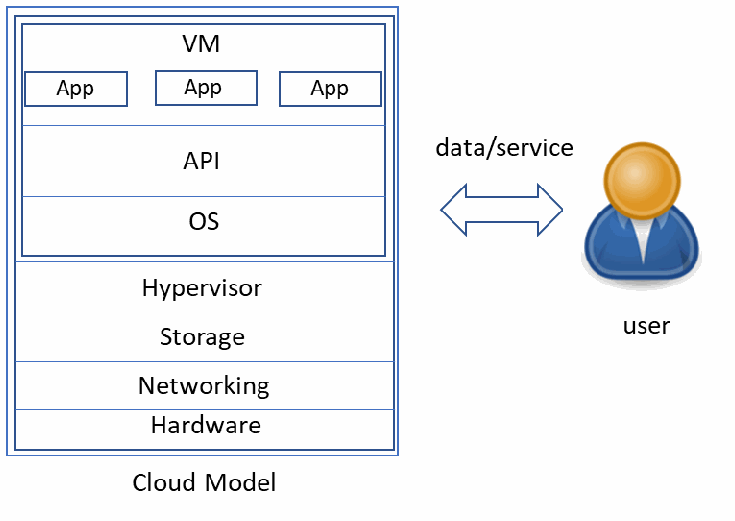
図1:クラウドシステムの一般的なアーキテクチャ。左に、下に「Cloud Model」(クラウドモデル)と記した大きな箱があり、層が積み重なっている。最上部の内側の箱「VM」には3つの「App」(アプリ)の箱があり、その下に「API」と「OS」がVMの箱の中にある。VMの箱の下には「Hypervisor」(ハイパーバイザー)、「Storage」(ストレージ)、「Networking」(ネットワーク)、「Hardware」(ハードウェア)がある。右には「user」(ユーザー)と記した人物アイコンがあり、「data/service」(データ/サービス)と記した両向きの矢印でクラウドモデルとつながる。
Figure 1: The general architecture of a cloud system
図1:クラウドシステムの一般的なアーキテクチャ
A cloud service can provide access to software applications, such as email or office productivity tools (i.e., the Software as a Service, or SaaS, service model); an environment for consumers to build and operate their own software (i.e., the Platform as a Service, or PaaS, service model), or network access to virtualized computing resources such as processing power and storage (i.e., the Infrastructure as a Service, or IaaS, service model). The different service models have different strengths and are suitable for different consumers and business objectives [4], as illustrated in Figure 2, the arrows show the support relations between models.
クラウドサービスは、電子メールやオフィス生産性ツールなどのソフトウェアアプリケーションへのアクセス(すなわちSoftware as a Service(SaaS)サービスモデル)、利用者が独自のソフトウェアを構築・運用するための環境(すなわちPlatform as a Service(PaaS)サービスモデル)、または処理能力やストレージなどの仮想化されたコンピューティングリソースへのネットワークアクセス(すなわちInfrastructure as a Service(IaaS)サービスモデル)を提供できます。サービスモデルはそれぞれ異なる強みを持ち、異なる利用者や事業目標に適しています[4]。図2に示すとおりであり、矢印はモデル間の支援関係を表します。
A cloud system that deploys the SaaS model can be accessible over a network by an end user utilizing various client devices (e.g., a thin client interface, such as a web browser, for accessing a web-based email application) or via a program with the correct set of interfaces whose execution would enable communication with a cloud application. In the SaaS model, an application user is limited to user-specific application configuration settings and does not manage or control the underlying cloud infrastructure, which typically includes the network, servers, operating systems, storage, or individual applications.
SaaSモデルを展開するクラウドシステムには、エンドユーザーがさまざまなクライアントデバイスを利用してネットワーク経由でアクセスできます(例えば、ウェブベースの電子メールアプリケーションにアクセスするための、ウェブブラウザーなどのシンクライアントインターフェース)。また、適切なインターフェース一式を備え、実行することでクラウドアプリケーションとの通信が可能になるプログラムを介してアクセスすることもできます。SaaSモデルでは、アプリケーションユーザーが扱えるのはユーザー固有のアプリケーション構成設定に限られ、基盤となるクラウドインフラを管理も制御もしません。このクラウドインフラには通常、ネットワーク、サーバー、オペレーティングシステム、ストレージ、または個々のアプリケーションが含まれます。
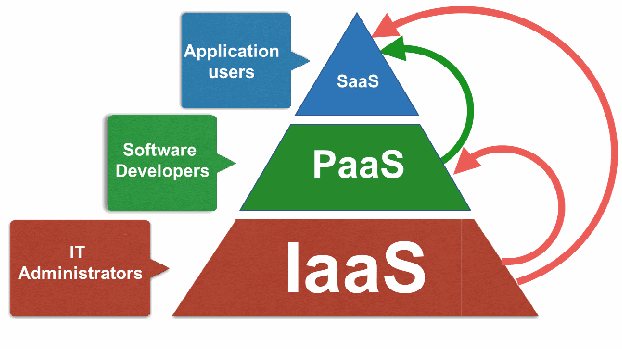
図2:クラウドシステムのサービスモデル。3段のピラミッドで、底辺が「IaaS」(赤)、中段が「PaaS」(緑)、頂上が「SaaS」(青)である。左の吹き出しがそれぞれの段を指す:「IT Administrators」(IT管理者)はIaaS、「Software Developers」(ソフトウェア開発者)はPaaS、「Application users」(アプリケーションユーザー)はSaaSを指す。右側には上向きの曲線矢印があり、緑の矢印がPaaSからSaaSへ、赤の矢印がIaaSからPaaSへ、およびIaaSからSaaSへ向かう。
Figure 2: The service models of a cloud system
図2:クラウドシステムのサービスモデル
The PaaS model in a cloud system allows developers to create and deploy applications onto the cloud infrastructure using programming languages, libraries, services, and tools. A software developer does not manage or control the underlying cloud infrastructure but has control over the deployed applications (software) and, possibly, configuration settings for the application-hosting environment.
クラウドシステムのPaaSモデルでは、開発者がプログラミング言語、ライブラリ、サービス、ツールを使って、アプリケーションを作成し、クラウドインフラ上に配備できます。ソフトウェア開発者は基盤となるクラウドインフラを管理も制御もしませんが、配備したアプリケーション(ソフトウェア)と、場合によってはアプリケーションホスティング環境の構成設定を制御できます。
When analyzing the responsibilities between consumer and cloud service providers for protecting cloud data, it is not always clear-cut, if an IaaS system provides only the computation resources, or offers also the virtualized storage, and network resources to consumers for deploying and running arbitrary software, including operating systems and applications. The consumer may in turn have control over virtual storage, virtualized network components, and the ability to deploy their own VMs and applications given access provisioned by the cloud service provider.
クラウドデータの保護について利用者とクラウドサービスプロバイダーの間の責任を分析する際、IaaSシステムが計算リソースだけを提供するのか、それとも、オペレーティングシステムやアプリケーションを含む任意のソフトウェアを配備・実行するための仮想化されたストレージとネットワークリソースも利用者に提供するのかは、必ずしも明確ではありません。利用者の側は、クラウドサービスプロバイダーがプロビジョニングしたアクセスに応じて、仮想ストレージと仮想化されたネットワーク構成要素を制御でき、自らのVMとアプリケーションを配備できる場合があります。
The shared responsibility of access control needs to be considered in the PaaS and SaaS model [42]; For example software developers might need to access data in systems provided by PaaS for their developmental needs, and internal application users (i.e., users that need to access the application system data) might need to access application system data that is managed by the applications. In general, for PaaS, consumer software developers might share access control responsibilities with cloud service providers; for SaaS, internal application users might share such responsibilities with cloud service providers.
PaaSモデルおよびSaaSモデルでは、アクセス制御の責任共有を考慮する必要があります[42]。例えば、ソフトウェア開発者は開発上の必要から、PaaSが提供するシステム内のデータにアクセスしなければならない場合があり、内部アプリケーションユーザー(すなわち、アプリケーションシステムのデータにアクセスする必要があるユーザー)は、アプリケーションが管理するアプリケーションシステムのデータにアクセスしなければならない場合があります。一般に、PaaSでは利用者側のソフトウェア開発者がクラウドサービスプロバイダーとアクセス制御の責任を共有する場合があり、SaaSでは内部アプリケーションユーザーがクラウドサービスプロバイダーとその責任を共有する場合があります。
Note that unless there is express prior approval from the consumer, a PaaS or SaaS provider must manage access control with the IaaS provider and the consumer (if it is not also the IaaS provider). If the consumer approves, the provider should inform the consumer of its intention to store the specified data in the IaaS provider, where it will be accessed as well as the extent to which the data can be accessed by the IaaS provider, foreign entities, or authorities. A public consultation and hearing process must then be conducted before a decision is made.
なお、利用者による事前の明示的な承認がない限り、PaaSプロバイダーまたはSaaSプロバイダーは、IaaSプロバイダーおよび利用者とともにアクセス制御を管理しなければなりません(当該プロバイダーがIaaSプロバイダーを兼ねていない場合)。利用者が承認する場合、プロバイダーは、指定されたデータをIaaSプロバイダーに保管する意向、そのデータがアクセスされる場所、ならびにIaaSプロバイダー、外国の主体、または当局がそのデータにアクセスできる範囲を利用者に通知すべきです。その後、決定が下される前に、公開の協議および公聴の手続きを実施しなければなりません。
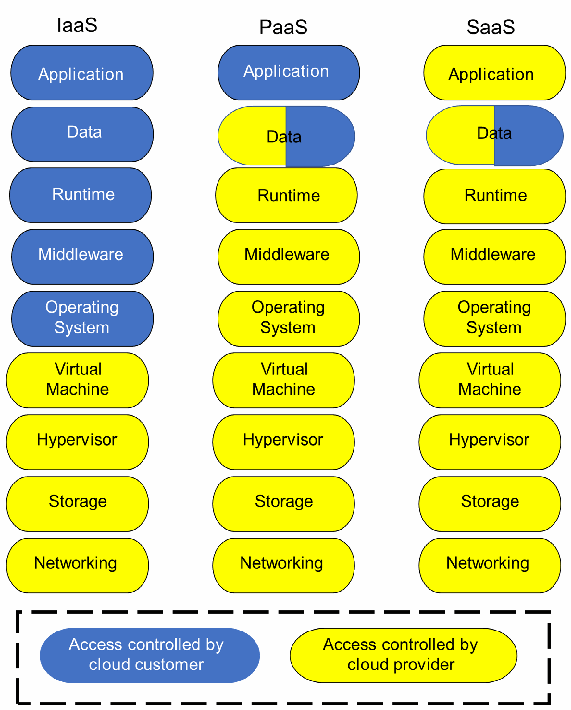
図3:クラウドサービスプロバイダーと利用者がそれぞれ制御するアクセス。「IaaS」、「PaaS」、「SaaS」の見出しを持つ3つの列があり、各列は上から Application(アプリケーション)、Data(データ)、Runtime(ランタイム)、Middleware(ミドルウェア)、Operating System(オペレーティングシステム)、Virtual Machine(仮想マシン)、Hypervisor(ハイパーバイザー)、Storage(ストレージ)、Networking(ネットワーク)の9つの角丸の箱を積み重ねたものである。下部の破線の凡例で、青は「Access controlled by cloud customer」(クラウド利用者が制御するアクセス)、黄は「Access controlled by cloud provider」(クラウドプロバイダーが制御するアクセス)を表す。IaaSでは Application から Operating System までが青、Virtual Machine から Networking までが黄である。PaaSでは Application が青、Data が左半分黄・右半分青、Runtime から Networking までが黄である。SaaSでは Application が黄、Data が左半分黄・右半分青、Runtime から Networking までが黄である。
Figure 3: Accesses controlled by the cloud service provider and the consumer
図3:クラウドサービスプロバイダーと利用者がそれぞれ制御するアクセス
The five essential characteristics that challenge AC system design are summarized as follows [2]:
アクセス制御システムの設計に課題をもたらす5つの基本特性を、次のとおり要約します[2]。
1.Broad network access: Cloud services are available over the network and accessible through standard mechanisms that promote use by heterogeneous thick and thin client platforms (e.g., mobile phones, tablets, laptops, workstations). This raises security concerns with regard to network access. For example, denial of service (DoS) attacks can be launched against a cloud system, rendering its resources unavailable to legitimate users. Thus, AC for network access should be managed.
1.広範なネットワークアクセス:クラウドサービスはネットワーク経由で利用でき、異種のシッククライアントおよびシンクライアントのプラットフォーム(例:携帯電話、タブレット、ノートパソコン、ワークステーション)による利用を促す標準的な仕組みを通じてアクセスできます。このことは、ネットワークアクセスに関するセキュリティ上の懸念を生じさせます。例えば、クラウドシステムに対してサービス拒否(DoS)攻撃が仕掛けられ、正当なユーザーがそのリソースを利用できなくなる可能性があります。したがって、ネットワークアクセスに対するアクセス制御を管理すべきです。
2.Resource pooling: The computing resources of a cloud system (e.g., storage, memory, processing, network bandwidth) are pooled to serve multiple consumers using a multi-tenant model (i.e., a single instance of the software and its supporting infrastructure serves multiple consumers) through different physical and virtual resources, each dynamically assigned and reassigned according to consumer demands. Information may be leaked if the resource allocated to a consumer can be accessed by another co-located consumer or if the allocated resource, such as memory, is not wiped before being reallocated to another consumer. There is also a sense of location independence in that the consumer generally has no control over or knowledge of the exact location of the provided resources. Location may be specified at a higher level of abstraction (e.g., country, state, data center) that brings security concerns. Therefore, methods for implementing resource pooling while ensuring the isolation of shared resources should be considered in the AC design.
2.リソースプーリング:クラウドシステムのコンピューティングリソース(例:ストレージ、メモリ、処理能力、ネットワーク帯域幅)はプールされ、マルチテナントモデル(すなわち、ソフトウェアとそれを支えるインフラの単一のインスタンスが複数の利用者にサービスを提供するモデル)を用いて、異なる物理リソースおよび仮想リソースを通じて複数の利用者に提供されます。各リソースは利用者の需要に応じて動的に割り当てられ、再割り当てされます。ある利用者に割り当てられたリソースに、同じ場所に配置された別の利用者がアクセスできる場合や、メモリなどの割り当て済みリソースが別の利用者に再割り当てされる前に消去されない場合、情報が漏えいする可能性があります。また、利用者は一般に、提供されるリソースの正確な場所を制御できず、知ることもできないという意味で、場所に依存しないという感覚があります。場所は、より高い抽象度(例:国、州、データセンター)で指定できる場合があり、このことがセキュリティ上の懸念をもたらします。したがって、共有リソースの分離を確保しながらリソースプーリングを実装する方法を、アクセス制御の設計において検討すべきです。
3.Rapid elasticity: Cloud services can be elastically provisioned and released—automatically, in some cases—to rapidly scale outward and inward commensurate with demands. To the consumer, services available for provisioning often appear to be unlimited and appropriated in any quantity at any time and are supported by adding new virtual machines (VMs) with specified computing resources. A challenge for AC design involves the capability to rapidly verify the security of new VMs and determine whether the newly added VMs are qualified to execute a specific task.
3.迅速な弾力性:クラウドサービスは、需要に見合って迅速に規模を拡大・縮小できるよう、弾力的に(場合によっては自動的に)プロビジョニングし、解放できます。利用者にとって、プロビジョニングに利用できるサービスは多くの場合、無制限で、いつでも任意の量を充当できるように見え、指定されたコンピューティングリソースを持つ新しい仮想マシン(VM)を追加することで支えられています。アクセス制御の設計における課題の一つは、新しいVMのセキュリティを迅速に検証し、新たに追加されたVMが特定のタスクを実行する資格を有するかどうかを判断する能力に関するものです。
4.Measured service: Cloud systems automatically control and optimize resource use by leveraging a metering capability at some level of abstraction appropriate to the type of service (e.g., storage, processing, bandwidth, active end user accounts). Resource usage is monitored, controlled, and reported to provide transparency to both the provider and consumer of the utilized service. To maintain resource usage, cloud consumers should be authorized to review but not to modify their own metering data since this could lead to the falsification of payments required for cloud services. Thus, it is reasonable for AC to consider the protection of metering data.
4.計測されるサービス:クラウドシステムは、サービスの種類(例:ストレージ、処理、帯域幅、アクティブなエンドユーザーアカウント)に適した何らかの抽象度で計測機能を活用することにより、リソースの使用を自動的に制御し、最適化します。リソースの使用状況は監視、制御、報告され、利用されるサービスのプロバイダーと利用者の双方に透明性を提供します。リソース使用を維持するため、クラウド利用者には、自らの計測データを確認する権限は与えますが、変更する権限は与えないようにすべきです。変更できると、クラウドサービスに必要な支払いの改ざんにつながりかねないためです。したがって、アクセス制御において計測データの保護を考慮することは妥当です。
5.Data sharing: Sharing information among different organizations is not a trivial task since a cloud system needs to meet the same security requirements of organizations to achieve that. To facilitate data sharing, concepts such as trust of federated identities and AC attributes need to be considered, and building that trust is paramount. In this document, it is assumed that trust and federated identities/attributes are already established, and further discussion on that topic will be considered in another document. Regardless of the service model, consumers are entitled to be responsible for the security of their cloud-based data and, implicitly, of who has access to it [5]. For this reason, data is never controlled by cloud service providers but rather always stays with the cloud consumers. (The exception to this is log data, but consideration should still be given to how privacy and security is affected by such data.) Although a cloud service provider might become the custodian of consumers’ data, it should not have access to that data. If a consumer’s data is not encrypted, then cloud administrators might be able to read it. In such a case, the consumer’s data should be identified (by the provider’s access privileges to the data) and red-flagged as accessible by the service provider, and the consumer should be informed immediately.
5.データ共有:異なる組織の間で情報を共有することは容易な作業ではありません。それを実現するには、クラウドシステムが各組織と同じセキュリティ要件を満たす必要があるためです。データ共有を促進するには、フェデレーションされたアイデンティティおよびアクセス制御属性に対する信頼といった概念を考慮する必要があり、その信頼を構築することが最も重要です。本書では、信頼およびフェデレーションされたアイデンティティ/属性はすでに確立されているものと仮定し、この話題に関するさらなる議論は別の文書で検討します。サービスモデルにかかわらず、利用者は、クラウド上にある自らのデータのセキュリティ、および暗黙のうちに、誰がそのデータにアクセスできるかについて、責任を負う権利を有します[5]。このため、データがクラウドサービスプロバイダーによって制御されることは決してなく、データは常にクラウド利用者のもとにとどまります。(ログデータはこの例外ですが、そのようなデータがプライバシーとセキュリティにどう影響するかは、なお考慮すべきです。)クラウドサービスプロバイダーは利用者のデータの保管者になることがあるとしても、そのデータへのアクセス権を持つべきではありません。利用者のデータが暗号化されていなければ、クラウド管理者がそれを読み取れる可能性があります。そのような場合、当該利用者のデータを(そのデータに対するプロバイダーのアクセス権限によって)特定し、サービスプロバイダーがアクセス可能なものとして警告表示を付け、利用者に直ちに通知すべきです。
Guidance for AC system for each cloud service model, as described in Sections 3, 4, and 6 of this document, can be further extended to system requirements by referring to the AC control elements listed in NIST SP 800-53, Revision 4, Security and Privacy Control for Federal Information Systems and Organizations [6] based on the operation requirements of the cloud service. Appendix A maps the guidance to the AC control elements listed in the NIST SP 800-53, Revision 4.
本書の第3節、第4節および第6節で説明する各クラウドサービスモデルのアクセス制御システムに関するガイダンスは、クラウドサービスの運用要件に基づき、NIST SP 800-53, Revision 4, Security and Privacy Control for Federal Information Systems and Organizations [6]に列挙されたアクセス制御の管理策要素を参照することで、システム要件へとさらに拡張できます。付録Aは、このガイダンスを、NIST SP 800-53, Revision 4に列挙されたアクセス制御の管理策要素に対応付けています。
3 Access Control Guidance for IaaS
3 IaaSのアクセス制御ガイダンス
IaaS is the cornerstone of all cloud services that offer computing and storage through a network such as the internet. Through virtualization technology, IaaS enables end users to dynamically allocate computing resources by instantiating new virtual machines (VMs) or releasing them based on their requirements. A VM is a software container that behaves like a physical machine with its own operating system (OS) and virtual resources (e.g., CPU, memory, hard disk, etc.). Leasing VMs is more cost-effective than purchasing new physical machines. The virtualization technology is composed of VMs and a hypervisor, as shown in Figure 1. VMs are managed by the hypervisor, which controls the flow of data and instructions between the VMs and the physical hardware. On the consumer side, system administrators are usually the major users of IaaS services since IaaS services are flexible to configure resources (e.g., network, data storage).
IaaSは、インターネットなどのネットワークを通じてコンピューティングとストレージを提供するすべてのクラウドサービスの礎です。IaaSは仮想化技術により、エンドユーザーが自らの要件に基づいて新しい仮想マシン(VM)をインスタンス化したり解放したりすることで、コンピューティングリソースを動的に割り当てられるようにします。VMは、独自のオペレーティングシステム(OS)と仮想リソース(例:CPU、メモリ、ハードディスクなど)を持つ物理マシンのように振る舞うソフトウェアコンテナーです。VMを借りる方が、新しい物理マシンを購入するよりも費用対効果が高いです。図1に示すとおり、仮想化技術はVMとハイパーバイザーで構成されます。VMはハイパーバイザーによって管理され、ハイパーバイザーはVMと物理ハードウェアの間のデータと命令の流れを制御します。利用者側では、IaaSサービスがリソース(例:ネットワーク、データストレージ)を柔軟に構成できることから、通常はシステム管理者がIaaSサービスの主要なユーザーとなります。
Cloud virtualization adds additional security management burdens by introducing security controls that arise from combining multiple VMs onto a single physical computer, which can have potential negative impacts if a security compromise occurs. Some cloud systems make it easy to share information among VMs by, for instance, allowing users to create multiple VMs on top of the same hypervisor if multiple VMs are available. However, this convenience can also become an attack vector since data leakage could occur among VMs. Additionally, virtualized environments are transient since they are created and vanish frequently, thereby making the creation and maintenance of necessary security boundaries more complex.
クラウド仮想化は、複数のVMを単一の物理コンピューター上に集約することから生じるセキュリティ管理策を導入することで、セキュリティ管理上の負担をさらに増やします。この集約は、セキュリティ侵害が発生した場合に悪影響を及ぼす可能性があります。一部のクラウドシステムは、例えば、複数のVMが利用可能な場合にユーザーが同じハイパーバイザー上に複数のVMを作成できるようにすることで、VM間の情報共有を容易にしています。しかし、VM間でデータ漏えいが起こり得るため、この利便性は攻撃経路にもなり得ます。加えて、仮想化環境は頻繁に作成されては消滅するため一時的なものであり、そのことが必要なセキュリティ境界の作成と維持をより複雑にします。
As shown in Figure 3, data in the middleware, data, applications, and OS layers is owned and controlled by the consumer. The IaaS system and the consumer need to ensure that access to the data is not granted to IaaS system administrators or any other IaaS consumers in these layers unless any of them are permitted. IaaS administrators are responsible for access control on the virtual machine, hypervisor, storage, and networking layers and should consider Sections 3.1 to 3.5 below.
図3に示すとおり、ミドルウェア、データ、アプリケーション、OSの各層にあるデータは、利用者が所有し、制御します。IaaSシステムと利用者は、これらの層において、IaaSシステム管理者や他のいかなるIaaS利用者に対しても、そのいずれかが許可されている場合を除き、データへのアクセスが付与されないようにする必要があります。IaaS管理者は、仮想マシン、ハイパーバイザー、ストレージ、ネットワークの各層のアクセス制御に責任を負い、以下の3.1節から3.5節を考慮すべきです。
3.1 Guidance for Network
3.1 ネットワークに関するガイダンス
The network is shared among IaaS consumers, and it is important to secure the network traffic and the cloud’s environment from being exploited by unauthorized consumers. Thus, access control for network boundaries and allowlists for network communications are required and may be applied through, for example, dedicated virtual local area networks (VLANs) leveraging automated access control lists (ACLs). Using the Institute of Electrical and Electronics Engineers (IEEE) 802.1Q VLAN tagging for network traffic with a cloud data center will result in routing only traffic tagged with the server’s unique VLAN identifier to or from that server [7].
ネットワークはIaaS利用者の間で共有されるため、ネットワークトラフィックとクラウドの環境を、権限のない利用者による悪用から保護することが重要です。したがって、ネットワーク境界に対するアクセス制御と、ネットワーク通信に対する許可リストが必要であり、これらは例えば、自動化されたアクセス制御リスト(ACL)を活用する専用の仮想ローカルエリアネットワーク(VLAN)を通じて適用できます。クラウドデータセンターでネットワークトラフィックにInstitute of Electrical and Electronics Engineers(IEEE)802.1QのVLANタグ付けを用いると、サーバー固有のVLAN識別子でタグ付けされたトラフィックだけが、そのサーバーとの間でルーティングされることになります[7]。
3.2 Guidance for Hypervisor
3.2 ハイパーバイザーに関するガイダンス
A hypervisor plays an important role in the security of the entire virtualized architecture since it manages consumer loads and guest operating systems (OSs),2 creates new guest OS images, and controls hardware resources. The security implications of actions like managing guest OS and hardware resources means that access to the hypervisor should be restricted to authorized cloud administrators only. Otherwise, a cloud end user could potentially obtain a VM from the cloud service provider and install a malicious guest OS that compromises the hypervisor by gaining unauthorized access to and altering the memory of other VMs [8]. Moreover, an attacker in a VM with lower access rights may be able to escalate their access privilege to a higher level by compromising the hardware resources allocation within the hypervisor [9]. Protecting the hypervisor from unauthorized access is therefore critical to the security of IaaS services.
ハイパーバイザーは、利用者の負荷とゲストオペレーティングシステム(OS)2を管理し、新しいゲストOSイメージを作成し、ハードウェアリソースを制御するため、仮想化アーキテクチャ全体のセキュリティにおいて重要な役割を果たします。ゲストOSやハードウェアリソースの管理といった操作にはセキュリティ上の影響があるため、ハイパーバイザーへのアクセスは、認可されたクラウド管理者のみに制限すべきです。そうしなければ、クラウドのエンドユーザーがクラウドサービスプロバイダーからVMを取得し、悪意のあるゲストOSをインストールして、他のVMのメモリに不正にアクセスし改変することでハイパーバイザーを侵害する可能性があります[8]。さらに、低いアクセス権を持つVM内の攻撃者が、ハイパーバイザー内のハードウェアリソース割り当てを侵害することで、自らのアクセス権限をより高いレベルへ昇格させられる可能性があります[9]。したがって、ハイパーバイザーを不正アクセスから保護することは、IaaSサービスのセキュリティにとって極めて重要です。
3.3 Guidance for Virtual Machines
3.3 仮想マシンに関するガイダンス
VMs that are created by different end users allow resources to be shared among multiple end users. In such cases, it must be ensured that no application from one VM can directly access other VMs since covert channels [10, 11] may leak information between VMs by accessing shared physical resources (e.g., memory). Similarly, although the ability to copy and paste information between VMs via the clipboard is a convenient feature, such a capability could be made available on other VMs running on the same hypervisor and thus introduce an attack vector (i.e., information can be leaked to other VMs through the clipboard). Organizations should have policies regarding the use of shared clipboards.
異なるエンドユーザーが作成したVMにより、複数のエンドユーザーの間でリソースを共有できます。このような場合、あるVMのいかなるアプリケーションも他のVMに直接アクセスできないようにしなければなりません。隠れチャネル[10, 11]が、共有される物理リソース(例:メモリ)にアクセスすることで、VM間で情報を漏えいさせる可能性があるためです。同様に、クリップボードを介してVM間で情報をコピー・貼り付けできることは便利な機能ですが、そのような機能は同じハイパーバイザー上で動作する他のVMでも利用可能になり得るため、攻撃経路を持ち込むことになります(すなわち、クリップボードを通じて情報が他のVMに漏えいし得ます)。組織は、共有クリップボードの使用に関するポリシーを持つべきです。
Isolation between VMs is necessary to keep VMs running independently of each other, and quotas on VM resource usage should be regulated so that a malicious VM can be prohibited from exhausting computation resources. If a malicious application consumes the majority of computation resources, legitimate applications may not be able to obtain sufficient resources to perform their operations. Moreover, end users might terminate the execution of their tasks before they are finished. The state and data of the current VM would then be saved as a guest OS image, and when the task is resumed, the VM might be migrated from a different hypervisor. In such scenarios, guest OS images must be protected from unauthorized access, tampering, or storage. Furthermore, VMs that are not active may also store sensitive data. Monitoring access to the sensitive data in inactive VMs should be considered.
VMが互いに独立して動作し続けるためには、VM間の分離が必要であり、悪意のあるVMが計算リソースを使い尽くすことを禁止できるよう、VMのリソース使用量に対するクォータを規制すべきです。悪意のあるアプリケーションが計算リソースの大部分を消費すると、正当なアプリケーションが処理を行うのに十分なリソースを得られない可能性があります。さらに、エンドユーザーは、タスクが完了する前にその実行を終了させることがあります。その場合、現在のVMの状態とデータはゲストOSイメージとして保存され、タスクが再開される際に、VMが別のハイパーバイザーから移行されることがあります。このようなシナリオでは、ゲストOSイメージを、不正なアクセス、改ざん、または保管から保護しなければなりません。さらに、アクティブでないVMにも機微なデータが保存されている場合があります。アクティブでないVMにある機微なデータへのアクセスを監視することを検討すべきです。
3.4 Guidance for APIs
3.4 APIに関するガイダンス
There are several popular open-source platforms for deploying an IaaS system [12, 13, 14]. These solution platforms enable APIs to manage access control of VMs, hypervisors, and networks (note that a consumer cannot control hypervisors and networks in a multi-tenant environment unless it is a private cloud) . For example, [14] consists of control components, including API, communication, lifecycle, storage, volume, scheduler, network, API server for managing AC policies for hypervisors, and network controller for constructing network bridges and firewall AC rules. The lack of monitoring AC within these APIs might result in unenforced or wrongly enforced AC policies by the hypervisors, VMs, and networks. Thus, a service for monitoring the AC APIs in cloud platforms should also be taken into consideration.
IaaSシステムを展開するための、広く使われているオープンソースプラットフォームがいくつかあります[12, 13, 14]。これらのソリューションプラットフォームは、VM、ハイパーバイザー、ネットワークのアクセス制御をAPIで管理できるようにします(なお、マルチテナント環境では、プライベートクラウドでない限り、利用者はハイパーバイザーとネットワークを制御できません)。例えば[14]は、API、通信、ライフサイクル、ストレージ、ボリューム、スケジューラー、ネットワーク、ハイパーバイザーのアクセス制御ポリシーを管理するAPIサーバー、ネットワークブリッジとファイアウォールのアクセス制御ルールを構築するネットワークコントローラーを含む制御コンポーネントで構成されます。これらのAPI内でアクセス制御の監視が欠けていると、ハイパーバイザー、VM、ネットワークによってアクセス制御ポリシーが実施されない、または誤って実施される結果になりかねない。したがって、クラウドプラットフォームにおけるアクセス制御APIを監視するサービスも考慮に入れるべきです。
3.5 Recommendations for IaaS Access Control
3.5 IaaSアクセス制御の推奨事項
As shown in previous sections, the security of an IaaS cloud system is heavily dependent on the virtualization (hypervisor). One of the most widely adopted solutions for protecting them is a virtualization management system [15], which lies between the underlying hardware and the hypervisor. The virtualization management system enforces AC on both hypervisors and VMs in different ways. Virtualization management systems enforce different levels of access on different users. Some users are given read-only access to the administrative interface of a guest OS; some are allowed to control particular guest OSs; and some are given complete administrative control. There are existing solutions for providing AC for hypervisors and VMs. For example, the approach in [16] secures the hypervisor against control hijacking attacks by protecting its code from unauthorized access and offering isolation of VMs with the flexible security of mandatory access control (MAC). To enforce AC on interoperations, a service level agreement should be designed to include appropriate control to secure external interoperations. Other isolation mechanisms [17, 18] are helpful in ensuring the security of internal interoperations.
前節までに示したとおり、IaaSクラウドシステムのセキュリティは仮想化(ハイパーバイザー)に大きく依存します。これらを保護するために最も広く採用されているソリューションの一つが、基盤となるハードウェアとハイパーバイザーの間に位置する仮想化管理システム[15]です。仮想化管理システムは、ハイパーバイザーとVMの双方に対して、異なる方法でアクセス制御を実施します。仮想化管理システムは、ユーザーごとに異なるレベルのアクセスを適用します。ゲストOSの管理インターフェースへの読み取り専用アクセスを与えられるユーザーもいれば、特定のゲストOSの制御を許可されるユーザーもおり、完全な管理制御を与えられるユーザーもいます。ハイパーバイザーとVMにアクセス制御を提供する既存のソリューションがあります。例えば[16]のアプローチは、ハイパーバイザーのコードを不正アクセスから保護し、強制アクセス制御(MAC)の柔軟なセキュリティによるVMの分離を提供することで、制御の乗っ取り攻撃からハイパーバイザーを守ります。相互運用に対してアクセス制御を実施するには、外部との相互運用を保護するための適切な制御を含むようにサービスレベル合意を設計すべきです。他の分離メカニズム[17, 18]は、内部の相互運用のセキュリティを確保するのに役立ちます。
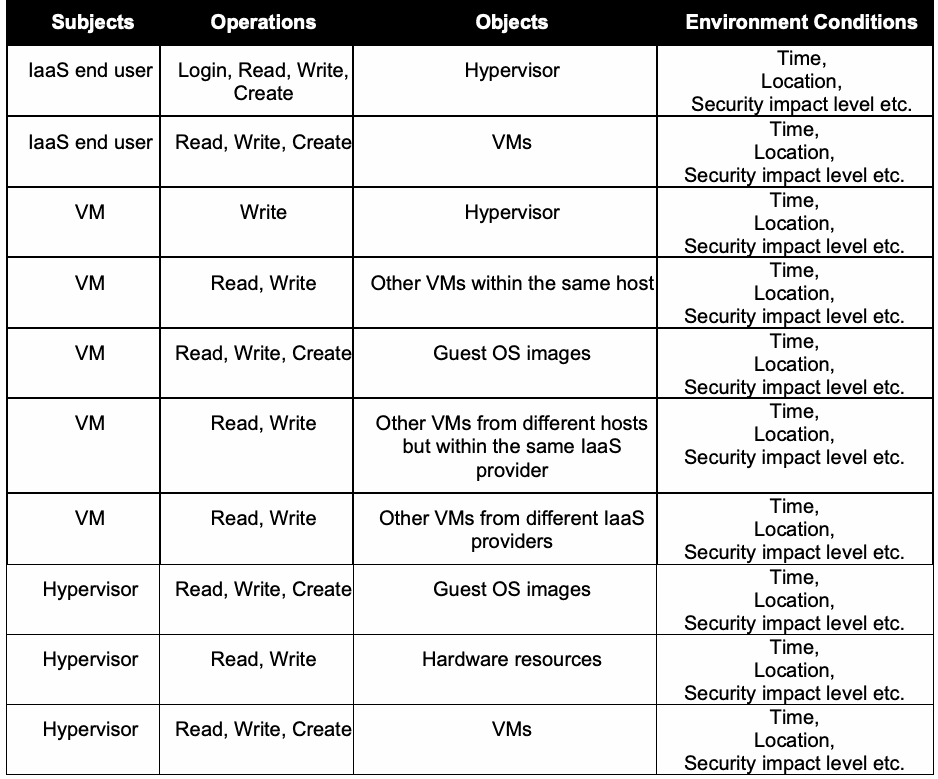
Guideline rules for IaaS AC policy that consider the main elements in AC (i.e., subject, object, and operation) are listed in Table 1. While each row indicates a possible AC rule, the AC policy designer should ultimately decide whether the decision in each rule is permitted or denied based on system requirements. For example, if an authorized IaaS end user requires the use of cloud services, a login operation in the hypervisor for the end user should be granted; otherwise, it should be denied.
アクセス制御の主要な要素(すなわち、主体、対象、操作)を考慮したIaaSアクセス制御ポリシーの指針ルールを表1に示します。各行はアクセス制御ルールの候補を示しますが、各ルールにおける決定を許可とするか拒否とするかは、システム要件に基づいてアクセス制御ポリシーの設計者が最終的に決定すべきです。例えば、認可されたIaaSエンドユーザーがクラウドサービスの利用を必要とする場合、そのエンドユーザーに対してハイパーバイザーでのログイン操作を許可すべきであり、そうでない場合は拒否すべきです。
Table 1: Potential policy rules expressed by Subject, Operation, Object for IaaS AC policy
表1:主体、操作、対象で表現したIaaSアクセス制御ポリシーのルール例
| Subjects | Operations | Objects | Environment Conditions |
| IaaS end user | Login, Read, Write, Create | Hypervisor | Time, Location, Security impact level etc. |
| IaaS end user | Read, Write, Create | VMs | Time, Location, Security impact level etc. |
| VM | Write | Hypervisor | Time, Location, Security impact level etc. |
| VM | Read, Write | Other VMs within the same host | Time, Location, Security impact level etc. |
| VM | Read, Write, Create | Guest OS images | Time, Location, Security impact level etc. |
| VM | Read, Write | Other VMs from different hosts but within the same IaaS provider | Time, Location, Security impact level etc. |
| VM | Read, Write | Other VMs from different IaaS providers | Time, Location, Security impact level etc. |
| Hypervisor | Read, Write, Create | Guest OS images | Time, Location, Security impact level etc. |
| Hypervisor | Read, Write | Hardware resources | Time, Location, Security impact level etc. |
| Hypervisor | Read, Write, Create | VMs | Time, Location, Security impact level etc. |
原本PDFの抜粋画像
| 主体 | 操作 | 対象 | 環境条件 |
| IaaSエンドユーザー | ログイン、読み取り、書き込み、作成 | ハイパーバイザー | 時間、所在地、セキュリティ影響度など |
| IaaSエンドユーザー | 読み取り、書き込み、作成 | VM | 時間、所在地、セキュリティ影響度など |
| VM | 書き込み | ハイパーバイザー | 時間、所在地、セキュリティ影響度など |
| VM | 読み取り、書き込み | 同一ホスト上の他のVM | 時間、所在地、セキュリティ影響度など |
| VM | 読み取り、書き込み、作成 | ゲストOSイメージ | 時間、所在地、セキュリティ影響度など |
| VM | 読み取り、書き込み | 同一IaaSプロバイダー内の別ホストにある他のVM | 時間、所在地、セキュリティ影響度など |
| VM | 読み取り、書き込み | 別のIaaSプロバイダーにある他のVM | 時間、所在地、セキュリティ影響度など |
| ハイパーバイザー | 読み取り、書き込み、作成 | ゲストOSイメージ | 時間、所在地、セキュリティ影響度など |
| ハイパーバイザー | 読み取り、書き込み | ハードウェアリソース | 時間、所在地、セキュリティ影響度など |
| ハイパーバイザー | 読み取り、書き込み、作成 | VM | 時間、所在地、セキュリティ影響度など |
4 Access Control Guidance for PaaS
4 PaaSのアクセス制御ガイダンス
PaaS is a platform that provides a framework for developers to create and deploy customized applications. As shown in Figure 3, security assurance considerations include some and all below the data level, and during the application development process lifecycle should be offered by the PaaS provider. The primary focus of AC in the PaaS model is to protect data during runtime, which is managed by middleware and OS. PaaS systems are primarily concerned with developing, deploying and operating customer applications. The security and privacy offered by the PaaS provider protect the applications and data from potential leaks through a covert channel introduced by unsecure shared memory. Therefore, enforcing AC over data during runtime in the PaaS is critical for the security of PaaS services.
PaaSは、開発者がカスタマイズされたアプリケーションを作成し配備するための枠組みを提供するプラットフォームです。図3に示すとおり、セキュリティ保証に関する考慮事項には、データレベルの一部とそれより下のすべてが含まれ、アプリケーション開発プロセスのライフサイクルの間、PaaSプロバイダーが提供すべきです。PaaSモデルにおけるアクセス制御の主な焦点は、ミドルウェアとOSが管理する実行時のデータを保護することです。PaaSシステムは主に、顧客アプリケーションの開発、配備、運用に関わります。PaaSプロバイダーが提供するセキュリティとプライバシーは、安全でない共有メモリによって持ち込まれる隠れチャネルを通じた潜在的な漏えいから、アプリケーションとデータを保護します。したがって、PaaSにおいて実行時のデータに対するアクセス制御を実施することは、PaaSサービスのセキュリティにとって極めて重要です。
The PaaS system administrator is responsible for the access control of runtime, middleware, OS, virtual machine, hypervisor, storage, and networking layers, as described by the guidance in Sections 4.1 to 4.3 below.
PaaSシステム管理者は、以下の4.1節から4.3節のガイダンスで説明するとおり、ランタイム、ミドルウェア、OS、仮想マシン、ハイパーバイザー、ストレージ、ネットワークの各層のアクセス制御に責任を負います。
4.1 Guidance for Memory Data
4.1 メモリデータに関するガイダンス
The PaaS system permits users to deploy tasks in a provider-controlled middleware and host OS, which may be shared with other PaaS applications. As such, PaaS typically leverages OS-based techniques (e.g., Linux Containers and Docker for isolating applications) [19]. However, numerous existing memory-related attacks can compromise sensitive application-related data by hacking through the shared OS memory in PaaS [20]. Thus, AC for OS memory, such as AC of different processes on top of processor caches [21], should be considered.
PaaSシステムでは、プロバイダーが管理するミドルウェアとホストOSにユーザーがタスクを配備でき、これらは他のPaaSアプリケーションと共有される場合があります。そのため、PaaSでは通常、OSベースの技術(例:アプリケーションを分離するためのLinuxコンテナーやDocker)を利用します[19]。しかし、既存の数多くのメモリ関連攻撃は、PaaSの共有OSメモリを突破口として、機微なアプリケーション関連データを侵害し得ます[20]。したがって、プロセッサキャッシュ上の異なるプロセスに対するアクセス制御[21]など、OSメモリに対するアクセス制御を考慮すべきです。
4.2 Guidance for APIs
4.2 APIに関するガイダンス
As the PaaS system allows cloud developers to build applications on top of the platform, APIs should control the scope of each user’s application such that user data remains inaccessible between different applications. In addition, packaged APIs can be serviced as microservices in a PaaS cloud. A centralized architecture for provisioning and enforcement of access policies governing access to all microservices is required due to the sheer number of services needed for service composition to support real-world business transactions (e.g., consumer order processing and shipping). Since each of the microservices may be implemented in a different language, policy provisioning and computation of access decisions may require the use of an authorization server [22].
PaaSシステムではクラウド開発者がプラットフォーム上にアプリケーションを構築できるため、ユーザーデータが異なるアプリケーション間でアクセスできない状態に保たれるよう、APIは各ユーザーのアプリケーションの範囲を制御すべきです。加えて、パッケージ化されたAPIは、PaaSクラウドにおいてマイクロサービスとして提供できます。現実の業務取引(例:消費者の注文処理や出荷)を支えるサービス合成には膨大な数のサービスが必要となるため、すべてのマイクロサービスへのアクセスを統制するアクセスポリシーのプロビジョニングと適用のための中央集約型アーキテクチャが必要です。各マイクロサービスは異なる言語で実装される場合があるため、ポリシーのプロビジョニングとアクセス決定の計算には、認可サーバーの使用が必要となる場合があります[22]。
4.3 Recommendations for PaaS Access Control
4.3 PaaSアクセス制御の推奨事項
An efficient method should be established for protecting memory data by flushing processor caches during context switches. However, in order to avoid significant performance degradation, only highly sensitive memory data should be flushed.
コンテキストスイッチ時にプロセッサキャッシュをフラッシュすることでメモリデータを保護する、効率的な方法を確立すべきです。ただし、大幅な性能低下を避けるため、フラッシュするのは機微性の高いメモリデータのみとすべきです。
To handle access control for multiple replicas of data, a method to manage the central AC policy system should be introduced. Thus, once the data within a PaaS provider is duplicated across PaaS providers, any change in the policy should result in an appropriate update to the central AC policy system. Moreover, the AC policy related to the replicated data in other PaaS providers should be synchronized accordingly based on an AC policy in the central system.
データの複数レプリカに対するアクセス制御を扱うには、中央アクセス制御ポリシーシステムを管理する方法を導入すべきです。したがって、あるPaaSプロバイダー内のデータが複数のPaaSプロバイダーにまたがって複製された後は、ポリシーに変更があれば、中央アクセス制御ポリシーシステムが適切に更新されるべきです。さらに、他のPaaSプロバイダーに複製されたデータに関するアクセス制御ポリシーも、中央システムのアクセス制御ポリシーに基づいて、それに応じて同期すべきです。
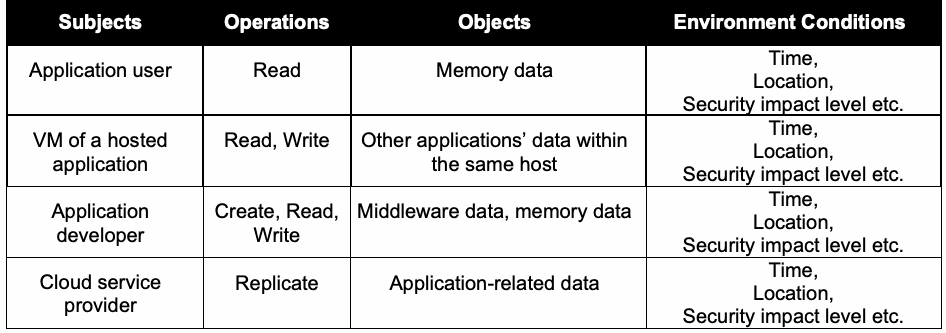
Guideline rules for PaaS AC policy are listed in Table 2 with respect to the three basic elements of AC (i.e., subject, object, and operation). Each row indicates a possible AC rule, but the AC designer should decide whether access should be granted or denied based on the system requirements. For example, if a user of an application needs to access memory data related to their application, permission to read memory data will be granted. However, access to that memory data will be denied to other users.
PaaSアクセス制御ポリシーの指針ルールを、アクセス制御の3つの基本要素(すなわち、主体、対象、操作)に関して表2に示します。各行はアクセス制御ルールの候補を示しますが、アクセスを許可するか拒否するかは、システム要件に基づいてアクセス制御設計者が決定すべきです。たとえば、あるアプリケーションのユーザーが自分のアプリケーションに関連するメモリデータにアクセスする必要がある場合、メモリデータを読み取る許可が与えられます。しかし、他のユーザーには、そのメモリデータへのアクセスは拒否されます。
Table 2: Potential policy rules expressed by Subject, Operation, Object for PaaS AC policy
表2:主体、操作、対象で表現したPaaSアクセス制御ポリシーのルール例
| Subjects | Operations | Objects | Environment Conditions |
| Application user | Read | Memory data | Time, Location, Security impact level etc. |
| VM of a hosted application | Read, Write | Other applications’ data within the same host | Time, Location, Security impact level etc. |
| Application developer | Create, Read, Write | Middleware data, memory data | Time, Location, Security impact level etc. |
| Cloud service provider | Replicate | Application-related data | Time, Location, Security impact level etc. |
原本PDFの抜粋画像
| 主体 | 操作 | 対象 | 環境条件 |
| アプリケーションユーザー | 読み取り | メモリデータ | 時間、場所、セキュリティ影響レベルなど |
| ホストされたアプリケーションのVM | 読み取り、書き込み | 同一ホスト内の他のアプリケーションのデータ | 時間、場所、セキュリティ影響レベルなど |
| アプリケーション開発者 | 作成、読み取り、書き込み | ミドルウェアデータ、メモリデータ | 時間、場所、セキュリティ影響レベルなど |
| クラウドサービスプロバイダー | 複製 | アプリケーション関連データ | 時間、場所、セキュリティ影響レベルなど |
5 Access Control Guidance for SaaS
5 SaaSのアクセス制御ガイダンス
In SaaS, a cloud service provider delivers an application as a service to end users through a network such as the internet. Thus, there is no need for users to install and execute applications locally on their own computers. As shown in Figure 4, multiple applications and users can be supported simultaneously by the cloud system to share common resources, including applications and underlying databases.
SaaSでは、クラウドサービスプロバイダーが、インターネットなどのネットワークを通じて、アプリケーションをサービスとしてエンドユーザーに提供します。そのため、ユーザーは自分のコンピューター上にアプリケーションをローカルにインストールして実行する必要がありません。図4に示すように、クラウドシステムは複数のアプリケーションとユーザーを同時にサポートでき、それらはアプリケーションや基盤となるデータベースを含む共通リソースを共有します。
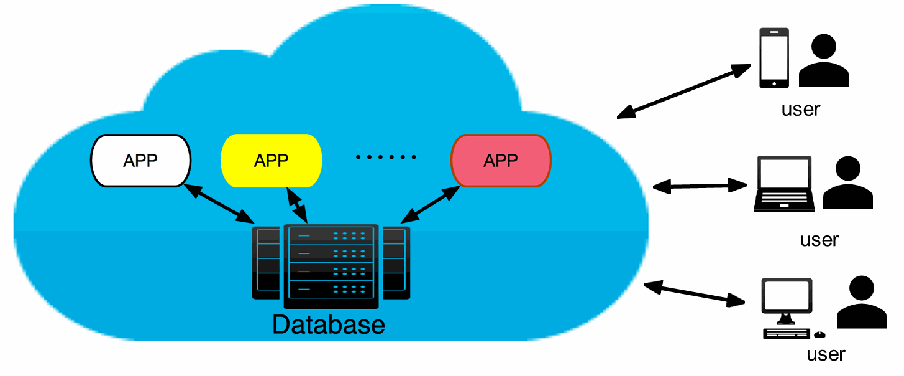
図4:SaaSプロバイダーを利用する複数のアプリケーションとユーザー。大きな青い雲の中に「APP」と記したアプリケーションの箱が3つ(白、黄、赤。2つ目と3つ目の間に点がある)あり、それぞれが両向きの矢印で「Database」(データベース)と記したサーバー群とつながる。雲の外の右側には、携帯端末、ノートパソコン、デスクトップコンピューターをそれぞれ持つ3人のユーザー(各「user」)がいて、両向きの矢印で雲とつながる。
Figure 4: Multiple applications and users of an SaaS provider
図4:SaaSプロバイダーを利用する複数のアプリケーションとユーザー
If a developer deploys a third-party application, data in that application and other unrelated applications might be stored in the cloud system. End users have to rely on the security and privacy offered by the cloud service provider to protect their data from unauthorized access introduced by those unrelated applications. Note that data managed by the application layer is owned and controlled by the consumer. The SaaS system and consumer need to ensure that access to application data in these layers is not granted to the SaaS system administrator, consumers, or other users unless they are trusted. SaaS administrators are responsible for the access control of all operation layers except for the consumer’s application data as shown in Figure 3 and should consider the guidance in Sections 3, 4, and 5.1 to 5.4.
開発者がサードパーティー製アプリケーションを配備する場合、そのアプリケーションのデータと、無関係な他のアプリケーションのデータがクラウドシステムに保管される可能性があります。エンドユーザーは、それらの無関係なアプリケーションによってもたらされる不正アクセスから自らのデータを保護するために、クラウドサービスプロバイダーが提供するセキュリティとプライバシーに頼らざるを得ません。なお、アプリケーション層が管理するデータは、利用者が所有し制御します。SaaSシステムと利用者は、信頼されている場合を除き、SaaSシステム管理者、利用者、またはその他のユーザーに、これらの層にあるアプリケーションデータへのアクセスが許可されないようにする必要があります。SaaS管理者は、図3に示すとおり、利用者のアプリケーションデータを除くすべての運用層のアクセス制御に責任を負い、第3節、第4節、および第5.1節から第5.4節のガイダンスを考慮すべきです。
5.1 Guidance for Data Owner’s Control
5.1 データ所有者の制御に関するガイダンス
A data provider is the creator or source of application data owned by consumer organizations. Application data is typically stored in the SaaS service provider’s database. How a data provider manages access to its data is a challenge. Example questions to be addressed are related to data retention by the provider (e.g., where data is kept and for how long) and whether the provider has any permission to determine access rights to the data it hosts. If a data provider has the capability to determine access rights on data it holds, consideration should be given to ensure that an up-to-date AC policy is always enforced within the SaaS system.
データプロバイダーとは、利用者組織が所有するアプリケーションデータの作成者または提供元です。アプリケーションデータは通常、SaaSサービスプロバイダーのデータベースに保管されます。データプロバイダーが自らのデータへのアクセスをどのように管理するかは課題です。取り組むべき問いの例は、プロバイダーによるデータ保持(例:データがどこに、どれだけの期間保管されるか)や、プロバイダーが自らホストするデータへのアクセス権を決定する権限を持つかどうかに関するものです。データプロバイダーが自ら保有するデータのアクセス権を決定する能力を持つ場合、SaaSシステム内で常に最新のアクセス制御ポリシーが適用されるよう配慮すべきです。
5.2 Guidance for Confidentiality
5.2 機密性に関するガイダンス
In the application deployment model, the integrity of sensitive data residing within the data owner’s domain must be protected. Protection mechanisms for application data include data encryption schemes by which data can be encrypted through certain cryptographic primitives, and decryption keys will only be disclosed to authorized users [23]. For such enforcement, attribute-based access control (ABAC) [24] and attribute-based encryption (ABE) schemes can be used to control access to SaaS data [23, 25, 26, 27, 28] since these schemes can use the identity of users through attributes to manage, encrypt, and decrypt application data. However, considering the high volume of data in the SaaS model, the involved encryption and decryption significantly reduce performance. Hence, when encryption is used, consideration should be given to ensure the confidentiality of data while offering good performance.
アプリケーション配備モデルでは、データ所有者のドメイン内にある機微データの完全性を保護しなければなりません。アプリケーションデータの保護メカニズムには、特定の暗号プリミティブによってデータを暗号化でき、復号鍵が認可されたユーザーにのみ開示されるデータ暗号化方式が含まれます[23]。そのような適用のために、属性ベースアクセス制御(ABAC)[24]および属性ベース暗号(ABE)方式を用いてSaaSデータへのアクセスを制御できます[23, 25, 26, 27, 28]。これらの方式は、属性を通じてユーザーのアイデンティティを利用し、アプリケーションデータを管理、暗号化、復号できるためです。しかし、SaaSモデルではデータ量が多いことを考えると、それに伴う暗号化と復号は性能を大きく低下させます。したがって、暗号化を用いる場合は、良好な性能を提供しつつデータの機密性を確保するよう配慮すべきです。
5.3 Guidance for Privilege Management
5.3 特権管理に関するガイダンス
In addition to AC enforcement, privilege management involves adding, removing, and changing the privileges of a subject. It is crucial to design a flexible or real-time mechanism for assigning and revoking privileges to maintain the usability of the SaaS service [29].
アクセス制御の適用に加えて、特権管理には、主体の特権の追加、削除、変更が含まれます。SaaSサービスの使いやすさを維持するためには、特権の割り当てと取り消しを行う柔軟な、またはリアルタイムの仕組みを設計することが極めて重要です[29]。
5.4 Guidance for Multiple Replicas of Data
5.4 データの複数レプリカに関するガイダンス
To maintain high availability, the cloud service provider may replicate data at multiple locations, even across countries. Thus, it is important to make sure that all data replicas are protected under the same AC policy. In other words, the same AC policy for the replicated data object should be populated to all hosts that process the same data. The technology for policy synchronization upon changes must also be considered for inclusion.
高可用性を維持するため、クラウドサービスプロバイダーは複数の場所に、場合によっては国をまたいで、データを複製することがあります。そのため、すべてのデータレプリカが同じアクセス制御ポリシーの下で保護されるようにすることが重要です。言い換えれば、複製されたデータ対象に対する同じアクセス制御ポリシーを、同じデータを処理するすべてのホストに行き渡らせるべきです。変更時にポリシーを同期する技術についても、組み込みを検討しなければなりません。
5.5 Guidance for Multi-tenancy
5.5 マルチテナンシーに関するガイダンス
The SaaS system introduces additional considerations with regard to the management of access to applications. An immediate necessity is to focus on users’ access to applications. The access rights are granted to end users through AC policies based on predefined attributes or roles. This can be specified by attribute-based access control (ABAC) policy models [30, 31], role-based access control [32] (RBAC), and context-based access control [33] (CBAC).
SaaSシステムでは、アプリケーションへのアクセスの管理に関して追加の考慮事項が生じます。当面必要なのは、ユーザーによるアプリケーションへのアクセスに焦点を当てることです。アクセス権は、事前に定義された属性またはロールに基づくアクセス制御ポリシーを通じてエンドユーザーに付与されます。これは、属性ベースアクセス制御(ABAC)ポリシーモデル[30, 31]、ロールベースアクセス制御[32](RBAC)、およびコンテキストベースアクセス制御[33](CBAC)によって指定できます。
The SaaS model is a typical, multi-tenancy platform that supports multiple end users simultaneously accessing an application with the data of different users’ applications residing at the same location. Exploiting vulnerabilities in the application or injecting code into the SaaS system might expose data to other users [34]. Therefore, strategic planning should be given to implementing multi-tenancy while segregating data from different users’ applications during the design of an AC system.
SaaSモデルは、異なるユーザーのアプリケーションのデータが同じ場所に存在する状態で、複数のエンドユーザーが1つのアプリケーションに同時にアクセスすることをサポートする、典型的なマルチテナンシープラットフォームです。アプリケーションの脆弱性を悪用したり、SaaSシステムにコードを注入したりすることで、データが他のユーザーに露出する可能性があります[34]。したがって、アクセス制御システムの設計時には、異なるユーザーのアプリケーションのデータを分離しつつマルチテナンシーを実装することについて、戦略的な計画を立てるべきです。
5.6 Guidance for Attribute and Role Management
5.6 属性とロールの管理に関するガイダンス
In the SaaS system, attribute and role-based AC management employs policies and predefined roles to manage access rights to applications and underlying databases. The primary challenge of deploying attribute or role-based AC management is reaching an agreement on what types of attributes or roles should be used and what should be considered when designing the AC systems [35]. If the set of considered attributes or roles is too small, flexibility will be reduced. However, if the number of attributes or roles is too large, the complexity of policies will increase.
SaaSシステムでは、属性およびロールに基づくアクセス制御管理は、ポリシーと事前定義されたロールを用いて、アプリケーションおよび基盤となるデータベースへのアクセス権を管理します。属性またはロールに基づくアクセス制御管理を配備する際の主な課題は、どのような種類の属性またはロールを使用すべきか、およびアクセス制御システムを設計する際に何を考慮すべきかについて合意に達することです[35]。考慮する属性またはロールの集合が小さすぎると、柔軟性が低下します。一方、属性またはロールの数が多すぎると、ポリシーの複雑さが増します。
5.7 Guidance for Policies
5.7 ポリシーに関するガイダンス
SaaS applications provide application-specific access control configurations for different user applications, and in this case, user policies for each application are enforced by the SaaS provider. This configuration does not support collaboration between the SaaS provider and the consumer’s access control infrastructure. For example, while large organizations often employ on-premises access control systems for managing their users centrally and efficiently, SaaS applications typically provide organizations with an AC configuration interface for managing AC policies, which forces the AC policies to be stored and evaluated on the SaaS provider’s side. This approach might result in disclosing sensitive data required for evaluating the AC policies to the SaaS provider. Therefore, methods for enforcing authorization in the SaaS provider while not disclosing sensitive access control data to the SaaS provider should be considered. Federated authorization [36] is an efficient technique that utilizes a middleware layer to transfer the management of access control policies from the SaaS provider to the consumer side and enforce policies on the SaaS applications without disclosing sensitive data required for evaluating the policies.
SaaSアプリケーションは、異なるユーザーアプリケーションに対してアプリケーション固有のアクセス制御設定を提供し、この場合、各アプリケーションのユーザーポリシーはSaaSプロバイダーによって適用されます。この設定は、SaaSプロバイダーと消費者のアクセス制御インフラストラクチャとの連携をサポートしません。たとえば、大規模な組織はユーザーを一元的かつ効率的に管理するためにオンプレミスのアクセス制御システムを採用していることが多いですが、SaaSアプリケーションは通常、アクセス制御ポリシーを管理するためのアクセス制御設定インターフェースを組織に提供しており、これによってアクセス制御ポリシーはSaaSプロバイダー側で保管および評価せざるを得なくなります。このアプローチでは、アクセス制御ポリシーの評価に必要な機微データをSaaSプロバイダーに開示する結果となる可能性があります。したがって、機微なアクセス制御データをSaaSプロバイダーに開示せずに、SaaSプロバイダーにおいて認可を適用する方法を検討すべきです。フェデレーション認可[36]は、ミドルウェア層を利用してアクセス制御ポリシーの管理をSaaSプロバイダーから消費者側に移し、ポリシーの評価に必要な機微データを開示することなくSaaSアプリケーション上でポリシーを適用する効率的な技術です。
5.8 Guidance for APIs
5.8 APIに関するガイダンス
An API in the SaaS model serves as an interface between the cloud server and its users. The API should be designed to protect against both accidental and malicious attempts to circumvent any AC policy. Applications for organizations and third parties often build upon the APIs, which introduce the AC complexity of the new layered API. For example, if the APIs do not require memory access for their tasks, then the AC policy for the APIs should enforce the non-memory access. Additionally, AC policies should be specified to manage the authorization process for web APIs. For example, when APIs connect through SOAP and REST protocols, the AC should control whether to allow end users to interface between Microsoft or non-Microsoft tools and technologies. For authorized API connections through Simple Object Access Protocol (SOAP) and Representational State Transfer (REST) protocols, the AC should grant all related access requested by the protocols. For unauthorized API connections through these protocols, no access or partial access should be granted by the AC.
SaaSモデルにおけるAPIは、クラウドサーバーとそのユーザーとの間のインターフェースとして機能します。APIは、いかなるアクセス制御ポリシーについても、それを回避しようとする偶発的な試みと悪意ある試みの両方から保護するように設計すべきです。組織やサードパーティー向けのアプリケーションはAPIの上に構築されることが多く、それによって新たな階層化されたAPIのアクセス制御の複雑さが生じます。たとえば、APIがそのタスクにメモリアクセスを必要としない場合、APIに対するアクセス制御ポリシーは、メモリにアクセスしないことを強制すべきです。加えて、ウェブAPIの認可プロセスを管理するためのアクセス制御ポリシーを規定すべきです。たとえば、APIがSOAPおよびRESTプロトコルを通じて接続する場合、アクセス制御は、エンドユーザーがMicrosoftまたはMicrosoft以外のツールおよび技術の間でやり取りすることを許可するかどうかを制御すべきです。Simple Object Access Protocol(SOAP)およびRepresentational State Transfer(REST)プロトコルを通じた認可済みのAPI接続に対しては、アクセス制御は、それらのプロトコルが要求する関連アクセスをすべて許可すべきです。これらのプロトコルを通じた未認可のAPI接続に対しては、アクセス制御はアクセスを一切許可しないか、部分的なアクセスのみを許可すべきです。
5.9 Recommendations for SaaS Access Control
5.9 SaaSアクセス制御の推奨事項
With regard to multi-tenancy, authorization may be enforced using a centralized, decentralized, or hybrid authorization system. In a centralized authorization system, the SaaS provider manages a central authorization database for every end user and their accounts [37]. In a decentralized or hybrid authorization system, individual tenants are responsible for all or part of the authorization process. Note that different tenants may require different systems. Considering the attributes or roles of tenants is crucial when selecting the most suitable system. There are many ways to specify attributes or roles, such as in ABAC and RBAC models [31,32]. Attributes or roles must be well-designed and take into account hierarchy relationships when implementing AC policies for different tenants.
マルチテナンシーに関しては、中央集約型、分散型、またはハイブリッド型の認可システムを用いて認可を適用できます。中央集約型の認可システムでは、SaaSプロバイダーが、すべてのエンドユーザーとそのアカウントのための中央認可データベースを管理します[37]。分散型またはハイブリッド型の認可システムでは、個々のテナントが認可プロセスの全部または一部に責任を負います。なお、テナントによって必要とするシステムが異なる場合があります。最も適したシステムを選択する際には、テナントの属性またはロールを考慮することが極めて重要です。ABACモデルやRBACモデル[31,32]におけるように、属性またはロールを指定する方法は数多くあります。異なるテナント向けにアクセス制御ポリシーを実装する際、属性またはロールは適切に設計され、階層関係を考慮したものでなければなりません。
Authorization federation [36] is an efficient way to enforce AC policies in the SaaS provider. A generic middleware architecture that incorporates access control requirements from consumers and handles local and remote attributes or roles can be used to extend and shift AC policy management from the SaaS provider to the consumer side. This approach centralizes consumer AC policy management and lowers the required trust in the SaaS provider. In addition, the AC for VM-supporting federation operations should also be specified (e.g., an end user may create a VM to run different applications). Within the VM of the same host, one application may need to access the application code of other applications to fulfill its task. Unlike the PaaS architecture, where consumers can fully manage the design, testing, and development of the software, SaaS consumers have limited control of the applications hosted in the cloud server.
認可フェデレーション[36]は、SaaSプロバイダーにおいてアクセス制御ポリシーを適用する効率的な方法です。消費者からのアクセス制御要件を取り込み、ローカルおよびリモートの属性またはロールを扱う汎用ミドルウェアアーキテクチャを用いることで、アクセス制御ポリシーの管理をSaaSプロバイダーから消費者側へ拡張し、移すことができます。このアプローチは、消費者のアクセス制御ポリシー管理を一元化し、SaaSプロバイダーに必要とされる信頼を低減します。加えて、VMをサポートするフェデレーション運用のためのアクセス制御も規定すべきです(例:エンドユーザーが異なるアプリケーションを実行するためにVMを作成する場合があります)。同一ホストのVM内では、あるアプリケーションが自らのタスクを遂行するために、他のアプリケーションのアプリケーションコードにアクセスする必要が生じる場合があります。消費者がソフトウェアの設計、テスト、開発を完全に管理できるPaaSアーキテクチャとは異なり、SaaSの消費者は、クラウドサーバーにホストされたアプリケーションに対して限定的な制御しか持ちません。
To achieve the application data owner’s control, a security class agreement (SCA) [28] may be of use. SCA is mutually agreed upon by both the data provider of PaaS subscribers and the PaaS service provider and is used for defining the security class of data providers. Multiple replicas of the same data share the same security level as its data provider. This means that given data from a particular data provider, the security class for multiple replicas of the data should be identical. As a result, the host within the PaaS service that is qualified for executing the access request can be determined by referring to the SCA. The data provider can manage access to its data by specifying security classes for the SCA to keep the data provider and the cloud host synchronized in determining the access right of data. For example, in a Bell-LaPadula model [38], assuming a patient’s report is written by a doctor with confidential clearance, the report can only be read by a host with the same or higher security clearance. Additionally, when multiple data sources that are not intended to be accessed in the same cloud system are accessed, the privacy of data should not be leaked due to different security classes of these data sources and their data in the SCA. However, due to the high computation complexity of encryption and decryption, cryptographic schemes should be carefully designed to maintain the performance of cloud systems while protecting data confidentiality.
アプリケーションデータ所有者による制御を実現するには、セキュリティクラス合意(SCA)[28]が役立つ場合があります。SCAは、PaaS加入者のデータプロバイダーとPaaSサービスプロバイダーの双方が相互に合意するものであり、データプロバイダーのセキュリティクラスを定義するために用いられます。同一データの複数のレプリカは、そのデータプロバイダーと同じセキュリティレベルを共有します。これは、特定のデータプロバイダーからのデータについて、そのデータの複数のレプリカのセキュリティクラスは同一であるべきことを意味します。その結果、アクセス要求を実行する資格を持つPaaSサービス内のホストは、SCAを参照することで決定できます。データプロバイダーは、SCAに対してセキュリティクラスを指定することで自らのデータへのアクセスを管理でき、データのアクセス権の決定においてデータプロバイダーとクラウドホストを同期した状態に保つことができます。たとえば、Bell-LaPadulaモデル[38]において、患者の報告書がconfidential(秘)のクリアランスを持つ医師によって書かれたと仮定すると、その報告書は同等以上のセキュリティクリアランスを持つホストのみが読み取ることができます。加えて、同一のクラウドシステム内でアクセスされることを意図していない複数のデータソースがアクセスされる場合、SCAにおけるそれらのデータソースおよびそのデータのセキュリティクラスが異なることによって、データのプライバシーが漏えいしないようにすべきです。ただし、暗号化と復号は計算量が大きいため、データの機密性を保護しつつクラウドシステムの性能を維持するよう、暗号方式を慎重に設計すべきです。
A privilege management infrastructure (PMI) [39] can be employed to dynamically manage assigning and revoking privileges through the use of attributes or role specification certificates in the PaaS model. PMI specifies the privileges for different users and links the privileges with different attribute or role specification certificates, which contain different attribute or role assignments to enforce privilege management.
特権管理インフラストラクチャ(PMI)[39]を用いると、PaaSモデルにおいて、属性証明書またはロール指定証明書を使用して、特権の割り当てと取り消しを動的に管理できます。PMIは、異なるユーザーに対する特権を規定し、それらの特権を異なる属性証明書またはロール指定証明書に結び付けます。これらの証明書には異なる属性またはロールの割り当てが含まれており、それによって特権管理を適用します。
To handle access control of multiple replicas of data, a method to manage the central AC policy system should be introduced. Thus, once the data within an SaaS provider is duplicated across SaaS providers, any change in the policy should result in an appropriate update to the central AC policy system. Moreover, the AC policy related to the replicated data in other SaaS providers should be synchronized accordingly based on an AC policy in the central system.
データの複数レプリカのアクセス制御を扱うには、中央アクセス制御ポリシーシステムを管理する方法を導入すべきです。したがって、あるSaaSプロバイダー内のデータが複数のSaaSプロバイダーにまたがって複製された後は、ポリシーに変更があれば、中央アクセス制御ポリシーシステムが適切に更新されるべきです。さらに、他のSaaSプロバイダーに複製されたデータに関するアクセス制御ポリシーも、中央システムのアクセス制御ポリシーに基づいて、それに応じて同期すべきです。
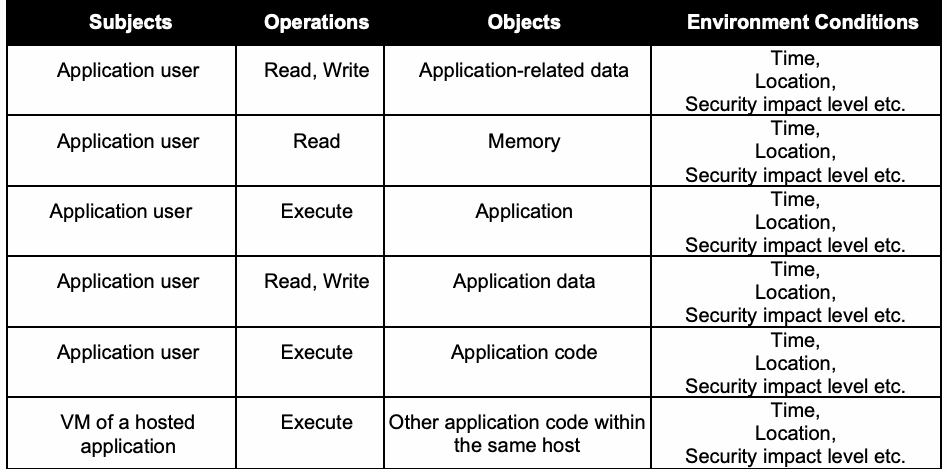
Guideline rules for SaaS AC policy are listed in Table 3. The AC designer should decide whether access in each rule is permitted or denied based on the system requirements. For example, during federation operation, VM read/write to other application code within the same host is permitted; otherwise, it is denied.
SaaSアクセス制御ポリシーの指針ルールを表3に示します。各ルールにおけるアクセスを許可するか拒否するかは、システム要件に基づいてアクセス制御設計者が決定すべきです。たとえば、フェデレーション運用中は、VMによる同一ホスト内の他のアプリケーションコードの読み取り/書き込みは許可され、それ以外の場合は拒否されます。
Table 3: Potential policy rules expressed by Subject, Operation, Object for SaaS AC policy
表3:主体、操作、対象で表現したSaaSアクセス制御ポリシーのルール例
| Subjects | Operations | Objects | Environment Conditions |
| Application user | Read, Write | Application-related data | Time, Location, Security impact level etc. |
| Application user | Read | Memory | Time, Location, Security impact level etc. |
| Application user | Execute | Application | Time, Location, Security impact level etc. |
| Application user | Read, Write | Application data | Time, Location, Security impact level etc. |
| Application user | Execute | Application code | Time, Location, Security impact level etc. |
| VM of a hosted application | Execute | Other application code within the same host | Time, Location, Security impact level etc. |
原本PDFの抜粋画像
| 主体 | 操作 | 対象 | 環境条件 |
| アプリケーションユーザー | 読み取り、書き込み | アプリケーション関連データ | 時間、場所、セキュリティ影響レベルなど |
| アプリケーションユーザー | 読み取り | メモリ | 時間、場所、セキュリティ影響レベルなど |
| アプリケーションユーザー | 実行 | アプリケーション | 時間、場所、セキュリティ影響レベルなど |
| アプリケーションユーザー | 読み取り、書き込み | アプリケーションデータ | 時間、場所、セキュリティ影響レベルなど |
| アプリケーションユーザー | 実行 | アプリケーションコード | 時間、場所、セキュリティ影響レベルなど |
| ホストされたアプリケーションのVM | 実行 | 同一ホスト内の他のアプリケーションコード | 時間、場所、セキュリティ影響レベルなど |
6 Access Control Guidance for Inter- and Intra- Operation
6 クラウド間・クラウド内運用のためのアクセス制御ガイダンス
In general, collaboration (i.e., two or more systems that work together as a combined system) in the context of the cloud may lead to a seamless exchange of data and services among various cloud infrastructures. There are two types of collaborations: inter-operation and intra-operation. Inter-operation refers to the capability of using multiple cloud infrastructures. For example, as shown in Figure 5, a consumer may purchase IaaS services from two different cloud service providers, Cloud A and Cloud B, and the collaboration between them should be allowed due to data processing requirements.
一般に、クラウドの文脈における連携(すなわち、2つ以上のシステムが1つの統合されたシステムとして協調動作すること)は、さまざまなクラウドインフラ間でのデータやサービスのシームレスな交換につながる可能性があります。連携には、クラウド間運用とクラウド内運用の2種類があります。クラウド間運用とは、複数のクラウドインフラを利用する能力を指します。たとえば図5に示すように、消費者が異なる2つのクラウドサービスプロバイダー(Cloud AとCloud B)からIaaSサービスを購入する場合があり、データ処理要件のために両者の連携は許可されるべきです。
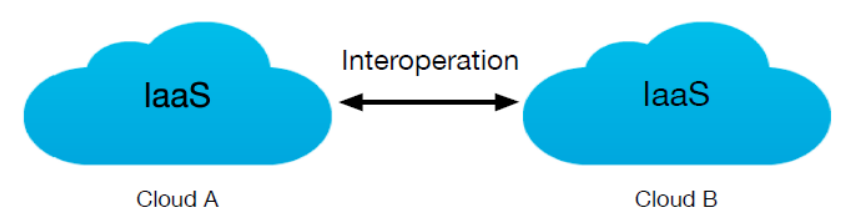
図5:異なるクラウド間の外部連携(クラウド間運用)。「IaaS」と記した2つの青い雲があり、左の雲の下に「Cloud A」(クラウドA)、右の雲の下に「Cloud B」(クラウドB)とある。2つの雲は「Interoperation」(相互運用)と記した両向きの矢印でつながる。
Figure 5: The external collaboration (inter-operation) between different Clouds
図5:異なるクラウド間の外部連携(クラウド間運用)
Intra-Operation
クラウド内運用
With regard to intra-operation, two scenarios on intra-operation can be presented as derived from Figure 6. First, a consumer may own multiple VMs in a single cloud host (e.g., VM A and VM B), and communication among those VMs may be required. Second, a consumer may rent multiple hosts within the same IaaS service, and collaboration among VMs from these different hosts may be required (e.g., an inter-operation between VM B and VM C).
クラウド内運用については、図6から導かれる2つのシナリオを示すことができます。第一に、消費者が1つのクラウドホスト内に複数のVM(たとえばVM AとVM B)を所有し、それらのVM間の通信が必要となる場合があります。第二に、消費者が同一のIaaSサービス内で複数のホストを借り、これらの異なるホスト上のVM間で連携が必要となる場合があります(たとえばVM BとVM Cの間の相互運用)。
For intra-operation, the AC policy should enable the operations of VMs for the same consumer to access each as needed during the collaboration period and disable access when the collaboration period ends. There are two primary cases in intra-operation: inter-host case (i.e., VMs from different cloud hosts are operating collaboratively) and intra-host case (i.e., VMs are from the same cloud host and must exchange data and services). Additionally, for some applications, VMs might be distributed in multiple host computers, so the AC policy should cover both intra-host and inter-host cases.
クラウド内運用では、アクセス制御ポリシーは、連携期間中は同じ消費者のVMの操作が必要に応じて互いにアクセスできるようにし、連携期間が終了したらアクセスを無効にすべきです。クラウド内運用には主に2つのケースがあります。ホスト間ケース(すなわち、異なるクラウドホスト上のVMが協調して動作する場合)と、ホスト内ケース(すなわち、VMが同一のクラウドホスト上にあり、データやサービスを交換しなければならない場合)です。加えて、アプリケーションによってはVMが複数のホストコンピューターに分散することがあるため、アクセス制御ポリシーはホスト内とホスト間の両方のケースを対象とすべきです。
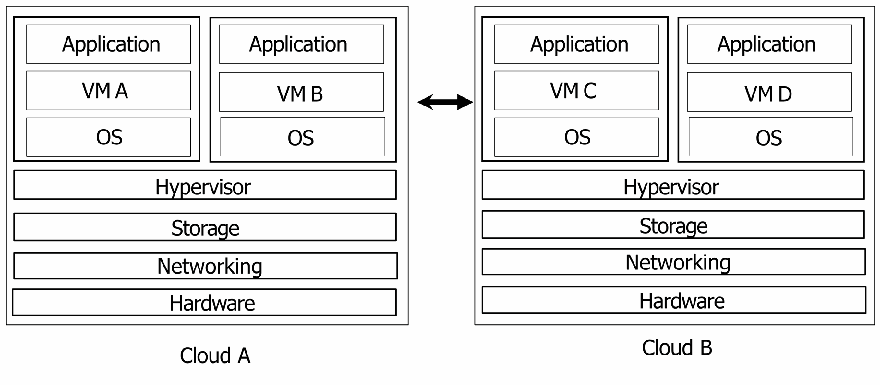
図6:同一クラウド内の内部連携(クラウド内運用)。下に「Cloud A」(クラウドA)と「Cloud B」(クラウドB)と記した2つの枠があり、その間を両向きの矢印が結ぶ。各枠には「Application」(アプリケーション)、VM、「OS」からなるスタックが2つ並び(Cloud AではVM AとVM B、Cloud BではVM CとVM D)、その下に共通の層「Hypervisor」(ハイパーバイザー)、「Storage」(ストレージ)、「Networking」(ネットワーク)、「Hardware」(ハードウェア)がある。
Figure 6: The internal collaboration (intra-operation) within the same cloud
図6:同一クラウド内の内部連携(クラウド内運用)
Inter-Operation
クラウド間運用
There is the possibility that inconsistent management of access elements leads to incorrect access control policy integration for inter-operation. For instance, different cloud service providers using different sets of subject attributes for AC may cause potential conflicts or leak access permissions [40]. Attributes with the same name may result in different privileges when switching providers. Enforcing AC among different cloud service providers without incurring conflicts or blocks of privilege for individual users/VMs is a challenge. This would require examining how to achieve secure inter-operation among the cloud service providers [1], such as in cross hybrid environments. Some cloud AC systems adopt centralized mechanisms to create global AC policies that manage policy integration among different cloud service providers [41]. However, the cloud inter-operation is transient and, thus, inefficient to manage global AC policies as frequent updates for individual cloud AC policies.
アクセス要素の管理が一貫していないと、クラウド間運用のためのアクセス制御ポリシーの統合が誤ったものになる可能性があります。たとえば、異なるクラウドサービスプロバイダーがアクセス制御に異なる主体属性の集合を用いると、潜在的な競合やアクセス許可の漏えいが生じ得ます[40]。同じ名前の属性でも、プロバイダーを切り替えると異なる特権をもたらす場合があります。個々のユーザーやVMについて特権の競合や阻害を生じさせずに、異なるクラウドサービスプロバイダー間でアクセス制御を実施することは課題です。そのためには、クロスハイブリッド環境などにおいて、クラウドサービスプロバイダー間で安全なクラウド間運用を実現する方法を検討する必要があります[1]。一部のクラウドアクセス制御システムは、異なるクラウドサービスプロバイダー間のポリシー統合を管理するグローバルなアクセス制御ポリシーを作成する集中型の仕組みを採用しています[41]。しかし、クラウド間運用は一時的なものであるため、個々のクラウドのアクセス制御ポリシーが頻繁に更新される中でグローバルなアクセス制御ポリシーを管理するのは非効率です。
7 Conclusions
7 結論
This document presents an initial step toward understanding access control (AC) challenges in cloud systems by analyzing the AC considerations in all three cloud service delivery models— IaaS, PaaS, and SaaS. Essential characteristics that would affect the cloud’s AC design are also summarized, such as broad network access, resource pooling, rapid elasticity, measured service, and data sharing. Various guidance for AC design of IaaS, PaaS, and SaaS are proposed according to their different characteristics. Recommendations for AC design in different cloud systems are also included to facilitate future implementations. Additionally, potential policy rules are summarized for each cloud system. However, many issues remain open, such as AC management across different devices and platforms, as well as new challenges that have yet to emerge with the wide adoption of the cloud.
本書は、IaaS、PaaS、SaaSという3つのクラウドサービス提供モデルすべてにおけるアクセス制御(AC)上の考慮事項を分析することにより、クラウドシステムにおけるアクセス制御の課題を理解するための最初の一歩を示すものです。広範なネットワークアクセス、リソースプーリング、迅速な弾力性、計測されるサービス、データ共有など、クラウドのアクセス制御設計に影響を及ぼす基本的な特性もまとめています。IaaS、PaaS、SaaSのアクセス制御設計に関するさまざまなガイダンスを、それぞれの異なる特性に応じて提案しています。将来の実装を支援するため、異なるクラウドシステムにおけるアクセス制御設計に関する推奨事項も含めています。加えて、各クラウドシステムについて想定されるポリシールールをまとめています。しかし、異なる機器やプラットフォームをまたぐアクセス制御管理や、クラウドの普及に伴ってこれから現れる新たな課題など、多くの問題が未解決のまま残されています。
References
参考文献
[1] Gouglidis A, Mavridis I, Hu VC (2014) Security policy verification for multi-domains in Cloud systems. International Journal of Information Security 13(2):97-111.
[1] Gouglidis A、Mavridis I、Hu VC(2014)「クラウドシステムにおける複数ドメイン向けセキュリティポリシーの検証」. International Journal of Information Security 13(2):97–111.
https://doi.org/10.1007/s10207-013-0205-x
https://doi.org/10.1007/s10207-013-0205-x
[2] Mell PM, Grance T (2011) The NIST Definition of Cloud Computing. (National Institute of Standards and Technology, Gaithersburg, MD), NIST Special Publication (SP) 800-145.
[2] Mell PM、Grance T(2011)「NISTによるクラウドコンピューティングの定義」(The NIST Definition of Cloud Computing).(米国国立標準技術研究所、メリーランド州ゲイサーズバーグ)、NIST特別刊行物(SP)800-145.
https://doi.org/10.6028/NIST.SP.800-145
https://doi.org/10.6028/NIST.SP.800-145
[3] Liu F, Tong J, Mao J, Bohn R, Messina J, Badger ML, Leaf D (2011), NIST Cloud Computing Reference Architecture. (National Institute of Standards and Technology, Gaithersburg, MD), NIST Special Publication (SP) 500-292.
[3] Liu F、Tong J、Mao J、Bohn R、Messina J、Badger ML、Leaf D(2011)「NISTクラウドコンピューティング参照アーキテクチャ」(NIST Cloud Computing Reference Architecture).(米国国立標準技術研究所、メリーランド州ゲイサーズバーグ)、NIST特別刊行物(SP)500-292.
https://doi.org/10.6028/NIST.SP.500-292
https://doi.org/10.6028/NIST.SP.500-292
[4] Badger ML, Grance T, Patt-Corner R, Voas JM (2012) Cloud Computing Synopsis and Recommendations. (National Institute of Standards and Technology, Gaithersburg, MD), NIST Special Publication (SP) 800-146. https://doi.org/10.6028/NIST.SP.800-146.
[4] Badger ML、Grance T、Patt-Corner R、Voas JM(2012)「クラウドコンピューティングの概要と推奨事項」(Cloud Computing Synopsis and Recommendations).(米国国立標準技術研究所、メリーランド州ゲイサーズバーグ)、NIST特別刊行物(SP)800-146. https://doi.org/10.6028/NIST.SP.800-146.
[5] Federal Information Security Modernization Act of 2014, Pub. L. 113-283, 128 Stat. 3073.
[5] 2014年連邦情報セキュリティ近代化法、Public Law 113-283、128 Stat. 3073.
https://www.govinfo.gov/app/details/PLAW-113publ283
https://www.govinfo.gov/app/details/PLAW-113publ283
[6] Joint Task Force Transformation Initiative (2013) Security and Privacy Controls for Federal Information Systems and Organizations. (National Institute of Standards and Technology, Gaithersburg, MD), NIST Special Publication (SP) 800-53, Rev. 4, Includes updates as of January 22, 2015. https://doi.org/10.6028/NIST.SP.800-53r4
[6] 共同タスクフォース変革イニシアチブ(2013)「連邦情報システムおよび組織のためのセキュリティとプライバシーの管理策」(Security and Privacy Controls for Federal Information Systems and Organizations).(米国国立標準技術研究所、メリーランド州ゲイサーズバーグ)、NIST特別刊行物(SP)800-53改訂第4版、2015年1月22日までの更新を含む. https://doi.org/10.6028/NIST.SP.800-53r4
[7] Bartock MJ, Souppaya MP, Scarfone KA, Carroll D, Masten R, Scinta G, Massis P, Prafullchandra H, Malnar J, Singh H, Yeluri R, Shea T, Dalton M, Dukes A, Phoenix C Swarts B (2018) Trust Cloud: Security Practice Guide for VMware Hybrid Cloud Infrastructure as a Service (IaaS) Environments. (National Institute of Standards and Technology, Gaithersburg, MD), Preliminary Draft NIST Special Publication (SP) 1800-19B. Available at https://www.nccoe.nist.gov/projects/building-blocks/trusted-cloud
[7] Bartock MJ、Souppaya MP、Scarfone KA、Carroll D、Masten R、Scinta G、Massis P、Prafullchandra H、Malnar J、Singh H、Yeluri R、Shea T、Dalton M、Dukes A、Phoenix C、Swarts B(2018)「Trust Cloud:VMwareハイブリッドクラウドIaaS環境のためのセキュリティ実践ガイド」(Trust Cloud: Security Practice Guide for VMware Hybrid Cloud Infrastructure as a Service (IaaS) Environments).(米国国立標準技術研究所、メリーランド州ゲイサーズバーグ)、NIST特別刊行物(SP)1800-19B予備草案. 入手先:https://www.nccoe.nist.gov/projects/building-blocks/trusted-cloud
[8] Szefer J, Lee RB (2011) A case for hardware protection of guest VMs from compromised hypervisors in cloud computing. 2011 31st International Conference on Distributed Computing Systems Workshops (ICDCSW) (IEEE, Minneapolis, MN), pp 248–252.
[8] Szefer J、Lee RB(2011)「クラウドコンピューティングにおいて、侵害されたハイパーバイザーからゲストVMをハードウェアで保護することの必要性」. 2011年第31回分散コンピューティングシステム国際会議ワークショップ(ICDCSW)(IEEE、米国ミネソタ州ミネアポリス)、248–252頁.
https://doi.org/10.1109/ICDCSW.2011.51
https://doi.org/10.1109/ICDCSW.2011.51
[9] Krutz RL, Vines RD (2010) Cloud security: A comprehensive guide to secure cloud computing (Wiley Publishing, Indianapolis, IN).
[9] Krutz RL、Vines RD(2010)Cloud security: A comprehensive guide to secure cloud computing(Wiley Publishing、米国インディアナ州インディアナポリス).
[10] Wu J, Ding L, Wu Y, Min-Allah N, Khan SU, Wang Y (2014) C2detector: a covert channel detection framework in cloud computing. Security and Communication Networks 7(3):544–557. https://doi.org/10.1002/sec.754
[10] Wu J、Ding L、Wu Y、Min-Allah N、Khan SU、Wang Y(2014)「C2detector:クラウドコンピューティングにおける隠れチャネル検出フレームワーク」. Security and Communication Networks 7(3):544–557. https://doi.org/10.1002/sec.754
[11] Rushby J (1992) Noninterference, transitivity, and channel-control security policies. (SRI International, Menlo Park, CA), Technical Report CSL-92-02. Available at http://www.csl.sri.com/papers/csl-92-2/
[11] Rushby J(1992)「非干渉性、推移性、チャネル制御セキュリティポリシー」(Noninterference, transitivity, and channel-control security policies).(SRI International、米国カリフォルニア州メンローパーク)、技術報告書CSL-92-02. 入手先:http://www.csl.sri.com/papers/csl-92-2/
[12] Change ATC, Foster JL, Hall DK (1987) Nimbus-7 SMMR derived global snow cover parameters. Annals of Glaciology 9:39-44. https://doi.org/10.3189/S0260305500200736
[12] Change ATC、Foster JL、Hall DK(1987)「Nimbus-7 SMMRから導出した全球積雪パラメーター」. Annals of Glaciology 9:39–44. https://doi.org/10.3189/S0260305500200736
[13] Nurmi D, Wolski R, Grzegorczyk C, Obertelli G, Soman S, Youseff L, Zagorodnov D (2009) The Eucalyptus open-source cloud-computing system. 9th IEEE/ACM International Symposium on Cluster Computing and the Grid (CCGRID'09) (IEEE, Shanghai, China), pp 124-131. https://doi.org/10.1109/CCGRID.2009.93
[13] Nurmi D、Wolski R、Grzegorczyk C、Obertelli G、Soman S、Youseff L、Zagorodnov D(2009)「Eucalyptus:オープンソースのクラウドコンピューティングシステム」. 第9回IEEE/ACMクラスターコンピューティングおよびグリッド国際シンポジウム(CCGRID'09)(IEEE、中国・上海)、124–131頁. https://doi.org/10.1109/CCGRID.2009.93
[14] Sefraoui O, Aissaoui M, Eleuldj M (2012) OpenStack: toward an open-source solution for cloud computing. International Journal of Computer Applications 55(3):38-42.
[14] Sefraoui O、Aissaoui M、Eleuldj M(2012)「OpenStack:クラウドコンピューティングのためのオープンソースソリューションを目指して」. International Journal of Computer Applications 55(3):38–42.
https://doi.org/10.5120/8738-2991
https://doi.org/10.5120/8738-2991
[15] Scarfone KA, Souppaya MP, Hoffman P (2011) Guide to Security for Full Virtualization Technologies. (National Institute of Standards and Technology, Gaithersburg, MD), NIST Special Publication (SP) 800-125. https://doi.org/10.6028/NIST.SP.800-125
[15] Scarfone KA、Souppaya MP、Hoffman P(2011)「完全仮想化技術のセキュリティガイド」(Guide to Security for Full Virtualization Technologies).(米国国立標準技術研究所、メリーランド州ゲイサーズバーグ)、NIST特別刊行物(SP)800-125. https://doi.org/10.6028/NIST.SP.800-125
[16] Wang Z, Jiang X (2010) Hypersafe: A lightweight approach to provide lifetime hypervisor control-flow integrity. 2010 IEEE Symposium on Security and Privacy (SP) (IEEE, Berkeley/Oakland, CA), pp 380–395. https://doi.org/10.1109/SP.2010.30
[16] Wang Z、Jiang X(2010)「Hypersafe:ハイパーバイザーの制御フロー完全性を常時確保する軽量な手法」. 2010年IEEEセキュリティとプライバシーシンポジウム(SP)(IEEE、米国カリフォルニア州バークレー/オークランド)、380–395頁. https://doi.org/10.1109/SP.2010.30
[17] Berger S, Cáceres R, Pendarakis D, Sailer R, Valdez E, Perez R, Schildhauer W, Srinivasan D (2008) TVDc: managing security in the trusted virtual datacenter. ACM SIGOPS Operating Systems Review 42(1):40–47. https://doi.org/10.1145/1341312.1341321
[17] Berger S、Cáceres R、Pendarakis D、Sailer R、Valdez E、Perez R、Schildhauer W、Srinivasan D(2008)「TVDc:信頼できる仮想データセンターにおけるセキュリティ管理」. ACM SIGOPS Operating Systems Review 42(1):40–47. https://doi.org/10.1145/1341312.1341321
[18] Sailer R, Valdez E, Jaeger T, Perez R, Doorn LV, Griffin JL, Berger S (2005) sHype: Secure hypervisor approach to trusted virtualized systems. (IBM Research Division, Yorktown Heights, NY) IBM Research Report RC23511. Available at https://domino.research.ibm.com/library/cyberdig.nsf/papers/265C8E3A6F95CA8D85256FA1005CBF0F/$File/rc23511.pdf
[18] Sailer R、Valdez E、Jaeger T、Perez R、Doorn LV、Griffin JL、Berger S(2005)「sHype:信頼できる仮想化システムのためのセキュアなハイパーバイザー方式」.(IBM Research Division、米国ニューヨーク州ヨークタウンハイツ)IBM研究報告書RC23511. 入手先:https://domino.research.ibm.com/library/cyberdig.nsf/papers/265C8E3A6F95CA8D85256FA1005CBF0F/$File/rc23511.pdf
[19] Zhang Y, Juels A, Reiter MK, Ristenpart T (2014) Cross-tenant Side-channel Attacks in PaaS Clouds. Proceedings of the 2014 ACM SIGSAC Conference on Computer and Communications Security (ACM, Scottsdale, AZ), pp 990–1003. https://doi.org/10.1145/2660267.2660356
[19] Zhang Y、Juels A、Reiter MK、Ristenpart T(2014)「PaaSクラウドにおけるクロステナント・サイドチャネル攻撃」. Proceedings of the 2014 ACM SIGSAC Conference on Computer and Communications Security(ACM、米国アリゾナ州スコッツデール)、990–1003頁. https://doi.org/10.1145/2660267.2660356
[20] Osvik DA, Shamir A, Tromer E (2006) Cache attacks and countermeasures: the case of AES. Pointcheval D. (eds) Topics in Cryptology – CT-RSA 2006. CT-RSA 2006. Lecture Notes in Computer Science 3860 (Springer, Berlin), pp 1–20.
[20] Osvik DA、Shamir A、Tromer E(2006)「キャッシュ攻撃とその対策:AESの場合」. Pointcheval D編『暗号理論のトピック―CT-RSA 2006』、CT-RSA 2006、Lecture Notes in Computer Science 3860(Springer、ドイツ・ベルリン)、1–20頁.
https://doi.org/10.1007/11605805_1
https://doi.org/10.1007/11605805_1
[21] Tromer E, Osvik DA, Shamir A (2010) Efficient cache attacks on AES, and countermeasures. Journal of Cryptology 23(1):37–71. https://doi.org/10.1007/s00145-009-9049-y
[21] Tromer E、Osvik DA、Shamir A(2010)「AESに対する効率的なキャッシュ攻撃とその対策」. Journal of Cryptology 23(1):37–71. https://doi.org/10.1007/s00145-009-9049-y
[22] Chandramouli R (2019) Security Strategies for Microservices-based Application Systems. (National Institute of Standards and Technology, Gaithersburg, MD), NIST Special Publication (SP) 800-204. https://doi.org/10.6028/NIST.SP.800-204
[22] Chandramouli R(2019)「マイクロサービスベースのアプリケーションシステムのセキュリティ戦略」.(米国国立標準技術研究所、メリーランド州ゲイサーズバーグ)、NIST Special Publication(SP)800-204. https://doi.org/10.6028/NIST.SP.800-204
[23] Yu S, Wang C, Ren K, Lou W (2010) Achieving secure, scalable, and fine-grained data access control in cloud computing. INFOCOM, 2010 Proceedings (IEEE, San Diego, CA), pp 1-9. https://doi.org/10.1109/INFCOM.2010.5462174
[23] Yu S、Wang C、Ren K、Lou W(2010)「クラウドコンピューティングにおける安全で拡張性が高く、きめ細かなデータアクセス制御の実現」. INFOCOM, 2010 Proceedings(IEEE、米国カリフォルニア州サンディエゴ)、1-9頁. https://doi.org/10.1109/INFCOM.2010.5462174
[24] Hu VC, Ferraiolo DF, Kuhn DR, Schnitzer A, Sandlin K, Miller R, Scarfone KA (2014) Guide to Attribute Based Access Control (ABAC) Definition and Considerations. (National Institute of Standards and Technology, Gaithersburg, MD), NIST Special Publication (SP) 800-162, Includes updates as of August 02, 2019.
[24] Hu VC、Ferraiolo DF、Kuhn DR、Schnitzer A、Sandlin K、Miller R、Scarfone KA(2014)「属性ベースアクセス制御(ABAC)の定義と考慮事項に関するガイド」(Guide to Attribute Based Access Control (ABAC) Definition and Considerations).(米国国立標準技術研究所、メリーランド州ゲイサーズバーグ)、NIST特別刊行物(SP)800-162、2019年8月2日までの更新を含む.
https://doi.org/10.6028/NIST.SP.800-162
https://doi.org/10.6028/NIST.SP.800-162
[25] Sahai A, Waters B (2005) Fuzzy identity-based encryption. Advances in Cryptology – EUROCRYPT 2005. Lecture Notes in Computer Science 3494 (Springer, Berlin), pp 457–
[25] Sahai A、Waters B(2005)「ファジーIDベース暗号」. 暗号技術の進歩―EUROCRYPT 2005、Lecture Notes in Computer Science 3494(Springer、ドイツ・ベルリン)、pp 457–
473.https://doi.org/10.1007/11426639_27
473.https://doi.org/10.1007/11426639_27
[26] Nali D, Adams CM, Miri A (2005) Using threshold attribute-based encryption for practical biometric-based access control. International Journal of Network Security 1(3):173–182. Available at http://ijns.jalaxy.com.tw/download_paper.jsp?PaperID=IJNS-2005-06-30-2&PaperName=ijns-v1-n3/ijns-2005-v1-n3-p173-182.pdf
[26] Nali D、Adams CM、Miri A(2005)「実用的な生体認証ベースアクセス制御のためのしきい値属性ベース暗号の利用」. International Journal of Network Security 1(3):173–182. 入手先:http://ijns.jalaxy.com.tw/download_paper.jsp?PaperID=IJNS-2005-06-30-2&PaperName=ijns-v1-n3/ijns-2005-v1-n3-p173-182.pdf
[27] Zhu Y, Hu H, Ahn G-J, Huang D, Wang S (2012) Towards temporal access control in cloud computing. INFOCOM, 2012 Proceedings (IEEE, Orlando, FL), pp 2576–2580.
[27] Zhu Y、Hu H、Ahn G-J、Huang D、Wang S(2012)「クラウドコンピューティングにおける時間ベースアクセス制御に向けて」. INFOCOM 2012議事録(IEEE、米国フロリダ州オーランド)、2576–2580頁.
https://doi.org/10.1109/INFCOM.2012.6195656
https://doi.org/10.1109/INFCOM.2012.6195656
[28] Hu VC, Grance T, Ferraiolo DF, Kuhn DR (2014) An access control scheme for big data processing. 2014 International Conference on Collaborative Computing: Networking, Applications and Worksharing (CollaborateCom) (IEEE, Miami, FL), pp 1–7.
[28] Hu VC、Grance T、Ferraiolo DF、Kuhn DR(2014)「ビッグデータ処理のためのアクセス制御方式」. 2014年協調コンピューティング:ネットワーキング、アプリケーション、ワークシェアリング国際会議(CollaborateCom)(IEEE、米国フロリダ州マイアミ)、1–7頁.
https://doi.org/10.4108/icst.collaboratecom.2014.257649
https://doi.org/10.4108/icst.collaboratecom.2014.257649
[29] Hu VC, Scarfone KA (2012) Guidelines for Access Control System Evaluation Metrics. (National Institute of Standards and Technology, Gaithersburg, MD), NIST Interagency or Internal Report (IR) 7874. https://doi.org/10.6028/NIST.IR.7874
[29] Hu VC、Scarfone KA(2012)「アクセス制御システム評価指標のガイドライン」.(米国国立標準技術研究所、メリーランド州ゲイサーズバーグ)、NIST Interagency or Internal Report(IR)7874. https://doi.org/10.6028/NIST.IR.7874
[30] Vipul G, Pandey O, Sahai A, Waters B (2006) Attribute-based encryption for fine-grained access control of encrypted data. Proceedings of the 13th ACM Conference on Computer and Communications Security (CCS ’06) (ACM, Alexandria, VA), pp 89-98.
[30] Vipul G、Pandey O、Sahai A、Waters B(2006)「暗号化データへのきめ細かなアクセス制御のための属性ベース暗号」. 第13回ACMコンピューター・通信セキュリティ会議(CCS '06)議事録(ACM、米国バージニア州アレクサンドリア)、89–98頁.
https://doi.org/10.1145/1180405.1180418
https://doi.org/10.1145/1180405.1180418
[31] Hu VC, Kuhn DR, Ferraiolo DF, Voas J (2015) Attribute-based access control. Computer 48(2):85-88. http://doi.org/10.1109/MC.2015.33
[31] Hu VC、Kuhn DR、Ferraiolo DF、Voas J(2015)「属性ベースアクセス制御」. Computer 48(2):85-88. http://doi.org/10.1109/MC.2015.33
[32] Sandhu RS, Coyne EJ, Feinstein HL, Youman CE (1996) Role-based access control models. Computer 29(2):38-47. https://doi.org/10.1109/2.485845
原本PDFの抜粋画像

[32] Sandhu RS、Coyne EJ、Feinstein HL、Youman CE(1996)「ロールベースアクセス制御モデル」. Computer 29(2):38–47. https://doi.org/10.1109/2.485845
[33] Rubart J (2005) Context-based access control. Proceedings of the 2005 Symposia on Metainformatics (MIS ’05). (ACM, New York, NY), pp 13-18.
[33] Rubart J(2005)「コンテキストベースアクセス制御」. 2005年メタ情報学シンポジウム(MIS '05)議事録(ACM、米国ニューヨーク州ニューヨーク)、13–18頁.
https://doi.org/10.1145/1234324.1234337
https://doi.org/10.1145/1234324.1234337
[34] Subashini S, Kavitha V (2011) A survey on security issues in service delivery models of cloud computing. Journal of Network and Computer Applications 34(1), pp 1–11.
[34] Subashini S、Kavitha V(2011)「クラウドコンピューティングのサービス提供モデルにおけるセキュリティ上の問題に関する調査」. Journal of Network and Computer Applications 34(1):1–11.
https://doi.org/10.1016/j.jnca.2010.07.006
https://doi.org/10.1016/j.jnca.2010.07.006
[35] Jin X, Krishnan R, Sandhu R (2012) A unified attribute-based access control model covering DAC, MAC, and RBAC. Data and Applications Security and Privacy XXVI, DBSec 2012. Lecture Notes in Computer Science 7371 (Springer, Berlin), pp 41-55.
[35] Jin X、Krishnan R、Sandhu R(2012)「DAC、MAC、RBACを包含する統合属性ベースアクセス制御モデル」. Data and Applications Security and Privacy XXVI、DBSec 2012、Lecture Notes in Computer Science 7371(Springer、ドイツ・ベルリン)、41–55頁.
https://doi.org/10.1007/978-3-642-31540-4_4
https://doi.org/10.1007/978-3-642-31540-4_4
[36] Decat M, Lagaisse B, Van Landuyt D, Crispo B, Joosen W (2013) Federated authorization for software-as-a-service applications. On the Move to Meaningful Internet Systems: OTM 2013 Conferences. Lecture Notes in Computer Science 8185 (Springer, Berlin), pp 342–
[36] Decat M、Lagaisse B、Van Landuyt D、Crispo B、Joosen W(2013)「Software as a Serviceアプリケーションのためのフェデレーション認可」.『意味のあるインターネットシステムに向けて:OTM 2013会議』、Lecture Notes in Computer Science 8185(Springer、ドイツ・ベルリン)、pp 342–
359.https://doi.org/10.1007/978-3-642-41030-7_25
359.https://doi.org/10.1007/978-3-642-41030-7_25
[37] Dimitrios Z, Lekkas D (2012) Addressing cloud computing security issues. Future Generation Computer Systems 28(3):583-592. https://doi.org/10.1016/j.future.2010.12.006
[37] Dimitrios Z、Lekkas D(2012)「クラウドコンピューティングのセキュリティ問題への対処」. Future Generation Computer Systems 28(3):583-592. https://doi.org/10.1016/j.future.2010.12.006
[38] McLean J (1985) A comment on the ‘basic security theorem’ of Bell and LaPadula.
[38] McLean J(1985)「BellとLaPadulaの『基本セキュリティ定理』に関する考察」.
Information Processing Letters 20(2):67-70. https://doi.org/10.1016/0020-0190(85)90065-1
Information Processing Letters 20(2):67–70. https://doi.org/10.1016/0020-0190(85)90065-1
[39] Blobel B, Nordberg R, Davis JM, Pharow P (2006) Modelling privilege management and access control. International Journal of Medical Informatics 75(8), pp 597–623.
[39] Blobel B、Nordberg R、Davis JM、Pharow P(2006)「特権管理とアクセス制御のモデル化」. International Journal of Medical Informatics 75(8):597–623.
https://doi.org/10.1016/j.ijmedinf.2005.08.010
https://doi.org/10.1016/j.ijmedinf.2005.08.010
[40] Bertino E, Federica P, Rodolfo F, Shang N (2009) Privacy-preserving digital identity management for cloud computing. IEEE Data Engineering Bulletin 32(1):21-27. Available at http://sites.computer.org/debull/A09mar/bertino.pdf
[40] Bertino E、Federica P、Rodolfo F、Shang N(2009)「クラウドコンピューティングのためのプライバシー保護型デジタルID管理」. IEEE Data Engineering Bulletin 32(1):21-27. 入手先:http://sites.computer.org/debull/A09mar/bertino.pdf
[41] Catteddu D (2010) Cloud Computing: Benefits, risks and recommendations for information security. Web Application Security. Communications in Computer and Information Science 72 (Springer, Berlin), pp 17-17. https://doi.org/10.1007/978-3-642-16120-9_9
[41] Catteddu D(2010)「クラウドコンピューティング:情報セキュリティ上の利点、リスク、推奨事項」. Web Application Security. Communications in Computer and Information Science 72(Springer、ベルリン)、17-17頁. https://doi.org/10.1007/978-3-642-16120-9_9
[42] Simorjay F, Tierling E (2019) Shared Responsibility for Cloud Computing.
[42] Simorjay F、Tierling E(2019)「クラウドコンピューティングに関する責任共有」.
(Microsoft, Redmond, WA), Version 2.0. Available at https://gallery.technet.microsoft.com/Shared-Responsibilities-81d0ff91/file/225366/1/Shared%20Responsibility%20for%20Cloud%20Computing-2019-10-25.pdf
(Microsoft、米国ワシントン州レドモンド)、第2.0版. 入手先:https://gallery.technet.microsoft.com/Shared-Responsibilities-81d0ff91/file/225366/1/Shared%20Responsibility%20for%20Cloud%20Computing-2019-10-25.pdf
Guidance and SP 800-53 Revision 4 Access Control (AC) Family Mapping
ガイダンスとSP 800-53改訂第4版アクセス制御(AC)ファミリーの対応表
The following table maps the cloud access control guidance to the AC controls listed in NIST SP 800-53, Revision 4, Security and Privacy Controls for Federal Information Systems and Organizations.
次の表では、クラウドアクセス制御ガイダンスとNIST SP 800-53改訂第4版『連邦情報システムおよび組織のためのセキュリティとプライバシーの管理策』に記載されたAC管理策との対応を示します。
Table 4 Mapping the cloud access control guidance to the AC controls listed in NIST SP 800-53, Revision 4
表4 クラウドアクセス制御ガイダンスとNIST SP 800-53改訂第4版に記載されたAC管理策との対応
| Guidance | AC Control in 800-53 |
| 3.1 Guidance for Network | AC-1, AC-3, AC-4, AC-5, AC-10, AC-17, AC-21, AC-22 |
| 3.2 Guidance for Hypervisor | AC-1, AC-3, AC-5, AC-17, AC-21 |
| 3.3 Guidance for Virtual Machine | AC-1, AC-3, AC-4, AC-5, AC-11 |
| 3.4 Guidance for API | AC-1, AC-3, AC-4, AC-5, AC-11, AC-17, AC-21, AC-22 |
| 4.1 Guidance for Memory Data | AC-1, AC-3, AC-4, AC-5, AC-10, AC-11, AC-21 |
| 4.2 Guidance for APIs | AC-1, AC-3, AC-4, AC-5, AC-10, AC-11, AC-21 |
| 5.1 Guidance for Data Owner’s Control | AC-1, AC-3, AC-5 |
| 5.2 Guidance for Confidentiality | AC-3, AC-6, AC-21 |
| 5.3 Guidance for Privilege Management | AC-2, AC-11, AC-14, AC-22 |
| 5.4 Guidance for Multiple Replicas of Data | AC-1, AC-3, AC-4, AC-5, AC-17, AC-21 |
| 5.5 Guidance for Multi-tenancy | AC-1, AC-2, AC-3, AC-4, AC-5, AC-10, AC-11, AC-21 |
| 5.6 Guidance for Attribute and Role Management | AC-6, AC-1, AC-3 |
| 5.7 Guidance for Policies | AC-1, AC-3 |
| 5.8 Guidance for APIs | AC-1, AC-2, AC-3, AC-4, AC-5, AC-6, AC-11, AC-14, AC-17, AC-21 |
原本PDFの抜粋画像
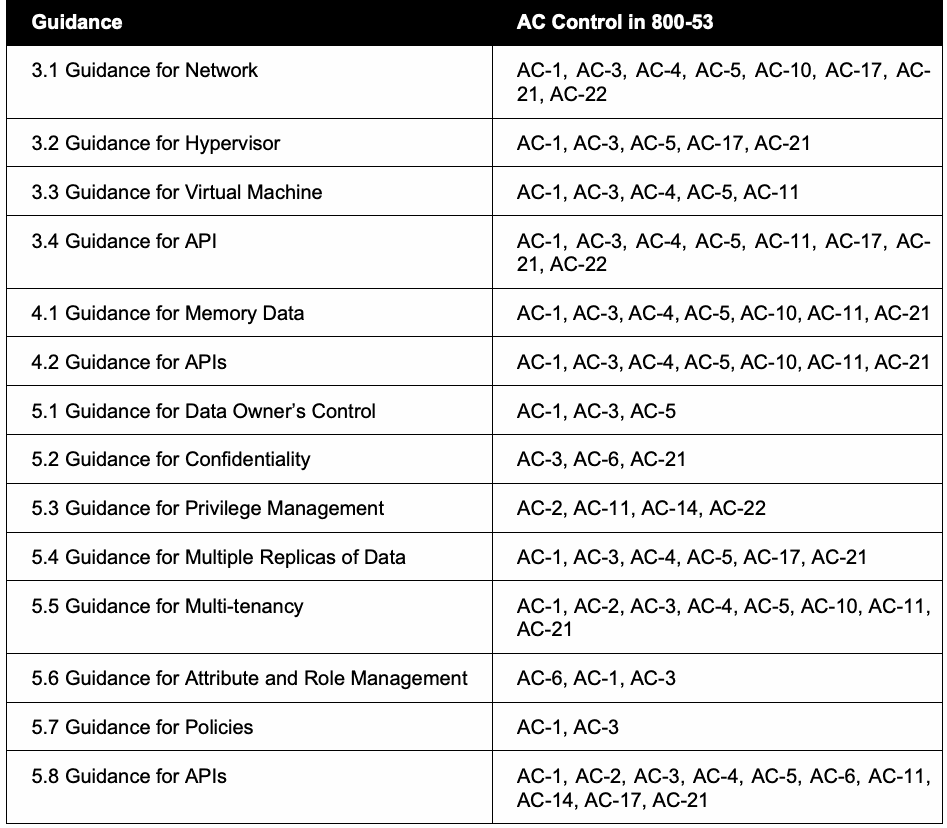
| ガイダンス | 800-53のAC管理策 |
| 3.1 ネットワークに関するガイダンス | AC-1、AC-3、AC-4、AC-5、AC-10、AC-17、AC-21、AC-22 |
| 3.2 ハイパーバイザーに関するガイダンス | AC-1、AC-3、AC-5、AC-17、AC-21 |
| 3.3 仮想マシンに関するガイダンス | AC-1、AC-3、AC-4、AC-5、AC-11 |
| 3.4 APIに関するガイダンス | AC-1、AC-3、AC-4、AC-5、AC-11、AC-17、AC-21、AC-22 |
| 4.1 メモリデータに関するガイダンス | AC-1、AC-3、AC-4、AC-5、AC-10、AC-11、AC-21 |
| 4.2 APIに関するガイダンス | AC-1、AC-3、AC-4、AC-5、AC-10、AC-11、AC-21 |
| 5.1 データ所有者の制御に関するガイダンス | AC-1、AC-3、AC-5 |
| 5.2 機密性に関するガイダンス | AC-3、AC-6、AC-21 |
| 5.3 特権管理に関するガイダンス | AC-2、AC-11、AC-14、AC-22 |
| 5.4 データの複数レプリカに関するガイダンス | AC-1、AC-3、AC-4、AC-5、AC-17、AC-21 |
| 5.5 マルチテナンシーに関するガイダンス | AC-1、AC-2、AC-3、AC-4、AC-5、AC-10、AC-11、AC-21 |
| 5.6 属性とロールの管理に関するガイダンス | AC-6、AC-1、AC-3 |
| 5.7 ポリシーに関するガイダンス | AC-1、AC-3 |
| 5.8 APIに関するガイダンス | AC-1、AC-2、AC-3、AC-4、AC-5、AC-6、AC-11、AC-14、AC-17、AC-21 |
AC-1: Access Control Policy and Procedures AC-2: Account Management AC-3: Access Enforcement AC-4: Information Flow Enforcement AC-5: Separation of Duties
AC-1:アクセス制御ポリシーおよび手順;AC-2:アカウント管理;AC-3:アクセス制御の実施;AC-4:情報フロー制御の実施;AC-5:職務分離
AC-6: Least Privilege AC-10: Concurrent Session Control AC-11: Session Lock AC-14: Permitted Actions without Identification or Authentication AC-17: Remote Access AC-21: Collaboration and Information Sharing AC-22: Publicly Accessible Content
AC-6:最小特権;AC-10:同時セッション制御;AC-11:セッションロック;AC-14:識別または認証を伴わない許可操作;AC-17:リモートアクセス;AC-21:連携と情報共有;AC-22:一般公開コンテンツ