NIST SP 800-214 日本語訳
英語タイトル : 2020 Cybersecurity and Privacy Annual Report日本語タイトル : 2020年 サイバーセキュリティ・プライバシー年次報告書
公開日 : 2021-09-28
原文URL : https://csrc.nist.gov/pubs/sp/800/214/final
翻訳編集 : 自動生成(有志による非公式の日本語訳), 原文取得日 : 2026-09-27, 訳文 : 309 / 309 ブロック
[要約] SP 800-214 は、2020年における NIST 情報技術研究所(ITL)のサイバーセキュリティとプライバシー分野の研究活動と成果をまとめた年次報告書です。意識向上と教育、アイデンティティ管理とアクセス管理、リスクマネジメント、プライバシーエンジニアリング、暗号標準と検証など、NIST の九つの重点領域に分けて報告します。これらの区分に収まらない個別プロジェクトのほか、ITL の標準化への参加や、NIST のプログラムに関わる機会についても紹介しています。
Cybersecurity and
サイバーセキュリティと
Privacy Annual Report
プライバシー年次報告書
青い回路とデジタル技術を抽象的に描いた表紙画像。図中に文字はない。 [装飾の画像。本文を読むのに必要のない装飾のため、この非公式サイトには掲載していません。原本 PDF を参照してください。]
2020
2020年
NIST SPECIAL PUBLICATION 800-214
NIST特別刊行物800-214
2020 Cybersecurity and Privacy Annual Report
2020年サイバーセキュリティとプライバシー年次報告書
PATRICK O’REILLY, EDITOR
編集者:Patrick O’Reilly
KRISTINA RIGOPOULOS, EDITOR
編集者:Kristina Rigopoulos
Computer Security Division
コンピュータセキュリティ部門
Applied Cybersecurity Division
応用サイバーセキュリティ部門
Information Technology Laboratory
情報技術研究所
Information Technology Laboratory
情報技術研究所
CO-EDITORS:
共同編集者:
Larry Feldman Greg Witte Huntington Ingalls Industries Annapolis Junction, Maryland
Larry Feldman Greg Witte Huntington Ingalls Industries メリーランド州アナポリス・ジャンクション
THIS PUBLICATION IS AVAILABLE FREE OF CHARGE FROM
本刊行物は以下から無料で入手できる
https://doi.org/10.6028/NIST.SP.800-214
https://doi.org/10.6028/NIST.SP.800-214
SEPTEMBER 2021
2021年9月
[米国商務省の紋章。公的な標章のため、この非公式サイトには掲載していません。原本 PDF を参照してください。]
U.S. DEPARTMENT OF COMMERCE Gina M. Raimondo, Secretary
米国商務省 Gina M. Raimondo 長官
NATIONAL INSTITUTE OF STANDARDS AND TECHNOLOGY James K. Olthoff, Performing the Non-Exclusive Functions and Duties of the Under Secretary of Commerce for Standards and Technology & Director, National Institute of Standards and Technology
米国国立標準技術研究所 James K. Olthoff(商務省標準技術担当次官および米国国立標準技術研究所長の非専属職務・職責を代行)
Table of Contents
目次
Focus Area 1: Cybersecurity Awareness and Education
重点領域1:サイバーセキュリティの意識向上と教育
Focus Area 2: Identity and Access Management
重点領域2:アイデンティティ管理とアクセス管理
Focus Area 3: Metrics and Measurement
重点領域3:指標と測定
Focus Area 4: Risk Management
重点領域4:リスクマネジメント
Focus Area 5: Privacy Engineering
重点領域5:プライバシーエンジニアリング
Focus Area 6: Emerging Technologies
重点領域6:新興技術
Focus Area 7: Cryptographic Standards and Validation
重点領域7:暗号標準と検証
Focus Area 8: Trustworthy Networks
重点領域8:信頼できるネットワーク
Focus Area 9: Trustworthy Platforms
重点領域9:信頼できるプラットフォーム
Foreword
序文
With each day bringing new cybersecurity and privacy challenges and advances, it is little wonder that many leaders feel as if they have been cast in the role of the Red Queen in Lewis Carroll’s “Through the Looking-Glass.” In that classic, the Queen tells Alice: "Now, here, you see, it takes all the running you can do to keep in the same place. If you want to get somewhere else, you must run at least twice as fast as that!"
日々、サイバーセキュリティとプライバシーに関する新たな課題と進歩がもたらされるなか、多くのリーダーが、ルイス・キャロルの『鏡の国のアリス』に登場する赤の女王の役を割り当てられたかのように感じるのも無理はありません。この古典の中で、女王はアリスにこう言います。「いいこと、ここでは、同じ場所にとどまるだけでも、力の限り走らなければならないのよ。どこか別の場所へ行きたいのなら、少なくともその二倍の速さで走らなくては!」
It is true that leaders need to be nimble and move quickly to avoid the consequences of cybersecurity and privacy attacks that threaten their enterprises. That need extends to government agencies, like NIST, that are trying to help meet those urgent challenges.
確かに、リーダーは、自らの企業を脅かすサイバーセキュリティおよびプライバシーに対する攻撃がもたらす結果を避けるために、機敏であり、かつ迅速に動く必要があります。その必要性は、こうした差し迫った課題への対応を支援しようとしているNISTのような政府機関にも及びます。
At NIST, we know that – in addition to current needs – we also have a responsibility to keep an eye on the horizon, anticipating technology changes, threat environments, and cultural shifts that could affect the ability of organizations to manage cybersecurity and privacy risks.
NISTでは、現在のニーズに加えて、組織がサイバーセキュリティおよびプライバシーのリスクを管理する能力に影響を及ぼし得る技術の変化、脅威環境、文化的な変化を予測しながら、先を見据え続ける責任もあることを認識しています。
We've successfully carried out our work for nearly 50 years precisely because we not only address near-term challenges but also spend time thinking, exploring, listening, and speaking with others about the really big issues in store for all of us. We tackle current issues, but we also play the long game – the infinite game, if you will. We are mindful of the reality that cybersecurity and privacy challenges are evolving. At NIST, we make it our business to help others be prepared by anticipating needs and creating opportunities. We anchor our decisions with our feet firmly planted in both the present and the future. As you read this report about our efforts and accomplishments in 2020, you will understand how we have been addressing both short-term and long-term needs.
我々が50年近くにわたり業務を成功裏に遂行してきたのは、まさに、目先の課題に対処するだけでなく、我々すべてを待ち受ける真に大きな問題について考え、探究し、耳を傾け、他者と語り合うことに時間を費やしているからです。我々は現在の問題に取り組みますが、同時に長期戦、言うなれば無限のゲームにも臨んでいます。我々は、サイバーセキュリティとプライバシーの課題が進化しつつあるという現実を念頭に置いています。NISTでは、ニーズを予測し機会を創出することによって、他者が備えられるよう支援することを自らの務めとしています。我々は、現在と未来の双方にしっかりと足を据えて意思決定を行っています。2020年の我々の取り組みと成果に関する本報告書を読めば、我々が短期と長期の両方のニーズにどのように対処してきたかを理解できるでしょう。
For example, in the cryptographic arena, we are not only providing and improving practical tools and services for today, we also are rapidly moving forward to ensure that Post-Quantum Cryptography standards are ready when quantum computing becomes a real threat to the protective algorithms that we all take for granted. We have been integrating privacy considerations into the basic control suites that so many organizations rely on now, and we are widening our privacy focus to encompass the broader privacy concerns that arise as mobile computing, e-commerce, and the Internet of Things advance. The intentional addition of the word “privacy” in this report’s title reflects changing technological capabilities and society’s expectations.
例えば暗号の分野では、今日のための実用的なツールやサービスを提供し改善しているだけでなく、我々の誰もが当然のものと考えている保護アルゴリズムにとって量子コンピューティングが現実の脅威となったときに耐量子計算機暗号の標準が確実に準備できているよう、急速に前進しています。我々は、非常に多くの組織が現在依拠している基本的な管理策一式にプライバシーの考慮事項を統合してきており、また、モバイルコンピューティング、電子商取引、モノのインターネットの進展に伴って生じる、より広範なプライバシー上の懸念を包含するよう、プライバシーに関する焦点を広げつつあります。本報告書のタイトルに「プライバシー」という語を意図的に加えたことは、変化する技術的能力と社会の期待を反映しています。
This year’s annual report is grouped into nine priority areas for NIST, with most – but not all – of the work being conducted by our Information Technology Laboratory (ITL) and in close collaboration with the private and public sectors. While these represent areas that NIST believes merit the bulk of our attention for the foreseeable future, the report also includes other specific projects of importance that do not fit neatly into these buckets.
今年の年次報告書は、NISTにとっての九つの優先領域に分類されており、その作業のすべてではないが大部分は、我々の情報技術研究所(ITL)によって、かつ民間部門および公共部門との緊密な協力のもとで実施されています。これらは、当面の間、我々の注意の大部分を向けるに値するとNISTが考える領域を表していますが、本報告書には、これらの区分にうまく収まらない、その他の重要な個別プロジェクトも含まれています。
All of this work adds up to cultivating trust in information, systems, and technologies. That’s our charge. That’s our reason for being. I encourage you to review our recent progress and to help us look well beyond the here-and-now of technology, cybersecurity, and privacy; this will enable all of us to meet the future with confidence that we can manage the emerging risks and change the world for the better for the next 50 years.
これらすべての取り組みは、情報、システム、技術への信頼を育むことにつながります。それが私たちの責務であり、存在理由です。最近の進捗を確認するとともに、技術、サイバーセキュリティ、プライバシーの「今ここ」のはるか先まで見据えることに力を貸していただきました。そうすれば、新たに生じるリスクをマネジメントし、今後50年にわたって世界をより良く変えていけるという自信をもって、私たち皆が未来に臨むことができます。
Kevin Stine
Kevin Stine
NIST Chief Cybersecurity Advisor
NISTサイバーセキュリティ首席顧問
1 | Cybersecurity Awareness and Education
1|サイバーセキュリティの意識向上と教育
Credit: Shutterstock
画像提供:Shutterstock
NIST continues to coordinate a National Cybersecurity Awareness and Education Program that includes activities such as the widespread dissemination of cybersecurity technical standards and best practices; efforts to make cybersecurity best practices usable by a variety of individuals and stakeholders; increasing public awareness of cybersecurity, cyber safety, and cyber ethics; increasing the understanding of the benefits of ensuring effective risk management of information technology and the methods to mitigate and to remediate vulnerabilities; supporting formal cybersecurity education programs at all levels to prepare and improve a skilled cybersecurity workforce; and promoting initiatives to evaluate and forecast future cybersecurity workforce needs of the Federal Government and develop strategies for recruitment, training, and retention.
NISTは、国家サイバーセキュリティ意識向上・教育プログラムの調整を引き続き担っています。このプログラムには、サイバーセキュリティの技術標準とベストプラクティスの広範な普及、さまざまな個人や利害関係者がサイバーセキュリティのベストプラクティスを利用できるようにする取り組み、サイバーセキュリティ、サイバー安全、サイバー倫理に関する一般の意識の向上、情報技術の効果的なリスクマネジメントを確保することの利点および脆弱性を軽減し修正する方法についての理解の促進、熟練したサイバーセキュリティ人材を育成し向上させるためのあらゆるレベルの正式なサイバーセキュリティ教育プログラムの支援、連邦政府の将来のサイバーセキュリティ人材需要を評価・予測し、採用、訓練、定着のための戦略を策定するイニシアチブの推進といった活動が含まれます。
National Initiative for Cybersecurity Education
サイバーセキュリティ教育国家イニシアチブ
The National Initiative for Cybersecurity Education (NICE) is a partnership among government, academia, and the private sector. NICE is focused on cybersecurity education, training, and workforce development. NIST's leadership of the program helps position it to support the country’s ability to address current and future cybersecurity challenges through standards and best practices.
サイバーセキュリティ教育国家イニシアチブ(NICE)は、政府、学術界、民間部門の間のパートナーシップです。NICEは、サイバーセキュリティの教育、訓練、人材育成に重点を置いています。NISTがこのプログラムを主導していることは、標準とベストプラクティスを通じて現在および将来のサイバーセキュリティ課題に対処する国の能力を支援できる位置に、このプログラムを置くことに役立っています。
NICE's mission is to energize and promote a robust network and ecosystem of cybersecurity education, training, and workforce development. This mission supports the vision of helping to secure the nation by increasing the number of skilled cybersecurity professionals.
NICEの使命は、サイバーセキュリティの教育、訓練、人材育成の強固なネットワークとエコシステムを活性化し、促進することです。この使命は、熟練したサイバーセキュリティ専門家の数を増やすことによって国の安全確保に寄与するというビジョンを支えます。
In Fiscal Year (FY) 2020, the National Initiative for Cybersecurity Education (NICE) finalized two publications. The first, NIST Interagency or Internal Report (NISTIR) 8287, A Roadmap for Successful Regional Alliances and Multistakeholder Partnerships to Build the Cybersecurity Workforce, provides a summary of how to create ecosystems and partnerships to stimulate cybersecurity education and workforce development.
2020会計年度(FY 2020)、サイバーセキュリティ教育国家イニシアチブ(NICE)は二つの刊行物を完成させました。一つ目のNIST省庁間・内部報告書(NISTIR)8287『サイバーセキュリティ人材を構築するための地域連合とマルチステークホルダーパートナーシップを成功させるためのロードマップ』は、サイバーセキュリティ教育と人材育成を促進するエコシステムとパートナーシップの構築方法の概要を示しています。
The second, NIST Special Publication (SP) 1500-16, Improving Veteran Transitions to Civilian Cybersecurity Roles: Workshop Report, presents the findings and recommendations from a workshop on how to help transitioning military members discover opportunities in the cybersecurity workforce.
二つ目のNIST特別刊行物(SP)1500-16『退役軍人の民間サイバーセキュリティ職への移行の改善:ワークショップ報告書』は、軍務から移行する軍人がサイバーセキュリティ人材としての機会を見いだせるよう支援する方法に関するワークショップの知見と提言を示しています。
NICE also curated a webpage for free and low-cost online cybersecurity learning content. At a time when many are transitioning to remote learning or considering a job or career change, this resource provided links to training courses, labs, and curriculum for the purposes of progressing toward new skills or credentials in cybersecurity.
NICEは、無料および低価格のオンラインサイバーセキュリティ学習コンテンツを集めたウェブページも整備しました。多くの人が遠隔学習へ移行したり、仕事やキャリアの変更を検討したりしている時期に、このリソースは、サイバーセキュリティの新たな技能や資格の取得に向けて前進することを目的とした訓練コース、ラボ、カリキュラムへのリンクを提供しました。
NICE hosted several events in FY 2020. In addition to monthly webinars, NICE held two annual conferences – the NICE Conference and Expo in Phoenix, Arizona, which had more than 800 registrants; and the NICE K12 Cybersecurity Education Conference in Garden Grove, California, which had more than 450 registrants. NICE also conducted a workshop on Use Cases for the NICE Framework and the annual National Cybersecurity Career Awareness Week where organizations from around the world held virtual and in-person events to help inspire and promote awareness and exploration of cybersecurity careers.
NICEは2020会計年度に複数のイベントを開催しました。毎月のウェビナーに加え、NICEは二つの年次会議を開催しました。アリゾナ州フェニックスで開かれたNICE Conference and Expoには800人を超える登録者があり、カリフォルニア州ガーデングローブで開かれたNICE K12 Cybersecurity Education Conferenceには450人を超える登録者がありました。NICEはまた、NICE Frameworkのユースケースに関するワークショップと、毎年恒例の全国サイバーセキュリティ・キャリア啓発週間も実施しました。同週間には、世界各地の組織がオンラインおよび対面のイベントを開催し、サイバーセキュリティ分野のキャリアへの関心を喚起し、その認知と探求を促しました。
Advancing Cybersecurity Usability
サイバーセキュリティの使いやすさの向上
NIST has popularized the “Phish Scale” as a method to better characterize an organization’s phishing risk. The scale considers phishing cues and user context to help Chief Information Security Officers and phishing training implementers rate the difficulty of their organizations’ phishing exercises and explain associated click rates. NIST’s Video and Digital Media Production Group created a video for the Phish Scale, and research results were published in the Journal of Cybersecurity and highlighted in a NIST article that garnered media attention across industry, government, and academia.
NISTは、組織のフィッシングリスクをより適切に特徴付ける方法として「フィッシング・スケール」を普及させました。この尺度は、フィッシングの手掛かりと利用者の状況を考慮し、最高情報セキュリティ責任者やフィッシング訓練の実施者が、自組織のフィッシング演習の難易度を評価し、それに伴うクリック率を説明するのに役立ちます。NISTの映像・デジタルメディア制作グループはフィッシング・スケールの動画を作成しました。研究成果は『Journal of Cybersecurity』に掲載され、産業界、政府、学術界にわたってメディアの注目を集めたNISTの記事でも紹介されました。
NIST also completed an in-depth interview study to understand consumers’ challenges, perceptions, and experiences related to smart home security and privacy. The results of the study inform the Internet of Things (IoT) security and privacy guidelines by identifying current gaps in users’ experiences and suggesting how smart home devices might be designed to better integrate usability, privacy, and security. The capstone paper describing the results will be published in the proceedings of the 2021 USENIX Security Symposium.
NISTは、スマートホームのセキュリティとプライバシーに関する消費者の課題、認識、経験を理解するため、詳細なインタビュー調査も完了しました。調査結果は、利用者の経験における現在のギャップを特定し、ユーザビリティ、プライバシー、セキュリティをより適切に統合するためにスマートホーム機器をどのように設計し得るかを示唆することで、モノのインターネット(IoT)のセキュリティおよびプライバシーのガイドラインに知見を提供します。結果を記述した総括論文は、2021年USENIX Security Symposiumの会議録に掲載される予定です。
Small Business Cybersecurity Corner
中小企業向けサイバーセキュリティ情報コーナー
In FY 2020, the Small Business Cybersecurity Corner website organization and design were updated based on the results of a usability study conducted by a set of small business owners.
2020会計年度、中小企業向けサイバーセキュリティ情報コーナーのウェブサイトの構成とデザインは、中小企業経営者のグループが実施したユーザビリティ調査の結果に基づいて更新されました。
In addition to facilitating access to many popular small business security resources, the language of the site was updated to be more accessible and relatable to the small business community. Training materials and accompanying resources continue to be expanded based on cybersecurity resources and feedback received from NIST’s federal partners and the public.
広く利用されている多くの中小企業向けセキュリティリソースへのアクセスを容易にしたことに加え、サイトの表現も、中小企業コミュニティにとってより分かりやすく身近なものとなるよう更新されました。訓練教材と付随するリソースは、NISTの連邦パートナーおよび一般から寄せられたサイバーセキュリティリソースとフィードバックに基づいて、引き続き拡充されています。
2 | Identity and Access Management
2|アイデンティティ管理とアクセス管理
利用者のアイコンと錠前を表示したノートPCを複数の手が囲み、本人確認とアクセス制御を表すイラスト。画像内に文字はない。 [装飾の画像。本文を読むのに必要のない装飾のため、この非公式サイトには掲載していません。原本 PDF を参照してください。]
Credit: Shutterstock
画像提供:Shutterstock
Identity and Access Management (IdAM) is a fundamental and critical cybersecurity capability to ensure that the right people have the appropriate access to the proper resources at the right time. To advance the state of identity and access management, NIST:
アイデンティティ管理とアクセス管理(IdAM)は、適切な人が適切な時に適切なリソースに対して適切なアクセスを持てるようにするための、基礎的かつ重要なサイバーセキュリティ能力です。アイデンティティ管理とアクセス管理の水準を前進させるため、NISTは次のことを行っています。
•Conducts focused research to better understand new and emerging technologies, impacts on existing standards, and ways to implement IdAM solutions;
•新しい技術および新興技術、既存標準への影響、IdAMソリューションの実装方法をより深く理解するため、重点的な研究を実施します。
•Leads in the development of national and international IdAM standards, guidance, best practices, profiles, and frameworks to create an enhanced, interoperable suite of secure, privacy-enhancing solutions;
•安全でプライバシーを強化するソリューションの、強化された相互運用可能な一式を構築するため、国内および国際的なIdAMの標準、ガイダンス、ベストプラクティス、プロファイル、フレームワークの策定を主導します。
•Evolves its IdAM standards, guidelines, and resources; and
•IdAMの標準、ガイドライン、リソースを発展させます。
•Produces example solutions that bring together the IdAM requirements needed to address specific business cybersecurity challenges.
•特定の事業上のサイバーセキュリティ課題に対応するために必要なIdAM要件をまとめた実装例を作成します。
IdAM is an important component of cloud computing security, and NIST publishes access control characteristics and general access control guidelines for various cloud service models. NIST also performs research and development regarding access control rules and methods.
IdAMはクラウドコンピューティングのセキュリティにおける重要な要素であり、NISTは、さまざまなクラウドサービスモデル向けに、アクセス制御の特性と一般的なアクセス制御ガイドラインを公開しています。NISTは、アクセス制御の規則と手法に関する研究開発も行っています。
Personal Identity Verification (PIV)
個人識別検証(PIV)
As required by Homeland Security Presidential Directive 12, NIST developed and maintains the Federal Information Processing Standard (FIPS) for personal identity verification (PIV) of federal employees and contractors (FIPS 201). In FY 2019, NIST initiated a revision of FIPS 201 to incorporate changing business requirements of federal departments and agencies and to adapt to an evolving technology environment. The revision also helps users to align with Office of Management and Budget (OMB) Policy Memorandum M-19-17. Revision activities began in FY 2019 with a business requirement meeting to engage with federal stakeholders about the revision goals. In FY 2020, the PIV team updated the draft standard based on the revision goals and published public draft FIPS 201-3. The draft standard expands the set of PIV authenticators beyond the current practices (including the current smart card form factor) while addressing interagency use of new types of PIV authenticators (i.e., derived PIV credentials) via federation. The revision also aims to facilitate the issuance of PIV cards by enabling remote identity proofing. These changes closely align with M-19-17. For FY 2021, the PIV team will actively work on resolving comments on the public draft while continuing outreach to federal stakeholders.
国土安全保障大統領指令第12号の要求に従い、NISTは、連邦政府の職員と請負業者の個人識別検証(PIV)に関する連邦情報処理標準(FIPS)(FIPS 201)を策定し、維持しています。2019会計年度、NISTは、連邦省庁の変化する事業要件を取り込み、進化する技術環境に適応するため、FIPS 201の改訂に着手しました。この改訂は、利用者が行政管理予算局(OMB)の政策覚書M-19-17に整合することにも役立ちます。改訂作業は2019会計年度に、改訂目標について連邦の利害関係者と協議するための事業要件会合をもって始まりました。2020会計年度、PIVチームは改訂目標に基づいて標準草案を更新し、公開草案FIPS 201-3を公表しました。この標準草案は、現行の実務(現行のスマートカードのフォームファクタを含む)を超えてPIV認証器の集合を拡大するとともに、連携を介した新しい種類のPIV認証器(すなわち派生PIV資格情報)の省庁間利用に対応しています。この改訂はまた、遠隔での本人確認を可能にすることで、PIVカードの発行を円滑にすることも目指しています。これらの変更はM-19-17と密接に整合しています。2021会計年度、PIVチームは、連邦の利害関係者への働きかけを続けながら、公開草案に対するコメントの解決に積極的に取り組む予定です。
Digital Identity Guidelines
デジタルIDガイドライン
The four-volume set of NIST SP 800-63-3, Digital Identity Guidelines, was published in June 2017. Following three years of federal agency experience implementing the controls and requirements and to help stay ahead of potential online identity attacks, the Information Technology Laboratory (ITL) decided to revise and update all volumes of SP 800-63-3.
4巻構成のNIST SP 800-63-3『デジタルIDガイドライン』は2017年6月に公表されました。連邦機関が管理策と要件を実装してきた3年間の経験を受け、また潜在的なオンラインID攻撃に先手を打ち続けられるよう、情報技術研究所(ITL)はSP 800-63-3の全巻を改訂・更新することを決定しました。
NIST ITL published the pre-draft Request for Comments for the revision of SP 800-63-3 on June 8, 2020. The Request for Comments identified nine topics for potential update. Additionally, NIST ITL provided numerous virtual conferences and presentations on the targeted topics for potential revision and other aspects of the Digital Identity Guidelines to improve and focus the development and submission of comments. More than 40 federal agencies and industry organizations responded with over 300 comments. ITL published a public roadmap for key activities, milestones, and target dates for the development of SP 800-63, Revision 4, and published all comments received by the comment closing date. As indicated in the roadmap, ITL plans to complete adjudication of comments received in the first quarter of FY 2021 and will post issues for potential revision on GitHub in the second quarter.
NIST ITLは2020年6月8日、SP 800-63-3の改訂に向けた草案作成前の意見募集を公表しました。この意見募集では、更新の候補として九つのトピックを示しました。加えて、NIST ITLは、コメントの作成と提出の質を高め焦点を絞るため、改訂候補として挙げたトピックやデジタルIDガイドラインのその他の側面について、多数のオンライン会議とプレゼンテーションを実施しました。40を超える連邦機関と業界組織から、300件を超えるコメントが寄せられました。ITLは、SP 800-63改訂第4版の策定に向けた主要な活動、マイルストーン、目標期日を示す公開ロードマップを公表し、コメント締切日までに受領したすべてのコメントを公開しました。ロードマップに示したとおり、ITLは2021会計年度第1四半期に受領コメントの裁定を完了する計画であり、第2四半期に改訂候補の課題をGitHubに掲載する予定です。
Implementation Resources for NIST SP 800-63, Digital Identity Guidelines
NIST SP 800-63『デジタルIDガイドライン』の実装リソース
In June 2020, NIST ITL published resources for applying NIST SP 800-63. Based on requests from federal agencies and industry and on recommendations from the U.S. General Accountability Office (GAO), NIST developed and published materials to provide non-normative guidance for the implementation of SP 800-63A, Enrollment and Identity Proo ing; SP 800-63B, Authentication and Lifecycle Management; and SP 800-63C, Federation and Assertions. The guidance addresses key topics and aspects of each volume to facilitate the understanding and implementation of the requirements for all assurance levels. ITL presented information for federal agencies and industry to promote the use of the implementation resources and discuss key topics, requirements, and controls and how to properly implement them.
2020年6月、NIST ITLはNIST SP 800-63を適用するためのリソースを公表しました。連邦機関と業界からの要望、および米国政府説明責任院(GAO)の勧告に基づき、NISTは、SP 800-63A『登録と本人確認』、SP 800-63B『認証とライフサイクル管理』、SP 800-63C『連携とアサーション』の実装に関する非規範的なガイダンスを提供する資料を作成し、公表しました。このガイダンスは、すべての保証レベルの要件の理解と実装を容易にするため、各巻の主要なトピックと側面を扱っています。ITLは、実装リソースの利用を促進し、主要なトピック、要件、管理策およびそれらを適切に実装する方法について議論するため、連邦機関と業界に向けて情報を提示しました。
Conformance Criteria for NIST SP 800-63A and 800-63B
NIST SP 800-63Aおよび800-63Bの適合基準
OMB Policy Memorandum M-19-17 updated federal identity, credentials, and access management policy and provided direction for federal agencies to enhance associated capabilities. The OMB Policy Memo assigned NIST the responsibility for developing conformance criteria for accreditation of products and services to meet the designated levels of assurance in SP 800-63-3. In response, NIST ITL developed the criteria for NIST SPs 800-63A and 800-63B.
OMB政策覚書M-19-17は、連邦政府のアイデンティティ・クレデンシャル・アクセス管理に関する方針を更新し、関連する能力を強化するよう連邦機関に指示しました。同覚書は、SP 800-63-3で指定された保証レベルを満たす製品およびサービスの認定のための適合基準を策定する責任をNISTに割り当てました。これを受けて、NIST ITLはNIST SP 800-63Aおよび800-63Bの基準を策定しました。
The conformance criteria present all normative requirements and controls of SP 800-63-3 by designated assurance level, the control objectives for each criterion, recommended methods for determining conformity, and supplemental guidance to assist implementers and assessors. The criteria are intended for federal agencies and industry service providers for the implementation of SP 800-63-3 and for conducting conformance and security assessments under the Federal Information Security Modernization Act (FISMA). NIST provided virtual conferences and presentations to explain how to apply and use the conformance criteria for implementation and conformance assessment. Multiple federal agencies and industry organizations have developed programs to incorporate the conformance criteria and take advantage of the guidance and tools presented in the document.
適合基準は、SP 800-63-3のすべての規範的な要件と管理策を指定された保証レベルごとに示すとともに、各基準の管理目的、適合性を判定するための推奨方法、および実装者と評価者を支援する補足ガイダンスを示しています。これらの基準は、連邦機関および業界のサービスプロバイダーが、SP 800-63-3を実装し、連邦情報セキュリティ近代化法(FISMA)に基づく適合性評価およびセキュリティ評価を実施するために用いることを意図しています。NISTは、実装および適合性評価のために適合基準を適用し利用する方法を説明するオンライン会議とプレゼンテーションを実施しました。複数の連邦機関と業界団体が、適合基準を取り入れ、同文書に示されたガイダンスとツールを活用するためのプログラムを策定しています。
Access Control System Guidance and Research for Cloud Systems
クラウドシステム向けアクセス制御システムのガイダンスと研究
NIST developed SP 800-210, General Access Control Guide for Cloud Systems, to present cloud access control characteristics and general access control guidance for cloud service models: IaaS (Infrastructure as a Service), PaaS (Platform as a Service), and SaaS (Software as a Service). The main focus is on the technical aspects of access control without considering deployment models (e.g., public, private, hybrid clouds). It also focuses on trust and risk management issues, which require different layers of discussions that depend on the security requirements of the business function or the organization of deployment for which the cloud system is implemented. NIST researched emerging technologies that can be applied to access control mechanisms, such as the Natural Language Processing algorithm to automatically generate access control policy from natural language documentation. Currently, studies of experiment tools, user cases, and language features are the focus of the research work.
NISTは、クラウドサービスモデルであるIaaS(サービスとしてのインフラストラクチャ)、PaaS(サービスとしてのプラットフォーム)、SaaS(サービスとしてのソフトウェア)について、クラウドのアクセス制御の特性と一般的なアクセス制御ガイダンスを示すため、SP 800-210『クラウドシステム向け一般アクセス制御ガイド』を作成しました。主な焦点は、導入モデル(例:パブリッククラウド、プライベートクラウド、ハイブリッドクラウド)を考慮しない、アクセス制御の技術的側面にあります。また、信頼とリスクマネジメントの課題にも焦点を当てています。これらの課題には、クラウドシステムが実装される対象である事業機能または導入先組織のセキュリティ要件に応じて、異なる層での議論が必要となります。NISTは、自然言語の文書からアクセス制御ポリシーを自動生成する自然言語処理アルゴリズムなど、アクセス制御メカニズムに応用できる新興技術を研究しました。現在、研究作業の焦点は、実験用ツール、ユーザーケース、および言語機能の検討にあります。
Access Control Policy Verification and Development Tools
アクセス制御ポリシーの検証・開発ツール
Access control systems are among the most critical network security components. Faulty policies, misconfiguration, or flaws in software implementation can result in serious vulnerabilities. To address these issues, NIST developed and is improving the Access Control Policy Tool (ACPT), which allows a user to compose, verify, test, and generate access control policies. New user-interface features have been added to the improved version of ACPT. NIST has also developed the Access Control Rule Logic Circuit (ACRLC) simulation technique, which enables access control policy authors to detect a fault when the fault-causing access control rule is added to the policy. This notification allows a fix to be implemented in real time before adding other rules that further complicate the detecting effort.
アクセス制御システムは、最も重要なネットワークセキュリティ構成要素の一つです。ポリシーの誤り、設定ミス、またはソフトウェア実装の欠陥は、深刻な脆弱性をもたらすおそれがあります。これらの問題に対処するため、NISTは、利用者がアクセス制御ポリシーを作成、検証、試験、生成できるアクセス制御ポリシーツール(ACPT)を開発し、改良を続けています。ACPTの改良版には、新しいユーザーインターフェース機能が追加されました。NISTはまた、アクセス制御規則論理回路(ACRLC)シミュレーション技法も開発しました。この技法により、アクセス制御ポリシーの作成者は、障害の原因となるアクセス制御規則がポリシーに追加された時点で障害を検出できます。この通知により、検出作業をさらに複雑にする他の規則を追加する前に、リアルタイムで修正を実施できます。
In addition to software simulation, NIST worked on hardware implementation of ACRLC with the University of Arkansas Computer Science Department. The hardware version of ACRLC enables the study of performance and real-world applications. NIST also researched theories for applying quantum algorithms to limited access control systems (such as IoT devices). The research results are presented in the paper Apply Quantum Search to the Safety Check for Mono Operational Attribute Based Protection Systems, which will be published in the international Conference on Security, Privacy, and Anonymity in Computation, Communication, and Storage.
ソフトウェアシミュレーションに加えて、NISTはアーカンソー大学コンピュータ科学科と共同でACRLCのハードウェア実装に取り組みました。ハードウェア版のACRLCにより、性能と実環境での応用を研究できます。NISTはまた、限定的なアクセス制御システム(IoTデバイスなど)に量子アルゴリズムを適用するための理論も研究しました。この研究成果は論文「Apply Quantum Search to the Safety Check for Mono Operational Attribute Based Protection Systems」にまとめられており、国際会議Conference on Security, Privacy, and Anonymity in Computation, Communication, and Storageで公表される予定です。
3 | Metrics and Measurement
3|指標と測定
KPIと表示された画面、円グラフ・棒グラフ、測定計器、虫眼鏡、目標、上昇矢印を組み合わせた指標のイラスト。 [装飾の画像。本文を読むのに必要のない装飾のため、この非公式サイトには掲載していません。原本 PDF を参照してください。]
Credit: Shutterstock
画像提供:Shutterstock
Cybersecurity Metrics provide decision support, and they help to measure and improve performance and accountability for cybersecurity activities. A mature metrics program is content-rich, supports a broader range of stakeholders, and provides greater value to the organization. More precise measurement data helps to focus on an actionable approach to improving cybersecurity. To support this effort, NIST has embarked on various initiatives, some of which are highlighted here. Initiatives include research in new technology areas, risk management tools and guidance, and ways for organizations to mature the use of cybersecurity metrics.
サイバーセキュリティ指標は意思決定を支援し、サイバーセキュリティ活動のパフォーマンスと説明責任の測定および改善に役立ちます。成熟した指標プログラムは、内容が豊富で、より幅広い利害関係者を支援し、組織により大きな価値をもたらします。より精密な測定データは、サイバーセキュリティを改善するための実行可能なアプローチに焦点を絞るのに役立ちます。この取り組みを支援するため、NISTはさまざまな施策に着手しており、その一部をここで紹介します。施策には、新しい技術分野の研究、リスクマネジメントのツールとガイダンス、および組織がサイバーセキュリティ指標の活用を成熟させるための方法が含まれます。
Measurements for Information Security
情報セキュリティの測定
Every organization wants to gain maximum value and effect for its finite cybersecurity-related investments. This includes managing risk to the enterprise and optimizing the potential reward of cybersecurity policies, programs, and actions. Organizations frequently make decisions by comparing scenarios of various projected costs with potential associated benefits and risk reduction. Senior executives need accurate and quantitative methods to portray and assess these factors, their effectiveness and efficiency, and their effect on risk exposure. Providing reliable answers to these questions requires organizations to employ a systematic approach to cybersecurity measurement that considers current knowledge limits.
あらゆる組織は、限りあるサイバーセキュリティ関連投資から最大の価値と効果を得たいと考えています。これには、企業に対するリスクをマネジメントすること、ならびにサイバーセキュリティの方針、プログラム、および活動から得られる潜在的な見返りを最適化することが含まれます。組織は多くの場合、さまざまな予測コストと、それに伴う潜在的な便益およびリスク低減とを対比したシナリオを比較することで意思決定を行います。上級幹部は、これらの要因、その有効性と効率性、およびリスクエクスポージャーへの影響を表現し評価するための、正確かつ定量的な手法を必要としています。これらの問いに信頼できる答えを出すには、組織は、現時点の知識の限界を考慮した体系的なサイバーセキュリティ測定のアプローチを採用する必要があります。
NIST’s cybersecurity measurements program enables organizations to manage cybersecurity risks. NIST is undertaking a focused program on cybersecurity measurements to support the development and alignment of technical measures to determine the effect of cybersecurity risks and responses on an organization’s objectives. The initiative involves collaboration with the research, business, and government sectors.
NISTのサイバーセキュリティ測定プログラムは、組織がサイバーセキュリティリスクをマネジメントできるようにします。NISTは、サイバーセキュリティリスクとその対応が組織の目標に及ぼす影響を判定するための技術的な測定手法の開発と整合を支援するため、サイバーセキュリティ測定に関する重点プログラムに取り組んでいます。この取り組みには、研究、ビジネス、および政府の各部門との協働が含まれます。
In FY 2020, NIST issued a request for public comments on NIST SP 800-55, Revision 1, Performance Measurement Guide for Information Security. NIST also created a website to aggregate guidelines, tools, research, and resources for improving the quality and utility of information to support decision making.
2020会計年度に、NISTはNIST SP 800-55改訂第1版『情報セキュリティのパフォーマンス測定ガイド』に関する意見公募を行いました。NISTはまた、意思決定を支援する情報の質と有用性を向上させるためのガイドライン、ツール、研究、およびリソースを集約するウェブサイトを作成しました。
Cyber Risk Analytics
サイバーリスク分析
This project promotes technical solutions that enable organizations to bridge new and existing data sets to advance cyber risk analysis and enhance the ability to report trends. The goal is to facilitate information sharing among risk owners about historical, current, and future cyber risk conditions. NIST is leveraging past and present efforts such as using a data repository for cyber incident analysis, predictive analytics and strategic analysis on threat coverage, and prioritization and gap identification. In FY 2020, research involved developing a proof-of-concept sandbox for a trusted and secure repository in which enterprise risk owners can anonymously share, store, aggregate, and analyze cyber incident data. As such, initial efforts explore the enabling of capabilities such as anonymization, provenance, data enrichment, and data quality. NIST will continue to explore data analytics to improve the understanding of cybersecurity risks and inform management practices.
このプロジェクトは、組織が新規および既存のデータセットを橋渡しして、サイバーリスク分析を前進させ、傾向を報告する能力を高められるようにする技術的解決策を推進します。その目標は、過去、現在、および将来のサイバーリスクの状況について、リスク所有者間の情報共有を促進することです。NISTは、サイバーインシデント分析のためのデータリポジトリの利用、脅威カバレッジに関する予測分析と戦略分析、優先順位付けとギャップの特定など、過去および現在の取り組みを活用しています。2020会計年度の研究では、企業のリスク所有者がサイバーインシデントデータを匿名で共有、保存、集約、および分析できる、信頼できる安全なリポジトリの概念実証用サンドボックスの開発に取り組みました。そのため、初期の取り組みでは、匿名化、来歴、データエンリッチメント、データ品質といった能力の実現を探究しています。NISTは、サイバーセキュリティリスクの理解を深め、マネジメントの実務に情報を提供するため、データ分析の探究を継続します。
Additional software assurance projects included:
その他のソフトウェア保証プロジェクトには、次のものが含まれていました。
•Software Assurance Metrics and Tool Evaluation (SAMATE) improves software assurance by developing methods to enable software tool evaluation, measure the effectiveness of tools and techniques, and identify gaps in tools and methods.
•ソフトウェア保証指標およびツール評価(SAMATE)は、ソフトウェアツールの評価を可能にし、ツールと技法の有効性を測定し、ツールと手法におけるギャップを特定するための方法を開発することで、ソフトウェア保証を向上させます。
•The Bugs Framework (BF) provides precise definitions of software bugs and language-independent taxonomies for describing software vulnerabilities. In FY 2020, BF published models and definitions.
•バグフレームワーク(BF)は、ソフトウェアバグの厳密な定義と、ソフトウェア脆弱性を記述するための言語非依存の分類体系を提供します。2020会計年度に、BFはモデルと定義を公表しました。
•Software Assurance Reference Dataset (SARD) is a large collection of programs that contain known software flaws. In FY 2020, NIST enhanced SARD with a large collection of test cases contributed by the National Security Agency's Center for Assured Software.
•ソフトウェア保証参照データセット(SARD)は、既知のソフトウェア欠陥を含むプログラムの大規模なコレクションです。2020会計年度に、NISTは、国家安全保障局のCenter for Assured Softwareから提供された大規模なテストケース群によってSARDを拡充しました。
•Static Analysis Tool Exposition (SATE) advances research in static analysis tools to find security-relevant source code weaknesses. NIST provides reference test cases to software assessment product vendors, and those vendors return the results of their products’ analyses to NIST to help better understand how to identify and report software weaknesses.
•静的解析ツール展示会(SATE)は、セキュリティに関連するソースコードの弱点を発見するための静的解析ツールの研究を前進させます。NISTはソフトウェア評価製品のベンダーに参照テストケースを提供し、それらのベンダーは、ソフトウェアの弱点を特定し報告する方法をより良く理解する助けとなるよう、自社製品による解析結果をNISTに返します。
Automated Combinatorial Testing
自動組合せテスト
Automated Combinatorial Testing (ACT) research focused on the application of combinatorial methods for assurance of artificial intelligence (AI) and machine learning (ML) systems. ACT developed a new method and tool for analyzing and explaining the decisions of AI/ML algorithms, presented this research to U.S. Air Force and U.S. Army researchers, and collaborated with Virginia Tech on autonomous systems assurance.
自動組合せテスト(ACT)の研究は、人工知能(AI)および機械学習(ML)システムの保証への組合せ手法の適用に焦点を当てました。ACTは、AI/MLアルゴリズムの判断を分析し説明するための新しい手法とツールを開発し、この研究を米国空軍および米国陸軍の研究者に発表し、自律システムの保証についてバージニア工科大学と協働しました。
Computer Forensic Tool Testing
コンピュータフォレンジックツールの試験
Computer Forensic Tool Testing (CFTT) is supported by the NIST Special Programs Office and the Department of Homeland Security (DHS). In FY 2020, several key advances were made to help address a critical need in the law enforcement community to ensure the reliability of computer forensic tools. CFTT tested the attributes of numerous digital forensic tools, and federated testing was developed to provide third parties with the ability to use the NIST testing methodology in their own labs and produce standardized test reports. In FY 2020, NIST upgraded the core infrastructure and added 14 published reports.
コンピュータフォレンジックツール試験(CFTT)は、NIST特別プログラム室および国土安全保障省(DHS)の支援を受けています。2020会計年度には、コンピュータフォレンジックツールの信頼性を確保するという法執行コミュニティの重要なニーズへの対処に役立つ、いくつかの主要な進展がありました。CFTTは多数のデジタルフォレンジックツールの特性を試験しました。また、第三者が自らの試験所でNISTの試験方法論を使用し、標準化された試験報告書を作成できるようにするため、フェデレーテッド試験が開発されました。2020会計年度に、NISTは中核インフラストラクチャをアップグレードし、公開済み報告書を14件追加しました。
Computer Forensic Reference Data Sets
コンピュータフォレンジック参照データセット
Computer Forensic Reference Data Sets (CFReDS) is a repository of documented sets of digital evidence. In FY 2020, the development of an improved portal began. The goal is for the CFReDS website to be a centralized portal for the forensic community to find and share datasets of interest. The Forensics Tool Catalog is a web-based, community-sourced catalog of tools aided by a taxonomy.
コンピュータフォレンジック参照データセット(CFReDS)は、文書化されたデジタル証拠のセットを収めたリポジトリです。2020会計年度に、改良版ポータルの開発が始まりました。その目標は、CFReDSのウェブサイトを、フォレンジックコミュニティが関心のあるデータセットを見つけて共有するための一元的なポータルにすることです。Forensics Tool Catalogは、分類体系に支えられた、ウェブベースでコミュニティが情報を提供するツールのカタログです。
National Software Reference Library
全米ソフトウェア参照ライブラリ
The National Software Reference Library (NSRL) collects software from various sources and incorporates file profiles into a Reference Data Set (RDS) of information. The RDS can be used by members of law enforcement, government, and industry to review computer files by matching file profiles in the RDS. This helps alleviate the effort involved in determining which files are important as evidence on computers or file systems seized as part of criminal investigations. NSRL provides a research environment to promote the development of new forensic techniques and other applications in computer science. In FY 2020, the NSRL published four releases of software metadata and enlarged the collection to a combined total of 798 million files.
全米ソフトウェア参照ライブラリ(NSRL)は、さまざまな情報源からソフトウェアを収集し、ファイルプロファイルを情報の参照データセット(RDS)に取り込みます。RDSは、法執行機関、政府、および産業界の関係者が、RDS内のファイルプロファイルと照合することによってコンピュータファイルを精査するために利用できます。これは、犯罪捜査の一環として押収されたコンピュータまたはファイルシステム上で、どのファイルが証拠として重要であるかを判定する作業の負担を軽減するのに役立ちます。NSRLは、新しいフォレンジック技法およびコンピュータ科学におけるその他の応用の開発を促進するための研究環境を提供します。2020会計年度に、NSRLはソフトウェアメタデータのリリースを4回公開し、コレクションを合計7億9,800万ファイルに拡大しました。
4 | Risk Management
4|リスクマネジメント
青いネット状の手が「RISK」と書かれたボタンを押す図。図中の「RISK MANAGEMENT」は「リスク管理」、「Min」は「最小」を表す。 [装飾の画像。本文を読むのに必要のない装飾のため、この非公式サイトには掲載していません。原本 PDF を参照してください。]
Credit: Shutterstock
画像提供:Shutterstock
Throughout FY 2020, NIST has made significant progress in advancing methods and guidelines for managing enterprise risk related to cybersecurity, systems engineering, and privacy. NIST is leading a multi-year effort to produce a cohesive portfolio of complementary risk management resources that can be used individually or together to help public and private organizations better manage cybersecurity and privacy risk at all levels of the enterprise.
2020会計年度を通じて、NISTは、サイバーセキュリティ、システムエンジニアリング、およびプライバシーに関連するエンタープライズリスクをマネジメントするための手法とガイドラインを前進させるうえで、大きな進展を遂げました。NISTは、相互に補完し合うリスクマネジメントリソースの一貫性のあるポートフォリオを作成するための複数年にわたる取り組みを主導しています。これらのリソースは、公共および民間の組織がエンタープライズのあらゆるレベルでサイバーセキュリティとプライバシーのリスクをより適切にマネジメントできるよう、個別にも組み合わせても利用できます。
Risk management has been a fundamental driver for organizations for as long as there has been information to protect. Today's proliferation of risk management resources, combined with advances in technology, increasingly call for a collaborative approach to managing discipline-specific risks within the enterprise. This includes the need to ensure that managers, risk professionals, developers, and designers work together to implement secure engineering practices. These practices will help to ensure more secure systems, including those managed by external partners, and expanded risk management applications for an evolving range of products.
保護すべき情報が存在するようになって以来、リスク管理は常に組織にとっての基本的な推進要因でした。今日では、リスク管理リソースの急増と技術の進歩が相まって、エンタープライズ内で分野固有のリスクを管理するための協調的なアプローチがますます求められています。これには、管理者、リスク専門家、開発者、設計者が協力してセキュアなエンジニアリングの実践を実装するようにする必要性も含まれます。こうした実践は、外部パートナーが管理するものも含め、よりセキュアなシステムの実現と、進化し続ける幅広い製品へのリスク管理の適用拡大に役立ちます。
Risk Management Framework Updates
リスク管理フレームワークの更新
The Risk Management Framework (RMF) is one of NIST’s most popular and widely used products. Initially created for federal agencies, organizations around the globe use the RMF because it provides a structured and flexible process for managing security and privacy risk.
リスク管理フレームワーク(RMF)は、NISTの成果物の中で最も人気があり、広く利用されているものの一つです。RMFは当初、連邦政府機関向けに作成されましたが、セキュリティとプライバシーのリスクを管理するための体系的かつ柔軟なプロセスを提供するため、世界中の組織が利用しています。
In FY 2020, NIST published SP 800–53, Revision 5, Security and Privacy Controls for Information Systems and Organizations, which is the first and only comprehensive catalog of information security and privacy countermeasures that provide a foundation for protecting organizations, systems, and the personal privacy of individuals. The update represents a multi-year effort that supports a proactive and systematic approach to ensuring that critical systems, components, and services are sufficiently trustworthy and have the necessary resilience to support organizational missions. To this end, NIST has supported public and private-sector outreach for interested stakeholders, including hosting a virtual event with over 8,500 participants.
2020会計年度にNISTは、SP 800–53改訂第5版『情報システムおよび組織のためのセキュリティおよびプライバシー管理策』を公開しました。これは、組織、システム、および個人のプライバシーを保護するための基盤となる、情報セキュリティおよびプライバシー対策の最初にして唯一の包括的なカタログです。この更新は複数年にわたる取り組みの成果であり、重要なシステム、構成要素、およびサービスが十分に信頼でき、組織のミッションを支えるために必要なレジリエンスを備えていることを確実にするための、先を見越した体系的なアプローチを支援します。この目的のために、NISTは関心を持つ利害関係者に向けた官民両セクターでのアウトリーチ活動を支援しており、その一環として8,500人を超える参加者を集めたバーチャルイベントも開催しました。
The most significant changes to SP 800-53, Revision 5, include:
SP 800-53改訂第5版における最も重要な変更点には、次のものが含まれます。
•Making controls outcome-based
•管理策を成果ベースにする
•Consolidating the control catalog to address information security, privacy, and supply chain risk management
•情報セキュリティ、プライバシー、およびサプライチェーンリスク管理に対応するため、管理策カタログを統合する
•Adding state-of-the-practice controls to support cyber resiliency, secure systems design, security and privacy governance, and accountability
•サイバーレジリエンス、セキュアなシステム設計、セキュリティとプライバシーのガバナンス、および説明責任を支える、実務の最先端を反映した管理策を追加する
•Transferring control baselines, including the first federal privacy control baseline, and tailoring guidance to a separate publication, NIST SP 800-53B, Control Baselines for Information Systems and Organizations
•管理策ベースライン(連邦政府初のプライバシー管理策ベースラインを含む)と調整指針を、別刊行物であるNIST SP 800-53B『情報システムおよび組織のための管理策ベースライン』へ移す
Supporting the Implementation of the RMF and SP 800-53
RMFおよびSP 800-53の実装支援
NIST continues to develop publications that support the implementation of the RMF steps, including Volume 4 in the NISTIR 8011 series, Automation Support for Security Control Assessments: Software Vulnerability Management. NISTIR 8011, Volume 4, addresses the automation of security control assessment, helping with the software vulnerability management of security capabilities and facilitating the risk management of defects that are present in software on the network.
NISTは、RMFの各ステップの実装を支援する刊行物の作成を続けており、その中にはNISTIR 8011シリーズの第4巻『セキュリティ管理策アセスメントの自動化支援:ソフトウェア脆弱性管理』が含まれます。NISTIR 8011第4巻は、セキュリティ管理策アセスメントの自動化を扱っており、セキュリティ能力のソフトウェア脆弱性管理を支援するとともに、ネットワーク上のソフトウェアに存在する欠陥のリスク管理を容易にします。
NIST also published SP 800-137A, Assessing Information Security Continuous Monitoring (ISCM) Programs: Developing an ISCM Program Assessment. NIST SP 800-137A details an approach for the development and evaluation of Information Security Continuous Monitoring (ISCM) programs. An ISCM program assessment provides organizational leadership with information about the effectiveness and completeness of the organization’s continuous monitoring program, including the review of ISCM strategies, policies, procedures, operations, and the analysis of continuous monitoring data.
NISTはまた、SP 800-137A『情報セキュリティ継続的監視(ISCM)プログラムのアセスメント:ISCMプログラムアセスメントの策定』を公開しました。NIST SP 800-137Aは、情報セキュリティ継続的監視(ISCM)プログラムの策定と評価のためのアプローチを詳述しています。ISCMプログラムアセスメントは、ISCMの戦略、方針、手順、運用のレビューおよび継続的監視データの分析を含め、組織の継続的監視プログラムの有効性と完全性に関する情報を組織の指導層に提供します。
Integration of Cybersecurity Risk Management into Enterprise Risk Management
サイバーセキュリティリスク管理を全社的リスク管理に統合する
The increasing frequency, creativity, and severity of cybersecurity attacks mean that all enterprises should ensure that cybersecurity risk is receiving appropriate attention within their enterprise risk management (ERM) programs. In FY 2020, NIST developed NISTIR 8286, Integrating Cybersecurity and Enterprise Risk Management, to help enterprise stakeholders improve and apply the use of cybersecurity risk management (CSRM) information as an input to ERM processes. By doing so, enterprises and their component organizations can better identify, assess, and manage cybersecurity risks in the context of their broader mission and business objectives. The publication describes the use of risk registers to document, aggregate, and communicate risk elements. Doing so ensures that CSRM is an integral part of ERM, both taking its direction from ERM and informing it.
サイバーセキュリティ攻撃の頻度、巧妙さ、深刻度が増していることから、すべてのエンタープライズは、自らのエンタープライズリスク管理(ERM)プログラムの中でサイバーセキュリティリスクが適切な注意を払われていることを確実にすべきです。2020会計年度にNISTは、エンタープライズの利害関係者がERMプロセスへの入力としてのサイバーセキュリティリスク管理(CSRM)情報の利用を改善し適用できるよう支援するため、NISTIR 8286『サイバーセキュリティとエンタープライズリスク管理の統合』を作成しました。そうすることで、エンタープライズとそれを構成する組織は、より広範なミッションおよび事業目標の文脈において、サイバーセキュリティリスクをより適切に特定、評価、管理できます。この刊行物は、リスク要素を文書化、集約、伝達するためのリスク登録簿の利用について説明しています。そうすることで、CSRMがERMから方向性を受け取るとともにERMに情報を提供する、ERMの不可欠な一部となることが確実になります。
Advancing the Application of the NIST Cybersecurity Framework
NISTサイバーセキュリティフレームワークの適用の推進
NIST has continued to foster the adoption and application of the NIST Cybersecurity Framework Version 1.1 (the Framework for Improving Critical Infrastructure Cybersecurity). The NIST Cybersecurity Framework website has been expanded to provide learning materials, success stories, and other helpful resources. Notably, the team has made significant progress in encouraging global use of the framework and interoperability with other cybersecurity models. Progress includes translation of the framework into several additional languages, including Arabic, Bulgarian, Japanese, Polish, Portuguese, and Spanish. NIST also continues to contribute to international standards development efforts related to cybersecurity risk management and the development of cybersecurity frameworks, including the International Organization for Standardization / International Electrotechnical Commission (ISO/IEC) Technical Specification 27110:2021, Information technology, cybersecurity and privacy protection – Cybersecurity framework development guidelines, which is expected to be published in 2021. NIST will also discuss and share information on the Cybersecurity Framework in bilateral and multilateral international dialogues.
NISTは、NISTサイバーセキュリティフレームワーク バージョン1.1(重要インフラのサイバーセキュリティを改善するためのフレームワーク)の採用と適用を引き続き促進してきました。NISTサイバーセキュリティフレームワークのウェブサイトは拡充され、学習教材、成功事例、その他の有用なリソースを提供しています。特に、チームは、このフレームワークの世界的な利用と、他のサイバーセキュリティモデルとの相互運用性を促すうえで大きな進展を遂げました。この進展には、アラビア語、ブルガリア語、日本語、ポーランド語、ポルトガル語、スペイン語を含む、さらにいくつかの言語へのフレームワークの翻訳が含まれます。NISTはまた、サイバーセキュリティリスク管理およびサイバーセキュリティフレームワークの策定に関連する国際標準の策定活動にも引き続き貢献しています。これには、2021年に発行される見込みの国際標準化機構/国際電気標準会議(ISO/IEC)技術仕様書27110:2021『情報技術、サイバーセキュリティおよびプライバシー保護 – サイバーセキュリティフレームワーク策定ガイドライン』が含まれます。NISTはまた、二国間および多国間の国際対話において、サイバーセキュリティフレームワークについて議論し、情報を共有していきます。
A key example of such an application is the development of NISTIR 8323, Foundational PNT Profile: Applying the Cybersecurity Framework for the Responsible Use of Positioning, Navigation, and Timing (PNT) Services. This publication describes a flexible and voluntary model (based on the Cybersecurity Framework Profile concept) that can be used as part of a risk management program to help organizations manage risks to systems, networks, and assets that use PNT services. The project was launched in support of Executive Order 13905 to help manage risks to PNT signals and data, which are susceptible to disruptions and manipulations that can be natural, manufactured, intentional, or unintentional. Because the Cybersecurity Framework provides a common set of terms and methods for organizing and communicating about risks, such Profiles help foster discussions regarding how to identify important elements, protect against known risks, detect incidents efficiently, and respond and recover effectively in support of critical mission objectives.
こうした適用の重要な例が、NISTIR 8323『基礎的PNTプロファイル:測位・航法・時刻(PNT)サービスの責任ある利用のためのサイバーセキュリティフレームワークの適用』の策定です。この刊行物は、(サイバーセキュリティフレームワークのプロファイルの概念に基づく)柔軟で任意のモデルを説明しており、このモデルは、組織がPNTサービスを利用するシステム、ネットワーク、資産に対するリスクを管理するのを助けるために、リスク管理プログラムの一部として利用できます。このプロジェクトは、PNTの信号およびデータに対するリスクの管理を支援するため、大統領令13905を支えるものとして開始されました。PNTの信号およびデータは、自然的、人為的、意図的、または非意図的でありうる妨害や操作の影響を受けやすい傾向があります。サイバーセキュリティフレームワークはリスクを整理し伝達するための共通の用語と方法を提供するため、こうしたプロファイルは、重要なミッション目標を支えるために、重要な要素をどのように特定し、既知のリスクから保護し、インシデントを効率的に検知し、効果的に対応・復旧するかについての議論を促すのに役立ちます。
In FY 2020, NIST continued to develop the National Cybersecurity Online Informative References (OLIR) Program, an effort to facilitate subject-matter experts in defining standardized reference documents regarding the relationships between elements of their documents and elements of other documents like the NIST Cybersecurity Framework, NIST Privacy Framework, and SP 800-53. While organizations have published written comparisons of various elements (e.g., between NIST SP 800-53 controls and the Cybersecurity Framework Subcategories) for many years, the OLIR Program provides a standardized format for digitally expressing those relationships. To support consistent usage, NIST developed NISTIR 8278A, National Online Informative References (OLIR) Program: Submission Guidance for OLIR Developers. The OLIR Program can incorporate any authoritative documents, from national and international standards, guidelines, frameworks, and regulations to policies for individual organizations, sectors, and jurisdictions. Cybersecurity document owners can use the OLIR Program as a mechanism for communicating with owners and users of other cybersecurity documents.
2020会計年度にNISTは、国家サイバーセキュリティ・オンライン参考情報(OLIR)プログラムの開発を継続しました。これは、分野の専門家が、自らの文書の要素と、NISTサイバーセキュリティフレームワーク、NISTプライバシーフレームワーク、SP 800-53といった他の文書の要素との関係について、標準化された参照文書を定義できるようにする取り組みです。組織は長年にわたり、さまざまな要素の比較(例えば、NIST SP 800-53の管理策とサイバーセキュリティフレームワークのサブカテゴリーとの比較)を文書として公表してきましたが、OLIRプログラムは、それらの関係をデジタルで表現するための標準化された形式を提供します。一貫した利用を支援するため、NISTはNISTIR 8278A『国家オンライン参考情報(OLIR)プログラム:OLIR開発者向け提出ガイダンス』を作成しました。OLIRプログラムは、国内および国際的な標準、ガイドライン、フレームワーク、規制から、個々の組織、セクター、管轄区域の方針に至るまで、あらゆる権威ある文書を取り込むことができます。サイバーセキュリティ文書の所有者は、他のサイバーセキュリティ文書の所有者および利用者とコミュニケーションを取るための仕組みとして、OLIRプログラムを利用できます。
Cyber Supply Chain Risk Management
サイバーサプライチェーンリスク管理
NIST continued work on the Cyber Supply Chain Risk Management (C-SCRM) program. C-SCRM is the process of identifying, assessing, and responding to risks associated with the distributed and interconnected nature of information, communications, and operational technology product and service supply chains. C-SCRM is integrated into Systems Security Engineering (SSE) and covers the entire system life cycle (including research and development, design, manufacturing, acquisition, delivery, integration, operations and maintenance, and disposal) since supply chain threats and vulnerabilities may (intentionally or unintentionally) compromise a technology product or service at any stage.
NISTは、サイバーサプライチェーンリスク管理(C-SCRM)プログラムの作業を継続しました。C-SCRMとは、情報技術、通信技術、および運用技術の製品・サービスのサプライチェーンが持つ、分散し相互接続された性質に伴うリスクを特定し、評価し、それに対応するプロセスです。C-SCRMはシステムセキュリティエンジニアリング(SSE)に統合されており、システムライフサイクル全体(研究開発、設計、製造、調達、納入、統合、運用・保守、廃棄を含む)を対象とします。サプライチェーンの脅威と脆弱性は、どの段階においても(意図的または非意図的に)技術製品またはサービスを危殆化させる可能性があるためです。
C-SCRM work in FY 2020 included the following:
2020会計年度のC-SCRMに関する作業には、次のものが含まれました。
•NISTIR 8272, Impact Analysis Tool for Interdependent Cyber Supply Chain Risks, describes a prototype solution for filling the gap between an organization’s risk appetite and supply chain risk posture by providing a basic measurement of the potential impact of a cyber supply chain event. This tool does not represent a complete C-SCRM solution but is intended to be integrated into or used in concert with tools such as third-party management, enterprise resource planning, and supply chain management.
•NISTIR 8272『相互依存するサイバーサプライチェーンリスクのための影響分析ツール』は、サイバーサプライチェーン事象の潜在的な影響の基本的な測定値を提供することにより、組織のリスク選好とサプライチェーンのリスク態勢との間のギャップを埋めるためのプロトタイプソリューションを説明しています。このツールは完全なC-SCRMソリューションではなく、サードパーティ管理、企業資源計画、サプライチェーン管理などのツールに統合されるか、それらと併用されることを意図しています。
•The Federal Acquisition Security Council, which was created as a requirement of the U.S. Federal Acquisition Supply Chain Security Act of 2018, helps develop policies and processes for agencies to use when purchasing technology products. It recommends C-SCRM standards, guidelines, and practices that NIST should develop.
•連邦調達セキュリティ評議会は、2018年の米国連邦調達サプライチェーンセキュリティ法の要求事項として設置されたもので、各機関が技術製品を購入する際に用いる方針およびプロセスの策定を支援します。同評議会は、NISTが策定すべきC-SCRMの標準、ガイドライン、および実践を勧告します。
•The Initial Public Draft of NISTIR 8276, Key Practices in Cyber Supply Chain Risk Management: Observations from Industry, provides a high-level summary of practices deemed by subject matter experts to be foundational to an effective C-SCRM program. It is based on an analysis of interviews with companies over several years (leading to the development of 24 case studies), prior NIST research in C-SCRM, and several standards and industry best practices documents. This work builds on the Roadmap for Improving Critical Infrastructure Cybersecurity, a companion document to the NIST Cybersecurity Framework. The NISTIR is based on an analysis of interviews with companies over several years (leading to the development of 24 case studies), prior NIST research in cyber supply chain risk management, and several standards and industry best practices documents.
•NISTIR 8276『サイバーサプライチェーンリスク管理における主要な実践:産業界からの所見』の初期公開草案は、分野の専門家が効果的なC-SCRMプログラムの基礎であるとみなす実践の概要を高いレベルでまとめています。これは、数年にわたる企業へのインタビュー(24件の事例研究の作成につながった)の分析、C-SCRMにおけるNISTの過去の研究、およびいくつかの標準と業界のベストプラクティス文書に基づいています。この作業は、NISTサイバーセキュリティフレームワークの付随文書である『重要インフラのサイバーセキュリティを改善するためのロードマップ』を土台としています。このNISTIRは、数年にわたる企業へのインタビュー(24件の事例研究の作成につながった)の分析、サイバーサプライチェーンリスク管理におけるNISTの過去の研究、およびいくつかの標準と業界のベストプラクティス文書に基づいています。
•Since NIST SP 800-161, Supply Chain Risk Management Practices for Federal Information Systems and Organizations, was published in 2015, many aspects of the laws, regulations, tools, technologies, and practices that encompass the information, communications, and operational technology supply chain risk management (SCRM) ecosystem have changed. NIST has initiated an update of SP 800-161 to incorporate lessons learned over the past several years, updates to relevant NIST guidance, and evolving security and privacy priorities.
•NIST SP 800-161『連邦情報システムおよび組織のためのサプライチェーンリスク管理の実践』が2015年に公開されて以来、情報技術、通信技術、および運用技術のサプライチェーンリスク管理(SCRM)エコシステムを構成する法律、規制、ツール、技術、および実践の多くの側面が変化しました。NISTは、過去数年間に得られた教訓、関連するNISTガイダンスの更新、および変化し続けるセキュリティとプライバシーの優先事項を取り込むため、SP 800-161の更新に着手しました。
•A National Cybersecurity Center of Excellence (NCCoE) demonstration project identified methods by which organizations can verify that their purchased computing devices are genuine and have not been altered.
•国家サイバーセキュリティ・センター・オブ・エクセレンス(NCCoE)の実証プロジェクトは、組織が購入したコンピューティングデバイスが真正であり、改変されていないことを検証できる方法を特定しました。
5 | Privacy Engineering
5|プライバシーエンジニアリング
スマートフォンを操作する人物の周囲に、人物の顔写真やデジタル地球儀、ネットワーク線が重なる青いイラスト。 [装飾の画像。本文を読むのに必要のない装飾のため、この非公式サイトには掲載していません。原本 PDF を参照してください。]
Credit: Shutterstock
クレジット:Shutterstock
The Privacy Engineering Program (PEP) works to provide trusted, rigorous tools and resources that support innovation and privacy. PEP facilitates dialogues among stakeholders about privacy risk management and promotes an organizational shift away from checklist-based legal compliance to improve privacy measures. The following activities reflect progress made in FY 2020 toward three strategic PEP objectives: advancing the development of privacy engineering and risk management guidelines and resources, positioning NIST as a leader in privacy research, and advancing the development and deployment of privacy-enhancing technologies.
プライバシーエンジニアリングプログラム(PEP)は、イノベーションとプライバシーを支える、信頼でき厳密なツールおよびリソースを提供することに取り組んでいます。PEPは、プライバシーリスク管理に関する利害関係者間の対話を促進し、プライバシー対策を改善するために、チェックリストに基づく法令遵守からの組織的な転換を推進しています。以下の活動は、PEPの3つの戦略目標、すなわち、プライバシーエンジニアリングおよびリスク管理のガイドラインとリソースの開発を前進させること、NISTをプライバシー研究におけるリーダーとして位置付けること、ならびにプライバシー強化技術の開発と導入を前進させることに向けた、2020会計年度の進捗を反映しています。
Privacy as a programmatic area intersects with each of the other priority focus areas, making coordination and ongoing engagement critical across a range of technical domains. To advance its strategic objectives, PEP collaborates with other NIST programs including the NCCoE, the Cryptography Group, the FISMA program, and the Cybersecurity for IoT program, as reflected in activities throughout this report.
プログラム領域としてのプライバシーは、他の優先重点領域のそれぞれと交差するため、さまざまな技術領域にわたる調整と継続的な関与が極めて重要となります。戦略目標を前進させるため、PEPは、本報告書全体にわたる活動に反映されているように、NCCoE、暗号グループ、FISMAプログラム、IoTのためのサイバーセキュリティプログラムを含むNISTの他のプログラムと協力しています。
Privacy Framework
プライバシーフレームワーク
In January 2020, NIST released the NIST Privacy Framework: A Tool for Improving Privacy through Enterprise Risk Management (Privacy Framework). The Privacy Framework is a voluntary tool to help organizations identify and manage privacy risks. This helps them provide innovative products and services while protecting individuals’ privacy. Since its release, organizations have adopted the Privacy Framework to improve privacy programs, drive alignment and collaboration with security programs, and more effectively communicate about privacy risk management and resource allocation with their leadership.
2020年1月、NISTは『NISTプライバシーフレームワーク:エンタープライズリスク管理を通じてプライバシーを改善するためのツール』(プライバシーフレームワーク)を公開しました。プライバシーフレームワークは、組織がプライバシーリスクを特定し管理するのを支援する任意のツールです。これは、組織が個人のプライバシーを保護しながら革新的な製品やサービスを提供するのに役立ちます。公開以来、組織は、プライバシープログラムを改善し、セキュリティプログラムとの整合と協働を推進し、プライバシーリスク管理および資源配分について自組織の指導層とより効果的にコミュニケーションを取るために、プライバシーフレームワークを採用してきました。
To support organizations’ use of the Privacy Framework, NIST launched an online, community-driven Privacy Framework Resource Repository for collecting and sharing crosswalks, common Profiles, guidelines, and tools that now contains more than forty resources. NIST also published a companion roadmap to the Privacy Framework, highlighting priority areas that pose challenges to organizations in achieving their privacy objectives. This document supports continued collaboration between NIST and stakeholders from government, academia, and industry.
組織によるプライバシーフレームワークの利用を支援するため、NISTは、クロスウォーク、共通プロファイル、ガイドライン、およびツールを収集し共有するための、オンラインでコミュニティ主導の「プライバシーフレームワーク・リソースリポジトリ」を立ち上げました。このリポジトリには現在、40件を超えるリソースが収められています。NISTはまた、プライバシーフレームワークの補完ロードマップを公開し、組織がプライバシー目標を達成するうえで課題となる優先領域を明らかにしました。この文書は、NISTと政府、学術界、産業界の利害関係者との継続的な協力を支援します。
Workforce Advancement
人材の育成
As recognized in the Privacy Framework companion roadmap, stakeholders have signaled that demand for a robust and effective privacy workforce is outpacing supply. To support the development of a workforce capable of managing privacy risk and provide a common language around roles, tasks, knowledge, and skills, NIST initiated the development of a privacy workforce taxonomy aligned with the Privacy Framework and the NICE Workforce Framework. NIST launched this effort by collecting stakeholder feedback during the International Association of Privacy Professionals (IAPP) virtual event, “Help Wanted: Growing a Workforce Capable of Managing Privacy Risk.” The working sessions were attended by participants representing a broad spectrum of the public and private sectors, including consulting, consumer technology, energy, financial, non-profit, transportation, law, manufacturing, academia, and standards organizations. NIST will use the stakeholder feedback received at the workshop to inform the development of sets of tasks, knowledge, and skill statements for a privacy workforce taxonomy.
プライバシーフレームワークの補完ロードマップで指摘されているように、利害関係者は、強固で効果的なプライバシー人材への需要が供給を上回っていると伝えています。プライバシーリスクを管理できる人材の育成を支援し、役割、タスク、知識、スキルについて共通の用語を提供するため、NISTはプライバシーフレームワークとNICE人材フレームワークに沿ったプライバシー人材分類体系の策定を開始しました。NISTは、国際プライバシー専門家協会(IAPP)のオンラインイベント「人材募集:プライバシーリスクを管理できる人材の育成」で利害関係者の意見を集め、この取り組みを開始しました。作業セッションには、コンサルティング、消費者向け技術、エネルギー、金融、非営利、運輸、法律、製造、学術界、標準化団体など、公共部門・民間部門の幅広い分野を代表する参加者が出席しました。NISTは、ワークショップで得た利害関係者の意見を、プライバシー人材分類体系に含めるタスク、知識、スキルの記述群の策定に反映する予定です。
Privacy Leadership
プライバシー分野のリーダーシップ
Through leadership positions in key privacy and security organizations, NIST helps drive change and standardization of privacy considerations. NIST personnel co-chaired the Interagency Working Group (IWG) for Privacy with the U.S. Networking and Information Technology Research and Development (NITRD) Program, and served as the first privacy co-chair of the Federal Computer Security Managers’ Forum (FCSM). Through these and many other roles, NIST drives application standards for important risk management focus areas.
NISTは、プライバシーとセキュリティに関する主要組織での指導的地位を通じて、プライバシーへの配慮に関する変革と標準化の推進に貢献しています。NIST要員は、米国ネットワーキング・情報技術研究開発(NITRD)プログラムの省庁間プライバシー作業部会(IWG)で共同議長を務め、連邦コンピューターセキュリティ管理者フォーラム(FCSM)では初のプライバシー担当共同議長を務めました。こうした役割をはじめとする多くの役割を通じ、NISTは重要なリスク管理重点分野に関する適用標準を推進しています。
Differential Privacy
差分プライバシー
De-identification techniques can be useful to organizations in mitigating privacy risks. While guidance, standards, practices, and tools are beginning to be developed in this area, more work is needed to increase their market-readiness and assist organizations with implementation. In FY 2020, NIST launched a series of blogs on differential privacy, covering the basics, applicable use cases, and open-source tools available for implementation to leverage the differential privacy contributions indexed in the Privacy Engineering Collaboration Space. The series is designed to help business process owners and privacy program personnel understand basic concepts about differential privacy and applicable use cases and to help privacy engineers and IT professionals implement the tools. NIST’s longer-term goal is to develop a guideline for deploying differential privacy, informed by feedback and engagement generated by the series of blogs.
非識別化技術は、組織がプライバシーリスクを軽減するうえで有用となり得ます。この分野ではガイダンス、標準、実践、ツールの策定が始まっていますが、それらを市場で利用できる段階へ進め、組織による実装を支援するには、さらに取り組みが必要です。2020会計年度にNISTは、差分プライバシーの基礎、適用可能なユースケース、プライバシーエンジニアリング協業スペースに索引付けされた差分プライバシー関連の寄稿を活用するために実装に利用できるオープンソースツールを扱うブログシリーズを開始しました。このシリーズは、事業プロセスの責任者やプライバシープログラム担当者が差分プライバシーの基本概念と適用可能なユースケースを理解できるようにするとともに、プライバシーエンジニアやIT専門家がツールを実装できるようにすることを目的としています。NISTの長期目標は、このブログシリーズを通じて得られる意見や関与を踏まえ、差分プライバシーの導入ガイドラインを策定することです。
Leadership and Participation in Developing National and International Standards
国内外の標準策定における主導と参加
During FY 2020, NIST actively engaged with international standards development organizations to advance the development of risk-based standards to help organizations protect individuals’ privacy. NIST participated in the International Organization for Standardization (ISO) Project Committee 317, which focuses on developing ISO 31700, Consumer protection: privacy by design for consumer goods and services; ISO/IEC 27557, Organizational privacy risk management; and Institute of Electrical and Electronics Engineers (IEEE) P7002, Data Privacy Process. In FY 2021, NIST will continue supporting these efforts with a longer-term goal of developing more technical privacy standards in the future.
2020会計年度にNISTは、組織による個人のプライバシー保護に役立つリスクベースの標準の策定を進めるため、国際標準化団体と積極的に連携しました。NISTは、ISO 31700『消費者保護:消費者向け製品・サービスのためのプライバシー・バイ・デザイン』の策定に重点を置く国際標準化機構(ISO)プロジェクト委員会317、ISO/IEC 27557『組織のプライバシーリスク管理』、および米国電気電子学会(IEEE)P7002『データプライバシープロセス』に参加しました。2021会計年度もNISTは、将来さらに技術的なプライバシー標準を策定することを長期目標として、これらの取り組みの支援を続けます。
6 | Emerging Technologies
6|新興技術
家電、カメラ、ドローンなどのIoT機器が円形に配置され、「IOT」の文字を形作るイラスト。 [装飾の画像。本文を読むのに必要のない装飾のため、この非公式サイトには掲載していません。原本 PDF を参照してください。]
Credit: Shutterstock
クレジット:Shutterstock
NIST has maintained a long-standing commitment to advancing innovation and supporting cybersecurity and privacy research in emerging technologies and priorities, such as AI, the Internet of Things (IoT), and cloud-native applications based on microservices architecture. NIST's dedicated technical staff, one-of-a-kind facilities, and trusted, objective, non-regulatory role position it well to help the Nation and its partners advance in these promising areas.
NISTは、AI、モノのインターネット(IoT)、マイクロサービスアーキテクチャに基づくクラウドネイティブアプリケーションなど、新興技術や優先分野におけるイノベーションの促進とサイバーセキュリティ・プライバシー研究の支援に長年取り組んできました。献身的な技術職員、他に類を見ない施設、そして信頼される客観的かつ規制を担わない立場により、NISTは、将来性のあるこれらの分野で米国とそのパートナーの進展を支援できる立場にあります。
Cybersecurity for the Internet of Things (IoT)
モノのインターネット(IoT)のサイバーセキュリティ
NIST’s Cybersecurity for IoT program supports the development and application of standards, guidelines, and related tools to improve the cybersecurity of connected devices and the environments in which they are deployed. By collaborating with stakeholders across government, industry, international bodies, and academia, the program aims to cultivate trust and foster an environment that enables innovation on a global scale.
NISTのIoTサイバーセキュリティプログラムは、接続された機器とその配備環境のサイバーセキュリティを改善するため、標準、指針、および関連ツールの策定と適用を支援しています。政府、産業界、国際機関、学術界の利害関係者と協力し、信頼を育み、世界規模のイノベーションを可能にする環境を整えることを目指しています。
Accomplishments in FY 2020 included development of the following publications:
2020会計年度の成果には、次の刊行物の策定が含まれます。
•NISTIR 8259, Foundational Cybersecurity Activities for IoT Device Manufacturers, recommends six foundational cybersecurity activities that manufacturers can perform to produce more secure devices during the pre-market and post-market product phases. These activities also provide the technical means for customers to secure their own devices, thereby lessening the prevalence and severity of IoT device compromises.
•NISTIR 8259『IoT機器製造者のための基礎的サイバーセキュリティ活動』は、製造者が市場投入前と投入後の製品段階で、より安全な機器を製造するために実施できる6つの基礎的なサイバーセキュリティ活動を推奨しています。これらの活動は、顧客が自らの機器を保護するための技術的手段にもなり、IoT機器の侵害の発生頻度と深刻度を軽減します。
•NISTIR 8259A, IoT Device Cybersecurity Capability Core Baseline, identifies a core baseline of technical cybersecurity capabilities for manufacturers to support the protection of an organization’s devices, data, systems, and ecosystems across a broad set of use cases.
•NISTIR 8259A『IoT機器のサイバーセキュリティ能力コアベースライン』は、幅広いユースケースにわたって組織の機器、データ、システム、エコシステムの保護を支援するための、製造者向けの技術的なサイバーセキュリティ能力のコアベースラインを特定しています。
•NIST posted an online catalog of device cybersecurity capabilities and supporting non-technical manufacturer capabilities that are needed for applying NIST SP 800-53 controls in the federal environment. The catalog takes advantage of GitHub’s “issues” feature to provide a highly accessible means for the community to provide feedback.
•NISTは、連邦政府環境でNIST SP 800-53の管理策を適用するために必要な、機器のサイバーセキュリティ能力と製造者側の支援的な非技術的能力をまとめたオンラインカタログを公開しました。このカタログではGitHubの「issues」機能を活用し、コミュニティが意見を寄せやすくしています。
•NISTIR 8267, Security Review of Consumer Home Internet of Things (IoT) Devices, reviewed a number of typical home consumer IoT devices to better understand common security architectures and the typical range of core baseline capabilities in consumer IoT devices.
•NISTIR 8267『一般消費者向け家庭用IoT機器のセキュリティレビュー』では、一般的なセキュリティアーキテクチャと、消費者向けIoT機器に通常備わるコアベースライン能力の範囲をよりよく理解するため、家庭で使われる代表的な消費者向けIoT機器を複数レビューしました。
The IoT program is committed to international engagement. The harmonization of market requirements is critical to improving IoT device security. Cyberthreats do not stop at borders, and market fragmentation does not help improve security. Through ongoing participation in ISO/IEC working groups, NIST has supported the development of international standards that promote security and privacy in IoT devices including:
IoTプログラムは国際的な連携に取り組んでいます。市場要件の調和は、IoT機器のセキュリティを改善するうえで不可欠です。サイバー脅威は国境で止まらず、市場の分断もセキュリティ改善につながりません。ISO/IEC作業部会への継続的な参加を通じ、NISTはIoT機器のセキュリティとプライバシーを促進する国際標準の策定を支援してきました。これには次のものが含まれます。
•Provision of NISTIR 8259 as input to the first draft of ISO/IEC 27402 – Cybersecurity – IoT security and privacy – Device baseline requirements; NIST provided comments and participated in working meetings for subsequent drafts.
•ISO/IEC 27402『サイバーセキュリティ―IoTのセキュリティとプライバシー―機器のベースライン要件』の初稿に対する入力としてNISTIR 8259を提供し、後続の草案に対してコメントを提出するとともに作業会合に参加しました。
•Provision of comments and participation in working meetings for ISO/IEC 27400 – Cybersecurity – IoT security and privacy – Guidelines.
•ISO/IEC 27400『サイバーセキュリティ―IoTのセキュリティとプライバシー―指針』に対するコメントの提出と作業会合への参加。
•Promotion of U.S. interests and strategies on IoT security through participation in the ad hoc working group on IoT Security Standardization.
•IoTセキュリティ標準化に関する特別作業部会への参加を通じ、IoTセキュリティに関する米国の利益と戦略を推進。
The IoT program participated in bilateral and multilateral discussions with international governments and industries to increase awareness and utilization of NIST IoT cybersecurity resources. The IoT program engaged with a number of countries and partners across several regions, including Canada, the United Kingdom, Australia, New Zealand, Germany, Taiwan, Japan, the European Commission, and others.
IoTプログラムは、NISTのIoTサイバーセキュリティリソースの認知度と利用を高めるため、各国政府や産業界と二国間・多国間の協議を行いました。カナダ、英国、オーストラリア、ニュージーランド、ドイツ、台湾、日本、欧州委員会など、複数地域の国々やパートナーと連携しました。
In addition to the publications listed above, the Cybersecurity for IoT program engaged the global community in many ways, including blog posts, webinars, an RSA Conference event, a virtual workshop around the development of a federal profile of the online catalog of capabilities, and a virtual workshop on the risks associated with consumer home IoT devices.
上記の刊行物に加え、IoTサイバーセキュリティプログラムは、ブログ記事、ウェビナー、RSAカンファレンスでのイベント、能力のオンラインカタログの連邦政府プロファイルの策定を扱うオンラインワークショップ、一般消費者向け家庭用IoT機器に関連するリスクを扱うオンラインワークショップなど、さまざまな方法で世界のコミュニティと連携しました。
Blockchain Security
ブロックチェーンのセキュリティ
Blockchains are tamper-evident and tamper-resistant digital ledgers that are implemented in a distributed fashion (i.e., without a central repository) and usually without a central authority (i.e., a bank, company, or government). At their basic level, they enable a community of users to record transactions in a shared ledger within that community such that under normal operation of the blockchain network, no transaction can be changed once published.
ブロックチェーンは、改ざんを検知でき、改ざんに耐性を持つデジタル台帳です。分散型(つまり中央リポジトリを持たない方式)で実装され、通常は中央機関(銀行、企業、政府など)も持ちません。基本的には、コミュニティ内の利用者が共有台帳に取引を記録できるようにします。ブロックチェーンネットワークが正常に動作している限り、公開後に取引を変更することはできません。
NIST continued its research and development in the use, application, standardization, and interoperability of blockchains and the potential they bring to cultivating trust. In FY 2020, NIST expanded publications and research in some of the following areas:
NISTは、ブロックチェーンの利用、適用、標準化、相互運用性、およびブロックチェーンが信頼の醸成にもたらす可能性について、研究開発を続けました。2020会計年度にNISTは、次のような分野で刊行物と研究を拡充しました。
•NISTIR 8301, Blockchain Networks: Token Design and Management Overview
•NISTIR 8301『ブロックチェーンネットワーク:トークンの設計と管理の概要』
•The use of aggregating atomic clocks for time stamping
•原子時計を集約してタイムスタンプに利用する方法
•NIST White Paper, On the Profitability of Selfish Mining Against Multiple Difficulty Adjustment Algorithms
•NISTホワイトペーパー『複数の難易度調整アルゴリズムに対する利己的マイニングの収益性について』
•NIST White Paper, A Taxonomic Approach to Understanding Emerging Blockchain Identity Management Systems
•NISTホワイトペーパー『新興ブロックチェーンID管理システムを理解するための分類学的アプローチ』
•Conference Paper, Implementing a Protocol Native Managed Cryptocurrency
•会議論文『プロトコルネイティブなマネージド暗号通貨の実装』
Artificial Intelligence
人工知能
NIST contributes to the research, standards, evaluation, and data required to advance the development, use, and governance of trustworthy artificial intelligence (AI). NIST aims to cultivate trust in the design, development, and use of AI technologies and systems by improving measurement science, technology, standards, and related tools in ways that enhance economic security and improve the quality of life.
NISTは、信頼できる人工知能(AI)の開発、利用、ガバナンスを前進させるために必要な研究、標準、評価、データに貢献しています。経済安全保障を高め、生活の質を向上させる形で測定科学、技術、標準、および関連ツールを改善することにより、AI技術とシステムの設計、開発、利用に対する信頼を育むことを目指しています。
AI and machine learning (ML) are already changing the ways in which society addresses economic and national security challenges and opportunities, and these technologies must be developed and used in a trustworthy and responsible manner. Characteristics that support trustworthiness include accuracy, explainability, interpretability, reliability, privacy, robustness, safety, security (resilience), and the mitigation of harmful bias. Principles such as transparency, fairness, and accountability should be considered, especially during deployment and use. Trustworthy data, standards, evaluation, validation, and verification are critical for the successful deployment of new technologies for genomics, image and video processing, materials, natural language processing, robotics, wireless spectrum monitoring, and more.
AIと機械学習(ML)は、経済安全保障や国家安全保障に関する課題と機会への社会の取り組み方をすでに変えています。これらの技術は、信頼でき、責任ある方法で開発・利用しなければなりません。信頼に足ること(trustworthiness)を支える特性には、正確性、説明可能性、解釈可能性、信頼性、プライバシー、堅牢性、安全性、セキュリティ(レジリエンス)、有害なバイアスの軽減が含まれます。特に導入・利用の段階では、透明性、公平性、説明責任などの原則を考慮すべきです。ゲノミクス、画像・動画処理、材料、自然言語処理、ロボティクス、無線スペクトル監視などのための新技術の導入を成功させるには、信頼できるデータ、標準、評価、妥当性確認、検証が不可欠です。
Delivering the needed measurements, standards, and other tools is a primary focus of NIST’s portfolio of AI efforts. It is an area in which the agency has special responsibilities and expertise and for which others often turn to NIST for guidance. The agency’s AI goals and activities are prioritized and informed by its statutory mandates, White House directives, and the needs expressed by U.S. industry, other federal agencies, and the global AI research community.
必要な測定、標準、その他のツールを提供することは、NISTのAI関連の取り組み全体における主要な重点です。この分野では、NISTは特別な責任と専門性を有しており、他の組織が指針を求めてNISTを頼ることも多くあります。NISTのAIに関する目標と活動は、法定の任務、ホワイトハウスの指示、ならびに米国産業界、他の連邦政府機関、世界のAI研究コミュニティが示したニーズを踏まえて方向付けられ、優先順位付けされています。
NIST's continued AI work is aligned with five broad goals:
NISTが継続するAI関連の取り組みは、次の5つの広範な目標に沿っています。
1.Conduct fundamental research to advance trustworthy AI technologies.
1.信頼できるAI技術を発展させるための基礎研究を行います。
2.Apply AI research and innovation across the NIST Laboratory Programs.
2.NIST研究所の各プログラムにAI研究とイノベーションを適用します。
3.Establish benchmarks and develop data and metrics to evaluate AI technologies.
3.AI技術を評価するためのベンチマークを確立し、データと測定指標を開発します。
4.Lead and participate in the development of technical AI standards.
4.AI技術標準の策定を主導し、これに参加します。
5.Contribute to discussions and development of AI policies.
5.AI政策に関する議論と策定に貢献します。
NIST will continue to collaborate with commercial, academic, and public-sector partners to pursue these goals and collectively advance the security and trustworthiness of this important and emerging technology.
NISTは、これらの目標を追求し、この重要な新興技術のセキュリティと信頼性を一体となって高めるため、産業界、学術界、公共部門のパートナーと引き続き協力します。
7 | Cryptographic Standards and Validation
7|暗号標準と検証
都市の俯瞰写真に、航空機、位置情報、Wi-Fi、クラウド、スマートフォン、施錠、交通機関、車、コンピューター、メールなどの接続を示すアイコンが重なる図。 [装飾の画像。本文を読むのに必要のない装飾のため、この非公式サイトには掲載していません。原本 PDF を参照してください。]
Credit: Shutterstock
クレジット:Shutterstock
Network and data security are essential in today’s environment of increasingly open and interconnected systems, networks, and mobile devices. Cryptographic standards, algorithms, and methods for encryption, key establishment, and digital signatures provide a critical foundation for mobile device conversations, secure e-commerce transactions, electronic lock access, and much more. Cryptography is a continually evolving field that drives research and innovation. The Data Encryption Standard (DES) was groundbreaking but would fall far short of the levels of protection needed today. The accomplishments below demonstrate NIST’s continued dedication to the role it has fulfilled for nearly 50 years – leading public and private collaborations to foster continued improvement and reliability in cryptographic techniques and technology.
システム、ネットワーク、モバイル機器のオープン化と相互接続が進む今日の環境では、ネットワークとデータのセキュリティが不可欠です。暗号標準、アルゴリズム、暗号化・鍵確立・デジタル署名の方式は、モバイル機器での通話、安全な電子商取引、電子錠へのアクセスなど、多くの用途の重要な基盤となります。暗号技術は継続的に進化する分野であり、研究とイノベーションを推進します。データ暗号化標準(DES)は画期的でしたが、今日必要とされる保護水準には到底及びません。以下の成果は、NISTが約50年にわたり果たしてきた役割、すなわち官民の連携を主導して暗号の手法と技術の継続的な改善と信頼性を促すという役割に、引き続き力を注いでいることを示します。
Post-Quantum Cryptography
耐量子暗号
In recent years, there has been steady progress in building quantum computers – machines that exploit quantum mechanical phenomena to solve problems that are difficult or intractable for conventional computers. When the capacity to build large-scale quantum computers exists, they will be able to break many of the public-key cryptosystems currently in use. This would seriously compromise the confidentiality and integrity of digital communications on the internet and elsewhere. The goal of post-quantum cryptography (PQC) (also called quantum-resistant or quantum-safe cryptography) is to develop cryptographic systems that are secure against both quantum and classical computers and that can be deployed without drastic changes to existing communication protocols and networks.
近年、量子力学的現象を利用して、従来のコンピューターでは困難または解決不能な問題を解く量子コンピューターの構築が着実に進んでいます。大規模な量子コンピューターを構築できるようになれば、現在利用されている公開鍵暗号方式の多くを破ることが可能になります。その結果、インターネットなどにおけるデジタル通信の機密性と完全性が深刻に損なわれるおそれがあります。耐量子暗号(PQC。量子耐性暗号、量子安全暗号とも呼ばれる)の目標は、量子コンピューターと従来型コンピューターの双方に対して安全であり、既存の通信プロトコルやネットワークに大幅な変更を加えずに導入できる暗号システムを開発することです。
The question of when a large-scale quantum computer will be built is a complicated one. In the past, it was less clear that large quantum computers were a physical possibility, but many scientists now believe it to be merely a significant engineering challenge. Some engineers even predict that within the next 20 years, sufficiently large quantum computers will be built to break essentially all public key schemes currently in use. Historically, it has taken decades to deploy modern public-key cryptography infrastructures, so efforts to prepare information security systems that are resistant to quantum computing must begin now.
大規模な量子コンピューターがいつ構築されるかという問題は複雑です。以前は、大型量子コンピューターが物理的に実現可能かどうかも明確ではありませんでしたが、現在では多くの科学者が、これは重要な工学的課題にすぎないと考えています。今後20年以内に、現在利用中の公開鍵方式を事実上すべて破るのに十分な規模の量子コンピューターが構築されると予測する技術者もいます。現代的な公開鍵暗号基盤の導入には歴史的に数十年かかっているため、量子コンピューティングに耐性を持つ情報セキュリティシステムの準備は今すぐ始める必要があります。
Motivated by these considerations, NIST is in the process of selecting public-key (quantum-resistant) cryptographic algorithms through a public, competition-like process. The intent is for new public-key cryptography standards to specify one or more additional unclassified, publicly disclosed digital signature, public-key encryption, and key-establishment algorithms that are available worldwide and capable of protecting sensitive government information well into the foreseeable future, including after the advent of quantum computers.
こうした考慮事項を踏まえ、NISTは、コンペティションに近い形式の公開プロセスを通じて、公開鍵(耐量子)暗号アルゴリズムを選定しています。新しい公開鍵暗号標準では、機密指定がなく一般に公開された、デジタル署名、公開鍵暗号化、鍵確立のアルゴリズムを1つ以上追加で規定することを意図しています。これらのアルゴリズムは、世界中で利用でき、量子コンピューターの登場後も含め、予見可能な将来にわたって機微な政府情報を保護できるものです。
In FY 2020, based on public feedback and internal reviews of the candidates, NIST announced the 15 algorithms that would move into the third round of analysis. NIST mathematicians and computer scientists consider these algorithms to be the strongest candidates for standardization. The list includes seven “finalists” for public-key encryption/key-establishment and digital signature algorithms as well as eight “alternates,” which will likely need another round of evaluation. (The complete list is available on the NIST website and is described in NISTIR 8309, Status Report on the Second Round of the NIST Post-Quantum Cryptography Standardization Process). At the conclusion of the third round, NIST will select some of the finalists for standardization.
2020会計年度にNISTは、一般から寄せられた意見と候補の内部レビューに基づき、第3ラウンドの分析に進む15のアルゴリズムを発表しました。NISTの数学者と計算機科学者は、これらのアルゴリズムを標準化の最有力候補とみなしています。この一覧には、公開鍵暗号化/鍵確立とデジタル署名のアルゴリズムの7つの「最終候補」と、さらに1ラウンドの評価が必要となる可能性が高い8つの「代替候補」が含まれます(完全な一覧はNISTのウェブサイトで入手でき、NISTIR 8309『NIST耐量子暗号標準化プロセス第2ラウンドの状況報告』に記載されています)。第3ラウンドの終了時に、NISTは最終候補の一部を標準化対象として選定します。
This accomplishment represents several years of intensive research and industry collaboration. NIST appreciates all submitters and those providing comments during the evaluation process. NIST will continue to work with the cryptographic community to analyze the performance of these algorithms to understand how they will perform in the real world.
この成果は、数年間にわたる集中的な研究と産業界との連携を表しています。NISTは、すべての提出者と、評価プロセスの間にコメントを寄せた人々に謝意を表します。NISTは今後も暗号コミュニティと協力してこれらのアルゴリズムの性能を分析し、実環境でどのように機能するかを理解していきます。
Lightweight Cryptography
軽量暗号
Many elements of modern technology rely on cryptography to provide confidentiality and to ensure the integrity of information being exchanged. While many of today’s cryptographic methods are reliable, they require time and power that many devices (e.g., sensor networks, healthcare products, distributed control systems, IoT, and cyber-physical systems) may not have. The small and simple nature of the millions of electronic devices making up the IoT renders them ill-equipped to process the current cryptographic algorithms. To address this challenge, NIST has initiated a lightweight cryptography standardization process to solicit, evaluate, and standardize lightweight cryptographic algorithms that are suitable for use in constrained environments where the requirements and performance of the currently approved NIST cryptographic algorithms are not acceptable. In FY 2019, NIST published a call for algorithms to be considered for lightweight cryptographic standards. NIST received 57 submissions, 56 of which were accepted for the first round of evaluation. After four months of evaluation, 32 of the first-round candidates proceeded to the second round of evaluation.
現代技術の多くは、やり取りされる情報の機密性を保ち、完全性を確保するために暗号技術に依存しています。今日利用される暗号方式の多くは信頼性がありますが、センサーネットワーク、医療製品、分散制御システム、IoT、サイバーフィジカルシステムなどの機器では、実行に必要な時間や電力を確保できない場合があります。IoTを構成する何百万もの電子機器は小型で単純なため、現在の暗号アルゴリズムを処理する能力が十分ではありません。この課題に対処するため、NISTは軽量暗号の標準化プロセスを開始しました。これは、現行のNIST承認暗号アルゴリズムの要件や性能が許容できない制約環境での利用に適した軽量暗号アルゴリズムを募集、評価、標準化するものです。2019会計年度にNISTは、軽量暗号標準の候補となるアルゴリズムを募集しました。57件の提案を受け取り、そのうち56件を第1ラウンドの評価対象として受理しました。4か月の評価後、第1ラウンドの候補から32件が第2ラウンドに進みました。
In FY 2020, NIST continued performing a technical review of the second-round candidates. This review included the verification of third-party security analysis; software benchmarking on microcontrollers, determining which candidates perform better than current NIST standards; and investigating the constraints of a variety of use cases.
2020会計年度にNISTは、第2ラウンド候補の技術レビューを続けました。レビューでは、第三者によるセキュリティ分析の検証、マイクロコントローラー上でのソフトウェア性能測定(現行のNIST標準より優れた性能を持つ候補の特定)、およびさまざまなユースケースの制約の調査を行いました。
In November 2019, NIST held the Third Lightweight Cryptography Workshop to discuss the candidate algorithms, including their design strategies, implementations, performance, cryptanalysis, and target applications. In addition, NIST organized a virtual workshop to take place at the start of FY 2021 and continued public collaboration on lightweight cryptography at academic conferences and meetings with industry and government representatives. Transition to FIPS 140-3 NIST has continued to develop new tools and processes to support an ISO-based cryptographic module testing program as a validation authority while supporting the existing validation process. For more than a quarter of a century, NIST’s FIPS 140 publication series has been used to coordinate requirements and standards of cryptographic modules for use by U.S. agencies.
2019年11月、NISTは第3回軽量暗号ワークショップを開催し、候補アルゴリズムについて、その設計方針、実装、性能、暗号解析、対象アプリケーションなどを議論しました。さらに、2021会計年度の初めに開催するオンラインワークショップを企画するとともに、学術会議や、産業界・政府の代表者との会合において、軽量暗号に関する一般との協力を続けました。 FIPS 140-3への移行 NISTは、既存の検証プロセスを支えながら、検証機関として、ISOに基づく暗号モジュール試験プログラムを支える新しいツールやプロセスの開発を続けています。四半世紀以上にわたり、NISTのFIPS 140刊行物シリーズは、米国政府機関が使用する暗号モジュールの要件と標準を調整するために利用されてきました。
In March 2019, the Secretary of Commerce approved FIPS 140-3, Security Requirements for Cryptographic Modules. The update to FIPS 140 includes references to two existing international standards: ISO/IEC 19790:2012, Information technology — Security techniques — Security requirements for cryptographic modules; and ISO/IEC 24759:2017, Information technology — Security techniques — Test requirements for cryptographic modules.
2019年3月、商務長官は『暗号モジュールのセキュリティ要件』FIPS 140-3を承認しました。FIPS 140の改訂版では、既存の2つの国際標準、ISO/IEC 19790:2012『情報技術―セキュリティ技術―暗号モジュールのセキュリティ要件』およびISO/IEC 24759:2017『情報技術―セキュリティ技術―暗号モジュールの試験要件』を参照しています。
In support of this update, NIST developed a series of draft Special Publications (the SP 800-140x “subseries”) for public comment. They directly support FIPS 140-3 and its associated program, the Cryptographic Module Validation Program (CMVP):
この改訂を支援するため、NISTは一般からの意見を募る一連の特別刊行物草案(SP 800-140xサブシリーズ)を作成しました。これらはFIPS 140-3とその関連プログラムである暗号モジュール検証プログラム(CMVP)を直接支援します。
•Draft SP 800-140, FIPS 140-3 Derived Test Requirements (DTR)
•SP 800-140草案『FIPS 140-3派生試験要件(DTR)』
•Draft SP 800-140A, CMVP Documentation Requirements
•SP 800-140A草案『CMVP文書要件』
•Draft SP 800-140B, CMVP Security Policy Requirements
•SP 800-140B草案『CMVPセキュリティポリシー要件』
•Draft SP 800-140C, CMVP Approved Security Functions
•SP 800-140C草案『CMVP承認済みセキュリティ機能』
•Draft SP 800-140D, CMVP Approved Sensitive Parameter Generation and Establishment Methods
•SP 800-140D草案『CMVP承認済みの機微パラメーター生成・確立方式』
•Draft SP 800-140E, CMVP Approved Authentication Mechanisms
•SP 800-140E草案『CMVP承認済みの認証メカニズム』
•Draft SP 800-140F, CMVP Approved Non-Invasive Attack Mitigation Test Metrics
•SP 800-140F草案『CMVP承認済みの非侵襲的攻撃緩和試験指標』
Table 1 describes the transition timeline for implementation of the new standard.
表1に、新しい標準への移行スケジュールを示します。
Table 1: Timeline for Implementation of FIPS 140-3 Submissions
表1:FIPS 140-3申請の実施スケジュール
| Date | Activity |
| Mar 2019 | FIPS 140-3 Approved |
| Sep 2019 | FIPS 140-3 Effective Date |
| Oct 2019 | Drafts of SP 800-140x for public comment |
| Mar 2020 | Published SP 800-140x documents Implementation Guidance updates Tester competency exam updated Updated CMVP Program Management Manual |
| Sep 2020 | CMVP accepts FIPS 140-3 submissions |
| Sep 2021 | CMVP stops accepting FIPS 140-2 submissions for new validation certificates |
| Sep 2026 | Remaining FIPS 140-2 certificates moved to the Historical List |
原本PDFの抜粋画像
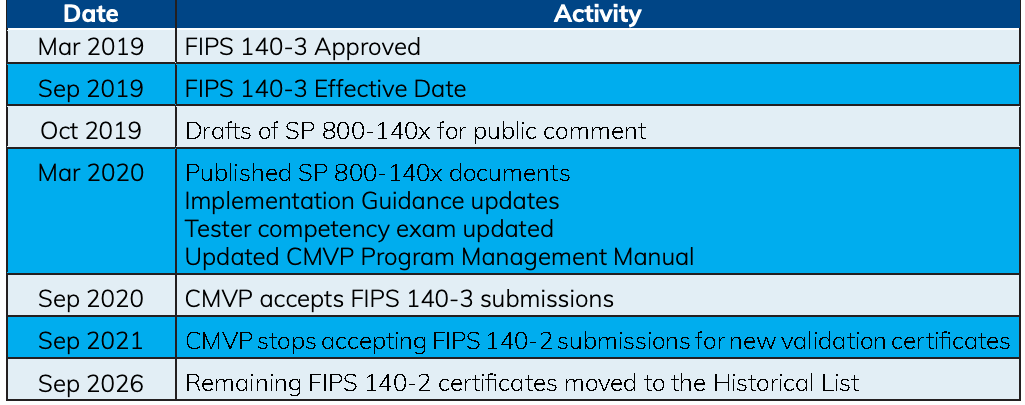
| 日付 | 活動 |
| 2019年3月 | FIPS 140-3を承認 |
| 2019年9月 | FIPS 140-3の発効日 |
| 2019年10月 | SP 800-140x草案を一般意見募集に付す |
| 2020年3月 | SP 800-140x文書を公開 実装ガイダンスを更新 試験者能力試験を更新 CMVPプログラム管理マニュアルを更新 |
| 2020年9月 | CMVPがFIPS 140-3の申請受付を開始 |
| 2021年9月 | CMVPが新規検証証明書向けのFIPS 140-2申請受付を終了 |
| 2026年9月 | 残存するFIPS 140-2証明書を履歴リストへ移行 |
Cryptographic Programs and Laboratory Accreditation
暗号プログラムと試験所認定
Cryptographic Security Testing laboratories are key to assuring that government systems protected by cryptography to meet the validation requirements. There are currently 20 laboratories around the world certified through the National Voluntary Laboratory Accreditation Program (NVLAP). To better assess tester proficiency knowledge across all laboratories, the Cryptographic Validation Program (CVP) Certification Exam was revamped to update the older FIPS 140-2 exam and incorporate the 2019 FIPS 140-3 standard's unique requirements.
暗号セキュリティ試験所は、暗号で保護される政府システムが検証要件を満たしていることを確認するうえで重要です。現在、国家自主試験所認定プログラム(NVLAP)の認定を受けた試験所が世界に20か所あります。すべての試験所で試験者の知識・能力をより適切に評価するため、暗号検証プログラム(CVP)の認定試験を改訂し、旧版のFIPS 140-2試験を更新するとともに、2019年版FIPS 140-3固有の要件を取り入れました。
Cryptographic Module Validation Program (CMVP)
暗号モジュール検証プログラム(CMVP)
If the use of cryptography is needed for the protection of sensitive unclassified information, federal agencies must use validated cryptographic modules. The Cryptographic Module Validation Program (CMVP) was created to support the federal user community’s need for strong, independently tested, and commercially available cryptographic modules. In FY 2020, the CMVP awarded 180 new validation certificates. In addition to working with U.S. and Canadian agencies, NIST has begun incorporating standards from international organizations that represent both public and private sectors within the cryptographic community.
機微だが機密指定のない情報を保護するために暗号技術を使用する必要がある場合、連邦政府機関は検証済みの暗号モジュールを使用しなければなりません。暗号モジュール検証プログラム(CMVP)は、強固で、独立した試験を受け、市販されている暗号モジュールを求める連邦政府の利用者コミュニティのニーズに応えるために創設されました。2020会計年度にCMVPは、新たに180件の検証証明書を発行しました。NISTは、米国およびカナダの機関との連携に加え、暗号コミュニティ内の公共部門と民間部門の双方を代表する国際組織の標準を取り入れ始めました。
In order to remain effective, additional CMVP efforts included:
有効性を維持するため、CMVPの追加の取り組みには次のものが含まれました。
•Retooling automation to streamline the validation process and improve review consistency;
•検証プロセスを効率化し、審査の一貫性を向上させるため、自動化を再構築します。
•Strengthening the relationship with the Cryptographic Module User Forum (CMUF) by collaborating on new and improved technical guidance and programmatic issues; the CMUF FIPS 140-3 working group contributed heavily to the development of training materials and implementation guidance for the new standard;
•新規および改善された技術ガイダンスならびにプログラム上の課題について協力することにより、暗号モジュール利用者フォーラム(CMUF)との関係を強化します。CMUFのFIPS 140-3作業部会は、新標準の研修資料と実装ガイダンスの作成に大きく貢献しました。
•Supporting the International Cryptographic Module Conference (ICMC) committee to build relationships with vendors and laboratories and participating in the 2020 ICMC conference;
•ベンダーおよび試験所との関係を構築するため、暗号モジュール国際会議(ICMC)委員会を支援し、2020年のICMC会議に参加します。
•Hosting two virtual Lab Manager meetings to keep Cryptographic and Security Testing (CST) laboratories abreast of changes and developments; and
•暗号・セキュリティ試験(CST)試験所に変更や進展を周知するため、試験所管理者会議をオンラインで2回開催します。
•Developing documents and processes to support the new FIPS 140-3 standard so that the CMVP can accept FIPS 140-3 submissions; the transition to the FIPS 140-3 standard continues as FIPS 140-2 begins to be phased out.
•CMVPがFIPS 140-3の申請を受け付けられるよう、新しいFIPS 140-3標準を支援する文書とプロセスを策定します。FIPS 140-2の段階的廃止が始まる中、FIPS 140-3標準への移行は続いています。
Cryptographic Algorithm Validation Program (CAVP)
暗号アルゴリズム検証プログラム(CAVP)
The Cryptographic Algorithm Validation Program (CAVP) reached a milestone with the retirement of the Cryptographic Algorithm Validation System (CAVS) test tool. CAVP now performs all algorithm validations using the server-based Automated Cryptographic Validation Test System (ACVTS), which implements the open standard Automated Cryptographic Validation Protocol (ACVP). ACVTS effectively validates algorithm implementations and can make a validation certificate publicly available in minutes. It also enables new testing techniques to be explored and implemented.
暗号アルゴリズム検証プログラム(CAVP)は、暗号アルゴリズム検証システム(CAVS)試験ツールの廃止により、節目を迎えました。現在CAVPは、オープン標準の自動暗号検証プロトコル(ACVP)を実装したサーバーベースの自動暗号検証試験システム(ACVTS)を使って、すべてのアルゴリズム検証を実施しています。ACVTSはアルゴリズムの実装を効果的に検証し、数分で検証証明書を一般公開できます。また、新しい試験手法の検討と実装も可能にします。
At the 2020 RSA Conference, Researchers from NIST’s Security Testing, Validation and Management (STVM) group presented a new test capable of detecting a denial-of-service attack for hash functions and digital signature algorithms. STVM researchers have also collaborated with industry researchers to generate high assurance cryptographic tests that have been implemented on the ACVTS server.
2020年のRSAカンファレンスで、NISTのセキュリティ試験・検証・管理(STVM)グループの研究者は、ハッシュ関数とデジタル署名アルゴリズムに対するサービス拒否攻撃を検知できる新しい試験を発表しました。STVMの研究者は産業界の研究者とも協力し、高保証の暗号試験を生成しており、それらはACVTSサーバーに実装されています。
8 | Trustworthy Networks
8|信頼できるネットワーク
濃紺の背景に、光る点と線が結び付いて広がる抽象的なネットワーク図。中央には明るい青色の帯状の光が走る。 [装飾の画像。本文を読むのに必要のない装飾のため、この非公式サイトには掲載していません。原本 PDF を参照してください。]
Credit: Shutterstock
クレジット:Shutterstock
NIST works with industry to develop the measurement science and standards necessary to ensure the robustness, scalability, and security of important infrastructures, including mobile telecommunications networks and the global Internet. Research focuses on the measurement and modeling techniques necessary to understand, predict, and control the behavior of Internet-scale networked information systems. NIST staff use these insights to guide the design, analysis, and standardization of new technologies aimed at improving the robustness and reliability of the global communication infrastructure. Much of the research and industry collaboration occurs at NIST’s National Cybersecurity Center of Excellence (NCCoE).
NISTは産業界と協力し、モバイル通信ネットワークやグローバルインターネットなどの重要なインフラの堅牢性、拡張性、セキュリティを確保するために必要な測定科学と標準を開発しています。研究では、インターネット規模のネットワーク化された情報システムの挙動を理解、予測、制御するために必要な測定・モデル化手法に重点を置いています。NIST職員は、これらの知見を用いて、世界の通信インフラの堅牢性と信頼性の向上を目的とした新技術の設計、分析、標準化を導いています。研究と産業界との連携の多くは、NISTの国家サイバーセキュリティ・センター・オブ・エクセレンス(NCCoE)で行われています。
NIST’s Trustworthy Networks Program works with industry to resolve systemic vulnerabilities in existing and emerging critical network infrastructures and to advance the development of potentially disruptive technologies to improve the trustworthiness of future networks. NIST collaborates directly with leading industry research (Internet Research Task Force), standards (Internet Engineering Task Force), and network operations (North American Network Operators Group) groups to promulgate NIST contributions and foster the design, standardization, and commercial deployment of trustworthy communication infrastructures.
NISTの信頼できるネットワークプログラムは、産業界と連携して、既存および新興の重要ネットワークインフラにおける構造的な脆弱性を解消し、将来のネットワークの信頼に足ることを向上させるため、破壊的となり得る技術の開発を推進しています。NISTは、業界を主導する研究(インターネット研究タスクフォース)、標準化(インターネット技術タスクフォース)、ネットワーク運用(北米ネットワーク運用者グループ)の各団体と直接協力し、NISTの貢献を普及させるとともに、信頼できる通信インフラの設計、標準化、商用導入を促進しています。
Major research areas and selected recent contributions within this program included:
このプログラムにおける主な研究分野と、最近の貢献の一部は、次のとおりでした。
•• The Robust Interdomain Routing Project that works with Internet industry partners to improve the security and resilience of the Internet's global routing infrastructure. NIST SP 800-189, Resilient Interdomain Traffic Exchange: BGP Security and DDoS Mitigation, includes guidance on securing interdomain routing control traffic, preventing IP address spoofing, and certain aspects of denial of service (DoS) and distributed DoS (DDos) detection and mitigation. Many of the recommendations in this publication focus on the Border Gateway Protocol (BGP). Technologies recommended in this document for securing the interdomain routing control traffic include Resource Public Key Infrastructure (RPKI), BGP origin validation, and prefix filtering. Additionally, technologies recommended for mitigating DoS/DDoS attacks focus on preventing IP address spoofing using source address validation with access control lists and unicast reverse-path forwarding. Other technologies – such as remotely triggered black hole filtering, flow specification, and response rate limiting – are also recommended as part of the overall security mechanisms.
•• インターネット業界のパートナーと協力して、インターネットのグローバルな経路制御インフラのセキュリティとレジリエンスを向上させる、堅牢なドメイン間経路制御プロジェクト。NIST SP 800-189『レジリエントなドメイン間トラフィック交換:BGPセキュリティとDDoS緩和』は、ドメイン間の経路制御トラフィックの保護、IPアドレスのなりすまし防止、およびサービス拒否(DoS)・分散型DoS(DDos)の検知と緩和の特定の側面に関するガイダンスを含んでいます。本刊行物の推奨事項の多くは、ボーダー・ゲートウェイ・プロトコル(BGP)に焦点を当てています。ドメイン間の経路制御トラフィックを保護するために本文書で推奨される技術には、リソース公開鍵基盤(RPKI)、BGP経路起点検証、プレフィックスフィルタリングがあります。さらに、DoS/DDoS攻撃の緩和のために推奨される技術は、アクセス制御リストおよびユニキャスト逆方向経路転送による送信元アドレス検証を用いた、IPアドレスなりすましの防止に重点を置いています。リモートトリガー型ブラックホールフィルタリング、フロー仕様、応答レート制限などのその他の技術も、全体的なセキュリティ機構の一部として推奨されています。
•SP 800-189 is referenced in NIST SP 800-53, Revision 5, as the technical basis for new boundary protection security controls (SC-7) that are focused on DDoS mitigation and the prevention of unauthorized control traffic. The guidance also fulfills a significant deliverable described in Executive Order 13800, Strengthening the Cybersecurity of Federal Networks and Critical Infrastructure.
•SP 800-189は、NIST SP 800-53改訂第5版において、DDoS緩和と不正な制御トラフィックの防止に重点を置く新しい境界保護セキュリティ管理策(SC-7)の技術的根拠として参照されています。このガイダンスは、大統領令13800『連邦政府ネットワークと重要インフラのサイバーセキュリティ強化』に記載された重要な成果物の一つを果たすものでもあります。
Zero Trust Networks
ゼロトラストネットワーク
Zero Trust is the term for a set of cybersecurity paradigms to move network defenses from static, physical, network-based perimeters to software-defined security mechanisms based on users, assets, and resources. A zero trust architecture (ZTA) uses zero trust principles to plan enterprise infrastructure and workflows.
ゼロトラストとは、ネットワーク防御を、静的かつ物理的なネットワークベースの境界から、ユーザー、資産、リソースに基づくソフトウェア定義のセキュリティ機構へ移行させる、一連のサイバーセキュリティパラダイムを指す用語です。ゼロトラストアーキテクチャ(ZTA)は、ゼロトラストの原則を用いて企業のインフラとワークフローを計画します。
Zero trust assumes that there is no implicit trust granted to assets or user accounts based solely on their physical or network location (i.e., a local corporate network versus the Internet). It is a response to enterprise network trends, including remote users and cloud-based assets that are not located within an enterprise-owned network boundary. Zero trust focuses on protecting resources rather than network segments, as the network location is no longer considered the prime component to the security posture of the resource.
ゼロトラストは、資産やユーザーアカウントに対して、その物理的な場所またはネットワーク上の場所(すなわち、ローカルの企業ネットワークかインターネットか)のみに基づく暗黙の信頼は与えられないことを前提とします。これは、リモートユーザーや、企業所有のネットワーク境界内に存在しないクラウドベースの資産などを含む、企業ネットワークの動向への対応です。ネットワーク上の場所はもはやリソースのセキュリティ態勢の主要な構成要素とはみなされないため、ゼロトラストはネットワークセグメントではなくリソースの保護に重点を置きます。
NIST SP 800-207, Zero Trust Architecture, was published in August 2020 and discusses the core principles and logical components that make up a ZTA. SP 800-207 contains a ZTA definition and describes general deployment models and use cases where zero trust could improve an enterprise’s overall information technology security posture. Following the publication of SP 800-207, the NCCoE initiated a new ZTA building block demonstration project that is planned to start in FY 2021.
NIST SP 800-207『ゼロトラストアーキテクチャ』は2020年8月に公開され、ZTAを構成する中核的な原則と論理コンポーネントを論じています。SP 800-207はZTAの定義を含み、ゼロトラストによって企業の全体的な情報技術セキュリティ態勢を向上できる可能性のある一般的な導入モデルとユースケースを説明しています。SP 800-207の公開後、NCCoEは、2021会計年度に開始予定の新たなZTAビルディングブロック実証プロジェクトを立ち上げました。
NIST’s Software Defined and Virtual Networks Project advances the state of the art in network virtualization, network service function chaining, software-defined networks (SDN), technologies, and techniques to address the robustness and security of virtualized network services. Recent work explores novel applications of network function virtualization (NFV) and SDN to practices such as network security and intrusion detection, cloud computing, machine-to-machine communications, and advanced mobility. A key research component is the development of programmable measurement techniques that efficiently operate at the scale and speed of advanced networks.
NISTのソフトウェア定義・仮想ネットワークプロジェクトは、ネットワーク仮想化、ネットワークサービス機能チェイニング、ソフトウェア定義ネットワーク(SDN)、ならびに仮想化されたネットワークサービスの堅牢性とセキュリティに対処するための技術および手法における最先端の水準を前進させています。最近の研究では、ネットワークセキュリティと侵入検知、クラウドコンピューティング、マシン間通信、高度なモビリティといった実務へのネットワーク機能仮想化(NFV)とSDNの新しい応用を探究しています。研究の重要な要素は、高度なネットワークの規模と速度で効率的に動作する、プログラム可能な測定技術の開発です。
The Trustworthy Intelligent Networks project works with industry and academia to improve the trustworthiness and applicability of artificial intelligence and machine learning (AI/ML) technologies in future networks and distributed systems. Research focuses on applications of AI/ML to address security and robustness issues in today's networks and the development of a means to test and measure the robustness of the AI/ML techniques necessary for future autonomic networks.
信頼できるインテリジェントネットワークプロジェクトは、産業界および学術界と協力し、将来のネットワークや分散システムにおける人工知能・機械学習(AI/ML)技術の信頼に足ることと適用可能性を向上させています。研究は、今日のネットワークにおけるセキュリティと堅牢性の課題に対処するためのAI/MLの応用と、将来の自律型ネットワークに必要なAI/ML技術の堅牢性を試験・測定する手段の開発に重点を置いています。
5G Cybersecurity
5Gサイバーセキュリティ
The NCCoE announced a 5G Cybersecurity project in the Federal Register in May 2020. The center has invited an impressive roster of technology providers and industry experts to collaborate on its 5G Cybersecurity Project, including AMI, AT&T, CableLabs, Cisco, Dell, Intel, Keysight, MiTAC, Nokia, Palo Alto Networks, and T-Mobile. These collaborators will work with the NCCoE 5G team to identify 5G use case scenarios and demonstrate how components of the 5G architecture can provide security capabilities to mitigate identified risks and comply with industry sector requirements. The result will be a publicly available NIST Cybersecurity Practice Guide in the Special Publication 1800 series, describing the practical steps needed to implement a cybersecurity reference design.
NCCoEは2020年5月、連邦官報で5Gサイバーセキュリティプロジェクトを発表しました。同センターは、AMI、AT&T、CableLabs、Cisco、Dell、Intel、Keysight、MiTAC、Nokia、Palo Alto Networks、T-Mobileを含む、錚々たる顔ぶれの技術提供者と業界専門家を、5Gサイバーセキュリティプロジェクトでの協働に招きました。これらの協力者はNCCoEの5Gチームと協力し、5Gのユースケースシナリオを特定するとともに、5Gアーキテクチャの構成要素が、特定されたリスクを緩和し業界分野の要件に準拠するためのセキュリティ機能をどのように提供できるかを実証します。その成果は、サイバーセキュリティ参照設計の実装に必要な実践的手順を記述した、一般公開されるSpecial Publication 1800シリーズのNISTサイバーセキュリティ実践ガイドとなります。
Public Safety Communications Research
公共安全通信研究
The Public Safety Communications Research (PSCR) Division serves as a technical advisor and laboratory. PSCR is driven to advance communications technologies for public safety workers by accelerating their development, adoption, and implementation so that the public safety community can more effectively carry out their mission to protect lives and property.
公共安全通信研究(PSCR)部門は、技術アドバイザーおよび研究所としての役割を果たしています。PSCRは、公共安全コミュニティが人命と財産を守る使命をより効果的に遂行できるよう、公共安全従事者向け通信技術の開発、採用、実装を加速することにより、その技術を前進させることに力を注いでいます。
Improving Wearable Device Cybersecurity for Public Safety
公共安全向けウェアラブル機器のサイバーセキュリティ向上
In partnership with PSCR, NIST finalized NISTIR 8196, Security Analysis of First Responder Mobile and Wearable Devices, which helps consider various threats to and security objectives for new types of products (e.g., smartphones, tablets, wearable devices) that have been made available to public safety via the proliferation of the Nationwide Public Safety Broadband Network (NPSBN). Its goals are to help public safety organizations make informed decisions when selecting wearable technology and to better inform industry about cybersecurity concerns of the public safety use case.
PSCRとの連携により、NISTはNISTIR 8196『Security Analysis of First Responder Mobile and Wearable Devices』を完成させました。この文書は、全国公共安全ブロードバンドネットワーク(NPSBN)の普及を通じて公共安全分野で利用可能になった新しい種類の製品(例:スマートフォン、タブレット、ウェアラブル機器)に対するさまざまな脅威と、それらの製品のセキュリティ目標を検討するのに役立ちます。その目的は、公共安全組織がウェアラブル技術を選定する際に十分な情報に基づいて判断できるよう支援することと、公共安全のユースケースにおけるサイバーセキュリティ上の懸念を産業界により良く伝えることです。
Innovations in Novel Technologies
新規技術におけるイノベーション
NIST researchers designed and implemented a PSCR Prize Challenge – Making the Case: Proactive Image Protection, one of ten challenges within the Tech to Protect Challenge. The contest tasked participants with designing a system that could identify the provenance and prove the authenticity of an image captured on a mobile device being used for public safety purposes. NIST awarded prizes to four finalists whose solutions stand to build more confidence in digital images gathered by public safety and law enforcement.
NISTの研究者は、Tech to Protect Challengeを構成する10件のチャレンジの一つであるPSCR Prize Challenge「Making the Case: Proactive Image Protection」を設計し、実施しました。このコンテストでは、公共安全の目的で使用されているモバイル機器で撮影された画像の来歴を特定し、その真正性を証明できるシステムの設計を参加者に課しました。NISTは、公共安全機関や法執行機関が収集するデジタル画像への信頼を高める見込みのある解決策を示した最終候補4者に賞を授与しました。
Advancing Authentication Technology for Public Safety
公共安全向け認証技術の推進
The embrace of Long Term Evolution (LTE) mobile communications technology has led to critical cybersecurity challenges for public safety, including authentication and identity management. The mechanisms used in consumer devices do not sufficiently meet the public’s safety needs.
ロングタームエボリューション(LTE)モバイル通信技術の採用は、認証やアイデンティティ管理を含む、公共安全にとって重大なサイバーセキュリティ上の課題をもたらしました。一般消費者向け機器で使用されている仕組みは、公共安全のニーズを十分には満たしません。
To stimulate innovation in authentication technology, researchers implemented an Open Innovation Challenge: Expanding SIM Card Use for Public Safety. With the introduction of the Nation’s first public safety-focused LTE network, this challenge asked the question, "Can public safety leverage the universal integrated circuit card (UICC), a technology that is already integrated into the LTE technology stack, to implement multi-factor authentication?" NIST awarded cash prizes to three finalists who each demonstrated proof-of-concept solutions to this question.
認証技術のイノベーションを促すため、研究者はオープンイノベーションチャレンジ「公共安全向けSIMカード利用の拡大」を実施しました。国内初の公共安全に特化したLTEネットワークの導入に伴い、このチャレンジは、「公共安全分野は、LTE技術スタックにすでに組み込まれている技術である汎用集積回路カード(UICC)を活用して、多要素認証を実装できるか」という問いを投げかけました。NISTは、この問いに対する概念実証ソリューションをそれぞれ実証した最終候補3者に賞金を授与しました。
PSCR, in partnership with NCCoE, identified critical technology areas that will likely influence the public safety technology field in the near future. Over the past year, the team has worked to produce several informative and guiding resources for stakeholders that describe technology impacts, considerations, and best practices. These publications will lay a common groundwork for the field before individual public safety agencies begin to implement security solutions in identity federation, Identity as a Service (IDaaS), and biometric authentication. The PSCR/NCCoE partnership has also awarded a grant to the Georgia Tech Research Institute (GTRI) to further support their Trustmarks project, which seeks to build a system to support identity federation and information sharing by establishing requirements and capabilities for identity providers.
PSCRはNCCoEと協力し、近い将来に公共安全技術分野へ影響を及ぼす可能性の高い重要技術領域を特定しました。過去1年間、チームは、技術の影響、考慮事項、ベストプラクティスを説明する、利害関係者向けの情報提供および指針となる複数のリソースの作成に取り組んできました。これらの刊行物は、個々の公共安全機関がID連携、サービスとしてのID(IDaaS)、生体認証におけるセキュリティソリューションの導入を始める前に、この分野の共通の基盤を築くものです。PSCRとNCCoEのパートナーシップはまた、ジョージア工科大学研究所(GTRI)のTrustmarksプロジェクトをさらに支援するため、同研究所に助成金を授与しました。このプロジェクトは、IDプロバイダーの要件と能力を確立することにより、ID連携と情報共有を支えるシステムの構築を目指しています。
9 | Trustworthy Platforms
9|信頼できるプラットフォーム
夜の都市の空撮写真に、建物の間を結ぶ光の弧と接続点が重なり、ネットワークを表している。 [装飾の画像。本文を読むのに必要のない装飾のため、この非公式サイトには掲載していません。原本 PDF を参照してください。]
Credit: Shutterstock
クレジット:Shutterstock
NIST defines a platform as a computer or hardware device or associated operating system, or a virtual environment, on which software can be installed or run. The goal of the Trustworthy Platforms focus area is to improve trust in the security and privacy of these systems and infrastructures by providing guidance and technologies for the development and use of secure platforms, including software, hardware, and firmware. The trustworthy platform is a dynamic ecosystem that depends on multiple security and privacy technologies in order to reliably deliver its services to the users. It is deployed and maintained in a measured state that is known to protect the security and privacy of users and data, and it performs services in a consistent and reliable manner. The desired outcome is to increase the adoption of trustworthy platforms in order to improve trust in the security and privacy of systems and infrastructures. NIST provides guidance and technologies for the development and use of secure platforms and foundational components such as cryptography. NIST also helps to develop quantifiable measurements that provide assurances for platform security, privacy, and robustness.
NISTは、プラットフォームを、ソフトウェアをインストールまたは実行できるコンピューターもしくはハードウェア機器、それに関連するオペレーティングシステム、または仮想環境と定義しています。「信頼できるプラットフォーム」重点分野の目標は、ソフトウェア、ハードウェア、ファームウェアを含むセキュアなプラットフォームの開発と利用のための指針と技術を提供することにより、これらのシステムとインフラのセキュリティおよびプライバシーに対する信頼を高めることです。信頼できるプラットフォームは、ユーザーにサービスを確実に提供するために複数のセキュリティ技術およびプライバシー技術に依存する、動的なエコシステムです。それは、ユーザーとデータのセキュリティおよびプライバシーを保護することが分かっている、測定された状態で導入・保守され、一貫性があり信頼できる方法でサービスを実行します。望ましい成果は、システムとインフラのセキュリティおよびプライバシーに対する信頼を高めるために、信頼できるプラットフォームの採用を増やすことです。NISTは、セキュアなプラットフォームおよび暗号などの基盤コンポーネントの開発と利用のための指針と技術を提供します。NISTはまた、プラットフォームのセキュリティ、プライバシー、堅牢性について保証を与える定量的な測定方法の開発も支援します。
Secure Software Development Framework
セキュアソフトウェア開発フレームワーク
The software development life cycle (SDLC) is a methodology for designing, creating, and maintaining software. Though there are many SDLC models, most do not explicitly address software security.
ソフトウェア開発ライフサイクル(SDLC)は、ソフトウェアを設計、作成、保守するための方法論です。SDLCには多くのモデルがありますが、その大半はソフトウェアセキュリティを明示的に扱っていません。
Secure software development practices should be integrated throughout SDLC models for three reasons:
セキュアなソフトウェア開発の実践は、次の3つの理由から、SDLCモデル全体にわたって統合すべきです。
1.To reduce the number of vulnerabilities in released software,
1.リリースされるソフトウェアの脆弱性の数を減らすため。
2.To mitigate the potential impact of the exploitation of undetected or unaddressed vulnerabilities, and
2.検知されていない脆弱性や対処されていない脆弱性が悪用された場合の潜在的な影響を軽減するため、
3.To address the root causes of vulnerabilities to prevent future recurrences.
3.脆弱性の根本原因に対処し、再発を防ぐため。
In April 2020, NIST published the final version of a Cybersecurity White Paper on secure software development practices, Mitigating the Risk of Software Vulnerabilities by Adopting a Secure Software Development Framework (SSDF). The white paper recommends a core set of high-level secure software development practices – called the Secure Software Development Framework (SSDF) – to be added to each SDLC implementation. The SSDF practices are based on those from established secure software development practice documents by other organizations. The SSDF also provides a common vocabulary for secure software development that software consumers can use to foster communications with software suppliers in acquisition processes and other management activities.
2020年4月、NISTは、セキュアなソフトウェア開発の実践に関するサイバーセキュリティ白書『Mitigating the Risk of Software Vulnerabilities by Adopting a Secure Software Development Framework (SSDF)』(セキュアソフトウェア開発フレームワーク(SSDF)の採用によるソフトウェア脆弱性のリスクの軽減)の最終版を公開しました。この白書は、各SDLC実装に追加すべき、高水準のセキュアなソフトウェア開発の実践の中核的なセット(セキュアソフトウェア開発フレームワーク(SSDF)と呼ばれる)を推奨しています。SSDFの実践は、他の組織による確立されたセキュアソフトウェア開発の実践に関する文書の実践に基づいています。SSDFはまた、セキュアなソフトウェア開発のための共通語彙を提供しており、ソフトウェアの利用者は、調達プロセスやその他の管理活動においてソフトウェア供給者とのコミュニケーションを促進するためにこれを使用できます。
Since NIST published the SSDF, there has been considerable interest from industry and others in NIST in illustrating how the SSDF can be applied to particular SDLC models, especially transitioning DevOps implementations to DevSecOps. NIST will continue to refresh and evolve the SSDF in response to public feedback and the changing threats, vulnerabilities, practices, and automation capabilities in software development.
NISTがSSDFを公開して以降、SSDFを特定のSDLCモデルにどのように適用できるか、特にDevOpsの実装をDevSecOpsへ移行する場合について、NISTが例示することに対し、産業界などから大きな関心が寄せられています。NISTは、一般からのフィードバック、ならびにソフトウェア開発における脅威、脆弱性、実践、自動化能力の変化に対応して、SSDFを引き続き更新し、発展させていきます。
Industrial Control System (ICS) Cybersecurity and Manufacturing Profile
産業制御システム(ICS)のサイバーセキュリティと製造業プロファイル
A revision to NISTIR 8183, Cybersecurity Framework Manufacturing Profile, includes the subcategory enhancements established in the NIST Framework for Improving Critical Infrastructure Cybersecurity Version 1.1. These updates also include managing cybersecurity within the supply chain, self-assessing cybersecurity risk, vulnerability disclosure, system integrity, and more comprehensive controls for identity management.
NISTIR 8183『Cybersecurity Framework Manufacturing Profile』(サイバーセキュリティフレームワーク製造業プロファイル)の改訂版には、NISTの「重要インフラのサイバーセキュリティを改善するためのフレームワーク」バージョン1.1で定められたサブカテゴリーの強化内容が含まれています。これらの更新には、サプライチェーン内のサイバーセキュリティの管理、サイバーセキュリティリスクの自己評価、脆弱性開示、システムの完全性、およびID管理のためのより包括的な管理策も含まれています。
The Manufacturing Profile was developed for manufacturers managing cybersecurity risk and is aligned with manufacturing sector goals and industry best practices. It provides a voluntary, risk-based approach for managing cybersecurity activities and reducing cyber risk to manufacturing systems. The Manufacturing Profile is meant to enhance but not replace current cybersecurity standards and industry guidelines that the manufacturer is embracing.
製造業プロファイルは、サイバーセキュリティリスクを管理する製造事業者のために策定されたものであり、製造業セクターの目標および業界のベストプラクティスと整合しています。これは、サイバーセキュリティ活動を管理し、製造システムに対するサイバーリスクを低減するための、自主的でリスクベースのアプローチを提供します。製造業プロファイルは、製造事業者が採用している現行のサイバーセキュリティ標準や業界ガイドラインを強化することを意図したものであり、それらに取って代わるものではありません。
Systems Security Engineering
システムセキュリティエンジニアリング
In FY 2020, NIST continued to foster the engineering-driven perspectives and actions necessary to develop more defensible and survivable systems, including the machine, physical, and human components of systems and the capabilities and services delivered by those systems. The Systems Security Engineering (SSE) approach builds upon well-established international standards for systems and software and fuses systems security engineering methods, practices, and techniques. The initial volume in this new series, SP 800-160, Volume 2, Developing Cyber Resilient Systems: A Systems Security Engineering Approach, describes an approach to designing, building, and retrofitting engineered systems with the ability to anticipate, withstand, recover from, and adapt to adverse conditions, stresses, attacks, or compromises on systems that use or are enabled by cyber resources. Volume 2 provides a handbook for achieving the identified cyber resiliency outcomes based on a systems engineering perspective on system life cycle and risk management processes. Organizations can select, adapt, and use some or all of the cyber resiliency constructs and apply the constructs to the technical, operational, and threat environments for which systems need to be engineered.
2020会計年度にNISTは、システムの機械的、物理的、人的な構成要素、およびそれらのシステムが提供する能力とサービスを含め、より防御可能で存続可能なシステムを開発するために必要な、エンジニアリング主導の視点と行動を引き続き促進しました。システムセキュリティエンジニアリング(SSE)のアプローチは、システムおよびソフトウェアに関する確立された国際標準を基礎とし、システムセキュリティエンジニアリングの方法、実践、技法を融合するものです。この新シリーズの最初の巻であるSP 800-160第2巻『Developing Cyber Resilient Systems: A Systems Security Engineering Approach』(サイバーレジリエントなシステムの開発:システムセキュリティエンジニアリングのアプローチ)は、サイバーリソースを使用する、またはサイバーリソースによって実現されるシステムに対する悪条件、ストレス、攻撃、または侵害を予測し、それらに耐え、それらから回復し、それらに適応する能力を備えたエンジニアードシステムを設計、構築、改修するためのアプローチを説明しています。第2巻は、システムライフサイクルプロセスおよびリスクマネジメントプロセスに対するシステムエンジニアリングの視点に基づき、特定されたサイバーレジリエンシーの成果を達成するためのハンドブックを提供します。組織は、サイバーレジリエンシーの構成概念の一部または全部を選択、調整、使用し、システムをエンジニアリングする必要がある技術環境、運用環境、脅威環境にそれらの構成概念を適用できます。
Smart Grid Cybersecurity
スマートグリッドのサイバーセキュリティ
In FY 2020, engineers from NIST’s Engineering Laboratory and ITL expanded on the Cybersecurity Framework Smart Grid Profile created during FY 2019 by developing a draft profile for the specific capability of voltage regulation on the electric distribution system. The draft profile compares and contrasts distribution system voltage regulation for both a high distributed energy resource (DER) environment and a conventional grid environment and prioritizes NIST Cybersecurity Framework subcategory outcomes based upon their ability to assist power system stakeholders in achieving voltage regulation within these environments.
2020会計年度に、NISTのエンジニアリング研究所およびITLの技術者は、配電システムにおける電圧調整という特定の能力を対象とするプロファイル草案を策定することにより、2019会計年度に作成されたサイバーセキュリティフレームワークのスマートグリッドプロファイルを拡充しました。このプロファイル草案は、分散型エネルギー資源(DER)が多い環境と従来型の電力網環境の両方について、配電システムの電圧調整を比較・対照し、これらの環境において電力システムの利害関係者が電圧調整を達成するのを支援できる度合いに基づいて、NISTサイバーセキュリティフレームワークのサブカテゴリーの成果に優先順位を付けています。
Working with a representative from the North American Electric Reliability Corporation (NERC), NIST helped update the mapping between the NERC Critical Infrastructure Protection (CIP) requirements and version 1.1 of the NIST Cybersecurity Framework. They also collaborated with industry volunteers to help create a self-assessment tool for utilities to measure their cybersecurity and compliance maturity and develop an improvement plan. NIST continues to chair the Smart Electric Power Alliance (SEPA) cybersecurity working group and has established an effort to determine threats to the power grid posed by customer energy Internet of Things (IoT) devices (e.g., smart thermostats and water heaters) and provide suggested mitigations.
NISTは、北米電力信頼度協議会(NERC)の代表者と協力し、NERCの重要インフラ保護(CIP)要件とNISTサイバーセキュリティフレームワークのバージョン1.1との対応付けの更新を支援しました。また、産業界のボランティアと協力し、電力・公益事業者が自らのサイバーセキュリティとコンプライアンスの成熟度を測定し、改善計画を策定するための自己評価ツールの作成を支援しました。NISTは引き続きSmart Electric Power Alliance(SEPA)のサイバーセキュリティ作業部会の議長を務めており、顧客のエネルギー関連のモノのインターネット(IoT)機器(例:スマートサーモスタットや給湯器)が電力網にもたらす脅威を特定し、推奨される緩和策を提供するための取り組みを立ち上げました。
Methods for Securing Virtual Infrastructure
仮想インフラを保護する方法
Microservices—an approach to software development using independent but interconnected applications—simplify software scalability, usability, and availability. Because of these benefits, this type of architecture is becoming commonplace for cloud-based and large enterprise applications, but the characteristics of microservices-based applications bring increased security challenges. The sheer number of microservices results in more interconnections and more communication links to be protected. Additionally, the ephemeral nature of microservices calls for secure service discovery mechanisms and the deployment of security services that are not tightly coupled with application code. Given the characteristics and associated security challenges, point security solutions (e.g., authentication, authorization, security monitoring) are inadequate.
マイクロサービスは、独立しながらも相互接続されたアプリケーションを用いるソフトウェア開発のアプローチであり、ソフトウェアのスケーラビリティ、ユーザビリティ、可用性の実現を容易にします。これらの利点から、この種のアーキテクチャはクラウドベースのアプリケーションや大規模な企業向けアプリケーションで一般的になりつつありますが、マイクロサービスベースのアプリケーションの特性は、セキュリティ上の課題を増大させます。マイクロサービスの数そのものが多いため、保護すべき相互接続と通信リンクが増えます。加えて、マイクロサービスの短命な性質により、セキュアなサービスディスカバリの仕組みと、アプリケーションコードと密結合していないセキュリティサービスの導入が必要となります。これらの特性と関連するセキュリティ上の課題を踏まえると、ポイント型のセキュリティソリューション(例:認証、認可、セキュリティ監視)は不十分です。
In FY 2020, NIST published SP 800-204A, Building Secure Microservices-based Applications Using Service Mesh Architecture. The publication provides deployment guidance for proxy-based service mesh components as well as secure configuration recommendations that span the entire application infrastructure space.
2020会計年度にNISTは、SP 800-204A『Building Secure Microservices-based Applications Using Service Mesh Architecture』(サービスメッシュアーキテクチャを用いたセキュアなマイクロサービスベースアプリケーションの構築)を公開しました。この刊行物は、プロキシベースのサービスメッシュ構成要素の導入に関する指針に加え、アプリケーションインフラの領域全体にわたるセキュアな構成の推奨事項を示しています。
ITL Leadership and Participation in National and International Standards Programs
ITLによる国内外の標準化プログラムの主導と参加
During FY 2020, NIST staff contributed to and held leadership positions in various standards developing organizations (SDOs), including the Internet Engineering Task Force (IETF), the Institute of Electrical and Electronics Engineers (IEEE), the World Wide Web Consortium (W3C), and the ISO/IEC. Staff actively participated in standards bodies to raise awareness and influence the development of privacy and cybersecurity standards, including efforts within the ISO/IEC.
2020会計年度中、NIST職員は、インターネット技術タスクフォース(IETF)、米国電気電子学会(IEEE)、ワールド・ワイド・ウェブ・コンソーシアム(W3C)、ISO/IECを含むさまざまな標準開発組織(SDO)に貢献し、そこで指導的地位に就きました。職員は、ISO/IEC内の取り組みを含め、認識を高め、プライバシーおよびサイバーセキュリティ標準の策定に影響を与えるために、標準化団体に積極的に参加しました。
In FY 2020, NIST continued to engage with government and industry organizations to demonstrate and ensure continued alignment with voluntary international standards. NIST discussed the Cybersecurity Framework in numerous dialogues and has continued to identify and promote international adaptations and translations of the Framework. NIST also continues to contribute to international standards development efforts related to cybersecurity risk management and the development of cybersecurity frameworks, including ISO/IEC Technical Specification 27110.
2020会計年度にNISTは、自主的な国際標準との継続的な整合を実証し、確保するため、政府機関および産業界の組織との関与を続けました。NISTは数多くの対話の場でサイバーセキュリティフレームワークについて議論し、同フレームワークの国際的な翻案および翻訳の特定と促進を続けてきました。NISTはまた、ISO/IEC技術仕様書27110を含め、サイバーセキュリティリスクマネジメントおよびサイバーセキュリティフレームワークの策定に関する国際標準の開発の取り組みにも引き続き貢献しています。
The standards community is built upon international collaboration, and NIST leverages its foundational and applied research efforts and experience in leadership to contribute to the development of national and international standards. Today, these standards activities span cybersecurity, privacy, cryptography, and critical fields, such as 5G mobile and cellular technologies, quantum information, cloud, blockchain and distributed ledger technologies, and the Internet of Things (IoT).
標準化コミュニティは国際協力の上に成り立っており、NISTは基礎研究および応用研究の取り組みと指導的立場での経験を活用して、国内標準および国際標準の策定に貢献しています。現在、これらの標準化活動は、サイバーセキュリティ、プライバシー、暗号、ならびに5Gモバイル・セルラー技術、量子情報、クラウド、ブロックチェーンおよび分散型台帳技術、モノのインターネット(IoT)などの重要分野にまたがっています。
About 70 NIST staff members work with other agencies and industry leaders to develop cybersecurity and privacy standards through voluntary consensus. NIST’s standards strategy is captured in NISTIR 8074, Interagency Report on Strategic U.S. Government Engagement in International Standardization to Achieve U.S. Objectives or Cybersecurity.
約70名のNIST職員が、他の政府機関や産業界のリーダーと協力し、自主的なコンセンサスを通じてサイバーセキュリティおよびプライバシーの標準を策定しています。NISTの標準戦略は、NISTIR 8074『Interagency Report on Strategic U.S. Government Engagement in International Standardization to Achieve U.S. Objectives or Cybersecurity』(サイバーセキュリティに関する米国の目標を達成するための国際標準化への米国政府の戦略的関与に関する省庁間報告書)に示されています。
NIST has been instrumental in promoting and participating in the development of a family of voluntary ISO/IEC standards that align with NIST’s cryptographic module validation standard and related specifications. NIST served as the project editor for nine of those standards. NIST uses collaborative opportunities to highlight the role that standards play in enabling technological innovation and interoperability among products and systems. International collaboration and alignment on standards-based approaches to cybersecurity and privacy risk management lead to greater innovation and a more effective and efficient utilization of resources.
NISTは、NISTの暗号モジュール検証標準および関連仕様と整合する一連の自主的なISO/IEC標準の策定の推進と策定への参加において、重要な役割を果たしてきました。NISTは、それらの標準のうち9件でプロジェクトエディタを務めました。NISTは協力の機会を利用して、技術革新と、製品およびシステム間の相互運用性とを可能にするうえで標準が果たす役割を強調しています。サイバーセキュリティおよびプライバシーのリスクマネジメントに対する標準ベースのアプローチに関する国際的な協力と整合は、より大きなイノベーションと、資源のより効果的かつ効率的な利用につながります。
NIST also shares information on standards processes, the importance of standards on the economy and facilitating international trade, and the ability of standards to help secure systems and infrastructure. NIST coordinates with interagency partners on strategic approaches and communication on standards for the U.S. Government.
NISTはまた、標準化のプロセス、経済および国際貿易の円滑化に対する標準の重要性、ならびにシステムとインフラのセキュリティ確保に役立つ標準の能力について、情報を共有しています。NISTは、米国政府としての標準に関する戦略的アプローチとコミュニケーションについて、省庁間のパートナーと調整しています。
In FY 2021, NIST staff will continue to lead and participate in cybersecurity and privacy standardization efforts with an increased focus on new and emerging areas, such as AI, quantum information, 5G communications, and zero trust architectures.
2021会計年度にNIST職員は、AI、量子情報、5G通信、ゼロトラストアーキテクチャなどの新しい分野および新興分野により重点を置きつつ、サイバーセキュリティおよびプライバシーの標準化の取り組みを引き続き主導し、これに参加します。
Opportunities to Engage with the NIST Cybersecurity & Privacy Program
NISTサイバーセキュリティ・プライバシープログラムへの参加機会
Stakeholders are an important force behind NIST’s cybersecurity and privacy programs. NIST counts on developers, providers, and everyday users of cybersecurity and privacy technologies and information to guide priorities in serving the public and private sectors. Stakeholders are also vital when it comes to decisions about the best methods and formats for delivering information and services.
利害関係者は、NISTのサイバーセキュリティおよびプライバシープログラムを支える重要な原動力です。NISTは、公共部門と民間部門に貢献するうえでの優先事項の方向付けを、サイバーセキュリティおよびプライバシーに関する技術や情報の開発者、提供者、一般利用者に頼っています。また、情報やサービスを提供するための最適な方法と形式を決定する際にも、利害関係者は欠かせない存在です。
NIST engages in many ways, both formal and informal. NIST participates in various forums, Communities of Interest (COI), joint research efforts, standards development organizations, Guest researcher projects, student programs, and other partnership opportunities that are available; hosts/sponsors various cybersecurity and privacy events; and gathers public feedback on NIST publications, blogs, and social media.
NISTは、公式・非公式のさまざまな方法で関係者と連携しています。NISTは、各種フォーラム、関心分野別コミュニティ(COI)、共同研究、標準化団体、客員研究員プロジェクト、学生プログラム、その他利用可能なパートナーシップの機会に参加し、サイバーセキュリティおよびプライバシーに関する各種イベントを主催・後援し、NISTの刊行物、ブログ、ソーシャルメディアに対する一般からの意見を収集しています。
Further details on engaging with NIST on Cybersecurity and Privacy are available at https://www.nist.gov/cybersecurity/cybersecurity-privacy-stakeholder-engagement.
サイバーセキュリティとプライバシーに関するNISTとの連携についての詳細は、https://www.nist.gov/cybersecurity/cybersecurity-privacy-stakeholder-engagement で入手できます。
Funding Opportunities at NIST
NISTの資金提供機会
NIST funds industrial and academic research in several ways. The Small Business Innovation Research Program funds research and development (R&D) proposals from small businesses. NIST offers grants to encourage work in the fields of precision measurement, fire research, and materials science. Grants and awards supporting research by industry, academia, and other institutions are also available on a competitive basis through various Institute offices.
NISTは、複数の方法で産業界と学術界の研究に資金を提供しています。中小企業イノベーション研究プログラムは、中小企業からの研究開発(R&D)提案に資金を提供します。NISTは、精密計測、火災研究、材料科学の分野における取り組みを促進するため、助成金を提供しています。また、産業界、学術界、その他の機関による研究を支援する助成金および交付金も、研究所内のさまざまな部署を通じて競争ベースで利用できます。
For general information on the NIST grants programs, please contact Mr. Christopher Hunton at (301) 975-5718 or by email at grants@nist.gov.
NISTの助成金プログラムに関する一般的な情報については、Christopher Hunton氏(電話:(301) 975-5718、電子メール:grants@nist.gov)に問い合わせること。
AUTHORITY
法的根拠
This publication has been developed by the National Institute of Standards and Technology (NIST) in accordance with its statutory responsibilities under the Federal Information Security Modernization Act (FISMA of 2014, 44 U.S.C. § 3541. Public Law (P.L. 113-283. NIST is responsible for developing information security standards and guidelines, including minimum requirements for federal information systems, but such standards and guidelines shall not apply to national security systems without the express approval of appropriate federal officials exercising policy authority over such systems. This guideline is consistent with the requirements of the Office of Management and Budget (OMB Circular A-130.
本刊行物は、2014年連邦情報セキュリティ近代化法(FISMA)(44 U.S.C. § 3541、Public Law(P.L.)113-283)に基づく法定の責任に従い、米国国立標準技術研究所(NIST)が作成したものです。NISTは、連邦情報システムの最低要件を含む情報セキュリティの標準および指針を策定する責任を負います。ただし、こうした標準および指針は、国家安全保障システムに関する政策権限を行使する適切な連邦政府当局者の明示的な承認がない限り、当該システムに適用してはなりません。本指針は、行政管理予算局(OMB)通達A-130の要件に整合しています。
Nothing in this publication should be taken to contradict the standards and guidelines made mandatory and binding on federal agencies by the Secretary of Commerce under statutory authority. Nor should these guidelines be interpreted as altering or superseding the existing authorities of the Secretary of Commerce, Director of the OMB, or any other federal official. This publication may be used by nongovernmental organizations on a voluntary basis and is not subject to copyright in the United States. Attribution would be appreciated by NIST.
本刊行物のいかなる記載も、商務長官が法定の権限に基づいて連邦政府機関に対して義務付け、拘束力を持たせた標準および指針に矛盾するものと解釈すべきではありません。また、本指針は、商務長官、OMB長官、その他いかなる連邦政府当局者の既存の権限を変更するもの、またはそれに取って代わるものと解釈すべきでもありません。本刊行物は、非政府組織が任意で利用してよく、米国内では著作権の対象となりません。出典を明記していただければ、NISTとして幸いです。
National Institute of Standards and Technology Special Publication 800-214 Natl. Inst. Stand. Technol. Spec. Publ. 800-214, 37 pages (September 2021)
米国国立標準技術研究所 特別刊行物800-214 Natl. Inst. Stand. Technol. Spec. Publ. 800-214、37ページ(2021年9月)
CODEN: NSPUE2
CODEN:NSPUE2
This publication is available free of charge from https://doi.org/10.6028/NIST.SP.800-214
本刊行物は、https://doi.org/10.6028/NIST.SP.800-214 から無料で入手できます。
DISCLAIMER
免責事項
Any mention of commercial products or organizations is for informational purposes only; it is not intended to imply recommendation or endorsement by the National Institute of Standards and Technology, nor is it intended to imply that the products identified are necessarily the best available for the purpose.
商用製品や組織への言及は、いずれも情報提供のみを目的としています。米国国立標準技術研究所による推奨または是認を意味するものではなく、また、特定された製品がその目的に対して必ずしも入手可能な最良のものであることを意味するものでもありません。
ACKNOWLEDGMENTS
謝辞
The editors would like to thank their NIST colleagues who provided write-ups on their project highlights and accomplishments for this annual report. They appreciate the work of Elaine Barker, Lisa Carnahan, Neal Gammons, Sara Kerman, Jeff Marron, Sheryl Taylor, and Isabel Van Wyk for reviewing and providing valuable feedback for this annual report.
編集者は、本年次報告書のためにプロジェクトのハイライトと成果に関する原稿を提供してくれたNISTの同僚に感謝します。また、本年次報告書をレビューし、貴重な意見を提供してくれたElaine Barker、Lisa Carnahan、Neal Gammons、Sara Kerman、Jeff Marron、Sheryl Taylor、Isabel Van Wykの各氏の尽力に感謝します。
TRADEMARK INFORMATION
商標情報
All names are trademarks or registered trademarks of their respective owners.
名称はすべて、それぞれの所有者の商標または登録商標です。
BACKGROUND INFORMATION OF ANNUAL REPORT
年次報告書に関する背景情報
This Annual Report provides the opportunity to describe the many cybersecurity program highlights and accomplishments from throughout the NIST Information Technology Laboratory (ITL). The report is organized into several focus areas that highlight key research topics and highlights.
本年次報告書は、NIST情報技術研究所(ITL)全体にわたるサイバーセキュリティプログラムの数多くのハイライトと成果を紹介する機会となるものです。本報告書は、主要な研究テーマとハイライトを取り上げる複数の重点分野で構成しています。
Please note: This Annual Report covers the Federal Government’s Fiscal Year (FY) 2020, from October 1, 2019 to September 30, 2020.
注:本年次報告書は、連邦政府の2020会計年度(FY 2020)、すなわち2019年10月1日から2020年9月30日までを対象とします。
ITL, an operating unit under NIST, contains seven divisions. Cybersecurity work is conducted by each division, and it is the sole focus of the Applied Cybersecurity and Computer Security Divisions. Throughout this Annual Report, there are references to particular division activities and often to work by groups within those divisions.
ITLはNIST傘下の業務ユニット(operating unit)であり、7つの部(division)からなります。サイバーセキュリティに関する業務は各部で行われており、応用サイバーセキュリティ部とコンピューターセキュリティ部では、それが唯一の重点分野です。本年次報告書では全体を通じて、特定の部の活動に言及しており、多くの場合、それらの部内のグループによる業務にも言及しています。
REPORTS ON COMPUTER SYSTEMS TECHNOLOGY
コンピューターシステム技術に関する報告書
The Information Technology Laboratory (ITL) at NIST promotes the U.S. economy and public welfare by providing technical leadership for the Nation’s measurement and standards infrastructure. ITL develops tests, test methods, reference data, proof of concept implementations, and technical analyses to advance the development and productive use of information technology. ITL’s responsibilities include the development of management, administrative, technical, and physical standards and guidelines for the cost-effective security and privacy of other than national security-related information in federal information systems. The Special Publication 800-series reports on ITL’s research, guidelines, and outreach efforts in information system security, and its collaborative activities with industry, government, and academic organizations.
NISTの情報技術研究所(ITL)は、米国の計測および標準の基盤に対して技術的リーダーシップを提供することにより、米国の経済と公共の福祉を促進しています。ITLは、情報技術の開発と生産的な利用を進めるため、試験、試験方法、参照データ、概念実証の実装、および技術分析を開発しています。ITLの責務には、連邦情報システムにおける国家安全保障関連以外の情報について、費用対効果の高いセキュリティとプライバシーを実現するための、マネジメント面、事務管理面、技術面、物理面の標準および指針の策定が含まれます。特別刊行物800シリーズは、情報システムセキュリティに関するITLの研究、指針、アウトリーチ活動、ならびに産業界、政府、学術機関との協力活動について報告するものです。