NIST SP 800-220 日本語訳
英語タイトル : Fiscal Year 2021 Cybersecurity and Privacy Annual Report日本語タイトル : 2021会計年度 サイバーセキュリティ・プライバシー年次報告書
公開日 : 2022-09-26
原文URL : https://csrc.nist.gov/pubs/sp/800/220/final
翻訳編集 : 自動生成(有志による非公式の日本語訳), 原文取得日 : 2026-09-27, 訳文 : 315 / 315 ブロック
[要約] SP 800-220 は、NIST情報技術研究所(ITL)の2021会計年度(2020年10月1日~2021年9月30日)におけるサイバーセキュリティ・プライバシー・プログラムをまとめた年次報告書です。国際標準の策定、CUIの保護、システムエンジニアリングとサイバーレジリエンス、サプライチェーン、暗号技術、ゼロトラスト・アーキテクチャなどの研究計画と活動を紹介します。中小企業の支援にも重点を置いた同年度の活動を示すもので、「中小企業サイバーセキュリティ・コーナー」などの取り組みにも触れています。
Cybersecurity and
サイバーセキュリティおよび
地球を背景に世界各地を線で結び、複数の錠前アイコンを重ねたネットワーク・セキュリティのイメージ。図中の文字ラベルなし。 [装飾の画像。本文を読むのに必要のない装飾のため、この非公式サイトには掲載していません。原本 PDF を参照してください。]
Privacy Annual Report
プライバシー年次報告書
2021
2021年
NIST SPECIAL PUBLICATION 800-220
NIST特別刊行物 800-220
Fiscal Year 2021 Cybersecurity & Privacy Annual Report
2021年度 サイバーセキュリティ・プライバシー年次報告書
PATRICK O’REILLY, EDITOR
Patrick O’Reilly 編集
KRISTINA RIGOPOULOS, EDITOR
Kristina Rigopoulos 編集
Computer Security Division
コンピュータセキュリティ部門
Applied Cybersecurity Division
応用サイバーセキュリティ部門
Information Technology Laboratory
情報技術研究所
Information Technology Laboratory
情報技術研究所
CO-EDITORS:
共同編集者:
Larry Feldman Greg Witte Huntington Ingalls Industries Annapolis Junction, Maryland
Larry Feldman、Greg Witte Huntington Ingalls Industries、メリーランド州アナポリス・ジャンクション
THIS PUBLICATION IS AVAILABLE FREE OF CHARGE FROM
本刊行物は次のURLから無料で入手できる:
https://doi.org/10.6028/NIST.SP.800-220
https://doi.org/10.6028/NIST.SP.800-220
SEPTEMBER 2022
2022年9月
[米国商務省の紋章。公的な標章のため、この非公式サイトには掲載していません。原本 PDF を参照してください。]
U.S. DEPARTMENT OF COMMERCE Gina M. Raimondo, Secretary
米国商務省 Gina M. Raimondo長官
NATIONAL INSTITUTE OF STANDARDS AND TECHNOLOGY Laurie Locascio, NIST Director and Under Secretary of Commerce for Standards and Technology
米国国立標準技術研究所 Laurie Locascio、NIST所長兼商務省標準・技術担当次官
Table of Contents
目次
Focus Area 1: Cryptographic Standards and Validation
重点分野1:暗号標準と検証
Focus Area 2: Cybersecurity Measurement
重点分野2:サイバーセキュリティの測定
Focus Area 3: Education and Workforce
重点分野3:教育と人材
Focus Area 4: Identity and Access Management
重点分野4:アイデンティティとアクセス管理
Focus Area 5: Privacy Engineering
重点分野5:プライバシーエンジニアリング
Focus Area 6: Risk Management
重点分野6:リスク管理
Focus Area 7: Trustworthy Networks
重点分野7:信頼できるネットワーク
Focus Area 8: Trustworthy Platforms
重点分野8:信頼できるプラットフォーム
ITL Leadership and Participation in National and International Standards Programs
ITLによる国内・国際標準化プログラムの主導と参加
Opportunities to Engage with the NIST on Cybersecurity and Privacy
サイバーセキュリティとプライバシーに関するNISTとの連携機会
Foreword
序文
Pablo Picasso famously said, “action is the foundational key to success". At the National Institute of Standards and Technology (NIST), we have been a part of the action in the cybersecurity world since the very beginning, and this year is a big one for us. We are celebrating a major milestone as we hit 50 years of cybersecurity at NIST. For 50 years, NIST—formerly the National Bureau of Standards (NBS), until 1988—has conducted research and developed guidance that has led to extraordinary advancements in cybersecurity.
Pablo Picassoは「行動こそ成功の基礎となる鍵だ」と述べました。米国国立標準技術研究所(NIST)は、サイバーセキュリティの分野が始まった当初からその取組に携わってきました。今年はNISTにおけるサイバーセキュリティの50周年を迎える大きな節目です。NISTは、1988年までの旧称National Bureau of Standards(NBS)の時代から50年間、研究を行い、サイバーセキュリティを大きく前進させる指針を策定してきました。
We take pride in our rich history and work to honor the tradition of fostering an open, transparent, and collaborative environment where we cultivate trust in technology. Our dynamic projects are of global importance because they help advance technology, cybersecurity and privacy standards and guidelines, and measurement science for all of us. We value success, and all the learning and collaboration that comes along with it.
私たちは豊かな歴史を誇りに思い、技術への信頼を育む開放的で透明性が高く、協力的な環境をつくる伝統を大切にしています。活発なプロジェクトは、私たち全員にとって、技術、サイバーセキュリティおよびプライバシーの標準・指針、ならびに計測科学を進展させる助けとなるため、世界的に重要です。私たちは成果を大切にするとともに、そこに伴うあらゆる学びと協力も重視しています。
This annual report is organized into eight key areas: cryptographic standards and validation, cybersecurity measurement, education and workforce, identity and access management, privacy engineering, risk management, trustworthy networks, and trustworthy platforms. This past year, NIST conducted research and demonstrated practical applications in several key priority areas, including post quantum cryptography (PQC), cybersecurity in supply chains—which was included in an Executive Order from the President in 2021—zero trust, and control systems cybersecurity. We also initiated research in some new areas, including exploring the cybersecurity of genomics data.
本年次報告書は、暗号標準と検証、サイバーセキュリティの測定、教育と人材、アイデンティティとアクセス管理、プライバシーエンジニアリング、リスク管理、信頼できるネットワーク、信頼できるプラットフォームの8重点分野で構成されます。昨年、NISTは耐量子暗号(PQC)、2021年の大統領令に含まれたサプライチェーンのサイバーセキュリティ、ゼロトラスト、制御システムのサイバーセキュリティなど、複数の優先分野で研究を行い、実用的な適用を実証しました。また、ゲノムデータのサイバーセキュリティなど新たな領域でも研究を開始しました。
We have a lot planned for 2022 as we help organizations better manage risk (for example, we are launching an update process for the Cybersecurity Framework and reviewing a host of other NIST frameworks and guidance documents with an eye on improving their alignment). We have also made selections of finalists and alternate candidates to be considered for PQC standardization. Stay tuned for updates to our foundational digital identity guidelines and for information on some of our new projects related to cybersecurity workforce and privacy (and be on the lookout for a Workforce Framework). We also will unveil a new tool that will make it simpler and quicker for users of NIST cybersecurity and privacy products to navigate content across NIST resources.
2022年には、組織がリスクをより適切に管理できるよう、多くの計画を進めています。たとえば、サイバーセキュリティフレームワークの更新プロセスを開始し、NISTの他の多くの枠組み・指針を見直して整合性の向上を目指します。PQC標準化の候補として最終候補と代替候補も選定しました。基礎的なデジタルID指針の更新、サイバーセキュリティ人材やプライバシーに関する新プロジェクト(人材フレームワークにも注目されたい)の情報を今後公開します。また、NISTのサイバーセキュリティ・プライバシー製品の利用者がNISTの各種リソースを横断して情報を探しやすく、素早く移動できる新しいツールも公開します。
While Picasso was famous for a completely different form of art, cybersecurity and privacy is our ‘art’—and our science—and we are ready for 50 more years of innovation, collaboration, and action.
Picassoはまったく異なる芸術で知られていましたが、サイバーセキュリティとプライバシーは私たちの「芸術」であり科学でもあります。今後50年の革新、協力、行動に向けて準備は整っています。
Kevin Stine
Kevin Stine
NIST Chief Cybersecurity Advisor
NIST主席サイバーセキュリティアドバイザー
1 | Cryptographic Standards and Validation
1|暗号標準と検証
スマートフォンを操作する手の上に、伏せ字のパスワードとチェックマーク付きの盾が重なったイメージ。文字ラベルなし。 [装飾の画像。本文を読むのに必要のない装飾のため、この非公式サイトには掲載していません。原本 PDF を参照してください。]
Credit: Shutterstock
画像提供:Shutterstock
Cryptographic standards, algorithms, and methods for encryption, key-establishment, and digital signatures provide a critical foundation for cybersecurity. NIST cryptographic standards have been adopted as essential tools to secure communications and protect computing platforms. The validation program ensures that hardware and software cryptographic implementations meet standard security requirements. Cryptography is a continually evolving field that drives research and innovation to deal with constantly advanced cryptanalysis techniques and rapidly growing computing powers for attackers. Furthermore, in today’s digitalized environment, cryptographic mechanisms are implemented in a broader range of platforms for various purposes. The demand for new cryptographic tools has been higher than ever. The accomplishments below demonstrate NIST’s continued dedication to the role it has fulfilled for nearly 50 years – leading public and private collaborations to foster continuous improvement and reliability in cryptographic techniques and technology.
暗号標準、アルゴリズム、暗号化・鍵確立・デジタル署名の方式は、サイバーセキュリティの重要な基盤です。NISTの暗号標準は、通信の保護やコンピューティング基盤の防御に不可欠な手段として採用されています。検証プログラムは、ハードウェアおよびソフトウェアの暗号実装が標準のセキュリティ要件を満たすことを確認します。暗号技術は絶えず進化する分野であり、急速に高度化する暗号解読技術や攻撃者の計算能力の増大に対処するため、研究と技術革新を促しています。さらに今日のデジタル化された環境では、さまざまな目的で、より幅広いプラットフォームに暗号メカニズムが実装されています。新たな暗号ツールへの需要はかつてないほど高まっています。以下の成果は、暗号技術とその信頼性を継続的に高めるため、官民の協力を主導してきたNISTの約50年にわたる取り組みを示しています。
Post-Quantum Cryptography (PQC)
耐量子暗号(PQC)
In recent years, there has been steady progress in building quantum computers – machines that exploit quantum mechanical phenomena to solve problems that are difficult or intractable for conventional computers. When the capacity to build large-scale quantum computers exists, they will be able to break many of the public-key cryptosystems currently in use. This weakness would seriously compromise the confidentiality and integrity of digital communications on the Internet and elsewhere. The goal of post-quantum cryptography (PQC) (also called quantum-resistant or quantum-safe cryptography) is to develop cryptographic systems that are secure against quantum and classical computers and can also be deployed without drastic changes to existing communication protocols and networks.
近年、量子力学的現象を利用して、従来型コンピューターでは解くことが困難または不可能な問題を解く量子コンピューターの開発が着実に進んでいます。大規模な量子コンピューターを構築できるようになると、現在使用されている多くの公開鍵暗号方式が破られる可能性があります。この弱点は、インターネットなどで行われるデジタル通信の機密性と完全性を深刻に損ないます。耐量子暗号(PQC。量子耐性暗号、量子安全暗号とも呼ばれる)の目標は、量子コンピューターと古典コンピューターの双方に対して安全であり、既存の通信プロトコルやネットワークを大幅に変更せずに導入できる暗号システムを開発することです。
The question of when a large-scale quantum computer will be built is a complicated one. In the past, it was less clear that large quantum computers were a physical possibility, but many scientists now believe it to be merely a significant engineering challenge. Some engineers even predict that, within the next 20 years, sufficiently large quantum computers will be built to break essentially all public-key schemes currently in use. Historically, it has taken decades to deploy modern public-key cryptography infrastructures, so efforts to prepare information security systems that are resistant to quantum computing must begin now.
大規模な量子コンピューターがいつ実現するかという問いは複雑です。以前は、大規模な量子コンピューターが物理的に実現可能かどうかも明確ではありませんでしたが、現在では多くの科学者が、実現を阻むのは大きな工学上の課題にすぎないと考えています。20年以内に、現在使われているほぼすべての公開鍵方式を破れるほど大規模な量子コンピューターが構築されると予測する技術者もいます。歴史的に、最新の公開鍵暗号基盤の導入には数十年を要してきました。そのため、量子計算に耐える情報セキュリティシステムの準備は今すぐ始める必要があります。
Motivated by these considerations, NIST is in the process of selecting public-key (quantum-resistant) cryptographic algorithms through a public, competition-like process. The intent is for new public-key cryptography standards to specify one or more additional unclassified, publicly disclosed digital signature, public-key encryption, and key-establishment algorithms. These algorithms will be available worldwide and capable of protecting sensitive government information well into the foreseeable future, including after the advent of quantum computers.
こうした事情を踏まえ、NISTは公開競争に似たプロセスを通じて、公開鍵(量子耐性)暗号アルゴリズムを選定しています。新たな公開鍵暗号標準では、追加の非機密かつ公開されたデジタル署名、公開鍵暗号化、鍵確立の各アルゴリズムを1つ以上規定することを目指しています。これらのアルゴリズムは世界中で利用でき、量子コンピューターの登場後も含め、予見可能な将来にわたって政府の機微情報を保護できるものとなります。
In Fiscal Year (FY) 2021, NIST continued evaluating the 15 algorithms still in the third round of analysis. NIST mathematicians and computer scientists consider these algorithms the strongest candidates for standardization. The list includes seven “finalists” for public-key encryption, key-establishment, and digital signature algorithms, as well as eight “alternates", which will likely need another round of evaluation. (The complete list is available on the NIST PQC website and is described in the Status Report on the Second Round of the NIST Post-Quantum Cryptography Standardization Process, NISTIR [NIST Interagency or Internal Report] 8309). In June 2021, NIST (virtually) held its third Post-Quantum Cryptography Standardization Conference. Each candidate team gave updates on their algorithms, and several researchers also presented their results.
2021会計年度、NISTは第3ラウンドの評価に残っていた15のアルゴリズムの評価を続けました。NISTの数学者と計算機科学者は、これらを標準化の最有力候補と見なしています。その内訳は、公開鍵暗号化、鍵確立、デジタル署名のアルゴリズム候補である7つの「最終候補」と、追加の評価ラウンドが必要になる可能性が高い8つの「代替候補」である(一覧はNISTのPQCウェブサイトで確認でき、「NIST耐量子暗号標準化プロセス第2ラウンド状況報告書」NISTIR(NIST省庁間・内部報告書)8309にも記載されています)。2021年6月、NISTは第3回耐量子暗号標準化会議をオンラインで開催しました。各候補のチームがアルゴリズムの最新情報を発表し、複数の研究者も研究成果を発表しました。
In 2022, NIST expects to announce the algorithms that will be standardized and those that will be studied in a fourth round. NIST is also planning to issue a new Call for Proposals for public-key digital signature schemes to diversify its signature portfolio. This accomplishment represents several years of intensive research and industry collaboration. NIST appreciates the input of all submitters and those providing comments during the evaluation process.
2022年、NISTは標準化するアルゴリズムと第4ラウンドで検討するアルゴリズムを発表する予定です。また、公開鍵デジタル署名方式の選択肢を広げるため、新たな提案募集を行う計画です。この成果は、数年にわたる集中的な研究と産業界との協力を表しています。NISTは、評価プロセスで提案を提出したすべての方々、および意見を寄せた方々に感謝します。
Lightweight Cryptography NIST has initiated a lightweight cryptography standardization process to solicit, evaluate, and standardize lightweight Authenticated Encryption with Associated Data (AEAD) and hashing schemes suitable for use in constrained environments where the requirements and performance of the currently approved NIST cryptographic algorithms are not acceptable. In August 2018, NIST published a Federal Register notice that specified the technical requirements for the target cryptographic algorithms and explained the evaluation criteria and a tentative timeline. The standardization process consists of multiple rounds, where, in each round, the field is narrowed to focus on the most promising candidates. In April 2019, NIST announced 56 first-round candidates, and after four months of evaluation, 32 of these candidates proceeded to the second round of evaluation.
軽量暗号 NISTは、現在承認されているNIST暗号アルゴリズムの要件や性能が適さない制約環境で使える、軽量な認証付き暗号化(関連データ付き)(AEAD)方式とハッシュ方式を募集、評価、標準化するプロセスを開始しました。2018年8月、NISTは連邦官報に告示を掲載し、対象となる暗号アルゴリズムの技術要件、評価基準、暫定日程を示しました。この標準化プロセスは複数のラウンドで構成され、各ラウンドで候補を絞り、有望な方式に重点を置きます。2019年4月、NISTは第1ラウンドの候補56件を発表し、4か月の評価を経て、そのうち32件が第2ラウンドに進みました。
The main goals of the standardization process during FY 2021 were to evaluate the security and performance of the 32 second-round candidates and to select the finalists that would advance to the last round of the evaluation. Additionally, NIST researchers continued to collaborate with the public at international conferences such as the International Cryptographic Module Conference (ICMC 2021), the 2021 Security and Implementation of Lightweight Cryptography (SILC) Workshop, the Cryptographer's Track at the RSA Conference (CT-RSA), and the Crypto 2021 Conference that was organized by the International Association for Cryptologic Research (IACR).
2021会計年度の標準化プロセスの主な目標は、第2ラウンドに進んだ32候補の安全性と性能を評価し、最終評価ラウンドに進む候補を選ぶことでした。またNISTの研究者は、国際暗号モジュール会議(ICMC 2021)、2021年軽量暗号の安全性と実装(SILC)ワークショップ、RSA会議の暗号学者トラック(CT-RSA)、国際暗号学研究協会(IACR)が主催したCrypto 2021会議など、国際会議を通じて一般の研究者との協力を続けました。
NIST researchers performed software benchmarking using available implementations of the candidates, evaluated their performance on various microcontrollers, and compared them against the NIST AES-GCM and SHA-256 standards. (AES-GCM is the Advanced Encryption Standard algorithm with Galois Counter Mode. SHA-256 is the 256-bit Secure Hash Algorithm.) NIST researchers also published research results on the security of the candidates and design trends in lightweight cryptography.
NISTの研究者は候補方式の既存実装を使ってソフトウェアのベンチマークを行い、複数のマイクロコントローラーで性能を評価し、NISTのAES-GCMおよびSHA-256標準と比較しました(AES-GCMはガロア/カウンターモードを用いる高度暗号化標準アルゴリズム、SHA-256は256ビットのセキュアハッシュアルゴリズムです)。また候補方式の安全性や軽量暗号の設計動向に関する研究成果も発表しました。
NIST announced 10 finalists for the last round of evaluation in March 2021. Details of the selection process were published in the Status Report on the Second Round of the NIST Lightweight Cryptography Standardization Process (NISTIR 8369). This report included a summary of each second-round candidate and their main features, third-party security analysis, software benchmarking on microcontrollers, and hardware benchmarking results on various architectures.
2021年3月、NISTは最終評価ラウンドに進む候補10件を発表しました。選定の詳細は「NIST軽量暗号標準化プロセス第2ラウンド状況報告書」(NISTIR 8369)で公表されました。この報告書には、第2ラウンドの各候補の概要と主な特徴、第三者による安全性分析、マイクロコントローラー上でのソフトウェア・ベンチマーク、さまざまなアーキテクチャでのハードウェア・ベンチマーク結果が含まれています。
NIST plans to host the Fifth Lightweight Cryptography Workshop in May 2022. After further security analysis and performance benchmarking of the finalists, NIST intends to select the winner and add a new cryptographic standard to NIST’s portfolio.
NISTは2022年5月に第5回軽量暗号ワークショップを開催する予定です。最終候補の安全性分析と性能ベンチマークをさらに行った後、勝者を選定し、NISTの暗号標準群に新たな標準を追加する予定です。
Cryptographic Programs and Laboratory Accreditation Cryptographic Security Testing laboratories are vital to ensuring that government systems protected by cryptography meet the validation requirements. There are currently 22 laboratories around the world certified through the National Voluntary Laboratory Accreditation Program (NVLAP). To better assess tester proficiency knowledge across all laboratories, the Cryptographic Validation Program (CVP) Certification Exam was revamped to update the older Federal Information Processing Standard (FIPS) 140-2 exam and incorporate the 2019 FIPS 140-3 standard’s unique requirements.
暗号プログラムと試験所認定 暗号セキュリティ試験所は、暗号で保護される政府システムが検証要件を満たすうえで重要です。現在、世界各地の22試験所が国家自主試験所認定プログラム(NVLAP)の認定を受けています。全試験所の試験担当者の知識と技能をより適切に評価するため、暗号検証プログラム(CVP)の認定試験を改訂しました。旧版の連邦情報処理規格(FIPS)140-2試験を更新し、2019年版FIPS 140-3規格固有の要件を取り入れています。
Cryptographic Module Validation Program (CMVP) When the use of cryptography is needed for the protection of sensitive unclassified information, federal agencies must use validated cryptographic modules. The Cryptographic Module Validation Program (CMVP) was created to support the federal user community’s need for strong, independently tested, and commercially available cryptographic modules. Working with U.S. and Canadian agencies, NIST has incorporated standards from international organizations that represent both public and private sectors within the cryptographic community.
暗号モジュール検証プログラム(CMVP) 機微な非機密情報を保護するため暗号を使う場合、連邦機関は検証済み暗号モジュールを使用しなければなりません。CMVPは、強固で、独立した試験を受け、商用利用可能な暗号モジュールを求める連邦政府利用者のニーズに応えるために設立されました。NISTは米国およびカナダの機関と協力し、暗号コミュニティの官民双方を代表する国際機関の規格を取り入れてきました。
To assist the community, the CMVP put a process in place by which labs/vendors could request an extension until March 31, 2022 for submission of FIPS 140-2 reports that could not meet the previously specified September 2021 deadline. Until that deadline, the CMVP is managing a dual validation process for both FIPS 140-2 and FIPS 140-3 validations. Over 300 FIPS 140-2 certificates have been awarded in FY 2021. The first FIPS 140-3 submissions are being reviewed, and only FIPS 140-3 submissions for new validations will be accepted after March 31, 2022.
コミュニティを支援するため、CMVPは、当初定められた2021年9月の期限に間に合わないFIPS 140-2報告書について、試験所やベンダーが2022年3月31日まで提出期限の延長を申請できる手続きを設けました。その期限までは、CMVPはFIPS 140-2とFIPS 140-3の両方の検証プロセスを並行して運用しています。2021会計年度にはFIPS 140-2証明書が300件以上発行されました。最初のFIPS 140-3申請は審査中であり、2022年3月31日以降、新規検証として受け付けるのはFIPS 140-3の申請のみとなります。
A number of elements of the current validation processes are manual in nature, and the period required for third-party testing and government validation of cryptographic modules is often incompatible with industry requirements. Federal users and others who depend on validated cryptography face a dilemma when frequent updates and patches are essential for staying ahead of attackers, but the existing CMVP validation process does not permit rapid implementation of these updates while maintaining a validated status. NIST has started a broad effort through the National Cybersecurity Center of Excellence (NCCoE) to modernize and automate its cryptographic validation programs. The purpose of the project is to demonstrate the value and practicality of automation to improve the efficiency and timeliness of the CMVP operation and processes. This project will demonstrate a suite of tools to modernize and automate manual review processes in support of existing policy and efforts to include CMVP technical testing.
現在の検証プロセスには手作業による工程がいくつかあり、暗号モジュールの第三者試験と政府検証に要する期間は、産業界の要件に合わないことがよくあります。検証済み暗号に依存する連邦政府の利用者などは、攻撃者に先んじるため頻繁な更新やパッチが欠かせない一方で、CMVPの既存プロセスでは検証済み状態を維持したまま迅速に更新を適用できないという課題に直面しています。NISTは、国家サイバーセキュリティ優秀センター(NCCoE)を通じ、暗号検証プログラムを近代化し、自動化する幅広い取り組みを開始しました。このプロジェクトでは、CMVPの運用とプロセスの効率性および迅速性を高める自動化の有用性と実現可能性を実証します。また、既存の方針とCMVP技術試験を含める取り組みを支えるため、手作業の審査プロセスを近代化・自動化する一連のツールを実証します。
The CMVP has partnered with the Cryptographic Module Users Forum (CMUF) to identify areas of change that make interpreting the standards difficult. The CMVP is also working with the CMUF to minimize communications confusion between vendors and the laboratories and between the laboratories and the CMVP. These improvements are captured in publicly available supporting documents and standards. Through this work, NIST will identify ways to make the process more efficient and faster for vendors, laboratories, and the CMVP while providing assurance of correct implementation.
CMVPは暗号モジュール利用者フォーラム(CMUF)と連携し、規格の解釈を難しくしている変更点を特定しています。また、ベンダーと試験所の間、および試験所とCMVPの間で生じる連絡上の混乱を減らすため、CMUFと協力しています。これらの改善点は、一般に公開されている補足文書や規格に反映されています。この取り組みを通じ、NISTは正しい実装を保証しながら、ベンダー、試験所、CMVPにとってプロセスをより効率的かつ迅速にする方法を特定します。
Cryptographic Algorithm Validation Program (CAVP) The Cryptographic Algorithm Validation Program (CAVP) continued to perform algorithm validations with the NIST-hosted Automated Cryptographic Validation Test System (ACVTS). The program has offered more than 435,000 algorithm tests over FY 2021 on a test-only demonstration server and a validation production server.
暗号アルゴリズム検証プログラム(CAVP) CAVPは、NISTがホストする自動暗号検証試験システム(ACVTS)を使用したアルゴリズム検証を継続しました。2021会計年度には、試験専用のデモサーバーと本番検証サーバーで、43万5,000件を超えるアルゴリズム試験を提供しました。
Entropy source validation has been a focus of the validation programs over the past year. Many discussions were held with the cryptographic validation community to determine the best way to meet the needs of NIST, the validation authority, and the entropy source developers and testers. Additional documentation and instructions on how to cite conformance to the Recommendation for the Entropy Sources Used for Random Bit Generation (SP 800-90B) has been provided and will continue to be provided in FY 2022. Additionally, based on the success of the ACVTS, a new server has been developed called the Entropy Source Validation Test System. This system will collect information on SP 800-90B-compliant entropy sources in order to issue validations on a new entropy source validation list. The system is expected to be made available in 2022.
エントロピー源の検証は、過去1年間、検証プログラムの重点分野でした。検証機関であるNISTと、エントロピー源の開発者および試験担当者のニーズを満たす最善の方法を決めるため、暗号検証コミュニティと多くの協議を行いました。「乱数生成に用いるエントロピー源に関する推奨事項」(SP 800-90B)への適合性の引用方法に関する追加文書と手順を提供しており、2022会計年度も引き続き提供する予定です。また、ACVTSの成功を受け、新たに「エントロピー源検証試験システム(Entropy Source Validation Test System)」と呼ぶサーバーを開発しました。このシステムはSP 800-90Bに適合したエントロピー源の情報を収集し、新しいエントロピー源検証リストに検証を発行するために使われるもので、2022年に利用可能になる見込みです。
2 | Cybersecurity Measurement
2|サイバーセキュリティ測定
サイバー攻撃を示すイラスト。ノートパソコンの周囲に「SECURITY BREACH(セキュリティ侵害)」「HACKING DETECTED(ハッキングを検知)」「INTRUSION DETECTED(侵入を検知)」のラベルと割合表示が見える。 [装飾の画像。本文を読むのに必要のない装飾のため、この非公式サイトには掲載していません。原本 PDF を参照してください。]
Credit: Shutterstock
画像提供:Shutterstock
Every organization wants to gain maximum effect and value for its finite cybersecurity-related investments. This includes managing risk to the enterprise and optimizing the potential reward of cybersecurity policies, programs, and actions. Organizations frequently make decisions by comparing various projected costs with potential associated benefits and risk-reduction scenarios. Senior executives need accurate and quantitative methods to portray and assess these factors, their effectiveness and efficiency, and their effect on risk exposure. Providing reliable answers to these questions requires organizations to employ a systematic approach to cybersecurity measurement that considers current knowledge limits.
どの組織も、限られたサイバーセキュリティ関連投資から最大の効果と価値を得ようとしています。これには、組織全体のリスク管理や、サイバーセキュリティ方針、プログラム、活動の潜在的な見返りの最適化が含まれます。組織は、見込まれるさまざまなコストと、それに伴う便益やリスク低減のシナリオを比較して意思決定することがよくあります。経営幹部には、こうした要因とその有効性・効率性、リスク曝露への影響を示して評価するための、正確で定量的な方法が必要です。これらの問いに信頼できる形で答えるには、現在の知識の限界を考慮した体系的なサイバーセキュリティ測定手法が必要です。
NIST’s cybersecurity measurements program enables organizations to manage cybersecurity risks by supporting the development and alignment of technical measures to determine the effect of cybersecurity risks and responses on an organization’s objectives. A mature metrics program is content-rich, supports a broad range of stakeholders, and provides greater value to the organization. More precise measurement data helps organizations focus on an actionable approach to improving cybersecurity. NIST’s various initiatives to support this effort include research in new technology areas and the development of risk management tools, test resources, guidance, and ways for organizations to continue to mature their use of cybersecurity metrics. These initiatives involve collaboration with the research, business, and government sectors.
NISTのサイバーセキュリティ測定プログラムは、サイバーセキュリティのリスクや対応策が組織目標に与える影響を判断するための技術的指標の開発と整合を支援し、組織のリスク管理を可能にします。成熟した指標プログラムは豊富な内容を備え、幅広い関係者を支援し、組織により大きな価値をもたらします。より精密な測定データがあれば、組織はサイバーセキュリティの改善に向け、実行可能な取り組みに集中できます。この取り組みを支えるNISTの活動には、新技術分野の研究、リスク管理ツール・試験資源・ガイダンスの開発、組織がサイバーセキュリティ指標の活用を継続的に成熟させるための方法の策定が含まれます。これらの活動は、研究、ビジネス、政府の各分野との協力のもとで進められています。
Cyber Risk Analytics (CRA) The CRA project promotes technical solutions and guidance to improve the understanding of cybersecurity risks, inform management practices, and facilitate information sharing among risk owners. NIST is leveraging past and present efforts, such as using a data repository for cyber incident analysis, predictive analytics and strategic analysis on threat coverage, prioritization and gap identification. In FY 2021, the research explored natural language processing to provide added enrichment and enhanced graph visualization to cyber incident data in a collaborative repository. The ability to measure an enterprise’s software flaws and misconfiguration is vital, yet that vulnerability state cannot be measured if those flaws are undiscovered or undisclosed. CRA contributed to the draft of the Recommendations for Federal Vulnerability Disclosure Guidelines (SP 800-216). The guidance gives recommendations on the disclosure process for security vulnerabilities of information systems in response to the Internet of Things Cybersecurity Improvement Act of 2020. CRA also collected and adjudicated public comments and initiated the research to update the Performance Measurement Guide for Information Security (SP 800-55, Revision 1).
サイバーリスク分析(CRA) CRAプロジェクトは、サイバーセキュリティリスクの理解を深め、管理手法に情報を提供し、リスク保有者間の情報共有を促進する技術的解決策とガイダンスを推進しています。NISTは、サイバーインシデント分析用データリポジトリの利用、脅威の網羅性に関する予測分析と戦略分析、優先順位付け、ギャップ特定など、過去および現在の取り組みを活用しています。2021会計年度には、共同リポジトリ内のサイバーインシデントデータを充実させ、グラフ表示を強化するため、自然言語処理の研究を行いました。組織のソフトウェアの欠陥や設定ミスを測定する能力は重要ですが、欠陥が発見も開示もされていなければ、その脆弱性の状態を測ることはできません。CRAは「連邦脆弱性開示ガイドラインに関する推奨事項」(SP 800-216)の草案作成に貢献しました。このガイダンスは、2020年IoTサイバーセキュリティ改善法を受け、情報システムのセキュリティ脆弱性を開示すプロセスを推奨しています。CRAは一般からの意見も収集・審査し、「情報セキュリティの性能測定ガイド」(SP 800-55改訂第1版)の更新に向けた研究を開始しました。
Software Assurance Metrics and Tool Evaluation (SAMATE) The SAMATE project conducted by the Software and Systems Division (SSD) is dedicated to improving software assurance by developing methods to enable software tool evaluations, measuring the effectiveness of tools and techniques, and identifying gaps in the available tools and methods. Major efforts include defining software error classes (software bugs), compiling a list of programs with known bugs, and enabling a better understanding of tool effectiveness.1 In FY 2021, NIST Information Technology Laboratory (ITL) published Guidelines on Minimum Standards for Developer Verification of Software (NISTIR 8397). Developed in consultation with others at NIST, National Security Agency (NSA), and numerous outside organizations, this report responded to a portion of Executive Order (EO) 14028, Improving the Nation’s Cybersecurity.
ソフトウェア保証メトリクスおよびツール評価(SAMATE) ソフトウェア・システム部門(SSD)が実施するSAMATEプロジェクトは、ソフトウェア保証の向上を目的としています。そのため、ソフトウェアツールを評価する方法の開発、ツールや技法の有効性の測定、利用可能なツールや方法の不足領域の特定に取り組んでいます。主な活動には、ソフトウェアエラー(バグ)の分類の定義、既知のバグを含むプログラム一覧の作成、ツールの有効性に関する理解の促進があります。1 2021会計年度、NIST情報技術研究所(ITL)は「開発者によるソフトウェア検証の最低基準に関するガイドライン」(NISTIR 8397)を公表しました。NIST、国家安全保障局(NSA)、多数の外部組織との協議を経て作成されたこの報告書は、大統領令14028「国家のサイバーセキュリティの改善」の一部に対応しています。
•The Bugs Framework (BF) is a language-independent classification of software bugs and weaknesses that allows precise descriptions of vulnerabilities that exploit them. In FY 2021, NIST published the Input/Output Check Bugs Model, the Data Validation Bugs class (which also defines five types of Injection Errors), and the Data Verification Bugs class.
•バグ・フレームワーク(BF)は、ソフトウェアのバグや弱点を言語に依存せず分類し、それらを悪用する脆弱性を正確に記述できるようにするものです。2021会計年度にNISTは、入出力チェック・バグモデル、データ検証バグの分類(5種類のインジェクションエラーも定義)、データ確認バグの分類を公表しました。
•The Software Assurance Reference Dataset (SARD) is an extensive collection of programs with precise software bug types and locations. The programs are in C, C++, Java, PHP, and C#, covering over 150 classes of weaknesses. In FY 2021, NIST produced a beta version of redesigned SARD, which has enhanced capabilities.
•ソフトウェア保証参照データセット(SARD)は、ソフトウェアのバグの種類と位置を正確に特定したプログラムの大規模なコレクションです。C、C++、Java、PHP、C#のプログラムが含まれ、150を超える弱点の分類を網羅しています。2021会計年度、NISTは機能を強化したSARD再設計版のベータ版を作成しました。
•Static Analysis Tool Exposition (SATE) advances research in static analysis tools that find security-relevant weaknesses in source code. NIST provides a set of programs to toolmakers, and they run their tools and return tool outputs for analysis. In FY 2021, NIST continued the analysis of tool outputs for SATE VI.
•静的解析ツール展示会(SATE)は、ソースコードに含まれるセキュリティ上重要な弱点を見つける静的解析ツールの研究を促進します。NISTがツール開発者にプログラム一式を提供し、開発者がツールを実行して出力を返し、それを分析します。2021会計年度、NISTはSATE VIのツール出力の分析を続けました。
Automated Combinatorial Testing (ACT) ACT research is focused on the application of combinatorial methods for the measurement and assurance of artificial intelligence (AI) and machine learning (ML) systems. The NIST ACT research team developed a new method and tool for analyzing and explaining the decisions of AI/ML algorithms and presented this research to U.S. Air Force and U.S. Army researchers. The project team has also collaborated with Virginia Tech on transfer learning problems and applications of combinatorial methods to assured autonomy. Under an interagency agreement with NASA (National Aeronautics and Space Administration), this research will be applied to advanced air mobility.
自動組合せテスト(ACT) ACT研究は、人工知能(AI)および機械学習(ML)システムの測定と保証に組合せ手法を適用することに重点を置いています。NISTのACT研究チームは、AI/MLアルゴリズムの判断を分析・説明する新しい手法とツールを開発し、その研究を米空軍と米陸軍の研究者に発表しました。また、転移学習の問題や、保証された自律性への組合せ手法の応用について、バージニア工科大学と協力しました。NASA(米国航空宇宙局)との省庁間協定に基づき、この研究を先進航空モビリティに応用する予定です。
Computer Forensic Tool Testing (CFTT) In FY 2021, the CFTT Program, a project supported by NIST’s Special Programs Office and the Department of Homeland Security (DHS), helped address critical needs in the law enforcement community to ensure the reliability of computer forensic tools to identify and store evidence from a computing device.
コンピューター・フォレンジック・ツール試験(CFTT) 2021会計年度、NIST特別プログラム室と国土安全保障省(DHS)が支援するCFTTプログラムは、コンピューター装置から証拠を特定・保存するフォレンジックツールの信頼性を確保するという、法執行機関の重要なニーズへの対応を支援しました。
•Specifications and Testing – the CFTT partnered with DHS to test numerous digital forensic tools for search functions, mobile device acquisition, and SQLite Data Recovery, resulting in 12 published reports.
•仕様と試験 — CFTTは国土安全保障省(DHS)と連携し、検索機能、モバイル端末からの取得、SQLiteデータ復旧を対象に多数のデジタル・フォレンジック・ツールを試験し、12件の報告書を公表しました。
•Federated Testing – Federated testing was developed to provide third parties with the ability to use the NIST testing methodology in their labs and produce standardized test reports. In FY 2021, NIST added a new test suite, Federated Testing Lite, for string searching and mobile forensics data.
•連携試験 — 第三者が自らの試験所でNISTの試験方法を使用し、標準化された試験報告書を作成できるよう、連携試験を開発しました。2021会計年度、NISTは文字列検索とモバイル・フォレンジック・データを対象に、新しい試験スイート「Federated Testing Lite」を追加しました。
•Computer Forensic Reference Data Sets (CFReDS) – The CFReDS project is a repository of various documented sets of digital evidence. In FY 2021, an improved CFReDS portal was published and is currently live at https://cfreds.nist.gov/. The goal is for the CFReDS website to be a centralized portal that provides the forensic community with a quick and easy way to find and share datasets of interest.
•コンピューター・フォレンジック参照データセット(CFReDS)— CFReDSプロジェクトは、文書化された各種デジタル証拠セットのリポジトリです。2021会計年度、改良版CFReDSポータルを公開し、現在 https://cfreds.nist.gov/ で利用できます。このウェブサイトは、フォレンジック関係者が関心のあるデータセットをすばやく簡単に見つけ、共有できる一元的なポータルを目指しています。
•Forensics Tool Catalog – The Forensics Tool Catalog is a web-based, community-sourced catalog of software forensics tools aided by a taxonomy. In FY 2021, the catalog entries increased to 208 entries from 82 vendors.
•フォレンジック・ツール・カタログ — フォレンジック・ツール・カタログは、分類体系を備え、コミュニティから情報が提供されるウェブベースのソフトウェア・フォレンジック・ツール一覧です。2021会計年度、掲載件数は82ベンダーの208件に増加しました。
National Software Reference Library (NSRL) The NSRL collects software from various sources and incorporates the file profiles computed from this software into a Reference Data Set (RDS) of information. The RDS is used by law enforcement, government, and industry to review computer files by matching file profiles in the RDS. This will help alleviate much of the effort involved in determining which files are important as evidence on computers or other electronic devices that have been seized as part of criminal investigations. The NSRL also provides a research environment to promote the development of new forensics techniques and other applications in computer science.
全米ソフトウェア参照ライブラリ(NSRL) NSRLはさまざまな情報源からソフトウェアを収集し、それらのソフトウェアから算出したファイルプロファイルを情報の参照データセット(RDS)に収録します。法執行機関、政府、産業界はRDS内のファイルプロファイルと照合してコンピューターファイルを調査します。これにより、犯罪捜査の一環として押収されたコンピューターなどの電子機器から、証拠として重要なファイルを特定する作業の負担を大幅に軽減できます。NSRLは、フォレンジックの新手法やコンピューター科学の他の応用の開発を促進する研究環境も提供しています。
In FY 2021, the NSRL published four releases of software metadata and enlarged the collection to contain 897 million files from 43,629 microcomputer applications; 198,321 mobile device applications; and 3,897 gaming platform applications.
2021会計年度、NSRLはソフトウェア・メタデータを4回公開し、コレクションを拡大して、マイクロコンピューター用アプリケーション43,629件、モバイル端末用アプリケーション198,321件、ゲームプラットフォーム用アプリケーション3,897件からの計8億9,700万件のファイルを収録するようにしました。
3 | Education and Workforce
3|教育と人材育成
ノートパソコンを使う子どもの前に、グラフ、鍵、人物、家などのデジタル画面表示が重なったイメージ。小さな数字や文字は判読困難。 [人物の写真。人物が写っているため、この非公式サイトには掲載していません。原本 PDF を参照してください。]
Credit: Shutterstock
画像提供:Shutterstock
NIST continues to coordinate a National Cybersecurity Awareness and Education Program, as required by the Cybersecurity Enhancement Act of 2014 that includes activities such as:
NISTは、2014年サイバーセキュリティ強化法の要件に基づく全米サイバーセキュリティ啓発・教育プログラムの調整を続けています。このプログラムには、次のような活動が含まれます。
•The widespread dissemination of cybersecurity technical standards and best practices;
•サイバーセキュリティの技術標準およびベストプラクティスを広く普及させること。
•Efforts to make cybersecurity best practices usable by a variety of individuals and stakeholders;
•サイバーセキュリティのベストプラクティスを、さまざまな個人や関係者が実践できるようにすること。
•Increasing public awareness of cybersecurity, cyber safety, and cyber ethics;
•サイバーセキュリティ、サイバー安全、サイバー倫理に関する一般の認識を高めること。
•Increasing understanding of the benefits of ensuring effective risk management of information technology and the methods to mitigate and remediate vulnerabilities;
•情報技術の効果的なリスク管理の利点と、脆弱性を緩和・修正する方法への理解を深めること。
•Supporting formal cybersecurity education programs at all levels to prepare and improve a skilled cybersecurity workforce; and
•あらゆる教育段階で正式なサイバーセキュリティ教育プログラムを支援し、技能を備えたサイバーセキュリティ人材を育成・強化すること。
•Promoting initiatives to evaluate and forecast future cybersecurity workforce needs of the Federal Government and develop strategies for recruitment, training, and retention.
•連邦政府の将来のサイバーセキュリティ人材需要を評価・予測し、採用、訓練、定着のための戦略を策定する取り組みを推進すること。
National Initiative for Cybersecurity Education (NICE) The mission of NICE is to energize, promote, and coordinate a robust community that works together to advance an integrated ecosystem of cybersecurity education, training, and workforce development. The NICE Strategic Plan, released in November 2020, introduces five new strategic goals, each with a set of objectives. To more closely align with the new Strategic Plan, updates were also made to NICE’s public working group structure, which is now called the NICE Community Coordinating Council. The Council consists of three working groups that are aligned to strategic goals and four communities of interest aligned to priority topic areas. Early in 2021, the NICE Program Office and NICE Community Coordinating Council began work on drafting an Implementation Plan for the new Strategic Plan. The Implementation Plan was published in September 2021.
全米サイバーセキュリティ教育イニシアチブ(NICE) NICEの使命は、サイバーセキュリティ教育、訓練、人材育成を統合したエコシステムの発展に向けて協力する強固なコミュニティを活性化し、促進し、調整することです。2020年11月に公表されたNICE戦略計画では、5つの新たな戦略目標が示され、それぞれに一連の具体目標が設定されています。新しい戦略計画との整合性を高めるため、NICEの公開ワーキンググループ体制も更新され、「NICEコミュニティ調整評議会」と改称されました。同評議会は、戦略目標に沿った3つのワーキンググループと、優先テーマに沿った4つの関心コミュニティで構成されます。2021年初め、NICEプログラム事務局と同評議会は、新戦略計画の実施計画の起草に着手し、実施計画は2021年9月に公表されました。
In FY 2021, there were also several activities surrounding the NICE Framework. In November 2020, NIST published a framework update – Workforce Framework for Cybersecurity (SP 800-181, Revision 1). Competencies were reintroduced in the revision, and subsequently, a draft NICE Framework Competencies: Assessing Learners for Cybersecurity Work (NISTIR 8355) and a draft list of competencies were released for public comment. In addition, three workshops were held in FY 2021 to explore areas in which the NICE Framework could be expanded: Competencies: Moving from Concept to Implementation (March 2021), Developing a Workforce to Secure Operational Technologies (August 2021), and Developing a Workforce for Security Awareness and Behavior Change (September 2021). Finally, NIST released eight NICE success stories. These articles demonstrate how an organization has used the NICE Framework and emphasize the drivers, process, and outcomes – including benefits and lessons learned – to help improve an understanding of the NICE Framework. These success stories also promote ideas on how to adopt the framework and associated products.
2021会計年度には、NICEフレームワークに関する複数の活動も行われました。2020年11月、NISTはフレームワークを更新し、「サイバーセキュリティ人材フレームワーク」(SP 800-181改訂第1版)を公表しました。この改訂でコンピテンシーが再導入され、その後「NICEフレームワークのコンピテンシー:サイバーセキュリティ業務に向けた学習者の評価」(NISTIR 8355)草案とコンピテンシー一覧草案が公開され、意見募集が行われました。また、NICEフレームワークを拡張できる分野を検討するため、2021会計年度に3つのワークショップを開催しました。「コンピテンシー:概念から実装へ」(2021年3月)、「運用技術を守る人材の育成」(2021年8月)、「セキュリティ意識と行動変容のための人材育成」(2021年9月)です。さらにNISTはNICEの成功事例を8件公表しました。これらの記事は、組織がNICEフレームワークをどう活用したかを示し、その推進要因、プロセス、成果(得られた利点や教訓を含む)を強調し、フレームワークへの理解を深めます。またフレームワークと関連製品を導入するためのアイデアも紹介しています。
Federal Cybersecurity Workforce NIST has brought together the federal cybersecurity community throughout the year through two major programs: the Federal Cybersecurity Workforce Summit/Webinars and the Federal Information Security Educators (FISSEA). In addition to the Federal Cybersecurity Workforce Summit, which covered topics such as national cybersecurity priorities and policy initiatives and the strategic vision for the federal cybersecurity workforce, a webinar was held to share assessment policies, strategies, and practices for cybersecurity hiring. Additionally, FISSEA’s Summer and Fall forums brought together Federal Government information security professionals to explore techniques for awareness and training. FISSEA also recognized two innovators of the year and several winners in a contest for best awareness and training materials, including blogs, posters, and more.
連邦サイバーセキュリティ人材 NISTは、主に2つのプログラムを通じて、年間を通じて連邦政府のサイバーセキュリティ関係者を結集しました。連邦サイバーセキュリティ人材サミット/ウェビナーと、連邦情報セキュリティ教育者協会(FISSEA)です。サミットでは、国家のサイバーセキュリティ優先事項や政策イニシアチブ、連邦政府のサイバーセキュリティ人材に関する戦略ビジョンなどを取り上げました。また、サイバーセキュリティ人材採用に関する評価方針、戦略、実務を共有するウェビナーも開催しました。さらにFISSEAの夏季・秋季フォーラムでは、連邦政府の情報セキュリティ担当者が集まり、啓発や訓練の手法を検討しました。FISSEAは年間最優秀イノベーター2名を表彰し、ブログやポスターなどの啓発・訓練資料コンテストの複数の受賞者も表彰しました。
Advancing Cybersecurity Usability The NIST Usable Cybersecurity team conducted research to better understand the factors that influence youth cybersecurity and privacy knowledge and behaviors across both the home and school contexts. At the 2021 USENIX Security Symposium, NIST published the results from a large-scale survey of 1,505 3rd to 12th graders from schools across the United States. In preparation for a future report, the team also analyzed data from a study of passwords used by parents. NIST also conducted an interview study with parent/child pairs to understand youth perceptions of online security and privacy and potential parental influences. Research results will inform efforts to provide guidance and best practices to youths, their parents, and educators so that youths can stay safe and secure online while enjoying the benefits of the Internet.
サイバーセキュリティの使いやすさの向上 NISTの使いやすいサイバーセキュリティ・チームは、家庭と学校の双方の環境で、若者のサイバーセキュリティおよびプライバシーに関する知識や行動に影響する要因を理解するための研究を行いました。2021年のUSENIX Securityシンポジウムでは、全米の学校に通う小学3年生から高校3年生までの1,505人を対象とした大規模調査の結果を公表しました。今後の報告書に向け、保護者が使うパスワードに関する調査データも分析しました。また、若者のオンラインセキュリティやプライバシーに対する認識と、保護者の影響の可能性を理解するため、親子ペアへの聞き取り調査を実施しました。研究成果は、若者がインターネットの利点を享受しながらオンラインで安全を保てるよう、若者、保護者、教育者向けのガイダンスやベストプラクティスを提供する取り組みに役立ちます。
NIST also completed a study to understand the needs, challenges, practices, and competencies of federal security awareness professionals and programs. The results of the study will inform the creation of resources for federal programs, including examples of successful practices and the lessons learned. Findings were presented to federal security forums and are directly contributing to the NICE Cybersecurity Workforce Framework and a revision of NIST Special Publications related to security awareness and training programs. Multiple reports detailing the results will be published in 2022.
NISTは、連邦政府のセキュリティ啓発担当者やプログラムのニーズ、課題、実務、能力を把握する調査も完了しました。調査結果は、成功事例や得られた教訓を含む、連邦政府のプログラム向けリソースの作成に活用されます。調査結果は連邦政府のセキュリティ関連フォーラムで発表され、NICEサイバーセキュリティ人材フレームワークと、セキュリティ啓発・訓練プログラム関連のNIST特別刊行物の改訂に直接役立っています。成果を詳述する複数の報告書を2022年に公表する予定です。
Small Business Cybersecurity Corner In FY 2021, the Small Business Cybersecurity Corner website, which provides cybersecurity basics, guidance, solutions, and training for keeping a small business secure, was updated to include the latest materials from NIST and other federal partners that are appropriate for small and medium-sized business (SMB) owners. Some examples include the addition of new “quick start” guides for both the NIST Cybersecurity Framework and NIST Privacy Framework. For example, the Guidance by Topic section of this website includes topic-specific guidance on actions to take to address cybersecurity risks and secure a business. This section was updated during FY 2021 to include the latest cybersecurity topics, such as detailed instructions on protecting a small business from ransomware and phishing attacks.
中小企業サイバーセキュリティ・コーナー 中小企業を安全に保つためのサイバーセキュリティ基礎、ガイダンス、解決策、訓練を提供する「中小企業サイバーセキュリティ・コーナー」ウェブサイトを、2021会計年度に更新しました。中小企業の経営者に適した、NISTや他の連邦機関パートナーの最新資料を追加しました。例として、NISTサイバーセキュリティ・フレームワークとNISTプライバシー・フレームワークの新しい「クイックスタート」ガイドがあります。サイトの「トピック別ガイダンス」セクションでは、サイバーセキュリティリスクに対処し、事業を保護するためのテーマ別の手引きを提供しています。2021会計年度には、このセクションを更新し、ランサムウェアやフィッシング攻撃から中小企業を守る詳細な手順など、最新のトピックを追加しました。
A series of “case studies” was created to enable a small business to educate its employees about common cybersecurity risks. Each case study is limited to a single printable page and is designed to provide sufficient information to allow a discussion of the topic’s relevance to the organization. The topics include phishing, social engineering, keystroke logging, encryption, and data breaches.
中小企業が従業員に一般的なサイバーセキュリティリスクを教えられるよう、一連の「ケーススタディ」を作成しました。各ケーススタディは印刷可能な1ページにまとめられ、組織にとってそのテーマがなぜ重要かを議論するための十分な情報を提供します。テーマには、フィッシング、ソーシャルエンジニアリング、キーストローク記録、暗号化、データ侵害があります。
In late FY 2021, planning began for a series of SMB-focused videos to explain the most common cybersecurity risks to small businesses and ways to stay protected. Each video will be hosted on a dedicated topic page on the Small Business Cybersecurity Corner website.
2021会計年度後半、中小企業に多いサイバーセキュリティリスクとその防御策を説明する動画シリーズの企画を開始しました。各動画は、中小企業サイバーセキュリティ・コーナーの専用トピックページで公開する予定です。
4 | Identity and Access Management
4|アイデンティティおよびアクセス管理
Credit: Shutterstock
画像提供:Shutterstock
Identity and Access Management (IdAM) is a fundamental and critical cybersecurity capability to ensure that the right people and things have the appropriate access to the proper resources at the right time. To advance the state of IdAM, NIST:
アイデンティティおよびアクセス管理(IdAM)は、適切な人や機器が、適切な時点で、適切なリソースへ適切なアクセス権を持てるようにする、サイバーセキュリティの基礎的かつ重要な機能です。IdAMの向上に向けて、NISTは次の活動を行っています。
•Conducts focused research to better understand new and emerging technologies, impacts on existing standards, and ways to implement IdAM solutions;
•新たな技術や登場しつつある技術、既存標準への影響、IdAMソリューションの実装方法をより深く理解するため、重点的な研究を行うこと。
•Leads in the development of national and international IdAM standards, guidance, best practices, profiles, and frameworks to create an enhanced, interoperable suite of secure, privacy-enhancing solutions;
•安全性とプライバシー保護を高め、相互運用可能なソリューション群を実現するため、国内外のIdAM標準、ガイダンス、ベストプラクティス、プロファイル、フレームワークの策定を主導すること。
•Evolves its IdAM standards, guidelines, and resources; and
•IdAMの標準、ガイドライン、リソースを継続的に発展させること。
•Produces example solutions that bring together the IdAM requirements needed to address specific business cybersecurity challenges.
•特定の事業上のサイバーセキュリティ課題に対処するために必要なIdAM要件を統合したソリューション例を作成すること。
IdAM is an important component of cloud computing security, and NIST publishes access control characteristics and general access control guidelines for various cloud service models. NIST also performs research and development regarding access control rules and methods.
IdAMはクラウドコンピューティングのセキュリティにおける重要な要素です。NISTは、さまざまなクラウドサービスモデルのアクセス制御特性と一般的なアクセス制御ガイドラインを公表しています。また、アクセス制御の規則や手法に関する研究開発も行っています。
Personal Identity Verification (PIV) As required by Homeland Security Presidential Directive 12, NIST developed and maintains FIPS 201 for the personal identity verification (PIV) of federal employees and contractors. In FY 2019, NIST initiated a revision of FIPS 201 to incorporate the changing business requirements of federal departments and agencies and to adapt to an evolving technology environment. Revision activities began in FY 2019 with a business requirement meeting to engage with federal stakeholders about the revision goals. In FY 2020, the PIV team updated the draft standard based on the revision goals and published a public draft of FIPS 201. Comments received were adjudicated in FY 2021 and subsequently reflected in the final FIPS 201. The standard expands the set of PIV authenticators beyond the current practices (including the current smart card form factor) while addressing the interagency use of new types of PIV authenticators (i.e., derived PIV credentials) via federation. The revision also aims to facilitate the issuance of PIV cards by enabling remote identity proofing. These changes closely align with Office of Management and Budget (OMB) Policy Memorandum M-19-17, Enabling Mission Delivery through Improved Identity, Credential, and Access. For FY 2022, the PIV team will actively work on Special Publications associated with FIPS 201 to further specify the standard’s technical details while continuing outreach to federal stakeholders.
個人識別検証(PIV) 国土安全保障大統領指令12に基づき、NISTは連邦政府職員および請負業者の個人識別検証(PIV)に関するFIPS 201を策定し、維持しています。2019会計年度、NISTは連邦省庁の変化する業務要件を取り込み、進化する技術環境に適応するため、FIPS 201の改訂に着手しました。改訂作業は2019会計年度、連邦政府の関係者と改訂目標について協議する業務要件会議から始まりました。2020会計年度には、PIVチームが改訂目標に基づいて規格草案を更新し、FIPS 201の公開草案を公表しました。寄せられた意見を2021会計年度に審査し、最終版FIPS 201に反映しました。この規格は、従来のスマートカード形式を含む現在の実務を超えてPIV認証器の範囲を広げるとともに、フェデレーションを通じた新しい種類のPIV認証器(すなわち派生PIV資格情報)の省庁間での利用にも対応しています。この改訂は、リモート本人確認を可能にしてPIVカードの発行を促進することも目指しています。これらの変更は、行政管理予算局(OMB)の政策覚書M-19-17「アイデンティティ、資格情報、アクセスの改善によるミッション遂行の実現」と密接に整合しています。2022会計年度、PIVチームは連邦政府の関係者への働きかけを続けながら、FIPS 201に関連する特別刊行物に取り組み、規格の技術的詳細をさらに規定する予定です。
Digital Identity Guidelines The four-volume set of Digital Identity Guidelines (NIST SP 800-63-3) was published in June 2017.
デジタルIDガイドライン(NIST SP 800-63-3)全4巻は2017年6月に公表されました。
2017.Following three years of federal agency experience implementing the controls and requirements and recognizing the need to stay ahead of online identity attacks, ITL revised and updated all volumes of SP 800-63-3 in June 2020.
2017.管理策と要件を連邦機関で実施した3年間の経験を踏まえ、オンライン上のID攻撃に先んじる必要性を認識したITLは、2020年6月にSP 800-63-3の全巻を改訂・更新しました。
In June 2020, NIST also published the pre-draft Request for Comments for the anticipated revision of SP 800-63-3. The Request for Comments identified topics for potential updates, and more than 40 federal agencies and industry organizations responded with over 300 comments to the request. ITL subsequently published a public roadmap for key activities, milestones, and target dates for the development of SP 800-63 Revision 4, and published all comments received by the comment closing date. As indicated in the roadmap, ITL completed the adjudication of comments received in the first and second quarters of FY 2021. ITL posted six SP 800-63, Revision 4 topic items for additional discussion in February 2021 to present revisions for consideration. The discussion items encouraged federal agency and industry feedback and discussion on the prospective revisions. The open discussion period ended in May 2021. ITL anticipates publication of draft SP 800-63, Revision 4 in the third fiscal quarter of 2022.
2020年6月、NISTはSP 800-63-3の次期改訂に向けた事前草案の意見募集も公表しました。この意見募集では更新候補のテーマを特定し、40を超える連邦機関と業界団体から合計300件超の意見が寄せられました。その後ITLは、SP 800-63改訂第4版の策定に関する主要活動、節目、目標日を示す公開ロードマップを公表し、意見募集期限までに受け取ったすべての意見も公開しました。ロードマップに沿って、ITLは2021会計年度第1・第2四半期に寄せられた意見の審査を完了しました。2021年2月には、検討対象となる改訂案を提示すため、SP 800-63改訂第4版のテーマ別資料を6件掲載しました。これらの資料は、予定される改訂について連邦機関や業界からの意見と議論を促しました。公開討議期間は2021年5月に終了しました。ITLは2022会計年度第3四半期にSP 800-63改訂第4版の草案を公表する見込みです。
With the publication of the third set of conformance criteria for Federation and Assertions (SP 800-63C), following on the release of conformance criteria for volumes SP 800-63A and SP 800-63B in June 2020, the full set of conformance criteria for all volumes of SP 800-63-3 has been completed. The conformance criteria present all normative requirements and controls for the SP 800-63A, B, and C and provide supplemental guidance, control objectives, and recommended test and conformance assessment methods for all of the normative requirements and controls at the designated assurance levels. The conformance criteria are used by federal agencies, independent assessment and certification bodies, auditors, and implementers so that all of the normative requirements and controls for SP 800-63-3 are understood for proper implementation, conformance assessment, and audit.
フェデレーションとアサーションに関する第3弾の適合基準(SP 800-63C)が公表され、2020年6月のSP 800-63AおよびSP 800-63Bの各巻の適合基準公表に続いて、SP 800-63-3全巻の適合基準が揃いました。適合基準は、SP 800-63A、B、Cのすべての規範要件と管理策を示すとともに、指定された保証レベルにおける各要件・管理策について、補足ガイダンス、管理目標、推奨試験方法および適合性評価方法を提供します。連邦機関、独立評価・認証機関、監査人、実装者は、これらの基準を用いてSP 800-63-3の規範要件と管理策を理解し、適切な実装、適合性評価、監査を行います。
Mobile Driver’s License NIST contributed to the development of an international standard for mobile drivers licenses (mDL). The mDL is a secure digital representation of DL data that is provisioned onto a smart mobile device, such as a smart phone or tablet, for use by the proper, intended mDL Holder. It can also contain information relevant to additional state privileges or national context. The standard was developed in coordination with other countries and with the cooperation of identity management experts from around the world. The standard provides a specification for an interoperable interface between the reader device and mDL. As is currently the practice with the physical license document, an mDL can now be presented to a human or digital verification authority in exactly the same way using a mobile device. The standard defines what is known as “mdoc” (mobile documents) technology. The standard is not limited to drivers licenses and is a launching pad for other identity documents/cards, such as passports, travel documents, birth certificates, voting registration/cards, vaccination cards, and organization identity cards.
モバイル運転免許証 NISTはモバイル運転免許証(mDL)の国際規格策定に貢献しました。mDLは、スマートフォンやタブレットなどのスマートモバイル端末に格納され、正当な利用者であるmDL保有者が使用する、運転免許証データの安全なデジタル表現です。州独自の追加的な権限や国の制度に関する情報を含めることもできます。この規格は、各国との調整と世界各地のアイデンティティ管理専門家の協力のもとで策定されました。リーダー端末とmDLの間で相互運用できるインターフェースを規定します。実物の免許証と同様に、mDLをモバイル端末で提示し、人またはデジタル検証機関に確認してもらえます。この規格は「mdoc」(モバイル文書)技術を定義しています。対象は運転免許証に限らず、パスポート、渡航文書、出生証明書、投票登録証/カード、ワクチン接種証明書、組織IDカードなど、他の身分証明書やカードへの足掛かりとなります。
Subsequent to the publication of the standard, NIST created an mDL reader device reference implementation, which is used to test vendor mDL instances and enable relying parties to apply mDL in their systems.
規格の公表後、NISTはmDLリーダー端末の参照実装を作成しました。これはベンダーのmDL実装を試験し、利用側の組織が自らのシステムにmDLを適用できるようにするものです。
Access Control Policy Verification and Development Tools Traditional access control policy verification methods have capability and performance issues related to inaccuracy and complexity that is limited by applied technologies. For instance, model proof, test oracle, and data structure methods initially assume that the policy under verification is faultless unless the policy model cannot handle test cases. Thus, the challenge of the method is to compose test cases that can comprehensively discover all faults. Alternatively, a system simulation method requires translating the policy to a simulated system. The translation between systems may be difficult or impractical to implement if the policy logic is complicated or the number of policy rules is large. To answer these challenges, Machine Learning Method for Access Control Policy Verification (NISTIR 8360) proposes an efficient and straightforward method for access control policy verification by applying a classification algorithm of machine learning that does not require comprehensive test cases, oracle, or system translation but rather checks the logic of policy rules directly, making it more efficient and feasible compared to traditional methods.
アクセス制御ポリシーの検証・開発ツール 従来のアクセス制御ポリシー検証手法には、適用技術による機能・性能上の制約があり、正確性や複雑さに課題があります。たとえば、モデル証明、テストオラクル、データ構造を用いる手法では、当初は、ポリシーモデルがテストケースを処理できない場合を除き、検証対象のポリシーに欠陥はないものと仮定します。そのため、すべての欠陥を網羅的に発見できるテストケースを作成することが課題です。一方、システムシミュレーション方式では、ポリシーをシミュレーションシステムに変換する必要があります。ポリシーの論理が複雑な場合や規則数が多い場合、その変換の実装は困難または非現実的です。こうした課題に対し、「アクセス制御ポリシー検証のための機械学習手法」(NISTIR 8360)は、機械学習の分類アルゴリズムを用いた効率的で単純な検証方法を提案します。網羅的なテストケース、オラクル、システム変換を必要とせず、ポリシー規則の論理を直接確認するため、従来方式より効率的で実用的です。
Attribute-based Access Control for Microservices-based Applications Cloud-native applications now consist of loosely coupled components called microservices (typically implemented as containers), with all application services (e.g., authentication, authorization, load balancing, setting up of network connections) provided through a dedicated infrastructure called the service mesh, which is independent of the application code. The requirements of the authorization service in this environment are to build the following:
マイクロサービス型アプリケーション向け属性ベースアクセス制御 クラウドネイティブ・アプリケーションは現在、マイクロサービスと呼ばれる疎結合コンポーネント(通常はコンテナとして実装)で構成されます。認証、認可、負荷分散、ネットワーク接続の確立など、すべてのアプリケーションサービスは、アプリケーションコードから独立したサービスメッシュと呼ばれる専用基盤を通じて提供されます。この環境の認可サービスには、次の要件があります。
•The concept of zero trust by enabling all authorizations for every application request to be based on a verification of the identity of the user, service, or device irrespective of the location or nature of the requesting service; and
•ゼロトラストの考え方を実現し、各アプリケーション要求に対する認可を、要求元の所在地やサービスの性質にかかわらず、ユーザー、サービス、またはデバイスのID確認に基づいて行うこと。
•A robust access control mechanism based on an expressive access control model, such as Attribute-based Access Control (ABAC), that can be used to express a wide set of policies based on a rich set of all contextual attributes and is scalable in terms of the user base, objects (resources), and deployment environment.
•属性ベースアクセス制御(ABAC)など、表現力の高いアクセス制御モデルに基づく堅牢なアクセス制御メカニズムを備えること。そのモデルは、多様なコンテキスト属性に基づく幅広いポリシーを表現でき、ユーザー数、オブジェクト(リソース)数、導入環境の規模に応じて拡張可能である必要があります。
Attribute-based Access Control for Microservices-based Applications Using a Service Mesh (SP 800-204B) was published in August 2021. This publication provides guidance for building an ABAC-based deployment within the service mesh that meets the requirements stated above. The security assurance provided by the deployment, the supporting infrastructure needed, and the advantages of Next Generation Access Control (NGAC) – the ABAC model representation developed at NIST that is used in the deployment – are also discussed.
「サービスメッシュを使用したマイクロサービス型アプリケーション向け属性ベースアクセス制御」(SP 800-204B)は2021年8月に公表されました。この刊行物は、上述の要件を満たすABACベースのサービスメッシュ環境の構築方法を示します。また、その導入によって得られるセキュリティ保証、必要な基盤、および導入に用いるABACモデル表現としてNISTが開発した次世代アクセス制御(NGAC)の利点についても説明しています。
5 | Privacy Engineering
5|プライバシーエンジニアリング
地球を中心に複数のノートパソコンをネットワークで結び、左側にメールやオンライン取引を表すアイコンを配置したイメージ。左右の細かな文字列は判読困難。切り出し画像下部には「Credit: Shutterstock」と、後続本文「The Privacy Engineering Program (PEP) works to provide trusted, rigorous tools and resources」の冒頭が混入。 [装飾の画像。本文を読むのに必要のない装飾のため、この非公式サイトには掲載していません。原本 PDF を参照してください。]
Credit: Shutterstock
画像提供:Shutterstock
The Privacy Engineering Program (PEP) works to provide trusted, rigorous tools and resources that support innovation and privacy. PEP facilitates dialogue among stakeholders about privacy risk management and promotes an organizational shift away from checklist-based legal compliance to improve privacy measures. The following activities reflect progress made in FY 2021 toward three strategic PEP objectives: advancing the development of privacy engineering and risk management guidelines and resources, positioning NIST as a leader in privacy research, and advancing the development and deployment of privacy-enhancing technologies.
プライバシーエンジニアリング・プログラム(PEP)は、イノベーションとプライバシーを支える信頼性の高い厳密なツールやリソースの提供に取り組んでいます。PEPは、プライバシーリスク管理について関係者間の対話を促し、チェックリストに基づく法令遵守から脱却してプライバシー対策を改善するという組織文化の変化を推進しています。以下の活動は、2021会計年度にPEPの3つの戦略目標、すなわちプライバシーエンジニアリングとリスク管理のガイドライン・リソースの開発促進、プライバシー研究におけるNISTの主導的地位の確立、プライバシー強化技術の開発と導入の促進に向けて進んだ成果を示します。
Privacy as a programmatic area intersects with each of the other priority focus areas, making coordination and ongoing engagement critical across a range of technical domains. To advance its strategic objectives, PEP collaborates with other NIST programs, including the NCCoE, the Cryptographic Technologies Group, the Federal Information Security Modernization Act (FISMA) program, and the Cybersecurity for the Internet of Things (IoT) Program, as reflected in activities throughout this report.
プライバシーは他の重点分野のそれぞれと交差するプログラム領域であるため、幅広い技術領域での調整と継続的な関与が重要です。戦略目標を進めるため、PEPはNCCoE、暗号技術グループ、連邦情報セキュリティ近代化法(FISMA)プログラム、IoTサイバーセキュリティ・プログラムなど、NIST内の他のプログラムと協力しています。本報告書全体にこれらの活動が紹介されています。
Privacy Framework NIST continued its Privacy Framework outreach and awareness efforts in FY 2021 in numerous domestic and international speaking engagements at conferences, webinars, and podcasts. NIST also worked closely with stakeholders to develop resources and guidelines to assist with Privacy Framework publication, with a focus on an audience of small and medium businesses (SMBs) and other organizations with limited privacy resources. In January, NIST released new resources to coincide with its one-year anniversary celebration. These included a Quick Start Guide for SMBs and an animated video to introduce the Privacy Framework to a general audience.
プライバシー・フレームワーク NISTは2021会計年度、国内外の会議、ウェビナー、ポッドキャストで多数の講演を行い、プライバシー・フレームワークの普及と認知向上を続けました。また関係者と緊密に連携し、とくに中小企業やプライバシー関連リソースが限られた組織向けに、フレームワークの公開を支えるリソースやガイドラインを作成しました。1周年記念に合わせ、1月に中小企業向けクイックスタートガイドと、一般向けにフレームワークを紹介するアニメーション動画を含む新しい資料を公開しました。
NIST stakeholders made significant and helpful new contributions to the online resource repository. These contributions included new regulatory crosswalks to key domestic and international privacy regulations and translations of the Privacy Framework to Spanish, Portuguese, and Bahasa Indonesia. A broad group of implementers voiced their support for the Framework by contributing 14 new quotes to the Privacy Framework website. In early 2022, NIST plans to release its first Privacy Framework “Success Story”, which will be provided from the Arlington County, Virginia government.
NISTの関係者はオンラインのリソース・リポジトリに重要で有益な新しい資料を多数追加しました。これには、国内外の主要なプライバシー規制への対応表や、スペイン語、ポルトガル語、インドネシア語へのプライバシー・フレームワーク翻訳が含まれます。幅広い実装者が支持を表明し、プライバシー・フレームワークのウェブサイトに新たに14件のコメントを寄せました。NISTは2022年初め、バージニア州アーリントン郡政府による初のプライバシー・フレームワーク「成功事例」を公開する予定です。
Workforce Advancement InApril 2021, NIST officially launched a Privacy Workforce Public Working Group (PWWG) pursuant to the Privacy Framework companion roadmap and in response to stakeholder challenges with privacy workforce recruitment and development. The PWWG provides a forum in which participants from the general public – including private industry, the public sector, academia, and civil society – can create descriptions of tasks, knowledge, and skills aligned with the Privacy Framework Core Subcategories and the NICE Cybersecurity Workforce Framework taxonomy to support the development of a workforce capable of managing privacy risk. The PWWG currently has over 600 members from across the world and has two active project teams generating the PWWG work product.
人材の育成 2021年4月、NISTは、プライバシー・フレームワークの関連ロードマップに基づき、またプライバシー人材の採用や育成に関する関係者の課題を受け、プライバシー人材公開ワーキンググループ(PWWG)を正式に立ち上げました。PWWGは、民間企業、公共部門、学術界、市民社会を含む一般の参加者が集まり、プライバシーリスクを管理できる人材の育成を支援する場です。ここではプライバシー・フレームワークの中核サブカテゴリーとNICEサイバーセキュリティ人材フレームワークの分類体系に沿って、業務、知識、スキルを記述できます。現在、世界各地から600人を超えるメンバーが参加し、2つの活発なプロジェクトチームが成果物を作成しています。
Privacy Leadership Through leadership positions in key privacy and security organizations, NIST helps drive change and the standardization of privacy considerations. NIST personnel co-chaired the Interagency Working Group (IWG) for Privacy with the U.S. Networking and Information Technology Research and Development (NITRD) Program, co-chaired the NIST Privacy Workforce Public Working Group, and served as the first privacy co-chair of the Federal Computer Security Managers’ Forum (FCSM).
プライバシー分野でのリーダーシップ NISTはプライバシーおよびセキュリティ分野の主要組織で指導的役割を担い、変革とプライバシー要件の標準化を推進しています。NIST職員は、米国ネットワーキング・情報技術研究開発(NITRD)プログラムと連携する省庁間プライバシー作業部会(IWG)の共同議長、NISTプライバシー人材公開ワーキンググループの共同議長を務め、連邦コンピューターセキュリティ管理者フォーラム(FCSM)では初のプライバシー担当共同議長を務めました。
Privacy-Enhancing Technologies NIST continues its work in advancing the understanding and deployment of privacy-enhancing technologies. In FY 2021, there has been increased interest among federal agencies in the use of these technologies to enable greater research access to agency datasets while maintaining security and privacy. In May 2021, NIST co-hosted a workshop with the National Science Foundation (NSF) on this topic. As a follow-up to the workshop, NIST has been working with the NSF to develop a prize challenge to accelerate the use of these technologies, which is anticipated to be announced in FY 2022.
プライバシー強化技術 NISTは、プライバシー強化技術の理解と導入を促進する取り組みを続けています。2021会計年度には、セキュリティとプライバシーを維持しながら各機関のデータセットへの研究アクセスを広げるため、連邦機関でのこうした技術の利用への関心が高まりました。2021年5月、NISTは全米科学財団(NSF)とこのテーマのワークショップを共催しました。その後NISTはNSFと協力して、これらの技術の利用を加速する賞金付きチャレンジを企画しており、2022会計年度の発表を見込んでいます。
Differential Privacy Differential privacy involves adapting a dataset that has personal information in it such that the personal information is not readily identifiable. In FY 2021, NIST produced a blog series about differential privacy and applicable use cases and to help privacy engineers and Information Technology (IT) professionals that covers the basics, applicable use cases, and open-source tools available for an implementation to leverage the differential privacy contributions indexed in the Privacy Engineering Collaboration Space (an online venue open to the public where practitioners can discover, share, discuss, and improve upon open-source tools, solutions, and processes that support privacy engineering and risk management).
差分プライバシー 差分プライバシーは、個人情報を含むデータセットを加工し、その情報から個人を容易に特定できないようにする手法です。2021会計年度、NISTは差分プライバシーの基礎、適用事例、実装に使えるオープンソース・ツールを扱うブログ記事シリーズを作成しました。プライバシーエンジニアや情報技術(IT)専門家を対象に、プライバシーエンジニアリング協働スペース(実務者がプライバシーエンジニアリングとリスク管理を支えるオープンソース・ツール、ソリューション、プロセスを見つけ、共有し、議論し、改善できる一般公開の場)に掲載された差分プライバシー関連の知見の活用を支援する内容です。
The series is designed to help business process owners and privacy program personnel understand basic concepts on how to implement the tools. Anticipated to be completed in early FY 2022, the series will serve as a foundation for the development of a technical guideline for deploying differential privacy.
このシリーズは、業務プロセスの責任者やプライバシー・プログラム担当者が、ツールの実装方法に関する基本概念を理解できるようにするものです。2022会計年度初めの完了を見込んでおり、差分プライバシー導入の技術ガイドライン策定の基礎となる予定です。
Privacy-Enhancing Cryptography The Privacy-Enhancing Cryptography project promotes the use of cryptographic protocols that enable parties to interact meaningfully without revealing private information to one another or to third parties. Toward this end, NIST has been engaged with various stakeholders, researchers, and developers. In FY 2021, motivated by the need to conduct automated exposure notification related to the current pandemic, NIST developed a privacy-protecting method to measure levels of interaction within a population. NIST also launched a quarterly series of talks on topics related to privacy and public auditability.
プライバシー強化暗号 プライバシー強化暗号プロジェクトは、当事者同士や第三者に個人情報を明かさずに有意義なやり取りを可能にする暗号プロトコルの利用を推進しています。この目的に向け、NISTはさまざまな関係者、研究者、開発者と連携しています。2021会計年度には、パンデミックに関連する接触通知の自動化が必要になったことを受け、集団内の相互接触の度合いを測定するプライバシー保護手法を開発しました。また、プライバシーと公開監査可能性に関する講演シリーズを四半期ごとに開始しました。
6 | Risk Management
6|リスク管理
Credit: Shutterstock
画像提供:Shutterstock
Throughout FY 2021, NIST has made significant progress in advancing methods and guidelines for managing enterprise risk related to cybersecurity, systems engineering, and privacy. NIST is leading a multi-year effort to produce a cohesive portfolio of complementary risk management resources that can be used individually or together to help public and private organizations better manage technology and data risk under the established umbrella of enterprise risk management (ERM).
2021会計年度を通じて、NISTはサイバーセキュリティ、システムエンジニアリング、プライバシーに関する組織リスク管理の手法やガイドラインの発展に大きな進展を遂げました。NISTは複数年にわたる取り組みを主導し、確立された全社的リスク管理(ERM)の枠組みのもとで、官民の組織が技術リスクやデータリスクをより適切に管理できるよう、単独でも組み合わせても使える、相互補完的で一貫性のあるリスク管理リソース群を作成しています。
Risk management has been a fundamental driver for organizations for as long as there have been information and operations to protect. Today’s proliferation of risk management resources, combined with advances in technology, increasingly calls for a collaborative approach to managing discipline-specific risks within the enterprise. This includes the need to ensure that executives, fiduciaries, managers, risk professionals, developers, and designers work together to manage risk through established methods of risk management.
情報や保護すべき業務活動が存在する限り、リスク管理は組織の基本的な推進要因でした。今日では、リスク管理リソースの増加と技術の進歩により、企業全体で分野ごとのリスクを協力して管理する必要性が高まっています。そのため、経営幹部、受託者、管理者、リスク専門家、開発者、設計者が、確立されたリスク管理手法を用いて協力する必要があります。
Risk Management Framework Updates
リスク管理フレームワークの更新
NIST continues to update guidance and develop new resources to support the implementation of the NIST Risk Management Framework (RMF) as described in SP 800-37, Revision 2. In FY 2021, NIST published Managing the Security of Information Exchanges (SP 800-47, Revision 1). This publication provides guidance on identifying information exchanges, considerations for protecting exchanged information, and the agreement(s) needed to help manage the protection of the exchanged information. The latest update of SP 800-47 focuses on managing the risk associated with the information being exchanged or accessed before, during, and after the exchange rather than on any type of technology-based connection or information access/exchange method.
NISTは、SP 800-37改訂第2版に記載されたNISTリスク管理フレームワーク(RMF)の実装を支えるガイダンスの更新と新しいリソースの開発を続けています。2021会計年度、NISTは「情報交換のセキュリティ管理」(SP 800-47改訂第1版)を公表しました。この刊行物は、情報交換を特定する方法、交換される情報の保護に関する考慮事項、その保護を管理するために必要な合意についてガイダンスを提供します。SP 800-47の最新版は、特定の技術的接続や情報アクセス・交換方式ではなく、交換またはアクセスされる情報に伴うリスクを、交換の前・最中・後に管理することに重点を置いています。
NIST also published ISCMA: An Information Security Continuous Monitoring (ISCM) Program Assessment (NISTIR 8212). NISTIR 8212 provides an example operational approach to the ISCM program assessment described in Assessing Information Security Continuous Monitoring Programs: Developing an ISCM Program Assessment (NIST SP 800-137A). The ISCMAx software tool – a free, publicly available working implementation of ISCMA – can be tailored to fit the needs of any organization. The NISTIR 8212 includes instructions for using ISCMAx and for tailoring it if desired.
NISTは「ISCMA:情報セキュリティ継続的監視(ISCM)プログラム評価」(NISTIR 8212)も公表しました。NISTIR 8212は、「情報セキュリティ継続的監視プログラムの評価:ISCMプログラム評価の策定」(NIST SP 800-137A)で説明するISCMプログラム評価の運用例を示しています。ISCMAxソフトウェア・ツールは、無償で公開されている、ISCMAの実際に動作する実装であり、各組織のニーズに合わせて調整できます。NISTIR 8212には、ISCMAxの使用方法と必要に応じた調整方法が記載されています。
The NIST RMF website was redesigned and expanded to include additional introductory materials, new resources to support implementers, and improvements to usability and user experience. New website features include the SP 800-53 Security and Privacy Controls and Baselines Search (Release Search) and the SP 800-53 Downloads pages. The Release Search provides a browser-based version of the SP 800-53 controls and SP 800-53B control baselines to allow users to quickly access, search, and use the controls and baselines. The SP 800-53 Downloads page offers the controls, baselines, and SP 800-53A assessment procedures for downloading in multiple data formats, including Extensible Markup Language (XML), portable document format (PDF), comma-separated value (CSV), spreadsheet, and Open Security Control Assessment Language (OSCAL).
NIST RMFウェブサイトを再設計・拡張し、導入担当者向けの追加の入門資料や新しいリソースを加え、使いやすさと利用者体験を改善しました。新機能には、SP 800-53セキュリティ・プライバシー管理策およびベースライン検索(Release Search)とSP 800-53ダウンロードページがあります。Release Searchでは、ブラウザー上でSP 800-53の管理策とSP 800-53Bの管理策ベースラインを閲覧でき、利用者はすばやくアクセス、検索、利用できます。SP 800-53ダウンロードページでは、管理策、ベースライン、SP 800-53Aの評価手順を、拡張可能マークアップ言語(XML)、ポータブル・ドキュメント・フォーマット(PDF)、カンマ区切り値(CSV)、表計算形式、オープンセキュリティ管理策評価言語(OSCAL)など複数のデータ形式でダウンロードできます。
To promote and increase stakeholder engagement for the development of SP 800-53, NIST released an online tool to allow real-time input about controls and control baselines. This tool, the NIST SP 800-53 Controls Public Comment Site, is a model for how standards and guidelines can keep pace with changes in technology and society, encourage all stakeholders to participate in the NIST publication development and review process, and modernize how certain types of publications are issued in a more user-friendly manner.
SP 800-53の策定に関する関係者の参加を促進・拡大するため、NISTは管理策や管理策ベースラインへの意見をリアルタイムで投稿できるオンラインツールを公開しました。「NIST SP 800-53管理策パブリックコメントサイト」は、技術や社会の変化に標準やガイドラインを対応させ、NIST刊行物の策定・レビューへの幅広い参加を促し、特定の種類の刊行物をより使いやすい方法で発行するためのモデルです。
Protecting Controlled Unclassified Information
管理対象非機密情報の保護
Controlled unclassified information (CUI) is routinely shared with nonfederal organizations—state and local governments, universities, research organizations, and the private sector—and must be protected by the nonfederal organization. In FY 2021, NIST developed new guidelines to protect CUI in critical programs and systems from advanced persistent threats (APTs). Enhanced Security Requirements for Protecting Controlled Unclassified Information: A Supplement to NIST Special Publication 800-171 (SP 800-172) offers additional recommendations for handling CUI in situations where that information runs a higher than usual risk of exposure. The enhanced security requirements protect the confidentiality, integrity, and availability of CUI from APTs by promoting penetration-resistant architectures, damage-limiting operations, and designs to help achieve cyber resiliency and survivability. NIST also issued Assessing Enhanced Security Requirements for CUI (draft SP 800-172A) to assist organizations with planning and conducting efficient, effective, and cost-effective assessments of the enhanced security requirements in SP 800-172.
管理対象非機密情報(CUI)は、州・地方政府、大学、研究機関、民間企業などの連邦政府以外の組織と日常的に共有され、受領した組織が保護しなければなりません。2021会計年度、NISTは重要なプログラムやシステムのCUIを高度持続的脅威(APT)から守る新しいガイドラインを策定しました。「管理対象非機密情報を保護するための強化セキュリティ要件:NIST特別刊行物800-171の補足」(SP 800-172)は、通常より情報漏えいのリスクが高い状況でCUIを扱うための追加的な推奨事項を示します。強化セキュリティ要件は、侵入耐性アーキテクチャ、被害を限定する運用、サイバーレジリエンスと存続性を実現する設計を促し、APTからCUIの機密性、完全性、可用性を保護します。NISTはさらに、SP 800-172の強化要件について、効率的、効果的、かつ費用対効果の高い評価を計画・実施する組織を支援する「CUI向け強化セキュリティ要件の評価」(SP 800-172A草案)を発行しました。
Integration of Cybersecurity Risk Management into ERM
サイバーセキュリティリスク管理のERMへの統合
Information and technology are among the most valuable resources to each enterprise, so it is important that cybersecurity risk management be well integrated with other elements of enterprise risk management (ERM). Building on the foundation of Integrating Cybersecurity and Enterprise Risk Management (NISTIR 8286), which was released in 2020, NIST has created a series of publications to provide ways to better align enterprise risk considerations with cybersecurity risk activities at all organizational levels. The three reports are described below:
情報と技術は各企業にとって最も価値ある資源の一つであり、サイバーセキュリティリスク管理を全社的リスク管理(ERM)の他の要素と適切に統合することが重要です。2020年に公表した「サイバーセキュリティと全社的リスク管理の統合」(NISTIR 8286)を基盤として、NISTは、組織のあらゆるレベルで企業リスクの検討事項とサイバーセキュリティリスク活動をより適切に整合させる方法を示す一連の刊行物を作成しました。以下に3つの報告書を紹介します。
•NISTIR 8286A details the context, scenario identification, and analysis of the likelihood and impact of cybersecurity risk. It also includes methods to convey risk information, such as cybersecurity risk registers (CSRRs) and risk detail records.
•NISTIR 8286Aは、サイバーセキュリティリスクの状況、シナリオの特定、発生可能性と影響の分析を詳述します。また、サイバーセキュリティリスク登録簿(CSRR)やリスク詳細記録など、リスク情報を伝達する方法も示します。
•NISTIR 8286B describes ways to apply risk analysis to help prioritize cybersecurity risk, evaluate and select appropriate risk responses, and communicate risk activities as part of an enterprise cybersecurity risk management strategy.
•NISTIR 8286Bは、リスク分析を活用してサイバーセキュリティリスクに優先順位を付け、適切なリスク対応を評価・選択し、全社的なサイバーセキュリティリスク管理戦略の一環として活動を伝達する方法を説明します。
•NISTIR 8286C describes the processes for aggregating information from cybersecurity risk management (CSRM) activities throughout the enterprise. As that information is integrated and harmonized, organizational and enterprise leaders monitor the achievement of risk objectives, consider any changes to risk strategy, and use the combined information to maintain awareness of risk factors and positive risks (or opportunities).
•NISTIR 8286Cは、企業全体のサイバーセキュリティリスク管理(CSRM)活動から情報を集約するプロセスを説明します。情報を統合・調整することで、組織や企業のリーダーはリスク目標の達成状況を監視し、リスク戦略の変更を検討し、統合された情報を使ってリスク要因と好機となるリスクへの認識を維持します。
By ensuring that cybersecurity decisions are based on enterprise leaders’ expectations and by ensuring effective communication at all levels (such as through the use of the CSRR), risk management activities throughout the enterprise can be conducted in a more consistent manner and will remain well aligned with enterprise objectives.
サイバーセキュリティに関する意思決定が企業のリーダーの期待に基づくようにし、またCSRRなどを用いてあらゆる階層で効果的に情報を伝達すれば、企業全体のリスク管理活動をより一貫した形で実施し、企業目標と十分に整合させることができます。
Advancing the Application of the NIST Cybersecurity Framework
NISTサイバーセキュリティ・フレームワークの適用促進
NIST has continued to foster the adoption and application of the Framework for Improving Critical Infrastructure Cybersecurity (NIST Cybersecurity Framework, Version 1.1). NIST has participated in a range of public events to develop and assist users in using the NIST Cybersecurity Framework. Due to the COVID-19 pandemic, those events were held virtually and included a cybersecurity risk management webinar series that was co-hosted by the Center for Cybersecurity Policy and Law.
NISTは「重要インフラのサイバーセキュリティを改善するためのフレームワーク」(NISTサイバーセキュリティ・フレームワーク バージョン1.1)の導入と適用を引き続き推進してきました。NISTは、利用者によるフレームワークの活用を支援するため、さまざまな公開イベントに参加しました。COVID-19パンデミックのため、イベントはオンラインで実施され、サイバーセキュリティ政策・法センターとの共催によるサイバーセキュリティ・リスク管理ウェビナーシリーズなどが行われました。
NIST helps organizations use the Cybersecurity Framework by developing sector-specific resources and by documenting the relationships among many NIST and non-NIST resources. Additionally, NIST released a Cybersecurity Framework Quick Start Guide (NIST SP 1271) to help any organization seeking to improve cybersecurity risk management by using the Cybersecurity Framework.
NISTは、分野別のリソースを開発し、NIST内外の多くのリソース間の関係を文書化することで、組織によるサイバーセキュリティ・フレームワークの活用を支援しています。また、フレームワークを使ってサイバーセキュリティ・リスク管理の改善を目指すあらゆる組織を支援するため、「サイバーセキュリティ・フレームワーク・クイックスタートガイド」(NIST SP 1271)を公表しました。
The NIST Cybersecurity Framework website continues to expand with learning materials, success stories, and other helpful resources. In 2021, NIST developed a specific website for international cybersecurity and privacy resources that includes information on translations and adaptations of the Cybersecurity Framework as well as ongoing international engagement and relevant standards development efforts. This has contributed to progress in encouraging a global use of the framework and interoperability with other cybersecurity models. The website now contains translations of the framework into Arabic, Bulgarian, Indonesian, Japanese, Polish, Portuguese, and Spanish.
NISTサイバーセキュリティ・フレームワークのウェブサイトでは、学習資料、成功事例、その他の有用なリソースを引き続き拡充しています。2021年、NISTはサイバーセキュリティおよびプライバシーに関する国際的なリソース専用のウェブサイトを作成しました。このサイトには、フレームワークの翻訳や適応に関する情報、継続中の国際連携、関連する標準策定の取り組みが含まれています。これにより、フレームワークの世界的な利用と、他のサイバーセキュリティ・モデルとの相互運用性を促す進展がありました。現在、フレームワークはアラビア語、ブルガリア語、インドネシア語、日本語、ポーランド語、ポルトガル語、スペイン語に翻訳されています。
NIST also contributes to international standards development efforts related to cybersecurity risk management and the development of cybersecurity frameworks, including the International Organization for Standardization/International Electrotechnical Commission (ISO/IEC) Technical Specification 27110:2021, Information technology, cybersecurity, and privacy protection – Cybersecurity framework development guidelines, that was published in 2021. This document specifies guidelines for developing a cybersecurity framework and notes that all cybersecurity frameworks should have the following concepts that align with the Cybersecurity Framework’s five functions: Identify, Protect, Detect, Respond, and Recover.
NISTは、サイバーセキュリティ・リスク管理とサイバーセキュリティ・フレームワークの策定に関する国際標準の開発にも貢献しています。その一つが2021年に公表されたISO/IEC技術仕様書27110:2021「情報技術、サイバーセキュリティおよびプライバシー保護 — サイバーセキュリティ・フレームワーク策定ガイドライン」です。この文書はフレームワーク策定のガイドラインを定め、すべてのサイバーセキュリティ・フレームワークが、サイバーセキュリティ・フレームワークの5つの機能である識別、保護、検知、対応、復旧に対応する概念を備えるべきだとしています。
Cybersecurity Supply Chain Risk Management (C-SCRM) Program
サイバーセキュリティ・サプライチェーンリスク管理(C-SCRM)プログラム
NIST continued work on the Cybersecurity Supply Chain Risk Management (C-SCRM) program. C SCRM is the process of identifying, assessing, and responding to risks associated with the distributed and interconnected nature of information, communications, and operational technology product and service supply chains. C-SCRM is integrated into systems security engineering (SSE) and covers the entire system life cycle (including research and development, design, manufacturing, acquisition, delivery, integration, operations and maintenance, and disposal) since supply chain threats and vulnerabilities may (intentionally or unintentionally) compromise a technology product or service at any stage.
NISTはサイバーセキュリティ・サプライチェーンリスク管理(C-SCRM)プログラムの作業を続けました。C-SCRMとは、分散し相互接続された情報・通信・運用技術の製品およびサービスのサプライチェーンに伴うリスクを特定、評価、対応するプロセスです。C-SCRMはシステムセキュリティエンジニアリング(SSE)に統合され、サプライチェーンの脅威や脆弱性は、どの段階でも技術製品やサービスを(意図的または意図せず)危険にさらす可能性があるため、研究開発、設計、製造、調達、納入、統合、運用・保守、廃棄を含むシステムのライフサイクル全体を対象とします。
In FY 2021, NIST launched the National Initiative for Improving Cybersecurity in Supply Chains (NIICS). The initiative will rely on private companies of all sectors and sizes, as well as government and academia, to contribute to the development of usable and effective domestic and global supply chain risk management practices. The process aims to reflect lessons learned from the past and current joint efforts to improve the way in which cybersecurity risks are managed – especially as they relate to supply chains involving smaller organizations, which frequently face special cybersecurity-related challenges. From the outset, NIST will include a special focus on promoting the development and adoption of international standards that will lead to the global use of the approaches and solutions developed as a result of this partnership.
2021会計年度、NISTはサプライチェーンにおけるサイバーセキュリティ改善のための全米イニシアチブ(NIICS)を開始しました。この取り組みでは、あらゆる分野・規模の民間企業に加え、政府や学術界の協力を得て、実用的で効果的な国内外のサプライチェーン・リスク管理実務を策定します。過去および現在の共同作業から得た教訓を反映させ、とくにサプライチェーンに関わる小規模組織が直面しがちな特有のサイバーセキュリティ課題に対応するリスク管理の改善を目指します。開始当初から国際標準の策定と採用を特に重視し、パートナーシップの成果である手法やソリューションの世界的な利用につなげます。
NIST served as a principal member of the Federal Acquisition Security Council (FASC), which was created as a requirement of the Federal Acquisition Supply Chain Security Act of 2018 (FASCSA). In addition, NIST participated in the FASC policy working group and FASC task force and assisted in the development and finalization of the FASC rule (41 CFR Part 201). The FASC and its subsidiary bodies are responsible for the development of policies and processes for agencies to use when purchasing technology products. It also recommends C-SCRM standards, guidelines, and practices that NIST should develop. Ongoing participation in the C-SCRM Forum enabled important discussions among many of those leading C-SCRM efforts in the federal ecosystem. These discussions helped to prepare participants for many of the supply chain risk events that federal stakeholders have recently faced.
NISTは、2018年連邦調達サプライチェーン安全保障法(FASCSA)の要件に基づいて設置された連邦調達安全保障評議会(FASC)の主要メンバーを務めました。さらにFASC政策作業部会とFASCタスクフォースに参加し、FASC規則(41 CFR Part 201)の策定と最終化を支援しました。FASCとその下部組織は、各機関が技術製品を調達する際に用いる方針やプロセスを策定し、NISTが作成すべきC-SCRM標準、ガイドライン、実務を推奨します。C-SCRMフォーラムへの継続的な参加により、連邦政府のC-SCRMを主導する多くの関係者間で重要な議論が行われました。こうした議論は、連邦政府の関係者が最近直面した多くのサプライチェーンリスク事象への備えに役立ちました。
NIST initiated its first major revision to its foundational supply chain risk management guidance, publishing the initial public draft of Cybersecurity Supply Chain Risk Management (C-SCRM) Practices for Systems and Organizations (SP 800-161, Revision 1) in April 2021. This revision provides organizations with updated guidance for mitigating cybersecurity risks in the supply chain and provides a directional roadmap for agencies to follow to aid them in developing and growing their C-SCRM capabilities. It lays out a set of foundational practices to build a sustainable program and, over time, mature and evolve to incorporate enhanced capabilities. The publication emphasizes the importance of an inter-disciplinary and cross-organizational approach to C-SCRM grounded in governance, accountability, and responsibility. Ensuring that supply chain risk is addressed throughout the entirety of the life cycle of a product or system and across all procurement and contract management phases is a core theme throughout the guidance.
NISTはサプライチェーンリスク管理の基礎ガイダンスを初めて大幅改訂し、2021年4月に「システムおよび組織のためのサイバーセキュリティ・サプライチェーンリスク管理(C-SCRM)実務」(SP 800-161改訂第1版)の初回公開草案を公表しました。この改訂版は、サプライチェーンにおけるサイバーセキュリティリスクを緩和する最新ガイダンスと、各機関がC-SCRM能力を開発・強化するための進め方を示します。持続可能なプログラムを構築するための基礎的実務を提示し、時間をかけて能力を成熟させ、拡張する方法も示しています。ガバナンス、説明責任、責任分担に基づく、分野横断的かつ組織横断的なC-SCRMの取り組みの重要性を強調しています。製品またはシステムのライフサイクル全体を通じ、また調達と契約管理の全段階でサプライチェーンリスクに対処することが、ガイダンス全体の中核テーマです。
NIST also includes expansive, updated guidance for supply chain security controls that can be selected, tailored, and implemented to mitigate cybersecurity risks in the supply chain and risks inherited from and inherent in acquired products and services. The publication instructs organizations on the activities and roles involved in the supply chain risk management process; provides templates to aid them in their development of internal C-SCRM policy, strategy, and implementation plans; and highlights and describes a number of factors (addressing C-SCRM in acquisitions, the importance of information sharing, having sufficient resources, investing in training, and measuring progress and outcomes) that are critical to the successful implementation and effectiveness of a C-SCRM Program.
また、サプライチェーンのサイバーセキュリティリスクや、調達した製品・サービスに内在するリスクまたは引き継がれるリスクを緩和するため、選択・調整・実装できるサプライチェーンセキュリティ管理策について、広範で最新のガイダンスを収録しました。この刊行物は、サプライチェーン・リスク管理プロセスに関わる活動と役割を示し、組織内のC-SCRM方針、戦略、実施計画の策定を支援するテンプレートを提供します。また、調達におけるC-SCRM、情報共有の重要性、十分なリソースの確保、訓練への投資、進捗と成果の測定など、C-SCRMプログラムの実施と有効性を左右する要因を取り上げ、説明しています。
The second public draft of the publication was released in October 2021. Two new significant appendices were added in this second draft. The “FASCSA Appendix” provides agencies with additional guidance concerning specific requirements outlined in the FASCSA. This appendix provides guidance on the prioritization of supply chain risk assessments, establishes baseline risk factors to bring greater consistency and alignment between agency-level and government-wide C-SCRM risk assessment and response functions, and introduces a supply chain risk severity schema that can be used to guide referrals of significant risk to the FASC for further review, decision, and action as needed. The second new appendix provides preliminary guidelines for enhancing software supply chain security and was developed in response to EO 14028, Enhancing the Nation’s Cybersecurity. This appendix outlines existing software supply chain security industry standards, tools, and recommended practices within the context of the draft of SP 800-161, Revision 1. Final publication is anticipated to be released during the third quarter of FY 2022.
刊行物の第2次公開草案は2021年10月に公表されました。この第2次草案には、重要な新規付属書が2つ追加されました。「FASCSA付属書」は、FASCSAの個別要件に関する追加ガイダンスを各機関に提供します。サプライチェーンリスク評価の優先順位付けに関する指針を示し、機関レベルと政府全体のC-SCRMリスク評価・対応機能の一貫性と整合性を高める基礎的リスク要因を定めています。また、重大なリスクをFASCに付託し、必要に応じてさらなる審査、判断、措置につなげるためのサプライチェーンリスク深刻度分類も導入しています。もう一つの付属書は、ソフトウェア・サプライチェーンのセキュリティ強化に向けた暫定ガイドラインであり、大統領令14028「国家のサイバーセキュリティの強化」を受けて作成されました。この付属書はSP 800-161改訂第1版草案の枠組みで、既存のソフトウェア・サプライチェーンセキュリティに関する業界標準、ツール、推奨実務を概説します。最終版は2022会計年度第3四半期に公表する予定です。
An NCCoE demonstration project identified methods by which organizations can verify that their purchased computing devices are genuine and have not been altered during the manufacturing and distribution processes. In addition, the NCCoE released the Preliminary Draft of Validating the Integrity of Computing Devices (NIST Cybersecurity Practice Guide SP 1800-34, Volumes A, B, and C).
NCCoEの実証プロジェクトでは、組織が購入したコンピューティング機器の真正性を確認し、製造・流通過程で改変されていないことを検証する方法を特定しました。またNCCoEは、「コンピューティング機器の完全性の検証」(NISTサイバーセキュリティ実践ガイド SP 1800-34、第A巻・第B巻・第C巻)の予備草案を公表しました。
Cybersecurity for the Internet of Things (IoT) Program
IoTサイバーセキュリティ・プログラム
The Cybersecurity for IoT Program’s FY 2021 efforts primarily occurred in three areas: continuing to build out a suite of guidance for manufacturers of IoT devices; efforts to develop guidance for consumer IoT cybersecurity, including responding to the requirements of the President’s Executive Order (EO) 14028; and addressing the requirements of the IoT Cybersecurity Improvement Act of 2020 to provide cybersecurity guidance for federal agencies that are using IoT devices.
2021会計年度のIoTサイバーセキュリティ・プログラムの取り組みは主に3分野で行われました。IoT機器メーカー向けガイダンス群の拡充、消費者向けIoTのサイバーセキュリティ・ガイダンス策定と大統領令14028の要件への対応、IoT機器を利用する連邦機関向けガイダンス提供に関する2020年IoTサイバーセキュリティ改善法の要件への対応です。
The development of guidance for manufacturers expanded upon the previously published IoT Device Cybersecurity Core Baseline (NISTIR 8259A). Early in FY 2021, NIST published a public review draft of IoT Non-technical Supporting Capability Core Baseline (draft NISTIR 8259B). This document complements NISTIR 8259A’s technical requirements with a baseline of non-technical activities that manufacturers and their supporting third parties should undertake in order to support their customers in securely deploying and operating their products. The draft of NISTIR 8259B served as the starting point for a series of stakeholder interactions that included meetings with industry groups and organizations, a workshop in April 2021 and a series of roundtables in June 2021. These interactions enabled the program to publish the final version of NISTIR 8259B in August 2021 and make substantial progress toward a federal guideline publication that is anticipated for release in FY 2022. NISTIR 8259B was also added to NIST’s Online Informative References (OLIR) program database as a focal document.
メーカー向けガイダンスの策定は、先に公表された「IoT機器サイバーセキュリティ中核ベースライン」(NISTIR 8259A)を拡張しました。2021会計年度の初め、NISTは「IoTの非技術的支援能力中核ベースライン」(NISTIR 8259B草案)の公開レビュー草案を公表しました。この文書はNISTIR 8259Aの技術要件を補完し、顧客が製品を安全に導入・運用できるよう支援するためにメーカーとその委託先が実施すべき非技術的活動のベースラインを示します。NISTIR 8259B草案を出発点として、業界団体・組織との会合、2021年4月のワークショップ、2021年6月の一連の円卓会議など、関係者との対話を行いました。これらの対話を経て、プログラムは2021年8月にNISTIR 8259Bの最終版を公表し、2022会計年度の公表を予定する連邦ガイドラインに向けても大きく前進しました。NISTIR 8259Bは重点文書としてNISTオンライン参考資料(OLIR)プログラムのデータベースにも追加されました。
In parallel with these efforts, the IoT Cybersecurity Program continued refining a detailed catalog of technical cybersecurity capabilities and non-technical supporting capabilities that expand on the NISTIR 8259A and 8259B baselines. The online catalog presentation was refactored to be more usable. The program received considerable feedback that guided catalog improvements. The capabilities in the catalog were also mapped to NIST SP 800-53, Revision 5 and to the NIST Cybersecurity Framework to better connect the program’s activities with broader NIST guidance on risk management. The program supported activities within the NCCoE to document the alignment of its work with that of NIST.
これらの取り組みと並行して、IoTサイバーセキュリティ・プログラムは、NISTIR 8259Aおよび8259Bのベースラインを拡張する、技術的サイバーセキュリティ能力と非技術的支援能力の詳細なカタログを引き続き整備しました。オンライン・カタログの表示を見直し、使いやすさを高めました。寄せられた多くの意見をカタログの改善に反映しました。また、より広範なリスク管理ガイダンスとプログラムの活動を結び付けるため、掲載された能力をNIST SP 800-53改訂第5版とNISTサイバーセキュリティ・フレームワークに対応付けました。プログラムはNCCoE内の活動を支援し、その作業とNISTの他の取り組みとの整合性を文書化しました。
Efforts related to consumer IoT cybersecurity started with an October 2020 virtual workshop on Cybersecurity Risks in Consumer Home IoT Products that sought feedback on topics related to future directions for NIST and the NCCoE’s work in this important space. With the release of EO 14028, the Cybersecurity for IoT Program was engaged in the requirements to develop cybersecurity criteria for consumer IoT as a part of the greater NIST EO response effort. Work started before the EO with a white paper, "Establishing Confidence in IoT Device Security: How do we get there?", which explored the various dimensions of confidence mechanisms that could be applied and assessed available alternative approaches for providing confidence in the cybersecurity of IoT devices. This helped define an available landscape of approaches to consider in developing guidance for consumer IoT. These insights helped to inform EO 14028 response efforts, leading up to the draft Baseline Security Criteria for Consumer IoT Devices, which was published in August 2021 and discussed in a public workshop the following month.
消費者向けIoTサイバーセキュリティの取り組みは、2020年10月のオンライン・ワークショップ「消費者向け家庭用IoT製品のサイバーセキュリティリスク」から始まりました。このワークショップでは、NISTとNCCoEがこの重要分野で今後取り組むべきテーマに関する意見を募りました。大統領令14028の発令後、IoTサイバーセキュリティ・プログラムは、NIST全体の大統領令対応の一環として消費者向けIoTのサイバーセキュリティ基準を策定する要件に取り組みました。大統領令以前から、白書「IoT機器のセキュリティへの信頼を確立するには:どうすればよいか?」を通じた作業を開始していました。この白書は適用可能な信頼性確保の仕組みのさまざまな側面を検討し、IoT機器のサイバーセキュリティに対する信頼性を確保するための代替アプローチを評価しました。これにより消費者向けIoTガイダンスの策定で検討できるアプローチの全体像が明確になりました。この知見は大統領令14028への対応に役立ち、2021年8月に公表され翌月の公開ワークショップで議論された「消費者向けIoT機器のセキュリティ基準案」につながりました。
To provide IoT cybersecurity guidance for federal agencies, NIST also published other public review drafts early in FY 2021:
連邦機関向けIoTサイバーセキュリティ・ガイダンスを提供するため、NISTは2021会計年度の初めに次の公開レビュー草案も公表しました。
•IoT Device Cybersecurity Guidance for the Federal Government: Establishing IoT Device Cybersecurity Requirements (draft NIST SP 800-213) and
•「連邦政府向けIoT機器サイバーセキュリティ・ガイダンス:IoT機器のサイバーセキュリティ要件の策定」(NIST SP 800-213草案)、および
•Profile Using the IoT Core Baseline and Non-Technical Baseline for the Federal Government (draft NISTIR 8259D).
•「連邦政府向けIoT中核ベースラインおよび非技術的ベースラインを用いたプロファイル」(NISTIR 8259D草案)。
These drafts were released concurrently with the signing of the IoT Cybersecurity Improvement Act of 2020. Work to refine the information from these drafts continued through FY 2021, using many of the same stakeholder engagement activities that supported the development of NISTIR 8259B, and the program anticipates publishing final versions of its guidance for federal agencies early in FY 2022.
これらの草案は、2020年IoTサイバーセキュリティ改善法の署名と同時に公開されました。草案の内容を具体化する作業は、NISTIR 8259Bの策定を支えたものと同様の関係者との協働を通じ、2021会計年度を通して続きました。NISTは2022会計年度初めに連邦機関向けガイダンスの最終版を公表する予定です。
Throughout this period, the Cybersecurity for IoT Program has remained engaged with international activities. In particular, program representatives have been active in the progress of Cybersecurity — IoT security and privacy — Device baseline requirements, ISO/IEC 27402.
この期間を通じて、IoTサイバーセキュリティ・プログラムは国際的な活動にも関与してきました。特にプログラムの代表者は、「サイバーセキュリティ — IoTのセキュリティとプライバシー — 機器のベースライン要件」であるISO/IEC 27402の策定に積極的に参加しました。
Open Security Controls Assessment Language (OSCAL)
オープン・セキュリティ管理策評価言語(OSCAL)
As systems become more complex and more cloud solutions are adopted, the responsibilities of security practitioners and authorizing officials are increasingly difficult. They must employ multiple sets of documents while leveraging a thorough understanding of systems’ interconnections and dependencies, and how controls are inherited from other systems to better mitigate risks.
システムの複雑化とクラウド・ソリューションの普及に伴い、セキュリティ実務者と認可担当官の責務はますます難しくなっています。複数の文書群を使いこなし、システム間の接続や依存関係、他システムから継承される管理策を十分に理解して、リスクをより適切に緩和しなければなりません。
In July 2021, NIST released the Open Security Controls Assessment Language (OSCAL) 1.0.0, to support interoperable and portable security automation. OSCAL applies security documentation as code (i.e., documentation in machine-readable formats) for integration into security assessment, auditing, and monitoring activities. Through this model, OSCAL provides traceability throughout the risk management process, including automation of authorization to operate (ATO) tasks.
2021年7月、NISTは相互運用可能で移植性のあるセキュリティ自動化を支援するため、オープン・セキュリティ管理策評価言語(OSCAL)1.0.0を公開しました。OSCALは、セキュリティ文書をコードとして(すなわち、機械可読形式で)扱い、セキュリティ評価、監査、監視の活動に統合します。このモデルにより、運用認可(ATO)業務の自動化を含め、リスク管理プロセス全体を追跡できます。
OSCAL, developed through a community-centric approach, is an open source set of formats. NIST encourages all interested parties to join the community and support the improvement and expansion of OSCAL. Adoption of OSCAL is expanding, including the NIST SP 800-53 security and privacy controls SP 800-53A assessment procedures, and GSA FedRAMP’s SP 800-53 security baselines. International adoptions include the European Union Agency for Cybersecurity (ENISA) use of OSCAL for the automation of their conformity assessment process for this program and the ISO/IEC Subcommittee 27 (SC27) Working Group 1 (WG1) approval to release the 27002:2022 standard in OSCAL.
コミュニティ中心の手法で開発されたOSCALは、オープンソースの形式群です。NISTは関心のあるすべての関係者に、コミュニティへの参加とOSCALの改善・拡張への協力を呼びかけています。OSCALの採用は広がっており、NIST SP 800-53のセキュリティ・プライバシー管理策とSP 800-53Aの評価手順、米国一般調達庁(GSA)のFedRAMPによるSP 800-53セキュリティ・ベースラインなどに利用されています。国際的にも、欧州連合サイバーセキュリティ機関(ENISA)がこのプログラムの適合性評価プロセスの自動化にOSCALを使用し、ISO/IEC第27分科委員会(SC27)第1作業部会(WG1)が27002:2022規格をOSCAL形式で公開することを承認しています。
Artificial Intelligence (AI)
人工知能(AI)
NIST contributes to the research, standards, evaluation, and data required to advance the development, use, and governance of trustworthy AI. NIST aims to cultivate trust in the design, development, and use of AI technologies and systems by improving measurement science, technology, standards, and related tools in ways that enhance economic security and improve quality of life.
NISTは、信頼できるAIの開発、利用、ガバナンスを進めるために必要な研究、標準、評価、データに貢献しています。測定科学、技術、標準、関連ツールを改善し、経済安全保障の強化と生活の質の向上を図ることで、AI技術やシステムの設計、開発、利用への信頼を高めることを目指しています。
AI and Machine Learning (ML) are already changing the ways in which society addresses economic and national security challenges and opportunities, and these technologies must be developed and used in a trustworthy and responsible manner. Characteristics that support trustworthiness include accuracy, explainability, interpretability, reliability, privacy, robustness, safety, security (resilience), and the mitigation of harmful bias. Principles such as transparency, fairness, and accountability should be considered, especially during deployment and use. Many of these characteristics and principles are described in the work and publications at NIST ITL’s Artificial Intelligence site.
人工知能(AI)と機械学習(ML)は、経済や国家安全保障の課題と機会に社会が取り組む方法をすでに変えています。これらの技術は信頼でき、責任ある方法で開発・利用する必要があります。信頼に足ること(trustworthiness)を支える特性には、正確性、説明可能性、解釈可能性、信頼性(reliability)、プライバシー、堅牢性、安全性、セキュリティ(レジリエンス)、有害なバイアスの緩和が含まれます。とくに導入・利用に際しては、透明性、公平性、説明責任などの原則を考慮すべきです。これらの特性や原則の多くは、NIST情報技術研究所(ITL)の人工知能ウェブサイトに掲載されている成果や刊行物で説明されています。
Trustworthy data, standards, evaluation, validation, and verification are critical for the successful deployment of new technologies for genomics, image and video processing, materials, natural language processing, robotics, wireless spectrum monitoring, and more.
ゲノミクス、画像・動画処理、材料、自然言語処理、ロボティクス、無線周波数監視など、新技術を適切に導入するには、信頼できるデータ、標準、評価、検証、妥当性確認が不可欠です。
Delivering the needed measurements, standards, and other tools is a primary focus of NIST’s portfolio of AI efforts. It is an area in which NIST has special responsibilities and expertise and for which others often turn to NIST for guidance. NIST's AI goals and activities are prioritized and informed by its statutory mandates, White House directives, and the needs expressed by industry, other federal agencies, and the global AI research community.
必要な測定方法、標準、その他のツールを提供することは、NISTのAI取り組み全体の主要な重点です。これはNISTが特別な責務と専門性を持ち、他者がガイダンスを求めてNISTに頼ることの多い分野です。NISTのAI目標と活動は、法定任務、ホワイトハウスの指示、産業界、他の連邦機関、世界のAI研究コミュニティが示すニーズを踏まえて優先順位が決められています。
NIST’s continued AI work is aligned with five broad goals:
NISTが継続するAIの取り組みは、次の5つの広範な目標に沿っています。
1.Conduct fundamental research to advance trustworthy AI technologies.
1.信頼できるAI技術を進歩させるため、基礎研究を行うこと。
2.Apply AI research and innovation across the NIST Laboratory Programs.
2.NISTの研究所プログラム全体で、AIの研究とイノベーションを応用すること。
3.Establish benchmarks and develop data and metrics to evaluate AI technologies.
3.AI技術を評価するためのベンチマークを確立し、データと指標を開発すること。
4.Lead and participate in the development of technical AI standards.
4.AIの技術標準の策定を主導し、参加すること。
5.Contribute to discussions and the development of AI policies.
5.AI政策に関する議論と策定に貢献すること。
The NCCoE, in collaboration with industry and academic partners, has developed Dioptra, an experimentation testbed to address the broader challenge of the evaluation of ML algorithms' defenses and their resistance to attack. The testbed aims to facilitate security evaluations of ML algorithms under a diverse set of conditions. The testbed has a modular design that enables researchers to easily substitute alternative datasets, models, attacks, and defenses. The result is the ability to advance the metrology needed to help secure ML-enabled systems. NIST is expanding the user base for Dioptra and developing additional capabilities.
NCCoEは産業界や学術界のパートナーと協力し、機械学習(ML)アルゴリズムの防御と攻撃耐性を評価するという、より広範な課題に取り組む実験用テストベッド「Dioptra」を開発しました。このテストベッドは、多様な条件のもとでMLアルゴリズムのセキュリティ評価を促進することを目指しています。モジュール式の設計により、研究者は別のデータセット、モデル、攻撃、防御手法に簡単に置き換えられます。これにより、MLを活用するシステムの安全確保に必要な計測技術を前進させられます。NISTはDioptraの利用者を増やし、新たな機能を開発しています。
NIST has also initiated projects to address cybersecurity challenges in AI-enabled healthcare and semi-autonomous vehicles. The outcome of these efforts will be to provide practical guidance on addressing these challenges. NIST will continue to collaborate with commercial, academic, and public-sector partners to pursue these goals and collectively advance the security and trustworthiness of this important and emerging technology.
NISTは、AIを活用する医療と半自律走行車のサイバーセキュリティ課題に取り組むプロジェクトも開始しました。これらの取り組みから、課題への対処に関する実践的なガイダンスを提供する予定です。NISTは商業、学術、公共部門のパートナーとの協力を続け、これらの目標を追求し、重要かつ新興の技術のセキュリティと信頼性を共に高めていきます。
7 | Trustworthy Networks
7|信頼できるネットワーク
ネットワークを表す円形アイコン群。「WiFi」「CLOUD(クラウド)」「ZERO TRUST(ゼロトラスト)」の文字ラベルがある。 [装飾の画像。本文を読むのに必要のない装飾のため、この非公式サイトには掲載していません。原本 PDF を参照してください。]
Credit: Shutterstock
画像提供:Shutterstock
NIST’s Trustworthy Networks Program works with industry partners to advance the research, standardization, and adoption of the technologies that are necessary to increase the security, privacy, robustness, and performance of networked systems. This includes resolving systemic vulnerabilities in existing and emerging critical network infrastructures and advancing the development of potentially disruptive technologies to improve the trustworthiness of future networks. To achieve these goals, NIST works closely with standards development organizations to improve the quality and timeliness of emerging technical specifications. NIST’s contributions often include innovating and applying the measurement science necessary to improve an industry’s trust and confidence in the design and deployment of new technologies. NIST’s contributions follow the full cycle of problem identification, standardization of solutions, development of reference implementations and test tools, publication of deployment guidance, and demonstration and documentation of the recommended practices when using the resulting commercial products and services.
NISTの信頼できるネットワーク・プログラムは、産業界のパートナーと協力し、ネットワークシステムのセキュリティ、プライバシー、堅牢性、性能を高めるために必要な技術の研究、標準化、採用を進めています。これには、既存および新興の重要なネットワーク基盤における全般的な脆弱性の解消と、将来のネットワークの信頼性向上につながる、破壊的となる可能性のある技術の開発促進が含まれます。NISTはこれらの目標を達成するため、標準策定機関と緊密に連携し、新たな技術仕様の質と策定の迅速性を高めています。NISTの貢献には、新技術の設計や導入に対する産業界の信頼と確信を高めるための計測科学の創出と適用が含まれることがよくあります。NISTは、問題の特定、解決策の標準化、参照実装と試験ツールの開発、導入ガイダンスの公表、そして商用製品・サービスを用いた推奨実務の実証と文書化まで、全サイクルにわたって貢献しています。
Core Network Infrastructure Resilience The following sections describe NIST’s focus on current and emerging technologies that underlie almost all communication and information systems, spanning enterprise, Internet, and consumer networks.
中核ネットワーク基盤のレジリエンス 以下の各節では、企業ネットワーク、インターネット、消費者向けネットワークを含む、ほぼすべての通信・情報システムの基盤となる現在および新興の技術に関するNISTの取り組みを説明します。
Internet Infrastructure Protection Addressing systemic vulnerabilities in the Internet's foundational protocols and infrastructure has been identified as a national priority. NIST’s Internet Infrastructure Protection efforts aim to expedite the design, standardization, commercialization, and deployment of new technologies to address systemic vulnerabilities in the core infrastructure of the modern Internet. NIST has a long history of working with the Internet industry to standardize and promulgate new technologies to address pressing security and robustness issues in core Internet protocols.
インターネット基盤の保護 インターネットの基盤プロトコルやインフラに存在する全般的な脆弱性への対処は、国家的な優先事項とされています。NISTのインターネット基盤保護の取り組みは、現代のインターネット中核基盤における全般的な脆弱性に対処する新技術の設計、標準化、商用化、導入を加速することを目指します。NISTは長年インターネット業界と協力し、中核インターネット・プロトコルの差し迫ったセキュリティ上・堅牢性上の課題に対処する新技術を標準化し、普及させてきました。
In FY 2021, the Robust Inter Domain Routing project developed the NIST RPKI (Resource Public Key Infrastructure) Monitor – a test and measurement system designed to monitor Internet routing dynamics. Its purpose is to provide measurement data and analyses to research, standardization, and operations communities to improve the trust and confidence in the underlying Internet security technologies.
2021会計年度、堅牢なドメイン間ルーティング・プロジェクトは、インターネットの経路制御の動向を監視するための試験・測定システム「NIST RPKI(リソース公開鍵基盤)モニター」を開発しました。このシステムは、基盤となるインターネット・セキュリティ技術への信頼を高めるため、研究、標準化、運用の各コミュニティに測定データと分析結果を提供します。
NIST’s contributions to expedite the design, standardization and adoption of technologies to dramatically improve the security and resilience of the Internet's routing infrastructure are widely recognized. Numerous major enterprises and service providers use NIST’s test and measurement tools, reference implementations, and deployment guidance. NIST’s leadership, based on beneficial impacts in this area, was awarded a Department of Commerce Gold Medal in 2021.
インターネットの経路制御基盤のセキュリティとレジリエンスを大幅に向上させる技術の設計、標準化、採用の加速に向けたNISTの貢献は広く認められています。多数の大手企業やサービスプロバイダーが、NISTの試験・測定ツール、参照実装、導入ガイダンスを使用しています。この分野への有益な貢献とリーダーシップが評価され、NISTは2021年に商務省金賞を受賞しました。
Transition to IPv6-Only Networks In November 2020, OMB published Completing the Transition to Internet Protocol Version 6 (IPv6), Memorandum M-21-07, setting milestones for the Federal Government to deliver its information services, operate its networks, and access the services of others using only IPv6. This U.S. Government (USG) implementation of IPv6 is frequently referenced as USGv6. This memorandum tasked NIST with two key roles: (1) updating the USGv6 standards profiles and test program to facilitate USG acquisition of secure and interoperable IPv6 products and services and (2) leading an NCCoE demonstration pilot focused on the secure deployment of IPv6-only networks within the enterprise.
IPv6のみのネットワークへの移行 2020年11月、行政管理予算局(OMB)は覚書M-21-07「インターネット・プロトコル・バージョン6(IPv6)への移行の完了」を公表しました。連邦政府が情報サービスを提供し、ネットワークを運用し、他者のサービスにアクセスする際にIPv6のみを使用するための節目を定めています。米国政府(USG)によるこのIPv6実装は、USGv6と呼ばれることがよくあります。この覚書はNISTに2つの主要な役割を課しました。(1) 安全で相互運用可能なIPv6製品・サービスの政府調達を促進するため、USGv6標準プロファイルと試験プログラムを更新すること、(2) 企業内のIPv6のみのネットワークの安全な導入を対象に、NCCoEの実証パイロットを主導することです。
In response to this tasking, in FY 2021, NIST published a significant revision to the USGv6 Profile and Test Program to incorporate the latest advances in Internet Engineering Task Force (IETF) standards, security requirements, and practice guides. Enhancements to the USGv6 product testing framework provide the conformance, interoperability, and functional testing necessary to foster trust and confidence in the deployment of IPv6 products in mission-critical government networks. NIST also initiated work on a new NCCoE project focused on Secure IPv6-Only Implementation in the Enterprise. In this effort, NIST will collaborate with industry partners to demonstrate the commercial viability of and document recommended practices for the secure evolution of government enterprise networks to meet the new OMB IPv6-only requirements.
この任務を受け、NISTは2021会計年度に、インターネット技術特別調査委員会(IETF)の標準、セキュリティ要件、実践ガイドの最新動向を取り入れるため、USGv6プロファイルと試験プログラムを大幅に改訂しました。USGv6製品試験枠組みの強化により、ミッションクリティカルな政府ネットワークへのIPv6製品の導入に信頼をもたらす適合性、相互運用性、機能試験が可能になります。NISTは企業内でのIPv6のみの安全な実装に焦点を当てたNCCoEの新プロジェクトにも着手しました。この取り組みでは産業界のパートナーと協力し、新しいOMBのIPv6のみ要件を満たすために政府の企業ネットワークを安全に移行することの商業的実現可能性を実証し、推奨実務を文書化します。
Zero Trust Networks A transition to a “zero trust” approach to security provides a defensible architecture. As described in the Department of Defense Zero Trust Reference Architecture, “The foundational tenet of the Zero Trust Model is that no actor, system, network, or service operating outside or within the security perimeter is trusted. Instead, we must verify anything and everything attempting to establish access. It is a dramatic paradigm shift in philosophy of how we secure our infrastructure, networks, and data, from verify once at the perimeter to continual verification of each user, device, application, and transaction.”
ゼロトラスト・ネットワーク 「ゼロトラスト」方式のセキュリティに移行すると、防御可能なアーキテクチャを構築できます。国防総省のゼロトラスト参照アーキテクチャでは、「ゼロトラスト・モデルの基本原則は、セキュリティ境界の内外で動作する主体、システム、ネットワーク、サービスのいずれも信頼しないことです。アクセスを確立しようとするものはすべて検証しなければなりません。これは、境界で一度だけ検証する方式から、各ユーザー、デバイス、アプリケーション、トランザクションを継続的に検証する方式へと、インフラ、ネットワーク、データを保護する考え方を大きく転換するものである」と説明されています。
In FY 2021, the NCCoE, in collaboration with industry participants, initiated a project to demonstrate several approaches to a zero trust architecture applied to a conventional, general-purpose enterprise IT infrastructure on-premises and in the cloud, which will be designed and deployed according to the concepts and tenets documented in Zero Trust Architecture (SP 800-207). Over 20 companies have joined the collaborative effort to demonstrate the application of zero trust technologies to modern enterprise IT environments. The example implementations will integrate commercial and open-source products that leverage cybersecurity standards and recommended practices to showcase the robust security features of zero trust architectures. This project will result in a NIST Cybersecurity Practice Guide – a publicly available description of the practical steps needed to implement the cybersecurity reference designs for zero trust and a logical architecture of a general Zero Trust Architecture (ZTA) reference design (see Figure 1).
2021会計年度、NCCoEは産業界の参加者と連携し、ゼロトラスト・アーキテクチャ(SP 800-207)に記載された概念と原則に沿って設計・導入する、オンプレミスおよびクラウド上の従来型の汎用企業IT基盤にゼロトラスト・アーキテクチャを適用する複数の方法を実証するプロジェクトを開始しました。20社を超える企業が、現代の企業IT環境にゼロトラスト技術を適用する共同作業に参加しました。実装例では、サイバーセキュリティ標準や推奨実務を活用する商用製品とオープンソース製品を統合し、ゼロトラスト・アーキテクチャの強固なセキュリティ機能を紹介します。このプロジェクトの成果として、ゼロトラストのサイバーセキュリティ参照設計を実装するために必要な実際的な手順と、一般的なゼロトラスト・アーキテクチャ(ZTA)参照設計の論理アーキテクチャをまとめた公開資料である、NISTサイバーセキュリティ実践ガイドを作成します(図1参照)。
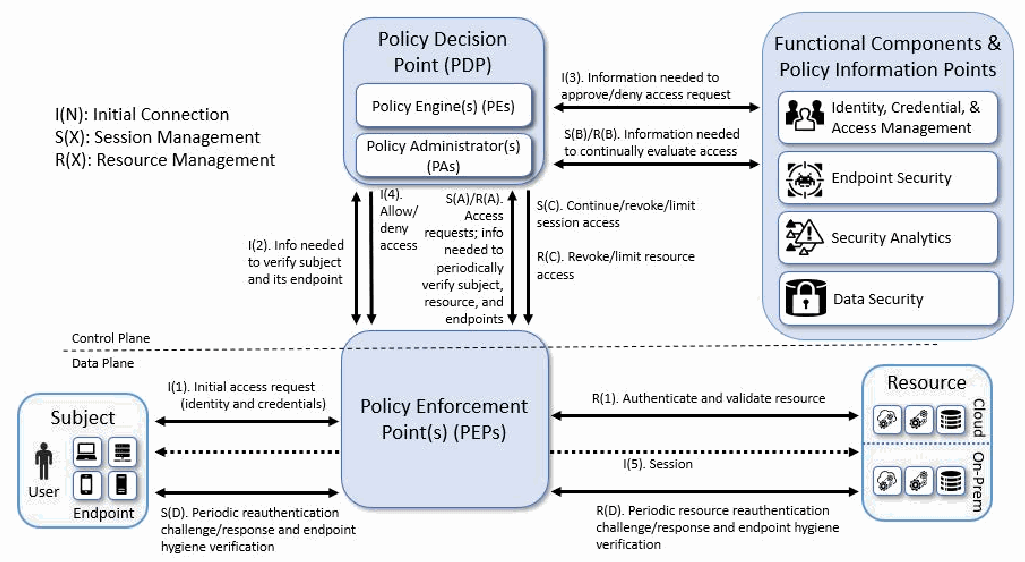
図1:ゼロトラスト・アーキテクチャの構成要素。左上の凡例は、I(N): 初期接続、S(X): セッション管理、R(X): リソース管理である。破線が上の Control Plane(コントロールプレーン)と下の Data Plane(データプレーン)を分ける。コントロールプレーンには、Policy Engine(s) (PEs)(ポリシーエンジン)と Policy Administrator(s) (PAs)(ポリシー管理者)を含む Policy Decision Point (PDP)(ポリシー決定ポイント)の箱があり、右に Identity, Credential, & Access Management(ID・クレデンシャル・アクセス管理)、Endpoint Security(エンドポイントセキュリティ)、Security Analytics(セキュリティ分析)、Data Security(データセキュリティ)を含む Functional Components & Policy Information Points(機能コンポーネントとポリシー情報ポイント)の箱がある。PDP とこれらのコンポーネントは、I(3). アクセス要求の承認/拒否に必要な情報、S(B)/R(B). アクセスを継続的に評価するのに必要な情報、と記された 2 本の両方向の矢印で結ばれている。PDP とプレーンの境界にある中央の Policy Enforcement Point(s) (PEPs)(ポリシー実施ポイント)の箱は、4 本の縦の矢印で結ばれている。両方向の I(2). 主体とそのエンドポイントの検証に必要な情報、下向きの I(4). アクセスの許可/拒否、両方向の S(A)/R(A). アクセス要求、主体・リソース・エンドポイントを定期的に検証するのに必要な情報、下向きの S(C). セッションアクセスの継続/取り消し/制限 および R(C). リソースアクセスの取り消し/制限 である。データプレーンでは、Subject(主体。User と Endpoint の機器)の箱が PEP と両方向の矢印で結ばれている。I(1). 初期アクセス要求(ID とクレデンシャル)、点線のセッションの矢印、S(D). 定期的な再認証のチャレンジ/レスポンスとエンドポイントの衛生状態の検証 である。PEP は Resource(リソース。Cloud と On-Prem)の箱と両方向の矢印で結ばれている。R(1). リソースの認証と検証、点線の I(5). セッション、R(D). 定期的なリソースの再認証のチャレンジ/レスポンスとエンドポイントの衛生状態の検証 である。
Figure 1: Components of a Zero Trust Architecture
図1:ゼロトラスト・アーキテクチャの構成要素
Security for 5G and Subsequent Generations In October 2021, the NCCoE began a project focused on the technical aspects of cybersecurity for 5G (fifth-generation technology standard for broadband cellular networks). 5G refers to a recent generation of wireless communications systems, which are faster and carry more data than previous generations. The NCCoE project is a collaboration of 12 industry-leading organizations that are contributing hardware and software valued at over $1 million. The expected outcome of the project is an example 5G implementation that provides a holistic approach to 5G cybersecurity, focusing on both standards-defined cybersecurity features as well as cloud technologies that can provide foundational cybersecurity features outside of the scope of the existing 5G security architecture. The resulting security reference architecture for 5G networks will bridge the gap between IT and telecommunications cybersecurity. In FY 2021, the collaboration published a draft executive summary (SP 1800-33A) for the project while successfully designing, planning, and beginning the deployment of the commercial-grade 5G technology components.
5Gおよび次世代技術のセキュリティ 2021年10月、NCCoEはブロードバンド携帯ネットワークの第5世代技術標準である5Gのサイバーセキュリティの技術面に焦点を当てたプロジェクトを開始しました。5Gは、従来世代より高速で多くのデータを扱う最近の無線通信システムを指します。このNCCoEプロジェクトでは、業界を代表する12組織が協力し、100万ドル相当を超えるハードウェアとソフトウェアを提供しています。成果として、5Gサイバーセキュリティへの包括的なアプローチを示す実装例を作成します。標準で定められたサイバーセキュリティ機能に加え、既存の5Gセキュリティ・アーキテクチャの範囲外で基礎的なセキュリティ機能を提供できるクラウド技術にも焦点を当てます。構築する5Gネットワークのセキュリティ参照アーキテクチャは、ITと電気通信のサイバーセキュリティの隔たりを埋めます。2021会計年度、協力組織はプロジェクトの概要草案(SP 1800-33A)を公表するとともに、商用水準の5G技術コンポーネントの設計、計画、導入開始を成功させました。
The project continued the deployment of the 5G network testbed with the goal of getting the first 5G call early in calendar year 2022. The project will publish a preliminary draft of a practice guide (SP 1800-33B) that highlights all of the cybersecurity capabilities offered by a 5G system and enabled by the project’s reference architecture.
プロジェクトは5Gネットワークのテストベッド構築を継続し、2022暦年の初めに最初の5G通話を行うことを目指しました。また、5Gシステムが提供し、プロジェクトの参照アーキテクチャによって実現されるサイバーセキュリティ機能をすべて取り上げた実践ガイド(SP 1800-33B)の予備草案を公表する予定です。
Security of Domain-Specific Networks This section describes research and projects that focus on the unique requirements and risks found in specific use cases and unique application domains.
特定分野向けネットワークのセキュリティ この節では、特定のユースケースや固有の応用分野に特有の要件とリスクに焦点を当てた研究・プロジェクトを説明します。
IoT Network Security
IoTネットワークのセキュリティ
NIST’s efforts to advance the design, standardization, commercialization, and adoption of new technologies to improve the security and resilience of the emerging Internet of Things has focused its recent efforts on consumer and enterprise network environments. In FY 2021, NIST completed several projects focused on emerging Manufacturer Usage Description (MUD) technologies, including the development of an open-source, pure software-defined network (SDN) implementation of a MUD manager and policy enforcement points, methodologies, and tools to automate the generation of MUD profiles for IoT devices, as well as NCCoE practice guides for Securing Home IoT Devices Using MUD.
新興のモノのインターネット(IoT)のセキュリティとレジリエンスを高める新技術の設計、標準化、商用化、採用を進めるNISTの取り組みでは、近年、消費者向けと企業向けのネットワーク環境に重点を置いています。2021会計年度、NISTはメーカー利用記述(MUD)技術に関する複数のプロジェクトを完了しました。これには、MUDマネージャーとポリシー実施ポイントのオープンソースによる純粋なソフトウェア定義ネットワーク(SDN)実装、IoT機器のMUDプロファイル生成を自動化する手法とツールの開発、「MUDを用いた家庭用IoT機器のセキュリティ確保」に関するNCCoE実践ガイドの作成が含まれます。
NIST’s ongoing work in emerging IoT security technology is focused on advancing the development of trusted IoT device on-boarding and life cycle management. NIST developed a white paper and conducted a workshop to help focus attention on this problem space and emerging solutions. NIST initiated a new NCCoE demonstration project to develop practice guides for secure IoT device on-boarding and life cycle management.
新興IoTセキュリティ技術に関するNISTの継続中の取り組みは、信頼できるIoT機器のオンボーディングとライフサイクル管理の開発促進に焦点を当てています。NISTはこの課題領域と新たな解決策に注意を促す白書を作成し、ワークショップを開催しました。また、安全なIoT機器のオンボーディングとライフサイクル管理に関する実践ガイドを作成するNCCoEの新たな実証プロジェクトを開始しました。
Industrial and Operational Technology Networks
産業・運用技術ネットワーク
In FY 2021, the NCCoE collaborated with engineers from NIST’s Engineering Lab to improve the security and resilience of industrial and operational technology networks that span multiple application domains, including general industrial control systems and manufacturing environments. Members of the Protecting Information and System Integrity in Industrial Control System Environments project published a draft practice guide, Cybersecurity for the Manufacturing Sector (draft SP 1800-10). Manufacturers, and their increasingly interconnected operational technology (OT) and information technology (IT) systems, have become major targets of cybersecurity attacks. The goal of the project was to demonstrate example solutions that manufacturers can use to protect their systems from destructive malware, insider threats, advanced persistent threats, and unlicensed software. Technology providers and industry experts, including several National Cybersecurity Excellence Partnership (NCEP) collaborators, contributed to example solutions that were implemented in two distinct but related labs, each with two settings: robotics-based manufacturing and process control systems that resemble what is being used by chemical manufacturing industries.
2021会計年度、NCCoEはNIST工学研究所の技術者と協力し、一般的な産業用制御システムや製造環境など、複数の応用分野にまたがる産業・運用技術ネットワークのセキュリティとレジリエンスを向上させました。「産業制御システム環境における情報とシステムの完全性の保護」プロジェクトの参加者は、「製造分野のサイバーセキュリティ」(SP 1800-10草案)実践ガイド草案を公表しました。製造業者と相互接続が進む運用技術(OT)・情報技術(IT)システムは、サイバー攻撃の主要な標的になっています。このプロジェクトは、破壊的マルウェア、内部脅威、高度持続的脅威、無許諾ソフトウェアからシステムを守るために製造業者が使える解決策例を実証することを目指しました。国家サイバーセキュリティ優秀パートナーシップ(NCEP)の複数の協力者を含む技術プロバイダーや業界専門家が、別個だが関連する2つの研究所で実装された解決策例に貢献しました。それぞれの研究所には、ロボットを用いた製造環境と、化学製造業界で用いられるものに類似したプロセス制御システムという2つの環境があります。
NIST initiated an update of the Guide to Industrial Control Systems (ICS) Security (SP 800-82) to incorporate lessons learned over the past several years, to provide alignment to relevant NIST guidance and other control system cybersecurity standards and recommended practices, and to address changes in the threat landscape. A pre-draft call for comments was initiated in April 2021, and the initial public draft of SP 800-82, Rev. 3 is currently scheduled for FY 2022. Updates include expanding the scope from ICS to control systems/OT, applying new cybersecurity capabilities, adding guidance specific to small- and medium-sized control system/OT owners and operators, and revising information about relevant threats, vulnerabilities, standards, and recommended practices.
NISTは「産業用制御システム(ICS)セキュリティガイド」(SP 800-82)の更新に着手しました。過去数年間の教訓を取り入れ、関連するNISTガイダンスや他の制御システム向けサイバーセキュリティ標準・推奨実務との整合を図り、脅威環境の変化に対応します。事前草案への意見募集を2021年4月に開始し、SP 800-82改訂第3版の初回公開草案は2022会計年度に公表する予定です。更新内容には、対象をICSから制御システム/OTへ拡大すること、新しいサイバーセキュリティ能力の適用、小規模・中規模の制御システム/OTの所有者・運用者向けの個別ガイダンスの追加、関連する脅威、脆弱性、標準、推奨実務に関する情報の改訂が含まれます。
In FY 2021, the NIST Smart Grid Program published guidance documents and a mapping tool for improving cybersecurity in power systems. The fourth revision of NIST’s Smart Grid Interoperability Framework described complementary approaches to ensuring cybersecurity: one based on assessing and mitigating organizational risk by applying concepts from NIST’s Framework for Improving Critical Infrastructure Cybersecurity to utility organizations and the second based on examining the specific logical interfaces introduced through distributed energy resources to characterize the cybersecurity requirements necessary to explore individual assets. This provided guidance has become a foundation for cybersecurity training offered by the National Association of Regulatory Utility Commissioners to government officials, as well as technical working groups in industry organizations.
2021会計年度、NISTスマートグリッド・プログラムは、電力システムのサイバーセキュリティを改善するガイダンス文書と対応付けツールを公表しました。NISTスマートグリッド相互運用性フレームワークの第4版は、相互に補完する2つのサイバーセキュリティ対策を説明しています。1つは、NISTの「重要インフラのサイバーセキュリティを改善するためのフレームワーク」の概念を電力事業者に適用し、組織リスクを評価・緩和する方法です。もう1つは、分散型エネルギー資源によって生じる個別の論理インターフェースを調べ、個々の資産を検討するために必要なサイバーセキュリティ要件を明確にする方法です。このガイダンスは、政府職員向けに全米規制公益事業委員協会が提供するサイバーセキュリティ訓練や、業界団体の技術作業部会での基礎となっています。
NIST also collaborated in the development of a mapping tool and an associated guidance document that clarify the relationship between the cybersecurity outcomes and best practices described in the NIST Cybersecurity Framework and the latest version of the North American Electric Reliability Corporation (NERC) Critical Infrastructure Protection (CIP) Standards. This mapping is critical to the industry, as NERC CIP standards are the enforceable cybersecurity standards for the grid, and the relationship between NERC CIP and NIST cybersecurity best practices is not always clear.
NISTは、NISTサイバーセキュリティ・フレームワークに記載されたサイバーセキュリティ成果およびベストプラクティスと、北米電力信頼度協議会(NERC)の最新の重要インフラ保護(CIP)標準との関係を明らかにする対応付けツールと関連ガイダンス文書の策定にも協力しました。NERC CIP標準は電力網に適用される強制力のあるサイバーセキュリティ標準ですが、NERC CIPとNISTのベストプラクティスの関係が常に明確とは限らないため、この対応付けは業界にとって重要です。
Network Security Research This third topic area looks beyond the horizon of current and emerging networks to address the security and resilience challenges of future networks by exploring potentially disruptive technologies.
ネットワーク・セキュリティ研究 この第3のテーマ領域では、破壊的な可能性を持つ技術を探究し、現行および新興ネットワークの先を見据えながら、将来のネットワークにおけるセキュリティとレジリエンスの課題に取り組みます。
AI Applications to Network Security In FY 2021, NIST’s Trustworthy Intelligent Networks project researched the application of AI techniques to detect malicious botnet traffic in both data centers and the public internet. Botnets and their ability to launch large-scale, distributed denial-of-service (DDoS) attacks remain a serious threat to all forms of networked critical infrastructure. NIST developed deep learning techniques to detect botnet command and control channels that exploit the domain name system (DNS). NIST researched advanced state-of-the-art algorithms to detect botnet abuse through domain-generation algorithms in the DNS.
ネットワーク・セキュリティへのAIの応用 2021会計年度、NISTの信頼できるインテリジェント・ネットワーク・プロジェクトは、データセンターと公開インターネットの両方で悪意あるボットネット通信を検出するAI技術の応用を研究しました。ボットネットと、大規模な分散型サービス拒否(DDoS)攻撃を仕掛ける能力は、あらゆる形態のネットワーク化された重要インフラにとって、依然として深刻な脅威です。NISTは、ドメインネームシステム(DNS)を悪用するボットネットの指令・制御チャネルを検出する深層学習技術を開発しました。また、DNSのドメイン生成アルゴリズムを介したボットネットの悪用を検知する最先端の高度なアルゴリズムも研究しました。
Formal Verification of Security Protocols The complexity and pace of innovation of new network security protocols in numerous realms challenge industries’ ability to conduct careful reviews of their designs. To address that challenge, NIST is exploring the use of formal methods to verify the security properties of protocol designs early in their standardization process. NIST’s Trustworthy Internet of Things project is one such effort that explores the application of formal methods to verify the security properties of emerging IoT on-boarding technologies (see Figure 2). In FY 2021, NIST published research on the automated formal verification of Bootstrapping Remote Secure Key Infrastructures (BRSKI) protocol. Ongoing efforts are exploring additional formal verification methods and their applications to an expanded scope of emerging designs for IoT on-boarding protocols.
セキュリティ・プロトコルの形式検証 多くの分野で新しいネットワーク・セキュリティ・プロトコルの複雑さと技術革新の速さが増し、業界が設計を慎重に審査することは難しくなっています。この課題に対処するため、NISTは標準化プロセスの早い段階でプロトコル設計のセキュリティ特性を検証する形式手法の利用を検討しています。NISTの信頼できるIoTプロジェクトもその一つであり、新興IoTオンボーディング技術のセキュリティ特性を形式手法で検証する応用を研究しています(図2参照)。2021会計年度、NISTはブートストラップによるリモート・セキュア鍵基盤(BRSKI)プロトコルの自動形式検証に関する研究を公表しました。現在も追加の形式検証手法と、それをより広い範囲の新興IoTオンボーディング・プロトコル設計に適用する方法を検討しています。
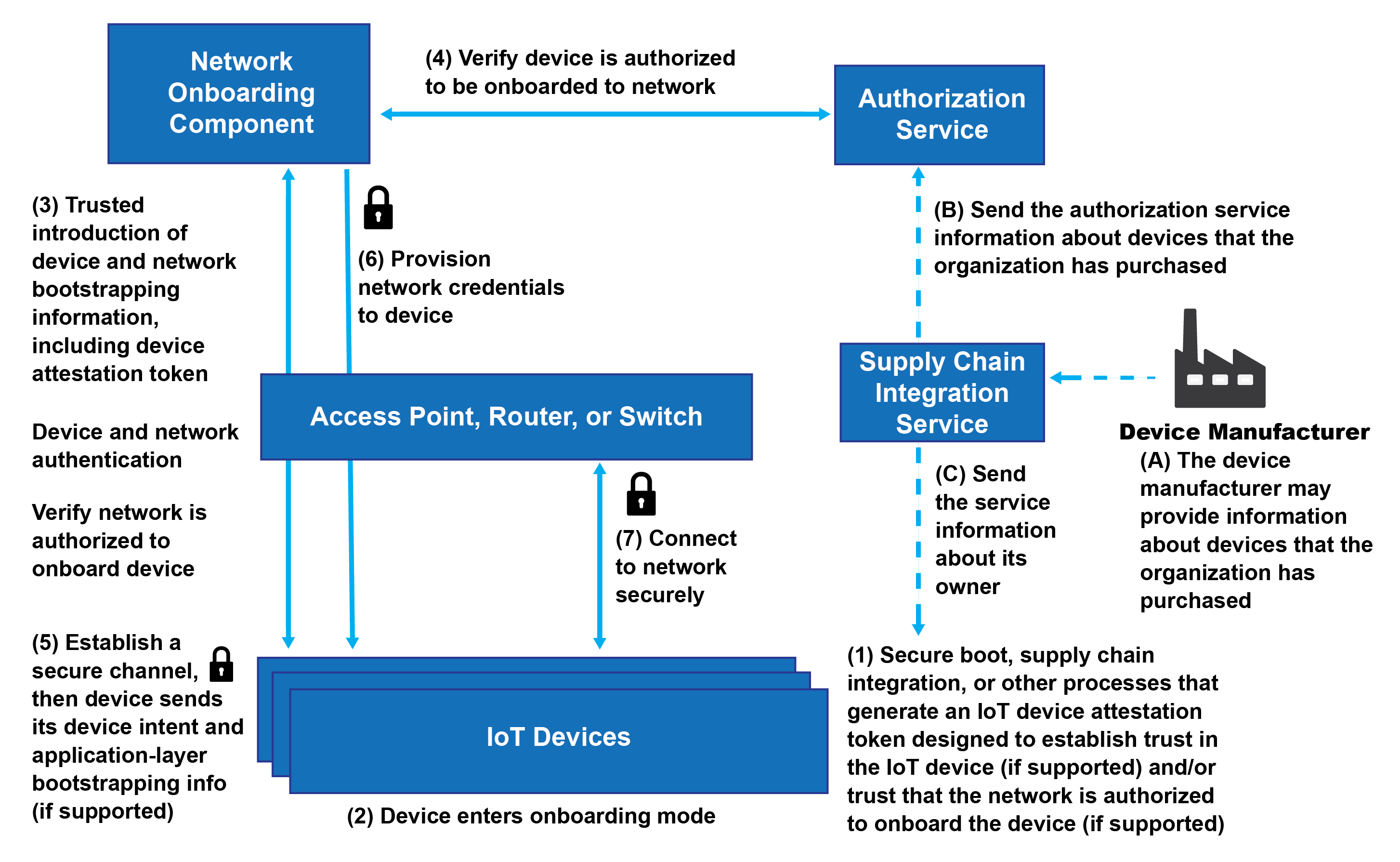
図2:IoTオンボーディング・プロトコルの機能図。箱は、Network Onboarding Component(ネットワークオンボーディング・コンポーネント、左上)、Authorization Service(認可サービス、右上)、Access Point, Router, or Switch(アクセスポイント、ルーター、またはスイッチ、中央)、Supply Chain Integration Service(サプライチェーン統合サービス、右)、重なった IoT Devices(IoT デバイス、下)と、Device Manufacturer(デバイス製造者)と記された工場のアイコンである。番号と記号の付いた手順が接続に記されている。(A) デバイス製造者は、組織が購入したデバイスに関する情報を提供できる(デバイス製造者からサプライチェーン統合サービスへの破線の矢印)。(B) 組織が購入したデバイスに関する情報を認可サービスに送る(認可サービスへ上がる破線の矢印)。(C) サービスにその所有者に関する情報を送る(IoT デバイスの方へ下りる破線の矢印)。(1) IoT デバイスへの信頼(対応している場合)および/またはネットワークがデバイスのオンボーディングを認可されていることへの信頼を確立するための IoT デバイス認証トークンを生成する、セキュアブート、サプライチェーン統合、またはその他のプロセス。(2) デバイスがオンボーディングモードに入る。(3) デバイス認証トークンを含む、デバイスとネットワークのブートストラップ情報の信頼された導入。デバイスとネットワークの認証、ネットワークがデバイスのオンボーディングを認可されていることの検証を伴う(アクセスポイントを通る、IoT デバイスとネットワークオンボーディング・コンポーネントの間の両方向の矢印)。(4) デバイスがネットワークへのオンボーディングを認可されていることを検証する(ネットワークオンボーディング・コンポーネントと認可サービスの間の両方向の矢印)。(5) セキュアなチャネルを確立し、その後デバイスがデバイスの意図とアプリケーション層のブートストラップ情報(対応している場合)を送る(南京錠の印)。(6) デバイスにネットワーククレデンシャルをプロビジョニングする(ネットワークオンボーディング・コンポーネントから IoT デバイスへ下りる矢印、南京錠)。(7) ネットワークにセキュアに接続する(IoT デバイスとアクセスポイントの間の両方向の矢印、南京錠)。
Figure 2: Functional Diagram of IoT Onboarding Protocols
図2:IoTオンボーディング・プロトコルの機能図
8 | Trustworthy Platforms
8|信頼できるプラットフォーム
工場と製造ラインを背景に、ネットワーク接続された機器を示すアイコンを配置したイメージ。工場、クラウド、コンピューター、利用者、AI、WiFiなどを表す。 [装飾の画像。本文を読むのに必要のない装飾のため、この非公式サイトには掲載していません。原本 PDF を参照してください。]
Credit: Shutterstock
画像提供:Shutterstock
NIST defines a platform as a computer or hardware device, operating system, or virtual environment on which software can be installed or run. The goal of the Trustworthy Platforms focus area is to improve trust in the security and privacy of these systems and infrastructures by providing guidance and technologies for the development and use of secure platforms, including software, hardware, and firmware. A trustworthy platform is a dynamic ecosystem that depends on multiple security and privacy technologies for reliable service delivery. It is deployed and maintained in a measured state that is known to protect the security and privacy of users and data, and it performs services in a consistent and reliable manner. The desired outcome of the NIST focus area is to increase the adoption of trustworthy platforms in order to improve trust in the security and privacy of systems and infrastructures. NIST provides guidance and technologies for the development and use of secure platforms and foundational components such as cryptography. NIST also helps to develop quantifiable measurements that provide assurances for platform security, privacy, and robustness.
NISTは、ソフトウェアをインストールまたは実行できるコンピューターやハードウェア機器、オペレーティングシステム、仮想環境をプラットフォームと定義しています。「信頼できるプラットフォーム」重点分野の目標は、ソフトウェア、ハードウェア、ファームウェアを含む安全なプラットフォームの開発と利用に向けた技術やガイダンスを提供し、これらのシステムや基盤のセキュリティとプライバシーへの信頼を高めることです。信頼できるプラットフォームは、安定したサービス提供のために複数のセキュリティ・プライバシー技術に依存する動的なエコシステムです。ユーザーとデータのセキュリティとプライバシーを保護することが分かっている測定済みの状態で導入・維持され、一貫性と信頼性のある方法でサービスを提供します。この重点分野が目指す成果は、信頼できるプラットフォームの採用を拡大し、システムや基盤のセキュリティとプライバシーへの信頼を高めることです。NISTは、暗号技術などの基盤要素を含む安全なプラットフォームの開発と利用に向けたガイダンスや技術を提供します。また、プラットフォームのセキュリティ、プライバシー、堅牢性を保証する定量的な測定方法の開発も支援します。
Enhancing the Security of the Software Supply Chain – Implementation of EO 14028 The President’s Executive Order (EO) 14028, Improving the Nation’s Cybersecurity, issued on May 12, 2021, charged multiple agencies – including NIST – with enhancing cybersecurity through a variety of initiatives related to the security and integrity of the software supply chain. In support of EO 14028, NIST solicited position papers and other input from the community, hosted a series of workshops, and consulted with other federal agencies. NIST published a definition of “critical software” within the context of EO 14028, guidance that outlines security measures for critical software use, and recommended minimum standards for vendor or developer verification of software. NIST has also published Cyber Supply Chain Risk Management Practices for Systems and Organizations (draft SP 800-161, Revision 1) and Secure Software Development Framework (SSDF) Version 1.1: Recommendations for Mitigating the Risk of Software Vulnerabilities (SP 800-218). Work in support of EO 14028 will continue throughout FY 2022.
ソフトウェア・サプライチェーンのセキュリティ強化 — 大統領令14028の実施 2021年5月12日に発令された大統領令14028「国家のサイバーセキュリティの改善」は、NISTを含む複数機関に対し、ソフトウェア・サプライチェーンのセキュリティと完全性に関するさまざまな取り組みを通じてサイバーセキュリティを強化するよう求めました。NISTは大統領令への対応として、コミュニティから意見書などを募り、一連のワークショップを開催し、他の連邦機関と協議しました。NISTは、大統領令における「重要ソフトウェア」の定義、重要ソフトウェアの使用に関するセキュリティ対策のガイダンス、ベンダーや開発者によるソフトウェア検証の推奨最低基準を公表しました。また「システムおよび組織のためのサイバーセキュリティ・サプライチェーンリスク管理実務」(SP 800-161改訂第1版草案)と「セキュアソフトウェア開発フレームワーク(SSDF)バージョン1.1:ソフトウェア脆弱性リスクを緩和するための推奨事項」(SP 800-218)も公表しました。大統領令14028への対応作業は2022会計年度を通じて継続します。
Secure Software Development Framework (SSDF) The Secure Software Development Framework (SSDF) is a set of fundamental secure software development practices based on established practice documents from organizations such as BSA, OWASP, and SAFECode. Few software development life cycle (SDLC) models explicitly address software security in detail, so practices like those in the SSDF need to be added to and integrated with each SDLC implementation.
セキュアソフトウェア開発フレームワーク(SSDF) SSDFは、BSA、OWASP、SAFECodeなどの組織による確立された実務文書に基づく、セキュアソフトウェア開発の基本的な実務群です。ソフトウェアセキュリティを詳細に明示しているソフトウェア開発ライフサイクル(SDLC)のモデルはほとんどありません。そのため、SSDFのような実務を各SDLC実装に追加し、統合する必要があります。
Following the SSDF practices should help software producers reduce the number of vulnerabilities in released software, mitigate the potential impacts of the exploitation of undetected or unaddressed vulnerabilities, and address the root causes of vulnerabilities to prevent future recurrences. Because the SSDF provides a common vocabulary for secure software development, software consumers can also use it to foster communications with suppliers in acquisition processes and other management activities.
SSDFの実務に従うことは、ソフトウェア製造者がリリースするソフトウェアの脆弱性の数を減らし、未発見または未対処の脆弱性が悪用された場合の潜在的な影響を緩和し、脆弱性の根本原因に対処して将来の再発を防ぐのに役立つはずです。SSDFはセキュアソフトウェア開発の共通語彙を提供するため、ソフトウェアの購入者も、調達プロセスなどの管理活動で供給者との意思疎通を促進するためにこれを利用できます。
In September 2021, NIST released Secure Software Development Framework (SSDF) Version 1.1: Recommendations for Mitigating the Risk of Software Vulnerabilities (draft SP 800-218). SP 800-218 will replace the NIST Cybersecurity White Paper released in April 2020, which defined the original SSDF. Changes from version 1.0 to 1.1 include adding several references, creating new practices and tasks related to secure software development environments, and mapping SSDF practices to corresponding clauses from EO 14028.
2021年9月、NISTは「セキュアソフトウェア開発フレームワーク(SSDF)バージョン1.1:ソフトウェア脆弱性リスクを緩和するための推奨事項」(SP 800-218草案)を公表しました。SP 800-218は、2020年4月に公表された、元のSSDFを定義するNISTサイバーセキュリティ白書に代わるものです。バージョン1.0から1.1への変更には、複数の参考資料の追加、セキュアなソフトウェア開発環境に関する新しい実務と作業の作成、SSDF実務と大統領令14028の対応条項との対応付けが含まれます。
NIST will continue to refresh and evolve the SSDF in response to public feedback and the changing threats, vulnerabilities, practices, and automation capabilities in software development. Future work may potentially cover topics such as how the SSDF may apply to and vary for particular software development methodologies and associated practices like DevOps and how an organization can transition from using just their current software development practices to also incorporating the practices specified by the SSDF.
NISTは、一般からの意見や、ソフトウェア開発における脅威、脆弱性、実務、自動化能力の変化に対応して、SSDFを引き続き更新・発展させます。今後の作業では、DevOpsなど特定のソフトウェア開発手法と関連実務にSSDFをどう適用し、どう調整するか、また組織が現在の開発実務にSSDFの実務を加えていく方法などを取り上げる可能性があります。
Improving Cybersecurity in Supply Chains In August 2021, NIST launched the National Initiative for Improving Cybersecurity in Supply Chains to help organizations build, evaluate, and assess the cybersecurity of products and services in their supply chains, an area of increasing concern. The effort will emphasize tools, technologies, and guidance focused on the developers and providers of technology. At the same time, there is a need among those acquiring products and services for cohesive, practical, performance-oriented guidance to address the broader cybersecurity risks to the security and resilience of all supply chains. NIST expects to issue a Request for Information in FY 2022 to help guide this public-private partnership.
サプライチェーンのサイバーセキュリティ改善 NISTは2021年8月、関心が高まるサプライチェーンの製品やサービスについて、組織がサイバーセキュリティを構築、評価、検証するのを支援する「サプライチェーンにおけるサイバーセキュリティ改善のための全米イニシアチブ」を開始しました。この取り組みでは、技術の開発者や提供者向けのツール、技術、ガイダンスを重視します。同時に、製品・サービスの調達者には、すべてのサプライチェーンのより広範なサイバーセキュリティリスクとセキュリティ、レジリエンスに対処するため、まとまりがあり実用的で性能を重視するガイダンスが必要です。NISTはこの官民連携の方向性を示すため、2022会計年度に情報提供依頼(RFI)を発行する予定です。
Hardware-Enabled Security The foundation of any data center or edge computing security strategy should be securing the platform on which data and workloads will be executed and accessed. The physical platform represents the first layer for any layered security approach and provides the initial protections to help ensure that higher-layer security controls can be trusted. In FY 2021, the NCCoE continued to develop and demonstrate approaches based on hardware-enabled security techniques and technologies for safeguarding data and workloads. Hardware-Enabled Security: Container Platform Security Prototype (NISTIR 8320A) was finalized in June 2021, and a second public comment draft of Hardware-Enabled Security: Enabling a Layered Approach to Platform Security for Cloud and Edge Computing Use Cases (NISTIR 8320) was released in May 2021. Additional publications in the NISTIR 8320 series are also under development.
ハードウェアによるセキュリティ データセンターやエッジコンピューティングのセキュリティ戦略は、データやワークロードを実行・アクセスする基盤プラットフォームの保護を土台とすべきです。物理プラットフォームは多層防御の最初の層であり、上位層のセキュリティ管理策を信頼できるようにする初期保護を提供します。2021会計年度、NCCoEはハードウェアを活用するセキュリティ技術や手法に基づくアプローチを開発・実証し、データとワークロードの保護を続けました。「ハードウェアによるセキュリティ:コンテナ・プラットフォーム・セキュリティのプロトタイプ」(NISTIR 8320A)は2021年6月に最終化され、「ハードウェアによるセキュリティ:クラウドおよびエッジコンピューティングのユースケースに向けたプラットフォーム・セキュリティの多層アプローチの実現」(NISTIR 8320)の第2次公開コメント草案は2021年5月に公表されました。NISTIR 8320シリーズの追加刊行物も開発中です。
Control System and Operational Technology (OT) Security
制御システムおよび運用技術(OT)のセキュリティ
NIST is incorporating lessons learned in revisions to the Guide to Industrial Control Systems (ICS) Security (SP 800-82) (see previous section) to provide alignment to relevant NIST guidance (e.g., SP 800-37, Rev. 2; SP 800-53, Rev. 5; SP 800-53B; and Cybersecurity Framework v1.1) and other relevant control system cybersecurity standards and recommended practices, and address changes in the threat landscape. Updates include expanding the scope from ICS to control systems/OT, applying new cybersecurity capabilities, adding guidance specific to small and medium-sized control system/OT owners and operators, and revising the control system/OT threats, vulnerabilities, standards, and recommended practices.
NISTは「産業用制御システム(ICS)セキュリティガイド」(SP 800-82)の改訂に過去の教訓を取り入れ、関連するNISTガイダンス(SP 800-37改訂第2版、SP 800-53改訂第5版、SP 800-53B、サイバーセキュリティ・フレームワーク バージョン1.1など)や他の制御システム向けサイバーセキュリティ標準・推奨実務との整合を図り、脅威環境の変化に対応しています。更新には、対象をICSから制御システム/OTへ拡大すること、新しいサイバーセキュリティ能力の適用、小規模・中規模の制御システム/OTの所有者・運用者向け個別ガイダンスの追加、制御システム/OTの脅威、脆弱性、標準、推奨実務に関する情報の改訂が含まれます。
Ransomware and Data Security
ランサムウェアとデータセキュリティ
The term “ransomware” describes types of malware used by perpetrators to carry out threats to publish a victim’s sensitive personal or business information or to perpetually block the victim’s access to vital information unless a ransom is paid. Ransomware attacks can paralyze or destroy organizations. NIST undertook several activities (see below) to help organizations protect against ransomware attacks and to enable recovery from any that are successful.
「ランサムウェア」とは、身代金が支払われなければ、被害者の機微な個人情報や業務情報を公開すると脅したり、重要な情報へのアクセスを継続的に遮断したりするために、攻撃者が使用する種類のマルウェアを指します。ランサムウェア攻撃は組織を麻痺させたり破壊したりする可能性があります。NISTは、組織がランサムウェア攻撃から身を守り、攻撃が成功した場合に復旧できるよう、複数の活動を実施しました(以下参照)。
Ransomware protection and remediation require a coordinated response involving processes, procedures, and decision-making using technical controls for identifying, mitigating, and recovering from ransomware events. To help organizations access the NIST guidance and tools that best address these needs, NIST’s new Ransomware Protection and Response page aggregates NIST recommendations that directly address the ransomware challenge. The page includes a "tips and tactics" one-pager providing key actions for defense against ransomware attacks. To support small and medium-sized organizations, the Small Business Cybersecurity Corner now features a ransomware page that illustrates ransomware event basics, how ransomware events can impact businesses of all sizes, and actions that can help in managing ransomware risk.
ランサムウェアの防御と修復には、技術的管理策を用いてランサムウェア事象を特定、緩和、復旧するためのプロセス、手順、意思決定を含む、協調した対応が必要です。組織がこうしたニーズに最適なNISTガイダンスとツールを利用できるよう、NISTの新しい「ランサムウェア防御と対応」ページでは、ランサムウェアの課題に直接対処するNISTの推奨事項をまとめています。このページには、ランサムウェア攻撃を防ぐための主な対応を示した1ページの「ヒントと戦術」資料があります。小規模・中規模組織を支援するため、「中小企業サイバーセキュリティ・コーナー」にもランサムウェア専用ページを設け、ランサムウェア事象の基本、あらゆる規模の企業への影響、リスク管理に役立つ対応策を紹介しています。
In response to several major recent ransomware events, NIST also engaged industry experts in drafting a new Cybersecurity Framework Profile for Ransomware Risk Management publication (draft NISTIR 8374). This profile identifies relevant subcategories and informative references from the NIST Cybersecurity Framework and maps them directly to ransomware risk management activities. Additionally, the document includes a high-level description of security measures that organizations can take now to prevent future ransomware attacks and mitigate the consequences of any successful attacks.
最近発生した複数の大規模ランサムウェア事象を受け、NISTは業界専門家と協力し、「ランサムウェア・リスク管理のためのサイバーセキュリティ・フレームワーク・プロファイル」(NISTIR 8374草案)を作成しました。このプロファイルは、NISTサイバーセキュリティ・フレームワークの関連サブカテゴリーと参考資料を特定し、ランサムウェア・リスク管理の活動に直接対応付けています。また、今すぐ実施できるセキュリティ対策を概説し、将来のランサムウェア攻撃の防止と、攻撃が成功した場合の影響緩和を支援します。
Complementing the new ransomware profile, the NCCoE published two practice guides: Data Integrity: Identifying and Protecting Assets Against Ransomware and Other Destructive Events (SP 1800-25) and Data Integrity: Detecting and Responding to Ransomware and Other Destructive Events (SP 1800-26). These publications are a continuation of the previously published Data Integrity: Recovering from Ransomware and Other Destructive Events (SP 1800-11). Together, the practice guides demonstrate how commercially available technology can be used to implement the Cybersecurity Framework. These NCCoE SPs are supplemented by NIST’s Securing Data Integrity Against Ransomware Attacks (draft NIST CSWP 10012020) white paper that was published to help organizations apply the architectures described in the practice guides to preventing or mitigating ransomware events. These are supported by the Ransomware Protection and Response web page described above.
新しいランサムウェア・プロファイルを補完するため、NCCoEは2つの実践ガイドを公表しました。「データ完全性:ランサムウェアその他の破壊的事象から資産を特定・保護する」(SP 1800-25)と「データ完全性:ランサムウェアその他の破壊的事象を検知・対応する」(SP 1800-26)です。これらは先に公表された「データ完全性:ランサムウェアその他の破壊的事象から復旧する」(SP 1800-11)の続編です。これらの実践ガイドは全体として、市販技術を使ってサイバーセキュリティ・フレームワークを実装する方法を実証します。これらのNCCoE特別刊行物を補足するため、NISTは「ランサムウェア攻撃に対するデータ完全性の確保」(NIST CSWP 10012020草案)白書を公表しました。この白書は、実践ガイドに記載されたアーキテクチャをランサムウェア事象の防止や緩和に適用する方法を組織が理解できるよう支援します。これらは、前述の「ランサムウェア防御と対応」ウェブページによって補完されています。
Distributed Energy Resource (DER) Security
分散型エネルギー資源(DER)のセキュリティ
In FY 2021, NIST’s NCCoE Energy Sector team completed the project started in FY 2020 on protecting Industrial Internet of Things (IIoT) devices at the grid edge (the components that extend the traditional power grid infrastructure and that include physical assets [e.g., smart meters], applications, and data analytics tools). The team investigates data integrity concerns that arise from the use of distributed energy resources (DERs), such as photovoltaics. The team developed an associated draft practice guide, Securing the Industrial Internet of Things: Cybersecurity for Distributed Energy Resources (SP 1800-32). The practice guide addresses a key challenge for all energy operators and owners: protecting the integrity of the data needed to execute command and control to maintain the resilience of the grid.
2021会計年度、NISTのNCCoEエネルギー部門チームは、2020会計年度に開始した、電力網のエッジにある産業用モノのインターネット(IIoT)機器の保護プロジェクトを完了しました。電力網のエッジとは、スマートメーターなどの物理資産、アプリケーション、データ分析ツールを含み、従来の電力網基盤を拡張する構成要素です。チームは、太陽光発電などの分散型エネルギー資源(DER)の利用によって生じるデータ完全性の懸念を調査しています。また、「産業用モノのインターネットのセキュリティ確保:分散型エネルギー資源のサイバーセキュリティ」(SP 1800-32)実践ガイド草案を作成しました。このガイドは、電力事業者と資産所有者に共通する重要課題、すなわち電力網のレジリエンス維持に必要な指令・制御データの完全性保護を扱います。
NIST participated in and provided contributions to the IEEE (Institute of Electrical and Electronics Engineers) 1547.3 working group in their effort to develop a Guide for Cybersecurity of Distributed Energy Resources (DER) Interconnected with Electric Power Systems. The document provides cybersecurity guidelines for DER stakeholders, including utilities, aggregators, and DER vendors, owners, and operators. NIST also organized a Smart Electric Power Alliance (SEPA) half-day workshop in March 2021 to understand the usage of the cybersecurity controls for the logical interface categories defined in Guidelines for Smart Grid Cybersecurity (NISTIR 7628) by DER stakeholders. The workshop results and conclusions will be used to inform future SEPA and NIST efforts.
NISTは、電力システムに接続された分散型エネルギー資源(DER)のサイバーセキュリティ・ガイドを策定するIEEE(電気電子学会)1547.3作業部会に参加し、貢献しました。この文書は、電力会社、アグリゲーター、DERベンダー、所有者、運用者などの関係者向けにサイバーセキュリティ・ガイドラインを提供します。NISTは2021年3月、スマートグリッド・サイバーセキュリティ・ガイドライン(NISTIR 7628)で定めた論理インターフェース分類について、DER関係者によるサイバーセキュリティ管理策の利用状況を把握するため、スマート電力連盟(SEPA)と半日のワークショップも開催しました。成果と結論は、SEPAとNISTの今後の取り組みに活用されます。
Systems Security Engineering
システムセキュリティエンジニアリング
The NIST Systems Security Engineering Project initiated major updates to its publications. Developing Cyber-Resilient Systems: A Systems Security Engineering Approach (SP 800-160, Volume 2, Revision 1) helps organizations anticipate, withstand, recover from, and adapt to adverse conditions, stresses, or compromises on systems, including hostile and increasingly destructive attacks from nation-states, criminal gangs, and disgruntled individuals. This update offers significant new content and support tools for organizations to defend against attacks. The document provides suggestions on how to limit the damage that adversaries can inflict by impeding their lateral movement, increasing their work factor, and reducing their time on target. The update also adds an appendix analyzing the potential effects of cyber resiliency on adversary tactics, techniques, and procedures used to attack OT systems.
NISTシステムセキュリティエンジニアリング・プロジェクトは、刊行物の大幅な更新に着手しました。「サイバーレジリエンスを備えたシステムの開発:システムセキュリティエンジニアリングのアプローチ」(SP 800-160第2巻改訂第1版)は、国家、犯罪集団、不満を抱く個人による敵対的で、ますます破壊的な攻撃を含め、システムに対する不利な状況、ストレス、侵害を予測し、それに耐え、そこから復旧し、適応することを組織が行えるよう支援します。この更新では、組織が攻撃から防御できるよう、新しい内容と支援ツールを大幅に追加しました。敵対者の横方向移動を妨げ、攻撃側の作業量を増やし、標的に留まる時間を減らすことで、敵対者がもたらす損害を限定する方法を提案しています。また、OTシステムへの攻撃に使われる敵対者の戦術、技法、手順にサイバーレジリエンスが及ぼす潜在的影響を分析する付属書も追加しました。
NIST also continued its update to Systems Security Engineering: Considerations for a Multidisciplinary Approach in the Engineering of Trustworthy Secure Systems (SP 800-160, Volume 1, Revision 1). Content was added to help organizations develop systems that are “secure by design” with an emphasis on the use of design principles for trustworthy, secure systems. The guideline is also being updated to ensure consistency with international systems and software engineering standards.
NISTは「システムセキュリティエンジニアリング:信頼できるセキュアシステムを学際的に設計する際の考慮事項」(SP 800-160第1巻改訂第1版)の更新も続けました。信頼できるセキュアシステムの設計原則の活用を重視し、組織が「設計段階から安全な」システムを開発するのに役立つ内容を追加しました。国際的なシステム工学およびソフトウェア工学標準との一貫性を保つため、ガイドラインも更新中です。
Leadership and Participation in National and International Standards Programs
国内外の標準化プログラムにおける主導と参加
デジタルの地球と表面に広がるネットワーク接続を表したイメージ。文字ラベルなし。 [装飾の画像。本文を読むのに必要のない装飾のため、この非公式サイトには掲載していません。原本 PDF を参照してください。]
Credit: Shutterstock
画像提供:Shutterstock
During FY 2021, NIST staff contributed to and held leadership positions in various standards developing organizations (SDOs), including the International Electrotechnical Commission (IEC), the Internet Engineering Task Force (IETF), the Institute of Electrical and Electronics Engineers (IEEE), the World Wide Web Consortium (W3C), the 3rd Generation Partnership Project (3GPP), and the International Organization for Standardization (ISO). NIST also supports ANSI (American National Standards Institute) X9, a non-profit standards development organization chartered to develop voluntary open consensus standards for the financial services industry in the US. The staff actively participated in standards bodies to raise awareness and influence the development of privacy and cybersecurity standards, including efforts within the ISO/IEC (Joint Technical Committee - JTC1).
2021会計年度、NIST職員は国際電気標準会議(IEC)、インターネット技術タスクフォース(IETF)、電気電子学会(IEEE)、ワールド・ワイド・ウェブ・コンソーシアム(W3C)、第3世代パートナーシップ・プロジェクト(3GPP)、国際標準化機構(ISO)など、さまざまな標準策定機関(SDO)に貢献し、指導的役割を担いました。また米国規格協会(ANSI)X9も支援しています。これは米国の金融サービス業界向けの任意の公開合意標準を策定する非営利標準化団体です。職員は標準化組織に積極的に参加し、プライバシーおよびサイバーセキュリティ標準に関する認識向上と策定への影響力行使に努めました。これにはISO/IEC第1合同技術委員会(JTC1)の取り組みも含まれます。
NIST uses collaborative opportunities to highlight the role that standards play in enabling technological innovation and interoperability among products and systems. International collaboration and alignment on standards-based approaches to cybersecurity and privacy risk management lead to greater innovation and a more effective and efficient utilization of resources. NIST also shares information on standards processes, the importance of standards on the economy and facilitating international trade, and the ability of standards to help secure systems and infrastructure. NIST coordinates with interagency partners on strategic approaches and communication on standards for the Federal Government.
NISTは協働の機会を通じて、技術革新や製品・システム間の相互運用を可能にする標準の役割を明らかにしています。サイバーセキュリティおよびプライバシーリスク管理に関する標準ベースの手法で国際的に協力・整合すると、イノベーションが進み、リソースをより有効かつ効率的に活用できます。NISTは標準化のプロセス、経済や国際貿易の促進における標準の重要性、システムや基盤のセキュリティ確保に標準が役立つことについても情報を共有しています。また連邦政府の標準に関する戦略的な取り組みや情報発信について、省庁間のパートナーと調整しています。
The standards community is built upon international collaboration, and NIST leverages its foundational and applied research efforts and experience in leadership to contribute to the development of national and international standards. These standards activities span cybersecurity, privacy, cryptography, Identity Management, and critical fields, such as 5G mobile and cellular technologies, quantum technologies, cloud infrastructure management, blockchain and distributed ledger technologies, the Internet of Things (IoT), vehicle automation, and artificial intelligence (AI).
標準化コミュニティは国際協力を基盤としています。NISTは基礎研究と応用研究、指導的役割を通じて得た経験を活用し、国内外の標準策定に貢献しています。標準化活動はサイバーセキュリティ、プライバシー、暗号、ID管理に加え、5Gモバイル・携帯技術、量子技術、クラウド基盤管理、ブロックチェーンと分散型台帳技術、IoT、車両自動化、人工知能(AI)などの重要分野に及びます。
NIST/ITL FY 2021 ANNUAL CYBERSECURITY AND PRIVACY REPORT LEADERSHIP AND PARTICIPATION IN NATIONAL AND INTERNATIONAL STANDARDS PROGRAMS
NIST/ITL 2021年度サイバーセキュリティ・プライバシー年次報告書 国内外の標準化プログラムにおける主導と参加
In FY 2021, NIST continued to engage with government and industry organizations to demonstrate and ensure continued alignment with voluntary international standards. NIST discussed the Cybersecurity Framework in numerous dialogues and has continued to identify and promote international adaptations and translations of the Framework, which is now available in 10 languages. NIST also continues to contribute to international standards development efforts related to cybersecurity risk management and the development of cybersecurity frameworks, including Cybersecurity framework guidelines, ISO/IEC Technical Specification 27110, which was published in February 2021.
2021会計年度、NISTは政府機関や産業界の組織と連携し、任意の国際標準との継続的な整合を実証し、確保しました。NISTは多くの対話でサイバーセキュリティ・フレームワークを取り上げ、国際的な適用や翻訳を特定して促進してきました。現在、このフレームワークは10言語で利用できます。NISTはサイバーセキュリティ・リスク管理やフレームワーク策定に関する国際標準の開発にも引き続き貢献しています。これには2021年2月に公表されたISO/IEC技術仕様書27110「サイバーセキュリティ・フレームワークのガイドライン」が含まれます。
NIST has been instrumental in promoting and participating in the development of a family of voluntary ISO/IEC standards that align with NIST’s cryptographic module validation standard and related specifications. NIST served as the project editor for nine of those standards.
NISTは、NISTの暗号モジュール検証標準や関連仕様に整合する任意のISO/IEC標準群の策定を促進し、その作業に参加するうえで重要な役割を果たしてきました。NISTはそのうち9件の標準でプロジェクト編集者を務めました。
Other significant examples of NIST staff engagement in the standards space include the mobile driver license project (ISO/IEC 18013-5); work on draft ISO/IEC 23894, Artificial Intelligence Risk Management; a leadership position for the work on Trusted Execution Environments in the IETF; and contributions to Zero Trust Protocols and Quantum Computing in the ISO committee for Cryptography (ISO IEC JTC1/SC27/WG2).
標準化分野でのNIST職員のその他の重要な活動には、モバイル運転免許証プロジェクト(ISO/IEC 18013-5)、人工知能リスク管理に関するISO/IEC 23894草案の作業、IETFにおけるトラステッド実行環境の作業での指導的役割、ISO暗号委員会(ISO/IEC JTC1/SC27/WG2)におけるゼロトラスト・プロトコルおよび量子コンピューティングへの貢献があります。
About 100 NIST staff members work with other agencies and industry leaders to develop cybersecurity and privacy standards through voluntary consensus. NIST’s standards strategy is captured in Interagency Report on Strategic U.S. Government Engagement in International Standardization to Achieve U.S. Objectives for Cybersecurity (NISTIR 8074).
NIST職員約100人が他の機関や産業界のリーダーと協力し、任意の合意に基づくプロセスを通じてサイバーセキュリティおよびプライバシー標準を策定しています。NISTの標準戦略は「米国のサイバーセキュリティ目標を達成するための国際標準化における米国政府の戦略的関与に関する省庁間報告書」(NISTIR 8074)に記載されています。
In FY 2022, the NIST staff will continue to lead and participate in cybersecurity and privacy standardization efforts with an increased focus on new and emerging areas, such as quantum information, 5G communications, and zero trust architectures.
2022会計年度、NIST職員はサイバーセキュリティおよびプライバシー標準の策定を引き続き主導し、参加します。その際、量子情報、5G通信、ゼロトラスト・アーキテクチャなど、新たな分野や今後発展する分野により重点を置きます。
NIST/ITL FY 2021 ANNUAL CYBERSECURITY AND PRIVACY REPORT LEADERSHIP AND PARTICIPATION IN NATIONAL AND INTERNATIONAL STANDARDS PROGRAMS
NIST/ITL 2021年度サイバーセキュリティ・プライバシー年次報告書 国内外の標準化プログラムにおける主導と参加
Opportunities to Engage with the NIST Cybersecurity & Privacy Program
NISTのサイバーセキュリティ・プライバシー・プログラムへの参加機会
机を囲む複数人が中央で拳を合わせている。周囲にノートパソコン、書類、文具、コーヒーがあり、協力して作業する場面。画像下部に「Credit: Shutterstock」と記載。 [人物の写真。人物が写っているため、この非公式サイトには掲載していません。原本 PDF を参照してください。]
Credit: Shutterstock
画像提供:Shutterstock
Collaborators and researchers are an important force behind NIST’s cybersecurity and privacy programs. NIST depends on developers, providers, and everyday users of cybersecurity and privacy technologies and information to guide priorities in serving the public and private sectors. These stakeholders are also vital when it comes to decisions about the best methods and formats for delivering information and services.
協力者や研究者は、NISTのサイバーセキュリティ・プライバシー・プログラムを支える重要な力です。NISTは、公共部門と民間部門に奉仕するための優先事項を定める際、サイバーセキュリティおよびプライバシー技術・情報の開発者、提供者、一般利用者の意見を必要としています。これらの関係者は、情報やサービスを提供する最善の方法や形式を決めるうえでも重要です。
NIST engages in the public and private sectors in many ways, both formal and informal. NIST participates in various forums, communities of interest (COI), joint research efforts, standards development organizations, student programs, and other partnership opportunities that are available; hosts/sponsors various cybersecurity and privacy events; and gathers public feedback on NIST publications, blogs, and social media.
NISTは、公共部門と民間部門に対し、公式・非公式のさまざまな方法で働きかけています。各種フォーラム、関心コミュニティ(COI)、共同研究、標準策定機関、学生プログラム、その他のパートナーシップの機会に参加し、サイバーセキュリティやプライバシーに関するイベントを主催・後援するとともに、NISTの刊行物、ブログ、ソーシャルメディアで一般からの意見を集めています。
Further details on engaging with NIST on Cybersecurity and Privacy are available at https://www.nist.gov/cybersecurity/cybersecurity-privacy-stakeholder-engagement.
NISTのサイバーセキュリティ・プライバシー活動への参加に関する詳細は、https://www.nist.gov/cybersecurity/cybersecurity-privacy-stakeholder-engagement をご覧いただきました。
Guest Researcher Opportunities at NIST Many NIST projects are supported by guest researchers, both foreign and domestic. The Domestic Guest Researcher (DGR) Program provides access for technically qualified U.S. citizens to NIST facilities and equipment while working with the NIST staff on projects of mutual interest. The Foreign Guest Researcher Program offers scientists from around the world the opportunity to work collaboratively with NIST scientists. Guest researcher support generally comes from sponsoring companies or organizations, including the home organizations of the researchers.
NISTの客員研究員の機会 多くのNISTプロジェクトは、国内外の客員研究員の支援を受けています。国内客員研究員(DGR)プログラムでは、技術的資格を持つ米国市民がNIST職員と共通の関心を持つプロジェクトに取り組みながら、NISTの施設や設備を利用できます。外国人客員研究員プログラムでは、世界各地の科学者にNISTの科学者と共同研究を行う機会を提供します。客員研究員の支援は通常、研究者の所属機関を含むスポンサー企業や組織から受けます。
The Pathways Program offers clear paths to federal internships for students from high school through post-graduate school and to careers for recent graduates, as well as meaningful training and career development opportunities for individuals who are at the beginning of their federal service.
Pathwaysプログラムは、高校から大学院までの学生に連邦政府のインターンシップへの明確な道筋を提供し、卒業後間もない人には連邦政府でのキャリアへの道を示します。また連邦政府での勤務を始めたばかりの人に、実りある訓練やキャリア形成の機会を提供します。
NIST/ITL FY 2021 ANNUAL CYBERSECURITY AND PRIVACY REPORT OPPORTUNITIES TO ENGAGE WITH THE NIST CYBERSECURITY & PRIVACY PROGRAM
NIST/ITL 2021年度サイバーセキュリティ・プライバシー年次報告書 NISTのサイバーセキュリティ・プライバシー・プログラムへの参加機会
Funding Opportunities at NIST NIST funds industrial and academic research in several ways. The Small Business Innovation Research Program funds research and development (R&D) proposals from small businesses. NIST offers grants to encourage work in the fields of precision measurement, fire research, and materials science. Grants and awards supporting research by industry, academia, and other institutions are also available on a competitive basis through various NIST offices.
NISTの資金提供機会 NISTは産業界や学術界の研究に複数の方法で資金を提供しています。中小企業イノベーション研究プログラムでは、中小企業から研究開発(R&D)の提案を募り、資金を提供します。NISTは精密測定、火災研究、材料科学の分野の研究を促す助成金も提供しています。産業界、学術界、その他の機関の研究を支援する助成金や賞も、NISTの各部局を通じて競争的に提供されます。
For general information on the NIST grants programs, please contact Mr. Christopher Hunton at (301) 975-5718 or by email at grants@nist.gov.
NISTの助成金プログラムに関する一般的なお問い合わせは、Christopher Hunton氏(電話:(301) 975-5718、メール:grants@nist.gov)までご連絡いただきました。
NIST/ITL FY 2021 ANNUAL CYBERSECURITY AND PRIVACY REPORT OPPORTUNITIES TO ENGAGE WITH THE NIST CYBERSECURITY & PRIVACY PROGRAM
NIST/ITL 2021年度サイバーセキュリティ・プライバシー年次報告書 NISTのサイバーセキュリティ・プライバシー・プログラムへの参加機会
AUTHORITY
権限
This publication has been developed by the National Institute of Standards and Technology (NIST) in accordance with its statutory responsibilities under the Federal Information Security Modernization Act (FISMA) of 2014, 44 U.S.C. § 3541. Public Law (P.L.) 113-283. NIST is responsible for developing information security standards and guidelines, including minimum requirements for federal information systems, but such standards and guidelines shall not apply to national security systems without the express approval of appropriate federal officials exercising policy authority over such systems. This guideline is consistent with the requirements of the Office of Management and Budget (OMB) Circular A-130.
本刊行物は、2014年連邦情報セキュリティ近代化法(FISMA)、合衆国法典第44編第3541条、公法(P.L.)113-283に基づく法定責任に従って、米国国立標準技術研究所(NIST)が作成しました。NISTは連邦情報システムの最低要件を含む情報セキュリティ標準とガイドラインを策定する責任を負います。ただし、国家安全保障システムについては、そのシステムに関する政策権限を持つ適切な連邦当局者が明示的に承認しない限り、これらの標準とガイドラインは適用されません。本ガイドラインは行政管理予算局(OMB)通達A-130の要件に準拠しています。
Nothing in this publication should be taken to contradict the standards and guidelines made mandatory and binding on federal agencies by the Secretary of Commerce under statutory authority. Nor should these guidelines be interpreted as altering or superseding the existing authorities of the Secretary of Commerce, Director of the OMB, or any other federal official. This publication may be used by nongovernmental organizations on a voluntary basis and is not subject to copyright in the United States. Attribution would be appreciated by NIST.
本刊行物の内容は、法定権限に基づいて商務長官が連邦機関に義務付け、拘束力を持たせた標準やガイドラインに反するものと解釈してはなりません。また、本ガイドラインは、商務長官、OMB長官、その他の連邦当局者が既に持つ権限を変更または置き換えるものと解釈してはなりません。本刊行物は政府機関以外の組織も任意に利用でき、米国内では著作権の対象ではありません。NISTの出典表示を歓迎します。
HOW TO CITE THIS NIST TECHNICAL SERIES PUBLICATION
このNIST技術シリーズ刊行物の引用方法
O'Reilly PD, II, Rigopoulos KG, Feldman L, Witte GA (2022) Fiscal Year 2021 Cybersecurity and Privacy Annual Report. (National Institute of Standards and Technology, Gaithersburg, MD), NIST Special Publication (SP) NIST SP 800-220. https://doi.org/10.6028/NIST.SP.800-220
O’Reilly PD II、Rigopoulos KG、Feldman L、Witte GA(2022)『2021会計年度サイバーセキュリティ・プライバシー年次報告書』(米国国立標準技術研究所、メリーランド州ゲイサーズバーグ)、NIST特別刊行物(SP)800-220。https://doi.org/10.6028/NIST.SP.800-220
DISCLAIMER
免責事項
Any mention of commercial products or organizations is for informational purposes only; it is not intended to imply recommendation or endorsement by the National Institute of Standards and Technology, nor is it intended to imply that the products identified are necessarily the best available for the purpose.
商用製品や組織への言及は情報提供のみを目的とし、米国国立標準技術研究所による推奨または保証を意味するものではなく、また、言及した製品が当該目的に利用できる製品の中で必ずしも最良であることを意味するものでもありません。
ACKNOWLEDGMENTS
謝辞
The editors would like to thank their NIST colleagues who provided write-ups on their project highlights and accomplishments for this annual report. They appreciate the work of Elaine Barker, Sara Kerman, Jeff Marron, and Isabel Van Wyk for reviewing and providing valuable feedback for this annual report.
編集者は、本年次報告書のプロジェクトの主な成果や実績に関する記事を提供したNISTの同僚に感謝します。また本報告書をレビューし、貴重な意見を寄せたElaine Barker氏、Sara Kerman氏、Jeff Marron氏、Isabel Van Wyk氏の尽力に感謝します。
TRADEMARK INFORMATION
商標情報
All names are trademarks or registered trademarks of their respective owners.
すべての名称は、それぞれの所有者の商標または登録商標です。
BACKGROUND INFORMATION OF ANNUAL REPORT
年次報告書の背景情報
This Annual Report provides the opportunity to describe the many cybersecurity program highlights and accomplishments from throughout the NIST Information Technology Laboratory (ITL). The report is organized into several focus areas that highlight key research topics and highlights. ITL, an operating unit under NIST, contains seven divisions. Cybersecurity work is conducted by each division, and it is the sole focus for the Applied Cybersecurity and Computer Security Divisions. Throughout this Annual Report, there are references to particular division activities, and often to work by groups within those divisions.
本年次報告書では、NIST情報技術研究所(ITL)全体におけるサイバーセキュリティ・プログラムの多くの成果や実績を紹介します。報告書は、主要な研究テーマを示す複数の重点分野で構成されています。NISTの運営部門であるITLには7つの部門があります。サイバーセキュリティ研究は各部門で行われており、応用サイバーセキュリティ部門とコンピューターセキュリティ部門ではサイバーセキュリティが唯一の研究分野です。本報告書では特定の部門の活動に言及しており、しばしばその部門内のグループが行った取り組みにも言及しています。
Please note: This Annual Report covers the Federal Government’s Fiscal Year (FY) 2021, from October 1, 2020 to September 30, 2021.
注:本年次報告書が対象とする連邦政府の2021会計年度は、2020年10月1日から2021年9月30日までです。
ABSTRACT
要旨
During Fiscal Year 2021 (FY 2021) – from October 1, 2020, through September 30, 2021 – the NIST Information Technology Laboratory (ITL) Cybersecurity and Privacy Program successfully responded to numerous challenges and opportunities in security and privacy. This annual report highlights the FY 2021 research agenda and activities for the ITL Cybersecurity and Privacy Program, including the ongoing participation and development of international standards; the enhancement of privacy and security risk management models, including those for the protection of controlled unclassified information (CUI), systems engineering and cyber resiliency, supply chains, and mobile technologies; the continued advancement of cryptographic technologies, including updates to Federal Information Processing Standard (FIPS) Publication 140-3, Security Requirements for Cryptographic Modules, and preparation for post-quantum cryptographic methods; and improved infrastructure protection in areas such as zero trust architectures and advanced networking security. NIST maintained a strong focus on supporting small and medium-sized businesses (SMBs), including updates to the Small Business Cybersecurity Corner website to make resources easier to find and use and drawing on contributed cybersecurity resources and feedback received from federal partners and the public.
2021会計年度(2020年10月1日~2021年9月30日)、NIST情報技術研究所(ITL)のサイバーセキュリティ・プライバシー・プログラムは、セキュリティとプライバシーに関する数多くの課題や機会にうまく対応しました。本年次報告書では、ITLサイバーセキュリティ・プライバシー・プログラムの2021会計年度の研究計画と活動を紹介します。内容には、国際標準の策定と継続的な参加、管理対象非機密情報(CUI)の保護、システムエンジニアリングとサイバーレジリエンス、サプライチェーン、モバイル技術などを対象とするプライバシー・セキュリティリスク管理モデルの強化、暗号技術の継続的な発展(連邦情報処理規格FIPS 140-3「暗号モジュールのセキュリティ要件」の更新や耐量子暗号方式への準備を含む)、ゼロトラスト・アーキテクチャや高度なネットワークセキュリティなどの分野における基盤保護の改善が含まれます。NISTは中小企業(SMB)の支援にも重点を置き続けました。資料を見つけて利用しやすくするため「中小企業サイバーセキュリティ・コーナー」ウェブサイトを更新し、連邦政府のパートナーや一般から寄せられたサイバーセキュリティ関連資料や意見も活用しました。
KEYWORDS
キーワード
annual report; cybersecurity; Federal Information Security Management Act; FISMA; privacy; program highlights; information security; Information Technology Laboratory; ITL.
年次報告書、サイバーセキュリティ、連邦情報セキュリティ管理法、FISMA、プライバシー、プログラムの主な成果、情報セキュリティ、情報技術研究所、ITL。
REPORTS ON COMPUTER SYSTEMS TECHNOLOGY
コンピューターシステム技術に関する報告書
The Information Technology Laboratory (ITL) at NIST promotes the U.S. economy and public welfare by providing technical leadership for the Nation’s measurement and standards infrastructure. ITL develops tests, test methods, reference data, proof of concept implementations, and technical analyses to advance the development and productive use of information technology. ITL’s responsibilities include the development of management, administrative, technical, and physical standards and guidelines for the cost-effective security and privacy of other than national security-related information in federal information systems. The Special Publication 800-series reports on ITL’s research, guidelines, and outreach efforts in information system security, and its collaborative activities with industry, government, and academic organizations.
NIST情報技術研究所(ITL)は、米国の測定・標準基盤に技術的リーダーシップを発揮し、米国経済と公共の福祉を促進しています。ITLは情報技術の発展と有効活用を進めるため、試験、試験方法、参照データ、概念実証実装、技術分析を開発します。ITLの責務には、連邦情報システムにおける国家安全保障関連以外の情報の費用対効果に優れたセキュリティとプライバシーを確保するため、管理、運用、技術、物理面の標準とガイドラインを策定することが含まれます。特別刊行物800シリーズでは、情報システムセキュリティに関するITLの研究、ガイドライン、普及活動、および産業界、政府、学術機関との協力活動を報告しています。
[NIST のロゴ。公的な標章のため、この非公式サイトには掲載していません。原本 PDF を参照してください。]