NIST SP 800-35 日本語訳
英語タイトル : Guide to Information Technology Security Services日本語タイトル : 情報技術セキュリティサービスガイド
公開日 : 2003-10-09
原文URL : https://csrc.nist.gov/pubs/sp/800/35/final
翻訳編集 : 自動生成(有志による非公式の日本語訳), 原文取得日 : 2026-09-30, 訳文 : 916 / 916 ブロック
[要約] SP 800-35 は、IT セキュリティサービスを選択、実装、管理する際に、ライフサイクルの各段階を組織が進めるための指針を示します。サービス契約の種類、サービスプロバイダーの資格や運用能力、経験と継続可能性、従業員の信頼性など考慮すべき要因を整理し、関係者の役割と責任や具体的なサービスの例も扱います。IT セキュリティの意思決定者が、開始から終了までの取り組みを整理し、組織リスクを管理しながら体系的に進めるための枠組みとなることを目指します。
[NIST のロゴ。公的な標章のため、この非公式サイトには掲載していません。原本 PDF を参照してください。]
Special Publication 800-35
特別出版物800-35
Guide to Information Technology Security Services
情報技術セキュリティサービスガイド
Recommendations of the National Institute of Standards and Technology
国立標準技術研究所の推奨事項
Tim Grance Joan Hash Marc Stevens Kristofor O’Neal Nadya Bartol
Tim Grance、Joan Hash、Marc Stevens、Kristofor O’Neal、Nadya Bartol
Special Publication 800-35
特別出版物800-35
Guide to Information Technology Security Services
情報技術セキュリティサービスガイド
The National Institute of Standards and Technology
国立標準技術研究所
C O M P U T E R S E C U R I T Y
コンピューターセキュリティ
Computer Security Division Information Technology Laboratory National Institute of Standards and Technology Gaithersburg, MD 20899-8930
コンピューターセキュリティ部門 情報技術研究所 国立標準技術研究所 メリーランド州ゲイザースバーグ 20899-8930
October 2003
2003年10月
U.S. Department of Commerce Donald L. Evans, Secretary
米国商務省 Donald L. Evans長官
Technology Administration
技術管理局
Phillip J. Bond, Under Secretary for Technology
Phillip J. Bond 技術担当次官
National Institute of Standards and Technology Arden L. Bement, Jr., Director
国立標準技術研究所 Arden L. Bement Jr.所長
Acknowledgements
謝辞
The authors, Tim Grance and Joan Hash of the National Institute of Standards and Technology (NIST), and Marc Stevens, Kristofor O’Neal, and Nadya Bartol, of Booz Allen Hamilton (BAH), wish to thank their colleagues who reviewed the many drafts of this document and contributed to its technical content. We also gratefully acknowledge and appreciate the many comments we received from readers of the public and private sectors, whose valuable insights improved the quality and usefulness of this document. The authors would like to specifically acknowledge some key organizations whose extensive feedback substantially contributed to the development of the document. These organizations include: Environmental Protection Agency, Department of Treasury, Tennessee Valley Authority, and Electronic Data Systems. The authors would also like to acknowledge Ron Ross, Gary Stoneburner, Curtis Barker, Ron Tencati, Marianne Swanson, and Bill Burr of NIST, Alexis Feringa, Don Ottinger, Skip Hirsh, and Robert Young, BAH, and Shirley Radack for their extensive review and comment and keen and insightful assistance throughout the development of the document.
著者である国立標準技術研究所(NIST)のTim Grance氏およびJoan Hash氏、ならびにBooz Allen Hamilton(BAH)のMarc Stevens氏、Kristofor O’Neal氏、Nadya Bartol氏は、本書の多数の草稿をレビューし、技術的内容に貢献した同僚に感謝します。また、貴重な見識を寄せ、本書の品質と有用性を向上させた官民の読者からいただいた多くのコメントに深く感謝します。著者らは、本書の策定に大きく貢献する広範なフィードバックを寄せた主要組織にも特に謝意を表します。これらの組織には、環境保護庁、財務省、テネシー川流域開発公社、Electronic Data Systemsが含まれます。また、NISTのRon Ross、Gary Stoneburner、Curtis Barker、Ron Tencati、Marianne Swanson、Bill Burr、BAHのAlexis Feringa、Don Ottinger、Skip Hirsh、Robert Young、およびShirley Radackによる広範なレビューとコメント、本書の策定を通じた鋭く洞察に富む支援にも謝意を表します。
Any mention of commercial products or reference to commercial organizations is for information only; it does not imply recommendation or endorsement by NIST nor does it imply that the products mentioned are necessarily the best available.
本書での商用製品への言及または商用組織への参照は情報提供のみを目的としており、NISTによる推奨または保証を意味するものではなく、言及された製品が必ずしも利用可能な最善のものであることを意味するものでもありません。
Executive Summary
概要
Organizations frequently must evaluate and select a variety of information technology (IT) security services in order to maintain and improve their overall IT security program and enterprise architecture. IT security services, which range from security policy development to intrusion detection support, may be offered by an IT group internal to an organization, or by a growing group of vendors. Organizations can benefit when choices among services and service providers stimulate competition and bring innovation to the marketplace. However, it is difficult and challenging to determine service provider capabilities, measure service reliability and navigate the many complexities involved in security service agreements. Individuals who are responsible for selecting, implementing, and managing IT security services for an organization must carefully evaluate their options before selecting resources that will be entrusted to meet their particular IT security program requirements.
組織は、ITセキュリティプログラム全体およびエンタープライズアーキテクチャを維持・改善するため、さまざまな情報技術(IT)セキュリティサービスを頻繁に評価し、選択しなければなりません。セキュリティポリシーの策定から侵入検知支援まで多岐にわたるITセキュリティサービスは、組織内部のIT部門、または増加しつつあるベンダー群によって提供される場合があります。サービスおよびサービスプロバイダーの選択が競争を促し、市場に革新をもたらす場合、組織はその恩恵を受けられます。しかし、サービスプロバイダーの能力を判断し、サービスの信頼性を測定し、セキュリティサービス契約に関わる多くの複雑な事項に対処することは難しく、困難です。組織のITセキュリティサービスを選択、実装、管理する責任を負う者は、特定のITセキュリティプログラム要件を満たすために委ねる資源を選択する前に、選択肢を慎重に評価しなければなりません。
The factors to be considered when selecting, implementing, and managing IT security services include: the type of service arrangement; service provider qualifications, operational requirements and capabilities, experience, and viability; trustworthiness of service provider employees; and the service provider’s capability to deliver adequate protection for the organization systems, applications, and information. These considerations will apply (to varying degrees) to every service depending on the size, type, complexity, cost, and criticality of the services being considered and the specific needs of the organization implementing or contracting for the services.
ITセキュリティサービスを選択、実装、管理する際に考慮すべき要因には、サービス契約の種類、サービスプロバイダーの資格、運用要件と能力、経験および継続可能性、サービスプロバイダー従業員の信頼性、組織のシステム、アプリケーションおよび情報に十分な保護を提供するサービスプロバイダーの能力が含まれます。これらの考慮事項の適用度は、検討対象サービスの規模、種類、複雑さ、コストおよび重要性、ならびにサービスを実装または契約する組織の具体的なニーズに応じて異なりますが、あらゆるサービスに当てはまります。
The Guide to Information Technology Security Services, Special Publication 800-35, provides assistance with the selection, implementation, and management of IT security services by guiding organizations through the various phases of the IT security services life cycle. This life cycle provides a framework that enables the IT security decision makers to organize their IT security efforts—from initiation to closeout. The systematic management of the IT security services process is critically important. Failure to consider the many issues involved and to manage the organizational risks can seriously impact the organization. IT security decision makers must think about the costs involved and the underlying security requirements, as well as the potential impact of their decisions on the organizational mission, operations, strategic functions, personnel, and service provider arrangements.
「情報技術セキュリティサービスガイド」(特別出版物800-35)は、ITセキュリティサービスのライフサイクルの各段階を組織が進めるための指針を示し、ITセキュリティサービスの選択、実装および管理を支援します。このライフサイクルは、ITセキュリティの意思決定者が開始から終了までの取り組みを整理する枠組みとなります。ITセキュリティサービスプロセスを体系的に管理することは極めて重要です。関係する多くの課題を考慮せず、組織リスクを管理しなければ、組織に深刻な影響が及ぶおそれがあります。ITセキュリティの意思決定者は、費用および根底にあるセキュリティ要件に加え、意思決定が組織の使命、運用、戦略的機能、人員およびサービスプロバイダーとの取り決めに及ぼす潜在的影響を考慮しなければなりません。
The six phases of the IT security life cycle are:
ITセキュリティライフサイクルの6つのフェーズは次のとおりである:
•Phase 1: Initiation—the organization determines if it should investigate whether implementing an IT security service might improve the effectiveness of the organization’s IT security program.
•フェーズ1: 開始—組織は、ITセキュリティサービスを実装することで組織のITセキュリティプログラムの有効性が向上するかどうかを調査すべきか判断します。
•Phase 2: Assessment—the organization determines the security posture of the current environment using metrics and identifies the requirements and viable solutions.
•フェーズ2: 評価—組織は、指標を用いて現在の環境のセキュリティ態勢を判断し、要件および実行可能な解決策を特定します。
•Phase 3: Solution—decision makers evaluate potential solutions, develop the business case and specify the attributes of an acceptable service arrangement solution from the set of available options.
•フェーズ3: 解決策—意思決定者は、候補となる解決策を評価し、ビジネスケースを作成し、利用可能な選択肢の中から受け入れ可能なサービス契約ソリューションの属性を指定します。
•Phase 4: Implementation—the organization selects and engages the service provider, develops a service arrangement, and implements the solution.
•フェーズ4: 実装—組織はサービスプロバイダーを選定して契約し、サービス契約を策定し、解決策を実装します。
•Phase 5: Operations—the organization ensures operational success by consistently monitoring service provider and organizational security performance against identified requirements, periodically evaluating changes in risks and threats to the organization and ensuring the organizational security solution is adjusted as necessary to maintain an acceptable security posture.
•フェーズ5: 運用—組織は、特定された要件に照らしてサービスプロバイダーおよび組織のセキュリティパフォーマンスを継続的に監視し、組織へのリスクおよび脅威の変化を定期的に評価し、許容可能なセキュリティ態勢を維持するため必要に応じて組織のセキュリティソリューションを調整することで、運用の成功を確保します。
•Phase 6: Closeout—the organization ensures a smooth transition as the service ends or is discontinued.
•フェーズ6: 終了—サービスの終了または中止に際し、組織は円滑な移行を確保します。
This guide describes a life cycle that provides a context to assist organizations with managing the myriad issues surrounding IT security services. However, the guide does not prescribe or recommend any specific IT security service, IT security service arrangement, IT security service agreement, or IT security service provider. Each organization must perform its own analysis of its needs and assess, select, implement, and oversee the IT security service to best address its needs.
本ガイドは、ITセキュリティサービスを取り巻く多様な課題を組織が管理する際の助けとなるライフサイクルを説明します。ただし、特定のITセキュリティサービス、サービス契約、サービス合意またはサービスプロバイダーを規定または推奨するものではありません。各組織は、自らのニーズを分析し、ニーズに最も適したITセキュリティサービスを評価、選択、実装および監督しなければなりません。
The Guide should be used in conjunction with other NIST Special Publications (SP) that focus on procurement of IT systems, including NIST SP 800-64, Security Considerations in the Information System Development Life Cycle, and NIST SP 800-36: Guide to Selecting Information Technology Security Products. NIST SP 800-55, Security Metrics Guide for Information Technology Systems will help organizations understand the importance of using metrics and developing a metrics program.
本ガイドは、ITシステムの調達に焦点を当てた他のNIST特別出版物(SP)と併用すべきです。これには、NIST SP 800-64「情報システム開発ライフサイクルにおけるセキュリティ考慮事項」およびNIST SP 800-36「情報技術セキュリティ製品選択ガイド」が含まれます。NIST SP 800-55「情報技術システムのセキュリティ指標ガイド」は、指標の使用および指標プログラムの策定の重要性を組織が理解するうえで役立ちます。
Other NIST special publications may be helpful in providing information on specific services and technologies. These include:
他のNIST特別出版物も、特定のサービスおよび技術に関する情報提供に役立つ場合があります。次のものが含まれる:
•SP 800-30: Risk Management Guide for Information Technology Systems
•SP 800-30: Risk Management Guide for Information Technology Systems
•SP 800-32: Introduction to Public Key Technology and the Federal PKI Infrastructure
•SP 800-32: Introduction to Public Key Technology and the Federal PKI Infrastructure
•SP 800-33: Underlying Technical Models for Information Technology Security
•SP 800-33: Underlying Technical Models for Information Technology Security
•SP 800-34: Contingency Planning for Information Technology Systems
•SP 800-34: Contingency Planning for Information Technology Systems
•SP 800-41: An Introduction to Firewalls and Firewall Policy
•SP 800-41: An Introduction to Firewalls and Firewall Policy
•SP 800-42: Guideline on Network Security Testing
•SP 800-42: Guideline on Network Security Testing
•SP 800-48: Wireless Network Security: 802.11, Bluetooth, and Handheld Devices
•SP 800-48: Wireless Network Security: 802.11, Bluetooth, and Handheld Devices
•SP 800-50: Building an Information Technology Security Awareness and Training Program
•SP 800-50: Building an Information Technology Security Awareness and Training Program
•SP 800-53: Recommended Security Controls for Federal Information Systems
•SP 800-53: Recommended Security Controls for Federal Information Systems
NIST recommends that organizations planning to acquire IT security services should:
NISTは、ITセキュリティサービスの取得を計画する組織に、次のことを推奨する:
•Develop careful, objective business cases. The need for an IT security service should be supported by the business needs of the organization. A business case containing an analysis of the proposed solution, cost estimate, benefits analysis, project risk analysis, and an evaluation of other considered alternatives should provide sufficient documentation to describe and support these needs.
•慎重かつ客観的なビジネスケースを作成します。ITセキュリティサービスの必要性は、組織のビジネスニーズによって裏付けられるべきです。提案された解決策の分析、費用見積もり、便益分析、プロジェクトリスク分析、および他の検討済み代替案の評価を含むビジネスケースにより、これらのニーズを説明し裏付ける十分な文書を提供すべきです。
•Develop strong, specific service agreements that define the expectations of performance for each required security control, describe measurable outcomes, and identify remedies and response requirements for any identified instances of non-compliance.
•各必須セキュリティ管理策の性能に関する期待を定義し、測定可能な成果を記述し、特定された不適合事例への救済措置および対応要件を明記する、強固で具体的なサービス合意を策定します。
•Use metrics throughout the IT security life cycle. Metrics will provide the objective data to evaluate the baseline level of service in the assessment phase and assess service provider performance in the operations phase. Wherever possible, metrics should be selected to indicate progress toward the achievement or maintenance of a security condition that meets an underlying organizational need.
•ITセキュリティライフサイクル全体を通して指標を使用します。指標は、評価フェーズでサービスの基準レベルを評価し、運用フェーズでサービスプロバイダーのパフォーマンスを評価するための客観的データを提供します。可能な限り、根底にある組織ニーズを満たすセキュリティ状態の達成または維持に向けた進捗を示す指標を選択すべきです。
•Develop processes and procedures that can effectively track the myriad service agreements and the metrics that will be applied throughout the lifecycle of the many different and disparate IT security services within an organization
•組織内の多種多様なITセキュリティサービスに関する多数のサービス合意およびライフサイクル全体に適用される指標を効果的に追跡できるプロセスと手順を策定します。
•Ensure that an appropriate transition (bedding in) period is in place between an existing service provider or capability and the new service provider
•既存のサービスプロバイダーまたは機能から新しいサービスプロバイダーへの間に、適切な移行(定着)期間を設けます。
•Maintain the technical expertise necessary to understand and manage the security service being provided and to protect the data critical to an organization’s mission
•提供されるセキュリティサービスを理解・管理し、組織の使命に不可欠なデータを保護するために必要な技術的専門知識を維持します。
•Pay careful attention to six issue areas: strategy/mission, budget/funding, technology/architecture, organization, personnel, and policy/process.
•次の6つの課題領域に細心の注意を払う: 戦略/使命、予算/資金調達、技術/アーキテクチャ、組織、人員、ポリシー/プロセス。
THIS PAGE INTENTIONALLY LEFT BLANK.
このページは意図的に空白にしてある。
Table of Contents
目次
5.1 Management Security Services5.1.1 IT Security Program Development5.1.2 IT Security Policy5.1.3 Risk Management5.1.4 IT Security Architecture5.1.5 Certification and Accreditation5.1.6 IT Security Product Evaluation5.2 Operational Security Services5.2.1 Contingency Planning5.2.2 Incident Handling5.2.3 Testing5.2.4 Training5.3 Technical Security Services5.3.1 Firewalls5.3.2 Intrusion Detection5.3.3 Public Key Infrastructure
List of Figures
図の一覧
List of Tables
表一覧
THIS PAGE INTENTIONALLY LEFT BLANK.
このページは意図的に空白にしている。
1. Introduction
1. はじめに
1.1 Authority
1.1 権限
The National Institute of Standards and Technology (NIST) developed this document in furtherance of its statutory responsibilities under the Federal Information Security Management Act (FISMA) of 2002, Public Law 107-347.
米国国立標準技術研究所(NIST)は、2002年連邦情報セキュリティマネジメント法(FISMA)、公法107-347に基づく法定責務を果たすため、本書を策定しました。
NIST is responsible for developing standards and guidelines, including minimum requirements, for providing adequate information security for all agency operations and assets, but such standards and guidelines shall not apply to national security systems. This guideline is consistent with the requirements of the Office of Management and Budget (OMB) Circular A-130, Section 8b(3), Securing Agency Information Systems, as analyzed in A-130, Appendix IV: Analysis of Key Sections. Supplemental information is provided A-130, Appendix III.
NISTは、すべての連邦機関の業務および資産に十分な情報セキュリティを提供するため、最低要件を含む標準およびガイドラインを策定する責任を負います。ただし、これらの標準およびガイドラインは国家安全保障システムには適用されません。本ガイドラインは、OMB Circular A-130第8b(3)項「機関情報システムの保護」の要件に整合しており、その分析はA-130付録IV「主要条項の分析」に示されています。補足情報はA-130付録IIIに記載されています。
This guideline has been prepared for use by federal agencies. It may be used by nongovernmental organizations on a voluntary basis and is not subject to copyright though attribution is desired.
本ガイドラインは連邦機関での使用を目的として作成されました。非政府組織も任意で利用できます。著作権の対象ではありませんが、出典の表示が望まれます。
Nothing in this document should be taken to contradict standards and guidelines made mandatory and binding on federal agencies by the Secretary of Commerce under statutory authority. Nor should these guidelines be interpreted as altering or superseding the existing authorities of the Secretary of Commerce, Director of the OMB, or any other federal official.
本書のいかなる内容も、法的権限に基づき商務長官が連邦機関に義務付け拘束力を持たせた標準およびガイドラインに反すると解釈してはなりません。また、本ガイドラインは商務長官、OMB局長、その他の連邦政府職員の既存の権限を変更または置き換えるものと解釈してはなりません。
1.2 Purpose
1.2 目的
Organizations frequently must evaluate, select, and employ a variety of IT security services in order to maintain and improve their overall IT security programs. IT security services (e.g., security policy development, intrusion detection support, etc.) may be offered by an IT group internal to an organization, or by a growing group of vendors. Individuals who are responsible for selecting, implementing, and managing IT security services for an organization must carefully review the necessary processes and procedures, weigh a host of available options, and select resources that can be entrusted to optimally meet IT security program requirements.
組織は、ITセキュリティプログラム全体を維持・改善するため、さまざまなITセキュリティサービスを評価、選択、利用する必要がしばしばあります。ITセキュリティサービス(セキュリティポリシーの策定、侵入検知の支援など)は、組織内のIT部門や、増加しつつあるベンダー群から提供されます。組織のITセキュリティサービスの選択、実装、管理を担う者は、必要なプロセスと手順を慎重に検討し、多数の選択肢を比較し、ITセキュリティプログラムの要件を最適に満たすと信頼できるリソースを選ばなければなりません。
Factors to be considered when selecting, implementing, and managing IT security services include: the type of service arrangement; service provider qualifications, requirements, experience, and viability; trustworthiness of service provider employees; and protection for organization systems, applications, and data. These considerations may apply (in varying degrees) depending on the size, type, complexity, cost, and criticality of the services being considered.
ITセキュリティサービスの選択、実装、管理に際して考慮すべき要因には、サービス提供形態、サービス提供者の資格・要件・経験・継続可能性、サービス提供者の従業員の信頼性、組織のシステム・アプリケーション・データの保護が含まれます。これらの考慮事項は、検討対象サービスの規模、種類、複雑さ、費用、重要度に応じて(程度の差はあれ)適用される場合があります。
The purpose of this guide is to provide assistance with selecting, implementing, and managing IT security services by guiding the organization through the various phases of the IT security services life cycle. The IT security services life cycle provides a framework that enables the IT security decision makers to organize their IT security efforts—from initiation to closeout. The systematic management of the IT security services process is critically important. Failure to consider and manage the many complex issues involved can seriously impact the organization. IT security decision makers must think about the costs and security requirements, as well as organizational mission and strategic functions, personnel and service provider arrangements.
本ガイドの目的は、ITセキュリティサービスのライフサイクルの各段階を組織が進められるよう案内し、サービスの選択、実装、管理を支援することです。このライフサイクルは、開始から終了までITセキュリティの取り組みを整理する枠組みをITセキュリティ意思決定者に提供します。ITセキュリティサービスのプロセスを体系的に管理することは極めて重要です。関連する多くの複雑な課題を考慮し管理しなければ、組織に深刻な影響を及ぼす可能性があります。ITセキュリティ意思決定者は、費用とセキュリティ要件に加え、組織の使命と戦略機能、要員、およびサービス提供者との取り決めを検討しなければなりません。
This guide discusses each phase of the IT security services life cycle to provide a starting point for evaluating and selecting sound security practices. The discussion is directed toward a wide variety of organizations with diverse IT security requirements. The guide discusses general topics such as the importance of developing agreements that define the service levels for the service providers; however, this guide does not prescribe the service or service level that best fits the organization’s needs. The specific needs of each organization should always be considered when applying the processes and concepts that are presented in this guide. Finally, in this publication, NIST provides information and advice for decision makers and other relevant parties on the security and policy issues for obtaining IT security services.
本ガイドは、適切なセキュリティ実務を評価・選択する際の出発点となるよう、ITセキュリティサービスのライフサイクルの各段階を説明します。この説明は、多様なITセキュリティ要件を持つ幅広い組織を対象としています。本ガイドは、サービス提供者のサービスレベルを定める合意を策定することの重要性など一般的な話題を扱いますが、組織のニーズに最も適したサービスまたはサービスレベルを規定するものではありません。本ガイドに示すプロセスや概念を適用する際には、各組織固有のニーズを常に考慮すべきです。最後に、本書においてNISTは、ITセキュリティサービスの取得に関するセキュリティおよびポリシー上の課題について、意思決定者その他の関係者に情報と助言を提供します。
1.3 Limitations
1.3 制限事項
Section 5 of this document discusses a sampling of possible IT security services but does not represent an exhaustive list. In addition to clearly identified IT security services, organizations may also wish to acquire a service, which contains a significant security component such as systems administration. These types of services are not addressed in this guide; however, the information that is included in this guide can be extended and adapted to cover other related services.
本書の第5節では、考えられるITセキュリティサービスの一部を取り上げますが、網羅的な一覧ではありません。明確に識別されたITセキュリティサービスに加えて、システム管理のようにセキュリティ要素を大きく含むサービスを取得したい組織もあります。この種のサービスは本ガイドでは扱いませんが、本ガイドに含まれる情報は、関連する他のサービスを扱うために拡張・適用できます。
This guide does not advocate a position for or against the development of external arrangements (such as outsourcing) for IT security services. The reader should refer to OMB Circular A-76, Performance of Commercial Activities, to establish the foundation for the decision whether activities should be performed under contract with a commercial activity or performed in-house using Government facilities and personnel.
本ガイドは、ITセキュリティサービスについて、外部委託などの外部との取り決めを策定することへの賛否いずれの立場も取りません。商業事業者との契約で実施するか、政府の施設と要員を用いて内部で実施するかを決定する根拠については、OMB Circular A-76『Performance of Commercial Activities』を参照すること。
1.4 Intended Audience
1.4 想定読者
This guide is meant for organizations that provide IT security services regardless of whether the service is provided from within the organization or procured from an outside provider. The goal is to help IT security decision makers and managers implement and manage the most appropriate IT security services, service levels, and service arrangements to best meet the organization’s mission and needs.
本ガイドは、サービスが組織内から提供されるか外部提供者から調達されるかを問わず、ITセキュリティサービスを提供する組織を対象とします。目的は、ITセキュリティの意思決定者および管理者が、組織の使命とニーズに最もよく合致する、最も適切なITセキュリティサービス、サービスレベルおよびサービス提供形態を実装・管理できるよう支援することです。
1.5 Document Organization
1.5 本書の構成
The remainder of this document is organized as follows:
本書の残りの部分は、次のように構成されている:
Chapter 2 discusses the roles and responsibilities of the various people involved with the selecting, implementing, and managing of the IT security services life cycle.
第2章では、ITセキュリティサービスのライフサイクルの選択、実装、管理に関わるさまざまな人々の役割と責任を説明します。
Chapter 3 provides an introduction to IT security services, including an overview of the security services life cycle and of selected IT security services. This chapter discusses the framework of a security services life cycle, an overview of issues to address throughout the life cycle, an overview of the various service arrangements that IT security decision makers could consider, and a look at tools that will be useful to the IT security decision maker in the security services life cycle.
第3章では、セキュリティサービスのライフサイクルおよび選定したITセキュリティサービスの概要を含め、ITセキュリティサービスを紹介します。この章では、セキュリティサービスのライフサイクルの枠組み、ライフサイクル全体を通じて対処すべき課題の概要、ITセキュリティ意思決定者が検討しうる各種サービス取り決めの概要、およびセキュリティサービスのライフサイクルにおいてITセキュリティ意思決定者に役立つツールを説明します。
Chapter 4 provides a more in-depth discussion of the issues related to obtaining IT security services. In the context of the security services life cycle, this chapter discusses how the security service begins, what is captured in assessing the current environment and the needs for any new service, what a service agreement should include, and how a service agreement should end or be discontinued.
第4章では、ITセキュリティサービスの入手に関する課題をより詳しく論じます。セキュリティサービスのライフサイクルの文脈で、本章は、セキュリティサービスがどのように始まるか、現在の環境と新規サービスのニーズの評価で何を把握するか、サービス契約に何を含めるべきか、サービス契約をどのように終了または打ち切るべきかを論じます。
Chapter 5 provides a more detailed look at a few specific IT security services, serving as an example of the application of the previous information.
第5章では、これまでの情報を適用した例として、いくつかの特定のITセキュリティサービスをより詳しく取り上げます。
In addition to these chapters, three appendixes are attached:
これらの章に加えて、3つの付録が付属する:
Appendix A provides a list of references.
付録Aは参考文献の一覧です。
Appendix B provides a list of acronyms.
付録Bは、頭字語の一覧です。
Appendix C provides a sample outline for an IT security service provider service agreement.
付録Cは、ITセキュリティサービス提供者のサービス合意書の構成例を示します。
Appendix D presents sample language for use in an organization’s service agreement. This language, after appropriate tailoring for specific needs of the organization, may be used to assist in the writing of service agreements, contractual documents such as a statement of work (SOW) or memorandums of agreement/understanding (MOA/MOU).
付録Dは、組織のサービス合意書で使用する文例を示します。この文例は、組織固有のニーズに合わせて適切に調整したうえで、サービス合意書や、作業範囲記述書(SOW)、合意覚書/了解覚書(MOA/MOU)などの契約文書の作成を支援するために使用できます。
Appendix E is a list of frequently asked questions.
付録Eは、よくある質問の一覧です。
THIS PAGE INTENTIONALLY LEFT BLANK.
このページは意図的に空白にしている。
2. Roles and Responsibilities
2. 役割と責任
The list of participants for selecting, implementing, and managing a given service will depend on the type and scope of the service, the service arrangement, and type/size of organization. A large federal agency that is seeking to partner with an external organization for many of its IT security functions will have different requirements and therefore a more extensive list of participants than a small business seeking a limited-scope IT security training program for its employees. The following roles are generic to many different services. The actual list of participants may be less than or greater than the list provided below. For instance, if an internal group within an organization provides the security service, the contracting officer and Contracting Officer’s Technical Representative (COTR) may not have a role.
特定のサービスの選択、実装、管理の参加者の一覧は、サービスの種類と範囲、サービス取り決め、および組織の種類・規模によって異なります。多くのITセキュリティ機能について外部組織との提携を求める大規模な連邦機関は、従業員向けに範囲の限定されたITセキュリティ研修プログラムを求める小規模事業者とは要件が異なり、したがって参加者の一覧もより広範になります。以下の役割は、さまざまなサービスに共通するものです。実際の参加者の一覧は、以下に示す一覧より少なくなることも、多くなることもあります。たとえば、組織内のグループがセキュリティサービスを提供する場合、契約担当官および契約担当官技術代表(COTR)には役割がないことがあります。
2.1 Chief Information Officer
2.1 最高情報責任者
The CIO is responsible for the organization’s IT planning, budgeting, investment, performance and acquisition. As such, the CIO oversees senior organization personnel in obtaining efficient and effective IT security services.
CIOは、組織のIT計画、予算編成、投資、実績、および取得に責任を負います。そのため、CIOは、効率的かつ効果的なITセキュリティサービスを取得する組織の上級要員を監督します。
2.2 Contracting Officer
2.2 契約担当官
The Contracting Officer has the authority to enter into, administer, and/or terminate contracts and make related determinations and findings.
契約担当官は、契約を締結し、管理し、および/または終了させ、関連する決定および認定を行う権限を持ちます。
2.3 Contracting Officer’s Technical Representative
2.3 契約担当官技術代表
The Contracting Officer’s Technical Representative (COTR) is a qualified employee appointed by the Contracting Officer to act as its technical representative in managing the technical aspects of a particular contract.
契約担当官技術代表(COTR)は、特定の契約の技術面を管理するにあたり、その技術代表を務めるよう契約担当官から任命された有資格の職員です。
2.4 IT Investment Board (or equivalent)
2.4 IT投資委員会(または同等組織)
The IT Investment Board, or its equivalent, is responsible for managing the capital planning and investment control process defined by the Clinger-Cohen Act of 1996 (Section 5).
IT投資委員会またはそれに相当する組織は、1996年Clinger-Cohen法(第5節)で定義される資本計画および投資管理プロセスを管理する責任を負います。
2.5 IT Security Program Manager
2.5 ITセキュリティプログラムマネージャ
The IT Security Program Manager is responsible for developing or applying enterprise standards for IT security. This individual plays a leading role in introducing an appropriate, structured methodology to help identify, evaluate, and minimize IT security risks to the organization. IT security program managers coordinate and perform system risk analyses, analyze risk mitigation alternatives, and build the business case for the acquisition of appropriate security solutions that help ensure mission accomplishment in the face of real-world threats. They also support senior management in ensuring that security management activities are conducted as required to meet the organization’s needs.
ITセキュリティプログラムマネージャーは、ITセキュリティに関する企業標準の策定または適用を担います。この者は、組織に対するITセキュリティリスクの特定、評価および最小化を支援する、適切で体系的な方法論の導入において主導的な役割を果たします。ITセキュリティプログラムマネージャーは、システムのリスク分析を調整・実施し、リスク軽減策の代替案を分析し、現実の脅威に直面しても使命の達成を確保できる適切なセキュリティソリューションを取得するためのビジネスケースを作成します。また、組織のニーズを満たすために必要なセキュリティ管理活動が実施されるよう、上級管理者を支援します。
2.6 IT System Security Officer
2.6 ITシステムセキュリティ担当官
The IT System Security Officer is responsible for ensuring the security of an information system throughout its life cycle.
ITシステムセキュリティ担当官は、情報システムのライフサイクル全体を通じて、そのセキュリティを確保する責任を負います。
2.7 Program Manager (Owner Of Data)/Acquisition Initiator
2.7 プログラムマネージャ(データ所有者)/取得発案者
This Program Manager represents programmatic interests during the IT security services life cycle. Program Managers play an essential role in security because they have been involved in strategic planning initiatives of the IT security service and are intimately aware of functional service requirements.
このプログラムマネージャーは、ITセキュリティサービスのライフサイクルにおいてプログラム上の利害を代表します。プログラムマネージャーは、ITセキュリティサービスの戦略的計画の取り組みに関与しており、機能上のサービス要件を熟知しているため、セキュリティにおいて不可欠な役割を果たします。
2.8 Privacy Officer
2.8 プライバシー担当官
The Privacy Officer ensures that the service and service arrangement meet existing privacy policies regarding protection, dissemination (information sharing and exchange) and information disclosure.
プライバシー担当官は、サービスおよびサービス取り決めが、保護、配布(情報の共有と交換)、情報開示に関する既存のプライバシーポリシーを満たすことを確認します。
2.9 Other Participants
2.9 その他の参加者
The list of roles in a service acquisition can grow with the complexity involved in acquiring and managing IT systems. It is vital that all members of the acquisition team work together to ensure that a successful acquisition is achieved. Since the system certifier and accreditor will be making critical decisions near the end of the procurement process, it is helpful to include them earlier in the acquisition so that critical issues can be addressed early. System users may assist in the acquisition by helping the program manager to determine the need, refine the requirements, and inspect and accept the delivered system. Participants may also include personnel who represent information technology, configuration management, design/engineering, and facilities groups.
ITシステムの取得・管理に伴う複雑さが増すほど、サービス調達に関わる役割も増えます。調達チームの全員が協力し、調達の成功を確実にすることが不可欠です。システム認証者および認定者は調達プロセスの終盤に重要な判断を下すため、重大な課題に早期に対処できるよう、早い段階から参加してもらうとよいです。システム利用者は、プログラムマネージャが必要性を判断し、要件を具体化し、納入システムを検査・受け入れるのを支援できます。参加者には、情報技術、構成管理、設計・エンジニアリング、施設の各部門を代表する要員が含まれることもあります。
3. IT Security Services
3. ITセキュリティサービス
This chapter provides an overview of IT security services, service arrangements, service issues, and service management tools. These overviews serve as an introduction to the IT security services life cycle discussed in Chapter 4. This life cycle is independent of an organization’s decision to use internal resources or an external service provider to perform the service. Ultimately, the organization remains responsible for and affected by any security breach regardless of who performs the security service.
本章は、ITセキュリティサービス、サービス提供形態、サービスの課題およびサービス管理ツールの概要を示します。これらの概要は、第4章で論じるITセキュリティサービスのライフサイクルへの導入となります。このライフサイクルは、組織がサービスの実施に内部資源と外部サービス提供者のどちらを用いるかの決定とは独立しています。最終的には、誰がセキュリティサービスを実施するかにかかわらず、セキュリティ侵害に対する責任は組織が負い、その影響も組織が受けます。
3.1 Overview of IT Security Services
3.1 ITセキュリティサービスの概要
Security services fall into one of three categories (Table 3-1).
セキュリティサービスは、次の3つのカテゴリのいずれかに属します(表3-1)。
Table 3-1. IT Security Categories
表3-1. ITセキュリティのカテゴリ
| Management Services | Techniques and concerns normally addressed by management in the organization’s computer security program. They focus on managing the computer security program and the risk within the organization. |
|---|---|
| Operational Services | Services focused on controls implemented and executed by people (as opposed to systems). They often require technical or specialized expertise and rely on management activities and technical controls. |
| Technical Services | Technical services focused on security controls a computer system executes. These services are dependent on the proper function of the system for effectiveness. |
| 管理サービス | 組織のコンピュータセキュリティプログラムで通常、管理者が扱う技法および課題。コンピュータセキュリティプログラムと組織内のリスクの管理に重点を置きます。 |
|---|---|
| 運用サービス | システムではなく人が実装・実行する管理策に重点を置くサービス。多くの場合、技術的または専門的な知識を要し、管理活動と技術的管理策に依存します。 |
| 技術サービス | コンピュータシステムが実行するセキュリティ管理策に重点を置く技術サービス。有効性はシステムが適切に機能することに依存します。 |
The security services life cycle applies to any security service regardless of the category into which it falls and could even apply to an entire IT security category. As managers determine which IT security services need to be implemented, assessed, or discontinued, they should consider the impact on other IT security services.
セキュリティサービスのライフサイクルは、該当するカテゴリにかかわらずあらゆるセキュリティサービスに適用され、ITセキュリティカテゴリ全体にも適用できます。どのサービスを実装、評価、中止するかを決める際、管理者は他のITセキュリティサービスへの影響を考慮すべきです。
Chapter 5 discusses in greater detail the types of IT security services. NIST Special Publication (SP) 800-12, An Introduction to Computer Security: The NIST Computer Security Handbook, also provides a comprehensive overview of and introduction to computer security and security controls and services.
第5章では、ITセキュリティサービスの種類をさらに詳しく論じます。NIST特別刊行物(SP)800-12, An Introduction to Computer Security: The NIST Computer Security Handbook も、コンピュータセキュリティとセキュリティ管理策およびサービスについて包括的な概要と入門を示しています。
3.2 Overview of IT Security Service Arrangements
3.2 ITセキュリティサービス提供形態の概要
Selecting the most appropriate services, service mix, and service level is a complex decision, as is deciding who should provide the needed service. Much of the complexity of this decision stems from the wide range of arrangements from which an organization may choose, though organizational, personnel and other issues discussed in section 3.4 also make the decision less straightforward and increases the complexity.
最も適切なサービス、サービスの組合せ、サービスレベルを選択することは、必要なサービスを誰が提供すべきかを決めることと同様に、複雑な判断です。この判断の複雑さの多くは、組織が選択できる提供形態の幅広さに起因しますが、3.4節で論じる組織、要員、その他の問題も判断を単純でなくし、複雑さを増大させます。
An operational example—an organization retains the program oversight of a firewall within the organization, but brings in an external group to handle the day-to-day monitoring of the audit logs.
運用上の例—組織はファイアウォールのプログラム監督を組織内に保持する一方、監査ログの日常的な監視を担当する外部グループを起用します。
The security arrangement may look different, depending on a person’s role. In this example, the firewall manager may view the arrangement as an external one because an outside group performs the audit review service. The organization’s top-level business manager may view this as an internal arrangement because the firewall service is implemented internally. The organization’s IT security officer may view this as somewhere in the middle of the continuum, a hybrid, seeing both the internal firewall service and its external audit review component.
セキュリティの提供形態は、個人の役割によって見え方が異なることがあります。この例では、監査レビューサービスを外部のグループが実施するため、ファイアウォール管理者はこれを外部の提供形態とみなすかもしれません。組織の最上位の業務管理者は、ファイアウォールサービスが内部で実装されているため、これを内部の提供形態とみなすかもしれません。組織のITセキュリティ責任者は、内部のファイアウォールサービスと外部の監査レビュー要素の両方を見て、連続体の中間にあるハイブリッドとみなすかもしれません。
A broad range of possible service arrangements exists. An organization may select its internal employees and teams to provide the service required, or it may choose to fully export the service to an external service provider. This external service provider could be any organization because this term does not intend to refer to only an external commercial service provider. For example, an organization may choose to employ an external group from a subsidiary organization, a business unit, or a commercial service provider.
幅広いサービス取り決めが存在します。組織は必要なサービスを内部の従業員やチームに提供させることも、サービス全体を外部サービス提供者に委託することもできます。ここでいう外部サービス提供者は、商業サービス提供者だけを指すものではなく、あらゆる組織が該当し得ます。たとえば、子会社、事業部門、商業サービス提供者に属する外部グループを利用することがあります。
3.3 Overview Of IT Security Services Management Tools
3.3 ITセキュリティサービス管理ツールの概要
Because of the potential harm that can result from poor security, IT security managers and decision makers need to use effective management tools to increase the likelihood of success. Two important tools are metrics and service agreements.
セキュリティの不備がもたらす潜在的な損害を考えると、ITセキュリティ管理者および意思決定者は、成功の可能性を高める有効な管理ツールを使う必要があります。重要なツールは、指標とサービス合意書です。
Overview of Metrics
メトリクスの概要
Metrics are a management tool that facilitates decision-making and accountability through practical and relevant data collection, data analysis, and performance data reporting. The importance of a metrics program is discussed in NIST SP 800-55, Security Metrics Guide for Information Technology Systems. A full and complete discussion of computer security metrics is beyond the scope of this document; however, IT security service managers should understand what metrics are and when they should be used.
メトリクスは、実用的で関連性のあるデータの収集、分析、実績報告を通じて、意思決定と説明責任を促進する管理ツールです。メトリクスプログラムの重要性は、NIST SP 800-55「情報技術システムのセキュリティメトリクスガイド」で論じられています。コンピュータセキュリティメトリクスを完全に論じることは本書の範囲外ですが、ITセキュリティサービス管理者は、メトリクスとは何か、いつ使用すべきかを理解しておくべきです。
For example, a metric for a management service, such as a training and awareness program, might be the percentage of new employees who receive IT security training within their first 30 days on the job. Gathering this data repeatedly, over time, will allow managers to assess how well the current training service provider performs its task today, to set targets for the service provider in the future, and then to assess how well it met the desired target. The metrics process is discussed in the next chapter.
たとえば、研修・啓発プログラムのような管理サービスの指標として、入社後最初の30日以内にITセキュリティ研修を受けた新入社員の割合が考えられます。このデータを繰り返し継続して収集することで、管理者は、現在の研修サービス提供者が業務をどの程度適切に遂行しているかを評価し、将来のサービス提供者向けの目標を設定し、その後、目標がどの程度達成されたかを評価できます。指標のプロセスについては次章で説明します。
Overview of Service Agreements
サービス契約の概要
A service agreement serves as the agreement between the service provider and the organization requesting the service. As service arrangements become more complex and employ commercial service providers, the formality of the agreement should increase. A fully externalized service arrangement with a commercial entity, for example, will require a formal contract so that managers can hold service providers accountable for their actions. A fully internal service arrangement may require a less formal agreement, perhaps an agreed-on reporting process or an MOA. Regardless of the arrangement, all parties should be aware of their roles and responsibilities. Section 4.4.1 discusses the importance of service agreements.
サービス契約は、サービス提供者とサービスを求める組織との間の合意として機能します。サービス提供形態が複雑化し、商用のサービス提供者を利用するようになるほど、契約の正式性を高めるべきです。たとえば、完全に外部委託するサービス提供形態で商業組織を利用する場合、管理者がサービス提供者の行為に責任を問えるよう、正式な契約が必要となります。一方、完全に内部で実施するサービス提供形態では、合意済みの報告プロセスや覚書(MOA)など、より簡素な合意で足りる場合があります。どのような形態であっても、すべての当事者が自らの役割と責任を認識しているべきです。サービス契約の重要性については4.4.1節で説明します。
3.4 Overview of IT Security Services Issues
3.4 ITセキュリティサービスに関する課題の概要
Implementing a security service and service arrangement can be complex. Each security service has its own costs and risks associated with it, as does each service arrangement. Making a decision based on one issue can have major implications for the organization in other areas. The decision makers will have to balance near-term cost/value with potential long-term risks associated with new vulnerabilities, attrition, potential loss of employee productivity/morale and internal functional skills, and other impacts. The degree of completeness of the list of factors and issues considered will vary by organization; however, the factors and issues can be grouped into six categories as identified in Table 3-2.
セキュリティサービスおよびサービス提供形態の導入は複雑になり得ます。各セキュリティサービスには、それぞれ固有のコストとリスクがあり、各サービス提供形態にも同様にコストとリスクが伴います。1つの課題だけに基づいて決定すると、組織の他の領域に重大な影響が及ぶことがあります。意思決定者は、短期的なコストと価値を、新たな脆弱性、離職、従業員の生産性や士気の低下、内部の機能的スキルの喪失、その他の影響に伴う潜在的な長期リスクと比較して調整する必要があります。検討する要因や課題の一覧をどの程度網羅するかは組織によって異なりますが、表3-2に示すとおり、これらは6つのカテゴリに分類できます。
Table 3-2: IT Security Service Issue Categories
表3-2:ITセキュリティサービスの課題カテゴリ
| Strategic/ Mission | When thinking about the implications of any decision, decision makers must ask themselves what is best for the organization from a strategic point of view and what best helps the organization meet its mission. Applied appropriately, security services should result in enhanced mission effectiveness, not reduced mission capability. |
|---|---|
| Budgetary/ Funding | When considering cost, the focus should be on value and full life-cycle costs. (see Section 4.2.1.2) |
| Technical/ Architectural | IT services, even if a management service, has technical implications. Throughout the life cycle, IT security managers must consider impacts to technical issues and the organization’s enterprise architecture. |
| Organizational | These issues are related to the intangible elements of an organization, such as damage to an organizations image and reputation, change in focus on core competencies, and resiliency of the organization. In many cases, long accepted internal controls and business practices that have developed over time due to natural business unit divisions or regulatory requirements may have to be reconsidered when an IT security service provider is engaged. |
| Personnel | These issues are related to the organization’s contractors and employees. Managers must remain aware of the impact of their decision on their employees. Depending on the service arrangement implemented, major ramifications could exist for current employees; understanding these potential implications is an essential element of making a good trade-off between internal and external services. Dealing with them early will ensure the employees remain an important resource for the organization. |
| Policy/Process | Effective security starts with strong policy, and implications to policies and process must be considered to ensure that good decisions are being made and that appropriate transitions and implementations occur. |
| 戦略/使命 | 意思決定の影響を考える際、意思決定者は、戦略的な観点から組織にとって何が最善か、また組織の使命達成に最も役立つものは何かを自問しなければなりません。セキュリティサービスは、適切に適用されれば、使命遂行能力の低下ではなく、使命の有効性の向上をもたらすべきです。 |
|---|---|
| 予算/資金 | コストを検討する際は、価値とライフサイクル全体のコストに焦点を当てるべきです(4 |
| 技術/アーキテクチャ | ITサービスは、管理サービスであっても技術的な影響を伴います。ライフサイクル全体を通じて、ITセキュリティ管理者は、技術上の課題および組織のエンタープライズアーキテクチャへの影響を考慮しなければなりません。 |
| 組織 | これらの課題は、組織のイメージや評判への損害、中核能力への注力の変化、組織のレジリエンスなど、組織の無形の要素に関係します。多くの場合、ITセキュリティサービス提供者を利用する際には、事業部門の自然な区分や規制上の要件により長年受け入れられてきた内部統制および業務慣行を見直す必要が生じることがあります。 |
| 人員 | これらの課題は、組織の請負業者および従業員に関係します。管理者は、自らの決定が従業員に及ぼす影響を常に認識している必要があります。導入するサービス提供形態によっては、現従業員に重大な影響が生じる可能性があります。こうした影響を理解することは、内部サービスと外部サービスの適切な比較検討に欠かせません。早期に対処することで、従業員を組織にとって重要な資源として維持できます。 |
| 方針/プロセス | 効果的なセキュリティは強固な方針から始まります。適切な決定が行われ、適切な移行および導入が実施されるよう、方針およびプロセスへの影響を考慮しなければなりません。 |
These issues, tools, and arrangements will be discussed repeatedly in this guide because of their importance to providing IT security services.
これらの課題、ツール、および提供形態については、ITセキュリティサービスの提供における重要性から、本ガイド全体で繰り返し取り上げます。
3.5 General Considerations for IT Security Services
3.5 ITセキュリティサービスに関する一般的な検討事項
Listed below are some general questions that decision makers should answer to identify the service provider that best meets the organization’s needs. These questions have been grouped into the various issue categories described in Section 3.4.
以下は、組織のニーズに最も適したサービス提供者を特定するため、意思決定者が答えるべき一般的な質問です。これらの質問は、3.4節で説明した課題カテゴリごとに分類しています。
These questions are intended as a guide and each organization will need to decide which questions are relevant to its specific needs. The questions are not an exhaustive list and organizations may need to develop additional questions. In some instances, the organization and not the service provider may best answer the question.
これらの質問は指針であり、各組織は自らの固有のニーズに関連する質問を判断する必要があります。質問は網羅的な一覧ではなく、組織が追加の質問を作成する必要がある場合もあります。状況によっては、サービス提供者ではなく組織が回答するのに最も適した質問もあります。
Table 3-3: Questions for Service Providers1
表3-3:サービス提供者への質問1
| Strategic/ Mission | 1. What is “the service provider” mission? 2. Does “the service provider” understand the organization’s mission? 3. How does “the service provider’s” mission and service offering align and enhance the organization’s ability to meet “the organization’s” mission? 4. Describe “the service providers” business, specifying number of staff, customers, locations, and business revenues. Is “the service provider” planning any major strategic/mission changes or anticipating any budget/financial viability issues during the period of performance? 5. Is the “service” inherently governmental? |
|---|---|
| Budgetary/ Funding | 1. At what cost will “the service provider” provide the service? 2. How much would the service cost at a higher service level? At a lower service level? 3. How will “the service provider” protect against cost overruns? 4. What remedies would “the service provider” offer for cost overruns? |
| Technical/ Architectural | 1. How will “the service provider” perform the IT security service? 2. Who will provide, i.e., own, the hardware/software needed? 3. At what level will “the service provider” provide the service (e.g., % availability, metrics reports, maintenance, hardware/software refreshment, etc.)? 4. How will “the service provider” ensure this service level? 5. What remedies would “the service provider” consider appropriate (i.e. service credits) for failure to meet the service targets? 6. What are the “service provider’s” requirements for early termination and extension? 7. How are scale-up/down issues handled? 8. Has “the service provider” provided this type of service at this level for this type of organization before? Can “the service provider” provide references for those past performance qualifications? 9. What is the IT security environment of “the service provider”? 10. How would the “service provider” handle emergency situations? |
| Organizational | 1. What is “the service provider’s” work environment and is it compatible with the organization? 2. How well will “the service provider” adapt to the organization’s environment? 3. What is “the service provider’s” reputation (in the marketplace and for meeting cost and service targets)? How does “the service provider” compare to its competitors? |
| Personnel | 1. Will “the service provider’s” staff be on-site, off-site, or a mix? 2. Will “the service provider’s” staff have/be able to obtain the appropriate personnel and facility clearances? 3. What staff will “the service provider” assign to this task? What are their skills? Do the “service provider’s” staff meet the organization’s citizenship requirements? 4. How will “the service provider” ensure the staff stays current in the technology/service field? |
| Policy/Process | 1. Does “the service provider” foresee changes to the organization’s policies and/or processes? 2. How does “the service provider’s” security policies (e.g. contingency planning) differ from that of the organization? If the organization’s policy meets a higher standard, will “the service provider’s” have trouble meeting this higher standard? If lower, will “the service provider” abide by the stricter policies of the organization? 3. How does “the service provider” address the comingling of its data with that of another organization? Are processes in place to ensure that an organization’s data is protected? |
| 戦略/使命 | 1. 「サービス提供者」の使命は何か。 2. 「サービス提供者」は組織の使命を理解していますか。 3. 「サービス提供者」の使命およびサービス提供内容は、組織がその使命を達成する能力とどのように整合し、その能力を高めますか。 4. 「サービス提供者」の事業について、職員数、顧客数、拠点数、売上高を明記して説明せよ。履行期間中に、主要な戦略/使命の変更を計画しているか、または予算・財務上の存続可能性に関する問題を予期していますか。 5. その「サービス」は本質的に政府固有の業務か。 |
|---|---|
| 予算/資金 | 1. 「サービス提供者」はいくらでサービスを提供しますか。 2. サービスレベルを上げた場合のコストはいくらか。下げた場合はいくらか。 3. 「サービス提供者」はコスト超過をどのように防ぎますか。 4. コスト超過に対して、「サービス提供者」はどのような救済措置を提示しますか。 |
| 技術/アーキテクチャ | 1. 「サービス提供者」はITセキュリティサービスをどのように実施しますか。 2. 必要なハードウェア/ソフトウェアは誰が提供し、すなわち所有しますか。 3. 「サービス提供者」はどのレベルでサービスを提供しますか(例:可用性の割合、指標レポート、保守、ハードウェア/ソフトウェアの更新など)。 4. 「サービス提供者」はこのサービスレベルをどのように確保しますか。 5. サービス目標の未達に対し、「サービス提供者」はどのような救済措置(例:サービスクレジット)が適切だと考えますか。 6. 早期終了および延長について、「サービス提供者」の要件は何か。 7. 規模の拡大/縮小にはどのように対処しますか。 8. 「サービス提供者」は、同種の組織に対して、この種のサービスを同じレベルで過去に提供したことがありますか。過去の実績に関する照会先を提示できますか。 9. 「サービス提供者」のITセキュリティ環境はどのようなものか。 10. 「サービス提供者」は緊急事態にどのように対処しますか。 |
| 組織 | 1. 「サービス提供者」の職場環境はどのようなもので、組織と適合しますか。 2. 「サービス提供者」は組織の環境にどの程度適応しますか。 3. 「サービス提供者」の評判(市場における評判、およびコストとサービス目標の達成状況)はどうか。「サービス提供者」は競合他社と比べてどうか。 |
| 人員 | 1. 「サービス提供者」の職員は現地に配置されるか、遠隔地で勤務するか、または両方か。 2. 「サービス提供者」の職員は、適切な人員および施設に関するセキュリティクリアランスを保有しているか、または取得できますか。 3. 「サービス提供者」は誰をこの業務に割り当てますか。その職員のスキルは何か。「サービス提供者」の職員は組織の市民権要件を満たしますか。 4. 「サービス提供者」は職員が技術/サービス分野の最新知識を維持することをどのように確保しますか。 |
| 方針/プロセス | 1. 「サービス提供者」は、組織の方針またはプロセスの変更を想定していますか。 2. 「サービス提供者」のセキュリティ方針(例:緊急時対応計画)は組織の方針とどう異なりますか。組織の方針がより高い基準を満たしている場合、「サービス提供者」はそのより高い基準を満たすのに困難がありますか。組織の方針の基準がより低い場合、「サービス提供者」は組織のより厳しい方針を遵守しますか。 3. 「サービス提供者」は、自組織のデータと他組織のデータの混在にどのように対処しますか。組織のデータを保護するプロセスが整備されていますか。 |
3.6 Organizational Conflict of Interest
3.6 組織的利益相反
An organizational conflict of interest (OCI) may exist when a party to an agreement has a past, present or future interest related to the work performed (or to be performed), which may diminish its capacity to provide impartial, technically sound, objective service or results in an unfair competitive advantage. Of course, it is best to avoid organizational conflicts before they arise. The Federal Acquisition Regulation (FAR) (subpart 9.5) describes two underlying principles why avoiding an OCI is important:
契約当事者が、実施済みまたは実施予定の業務に関連する過去、現在、または将来の利害関係を有し、それによって公平で技術的に健全かつ客観的なサービスを提供する能力が損なわれるおそれがある場合、または不公正な競争上の優位が生じる場合、組織間の利益相反(OCI)が存在する可能性があります。もちろん、組織間の利益相反は発生前に回避するのが最善です。連邦調達規則(FAR)第9.5部は、OCIの回避が重要である理由となる2つの基本原則を説明している:
•Preventing the existence of conflicting roles that might bias a [service provider’s] judgment
•[サービス提供者の]判断を偏らせるおそれのある相反する役割の存在を防止すること
•Preventing unfair competitive advantage
•不公正な競争上の優位を防止すること
According to the FAR, an unfair competitive advantage exists where a [service provider] possesses proprietary information that was obtained from a Government official without proper authorization or source selection information that is relevant to the contract but is not available to all competitors, and such information would assist that [service provider] in obtaining the contract.
FARによれば、不公正な競争上の優位は、[サービス提供者]が、適切な権限なしに政府職員から取得した専有情報、または契約に関連するもののすべての競争相手には提供されていない選定情報を保有し、その情報が[サービス提供者]による契約獲得に役立つ場合に生じます。
Although the FAR applies to Federal contracts, any organization should be aware that an OCI could occur in any phase of the IT security services lifecycle and may provide an unfair competitive advantage.
FARは連邦政府契約に適用されますが、OCIはITセキュリティサービスのライフサイクルのどの段階でも発生し、不公正な競争上の優位をもたらす可能性があることを、あらゆる組織が認識しておくべきです。
•There are several methods that an organization can take to avoid, neutralize, or minimize the effect of an OCI. They can include: modify or eliminate the offending parts of the agreement, statement of work, contract, etc.
•組織がOCIの影響を回避、無効化、または最小化するために利用できる方法はいくつかあります。たとえば、合意書、作業範囲記述書(SOW)、契約書などのうち問題となる部分を修正または削除する方法があります。
•Prohibit bidding on a subsequent procurement in which the service provider plays a key role in development of the requirement
•サービス提供者が要件の策定で主要な役割を担う後続調達への入札を禁止すること
•Prohibit using proprietary or privileged information which the service provider has access to
•サービス提供者がアクセスできる専有情報または特権情報の使用を禁止すること
•Segment the work within the service provider to prevent involvement in performance of the work or being in a position to influence the work
•サービス提供者内部で業務を分割し、業務の遂行に関与したり、業務に影響を与える立場になったりすることを防止すること
•Require the service provider to avoid conduct that may result in an OCI-such as when called on to inspect its own work. The service provider must disclose its relationship and disqualify itself from performing the work
•自らの業務の検査を求められる場合など、OCIにつながるおそれのある行為を避けるようサービス提供者に求めること。サービス提供者は自らの関係を開示し、その業務の遂行から退かなければなりません。
•Make privileged documents available to all parties. (neutralizing the OCI)
•特権文書をすべての当事者が利用できるようにすること(OCIの無効化)。
If an organization determines that the OCI exists but cannot be avoided and the organization wishes to proceed, the head of the organization may determine to proceed and waive the OCI.
組織がOCIの存在を判断したものの回避できず、それでも手続きを進める場合、組織の長は手続きの続行を決定し、OCIを免除できます。
Identifying the existence of OCIs, mitigating effect of the OCI to an acceptable level, and/or waiving the OCI is important when managing the IT security service life cycle but it can involve complex legal and regulatory issues and should not be considered without the close counsel of an organization’s legal department.
OCIの特定、その影響の許容可能な水準までの緩和、および/または免除は、ITセキュリティサービスのライフサイクル管理において重要です。ただし、複雑な法的・規制上の問題を伴うことがあり、組織の法務部門の緊密な助言なしに検討すべきではありません。
4. IT Security Services Life Cycle
4. ITセキュリティサービスのライフサイクル
The IT security services life cycle provides IT security decision makers and managers with a six-phase process by which they can select, implement, and manage IT security services. This chapter details the various life-cycle phases and the issues and decisions within each phase. As Figure 4-1 illustrates, the security services life cycle has both a linear and iterative component. It proceeds linearly from initiation to implementation to closeout, but the assessment, solution, and operations phases must continually occur for an IT security service to succeed.
ITセキュリティサービスのライフサイクルは、ITセキュリティの意思決定者および管理者がITセキュリティサービスを選定、導入、管理するための6段階のプロセスを提供します。本章では、各ライフサイクル段階と、その段階における課題および決定について詳述します。図4-1に示すように、セキュリティサービスのライフサイクルには、直線的な要素と反復的な要素の両方があります。開始から導入、終了へと直線的に進む一方、ITセキュリティサービスを成功させるには、評価、ソリューション、および運用の各段階を継続的に実施する必要があります。
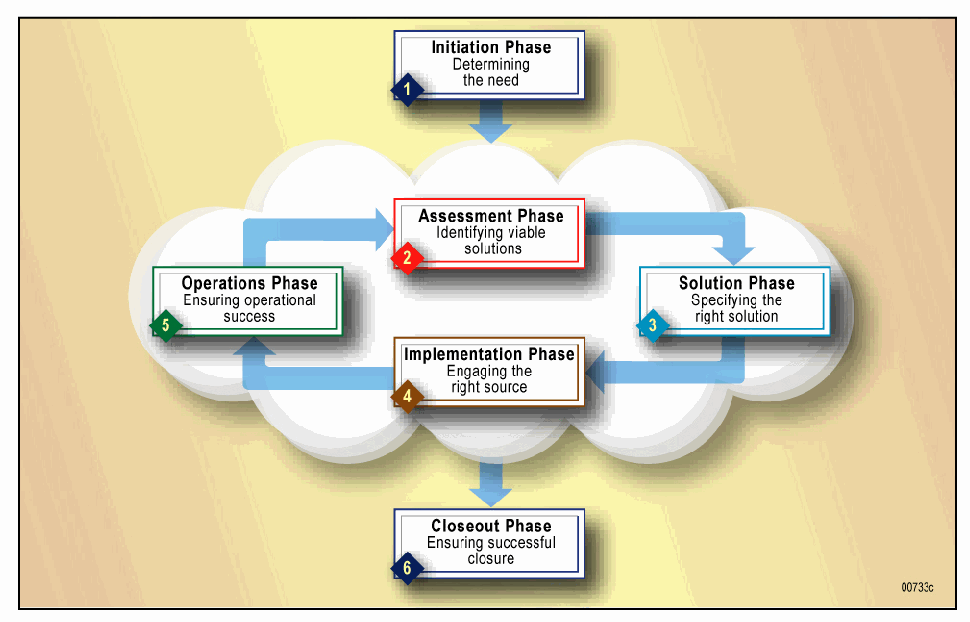
図4-1. ITセキュリティサービスのライフサイクル。番号付きの6つのフェーズの箱があり、それぞれに短い説明が付いている。最上部に1 開始フェーズ(必要性の判断)があり、2 評価フェーズ(実行可能な解決策の特定)、3 解決策フェーズ(適切な解決策の指定)、4 実施フェーズ(適切な提供元の確保)、5 運用フェーズ(運用の成功の確保)が雲の上に環状に配置され、最下部に6 終了フェーズ(終了の成功の確保)がある。開始から評価へ下向きの矢印が向かう。環の中では、評価から解決策へ、解決策から実施へ、実施から運用へ、運用から評価へ矢印が向かう。実施から終了へ下向きの矢印が向かう。右下隅にコード00733cが表示されている。
Figure 4-1. IT Security Services Life Cycle
図4-1. ITセキュリティサービスのライフサイクル
The six phases are described as follows:
6つの段階を以下に説明する:
•Phase 1: Initiation—the need to initiate the services life cycle is recognized. Section 4.1 discusses potential triggers for this phase.
•フェーズ1:開始—サービスライフサイクルを開始する必要性が認識されます。この段階を開始させる契機については4.1節で説明します。
•Phase 2: Assessment—before decision makers can implement a service and select a service provider, an accurate portrait of the current environment must be developed. Section 4.2 discusses Phase 2 and the importance of creating and gathering appropriate metrics.
•フェーズ2:評価—意思決定者がサービスを導入してサービス提供者を選定する前に、現在の環境を正確に把握する必要があります。4.2節ではフェーズ2と、適切な指標を作成・収集する重要性について説明します。
•Phase 3: Solution—decision makers choose the appropriate solution from the viable options identified during the assessment phase. Section 4.3 discusses the business cases and implementation plans.
•フェーズ3:ソリューション—意思決定者は、評価段階で特定された実行可能な選択肢から適切なソリューションを選択します。4.3節では、ビジネスケースおよび導入計画について説明します。
•Phase 4: Implementation—the service and service provider are implemented during the implementation phase. Section 4.4 guides decision makers through service agreement development and service implementation.
•フェーズ4:導入—導入段階でサービスおよびサービス提供者を導入します。4.4節では、意思決定者がサービス契約を策定し、サービスを導入する際の指針を示します。
•Phase 5: Operations—the service is operational, the service provider is fully installed, and constant assessment of the service level and performance is made. Section 4.5 discusses the importance of metrics in monitoring service level and performance.
•フェーズ5:運用—サービスが稼働し、サービス提供者の導入が完了し、サービスレベルとパフォーマンスを継続的に評価します。4.5節では、サービスレベルとパフォーマンスの監視における指標の重要性を説明します。
•Phase 6: Closeout—the environment changes, the need for the service diminishes, or performance deficiencies are noted necessitating a replacement or termination of the IT security service. Section 4.6 discusses the closeout and retirement of a service and/or service provider using the exit strategies developed in Phase 3.
•フェーズ6:終了—環境の変化、サービスの必要性の低下、またはパフォーマンス上の欠陥が認められたことにより、ITセキュリティサービスの置換または終了が必要になります。4.6節では、フェーズ3で策定した終了戦略を用いた、サービスおよび/またはサービス提供者の終了と廃止について説明します。
4.1 Phase 1: Initiation
4.1 フェーズ1:開始
Figure 4-2 illustrates Phase 1, Initiation, of the IT security services life cycle. This phase has a single step: an event sufficient to warrant assessing the current environment and identifying viable service solutions. The specific trigger that will meet this definition will vary by organization. The trigger will fall into one of the six issue areas listed in Section 3.4: strategy/mission, budgetary/funding, technical/architectural, organizational, personnel, and policy/process. Table 4-1 shows sample trigger events from each issue area.
図4-2は、ITセキュリティサービスのライフサイクルにおけるフェーズ1「開始」を示します。このフェーズには、現在の環境を評価し、実行可能なサービスソリューションを特定するに足る事象という、1つのステップがあります。この定義に該当する具体的な契機は組織によって異なります。その契機は、3.4節に示す6つの課題領域、すなわち戦略/使命、予算/資金、技術/アーキテクチャ、組織、人員、方針/プロセスのいずれかに該当します。表4-1に各課題領域の契機の例を示します。
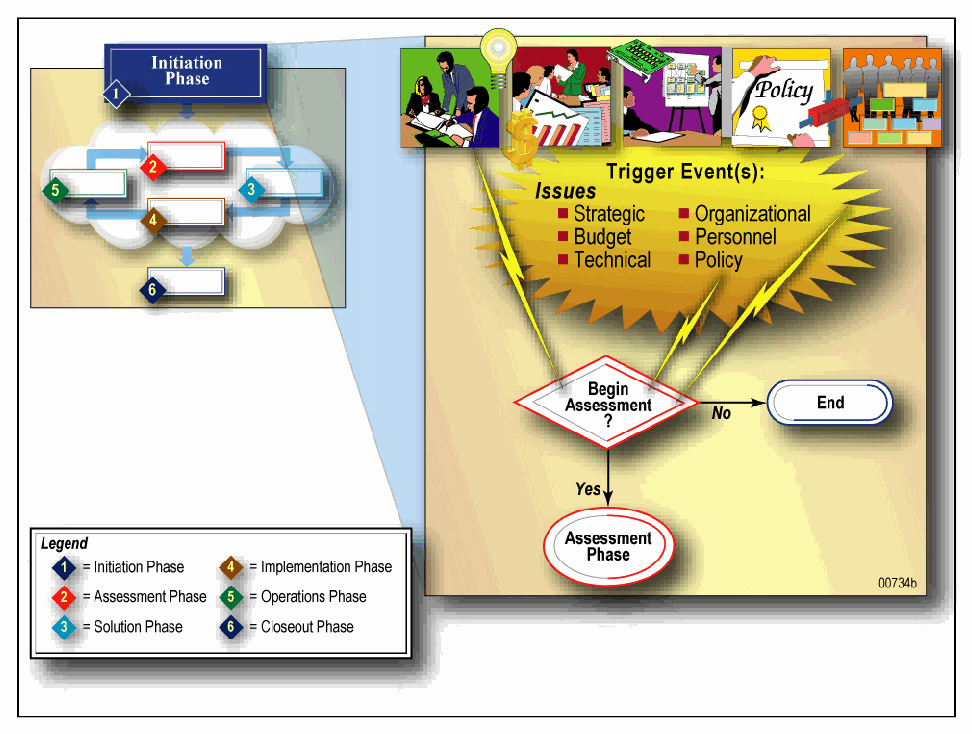
図4-2. 開始フェーズ。左側にライフサイクル図(図4-1)の縮小版があり、フェーズ 1 の開始フェーズが強調されている。網掛けの帯で、右側の詳細なパネルに拡大されている。パネルの上部にはクリップアートのイラストが並ぶ。その下に Trigger Event(s)(契機となる事象)と記された星形があり、Issues(課題)として Strategic(戦略)、Budget(予算)、Technical(技術)、Organizational(組織)、Personnel(人員)、Policy(方針)が挙げられている。星形から稲妻が Begin Assessment?(評価を開始するか)と記された判断のひし形へ向かい、No(いいえ)は End(終了)へ、Yes(はい)は評価フェーズへ向かう。パネルに 00734b という番号が記されている。左下の凡例は、番号付きのひし形が 1 = 開始フェーズ、2 = 評価フェーズ、3 = 解決策フェーズ、4 = 実施フェーズ、5 = 運用フェーズ、6 = 終了フェーズを表すことを示す。
Figure 4-2. Initiation Phase
図4-2. 開始フェーズ
Business, IT, and IT security managers initiate the service life cycle. The decision to obtain a security service should be to obtain the most appropriate security services at the most appropriate level in the most appropriate service arrangement so as to support the business function. The next phase of the life cycle, Assessment, is where it is determined whether the most appropriate service is one performed internally or externally.
事業、IT、およびITセキュリティの管理者がサービスライフサイクルを開始します。セキュリティサービスを取得するという決定は、事業機能を支援するために、最も適切なセキュリティサービスを、最も適切なレベルで、最も適切なサービス提供形態によって取得するものであるべきです。ライフサイクルの次の段階である評価では、最も適切なサービスが内部で実施されるものか、外部で実施されるものかを判断します。
As one IT security services life cycle is initiated, it is likely another life cycle will be ending. To ensure a smooth transition, managers should be aware of possible interactions and effects between the service that is ending and the one that is beginning.
1つのITセキュリティサービスのライフサイクルが始まると同時に、別のライフサイクルが終了に向かっている可能性が高いです。円滑な移行を確保するため、管理者は、終了するサービスと開始するサービスとの間に生じ得る相互作用や影響を認識しておくべきです。
TABLE 4-1. IT SECURITY ISSUES AND SAMPLE LIFE CYCLE TRIGGERS
表4-1. ITセキュリティの課題とライフサイクル開始契機の例
| Strategic/Mission | • Change in business model • Investigating new service arrangements to better focus on the organization’s mission and business function |
|---|---|
| Budgetary/Funding | • Increased IT security budget, allowing greater security services • Decreased IT security budget warrants an investigation into ways to cut costs. |
| Technical/ Architectural | • New technology needs implemented • Upgrades to new technology |
| Organizational | • Current organizational environment and employee mix (if already using external service providers) not working well • Organization changing service arrangement approach |
| Personnel | • Several functional experts leave the organization, creating a shortage of technical expertise in a security service area |
| Policy/Process | • Current policies or processes not meeting organization’s security needs |
| 戦略/使命 | • 事業モデルの変更 • 組織の使命および事業機能により重点を置くため、新たなサービス提供形態を検討する |
|---|---|
| 予算/資金 | • ITセキュリティ予算の増額により、より高度なセキュリティサービスが可能になる • ITセキュリティ予算の減額により、コスト削減方法の検討が必要になる |
| 技術/アーキテクチャ | • 新技術の導入が必要になる • 新技術へのアップグレード |
| 組織 | • 現在の組織環境と従業員構成(すでに外部サービス提供者を利用している場合)が適切に機能していない • 組織がサービス提供形態の方針を変更する |
| 人員 | • 複数の機能専門家が組織を離れ、セキュリティサービス分野の技術的専門知識が不足する |
| 方針/プロセス | • 現行の方針またはプロセスが組織のセキュリティニーズを満たしていない |
4.2 Phase 2: Assessment
4.2 フェーズ2:評価
Phase 2, Assessment, shown in Figure 4-3, follows the Initiation Phase. The steps in this phase include baselining the existing environment, analyzing opportunities and barriers, and identifying options and risks. To establish a baseline understanding of the existing environment, the decision makers will need to use metrics and the principle of total cost of ownership (TCO) to ensure the most accurate data will be used for decision-making purposes. This data will also set performance targets and cost estimates for service agreements in later phases.
図4-3に示すフェーズ2「評価」は、開始フェーズに続きます。このフェーズには、既存環境のベースラインを確立し、機会と障壁を分析し、選択肢とリスクを特定するステップが含まれます。既存環境のベースラインを理解するには、最も正確なデータを意思決定に使用できるよう、意思決定者は指標および総保有コスト(TCO)の原則を用いる必要があります。このデータは、後続フェーズでサービス契約を作成する際のパフォーマンス目標およびコスト見積もりにもなります。
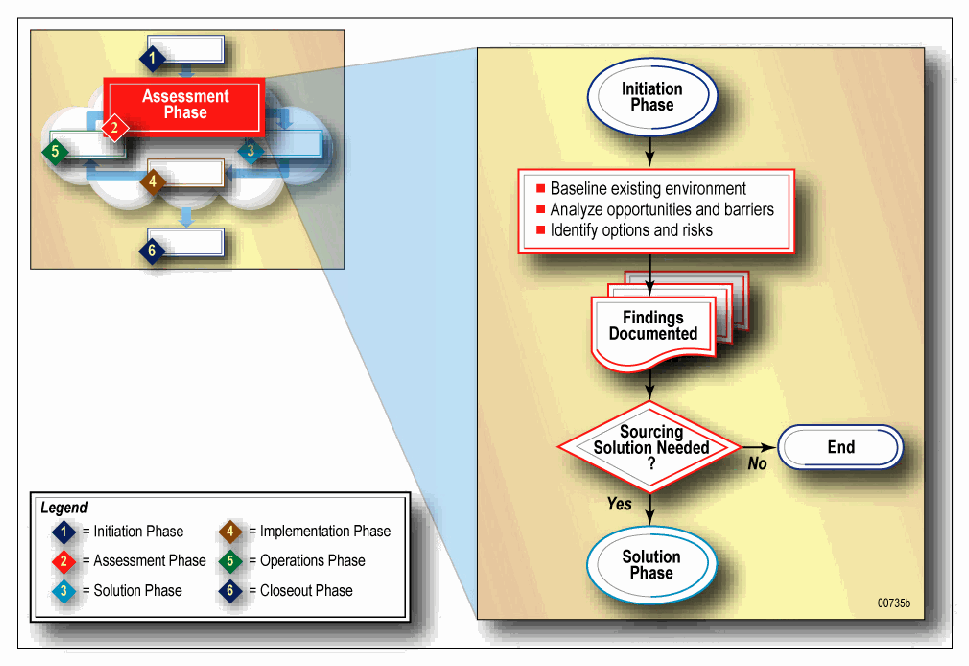
図4-3. 評価フェーズ。左側にライフサイクル図(図4-1)の縮小版があり、フェーズ 2 の評価フェーズが強調されている。網掛けの帯で、右側の詳細なパネルに拡大されている。パネルは流れ図である。開始フェーズから「既存環境のベースラインを把握する」「機会と障壁を分析する」「選択肢とリスクを特定する」を挙げた箱へ進み、Findings Documented(文書化された調査結果)と記された文書の束を経て、Sourcing Solution Needed?(調達による解決策が必要か)と記された判断のひし形に至る。No(いいえ)は End(終了)へ、Yes(はい)は解決策フェーズへ向かう。パネルに 00735b という番号が記されている。左下の凡例は、番号付きのひし形が 1 = 開始フェーズ、2 = 評価フェーズ、3 = 解決策フェーズ、4 = 実施フェーズ、5 = 運用フェーズ、6 = 終了フェーズを表すことを示す。
Figure 4-3. Assessment Phase
図4-3. 評価フェーズ
Bearing in mind the metrics and full cost of a service, the decision makers begin to consider opportunities and barriers. The IT security service issues mentioned in Section 3.4 provide a framework for analyzing opportunities and barriers, as well as external factors, such as the marketplace and the customers. Finally, the existing environment and the opportunities and barriers will provide managers with options and risks. From these options, managers will choose a solution in Phase 3.
指標とサービスの総コストを念頭に置き、意思決定者は機会と障壁を検討し始めます。3.4節で述べたITセキュリティサービスの課題は、機会や障壁に加え、市場や顧客などの外部要因を分析する枠組みとなります。最終的に、既存環境ならびに機会と障壁から、管理者は選択肢とリスクを把握します。管理者は、これらの選択肢からフェーズ3でソリューションを選択します。
4.2.1 Baseline Existing Environment
4.2.1 既存環境のベースライン確立
Once managers have initiated the IT security services life cycle, they must establish a baseline understanding of the current environment. This baseline will demonstrate to managers how well the current arrangement meets the security requirement and at what cost. Managers will need these two measurements to compare the benefits of various service arrangements or the proposals of various service providers.
管理者はITセキュリティサービスのライフサイクルを開始した後、現在の環境についてベースラインとなる理解を確立しなければなりません。このベースラインにより、現在の提供形態がセキュリティ要件をどの程度、どのコストで満たしているかが明らかになります。管理者は、この2つの測定値を用いて、さまざまなサービス提供形態の利点や複数のサービス提供者の提案を比較する必要があります。
The scope of this effort will depend on the nature of the security control or the specific mix of controls. All related areas of the control or the mix of controls should be included; for example, if an organization is evaluating its firewall services, it should evaluate its firewall policies and other policies, the effectiveness of the firewall architecture, and other issues specific to the study.
この取り組みの範囲は、セキュリティ管理策の性質、または特定の管理策の組み合わせによって異なります。管理策または管理策の組み合わせに関連するすべての領域を含めるべきです。たとえば、組織がファイアウォールサービスを評価する場合、ファイアウォール方針やその他の方針、ファイアウォールアーキテクチャの有効性、および調査固有のその他の課題を評価するべきです。
Data for constructing the baselines should be collected in an objective, impartial, and comprehensive manner. Stakeholders in the current environment will often be required to provide data or assist with gathering data by which the service levels and sourcing solutions will be selected. As current stakeholders, they have an interest in the status quo, and their data-gathering techniques or reporting methods may reflect this intentionally or unintentionally. Formal tools such as metrics and TCO will help minimize any inadvertent biases in the data collection efforts. Additionally, a review of existing past metrics and data will be helpful in removing any bias when baselining the current environment.
ベースライン作成用のデータは、客観的、公平かつ包括的な方法で収集すべきです。現在の環境の利害関係者は、サービスレベルおよび調達ソリューションの選定に用いるデータを提供するか、その収集を支援するよう求められることが多くあります。現在の利害関係者である以上、彼らは現状に利害を有しており、そのデータ収集手法や報告方法には、意図的であるか否かを問わず、それが反映されることがあります。指標やTCOなどの正式なツールは、データ収集作業における意図しない偏りを最小限に抑えるのに役立ちます。さらに、既存の過去の指標やデータを見直すことは、現在の環境のベースラインを定める際に偏りを取り除く助けとなります。
4.2.1.1 Metrics Creation, Gathering, and Analysis
4.2.1.1 指標の作成、収集、および分析
Metrics provide decision makers with objective, quantifiable data. The importance of metrics starts in this phase and continues throughout the life cycle.
指標は、意思決定者に客観的で定量可能なデータを提供します。指標の重要性はこのフェーズから始まり、ライフサイクル全体を通じて継続します。
Metrics creation starts with defining the “what” to measure: the metrics should map to the organization’s overall functional and security goals and relate to the desired outcomes that the service will provide. Metrics for any service should include data related to the following:
指標の作成は、測定対象である「何を」を定義することから始まります。指標は、組織全体の機能目標およびセキュリティ目標に対応し、サービスがもたらす望ましい成果に関連付けるべきです。あらゆるサービスの指標には、次に関するデータを含めるべきである:
•Implementation Level—implementation-level metrics quantify the degree of completion of required and agreed-on activities and within agreed-on timeframes.
•導入レベル—導入レベルの指標は、必要と合意された活動が合意済みの期間内にどの程度完了したかを定量化します。
•Service Level—these metrics quantify the timeliness of service delivery (i.e., average time to restore operations or number of hours to reconfigure a firewall).
•サービスレベル—これらの指標は、サービス提供の適時性を定量化します(例:運用復旧までの平均時間、またはファイアウォール再設定に要する時間数)。
•Effectiveness—effectiveness metrics are outcome factors that describe how well the services were delivered and their efficacy (i.e., customer service ratings, security intrusion and blockage levels, and the number of systems affected by computer viruses).
•有効性—有効性の指標は、サービス提供の良否および有効性を表す成果要因です(例:顧客サービス評価、セキュリティ侵入および阻止のレベル、コンピューターウイルスの影響を受けたシステム数)。
•Business Impact—business impact metrics quantify the effect on business parameters such as financial and operational resources (i.e., dollars lost from virus attacks, work time lost from server outages).
•事業への影響—事業への影響を示す指標は、財務資源や運用資源などの事業パラメーターへの影響を定量化します(例:ウイルス攻撃による損失額、サーバー停止による作業時間の損失)。
Additional considerations for the development of metrics include:
指標を策定する際には、次の点も考慮する:
•Consider only those metrics that are practical to collect
•収集が現実的な指標だけを検討する
•Base metrics only on obtainable and quantifiable events
•取得可能で定量化できる事象だけを指標の基礎とする
•Consider all IT security service aspects from technical functionality to problem resolution procedures to appropriateness of personnel
•技術的な機能から問題解決手順、人員の適切性まで、ITセキュリティサービスのあらゆる側面を考慮する
•Base metrics on business operation objectives
•事業運営の目標を指標の基礎とする
•Provide sufficient insight into assessing the level of IT security services provided/offered and allow for a relevant comparison between service options
•提供/提案されるITセキュリティサービスの水準を評価するのに十分な洞察を得られ、サービス選択肢を適切に比較できる指標とする
•Gather metrics to assess the causes, not only results
•結果だけでなく、その原因を評価する指標を収集する
•Gather metrics to track trends.
•傾向を追跡する指標を収集します。
NIST SP 800-55, Security Metrics Guide for Information Technology Systems, provides more detail about the characteristics of useful metrics, as well as the importance of having a mature (or maturing) metrics program. The importance of a repeatable, consistent metrics approach to IT security will become apparent in the IT security services life cycle as the organization sets targets, writes service agreements, and monitors service provider performance in Phases 3, 4 and 5, respectively.
NIST SP 800-55『Security Metrics Guide for Information Technology Systems(情報技術システムのセキュリティ指標ガイド)』には、有用な指標の特性や、成熟した(または成熟しつつある)指標プログラムの重要性について、より詳しい説明があります。組織がフェーズ3、4、5でそれぞれ目標を設定し、サービス契約を作成し、サービス提供者のパフォーマンスを監視するにつれて、ITセキュリティに対する再現可能で一貫した指標のアプローチが重要であることが明らかになります。
4.2.1.2 Total Cost of Ownership
4.2.1.2 総保有コスト
In conjunction with a metrics program, the IT security services decision makers need to identify the full cost of the service. Metrics may be a part of this effort because they can help determine the dollar cost of various actions (e.g., cost of downtime, costs of a virus attack). The principle of full cost is often referred to as TCO. TCO includes not only implementation and operational costs but also related costs (e.g., overhead, salaries, benefits, technology upgrades, and software support, and maintenance). This information will allow decision makers to compare the costs of other service arrangements with the existing environment during the business case development in the solution phase. When the full cost is identified, the decision makers will be able to accurately relate the value of one service option over another.
指標プログラムと併せて、ITセキュリティサービスの意思決定者はサービスの全コストを特定する必要があります。指標は、さまざまな活動の金額ベースのコスト(例:停止時間のコスト、ウイルス攻撃のコスト)の算出に役立つため、この取り組みの一部となる場合があります。全コストの原則は、総保有コスト(TCO)と呼ばれることが多くあります。TCOには導入コストおよび運用コストだけでなく、間接費、給与、福利厚生、技術のアップグレード、ソフトウェアのサポートおよび保守などの関連コストも含まれます。この情報により、意思決定者はソリューションフェーズでビジネスケースを作成する際に、既存環境と他のサービス提供形態のコストを比較できます。全コストを特定すれば、意思決定者は各サービス選択肢の価値を正確に比較できます。
4.2.2 Analyze Opportunities and Barriers
4.2.2 機会と障壁の分析
Once the organization understands the current environment from a performance and cost perspective, it can begin to analyze opportunities and barriers. Analyzing opportunities and barriers allows the organization to identify functions and areas that can change, those that cannot, and reasons for each. IT security stakeholders should participate in the process and approve analysis results. Properly performed, an analysis should include the following:
組織は、パフォーマンスとコストの観点から現在の環境を理解した後、機会と障壁の分析を開始できます。この分析により、変更できる機能や領域、変更できない機能や領域、およびその理由を特定できます。ITセキュリティの利害関係者はこのプロセスに参加し、分析結果を承認するべきです。適切に実施する場合、分析には以下を含めるべきである:
•Strategic/Mission — Identify how critical the service/function is to the business.
•戦略/ミッション—そのサービス/機能が業務にとってどれほど重要かを明らかにします。
•Budgetary/Funding — Articulate a rational, executable fiscal program, in accordance with all applicable regulations and legislation to secure approval and funding by budget authorities
•予算/資金—予算当局の承認と資金を得るため、適用されるすべての規則および法令に従った、合理的で実行可能な財政計画を明確に示します。
•Technical/Architectural — Determine and understand the importance of maintaining an organization’s technical competencies
•技術/アーキテクチャ—組織の技術的能力を維持することの重要性を判断し、理解します。
•Organizational — Determine which service arrangements would be appropriate for the organization’s work environment and values.
•組織—どのサービス提供形態が組織の職場環境と価値観に適しているかを判断します。
•Allow management to incorporate intangible benefits to all stakeholders (e.g., improved employee morale, organizational image) into the business case that will be developed.
•管理者が、策定するビジネスケースに、すべての利害関係者にとっての無形の便益(例:従業員の士気の向上、組織イメージの向上)を組み込めるようにします。
•Personnel — Allow all stakeholders to develop and translate overarching performance goals and specific needs into specific service level requirements, such as Request for Proposal (RFP)/SOW/Service Level Agreement (SLA) requirements.
•要員—すべての利害関係者が、全体的な性能目標と個別のニーズを、提案依頼書(RFP)/SOW/サービスレベル合意(SLA)の要件など、具体的なサービスレベル要件に展開し、落とし込めるようにします。
•Policy/Process — Begin to address integration/transition efforts for the desired future service arrangement strategy.
•方針/プロセス—望ましい将来のサービス提供形態戦略に向けた、統合/移行の取り組みへの対処を開始します。
4.2.3 Identify Options and Risks
4.2.3 選択肢とリスクの特定
In this last step of the assessment phase, decision makers should begin to identify options and risks. The baseline showed the current environment, and the opportunities and barriers step began to describe the desired target. In this step, the “how-to” becomes clearer.
評価フェーズの最後となるこのステップで、意思決定者は選択肢とリスクの特定を始めるべきです。ベースライン調査では現在の環境を明らかにし、機会と障壁の検討では望ましい目標を描き始めました。このステップでは、その実現方法がより明確になります。
The “how-to” step will determine the service arrangement. As discussed in Chapter 3, organizations may fulfill a security service requirement using various security service arrangements—from using only internal teams and staff to fully outsourcing for the security service. At this life-cycle phase, many organizations will still need to consider many options and various service arrangements. For each of these, the organization needs to identify the benefits and risks.
実現方法を検討するこのステップで、サービス提供形態を決定します。第3章で述べたように、組織は、内部のチームおよび職員のみで提供する形から、セキュリティサービスを全面的に外部委託する形まで、さまざまなサービス提供形態を用いてセキュリティサービス要件を満たすことができます。このライフサイクル段階では、多くの組織が今なお複数の選択肢とサービス提供形態を検討する必要があります。それぞれについて、組織は便益とリスクを特定する必要があります。
Finally, the evidence may suggest the current arrangement and service level are effective and/or appropriate. It is most important to focus on business function, customers, and effective security. The choices made should best support these three focus points. Improving business and IT processes will likely be more effective and less risky than changing the service arrangement; organizations should not seek to change the current environment unless the assessment identifies improvement areas that can be met only by implementing a change in service, service arrangement, or service provider.
最後に、現在の提供形態とサービスレベルが有効または適切であることを、証拠が示す場合もあります。事業機能、顧客、有効なセキュリティに重点を置くことが最も重要です。選択する内容は、この3つの重点事項を最もよく支えるべきです。事業プロセスとITプロセスの改善は、サービス提供形態を変更するより効果的でリスクも低い可能性が高いです。評価によって、サービス、サービス提供形態、またはサービス提供者を変更する場合にのみ実現できる改善点が特定されない限り、組織は現在の環境を変更すべきではありません。
4.3 Phase 3: Solution
4.3 フェーズ3:解決策
Figure 4-4 illustrates Phase 3, Solution, of the IT security services life cycle.
図4-4に、ITセキュリティサービスのライフサイクルにおけるフェーズ3「解決策」を示します。
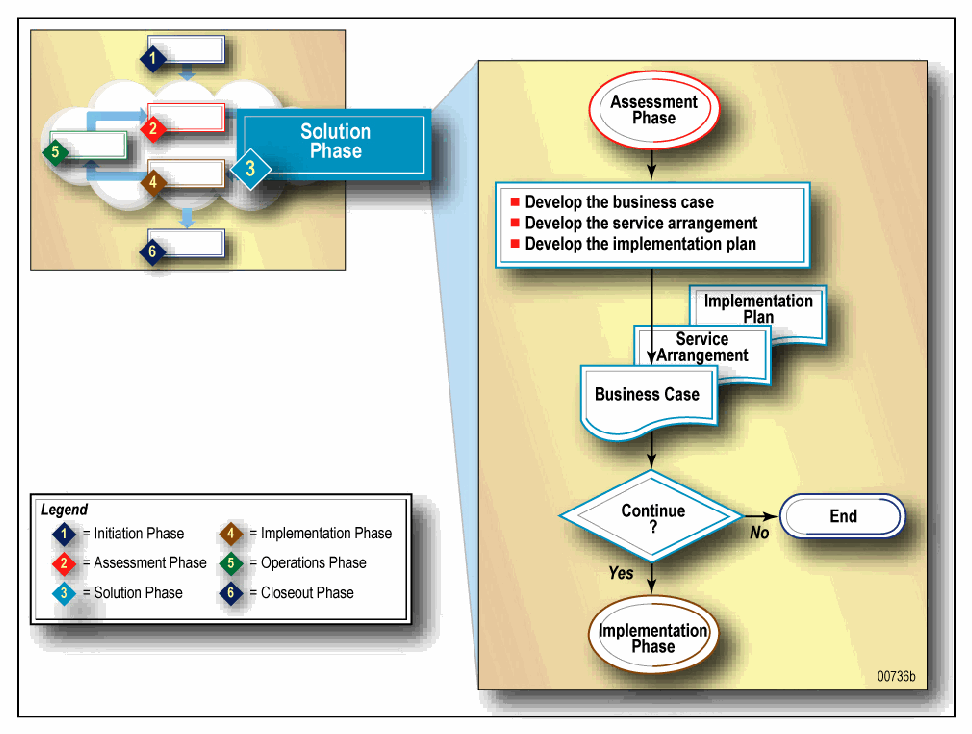
図4-4 解決策フェーズ。左側にライフサイクル図(図4-1)の縮小版があり、フェーズ 3 の解決策フェーズが強調されている。網掛けの帯で、右側の詳細なパネルに拡大されている。パネルは流れ図である。評価フェーズから「ビジネスケースを作成する」「サービス形態を策定する」「実施計画を作成する」を挙げた箱へ進み、Business Case(ビジネスケース)、Service Arrangement(サービス形態)、Implementation Plan(実施計画)と記された文書の束を経て、Continue?(続行するか)と記された判断のひし形に至る。No(いいえ)は End(終了)へ、Yes(はい)は実施フェーズへ向かう。パネルに 00736b という番号が記されている。左下の凡例は、番号付きのひし形が 1 = 開始フェーズ、2 = 評価フェーズ、3 = 解決策フェーズ、4 = 実施フェーズ、5 = 運用フェーズ、6 = 終了フェーズを表すことを示す。
Figure 4-4. Solution Phase
図4-4 解決策フェーズ
Choosing a service arrangement and service level solution is only one part of this phase. Before specifying the solution, decision makers will need to develop a detailed business case for each possibility to be considered.
サービス提供形態およびサービスレベルの解決策を選ぶことは、このフェーズの一部にすぎません。解決策を具体化する前に、意思決定者は検討対象となる各案について詳細なビジネスケースを作成する必要があります。
The business case will provide managers with the cost, benefit, and organizational risk perspective of each alternative. Comparing the costs, benefits and organizational risks will allow managers to identify a preferred solution. The implementation plan will provide managers with the means for identifying the service provider and implementing the service.
ビジネスケースは、各代替案のコスト、便益、および組織リスクの観点を管理者に提示します。コスト、便益、および組織リスクを比較すれば、管理者は優先する解決策を特定できます。実施計画は、サービス提供者の特定とサービス実施の手段を管理者に示します。
4.3.1 Develop the Business Case
4.3.1 ビジネスケースの作成
During the assessment phase, the decision makers identified the current environment. To identify the preferred desired future state in this solution phase, a business case needs to be developed. The business case should provide the information necessary to identify the best solution among the alternatives. Each organization will likely have a unique methodology for developing a business case, however there are five components common to most business cases:
評価フェーズで、意思決定者は現在の環境を特定しました。この解決策フェーズで望ましい将来の状態を定めるには、ビジネスケースを作成する必要があります。ビジネスケースには、代替案の中から最適な解決策を特定するために必要な情報を含めるべきです。各組織には独自のビジネスケース作成方法があると考えられますが、ほとんどのビジネスケースには共通する5つの要素があります。
•Alternative Analysis2—the organization should look at all of the available options. The organization will finalize the options deemed viable enough to develop formal cost estimates, benefits analysis, and organizational risk analysis.
•▪ 代替案分析2―組織は、利用可能なすべての選択肢を検討するべきです。組織は、正式なコスト見積もり、便益分析、および組織リスク分析を行う価値があると判断した選択肢を絞り込みます。
•Cost Estimate—the organization needs to develop TCO estimates for each alternative. Estimates of each alternative and the current environment must be consistent, have similar cost elements, and be based on the same assumptions.
•コスト見積もり—組織は、各代替案の総保有コスト(TCO)を見積もる必要があります。各代替案と現在の環境の見積もりは、一貫性を保ち、同様のコスト要素を含み、同じ前提に基づく必要があります。
•Benefits Analysis—the organization needs to formally identify the benefits of each alternative. These should be quantitative (i.e., cost savings, cost avoidance etc.), whenever possible. For example, if the organization estimates a new service implementation will lower security incident rates by 50% and each incident costs x dollars (based on metrics gathered during the assessment phase), the organization can identify the likely cost avoidance. It will also be important to look at qualitative benefits such as impact to mission, customers, etc.
•便益分析—組織は、各代替案の便益を正式に特定する必要があります。可能な限り、便益は定量化するべきです(例:コスト削減、コスト回避など)。たとえば、評価フェーズで収集した指標に基づき、新サービスの導入によってセキュリティインシデントの発生率が50%低下し、各インシデントにxドルの費用がかかると組織が見積もる場合、見込まれるコスト回避額を特定できます。また、ミッションや顧客などへの影響といった定性的な便益も検討することが重要です。
•Project Risk Analysis—along with the benefits of each alternative, project risks must be identified. OMB has identified eight standard risk categories3: organizational and change management risk, business risk, data/information risk, technology risk, strategic risk, security risk, privacy risk, project resources risk. These risks might include cost overruns, schedule slippage, vendor uncertainties, privacy concerns, etc. The analysis of risks should evaluate all alternatives against the same risk factors and determine the probability of occurrence and the impact if it occurred. Then, the organization should determine the risk-adjusted cost of each alternative.
•▪ プロジェクトリスク分析―各代替案の便益とともに、プロジェクトのリスクを特定すべきです。OMBは標準リスク分類を8つ定めている3:組織・変更管理リスク、事業リスク、データ/情報リスク、技術リスク、戦略リスク、セキュリティリスク、プライバシーリスク、プロジェクト資源リスク。これらのリスクには、コスト超過、スケジュールの遅延、ベンダーに関する不確実性、プライバシー上の懸念などが含まれる場合があります。リスク分析では、すべての代替案を同じリスク要因に照らして評価し、発生確率と発生時の影響を判断すべきです。そのうえで、組織は各代替案のリスク調整後コストを算定すべきです。
•Evaluation of Alternatives—finally, the organization should rank each alternative based on cost, benefit and risk. From this analysis, the organization should be able to identify the preferred alternative.
•代替案の評価—最後に、組織はコスト、便益、リスクに基づいて各代替案を順位付けするべきです。この分析から、優先する代替案を特定できます。
4.3.2 Develop the Service Arrangement
4.3.2 サービス提供形態の策定
Developing the service arrangement could be a relatively short step as the hard work of data collection, analysis, and comparison of options has already been completed. Although the business case may not make the decision-making easy or obvious, it should provide the necessary data for decision makers to weigh, consider, and select the service arrangement that best suits the organization’s needs. There will likely be some discussion and disagreement among the decision makers, but ultimately the selection must be a consensus. A service arrangement can succeed only if all business and IT security managers sufficiently buy-in to the implementing solution.
データの収集、分析、選択肢の比較という作業はすでに完了しているため、サービス提供形態の策定は比較的短いステップになり得ます。ビジネスケースだけでは意思決定が容易または明白にならない場合でも、組織のニーズに最も適したサービス提供形態を意思決定者が評価、検討、選択するために必要なデータを提示するべきです。意思決定者間で議論や意見の相違が生じる可能性は高いですが、最終的な選定は合意に基づかなければなりません。すべての事業部門およびITセキュリティ管理者が、実施する解決策を十分に受け入れなければ、サービス提供形態は成功しません。
4.3.3 Develop the Implementation Plan
4.3.3 実施計画の作成
At this time, the parties should determine the budget and scope of the service arrangement and begin to develop the implementation plan. The implementation plan provides a roadmap for the organization on moving from the current environment to the desired future environment. The implementation plan should address the following:
この時点で関係者は、サービス提供形態の予算と範囲を決定し、実施計画の作成を始めるべきです。実施計画は、現在の環境から望ましい将来の環境に移行するためのロードマップとなります。実施計画では、次の事項に対応するべきです。
•Project Management Roles and Responsibilities—the implementation plan should identify the roles and responsibilities of individuals with project management roles and responsibilities for both the implementation and operations phases.
•プロジェクト管理の役割と責任—実施計画では、実施段階と運用段階の両方について、プロジェクト管理を担う担当者の役割と責任を明確にするべきです。
•Budget and Scope—IT security managers should identify the budgets and scope of the service arrangement. This effort will be important for identifying, soliciting, and assessing service providers in the next phase.
•予算と範囲—ITセキュリティ管理者は、サービス提供形態の予算と範囲を特定するべきです。この作業は、次のフェーズでサービス提供者を特定し、提案を求め、評価するために重要となります。
•Implementation Process—the program managers should begin to articulate their vision for implementing the IT security service. For example, if the program managers want to start with a test group or pilot program and/or establish a transition period for the service, the process for accomplishing this effort should be detailed here.
•実施プロセス—プログラム管理者は、ITセキュリティサービスの実施方針を具体化し始めるべきです。たとえば、試験グループまたはパイロットプログラムから開始する場合や、サービスの移行期間を設ける場合は、それを実現するプロセスをここで詳述するべきです。
•Risk Mitigation Plans—IT security program managers should specify their plans for mitigating each risk identified throughout the assessment and solution phases.
•リスク軽減計画—ITセキュリティプログラム管理者は、評価フェーズおよび解決策フェーズを通じて特定した各リスクを軽減する計画を明示するべきです。
•Exit Strategies—exit strategies will need to be developed to ensure the organization exits a service arrangement without disrupting other operations within the organization. The exit strategy should provide action plans for normal, planned exits, such as service agreement expiration; unexpected terminations, such as service provider bankruptcy; and potentially tension-filled exits, such as poor service provider performance.
•終了戦略—組織内の他の運用を妨げずにサービス提供形態を終了できるよう、終了戦略を策定する必要があります。終了戦略には、サービス契約の満了のような通常の計画済み終了、サービス提供者の倒産のような予期しない終了、サービス提供者のパフォーマンス不良のような緊張を伴い得る終了について、行動計画を含めるべきです。
•Transition Management—transition management plans should document the organization’s efforts to manage the transition from the current to the desired future environment. Managers should develop plans for addressing displaced employees, handling resistance to change, shifting the organizational focus, and communicating clearly with employees about the changes. In both the transition from one service arrangement to another, there will be transition costs, perhaps significant costs. These costs should be figured into the life-cycle costs and alternatives analysis. These costs should be considered when transition plans are developed.
•移行管理—移行管理計画には、現在の環境から望ましい将来の環境への移行を管理するための組織の取り組みを記載するべきです。管理者は、配置転換となる従業員への対応、変化への抵抗の処理、組織の重点の移行、変更内容の従業員への明確な伝達について計画を策定するべきです。あるサービス提供形態から別の形態に移る際には、相当な額となる場合もある移行コストが発生します。こうしたコストは、ライフサイクルコストおよび代替案分析に算入するべきであり、移行計画の策定時に考慮する必要があります。
4.4 Phase 4: Implementation
4.4 フェーズ4:実施
Selecting the service arrangement and service provider may actually be the easy part of the IT security life cycle. Creating metrics and gathering data may require considerable work, especially if a metrics program is not already in place. Although the multitude of service arrangements may seem overwhelming, the objective data and methodical analysis will likely make clear the best path. Implementing those decisions requires preparation and care. Managers should develop explicit service agreements and ensure careful execution of the implementation plan. Careful planning and execution will increase the chance of success, but as the service moves to the operations phase, the leadership should manage expectations. No service arrangement will fix a problem overnight and no service provider can be expected to debut perfectly. Figure 4-5 illustrates Phase 4, Implementation, of the IT security services life cycle.
サービス提供形態とサービス提供者の選定は、ITセキュリティのライフサイクルの中では比較的容易な部分かもしれません。指標プログラムがまだ整備されていない場合などは、指標の作成とデータ収集にかなりの作業が必要となり得ます。多数のサービス提供形態に圧倒されるように感じても、客観的なデータと体系的な分析によって最適な道筋が明らかになる可能性が高いです。決定事項を実施するには、準備と慎重な対応が必要です。管理者は、明確なサービス契約を作成し、実施計画を慎重に遂行するべきです。綿密な計画と実行によって成功の可能性は高まりますが、サービスが運用フェーズに移行する際には、リーダーシップが期待を適切に管理するべきです。どのサービス提供形態も一夜にして問題を解決するものではなく、サービス提供者が初日から完全な働きをするとは期待できません。図4-5に、ITセキュリティサービスのライフサイクルにおけるフェーズ4「実施」を示します。
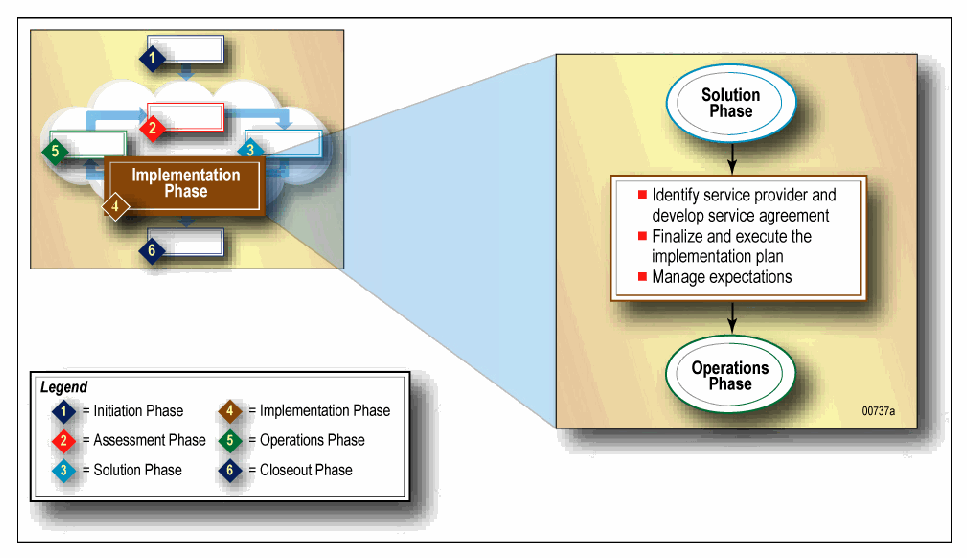
図4-5 実施フェーズ。左側にライフサイクル図(図4-1)の縮小版があり、フェーズ 4 の実施フェーズが強調されている。網掛けの帯で、右側の詳細なパネルに拡大されている。パネルは流れ図である。解決策フェーズから「サービス提供者を特定し、サービス合意を策定する」「実施計画を確定し、実行する」「期待を管理する」を挙げた箱へ進み、運用フェーズに至る。パネルに 00737a という番号が記されている。左下の凡例は、番号付きのひし形が 1 = 開始フェーズ、2 = 評価フェーズ、3 = 解決策フェーズ、4 = 実施フェーズ、5 = 運用フェーズ、6 = 終了フェーズを表すことを示す。
Figure 4-5. Implementation Phase
図4-5 実施フェーズ
4.4.1 Identify Service Provider and Develop Service Agreement
4.4.1 サービス提供者の特定とサービス契約の策定
During the solution phase, the security decision makers select the service arrangement. In this phase, they need to identify the service provider. How they do this will vary by organization, service arrangement, and type of service agreement. Internal service arrangements may already have the service provider identified. For hybrid and external service arrangements, organizations may wish to identify several potential service providers and elicit proposals. Large government organizations may release an RFP and accept formal proposals for external service arrangements. Regardless of what specific agreement methods an organization chooses to use, some basic steps apply to most situations:
解決策フェーズでは、セキュリティの意思決定者がサービス提供形態を選択します。このフェーズでは、サービス提供者を特定する必要があります。その方法は、組織、サービス提供形態、サービス合意の種類によって異なります。内部のサービス提供形態では、サービス提供者がすでに特定されている場合があります。ハイブリッドおよび外部のサービス提供形態では、組織は複数のサービス提供者候補を特定し、提案書の提出を求めることがあります。大規模な政府組織は、外部のサービス提供形態についてRFPを公表し、正式な提案を受け付けることがあります。組織がどのような合意方法を用いるにしても、ほとんどの状況に当てはまる基本的な手順がいくつかあります。
Performance-based acquisition has emerged as a preferred method for engaging external service provider for many arrangements. Performance-based acquisition provides greater flexibility to service providers in suggesting an appropriate solution. Rather than requiring that a service provider to answer an RFP that specifies job positions, employee requirements, and methodologies, the organization asks the service provider to provide a cost-efficient method. The metrics identified in early phases, for example, could be turned into a statement of objectives to which the competing service providers answer with their own SOW and the cost of meeting the objectives. This is in contrast to more traditional acquisition methods where the organization would write a SOW, and the service provider would respond by indicating how much it would cost to perform that work. By placing more responsibility on the service provider, the organization is able to assess a much broader and deeper set of solutions, increasing the likelihood of finding a suitable service provider.
多くのサービス提供形態において、外部サービス提供者を起用する方法として性能ベース調達が好まれるようになってきました。性能ベース調達では、サービス提供者が適切な解決策を提案する際の柔軟性が高まります。職位、従業員の要件、方法論を指定するRFPにサービス提供者が回答するよう求めるのではなく、組織はサービス提供者に費用対効果の高い方法を提示するよう求めます。たとえば、初期の段階で特定した評価指標を目的記述書に盛り込み、競合するサービス提供者は、自社のSOWと目的を達成するための費用を提示して回答できます。これは、組織がSOWを作成し、サービス提供者がその作業の実施費用を示して回答する、より従来的な調達方法とは対照的です。サービス提供者により多くの責任を負わせることで、組織ははるかに幅広く詳細な解決策群を評価でき、適切なサービス提供者を見つける可能性が高まります。
•Establish Service Provider Service Level Targets—having identified and captured the relevant data in the baseline phase, and developed the direction of the desired future environment, the IT security managers should determine the performance targets they want the service provider to meet. These service levels will be further negotiated with the service provider and formally documented in the service agreement.
•サービス提供者のサービスレベル目標の設定—ベースラインフェーズで関連データを特定・収集し、望ましい将来環境の方向性を策定したうえで、ITセキュリティ管理者はサービス提供者に達成を求めるパフォーマンス目標を定めるべきです。これらのサービスレベルはサービス提供者とさらに交渉し、サービス契約に正式に記載します。
•Elicit Service Provider Proposals—the organization may identify potential service providers in numerous ways. If the service area has few providers or exists in a new market, the organization may solicit all of the service providers in the field for quotes and their service offering. The organization may also announce an RFP and direct interested parties to provide cost proposals. Regardless of the method, the organization should try to consider as many service providers as possible to encourage competition. The organization may want to ask service providers to answer some of the questions from section 3.5 of this guide.
•サービス提供者の提案の募集—組織は、さまざまな方法でサービス提供者候補を特定できます。該当するサービス分野の提供者が少ない場合や新しい市場である場合は、その分野のすべてのサービス提供者に見積もりとサービス内容を求めてもよいです。関心のある事業者に費用提案の提出を求めるRFPを公示することもできます。方法を問わず、競争を促すため、組織は可能な限り多くのサービス提供者を検討するべきです。本ガイドの3.5節にある質問の一部への回答をサービス提供者に求めてもよいです。
•Assess the Proposals and Service Providers—the organization should evaluate the proposals, cost quotes, and/or management plans of the various service providers, and consider each provider carefully. Although the cost of the proposal may well be a leading factor, managers need to balance cost with value, reputation of the service provider, past performance of the service provider, and ability of the service provider to support the mission of the acquiring organization. The organization also needs to ensure that the methodologies, service levels, and costs are in-line with its expectations and that they are feasible. A proposal that far exceeds the competitors in cost and service level, for example, may warrant further investigation and skepticism.
•提案とサービス提供者の評価—組織は、複数のサービス提供者による提案、見積もり、管理計画を評価し、各提供者を慎重に検討するべきです。提案価格は重要な要素となる場合がありますが、管理者は価格と価値、サービス提供者の評判および過去の実績、調達組織のミッションを支援する能力とのバランスを取る必要があります。また、手法、サービスレベル、コストが組織の期待に沿い、実現可能であることも確認する必要があります。たとえば、コストとサービスレベルの両面で競合他社を大幅に上回る提案は、さらなる調査と懐疑的な見方が妥当となる場合があります。
•Select Service Provider—once the service providers are evaluated, the decision makers should select the service provider that most closely aligns with their needs, goals, and targets.
•サービス提供者の選定—サービス提供者の評価後、意思決定者はニーズ、目標、ターゲットに最も合致するサービス提供者を選ぶべきです。
•Develop the Service Agreement—Further negotiation of price and service level may be necessary; however, once these are set, a service agreement should be developed. Depending on the service arrangement, this process may be more or less formal. Internal service arrangements, for example, may consist of an agreed-on process or reporting requirement or a MOA. External service arrangements should be documented with formal contracts. Regardless of the type of document used as a service agreement, the content of the agreement should be the same for both internal and external service providers.
•サービス契約の策定—価格とサービスレベルについてさらに交渉が必要な場合もありますが、これらが決まった後、サービス契約を作成するべきです。サービス提供形態によって、このプロセスの正式さは異なります。たとえば、内部向けサービス提供形態では、合意済みのプロセスや報告要件、または覚書(MOA)で足りる場合があります。外部向けサービス提供形態は、正式な契約書に記載するべきです。サービス契約としてどの種類の文書を用いる場合でも、内部および外部のサービス提供者に適用する契約内容は同じであるべきです。
Agreements, regardless of type, should specify the following:
種類を問わず、契約には次の事項を規定するべきです。
•Explicit definitions of both the organization’s roles and responsibilities and the service provider’s roles and responsibilities (including level of clearance or background investigation needed for staff)
•組織およびサービス提供者それぞれの役割と責任を明示します(職員に必要な資格レベルまたは身元調査の水準を含みます)。
•Description of the service environment, including locations, facility security requirements, and policies, procedures, and standards; and, agreements and licenses
•場所、施設のセキュリティ要件、方針、手順、標準、契約、ライセンスを含むサービス環境の説明。
•Defined service levels and service level costs. The service level section of the service agreement may stipulate various service levels for different types of customers or price levels and it may stipulate different service levels for various periods of performance, e.g., year 1 may demand a higher service level than year 2 of the contract.
•定められたサービスレベルとサービスレベルの費用。サービス契約のサービスレベル条項には、顧客の種類や価格水準に応じた異なるサービスレベルを定めてもよく、履行期間によって異なるサービスレベルを定めてもよいです(例:契約の2年目より1年目に高いサービスレベルを求めます)。
•Defined process regarding how the managers will assess the service provider’s compliance with the service level and due date targets, rules, and other terms of the agreement
•管理者が、サービス提供者のサービスレベルおよび期限目標、規則、その他の契約条件への適合を評価する方法を定めたプロセス。
•Specific remedies (e.g., financial, legal) for noncompliance or harm caused by the service provider
•サービス提供者の不履行またはサービス提供者が引き起こした損害に対する具体的な救済措置(例:金銭的、法的措置)。
•Period of performance and/or deliverable due dates
•▪ 履行期間および/または成果物の納期。
•Service provider’s interface to organization’s management
•サービス提供者と組織の管理部門との連絡窓口。
•Organization’s responsibilities with respect to making information and resources available to service provider
•サービス提供者が情報および資源を利用できるようにする組織の責任。
•Procedures and protections for commingling organization and service provider data
•組織とサービス提供者のデータを混在させる場合の手順および保護策。
•Explicit rules for handling sensitive data.
•機微データの取扱いに関する明確な規則。
Too often, service arrangements fail because one or more of these were not considered. Organizations should clearly state what they need, and service providers should clearly understand what is expected of them.
これらの事項の1つ以上が考慮されていないために、サービス提供形態が失敗することは少なくありません。組織は必要事項を明確に示し、サービス提供者は期待されている内容を明確に理解するべきです。
4.4.2 Finalize and Execute the Implementation Plan
4.4.2 実施計画の確定と実行
Now that the service provider and service levels have been finalized, the organization can complete the implementation plan and begin to execute the plan. Some details may have changed during the service agreement negotiation, and managers should be aware of how the plan should be changed.
サービス提供者とサービスレベルが確定したため、組織は実施計画を完成させ、実行を開始できます。サービス契約の交渉中に一部の詳細が変更された可能性があるため、管理者はそれに応じて計画をどう変更すべきか把握しておく必要があります。
4.4.3 Manage Expectations
4.4.3 期待値の管理
As the new service, service arrangement, and/or service provider is implemented, all parties should manage expectations. There may be some conflict as each party adapts to the new security and organizational environment and learns to operate within it. Lines of communication lines should be kept open to ensure close monitoring and cooperation between the managers and service providers.
新しいサービス、サービス提供形態、またはサービス提供者を導入する際には、すべての関係者が期待値を管理するべきです。各関係者が新しいセキュリティ環境および組織環境に適応し、その中で業務を行う方法を学ぶ過程で、対立が生じることもあります。管理者とサービス提供者の間で緊密な監視と協力を確保するため、連絡経路を常に開いておくべきです。
A few important guidelines are:
重要な指針をいくつか示します。
•Address problems openly, whether the conflict is internal to the organization or between internal groups and external service providers.
•組織内の対立か、内部グループと外部サービス提供者との間の対立かを問わず、問題に率直に対処します。
•Allow the service provider to perform its job while still ensuring accountability.
•説明責任を確保しながら、サービス提供者が業務を遂行できるようにします。
•Maintain the security services life cycle.
•セキュリティサービスのライフサイクルを維持します。
4.5 Phase 5: Operations
4.5 フェーズ5:運用
The operations phase begins once the service provider and service have been fully implemented. During this phase, the organization, its security, and the security service provider are monitored to ensure the service arrangement best meets the firm’s needs. This assessment will continue until a trigger occurs to initiate closeout of this life cycle and start of a new life cycle. Open communications should be continued, so that the organization and the service provider can address the problems that arise.
サービス提供者とサービスの導入が完了すると、運用フェーズが始まります。このフェーズでは、サービス提供形態が組織のニーズに最もよく応えるよう、組織、そのセキュリティ、およびセキュリティサービス提供者を監視します。この評価は、本ライフサイクルを終了して新たなライフサイクルを開始するきっかけが生じるまで続きます。組織とサービス提供者が発生した問題に対処できるよう、継続的な連絡を保つべきです。
Throughout the operations phase, the organization’s project managers should ensure that the service provider meets its stated service levels and complies with internal security procedures and policies. Often, for example, organizations do not ensure external service providers handle sensitive (whether personal, private, or mission sensitive) material as internal service providers do; if internal service providers needed personnel clearances, it is very likely the external service provider would also need a personnel clearance. Figure 4-6 illustrates Phase 5, Operations, of the IT security services life cycle.
運用フェーズを通じて、組織のプロジェクト管理者は、サービス提供者が明示されたサービスレベルを満たし、内部のセキュリティ手順および方針を順守することを確実にするべきです。たとえば、外部サービス提供者に対し、個人情報、私的情報、またはミッション上機微な情報を、内部サービス提供者と同じ方法で扱うよう徹底していない組織が多くあります。内部サービス提供者に要員のセキュリティ資格が必要であれば、外部サービス提供者にも同じ資格が必要となる可能性が非常に高いです。図4-6に、ITセキュリティサービスのライフサイクルにおけるフェーズ5「運用」を示します。
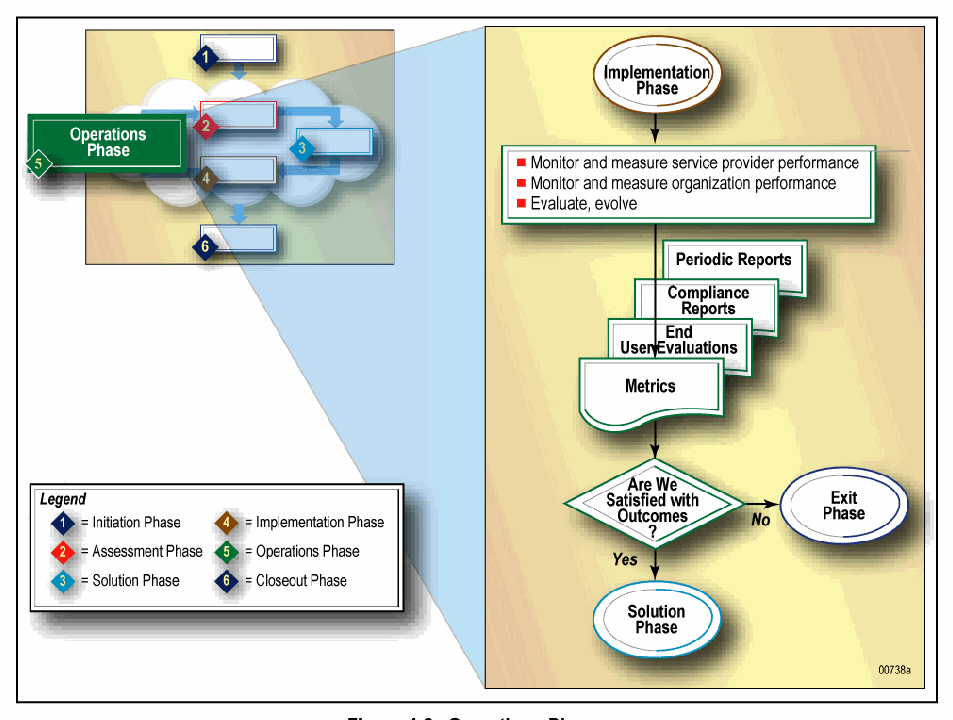
図4-6 運用フェーズ。左側にライフサイクル図(図4-1)の縮小版があり、フェーズ5の運用フェーズが強調されている。網掛けの帯で、右側の詳細なパネルに拡大されている。パネルは流れ図である。実施フェーズから「サービス提供者のパフォーマンスを監視・測定する」「組織のパフォーマンスを監視・測定する」「評価し、発展させる」を挙げた箱へ進み、Periodic Reports(定期報告)、Compliance Reports(コンプライアンス報告)、End User Evaluations(エンドユーザー評価)、Metrics(メトリクス)と記された文書の束を経て、Are We Satisfied with Outcomes?(結果に満足しているか)と記された判断のひし形に至る。No(いいえ)はExit Phase(終了フェーズ)へ進み、Yes(はい)は解決策フェーズへ進む。パネルにコード00738aが表示されている。左下の凡例には、番号付きのひし形について、1 = 開始フェーズ、2 = 評価フェーズ、3 = 解決策フェーズ、4 = 実施フェーズ、5 = 運用フェーズ、6 = 終了フェーズと記されている。
Figure 4-6. Operations Phase
図4-6 運用フェーズ
4.5.1 Monitor Service Provider Performance
4.5.1 サービス提供者のパフォーマンス監視
The operational phase is similar to the assessment phase. The data collected during the assessment phase should be used to capture the performance level of this new service provider. During the operations phase, the desired future arrangement becomes the current arrangement.
運用フェーズは評価フェーズと似ています。評価フェーズで収集したデータを使い、新しいサービス提供者のパフォーマンスレベルを把握するべきです。運用フェーズでは、望ましい将来の提供形態が現在の提供形態となります。
The targets set forth in the service agreement should be compared with the metrics gathered. Although metrics will provide service-level targets, the organization may also want to use end user evaluations or customer satisfaction level surveys to evaluate performance. The IT security managers will have to work with other operational managers (such as customer service managers) to ensure that the service provider is meeting service targets. The IT security managers also need to ensure service providers are complying with IT security policy and processes, as well as applicable laws and regulations. IT security managers must ensure during the operations phase that the service provider does not compromise private, confidential, personal, or mission-sensitive data. Compliance reports will help with this effort. The service agreement should have included clauses that specify penalties and/or remedies for noncompliance and management should employ these when the service provider does not perform as the contract dictates.
サービス契約で定めた目標を、収集した指標と比較するべきです。指標によってサービスレベル目標を設定できるほか、組織はエンドユーザー評価や顧客満足度調査を用いてパフォーマンスを評価してもよいです。ITセキュリティ管理者は、サービス提供者がサービス目標を満たすよう、顧客サービス管理者など他の運用管理者と連携する必要があります。また、サービス提供者がITセキュリティ方針とプロセス、適用される法令および規制を順守していることも確認する必要があります。ITセキュリティ管理者は運用フェーズにおいて、サービス提供者が非公開、機密、個人、またはミッション上機微なデータを侵害しないよう確保しなければなりません。コンプライアンス報告書はこの取り組みに役立ちます。サービス契約には不履行に対する違約金または救済措置を定める条項を含めるべきであり、サービス提供者が契約どおりに業務を遂行しない場合、管理者はこれらを適用するべきです。
4.5.2 Monitor and Measure Organization Performance
4.5.2 組織のパフォーマンスの監視と測定
While the service provider should meet the targets set forth in the service agreements, the IT security managers must look beyond the service and service provider to the entire IT security function and organization. The IT security function should have a mix of several IT services at various levels (management, operational, and technical) and a service arrangement has technical, policy, cultural, personnel, and other impacts. Therefore, managers should ensure that the service arrangement has not negatively affected other areas while performing the service.
サービス提供者はサービス契約で定めた目標を満たすべきですが、ITセキュリティ管理者は、サービスとサービス提供者だけでなく、ITセキュリティ機能全体および組織全体にも目を向けなければなりません。ITセキュリティ機能は、さまざまなレベル(管理、運用、技術)の複数のITサービスを組み合わせたものであるべきであり、サービス提供形態は、技術、ポリシー、文化、人員、その他の面に影響を及ぼします。したがって、管理者は、サービスを実施する間にサービス提供形態が他の領域に悪影響を与えていないことを確認すべきです。
4.5.3 Evaluate and Evolve
4.5.3 評価と進化
The service will evolve as it matures. The monitoring and measures of the service provider and organization will allow IT security stakeholders to evaluate the organization’s performance and seek ways to improve, even when meeting the targets. The world of IT security services is ever changing and security arrangements and agreements also need to change.
サービスは成熟に伴って進化します。サービス提供者と組織を監視し測定することで、ITセキュリティ関係者は組織のパフォーマンスを評価し、目標を達成している場合でも改善方法を探ることができます。ITセキュリティサービスの状況は絶えず変化しており、セキュリティの提供形態と契約も変化させる必要があります。
4.6 Phase 6: Closeout
4.6 フェーズ6:終了
As mentioned during the initiation phase, life cycles may overlap. As one IT security service, service arrangement, or agreement ends, another may begin. Depending on the reason for ending a service, a difficult management situation could exist. Exiting service providers may not always have the best interests of the organization in mind and may not make it easy for those replacing them. Therefore, IT security managers need to be sure to select the appropriate exit strategy and implement it well.
開始フェーズで述べたように、ライフサイクルは重複することがあります。あるITセキュリティサービス、サービス提供形態、または契約が終了する一方で、別のものが始まる場合があります。サービス終了の理由によっては、管理上の困難が生じる可能性があります。退出するサービス提供者が常に組織の最善の利益を考えるとは限らず、後任への引き継ぎを容易にしない場合もあります。したがって、ITセキュリティ管理者は適切な終了戦略を選択し、適切に実施する必要があります。
Figure 4-7 illustrates Phase 6, Closeout, of the IT security services life cycle.
図4-7に、ITセキュリティサービスのライフサイクルにおけるフェーズ6「終了」を示します。
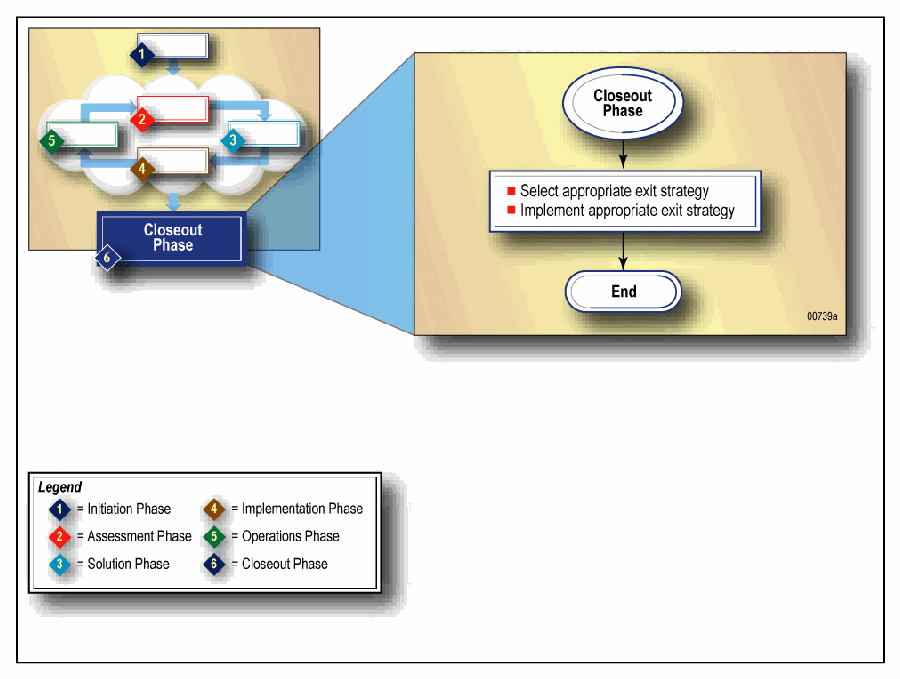
図4-7 終了フェーズ。左側にライフサイクル図(図4-1)の縮小版があり、フェーズ 6 の終了フェーズが強調されている。網掛けの帯で、右側の詳細なパネルに拡大されている。パネルは流れ図である。終了フェーズから「適切な出口戦略を選択する」「適切な出口戦略を実行する」を挙げた箱へ進み、End(終了)に至る。パネルに 00739a という番号が記されている。左下の凡例は、番号付きのひし形が 1 = 開始フェーズ、2 = 評価フェーズ、3 = 解決策フェーズ、4 = 実施フェーズ、5 = 運用フェーズ、6 = 終了フェーズを表すことを示す。
Figure 4-7. Closeout Phase
図4-7 終了フェーズ
4.6.1 Select Appropriate Exit Strategy
4.6.1 適切な終了戦略の選択
As mentioned during the development of the exit strategy, an organization should have several exit strategies prepared and ready for implementation (section 4.3.3). Often, an organization will be able to plan in advance for the exit: the service provider and the organization have an agreed-on contract that expires in 6 months, for example. However, this will not always be the case. The service arrangement may not succeed as managers hoped, the service provider may not meet the targets, a new technology may debut, or the service provider may even have suddenly filed for bankruptcy. Managers need to be aware of these various scenarios and be ready to implement an exit strategy swiftly.
終了戦略の策定時に述べたように、組織は複数の終了戦略を準備し、実施できる状態にしておくべきです(4.3.3節)。多くの場合、組織は終了を事前に計画できます。たとえば、サービス提供者と組織の合意済み契約が6か月後に満了する場合です。ただし、常にそうとは限りません。管理者が期待したとおりにサービス提供形態が成功しない、サービス提供者が目標を達成できない、新技術が登場する、またはサービス提供者が突然倒産を申請することもあります。管理者はこうしたさまざまな状況を認識し、終了戦略を速やかに実施できるよう備える必要があります。
4.6.2 Implement Appropriate Exit Strategy
4.6.2 適切な終了戦略の実施
Once the circumstances become such that the service, service arrangement, or service provider need to be retired and the appropriate exit strategy is selected, the project managers need to implement the appropriate exit strategy. The exit strategy will best assure a careful ending and provide lessons-learned for desired future IT security service implementations.
サービス、サービス提供形態、またはサービス提供者の使用を終了すべき状況となり、適切な終了戦略を選択したら、プロジェクト管理者はその戦略を実施する必要があります。終了戦略は、慎重な終了を確実にし、今後のITセキュリティサービスの実施に活用する教訓を提供します。
5. Types of Services
5. サービスの種類
An effective IT security program should encompass multiple layers of protection. An organization should evaluate the value and criticality of its information systems and determine the security controls that are appropriate to the level of risk. A security program, whether at the organizational or individual system level, should include an appropriate mixture of security controls: management, operational, and technical. Reliance on technical resources alone will be insufficient without complementary management or operational controls.
効果的なITセキュリティプログラムは、多層の保護を含むべきです。組織は、自らの情報システムの価値と重要度を評価し、リスクのレベルに適したセキュリティ管理策を決定すべきです。組織レベルであれ個別システムレベルであれ、セキュリティプログラムは、管理的、運用的、技術的なセキュリティ管理策を適切に組み合わせて含むべきです。補完的な管理的または運用的管理策を伴わない限り、技術的な資源のみに依存するだけでは不十分です。
This section presents examples of management, operational, and technical services that are discussed in this document. Table 5-1 lists these IT security services that will be discussed. Each security service is defined and the nature of the service provision explained. Then, issues and considerations unique to specific security services are provided.
本節では、本書で取り上げる管理、運用、技術サービスの例を示します。表5-1に、取り上げるITセキュリティサービスを一覧します。各セキュリティサービスを定義し、サービス提供の性質を説明したうえで、特定サービスに固有の課題と検討事項を示します。
Table 5-1. Security Services by Category
表5-1 カテゴリ別セキュリティサービス
| SECURITY SERVICE | CATEGORY |
|---|---|
| Security Program | Management |
| Security Policy | Management |
| Risk Management | Management |
| Security Architecture | Management |
| Certification and Accreditation | Management |
| Security Evaluation of IT Products | Management |
| Contingency Planning | Operational |
| Incident Handling | Operational |
| Testing | Operational |
| Training | Operational |
| Firewalls | Technical |
| Intrusion Detection | Technical |
| Public Key Infrastructure | Technical |
| セキュリティサービス | カテゴリ |
|---|---|
| セキュリティプログラム | 管理 |
| セキュリティ方針 | 管理 |
| リスク管理 | 管理 |
| セキュリティアーキテクチャ | 管理 |
| 認証および認定 | 管理 |
| IT製品のセキュリティ評価 | 管理 |
| 緊急時対応計画 | 運用 |
| インシデント対応 | 運用 |
| 試験 | 運用 |
| 研修 | 運用 |
| ファイアウォール | 技術 |
| 侵入検知 | 技術 |
| 公開鍵基盤 | 技術 |
An exhaustive list of every security service available is not provided. Security service providers may package elements of many of these services into a unique service offering with a unique name. Advances in technology will create new security services. In many cases, the issues and considerations provided for the services presented in this guide may be used or modified for other security services.
利用可能なすべてのセキュリティサービスの網羅的な一覧を示すものではありません。セキュリティサービス提供者は、ここに挙げる複数のサービス要素を独自のサービスとしてまとめ、独自の名称で提供する場合があります。技術の進歩に伴い、新たなセキュリティサービスが生まれます。本ガイドに示すサービスの課題や検討事項は、多くの場合、他のセキュリティサービスにも適用または修正して利用できます。
5.1 Management Security Services
5.1 管理セキュリティサービス
5.1.1 IT Security Program Development
5.1.1 ITセキュリティプログラムの策定
An IT security program is a set of security controls, which can be grouped under the terms management, operational, and technical. Federal law and regulations, such as the Federal Information Security Management Act (FISMA) of 2002, OMB Circular A-130, Security of Federal Automated Information Resources, and other government-wide policies, standards, and procedures issued by the OMB, NIST, and other agencies establish the policies, standards, and procedures for federal organizations.
ITセキュリティプログラムは、管理、運用、技術という用語で分類できるセキュリティ管理策の集合です。2002年の連邦情報セキュリティ管理法(FISMA)、OMB Circular A-130「連邦自動化情報資源のセキュリティ」、その他OMB、NIST、各機関が発行する政府全体の方針、標準、手順などの連邦法令・規制によって、連邦組織向けの方針、標準、手順が定められています。
Because policy is typically written at a broad level, organizations must also develop standards, guidelines, and procedures that provide employees with a clear approach to implementing policy. Standards and guidelines specify technologies and methodologies that will be used to secure systems; procedures are detailed steps to be followed to accomplish particular security-related tasks. Standards, guidelines, and procedures may be distributed throughout an organization via handbooks, regulations, or manuals. Together, these documents will ensure that employees are aware of their role in IT security and comply with the IT security program.
方針は一般に広い範囲を定めるため、組織は方針の実施方法を従業員に明確に示す標準、ガイドライン、手順も策定しなければなりません。標準およびガイドラインは、システムの安全確保に用いる技術と方法を指定し、手順は特定のセキュリティ関連作業を遂行するための詳細な手順を示します。標準、ガイドライン、手順は、ハンドブック、規則、マニュアルを通じて組織全体に配布してもよいです。これらの文書を組み合わせることで、従業員がITセキュリティにおける自らの役割を理解し、ITセキュリティプログラムを順守できます。
IT Security Program Services
ITセキュリティプログラムサービス
Service providers can assist organization decision makers in developing and maintaining an organization-wide security program, helping to ensure effective implementation of the program, evaluate the performance of major organization components, and provide appropriate security training of organization employees with significant security responsibilities. The service providers can also perform independent evaluations and audits of an organization IT security program.
サービス提供者は、組織全体のセキュリティプログラムの策定・維持において組織の意思決定者を支援し、プログラムが効果的に実装されるよう助け、組織の主要コンポーネントのパフォーマンスを評価し、重要なセキュリティ責任を担う組織従業員に適切なセキュリティトレーニングを提供できます。また、サービス提供者は、組織のITセキュリティプログラムについて独立した評価および監査を実施することもできます。
A comprehensive IT security program service can consist of many elements that will depend on the specific needs of the organization and the relative maturity of its IT security program. The elements of an IT security program service may include the following:
包括的なITセキュリティプログラムサービスは、組織の具体的なニーズおよびITセキュリティプログラムの成熟度に応じた多くの要素で構成されます。ITセキュリティプログラムサービスの要素には、次が含まれる場合がある:
•Assess the risk to operations and assets under the organization’s control
•組織が管理する業務および資産に対するリスクを評価する
•Determine the level of security appropriate to protect the organization’s operations and assets
•組織の業務および資産を保護するために適切なセキュリティレベルを決定する
•Develop and maintain a current security plan for each system supporting the operations and assets under organizational control
•組織の管理下で業務および資産を支える各システムについて、最新のセキュリティ計画を策定・維持する
•Develop security incident handling procedures
•セキュリティインシデント対応手順を策定する
•Develop processes for sharing information regarding common vulnerabilities, including a description of procedures for external reporting
•共通脆弱性に関する情報共有プロセスを策定します。これには外部報告の手順の説明を含めます。
•Develop a set of effective security controls and techniques
•効果的なセキュリティ管理策および技法を策定する
•Develop capital planning and investment control processes that ensure appropriate integration of security controls into IT investments
•IT投資にセキュリティ管理策を適切に組み込むことを確保する資本計画および投資管理プロセスを策定する
•Develop a set of IT security metrics that enable an organization to effectively assess the adequacy of in-place security controls, policies, and procedures and to adequately justify security control investments
•組織が既存のセキュリティ管理策、ポリシーおよび手順の妥当性を効果的に評価し、セキュリティ管理策への投資を十分に正当化するためのITセキュリティ指標を策定する
•Analyze the extent of integration of an organization’s IT Security Program with its Critical Infrastructure Protection or CIP responsibilities.
•組織のITセキュリティプログラムと、重要インフラ保護(CIP)責任との統合状況を分析します。
5.1.2 IT Security Policy
5.1.2 ITセキュリティポリシー
In the context of this guide, IT security policy is defined as the “documentation of IT security decisions.” IT Security Policy is fully discussed in NIST SP 800-12, An Introduction to Computer Security: The NIST Handbook. NIST SP 800-12 categorizes IT Security Policy into three basic types:
本ガイドでは、ITセキュリティポリシーを「ITセキュリティに関する意思決定を文書化したもの」と定義します。ITセキュリティポリシーについては、NIST SP 800-12「コンピューターセキュリティ入門: NISTハンドブック」で詳しく説明されています。NIST SP 800-12はITセキュリティポリシーを次の3種類に分類する:
•Program Policy—high-level policy used to create an organization's IT security program, define its’ scope within the organization, assign implementation responsibilities, establish strategic direction, and assign resources for implementation.
•プログラムポリシー—組織のITセキュリティプログラムを作成し、組織内での適用範囲を定義し、実装責任を割り当て、戦略的方向性を定め、実装に必要な資源を割り当てるための高水準ポリシー。
•Issue-Specific Policies—address specific issues of concern to the organization, such as contingency planning, the use of a particular methodology for systems risk management, and implementation of new regulations or law. These policies are likely to require more frequent revision as changes in technology and related factors take place.
•課題固有ポリシー—緊急時対応計画、システムリスク管理に特定の方法論を用いること、新しい規制または法律の実装など、組織が懸念する特定の課題に対処するポリシー。技術および関連要因の変化に伴い、これらのポリシーはより頻繁な改訂を要する可能性が高いです。
•System-Specific Policies—address individual systems, such as establishing an access control list or in training users as to what system actions are permitted. These policies may vary from system to system within the same organization. In addition, policy may refer to entirely different matters, such as the specific managerial decisions setting an organization's electronic mail (e-mail) policy or fax security policy.
•システム固有ポリシー—アクセス制御リストの設定や、許可されるシステム操作についてユーザーをトレーニングすることなど、個別システムに対処するポリシー。同じ組織内でも、システムごとに異なる場合があります。また、ポリシーは、組織の電子メール(e-mail)ポリシーやFAXセキュリティポリシーを定める具体的な管理上の決定など、まったく異なる事項を指すこともあります。
IT Security Policy Services
ITセキュリティポリシーサービス
Service providers can assist organizations in analyzing existing and developing new security policies, standards, guidelines, and procedures. The authority for approving policy is inherently a core function of an organization and therefore final approval of policies should be performed by the organization. Given this constraint, organizations should limit service providers, either internal or external, to assistance and support. A comprehensive IT security policy service can consist of many elements that will depend on the specific needs of the organization and the relative maturity of its IT security program.
サービスプロバイダーは、既存のセキュリティポリシー、標準、ガイドラインおよび手順の分析と、新たなものの策定を支援できます。ポリシーを承認する権限は本質的に組織の中核的機能であるため、ポリシーの最終承認は組織が行うべきです。この制約を踏まえ、組織は内部・外部を問わず、サービスプロバイダーの役割を支援に限定すべきです。包括的なITセキュリティポリシーサービスは、組織の具体的なニーズおよびITセキュリティプログラムの成熟度に応じた多くの要素で構成されます。
IT security policy elements may include the following:
ITセキュリティポリシーの要素には次が含まれる場合がある:
•High-level analysis of an organization’s operational environment
•組織の運用環境の高水準分析
•Emerging Technologies
•新興技術
•Governance processes5
•ガバナンスプロセス5
•Procedures
•手順
•Determination of compliance to applicable guidance and regulations
•適用されるガイダンスおよび規制への準拠状況の判定
•Gap analysis for the organization or program that assesses the differences between the current policy and the desired future policy
•現在のポリシーと望ましい将来のポリシーとの差を評価する、組織またはプログラムのギャップ分析
•Development of a unified set of security program policies and detailed issue- and system-specific policies
•統合されたセキュリティプログラムポリシー一式、および課題固有・システム固有の詳細ポリシーの策定
•Development of short-, medium-, and long-term implementation plans identifying tasks, resources, priority, and ownership
•短期、中期および長期の実装計画を策定し、タスク、資源、優先順位および責任者を明確にする
•Development of IT security metrics.
•ITセキュリティ指標を策定します。
5.1.3 Risk Management
5.1.3 リスク管理
Risk management is comprehensively discussed in NIST SP 800-30, Risk Management Guide for Information Technology Systems. NIST SP 800-30 notes that the primary goal of risk management is to “balance the operational and economic costs of protective measures and achieve gains in mission capability by protecting IT systems and data.”
リスク管理については、NIST SP 800-30「情報技術システムのリスク管理ガイド」で包括的に説明されています。NIST SP 800-30によれば、リスク管理の主な目標は「保護対策の運用上および経済上のコストのバランスを取り、ITシステムおよびデータを保護することで使命遂行能力の向上を実現すること」です。
Risk Management Services
リスク管理サービス
Service providers offer various combinations of service packages for supporting risk management activities. The service provider may develop risk management guidance for supporting an organization’s risk management program. The service provider may manage the risk management program as a whole but the organization should always retain the responsibility for the program. The service provider may also perform a risk assessment and/or develop a risk mitigation plan. If the organization already has a mature and operational risk management program, the service provider may audit the program for effectiveness.
サービスプロバイダーは、リスク管理活動を支援するためのさまざまなサービスパッケージを組み合わせて提供します。サービスプロバイダーは、組織のリスク管理プログラムを支援するガイダンスを策定できます。リスク管理プログラム全体を管理することもできますが、組織は常にプログラムに対する責任を保持すべきです。サービスプロバイダーはリスク評価を実施したり、リスク軽減計画を策定したりすることもできます。組織がすでに成熟した運用中のリスク管理プログラムを有する場合、サービスプロバイダーはその有効性を監査できます。
5.1.4 IT Security Architecture
5.1.4 ITセキュリティアーキテクチャ
Security architecture refers to the strategic planning and development of an IT infrastructure that supports the mission and the security objectives. It is a process that is developed during the security design phase after a security requirements analysis has been conducted to support it.
セキュリティアーキテクチャとは、使命およびセキュリティ目標を支えるIT基盤の戦略的な計画と開発を指します。これは、それを支えるセキュリティ要件分析が実施された後、セキュリティ設計段階で策定されるプロセスです。
IT Security Architecture Services
ITセキュリティアーキテクチャサービス
If the organization asks a service provider to design a new security architecture, the service provider must have access to the technology and security baseline of the organization’s current architecture. The service provider can conduct baselining if it has not already been done by the organization. Baselining services include identifying its business needs, functional requirements, security requirements, and risk assessments, as well as the security controls in place. A service provider can identify security controls and identify and assess technologies that will enforce the organization’s security policies. A service provider can develop a methodology for selecting the security solutions that best serve the organization’s needs and design a technical architecture. Finally, the service provider should document the security architecture.
組織がサービスプロバイダーに新たなセキュリティアーキテクチャの設計を依頼する場合、サービスプロバイダーは組織の現行アーキテクチャの技術ベースラインおよびセキュリティベースラインにアクセスできなければなりません。組織がまだベースラインを作成していない場合、サービスプロバイダーが作成できます。ベースライン作成サービスには、組織のビジネスニーズ、機能要件、セキュリティ要件およびリスク評価、ならびに導入済みのセキュリティ管理策の特定が含まれます。サービスプロバイダーはセキュリティ管理策を特定し、組織のセキュリティポリシーを実施する技術を特定・評価できます。組織のニーズに最も適したセキュリティソリューションを選択する方法論を策定し、技術アーキテクチャを設計することもできます。最後に、サービスプロバイダーはセキュリティアーキテクチャを文書化すべきです。
5.1.5 Certification and Accreditation
5.1.5 認証および認定
Accreditation is the formal declaration by an authorizing official that a system is approved to operate at an acceptable level of risk and in a particular environment using a prescribed set of technical, managerial, and operational safeguards to an acceptable level of risk. Accreditation is usually supported by a technical security evaluation, a risk assessment, a contingency plan, and signed rules of behavior. Certification is the technical security evaluation of an IT system made in support of the accreditation process, to establish the extent to which a particular design and implementation meets a set of specified security requirements.
認定とは、所定の技術的、管理的および運用上の保護措置を用い、許容可能なリスクレベルで特定の環境においてシステムの運用を承認することを、権限を有する担当者が正式に宣言することです。認定は通常、技術的セキュリティ評価、リスク評価、緊急時対応計画および署名済み行動規則によって裏付けられます。認証とは、特定の設計および実装が指定された一連のセキュリティ要件をどの程度満たすかを確立するため、認定プロセスを支援して実施されるITシステムの技術的セキュリティ評価です。
NIST SP 800-37 (draft), Federal Guidelines for the Security Certification and Accreditation of Information Technology Systems establishes standard processes, activities and general tasks, and management approaches designed to certify and accredit an information system.
NIST SP 800-37(草案)「連邦情報技術システムのセキュリティ認証および認定に関する連邦ガイドライン」は、情報システムを認証・認定するための標準プロセス、活動、一般タスクおよび管理手法を定めます。
Certification and Accreditation Services
認証および認定サービス
The complexity and rigor of specific certification activities will vary depending on the system criticality, information sensitivity, system exposure, and level of concern. C&A service providers can manage or conduct a complete certification or prepare and assess individual documents in the final certification package that is ultimately presented to the accreditor for approval.
個々の認証活動の複雑さと厳格さは、システムの重要度、情報の機微性、システムの露出度および懸念レベルに応じて異なります。認証・認定(C&A)サービスプロバイダーは、認証全体を管理または実施することも、最終認証パッケージに含めて認定者の承認に付す個別文書を作成・評価することもできます。
C&A service activities can include any of the following:
C&Aサービスの活動には次が含まれる場合がある:
•Developing a security test and evaluation (ST&E) plan and test procedures
•セキュリティ試験・評価(ST&E)計画および試験手順の策定
•Conducting an ST&E
•ST&Eの実施
•Analyzing and reporting test results
•試験結果の分析および報告
•Developing and/or conducting a vulnerability assessment
•脆弱性評価の策定および/または実施
•Developing a final vulnerability assessment report
•最終脆弱性評価報告書の作成
•Technical support to the certifier or accreditor.
•認証者または認定者への技術支援
5.1.6 IT Security Product Evaluation
5.1.6 ITセキュリティ製品の評価
Two prominent security testing and evaluation programs are now in place to assess the security features and assurances of commercial off-the-shelf (COTS) products: National Information Assurance Partnership6 (NIAP) Common Criteria7 (CC) Evaluation and Validation Scheme (CCEVS) and NIST Cryptographic Module Validation Program8 (CMVP). In both programs, a government body validates the results of the testing and evaluation processes conducted by private sector laboratories to ensure that the security standards are being applied correctly and consistently. When products cannot be found on existing validated product lists, it may be possible that other parties have evaluated a particular product. In many cases, it is not cost effective to conduct comprehensive security evaluations for the one-time use of an IT security product unless that product will be used extensively throughout an organization and therefore, products on the validated product list should be considered as an alternative. Additional information regarding security assurance can be obtained from NIST SP 800-23, Guidelines to Federal Organizations on Security Assurance and Acquisition/Use of Tested/Evaluated Products.
市販既製品(COTS)のセキュリティ機能および保証を評価するため、現在、代表的なセキュリティ試験・評価プログラムが2つあります。National Information Assurance Partnership6(NIAP)のCommon Criteria7(CC)評価・検証スキーム(CCEVS)と、NIST暗号モジュール検証プログラム8(CMVP)です。どちらのプログラムでも、政府機関が民間試験機関による試験・評価結果を検証し、セキュリティ標準が正確かつ一貫して適用されていることを確保します。既存の検証済み製品リストに製品がない場合でも、他の当事者がその製品を評価済みである可能性があります。多くの場合、組織全体で広く使用する予定の製品でない限り、ITセキュリティ製品を一度だけ使用するために包括的なセキュリティ評価を実施することは費用対効果に優れません。そのため、検証済み製品リストに掲載された製品を代替案として検討すべきです。セキュリティ保証に関する追加情報は、NIST SP 800-23, Guidelines to Federal Organizations on Security Assurance and Acquisition/Use of Tested/Evaluated Products から得られます。
IT Security Product Evaluation Services
ITセキュリティ製品評価サービス
The NIAP CCEVS employs a network of private sector, accredited testing laboratories to independently evaluate commercial security products in a variety of key technology areas against a set of security requirements and specifications from the international standard, International Organization for Standardization/International Electrotechnical Commission (ISO/IEC) 15408, Common Criteria for IT Security Evaluation. The CMVP, also using independent, accredited, private-sector laboratories, focuses on security conformance testing of cryptographic modules against FIPS 140-2, Security Requirements for Cryptographic Modules, and related federal cryptographic algorithm standards.
NIAP CCEVSは、国際標準化機構/国際電気標準会議(ISO/IEC)15408「ITセキュリティ評価のための共通基準」で定められたセキュリティ要件および仕様に照らして、主要な技術分野の商用セキュリティ製品を独立評価するため、民間の認定試験機関ネットワークを活用します。CMVPも独立した認定民間試験機関を活用し、暗号モジュールのセキュリティ適合性試験を、FIPS 140-2「暗号モジュールのセキュリティ要件」および関連する連邦暗号アルゴリズム標準に照らして実施します。
5.2 Operational Security Services
5.2 運用セキュリティサービス
5.2.1 Contingency Planning
5.2.1 緊急時対応計画
The modern networked computing environment brings significant challenges to the development of contingency plans. Networked computing has changed the scope and focus of what has traditionally been a local issue. Contingency planning is designed to reduce the consequences of any loss of data or infrastructure. Contingency planning enables organization personnel to restore critical IT functions and connectivity rapidly, effectively, and safely. The contingency plan defines the procedures, resources, tasking, and information required for performing recovery actions in response to a broad range of events. A well-executed and tested contingency plan also gives confidence that critical resources will be available when needed and facilitates an organization’s continuity of operations in an emergency situation. The plan is a living document that must be updated regularly to reflect changes to the system’s configuration and operations. Additional information on contingency planning is provided in NIST SP 800-34, Contingency Planning Guide for Information Technology Systems. This guide discusses various contingency plans that will help sustain and recover critical IT services following an emergency.
現代のネットワーク化されたコンピューティング環境は、緊急時対応計画の策定に大きな課題をもたらします。ネットワーク化により、従来はローカルな問題であったものの範囲と焦点が変化しました。緊急時対応計画は、データまたは基盤の喪失による影響を軽減するために策定されます。これにより組織の要員は、重要なIT機能および接続性を迅速、効果的かつ安全に復旧できます。緊急時対応計画は、幅広い事象への対応として復旧措置を実行するために必要な手順、資源、担当割当および情報を定めます。適切に実行・試験された計画は、必要時に重要な資源を利用できるという確信をもたらし、緊急時の組織の業務継続を容易にします。計画は、システム構成および運用の変化を反映するため定期的に更新しなければならない生きた文書です。緊急時対応計画の詳細は、NIST SP 800-34「情報技術システムの緊急時対応計画ガイド」に記載されています。このガイドは、緊急事態の後に重要なITサービスを維持・復旧するためのさまざまな計画を論じます。
The contingency plan should address, at a minimum, the following five main components: supporting information, notification/ activation, recovery, reconstitution, and supporting appendixes.
緊急時対応計画は、少なくとも次の5つの主要要素に対処すべきである: 支援情報、通知/起動、復旧、再構成、および補足付録。
•Supporting Information—provides an introduction and concept of operations for the plan
•支援情報—計画の導入および運用概念を示す
•Notification / Activation—items such as notification procedures, damage assessment, and plan activation
•通知/起動—通知手順、損害評価、計画の起動など
•Recovery—items such as a sequence of recovery activities, and recovery procedures
•復旧—復旧活動の順序や復旧手順など
•Reconstitution—items such as the sequence of recovery activities, testing of systems, and termination of operations
•再構成—復旧活動の順序、システムの試験、運用の終了など
•Plan Appendixes—items such contact information, equipment lists, service agreements, and any other related contingency plans.
•計画付録—連絡先情報、機器一覧、サービス合意、および関連するその他の緊急時対応計画など。
Contingency Planning Services
緊急時対応計画サービス
Service providers offer their services for various phases of the contingency planning life cycle. In considering whether to contract out contingency planning services, the organization could conduct a cost-benefit analysis for each breakdown of the service offering (e.g., develop, update and test, and execute the contingency plan).
サービスプロバイダーは、緊急時対応計画のライフサイクルにおけるさまざまな段階のサービスを提供します。緊急時対応計画サービスの外部委託を検討する際、組織はサービス提供の各内訳(例: 計画の策定、更新・試験、実行)について費用便益分析を実施できます。
•Develop—service providers can develop the organization’s contingency plan. This service requires gathering information from many functional areas. The vendor’s first step should be to perform a business impact assessment (BIA) to determine the system’s internal and external dependencies, allowable outage times, and recovery priorities. The BIA provides a basis for developing the specific recovery strategy and procedures that comprise the heart of the contingency plan.
•策定—サービスプロバイダーは組織の緊急時対応計画を策定できます。このサービスには多くの機能領域から情報を収集する必要があります。ベンダーはまず、事業影響分析(BIA)を実施し、システムの内部・外部依存関係、許容停止時間および復旧優先順位を判断すべきです。BIAは、緊急時対応計画の中核をなす具体的な復旧戦略および手順を策定する基礎となります。
•Update and Test—updating the plan as needed is critical to its success because the contingency plan is a living document. It is very common to retain the same service provider that developed the plan to update and test it. Updates to the plan should be made when changes in personnel, procedures, assets, or other resources are incorporated into the system.
•更新および試験—緊急時対応計画は継続的に更新される文書であるため、必要に応じて更新することが成功に不可欠です。計画を策定したサービスプロバイダーと同じ事業者に更新および試験も委託することはよくあります。人員、手順、資産またはその他の資源に変更がシステムへ反映された場合、計画を更新すべきです。
Service providers may also ensure that the plan is tested before circumstances require its use. The test may be a walk-through or a simulated drill, or a full operational exercise that encompasses all aspects of the plan. Results of the testing exercise would be documented in the contingency plan and discussed with management. The results will determine the effectiveness of the contingency procedures and present any flaws. Staff must be trained in their contingency-related duties so that when an unexpected event interrupts operations, recovery will be easier and people will know what to expect.
サービス提供者は、計画の使用が必要となる状況が生じる前に、計画が試験されることを確保することもあります。試験は、ウォークスルーもしくは模擬訓練、または計画のすべての側面を網羅する本格的な運用演習である場合があります。試験演習の結果は緊急時対応計画に記録され、管理者と協議されます。その結果によって緊急時対応手順の有効性が判断され、不備が明らかになります。予期しない事象で運用が中断したときに復旧が容易になり、何が起こるかを各人が把握できるよう、職員は緊急時対応に関する自らの職務について訓練を受けなければなりません。
•Execute—the responsibility for the execution phase of contingency planning lies with the organization, but service providers may support certain aspects of the execution phase. For example, an organization may outsource data recovery because service providers can provide hot or mobile sites for system and data recovery. They may provide periodic training to organization personnel on the plan and their roles in the plan.
•実行—緊急時対応計画の実行段階に対する責任は組織にありますが、サービスプロバイダーは実行段階の特定の側面を支援できます。たとえば、サービスプロバイダーはシステムおよびデータ復旧用のホットサイトまたは移動可能サイトを提供できるため、組織はデータ復旧を外部委託できます。サービスプロバイダーは、計画および計画内の各自の役割について、組織要員に定期的なトレーニングを提供する場合もあります。
5.2.2 Incident Handling
5.2.2 インシデント対応
An IT security incident is an adverse event in a computer system or network caused by the failure of a security mechanism or an attempted or threatened breach of these mechanisms. An incident-handling capability can provide the ability to react quickly and efficiently to disruptions in normal processing. Effective incident handling can be achieved by developing and instituting effective processes and procedures for the six phases of incident response: preparation, identification, containment, eradication, recovery, and follow-up. The incident handling process should be consistent and compatible with any forensic services that the organization may require to ensure that critical evidence is handled properly.
ITセキュリティインシデントとは、セキュリティ機構の故障、またはその機構に対する侵害の試み・脅威によって、コンピューターシステムまたはネットワーク上で発生する有害事象です。インシデント対応能力があれば、通常処理の中断に迅速かつ効率的に対応できます。準備、検知、封じ込め、根絶、復旧および事後対応というインシデント対応の6段階について、効果的なプロセスと手順を策定・導入することで、効果的なインシデント対応を実現できます。重要な証拠が適切に取り扱われるよう、インシデント対応プロセスは組織が必要とするフォレンジックサービスと一貫し、互換性を有するべきです。
Incident-Handling Services
インシデント対応サービス
Incident-handling capability should be available 24 hours per day, 7 days a week. A service provider may be able to provide one or a combination of the services listed below.
インシデント対応能力は、1日24時間、週7日利用可能であるべきです。サービス提供者は、以下のサービスのいずれか、または組み合わせを提供できる場合があります。
Incident-handling services may include the following:
インシデント対応サービスには、次が含まれる場合がある:
•Developing the incident handling program
•インシデント対応プログラムの策定
•Developing and maintaining system configuration profiles
•システム構成プロファイルの策定および維持
•Providing forensics capabilities
•フォレンジック能力の提供
•Testing and updating incident handling procedures
•インシデント対応手順の試験および更新
•Managing and executing the incident handling procedures
•インシデント対応手順の管理および実行
Incident-handling procedural services may include the following:
インシデント対応手順サービスには、次が含まれる場合がある:
•Isolation of affected systems and platforms
•影響を受けたシステムおよびプラットフォームの隔離
•Triage
•トリアージ
•Report assessment (interpret log files, prioritize, and analyze)
•報告の評価(ログファイルの解釈、優先順位付けおよび分析)
•Identification/Verification (determine nature and scope of incident)
•特定/検証(インシデントの性質および範囲の判断)
•Categorization (determine sensitivity of compromised information, system, and incident)
•分類(侵害された情報、システムおよびインシデントの機微性の判断)
•Internal and external coordination (notify and coordinate with appropriate internal and external parties on a need-to-know basis)
•内部および外部との調整(知る必要のある適切な内部・外部関係者への通知および調整)
•Resolution
•解決
•Technical assistance (provide detailed analysis of event, such as how it occurred and what failed to work properly)
•技術支援(事象の発生経緯や正常に機能しなかったものなど、事象の詳細分析を提供する)
•Eradication (eliminate incident causes and effects)
•根絶(インシデントの原因および影響を排除する)
•Recovery (return systems to normal operations)
•復旧(システムを通常運用に戻す)
•Preventative support
•予防的支援
•Operations, maintenance, and monitoring of IDS (incident response tied directly to IDS)
•IDSの運用、保守、および監視(IDSに直接結び付いたインシデント対応)
•Training
•研修
•Post-incident consulting
•インシデント後のコンサルティング
•Third-party analysis, validation of eradication and recovery, corrective and mitigation actions, and reporting.
•第三者による分析、根絶および復旧の検証、是正措置および緩和措置、ならびに報告。
5.2.3 Testing
5.2.3 試験
Testing the security posture of information systems and networks is a critical component of securing a system. A complete and exhaustive discussion of testing is beyond the scope of this document. Testing is the only way to validate that the security measures and procedures are working as intended. Testing can also assist in identifying previously unknown weaknesses or vulnerabilities. All test activities, whether manual or automatic, require human involvement and thus could be provided as a service.
情報システムおよびネットワークのセキュリティ態勢をテストすることは、システムを保護するうえで重要な構成要素です。テストに関する完全かつ網羅的な議論は、本書の範囲を超えます。テストは、セキュリティ対策と手順が意図どおりに機能していることを検証する唯一の方法です。また、テストは、それまで知られていなかった弱点や脆弱性の特定にも役立ちます。手動か自動かを問わず、すべてのテスト活動には人の関与が必要であり、したがってサービスとして提供できます。
The results of testing can be used in the following ways:
試験結果は、次の目的で使用できる:
•As a reference point for any corrective action
•是正措置の基準点として
•As a benchmarking tool to enable the organization to track its progress
•組織が進捗を追跡するためのベンチマークとして
•To assess implementation of system security requirements
•システムセキュリティ要件の実装状況を評価するため
•For cost-benefit analysis
•費用対効果分析のため
•As an input into the larger life-cycle activities, such as risk assessments, functional requirements analysis, C&A, and performance improvement efforts.
•リスク評価、機能要件分析、認証・認定(C&A)、パフォーマンス改善の取り組みなど、より広範なライフサイクル活動への入力情報として。
Categories of testing can include the following:
試験カテゴリには、次のものが含まれる:
•Network mapping
•ネットワークマッピング
•Vulnerability scanning
•脆弱性スキャン
•Penetration testing
•侵入テスト
•ST&E
•ST&E
•Password cracking
•パスワードクラッキング
•Log review
•ログレビュー
•Integrity checkers
•完全性チェッカー
•Virus detection
•ウイルス検知
•War dialing.
•ウォーダイヤリング。
Testing Services
テストサービス
Because of its highly specialized and technical nature, testing is one security activity that is frequently considered for external service providers. However, because it is a highly invasive measure, it is important that service providers be capable and trusted by the organization. Testing can be conducted as a separate activity or as part of the risk management program, under risk assessment. The service provider will need clear and unambiguous direction from management (a written “rules of engagement”), a set of Internet Protocol (IP) addresses, and clearly defined scope for testing as well as input on what is required for planning and assessment, requirements analysis, test execution, and analysis results and documentation.
試験は高度に専門的かつ技術的であるため、外部サービス提供者の利用が頻繁に検討されるセキュリティ活動の1つです。ただし、試験は侵襲性の高い措置であるため、サービス提供者が組織にとって能力と信頼性を備えていることが重要です。試験は、単独の活動として、またはリスク評価の一環としてリスク管理プログラム内で実施できます。サービス提供者には、管理者から明確で曖昧さのない指示(書面による「実施ルール」)、インターネットプロトコル(IP)アドレスの一覧、および試験範囲の明確な定義が必要となります。また、計画・評価、要件分析、試験実行、分析結果および文書化に何が必要かについての情報も必要となります。
5.2.4 Training
5.2.4 研修
Training is one of the most critical components in maintaining the security posture of operational systems. Securing any organization’s IT systems cannot be achieved without skilled, knowledgeable, and trained personnel at all levels. Security training and education must be considered an ongoing effort that is an integral part of conducting business. With constantly evolving technology, education—especially in the security arena—must keep pace with the perpetual changes and advances. Managers must understand the current status of their security programs and controls to make informed judgments and investments to appropriately mitigate risks to an acceptable level. All users of IT systems must be aware of their responsibilities for protecting information and IT resources.
研修は、運用中のシステムのセキュリティ態勢を維持するうえで最も重要な要素の1つです。熟練し、知識を備え、訓練を受けた人員があらゆるレベルにいなければ、組織のITシステムを保護することはできません。セキュリティ研修および教育は、事業運営に不可欠な継続的取り組みとして考慮しなければなりません。技術が絶えず進化する中、特にセキュリティ分野の教育は、絶え間ない変化と進歩に遅れず対応しなければなりません。管理者は、リスクを許容可能な水準まで適切に緩和するために、十分な情報に基づいて判断し投資できるよう、セキュリティプログラムと管理策の現状を理解しなければなりません。ITシステムのすべての利用者は、情報およびIT資源を保護する自らの責任を認識していなければなりません。
The IT Security Learning Continuum from NIST SP 800-16, Information Technology Security Training Requirements, and shown in Figure 5-1, represents instructional guidance for IT security awareness, training, and education programs. The model is created from requirements of several federal regulations, including OMB Circular A-130.
NIST SP 800-16『Information Technology Security Training Requirements』に示され、図5-1に掲載されているIT Security Learning Continuumは、ITセキュリティの意識向上、研修、および教育プログラムに関する指導指針を示します。このモデルは、OMB Circular A-130を含む複数の連邦規則の要件に基づいています。
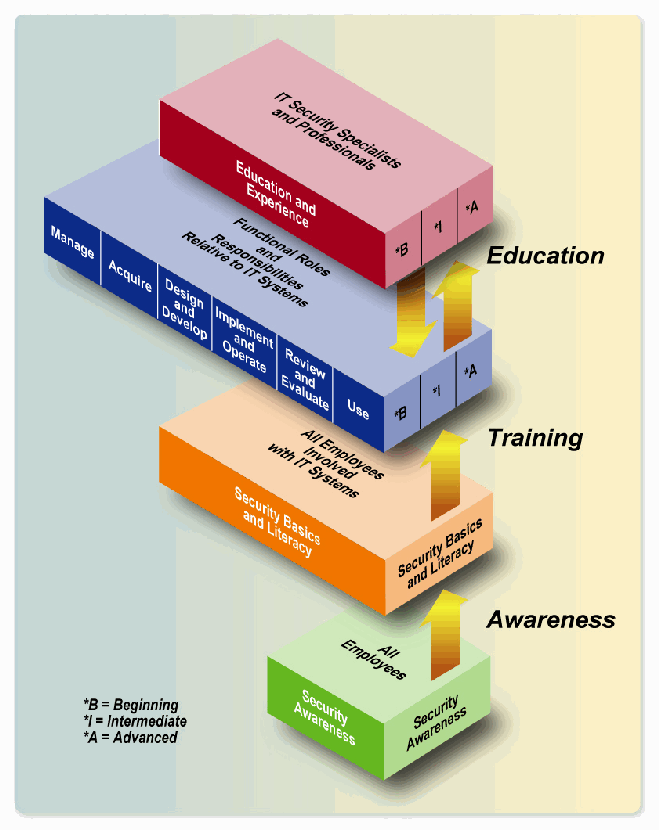
図5-1. 情報技術セキュリティ学習の連続体。立体的に描かれた 4 つの段が積み重なり、段の間の上向きの矢印に Awareness(意識向上)、Training(訓練)、Education(教育)と記されている。最下段は Security Awareness(セキュリティ意識向上)で、対象は All Employees(全従業員)である。その上は Security Basics and Literacy(セキュリティの基礎と素養)で、対象は All Employees Involved with IT Systems(IT システムに関わる全従業員)である。その上の段は Functional Roles and Responsibilities Relative to IT Systems(IT システムに関する職務上の役割と責任)と記され、Manage(管理)、Acquire(調達)、Design and Develop(設計と開発)、Implement and Operate(実装と運用)、Review and Evaluate(レビューと評価)、Use(利用)に区分され、端面に *B、*I、*A の水準がある。最上段は Education and Experience(教育と経験)で、対象は IT Security Specialists and Professionals(IT セキュリティのスペシャリストおよび専門家)であり、端面に *B、*I、*A の水準がある。訓練の段と最上段の間には上下の矢印がある。凡例は *B = Beginning(初級)、*I = Intermediate(中級)、*A = Advanced(上級)である。
Figure 5-1. Information Technology Security Learning Continuum
図5-1. 情報技術セキュリティ学習の連続体
The model illustrates a three-dimensional array that integrates the following:
このモデルは、次の要素を統合した3次元配列を示す:
•Three types of training—awareness, training, and education,
•3種類の学習—意識向上、研修、および教育、
•Six functional security roles—manage, acquire, design and develop, implement and operate, review and evaluate and use
•6つの機能的なセキュリティ役割—管理、調達、設計・開発、実装・運用、レビュー・評価、および利用
•Three levels of training—beginning, intermediate, and advanced.
•3段階の研修—初級、中級、および上級。
The NIST SP 800-50, Building an Information Technology Security Awareness and Training Program, provides detailed guidance on designing, developing, implementing, and maintaining an awareness and training program within an organization's IT security program. This guide builds upon NIST SP 800-16 by describing four steps in designing and implementing an IT security training and awareness program.
NIST SP 800-50『Building an Information Technology Security Awareness and Training Program』は、組織のITセキュリティプログラムにおける意識向上・研修プログラムの設計、開発、実装、および維持に関する詳細な指針を示します。本ガイドはNIST SP 800-16を発展させ、ITセキュリティ研修・意識向上プログラムの設計と実装に関する4つの手順を説明します。
•Designing an Awareness and Training Program
•意識向上・研修プログラムの設計
•Developing Awareness and Training Material
•意識向上・研修教材の開発
•Program Implementation
•プログラムの実装
•Post-Implementation
•実装後
Training Services
研修サービス
IT security training service providers may offer a wide range of services to support the "total" security awareness and training program. They can design, develop, implement, and maintain a program for the organization, but also assist with specific elements of the organization training and awareness program. The service provider can provide the following services:
ITセキュリティ研修サービス提供者は、"全体的な"セキュリティ意識向上・研修プログラムを支援する幅広いサービスを提供することがあります。組織向けプログラムの設計、開発、実装、および維持に加え、組織の意識向上・研修プログラムの個別要素も支援できます。サービス提供者は、次のサービスを提供できる:
•Program level support
•プログラムレベルの支援
•Course level support
•コースレベルの支援
•Training support services.
•研修支援サービス。
5.3 Technical Security Services
5.3 技術的セキュリティサービス
5.3.1 Firewalls
5.3.1 ファイアウォール
A firewall is a device that has a network protection application installed to safeguard the network from intentional or unintentional intrusion. A firewall sits at the junction point or gateway between the two networks, usually a private network and a public network such as the Internet. The term “firewall” is derived from the process in which, by segmenting a network into different physical subnetworks, the firewalls limit damage that could spread from one subnet to another, acting in the same manner as fire doors or firewalls in automobiles.
ファイアウォールとは、意図的または偶発的な侵入からネットワークを保護するため、ネットワーク保護アプリケーションを導入した装置です。通常はプライベートネットワークと、インターネットなどのパブリックネットワークという、2つのネットワーク間の接続点またはゲートウェイに設置されます。「ファイアウォール」という用語は、ネットワークを複数の物理サブネットワークに分割することで、あるサブネットから別のサブネットへ被害が広がるのを制限する仕組みに由来します。これは自動車の防火壁や防火ドアと同様の働きをします。
Firewall Services
ファイアウォールサービス
Service providers can perform any or all of the following firewall functions:
サービス提供者は、次のファイアウォール機能の一部またはすべてを実施できる:
•Design a firewall solution that incorporates single and/or multiple firewalls
•単一または複数のファイアウォールを組み込んだソリューションを設計する
•Install and integrate a firewall(s) into new and existing networks
•新規および既存のネットワークにファイアウォールを導入し、統合する
•Monitor firewall services to ensure availability and integration with other technical controls, such as incident response or intrusion detection systems (IDS)
•インシデント対応や侵入検知システム(IDS)など、他の技術的管理策との可用性および統合を確保するため、ファイアウォールサービスを監視する
•Manage the organization’s firewalls, including periodically upgrading them.
•組織のファイアウォールを管理し、定期的にアップグレードします。
The organization can select specific service providers with a trusted family of products that belongs to them or general service providers who specialize in offering a wide variety of security services while using products and components from outside vendors.
組織は、自社が保有する信頼できる製品群を備えた特定のサービス提供者、または外部ベンダーの製品やコンポーネントを利用しながら幅広いセキュリティサービスを専門に提供する総合サービス提供者を選択できます。
5.3.2 Intrusion Detection
5.3.2 侵入検知
Intrusion is any set of actions that attempts to compromise the integrity, confidentiality, or availability of a resource. Intrusion detection is a passive security activity that sits on the network or on selected hosts. Devices that are part of the IDS are used to detect intrusion and provide information to a central management console. This information is reviewed by security staff to determine if a valid security breach has taken place. An IDS performs a variety of functions:
侵入とは、資源の完全性、機密性、または可用性を侵害しようとする一連の行為です。侵入検知は、ネットワーク上または選択されたホスト上に置かれる受動的なセキュリティ活動です。IDSを構成する装置は、侵入を検知し、中央の管理コンソールに情報を提供するために用いられます。この情報をセキュリティ担当者が確認し、実際にセキュリティ侵害が発生したかどうかを判断します。IDSは次のようなさまざまな機能を実行する:
•Monitor user and system activity
•ユーザーおよびシステムの活動を監視する
•Audit system configuration and vulnerabilities
•システム構成および脆弱性を監査する
•Assess integrity of critical system and data files
•重要なシステムファイルおよびデータファイルの完全性を評価する
•Recognize activity patterns reflecting known attacks
•既知の攻撃を示す活動パターンを認識する
•Perform statistical analyses for abnormal activity patterns
•異常な活動パターンについて統計分析を実行する
•Provide operating system audit trail management, with recognition of user activity reflecting policy violations
•方針違反を示すユーザー活動を認識する機能を備えた、オペレーティングシステム監査証跡の管理を行う
•Provide customized reports.
•カスタマイズしたレポートを提供します。
This ongoing monitoring and assessment is a necessary part of an overall security architecture. IDSs generally improve the integrity of other parts of the information security infrastructure by identifying specific indications of a possible attack and causing a reexamination of defenses. They can often trace user activity from the point of entry into the network to point of exit. IDSs can recognize specific types of attacks and alert appropriate staff (if configured to do so).
この継続的な監視と評価は、全体的なセキュリティアーキテクチャに不可欠です。IDSは、攻撃の可能性を示す具体的な兆候を特定して防御の再検討を促すことで、情報セキュリティ基盤の他の部分の完全性を一般に向上させます。多くの場合、ネットワークへの侵入地点から退出地点まで、ユーザーの活動を追跡できます。IDSは特定の攻撃の種類を認識し、適切に設定されていれば担当者に警告できます。
Intrusion Detection Services
侵入検知サービス
To be effective, intrusion detection requires a robust knowledge base of attack signatures against which the IDS can tally its findings. Threats and vulnerabilities are not static in nature and are continuously changing and evolving. The attack signatures database should be updated frequently for the IDS to be able to detect the most recent threats. Service providers may have greater leverage to accomplish this at less cost because several customers can share the overhead of maintaining the database for a single IDS product. IDSs require a high level of expertise to operate and manage. If the nature of the intrusion is such that the IDS or the service provider is incapable of resolving the matter or the contract does not require the service provider to resolve the problem, the service provider can contact the organization, which in turn escalates the case for resolution.
侵入検知を有効に機能させるには、IDSが検出結果と照合できる、攻撃シグネチャの強固な知識ベースが必要です。脅威と脆弱性は固定的なものではなく、絶えず変化し進化しています。最新の脅威をIDSが検知できるよう、攻撃シグネチャデータベースを頻繁に更新するべきです。複数の顧客が単一のIDS製品用データベースの維持費を分担できるため、サービス提供者はこれをより低コストで実現しやすい場合があります。IDSの運用および管理には高度な専門知識が必要です。侵入の性質上、IDSまたはサービス提供者が解決できない場合、あるいは契約でサービス提供者に問題解決を求めていない場合、サービス提供者は組織に連絡でき、組織はその案件を解決に向けてエスカレーションします。
5.3.3 Public Key Infrastructure
5.3.3 公開鍵基盤
Modern security architectures protect and distribute information that is needed in a widely distributed environment, where the users, resources, and stakeholders may all be in different places at different times.10
現代のセキュリティアーキテクチャは、利用者、資源、および利害関係者がすべて異なる時点に異なる場所にいる可能性のある、広く分散した環境で必要とされる情報を保護し、配布します。10
times. PKI is an approach (consisting of products, services, facilities, policies, procedures, agreements, and people) that addresses these security needs and makes use of the scalable and distributed characteristics of PKI. PKI allows organizations to conduct business electronically with the confidence that:
時点。PKIは、こうしたセキュリティニーズに対応し、PKIの拡張可能性および分散性を活用するアプローチ(製品、サービス、施設、方針、手順、合意、および人々から構成される)です。PKIにより、組織は次の点を確信して電子的に事業を行える:
•The person or process identified as sending the transaction is actually the originator (nonrepudiation)
•取引を送信したと特定された人またはプロセスが、実際にその取引の発信者であること(否認防止)
•The person or process receiving the transaction is the intended recipient (identification and authentication)
•取引を受信する人またはプロセスが、意図された受信者であること(識別および認証)
•Data integrity has not been compromised (integrity).
•データの完全性が損なわれていないこと(完全性)。
In addition to the three services mentioned above, a PKI can also provide two additional services: key recovery and privilege/authorization.
上記の3つのサービスに加え、PKIは鍵回復と権限/認可という2つの追加サービスも提供できます。
•Key Recovery—organizations must be able to recover data that the employee has encrypted, which can only be done by recovering the encryption key when the key is unavailable.
•鍵回復—従業員が暗号化したデータを組織が回復できなければなりません。暗号鍵が利用できない場合、これは暗号鍵を回復することによってのみ可能です。
•Privilege/Authorization—certificates can be used to vouch for a user’s identity and also specify privileges the user has been granted.
•権限/認可—証明書を使用して、ユーザーの身元を保証するとともに、ユーザーに付与された権限を指定できます。
Functional elements of a public key infrastructure include certification authorities (CA), registration authorities (RA), repositories, and archives. The nature of PKI is that it is a very technical security control. Several detailed NIST publications exist that further describe PKI:
公開鍵基盤の機能要素には、認証局(CA)、登録局(RA)、リポジトリ、およびアーカイブが含まれます。PKIは非常に技術的なセキュリティ管理策です。PKIについてさらに詳しく説明するNIST出版物がいくつかある:
•NIST SP 800-32, Introduction to Public Key Technology and the Federal PKI
•NIST SP 800-32, Introduction to Public Key Technology and the Federal PKI
•NIST SP 800-25, Federal Agency Use of Public Key Technology for Digital Signatures and Authentication
•NIST SP 800-25, Federal Agency Use of Public Key Technology for Digital Signatures and Authentication
PKI Services
PKIサービス
Designing, developing, deploying, and maintaining a PKI is a complex technical challenge that is compounded by a number of factors:
PKIの設計、開発、展開、保守は複雑な技術的課題であり、その複雑さは多くの要因によってさらに増しています。
•Interoperability
•相互運用性
•Scalability
•拡張性
•High costs (deploying a PKI and enabling software applications)
•高コスト(PKIの展開およびソフトウェアアプリケーションのPKI対応)
•Complex policy development
•複雑な方針の策定
•Training challenges for a technology that can be complex and difficult to understand.
•複雑で理解が難しい技術に関する研修上の課題。
PKI services can be packaged in numerous ways. The entire PKI process can be performed by a service provider, a security provider can manage the PKI in house, or PKI elements may be performed by a provider (hybrid). The following list provides examples of PKI elements that could be performed by a service provider:
PKIサービスは、さまざまな形で提供できます。PKIのプロセス全体をサービス提供者が実施することも、セキュリティ提供者がPKIを自社内で管理することも、PKIの要素を提供者が実施することも(ハイブリッド)できます。次の一覧は、サービス提供者が実施しうるPKI要素の例です。
Table 5-2. PKI Service Element Examples
表5-2. PKIサービス要素の例
Certificate Validation — Validity checking of certificates with the service provider that issued the certificate whenever the application requires authentication of those attempting access
証明書の検証—アプリケーションがアクセスを試みる者の認証を必要とするたびに、証明書を発行したサービス提供者に対して行う証明書の有効性確認
Certificate Issuance — Issuance of certificates to applicants if identity proofing has been successfully completed by the service provider, or provided by the organization
証明書の発行—サービス提供者によって、または組織によって提供された身元確認が成功裏に完了した場合の、申請者への証明書の発行
Supplemental PKI Services — PKI-related programming, systems integration, and telecommunications interface support
補足的なPKIサービス—PKIに関連するプログラミング、システム統合、通信インタフェースの支援
Technology Updates — Incorporation of new algorithms, formats, technologies, mechanisms, and media
技術の更新—新しいアルゴリズム、形式、技術、機構、媒体の取り込み
Ad Hoc Data Collection, Analysis, and Dissemination — Ad hoc data collection, analysis, and/or dissemination services related to PKI services
アドホックなデータ収集・分析・配布—PKIサービスに関連するアドホックなデータ収集、分析、または配布サービス
Hardware Tokens — Hardware tokens to generate key pairs and storage of the private key.
ハードウェアトークン—鍵ペアを生成し、秘密鍵を保管するためのハードウェアトークン。
THIS PAGE INTENTIONALLY LEFT BLANK.
このページは意図的に空白にしている。
Appendix A—REFERENCES
付録A—参考文献
NIST Special Publication (SP) 800-12, An Introduction to Computer Security: The NIST Computer Security Handbook, February 7, 1996.
NIST Special Publication(SP)800-12「コンピュータセキュリティ入門:NISTコンピュータセキュリティハンドブック」、1996年2月7日。
NIST SP 800-16, Information Technology Security Training Requirements: A Role- and Performance-Based Model, April 1998.
NIST SP 800-16, Information Technology Security Training Requirements: A Role- and Performance-Based Model, April 1998.
NIST SP 800-18, Guide for Developing Security Plans for Information Technology Systems, December 1998.
NIST SP 800-18, Guide for Developing Security Plans for Information Technology Systems, 1998年12月。
NIST SP 800-23, Guidelines to Federal Organizations on Security Assurance and Acquisition/Use of Tested/Evaluated Products, August 2000.
NIST SP 800-23「連邦機関向けセキュリティ保証および試験・評価済み製品の調達/使用ガイドライン」、2000年8月。
NIST SP 800-25, Federal Agency Use of Public Key Technology for Digital Signatures and Authentication, October 2000.
NIST SP 800-25「デジタル署名および認証のための連邦機関による公開鍵技術の使用」、2000年10月。
NIST SP 800-30, Risk Management Guide for Information Technology Systems, January 2002.
NIST SP 800-30「情報技術システムのリスク管理ガイド」、2002年1月。
NIST SP 800-31, Intrusion Detection Systems, November 2001.
NIST SP 800-31「侵入検知システム」、2001年11月。
NIST SP 800-32, Introduction to Public Key Technology and the Federal PKI Infrastructure, February 2001.
NIST SP 800-32「公開鍵技術および連邦PKI基盤の概要」、2001年2月。
NIST SP 800-33, Underlying Technical Models for Information Technology Security, December 2001.
NIST SP 800-33, Underlying Technical Models for Information Technology Security, 2001年12月。
NIST SP 800-34, Contingency Planning Guide for Information Technology Systems, June 2002.
NIST SP 800-34, Contingency Planning Guide for Information Technology Systems, 2002年6月。
NIST SP 800-36, Guide to Selecting Information Technology Security Products, October 2003.
NIST SP 800-36「情報技術セキュリティ製品の選択ガイド」、2003年10月。
NIST SP 800-37, Guidelines for the Security Certification and Accreditation of Federal Information Technology Systems, draft.
NIST SP 800-37「連邦情報技術システムのセキュリティ認証および認定に関するガイドライン」(草案)。
NIST SP 800-42, Guideline on Network Security Testing, October 2003.
NIST SP 800-42「ネットワークセキュリティ試験ガイドライン」、2003年10月。
NIST SP 800-48, Wireless Network Security: 802.11, Bluetooth, and Handheld Devices, November 2002
NIST SP 800-48, Wireless Network Security: 802.11, Bluetooth, and Handheld Devices, 2002年11月。
NIST SP 800-50, Building an Information Technology Security Awareness and Training Program, October 2003.
NIST SP 800-50「情報技術セキュリティの意識向上・研修プログラムの構築」、2003年10月。
NIST SP 800-53, Recommended Security Controls for Federal Information Systems, draft
NIST SP 800-53, Recommended Security Controls for Federal Information Systems, 草案。
NIST SP 800-55, Security Metrics Guide for Information Technology Systems, July 2003.
NIST SP 800-55, Security Metrics Guide for Information Technology Systems, 2003年7月。
NIST SP 800-64, Security Considerations in the Information System Development Life Cycle, October 2003.
NIST SP 800-64「情報システム開発ライフサイクルにおけるセキュリティ上の考慮事項」、2003年10月。
NIST Publication, Introduction to Public Key Introduction to Public Key Technology and the Federal Technology and the Federal PKI, February 26, 2001.
NIST刊行物、Introduction to Public Key Introduction to Public Key Technology and the Federal Technology and the Federal PKI、2001年2月26日。
NIST Interagency Report (NISTIR) 4749, Sample Statements of Work for Federal Computer Security Services: For Use In House or Contracting Out, June 26, 1992.
NIST Interagency Report(NISTIR)4749, Sample Statements of Work for Federal Computer Security Services: For Use In House or Contracting Out, June 26, 1992.
FIPS 140-2, Security Requirements for Cryptographic Modules, June 2001.
FIPS 140-2, Security Requirements for Cryptographic Modules, 2001年6月。
Federal Information Security Management Act of 2002, 44 U.S.C. Chapter 35, Subchapter III. 2002.
Federal Information Security Management Act of 2002, 44 U.S.C. Chapter 35, Subchapter III. 2002.
Federal Financial Institutions Examination Council (FFIEC), Guidance on the Risk Management of Outsourced Technology Services, SR Letter 00–17, November 2000.
連邦金融機関検査協議会(FFIEC)「外部委託技術サービスのリスク管理に関するガイダンス」、SRレター00–17、2000年11月。
Gartner Research, The Price of Information Security Gartner Group, June 1, 2001.
Gartner Research「情報セキュリティの代償」、Gartner Group、2001年6月1日。
General Service Administration, Information System Security Managers and Information System Security Officers Training, September 2000.
General Service Administration「情報システムセキュリティ管理者および情報システムセキュリティ担当官の研修」、2000年9月。
Lessons Learned from the Federal Computer Incident Response Capability (FEDCIRC) Pilot: http://csrc.nist.gov/topics/incidentNIST/sanspaper.htm, August 1998.
連邦コンピュータインシデント対応能力(FEDCIRC)パイロットから得た教訓:http://csrc.nist.gov/topics/incidentNIST/sanspaper.htm、1998年8月。
MIS Training Institute, Auditing your Information Security Program, Class Notes (Personnel Security), September 2003.
MIS Training Institute, Auditing your Information Security Program, Class Notes (Personnel Security), 2003年9月。
OMB Circular A-11, Planning, Budgeting, and Acquisition of Capital Assets, June 2002.
OMB Circular A-11「資本資産の計画、予算編成および調達」、2002年6月。
OMB Circular A-76, Performance of Commercial Activities, May 2003.
OMB Circular A-76, Performance of Commercial Activities, May 2003.
OMB Circular A-130, Management of Information Resources, November 2000.
OMB Circular A-130「情報資源の管理」、2000年11月。
Web Sites
ウェブサイト
http://csrc.nist.gov
http://csrc.nist.gov
http://niap.nist.gov
http://niap.nist.gov
http://www.cert.org/security-improvement/modules/omss/index.html
http://www.cert.org/security-improvement/modules/omss/index.html
THIS PAGE INTENTIONALLY LEFT BLANK.
このページは意図的に空白にしています。
Appendix B—ACRONYM LIST
付録B—略語一覧
| BIA | Business Impact Assessment |
| C&A | Certification and Accreditation |
| CA | Certification Authority |
| CIO | Chief Information Officer |
| CIP | Critical Infrastructure Protection |
| COTR | Contracting Officer’s Technical Representative |
| Electronic Mail | |
| FIPS | Federal Information Processing Standard |
| FISMA | Federal Information Security Management Act |
| IDS | Intrusion Detection System |
| IP | Internet Protocol |
| ISP | Internet Service Provider |
| IT | Information Technology |
| MOA | Memorandum of Agreement |
| MOU | Memorandum of Understanding |
| NIST | National Institute of Standards and Technology |
| NISTIR | NIST Interagency Report |
| OMB | Office of Management and Budget |
| OPM | Office of Personnel Management |
| PKI | Public Key Infrastructure |
| PUB | Publication |
| RA | Registration Authority |
| RFP | Request for Proposal |
| SDLC | System Development Life Cycle |
| BIA | 事業影響評価 |
| C&A | 認証および認定 |
| CA | 認証局 |
| CIO | 最高情報責任者 |
| CIP | 重要インフラ保護 |
| COTR | 契約担当官技術代表 |
| 電子メール | |
| FIPS | 連邦情報処理標準 |
| FISMA | 連邦情報セキュリティマネジメント法 |
| IDS | 侵入検知システム |
| IP | インターネットプロトコル |
| ISP | インターネットサービスプロバイダー |
| IT | 情報技術 |
| MOA | 合意覚書 |
| MOU | 了解覚書 |
| NIST | 米国国立標準技術研究所 |
| NISTIR | NIST省庁間報告書 |
| OMB | 行政管理予算局 |
| OPM | 人事管理局 |
| PKI | 公開鍵基盤 |
| PUB | 刊行物 |
| RA | 登録局 |
| RFP | 提案依頼書 |
| SDLC | システム開発ライフサイクル |
B-1
B-1
| SLA | Service Level Agreement |
| SOW | Statement of Work |
| ST&E | Security Test and Evaluation |
| TCO | Total Cost of Ownership |
| U.S.C. | United States Code |
| SLA | サービスレベル合意書 |
| SOW | 作業範囲記述書 |
| ST&E | セキュリティ試験および評価 |
| TCO | 総保有コスト |
| U.S.C. | 合衆国法典 |
Appendix C—SERVICE AGREEMENT OUTLINE
付録C—サービス契約の概要
A service agreement can take many different forms depending upon the type and scope of the service, the service arrangement, and type of organization. The sample service agreement outline provided in this appendix is intended solely as a guide; the specific format, clauses, and terms will be unique to each organization. IT security managers should develop their service agreements only after negotiations with the service provider and, most importantly, in consultation with their organization’s legal and contractual experts.
サービス合意書は、サービスの種類と範囲、サービス取り決め、および組織の種類に応じてさまざまな形式を取り得ます。本付録のサービス合意書の構成例は、あくまで指針として示すものです。具体的な形式、条項、条件は各組織に固有のものとなります。ITセキュリティ管理者は、サービス提供者との交渉を行い、最も重要な点として組織の法務・契約の専門家と協議した後にのみ、サービス合意書を作成すべきです。
1.Introduction–introduces the purpose, participants, and service.
1.導入—目的、参加者、およびサービスを紹介します。
1.1. Purpose 1.2. Participants 1.3. General Service Description
1.1. 目的 1.2. 参加者 1.3. サービスの一般的な説明
2.Service Environment–describes the environment in which the organization will perform the service, from physical location, to hardware/software being used, to the policy and procedures the service provider will need to follow.
2.サービス環境—組織がサービスを実施する環境を、物理的な場所、使用するハードウェア/ソフトウェア、サービス提供者が従う必要のあるポリシーおよび手順に至るまで記述します。
2.1. Equipment 2.2. Facilities 2.3. Entities and Locations 2.4. Policies, Procedures and Standards 2.5. Agreements and Licenses
2.1. 機器 2.2. 施設 2.3. 組織体および場所 2.4. ポリシー、手順および標準 2.5. 合意およびライセンス
3.Roles and Responsibilities–describes the roles and responsibilities of all major participants. The service provider responsibilities need to articulate not just the service tasks, but also the documentation of their services, reporting their actions, and support functions (e.g., if the new service will likely initiate trouble calls, the service agreement should articulate who and how these calls will be handled).
3.役割と責任—主要な参加者全員の役割と責任を記述します。サービス提供者の責任には、サービス作業だけでなく、サービスの文書化、実施内容の報告、支援機能も明記する必要があります(たとえば、新サービスによって障害対応の問い合わせが発生しそうな場合、誰がどのように対応するかをサービス合意書に明記します)。
3.1. Service Provider Responsibilities 3.1.1.Service Tasks 3.1.2.Documentation 3.1.3.Service Support 3.1.4.Reporting Requirements
3.1. サービス提供者の責任 3.1.1. サービス作業 3.1.2. 文書化 3.1.3. サービス支援 3.1.4. 報告要件
3.2. Client Organization Responsibilities
3.2. 顧客組織の責任
4.Service Level–identifies the metric, the service level, and methodology for assessing the service level. For further guidance on developing metrics, NIST Special Publication 800-55, Security Metrics Guide for Information Technology Systems, provides guidance on developing and gathering metrics, as well as sample IT security metrics. Organizations may choose to articulate the service level in a range: from unacceptable to minimum to interim to target, or they may choose to set varying service levels for various user groups or schedule times. If so, each service level will need to be articulated.
4.サービスレベル—メトリクス、サービスレベル、およびサービスレベル評価の方法論を特定します。メトリクスの策定に関する詳しい指針は、NIST Special Publication 800-55「情報技術システムのセキュリティメトリクスガイド」にあり、メトリクスの開発・収集方法とITセキュリティメトリクスの例が示されています。組織はサービスレベルを、許容不可、最低、暫定、目標のような範囲で定めてもよく、利用者グループや予定時間帯ごとに異なるサービスレベルを設定してもよいです。その場合は各サービスレベルを明記する必要があります。
4.1. Objectives 4.2. Metric(s) 4.3. Service Level 4.4. Service Level Assessment
4.1. 目標 4.2. メトリクス 4.3. サービスレベル 4.4. サービスレベル評価
5.Terms and Adjustments–provides the costs and period of performance of the service levels and roles and responsibilities articulated in the previous sections as well as providing processes for resolving service agreement disputes, remedying non-compliance, and amending the agreement to account for changing requirements.
5.条件および調整—前節までに定めたサービスレベルと役割・責任の費用および履行期間を示すとともに、サービス契約に関する紛争の解決、遵守違反への救済措置、要件の変更に応じた契約の修正に関するプロセスを定めます。
5.1. Costs 5.2. Period of Performance 5.3. Dispute Resolution 5.4. Remedies for Non-Compliance 5.5. Maintenance of Agreements
5.1. 費用 5.2. 履行期間 5.3. 紛争解決 5.4. 遵守違反に対する救済措置 5.5. 合意の維持
Appendix D—SAMPLE ACQUISITION LANGUAGE
付録D—調達文例
D.1 Introduction
D.1 はじめに
This Appendix presents language that is appropriate for inclusion into information technology (IT) security service Statements of Work (SOW) or other forms of service provider agreements and covers some of the services presented in this document. Although the language is not a substitute for good IT security management, organization staff and government service providers can use this appendix as a basis for a common understanding of each described activity. The sample language can foster easier access to more consistent, high-quality IT security services. The descriptions apply to contracting for services or obtaining them from within the organization. It is worth reiterating that close consultation and guidance with your acquisition officials and legal counsel is always prudent as they are the experts in what is often a complicated and arcane area of expertise.
本付録は、情報技術(IT)セキュリティサービスの作業範囲記述書(SOW)またはその他のサービス提供者との合意書に含めるのに適した文例を示し、本書で取り上げるサービスの一部を扱います。この文例は適切なITセキュリティ管理に代わるものではありませんが、組織の職員および政府のサービス提供者は、記載された各活動について共通の理解を得るための基礎として、本付録を利用できます。この文例により、より一貫した高品質のITセキュリティサービスを利用しやすくなります。これらの記述は、サービスを外部委託する場合にも、組織内から調達する場合にも当てはまります。調達担当者および法律顧問は、複雑で難解なことも多い専門分野の専門家であるため、常に緊密に協議し、助言を求めることが賢明であることを改めて強調しておきます。
D.2 Sample Acquisition Language
D.2 調達文例
The language presented here is a sample and is not intended as “boiler plate.” Each organization should analyze its specific needs and determine its functional, resource, schedule requirements, and constraints. The language may be used, with appropriate tailoring, by various organizational levels (e.g., department, agency, bureau, region, branch, and field office). Additional acquisition language can be found in NIST Special Publication (SP) 800-64, Security Considerations in the Information System Development Life Cycle.
ここに示す文例は「定型文(boilerplate)」として提供するものではありません。各組織は固有のニーズを分析し、機能、リソース、スケジュールに関する要件と制約を判断すべきです。文例は適切に調整したうえで、さまざまな組織階層(部門、機関、局、地域、支部、現地事務所など)で利用できます。追加の調達文例はNIST Special Publication(SP)800-64「情報システム開発ライフサイクルにおけるセキュリティ上の考慮事項」に掲載されています。
The document uses the greater-than lesser-than symbols <> to indicate information the organization will complete. To help fill this area with appropriate information, a generic term or explanation is used (e.g., organization name). Instructions to those tailoring or refining the language are presented as notes, indicated as [NOTE].
本書では山括弧「<>」を用いて、組織が記入する情報を示します。この箇所に適切な情報を記入しやすいよう、一般的な用語または説明(例:組織名)を用います。文例を調整または改訂する担当者への指示は、[NOTE]で示す注記として記載しています。
Those tailoring the language in this appendix may find other NIST publications valuable. Those performing these tasks can also benefit from other NIST Special Publications.
本付録の文例を調整する担当者には、他のNIST刊行物も有用でしょう。これらの作業を行う担当者は、他のNIST Special Publicationsも参考にできます。
Many but not all of the services discussed in this guide are presented in this appendix. In many cases, the language provided in this appendix can be tailored to fit other security services. The deliverables mentioned within the language are samples and need to be tailored to meet an organization’s specific needs.
本ガイドで論じるサービスのすべてではありませんが、多くが本付録に掲載されています。多くの場合、本付録の文例を他のセキュリティサービスに合わせて調整できます。文中に記載された成果物は例示であり、組織固有のニーズを満たすよう調整する必要があります。
In addition to acquisition language for services discussed in this guide, acquisition language is provided for services to evaluate IT security products and general IT security services contract management.
本ガイドで論じるサービスの調達文例に加えて、ITセキュリティ製品の評価サービスおよびITセキュリティサービス全般の契約管理に関する文例も示します。
D.3 Management Security Services
D.3 管理的セキュリティサービス
D.3.1 Develop an IT Security Program
D.3.1 ITセキュリティプログラムの策定
D.3.1.1 Review Current IT Security Status
D.3.1.1 現行のITセキュリティの状況のレビュー
The Contractor shall, with the assistance of the <IT security officer, Chief Information Officer (CIO), Program Manager or other designated person> and the Federal Information Technology Security Assessment Framework as a guide, determine the current IT security program status. The Contractor shall determine what IT security program elements and documents exist. For those that exist, the Contractor shall review them. The Contractor shall note what elements or documents exist. The review shall examine documentation from the following:
請負業者は、<ITセキュリティ担当官、最高情報責任者(CIO)、プログラムマネージャ、またはその他の指定された者>の支援を受け、連邦情報技術セキュリティ評価フレームワークを指針として、現在のITセキュリティプログラムの状況を判断しなければなりません。請負業者は、存在するITセキュリティプログラムの要素および文書を特定しなければなりません。存在するものについてはレビューし、どの要素または文書が存在するかを記録しなければなりません。このレビューでは、次の文書を調査しなければなりません。
•Application systems certifications, reviews, and risk analyses
•アプリケーションシステムの認証、レビュー、およびリスク分析
•IT installation reviews
•IT設備のレビュー
•Technical software evaluation
•技術的なソフトウェア評価
•Contingency and disaster recovery plans and tests
•緊急時対応計画および災害復旧計画ならびにその試験
•Personnel security
•要員セキュリティ
•IT security awareness and training
•ITセキュリティの意識向上および研修
•Security management and coordination.
•セキュリティ管理および調整。
The Contractor shall conduct an estimated <N> trips to field installations to assess the <organization name> IT security program.
請負業者は、<組織名>のITセキュリティプログラムを評価するため、現地施設へ見積もり上<N>回の出張を行わなければなりません。
The Contractor shall also review the following:
請負業者は、次の事項もレビューしなければならない:
•Existing policy and procedures
•既存のポリシーおよび手順
•Applicable federal regulations
•適用される連邦規則
•Organization mission statements
•組織の使命に関する声明
•Organization information management resources policy statements
•組織の情報管理資源に関するポリシー声明
•IT security goals, policies, procedures, and standards
•ITセキュリティの目標、ポリシー、手順および標準
•IT security and privacy plans
•ITセキュリティ計画およびプライバシー計画
•Other associated documents.
•その他の関連文書。
The Contractor shall prepare a report documenting the findings of this task, including elements or documents that do not exist. The Contractor shall deliver the Current IT security Status Report to the Contracting Officer’s Technical Representative (COTR).
請負業者は、存在しない要素または文書を含め、この作業の調査結果を記録した報告書を作成しなければなりません。請負業者は、現行ITセキュリティ状況報告書を契約担当官技術代表(COTR)に提出しなければなりません。
D.3.1.2
D.3.1.2
Develop Framework for the IT Security Program
ITセキュリティプログラムの枠組みの策定
The Contractor shall develop the framework for the IT security program. This framework shall include a draft IT security policy statement. The framework shall identify the major program elements, to include at a minimum:
請負業者は、ITセキュリティプログラムの枠組みを策定しなければなりません。この枠組みにはITセキュリティポリシー声明の草案を含めます。この枠組みでは、少なくとも次の主要なプログラム要素を特定しなければならない:
•Risk Management
•リスク管理
•Review of Security Controls
•セキュリティ管理策のレビュー
•Life Cycle
•ライフサイクル
•Authorize Processing (Certification and Accreditation)
•処理の承認(認証および認定)
•System Security Plan
•システムセキュリティ計画
•Personnel Security
•人員セキュリティ
•Physical and Environmental Protection
•物理的および環境的保護
•Contingency Planning
•緊急時対応計画
•Hardware and System Software Maintenance
•ハードウェアおよびシステムソフトウェアの保守
•Production, Input/Output Controls
•本番処理、入出力管理策
•Data Integrity
•データ完全性
•Documentation
•文書化
•Security Awareness, Training and Education
•セキュリティ意識向上、トレーニングおよび教育
•Incident Response Capability
•インシデント対応能力
•Identification and Authentication
•識別および認証
•Logical Access Controls
•論理アクセス制御
•Audit Trails.
•監査証跡。
The report shall identify the resources available and/or required, including staff, budget, and equipment.
報告書には、職員、予算および機器を含め、利用可能または必要な資源を特定しなければなりません。
The Contractor shall <prepare/revise> a draft <organization name> IT security goals and policies statement(s). The goals shall reflect federal regulations and the organization mission. The policies shall reflect the IT security goals.
請負業者は、<組織名>のITセキュリティ目標およびポリシーに関する声明(複数可)の草案を<作成/改訂>しなければなりません。目標は連邦規則および組織の使命を反映しなければなりません。ポリシーはITセキュリティ目標を反映しなければなりません。
The Contractor shall deliver an IT security Program Structure Report and Policy Statement to the COTR.
請負業者は、ITセキュリティプログラム構成報告書およびポリシー声明をCOTRに提出しなければなりません。
D.3.1.3
D.3.1.3
Review Management Procedures and Controls—Program Assessment
管理手順および管理策のレビュー—プログラム評価
The Contractor shall examine the management procedures that support security. This includes a study of the organization’s governance structure, the authorities and responsibilities, and the separation of functions. The Contractor shall also provide a list of management controls to be reviewed in each area (general, physical, data, and system and application software). This list shall, at a minimum, include the following:
請負業者は、セキュリティを支援する管理手順を調査しなければなりません。これには、組織のガバナンス構造、権限と責任、および職務分掌の調査が含まれます。請負業者はさらに、各領域(全般、物理、データ、システムおよびアプリケーションソフトウェア)でレビューする管理策の一覧を提示しなければなりません。この一覧には、少なくとも次を含めなければならない:
•Written policies and operating procedures
•文書化されたポリシーおよび運用手順
•Error and discrepancy reporting procedures
•エラーおよび不一致の報告手順
•Organization and reporting hierarchy, including proper separation of duties
•適切な職務分掌を含む組織体制および報告系統
•Development and implementation of security awareness and training
•セキュリティ意識向上およびトレーニングの策定・実施
•The Contractor shall deliver the Management Procedures and Controls Report to the COTR.
•請負業者は、管理手順および管理策報告書をCOTRに提出しなければなりません。
D.3.1.4 Prepare Program Assessment Report
D.3.1.4 プログラム評価報告書の作成
The Contractor shall develop a program assessment report, which summarizes overall security program compliance with appropriate federal, state, local law and policy as well as internal policy and procedures. The report shall detail major security weaknesses requiring correction and potential savings. It shall provide a summary of each area by area reviewed, findings, impact of weaknesses in security (if any), and recommendations of actions that could be taken by management (if any). The report shall also identify those areas requiring more detailed study. The Contractor shall deliver the Program Assessment Report to the COTR.
請負業者は、適用される連邦、州および地方の法律・ポリシーならびに内部ポリシー・手順に対するセキュリティプログラム全体の準拠状況を要約したプログラム評価報告書を作成しなければなりません。報告書には、是正が必要な主要なセキュリティ上の弱点および潜在的なコスト削減を詳述しなければなりません。また、レビューした各領域の要約、調査結果、セキュリティ上の弱点の影響(該当する場合)、および管理者が実施できる措置の推奨事項(該当する場合)を提示しなければなりません。さらに、より詳細な調査が必要な領域を特定しなければなりません。請負業者は、プログラム評価報告書をCOTRに提出しなければなりません。
D.3.2 Development and Review of IT Security Policies
D.3.2 ITセキュリティ方針の策定とレビュー
D.3.2.1 Develop IT Security Program Details and Strategies
D.3.2.1 ITセキュリティプログラムの詳細と戦略の策定
The Contractor shall develop a set of IT security program topics and/or strategies, including the following:
請負業者は、次を含むITセキュリティプログラムのトピックおよび/または戦略一式を策定しなければならない:
•Security policy and plans
•セキュリティポリシーおよび計画
•Risk management
•リスク管理
•Security controls
•セキュリティ管理策
•Rules of behavior
•行動規則
•Life-cycle management
•ライフサイクル管理
•Certification and accreditation
•認証および認定
•Personnel, physical, and environmental security
•人員、物理および環境セキュリティ
•Computer support and operations
•コンピューター支援および運用
•Contingency planning
•緊急時対応計画
•Training
•トレーニング
•Incident response
•インシデント対応
•Access control
•アクセス制御
•Audit trails
•監査証跡
•Log files
•ログファイル
Each strategy shall include the following:
各戦略には、次を含めなければならない:
•Draft position descriptions, including authorities and responsibilities
•権限および責任を含む職務記述書の草案
•Staffing justifications
•人員配置の正当化
•Resource requirements projections
•資源要件の予測
•Budget projections
•予算予測
•Milestones and schedules.
•マイルストーンおよびスケジュール。
For each strategy, the Contractor shall develop draft policies, procedures, and standards or identify existing ones. The Contractor also shall prepare documents for each strategy incorporating the above elements.
請負業者は、各戦略について、ポリシー、手順および標準の草案を策定するか、既存のものを特定しなければなりません。また、上記の要素を組み込んだ各戦略の文書を作成しなければなりません。
D.3.2.2
D.3.2.2
Develop a Personnel Security Strategy
人員セキュリティ戦略の策定
The Contractor shall develop a personnel security strategy that shall address policies, procedures, and mechanisms. The Contractor shall coordinate with the <organization name> human resources office and the information security office. This is done to ensure the developed strategy is consistent with <organization name> policies and procedures on position sensitivity classification, personnel security screening, and information confidentiality. The Contractor shall ensure the strategy applies to all employees and Contractor personnel whose duties involve accessing the computer system, system design, development or maintenance, or handling of sensitive information in hardcopy or computerized form. The Contractor shall deliver the personnel security strategy to the COTR.
請負業者は、ポリシー、手順および仕組みに対処する人員セキュリティ戦略を策定しなければなりません。請負業者は、<組織名>の人事部門および情報セキュリティ部門と調整しなければなりません。これは、策定する戦略が、職務の機微度分類、人員セキュリティ審査、および情報機密性に関する<組織名>のポリシーと手順に整合するようにするためです。請負業者は、コンピューターシステムへのアクセス、システムの設計・開発・保守、または紙媒体もしくは電子形式での機微情報の取り扱いを職務に含むすべての従業員および請負業者要員に戦略が適用されることを確保しなければなりません。請負業者は、人員セキュリティ戦略をCOTRに提出しなければなりません。
D.3.2.3
D.3.2.3
Develop a System Security Strategy
システムセキュリティ戦略の策定
The Contractor shall develop a system security strategy that shall address the controls required as a result of the nature of the information processed. A key consideration is the risk and size of loss or harm that could result from improper operation or deliberate manipulation of the system.
請負業者は、処理される情報の性質に応じて必要となる管理策に対処するシステムセキュリティ戦略を策定しなければなりません。主要な考慮事項は、システムの不適切な運用または意図的な操作によって生じ得る損失または損害のリスクと規模です。
The security and control objectives shall be included in the strategy.
セキュリティおよび管理の目標を戦略に含めなければなりません。
The Contractor shall also develop guidance for the preparation of IT security and privacy plans prepared in accordance with applicable federal laws, regulations, and OMB implementing instructions. The Contractor shall deliver a systems security strategy to the COTR.
請負業者はさらに、適用される連邦法、規則およびOMB実施指示に従ってITセキュリティ計画およびプライバシー計画を作成するためのガイダンスを策定しなければなりません。請負業者は、システムセキュリティ戦略をCOTRに提出しなければなりません。
D.3.2.4
D.3.2.4
Develop an IT Physical Security Strategy
IT物理セキュリティ戦略の策定
The Contractor shall develop an IT physical security strategy that shall include conducting a risk assessment and ensuring contingency planning of <organization name> IT systems. This strategy shall address <organization name>’s unique environment, network, and information sensitivity needs. Included in the strategy shall be an identification of critical systems and applications. The strategy shall also cover risk assessment methodologies and techniques and backup strategies.
請負業者は、リスク評価の実施および<組織名>のITシステムの緊急時対応計画の確保を含むIT物理セキュリティ戦略を策定しなければなりません。この戦略は、<組織名>固有の環境、ネットワークおよび情報機微性のニーズに対処しなければなりません。戦略には重要なシステムおよびアプリケーションの特定を含めなければなりません。また、リスク評価の方法論と技法、およびバックアップ戦略も扱わなければなりません。
The Contractor shall deliver an IT physical security strategy to the COTR.
請負業者は、IT物理セキュリティ戦略をCOTRに提出しなければなりません。
D.3.2.5
D.3.2.5
Review Physical Procedures and Controls
物理手順および管理策のレビュー
The Contractor shall review the physical security procedures and controls of personnel, facility, and IT assets. The Contractor shall develop a list of physical security procedures and controls in place. This list shall include authorizations for access to each area and, at a minimum include:
請負業者は、人員、施設およびIT資産に関する物理セキュリティの手順と管理策をレビューしなければなりません。請負業者は、導入済みの物理セキュリティ手順および管理策の一覧を作成しなければなりません。この一覧には、各区域へのアクセス承認を含め、少なくとも次を含めなければならない:
•Physical access controls and their effectiveness
•物理アクセス制御およびその有効性
•Locks and entry procedures
•錠および入室手順
•Air conditioning, uninterruptible power supply, and fire suppression and pumping equipment for adequacy and proper maintenance
•空調、無停電電源装置、消火設備およびポンプ設備の十分性と適切な保守
•Protection against hardware and software theft and other human and machine-related threats
•ハードウェアおよびソフトウェアの盗難、ならびにその他の人為的・機械的脅威に対する保護
•Procedures for offsite storage of data and software
•データおよびソフトウェアの遠隔保管手順
•Procedures for reacting to natural disasters and other nature-based threats to the facility, such as flood, fire, earthquake, hurricane, or tornado
•洪水、火災、地震、ハリケーンまたは竜巻など、自然災害および施設に対するその他の自然由来の脅威への対応手順
•Personal computer use and software copyright license policy.
•パーソナルコンピューターの使用およびソフトウェア著作権ライセンスに関するポリシー。
The Contractor shall deliver the Physical Security Procedures and Controls Report to the COTR.
請負業者は、物理セキュリティ手順および管理策報告書をCOTRに提出しなければなりません。
D.3.2.6 Review IT Security
D.3.2.6 ITセキュリティのレビュー
The Contractor shall examine sensitive and critical IT systems and data files. The Contractor shall develop a list for review of data security techniques and methods, which shall include the following:
請負業者は、機微かつ重要なITシステムおよびデータファイルを調査しなければなりません。請負業者は、次を含むデータセキュリティ技法および方法のレビュー用一覧を作成しなければならない:
•Access control, integrity controls, and backup procedures
•アクセス制御、完全性管理策およびバックアップ手順
•Sensitive data procedures and implementation
•機微データに関する手順およびその実施
•Existing privacy policies and protections
•既存のプライバシー方針および保護措置
•Information access (authorization and implementation)
•情報へのアクセス(認可および実装)
•Developmental systems and how systems are moved into production
•開発中のシステム、およびシステムを本番環境へ移行する方法
•Written user responsibilities for management of information and systems.
•情報およびシステムの管理に関する、文書化されたユーザーの責任。
The Contractor shall deliver the Data Security Techniques and Methods Report to the COTR.
請負業者は、データセキュリティ技法および方法報告書をCOTRに提出しなければなりません。
D.3.2.7 Review Personnel Security
D.3.2.7 要員セキュリティのレビュー
The contractor shall develop a report, which evaluates compliance with federal and <organization name> personnel security policies and procedures covering such elements as position sensitivity classification, personnel security screening, information confidentiality, and security training and awareness. The report shall address whether the policies and procedures cover personnel in all positions with access to sensitive data. The contractor shall deliver the Personnel Security Report to the COTR..
請負業者は、職務の機密性区分、人員のセキュリティ審査、情報の機密性、セキュリティ研修および意識向上などの要素を対象とする、連邦政府および<organization name>の人員セキュリティ方針・手順への準拠状況を評価する報告書を作成しなければなりません。報告書では、機微データにアクセスするすべての職位の人員が、方針および手順の対象となっているかを取り上げなければなりません。請負業者は、人員セキュリティ報告書をCOTRに提出しなければなりません。
D.3.3 Risk Management
D.3.3 リスク管理
D.3.3.1 Review Risk Assessment and Security Plan
D.3.3.1 リスクアセスメントおよびセキュリティ計画のレビュー
The Contractor shall review the appropriate <organization name> risk assessment and <organization name> security plan for the sensitive systems addressed by this SOW. The Contractor shall prepare a report documenting this review. The report shall address the controls and procedures outlined in the plan and the requirements of the referenced regulations and directives. The Contractor shall deliver the <organization name> Risk Assessment and Security Plan Report to the COTR.
請負業者は、本作業範囲記述書(SOW)の対象となる機微システムについて、該当する<organization name>のリスク評価および<organization name>のセキュリティ計画をレビューしなければなりません。請負業者は、このレビューを記録した報告書を作成しなければなりません。報告書では、計画で示された管理策および手順と、参照された規則および指令の要件を取り上げなければなりません。請負業者は、<organization name>リスク評価・セキュリティ計画報告書をCOTRに提出しなければなりません。
D.3.3.2
D.3.3.2
Select Risk Assessment Methodology for a System
システムのリスク評価手法の選定
[NOTE: The organization may specify a specific risk assessment methodology or tool is to be used. If the organization does not designate a methodology or tool, then this task should be performed.]
[注記:組織は、特定のリスク評価手法またはツールを指定してもよいです。組織が手法またはツールを指定しない場合、この作業を実施すべきです。]
The <Contractor or organization name> shall select the technique for estimating the risk of operating a system. The risk assessment methodology selected should be consistent with the methodology of NIST SP 800-30, Risk Management Guide for Information Technology Systems.
<Contractor or organization name>は、システム運用のリスクを推定する手法を選定しなければなりません。選定するリスク評価手法は、NIST SP 800-30『Risk Management Guide for Information Technology Systems』の手法と整合させるべきです。
The Contractor shall deliver a Methodology Selection Report to the COTR, explaining the rationale for selecting the methodology.
請負業者は、手法選定の根拠を説明した手法選定報告書をCOTRに提出しなければなりません。
D.3.3.3
D.3.3.3
Perform Risk Assessment
リスク評価の実施
The Contractor shall collect the data required to support the risk assessment methodology and perform the risk assessment. The requirements for the risk assessment task are:
請負業者は、リスク評価手法を支援するために必要なデータを収集し、リスク評価を実施しなければなりません。リスク評価作業の要件は次のとおりである:
•System characterization
•システムの特性把握
•Threat identification
•脅威の特定
•Vulnerability identification
•脆弱性の特定
•Control analysis
•管理策の分析
•Likelihood determination
•発生可能性の判定
•Impact analysis
•影響分析
•Risk determination
•リスク判定
•Control recommendations
•管理策の推奨
•Results documentation.
•結果の文書化。
D.3.3.4
D.3.3.4
Develop a Risk Mitigation Plan
リスク緩和計画の策定
The Contractor shall develop a plan15 to mitigate the risks identified in the risk assessment. The plan shall include the following:
請負業者は、リスク評価で特定されたリスクを緩和する計画15を策定しなければなりません。計画には次の事項を含めなければならない:
•A recommended priority of actions
•対応措置の推奨優先順位
•Evaluation of recommended control options
•推奨される管理策の選択肢の評価
•Cost-benefit analysis
•費用対効果分析
•Safeguard implementation plan
•セーフガードの実装計画
•Determination of residual risk.
•残留リスクの判定。
The Contractor shall deliver the Risk Mitigation Report to the COTR.
請負業者は、リスク緩和報告書をCOTRに提出しなければなりません。
D.3.4 Certification and Accreditation
D.3.4 認証および認定
D.3.4.1 Determine Security Requirements
D.3.4.1 セキュリティ要件の決定
The Contractor shall study the system to gain an overall understanding of the system, its users, functional requirements, and security requirements.
請負業者は、システム、そのユーザー、機能要件、およびセキュリティ要件を総合的に理解するため、システムを調査しなければなりません。
D.3.4.2 Prepare and Review Systems Security Requirements
D.3.4.2 システムセキュリティ要件の作成とレビュー
The Contractor shall prepare a list of system security requirements. The Contractor shall deliver the list of system security requirements to the COTR.
請負業者は、システムセキュリティ要件の一覧を作成しなければなりません。請負業者は、その一覧をCOTRに提出しなければなりません。
D.3.4.3 Perform Security Test and Evaluation of System
D.3.4.3 システムのセキュリティテストおよび評価の実施
The Contractor shall perform a security test and evaluation to demonstrate through appropriate verification techniques, verification procedures, and procedure refinements, that the management, operational, and technical security controls for the IT system are implemented correctly and are effective in their application.
請負業者は、適切な検証技法、検証手順、および手順の改善を通じて、ITシステムの管理的、運用的、技術的なセキュリティ管理策が正しく実装され、効果的に適用されていることを実証するため、セキュリティ試験・評価を実施しなければなりません。
The Contractor shall prepare a final ST&E report based on the results of the ST&E activities and deliver it to the COTR.
請負業者は、ST&E活動の結果に基づいて最終ST&E報告書を作成し、COTRに提出しなければなりません。
D.3.4.4 Prepare Security Certification Report
D.3.4.4 セキュリティ認証報告書の作成
The Contractor shall prepare a security certification report summarizing the results of the certification efforts. The statement shall address the adequacy of the security and controls implemented or under development. The Contractor shall deliver the Security Certification Report and Statement to the COTR.
請負業者は、認証作業の結果を要約したセキュリティ認証報告書を作成しなければなりません。この声明では、実装済みまたは開発中のセキュリティおよび管理策の適切性を取り上げなければなりません。請負業者は、セキュリティ認証報告書および声明をCOTRに提出しなければなりません。
D.3.5 IT Security Product Selection and Evaluation
D.3.5 ITセキュリティ製品の選定と評価
NIST SP 800-23, Guidelines to Federal Organizations on Security Assurance and Acquisition/Use of Tested/Evaluated Products, provides guidance to federal organizations on the acquisition and use of security-related IT products. NIST SP 800-23 also provides an introduction to the National Information Assurance Partnership’s Common Criteria (CC) Evaluation and Validation Program and NISTs Cryptographic Module Validation Program (CMVP). The following SOW paragraphs are provided if an organization chooses to select a product outside the scope of the CC or CMVP programs. Note however, that for federal agencies that have determined that they need to use cryptography to protect sensitive information they must use FIPS approved cryptography that meets the relevant FIPS standards tested in NIST approved laboratories.
NIST SP 800-23『Guidelines to Federal Organizations on Security Assurance and Acquisition/Use of Tested/Evaluated Products』は、セキュリティ関連IT製品の調達および使用に関する連邦組織向けの指針を示します。また、NIST SP 800-23は、National Information Assurance PartnershipのCommon Criteria(CC)評価・検証プログラムおよびNIST暗号モジュール検証プログラム(CMVP)の概要も示します。組織がCCまたはCMVPプログラムの対象外にある製品を選定する場合に備え、以下のSOW段落を示します。ただし、機微情報の保護に暗号を使用する必要があると判断した連邦機関は、NIST承認試験所で試験され、関連するFIPS規格を満たすFIPS承認暗号を使用しなければなりません。
D.3.5.1 Evaluate the Product to Determine Security Features
D.3.5.1 製品のセキュリティ機能を判断するための評価
The Contractor shall determine the security features of the <product name> and/or its interfaces with other security products on the system. When appropriate, this may require direct contact with <product name> vendor's representative. Although purchase of the product may be necessary, obtaining an evaluation copy on a trial basis may be preferable. The Contractor shall draft a report on the security features of the product.
請負業者は、<product name>のセキュリティ機能、および/またはシステム上の他のセキュリティ製品とのインターフェースを特定しなければなりません。適切な場合、これには<product name>のベンダー担当者への直接の連絡が必要となることがあります。この製品の購入が必要となる場合もありますが、評価用コピーを試用する方が望ましいことがあります。請負業者は、製品のセキュリティ機能に関する報告書の草案を作成しなければなりません。
The Contractor shall deliver a Security Product Report to the COTR.
請負業者は、セキュリティ製品報告書をCOTRに提出しなければなりません。
D.3.5.2
D.3.5.2
Provide Recommendations and Implementation Plan
推奨事項および実装計画の提示
The Contractor shall prepare a recommendations report on whether <product name> will meet the organization requirement. Recommendations shall be based on cost, response time, ease of use, ease of implementation and operation, customer support, and quality of documentation. If the recommendation is positive, the Contractor shall prepare a plan for implementing <product name> supporting the organization security objectives. The plan should describe how the objectives are met throughout the implementation process.
請負業者は、<product name>が組織の要件を満たすかどうかについて、推奨事項報告書を作成しなければなりません。推奨事項は、コスト、応答時間、使いやすさ、実装・運用の容易さ、顧客サポート、および文書の品質に基づかなければなりません。推奨が肯定的な場合、請負業者は、組織のセキュリティ目標を支援する<product name>の実装計画を作成しなければなりません。計画では、実装プロセス全体を通じて目標をどのように達成するかを説明すべきです。
The Contractor shall deliver the Recommendations and Implementation Plan Report to the COTR.
請負業者は、推奨事項・実装計画報告書をCOTRに提出しなければなりません。
D.3.5.3
D.3.5.3
Review Organization Requirements and Available Products
組織の要件および利用可能な製品のレビュー
Evaluate Hardware and Software Products That Perform a Direct IT Security Function
ITセキュリティ機能を直接実行するハードウェアおよびソフトウェア製品の評価
The Contractor shall review the organization's IT security plan and the requirement for a <type of IT security product> IT security product. The review shall document the capabilities that would be most appropriate to meet organization needs. The Contractor shall also assemble a list of the type of products designed for these needs. This list shall include a short general description of each product.
請負業者は、組織のITセキュリティ計画、および<type of IT security product>というITセキュリティ製品の要件をレビューしなければなりません。このレビューでは、組織のニーズを満たすために最も適切な機能を記録しなければなりません。請負業者は、これらのニーズに対応するよう設計された種類の製品の一覧も作成しなければなりません。この一覧には、各製品の簡潔な概要説明を含めなければなりません。
The Contractor shall deliver a Product Requirements Report and Possible Products List to the COTR.
請負業者は、製品要件報告書および製品候補一覧をCOTRに提出しなければなりません。
[NOTE: If the organization does not have a specific type of IT security product in mind, the following should be included: When the report is approved, the Contractor shall submit for approval a list of products to be evaluated. The <organization name> will select <N> products for further evaluation.]
[注記:組織が特定の種類のITセキュリティ製品を想定していない場合は、次の内容を含めるべきです。報告書が承認された後、請負業者は評価対象製品の一覧を承認のために提出しなければなりません。<organization name>は、さらに評価する製品を<N>個選定します。]
Evaluate Available Products
利用可能な製品の評価
For each product identified as requiring further evaluation, the Contractor shall obtain a working or demonstration copy of the product to test its capabilities. When appropriate, this may require direct contact with <IT security product name> vendor’s representative. Although purchase of the product may be necessary, obtaining an evaluation copy on a trial basis may be preferable. The Contractor shall also ensure that the product conforms to relevant existing federal standards.
さらに評価が必要と特定された各製品について、請負業者は、その機能を試験するため、動作するコピーまたはデモ版を入手しなければなりません。適切な場合、<IT security product name>のベンダー担当者への直接の連絡が必要となることがあります。この製品の購入が必要となる場合もありますが、評価用コピーを試用する方が望ましいことがあります。請負業者は、製品が関連する既存の連邦規格に適合することも確認しなければなりません。
The report shall address IT security functions performed by the <IT security product>. It shall also address data collection capabilities, utility (e.g., ease of use, error messages, documentation quality), security controls, reporting capabilities, product support, and compatibility with the organization's other IT security products and procedures. The Contractor shall prepare a report documenting advantages and disadvantages of each product.
報告書では、<IT security product>が実行するITセキュリティ機能を取り上げなければなりません。また、データ収集機能、実用性(例:使いやすさ、エラーメッセージ、文書の品質)、セキュリティ管理策、報告機能、製品サポート、および組織の他のITセキュリティ製品・手順との互換性も取り上げなければなりません。請負業者は、各製品の利点と欠点を記録した報告書を作成しなければなりません。
The Contractor shall deliver a Product Evaluation Report to the COTR.
請負業者は、製品評価報告書をCOTRに提出しなければなりません。
Conduct Demonstration and Provide Recommendations
実演および推奨事項の提示
The Contractor shall conduct a demonstration of each identified IT security product and emphasize the advantages and disadvantages in the evaluation report. The Contractor shall recommend a product or product(s) and a plan for implementation. Recommendations shall be based on the product’s ability to meet specific organization security requirements and on cost, response time, ease of use, ease of implementation and operation, customer support, quality of documentation, and output reports.
請負業者は、特定された各ITセキュリティ製品の実演を行い、評価報告書で利点と欠点を強調しなければなりません。請負業者は、製品または複数製品と、その実装計画を推奨しなければなりません。推奨事項は、製品が組織固有のセキュリティ要件を満たす能力に加え、コスト、応答時間、使いやすさ、実装・運用の容易さ、顧客サポート、文書の品質、および出力レポートに基づかなければなりません。
The Contractor shall deliver a Recommendations Report to the COTR.
請負業者は、推奨事項報告書をCOTRに提出しなければなりません。
[NOTE: Although identification of the advantages and disadvantages of each identified IT security product, is required, demonstration of each product is optional.]
[注記:特定された各ITセキュリティ製品の利点と欠点の特定は必須ですが、各製品の実演は任意です。]
D.4 Operational Security Services
D.4 運用的セキュリティサービス
D.4.1 Contingency Planning
D.4.1 緊急時対応計画
D.4.1.1 Review Contingency Plans
D.4.1.1 緊急時対応計画のレビュー
The Contractor shall review the contingency plan17 for user involvement, practical application, thoroughness, and correctness. The Contractor shall review the most recent test plans and test results, noting identified deficiencies and corrective actions incorporated into the plan. The Contractor shall deliver a Contingency Plan Review Report to the COTR.
請負業者は、緊急時対応計画17について、ユーザーの関与、実用性、網羅性、正確性をレビューしなければなりません。請負業者は、直近のテスト計画とテスト結果をレビューし、特定された欠陥と、計画に組み込まれた是正措置を記録しなければなりません。請負業者は、緊急時対応計画レビュー報告書をCOTRに提出しなければなりません。
D.4.1.2 Review Current Contingency Plan Procedures
D.4.1.2 現行の緊急時対応計画手順のレビュー
The Contractor shall review current contingency plan procedures and evaluate their effect on the continuous operation of the <organization name> systems processing sensitive data. The review shall be a step-by-step look at the planned responses and whether they are adequate to protect lives, limit damage, and maintain the ability to deliver essential services and operations. The Contractor shall also review the results of the most recent contingency plan procedures test results, including the scenarios used. The Contractor shall document the findings of this review in a report. The Contractor shall deliver the Contingency Plan Procedures Review Report to the COTR.
請負業者は、現行の緊急時対応計画手順をレビューし、機微データを処理する<organization name>のシステムを継続的に運用するうえでの影響を評価しなければなりません。このレビューでは、計画された対応を手順ごとに確認し、人命の保護、損害の限定、ならびに不可欠なサービスおよび運用を提供する能力の維持に十分かどうかを評価しなければなりません。請負業者は、使用されたシナリオを含め、直近の緊急時対応計画手順の試験結果もレビューしなければなりません。請負業者は、このレビューの所見を報告書に記録しなければなりません。請負業者は、緊急時対応計画手順レビュー報告書をCOTRに提出しなければなりません。
D.4.1.3 Evaluate Damage Assessment Methods
D.4.1.3 損害評価方法の評価
The Contractor shall evaluate the methods used to perform damage assessment, including their impact on security, and document the findings in a report. This report shall cover the methodologies used for damage assessment. The Contractor shall evaluate whether the damage assessment methodology includes the cause of the emergency or disruption, potential for additional disruptions or damage, area affected by the emergency, status of physical infrastructure, inventory and functional status of IT equipment, type of damage to IT equipment or data, items to be replaced, and estimated time to restore services. The Contractor shall deliver the Damage Assessment Methods Evaluation Report to the COTR.
請負業者は、セキュリティへの影響を含め、損害評価に使用される方法を評価し、その所見を報告書に記録しなければなりません。この報告書では、損害評価に使用した方法を取り上げなければなりません。請負業者は、損害評価方法に、緊急事態または中断の原因、さらなる中断または損害の可能性、緊急事態の影響範囲、物理的インフラの状態、IT機器の一覧および機能状態、IT機器またはデータの損害の種類、交換が必要な品目、ならびにサービス復旧までの推定時間が含まれているかを評価しなければなりません。請負業者は、損害評価方法評価報告書をCOTRに提出しなければなりません。
D.4.1.4 Review Backup Procedures
D.4.1.4 バックアップ手順のレビュー
The Contractor shall review the backup procedures, including documentation of the most recent contingency plan test, to assess adequacy of procedures and security of the system throughout the process. The Contractor shall also review the results of the most recent backup procedures test results, including the scenarios used. The test results shall include backup transportation, storage, and specific procedures supporting each system. The Contractor shall deliver the Backup Procedures Review Report to the COTR.
請負業者は、手順の適切性とプロセス全体にわたるシステムのセキュリティを評価するため、直近の緊急時対応計画試験の記録を含め、バックアップ手順をレビューしなければなりません。請負業者は、使用されたシナリオを含め、直近のバックアップ手順試験の結果もレビューしなければなりません。試験結果には、バックアップの輸送および保管、ならびに各システムを支援する具体的な手順を含めなければなりません。請負業者は、バックアップ手順レビュー報告書をCOTRに提出しなければなりません。
D.4.1.5 Evaluate Contingency Plan
D.4.1.5 緊急時対応計画の評価
The Contractor shall evaluate the contingency plan to determine its ability to deliver sustained operations for the period envisioned. The review shall cover required levels of security to see that they continue in force throughout the process of recovery, temporary operations, and the move back to the original processing site or to the new processing site. The Contractor shall also review the results of the most recent contingency plan test results, including the scenarios used. The Contractor shall document the review in a report. The Contractor shall deliver the Contingency Plan Evaluation Report to the COTR.
請負業者は、想定された期間にわたって業務を継続できるかを判断するため、緊急時対応計画を評価しなければなりません。レビューでは、復旧、暫定運用、および元の処理拠点または新たな処理拠点への移転の全過程を通じて、必要なセキュリティレベルが維持されることを確認しなければなりません。請負業者は、使用されたシナリオを含め、直近の緊急時対応計画試験の結果もレビューしなければなりません。請負業者は、レビュー結果を報告書に記録しなければなりません。請負業者は、緊急時対応計画評価報告書をCOTRに提出しなければなりません。
D.4.2 Incident Handling
D.4.2 インシデント対応
D.4.2.1 Establish Incident Response Team
D.4.2.1 インシデント対応チームの設置
The Contractor shall form an Incident Response team (the team) to provide direct technical assistance. This aid shall include onsite presence at the <organization name>'s sites request. The objective is for the team to provide to every site requesting aid, sufficient support to solve the technical problems created by the incident.
請負業者は、直接的な技術支援を提供するインシデント対応チーム(以下「チーム」)を編成しなければなりません。この支援には、<organization name>の各拠点からの要請に応じて現地に赴くことを含めます。チームは、支援を要請したすべての拠点に対し、インシデントによって生じた技術的問題を解決するのに十分な支援を提供することを目的とします。
The team shall establish and maintain an office at <organization name> headquarters that will be the center for conducting team activities. The center shall also house the computers and other hardware needed to handle communications with other sites.
チームは、チーム活動の実施拠点となる事務所を<organization name>の本部に設置し、維持しなければなりません。その拠点には、他の拠点との通信に必要なコンピューターおよびその他のハードウェアも配置しなければなりません。
D.4.2.2 Establish a Incident Tracking System
D.4.2.2 インシデント追跡システムの設置
The team shall develop a system for <organization name> to locate pertinent information about previous incidents, links to documentation for known viruses and other malicious code, known vulnerabilities of systems, and key people to contact. The team shall develop an incident tracking system.
チームは、<organization name>が過去のインシデントに関する関連情報、既知のウイルスその他の悪意のあるコードの文書へのリンク、システムの既知の脆弱性、および連絡すべき主要な担当者を検索できるシステムを開発しなければなりません。チームは、インシデント追跡システムを開発しなければなりません。
The COTR will review the Tracking System.
COTRは、追跡システムをレビューします。
D.4.2.3 Develop Cooperative Procedures
D.4.2.3 協力手順の策定
At the organization’s discretion, the team shall form cooperative procedures between <organization name> and other federal organizations. Part of the team’s task shall be to develop procedures for incident reporting. These procedures define who is contacted during an incident, what kind of information is shared, who performs a particular task, and how subtasks are divided under different types of incidents and conditions. The team shall develop cooperative relationships with vendors to learn of security vulnerabilities and fixes. The team shall also work with vendors to ensure problems are fixed. The Contractor shall document these cooperative procedures, which will be included in the Incident Handling Guidelines.
組織の裁量により、チームは<organization name>と他の連邦組織との間の協力手順を策定しなければなりません。チームの任務の一部として、インシデント報告手順を策定しなければなりません。これらの手順では、インシデント発生時の連絡先、共有する情報の種類、個々のタスクの実施担当者、および異なる種類・状況のインシデントにおけるサブタスクの分担方法を定めます。チームは、セキュリティ上の脆弱性や修正情報を得るため、ベンダーと協力関係を築かなければなりません。チームは、問題が修正されるようベンダーと連携しなければなりません。請負業者は、これらの協力手順を文書化しなければなりません。これらの手順はインシデント対応ガイドラインに含まれることになります。
The Contractor shall deliver the Cooperative Procedures Report to the COTR.
請負業者は、協力手順報告書をCOTRに提出しなければなりません。
D.4.2.4 Develop Procedures and Policies for Incident Handling
D.4.2.4 インシデント対応のための手順および方針の策定
The team shall develop procedures and policies for incident handling that both the team and technical personnel at the <organization name> sites can follow. These guidelines shall include managerial as well as technical guidance for event handling and the Cooperative Procedures Report developed in Task 3. The team shall define what an incident is and conditions under which the team becomes involved. These guidelines shall be consistent with the <organization name> policy. These guidelines shall also contain the necessary details to solve technical problems, conduct coordinated efforts, and preserve evidence.
チームは、チームと<organization name>各拠点の技術担当者の双方が従うことのできる、インシデント対応の手順および方針を策定しなければなりません。このガイドラインには、事象対応に関する管理面および技術面の指針と、タスク3で策定した協力手順報告書を含めなければなりません。チームは、インシデントの定義と、チームが対応に加わる条件を定めなければなりません。このガイドラインは、<organization name>の方針に準拠しなければなりません。また、技術的問題の解決、連携した取り組みの実施、および証拠の保全に必要な詳細を含めなければなりません。
Finally, these guidelines shall help those involved in incident handling to categorize events and prioritize responses to those incidents/events.
最後に、このガイドラインは、インシデント対応に携わる関係者が事象を分類し、それらのインシデント/事象への対応に優先順位を付けるのに役立つものでなければなりません。
The Contractor shall deliver the Incident Handling Guidelines to the COTR.
請負業者は、インシデント対応ガイドラインをCOTRに提出しなければなりません。
D.4.2.5 Develop Secure Electronic Communications Capabilities
D.4.2.5 安全な電子通信機能の策定
The team shall establish secure electronic communications capabilities with <organization name> sites, so the team can send and receive e-mail from numerous sites, send and receive patches and technical data, etc. This implies that the team shall have to establish controls on dissemination of sensitive and privileged information.
チームは、複数の拠点との間で電子メールを送受信し、パッチや技術データなどを送受信できるよう、<organization name>各拠点との安全な電子通信機能を確立しなければなりません。これに伴い、チームは機微情報および特権情報の配布を管理する措置を確立する必要があります。
D.4.2.6 Identify Software Tools for Incident Handling
D.4.2.6 インシデント対応用ソフトウェアツールの特定
The team members shall determine the types of software tools, which can ease the incident handling process. Tools include intrusion monitoring, detection and recording capabilities, incident analysis and reverse engineering tools, and real-time notification. The Contractor shall write a report on the tools’ capabilities. This report shall include recommendations on which tool, if any, would be the most cost effective to aid incident handling by <organization name>.
チームメンバーは、インシデント対応プロセスを容易にするソフトウェアツールの種類を決定しなければなりません。ツールには、侵入の監視、検知および記録機能、インシデント分析およびリバースエンジニアリング用ツール、ならびにリアルタイム通知機能が含まれます。請負業者は、ツールの機能に関する報告書を作成しなければなりません。この報告書には、<organization name>のインシデント対応を支援するうえで、費用対効果が最も高いツールがあれば、その推奨を含めなければなりません。
The Contractor shall deliver the report on Software Tools to Handle Incidents to the COTR.
請負業者は、インシデント対応用ソフトウェアツールに関する報告書をCOTRに提出しなければなりません。
D.4.2.7 Conduct a Training and Awareness Function
D.4.2.7 訓練および啓発機能の実施
The team shall cooperate with the <organization name> to conduct workshops/training seminars on <topic name>. These activities shall require the team to develop demonstrations of <topic name> methods. The team shall also circulate information about useful software tools to aid in <topic name>.
チームは、<organization name>と協力して、<topic name>に関するワークショップ/研修セミナーを実施しなければなりません。これらの活動では、チームが<topic name>の手法を実演する資料を作成する必要があります。チームは、<topic name>を支援する有用なソフトウェアツールに関する情報も周知しなければなりません。
The COTR will receive the Workshop/Training Seminars Outline and Schedule. The Contractor shall coordinate the dates and places of the Workshops/Training Seminars with the COTR.
COTRは、ワークショップ/研修セミナーの概要および日程を受領します。請負業者は、ワークショップ/研修セミナーの日程と場所をCOTRと調整しなければなりません。
D.4.3 Training
D.4.3 訓練
D.4.3.1 Develop Course Outline and Master Lesson Plan
D.4.3.1 コース概要およびマスターレッスンプランの策定
The Contractor shall develop a master lesson plan and supporting course material for each audience category within the organization. The guidelines for this task are in the task description section.
請負業者は、組織内の対象者区分ごとに、マスターレッスンプランおよび関連するコース教材を作成しなければなりません。このタスクの指針は、タスクの説明の節に記載されています。
The Contractor shall present the Course Outline and Master Lesson Plan to the IT security staff.
請負業者は、コース概要およびマスターレッスンプランをITセキュリティ担当者に提示しなければなりません。
D.4.3.2 Develop Lesson Plan for Each Audience Category
D.4.3.2 対象者区分ごとのレッスンプランの策定
The Contractor shall develop a lesson plan and supporting course material for each audience category within the organization.
請負業者は、組織内の対象者区分ごとに、レッスンプランおよび関連するコース教材を作成しなければなりません。
The Contractor shall present each Lesson Plan and Supporting Course Material for each audience category to the IT security staff.
請負業者は、対象者区分ごとの各レッスンプランおよび関連コース教材をITセキュリティ担当者に提示しなければなりません。
D.4.3.3 Conduct Pilot Class
D.4.3.3 パイロット講座の実施
The Contractor shall conduct a pilot class for each course developed and use an evaluation methodology approved by the organization to measure the efficacy of course materials and presentation.
請負業者は、作成した各コースについて試行クラスを実施し、コース教材および講義の有効性を測定するため、組織が承認した評価方法を使用しなければなりません。
The Contractor shall submit the final Instructor Guide and Participant Material Packet to the COTR. This submittal shall include all supporting material developed in the above tasks.
請負業者は、最終版の講師ガイドおよび受講者用資料一式をCOTRに提出しなければなりません。この提出物には、上記のタスクで作成したすべての関連資料を含めなければなりません。
D.5 Technical Security Services
D.5 技術的セキュリティサービス
D.5.1 <IT System Name> System Security Support
D.5.1 <ITシステム名>のシステムセキュリティ支援
The contractor shall provide support for the replacement installation, upgrade and integration of <system name> devices at organization sites. The Contractor shall provide the following support:
請負業者は、組織の各拠点における<system name>デバイスの交換設置、アップグレード、および統合を支援しなければなりません。請負業者は、以下の支援を提供しなければなりません。
•Post-Installation Support. The Contractor shall provide support for <system name> after installation. This support shall include the upkeep and emergency restoration and/or replacement of the <system name>.
•設置後の支援。請負業者は、設置後の<system name>を支援しなければなりません。この支援には、<system name>の保守、および緊急時の復旧および/または交換を含めなければなりません。
•Site Installations. The Contractor shall perform site replacement installations of the <system name> products at the specified locations, upon approval by the <organization>.
•拠点への設置。請負業者は、<organization>の承認を得たうえで、指定された場所において<system name>製品の交換設置を実施しなければなりません。
•Documentation. The Contractor shall author trip reports, including lessons learned, summarizing the outcome of all site installations, to enhance the life-cycle operations of subsequent maintenance and enhancements. The Contractor shall also coordinate any required documentation support for obtaining approval for system installation.
•文書化。請負業者は、すべての拠点設置の結果を要約し、教訓を含めた出張報告書を作成し、後続の保守および機能強化におけるライフサイクル運用の改善に役立てなければなりません。また、システム設置の承認取得に必要な文書作成支援があれば、その調整も行わなければなりません。
•Operational Impact. The Contractor shall perform the above listed support without impact to the critical core functions. This impact assessment is based on existing and available resources; customer support requirements; and any significant incidents, events, exercises, or current operations. The <organization>/<vendor> team will assess the total impact and make an appropriate recommendation to support existing requirements.
•運用への影響。請負業者は、重要な中核機能に影響を与えることなく、上記の支援を実施しなければなりません。この影響評価は、既存の利用可能な資源、顧客支援の要件、および重大なインシデント、事象、演習または現在の運用に基づきます。<organization>/<vendor>チームが全体的な影響を評価し、既存の要件を支援するための適切な推奨を行います。
•Site Requirements Analysis. The Contractor shall request, participate and coordinate site requirements analysis for sites. This analysis will be used to determine the specific level of work to be performed and the quantities and types of equipment and connections needed, during each site installation.
•拠点要件の分析。請負業者は、各拠点の要件分析を要請し、これに参加し、調整しなければなりません。この分析は、各拠点設置において実施する作業の具体的な範囲と、必要な機器および接続の数量・種類を決定するために用います。
D.6 Contract Management
D.6 契約管理
The following SOW paragraphs are not associated with specific IT security services. Rather, they may be used to support the acquisition of the required service.
以下のSOW段落は、特定のITセキュリティサービスには関連付けられていません。むしろ、必要なサービスの調達を支援するために使用できます。
D.6.1 Contractor Personnel Requirements
D.6.1 請負業者の要員要件
Contractor personnel assigned to this effort shall have appropriate <background screening > up to <screening level>.
この業務に割り当てられる請負業者の要員は、<screening level>までの適切な<background screening >を受けていなければなりません。
The Contractor shall propose staff for assignment to this effort using the skill categories provided.
請負業者は、提示されたスキル区分を用いて、この業務に割り当てる要員を提案しなければなりません。
[NOTE: A background screening specification should be consistent with the information sensitivity designation and required type of background investigation.]
[注記:身元調査の仕様は、情報の機微度区分および必要とされる身元調査の種類と整合しているべきです。]
D.6.2 Personnel Qualification Requirements
D.6.2 要員の資格要件
The Contractor’s Site Leads, Technical Leads, and Security Representatives shall be <certification>-certified18 19 or equivalent within 6 months, and/or have a <degree name> or equivalent.
請負業者のサイトリード、テクニカルリード、およびセキュリティ担当者は、6か月以内に<認定資格>の認定18 19または同等の資格を取得し、または<学位名>もしくは同等の学位を有していなければなりません。
The Contractor shall propose staff for assignment to this effort using the skill requirements provided.
請負業者は、提示されたスキル要件を用いて、この業務に割り当てる要員を提案しなければなりません。
D.6.3 Contractor Personnel Security Requirements
D.6.3 請負業者の要員セキュリティ要件
The Contractor shall ensure contractor, subcontractor, and vendor personnel (hereinafter “contractor personnel”) having access to information on <organization name>’s security programs and systems received or generated under this contract, meet <organization requirements>.
請負業者は、本契約に基づき受領または作成される<organization name>のセキュリティプログラムおよびシステムに関する情報にアクセスする、請負業者、下請業者およびベンダーの要員(以下「請負業者要員」)が、<organization requirements>を満たすようにしなければなりません。
The program manager will identify background investigation requirements with each Work Request.
プログラムマネージャーは、各作業依頼において身元調査の要件を明示します。
The <organization name> will provide the Contractor with security questionnaire forms, as necessary. All forms shall be completed and submitted and an approval received by the program manager before access to respective information will be granted.
<organization name>は、必要に応じてセキュリティ質問票を請負業者に提供します。すべての様式は、記入して提出し、プログラムマネージャーが承認を受けなければなりません。それが済むまで、それぞれの情報へのアクセスは許可されません。
If there are questions concerning the suitability of a contract employee following a background investigation(s), notification and an opportunity to response will be provided to the employee. If the employee is found unsuitable, <organization name> will inform the Contractor and the contracting officer. Upon notification of denied access, the contractor shall ensure immediate action is taken to preclude further access, including disabling access through access control systems, disabling system access privileges, and the return of access identification and media.
身元調査後に契約要員の適格性について疑義がある場合、本人に通知し、回答の機会を与えます。適格でないと判断された場合、<organization name>は請負業者および契約担当官に通知します。アクセス拒否の通知を受けた請負業者は、アクセス制御システムによるアクセスの無効化、システムアクセス権限の無効化、アクセス識別証および媒体の返却など、以後のアクセスを防止するための措置を直ちに講じなければなりません。
Appendix E—FREQUENTLY ASKED QUESTIONS
付録E—よくある質問
1. For whom is the guide intended?
1. このガイドは誰を対象としているか。
The Guide to Information Technology Security Services is intended for any IT security stakeholder who is responsible for initiating, managing, performing, or terminating an IT security service. Additionally, business managers will find utility in that the document provides a framework that an organization can assess the performance of a current service and service provider and establish whether alternatives will provide a greater return on investment.
『Guide to Information Technology Security Services』は、ITセキュリティサービスの開始、管理、実施または終了を担当するすべてのITセキュリティ関係者を対象としています。また、業務管理者にとっても有用です。この文書は、組織が現在のサービスおよびサービス提供者の実績を評価し、別の選択肢によってより高い投資収益率が得られるかを判断するための枠組みを示しています。
2. Why was this guide written?
2. このガイドはなぜ作成されたのか。
The guide was written to provide IT security stakeholders with a life-cycle framework for initiating, managing, performing, and terminating IT security services. Organizations are increasingly trying to maximize the return on their investment in security and other IT investments. As organizations seek to find appropriate service providers as well as effective security services, a framework was needed to initiate, manage, perform, and terminate IT security services.
このガイドは、ITセキュリティサービスの開始、管理、実施および終了のためのライフサイクル枠組みを、ITセキュリティ関係者に提供する目的で作成されました。組織は、セキュリティその他のIT投資に対する投資収益率を最大化しようとする傾向を強めています。適切なサービス提供者と効果的なセキュリティサービスを探す組織には、ITセキュリティサービスを開始、管理、実施および終了するための枠組みが必要でした。
3. What are IT security services?
3. ITセキュリティサービスとは何か。
IT security services can be categorized in a number of ways. In this document they are categorized as either management, operational or technical services. Management IT security services are services that focus on managing the IT security program and risk within the organization, such as security policy development or risk management. Operational security services focus on security controls implemented and executed by people (as opposed to systems), such as network testing or training and awareness. Finally, technical services are services focused on security controls executed by an IT system, such as firewalls and intrusion detection. This document provides a sampling of possible IT security services.
ITセキュリティサービスはいくつもの方法で分類できます。本書では、管理サービス、運用サービス、または技術サービスに分類します。管理系ITセキュリティサービスは、セキュリティ方針の策定やリスク管理など、組織内のITセキュリティプログラムおよびリスクの管理に重点を置きます。運用セキュリティサービスは、ネットワーク試験や研修・意識向上など、人(システムではなく)が実装し実行するセキュリティ管理策に重点を置きます。最後に、技術サービスは、ファイアウォールや侵入検知など、ITシステムが実行するセキュリティ管理策に重点を置きます。本書では、考えられるITセキュリティサービスの例を示します。
4. What is the IT security service life cycle?
4. ITセキュリティサービスのライフサイクルとは何か。
The IT security service life cycle is a six-phased approach to initiating, managing, performing, and terminating IT security services. The six phases are:
ITセキュリティサービスのライフサイクルとは、ITセキュリティサービスを開始、管理、実施および終了するための六段階のアプローチです。六つの段階は次のとおりです。
•Initiation
•開始
•Assessment
•評価
•Solution
•解決策
•Implementation
•実装
•Operations
•運用
•Closeout
•終了
5. Who has a role in the IT security service life cycle?
5. ITセキュリティサービスのライフサイクルには誰が関与するか。
The list of participants who will select, assessment, implement and manage an IT security service will depend on the type and scope of the service, service arrangement, and type of organization. Key players can include the Chief Information Officer (CIO), contracting officer, contracting officer’s technical representative, IT investment board, IT security program manager, IT system security officer, program manager/procurement initiator, and privacy officer, among others.
ITセキュリティサービスを選定、評価、実装および管理する参加者は、サービスの種類と範囲、サービスの形態、および組織の種類によって異なります。主な関係者には、最高情報責任者(CIO)、契約担当官、契約担当官技術代表、IT投資委員会、ITセキュリティプログラムマネージャー、ITシステムセキュリティ担当者、プログラムマネージャー/調達開始担当者、プライバシー担当者などが含まれます。
E–1
E–1
6. What is an IT security arrangement?
6. ITセキュリティの提供形態とは何か。
An IT security arrangement is the result of the identification of an IT security service requirement and a decision on the way in which the organization will perform this service requirement. There are any number of service arrangements from which IT security managers may choose. An organization may select its internal employees and teams to provide the service required, it may choose to fully use an external service provider, or it may choose something in between with both external and internal employees performing an IT security service role.
ITセキュリティの提供形態とは、ITセキュリティサービスの要件を特定し、組織がそのサービス要件をどのように実施するかを決定した結果です。ITセキュリティ管理者が選択できるサービス提供形態は多数あります。組織は、必要なサービスを自組織の職員やチームに提供させることも、外部サービス提供者を全面的に利用することも、その中間として、外部と内部の要員の双方にITセキュリティサービスの役割を担わせることもできます。
7. Does the IT security services guide recommend “outsourcing” IT security services?
7. ITセキュリティサービスのガイドは、ITセキュリティサービスの「アウトソーシング」を推奨しているか。
No. The guide does not prescribe a specific service, service level, service mix, service arrangement, service agreement or service provider. Rather, it provides a methodology for assessing, analyzing and selecting IT security services appropriate for each organization. There are too many issues and too many variables for any document to prescribe what is best for a given organization. IT security managers and other senior officials should assess the risks and benefits of each alternative and select the most appropriate alternative for the organization.
いいえ。このガイドは、特定のサービス、サービスレベル、サービス構成、サービス提供形態、サービス契約、またはサービス提供者を規定していません。むしろ、各組織に適したITセキュリティサービスを評価、分析、選定する方法を示しています。特定の組織に何が最適かを文書で規定するには、考慮すべき課題や変数があまりにも多くあります。ITセキュリティ管理者その他の上級職員は、各選択肢のリスクと便益を評価し、組織に最も適した選択肢を選ぶべきです。
8. What are some of the tools managers might use to manage IT security services?
8. ITセキュリティサービスの管理に、管理者が使用できるツールにはどのようなものがあるか。
The guide discusses several tools managers might use to manage IT security services including the IT security services life cycle framework, metrics, and service agreements.
このガイドでは、ITセキュリティサービスのライフサイクル枠組み、指標、およびサービス契約など、ITセキュリティサービスの管理に管理者が使用できる複数のツールを説明しています。
9. What are metrics?
9. 指標とは何か。
Metrics are a management tool that facilitates decision-making and accountability through practical, relevant data collection, data analysis, and performance data reporting. An example of a metric for a management service, a training and awareness program, might be the number of new employees who receive IT security training within their first 30 days on the job. Gathering this metric repeatedly, over time, will allow managers to assess how well the current training service provider performs its task today, to set targets for the service provider in the future, and then to assess how well it met the desired target.
指標とは、実用的かつ関連性のあるデータの収集、データ分析、および実績データの報告を通じて、意思決定と説明責任を促進する管理ツールです。管理サービスの一例である研修・意識向上プログラムの指標として、入社後最初の30日以内にITセキュリティ研修を受けた新入社員の数が考えられます。この指標を継続的に、時間をおいて収集すれば、管理者は現在のサービス提供者が今日どの程度適切に業務を遂行しているかを評価し、将来の目標を設定し、その目標を達成できたかを評価できます。
10. What issues/factors affect IT security service decisions?
10. ITセキュリティサービスに関する意思決定に影響する課題/要因は何か。
There are innumerable factors that affect IT security service decisions and will vary by service, service arrangement and type of organization. Generally speaking, the factors and issues can be grouped into the following categories:
ITセキュリティサービスに関する意思決定に影響する要因は無数にあり、サービス、サービス提供形態、および組織の種類によって異なります。一般に、これらの要因や課題は次のカテゴリに分類できます。
•Strategic/Mission–related to the organization’s mission and business function.
•戦略/使命—組織の使命および業務機能に関連するもの。
•Budgetary/Funding–related to cost, funding, and value of IT security
•予算・資金調達—ITセキュリティの費用、資金調達、価値に関連するもの
•Technical/Architectural–related to the technical and architectural environment of the organization
•技術・アーキテクチャ—組織の技術環境およびアーキテクチャ環境に関連するもの
•Organizational/Cultural–related to the intangibles of the organization such as image, reputation, and resiliency
•組織・文化—組織のイメージ、評判、回復力などの無形要素に関連するもの
•Personnel–related to the organization’s contractors and employees
•人員—組織の請負業者および従業員に関連するもの
•Policy/Process–related to the organization’s business and IT security policies and procedures.
•方針・プロセス—組織の業務方針およびITセキュリティ方針と手順に関連するもの。
E–2
E–2
11. How does an organization know which phase of the life cycle its service(s) are in?
11. 組織は、サービスがライフサイクルのどの段階にあるかをどのように把握するのか。
The IT security services life cycle is an iterative process in which the IT security services are continually assessed and evaluated. If an organization has not yet implemented IT security services, but needs them, it will be at the initiation phase. All others are likely to be in the operations phase and will be assessing service provider and organizational performance.
ITセキュリティサービスのライフサイクルは反復的なプロセスであり、ITセキュリティサービスを継続的に評価・査定します。組織がITセキュリティサービスをまだ導入していないものの必要としている場合、開始段階にあります。それ以外の組織は、運用段階にあり、サービス提供者と組織のパフォーマンスを評価している可能性が高いでしょう。
12. What triggers the life cycle?
12. ライフサイクルの契機は何か。
Any number of things can trigger the life cycle, from top-level management choosing to assess the current IT security functions to a new IT security service requirement. The trigger will likely fall into one of the issue categories mentioned in question 10 (see section 4.1 for specific sample triggers from each category), but all triggers have one characteristic in common: it will be an event sufficient to warrant assessing the current IT security environment and identifying viable service solutions.
経営陣が現在のITセキュリティ機能を評価すると決定する場合から、新たなITセキュリティサービス要件が生じる場合まで、さまざまな事柄がライフサイクルのきっかけになります。そのきっかけは、質問10で挙げた課題の種類のいずれかに該当する可能性が高いが(各種類の具体例については4.1節を参照)、いずれにも共通する特徴があります。それは、現在のITセキュリティ環境を評価し、実行可能なサービスの解決策を特定する必要があると判断できるほど重要な事象であることです。
13. How does an organization know if its current service(s) are adequate?
13. 組織は、現在のサービスが適切かどうかをどのように判断するのか。
The second phase of the IT security service life cycle is the assessment phase. During this phase, the IT security managers will assess the existing IT security environment through the use of metrics and the principle of total cost of ownership (TCO). Together they will allow managers to assess the current service level and cost. However, whether this service level and cost is acceptable is beyond the scope of the document. IT security managers will need to determine this for themselves based on their unique IT security and business requirements.
ITセキュリティサービスのライフサイクルの第2段階は評価段階です。この段階では、ITセキュリティ管理者が指標と総所有コスト(TCO)の原則を用いて、既存のITセキュリティ環境を評価します。これらを組み合わせることで、管理者は現在のサービスレベルとコストを評価できます。ただし、そのサービスレベルとコストが許容可能かどうかは本書の対象範囲外です。ITセキュリティ管理者は、それぞれの組織固有のITセキュリティ要件と業務要件に基づいて判断する必要があります。
14. How does an organization choose an IT security solution?
14. 組織は、ITセキュリティの解決策をどのように選択するのか。
An organization chooses an IT security solution based on their assessment of the current environment and business case development of the viable alternatives as compared to their current service. Although the business case may not make the decision-making easy or obvious, it should provide the necessary data for the decision maker to weigh, consider, and select the service arrangement that best suits the organization’s needs. There will likely be some discussion and disagreement among the decision makers, but ultimately the selection must be a consensus. A service can succeed only if all business and IT security managers sufficiently buy-in to the implementing solution.
組織は、現在の環境の評価と、実行可能な選択肢を現在のサービスと比較するビジネスケースの策定に基づいて、ITセキュリティの解決策を選択します。ビジネスケースによって判断が容易または明白になるとは限りませんが、意思決定者が組織のニーズに最も適したサービス形態を比較検討し、選択するために必要なデータが得られるはずです。意思決定者の間で議論や意見の相違が生じることもありますが、最終的な選択には合意が必要です。すべての業務およびITセキュリティの管理者が、導入する解決策を十分に支持して初めて、サービスは成功します。
15. How does an organization choose a service provider?
15. 組織は、サービス提供者をどのように選択するのか。
How an organization chooses the service provider may vary depending on the service, service arrangement, and type of organization. If the service arrangement is an internal one, there may be only one internal group who can provide the service. If the service is in a new field or requires highly specialized experience, there may only be a few service providers to choose. Large government agencies may release a formal RFP. Regardless, the organization should identify the service provider evaluation criteria, solicit proposals, and assess potential providers against the criteria.
サービス提供者の選択方法は、サービス、サービス提供形態、組織の種類によって異なる場合があります。内部で提供するサービス提供形態であれば、提供可能な内部グループが1つしかない場合があります。新しい分野のサービスや高度に専門的な経験を要するサービスでは、選択できる提供者が数社に限られることもあります。大規模な政府機関は、正式な提案依頼書(RFP)を公示することがあります。いずれの場合も、組織は提供者の評価基準を定め、提案を募り、その基準に照らして候補者を評価すべきです。
E–3
E–3
16. What should a service agreement include?
16. サービス合意には何を含めるべきか。
Service agreements should, as a minimum, specify the following:
サービス合意には、少なくとも次の事項を明記すべきです。
•Explicit definitions of both the organization’s roles and responsibilities and the service provider’s roles and responsibilities.
•組織とサービス提供者それぞれの役割および責任を明確に定義すること。
•Period of performance and/or deliverable due dates
•履行期間および/または成果物の期限
•Defined service levels and service level costs.
•サービスレベルとサービスレベルにかかる費用の定義。
•Defined process regarding how the managers will assess the service provider’s compliance with the service level and due date targets, rules, and other terms of the agreement
•サービスレベル、期限の目標、規則その他の合意条件へのサービス提供者の適合状況を管理者が評価する方法を定めること
•Specific remedies (e.g., financial, legal) for noncompliance or harm caused by the service provider.
•サービス提供者による不履行または損害に対する具体的な救済措置(例:金銭的、法的措置)。
•Explicit rules for handling sensitive data
•機微情報の取扱いに関する明確な規則
17. How does an organization monitor service performance?
17. 組織は、サービスのパフォーマンスをどのように監視するのか。
An organization will need to monitor service provider performance and organizational performance during the operational phase of the IT security service life cycle. The frequency and method for gathering these metrics should be specified in the service agreement between the IT security provider and the client organization. It is likely that the metrics gathered in phase two (assessing the current environment) will be the same metrics gathered during operations, for the future service arrangement will then be the current environment.
ITセキュリティサービスのライフサイクルの運用段階では、組織はサービス提供者のパフォーマンスと組織自身のパフォーマンスを監視する必要があります。指標を収集する頻度と方法は、ITセキュリティサービス提供者と顧客組織とのサービス合意に明記すべきです。第2段階(現在の環境の評価)で収集した指標は、その後のサービス形態が現在の環境となるため、運用段階でも同じものを収集する可能性が高いでしょう。
18. When does the IT security services life cycle end?
18. ITセキュリティサービスのライフサイクルはいつ終了するのか。
Just as there are innumerable IT security service life cycle triggers, there are many reasons why the IT security service may end, including service provider insolvency, contract closeout, changing requirements, poor service provider performance, or new technology requirements. The common characteristic among all potential service closeouts would be an event significant enough to require implementation of a different security solution.
ITセキュリティサービスのライフサイクルを開始するきっかけが数多くあるのと同様に、サービス提供者の支払不能、契約の終了、要件の変更、提供者のパフォーマンス不良、新技術に関する要件など、ITセキュリティサービスが終了する理由も数多くあります。サービス終了の理由に共通するのは、別のセキュリティ解決策の導入を必要とするほど重大な事象であることです。
E–4
E–4