NIST SP 800-57 Part 1 Rev. 5 日本語訳
英語タイトル : Recommendation for Key Management: Part 1 – General日本語タイトル : 鍵管理 第1部:一般事項
公開日 : 2020-05-04
原文URL : https://csrc.nist.gov/pubs/sp/800/57/pt1/r5/final
翻訳編集 : 自動生成(有志による非公式の日本語訳), 訳文 : 1925 / 1925 ブロック
[要約] SP 800-57 Part 1 Rev. 5 は、暗号鍵素材の管理に関する一般的な指針とベストプラクティスを示す、全3部構成の鍵管理に関する推奨事項の第1部です。暗号で提供できるセキュリティサービスと使用可能なアルゴリズム・鍵の種類、各種類の鍵に必要な保護、鍵管理に関わる機能、暗号の使用時に対処すべき鍵管理上の課題を説明します。第2部は米国政府機関のポリシーとセキュリティ計画の要件を、第3部は現行システムの暗号機能の使用に関する指針を扱います。
NIST Special Publication 800-57 Part 1
NIST 特別刊行物 800-57 第1部
Revision 5
第5版
Recommendation for Key Management:
鍵管理に関する勧告:
Part 1 – General
第1部―一般
Elaine Barker
Elaine Barker
This publication is available free of charge from: https://doi.org/10.6028/NIST.SP.800-57pt1r5
本刊行物は、https://doi.org/10.6028/NIST.SP.800-57pt1r5 から無料で入手できます。
C O M P U T E R S E C U R I T Y
コンピュータセキュリティ
NIST Special Publication 800-57 Part 1
NIST 特別刊行物 800-57 第1部
Revision 5
第5版
Recommendation for Key Management:
鍵管理に関する勧告:
Part 1 – General
第1部―一般
Elaine Barker
Elaine Barker
Computer Security Division Information Technology Laboratory
情報技術研究所 コンピュータセキュリティ部門
This publication is available free of charge from: https://doi.org/10.6028/NIST.SP.800-57pt1r5
本刊行物は、https://doi.org/10.6028/NIST.SP.800-57pt1r5 から無料で入手できます。
May 2020
2020年5月
U.S. Department of Commerce Wilbur L. Ross, Jr., Secretary
米国商務省 Wilbur L. Ross, Jr.、商務長官
National Institute of Standards and Technology
国立標準技術研究所
Walter Copan, NIST Director and Under Secretary of Commerce for Standards and Technology
Walter Copan、NIST所長兼商務省標準技術担当次官
Authority
権限
This publication has been developed by the National Institute of Standards and Technology (NIST) in accordance with its statutory responsibilities under the Federal Information Security Modernization Act (FISMA) of 2014, 44 U.S.C. § 3551 et seq., Public Law (P.L.) 113-283. NIST is responsible for developing information security standards and guidelines, including minimum requirements for federal information systems, but such standards and guidelines shall not apply to national security systems without the express approval of appropriate federal officials exercising policy authority over such systems. This guideline is consistent with the requirements of the Office of Management and Budget (OMB) Circular A-130.
本書は、2014年連邦情報セキュリティ近代化法(FISMA)、44 U.S.C. § 3551 et seq.、公法(P.L.)113-283に基づく法定責任に従い、米国国立標準技術研究所(NIST)が作成したものです。NISTは、連邦情報システムの最低要件を含む情報セキュリティの標準およびガイドラインを作成する責任を負いますが、こうした標準およびガイドラインは、国家安全保障システムに対する政策権限を行使する適切な連邦政府職員の明示的な承認がない限り、国家安全保障システムには適用されません。本ガイドラインは、行政管理予算局(OMB)Circular A-130の要件と整合しています。
Nothing in this publication should be taken to contradict the standards and guidelines made mandatory and binding on federal agencies by the Secretary of Commerce under statutory authority. Nor should these guidelines be interpreted as altering or superseding the existing authorities of the Secretary of Commerce, Director of the OMB, or any other federal official. This publication may be used by nongovernmental organizations on a voluntary basis and is not subject to copyright in the United States. Attribution would, however, be appreciated by NIST.
本書のいかなる記述も、法定権限に基づき商務長官が連邦政府機関に対して義務付け、拘束力を持たせた標準およびガイドラインと矛盾するものと解釈してはなりません。また、本ガイドラインは、商務長官、OMB局長、その他の連邦政府職員の既存の権限を変更または代替するものと解釈してはなりません。本書は、非政府組織が任意に利用でき、米国では著作権の対象となりません。ただし、出典を明記していただければNISTとしては幸いです。
National Institute of Standards and Technology Special Publication 800-57 Part 1, Revision 5
米国国立標準技術研究所 Special Publication 800-57 Part 1, Revision 5
Natl. Inst. Stand. Technol. Spec. Publ. 800-57 Part 1 Rev. 5, 170 pages (May 2020)
Natl. Inst. Stand. Technol. Spec. Publ. 800-57 Part 1 Rev. 5、170ページ(2020年5月)
CODEN: NSPUE2
CODEN: NSPUE2
This publication is available free of charge from: https://doi.org/10.6028/NIST.SP.800-57pt1r5
本書は次から無料で入手できる:https://doi.org/10.6028/NIST.SP.800-57pt1r5
Certain commercial entities, equipment, or materials may be identified in this document in order to describe an experimental procedure or concept adequately. Such identification is not intended to imply recommendation or endorsement by NIST, nor is it intended to imply that the entities, materials, or equipment are necessarily the best available for the purpose.
実験手順または概念を適切に説明するため、本書では特定の商業事業者、機器、または材料を示す場合があります。これは、NISTによる推奨または承認を意味するものではなく、当該事業者、材料、機器がその目的に対して必ずしも最良であることを意味するものでもありません。
There may be references in this publication to other publications currently under development by NIST in accordance with its assigned statutory responsibilities. The information in this publication, including concepts and methodologies, may be used by federal agencies even before the completion of such companion publications. Thus, until each publication is completed, current requirements, guidelines, and procedures, where they exist, remain operative. For planning and transition purposes, federal agencies may wish to closely follow the development of these new publications by NIST.
本刊行物では、NISTが法定の責務に従って現在策定中の他の刊行物を参照している場合があります。これらの関連刊行物が完成する前であっても、連邦機関は本刊行物の情報(概念および方法論を含む)を利用してもよいです。したがって、各刊行物が完成するまでは、現行の要件、ガイドライン、手順が存在する場合、それらが引き続き有効です。連邦機関は、計画と移行のために、NISTによるこれらの新刊行物の策定を注意深く追跡するとよいです。
Organizations are encouraged to review all draft publications during public comment periods and provide feedback to NIST. Many NIST cybersecurity publications, other than the ones noted above, are available at https://csrc.nist.gov/publications.
組織には、パブリックコメント期間中にすべての草案を確認し、NISTにフィードバックを提供することを奨励します。上記で示したものを除き、多くのNISTサイバーセキュリティ刊行物は https://csrc.nist.gov/publications で入手できます。
Comments on this publication may be submitted to:
本書に関するコメントの提出先:
National Institute of Standards and Technology
米国国立標準技術研究所
Attn: Computer Security Division, Information Technology Laboratory
宛先:情報技術研究所 コンピュータセキュリティ部門
100 Bureau Drive (Mail Stop 8930) Gaithersburg, MD 20899-8930
100 Bureau Drive (Mail Stop 8930) Gaithersburg, MD 20899-8930
Email: keymanagement@nist.gov
電子メール:keymanagement@nist.gov
All comments are subject to release under the Freedom of Information Act (FOIA).
すべてのコメントは、情報自由法(FOIA)に基づく公開の対象となります。
Reports on Computer Systems Technology
コンピュータシステム技術に関する報告書
The Information Technology Laboratory (ITL) at the National Institute of Standards and Technology (NIST) promotes the U.S. economy and public welfare by providing technical leadership for the Nation’s measurement and standards infrastructure. ITL develops tests, test methods, reference data, proof of concept implementations, and technical analyses to advance the development and productive use of information technology. ITL’s responsibilities include the development of management, administrative, technical, and physical standards and guidelines for the cost-effective security and privacy of other than national security-related information in Federal information systems. The Special Publication 800-series reports on ITL’s research, guidelines, and outreach efforts in information system security, and its collaborative activities with industry, government, and academic organizations.
国立標準技術研究所(NIST)の情報技術研究所(ITL)は、米国の計量・標準インフラに技術的リーダーシップを発揮することで、米国経済と公共の福祉を促進しています。ITLは、情報技術の発展と生産的利用を推進するため、試験、試験方法、参照データ、概念実証実装、技術分析を開発します。ITLの責任には、国家安全保障関連以外の連邦情報システムにおける情報の費用対効果の高いセキュリティとプライバシーを実現するための管理、運用、技術、物理的な標準およびガイドラインの策定が含まれます。特別刊行物800シリーズは、情報システムセキュリティに関するITLの研究、ガイドライン、普及活動、および産業界、政府、学術機関との協働活動を報告するものです。
Abstract
概要
This Recommendation provides cryptographic key-management guidance. It consists of three parts. Part 1 provides general guidance and best practices for the management of cryptographic keying material, including definitions of the security services that may be provided when using cryptography and the algorithms and key types that may be employed, specifications of the protection that each type of key and other cryptographic information requires and methods for providing this protection, discussions about the functions involved in key management, and discussions about a variety of key-management issues to be addressed when using cryptography. Part 2 provides guidance on policy and security planning requirements for U.S. government agencies. Part 3 provides guidance when using the cryptographic features of current systems.
本勧告は、暗号鍵管理に関する指針を示します。全3部で構成されます。第1部は、暗号鍵素材の管理に関する一般的な指針とベストプラクティスを示します。これには、暗号を使用する際に提供され得るセキュリティサービスおよび使用可能なアルゴリズムと鍵の種類の定義、各種類の鍵およびその他の暗号情報に必要な保護とその提供方法の仕様、鍵管理に関わる機能の説明、ならびに暗号を使用する際に対処すべきさまざまな鍵管理上の課題に関する説明が含まれます。第2部は、米国政府機関のポリシーおよびセキュリティ計画要件に関する指針を示します。第3部は、現行システムの暗号機能を使用する際の指針を示します。
Keywords
キーワード
archive; authentication; authorization; availability; backup; compromise; confidentiality; cryptographic key; cryptographic module; digital signature; hash function; key agreement; key management; key recovery; keying material; key transport; private key; public key; secret key; trust anchor.
アーカイブ、認証、認可、可用性、バックアップ、侵害、機密性、暗号鍵、暗号モジュール、デジタル署名、ハッシュ関数、鍵合意、鍵管理、鍵回復、鍵素材、鍵転送、秘密鍵、公開鍵、共通鍵、トラストアンカー。
Acknowledgments
謝辞
The National Institute of Standards and Technology (NIST) gratefully acknowledges and appreciates contributions by previous authors of this document on the many security issues associated with this Recommendation: William Barker, William Burr, and Timothy Polk from NIST; Miles Smid from Orion Security; and Lydia Zieglar from the National Security Agency. NIST also thanks the many contributions by the public and private sectors whose thoughtful and constructive comments improved the quality and usefulness of this publication. NIST especially appreciates the comments submitted before, during, and after the public comment period by Paul Turner from Venafi.
国立標準技術研究所(NIST)は、本勧告に関連する多くのセキュリティ課題について、本書の前著者であるNISTのWilliam Barker、William Burr、Timothy Polk、Orion SecurityのMiles Smid、国家安全保障局のLydia Zieglarの貢献に深く感謝します。また、本刊行物の品質と有用性を高めた、官民の多くの方々による貴重で建設的なコメントに謝意を表します。特に、パブリックコメント期間の前、期間中、期間後にVenafiのPaul Turnerから寄せられたコメントに感謝します。
Patent Disclosure Notice
特許開示に関する通知
NOTICE: The Information Technology Laboratory (ITL) has requested that holders of patent claims whose use may be required for compliance with the guidance or requirements of this publication disclose such patent claims to ITL. However, holders of patents are not obligated to respond to ITL calls for patents and ITL has not undertaken a patent search in order to identify which, if any, patents may apply to this publication.
通知:情報技術研究所(ITL)は、本刊行物の指針または要件への準拠に必要となる可能性のある特許請求の範囲を有する特許権者に対し、当該請求の範囲をITLに開示するよう求めています。ただし、特許権者にはITLの特許照会に応答する義務はなく、ITLも本刊行物の利用に適用され得る特許を特定するための特許調査を実施していません。
As of the date of publication and following call(s) for the identification of patent claims whose use may be required for compliance with the guidance or requirements of this publication, no such patent claims have been identified to ITL.
刊行日時点で、本刊行物の指針または要件への準拠に必要となる可能性のある特許請求の範囲の特定を求めた照会を行った結果、ITLに特定された特許請求の範囲はありません。
No representation is made or implied by ITL that licenses are not required to avoid patent infringement in the use of this publication.
ITLは、本刊行物の利用において特許侵害を避けるためのライセンスが不要であると表明または黙示するものではありません。
Executive Summary
エグゼクティブサマリー
Cryptography is used to secure communications over networks, to protect information stored in databases, and for many other critical applications. Cryptographic keys play an important part in the operation of cryptography. These keys are analogous to the combination of a safe. If a safe combination is known to an adversary, the strongest safe provides no security against penetration.
暗号は、ネットワーク上の通信の保護、データベースに格納された情報の保護、その他の多くの重要な用途に使用されます。暗号の運用においては、暗号鍵が重要な役割を果たします。これらの鍵は金庫の組み合わせ番号にたとえられます。金庫の組み合わせ番号が敵対者に知られていれば、どれほど堅牢な金庫であっても侵入に対する防御にはなりません。
The proper management of cryptographic keys is essential to the effective use of cryptography for security. Poor key management may easily compromise strong algorithms. This Recommendation provides guidance on the management of a cryptographic key throughout its lifecycle, including its secure generation, storage, distribution, use, and destruction.
セキュリティのために暗号を効果的に使用するには、暗号鍵の適切な管理が不可欠です。鍵管理が不十分であれば、強力なアルゴリズムであっても容易に危殆化される可能性があります。本推奨事項は、暗号鍵のライフサイクル全体にわたる管理(安全な生成、保管、配布、使用、破棄を含む)に関するガイダンスを提供します。
Ultimately, the security of information protected by cryptography directly depends on the strength of the keys, the effectiveness of cryptographic mechanisms and protocols associated with the keys, and the protection provided to the keys. Secret and private keys need to be protected against unauthorized disclosure, and all keys need to be protected against modification.
結局のところ、暗号によって保護される情報のセキュリティは、鍵の強度、鍵に関連する暗号メカニズムおよびプロトコルの有効性、ならびに鍵に提供される保護に直接依存します。共通鍵および秘密鍵は不正な開示から保護する必要があり、すべての鍵は改変から保護する必要があります。
Cryptographic keys are used across a broad range of systems and applications in enterprises, many of which are managed by individuals who may not have expertise in key management. Consequently, organizations must ensure that clear guidance and oversight is provided for the proper management of keys, as well as controls to ensure that the guidance is being properly followed and implemented.
暗号鍵は、企業内の広範なシステムやアプリケーションで使用されており、その多くは鍵管理の専門知識を持たない可能性のある個人によって管理されています。したがって、組織は、鍵の適切な管理に関する明確なガイダンスと監督を提供するとともに、そのガイダンスが適切に遵守・実施されていることを確保するための管理策を整備しなければなりません。
Organizations and developers are presented with many choices in their use of cryptographic mechanisms. Inappropriate choices may result in an illusion of security but little or no real security for the protocol or application. This Recommendation (i.e., Special Publication (SP) 800-57) provides background information and establishes frameworks to support appropriate decisions when selecting and using cryptographic mechanisms.
組織や開発者は、暗号メカニズムの使用にあたって多くの選択肢に直面します。不適切な選択をすると、安全であるという錯覚が生じる一方で、プロトコルやアプリケーションの実際のセキュリティはほとんど、あるいはまったく得られない場合があります。本推奨事項(すなわちSpecial Publication(SP)800-57)は、暗号メカニズムの選択および使用において適切な判断を支援するための背景情報を提供し、フレームワークを確立します。
Cryptographic modules are used to perform cryptographic operations using these keys. This Recommendation does not address the implementation details for cryptographic modules that may be used to achieve the security requirements identified herein. These details are addressed in Federal Information Processing Standard (FIPS) 140 [FIPS 140] and its associated implementation guidance and derived test requirements (available at https://csrc.nist.gov/projects/cmvp/).
暗号モジュールは、これらの鍵を使用して暗号処理を実行するために用いられます。本推奨事項は、ここで特定するセキュリティ要件を達成するために使用されうる暗号モジュールの実装の詳細は扱いません。これらの詳細は、連邦情報処理標準(FIPS)140 [FIPS 140]、ならびにそれに関連する実装ガイダンスおよび導出試験要件(https://csrc.nist.gov/projects/cmvp/ で入手可能)で扱われています。
This Recommendation is written for several different audiences and is divided into three parts:
本推奨事項は、複数の異なる読者を対象として書かれており、次の3部で構成される:
•Part 1, General, contains basic key-management guidance. It is intended to advise developers and system administrators on the “best practices” associated with key management. Cryptographic module developers may benefit from this general guidance by obtaining a greater understanding of the key-management features that are required to support specific applications. Protocol developers may identify key-management characteristics associated with specific suites of algorithms and gain a greater understanding of the security services provided by those algorithms. System administrators may use this document to assist in determining which configuration settings are most appropriate for their information. Part 1 of the Recommendation:
•第1部「一般」は、基本的な鍵管理の指針を含みます。鍵管理に関する「ベストプラクティス」を開発者およびシステム管理者に示すことを目的とします。暗号モジュールの開発者は、特定のアプリケーションを支援するために必要な鍵管理機能をより深く理解することで、この一般的な指針から恩恵を得られます。プロトコル開発者は、特定のアルゴリズム群に関連する鍵管理特性を特定し、それらのアルゴリズムが提供するセキュリティサービスをより深く理解できます。システム管理者は、自らの情報に最も適した構成設定を判断する際に本書を利用できます。本勧告第1部は、次の事項を扱います。
1.Defines the security services that may be provided and the key types that may be employed in using cryptographic mechanisms;
1.暗号メカニズムの使用において提供され得るセキュリティサービスと使用され得る鍵の種類を定義します。
2.Provides background information regarding the cryptographic algorithms that use cryptographic keying material;
2.暗号鍵素材を使用する暗号アルゴリズムに関する背景情報を提供します。
3.Classifies the different types of keys and other cryptographic information according to their functions, specifies the protection that each type of information requires, and identifies methods for providing this protection;
3.鍵およびその他の暗号情報を機能に応じて分類し、各情報に必要な保護を規定するとともに、その保護を提供する方法を特定します。
4.Identifies the states in which a cryptographic key may exist during its lifetime;
4.暗号鍵がその存続期間(ライフタイム)中に存在し得る状態を特定します。
5.Identifies the multitude of functions involved in key management; and
5.鍵管理に関わる多数の機能を特定します。
6.Discusses a variety of key-management issues related to the keying material; topics discussed include key usage, cryptoperiod length, domain-parameter validation, public-key validation, key-inventory management, accountability, audit, survivability, and guidance for cryptographic algorithm and key size selection.
6.鍵素材に関連するさまざまな鍵管理上の課題を論じます。対象には、鍵の使用、暗号期間の長さ、ドメインパラメータの検証、公開鍵の検証、鍵インベントリ管理、説明責任、監査、存続可能性、暗号アルゴリズムおよび鍵サイズの選択に関する指針が含まれます。
•Part 2, Best Practices for Key Management Organizations, is primarily intended to address the needs of system owners and managers. It provides a framework and general guidance to support establishing cryptographic key management within an organization and a basis for satisfying the key-management aspects of statutory and policy security planning requirements for federal government organizations.
•第2部「鍵管理組織のベストプラクティス」は、主にシステム所有者および管理者を対象とします。組織内で暗号鍵管理を確立するための枠組みと一般的な指針を提供し、連邦政府組織の法令上およびポリシー上のセキュリティ計画要件における鍵管理の側面を満たすための基礎となります。
•Part 3, Application-Specific Key Management Guidance, is intended to address the key-management issues associated with currently available implementations that use cryptography.
•第3部「アプリケーション固有の鍵管理ガイダンス」は、暗号を使用する現行の実装に関連する鍵管理上の課題を対象とします。
Table of Contents
目次
List of Tables
表一覧
List of Figures
図一覧
1 Introduction
1 はじめに
The use of cryptographic mechanisms is one of the strongest ways to provide security services for communications, data storage, and other applications. The National Institute of Standards and Technology (NIST) publishes Federal Information Processing Standards (FIPS) and NIST Recommendations (which are published as Special Publications (SPs)) that specify cryptographic techniques for protecting sensitive, unclassified information.
暗号メカニズムの使用は、通信、データ保管、その他のアプリケーションにセキュリティサービスを提供する最も強力な方法の一つです。米国国立標準技術研究所(NIST)は、機密扱いではない機微な情報を保護するための暗号技術を規定する連邦情報処理標準(FIPS)およびNIST推奨事項(Special Publication(SP)として発行される)を発行しています。
Since NIST published the Data Encryption Standard (DES) in 1977, the suite of approved standardized algorithms has grown. New classes of algorithms have been added, such as secure hash functions and asymmetric key algorithms for digital signatures. The suite of algorithms now provides different levels of cryptographic strength through a variety of key lengths. The algorithms may be combined in many ways to support increasingly complex protocols and applications. This NIST Recommendation applies to U.S. government agencies using cryptography for the protection of their sensitive, unclassified information. On a voluntary basis, this Recommendation may also be followed by other organizations that want to implement sound security principles in their computer systems.
NISTが1977年にData Encryption Standard(DES)を発行して以来、承認済みの標準化アルゴリズム群は拡大してきました。セキュアハッシュ関数やデジタル署名用の公開鍵アルゴリズムなど、新たな種類のアルゴリズムが追加されました。現在のアルゴリズム群は、さまざまな鍵長によって異なるレベルの暗号強度を提供します。これらのアルゴリズムは多様な方法で組み合わせることができ、ますます複雑化するプロトコルやアプリケーションを支えています。本NIST推奨事項は、機密扱いではない機微な情報の保護に暗号を使用する米国政府機関に適用されます。健全なセキュリティ原則を自らのコンピュータシステムに実装しようとするその他の組織も、任意で本推奨事項に従うことができます。
The proper management of cryptographic keys and other key information is essential to the effective use of cryptography for security. Keys are analogous to the combination of a safe. If an adversary knows the combination, the strongest safe provides no security against penetration. Similarly, poor key management may easily compromise strong algorithms. Ultimately, the security of the information protected by cryptography directly depends on the strength of the keys, the effectiveness of the mechanisms and protocols associated with the keys, and the protection afforded to the keys. Cryptography can be rendered ineffective by the use of weak implementations, inappropriate algorithm pairing, poor physical security, and the use of weak (i.e., vulnerable) protocols.
セキュリティのために暗号を効果的に使用するには、暗号鍵およびその他の鍵情報の適切な管理が不可欠です。鍵は金庫の組み合わせ番号にたとえられます。敵対者が組み合わせ番号を知っていれば、どれほど堅牢な金庫であっても侵入に対する防御にはなりません。同様に、鍵管理が不十分であれば、強力なアルゴリズムであっても容易に危殆化される可能性があります。結局のところ、暗号によって保護される情報のセキュリティは、鍵の強度、鍵に関連するメカニズムおよびプロトコルの有効性、ならびに鍵に与えられる保護に直接依存します。暗号は、脆弱な実装、不適切なアルゴリズムの組み合わせ、不十分な物理的セキュリティ、脆弱な(すなわち攻撃を受けやすい)プロトコルの使用によって、無効化されうます。
Key management is the process of managing a key throughout its lifecycle, including its secure generation, storage, distribution, use, and destruction. Keys may be managed manually, but in many cases, an automated system is required to oversee, automate, and secure the key-management process. An automated system that performs key management is commonly known as a (cryptographic) key management system; see SP 800-1301 and SP 800-152.2
鍵管理とは、鍵をそのライフサイクル全体にわたって管理するプロセスであり、安全な生成、保管、配布、使用、破棄を含みます。鍵は手動で管理してもよいですが、多くの場合、鍵管理プロセスを監督し、自動化し、保護するための自動化システムが必要となります。鍵管理を実行する自動化システムは、一般に(暗号)鍵管理システムと呼ばれます。SP 800-1301 および SP 800-152.2 を参照のこと。
1.1 Purpose
1.1 目的
Organizations and developers are presented with many new choices in their use of cryptographic mechanisms. Inappropriate choices may result in an illusion of security but little or no real security for the protocol or application. This Recommendation (i.e., SP 800-57) provides background information and establishes frameworks to support appropriate decisions when selecting and using cryptographic mechanisms.
組織や開発者には、暗号メカニズムを使用する際に多くの新たな選択肢があります。不適切な選択は、プロトコルやアプリケーションに実質的なセキュリティがほとんど、またはまったくないにもかかわらず、安全であるという錯覚を招き得ます。本勧告(すなわちSP 800-57)は、暗号メカニズムを選択・使用する際の適切な判断を支援する背景情報と枠組みを提供します。
1.2 Audience
1.2 対象読者
The audiences for this Recommendation for Key Management include system or application owners and managers, cryptographic module developers, protocol developers, and system administrators. The Recommendation is provided in three parts, which have been tailored to specific audiences.
この「鍵管理に関する勧告」の対象読者には、システム又はアプリケーションの所有者及び管理責任者、暗号モジュール開発者、プロトコル開発者、システム管理者が含まれます。本勧告は3部構成であり、各部は特定の読者に合わせて作成されています。
Part 1 of this Recommendation (i.e., this document) provides general key-management guidance that is intended to be useful to both system developers and system administrators.3 Cryptographic module developers may benefit from this general guidance through a greater understanding of the key-management features that are required to support specific applications. Protocol developers may identify key-management characteristics associated with specific suites of algorithms and gain a greater understanding of the security services provided by those algorithms. System administrators may use Part 1, along with Part 3, to assist in determining configuration settings that would be most appropriate for their systems.
本勧告の第1部(すなわち本書)は、システム開発者とシステム管理者の双方に役立つことを意図した、鍵管理の一般的な指針を示します。3暗号モジュール開発者は、特定のアプリケーションを支えるために必要な鍵管理機能への理解を深めることで、この一般的な指針を役立てることができます。プロトコル開発者は、特定のアルゴリズム群に関連する鍵管理の特性を把握し、それらのアルゴリズムが提供するセキュリティサービスへの理解を深めることができます。システム管理者は、第1部を第3部と併せて使用し、自らのシステムに最も適した構成設定の判断に役立てることができます。
Part 2 of this Recommendation (i.e., SP 800-57, Part 24) is tailored for system or application owners5 for their use in identifying appropriate organizational key-management infrastructures, establishing organizational key-management policies, and specifying organizational key-management practices and plans.
本勧告の第2部(すなわちSP 800-57 第2部4)は、システム又はアプリケーションの所有者5が、適切な組織の鍵管理基盤を特定し、組織の鍵管理ポリシーを策定し、組織の鍵管理の実践方法及び計画を規定する際に利用できるよう作成されています。
Part 3 of this Recommendation (i.e., SP 800-57, Part 36) addresses the key-management issues associated with currently available cryptographic mechanisms and is intended to provide guidance to system installers, system administrators, and end users of existing key-management infrastructures, protocols, and other applications, as well as the people making purchasing decisions for new systems using currently available technology.
本勧告の第3部(すなわちSP 800-57 第3部6)は、現在利用可能な暗号メカニズムに関連する鍵管理上の問題を扱います。既存の鍵管理基盤、プロトコル、その他のアプリケーションを利用するシステムの導入担当者、システム管理者及びエンドユーザーと、現在利用可能な技術を用いた新しいシステムの購入を判断する人に、指針を示すことを意図しています。
Although some background information and rationale are provided for context and to support the recommendations, this document assumes that the reader has a basic understanding of cryptography. For background material, readers may refer to a variety of NIST and commercial publications, including SP 800-175B,7 which provides guidance for using cryptography and NIST’s cryptographic standards, and SP 800-32,8 which provides an introduction to a public-key infrastructure.
本書は、文脈を示し推奨事項を裏付けるために背景情報や根拠を一部説明していますが、読者が暗号の基礎を理解していることを前提とします。背景資料として、暗号及びNISTの暗号標準の利用に関する指針を示すSP 800-175B7や、公開鍵基盤を紹介するSP 800-328など、NISTや商業出版物の各種資料を参照できます。
1.3 Scope
1.3 適用範囲
This Recommendation encompasses cryptographic algorithms, infrastructures, protocols, implementations, applications, and the management thereof. All cryptographic algorithms currently approved by NIST for the protection of unclassified but sensitive information are within the scope of the Recommendation.
本勧告は、暗号アルゴリズム、基盤、プロトコル、実装、アプリケーション、及びそれらの管理を対象とします。機密扱いではない機微な情報の保護について、現時点でNISTが承認しているすべての暗号アルゴリズムが、本勧告の対象範囲に含まれます。
This Recommendation focuses on issues involving the management of cryptographic keys: their generation, use, and eventual destruction. Related topics such as algorithm selection and appropriate key length, cryptographic policy, and cryptographic module selection are also included in this Recommendation. Some of the topics noted above are also addressed in other NIST standards and guidance. This Recommendation supplements more focused standards and guidelines.
本勧告は、暗号鍵の生成、使用、最終的な破棄という鍵管理に関わる問題に重点を置きます。アルゴリズムの選択と適切な鍵長、暗号ポリシー、暗号モジュールの選択といった関連事項も扱います。これらの事項の一部は、他のNIST標準や指針でも扱われています。本勧告は、より対象を絞った標準やガイドラインを補完します。
This Recommendation does not address the implementation details for cryptographic modules that may be used to achieve the identified security requirements. These details are addressed in FIPS 140,9 the FIPS 140 implementation guidance, and the derived test requirements (available at https://csrc.nist.gov/projects/cmvp).
本勧告は、特定したセキュリティ要件を満たすために使用し得る暗号モジュールの実装の詳細を扱いません。これらの詳細は、FIPS 1409、FIPS 140の実装ガイダンス、及び派生試験要件(https://csrc.nist.gov/projects/cmvp で入手可能)で扱われています。
This Recommendation does not address the requirements or procedures for operating a key archive or backup capability other than discussing the types of keying material that are appropriate to back up or include in an archive and the protection to be provided to that keying material.
本勧告は、バックアップ又はアーカイブに適した鍵素材の種類と、その鍵素材に施すべき保護を論じることを除き、鍵アーカイブ又はバックアップ機能を運用するための要件や手順を扱いません。
This Recommendation often uses “requirement” terms, which have the following meaning in this document:
本勧告では「要件」を示す用語をしばしば使用します。これらの用語は、本書では次の意味を持ちます。
1.Shall: This term is used to indicate a requirement of a FIPS or a requirement that must be fulfilled to claim conformance to this Recommendation. Note that shall may be coupled with not to become shall not.
1.Shall(しなければならない):FIPSの要件、または本勧告への適合を主張するために満たさなければならない要件を示します。なお、shallにnotを組み合わせてshall not(してはならない)とする場合があります。
2.Should: This term is used to indicate an important recommendation. Ignoring the recommendation could result in undesirable results. Note that should may be coupled with not to become should not.
2.Should(すべきである):重要な推奨事項を示します。この推奨事項を無視すると、望ましくない結果となる可能性があります。なお、shouldにnotを組み合わせてshould not(すべきではない)とする場合があります。
1.4 Purpose of FIPS and NIST Recommendations (NIST Standards)
1.4 FIPSおよびNIST勧告(NIST標準)の目的
Federal Information Processing Standards (FIPS) and NIST Recommendations, collectively referred to as “NIST standards,” are valuable because:
連邦情報処理標準(FIPS)とNIST勧告は、総称して「NIST標準」と呼ばれ、次の点で有用です。
1.They establish an acceptable minimal level of security for U.S. government systems. Systems that implement these NIST standards offer a consistent level of security that is approved for the protection of sensitive, unclassified government information.
1.米国政府システムに許容される最低限のセキュリティレベルを定めます。これらのNIST標準を実装したシステムは、機微な非機密政府情報の保護に承認された、一貫性のあるセキュリティレベルを提供します。
2.They often establish some level of interoperability between different systems that implement the NIST standards. For example, two products that both implement the Advanced Encryption Standard (AES)10 cryptographic algorithm have the potential to interoperate, provided that the other functions of the product are compatible.
2.これらの標準は、NIST標準を実装する異なるシステム間に、ある程度の相互運用性をもたらすことが多くあります。例えば、Advanced Encryption Standard(AES)10暗号アルゴリズムをともに実装する2つの製品は、製品の他の機能に互換性があるという条件の下で、相互運用できる可能性があります。
3.They often provide for scalability because the U.S. government requires products and techniques that can be effectively applied in large numbers.
3.これらは、米国政府が大量に効果的に適用できる製品や技術を求めているため、拡張性を備えていることが多くあります。
4.They are scrutinized by U.S. government experts and the public to ensure that they provide a high level of security. The NIST standards process invites broad public participation, not only through the formal NIST public review process before adoption but also by interaction with the open cryptographic community through NIST workshops, participation in voluntary standards development organizations, participation in cryptographic research conferences, and informal contacts with researchers. NIST encourages the study and cryptanalysis of NIST standards. Inputs on their security are welcome at any point, including during the creation of the initial requirements, during development, and after adoption.
4.NIST標準は、高いセキュリティ水準を提供することを確認するため、米国政府の専門家と一般の人々による精査を受けます。NISTの標準化プロセスは、採用前の正式なパブリックレビューに加え、NISTのワークショップ、任意参加の標準開発組織への参加、暗号研究会議への参加、研究者との非公式な接触を通じたオープンな暗号コミュニティとの交流により、広く一般の参加を募ります。NISTは、NIST標準の研究と暗号解析を奨励します。そのセキュリティに関する意見は、初期要件の策定中、開発中、採用後を含め、いつでも歓迎します。
5.NIST-approved cryptographic techniques are periodically reassessed for their continued effectiveness. If any technique is found to be inadequate for the continued protection of government information, the NIST standard is revised or discontinued.
5.NISTが承認した暗号技術は、その有効性が継続しているか定期的に再評価されます。政府情報を継続して保護するには不十分と判明した技術があれば、NIST標準は改訂または廃止されます。
6.The algorithms specified in NIST standards (e.g., AES, SHA-2, and ECDSA) and the cryptographic modules in which they reside have required conformance tests. Accredited laboratories perform these tests on vendor implementations that claim conformance to the standards. Vendors are required to modify nonconforming implementations so that they meet all applicable requirements. Users of validated implementations can have a high degree of confidence that validated implementations conform to the standards.
6.NIST標準に規定されたアルゴリズム(AES、SHA-2、ECDSAなど)およびそれらを搭載する暗号モジュールには、適合性試験が必要です。認定試験機関は、標準への適合を主張するベンダーの実装に対して試験を行います。ベンダーは、適合しない実装を該当するすべての要件を満たすよう修正する必要があります。検証済み実装の利用者は、検証済み実装が標準に適合していると高い確度で信頼できます。
Since 1977, NIST has developed a cryptographic “toolkit” of NIST standards11 that form a basis for the implementation of approved cryptography. This Recommendation references many of those standards and provides guidance on how they may be properly used to protect sensitive information.
1977年以来、NISTは承認済み暗号の実装基盤となるNIST標準11の暗号「ツールキット」を開発してきました。本勧告はそれらの標準の多くを参照し、機微情報を保護するための適切な使用方法を示します。
1.5 Content and Organization
1.5 内容および構成
Part 1, General Guidance, contains basic key-management guidance. It is intended to advise developers and system administrators on the “best practices” associated with key management.
第1部「一般的な指針」は、基本的な鍵管理の指針を含みます。鍵管理に関する「ベストプラクティス」を開発者およびシステム管理者に示すことを目的とします。
•Section 1, Introduction, establishes the purpose, scope, and intended audience of the Recommendation for Key Management.
•第1節「はじめに」では、鍵管理勧告の目的、適用範囲、対象読者を定めます。
•Section 2, Glossary of Terms and Acronyms, provides definitions of terms and acronyms used in this part of the Recommendation for Key Management. The reader should be aware that the terms used in this Recommendation might be defined differently in other documents.
•第2節「用語集および略語」では、鍵管理勧告のこの部で使用する用語と略語を定義します。読者は、本勧告で使用する用語が他の文書では異なる定義をされている場合があることに留意すべきです。
•Section 3, Security Services, defines the security services that may be provided using cryptographic mechanisms.
•第3節「セキュリティサービス」では、暗号メカニズムを使用して提供され得るセキュリティサービスを定義します。
•Section 4, Cryptographic Algorithms, provides background information regarding the approved cryptographic algorithms that generate and use cryptographic keying material.
•第4節「暗号アルゴリズム」では、暗号鍵素材を生成・使用する承認済み暗号アルゴリズムに関する背景情報を示します。
•Section 5, General Key-Management Guidance, classifies the different types of keys and other key information according to their uses, discusses cryptoperiods and recommends appropriate cryptoperiods for each key type, provides recommendations and requirements for other keying material, introduces the concept of assurance of domain-parameter and public-key validity, discusses the implications of a key compromise, and provides guidance on cryptographic algorithm strength selection, implementation, and replacement.
•第5節「鍵管理に関する一般的な指針」では、鍵の種類およびその他の鍵情報を用途に応じて分類し、暗号期間を論じて各鍵種別に適した期間を推奨します。その他の鍵素材に関する推奨事項と要件を示し、ドメインパラメータおよび公開鍵の妥当性保証の概念を紹介し、鍵危殆化の影響を論じ、暗号アルゴリズムの強度の選択、実装、置換に関する指針を示します。
•Section 6, Protection Requirements for Key Information, specifies the protection that each type of key information requires and identifies methods for providing this protection. These protection requirements should be of particular interest to cryptographic module vendors and application implementers.
•第6節「鍵情報の保護要件」では、各種類の鍵情報に必要な保護を規定し、その保護を提供する方法を特定します。これらの保護要件は、特に暗号モジュールのベンダーおよびアプリケーション実装者の関心を引くはずです。
•Section 7, Key State and Transitions, identifies the states in which a cryptographic key may exist during its lifetime.
•第7節「鍵の状態と遷移」では、暗号鍵がその存続期間(ライフタイム)中に存在し得る状態を特定します。
•Section 8, Key-Management Phases and Functions, identifies four phases and a multitude of functions involved in key management. This section should be of particular interest to cryptographic module vendors and developers of cryptographic infrastructure services.
•第8節「鍵管理の段階と機能」では、鍵管理に関わる4つの段階と多数の機能を特定します。この節は、暗号モジュールのベンダーおよび暗号基盤サービスの開発者にとって特に関心の高い内容となるはずです。
•Section 9, Additional Considerations, discusses access control, identity authentication, inventory management, accountability, audit, and survivability.
•第9節「その他の考慮事項」では、アクセス制御、本人認証、インベントリ管理、説明責任、監査、存続可能性を論じます。
•References contains a list of appropriate references.
•参考文献には、適切な参考資料を列挙します。
•Appendix A, Cryptographic and Non-cryptographic Integrity and Source-authentication Mechanisms, provides supplemental information about integrity and source-authentication services.
•付録A「暗号学的および非暗号学的な完全性・送信元認証メカニズム」では、完全性および送信元認証サービスに関する補足情報を示します。
•Appendix B, Key Recovery, provides additional information about recovering keys from key backups and archives.
•付録B「鍵回復」では、鍵バックアップおよびアーカイブから鍵を回復する方法に関する追加情報を示します。
•Appendix C contains a history of changes since the originally published version of this document.
•付録Cには、本書の初版以降の変更履歴を記載します。
2 Glossary of Terms and Acronyms
2 用語集および略語
The definitions provided below are defined as used in this document. The same terms may be defined differently in other documents.
以下の定義は、本書での用法に基づきます。同じ用語でも、他の文書では異なる定義が用いられる場合があります。
This Recommendation uses several terms relating to the management of cryptographic key information. While each of these terms is defined in Section 2.1, it may be useful to compare these terms and show their relationship since they will be used throughout the document.
本勧告では、暗号鍵情報の管理に関するいくつかの用語を使用します。各用語は2.1節で定義しますが、本書全体で使用されるため、これらの用語を比較し、相互の関係を示すと有用です。
•A cryptographic key is a parameter used in conjunction with a cryptographic algorithm that determines its operation in such a way that an entity with knowledge of the key can reproduce, reverse, or verify the operation while an entity without knowledge of the key cannot. Examples include a symmetric key used with AES to encrypt plaintext data and decrypt ciphertext data, a private signature key used with a digital signature algorithm to generate a digital signature, or a public signature-verification key used with a digital signature algorithm to verify a digital signature.
•暗号鍵とは、暗号アルゴリズムと併用され、その動作を決定するパラメータであり、鍵を知るエンティティはその動作を再現、逆実行、または検証できますが、鍵を知らないエンティティはそれらを行えません。例として、平文データの暗号化および暗号文データの復号にAESと併用する共通鍵、デジタル署名アルゴリズムでデジタル署名を生成するための署名用秘密鍵、デジタル署名を検証するための署名検証用公開鍵があります。
Keys are owned and used by entities (e.g., individuals (humans), organizations, devices, or processes) that interact with other entities to conduct business. In the case of non-human owners (e.g., the organization, device, or process), the owner is represented or sponsored by one or more humans. For example, if the owner is an organization, then several humans may be authorized to use the key; the humans may be said to represent the organization when conducting its business. In the case of a device or process, the device or process owns and uses the key, but a human sponsor is responsible for managing the key (e.g., generating or replacing the key when required).
鍵は、業務遂行のため他のエンティティと相互作用するエンティティ(人、組織、デバイス、プロセスなど)が所有し、使用します。人以外(組織、デバイス、プロセスなど)が所有者の場合、1人以上の人間がその所有者を代表または後援します。例えば、所有者が組織の場合、複数の人間が鍵の使用を許可されることがあり、組織の業務を行う際にその組織を代表するとみなされます。デバイスまたはプロセスの場合、当該デバイスまたはプロセスが鍵を所有・使用しますが、人間のスポンサーが鍵の管理(必要に応じた鍵の生成や交換など)に責任を負います。
•Keying material includes a cryptographic key and other material (e.g., an Initialization Vector (IV) or domain parameters) to be used during the execution of a cryptographic algorithm.
•鍵素材には、暗号鍵と、暗号アルゴリズムの実行時に使用するその他の素材(初期化ベクトル(IV)やドメインパラメータなど)が含まれます。
•Metadata is the information associated with a key that describes its specific characteristics, constraints, acceptable uses, ownership, etc. Portions of the metadata may be secret (e.g., the identity of the key’s owner in some cases).
•メタデータとは、鍵の具体的な特性、制約、許容される用途、所有者などを記述する、鍵に関連する情報です。メタデータの一部は秘密情報となる場合があります(例えば、場合によっては鍵所有者の識別情報)。
•Key information is information about a particular key that includes all the keying material associated with that key and associated metadata relating to that key.
•鍵情報とは、特定の鍵に関する情報であり、その鍵に関連付けられたすべての鍵素材と関連メタデータを含みます。
Symmetric keys and the private keys of asymmetric-key (public-key) algorithms require confidentiality protection, and some metadata elements may also require this protection. All key information requires integrity protection.
共通鍵および公開鍵アルゴリズムの秘密鍵には機密性保護が必要であり、メタデータの一部要素にも同様の保護が必要な場合があります。すべての鍵情報には完全性保護が必要です。
2.1 Glossary
2.1 用語集
| Access control | Restricts resource access to only authorized entities. |
|---|---|
| Accountability |
|
| アクセス制御 | リソースへのアクセスを、許可されたエンティティのみに制限すること。 |
|---|---|
| 説明責任 |
|
| Active state | The key state in which the key may be used to cryptographically protect information (e.g., encrypt plaintext or generate a digital signature), cryptographically process previously protected information (e.g., decrypt ciphertext or verify a digital signature), or both. |
|---|---|
| Algorithm originator-usage period | The period of time during which a specific cryptographic algorithm may be used by originators to apply protection to data (e.g., encrypt or generate a digital signature). |
| Algorithm security lifetime | The estimated time period during which data protected by a specific cryptographic algorithm remains secure, given that the key has not been compromised. |
| Approved | FIPS-approved and/or NIST-recommended. An algorithm or technique that is either 1) specified in a FIPS or NIST Recommendation or 2) specified elsewhere and adopted by reference in a FIPS or NIST Recommendation. |
| Archive |
|
| Association | A relationship for a particular purpose; for example, a key is associated with the application or process for which it will be used. |
| Assurance of (private key) possession | Confidence that an entity possesses a private key and its associated key information and that the private key corresponds to a given public key. |
| Assurance of validity | Confidence that a public key or domain parameter is arithmetically correct. |
| Asymmetric-key algorithm | See Public-key cryptographic algorithm. |
| Authentication | A process that provides assurance of the source and integrity of information in communications sessions, messages, documents or stored data or that provides assurance of the identity of an entity interacting with a system. See Source authentication, Identity authentication, and Integrity authentication. |
| Authentication code | A keyed cryptographic checksum based on an approved security function; also known as a Message Authentication Code. |
| Authorization | Access privileges that are granted to an entity that convey an “official” sanction to perform a security function or activity. |
| Availability | Timely, reliable access to information by authorized entities. |
| アクティブ状態 | 鍵を使用して情報を暗号学的に保護する(平文の暗号化やデジタル署名の生成など)、以前に保護された情報を暗号学的に処理する(暗号文の復号やデジタル署名の検証など)、またはその両方を行える鍵の状態。 |
|---|---|
| アルゴリズムの生成者使用期間 | 特定の暗号アルゴリズムを、データに保護を適用する(暗号化やデジタル署名の生成など)ために生成者が使用できる期間。 |
| アルゴリズムのセキュリティ有効期間 | 鍵が危殆化されていないことを前提として、特定の暗号アルゴリズムで保護されたデータが安全であり続けると推定される期間。 |
| 承認済み | FIPSにより承認、および/またはNISTにより推奨されていること。アルゴリズムまたは技法が、1)FIPSまたはNIST勧告に規定されている、または2)別の文書に規定され、FIPSまたはNIST勧告で参照により採用されていること。 |
| アーカイブ |
|
| 関連付け | 特定の目的のための関係。例えば、鍵は使用対象となるアプリケーションまたはプロセスに関連付けられます。 |
| (秘密鍵の)保有保証 | エンティティが秘密鍵および関連する鍵情報を保有し、その秘密鍵が所与の公開鍵に対応するという確信。 |
| 妥当性の保証 | 公開鍵またはドメインパラメータが算術的に正しいという確信。 |
| 公開鍵アルゴリズム | 公開鍵暗号アルゴリズムを参照してください。 |
| 認証 | 通信セッション、メッセージ、文書、保存データに含まれる情報の送信元および完全性を保証するプロセス、またはシステムと相互作用するエンティティの識別情報を保証するプロセス。 送信元認証、本人認証、完全性認証も参照。 |
| 認証コード | 承認済みセキュリティ機能に基づく鍵付き暗号チェックサム。メッセージ認証コードとも呼ばれます。 |
| 認可 | セキュリティ機能または活動を実行するための「正式な」許可を与える、エンティティに付与されたアクセス権限。 |
| 可用性 | 許可されたエンティティが情報に適時かつ信頼性の高い方法でアクセスできること。 |
| Backup | A copy of key information to facilitate recovery during the cryptoperiod of the key, if necessary. |
|---|---|
| Block cipher (algorithm) | A symmetric-key cryptographic algorithm that transforms one block of information at a time using a cryptographic key. For a block cipher algorithm, the length of the input block is the same as the length of the output block. |
| Certificate | See Public-key certificate. |
| Certificate-inventory management | See Key-inventory management. |
| Certification authority | The entity in a Public Key Infrastructure (PKI) that issues certificates to certificate subjects. |
| Ciphertext | Data in its encrypted form. |
| Collision | Two or more distinct inputs produce the same output. Also see Hash function. |
| Compromise | The unauthorized disclosure, modification, substitution or use of sensitive key information (e.g., a secret key, private key, or secret metadata). |
| Compromised state | A key state to which a key is transitioned when there is a suspicion or confirmation of the key’s compromise. |
| Confidentiality | The property that sensitive information is not disclosed to unauthorized entities (e.g., the secrecy of the key information is maintained). |
| Contingency plan | A plan that is maintained for disaster response, backup operations, and post-disaster recovery to ensure the availability of critical resources and to facilitate the continuity of operations in an emergency situation. |
| Contingency planning | The development of a contingency plan. |
| Cryptanalysis |
|
| Cryptographic algorithm | A well-defined computational procedure that takes variable inputs, including a cryptographic key, and produces an output. |
| Cryptographic boundary | An explicitly defined continuous perimeter that establishes the physical bounds of a cryptographic module and contains all hardware, software, and/or firmware components of a cryptographic module. |
| バックアップ | 必要に応じ、鍵の暗号期間中に回復できるようにするための鍵情報の複製。 |
|---|---|
| ブロック暗号(アルゴリズム) | 暗号鍵を用い、一度に1ブロックの情報を変換する共通鍵暗号アルゴリズム。ブロック暗号アルゴリズムでは、入力ブロックの長さと出力ブロックの長さは同じです。 |
| 証明書 | 公開鍵証明書を参照してください。 |
| 証明書インベントリ管理 | 鍵インベントリ管理を参照してください。 |
| 認証局 | 公開鍵基盤(PKI)において、証明書の主体に証明書を発行するエンティティ。 |
| 暗号文 | 暗号化された形式のデータ。 |
| 衝突 | 異なる2つ以上の入力が同じ出力を生じること。ハッシュ関数も参照。 |
| 危殆化 | 機微な鍵情報(共通鍵、秘密鍵、秘密のメタデータなど)の不正な開示、改変、置換、または使用。 |
| 危殆化状態 | 鍵の危殆化が疑われるか確認された場合に、その鍵が遷移する状態。 |
| 機密性 | 機微情報が許可されていないエンティティに開示されない性質(例えば、鍵情報の秘密が維持されること)。 |
| 緊急時対応計画 | 重要資源の可用性を確保し、緊急事態での業務継続を容易にするため、災害対応、バックアップ運用、災害後の復旧に備えて維持される計画。 |
| 緊急時対応計画策定 | 緊急時対応計画を策定すること。 |
| 暗号解読 |
|
| 暗号アルゴリズム | 暗号鍵を含む可変入力を受け取り、出力を生成する、明確に定義された計算手順。 |
| 暗号境界 | 暗号モジュールの物理的範囲を定め、当該モジュールのすべてのハードウェア、ソフトウェア、および/またはファームウェア構成要素を含む、明示的に定義された連続した境界。 |
| Cryptographic hash function | See Hash function. |
|---|---|
| Cryptographic key (key) | A parameter used in conjunction with a cryptographic algorithm that determines its operation in such a way that an entity with knowledge of the key can reproduce, reverse or verify the operation while an entity without knowledge of the key cannot. Examples include:
|
| Cryptographic module | The set of hardware, software, and/or firmware that implements approved security functions and is contained within a cryptographic boundary. |
| Cryptoperiod | The time span during which a specific key is authorized for use or in which the keys for a given system or application may remain in effect. |
| Data-encryption key | A key used to encrypt and decrypt data other than keys. |
| Data integrity | A property whereby data has not been altered in an unauthorized manner since it was created, transmitted, or stored. |
| Deactivated state | A key state in which keys are not used to apply cryptographic protection (e.g., encrypt) but, in some cases, are used to process cryptographically protected information (e.g., decrypt). |
| Decryption | The process of changing ciphertext into plaintext using a cryptographic algorithm and key. |
| Destroyed state | A key state to which a key transitions when it is destroyed. Although the key no longer exists, its previous existence may be recorded (e.g., in metadata or audit logs). |
| 暗号学的ハッシュ関数 | ハッシュ関数を参照してください。 |
|---|---|
| 暗号鍵(鍵) | 暗号アルゴリズムと併用され、その動作を決定するパラメータであり、鍵を知るエンティティはその動作を再現、逆実行、または検証できますが、鍵を知らないエンティティはそれらを行えません。例:
|
| 暗号モジュール | 承認済みセキュリティ機能を実装し、暗号境界内に含まれるハードウェア、ソフトウェア、および/またはファームウェアの集合。 |
| 暗号期間 | 特定の鍵が使用を許可される期間、または所与のシステムやアプリケーションの鍵が有効であり得る期間。 |
| データ暗号化鍵 | 鍵以外のデータを暗号化および復号するために使用する鍵。 |
| データ完全性 | データが作成、送信、または保管されてから、不正な方法で改変されていない性質。 |
| 非アクティブ化状態 | 鍵を暗号保護の適用(暗号化など)には使用しませんが、場合によっては暗号保護された情報の処理(復号など)に使用する鍵の状態。 |
| 復号 | 暗号アルゴリズムと鍵を使用して暗号文を平文に変換するプロセス。 |
| 破棄状態 | 鍵が破棄されたときに遷移する状態。鍵自体はもはや存在しませんが、過去に存在した事実はメタデータや監査ログなどに記録されている場合があります。 |
| Deterministic random bit generator (DRBG) | A random bit generator that includes a DRBG algorithm and (at least initially) has access to a source of randomness. The DRBG produces a sequence of bits from a secret initial value called a seed. A cryptographic DRBG has the additional property that the output is unpredictable given that the seed is not known. A DRBG is sometimes also called a pseudo-random number generator (PRNG) or a deterministic random number generator. |
|---|---|
| Digital signature | The result of a cryptographic transformation of data that, when properly implemented with a supporting infrastructure and policy, provides the services of:
|
| Distribution | See Key distribution. |
| Domain parameter | A parameter used in conjunction with some public-key algorithms to generate key pairs or to perform cryptographic operations (e.g., to create digital signatures or to establish keying material). |
| Encrypted key | A cryptographic key that has been encrypted using an approved cryptographic algorithm in order to disguise the value of the underlying plaintext key. |
| Encryption | The process of changing plaintext into ciphertext using a cryptographic algorithm and key. |
| Entity | An individual (person), organization, device or process. |
| Entity registration | A function in the lifecycle of a cryptographic key; a process whereby an entity becomes a member of a security domain. |
| Ephemeral key | A cryptographic key that is generated for each execution of a cryptographic process (e.g., key establishment) and that meets other requirements of the key type (e.g., unique to each message or session). |
| Hash-based message authentication code (HMAC) | A message authentication code that uses an approved keyed-hash function (i.e., see FIPS 19812). |
| 決定論的ランダムビット生成器(DRBG) | DRBGアルゴリズムを含み、(少なくとも初期状態では)乱数源にアクセスできるランダムビット生成器。DRBGはシードと呼ばれる秘密の初期値からビット列を生成します。暗号学的DRBGには、シードが未知であれば出力が予測不能であるという特性もあります。DRBGは擬似乱数生成器(PRNG)または決定論的乱数生成器とも呼ばれます。 |
|---|---|
| デジタル署名 | データの暗号変換の結果であり、適切な基盤とポリシーの下で正しく実装すると、次のサービスを提供します。
|
| 配布 | 鍵配布を参照してください。 |
| ドメインパラメータ | 一部の公開鍵アルゴリズムと併用して鍵ペアを生成したり、暗号操作(デジタル署名の作成や鍵素材の確立など)を実行したりするために使用するパラメータ。 |
| 暗号化された鍵 | 基礎となる平文鍵の値を隠すため、承認済み暗号アルゴリズムを用いて暗号化された暗号鍵。 |
| 暗号化 | 暗号アルゴリズムと鍵を使用して平文を暗号文に変換するプロセス。 |
| エンティティ | 個人(人)、組織、デバイス、またはプロセス。 |
| エンティティ登録 | 暗号鍵のライフサイクルにおける機能。エンティティがセキュリティドメインの一員となるプロセス。 |
| 一時鍵 | 暗号プロセス(鍵確立など)の実行ごとに生成され、鍵種別に関するその他の要件(メッセージまたはセッションごとに一意であることなど)を満たす暗号鍵。 |
| ハッシュベースメッセージ認証コード(HMAC) | 承認済みの鍵付きハッシュ関数を使用するメッセージ認証コード(FIPS 19812を参照してください)。 |
| Hash function | A function that maps a bit string of arbitrary (although bounded) length to a fixed-length bit string. Approved hash functions satisfy the following properties:
|
|---|---|
| Hash value | The result of applying a hash function to information. |
| Identifier | A bit string that is associated with a person, device, or organization. It may be an identifying name or may be something more abstract (e.g., a string consisting of an IP address and timestamp), depending on the application. |
| Identity | The distinguishing character or personality of an entity. |
| Identity authentication | The process of providing assurance about the identity of an entity interacting with a system (e.g., to access a resource). Sometimes called entity authentication. |
| Initialization vector (IV) | A vector used in defining the starting point of a cryptographic process. |
| Integrity (also, assurance of integrity) | See Data integrity. |
| Integrity authentication | The process of obtaining assurance that data has not been modified since an authentication code or digital signature was created for that data. |
| Integrity protection | The protection obtained for transmitted or stored data using an authentication code (e.g., MAC) or digital signature computed on that data. See Integrity authentication. |
| Key | See Cryptographic key. |
| Key agreement | A key-establishment procedure where keying material is generated from information contributed by two or more participants so that no party can predetermine the value of the keying material independently of any other party’s contribution. |
| Key confirmation | A procedure used to provide assurance to one party that another party actually possesses the same keying material and/or shared secret. |
| Key de-registration | A function in the lifecycle of a cryptographic key; the marking of a key or the information associated with it (e.g., metadata) to indicate that the key is no longer in use. |
| ハッシュ関数 | 任意の(ただし有界な)長さのビット列を固定長のビット列に写像する関数。承認済みハッシュ関数は次の特性を満たします。
|
|---|---|
| ハッシュ値 | 情報にハッシュ関数を適用した結果。 |
| 識別子 | 人、デバイス、組織に関連付けられるビット列。アプリケーションに応じて、識別名である場合も、IPアドレスとタイムスタンプを組み合わせた文字列のような、より抽象的なものである場合もあります。 |
| アイデンティティ | エンティティを他と区別する特徴または個性。 |
| 本人認証 | システムと相互作用するエンティティ(リソースにアクセスする場合など)のアイデンティティを保証するプロセス。エンティティ認証とも呼ばれます。 |
| 初期化ベクトル(IV) | 暗号プロセスの開始点を定義するために使用されるベクトル。 |
| 完全性(完全性保証ともいう) | データ完全性を参照してください。 |
| 完全性認証 | データに対して認証コードまたはデジタル署名が作成されてから、データが改変されていないことについて保証を得るプロセス。 |
| 完全性保護 | データに対して計算された認証コード(MACなど)またはデジタル署名を使用して、送信中または保存中のデータに提供される保護。完全性認証を参照してください。 |
| 鍵 | 暗号鍵を参照してください。 |
| 鍵合意 | 2者以上の参加者が提供した情報から鍵素材を生成する鍵確立手順。いずれの当事者も、他の当事者の寄与に依存せず単独で鍵素材の値を事前決定することはできません。 |
| 鍵確認 | 別の当事者が実際に同じ鍵素材および/または共有シークレットを保有することを、一方の当事者に保証するために使用する手順。 |
| 鍵登録抹消 | 暗号鍵のライフサイクルにおける機能。鍵または関連情報(メタデータなど)に、当該鍵がもはや使用されないことを示す印を付けること。 |
| Key derivation | The process by which keying material is derived from either a pre-shared key or a shared secret (from a key-agreement scheme), along with other information. |
|---|---|
| Key-derivation function | A function that − with the input of a cryptographic key or shared secret and possibly other data − generates a binary string, called keying material. |
| Key-derivation key | A key used with a key-derivation method to derive additional keys. Sometimes called a master key. |
| Key-derivation method | A key-derivation function or other approved procedure for deriving keying material. |
| Key destruction | To remove all traces of a cryptographic key so that it cannot be recovered by either physical or electronic means. |
| Key distribution | The transport of a key and other keying material from an entity that either owns, generates or otherwise acquires the key to another entity that is intended to use the key. |
| Key-encrypting key | A cryptographic key that is used for the encryption or decryption of other keys to provide confidentiality protection for those keys. Also see Key-wrapping key. |
| Key establishment | A function in the lifecycle of a cryptographic key; the process by which cryptographic keys are securely established among entities using manual transport methods (e.g., key loaders), automated methods (e.g., key-transport and/or key-agreement protocols), or a combination of automated and manual methods. |
| Key information | Information about a key that includes the keying material and associated metadata relating to that key. See Keying material and Metadata. |
| Key inventory | Information about each key that does not include the key itself (e.g., the key owner, key type, algorithm, application and expiration date). |
| Key-inventory (or certificate-inventory) management | Establishing and maintaining records of the keys and/or certificates in use, assigning and tracking their owners or sponsors, monitoring key and certificate status, and reporting the status to the appropriate official for remedial action when required. |
| Key length | The length of a key in bits; used interchangeably with “Key size.” |
| Key management | The activities involving the handling of cryptographic keys and other related key information during the entire lifecycle of the keys, including their generation, storage, establishment, entry and output, use, and destruction. |
| 鍵導出 | 事前共有鍵または(鍵合意方式で得られた)共有シークレットと、その他の情報から鍵素材を導出するプロセス。 |
|---|---|
| 鍵導出関数 | 暗号鍵または共有シークレットと、場合によってはその他のデータを入力として、鍵素材と呼ばれるビット列を生成する関数。 |
| 鍵導出鍵 | 鍵導出方式と併用して追加の鍵を導出するための鍵。マスター鍵とも呼ばれることがあります。 |
| 鍵導出方式 | 鍵導出関数、または鍵素材を導出するその他の承認済み手順。 |
| 鍵破棄 | 暗号鍵を物理的または電子的な手段で復元できないよう、痕跡をすべて除去すること。 |
| 鍵配布 | 鍵を所有、生成、またはその他の方法で取得したエンティティから、その鍵の使用を意図された別のエンティティへ、鍵およびその他の鍵素材を輸送すること。 |
| 鍵暗号化鍵 | 他の鍵を暗号化または復号し、それらの鍵に機密性保護を提供するために使用する暗号鍵。鍵ラッピング鍵も参照。 |
| 鍵確立 | 暗号鍵のライフサイクルにおける機能。手動輸送方式(鍵ローダーなど)、自動方式(鍵転送および/または鍵合意プロトコルなど)、または自動方式と手動方式の組合せを用いて、エンティティ間で暗号鍵を安全に確立するプロセス。 |
| 鍵情報 | 鍵素材およびその鍵に関連するメタデータを含む、鍵に関する情報。鍵素材およびメタデータを参照してください。 |
| 鍵インベントリ | 鍵自体を含まない、各鍵に関する情報(鍵所有者、鍵種別、アルゴリズム、アプリケーション、有効期限など)。 |
| 鍵インベントリ(または証明書インベントリ)管理 | 使用中の鍵および/または証明書の記録を確立・維持し、所有者またはスポンサーを割り当てて追跡し、鍵と証明書の状態を監視し、必要に応じて是正措置を取れるよう適切な責任者に状態を報告すること。 |
| 鍵長 | ビット単位の鍵の長さ。「鍵サイズ」と同じ意味で使用されます。 |
| 鍵管理 | 鍵の生成、保管、確立、入力および出力、使用、破棄を含む、鍵のライフサイクル全体にわたり暗号鍵およびその他の関連鍵情報を取り扱う活動。 |
| Key-Management Policy | A high-level statement of organizational key-management policies that identifies a high-level structure, responsibilities, governing standards, organizational dependencies and other relationships, and security policies. |
|---|---|
| Key management system | A system for the management of cryptographic keys and their metadata (e.g., generation, distribution, storage, backup, archive, recovery, use, revocation, and destruction). An automated key management system may be used to oversee, automate, and secure the key management process. |
| Key-Management Practices Statement | A document or set of documents that describes, in detail, the organizational structure, responsible roles, and organization rules for the functions identified in the Key-Management Policy. |
| Key owner | An entity authorized to use a cryptographic key or key pair and whose identifier is associated with a cryptographic key or key pair. |
| Key pair | A public key and its corresponding private key; a key pair is used with a public-key algorithm. |
| Key recovery | A function in the lifecycle of a cryptographic key; mechanisms and processes that allow authorized entities to retrieve or reconstruct the key from key backups or archives. |
| Key registration | A function in the lifecycle of a cryptographic key; the process of officially recording the keying material by a registration authority. |
| Key revocation | A possible function in the lifecycle of a cryptographic key; a process whereby a notice is made available to affected entities that the key should be removed from operational use prior to the end of the established cryptoperiod of that key. |
| Key share | One of \(n\) parameters (where \(n\geq 2\)) such that among the \(n\) key shares, any \(k\) key shares (where \(k\geq n\)) can be used to construct a key value, but having any \(k-1\) or fewer key shares provides no knowledge of the (constructed) key value. Sometimes called a cryptographic key component or key split. |
| Key size | The length of a key in bits; used interchangeably with “Key length.” |
| Key states | The states through which a key transitions between its generation and its destruction. See Pre-activation state, Active state, Suspended state, Deactivated state, Compromised state, and Destroyed state. |
| 鍵管理ポリシー | 組織的な鍵管理ポリシーに関する高水準の声明。高水準の構造、責任、準拠標準、組織の依存関係とその他の関係、セキュリティポリシーを特定します。 |
|---|---|
| 鍵管理システム | 暗号鍵とそのメタデータを管理するシステム(生成、配布、保管、バックアップ、アーカイブ、回復、使用、失効、破棄など)。自動鍵管理システムを使用して、鍵管理プロセスを監督・自動化し、そのセキュリティを確保してもよいです。 |
| 鍵管理実施規定 | 鍵管理ポリシーで特定された機能について、組織構造、責任を負う役割、組織の規則を詳細に記述した文書または一連の文書。 |
| 鍵所有者 | 暗号鍵または鍵ペアの使用を許可され、その識別子が当該暗号鍵または鍵ペアに関連付けられているエンティティ。 |
| 鍵ペア | 公開鍵とそれに対応する秘密鍵。公開鍵アルゴリズムで使用します。 |
| 鍵回復 | 暗号鍵のライフサイクルにおける機能。許可されたエンティティが鍵バックアップまたはアーカイブから鍵を取得または再構成できるようにするメカニズムとプロセス。 |
| 鍵登録 | 暗号鍵のライフサイクルにおける機能。登録機関が鍵素材を正式に記録するプロセス。 |
| 鍵失効 | 暗号鍵のライフサイクルにおける含まれることがある機能。確立済みの暗号期間が終了する前に鍵を運用での使用から除外すべきことを、影響を受けるエンティティに通知するプロセス。 |
| 鍵シェア | \(n\)個(\(n\geq 2\))のパラメータのうちの1つ。\(n\)個の鍵シェアのうち任意の\(k\)個(\(k\geq n\))を用いて鍵の値を構成できる一方、\(k-1\)個以下の鍵シェアからは(構成される)鍵の値に関する情報を得られません。暗号鍵構成要素または分割鍵とも呼ばれます。 |
| 鍵サイズ | ビット単位の鍵の長さ。「鍵長」と同じ意味で使用されます。 |
| 鍵状態 | 鍵が生成されてから破棄されるまでに遷移する状態。事前有効化状態、アクティブ状態、一時停止状態、非アクティブ化状態、危殆化状態、破棄状態を参照してください。 |
| Key transport | A key-establishment procedure whereby one party (the sender) selects and encrypts (or wraps) the key and then distributes it to another party (the receiver). When used in conjunction with a public-key (asymmetric) algorithm, the key is encrypted using the public key of the receiver and subsequently decrypted using the receiver’s private key. When used in conjunction with a symmetric algorithm, the key is encrypted with a key-wrapping key shared by the sending and receiving parties and decrypted using the same key. |
|---|---|
| Key update | A function performed on a cryptographic key in order to compute a new key that is related to the old key and is used to replace that key. Note that this Recommendation disallows this method of replacing a key. |
| Key wrapping | A method of cryptographically protecting keys using a symmetric key that provides both confidentiality and integrity protection. |
| Key-wrapping key | A symmetric key that is used to provide both confidentiality and integrity protection for other keys. Also see Key-encrypting key. |
| Keying material | A cryptographic key and other parameters (e.g., IVs or domain parameters) used with a cryptographic algorithm. |
| Manual key transport | A non-automated means of transporting cryptographic keys by physically moving a device or document containing the key or key share. |
| Master key | See Key-derivation key. |
| Message authentication code (MAC) | A cryptographic checksum on data that uses an approved security function and a symmetric key to detect both accidental and intentional modifications of data. |
| Metadata | The information associated with a key that describes its specific characteristics, constraints, acceptable uses, ownership, etc.; sometimes called the key’s attributes. |
| NIST standards | Federal Information Processing Standards (FIPS) and NIST Recommendations. |
| Non-repudiation | A service using a digital signature that is used to support a determination by a third party of whether a message was actually signed by a given entity. |
| Operational phase | A phase in the lifecycle of a cryptographic key whereby the key is used for standard cryptographic purposes. |
| Operational storage | The normal storage of operational keying material during the key’s cryptoperiod. |
| 鍵転送 | 一方の当事者(送信者)が鍵を選択して暗号化(またはラップ)し、別の当事者(受信者)に配布する鍵確立手順。 公開鍵(非対称鍵)アルゴリズムと併用する場合、受信者の公開鍵で暗号化し、受信者の秘密鍵で復号します。 共通鍵アルゴリズムと併用する場合、送信者と受信者が共有する鍵ラッピング鍵で暗号化し、同じ鍵で復号します。 |
|---|---|
| 鍵更新 | 旧鍵と関連する新しい鍵を計算し、その鍵で旧鍵を置き換えるために、暗号鍵に対して行う機能。本勧告では、この方法による鍵の置換を認めません。 |
| 鍵ラッピング | 機密性と完全性の両方を保護する共通鍵を使用して、鍵を暗号学的に保護する方法。 |
| 鍵ラッピング鍵 | 他の鍵に機密性と完全性の両方の保護を提供するために使用する共通鍵。鍵暗号化鍵も参照。 |
| 鍵素材 | 暗号鍵と、暗号アルゴリズムと併用するその他のパラメータ(IVまたはドメインパラメータなど)。 |
| 手動鍵転送 | 鍵または鍵シェアを含むデバイスもしくは文書を物理的に移動させて、暗号鍵を輸送する非自動の方法。 |
| マスター鍵 | 鍵導出鍵を参照してください。 |
| メッセージ認証コード(MAC) | 承認済みセキュリティ機能と共通鍵を使用してデータに付与し、偶発的および意図的なデータ改変の両方を検出する暗号チェックサム。 |
| メタデータ | 鍵の具体的な特性、制約、許容される用途、所有者などを記述する、鍵に関連する情報。鍵の属性とも呼ばれることがあります。 |
| NIST標準 | 連邦情報処理標準(FIPS)およびNIST勧告。 |
| 否認防止 | デジタル署名を使用し、あるメッセージが特定のエンティティによって実際に署名されたかどうかを第三者が判断できるよう支援するサービス。 |
| 運用段階 | 暗号鍵のライフサイクルにおいて、鍵を標準的な暗号目的に使用する段階。 |
| 運用時保管 | 鍵の暗号期間中に、運用で使用する鍵素材を通常どおり保管すること。 |
| Owner (of a certificate) | A human entity that is identified as the subject in a public key certificate or is a sponsor of a non-human entity (e.g., device, application or process) that is identified as the certificate subject. |
|---|---|
| Owner (of a key or key pair) | For a static key pair, the entity that is associated with the public key and authorized to use the private key. For an ephemeral key pair, the owner is the entity that generated the public/private key pair. For a symmetric key, the owner is any entity that is authorized to use the key. |
| Originator | An entity that initiates an information exchange or storage event. |
| Originator-usage period | The period of time in the cryptoperiod of a key during which cryptographic protection may be applied to data using that key. |
| Password | A string of characters (letters, numbers and other symbols) that are used to authenticate an identity, verify access authorization or derive cryptographic keys. |
| Period of protection | The period of time during which the integrity or confidentiality of a key needs to be maintained. |
| Plaintext | Intelligible data that has meaning and can be understood without the application of decryption. |
| Pre-activation state | A key state in which the key has been generated but is not yet authorized for use. |
| Private key | A cryptographic key used with a public-key cryptographic algorithm that is uniquely associated with an entity and is not made public. In an asymmetric-key (public-key) cryptosystem, the private key has a corresponding public key. Depending on the algorithm, the private key may be used, for example, to:
|
| Proof of possession (POP) | A verification process whereby assurance is obtained that the owner of a key pair actually has the private key associated with the public key. |
| Pseudorandom number generator (PRNG) | See Deterministic random bit generator (DRBG). |
| (証明書の)所有者 | 公開鍵証明書の主体として識別されるか、証明書の主体として識別される人以外のエンティティ(デバイス、アプリケーション、プロセスなど)のスポンサーである、人間のエンティティ。 |
|---|---|
| (鍵または鍵ペアの)所有者 | 静的鍵ペアの場合、公開鍵に関連付けられ、秘密鍵の使用を許可されたエンティティ。一時鍵ペアの場合、公開鍵/秘密鍵ペアを生成したエンティティ。共通鍵の場合、その鍵の使用を許可された任意のエンティティ。 |
| 生成者 | 情報交換または保存のイベントを開始するエンティティ。 |
| 生成者使用期間 | 鍵の暗号期間のうち、その鍵を用いてデータに暗号保護を適用できる期間。 |
| パスワード | 本人認証、アクセス認可の検証、または暗号鍵の導出に使用される文字列(文字、数字、その他の記号)。 |
| 保護期間 | 鍵の完全性または機密性を維持する必要がある期間。 |
| 平文 | 復号を行わなくても意味を持ち、理解できるデータ。 |
| 事前有効化状態 | 鍵は生成済みですが、まだ使用を許可されていない状態。 |
| 秘密鍵 | 公開鍵暗号アルゴリズムと併用し、あるエンティティに一意に関連付けられ、公開されない暗号鍵。公開鍵暗号システムでは、秘密鍵に対応する公開鍵があります。アルゴリズムに応じ、秘密鍵は例えば次に使用できます。
|
| 保有証明(POP) | 鍵ペアの所有者が公開鍵に対応する秘密鍵を実際に保有しているという保証を得る検証プロセス。 |
| 擬似乱数生成器(PRNG) | 決定論的ランダムビット生成器(DRBG)を参照してください。 |
| Public key | A cryptographic key used with a public-key cryptographic algorithm that is uniquely associated with an entity and that may be made public. In an asymmetric-key (public-key) cryptosystem, the public key has a corresponding private key. The public key may be known by anyone and, depending on the algorithm, may be used, for example, to:
|
|---|---|
| Public-key certificate | A set of data that uniquely identifies an entity, contains the entity’s public key and possibly other information, and is digitally signed by a trusted party, thereby binding the public key to the entity. Additional information in the certificate could specify how the key is used and its validity period. |
| Public-key (asymmetric-key) cryptographic algorithm | A cryptographic algorithm that uses two related keys: a public key and a private key. The two keys have the property that determining the private key from the public key is computationally infeasible. |
| Public Key Infrastructure (PKI) | A framework that is established to issue, maintain, and revoke public-key certificates. |
| Random bit generator (RBG) | A device or algorithm that outputs a sequence of bits that appears to be statistically independent and unbiased. Also see Random number generator. |
| Random number generator (RNG) | A process used to generate an unpredictable series of numbers. Also called a Random bit generator (RBG). |
| Recipient-usage period | The period of time during which the protected information may be processed (e.g., decrypted). |
| Registration authority | A trusted entity that establishes and vouches for the identity of a user. |
| Relying party | A party that relies on the security and authenticity of a key or key pair for applying cryptographic protection and/or removing or verifying the protection that has been applied. This includes parties relying on the public key in a public key certificate and parties that share a symmetric key. |
| Representative (of a key owner) | See Sponsor (of a key). |
| 公開鍵 | 公開鍵暗号アルゴリズムと併用し、あるエンティティに一意に関連付けられ、公開してよい暗号鍵。公開鍵暗号システムでは、公開鍵に対応する秘密鍵があります。公開鍵は誰でも知ることができ、アルゴリズムに応じて、例えば次に使用できます。
|
|---|---|
| 公開鍵証明書 | エンティティを一意に識別し、その公開鍵および場合によってはその他の情報を含み、信頼された当事者によってデジタル署名されたデータ集合。これにより公開鍵がエンティティに結び付けられます。証明書の追加情報には、鍵の用途および有効期間を指定できます。 |
| 公開鍵(非対称鍵)暗号アルゴリズム | 関連する2つの鍵、すなわち公開鍵と秘密鍵を使用する暗号アルゴリズム。公開鍵から秘密鍵を求めることは計算量的に実行困難という性質があります。 |
| 公開鍵基盤(PKI) | 公開鍵証明書の発行、維持、失効のために確立された枠組み。 |
| ランダムビット生成器(RBG) | 統計的に独立かつ偏りのないように見えるビット列を出力する装置またはアルゴリズム。乱数生成器も参照。 |
| 乱数生成器(RNG) | 予測不能な数列を生成するために使用するプロセス。ランダムビット生成器(RBG)とも呼ばれます。 |
| 受信者使用期間 | 保護された情報を処理(復号など)できる期間。 |
| 登録機関 | ユーザーのアイデンティティを確立し、それを保証する信頼されたエンティティ。 |
| 依拠当事者 | 暗号保護を適用し、および/または適用済みの保護を解除・検証するために、鍵または鍵ペアのセキュリティと真正性に依拠する当事者。公開鍵証明書の公開鍵に依拠する当事者、および共通鍵を共有する当事者を含みます。 |
| (鍵所有者の)代表者 | (鍵の)スポンサーを参照してください。 |
| Retention period | The minimum amount of time that a key or other cryptographically related information should be retained. |
|---|---|
| RBG seed | A string of bits that is used to initialize a DRBG. Also called a Seed. |
| Secret key | A single cryptographic key that is used with a symmetric-key cryptographic algorithm, is uniquely associated with one or more entities and is not made public (i.e., the key is kept secret). A secret key is also called a Symmetric key. The use of the term “secret” in this context does not imply a classification level but rather implies the need to protect the key from disclosure. |
| Secret-key algorithm | See Symmetric-key algorithm. |
| Secret key information | The key information that needs to be kept secret (i.e., symmetric keys, private keys, key shares and secret metadata). |
| Secure communication protocol | A communication protocol that provides the appropriate confidentiality, source authentication, and integrity protection. |
| Security domain | A system or subsystem that is under the authority of a single trusted authority. Security domains may be organized (e.g., hierarchically) to form larger domains. |
| Security function | Cryptographic algorithms, together with modes of operation (if appropriate); for example, block ciphers, digital signature algorithms, asymmetric key-establishment algorithms, message authentication codes, hash functions, or random bit generators. See FIPS 140. |
| Security life of data | The time period during which the security of the data needs to be protected (e.g., its confidentiality, integrity or availability). |
| Security services | Mechanisms used to provide confidentiality, identity authentication, integrity authentication, source authentication, and/or support the non-repudiation of information. |
| Security strength (Also “bits of security”) | A number associated with the amount of work (i.e., the number of operations) that is required to break a cryptographic algorithm or system. In this Recommendation, the security strength is specified in bits and is a specific value from the set \(\{80,112,128,192,256\}\). Note that a security strength of 80 bits is no longer considered sufficiently secure. |
| Seed | A secret value that is used to initialize a process (e.g., a DRBG). Also see RBG seed. |
| 保持期間 | 鍵またはその他の暗号関連情報を保持すべき最短期間。 |
|---|---|
| RBGシード | DRBGの初期化に使用するビット列。シードとも呼ばれます。 |
| シークレット鍵(共通鍵) | 共通鍵暗号アルゴリズムと併用する単一の暗号鍵で、1つ以上のエンティティに一意に関連付けられ、公開されません(すなわち秘密に保たれます)。共通鍵とも呼ばれます。 この文脈における「秘密」は情報の分類レベルを意味するのではなく、鍵を開示から保護する必要性を意味します。 |
| シークレット鍵アルゴリズム | 共通鍵アルゴリズムを参照してください。 |
| 秘密にすべき鍵情報 | 秘密に保つ必要がある鍵情報(共通鍵、秘密鍵、鍵シェア、秘密メタデータ)。 |
| 安全な通信プロトコル | 適切な機密性、送信元認証、完全性保護を提供する通信プロトコル。 |
| セキュリティドメイン | 単一の信頼された当局の権限下にあるシステムまたはサブシステム。セキュリティドメインは(階層的などに)編成し、より大きなドメインを形成できます。 |
| セキュリティ機能 | 暗号アルゴリズムと、該当する場合はその動作モード。例えば、ブロック暗号、デジタル署名アルゴリズム、公開鍵鍵確立アルゴリズム、メッセージ認証コード、ハッシュ関数、ランダムビット生成器など。FIPS 140を参照してください。 |
| データのセキュリティ寿命 | データのセキュリティ(機密性、完全性、可用性など)を保護する必要がある期間。 |
| セキュリティサービス | 機密性、本人認証、完全性認証、送信元認証を提供し、および/または情報の否認防止を支援するために使用するメカニズム。 |
| セキュリティ強度(「セキュリティビット」ともいう) | 暗号アルゴリズムまたはシステムを破るのに必要な作業量(操作回数)を示す数値。本勧告では、セキュリティ強度をビット単位で指定し、集合\(\{80,112,128,192,256\}\)の値を用います。80ビットのセキュリティ強度は、もはや十分に安全とはみなされません。 |
| シード | プロセス(DRBGなど)の初期化に使用する秘密値。RBGシードも参照。 |
| Self-signed certificate | A public-key certificate whose digital signature may be verified by the public key contained within the certificate. The signature on a self-signed certificate protects the integrity of the information within the certificate but does not guarantee the authenticity of that information. The trust of self-signed certificates is based on the secure procedures used to distribute them. |
|---|---|
| Shall | This term is used to indicate a requirement of a Federal Information Processing Standard (FIPS) or a requirement that must be fulfilled to claim conformance to this Recommendation. Note that shall may be coupled with not to become shall not. |
| Shared secret | A secret value that has been computed using a key-agreement scheme and is used as input to a key-derivation method. |
| Should | This term is used to indicate a very important recommendation. Ignoring the recommendation could result in undesirable results. Note that should may be coupled with not to become should not. |
| Signature generation | The use of a digital signature algorithm and a private key to generate a digital signature on data. |
| Signature verification | The use of a digital signature algorithm and a public key to verify a digital signature on data. |
| Source authentication | The process of providing assurance about the source of information. Sometimes called origin authentication. Compare with Identity authentication. |
| Split knowledge | A process by which a cryptographic key is split into \(n\) key shares, each of which provides no knowledge of the key. The shares can be subsequently combined to create or recreate a cryptographic key or to perform independent cryptographic operations on the data to be protected using each key share. If knowledge of \(k\) (where \(k\) is less than or equal to \(n\)) shares is required to construct the key, then knowledge of any \(k-1\) key shares provides no information about the key other than, possibly, its length. |
| Sponsor (of a certificate) | A human entity that is responsible for managing a certificate for the non-human entity identified as the subject in the certificate (e.g., a device, application or process). Certificate management includes applying for the certificate, generating the key pair, replacing the certificate when required, and revoking the certificate). Note that a certificate sponsor is also a sponsor of the public key in the certificate and the corresponding private key. |
| 自己署名証明書 | 証明書内の公開鍵を用いてデジタル署名を検証できる公開鍵証明書。自己署名証明書の署名は証明書内の情報の完全性を保護しますが、その情報の真正性は保証しません。自己署名証明書への信頼は、それらを配布するために用いられる安全な手順に基づきます。 |
|---|---|
| Shall | 連邦情報処理標準(FIPS)の要件、または本勧告への適合を主張するために満たさなければならない要件を示します。なお、shallにnotを組み合わせてshall notとする場合があります。 |
| 共有シークレット | 鍵合意方式を用いて計算され、鍵導出方式への入力として使用される秘密値。 |
| Should | 非常に重要な推奨事項を示します。この推奨事項を無視すると、望ましくない結果となる可能性があります。なお、shouldにnotを組み合わせてshould notとする場合があります。 |
| 署名生成 | デジタル署名アルゴリズムと秘密鍵を用いて、データに対するデジタル署名を生成すること。 |
| 署名検証 | デジタル署名アルゴリズムと公開鍵を用いて、データに対するデジタル署名を検証すること。 |
| 送信元認証 | 情報の送信元を保証するプロセス。発信元認証とも呼ばれます。本人認証と比較。 |
| 知識分割 | 暗号鍵を\(n\)個の鍵シェアに分割し、個々のシェアからは鍵に関する情報が得られないようにするプロセス。シェアは後で組み合わせて暗号鍵を作成または再作成したり、各鍵シェアを用いて保護対象データに対する暗号操作を個別に実行したりできます。鍵を構成するために\(k\)個(\(k\)は\(n\)以下)のシェアの知識が必要な場合、任意の\(k-1\)個の鍵シェアの知識からは、場合によってはその長さを除き、鍵について何の情報も得られません。 |
| (証明書の)スポンサー | 証明書の主体として識別される人以外のエンティティ(デバイス、アプリケーション、プロセスなど)の証明書管理に責任を負う人間のエンティティ。証明書管理には、証明書の申請、鍵ペアの生成、必要に応じた証明書の交換、証明書の失効が含まれます。証明書スポンサーは、証明書内の公開鍵および対応する秘密鍵のスポンサーでもあります。 |
| Sponsor (of a key) | A human entity that is responsible for managing a key for the non-human entity (e.g., organization, device, application or process) that is authorized to use the key. |
|---|---|
| Static key | A key that is intended for use for a relatively long period of time and is typically intended for use in many instances of a cryptographic key-establishment scheme. Contrast with an Ephemeral key. |
| Suspended state | A key state in which the use of a key or key pair may be suspended for a period of time. |
| Symmetric key | A single cryptographic key that is used with a symmetric-key cryptographic algorithm, is uniquely associated with one or more entities, and is not made public (i.e., the key is kept secret). A symmetric key is often called a secret key. See Secret key. |
| Symmetric-key algorithm | A cryptographic algorithm that uses the same secret key for an operation and its complement (e.g., encryption and decryption). Also called a secret-key algorithm. See SP 800-185.13 |
| System | A discrete set of resources that are organized for the collection, processing, maintenance, use, sharing, dissemination, or disposition of information. |
| System initialization | A function in the lifecycle of a cryptographic key; setting up and configuring a system for secure operation. |
| Trust anchor |
|
| Unauthorized disclosure | An event involving the exposure of information to entities not authorized access to the information. |
| User | An individual (person). Also see Entity. |
| (鍵の)スポンサー | 鍵の使用を許可された人以外のエンティティ(組織、デバイス、アプリケーション、プロセスなど)に代わって鍵管理に責任を負う人間のエンティティ。 |
|---|---|
| 静的鍵 | 比較的長期間の使用を意図し、通常は多数の暗号鍵確立方式の実行で使用する鍵。一時鍵と対比。 |
| 一時停止状態 | 鍵または鍵ペアの使用を一定期間停止できる状態。 |
| 共通鍵 | 共通鍵暗号アルゴリズムと併用する単一の暗号鍵で、1つ以上のエンティティに一意に関連付けられ、公開されません(すなわち秘密に保たれます)。共通鍵はしばしばシークレット鍵と呼ばれます。シークレット鍵(共通鍵)を参照してください。 |
| 共通鍵アルゴリズム | ある操作とその逆操作(暗号化と復号など)に同じシークレット鍵を使用する暗号アルゴリズム。シークレット鍵アルゴリズムとも呼ばれます。SP 800-18513を参照してください。 |
| システム | 情報の収集、処理、保守、使用、共有、配布、または廃棄のために編成された個別の資源集合。 |
| システム初期化 | 暗号鍵のライフサイクルにおける機能。安全に運用するためにシステムを設定・構成すること。 |
| トラストアンカー |
|
| 不正開示 | 情報へのアクセスを許可されていないエンティティに情報がさらされる事象。 |
| ユーザー | 個人(人)。エンティティも参照。 |
| X.509 certificate | The X.509 public-key certificate or the X.509 attribute certificate, as defined by the ISO/ITU-T X.509 standard. Most commonly (including in this document), an X.509 certificate refers to the X.509 public-key certificate. |
|---|---|
| X.509 public-key certificate | A digital certificate containing a public key for an entity and a unique name for that entity together with some other information that is rendered un-forgeable by the digital signature of the certification authority that issued the certificate, which is encoded in the format defined in the ISO/ITU-T X.509 standard. |
| X.509証明書 | ISO/ITU-T X |
|---|---|
| X.509公開鍵証明書 | エンティティの公開鍵とそのエンティティの一意の名前、およびその他の情報を含むデジタル証明書。証明書を発行した認証局のデジタル署名で偽造不能にされ、ISO/ |
2.2 Acronyms
2.2 略語
The following abbreviations and acronyms are used in this Recommendation:
本勧告では、次の略語および頭字語を使用します。
2TDEA Two-key Triple Data Encryption Algorithm specified in SP 800-6714
2TDEA — SP 800-6714で規定される2鍵トリプルデータ暗号化アルゴリズム(Two-key Triple Data Encryption Algorithm)
3TDEA Three-key Triple Data Encryption Algorithm specified in SP 800-67
3TDEA — SP 800-67で規定される3鍵トリプルデータ暗号化アルゴリズム(Three-key Triple Data Encryption Algorithm)
AES Advanced Encryption Standard specified in FIPS 19715
AES — FIPS 19715で規定される高度暗号化標準(Advanced Encryption Standard)
ANS American National Standard
ANS — 米国規格(American National Standard)
ANSI American National Standards Institute
ANSI — 米国規格協会(American National Standards Institute)
CA Certification Authority
CA — 認証局(Certification Authority)
CRC Cyclic Redundancy Check
CRC — 巡回冗長検査(Cyclic Redundancy Check)
CRL Certificate Revocation List
CRL — 証明書失効リスト(Certificate Revocation List)
DRBG Deterministic Random Bit Generator specified in SP 800-90A16
DRBG — SP 800-90A16で規定される決定論的ランダムビット生成器(Deterministic Random Bit Generator)
DSA Digital Signature Algorithm specified in FIPS 18617
DSA — FIPS 18617で規定されるデジタル署名アルゴリズム(Digital Signature Algorithm)
ECC Elliptic Curve Cryptography
ECC — 楕円曲線暗号(Elliptic Curve Cryptography)
ECDSA Elliptic Curve Digital Signature Algorithm specified in FIPS 186
ECDSA — FIPS 186で規定される楕円曲線デジタル署名アルゴリズム(Elliptic Curve Digital Signature Algorithm)
EdDSA Edwards-Curve Digital Signature Algorithm specified in RFC 803218 and approved in FIPS 186
EdDSA — RFC 803218で規定され、FIPS 186で承認されたエドワーズ曲線デジタル署名アルゴリズム(Edwards-Curve Digital Signature Algorithm)
FFC Finite Field Cryptography
FFC — 有限体暗号(Finite Field Cryptography)
FIPS Federal Information Processing Standard
FIPS — 連邦情報処理標準(Federal Information Processing Standard)
HMAC Keyed-Hash Message Authentication Code specified in FIPS 198
HMAC — FIPS 198で規定される鍵付きハッシュメッセージ認証コード(Keyed-Hash Message Authentication Code)
IFC Integer Factorization Cryptography
IFC — 整数因数分解暗号(Integer Factorization Cryptography)
ISO/ITU-T International Organization for Standardization/International Telecommunication Union − Telecommunication
ISO/ITU-T — 国際標準化機構/国際電気通信連合 電気通信標準化部門(International Organization for Standardization/International Telecommunication Union − Telecommunication)
IV Initialization Vector
IV — 初期化ベクトル(Initialization Vector)
KMAC Keccak-based Message Authentication Code specified in SP 800-185.
KMAC:SP 800-185で規定されたKeccakベースのメッセージ認証コード。
MAC Message Authentication Code
MAC — メッセージ認証コード(Message Authentication Code)
MQV Menezes-Qu-Vanstone; an algorithm approved in SP 800-56A19 for key establishment
MQV — Menezes-Qu-Vanstone。鍵確立用としてSP 800-56A19で承認されたアルゴリズム
NIST National Institute of Standards and Technology
NIST — 米国国立標準技術研究所(National Institute of Standards and Technology)
PKI Public-Key Infrastructure
PKI — 公開鍵基盤(Public-Key Infrastructure)
POP Proof of Possession
POP — 保有証明(Proof of Possession)
RA Registration Authority
RA — 登録機関(Registration Authority)
RBG Random Bit Generator
RBG — ランダムビット生成器(Random Bit Generator)
RNG Random Number Generator
RNG — 乱数生成器(Random Number Generator)
RSA Rivest, Shamir, Adelman; an algorithm approved in FIPS 186 for digital signatures and in SP 800-56B20 for key establishment
RSA — Rivest, Shamir, Adelman。デジタル署名用としてFIPS 186で、鍵確立用としてSP 800-56B20で承認されたアルゴリズム
S/MIME Secure Multipurpose Internet Mail Extensions
S/MIME — Secure Multipurpose Internet Mail Extensions
SHA-2 Secure Hash Algorithm specified in FIPS 18021
SHA-2 — FIPS 18021で規定されるセキュアハッシュアルゴリズム(Secure Hash Algorithm)
SSH Secure Shell protocol
SSH — セキュアシェルプロトコル(Secure Shell protocol)
TDEA Triple Data Encryption Algorithm; Triple DEA specified in SP 800-67
TDEA:トリプルデータ暗号化アルゴリズム。SP 800-67で規定されたTriple DEA。
TLS Transport Layer Security
TLS — トランスポート層セキュリティ(Transport Layer Security)
3 Security Services
3 セキュリティサービス
Cryptography may be used to provide or support several basic security services: confidentiality, identity authentication, integrity authentication, source authentication, authorization, and non-repudiation. These services may also be required to protect a key and other key information related to that key. In addition, there are other cryptographic and non-cryptographic mechanisms that are used to support these security services. In general, a single cryptographic mechanism may provide more than one service (e.g., the use of digital signatures can provide integrity authentication and source authentication) but not all services.
暗号は、機密性、本人認証、完全性認証、送信元認証、認可、否認防止といういくつかの基本的なセキュリティサービスを提供または支援するために使用できます。これらのサービスは、鍵およびその鍵に関連するその他の鍵情報を保護するためにも必要となる場合があります。加えて、これらのセキュリティサービスを支援するために使用されるその他の暗号的および非暗号的メカニズムも存在します。一般に、単一の暗号メカニズムが複数のサービスを提供することはある(例えば、デジタル署名の使用は完全性認証と送信元認証を提供できる)が、すべてのサービスを提供するわけではありません。
3.1 Confidentiality
3.1 機密性
Confidentiality is the property whereby information is not disclosed to unauthorized parties; secrecy is a term that is often used synonymously with confidentiality. Confidentiality can be obtained using encryption to render the information unintelligible except by an authorized entity who uses an appropriate key to decrypt the encrypted information. In order for encryption to provide confidentiality, the cryptographic algorithm used for encryption and its mode of operation must be designed and implemented so that an unauthorized party cannot determine the decryption key associated with the encryption or be able to derive the plaintext directly without using the key.
機密性とは、情報が許可されていない当事者に開示されない性質です。「秘密性」は機密性と同じ意味で使われることが多くあります。暗号化によって情報を判読不能にし、適切な鍵で暗号化情報を復号する許可済みエンティティだけが理解できるようにすることで、機密性を実現できます。暗号化によって機密性を提供するには、使用する暗号アルゴリズムおよび動作モードが、不正な当事者による復号鍵の特定や、鍵を使わずに平文を直接導出することを防ぐよう設計・実装されていなければなりません。
3.2 Data Integrity
3.2 データ完全性
Data integrity is a property whereby data has not been modified in an unauthorized manner since it was created, transmitted, or stored. Modification includes the insertion, deletion, and substitution of data. Cryptographic mechanisms, such as message authentication codes or digital signatures, can be used to detect (with a high probability) both accidental modifications (e.g., modifications that sometimes occur during noisy transmissions or by hardware memory failures) and deliberate modifications by an adversary. Non-cryptographic mechanisms are also often used to detect accidental modifications but cannot be relied upon to detect deliberate modifications. A more detailed treatment of this subject is provided in Appendix A.
データ完全性とは、データが作成、送信、保管されて以降、不正な方法で改変されていないという性質です。改変には、データの挿入、削除、置換が含まれます。メッセージ認証コードやデジタル署名などの暗号メカニズムを使用すると、偶発的な改変(例えば、ノイズの多い伝送中やハードウェアのメモリ障害によって時折生じる改変)と、敵対者による意図的な改変の両方を(高い確率で)検出できます。偶発的な改変の検出には非暗号的メカニズムもよく使用されますが、意図的な改変の検出をそれに頼ることはできません。この主題のより詳細な扱いは付録Aに示します。
In this Recommendation, the statement that a cryptographic algorithm “provides data integrity” means that the algorithm can be used to detect unauthorized modifications. Authenticating integrity is discussed in the next section.
本推奨事項において、暗号アルゴリズムが「データ完全性を提供する」という記述は、そのアルゴリズムを不正な改変の検出に使用できることを意味します。完全性の認証については次節で論じます。
3.3 Authentication
3.3 認証
Three types of authentication services can be provided using cryptography: identity authentication, integrity authentication, and source authentication.
暗号を使用して提供できる認証サービスには、本人認証、完全性認証及び送信元認証の3種類があります。
•An identity authentication service is used to provide assurance of the identity of an entity interacting with a system.
•本人認証サービスは、システムとやり取りするエンティティの本人性を保証するために使用します。
•An integrity authentication service is used to verify that data has not been modified (i.e., this service provides integrity protection).
•完全性認証サービスは、データが改変されていないことを検証する(すなわち完全性保護を提供する)ために使用します。
•A source authentication service is used to verify the identity of the entity that created and/or sent information.
•送信元認証サービスは、情報を作成および/または送信したエンティティの本人性を検証するために使用します。
Source authentication and identity authentication are very similar but have different purposes. For example, source authentication is concerned with who originated a message, whereas identity authentication is used to gain access to some service.
送信元認証と本人認証は非常によく似ていますが、目的が異なります。例えば、送信元認証はメッセージを発信したのが誰かを確認するものであるのに対し、本人認証は何らかのサービスへのアクセスを得るために用いられます。
Several cryptographic mechanisms may be used to provide authentication services. Most commonly, digital signatures or message authentication codes are used to provide authentication; some key-agreement techniques may also provide authentication.
認証サービスの提供には、いくつかの暗号メカニズムを使用できます。最も一般的には、認証の提供にデジタル署名またはメッセージ認証コードが使用されます。一部の鍵合意技術も認証を提供できます。
When multiple individuals are permitted to share the same identity or source authentication information (such as a password or cryptographic key), it is sometimes called role-based authentication. See FIPS 140.
複数の個人が同一の本人認証情報または送信元認証情報(パスワードや暗号鍵など)を共有することが許可されている場合、これはロールベース認証と呼ばれることがあります。FIPS 140を参照のこと。
3.4 Authorization
3.4 認可
Authorization is concerned with providing an official sanction or permission to perform a function or activity (e.g., access a document or access a room). Authorization is considered to be a security service that is often supported by a cryptographic service. Normally, authorization is granted only after the execution of a successful identity authentication service. A non-cryptographic analog of the interaction between identity authentication and authorization is the examination of an individual’s credentials to establish their identity (the identity authentication process). After verifying the individual’s identity and verifying that the individual is authorized access to some resource, such as a locked room, the individual is often provided with a key (e.g., an authorization key) or password that will allow access to that resource.
認可は、機能や活動(例えば、文書へのアクセスや部屋への入室)を実行するための公式な承認または許可を与えることに関わります。認可は、暗号サービスによって支援されることが多いセキュリティサービスとみなされます。通常、認可は本人認証サービスが正常に実行された後にのみ付与されます。本人認証と認可の相互作用の非暗号的な類例として、個人の身元を確認するためにその個人の資格証明を調べること(本人認証プロセス)が挙げられます。個人の身元を検証し、その個人が施錠された部屋などの何らかのリソースへのアクセスを認可されていることを検証した後、その個人には多くの場合、そのリソースへのアクセスを可能にする鍵(例えば認可鍵)またはパスワードが与えられます。
Identity authentication can also be used to authorize a role (such as a system administrator or audit role) rather than identify an individual. Once authenticated for a role, an entity is authorized for all the privileges associated with that role.
本人認証は、個人を識別するのではなく、ロール(システム管理者ロールや監査ロールなど)を認可するために使用することもできます。あるロールとして認証されると、エンティティはそのロールに関連付けられたすべての特権を認可されます。
3.5 Non-repudiation
3.5 否認防止
In key management, non-repudiation is a term associated with digital signature keys and digital certificates that bind the name of the certificate subject to a public key. When non-repudiation is indicated for a digital signature key, it means that the signatures created by that key not only support the usual integrity and source authentication services of digital signatures but may also (depending upon the context of the signature) indicate commitment by the certificate subject in the same sense that a handwritten signature on a document may indicate commitment to a contract.
鍵管理において、否認防止とは、証明書の主体者の名前を公開鍵に結び付けるデジタル署名鍵およびデジタル証明書に関連する用語です。デジタル署名鍵に否認防止が示されている場合、その鍵によって作成された署名は、デジタル署名の通常の完全性認証サービスおよび送信元認証サービスを支援するだけでなく、文書への手書きの署名が契約への同意を示しうるのと同じ意味で、(署名の文脈によっては)証明書の主体者による同意を示しうることを意味します。
A real determination of non-repudiation is a legal decision with many aspects to be considered. Cryptographic mechanisms can only be used as one element in this decision (i.e., a digital signature can only be used to support a non-repudiation decision).
否認防止の実際の判断は、考慮すべき多くの側面を伴う法的な判断です。暗号メカニズムは、この判断における一要素としてしか使用できません(すなわち、デジタル署名は否認防止の判断を支援するためにしか使用できません)。
3.6 Support Services
3.6 支援サービス
The basic cryptographic security services discussed above often require other supporting services. For example, cryptographic services often require the use of key establishment and random number generation services. Key establishment is the process by which cryptographic keys are securely established among entities using manual transport methods (e.g., key loaders), automated methods (e.g., key-transport and/or key-agreement protocols), or a combination of automated and manual methods. Random numbers are needed during the generation of cryptographic keys, challenge values, and nonces (see SP 800-175B).
上記の基本的な暗号セキュリティサービスには、他の支援サービスが必要となることが多くあります。例えば、暗号サービスには鍵確立サービスおよび乱数生成サービスが必要となることが多くあります。鍵確立とは、手動輸送方式(鍵ローダーなど)、自動方式(鍵転送および/または鍵合意プロトコルなど)、または両者の組合せを用いて、エンティティ間で暗号鍵を安全に確立するプロセスです。暗号鍵、チャレンジ値、ノンスの生成には乱数が必要です(SP 800-175Bを参照してください)。
3.7 Combining Services
3.7 サービスの組合せ
In many applications, a combination of security services (e.g., confidentiality, integrity authentication, source authentication, and support for non-repudiation) is desired. Designers of secure systems often begin by considering which security services are needed to protect the information stored and processed by the system. After these services have been determined, the designer then considers what mechanisms will best provide these services. Not all mechanisms are cryptographic in nature. For example, physical security may be used to protect the confidentiality of certain types of data (e.g., by placing the data in a safe), and identification badges or biometric identification devices may be used for identity authentication. However, cryptographic mechanisms consisting of algorithms, keys, and other keying material often provide an additional, cost-effective means of protecting the security of information. This is particularly true in applications where the information would otherwise be exposed to unauthorized entities.
多くのアプリケーションでは、複数のセキュリティサービス(機密性、完全性認証、送信元認証、否認防止の支援など)を組み合わせることが求められます。セキュアなシステムの設計者は、システムが保管・処理する情報を保護するために、どのセキュリティサービスが必要かを検討することから始める場合が多くあります。これらのサービスを決定した後、設計者は、どのメカニズムがそれらのサービスを最もよく提供するかを検討します。すべてのメカニズムが暗号的なものとは限りません。例えば、ある種のデータの機密性を保護するために物理的セキュリティを用いることができ(データを金庫に保管するなど)、本人認証には身分証や生体識別装置を用いることができます。しかし、アルゴリズム、鍵及びその他の鍵素材からなる暗号メカニズムは、情報のセキュリティを保護するための、費用対効果の高い追加の手段を提供することが多くあります。これは、こうした手段がなければ情報が認可されていないエンティティにさらされるアプリケーションで特に当てはまります。
When properly implemented, some cryptographic algorithms provide multiple services. The following examples illustrate this case:
一部の暗号アルゴリズムは、適切に実装すれば複数のサービスを提供します。次の例はそのことを示しています。
1.A message authentication code (Section 4.2 and SP 800-175B22) can provide source authentication as well as integrity authentication if the symmetric keys are unique to each pair of entities.
1.メッセージ認証コード(4.2節及びSP 800-175B22)は、共通鍵がエンティティの各ペアに固有である場合、完全性認証に加えて送信元認証を提供できます。
2.A digital signature algorithm (Section 4.3 and SP 800-175B) can provide identity authentication, integrity authentication, and source authentication as well as support a non-repudiation decision.
2.デジタル署名アルゴリズム(4.3節及びSP 800-175B)は、本人認証、完全性認証及び送信元認証を提供でき、否認防止の判断も支援できます。
3.Certain modes of operation can provide confidentiality, integrity authentication, and source authentication when properly implemented. These modes should be specifically designed to provide these services.
3.適切に実装された特定の動作モードは、機密性、完全性認証、送信元認証を提供できます。これらのモードは、これらのサービスを提供するよう特別に設計されているべきです。
It is often the case that different algorithms and procedures need to be employed in order to provide all of the desired services.
求められるすべてのサービスを提供するには、異なるアルゴリズムや手順を用いる必要があることが多くあります。
Example:
例:
Consider a system where the secure exchange of information between pairs of internet entities is needed. Some of the exchanged information requires only integrity protection, while other information requires both integrity and confidentiality protection. It is also a requirement that each entity that participates in an information exchange knows the identity of the other entity.
インターネット上のエンティティのペア間で、安全な情報交換を必要とするシステムを考えます。交換する情報の中には完全性の保護だけを必要とするものもあれば、完全性と機密性の両方の保護を必要とするものもあります。また、情報交換に参加する各エンティティが、相手のエンティティの本人性を把握していることも要件となります。
The designers of this example system decide that a Public Key Infrastructure (PKI) needs to be established and that each individual wishing to communicate securely is required to obtain the necessary public key certificates after physically proving their identity. A PKI includes one or more Certificate Authorities (CAs) that are responsible for creating certificates and usually at least one Registration Authority (RA) associated with each CA; an RA is responsible for confirming the identities of entities requesting certificates. The identity-proving process requires the presentation of proper credentials, such as a driver’s license, passport, or birth certificate.
この例のシステムの設計者は、公開鍵基盤(PKI)を構築し、安全な通信を希望する各個人が、物理的な手段で本人性を証明した後に、必要な公開鍵証明書を取得しなければならないと判断します。PKIには、証明書の作成を担当する1つ以上の認証局(CA)が含まれ、通常、各CAには少なくとも1つの登録局(RA)が関連付けられています。RAは、証明書を要求するエンティティの本人性を確認する役割を担います。本人性の証明プロセスでは、運転免許証、パスポート、出生証明書などの適切な資格証明の提示を必要とします。
Two types of public key certificates are commonly used: certificates used for digital signatures and certificates used for key establishment (i.e., for key agreement or key transport); see Section 4.3 and SP 800-175B.
一般に使用される公開鍵証明書には、デジタル署名用の証明書と、鍵確立用(すなわち鍵合意又は鍵転送用)の証明書の2種類があります。4.3節及びSP 800-175Bを参照してください。
•To obtain a digital signature certificate, an individual generates a pair of keys for a specific digital signature algorithm (e.g., RSA or ECDSA); that individual is considered to be the owner of the key pair. The key pair consists of a public key and a private key that correspond to each other and can be used only with the specific algorithm. The public key of the key pair is included in the certificate along with an identifier to be used by the key-pair’s owner and other information. The certificate is digitally signed by a CA using a digital signature private key owned by the CA, and the certificate is either provided to the key-pair owner, deposited in a repository, or both. The private key remains under the sole control of the owner (i.e., the private key is kept secret).
•デジタル署名用証明書を取得するため、個人は特定のデジタル署名アルゴリズム(RSA又はECDSAなど)用の鍵ペアを生成します。その個人が鍵ペアの所有者とみなされます。鍵ペアは、相互に対応し、その特定のアルゴリズムでのみ使用できる公開鍵と秘密鍵からなります。鍵ペアの公開鍵は、鍵ペアの所有者が使用する識別子及びその他の情報とともに証明書に格納されます。証明書には、CAが所有するデジタル署名用秘密鍵を用いてCAがデジタル署名を付け、その証明書を鍵ペアの所有者に提供するか、リポジトリに登録するか、又はその両方を行います。秘密鍵は所有者だけの管理下に置かれます(すなわち、秘密鍵は秘密に保たれます)。
When using digital signature certificates, one entity (i.e., a signatory) signs data using the private key and sends the signed data to an intended recipient. The recipient obtains the signatory’s public key certificate (e.g., from the recipient or some repository), verifies the certificate using the CA’s public key that corresponds to the private key used to sign the certificate, and then uses the public key in the certificate (i.e., the public key corresponding to the private key used by the signatory) to verify the signature on the received data. By using this process, the recipient obtains assurances of both the integrity and the source of the received data using a digital signature algorithm.
デジタル署名用証明書を使用する場合、一方のエンティティ(すなわち署名者)は、秘密鍵を用いてデータに署名し、署名済みデータを意図した受信者に送信します。受信者は署名者の公開鍵証明書を(例えば、受信者又は何らかのリポジトリから)入手し、証明書への署名に使用された秘密鍵に対応するCAの公開鍵を用いて証明書を検証します。その後、証明書内の公開鍵(すなわち、署名者が使用した秘密鍵に対応する公開鍵)を用いて、受信データの署名を検証します。このプロセスにより、受信者はデジタル署名アルゴリズムを用いて、受信データの完全性と送信元の両方について保証を得ます。(原文は、証明書の入手先の例をrecipient〈受信者〉としています。)
•To obtain a certificate for key establishment, a key pair needs to be generated for a specific key-establishment algorithm (e.g., the RSA or Diffie-Hellman algorithm). As in the case of digital signatures, the public key is placed in a certificate signed by a CA, and the private key is kept secret by the key-pair owner.
•鍵確立用証明書を取得するには、特定の鍵確立アルゴリズム(RSAまたはDiffie-Hellmanアルゴリズムなど)用の鍵ペアを生成する必要があります。デジタル署名の場合と同様に、公開鍵をCAが署名した証明書に格納し、秘密鍵は鍵ペア所有者が秘密に保ちます。
Two methods of key establishment are generally used: key-agreement and key transport. Key agreement requires that when two entities wish to communicate, they need to exchange information (e.g., their key-establishment certificates and possibly other information) that allows both entities to generate the same key(s). Key transport requires that one entity (the sender) use the other entity's certified public key to encrypt the key(s) to be sent to the other entity. In both cases, the key-establishment certificates are checked by verifying the CA’s signature on the certificate before using the agreed-upon or transported key(s).
鍵確立には、一般に鍵合意と鍵転送の2つの方法が用いられます。鍵合意では、2つのエンティティが通信を希望する場合、双方が同じ鍵を生成できるようにする情報(例えば、各自の鍵確立用証明書や、場合によってはその他の情報)を交換する必要があります。鍵転送では、一方のエンティティ(送信者)が、相手エンティティの証明書で証明された公開鍵を使用して、相手に送る鍵を暗号化する必要があります。いずれの場合も、合意した鍵又は転送された鍵を使用する前に、証明書上のCAの署名を検証することにより、鍵確立用証明書を確認します。
The agreed-upon and transported key(s) is/are then used, for example, by an encryption or message authentication algorithm to provide confidentiality or integrity protection for transmitted data. The receiver of the data protected by the symmetric key(s) has assurance that the data came from the other entity indicated by the public-key certificate (i.e., source authentication for the symmetric key(s) has been obtained).
合意した鍵及び転送された鍵は、その後、例えば暗号化アルゴリズム又はメッセージ認証アルゴリズムで使用され、送信データに機密性又は完全性の保護を提供します。共通鍵で保護されたデータの受信者は、そのデータが公開鍵証明書で示される相手エンティティから送られたという保証を得ます(すなわち、その共通鍵について送信元認証が得られています)。
The above example provides a basic sketch of how cryptographic algorithms may be used to support multiple security services. However, it can be easily seen that the security of such systems depends on many factors, including:
上記の例は、複数のセキュリティサービスを支えるために暗号アルゴリズムをどのように使用しうるかの基本的な概略を示したものです。しかし、このようなシステムのセキュリティが多くの要因に依存することは容易に分かります。その要因には次のものが含まれます。
a.The strength of the individual’s credentials (e.g., a driver’s license, passport, or birth certificate) and the identity-authentication process,
a.個人の資格証明(運転免許証、パスポート又は出生証明書など)及び本人認証プロセスの強度、
b.The strength of the cryptographic algorithms used,
b.使用する暗号アルゴリズムの強度、
c.The degree of trust placed in the RA and CA,
c.RA及びCAに置かれる信頼の度合い、
d.The strength of the key-establishment protocols, and
d.鍵確立プロトコルの強度、並びに
e.The care taken by the users in generating their keys and protecting them from unauthorized use.
e.利用者が、鍵の生成と、認可されていない使用からの鍵の保護に払う注意の程度。
Therefore, the design of a security system that provides the desired security services by making use of cryptographic algorithms and sound key-management techniques requires careful consideration of all factors and risk. The design and implementation of such systems should be performed by analysts who have the necessary skills and expertise to effectively consider and address all of these factors and risks.
したがって、暗号アルゴリズムと健全な鍵管理技法を用いて望まれるセキュリティサービスを提供するセキュリティシステムを設計するには、あらゆる要因とリスクを慎重に考慮する必要があります。このようなシステムの設計と実装は、すべての要因とリスクを効果的に考慮し対処するために必要な技能と専門知識を持つ分析者が行うべきです。
4 Cryptographic Algorithms
4 暗号アルゴリズム
FIPS-approved or NIST-recommended cryptographic algorithms shall be used whenever cryptographic services are required. These approved algorithms have undergone an intensive security analysis prior to their approval and continue to be examined to ensure that the algorithms provide adequate security. Most cryptographic algorithms require cryptographic keys and other keying material. In some cases, an algorithm may be strengthened by increasing the key size used. This Recommendation advises the users of cryptographic mechanisms on the appropriate choices of algorithms and key sizes.
暗号サービスが必要な場合には常に、FIPSで承認された、またはNISTが推奨する暗号アルゴリズムを使用しなければなりません。これらの承認済みアルゴリズムは、承認前に集中的なセキュリティ分析を受けており、十分なセキュリティを提供することを確保するために引き続き検証されています。大半の暗号アルゴリズムは、暗号鍵およびその他の鍵素材を必要とします。場合によっては、使用する鍵サイズを大きくすることでアルゴリズムを強化できます。本推奨事項は、暗号メカニズムの利用者に対し、アルゴリズムおよび鍵サイズの適切な選択について助言します。
Important note: Cryptanalytic algorithms, such as Shor’s algorithms running on future quantum computers, are projected to be able to defeat the security provided by currently approved asymmetric algorithms. A transition to post-quantum algorithms is planned for the future. See https://csrc.nist.gov/projects/post-quantum-cryptography for the status of this effort.
重要な注意:将来の量子コンピュータ上で動作するShorのアルゴリズムなどの暗号解読アルゴリズムは、現在承認されている公開鍵アルゴリズムが提供するセキュリティを破ることができると予測されています。耐量子アルゴリズムへの移行が将来計画されています。この取り組みの状況については、https://csrc.nist.gov/projects/post-quantum-cryptography を参照のこと。
This section describes the approved cryptographic algorithms that provide security services, such as confidentiality, identity authentication, integrity authentication, and source authentication. These services may be fulfilled using several different algorithms, and in many cases, the same algorithm may be used to provide multiple services. See SP 800-175B for additional information on providing cryptographic services.
本節では、機密性、本人認証、完全性認証、発信元認証などのセキュリティサービスを提供する承認済み暗号アルゴリズムについて説明します。これらのサービスは複数の異なるアルゴリズムを使用して実現でき、多くの場合、同一のアルゴリズムを使用して複数のサービスを提供できます。暗号サービスの提供に関する追加情報については、SP 800-175Bを参照のこと。
There are three basic classes of approved cryptographic algorithms: hash functions (Section 4.1), symmetric-key algorithms (Section 4.2), and asymmetric-key algorithms (Section 4.3). The classes are defined by the number of cryptographic keys that are used in conjunction with the algorithm. The keys required for using these algorithms must be generated using random bit generators (Section 4.4).
承認済み暗号アルゴリズムには、ハッシュ関数(4.1節)、共通鍵アルゴリズム(4.2節)、公開鍵アルゴリズム(4.3節)という3つの基本的な種類があります。これらの種類は、アルゴリズムとともに使用される暗号鍵の数によって定義されます。これらのアルゴリズムを使用するために必要な鍵は、乱数ビット生成器(4.4節)を使用して生成しなければなりません。
4.1 Cryptographic Hash Functions
4.1 暗号学的ハッシュ関数
Cryptographic hash functions do not require keys for their basic operation. A cryptographic hash function (also called a hash algorithm) is a cryptographic primitive that produces a condensed representation of its input (e.g., a message or other data). Common names for the output of a hash function include hash value, hash, message digest, and digital fingerprint. The maximum number of input and output bits is determined by the design of the hash function. All approved hash functions are cryptographic hash functions and are defined in FIPS 180, FIPS 202,23 and SP 800-185. SP 800-175B24 provides a brief description of how a hash function works.
暗号ハッシュ関数は、その基本的な処理に鍵を必要としません。暗号ハッシュ関数(ハッシュアルゴリズムとも呼ばれる)は、その入力(例えば、メッセージやその他のデータ)の要約表現を生成する暗号プリミティブです。ハッシュ関数の出力の一般的な呼び名には、ハッシュ値、ハッシュ、メッセージダイジェスト、デジタル指紋があります。入力および出力の最大ビット数は、ハッシュ関数の設計によって決まります。承認済みハッシュ関数はすべて暗号ハッシュ関数であり、FIPS 180、FIPS 202,23 およびSP 800-185で定義されています。SP 800-175B24 は、ハッシュ関数の仕組みを簡潔に説明しています。
With a well-designed cryptographic hash function, it is not feasible to construct or find a message that will produce a given hash value (pre-image resistance), nor is it feasible to find two messages that produce the same hash value (collision resistance). Algorithm standards need to specify either the appropriate size for the hash function or provide the hash function selection criteria if the algorithm can be configured to use different hash functions.
適切に設計された暗号学的ハッシュ関数では、所与のハッシュ値を生成するメッセージを構成または発見することは実行不可能であり(原像計算困難性)、同じハッシュ値を生成する2つのメッセージを発見することも実行不可能です(衝突困難性)。アルゴリズム標準では、ハッシュ関数の適切なサイズを規定するか、異なるハッシュ関数を設定して使用できる場合にその選択基準を示す必要があります。
Many algorithms and schemes that provide a security service use a hash function as a component of the algorithm (i.e., a hash function is used as a building block). For example:
セキュリティサービスを提供する多くのアルゴリズムや方式では、アルゴリズムの構成要素(すなわち構成ブロック)としてハッシュ関数を使用します。例えば:
1.To provide source and integrity authentication services, the hash function is used with a key to generate a message authentication code (MAC) (see item 2 in Section 4.2),
1.送信元認証および完全性認証サービスの提供では、ハッシュ関数を鍵とともに使用してメッセージ認証コード(MAC)を生成します(4.2節の項目2を参照してください)。
2.To compress messages for digital signature generation and verification (see item 1 in Section 4.3),
2.デジタル署名の生成と検証のためにメッセージを圧縮します(4.3節の項目1を参照してください)。
3.To derive keys from pre-shared keys (see item 3 in Section 4.2),
3.事前共有鍵から鍵を導出します(4.2節の項目3を参照してください)。
4.To derive keys using asymmetric key-establishment algorithms (see item 2 in Section 4.3), and
4.公開鍵鍵確立アルゴリズムを用いて鍵を導出します(4.3節の項目2を参照してください)。
5.To generate random numbers (see Section 4.4).
5.乱数を生成します(4.4節を参照してください)。
4.2 Symmetric-Key Algorithms
4.2 共通鍵アルゴリズム
Symmetric-key algorithms (sometimes known as secret-key algorithms) transform data in a way that is fundamentally difficult to undo without knowledge of a secret key. The key is “symmetric” because the same key is used for a cryptographic operation and its inverse (e.g., for both encryption and decryption). Symmetric keys are often known by more than one entity; however, the key shall be generated using a random process and shall not be disclosed to entities that are not authorized access to the data protected by that algorithm and key.
共通鍵アルゴリズム(秘密鍵アルゴリズムとも呼ばれる)は、秘密鍵を知らなければ元に戻すことが根本的に困難な方法でデータを変換します。同じ鍵を暗号操作とその逆操作(暗号化と復号など)の両方に使用するため、「対称」鍵と呼ばれます。共通鍵は複数のエンティティが知っていることも多いですが、鍵はランダムなプロセスを用いて生成しなければならず、そのアルゴリズムおよび鍵で保護するデータへのアクセスを許可されていないエンティティに開示してはなりません。
Two classes of symmetric-key algorithms have been approved: those based on block cipher algorithms (e.g., AES, as specified in FIPS 197) and those based on the use of hash functions (e.g., a keyed-hash message authentication code, as specified in FIPS 198). SP 800-175B provides discussions on each algorithm type as well as the modes of operation that are used with block cipher algorithms.
共通鍵アルゴリズムには、ブロック暗号アルゴリズム(FIPS 197で規定されたAESなど)に基づくものと、ハッシュ関数の使用に基づくもの(FIPS 198で規定された鍵付きハッシュメッセージ認証コードなど)の2種類が承認されています。SP 800-175Bでは、各アルゴリズム種別とブロック暗号アルゴリズムで使用する動作モードについて説明します。
Symmetric-key algorithms are used, for example, to:
共通鍵アルゴリズムは、例えば次の目的で使用します。
1.Provide data confidentiality – the same key is used to encrypt and decrypt data,25
1.データ機密性の提供:データの暗号化と復号に同じ鍵を使用します。25
2.Provide source and integrity authentication services in the form of message authentication codes (MACs)26 − the same key is used to generate the MAC and to validate it (MACs normally employ either a symmetric-key algorithm or a cryptographic hash function as their cryptographic primitive),
2.メッセージ認証コード(MAC)形式での発信元認証および完全性認証サービスの提供26:MACの生成と検証に同じ鍵を使用します(MACは通常、暗号プリミティブとして共通鍵アルゴリズムまたは暗号ハッシュ関数のいずれかを使用します)。
3.Derive keying material from a pre-shared key using a key-derivation method,27
3.鍵導出方式を使用して、事前共有鍵から鍵素材を導出します。27
4.Derive a key from a shared secret during the use of an asymmetric key-agreement scheme,28
4.非対称鍵合意方式の使用中に、共有シークレットから鍵を導出します。28
5.Wrap keys using a key-wrapping algorithm,29 and
5.鍵ラッピングアルゴリズムを用いて鍵をラップします。29
6.Generate random numbers (see Section 4.4).
6.乱数の生成(4.4節を参照してください)。
4.3 Asymmetric-Key Algorithms
4.3 公開鍵アルゴリズム
Asymmetric-key algorithms, commonly known as public-key algorithms, use two related keys (i.e., a key pair) to perform their functions: a public key and a private key. The public key may be known by anyone; the private key should be under the sole control of the entity that “owns” the key pair.30 Even though the public and private keys of a key pair are related, knowledge of the public key cannot be used to determine the private key.
公開鍵アルゴリズムとも呼ばれる公開鍵アルゴリズムは、機能を実行するために関連する2つの鍵(鍵ペア)、すなわち公開鍵と秘密鍵を使用します。公開鍵は誰でも知ることができますが、秘密鍵は鍵ペアを「所有する」エンティティのみが管理すべきです。30鍵ペアの公開鍵と秘密鍵は関連しているものの、公開鍵から秘密鍵を特定することはできません。
With an asymmetric-key algorithm, one of the keys of the key pair is used to apply cryptographic protection, and the other key is used to remove or verify that protection. The key to use depends on the algorithm used and the service to be provided. Asymmetric algorithms are used, for example, to:
公開鍵アルゴリズムでは、鍵ペアの一方の鍵を暗号保護の適用に使用し、もう一方の鍵をその保護の解除または検証に使用します。使用する鍵は、アルゴリズムと提供するサービスによって決まります。公開鍵アルゴリズムは、例えば次の目的で使用します。
1.Provide source, identity, and integrity authentication services in the form of digital signatures,31 and
1.デジタル署名形式で発信元、本人、完全性の認証サービスを提供します。31
2.Establish cryptographic keying material using key-agreement and key-transport algorithms.32
2.鍵合意および鍵転送アルゴリズムを用いて暗号鍵素材を確立します。32
SP 800-175B provides discussions on the use of asymmetric-key algorithms to generate digital signatures and establish keying material.
SP 800-175Bでは、デジタル署名の生成および鍵素材の確立における公開鍵アルゴリズムの使用を説明します。
4.4 Random Bit Generation
4.4 ランダムビット生成
Random bit generators (RBGs) (also called random number generators (RNGs)) are required for the generation of keying material (e.g., keys and IVs). RBGs generate sequences of random bits (e.g., 010011); technically, RNGs translate those bits into numbers (e.g., 010011 is translated into the number 19). However, the term “random number generator” (RNG) is commonly used to refer to both concepts. The use of RBGs is discussed in SP 800-175B; approved RBGs are specified in the SP 800-90 series of documents.
鍵素材(鍵やIVなど)の生成にはランダムビット生成器(RBG)(乱数生成器(RNG)とも呼ばれる)が必要です。RBGはランダムビット列(010011など)を生成します。厳密には、RNGはそのビット列を数値(010011を数値19に変換するなど)に変換します。ただし、「乱数生成器」(RNG)は両方の概念を指す語として一般に使われます。RBGの使用についてはSP 800-175Bで説明し、承認済みRBGはSP 800-90シリーズで規定します。
5 General Key-Management Guidance
5 鍵管理に関する一般的な指針
This section classifies the different types of keys and other cryptographic information according to their uses; discusses cryptoperiods and suggests appropriate cryptoperiods for each key type; provides recommendations and requirements for other keying material; introduces assurance of domain-parameter validity, public-key validity, and private-key possession; discusses the implications of the compromise of keying material; and provides guidance on the selection, implementation, and replacement of cryptographic algorithms and key sizes according to their security strengths.
本節では、鍵およびその他の暗号情報を用途に応じて分類し、暗号期間を論じて鍵種別ごとに適切な期間を推奨します。その他の鍵素材に関する推奨事項と要件を示し、ドメインパラメータの妥当性、公開鍵の妥当性、秘密鍵の保有に関する保証を紹介します。鍵素材の侵害による影響を論じ、暗号アルゴリズムおよび鍵サイズのセキュリティ強度に基づく選択、実装、置換の指針を示します。
5. 1 Key Types and Other Information
5.1 鍵の種類およびその他の情報
There are several different types of cryptographic keys, each used for a different purpose. In addition, there is other information that is specifically related to cryptographic algorithms and keys. The generation of these keys is discussed in SP 800-133.33
暗号鍵には複数の種類があり、それぞれ異なる目的で使用します。また、暗号アルゴリズムおよび鍵に特有の関連情報があります。鍵の生成についてはSP 800-133³³で説明します。
5.1.1 Cryptographic Keys
5.1.1 暗号鍵
Several different types of keys are defined. The keys are identified according to their classification as public, private, or symmetric (i.e., secret) keys, and their use is indicated. For public and private key-agreement keys, their status as static or ephemeral keys is also specified. See Table 5 in Section 6.1.1 for the required protections for each key type.
いくつかの異なる種類の鍵が定義されています。鍵は、公開鍵、秘密鍵、共通鍵という分類によって識別し、その用途も示します。公開鍵および秘密鍵の鍵合意鍵については、静的鍵か一時鍵かも指定します。各鍵種別に必要な保護については、6.1.1節の表5を参照してください。
1.Private signature key:34 Private signature keys are the private keys of asymmetric-key (public-key) key pairs that are used by public-key algorithms to generate digital signatures intended for long-term use. When properly handled, private signature keys can be used to provide source authentication and integrity authentication as well as support the non-repudiation of messages, documents, or stored data.
1.署名用秘密鍵:34署名用秘密鍵は、長期利用を意図するデジタル署名を生成するために公開鍵アルゴリズムで使用する、非対称鍵(公開鍵)ペアの秘密鍵です。適切に扱うと、署名用秘密鍵はメッセージ、文書、保存データの発信元認証および完全性認証を提供するとともに、否認防止を支援できます。
2.Public signature-verification key: A public signature-verification key is the public key of an asymmetric-key (public-key) key pair that is used by a public-key algorithm to verify digital signatures that are intended to provide source authentication and integrity authentication as well as support the non-repudiation of messages, documents, or stored data.
2.署名検証用公開鍵:署名検証用公開鍵は、メッセージ、文書、保存データの送信元認証および完全性認証を提供し、否認防止も支援することを意図したデジタル署名の検証に公開鍵アルゴリズムで使用する、非対称鍵(公開鍵)ペアの公開鍵です。
3.Symmetric authentication key:35 Symmetric authentication keys are used with symmetric-key algorithms to provide identity authentication and integrity authentication of communication sessions, messages, documents, or stored data. Note that for authenticated-encryption modes of operation for a symmetric-key algorithm, a single key is used for both authentication and encryption (see SP 800-175B).
3.共通鍵認証鍵:35共通鍵認証鍵は、通信セッション、メッセージ、文書、保存データの本人認証および完全性認証を提供するため、共通鍵アルゴリズムとともに使用します。共通鍵アルゴリズムの認証付き暗号動作モードでは、認証と暗号化の両方に単一の鍵を使用します(SP 800-175Bを参照してください)。
4.Private authentication key:36 A private authentication key is the private key of an asymmetric-key (public-key) key pair that is used with a public-key algorithm to provide assurance of the identity of an entity (i.e., identity authentication) when establishing an authenticated communication session or authorization to perform some action.37
4.認証用秘密鍵:36認証用秘密鍵は、非対称鍵(公開鍵)ペアの秘密鍵であり、認証済み通信セッションを確立する際、または何らかの操作を実行するための認可を確立する際に、エンティティの本人性の保証(すなわち本人確認)を提供するため、公開鍵アルゴリズムとともに使用されます。37
5.Public authentication key: A public authentication key is the public key of an asymmetric-key (public-key) key pair that is used with a public-key algorithm to provide assurance of the identity of an entity (i.e., identity authentication) when establishing an authenticated communication session or authorization to perform some action.38
5.公開認証鍵:公開認証鍵は、公開鍵アルゴリズムとともに使用する非対称鍵(公開鍵)ペアの公開鍵であり、認証済み通信セッションの確立時、または何らかの操作を実行する認可の確立時に、エンティティの本人性の保証(すなわち本人確認)を提供するために使用します。38
6.Symmetric data-encryption key:39 These keys are used with symmetric-key algorithms to apply confidentiality protection to data (i.e., encrypt plaintext data). The same key is also used to remove the confidentiality protection (i.e., decrypt the ciphertext data). Note that for authenticated-encryption modes of operation for a symmetric key algorithm, a single key is used for both source authentication and encryption.40
6.共通鍵データ暗号化鍵:39これらの鍵は、データに機密性保護を適用する(すなわち平文データを暗号化する)ために共通鍵アルゴリズムとともに使用します。機密性保護を解除する(すなわち暗号文データを復号する)際にも同じ鍵を使用します。なお、共通鍵アルゴリズムの認証付き暗号動作モードでは、送信元認証と暗号化の両方に単一の鍵を使用します。40
7.Symmetric key-wrapping key:41 Symmetric key-wrapping keys (sometimes called key-encrypting keys) are used with symmetric-key algorithms to encrypt other keys. The key-wrapping key used to encrypt a key is also used to reverse the encryption operation (i.e., decrypt the encrypted key). Depending on the algorithm with which the key is used, the key may also be used to provide integrity protection.
7.共通鍵ラッピング鍵:41共通鍵ラッピング鍵(鍵暗号化鍵とも呼ばれる)は、他の鍵を暗号化するために共通鍵アルゴリズムとともに使用します。他の鍵を暗号化するために使用した鍵ラッピング鍵は、暗号操作を逆転する(すなわち暗号化鍵を復号する)際にも使用します。鍵を使用するアルゴリズムによっては、完全性保護も提供できます。
8.Symmetric random number generation keys:42 These keys are used to generate random numbers or random bits.
8.共通鍵乱数生成鍵:42これらの鍵は乱数またはランダムビットを生成するために使用します。
9.Symmetric master key/key-derivation key:43 A symmetric master key is used to derive other symmetric keys (e.g., data-encryption keys or key-wrapping keys) using symmetric cryptographic methods. The master key is also known as a key-derivation key.
9.共通マスター鍵/鍵導出鍵:43共通マスター鍵は、共通鍵暗号方式を用いて他の共通鍵(データ暗号化鍵や鍵ラッピング鍵など)を導出するために使用します。マスター鍵は鍵導出鍵とも呼ばれます。
10.Private key-transport key:44 Private key-transport keys are the private keys of asymmetric-key (public-key) key pairs that are used to decrypt keys that have been encrypted with the corresponding public key using a public-key algorithm. Key-transport keys are usually used to establish symmetric keys (e.g., key-wrapping keys, data-encryption keys, or MAC keys) and, optionally, other keying material (e.g., Initialization Vectors).
10.秘密鍵転送鍵:44秘密鍵転送鍵は、公開鍵アルゴリズムを用いて対応する公開鍵で暗号化された鍵を復号するために使用する、非対称鍵(公開鍵)ペアの秘密鍵です。鍵転送鍵は通常、共通鍵(鍵ラッピング鍵、データ暗号化鍵、MAC鍵など)を確立するために使用し、場合によっては初期化ベクトルなどのその他の鍵素材も確立します。
11.Public key-transport key: Public key-transport keys are the public keys of asymmetric-key (public-key) key pairs that are used to encrypt keys using a public-key algorithm. These keys are used to establish symmetric keys (e.g., key-wrapping keys, data-encryption keys, or MAC keys) and, optionally, other keying material (e.g., Initialization Vectors). The encrypted form of the established key might be stored for later decryption using the private key-transport key.
11.公開鍵転送鍵:公開鍵転送鍵は、公開鍵アルゴリズムを用いて鍵を暗号化するために使用する、非対称鍵(公開鍵)ペアの公開鍵です。これらの鍵は共通鍵(鍵ラッピング鍵、データ暗号化鍵、MAC鍵など)を確立するために使用し、場合によっては初期化ベクトルなどのその他の鍵素材も確立します。確立された鍵の暗号化形式は、後で秘密鍵転送鍵を用いて復号するために保存できます。
12.Symmetric key-agreement key:45 These symmetric keys are used to establish symmetric keys (e.g., key-wrapping keys, data-encryption keys, or MAC keys) and, optionally, other keying material (e.g., Initialization Vectors) using a symmetric key-agreement algorithm.
12.共通鍵合意鍵:45共通鍵合意アルゴリズムを用いて、共通鍵(鍵ラッピング鍵、データ暗号化鍵、MAC鍵など)を確立し、場合によっては初期化ベクトルなどのその他の鍵素材を確立するために使用する共通鍵。
13.Private static key-agreement key:46 Private static key-agreement keys are the long-term private keys of asymmetric-key (public-key) key pairs that are used to establish symmetric keys (e.g., key-wrapping keys, data-encryption keys, or MAC keys) and, optionally, other keying material (e.g., Initialization Vectors).
13.静的鍵合意用秘密鍵:46静的鍵合意用秘密鍵は、共通鍵(鍵ラッピング鍵、データ暗号化鍵、MAC鍵など)を確立し、場合によっては初期化ベクトルなどのその他の鍵素材を確立するために使用する、非対称鍵(公開鍵)ペアの長期秘密鍵です。
14.Public static key-agreement key: Public static key-agreement keys are the long-term public keys of asymmetric-key (public-key) key pairs that are used to establish symmetric keys (e.g., key-wrapping keys, data-encryption keys, or MAC keys) and, optionally, other keying material (e.g., Initialization Vectors).
14.静的鍵合意用公開鍵:静的鍵合意用公開鍵は、共通鍵(鍵ラッピング鍵、データ暗号化鍵、MAC鍵など)を確立し、場合によっては初期化ベクトルなどのその他の鍵素材を確立するために使用する、非対称鍵(公開鍵)ペアの長期公開鍵です。
15.Private ephemeral key-agreement key:47 Private ephemeral key-agreement keys are the short-term private keys of asymmetric-key (public-key) key pairs that are used only once to establish one or more symmetric keys (e.g., key-wrapping keys, data-encryption keys, or MAC keys) and, optionally, other keying material (e.g., Initialization Vectors).
15.一時鍵合意用秘密鍵:47一時鍵合意用秘密鍵は、1つ以上の共通鍵(鍵ラッピング鍵、データ暗号化鍵、MAC鍵など)を一度だけ確立し、場合によっては初期化ベクトルなどのその他の鍵素材を確立するために使用する、非対称鍵(公開鍵)ペアの短期秘密鍵です。
16.Public ephemeral key-agreement key: Public ephemeral key-agreement keys are the short-term public keys of asymmetric key pairs that are used in a single key-establishment transaction to establish one or more symmetric keys (e.g., key-wrapping keys, data-encryption keys, or MAC keys) and, optionally, other keying material (e.g., Initialization Vectors).
16.一時鍵合意用公開鍵:一時鍵合意用公開鍵は、単一の鍵確立トランザクションで1つ以上の共通鍵(鍵ラッピング鍵、データ暗号化鍵、MAC鍵など)を確立し、場合によっては初期化ベクトルなどのその他の鍵素材を確立するために使用する、非対称鍵ペアの短期公開鍵です。
17.Symmetric authorization key:48 Symmetric authorization keys are used to provide privileges to an entity using a symmetric cryptographic method. The authorization key is known by the entity responsible for monitoring and granting access privileges for authorized entities and by the entity seeking access to resources.
17.共通鍵認可鍵:48共通鍵認可鍵は、共通鍵暗号方式を用いてエンティティに権限を付与するために使用します。認可鍵は、許可されたエンティティにアクセス権限を監視・付与する責任を負うエンティティと、リソースへのアクセスを求めるエンティティが知っています。
18.Private authorization key:49 A private authorization key is the private key of an asymmetric-key (public-key) key pair that is used to prove the owner's right to privileges (e.g., using a digital signature).
18.認可用秘密鍵:49認可用秘密鍵は、(デジタル署名の使用などにより)所有者の権限を証明するために使用する、非対称鍵(公開鍵)ペアの秘密鍵です。
19.Public authorization key: A public authorization key is the public key of an asymmetric-key (public-key) key pair that is used to verify privileges for an entity that knows the associated private authorization key.
19.公開認可鍵:公開認可鍵は、対応する認可用秘密鍵を知っているエンティティの権限を検証するために使用する、非対称鍵(公開鍵)ペアの公開鍵です。
5.1.2 Other Related Information
5.1.2 その他の関連情報
Other information used in conjunction with cryptographic algorithms and keys also needs to be protected. See Table 6 in Section 6.1.2 for the required protections for each type of information.
暗号アルゴリズムおよび鍵と併用するその他の情報も保護する必要があります。情報の種類ごとに必要な保護については、6.1.2節の表6を参照してください。
1.Domain Parameters: Domain parameters are used in conjunction with some public-key algorithms to generate key pairs, create digital signatures, or establish keying material.50
1.ドメインパラメータ:一部の公開鍵アルゴリズムと併用して、鍵ペアの生成、デジタル署名の作成、鍵素材の確立に使用します。50
2.Initialization Vectors: Initialization vectors (IVs) are used by several modes of operation for encryption and decryption and for the computation of MACs using block-cipher algorithms.51
2.初期化ベクトル:暗号化および復号、ならびにブロック暗号アルゴリズムを用いるMAC計算のために、複数の動作モードで初期化ベクトル(IV)を使用します。51
3.Shared Secrets: Shared secrets are generated during a key-agreement process.52
3.共有シークレット:鍵合意プロセス中に生成されます。52
4.RBG seeds: RBG seeds are used in the generation of deterministic random bits (e.g., used to generate keying material that must remain secret or private). 53
4.RBGシード:決定論的ランダムビットの生成に使用します(秘密または非公開を保つ必要がある鍵素材の生成など)。⁵³
5.Other public information: Public information (e.g., a nonce) is often used in the key-establishment process.
5.その他の公開情報:ノンスなどの公開情報は、鍵確立プロセスでよく使用されます。
6.Other secret information: Secret information may be included in the seeding of an RBG or in the establishment of keying material.54
6.その他の秘密情報:RBGのシード設定、または鍵素材の確立に秘密情報を含める場合があります。54
7.Intermediate results: The intermediate results in cryptographic operations.
7.中間結果:暗号操作における中間結果。
8.Key-control information/metadata: Information related to the keying material (e.g., the identifier, purpose, or a counter) must be protected to ensure that the associated keying material can be correctly used. The key-control information is included in the metadata associated with the keying material (see Section 6.2.3.1).
8.鍵制御情報/メタデータ:関連する鍵素材を正しく使用できるよう、識別子、目的、カウンタなどの鍵素材に関連する情報を保護しなければなりません。鍵制御情報は鍵素材に関連付けられたメタデータに含まれます(6.2.3.1節を参照してください)。
9.Random numbers (or bits): The random numbers created by a random bit generator.
9.乱数(またはランダムビット):ランダムビット生成器が作成する乱数。
10.Passwords: A password is used to acquire access to privileges and can be used as a credential in a source-authentication or identity-authentication mechanism. A password can also be used to derive cryptographic keys that are used to protect and access data in storage.55
10.パスワード:パスワードは権限へのアクセスを得るために使用し、送信元認証または本人確認メカニズムの認証情報として使用できます。また、保存データを保護し、アクセスするための暗号鍵の導出にも使用できます。55
11.Audit information: Audit information contains a record of key-management events.
11.監査情報:鍵管理イベントの記録を含む情報。
5.2 Key Usage
5.2 鍵の使用
In general, a single key shall be used for only one purpose (e.g., encryption, integrity authentication, key wrapping, random bit generation, or digital signatures). There are several reasons for this:
一般に、1つの鍵は1つの目的(暗号化、完全性認証、鍵ラッピング、ランダムビット生成、デジタル署名など)にのみ使用しなければなりません。これにはいくつかの理由があります。
1.The use of the same key for two different cryptographic processes may weaken the security provided by one or both of the processes.
1.同じ鍵を2つの異なる暗号プロセスに使用すると、一方または両方のプロセスが提供するセキュリティが弱まるおそれがあります。
2.Limiting the use of a key limits the damage that could be done if the key is compromised.
2.鍵の用途を制限することで、鍵が侵害された場合に生じ得る損害を限定できます。
3.Some uses of keys interfere with each other. For example, consider a key pair used for both key transport and digital signatures. In this case, the private key is used as both a private key-transport key to decrypt the encrypted keys and as a private signature key to generate digital signatures. It may be necessary to retain the private key used for transport key beyond the cryptoperiod of the corresponding public key in order to decrypt the encrypted keys needed to access encrypted data. The private key used for signature generation shall be destroyed at the expiration of its cryptoperiod to prevent its compromise (see Section 5.3.6). In this example, the longevity requirements for the private key-transport key and the private digital-signature key contradict each other.
3.鍵の用途によっては、相互に干渉します。例えば、鍵転送とデジタル署名の両方に使用する鍵ペアを考えます。この場合、秘密鍵は暗号化された鍵を復号する秘密鍵転送鍵としても、デジタル署名を生成する署名用秘密鍵としても使用されます。暗号化されたデータへのアクセスに必要な暗号化された鍵を復号するため、鍵転送に使用した秘密鍵は、対応する公開鍵の暗号期間を超えて保持する必要が生じる場合があります。一方、署名生成に使用した秘密鍵は、危殆化を防ぐため、その暗号期間の満了時に破棄しなければなりません(5.3.6節を参照してください)。この例では、秘密鍵転送鍵と秘密デジタル署名鍵とで、存続期間の要件が互いに矛盾します。
This principle does not preclude using a single key in cases where the same process can provide multiple services. This is the case, for example, when a digital signature provides integrity authentication and source authentication using a single digital signature or when a single symmetric key can be used to encrypt and authenticate data in a single cryptographic operation (e.g., using an authenticated-encryption operation as opposed to separate encryption and authentication operations). Refer to Section 3.7.
この原則は、同じプロセスで複数のサービスを提供できる場合に単一の鍵を使用することを妨げるものではありません。例えば、1つのデジタル署名で完全性認証と送信元認証を提供する場合や、1つの共通鍵を用いて単一の暗号操作でデータの暗号化と認証を行える場合(例えば、暗号化と認証を別々の操作で行うのではなく、認証付き暗号操作を用いる場合)がこれに当たります。3.7節を参照してください。
This Recommendation permits the use of a private key-transport or key-agreement key to generate a digital signature for the following special case:
本推奨事項は、次の特別な場合に限り、鍵輸送用または鍵合意用の秘密鍵を用いてデジタル署名を生成することを認めます。
When requesting the (initial) certificate for a static key-establishment key that was generated as specified in FIPS 186 (see SP 800-56A and SP 800-56B), the corresponding private key may be used to sign the certificate request. Refer to Section 8.1.5.1.1.2.
FIPS 186の規定に従って生成された静的鍵確立鍵について(初回の)証明書を要求する場合(SP 800-56AおよびSP 800-56Bを参照)、対応する秘密鍵を用いて証明書要求に署名してもよいです。8.1.5.1.1.2節を参照してください。
5.3 Cryptoperiods
5.3 暗号期間
A cryptoperiod is the time span during which a specific key is authorized for use by legitimate entities or the keys for a given system will remain in effect. A suitably defined cryptoperiod:
暗号期間とは、正当なエンティティが特定の鍵を使用することを許可される期間、または所与のシステムの鍵が有効であり続ける期間です。適切に定めた暗号期間は、次のことを実現します。
1.Limits the amount of information that is available for cryptanalysis to reveal the key (e.g. the number of plaintext and ciphertext pairs encrypted with the key);
1.暗号解読によって鍵が明らかになる可能性のある情報量(鍵で暗号化された平文・暗号文ペアの数など)を制限します。
2.Limits the amount of exposure if a single key is compromised;
2.単一の鍵が侵害された場合の曝露範囲を制限します。
3.Limits the use of a particular algorithm (e.g., to its estimated effective lifetime);
3.特定のアルゴリズムの使用期間(推定有効期間など)を制限します。
4.Limits the time available for attempts to penetrate physical, procedural, and logical access mechanisms that protect a key from unauthorized disclosure;
4.鍵を不正開示から保護する物理的、手続的、論理的なアクセスメカニズムへの侵入を試みることができる期間を制限します。
5.Limits the period within which information may be compromised by inadvertent disclosure of a cryptographic key to unauthorized entities; and
5.暗号鍵が許可されていないエンティティに誤って開示された場合に、情報が侵害され得る期間を制限します。
6.Limits the time available for computationally intensive cryptanalysis.
6.計算量の多い暗号解読を試みることができる期間を制限します。
Sometimes, cryptoperiods are defined by an arbitrary time period or maximum amount of data protected by the key. However, trade-offs associated with the determination of cryptoperiods involve the risk and consequences of exposure, which should be carefully considered when selecting the cryptoperiod (see Section 5.6.4).
暗号期間は、任意の期間や、その鍵で保護するデータの最大量によって定められることもあります。しかし、暗号期間の決定に伴うトレードオフには、露出のリスクと結果が関わるため、暗号期間を選定する際にはこれを慎重に検討すべきです(5.6.4節を参照してください)。
If a key is compromised, its cryptoperiod shall no longer be considered valid. See Section 5.5 for discussions on handling compromised keys.
鍵が危殆化した場合、その暗号期間はもはや有効とみなしてはなりません。危殆化した鍵の取扱いについては5.5節を参照してください。
5.3.1 Factors Affecting Cryptoperiods
5.3.1 暗号期間に影響する要因
Among the factors affecting the length of a cryptoperiod are:
暗号期間の長さに影響する要因には、次のものがあります。
1.The strength of the cryptographic mechanisms (e.g., the algorithm, key length, block size, and mode of operation);
1.暗号メカニズムの強度(アルゴリズム、鍵長、ブロックサイズ、動作モードなど)。
2.The embodiment of the mechanisms (e.g., a FIPS 140 Level 4 implementation or a software implementation on a personal computer);
2.メカニズムの実装形態(FIPS 140レベル4の実装、パーソナルコンピュータ上のソフトウェア実装など)。
3.The operating environment (e.g., a secure limited-access facility, open office environment, or publicly accessible terminal);
3.運用環境(安全なアクセス制限施設、開放的なオフィス環境、一般公開端末など)。
4.Personnel turnover (e.g., of system administrators and CA system personnel);
4.人員の交代(システム管理者やCAシステム担当者など)。
5.The volume of data flow or the number of transactions;
5.データフロー量またはトランザクション数。
6.The security life of the data;
6.データのセキュリティ寿命。
7.Limitations required for algorithm usage (e.g., the maximum number of invocations to avoid nonce reuse);
7.アルゴリズムの使用に必要な制限(ノンス再利用を避けるための呼出し回数上限など)。
8.The security function (e.g., data encryption, digital signature, key derivation, or key protection);
8.セキュリティ機能(データ暗号化、デジタル署名、鍵導出、鍵保護など)。
9.The re-keying method (e.g., keyboard entry, re-keying using a key-loading device where humans have no direct access to keys, or remote re-keying within a PKI);
9.鍵再設定方式(キーボード入力、鍵に人が直接アクセスしない鍵ローディング装置による再設定、PKI内のリモート再設定など)。
10.The re-keying or key-derivation process used;
10.使用する鍵再設定または鍵導出プロセス。
11.The number of nodes in a network that share a common key;
11.共通鍵を共有するネットワーク内のノード数。
12.The number of copies of a key and the distribution of those copies;
12.鍵の複製数と、それらの複製の配布状況。
13.The threat to the information from adversaries (e.g., their perceived technical capabilities and financial resources to mount an attack); and
13.敵対者による情報への脅威(攻撃を実行するために想定される技術力や資金力など)。
14.The threat to the information from new and disruptive technologies (e.g., quantum computers).
14.新しく破壊的な技術(量子コンピュータなど)が情報にもたらす脅威。
In general, short cryptoperiods enhance security. For example, some cryptographic algorithms might be less vulnerable to cryptanalysis if the adversary has only a limited amount of information encrypted under a single key. On the other hand, where manual key-distribution methods are subject to human error and frailty, more frequent key changes might actually increase the risk of key exposure. In these cases, especially when very strong cryptography is employed in hardware, it may be more prudent to have fewer, well-controlled manual key distributions rather than more frequent, poorly controlled manual key distributions.
一般に、暗号期間を短くするとセキュリティが向上します。例えば、一部の暗号アルゴリズムは、敵対者が単一の鍵で暗号化された情報を限られた量しか入手できない場合、暗号解読に対する脆弱性が低くなる可能性があります。一方、手動の鍵配布方法が人為的な誤りや弱さの影響を受ける場合には、鍵の変更頻度を高めることが、かえって鍵露出のリスクを高める可能性があります。このような場合、特に非常に強力な暗号をハードウェアで使用する場合には、管理の行き届かない手動鍵配布を頻繁に行うよりも、十分に管理された手動鍵配布を少ない回数で行う方が賢明な場合があります。
In general, where strong cryptography is employed, physical, procedural, and logical access-protection considerations often have more impact on cryptoperiod selection than do algorithm and key-size factors. In the case of approved algorithms, modes of operation, and key sizes, adversaries may be able to access keys through the penetration or subversion of a system with less expenditure of time and resources than would be required to mount and execute a cryptographic attack.
一般に、強力な暗号を使用する場合、暗号期間の選択には、アルゴリズムや鍵サイズの要因よりも、物理的、手続的、論理的なアクセス保護の考慮事項の方が大きな影響を及ぼすことが多くあります。承認済みのアルゴリズム、動作モード、鍵サイズの場合、敵対者は、暗号攻撃を準備して実行するのに要するよりも少ない時間と資源で、システムへの侵入や破壊工作を通じて鍵にアクセスできる可能性があります。
5.3.2 Consequence Factors Affecting Cryptoperiods
5.3.2 暗号期間に影響する結果要因
The consequences of exposure are measured by the sensitivity of the information, the criticality of the processes protected by the cryptography, and the cost of recovery from the compromise of the information or processes. Sensitivity refers to the lifespan of the information being protected (e.g., 10 minutes, 10 days, or 10 years) and the potential consequences of a loss of protection for that information (e.g., the disclosure of the information to unauthorized entities). In general, as the sensitivity of the information or the criticality of the processes protected by cryptography increase, the length of the associated cryptoperiods should decrease in order to limit the damage that might result from each compromise. This is subject to the caveat regarding the security and integrity of the re-keying or key-derivation process (see Sections 8.2.3 and 8.2.4). However, short cryptoperiods may be counter-productive, particularly where denial-of-service is the paramount concern and there is a significant potential for error in the re-keying or key-derivation process.
曝露の結果は、情報の機微性、暗号で保護されるプロセスの重要度、情報またはプロセスの侵害からの回復費用によって測定されます。機微性とは、保護対象情報の有効寿命(10分、10日、10年など)と、その情報の保護が失われた場合に生じ得る結果(許可されていないエンティティへの情報開示など)を指します。一般に、情報の機微性または暗号で保護されるプロセスの重要度が増すほど、侵害ごとに生じ得る損害を制限するため、関連する暗号期間を短くすべきです。ただし、鍵再設定または鍵導出プロセスのセキュリティと完全性に関する留保があります(8.2.3節および8.2.4節を参照してください)。一方、特にサービス拒否が最大の懸念であり、鍵再設定または鍵導出プロセスでエラーが生じる可能性が大きい場合、暗号期間を短くすることは逆効果となり得ます。
5.3.3 Other Factors Affecting Cryptoperiods
5.3.3 暗号期間に影響するその他の要因
5.3.3.1 Communications versus Storage
5.3.3.1 通信と保存
Keys that are used for confidentiality protection of communication exchanges may often have shorter cryptoperiods than keys used for the protection of stored data. Cryptoperiods are generally made longer for stored data because the overhead of generating new keys and re-encrypting all data that was encrypted using the old keys may be burdensome.
通信交換の機密性保護に用いる鍵の暗号期間は、保存データの保護に用いる鍵より短いことが多くあります。保存データでは、新しい鍵を生成し、古い鍵で暗号化された全データを再暗号化する負荷が大きくなるため、一般に暗号期間は長く設定されます。
5.3.3.2 Cost of Key Revocation and Replacement
5.3.3.2 鍵失効および交換にかかる費用
In some cases, the costs associated with changing keys are painfully high. Examples include the decryption and subsequent re-encryption of very large databases, the decryption and re-encryption of distributed databases, and the revocation and replacement of a very large number of keys (e.g., where there are very large numbers of geographically and organizationally distributed key holders). In such cases, the expense of the security measures necessary to support longer cryptoperiods may be justified (e.g., costly and inconvenient physical, procedural, and logical access security and the use of cryptography strong enough to support longer cryptoperiods even where this may result in significant additional processing overhead). In other cases, the cryptoperiod may be shorter than would otherwise be necessary; for example, keys may be changed frequently in order to limit the period of time that a key-management system maintains status information.
鍵の変更に伴う費用が非常に高くなる場合があります。例として、非常に大規模なデータベースの復号と再暗号化、分散データベースの復号と再暗号化、非常に多数の鍵の失効と交換(地理的・組織的に分散した多数の鍵保持者がいる場合など)があります。このような場合、より長い暗号期間を支えるために必要なセキュリティ対策(高価で不便な物理的、手続的、論理的アクセスセキュリティや、処理負荷が大幅に増加しても長い暗号期間を支えられる十分強力な暗号の使用など)に費用をかけることが正当化される場合があります。また、鍵管理システムが状態情報を維持する期間を制限するために鍵を頻繁に変更するなど、他の状況では暗号期間を本来必要な期間より短くする場合があります。
5.3.4 Asymmetric Key Usage Periods and Cryptoperiods
5.3.4 非対称鍵の使用期間と暗号期間
For asymmetric-key key pairs, each key of the pair has its own cryptoperiod. One key of the key pair is used to apply cryptographic protection (e.g., create a digital signature), and its cryptoperiod is called the “originator-usage period.” The other key of the key pair is used to process the protected information (e.g., verify a digital signature); its cryptoperiod is called the “recipient-usage period.” The key pair’s originator and recipient-usage periods typically begin at the same time, but the recipient-usage period may extend beyond the originator-usage period. For example:
非対称鍵ペアでは、ペアの各鍵にそれぞれ暗号期間があります。鍵ペアの一方は暗号保護の適用(デジタル署名の作成など)に使用し、その暗号期間を「生成者使用期間」と呼びます。もう一方は保護された情報の処理(デジタル署名の検証など)に使用し、その暗号期間を「受信者使用期間」と呼びます。鍵ペアの生成者使用期間と受信者使用期間は通常同時に始まりますが、受信者使用期間は生成者使用期間を超えて続く場合があります。例えば、次のとおり。
•In the case of digital signature key pairs, the private signature key is used to sign data (i.e., apply cryptographic protection), so its cryptoperiod is considered to be an originator-usage period. The public signature-verification key is used to verify digital signatures (i.e., process information that has already been protected); its cryptoperiod is considered to be a recipient-usage period.
•デジタル署名鍵ペアの場合、署名用秘密鍵はデータに署名する(すなわち暗号保護を適用する)ために使用するため、その暗号期間は生成者使用期間とみなします。署名検証用公開鍵はデジタル署名を検証する(すなわち、すでに保護された情報を処理する)ために使用するため、その暗号期間は受信者使用期間とみなします。
For a private signature key that is used to generate digital signatures as a proof-of-origin (i.e., for source authentication), the originator-usage period (i.e., the period during which the private key may be used to generate signatures) is often shorter than the recipient-usage period (i.e., the period during which the signature may be verified by the public signature-verification key). In this case, the private key is intended for use for a fixed period of time, after which the key owner shall destroy56 the private key. The public key may be available for a longer period for verifying signatures.
送信元の証明(すなわち送信元認証)のためにデジタル署名を生成する署名用秘密鍵では、生成者使用期間(すなわち、秘密鍵を署名の生成に使用できる期間)が、受信者使用期間(すなわち、署名検証用公開鍵によって署名を検証できる期間)より短いことが多くあります。この場合、秘密鍵は一定期間使用することを意図しており、その期間の後、鍵の所有者は秘密鍵を破棄しなければなりません。56公開鍵は、署名を検証するために、より長い期間利用可能としてもよいです。
The cryptoperiod of a private source-authentication key that is used to sign challenge information is basically the same as the cryptoperiod of the associated public key (i.e., the public source-authentication key). That is, when the private key is no longer to be used to sign challenges, the public key is no longer needed. In this case, the originator and recipient-usage periods are the same.
チャレンジ情報への署名に使用する送信元認証用秘密鍵の暗号期間は、基本的に、対応する公開鍵(すなわち送信元認証用公開鍵)の暗号期間と同じです。つまり、秘密鍵をチャレンジへの署名に使用しなくなると、公開鍵も不要となります。この場合、生成者使用期間と受信者使用期間は同じです。
•For key transport keys, the public key-transport key is used to apply protection (i.e., encrypt data), so its cryptoperiod would be considered to be an originator-usage period; the private key-transport key is used to decrypt the encrypted data, so its cryptoperiod to be the recipient-usage period.
•鍵転送鍵の場合、公開鍵転送鍵は保護の適用(データの暗号化)に使用するため、その暗号期間は生成者使用期間とみなします。秘密鍵転送鍵は暗号化データの復号に使用するため、その暗号期間は受信者使用期間とみなします。
The originator-usage period (i.e., the period during which the public key may be used for encryption) is often shorter than the recipient-usage period (i.e., the period during which the encrypted information may be decrypted).
生成者使用期間(公開鍵を暗号化に使用できる期間)は、受信者使用期間(暗号化情報を復号できる期間)より短いことが多くあります。
•For key-agreement algorithms, the cryptoperiods of the two keys of the key pair are usually the same.
•鍵合意アルゴリズムでは、鍵ペアの2つの鍵の暗号期間は通常同じです。
Where public keys are distributed in public-key certificates, each certificate has a validity period indicated by the notBefore and notAfter dates in the certificate. Certificates may be renewed (i.e., a new certificate containing the same public key may be issued with a new validity period). The range of time covered by the validity periods of the original certificate and all renewed certificates for the same public key shall not extend beyond the beginning and end dates of the cryptoperiod for the key of the key pair used to apply protection (i.e., the key with the originator-usage period).
公開鍵を公開鍵証明書に含めて配布する場合、各証明書には、その証明書内のnotBeforeとnotAfterの日付で示される有効期間があります。証明書は更新してもよいです(すなわち、同じ公開鍵を含み、新たな有効期間を持つ証明書を発行してもよいです)。同じ公開鍵に対する元の証明書と、更新したすべての証明書の有効期間が対象とする時間範囲は、鍵ペアのうち保護の適用に使用する鍵(すなわち、生成者使用期間を持つ鍵)の暗号期間の開始日及び終了日を超えてはなりません。
See Section 5.3.6 for guidance regarding specific key types.
特定の鍵種別に関する指針は5.3.6節を参照してください。
5.3.5 Symmetric Key Usage Periods and Cryptoperiods
5.3.5 共通鍵の使用期間と暗号期間
For symmetric keys, a single key is used for both applying the protection (e.g., encrypting or computing a MAC on data) and processing the protected information (e.g., decrypting the encrypted data or verifying a MAC). The period of time during which cryptographic protection may be applied to data is called the originator-usage period, and the period of time during which the protected information is processed is called the recipient-usage period. A symmetric key shall not be used to provide protection after the end of the originator-usage period. The recipient-usage period may extend beyond the originator-usage period (see Figure 1). This permits all information that has been protected by the originator to be processed by the recipient for an extended period of time after protection has been applied. However, in many cases, the originator and recipient-usage periods are the same. The (total) “cryptoperiod” of a symmetric key is the period of time from the beginning of the originator-usage period to the end of the recipient-usage period, although the originator-usage period has historically been used as the cryptoperiod for the key.
共通鍵では、単一の鍵を、保護の適用(データの暗号化やMACの計算など)と、保護された情報の処理(暗号化データの復号やMACの検証など)の両方に使用します。データに暗号による保護を適用できる期間を生成者使用期間と呼び、保護された情報を処理する期間を受信者使用期間と呼びます。生成者使用期間の終了後は、共通鍵を保護の適用に使用してはなりません。受信者使用期間は、生成者使用期間の終了後まで続いてもよいです(図1参照)。これにより、生成者が保護したすべての情報を、保護の適用後も長い期間にわたって受信者が処理できます。ただし、多くの場合、生成者使用期間と受信者使用期間は同じです。共通鍵の(全体の)「暗号期間」は、生成者使用期間の開始から受信者使用期間の終了までの期間です。ただし、従来は生成者使用期間がその鍵の暗号期間として用いられてきました。
Note that in some cases, predetermined cryptoperiods may not be adequate for the security life of the protected data. If the required security life exceeds the cryptoperiod, then the protection may need to be reapplied using a new key.
場合によっては、あらかじめ定めた暗号期間が保護対象データのセキュリティ上の存続期間に対して十分でないことがある点に注意されました。必要なセキュリティ上の存続期間が暗号期間を超える場合は、新しい鍵を用いて保護を適用し直す必要がある場合があります。
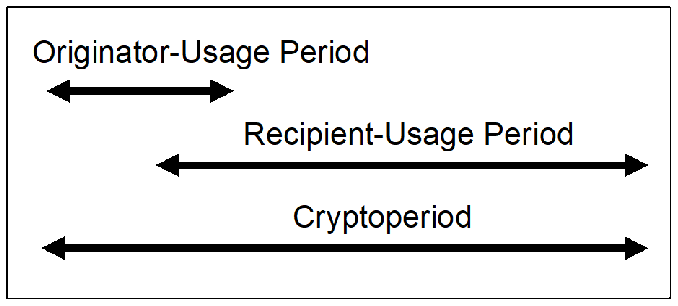
図1:共通鍵の暗号期間。図示例では、生成者使用期間の開始後に受信者使用期間が始まり、両期間は重なり、受信者使用期間が生成者使用期間の終了後まで続く。暗号期間は生成者使用期間の開始から受信者使用期間の終了までである。
Figure 1: Symmetric-key cryptoperiod
図1:共通鍵の暗号期間
Examples of the usage periods for symmetric keys include the following:
共通鍵の使用期間の例を次に示します。
a.When a symmetric key is only used for securing communications, the period of time from the originator’s application of protection to the recipient’s processing may be negligible. In this case, the key is authorized for either purpose during the entire cryptoperiod (i.e., the originator-usage period and the recipient-usage period are the same).
a.共通鍵を通信の保護だけに使用する場合、生成者による保護の適用から受信者による処理までの時間は、無視できるほど短いことがあります。この場合、その鍵は暗号期間全体を通じて、いずれの目的での使用も認可されます(すなわち、生成者使用期間と受信者使用期間は同じです)。
b.When a symmetric key is used to protect stored information, the originator-usage period (when the originator applies cryptographic protection to stored information) may end much earlier than the recipient-usage period (when the stored information is processed). In this case, the cryptoperiod begins at the initial time authorized for the application of protection with the key and ends with the latest time authorized for processing using that key. In general, the recipient-usage period for stored information will continue beyond the originator-usage period so that the stored information may be authenticated or decrypted at a later time.
b.共通鍵を保存情報の保護に使用する場合、生成者使用期間(生成者が保存情報に暗号による保護を適用する期間)は、受信者使用期間(保存情報を処理する期間)よりもかなり早く終了することがあります。この場合、暗号期間は、その鍵による保護の適用が認可される最初の時点に始まり、その鍵を用いた処理が認可される最後の時点に終わります。一般に、保存情報の受信者使用期間は生成者使用期間の終了後まで続き、保存情報を後で認証又は復号できるようにします。
c.When a symmetric key is used to protect stored information, the recipient-usage period may start after the beginning of the originator-usage period as shown in Figure 1. For example, information may be encrypted before being stored on some storage media. At some later time, the key may be distributed in order to decrypt and recover the information.
c.共通鍵を保存情報の保護に使用する場合、図1に示すように、受信者使用期間は生成者使用期間の開始後に始まることがあります。例えば、情報を何らかの記憶媒体に保存する前に暗号化し、その後のある時点で、情報を復号・復元するために鍵を配布することがあります。
5.3.6 Cryptoperiod Recommendations for Specific Key Types
5.3.6 特定の鍵種別に関する暗号期間の推奨
The key type, usage environment, and data characteristics described above may affect the cryptoperiod required for a given key. Suggested cryptoperiods for various key types are provided below. Note that the cryptoperiods suggested are only rough order-of-magnitude guidelines; longer or shorter cryptoperiods may be warranted depending on the application and environment in which the keys will be used. However, when assigning a longer cryptoperiod than suggested below, serious consideration should be given to the risks associated with doing so (see Section 5.3.1). Most of the suggested cryptoperiods are based on a desire for maximum operational efficiency and assumptions regarding the minimum criteria for the usage environment (see FIPS 140 and SP 800-37). The factors described in Sections 5.3.1 through 5.3.3 should be used to determine actual cryptoperiods for specific usage environments.
上述の鍵の種類、使用環境、データの特性は、ある鍵に必要な暗号期間に影響を及ぼしうます。以下に、さまざまな鍵の種類について推奨する暗号期間を示します。推奨する暗号期間はおおよその桁を示す目安にすぎず、鍵を使用するアプリケーションや環境によっては、より長い暗号期間またはより短い暗号期間が妥当な場合もある点に注意されました。ただし、以下の推奨より長い暗号期間を割り当てる場合は、それに伴うリスクを真剣に検討すべきです(5.3.1節を参照してください)。推奨する暗号期間の大半は、運用効率を最大化したいという要望と、使用環境の最低基準に関する前提(FIPS 140およびSP 800-37を参照)に基づいています。特定の使用環境における実際の暗号期間を決定するには、5.3.1節から5.3.3節に記載した要因を用いるべきです。
1.Private signature key:
1.署名用秘密鍵:
a.Type Considerations: In general, the cryptoperiod of a private signature key may be shorter than the cryptoperiod of the corresponding public signature-verification key. When the corresponding public key has been certified by a CA, the cryptoperiod for a private signature key ends when the notAfter date is reached on the last certificate issued for the public key.57
a.種別に関する考慮事項:一般に、署名用秘密鍵の暗号期間は対応する署名検証用公開鍵の暗号期間より短い場合があります。対応する公開鍵がCAによって証明されている場合、署名用秘密鍵の暗号期間は、その公開鍵に発行された最後の証明書のnotAfter日に達した時点で終了します。57
b.Cryptoperiod: Given the use of an approved algorithm and key size as well as an expectation that the security of the key-storage and use environment will increase as the sensitivity and/or criticality of the processes for which the key provides integrity protection increases, a maximum cryptoperiod of about one to three years is recommended. A private signature key shall be destroyed at the end of its cryptoperiod.
b.暗号期間:承認済みアルゴリズムと鍵サイズを使用し、鍵が完全性保護を提供するプロセスの機微性および/または重要度が高まるほど鍵保管・使用環境のセキュリティも向上するとの前提に基づき、最大約1~3年の暗号期間を推奨します。署名用秘密鍵は暗号期間の終了時に破棄しなければなりません。
2.Public signature-verification key:
2.署名検証用公開鍵:
a.Type Considerations: In general, the cryptoperiod of a public signature-verification key may be longer than the cryptoperiod of the corresponding private signature key. The cryptoperiod is, in effect, the period during which any signature computed using the corresponding private signature key needs to be verified. A longer cryptoperiod for a public signature-verification key (than that of the private signature key) poses a relatively minimal security concern.
a.種別に関する考慮事項:一般に、署名検証用公開鍵の暗号期間は対応する署名用秘密鍵の暗号期間より長い場合があります。暗号期間とは、事実上、対応する署名用秘密鍵で計算した署名を検証する必要がある期間です。署名検証用公開鍵の暗号期間を(署名用秘密鍵より)長くしても、セキュリティ上の懸念は比較的軽微です。
b.Cryptoperiod: The cryptoperiod may be on the order of several years. However, due to the long exposure of protection mechanisms to hostile attack, the reliability of the signature is reduced with the passage of time. That is, for any given algorithm and key size, vulnerability to cryptanalysis is expected to increase with time. Although choosing the strongest available algorithm and a large key size can minimize this vulnerability to cryptanalysis, the consequences of exposure to attacks on physical, procedural, and logical access-control mechanisms for the private key are not affected.
b.暗号期間:暗号期間は数年程度でもよいです。ただし、保護メカニズムが敵対的攻撃に長期間さらされるため、時間の経過とともに署名の信頼性は低下します。つまり、任意のアルゴリズムと鍵サイズについて、暗号解読への脆弱性は時間とともに高まると予想されます。利用可能な最も強力なアルゴリズムと大きな鍵サイズを選ぶことで、暗号解読への脆弱性を最小限に抑えられますが、秘密鍵に対する物理的、手続的、論理的なアクセス制御メカニズムへの攻撃にさらされる結果は変わりません。
Some systems use a cryptographic timestamping function to place an unforgeable timestamp on each signed message. Even when the cryptoperiod of a private signature key has expired, the corresponding public signature-verification key may be used to verify signatures on messages whose timestamps are within the cryptoperiod of the private signature key. In this case, one is relying on the cryptographic timestamp function to provide assurance that the message was signed within the private signature key’s originator-usage period.
一部のシステムでは、署名済みメッセージごとに偽造不能なタイムスタンプを付与する暗号タイムスタンプ機能を使用します。署名用秘密鍵の暗号期間が終了した後でも、その秘密鍵の暗号期間内のタイムスタンプが付されたメッセージの署名は、対応する署名検証用公開鍵で検証してもよいです。この場合、メッセージが署名用秘密鍵の生成者使用期間中に署名されたことの保証は、暗号タイムスタンプ機能に依拠します。
3.Symmetric authentication key:
3.共通鍵認証鍵:
a.Type Considerations: The cryptoperiod of a symmetric authentication key58 depends on the sensitivity of the type of information being protected and the protection afforded by the key and associated algorithm. For very sensitive information, an authentication key may need to be unique to the protected information. For less sensitive information, a suitable cryptoperiod may extend beyond a single use of the key. The originator-usage period of a symmetric authentication key applies to the use of that key in applying the original cryptographic protection for the information (e.g., computing the MAC); new MACs shall not be computed on information using that key after the end of the originator-usage period. However, the key may need to be available to verify the MAC on the protected data beyond the originator-usage period (i.e., the recipient-usage period may extend beyond the originator-usage period). The recipient-usage period is the period during which a MAC generated during the originator-usage period needs to be verified. Note that if a MAC key is compromised, it may be possible for an adversary to modify the data and then recalculate the MAC.
a.種別に関する考慮事項:共通鍵認証鍵58の暗号期間は、保護対象情報の種類の機微性と、その鍵および関連アルゴリズムが与える保護に依存します。極めて機微な情報では、認証鍵を保護対象情報ごとに固有にする必要がある場合があります。機微性が比較的低い情報では、適切な暗号期間が鍵の単一使用を超えて延びる場合があります。共通鍵認証鍵の生成者使用期間は、情報に当初の暗号学的保護を施す(例えばMACを計算する)ためにその鍵を使用する期間に適用されます。生成者使用期間の終了後は、その鍵を用いて情報に対する新たなMACを計算してはなりません。一方、保護対象データのMACを検証するため、鍵を生成者使用期間後も利用可能にする必要がある場合があります(すなわち、受信者使用期間が生成者使用期間を超える場合があります)。受信者使用期間とは、生成者使用期間中に生成されたMACを検証する必要がある期間です。MAC鍵が危殆化した場合、攻撃者がデータを改ざんしたうえでMACを再計算できる可能性があることに留意します。
b.Cryptoperiod: Given the use of an approved algorithm and key size and an expectation that the security of the key-storage and use environment will increase as the sensitivity and/or criticality of the processes for which the key provides integrity protection increases, an originator-usage period of no more than two years is recommended, and it is recommended that the recipient-usage period not extend more than three years beyond the end of the originator-usage period.
b.暗号期間:承認済みアルゴリズムと鍵サイズを使用し、鍵が完全性保護を提供するプロセスの機微性および/または重要度が高まるほど鍵保管・使用環境のセキュリティも向上するとの前提に基づき、生成者使用期間は2年以内とすることを推奨し、受信者使用期間は生成者使用期間の終了後3年を超えないことを推奨します。
4.Private authentication key:
4.認証用秘密鍵:
a.Type Considerations: A private authentication key may be used multiple times to enable data integrity and identity authentication. A Certification Authority, for example, could certify the corresponding public key. In most cases, the cryptoperiod of a private authentication key is the same as the cryptoperiod of the corresponding public key.
a.種別に関する考慮事項:認証用秘密鍵は、データ完全性および本人確認を可能にするため複数回使用する場合があります。例えば、認証局が対応する公開鍵を証明できます。ほとんどの場合、認証用秘密鍵の暗号期間は対応する公開鍵の暗号期間と同じです。
b.Cryptoperiod: An appropriate cryptoperiod for a private authentication key would be no more than one or two years, depending on its usage environment and the sensitivity/criticality of the authenticated information.
b.暗号期間:認証用秘密鍵の適切な暗号期間は、その使用環境および認証対象情報の機微性/重要度に応じて1~2年以下です。
5.Public authentication key:
5.公開認証鍵:
a.Type Considerations: In most cases, the cryptoperiod of a public authentication key is the same as the cryptoperiod of the corresponding private authentication key. The cryptoperiod is, in effect, the period during which the identity of the originator of information protected by the corresponding private authentication key needs to be verified (i.e., the identity needs to be authenticated).59
a.種別に関する考慮事項:ほとんどの場合、公開認証鍵の暗号期間は対応する認証用秘密鍵の暗号期間と同じです。暗号期間とは事実上、対応する認証用秘密鍵で保護された情報の生成者の本人性を検証する(すなわち本人確認する)必要がある期間です。59
b.Cryptoperiod: An appropriate cryptoperiod for a public authentication key would be no more than one or two years, depending on its usage environment and the sensitivity/criticality of the authenticated information.
b.暗号期間:公開認証鍵の適切な暗号期間は、その使用環境および認証対象情報の機微性/重要度に応じて1~2年以下です。
6.Symmetric data-encryption key:
6.共通鍵データ暗号化鍵:
a.Type Considerations: A symmetric data-encryption key is used to protect stored data, messages, or communications sessions. Based primarily on the consequences of a compromise, a data-encryption key that is used to encrypt large volumes of data over a short period of time (e.g., for link encryption) should have a relatively short originator-usage period. An encryption key used to encrypt less data over time could have a longer originator-usage period. The originator-usage period of a symmetric data-encryption key applies to the use of that key for encrypting information (see Section 5.3.5).
a.種別に関する考慮事項:共通鍵データ暗号化鍵は、保存データ、メッセージ、通信セッションの保護に使用します。主に危殆化の結果に基づき、短期間に大量のデータを暗号化するために使用するデータ暗号化鍵(例えばリンク暗号化用の鍵)は、比較的短い生成者使用期間とすべきです。一定期間に暗号化するデータ量が比較的少ない暗号化鍵は、より長い生成者使用期間にできます。共通鍵データ暗号化鍵の生成者使用期間は、情報の暗号化にその鍵を使用する期間に適用されます(5.3.5節を参照してください)。
During the originator-usage period, encryption of the data may be performed using the data-encryption key; the key shall not be used for performing an encryption operation on data beyond this period. However, the key may need to be available to decrypt the protected data beyond the originator-usage period (i.e., the recipient-usage period may need to extend beyond the originator-usage period).
生成者使用期間中は、データ暗号化鍵を用いてデータを暗号化してもよいです。この期間を超えてデータの暗号化操作を行うために鍵を使用してはなりません。一方、保護されたデータを復号するため、生成者使用期間後も鍵を利用可能にする必要がある場合があります(すなわち受信者使用期間が生成者使用期間を超える必要がある場合があります)。
b.Cryptoperiod: The originator-usage period recommended for the encryption of large volumes of data over a short period of time (e.g., for link encryption) is on the order of a day or a week. An encryption key used to encrypt smaller volumes of data might have an originator-usage period of up to two years. A recipient-usage period of no more than three years beyond the end of the originator-usage period is recommended.
b.暗号期間:短期間に大量のデータを暗号化する(リンク暗号化など)場合、推奨される生成者使用期間はおおむね1日または1週間です。比較的少量のデータを暗号化する鍵では、最長2年の生成者使用期間を設定できます。受信者使用期間は生成者使用期間の終了後3年以内とすることを推奨します。
In the case of a symmetric data-encryption key that is used to encrypt single messages or single communications sessions, the lifetime of the protected data could be months or years because the encrypted messages may be stored for later reading. Where data is maintained in encrypted form, a symmetric data-encryption key needs to be maintained until that data is re-encrypted under a new key or destroyed. Note that confidence in the confidentiality of the data is reduced with the passage of time.
単一メッセージまたは単一通信セッションの暗号化に使用する共通鍵データ暗号化鍵の場合、保護対象データの寿命は数か月または数年になり得ます。これは、暗号化したメッセージを後で読むために保存する場合があるためです。データを暗号化した状態で保持する場合、新しい鍵で再暗号化するかデータを破棄するまで、共通鍵データ暗号化鍵を保持する必要があります。時間の経過とともに、データの機密性に対する確信は低下することに留意します。
7.Symmetric key-wrapping key:
7.共通鍵ラッピング鍵:
a.Type Considerations: A symmetric key-wrapping key that is used to wrap (i.e., encrypt and integrity protect) very large numbers of keys over a short period of time should have a relatively short originator-usage period. If a small number of keys are wrapped, the originator-usage period of the key-wrapping key could be longer. The originator-usage period of a symmetric key-wrapping key applies to the use of that key in providing the key-wrapping protection for the keys; a wrapping operation shall not be performed using a key-wrapping key whose originator-usage period has expired. However, the key-wrapping key may need to be available to unwrap the protected keys (i.e., to decrypt and verify the integrity of the wrapped keys) beyond the originator-usage period (i.e., the recipient-usage period may need to extend beyond the originator-usage period); the recipient-usage period is the period of time during which keys wrapped during the key-wrapping key’s originator-usage period may need to be unwrapped.
a.種別に関する考慮事項:短期間に非常に多数の鍵をラップ(すなわち暗号化し、完全性を保護)する共通鍵ラッピング鍵は、比較的短い生成者使用期間とすべきです。ラップする鍵の数が少なければ、鍵ラッピング鍵の生成者使用期間を長くできます。共通鍵ラッピング鍵の生成者使用期間は、鍵に鍵ラッピング保護を提供するためその鍵を使用する期間に適用されます。生成者使用期間が終了した鍵ラッピング鍵を用いてラッピング操作を行ってはなりません。一方、保護対象鍵のアンラップ(すなわちラップ済み鍵の復号と完全性検証)を行うため、鍵ラッピング鍵を生成者使用期間後も利用可能にする必要がある場合があります(すなわち受信者使用期間が生成者使用期間を超える必要がある場合があります)。受信者使用期間とは、鍵ラッピング鍵の生成者使用期間中にラップされた鍵をアンラップする必要がある可能性のある期間です。
Some symmetric key-wrapping keys are used for only a single message or communications session. In the case of these very short-term key-wrapping keys, an appropriate cryptoperiod (i.e., which includes both the originator and recipient-usage periods) is a single communication session. It is assumed that the wrapped keys will not be retained in their wrapped form, so the originator-usage period and recipient-usage period of a key-wrapping key is the same. In other cases, a key-wrapping key may be retained so that the files or messages encrypted by the wrapped keys may be recovered later. In such cases, the recipient-usage period may be significantly longer than the originator-usage period of the key-wrapping key, and cryptoperiods lasting for years may be employed.
一部の共通鍵ラッピング鍵は、単一のメッセージまたは通信セッションにのみ使用します。このような極めて短期間の鍵ラッピング鍵では、適切な暗号期間(生成者使用期間と受信者使用期間の両方を含む)は単一の通信セッションです。ラップされた鍵はラップ形式で保持されないと想定するため、鍵ラッピング鍵の生成者使用期間と受信者使用期間は同じです。別の場合には、ラップされた鍵で暗号化したファイルやメッセージを後から回復できるよう、鍵ラッピング鍵を保持することがあります。この場合、受信者使用期間は鍵ラッピング鍵の生成者使用期間より大幅に長くなる場合があり、暗号期間を数年とすることがあります。
b.Cryptoperiod: The recommended originator-usage period for a symmetric key-wrapping key that is used to wrap very large numbers of keys over a short period of time is on the order of a day or a week. If a relatively small number of keys are to be wrapped under a key-wrapping key, the originator-usage period of the key-wrapping key could be up to two years. In the case of a key-wrapping key that is used for only a single message or communications session, the cryptoperiod would be limited to a single communication session. It is recommended that a recipient-usage period extend no more than three years beyond the end of the originator-usage period.
b.暗号期間:短期間に非常に多数の鍵をラップする共通鍵ラッピング鍵では、推奨される生成者使用期間はおおむね1日または1週間です。鍵ラッピング鍵でラップする鍵の数が比較的少なければ、鍵ラッピング鍵の生成者使用期間を最長2年とできます。単一のメッセージまたは通信セッションにのみ使用する鍵ラッピング鍵の場合、暗号期間は単一の通信セッションに限られます。受信者使用期間は生成者使用期間の終了後3年以内とすることを推奨します。
8.Symmetric RBG keys:
8.共通鍵RBG鍵:
a.Type Considerations: A symmetric RBG key is used in a deterministic random bit generation function. The approved RBGs in SP 800-90 control key changes (e.g., during reseeding). The cryptoperiod consists of only an originator-usage period.
a.種別に関する考慮事項:共通鍵RBG鍵は、決定論的ランダムビット生成関数で使用します。SP 800-90の承認済みRBGは、(再シード時などの)鍵変更を制御します。暗号期間は生成者使用期間のみで構成されます。
b.Cryptoperiod: Assuming the use of an approved RBG, the maximum cryptoperiod of a symmetric RBG key is determined by the design of the RBG (see SP 800-90).
b.暗号期間:承認済みRBGを使用する場合、共通鍵RBG鍵の最大暗号期間はRBGの設計によって決まります(SP 800-90を参照してください)。
9.Symmetric master key/key-derivation key:
9.共通マスター鍵/鍵導出鍵:
a.Type Considerations: A symmetric master key (also called a key-derivation key) may be used multiple times to derive other keys using a (one-way) key-derivation function or method (see Section 8.2.4). Therefore, the cryptoperiod consists of only an originator-usage period for this key type. A suitable cryptoperiod depends on the nature and use of the key(s) derived from the master key and on considerations provided earlier in Section 5.3. The cryptoperiod of a key derived from a master key could be relatively short (e.g., a single use, communication session, or transaction). Alternatively, the master key could be used over a longer period of time to derive (or re-derive) multiple keys for the same or different purposes. The cryptoperiod of the derived keys depends on their use (e.g., as a symmetric data-encryption or integrity authentication key).
a.種別に関する考慮事項:共通マスター鍵(鍵導出鍵とも呼ばれる)は、(一方向)鍵導出関数または方式を用いて他の鍵を導出するために複数回使用してもよいです(8.2.4節を参照してください)。そのため、この種類の鍵の暗号期間は生成者使用期間のみで構成されます。適切な暗号期間は、マスター鍵から導出する鍵の性質と用途、および5.3節で前述した考慮事項に依存します。マスター鍵から導出した鍵の暗号期間は比較的短く(単一使用、通信セッション、トランザクションなど)できます。あるいは、同じ目的または異なる目的の複数の鍵を導出(または再導出)するために、マスター鍵をより長期間使用できます。導出鍵の暗号期間は、その用途(共通鍵データ暗号化鍵または完全性認証鍵など)によって決まります。
b.Cryptoperiod: An appropriate cryptoperiod for a symmetric master key might be one year, depending on its usage environment, the sensitivity/criticality of the information protected by the derived keys, and the number of keys derived from the master key.
b.暗号期間:共通マスター鍵の適切な暗号期間は、使用環境、導出鍵で保護する情報の機微性/重要度、マスター鍵から導出する鍵の数に応じて、1年とするのが適切な場合があります。
10.Private key-transport key:
10.秘密鍵転送鍵:
a.Type Considerations: A private key-transport key may be used multiple times to decrypt keys. Due to the potential need to decrypt keys at a time after they have been encrypted for transport, the cryptoperiod of the private key-transport key may be longer than the cryptoperiod of the associated public key. The cryptoperiod of the private key is the length of time during which any keys encrypted by the corresponding public key-transport key need to be decrypted.
a.種別に関する考慮事項:秘密鍵転送鍵は、鍵の復号に複数回使用する場合があります。転送のために暗号化された鍵を後日復号する必要が生じる可能性があるため、秘密鍵転送鍵の暗号期間は対応する公開鍵の暗号期間より長くなる場合があります。秘密鍵の暗号期間は、対応する公開鍵転送鍵で暗号化した鍵を復号する必要がある期間です。
b.Cryptoperiod: Given 1) the use of an approved algorithm and key size, 2) the volume of information that may be protected by keys encrypted under the corresponding public key-transport key, and 3) an expectation that the security of the key-storage and use environment will increase as the sensitivity and/or criticality of the processes for which the key provides protection increases, a cryptoperiod of no more than two years is recommended for a private key-transport key. In certain applications (e.g., email) where received messages are stored and decrypted at a later time, the cryptoperiod of a private key-transport key may exceed the cryptoperiod of the public key-transport key.
b.暗号期間:1)承認済みアルゴリズムと鍵サイズの使用、2)対応する公開鍵転送鍵で暗号化する鍵によって保護され得る情報量、3)鍵が保護するプロセスの機微性および/または重要度が高まるほど鍵の保管・使用環境のセキュリティも向上するとの前提に基づき、秘密鍵転送鍵の暗号期間は2年以下を推奨します。受信メッセージを保存し、後で復号する電子メールなどの特定のアプリケーションでは、秘密鍵転送鍵の暗号期間が公開鍵転送鍵の暗号期間を超える場合があります。
11.Public key-transport key:
11.公開鍵転送鍵:
a.Type Considerations: The cryptoperiod for a public key-transport key is that period of time during which the public key may be used to actually apply the encryption operation to the keys that will be protected during transport. When the public key has been certified by a CA, the cryptoperiod for the public key ends when the notAfter date is reached on the last certificate issued for the public key.
a.種別に関する考慮事項:公開鍵転送鍵の暗号期間とは、転送中に保護する鍵に対して実際に暗号化操作を適用するため公開鍵を使用できる期間です。公開鍵がCAによって証明されている場合、公開鍵の暗号期間は、その公開鍵に発行された最後の証明書のnotAfter日に終了します。
A public key-transport key can be publicly known. As indicated in the private key-transport key discussion, due to the potential need to decrypt keys at a time after they have been encrypted for transport, the cryptoperiod of a public key-transport key may be shorter than that of the corresponding private key.
公開鍵転送鍵は公開されてもよいです。秘密鍵転送鍵の説明で示したように、転送のために暗号化された鍵を後日復号する必要がある可能性があるため、公開鍵転送鍵の暗号期間は対応する秘密鍵より短い場合があります。
b.Cryptoperiod: Based on cryptoperiod assumptions for the corresponding private key, a recommendation for the cryptoperiod is no more than one or two years.
b.暗号期間:対応する秘密鍵の暗号期間に関する前提に基づき、推奨期間は1~2年以下です。
12.Symmetric key-agreement key:
12.共通鍵合意鍵:
a.Type Considerations: A symmetric key-agreement key may be used multiple times. The cryptoperiod of a symmetric key-agreement key depends on 1) environmental security factors, 2) the nature (e.g., types and formats) and volume of keys that are established, and 3) the details of the key-agreement algorithm and protocol employed. Note that a symmetric key-agreement key may be used to establish symmetric keys (e.g., symmetric data-encryption keys) or other keying material (e.g., IVs).
a.種別に関する考慮事項:共通鍵合意鍵は複数回使用してもよいです。共通鍵合意鍵の暗号期間は、1)環境のセキュリティ要因、2)確立する鍵の性質(種類や形式など)と量、3)使用する鍵合意アルゴリズムおよびプロトコルの詳細に依存します。共通鍵合意鍵は、共通鍵(共通鍵データ暗号化鍵など)またはその他の鍵素材(IVなど)を確立するために使用してもよいことに留意します。
b.Cryptoperiod: Given an assumption that the cryptography that employs a symmetric key-agreement key 1) employs an approved algorithm and key scheme, 2) the cryptographic device meets FIPS 140 requirements, and 3) the risk level has been established in conformance with FIPS 199,60 an appropriate cryptoperiod for the key would be no more than one or two years. In certain applications (e.g., email), where received messages are stored and decrypted at a later time, the recipient-usage period of the key may exceed the originator-usage period.
b.暗号期間:共通鍵合意鍵を用いる暗号方式が、1)承認済みアルゴリズムと鍵方式を使用し、2)暗号装置がFIPS 140の要件を満たし、3)リスクレベルがFIPS 199⁶⁰に適合して定められているとの前提において、この鍵の適切な暗号期間は1~2年以下です。受信メッセージを保存し、後で復号する電子メールなどの特定のアプリケーションでは、鍵の受信者使用期間が生成者使用期間を超える場合があります。
13.Private static key-agreement key:
13.静的鍵合意用秘密鍵:
a.Type Considerations: A private static (i.e., long-term) key-agreement key may be used multiple times. When a CA certifies the corresponding public key, the cryptoperiod of the private static key-agreement key ends when the notAfter date is reached on the last certificate issued for the corresponding public key.
a.種類に関する考慮事項:静的(すなわち長期)鍵合意用秘密鍵は、複数回使用してもよいです。CAが対応する公開鍵を認証する場合、静的鍵合意用秘密鍵の暗号期間は、対応する公開鍵について最後に発行された証明書のnotAfter日付に達した時点で終了します。
As in the case of a symmetric key-agreement key, the cryptoperiod of this key depends on 1) environmental security factors, 2) the nature (e.g., types and formats) and volume of keys that are established, and 3) the details of the key-agreement algorithm and protocol employed. Note that a private static key-agreement key may be used to establish symmetric keys (e.g., key-wrapping keys) or other secret keying material.
共通鍵合意鍵の場合と同様に、この鍵の暗号期間は、1) 環境のセキュリティ要因、2) 確立する鍵の性質(例えば種類や形式)と量、3) 採用する鍵合意アルゴリズムおよびプロトコルの詳細に依存します。静的鍵合意用秘密鍵は、共通鍵(例えば鍵ラップ鍵)やその他のシークレット鍵素材の確立に使用してよい点に注意されました。
b.Cryptoperiod: Given an assumption that the cryptography that employs a private static key-agreement key 1) employs an approved algorithm and key scheme, 2) the cryptographic device meets FIPS 140 requirements, and 3) the risk level has been established in conformance with FIPS 199, an appropriate cryptoperiod for the key would be no more than one or two years. While the cryptoperiods of the private and public static key-agreement keys are usually the same, in certain applications (e.g., email) where received messages are stored and decrypted at a later time, the cryptoperiod of a private static key-agreement key may exceed the cryptoperiod of the corresponding public static key-agreement key.
b.暗号期間:静的鍵合意用秘密鍵を用いる暗号が、1) 承認されたアルゴリズムと鍵スキームを採用し、2) 暗号デバイスがFIPS 140の要件を満たし、3) リスクレベルがFIPS 199に準拠して定められている、という前提の下では、この鍵の適切な暗号期間は1年または2年以内です。静的鍵合意用の秘密鍵と公開鍵の暗号期間は通常同じですが、受信したメッセージを保存して後日復号する特定のアプリケーション(例えば電子メール)では、静的鍵合意用秘密鍵の暗号期間が、対応する静的鍵合意用公開鍵の暗号期間を超えることがあります。
14.Public static key-agreement key:
14.静的鍵合意用公開鍵:
a.Type Considerations: The cryptoperiod for a public static (i.e., long-term) key-agreement key is usually the same as the cryptoperiod of the corresponding private static key-agreement key.
a.種類に関する考慮事項:静的(すなわち長期)鍵合意用公開鍵の暗号期間は、通常、対応する静的鍵合意用秘密鍵の暗号期間と同じです。
b.Cryptoperiod: The cryptoperiod of a public static key-agreement key may be one or two years.
b.暗号期間:静的鍵合意用公開鍵の暗号期間は1年または2年としてもよいです。
15.Private ephemeral key-agreement key:
15.一時鍵合意用秘密鍵:
a.Type Considerations: A private ephemeral (i.e., short-term) key-agreement key is the private key element of an asymmetric key pair that is used in a single transaction to establish one or more keys. A private ephemeral key-agreement key may be used to establish symmetric keys (e.g., key-wrapping keys) or other secret keying material.
a.種類に関する考慮事項:一時(すなわち短期)鍵合意用秘密鍵は、1つ以上の鍵を確立するために単一のトランザクションで使用される非対称鍵ペアの秘密鍵要素です。一時鍵合意用秘密鍵は、共通鍵(例えば鍵ラップ鍵)やその他のシークレット鍵素材の確立に使用してもよいです。
b.Cryptoperiod: A private ephemeral key-agreement key is used for a single key-agreement transaction. However, a private ephemeral key may be used multiple times to establish the same symmetric key with multiple parties during the same transaction (broadcast). The cryptoperiod of a private ephemeral key-agreement key is the duration of a single key-agreement transaction.
b.暗号期間:一時鍵合意用秘密鍵は、単一の鍵合意トランザクションに使用されます。ただし、一時秘密鍵は、同一トランザクション内で複数の相手と同じ共通鍵を確立するために複数回使用してよい(ブロードキャスト)。一時鍵合意用秘密鍵の暗号期間は、単一の鍵合意トランザクションの継続期間です。
16.Public ephemeral key-agreement key:
16.一時鍵合意用公開鍵:
a.Type Considerations: A public ephemeral (i.e., short-term) key-agreement key is the public key element of an asymmetric key pair that is used only once to establish one or more keys.
a.種類に関する考慮事項:一時(すなわち短期)鍵合意用公開鍵は、1つ以上の鍵を確立するために一度だけ使用される非対称鍵ペアの公開鍵要素です。
b.Cryptoperiod: A public ephemeral key-agreement key is used for a single key-agreement transaction. The cryptoperiod of a public ephemeral key-agreement key ends immediately after it is used to generate a shared secret. Note that in some cases, the cryptoperiod of a public ephemeral key-agreement key may be different for the participants in the key-agreement transaction. For example, consider an encrypted email application in which the email sender generates an ephemeral key-agreement key pair and then uses the key pair to generate an encryption key that is used to encrypt the contents of the email. For the sender, the cryptoperiod of the public key ends when the shared secret is generated and the encryption key is derived. However, for the encrypted email receiver, the cryptoperiod of an ephemeral public key does not end until the shared secret is generated and the decryption key is determined; if the email is not processed immediately upon receipt (e.g., it is decrypted a week later than the email was sent), then the cryptoperiod of the ephemeral public key does not end (from the perspective of the receiver) until the shared secret is generated that uses that public key.
b.暗号期間:一時鍵合意用公開鍵は、単一の鍵合意トランザクションに使用されます。一時鍵合意用公開鍵の暗号期間は、共有シークレットの生成に使用された直後に終了します。場合によっては、一時鍵合意用公開鍵の暗号期間が鍵合意トランザクションの参加者ごとに異なることがある点に注意されました。例えば、暗号化電子メールのアプリケーションで、電子メールの送信者が一時鍵合意鍵ペアを生成し、その鍵ペアを用いて電子メールの内容の暗号化に使う暗号鍵を生成する場合を考えます。送信者にとっては、共有シークレットが生成されて暗号鍵が導出された時点で公開鍵の暗号期間が終了します。しかし、暗号化電子メールの受信者にとっては、共有シークレットが生成されて復号鍵が決定されるまで一時公開鍵の暗号期間は終了しません。電子メールを受信後ただちに処理しない場合(例えば、送信から1週間後に復号する場合)、(受信者から見た)一時公開鍵の暗号期間は、その公開鍵を用いる共有シークレットが生成されるまで終了しません。
17.Symmetric authorization key:
17.共通鍵認可鍵:
a.Type Considerations: A symmetric authorization key may be used for an extended period of time, depending on the resources that are protected and the role of the entity authorized for access. For this key type, the originator-usage period and the recipient-usage period are the same. The primary considerations in establishing the cryptoperiod for a symmetric authorization key include the robustness of the key, the adequacy of the cryptographic method, and the adequacy of the key-protection mechanisms and procedures.
a.鍵種別に関する考慮事項:共通鍵認可鍵は、保護対象の資源とアクセスを認可されたエンティティの役割に応じて、長期間使用されることがあります。この鍵種別では、発信者使用期間と受信者使用期間は同一です。共通鍵認可鍵の暗号期間を設定する際の主な考慮事項には、鍵の堅牢性、暗号方式の妥当性、および鍵保護の仕組みと手順の妥当性が含まれます。
b.Cryptoperiod: Given the use of an approved algorithm and key size and an expectation that the security of the key-storage and use environment will increase as the sensitivity and criticality of the authorization processes increases, it is recommended that a cryptoperiod be no more than two years.
b.暗号期間:承認されたアルゴリズムと鍵長を使用し、かつ認可プロセスの機微性と重要性が高まるにつれて鍵の保管・使用環境のセキュリティも高まることが期待されることを前提に、暗号期間は2年以下とすることを推奨します。
18.Private authorization key:
18.認可用秘密鍵:
a.Type Considerations: A private authorization key may be used for an extended period of time, depending on the resources that are protected and the role of the entity authorized for access. The primary considerations in establishing the cryptoperiod for a private authorization key includes the robustness of the key, the adequacy of the cryptographic method, and the adequacy of the key-protection mechanisms and procedures. The cryptoperiod of a private authorization key and its corresponding public key shall be the same.
a.鍵種別に関する考慮事項:認可用秘密鍵は、保護対象の資源とアクセスを認可されたエンティティの役割に応じて、長期間使用されることがあります。認可用秘密鍵の暗号期間を設定する際の主な考慮事項には、鍵の堅牢性、暗号方式の妥当性、および鍵保護の仕組みと手順の妥当性が含まれます。認可用秘密鍵とそれに対応する公開鍵の暗号期間は同一でなければなりません。
b.Cryptoperiod: Given the use of an approved algorithm and key size and an expectation that the security of the key-storage and use environment will increase as the sensitivity and criticality of the authorization processes increases, it is recommended that a cryptoperiod for a private authorization key be no more than two years.
b.暗号期間:承認されたアルゴリズムと鍵長を使用し、かつ認可プロセスの機微性と重要性が高まるにつれて鍵の保管・使用環境のセキュリティも高まることが期待されることを前提に、認可用秘密鍵の暗号期間は2年以下とすることを推奨します。
19.Public authorization key:
19.公開認可鍵:
a.Type Considerations: A public authorization key is the public element of an asymmetric key pair that is used to verify privileges for an entity that possesses the corresponding private key.
a.鍵種別に関する考慮事項:公開認可鍵は、非対称鍵ペアの公開要素であり、対応する秘密鍵を保有するエンティティの権限を検証するために使用されます。
b.Cryptoperiod: The cryptoperiod of a public authorization key shall be the same as that of the private authorization key – no more than two years.
b.暗号期間:公開認可鍵の暗号期間は、認可用秘密鍵の暗号期間と同一、すなわち2年以下でなければなりません。
Table 1 below is a summary of the cryptoperiods that are suggested for each key type. Longer or shorter cryptoperiods may be warranted, depending on the application and environment in which the keys will be used. However, when assigning a longer cryptoperiod than suggested below, serious consideration should be given to the risks associated with doing so (see Section 5.3.1).
以下の表1は、各鍵種別について推奨される暗号期間をまとめたものです。鍵を使用するアプリケーションと環境によっては、これより長いまたは短い暗号期間が妥当な場合もあります。ただし、以下に示す推奨値より長い暗号期間を割り当てる場合は、それに伴うリスクを十分に検討すべきです(5.3.1節を参照してください)。
Table 1: Suggested cryptoperiods for key types
表1:鍵種別ごとの推奨暗号期間
| Key Type | Cryptoperiod | |
|---|---|---|
| Originator-Usage Period (OUP) | Recipient-Usage Period | |
| 1. Private Signature Key | 1 to 3 years | − |
| 2. Public Signature-Verification Key | Several years (depends on key size) | |
| 3. Symmetric Authentication Key | \(\leq 2\,\text{years}\) | \(\leq \mathrm{OUP}+3\,\text{years}\) |
| 4. Private Authentication Key | 1 to 2 years | |
| 5. Public Authentication Key | 1 to 2 years | |
| 6. Symmetric Data Encryption Keys | \(\leq 2\,\text{years}\) | \(\leq \mathrm{OUP}+3\,\text{years}\) |
| 7. Symmetric Key-Wrapping Key | \(\leq 2\,\text{years}\) | \(\leq \mathrm{OUP}+3\,\text{years}\) |
| 8. Symmetric RBG Keys | See SP 800-90 | − |
| 9. Symmetric Master Key/Key Derivation Key | About 1 year | − |
| 10. Private Key Transport Key | \(\leq 2\,\text{years}\)61 | |
| 11. Public Key Transport Key | 1 to 2 years | |
| 12. Symmetric Key Agreement Key | 1 to 2 years62 | |
| 13. Private Static Key Agreement Key | 1 to 2 years63 | |
| 14. Public Static Key Agreement Key | 1 to 2 years | |
| 15. Private Ephemeral Key Agreement Key | One key-agreement transaction | |
| 16. Public Ephemeral Key Agreement Key | One key-agreement transaction | |
| 17. Symmetric Authorization Key | \(\leq 2\,\text{years}\) | |
| 18. Private Authorization Key | \(\leq 2\,\text{years}\) | |
| 19. Public Authorization Key | \(\leq 2\,\text{years}\) | |
| 鍵種別 | 暗号期間 | |
|---|---|---|
| 生成者使用期間(OUP) | 受信者使用期間 | |
| 1. 署名用秘密鍵 | 1~3年 | − |
| 2. 署名検証用公開鍵 | 数年(鍵長による) | |
| 3. 共通鍵認証鍵 | \(\leq 2\,\text{年}\) | \(\leq \mathrm{OUP}+3\,\text{年}\) |
| 4. 認証用秘密鍵 | 1~2年 | |
| 5. 認証用公開鍵 | 1~2年 | |
| 6. 共通鍵データ暗号化鍵 | \(\leq 2\,\text{年}\) | \(\leq \mathrm{OUP}+3\,\text{年}\) |
| 7. 共通鍵ラッピング鍵 | \(\leq 2\,\text{年}\) | \(\leq \mathrm{OUP}+3\,\text{年}\) |
| 8. 共通鍵RBG鍵 | SP 800-90を参照 | − |
| 9. 共通鍵のマスター鍵/鍵導出鍵 | 約1年 | − |
| 10. 鍵転送用秘密鍵 | \(\leq 2\,\text{年}\)61 | |
| 11. 鍵転送用公開鍵 | 1~2年 | |
| 12. 共通鍵合意鍵 | 1~2年62 | |
| 13. 静的鍵合意用秘密鍵 | 1~2年63 | |
| 14. 静的鍵合意用公開鍵 | 1~2年 | |
| 15. 一時鍵合意用秘密鍵 | 1回の鍵合意トランザクション | |
| 16. 一時鍵合意用公開鍵 | 1回の鍵合意トランザクション | |
| 17. 共通鍵認可鍵 | \(\leq 2\,\text{年}\) | |
| 18. 認可用秘密鍵 | \(\leq 2\,\text{年}\) | |
| 19. 認可用公開鍵 | \(\leq 2\,\text{年}\) | |
5.3.7 Recommendations for Other Related Information
5.3.7 その他の関連情報に関する推奨
Information other than keys does not have well-established cryptoperiods, per se. The following recommendations are offered regarding the disposition of this other information:
鍵以外の情報には、一般に確立された暗号期間がありません。その他の情報の処置について、次を推奨します。
1.Domain parameters remain in effect until changed.
1.ドメインパラメータは変更されるまで有効です。
2.An IV is associated with the information that it helps to protect and is needed until the information in its cryptographically protected form is no longer needed.
2.IVは保護対象情報に関連付けられ、その情報が暗号保護された形式で不要となるまで必要です。
3.A shared secret that is generated during the execution of a key-agreement scheme shall be destroyed as soon as it is no longer needed to derive keying material.
3.鍵合意方式の実行中に生成された共有シークレットは、鍵素材の導出に不要となった時点で直ちに破棄しなければなりません。
4.An RBG seed shall be destroyed immediately after use.
4.RBGシードは使用直後に破棄しなければなりません。
5.Other public information should not be retained longer than needed for cryptographic processing.
5.その他の公開情報は、暗号処理に必要な期間を超えて保持すべきではありません。
6.Other secret information shall not be retained longer than necessary.
6.その他の秘密情報は、必要な期間を超えて保持してはなりません。
7.An intermediate result shall be destroyed immediately after use.
7.中間結果は使用直後に破棄しなければなりません。
5.4 Assurances
5.4 保証
When keying material (e.g., keys, IVs, and domain parameters) is stored or distributed, it may pass through unprotected environments. In such cases, specific assurances are required before the keying material is used to perform normal cryptographic operations.
鍵素材(鍵、IV、ドメインパラメータなど)を保管または配布する際、保護されていない環境を経由することがあります。このような場合、通常の暗号操作に鍵素材を使用する前に、特定の保証を得る必要があります。
5.4.1 Assurance of Integrity (Integrity Protection)
5.4.1 完全性の保証(完全性保護)
Assurance of integrity shall be obtained prior to using all keying material.
すべての鍵素材を使用する前に完全性の保証を得なければなりません。
At a minimum, assurance of integrity shall be obtained by verifying that the keying material has the appropriate format and came from an authorized source. Additional assurance of integrity should be obtained by the proper use of error detection codes, message authentication codes, and digital signatures to provide assurance that keying material has not changed. For example, a message authentication code could be generated on stored key information to provide assurance that the key information has not changed while in storage; the message authentication could be stored with the key information for easy access.
最低限、鍵素材が適切な形式であり、許可された送信元から来たことを検証して保証を得なければなりません。鍵素材が変更されていないことを保証するため、エラー検出符号、メッセージ認証コード、デジタル署名を適切に使用し、追加の完全性保証を得るべきです。例えば、保管中に鍵情報が変更されていないことを保証するため、保存された鍵情報に対するメッセージ認証コードを生成し、簡単に参照できるよう鍵情報とともに保存できます。
5.4.2 Assurance of Domain Parameter Validity
5.4.2 ドメインパラメータの妥当性保証
Domain parameters are used by discrete log public-key algorithms during the generation of key pairs, digital signature generation, signature verification, and the generation of shared secrets (during the execution of a key-agreement scheme) that are subsequently used to derive keying material. Assurance of the validity of the domain parameters is important to applications of public-key cryptography and shall be obtained prior to using them.
離散対数公開鍵アルゴリズムは、鍵ペアの生成、デジタル署名の生成、署名検証、および共有シークレットの生成(鍵合意方式の実行中)にドメインパラメータを使用し、生成された共有シークレットはその後、鍵素材の導出に使用されます。公開鍵暗号のアプリケーションではドメインパラメータの妥当性保証が重要であり、使用前にその保証を得なければなりません。
Invalid domain parameters could void all intended security for all entities using the domain parameters. Methods for obtaining assurance of domain-parameter validity for digital signature algorithms are provided in SP 800-89.64 Methods for obtaining assurance of domain-parameter validity for finite-field and elliptic-curve discrete-log key-agreement algorithms are provided in SP 800-56A.
無効なドメインパラメータは、そのドメインパラメータを使用するすべてのエンティティについて、意図したセキュリティをすべて無効にするおそれがあります。デジタル署名アルゴリズムのドメインパラメータの有効性について保証を得る方法は SP 800-89 に示されている64。有限体および楕円曲線の離散対数に基づく鍵合意アルゴリズムのドメインパラメータの有効性について保証を得る方法は SP 800-56A に示されています。
Note that if a public key is certified by a CA for these algorithms, the CA could obtain this assurance during the certification process. Otherwise, the key-pair owner and any relying parties are responsible for obtaining the assurance.
なお、これらのアルゴリズムの公開鍵が CA によって認証される場合、CA は認証プロセスの中でこの保証を得ることができます。そうでない場合は、鍵ペアの所有者と依拠当事者が保証を得る責任を負います。
5.4.3 Assurance of Public-Key Validity
5.4.3 公開鍵の妥当性保証
Assurance of public-key validity shall be obtained on all public keys before using them.
すべての公開鍵について、使用前に公開鍵の有効性の保証を得なければなりません。
Assurance of public-key validity gives the user confidence that the public key is arithmetically correct. This reduces the probability of using weak or corrupted keys. Invalid public keys could result in voiding the intended security, including the security of the operation (e.g., digital signature generation or key establishment), leaking some or all information from the owner’s private key, and leaking some or all information about a private key that is combined with an invalid public key (as may be done when key agreement or public-key encryption is performed). One of several ways to obtain assurance of public-key validity is for an entity to verify certain mathematical properties that the public key should have. Another way is to obtain the assurance from a trusted third party (e.g., a CA) that the trusted party validated the properties.
公開鍵の有効性の保証により、利用者は公開鍵が算術的に正しいという確信を得られます。これにより、脆弱な鍵や破損した鍵を使用する確率が低減します。無効な公開鍵は、演算(例:デジタル署名生成や鍵確立)のセキュリティを含め、意図したセキュリティを無効にするおそれがあり、所有者の秘密鍵の情報の一部または全部を漏洩させるおそれや、無効な公開鍵と組み合わされる秘密鍵(鍵合意や公開鍵暗号化を行う場合など)の情報の一部または全部を漏洩させるおそれがあります。公開鍵の有効性の保証を得る方法はいくつかあり、その一つは、公開鍵が備えるべき特定の数学的性質をエンティティ自身が検証することです。別の方法は、信頼できる第三者(例:CA)がそれらの性質を検証したという保証をその第三者から得ることです。
Methods for obtaining assurance of public-key validity for the DSA, ECDSA, and RSA digital signature algorithms are provided in SP 800-89. Methods for obtaining this assurance for the finite-field and elliptic-curve discrete-log key-establishment schemes are provided in SP 800-56A. Methods for obtaining assurance of (partial) public-key validity for the RSA key-establishment schemes are provided in SP 800-56B.
DSA、ECDSA、RSA の各デジタル署名アルゴリズムについて公開鍵の有効性の保証を得る方法は SP 800-89 に示されています。有限体および楕円曲線の離散対数に基づく鍵確立方式についてこの保証を得る方法は SP 800-56A に示されています。RSA 鍵確立方式について公開鍵の(部分的な)有効性の保証を得る方法は SP 800-56B に示されています。
5.4.4 Assurance of Private-Key Possession
5.4.4 秘密鍵保有の保証
Assurance of static (i.e., long-term) private-key possession shall be obtained before the use of the corresponding static public key. Assurance of public-key validity shall always be obtained prior to or concurrently with assurance of possession of the private key. Assurance of possession of the correct private key shall be obtained by the key-pair owner (e.g., ensuring that it is available and has not been modified before use). Entities that receive a public key shall obtain assurance that the key-pair owner possesses the private key corresponding to the received public key.
静的(すなわち長期)秘密鍵の保有の保証は、対応する静的公開鍵を使用する前に得なければなりません。公開鍵の有効性の保証は、常に秘密鍵の保有の保証より前に、またはそれと同時に得なければなりません。正しい秘密鍵を保有していることの保証は、鍵ペアの所有者が得なければなりません(例:使用前に秘密鍵が利用可能であり、改変されていないことを確認します)。公開鍵を受け取るエンティティは、受け取った公開鍵に対応する秘密鍵を鍵ペアの所有者が保有していることの保証を得なければなりません。
For specific details regarding the assurance of the possession of private key-establishment keys, see SP 800-56A and SP 800-56B. For specific details regarding assurance of the possession of private digital-signature keys, see SP 800-89. Note that for public keys that are certified by a CA, the CA could obtain this assurance during the certification process. Otherwise, the owner and relying parties are responsible for obtaining the assurance.
鍵確立用秘密鍵の保有の保証に関する具体的な詳細については、SP 800-56A および SP 800-56B を参照されました。デジタル署名用秘密鍵の保有の保証に関する具体的な詳細については、SP 800-89 を参照されました。なお、CA によって認証される公開鍵については、CA が認証プロセスの中でこの保証を得ることができます。そうでない場合は、所有者と依拠当事者が保証を得る責任を負います。
5.4.5 Key Confirmation
5.4.5 鍵確認
Key establishment is the process by which keying material is securely established among entities for subsequent use, usually between pairs of entities. Key confirmation is a procedure used to provide assurance that these entities actually share the same keying material. This procedure is highly recommended and can be performed either within a key-establishment process or after the conclusion of the process. SP 800-56A and SP 800-56B discuss key confirmation performed during automated key establishment.
鍵確立とは、通常はエンティティのペア間で、後に使用する鍵素材をエンティティ間で安全に確立するプロセスです。鍵確認とは、これらのエンティティが実際に同じ鍵素材を共有しているという保証を提供する手順です。この手順を強く推奨します。鍵確立プロセス内で実行しても、プロセス終了後に実行してもよいです。SP 800-56AおよびSP 800-56Bでは、自動鍵確立中に行う鍵確認について説明します。
5.5 Compromise of Keys and other Keying Material
5.5 鍵およびその他の鍵素材の侵害
Information protected by cryptographic mechanisms is secure only if the algorithms remain strong and the keys have not been compromised. It is the responsibility of an owner of a private or secret key to protect the confidentiality of that key. Key compromise occurs when the protective mechanisms for the key fail (e.g., the confidentiality, integrity, or association of the key to its owner fail; see Section 6) and the key can no longer be trusted to provide the required security. Reporting a possible key compromise is the responsibility of anyone suspecting that a key has been compromised (e.g., the key’s owner or an entity that observes that the data protected by that key has been compromised).
暗号メカニズムで保護された情報が安全であるのは、アルゴリズムが強固であり続け、かつ鍵が危殆化していない場合に限られます。秘密鍵又は共通鍵の機密性を保護する責任は、その鍵の所有者にあります。鍵の危殆化は、鍵の保護メカニズムが機能しなくなり(例えば、鍵の機密性、完全性又は所有者との関連付けが損なわれます。6節参照)、必要なセキュリティを提供するものとして鍵をもはや信頼できなくなったときに発生します。鍵の危殆化を疑う者(例えば、鍵の所有者や、その鍵で保護されたデータの危殆化に気付いたエンティティ)には、誰にでも、鍵の危殆化の可能性を報告する責任があります。
When a key is compromised, all use of the key to apply cryptographic protection to information (e.g., compute a digital signature or encrypt information) shall cease, and the compromised key shall be revoked (see Section 8.3.5). However, the continued use of the key under controlled circumstances to remove or verify the protections (e.g., to decrypt or verify a digital signature) may be warranted, depending on the risks of continued use and an organization’s Key-Management Policy (see SP 800-57, Part 2). The continued use of a compromised key shall be limited to processing information that has already been protected. In this case, the entity that uses the information must be made fully aware of the dangers involved. Limiting the cryptoperiod of the key limits the amount of material that would be compromised (exposed) if the key were compromised; using different keys for different purposes (e.g., different applications as well as different cryptographic mechanisms) and limiting the amount of information protected by a single key also achieves this purpose (see Section 5.3).
鍵が危殆化した場合、その鍵を使用して情報に暗号保護を適用すること(例:デジタル署名の計算や情報の暗号化)はすべて停止しなければならず、危殆化した鍵は失効させなければなりません(8.3.5節を参照してください)。ただし、継続使用のリスクと組織の鍵管理ポリシー(SP 800-57, Part 2 を参照)によっては、保護を解除または検証するため(例:復号やデジタル署名の検証)に、管理された状況下で鍵を継続使用することが妥当な場合もあります。危殆化した鍵の継続使用は、すでに保護されている情報の処理に限定しなければなりません。この場合、その情報を使用するエンティティに、伴う危険を十分に認識させなければなりません。鍵の暗号期間を制限すれば、鍵が危殆化した場合に危殆化(露出)する素材の量が制限されます。目的ごとに異なる鍵を使用すること(例:異なるアプリケーションや異なる暗号メカニズムごとに異なる鍵を使用すること)や、単一の鍵で保護する情報の量を制限することも、同じ効果をもたらします(5.3節を参照してください)。
5.5.1 Implications
5.5.1 影響
The compromise of a key has the following implications:
鍵の危殆化には次の影響があります。
1.The unauthorized disclosure of a key means that another entity (an unauthorized entity) may know the key and be able to use that key to perform computations requiring the use of the key.
1.鍵が不正に開示されると、別のエンティティ(許可されていないエンティティ)がその鍵を知り、鍵を必要とする計算に使用できる可能性があります。
In general, the unauthorized disclosure of a key that is used to provide confidentiality protection65 (i.e., via encryption) means that all information encrypted by that key could be determined by unauthorized entities. For example, if a symmetric data-encryption key is compromised, an unauthorized entity might use the key to decrypt past or future encrypted information (i.e., the information is no longer confidential between the authorized entities). In addition, a compromised key could be used by an adversary to encrypt information of the adversary’s choosing, thus providing false information.
一般に、機密性保護65(すなわち暗号化)を提供する鍵が認可なく開示されると、その鍵で暗号化されたすべての情報を、認可されていないエンティティが解読できる可能性があります。例えば、共通鍵のデータ暗号化鍵が危殆化した場合、認可されていないエンティティは、その鍵を使用して過去又は将来の暗号化された情報を復号できる可能性があります(すなわち、その情報は認可されたエンティティ間の秘密ではなくなります)。さらに、敵対者が危殆化した鍵で自ら選んだ情報を暗号化し、偽の情報を提供する可能性もあります。
The unauthorized disclosure of a private signature key means that the integrity and non-repudiation qualities of all data signed by that key are suspect. An unauthorized party in possession of the private key could sign false information and make it appear to be valid. In cases where it can be shown that the signed data was protected by other mechanisms (e.g., physical security) from a time before the compromise, the signature may still have some value. For example, if a signed message was received on day 1 and it was later determined that the private signing key was compromised on day 15, the receiver may still have confidence that the message is valid because it was maintained in the receiver’s possession before day 15. Note that cryptographic timestamping may also provide protection for messages signed before the private signature key was compromised. However, the security provided by these other mechanisms is now critical to the security of the signature. In addition, the authenticity of the signed message may be questioned since the private signature key may have been disclosed to the message receiver or some other entity who then altered the message in some way.
署名用秘密鍵が認可なく開示されると、その鍵で署名したすべてのデータの完全性及び否認防止の性質に疑いが生じます。秘密鍵を入手した認可されていない当事者は、偽の情報に署名し、それを正当な情報に見せかけることができます。署名されたデータが、危殆化より前の時点から他のメカニズム(例えば物理的セキュリティ)で保護されていたと示せる場合、その署名にはなお一定の価値がある可能性があります。例えば、署名されたメッセージを1日目に受信し、後で、署名用秘密鍵が15日目に危殆化したと判明した場合、受信者は、15日目より前からそのメッセージを保有していたことから、メッセージが正当であるとの確信をなお持ち得ます。暗号タイムスタンプも、署名用秘密鍵が危殆化する前に署名されたメッセージを保護できる場合があります。ただし、この場合、他のメカニズムが提供するセキュリティが、署名のセキュリティにとって極めて重要となります。さらに、署名用秘密鍵がメッセージの受信者又は他のエンティティに開示され、その者がメッセージを何らかの形で改変した可能性があるため、署名されたメッセージの真正性が疑問視されることもあります。
The disclosure of a CA’s private signature key means that an adversary can create fraudulent certificates and Certificate Revocation Lists (CRLs).
CAの署名用秘密鍵が開示されると、敵対者は不正な証明書及び証明書失効リスト(CRL)を作成できます。
2.A compromise of the integrity of a key means that the key is incorrect − either that the key has been modified (either deliberately or accidentally) or that another key has been substituted; this includes a deletion (non-availability) of the key. The substitution or modification of a key used to provide integrity66 calls into question the integrity of all information protected by that key.
2.鍵の完全性の危殆化は、その鍵が正しくないこと、すなわち、その鍵が意図的若しくは偶発的に改変されたか、又は別の鍵に置き換えられたことを意味します。これには鍵の削除(利用不能)も含まれます。完全性を提供するために使用する鍵66が置き換えられたり改変されたりすると、その鍵で保護されたすべての情報の完全性に疑いが生じます。
3.A compromise of a key’s usage or application association means that the key could be used for the wrong purpose (e.g., for key establishment instead of digital signatures) or for the wrong application and could result in the compromise of information protected by the key.
3.鍵の使用目的またはアプリケーションとの関連付けが侵害されると、鍵を誤った目的(デジタル署名ではなく鍵確立など)または誤ったアプリケーションに使用できるようになり、その鍵で保護される情報が侵害される可能性があります。
4.A compromise of a key’s association with the owner or other entity means that the identity of the entity cannot be assured (i.e., one does not know who the entity really is).
4.鍵と所有者またはその他のエンティティとの関連付けが侵害されると、エンティティの本人性を保証できなくなります(つまり、実際のエンティティが誰なのか分からなくなります)。
5.A compromise of a key’s association with other information means that there is no association at all or that the association is with the wrong information. This could cause the cryptographic services to fail, information to be lost, or the security of the information to be compromised.
5.鍵とその他の情報との関連付けが侵害されると、関連付けが存在しないか、誤った情報に関連付けられます。これにより暗号サービスが失敗したり、情報が失われたり、情報のセキュリティが侵害されたりする場合があります。
5.5.2 Protective Measures
5.5.2 保護措置
Certain protective measures may be taken in order to minimize the likelihood or consequences of a key compromise. The following procedures are usually involved:
鍵の危殆化の可能性又は影響を最小限に抑えるため、一定の保護措置を講じることができます。通常、次の手順が含まれます。
1.Limiting the amount of time that a secret symmetric or asymmetric private key is in plaintext form;
1.共通鍵又は非対称鍵の秘密鍵が平文形式で存在する時間を制限します。
2.Preventing humans from viewing plaintext secret symmetric and asymmetric private keys;
2.平文形式の共通鍵及び非対称鍵の秘密鍵を、人が見られないようにします。
3.Restricting plaintext secret and private keys to physically protected “containers.” This includes key generators, key-transport devices, key loaders, cryptographic modules, hardware security modules (HSMs), and key-storage devices;
3.平文形式の共通鍵及び秘密鍵を、物理的に保護された「コンテナ」内に限定します。これには、鍵生成器、鍵転送装置、鍵ローダー、暗号モジュール、ハードウェアセキュリティモジュール(HSM)及び鍵保管装置が含まれます。
4.Using integrity checks to ensure that the integrity of a key or its association with other data has not been compromised. For example, keys may be wrapped (i.e., encrypted and integrity protected) in such a manner that unauthorized modifications to the wrapped key or to the key’s metadata will be detected;
4.完全性検査を用いて、鍵または鍵と他のデータとの関連付けの完全性が侵害されていないことを確かめます。例えば、鍵をラップ(暗号化と完全性保護)することで、ラップ済み鍵またはそのメタデータに対する不正な改変を検出できます。
5.Employing key confirmation (see SP 800-175B, SP 800-56A, and SP 800-56B) to help ensure that the proper key was, in fact, established;
5.正しい鍵が実際に確立されたことの確認を補助するために、鍵確認を使用します(SP 800-175B、SP 800-56A及びSP 800-56B参照)。
6.Establishing an accountability system that keeps track of each access to secret symmetric and asymmetric private keys in plaintext form;
6.平文形式の共通鍵及び非対称鍵の秘密鍵への個々のアクセスを追跡する、責任追跡の仕組みを確立します。
7.Providing a cryptographic integrity check on the key (e.g., using a MAC or a digital signature);
7.鍵に暗号学的完全性検査(MACまたはデジタル署名など)を提供します。
8.Using trusted timestamps for signed data;
8.署名済みデータに信頼できるタイムスタンプを使用します。
9.Destroying keys as soon as they are no longer needed; and
9.鍵が不要になった時点で速やかに破棄します。
10.Creating a compromise-recovery plan, especially in the case of the compromise of a CA key.
10.特にCA鍵の危殆化に備え、危殆化回復計画を作成します。
The worst form of key compromise is one that is not detected. Nevertheless, even in this case, certain protective measures can be taken. A key management system should be designed to mitigate the negative effects of a key compromise; the system should be designed so that the compromise of a single key compromises as little data as possible (see SP 800-152). For example, a single cryptographic key could be used to protect the data of only a single human entity or a limited number of such entities. Often, systems have alternative methods to authenticate communicating entities that do not rely solely on the possession of keys. The intent is to avoid building a system with catastrophic weaknesses.
最悪の鍵の危殆化は、検知されない危殆化です。それでも、この場合でも一定の保護措置を講じることはできます。鍵管理システムは、鍵の危殆化による悪影響を緩和するよう設計すべきです。すなわち、単一の鍵が危殆化しても、危殆化するデータができるだけ少なくなるようにシステムを設計すべきです(SP 800-152 を参照してください)。例えば、単一の暗号鍵を、ただ一人の人間のエンティティ、またはそうしたエンティティの限られた数のデータの保護だけに使用することが考えられます。システムには、鍵の保有のみに依存せずに通信エンティティを認証する代替手段が備わっていることが多くあります。その意図は、壊滅的な弱点を持つシステムの構築を避けることにあります。
A compromise-recovery plan is essential for restoring cryptographic security services in the event of a key compromise. A compromise-recovery plan shall be documented and easily accessible. The plan may be included in a Key-Management Practices Statement (see SP 800-57, Part 2). If not, the Key-Management Practices Statement should reference the compromise-recovery plan.
危殆化回復計画は、鍵の危殆化が発生した場合に暗号セキュリティサービスを復旧するために不可欠です。危殆化回復計画は文書化し、容易にアクセスできるようにしなければなりません。この計画は鍵管理実施規程(SP 800-57, Part 2 を参照)に含めてもよいです。含めない場合は、鍵管理実施規程から危殆化回復計画を参照すべきです。
Although compromise recovery is primarily a local action, the entire community that uses the system or equipment is affected by the repercussions. Therefore, compromise-recovery procedures should include the community at large. For example, recovery from the compromise of a root CA’s private signature key requires that all entities using the infrastructure obtain and install a new trust anchor certificate. Typically, this involves physical procedures that are expensive to implement. To avoid these expensive procedures, elaborate precautions to avoid compromise may be justified.
危殆化からの回復は主として局所的な措置ですが、その影響はシステム又は機器を使用するコミュニティ全体に及びます。したがって、危殆化回復手順にはコミュニティ全体を含めるべきです。例えば、ルートCAの署名用秘密鍵の危殆化から回復するには、その基盤を使用するすべてのエンティティが、新しいトラストアンカー証明書を取得してインストールする必要があります。通常、これには実施費用の高い物理的手順が伴います。こうした高額な手順を避けるため、危殆化を防ぐ入念な予防措置が正当化される場合があります。
The compromise-recovery plan should contain:
危殆化回復計画には、以下を含めるべきです。
a.An identification of the personnel to notify and what the notification should contain (e.g., the scope of the compromise − whether specific keys were compromised or the certificate-generation process was compromised);
a.通知すべき担当者と通知の内容(例えば、危殆化の範囲 − 特定の鍵が危殆化したのか、証明書生成プロセスが危殆化したのか)の特定
b.An identification of the personnel to perform the recovery actions;
b.回復措置を実施する担当者の特定
c.The method for obtaining a new key (i.e., re-keying);
c.新しい鍵を入手する方法(すなわち鍵の更新)
d.An inventory of all cryptographic keys (e.g., the location of all keys and certificates in a system);
d.すべての暗号鍵の目録(例えば、システム内のすべての鍵と証明書の所在)
e.The education of all appropriate personnel on the compromise-recovery procedures;
e.関係するすべての担当者に対する危殆化回復手順の教育
f.An identification of all personnel needed to support the compromise-recovery procedures;
f.危殆化回復手順の支援に必要なすべての担当者の特定
g.Policies requiring that key-revocation checking be performed (to minimize the effect of a compromise);
g.鍵失効の確認の実施を求めるポリシー(危殆化の影響を最小限に抑えるため)
h.The monitoring of the re-keying operations (to ensure that all required operations are performed for all affected keys); and
h.鍵更新作業の監視(影響を受けるすべての鍵について、必要なすべての作業が実施されることを確実にするため)
i.Any other compromise-recovery procedures.
i.その他の危殆化回復手順
Other compromise-recovery procedures may include:
その他の危殆化回復手順には、次のものが含まれうます。
j.A physical inspection of the equipment;
j.機器の物理的な点検
k.An identification of all information that may be compromised as a result of the incident;
k.インシデントの結果として危殆化した可能性のあるすべての情報の特定
l.An identification of all signatures that may be invalid due to the compromise of a signing key; and
l.署名鍵の危殆化により無効となった可能性のあるすべての署名の特定
m.The distribution of new keying material, if required.
m.必要な場合、新しい鍵素材の配布
5.6 Guidance for Cryptographic Algorithm and Key-Size Selection
5.6 暗号アルゴリズムおよび鍵サイズの選択に関する指針
Cryptographic algorithms that provide the security services identified in Section 3 are specified or adopted in FIPS and NIST Recommendations. Some of these algorithms are defined for several key sizes. This section provides guidance for the selection of appropriate algorithms and key sizes to provide adequate protection for 1) the expected lifetime of a system and 2) any sensitive data protected by that system during the expected lifetime of the data.
3節で示したセキュリティサービスを提供する暗号アルゴリズムは、FIPSおよびNIST勧告で規定または採用されています。これらのアルゴリズムの一部は複数の鍵サイズに対応します。本節では、1)システムの想定寿命と、2)データの想定寿命中にそのシステムが保護する機微データに対して十分な保護を提供する、適切なアルゴリズムと鍵サイズの選択指針を示します。
5.6.1 Comparable Algorithm Strengths
5.6.1 アルゴリズム強度の比較
Cryptographic algorithms can provide different “strengths” of security, depending on the algorithm and the key size used (when keys are required by the algorithm). A security strength is a number associated with the amount of work (i.e., the number of operations) that is required to break a cryptographic algorithm or system. Sections 5.6.1.1 and 5.6.1.2 provide the estimated maximum security strengths of the approved cryptographic algorithms for commonly used security strengths: 80, 112, 128, 192, and 256 bits. Note that a security strength of 80 bits is no longer considered adequate.
暗号アルゴリズムが提供するセキュリティの「強度」は、アルゴリズムおよび(アルゴリズムが鍵を必要とする場合は)使用する鍵サイズによって異なります。セキュリティ強度は、暗号アルゴリズムまたはシステムを破るために必要な作業量(操作回数)を示す数値です。5.6.1.1節と5.6.1.2節では、よく使われるセキュリティ強度である80、112、128、192、256ビットについて、承認済み暗号アルゴリズムの推定最大強度を示します。80ビットのセキュリティ強度はもはや十分とはみなされません。
The comparable security strengths provided below are based on accepted estimates as of the publication of this Recommendation using currently known methods. Advances in factoring algorithms, general discrete-logarithm attacks, elliptic-curve discrete-logarithm attacks, and other algorithmic advances as well as quantum computing may affect these equivalencies in the future. New or improved attacks or technologies may be developed that leave some of the current algorithms completely insecure.
以下に示す比較可能なセキュリティ強度は、本勧告の刊行時点で既知の手法を用いた、受け入れられている推定に基づきます。因数分解アルゴリズム、一般的な離散対数攻撃、楕円曲線離散対数攻撃の進歩、その他のアルゴリズムの進歩、量子コンピューティングは、将来これらの同等性に影響する可能性があります。現在のアルゴリズムの一部を完全に安全でなくする新たな攻撃や技術が開発される可能性もあります。
Important note: When large-scale quantum computers become available, they will threaten the security of the approved public-key algorithms. In particular, the digital signature schemes, key-agreement schemes using Diffie-Hellman and MQV,67 and the key-agreement and key-transport schemes using RSA may need to be replaced with secure quantum-resistant (or “post-quantum”) counterparts. At the time that this revision of the Recommendation was published, NIST was undergoing a process to select post-quantum cryptographic algorithms for standardization. This process is a multi-year project; when these new standards are available, this Recommendation will be updated with the appropriate guidance. Information on the post-quantum project is available at https://csrc.nist.gov/projects/post-quantum-cryptography.
重要な注記:大規模な量子コンピュータが利用可能になると、承認された公開鍵アルゴリズムのセキュリティが脅かされます。特に、デジタル署名スキーム、Diffie-HellmanおよびMQV67を用いる鍵合意スキーム、RSAを用いる鍵合意スキームおよび鍵輸送スキームは、安全な耐量子(すなわち「ポスト量子」)の代替手段に置き換える必要が生じる可能性があります。本推奨事項の本改訂版の発行時点で、NISTは標準化に向けたポスト量子暗号アルゴリズムの選定プロセスを進めていました。このプロセスは複数年にわたるプロジェクトであり、これらの新しい標準が利用可能になった時点で、本推奨事項は適切なガイダンスを含むよう更新されます。ポスト量子プロジェクトに関する情報は https://csrc.nist.gov/projects/post-quantum-cryptography で入手できます。
The use of strong cryptographic algorithms is critical for cryptographic security. However, their implementation and use are also of vital concern since algorithms may unintentionally be implemented in a manner that leaks small amounts of information about the key. In this case, a larger key may reduce the likelihood that this leaked information will eventually compromise that key.
暗号のセキュリティにとって、強力な暗号アルゴリズムの使用は極めて重要です。しかし、アルゴリズムは鍵に関する少量の情報を漏えいするような形で意図せず実装されることがあるため、その実装と使用もまた重大な関心事です。この場合、より長い鍵を用いることで、漏えいした情報が最終的にその鍵を危殆化させる可能性を低減できることがあります。
5.6.1.1 Security Strengths of Symmetric Block Cipher and Asymmetric-Key Algorithms
5.6.1.1 共通鍵ブロック暗号および公開鍵アルゴリズムのセキュリティ強度
The approved symmetric-key block ciphers (e.g., AES) and public-key (i.e., asymmetric-key) algorithms require the use of cryptographic keys. Security-strength estimates were made under the assumption that the keys are a specified length and are generated and handled in accordance with specific rules (e.g., the keys are generated using RBGs that were seeded with sufficient entropy and meet certain criteria). However, these rules are often not followed, and the security provided to the data protected by those keys may be somewhat less than the security-strength estimates provided (see Section 5.6.2).
承認された共通鍵ブロック暗号(例えばAES)および公開鍵(すなわち非対称鍵)アルゴリズムでは、暗号鍵を使用する必要があります。セキュリティ強度の推定値は、鍵が規定の長さであり、特定の規則に従って生成・取り扱われる(例えば、十分なエントロピーでシードされ、一定の基準を満たすRBGを用いて鍵が生成される)という前提の下で算出されました。しかし、これらの規則はしばしば守られず、その鍵で保護されるデータに提供されるセキュリティは、示されたセキュリティ強度の推定値をいくらか下回ることがあります(5.6.2節を参照してください)。
Two algorithms are considered to be of comparable strength for the given key sizes (X and Y) if the amount of work needed to “break the algorithms” or determine the keys (with the given key sizes and sufficient entropy) is approximately the same using a given resource. The security strength of an algorithm for a given key size is traditionally described in terms of the amount of work it takes to try all keys for a symmetric-key algorithm with a key size of “X” that has no shortcut attacks (i.e., the most efficient attack is to try all possible keys). In this case, the best attack is said to be an exhaustion attack. An algorithm that has a Y-bit key and an estimated maximum security strength that is comparable to a symmetric-key algorithm with an X-bit key is said to have an “estimated maximum security strength of X bits” or to be able to provide “X bits of security.” Given a few plaintext blocks and the corresponding ciphertext, an algorithm that can provide X bits of security would, on average, take \(2^{X-1}T\) units of time to attack, where T is the amount of time that is required to perform one encryption of a plaintext value and compare the result against the corresponding ciphertext value.
2つのアルゴリズムは、所与のリソースを用いて「アルゴリズムを破る」、すなわち(所与の鍵サイズと十分なエントロピーの下で)鍵を特定するのに必要な作業量がほぼ同じである場合、所与の鍵サイズ(XおよびY)について同等の強度を持つとみなされます。ある鍵サイズにおけるアルゴリズムのセキュリティ強度は、従来、近道攻撃が存在しない(すなわち、最も効率的な攻撃がすべての可能な鍵を試すことである)鍵サイズ「X」の共通鍵アルゴリズムについて、すべての鍵を試すのに要する作業量によって表されます。この場合、最良の攻撃は全数探索攻撃であるといいます。Yビットの鍵を持ち、Xビットの鍵を持つ共通鍵アルゴリズムと同等の推定最大セキュリティ強度を持つアルゴリズムは、「推定最大セキュリティ強度がXビットである」、または「Xビットのセキュリティを提供できる」といいます。少数の平文ブロックとそれに対応する暗号文が与えられた場合、Xビットのセキュリティを提供できるアルゴリズムを攻撃するには、平均して\(2^{X-1}T\)単位の時間を要します。ここでTは、平文の値を1回暗号化し、その結果を対応する暗号文の値と比較するのに要する時間です。
Determining the security strength of an algorithm can be nontrivial. The strength depends on many factors, including the attacker’s capabilities, the key lengths, the amount of data processed using the same key, and how closely keys are related. The attacker's capabilities could include the cryptanalysis techniques used to reduce the time to attack an algorithm, the processing power available to the attacker, and the advent of new types of computing systems (e.g., quantum computers).
アルゴリズムのセキュリティ強度の判定は容易ではないことがあります。強度は、攻撃者の能力、鍵長、同じ鍵を用いて処理されるデータ量、鍵同士の関連の度合いなど、多くの要因に依存します。攻撃者の能力には、アルゴリズムの攻撃に要する時間を短縮するために用いられる暗号解読技術、攻撃者が利用できる処理能力、新しい種類のコンピューティングシステム(例えば量子コンピュータ)の出現が含まれうます。
Table 2 provides estimated, comparable, maximum-security strengths for the approved symmetric block cipher and asymmetric-key algorithms and key lengths.
表2は、承認済み共通鍵ブロック暗号および公開鍵アルゴリズムと鍵長について、推定した比較可能な最大セキュリティ強度を示します。
1.Column 1 indicates the estimated maximum-security strength (in bits) provided by the algorithms and key lengths listed in a particular row. Note that the security strength is not necessarily the same as the length of the key due to attacks on those algorithms that provide computational advantages.
1.列1は、各行に示すアルゴリズムおよび鍵長が提供する推定最大セキュリティ強度(ビット単位)を示します。アルゴリズムに対する攻撃によって計算上の優位性が得られるため、セキュリティ強度は必ずしも鍵長と同じではありません。
2.Column 2 identifies the symmetric-key algorithms that can provide the security strength indicated in column 1, where 2TDEA and 3TDEA are specified in SP800-67, and AES is specified in FIPS 197. 2TDEA is TDEA with two different keys; 3TDEA is TDEA with three different keys. Note that modes of operation and RBGs have been approved that use these block ciphers as cryptographic primitives (see the SP 800-38 series and SP 800-90A); the security strengths provided by these algorithms are the same as the security strengths provided by their primitives.
2.列2は、列1に示すセキュリティ強度を提供できる共通鍵アルゴリズムを示します。2TDEAと3TDEAはSP 800-67で規定され、AESはFIPS 197で規定されます。2TDEAは異なる2つの鍵を、3TDEAは異なる3つの鍵を使用するTDEAです。これらのブロック暗号を暗号プリミティブとして使用する動作モードとRBGも承認されています(SP 800-38シリーズおよびSP 800-90Aを参照してください)。これらのアルゴリズムが提供するセキュリティ強度は、対応するプリミティブが提供する強度と同じです。
3.Column 3 indicates the minimum size of the parameters associated with the standards that use finite-field cryptography (FFC). Examples of such algorithms include DSA, as defined in FIPS 186 for digital signatures, and Diffie-Hellman (DH) and MQV key agreement, as defined in SP 800-56A, where L is the size of the public key, and N is the size of the private key.
3.列3は、有限体暗号(FFC)を用いる標準に関連するパラメータの最小サイズを示します。このようなアルゴリズムの例には、デジタル署名用のFIPS 186で定義されるDSA、SP 800-56Aで定義されるDiffie-Hellman(DH)およびMQV鍵合意があります。Lは公開鍵のサイズ、Nは秘密鍵のサイズです。
4.Column 4 indicates the value for k (the size of the modulus n) for algorithms based on integer-factorization cryptography (IFC). The predominant algorithm of this type is the RSA algorithm. RSA is approved in FIPS 186 for digital signatures and in SP 800-56B for key establishment. The value of k is commonly considered to be the key size.
4.列4は、整数因数分解暗号(IFC)に基づくアルゴリズムのk(法nのサイズ)の値を示します。この種の主要なアルゴリズムはRSAです。RSAは、デジタル署名用としてFIPS 186で、鍵確立用としてSP 800-56Bで承認されています。kの値は一般に鍵サイズとみなされます。
5.Column 5 indicates the range of f (the size of n, where n is the order of the base point G) for algorithms based on elliptic-curve cryptography (ECC) that are specified for digital signatures in FIPS 186 and for key establishment as specified in SP 800-56A. The value of f is commonly considered to be the key size.
5.列5は、FIPS 186でデジタル署名用に、SP 800-56Aで鍵確立用に規定される楕円曲線暗号(ECC)ベースのアルゴリズムについて、f(基点Gの位数nのサイズ)の範囲を示します。fの値は一般に鍵サイズとみなされます。
Table 2: Comparable security strengths of symmetric block cipher and asymmetric-key algorithms
表2:共通鍵ブロック暗号及び公開鍵アルゴリズムの比較可能なセキュリティ強度
| Security Strength | Symmetric Key Algorithms | FFC (DSA, DH, MQV) | IFC* (RSA) | ECC* (ECDSA, EdDSA, DH, MQV) |
|---|---|---|---|---|
| ≤ 80 | 2TDEA | \(L = 1024\) \(N = 160\) | \(k = 1024\) | \(f\) = 160-223 |
| 112 | 3TDEA68 | \(L = 2048\) \(N = 224\) | \(k = 2048\) | \(f\) = 224-255 |
| 128 | AES-128 | \(L = 3072\) \(N = 256\) | \(k = 3072\) | \(f\) = 256-383 |
| 192 | AES-192 | \(L = 7680\) \(N = 384\) | \(k = 7680\) | \(f\) = 384-511 |
| 256 | AES-256 | \(L = 15360\) \(N = 512\) | \(k = 15360\) | \(f\) = 512+ |
| セキュリティ強度 | 共通鍵アルゴリズム | FFC(DSA、DH、MQV) | IFC*(RSA) | ECC*(ECDSA、EdDSA、DH、MQV) |
|---|---|---|---|---|
| ≤ 80 | 2TDEA | \(L = 1024\) \(N = 160\) | \(k = 1024\) | \(f\) = 160-223 |
| 112 | 3TDEA68 | \(L = 2048\) \(N = 224\) | \(k = 2048\) | \(f\) = 224-255 |
| 128 | AES-128 | \(L = 3072\) \(N = 256\) | \(k = 3072\) | \(f\) = 256-383 |
| 192 | AES-192 | \(L = 7680\) \(N = 384\) | \(k = 7680\) | \(f\) = 384-511 |
| 256 | AES-256 | \(L = 15360\) \(N = 512\) | \(k = 15360\) | \(f\) = 512+ |
Note that for the FFC and IFC algorithms, the listed key sizes do not necessarily match the key sizes approved in the source documents (e.g., FIPS 186, SP 800-56A, and SP 800-56B). That is, some key sizes may not be listed, or additional key sizes may be provided with their associated security strength. However, estimated security strengths for the FFC, IFC, and ECC algorithms may also be calculated using a formula in IG 7.5.69
FFC及びIFCアルゴリズムについて、記載した鍵サイズは、出典文書(例えばFIPS 186、SP 800-56A及びSP 800-56B)で承認された鍵サイズと必ずしも一致しない点に注意します。すなわち、一部の鍵サイズが記載されていない場合や、追加の鍵サイズと対応するセキュリティ強度が示されている場合があります。ただし、FFC、IFC及びECCアルゴリズムの推定セキュリティ強度は、IG 7.5の式を用いて計算することもできます。69
Also, note that algorithm/key-size combinations that have been estimated at a maximum security strength of less than 112 bits (i.e., at ≤ 80, as shown in orange above) are no longer approved for applying cryptographic protection on federal government information (e.g., encrypting data or generating a digital signature). However, some flexibility is allowed for processing information already protected at those security strengths (e.g., decrypting encrypted data or verifying digital signatures) if the receiving entity accepts the risks associated with doing so. See SP 800-131A for more detailed information.
また、最大セキュリティ強度が112ビット未満と推定されるアルゴリズムと鍵長の組み合わせ(すなわち、上表でオレンジ色で示した ≤ 80)は、連邦政府の情報に暗号保護を適用する用途(例:データの暗号化やデジタル署名の生成)にはもはや承認されていないことに注意されました。ただし、受信側エンティティがそれに伴うリスクを受容する場合は、すでにそれらのセキュリティ強度で保護されている情報の処理(例:暗号化データの復号やデジタル署名の検証)について、ある程度の柔軟性が認められます。詳細については SP 800-131A を参照されました。
5.6.1.2 Security Strengths of Hash Functions and Hash-based Functions
5.6.1.2 ハッシュ関数およびハッシュベース関数のセキュリティ強度
A cryptographic hash function maps a bit string of arbitrary (although bounded) length to a fixed-length bit string. Approved hash functions satisfy the following properties:
暗号ハッシュ関数は、任意の(ただし上限のある)長さのビット列を固定長のビット列に写像します。承認されたハッシュ関数は、以下の性質を満たします。
1.(Preimage-resistant) It is computationally infeasible to find an input that maps to any pre-specified output, and
1.(原像耐性)事前に指定された任意の出力に写像される入力を見つけることが、計算上実行不可能であること、及び
2.(Collision-resistant) It is computationally infeasible to find any two distinct inputs that map to the same output.
2.(衝突耐性)同じ出力に写像される異なる2つの入力を見つけることは計算上実行不可能です。
The security strength of a hash function is determined by the properties required by the application in which it is used. See SP 800-107 for discussions about SHA-1 and the SHA-2 family of hash functions and FIPS 202 for discussions about the SHA-3 hash functions.
ハッシュ関数のセキュリティ強度は、そのハッシュ関数を使用するアプリケーションが必要とする性質によって決まります。SHA-1及びSHA-2ファミリーのハッシュ関数についてはSP 800-107、SHA-3ハッシュ関数についてはFIPS 202を参照してください。
Appropriate hash functions that may be employed will be determined by the algorithm, scheme or application in which the hash function is used and by the minimum security-strength to be provided. The estimated security strength for these algorithms is dependent on the length of the hash function’s output block, which is indicated by the last three digits of the hash function’s name (e.g., SHA-224 has an output-block length of 224 bits).
使用可能な適切なハッシュ関数は、そのハッシュ関数を使用するアルゴリズム、方式又はアプリケーションと、提供すべき最小セキュリティ強度によって決まります。これらのアルゴリズムの推定セキュリティ強度は、ハッシュ関数の出力ブロック長に依存します。出力ブロック長は、ハッシュ関数の名称の末尾の3桁で示されます(例えば、SHA-224の出力ブロック長は224ビットです)。
Table 3 lists the approved hash functions specified in FIPS 186 and FIPS 202 with the smallest output block length that can be used to provide each identified security strength for various hash-function applications: digital signatures, HMAC, KMAC, key derivation, and random bit generation. Hash functions with a larger output-block length and that provide a higher security strength may also be used (e.g., a security strength of 128 bits can be provided using SHA-512, which can support a security strength of 256 bits).
表3は、FIPS 186及びFIPS 202で規定される承認済みハッシュ関数のうち、デジタル署名、HMAC、KMAC、鍵導出及びランダムビット生成という各種の用途において、示された各セキュリティ強度を提供できる、出力ブロック長が最小のものを挙げています。出力ブロック長がより大きく、より高いセキュリティ強度を提供するハッシュ関数を使用してもよいです(例えば、256ビットのセキュリティ強度を支えられるSHA-512を使用して、128ビットのセキュリティ強度を提供できます)。
Note that in the case of HMAC and KMAC, which require keys, the estimated security strength assumes that the length and entropy used to generate the key are at least equal to the security strength.
鍵を必要とするHMAC及びKMACでは、推定セキュリティ強度は、鍵の長さ及び鍵の生成に用いるエントロピーが、少なくともそのセキュリティ強度に等しいことを前提とする点に注意します。
Table 3: Maximum security strengths for hash and hash-based functions
表3:ハッシュ関数およびハッシュベース関数の最大セキュリティ強度
| Security Strength | Digital Signatures and Other Applications Requiring Collision Resistance | HMAC,70 KMAC,71 Key Derivation Functions,72 Random Bit Generation73 |
|---|---|---|
| ≤ 80 | SHA-174 | |
| 112 | SHA-224, SHA-512/224, SHA3-224 | |
| 128 | SHA-256, SHA-512/256, SHA3-256 | SHA-1, KMAC128 |
| 192 | SHA-384, SHA3-384 | SHA-224, SHA-512/224, SHA3-224 |
| ≥ 256 | SHA-512, SHA3-512 | SHA-256, SHA-512/256, SHA-384, SHA-512, SHA3-256, SHA3-384, SHA3-512, KMAC256 |
| セキュリティ強度 | デジタル署名及び衝突耐性を必要とするその他の用途 | HMAC、70 KMAC、71 鍵導出関数、72 ランダムビット生成73 |
|---|---|---|
| ≤ 80 | SHA-174 | |
| 112 | SHA-224、SHA-512/ | |
| 128 | SHA-256、SHA-512/ | SHA-1、KMAC128 |
| 192 | SHA-384、SHA3-384 | SHA-224、SHA-512/ |
| ≥ 256 | SHA-512、SHA3-512 | SHA-256、SHA-512/ |
For the hash-based applications, a cryptographic key is associated with the application and needs to be considered when determining the security strength actually afforded by the application. For example, for the generation of digital signatures, the minimum key length for the keys for a given security strength is provided in the FFC, IFC, and ECC columns of Table 2 in Section 5.6.1.1, while for HMAC, the key lengths are discussed in SP 800-107.
ハッシュベースのアプリケーションでは、暗号鍵がアプリケーションに関連付けられているため、実際にアプリケーションが提供するセキュリティ強度を決定する際に考慮する必要があります。例えば、デジタル署名生成の場合、所与のセキュリティ強度に必要な最小鍵長は、5.6.1.1節の表2のFFC、IFC、ECCの列に示されています。HMACの鍵長についてはSP 800-107で説明します。
Note that hash functions and applications providing less than 112 bits of security strength (i.e., ≤ 80, as shown in orange above) are no longer approved for applying cryptographic protection for federal government information (e.g., generating a digital signature). However, some flexibility is allowed for processing information that is already protected at those security strengths (e.g., verifying digital signatures) if the receiving entity accepts the risks associated with doing so. See SP 800-131A for more detailed information.
なお、112ビット未満のセキュリティ強度(すなわち、上表でオレンジ色で示した ≤ 80)しか提供しないハッシュ関数とその用途は、連邦政府の情報に暗号保護を適用する用途(例:デジタル署名の生成)にはもはや承認されていません。ただし、受信側エンティティがそれに伴うリスクを受容する場合は、すでにそれらのセキュリティ強度で保護されている情報の処理(例:デジタル署名の検証)について、ある程度の柔軟性が認められます。詳細については SP 800-131A を参照されました。
5.6.2 Using Algorithm Suites and the Effective Security Strength
5.6.2 アルゴリズムスイートと実効セキュリティ強度の使用
Many applications require multiple cryptographic services (e.g., key establishment, confidentiality protection, integrity protection, and source authentication). A different algorithm and key could be used to provide each service (e.g., AES could be used for data encryption, and RSA could be used to generate digital signatures for integrity protection), or multiple services could be provided by the same algorithm using the same or different keys (e.g., source authentication and integrity protection could be performed using RSA to generate digital signatures). Also, many services can be provided by more than one algorithm (e.g., key establishment can be provided by either RSA or the Diffie-Hellman (DH) algorithm).
多くのアプリケーションは、複数の暗号サービス(例:鍵確立、機密性保護、完全性保護、送信元認証)を必要とします。各サービスの提供に異なるアルゴリズムと鍵を使用することもできるし(例:データ暗号化に AES を使用し、完全性保護のためのデジタル署名の生成に RSA を使用する)、同じアルゴリズムで同一または異なる鍵を使用して複数のサービスを提供することもできます(例:RSA でデジタル署名を生成することにより、送信元認証と完全性保護を行います)。また、多くのサービスは複数のアルゴリズムで提供できる(例:鍵確立は RSA または Diffie-Hellman(DH)アルゴリズムのいずれでも提供できます)。
When several algorithms can be used to perform the same service, some algorithms are inherently more efficient because of their design (e.g., the use of both HMAC and digital signatures can provide integrity protection, but HMAC is designed to be more efficient).
複数のアルゴリズムで同じサービスを実行できる場合、設計上、本質的により効率的なアルゴリズムがあります(例:HMAC とデジタル署名のいずれでも完全性保護を提供できますが、HMAC のほうが効率的になるよう設計されています)。
In many cases, a variety of key sizes may be available for an algorithm. For some of the algorithms (e.g., public-key algorithms such as RSA), the use of key sizes that are larger than required may impact operations (e.g., larger keys may take longer to generate, require more memory and transmission bandwidth, and take longer to process data). However, the use of key sizes that are too small may not provide adequate security.
多くの場合、一つのアルゴリズムでさまざまな鍵長を利用できます。一部のアルゴリズム(例:RSA などの公開鍵アルゴリズム)では、必要以上に大きな鍵長を使用すると運用に影響が及ぶことがあります(例:鍵が大きいほど、生成に時間がかかり、より多くのメモリと伝送帯域を必要とし、データの処理に時間がかかります)。一方で、小さすぎる鍵長を使用すると、十分なセキュリティが得られない場合があります。
When selecting a block-cipher cryptographic algorithm (e.g., AES), the block size may also be a factor that should be considered since the amount of security provided by several of the modes defined in the SP 800-38 series are dependent on the block size. More information on this issue is provided in the SP 800-38 series.
ブロック暗号アルゴリズム(例:AES)を選択する際は、ブロックサイズも考慮すべき要素となりうます。SP 800-38 シリーズで定義されているいくつかのモードが提供するセキュリティの程度は、ブロックサイズに依存するためです。この問題の詳細は SP 800-38 シリーズに示されています。
Algorithms of different strengths and key sizes may be used together for performance, availability, or interoperability reasons if sufficient protection is provided to the data to be protected. In general, the strength of cryptographic protection is determined by the weakest algorithm and key size used to provide the protection. A determination of the actual strength of the protection provided for data includes an analysis of not only the algorithm(s) and key size(s) used to apply the cryptographic protection(s) to the information but also the details of how the key and its predecessors were generated (e.g., the security strength supported by the RBG used during the generation of the key) and how the key was handled subsequent to generation.
保護対象のデータに十分な保護が提供されるのであれば、性能、可用性、または相互運用性の理由から、強度や鍵長の異なるアルゴリズムを併用してもよいです。一般に、暗号保護の強度は、保護の提供に使用される最も弱いアルゴリズムと鍵長によって決まります。データに提供される保護の実際の強度を判断するには、情報に暗号保護を適用するために使用されるアルゴリズムと鍵長の分析だけでなく、鍵とその先行鍵がどのように生成されたか(例:鍵生成時に使用された RBG がサポートするセキュリティ強度)、および生成後に鍵がどのように取り扱われたかの詳細の分析も含まれます。
The handling of a key includes any processes that operated on the key (e.g., the key was used as input to some cryptographic operation). If a key that has been generated to provide a security strength of s bits when used with its intended algorithm is operated upon by a process that has a security strength less than s, then the security strength that can be provided by the key is reduced to the security strength of that process. For example, if a key has been generated by an RBG that has a security strength of 256 bits, then when the key is used with AES-256, the key and algorithm combination can provide 256 bits of security strength. However, if the key is wrapped using AES-128 (which can provide a maximum of only 128 bits of security strength), the security strength that can be provided by the 256-bit key is reduced to 128 bits even though it is still used with AES-256.
鍵の取り扱いには、その鍵に対して作用したあらゆる処理(例:鍵が何らかの暗号演算の入力として使用されたこと)が含まれます。意図したアルゴリズムで使用したときに s ビットのセキュリティ強度を提供するよう生成された鍵が、s 未満のセキュリティ強度を持つ処理によって操作された場合、その鍵が提供できるセキュリティ強度はその処理のセキュリティ強度まで低下します。例えば、256ビットのセキュリティ強度を持つ RBG によって生成された鍵を AES-256 で使用する場合、鍵とアルゴリズムの組み合わせは256ビットのセキュリティ強度を提供できます。しかし、その鍵を AES-128(最大でも128ビットのセキュリティ強度しか提供できない)でラップした場合、256ビット鍵が提供できるセキュリティ強度は、依然として AES-256 で使用されているにもかかわらず128ビットに低下します。
The following is a list of several algorithm combinations and discussions on the security implications of the algorithm/key-size combination:
以下に、いくつかのアルゴリズムの組み合わせと、アルゴリズムと鍵長の組み合わせがセキュリティに及ぼす影響についての考察を示します。
1.When a key-establishment scheme is used to establish keying material for use with one or more symmetric-key algorithms (e.g., AES or HMAC), the security strength that can be supported by the keying material is determined by the weakest algorithm and key size used. For example, if a 224-bit ECC key is used as specified in SP 800-56A to establish a 128-bit AES key, no more than 112 bits of security can be provided for any information protected by that AES key since the 224-bit ECC key can only provide a maximum of 112 bits of security strength (see Table 2 in Section 5.6.1.1).
1.一つ以上の共通鍵アルゴリズム(例:AES や HMAC)で使用する鍵素材を鍵確立方式によって確立する場合、その鍵素材がサポートできるセキュリティ強度は、使用される最も弱いアルゴリズムと鍵長によって決まります。例えば、SP 800-56A の規定に従って224ビットの ECC 鍵を使用して128ビットの AES 鍵を確立する場合、224ビットの ECC 鍵は最大でも112ビットのセキュリティ強度しか提供できないため(5.6.1.1節の表2を参照)、その AES 鍵で保護される情報には112ビットを超えるセキュリティは提供できません。
2.When a hash function and digital signature algorithm are used in combination to compute a digital signature, the security strength of the signature is determined by the weaker of the two algorithms. For example, if SHA-256 is used with RSA and a 2048-bit key, the combination can provide no more than 112 bits of security because a 2048-bit RSA key cannot provide more than 112 bits of security strength even though SHA-256 can support a security strength of 128 bits (see Tables 2 and 3) when used for digital signature generation.
2.ハッシュ関数とデジタル署名アルゴリズムを組み合わせてデジタル署名を計算する場合、署名のセキュリティ強度は2つのアルゴリズムのうち弱い方で決まります。例えば、SHA-256と2048ビット鍵のRSAを使用した場合、SHA-256はデジタル署名の生成に使用するとき128ビットのセキュリティ強度を支えられるが(表2および表3を参照)、2048ビットのRSA鍵は112ビットを超えるセキュリティ強度を提供できないため、この組合せが提供できるセキュリティは112ビット以下となります。
3.When a random bit generator (RBG) is used to generate a key for a cryptographic algorithm that is intended to provide X bits of security, an approved random bit generator shall be used that supports at least X bits of security. For example, if AES-128 and its key are intended to provide 128 bits of security strength, then the RBG needs to support at least 128 bits of security.
3.ランダムビット生成器(RBG)を用いて、Xビットのセキュリティ強度を提供する暗号アルゴリズム用の鍵を生成する場合、少なくともXビットの強度を支える承認済みランダムビット生成器を使用しなければなりません。例えば、AES-128とその鍵で128ビットの強度を提供する場合、RBGは少なくとも128ビットの強度を支える必要があります。
To support a given security strength, the combination of algorithms and key sizes must be carefully selected. For example, if 128 bits of security strength is required to protect data that is to be communicated and provided with confidentiality protection, integrity protection, and source authentication, the following selection of algorithms and key sizes may be appropriate:
所定のセキュリティ強度をサポートするには、アルゴリズムと鍵長の組み合わせを慎重に選択しなければなりません。例えば、通信されるデータを保護し、機密性保護、完全性保護、送信元認証を提供するために128ビットのセキュリティ強度が必要な場合、以下のようなアルゴリズムと鍵長の選択が適切である可能性があります。
a.Select an RBG that supports at least a 128-bit security strength to generate keys.
a.鍵を生成するために、少なくとも128ビットのセキュリティ強度を支えるRBGを選択します。
b.Confidentiality: Encrypt the information using AES-128 and a key generated by the RBG in item a. Other AES key sizes would also be appropriate, but performance may be a little slower.
b.機密性:AES-128と、項目aのRBGで生成した鍵を用いて情報を暗号化します。他のAES鍵サイズも適切ですが、処理性能がやや低下する可能性があります。
c.Integrity protection and source authentication: If only one cryptographic operation is preferred, use digital signatures. SHA-256 or a larger hash function could be used to hash the data before the signature is generated. Select an algorithm for digital signatures from what is available to an application (e.g., ECDSA with at least a 256-bit key). If more than one algorithm and key size is available, the selection may be based on algorithm performance, memory requirements, etc., as long as the minimum requirements are met.
c.完全性保護及び送信元認証:暗号演算を1つだけにしたい場合は、デジタル署名を使用します。署名を生成する前に、SHA-256又は出力長がより大きいハッシュ関数でデータをハッシュできます。アプリケーションで利用可能なものから、デジタル署名用のアルゴリズムを選択します(例えば、少なくとも256ビットの鍵を用いるECDSA)。複数のアルゴリズムと鍵サイズが利用可能な場合、最小要件を満たす限り、アルゴリズムの性能、メモリ要件などに基づいて選択してもよいです。
d.Key establishment: Select a key-establishment scheme that is based on the application and environment (see SP 800-56A or SP 800-56B), the availability of an algorithm in an implementation, and its performance. Select a key size from Table 2 for an algorithm and key size that can provide at least 128 bits of security. For example, if an ECC key-agreement scheme is available, use an ECC scheme and curve with at least a 256-bit key (the value of f in Table 2). However, the key used for key agreement shall be different from the ECDSA key used for digital signatures (see item c above).
d.鍵確立:アプリケーションと環境(SP 800-56A又はSP 800-56B参照)、実装でのアルゴリズムの利用可能性、及びその性能に基づいて鍵確立方式を選択します。少なくとも128ビットのセキュリティを提供できるアルゴリズムと鍵サイズを表2から選択します。例えば、ECC鍵合意方式が利用可能な場合は、少なくとも256ビットの鍵(表2のfの値)を持つECC方式及び曲線を使用します。ただし、鍵合意に使用する鍵は、デジタル署名に使用するECDSA鍵と異ならなければなりません(上記項目c参照)。
Agencies that procure systems should consider the potential operational lifetime of the system. The agencies shall either select algorithms and key sizes that are expected to be secure during the entire system lifetime or should ensure that the algorithms and key sizes can be easily updated.
システムを調達する機関は、そのシステムの想定運用期間を考慮すべきです。機関は、システムの運用期間全体にわたって安全であると見込まれるアルゴリズムと鍵サイズを選択しなければなりません。又は、アルゴリズムと鍵サイズを容易に更新できるようにすべきです。(原文では前者にshall、後者にshouldを用いています。)
5.6.3 Projected Security Strength Time Frames and Current Approval Status
5.6.3 セキュリティ強度の予測期間および現在の承認状況
Over time, cryptographic algorithms and their associated key lengths may become more vulnerable to successful attacks, requiring a transition to stronger algorithms or longer key lengths. Table 4 provides a projected time frame for applying cryptographic protection at a minimum security strength (e.g., at least 128 bits in 2031). In Table 4:
時間の経過とともに、暗号アルゴリズムおよび関連する鍵長は攻撃に対して脆弱になり、より強いアルゴリズムまたはより長い鍵長への移行が必要となる場合があります。表4は、最低セキュリティ強度(2031年に少なくとも128ビットなど)を用いて暗号保護を適用する予測期間を示します。表4では、
1.Column 1 is divided into two sub-columns. The first sub-column indicates the security strength to be provided; the second sub-column indicates whether cryptographic protection is being applied to data (e.g., encrypted) or whether cryptographically protected data is being processed (e.g., decrypted).
1.列1を2つの小列に分けます。第1小列は提供するセキュリティ強度を示し、第2小列はデータに暗号保護を適用する(暗号化など)のか、暗号保護されたデータを処理する(復号など)のかを示します。
2.Columns 2 and 3 indicate the time frames during which the security strength is either acceptable, OK for legacy use, or disallowed.
2.列2および列3は、セキュリティ強度が「許容」、「レガシー用途として可」、「禁止」となる期間を示します。
•“Acceptable” indicates that the algorithm or key length is currently considered to be secure.
•「許容」は、そのアルゴリズムまたは鍵長が現在安全とみなされることを示します。
•“Legacy use” means that an algorithm or key length may be used because of its use in legacy applications (i.e., the algorithm or key length can be used to process cryptographically protected data).
•「レガシー用途」は、従来のアプリケーションで使用されているアルゴリズムまたは鍵長を使用できることを意味します(すなわち、暗号保護済みデータの処理に使用できます)。
•“Disallowed” means that an algorithm or key length shall not be used for applying cryptographic protection (e.g., encrypting).
•「禁止」は、暗号保護の適用(暗号化など)にアルゴリズムまたは鍵長を使用してはならないことを意味します。
Table 4: Security strength time frames
表4:セキュリティ強度の期間
| Security Strength | Through 2030 | 2031 and Beyond | |
|---|---|---|---|
| < 112 | Applying protection | Disallowed | |
| Processing | Legacy use | ||
| 112 | Applying protection | Acceptable | Disallowed |
| Processing | Legacy use | ||
| 128 | Applying protection and processing information that is already protected | Acceptable | Acceptable |
| 192 | Acceptable | Acceptable | |
| 256 | Acceptable | Acceptable | |
| セキュリティ強度 | 2030年まで | 2031年以降 | |
|---|---|---|---|
| 112未満 | 保護の適用 | 禁止 | |
| 処理 | レガシー用途 | ||
| 112 | 保護の適用 | 許容 | 禁止 |
| 処理 | レガシー用途 | ||
| 128 | 保護の適用及び既に保護されている情報の処理 | 許容 | 許容 |
| 192 | 許容 | 許容 | |
| 256 | 許容 | 許容 | |
SP 800-131A provides the approval status of the NIST-approved cryptographic algorithms and their key lengths. The status is indicated by the terms acceptable, disallowed, and legacy use as defined above plus an additional deprecated category, which means that the algorithm and key length may be used, but the risk of doing so must be acceptable.
SP 800-131Aは、NIST承認済み暗号アルゴリズムおよびその鍵長の承認状況を示します。上記で定義した「許容」「禁止」「レガシー用途」に加え、「非推奨」という区分があり、アルゴリズムと鍵長は使用できるものの、その使用に伴うリスクが許容可能でなければならないことを意味します。
The minimum security strength required and algorithms to be used during the period in which specific data must be protected shall be obtained as follows:
特定のデータを保護すべき期間に必要な最低セキュリティ強度と使用するアルゴリズムは、次のように求めなければなりません。
•Determine the security strength required for protecting data during the entire period of protection.
•保護期間全体にわたってデータを保護するために必要なセキュリティ強度を決定します。
•Using Tables 1 and 2, select algorithms and key sizes of the same or greater strength than required; the security strength is determined not only by the algorithm used but also by the key length and how the key was generated and handled (see Section 5.6.2).
•表1および表2を用い、必要な強度以上のアルゴリズムと鍵サイズを選択します。セキュリティ強度は、使用するアルゴリズムだけでなく、鍵長、鍵の生成方法および取扱いによっても決まります(5.6.2節を参照してください)。
•When keys are generated for a given algorithm by an RBG, they shall be generated using RBGs that support the security strength required by the algorithm (i.e., the design of the RBG and the entropy provided when seeding the RBG).
•所与のアルゴリズム用の鍵をRBGで生成する場合、そのアルゴリズムに必要なセキュリティ強度を支えるRBG(RBGの設計およびRBGのシード設定時に与えられるエントロピー)を用いて生成しなければなりません。
5.6.4 Transitioning to New Algorithms and Key Sizes in Systems
5.6.4 システムにおける新しいアルゴリズムおよび鍵サイズへの移行
Tables 2 and 3 in Section 5.6.1.1 and 5.6.1.2, respectively, provide the current estimates of the security strengths that can be supported by the approved cryptographic algorithms with given key sizes; Table 4 in Section 5.6.3 provides a schedule for transitions to higher security strengths; and SP 800-131A provides the current algorithm approval status and transition plans for the U.S. Federal Government. Together, they can be used to plan a strategy for cryptographic protection into the future as required (at least until such time as quantum computers and quantum-resistant algorithms become available). The most important approach is to be flexible; the use of implementations and applications that can most easily be adapted to the cryptographic security offerings and a plan for transitioning to them offer the best solution. This section discusses some of the issues for a transition.
5.6.1.1節の表2および5.6.1.2節の表3は、承認された暗号アルゴリズムが所定の鍵長で提供できるセキュリティ強度の現時点での推定値を示します。5.6.3節の表4は、より高いセキュリティ強度への移行のスケジュールを示します。また、SP 800-131Aは、米国連邦政府におけるアルゴリズムの現在の承認状況と移行計画を示します。これらを併用すれば、必要に応じて将来に向けた暗号による保護の戦略を立てることができます(少なくとも量子コンピュータと耐量子アルゴリズムが利用可能になるまでは)。最も重要な方針は柔軟性を持つことです。暗号セキュリティの提供内容に最も容易に適応できる実装とアプリケーションを使用し、それらへの移行計画を持つことが最善の解決策となります。本節では、移行に関するいくつかの課題を論じます。
The estimated time period during which data protected by a specific cryptographic algorithm (and key size) remains secure is called the algorithm security lifetime. During this time, the algorithm may be used to both apply cryptographic protection (e.g., encrypt data) and process the protected information (e.g., decrypt data), although the period allowed for applying protection (the originator-usage period) could be shorter than the algorithm security lifetime (see Figure 2). The algorithm is expected to provide adequate protection for the protected data during the algorithm’s security lifetime.
特定の暗号アルゴリズム(及び鍵サイズ)で保護されたデータが安全であり続けると推定される期間を、アルゴリズムのセキュリティ有効期間と呼びます。この期間中、そのアルゴリズムを、暗号による保護の適用(データの暗号化など)と、保護された情報の処理(データの復号など)の両方に使用してもよいです。ただし、保護の適用が許される期間(生成者使用期間)は、アルゴリズムのセキュリティ有効期間より短い場合があります(図2参照)。アルゴリズムのセキュリティ有効期間中は、そのアルゴリズムが保護対象データに十分な保護を提供すると期待されます。
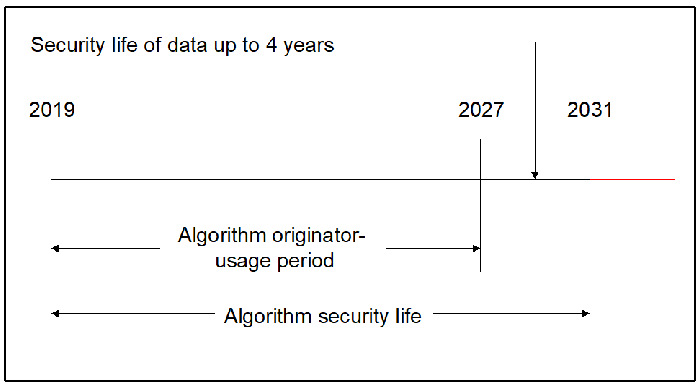
図2:アルゴリズムの生成者使用期間の例。横軸に2019年、2027年、2031年を示す。生成者使用期間の矢印は2019年から2027年の目盛りまで、アルゴリズムのセキュリティ有効期間の矢印は2019年から2031年の目盛りまで。データのセキュリティ寿命は最大4年としている。
Figure 2: Algorithm originator-usage period example
図2:アルゴリズムの生成者使用期間の例
Typically, an organization selects the cryptographic services that are needed for a particular application. Then, based on the algorithm security lifetime and the security life of the data to be protected, an algorithm and key-size suite that are sufficient to meet the requirements are selected. The organization then establishes a key-management system, including validated cryptographic products that provide the services required by the application. As an algorithm and/or key-size suite nears the end of its security lifetime, transitioning to a new algorithm and key-size suite should be planned.
通常、組織は特定のアプリケーションに必要な暗号サービスを選択します。次に、アルゴリズムのセキュリティ有効期間と保護対象データのセキュリティ寿命に基づき、要件を満たす十分なアルゴリズムと鍵サイズの組合せを選択します。その後、組織はアプリケーションに必要なサービスを提供する、検証済み暗号製品を含む鍵管理システムを確立します。アルゴリズムおよび/または鍵サイズの組合せがセキュリティ有効期間の終わりに近づいたら、新しい組合せへの移行を計画すべきです。
When the algorithm or key size is determined to no longer provide the desired protection for information (e.g., the algorithm may have been “broken”), any information protected by the algorithm or key size is considered to be suspect (e.g., the data may no longer be confidential, or the integrity cannot be assured). If the protected data is retained, it should be re-protected using an approved algorithm and key size that will protect the information for the remainder of its security life. However, it should be assumed that encrypted information that was transmitted or otherwise accessible by unauthorized parties could have been collected and retained for decryption at some later time. In addition, the recovered plaintext could be used to attempt a matched plaintext-ciphertext attack on the new algorithm.
アルゴリズムまたは鍵サイズが情報に必要な保護を提供できなくなった(例えばアルゴリズムが「破られた」)と判断された場合、そのアルゴリズムまたは鍵サイズで保護された情報は疑わしいものとみなします(データの機密性が失われた、または完全性を保証できないなど)。保護対象データを保持する場合、その情報の残りのセキュリティ寿命を保護できる承認済みアルゴリズムおよび鍵サイズを用いて、再保護すべきです。ただし、送信された、またはその他の方法で許可されていない当事者がアクセス可能だった暗号化情報は、後日復号するために収集・保存された可能性があると想定すべきです。さらに、復元された平文は、新しいアルゴリズムに対する、平文と暗号文の対応を利用した攻撃に使われる可能性があります。
When using Tables 2, 3, and 4 to select an appropriate algorithm and key size, it is very important to take the expected security life of the data into consideration. As stated earlier, an algorithm (and key size) may be used to both apply cryptographic protection to data and process the protected data. When the security life of the data is taken into account, cryptographic protection should not be applied to data using a given algorithm (and key size) if the security life of the data extends beyond the end of the algorithm security lifetime (i.e., into the timeframe when the algorithm or key size is disallowed; see Table 4).
適切なアルゴリズムと鍵サイズを選択する際に表2、表3、表4を用いる場合、データの想定セキュリティ寿命を考慮することが非常に重要です。前述のとおり、アルゴリズム(および鍵サイズ)はデータへの暗号保護の適用と保護済みデータの処理の両方に使用できます。データのセキュリティ寿命を考慮した場合、データの寿命がアルゴリズムのセキュリティ有効期間(すなわち、アルゴリズムまたは鍵サイズが禁止となる期間。表4を参照)を超えるなら、そのアルゴリズム(および鍵サイズ)でデータに暗号保護を適用すべきではありません。
For example, using Figure 2, if the algorithm security lifetime of an encryption algorithm ends on December 31, 2030, then data with a security life of four years should not be encrypted using that algorithm after December 31, 2026. Instead, a different algorithm should be used whose lifetime covers the security life of the data. If the security life of the data is longer than originally expected, then the protection provided after 2030 may be less than required, and there is some risk that the confidentiality of the data may be compromised (after 2030). Accepting the risk associated with the possible compromise is indicated by the “legacy use” indication in Table 4.
例えば図2のとおり、暗号化アルゴリズムのセキュリティ有効期間が2030年12月31日に終了する場合、セキュリティ寿命が4年のデータは、2026年12月31日より後にそのアルゴリズムで暗号化すべきではありません。代わりに、データのセキュリティ寿命を満たす有効期間を持つ別のアルゴリズムを使用すべきです。データのセキュリティ寿命が当初の想定より長くなった場合、2030年以降に提供される保護は必要なレベルを下回る可能性があり、(2030年以降に)データの機密性が侵害されるリスクがあります。侵害の可能性を受け入れることは、表4の「レガシー用途」の表示で示されます。
When initiating cryptographic protections for data, the strongest algorithm and key size that are appropriate for providing the protection should be used in order to minimize costly transitions. However, it should be noted that selecting some algorithms or key sizes that are unnecessarily large might have adverse performance effects (e.g., the algorithm may be unacceptably slow).
データに暗号保護を適用する際は、高価な移行を最小限に抑えるため、保護目的に適した最も強力なアルゴリズムと鍵サイズを使用すべきです。ただし、不必要に大きなアルゴリズムまたは鍵サイズを選ぶと、許容できないほど処理が遅くなるなど、性能に悪影響を及ぼす場合があります。
The process of transitioning to a new algorithm or key size may be as simple as selecting a more secure option in the security suites offered by the current system, or it can be as complex as building an entirely new system. The ramifications of a transition also depend on the scale of the transition. For example, transitioning to new algorithms and key sizes in a single storage system has one set of considerations, while changing algorithms and key sizes for all implementations of TLS or SSH has much broader implications.
新しいアルゴリズムまたは鍵サイズへの移行は、現在のシステムが提供するセキュリティスイートからより安全な選択肢を選ぶだけで済むこともあれば、全く新しいシステムの構築が必要となることもあります。移行の影響は規模によっても異なります。例えば、単一のストレージシステムの新しいアルゴリズムと鍵サイズへの移行には固有の考慮事項がある一方、TLSまたはSSHのすべての実装でアルゴリズムと鍵サイズを変更する場合は、はるかに広範な影響があります。
If it is necessary to develop a new algorithm suite for a system, the following issues should be considered:
システム用に新しいアルゴリズムスイートを開発する必要がある場合、次の課題を検討すべきです。
1.The sensitivity of information and the system lifetime: The sensitivity of the information that will need to be protected by the system for the lifetime of the new algorithm(s) should be evaluated in order to determine the minimum security requirement for the system. Care should be taken not to underestimate the required lifetime of the system or the sensitivity of information that it may need to protect. Many decisions that were initially considered to be temporary or interim decisions about data sensitivity have since been proven to be inadequate (e.g., the sensitivity of the data lasted well beyond its initially expected lifetime).
1.情報の機密度とシステムの運用期間:システムに対する最低限のセキュリティ要件を決定するため、新しいアルゴリズムの有効期間中にシステムが保護する必要のある情報の機密度を評価すべきです。システムに必要な運用期間や、システムが保護する必要のある情報の機密度を過小評価しないよう注意すべきです。データの機密度に関して当初は一時的または暫定的とみなされた多くの判断が、その後、不適切であったことが判明しています(例:データの機密性が、当初想定された有効期間をはるかに超えて持続しました)。
2.Algorithm selection: New algorithms should be carefully selected to ensure that they meet or exceed the security requirements of the system. In general, it is relatively easy to select cryptographic algorithms and key sizes that offer high security. However, it is wise for the amateur to consult a cryptographic expert when making such decisions. Systems should offer algorithm-suite options that provide for future growth.
2.アルゴリズムの選択:新しいアルゴリズムは、システムのセキュリティ要件を満たすか上回るよう慎重に選択すべきです。一般に、高いセキュリティを提供する暗号アルゴリズムや鍵サイズを選ぶことは比較的容易です。ただし、専門家でない場合は、こうした判断を行う際に暗号の専門家に相談するのが賢明です。システムは将来の拡張に対応できるアルゴリズムスイートの選択肢を提供すべきです。
3.System design: A new system should be designed to meet minimum performance and security requirements and be flexible in order to accommodate cryptographic updates. This is often a difficult task since performance and security goals may conflict. All aspects of security (e.g., physical security, computer security, operational security, and personnel security) are involved. If a current system is to be modified to incorporate new algorithms, the consequences need to be analyzed. For example, the existing system may require significant modifications to accommodate the “footprints” of the new algorithms (e.g., key sizes, block sizes, etc.). In addition, the security measures (other than the cryptographic algorithms) retained from the current system should be reviewed to ensure that they will continue to be effective in the new system.
3.システム設計:新しいシステムは、最低限の性能要件とセキュリティ要件を満たし、暗号更新に柔軟に対応できるよう設計すべきです。性能目標とセキュリティ目標が相反する場合があるため、これは困難な作業となることが多くあります。セキュリティのあらゆる側面(物理的セキュリティ、コンピュータセキュリティ、運用セキュリティ、人員のセキュリティなど)が関係します。新しいアルゴリズムを組み込むために現行システムを変更する場合は、その影響を分析する必要があります。例えば、新しいアルゴリズムの「フットプリント」(鍵サイズ、ブロックサイズなど)に対応するため、既存システムに大幅な変更が必要となる場合があります。また、現行システムから引き継ぐ暗号アルゴリズム以外のセキュリティ対策が、新システムでも有効であり続けることを確認すべきです。
4.Pre-implementation evaluation: Strong cryptography may be poorly implemented. Therefore, a changeover to new cryptographic techniques should not be made without an evaluation to consider how effective and secure they are in the system.
4.実装前の評価:強力な暗号でも実装が不適切となる場合があります。したがって、新しい暗号技法への切替えは、システム内での有効性とセキュリティを検討する評価を行わずに実施すべきではありません。
5.Testing: Any system should be tested before it is deployed.
5.試験:すべてのシステムは導入前に試験すべきです。
6.Training: If the new system requires that new or different tasks (e.g., key-management procedures) be performed, then the individuals who will perform those tasks should be properly trained. Features that are intended to be improvements may simply be viewed as annoyances rather than being useful or required features.
6.トレーニング:新しいシステムで新たな作業または異なる作業(鍵管理手順など)が必要となる場合、その作業を行う担当者に適切なトレーニングを実施すべきです。改善を意図した機能であっても、有用または必須の機能ではなく、単なる煩わしさと受け取られる場合があります。
7.System implementation and transition: Care should be taken to implement the system as closely as possible to the design. Exceptions should be noted.
7.システムの実装と移行:システムはできる限り設計どおりに実装するよう注意すべきです。例外は記録すべきです。
8.Transition: A transition plan should be developed and followed so that the changeover from the old to the new system runs as smoothly as possible.
8.移行:旧システムから新システムへの切替えができる限り円滑に進むよう、移行計画を策定し、これに従うべきです。
9.Post-implementation evaluation: The system should be evaluated to verify that the implemented system meets the system’s security requirements.
9.実装後の評価:実装されたシステムがセキュリティ要件を満たすことを確認するため、システムを評価すべきです。
5.6.5 Decrease of Security Strength Over Time
5.6.5 時間の経過に伴うセキュリティ強度の低下
At some time, the security strength provided by an algorithm or key may be reduced or lost completely. For example, the algorithm or key length used may no longer offer adequate security because of improvements in computational capability or cryptanalysis. In this case, applying protection to “new” information can be performed using stronger algorithms or keys. However, information that was previously protected using these now-inadequate algorithms and keys may no longer be secure. This information may include other keys or sensitive information protected by the keys. A reduction in the security strength provided by an algorithm or key has the following implications:
ある時点で、アルゴリズムまたは鍵が提供するセキュリティ強度は低下し、完全に失われることもあります。例えば、計算能力や暗号解読技術の向上により、使用するアルゴリズムまたは鍵長が十分なセキュリティを提供しなくなる場合があります。この場合、「新しい」情報への保護適用には、より強いアルゴリズムまたは鍵を使用できます。しかし、もはや十分でないアルゴリズムや鍵で以前に保護した情報は、すでに安全でない場合があります。この情報には、鍵で保護された他の鍵や機微情報が含まれる場合があります。アルゴリズムまたは鍵が提供するセキュリティ強度の低下には、次の影響があります。
•Encrypted information: The security of encrypted information that was available at any time to unauthorized entities in its encrypted form should be considered suspect. For example, keys that were transmitted in encrypted form (e.g., using a key-wrapping key or key-transport key and an algorithm or key length that is later broken) may need to be considered compromised since an adversary could have saved the encrypted form of the keys for later decryption in case methods for breaking the algorithm are eventually found (see Section 5.5 for a discussion of key compromise). Even if the transmitted, encrypted information is subsequently re-encrypted for storage using a different key or algorithm, the information may already be compromised because of the weakness of the transmission algorithm or key.
•暗号化情報:認可されていないエンティティが暗号化形式で一度でも入手可能だった情報については、その安全性を疑わしいものとみなすべきです。例えば、暗号化して送信された鍵(例えば、鍵ラッピング鍵又は鍵転送鍵と、後に破られるアルゴリズム又は鍵長を用いたもの)は、危殆化したものとみなす必要がある場合があります。敵対者は、アルゴリズムを破る方法が将来見つかったときに復号できるよう、暗号化された鍵を保存していた可能性があるためです(鍵の危殆化については5.5節参照)。送信された暗号化情報を、後で別の鍵又はアルゴリズムを用いて保存用に再暗号化しても、送信時のアルゴリズム又は鍵の弱さによって、その情報は既に危殆化している可能性があります。
Encrypted information that was not “exposed” in this manner (e.g., not transmitted) may still be secure even though the encryption algorithm or key length no longer provides the initially required amount of protection. For example, if the encrypted form of the keys and the information protected by those keys was never transmitted, then the information may still be confidential.
このように「露出」していない(例えば送信されていない)暗号化情報は、暗号化アルゴリズムまたは鍵長が当初必要だった保護を提供できなくなっても、安全な場合があります。例えば、鍵の暗号化形式もその鍵で保護した情報も一度も送信されていない場合、情報の機密性は維持されている可能性があります。
The lessons to be learned are that an encryption mechanism used for information that will be available to unauthorized entities in its encrypted form (e.g., via transmission) should provide a high level of security protection, and the use of each key should be limited (i.e., the cryptoperiod should be short) so that a compromised key cannot be used to reveal very much information. If the algorithm itself is broken,75 an adversary is forced to perform more work to decrypt all of the information when each key is used to encrypt a very limited amount of information. See Section 5.3.6 for a discussion about cryptoperiods.
ここから得られる教訓は、暗号化形式で許可されていないエンティティが入手できる情報(送信など)に用いる暗号化メカニズムは高いセキュリティ保護を提供すべきであり、侵害された鍵で大量の情報が明らかにならないよう、各鍵の使用を制限(暗号期間を短縮)すべきということです。アルゴリズム自体が破られた場合75、鍵を用いて暗号化する情報量が非常に少なければ、すべての情報を復号するため敵対者はより多くの作業を強いられます。暗号期間については5.3.6節を参照してください。
•Digital signatures on stored data that was originally transmitted:76 Digital signatures may be computed on data prior to transmission and subsequent storage. In this case, both the signed data and the digital signature would be stored. If the security strength of the signature is later reduced (e.g., because of a break of the algorithm or because an adversary determined the key), the signature may still be valid if the stored data and its associated digital signature have been adequately protected from modification since a time prior to the decrease in strength (e.g., by applying a digital signature using a stronger algorithm or key). See Section 5.5, item 1 for further discussion. Storage capabilities are being developed that employ cryptographic timestamps to store digitally signed data beyond the normal security life of the original signature mechanism or its keys.
•元々送信された保存データに対するデジタル署名:76 送信後に保存するデータに対し、送信前にデジタル署名を計算することがあります。この場合、署名済みデータとデジタル署名の両方が保存されます。後に署名のセキュリティ強度が低下した場合(アルゴリズムが破られた、または敵対者が鍵を特定したなど)、強度低下前の時点から保存データと関連するデジタル署名が改変から適切に保護されていれば(より強いアルゴリズムまたは鍵でデジタル署名を追加するなど)、署名は依然として有効である場合があります。詳しくは5.5節の項目1を参照してください。元の署名メカニズムまたは鍵の通常のセキュリティ寿命を超えてデジタル署名済みデータを保存するため、暗号タイムスタンプを用いる保存機能が開発されています。
•Symmetric authentication codes on stored data that was originally transmitted:77 Like digital signatures, symmetric authentication codes (i.e., MACs) may be computed on data prior to transmission and/or subsequent storage. If the received data and authentication code are stored as received, and the security strength of the authentication algorithm or key is later reduced (e.g., because of a break of the algorithm), the authentication code may still be valid if the stored data and its associated authentication code have been adequately protected from modification since a time prior to the decrease in strength (e.g., by applying another authentication code using a stronger algorithm or key). See Section 5.5, item 1 for further discussion. Storage capabilities are being developed that employ cryptographic timestamps to store authenticated data beyond the normal security life of the original authentication mechanism or its keys.
•もともと送信された保存データに対する共通鍵認証コード:77デジタル署名と同様に、共通鍵認証コード(すなわちMAC)も、送信前、及び/又はその後の保存前にデータに対して計算できます。受信したデータと認証コードを受信時のまま保存し、後で認証アルゴリズム又は鍵のセキュリティ強度が低下した場合(例えば、アルゴリズムが破られた場合)、強度低下より前の時点から保存データと対応する認証コードが改変から適切に保護されていれば(例えば、より強いアルゴリズム又は鍵で別の認証コードを適用するなど)、認証コードがなお有効である可能性があります。詳細は5.5節の項目1を参照してください。元の認証メカニズム又は鍵の通常のセキュリティ有効期間を超えて認証済みデータを保存するために、暗号タイムスタンプを用いる保存機能が開発されつつあります。
6 Protection Requirements for Key Information
6 鍵情報の保護要件
This section gives guidance on the types of protection required for key information. Key information is defined as keying material and the associated metadata; the specific key information varies, depending on the type of key. The key information must be protected in order for the security services to be “meaningful.” A FIPS 140-validated cryptographic module may provide much of the protection needed, depending on its security level; however, whenever the key information exists external to a FIPS 140 cryptographic module, additional protection is required (e.g., by access-control mechanisms in the operating system or by encryption and integrity protection for key information in an external database). The type of protection needed depends on the type of key and the security service for which the key is used. SP 800-15278 provides guidance for Federal Cryptographic Key Management Systems (FCKMSs) on the protection of key information when outside a FIPS 140-validated cryptographic module, as well as other key-management factors to be addressed.
本節では、鍵情報に必要な保護の種類に関する指針を示します。鍵情報は、鍵素材とそれに関連するメタデータとして定義されます。具体的な鍵情報は、鍵の種類によって異なります。セキュリティサービスが「意味のある」ものとなるためには、鍵情報を保護しなければなりません。FIPS 140の検証を受けた暗号モジュールは、そのセキュリティレベルに応じて、必要な保護の多くを提供する可能性があります。しかし、鍵情報がFIPS 140暗号モジュールの外部に存在する場合には、追加の保護が必要です(例:オペレーティングシステムのアクセス制御メカニズムによる保護や、外部データベース内の鍵情報に対する暗号化と完全性保護)。必要な保護の種類は、鍵の種類と、その鍵が使用されるセキュリティサービスによって異なります。SP 800-15278は、連邦暗号鍵管理システム(FCKMS)向けに、FIPS 140の検証を受けた暗号モジュールの外部にある鍵情報の保護に関する指針と、対処すべきその他の鍵管理上の要素を示しています。
6.1 Protection and Assurance Requirements
6.1 保護および保証要件
Keying material should be (operationally) available as long as the associated cryptographic service is required. Keys may be maintained within a cryptographic module while they are being actively used, or they may be stored externally (provided that proper protection is afforded) and recalled as needed. Some keys may need to be archived if required beyond the key’s originator-usage period (see Section 5.3.5 for a discussion of the originator-usage period).
鍵素材は、関連する暗号サービスが必要な間、運用上利用可能であるべきです。鍵を実際に使用している間は暗号モジュール内に保持してもよいし、適切に保護することを条件として外部に保管し、必要に応じて取り出してもよいです。鍵の生成者使用期間を超えて必要となる場合、一部の鍵はアーカイブする必要がある場合があります(生成者使用期間については5.3.5節参照)。
The following protections and assurances may be required for the key information:
鍵情報には、次の保護及び保証が必要となる場合があります。
Confidentiality protection shall be provided for all secret key information (i.e., key information that is intended to be kept secret, such as symmetric (secret) keys, asymmetric private keys, key shares, and secret metadata). Public keys, domain parameters, and much of the metadata generally do not require confidentiality protection. When the secret key information exists within a validated cryptographic module, appropriate confidentiality protection is provided when the cryptographic module conforms to FIPS 140 at a security level that is consistent with the FIPS 199 impact level associated with the data to be protected by the key (see SP 800-152). When the secret or private key information is available outside of a cryptographic module, confidentiality protection shall be provided by encryption at an appropriate security strength (see SP 800-152) or by controlling access to the secret key information via physical means.79 The security and operational impact of specific confidentiality mechanisms vary. Guidance for the selection of appropriate confidentiality mechanisms is given in Sections 6.2.1.3 and 6.2.2.3.
機密性保護は、秘密に保持するすべての鍵情報(すなわち、共通鍵、非対称鍵の秘密鍵、鍵シェア、秘密のメタデータなど、秘密に保持することを意図した鍵情報)に施さなければなりません。公開鍵、ドメインパラメータ及びメタデータの多くは、一般に機密性保護を必要としません。秘密に保持する鍵情報が検証済み暗号モジュール内にある場合、そのモジュールが、鍵によって保護するデータのFIPS 199影響度レベルと整合するセキュリティレベルでFIPS 140に適合していれば、適切な機密性保護が提供されます(SP 800-152参照)。秘密に保持する鍵情報又は秘密鍵の情報が暗号モジュールの外部で利用可能な場合、適切なセキュリティ強度での暗号化(SP 800-152参照)、又は物理的手段による秘密の鍵情報へのアクセス制御によって、機密性保護を提供しなければなりません。79具体的な機密性メカニズムがセキュリティ及び運用に及ぼす影響は、それぞれ異なります。適切な機密性メカニズムの選択に関する指針は、6.2.1.3節及び6.2.2.3節に示します。
Integrity protection shall be provided for all key information. Integrity protection always requires checking the source and format of the received or retrieved key information (see Section 5.4.1). When the key information exists within a validated cryptographic module, appropriate integrity protection is provided when the cryptographic module conforms to FIPS 140 at a security level that is consistent with the FIPS 199 impact level associated with the data to be protected by the key (see SP 800-152). When key information is available outside of a cryptographic module, integrity protection shall be provided by appropriate cryptographic integrity mechanisms (e.g., cryptographic checksums, cryptographic hash functions, MACs, or digital signatures), non-cryptographic integrity mechanisms (e.g., CRCs, parity checks, etc.) (see Appendix A), or physical protection mechanisms. Guidance for the selection of appropriate integrity mechanisms is given in Sections 6.2.1.2 and 6.2.2.2.
完全性保護は、すべての鍵情報に施さなければなりません。完全性保護には、受信した又は取り出した鍵情報の入手元と形式の確認が常に必要です(5.4.1節参照)。鍵情報が検証済み暗号モジュール内にある場合、そのモジュールが、鍵によって保護するデータのFIPS 199影響度レベルと整合するセキュリティレベルでFIPS 140に適合していれば、適切な完全性保護が提供されます(SP 800-152参照)。鍵情報が暗号モジュールの外部で利用可能な場合、適切な暗号学的完全性メカニズム(暗号学的チェックサム、暗号学的ハッシュ関数、MAC又はデジタル署名など)、非暗号学的完全性メカニズム(CRC、パリティ検査など。付録A参照)、又は物理的保護メカニズムによって、完全性保護を提供しなければなりません。適切な完全性メカニズムの選択に関する指針は、6.2.1.2節及び6.2.2.2節に示します。
Association protection shall be provided for a cryptographic security service by ensuring that the correct keying material is used to protect the correct data in the correct application or equipment. Guidance for the selection of appropriate association protection is given in Sections 6.2.1.4 and 6.2.2.4.
関連付け保護は、正しい鍵素材を用い、正しいアプリケーション又は機器で正しいデータを保護することを確実にすることにより、暗号セキュリティサービスに提供しなければなりません。適切な関連付け保護の選択に関する指針は、6.2.1.4節及び6.2.2.4節に示します。
Assurance of domain-parameter and public-key validity provides confidence that the parameters and keys used with cryptographic algorithms are arithmetically correct (see Sections 5.4.2 and 5.4.3). Guidance for the selection of appropriate assurance mechanisms is given in SP 800-56A and SP 800-89, as well as in this document.
ドメインパラメータ及び公開鍵の妥当性の保証は、暗号アルゴリズムで使用するパラメータと鍵が算術的に正しいという確信を与えます(5.4.2節及び5.4.3節参照)。適切な保証メカニズムの選択に関する指針は、本書に加え、SP 800-56A及びSP 800-89に示します。
Assurance of private key possession provides assurance that the owner of a public key actually possesses the corresponding private key (see Section 5.4.4).
秘密鍵保有の保証は、公開鍵の所有者が、対応する秘密鍵を実際に保有しているという保証を提供します(5.4.4節参照)。
Availability protection shall be provided for all key information that needs to be available beyond its immediate use for protecting data (e.g., to decrypt or verify the continued integrity of the key information). This is accomplished by backing up or archiving the information (see Sections 8.2.2.1 and 8.3.1).
可用性保護は、データ保護のための直接の使用を超えて利用可能である必要がある、すべての鍵情報に提供しなければなりません(例えば、復号や、鍵情報の完全性が引き続き保たれていることの検証のため)。これは、情報をバックアップ又はアーカイブすることで実現します(8.2.2.1節及び8.3.1節参照)。
The period of protection for key information depends on the type of key, the associated cryptographic service, and the length of time for which the cryptographic service is required. The period of protection includes the cryptoperiod of the key (see Section 5.3). The period of protection is not necessarily the same for integrity as it is for confidentiality. Integrity protection may only be required until a key is no longer used (but not yet destroyed), but confidentiality protection may be required until the key is actually destroyed.
鍵情報の保護期間は、鍵の種類、関連する暗号サービス及びその暗号サービスが必要な期間によって異なります。保護期間には、鍵の暗号期間が含まれます(5.3節参照)。完全性と機密性の保護期間は、必ずしも同じではありません。完全性保護が必要なのは、鍵を使用しなくなるまで(ただし、まだ破棄されていない時点まで)に限られる場合がある一方、機密性保護は、鍵が実際に破棄されるまで必要となる場合があります。
6.1.1 Summary of Protection and Assurance Requirements for Cryptographic Keys
6.1.1 暗号鍵の保護および保証要件の概要
Table 5 provides a summary of the protection requirements for keys during distribution and storage. Methods for providing the necessary protection are discussed in Section 6.2.
表5は、配布時及び保管時の鍵の保護要件の概要を示します。必要な保護を提供する方法は、6.2節で論じます。
Guide to Table 5:
表5の読み方:
a.Column 1 (Key Type) identifies the key types.
a.列1(鍵種別)は、鍵の種類を示します。
b.Column 2 (Security Service) indicates the type of security service that is provided by the key in conjunction with a cryptographic technique. In some cases, the word “support” is used in this column; this means that the associated key is used to support the primary cryptographic services of confidentiality, integrity authentication, and source authentication. For example, a key-agreement key may support a confidentiality service by establishing the key used to provide confidentiality; an RBG key supports the use of cryptography because it is used to provide the random values for generating the keys to be used to cryptographically protect information.
b.列2(セキュリティサービス)は、暗号技術と組み合わせて、その鍵が提供するセキュリティサービスの種類を示します。この列では「支援」という語を用いる場合があります。これは、関連する鍵が、機密性、完全性認証及び送信元認証という主要な暗号サービスを支援するために用いられることを意味します。例えば、鍵合意鍵は、機密性の提供に用いる鍵を確立することで、機密性サービスを支援できます。RBG鍵は、情報を暗号学的に保護するために使用する鍵を生成する際の乱数値を提供するために用いられるので、暗号の使用を支援します。
c.Column 3 (Security Protection) indicates the type of protection required for the key (i.e., confidentiality, integrity, and/or availability).
c.列3(セキュリティ保護)は、その鍵に必要な保護の種類(すなわち、機密性、完全性及び/又は可用性)を示します。
d.Column 4 (Association Protection) indicates the types of associations that need to be protected for that key, such as associating the key with the usage, application, authorized communications participants, or other indicated information. The association with domain parameters applies only to algorithms where they are used.
d.列4(関連付け保護)は、鍵を、その用途、アプリケーション、認可された通信参加者又はその他の指定された情報に関連付けることなど、その鍵について保護する必要がある関連付けの種類を示します。ドメインパラメータとの関連付けは、ドメインパラメータを使用するアルゴリズムにのみ適用されます。
e.Column 5 (Assurances Required) indicates whether assurance of public-key validity and/or assurance of private-key possession need to be obtained as defined in SP 800-56A, SP 800-56B, SP 800-89, and this Recommendation. Assurance of public-key validity provides a degree of confidence that a key is arithmetically correct. See Section 5.4.3 for further details. Assurance of private-key possession provides a degree of confidence that the entity providing a public key actually possessed the associated private key at some time. See Section 5.4.4 for further details.
e.列5(必要な保証)は、SP 800-56A、SP 800-56B、SP 800-89及び本勧告で定義する、公開鍵の妥当性の保証及び/又は秘密鍵保有の保証を得る必要があるかを示します。公開鍵の妥当性の保証は、鍵が算術的に正しいという一定の確信を与えます。詳細は5.4.3節を参照してください。秘密鍵保有の保証は、公開鍵を提供するエンティティが、対応する秘密鍵をある時点で実際に保有していたという一定の確信を与えます。詳細は5.4.4節を参照してください。
f.Column 6 (Period of Protection) indicates the length of time that the integrity and/or confidentiality of the key need to be maintained (see Section 5.3). Symmetric keys and private keys shall be destroyed at the end of their period of protection (see Sections 8.3.4 and 9.4).
f.列6(保護期間)は、鍵の完全性及び/又は機密性を維持する必要がある期間を示します(5.3節参照)。共通鍵及び秘密鍵は、保護期間の終了時に破棄しなければなりません(8.3.4節及び9.4節参照)。
Table 5: Protection requirements for cryptographic keys
表5:暗号鍵の保護要件
| Key Type | Security Service | Security Protection | Association Protection | Assurances Required | Period of Protection |
|---|---|---|---|---|---|
| Private signature key | Source authentication Integrity authentication Support for non-repudiation | Confidentiality Integrity80 | Usage or application Domain parameters (when used) Public signature-verification key | Possession | From generation until the end of the cryptoperiod |
| Public signature-verification key | Source authentication Integrity authentication Support for non-repudiation | Integrity Availability | Usage or application Key pair owner Domain parameters (when used) Private signature key Signed data | Validity | From generation until no protected data needs to be verified |
| Symmetric authentication key | Identity authentication Integrity authentication | Confidentiality Integrity Availability | Usage or application Other authorized entities Authenticated data | From generation until no protected data needs to be verified | |
| Private authentication key | Identity authentication Integrity authentication | Confidentiality Integrity | Usage or application Public authentication key Domain parameters (when used) | Possession | From generation until the end of the cryptoperiod |
| Public authentication key | Identity authentication Integrity authentication | Integrity Availability | Usage or application Key pair owner Authenticated data Private authentication key Domain parameters (when used) | Validity | From generation until no protected data needs to be authenticated |
| Symmetric data-encryption/ | Confidentiality | Confidentiality Integrity Availability | Usage or application Other authorized entities Plaintext/Encrypted data | From generation until the end of the lifetime of the data or the end of the cryptoperiod, whichever is later | |
| Symmetric key-wrapping key | Support | Confidentiality Integrity Availability | Usage or application Other authorized entities Encrypted keys | From generation until the end of the cryptoperiod or until no wrapped keys require protection, whichever is later | |
| Symmetric RBG keys | Support | Confidentiality Integrity | Usage or application | From generation until replacement | |
| Symmetric master key/key-derivation key | Support | Confidentiality Integrity | Usage or application Other authorized entities Derived keys | From generation until the end of the cryptoperiod or the end of the lifetime of the derived keys, whichever is later | |
| Private key-transport key | Support | Confidentiality Integrity Availability | Usage or application Encrypted keys Public key-transport key | Possession | From generation until the end of the period of protection for all transported keys |
| Public key-transport key | Support | Integrity | Usage or application Key pair owner Private key-transport key | Validity | From generation until the end of the cryptoperiod |
| Symmetric key-agreement key | Support | Confidentiality Integrity | Usage or application Other authorized entities | From generation until the end of the cryptoperiod or until no longer needed to determine a key, whichever is later | |
| Private static key-agreement key | Support | Confidentiality Integrity | Usage or application Domain parameters (when used) Public static key-agreement key | Possession | From generation until the end of the cryptoperiod or until no longer needed to determine a key, whichever is later |
| Public static key-agreement key | Support | Integrity | Usage or application Key pair owner Domain parameters (when used) Private static key-agreement key | Validity | From generation until the end of the cryptoperiod or until no longer needed to determine a key, whichever is later |
| Private ephemeral key-agreement key | Support | Confidentiality Integrity | Usage or application Public ephemeral key-agreement key Domain parameters (when used) | From generation until the end of the key-agreement process After the end of the process, the key shall be destroyed | |
| Public ephemeral key-agreement key | Support | Integrity81 | Key pair owner Private ephemeral key-agreement key Usage or application Domain parameters (when used) | Validity | From generation until the key-agreement process is complete |
| Symmetric authorization keys | Authorization | Confidentiality Integrity | Usage or application Other authorized entities | From generation until the end of the cryptoperiod of the key | |
| Private authorization key | Authorization | Confidentiality Integrity | Usage or application Public authorization key Domain parameters (when used) | Possession | From generation until the end of the cryptoperiod of the key |
| Public authorization key | Authorization | Integrity | Usage or application Key pair owner Private authorization key Domain parameters (when used) | Validity | From generation until the end of the cryptoperiod of the key |
| 鍵種別 | セキュリティサービス | セキュリティ保護 | 関連付け保護 | 必要な保証 | 保護期間 |
|---|---|---|---|---|---|
| 署名用秘密鍵 | 送信元認証 完全性認証 否認防止の支援 | 機密性 完全性80 | 用途またはアプリケーション ドメインパラメータ(使用時) 署名検証用公開鍵 | 保有 | 生成から暗号期間の終了まで |
| 署名検証用公開鍵 | 送信元認証 完全性認証 否認防止の支援 | 完全性 可用性 | 用途またはアプリケーション 鍵ペア所有者 ドメインパラメータ(使用時) 署名用秘密鍵 署名済みデータ | 妥当性 | 生成から保護対象データの検証が不要になるまで |
| 共通鍵認証鍵 | 本人認証 完全性認証 | 機密性 完全性 可用性 | 用途またはアプリケーション その他の許可されたエンティティ 認証済みデータ | 生成から保護対象データの検証が不要になるまで | |
| 認証用秘密鍵 | 本人認証 完全性認証 | 機密性 完全性 | 用途またはアプリケーション 認証用公開鍵 ドメインパラメータ(使用時) | 保有 | 生成から暗号期間の終了まで |
| 認証用公開鍵 | 本人認証 完全性認証 | 完全性 可用性 | 用途またはアプリケーション 鍵ペア所有者 認証済みデータ 認証用秘密鍵 ドメインパラメータ(使用時) | 妥当性 | 生成から保護対象データの認証が不要になるまで |
| 共通鍵データ暗号化/復号鍵 | 機密性 | 機密性 完全性 可用性 | 用途またはアプリケーション その他の許可されたエンティティ 平文/暗号化データ | 生成からデータ寿命の終了または暗号期間の終了まで(いずれか遅い方) | |
| 共通鍵ラッピング鍵 | 支援 | 機密性 完全性 可用性 | 用途またはアプリケーション その他の許可されたエンティティ 暗号化鍵 | 生成から暗号期間の終了、または保護が必要なラップ済み鍵がなくなるまで(いずれか遅い方) | |
| 共通鍵RBG鍵 | 支援 | 機密性 完全性 | 用途またはアプリケーション | 生成から交換まで | |
| 共通鍵のマスター鍵/鍵導出鍵 | 支援 | 機密性 完全性 | 用途またはアプリケーション その他の許可されたエンティティ 導出鍵 | 生成から暗号期間の終了、または導出鍵の寿命の終了まで(いずれか遅い方) | |
| 鍵転送用秘密鍵 | 支援 | 機密性 完全性 可用性 | 用途またはアプリケーション 暗号化鍵 鍵転送用公開鍵 | 保有 | 生成から転送されたすべての鍵の保護期間終了まで |
| 鍵転送用公開鍵 | 支援 | 完全性 | 用途またはアプリケーション 鍵ペア所有者 鍵転送用秘密鍵 | 妥当性 | 生成から暗号期間の終了まで |
| 共通鍵合意鍵 | 支援 | 機密性 完全性 | 用途またはアプリケーション その他の許可されたエンティティ | 生成から暗号期間の終了まで、または鍵の決定に不要となるまで(いずれか遅い方) | |
| 静的鍵合意用秘密鍵 | 支援 | 機密性 完全性 | 用途またはアプリケーション ドメインパラメータ(使用時) 静的鍵合意用公開鍵 | 保有 | 生成から暗号期間の終了まで、または鍵の決定に不要となるまで(いずれか遅い方) |
| 静的鍵合意用公開鍵 | 支援 | 完全性 | 用途またはアプリケーション 鍵ペア所有者 ドメインパラメータ(使用時) 静的鍵合意用秘密鍵 | 妥当性 | 生成から暗号期間の終了まで、または鍵の決定に不要となるまで(いずれか遅い方) |
| 一時鍵合意用秘密鍵 | 支援 | 機密性 完全性 | 用途またはアプリケーション 一時鍵合意用公開鍵 ドメインパラメータ(使用時) | 生成から鍵合意プロセス終了まで。 プロセス終了後、鍵を破棄しなければなりません。 | |
| 一時鍵合意用公開鍵 | 支援 | 完全性81 | 鍵ペア所有者 一時鍵合意用秘密鍵 用途またはアプリケーション ドメインパラメータ(使用時) | 妥当性 | 生成から鍵合意プロセス完了まで |
| 共通鍵認可鍵 | 認可 | 機密性 完全性 | 用途またはアプリケーション その他の許可されたエンティティ | 生成から鍵の暗号期間終了まで | |
| 認可用秘密鍵 | 認可 | 機密性 完全性 | 用途またはアプリケーション 認可用公開鍵 ドメインパラメータ(使用時) | 保有 | 生成から鍵の暗号期間終了まで |
| 認可用公開鍵 | 認可 | 完全性 | 用途またはアプリケーション 鍵ペア所有者 認可用秘密鍵 ドメインパラメータ(使用時) | 妥当性 | 生成から鍵の暗号期間終了まで |
6.1.2 Summary of Protection Requirements for Other Related Information
6.1.2 その他の関連情報に関する保護要件の概要
Table 6 provides a summary of the protection requirements for other related information during distribution and storage. Mechanisms for providing the necessary protection are discussed in Section 6.2.
表6は、配布中および保管中のその他の関連情報に対する保護要件の概要を示します。必要な保護を提供するメカニズムは6.2節で論じます。
Guide to Table 6:
表6の見方:
a.Column 1 (Information Type) identifies the type of information.
a.第1列(情報の種類)は、情報の種類を示します。
b.Column 2 (Security Service) indicates the type of security service provided by the information.
b.第2列(セキュリティサービス)は、その情報が提供するセキュリティサービスの種類を示します。
c.Column 3 (Security Protection) indicates the type of security protection required for the information.
c.第3列(セキュリティ保護)は、その情報に必要なセキュリティ保護の種類を示します。
d.Column 4 (Association Protection) indicates the relevant types of associations for each type of information.
d.第4列(関連付け保護)は、各種類の情報に関係する関連付けの種類を示します。
e.Column 5 (Assurance of Domain Parameter Validity) indicates the information for which assurance shall be obtained as defined in SP 800-56A, SP 800-56B, and Section 5.4 of this Recommendation. Assurance of domain-parameter validity gives confidence that domain parameters are arithmetically correct.
e.第5列(ドメインパラメータの妥当性の保証)は、SP 800-56A、SP 800-56B、および本推奨事項の5.4節の定義に従って保証を得なければならない情報を示します。ドメインパラメータの妥当性の保証は、ドメインパラメータが算術的に正しいという確信を与えます。
f.Column 6 (Period of Protection) indicates the length of time that the integrity and/or confidentiality of the information need to be maintained. The information shall be destroyed at the end of the period of protection (see Section 8.3.4).
f.第6列(保護期間)は、情報の完全性および/または機密性を維持する必要がある期間の長さを示します。情報は保護期間の終了時に破棄しなければなりません(8.3.4節を参照してください)。
Table 6: Protection requirements for other related information
表6:その他の関連情報の保護要件
| Information Type | Security Service | Security Protection | Association Protection | Assurance of Domain Parameter Validity | Period of Protection |
|---|---|---|---|---|---|
| Domain parameters | Depends on the key associated with the parameters | Integrity Availability | Usage or application Private and public keys | Yes | From generation until no longer needed to generate keys or verify signatures |
| Initialization vectors | Depends on the algorithm | Integrity82 Availability | Protected data | From generation until no longer needed to process the protected data | |
| Shared secrets | Support | Confidentiality Integrity | From generation until the end of the transaction. The shared secret shall be destroyed at the end of the period of protection | ||
| RBG Seeds | Support | Confidentiality Integrity | Usage or application | Used once and destroyed immediately after use | |
| Other public information | Support | Integrity | Usage or application Other authorized entities Data processed using the nonce | From generation until no longer needed to process data using the public information | |
| Other secret information | Support | Confidentiality Integrity | Usage or application Other authorized entities Data processed using the secret information | From generation until no longer needed to process data using the secret information | |
| Intermediate results | Support | Confidentiality Integrity | Usage or application | From generation until no longer needed and the intermediate results are destroyed | |
| Key-control information (e.g., IDs, purpose) | Support | Integrity Availability | Key | From generation until the associated key is destroyed | |
| Random number | Support | Confidentiality (depends on usage) Integrity | From generation until no longer needed, and the random number is destroyed | ||
| Password | Identity authentication Key derivation | Confidentiality Integrity Availability | Usage or application Owning entity | From generation until replaced or no longer needed to authenticate the entity or to derive keys | |
| Audit information | Support | Integrity Access authorization Availability | Audited events Key-control information/metadata | From generation until no longer needed |
| 情報種別 | セキュリティサービス | セキュリティ保護 | 関連付け保護 | ドメインパラメータの妥当性の保証 | 保護期間 |
|---|---|---|---|---|---|
| ドメインパラメータ | パラメータに関連付けられた鍵による | 完全性 可用性 | 用途またはアプリケーション 秘密鍵および公開鍵 | はい | 生成から、鍵生成または署名検証に不要となるまで |
| 初期化ベクトル | アルゴリズムによる | 完全性82 可用性 | 保護対象データ | 生成から、保護対象データの処理に不要となるまで | |
| 共有シークレット | 支援 | 機密性 完全性 | 生成からトランザクション終了まで。 保護期間の終了時に共有シークレットを破棄しなければなりません。 | ||
| RBGシード | 支援 | 機密性 完全性 | 用途またはアプリケーション | 一度使用し、使用直後に破棄する | |
| その他の公開情報 | 支援 | 完全性 | 用途またはアプリケーション その他の許可されたエンティティ ノンスを用いて処理するデータ | 生成から、公開情報を用いたデータ処理に不要となるまで | |
| その他の秘密情報 | 支援 | 機密性 完全性 | 用途またはアプリケーション その他の許可されたエンティティ 秘密情報を用いて処理するデータ | 生成から、秘密情報を用いたデータ処理に不要となるまで | |
| 中間結果 | 支援 | 機密性 完全性 | 用途またはアプリケーション | 生成から、不要となって中間結果が破棄されるまで | |
| 鍵制御情報(ID、目的など) | 支援 | 完全性 可用性 | 鍵 | 生成から、関連する鍵が破棄されるまで | |
| 乱数 | 支援 | 機密性(用途による) 完全性 | 生成から不要となり、乱数が破棄されるまで | ||
| パスワード | 本人認証 鍵導出 | 機密性 完全性 可用性 | 用途またはアプリケーション 所有エンティティ | 生成から、置換されるまで、またはエンティティ認証もしくは鍵導出に不要となるまで | |
| 監査情報 | 支援 | 完全性 アクセス認可 可用性 | 監査対象イベント 鍵制御情報/メタデータ | 生成から不要となるまで |
6.2 Protection Mechanisms
6.2 保護メカニズム
During the lifetime of key information, the key information is either “in transit” (e.g., is in the process of being distributed manually or distributed using automated protocols to the authorized communication participants for use by those entities), “at rest” (e.g., the key information is in storage), or “in use.” In all cases, the key information shall be protected in accordance with Section 6.1.
鍵情報は、その有効期間中、「転送中」(例:認可された通信参加者が使用するために、手作業または自動化されたプロトコルによって配布されている途中)、「保管中」(例:鍵情報がストレージに保存されている)、「使用中」のいずれかの状態にあります。いずれの場合も、鍵情報は6.1節に従って保護しなければなりません。
For keys that are in use, the keys shall reside (and be used) within appropriate cryptographic modules; note that a key being in use does not preclude that key from also being simultaneously in transit and/or in storage.
使用中の鍵は、適切な暗号モジュール内に存在し(かつその中で使用され)なければなりません。なお、鍵が使用中であっても、その鍵が同時に転送中および/または保管中であることは妨げられません。
While in transit or in storage, the choice of protection mechanisms may vary. Although several methods of protection are provided in the following subsections, not all methods provide equal security. The method should be carefully selected. In addition, the mechanisms prescribed do not, by themselves, guarantee protection. The implementation and the associated key management need to provide adequate security to prevent any feasible attack from being successful.
転送中または保管中の保護メカニズムの選択はさまざまでありうます。以下の各項ではいくつかの保護方法を示しますが、すべての方法が同等のセキュリティを提供するわけではありません。方法は慎重に選択すべきです。さらに、規定されたメカニズムだけで保護が保証されるわけではありません。実現可能な攻撃が成功しないよう、実装とそれに関連する鍵管理が十分なセキュリティを提供する必要があります。
6.2.1 Protection Mechanisms for Key Information in Transit
6.2.1 転送中の鍵情報の保護メカニズム
Key information in transit may include keying material that is being distributed in order to:
転送中の鍵情報には、次の目的で配布される鍵素材が含まれる場合があります。
•Obtain a cryptographic service (e.g., to establish a key that will be used to provide confidentiality) (see Section 8.1.5) or
•暗号サービスを得る(例:機密性の提供に使用する鍵を確立する)(8.1.5節を参照)、または
•Back up or archive key information for possible use or recovery in the future (see Sections 8.2.2 and 8.3.1) or recover the backed up or archived key information (see Sections 8.2.2.2, 8.3.1, and Appendix B).
•将来の使用または回復に備えて鍵情報をバックアップまたはアーカイブするため(8.2.2節および8.3.1節を参照)、またはバックアップ/アーカイブされた鍵情報を回復するため(8.2.2.2節、8.3.1節、付録Bを参照してください)。
This may be accomplished manually (i.e., via a trusted courier), in an automated fashion (i.e., using automated communication protocols), or by some combination of manual and automated methods. For some protocols, the protections are provided by the protocol; in other cases, the protection of the key information is provided directly to the key information (e.g., the keying material is encrypted prior to transmission for decryption only by the receiving party). It is the responsibility of the originating party to apply protection mechanisms and the responsibility of the recipient to undo or check the mechanisms used.
これは、手動(信頼された運送者によるなど)、自動(自動通信プロトコルによるなど)、または手動方式と自動方式の組合せで実施できます。プロトコルによって保護が提供される場合もあれば、鍵情報自体に直接保護を適用する場合(受信者だけが復号できるよう、送信前に鍵素材を暗号化するなど)もあります。送信元は保護メカニズムを適用する責任を負い、受信者は使用されたメカニズムを解除または検査する責任を負います。
6.2.1.1 Availability
6.2.1.1 可用性
Since communications may be garbled, intentionally altered, or destroyed, the availability of key information after transit cannot be assured using cryptographic methods alone. However, availability can be supported by redundant or multiple channels, store and forward systems (deleting by the sender only after confirmation of receipt), error correction codes, and other non-cryptographic mechanisms.
通信は文字化け、意図的な改変、または破壊を受けうるため、転送後の鍵情報の可用性は暗号手法だけでは保証できません。しかし、冗長なチャネルや複数のチャネル、蓄積交換システム(受信確認後にのみ送信者が削除する)、誤り訂正符号、その他の暗号以外のメカニズムによって可用性を支援することができます。
Communication systems should incorporate non-cryptographic mechanisms to ensure the availability of key information after transmission rather than relying on retransmission by the original sender.
通信システムは、元の送信者による再送に頼るのではなく、送信後の鍵情報の可用性を確保するための暗号以外のメカニズムを組み込むべきです。
6.2.1.2 Integrity
6.2.1.2 完全性
Integrity protection involves both the prevention and detection of modifications to information. When modifications are detected, measures may be taken to restore the information to its unaltered form. Cryptographic mechanisms are often used to detect unauthorized modifications. The integrity of key information during transit shall be protected and verified using one or more of the following mechanisms:
完全性保護には、情報の改変防止と改変検出の両方が含まれます。改変が検出された場合、情報を改変前の状態に戻す措置を取ることができます。暗号メカニズムは不正な改変の検出によく使用されます。転送中の鍵情報の完全性は、次の1つ以上のメカニズムを用いて保護し、検証しなければなりません。
1.Manual method (physical protection is provided):
1.手動方式(物理的保護を提供):
(a) An integrity mechanism is used to generate a “code” (e.g., a CRC, MAC, or digital signature) on the key information to be distributed, and the resulting code is provided to the recipient along with the key information. If the received code is successfully verified by the recipient, then the recipient has assurance that the keying material has been received correctly; otherwise, the key information is assumed to be corrupted. When using a cryptographic algorithm that uses a key to generate the code (e.g., a MAC or digital signature), the sender and recipient must know the appropriate keys for generating and verifying the code. Note that a CRC may be used instead of a MAC or digital signature to generate the code since the physical protection is only intended to protect against intentional modifications.
(a) 完全性メカニズムを用いて、配布する鍵情報に対する「コード」(CRC、MAC、デジタル署名など)を生成し、鍵情報とともに受信者へ提供します。受信者が受け取ったコードを正常に検証できれば、鍵素材を正しく受信したという保証を得ます。そうでなければ、鍵情報は破損したものとみなします。MACまたはデジタル署名など、鍵を使ってコードを生成する暗号アルゴリズムを使用する場合、送信者と受信者はコードの生成と検証に適切な鍵を知っていなければなりません。物理的保護は意図的な改変からの保護のみを目的とするため、コード生成にMACまたはデジタル署名の代わりにCRCを使用してもよいです。
-OR-
-または-
•(b) The key in the key information being distributed is used to perform the intended cryptographic operation on mutually known data (e.g., to encrypt plaintext data that is known by both the sender and the recipient); both the key information and the cryptographically protected data are sent to the recipient. If the recipient can use the received key to successfully reverse or verify the cryptographic operation performed by the sender (e.g., by using the key to decrypt the received ciphertext data and successfully compare the resulting plaintext data with the mutually known plaintext data), the recipient has assurance that the key information has been received correctly; otherwise, the key information is assumed to be corrupted.
•(b) 配布される鍵情報に含まれる鍵を使用して、双方が知っているデータに対して意図した暗号操作を実行します(例:送信者と受信者の両方が知っている平文データを暗号化します)。鍵情報と暗号的に保護されたデータの両方を受信者に送信します。受信者が受け取った鍵を使用して、送信者が実行した暗号操作を正しく逆変換または検証できれば(例:鍵を使用して受け取った暗号文データを復号し、得られた平文データが双方の知る平文データと一致することを確認できれば)、受信者は鍵情報が正しく受信されたという保証を得ます。そうでなければ、鍵情報は破損しているとみなします。
2.Automated distribution via communication protocols (protection provided by the sending entity or by the communication protocol):
2.通信プロトコルによる自動配布(送信エンティティまたは通信プロトコルが保護を提供):
(a) An approved cryptographic integrity mechanism (e.g., a MAC or digital signature algorithm) is used on the key information to be distributed, and the resulting code is provided to the recipient along with the key information for subsequent verification. Note that a CRC is not approved for this purpose. The integrity mechanism may be applied only to the key information or to an entire message.
(a) 承認済み暗号学的完全性メカニズム(MACまたはデジタル署名アルゴリズムなど)を配布する鍵情報に適用し、後で検証できるよう生成されたコードを鍵情報とともに受信者に提供します。この目的でCRCは承認されていません。完全性メカニズムは鍵情報だけ、またはメッセージ全体に適用できます。
-OR-
-または-
•(b) The key in the key information is used by the sender to perform the intended cryptographic operation on data (e.g., compute a MAC on the data); both the key information and the cryptographically protected data are sent to the recipient. If the recipient can successfully use the key to reverse or verify the cryptographic operation (e.g., verify the MAC on the received data using the received key), the recipient has assurance that the key information has been received correctly; otherwise, the key information is assumed to be corrupted.
•(b) 送信者は、鍵情報に含まれる鍵を使用してデータに対して意図した暗号操作を実行します(例:データのMACを計算します)。鍵情報と暗号的に保護されたデータの両方を受信者に送信します。受信者がその鍵を使用して暗号操作を正しく逆変換または検証できれば(例:受け取った鍵を使用して受信データのMACを検証できれば)、受信者は鍵情報が正しく受信されたという保証を得ます。そうでなければ、鍵情報は破損しているとみなします。
The response to the detection of an integrity failure will vary depending on the specific environment. Improper error handling can allow attacks (e.g., side channel attacks). A security policy (see SP 800-57, Part 2) should define the response to such an event. For example, if an error is detected in the received key information, and the receiver requires that the key information is entirely correct (e.g., the receiver cannot proceed when the key information is in error), then:
完全性の不備を検出したときの対応は、具体的な環境によって異なります。不適切なエラー処理は攻撃(例:サイドチャネル攻撃)を許しうます。このような事象への対応は、セキュリティポリシー(SP 800-57, Part 2を参照)で定めるべきです。たとえば、受信した鍵情報に誤りが検出され、受信者が鍵情報の完全な正しさを必要とする場合(例:鍵情報に誤りがあると受信者が処理を進められない場合)には、次のようにします。
a.The key information should not be used,
a.鍵情報は使用すべきでありません。
b.The recipient may request that the key information be resent (retransmissions should be limited to a predetermined maximum number of times), and
b.受信者は鍵情報の再送を要求してよい(再送はあらかじめ定めた最大回数までに制限すべきです)。
c.Information related to the incident should be saved in an audit log to later identify the source of the error.
c.後で誤りの原因を特定できるよう、インシデントに関する情報を監査ログに保存すべきです。
6.2.1.3 Confidentiality
6.2.1.3 機密性
Confidentiality protection shall be provided for secret symmetric keys, asymmetric private keys, key shares, and secret metadata (i.e., secret key information) during transit using one or more of the following mechanisms:
転送中の秘密共通鍵、非対称秘密鍵、鍵シェア、秘密メタデータ(すなわち秘密鍵情報)には、次の1つ以上のメカニズムを用いて機密性保護を提供しなければなりません。
1.Manual method:
1.手動方式:
(a) The secret key information is encrypted (e.g., wrapped) using an approved technique that provides protection at a security strength that meets or exceeds the security strength required of the keying material (i.e., the security strength required for the protection of the data to be protected by the key).
(a) 秘密鍵情報を、鍵素材に必要なセキュリティ強度(すなわち、その鍵で保護するデータの保護に必要なセキュリティ強度)以上の保護を提供する承認済み技法を用いて、暗号化(ラップなど)します。
-OR-
-または-
•(b) The key is separated into key shares with each key share being generated at a security strength that meets or exceeds the security strength required of the keying material (i.e., the security strength required for the protection of the data to be protected by the key). Each key share is handled using split-knowledge procedures (see Sections 8.1.5.2.1 and 8.1.5.2.2.1) so that no single individual can acquire access to all key shares. Any metadata that needs to be kept secret is encrypted.
•(b) 鍵を鍵シェアに分割し、各鍵シェアは鍵素材に求められるセキュリティ強度(すなわち、その鍵で保護されるデータの保護に必要なセキュリティ強度)以上のセキュリティ強度で生成します。各鍵シェアは、単一の個人がすべての鍵シェアにアクセスできないよう、知識分割の手順(8.1.5.2.1節および8.1.5.2.2.1節を参照)を用いて取り扱います。秘密にしておく必要のあるメタデータは暗号化します。
-OR-
-または-
c.Appropriate physical and procedural protection is provided (e.g., by using a trusted courier).
c.適切な物理的保護および手続き的保護を提供します(例:信頼できる運搬者を利用します)。
2.Automated distribution via communication protocols: The secret key information is encrypted (e.g., wrapped) using an approved technique that provides protection at the security strength that meets or exceeds the security strength required of the keying material (i.e., the security strength required for the protection of the data to be protected by the key).
2.通信プロトコルによる自動配布:秘密鍵情報は、鍵素材に必要なセキュリティ強度(すなわち、その鍵で保護するデータの保護に必要なセキュリティ強度)以上の保護を提供する承認済み技法を用いて、暗号化(ラップなど)します。
6.2.1.4 Association with Usage or Application
6.2.1.4 用途またはアプリケーションとの関連付け
The association of keying material with its usage or application shall either be specifically identified during the distribution process (e.g., included in the transmitted metadata) or be implicitly defined by the use of the application. See Section 6.2.3 for a discussion of the metadata associated with keys.
鍵素材とその用途またはアプリケーションとの関連付けは、配布プロセス中に明示的に特定する(送信メタデータに含めるなど)か、アプリケーションの使用によって暗黙的に定義しなければなりません。鍵に関連するメタデータについては6.2.3節を参照してください。
6.2.1.5 Association with Other Entities
6.2.1.5 他のエンティティとの関連付け
The association of keying material with all appropriate entities (e.g., any entity that shares the keying material) shall either be specifically identified during the distribution process (e.g., using public-key certificates) or implicitly defined by the use of the application. See Section 6.2.3 for a discussion of the metadata associated with keys.
鍵素材と適切なすべてのエンティティ(鍵素材を共有するエンティティなど)との関連付けは、配布プロセス中に明示的に特定する(公開鍵証明書の使用など)か、アプリケーションの使用によって暗黙的に定義しなければなりません。鍵に関連するメタデータについては6.2.3節を参照してください。
6.2.1.6 Association with Other Related Key Information
6.2.1.6 その他の関連鍵情報との関連付け
Any association with other related key information (e.g., domain parameters, the encryption/decryption key, or IVs) shall either be specifically identified during the distribution process or implicitly defined by the use of the application. See Section 6.2.3 for a discussion of the metadata associated with the other related key information.
その他の関連鍵情報(ドメインパラメータ、暗号化鍵/復号鍵、IVなど)との関連付けは、配布プロセス中に明示的に特定するか、アプリケーションの使用によって暗黙的に定義しなければなりません。その他の関連鍵情報に関するメタデータについては6.2.3節を参照してください。
6.2.2 Protection Mechanisms for Key Information in Storage
6.2.2 保存中の鍵情報の保護メカニズム
Key information may be at rest (i.e., stored) in some device or storage media. This may include copies of the key information that are also in transit or in use. Key information at rest (i.e., stored key information, including key information contained within a cryptographic module) shall be protected in accordance with Section 6.1. A variety of protection mechanisms may be used.
鍵情報は、何らかのデバイスまたは記憶媒体に保管された状態(すなわち保存された状態)にある場合があります。これには、転送中または使用中でもある鍵情報の複製が含まれうます。保管中の鍵情報(すなわち、暗号モジュール内に含まれる鍵情報を含む、保存された鍵情報)は、6.1節に従って保護しなければなりません。さまざまな保護メカニズムを使用してもよいです。
The key information may be stored so as to be immediately available to an application (e.g., on a local hard disk or a server); this would be typical for key information stored within a cryptographic module or in immediately accessible storage (e.g., on a local hard drive). The key information may also be stored in electronic form on removable media (e.g., a CD-ROM), in a remotely accessible location, or in hard copy form and placed in a safe; this would be typical for backup or archive storage.
鍵情報は、アプリケーションが即座に利用できるように保存される場合があります(例:ローカルのハードディスクやサーバ上)。これは、暗号モジュール内に保存される鍵情報や、即座にアクセスできるストレージ(例:ローカルのハードドライブ上)に保存される鍵情報によく見られます。鍵情報は、リムーバブルメディア(例:CD-ROM)上に電子形式で保存したり、リモートからアクセスできる場所に保存したり、紙に印刷して金庫に保管したりする場合もあります。これはバックアップストレージやアーカイブストレージによく見られます。
6.2.2.1 Availability
6.2.2.1 可用性
Key information may need to be readily available for as long as data is protected by the key. A common method for providing this protection is to make one or more copies of the key information and store them in separate locations. During a key’s cryptoperiod, key information requiring long-term availability should be stored in both normal operational storage (see Section 8.2.1) and in backup storage (see Section 8.2.2.1). Key information that is retained after the end of a key’s cryptoperiod should be placed in archive storage (see Section 8.3.1). This Recommendation does not preclude the use of the same storage media for both backup and archive storage.
データが鍵で保護されている間は、その鍵情報をすぐに利用できる状態に保つ必要がある場合があります。この保護を提供する一般的な方法は、鍵情報の複製を1つ以上作成し、それぞれ別の場所に保管することです。鍵の暗号期間中は、長期的な可用性が必要な鍵情報を、通常運用用ストレージ(8.2.1節を参照)とバックアップストレージ(8.2.2.1節を参照)の両方に保管すべきです。鍵の暗号期間終了後も保持する鍵情報は、アーカイブストレージに保管すべきです(8.3.1節を参照してください)。本推奨事項は、バックアップとアーカイブに同じ記憶媒体を使用することを妨げません。
Specifics on the long-term availability requirement for each key type are addressed for backup storage in Section 8.2.2.1 and for archive storage in Section 8.3.1.
鍵種別ごとの長期的な可用性要件の詳細は、バックアップストレージについては8.2.2.1節、アーカイブストレージについては8.3.1節で扱います。
The recovery of this key information for use in replacing key information that is lost (e.g., from normal storage) or in performing cryptographic operations after the end of a key’s cryptoperiod is discussed in Sections 8.2.2.2 (recovery during normal operations) and 8.3.1 (recovery from archive storage) and in Appendix B.
失われた鍵情報(例:通常のストレージから失われた鍵情報)の代わりとして使用するため、または鍵の暗号期間終了後に暗号操作を実行するために鍵情報を回復することについては、8.2.2.2節(通常運用中の回復)、8.3.1節(アーカイブストレージからの回復)、および付録Bで論じます。
Even though the primary focus of this section is to provide assurance of the availability of key information, there is at least one example where denying the availability of this key information may be desired − namely, when sanitizing large volumes of key information that have been encrypted. In this case, cryptographic sanitization (i.e., destroying the key used to decrypt or unwrap the key information) is suggested (see SP 800-8883).
本節の主な目的は鍵情報の可用性の保証を提供することですが、鍵情報を利用できなくすることが望ましい例も少なくとも1つあります。暗号化された大量の鍵情報をサニタイズする場合です。この場合には、暗号学的サニタイズ(すなわち、鍵情報の復号またはアンラップに使用する鍵の破棄)が提案されます(SP 800-8883を参照してください)。
6.2.2.2 Integrity
6.2.2.2 完全性
Integrity protection is concerned with ensuring that the key information is correct. Absolute protection against modification is not possible. The best that can be done is to use reasonable measures to prevent modifications, use methods to detect any modifications that occur (with a very high probability), and restore the key information to its original content when unauthorized modifications have been detected.
完全性保護では、鍵情報が正しいことを確保します。改変を完全に防ぐことはできません。可能なのは、合理的な対策で改変を防ぎ、発生した改変を非常に高い確率で検出する方法を用い、不正な改変が検出された場合に鍵情報を元の内容へ復元することです。
All key information requires integrity protection. Integrity protection shall be provided by physical mechanisms, cryptographic mechanisms, or both.
すべての鍵情報には完全性保護が必要です。完全性保護は、物理的メカニズム、暗号学的メカニズム、またはその両方によって提供しなければなりません。
Physical mechanisms include the use of:
物理的メカニズムには、次の使用が含まれます。
1.A validated cryptographic module or operating system that limits access to the stored key information,
1.保存された鍵情報へのアクセスを制限する、検証済み暗号モジュールまたはオペレーティングシステム。
2.A computer system or media that is not connected to other systems, and
2.他のシステムに接続されていないコンピュータシステムまたは媒体、および
3.A physically secure environment with appropriate access controls that is outside of a computer system (e.g., in a safe with limited access).
3.コンピュータシステムの外部にある、適切なアクセス制御を備えた物理的に安全な環境(例:アクセスが制限された金庫)。
Cryptographic mechanisms include the use of:
暗号学的メカニズムには、次の使用が含まれます。
a.An approved cryptographic integrity mechanism (e.g., a MAC or digital signature) that is computed on the key information and is later used to verify the integrity of the stored key information and
a.鍵情報に対して計算し、後で保管された鍵情報の完全性を検証するために使用する、承認済みの暗号学的完全性メカニズム(例:MACまたはデジタル署名)、および
b.Performing the intended cryptographic operation; this assumes that the correct result is easily determined. If the received key information is incorrect, it is likely that the keying material may have been corrupted.
b.意図した暗号操作の実行。この方法は、正しい結果を容易に判定できることを前提とします。受け取った鍵情報が正しくなければ、鍵素材が破損している可能性が高いです。
In order to restore the key information when an error is detected, one or more copies of the key information should be maintained in physically separate locations (i.e., in backup or archive storage; see Sections 8.2.2.1 and 8.3.1). The integrity of each copy should be periodically checked.
誤りが検出されたときに鍵情報を復元できるよう、鍵情報の複製を1つ以上、物理的に離れた場所に保持すべきである(すなわち、バックアップストレージまたはアーカイブストレージ。8.2.2.1節および8.3.1節を参照してください)。各複製の完全性は定期的に確認すべきです。
6.2.2.3 Confidentiality
6.2.2.3 機密性
One of the following mechanisms shall be used to provide confidentiality for secret key information in storage:
保存中の秘密鍵情報の機密性を確保するため、次のメカニズムのいずれかを使用しなければなりません。
1.Encryption (or key wrapping) using an approved algorithm in a FIPS 140-validated cryptographic module; the encryption shall use an approved technique that provides protection at the security strength that meets or exceeds the security strength required for the secret key information.
1.FIPS 140検証済み暗号モジュール内で承認済みアルゴリズムを用いて暗号化(または鍵ラッピング)します。暗号化には、秘密鍵情報に必要なセキュリティ強度以上の保護を提供する承認済みの方式を使用しなければなりません。
-OR-
-または-
2.Physical protection provided by a FIPS 140-validated cryptographic module at a security level that is consistent with the FIPS 199 impact level associated with the data to be protected by the key (see SP 800-152).
2.その鍵で保護されるデータに関連付けられたFIPS 199の影響レベルに見合うセキュリティレベルで、FIPS 140検証済みの暗号モジュールが提供する物理的保護(SP 800-152を参照してください)。
-OR-
-または-
3.Physical protection provided by secure storage with controlled access (e.g., a safe or protected area).
3.アクセスが管理された安全な保管場所(例:金庫や保護区域)による物理的保護。
6.2.2.4 Association with Usage or Application
6.2.2.4 用途またはアプリケーションとの関連付け
Keying material is used with a given cryptographic mechanism (e.g., to generate a digital signature or establish keys) or with a particular application. Protection shall be provided to ensure that the keying material is not used incorrectly (e.g., not only must the usage or application be associated with the keying material, but the integrity of this association must be maintained). This protection can be provided by separating the keying material from that of other mechanisms or applications or by the use of appropriate metadata associated with the keying material. Section 6.2.3 addresses the metadata associated with keys.
鍵素材は、特定の暗号メカニズム(例:デジタル署名の生成または鍵の確立)または特定のアプリケーションで使用されます。鍵素材が誤って使用されないよう保護を提供しなければなりません(例:使用法またはアプリケーションを鍵素材に関連付けるだけでなく、この関連付けの完全性も維持しなければなりません)。この保護は、鍵素材を他のメカニズムまたはアプリケーションの鍵素材から分離するか、鍵素材に関連付けた適切なメタデータを使用することで提供できます。鍵に関連するメタデータについては6.2.3節で扱います。
6.2.2.5 Association with the Other Entities
6.2.2.5 他のエンティティとの関連付け
Some key information needs to be correctly associated with another entity (e.g., the key source or an entity that owns or uses the key), and the integrity of this association shall be maintained. For example, a secret symmetric key used for the encryption of key information or the computation of a MAC needs to be associated with the other entity (or entities) that share the key. Public keys need to be correctly associated (e.g., cryptographically bound) with the owner of the key pair (e.g., using public-key certificates).
鍵情報の中には、別のエンティティ(例:鍵の発生源や、鍵を所有または使用するエンティティ)に正しく関連付ける必要があるものがあり、その関連付けの完全性を維持しなければなりません。たとえば、鍵情報の暗号化やMACの計算に使用する秘密の共通鍵は、その鍵を共有する他のエンティティ(1つまたは複数)に関連付ける必要があります。公開鍵は、鍵ペアの所有者に正しく関連付ける(例:暗号的に結び付ける)必要があります(例:公開鍵証明書を使用します)。
The key information shall retain its association during storage by separating the key information by “entity,” by application, or by using appropriate metadata for the key information when required. Section 6.2.3 addresses the use of the metadata.
鍵情報は、保管中もその関連付けを保持しなければなりません。そのためには、必要に応じて、鍵情報を「エンティティ」ごとやアプリケーションごとに分けるか、鍵情報に適切なメタデータを使用します。メタデータの使用については6.2.3節で扱います。
6.2.2.6 Association with Other Related Key Information
6.2.2.6 その他の関連鍵情報との関連付け
An association may need to be maintained between protected key information and the keying material that is used to protect that key information. In addition, keys may require association with other keying material (see Section 6.2.1.6).
保護対象の鍵情報と、その鍵情報の保護に使用する鍵素材との関連付けを維持する必要がある場合があります。また、鍵には、他の鍵素材との関連付けが必要な場合もあります(6.2.1.6節を参照してください)。
Storing the key information together or providing some linkage or pointer between the information helps to satisfy the association requirement. Often, the linkage between a key and the information it protects is accomplished by providing an identifier for a key, storing the identifier in the key’s metadata, and storing the key’s identifier with the data protected by the key. The association shall be maintained for as long as the protected data needs to be processed.
鍵情報を一緒に保管するか、情報間に何らかのリンクまたはポインタを設けることで、関連付けの要件を満たしやすくなります。鍵と、その鍵で保護する情報との関連付けは、多くの場合、鍵に識別子を付与し、その識別子を鍵のメタデータに保管するとともに、その鍵で保護するデータと一緒に鍵識別子を保管することで実現します。保護対象データの処理が必要な間は、この関連付けを維持しなければなりません。
Section 6.2.3 addresses the use of metadata.
メタデータの使用については6.2.3節で扱います。
6.2.3 Metadata for Keys
6.2.3 鍵のメタデータ
Metadata84 is used to provide information about the key, including its intended use. Different applications may require different metadata elements for the same key type, and different metadata elements may be required for different key types. It is the responsibility of an implementer to select suitable metadata elements for keys. When metadata is used, the metadata should accompany a key (i.e., the metadata is typically stored or transmitted with a key). However, depending on an application and implementation, some metadata may be explicitly known (e.g., all information has the same sensitivity, or all keys are used by a single application).
メタデータ84は、用途を含む鍵に関する情報を提供するために使用します。同じ鍵種別でも、アプリケーションが異なれば異なるメタデータ要素が必要な場合があり、鍵種別が異なれば異なるメタデータ要素が必要な場合もあります。鍵に適したメタデータ要素を選択する責任は実装者にあります。メタデータを使用する場合は、鍵に付随させるべきです(すなわち、通常は鍵と一緒に保管または送信します)。ただし、アプリケーションや実装によっては、一部のメタデータが明示的に既知である場合もあります(例:すべての情報の機密度が同じ、またはすべての鍵を単一のアプリケーションで使用する場合)。
Some examples of metadata elements include:
メタデータ要素の例を次に示します。
1.A key identifier;
1.鍵識別子。
2.The algorithm to be used with the key;
2.鍵と共に使用するアルゴリズム。
3.Information identifying associated keys (e.g., the association between a public and private key);
3.関連する鍵を識別する情報(例:公開鍵と秘密鍵の関連付け)。
4.The identity of the key’s owner or the sharing entities;
4.鍵の所有者または共有エンティティの識別情報。
5.The identity of sponsors or representatives for the owner (if the owner is a non-human entity);
5.所有者が非人間エンティティである場合、そのスポンサーまたは代表者の識別情報。
6.If the owner is a device or process, the location of the device or process;
6.所有者がデバイスまたはプロセスである場合、そのデバイスまたはプロセスの場所。
7.The key’s cryptoperiod (e.g., the start and end dates for using the key);
7.鍵の暗号期間(例:鍵の使用開始日と終了日)。
8.The key type (e.g., a signing private key, encryption key, or master key);
8.鍵種別(例:署名用秘密鍵、暗号化鍵、マスター鍵)。
9.The source of the keying material (i.e., the entity that provided the key);
9.鍵素材の供給元(すなわち鍵を提供したエンティティ)。
10.The application with which the key is to be used (e.g., purchasing or email);
10.鍵を使用するアプリケーション(例:購入処理または電子メール)。
11.The sensitivity of the information protected by the key;
11.鍵で保護する情報の機密度。
12.A counter;85
12.カウンタ。85
13.The current key state (e.g., pre-activation, active, or destroyed);
13.現在の鍵状態(例:事前有効化、有効、破棄済み)。
14.The key’s status/history (e.g., distributed, suspended, or revoked (with the revocation reason));
14.鍵の状態/履歴(例:配布済み、一時停止中、または失効済み[失効理由を含む])。
15.The identity of the key-wrapping key used to wrap the key and the algorithm used for wrapping;
15.鍵をラッピングするために使用した鍵ラッピング鍵の識別情報、およびラッピングに使用したアルゴリズム。
16.The integrity-protection mechanism used (e.g., the key and algorithm used to provide cryptographic protection for the key information and the protection code (MAC or digital signature)); and
16.使用した完全性保護メカニズム(例:鍵情報の暗号保護に使用する鍵とアルゴリズム、および保護コード[MACまたはデジタル署名])。
17.Other information (e.g., the length of the key, any protection requirements, who has access rights to the key, or additional conditions for use).
17.その他の情報(例:鍵の長さ、保護要件、鍵へのアクセス権を持つ者、または追加の使用条件)。
SP 800-152 provides additional information about the use of metadata, including guidance about protecting its integrity and association with the related key.
SP 800-152は、関連鍵との完全性および関連付けの保護に関する指針を含め、メタデータの使用について追加情報を提供します。
7 Key States and Transitions
7 鍵の状態と遷移
A key may pass through several states between its generation and its destruction. Figure 3 depicts an example of the key states that a key could assume and the transitions among them.
鍵は、生成から破棄までの間にいくつかの状態を経る場合があります。図3は、鍵がとりうる状態とその間の遷移の例を示します。
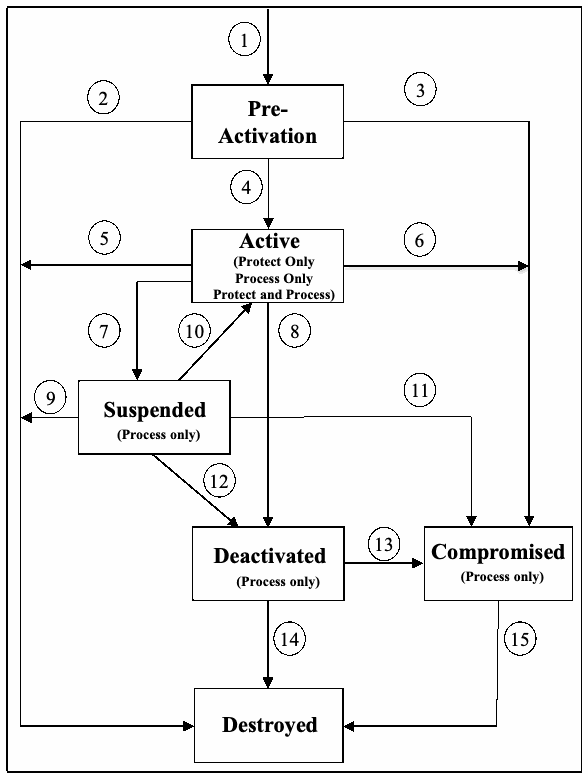
図3:鍵の状態と遷移の例。6状態は事前有効化、有効、一時停止、無効化、危殆化、破棄済み。有効状態は保護専用、処理専用、または保護と処理の両方。一時停止・無効化・危殆化状態は処理のみ。番号付き矢印は、1:生成から事前有効化、2:事前有効化から破棄済み、3:事前有効化から危殆化、4:事前有効化から有効、5:有効から破棄済み、6:有効から危殆化、7:有効から一時停止、8:有効から無効化、9:一時停止から破棄済み、10:一時停止から有効、11:一時停止から危殆化、12:一時停止から無効化、13:無効化から危殆化、14:無効化から破棄済み、15:危殆化から破棄済み。
Figure 3: Key state and transition example
図3:鍵の状態と遷移の例
A key may be used differently, depending upon its state in the key’s lifecycle. Key states are defined from a system point of view as opposed to the point of view of a single cryptographic module. The following sections discuss the states that an operational or backed-up key may assume, along with transitions to other states as shown in Figure 3. Additional states may be applicable for some systems (e.g., a destroyed compromised state, which was depicted in the example provided in a previous version of this Recommendation), and some of the identified states may not be needed for a system (e.g., a decision could be made that the suspended state will not be used).
鍵の使用方法は、鍵のライフサイクルにおける状態によって異なりうます。鍵の状態は、単一の暗号モジュールの観点ではなく、システムの観点から定義されます。以下の各項では、運用中の鍵またはバックアップされた鍵がとりうる状態と、図3に示す他の状態への遷移を論じます。システムによっては追加の状態が該当する場合があり(例:本推奨事項の以前の版で示した例に含まれていた、破棄済みの危殆化状態)、また、示した状態の一部がシステムに不要な場合もあります(例:一時停止状態を使用しないと決定することがありうます)。
Transitioning between states often requires recording the event. Suitable places for such recordings are audit logs and the key’s metadata (see Section 6.2.3). SP 800-152 discusses the logging of these events, including the minimum information that shall be recorded for each event.
状態間の遷移では、多くの場合、その事象を記録する必要があります。このような記録に適した場所は、監査ログと鍵のメタデータ(6.2.3節を参照)です。SP 800-152は、各事象について記録しなければならない最低限の情報を含め、これらの事象の記録について論じています。
The following sections discuss the example states and transitions provided in Figure 3.
以下の各項では、図3に示した状態と遷移の例を論じます。
7.1 Pre-activation State
7.1 事前有効化状態
The key has been generated but has not been authorized for use. Keys to be inventoried (e.g., long-term keys) shall be inventoried upon generation (see Section 9.2).
鍵は生成されていますが、使用を認可されていません。棚卸しの対象となる鍵(例:長期鍵)は、生成時に棚卸ししなければなりません(9.2節を参照してください)。
In this state, the key may only be used to perform proof-of-possession (Section 8.1.5.1.1.2) or key confirmation (see SP 800-175B). Other than for proof-of-possession or key-confirmation purposes, a key shall not be used to apply cryptographic protection to information (e.g., encrypt or sign information to be transmitted or stored) or to process cryptographically protected information (e.g., decrypt ciphertext or verify a digital signature) while in this state.
この状態では、鍵は保有証明(8.1.5.1.1.2節)または鍵確認(SP 800-175Bを参照)の実行にのみ使用してもよいです。保有証明または鍵確認の目的を除き、この状態にある間は、鍵を情報への暗号による保護の適用(例:送信または保存する情報の暗号化や署名)にも、暗号的に保護された情報の処理(例:暗号文の復号やデジタル署名の検証)にも使用してはなりません。
State Transition 1:
状態遷移1:
A key enters the pre-activation state immediately upon generation.
鍵は生成直後に事前有効化状態に入ります。
Information about the generation of the key shall be recorded.
鍵の生成に関する情報を記録しなければなりません。
State Transition 2:
状態遷移2:
If a key is in the pre-activation state, and it has been determined that the key will not be needed in the future, the key shall transition directly from the pre-activation state to the destroyed state.
鍵が事前有効化状態にあり、その鍵が今後不要であると判断された場合、鍵は事前有効化状態から破棄状態へ直接遷移しなければなりません。
In the case of asymmetric keys, both keys of the key pair shall transition to the destroyed state.
非対称鍵の場合、鍵ペアの両方の鍵が破棄状態へ遷移しなければなりません。
The transition shall be recorded (see SP 800-152).
遷移は記録しなければなりません(SP 800-152を参照してください)。
State Transition 3:
状態遷移3:
When a key is in the pre-activation state, and the integrity of the key or the confidentiality of a key requiring confidentiality protection becomes suspect, then the key shall transition from the pre-activation state to the compromised state.
鍵が事前有効化状態にあり、その鍵の完全性、または機密性保護を必要とする鍵の機密性に疑いが生じた場合、鍵は事前有効化状態から危殆化状態へ遷移しなければなりません。
In the case of asymmetric keys, both keys of the key pair shall transition to the compromised state.
非対称鍵の場合、鍵ペアの両方の鍵が危殆化状態へ遷移しなければなりません。
The transition shall be recorded (see SP 800-152). If the key is known by multiple entities, a revocation notice shall be generated.
遷移は記録しなければなりません(SP 800-152を参照してください)。鍵を複数のエンティティが知っている場合は、失効通知を生成しなければなりません。
State Transition 4:
状態遷移4:
Keys shall transition from the pre-activation state to the active state when the key becomes available for use. This transition may occur upon reaching an activation date or may occur because of an external event. In the case where keys are generated for immediate use, the transition occurs immediately after entering the pre-activation state.
鍵が使用可能になったとき、鍵は事前有効化状態から有効状態へ遷移しなければなりません。この遷移は、有効化日に達したときに起こる場合もあれば、外部の事象によって起こる場合もあります。即時使用のために鍵を生成する場合、遷移は事前有効化状態に入った直後に起こります。
For asymmetric keys associated with a certificate, both keys of the key pair become active upon the notBefore date in the first certificate issued for the public key of the key pair.
証明書に関連付けられた非対称鍵の場合、鍵ペアの両方の鍵は、その鍵ペアの公開鍵に対して最初に発行された証明書のnotBefore日に有効になります。
The transition shall be recorded (see SP 800-152).
遷移は記録しなければなりません(SP 800-152を参照してください)。
This transition marks the beginning of the cryptoperiod of a symmetric key or both keys of an asymmetric key pair (see Section 5.3).
この遷移は、共通鍵、または非対称鍵ペアの両方の鍵の暗号期間の開始を示します(5.3節を参照してください)。
7.2 Active State
7.2 有効状態
In the active state, the key may be used to cryptographically protect information (e.g., encrypt plaintext or generate a digital signature), cryptographically process previously protected information (e.g., decrypt ciphertext or verify a digital signature), or both. When a key is active, it may be designated for protection only, processing only, or both protection and processing, depending on its type. For example, asymmetric private signature keys and public key-transport keys are implicitly designated for only applying protection; public signature-verification keys and private key-transport keys are designated for processing only. A symmetric data-encryption key may be used to encrypt data during its originator-usage period and decrypt the encrypted data during its recipient-usage period (see Section 5.3.5). Keys that are disallowed (see SP 800-131A) shall be used for processing only.
有効状態では、鍵を情報の暗号による保護(例:平文の暗号化やデジタル署名の生成)、以前に保護された情報の暗号処理(例:暗号文の復号やデジタル署名の検証)、またはその両方に使用してもよいです。鍵が有効であるとき、その鍵は種類に応じて、保護専用、処理専用、または保護と処理の両方に指定されうます。たとえば、非対称の署名用秘密鍵と鍵転送用公開鍵は、暗黙的に保護の適用専用に指定されます。署名検証用公開鍵と鍵転送用秘密鍵は処理専用に指定されます。対称のデータ暗号化鍵は、送信者使用期間中にデータの暗号化に使用し、受信者使用期間中に暗号化されたデータの復号に使用してよい(5.3.5節を参照してください)。不許可とされた鍵(SP 800-131Aを参照)は、処理にのみ使用しなければなりません。
The use of each key in the active state should be recorded (see SP 800-152).
有効状態にある各鍵の使用は記録すべきです(SP 800-152を参照してください)。
State Transition 5:
状態遷移5:
Several key types transition directly from the active state to the destroyed state if no compromise has been determined and either the key’s cryptoperiod has been reached or the key has been replaced.
いくつかの種類の鍵は、侵害が確認されておらず、かつ鍵の暗号期間に達したか鍵が置き換えられた場合、有効状態から破棄状態へ直接遷移します。
Asymmetric private signature keys and private authentication keys shall transition to the destroyed state at the end of their respective originator-usage periods (e.g., when the notAfter dates are reached on the last certificate issued for the corresponding public keys). Note that the corresponding public keys transition to the deactivated state at this time.
非対称の署名用秘密鍵と認証用秘密鍵は、それぞれの送信者使用期間の終了時(例:対応する公開鍵に対して最後に発行された証明書のnotAfter日に達したとき)に破棄状態へ遷移しなければなりません。なお、対応する公開鍵はこの時点で無効化状態へ遷移します。
A symmetric RBG key shall transition to the destroyed state when replaced by a new key or when the RBG will no longer be used.
対称RBG鍵は、新しい鍵に置き換えられたとき、またはそのRBGが今後使用されなくなったときに、破棄状態へ遷移しなければなりません。
Symmetric master/derivation keys and symmetric authorization keys shall transition to the destroyed state at the end of their respective originator-usage periods.86
対称のマスター鍵/導出鍵と対称の認可鍵は、それぞれの送信者使用期間の終了時に破棄状態へ遷移しなければなりません。86
Asymmetric private ephemeral key-agreement keys shall transition to the destroyed state immediately after use (see SP 800-56A). The corresponding public ephemeral key-agreement keys should transition to the destroyed state when the corresponding private keys are destroyed.87
非対称の一時鍵合意用秘密鍵は、使用直後に破棄状態へ遷移しなければなりません(SP 800-56Aを参照してください)。対応する一時鍵合意用公開鍵は、対応する秘密鍵が破棄されたときに破棄状態へ遷移すべきです。87
An asymmetric private authorization key shall transition to the destroyed state at the end of its cryptoperiod (e.g., when the notAfter date is reached on the last certificate issued for the corresponding public key). An asymmetric public authorization key should transition to the destroyed state when the corresponding private key is destroyed.88
非対称の認可用秘密鍵は、その暗号期間の終了時(例:対応する公開鍵に対して最後に発行された証明書のnotAfter日に達したとき)に破棄状態へ遷移しなければなりません。非対称の認可用公開鍵は、対応する秘密鍵が破棄されたときに破棄状態へ遷移すべきです。88
The transition shall be recorded (see SP 800-152).
遷移は記録しなければなりません(SP 800-152を参照してください)。
State Transition 6:
状態遷移6:
A symmetric key or asymmetric key pair shall transition from the active state to the compromised state when the integrity of the symmetric key or the confidentiality of an asymmetric key requiring confidentiality protection becomes suspect. In this case, the key or key pair shall be revoked.
共通鍵の完全性、または機密性保護を必要とする非対称鍵の機密性が疑わしくなった場合、共通鍵または非対称鍵ペアは活性状態から危殆化状態へ遷移しなければなりません。この場合、鍵または鍵ペアは失効させなければなりません。
In the case of asymmetric key pairs, the compromise pertains explicitly to the private key of the key pair, but both keys shall transition to the compromised state at the same time. For example, when a private signature key or private key-transport key is either compromised or suspected of being compromised, the corresponding public key also needs to transition to the compromised state.
非対称鍵ペアの場合、危殆化は明示的には鍵ペアの秘密鍵に関するものですが、両方の鍵が同時に危殆化状態へ遷移しなければなりません。たとえば、署名用秘密鍵または鍵輸送用秘密鍵が危殆化した場合、または危殆化した疑いがある場合、対応する公開鍵も危殆化状態へ遷移する必要があります。
The transition shall be recorded (see SP 800-152). If the key is known by multiple entities, a revocation notice shall be generated.
遷移は記録しなければなりません(SP 800-152を参照してください)。鍵が複数のエンティティに知られている場合は、失効通知を生成しなければなりません。
State Transition 7:
状態遷移7:
When a suspended state is used by an application (see Section 7.3), a symmetric key or both keys of a key pair shall transition from the active state to the suspended state if, for some reason, the key or key pair is not to be used for a period of time (i.e., the period of suspension). For example, a private signature key may be suspended because the entity associated with the key is on a leave of absence or there is suspicion that the key may have been compromised. In the latter case, the suspension will allow for an investigation of the key’s status before initiating costly revocation and replacement processes.
アプリケーションが一時停止状態を使用する場合(7.3節を参照)、何らかの理由で鍵または鍵ペアを一定期間(すなわち一時停止期間)使用しないときは、共通鍵または鍵ペアの両方の鍵は活性状態から一時停止状態へ遷移しなければなりません。たとえば、署名用秘密鍵は、その鍵に関連付けられたエンティティが休職中である場合や、鍵が危殆化した可能性が疑われる場合に一時停止されることがあります。後者の場合、一時停止により、コストのかかる失効および置換のプロセスを開始する前に鍵の状況を調査することが可能になります。
Symmetric RBG keys shall transition to the compromised state and be replaced rather than remaining in the suspended state.
対称RBG鍵は、一時停止状態にとどまるのではなく、危殆化状態へ遷移して置換されなければなりません。
The transition shall be recorded (see SP 800-152). If the key or key pair is known by multiple entities, a notification indicating the suspension and reason shall be generated.
遷移は記録しなければなりません(SP 800-152を参照してください)。鍵または鍵ペアが複数のエンティティに知られている場合は、一時停止とその理由を示す通知を生成しなければなりません。
State Transition 8:
状態遷移8:
A key or key pair in the active state shall transition to the deactivated state when it is no longer to be used to apply cryptographic protection to data. The transition to the deactivated state may be because a symmetric key was replaced (see Section 8.2.3), the end of the originator-usage period has been reached (see Sections 5.3.4 and 5.3.5), or the key or key pair was revoked for reasons other than a compromise (e.g., the key’s owner is no longer authorized to use the key to encrypt data).
活性状態にある鍵または鍵ペアは、データへの暗号保護の適用にもはや使用しないこととなった時点で、非活性状態へ遷移しなければなりません。非活性状態への遷移は、共通鍵が置換された(8.2.3節を参照)、発信者使用期間の終了に達した(5.3.4節および5.3.5節を参照)、または危殆化以外の理由で鍵または鍵ペアが失効させられた(たとえば、鍵の所有者がその鍵を用いてデータを暗号化することをもはや認可されていない)ことによる場合があります。
Symmetric authentication keys, symmetric data encryption/decryption keys, symmetric key-agreement keys, and key-wrapping keys transition to the deactivated state at the end of the key’s originator-usage period.
共通鍵認証鍵、共通鍵データ暗号化/復号鍵、共通鍵合意鍵、および鍵ラッピング鍵は、その鍵の発信者使用期間の終了時に非活性状態へ遷移します。
Public signature verification keys, public authentication keys, and private/public static key-agreement key pairs transition to the deactivated state at the end of the originator-usage period for the corresponding private key (e.g., when the notAfter date is reached on the last certificate issued for the public key).
公開署名検証鍵、公開認証鍵、および秘密/公開の静的鍵合意鍵ペアは、対応する秘密鍵の発信者使用期間の終了時(たとえば、その公開鍵に対して最後に発行された証明書のnotAfter日付に達したとき)に非活性状態へ遷移します。
Public ephemeral key-agreement keys and public authorization keys transition to the deactivated state if they have not been destroyed when the corresponding private keys were destroyed (see transition 5).
公開一時鍵合意鍵および公開認可鍵は、対応する秘密鍵が破棄された時点で破棄されていなかった場合、非活性状態へ遷移します(遷移5を参照してください)。
A private and public key-transport key pair transitions to the deactivated state when the notAfter date is reached on the last certificate issued for the public key.
秘密および公開の鍵輸送鍵ペアは、その公開鍵に対して最後に発行された証明書のnotAfter日付に達した時点で非活性状態へ遷移します。
The transition shall be recorded (see SP 800-152).
遷移は記録しなければなりません(SP 800-152を参照してください)。
7.3 Suspended State
7.3 一時停止状態
The use of a key or key pair may be suspended for several possible reasons. (Note that in the case of asymmetric key pairs, both the public and private keys shall be suspended at the same time.) One reason for a suspension might be a possible key compromise; in this case, the suspension might be issued to allow for time to investigate the situation. Another reason might be that the entity that owns a digital signature key pair is not available (e.g., is on an extended leave of absence); signatures purportedly signed during the suspension time would be invalid.
鍵または鍵ペアの使用は、いくつかの理由で一時停止されることがあります。(非対称鍵ペアの場合、公開鍵と秘密鍵の両方を同時に一時停止しなければならないことに注意すること。)一時停止の理由の一つとして、鍵の危殆化の可能性が考えられます。この場合、状況を調査する時間を確保するために一時停止が行われることがあります。別の理由として、デジタル署名鍵ペアを所有するエンティティが不在である(たとえば、長期休職中である)ことが考えられます。一時停止期間中に署名されたとされる署名は無効となります。
Depending on the reason for the suspension, a suspended key or key pair may be restored to an active, deactivated, or destroyed state or may transition to the compromised state.
一時停止の理由に応じて、一時停止された鍵または鍵ペアは、活性状態、非活性状態、もしくは破棄状態に戻されるか、または危殆化状態へ遷移することがあります。
A suspended key shall not be used to apply cryptographic protection (e.g., encrypt plaintext or generate a digital signature). This includes all key types listed in Section 5.1.1 except those types that are never used to apply cryptographic protection (i.e., a public signature-verification key, a public authentication key, a private key-transport key, and a public authorization key).
一時停止された鍵は、暗号保護の適用(たとえば、平文の暗号化やデジタル署名の生成)に使用してはなりません。これは、暗号保護の適用に決して使用されない鍵種別(すなわち、公開署名検証鍵、公開認証鍵、鍵輸送用秘密鍵、および公開認可鍵)を除き、5.1.1節に列挙されたすべての鍵種別に当てはまります。
Depending on the reason for the suspension, a suspended key could be used to process information for which cryptographic protection was applied before the suspension period. This includes the use of a public-verification key to verify a digital signature, a symmetric data-encryption key to decrypt encrypted information, and a symmetric key-wrapping key to unwrap keying material. If the reason for the suspension is a suspected compromise, it may not be prudent to verify any signatures using the public key until and unless the key pair is subsequently reactivated (i.e., the key was not compromised), even if the risk is acceptable. However, if the reason is that the owner is on a leave of absence, verifying signatures known to be generated before the beginning of the suspension period may be warranted.
一時停止の理由によっては、一時停止された鍵を、一時停止期間より前に暗号保護が適用された情報の処理に使用できる場合があります。これには、公開検証鍵を用いたデジタル署名の検証、共通鍵データ暗号化鍵を用いた暗号化情報の復号、および共通鍵ラッピング鍵を用いた鍵素材のアンラップが含まれます。一時停止の理由が危殆化の疑いである場合、たとえリスクが許容可能であっても、その後に鍵ペアが再活性化される(すなわち、鍵が危殆化していなかった)までは、その公開鍵を用いて署名を検証することは賢明でない場合があります。しかし、理由が所有者の休職である場合には、一時停止期間の開始前に生成されたことがわかっている署名を検証することは正当化されうます。
Information for which protection is known to have been applied during the suspension period shall not be processed.
一時停止期間中に保護が適用されたことがわかっている情報は、処理してはなりません。
State Transition 9:
状態遷移9:
Several key types transition from the suspended state to the destroyed state if no compromise has been determined.
いくつかの鍵種別は、危殆化が確認されなかった場合、一時停止状態から破棄状態へ遷移します。
Private signature keys and private authentication keys in the suspended state shall transition to the destroyed state at the end of their originator-usage periods (e.g., when the notAfter dates are reached on the last certificate issued for the corresponding public keys). Note that the corresponding public keys transition to the deactivated state at this time (see transition 12).
一時停止状態にある署名用秘密鍵および認証用秘密鍵は、その発信者使用期間の終了時(たとえば、対応する公開鍵に対して最後に発行された証明書のnotAfter日付に達したとき)に破棄状態へ遷移しなければなりません。このとき、対応する公開鍵は非活性状態へ遷移することに注意すること(遷移12を参照してください)。
Symmetric master/derivation keys and symmetric authorization keys in the suspended state shall transition to the destroyed state at the end of their originator-usage periods.89
一時停止状態にある共通鍵マスター/導出鍵および共通鍵認可鍵は、その発信者使用期間の終了時に破棄状態へ遷移しなければなりません。89
Private authorization keys in the suspended state shall transition to the destroyed state at the end of their originator-usage periods (i.e., when the notAfter dates are reached on the last certificate issued for the corresponding public keys). Public authorization keys should transition to the destroyed state when the corresponding private keys are destroyed.90
一時停止状態にある認可用秘密鍵は、その発信者使用期間の終了時(すなわち、対応する公開鍵に対して最後に発行された証明書のnotAfter日付に達したとき)に破棄状態へ遷移しなければなりません。公開認可鍵は、対応する秘密鍵が破棄された時点で破棄状態へ遷移すべきです。90
The transition shall be recorded (see SP 800-152).
遷移は記録しなければなりません(SP 800-152を参照してください)。
State Transition 10:
状態遷移10:
A key or key pair in the suspended state shall transition to the active state when the reason for the suspension no longer exists and the end of the originator-usage period has not been reached.
一時停止状態にある鍵または鍵ペアは、一時停止の理由がもはや存在せず、かつ発信者使用期間の終了に達していない場合、活性状態へ遷移しなければなりません。
In the case of symmetric keys, the transition needs to be made before the end of the key’s originator-usage period.
共通鍵の場合、この遷移はその鍵の発信者使用期間の終了前に行う必要があります。
For asymmetric keys, the transition needs to be made, for example, before the notAfter date on the last certificate issued for the public key. In this case, both the private and public key shall transition at the same time.
非対称鍵の場合、この遷移は、たとえばその公開鍵に対して最後に発行された証明書のnotAfter日付より前に行う必要があります。この場合、秘密鍵と公開鍵の両方が同時に遷移しなければなりません。
The transition shall be recorded (see SP 800-152).
遷移は記録しなければなりません(SP 800-152を参照してください)。
State Transition 11:
状態遷移11:
A key or key pair in the suspended state shall transition to the compromised state when the integrity of the key or the confidentiality of a key requiring confidentiality protection becomes suspect or is confirmed. In this case, the key or key pair shall be revoked.
一時停止状態にある鍵または鍵ペアは、鍵の完全性、または機密性保護を必要とする鍵の機密性が疑わしくなった場合、あるいはそれが確認された場合、危殆化状態へ遷移しなければなりません。この場合、鍵または鍵ペアは失効させなければなりません。
In the case of asymmetric key pairs, both the public and private keys shall transition at the same time.
非対称鍵ペアの場合、公開鍵と秘密鍵の両方が同時に遷移しなければなりません。
The transition shall be recorded (see SP 800-152). If the key is known by multiple entities, a revocation notice shall be generated.
遷移は記録しなければなりません(SP 800-152を参照してください)。鍵が複数のエンティティに知られている場合は、失効通知を生成しなければなりません。
State Transition 12:
状態遷移12:
Several key types transition from the suspended state to the deactivated state if no compromise has been determined and the suspension is no longer required.
いくつかの鍵種別は、危殆化が確認されず、かつ一時停止がもはや不要となった場合、一時停止状態から非活性状態へ遷移します。
Symmetric authentication keys, symmetric data encryption/decryption keys, symmetric key-agreement keys, and symmetric key-wrapping keys shall transition to the deactivated state when the end of their originator-usage periods has been reached but the end of the recipient-usage period has not been reached.
共通鍵認証鍵、共通鍵データ暗号化/復号鍵、共通鍵合意鍵、および共通鍵ラッピング鍵は、その発信者使用期間の終了に達したが受信者使用期間の終了には達していない場合、非活性状態へ遷移しなければなりません。
Public signature verification keys, public authentication keys, and private/public static key-agreement key pairs91 transition to the deactivated state at the end of the private key’s originator-usage period (e.g., when the notAfter date is reached on the last certificate issued for the public key). Public ephemeral key-agreement keys and public authorization keys transition to the deactivated state if they have not been destroyed when the corresponding private keys were destroyed (see state transition 9).
署名検証用公開鍵、認証用公開鍵、および静的鍵合意用の秘密鍵・公開鍵ペア91は、秘密鍵の生成者使用期間の終了時に無効化状態へ移行します(例えば、その公開鍵に対して最後に発行された証明書のnotAfterの日付に達したとき)。一時的鍵合意用公開鍵および認可用公開鍵は、対応する秘密鍵が破棄されたときに破棄されていなければ、無効化状態へ移行します(状態遷移9を参照してください)。
A private/public key-transport key pair transitions to the deactivated state at the end of the key pair’s cryptoperiod (e.g., when the notAfter date is reached on the last certificate issued for the public key).
鍵転送用の秘密鍵・公開鍵ペアは、その鍵ペアの暗号期間の終了時に無効化状態へ移行します(例えば、その公開鍵に対して最後に発行された証明書のnotAfterの日付に達したとき)。
The transition shall be recorded (see SP 800-152).
この移行は記録しなければなりません(SP 800-152を参照してください)。
7.4 Deactivated State
7.4 無効化状態
Keys in the deactivated state shall not be used to apply cryptographic protection but, in some cases, may be used to process cryptographically protected information. If the key has been revoked (i.e., for reasons other than a compromise), then the key may continue to be used for processing.
無効化状態の鍵を暗号保護の適用に使用してはなりませんが、場合によっては、暗号で保護された情報の処理に使用してもよいです。鍵が失効している場合(すなわち、危殆化以外の理由による場合)、その鍵を処理に引き続き使用してもよいです。
Note that keys retrieved from a key archive (e.g., for decrypting archived data) may be in the deactivated state.
鍵アーカイブから取り出した鍵(例えば、アーカイブされたデータを復号するための鍵)は、無効化状態である場合があることに注意します。
•Public signature verification keys may be used to verify the digital signatures that were generated before the end of the corresponding private key’s originator-usage period (e.g., before the notAfter date in the last certificate for the public key).
•署名検証用公開鍵は、対応する秘密鍵の生成者使用期間の終了前に生成されたデジタル署名(例:公開鍵の最後の証明書のnotAfter日付より前)を検証するために使用してもよいです。
•Symmetric authentication keys, symmetric data-encryption keys, and symmetric key-wrapping keys may be used to process cryptographically protected information until the end of the recipient-usage period is reached, provided that the protection was applied during the key’s originator-usage period.
•共通鍵認証鍵、共通鍵データ暗号化鍵、および共通鍵ラッピング鍵は、その鍵の生成者使用期間中に保護が適用されたことを条件として、受信者使用期間の終了まで、暗号で保護された情報の処理に使用してもよいです。
•Public authentication keys may be used to authenticate processes performed before the end of the corresponding private key’s originator-usage period (e.g., before the notAfter date in the last certificate for the public key).
•認証用公開鍵は、対応する秘密鍵の生成者使用期間の終了前(例:公開鍵の最後の証明書のnotAfter日付より前)に実行されたプロセスを認証するために使用してもよいです。
•Private key-transport keys may be used to decrypt keys that were encrypted using the corresponding public key before the end of the public key’s originator-usage period (e.g., before the notAfter date in the last certificate for the public key).
•鍵転送用秘密鍵は、公開鍵の生成者使用期間の終了前(例:公開鍵の最後の証明書のnotAfter日付より前)に対応する公開鍵を用いて暗号化された鍵を復号するために使用してもよいです。
•Symmetric key-agreement keys may be used to determine the (already) agreed-upon key, assuming that sufficient information is available even though they shall not be used to determine new keys.
•共通鍵合意鍵は、十分な情報が利用できる場合、既に合意された鍵を特定するために使用してもよいです。ただし、新しい鍵の特定には使用してはなりません。
•Private/public static key-agreement keys may be used to regenerate agreed-upon keys that were created before the end of the key pair’s cryptoperiod (e.g., before the notAfter date in the last certificate for the public key, assuming that sufficient information is available for the key-agreement scheme used).
•静的鍵合意用の秘密鍵と公開鍵は、その鍵ペアの暗号期間終了前に作成された合意済みの鍵を再生成するために使用してよい(例:公開鍵の最後の証明書のnotAfter日付より前に作成された鍵。ただし、使用する鍵合意方式に必要な情報が十分に利用可能であることを前提とします)。
•Public ephemeral key-agreement keys may be used to regenerate agreed-upon keys (assuming that sufficient information is available for the key-agreement scheme used).
•公開エフェメラル鍵共有鍵は、(使用する鍵共有方式に十分な情報が利用できることを前提に)合意済み鍵の再生成に使用してもよいです。
•Public authorization keys shall not be used.
•公開認可鍵を使用してはなりません。
Keys in the deactivated state may transition to either the compromised or destroyed state at some point in time.
非活性化状態の鍵は、ある時点で危殆化状態または破棄状態のいずれかに遷移する場合があります。
State Transition 13:
状態遷移13:
A key shall transition from the deactivated state to the compromised state when the integrity of a key or the confidentiality of a key requiring confidentiality protection becomes suspect. In this case, the key or key pair shall be revoked.
鍵の完全性、または機密性保護を必要とする鍵の機密性に疑いが生じた場合、鍵は非活性化状態から危殆化状態に遷移しなければなりません。この場合、その鍵または鍵ペアは失効させなければなりません。
The transition shall be recorded (see SP 800-152). If the key is known by multiple entities, a revocation notice shall be generated.
遷移は記録しなければなりません(SP 800-152を参照してください)。鍵が複数のエンティティに知られている場合は、失効通知を生成しなければなりません。
State Transition 14:
状態遷移14:
When no longer needed (e.g., to decrypt data), symmetric (secret) and asymmetric private keys in the deactivated state shall transition to the destroyed state.
(例えばデータの復号に)不要になった時点で、非活性化状態にある共通鍵および非対称秘密鍵は、破棄状態に遷移しなければなりません。
Public keys in the deactivated state should transition to the destroyed state as soon as they are no longer needed. Whether or not the public keys are destroyed, the metadata should be retained for audit purposes (see Section 8.4).
非活性化状態にある公開鍵は、不要になり次第、破棄状態に遷移すべきです。公開鍵を破棄するか否かにかかわらず、メタデータは監査目的で保持すべきです(8.4節を参照してください)。
The transition shall be recorded (see SP 800-152).
遷移は記録しなければなりません(SP 800-152を参照してください)。
7.5 Compromised State
7.5 侵害済み状態
Generally, keys are compromised when they are provided to or determined by an unauthorized entity. A compromised key shall not be used to apply cryptographic protection to information. However, in some cases, a compromised symmetric key or a public key that corresponds to a compromised private key of a key pair may be used to process cryptographically protected information. For example, a signature may be verified to determine the integrity of signed data if its signature has been physically protected since a time before the compromise occurred or a reliable timestamp has been included in the signed data. This processing shall be done only under highly controlled conditions where the users of the information are fully aware of the possible consequences.
一般に、鍵は、認可されていないエンティティに提供されたり、認可されていないエンティティによって特定されたりした場合に危殆化します。危殆化した鍵を、情報への暗号による保護の適用に使用してはなりません。ただし、場合によっては、危殆化した共通鍵、または鍵ペアのうち危殆化した秘密鍵に対応する公開鍵を、暗号で保護された情報の処理に使用してよいことがあります。例えば、署名済みデータの署名が危殆化の発生前の時点から物理的に保護されている場合や、署名済みデータに信頼できるタイムスタンプが含まれている場合には、署名済みデータの完全性を判断するためにその署名を検証してもよいです。このような処理は、情報の利用者が起こりうる結果を十分に認識している、厳しく管理された条件の下でのみ行わなければなりません。
Note that keys retrieved from an archive may be in the compromised state.
アーカイブから取り出した鍵が危殆化状態にある場合がある点に注意されました。
State Transition 15:
状態遷移15:
A compromised symmetric (secret) or asymmetric private key shall transition to the destroyed state.
危殆化した共通鍵または非対称秘密鍵は、破棄状態に遷移しなければなりません。
A compromised public key should transition to the destroyed state when its use will no longer be allowed or needed. Whether or not the public keys are destroyed, the metadata should be retained for audit purposes (see Section 8.4).
危殆化した公開鍵は、その使用がもはや許可されなくなるか不要になった時点で、破棄状態に遷移すべきです。公開鍵を破棄するか否かにかかわらず、メタデータは監査目的で保持すべきです(8.4節を参照してください)。
The transition shall be recorded (see SP 800-152).
遷移は記録しなければなりません(SP 800-152を参照してください)。
7.6 Destroyed State
7.6 破棄状態
The key has been destroyed as specified in Section 8.3.4. Even though the key no longer exists when in this state, certain metadata (e.g., key state transition history, key name, type, and cryptoperiod) may be retained for audit purposes (see Section 8.4).
8.3.4節の規定に従って鍵が破棄された状態です。この状態では鍵そのものは存在しませんが、監査目的で特定のメタデータ(例:鍵状態遷移履歴、鍵名、種別、暗号期間)を保持してよい(8.4節を参照してください)。
It is possible that a compromise of the destroyed key could be determined after the key has been destroyed. In this case, the event shall be recorded (see SP 800-152).
鍵が破棄された後に、破棄済み鍵の侵害が判明する場合があります。この場合、その事象を記録しなければなりません(SP 800-152を参照してください)。
8 Key-Management Phases and Functions
8 鍵管理のフェーズと機能
The cryptographic key-management lifecycle can be divided into four phases. During each phase, the keys are in certain specific key states as discussed in Section 7. In addition, within each phase, certain key-management functions are typically performed. These functions are necessary for the management of the keys and their associated metadata.
暗号鍵管理のライフサイクルは、四つのフェーズに分けることができます。各フェーズにおいて、鍵は7節で述べた特定の鍵状態にあります。さらに、各フェーズでは、通常、特定の鍵管理機能が実行されます。これらの機能は、鍵とそれに関連するメタデータの管理に必要です。
Key-management information is called metadata. The metadata required for key management might include the identity of a person or system associated with that key or the types of information that person is authorized to access. Metadata is used by applications to select the appropriate cryptographic key(s) for a particular service. While the metadata does not appear in cryptographic algorithms, it is crucial to the implementation of applications and application protocols.
鍵管理情報はメタデータと呼ばれます。鍵管理に必要なメタデータには、その鍵に関連付けられた人またはシステムの識別情報や、その人がアクセスを認可されている情報の種類が含まれることがあります。メタデータは、アプリケーションが特定のサービスに適切な暗号鍵を選択するために使用されます。メタデータは暗号アルゴリズムには現れませんが、アプリケーションおよびアプリケーションプロトコルの実装にとって極めて重要です。
The four phases of key management are:
鍵管理の四つのフェーズは次のとおりです。
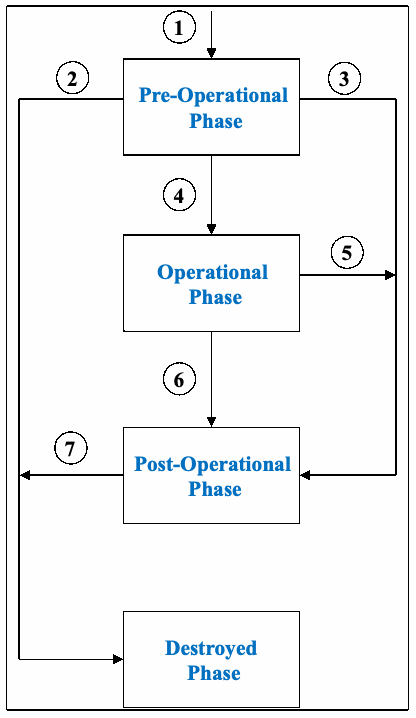
図4:鍵管理のフェーズ。運用前・運用・運用後・破棄の4フェーズ。番号付き矢印は、1:生成から運用前、2:運用前から破棄、3:運用前から運用後、4:運用前から運用、5:運用から運用後、6:運用から運用後、7:運用後から破棄。遷移3・5は危殆化、遷移6は通常使用を終えてもアクセスを維持する場合。
1.Pre-operational phase: The keying material is not yet available for normal cryptographic operations. Keys may not yet be generated or are in the pre-activation state. System or enterprise attributes are established during this phase as well.
1.運用前フェーズ:鍵素材は、通常の暗号操作にはまだ利用できません。鍵はまだ生成されていないか、事前有効化状態にあります。システムまたは企業の属性もこのフェーズで確立されます。
2.Operational phase: The keying material is available and in normal use. Keys are in the active or suspended state. Keys in the active state may be designated as protect only, process only, or both protect and process; keys in the suspended state can be used for processing only (see Section 7.3).
2.運用フェーズ:鍵素材は利用可能であり、通常どおり使用されています。鍵は有効状態または一時停止状態にあります。有効状態の鍵は、保護専用、処理専用、または保護と処理の両方として指定されることがあります。一時停止状態の鍵は処理にのみ使用できます(7.3節を参照してください)。
3.Post-operational phase: The keying material is no longer in normal use, but access to the keying material is possible, and the keying material may be used for processing protected information. Keys are in the deactivated or compromised states. Keys in the post-operational phase may be in an archive (see Section 8.3.1).
3.運用後フェーズ:鍵素材はもはや通常の使用には供されませんが、鍵素材へのアクセスは可能であり、保護された情報の処理に鍵素材を使用することがあります。鍵は無効化状態または危殆化状態にあります。運用後フェーズの鍵はアーカイブに置かれることがあります(8.3.1節を参照してください)。
4.Destroyed phase: Keys are no longer available. Records of their existence may or may not have been deleted. Keys are in the destroyed state. Although the keys themselves may have been destroyed, the key’s metadata (e.g., key name, type, cryptoperiod, and usage period) may be retained (see Section 8.4).
4.破棄フェーズ:鍵はもはや利用できません。鍵が存在したことの記録は削除されている場合もあれば、削除されていない場合もあります。鍵は破棄済み状態にあります。鍵そのものは破棄されていても、鍵のメタデータ(たとえば、鍵の名前、種別、暗号期間、および使用期間)は保持されることがあります(8.4節を参照してください)。
Figure 4: Key-management phases
図4:鍵管理のフェーズ
A flow diagram for the key-management phases is presented in Figure 4. Seven phase transitions are identified in the diagram. A key shall not be able to transfer back to any previous phase.
鍵管理フェーズのフロー図を図4に示します。この図では七つのフェーズ遷移が示されています。鍵は以前のいずれのフェーズにも戻ることができてはなりません。
Phase Transition 1: A key is in the pre-operational phase upon generation (pre-activation state).
フェーズ遷移1:鍵は生成時に運用前フェーズ(事前有効化状態)にあります。
Phase Transition 2: If keys are produced but never used, they may be destroyed by transitioning from the pre-operational phase directly to the destroyed phase.
フェーズ遷移2:鍵が生成されたものの一度も使用されなかった場合、運用前フェーズから破棄フェーズへ直接遷移させることにより、その鍵を破棄することができます。
Phase Transition 3: When a key in the pre-operational phase is compromised, it transitions to the post-operational phase (compromised state).
フェーズ遷移3:運用前フェーズにある鍵が危殆化した場合、その鍵は運用後フェーズ(危殆化状態)へ遷移します。
Phase Transition 4: After the required metadata has been established, keying material has been generated, and the metadata is associated with the key during the pre-operational phase, the key is ready to be used by applications and transitions to the operational phase at the appropriate time.
フェーズ遷移4:運用前フェーズにおいて、必要なメタデータが確立され、鍵素材が生成され、メタデータが鍵に関連付けられた後、その鍵はアプリケーションで使用できる状態となり、適切な時点で運用フェーズへ遷移します。
Phase Transition 5: When a key in the operational phase is compromised, it transitions to the post-operational phase (compromised state).
フェーズ遷移5:運用フェーズにある鍵が危殆化した場合、その鍵は運用後フェーズ(危殆化状態)へ遷移します。
Phase Transition 6: When keys are no longer required for normal use (i.e., the end of the cryptoperiod has been reached and the key is no longer “active”) but access to those keys needs to be maintained, the key transitions to the post-operational phase.
フェーズ遷移6:鍵が通常の使用にもはや必要なくなった(すなわち、暗号期間の終了に達し、鍵がもはや「有効」でない)が、それらの鍵へのアクセスを維持する必要がある場合、鍵は運用後フェーズへ遷移します。
Phase Transition 7: Some applications will require that access be preserved for a period of time, and then the keying material may be destroyed. When it is clear that a key in the post-operational phase is no longer needed, it may transition to the destroyed phase.
フェーズ遷移7:一部のアプリケーションでは、一定期間アクセスを保持し、その後に鍵素材を破棄することが求められます。運用後フェーズにある鍵がもはや必要ないことが明らかになった場合、その鍵は破棄フェーズへ遷移することができます。
The combination of key states and key phases is illustrated in Figure 5.
鍵状態と鍵フェーズの組み合わせを図5に示します。
The following subsections discuss the functions that are performed in each phase of key management. References in the text to “systems” refer to systems that handle keys, whether the system is a client using some protocol or an entire key-management system. Many of the functions may be performed by a key-management system. A key-management system may not have all identified functions since some functions may not be appropriate. In some cases, one or more functions may be combined, or the functions may be performed in a different order. For example, a system may omit the functions of the post-operational phase if keys are immediately destroyed when they are no longer used to apply cryptographic protection or are compromised. In this case, keys would move from the operational phase directly to the destroyed phase.
以下の各項では、鍵管理の各フェーズで実行される機能について述べます。本文中の「システム」とは、何らかのプロトコルを使用するクライアントであれ、鍵管理システム全体であれ、鍵を取り扱うシステムを指します。機能の多くは鍵管理システムによって実行されることがあります。一部の機能は適切でない場合があるため、鍵管理システムが特定されたすべての機能を備えているとは限りません。場合によっては、一つ以上の機能が統合されることや、機能が異なる順序で実行されることがあります。たとえば、暗号保護の適用にもはや使用されなくなった時点、または危殆化した時点で鍵を直ちに破棄するシステムでは、運用後フェーズの機能を省略することがあります。この場合、鍵は運用フェーズから破棄フェーズへ直接移行します。
8.1 Pre-operational Phase
8.1 運用前フェーズ
During the pre-operational phase of key management, keying material is not yet available for normal cryptographic operations.
鍵管理の運用前フェーズでは、鍵素材は通常の暗号操作にまだ利用できません。
8.1.1 Entity Registration Function
8.1.1 エンティティ登録機能
During registration into a key management system, an entity interacts with a registration authority to become an authorized member of a security domain. In this phase, an entity identifier may be established to identify the member during future transactions. In particular, security infrastructures may associate the identification information with the entity’s keys (see Sections 8.1.5 and 8.1.6). The entity may supply various information, such as an email address, and the entity's role and authorization information may be established by the system administrator. As with identity information, this information may be associated with the entity’s keys by the infrastructure to support secure application-level security services.
鍵管理システムへの登録時、エンティティは登録局とやり取りし、セキュリティドメインの許可されたメンバーとなります。この段階で、今後の取引においてメンバーを識別するエンティティ識別子を設定することがあります。特に、セキュリティ基盤は識別情報をエンティティの鍵に関連付けることがあります(8.1.5節および8.1.6節を参照してください)。エンティティは電子メールアドレスなどさまざまな情報を提供することがあり、その役割および認可情報はシステム管理者が設定する場合があります。識別情報と同様に、アプリケーションレベルのセキュリティサービスを支援するため、基盤がこれらの情報をエンティティの鍵に関連付けることがあります。
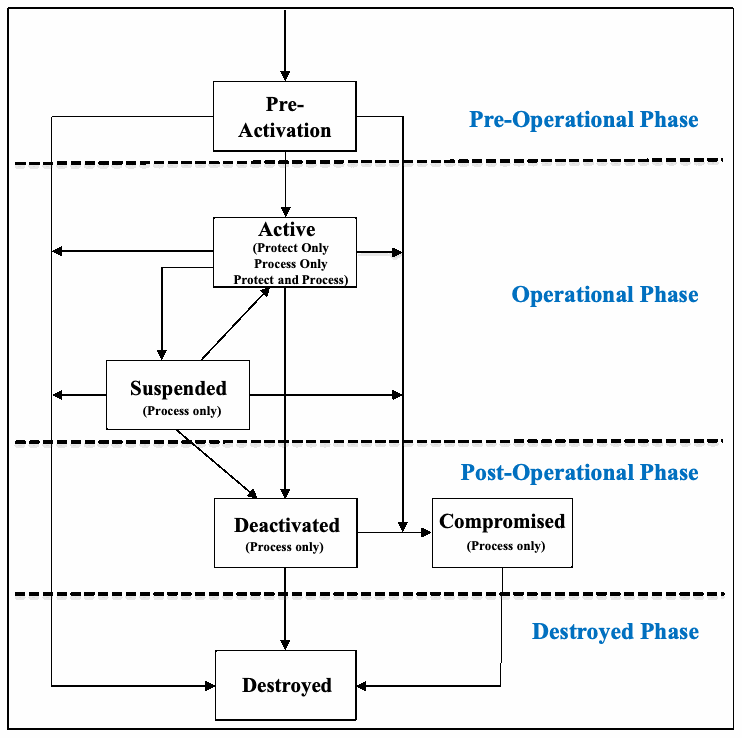
図5:鍵管理の状態とフェーズ。3本の破線が4フェーズを区切る。事前有効化状態は運用前、有効・一時停止状態は運用、無効化・危殆化状態は運用後、破棄済み状態は破棄フェーズに属する。有効状態は保護専用・処理専用・両方のいずれかで、一時停止・無効化・危殆化状態は処理のみ。矢印は、生成から事前有効化、事前有効化から有効・危殆化・破棄済み、有効から一時停止・無効化・危殆化・破棄済み、一時停止から有効・無効化・危殆化・破棄済み、無効化から危殆化・破棄済み、危殆化から破棄済みへの遷移を示す。
Figure 5: Key-management states and phases
図5:鍵管理の状態とフェーズ
Since applications will depend upon the identity established during this process, it is crucial that appropriate procedures for the validation of identity (i.e., identity proofing) be established and used. Identity proofing is often performed by an organization (e.g., by the organization’s security office) but may also be performed by a registration authority for the key management system. The strength (or weakness) of a security infrastructure will often depend upon the identification process. FIPS 20192 and SP 800-6393 address requirements for establishing identity.
アプリケーションはこのプロセスで確立された識別情報に依存するため、識別情報の検証(すなわち身元確認)のための適切な手順を確立し、使用することが極めて重要です。身元確認は組織(たとえば、組織のセキュリティ部署)によって実施されることが多いですが、鍵管理システムの登録機関によって実施されることもあります。セキュリティ基盤の強度(または脆弱性)は、多くの場合、識別プロセスに左右されます。FIPS 20192およびSP 800-6393は、識別情報の確立に関する要件を扱っています。
Entity and key registration (see Section 8.1.6) may be performed separately or in concert. If performed separately, the entity registration process will generally establish a secret value (e.g., a password, PIN, or HMAC key); the secret value may be used to authenticate the entity’s identity during the key-registration step. If performed in concert, the entity establishes an identity and performs key registration in the same process, so the secret value is not required.
エンティティ登録と鍵登録(8.1.6節を参照)は、別々に行うことも、一体として行うこともできます。別々に行う場合、エンティティ登録プロセスでは通常、秘密値(たとえば、パスワード、PIN、またはHMAC鍵)が確立されます。この秘密値は、鍵登録の段階でエンティティの識別情報を認証するために使用されることがあります。一体として行う場合、エンティティは同一のプロセスで識別情報を確立し鍵登録を行うため、秘密値は必要ありません。
8.1.2 System Initialization Function
8.1.2 システム初期化機能
System initialization involves setting up or configuring a system for secure operation. For systems handling keys, this may include algorithm preferences, the identification of trusted parties, and the definition of domain-parameter policies and any trusted parameters (e.g., recognized certificate policies).
システム初期化では、安全に運用できるようシステムを設定または構成します。鍵を扱うシステムでは、これにアルゴリズムの優先設定、信頼する関係者の識別、ドメインパラメータポリシーおよび信頼するパラメータ(例:認識済みの証明書ポリシー)の定義などが含まれる場合があります。
8.1.3 Initialization Function
8.1.3 初期化機能
Initialization consists of an entity initializing its cryptographic application (e.g., installing and initializing software or hardware). This involves the use or installation (see Section 8.1.4) of the initial keying material that may be obtained during entity registration. Examples include the installation of a key at a CA, trust parameters, policies, trusted parties, and algorithm preferences.
初期化とは、エンティティが暗号アプリケーションを初期化すること(例:ソフトウェアまたはハードウェアのインストールと初期設定)です。これには、エンティティ登録中に取得されることがある初期鍵素材の使用またはインストール(8.1.4節を参照)が含まれます。例として、CAへの鍵のインストール、信頼パラメータ、ポリシー、信頼する関係者、アルゴリズムの優先設定があります。
8.1.4 Keying-Material Installation Function
8.1.4 鍵素材インストール機能
The security of keying-material installation is crucial to the security of a system, whether the keying material is generated within the system (e.g., in the system’s cryptographic module) or generated within another system and subsequently installed in the (target) system. For this function, keying material is installed for operational use within an entity’s software, hardware, system, application, cryptographic module, or device using a variety of techniques. Keying material is installed during initial setup when new keying material is added to the existing keying material and the existing keying material is replaced (e.g., via re-keying or key derivation; see Sections 8.2.3 and 8.2.4).
鍵素材のインストールのセキュリティは、鍵素材がシステム内(たとえば、システムの暗号モジュール内)で生成される場合であれ、別のシステム内で生成されてから(対象)システムにインストールされる場合であれ、システムのセキュリティにとって極めて重要です。この機能では、さまざまな手法を用いて、エンティティのソフトウェア、ハードウェア、システム、アプリケーション、暗号モジュール、またはデバイス内に運用のための鍵素材をインストールします。鍵素材は、初期セットアップ時、既存の鍵素材に新しい鍵素材が追加されるとき、および既存の鍵素材が置換されるとき(たとえば、再鍵化または鍵導出によります。8.2.3節および8.2.4節を参照)にインストールされます。
The process for the initial installation of keying material (e.g., by manual entry, using an electronic key loader, or a vendor during manufacture) shall include the protection of the keying material during entry into a software, hardware, system, application, device, or cryptographic module − taking into account the requirements of FIPS 140 and its differing requirements for the different levels of protection − and include any additional procedures that may be required.
鍵素材の初期インストールのプロセス(たとえば、手入力、電子的な鍵ローダーの使用、または製造時のベンダーによるもの)には、ソフトウェア、ハードウェア、システム、アプリケーション、デバイス、または暗号モジュールへの入力時における鍵素材の保護を含めなければなりません。その際、FIPS 140の要件と、保護レベルごとに異なるその要件を考慮しなければなりません。さらに、必要となる追加の手順も含めなければなりません。
Many applications or systems are provided by the manufacturer with keying material that is used to test that the newly installed application/system is functioning properly. This test keying material shall not be used operationally.
多くのアプリケーションやシステムは、新たにインストールされたアプリケーション/システムが正しく機能していることをテストするために使用する鍵素材とともに、製造者から提供されます。このテスト用鍵素材を運用に使用してはなりません。
8.1.5 Key Establishment Function
8.1.5 鍵確立機能
Key establishment involves the generation and distribution or the agreement of keying material for communication between entities. All keys shall be generated within a FIPS 140-validated cryptographic module or obtained from another source approved by the U.S. Government for the protection of national security information. Long-term keys shall be inventoried (see Section 9.2). During the key-establishment process, some of the keying material may be in transit (i.e., the keying material is being manually distributed or is being distributed using automated protocols). Other keying material may be retained locally rather than distributed. In either case, the keying material shall be protected in accordance with Section 6.
鍵確立には、エンティティ間の通信のための鍵素材の生成と配布、または合意が含まれます。すべての鍵は、FIPS 140の認証を受けた暗号モジュール内で生成するか、国家安全保障情報の保護のために米国政府が承認した他の供給源から入手しなければなりません。長期鍵はインベントリに登録しなければなりません(9.2節を参照してください)。鍵確立プロセスの間、鍵素材の一部は転送中である(すなわち、鍵素材が手動で配布されているか、自動化されたプロトコルを用いて配布されている)ことがあります。その他の鍵素材は、配布されずにローカルに保持されることがあります。いずれの場合も、鍵素材は第6章に従って保護しなければなりません。
An entity may be an individual (human), organization, device, or process. When keying material is generated by an entity for its own use, one or more of the appropriate protection mechanisms for stored information in Section 6.2.2 shall be used. The “owner” of a key is an entity that is authorized to use the key. When the owner is not a human (i.e., the owner is an organization, device, or process), the owner is often assisted by an authorized human representative or sponsor to obtain and manage keying material (e.g., to obtain and install keys and certificates).
エンティティは、個人(人間)、組織、デバイス、またはプロセスでありうます。エンティティが自ら使用するために鍵素材を生成する場合は、6.2.2節に示す保存情報に対する適切な保護メカニズムのうち一つ以上を使用しなければなりません。鍵の「所有者」とは、その鍵の使用を認可されたエンティティです。所有者が人間でない場合(すなわち、所有者が組織、デバイス、またはプロセスである場合)、所有者は多くの場合、鍵素材の入手と管理(たとえば、鍵と証明書の入手とインストール)について、認可された人間の代表者またはスポンサーの支援を受けます。
Keying material that is distributed between entities or among an entity and its sub-entities (e.g., various individuals, devices, or processes within an organization) shall be protected during distribution using one or more of the appropriate protection mechanisms specified in Section 6.2.1. Any keying material that is not distributed (e.g., the private key of a key pair or one’s own copy of a symmetric key) or keying material that is received and subsequently stored shall be protected using one or more of the appropriate protection mechanisms specified in Section 6.2.2.
エンティティ間、またはエンティティとそのサブエンティティ(たとえば、組織内のさまざまな個人、デバイス、またはプロセス)との間で配布される鍵素材は、配布中、6.2.1節に規定された適切な保護メカニズムのうち一つ以上を用いて保護しなければなりません。配布されない鍵素材(たとえば、鍵ペアの秘密鍵や、自身が保持する共通鍵のコピー)、または受信された後に保存される鍵素材は、6.2.2節に規定された適切な保護メカニズムのうち一つ以上を用いて保護しなければなりません。
Sections 8.1.5.1 and 8.1.5.2 discuss the generation and distribution of asymmetric and symmetric keys, respectively. SP 800-133 discusses the generation of keying material.
8.1.5.1節および8.1.5.2節では、それぞれ非対称鍵および共通鍵の生成と配布について述べます。SP 800-133では鍵素材の生成について述べています。
8.1.5.1 Generation and Distribution of Asymmetric Key Pairs
8.1.5.1 非対称鍵ペアの生成と配布
Key pairs shall be generated in accordance with the mathematical specifications of the appropriate approved FIPS or NIST Recommendation.
鍵ペアは、適切な承認済みのFIPSまたはNIST勧告の数学的仕様に従って生成しなければなりません。
A static key pair shall be generated by either: 1) the entity that owns the key pair (i.e., the entity that uses the private key in the cryptographic computations), 2) a facility that distributes the key pair in accordance with Section 8.1.5.1.3, or 3) the owner and facility in a cooperative process.
静的鍵ペアは、次のいずれかによって生成しなければなりません。1) 鍵ペアを所有するエンティティ(すなわち、暗号計算において秘密鍵を使用するエンティティ)、2) 8.1.5.1.3節に従って鍵ペアを配布する施設、または3) 所有者と施設の協調プロセス。
In the case of a digital signature key pair (a public signature-verification key and its associated private key), the owner of the static key pair should generate the keying material rather than any other entity generating the keying material for that owner; this will facilitate support for non-repudiation. When generated by the entity that owns the key pair, a private signature key shall not be distributed to other entities. However, when the owner is an organization, it is acceptable to distribute the keying material to the organization’s sub-entities (e.g., employees or devices); in this case, the organization is the true owner, and the sub-entities represent the owner.
デジタル署名鍵ペア(公開署名検証鍵とそれに対応する秘密鍵)の場合、静的鍵ペアの所有者が鍵素材を生成すべきであり、他のエンティティが所有者に代わって生成すべきではありません。これにより否認防止の支援が容易になります。鍵ペアを所有するエンティティが生成した場合、署名用秘密鍵を他のエンティティに配布してはなりません。ただし、所有者が組織である場合は、鍵素材を組織の下位エンティティ(例えば従業員やデバイス)に配布してもよいです。この場合、組織が真の所有者であり、下位エンティティは所有者を代表します。
Ephemeral keys are often used for key agreement instead of or in addition to the use of static keys (see SP 800-56A). Ephemeral key pairs are generated for each new key-establishment transaction (e.g., unique to each message or session) by the owner.
鍵合意では、静的鍵の代わりに、または静的鍵に加えて、エフェメラル鍵がしばしば用いられます(SP 800-56Aを参照してください)。エフェメラル鍵ペアは、新たな鍵確立トランザクションごとに(例えばメッセージごとまたはセッションごとに固有のものとして)所有者が生成します。
The generated key pairs shall be protected in accordance with Section 6.1.1.
生成した鍵ペアは、6.1.1節に従って保護しなければなりません。
8.1.5.1.1 Distribution of Public Keys
8.1.5.1.1 公開鍵の配布
Static public keys are relatively long-lived and are typically used for several executions of an algorithm. Ephemeral public keys are short-lived. The distribution of the static or ephemeral public key should provide assurance to the receiver of the public key that the true owner of the key is known (i.e., the claimed owner is the actual owner); this requirement may be disregarded if anonymity is acceptable. However, the strength of the overall architecture and trust in the validity of the protected data depends, in large part, on assurance of the public-key owner’s identity.
静的公開鍵は比較的長期間使用され、通常はアルゴリズムの複数回の実行に用いられます。エフェメラル公開鍵の使用期間は短期間です。静的公開鍵またはエフェメラル公開鍵の配布は、公開鍵の受信者に対し、鍵の真の所有者が判明していること(すなわち、主張された所有者が実際の所有者であること)の保証を与えるべきです。匿名性が許容される場合は、この要件を考慮しなくてもよいです。ただし、アーキテクチャ全体の強度と保護されたデータの正当性に対する信頼は、公開鍵所有者の識別情報の保証に大きく依存します。
In addition, the distribution of the public key shall provide assurance to the receiver that:
さらに、公開鍵の配布は、受信者に対して次の事項を保証しなければなりません。
1.The purpose/usage of the key is known (e.g., for RSA digital signatures or elliptic-curve key agreement);
1.鍵の目的/使用法が既知であること(例:RSAデジタル署名または楕円曲線鍵共有用)。
2.Any parameters associated with the public key are known (e.g., domain parameters);
2.公開鍵に関連するパラメータが既知であること(例:ドメインパラメータ)。
3.The public key is valid (e.g., the public key satisfies the required arithmetical properties); and
3.公開鍵が有効であること(例:公開鍵が必要な算術的性質を満たします)。
4.The owner actually possesses the corresponding private key.
4.所有者が対応する秘密鍵を実際に所持していること。
8.1.5.1.1.1 Distribution of a Trust Anchor’s Public Key in a PKI
8.1.5.1.1.1 PKIにおけるトラストアンカー公開鍵の配布
The public key of a trusted Certification Authority is the foundation for all PKI-based security services; the trusted CA is considered to be a trust anchor. The trust anchor’s public key is not a secret, but the authenticity of that public key is the crucial assumption for a PKI. Trust anchor public keys may be obtained through many different mechanisms, providing different levels of assurance. The types of mechanisms that are provided may depend on the role of the entity in the infrastructure. An entity that only ever acts as a “relying party” – that is, an entity that does not have keys registered with the infrastructure – may use different mechanisms than an entity that possesses keys registered by the infrastructure.
信頼される認証局の公開鍵は、PKIに基づくすべてのセキュリティサービスの基礎となります。この信頼されるCAをトラストアンカーとみなします。トラストアンカーの公開鍵は秘密ではありませんが、その公開鍵の真正性はPKIにとって極めて重要な前提です。トラストアンカー公開鍵は、さまざまな仕組みで取得でき、それぞれが異なる水準の保証を提供します。提供される仕組みの種類は、基盤内でのエンティティの役割によって異なる場合があります。「依拠当事者」としてのみ振る舞うエンティティ、すなわち基盤に鍵を登録していないエンティティは、基盤に登録された鍵を保有するエンティティとは異なる仕組みを使用する場合があります。
Trust-anchor public keys are frequently distributed as root-CA certificates − “self-signed” X.509 certificates that are signed by the private key corresponding to the public key in the certificate. Note that, while this document refers to a trusted CA as the “trust anchor” and its certificate as the “trust-anchor certificate,” many other documents use the term “trust anchor” to refer to both the trusted CA and the CA’s certificate.
トラストアンカー公開鍵は、ルートCA証明書として配布されることが多くあります。これは、証明書内の公開鍵に対応する秘密鍵で署名された「自己署名」X.509証明書です。本書では信頼されるCAを「トラストアンカー」、その証明書を「トラストアンカー証明書」と呼びますが、他の多くの文書では「トラストアンカー」という用語で信頼されるCAとその証明書の両方を指す点に注意します。
Trust-anchor certificates are often embedded within an application and distributed with the application. For example, the installation of a new web browser typically includes the installation or replacement of the entity’s list of trust-anchor certificates. Operating systems are usually shipped with trust-anchor certificates for a variety of reasons, including the validation of other certificates. The entity relies upon the authenticity of the software distribution mechanism to ensure that only valid trust-anchor certificates are installed during installation or replacement. However, in some cases, other applications may install trust-anchor certificates in web browsers.
トラストアンカー証明書は、アプリケーションに組み込まれ、そのアプリケーションと一緒に配布されることが多くあります。たとえば、新しいウェブブラウザのインストールには、通常、そのエンティティのトラストアンカー証明書一覧のインストールまたは置換が含まれます。オペレーティングシステムは通常、他の証明書の検証など、さまざまな目的でトラストアンカー証明書を含めて出荷されます。エンティティは、インストールや置換の際に有効なトラストアンカー証明書だけがインストールされることを確保するため、ソフトウェア配布の仕組みの真正性に依拠します。ただし、他のアプリケーションがウェブブラウザにトラストアンカー証明書をインストールする場合もあります。
Trust-anchor certificates in web browsers are used for several purposes, including the validation of the TLS certificates presented in TLS protocols. Entities that visit a “secure” website that has a certificate that was not issued by a trust anchor CA may be given an opportunity to accept that certificate, either for a single session or permanently. Relying parties should be cautious about accepting certificates from unknown Certification Authorities so that they do not, in effect, inadvertently add new permanent trust-anchor certificates that are really not trustworthy.
ウェブブラウザ内のトラストアンカー証明書は、TLSプロトコルで提示されるTLS証明書の検証など、複数の目的に使用されます。トラストアンカーCAが発行したものではない証明書を持つ「安全な」ウェブサイトを訪れるエンティティには、その証明書を1セッション限り、または恒久的に受け入れる機会が与えられる場合があります。依拠当事者は、実際には信頼できない新たなトラストアンカー証明書を恒久的なものとして不注意に追加してしまわないよう、未知の認証局からの証明書の受入れに慎重であるべきです。
Warning: Roaming users should be aware that they are implicitly trusting all software on the host systems that they use. They should have concerns about trust-anchor certificates used by web browsers when they use systems in kiosks, libraries, internet cafes, or hotels as well as systems provided by conference organizers to access “secure websites.” The user has had no control over the trust-anchor certificates installed in the host system, and therefore, the user is relying upon the host system administrators to have made good, sensible decisions about which trust-anchor certificates are allowed. Relying parties are not participants in trust-anchor certificate selection when the trust-anchor certificates are pre-installed prior to software distribution and may have had no part in decisions about which trust-anchor certificates are installed thereafter. The users should be aware that they are trusting the software distribution mechanism to not have resulted in the installation of malicious code. Extending this trust to cover trust-anchor certificates for a given application may be reasonable and allows the relying party to obtain trust-anchor certificates without any additional procedures.
警告:複数の場所や環境から利用するユーザーは、使用するホストシステム上のすべてのソフトウェアを暗黙に信頼していることを認識すべきです。キオスク、図書館、インターネットカフェ、ホテルのシステムや、会議の主催者が提供するシステムを使って「安全なウェブサイト」にアクセスする際は、そのウェブブラウザで使用されるトラストアンカー証明書に注意を払うべきです。ユーザーはホストシステムにインストールされたトラストアンカー証明書を管理しておらず、どの証明書を許可するかについてホストシステム管理者が適切かつ良識ある判断をしていることに依拠しています。ソフトウェア配布前にトラストアンカー証明書が組み込まれている場合、依拠当事者はその選択に関与しておらず、配布後にどの証明書をインストールするかという判断にも関与していない場合があります。ユーザーは、ソフトウェア配布の仕組みによって悪意のあるコードがインストールされていないことを信頼していると認識すべきです。この信頼を特定のアプリケーションのトラストアンカー証明書にも広げることは合理的な場合があり、依拠当事者は追加の手続きなしにトラストアンカー証明書を取得できます。
The entity (or the entity’s representative) interacts securely with the infrastructure to register its keys (e.g., to obtain certificates), and these interactions may be extended to provide trust-anchor information in the form of a trust-anchor certificate. This allows the establishment of trust-anchor certificates with approximately the same assurance that the infrastructure has in the entity’s keys. In the case of a PKI:
エンティティ(またはその代表者)は、鍵を登録するために(例:証明書を取得するために)、基盤と安全にやり取りします。このやり取りを拡張して、トラストアンカー証明書という形でトラストアンカー情報を提供できます。これにより、基盤がエンティティの鍵について持つ保証とおおむね同じ水準の保証で、トラストアンカー証明書を確立できます。PKIの場合は、次のとおりです。
1.The initial distribution of a trust-anchor certificate should be performed in conjunction with the presentation of a requesting entity’s public key to a registration authority (RA) or CA during the certificate-request process. In general, the trust anchor’s public key, associated parameters, key use, and assurance of possession are conveyed as a self-signed X.509 public-key certificate (also called a root-CA certificate). In this case, the certificate has been digitally signed by the private key that corresponds to the public key within the certificate. While the parameters and assurance of possession may be conveyed in the self-signed certificate, the identity associated with the trust-anchor certificate and other information cannot be verified from the self-signed certificate itself (see item 2 below).
1.トラストアンカー証明書の初期配布は、証明書要求プロセス中に、要求エンティティの公開鍵を登録局(RA)またはCAへ提示することとあわせて行うべきです。一般に、トラストアンカーの公開鍵、関連パラメータ、鍵の用途、および保有の保証は、自己署名X.509公開鍵証明書(ルートCA証明書とも呼ぶ)として伝達されます。この場合、証明書は、その証明書内の公開鍵に対応する秘密鍵でデジタル署名されています。パラメータと保有の保証は自己署名証明書で伝達できますが、トラストアンカー証明書に関連付けられた識別情報やその他の情報は、その自己署名証明書自体からは検証できません(下記項目2を参照してください)。
2.The trusted process used to convey a requesting entity’s public key and assurances to the RA or CA shall also be used to protect the trust-anchor’s certificate that is conveyed to the requesting entity. In cases where the requesting entity (or the entity’s representative) appears in person, the trust-anchor’s certificate may be provided at that time. If a secret value has been established during entity registration (see Section 8.1.1), the trust-anchor’s certificate may be supplied along with the requesting entity’s certificate.
2.要求エンティティの公開鍵と保証をRAまたはCAへ伝達するために使用する信頼済みプロセスを、要求エンティティに伝達するトラストアンカー証明書の保護にも使用しなければなりません。要求エンティティ(またはその代表者)が対面で手続きする場合、その時点でトラストアンカー証明書を提供してもよいです。エンティティ登録中に秘密値を確立している場合(8.1.1節を参照)、要求エンティティの証明書と共にトラストアンカー証明書を提供してもよいです。
8.1.5.1.1.2 Submission to a Registration Authority or Certification Authority
8.1.5.1.1.2 登録局または認証局への提出
Public keys may be provided to a Certification Authority (CA) or registration authority (RA) for subsequent certification by a CA. During this process, the RA or CA shall obtain the assurances listed in Section 8.1.5.1.1 and the owner’s identity from the entity submitting the key (i.e., the owner of the key or an authorized representative).
公開鍵は、CAによる後の証明のために、認証局(CA)または登録局(RA)へ提供できます。このプロセス中に、RAまたはCAは、鍵を提出するエンティティ(すなわち鍵の所有者または認可された代表者)から、8.1.5.1.1節に挙げる保証と所有者の識別情報を取得しなければなりません。
In general, the owner of the key is identified in terms of an identifier established during entity registration (see Section 8.1.1). During entity registration, the appropriate uses for the key are identified along with any required parameters. In cases where anonymous ownership of the public key is acceptable, the submitter or the registration authority determines a pseudonym to be used as the identifier. The identifier shall be unique for the naming authority.94
一般に、鍵の所有者は、エンティティ登録中に確立された識別子によって識別されます(8.1.1節を参照してください)。エンティティ登録中に、鍵の適切な用途と必要なパラメータを特定します。公開鍵の匿名所有が許容される場合、提出者または登録局が、識別子として使用する仮名を決定します。識別子は、そのネーミング機関において一意でなければなりません。94
Proof of possession (POP) is a mechanism that is commonly used by a CA to obtain assurance of private-key possession during key registration. In this case, the proof shall be provided by the reputed owner of the key pair. Without assurance of possession, it would be possible for the CA to bind the public key to the wrong entity.
保有証明(POP)は、鍵登録中にCAが秘密鍵の保有の保証を得るために一般に使用する仕組みです。この場合、証明は、鍵ペアの所有者とされる者が提供しなければなりません。保有の保証がなければ、CAが公開鍵を誤ったエンティティに結び付けてしまう可能性があります。
The (reputed) owner should provide POP by performing operations with the private key that satisfy the indicated key use. For example, if a key pair is intended for RSA digital signature generation, the CA may provide information to be signed using the owner’s private key. If the CA can correctly verify the signature using the corresponding public key, then the owner has established POP. However, when a key pair is intended to support key establishment (i.e., either key agreement or key transport), and the key pair was generated as specified in FIPS 18695 (see SP 800-56A and SP 800-56B), POP may also be afforded by using the private key to digitally sign the certificate request (although this is not the preferred method). The private key-establishment key (i.e., the private key-agreement or private key-transport key) shall not be used to perform signature operations after certificate issuance.
所有者とされる者は、指定された鍵の用途を満たす操作を秘密鍵で実行することにより、POPを提供すべきです。たとえば、鍵ペアの用途がRSAデジタル署名の生成である場合、CAは、所有者の秘密鍵で署名する情報を提供できます。対応する公開鍵でCAが署名を正しく検証できれば、所有者はPOPを確立したことになります。ただし、鍵ペアの用途が鍵確立(すなわち鍵合意または鍵転送)の支援であり、その鍵ペアがFIPS 18695に従って生成された場合(SP 800-56AおよびSP 800-56Bを参照)、証明書要求に秘密鍵でデジタル署名することによってもPOPを提供できます(ただし推奨される方法ではありません)。鍵確立用秘密鍵(すなわち鍵合意用秘密鍵または鍵転送用秘密鍵)は、証明書の発行後に署名操作へ使用してはなりません。
As with entity registration, the strength of the security infrastructure depends upon the methods used for distributing the key to an RA or CA. There are many different methods, each appropriate for some range of applications. Some examples of common methods are:
エンティティの登録と同様に、セキュリティ基盤の強度は、RAまたはCAに鍵を配布するために用いる方法に依存します。方法は多数あり、それぞれ一定範囲のアプリケーションに適しています。一般的な方法の例を次に示します。
1.The public key and the information identified in Section 8.1.5.1.1 are provided in person by the public-key owner or by an authorized representative of the public-key owner (e.g., an organization, device, or process).
1.公開鍵と8.1.5.1.1節で特定する情報は、公開鍵所有者または公開鍵所有者の許可された代理人(例:組織、デバイス、プロセス)が直接(対面で)提供します。
2.The identity of the public-key owner or an authorized representative of the public-key owner is established and their authorization verified in person by the RA or CA during entity registration. Unique, unpredictable information (e.g., an authenticator or cryptographic key) is provided at this time by the RA or CA to the owner or authorized representative as a secret value. The information identified in Section 8.1.5.1.1 and the public key are provided to the RA or CA using a communication protocol protected by the secret value. As specified in Section 8.3.4, the secret value should be destroyed by the key owner or owner’s representative upon receiving confirmation that the certificate has been successfully generated. The RA or CA may maintain this secret value for auditing purposes, but the RA or CA should not accept further use of the secret value to prove identity.
2.エンティティ登録時に、公開鍵所有者または公開鍵所有者の権限を与えられた代理人の身元を確立し、その権限をRAまたはCAが対面で確認します。RAまたはCAはこの時点で、一意で予測不能な情報(例:認証器や暗号鍵)を秘密値として所有者または権限を与えられた代理人に提供します。8.1.5.1.1節で示す情報と公開鍵は、この秘密値で保護した通信プロトコルを用いてRAまたはCAに提供します。8.3.4節に規定するとおり、証明書が正常に生成されたことの確認を受けた時点で、鍵所有者または所有者の代理人は秘密値を破棄するべきです。RAまたはCAは監査目的でこの秘密値を保持してもよいですが、RAまたはCAは、身元の証明のためにこの秘密値をその後も使用することを受け入れるべきではありません。
When a specific list of public-key owners is preauthorized to register keys, identifiers may be assigned without the owners being present. In this case, it is critical to protect the secret values from disclosure, and the procedures shall demonstrate that the chain of custody was maintained. The lifetime of the secret values should be limited but shall allow for the public-key owner or the owner’s representative to appear at the RA or CA, generate the keys, and provide the public key (under the secret value’s protection) to the RA or CA. Since it may take some time for the public-key owner or owner’s representative to appear at the RA or CA, a two or three-week lifetime for the secret value is probably reasonable.
特定の公開鍵所有者のリストがあらかじめ鍵の登録を認可されている場合、所有者が立ち会わなくても識別子を割り当ててもよいです。この場合、秘密値を開示から保護することが極めて重要であり、手順は管理の連鎖が維持されたことを実証しなければなりません。秘密値の有効期間は限定すべきですが、公開鍵所有者またはその代理人がRAまたはCAに出向き、鍵を生成し、(秘密値の保護の下で)公開鍵をRAまたはCAに提供できるだけの期間を確保しなければなりません。公開鍵所有者またはその代理人がRAまたはCAに出向くまでにある程度の時間を要する場合があるため、秘密値の有効期間は2~3週間がおそらく妥当です。
When public-key owners are not preauthorized, the RA or CA shall determine the identifier in the presence of the owner or representative. In this case, the time limit may be much more restrictive if the key pair is generated on-site and the public key is provided to the CA or RA. In this case, a 24-hour lifetime for the secret value would be reasonable.
公開鍵所有者があらかじめ認可されていない場合、RAまたはCAは、所有者または代理人の立会いの下で識別子を決定しなければなりません。この場合、鍵ペアをその場で生成して公開鍵をCAまたはRAに提供するのであれば、期限ははるかに厳しくしてもよいです。この場合、秘密値の有効期間は24時間が妥当でしょう。
3.The identity of the public-key owner is established at the RA or CA using a previous determination of the public-key owner’s identity; the continued authorization to receive a certificate is also verified. Recertification involves “chaining” a new public-key certificate request to a previously certified digital-signature key pair. For example, the request for a new public-key certificate is signed by the owner of the new public key to be certified. The private signature key used to sign the request should correspond to a public signature-verification key that was certified by the same CA that will certify the new public key. The request contains the new public key and any key-related information (e.g., the key use and the key’s parameters). In addition, the CA shall obtain assurance of public-key validity and assurance that the owner possesses the corresponding private key.
3.公開鍵所有者の身元を、以前に行った公開鍵所有者の身元確認を用いてRAまたはCAで確立し、証明書を受け取る認可が継続していることも検証します。再認証では、新しい公開鍵証明書の要求を、以前に認証されたデジタル署名鍵ペアに「連鎖」させます。例えば、新しい公開鍵証明書の要求に、認証対象の新しい公開鍵の所有者が署名します。要求の署名に用いる署名用秘密鍵は、新しい公開鍵を認証するのと同じCAによって認証された署名検証用公開鍵に対応すべきです。要求には、新しい公開鍵と、鍵に関連するあらゆる情報(例えば、鍵の用途や鍵のパラメータ)が含まれます。さらに、CAは、公開鍵の妥当性の保証と、所有者が対応する秘密鍵を保有していることの保証を得なければなりません。
4.The public key, key use, parameters, validity assurance information, and assurance of possession are provided to the RA or CA along with a claimed identity for the owner and the authorization to receive a certificate. The RA or CA delegates the verification of the public-key owner’s identity and authorization to another trusted process (e.g., an examination of the public-key owner’s identity by the U.S. Postal Service when delivering registered mail containing the requested certificate). Upon receiving a request for certification, the RA or CA generates and sends unique, unpredictable information (e.g., an authenticator or cryptographic key) to the requestor using a trusted process (e.g., registered mail sent via the U.S. Postal Service). The trusted process assures that the identity of the requestor is verified prior to delivery of the information provided by the RA or CA. The owner or owner’s representative uses this information to prove that the trusted process succeeded, and the RA or CA subsequently delivers the certificate to the owner or the owner’s representative. As specified in Section 8.3.4, the unique, unpredictable information should be destroyed by the key owner or representative upon receiving confirmation that the certificate has been successfully generated. (The RA or CA may maintain this information for auditing purposes but should not accept further use of the unique identifier to prove identity.)
4.公開鍵、鍵の用途、パラメータ、有効性保証情報、および所持の保証は、所有者の申告された身元および証明書を受け取る権限とともにRAまたはCAに提供します。RAまたはCAは、公開鍵所有者の身元と権限の確認を別の信頼できるプロセスに委任します(例:要求された証明書を含む書留郵便を配達する際に、米国郵便公社が公開鍵所有者の身元を確認します)。証明の要求を受けると、RAまたはCAは、信頼できるプロセス(例:米国郵便公社を通じた書留郵便)を用いて、一意で予測不能な情報(例:認証器や暗号鍵)を生成して要求者に送ります。この信頼できるプロセスにより、RAまたはCAが提供する情報を配達する前に要求者の身元が確認されることが保証されます。所有者または所有者の代理人はこの情報を用いて、信頼できるプロセスが成功したことを証明し、その後RAまたはCAは証明書を所有者または所有者の代理人に配達します。8.3.4節に規定するとおり、証明書が正常に生成されたことの確認を受けた時点で、鍵所有者または代理人は、この一意で予測不能な情報を破棄するべきです。(RAまたはCAは監査目的でこの情報を保持してもよいですが、身元の証明のために一意の識別子をその後も使用することを受け入れるべきではありません。)
5.The public key and Domain Name System (DNS) address(es) to be included in the common name or subject alternative name(s) of the certificate are provided over a network connection to the RA via a certificate signing request. The RA confirms that the requestor is authorized to request a certificate for the DNS address(es) by performing a challenge via the DNS record for the address(es), a challenge via HTTP96 to the DNS address(es), or via some other form of verification to confirm authorization for the DNS address(es).
5.公開鍵と、証明書のcommon nameまたはsubject alternative nameに含めるドメインネームシステム(DNS)アドレスは、証明書署名要求により、ネットワーク接続を介してRAに提供されます。RAは、そのDNSアドレスについて、DNSレコードを介したチャレンジ、DNSアドレスへのHTTP96経由のチャレンジ、またはその他の何らかの検証方法を実施することで、要求者がそのDNSアドレスの証明書を要求する権限を有することを確認します。
In cases involving an RA, upon receipt of all information from the requesting entity (e.g., the owner of the new public key), the RA forwards the relevant information to a CA for certification. The RA and CA, in combination, shall perform any validation or other checks required for the algorithm with which the public key will be used (e.g., public-key validation) prior to issuing a certificate. The CA should indicate the checks or validations that will be or have been performed (e.g., in the certificate, the certificate policy, or the certification practice statement). After generation, the certificate is distributed manually or using automated protocols to the RA, the public-key owner or the owner’s representative, or to a certificate repository (i.e., a directory) in accordance with the CA’s certification practice statement.
RAを介する場合、要求エンティティ(例:新しい公開鍵の所有者)から全情報を受領したRAは、証明のため関連情報をCAに転送します。証明書発行前に、RAとCAは共同で、公開鍵を使用するアルゴリズムに必要な検証やその他の確認(公開鍵検証など)を実施しなければなりません。CAは、実施予定または実施済みの確認・検証を(例:証明書、証明書ポリシー、認証局運用規程で)示すべきです。生成後、証明書は、CAの認証局運用規程に従い、手動または自動プロトコルでRA、公開鍵所有者または所有者の代理人、あるいは証明書リポジトリ(すなわちディレクトリ)へ配布されます。
8.1.5.1.1.3 General Distribution of Static Public Keys
8.1.5.1.1.3 静的公開鍵の一般的な配布
Static public keys may be distributed to entities other than an RA or CA in several ways.
静的公開鍵は、RAやCA以外のエンティティに、複数の方法で配布できます。
Distribution methods include:
配布方法には次があります。
1.Manual distribution of the public key itself by the owner of the public key or the owner’s representative (e.g., in a face-to-face transfer or by a bonded courier): the mandatory assurances listed in Section 8.1.5.1.1 shall be provided to the recipient prior to operational use of the public key.
1.公開鍵所有者または所有者の代理人が公開鍵自体を手渡しで配布します(例:対面での受け渡し、または身元保証付き運送業者による配送)。この場合、8.1.5.1.1節に列挙する必須保証を、公開鍵の運用上の使用前に受領者に提供しなければなりません。
2.Manual (e.g., in a face-to-face transfer or by receipted mail) or automated distribution of a public-key certificate by the public-key owner, the owner’s representative, the CA, or a certificate repository (i.e., a directory): the mandatory assurances listed in Section 8.1.5.1.1 that are not provided by the CA (e.g., public-key validation) shall be provided to or performed by the receiver of the public key prior to the use of the key operationally.
2.公開鍵所有者、所有者の代理人、CA、または証明書リポジトリ(すなわちディレクトリ)による、公開鍵証明書の手動配布(例:対面での受け渡し、または受領証付き郵便)または自動配布。この場合、8.1.5.1.1節に列挙する必須保証のうちCAが提供しないもの(例:公開鍵検証)は、公開鍵の運用上の使用前に、公開鍵の受領者に提供されるか、受領者が実施しなければなりません。
3.Automated distribution of a public key (e.g., using a communication protocol with authentication and content integrity): the mandatory assurances listed in Section 8.1.5.1.1 shall be provided to the receiving entity prior to operational use of the public key.
3.公開鍵の自動配布(例:認証およびコンテンツ完全性を備える通信プロトコルの使用)。この場合、8.1.5.1.1節に列挙する必須保証を、公開鍵の運用上の使用前に受信エンティティに提供しなければなりません。
8.1.5.1.2 Distribution of Ephemeral Public Keys
8.1.5.1.2 エフェメラル公開鍵の配布
When used, ephemeral public keys are distributed as part of a secure key-agreement protocol. The key-agreement process (i.e., the key-agreement scheme + the protocol + key confirmation + any associated negotiation + local processing) should provide a recipient with the assurances listed in Section 8.1.5.1.1. The recipient of an ephemeral public key shall obtain assurance of validity of that key as specified in SP 800-56A prior to using that key for subsequent steps in the key-agreement process.
エフェメラル公開鍵を使用する場合、それはセキュアな鍵合意プロトコルの一部として配布されます。鍵合意プロセス(すなわち、鍵合意方式+プロトコル+鍵確認+関連するネゴシエーション+ローカル処理)は、8.1.5.1.1節に列挙する保証を受信者に提供すべきです。エフェメラル公開鍵の受信者は、鍵合意プロセスの後続の手順でその鍵を使用する前に、SP 800-56Aの規定に従ってその鍵の正当性の保証を得なければなりません。
8.1.5.1.3 Distribution of Centrally Generated Key Pairs
8.1.5.1.3 集中生成鍵ペアの配布
When a static key pair is centrally generated, the key pair shall be generated within a FIPS 140-validated cryptographic module or obtained from another source approved by the U.S. Government for protecting national security information for subsequent delivery to the intended owner of the key pair. A signing key pair generated by a central key-generation facility for its subscribers will not provide strong support for non-repudiation for those individual subscribers; therefore, when support for non-repudiation is required, the subscribers should generate their own signing key pairs. However, if the central key-generation facility generates signing key pairs for its own organization and distributes them to members of the organization, then support for non-repudiation may be provided at an organizational level (but not an individual level).
静的鍵ペアを集中生成する場合、鍵ペアは、FIPS 140認証済み暗号モジュール内で生成するか、国家安全保障情報の保護について米国政府が承認した他の供給元から入手し、その後に鍵ペアの所有予定者に引き渡さなければなりません。集中鍵生成施設が加入者のために生成した署名鍵ペアは、個々の加入者について否認防止を強く支援するものにはなりません。そのため、否認防止の支援が必要な場合は、加入者が自ら署名鍵ペアを生成すべきです。ただし、集中鍵生成施設が自組織のために署名鍵ペアを生成し、組織の構成員に配布する場合は、組織レベルでは(個人レベルではないが)否認防止の支援を提供できます。
The private key of a key pair generated at a central facility shall only be distributed to the intended owner of the key pair or to the owner’s representative for subsequent installation. The confidentiality of the centrally generated private key shall be protected, and the procedures for distribution shall include an authentication of the recipient’s identity and authorization as established during entity registration (see Section 8.1.1).
集中施設で生成した鍵ペアの秘密鍵は、鍵ペアの所有予定者、または後でインストールを行う所有者の代理人にのみ配布しなければなりません。集中生成した秘密鍵の機密性を保護しなければならず、配布手順には、エンティティ登録時に確立した受信者の識別情報と認可の認証を含めなければなりません(8.1.1節を参照してください)。
The key pair may be distributed to the intended owner or owner’s representative using an appropriate manual method (e.g., courier, mail, or other method specified by the key-generation facility) or secure automated method (e.g., a secure communication protocol). The private key shall be distributed in the same manner as a symmetric key (see Section 8.1.5.2.2). The distribution of the public key of a key pair is discussed in Section 8.1.5.1.1.3. During the distribution process, each key of the key pair shall be provided with the appropriate protections for that key (see Section 6.1).
鍵ペアは、適切な手動の方法(例えば、クーリエ、郵送、または鍵生成施設が指定するその他の方法)またはセキュアな自動化された方法(例えば、セキュアな通信プロトコル)を用いて、所有予定者または所有者の代理人に配布してもよいです。秘密鍵は、共通鍵と同じ方法で配布しなければなりません(8.1.5.2.2節を参照してください)。鍵ペアの公開鍵の配布については8.1.5.1.1.3節で述べます。配布の過程では、鍵ペアの各鍵に、その鍵に適した保護を施さなければなりません(6.1節を参照してください)。
Upon receipt of the key pair, the owner shall obtain assurance of the validity of the public key (see SP 800-56A, SP 800-56B, and SP 800-89). The owner shall obtain assurance that the public and private keys of the key pair are correctly associated (i.e., check that they are a consistent pair, for example, by checking that a key encrypted under a public key-transport key can be decrypted by the corresponding private key-transport key).
鍵ペアを受け取った所有者は、公開鍵の正当性の保証を得なければなりません(SP 800-56A、SP 800-56BおよびSP 800-89を参照してください)。所有者は、鍵ペアの公開鍵と秘密鍵が正しく対応していることの保証を得なければならない(すなわち、両者が整合したペアであることを確認します。例えば、公開鍵輸送鍵で暗号化した鍵を、対応する鍵輸送用秘密鍵で復号できることを確認します)。
8.1.5.2 Generation and Distribution of Symmetric Keys
8.1.5.2 共通鍵の生成と配布
The symmetric keys used for the encryption and decryption of data or other keys and for the computation of MACs (see Sections 4.2.2 and 4.2.3) shall be determined by an approved method and shall be provided with protection that is consistent with Section 6.
データまたは他の鍵の暗号化・復号、およびMACの計算(4.2.2節および4.2.3節を参照)に用いる共通鍵は、承認された方法で決定しなければならず、6節に整合する保護を施さなければなりません。
Symmetric keys shall be:
共通鍵は、次のいずれかによらなければなりません。
1.Generated and subsequently distributed (see Sections 8.1.5.2.1 and 8.1.5.2.2) either manually (see Section 8.1.5.2.2.1), using a public key-transport mechanism (see Section 8.1.5.2.2.2), or using a previously distributed or agreed-upon key wrapping key (see Section 8.1.5.2.2.2);
1.生成後に配布します(8.1.5.2.1節および8.1.5.2.2節を参照してください)。配布は、手動(8.1.5.2.2.1節を参照)、公開鍵方式の鍵転送メカニズム(8.1.5.2.2.2節を参照)、または事前に配布済みもしくは合意済みの鍵ラッピング鍵(8.1.5.2.2.2節を参照)を用いて行います。
2.Established using a key-agreement scheme (i.e., the generation and distribution are accomplished with one process) (see Section 8.1.5.2.3; or
2.鍵合意方式を用いて確立する(すなわち、生成と配布を1つのプロセスで行う)(8.1.5.2.3節を参照してください)。または
3.Derived from a master key/key-derivation key (see Section 8.2.4).
3.マスター鍵/鍵導出鍵から導出します(8.2.4節参照)。
8.1.5.2.1 Key Generation
8.1.5.2.1 鍵生成
Symmetric keys shall be either generated by an approved method (e.g., using an approved random number generator; see SP 800-133) or derived from a master key/key-derivation key (see Section 8.2.4) using an approved key-derivation function (see SP 800-108). Symmetric keys may also be generated using key-agreement techniques (see Section 8.1.5.2.3); in this case, a separate key-distribution process is not required (e.g., see SP 800-56A and SP 800-56B).
共通鍵は、承認された方法で生成する(例えば、承認された乱数生成器を用います。SP 800-133を参照)か、承認された鍵導出関数(SP 800-108を参照)を用いてマスター鍵/鍵導出鍵(8.2.4節を参照)から導出しなければなりません。共通鍵は鍵合意技術(8.1.5.2.3節を参照)を用いて生成してもよいです。その場合、別途の鍵配布プロセスは不要です(例えば、SP 800-56AおよびSP 800-56Bを参照してください)。
When split-knowledge procedures are used, the key shall only exist outside of a FIPS 140 cryptographic module as multiple key shares. The key may be created within a cryptographic module and then split into shares for export from the module or may be created as separate shares. Each key share shall provide no knowledge of the key value (e.g., each key share must appear to be generated randomly). If knowledge of \(k\) shares is required to construct the original key, then knowledge of any \(k-1\) key shares shall provide no information about the original key other than, possibly, its length. Note: A suitable combination function is not provided by simple concatenation (e.g., it is not acceptable to form a 128-bit key by concatenating two 64-bit key shares).
知識分割手順を用いる場合、鍵はFIPS 140暗号モジュールの外部では複数の鍵シェアとしてのみ存在しなければなりません。鍵は、暗号モジュール内で作成した後にモジュールから出力するためにシェアに分割してもよいし、最初から個別のシェアとして作成してもよいです。各鍵シェアは鍵の値について何の知識も与えてはなりません(例えば、各鍵シェアはランダムに生成されたように見えなければなりません)。元の鍵を構成するのに\(k\)個のシェアの知識が必要である場合、任意の\(k-1\)個の鍵シェアの知識は、元の鍵について、場合によってはその長さを除き、何の情報も与えてはなりません。注:単純な連結は適切な結合関数ではありません(例えば、2つの64ビット鍵シェアを連結して128ビット鍵を作ることは許容されません)。
All keys and key shares shall be generated within a FIPS 140-validated cryptographic module or obtained from another source approved by the U.S. Government for the protection of national security information.
すべての鍵と鍵シェアは、FIPS 140認証済み暗号モジュール内で生成するか、国家安全保障情報の保護について米国政府が承認した他の供給元から入手しなければなりません。
8.1.5.2.2 Key Distribution
8.1.5.2.2 鍵配布
Keys generated in accordance with Section 8.1.5.2.1 as key-wrapping keys (i.e., key-encrypting keys), as master/key-derivation keys to be used for key derivation, or for the protection of communicated information are distributed manually (manual key transport) or using an automated key-transport protocol (automated key transport).
8.1.5.2.1節に従って、鍵ラッピング鍵(すなわち鍵暗号化鍵)として、鍵導出に用いるマスター鍵/鍵導出鍵として、または通信される情報の保護のために生成した鍵は、手動(手動鍵転送)または自動化された鍵転送プロトコル(自動鍵転送)を用いて配布されます。
Keys used only for the storage of information (i.e., data or keying material) shall not be distributed except for backup or to other authorized entities that may require access to the stored information protected by the keys.
情報(すなわちデータまたは鍵素材)の保管にのみ用いる鍵は、バックアップの場合、またはその鍵で保護された保管情報へのアクセスを必要としうる他の認可されたエンティティに配布する場合を除き、配布してはなりません。
8.1.5.2.2.1 Manual Key Distribution
8.1.5.2.2.1 手動鍵配布
Keys and key shares that are distributed manually (i.e., by other than an automated key-transport protocol) shall be protected throughout the distribution process. During manual distribution, secret keys, private keys, and key shares shall either be wrapped (i.e., encrypted with integrity protection) or distributed using appropriate physical security procedures.
手動で配布する鍵と鍵シェア(すなわち、自動鍵転送プロトコル以外の方法で配布するもの)は、配布プロセス全体を通じて保護しなければなりません。手動配布中は、秘密の共通鍵、秘密鍵、および鍵シェアを、ラップする(すなわち、完全性保護を伴う暗号化を行う)か、適切な物理的セキュリティ手順を用いて配布しなければなりません。
If split-knowledge procedures are used for key distribution (i.e., a key is distributed as key shares; see Section 8.1.5.2.1), each key share shall be distributed separately to its intended recipient.
鍵配布に知識分割手順を使用する場合(すなわち、鍵を鍵シェアとして配布する場合。8.1.5.2.1節を参照)、各鍵シェアは、それぞれの予定受取人へ個別に配布しなければなりません。
The process for the manual distribution of secret keys, private keys, and key shares (i.e., secret keying material) shall assure that:
秘密の共通鍵、秘密鍵、および鍵シェア(すなわちシークレット鍵素材)の手動配布プロセスは、次を保証しなければなりません。
1.The keying material is distributed by an authorized source,
1.鍵素材は権限を持つ情報源が配布します。
2.Any entity distributing plaintext keying material is trusted by both the entity that generates the keying material and any entity that receives the keying material,
2.平文の鍵素材を配布する主体は、生成主体と受領主体の双方から信頼されています。
3.The keying material is protected in accordance with Section 6, and
3.鍵素材は6節に従って保護されます。
4.The keying material is received by the authorized recipient(s).
4.鍵素材は権限を持つ受領者が受け取ります。
When distributed in encrypted form, the key or key share shall be encrypted using an approved key-wrapping scheme and a key-wrapping key that is used only for key wrapping or using an approved key-transport scheme and a public key-transport key owned by the intended recipient. The key-wrapping key or public key-transport key shall have been distributed as specified in this Recommendation.
暗号化した形で配布する場合、鍵または鍵シェアは、承認済み鍵ラッピング方式と鍵ラッピング専用の鍵ラッピング鍵を用いるか、承認済み鍵転送方式と予定受取人が所有する鍵転送用公開鍵を用いて暗号化しなければなりません。鍵ラッピング鍵または鍵転送用公開鍵は、本推奨事項に規定するとおりに配布済みでなければなりません。
Physical security procedures may be used for all forms of manual key distribution. However, these procedures are particularly critical when the secret keying material is distributed in plaintext form. In addition to the assurances listed above, accountability and auditing of the distribution process should be used (see Sections 9.3 and 9.4).
物理的セキュリティ手順は、あらゆる形態の手動鍵配布に使用できます。ただし、シークレット鍵素材を平文で配布する場合には、特に重要です。上記の保証に加え、配布プロセスについて、取扱いの責任を明確にし追跡可能にする管理と監査を行うべきです(9.3節および9.4節を参照してください)。
8.1.5.2.2.2 Automated Key Distribution/Key Transport/Key Wrapping
8.1.5.2.2.2 自動鍵配布/鍵転送/鍵ラッピング
Automated key distribution may be used to distribute secret keys, private keys, and key shares via a communication channel (e.g., the internet). This requires the distribution/establishment of a key-wrapping key (i.e., a key-encryption key) or a public key-transport key as follows:
自動鍵配布は、通信チャネル(例:インターネット)を介した、秘密の共通鍵、秘密鍵、および鍵シェアの配布に使用できます。そのためには、次のとおり、鍵ラッピング鍵(すなわち鍵暗号化鍵)または鍵転送用公開鍵の配布または確立が必要です。
1.A key-wrapping key shall be generated and distributed in accordance with Sections 8.1.5.2.1 and 8.1.5.2.2 or established using a key-establishment scheme as defined in Section 8.1.5.2.3.
1.鍵ラッピング鍵は、8.1.5.2.1節および8.1.5.2.2節に従って生成して配布するか、8.1.5.2.3節に定義する鍵確立方式を用いて確立しなければなりません。
2.A public key-transport key shall be generated and distributed as specified in Section 8.1.5.1.
2.鍵転送用公開鍵は、8.1.5.1節に規定されるとおり生成・配布しなければなりません(shall)。
Only approved key-wrapping or public key-transport schemes shall be used. The approved schemes provide assurance that:
承認済みの鍵ラッピング方式または公開鍵による鍵転送方式だけを使用しなければなりません。承認済みの方式は、次の保証を提供します。
a.For symmetric key-wrapping schemes: The key-wrapping key and the distributed keying material are not disclosed or modified. Approved key-wrapping methods that provide both confidentiality and integrity protection are provided in SP 800-38F.97
a.共通鍵による鍵ラッピング方式の場合:鍵ラッピング鍵と配布される鍵素材が漏えいまたは改変されません。機密性保護と完全性保護の両方を提供する承認済み鍵ラッピング方式は、SP 800-38Fに示されています。97
b.For asymmetric key-transport schemes: The private key-transport key and the distributed keying material are not disclosed or modified, and correct association between the private and public key-transport keys is maintained. Approved key-transport schemes using asymmetric techniques are discussed in SP 800-56A and SP 800-56B.
b.非対称鍵による鍵転送方式の場合:鍵転送用秘密鍵と配布される鍵素材が漏えいまたは改変されず、鍵転送用秘密鍵と鍵転送用公開鍵との正しい関連付けが維持されます。公開鍵技術を使用する承認済み鍵転送方式については、SP 800-56AおよびSP 800-56Bで論じます。
c.The keying material is protected in accordance with Section 6.
c.鍵素材が6節に従って保護されます。
In addition, the approved schemes, together with the associated key-establishment protocol, should provide the following assurances:
さらに、承認済みの方式は、関連する鍵確立プロトコルとあわせて、次の保証を提供すべきです。
d.Each entity in the key-distribution process knows the identifier associated with the other entity(ies),
d.鍵配布プロセスの各エンティティが、他のエンティティ(1つまたは複数)に関連付けられた識別子を知っています。
e.The keying material is correctly associated with the entities involved in the key-distribution process, and
e.鍵素材が、鍵配布プロセスに関与するエンティティに正しく関連付けられています。および、
f.The keying material has been received correctly (e.g., using a key-confirmation method).
f.鍵素材が正しく受信されています(例:鍵確認方法を使用します)。
8.1.5.2.3 Key Agreement
8.1.5.2.3 鍵合意
Key agreement is used in a communication environment to establish keying material using information contributed by all entities in the communication (most commonly by only two entities) without actually sending the keying material. Only approved key-agreement schemes shall be used. Approved key-agreement schemes using asymmetric techniques are provided in SP 800-56A and SP 800-56B. These key-agreement schemes use asymmetric key pairs to calculate shared secrets, which are then used to derive symmetric keys and other keying material (e.g., IVs).
鍵合意は、通信環境において、通信に参加するすべてのエンティティ(最も一般的には2つだけ)が提供した情報を使用し、鍵素材自体は送信せずに鍵素材を確立するために使用します。承認済みの鍵合意方式だけを使用しなければなりません。公開鍵技術を使用する承認済み鍵合意方式は、SP 800-56AおよびSP 800-56Bに示されています。これらの方式は、非対称鍵ペアを使用して共有シークレットを計算し、その共有シークレットを使用して共通鍵やその他の鍵素材(例:IV)を導出します。
A key-agreement scheme uses either static or ephemeral asymmetric key pairs or both. The asymmetric key pairs should be generated and distributed as discussed in Section 8.1.5.1. Keying material derived using a key-agreement scheme shall be protected as specified in Section 6.
鍵合意方式は、静的な非対称鍵ペア、一時的な非対称鍵ペア、またはその両方を使用します。非対称鍵ペアは、8.1.5.1節で述べるとおりに生成・配布すべきです。鍵合意方式を使用して導出した鍵素材は、6節に規定するとおりに保護しなければなりません。
A key-agreement scheme and its associated key-establishment protocol should provide the following assurances:
鍵合意方式とそれに関連する鍵確立プロトコルは、次の保証を提供すべきです。
1.The identifiers for entities involved in the key-establishment protocol are correctly associated with those entities. Assurance for the association of identifiers to entities may be achieved by the key-agreement scheme or may be achieved by the protocol in which key agreement is performed. Note that the identifier may be a “pseudo-identifier” (a pseudonym) − not, for example, the identifier appearing on the entity’s birth certificate.
1.鍵確立プロトコルに関与するエンティティの識別子が、それらのエンティティに正しく関連付けられています。識別子とエンティティとの関連付けの保証は、鍵合意方式によって得ることも、鍵合意を実行するプロトコルによって得ることもできます。識別子は「擬似識別子」(仮名)でもよく、たとえば、そのエンティティの出生証明書に記載された識別子である必要はない点に注意します。
In the general case, an identifier is associated with each entity involved in the key-establishment protocol, and each entity must be able to associate all the other entities with their appropriate identifiers. In special cases, such as the secure distribution of public information on a website, the association with an identifier may only be required for a subset of the entities (e.g., only the server).
一般には、鍵確立プロトコルに関与する各エンティティに識別子が関連付けられ、各エンティティは、他のすべてのエンティティを、それぞれの適切な識別子に関連付けられなければなりません。ウェブサイト上での公開情報の安全な配布など、特別な場合には、一部のエンティティだけ(例:サーバだけ)に識別子との関連付けが必要となる場合があります。
2.The keys used in the key-agreement scheme are correctly associated with the entities involved in the key-establishment process.
2.鍵合意方式で用いる鍵は、鍵確立プロセスの関係主体と正しく関連付けられています。
3.The derived keying material is correct (e.g., using a key-confirmation method).
3.導出された鍵素材が正しい(例:鍵確認方式を使用します)。
Keying material derived through key agreement and its enabling protocol shall not be used to protect and send information until the three assurances described above have been obtained.
鍵合意およびその実現プロトコルを通じて導出された鍵素材は、上記3つの保証が得られるまで情報保護・送信に使用してはなりません(shall not)。
8.1.5.3 Generation and Distribution of Other Keying Material
8.1.5.3 その他の鍵素材の生成と配布
Keys are often generated in conjunction with or are used with other keying material. This other keying material shall be protected in accordance with Section 6.2. Table 6 specifies the type(s) of protection required for keying material other than keys.
鍵は、他の鍵素材とともに、または他の鍵素材に関連して生成されることや、他の鍵素材とともに使用されることが多くあります。この他の鍵素材は、6.2節に従って保護しなければなりません。表6は、鍵以外の鍵素材に必要な保護の種類を示します。
8.1.5.3.1 Domain Parameters
8.1.5.3.1 ドメインパラメータ
Domain parameters are used by some public-key algorithms to generate key pairs, compute digital signatures, or establish keys. Typically, domain parameters are generated infrequently and used by a community of entities for a substantial period of time. Domain parameters may be distributed in the same manner as the public keys with which they are associated, or they may be made available at some other accessible site. Assurance of the validity of the domain parameters shall be obtained prior to use − either by a trusted entity that vouches for the parameters (e.g., a CA) or by the entities that use them. Assurance of domain-parameter validity is addressed in SP 800-56A (for key-establishment schemes) and SP 800-89 (for digital signatures). Obtaining this assurance should be addressed in a CA’s certification practices statement or an organization’s security plan.
ドメインパラメータは、一部の公開鍵アルゴリズムにおいて、鍵ペアの生成、デジタル署名の計算、または鍵の確立に使用されます。通常、ドメインパラメータの生成頻度は低く、エンティティのコミュニティがかなりの期間にわたって使用します。ドメインパラメータは、関連付けられた公開鍵と同じ方法で配布してもよいし、他のアクセス可能なサイトで利用できるようにしてもよいです。ドメインパラメータの正当性の保証は、使用に先立って、そのパラメータを保証する信頼できるエンティティ(例えばCA)、またはそれを使用するエンティティのいずれかによって得なければなりません。ドメインパラメータの正当性の保証については、SP 800-56A(鍵確立方式の場合)およびSP 800-89(デジタル署名の場合)で扱っています。この保証の取得については、CAの認証実践規程または組織のセキュリティ計画で扱うべきです。
8.1.5.3.2 Initialization Vectors
8.1.5.3.2 初期化ベクトル
Initialization vectors (IVs) are used by symmetric-key algorithms in several modes of operation for encryption and decryption, for authentication, or both. The criteria for the generation and use of IVs are provided in the SP 800-38 series of publications; IVs shall be protected as specified in Section 6.1.2. IVs may be distributed in the same manner as their associated keys or may be distributed with the information that uses the IVs as part of the cryptographic mechanism.
初期化ベクトル(IV)は、共通鍵アルゴリズムのいくつかの動作モードで、暗号化と復号、認証、またはその両方に使用されます。IVの生成と使用の基準はSP 800-38シリーズの文書に示されています。IVは6.1.2節の規定に従って保護しなければなりません。IVは、関連する鍵と同じ方法で配布してもよく、暗号メカニズムの一部としてIVを使用する情報とともに配布してもよいです。
8.1.5.3.3 Shared Secrets
8.1.5.3.3 共有シークレット
Shared secrets are computed during the execution of an asymmetric key-agreement scheme and are subsequently used to derive keying material. Shared secrets are generated as specified by an appropriate key-agreement scheme (see SP 800-56A and SP 800-56B) and shall not be distributed nor used directly as keying material.
共有シークレットは非対称鍵共有方式の実行中に計算され、その後鍵素材の導出に使用されます。共有シークレットは適切な鍵共有方式(SP 800-56AおよびSP 800-56B参照)に規定されるとおり生成され、配布してはならず、また鍵素材として直接使用してはなりません(shall not)。
8.1.5.3.4 RBG Seeds
8.1.5.3.4 RBGシード
A random bit generator (RBG) is a device or algorithm that outputs a sequence of bits that is unpredictable; RBGs are often called random number generators. Approved RBGs are specified in the SP 800-90 series of publications. RBGs depend on the introduction of truly random bits that are used to generate the seeds that are used to initialize an RBG; these seeds must be kept secret. An initialized RBG is often used to generate keys and other values requiring unpredictability. The seeds themselves shall not be used for any purpose other than as RBG input.
ランダムビット生成器(RBG)は、予測不能なビット列を出力する装置またはアルゴリズムであり、乱数生成器と呼ばれることも多くあります。承認済みRBGはSP 800-90シリーズの文書に規定されています。RBGは、RBGの初期化に使用するシードの生成に使う真にランダムなビットの導入に依存しており、これらのシードは秘密に保たなければなりません。初期化されたRBGは、鍵や、予測不能性を必要とするその他の値の生成にしばしば使用されます。シード自体は、RBGの入力以外の目的に使用してはなりません。
8.1.5.3.5 Other Public and Secret Information
8.1.5.3.5 その他の公開情報および秘密情報
Public and secret information may be used during the seeding of an RBG (see Section 8.1.5.3.4) or during the generation or establishment of keying material (see SP 800-56A, SP 800-56B, and SP 800-10898). Public information may be distributed; secret information shall be protected in the same manner as a private or secret key during distribution.
公開情報および秘密情報は、RBGのシード付与(8.1.5.3.4節を参照)の際、または鍵素材の生成もしくは確立(SP 800-56A、SP 800-56B、およびSP 800-10898を参照)の際に使用されることがあります。公開情報は配布してもよいです。秘密情報は、配布中、秘密鍵または共通鍵と同じ方法で保護しなければなりません。
8.1.5.3.6 Intermediate Results
8.1.5.3.6 中間結果
Intermediate results occur during computation using cryptographic algorithms. These results shall not be distributed as or with the keying material.
暗号アルゴリズムを用いた計算中には中間結果が生じます。これらの結果は、鍵素材として、または鍵素材とともに配布してはなりません。
8.1.5.3.7 Random Bits/Numbers
8.1.5.3.7 ランダムビット/数値
Random bits (or numbers) are used for many purposes, including the generation of keys and nonces and the issuing of challenges during the execution of communication protocols. Random bits may be distributed, but whether or not confidentiality protection is required depends on the context in which the random bits are used.
ランダムビット(または乱数)は、鍵やノンスの生成、通信プロトコルの実行中のチャレンジの発行など、多くの目的に使用されます。ランダムビットは配布してもよい(may)が、機密性保護が必要かどうかは、そのランダムビットが使用される状況によります。
8.1.5.3.8 Passwords
8.1.5.3.8 パスワード
Passwords are used for identity authentication, authorization, and, in some cases, to derive keying material (see SP 800-132). Passwords may be distributed, but their protection during distribution shall be consistent with the protection required for their use. For example, if the password will be used to access cryptographic keys that are used to provide 128 bits of security strength when protecting data, then the password needs to be provided with at least 128 bits of protection as well. Note that poorly selected passwords alone may not provide the required amount of protection for key access and are potentially the weak point of the process (i.e., it may be far easier to guess the password than to attempt to “break” the cryptographic protection used on the password). It is the responsibility of users and organizations to select passwords that provide the requisite amount of protection for the keys they protect.
パスワードは、本人認証、権限付与、場合によっては鍵素材の導出(SP 800-132を参照)に使用されます。パスワードを配布してもよいですが、配布中の保護は、その使用に必要な保護と整合していなければなりません。例えば、データを保護する際に128ビットのセキュリティ強度を提供する暗号鍵へのアクセスにパスワードを使用する場合、パスワードにも少なくとも128ビットの保護を提供する必要があります。なお、不適切に選択されたパスワードだけでは、鍵へのアクセスに必要な保護を提供できない場合があり、処理の弱点となる可能性があります(すなわち、パスワードに用いられる暗号保護を「破る」よりも、パスワードを推測するほうがはるかに容易な場合があります)。保護する鍵に必要な水準の保護を提供するパスワードを選択する責任は、ユーザーと組織にあります。
8.1.6 Key Registration Function
8.1.6 鍵登録機能
Key registration results in the binding of keying material to information associated with a particular entity. Keys that would be registered include the public key of an asymmetric key pair and the symmetric key used to bootstrap an entity into a system. Normally, keys generated during communications (e.g., using key-agreement schemes or key derivation functions) would not be registered. Information provided during registration typically includes the identifier of the entity associated with the keying material (the owner) and the intended use of the keying material (e.g., as a signing key, data-encryption key, etc.). Additional information may include authorization information, specify a level of trust, or indicate where the key is stored (e.g., its physical location, internet address, or device identity). The binding is performed after the entity’s identity has been authenticated by a means that is consistent with the system policy (see Section 8.1.1). The binding provides assurance to the community at large that the keying material is used by the correct entity in the correct application. The binding is often cryptographic to create a strong association between the keying material and the entity. A trusted third party performs the binding. Examples of a trusted third party include a Kerberos realm server or a PKI certification authority (CA). Identifiers issued by a trusted third party shall be unique to that party.
鍵の登録により、鍵素材が特定のエンティティに関連付けられた情報に結び付けられます(バインディング)。登録対象となる鍵には、非対称鍵ペアの公開鍵や、エンティティをシステムに初期参加させる(ブートストラップする)ために用いる共通鍵があります。通常、通信中に生成される鍵(例えば、鍵合意方式や鍵導出関数を用いて生成される鍵)は登録されません。登録時に提供される情報には、通常、鍵素材に関連付けられたエンティティ(所有者)の識別子と、鍵素材の使用目的(例えば、署名鍵、データ暗号化鍵など)が含まれます。追加情報として、認可情報を含めたり、信頼レベルを指定したり、鍵の保管場所(例えば、物理的な場所、インターネットアドレス、デバイス識別情報)を示したりすることがあります。バインディングは、システムポリシーに整合する手段によってエンティティの識別情報を認証した後に行います(8.1.1節を参照してください)。バインディングは、鍵素材が正しいエンティティによって正しいアプリケーションで使用されることを、コミュニティ全体に保証します。鍵素材とエンティティを強く関連付けるため、バインディングは暗号技術によることが多くあります。バインディングは信頼できる第三者が行います。信頼できる第三者の例として、Kerberosレルムサーバや PKI 認証局(CA)があります。信頼できる第三者が発行する識別子は、その第三者内で一意でなければなりません。
When a Kerberos realm server performs the binding, a symmetric key is stored on the server with the corresponding metadata. In this case, the registered keying material is maintained in secure storage (i.e., the keys are provided with confidentiality and integrity protection).
Kerberosレルムサーバがバインディングを行う場合、共通鍵は対応するメタデータとともにサーバに保管されます。この場合、登録された鍵素材はセキュアな記憶域で維持されます(すなわち、鍵には機密性と完全性の保護が施されます)。
When a CA performs the binding, the public key and associated information (e.g., domain parameters and some metadata, often called attributes) are placed in a public-key certificate that is digitally signed by the CA. In this case, the registered keying material may be made publicly available.
CAがバインディングを行う場合、公開鍵と関連情報(例えば、ドメインパラメータや、しばしば属性と呼ばれる一部のメタデータ)は、CAがデジタル署名した公開鍵証明書に格納されます。この場合、登録された鍵素材を一般に公開してもよいです。
When a CA provides a certificate for a public key, the public key shall be verified to ensure that it is associated with the private key known by the purported owner of the public key. This provides assurance of possession, also known as proof of possession (POP). When POP is used to obtain assurance of possession, the assurance shall be accomplished as specified in Section 8.1.5.1.1.2.
CAが公開鍵の証明書を発行する場合、その公開鍵が、公開鍵の所有者とされる者が知る秘密鍵に対応していることを確認しなければなりません。これにより保有の保証(保有証明(POP)とも呼ばれる)が得られます。保有の保証を得るためにPOPを用いる場合、その保証は8.1.5.1.1.2節の規定に従って得なければなりません。
Registered keys and certificates shall be included in an inventory (see Section 9.2).
登録された鍵と証明書は、インベントリに含めなければなりません(9.2節を参照してください)。
8.2 Operational Phase
8.2 運用フェーズ
Keying material used during the cryptoperiod of a key is often stored for access as needed. During storage, the keying material and other key information shall be protected as specified in Section 6.2.2. During normal use, the key information is stored either in the device or module that uses that information or on an immediately accessible storage media. The keying material is acquired from storage when required for operational use and not present in active memory within the device or module.
鍵の暗号期間中に使用する鍵素材は、必要に応じてアクセスできるよう保管されることが多くあります。保管中、鍵素材およびその他の鍵情報は6.2.2節の規定に従って保護しなければなりません。通常の使用時には、鍵情報は、その情報を使用するデバイスもしくはモジュール内、または即時にアクセス可能な記憶媒体に保管されます。鍵素材は、運用上の使用に必要になったときに、デバイスまたはモジュール内のアクティブメモリに存在しない場合に記憶域から取得されます。
To provide continuity of operations when the keying material becomes unavailable for use from normal operational storage during its cryptoperiod (e.g., because the material is lost or corrupted), keying material may need to be recoverable. If an analysis of system operations indicates that the keying material needs to be recoverable, then the keying material shall either be backed up (see Section 8.2.2.1), archived (see Section 8.3.1), or the system shall be designed to allow reconstruction (e.g., re-derivation) of the keying material. Retrieving or reconstructing keying material from an archive or backup is commonly known as key recovery (see Section 8.2.2.2).
暗号期間中に鍵素材が通常の運用記憶域から使用できなくなった場合(例えば、鍵素材の紛失や破損による)に業務の継続性を確保するため、鍵素材を回復可能にしておく必要がある場合があります。システム運用の分析により鍵素材を回復可能にする必要があると判断された場合、鍵素材をバックアップする(8.2.2.1節を参照)か、アーカイブする(8.3.1節を参照)か、または鍵素材の再構成(例えば再導出)が可能なようにシステムを設計しなければなりません。アーカイブまたはバックアップから鍵素材を取り出すこと、または鍵素材を再構成することは、一般に鍵の回復と呼ばれます(8.2.2.2節を参照してください)。
At the end of a key’s cryptoperiod, a new key needs to be available to replace the old key if operations are to continue. This can be accomplished by re-keying (see Section 8.2.3.1) or by key derivation (see Section 8.2.4). A key should be destroyed as soon as that key is no longer needed in order to reduce the risk of exposure; when destroyed, the key shall be destroyed in accordance with Section 8.3.4.
鍵の暗号期間が終了する時点で業務を継続するには、古い鍵を置き換える新しい鍵を使用可能にしておく必要があります。これは、鍵更新(8.2.3.1節を参照)または鍵導出(8.2.4節を参照)によって実現できます。露出のリスクを低減するため、鍵は不要になり次第破棄すべきです。破棄する場合は、8.3.4節に従って破棄しなければなりません。
8.2.1 Normal Operational Storage Function
8.2.1 通常運用時の保存機能
One objective of key management is to facilitate the operational availability of keying material for standard cryptographic purposes. Usually, a key remains operational until the end of the key’s cryptoperiod (i.e., the expiration date). During normal operational use, keying material is available in the device or module (e.g., in RAM) or in an immediately accessible storage media (e.g., on a local hard disk).
鍵管理の目的の1つは、標準的な暗号用途に使用する鍵素材を運用可能な状態に保つことです。通常、鍵は鍵の暗号期間の終了(すなわち有効期限)まで運用状態にあります。通常の運用中、鍵素材は装置やモジュール内(例:RAM)、または直ちにアクセス可能な記憶媒体(例:ローカルのハードディスク)上で利用可能です。
8.2.1.1 Cryptographic Module Storage
8.2.1.1 暗号モジュール内の保存
Keying material may be stored in the cryptographic module that adds, checks, or removes the cryptographic protection on information. The storage of the keying material shall be consistent with Section 6.2.2 as well as with FIPS 140.
鍵素材は、情報の暗号保護を追加・検査・除去する暗号モジュール内に保存してもよいです(may)。保存は6.2.2節およびFIPS 140に整合しなければなりません(shall)。
8.2.1.2 Immediately Accessible Storage Media
8.2.1.2 すぐにアクセス可能な記憶媒体
Keying material may need to be stored for normal cryptographic operations on an immediately accessible storage media (e.g., a local hard drive) during the cryptoperiod of the key. The storage requirements of Section 6.2.2 shall apply to this keying material.
鍵素材は、鍵の暗号期間中、通常の暗号処理のために、直ちにアクセス可能な記憶媒体(例:ローカルのハードドライブ)に保存する必要がある場合があります。この鍵素材には、6.2.2節の保管要件を適用しなければなりません。
8.2.2 Continuity of Operations Function
8.2.2 運用継続機能
Keying material can become lost or unusable due to hardware damage, corruption or loss of program or data files, system policy, or configuration changes. In order to maintain continuity, it is often necessary for users and/or administrators to be able to recover keying materials from backup storage. However, if operations can be continued without the backup of keying material (e.g., by re-keying) or the keying material can be recovered or reconstructed without being saved, it may be preferable not to save the keying material in order to lessen the possibility of a compromise of the keying material or other cryptographically related information.
鍵素材は、ハードウェアの損傷、プログラムやデータファイルの破損・喪失、システムポリシー、構成変更によって失われたり使用不能になったりする場合があります。運用継続のため、利用者や管理者(またはその両方)がバックアップストレージから鍵素材を回復できるようにする必要があることが多くあります。ただし、鍵素材のバックアップなしに運用を継続できる場合(例:鍵更新による場合)や、保存せずに鍵素材を回復または再構成できる場合には、鍵素材やその他の暗号関連情報が危殆化する可能性を低減するため、鍵素材を保存しない方が望ましいこともあります。
The compromise of keying material affects the continuity of operations (see Section 8.4). When keying material is compromised, continuity of operations requires the establishment of entirely new keying material (see Section 8.1.5) following an assessment of the keying material that was affected; all affected keying material needs to be replaced.
鍵素材の危殆化は運用継続に影響します(8.4節を参照してください)。鍵素材が危殆化した場合、運用を継続するには、影響を受けた鍵素材を評価したうえで、まったく新しい鍵素材を確立する必要があります(8.1.5節を参照してください)。影響を受けたすべての鍵素材を置き換える必要があります。
8.2.2.1 Backup Storage
8.2.2.1 バックアップ保存
The backup of keying material on an independent, secure storage media provides a source for key recovery (see Section 8.2.2.2). Backup storage is used to store copies of key information that is also currently available in normal operational storage during a key’s cryptoperiod (i.e., in the cryptographic module or on an immediately accessible storage media; see Section 8.2.1.1). Not all keys need to be backed up. The storage requirements of Section 6.2.2 apply to keying material that is backed up. Tables 7 and 8 provide guidance about the backup of each type of keying material and other related information. An “OK” indicates that storage is permissible but not necessarily required. The final determination for backup should be made based on the application in which the keying material is used. A detailed discussion about the backup of each type of key and other key information is provided in Appendix B.3.
独立した安全な記憶媒体に鍵素材をバックアップすると、鍵回復のための供給元となります(8.2.2.2節を参照してください)。バックアップストレージは、鍵の暗号期間中、通常運用用ストレージ(すなわち暗号モジュール内、または直ちにアクセス可能な記憶媒体上。8.2.1.1節を参照)でも現在利用可能な鍵情報の複製を保管するために使用します。すべての鍵をバックアップする必要はありません。バックアップされる鍵素材には、6.2.2節の保管要件が適用されます。表7および表8は、各種類の鍵素材とその他の関連情報のバックアップに関する指針を示します。「OK」は保管が許容されることを示し、必ずしも必須であることを示すものではありません。バックアップの最終判断は、鍵素材を使用するアプリケーションに基づいて行うべきです。各種類の鍵とその他の鍵情報のバックアップについての詳しい説明は、付録B.3に示します。
Keying material maintained in backup storage should remain in storage for at least as long as the same keying material is maintained for normal operational use (see Section 8.2.1). When no longer needed for normal operational use, the keying material and other related information should be removed from backup storage. When removed from backup storage, all traces of the information in backup storage shall be destroyed in accordance with Section 8.3.4.
バックアップストレージに保持する鍵素材は、少なくとも同じ鍵素材を通常運用に使用するために保持している間は、保管し続けるべきです(8.2.1節を参照してください)。通常運用に不要となったときは、鍵素材とその他の関連情報をバックアップストレージから除去すべきです。バックアップストレージから除去する場合、そのストレージ内の当該情報の痕跡をすべて、8.3.4節に従って破壊しなければなりません。
A discussion of backup and recovery is provided in [ITL Bulletin].99
バックアップと回復については、[ITL Bulletin]で論じています。99
Table 7: Backup of keys
表7:鍵のバックアップ
| Type of Key | Backup? |
|---|---|
| Private signature key | No (in general); support for non-repudiation would be in question. However, backup may be warranted in some cases, such as a CA’s private signing key. When required, any backed up keys shall be stored under the owner’s control. |
| Public signature-verification key | OK; its presence in a public-key certificate that is available elsewhere may be sufficient. |
| Symmetric authentication key | OK |
| Private authentication key | OK, if required by an application. |
| Public authentication key | OK; if required by an application. |
| Symmetric data encryption key | OK |
| Symmetric key-wrapping key | OK |
| Random number generation key | Not necessary and may not be desirable, depending on the application. |
| Symmetric master/key-derivation key | OK |
| Private key-transport key | OK |
| Public key-transport key | OK; its presence in a public-key certificate that is available elsewhere may be sufficient. |
| Symmetric key-agreement key | OK |
| Private static key-agreement key | OK |
| Public static key-agreement key | OK; its presence in a public-key certificate that is available elsewhere may be sufficient. |
| Private ephemeral key-agreement key | No |
| Public ephemeral key-agreement key | OK |
| Symmetric authorization key | OK |
| Private authorization key | OK |
| Public authorization key | OK; its presence in a public-key certificate that is available elsewhere may be sufficient. |
| 鍵の種類 | バックアップの可否 |
|---|---|
| 署名用秘密鍵 | 原則として不可。否認防止の支援に疑義が生じます。ただし、CAの署名用秘密鍵など、バックアップが正当化される場合もあります。必要な場合、バックアップしたすべての鍵は所有者の管理下で保管しなければなりません。 |
| 署名検証用公開鍵 | 可。他の場所で利用可能な公開鍵証明書に含まれていれば、それで十分な場合があります。 |
| 共通鍵認証鍵 | 可 |
| 認証用秘密鍵 | アプリケーションが必要とする場合は可。 |
| 認証用公開鍵 | アプリケーションが必要とする場合は可。 |
| 共通鍵データ暗号化鍵 | 可 |
| 共通鍵ラッピング鍵 | 可 |
| 乱数生成鍵 | 不要であり、アプリケーションによっては望ましくない場合もあります。 |
| 共通鍵のマスター鍵/鍵導出鍵 | 可 |
| 鍵転送用秘密鍵 | 可 |
| 鍵転送用公開鍵 | 可。他の場所で利用可能な公開鍵証明書に含まれていれば、それで十分な場合があります。 |
| 共通鍵合意鍵 | 可 |
| 静的鍵合意用秘密鍵 | 可 |
| 静的鍵合意用公開鍵 | 可。他の場所で利用可能な公開鍵証明書に含まれていれば、それで十分な場合があります。 |
| 一時鍵合意用秘密鍵 | 不可 |
| 一時鍵合意用公開鍵 | 可 |
| 共通鍵認可鍵 | 可 |
| 認可用秘密鍵 | 可 |
| 認可用公開鍵 | 可。他の場所で利用可能な公開鍵証明書に含まれていれば、それで十分な場合があります。 |
Table 8: Backup of other related information
表8:その他の関連情報のバックアップ
| Type of Keying Material | Backup? |
|---|---|
| Domain parameters | OK |
| Initialization vector | OK, if necessary |
| Shared secret | No |
| RBG seed | No |
| Other public information | OK |
| Other secret information | OK |
| Intermediate results | No |
| Key-control information/metadata (e.g., IDs, purpose, etc.) | OK |
| Random number | Depends on the application or use of the random number. |
| Passwords | OK when used to derive keys or to detect the reuse of passwords; otherwise, No. |
| Audit information | OK |
| 鍵素材の種類 | バックアップの可否 |
|---|---|
| ドメインパラメータ | 可 |
| 初期化ベクトル | 必要な場合は可 |
| 共有シークレット | 不可 |
| RBGシード | 不可 |
| その他の公開情報 | 可 |
| その他の秘密情報 | 可 |
| 中間結果 | 不可 |
| 鍵制御情報/メタデータ(例:ID、目的など) | 可 |
| 乱数 | アプリケーションまたは乱数の用途によります。 |
| パスワード | 鍵の導出またはパスワードの再使用の検出に使用する場合は可。それ以外は不可。 |
| 監査情報 | 可 |
8.2.2.2 Key Recovery Function
8.2.2.2 鍵回復機能
Keying material that is in active memory or stored in normal operational storage may sometimes be lost or corrupted (e.g., from a system crash or power fluctuation). Some of the keying material is needed to continue operations and cannot easily be replaced. An assessment needs to be made of which keying material needs to be preserved for possible recovery at a later time.
アクティブメモリ内にある鍵素材や通常の運用記憶域に保管された鍵素材は、(例えば、システムクラッシュや電源変動により)紛失または破損することがあります。そうした鍵素材の一部は業務の継続に必要であり、容易には置き換えられません。後で復旧できるよう保全する必要がある鍵素材はどれかを評価する必要があります。
The decision as to whether key recovery is required should be made on a case-by-case basis. The decision should be based on:
鍵の復旧が必要かどうかは、個別に判断すべきです。判断は次の事項に基づくべきです。
1.The type of key (e.g., private signature key or symmetric data-encryption key);
1.鍵の種類(署名用秘密鍵、共通鍵データ暗号化鍵など);
2.The application in which the key will be used (e.g., interactive communications or file storage);
2.鍵を使うアプリケーション(対話通信、ファイル保存など);
3.Whether the key is “owned” by the local entity (e.g., a private key), by another entity (e.g., the other entity’s public key), or is shared (e.g., a symmetric data-encryption key shared by two entities);
3.鍵が、ローカルエンティティに「所有」されている(例:秘密鍵)か、他のエンティティに所有されている(例:他のエンティティの公開鍵)か、共有されている(例:2つのエンティティが共有する共通鍵データ暗号化鍵)か;
4.The role of the entity in a communication (e.g., sender or receiver); and
4.通信における主体の役割(送信者、受信者など);および
5.The algorithm or computation in which the key will be used (e.g., does the entity have the necessary information to perform a given computation if the key were to be recovered).100
5.鍵が使用されるアルゴリズムまたは計算(例えば、鍵が復旧されたとして、エンティティは所定の計算を実行するのに必要な情報を持っていますか)。100
The factors involved in a decision for or against key recovery should be carefully assessed. The trade-offs are concerned with the continuity of operations versus the risk of possibly exposing the keying material and the information it protects if control of the keying material is lost. If it is determined that a key needs to be recovered, and the key is still active (e.g., the cryptoperiod of the key has not expired, and the key has not been compromised), then the key may need to be replaced in order to limit the exposure of the data protected by that key (see Section 8.2.3).
鍵の復旧の是非を判断する際に関わる要因は、慎重に評価すべきです。そのトレードオフは、業務の継続性と、鍵素材の管理を失った場合に鍵素材およびそれが保護する情報が露出するおそれのあるリスクとの間にあります。鍵を復旧する必要があると判断され、その鍵がまだアクティブである(例えば、鍵の暗号期間が満了しておらず、鍵が危殆化していない)場合は、その鍵で保護されたデータの露出を限定するため、鍵を置き換える必要がある場合があります(8.2.3節を参照してください)。
Issues associated with key recovery and discussions about whether or not different types of cryptographic material need to be recoverable are provided in Appendix B.
鍵の復旧に関する課題と、各種の暗号材料を復旧可能にする必要があるかどうかについての考察は、付録Bに示します。
8.2.3 Key Change Function
8.2.3 鍵変更機能
Key change is the replacement of a key with another key that performs the same function as the original key. There are several reasons for changing a key:
鍵変更とは、同じ機能を持つ別の鍵に置き換えることです。変更理由には次がある:
1.The key may have been compromised,
1.鍵が漏えいした可能性があります。
2.The key’s cryptoperiod may be nearing expiration, or
2.鍵の暗号期間が終了間近である可能性がある、または
3.It may be desirable to limit the amount of data protected with any given key.
3.特定の鍵で保護するデータ量を制限することが望ましい場合があります。
8.2.3.1 Re-keying
8.2.3.1 再鍵設定
If the new key is generated in a manner that is entirely independent of the “value” of the old key, the process is known as re-keying. Replacement shall be accomplished using one of the key-establishment methods discussed in Section 8.1.5. Re-keying is used when a key has been compromised (provided that the re-keying scheme itself is not compromised) or when the cryptoperiod has expired or is nearing expiration.
新しい鍵を古い鍵の「値」とはまったく独立した方法で生成する場合、そのプロセスを鍵の再生成(re-keying)といいます。置き換えは、8.1.5節で述べる鍵確立方法のいずれかを用いて行わなければなりません。鍵の再生成は、鍵が危殆化した場合(ただし、再生成の方式自体が危殆化していないことが前提である)、または暗号期間が満了したか満了が近い場合に用います。
8.2.3.2 Key Update Function
8.2.3.2 鍵更新機能
If the “value” of the new key is dependent on the value of the old key, the process is known as key update (i.e., the current key is modified to create a new key). Key update is a special case of key derivation (see Section 8.2.4) where the derived key replaces the key used to derive it. For example, suppose that K1 is used as an encryption key. When K1 needs to be replaced, it is used to derive K2. K2 is then used as the new encryption key until it is replaced by K3, which is derived from K2.
新しい鍵の「値」が古い鍵の値に依存する場合、そのプロセスを鍵の更新(key update)といいます(すなわち、現在の鍵を変更して新しい鍵を作成します)。鍵の更新は鍵導出(8.2.4節を参照)の特殊な場合であり、導出された鍵が、その導出に用いた鍵を置き換えます。例えば、K1を暗号化鍵として使用しているとします。K1を置き換える必要が生じると、K1を用いてK2を導出します。その後、K2を新しい暗号化鍵として使用し、K2から導出したK3で置き換えられるまで使い続けます。
Key update could result in a security exposure if an adversary obtains a key in the chain of derived keys and knows the update process that was used; keys subsequent to the compromised key could easily be determined.
敵対者が導出鍵の連鎖の中の1つの鍵を入手し、使用された更新プロセスを知っている場合、鍵の更新はセキュリティ上の露出を招くおそれがあります。危殆化した鍵より後の鍵を容易に特定できるからです。
Federal applications shall not use key update (also see SP 800-152).
連邦政府のアプリケーションは鍵の更新を使用してはなりません(SP 800-152も参照)。
8.2.4 Key Derivation Methods
8.2.4 鍵導出方法
Cryptographic keys may be derived from a secret value. The secret value, together with other information, is input into a key-derivation method (e.g., a key-derivation function) that outputs the required key(s). The derivation method shall be nonreversible (i.e., a one-way function) so that the secret value cannot be determined from the derived keys. In addition, it shall not be possible to determine a derived key from other derived keys. It should be noted that the strength of a derived key is no greater than the strength of the derivation algorithm and the secret value from which the key is derived.
暗号鍵は秘密値から導出してもよいです。秘密値は、他の情報とともに鍵導出方法(例えば鍵導出関数)に入力され、その方法が必要な鍵を出力します。導出方法は、導出された鍵から秘密値を特定できないよう、非可逆(すなわち一方向関数)でなければなりません。さらに、他の導出鍵から導出鍵を特定できてはなりません。導出鍵の強度は、導出アルゴリズムおよび鍵の導出元となる秘密値の強度を上回らないことに留意すべきです。
Three commonly used key-derivation cases are discussed below.
一般的に用いられる3つの鍵導出のケースを以下で述べます。
1.Two parties derive common keys from a common shared secret. This approach is used in the key-agreement techniques specified in SP 800-56A and SP 800-56B. The security of this process is dependent on the security of the shared secret and the specific key-derivation method used. If the shared secret is known, the derived keys can be determined. A key-derivation method specified or allowed in SP 800-56C101 shall be used for this purpose. These derived keys may be used to provide the same confidentiality, identity authentication, and source authentication services as randomly generated keys. The security strength of the derived keys is determined by the scheme and key pairs used to generate the shared secret.
1.2者が共通の共有シークレットから共通の鍵を導出します。この手法は、SP 800-56AおよびSP 800-56Bで規定する鍵合意技術で用いられます。このプロセスのセキュリティは、共有シークレットのセキュリティと、使用する特定の鍵導出方法に依存します。共有シークレットが知られると、導出鍵を特定できます。この目的には、SP 800-56C101で規定または許容された鍵導出方法を使用しなければなりません。これらの導出鍵は、ランダムに生成された鍵と同じ機密性、エンティティ認証および発信元認証のサービスを提供するために使用してもよいです。導出鍵のセキュリティ強度は、共有シークレットの生成に用いた方式と鍵ペアによって決まります。
2.Keys derived from a key-derivation key (master key). This is often accomplished by using a secret key-derivation key and other known secret or public information as input to a function that generates the keys. One of the key-derivation functions defined in SP 800-108 shall be used for this purpose. The security of this process depends upon the security of the key-derivation key and the key-derivation method. If the key-derivation key is known by an adversary, he can generate any of the derived keys. Therefore, keys derived from a key-derivation key are only as secure as the key-derivation key itself. As long as the key-derivation key is kept secret, the derived keys may be used in the same manner as randomly generated keys.
2.鍵導出鍵(マスター鍵)から導出する鍵。これは多くの場合、秘密の鍵導出鍵と、その他の既知の秘密情報または公開情報を、鍵を生成する関数への入力として用いることで実現します。この目的には、SP 800-108で定義する鍵導出関数のいずれかを使用しなければなりません。このプロセスのセキュリティは、鍵導出鍵と鍵導出方法のセキュリティに依存します。鍵導出鍵を敵対者に知られると、敵対者はどの導出鍵でも生成できます。したがって、鍵導出鍵から導出した鍵の安全性は、鍵導出鍵自体の安全性と同程度にとどまります。鍵導出鍵の秘密が保たれている限り、導出鍵はランダムに生成された鍵と同じように使用してもよいです。
3.Keys derived from a password. By its very nature, a user-generated password is less random (i.e., has lower entropy) than is required for a cryptographic key; that is, the number of passwords that are likely to be used to derive a key is significantly smaller than the number of keys that are possible for a given key size. In order to increase the difficulty of exhaustively searching the likely passwords, a key-derivation function is iterated a large number of times. The key is derived using a password and other known secret or public information as input to the key-derivation function. The security of the derived key depends upon the security of the password and the key-derivation process. If the password is known or can be guessed, then the corresponding derived key can be generated. Therefore, keys derived in this manner are likely to be less secure than randomly generated keys or keys derived from a shared secret or secret key-derivation key. For storage applications, one of the key-derivation functions specified in SP 800-132 shall be used to derive keys from passwords. For non-storage applications, keys derived in this manner shall be used for identity and source authentication purposes only and not for general encryption.
3.パスワードから導出される鍵。ユーザーが生成したパスワードは、その性質上、暗号鍵に求められるランダム性より低いです(すなわちエントロピーが低い)。つまり、鍵の導出に使われる可能性が高いパスワードの数は、所定の鍵サイズで取り得る鍵の数よりも著しく少ない。使われる可能性が高いパスワードを総当たりで探索する困難さを高めるため、鍵導出関数を多数回反復します。鍵は、パスワードと、その他の既知の秘密情報または公開情報を鍵導出関数への入力として用いて導出されます。導出された鍵の安全性は、パスワードの安全性と鍵導出処理の安全性に依存します。パスワードが知られている、または推測できる場合、対応する導出鍵を生成できます。したがって、この方法で導出された鍵は、ランダムに生成された鍵、または共有シークレットもしくは秘密鍵導出鍵から導出された鍵よりも安全性が低い可能性が高いです。ストレージ用途では、パスワードから鍵を導出するために、SP 800-132 に規定された鍵導出関数のいずれかを使用しなければなりません(shall)。ストレージ以外の用途では、この方法で導出された鍵は、本人認証および送信元認証の目的にのみ使用しなければならず(shall)、一般的な暗号化に使用してはなりません。
8.3 Post-Operational Phase
8.3 運用後フェーズ
During the post-operational phase, keying material is no longer in operational use, but access to the keying material may still be possible.
運用後フェーズでは、鍵素材は運用で使用されなくなりますが、鍵素材へのアクセスが依然として可能な場合があります。
8.3.1 Key Archive and Key Recovery Functions
8.3.1 鍵アーカイブ/鍵回復機能
A key archive is a repository containing keys and their associated information (i.e., key information) for recovery beyond the cryptoperiod of the keys. Not all keys need to be archived. An organization’s security plan should discuss key archiving (see SP 800-57, Part 2).
鍵アーカイブとは、鍵の暗号期間を過ぎた後の復旧のために、鍵とその関連情報(すなわち鍵情報)を収めるリポジトリです。すべての鍵をアーカイブする必要はありません。組織のセキュリティ計画では、鍵のアーカイブについて扱うべきです(SP 800-57, Part 2を参照してください)。
The key archive shall continue to provide the appropriate protections for each key and any other related information in the archive as specified in Section 6.2.2. The archive will require a strong access-control mechanism to limit access to only authorized entities. When key information is entered into the archive, it is often timestamped so that the date of entry can be determined. This date may itself be cryptographically protected so that it cannot be changed without detection.
鍵アーカイブは、6.2.2節の規定に従い、アーカイブ内の各鍵およびその他の関連情報に適切な保護を引き続き提供しなければなりません。アーカイブには、アクセスを認可されたエンティティのみに限定する強力なアクセス制御メカニズムが必要になります。鍵情報をアーカイブに登録する際には、登録日を特定できるよう、タイムスタンプを付すことが多くあります。この日付自体を暗号技術で保護し、検知されずに変更できないようにすることもあります。
If a key must be recoverable (e.g., after the end of its cryptoperiod), either the key shall be archived, or the system shall be designed to allow reconstruction (e.g., re-derivation) of the key from archived information. Retrieving the key from archive storage or by reconstruction is commonly known as key recovery. The archive shall be maintained by a trusted party (e.g., the organization associated with the key or a trusted third party).
鍵を復旧可能にしなければならない場合(例えば暗号期間の終了後)は、鍵をアーカイブするか、アーカイブされた情報から鍵を再構成(例えば再導出)できるようにシステムを設計しなければなりません。アーカイブ記憶域から鍵を取り出すこと、または再構成によって鍵を得ることは、一般に鍵の復旧と呼ばれます。アーカイブは、信頼できる当事者(例えば、鍵に関連付けられた組織や信頼できる第三者)が維持しなければなりません。
Archived key information shall be stored separately from operational data, and multiple copies of archived key information should be provided in physically separate locations (i.e., the key archive should be backed up). For critical information that is encrypted under archived keys, it may be necessary to back up the archived keys and store multiple copies of these archived keys in separate locations.
アーカイブされた鍵情報は運用データとは分離して保管しなければならず、アーカイブされた鍵情報の複数のコピーを物理的に離れた場所に用意すべきです(すなわち、鍵アーカイブをバックアップすべきです)。アーカイブされた鍵で暗号化された重要な情報については、アーカイブされた鍵をバックアップし、それらの複数のコピーを別々の場所に保管する必要がある場合があります。
When archived, keys should be archived prior to the end of the key’s cryptoperiod. For example, it may be prudent to archive the key when it is activated. When no longer required, the key shall be destroyed in accordance with Section 8.3.4.
鍵をアーカイブする場合は、鍵の暗号期間が終了する前にアーカイブすべきです。例えば、鍵を有効化した時点でアーカイブするのが賢明な場合があります。不要になった鍵は、8.3.4節に従って破棄しなければなりません。
The confidentiality of archived key information is provided by an archive-encryption key (one or more encryption keys that are used exclusively for the encryption of archived key information), by another key that has been archived, or by a key that may be derived from an archived key. Note that the algorithm with which the archive-encryption key is used may also provide integrity protection for the encrypted information.
アーカイブされた鍵情報の機密性は、アーカイブ暗号化鍵(アーカイブされた鍵情報の暗号化にのみ使用される一つ以上の暗号化鍵)、アーカイブされている別の鍵、またはアーカイブされた鍵から導出できる鍵によって提供されます。なお、アーカイブ暗号化鍵とともに使用されるアルゴリズムが、暗号化された情報の完全性保護も提供する場合があります。
When the archive-encryption key and its associated algorithm do not also provide integrity protection for the encrypted information, integrity protection shall be provided by a separate archive-integrity key (i.e., one or more authentication or digital-signature keys that are used exclusively for the archive) or by another key that has been archived.
アーカイブ暗号化鍵とそれに関連付けられたアルゴリズムが、暗号化された情報の完全性保護を併せて提供しない場合、完全性保護は、別個のアーカイブ完全性鍵(すなわち、アーカイブにのみ使用される一つ以上の認証鍵またはデジタル署名鍵)またはアーカイブされている別の鍵によって提供しなければなりません。
When the confidentiality and integrity protection of the archived key information are provided using separate processes, the archive-encryption key and archive-integrity key shall be different from each other (e.g., independently generated) and shall be protected in the same manner as their key type (see Section 6.1.1). Note that these two services could also be provided using authenticated encryption, which uses a single cryptographic algorithm operation and a single key.
アーカイブされた鍵情報の機密性保護と完全性保護を別々のプロセスで提供する場合、アーカイブ暗号化鍵とアーカイブ完全性鍵は互いに異なるもの(例えば、独立に生成されたもの)でなければならず、それぞれの鍵タイプと同じ方法で保護しなければなりません(6.1.1節を参照してください)。なお、これら二つのサービスは、単一の暗号アルゴリズム演算と単一の鍵を使用する認証付き暗号によって提供することもできます。
Tables 9 and 10 indicate the appropriateness of archiving keys and other cryptographically related information. An “OK” in column 2 (Archive?) indicates that archiving is permissible but not necessarily required. Column 3 (Retention period) indicates the minimum time that the key should be retained in the archive. Additional advice on the storage of keying material in archive storage is provided in Appendix B.3.
表9および表10は、鍵およびその他の暗号関連情報をアーカイブすることの適否を示しています。列2(Archive?)の「OK」は、アーカイブが許容されるが必ずしも必須ではないことを示します。列3(Retention period)は、鍵をアーカイブに保持すべき最小期間を示します。アーカイブストレージにおける鍵素材の格納に関する追加の助言は、付録B.3に示します。
Table 9: Archive of keys
表9:鍵のアーカイブ
| Type of Key | Archive? | Retention period (minimum) |
|---|---|---|
| Private signature key | No | |
| Public signature-verification key | OK | Until no longer required to verify data signed with the associated private key |
| Symmetric authentication key | OK | Until no longer needed to authenticate data or an identity |
| Private authentication key | No | |
| Public authentication key | OK | |
| Symmetric data-encryption key | OK | Until no longer needed to decrypt data encrypted by this key |
| Symmetric key-wrapping key | OK | Until no longer needed to decrypt keys encrypted by this key |
| Symmetric random number generator key | No | |
| Symmetric master/key derivation key | OK, if needed to derive other keys for archived data | Until no longer needed to derive other keys |
| Private key-transport key | OK | Until no longer needed to decrypt keys encrypted by this key |
| Public key-transport key | OK | No real use after its usage period |
| Symmetric key-agreement key | OK | Until no longer useful for determining the key agreed upon |
| Private static key-agreement key | OK | Until no longer useful for determining the key agreed upon |
| Public static key-agreement key | OK | Until no longer needed to reconstruct keying material |
| Private ephemeral key- agreement key | No | |
| Public ephemeral key- agreement key | OK | Until no longer useful for determining the key agreed upon |
| Symmetric authorization key | No | |
| Private authorization key | No | |
| Public authorization key | OK | No real use after the usage period of the private authentication key |
| 鍵の種類 | アーカイブの可否 | 最小保持期間 |
|---|---|---|
| 署名用秘密鍵 | 不可 | |
| 署名検証用公開鍵 | 可 | 対応する秘密鍵で署名したデータの検証に不要となるまで |
| 共通鍵認証鍵 | 可 | データの認証または本人認証に不要となるまで |
| 認証用秘密鍵 | 不可 | |
| 認証用公開鍵 | 可 | |
| 共通鍵データ暗号化鍵 | 可 | この鍵で暗号化したデータの復号に不要となるまで |
| 共通鍵ラッピング鍵 | 可 | この鍵で暗号化した鍵の復号に不要となるまで |
| 共通鍵乱数生成鍵 | 不可 | |
| 共通鍵のマスター鍵/鍵導出鍵 | アーカイブデータ用の他の鍵の導出に必要な場合は可 | 他の鍵の導出に不要となるまで |
| 鍵転送用秘密鍵 | 可 | この鍵で暗号化した鍵の復号に不要となるまで |
| 鍵転送用公開鍵 | 可 | 使用期間終了後は、実際の用途はない |
| 共通鍵合意鍵 | 可 | 合意済みの鍵の決定に不要となるまで |
| 静的鍵合意用秘密鍵 | 可 | 合意済みの鍵の決定に不要となるまで |
| 静的鍵合意用公開鍵 | 可 | 鍵素材の再構成に不要となるまで |
| 一時鍵合意用秘密鍵 | 不可 | |
| 一時鍵合意用公開鍵 | 可 | 合意済みの鍵の決定に不要となるまで |
| 共通鍵認可鍵 | 不可 | |
| 認可用秘密鍵 | 不可 | |
| 認可用公開鍵 | 可 | 認証用秘密鍵(原文表記)の使用期間終了後は、実際の用途はない |
Table 10: Archive of other related information
表10:その他関連情報のアーカイブ
| Type of Key | Archive? | Retention period (minimum) |
|---|---|---|
| Domain parameters | OK | Until all keying material, signatures, and signed data using the domain parameters are removed from archives |
| Initialization vector | OK; normally stored with the protected information | Until no longer needed to process the protected data |
| Shared secret | No | |
| RBG seed | No | |
| Other public information | OK | Until no longer needed to process data using the public information |
| Other secret information | OK | Until no longer needed to process data using the secret information |
| Intermediate result | No | |
| Key-control information/metadata (e.g., IDs, purpose) | OK | Until the associated key is removed from the archive |
| Random number | Depends on the application or use of the random number | |
| Password | OK when used to derive keys or to detect the reuse of passwords; otherwise, No | Until no longer needed to (re-)derive keys or to detect password reuse |
| Audit information | OK | Until no longer needed |
| 鍵の種類 | アーカイブの可否 | 最小保持期間 |
|---|---|---|
| ドメインパラメータ | 可 | このドメインパラメータを使用するすべての鍵素材・署名・署名済みデータがアーカイブから除去されるまで |
| 初期化ベクトル | 可。通常は保護対象情報とともに保管する | 保護対象データの処理に不要となるまで |
| 共有シークレット | 不可 | |
| RBGシード | 不可 | |
| その他の公開情報 | 可 | この公開情報を使用したデータ処理に不要となるまで |
| その他の秘密情報 | 可 | この秘密情報を使用したデータ処理に不要となるまで |
| 中間結果 | 不可 | |
| 鍵制御情報/メタデータ(例:ID、目的) | 可 | 関連する鍵がアーカイブから除去されるまで |
| 乱数 | アプリケーションまたは乱数の用途による | |
| パスワード | 鍵の導出またはパスワードの再使用の検出に使用する場合は可。それ以外は不可 | 鍵の導出(再導出を含む)またはパスワード再使用の検出に不要となるまで |
| 監査情報 | 可 | 不要となるまで |
The recovery of archived keying material may be required to remove (e.g., decrypt) or check (e.g., verify a digital signature or a MAC) the cryptographic protections on other archived data; recovered keys shall not be used to apply cryptographic protection if the cryptoperiod (or originator-usage period) of those keys has expired. The key-recovery process results in retrieving or reconstructing the desired keying material from archive storage in order to perform the required cryptographic operation. Immediately after completing this operation, the keying material shall be erased from the cryptographic process102 for which it was recovered (i.e., it shall not be used for normal operational activities). However, the key shall be retained in the archive (see Section 8.3.4) as long as needed. Further advice on key-recovery issues is provided in Appendix B.
アーカイブされた鍵素材の回復は、他のアーカイブされたデータに施された暗号保護を除去する(例えば、復号する)、または検査する(例えば、デジタル署名やMACを検証する)ために必要となる場合があります。回復された鍵は、その鍵の暗号期間(または生成者使用期間)が満了している場合、暗号保護の適用に使用してはなりません。鍵回復プロセスの結果として、必要な暗号演算を実行するために、目的の鍵素材がアーカイブストレージから取り出されるか再構成されます。この演算の完了直後に、鍵素材は、回復した鍵素材を使用した暗号プロセス102から消去しなければなりません(すなわち、通常の運用活動に使用してはなりません)。ただし、鍵は必要な期間アーカイブに保持しなければなりません(8.3.4節を参照してください)。鍵回復の問題に関するさらなる助言は、付録Bに示します。
8.3.2 Entity De-registration Function
8.3.2 エンティティ登録抹消機能
The entity de-registration function removes the authorizations of an entity to participate in a security domain. When an entity ceases to be a member of a security domain, the entity shall be de-registered. De-registration is intended to prevent other entities from relying on or using the de-registered entity’s keying material (e.g., a symmetric key shared with the de-registered entity).
エンティティ登録抹消機能は、エンティティがセキュリティドメインに参加するための認可を取り消します。エンティティがセキュリティドメインのメンバーでなくなった場合、そのエンティティの登録を抹消しなければなりません。登録抹消の目的は、他のエンティティが、登録抹消されたエンティティの鍵素材(例えば、登録抹消されたエンティティと共有している共通鍵)に依拠したり、それを使用したりすることを防ぐことです。
All records of the entity and the entity’s associations shall be marked to indicate that the entity is no longer a member of the security domain, but the records should not be deleted (even though the key itself has been destroyed). To reduce confusion and unavoidable human errors, identification information associated with the de-registered entity should not be re-used (at least for a period of time). For example, if a “John Wilson” retires and is de-registered on Friday, the identification information assigned to his son “John Wilson,” who is hired the following Monday, should be different.
エンティティおよびエンティティの関連付けに関するすべての記録には、そのエンティティがもはやセキュリティドメインのメンバーではないことを示す印を付けなければなりませんが、記録は削除すべきではありません(鍵自体は破棄されていても)。混乱や避けられない人為的ミスを減らすため、登録抹消されたエンティティに関連付けられた識別情報は(少なくとも一定期間は)再利用すべきではありません。例えば、「John Wilson」が金曜日に退職して登録抹消され、その息子の「John Wilson」が翌月曜日に採用された場合、息子に割り当てる識別情報は異なるものにすべきです。
8.3.3 Key De-registration Function
8.3.3 鍵登録解除機能
Registered keying material may be associated with the identity of a key owner, owner information (e.g., email address), role, or authorization information. When the keying material is no longer needed or the associated information becomes invalid, the keying material should be de-registered (i.e., all records of the keying material and its associations should be marked to indicate that the key is no longer in use) by the appropriate trusted third party. In general, this will be the trusted third party that registered the key (see Section 8.1.6).
登録された鍵素材は、鍵の所有者の識別情報、所有者情報(例えば、電子メールアドレス)、役割、または認可情報に関連付けられることがあります。鍵素材が不要になった場合、または関連付けられた情報が無効になった場合は、適切な信頼できる第三者が鍵素材の登録を抹消すべきです(すなわち、鍵素材とその関連付けに関するすべての記録に、その鍵がもはや使用されていないことを示す印を付けます)。一般に、これはその鍵を登録した信頼できる第三者です(8.1.6節を参照してください)。
Keying material should be de-registered when the information associated with an entity is modified. For example, if an entity’s email address is associated with a public key and the entity’s address changes, the keying material should be de-registered to indicate that the associated information has become invalid. Unlike the case of a key compromise, if the cryptoperiod of the key has not expired, the entity could safely re-register the public key after modifying the entity’s information through the entity registration process (see Section 8.1.1).
エンティティに関連付けられた情報が変更された場合も、鍵素材の登録を抹消すべきです。例えば、エンティティの電子メールアドレスが公開鍵に関連付けられており、そのエンティティのアドレスが変わった場合は、関連付けられた情報が無効になったことを示すため、鍵素材の登録を抹消すべきです。鍵の危殆化の場合と異なり、鍵の暗号期間が満了していなければ、エンティティは、エンティティ登録プロセス(8.1.1節を参照)を通じて自身の情報を修正した後、その公開鍵を安全に再登録してもよいです。
When a registered cryptographic key is compromised, that key and any associated keying material shall be de-registered. When the compromised key is the private key of a key pair, the public key shall also be revoked (see Section 8.3.5). The de-registered key shall not be re-registered.
登録された暗号鍵が危殆化した場合は、その鍵と関連するすべての鍵素材の登録を抹消しなければなりません。危殆化した鍵が鍵ペアの秘密鍵である場合は、公開鍵も失効させなければなりません(8.3.5節を参照してください)。登録を抹消した鍵を再登録してはなりません。
If the registration information associated with a key pair is changed but the private key has not been compromised, the public key should be revoked with an appropriate reason code (see Section 8.3.5); in this case, the key may be re-registered if the cryptoperiod has not expired.
鍵ペアに関連付けられた登録情報が変更されたが秘密鍵は危殆化していない場合は、適切な理由コードを付けて公開鍵を失効させるべきです(8.3.5節を参照してください)。この場合、暗号期間が満了していなければ、鍵を再登録してもよいです。
8.3.4 Key Destruction Function
8.3.4 鍵破棄機能
When copies of cryptographic keys are made, care should be taken to provide for their eventual destruction (e.g., the identity of sharing parties could be recorded in the key’s metadata). All copies of a private or secret (symmetric) key shall be destroyed as soon as they are no longer required (e.g., for archival or reconstruction activity) in order to minimize the risk of a compromise. Secret and private keys shall be destroyed in a manner that removes all traces of the keys so that they cannot be recovered by either physical or electronic means.103 Public keys may be retained or destroyed as desired.
暗号鍵の複製を作成する場合は、後でそれらを確実に破棄できるよう配慮すべきです(例えば、共有した相手の識別情報を鍵のメタデータに記録しておくことができます)。秘密鍵または共通鍵のすべての複製は、危殆化のリスクを最小限に抑えるため、例えばアーカイブや再構成の活動のために必要とされることがなくなり次第、破棄しなければなりません。共通鍵および秘密鍵は、物理的手段によっても電子的手段によっても復元できないよう、鍵の痕跡をすべて除去する方法で破棄しなければなりません。103公開鍵は、必要に応じて保持しても破棄してもよいです。
8.3.5 Key Revocation Function
8.3.5 鍵失効機能
Key revocation is used in cases where 1) the authorized use of a key needs to be terminated prior to the end of the established cryptoperiod of that key, or 2) a key whose usage period has expired has been compromised. A key may be revoked for administrative reasons (e.g., the key’s owner has left the organization, or a device containing the key has been removed from service), or it may be revoked on an emergency basis if there is reason to believe that it may have been disclosed to or otherwise accessed by an unauthorized entity. In either case, a cryptographic key should be revoked as soon as feasible after the need for revocation has been determined.
鍵失効は、1) 鍵の認可された使用を、その鍵に定められた暗号期間の終了前に終了させる必要がある場合、または 2) 使用期間が満了した鍵が漏えいした場合に用いられます。鍵は、管理上の理由(例:鍵の所有者が組織を離れた、鍵を含む装置が運用から外された)で失効させることもあれば、権限のないエンティティに開示された、または他の方法でアクセスされた可能性があると考える理由がある場合に、緊急措置として失効させることもあります。いずれの場合も、暗号鍵は、失効の必要性が判断された後、可能な限り速やかに失効させるべきです。
Entities that have been, are, or would be using the key (e.g., relying parties) need to be notified that the key has been revoked.
鍵を使用していた、使用している、または使用する予定のエンティティ(例:依拠当事者)に、その鍵が失効したことを通知する必要があります。
•When a (secret) symmetric key is revoked, all entities sharing the key need to be notified (e.g., using a Compromised Key List (CKL)).
•(秘密)共通鍵を失効させる場合、その鍵を共有するすべてのエンティティに通知する必要がある(例:漏えい鍵リスト(Compromised Key List、CKL)を使用します)。
•In the case of asymmetric key pairs, the revocation refers to the private key. However, when public key certificates are used, the certificate containing the public key corresponding to the private key is revoked, and relying parties are notified using, for example, Certificate Revocation Lists (CRLs) or the Online Certificate Status Protocol (OCSP).
•非対称鍵ペアの場合、失効は秘密鍵を指します。ただし、公開鍵証明書を使用する場合は、その秘密鍵に対応する公開鍵を含む証明書が失効され、依拠当事者には、例えば証明書失効リスト(CRL)またはオンライン証明書状態プロトコル(OCSP)を用いて通知されます。
The notification could be provided by actively sending a notification to all entities that might be using the revoked key or by allowing the entities to request the key’s status (i.e., a “push” or a “pull” of the status information). The notification should include a complete identification of the key (excluding the key itself), the date and time of revocation, and the reason for revocation when appropriate (e.g., a key compromise). Based on the revocation information provided, other entities could then determine how they will treat information protected by the revoked key.
通知は、失効した鍵を使用している可能性のあるすべてのエンティティに能動的に通知を送信するか、各エンティティが鍵の状態を要求できるようにする(すなわち、状態情報の「プッシュ」または「プル」)ことで提供できます。通知には、鍵の完全な識別情報(鍵そのものを除く)、失効の日時、および適切な場合には失効の理由(例えば鍵の危殆化)を含めるべきです。提供された失効情報に基づき、他のエンティティは、失効した鍵で保護された情報をどのように扱うかを判断できます。
For example, if a public signature-verification key is revoked because an entity left an organization, it may be appropriate to honor all signatures created prior to the revocation date (i.e., to continue to verify those signatures and accept them as valid if the verification is successful). If a signing private key is compromised, resulting in the revocation of the corresponding public key, an assessment needs to be made as to whether or not information signed prior to the date in the revocation notice would be considered valid.
例えば、あるエンティティが組織を離れたために署名検証用公開鍵が失効した場合、失効日より前に作成されたすべての署名を有効と認める(すなわち、それらの署名の検証を続け、検証が成功すれば有効として受け入れる)ことが適切な場合があります。署名用秘密鍵が危殆化し、その結果、対応する公開鍵が失効した場合は、失効通知に記載された日付より前に署名された情報を有効とみなすか否かについて評価を行う必要があります。
As another example, a symmetric key that is used to generate MACs may be revoked so that it will not be used to generate MACs on new information. However, the key may be retained so that archived documents can be verified.
別の例として、MACの生成に使用する共通鍵を、新しい情報に対するMACの生成に使用されないよう失効させることがあります。ただし、アーカイブされた文書を検証できるよう、その鍵を保持しておくことがあります。
The details for key revocation should reflect the lifecycle for each particular key. If a key is used in a pairwise situation (e.g., two entities communicating using the same symmetric encryption key), the entity revoking the key shall inform the other entity of the revocation. If the key has been registered with an infrastructure, the entity revoking the key cannot always directly inform the other entities that may rely upon that key. Instead, the entity revoking the key shall inform the infrastructure that the key needs to be revoked (e.g., using a certificate revocation request). The infrastructure shall respond by revoking and de-registering the key (see Section 8.3.3).
鍵失効の詳細は、個々の鍵のライフサイクルを反映すべきです。鍵が1対1の状況で使用される場合(例えば、2つのエンティティが同じ共通鍵暗号鍵を用いて通信する場合)、鍵を失効させるエンティティは相手エンティティに失効を通知しなければなりません。鍵が基盤に登録されている場合、鍵を失効させるエンティティは、その鍵に依拠する可能性のある他のエンティティに常に直接通知できるとは限りません。その代わり、鍵を失効させるエンティティは、鍵を失効させる必要があることを基盤に通知しなければなりません(例えば、証明書失効要求を用います)。基盤は、鍵を失効させ登録を抹消することによって対応しなければなりません(8.3.3節を参照してください)。
In a PKI, key revocation is commonly achieved by including the certificate in a list of revoked certificates (i.e., in a CRL). If the PKI uses online status mechanisms (e.g., the Online Certificate Status Protocol RFC 2560104), revocation is achieved by informing the appropriate certificate status server(s). For example, when a private key is compromised, the corresponding public-key certificate shall be revoked as soon as possible. Certificate revocation because of a key compromise indicates that the binding between the owner and the key can no longer be trusted; relying parties should not accept the certificate without seriously considering the risks and consulting the organization’s policy about this situation. Other revocation reasons indicate that even though the original binding may still be valid and the key was not compromised, the use of the public key in the certificate should be terminated; again, the relying party should consult the organization’s policy on this issue.
PKIでは、鍵の失効は一般に、失効した証明書のリスト(すなわちCRL)に証明書を含めることによって実現されます。PKIがオンラインの状態確認機構(例えば、Online Certificate Status Protocol RFC 2560104)を使用する場合、失効は適切な証明書状態サーバに通知することによって実現されます。例えば、秘密鍵が危殆化した場合、対応する公開鍵証明書はできる限り速やかに失効させなければなりません。鍵の危殆化を理由とする証明書の失効は、所有者と鍵との結び付けをもはや信頼できないことを示します。依拠当事者は、リスクを真剣に検討し、この状況に関する組織のポリシーを参照することなく、その証明書を受け入れるべきではありません。その他の失効理由は、元の結び付けがなお有効で鍵が危殆化していなくても、証明書内の公開鍵の使用を終了すべきであることを示します。この場合も、依拠当事者はこの問題に関する組織のポリシーを参照すべきです。
In a symmetric-key system, key revocation could, in theory, be achieved by simply deleting the key from the server’s storage. Key revocation for symmetric keys is more commonly achieved by adding the key to a blacklist or compromised key list; this helps satisfy auditing and management requirements.
共通鍵システムでは、理論上、サーバの記憶領域から鍵を削除するだけで鍵の失効を実現できます。共通鍵の失効は、より一般的には、鍵をブラックリストまたは危殆化鍵リストに追加することによって実現されます。これは監査要件および管理要件を満たすのに役立ちます。
8.4 Destroyed Phase
8.4 破棄済みフェーズ
The key is no longer available. All records of its existence may have been deleted, although this is not required. Some organizations may require the retention of certain metadata elements for audit purposes. For example, if a copy of an ostensibly destroyed key is found in an uncontrolled environment or is later determined to have been compromised, records of the identifier of the key, its type, and its cryptoperiod may be helpful in determining what information was protected under the key and how best to recover from the compromise.
鍵はもはや利用できません。その存在に関するすべての記録が削除されている場合もありますが、これは必須ではありません。組織によっては、監査目的で特定のメタデータ要素の保持を求める場合があります。例えば、破棄されたはずの鍵の複製が管理されていない環境で見つかった場合や、後に危殆化していたと判明した場合、鍵の識別子、種類、暗号期間の記録は、その鍵の下でどの情報が保護されていたか、危殆化からどのように回復するのが最善かを判断するのに役立つことがあります。
In addition, by keeping a record of the metadata of both destroyed and compromised keys, one will be able to track which keys transitioned through a normal lifecycle and which ones were compromised at some time during their lifecycle. Thus, protected information that is linked to key names that went through the normal lifecycle may still be considered secure, provided that the security strength of the algorithm remains sufficient. However, any protected information that is linked to a key name that has been compromised may itself be compromised.
さらに、破棄された鍵と危殆化した鍵の両方のメタデータの記録を保持しておくことで、どの鍵が通常のライフサイクルをたどり、どの鍵がライフサイクル中のある時点で危殆化したかを追跡できます。したがって、通常のライフサイクルをたどった鍵の名前に結び付けられた保護済み情報は、アルゴリズムのセキュリティ強度が引き続き十分である限り、なお安全とみなしてもよいです。しかし、危殆化した鍵の名前に結び付けられた保護済み情報は、それ自体が危殆化している可能性があります。
9 Additional Considerations
9 追加の考慮事項
Many aspects of key management can be handled by a key-management system that is designed to manage cryptographic keys and their metadata. An automated key management system may be used to oversee, automate, and secure the key management process. However, when using such a system, there are additional considerations for designing and operating the system. Among these are controlling access to the system by authenticating the individuals requesting access and verifying their authorization to do so (see Section 9.1), creating and maintaining an inventory of keys and certificates to monitor when a key or certificate needs to be replaced and who is responsible for key and certificate replacement (see Section 9.2), assigning responsibilities and monitoring system activities (see Section 9.3), auditing the implementation and performance of the system and examining audit logs for irregularities (see Section 9.4), and ensuring system survivability (see Section 9.5).
鍵管理の多くの側面は、暗号鍵とそのメタデータを管理するよう設計された鍵管理システムで扱うことができます。鍵管理プロセスを監督、自動化し、安全に保つために、自動鍵管理システムを使用してもよいです。ただし、そのようなシステムを使用する場合には、システムの設計と運用に関して追加の考慮事項があります。これには、アクセスを要求する個人を認証し、その権限を確認することによるシステムへのアクセスの制御(9.1節を参照)、鍵や証明書の交換が必要になる時期と、その交換の責任者を監視するための鍵および証明書のインベントリの作成と維持(9.2節を参照)、責任の割当てとシステム活動の監視(9.3節を参照)、システムの実装と性能の監査および監査ログの異常の確認(9.4節を参照)、システムの存続性の確保(9.5節を参照)が含まれます。
9.1 Access Control and Identity Authentication
9.1 アクセス制御と本人認証
An access control system is needed to ensure that every key and metadata management function can only be initiated in response to a request by an authorized entity. When key-management functions are initiated by an entity, an access control system must ensure that the entity is authenticated, performing only the requested functions that are authorized, and that all applicable constraints are satisfied.
すべての鍵およびメタデータの管理機能が、認可されたエンティティからの要求に応じてのみ開始されることを保証するために、アクセス制御システムが必要です。エンティティによって鍵管理機能が開始される場合、アクセス制御システムは、そのエンティティが認証されていること、要求された機能のうち認可されたものだけを実行していること、および適用されるすべての制約が満たされていることを保証しなければなりません。
The access-control system shall control access to and the initiation of all its key and metadata management services and functions, granting access and permission to initiate a requested service or function only after verifying the identity and authorization of the requesting entity to perform the requested service or function.
アクセス制御システムは、その鍵およびメタデータの管理に関するすべてのサービスと機能へのアクセスおよびその開始を制御しなければならず、要求元エンティティの識別情報と、要求されたサービスまたは機能を実行する認可とを検証した後にのみ、要求されたサービスまたは機能へのアクセスと開始の許可を与えなければなりません。
In order to provide access control, a means of identifying the entities accessing the keys needs to be implemented. Commonly used methods include the use of two-factor authentication and digital signature certificates. These methods require identity proofing of the entities. SP 800-63, SP 800-130, and SP 800-152 provide further discussions and requirements for access control and identity authentication.
アクセス制御を提供するためには、鍵にアクセスするエンティティを識別する手段を実装する必要があります。一般的に用いられる方法には、二要素認証やデジタル署名証明書の使用があります。これらの方法では、エンティティの身元確認が必要です。SP 800-63、SP 800-130、およびSP 800-152では、アクセス制御と本人認証に関するさらなる考察と要件を示しています。
All access to keys should be recorded in audit logs for periodic and emergency examination, including both successful and failed attempts. See Section 9.4 for a discussion about auditing these logs.
鍵へのすべてのアクセスは、成功した試行と失敗した試行の両方を含め、定期的および緊急時の調査のために監査ログに記録すべきです。これらのログの監査に関する考察は9.4節を参照してください。
9.2 Inventory Management
9.2 インベントリ管理
When using cryptographic mechanisms employing keys, all long-term keys shall be inventoried. In the case of symmetric keys, this includes the keys used for the protection of information in transit and in storage. For asymmetric key pairs, this includes the key pairs owned by organizational entities − those entities within the organization that are authorized to use the private key of the key pair. When certificates are issued for the public key of the key pair, records shall be maintained for those certificates. These records need to be maintained by an inventory management system.
鍵を用いる暗号メカニズムを使用する場合、すべての長期鍵の棚卸しを行わなければなりません。共通鍵の場合、これには転送中および保存中の情報の保護に使用される鍵が含まれます。非対称鍵ペアの場合、これには組織のエンティティ(組織内で鍵ペアの秘密鍵の使用を認可されているエンティティ)が所有する鍵ペアが含まれます。鍵ペアの公開鍵に対して証明書が発行される場合、それらの証明書の記録を維持しなければなりません。これらの記録は、インベントリ管理システムによって維持する必要があります。
Inventory management is concerned with establishing and maintaining records of the keys and/or certificates in use, assigning and tracking their owners or sponsors105 (who or what they are, where they are located, and how to contact them), monitoring key and certificate status (e.g., expiration dates and whether a key is compromised), and reporting the status to the appropriate official for remedial action when required.
インベントリ管理は、使用中の鍵や証明書の記録を確立・維持すること、その所有者またはスポンサー105(誰または何であるか、どこにいるか、どのように連絡を取るか)を割り当てて追跡すること、鍵と証明書の状態(例えば、有効期限や鍵が危殆化しているかどうか)を監視すること、および必要に応じて是正措置のために適切な責任者に状態を報告することに関わります。
9.2.1 Key Inventories
9.2.1 鍵インベントリ
A key inventory shall include information about each key (e.g., all or part of the metadata associated with the key); unless the inventory is also used for key backup or archiving, the inventory shall not include secret or private keys but shall include a reference to the key (e.g., a key identifier or pointer to the location of the key). The information in the inventory should indicate who/what owns or shares the key, the key type, the algorithm with which the key is to be used, the key length, how it is used (e.g., the application), and its expiration date.
鍵インベントリには、各鍵に関する情報(例えば、鍵に関連付けられたメタデータの全部または一部)を含めなければなりません。インベントリを鍵のバックアップやアーカイブにも使用する場合を除き、インベントリには共通鍵(secret key)や秘密鍵を含めてはならず、鍵への参照(例えば、鍵識別子や鍵の格納場所へのポインタ)を含めなければなりません。インベントリの情報は、誰または何が鍵を所有または共有しているか、鍵タイプ、鍵を使用するアルゴリズム、鍵長、鍵の使用方法(例えば、アプリケーション)、およびその有効期限を示すべきです。
Key inventories should be maintained in a central repository or network of mutually trusted repositories and operated in accordance with a Key-Inventory Policy. See SP 800-57, Part 2 for additional information.
鍵インベントリは、中央リポジトリまたは相互に信頼されたリポジトリのネットワークにおいて維持し、鍵インベントリポリシーに従って運用すべきです。追加情報はSP 800-57 Part 2を参照してください。
If a key is compromised, the owners or sponsors associated with the compromised key need to be notified so that remedial actions can be taken, including revoking the key, performing an analysis of the effects of the compromise, and replacing the key when appropriate. The information in the inventory can be used to identify who is to be notified and how to contact them.
鍵が危殆化した場合、是正措置(鍵の失効、危殆化の影響分析、および適切な場合には鍵の交換を含む)を講じられるよう、危殆化した鍵に関連付けられた所有者またはスポンサーに通知する必要があります。インベントリの情報は、誰に通知すべきか、およびどのように連絡を取るかを特定するために使用できます。
If an owner is no longer authorized to use a key (e.g., the owner is a human who left the organization or a device that is removed from the system), other entities need to be notified so that further interaction using that key is terminated. If the key is a symmetric key, the information in the inventory can be used to identify other entities that need to be notified and how to contact them. If the key is an asymmetric key and PKI certificates are used, notification is usually accomplished using CRLs.
所有者が鍵の使用をもはや認可されていない場合(例えば、所有者が組織を去った人間である場合や、システムから取り外された装置である場合)、その鍵を用いたそれ以降のやり取りを終了させるために、他のエンティティに通知する必要があります。鍵が共通鍵である場合、インベントリの情報は、通知が必要な他のエンティティとその連絡方法を特定するために使用できます。鍵が非対称鍵であり、PKI証明書が使用されている場合、通常はCRLを使用して通知を行います。
If the cryptoperiod for a key expires or is about to expire, the key needs to be replaced if interactions between the entities using that key are to continue (i.e., using a replacement key). A key-inventory management system can be used to monitor cryptoperiods and alert the key owners or sponsors that keys are about to expire. The inventory management system can also be used to find keys for algorithms and key lengths that are no longer considered to be secure in order to arrange for algorithm and/or key replacement.
鍵の暗号期間が満了した場合、または満了しようとしている場合、その鍵を使用するエンティティ間のやり取りを継続するのであれば、鍵を交換する(すなわち、交換用の鍵を使用する)必要があります。鍵インベントリ管理システムを使用して、暗号期間を監視し、鍵の有効期限が近づいていることを鍵の所有者またはスポンサーに警告することができます。インベントリ管理システムは、もはや安全とはみなされないアルゴリズムや鍵長の鍵を見つけ出し、アルゴリズムや鍵の交換を手配するためにも使用できます。
9.2.2 Certificate Inventories
9.2.2 証明書インベントリ
Over the years, the use of public-key certificates has grown; certificates are used by communication servers (e.g., TLS and SSH), for providing web applications and services (e.g., government services, online banking, flight operations, mission-critical services within an organization), by devices (e.g., routers), and by the client applications (e.g., browsers) used by the humans who use those communications and services. The certificates are used to establish identity, provide public keys for verification of the signatures on documents and the integrity of communicated information, and to establish keys to protect communications.
長年にわたり、公開鍵証明書の利用は拡大してきました。証明書は、通信サーバー(例:TLSやSSH)、ウェブアプリケーションやサービスの提供(例:政府サービス、オンラインバンキング、運航業務、組織内の業務上重要なサービス)、装置(例:ルーター)、およびそれらの通信やサービスを利用する人間が使うクライアントアプリケーション(例:ブラウザ)によって使用されています。証明書は、身元の確立、文書上の署名の検証や通信情報の完全性の検証のための公開鍵の提供、および通信を保護するための鍵の確立に使用されます。
In many cases, certificates have been created and installed without recording the details associated with them (e.g., who or what device or process is associated with a certificate, what device or process has the private key, the location of the device or process, the certificate’s validity period, etc.). As a result, significant outages occur when 1) the certificate expires and needs to be replaced before business operations can continue, or 2) the private key is compromised, and the certificate needs to be revoked and replaced before secure operations can be assured. In order to facilitate recovery operations and avoid outages in the case of expired certificates, a certificate shall be inventoried upon creation.
多くの場合、証明書は、それに関連する詳細(例えば、誰またはどの装置やプロセスが証明書に関連付けられているか、どの装置やプロセスが秘密鍵を保持しているか、その装置やプロセスの所在、証明書の有効期間など)を記録せずに作成・インストールされています。その結果、1) 証明書の有効期限が切れ、業務運用を継続する前に交換が必要になった場合、または 2) 秘密鍵が危殆化し、安全な運用を保証する前に証明書の失効と交換が必要になった場合に、重大な停止が発生します。期限切れの証明書の場合に回復作業を容易にし、停止を回避するため、証明書は作成時にインベントリに登録しなければなりません。
A certificate inventory includes the latest certificates for each entity and information about each certificate, including the identity of the certificate owner and contact information for the owner. The private keys associated with the public keys in the certificates shall not be included in the inventory unless the inventory is also used for key backup or archiving, and the backup or archiving of the private key is permitted (see Sections 8.2.2.1 an 8.3.1). Certificate inventories should be maintained in a central repository or network of mutually trusted repositories and operated in accordance with a certificate policy. See SP 800-57, Part 2 for additional information.
証明書インベントリには、各エンティティの最新の証明書と、各証明書に関する情報(証明書所有者の識別情報や所有者の連絡先情報を含む)が含まれます。証明書内の公開鍵に関連付けられた秘密鍵は、インベントリを鍵のバックアップやアーカイブにも使用し、かつ秘密鍵のバックアップやアーカイブが許可されている場合(8.2.2.1節および8.3.1節を参照)を除き、インベントリに含めてはなりません。証明書インベントリは、中央リポジトリまたは相互に信頼されたリポジトリのネットワークにおいて維持し、証明書ポリシーに従って運用すべきです。追加情報はSP 800-57 Part 2を参照してください。
A certificate inventory application shall be used to enter a certificate into the inventory, monitor certificate validity periods for proactive certificate replacement, detect the use of algorithms and key lengths that are no longer secure, respond to cryptographic incidents (e.g., CA compromise), and modify who should be contacted for certificate maintenance.
証明書インベントリアプリケーションは、証明書をインベントリに登録すること、証明書を事前に交換するために証明書の有効期間を監視すること、もはや安全でないアルゴリズムや鍵長の使用を検出すること、暗号インシデント(例えば、CAの危殆化)に対応すること、および証明書の保守のために連絡すべき相手を変更することに使用しなければなりません。
9.3 Accountability
9.3 説明責任
Accountability has two different aspects with respect to key management: responsibility and traceability.
鍵管理に関して、説明責任には責任と追跡可能性という二つの異なる側面があります。
Each human involved with key management must be clearly informed about their key-management responsibilities and held accountable for fulfilling them. This includes the roles that people are assigned, the key-management responsibilities for those roles, and monitoring the performance of the individuals assigned to those roles. See SP 800-130 for discussions of the different roles and responsibilities associated with key management.
鍵管理に関与する各人は、自らの鍵管理上の責任について明確に知らされ、その責任を果たすことについて説明責任を負わなければなりません。これには、人に割り当てられる役割、それらの役割に対する鍵管理上の責任、およびそれらの役割に割り当てられた個人の遂行状況の監視が含まれます。鍵管理に関連するさまざまな役割と責任の考察についてはSP 800-130を参照してください。
Accountability/traceability involves the identification of those entities that are authorized to generate, access, destroy, or otherwise use keys; to record who or what actually performs these actions; and to audit these logs for security violations (also see Section 9.4).
説明責任/追跡可能性には、鍵の生成、アクセス、破棄、またはその他の使用を認可されたエンティティを識別すること、これらの行為を実際に誰または何が行ったかを記録すること、およびセキュリティ違反がないかこれらのログを監査することが含まれます(9.4節も参照)。
Accountability/traceability can be an effective tool to help prevent key compromises and reduce the impact of compromises when they are detected. In order to provide traceability for a system, a means of identifying the entities accessing the system needs to be implemented and access-control mechanisms employed (see Section 9.1).
説明責任/追跡可能性は、鍵の危殆化の防止を助け、危殆化が検知された場合にその影響を軽減するための有効な手段となり得ます。システムに追跡可能性を持たせるためには、システムにアクセスするエンティティを識別する手段を実装し、アクセス制御メカニズムを採用する必要があります(9.1節を参照してください)。
Although it is preferred that no humans be able to view keys, as a minimum, any access to plaintext cryptographic keys shall be traceable to the entity accessing them, regardless of whether the entity is a human, device, application, or process. Access to ciphertext keys and key shares should also be traceable to the accessing entities. For example, a sophisticated accountability/traceability system might be able to determine each entity that had control of any given key over its entire lifespan. This would include the entity that generated the key, the entity that used the key to cryptographically protect data, any other entity known to have accessed the key, and the entity that was responsible for destroying the key when it was no longer needed. Even though these other entities may never have actually accessed the key in its plaintext form, any actions they performed on or with the key should be traceable to them.
いかなる人間も鍵を閲覧できないことが望ましいですが、最低限として、平文の暗号鍵へのあらゆるアクセスは、アクセスしたエンティティが人間、装置、アプリケーション、プロセスのいずれであるかにかかわらず、そのエンティティまで追跡可能でなければなりません。暗号文の鍵や鍵シェアへのアクセスも、アクセスしたエンティティまで追跡可能であるべきです。例えば、高度な説明責任/追跡可能性システムであれば、任意の鍵についてその全存続期間にわたって制御権を持っていた各エンティティを特定できるかもしれません。これには、鍵を生成したエンティティ、鍵を使用してデータを暗号的に保護したエンティティ、鍵にアクセスしたことが分かっているその他のエンティティ、および鍵が不要になった際にその破棄に責任を負ったエンティティが含まれます。これらの他のエンティティが実際には平文形式の鍵に一度もアクセスしていなかったとしても、鍵に対して、または鍵を用いて行った行為は、そのエンティティまで追跡可能であるべきです。
Accountability/traceability provides three significant advantages:
説明責任/追跡可能性には、三つの重要な利点があります。
1.It aids in the determination of when a compromise could have occurred and what entities could have been involved.
1.侵害が起きた時期と関係主体の特定に役立ちます。
2.It tends to protect against compromise because individuals with access to the key know that their access to the key is known, and the developers of devices, applications, and processes that access the key know that access will be traced to these entities.
2.鍵にアクセスできる個人は、自分の鍵へのアクセスが把握されていることを知っており、また、鍵にアクセスする装置、アプリケーション、プロセスの開発者は、そのアクセスがこれらの主体に遡って追跡されることを知っているため、侵害を防ぐ傾向があります。
3.When recovering from a detected key compromise, it is very useful to know where the key was used and what data or other keys were protected by the compromised key.
3.検知された鍵侵害から復旧する際には、その鍵がどこで使用されていたか、侵害された鍵によってどのデータまたは他の鍵が保護されていたかを知ることが非常に有用です。
Certain principles have been found to be useful in enforcing the traceability of cryptographic key use. These principles might not be applicable to all systems or all key types. The principles include:
暗号鍵の使用の追跡可能性を確保するうえで有用であることが分かっている原則があります。これらの原則は、すべてのシステムまたはすべての鍵種別に適用できるとは限りません。その原則には次のものが含まれます。
a.Uniquely identifying keys;
a.鍵を一意に識別すること;
b.Identifying other keys that are protected by a symmetric or private key; and
b.共通鍵または秘密鍵によって保護されている他の鍵を識別すること;および
c.Logging (i.e., recording) any activity related to keys or the associated metadata, including their generation, access, modification, revocation, destruction, or any other access to them. Section 8.2.4 in SP 800-152 lists appropriate information that shall be recorded for key management events (e.g., key generation and destruction). Any data on which a key is used should also be indicated.
c.鍵または関連するメタデータに関するあらゆる活動(その生成、アクセス、変更、失効、破棄、その他あらゆるアクセスを含む)をログに記録すること。SP 800-152の8.2.4節は、鍵管理イベント(例:鍵の生成および破棄)について記録しなければならない適切な情報を列挙しています。鍵を使用した対象のデータも示すべきです。
9.4 Audit
9.4 監査
The auditing of activities associated with key management is required. Three types of audit should be performed on key-management systems:
鍵管理に関連する活動の監査が必要です。鍵管理システムでは、次の3種類の監査を実施するべきです。
1.Initial and periodic compliance audits should be conducted to determine that a key management system is prepared to operate or continues to operate in compliance with its key management policy and practice requirements. This includes 1) an examination of the security plan and the procedures that are developed to support the plan to determine that they support the policy (see SP 800-57 Part 2) and 2) confirmation that roles and responsibilities are defined, all participants have been educated and understand their roles, systems are in place to maintain an accurate inventory of all keys, the processes used are appropriate to the applications and risks, that access controls are properly implemented, and access is removed when personnel are reassigned.
1.鍵管理システムが運用準備を整えているか、鍵管理ポリシー/実務要件に従って運用を継続しているかを確認するため、初回および定期的な適合監査を実施するべきです(should)。監査には、1) セキュリティ計画とその実施手順がポリシーを支援するかの確認(SP 800-57 Part 2参照)、2) 役割・責任が定義され全参加者が教育を受け理解していること、全鍵の正確なインベントリを維持する仕組みがあること、プロセスがアプリケーションとリスクに適切なこと、アクセス制御が適切に実装されていること、人員配置換え時にアクセス権が削除されることの確認が含まれます。
2.The protective mechanisms employed (e.g., access control mechanisms) should be periodically reassessed with respect to the level of security that they provide and are expected to provide in the future and whether the mechanisms correctly and effectively support the appropriate policies. New technological developments and attacks should be taken into consideration.
2.採用している保護機構(例:アクセス制御機構)は、それらが提供しているセキュリティ水準と将来提供することが期待されるセキュリティ水準、および機構が適切な方針を正しく効果的に支えているかどうかについて、定期的に再評価するべきです。新たな技術的進展や攻撃も考慮に入れるべきです。
3.On a more frequent basis, the actions of the entities that use, operate, and maintain the system should be reviewed to verify that they continue to follow established security procedures and have accessed only those keys and metadata for which they are authorized. This is normally accomplished by examining the logs created to record security-relevant events (see Section 9.3). Strong cryptographic systems can be compromised by lax and inappropriate actions. Highly unusual events should be noted and reviewed as possible indicators of attempted attacks on the system.
3.より頻繁に、システムを使用、運用、保守するエンティティの行為をレビューし、それらのエンティティが確立されたセキュリティ手順に引き続き従っていること、および認可された鍵とメタデータにのみアクセスしていることを検証すべきです。これは通常、セキュリティ関連事象を記録するために作成されたログを調査することによって行われます(9.3節を参照してください)。強固な暗号システムであっても、ずさんで不適切な行為によって危殆化し得ます。極めて異常な事象は、システムへの攻撃の試みを示す可能性のある兆候として記録し、レビューすべきです。
Audit reports shall be provided as specified in the key management policy (e.g., to a System Authority).
監査報告書は、鍵管理ポリシーの規定に従って提供しなければならない(例:システム管理機関(System Authority)に対して)。
9.5 Key-Management System Survivability
9.5 鍵管理システムの存続性
A failure in a key-management system or its environment could hamper or prevent access to an organization’s stored information. Disaster recovery requires having procedures and a sufficient backup capability to recover from facility damage, utility service outages, communication and computation outages, hardware and software failures, and other failures that result in the corruption or loss of the stored key information or the key-management system itself.
鍵管理システムまたはその環境における障害は、組織の保存情報へのアクセスを妨げる、または不可能にするおそれがあります。災害復旧には、施設の損傷、公共サービスの停止、通信および計算の停止、ハードウェアおよびソフトウェアの障害、ならびに保存された鍵情報や鍵管理システム自体の破損または消失を招くその他の障害から復旧するための手順と、十分なバックアップ能力が必要です。
OMB11/01106 notes that encryption is an important tool for protecting the confidentiality of disclosure-sensitive information that is entrusted to an agency’s care but that the encryption of agency data also presents risks to the availability of information needed for mission performance. Agencies are reminded of the need to protect the continuity of their information technology operations and agency services when implementing encryption. The guidance specifically notes that without access to the cryptographic keys that are needed to decrypt information, organizations risk the loss of their access to that information. The guidance particularly stresses that agencies must address information availability and assurance requirements through appropriate data-recovery mechanisms, such as cryptographic key recovery. Consequently, it is prudent to retain backed up or archived copies of the keys necessary to decrypt stored enciphered information, including master keys, key-wrapping keys, and the related keying material necessary to decrypt encrypted information until there is no longer any requirement for access to the underlying plaintext information (see Section 9.5.2 and Tables 7 and 8 in Section 8.2.2.1).
OMB11/01106は、暗号化が、機関の管理下に委ねられた、開示に慎重な扱いを要する情報の機密性を保護するための重要な手段である一方、機関データの暗号化は、任務の遂行に必要な情報の可用性にもリスクをもたらすと述べています。機関は、暗号化を実施する際に、情報技術の運用と機関のサービスの継続性を保護する必要があることを想起するよう促されています。このガイダンスは特に、情報を復号するために必要な暗号鍵にアクセスできなければ、組織はその情報へのアクセスを失うおそれがあると述べています。また、機関は暗号鍵の復旧などの適切なデータ復旧メカニズムによって、情報の可用性と保証の要件に対処しなければならないことを特に強調しています。したがって、保存された暗号化情報を復号するために必要な鍵のバックアップ済みまたはアーカイブ済みのコピー(マスター鍵、鍵ラッピング鍵、および暗号化情報の復号に必要な関連する鍵素材を含む)は、元の平文情報へのアクセスの必要がなくなるまで保持するのが賢明です(9.5.2節、および8.2.2.1節の表7および表8を参照してください)。
9.5.1 Backed Up and Archived Key
9.5.1 バックアップ/アーカイブ鍵
OMB11/01 focused on the need to recover decryption keys to decrypt encrypted information (see Section 9.5.1). However, as the tables in Section 8.2.2.1 show, there are other operational keys in addition to those associated with decryption that organizations may need to backup or archive (e.g., public signature-verification keys and authorization keys). Backed up or archived copies of keying material shall be stored in accordance with the provisions of Section 6 in order to protect the confidentiality of encrypted information and the integrity of source authentication, identity authentication, integrity authentication, and authorization processes.
OMB11/01 は、暗号化された情報を復号するために復号鍵を回復する必要性に焦点を当てていました(9.5.1 節参照)。しかし、8.2.2.1 節の表が示すように、組織がバックアップまたはアーカイブする必要のある運用鍵には、復号に関連するもの以外にもあります(例:公開署名検証鍵や認可鍵)。鍵素材のバックアップまたはアーカイブされたコピーは、暗号化された情報の機密性、ならびに送信元認証、本人認証、完全性認証および認可の各プロセスの完全性を保護するため、6 節の規定に従って保存しなければなりません。
9.5.2 Key Recovery
9.5.2 鍵回復
Key recovery is the process of retrieving or reconstructing a key from key backups or archives in order to process cryptographically protected information (e.g., to decrypt encrypted information or verify a signature on signed information). There are several issues associated with key recovery, including:
鍵回復は、暗号で保護された情報を処理する(例:暗号化された情報を復号する、または署名された情報の署名を検証する)ために、鍵のバックアップまたはアーカイブから鍵を取得または再構築するプロセスです。鍵回復には、次のようなさまざまな問題があります。
1.Which key information, if any, needs to be backed up or archived for later recovery?
1.回復のために、バックアップまたはアーカイブする必要がある鍵情報があるとすれば、それはどれか。
2.Where will backed up or archived key information be stored?
2.バックアップまたはアーカイブされた鍵情報をどこに保存しますか。
106 OMB11/01, OMB Guidance to Federal Agencies on Data Availability and Encryption.
106 OMB11/01, OMB Guidance to Federal Agencies on Data Availability and Encryption.
3.When will archiving be done (e.g., during key activation or at the end of a key’s cryptoperiod)?
3.アーカイブをいつ行いますか(有効化時または暗号期間終了時など)。
4.Who will be responsible for protecting the backed up or archived key information?
4.バックアップまたはアーカイブされた鍵情報の保護に誰が責任を持ちますか。
5.What procedures need to be in place for storing and recovering the key information?
5.鍵情報の保存と回復のために、どのような手順を整備する必要がありますか。
6.Who can request a recovery of the key information and under what conditions?
6.誰が、どのような条件で、鍵情報の回復を要求できますか。
7.Who will be notified when a key recovery has taken place and under what conditions?
7.回復が行われた場合、誰にどの条件で通知しますか。
8.What audit or accounting functions need to be performed to ensure that the key information was only provided to authorized entities?
8.鍵情報が認可された主体にのみ提供されたことを確実にするために、どのような監査または記録機能を実行する必要がありますか。
Note that key recovery itself does not result in the deletion of key information from backups or archives.
なお、鍵回復そのものによって、バックアップやアーカイブから鍵情報が削除されるわけではありません。
The permissible use of a key after recovery may depend on its cryptoperiod. As discussed in Sections 5.3.4 and 5.3.5, keys may be assigned originator-usage periods, recipient-usage periods, or both. Whether a key should be recovered and used and from where it should be recovered depends on a number of factors, including its cryptoperiod, class (symmetric or asymmetric), use or purpose, and whether or not it has been compromised or suspected of being compromised.
回復後の鍵の許容される使用は、その暗号期間に依存する場合があります。5.3.4節および5.3.5節で述べたとおり、鍵には発信者使用期間、受信者使用期間、またはその両方が割り当てられることがあります。鍵を回復して使用すべきかどうか、およびどこから回復すべきかは、その暗号期間、クラス(対称または非対称)、用途または目的、および危殆化しているか危殆化の疑いがあるかどうかなど、多くの要因に依存します。
An originator-usage period is the period of time during a key’s cryptoperiod during which cryptographic protection may be applied to data using that key (e.g., the data is encrypted, or a digital signature is generated). A recipient-usage period is the period of time during which the protected information may be processed (e.g., the data is decrypted, or a signature is verified).
発信者使用期間とは、鍵の暗号期間のうち、その鍵を用いてデータに暗号保護を適用できる(例えば、データを暗号化する、またはデジタル署名を生成する)期間です。受信者使用期間とは、保護された情報を処理できる(例えば、データを復号する、または署名を検証する)期間です。
When a key has been backed up or archived, keys may be recovered and used as follows:
鍵がバックアップまたはアーカイブされている場合、鍵は次のように回復して使用できます。
•A. If the key is not known to be or suspected of being compromised:
•A. 鍵が危殆化していることが判明しておらず、危殆化の疑いもない場合:
•Secret (symmetric) key:
•秘密(共通)鍵:
The recovered key may be used for applying protection (e.g., for encryption) only if the key’s originator-usage period has not been exceeded. The recovered key should be revoked as soon as possible, thus ending its originator-usage period. If continued functionality is needed after revocation, a new key shall be generated to replace the recovered key for applying cryptographic protection.
回復された鍵は、その鍵の発信者使用期間を超過していない場合にのみ、保護の適用(例えば、暗号化)に使用できます。回復された鍵はできるだけ速やかに失効させ、発信者使用期間を終了させるべきです。失効後も機能の継続が必要な場合は、暗号保護の適用のために、回復された鍵に代わる新しい鍵を生成しなければなりません。
The recovered key may be used for processing protected data (e.g., used for decrypting ciphertext data) if the recipient-usage period of the key has not been exceeded.
回復された鍵は、その鍵の受信者使用期間を超過していない場合、保護されたデータの処理(例えば、暗号文データの復号)に使用できます。
•Private key of an asymmetric key pair:
•非対称鍵ペアの秘密鍵:
A recovered private signature key may be used for signature generation if the key’s originator-usage period has not been exceeded. Recall that the backup of a private signature key is discouraged in most cases (see Section 8.2.2.1), and archiving a private signature key is disallowed (see Section 8.3.1).
回復された署名用秘密鍵は、その鍵の発信者使用期間を超過していない場合、署名生成に使用できます。署名用秘密鍵のバックアップはほとんどの場合推奨されず(8.2.2.1節を参照)、署名用秘密鍵のアーカイブは禁止されている(8.3.1節を参照)ことに留意すること。
A recovered private key-transport key may be used to decrypt transported keys if the recipient-usage period has not been exceeded.
回復された鍵輸送用秘密鍵は、受信者使用期間を超過していない場合、輸送された鍵の復号に使用できます。
A recovered private key-agreement key may be used for establishing new keys if the cryptoperiod has not been exceeded.
回復された鍵共有用秘密鍵は、暗号期間を超過していない場合、新しい鍵の確立に使用できます。
A recovered private signature key or private key-agreement key should be revoked107 as soon as possible. If continued functionality is needed after revocation, a new key pair shall be generated to replace the recovered private key and its corresponding public key.
回復された署名用秘密鍵または鍵合意用秘密鍵は、できるだけ速やかに失効107させるべきです。失効後も機能の継続が必要な場合は、回復された秘密鍵とそれに対応する公開鍵に代わる新しい鍵ペアを生成しなければなりません。
•Public key of an asymmetric key pair:
•非対称鍵ペアの公開鍵:
Recovered public signature-verification keys and public key-transport keys may be used for their assigned purposes if the recipient-usage period has not been exceeded.
回復された署名検証用公開鍵および鍵転送用公開鍵は、受信者使用期間を超過していない場合、割り当てられた目的に使用できます。
A recovered public key-agreement key may be used if the usage period of the key (i.e. the cryptoperiod) has not been exceeded.
回復された鍵合意用公開鍵は、その鍵の使用期間(すなわち暗号期間)を超過していない場合に使用できます。
B.If the key information has been compromised, the recovered key shall be (or have been) revoked (see Section 9.5.4).
B.鍵情報が危殆化している場合、回復された鍵は失効させなければならない(または既に失効させていなければならない)(9.5.4節を参照してください)。
•Secret symmetric key:
•秘密共通鍵:
The recovered key shall not be used for applying protection (e.g., encryption). If continued functionality is needed, a new key shall be generated.
回復された鍵は、保護の適用(例えば、暗号化)に使用してはなりません。機能の継続が必要な場合は、新しい鍵を生成しなければなりません。
The recovered key may be used for processing protected data (e.g., used for decryption), but some risk must be accepted. It is the responsibility of the user and the user’s organization to determine the level of risk that can be tolerated.
回復された鍵は、保護されたデータの処理(例えば、復号)に使用できますが、一定のリスクを受容しなければなりません。許容できるリスクのレベルを判断するのは、利用者および利用者の組織の責任です。
•Private key of an asymmetric key pair:
•非対称鍵ペアの秘密鍵:
A recovered private signature-key shall not be used.
回復された署名用秘密鍵は使用してはなりません。
A recovered private key-transport key may be used to decrypt transported keys if the risk of doing so is acceptable.
回復された鍵転送用秘密鍵は、そうすることのリスクが受容可能であれば、輸送された鍵の復号に使用できます。
A recovered private key-agreement key shall not be used for establishing new keys. It may be used for the reconstruction of already established keys if the risk of doing so is acceptable.
回復された鍵合意用秘密鍵は、新しい鍵の確立に使用してはなりません。そうすることのリスクが受容可能であれば、既に確立された鍵の再構成に使用できます。
•Public key of an asymmetric key pair:
•非対称鍵ペアの公開鍵:
A recovered public signature-verification key may be used for signature verification only if the risk of doing so is acceptable.
回復された署名検証用公開鍵は、そうすることのリスクが受容可能である場合にのみ、署名検証に使用できます。
A recovered public key-transport key shall not be used.
回復された鍵転送用公開鍵は使用してはなりません。
A recovered public key-agreement key shall not be used for establishing new keys. It may be used for the reconstruction of already established keys if the risk of doing so is acceptable.
回復された鍵合意用公開鍵は、新しい鍵の確立に使用してはなりません。そうすることのリスクが受容可能であれば、既に確立された鍵の再構成に使用できます。
9.5.3 System Redundancy/Contingency Planning
9.5.3 システム冗長性/緊急時対応計画
Cryptography is a useful tool for preventing unauthorized access to data and/or resources, but when the mechanism fails, it can prevent access by valid entities to critical information and processes. Loss or corruption of the only copy of a cryptographic key can deny access to information. For example, a locksmith can usually defeat a broken physical mechanism, but access to information encrypted by a strong algorithm will not be practical without the correct decryption key. The continuity of an organization’s operations can depend heavily on contingency planning for key-management systems that include a redundancy of critical logical processes and elements, including key management and cryptographic keys.
暗号技術は、データやリソース(またはその両方)への不正アクセスを防ぐために役立ちますが、その仕組みが機能しなくなると、正当なエンティティによる重要な情報やプロセスへのアクセスも妨げる場合があります。暗号鍵の唯一の複製を失ったり破損したりすると、情報にアクセスできなくなる可能性があります。たとえば、錠前師は通常、故障した物理的な仕組みを突破できますが、強力なアルゴリズムで暗号化された情報には、正しい復号鍵なしにアクセスすることは現実的ではありません。組織の運用継続は、鍵管理および暗号鍵を含む重要な論理プロセスや要素を冗長化した鍵管理システムの緊急時対応計画に大きく依存することがあります。
9.5.3.1 General Principles
9.5.3.1 一般原則
Planning for recovery from system failures is an essential management function. Interruptions of critical infrastructure services should be anticipated, and planning for maintaining the continuity of operations in support of an organization’s primary mission requirements shall be done. With respect to key management, the following situations are typical of those for which planning is necessary:
システム障害からの復旧の計画は、不可欠な管理機能です。重要なインフラストラクチャ・サービスの中断を想定すべきであり、組織の主要な任務要件を支えるための業務継続性を維持する計画を策定しなければなりません。鍵管理に関して、計画が必要となる典型的な状況は次のとおりです。
1.Lost key cards or tokens;
1.紛失した鍵カード/トークン;
2.Forgotten authenticators (e.g., tokens or passwords) that control access to keys;
2.鍵アクセス用認証器(トークン、パスワード等)の失念;
3.The failure of key-input devices (e.g., readers, PIV cards);
3.鍵入力装置(リーダー、PIVカード等)の故障;
4.The loss or corruption of the memory media on which keys and/or certificates are stored;
4.鍵/証明書を保存する記憶媒体の紛失/破損;
5.The compromise of keys;
5.鍵の漏えい;
6.Certificate termination without replacement certificates being installed;
6.後継証明書が導入されないまま証明書が失効すること。
7.The corruption of Certificate Revocation Lists (CRLs) or Compromised Key Lists (CKLs);
7.証明書失効リスト(CRL)または漏えい鍵リスト(CKL)の破損;
8.Hardware failure of key or certificate generation, registration, and/or distribution systems, subsystems, or components;
8.鍵もしくは証明書の生成、登録、および/または配布を行うシステム、サブシステム、コンポーネントのハードウェア障害;
9.Power loss requiring the re-initialization of key or certificate generation, registration, key-establishment systems, subsystems, or components;
9.鍵または証明書の生成、登録、鍵確立のシステム、サブシステム、またはコンポーネントの再初期化を必要とする電源喪失
10.The corruption of the memory media necessary for key or certificate generation, registration, key-establishment systems, subsystems, or components;
10.鍵もしくは証明書の生成、登録、鍵確立を行うシステム、サブシステム、またはコンポーネントに必要な記憶媒体の破損;
11.The loss or corruption of key or certificate distribution records and/or audit logs;
11.鍵または証明書の配布記録および/または監査ログの喪失または破損;
12.The loss or corruption of the association of keys to the key owners; and
12.鍵と鍵所有者との対応付けの喪失または破損;および
13.The unavailability of older software or hardware that is needed to access key information or process protected information.
13.鍵情報へのアクセスまたは保護された情報の処理に必要な旧式ソフトウェアまたはハードウェアが利用できなくなること。
While recovery discussions most commonly focus on the recovery of encrypted data and the restoration of encrypted communication capabilities, planning should also address: 1) the restoration of access (without creating a temporary loss of access protections) where cryptography is used in access control mechanisms, 2) the restoration of critical processes (without creating a temporary loss of authorization restrictions) where cryptography is used in authorization mechanisms, and 3) the maintenance/restoration of integrity protection in digital signature and message authentication applications.
復旧に関する議論は、暗号化されたデータの復旧と暗号化通信機能の回復に焦点を当てることが最も多いですが、計画では次の事項にも対処すべきです。1) 暗号がアクセス制御メカニズムで使用されている場合における、アクセスの回復(アクセス保護が一時的に失われる状態を生じさせずに行う)、2) 暗号が認可メカニズムで使用されている場合における、重要なプロセスの回復(認可による制限が一時的に失われる状態を生じさせずに行う)、3) デジタル署名およびメッセージ認証の用途における完全性保護の維持・回復。
Contingency planning should include: 1) providing a means and assigning responsibilities for rapidly recognizing and reporting critical failures; 2) the assignment of responsibilities and the placement of resources for bypassing or replacing failed systems, subsystems, and components; and 3) the establishment of detailed bypass and/or recovery procedures.
コンティンジェンシー計画には次の事項を含めるべきです。1) 重大な障害を迅速に認識し報告するための手段を提供し、その責任を割り当てること。2) 障害が発生したシステム、サブシステム、およびコンポーネントを迂回または交換するための責任を割り当て、資源を配置すること。3) 詳細な迂回手順および/または復旧手順を確立すること。
Contingency planning includes a full range of integrated logistics support functions. Spare parts (including copies of critical devices, software programs, manuals, and data files) should be available (acquired or arranged for) and pre-positioned (or delivery-staged). Emergency maintenance, replacement, and/or bypass instructions should be prepared and disseminated to both designated individuals and an accessible and advertised access point. Designated individuals should be trained in their assigned recovery procedures, and all personnel should be trained in reporting and recovery procedures.
コンティンジェンシー計画は、統合的な後方支援機能の全範囲を含みます。予備部品(重要なデバイス、ソフトウェアプログラム、マニュアル、およびデータファイルのコピーを含む)は、利用可能にしておき(取得または手配し)、事前に配置しておく(または配送の準備をしておく)べきです。緊急時の保守、交換、および/または迂回の手順書を作成し、指定された個人と、アクセス可能で周知されたアクセスポイントの両方に配布すべきです。指定された個人は、割り当てられた復旧手順について訓練を受けるべきであり、全要員は報告手順および復旧手順について訓練を受けるべきです。
9.5.3.2 Cryptography and Key-Management-Specific Recovery Issues
9.5.3.2 暗号技術および鍵管理に固有の復旧上の課題
A key recovery capability generally involves some redundancy or multiple copies of key information. If one copy of critical key information is lost or corrupted, another copy usually needs to be available in order to recover data and/or restore capabilities. At the same time, the more copies of a key that exist and are distributed to different locations, the more susceptible the key usually is to compromise through penetration of the storage location or subversion of the custodian (e.g., user, service agent, key production/distribution facility). In this sense, key confidentiality requirements conflict with continuity of operations requirements. Special care needs to be taken to safeguard all copies of key information, especially information about symmetric keys and private (asymmetric) keys. More details regarding contingency plans and planning requirements are provided in SP 800-57, Part 2.
鍵回復機能には通常、冗長化または鍵情報の複数コピーが伴います。重要な鍵情報のコピーが1つ失われるか破損した場合、データを回復し、または機能を復元するために、通常は別のコピーを利用できる必要があります。一方、鍵のコピー数が増え、それらが異なる場所に配布されるほど、保管場所への侵入や保管担当者(ユーザー、サービス担当者、鍵の生成・配布施設など)の不正な取り込みを通じて鍵が漏えいする可能性も通常高まります。この点で、鍵の機密性要件は業務継続要件と相反します。鍵情報のコピーすべて、特に共通鍵および秘密鍵(非対称鍵)に関する情報を保護するために、特別な注意を払う必要があります。緊急時対応計画および計画要件の詳細については、SP 800-57第2部を参照されました。
9.5.4 Compromise Recovery
9.5.4 漏えい時の復旧
When a secret or private key that is used to protect sensitive information or critical processes is disclosed to unauthorized entities, all of the information and/or processes protected by that key become immediately subject to disclosure, modification, subversion, and/or denial of service. All compromised keys shall be revoked; all affected keys shall be replaced, if needed; and, where sensitive or critical information or processes are affected, an immediate damage assessment should be conducted. Measures necessary to mitigate the consequences of a suspected unauthorized access to protected data or processes and to reduce the probability or frequency of future compromises should be undertaken.
機微な情報または重要なプロセスの保護に使用される共通鍵または秘密鍵が認可されていないエンティティに開示された場合、その鍵によって保護されているすべての情報および/またはプロセスは、直ちに開示、改変、破壊工作、および/またはサービス妨害の危険にさらされます。危殆化したすべての鍵は失効させなければならず、影響を受けるすべての鍵は必要に応じて交換しなければなりません。また、機微なもしくは重要な情報またはプロセスが影響を受ける場合には、直ちに被害評価を実施すべきです。保護されたデータまたはプロセスへの不正アクセスが疑われる場合の影響を緩和し、将来の危殆化の確率または頻度を低減するために必要な措置を講じるべきです。
Where secret (symmetric) keys or private (asymmetric) keys are used to protect only a single entity’s local information or communications between a single pair of entities, the compromise recovery process can be relatively simple and inexpensive. Damage assessment and mitigation measures are often local matters.
共通鍵または秘密鍵が、単一のエンティティのローカルな情報、または単一のエンティティ対の間の通信の保護にのみ使用される場合、危殆化からの復旧プロセスは比較的単純かつ安価になりうます。被害評価と緩和措置は、多くの場合、局所的な問題です。
On the other hand, when a key is shared by or affects a large number of entities, damage can be widespread, and recovery is both complex and expensive. Some examples of keys, the compromise of which might be particularly difficult or expensive to recover from, include the following:
一方、鍵が多数のエンティティによって共有されている場合、または多数のエンティティに影響を及ぼす場合、被害は広範囲に及ぶ可能性があり、復旧は複雑かつ高コストになります。危殆化した場合に復旧が特に困難または高コストになりうる鍵の例として、次のものがあります。
1.A CA’s private signature key, especially if it is used to sign a root certificate in a public-key infrastructure;
1.CAのプライベート署名鍵(特に、公開鍵基盤においてルート証明書の署名に使用される場合)
2.A symmetric key-wrapping key shared by a large number of entities;
2.多数のエンティティで共有される共通鍵の鍵ラッピング鍵;
3.A master/key-derivation key used in the derivation of keys by a large number of entities;
3.多数のエンティティが鍵を導出する際に使うマスター鍵/鍵導出鍵;
4.A symmetric data-encryption key used to encrypt data in a large distributed database;
4.大規模な分散データベース内のデータを暗号化するために使われる共通鍵暗号鍵;
5.A symmetric key shared by a large number of communications network participants; and
5.多数の通信ネットワーク参加者が共有する共通鍵;および
6.A key used to protect a large number of stored keys.
6.多数の保存済み鍵を保護するために使われる鍵。
In all of these cases, a large number of key owners or relying parties (e.g., all parties authorized to use the secret key of a symmetric-key algorithm or the public key of an asymmetric-key algorithm) need to be immediately notified of the compromise. The inclusion of the key identifier on a Compromised Key List (CKL) or the certificate serial number on a Certificate Revocation List (CRL) to be published at a later date might not be sufficient. This means that a list of (the most likely) affected entities might need to be maintained, and a means for communicating the news of a compromise would be required. Particularly in the case of the compromise of a symmetric key, the news of a compromise and the replacement of keys should be sent only to the affected entities so as not to encourage others to exploit the situation.
これらのいずれの場合も、多数の鍵所有者または依拠当事者(例えば、共通鍵アルゴリズムの秘密鍵、または公開鍵アルゴリズムの公開鍵の使用を認可されたすべての当事者)に、危殆化を直ちに通知する必要があります。後日公開される危殆化鍵リスト(CKL)に鍵識別子を掲載すること、または証明書失効リスト(CRL)に証明書のシリアル番号を掲載することだけでは、十分でない可能性があります。したがって、影響を受ける(可能性が最も高い)エンティティのリストを維持する必要がある場合があり、危殆化の知らせを伝達する手段が必要となります。特に共通鍵が危殆化した場合には、他者がこの状況に乗じることを助長しないよう、危殆化の知らせと鍵の交換は、影響を受けるエンティティにのみ送付すべきです。
In all of these cases, a secure path for replacing the compromised keys is required. In order to permit rapid restoration of service, an automated (e.g., over-the-air or network-based) replacement path is preferred (see Section 8.2.3). In some cases, however, there may be no practical alternative to manual distribution (e.g., the compromise of a root CA’s private key). A contingency distribution of alternative keys may help restore service rapidly in some circumstances (e.g., the compromise of a widely held symmetric key), but the possibility of a simultaneous compromise of operational and contingency keys would need to be considered.
これらのいずれの場合も、危殆化した鍵を交換するための安全な経路が必要です。サービスを迅速に回復できるようにするため、自動化された(例えば、無線経由またはネットワーク経由の)交換経路が望ましい(8.2.3節を参照してください)。しかし、場合によっては、手動配布以外に現実的な代替手段がないこともあります(例えば、ルートCAの秘密鍵が危殆化した場合)。代替鍵をコンティンジェンシー用に配布しておくことは、状況によってはサービスの迅速な回復に役立つ(例えば、広く保有されている共通鍵が危殆化した場合)が、運用鍵とコンティンジェンシー用の鍵が同時に危殆化する可能性を考慮する必要があります。
Damage assessment can be extraordinarily complex, particularly in cases such as the compromise and replacement of CA private keys, widely used transport keys, and keys used by many users of large distributed databases.
被害評価は、特にCAの秘密鍵、広く使用されている鍵輸送鍵、および大規模分散データベースの多数の利用者が使用する鍵の危殆化と交換のような場合には、きわめて複雑になりうます。
References
参考文献
ANSX9.31 — Accredited Standards Committee X9 (1998) ANSI X9.31-1998 – Digital Signatures Using Reversible Public Key Cryptography for the Financial Services Industry (rDSA) (American National Standards Institute) [Withdrawn].
ANSX9.31 — Accredited Standards Committee X9 (1998) ANSI X9.31-1998 – Digital Signatures Using Reversible Public Key Cryptography for the Financial Services Industry (rDSA) (American National Standards Institute) [廃止]。
DiCrescenzo — Di Crescenzo G, Ferguson N, Impagliazzo R, Jakobsson M (1999) How to forget a secret. STACS 99: 16th Annual Symposium on Theoretical Aspects of Computer Science (Springer, Trier, Germany), pp 500-509. https://doi.org/10.1007/3-540-49116-3_47
DiCrescenzo — Di Crescenzo G, Ferguson N, Impagliazzo R, Jakobsson M (1999) How to forget a secret. STACS 99: 16th Annual Symposium on Theoretical Aspects of Computer Science (Springer, Trier, Germany), pp 500-509. https://doi.org/10.1007/3-540-49116-3_47
FIPS140 — National Institute of Standards and Technology (2002) Security Requirements for Cryptographic Modules. (U.S. Department of Commerce, Washington, D.C.), Federal Information Processing Standards Publication (FIPS) 140-2. https://nvlpubs.nist.gov/nistpubs/FIPS/NIST.FIPS.140-2.pdf
FIPS140 — National Institute of Standards and Technology (2002) Security Requirements for Cryptographic Modules. (U.S. Department of Commerce, Washington, D.C.), Federal Information Processing Standards Publication (FIPS) 140-2. https://nvlpubs.nist.gov/nistpubs/FIPS/NIST.FIPS.140-2.pdf
National Institute of Standards and Technology (2019) Security Requirements for Cryptographic Modules. (U.S. Department of Commerce, Washington, D.C.), Federal Information Processing Standards Publication (FIPS) 140-3. https://doi.org/10.6028/NIST.FIPS.140-3
National Institute of Standards and Technology (2019) Security Requirements for Cryptographic Modules. (U.S. Department of Commerce, Washington, D.C.), Federal Information Processing Standards Publication (FIPS) 140-3. https://doi.org/10.6028/NIST.FIPS.140-3
FIPS180 — National Institute of Standards and Technology (2015) Secure Hash Standard (SHS). (U.S. Department of Commerce, Washington, D.C.), Federal Information Processing Standards Publication (FIPS) 180-4. https://doi.org/10.6028/NIST.FIPS.180-4
FIPS180 — National Institute of Standards and Technology (2015) Secure Hash Standard (SHS). (U.S. Department of Commerce, Washington, D.C.), Federal Information Processing Standards Publication (FIPS) 180-4. https://doi.org/10.6028/NIST.FIPS.180-4
FIPS186 — National Institute of Standards and Technology (2013) Digital Signature Standard (DSS). (U.S. Department of Commerce, Washington, D.C.), Federal Information Processing Standards Publication (FIPS) 186-4. https://doi.org/10.6028/NIST.FIPS.186-4
FIPS186 — National Institute of Standards and Technology (2013) Digital Signature Standard (DSS). (U.S. Department of Commerce, Washington, D.C.), Federal Information Processing Standards Publication (FIPS) 186-4. https://doi.org/10.6028/NIST.FIPS.186-4
National Institute of Standards and Technology (2013) Digital Signature Standard (DSS). (U.S. Department of Commerce, Washington, D.C.), Draft Federal Information Processing Standards Publication (FIPS) 186-5. https://nvlpubs.nist.gov/nistpubs/FIPS/NIST.FIPS.186-5-draft.pdf
National Institute of Standards and Technology (2013) Digital Signature Standard (DSS). (U.S. Department of Commerce, Washington, D.C.), Draft Federal Information Processing Standards Publication (FIPS) 186-5. https://nvlpubs.nist.gov/nistpubs/FIPS/NIST.FIPS.186-5-draft.pdf
FIPS197 — National Institute of Standards and Technology (2001) Advanced Encryption Standard (AES). (U.S. Department of Commerce, Washington, DC), Federal Information Processing Standards Publication (FIPS) 197. https://doi.org/10.6028/NIST.FIPS.197
FIPS197 — National Institute of Standards and Technology (2001) Advanced Encryption Standard (AES). (U.S. Department of Commerce, Washington, DC), Federal Information Processing Standards Publication (FIPS) 197. https://doi.org/10.6028/NIST.FIPS.197
FIPS198 — National Institute of Standards and Technology (2008) The Keyed-Hash Message Authentication Code (HMAC). (U.S. Department of Commerce, Washington, DC), Federal Information Processing Standards Publication (FIPS) 198-1. https://doi.org/10.6028/NIST.FIPS.198-1
FIPS198 — National Institute of Standards and Technology (2008) The Keyed-Hash Message Authentication Code (HMAC). (U.S. Department of Commerce, Washington, DC), Federal Information Processing Standards Publication (FIPS) 198-1. https://doi.org/10.6028/NIST.FIPS.198-1
FIPS199 — National Institute of Standards and Technology (2004) Standards for Security Categorization of Federal Information and Information Systems. (U.S. Department of Commerce, Washington, D.C.), Federal Information Processing Standards Publication (FIPS) 199. https://doi.org/10.6028/NIST.FIPS.199
FIPS199 — National Institute of Standards and Technology (2004) Standards for Security Categorization of Federal Information and Information Systems. (U.S. Department of Commerce, Washington, D.C.), Federal Information Processing Standards Publication (FIPS) 199. https://doi.org/10.6028/NIST.FIPS.199
FIPS201 — National Institute of Standards and Technology (2013) Personal Identity Verification (PIV) of Federal Employees and Contractors, (U.S. Department of Commerce, Washington, D.C.), Federal Information Processing Standards Publication (FIPS) 201-2. https://doi.org/10.6028/NIST.FIPS.201-2.
FIPS201 — National Institute of Standards and Technology (2013) Personal Identity Verification (PIV) of Federal Employees and Contractors, (U.S. Department of Commerce, Washington, D.C.), Federal Information Processing Standards Publication (FIPS) 201-2. https://doi.org/10.6028/NIST.FIPS.201-2.
FIPS202 — National Institute of Standards and Technology (2015) SHA-3 Standard: Permutation-Based Hash and Extendable-Output Functions. (U.S. Department of Commerce, Washington, D.C.), Federal Information Processing Standards Publication (FIPS) 202. https://doi.org/10.6028/NIST.FIPS.202
FIPS202 — National Institute of Standards and Technology (2015) SHA-3 Standard: Permutation-Based Hash and Extendable-Output Functions. (U.S. Department of Commerce, Washington, D.C.), Federal Information Processing Standards Publication (FIPS) 202. https://doi.org/10.6028/NIST.FIPS.202
FPKI-KRP — Federal Public Key Infrastructure Policy Authority (2017) Federal Public Key Infrastructure Key Recovery Policy, version 1.0. Available at https://www.idmanagement.gov/wp-content/uploads/sites/1171/uploads/fpki-krp-v1.0-10-6-2017.pdf
FPKI-KRP — Federal Public Key Infrastructure Policy Authority (2017) Federal Public Key Infrastructure Key Recovery Policy, version 1.0. 入手先:https://www.idmanagement.gov/wp-content/uploads/sites/1171/uploads/fpki-krp-v1.0-10-6-2017.pdf
IG 7.5 — National Institute of Standards and Technology, Canadian Centre for Cyber Security (2003) Strength of Key Establishment Methods. Implementation Guidance for FIPS 140-2 and the Cryptographic Module Validation Program (CMVP). (National Institute of Standards and Technology, Gaithersburg, MD), Section 7.5 [Amended]. Available at https://csrc.nist.gov/csrc/media/projects/cryptographic-module-validation-program/documents/fips140-2/fips1402ig.pdf
IG 7.5 — National Institute of Standards and Technology, Canadian Centre for Cyber Security (2003) Strength of Key Establishment Methods. Implementation Guidance for FIPS 140-2 and the Cryptographic Module Validation Program (CMVP). (National Institute of Standards and Technology, Gaithersburg, MD), Section 7.5 [Amended]. 入手先:https://csrc.nist.gov/csrc/media/projects/cryptographic-module-validation-program/documents/fips140-2/fips1402ig.pdf
ITLBulletin — Burr WE, Hash JS (2002) Techniques for System and Data Recovery. (National Institute of Standards and Technology, Gaithersburg, MD), ITL Bulletin, April 2002. Available at https://csrc.nist.gov/publications/detail/itl-bulletin/2002/04/techniques-for-system-and-data-recovery/final
ITLBulletin — Burr WE, Hash JS (2002) Techniques for System and Data Recovery. (National Institute of Standards and Technology, Gaithersburg, MD), ITL Bulletin, 2002年4月. 入手先:https://csrc.nist.gov/publications/detail/itl-bulletin/2002/04/techniques-for-system-and-data-recovery/final
OMB11/01 — Office of Management and Budget (2001) OMB Guidance to Federal Agencies on Data Availability and Encryption. (National Institute of Standards and Technology, Gaithersburg, MD), [November 26, 2001]. Available at https://csrc.nist.gov/csrc/media/projects/block-cipher-techniques/documents/ombencryption-guidance.pdf
OMB11/01 — Office of Management and Budget (2001) OMB Guidance to Federal Agencies on Data Availability and Encryption. (National Institute of Standards and Technology, Gaithersburg, MD), [2001年11月26日]. 入手先:https://csrc.nist.gov/csrc/media/projects/block-cipher-techniques/documents/ombencryption-guidance.pdf
RFC2560 — Myers M, Ankney R, Malpani A, Galperin S, Adams C (1999) X.509 Internet Public Key Infrastructure, Online Certificate Status Protocol – OCSP. (Internet Engineering Task Force (IETF) Network Working Group), IETF Request for Comments (RFC) 2560. https://doi.org/10.17487/RFC2560
RFC2560 — Myers M, Ankney R, Malpani A, Galperin S, Adams C (1999) X.509 Internet Public Key Infrastructure, Online Certificate Status Protocol – OCSP. (Internet Engineering Task Force (IETF) Network Working Group), IETF Request for Comments (RFC) 2560. https://doi.org/10.17487/RFC2560
RFC 3647 — Chokhani S, Ford W, Sabett R, Merrill C, Wu S (2003) Internet X.509 Public Key Infrastructure Certificate Policy and Certification Practices Framework (Internet Engineering Task Force (IETF) Network Working Group), IETF Request for Comments (RFC) 3647. https://doi.org/10.17487/RFC3647
RFC 3647 — Chokhani S, Ford W, Sabett R, Merrill C, Wu S (2003) Internet X.509 Public Key Infrastructure Certificate Policy and Certification Practices Framework (Internet Engineering Task Force (IETF) Network Working Group), IETF Request for Comments (RFC) 3647. https://doi.org/10.17487/RFC3647
RFC 8032 — Josefsson S, Liusvaara I (2017) Edwards-Curve Digital Signature Algorithm (EdDSA). (Internet Research Task Force (IRTF)), IRTF Request for Comments (RFC) 8032. https://doi.org/10.17487/RFC8032.
RFC 8032 — Josefsson S, Liusvaara I (2017) Edwards-Curve Digital Signature Algorithm (EdDSA). (Internet Research Task Force (IRTF)), IRTF Request for Comments (RFC) 8032. https://doi.org/10.17487/RFC8032.
SP800-32 — Kuhn DR, Hu VC, Polk WT, Chang S-jH (2001) Introduction to Public Key Technology and the Federal PKI Infrastructure. (National Institute of Standards and Technology, Gaithersburg, MD), NIST Special Publication (SP) 800-32. https://doi.org/10.6028/NIST.SP.800-32
SP800-32 — Kuhn DR, Hu VC, Polk WT, Chang S-jH (2001) Introduction to Public Key Technology and the Federal PKI Infrastructure. (National Institute of Standards and Technology, Gaithersburg, MD), NIST Special Publication (SP) 800-32. https://doi.org/10.6028/NIST.SP.800-32
SP800-37 — Joint Task Force (2018) Risk Management Framework for Information Systems and Organizations: A System Life Cycle Approach for Security and Privacy. (National Institute of Standards and Technology, Gaithersburg, MD), NIST Special Publication (SP) 800-37, Rev. 2. https://doi.org/10.6028/NIST.SP.800-37r2
SP800-37 — Joint Task Force (2018) Risk Management Framework for Information Systems and Organizations: A System Life Cycle Approach for Security and Privacy. (National Institute of Standards and Technology, Gaithersburg, MD), NIST Special Publication (SP) 800-37, Rev. 2. https://doi.org/10.6028/NIST.SP.800-37r2
SP800-38 — Recommendation for Block Cipher Modes of Operation (all parts). Available at https://csrc.nist.gov/projects/block-cipher-techniques/bcm/current-modes
SP800-38 — Recommendation for Block Cipher Modes of Operation(全パート)。入手先:https://csrc.nist.gov/projects/block-cipher-techniques/bcm/current-modes
SP800-38A — Dworkin MJ (2001) Recommendation for Block Cipher Modes of Operation: Methods and Techniques. (National Institute of Standards and Technology, Gaithersburg, MD), NIST Special Publication (SP) 800-38A. https://doi.org/10.6028/NIST.SP.800-38A
SP800-38A — Dworkin MJ (2001) Recommendation for Block Cipher Modes of Operation: Methods and Techniques. (National Institute of Standards and Technology, Gaithersburg, MD), NIST Special Publication (SP) 800-38A. https://doi.org/10.6028/NIST.SP.800-38A
SP800-38B — Dworkin MJ (2005) Recommendation for Block Cipher Modes of Operation: the CMAC Mode for Authentication. (National Institute of Standards and Technology, Gaithersburg, MD), NIST Special Publication (SP) 800-38B, Includes updates as of October 6, 2016. https://doi.org/10.6028/NIST.SP.800-38B
SP800-38B — Dworkin MJ (2005) Recommendation for Block Cipher Modes of Operation: the CMAC Mode for Authentication. (National Institute of Standards and Technology, Gaithersburg, MD), NIST Special Publication (SP) 800-38B, 2016年10月6日時点の更新を含む. https://doi.org/10.6028/NIST.SP.800-38B
SP800-38C — Dworkin MJ (2004) Recommendation for Block Cipher Modes of Operation: the CCM Mode for Authentication and Confidentiality. (National Institute of Standards and Technology, Gaithersburg, MD), NIST Special Publication (SP) 800-38C, Includes updates as of July 20, 2007. https://doi.org/10.6028/NIST.SP.800-38C
SP800-38C — Dworkin MJ (2004) Recommendation for Block Cipher Modes of Operation: the CCM Mode for Authentication and Confidentiality. (National Institute of Standards and Technology, Gaithersburg, MD), NIST Special Publication (SP) 800-38C, 2007年7月20日時点の更新を含む. https://doi.org/10.6028/NIST.SP.800-38C
SP800-38D — Dworkin MJ (2007) Recommendation for Block Cipher Modes of Operation: Galois/Counter Mode (GCM) and GMAC. (National Institute of Standards and Technology, Gaithersburg, MD), NIST Special Publication (SP) 800-38D. https://doi.org/10.6028/NIST.SP.800-38D
SP800-38D — Dworkin MJ (2007) Recommendation for Block Cipher Modes of Operation: Galois/Counter Mode (GCM) and GMAC. (National Institute of Standards and Technology, Gaithersburg, MD), NIST Special Publication (SP) 800-38D. https://doi.org/10.6028/NIST.SP.800-38D
SP800-38F — Dworkin MJ (2012) Recommendation for Block Cipher Modes of Operation: Methods for Key Wrapping. (National Institute of Standards and Technology, Gaithersburg, MD), NIST Special Publication (SP) 800-38F. https://doi.org/10.6028/NIST.SP.800-38F
SP800-38F — Dworkin MJ (2012) Recommendation for Block Cipher Modes of Operation: Methods for Key Wrapping. (National Institute of Standards and Technology, Gaithersburg, MD), NIST Special Publication (SP) 800-38F. https://doi.org/10.6028/NIST.SP.800-38F
SP800-52 — Polk T, McKay KA, Chokhani S (2019) Guidelines for the Selection, Configuration, and Use of Transport Layer Security (TLS) Implementations. (National Institute of Standards and Technology, Gaithersburg, MD), NIST Special Publication (SP) 800-52, Rev. 2. https://doi.org/10.6028/NIST.SP.800-52r2
SP800-52 — Polk T, McKay KA, Chokhani S (2019) Guidelines for the Selection, Configuration, and Use of Transport Layer Security (TLS) Implementations. (National Institute of Standards and Technology, Gaithersburg, MD), NIST Special Publication (SP) 800-52, Rev. 2. https://doi.org/10.6028/NIST.SP.800-52r2
SP800-56A — Barker EB, Chen L, Roginsky A, Vassilev A, Davis R (2018) Recommendation for Pair-Wise Key-Establishment Schemes Using Discrete Logarithm Cryptography. (National Institute of Standards and Technology, Gaithersburg, MD), NIST Special Publication (SP) 800-56A, Rev. 3. https://doi.org/10.6028/NIST.SP.800-56Ar3
SP800-56A — Barker EB, Chen L, Roginsky A, Vassilev A, Davis R (2018) Recommendation for Pair-Wise Key-Establishment Schemes Using Discrete Logarithm Cryptography. (National Institute of Standards and Technology, Gaithersburg, MD), NIST Special Publication (SP) 800-56A, Rev. 3. https://doi.org/10.6028/NIST.SP.800-56Ar3
SP800-56B — Barker EB, Chen L, Roginsky A, Vassilev A, Davis R, Simon S (2019) Recommendation for Pair-Wise Key-Establishment Using Integer Factorization Cryptography. (National Institute of Standards and Technology, Gaithersburg, MD), NIST Special Publication (SP) 800-56B, Rev. 2. https://doi.org/10.6028/NIST.SP.800-56Br2
SP800-56B — Barker EB, Chen L, Roginsky A, Vassilev A, Davis R, Simon S (2019) Recommendation for Pair-Wise Key-Establishment Using Integer Factorization Cryptography. (National Institute of Standards and Technology, Gaithersburg, MD), NIST Special Publication (SP) 800-56B, Rev. 2. https://doi.org/10.6028/NIST.SP.800-56Br2
SP800-56C — Barker EB, Chen L, Davis R (2018) Recommendation for Key-Derivation Methods in Key-Establishment Schemes. (National Institute of Standards and Technology, Gaithersburg, MD), NIST Special Publication (SP) 800-56C, Rev. 1. https://doi.org/10.6028/NIST.SP.800-56Cr1
SP800-56C — Barker EB, Chen L, Davis R (2018) Recommendation for Key-Derivation Methods in Key-Establishment Schemes. (National Institute of Standards and Technology, Gaithersburg, MD), NIST Special Publication (SP) 800-56C, Rev. 1. https://doi.org/10.6028/NIST.SP.800-56Cr1
SP800-57, Part 2 — Barker EB, Barker WC (2019) Recommendation for Key Management: Part 2 – Best Practices for Key Management Organizations. (National Institute of Standards and Technology, Gaithersburg, MD), NIST Special Publication (SP) 800-57 Part 2, Rev. 1. https://doi.org/10.6028/NIST.SP.800-57pt2r1
SP800-57, Part 2 — Barker EB, Barker WC (2019) Recommendation for Key Management: Part 2 – Best Practices for Key Management Organizations. (National Institute of Standards and Technology, Gaithersburg, MD), NIST Special Publication (SP) 800-57 Part 2, Rev. 1. https://doi.org/10.6028/NIST.SP.800-57pt2r1
SP 800-57, Part 3 — Barker EB, Dang QH (2015) Recommendation for Key Management, Part 3: Application-Specific Key Management Guidance. (National Institute of Standards and Technology, Gaithersburg, MD), NIST Special Publication (SP) 800-57 Part 3, Rev. 1. https://doi.org/10.6028/NIST.SP.800-57pt3r1
SP 800-57, Part 3 — Barker EB, Dang QH (2015) Recommendation for Key Management, Part 3: Application-Specific Key Management Guidance. (National Institute of Standards and Technology, Gaithersburg, MD), NIST Special Publication (SP) 800-57 Part 3, Rev. 1. https://doi.org/10.6028/NIST.SP.800-57pt3r1
SP800-63 — Grassi PA, Garcia ME, Fenton JL (2017) Digital Identity Guidelines. (National Institute of Standards and Technology, Gaithersburg, MD), NIST Special Publication (SP) 800-63-3, Includes updates as of December 1, 2017. https://doi.org/10.6028/NIST.SP.800-63-3
SP800-63 — Grassi PA, Garcia ME, Fenton JL (2017) Digital Identity Guidelines. (National Institute of Standards and Technology, Gaithersburg, MD), NIST Special Publication (SP) 800-63-3, 2017年12月1日時点の更新を含む. https://doi.org/10.6028/NIST.SP.800-63-3
SP 800-63A — Grassi PA, Fenton JL, Lefkovitz NB, Danker JM, Choong YY, Greene KK, Theofanos MF (2017) Digital Identity Guidelines: Enrollment and Identity Proofing. (National Institute of Standards and Technology, Gaithersburg, MD), NIST Special Publication (SP) 800-63A, Includes updates as of December 1, 2017. https://doi.org/10.6028/NIST.SP.800-63A
SP 800-63A — Grassi PA, Fenton JL, Lefkovitz NB, Danker JM, Choong YY, Greene KK, Theofanos MF (2017) Digital Identity Guidelines: Enrollment and Identity Proofing. (National Institute of Standards and Technology, Gaithersburg, MD), NIST Special Publication (SP) 800-63A, 2017年12月1日時点の更新を含む. https://doi.org/10.6028/NIST.SP.800-63A
SP800-67 — Barker EB, Mouha N (2017) Recommendation for the Triple Data Encryption Algorithm (TDEA) Block Cipher. (National Institute of Standards and Technology, Gaithersburg, MD), NIST Special Publication (SP) 800-67, Rev. 2. https://doi.org/10.6028/NIST.SP.800-67r2
SP800-67 — Barker EB, Mouha N (2017) Recommendation for the Triple Data Encryption Algorithm (TDEA) Block Cipher. (National Institute of Standards and Technology, Gaithersburg, MD), NIST Special Publication (SP) 800-67, Rev. 2. https://doi.org/10.6028/NIST.SP.800-67r2
SP 800-88 — Kissel R, Regenscheid A, Scholl M, Stine K (2014) Guidelines for Media Sanitization. (National Institute of Standards and Technology, Gaithersburg, MD), NIST Special Publication (SP) 800-88, Rev. 1. https://doi.org/10.6028/NIST.SP.800-88r1
SP 800-88 — Kissel R, Regenscheid A, Scholl M, Stine K (2014) Guidelines for Media Sanitization. (National Institute of Standards and Technology, Gaithersburg, MD), NIST Special Publication (SP) 800-88, Rev. 1. https://doi.org/10.6028/NIST.SP.800-88r1
SP800-89 — Barker EB (2006) Recommendation for Obtaining Assurances for Digital Signature Applications. (National Institute of Standards and Technology, Gaithersburg, MD), NIST Special Publication (SP) 800-89. https://doi.org/10.6028/NIST.SP.800-89
SP800-89 — Barker EB (2006) Recommendation for Obtaining Assurances for Digital Signature Applications. (National Institute of Standards and Technology, Gaithersburg, MD), NIST Special Publication (SP) 800-89. https://doi.org/10.6028/NIST.SP.800-89
SP800-90 — Joint reference to SP800-90A, SP800-90B, and SP800-90C.
SP800-90 — SP800-90A、SP800-90B、およびSP800-90Cをまとめて参照します。
SP800-90A — Barker EB, Kelsey JM (2015) Recommendation for Random Number Generation Using Deterministic Random Bit Generators. (National Institute of Standards and Technology, Gaithersburg, MD), NIST Special Publication (SP) 800-90A, Rev. 1. https://doi.org/10.6028/NIST.SP.800-90Ar1
SP800-90A — Barker EB, Kelsey JM (2015) Recommendation for Random Number Generation Using Deterministic Random Bit Generators. (National Institute of Standards and Technology, Gaithersburg, MD), NIST Special Publication (SP) 800-90A, Rev. 1. https://doi.org/10.6028/NIST.SP.800-90Ar1
SP800-90B — Sönmez Turan M, Barker EB, Kelsey JM, McKay KA, Baish ML, Boyle M (2018) Recommendation for the Entropy Sources Used for Random Bit Generation. (National Institute of Standards and Technology, Gaithersburg, MD), NIST Special Publication (SP) 800-90B. https://doi.org/10.6028/NIST.SP.800-90B
SP800-90B — Sönmez Turan M, Barker EB, Kelsey JM, McKay KA, Baish ML, Boyle M (2018) Recommendation for the Entropy Sources Used for Random Bit Generation. (National Institute of Standards and Technology, Gaithersburg, MD), NIST Special Publication (SP) 800-90B. https://doi.org/10.6028/NIST.SP.800-90B
SP800-90C — Barker EB, Kelsey JM (2016), Recommendation for Random Bit Generator (RBG) Constructions. (National Institute of Standards and Technology, Gaithersburg, MD), Second Draft NIST Special Publication (SP) 800-90C. Available at https://csrc.nist.gov/publications/detail/sp/800-90c/draft
SP800-90C — Barker EB, Kelsey JM (2016), Recommendation for Random Bit Generator (RBG) Constructions. (National Institute of Standards and Technology, Gaithersburg, MD), Second Draft NIST Special Publication (SP) 800-90C. 入手先:https://csrc.nist.gov/publications/detail/sp/800-90c/draft
SP800-107 — Dang QH (2012) Recommendation for Applications Using Approved Hash Algorithms. (National Institute of Standards and Technology, Gaithersburg, MD), NIST Special Publication (SP) 800-107, Rev. 1. https://doi.org/10.6028/NIST.SP.800-107r1
SP800-107 — Dang QH (2012) Recommendation for Applications Using Approved Hash Algorithms. (National Institute of Standards and Technology, Gaithersburg, MD), NIST Special Publication (SP) 800-107, Rev. 1. https://doi.org/10.6028/NIST.SP.800-107r1
SP800-108 — Chen L (2009) Recommendation for Key Derivation Using Pseudorandom Functions (Revised). (National Institute of Standards and Technology, Gaithersburg, MD), NIST Special Publication (SP) 800-108, Revised. https://doi.org/10.6028/NIST.SP.800-108
SP800-108 — Chen L (2009) Recommendation for Key Derivation Using Pseudorandom Functions (Revised). (National Institute of Standards and Technology, Gaithersburg, MD), NIST Special Publication (SP) 800-108, Revised. https://doi.org/10.6028/NIST.SP.800-108
SP800-130 — Barker EB, Smid ME, Branstad DK, Chokhani S (2013) A Framework for Designing Cryptographic Key Management Systems. (National Institute of Standards and Technology, Gaithersburg, MD), NIST Special Publication (SP) 800-130. https://doi.org/10.6028/NIST.SP.800-130
SP800-130 — Barker EB, Smid ME, Branstad DK, Chokhani S (2013) A Framework for Designing Cryptographic Key Management Systems. (National Institute of Standards and Technology, Gaithersburg, MD), NIST Special Publication (SP) 800-130. https://doi.org/10.6028/NIST.SP.800-130
SP800-131A — Barker EB, Roginsky A (2019) Transitioning the Use of Cryptographic Algorithms and Key Lengths. (National Institute of Standards and Technology, Gaithersburg, MD), NIST Special Publication (SP) 800-131A, Rev. 2. https://doi.org/10.6028/NIST.SP.800-131Ar2
SP800-131A — Barker EB, Roginsky A (2019) Transitioning the Use of Cryptographic Algorithms and Key Lengths. (National Institute of Standards and Technology, Gaithersburg, MD), NIST Special Publication (SP) 800-131A, Rev. 2. https://doi.org/10.6028/NIST.SP.800-131Ar2
SP800-132 — Sönmez Turan M, Barker EB, Burr WE, Chen L (2010) Recommendation for Password-Based Key Derivation: Part 1: Storage Applications. (National Institute of Standards and Technology, Gaithersburg, MD), NIST Special Publication (SP) 800-132. https://doi.org/10.6028/NIST.SP.800-132
SP800-132 — Sönmez Turan M, Barker EB, Burr WE, Chen L (2010) Recommendation for Password-Based Key Derivation: Part 1: Storage Applications. (National Institute of Standards and Technology, Gaithersburg, MD), NIST Special Publication (SP) 800-132. https://doi.org/10.6028/NIST.SP.800-132
SP800-133 — Barker EB, Roginsky AL (2019) Recommendation for Cryptographic Key Generation. (National Institute of Standards and Technology, Gaithersburg, MD), NIST Special Publication (SP) 800-133, Rev. 1. https://doi.org/10.6028/NIST.SP.800-133r1
SP800-133 — Barker EB, Roginsky AL (2019) Recommendation for Cryptographic Key Generation. (National Institute of Standards and Technology, Gaithersburg, MD), NIST Special Publication (SP) 800-133, Rev. 1. https://doi.org/10.6028/NIST.SP.800-133r1
SP 800-135 — Dang QH (2011) Recommendation for Existing Application-Specific Key Derivation Functions. (National Institute of Standards and Technology, Gaithersburg, MD), NIST Special Publication (SP) 800-135, Rev. 1. https://doi.org/10.6028/NIST.SP.800-135r1
SP 800-135 — Dang QH (2011) Recommendation for Existing Application-Specific Key Derivation Functions. (National Institute of Standards and Technology, Gaithersburg, MD), NIST Special Publication (SP) 800-135, Rev. 1. https://doi.org/10.6028/NIST.SP.800-135r1
SP800-152 — Barker EB, Branstad DK, Smid ME (2015) A Profile for U.S. Federal Cryptographic Key Management Systems (CKMS). (National Institute of Standards and Technology, Gaithersburg, MD), NIST Special Publication (SP) 800-152. https://doi.org/10.6028/NIST.SP.800-152
SP800-152 — Barker EB, Branstad DK, Smid ME (2015) A Profile for U.S. Federal Cryptographic Key Management Systems (CKMS). (National Institute of Standards and Technology, Gaithersburg, MD), NIST Special Publication (SP) 800-152. https://doi.org/10.6028/NIST.SP.800-152
SP 800-175B — Barker EB (2020) Guideline for Using Cryptographic Standards in the Federal Government: Cryptographic Mechanisms. (National Institute of Standards and Technology, Gaithersburg, MD), NIST Special Publication (SP) 800-175B, Rev. 1. https://doi.org/10.6028/NIST.SP.800-175Br1
SP 800-175B — Barker EB (2020) Guideline for Using Cryptographic Standards in the Federal Government: Cryptographic Mechanisms. (National Institute of Standards and Technology, Gaithersburg, MD), NIST Special Publication (SP) 800-175B, Rev. 1. https://doi.org/10.6028/NIST.SP.800-175Br1
SP 800-185 — Kelsey JM, Chang S-jH, Perlner RA (2016) SHA-3 Derived Functions: cSHAKE, KMAC, TupleHash, and ParallelHash. (National Institute of Standards and Technology, Gaithersburg, MD), NIST Special Publication (SP) 800-185. https://doi.org/10.6028/NIST.SP.800-185
SP 800-185 — Kelsey JM, Chang S-jH, Perlner RA (2016) SHA-3 Derived Functions: cSHAKE, KMAC, TupleHash, and ParallelHash. (National Institute of Standards and Technology, Gaithersburg, MD), NIST Special Publication (SP) 800-185. https://doi.org/10.6028/NIST.SP.800-185
Appendix A—Cryptographic and Non-cryptographic Integrity and Source Authentication Mechanisms
付録A — 暗号学的及び非暗号学的な完全性及び発信元認証のメカニズム
Integrity and source authentication services are particularly important in protocols that include key management. When integrity or source-authentication services are discussed in this Recommendation, they assume the use of “strong” cryptographic integrity or source-authentication mechanisms. Secure communications and key management are typically provided using a communication protocol that offers certain services, such as integrity protection or a “reliable” transport service.108 However, the integrity protection or reliable transport services of communication protocols are not necessarily adequate for cryptographic applications, particularly for key management, and there might be confusion about the meaning of terms such as “integrity.”
完全性サービス及び発信元認証サービスは、鍵管理を含むプロトコルにおいて特に重要です。本推奨事項で完全性サービス又は発信元認証サービスを論じる場合、「強力な」暗号学的完全性メカニズム又は発信元認証メカニズムの使用を前提としています。安全な通信及び鍵管理は、通常、完全性保護や「高信頼」トランスポートサービス108などの特定のサービスを提供する通信プロトコルを用いて実現されます。しかし、通信プロトコルの完全性保護や高信頼トランスポートサービスは、暗号アプリケーション、特に鍵管理にとって必ずしも十分ではなく、また「完全性」などの用語の意味について混乱が生じる可能性があります。
All communication channels have some noise (i.e., unintentional errors inserted by the transmission media), and other factors, such as network congestion, can cause network packets109 to be lost. Therefore, integrity protection and reliable transport services for communication protocols are designed to function over a channel with certain worst-case noise characteristics. Transmission bit errors are typically detected using 1) a non-cryptographic checksum110 to detect transmission errors in a packet and 2) a packet counter that is used to detect lost packets. A receiving entity that detects damaged packets (i.e., packets that contain bit errors) or lost packets may request that the sender retransmit them. The non-cryptographic checksums are generally effective at detecting transmission noise. For example, the common CRC-32 checksum algorithm used in local-area network applications detects all error bursts with a span of less than 32 bits and detects longer random bursts with a 2−32 failure probability. However, the non-cryptographic CRC-32 checksum does not detect the swapping of 32-bit message words, and specific errors in particular message bits cause predictable changes in the CRC-32 checksum. The sophisticated attacker can take advantage of this to create altered messages that pass the CRC-32 integrity checks even, in some cases, when the message is encrypted.
あらゆる通信チャネルには何らかのノイズ(すなわち、伝送媒体によって意図せず挿入される誤り)が存在し、ネットワークの輻輳などの他の要因によってネットワークパケット109が失われることもあります。そのため、通信プロトコルの完全性保護及び高信頼トランスポートサービスは、一定の最悪ケースのノイズ特性を持つチャネル上で機能するように設計されています。伝送時のビット誤りは、通常、1)パケット内の伝送誤りを検出するための非暗号学的チェックサム110、及び2)失われたパケットを検出するためのパケットカウンタ、を用いて検出されます。損傷したパケット(すなわち、ビット誤りを含むパケット)又は失われたパケットを検出した受信エンティティは、送信者にその再送を要求することができます。非暗号学的チェックサムは、一般に伝送ノイズの検出には有効です。例えば、ローカルエリアネットワークのアプリケーションで用いられる一般的なCRC-32チェックサムアルゴリズムは、スパンが32ビット未満のすべてのバースト誤りを検出し、それより長いランダムなバースト誤りを2−32の失敗確率で検出します。しかし、非暗号学的なCRC-32チェックサムは32ビットのメッセージワードの入れ替えを検出せず、また特定のメッセージビットにおける特定の誤りはCRC-32チェックサムに予測可能な変化をもたらします。高度な攻撃者はこれを利用して、CRC-32の完全性チェックを通過する改ざんされたメッセージを作成することができ、場合によってはメッセージが暗号化されていてもそれが可能です。
Forward error-correcting codes are a subset of non-cryptographic checksums that can be used to correct a limited number of errors without retransmission. These codes may be used as checksums, depending on the application and noise properties of the communication channel.
前方誤り訂正符号は非暗号学的チェックサムの一種であり、再送なしに限られた数の誤りを訂正するために使用できます。これらの符号は、アプリケーション及び通信チャネルのノイズ特性に応じて、チェックサムとして使用されることがあります。
Cryptographic integrity-authentication mechanisms (e.g., MACs or digital signatures), on the other hand, protect against an active, intelligent attacker who might attempt to disguise an attack as noise. Typically, the bits altered by the attacker are not random; they are targeted at system properties and vulnerabilities. Cryptographic integrity- authentication mechanisms are effective in detecting random noise events, but they also detect the more systematic deliberate attacks. Cryptographic hash functions, such as SHA-256, are designed to make every bit of the hash value a complex, nonlinear function of every bit of the message text and to make it impractical to find two messages that hash to the same value. On average, it is necessary to perform 2128 SHA-256 hash operations to find two messages that hash to the same value, and it is much harder to find another message whose SHA-256 hash is the same value as the hash of any given message. Cryptographic message authentication code (MAC) algorithms employ hash functions or symmetric encryption algorithms and keys to authenticate the source of a message and to protect the integrity of a message (i.e., to detect errors). Digital signatures use public-key algorithms and hash functions to provide both integrity and source-authentication services. Compared to non-cryptographic integrity or source-authentication mechanisms, these cryptographic services are usually computationally more expensive; this seems to be unavoidable since cryptographic protections must also resist deliberate attacks by knowledgeable adversaries with substantial resources.
一方、暗号学的な完全性認証メカニズム(例えば、MACやデジタル署名)は、攻撃をノイズに見せかけようとする能動的で知的な攻撃者から保護します。通常、攻撃者が改変するビットはランダムではなく、システムの特性や脆弱性を狙ったものです。暗号学的な完全性認証メカニズムはランダムなノイズ事象の検出に有効であるだけでなく、より体系的で意図的な攻撃も検出します。SHA-256などの暗号学的ハッシュ関数は、ハッシュ値のすべてのビットがメッセージテキストのすべてのビットの複雑な非線形関数となるように、また同じ値にハッシュされる2つのメッセージを見つけることが現実的に不可能となるように設計されています。同じ値にハッシュされる2つのメッセージを見つけるには、平均して2128回のSHA-256ハッシュ演算を行う必要があり、任意の所与のメッセージのハッシュと同じSHA-256ハッシュ値を持つ別のメッセージを見つけることはさらにはるかに困難です。暗号学的メッセージ認証コード(MAC)アルゴリズムは、ハッシュ関数又は共通鍵暗号アルゴリズムと鍵を用いて、メッセージの発信元を認証し、メッセージの完全性を保護します(すなわち、誤りを検出します)。デジタル署名は、公開鍵アルゴリズムとハッシュ関数を用いて、完全性サービスと発信元認証サービスの両方を提供します。非暗号学的な完全性メカニズムや発信元認証メカニズムと比べると、これらの暗号サービスは通常、計算コストが高くつきます。暗号による保護は、相当な資源を持つ知識のある敵対者による意図的な攻撃にも耐えなければならないため、これは避けられないと考えられます。
Cryptographic and non-cryptographic integrity-authentication mechanisms may be used together. For example, consider the TLS protocol (see SP 800-52111). In TLS, a client and a server can authenticate the identity of each other, establish a shared “master key,” and transfer encrypted payload data. Every step in the entire TLS protocol run is protected by cryptographic integrity and source-authentication mechanisms, and the payload is usually encrypted. Like most cryptographic protocols, TLS will (with a given probability) detect any attack or noise event that alters any part of the protocol run. However, TLS has no error-recovery protocol. If an error is detected, the protocol run is simply terminated. Starting a new TLS protocol run is quite expensive. Therefore, TLS requires a “reliable” transport service, typically the internet Transport Control Protocol (TCP), to handle and recover from ordinary network transmission errors. TLS will detect errors caused by an attack or noise event but has no mechanism to recover from them. TCP will generally detect such errors on a packet-by-packet basis and recover from them by retransmission of individual packets before delivering the data to TLS. Both TLS and TCP have integrity-authentication mechanisms, but a sophisticated attacker could easily fool the weaker non-cryptographic checksums of TCP. However, because of the cryptographic integrity-authentication mechanism provided in TLS, the attack is thwarted.
暗号学的な完全性認証メカニズムと非暗号学的な完全性認証メカニズムは併用されることがあります。例えば、TLSプロトコル(SP 800-52111を参照)を考えます。TLSでは、クライアントとサーバが互いの識別情報を認証し、共有の「マスター鍵」を確立し、暗号化されたペイロードデータを転送することができます。TLSプロトコル実行全体のすべてのステップは暗号学的な完全性メカニズム及び発信元認証メカニズムによって保護され、ペイロードは通常暗号化されます。大半の暗号プロトコルと同様に、TLSはプロトコル実行のいずれかの部分を改変する攻撃又はノイズ事象を(一定の確率で)検出します。しかし、TLSには誤り回復プロトコルがありません。誤りが検出されると、プロトコル実行は単に終了されます。新たなTLSプロトコル実行の開始はかなりコストが高くつきます。そのため、TLSは通常のネットワーク伝送誤りを処理しそこから回復するために、「高信頼」トランスポートサービス、通常はインターネットのTransport Control Protocol(TCP)を必要とします。TLSは攻撃又はノイズ事象によって生じた誤りを検出しますが、そこから回復するメカニズムを持ちません。TCPは一般にそのような誤りをパケット単位で検出し、データをTLSに渡す前に個々のパケットを再送することで回復します。TLSとTCPはいずれも完全性認証メカニズムを持ちますが、高度な攻撃者であればTCPのより弱い非暗号学的チェックサムを容易に欺くことができます。しかし、TLSが提供する暗号学的な完全性認証メカニズムにより、その攻撃は阻止されます。
There are some interactions between cryptographic and non-cryptographic integrity or error-correction mechanisms that users and protocol designers must consider. For example, many encryption modes expand ciphertext errors: a single bit error in the ciphertext can change an entire block or more of the resulting plaintext. If forward error correction112 is applied before encryption and errors are inserted in the ciphertext during transmission, the error expansion during the decryption might “overwhelm” the error-correction mechanism, making the errors uncorrectable. Therefore, it is preferable to apply the forward error-correction mechanism after the encryption process. This will allow the correction of errors by the receiving entity’s system before the ciphertext is decrypted, resulting in “correct” plaintext.
暗号学的な完全性メカニズム又は誤り訂正メカニズムと非暗号学的なそれらとの間には、利用者及びプロトコル設計者が考慮しなければならない相互作用があります。例えば、多くの暗号化モードは暗号文の誤りを拡大します。暗号文中の1ビットの誤りが、復号結果の平文のブロック全体又はそれ以上を変化させることがあります。前方誤り訂正112を暗号化の前に適用し、伝送中に暗号文に誤りが挿入された場合、復号時の誤りの拡大が誤り訂正メカニズムの能力を「超えて」しまい、誤りが訂正不能になる可能性があります。そのため、前方誤り訂正メカニズムは暗号化処理の後に適用することが望まれます。こうすることで、暗号文が復号される前に受信エンティティのシステムで誤りを訂正でき、「正しい」平文が得られます。
Interactions between cryptographic and non-cryptographic mechanisms can also result in security vulnerabilities. One classic way this occurs is with protocols that use stream ciphers113 with non-cryptographic checksums (e.g., CRC-32) that are computed over the plaintext data and that acknowledge good packets. An attacker can copy the encrypted packet, selectively modify individual ciphertext bits, selectively change bits in the CRC, and then send the packet. Using the protocol’s acknowledgement mechanism, the attacker can determine when the CRC is correct and, therefore, determine certain bits of the underlying plaintext. At least one widely used wireless encryption protocol has been broken with such an attack.
暗号学的メカニズムと非暗号学的メカニズムとの相互作用は、セキュリティ上の脆弱性をもたらすこともあります。その典型的な例が、平文データに対して計算される非暗号学的チェックサム(例えば、CRC-32)とストリーム暗号113を併用し、正常なパケットに対して確認応答を返すプロトコルです。攻撃者は暗号化されたパケットをコピーし、個々の暗号文ビットを選択的に改変し、CRCのビットを選択的に変更した上でパケットを送信することができます。プロトコルの確認応答メカニズムを利用することで、攻撃者はCRCが正しくなったときを判別でき、それによって元の平文の特定のビットを割り出すことができます。広く使われている無線暗号化プロトコルの少なくとも1つが、このような攻撃によって破られています。
Appendix B—Key Recovery
付録B—鍵回復
Federal agencies have a responsibility to protect the information contained in, processed by, and transmitted between their information technology systems. Cryptographic techniques are often used as part of this process. These techniques are used to provide confidentiality, integrity authentication, identity authentication, source authentication, non-repudiation support, or access control. Policies shall be established to address the protection and continued accessibility of cryptographically protected information, and procedures shall be in place to ensure that the information remains viable during its lifetime. When cryptographic keying material is used to protect the information, this same keying material may need to be available to remove (e.g., decrypt) or verify (e.g., verify the MAC) those protections.
連邦政府機関は、その情報技術システムに含まれ、そこで処理され、システム間で送信される情報を保護する責任を負います。暗号技術は、このプロセスの一部としてしばしば使用されます。これらの技術は、機密性、完全性認証、本人認証、送信元認証、否認防止の支援、またはアクセス制御を提供するために使用されます。暗号で保護された情報の保護と継続的なアクセス可能性に対処するポリシーを策定しなければならず、また情報がその存続期間中利用可能であり続けることを確実にする手順を整備しなければなりません。情報の保護に暗号鍵素材を使用する場合、それらの保護を解除する(例えば復号する)ため、または検証する(例えばMACを検証する)ために、同じ鍵素材が利用可能である必要が生じることがあります。
In many cases, the keying material used for cryptographic processes might not be readily available. This might be the case for several reasons, including:
多くの場合、暗号処理に使用する鍵素材はすぐには利用できないことがあります。これには次のようないくつかの理由がありうます。
1.The cryptoperiod of the key has expired, and the keying material is no longer in operational storage;
1.鍵の暗号期間が終了し、鍵素材が運用時保管に存在しなくなりました。
2.The keying material has been corrupted (e.g., the system has crashed, or a virus has modified the saved keying material in operational storage); or
2.鍵素材が破損しました(例えば、システムがクラッシュした、またはウイルスが運用時保管中の保存済み鍵素材を改変しました)。
3.The key’s owner is not available, and the owner’s organization needs to obtain the plaintext information.
3.鍵の所有者が不在であり、その所有者の組織が平文情報を取得する必要があります。
In order to have this keying material available when required, the keying material needs to be saved somewhere or be constructible (e.g., derivable) from other available keying material. The process of reacquiring the keying material is called key recovery. Key recovery is often used as one method of information recovery when the plaintext information needs to be recovered from encrypted information. However, keying material or other related information may need to be recovered for other reasons, such as the corruption of keying material in normal operational storage (e.g., for the verification of MACs for archived documents); see Section 8.2.1. Key recovery may also be appropriate for situations in which it is easier or faster to recover the keying material than it is to generate and distribute new keying material.
必要なときにこの鍵素材を利用できるようにするには、鍵素材をどこかに保存しておくか、利用可能な他の鍵素材から構成(例えば導出)できるようにしておく必要があります。鍵素材を再取得するプロセスを鍵回復といいます。鍵回復は、暗号化された情報から平文の情報を回復する必要がある場合の情報回復の一手段としてしばしば用いられます。しかし、鍵素材やその他の関連情報は、通常の運用記憶領域にある鍵素材の破損など(例えば、アーカイブされた文書のMACの検証のため)、他の理由で回復が必要になることもあります。8.2.1節を参照してください。鍵回復は、新しい鍵素材を生成して配布するよりも鍵素材を回復するほうが容易または迅速な状況にも適していることがあります。
However, there are applications that may not need to save the keying material for an extended time because of other procedures to recover an operational capability when the keying material or the information protected by the keying material becomes inaccessible. Applications of this type could include telecommunications where the transmitted information could be resent or applications that could quickly derive or acquire new keying material for distribution.
ただし、鍵素材または鍵素材で保護された情報にアクセスできなくなった場合に運用能力を回復する別の手順があるため、鍵素材を長期間保存しておく必要のないアプリケーションもあります。この種のアプリケーションには、送信した情報を再送できる電気通信や、配布用の新しい鍵素材を迅速に導出または取得できるアプリケーションが含まれうます。
It is the responsibility of an organization to determine whether or not the recovery of keying material is required for their application. The decision as to whether key recovery is required should be made on a case-by-case basis, and this decision should be reflected in the Key-Management Policy and the Key-Management Practices Statement (see SP 800-57, Part 2). If the decision is made to provide key recovery, the appropriate method of key recovery should be selected, designed, and implemented based on the type of keying material to be recovered; an appropriate entity needs to be selected to maintain the backup or archive database and manage the key-recovery process.
鍵情報の回復が自らのアプリケーションに必要かどうかを判断するのは組織の責任です。鍵回復が必要かどうかの決定は個別に行うべきであり、その決定は鍵管理ポリシーおよび鍵管理実施規程(SP 800-57, Part 2 を参照)に反映させるべきです。鍵回復を提供すると決定した場合は、回復する鍵情報の種類に基づいて適切な鍵回復方法を選定、設計、実装すべきです。また、バックアップまたはアーカイブのデータベースを維持し、鍵回復プロセスを管理する適切なエンティティを選定する必要があります。
If the decision is made to provide key recovery, all information associated with that key shall also be recoverable.
鍵回復を提供すると決定した場合は、その鍵に関連するすべての情報も回復可能でなければなりません。
B.1 Recovery from Stored Keying Material
B.1 保存された鍵情報からの回復
The primary purpose of the backup or archiving of keys and other key information is to be able to recover them when they are not otherwise available. For example, encrypted information cannot be transformed back into plaintext information if the decryption key is lost or modified; the integrity of data cannot be authenticated if the key used to verify the integrity of that data is not available. The key-recovery process retrieves the keying material from backup or archive storage and places it in a device, module, or other immediately accessible storage, often with the assistance of some human (see Section 8.3.1).
鍵およびその他の鍵関連情報をバックアップまたはアーカイブする主な目的は、ほかの方法では利用できなくなったときにそれらを回復できるようにすることです。たとえば、復号鍵が失われたり改変されたりした場合、暗号化された情報を平文情報に戻すことはできません。また、データの完全性の検証に用いる鍵が利用できない場合、そのデータの完全性を認証することはできません。鍵回復プロセスでは、バックアップストレージまたはアーカイブストレージから鍵情報を取り出し、デバイス、モジュール、またはその他の即時にアクセス可能なストレージに配置します。これには多くの場合、人の支援を伴います(Section 8.3.1 を参照してください)。
B.2 Recovery by Reconstruction of Keying Material
B.2 鍵情報の再構成による回復
Some keying material may be recovered by reconstructing or re-deriving the keying material from other available keying material − the “base” keying material (e.g., a key-derivation key for a key-derivation method). The base keying material shall be available in normal operational storage (see Section 8.2.1), backup storage (see Section 8.2.2.1), or archive storage (see Section 8.3.1).
一部の鍵情報は、利用可能な別の鍵情報、すなわち「ベース」鍵情報(例:鍵導出方式における鍵導出鍵)から鍵情報を再構成または再導出することによって回復できます。ベース鍵情報は、通常の運用ストレージ(Section 8.2.1 を参照)、バックアップストレージ(Section 8.2.2.1 を参照)、またはアーカイブストレージ(Section 8.3.1 を参照)で利用可能でなければなりません。
B.3 Conditions Under Which Keying Material Needs to be Recoverable
B.3 鍵情報の回復が必要となる条件
The decision as to whether to back up or archive keying material for possible key recovery should be made on a case-by-case basis and should be based on the list provided in Section 8.2.2.2.
鍵回復に備えて鍵情報をバックアップまたはアーカイブするかどうかの決定は、個別に行うべきであり、Section 8.2.2.2 に示すリストに基づくべきです。
When the key-recovery operation is requested by the key’s owner, the following actions shall be taken:
鍵の所有者が鍵回復操作を要求した場合は、以下の措置を講じなければなりません。
1.If a lost key may have been compromised, then the key shall be replaced as soon as possible after recovery in order to limit the exposure of the recovered key and the data it protects (see Section 8.2.3.1). This could include reapplying the protection on the protected data using the new key.
1.紛失した鍵が漏えいした可能性がある場合は、回復した鍵およびその鍵が保護するデータの露出を抑えるため、回復後できるだけ早く鍵を置き換えなければなりません(8.2.3.1節を参照してください)。これには、新しい鍵を使って保護対象データを再度保護することが含まれる場合があります。
2.If the key becomes inaccessible or has been modified, but compromise is not suspected, then the key may be recovered and used as discussed in Section 9.4.2.
2.鍵にアクセスできなくなった、または鍵が改変されたものの、漏えいが疑われない場合は、9.4.2節で説明するように鍵を回復して使用してもよいです。
The following subsections provide discussions to assist an organization in determining whether or not key recovery is needed. Although the following discussions address only the recoverability of keys, any of the key information (e.g., the metadata associated with the key) shall also be recoverable.
以下の各節では、鍵回復が必要かどうかを組織が判断するための情報を示します。以下では鍵の回復可能性のみを扱いますが、鍵に関する情報(例えば鍵に関連付けられたメタデータ)も回復可能でなければなりません。
B.3.1 Signature Key Pairs
B.3.1 署名鍵ペア
The private key of a signature key pair (the private signature key) is used by the owner of the key pair to apply digital signatures to information. The corresponding public key (the public signature-verification key) is used by relying entities to verify the digital signature.
署名鍵ペアの秘密鍵(署名秘密鍵)は、鍵ペアの所有者が情報にデジタル署名を付与するために使用します。対応する公開鍵(署名検証公開鍵)は、依拠するエンティティがデジタル署名を検証するために使用します。
B.3.1.1 Private Signature Keys
B.3.1.1 署名秘密鍵
In general, private signature keys shall not be archived (see Table 9 in Section 8.3.1). Key backup is not usually desirable for the private key of a signing key pair since support for the non-reputability of the signature comes into question. However, exceptions may exist. For example, replacing the private signature key and having its corresponding public signature-verification key distributed (in accordance with Section 8.1.5.1) in a timely manner may not be possible under some circumstances, so recovering the private signature key from backup storage may be justified. This may be the case, for example, for the private signature key of a CA.
一般に、署名秘密鍵はアーカイブしてはなりません(Section 8.3.1 の 表9 を参照してください)。署名鍵ペアの秘密鍵のバックアップは、署名の否認防止の裏付けが疑わしくなるため、通常は望ましくありません。ただし、例外はありうます。たとえば、状況によっては、署名秘密鍵を置き換え、対応する署名検証公開鍵を(Section 8.1.5.1 に従って)適時に配布することができない場合があり、その場合はバックアップストレージから署名秘密鍵を回復することが正当化されうます。たとえば、CA の署名秘密鍵がこれに該当する場合があります。
If backup is considered for the private signature key, an assessment should be made as to its importance and the time needed to recover the key as opposed to the time needed to generate a new key pair and certify and distribute a new public signature-verification key. If a private signature key is backed up, the private signature key shall be recovered using a highly secure method. Depending on circumstances, the key should be recovered for immediate use only and shall then be replaced as soon after the recovery process as possible.
署名秘密鍵のバックアップを検討する場合は、その重要性と、鍵の回復に要する時間を、新しい鍵ペアを生成し、新しい署名検証公開鍵を証明して配布するのに要する時間と比較して評価すべきです。署名秘密鍵をバックアップする場合、その署名秘密鍵は高度に安全な方法で回復しなければなりません。状況に応じて、鍵は即時の使用のためにのみ回復すべきであり、その後、回復プロセスの後できる限り速やかに置き換えなければなりません。
Instead of backing up the private signature key, a second private signature key and corresponding public key could be generated and the public key distributed in accordance with Section 8.1.5.1 for use if the primary private signature key becomes unavailable.
署名秘密鍵をバックアップする代わりに、第2の署名秘密鍵と対応する公開鍵を生成し、主たる署名秘密鍵が利用できなくなった場合に使用するため、その公開鍵を Section 8.1.5.1 に従って配布しておくこともできます。
B.3.1.2 Public Signature-verification Keys
B.3.1.2 署名検証公開鍵
It is appropriate to backup or archive a public signature-verification key for as long as required in order to verify the information signed by the corresponding private signature key. In the case of a public key that has been certified (e.g., by a Certification Authority), saving the public-key certificate would be an appropriate form of storing the public key; backup or archive storage may be provided by the infrastructure (e.g., by a certificate repository). The public key should be stored in backup storage until the end of the private key’s cryptoperiod and should be stored in archive storage as long as required for the verification of signed data.
署名検証公開鍵は、対応する署名秘密鍵で署名された情報の検証に必要な期間、バックアップまたはアーカイブするのが適切です。公開鍵が(例:認証局によって)証明されている場合は、公開鍵証明書を保存することが公開鍵の適切な保管形態となります。バックアップストレージまたはアーカイブストレージは、インフラストラクチャ(例:証明書リポジトリ)によって提供されることもあります。公開鍵は、秘密鍵の暗号期間が終了するまでバックアップストレージに保管すべきであり、署名されたデータの検証に必要な期間、アーカイブストレージに保管すべきです。
B.3.2 Symmetric Authentication Keys
B.3.2 共通鍵認証鍵
A symmetric authentication key is used to provide assurance of the integrity and source of information. A symmetric authentication key can be used:
共通鍵認証鍵は、情報の完全性と発信元についての保証を提供するために使用します。共通鍵認証鍵は以下の用途に使用できます。
1.By an originator to create a message authentication code (MAC) that can be verified at a later time to determine the integrity (and possibly the source) of the authenticated information; the authenticated information and its MAC could then be stored for later retrieval or transmitted to another entity;
1.情報の完全性(および場合によっては送信元)を後で判定できるよう、生成者がメッセージ認証コード(MAC)を作成するために使用します。認証対象の情報とそのMACは、後で取得できるよう保存することも、別のエンティティに送信することもできます。
2.By an entity that retrieves the authenticated information and the MAC from storage to determine the integrity of the stored information (note: this is not a communication application);
2.保存された情報とMACを取得したエンティティが、保存情報の完全性を判定するために使用します(注:これは通信アプリケーションではありません)。
3.Immediately upon receipt by a receiving entity to determine the integrity of transmitted information and the source of that information (the received MAC and the associated authenticated information may or may not be subsequently stored); or
3.受信エンティティが受信直後に、伝送された情報の完全性とその送信元を判定するために使用します(受信したMACおよび対応する認証対象情報を、その後保存する場合も、保存しない場合もあります)。
4.By a receiving and retrieving entity to determine the integrity and source of information that has been received and subsequently stored using the same MAC (and the same authentication key); checking the MAC may not be performed prior to storage.
4.受信後に保存された情報について、受信および取得を行うエンティティが、同じMAC(および同じ認証鍵)を用いて完全性と送信元を判定するために使用します。保存前にMACを検査しない場合もあります。
For each of the above cases, a decision about whether to provide a key-recovery capability should be made based on the following considerations:
上記の各ケースについて、鍵回復機能を提供するかどうかは、次の考慮事項に基づいて判断すべきです。
In case 1, the symmetric authentication key need not be backed up or archived if the originator can establish a new authentication key prior to computing the MAC, making the key available to any entity that would need to subsequently verify the information that is authenticated using this new key. If a new authentication key cannot be obtained in a timely manner, then the authentication key should be backed up or archived.
ケース1では、生成者がMACを計算する前に新しい認証鍵を確立でき、この新しい鍵を用いて認証された情報を後で検証する必要のあるすべてのエンティティがその鍵を利用できるようにする場合、共通認証鍵をバックアップまたはアーカイブする必要はありません。新しい認証鍵を適時に取得できない場合は、認証鍵をバックアップまたはアーカイブすべきです。
In case 2, the symmetric authentication key should be backed up or archived for as long as the integrity and source of the information needs to be determined.
ケース2では、情報の完全性および送信元を判定する必要がある間、共通認証鍵をバックアップまたはアーカイブすべきです。
In case 3, the symmetric authentication key need not be backed up or archived if the authentication key can be resent to the recipient. In this case, establishing and distributing a new symmetric authentication key rather than reusing the “lost” key is also acceptable. However, a new MAC would need to be computed on the information using the new authentication key. Otherwise, the symmetric authentication key should be backed up. Archiving the authentication key is not appropriate if the MAC and the authenticated information are not subsequently stored since the use of the key for both applying and checking the MAC would be discontinued at the end of the key’s cryptoperiod. If the MAC and the authenticated information are subsequently stored, then the symmetric authentication key should be backed up or archived for as long as the integrity and source of the information needs to be determined.
ケース3では、認証鍵を受信者に再送できる場合、共通認証鍵をバックアップまたはアーカイブする必要はありません。この場合、「失われた」鍵を再利用するのではなく、新しい共通認証鍵を確立して配布することも許容されます。ただし、新しい認証鍵を用いて、その情報に対する新しいMACを計算する必要があります。そうでない場合は、共通認証鍵をバックアップすべきです。MACと認証された情報をその後保存しない場合、認証鍵をアーカイブすることは適切でありません。MACの付与と検証の両方について、その鍵の使用は鍵の暗号期間の終了時に終わるからです。MACと認証された情報をその後保存する場合は、情報の完全性および送信元を判定する必要がある間、共通認証鍵をバックアップまたはアーカイブすべきです。
In case 4, the symmetric authentication key should be backed up or archived for as long as the integrity and source of the information needs to be determined.
ケース4では、情報の完全性および送信元を判定する必要がある間、共通認証鍵をバックアップまたはアーカイブすべきです。
The symmetric authentication key may be stored in backup storage for the cryptoperiod of the key and in archive storage until no longer required. If the authentication key is recovered by reconstruction, the “base” key (e.g., the master/key-derivation key for a key-derivation method) may be stored in normal operational storage or backup storage for the cryptoperiod of the base key and in archive storage until no longer required.
共通認証鍵は、その鍵の暗号期間中はバックアップ保管に保存し、不要になるまでアーカイブ保管に保存してもよいです。認証鍵を再構成によって回復する場合、「基底」鍵(例:鍵導出方式におけるマスター鍵/鍵導出鍵)は、その基底鍵の暗号期間中は通常の運用時保管またはバックアップ保管に保存し、不要になるまでアーカイブ保管に保存してもよいです。
B.3.3 Authentication Key Pairs
B.3.3 認証鍵ペア
A public authentication key is used by a receiving entity to obtain assurance of the identity of the originating entity. The corresponding private authentication key is used by the originating entity to provide this assurance to a receiving entity by computing a digital signature on the information. This key pair may not provide support for non-repudiation.
認証公開鍵は、受信エンティティが生成元エンティティの身元を確認するために使用します。対応する認証秘密鍵は、生成元エンティティが情報にデジタル署名を計算することで、受信エンティティにその保証を提供するために使用します。この鍵ペアは否認防止を支援しない場合があります。
B.3.3.1 Public Authentication Keys
B.3.3.1 認証公開鍵
It is appropriate to store a public authentication key in either backup or archive storage for as long as required to verify the identity of the entity that is participating in an authenticated communication session. In the case of a public key that has been certified (e.g., by a Certification Authority), saving the public-key certificate would be an appropriate form of storing the public key; backup or archive storage may be provided by the infrastructure (e.g., by a certificate repository). The public key may be stored in backup storage until the end of the private key’s cryptoperiod and may be stored in archive storage as long as required.
認証済み通信セッションに参加するエンティティの身元を検証する必要がある期間は、認証公開鍵をバックアップ保管またはアーカイブ保管に保存することが適切です。認証局などによって公開鍵が認証されている場合、公開鍵証明書を保存することが公開鍵の適切な保管方法となります。証明書リポジトリなど、インフラストラクチャがバックアップまたはアーカイブ保管を提供する場合もあります。公開鍵は、秘密鍵の暗号期間が終了するまでバックアップ保管に保存し、必要な期間はアーカイブ保管に保存してもよいです。
B.3.3.2 Private Authentication Keys
B.3.3.2 認証秘密鍵
The private key is used to establish the identity of an entity who is participating in an authenticated communication session. The private authentication key need not be backed up if a new key pair can be generated and distributed in a timely manner in accordance with Section 8.1.5.1. However, if a new key pair cannot be generated quickly, the private key should be stored in backup storage during the cryptoperiod of the private key. The private key shall not be stored in archive storage.
秘密鍵は、認証済み通信セッションに参加するエンティティの身元を確立するために使用します。8.1.5.1節に従って新しい鍵ペアを適時に生成して配布できる場合、認証秘密鍵をバックアップする必要はありません。ただし、新しい鍵ペアを速やかに生成できない場合は、秘密鍵の暗号期間中、秘密鍵をバックアップ保管に保存すべきです。秘密鍵をアーカイブ保管に保存してはなりません。
B.3.4 Symmetric Data-Encryption Keys
B.3.4 共通鍵データ暗号化鍵
A symmetric data-encryption key is used to protect the confidentiality of stored or transmitted data or both. The same key is used initially to encrypt the plaintext data to be protected and later to decrypt the encrypted data (i.e., the ciphertext), thus obtaining the original plaintext.
共通鍵データ暗号化鍵は、保存データ、伝送データ、またはその両方の機密性を保護するために使用します。同じ鍵を用いて、保護対象の平文データを最初に暗号化し、その後、暗号化データ(すなわち暗号文)を復号して元の平文を得ます。
The key needs to be available for as long as any data that is encrypted using that key may need to be decrypted. Therefore, the key should be backed up or archived during this period.
この鍵は、その鍵で暗号化されたデータのいずれかを復号する必要が生じる可能性がある限り、利用可能である必要があります。そのため、この期間は鍵をバックアップまたはアーカイブすべきです。
In order to allow key recovery, the symmetric data-encryption key should be stored in backup storage during the cryptoperiod of the key and should be stored in archive storage if required. In many cases, the key is protected and stored with the encrypted data. When archived, the key should be wrapped (i.e., encrypted) by an archive-encryption key or by a symmetric key-wrapping key that is wrapped by a protected archive-encryption key.
鍵回復を可能にするには、共通鍵データ暗号化鍵をその暗号期間中バックアップ保管に保存し、必要に応じてアーカイブ保管に保存すべきです。多くの場合、この鍵は暗号化データとともに保護して保存します。アーカイブする場合、アーカイブ暗号化鍵、または保護されたアーカイブ暗号化鍵でラップした共通鍵ラッピング鍵によって、鍵をラップ(すなわち暗号化)すべきです。
A symmetric data-encryption key that is used only for transmission is used by an originating entity to encrypt data and by the receiving entity to decrypt the ciphertext data immediately upon receipt. If the data-encryption key is lost or corrupted, and a new data-encryption key can be easily obtained by the originating and receiving entities, then the key need not be backed up. However, if the key cannot be easily replaced by a new key, then the key should be backed up if the data to be exchanged is of sufficient importance. The data-encryption key may not need to be archived when used only for transmission.
伝送のみに使用する共通鍵データ暗号化鍵は、生成元エンティティがデータを暗号化し、受信エンティティが受信直後に暗号文データを復号するために使用します。データ暗号化鍵を紛失または破損しても、生成元と受信側のエンティティが新しいデータ暗号化鍵を容易に取得できるなら、鍵をバックアップする必要はありません。しかし、新しい鍵に容易に置き換えられず、交換するデータが十分重要である場合は、鍵をバックアップすべきです。伝送のみに使う場合、データ暗号化鍵をアーカイブする必要はない場合があります。
B.3.5 Symmetric Key-Wrapping Keys
B.3.5 共通鍵ラッピング鍵
A symmetric key-wrapping key is used to wrap (i.e., encrypt and integrity protect) keying material that is to be protected and may be used to protect multiple sets of keying material. The protected keying material is then transmitted, stored, or both.
共通鍵ラッピング鍵は、保護対象の鍵素材をラップ(すなわち暗号化および完全性保護)するために使用し、複数の鍵素材を保護する場合があります。保護された鍵素材は、その後、伝送もしくは保存、またはその両方を行います。
If a symmetric key-wrapping key is used only to transmit keying material and the key-wrapping key becomes unavailable (e.g., is lost or corrupted), it may be possible to either resend the key-wrapping key or to establish a new key-wrapping key and use it to resend the keying material. If this is possible within a reasonable timeframe, backup of the key-wrapping key is not necessary. If the key-wrapping key cannot be resent or a new key-wrapping key cannot be readily obtained, backup of the key-wrapping key should be considered. The archive of a key-wrapping key that is only used to transmit keying material may not be necessary.
共通鍵ラッピング鍵を鍵素材の伝送のみに使用し、その鍵が利用できなくなった(例えば、紛失または破損した)場合、ラッピング鍵を再送するか、新しいラッピング鍵を確立して鍵素材を再送できることがあります。合理的な期間内にこれが可能であれば、ラッピング鍵のバックアップは不要です。ラッピング鍵を再送できない場合、または新しいラッピング鍵を容易に取得できない場合は、ラッピング鍵のバックアップを検討すべきです。鍵素材の伝送のみに使用するラッピング鍵は、アーカイブが不要な場合があります。
If a symmetric key-wrapping key is used to protect keying material in storage, then the key-wrapping key should be backed up or archived for as long as the protected keying material may need to be accessed.
共通鍵ラッピング鍵を保管中の鍵素材の保護に使う場合は、保護された鍵素材にアクセスする必要が生じる可能性がある限り、ラッピング鍵をバックアップまたはアーカイブすべきです。
B.3.6 Random Number Generation Keys
B.3.6 乱数生成鍵
A key used for random bit generation shall not be backed up or archived. If this key is lost or modified, it shall be replaced with a new key.
乱数ビット生成に使用する鍵は、バックアップまたはアーカイブしてはなりません。この鍵を紛失または改変した場合は、新しい鍵に置き換えなければなりません。
B.3.7 Symmetric Master/Key-Derivation Keys
B.3.7 共通鍵マスター鍵/鍵導出鍵
A symmetric master/key-derivation key is normally used to derive one or more other keys. It shall not be used for any other purpose.
共通鍵マスター鍵/鍵導出鍵は、通常、他の1つ以上の鍵を導出するために使用します。他の目的に使用してはなりません。
The determination as to whether or not a symmetric master/key-derivation key needs to be backed up or archived depends on a number of factors:
共通鍵マスター鍵/鍵導出鍵をバックアップまたはアーカイブする必要があるかどうかは、次のような複数の要因によって決まります。
1.How easy is it to establish a new symmetric key? If the key is distributed manually (e.g., in smart cards or in hard copy by receipted mail), the key should be backed up or archived. If a new key can be easily and quickly established using automated key-establishment protocols, then the backup or archiving of the key may not be necessary or desirable, depending on the application.
1.新しい共通鍵を確立するのはどの程度容易か。鍵を手動で配布する場合(例えば、スマートカードに格納して配布する場合や、紙に印刷して受領記録付き郵便で配布する場合)、その鍵をバックアップまたはアーカイブすべきです。自動鍵確立プロトコルを用いて新しい鍵を迅速かつ容易に確立できる場合、アプリケーションによっては鍵のバックアップまたはアーカイブが不要、あるいは望ましくないことがあります。
2.Are the derived keys recoverable without the use of the symmetric key? If the derived keys do not need to be backed up or archived (e.g., because of their use) or recovery of the derived keys does not depend on reconstruction from the master/key-derivation key (e.g., the derived keys are stored in an encrypted form), then the backup or archiving of the key may not be desirable. If the derived keys need to be backed up or archived and the method of key recovery requires a reconstruction of the derived key from the master/key-derivation key, then the master key should be backed up or archived.
2.導出鍵は、この共通鍵を使わずに回復できますか。導出鍵をバックアップまたはアーカイブする必要がない場合(例えばその用途による場合)、または導出鍵の回復にマスター鍵/鍵導出鍵からの再構成が不要な場合(例えば導出鍵が暗号化した形式で保存されている場合)、マスター鍵/鍵導出鍵のバックアップまたはアーカイブは望ましくないことがあります。導出鍵をバックアップまたはアーカイブする必要があり、その回復方法としてマスター鍵/鍵導出鍵からの再構成が必要な場合は、マスター鍵をバックアップまたはアーカイブすべきです。
B.3.8 Key-Transport Key Pairs
B.3.8 鍵転送鍵ペア
A key-transport key pair is used to transport keying material from an originating entity to a receiving entity during communications. The transported keying material could be stored in its encrypted form for decryption at a later time. The originating entity in a communication uses the public key to encrypt the keying material; the receiving entity (or the entity retrieving the stored keying material) uses the private key to decrypt the encrypted keying material.
鍵転送鍵ペアは、通信中に生成元エンティティから受信エンティティへ鍵素材を転送するために使用します。転送された鍵素材は、後で復号するために暗号化形式で保存される場合があります。通信の生成元エンティティは公開鍵を用いて鍵素材を暗号化し、受信エンティティ(または保存済み鍵素材を取得するエンティティ)は秘密鍵を用いて暗号化された鍵素材を復号します。
B.3.8.1 Private Key-Transport Keys
B.3.8.1 秘密鍵転送鍵
If a key-transport key pair is used during communications without storing the encrypted keying material, then the private key-transport key does not need to be backed up if a replacement key pair can be generated and distributed in a timely fashion. Alternatively, one or more additional key pairs could be made available (i.e., already generated and distributed). Otherwise, the private key should be backed up. The private key-transport key may be archived.
暗号化された鍵素材を保存せずに通信中に鍵転送鍵ペアを使用する場合、置換用鍵ペアを適時に生成して配布できるなら、秘密鍵転送鍵をバックアップする必要はありません。代わりに、1つ以上の追加鍵ペアを(すなわち、あらかじめ生成して配布して)利用できるようにしてもよいです。それ以外の場合は、秘密鍵をバックアップすべきです。秘密鍵転送鍵はアーカイブしてもよいです。
If the transported keying material is stored in its encrypted form, then the private key-transport key should be backed up or archived for as long as the protected keying material may need to be accessed.
転送された鍵素材を暗号化形式で保存する場合は、保護された鍵素材にアクセスする必要が生じる可能性がある期間中、秘密鍵転送鍵をバックアップまたはアーカイブすべきです。
B.3.8.2 Public Key-Transport Keys
B.3.8.2 公開鍵転送鍵
Backup or archiving of the public key may be done but may not be necessary.
公開鍵はバックアップまたはアーカイブしてもよいですが、必ずしも必要ではありません。
If the sending entity (the originating entity in a communication) loses the public key-transport key or determines that the key has been corrupted, the key can be reacquired from the key pair owner or by obtaining the public-key certificate containing the public key (if the public key was certified).
送信側エンティティ(通信における生成元エンティティ)が公開鍵転送鍵を紛失した場合、または鍵が破損したと判断した場合は、鍵ペア所有者から再取得するか、公開鍵を含む公開鍵証明書を取得できます(公開鍵が認証されている場合)。
If the entity that applies the cryptographic protection to keying material that is to be stored by that entity determines that the public key-transport key has been lost or corrupted, the entity may recover in one of the following ways:
自らが保存する予定の鍵素材に暗号保護を適用するエンティティが、公開鍵転送鍵が紛失または破損したと判断した場合、そのエンティティは次のいずれかの方法で回復してもよいです。
1.If the public key has been certified and is stored elsewhere within the infrastructure, then the certificate can be requested;
1.公開鍵が認証済みで、インフラストラクチャ内の別の場所に保存されている場合は、その証明書を要求できます。
2.If some other entity knows the public key (e.g., the owner of the key pair), the key can be requested from this other entity;
2.別のエンティティ(例えば鍵ペアの所有者)が公開鍵を知っている場合は、そのエンティティに鍵を要求できます。
3.If the private key is known, then the public key can be recomputed; or
3.秘密鍵が分かっている場合は、公開鍵を再計算できます。
4.A new key pair can be generated.
4.新しい鍵ペアを生成できます。
B.3.9 Symmetric Key-Agreement Keys
B.3.9 共通鍵合意鍵
Symmetric key-agreement keys are used to establish keying material (e.g., symmetric key-wrapping keys, symmetric data-encryption keys, symmetric authentication keys, or IVs). Each key-agreement key is shared between two or more entities. If these keys are distributed manually (e.g., in a key-loading device or by receipted mail), then the symmetric key-agreement key should be backed up. If an automated means is available for quickly establishing new keys (e.g., a key-transport mechanism can be used to establish a new symmetric key-agreement key), then a symmetric key-agreement key need not be backed up.
共通鍵合意鍵は、鍵素材(例えば、共通鍵ラッピング鍵、共通鍵データ暗号化鍵、共通鍵認証鍵、又はIV)を確立するために用いられます。各鍵合意鍵は2つ以上のエンティティ間で共有されます。これらの鍵が手動で配布される場合(例えば、鍵ローディング装置によって、又は受領確認付き郵便によって)、共通鍵合意鍵はバックアップすべきです。新しい鍵を迅速に確立する自動化された手段が利用可能な場合(例えば、鍵トランスポートメカニズムを用いて新しい共通鍵合意鍵を確立できる場合)、共通鍵合意鍵をバックアップする必要はありません。
Symmetric key-agreement keys may be archived.
共通鍵合意鍵はアーカイブしてもよいです。
B.3.10 Static Key-Agreement Key Pairs
B.3.10 静的鍵合意鍵ペア
Static key-agreement key pairs are used to establish shared secrets between entities (see SP 800-56A and SP 800-56B), sometimes in conjunction with ephemeral key pairs (see SP 800-56A). Each entity uses its private key-agreement key(s), the other entity’s public key-agreement key(s), and possibly its own public key-agreement key(s) to determine the shared secret. The shared secret is subsequently used to derive shared keying material. Note that in some key-agreement schemes, one or more of the entities may not use a static key-agreement pair (see SP 800-56A and SP 800-56B).
静的鍵合意鍵ペアは、エンティティ間で共有シークレットを確立するために用いられ(SP 800-56A及びSP 800-56Bを参照)、一時鍵ペアと併用されることもあります(SP 800-56Aを参照してください)。各エンティティは、自身の鍵合意用秘密鍵、相手エンティティの公開鍵合意鍵、及び場合によっては自身の公開鍵合意鍵を用いて共有シークレットを決定します。共有シークレットは、その後、共有鍵素材の導出に用いられます。なお、一部の鍵合意方式では、1つ以上のエンティティが静的鍵合意ペアを使用しない場合があります(SP 800-56A及びSP 800-56Bを参照してください)。
B.3.10.1 Private Static Key-Agreement Keys
B.3.10.1 静的鍵合意用秘密鍵
If the private static key-agreement key cannot be replaced in a timely manner, or if it needs to be retained in order to recover encrypted stored data, then the private key should be backed up in order to continue operations. The private key may be archived.
静的鍵合意用秘密鍵を適時に置き換えることができない場合、又は暗号化された保存データを回復するために保持する必要がある場合、運用を継続するために秘密鍵をバックアップすべきです。秘密鍵はアーカイブしてもよいです。
B.3.10.2 Public Static Key Agreement Keys
B.3.10.2 静的公開鍵合意鍵
If an entity determines that the public static key-agreement key is lost or corrupted, the entity may recover in one of the following ways:
エンティティは、静的公開鍵合意鍵が失われた又は破損したと判断した場合、次のいずれかの方法で回復することができます。
1.If the public key has been certified and is stored elsewhere within the infrastructure, then the certificate can be requested;
1.公開鍵が認証済みで、インフラストラクチャ内の別の場所に保存されている場合は、その証明書を要求できます。
2.If some other entity knows the public key (e.g., the other entity is the owner of the key pair), the key can be requested from this other entity;
2.別のエンティティ(例えば、相手エンティティが鍵ペアの所有者である場合)が公開鍵を知っている場合は、そのエンティティに鍵を要求できます。
3.If the private key is known, then the public key can be recomputed; or
3.秘密鍵が分かっている場合は、公開鍵を再計算できます。
4.If the entity is the owner of the key pair, a new key pair can be generated and distributed.
4.そのエンティティが鍵ペアの所有者である場合、新しい鍵ペアを生成して配布できます。
If none of these alternatives are possible, then the public static key-agreement key should be backed up. The public key may be archived.
これらの方法のいずれも利用できない場合は、静的公開鍵合意鍵をバックアップすべきです。公開鍵はアーカイブしてもよいです。
B.3.11 Ephemeral Key Pairs
B.3.11 一時鍵ペア
Ephemeral key-agreement keys are generated and distributed during a single key-agreement transaction (e.g., at the beginning of a communication session) and should not be reused. These key pairs are used to establish a shared secret (often in combination with static key pairs); the shared secret is subsequently used to derive shared keying material. Not all key-agreement schemes use ephemeral key pairs, and when used, not all entities have an ephemeral key pair (see SP 800-56A).
一時鍵合意鍵は、単一の鍵合意トランザクションの間(例えば、通信セッションの開始時)に生成及び配布され、再利用すべきではありません。これらの鍵ペアは共有シークレットを確立するために用いられ(多くの場合、静的鍵ペアと組み合わせて)、共有シークレットはその後、共有鍵素材の導出に用いられます。すべての鍵合意方式が一時鍵ペアを使用するわけではなく、使用される場合でも、すべてのエンティティが一時鍵ペアを持つわけではありません(SP 800-56Aを参照してください)。
B.3.11.1 Private Ephemeral Keys
B.3.11.1一時秘密鍵
Private ephemeral keys shall not be backed up or archived.114 If the private ephemeral key is lost or corrupted, a new key pair shall be generated, and the new public ephemeral key shall be provided to the other participating entity in the key-agreement process.
一時秘密鍵をバックアップまたはアーカイブしてはなりません。114一時秘密鍵を紛失または破損した場合、新しい鍵ペアを生成し、鍵合意プロセスに参加する他のエンティティに新しい一時公開鍵を提供しなければなりません。
B.3.11.2 Public Ephemeral Keys
B.3.11.2一時公開鍵
Public ephemeral keys may be backed up or archived. This may allow the reconstruction of the established keying material as long as the private ephemeral keys are not required in the key-agreement computation.
一時公開鍵はバックアップまたはアーカイブしてもよいです。鍵合意の計算に一時秘密鍵が必要でない限り、これにより確立済みの鍵素材を再構成できる場合があります。
B.3.12 Symmetric Authorization Keys
B.3.12共通鍵認可鍵
Symmetric authorization keys are used to provide privileges to an entity (e.g., access to certain data or authorization to perform certain functions). The loss of these keys will deny the privileges (e.g., prohibit access and disallow the performance of these functions). If the authorization key is lost or corrupted and can be replaced in a timely fashion, then the authorization key need not be backed up. A symmetric authorization key shall not be archived.
共通鍵認可鍵は、エンティティに権限(例えば特定データへのアクセスや特定機能を実行する認可)を与えるために使用します。この鍵を紛失すると、その権限が失われます(例えば、アクセスが禁止され、これらの機能を実行できなくなります)。認可鍵を紛失または破損しても適時に置き換えられる場合は、バックアップする必要はありません。共通鍵認可鍵をアーカイブしてはなりません。
B.3.13 Authorization Key Pairs
B.3.13認可鍵ペア
Authorization key pairs are used to determine the privileges that an entity may assume. The private key is used to establish the “right” to the privilege; the public key is used to determine that the entity actually has the right to the privilege.
認可鍵ペアは、エンティティが行使できる権限を判定するために使用します。秘密鍵は権限を持つ「権利」を確立するために使用し、公開鍵はそのエンティティが実際にその権利を持つことを判定するために使用します。
B.3.13.1 Private Authorization Keys
B.3.13.1認可秘密鍵
The loss of the private authorization key will deny privileges (e.g., prohibit access and disallow the performance of certain functions requiring authorization). If the private key is lost or corrupted and can be replaced in a timely fashion, then the private key need not be backed up. Otherwise, the private key should be backed up. The private key shall not be archived.
認可秘密鍵を紛失すると権限が失われます(例えば、アクセスが禁止され、認可が必要な特定機能を実行できなくなります)。秘密鍵を紛失または破損しても適時に置き換えられる場合は、バックアップする必要はありません。それ以外の場合は、秘密鍵をバックアップすべきです。秘密鍵をアーカイブしてはなりません。
B.3.13.2 Public Authorization Keys
B.3.13.2認可公開鍵
If the authorization key pair can be replaced in a timely fashion (i.e., by a regeneration of the key pair and secure distribution of the private key to the entity seeking authorization), then the public authorization key need not be backed up. Otherwise, the public key should be backed up. There is no need to archive the public authorization key since authorization is only granted using the associated private key, which is not archived (see Appendix B.3.13.1).
認可鍵ペアを適時に置き換えられる場合(すなわち、鍵ペアを再生成し、認可を求めるエンティティに秘密鍵を安全に配布できる場合)、認可公開鍵をバックアップする必要はありません。それ以外の場合は、公開鍵をバックアップすべきです。認可は、アーカイブされない対応する秘密鍵を用いてのみ付与されるため、認可公開鍵をアーカイブする必要はありません(付録B.3.13.1を参照してください)。
B.3.14 Other Related Information
B.3.14その他の関連情報
Like keys, other related information may need to be backed up or archived, depending on its use.
鍵と同様に、その他の関連情報も、用途に応じてバックアップまたはアーカイブする必要が生じることがあります。
B.3.14.1 Domain Parameters
B.3.14.1ドメインパラメータ
Domain parameters are used in conjunction with some public key algorithms to generate key pairs. They are also used with key pairs to create and verify digital signatures or to establish keying material. The same set of domain parameters is often, but not always, used by a large number of entities.
ドメインパラメータは、一部の公開鍵アルゴリズムと併用し、鍵ペアの生成に使用します。また、鍵ペアとともにデジタル署名の生成・検証や鍵素材の確立に使用します。同じドメインパラメータのセットを、多数のエンティティが使用することが多いですが、常にそうとは限りません。
When an entity (entity A) generates new domain parameters, these domain parameters are used in subsequent digital signature generation or key-establishment processes. The domain parameters need to be provided to other entities that need to verify the digital signatures or with whom keys will be established. If the entity (entity A) determines that its copies of the domain parameters have been lost or corrupted, and if the new domain parameters cannot be securely distributed in a timely fashion, then the domain parameters should be backed up or archived.
エンティティ(エンティティA)が新しいドメインパラメータを生成すると、その後のデジタル署名の生成または鍵確立プロセスでこのドメインパラメータを使用します。ドメインパラメータは、デジタル署名を検証する必要がある他のエンティティ、または鍵を確立する相手エンティティに提供する必要があります。エンティティAが自身のドメインパラメータの複製を紛失または破損したと判断し、新しいドメインパラメータを適時に安全に配布できない場合は、ドメインパラメータをバックアップまたはアーカイブすべきです。
When the same set of domain parameters is used by multiple entities, the domain parameters should be backed up or archived until no longer required unless the domain parameters can be otherwise obtained (e.g., from a trusted source).
同じドメインパラメータのセットを複数のエンティティが使用する場合、別の方法(例えば信頼できる情報源)で取得できない限り、不要になるまでドメインパラメータをバックアップまたはアーカイブすべきです。
B.3.14.2 Initialization Vectors (IVs)
B.3.14.2初期化ベクトル(IV)
IVs are used by several modes of operation during the encryption or authentication of data using block cipher algorithms. IVs are often stored with the data that they protect. If not stored with the data, IVs should be backed up or archived as long as the data protected using those IVs needs to be processed (e.g., decrypted or authenticated).
IVは、ブロック暗号アルゴリズムを用いてデータを暗号化または認証する際、一部の動作モードで使用します。IVは保護対象データと一緒に保存されることが多くあります。データと一緒に保存しない場合、IVを用いて保護したデータを処理する(例えば復号または認証する)必要がある限り、IVをバックアップまたはアーカイブすべきです。
B.3.14.3 Shared Secrets
B.3.14.3共有シークレット
Shared secrets are generated by each entity participating in a key-agreement process. The shared secret is then used to derive the shared keying material to be used in subsequent cryptographic operations. Shared secrets may be generated during interactive communications (e.g., where both entities are online) or during non-interactive communications (e.g., in store and forward applications).
共有シークレットは、鍵合意プロセスに参加する各エンティティによって生成されます。その後、共有シークレットから、後続の暗号処理で用いる共有鍵素材を導出します。共有シークレットは、対話型通信(例えば両エンティティがオンラインの場合)または非対話型通信(例えばストア・アンド・フォワード型アプリケーション)中に生成されることがあります。
A shared secret shall not be backed up or archived.
共有シークレットをバックアップまたはアーカイブしてはなりません。
B.3.14.4 RBG Seeds
B.3.14.4 RBGシード
RBG seeds are used for the generation of random bits and need to remain secret. These seeds shall not be shared with other entities and shall not be backed up or archived.
RBGシードは乱数ビットの生成に使用し、秘密に保つ必要があります。このシードを他のエンティティと共有してはならず、バックアップまたはアーカイブしてはなりません。
B.3.14.5 Other Public and Secret Information
B.3.14.5その他の公開情報および秘密情報
Public and secret information is often used during key establishment. The information may need to be available to determine the keys that are needed to process cryptographically protected data (e.g., to decrypt or authenticate); therefore, the information should be backed up or archived until no longer needed to process the protected data.
公開情報および秘密情報は、鍵確立中によく使用されます。暗号学的に保護されたデータを処理する(例えば復号または認証する)ために必要な鍵を特定する目的で、この情報を利用可能にする必要がある場合があります。そのため、保護対象データの処理に不要となるまで、この情報をバックアップまたはアーカイブすべきです。
B.3.14.6 Intermediate Results
B.3.14.6中間結果
The intermediate results of a cryptographic operation shall not be backed up or archived.
暗号処理の中間結果をバックアップまたはアーカイブしてはなりません。
B.3.14.7 Key-Control Information/Metadata
B.3.14.7鍵制御情報/メタデータ
Key-control information is used, for example, to determine the keys and other information to be used to process cryptographically protected data (e.g., decrypt or authenticate), identify the purpose of a key, or identify the entities that share the key (see Section 6.2.3). This information is contained in the key’s metadata (see Section 6.2.3.1).
鍵制御情報は、例えば暗号学的に保護されたデータを処理する(復号または認証するなど)ために使用する鍵やその他の情報を特定したり、鍵の目的を識別したり、鍵を共有するエンティティを識別したりするために使用します(6.2.3節を参照してください)。この情報は鍵のメタデータに含まれます(6.2.3.1節を参照してください)。
Key-control information should be backed up or archived for as long as the associated key needs to be available.
鍵制御情報は、関連する鍵を利用可能にしておく必要がある期間、バックアップまたはアーカイブすべきです。
B.3.14.8 Random Numbers
B.3.14.8 乱数
Random numbers are generated by random number generators. The backup or archiving of a random number depends on how it is used.
乱数は乱数生成器によって生成されます。乱数のバックアップ又はアーカイブは、その使用方法によって決まります。
B.3.14.9 Passwords
B.3.14.9 パスワード
A password is used to acquire access to privileges by an entity, derive keys, or detect the re-use of passwords.
パスワードは、エンティティが特権へのアクセスを取得する、鍵を導出する、又はパスワードの再使用を検出するために用いられます。
If the password is only used to acquire access to privileges and can be replaced in a timely fashion, then the password need not be backed up. In this case, a password shall not be archived.
パスワードが特権へのアクセスの取得にのみ用いられ、適時に置き換えることができる場合、パスワードをバックアップする必要はありません。この場合、パスワードはアーカイブしてはなりません。
If the password is used to derive cryptographic keys or prevent the reuse of passwords, the password should be backed up and archived.
パスワードが暗号鍵の導出又はパスワードの再使用の防止に用いられる場合、パスワードはバックアップ及びアーカイブすべきです。
B.3.14.10 Audit Information
B.3.14.10 監査情報
Audit information containing key-management events shall be backed up and archived.
鍵管理の事象を含む監査情報は、バックアップ及びアーカイブしなければなりません。
B.4 Key Recovery Systems
B.4 鍵回復システム
Key recovery is a broad term that may be applied to several different key-recovery techniques. Each technique will result in the recovery of a cryptographic key and perhaps other information associated with that key (e.g., the key’s metadata). The information required to recover that key may be different for each application or each key-recovery technique. The term “key recovery information” (KRI) is used below to refer to the aggregate of key information that is needed to recover or verify cryptographically protected data. Information that may be considered as KRI includes the keying material to be recovered or sufficient information to reconstruct the keying material, other associated key information, the time when the key was created, the identifier associated with the owner of the key (i.e., the individual, application, or organization that created the key or owns the data protected by that key), and any conditions that must be met by a requestor to be able to recover the keying material.
鍵回復は、いくつかの異なる鍵回復技法に適用されうる広義の用語です。いずれの技法でも、暗号鍵と、場合によってはその鍵に関連付けられた他の情報(例えば、鍵のメタデータ)が回復されます。鍵の回復に必要な情報は、アプリケーションごと又は鍵回復技法ごとに異なる場合があります。以下では、「鍵回復情報」(KRI)という用語を、暗号で保護されたデータを回復又は検証するために必要な鍵情報の総体を指すものとして用います。KRIとみなしうる情報には、回復対象の鍵素材又はその鍵素材を再構成するのに十分な情報、その他の関連する鍵情報、鍵が作成された時刻、鍵の所有者(すなわち、鍵を作成した、又はその鍵で保護されたデータを所有する個人、アプリケーション又は組織)に関連付けられた識別子、及び鍵素材を回復できるようにするために要求者が満たさなければならない条件が含まれます。
When an organization determines that key recovery is required for all or part of its keying material, a secure Key Recovery System (KRS) needs to be established in accordance with a well-defined Key Recovery Policy (see Appendix B.5). The KRS shall support the Key Recovery Policy and consists of the techniques and facilities for saving and recovering the keying material, the procedures for administering the system, and the personnel associated with the system.
組織が、自らの鍵素材の全部又は一部について鍵回復が必要であると判断した場合、明確に定義された鍵回復ポリシー(付録B.5を参照)に従って、安全な鍵回復システム(KRS)を確立する必要があります。KRSは鍵回復ポリシーをサポートしなければならず、鍵素材を保存及び回復するための技法と設備、システムを管理するための手順、及びシステムに関わる要員から構成されます。
When key recovery is determined to be necessary, the KRI may be stored either within an organization (in backup or archive storage) or at a remote site by a trusted entity. There are many acceptable methods for enabling key recovery. A KRS could be established using a safe for keying material storage; might use a single computer that provides the initial protection of the plaintext data, storage of the associated keying material, and recovery of that keying material; may include a network of computers with a central key recovery center; or could be designed using other configurations. Since a KRS provides a means for recovering cryptographic keys, a risk assessment should be performed to ensure that the KRS adequately protects the organization’s information and reliably provides the KRI when required. It is the responsibility of the organization that needs to provide key recovery to ensure that the Key Recovery Policy, the key recovery methodology, and the Key Recovery System adequately protect the KRI.
鍵回復が必要と判断された場合、KRIは組織内(バックアップストレージ又はアーカイブストレージ)に保存することも、信頼できるエンティティによって遠隔地に保存することもできます。鍵回復を可能にする許容可能な方法は数多くあります。KRSは、鍵素材の保管に金庫を用いて確立することもでき、平文データの初期保護、関連する鍵素材の保存、及びその鍵素材の回復を行う単一のコンピュータを用いることもでき、中央の鍵回復センターを持つコンピュータのネットワークを含むこともでき、あるいはその他の構成で設計することもできます。KRSは暗号鍵を回復する手段を提供するため、KRSが組織の情報を適切に保護し、必要時に確実にKRIを提供することを確保するために、リスクアセスメントを実施すべきです。鍵回復ポリシー、鍵回復の方法論、及び鍵回復システムがKRIを適切に保護することを確保するのは、鍵回復を提供する必要がある組織の責任です。
A KRS used by the Federal Government shall:
連邦政府が使用するKRSは、以下を満たさなければなりません。
1.Generate or provide sufficient KRI to allow recovery or verification of protected information when such information has been stored;
1.保護対象情報が保存されている場合に、その情報の回復または検証を可能にするのに十分なKRIを生成または提供すること。
2.Ensure the validity of the saved key and other KRI;
2.保存した鍵およびその他のKRIの有効性を確保すること。
3.Ensure that the KRI is stored with persistence and availability that is commensurate with that of the corresponding cryptographically protected data;
3.KRIを、対応する暗号学的保護データの永続性および可用性に見合う永続性と可用性をもって保存すること。
4.Use cryptographic modules that are compliant with FIPS 140;
4.FIPS 140に準拠する暗号モジュールを使用すること。
5.Use approved algorithms when cryptography is used;
5.暗号を使用する場合は、承認済みアルゴリズムを使用すること。
6.Use algorithms and key lengths that provide security strengths commensurate with the sensitivity of the information associated with the KRI;
6.KRIに関連する情報の機微性に見合うセキュリティ強度を提供するアルゴリズムおよび鍵長を使用すること。
7.Be designed to enforce the Key Recovery Policy (see Appendix B.5);
7.鍵回復ポリシー(付録B.5を参照)を強制するように設計すること。
8.Protect KRI against unauthorized disclosure or destruction; the KRS shall verify the source of requests and ensure that only requested and authorized information is provided to the requestor;
8.KRIを不正な開示または破壊から保護すること。KRSは要求の送信元を検証し、要求者に対して要求済みかつ認可された情報のみを提供することを確保しなければなりません。
9.Protect the KRI from modification;
9.KRIを改変から保護すること。
10.Have the capability of providing an audit trail; the audit trail shall not contain the keys that are recovered or any passwords that may be used by the system; the audit trail should include the identification of the event being audited, the time of the event, the identifier associated with the entity causing the event, and the success or failure of the event;
10.監査証跡を提供する機能を備えること。監査証跡には、回復対象の鍵またはシステムで使用するパスワードを含めてはなりません。監査証跡には、監査対象イベントの識別情報、イベントの時刻、イベントを起こしたエンティティの識別子、およびイベントの成功または失敗を含めるべきです。
11.Limit access to the KRI, the audit trail, and authentication data to authorized individuals; and
11.KRI、監査証跡、および認証データへのアクセスを認可された個人に限定すること。
12.Prohibit modification of the audit trail.
12.監査証跡の改変を禁止すること。
B.5 Key Recovery Policy
B.5 鍵回復ポリシー
For each system, application, and cryptographic technique used, consideration shall be given as to whether or not the keying material may need to be saved for later recovery to allow subsequent decryption or verification of the information protected by the keying material. An organization that determines that key recovery is required for some or all of its keying material should develop a Key Recovery Policy that addresses the protection and continued accessibility of that information115 (see FPKI-KRP116 as an example). The policy should answer the following questions (at a minimum):
使用する各システム、アプリケーション、および暗号技術について、鍵情報で保護された情報を後で復号または検証できるように、その鍵情報を後の回復のために保存する必要があるかどうかを検討しなければなりません。鍵情報の一部または全部について鍵回復が必要であると判断した組織は、その情報の保護と継続的なアクセス可能性に対処する鍵回復ポリシーを策定すべきである115(例として FPKI-KRP116 を参照してください)。このポリシーは、(少なくとも)以下の問いに答えるべきです。
1.What keying material needs to be saved for a given application? For example, keys and IVs used for the decryption of stored information may need to be saved. Keys used for the authentication of stored or transmitted information may also need to be saved.
1.特定のアプリケーションでは、どの鍵素材を保存する必要がありますか。例えば、保存情報を復号するために使う鍵およびIVを保存する必要がある場合があります。保存または伝送情報の認証に使う鍵も、保存が必要な場合があります。
2.How and where will the keying material be saved? For example, the keying material could be stored in a safe by the individual who initiates the protection of the data (e.g., the encrypted data), or the keying material could be saved automatically when the protected
2.鍵素材をどのように、どこに保存しますか。例えば、鍵素材は、データ(暗号化されたデータなど)の保護を開始する個人が金庫に保管する場合もあれば、保護された
2.How and where will the keying material be saved? For example, the keying material could be stored in a safe by the individual who initiates the protection of the data (e.g., the encrypted data), or the keying material could be saved automatically when the protected data is transmitted, received, or stored. The keying material could be saved locally or at some remote site.
2.鍵情報をどのように、どこに保存しますか。たとえば、データ(例:暗号化されたデータ)の保護を開始した個人が鍵情報を金庫に保管することもできるし、保護されたデータの送信、受信、または保存の際に鍵情報を自動的に保存することもできます。鍵情報はローカルに保存することも、遠隔地に保存することもできます。
3.Who will be responsible for protecting the KRI? For example, each individual, organization, or sub-organization could be responsible for their own keying material, or an external organization could perform this function.
3.誰がKRIの保護に責任を負いますか。例えば、個人、組織、または下位組織がそれぞれ自らの鍵素材に責任を負うことも、外部組織がこの機能を担うこともできます。
4.Who is authorized to receive the KRI upon request and under what conditions? For example, the individual who protected the information (i.e., used and stored the KRI) or the organization to which the individual is assigned could recover the keying material. Legal requirements may need to be considered. An organization could request the information when the individual who stored the KRI is not available.
4.要求に応じてKRIを受け取る権限があるのは誰か。また、どのような条件で受け取れますか。例えば、情報を保護した個人(すなわちKRIを使用および保存した個人)またはその個人が所属する組織が、鍵素材を回復できます。法的要件を考慮する必要がある場合もあります。KRIを保存した個人が不在の場合、組織が情報を要求できるようにしてもよいです。
5.Under what conditions can the policy be modified and by whom?
5.どのような条件で、誰がポリシーを変更できますか。
6.What audit capabilities and procedures will be included in the KRS? The policy shall identify the events to be audited. Auditable events might include KRI requests and their associated responses; who made a request and when; the startup and shutdown of audit functions; the operations performed to read, modify, or destroy the audit data; requests to access entity authentication data; and the uses of authentication mechanisms.
6.KRSにはどのような監査機能および手順を含めますか。ポリシーでは監査対象イベントを特定しなければなりません。監査可能なイベントには、KRIの要求とそれに対する応答、要求者と要求時刻、監査機能の開始と停止、監査データの読み取り、変更、破棄を行う操作、エンティティ認証データへのアクセス要求、認証メカニズムの使用などが含まれます。
7.How will the KRS deal with aged keying material whose security strength has been reduced below an acceptable level?
7.セキュリティ強度が許容可能なレベルを下回るまで低下した古い鍵素材を、KRSはどのように扱いますか。
8.Who will be notified when keying material is recovered and under what conditions? For example, the individual who encrypted data and stored the KRI could be notified when the organization recovers the decryption key because the person is absent, but the individual might not be notified when the organization is monitoring the activities of that individual.
8.鍵素材が回復されたとき、どのような条件で誰に通知しますか。例えば、データを暗号化してKRIを保存した個人が不在のため組織が復号鍵を回復した場合、その個人に通知してもよいです。一方、組織がその個人の活動を監視している場合は、通知しないこともあります。
9.What procedures need to be followed when the KRS or some portion of the data within the KRS is compromised?
9.KRSまたはKRS内のデータの一部が侵害された場合、どの手順に従う必要がありますか。
Appendix C—Revision History
付録C — 改訂履歴
The original version of this document was published in August 2005. The following revisions have been published since then:
本書の初版は2005年8月に公開されました。その後、次の改訂版が公開されています。
•Revision 1 (2006)
•改訂1(2006年)
•Revision 2 (2007)
•改訂2(2007年)
•Revision 3 (2011)
•改訂3(2011年)
•Revision 4 (2015)
•改訂4(2015年)
•Revision 5 (2019)
•改訂5(2019年)
Older versions of SP 800-57, Part 1 are available by searching for withdrawn publications at https://csrc.nist.gov/publications.
旧版のSP 800-57 第1部は、撤回済み刊行物の検索ページ(https://csrc.nist.gov/publications)から入手できます。
C.1 Revision 1 (2006)
C.1 改訂1(2006年)
1.The definition of security strength has been revised to remove “or security level” from the first column since this term is not used in the document.
1.セキュリティ強度の定義を改訂し、第1列から「またはセキュリティレベル」という表現を削除しました。この用語は本書では使用されていないためです。
2.In the footnote for 2TDEA in Table 2 of Section 5.6.1, the word “guarantee” has been changed to “assessment.”
2.5.6.1節の表2にある2TDEAの脚注で、「保証」という語を「評価」に変更しました。
3.In the paragraph under Table 2 in Section 5.6.1, the change originally identified for the 2006 revision has been superseded by the 2011 revision discussed below.
3.5.6.1節の表2直下の段落では、2006年改訂として当初示されていた変更が、以下で述べる2011年改訂によって置き換えられました。
4.In Table 3 of Section 5.6.1, a list of appropriate hash functions has been inserted into the HMAC and Key Derivation Function columns. In addition, a footnote has been included for the Key Derivation Function column.
4.5.6.1節の表3で、HMAC列および鍵導出関数列に適切なハッシュ関数の一覧を追加しました。また、鍵導出関数列に脚注を追加しました。
5.The original text for the paragraph immediately below Table 3 has been removed.
5.表3の直下にあった段落の原文を削除しました。
C.2 Revision 2 (2007)
C.2 改訂第2版(2007年)
In March 2007, the following revisions were made to allow the dual use of keys during certificate requests:
2007年3月、証明書要求時の鍵の二重使用を可能にするため、次の改訂が行われました。
1.In Section 5.2, the following text was added:
1.第5.2節に次の文章を追加しました。
“This Recommendation also permits the use of a private key-transport or key-agreement private key to generate a digital signature for the following special case:
「本推奨事項は、次の特殊な場合について、鍵トランスポート秘密鍵又は鍵合意秘密鍵を用いてデジタル署名を生成することも認めます。
When requesting the (initial) certificate for a static key-establishment key, the associated private key may be used to sign the certificate request. Also refer to Section 8.1.5.1.1.2.”
静的鍵確立鍵の(初回の)証明書を要求する際、関連する秘密鍵を用いて証明書要求に署名してもよいです。8.1.5.1.1.2節も参照のこと。」
2.In Section 8.1.5.1.1.2, the fourth paragraph was originally as follows:
2.第8.1.5.1.1.2節の第4段落は、当初、次のとおりでした。
“The owner provides POP by performing operations with the private key that satisfy the indicated key use. For example, if a key pair is intended to support key transport, the owner may decrypt a key provided to the owner by the CA that is encrypted using the owner’s public key. If the owner can correctly decrypt the ciphertext key using the associated private key and then provide evidence that the key was correctly decrypted (e.g., by encrypting a random challenge from the CA), then the owner has established POP. Where a key pair is intended to support key establishment, POP shall not be afforded by generating and verifying a digital signature with the key pair.”
「所有者は、示された鍵用途を満たす操作を秘密鍵で実行することにより、POPを提供します。例えば、鍵ペアが鍵トランスポートをサポートすることを意図している場合、所有者は、CAから所有者に提供された、所有者の公開鍵を用いて暗号化された鍵を復号することができます。所有者が関連する秘密鍵を用いて暗号文の鍵を正しく復号し、その鍵が正しく復号されたことの証拠を提供できれば(例えば、CAからのランダムなチャレンジを暗号化することによって)、所有者はPOPを確立したことになります。鍵ペアが鍵確立をサポートすることを意図している場合、その鍵ペアによるデジタル署名の生成と検証によってPOPを提供してはなりません。」
The paragraph was changed to the following, where the changed text is indicated in italics:
この段落は次のように変更されました。変更箇所はイタリック体で示しています。
“The (reputed) owner should provide POP by performing operations with the private key that satisfy the indicated key use. For example, if a key pair is intended to support RSA key transport, the CA may provide the owner with a key that is encrypted using the owner’s public key. If the owner can correctly decrypt the ciphertext key using the associated private key and then provide evidence that the key was correctly decrypted (e.g., by encrypting a random challenge from the CA, then the owner has established POP. However, when a key pair is intended to support key establishment, POP may also be afforded by using the private key to digitally sign the certificate request (although this is not the preferred method). The private key establishment private key (i.e., the private key-agreement or key-transport key) shall not be used to perform signature operations after certificate issuance.”
「(所有者と称する)者は、示された鍵用途を満たす操作を秘密鍵で実行することにより、POPを提供すべきです。例えば、鍵ペアがRSA鍵トランスポートをサポートすることを意図している場合、CAは所有者の公開鍵を用いて暗号化された鍵を所有者に提供することができます。所有者が関連する秘密鍵を用いて暗号文の鍵を正しく復号し、その鍵が正しく復号されたことの証拠を提供できれば(例えば、CAからのランダムなチャレンジを暗号化することによって)、所有者はPOPを確立したことになります。ただし、鍵ペアが鍵確立をサポートすることを意図している場合、秘密鍵を用いて証明書要求にデジタル署名することによってもPOPを提供してもよいです(ただし、これは推奨される方法ではありません)。鍵確立用秘密鍵(すなわち、鍵合意用秘密鍵または鍵輸送用秘密鍵)は、証明書発行後に署名操作を行うために使用してはなりません。」
C.3 Revision 3 (2011)
C.3 改訂3(2011年)
1.The Authority section has been updated.
1.「権限」節を更新しました。
2.In Section 1.2, the description of SP800-57, Part 3 has been modified per that document.
2.第1.2節のSP 800-57 第3部の説明を、同文書に合わせて変更しました。
3.In Section 2.1, definitions for key-derivation function, key-derivation key, key length, key size, random bit generator, and user were added.
3.第2.1節に、鍵導出関数、鍵導出鍵、鍵長、鍵サイズ、乱数ビット生成器、および利用者の定義を追加しました。
Definitions for archive, key-management archive, key recovery, label, owner, private key, proof of possession, public key, security life of data, seed, shared secret, and should have been modified.
archive、key-management archive、key recovery、label、owner、private key、proof of possession、public key、security life of data、seed、shared secret、及びshouldの定義が修正されました。
The definition for cryptomodule was removed.
cryptomoduleの定義は削除されました。
4.In Section 2.2, the RBG acronym was inserted.
4.第2.2節にRBGの略語を追加しました。
5.References to FIPS 180-3, FIPS 186-3, SP 800-38, SP 800-56A, SP 800-56B, SP 800-56C, SP 800-89, SP 800-90, SP 800-107, SP 800-108, SP 800-131A, SP 800-132, and SP 800-133 have been corrected or inserted.
5.FIPS 180-3、FIPS 186-3、SP 800-38、SP 800-56A、SP 800-56B、SP 800-56C、SP 800-89、SP 800-90、SP 800-107、SP 800-108、SP 800-131A、SP 800-132、及びSP 800-133への参照が修正又は追加されました。
6.In Section 4.2.4, a footnote was added about the two general types of digital signatures and the focus for this Recommendation.
6.第4.2.4節に、デジタル署名の一般的な2種類と本勧告の対象に関する脚注を追加しました。
7.In Sections 4.2.5, 4.2.5.3, 4.2.5.5, and 5.3, discussions about SP 800-56B have been included.
7.第4.2.5節、第4.2.5.3節、第4.2.5.5節、および第5.3節に、SP 800-56Bに関する説明を追加しました。
8.In Section 5.1.1, the definitions of private signature key, public signature-verification key, symmetric authentication key, private authentication key, and public authentication key have been corrected to reflect their current use in systems and protocols. This change is reflected throughout the document.
8.第5.1.1節で、署名秘密鍵、署名検証公開鍵、共通鍵認証鍵、認証秘密鍵、および認証公開鍵の定義を、システムおよびプロトコルでの現在の用法を反映するよう修正しました。この変更は文書全体に反映されています。
9.In Section 5.1.2, item 3, the description of shared secret has been modified to state that shared secrets are to be protected and handled as if they are cryptographic keys.
9.第5.1.2節の項目3で、共有シークレットは暗号鍵と同様に保護し、取り扱う必要があることを明記するよう、共有シークレットの説明を変更しました。
10.In Sections 5.1.2, 5.3.7, 6.1.2 (Table 5), 8.1.5.3.4, 8.1.5.3.5, 8.2.2.1 (Table 7, and 8.3.1 (Table 9), “other secret information” has been added to the list of other cryptographic or related information.
10.第5.1.2節、第5.3.7節、第6.1.2節(表5)、第8.1.5.3.4節、第8.1.5.3.5節、第8.2.2.1節(表7)、第8.3.1節(表9)の「その他の暗号関連情報」の一覧に、「その他の秘密情報」を追加しました。
11.In Section 5.3.1, an additional risk factor was inserted about personnel turnover.
11.第5.3.1節に、要員の入れ替わりに関する追加のリスク要因を挿入しました。
12.In Section 5.3.4, a statement was inserted to clarify the difference between the cryptoperiod of a public key and the validity period of a certificate.
12.第5.3.4節に、公開鍵の暗号期間と証明書の有効期間の違いを明確にする説明を挿入しました。
13.In Section 5.3.6, statements were inserted that emphasize that longer or shorter cryptoperiods than those suggested may be warranted. Also, further discussion was added about the cryptoperiod of the public ephemeral key-agreement key.
13.第5.3.6節に、推奨値より長い、または短い暗号期間が適切となる場合があることを強調する説明を挿入しました。また、公開一時鍵合意鍵の暗号期間に関する説明を追加しました。
14.In Section 5.4.4, a discussion of an owner’s assurance of private-key possession was added.
14.第5.4.4節に、秘密鍵の所持に関する所有者の保証についての説明を追加しました。
15.In Section 5.5, statements were added about the compromise of a CA’s private signature key, and advice was provided for handling such an event.
15.第5.5節に、認証局の署名秘密鍵の侵害に関する説明を追加し、そのような事象への対処方法を示しました。
16.In Section 5.6.1, Table 3 and the text preceding the table have been revised for clarity. Additional footnotes were inserted related to table entries, and the footnote about the security strength provided by SHA-1 was modified to indicate that its security strength for digital signature applications remains the subject of speculation.
16.第5.6.1節の表3と表の前の本文を、明確さを高めるために改訂しました。表の項目に関連する脚注を追加し、SHA-1が提供するセキュリティ強度に関する脚注を修正して、デジタル署名アプリケーションにおけるSHA-1のセキュリティ強度は依然として推測の域を出ないことを示しました。
17.in Sections 5.6.2 – 5.6.4, Table 4 and the text preceding it have been modified to be consistent with SP 800-131A. Also, the examples have been modified.
17.第5.6.2節から第5.6.4節で、表4とその前の本文をSP 800-131Aに整合するよう変更しました。また、例も変更しました。
18.In Section 5.6.5, This new section was added to address the implications associated with the reduction of security strength because of improvements in computational capabilities or cryptanalysis.
18.第5.6.5節を新設し、計算能力または暗号解析技術の向上によってセキュリティ強度が低下することに伴う影響を扱いました。
19.In Sections 7, 7.1, 7.2, and 7.3, the description of the states and their transitions have been reworded to require specific behavior (e.g., using shall or shall not statements rather than containing statement of fact, such as using “is” or are”).
19.第7節、第7.1節、第7.2節、および第7.3節で、状態とその遷移の説明を言い換え、事実を述べる表現(「is」や「are」など)ではなく、「shall」や「shall not」などを用いて特定の動作を要求する表現にしました。
20.In Section 7.3, a discussion of the transition of a private key-transport key and an ephemeral private key-agreement key was added. The previous discussion on private and public key-agreement keys was changed to discuss static private and public key-agreement keys and ephemeral public key-agreement keys.
20.第7.3節に、秘密鍵転送鍵および一時鍵合意用秘密鍵の遷移に関する説明を追加しました。秘密鍵および公開鍵合意鍵に関する従来の説明を変更し、静的秘密鍵・公開鍵合意鍵と一時公開鍵合意鍵について述べるようにしました。
21.Section 8.1.5.3.4 was revised to be more consistent with SP 800-90A.
21.第8.1.5.3.4節を改訂し、SP 800-90Aとの整合性を高めました。
22.Sections 8.1.5.3.7 and 8.1.5.3.8 were inserted to discuss the distribution of random numbers and passwords.
22.乱数およびパスワードの配布を扱う第8.1.5.3.7節および第8.1.5.3.8節を追加しました。
23.In Section 8.1.6, text was inserted to indicate which keys would or would not be registered.
23.第8.1.6節に、どの鍵を登録するか、または登録しないかを示す文章を挿入しました。
24.Section 8.2.4 was revised to be consistent with SP 800-56A SP 800-56B, SP 800-56C, SP 800-108, and SP 800-132.
24.第8.2.4節をSP 800-56A、SP 800-56B、SP 800-56C、SP 800-108、およびSP 800-132に整合するよう改訂しました。
25.Section 8.3.1, Table 9 was modified to indicate that it is OK to archive the static key-agreement key.
25.第8.3.1節の表9を変更し、静的鍵合意鍵をアーカイブしてもよいことを示しました。
26.Changes were made to Sections 8.3.1 and 9.3.2 and Appendices B, B.1, B.3, B.3.1.2, B.3.2, B.3.4, B.3.5, and B.3.10.2 to remove the impression that archiving is only performed after the end of the cryptoperiod of a key (e.g., keys could be archived immediately upon activation), and that the keys in an archive are only of historical interest (e.g., they may be needed to decrypt data long after the cryptoperiod of a key).
26.第8.3.1節、第9.3.2節、および付録B、B.1、B.3、B.3.1.2、B.3.2、B.3.4、B.3.5、B.3.10.2節を変更しました。アーカイブが鍵の暗号期間終了後にのみ行われるという印象(例えば、鍵は有効化直後にアーカイブされる場合もある)、またアーカイブ内の鍵は過去の用途にしか関係しないという印象(例えば、鍵の暗号期間が終了してから長期間経過した後にデータを復号するために必要となる場合もある)を取り除きました。
27.In Section 8.3.3, the discussion about de-registering compromised and non-compromised keys was modified.
27.第8.3.3節で、侵害された鍵および侵害されていない鍵の登録解除に関する説明を変更しました。
28.In Section 8.3.5, a discussion about how revocation is achieved for a PKI and for symmetric-key systems was added.
28.第8.3.5節に、PKIおよび共通鍵システムで失効を実現する方法に関する説明を追加しました。
29.Appendix B.14.9 was revised to be consistent with SP 800-132.
29.付録B.14.9節をSP 800-132に整合するよう改訂しました。
30.The tags for references to FIPS were modified to remove the version number. The version number is provided in Appendix C.
30.FIPSへの参照に付けたタグを変更し、版番号を削除しました。版番号は付録Cに記載します。
C.4 Revision 4 (2015)
C.4 改訂4(2015年)
1.The reference to SP 800-21 was changed to SP 800-175.
1.SP 800-21への参照をSP 800-175に変更しました。
2.Web site links were corrected.
2.ウェブサイトのリンクを修正しました。
3.Section 1.4 now refers to FIPS and NIST Recommendations as “NIST standards” and explains the concept of the cryptographic toolkit (in a footnote).
3.第1.4節で、FIPSおよびNIST勧告を「NIST標準」と呼ぶようにし、暗号ツールキットの概念を脚注で説明しました。
4.In Section 2.1, the following definitions were modified: Algorithm originator-usage period, Archive, authentication, authentication code, certification authority, DRBG, Digital signature, Key derivation, Key-encrypting key, Key-Management Policy, Key transport, Key update, Key wrapping, Key-wrapping key, Message authentication code, Non-repudiation, Owner, Recipient-usage period, RBG seed, Secure communication protocol, Security services, Signature generation, Signature verification, Source authentication, and Trust anchor.
4.第2.1節で、次の定義を変更しました。アルゴリズム生成者使用期間、アーカイブ、認証、認証コード、認証局、DRBG、デジタル署名、鍵導出、鍵暗号化鍵、鍵管理ポリシー、鍵転送、鍵更新、鍵ラッピング、鍵ラッピング鍵、メッセージ認証コード、否認防止、所有者、受信者使用期間、RBGシード、安全な通信プロトコル、セキュリティサービス、署名生成、署名検証、送信元認証、およびトラストアンカー。
The following definitions were added: Data-encryption key, Identity authentication, Integrity authentication, Integrity protection, Key-derivation method, Key length, NIST standards, and Source authentication.
次の定義を追加しました。データ暗号化鍵、身元認証、完全性認証、完全性保護、鍵導出方式、鍵長、NIST標準、および送信元認証。
The following definitions were removed: Key attribute and Work.
次の定義を削除しました。鍵属性および作業。
5.Section 2.2 references the applicable publications.
5.第2.2節は、適用される刊行物を参照しています。
6.Many of the mentions of “attributes” have been changed to “metadata” to align with discussions in SP 800-152.
6.SP 800-152の説明に合わせ、多くの箇所で「属性」を「メタデータ」に変更しました。
7.Section 3 and other areas throughout the document have been modified to more clearly discuss authentication as either integrity authentication or source authentication. Identity authentication has been considered as source authentication.
7.第3節および文書全体の他の箇所を変更し、認証を完全性認証または送信元認証として、より明確に説明しました。身元認証は送信元認証として扱いました。
8.Section 3.3 was rewritten to more clearly discuss integrity authentication or source authentication.
8.第3.3節を改訂し、完全性認証または送信元認証をより明確に説明しました。
9.Section 3.4 was rewritten to more clearly discuss the how authorization is obtained.
9.第3.4節を改訂し、認可の取得方法をより明確に説明しました。
10.Section 3.5: Rewritten to provide a more realistic discussion of non-repudiation (i.e., discussing support for non-repudiation rather than actually providing non-repudiation). References to non-repudiation in the document have been rewritten to discuss support for non-repudiation.
10.第3.5節を改訂し、否認防止をより現実的に説明しました(すなわち、否認防止を実際に提供するのではなく、その支援について説明しました)。文書内の否認防止に関する記述も、否認防止の支援を論じるよう改訂しました。
11.In Section 3.6, explanations of key-establishment and random-number generation services were added.
11.第3.6節に、鍵確立サービスおよび乱数生成サービスの説明を追加しました。
12.In Section 3.7, the examples have been rewritten.
12.第3.7節の例を改訂しました。
12.References to FIPS 202 and FIPS 180 have been inserted.
12.FIPS 202およびFIPS 180への参照を挿入しました。
13.In Section 4.1, a reference to the Dual_EC_DRBG specified in SP 800-90A was removed.
13.第4.1節から、SP 800-90Aに規定されていたDual_EC_DRBGへの参照を削除しました。
14.Section 4.2.2.2 was rewritten to address the non-approval of two-key TDEA for applying protection after 2015 (as indicated in SP 800-131A).
14.SP 800-131Aに示されているように、2015年以降、二鍵TDEAによる保護の適用が承認されないことを扱うため、第4.2.2.2節を改訂しました。
15.In Section 4.2.2.3, rationale for not using the ECB mode was inserted.
15.第4.2.2.3節に、ECBモードを使用しない理由を挿入しました。
16.Section 4.2.3.1 was revised to refer to both the CMAC and GMAC modes of operation.
16.第4.2.3.1節を改訂し、CMACおよびGMACの両方の動作モードに言及しました。
17.Section 4.2.4 was rewritten to provide more information about FIPS 186.
17.FIPS 186に関する情報を増やすため、第4.2.4節を改訂しました。
18.Section 4.2.5.1 includes further discussion of SP 800-56A.
18.第4.2.5.1節に、SP 800-56Aに関する説明を追加しました。
19.In Section 4.2.5.3, references were added to SP 800-56A and SP 800-56B for discussion of the security properties of the key-establishment schemes.
19.鍵確立方式のセキュリティ特性に関する説明として、第4.2.5.3節にSP 800-56AおよびSP 800-56Bへの参照を追加しました。
20.Section 4.2.5.4 was rewritten to clarify the use of “key wrapping” vs. “key encryption” in the document.
20.文書内での「鍵ラッピング」と「鍵暗号化」の使い分けを明確にするため、第4.2.5.4節を改訂しました。
21.Section 4.2.7 was rewritten to describe SP 800-90A, SP 800-90B, and SP 800-90C.
21.第4.2.7節を改訂し、SP 800-90A、SP 800-90B、およびSP 800-90Cについて説明しました。
22.In Section 5.1.1, more details have been added to the symmetric data-encryption key, symmetric key-wrapping key, and public key-transport key.
22.第5.1.1節で、共通鍵データ暗号化鍵、共通鍵ラッピング鍵、および公開鍵転送鍵に関する詳細を追加しました。
Notes of intent were added to the private and public authentication keys
認証秘密鍵および認証公開鍵に、意図を明確にする注記を追加しました。
23.In Section 5.2, the use of “should” in the first line has been changed to “shall” to more strongly indicate that keys must not be used for multiple purposes. The use of “should” presented a conflict with later discussions in the document.
23.第5.2節の冒頭で、複数の目的に鍵を使用してはならないことをより強く示すため、「should」を「shall」に変更しました。従来の「should」は、文書内の後の説明と矛盾していました。
24.In Section 5.3.1, a reference to quantum computers was added to the list.
24.第5.3.1節の一覧に量子コンピューターへの参照を追加しました。
25.In Section 5.3.2, the reference to key updating was removed.
25.第5.3.2節から鍵更新への参照を削除しました。
25.Section 5.3.4 was rewritten to discuss the originator-usage period and recipient usage period of asymmetric key pairs.
25.非対称鍵ペアの生成者使用期間および受信者使用期間を扱うため、第5.3.4節を改訂しました。
26.In Section 5.3.6, further clarification of the cryptoperiod was added to the Private signature key (footnote), Public signature verification key, Private authentication key (footnote), Public authentication key (footnote), Symmetric authentication key, Symmetric key-agreement key, Symmetric key-wrapping key, Symmetric RBG keys, Public key-transport key, and Private static key-agreement key.
26.第5.3.6節で、次の鍵の暗号期間をさらに明確にしました。署名用秘密鍵(脚注)、署名検証公開鍵、認証用秘密鍵(脚注)、認証公開鍵(脚注)、共通鍵認証鍵、共通鍵合意鍵、共通鍵ラッピング鍵、共通鍵RBG鍵、公開鍵転送鍵、および静的鍵合意用秘密鍵。
The discussions on the symmetric data-encryption key and symmetric key-wrapping key were corrected to agree with Table 1.
共通鍵データ暗号化鍵および共通鍵ラッピング鍵に関する説明を表1と整合するよう修正しました。
The header in Table 1 was modified to refer to the originator-usage period and the recipient-usage period. A note was added to the Symmetric key-agreement key for clarification.
表1の見出しを変更し、生成者使用期間と受信者使用期間を示すようにしました。明確化のため、共通鍵合意鍵に注記を追加しました。
27.In Section 5.4.2, additional information was inserted about obtaining assurance of domain parameter validity.
27.第5.4.2節に、ドメインパラメータの妥当性保証を得る方法に関する情報を追加しました。
28.In Section 5.4.3, additional information was inserted about obtaining assurance of public key validity.
28.第5.4.3節に、公開鍵の妥当性保証を得る方法に関する情報を追加しました。
29.In Section 5.4.4, the details about obtaining assurance of private key possession have been removed, since this is discussed in SP 800-89. A note was added that this assurance could be obtained by a CA.
29.この点はSP 800-89で扱われているため、第5.4.4節から秘密鍵の所持に関する保証を得る方法の詳細を削除しました。認証局(CA)がこの保証を提供できるという注記を追加しました。
30.In Section 5.4.5, a short discussion of key confirmation was added.
30.第5.4.5節に、鍵確認について簡潔な説明を追加しました。
31.In Section 5.5, unnecessary text has been removed.
31.第5.5節から不要な文章を削除しました。
32.In Section 5.6.1, the security-strength discussion has been revised, and a reference to SP 800-158 has been inserted.
32.セキュリティ強度に関する説明を改訂し、SP 800-158への参照を第5.6.1節に挿入しました。
A note was deleted about the block size that was unnecessary.
ブロックサイズに関する不要な注記を削除しました。
Table 2 has been revised to provide a visual indication of which key sizes are no longer approved for applying cryptographic protection, which are approved, and which are approved but not specifically mentioned in the FIPS standards. The note about SHA-1 was modified.
表2を改訂し、暗号保護の適用に使うことが承認されなくなった鍵サイズ、承認済みの鍵サイズ、およびFIPS標準で明示されていないものの承認済みの鍵サイズを視覚的に区別しました。SHA-1に関する注記を変更しました。
Table 3 and the following text have been revised to clearly indicate that SHA-1 is no longer approved for generating digital signatures. The SHA-3 hash functions are now included in the table. A note has been added to the header for HMAC.
表3とその後の本文を改訂し、SHA-1はデジタル署名の生成に使用することが承認されなくなったことを明示しました。SHA-3ハッシュ関数を表に追加しました。HMACの見出しに注記を追加しました。
33.In Section 5.6.2, Table 4 has been updated to indicate the currently projected security strength time frames.
33.現在予測されるセキュリティ強度の期間を示すため、第5.6.2節の表4を更新しました。
34.Section 5.6.3: A reference to SP 800-158 has been inserted for discussions about determining the actual security strength of a key, based on how it was generated and subsequently handled.
34.鍵の実際のセキュリティ強度を、その生成方法とその後の取扱いに基づいて判断する説明として、第5.6.3節にSP 800-158への参照を挿入しました。
35.In Section 6.1, changes have been made to the integrity and confidentiality protection topics to be consistent with SP 800-152. For the integrity protection topic, “integrity protection can be provided by cryptographic integrity mechanisms” has been changed to “integrity protection shall be provided by cryptographic integrity mechanisms.”
35.第6.1節で、完全性保護および機密性保護に関する記述をSP 800-152に整合するよう変更しました。完全性保護の記述では、「完全性保護は暗号学的完全性メカニズムによって提供できる」を「完全性保護は暗号学的完全性メカニズムによって提供しなければならない」に変更しました。
36.In Section 6.2, an “in use” state has been introduced, along with an acknowledgement that the key may also be in transit and/or in storage.
36.第6.2節に「使用中」状態を導入し、鍵が輸送中および/または保管中の場合もあることを明記しました。
37.In Section 6.2.1.3, additional guidance has been added about the generation of the key components.
37.第6.2.1.3節に、鍵構成要素の生成に関する追加指針を加えました。
38.In Section 6.2.2.1, a paragraph has been added to mention a case where the availability of a key is not desired and providing a reference to a publication that discusses cryptographic sanitization.
38.第6.2.2.1節に、鍵を利用可能にしておくことが望ましくない場合を述べる段落を追加し、暗号学的サニタイズについて説明する刊行物を参照しました。
39.In Section 6.2.2.3, additional text was inserted to address the FIPS 140-2 security level in accordance with SP 800-152.
39.第6.2.2.3節に、SP 800-152に従ってFIPS 140-2のセキュリティレベルを扱う文章を追加しました。
40.In Section 6.2.3.1, a key’s history has been inserted as a possible metadata item. A reference to SP 800-158 has been included to provide guidance on handling metadata.
40.第6.2.3.1節で、鍵の履歴をメタデータ項目の候補として追加しました。メタデータの取扱いに関する指針としてSP 800-158への参照も追加しました。
41.Section 7 has been completely rewritten, including adding a suspended state and providing clarity on the transitions of the different key types. A suspended state has been added to Figure 3 and the discussion.
41.第7節を全面的に改訂し、停止状態を追加するとともに、各種鍵の状態遷移を明確にしました。図3および説明にも停止状態を追加しました。
42.In Section 8, the suspended state has been added to the discussions and included in Figure 5.
42.第8節の説明および図5に停止状態を追加しました。
43.In Section 8.1.5, a reference to SP 800-133 has been included.
43.第8.1.5節にSP 800-133への参照を追加しました。
44.In Section 8.1.5.1, a sentence has been added to the end of paragraph 2 about distributing keying material to an organization’s sub-entities.
44.第8.1.5.1節の第2段落末尾に、組織の下位組織への鍵素材の配布に関する文を追加しました。
45.In Section 8.1.5.1.1.1, the section has been revised to clearly and more correctly describe what a trust anchor is (i.e., a CA, not a certificate for that CA).
45.トラストアンカーが何であるか(すなわち、認証局(CA)そのものであり、そのCAの証明書ではない)を明確かつ正確に説明するため、第8.1.5.1.1.1節を改訂しました。
46.In Section 8.1.5.1.2, a reference to SP 800-56B has been removed since it does not include schemes that use ephemeral keys.
46.一時鍵を使用する方式を含まないため、第8.1.5.1.2節からSP 800-56Bへの参照を削除しました。
47.In Section 8.1.5.2, 8.1.5.2.2, and 8.2.3.2, references to the use of key update as an approved method for key change have been removed or modified.
47.承認済みの鍵変更方法として鍵更新を使用することへの参照を、第8.1.5.2節、第8.1.5.2.2節、および第8.2.3.2節から削除または変更しました。
48.in Section 8.1.5.2.2.2, references to SP 800-38F, SP 800-56A, and SP 800-56B have been added. A note has been added to mention authenticated encryption modes.
48.第8.1.5.2.2.2節にSP 800-38F、SP 800-56A、およびSP 800-56Bへの参照を追加しました。認証付き暗号化モードについて述べる注記も追加しました。
49.In Section 8.1.5.2.3, mentions of key wrapping have been removed since it is not used in key-agreement schemes.
49.鍵合意方式では鍵ラッピングを使用しないため、第8.1.5.2.3節から鍵ラッピングへの言及を削除しました。
50.Section 8.1.5.3.4 has been rewritten.
50.第8.1.5.3.4節を改訂しました。
51.In Sections 8.2.1.1 and 8.2.1.2, the mention of a “device” has been removed as the appropriate reference is to cryptographic modules.
51.適切な参照先は暗号モジュールであるため、第8.2.1.1節および第8.2.1.2節から「デバイス」への言及を削除しました。
52.In Section 8.2.3.2, key update is now disallowed, as stated in SP 800-152.
52.SP 800-152に記載されているように、第8.2.3.2節で鍵更新を許可しないこととしました。
53.In Section 8.3.1, more guidance has been provided on using archives.
53.第8.3.1節で、アーカイブの使用に関する指針を追加しました。
54.In Section 8.3.4, the text was modified to discuss the destruction of a key rather than the destruction of the media containing a destroyed key.
54.第8.3.4節の文章を変更し、破壊済みの鍵を含む媒体の破壊ではなく、鍵自体の破壊を論じるようにしました。
55.In Section 8.3.5, paragraph 6, “the corresponding public-key certificate should be revoked” has been changed to “the corresponding public-key certificate shall be revoked as soon as possible,” and more guidance has been provided about using revoked certificates.
55.第8.3.5節第6段落で、「対応する公開鍵証明書を失効させるべきである」を「対応する公開鍵証明書をできるだけ早く失効させなければならない」に変更し、失効済み証明書の使用に関する指針を追加しました。
56.In Section 10, a reference has been included to SP 800-130 and SP 800-152.
56.第10節にSP 800-130およびSP 800-152への参照を追加しました。
57.In Section 10.2.7, a reference to identity-based privileging has been added.
57.第10.2.7節に、身元に基づく権限付与への参照を追加しました。
58.In Appendix B.3, the first list of decision items has been replaced with a reference to Section 8.2.2.2 to avoid duplication.
58.重複を避けるため、付録B.3の最初の判断項目一覧を第8.2.2.2節への参照に置き換えました。
59.In Appendix B.3.3.1, the first sentence has been rewritten using “verify the identity of the entity” rather than “verify the authenticity.”
59.付録B.3.3.1の最初の文を改訂し、「真正性を検証する」ではなく「エンティティの身元を検証する」としました。
60.Appendix B.3.3.2 has been rewritten.
60.付録B.3.3.2を改訂しました。
61.In Appendix B.3.4 and B.3.5, text about the security strength has been removed as being inappropriate for this section.
61.付録B.3.4およびB.3.5から、この節に不適切なセキュリティ強度に関する文章を削除しました。
62.In Appendix C, the references have been updated, including the addition of FIPS 202, SP 800-38G, SP 800-90, SP 800-130, and SP 800-152.
62.付録Cの参照を更新し、FIPS 202、SP 800-38G、SP 800-90、SP 800-130、およびSP 800-152を追加しました。
C.5 Revision 5 (2020)
C.5 改訂5(2020年)
1.The abstract has been expanded, and the number of key words has been reduced.
1.概要を拡充し、キーワード数を削減しました。
2.More emphasis on the metadata associated with the keying material.
2.鍵素材に関連付けられたメタデータをより重視するようにしました。
3.Many instances of changing keying material to key when appropriate (and vice versa).
3.適切な箇所で、鍵素材を鍵に(またはその逆に)変更した箇所が多数あります。
4.Many occurrences of information have been replaced by data (to avoid confusion with the term key information.
4.「鍵情報」という用語との混同を避けるため、「情報」の多くを「データ」に置き換えました。
5.“Key component” was changed to “key share” throughout the document.
5.文書全体で「鍵構成要素」を「鍵シェア」に変更しました。
6.Clarifications were provided in text throughout the document (e.g., Section 3.7, 2nd paragraph of the examples).
6.文書全体の本文に説明を追加しました(例えば、第3.7節の事例の第2段落)。
7.Document names were added in footnotes.
7.脚注に文書名を追加しました。
8.Section 1.4, item 6 was modified because of changes being made to the validation program.
8.検証プログラムの変更に伴い、第1.4節の項目6を変更しました。
9.In Section 2, a discussion and comparison of cryptographic keys, keying material, metadata, and key information added. Also, see the many uses of these terms.
9.第2節に、暗号鍵、鍵素材、メタデータ、および鍵情報に関する説明と比較を追加しました。これらの用語の使用例についても参照されました。
10.Changes were made to the following definitions in Section 2.1: access control, accountability, algorithm security lifetime, assurance of (private key) possession, authentication, compromise, confidentiality, Cryptographic Key Management System, cryptographic module, digital signature, domain parameter, ephemeral key, integrity authentication, integrity protection, key agreement, key de-registration, key derivation, key-derivation function, key destruction, key distribution, key establishment, key management, key owner, key recovery, key registration, key revocation, key transport, key update, key-wrapping key, keying material, metadata, non-repudiation, operational phase, owner (of a key pair), public key, secret key, security services, self-signed certificate, source authentication, split knowledge, symmetric key, symmetric-key algorithm, system initialization.
10.第2.1節の次の定義を変更しました。アクセス制御、説明責任、アルゴリズムのセキュリティ有効期間、(秘密鍵の)所持保証、認証、侵害、機密性、暗号鍵管理システム、暗号モジュール、デジタル署名、ドメインパラメータ、一時鍵、完全性認証、完全性保護、鍵合意、鍵登録解除、鍵導出、鍵導出関数、鍵の破壊、鍵配布、鍵確立、鍵管理、鍵所有者、鍵回復、鍵登録、鍵失効、鍵転送、鍵更新、鍵ラッピング鍵、鍵素材、メタデータ、否認防止、運用段階、(鍵ペアの)所有者、公開鍵、共通鍵、セキュリティサービス、自己署名証明書、送信元認証、知識分割、共通鍵、共通鍵アルゴリズム、およびシステム初期化。
The following definitions were added: active state, block cipher, compromised state, deactivated state, destroyed state, deterministic random bit generator, entity registration, identity authentication, key information, key inventory, key-inventory management, key share, key state, KMAC, owner (of a certificate), secret-key algorithm, secret key information, security function, sponsor (of a certificate), sponsor (of a key), suspended state, system, user initialization, user registration.
次の定義を追加しました。アクティブ状態、ブロック暗号、侵害状態、非アクティブ状態、破棄状態、決定論的ランダムビット生成器、エンティティ登録、身元認証、鍵情報、鍵インベントリ、鍵インベントリ管理、鍵シェア、鍵状態、KMAC、(証明書の)所有者、秘密鍵アルゴリズム、秘密鍵情報、セキュリティ機能、(証明書の)スポンサー、(鍵の)スポンサー、停止状態、システム、利用者初期化、および利用者登録。
The following definitions were removed: cryptographic key component, key component.
次の定義を削除しました。暗号鍵構成要素および鍵構成要素。
11.In Section 2.2, EdDSA was added. Modified ECDSA.
11.第2.2節にEdDSAを追加し、ECDSAを変更しました。
12.In Section 3, identity authentication was added as a service. See its use throughout the document
12.第3節にサービスとして身元認証を追加しました。文書全体での使用箇所を参照されました。
13.In Section 3.1, text was added discussing source and identity authentication.
13.第3.1節に、送信元認証および身元認証に関する説明を追加しました。
14.In Section 3.3, identity authentication was added and compared to source authentication.
14.第3.3節に身元認証を追加し、送信元認証と比較しました。
15.In Section 3.4, the “authentication service” references have been changed to “identity authentication.”
15.第3.4節の「認証サービス」への参照を「身元認証」に変更しました。
16.In Section 3.6, text added to explain key establishment and the need for random number generation.
16.第3.6節に、鍵確立と乱数生成の必要性を説明する文章を追加しました。
17.In Section 3.7, references were inserted to SP 800-175B here and other places within the document. Key-establishment was added as a fourth item in the list. The example was rewritten.
17.第3.7節および文書内の他の箇所にSP 800-175Bへの参照を挿入しました。鍵確立を一覧の第4項目に追加し、例を改訂しました。
18.In Section 4, a note has been inserted warning of a future transition to post-quantum issues. Because of the availability of SP 800-175B, this section was rewritten to reference that document for algorithm information. Additional algorithm uses were added in Sections 4.1 and 4.2 (they had been omitted in the previous version of this document).
18.第4節に、将来、耐量子暗号の課題へ移行することへの注意を記した注記を挿入しました。SP 800-175Bが利用可能になったため、アルゴリズム情報について同文書を参照するよう本節を改訂しました。以前の版で記載が漏れていた追加のアルゴリズム用途を、第4.1節および第4.2節に追加しました。
19.In Section 4.2 and 4.3, footnotes have been inserted that indicate the standards that specify the symmetric and asymmetric algorithms. A requirement was inserted that a key be generated using a random process.
19.第4.2節および第4.3節に、共通鍵アルゴリズムと公開鍵アルゴリズムを規定する標準を示す脚注を挿入しました。また、鍵をランダムなプロセスによって生成しなければならないという要件を追加しました。
20.In Section 5.1, a reference to SP 800-133 for key generation was added.
20.鍵生成に関するSP 800-133への参照を第5.1節に追加しました。
21.In Section 5.1.1, the following discussions were modified: symmetric authentication key (to be used for identity authentication rather than source authentication), private authentication key, public authentication key, symmetric master key (acknowledged that it is also called a key-derivation key; this change has been made throughout the document).
21.第5.1.1節で、次の各項目に関する説明を変更しました。共通鍵認証鍵(送信元認証ではなく身元認証に使用)、認証秘密鍵、認証公開鍵、共通鍵マスター鍵(鍵導出鍵とも呼ばれることを明記し、この変更を文書全体に反映)。
22.In Sections 5.1.1 and 5.1.2, footnotes have been added to indicate the standards in which the key types or other information are used.
22.第5.1.1節および第5.1.2節に、鍵の種類またはその他の情報が使用される標準を示す脚注を追加しました。
23.In Section 5.1.2, “Cryptographic or” was removed from the title. A sentence re FIPS 140 in item 3 was removed (it’s covered later in the document). In item 8, a clarification was made that key-control information is part of the metadata. Identity authentication was added to item 10. Any requirements (shall and should statements) in this section were removed, as that is provided in Table 6.
23.第5.1.2節の表題から「暗号学的または」を削除しました。項目3からFIPS 140に関する文を削除しました(この点は文書の後半で扱います)。項目8では、鍵制御情報がメタデータの一部であることを明確にしました。項目10に身元認証を追加しました。本節から要件(shallおよびshouldを用いた記述)を削除しました。要件は表6に示すためです。
24.In Section 5.2 (last sentence) and Section 8.1.5.1.1.2 (third paragraph), the sentence was modified to restrict the private keys that may be used to sign a certificate request to only those generated using the methods in FIPS 186; the groups now allowed in SP 800-56A, for example, are not to be used for signature applications.
24.第5.2節(最終文)および第8.1.5.1.1.2節(第3段落)の文を変更し、証明書要求への署名に使用できる秘密鍵をFIPS 186の方法で生成された鍵に限定しました。例えば、現在SP 800-56Aで認められている群は、署名用途に使用しないこととしました。
25.Section 5.3: Inserted a statement that a cryptoperiod shall no longer be considered valid if a key is compromised.
25.第5.3節に、鍵が侵害された場合、その暗号期間は有効とみなしてはならないという記述を挿入しました。
26.In Section 5.3.1, item 8, “key update” was changed to “re-keying.”
26.第5.3.1節の項目8で、「鍵更新」を「鍵再生成」に変更しました。
27.In Section 5.3.2, the reference to key update has been removed, since its use is not allowed for government applications (see Section 8.2.3.2).
27.政府機関のアプリケーションでは鍵更新の使用が認められないため、第5.3.2節から鍵更新への参照を削除しました(第8.2.3.2節を参照してください)。
28.In the footnote for the private authentication key in Section 5.3.6: the mention of non-repudiation has been removed. The reference to SP 800-14 has been removed since it has been withdrawn.
28.第5.3.6節の認証秘密鍵に関する脚注から、否認防止への言及を削除しました。SP 800-14は撤回されているため、同文書への参照も削除しました。
29.In Section 5.4.4, additional text has been added to the first paragraph about the private-key owner and the public-key recipient obtaining proof of possession of a private key.
29.第5.4.4節の第1段落に、秘密鍵の所有者および公開鍵の受領者が秘密鍵の所持証明を得ることに関する説明を追加しました。
30.Section 5.5 has been divided into two subsections. In Section 5.5, new text was inserted into the first paragraph to indicate who is responsible for protecting a key and who is responsible for reporting a key compromise. Section 5.5.2, item 4 now includes integrity protected and item 5 now includes a reference to key confirmation. A reference to SP 800-152 was also added. Section 5.5.2, item a has been amended to require that the content of the notification be specified.
30.第5.5節を2つの小節に分割しました。第5.5節の第1段落に、鍵の保護と鍵侵害の報告それぞれの責任者を示す文章を追加しました。第5.5.2節の項目4に完全性保護を追加し、項目5に鍵確認への参照を追加しました。SP 800-152への参照も追加しました。第5.5.2節の項目aを改訂し、通知内容を明記することを求めるようにしました。
31.In Section 5.6, line 2, “or adopted” was added.
31.第5.6節第2行に「または採用された」を追加しました。
32.Section 5.6.1 was extensively revised by dividing it into sections (5.6.1.1 and 5.6.1.2) to discuss the security strengths of block ciphers and asymmetric algorithms and those of hash functions and hash-related functions. A note was added regarding post-quantum issues to be addressed in the future.
32.第5.6.1節を大幅に改訂し、ブロック暗号および公開鍵アルゴリズムのセキュリティ強度と、ハッシュ関数およびハッシュ関連関数のセキュリティ強度をそれぞれ扱う小節(第5.6.1.1節および第5.6.1.2節)に分割しました。将来扱う耐量子暗号の課題に関する注記を追加しました。
In Section 5.6.1.1, paragraph 1 was modified to mention key lengths and the criteria that they must meet when generated. In the column 2 description, text has been inserted to discuss the security strengths of the block-cipher-based functions. Also, a footnote was inserted about the deprecated state of 3TDEA (see Table 2). A note was added under the table about the key sizes listed in the table.
第5.6.1.1節第1段落を変更し、鍵長と、鍵生成時に満たさなければならない基準に言及しました。第2列の説明に、ブロック暗号に基づく関数のセキュリティ強度を扱う文章を挿入しました。3TDEAの非推奨状態に関する脚注を挿入しました(表2を参照してください)。表の下に、表中の鍵サイズに関する注記を追加しました。
In paragraph 3, text was added to describe an attacker’s capabilities.
第3段落に、攻撃者の能力を説明する文章を追加しました。
33.In Section 5.6.1.2, text was inserted about the security properties of hash functions. KMAC128 and KMAC256 were added to Table 3. Additional text was added to facilitate understanding the table.
33.第5.6.1.2節に、ハッシュ関数のセキュリティ特性に関する文章を挿入しました。KMAC128およびKMAC256を表3に追加しました。表を理解しやすくするため、追加の文章を加えました。
34.In Section 5.6.2 (old 5.6.3), the title was changed to include “Effective Security Strength.” The section was rewritten to include introductory paragraphs at the beginning of the section and paragraphs about considering the block size when considering the use of a block cipher algorithm and handling keys.
34.第5.6.2節(旧第5.6.3節)の表題に「実効セキュリティ強度」を加えました。同節を改訂し、冒頭に導入段落を追加するとともに、ブロック暗号アルゴリズムの使用を検討する際のブロックサイズおよび鍵の取扱いに関する段落を追加しました。
35.The text in Section 5.6.3 (old 5.6.2) has been rewritten but the table is basically the same.
35.第5.6.3節(旧第5.6.2節)の本文を改訂しましたが、表は基本的に変更していません。
36.In Section 5.6.4, a paragraph has been inserted at the beginning about the strategy for transitions, and the example paragraph has been modified. Item 3 (System Design) now includes a phrase about flexibility.
36.第5.6.4節の冒頭に移行戦略に関する段落を挿入し、例の段落を変更しました。項目3「システム設計」に柔軟性に関する表現を追加しました。
37.In Section 6, the title has been changed to accommodate discussions on key information (rather than the less specific term cryptographic information). This is intended to raise awareness of the need to protect the metadata associated with keys.
37.第6節の表題を変更し、より一般的な「暗号情報」ではなく「鍵情報」を扱うようにしました。鍵に関連するメタデータを保護する必要性への認識を高めることが目的です。
38.In Section 6.1, the term secret key information is introduced to mean the secret parts of key information (i.e., symmetric keys, private keys, key components, and secret metadata) for use in the confidentiality protection discussion. Assurance of availability was added to the list of require assurances.
38.第6.1節で、機密性保護の説明に用いる用語として「秘密鍵情報」を導入し、鍵情報の秘密部分(すなわち、共通鍵、秘密鍵、鍵構成要素、および秘密メタデータ)を指すものとしました。必要な保証の一覧に可用性保証を追加しました。
39.In Table 5 of Section 6.1.1, “source authentication” has been changed to “identity authentication” in the column 2 entries for symmetric authentication key, private authentication key and public authentication key. “Availability” was inserted for some of the table entries.
39.第6.1.1節の表5で、共通鍵認証鍵、認証秘密鍵、および認証公開鍵の第2列の記述にある「送信元認証」を「身元認証」に変更しました。また、表の一部の項目に「可用性」を追加しました。
40.In the password row of Section 6.1.2, “source authentication” has been changed to “identity authentication.” “Availability” was inserted for some of the table entries.
40.第6.1.2節のパスワードの行で、「送信元認証」を「身元認証」に変更しました。また、表の一部の項目に「可用性」を追加しました。
41.In Section 6.2.1.2, the methods for integrity protection have been rewritten for clarification.
41.完全性保護の方法を明確にするため、第6.2.1.2節を改訂しました。
42.In Section 6.2.1.3, “keying material” has been changed to a list of items to be kept secret: symmetric keys, private keys, key components, and secret metadata.
42.第6.2.1.3節で、「鍵素材」を、秘密に保つべき項目の一覧(共通鍵、秘密鍵、鍵構成要素、および秘密メタデータ)に置き換えました。
43.In Section 6.2.3, the metadata subsections were combined into a single section. Additional metadata element was added to the list.
43.第6.2.3節でメタデータの小節を1つの節に統合し、一覧にメタデータ要素を追加しました。
44.In Section 7, a sentence was added about the use of disallowed keys. In Transition 7, a second possible reason for transition to the suspended state was added along with a possible reason.
44.第7節に、使用が認められていない鍵に関する文を追加しました。遷移7では、停止状態への遷移の2つ目の考えられる理由が、考えられる理由とともに追加されました。
45.In Section 7, additional clarification was added to paragraphs 3-5.
45.第7節の第3段落から第5段落に、追加の説明を加えました。
In Transition 12, “but the end of their recipient-usage period has not been reached” was added at the end of the second paragraph.
遷移12の第2段落末尾に、「ただし、受信者使用期間の終了にはまだ達していない」を追加しました。
46.Section 8.1.1 was modified to rely more on SP 800-63 and FIPS 201 to discuss the identity-proofing process.
46.身元確認プロセスを扱う第8.1.1節を改訂し、SP 800-63およびFIPS 201をより多く参照するようにしました。
47.In Section 8.1.5, the owner of a key is defined.
47.第8.1.5節で鍵の所有者を定義しました。
48.In Section 8.1.5.1.1.2, POP can now be obtained only when key-agreement keys are generated as specified in FIPS 186.
48.鍵合意鍵がFIPS 186に規定された方法で生成された場合に限り、第8.1.5.1.1.2節でPOPを得られるようにしました。
49.In Section 8.1.5.1.1.3, the title has been modified to indicate that the section discusses static public keys.
49.第8.1.5.1.1.3節の表題を変更し、同節が静的公開鍵を扱うことを示しました。
50.In Section 8.1.5.2.2.1, split knowledge procedures are mentioned with respect to handling key shares.
50.第8.1.5.2.2.1節で、鍵シェアの取扱いに関して知識分割手順に言及しました。
51.In Section 8.1.5.2.2.2, the word “prior” was removed from para.1; a key-wrapping key may be sent at any time, as long as it is available when needed for unwrapping. In item 1, “key-agreement scheme” was changed to “key-establishment scheme”; a key-wrapping key can be establishment using either a key-agreement or key-transport scheme.
51.第8.1.5.2.2.2節の第1段落から「事前の」を削除しました。鍵ラッピング鍵は、ラップ解除に必要なときに利用可能であれば、いつでも送信できます。項目1では「鍵合意方式」を「鍵確立方式」に変更しました。鍵ラッピング鍵は、鍵合意方式または鍵転送方式のいずれかを用いて確立できます。
52.In Section 8.1.5.2, “should not” has been changed to “shall not” to agree with SP 800-56A and B.
52.第8.1.5.2節の「すべきでない」を「してはならない」に変更し、SP 800-56AおよびSP 800-56Bと整合させました。
53.In Section 8.1.5.3.3, a requirement was added that shared secrets shall not be distributed.
53.共有シークレットを配布してはならないという要件を第8.1.5.3.3節に追加しました。
54.In Section 8.1.5.3.4, the last sentence about transmitting seeds was removed. The handling of seeds is discussed in the SP 800-90 series.
54.第8.1.5.3.4節から、シードの伝送に関する最終文を削除しました。シードの取扱いはSP 800-90シリーズで説明されています。
55.In Section 8.2.4, item 3, last line, “integrity” was changed to “identity.”
55.第8.2.4節の項目3の最終行で、「完全性」を「身元」に変更しました。
56.Section 8.3.1, para. 6 was rewritten.
56.第8.3.1節第6段落を改訂しました。
In Table 9, text was added to column 3 for a public key-transport key, symmetric key-agreement key, private-static key-agreement key, public ephemeral key-agreement key, and public authorization key.
表9で、公開鍵転送鍵、共通鍵合意鍵、静的鍵合意用秘密鍵、一時公開鍵合意鍵、および公開認可鍵について、第3列に文章を追加しました。
57.In Section 8.3.3, conditions have been inserted indicating when a key may be re-registered and when it shall not.
57.第8.3.3節に、鍵を再登録してもよい場合と再登録してはならない場合を示す条件を挿入しました。
58.In Section 8.3.4, the text was modified to discuss secret and private keys rather than the less-specific term keying material.
58.第8.3.4節の文章を変更し、より一般的な「鍵素材」ではなく、秘密鍵および共通鍵について述べるようにしました。
59.In Section 8.3.5, text was added to the beginning of the section to discuss how revocation works. Revoking has been added to the last sentence of paragraph 6.
59.失効の仕組みを説明する文章を第8.3.5節の冒頭に追加しました。第6段落の最終文に「失効」を追加しました。
60.Section 9 has been completely revised.
60.第9節を全面的に改訂しました。
61.Section 10 on Key-Management Specifications for Cryptographic Devices or Applications has been removed. It is addressed in SP 800-57, Part 2.
61.暗号デバイスまたはアプリケーションの鍵管理仕様を扱う第10節を削除しました。この内容はSP 800-57 第2部で扱います。
62.In Appendix A, a footnote defining forward error correction has been added.
62.前方誤り訂正を定義する脚注を付録Aに追加しました。
63.In Appendix B.3: Item 2 has been modified to refer to Section 9.4.2 for about how a recovered key is used.
63.回復した鍵の使用方法に関する第9.4.2節を参照するよう、付録B.3の項目2を変更しました。
64.In Appendix B.3.13.2, a sentence has been added about not being a need to archive a public authorization key.
64.公開認可鍵をアーカイブする必要はないことを説明する文を付録B.3.13.2に追加しました。
65.In Appendix B.5, the example in para. 1 has been changed.
65.付録B.5の第1段落にある例を変更しました。
66.The references have been moved from Appendix C to a References section prior to Appendix A. References have been updated. References to IG 7.5, RFC 36.47, RFC 8032, SP 800-175B, and SP 800-185 have been added.
66.参考文献を付録Cから付録Aの前にある「参考文献」節へ移動しました。参考文献を更新し、IG 7.5、RFC 36.47、RFC 8032、SP 800-175B、およびSP 800-185への参照を追加しました。
67.Appendix D has been renamed as Appendix C.
67.付録Dを付録Cに改称しました。