NIST SP 800-60 Vol. 1 Rev. 1 日本語訳
英語タイトル : Guide for Mapping Types of Information and Information Systems to Security Categories日本語タイトル : 情報および情報システムの種類をセキュリティカテゴリに対応付けるガイド:第1巻
公開日 : 2008-08-01
原文URL : https://csrc.nist.gov/pubs/sp/800/60/v1/r1/final
翻訳編集 : 自動生成(有志による非公式の日本語訳), 原文取得日 : 2026-10-01, 訳文 : 496 / 496 ブロック
[要約] SP 800-60 Vol. 1 Rev. 1 は、情報および情報システムの種類をセキュリティカテゴリに対応付けるためのガイドラインを示す文書です。情報種別の特定、暫定的な影響レベルの選定、影響レベルの見直しと確定、システムのセキュリティカテゴリの割当てという手順を、機密性・完全性・可用性の観点で説明します。FISMAの指示に応えるもので、国家安全保障システムを除く連邦情報システムに適用され、情報セキュリティの管理、開発、運用に関わる幅広い連邦政府関係者を対象とします。
NIST Special Publication 800-60 Volume I Revision 1
NIST Special Publication 800-60 Volume I Revision 1
Volume I: Guide for Mapping Types of Information and Information Systems to Security Categories
第I巻:情報および情報システムの種類をセキュリティ区分に対応付けるためのガイド
[NIST のロゴ。公的な標章のため、この非公式サイトには掲載していません。原本 PDF を参照してください。]
Kevin Stine Rich Kissel William C. Barker Jim Fahlsing Jessica Gulick
Kevin Stine Rich Kissel William C. Barker Jim Fahlsing Jessica Gulick
I N F O R M A T I O N S E C U R I T Y
情報セキュリティ
Computer Security Division Information Technology Laboratory National Institute of Standards and Technology Gaithersburg, MD 20899-8930
コンピュータセキュリティ部門 情報技術研究所 米国国立標準技術研究所 Gaithersburg, MD 20899-8930
August 2008
2008年8月
[米国商務省の紋章。公的な標章のため、この非公式サイトには掲載していません。原本 PDF を参照してください。]
U.S. DEPARTMENT OF COMMERCE Carlos M. Gutierrez, Secretary
米国商務省 Carlos M. Gutierrez 長官
NATIONAL INSTITUTE OF STANDARDS AND TECHNOLOGY James M. Turner, Deputy Director
米国国立標準技術研究所 James M. Turner 副所長
Reports on Computer Systems Technology
コンピュータシステム技術に関する報告
The Information Technology Laboratory (ITL) at the National Institute of Standards and Technology (NIST) promotes the U.S. economy and public welfare by providing technical leadership for the nation’s measurement and standards infrastructure. ITL develops tests, test methods, reference data, proof-of-concept implementations, and technical analyses to advance the development and productive use of information technology. ITL’s responsibilities include the development of management, administrative, technical, and physical standards and guidelines for the cost-effective security and privacy of other than national security-related information in federal information systems. This Special Publication 800-series reports on ITL’s research, guidelines, and outreach efforts in information system security and its collaborative activities with industry, government, and academic organizations.
米国国立標準技術研究所(NIST)の情報技術研究所(ITL)は、国の計測・標準インフラに技術的リーダーシップを提供することで、米国経済と公共の福祉を促進します。ITLは、情報技術の開発と生産的利用を推進するため、試験、試験方法、参照データ、概念実証実装および技術分析を開発します。ITLの責任には、連邦情報システムにおける国家安全保障関連以外の情報の費用対効果の高いセキュリティとプライバシーを確保するための、管理的、運営上、技術的および物理的な標準とガイドラインの策定が含まれます。この特別刊行物800シリーズは、情報システムセキュリティに関するITLの研究、ガイドラインおよび普及活動、ならびに産業界、政府および学術機関との協力活動を報告します。
Authority
権限
This document has been developed by the National Institute of Standards and Technology (NIST) to further its statutory responsibilities under the Federal Information Security Management Act (FISMA) of 2002, P.L. 107-347. NIST is responsible for developing standards and guidelines, including minimum requirements, for providing adequate information security for all agency operations and assets but such standards and guidelines shall not apply to national security systems. This guideline is consistent with the requirements of the Office of Management and Budget (OMB) Circular A-130, Section 8b(3), Securing Agency Information Systems, as analyzed in A-130, Appendix IV: Analysis of Key Sections. Supplemental information is provided in A-130, Appendix III.
本文書は、2002年連邦情報セキュリティマネジメント法(FISMA)、P.L. 107-347に基づく法定責任を果たすために、米国国立標準技術研究所(NIST)が作成したものです。NISTは、すべての政府機関の業務および資産に適切な情報セキュリティを提供するための、最低要件を含む標準およびガイドラインを策定する責任を負いますが、そのような標準およびガイドラインは国家安全保障システムには適用されません。本ガイドラインは、行政管理予算局(OMB)Circular A-130の8b(3)節「Securing Agency Information Systems」の要件(A-130のAppendix IV「Analysis of Key Sections」で分析されているもの)と整合しています。補足情報はA-130のAppendix IIIに記載されています。
This guideline has been prepared for use by federal agencies. It may also be used by nongovernmental organizations on a voluntary basis and is not subject to copyright. (Attribution would be appreciated by NIST.)
本ガイドラインは連邦政府機関が使用するために作成されたものです。非政府組織が自主的に使用することもでき、著作権の対象ではありません。(NISTは出典の明記を歓迎します。)
Nothing in this document should be taken to contradict standards and guidelines made mandatory and binding on federal agencies by the Secretary of Commerce under statutory authority. Nor should these guidelines be interpreted as altering or superseding the existing authorities of the Secretary of Commerce, Director of the OMB, or any other federal official.
本文書のいかなる内容も、法的権限に基づき商務長官が連邦政府機関に対して義務化し拘束力を持たせた標準およびガイドラインと矛盾するものと解釈してはなりません。また、本ガイドラインは、商務長官、OMB長官、その他の連邦政府職員の既存の権限を変更または置き換えるものと解釈してはなりません。
NIST Special Publication 800-60 Volume I, Revision 1, 53 pages (Date) CODEN: NSPUE2
NIST Special Publication 800-60 Volume I, Revision 1、53ページ(日付)CODEN: NSPUE2
Certain commercial entities, equipment, or materials may be identified in this document in order to describe an experimental procedure or concept adequately. Such identification is not intended to imply recommendation or endorsement by the National Institute of Standards and Technology, nor is it intended to imply that the entities, materials, or equipment are necessarily the best available for the purpose.
本文書では、実験手順や概念を適切に説明するために、特定の商業事業者、機器、または材料を挙げている場合があります。そのような記載は、米国国立標準技術研究所による推奨または支持を意味するものではなく、また、それらの事業者、材料、または機器がその目的に対して必ずしも最良であることを意味するものでもありません。
There are references in this publication to documents currently under development by NIST in accordance with responsibilities assigned to NIST under the Federal Information Security Management Act of 2002. The methodologies in this document may be used even before the completion of such companion documents. Thus, until such time as each document is completed, current requirements, guidelines, and procedures (where they exist) remain operative. For planning and transition purposes, agencies may wish to closely follow the development of these new documents by NIST. Individuals are also encouraged to review the public draft documents and offer their comments to NIST. All NIST documents mentioned in this publication, other than the ones noted above, are available at http://csrc.nist.gov/publications.
本書には、2002年連邦情報セキュリティマネジメント法に基づきNISTに割り当てられた責任に従って、NISTが現在策定中の文書への参照が含まれています。本文書の方法論は、そのような関連文書の完成前であっても使用できます。したがって、各文書が完成するまでは、現行の要件、ガイドライン、および手順(存在する場合)が引き続き有効です。計画および移行の目的で、各機関はNISTによるこれらの新しい文書の策定状況を注意深く追うことが望まれます。また、個人も公開草案文書をレビューし、NISTにコメントを提出することが推奨されます。上記以外の本書で言及しているすべてのNIST文書は、http://csrc.nist.gov/publications で入手できます。
COMMENTS MAY BE SUBMITTED TO THE COMPUTER SECURITY DIVISION, INFORMATION TECHNOLOGY LABORATORY, NIST VIA ELECTRONIC MAIL AT SEC-CERT@NIST.GOV OR VIA REGULAR MAIL AT 100 BUREAU DRIVE (MAIL STOP 8930), GAITHERSBURG, MD 20899-8930
コメントは、電子メール(SEC-CERT@NIST.GOV)または郵便(100 BUREAU DRIVE (MAIL STOP 8930), GAITHERSBURG, MD 20899-8930)にて、NIST情報技術研究所コンピュータセキュリティ部門宛てに提出できます。
Acknowledgements
謝辞
The authors, Kevin Stine, Rich Kissel, and William C. Barker, wish to thank their colleagues, Jim Fahlsing and Jessica Gulick from Science Applications International Corporation (SAIC), who helped update this document, prepare drafts, and review materials. In addition, special thanks are due to our reviewers, Arnold Johnson (NIST), Karen Quigg (Mitre Corporation), and Ruth Bandler (Food and Drug Administration), who greatly contributed to the document’s development. A special note of thanks goes to Elizabeth Lennon for her superb technical editing and administrative support. NIST also gratefully acknowledges and appreciates the many contributions from individuals in the public and private sectors whose thoughtful and constructive comments improved the quality and usefulness of this publication.
著者のKevin Stine、Rich KisselおよびWilliam C. Barkerは、本書の更新、草稿の作成および資料の査読を支援したScience Applications International Corporation(SAIC)の同僚Jim FahlsingおよびJessica Gulickに謝意を表します。さらに、本書の策定に大きく貢献した査読者であるArnold Johnson(NIST)、Karen Quigg(Mitre Corporation)およびRuth Bandler(食品医薬品局)に特に感謝します。卓越した技術編集と事務支援を提供したElizabeth Lennonにも、特記して謝意を表します。NISTはまた、本刊行物の品質と有用性を高める、思慮深く建設的な意見を寄せた官民両部門の多くの方々の貢献に感謝し、謝意を表します。
Volume I: Guide for Mapping Types of Information and Information Systems to Security Categories
第I巻:情報および情報システムの種類をセキュリティ区分に対応付けるためのガイド
Table of Contents
目次
EXECUTIVE SUMMARY
要約
Title III of the E-Government Act (Public Law 107-347), titled the Federal Information Security Management Act (FISMA), tasked the National Institute of Standards and Technology (NIST) to develop:
「連邦情報セキュリティ管理法(FISMA)」と題する電子政府法(公法107-347)第III編は、米国国立標準技術研究所(NIST)に以下の策定を課した:
•Standards to be used by all Federal agencies to categorize all information and information systems collected or maintained by or on behalf of each agency based on the objectives of providing appropriate levels of information security according to a range of risk levels;
•さまざまなリスクレベルに応じた適切な情報セキュリティ水準を提供するという目的に基づき、すべての連邦機関が、各機関によって、または各機関に代わって収集もしくは維持されるすべての情報および情報システムをカテゴリ化するために使用する規格;
•Guidelines recommending the types of information and information systems to be included in each such category; and
•各カテゴリーに含める情報および情報システムの種類を推奨するガイドライン;および
•Minimum information security requirements (i.e., management, operational, and technical security controls), for information and information systems in each such category.
•各カテゴリーの情報および情報システムに対する最低限の情報セキュリティ要件(すなわち、管理的、運用的および技術的なセキュリティ管理策)。
In response to the second of these tasks, this guideline has been developed to assist Federal government agencies to categorize information and information systems. The guideline’s objective is to facilitate application of appropriate levels of information security according to a range of levels of impact or consequences that might result from the unauthorized disclosure, modification, or use of the information or information system. This guideline assumes that the user is familiar with Standards for Security Categorization of Federal Information and Information Systems (Federal Information Processing Standard [FIPS] 199). The guideline and its appendices:
これらの課題のうち2つ目に対応するため、本ガイドラインは、連邦政府機関が情報および情報システムをカテゴリに分類するのを支援する目的で策定されました。本ガイドラインの目的は、情報または情報システムの不正な開示、改変、使用によって生じ得る影響や結果の度合いに応じて、適切な情報セキュリティレベルを適用しやすくすることです。本ガイドラインは、「連邦情報および情報システムのセキュリティカテゴリ化標準」(連邦情報処理標準[FIPS]199)に精通した利用者を想定しています。本ガイドラインとその付録は、次の事項を行います。
•Review the security categorization terms and definitions established by FIPS 199;
•FIPS 199で定められたセキュリティカテゴリ化の用語および定義を確認します。
•Recommend a security categorization process;
•セキュリティカテゴリ化のプロセスを推奨します。
•Describe a methodology for identifying types of Federal information and information systems;
•連邦政府の情報および情報システムの種別を特定する方法を説明します。
•Suggest provisional1 security impact levels for common information types;
•一般的な情報種別について、暫定的な1セキュリティ影響レベルを提案します。
•Discuss information attributes that may result in variances from the provisional impact level assignment; and
•暫定的な影響レベルの割り当てに差異を生じさせる可能性のある情報属性を論じます。
•Describe how to establish a system security categorization based on the system’s use, connectivity, and aggregate information content.
•システムの用途、接続性、および情報内容の集約に基づいて、システムのセキュリティカテゴリを設定する方法を説明します。
This document is intended as a reference resource rather than as a tutorial and not all of the material will be relevant to all agencies. This document includes two volumes, a basic guideline and a volume of appendices. Users should review the guidelines provided in Volume I, then refer to only that specific material from the appendices that applies to their own systems and applications. The provisional impact assignments are provided in Volume II, Appendix C and D. The basis employed in this guideline for the identification of information types is the Office of
本書はチュートリアルではなく参考資料として用いることを意図しており、すべての内容がすべての機関に関係するわけではありません。本書は、基本ガイドラインの第I巻と付録を収録した第II巻の2巻で構成されます。利用者は第I巻のガイドラインを確認したうえで、自らのシステムおよびアプリケーションに該当する付録の資料のみを参照すべきです。暫定的な影響レベルの割り当ては第II巻の付録CおよびDに示します。本ガイドラインにおける情報種別の特定の基礎として用いたのは、Office of
Management and Budget’s Federal Enterprise Architecture (FEA) Program Management Office (PMO) October 2007 publication, The Consolidated Reference Model Document Version 2.3.
Management and Budget(行政管理予算)の連邦エンタープライズアーキテクチャ(FEA)プログラム管理室(PMO)が2007年10月に公表した『The Consolidated Reference Model Document Version 2.3』。
1.0 INTRODUCTION
1.0 はじめに
The identification of information processed on an information system is essential to the proper selection of security controls and ensuring the confidentiality, integrity, and availability of the system and its information. The National Institute of Standards and Technology (NIST) Special Publication (SP) 800-60 has been developed to assist Federal government agencies to categorize information and information systems.
情報システムで処理される情報を特定することは、セキュリティ管理策を適切に選定し、システムおよびその情報の機密性、完全性、可用性を確保するうえで不可欠です。NIST特別刊行物(SP)800-60は、連邦政府機関が情報および情報システムを分類するのを支援するために策定されました。
1.1 Purpose and Applicability
1.1 目的および適用範囲
NIST SP 800-60 addresses the FISMA direction to develop guidelines recommending the types of information and information systems to be included in each category of potential security impact. This guideline is intended to help agencies consistently map security impact levels to types of: (i) information (e.g., privacy, medical, proprietary, financial, contractor sensitive, trade secret, investigation); and (ii) information systems (e.g., mission critical, mission support, administrative). This guideline applies to all Federal information systems other than national security systems. National security systems store, process, or communicate national security information.2
NIST SP 800-60は、潜在的なセキュリティ影響の各カテゴリに含める情報および情報システムの種別を推奨するガイドラインを策定するというFISMAの指示に対応します。本ガイドラインは、次の種別にセキュリティ影響レベルを一貫して対応付けるために、各機関を支援することを意図しています。(i)情報(例:プライバシー、医療、専有、財務、請負業者の機微情報、企業秘密、調査);および(ii)情報システム(例:ミッション上重要なもの、ミッション支援、管理業務)。本ガイドラインは、国家安全保障システムを除くすべての連邦情報システムに適用されます。国家安全保障システムは、国家安全保障情報を保存、処理、または通信します。2
1.2 Target Audience
1.2 対象読者
This publication is intended to serve a diverse federal audience of information system and information security professionals including: (i) individuals with information system and information security management and oversight responsibilities (e.g., chief information officers, senior agency information security officers, authorizing officials); (ii) organizational officials having a vested interest in the accomplishment of organizational missions (e.g., mission and business area owners, information owners); (iii) individuals with information system development responsibilities (e.g., program and project managers, information system developers); and (iv) individuals with information security implementation and operational responsibilities (e.g., information system owners, information owners, information system security officers).
本書は、情報システムおよび情報セキュリティの専門家を含む、幅広い連邦政府関係者を対象とします。対象者には、(i)情報システムおよび情報セキュリティの管理・監督責任を持つ者(例:最高情報責任者、機関の上級情報セキュリティ責任者、認可担当者);(ii)組織のミッション達成に利害関係を持つ職員(例:ミッション領域および事業領域の所有者、情報所有者);(iii)情報システムの開発責任を持つ者(例:プログラムマネージャー、プロジェクトマネージャー、情報システム開発者);および(iv)情報セキュリティの実装および運用責任を持つ者(例:情報システム所有者、情報所有者、情報システムセキュリティ責任者)が含まれます。
1.3 Relationship to Other Documents
1.3 他の文書との関係
NIST Special Publication (SP) 800-60 is a member of the NIST family of security-related publications including:
NIST特別刊行物(SP)800-60は、次のものを含む、NISTのセキュリティ関連刊行物群の一つです。
•FIPS Publication 199, Standards for Security Categorization of Federal Information and Information Systems;
•FIPS刊行物199『連邦情報および情報システムのセキュリティカテゴリ化標準』;
•FIPS Publication 200, Minimum Security Requirements for Federal Information and Information Systems;
•FIPS刊行物200『連邦情報および情報システムの最低セキュリティ要件』;
•NIST SP 800-30, Risk Management Guide for Information Technology Systems;3
•NIST SP 800-30『情報技術システムのリスク管理ガイド』;3
•NIST SP 800-37, Guide for the Security Certification and Accreditation of Federal Information Systems;
•NIST SP 800-37『連邦情報システムのセキュリティ認証および認定ガイド』;
•NIST Draft SP 800-39, Managing Risk from Information Systems: An Organization Perspective;
•NISTドラフトSP 800-39『情報システムからのリスク管理:組織の視点』;
•NIST SP 800-53, Recommended Security Controls for Federal Information Systems;
•NIST SP 800-53『連邦情報システムの推奨セキュリティ管理策』;
•NIST SP 800-53A, Guide for Assessing the Security Controls in Federal Information Systems; and
•NIST SP 800-53A『連邦情報システムのセキュリティ管理策評価ガイド』;および
•NIST SP 800-59, Guideline for Identifying an Information System as a National Security System.
•NIST SP 800-59『情報システムを国家安全保障システムとして識別するためのガイドライン』。
This series of nine documents is intended to provide a structured, yet flexible framework for selecting, specifying, employing, evaluating, and monitoring the security controls in Federal information systems—and thus, makes a significant contribution toward satisfying the requirements of the Federal Information Security Management Act (FISMA) of 2002. While the publications are mutually reinforcing and have some dependencies, in most cases, they can be effectively used independently of one another. The SP 800-60 information types and associated security impact levels are based on the Office of Management and Budget (OMB) Federal Enterprise Architecture Program Management Office’s October 2007 FEA Consolidated Reference Model Document, Version 2.3, inputs from participants in previous NIST SP 800-60 workshops, and FIPS 199. Rationale for the example impact-level recommendations provided in the appendices has been derived from multiple sources and, as such, will require several iterations of review, comment, and subsequent modification to achieve consistency in terminology, structure, and content.
この9文書シリーズは、連邦情報システムのセキュリティ管理策を選定、規定、導入、評価、監視するための、体系的でありながら柔軟な枠組みを提供することを意図しています。これにより、2002年連邦情報セキュリティ管理法(FISMA)の要件を満たすことに大きく貢献します。各刊行物は相互に補完し合い、相互依存関係もありますが、多くの場合、それぞれを単独で効果的に利用できます。SP 800-60の情報種別と関連するセキュリティ影響レベルは、OMB連邦エンタープライズアーキテクチャ・プログラム管理室が2007年10月に公表したFEA統合参照モデル文書第2.3版、過去のNIST SP 800-60ワークショップ参加者からの意見、およびFIPS 199に基づきます。付録に示す影響レベルの推奨例の根拠は複数の情報源から導かれているため、用語、構成、内容の一貫性を確保するには、レビュー、コメント、およびその後の修正を数回繰り返す必要があります。
1.4 Organization of this Special Publication
1.4 本特別刊行物の構成
This is Volume I of two volumes. It contains the basic guidelines for mapping types of information and information systems to security categories. The appendices, including security categorization recommendations for mission-based information types and rationale for security categorization recommendations, are published as a separate Volume II. Volume I provides the following background information and mapping guidelines:
本書は2巻構成の第I巻です。情報および情報システムの種別をセキュリティカテゴリに対応付けるための基本ガイドラインを記載します。ミッションに基づく情報種別のセキュリティカテゴリ化推奨事項と、その推奨の根拠を含む付録は、別冊の第II巻として刊行されています。第I巻には、次の背景情報と対応付けのガイドラインを記載します。
•Section 2: Provides an overview of the value of the categorization process to agency missions, security programs and overall information technology (IT) management and the publication’s role in the system development lifecycle, the certification and accreditation process, and the NIST Risk Management Framework.
•第2節:カテゴリ化プロセスが機関のミッション、セキュリティプログラム、情報技術(IT)管理全体にもたらす価値、およびシステム開発ライフサイクル、認証・認定プロセス、NISTリスク管理フレームワークにおける本書の役割の概要を示します。
•Section 3: Provides the security objectives and corresponding security impact levels identified in the Federal Information Processing Standard 199, Standards for Security Categorization of Federal Information and Information Systems [FIPS 199];
•第3節:連邦情報処理標準199『連邦情報および情報システムのセキュリティカテゴリ化標準』[FIPS 199]で特定されたセキュリティ目的と、それに対応するセキュリティ影響レベルを示します。
•Section 4: Identifies the process including guidelines for identification of mission-based and management and support information types and the process used to select security impact levels, general considerations relating to security impact assignment, guidelines for system security categorization, and considerations and guidelines for applying and interrelating system categorization results to the agency’s enterprise, large supporting infrastructures, and interconnecting systems;
•第4節:ミッションに基づく情報種別ならびに管理・支援情報種別を特定するためのガイドラインを含むプロセス、セキュリティ影響レベルの選定方法、影響レベル割り当てに関する一般的な考慮事項、システムのセキュリティカテゴリ化に関するガイドライン、およびシステムカテゴリ化の結果を機関のエンタープライズ、大規模な支援インフラ、相互接続システムに適用し相互に関連付ける際の考慮事項とガイドラインを説明します。
•Appendix A: Glossary; and
•付録A:用語集;および
•Appendix B: References.
•付録B:参考文献。
Volume II includes the following appendices:
第II巻には、次の付録を収録します。
•Appendix A: Glossary [Repeated];
•付録A:用語集[再掲];
•Appendix B: References [Repeated];
•付録B:参考文献[再掲];
•Appendix C: Provisional security impact level assignments and supporting rationale for management and support information (administrative, management, and service information);
•付録C:管理・支援情報(管理業務、経営管理、サービス情報)の暫定的なセキュリティ影響レベル割り当てとその根拠;
•Appendix D: Provisional security impact level assignments and supporting rationale for mission-based information (mission information and services delivery mechanisms); and
•付録D:ミッションに基づく情報(ミッション情報およびサービス提供メカニズム)の暫定的なセキュリティ影響レベル割り当てとその根拠;および
•Appendix E: Legislative and executive sources that specify sensitivity/criticality properties.
•付録E:機微性/重要性の特性を定める立法および行政機関の情報源。
2.0 PUBLICATION OVERVIEW
2.0 刊行物の概要
Security categorization provides a vital step in integrating security into the government agency’s business and information technology management functions and establishes the foundation for security standardization amongst their information systems. Security categorization starts with the identification of what information supports which government lines of business, as defined by the Federal Enterprise Architecture (FEA). Subsequent steps focus on the evaluation of the need for security in terms of confidentiality, integrity, and availability. The result is strong linkage between missions, information, and information systems with cost effective information security.
セキュリティカテゴリ化は、セキュリティを政府機関の業務および情報技術管理機能に組み込むための重要な段階であり、情報システム間のセキュリティ標準化の基盤となります。セキュリティカテゴリ化は、連邦エンタープライズアーキテクチャ(FEA)で定義されている政府のどの業務分野をどの情報が支援するかを特定することから始まります。その後、機密性、完全性、可用性の観点から、必要なセキュリティを評価します。これにより、ミッション、情報、情報システムが強く結び付けられ、費用対効果の高い情報セキュリティが実現します。
2.1 Agencies Support the Security Categorization Process
2.1 機関によるセキュリティカテゴリ化プロセスの支援
Agencies support the categorization process by establishing mission-based information types for the organization. The approach to establishing mission-based information types at an agency begins by documenting the agency’s mission and business areas. In the case of mission-based information, the responsible individuals, in coordination with management, operational, enterprise architecture, and security stakeholders, should compile a comprehensive set of the agency’s lines of business and mission areas. In addition, responsible individuals should identify the applicable sub-functions necessary to accomplish the organization’s mission. For example, one organization’s mission might be related to economic development. Sub-functions that are part of the organization’s economic development mission might include business and industry development, intellectual property protection, or financial sector oversight. Each of these sub-functions represents an information type.
各機関は、組織のミッションに基づく情報種別を定めることで、カテゴリ化プロセスを支援します。機関でミッションに基づく情報種別を定めるには、まず機関のミッションと業務分野を文書化します。ミッションに基づく情報については、担当者が管理、運用、エンタープライズアーキテクチャ、セキュリティの関係者と連携し、機関の業務分野とミッション領域を網羅した一覧を作成すべきです。また、担当者は組織のミッション達成に必要な適用可能な下位機能も特定すべきです。たとえば、ある組織のミッションが経済開発に関係しているとします。このミッションを構成する下位機能には、企業・産業の振興、知的財産の保護、金融部門の監督などが含まれる場合があります。これらの下位機能は、それぞれ情報種別に相当します。
Agencies should conduct FIPS 199 security categorizations of their information systems as an agency-wide activity with the involvement of the senior leadership and other key officials within the organization (e.g., mission and business owners, authorizing officials, risk executive, chief information officer, senior agency information security officer, information system owners, and information owners) to ensure that each information system receives the appropriate management oversight and reflects the needs of the organization as a whole. Senior leadership oversight in the security categorization process is essential so that the next steps in the NIST Risk Management Framework4 (e.g., security control selection) can be carried out in an effective and consistent manner throughout the agency.
各機関は、情報システムごとに適切な管理監督が行われ、組織全体のニーズが反映されるよう、上級幹部やその他の主要職員(例:ミッションおよび業務の責任者、認可担当者、リスク責任者、最高情報責任者、機関の上級情報セキュリティ責任者、情報システム所有者、情報所有者)が参加する機関全体の活動として、FIPS 199に基づく情報システムのセキュリティカテゴリ化を実施すべきです。セキュリティカテゴリ化プロセスにおける上級幹部の監督は、NISTリスク管理フレームワーク4の次の段階(例:セキュリティ管理策の選定)を機関全体で効果的かつ一貫して実施するうえで不可欠です。
2.2 Value to Agency Missions, Security Programs and IT Management
2.2 機関のミッション、セキュリティプログラムおよびIT管理にもたらす価値
Federal agencies are heavily dependent upon information and information systems to successfully conduct critical missions. With an increasing reliability on and growing complexity of information systems as well as a constantly changing risk environment, information security has become a mission-essential function. This function must be conducted in a manner that reduces the risks to the information entrusted to the agency, its overall mission, and its ability to do business and to serve the American public. In the end, information security, as a function, becomes a business enabler through diligent and effective management of risk to information confidentiality, integrity, and availability.
連邦政府機関は、重要なミッションを遂行するために情報および情報システムに大きく依存しています。情報システムへの依存度が高まり、その複雑さも増す一方で、リスク環境が絶えず変化していることから、情報セキュリティはミッション遂行に不可欠な機能となりました。この機能は、機関に託された情報、機関全体のミッション、業務遂行能力、および米国民へのサービス提供能力に対するリスクを低減する形で実施しなければなりません。最終的に、情報セキュリティは、情報の機密性、完全性、可用性に対するリスクを慎重かつ効果的に管理することで、業務を可能にする機能となります。
Therefore, the value of information security categorization is to enable agencies to proactively implement appropriate information security controls based on the assessed potential impact to information confidentiality, integrity, and availability and in turn to support their mission in a cost-effective manner. An incorrect information system impact analysis (i.e., incorrect FIPS 199 security categorization) can result in the agency either over protecting the information system thus wasting valuable security resources, or under protecting the information system and placing important operations and assets at risk. The aggregation of such mistakes at the enterprise level can further compound the problem.
したがって、情報セキュリティ区分の価値は、情報の機密性、完全性、可用性に対する潜在的影響の評価に基づいて、各機関が適切な情報セキュリティ管理策を先回りして実装できるようにし、ひいては費用対効果の高い方法でその使命を支援することにあります。情報システムの影響分析を誤ると(すなわちFIPS 199セキュリティ区分を誤ると)、機関は情報システムを過剰に保護して貴重なセキュリティ資源を浪費するか、保護が不十分なまま重要な業務と資産をリスクにさらすことになりうます。このような誤りが組織全体のレベルで積み重なると、問題はさらに深刻になりうます。
In contrast, conducting FIPS 199 impact analyses as an agency-wide exercise with the participation of key officials (e.g., Chief Information Officer [CIO], Senior Agency Information Security Officer [SAISO], Authorizing Officials, Mission/System Owners) at multiple levels can enable the agency to leverage economies of scale through the effective management and implementation of security controls at the enterprise level. A resulting value of consistently implementing this systematic process for determining the security categorization and the application of appropriate security protection is an improved overall understanding of the agency’s mission, business processes, and information and system ownership.
これに対し、FIPS 199の影響分析を、複数のレベルの主要な責任者(例:最高情報責任者[CIO]、上級機関情報セキュリティ責任者[SAISO]、認可権限者、ミッション/システムオーナー)が参加する機関全体の取り組みとして実施すれば、組織全体のレベルでセキュリティ管理策を効果的に管理・実装することにより、規模の経済を活用できます。セキュリティ区分を決定し、適切なセキュリティ保護を適用するためのこの体系的なプロセスを一貫して実施することで得られる価値は、機関の使命、業務プロセス、ならびに情報およびシステムの所有関係に対する全体的な理解が向上することです。
Implementation Tip
実装のヒント
To enable an appropriate level of mission support and the diligent implementation of current and future information security requirements, each agency should establish a formal process to validate system level security categorizations in terms of agency priorities. This will not only promote comparable evaluation of systems, but also yield added benefits to include leveraging common security controls and establishing defense-in-depth.
適切なレベルのミッション支援と、現在および将来の情報セキュリティ要件の着実な実装を可能にするために、各機関は、システムレベルのセキュリティ区分を機関の優先事項に照らして検証する正式なプロセスを確立すべきです。これにより、システムを比較可能な形で評価できるようになるだけでなく、共通セキュリティ管理策の活用や多層防御の確立といった付加的な利点も得られます。
2.3 Role in the System Development Lifecycle
2.3 システム開発ライフサイクルにおける役割
An initial security categorization should occur early in the agency’s system development lifecycle (SDLC). The resulting security categorization would feed into security requirements identification (later to evolve into security controls) and other related activities such as privacy impact analysis or critical infrastructure analysis. Ultimately, the identified security requirements and selected security controls are introduced to the standard systems engineering process to effectively integrate the security controls with the information systems functional and operational requirements, as well as other pertinent system requirements (e.g., reliability, maintainability, supportability).
初期のセキュリティカテゴリ化は、機関のシステム開発ライフサイクル(SDLC)の早い段階で実施すべきです。得られたセキュリティカテゴリは、セキュリティ要件の特定(後にセキュリティ管理策へと具体化する)や、プライバシー影響分析、重要インフラ分析などの関連活動に反映されます。最終的に、特定されたセキュリティ要件と選定されたセキュリティ管理策を標準的なシステムエンジニアリングプロセスに取り込み、情報システムの機能要件および運用要件、ならびに信頼性、保守性、サポート性などのその他の関連要件と効果的に統合します。
2.4 Role in the Certification and Accreditation Process
2.4 認証および認定プロセスにおける役割
Security categorization establishes the foundation of the certification and accreditation (C&A) activity by determining the levels of rigor required for certification and overall assurance testing of security controls, as well as additional activities that may be needed (i.e., privacy and critical infrastructure protection (CIP)). Thus, it assists in determining C&A level of effort and associated activity duration.
セキュリティカテゴリ化は、セキュリティ管理策の認証および総合的な保証試験に必要な厳格さの水準と、必要となり得る追加活動(すなわち、プライバシーおよび重要インフラ保護[CIP])を決定することで、認証および認定(C&A)活動の基盤を確立します。したがって、C&Aに必要な作業量と関連活動の期間を決定する助けとなります。
Security categorization is a prerequisite activity for the C&A process. The categorization should be revisited at least every three years or when significant change occurs to the system or supporting business lines. Situational changes outside the system or agency may require a reevaluation of the categorization (i.e., directed mission changes, changes in governance, elevated or targeted threat activities). For more information, see NIST SP 800-64, Security Considerations in the Information System Development Life Cycle and NIST SP 800-37, Guide for the Security Certification and Accreditation of Federal Information Systems.
セキュリティカテゴリ化はC&Aプロセスの前提となる活動です。カテゴリ化は少なくとも3年ごと、またはシステムやそれを支える業務分野に重大な変更が生じたときに見直すべきです。システムまたは機関の外部における状況の変化(例:ミッション変更の指示、ガバナンスの変更、脅威活動の増大または標的化)によっても、カテゴリの再評価が必要になる場合があります。詳細については、NIST SP 800-64『情報システム開発ライフサイクルにおけるセキュリティの考慮事項』およびNIST SP 800-37『連邦情報システムのセキュリティ認証および認定ガイド』を参照してください。
Implementation Tip
実装のヒント
It is important to routinely revisit the security categorization as the mission/ business changes because it is likely the impact levels or even information types may change as well.
ミッション/業務が変化すれば影響レベルや情報の種類さえも変化する可能性が高いため、セキュリティ区分を定期的に見直すことが重要です。
2.5 Role in the NIST Risk Management Framework
2.5 NISTリスク管理フレームワークにおける役割
Security Categorization is the key first step in the Risk Management Framework5 because of its effect on all other steps in the framework from selection of security controls to level of effort in assessing security control effectiveness.
セキュリティ区分は、セキュリティ管理策の選択からセキュリティ管理策の有効性評価に要する労力のレベルに至るまで、フレームワークの他のすべてのステップに影響を及ぼすため、リスク管理フレームワーク5における最初の重要なステップです。
Figure 1, NIST Risk Management Framework, depicts the role of NIST security standards and guidelines for information system security.
図1「NISTリスク管理フレームワーク」は、情報システムセキュリティのためのNISTのセキュリティ標準およびガイドラインの役割を示しています。
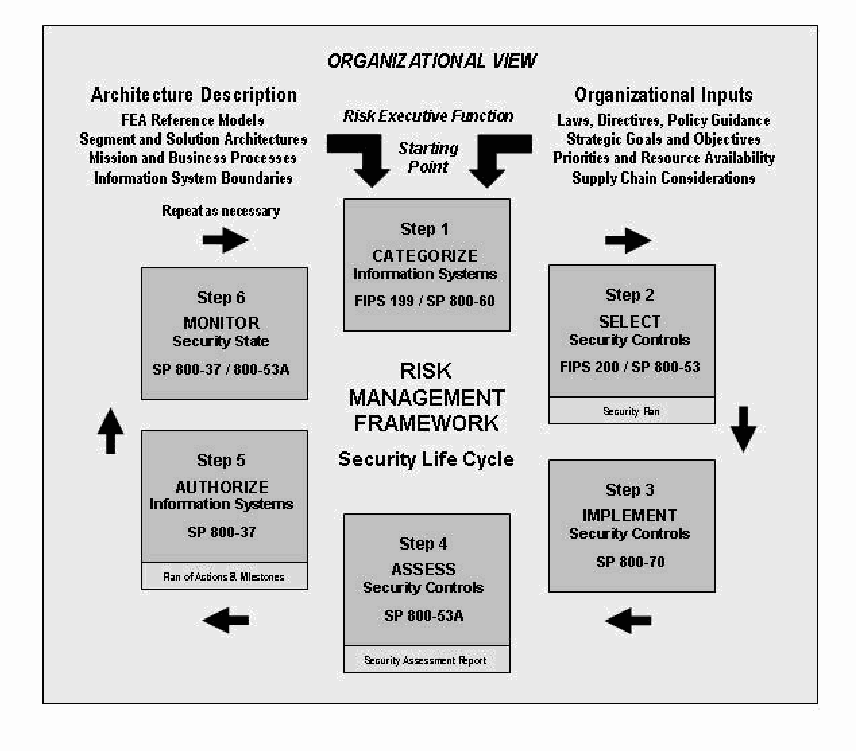
図1:NISTリスク管理フレームワーク。灰色の枠の上部に「ORGANIZATIONAL VIEW」(組織の視点)と書かれている。左上は「Architecture Description」(アーキテクチャ記述)で、FEA Reference Models(FEA参照モデル)、Segment and Solution Architectures(セグメントおよびソリューションアーキテクチャ)、Mission and Business Processes(ミッションおよび業務プロセス)、Information System Boundaries(情報システムの境界)が並ぶ。右上は「Organizational Inputs」(組織からの入力)で、Laws, Directives, Policy Guidance(法律、指令、方針の指針)、Strategic Goals and Objectives(戦略的な目標および目的)、Priorities and Resource Availability(優先順位および資源の利用可能性)、Supply Chain Considerations(サプライチェーンに関する考慮事項)が並ぶ。上中央には「Risk Executive Function」(リスクエグゼクティブ機能)と書かれ、「Starting Point」(開始点)と書かれた2本の太い折れ矢印がステップ1を指す。中央の「RISK MANAGEMENT FRAMEWORK」「Security Life Cycle」(リスク管理フレームワーク、セキュリティライフサイクル)の周りに6つのステップの箱が時計回りに並ぶ。ステップ1 CATEGORIZE Information Systems(情報システムの区分、FIPS 199 / SP 800-60)、ステップ2 SELECT Security Controls(セキュリティ管理策の選択、FIPS 200 / SP 800-53、下に「Security Plan」(セキュリティ計画)の帯)、ステップ3 IMPLEMENT Security Controls(セキュリティ管理策の実装、SP 800-70)、ステップ4 ASSESS Security Controls(セキュリティ管理策の評価、SP 800-53A、下に「Security Assessment Report」(セキュリティ評価報告書)の帯)、ステップ5 AUTHORIZE Information Systems(情報システムの認可、SP 800-37、下に「Plan of Actions & Milestones」(行動計画およびマイルストーン)の帯)、ステップ6 MONITOR Security State(セキュリティ状態の監視、SP 800-37 / 800-53A)である。矢印はステップ1から2へ、2から下の3へ、3から左の4へ、4から左の5へ、5から上の6へ進み、6からはステップ1の方へ「Repeat as necessary」(必要に応じて繰り返す)と書かれた矢印がある。
Figure 1: NIST Risk Management Framework
図1:NISTリスク管理フレームワーク
The security categorization process documented in this publication provides input into the following processes:
本書に記載するセキュリティ区分プロセスは、以下のプロセスへの入力となります。
•Step 2: Select an initial set of security controls for the information system based on the FIPS 199 security categorization and apply tailoring guidance as appropriate, to obtain a starting point for required controls as specified in FIPS 200, Minimum Security Requirements for Federal Information and Information Systems and NIST SP 800-53, Recommended Security Controls for Federal Information Systems. Utilizing NIST SP 800-53 and SP 800-30, Risk Management Guide for Information Technology Systems, supplement the initial set of tailored security controls based on an assessment of risk and local conditions including organization-specific security requirements, specific threat information, cost-benefit analyses, or special circumstances.
•ステップ2:FIPS 199に基づくセキュリティカテゴリ化を踏まえて、情報システムの初期セキュリティ管理策一式を選定し、必要に応じて調整指針を適用します。これにより、FIPS 200『連邦情報および情報システムの最低セキュリティ要件』とNIST SP 800-53『連邦情報システムの推奨セキュリティ管理策』で定める必要な管理策の出発点を得ます。NIST SP 800-53およびSP 800-30『情報技術システムのリスク管理ガイド』を用い、リスク評価と、組織固有のセキュリティ要件、具体的な脅威情報、費用対効果分析、特別な状況などを含む現場の状況に基づいて、調整済みの初期管理策一式を補完します。
•Step 3: Implement the security controls in the information system.
•ステップ3:情報システムにセキュリティ管理策を実装します。
•Step 4: Assess the security controls using appropriate methods and procedures to determine the extent to which the controls are implemented correctly, operating as intended, and producing the desired outcome with respect to meeting the security requirements for the system. (Reference NIST SP 800-53A, Guide for Assessing the Security Controls in Federal Information Systems).
•ステップ4:適切な方法および手順を用いてセキュリティ管理策を評価し、管理策が正しく実装され、意図したとおりに運用され、システムのセキュリティ要件を満たす望ましい結果を生み出しているかを判断します。(NIST SP 800-53A『連邦情報システムのセキュリティ管理策評価ガイド』を参照してください。)
•Step 5: Authorize information system operation based upon a determination of the risk to organizational operations, organizational assets, or to individuals resulting from the operation of the information system and the decision that this risk is acceptable as specified in NIST SP 800-37, Guide for the Security Certification and Accreditation of Federal Information Systems.
•ステップ5:情報システムの運用により組織の業務、組織の資産、または個人に生じるリスクを判断し、そのリスクが受容可能であると決定したうえで、情報システムの運用を認可します。NIST SP 800-37『連邦情報システムのセキュリティ認証および認定ガイド』に規定されています。
•Step 6: Monitor and assess selected security controls in the information system on a continuous basis including documenting changes to the system, conducting security impact analyses of the associated changes, and reporting the security status of the system to appropriate organizational officials on a regular basis. (Reference NIST SP 800-37 and SP 800-53A).
•ステップ6:情報システムにおいて選択したセキュリティ管理策を継続的に監視・評価します。これには、システムの変更の文書化、関連する変更のセキュリティ影響分析の実施、およびシステムのセキュリティ状態の適切な組織の責任者への定期的な報告が含まれます。(NIST SP 800-37およびSP 800-53Aを参照してください。)
3.0 SECURITY CATEGORIZATION OF INFORMATION AND INFORMATION SYSTEMS
3.0 情報および情報システムのセキュリティ区分
Federal Information Processing Standard 199 (FIPS 199), Standards for Security Categorization of Federal Information and Information Systems, defines the security categories, security objectives, and impact levels to which SP 800-60 maps information types. FIPS 199 establishes security categories based on the magnitude of harm expected to result from compromises rather than on the results of an assessment that includes an attempt to determine the probability of compromise. FIPS 199 also describes the context of use for this guideline. Some of the content of FIPS 199 is included in this section in order to simplify the use of this guideline.
連邦情報処理標準199(FIPS 199)『連邦情報および情報システムのセキュリティカテゴリ化標準』は、SP 800-60が情報種別を対応付けるためのセキュリティカテゴリ、セキュリティ目的、および影響レベルを定義します。FIPS 199は、侵害の発生確率を判定しようとする評価結果ではなく、侵害によって予想される損害の大きさに基づいてセキュリティカテゴリを定めます。また、FIPS 199は本ガイドラインの利用に関する文脈も説明します。本ガイドラインを使いやすくするため、FIPS 199の一部をこの節に収録します。
3.1 Security Categories and Objectives
3.1 セキュリティカテゴリと目的
3.1.1 Security Categories
3.1.1 セキュリティカテゴリ
FIPS 199 establishes security categories for both information6 and information systems. The security categories are based on the potential impact on an organization should certain events occur. The potential impacts could jeopardize the information and information systems needed by the organization to accomplish its assigned mission, protect its assets, fulfill its legal responsibilities, maintain its day-to-day functions, and protect individuals. Security categories are to be used in conjunction with vulnerability and threat information in assessing the risk to an organization.
FIPS 199は、情報6および情報システムの両方についてセキュリティ区分を定めています。セキュリティ区分は、特定の事象が発生した場合に組織が受ける潜在的影響に基づきます。潜在的影響は、組織が割り当てられた使命を遂行し、資産を保護し、法的責任を果たし、日常の機能を維持し、個人を保護するために必要な情報および情報システムを危うくする可能性があります。セキュリティ区分は、組織に対するリスクを評価する際に、脆弱性および脅威の情報と組み合わせて使用されます。
FIPS 199 establishes three potential levels of impact (low, moderate, and high) relevant to securing Federal information and information systems for each of three stated security objectives (confidentiality, integrity, and availability).
FIPS 199は、3つのセキュリティ目的(機密性、完全性、可用性)のそれぞれについて、連邦政府の情報および情報システムのセキュリティ確保に関連する3段階の潜在的影響レベル(低、中、高)を定めています。
3.1.2 Security Objectives and Types of Potential Losses
3.1.2 セキュリティ目的と潜在的損失の種類
As reflected in Table 1, FISMA and FIPS 199 define three security objectives for information and information systems.
表1に示すとおり、FISMAおよびFIPS 199は、情報および情報システムについて3つのセキュリティ目的を定めています。
Table 1: Information and Information System Security Objectives
表1:情報および情報システムのセキュリティ目的
| Security Objectives | FISMA Definition [44 U.S.C., Sec. 3542] | FIPS 199 Definition |
|---|---|---|
| Confidentiality | “Preserving authorized restrictions on information access and disclosure, including means for protecting personal privacy and proprietary information…” | A loss of confidentiality is the unauthorized disclosure of information. |
| Integrity | “Guarding against improper information modification or destruction, and includes ensuring information non-repudiation and authenticity…” | A loss of integrity is the unauthorized modification or destruction of information. |
| Availability | “Ensuring timely and reliable access to and use of information…” | A loss of availability is the disruption of access to or use of information or an information system. |
| セキュリティ目的 | FISMAの定義 [44 U.S.C., Sec. 3542] | FIPS 199の定義 |
|---|---|---|
| 機密性 | 「情報へのアクセスおよび開示に関する認可された制限を維持すること。これには、個人のプライバシーおよび専有情報を保護する手段を含む…」 | 機密性の喪失とは、情報が不正に開示されることです。 |
| 完全性 | 「不適切な情報の改変または破壊を防ぐこと。これには、情報の否認防止および真正性の確保を含む…」 | 完全性の喪失とは、情報が不正に改変または破壊されることです。 |
| 可用性 | 「情報への適時かつ信頼できるアクセスおよび情報の利用を確保すること…」 | 可用性の喪失とは、情報または情報システムへのアクセス、もしくはその利用が妨げられることです。 |
3.2 Impact Assessment
3.2 影響評価
FIPS 199 defines three levels of potential impact on organizations or individuals should there be a breach of security (i.e., a loss of confidentiality, integrity, or availability). The application of these definitions must take place within the context of each organization and the overall national interest. Table 2 provides FIPS 199 potential impact definitions.
FIPS 199は、セキュリティ侵害(すなわち、機密性、完全性、または可用性の喪失)が発生した場合に組織または個人に及ぶ潜在的影響について、3つのレベルを定義しています。これらの定義の適用は、各組織の状況と国家全体の利益の文脈の中で行わなければなりません。表2にFIPS 199の潜在的影響の定義を示します。
Table 2: Potential Impact Levels
表2:潜在的影響レベル
| Potential Impact | Definitions |
|---|---|
| Low | The potential impact is low if—The loss of confidentiality, integrity, or availability could be expected to have a limited adverse effect on organizational operations, organizational assets, or individuals.7 A limited adverse effect means that, for example, the loss of confidentiality, integrity, or availability might: (i) cause a degradation in mission capability to an extent and duration that the organization is able to perform its primary functions, but the effectiveness of the functions is noticeably reduced; (ii) result in minor damage to organizational assets; (iii) result in minor financial loss; or (iv) result in minor harm to individuals. |
| Moderate | The potential impact is moderate if—The loss of confidentiality, integrity, or availability could be expected to have a serious adverse effect on organizational operations, organizational assets, or individuals. A serious adverse effect means that, for example, the loss of confidentiality, integrity, or availability might: (i) cause a significant degradation in mission capability to an extent and duration that the organization is able to perform its primary functions, but the effectiveness of the functions is significantly reduced; (ii) result in significant damage to organizational assets; (iii) result in significant financial loss; or (iv) result in significant harm to individuals that does not involve loss of life or serious life threatening injuries. |
| High | The potential impact is high if—The loss of confidentiality, integrity, or availability could be expected to have a severe or catastrophic adverse effect on organizational operations, organizational assets, or individuals. A severe or catastrophic adverse effect means that, for example, the loss of confidentiality, integrity, or availability might: (i) cause a severe degradation in or loss of mission capability to an extent and duration that the organization is not able to perform one or more of its primary functions; (ii) result in major damage to organizational assets; (iii) result in major financial loss; or (iv) result in severe or catastrophic harm to individuals involving loss of life or serious life threatening injuries. |
| 潜在的影響 | 定義 |
|---|---|
| 低 | 機密性、完全性、または可用性の喪失が、組織の業務、組織の資産、または個人に限定的な悪影響を及ぼすと予想される場合、潜在的影響は低です。7 限定的な悪影響とは、たとえば、機密性、完全性、または可用性の喪失によって、(i) 組織が主要機能を実施できる程度および期間内でミッション遂行能力が低下するものの、機能の有効性が目に見えて損なわれること、(ii) 組織の資産に軽微な損害が生じること、(iii) 軽微な金銭的損失が生じること、または (iv) 個人に軽微な被害が生じることをいいます。 |
| 中 | 機密性、完全性、または可用性の喪失が、組織の業務、組織の資産、または個人に重大な悪影響を及ぼすと予想される場合、潜在的影響は中です。 重大な悪影響とは、たとえば、機密性、完全性、または可用性の喪失によって、(i) 組織が主要機能を実施できる程度および期間内でミッション遂行能力が大幅に低下するものの、機能の有効性が大幅に損なわれること、(ii) 組織の資産に重大な損害が生じること、(iii) 大きな金銭的損失が生じること、または (iv) 死亡や生命を脅かす重傷には至らない重大な被害が個人に生じることをいいます。 |
| 高 | 機密性、完全性、または可用性の喪失が、組織の業務、組織の資産、または個人に深刻または壊滅的な悪影響を及ぼすと予想される場合、潜在的影響は高です。 深刻または壊滅的な悪影響とは、たとえば、機密性、完全性、または可用性の喪失によって、(i) 組織が主要機能の1つ以上を実施できない程度および期間にわたり、ミッション遂行能力が著しく低下または失われること、(ii) 組織の資産に甚大な損害が生じること、(iii) 甚大な金銭的損失が生じること、または (iv) 死亡や生命を脅かす重傷を伴う深刻もしくは壊滅的な被害が個人に生じることをいいます。 |
In FIPS 199, the security category of an information type can be associated with both user information and system information8 and can be applicable to information in either electronic or non-electronic form. It is also used as input in considering the appropriate security category for a system. Establishing an appropriate security category for an information type simply requires determining the potential impact for each security objective associated with the particular information type. The generalized format for expressing the security category, or SC, of an information type is:
FIPS 199では、情報タイプのセキュリティカテゴリは、利用者情報とシステム情報8の両方に関連付けることができ、電子形式か非電子形式かを問わず情報に適用できます。また、システムの適切なセキュリティカテゴリを検討する際の入力としても用いられます。情報タイプに適切なセキュリティカテゴリを定めるには、その情報タイプに関連する各セキュリティ目標について潜在的影響を判定すれば足ります。情報タイプのセキュリティカテゴリ(SC)を表す一般形式は次のとおりです。
where the acceptable values for potential impact are low, moderate, high, or not applicable.9
ここで、潜在的影響に許容される値は、低、中、高、または適用不可です。9
4.0 ASSIGNMENT OF IMPACT LEVELS AND SECURITY CATEGORIZATION
4.0 影響レベルの割当てとセキュリティカテゴリ化
This section provides a methodology for assigning security impact levels and security categorizations for information types and information systems consistent with the organization’s assigned mission and business functions based on FIPS 199, Standards for Security Categorization of Federal Information and Information Systems. This document assumes that the user has read and is familiar with FIPS 199. Figure 2 illustrates the four-step security categorization process and how it drives the selection of baseline security controls.
本節は、FIPS 199『連邦情報および連邦情報システムのセキュリティカテゴリ化のための標準(Standards for Security Categorization of Federal Information and Information Systems)』に基づき、組織に割り当てられたミッションおよび業務機能に沿って、情報タイプと情報システムにセキュリティ影響レベルとセキュリティカテゴリを割り当てるための方法論を示します。本文書は、利用者がFIPS 199を読み、理解していることを前提とします。図2は、4段階のセキュリティカテゴリ化プロセスと、それがベースラインセキュリティ管理策の選択をどのように導くかを示しています。
Figure 2: SP 800-60 Security Categorization Process Execution
図2:SP 800-60のセキュリティカテゴリ化プロセスの実施
Table 3 provides a step-by-step roadmap for identifying information types, establishing security impact levels for loss of confidentiality, integrity, and availability of information types, and assigning security categorization for the information types and for the information systems. Security categorization is the basis for identifying an initial baseline set of security controls for the information system.10 Each functional step in the process is explained in detail in Sections 4.1 through 4.4.
表3は、情報タイプを特定し、情報タイプの機密性、完全性、可用性の喪失に対するセキュリティ影響レベルを定め、情報タイプおよび情報システムにセキュリティカテゴリを割り当てるための、段階的な道筋を示しています。セキュリティカテゴリ化は、情報システムの初期ベースラインとなるセキュリティ管理策の集合を特定するための基礎です。10プロセスの各機能ステップについては、第4.1節から第4.4節で詳しく説明します。
Table 3: SP 800-60 Process Roadmap
表3:SP 800-60プロセスの手順一覧
| Process Step | Activities | Roles |
|---|---|---|
| Input: Identify information systems | • Agencies should develop their own policies regarding information system identification for security categorization purposes. The system is generally bounded by a security perimeter11. | CIO; SAISO; Mission Owners |
| Step 1 | • Document the agency’s business and mission areas • Identify all of the information types that are input, stored, processed, and/or output from each system [Section 4.1] o Identify Mission–based Information Type categories based on supporting FEA Lines of Business [Section 4.1.1] o As applicable, identify Management and Support Information Type categories based on supporting FEA Lines of Business [Section 4.1.2] o Specify applicable sub-functions for the identified Mission-based and Management and Support categories [Volume II, Appendices C and D] o As necessary, identify other required information types [Sections 4.1.3, 4.1.4] • Document applicable information types for the identified information system along with the basis for the information type selection [Section 4.5] | Mission Owners; Information Owners |
| Step 2 | • Select the security impact levels for the identified information types o from the recommended provisional impact levels for each identified information type [Volume II, Appendices C and D) o or, from FIPS 199 criteria provided in Table 7 Section 4.2.1, and Section 4.2.2 • Determine the security category (SC) for each information type: SCinformation type = {(confidentiality, impact), (integrity, impact), (availability, impact)} • Document the provisional impact level of confidentiality, integrity, and availability associated with the system’s information type [Section 4.5] | Information System Security Officer (ISSO) |
| Step 3 | • Review the appropriateness of the provisional impact levels based on the organization, environment, mission, use, and data sharing [Section 4.3] • Adjust the impact levels as necessary based on the following considerations: o Confidentiality, integrity, and availability factors [Section 4.2.2] o Situational and operational drivers (timing, lifecycle, etc.) [Section 4.3] o Legal or statutory reasons • Document all adjustments to the impact levels and provide the rationale or justification for the adjustments [Section 4.5] | SAISO; ISSO; Mission Owners; Information Owners |
| Step 4 | • Review identified security categorizations for the aggregate of information types. • Determine the system security categorization by identifying the security impact level high water mark for each of the security objectives (confidentiality, integrity, availability): SCSystem X = {(confidentiality, impact), (integrity, impact), (availability, impact)} • Adjust the security impact level high water mark for each system security objective, as necessary, by applying the factors discussed in section 4.4.2. • Assign the overall information system impact level based on the highest impact level for the system security objectives (confidentiality, integrity, availability) • Follow the agency’s oversight process for reviewing, approving, and documenting all determinations or decisions [Section 4.5] | CIO, SAISO; ISSO; Mission Owners; Information Owners |
| Output: Security Categorization | • Output that can be used as input to the selection of the set of security controls necessary for each system and the system risk assessment • The minimum security controls recommended for each system security category can be found in NIST SP 800-53, as updated | CIO; ISSO; Authorizing Officials; Developers |
| プロセス段階 | 活動 | 役割 |
|---|---|---|
| 入力:情報システムを特定する | • 各機関は、セキュリティカテゴリ化を目的とする情報システムの特定に関する独自の方針を定めるべきです。通常、システムはセキュリティ境界11によって区切られます。 | CIO;SAISO;ミッション所有者 |
| ステップ1 | • 機関の事業分野およびミッション領域を文書化する • 各システムで入力、保存、処理、および/または出力されるすべての情報種別を特定する[第4 o 支援するFEAの事業分野に基づき、ミッションに基づく情報種別のカテゴリを特定する[第4 o 該当する場合、支援するFEAの事業分野に基づき、管理・支援情報種別のカテゴリを特定する[第4 o 特定したミッションに基づくカテゴリおよび管理・支援カテゴリに適用される下位機能を明記する[第II巻、付録CおよびD] o 必要に応じて、その他の必要な情報種別を特定する[第4 • 特定した情報システムに適用される情報種別と、その情報種別の選定根拠を文書化する[第4 | ミッション所有者;情報所有者 |
| ステップ2 | • 特定した情報種別のセキュリティ影響レベルを選定する o 特定した各情報種別に推奨される暫定的な影響レベルから選定する[第II巻、付録CおよびD] o または、表7、第4 • 各情報種別のセキュリティカテゴリ(SC)を決定する:SC情報種別 = {(機密性, 影響), (完全性, 影響), (可用性, 影響)} • システムの情報種別に関連付けられた機密性、完全性、可用性の暫定的な影響レベルを文書化する[第4 | 情報システムセキュリティ責任者(ISSO) |
| ステップ3 | • 組織、環境、ミッション、用途、およびデータ共有に基づき、暫定的な影響レベルの妥当性をレビューする[第4 • 次の考慮事項に基づき、必要に応じて影響レベルを調整します。 o 機密性、完全性、可用性に関する要因[第4 o 状況および運用上の要因(時期、ライフサイクルなど)[第4 o 法的または法令上の理由 • 影響レベルに対するすべての調整を文書化し、その根拠または正当化理由を示す[第4 | SAISO;ISSO;ミッション所有者;情報所有者 |
| ステップ4 | • 情報種別の集合全体について、特定したセキュリティカテゴリ化の妥当性をレビューします。 • 各セキュリティ目的(機密性、完全性、可用性)について最高影響レベルを特定して、システムのセキュリティカテゴリ化を決定する:SCシステムX = {(機密性, 影響), (完全性, 影響), (可用性, 影響)} • 4 • システムセキュリティ目的(機密性、完全性、可用性)のうち最も高い影響レベルに基づき、情報システム全体の影響レベルを割り当てる • 機関の監督プロセスに従い、すべての判断または決定をレビュー、承認、文書化する[第4 | CIO、SAISO;ISSO;ミッション所有者;情報所有者 |
| 出力:セキュリティカテゴリ化 | • 各システムに必要なセキュリティ管理策一式の選定、およびシステムのリスクアセスメントへの入力として使用できる出力 • 各システムのセキュリティカテゴリに推奨される最低限のセキュリティ管理策は、最新版のNIST SP 800-53に記載されている | CIO;ISSO;認可担当者;開発者 |
4.1 Step 1: Identify Information Types
4.1 ステップ1:情報種別の特定
In accordance with FIPS 199, agencies shall identify all of the applicable information types that are representative of input, stored, processed, and/or output data from each system. The initial activity in mapping types of Federal information and information systems to security objectives and impact levels is the development of an information taxonomy, or creation of a catalog of information types.12 The basis for the identification of information types is the OMB’s Business Reference Model (BRM) described in the October 2007 publication, FEA Consolidated Reference Model Document, Version 2.3. The BRM describes four business areas containing 39 FEA lines of business.13 The four business areas separate government operations into high-level categories relating:
FIPS 199に従い、各機関は各システムで入力、保存、処理、および/または出力されるデータを代表する、該当するすべての情報種別を特定しなければなりません。連邦政府の情報および情報システムの種別をセキュリティ目的と影響レベルに対応付ける最初の活動は、情報分類体系の策定、すなわち情報種別の一覧の作成です。12情報種別を特定する基礎は、OMBの業務参照モデル(BRM)であり、2007年10月の刊行物『FEA統合参照モデル文書』第2.3版で説明されています。BRMは、39のFEA業務分野を含む4つの業務領域を定義します。13これら4つの業務領域は、政府運営を次のような上位カテゴリに分けます。
•The purpose of government (services for citizens);
•政府の目的(市民向けサービス);
•The mechanisms the government uses to achieve its purpose (mode of delivery);
•政府がその目的を達成するために用いる仕組み(提供形態);
•The support functions necessary to conduct government operations (support delivery of services); and
•政府運営を行うために必要な支援機能(サービス提供の支援);および
•The resource management functions that support all areas of the government’s business (management of government resources).
•政府のすべての業務領域を支える資源管理機能(政府資源の管理)。
The first two business areas, services for citizens and the mode of delivery represent the NIST SP 800-60 Mission-based Information Types and will be discussed first in the following section, while support delivery of services and management of government resources represent Management and Support Information Types and will be presented in Section 4.1.2. Although this guideline identifies a number of information types and bases its taxonomy on the BRM, only a few of the types identified are likely to be processed by any single system. Also, each system may process information that does not fall neatly into one of the listed information types. Once a set of information types identified in this guideline has been selected, it is prudent to review the information processed by each system under review to see if additional types need to be identified for impact assessment purposes. Also, it is recommended that organizational officials maintain proper documentation of identified information types per information system along with the basis for the information type selection. Guidance for documenting information types is provided in Section 4.5.
最初の2つの業務領域である市民向けサービスと提供形態は、NIST SP 800-60のミッションに基づく情報種別に相当するため、次節で先に説明します。サービス提供の支援と政府資源の管理は、管理・支援情報種別に相当し、第4.1.2節で説明します。本ガイドラインは複数の情報種別を特定し、BRMに基づく分類体系を用いますが、単一のシステムで処理される可能性があるのは、特定した種別のうち一部に限られます。また、各システムは、列挙した情報種別のいずれにも明確に当てはまらない情報を処理する場合があります。本ガイドラインで特定した情報種別の中から一式を選定した後、影響評価に必要な追加の種別がないか、評価対象の各システムが処理する情報を確認することが望まれます。また、組織の職員は、情報システムごとに特定した情報種別と、その選定根拠を適切に文書化しておくことが推奨されます。情報種別の文書化に関するガイダンスは第4.5節に示します。
4.1.1 Identification of Mission-based Information Types
4.1.1 ミッションに基づく情報種別の特定
This section describes a process for identifying mission-based information types and for specifying the impact of unauthorized disclosure, modification, or unavailability of this information. Mission-based information types are, by definition, specific to individual departments and agencies or to specific sets of departments and agencies. The BRM services for citizens business area provides the primary frame of reference for determining the security objectives impact levels for mission-based information and information systems. The consequences or impact of unauthorized disclosure of information, modification or destruction of information, and disruption of access to or use of information are defined by the nature and beneficiary of the service being provided or supported. The BRM establishes 26 direct services and delivery support lines of business with 98 associated information types (reference Table 4). Two additional information types were included to address Executive Functions of the Executive Office of the President and Trade Law Enforcement. These additions are identified by italics in Table 4.
この節では、ミッションに基づく情報種別を特定し、その情報の不正な開示、改変、または可用性喪失の影響を明記するためのプロセスを説明します。ミッションに基づく情報種別は、定義上、個々の省庁・機関、または特定の省庁・機関の集合に固有です。BRMの市民向けサービス業務領域は、ミッションに基づく情報および情報システムのセキュリティ目的の影響レベルを決めるための主要な参照枠となります。不正な情報開示、情報の改変または破壊、情報へのアクセスまたはその利用の妨害がもたらす結果や影響は、提供または支援されるサービスの性質と受益者によって定まります。BRMは、26の直接サービスおよび提供支援の業務分野と、それに関連する98の情報種別を定めます(表4参照)。大統領府の執行機能および貿易法執行に対応するため、さらに2つの情報種別を追加しました。これらの追加項目は表4でイタリック体により示します。
Table 4: Mission-Based Information Types and Delivery Mechanisms14
表4:ミッションベースの情報の種類と提供メカニズム14
Mission Areas and Information Types [Services for Citizens]
ミッション領域と情報タイプ[市民向けサービス]
D.1 Defense & National Security
D.1 防衛・国家安全保障
Strategic National & Theater Defense
戦略的国家・戦域防衛
Operational Defense
作戦防衛
Tactical Defense
戦術防衛
D.2 Homeland Security
D.2 国土安全保障
Border and Transportation Security
国境・交通の安全保障
Key Asset and Critical Infrastructure Protection
重要資産・重要インフラの保護
Catastrophic Defense
壊滅的防衛
Executive Functions of the Executive Office of the President (EOP)
大統領府(EOP)の行政機能
D.3 Intelligence Operations
D.3 インテリジェンス活動
Intelligence Planning
インテリジェンス計画
Intelligence Collection
インテリジェンス収集
Intelligence Analysis & Production
インテリジェンス分析・生産
Intelligence Dissemination
インテリジェンス配布
Intelligence Processing
インテリジェンス処理
D.4 Disaster Management
D.4 災害管理
Disaster Monitoring and Prediction
災害の監視・予測
Disaster Preparedness and Planning
災害への備えと計画
Disaster Repair and Restoration
災害の復旧・復興
Emergency Response
緊急対応
D.5 International Affairs & Commerce
D.5 国際問題・通商
Foreign Affairs
外交
International Development and Humanitarian Aid
国際開発・人道支援
Global Trade
グローバル貿易
D.6 Natural Resources
D.6 天然資源
Water Resource Management
水資源管理
Conservation, Marine and Land Management
保全・海洋・土地管理
Recreational Resource Management and Tourism
レクリエーション資源管理・観光
Agricultural Innovation and Services
農業の革新とサービス
D.7 Energy
D.7 エネルギー
Energy Supply
エネルギー供給
Energy Conservation and Preparedness
エネルギー保全・備え
Energy Resource Management
エネルギー資源管理
Energy Production
エネルギー生産
D.8 Environmental Management
D.8 環境管理
Environmental Monitoring and Forecasting
環境の監視・予測
Environmental Remediation
環境修復
Pollution Prevention and Control
汚染の防止・制御
D.9 Economic Development
D.9 経済開発
Business and Industry Development
事業・産業の振興
Intellectual Property Protection
知的財産の保護
Financial Sector Oversight
金融セクターの監督
Industry Sector Income Stabilization
産業部門の所得安定化
D.10 Community & Social Services
D.10 地域社会・社会サービス
Homeownership Promotion
持ち家の促進
Community and Regional Development
地域社会・地域開発
Social Services
社会サービス
Postal Services
郵便サービス
D.11 Transportation
D.11 運輸
Ground Transportation
陸上輸送
Water Transportation
水上輸送
Air Transportation
航空輸送
Space Operations
宇宙運用
D.12 Education
D.12 教育
Elementary, Secondary, and Vocational Education
初等・中等・職業教育
Higher Education
高等教育
Cultural and Historic Preservation
文化・歴史の保存
Cultural and Historic Exhibition
文化・歴史の展示
D.13 Workforce Management
D.13 労働力管理
Training and Employment
訓練・雇用
Labor Rights Management
労働者の権利の管理
Worker Safety
労働安全
D.14 Health
D.14 保健
Access to Care
医療へのアクセス
Population Health Mgmt & Consumer Safety
集団の健康管理・消費者安全
Health Care Administration
医療行政
Health Care Delivery Services
医療提供サービス
Health Care Research and Practitioner Education
医療研究・医療従事者教育
D.15 Income Security
D.15 所得保障
General Retirement and Disability
一般的な退職・障害給付
Unemployment Compensation
失業補償
Housing Assistance
住宅支援
Food and Nutrition Assistance
食料・栄養支援
Survivor Compensation
遺族補償
D.16 Law Enforcement
D.16 法執行
Criminal Apprehension
犯人の逮捕
Criminal Investigation and Surveillance
犯罪捜査・監視
Citizen Protection
市民の保護
Leadership Protection
要人の保護
Property Protection
財産の保護
Substance Control
薬物・規制物質の管理
Crime Prevention
犯罪の予防
Trade Law Enforcement
貿易法の執行
D.17 Litigation & Judicial Activities
D.17 訴訟・司法活動
Judicial Hearings
司法審理
Legal Defense
法的防御
Legal Investigation
法的調査
Legal Prosecution and Litigation
法的訴追・訴訟
Resolution Facilitation
紛争解決の促進
D.18 Federal Correctional Activities
D.18 連邦矯正活動
Criminal Incarceration
犯罪者の収容
Criminal Rehabilitation
犯罪者の更生
D.19 General Sciences & Innovation
D.19 一般科学・イノベーション
Scientific and Technological Research and Innovation
科学技術の研究とイノベーション
Space Exploration and Innovation
宇宙探査とイノベーション
Table 4: Mission-Based Information Types and Delivery Mechanisms14
表4:ミッションベースの情報の種類と提供メカニズム14
The approach to establishing mission-based information types at an agency level begins by documenting the agency’s business and mission areas. The owner, or designee, of each information system is responsible for identifying the information types stored in, processed by, or generated by that information system. In the case of mission-based information, the responsible individuals, in coordination with management, operational, and security stakeholders, should compile a comprehensive set of lines of business and mission areas conducted by the agency. In addition, the responsible individuals should identify the applicable sub-functions necessary to conduct agency business and in turn accomplish the agency’s mission. For example, one mission conducted by an agency might be law enforcement. Sub-functions that are part of the agency’s law enforcement mission might include criminal investigation and surveillance, criminal apprehension, criminal incarceration, citizen protection, crime prevention, and property protection. Each of these sub-functions would represent an information type.
機関レベルでミッションベースの情報の種類を確立するアプローチは、機関の業務領域とミッション領域を文書化することから始まります。各情報システムのオーナーまたはその指名者は、その情報システムに格納され、処理され、または生成される情報の種類を特定する責任を負います。ミッションベースの情報の場合、責任者は、管理、運用、およびセキュリティの利害関係者と連携して、機関が遂行する業務系統とミッション領域の包括的な一覧をまとめるべきです。さらに、責任者は、機関の業務を遂行し、ひいては機関の使命を達成するために必要な、該当するサブ機能を特定すべきです。例えば、ある機関が遂行するミッションの1つが法執行である場合があります。その機関の法執行ミッションに含まれるサブ機能には、犯罪捜査と監視、犯罪者の逮捕、犯罪者の収監、市民の保護、犯罪防止、財産の保護などがありうます。これらのサブ機能のそれぞれが1つの情報の種類となります。
Recommended mission-based lines of business and constituent sub-functions that may be processed by information systems are identified in Table 4 with details provided in Volume II, Appendix D, “Examples of Impact Determination for Mission-based Information and Information Systems.”
情報システムで処理されうる推奨のミッションベースの業務系統とその構成サブ機能を表4に示し、詳細は第II巻の付録D「Examples of Impact Determination for Mission-based Information and Information Systems」に記載しています。
Implementation Tip
実装のヒント
At the agency level, all government agencies perform at least one of the mission areas and employ at least one of the services delivery mechanisms described in Table 4. However, some information systems may only provide a supporting role to the agency’s mission and not directly process any of the mission-based information types.
機関レベルでは、すべての政府機関が、表4に示すミッション領域のうち少なくとも1つを遂行し、サービス提供メカニズムのうち少なくとも1つを用いています。ただし、情報システムの中には、機関のミッションに対して支援的な役割を担うだけで、ミッションに基づく情報タイプを直接処理しないものもあります。
4.1.2 Identification of Management and Support Information
4.1.2 管理・支援情報の特定
Much Federal government information and many supporting information systems are not employed directly to provide direct mission-based services, but are primarily intended to support delivery of services or to manage resources. The support delivery of services and management of resources business areas are together composed of 13 lines of business (Tables 5 and 6). The BRM subdivides the lines of business into 72 sub-functions. The support delivery of services and management of resource business areas are common to most Federal government agencies, and the information associated with each of their sub-functions is identified in this guideline as a management and support information type. Four additional management and support sub-factor information types have been defined to address privacy information. One additional management and support sub-factor information type has been defined to address General Information as a catch-all information type that may not be defined by the FEA BRM. As such, agencies may find it necessary to identify additional information types not defined in the BRM and assign associated security impact levels to those types.
連邦政府の情報およびそれを支援する情報システムの多くは、ミッションに基づく直接サービスの提供に直接用いられるのではなく、主としてサービス提供の支援または資源管理を目的としています。サービス提供の支援と資源管理の業務領域は、合わせて13の業務分野から成ります(表5および表6)。BRMは、これらの業務分野を72の下位機能に細分しています。サービス提供の支援と資源管理の業務領域は、ほとんどの連邦政府機関に共通しており、それぞれの下位機能に関連する情報は、本ガイドラインでは管理・支援情報種別として特定されています。プライバシー情報に対応するため、管理・支援の下位要素の情報種別を追加で4つ定義しました。また、FEA BRMで定義されていない可能性がある情報を包括的に扱う情報種別である一般情報に対応するため、管理・支援の下位要素の情報種別を追加で1つ定義しました。そのため、各機関は、BRMで定義されていない追加の情報種別を特定し、それらに関連するセキュリティ影響レベルを割り当てる必要が生じる場合があります。
4.1.2.1 Services Delivery Support Information
4.1.2.1 サービス提供支援情報
Most information systems employed in both service delivery support and resource management activities engage in one or more of the eight support delivery of services lines of business. Each of the information types associated with support delivery of services sub-functions is provided in Table 5. Volume II, Appendix C.2, “Services Delivery Support Functions,” recommends provisional impact levels for confidentiality, integrity, and availability security objectives. These service support functions are the day-to-day activities necessary to provide the critical policy, programmatic, and managerial foundation that support Federal government operations. The direct service missions and constituencies ultimately being supported by service support functions comprise a significant factor in determining the security impacts associated with compromise of information associated with the support delivery of services business area.
サービス提供支援活動と資源管理活動の双方で用いられる情報システムの多くは、サービス提供支援の8つの業務ラインのうち1つ以上に関わります。サービス提供支援の各サブ機能に関連する情報タイプを表5に示します。第II巻の付録C.2「Services Delivery Support Functions」は、機密性、完全性、可用性の各セキュリティ目的について暫定影響レベルを推奨しています。これらのサービス支援機能は、連邦政府の業務を支える政策面、プログラム面、管理面の重要な基盤を提供するために必要な日常的活動です。サービス支援機能が最終的に支援している直接サービスのミッションと受益者は、サービス提供支援の業務領域に関連する情報が侵害された場合のセキュリティ上の影響を判断するうえで重要な要素となります。
Table 5: Services Delivery Support Functions and Information Types15
表5:サービス提供支援機能と情報タイプ15
4.1.2.2 Government Resource Management Information
4.1.2.2 政府資源管理情報
The government resource management information business area includes the back office support activities enabling the Federal government to operate effectively. The five government resource management information lines of business and the sub-functions associated with each information type are identified in Table 6. Volume II, Appendix C.3, “Government Resource Management Information,” recommends provisional impact levels for confidentiality, integrity, and availability security objectives. Many departments and agencies operate their own support systems. Others obtain at least some support services from other organizations. Some agencies’ missions are primarily to support other government departments and agencies in the conduct of direct service missions. As indicated above, security objectives and associated security impact levels for administrative and management information and systems are determined by the nature of the supported direct services and constituencies being supported.
政府資源管理情報の業務領域には、連邦政府が効果的に業務を遂行できるようにするバックオフィス支援活動が含まれます。政府資源管理情報の5つの業務ラインと、各情報タイプに関連するサブ機能を表6に示します。第II巻の付録C.3「Government Resource Management Information」は、機密性、完全性、可用性の各セキュリティ目的について暫定影響レベルを推奨しています。多くの省庁・機関は独自の支援システムを運用しています。少なくとも一部の支援サービスを他の組織から受けている機関もあります。また、他の省庁・機関による直接サービスのミッションの遂行を支援することを主なミッションとする機関もあります。上述のとおり、管理・運営に関する情報とシステムのセキュリティ目的と、それに関連するセキュリティ影響レベルは、支援対象の直接サービスと受益者の性質によって決まります。
Table 6: Government Resource Management Functions and Information Types16
表6:政府資源管理機能と情報タイプ16
4.1.3 Legislative and Executive Information Mandates
4.1.3 法令および行政命令による情報の要件
During the identification of information types within an information system, agency personnel should afford special consideration for applicable governances addressing the information processed and the agency’s supported mission. Volume II, Appendix E lists legislative and executive mandates establishing sensitivity and criticality guidelines for specific information types.
情報システム内の情報タイプを特定する際、機関の担当者は、処理される情報と機関が支援するミッションに関して適用される規定に特に注意を払うべきです。第II巻の付録Eには、特定の情報タイプについて機微性と重要性の指針を定める法令および行政命令を列挙しています。
4.1.4 Identifying Information Types Not Listed in this Guideline
4.1.4 本ガイドラインに記載されていない情報タイプの特定
The FEA BRM Information Types are provided only as a taxonomy guideline. Not all information processed by an information system may be identified from Tables 4 through 6. Therefore, an agency may identify unique information types not listed in this guideline or may choose not to select provisional impact levels from Volume II, Appendix C (for management and support information types) or Volume II, Appendix D (for mission-based information types). Sections 4.2.1 through 4.2.3 of this guideline provide assistance to agencies in assigning provisional security categories to agency-identified information types and information systems.
FEA BRM の情報種別は、分類の指針としてのみ提供されています。情報システムが処理するすべての情報を、表 4 から表 6 までで特定できるとは限りません。したがって、機関は、本指針に記載されていない固有の情報種別を特定してもよく、第 II 巻の付録 C(管理・支援の情報種別)または付録 D(ミッションに基づく情報種別)から暫定的な影響レベルを選択しないことを選んでもよいです。本指針の第 4.2.1 節から第 4.2.3 節は、機関が特定した情報種別および情報システムに暫定的なセキュリティカテゴリを割り当てる際の支援を機関に提供します。
Additionally, SP 800-60 provides a management and support sub function, General Information Type, which can be used by agencies as a means to identify and categorize information not contained in the FEA BRM. A complete description of the General Information Type information should be captured in the agency’s collection and documentation process.
加えて、SP 800-60 は、FEA BRM に含まれない情報を特定して分類する手段として機関が利用できる、管理・支援のサブ機能である一般情報種別を提供しています。一般情報種別の情報について、完全な記述を、機関の収集・文書化プロセスで把握しておくべきです。
4.2 Step 2: Select Provisional Impact Level
4.2 ステップ2:暫定的な影響レベルの選定
In Step 2, organizations should establish provisional impact levels17 based on the identified information types in Step 1. The provisional impact levels are the original impact levels assigned to the confidentiality, integrity, and availability security objectives of an information type from Volume II before any adjustments are made. Also in this step, the initial security categorization for the information type is established and documented.
ステップ 2 では、組織は、ステップ 1 で特定した情報種別に基づいて、暫定的な影響レベル17を設定すべきです。暫定的な影響レベルとは、調整を行う前の、第 II 巻に示された情報種別の機密性、完全性、可用性のセキュリティ目標に割り当てられた当初の影響レベルです。このステップでは、その情報種別の初期のセキュリティカテゴリ分類も設定し、文書化します。
Volume II, Appendix C suggests provisional confidentiality, integrity, and availability impact levels for management and support information types, and Volume II, Appendix D provides examples of provisional impact level assignments for mission-based information types. Using the impact assessment criteria identified in Section 3.2 for the security objectives and types of potential losses identified in Section 3.1.2, the organizational entity responsible for impact determination must assign impact levels and consequent security categorization for the mission-based and management and support information types identified for each information system.
第 II 巻の付録 C は、管理・支援の情報種別に対する暫定的な機密性、完全性、可用性の影響レベルを示し、付録 D は、ミッションに基づく情報種別に対する暫定的な影響レベルの割り当て例を示しています。影響の判断に責任を負う組織上の主体は、第 3.2 節で特定したセキュリティ目標の影響評価基準と、第 3.1.2 節で特定した潜在的な損失の種類を用いて、各情報システムについて特定されたミッションに基づく情報種別および管理・支援の情報種別に、影響レベルと、それに基づくセキュリティカテゴリを割り当てなければなりません。
4.2.1 FIPS 199 Security Categorization Criteria
4.2.1 FIPS 199のセキュリティカテゴリ化基準
Where an information type processed by an information system is not categorized by this guideline [based on information types identified in Volume II, Appendices C and D], an initial impact determination will need to be made based on FIPS 199 categorization criteria (cited in Table 7).
情報システムが処理する情報種別が、本指針で分類されていない場合(第 II 巻の付録 C および D で特定された情報種別に基づく)は、FIPS 199 の分類基準(表 7 に引用)に基づいて、初期の影響の判断を行う必要があります。
Agencies can assign security categories to information types and information systems by selecting and adjusting appropriate Table 7 values for the potential impact of compromises of confidentiality, integrity, and availability security objectives. Those responsible for impact level selection and subsequent security categorization should apply the criteria provided in Table 7 to each information type received by, processed in, stored in, and/or generated by each system for which they are responsible. The security categorization will generally be determined based on the most sensitive or critical information received by, processed in, stored in, and/or generated by the system under review.
機関は、機密性、完全性、可用性のセキュリティ目標が危殆化した場合の潜在的な影響について、表 7 の適切な値を選択して調整することで、情報種別と情報システムにセキュリティカテゴリを割り当てることができます。影響レベルの選択とそれに続くセキュリティカテゴリ分類に責任を負う者は、自らが責任を負う各システムが受信、処理、保存、および/または生成する各情報種別に、表 7 に示す基準を適用すべきです。セキュリティカテゴリは、一般に、審査対象のシステムが受信、処理、保存、および/または生成する最も機微な情報または重要な情報に基づいて決定されます。
Table 7: Categorization of Federal Information and Information Systems
表7:連邦情報および情報システムのカテゴリ化
| SECURITY OBJECTIVE | POTENTIAL IMPACT | ||
|---|---|---|---|
| LOW | MODERATE | HIGH | |
| Confidentiality Preserving authorized restrictions on information access and disclosure, including means for protecting personal privacy and proprietary information. [44 U.S.C., SEC. 3542] | The unauthorized disclosure of information could be expected to have a limited adverse effect on organizational operations, organizational assets, or individuals. | The unauthorized disclosure of information could be expected to have a serious adverse effect on organizational operations, organizational assets, or individuals. | The unauthorized disclosure of information could be expected to have a severe or catastrophic adverse effect on organizational operations, organizational assets, or individuals. |
| Integrity Guarding against improper information modification or destruction, and includes ensuring information non-repudiation and authenticity. [44 U.S.C., SEC. 3542] | The unauthorized modification or destruction of information could be expected to have a limited adverse effect on organizational operations, organizational assets, or individuals. | The unauthorized modification or destruction of information could be expected to have a serious adverse effect on organizational operations, organizational assets, or individuals. | The unauthorized modi-fication or destruction of information could be expected to have a severe or catastrophic adverse effect on organizational operations, organizational assets, or individuals. |
| Availability Ensuring timely and reliable access to and use of information. [44 U.S.C., SEC. 3542] | The disruption of access to or use of information or an information system could be expected to have a limited adverse effect on organizational operations, organizational assets, or individuals. | The disruption of access to or use of information or an information system could be expected to have a serious adverse effect on organizational operations, organizational assets, or individuals. | The disruption of access to or use of information or an information system could be expected to have a severe or catastrophic adverse effect on organizational operations, organizational assets, or individuals. |
| セキュリティ目的 | 潜在的影響 | ||
|---|---|---|---|
| 低 | 中 | 高 | |
| 機密性 情報へのアクセスおよび開示に関する認可された制限を維持すること。これには、個人のプライバシーおよび専有情報を保護する手段を含みます。 [44 U.S.C., SEC. 3542] | 情報の不正な開示が、組織の業務、組織の資産、または個人に限定的な悪影響を及ぼすと予想されます。 | 情報の不正な開示が、組織の業務、組織の資産、または個人に重大な悪影響を及ぼすと予想されます。 | 情報の不正な開示が、組織の業務、組織の資産、または個人に深刻または壊滅的な悪影響を及ぼすと予想されます。 |
| 完全性 不適切な情報の改変または破壊を防ぐこと。これには、情報の否認防止および真正性の確保を含みます。 [44 U.S.C., SEC. 3542] | 情報の不正な改変または破壊が、組織の業務、組織の資産、または個人に限定的な悪影響を及ぼすと予想されます。 | 情報の不正な改変または破壊が、組織の業務、組織の資産、または個人に重大な悪影響を及ぼすと予想されます。 | 情報の不正な改変または破壊が、組織の業務、組織の資産、または個人に深刻または壊滅的な悪影響を及ぼすと予想されます。 |
| 可用性 情報への適時かつ信頼できるアクセスおよび情報の利用を確保すること。 [44 U.S.C., SEC. 3542] | 情報または情報システムへのアクセスもしくはその利用の妨害が、組織の業務、組織の資産、または個人に限定的な悪影響を及ぼすと予想されます。 | 情報または情報システムへのアクセスもしくはその利用の妨害が、組織の業務、組織の資産、または個人に重大な悪影響を及ぼすと予想されます。 | 情報または情報システムへのアクセスもしくはその利用の妨害が、組織の業務、組織の資産、または個人に深刻または壊滅的な悪影響を及ぼすと予想されます。 |
4.2.2 Common Factors for Selection of Impact Levels
4.2.2 影響レベルの選定に共通する要因
Where an agency determines security impact levels and security categorization based on local application of FIPS 199 criteria, it is recommended that the following factors be considered with respect to security impacts for each information type.
機関がFIPS 199の基準を独自に適用してセキュリティ影響レベルとセキュリティカテゴリを決定する場合、各情報種別のセキュリティ影響について、次の要因を考慮することが推奨されます。
4.2.2.1 Confidentiality Factors
4.2.2.1 機密性に関する要因
Using the FIPS 199 potential impact criteria summarized in Table 7, each information type should be evaluated for confidentiality with respect to the impact level associated with unauthorized disclosure of (i) each known variant of the information belonging to the type and (ii) each use of the information by the system under review. Answers to the following questions will help in the evaluation process:
表7にまとめたFIPS 199の潜在的影響基準を用い、各情報種別について、(i)その種別に属する既知の各情報変種と、(ii)レビュー対象のシステムによる情報の各利用について、不正な開示に関連する影響レベルの観点から機密性を評価すべきです。次の質問が評価の助けとなります。
•How can a malicious adversary use the unauthorized disclosure of information to do limited/serious/severe harm to agency operations, agency assets, or individuals?
•悪意ある攻撃者は、情報の不正な開示をどのように利用して、機関の業務、資産、または個人に限定的/重大/深刻な被害を与え得ますか。
•How can a malicious adversary use the unauthorized disclosure of information to gain control of agency assets that might result in unauthorized modification of information, destruction of information, or denial of system services that would result in limited/serious/severe harm to agency operations, agency assets, or individuals?
•悪意ある攻撃者は、情報の不正な開示をどのように利用して機関の資産を制御し、その結果、情報の不正な改変、破壊、またはシステムサービスの拒否を引き起こし、機関の業務、資産、または個人に限定的/重大/深刻な被害を与え得ますか。
•Would unauthorized disclosure/dissemination of elements of the information type violate laws, executive orders, or agency regulations?
•情報種別を構成する要素を不正に開示/配布すると、法律、大統領令、または機関の規則に違反しますか。
4.2.2.2 Integrity Factors
4.2.2.2 完全性に関する要因
Using the FIPS 199 potential impact criteria summarized in Table 7, each information type should be evaluated for integrity with respect to the impact level associated with unauthorized modification or destruction of (i) each known variant of the information belonging to the type and (ii) each use of the information by the system under review. Answers to the following questions will help in the evaluation process:
表7にまとめたFIPS 199の潜在的影響基準を用い、各情報種別について、(i)その種別に属する既知の各情報変種と、(ii)レビュー対象システムによる情報の各利用について、不正な改変または破壊に関連する影響レベルの観点から完全性を評価すべきです。次の質問が評価の助けとなります。
•How can a malicious adversary use the unauthorized modification or destruction of information to do limited/serious/severe harm to agency operations, agency assets, or individuals?
•悪意ある攻撃者は、情報の不正な改変または破壊をどのように利用して、機関の業務、資産、または個人に限定的/重大/深刻な被害を与え得ますか。
•Would unauthorized modification/destruction of elements of the information type violate laws, executive orders, or agency regulations?
•情報種別を構成する要素の不正な改変/破壊は、法律、大統領令、または機関の規則に違反しますか。
Unauthorized modification or destruction of information can take many forms. The changes can be subtle and hard to detect, or they can occur on a massive scale. One can construct an extraordinarily wide range of scenarios for modification of information and its likely consequences. Just a few examples include forging or modifying information to:
情報の不正な改変または破壊には、さまざまな形があります。変更は微妙で発見しにくい場合もあれば、大規模に行われる場合もあります。情報改変のシナリオとその結果は、非常に幅広く想定できます。例として、次の目的で情報を偽造または改変することが挙げられます。
•Reduce public confidence in an agency;
•機関に対する公衆の信頼を低下させる;
•Fraudulently achieve financial gain;
•不正に金銭的利益を得る;
•Create confusion or controversy by promulgating a fraudulent or incorrect procedure;
•不正または誤った手順を広めて混乱や論争を引き起こす;
•Initiate confusion or controversy through false attribution of a fraudulent or false policy;
•不正または虚偽の方針を他者のものとして見せかけ、混乱や論争を引き起こす;
•Influence personnel decisions;
•人事上の判断に影響を与える;
•Interfere with or manipulate law enforcement or legal processes;
•法執行または法的手続きを妨害もしくは操作する;
•Influence legislation; or
•立法に影響を与える;または
•Achieve unauthorized access to government information or facilities.
•政府情報または施設への不正アクセスを得ます。
In most cases, the most serious impacts of integrity compromise occur when some action is taken that is based on the modified information or the modified information is disseminated to other organizations or the public.
多くの場合、完全性の侵害による影響が最も深刻になるのは、改変された情報に基づいて何らかの行動がとられたとき、または改変された情報が他の組織や一般市民に配布されたときです。
Undetected loss of integrity can be catastrophic for many information types. The consequences of integrity compromise can be either direct (e.g., modification of a financial entry, medical alert, or criminal record) or indirect (e.g., facilitation of unauthorized access to sensitive or private information or deny access to information or information system services). Malicious use of write access to information and information systems can do enormous harm to an agency’s mission and can be employed to use an agency system as a proxy for attacks on other systems.
完全性の喪失が検知されないことは、多くの情報タイプにとって壊滅的な結果となりうます。完全性の侵害による結果には、直接的なもの(例:財務記録、医療上の警報、犯罪記録の改変)と間接的なもの(例:機微な情報や私的な情報への不正アクセスを容易にすること、情報や情報システムのサービスへのアクセスを妨げること)があります。情報や情報システムへの書き込み権限が悪用されると、機関のミッションに甚大な損害を与えうるほか、機関のシステムを他のシステムへの攻撃の踏み台として利用されるおそれもあります。
In many cases, the consequences of unauthorized modification or destruction of information to agency mission functions and public confidence in the agency can be expected to be limited. In other cases, integrity compromises can result in the endangerment of human life or other severe consequences. The impact can be particularly severe in the case of time-critical information.
多くの場合、情報の不正な改変や破壊が機関のミッション機能と機関に対する国民の信頼に及ぼす影響は限定的であると見込まれます。一方、完全性の侵害が人命を危険にさらしたり、その他の深刻な結果を招いたりする場合もあります。時間的制約の厳しい情報の場合、その影響は特に深刻になりうます。
4.2.2.3 Availability Factors
4.2.2.3 可用性に関する要因
Using the FIPS 199 potential impact criteria summarized in Table 7, each information type should be evaluated for availability with respect to the impact level associated with the disruption of access to or use of information of (i) each known variant of the information belonging to the type and (ii) each use of the information by the system under review. Answers to the following questions will help in the evaluation process:
表7にまとめたFIPS 199の潜在的影響基準を用い、各情報種別について、(i)その種別に属する既知の各情報変種と、(ii)レビュー対象システムによる情報の各利用について、情報へのアクセスまたは情報の利用の妨害に関連する影響レベルの観点から可用性を評価すべきです。次の質問が評価の助けとなります。
•How can a malicious adversary use the disruption of access to or use of information to do limited/serious/severe harm to agency operations, agency assets, or individuals?
•悪意ある攻撃者は、情報へのアクセスまたは情報の利用を妨害して、どのように機関の業務、資産、または個人に限定的/重大/深刻な被害を与え得ますか。
•Would disruption of access to or use of elements of the information type violate laws, executive orders, or agency regulations?
•情報種別を構成する要素へのアクセスまたはその利用を妨害すると、法律、大統領令、または機関の規則に違反しますか。
For many information types and information systems, the availability impact level depends on how long the information or system remains unavailable. Undetected loss of availability can be catastrophic for many information types. For example, permanent loss of budget execution, contingency planning, continuity of operations, service recovery, debt collection, taxation management, personnel management, payroll management, security management, inventory control, logistics management, or accounting information databases would be catastrophic for almost any agency. Complete reconstruction of such databases would be time consuming and expensive.
多くの情報タイプと情報システムでは、可用性の影響レベルは、情報やシステムが利用できない状態がどれだけ続くかによって決まります。可用性の喪失が検知されないことは、多くの情報タイプにとって壊滅的な結果となりうます。たとえば、予算執行、緊急時対応計画、業務継続、サービス復旧、債権回収、税務管理、人事管理、給与管理、セキュリティ管理、在庫管理、物流管理、会計の各情報データベースが恒久的に失われれば、ほぼどの機関にとっても壊滅的です。こうしたデータベースを完全に再構築するには、多大な時間と費用を要します。
In most cases, the adverse effects of a limited-duration availability compromise on an organization’s mission functions and public confidence will be limited. In contrast, for time-critical information types, availability is less likely to be restored before serious harm is done to agency assets, operations, or personnel (or to public welfare). In such instances, the documented availability impact level recommendations should indicate the information is time-critical and the basis for criticality.
多くの場合、可用性の侵害が限られた期間にとどまれば、組織のミッション機能と国民の信頼に及ぼす悪影響は限定的です。これに対し、時間的制約の厳しい情報タイプでは、機関の資産、業務、要員(または公共の福祉)に深刻な損害が生じる前に可用性が回復する見込みは低いです。このような場合、文書化する可用性影響レベルの推奨事項には、その情報が時間的制約の厳しいものであることと、重要性の根拠を示すべきです。
4.2.3 Examples of FIPS 199-Based Selection of Impact Levels
4.2.3 FIPS 199に基づく影響レベル選定例
FIPS 199-based examples of security objective impact selection and security categorization for sample information types follow:
情報タイプの例について、FIPS 199に基づくセキュリティ目的の影響の選択とセキュリティ分類の例を以下に示します。
EXAMPLE 1: An organization managing public information on its web server determines that there is no potential impact from a loss of confidentiality (i.e., confidentiality requirements are not applicable), a moderate potential impact from a loss of integrity, and a moderate potential impact from a loss of availability. The resulting security category of this information type is expressed as:
例1:Webサーバ上の公開情報を管理する組織が、機密性の喪失による潜在的影響はなく(すなわち、機密性の要件は適用されない)、完全性の喪失による潜在的影響は中程度、可用性の喪失による潜在的影響は中程度であると判断します。この情報タイプのセキュリティ分類は次のように表されます。
\(\text{Security Category}_{\text{public information}} = \{(\text{confidentiality}, \text{n/a}), (\text{integrity}, \text{moderate}), (\text{availability}, \text{moderate})\}\).
\(\text{セキュリティ分類}_{\text{公開情報}} = \{(\text{機密性}, \text{n/a}), (\text{完全性}, \text{中}), (\text{可用性}, \text{中})\}\)。
EXAMPLE 2: A law enforcement organization managing extremely sensitive investigative information determines that the potential impact from a loss of confidentiality is high, the potential impact from a loss of integrity is moderate, and the potential impact from a loss of availability is moderate. The resulting security category for this type of information is expressed as:
例2:極めて機微な捜査情報を管理する法執行機関が、機密性の喪失による潜在的影響は高、完全性の喪失による潜在的影響は中程度、可用性の喪失による潜在的影響は中程度であると判断します。この種類の情報のセキュリティ分類は次のように表されます。
Security Category investigative information = {(confidentiality, high), (integrity, moderate), (availability, moderate)}.
Security Category investigative information = {(confidentiality, high), (integrity, moderate), (availability, moderate)}.
EXAMPLE 3: A financial organization managing routine administrative information (not privacy-related information) determines that the potential impact from a loss of confidentiality is low, the potential impact from a loss of integrity is low, and the potential impact from a loss of availability is low. The resulting security category of this information type is expressed as:
例3:通常の管理情報(プライバシー関連情報ではないもの)を扱う金融機関は、機密性の喪失による潜在的影響が低、完全性の喪失による潜在的影響が低、可用性の喪失による潜在的影響が低であると判定します。この情報タイプのセキュリティカテゴリは、次のように表されます。
Security Category administrative information = {(confidentiality, low), (integrity, low), (availability, low)}.
Security Category administrative information = {(confidentiality, low), (integrity, low), (availability, low)}.
In general, security objective impact assessment is independent of mechanisms employed to mitigate the consequences of a compromise.
一般に、セキュリティ目的の影響評価は、侵害の結果を軽減するために用いられる仕組みとは独立して行います。
4.3 Step 3: Review Provisional Impact Levels and Adjust/Finalize Information Type Impact Levels
4.3 ステップ3:暫定影響レベルの見直しと情報タイプの影響レベルの調整・確定
In Step 3, organizations should review and adjust the provisional security impact levels for the security objectives of each information type and arrive at a finalized state. To accomplish this, organizations should: (i) review the appropriateness of the provisional impact levels based on the organization, environment, mission, use, and data sharing; (ii) adjust the security objective impact levels as necessary using the special factors18 guidance found in Volume II, Appendices C and D; and (iii) document all adjustments to the impact levels and provide the rationale or justification for the adjustments.
ステップ3では、組織は、各情報タイプのセキュリティ目標に対する暫定セキュリティ影響レベルを見直して調整し、確定した状態に至るべきです。そのために組織は、(i) 組織、環境、ミッション、用途、データ共有に基づいて暫定影響レベルの妥当性を見直し、(ii) 第II巻の付録CおよびDにある特別要因18のガイダンスを用いて、必要に応じてセキュリティ目標の影響レベルを調整し、(iii) 影響レベルへのすべての調整を文書化し、その調整の根拠または正当性を示すべきです。
When security categorization impact levels recommended in Section 4.2 or Volume II, Appendices C and D are adopted as provisional security impact levels, the agency should review the appropriateness of the provisional impact levels in the context of the organization, environment, mission, use, and data sharing associated with the information system under review. This review should include the agency’s mission importance; lifecycle and timeliness implications; configuration and security policy related information; special handling requirements; etc. The FIPS 199 factors presented in Section 4.2.2 of this document should be used as the basis for decisions regarding adjustment or finalization of the provisional impact levels. The confidentiality, integrity, and availability impact levels may be adjusted one or more times in the course of the review. Once the review and adjustment process is complete, the mapping of impact levels by information type can be finalized.
第4.2節または第II巻の付録CおよびDで推奨されるセキュリティカテゴリ化の影響レベルを暫定セキュリティ影響レベルとして採用する場合、機関は、対象となる情報システムに関連する組織、環境、ミッション、用途、データ共有の文脈で、暫定影響レベルの妥当性を見直すべきです。この見直しには、機関にとってのミッションの重要度、ライフサイクルと適時性に関する含意、構成およびセキュリティポリシーに関連する情報、特別な取扱いの要件などを含めるべきです。暫定影響レベルを調整または確定するかどうかの判断の基礎には、本文書の第4.2.2節に示すFIPS 199の要因を用いるべきです。機密性、完全性、可用性の影響レベルは、見直しの過程で1回以上調整される場合があります。見直しと調整のプロセスが完了すれば、情報タイプごとの影響レベルの対応付けを確定できます。
The impact of information compromise of a particular type can vary in different agencies or in dissimilar operational contexts. Also, the impact for an information type may vary throughout the life cycle. For example, contract information that has a moderate confidentiality impact level during the life of the contract may have a low impact level when the contract is completed. Policy information may have moderate confidentiality and integrity impact levels during the policy development process, low confidentiality and moderate integrity impact levels when the policy is implemented, and low confidentiality and integrity impact levels when the policy is no longer used.
特定のタイプの情報が危殆化した場合の影響は、機関によって、あるいは運用の文脈が異なれば、変わり得ます。また、ある情報タイプの影響は、ライフサイクルを通じて変化する場合があります。たとえば、契約期間中は機密性の影響レベルが中である契約情報も、契約の完了後には影響レベルが低になる場合があります。政策情報は、政策の策定過程では機密性と完全性の影響レベルが中、政策の実施時には機密性の影響レベルが低で完全性の影響レベルが中、政策が使用されなくなった時点では機密性と完全性の影響レベルがともに低になる場合があります。
The impact levels associated with the management and support information common to many agencies are strongly affected by the mission-based information with which it is associated. That is, agency-common management and support information used with very sensitive or critical mission-based information types may have higher impact levels than the same agency-common information used with less critical mission-based information types.
多くの機関に共通する管理・支援情報に関連する影響レベルは、それに関連するミッションベースの情報から強い影響を受けます。すなわち、機関共通の管理・支援情報を、非常に機微または重要なミッションベースの情報タイプとともに使用する場合は、同じ機関共通の情報をそれほど重要でないミッションベースの情報タイプとともに使用する場合よりも、影響レベルが高くなる場合があります。
Further, information systems process many types of information. Not all of these information types are likely to have the same security impact levels. The compromise of some information types will jeopardize system functionality and agency mission more than the compromise of other information types. System security impact levels must be assessed in the context of system mission and function as well as on the basis of the aggregate of the component information types.
さらに、情報システムは多くのタイプの情報を処理します。これらの情報タイプのすべてが同じセキュリティ影響レベルを持つとは限りません。一部の情報タイプの危殆化は、他の情報タイプの危殆化よりも、システムの機能と機関のミッションを脅かします。システムのセキュリティ影響レベルは、システムのミッションと機能の文脈に加え、構成する情報タイプの総和に基づいて評価しなければなりません。
Additionally, configuration and security policy enforcement information should be reviewed and adjusted considering the information processed on the system. Configuration and security policy information includes password files, network access rules, other hardware and software configuration settings, and documentation affecting access to the information system’s data, programs, and/or processes. At a minimum, a low confidentiality and integrity impact level will apply to this set of information and processes due to a potential for corruption, misuse, or abuse of system information and processes.
加えて、構成およびセキュリティポリシー実施に関する情報は、システムで処理される情報を考慮して見直し、調整すべきです。構成およびセキュリティポリシー情報には、パスワードファイル、ネットワークアクセス規則、その他のハードウェアおよびソフトウェアの構成設定、ならびに情報システムのデータ、プログラム、プロセスへのアクセスに影響する文書が含まれます。システム情報およびプロセスが破壊、誤用、悪用される可能性があるため、この情報とプロセスの集合には、少なくとも、機密性と完全性について低の影響レベルが適用されます。
A factor specific to the confidentiality objective is information subject to special handling (e.g., information subject to the Privacy Act of 1974, 5 U.S.C. § 552A). Regardless of other considerations, some minimum confidentiality impact level must be assigned to any information system that stores, processes, or generates such information. Examples of such information include information subject to the Trade Secrets Act, the Privacy Act, Department of Energy Safeguards Information, Internal Revenue Service Official Use Only Information, and Environmental Protection Agency Confidential Business Information (e.g., subject to Toxic Substances Control Act; Resource Conservation and Recovery Act; Comprehensive Environmental Response, Compensation, and Liability Act). Some of these statutory and regulatory specifications are listed in Volume II, Appendix E, “Legislative and Executive Sources Establishing Sensitivity/Criticality.”
機密性の目標に特有の要因として、特別な取扱いを要する情報(例:1974年プライバシー法、5 U.S.C. § 552Aの対象となる情報)があります。他の考慮事項にかかわらず、そのような情報を保存、処理、生成する情報システムには、何らかの最低限の機密性影響レベルを割り当てなければなりません。そのような情報の例として、営業秘密法、プライバシー法、エネルギー省のセーフガード情報、内国歳入庁の公式使用限定情報、環境保護庁の企業秘密情報(例:有害物質規制法、資源保全回復法、包括的環境対処補償責任法の対象)があります。これらの法令上の規定の一部は、第II巻の付録E「機微性・重要性を定める立法および行政上の根拠(Legislative and Executive Sources Establishing Sensitivity/Criticality)」に列挙されています。
4.4 Step 4: Assign System Security Category
4.4 ステップ4:システムのセキュリティカテゴリを割り当てる
Once the security impact levels have been selected, reviewed and adjusted as necessary for the security objectives of each individual information type processed by an information system, it is necessary to assign a system security category based on the aggregate of information types. The Step 4 activities include the following: (i) review identified security categorizations for the aggregate of information types; (ii) determine the system security categorization by identifying the high water mark for each of the security objectives (confidentiality, integrity, availability) based on the aggregate of the information types; (iii) adjust the high water mark for each system security objective, as necessary, by applying the factors discussed in section 4.4.2; (iv) assign the overall information system impact level based on the highest impact level for the system security objectives; and (v) document all security categorization determinations and decisions.
情報システムが処理する各情報種別について、セキュリティ目的に対する影響レベルを選定し、必要に応じてレビュー・調整した後、情報種別全体に基づいてシステムのセキュリティカテゴリを割り当てる必要があります。ステップ4の活動は次のとおりです。(i)情報種別全体のセキュリティカテゴリ化をレビューする;(ii)情報種別全体に基づき、各セキュリティ目的(機密性、完全性、可用性)の最高影響レベルを特定して、システムのセキュリティカテゴリを決定する;(iii)第4.4.2節で述べる要因を適用し、必要に応じて各システムセキュリティ目的の最高影響レベルを調整する;(iv)システムのセキュリティ目的のうち最も高い影響レベルに基づいて、情報システム全体の影響レベルを割り当てる;および(v)セキュリティカテゴリ化に関するすべての判断および決定を文書化します。
4.4.1 FIPS 199 Process for System Security Categorization
4.4.1 FIPS 199に基づくシステムのセキュリティカテゴリ化プロセス
FIPS 199 recognizes that determining the security category of an information system requires additional analysis and must consider the security categories of all information types resident on the information system. For an information system, the potential security impact levels assigned to each of the respective security objectives (confidentiality, integrity, availability) are the highest level (i.e., high water mark) for any one of these objectives that has been determined for the types of information resident on the information system.
FIPS 199は、情報システムのセキュリティカテゴリを決定するには追加の分析が必要であり、情報システム内に存在するすべての情報種別のセキュリティカテゴリを考慮しなければならないとしています。情報システムの各セキュリティ目的(機密性、完全性、可用性)に割り当てる潜在的なセキュリティ影響レベルは、情報システム内に存在する情報種別について、その目的に対して決定された最も高いレベル(すなわち、最高影響レベル)です。
Information systems are composed of both computer programs and information. Programs in execution within an information system (i.e., system processes) facilitate the processing, storage, and transmission of information and are necessary for the organization to conduct its essential business functions and operations. These system-processing functions also require protection and could be subject to security categorization as well. However, in the interest of simplification, it is assumed that the security categorization of all information types associated with the information system provide an appropriate worst case potential for the overall information system—thereby obviating the need to consider the system processes in the security categorization of the information system. This is in recognition of:
情報システムはコンピュータプログラムと情報の両方で構成されます。情報システムで実行中のプログラム(すなわち、システムプロセス)は、情報の処理、保存、送信を可能にし、組織が不可欠な業務機能および運用を遂行するために必要です。こうしたシステム処理機能も保護を要し、セキュリティカテゴリ化の対象となり得ます。ただし、簡素化のため、情報システムに関連するすべての情報種別をカテゴリ化すれば、情報システム全体の潜在的な最悪ケースを適切に評価できると想定します。したがって、情報システムのセキュリティカテゴリを決定する際にシステムプロセスを別途考慮する必要はありません。これは次の点を踏まえたものです。
•The fundamental requirement to protect the integrity, availability, and, for key information such as passwords and encryption keys, the confidentiality of system-level processing functions and information at the high water mark; and
•最高影響レベルにおいて、システムレベルの処理機能および情報の完全性、可用性、ならびにパスワードや暗号鍵などの重要情報の機密性を保護する基本要件;および
•The strong interdependence between confidentiality, integrity, and availability.
•機密性、完全性、可用性の間に強い相互依存関係があること。
For this reason, FIPS 199 notes that, while the value (i.e., level) of not applicable can apply to a security objective for specific information types processed by systems, this value cannot be assigned to any security objective for an information system. There is a minimum provisional impact (i.e., low water mark) for a compromise of confidentiality, integrity, and availability for an information system. This is necessary to protect the system-level processing functions and information critical to the operation of the information system.
このため、FIPS 199は、システムが処理する特定の情報タイプのセキュリティ目標には、適用不可という値(すなわちレベル)を適用できますが、情報システムのセキュリティ目標にはこの値を割り当てられないと述べています。情報システムの機密性、完全性、可用性の危殆化には、最低限の暫定影響(すなわち下限)があります。これは、システムレベルの処理機能と、情報システムの運用に不可欠な情報を保護するために必要です。
The generalized format for expressing the security category, or SC, of an information system is:
情報システムのセキュリティカテゴリ(SC)を表す一般形式は次のとおりです。
where the acceptable values for potential impact are LOW, MODERATE, or HIGH.
ここで、潜在的影響に許容される値は、LOW、MODERATE、またはHIGHです。
The following examples illustrate the system security categorization process described in FIPS 199.
次の例は、FIPS 199で説明されているシステムのセキュリティカテゴリ化プロセスを示します。
SYSTEM EXAMPLE 1: An information system used for large acquisitions in a contracting organization contains both sensitive, pre-solicitation phase contract information and routine administrative information. The management within the contracting organization determines that: (i) for the sensitive contract information, the potential impact from a loss of confidentiality is moderate, the potential impact from a loss of integrity is moderate, and the potential impact from a loss of availability is low; and (ii) for the routine administrative information (non-privacy-related information), the potential impact from a loss of confidentiality is low, the potential impact from a loss of integrity is low, and the potential impact from a loss of availability is low. The resulting security categories, or SC, of these information types are expressed as:
システム例1:契約部門で大規模調達に使用される情報システムが、機微な公示前段階の契約情報と通常の管理情報の両方を含んでいます。契約部門の管理者は、次のように判定します。(i) 機微な契約情報については、機密性の喪失による潜在的影響が中、完全性の喪失による潜在的影響が中、可用性の喪失による潜在的影響が低です。(ii) 通常の管理情報(プライバシー関連ではない情報)については、機密性の喪失による潜在的影響が低、完全性の喪失による潜在的影響が低、可用性の喪失による潜在的影響が低です。これらの情報タイプの結果としてのセキュリティカテゴリ(SC)は、次のように表されます。
The resulting security category of the information system is expressed as:
情報システムのセキュリティカテゴリは、次のように表されます。
representing the high water mark or maximum potential impact values for each security objective from the information types resident on the acquisition system.
これは、調達システム上に存在する情報タイプにおける各セキュリティ目的の最高水準点、すなわち潜在的影響の最大値を表しています。
SYSTEM EXAMPLE 2: A power plant contains a SCADA (supervisory control and data acquisition) system controlling the distribution f electric power for a large military installation. The SCADA system contains both real-time sensor data and routine administrative information. The management at the power plant determines that: (i) for the sensor data being acquired by the SCADA system, there is no potential impact from a loss of confidentiality, a high potential impact from a loss of integrity, and a high potential impact from a loss of availability; and (ii) for the administrative information being processed by the system, there is a low potential impact from a loss of confidentiality, a low potential impact from a loss of integrity, and a low potential impact from a loss of availability. The resulting security categories, or SC, of these information types are expressed as:
システムの例2:ある発電所には、大規模な軍事施設への電力配電を制御するSCADA(監視制御・データ収集)システムがあります。このSCADAシステムには、リアルタイムのセンサデータと定型的な管理情報の両方が含まれます。発電所の経営陣は次のように判断します。(i) SCADAシステムが取得するセンサデータについては、機密性の喪失による潜在的影響はなく、完全性の喪失による潜在的影響は高、可用性の喪失による潜在的影響は高です。(ii) システムが処理する管理情報については、機密性の喪失による潜在的影響は低、完全性の喪失による潜在的影響は低、可用性の喪失による潜在的影響は低です。これらの情報タイプのセキュリティ分類(SC)は次のように表されます。
The resulting security category of the information system is initially expressed as:
情報システムのセキュリティカテゴリは、当初、次のように表されます。
representing the high water mark or maximum potential impact values for each security objective from the information types resident on the SCADA system. The management at the power plant chooses to increase the potential impact from a loss of confidentiality from low to moderate reflecting a more realistic view of the potential impact on the information system should there be a security breach due to the unauthorized disclosure of system-level information or processing functions. The final security category of the information system is expressed as:
これは、SCADAシステム上に存在する情報タイプにおける各セキュリティ目的の最高水準点、すなわち潜在的影響の最大値を表しています。発電所の経営陣は、システムレベルの情報や処理機能の不正な開示によってセキュリティ侵害が発生した場合に情報システムが受ける潜在的影響をより現実的に捉え、機密性の喪失による潜在的影響を低から中程度に引き上げることにしました。情報システムの最終的なセキュリティ分類は次のように表されます。
4.4.2 Guidelines for System Categorization
4.4.2 システムのカテゴリ化に関するガイドライン
In some cases, the impact level for a system security category will be higher than any security objective impact level for any information type processed by the system.
場合によっては、システムのセキュリティ分類の影響レベルが、システムが処理するどの情報タイプのどのセキュリティ目的の影響レベルよりも高くなることがあります。
The primary factors that most commonly raise the impact levels of the system security category above that of its constituent information types are aggregation and critical system functionality. Additionally, variations in sensitivity/criticality with respect to time may need to be factored into the impact assignment process. Some information loses its sensitivity in time (e.g., economic/commodity projections after they’ve been published). Other information is particularly critical at some point in time (e.g., weather data in the terminal approach area during aircraft landing operations). This section provides some general guidelines regarding how aggregation, critical functionality, and other system factors may affect system security categorization.
システムのセキュリティ分類の影響レベルを、それを構成する情報タイプの影響レベルよりも引き上げる要因として最も一般的なのは、集約とシステムの重要な機能です。さらに、機微性や重要性が時間とともに変化することを、影響の割り当てプロセスで考慮する必要がある場合もあります。時間の経過とともに機微性を失う情報もあれば(例:公表後の経済・商品予測)、特定の時点で特に重要になる情報もあります(例:航空機の着陸操作中のターミナル進入区域の気象データ)。本節では、集約、重要な機能、その他のシステム要因がシステムのセキュリティ分類にどのように影響しうるかについて、一般的な指針を示します。
Implementation Tip
実施上のヒント
Agency personnel should be aware that there are several factors that should be considered during the aggregation of system information types. When considering these factors, previously unforeseen concerns may surface affecting the confidentiality, integrity, and/or availability impact levels at the system level. These factors include data aggregation, critical system functionality, extenuating circumstances, and other system factors.
機関の担当者は、システムの情報タイプを集約する際に考慮すべき要因がいくつかあることを認識しておくべきです。これらの要因を検討すると、システムレベルの機密性、完全性、可用性の影響レベルに影響する、それまで想定していなかった懸念が浮上することがあります。これらの要因には、データの集約、システムの重要な機能、酌量すべき事情、その他のシステム要因が含まれます。
In order to effectively accomplish this step, various stakeholders (e.g., management, operational personnel, or security experts) may need to be involved in decisions regarding system-level impact assessments. The following sections provide factors to consider in adjusting the system security objective impact levels.
このステップを効果的に実施するには、システムレベルの影響評価に関する判断に、管理者、運用担当者、セキュリティ専門家など、さまざまな関係者の参加が必要となる場合があります。以下の節では、システムのセキュリティ目的の影響レベルを調整する際に考慮する要因を示します。
4.4.2.1 Aggregation
4.4.2.1 情報の集約
Some information may have little or no sensitivity in isolation but may be highly sensitive in aggregation. In some cases, aggregation of large quantities of a single information type can reveal sensitive patterns and plans, or facilitate access to sensitive or critical systems. In other cases, aggregation of information of several different and seemingly innocuous types can have similar effects. In general, the sensitivity of a given data element is likely to be greater in context than in isolation (e.g., association of an account number with the identity of an individual and/or institution). The availability, routine operational employment, and sophistication of data aggregation and inference tools are all increasing rapidly. If review reveals increased sensitivity or criticality associated with information aggregates, then the system security objective impact levels may need to be adjusted to a higher level than would be indicated by the security impact levels associated with any individual information type. This could be implemented by incorporating a statement that explains the aggregation and potential security objective affected as well as the modification to impact levels.
単独では機微性がほとんどない、または全くない情報でも、集約されると非常に機微になる場合があります。単一の情報種別を大量に集約すると、機微なパターンや計画が明らかになったり、機微または重要なシステムへのアクセスが可能になったりする場合があります。また、複数の異なる、一見無害な情報種別を集約した場合にも、同様の影響が生じることがあります。一般に、あるデータ要素の機微性は、単独の場合よりも文脈の中で高くなる可能性があります(例:口座番号を個人および/または組織の識別情報と結び付ける場合)。データの集約や推論に使えるツールは、利用可能性、通常運用への導入、機能の高度さのいずれも急速に向上しています。レビューの結果、情報の集約によって機微性または重要性が高まると判明した場合、システムのセキュリティ目的の影響レベルを、個々の情報種別に付与された影響レベルが示す水準より高く調整する必要が生じる場合があります。この調整は、情報集約の内容、影響を受ける可能性のあるセキュリティ目的、および影響レベルの変更を説明する記述を加えることで実施できます。
4.4.2.2 Critical System Functionality
4.4.2.2 システムの重要機能
Compromise of some information types may have low impact in the context of a system’s primary function but may have much more significance when viewed in the context of the potential impact of compromising:
一部の情報種別は、システムの主要機能に照らすと侵害の影響が低くても、次の対象を侵害する潜在的影響という観点から見ると、はるかに重大となる場合があります。
•Other systems to which the system in question is connected, or
•当該システムが接続する他のシステム、または
•Other systems which are dependent on that system’s information.
•当該システムの情報に依存する他のシステム。
Access control information for a system that processes only low impact information might initially be thought to have only low impact security objectives. However, if access to that system might result in some form of access to other systems (e.g., over a network), the sensitivity and criticality attributes of all systems to which such indirect access can result needs to be considered. Similarly, some information may, in general, have low sensitivity and/or criticality security objectives. However, that information may be used by other systems to enable extremely sensitive or critical functions (e.g., air traffic control use of weather information or use of commercial flight information to identify military combat transport systems). Loss of data integrity, availability, temporal context, or other context can have catastrophic consequences.
影響レベルが低い情報のみを処理するシステムのアクセス制御情報は、当初、セキュリティ目的の影響レベルも低いと思われる場合があります。しかし、そのシステムへのアクセスによって他のシステム(例:ネットワーク経由)にも何らかの形でアクセスできる場合は、間接的にアクセス可能となるすべてのシステムの機微性および重要性の属性を考慮する必要があります。同様に、一般には機微性および/または重要性が低い情報でも、他のシステムが極めて機微または重要な機能を実行するために利用する場合があります(例:航空管制が気象情報を利用する場合、または軍用戦闘輸送システムを特定するために民間航空便情報を利用する場合)。データの完全性、可用性、時間的文脈、その他の文脈が失われると、壊滅的な結果となり得ます。
4.4.2.3 Extenuating Circumstances
4.4.2.3 酌量すべき状況
This publication focuses on categorizing an information system based on its information types and associated security objective impacts. There are times when a system security objective impact level should be elevated based on reasons other than its information. For example, the information system provides critical process flow or security capability, the visibility of the system to the public, the sheer number of other systems reliant on its operation or possibly its overall cost of replacement. These examples, given a specific situation, may provide reason for the system owner to increase the overall security impact level of a system.
本文書は、情報タイプとそれに関連するセキュリティ目的の影響に基づいて情報システムを分類することに焦点を当てています。しかし、情報以外の理由に基づいて、システムのセキュリティ目的の影響レベルを引き上げるべき場合もあります。たとえば、情報システムが重要なプロセスフローやセキュリティ機能を提供している場合、システムが一般の目に触れる度合い、その稼働に依存する他のシステムの数の多さ、あるいはシステム全体の置き換え費用などです。これらの例は、具体的な状況によっては、システム所有者がシステム全体のセキュリティ影響レベルを引き上げる理由となりうます。
An elevation based on extenuating circumstances can be more apparent by comparing the original security categorization to the business impact analysis. If the system was categorized based on FIPS 199 at a Moderate overall impact level but the system owner has determined it needs to be operational within 4-8 hours of a disruption irrespective of the aggregated information type availability security impact level assigned, then there is a disconnect that might be caused by the system’s extenuating circumstances. Agencies must customize the information system availability security impact level as appropriate to obtain full value and accuracy.
酌量すべき事情に基づく引き上げの必要性は、当初のセキュリティ分類をビジネス影響分析と比較することで明らかになりやすい傾向があります。FIPS 199に基づいてシステム全体の影響レベルがModerateと分類されているにもかかわらず、集約した情報タイプに割り当てられた可用性のセキュリティ影響レベルとは無関係に、障害発生から4~8時間以内にシステムを稼働させる必要があるとシステム所有者が判断した場合、そこには食い違いがあり、それはシステムの酌量すべき事情に起因している可能性があります。機関は、十分な価値と正確性を得るために、情報システムの可用性のセキュリティ影響レベルを必要に応じて調整しなければなりません。
4.4.2.4 Other System Factors
4.4.2.4 その他のシステム要因
Public Information Integrity
公開情報の完全性
Most Federal agencies maintain web pages that are accessible to the public. The vast majority of these public web pages permit interaction between the site and the public. In some cases, the site provides only information. In other cases, forms may be submitted via the website (e.g., applications for service or job applications). In some cases, the site is a medium for business transactions. Unauthorized modification or destruction of information affecting external communications (e.g., web pages, electronic mail) may adversely affect operations and/or public confidence in the agency. In most cases, the damage can be corrected within a relatively short period of time, and the damage is limited (impact level is low). In other cases (e.g., very large fraudulent transactions or modification of a web page belonging to an intelligence/security community component), the damage to mission function and/or public confidence in the agency can be serious. In such cases, the integrity impact associated with unauthorized modification or destruction of a public web page would be at least moderate.
ほとんどの連邦政府機関は、公衆がアクセスできるWebページを運営しています。その大半は、サイトと公衆とのやり取りを可能にしています。情報のみを提供するサイトもあれば、サービス申請や求人応募などのフォームをWebサイトから送信できるサイトもあります。また、業務取引の媒体となるサイトもあります。Webページや電子メールなど、外部との通信に関わる情報が不正に改変または破壊されると、機関の業務および/または公衆の信頼に悪影響を及ぼす場合があります。多くの場合、損害は比較的短期間で修復でき、その範囲も限定的です(影響レベルは低)。一方、非常に大規模な不正取引や、情報・セキュリティ関連部門のWebページの改変などの場合は、ミッション機能および/または機関への公衆の信頼に重大な損害を与えることがあります。このような場合、公開Webページの不正な改変または破壊に伴う完全性影響レベルは、少なくとも中となります。
Catastrophic Loss of System Availability
システム可用性の壊滅的な喪失
Either physical or logical destruction of major assets can result in very large expenditures to restore the assets and/or long periods of time for recovery. Permanent loss/unavailability of information system capabilities can seriously hamper agency operations and, where direct services to the public are involved, have a severe adverse effect on public confidence in Federal agencies. Particularly in the case of large systems, FIPS 199 criteria suggest that catastrophic loss of system availability may result in a high availability impact level. Whether or not the impact level of system availability should be high (and subsequent high system security impact level) is dependent on other factors, such as cost and criticality of the system, rather than on the security impact levels for the information types being processed by the system.
主要資産が物理的または論理的に破壊されると、復旧のために非常に大きな費用がかかったり、長期間の復旧作業が必要になったりします。情報システムの機能が恒久的に失われ、利用できなくなると、機関の業務に深刻な支障が生じる可能性があり、公衆への直接サービスが関わる場合は、連邦政府機関に対する公衆の信頼に重大な悪影響を及ぼし得ます。特に大規模システムでは、FIPS 199の基準に照らすと、システム可用性の壊滅的な喪失は可用性影響レベルが高となる可能性があります。システム可用性の影響レベルを高とすべきか(したがってシステムのセキュリティ影響レベルも高とすべきか)は、そのシステムで処理される情報種別のセキュリティ影響レベルではなく、システムの費用や重要性など他の要因に左右されます。
Large Supporting and Interconnecting Systems
大規模な支援システムと相互接続システム
Large or complex information systems composed of multiple lower level systems often require additional consideration regarding assignment of system security categorization. This section will provide guidelines for applying and interrelating individual system security categorization results to enterprise organizations, large supporting infrastructures (such as general support systems, data warehouse applications, large data storage units, server farms, and information repositories), and interconnecting systems.
複数の下位システムで構成される大規模または複雑な情報システムでは、システムのセキュリティ分類を割り当てる際に追加の検討が必要となることが多くあります。本節では、個々のシステムのセキュリティ分類結果を、企業規模の組織、大規模な支援インフラストラクチャ(汎用支援システム、データウェアハウスアプリケーション、大規模データストレージ装置、サーバファーム、情報リポジトリなど)、および相互接続システムに適用し、相互に関連付けるための指針を示します。
Upon security categorization identification for all information systems interacting with large infrastructure systems, senior IT and security officials have possession of valuable information that can now enable an enterprise wide security perspective. One significant activity includes levying an overall security categorization for the agency’s supporting network infrastructures. Since networks, as well as other general support systems, do not inherently “own” mission-based or management and support information types, the infrastructure’s categorization is based on the aggregation of the information systems’ security categorizations. In other words, the infrastructure’s security categorization is the high water mark of the supported information systems and is based on the information types processed, flowed, or stored on the network or general support system. Together, the top down enterprise wide threat assessment and bottom up security assessment derived by aggregation will allow an organization to look at its risk profile from a comprehensive and balanced view. Further, this analysis will ensure the proper application of common security controls supporting the multiple information systems and the protection provided by those controls are inherited by the individual systems.
大規模インフラストラクチャシステムとやり取りするすべての情報システムについてセキュリティ分類を特定すると、ITとセキュリティの上級担当者は、組織全体のセキュリティを俯瞰するのに役立つ貴重な情報を手にすることになります。重要な活動の1つとして、機関の支援ネットワークインフラストラクチャ全体のセキュリティ分類を定めることがあります。ネットワークは、他の汎用支援システムと同様に、ミッションに基づく情報タイプや管理・支援の情報タイプを本来「所有」していないため、インフラストラクチャの分類は、情報システムのセキュリティ分類の集約に基づいて行います。言い換えれば、インフラストラクチャのセキュリティ分類は、支援対象の情報システムの最高水準点であり、ネットワークや汎用支援システム上で処理、伝送、保存される情報タイプに基づきます。トップダウンによる組織全体の脅威評価と、集約によって導かれるボトムアップのセキュリティ評価を併せることで、組織は自らのリスクプロファイルを包括的かつバランスのとれた視点から捉えられるようになります。さらに、この分析により、複数の情報システムを支える共通セキュリティ管理策が適切に適用され、それらの管理策による保護が個々のシステムに継承されることが確実になります。
Critical Infrastructures and Key Resources
重要インフラおよび主要資源
Where the mission served by an information system, or the information that the system processes, affects the security of critical infrastructures and key resources, the harm that results from a compromise requires particularly close attention. In this case, an effect on security might include a significant reduction in the effectiveness of physical or cyber security protection mechanisms, or facilitation of a terrorist attack on critical infrastructures and key resources. Accordingly, the system security categorization should be carefully determined when a loss of confidentiality, integrity, or availability will result in a negative impact on the critical infrastructures and key resources.
情報システムが担うミッションやシステムが処理する情報が重要インフラおよび主要資源のセキュリティに影響する場合、侵害によって生じる損害には特に細心の注意が必要です。この場合のセキュリティへの影響には、物理的またはサイバーセキュリティ上の保護メカニズムの有効性の大幅な低下や、重要インフラおよび主要資源に対するテロ攻撃の助長などが含まれうます。したがって、機密性、完全性、可用性の喪失が重要インフラおよび主要資源に悪影響を及ぼす場合には、システムのセキュリティ分類を慎重に決定すべきです。
The Critical Information Infrastructure Act of 2002, Public Law 107-296 §§ 211-215 of November 25, 2002 (codified as 6 U.S.C. 131-134), defines the term "critical infrastructure information" to mean information not customarily in the public domain and related to the security of critical infrastructure or protected systems. Should information types be aligned with Critical Infrastructures, then action should be taken to ensure compliance with Homeland Security Presidential Directive No. 7 (HSPD 7) and to initiate an interdependency analysis.
Critical Information Infrastructure Act of 2002(2002年11月25日のPublic Law 107-296 §§ 211-215、6 U.S.C. 131-134として法典化)は、「重要インフラ情報」という用語を、通常は公開されておらず、重要インフラまたは保護対象システムのセキュリティに関係する情報と定義しています。情報タイプが重要インフラに対応する場合は、Homeland Security Presidential Directive No. 7 (HSPD 7)への準拠を確実にし、相互依存性分析を開始するための措置を講じるべきです。
Privacy Information
プライバシー情報
The E-Government Act of 2002 complements privacy protection requirements of the Privacy Act of 1974. Under the terms of these public laws, Federal government agencies have specific responsibilities regarding collection, dissemination or disclosure of information regarding individuals.19
2002 年電子政府法は、1974 年プライバシー法のプライバシー保護要件を補完します。これらの公法の規定の下で、連邦政府機関は、個人に関する情報の収集、普及、開示について、特定の責任を負います。19
The September 26, 2003 OMB Memorandum M-03-22, “OMB Guidance for Implementing the Privacy Provisions of the E-Government Act of 2002,” puts the privacy provisions of the E-Government Act of 2002 into effect. The guidance applies to information that identifies individuals in a recognizable form, including name, address, telephone number, Social Security Number, and e-mail addresses. OMB instructed agency heads “to describe how the government handles information that individuals provide electronically, so that the American public has assurances that personal information is protected.” Under these public laws and executive policies, it is necessary to broaden the definition of “unauthorized disclosure” to encompass any access, use, disclosure, or sharing of privacy-protected information among Federal government agencies when such actions are prohibited by privacy laws and policies. Since most privacy regulations focus on access, use, disclosure, or sharing of information, privacy considerations are dealt with in this guideline as special factors affecting the confidentiality impact level. In establishing confidentiality impact levels for each information type, responsible parties must consider the consequences of unauthorized disclosure of privacy information (with respect to violations of Federal policy and/or law).
2003 年 9 月 26 日付 OMB 覚書 M-03-22「OMB Guidance for Implementing the Privacy Provisions of the E-Government Act of 2002」により、2002 年電子政府法のプライバシー規定が施行されます。このガイダンスは、氏名、住所、電話番号、社会保障番号、電子メールアドレスなど、個人を識別できる形式の情報に適用されます。OMB は各機関の長に対し、「米国民が個人情報の保護を確信できるよう、個人が電子的に提供する情報を政府がどのように取り扱うかを記述する」よう指示しました。これらの公法と行政府の政策の下では、「不正開示」の定義を、プライバシー法令やポリシーで禁止されている場合に、連邦政府機関の間でプライバシー保護対象の情報にアクセス、使用、開示、共有することをすべて含むよう拡大する必要があります。プライバシーに関する規制の大半は、情報へのアクセス、使用、開示、共有に焦点を当てているため、本指針では、プライバシーに関する考慮事項を、機密性の影響レベルに影響する特別な要因として扱います。各情報種別の機密性の影響レベルを設定するにあたり、責任者は、プライバシー情報の不正開示がもたらす結果(連邦のポリシーまたは法律への違反に関して)を考慮しなければなりません。
Agencies are required to conduct Privacy Impact Assessments (PIAs) before developing IT systems that contain personally identifiable information or before collecting personally identifiable information electronically. The impact of privacy violations should consider any adverse effects experienced by individuals or organizations as a result of the loss of PII confidentiality. Examples of adverse effects experienced by individuals may include blackmail, identity theft, discrimination, or emotional distress. Examples of adverse effects experienced by organizations may include administrative burden, financial losses, loss of public reputation and confidence, and the penalties associated with violation of the relevant statutes and policies.
機関は、個人を特定できる情報を含む IT システムを開発する前、または個人を特定できる情報を電子的に収集する前に、プライバシー影響評価(PIA)を実施することが求められます。プライバシー侵害の影響では、PII の機密性の喪失の結果として個人または組織が被る悪影響を考慮すべきです。個人が被る悪影響の例には、恐喝、なりすまし、差別、精神的苦痛が含まれます。組織が被る悪影響の例には、事務的負担、金銭的損失、社会的評判と信頼の喪失、関連する法令やポリシーの違反に伴う罰則が含まれます。
Categorizations should be reviewed to ensure that the adverse effects of a loss of PII confidentiality have been adequately factored into impact determinations. The confidentiality impact level should generally fall into the moderate range.
PII の機密性の喪失がもたらす悪影響が、影響の判断に十分に織り込まれていることを確認するために、分類結果をレビューすべきです。機密性の影響レベルは、一般に中程度の範囲に入るべきです。
Trade Secrets
企業秘密
There are several laws that specifically prohibit unauthorized disclosure of trade secrets (e.g., 7 U.S.C., Chapter 6, Subchapter II, Section 136h and 42 U.S.C., Chapter 6A, Subchapter XII, Part E, Section 300j-4(d)(1)). Systems that store, communicate, or process trade secrets will generally be assigned at least a moderate confidentiality impact level.
営業秘密の不正な開示を明確に禁止する法律が複数あります(例:合衆国法典第7編第6章第II副章第136h条、合衆国法典第42編第6A章第XII副章第E部第300j-4(d)(1)条)。営業秘密を保存、通信、または処理するシステムには、通常、少なくとも「中」の機密性影響レベルを割り当てます。
4.4.3 Overall Information System Impact
4.4.3 情報システム全体の影響
Since the impact values (i.e., levels) for confidentiality, integrity, and availability may not always be the same for a particular information system, the high water mark concept20 is used to determine the overall impact level of the information system. The security impact level for an information system will generally be the highest impact level for the security objectives (confidentiality, integrity, and availability) associated with the aggregate of system information types. Thus, a low-impact system is defined as an information system in which all three of the security objectives are low. A moderate-impact system is an information system in which at least one of the security objectives is moderate and no security objective is greater than moderate. And finally, a high-impact system is an information system in which at least one security objective is high.
機密性、完全性、可用性の影響値(すなわちレベル)が、特定の情報システムで常に同じとは限らないため、情報システム全体の影響レベルを判断するために、最高水準法の概念20を用います。情報システムのセキュリティ影響レベルは、一般に、システムの情報種別の集合に関連するセキュリティ目標(機密性、完全性、可用性)の最も高い影響レベルとなります。したがって、低影響システムは、3つのセキュリティ目標がすべて低である情報システムと定義されます。中影響システムは、セキュリティ目標の少なくとも1つが中であり、中を超えるセキュリティ目標がない情報システムです。そして、高影響システムは、少なくとも1つのセキュリティ目標が高である情報システムです。
4.5 Documenting the Security Categorization Process
4.5 セキュリティカテゴリ化プロセスの文書化
Essential to the security categorization process is documenting the research, key decisions and approvals, and supporting rationale driving the information system security categorization. This information is key to supporting the security life cycle and will need to be included in the information system’s security plan. Figure 3 provides an example of information details that should be collected.
セキュリティカテゴリ化プロセスでは、情報システムのセキュリティカテゴリ化を導く調査、主要な判断と承認、および根拠を文書化することが不可欠です。この情報はセキュリティライフサイクルを支えるうえで重要であり、情報システムのセキュリティ計画に含める必要があります。図3に、収集すべき情報の例を示します。
| Information System Name: SCADA System [and Agency specific identifier] | |||
|---|---|---|---|
| Business and Mission Supported: The SCADA (supervisory control and data acquisition) system provides real-time control and information supporting the main power plant. The power plant provides critical distribution of electric power to the military installation. | |||
| Information Types | |||
| [D.7.1] Energy Supply | Sensor data monitoring the availability of energy for the Military installation and its soldiers and command authority. This function includes control of distribution and transfer of power. The SCADA remote control capabilities can take action such as initiating necessary switching actions to alleviate an overloading power condition. The impacts to this information and the SCADA system may affect the installation’s critical infrastructures. | ||
| [C.2.8.12]General Information | The SCADA information system processes routine administrative information. | ||
| Step 1 Identify Information Types | Step 2 [Provisional] / Step 3a [Adjustments] | ||
| Confidentiality Impact | Integrity Impact | Availability Impact | |
| Step 3b- Impact Adjustment Justification | |||
| Energy Supply | L / M | L / H | L / H |
| Disclosure of sensor information may seriously impact the missions if indications & warnings of overall capability are provided to an adversary. | Severe impacts or consequences may occur if adversarial modification of information results in incorrect power system regulation or control actions. | Due to loss of availability, severe impact to the mission capability may result and may in-turn have overall catastrophic consequences for the facility’s critical infrastructures and possible loss of human life. | |
| General Information | L | L | L |
| No adjustments | No adjustments | No adjustments | |
| Step 4 System Categorization: | Moderate | High | High |
| Overall Information System Impact: High | |||
| 情報システム名:SCADAシステム[および機関固有の識別子] | |||
|---|---|---|---|
| 支援する事業とミッション:SCADA(supervisory control and data acquisition)システムは、主要発電所を支援するリアルタイムの制御と情報を提供します。発電所は、軍事施設に電力を供給する重要な配電を担っています。 | |||
| 情報種別 | |||
| [D.7.1]エネルギー供給 | 軍事施設およびその兵員と指揮当局のためのエネルギーの利用可能性を監視するセンサーデータ。この機能には、電力の配電と移送の制御が含まれます。SCADAの遠隔制御機能により、過負荷状態を緩和するために必要な切替え操作の開始などの措置を講じることができます。この情報およびSCADAシステムへの影響は、施設の重要インフラに影響を及ぼす可能性があります。 | ||
| [C.2.8.12]一般情報 | SCADA情報システムは、日常的な管理情報を処理します。 | ||
| ステップ1 情報種別を特定する | ステップ2[暫定]/ステップ3a[調整] | ||
| 機密性への影響 | 完全性への影響 | 可用性への影響 | |
| ステップ3b - 影響調整の正当化理由 | |||
| エネルギー供給 | L / M | L / H | L / H |
| センサー情報が開示され、全体的な能力に関する兆候と警告が敵対者に提供された場合、ミッションに重大な影響が生じる可能性があります。 | 敵対者による情報の改変が、電力システムの誤った調整または制御措置につながる場合、深刻な影響または結果が生じる可能性があります。 | 可用性の喪失により、ミッション遂行能力に深刻な影響が生じる可能性があり、それが施設の重要インフラに壊滅的な結果をもたらし、人命の損失につながる可能性もあります。 | |
| 一般情報 | L | L | L |
| 調整なし | 調整なし | 調整なし | |
| ステップ4 システムのセキュリティカテゴリ化: | 中 | 高 | 高 |
| 情報システム全体の影響:高 | |||
Figure 3: Security Categorization Information Collection
図3:セキュリティ分類のための情報収集
In addition, agencies may consider enhancing their SSPs with other analyses, decisions, assignments, and or approvals that were used in the categorization process. Examples may include:
さらに機関は、分類プロセスで用いたその他の分析、決定、割り当て、承認をSSPに追記して充実させることを検討してもよいです。その例には次のものがあります。
•Agency’s business and mission areas (Step 1 in Table 1)
•機関の業務領域およびミッション領域(表1のステップ1)
•Legislative and executive information mandates affecting the information impact assignment or adjustment (Section 4.1.3)
•影響レベルの割り当てまたは調整に影響する、立法および行政上の情報に関する義務(第4.1.3節)
•Indicating whether the information is time-critical in rationales for assigning availability impact levels (Section 4.2.2.3)
•可用性影響レベルを割り当てる根拠において、情報が時間的に重要かどうかを示すこと(第4.2.2.3節)
•Rationales for assigning information to the General Information Type (Section 4.1.2, Implementation Tip)
•情報を一般情報種別に割り当てた根拠(第4.1.2節、実装のヒント)
•Results of reviews of the appropriateness of the provisional impact levels for information (Section 4.3)
•情報の暫定影響レベルの妥当性に関するレビューの結果(4.3節)
•Results of considering the potential impacts to other organizations and considering, “in accordance with the USA Patriot Act of 2001 and Homeland Security Presidential Directives, potential national-level impacts in categorizing the information system” (NIST SP 800-53 security control RA-2)
•他組織への潜在的な影響を考慮した結果、および「2001年米国愛国者法と国土安全保障大統領指令に従い、情報システムの分類において国家レベルの潜在的影響を考慮する」こと(NIST SP 800-53セキュリティ管理策RA-2)
•Results of reviewing the identified security categorizations for the aggregate of information types (Step 4 in Table 1)
•情報タイプ全体について特定されたセキュリティ分類をレビューした結果(表1のステップ4)
•Effects of various factors and circumstances (e.g., data aggregation, critical system functionality, privacy, trade secrets, critical infrastructure, aggregation, critical system functionality, extenuating circumstances) on the system category (Section 4.4.2)
•さまざまな要因や状況(例:データの集約、重要なシステム機能、プライバシー、営業秘密、重要インフラ、集約、重要なシステム機能、酌量すべき状況)がシステムカテゴリに及ぼす影響(第4.4.2節)
•Whether and why the agency determined that the system impact level must be higher than any of the levels of the information types that the system processes (Section 4.4)
•機関が、システムの影響度を、そのシステムが処理する情報タイプのいずれの影響度よりも高くする必要があると判断したかどうか、およびその理由(4.4節)
•Approvals of all determinations or decisions (Step 4 in Table 1)
•すべての判断または決定の承認(表1のステップ4)
4.6 Uses of Categorization Information
4.6 分類情報の利用
The results of system security categorization can and should be used by, or made available to, appropriate agency personnel to support agency activities including:
システムのセキュリティカテゴリ化の結果は、次を含む機関の活動を支援するため、適切な機関要員が利用することができ、また利用すべきであり、あるいは当該要員が利用できるようにしておくべきです。
•Business Impact Analysis (BIA): Agency personnel should consider the cross-utilization of security categorization and BIA information in the performance of each activity. Their common objectives enable agencies to mutually draw from them, thus, providing checks and balances to ensure accuracy for each information system. Conflicting information and anomalous conditions, such as a low availability impact and a BIA three-hour recovery time objective, should trigger a reevaluation by the mission and data owners.
•業務影響分析(BIA):機関要員は、各活動の実施にあたり、セキュリティ分類情報とBIA情報の相互利用を検討すべきです。両者の目的は共通しているため、機関は相互に情報を活用し、各情報システムの評価の正確性を確保するチェック・アンド・バランスを実現できます。可用性の影響度が低い一方でBIAの目標復旧時間が3時間である場合など、情報の不一致や異常な状態があれば、ミッション所有者およびデータ所有者による再評価を促すべきです。
•Capital Planning and Investment Control (CPIC) and Enterprise Architecture (EA): Just as no IT investment should be made without a business-approved architecture,21 the security categorization that begins the security life cycle is a business-enabling activity directly feeding the enterprise architecture and CPIC processes for new investments, as well as migration and upgrade decisions. Specifically, the security categorization can provide a firm basis for justifying certain capital expenditures and also can provide analytical input to avoid unnecessary investments.
•資本計画・投資管理(CPIC)およびエンタープライズ・アーキテクチャ(EA):業務部門が承認したアーキテクチャ21なしにIT投資を行うべきでないのと同様に、セキュリティ・ライフサイクルの起点となるセキュリティ分類は、事業を可能にする活動であり、新規投資ならびに移行・アップグレードの意思決定に関するエンタープライズ・アーキテクチャおよびCPICのプロセスに直接情報を提供します。具体的には、セキュリティ分類は特定の資本支出を正当化する確かな根拠となり、不要な投資を避けるための分析情報も提供できます。
•System Design: Understanding and designing the system architecture with varying information sensitivity levels in mind may assist in achieving economies of scale with security services and protection through common security zones within the enterprise. For example, an information system containing privacy information may be located in one security zone with other information systems containing similar sensitive information. Each zone may have varying levels of security. For instance, the more critical zones may require 3-factor authentication where the open area may only require normal access controls. This type of approach requires a solid understanding of an agency’s information and data types gained through the security categorization process.
•システム設計:さまざまな機密度の情報を念頭にシステム・アーキテクチャを理解し設計することで、セキュリティ・サービスの規模の経済や、組織内で共通のセキュリティ・ゾーンを用いた保護を実現しやすくなります。たとえば、プライバシー情報を含む情報システムを、同様に機微な情報を含む他の情報システムとともに一つのセキュリティ・ゾーンに配置できます。各ゾーンのセキュリティ・レベルは異なってもよいです。たとえば、重要度の高いゾーンでは3要素認証を求める一方、オープン領域では通常のアクセス制御だけでよい場合があります。この方式には、セキュリティ分類プロセスを通じて得られる、機関の情報およびデータの種類に関する確かな理解が必要です。
•Contingency and Disaster Recovery Planning: Contingency and disaster recovery planning personnel should review information systems that have multiple data types of varying impact levels and consider grouping applications with similar information system impact levels with sufficiently protected infrastructures. This ensures efficient application of the correct contingency and disaster protection security controls and avoids the over protection of lower impact information systems.
•緊急時対応および災害復旧計画:緊急時対応および災害復旧計画の担当者は、影響度の異なる複数のデータタイプを扱う情報システムをレビューし、十分に保護された基盤上で、影響度が類似する情報システムのアプリケーションをグループ化することを検討すべきです。これにより、適切な緊急時対応および災害対策のセキュリティ管理策を効率よく適用でき、影響度の低い情報システムを過剰に保護することを避けられます。
•Information Sharing and System Interconnection Agreements: Agency personnel should utilize aggregated and individual security categorization information when assessing interagency connections. For example, knowing that information processed on a high impact information system is flowing to another agency’s moderate impact information system should cause both agencies to evaluate the security categorization information, the implemented or resulting security controls, and the risk associated with interconnecting systems. The results of this evaluation may substantiate the need for additional security controls in the form of a Service Level Agreement, information systems upgrades, additional mitigating security controls, or alternative means of sharing the required information.
•情報共有およびシステム相互接続に関する合意:機関要員は、機関間接続を評価する際、集約されたセキュリティ分類情報と個別のセキュリティ分類情報の双方を活用すべきです。たとえば、高影響度の情報システムで処理される情報が、別の機関の中影響度の情報システムに流れることが分かった場合、両機関はセキュリティ分類情報、実装済みまたは適用予定のセキュリティ管理策、およびシステム相互接続に伴うリスクを評価すべきです。この評価結果に基づき、サービスレベル合意、情報システムのアップグレード、追加のリスク軽減用セキュリティ管理策、または必要な情報を共有する代替手段が必要と判断されることがあります。
APPENDIX A: GLOSSARY OF TERMS
付録A:用語集
Accreditation — The official management decision given by a senior agency official to authorize operation of an information system and to explicitly accept the risk to agency operations (including mission, functions, image, or reputation), agency assets, or individuals, based on the implementation of an agreed-upon set of security controls. [FIPS 200, NIST SP 800-37]
Accreditation — 合意された一連のセキュリティ管理策の実装に基づき、情報システムの運用を認可し、機関の業務(ミッション、機能、イメージ、評判を含む)、機関の資産、または個人に対するリスクを明示的に受容するために、機関の上級職員が下す正式な経営判断。[FIPS 200, NIST SP 800-37]
Accreditation Boundary — All components of an information system to be accredited by an authorizing official and excludes separately accredited systems to which the information system is connected. Synonymous with the term security perimeter defined in CNSS Instruction 4009 and DCID 6/3. [NIST SP 800-37]
Accreditation Boundary — 認可権限者による認定の対象となる情報システムのすべての構成要素。当該情報システムが接続されている、別途認定されたシステムは除きます。CNSS Instruction 4009およびDCID 6/3で定義されるsecurity perimeterと同義。[NIST SP 800-37]
Accrediting Authority — See Authorizing Official.
Accrediting Authority — Authorizing Officialを参照してください。
Authority
権限
Agency — An executive department specified in 5 U.S.C., Sec. 101; a military department specified in 5 U.S.C., Sec. 102; an independent establishment as defined in 5 U.S.C., Sec. 104(1); and a wholly owned Government corporation fully subject to the provisions of 31 U.S.C., Chapter 91. [41 U.S.C., Sec. 403]
Agency — 5 U.S.C., Sec. 101に規定される行政省、5 U.S.C., Sec. 102に規定される軍事省、5 U.S.C., Sec. 104(1)に定義される独立機関、および31 U.S.C., Chapter 91の規定が全面的に適用される政府全額出資法人。[41 U.S.C., Sec. 403]
Authentication — Verifying the identity of a user, process, or device, often as a prerequisite to allowing access to resources in an information system. [FIPS 200]
Authentication — 利用者、プロセス、またはデバイスの識別情報を検証すること。多くの場合、情報システム内の資源へのアクセスを許可する前提条件となります。[FIPS 200]
[FIPS 200]
[FIPS 200]
Authenticity — The property of being genuine and being able to be verified and trusted; confidence in the validity of a transmission, a message, or message originator. See authentication.
Authenticity — 本物であり、検証可能で信頼できるという特性。伝送、メッセージ、またはメッセージ発信者の正当性に対する確信。authenticationを参照してください。
Authorizing Official — Official with the authority to formally assume responsibility for operating an information system at an acceptable level of risk to agency operations (including mission, functions, image, or reputation), agency assets, or individuals. Synonymous with Accreditation Authority. [FIPS 200, NIST SP 800-37]
Authorizing Official — 機関の業務(ミッション、機能、イメージ、評判を含む)、機関の資産、または個人に対するリスクが許容可能な水準にある状態で情報システムを運用することについて、正式に責任を負う権限を持つ職員。Accreditation Authorityと同義。[FIPS 200, NIST SP 800-37]
Availability — Ensuring timely and reliable access to and use of information. [44 U.S.C., Sec. 3542]
Availability — 情報へのタイムリーかつ確実なアクセスと情報の利用を確保すること。[44 U.S.C., Sec. 3542]
Business Areas — “Business areas” separate government operations into high-level categories relating to the purpose of government, the mechanisms the government uses to achieve its purposes, the support functions necessary to conduct government operations, and resource management functions that support all areas of the government’s business. “Business areas” are subdivided into “areas of operation” or “lines of business.” The recommended information types provided in NIST SP 800-60 are established from the “business areas” and “lines of business” from OMB’s Business Reference Model (BRM) section of Federal Enterprise Architecture (FEA) Consolidated Reference Model Document Version 2.3
Business Areas — 「業務領域」は、政府の業務を、政府の目的、政府が目的を達成するために用いるメカニズム、政府の業務を遂行するのに必要な支援機能、および政府の業務のあらゆる領域を支える資源管理機能に関する上位の区分に分けるものです。「業務領域」は、「業務分野」または「業務ライン」に細分されます。NIST SP 800-60で推奨する情報タイプは、OMBのFederal Enterprise Architecture (FEA) Consolidated Reference Model Document Version 2.3のBusiness Reference Model (BRM)の節に示された「業務領域」と「業務ライン」に基づいて定めたものです。
Certification — A comprehensive assessment of the management, operational, and technical security controls in an information system, made in support of security accreditation, to determine the extent to which the controls are implemented correctly, operating as intended, and producing the desired outcome with respect to meeting the security requirements for the system. [FIPS 200, NIST SP 800-37]
Certification — 情報システムにおける管理的、運用的、技術的なセキュリティ管理策の包括的な評価。セキュリティ認定を支援するために行われ、システムのセキュリティ要件を満たすうえで、管理策が正しく実装され、意図したとおりに動作し、期待する成果を上げている程度を判断します。[FIPS 200, NIST SP 800-37]
Chief Information Officer — Agency official responsible for: (i) Providing advice and other assistance to the head of the executive agency and other senior management personnel of the agency to ensure that information technology is acquired and information resources are managed in a manner that is consistent with laws, Executive Orders, directives, policies, regulations, and priorities established by the head of the agency; (ii) Developing, maintaining, and facilitating the implementation of a sound and integrated information technology architecture for the agency; and (iii) Promoting the effective and efficient design and operation of all major information resources management processes for the agency, including improvements to work processes of the agency. [PL 104-106, Sec. 5125(b)]
Chief Information Officer — 次の事項に責任を負う政府機関の職員:(i) 情報技術の取得および情報資源の管理が、法律、大統領令、指令、ポリシー、規則、および機関の長が定めた優先事項と整合する形で行われるよう、行政機関の長およびその他の機関の上級管理職員に助言その他の支援を提供すること。(ii) 機関のための健全で統合された情報技術アーキテクチャを開発・維持し、その実装を促進すること。(iii) 機関の業務プロセスの改善を含め、機関のすべての主要な情報資源管理プロセスの効果的かつ効率的な設計と運用を推進すること。[PL 104-106, Sec. 5125(b)]
Classified Information — Information that has been determined pursuant to Executive Order (E.O.) 13292 or any predecessor order to require protection against unauthorized disclosure and is marked to indicate its classified status when in documentary form.
Classified Information — 大統領令(E.O.)13292 またはその前身となる大統領令に基づき、許可されていない開示から保護する必要があると判断され、文書形式の場合には機密扱いであることを示す表示が付された情報。
Command and Control — The exercise of authority and direction by a properly designated commander over assigned and attached forces in the accomplishment of the mission. Command and control functions are performed through an arrangement of personnel, equipment, communications, facilities, and procedures employed by a commander in planning, directing, coordinating, and controlling forces and operations in the accomplishment of the mission.
Command and Control — 任務の遂行において、正式に任命された指揮官が配属部隊および配属外の付属部隊に対して行使する権限と指揮。指揮統制の機能は、任務の遂行にあたり部隊と作戦を計画、指揮、調整、統制する際に指揮官が用いる、人員、装備、通信、施設、および手順の編成を通じて実行されます。
Confidentiality — Preserving authorized restrictions on information access and disclosure, including means for protecting personal privacy and proprietary information. [44 U.S.C., Sec. 3542]
Confidentiality — 個人のプライバシーおよび専有情報を保護する手段を含め、情報へのアクセスと開示に関する認可された制限を維持すること。[44 U.S.C., Sec. 3542]
Counterintelligence — Information gathered and activities conducted to protect against espionage, other intelligence activities, sabotage, or assassinations conducted by or on behalf of foreign governments or elements thereof, foreign organizations, or foreign persons, or international terrorist activities.
Counterintelligence — 外国政府もしくはその構成要素、外国組織、または外国人により、あるいはそれらに代わって行われる諜報活動、その他の情報活動、破壊工作、もしくは暗殺、または国際テロ活動から防護するために収集される情報および実施される活動。
Criticality — A measure of the degree to which an organization depends on the information or information system for the success of a mission or of a business function.
Criticality — ミッションまたは業務機能の成功のために、組織が情報または情報システムにどの程度依存しているかを示す尺度。
Cryptologic — Of or pertaining to cryptology.
Cryptologic — 暗号学の、または暗号学に関する。
Cryptology — The science that deals with hidden, disguised, or encrypted communications. It includes communications security and communications intelligence.
Cryptology — 秘匿された、偽装された、または暗号化された通信を扱う科学。通信セキュリティおよび通信情報を含みます。
Executive Agency — An executive department specified in 5 U.S.C., Sec. 101; a military department specified in 5 U.S.C., Sec.102; an independent establishment as defined in 5 U.S.C., Sec. 104(1); or a wholly owned government corporation fully subject to the provisions of 31 U.S.C., Chapter 91. [41 U.S.C., Sec. 403]
Executive Agency — 5 U.S.C., Sec. 101 に規定される行政省、5 U.S.C., Sec.102 に規定される軍事省、5 U.S.C., Sec. 104(1) に定義される独立機関、または 31 U.S.C., Chapter 91 の規定が全面的に適用される政府全額出資法人。[41 U.S.C., Sec. 403]
Federal Enterprise Architecture [FEA Program Management Office] — A business-based framework for government-wide improvement developed by the Office of Management and Budget that is intended to facilitate efforts to transform the federal government to one that is citizen-centered, results-oriented, and market-based.
Federal Enterprise Architecture [FEA Program Management Office] — 行政管理予算局(OMB)が策定した、政府全体の改善のための業務ベースのフレームワーク。連邦政府を、市民中心で、成果志向で、市場ベースの政府へと変革する取り組みを促進することを目的とします。
Federal Information System — An information system used or operated by an executive agency, by a contractor of an executive agency, or by another organization on behalf of an executive agency. [40 U.S.C., Sec. 11331]
Federal Information System — 行政機関、行政機関の請負業者、または行政機関に代わって他の組織が使用または運用する情報システム。[40 U.S.C., Sec. 11331]
General Support System — An interconnected set of information resources under the same direct management control that shares common functionality. It normally includes hardware, software, information, data, applications, communications, and people. [OMB Circular A-130, Appendix III]
General Support System — 同一の直接的な管理統制の下にあり、共通の機能を共有する、相互接続された情報資源の集合。通常、ハードウェア、ソフトウェア、情報、データ、アプリケーション、通信、および人員を含みます。[OMB Circular A-130, Appendix III]
High-Impact System — An information system in which at least one security objective (i.e., confidentiality, integrity, or availability) is assigned a FIPS 199 potential impact value of high. [FIPS 200]
High-Impact System — 少なくとも1つのセキュリティ目的(すなわち機密性、完全性、または可用性)に FIPS 199 の潜在的影響度「高」が割り当てられている情報システム。[FIPS 200]
Impact — The magnitude of harm that can be expected to result from the consequences of unauthorized disclosure of information, unauthorized modification of information, unauthorized destruction of information, or loss of information or information system availability.
Impact — 情報の許可されていない開示、情報の許可されていない改変、情報の許可されていない破壊、または情報もしくは情報システムの可用性の喪失の結果として生じると予想される損害の大きさ。
Independent Regulatory Agency — The Board of Governors of the Federal Reserve System, the Commodity Futures Trading Commission, the Consumer Product Safety Commission, the Federal Communications Commission, the Federal Deposit Insurance Corporation, the Federal Energy Regulatory Commission, the Federal Housing Finance Board, the Federal Maritime Commission, the Federal Trade Commission, the Interstate Commerce Commission, the Mine Enforcement Safety and Health Review Commission, the National Labor Relations Board, the Nuclear Regulatory Commission, the Occupational Safety and Health Review Commission, the Postal Rate Commission, the Securities and Exchange Commission, and any other similar agency designated by statute as a Federal independent regulatory agency or commission.
Independent Regulatory Agency — 連邦準備制度理事会、商品先物取引委員会、消費者製品安全委員会、連邦通信委員会、連邦預金保険公社、連邦エネルギー規制委員会、連邦住宅金融委員会、連邦海事委員会、連邦取引委員会、州際通商委員会、鉱山安全衛生審査委員会、全国労働関係委員会、原子力規制委員会、労働安全衛生審査委員会、郵便料金委員会、証券取引委員会、および法律により連邦の独立規制機関または委員会として指定されたその他の同様の機関。
Individual — A citizen of the United States or an alien lawfully admitted for permanent residence. Agencies may, consistent with individual practice, choose to extend the protections of the Privacy Act and E-Government Act to businesses, sole proprietors, aliens, etc.
Individual — 米国市民、または永住を合法的に認められた外国人。機関は、個々の慣行に沿って、Privacy Act および E-Government Act の保護を企業、個人事業主、外国人などに拡大することを選択できます。
Information — An instance of an information type. [FIPS 199]
Information — 情報タイプの一つの実例。[FIPS 199]
Information Owner — Official with statutory or operational authority for specified information and responsibility for establishing the controls for its generation, collection, processing, dissemination, and disposal. [CNSS Inst. 4009]
Information Owner — 特定の情報に関して法令上または運用上の権限を持ち、その生成、収集、処理、配布、および廃棄に関する管理策を確立する責任を負う職員。[CNSS Inst. 4009]
Information Resources — Information and related resources, such as personnel, equipment, funds, and information technology. [44 U.S.C., Sec. 3502]
Information Resources — 情報、および人員、装備、資金、情報技術などの関連資源。[44 U.S.C., Sec. 3502]
Information Security — The protection of information and information systems from unauthorized access, use, disclosure, disruption, modification, or destruction in order to provide confidentiality, integrity, and availability. [44 U.S.C., Sec. 3542]
Information Security — 機密性、完全性、および可用性を提供するために、情報および情報システムを許可されていないアクセス、使用、開示、妨害、改変、または破壊から保護すること。[44 U.S.C., Sec. 3542]
Information System — A discrete set of information resources organized for the collection, processing, maintenance, use, sharing, dissemination, or disposition of information. [44 U.S.C., Sec. 3502; OMB Circular A-130, Appendix III]
Information System — 情報の収集、処理、維持、使用、共有、配布、または処分のために編成された、個別の情報資源の集合。[44 U.S.C., Sec. 3502; OMB Circular A-130, Appendix III]
Information System Owner (or Program Manager) — Official responsible for the overall procurement, development, integration, modification, or operation and maintenance of an information system. [CNSS Inst. 4009, Adapted]
Information System Owner (or Program Manager) — 情報システムの調達、開発、統合、改変、または運用・保守の全体に責任を負う職員。[CNSS Inst. 4009, Adapted]
Information System Security Officer — Individual assigned responsibility by the senior agency information security officer, authorizing official, management official, or information system owner for maintaining the appropriate operational security posture for an information system or program. [CNSS Inst. 4009, Adapted]
Information System Security Officer — 情報システムまたはプログラムについて適切な運用上のセキュリティ態勢を維持する責任を、上級機関情報セキュリティ責任者、認可権限者、管理職員、または情報システムオーナーから割り当てられた個人。[CNSS Inst. 4009, Adapted]
Information Technology — Any equipment or interconnected system or subsystem of equipment that is used in the automatic acquisition, storage, manipulation, management, movement, control, display, switching, interchange, transmission, or reception of data or information by the executive agency. For purposes of the preceding sentence, equipment is used by an executive agency if the equipment is used by the executive agency directly or is used by a contractor under a contract with the executive agency which: (i) requires the use of such equipment; or (ii) requires the use, to a significant extent, of such equipment in the performance of a service or the furnishing of a product. The term information technology includes computers, ancillary equipment, software, firmware, and similar procedures, services (including support services), and related resources. [40 U.S.C., Sec. 1401]
Information Technology — 行政機関によるデータまたは情報の自動的な取得、保存、操作、管理、移動、制御、表示、交換、相互交換、送信、または受信に使用される、あらゆる装置、または相互接続された装置のシステムもしくはサブシステム。前文において、装置が行政機関によって使用されるとは、その装置を行政機関が直接使用する場合、または行政機関との契約に基づき請負業者が使用する場合であって、当該契約が (i) その装置の使用を要求するか、(ii) サービスの実施もしくは製品の提供においてその装置を相当程度使用することを要求する場合をいいます。情報技術という用語には、コンピュータ、付属装置、ソフトウェア、ファームウェアおよび類似の手順、サービス(支援サービスを含む)、ならびに関連資源が含まれます。[40 U.S.C., Sec. 1401]
Information Type — A specific category of information (e.g., privacy, medical, proprietary, financial, investigative, contractor sensitive, security management) defined by an organization or in some instances, by a specific law, Executive Order, directive, policy, or regulation. [FIPS 199]
Information Type — 組織によって、または場合によっては特定の法律、大統領令、指令、ポリシー、もしくは規則によって定義される、情報の特定のカテゴリ(例:プライバシー、医療、専有、財務、調査、請負業者機微、セキュリティ管理)。[FIPS 199]
Integrity — Guarding against improper information modification or destruction, and includes ensuring information non-repudiation and authenticity. [44 U.S.C., Sec. 3542]
Integrity — 情報の不適切な改変または破壊から防護すること。情報の否認防止と真正性を確保することを含みます。[44 U.S.C., Sec. 3542]
Intelligence — (i) the product resulting from the collection, processing, integration, analysis, evaluation, and interpretation of available information concerning foreign countries or areas; or (ii) information and knowledge about an adversary obtained through observation, investigation, analysis, or understanding. The term 'intelligence' includes foreign intelligence and counterintelligence.
Intelligence — (i) 外国または外国の地域に関する入手可能な情報の収集、処理、統合、分析、評価、および解釈の結果として得られる成果物、または (ii) 観察、調査、分析、または理解を通じて得られる、敵対者に関する情報および知識。「インテリジェンス」という用語には、対外情報および防諜が含まれます。
Intelligence Activities — The term 'intelligence activities' includes all activities that agencies within the Intelligence Community are authorized to conduct pursuant to Executive Order 12333, United States Intelligence Activities.
Intelligence Activities — 「インテリジェンス活動」とは、大統領令12333『米国のインテリジェンス活動(United States Intelligence Activities)』に基づき、インテリジェンスコミュニティ内の機関が実施することを認められているすべての活動を含みます。
Intelligence Community — The term 'intelligence community' refers to the following agencies or organizations: (i) The Central Intelligence Agency (CIA); (ii) The National Security Agency (NSA); (iii) The Defense Intelligence Agency (DIA); (iv) The offices within the Department of Defense for the collection of specialized national foreign intelligence through reconnaissance programs; (v) The Bureau of Intelligence and Research of the Department of State; (vi) The intelligence elements of the Army, Navy, Air Force, and Marine Corps, the Federal Bureau of Investigation (FBI), the Department of the Treasury, and the Department of Energy; and (vii) The staff elements of the Director of Central Intelligence.
Intelligence Community — 「インテリジェンスコミュニティ」とは、次の機関または組織をいいます。(i) 中央情報局(CIA)、(ii) 国家安全保障局(NSA)、(iii) 国防情報局(DIA)、(iv) 偵察プログラムを通じて専門的な国家対外インテリジェンスを収集する国防総省内の部局、(v) 国務省の情報調査局、(vi) 陸軍、海軍、空軍、海兵隊、連邦捜査局(FBI)、財務省およびエネルギー省の情報部門、(vii) 中央情報長官のスタッフ部門。
Lines of Business — “Lines of business” or “areas of operation” describe the purpose of government in functional terms or describe the support functions that the government must conduct in order to effectively deliver services to citizens. Lines of business relating to the purpose of government and the mechanisms the government uses to achieve its purposes tend to be mission-based. Lines of business relating to support functions and resource management functions that are necessary to conduct government operations tend to be common to most agencies. The recommended information types provided in NIST SP 800-60 are established from the “business areas” and “lines of business” from OMB’s Business Reference Model (BRM) section of Federal Enterprise Architecture (FEA) Consolidated Reference Model Document Version 2.3
Lines of Business — 「事業ライン」または「運用領域」は、政府の目的を機能面から記述し、あるいは政府が市民に効果的にサービスを提供するために実施しなければならない支援機能を記述します。政府の目的と、その達成のために政府が用いるメカニズムに関する事業ラインは、ミッションベースになる傾向があります。政府の運営に必要な支援機能と資源管理機能に関する事業ラインは、ほとんどの機関に共通する傾向があります。NIST SP 800-60で示される推奨情報タイプは、OMB’s Business Reference Model (BRM) section of Federal Enterprise Architecture (FEA) Consolidated Reference Model Document Version 2.3の「business areas」と「lines of business」から設定されています。
Low-Impact System — An information system in which all three security objectives (i.e., confidentiality, integrity, and availability) are assigned a FIPS 199 potential impact value of low. [FIPS 200]
Low-Impact System — 3つのセキュリティ目標(すなわち、機密性、完全性、可用性)のすべてにFIPS 199の潜在的影響値として低が割り当てられている情報システム。[FIPS 200]
Mission Critical — Any telecommunications or information system that is defined as a national security system (FISMA) or processes any information the loss, misuse, disclosure, or unauthorized access to or modification of, would have a debilitating impact on the mission of an agency.
Mission Critical — 国家安全保障システム(FISMA)と定義される電気通信システムまたは情報システム、あるいは、その喪失、誤用、開示、不正アクセスまたは改変が機関のミッションに致命的な影響を及ぼす情報を処理するもの。
Moderate-Impact System — An information system in which at least one security objective (i.e., confidentiality, integrity, or availability) is assigned a FIPS 199 potential impact value of moderate and no security objective is assigned a FIPS 199 potential impact value of high. [FIPS 200]
Moderate-Impact System — 少なくとも1つのセキュリティ目標(すなわち、機密性、完全性、または可用性)にFIPS 199の潜在的影響値として中が割り当てられ、かついずれのセキュリティ目標にも高が割り当てられていない情報システム。[FIPS 200]
National Security Information — Information that has been determined pursuant to Executive Order 12958 as amended by Executive Order 13292, or any predecessor order, or by the Atomic Energy Act of 1954, as amended, to require protection against unauthorized disclosure and is marked to indicate its classified status.
National Security Information — 大統領令13292により改正された大統領令12958、その前身となる大統領令、または改正された1954年原子力法に基づき、不正な開示からの保護が必要と判断され、機密指定されていることを示す表示が付された情報。
National Security System — Any information system (including any telecommunications system) used or operated by an agency or by a contractor on behalf of an agency, or any other organization on behalf of an agency – (i) the function, operation, or use of which: involves intelligence activities; involves cryptologic activities related to national security; involves command and control of military forces; involves equipment that is an integral part of a weapon or weapon system; or is critical to the direct fulfillment of military or intelligence missions (excluding a system that is to be used for routine administrative and business applications, for example payroll, finance, logistics, and personnel management applications); or (ii) is protected at all times by procedures established by an Executive order or an Act of Congress to be kept classified in the interest of national defense or foreign policy. [44 U.S.C., Sec. 3542]
National Security System — 機関、または機関に代わる請負業者もしくはその他の組織が使用または運用する情報システム(電気通信システムを含む)であって、(i) その機能、運用または使用が、インテリジェンス活動に関わるもの、国家安全保障に関連する暗号活動に関わるもの、軍隊の指揮統制に関わるもの、兵器または兵器システムの不可欠な一部である機器に関わるもの、あるいは軍事またはインテリジェンスのミッションの直接的な遂行に不可欠なもの(給与、財務、兵站、人事管理アプリケーションなど、通常の管理・業務アプリケーションに使用されるシステムを除く)、または、(ii) 国防または外交政策のため、大統領令または議会制定法で定められた手続により、常に機密として保護されるもの。[44 U.S.C., Sec. 3542]
Non-repudiation — Assurance that the sender of information is provided with proof of delivery and the recipient is provided with proof of the sender’s identity, so neither can later deny having processed the information. [CNSS Inst. 4009 Adapted]
Non-repudiation — 情報の送信者には配送の証拠が、受信者には送信者の識別情報の証拠が提供されることの保証。これにより、いずれも後から情報を処理したことを否認できません。[CNSS Inst. 4009を改変]
Potential Impact — The loss of confidentiality, integrity, or availability could be expected to have: (i) a limited adverse effect (FIPS 199 low); (ii) a serious adverse effect (FIPS 199 moderate); or (iii) a severe or catastrophic adverse effect (FIPS 199 high) on organizational operations, organizational assets, or individuals. [FIPS 199]
Potential Impact — 機密性、完全性、または可用性の喪失が、組織の業務、組織の資産、または個人に対して、(i) 限定的な悪影響(FIPS 199の低)、(ii) 深刻な悪影響(FIPS 199の中)、または (iii) 重大もしくは壊滅的な悪影響(FIPS 199の高)を及ぼすと予想されること。[FIPS 199]
Privacy Impact Assessment (PIA) — An analysis of how information is handled: (i) to ensure handling conforms to applicable legal, regulatory, and policy requirements regarding privacy; (ii) to determine the risks and effects of collecting, maintaining, and disseminating information in identifiable form in an electronic information system; and (iii) to examine and evaluate protections and alternative processes for handling information to mitigate potential privacy risks. [OMB Memorandum 03-22]
Privacy Impact Assessment (PIA) — 情報の取扱い方法を分析し、(i) その取扱いがプライバシーに関する適用される法律、規制および方針の要件に適合していることを確認し、(ii) 電子情報システムにおいて個人識別可能な形式の情報を収集、維持および普及することのリスクと影響を判定し、(iii) 潜在的なプライバシーリスクを低減するための情報取扱いに関する保護策と代替プロセスを検討・評価する分析。[OMB Memorandum 03-22]
Public Information — Any information, regardless of form or format that an agency discloses, disseminates, or makes available to the public.
Public Information — 形式や様式を問わず、機関が公開、配布、または公衆の利用に供する情報。
Risk — The level of impact on organizational operations (including mission, functions, image, or reputation), organizational assets, individuals, other organizations, or the Nation resulting from the operation of an information system given the potential impact of a threat and the likelihood of that threat occurring. [FIPS 200, Adapted]
Risk — 脅威の潜在的な影響とその脅威が発生する可能性を前提として、情報システムの運用から生じる、組織の業務(ミッション、機能、イメージ、または評判を含む)、組織の資産、個人、他の組織、または国家に対する影響の程度。[FIPS 200, Adapted]
Security Category — The characterization of information or an information system based on an assessment of the potential impact that a loss of confidentiality, integrity, or availability of such information or information system would have on organizational operations, organizational assets, individuals, other organizations, or the Nation. [FIPS 199, Adapted]
Security Category — 情報または情報システムの機密性、完全性、または可用性の喪失が、組織の業務、組織の資産、個人、他の組織、または国家に及ぼす潜在的な影響の評価に基づく、当該情報または情報システムの特性付け。[FIPS 199, Adapted]
Security Controls — The management, operational, and technical controls (i.e., safeguards or countermeasures) prescribed for an information system to protect the confidentiality, integrity, and availability of the system and its information. [FIPS 199]
Security Controls — 情報システムとその情報の機密性、完全性、および可用性を保護するために、当該システムに対して規定される管理的、運用的、および技術的な管理策(すなわち、安全対策または対抗策)。[FIPS 199]
Security Objectives — Confidentiality, integrity, and availability.[FIPS 199]
Security Objectives — 機密性、完全性、可用性。[FIPS 199]
Senior Agency Information Security Officer — Official responsible for carrying out the Chief Information Officer responsibilities under FISMA and serving as the Chief Information Officer’s primary liaison to the agency’s authorizing officials, information system owners, and information system security officers. [44 U.S.C., Sec. 3544]
Senior Agency Information Security Officer — FISMAに基づく最高情報責任者の責務を遂行し、最高情報責任者と、省庁の認可権限者、情報システムオーナー、および情報システムセキュリティ責任者との間の主要な連絡窓口を務める職員。[44 U.S.C., Sec. 3544]
Sensitivity — Used in this guideline to mean a measure of the importance assigned to information by its owner, for the purpose of denoting its need for protection.
Sensitivity — 本ガイドラインでは、保護の必要性を示す目的で、情報の所有者が当該情報に割り当てる重要度の尺度を意味します。
Sub-functions — Sub-functions are the basic operations employed to provide the system services within each area of operations or line of business. The recommended information types provided in NIST SP 800-60 are established from the “business areas” and “lines of business” from OMB’s Business Reference Model (BRM) section of Federal Enterprise Architecture (FEA) Consolidated Reference Model Document Version 2.3
Sub-functions — 下位機能とは、各業務領域または業務ラインにおいてシステムサービスを提供するために用いられる基本的な業務です。NIST SP 800-60で提供される推奨情報タイプは、OMBのFederal Enterprise Architecture (FEA) Consolidated Reference Model Document Version 2.3のBusiness Reference Model (BRM)の節にある「業務領域(business areas)」および「業務ライン(lines of business)」に基づいて定められています。
System — See Information System.
System — Information System を参照してください。
Telecommunications — The transmission, between or among points specified by the user, of information of the user's choosing, without change in the form or content of the information as sent and received.
Telecommunications — 利用者が指定した地点間で、利用者が選択した情報を、送信時と受信時とで情報の形式または内容を変えることなく伝送すること。
Threat — Any circumstance or event with the potential to adversely impact agency operations (including mission, functions, image, or reputation), agency assets, individuals, other organizations, or the Nation through an information system via unauthorized access, destruction, disclosure, modification of information, and/or denial of service. [CNSS Inst. 4009, Adapted]
Threat — 不正なアクセス、情報の破壊、開示、改変、および/またはサービス妨害を通じて、情報システムを介して省庁の業務(ミッション、機能、イメージ、または評判を含む)、省庁の資産、個人、他の組織、または国家に悪影響を及ぼす可能性のあるあらゆる状況または事象。[CNSS Inst. 4009, Adapted]
Vulnerability — Weakness in an information system, system security procedures, internal controls, or implementation that could be exploited or triggered by a threat source. [CNSS Inst. 4009, Adapted]
Vulnerability — 脅威源によって悪用または誘発される可能性のある、情報システム、システムセキュリティ手順、内部統制、または実装における弱点。[CNSS Inst. 4009, Adapted]
Weapons System — A combination of one or more weapons with all related equipment, materials, services, personnel, and means of delivery and deployment (if applicable) required for self-sufficiency.
Weapons System — 1つ以上の兵器と、自己完結に必要なすべての関連機器、資材、サービス、人員、ならびに運搬および展開の手段(該当する場合)との組み合わせ。
APPENDIX B: REFERENCES
付録B:参考文献
S. 3418 [5 U.S.C. § 552A through Public Law 93-579], 93rd U.S. Cong., 2d Sess., The Privacy Act of 1974, December 31, 1974 (effective September 27, 1975). S. 244 [Public Law 104-13], 104th U.S. Cong., 1t Sess., Paperwork Reduction Act of 1995, May 22, 1995. S. 1124, Division E [Public Law 104-106], 104th U.S. Cong., 2d Sess., Information Technology Management Reform Act of 1996, February 10, 1996. H.R. 3162, Titles VII and Title IX [Public Law 107-56], 107th U.S. Cong., 1t Sess., The USA PATRIOT Act of 2001, October 26, 2001. Public Law 107-296, Critical Information Infrastructure Act of 2002, §§211-215, November 25, 2002. H.R. 2458 [Public Law 107-347], 107th U.S. Cong., 2d Sess., E-Government Act of 2002, December 17, 2002. H.R. 2458, Title III [Public Law 107-347], 107th U.S. Cong., 2d Sess., Federal Information Security Management Act of 2002, December 17, 2002. Executive Office of the President, Presidential Decision Directive 63, Protecting America’s Critical Infrastructures, May 22, 1998. United States Office of Management and Budget, Circular No. A-130, Appendix III, Transmittal Memorandum #4, Management of Federal Information Resources, November 2000. United States Office of Management and Budget, OMB Guidance for Implementing the Privacy Provisions of the E-Government Act of 2002, September 29, 2003. United States Office of Management and Budget (OMB), Federal Enterprise Architecture (FEA) Program Management Office (PMO), FEA Consolidated Reference Model 2.3, October 2007. United States Department of Commerce, National Institute of Standards and Technology, Federal Information Processing Standards Publication 199, Standards for Security Categorization of Federal Information and Information Systems, December 2003. United States Department of Commerce, National Institute of Standards and Technology, Federal Information Processing Standards Publication 200, Minimum Security Requirements for Federal Information and Information Systems, March 2006. United States Department of Commerce, National Institute of Standards and Technology, Special Publication 800-18, Guide for Developing Security Plans for Federal Information Systems, Revision 1, February 2006. United States Department of Commerce, National Institute of Standards and Technology, Special Publication 800-30, Risk Management Guide for Information Technology Systems, July 2002. United States Department of Commerce, National Institute of Standards and Technology, Special Publication 800-34, Contingency Planning Guide for Information Technology Systems, June 2002.
S. 3418 [5 U.S.C. § 552A から Public Law 93-579], 93rd U.S. Cong., 2d Sess., The Privacy Act of 1974, December 31, 1974 (1975年9月27日施行). S. 244 [Public Law 104-13], 104th U.S. Cong., 1t Sess., Paperwork Reduction Act of 1995, May 22, 1995. S. 1124, Division E [Public Law 104-106], 104th U.S. Cong., 2d Sess., Information Technology Management Reform Act of 1996, February 10, 1996. H.R. 3162, Titles VII and Title IX [Public Law 107-56], 107th U.S. Cong., 1t Sess., The USA PATRIOT Act of 2001, October 26, 2001. Public Law 107-296, Critical Information Infrastructure Act of 2002, §§211-215, November 25, 2002. H.R. 2458 [Public Law 107-347], 107th U.S. Cong., 2d Sess., E-Government Act of 2002, December 17, 2002. H.R. 2458, Title III [Public Law 107-347], 107th U.S. Cong., 2d Sess., Federal Information Security Management Act of 2002, December 17, 2002. Executive Office of the President, Presidential Decision Directive 63, Protecting America’s Critical Infrastructures, May 22, 1998. United States Office of Management and Budget, Circular No. A-130, Appendix III, Transmittal Memorandum #4, Management of Federal Information Resources, November 2000. United States Office of Management and Budget, OMB Guidance for Implementing the Privacy Provisions of the E-Government Act of 2002, September 29, 2003. United States Office of Management and Budget (OMB), Federal Enterprise Architecture (FEA) Program Management Office (PMO), FEA Consolidated Reference Model 2.3, October 2007. United States Department of Commerce, National Institute of Standards and Technology, Federal Information Processing Standards Publication 199, Standards for Security Categorization of Federal Information and Information Systems, December 2003. United States Department of Commerce, National Institute of Standards and Technology, Federal Information Processing Standards Publication 200, Minimum Security Requirements for Federal Information and Information Systems, March 2006. United States Department of Commerce, National Institute of Standards and Technology, Special Publication 800-18, Guide for Developing Security Plans for Federal Information Systems, Revision 1, February 2006. United States Department of Commerce, National Institute of Standards and Technology, Special Publication 800-30, Risk Management Guide for Information Technology Systems, July 2002. United States Department of Commerce, National Institute of Standards and Technology, Special Publication 800-34, Contingency Planning Guide for Information Technology Systems, June 2002.
United States Department of Commerce, National Institute of Standards and Technology, Special Publication 800-37, Guide for the Security Certification and Accreditation of Federal Information Systems, May 2004. United States Department of Commerce, National Institute of Standards and Technology, Special Publication 800-39, Draft Managing Risk from Information Systems: An Organizational Perspective, April 2008. United States Department of Commerce, National Institute of Standards and Technology, Special Publication 800-53, Recommended Security Controls for Federal Information Systems, Revision 2, December 2007. United States Department of Commerce, National Institute of Standards and Technology, Special Publication 800-53A, Guide for Assessing the Security Controls in Federal Information Systems, July 2008. United States Department of Commerce, National Institute of Standards and Technology, Special Publication 800-59, Guideline for Identifying an Information System as a National Security System, August 2003. United States Department of Commerce, National Institute of Standards and Technology, Special Publication 800-64, Security Considerations in the Information System Development Life Cycle, June 2004.
United States Department of Commerce, National Institute of Standards and Technology, Special Publication 800-37, Guide for the Security Certification and Accreditation of Federal Information Systems, May 2004. United States Department of Commerce, National Institute of Standards and Technology, Special Publication 800-39, Draft Managing Risk from Information Systems: An Organizational Perspective, April 2008. United States Department of Commerce, National Institute of Standards and Technology, Special Publication 800-53, Recommended Security Controls for Federal Information Systems, Revision 2, December 2007. United States Department of Commerce, National Institute of Standards and Technology, Special Publication 800-53A, Guide for Assessing the Security Controls in Federal Information Systems, July 2008. United States Department of Commerce, National Institute of Standards and Technology, Special Publication 800-59, Guideline for Identifying an Information System as a National Security System, August 2003. United States Department of Commerce, National Institute of Standards and Technology, Special Publication 800-64, Security Considerations in the Information System Development Life Cycle, June 2004.