NIST SP 800-63-4 日本語訳
英語タイトル : Digital Identity Guidelines日本語タイトル : デジタルアイデンティティガイドライン
公開日 : 2025-07-31
原文URL : https://csrc.nist.gov/pubs/sp/800/63/4/final
翻訳編集 : 自動生成(有志による非公式の日本語訳), 原文取得日 : 2026-09-23, 訳文 : 1044 / 1044 ブロック
[要約] SP 800-63-4 は、デジタルIDに関するガイドラインで、ネットワーク経由で政府情報システムを利用するユーザーの本人確認、認証、フェデレーションを対象とします。本人確認と登録、認証器、管理プロセス、認証プロトコル、フェデレーション、アサーションの各領域に技術要件を定め、デジタルIDモデルやリスク管理も扱います。デジタルIDに何らかの保証レベルが必要なすべてのオンラインサービスに適用され、SP 800-63-3に代わる文書です。
ABSTRACT
概要
These guidelines cover the identity proofing, authentication, and federation of users (e.g., employees, contractors, or private individuals) who interact with government information systems over networks. They define technical requirements in each of the areas of identity proofing, enrollment, authenticators, management processes, authentication protocols, federation, and related assertions. They also offer technical recommendations and other informative text as helpful suggestions. The guidelines are not intended to constrain the development or use of standards outside of this purpose. This publication supersedes NIST Special Publication (SP) 800-63-3.
本ガイドラインは、ネットワーク経由で政府情報システムを利用するユーザー(従業員、請負業者、個人など)の本人確認、認証、フェデレーションを対象とします。本人確認、登録、認証器、管理プロセス、認証プロトコル、フェデレーション、および関連するアサーションの各領域について、技術要件を定めます。また、参考となる技術的推奨事項やその他の参考情報も示します。本ガイドラインは、この目的の範囲外にある標準の策定または利用を制約するものではありません。本書は NIST Special Publication (SP) 800-63-3 に代わるものです。
Keywords
アサーション、認証、認証保証、認証器、クレデンシャルサービスプロバイダー、デジタル認証、本人確認、フェデレーション、パスワード、公開鍵基盤(PKI)。
assertions; authentication; authentication assurance; authenticator; credential service provider; digital authentication; identity proofing; federation; passwords; PKI.
アサーション、認証、認証保証、認証器、クレデンシャルサービスプロバイダー、デジタル認証、本人確認、フェデレーション、パスワード、公開鍵基盤(PKI)。
Preface
序文
This publication and its companion volumes — [SP800-63A], [SP800-63B], and [SP800-63C] — provide technical and process guidelines to organizations for the implementation of digital identity services.
本書および関連巻である — [SP800-63A]、[SP800-63B]、[SP800-63C] — は、デジタルIDサービスの実装に関する技術的および手続き的ガイドラインを組織に提供します。
Introduction
序論
This section is informative.
この節は情報提供を目的とします。
The rapid proliferation of online services over the past few years has heightened the need for reliable, secure, and privacy-protective digital identity solutions. A digital identity is always unique in the context of an online service. However, a person could have multiple digital identities and, while a digital identity could relay a unique and specific meaning within the context of an online service, the real-life identity of the individual behind the digital identity might not be known. When confidence in a person’s real-life identity is not required to provide access to an online service, organizations can use anonymous or pseudonymous accounts. In all other use cases, a digital identity is intended to establish trust between the holder of the digital identity and the person, organization, or system interacting with the online service. However, this process can present challenges. There are multiple opportunities for mistakes, miscommunication, and attacks that fraudulently claim another person’s identity. Additionally, given the broad range of individual needs, constraints, capacities, and preferences, online services must be designed with flexibility and customer experience in mind to support broad and enduring participation and access to online services.
過去数年間にオンラインサービスが急速に普及し、信頼性が高く、安全で、プライバシーを保護するデジタルIDソリューションの必要性が高まっています。デジタルIDは、オンラインサービスの文脈において常に一意です。一方、同じ人が複数のデジタルIDを持つ場合があり、デジタルIDがサービス内で特定の意味を一意に示しても、その背後にいる個人の実世界での身元が分からないことがあります。オンラインサービスへのアクセスを提供する際に実世界での本人確認が不要であれば、組織は匿名アカウントまたは仮名アカウントを利用できます。それ以外のユースケースでは、デジタルIDを持つ者と、オンラインサービスを通じて関わる人、組織、またはシステムとの間に信頼関係を確立することを目的とします。しかし、そのプロセスには課題が伴います。誤り、意思疎通の齟齬、他人になりすます攻撃が発生する機会は複数あります。また、個人ごとにニーズ、制約、能力、選好が幅広く異なるため、オンラインサービスは、幅広く継続的に利用・参加できるよう柔軟性と利用者体験を考慮して設計する必要があります。
Digital identity risks are dynamic and exist along a continuum. Consequently, a digital identity risk management approach should seek to manage risks using outcome-based approaches that are designed to meet the organization’s unique needs. These guidelines define specific assurance levels that operate as baseline control sets. These assurance levels provide multiple benefits, including a starting point for organizations in their risk management journey and a common structure for supporting interoperability between different entities. It is, however, impractical to create assurance levels that can comprehensively address the entire spectrum of risks, threats, or considerations that an organization will face when deploying an identity solution. For this reason, these guidelines promote a risk-based approach to digital identity solution implementation rather than a compliance-oriented approach, and organizations are encouraged to tailor their control implementations based on the processes defined in these guidelines.
デジタルIDのリスクは変化し続け、連続的な広がりを持ちます。そのため、デジタルIDのリスク管理では、組織固有のニーズを満たす成果重視の手法によってリスクを管理するべきです。本ガイドラインは、ベースラインとなる管理策一式として機能する特定の保証レベルを定めます。これらの保証レベルは、組織がリスク管理に着手する際の出発点となり、異なる組織間の相互運用性を支える共通の枠組みとなるなど、複数の利点をもたらします。しかし、組織がIDソリューションを導入する際に直面するあらゆるリスク、脅威、考慮事項を網羅できる保証レベルを作ることは現実的ではありません。したがって、本ガイドラインは、コンプライアンス重視の手法ではなく、デジタルIDソリューションの実装におけるリスクベースの手法を推奨します。組織には、本ガイドラインで定めるプロセスに基づいて管理策の実装を調整することが推奨されます。
Additionally, risks associated with digital identity stretch beyond the potential impacts to the organization providing online services. These guidelines endeavor to robustly and explicitly account for risks to individuals, communities, and other organizations. Organizations should also consider how digital identity decisions might affect, or need to accommodate, the individuals who interact with the organization’s programs and services. Privacy and customer experience for individuals should be considered along with security. Additionally, organizations should consider their digital identity approach alongside other mechanisms for identity management, such as those used in call centers and in-person interactions. By taking a customer-centric and continuously informed approach to mission delivery, organizations have an opportunity to incrementally build trust with the populations they serve, improve customer experience, identify issues more quickly, and provide individuals with appropriate and effective redress options.
さらに、デジタルIDに関するリスクは、オンラインサービスを提供する組織への潜在的な影響にとどまりません。本ガイドラインは、個人、コミュニティ、その他の組織に及ぶリスクも明確かつ十分に考慮するよう努めています。組織は、デジタルIDに関する判断が、自らのプログラムやサービスを利用する個人にどのような影響を与えるか、またそのニーズにどう応える必要があるかも考慮するべきです。個人のプライバシーと利用者体験は、セキュリティと併せて考慮する必要があります。また、コールセンターや対面でのやり取りなど、ほかの本人確認手段と組織のデジタルIDの方針を連携させることも検討するべきです。利用者を中心に据え、継続的に情報を取り入れながらミッションを遂行することで、組織は対象者との信頼を段階的に築き、利用者体験を改善し、問題を早期に把握し、適切で実効性のある救済手段を個人に提供できます。
The composition, models, and availability of identity services have significantly changed since the first version of SP 800-63 was released, as have the considerations and challenges of deploying secure, private, and usable services to users. This revision addresses these challenges by presenting guidance and requirements based on the roles and functions that entities perform as part of the overall digital identity model.
SP 800-63の初版が公開されて以降、IDサービスの構成、モデル、利用可能性は大きく変化し、ユーザーに安全でプライバシーを守り使いやすいサービスを提供する際の考慮事項や課題も変わってきました。本改訂版は、デジタルIDモデル全体で各主体が担う役割と機能に基づくガイダンスおよび要件を示し、こうした課題に対応します。
Additionally, this publication provides instruction for credential service providers (CSPs), verifiers, and relying parties (RPs), to supplement the NIST Risk Management Framework [NISTRMF] and its component publications. It describes the risk management processes that organizations should follow to implement digital identity services and expands upon the NIST RMF by outlining how customer experience considerations should be incorporated. It also highlights the importance of considering impacts on enterprise operations and assets, individuals, and other organizations. Furthermore, digital identity management processes for identity proofing, authentication, and federation typically involve processing personal information, which can present privacy risks. Therefore, these guidelines include privacy requirements and considerations to help mitigate potential associated risks.
さらに、本書は、クレデンシャルサービスプロバイダー(CSP)、検証者、依拠当事者(RP)に対して、NIST Risk Management Framework [NISTRMF] およびその関連刊行物を補完する指針を示します。組織がデジタルIDサービスを実装するために従うべきリスク管理プロセスを説明し、利用者体験に関する考慮事項をどのように取り入れるかを示すことで、NIST RMFを拡張します。また、組織の運用と資産、個人、その他の組織への影響を考慮する重要性も示します。さらに、本人確認、認証、フェデレーションに関するデジタルID管理プロセスでは通常、個人情報を処理するため、プライバシーリスクが生じる可能性があります。このため、本ガイドラインには、関連する潜在的リスクの軽減に役立つプライバシー要件と考慮事項が含まれます。
Finally, while these guidelines provide organizations with technical requirements and recommendations for establishing, maintaining, and authenticating the digital identity of subjects who access digital systems over a network, they also recommend integration with systems and processes that are often outside of the control of identity and IT teams. As such, these guidelines provide considerations to improve coordination with organizations and deliver more effective, modern, and customer-driven online services.
最後に、本ガイドラインは、ネットワーク経由でデジタルシステムにアクセスする主体のデジタルIDを確立、維持、認証するための技術要件と推奨事項を組織に示すとともに、IDチームやITチームの管理外であることが多いシステムやプロセスとの連携も推奨します。そのため、組織内の連携を改善し、より効果的で現代的な、利用者中心のオンラインサービスを提供するための考慮事項も示します。
Scope and Applicability
適用範囲と適用対象
These guidelines applies to all online services for which some level of assurance in a digital identity is required, regardless of the constituency (e.g., the public, business partners, and government employees and contractors). For this publication, “person” refers only to natural persons.
本ガイドラインは、対象者(一般利用者、ビジネスパートナー、政府職員および請負業者など)を問わず、デジタルIDに何らかの保証レベルが必要なすべてのオンラインサービスに適用されます。本書でいう「人」は自然人のみを指します。
These guidelines primarily focus on organizational services that interact with external users, such as individuals accessing public benefits or private-sector partners accessing collaboration spaces. However, they also apply to federal systems accessed by employees and contractors. The Personal Identity Verification (PIV) of Federal Employees and Contractors standard [FIPS201], and its corresponding set of Special Publications and organization-specific instructions, extend these guidelines for the federal enterprise by providing additional technical controls and processes for issuing and managing Personal Identity Verification (PIV) Cards, binding additional authenticators as derived PIV credentials, and using federation architectures and protocols with PIV systems.
本ガイドラインは主に、公的給付を利用する個人や、共同作業スペースにアクセスする民間部門のパートナーなど、外部ユーザーが利用する組織のサービスを対象とします。ただし、職員や請負業者がアクセスする連邦政府のシステムにも適用されます。Personal Identity Verification (PIV) of Federal Employees and Contractors 規格 [FIPS201] と、これに対応する一連の特別刊行物および組織固有の指示は、個人識別検証(PIV)カードの発行と管理、派生PIV資格情報としての追加認証器のバインド、PIVシステムでのフェデレーション・アーキテクチャとプロトコルの使用に関する追加の技術的管理策とプロセスを示し、連邦政府全体における本ガイドラインを拡張します。
Online services not covered by these guidelines include those associated with national security systems as defined in [44 U.S.C. § 3552(b)(6)]. Private-sector organizations and state, local, and tribal governments whose digital processes require varying levels of digital identity assurance may consider the use of these standards where appropriate.
本ガイドラインの対象外となるオンラインサービスには、[44 U.S.C. § 3552(b)(6)] で定義される国家安全保障システムに関連するものが含まれます。デジタル手続きにさまざまなレベルのデジタルID保証が必要な民間部門の組織、州・地方・部族政府は、適切な場合にこれらの規格の利用を検討してもよいです。
These guidelines address logical access to online systems, services, and applications. They do not specifically address physical access control processes. However, the processes specified in these guidelines can be applied to physical access use cases where appropriate. Additionally, these guidelines do not explicitly address some subjects including, but not limited to, machine-to-machine authentication, interconnected devices (e.g., Internet of Things [IoT] devices), or access to Application Programming Interfaces (APIs) on behalf of subjects.
本ガイドラインは、オンラインシステム、サービス、アプリケーションへの論理的アクセスを対象とします。物理的アクセス制御プロセスは明示的な対象ではありませんが、本ガイドラインで定めるプロセスは、適切な場合に物理アクセスのユースケースにも適用できます。また、マシン間認証、相互接続デバイス(モノのインターネット[IoT]デバイスなど)、主体に代わって行うアプリケーション・プログラミング・インターフェース(API)へのアクセスなど、一部のテーマは明示的な対象としていません。
How to Use This Suite of SPs
本SPシリーズの利用方法
These guidelines support the mitigation of the negative impacts of errors that occur during the functions of identity proofing, authentication, and federation. Section 3, Digital Identity Risk Management, describes the risk assessment process and how the results of the risk assessment and additional context inform the selection of controls to secure the identity proofing, authentication, and federation processes. Controls are selected by determining the assurance level required to mitigate each applicable type of digital identity error for a particular service based on risk and mission.
本ガイドラインは、本人確認、認証、フェデレーションの各機能で発生する誤りによる悪影響の軽減を支援します。第3節「デジタルIDリスク管理」では、リスク評価プロセスと、その結果および追加の背景情報に基づいて、本人確認、認証、フェデレーションを保護する管理策を選定する方法を説明します。各サービスのリスクとミッションに基づき、該当するデジタルID上の誤りを軽減するために必要な保証レベルを決定して、管理策を選定します。
Specifically, organizations are required to select an assurance level1 for each of the following functions:
具体的には、組織は次の各機能について保証レベル1を選択する必要があります。
•Identity Assurance Level (IAL) refers to identity proofing functions.
•Identity Assurance Level(IAL)は、本人確認機能に関する保証レベルを指します。
•Authentication Assurance Level (AAL) refers to authentication functions.
•Authentication Assurance Level(AAL)は、認証機能に関する保証レベルを指します。
•Federation Assurance Level (FAL) refers to federation functions when the relying party (RP) is connected to a credential service provider (CSP) or an identity provider (IdP) through a federated protocol.
•Federation Assurance Level(FAL)は、依拠当事者(RP)がフェデレーションプロトコルを介してクレデンシャルサービスプロバイダー(CSP)またはIDプロバイダー(IdP)に接続される場合の、フェデレーション機能に関する保証レベルを指します。
SP 800-63 is organized as the following suite of volumes:
SP 800-63は、次の巻で構成されます。
•SP 800-63 Digital Identity Guidelines describes the digital identity models, risk assessment methodology, and processes for selecting assurance levels for identity proofing, authentication, and federation. SP 800-63 contains both normative and informative material.
•SP 800-63 Digital Identity Guidelines は、デジタルIDモデル、リスク評価の方法、および本人確認、認証、フェデレーションの保証レベルを選択するプロセスを説明します。SP 800-63には、規範的な内容と参考情報の両方が含まれます。
•[SP800-63A]: provides requirements for identity proofing and the remote or in-person enrollment of applicants, who wish to gain access to resources at each of the three IALs. It details the responsibilities of CSPs with respect to establishing and maintaining subscriber accounts and binding CSP-issued or subscriber-provided authenticators to the subscriber account. SP 800-63A contains both normative and informative material.
•[SP800-63A]:3つのIALそれぞれにおいて、リソースへのアクセスを希望する申請者の本人確認と、リモートまたは対面での登録に関する要件を示します。また、加入者アカウントの確立と維持、およびCSPが発行する認証器または加入者提供の認証器を加入者アカウントにバインドすることに関するCSPの責任を詳述します。SP 800-63Aには、規範的な内容と参考情報の両方が含まれます。
•[SP800-63B] provides requirements for authentication processes that can be used at each of the three AALs, including choices of authenticators. It also provides recommendations on events that can occur during the lifetime of authenticators (e.g., invalidation in the event of loss or theft). SP 800-63B contains both normative and informative material.
•[SP800-63B]:認証器の選択を含め、3つのAALそれぞれで使用できる認証プロセスの要件を示します。また、紛失や盗難時の無効化など、認証器のライフサイクル中に発生し得る事象について推奨事項を示します。SP 800-63Bには、規範的な内容と参考情報の両方が含まれます。
•[SP800-63C] provides requirements on the use of federated identity architectures and assertions to convey the results of authentication processes and relevant identity information to an organization’s application. SP 800-63C contains both normative and informative material.
•[SP800-63C]:フェデレーション型IDアーキテクチャの利用、および認証プロセスの結果と関連するID情報を組織のアプリケーションに伝達するアサーションの利用に関する要件を示します。SP 800-63Cには、規範的な内容と参考情報の両方が含まれます。
Enterprise Risk Management Requirements and Considerations
エンタープライズリスク管理の要件と考慮事項
Effective enterprise risk management is multidisciplinary by design and involves the consideration of varied sets of factors and expectations. In a digital identity risk management context, these factors include, but are not limited to, information security, fraud, privacy, and customer experience. It is important for risk management efforts to weigh these factors as they relate to enterprise assets and operations, individuals, and other organizations.
効果的なエンタープライズリスク管理は、本質的に学際的であり、多様な要因や期待事項を考慮します。デジタルIDのリスク管理では、情報セキュリティ、不正、プライバシー、利用者体験などがその要因に含まれますが、これらに限りません。リスク管理の取り組みでは、これらの要因が組織の資産と運用、個人、その他の組織にどう関係するかを考慮することが重要です。
During the process of analyzing factors that are relevant to digital identity, organizations might determine that measures outside of those specified in this publication are appropriate in certain contexts (e.g., where privacy or other legal requirements exist or where the output of a risk assessment leads the organization to determine that additional measures or alternative procedural safeguards are appropriate). Organizations, including federal agencies, can employ compensating or supplemental controls that are not specified in this publication. They can also consider partitioning the functionality of an online service to allow less sensitive functions to be available at a lower level of assurance to improve access without compromising security.
デジタルIDに関係する要因を分析する過程で、組織は、特定の状況では本書に示されていない対策が適切であると判断する場合があります(プライバシーその他の法的要件がある場合や、リスク評価の結果、追加の対策または代替の手続き上の保護策が適切と判断する場合など)。連邦政府機関を含む組織は、本書に規定されていない補完的または追加的な管理策を採用できます。また、セキュリティを損なわずにアクセス性を高めるため、オンラインサービスの機能を分割し、機微性の低い機能をより低い保証レベルで利用可能にすることも検討できます。
The considerations detailed below support enterprise risk management efforts and encourage informed and customer-centered service delivery. While this list of considerations is not exhaustive, it highlights a set of cross-cutting factors that are likely to impact decision-making associated with digital identity management.
以下の考慮事項は、エンタープライズリスク管理の取り組みを支え、十分な情報に基づく利用者中心のサービス提供を促します。この一覧は網羅的ではありませんが、デジタルID管理に関する意思決定に影響する可能性が高い、分野横断的な要因を示します。
Security, Fraud, and Threat Prevention
セキュリティ、不正、脅威の防止
It is increasingly important for organizations to assess and manage digital identity security risks, such as unauthorized access due to impersonation. As organizations consult these guidelines, they should consider potential impacts to the confidentiality, integrity, and availability of information and information systems that they manage, and that their service providers and business partners manage, on behalf of the individuals and communities that they serve.
なりすましによる不正アクセスなど、デジタルIDのセキュリティリスクを評価し管理することは、組織にとってますます重要になっています。組織は本ガイドラインを参照する際、自らが管理する情報および情報システムだけでなく、サービス提供者やビジネスパートナーが、対象とする個人やコミュニティのために管理する情報および情報システムの機密性、完全性、可用性への潜在的影響も考慮するべきです。
Federal agencies implementing these guidelines are required to meet statutory responsibilities, including those under the Federal Information Security Modernization Act (FISMA) of 2014 [FISMA] and related NIST standards and guidelines. NIST recommends that non-federal organizations implementing these guidelines follow comparable standards (e.g., ISO/IEC 27001) to ensure the secure operation of their digital systems.
本ガイドラインを実装する連邦政府機関は、Federal Information Security Modernization Act (FISMA) of 2014 [FISMA] および関連するNISTの標準・ガイドラインに基づく法的責任を果たす必要があります。NISTは、本ガイドラインを実装する非連邦組織にも、デジタルシステムの安全な運用を確保するため、同等の標準(ISO/IEC 27001など)に従うことを推奨します。
FISMA requires federal agencies to implement appropriate controls to protect federal information and information systems from unauthorized access, use, disclosure, disruption, or modification. The NIST RMF [NISTRMF] provides a process that integrates security, privacy, and cyber supply chain risk management activities into the system development life cycle. It is expected that federal agencies and organizations that provide services under these guidelines have already implemented the controls and processes required under FISMA and associated NIST risk management processes and publications.
FISMAは、連邦政府機関に対し、連邦政府の情報および情報システムを不正アクセス、使用、開示、妨害、改変から保護するため、適切な管理策を実装するよう求めます。NIST RMF [NISTRMF] は、システム開発ライフサイクルにセキュリティ、プライバシー、サイバーサプライチェーンのリスク管理活動を統合するプロセスを提供します。本ガイドラインに基づくサービスを提供する連邦政府機関および組織は、FISMAと関連するNISTのリスク管理プロセス・刊行物に基づき必要となる管理策とプロセスを、すでに実装していることが想定されます。
The controls and requirements encompassed by the identity, authentication, and federation assurance levels under these guidelines augment but do not replace or alter the information and information system controls determined under FISMA and the RMF.
本ガイドラインの本人確認、認証、フェデレーションの各保証レベルに含まれる管理策と要件は、FISMAおよびRMFに基づいて決定される情報・情報システムの管理策を補完するものであり、それらに取って代わったり変更したりするものではありません。
As threats evolve, it is important for organizations to assess and manage identity-related fraud risks associated with identity proofing and authentication processes. As organizations consult these guidelines, they should consider the evolving threat environment, the availability of innovative anti-fraud measures in the digital identity market, and the potential impacts of identity-related fraud on their systems and users. This is particularly important for public-facing online services where the impact of identity-related fraud on digital government service delivery, public trust, and organization reputation can be substantial.
脅威が変化する中、本人確認や認証プロセスに関係するID詐欺のリスクを評価し管理することが重要です。組織は本ガイドラインを参照する際、変化する脅威環境、デジタルID市場で利用可能な革新的な不正対策、およびID詐欺がシステムやユーザーに及ぼす潜在的影響を考慮するべきです。これは、ID詐欺がデジタル政府サービスの提供、社会的信頼、組織の評判に大きな影響を及ぼし得る、一般公開のオンラインサービスで特に重要です。
This version enhances measures to combat identity theft and identity-related fraud by repurposing IAL1 as a new assurance level, updating authentication risk and threat models to account for new attacks, providing new options for phishing-resistant authentication, introducing requirements to prevent automated attacks against enrollment processes, and preparing for new technologies (e.g., mobile driver’s licenses and verifiable credentials) that can leverage strong identity proofing and authentication.
本改訂版では、新たな保証レベルとしてIAL1を再定義し、新たな攻撃を考慮するよう認証のリスクモデルと脅威モデルを更新し、フィッシング耐性のある認証の選択肢を追加し、登録プロセスへの自動攻撃を防ぐ要件を導入し、強固な本人確認と認証を活用できる新技術(モバイル運転免許証や検証可能な資格情報など)に備えることで、ID窃盗およびID詐欺への対策を強化します。
Privacy
プライバシー
When designing, implementing, and managing digital identity systems, it is imperative to consider the potential of that system to create privacy-related problems for individuals when processing (e.g., collection, storage, use, and destruction) personal information and the potential impacts of problematic data actions. If a breach of personal information or a release of sensitive information occurs, organizations need to ensure that the privacy notices describe, in plain language, what information was improperly released and, if known, how the information was exploited.
デジタルIDシステムを設計、実装、管理する際には、個人情報の処理(収集、保管、利用、廃棄など)が個人のプライバシー上の問題を引き起こす可能性と、不適切なデータ取扱いが及ぼす潜在的影響を考慮することが不可欠です。個人情報の侵害や機微情報の漏えいが発生した場合、組織は、どの情報が不適切に公開されたのか、また判明している場合はその情報がどのように悪用されたのかを、平易な言葉でプライバシー通知に説明する必要があります。
Organizations need to demonstrate how organizational privacy policies and system privacy requirements have been implemented in their systems. These guidelines recommend that organizations take steps to implement digital identity risk management with privacy in mind, which can be supported by referencing:
組織は、組織のプライバシーポリシーとシステムのプライバシー要件をどのようにシステムへ実装したかを示す必要があります。本ガイドラインは、プライバシーを考慮したデジタルIDリスク管理を実装するため、組織が次を参照するなどの手順を取ることを推奨します。
•[NISTPF] NIST Privacy Framework, which enables privacy engineering practices that support privacy by design concepts and helps organizations protect individuals’ privacy
•[NISTPF] NIST Privacy Framework。プライバシー・バイ・デザインの考え方を支えるプライバシーエンジニアリングの実践を可能にし、組織による個人のプライバシー保護を支援します。
•[PrivacyAct] of 1974, which established fair information practices for the collection, maintenance, use, and disclosure of information about individuals that is maintained by federal agencies in systems of records
•1974年の[PrivacyAct]。連邦政府機関が記録システムで保有する個人情報の収集、維持、利用、開示に関する公正な情報取扱いの慣行を定めました。
•[M-03-22] OMB Guidance for Implementing the Privacy Provisions of the E-Government Act of 2002, which requires the performance and public notification of privacy impact assessments (PIAs) that are required for processing or storing personal information
•[M-03-22] 電子政府法(E-Government Act of 2002)のプライバシー規定を実施するためのOMBガイダンス。個人情報の処理または保管に際して必要となるプライバシー影響評価(PIA)の実施と公表を求めます。
•[SP800-53] Security and Privacy Controls for Information Systems and Organizations, which lists privacy controls that can be implemented to mitigate the risks identified in the privacy risk and impact assessments
•[SP800-53] 情報システムおよび組織のセキュリティ・プライバシー管理策。プライバシーリスク評価および影響評価で特定されたリスクを軽減するために実装できるプライバシー管理策を列挙します。
•[SP800-122] Guide to Protecting the Confidentiality of Personally Identifiable Information (PII), which assists federal agencies in understanding what personal information is; the relationship between protecting the confidentiality of personal information; privacy and the Fair Information Practices; and safeguards for protecting personal information
•[SP800-122] 個人を特定できる情報(PII)の機密性を保護するためのガイド。個人情報とは何か、個人情報の機密性保護とプライバシーおよび公正な情報取扱いの慣行との関係、ならびに個人情報を保護するための対策について、連邦政府機関の理解を支援します。
Furthermore, each volume of SP 800-63 contains a specific section that provides detailed privacy guidance and considerations for implementing the processes, controls, and requirements presented in that volume as well as normative requirements on data collection, retention, and minimization.
さらに、SP 800-63の各巻には、その巻で示すプロセス、管理策、要件を実装する際の詳細なプライバシー指針と考慮事項に加え、データの収集、保持、最小化に関する規範的要件を示す専用の節があります。
Customer Experience
利用者体験
It is essential that these guidelines provide organizations with the ability to create modern, streamlined, and responsive customer experiences. To do this, the guidelines allow organizations to factor in the capabilities and expectations of users when making decisions and trade-offs in the risk management process. Organizations that implement these guidelines must understand their user populations, capabilities, and limitations as part of setting an effective digital identity risk management strategy.
本ガイドラインは、現代的で簡素かつ応答性の高い利用者体験を組織が実現できるようにすることが不可欠です。そのため、リスク管理プロセスにおける判断やトレードオフで、ユーザーの能力と期待を考慮できるようにしています。本ガイドラインを実装する組織は、効果的なデジタルIDリスク管理戦略を策定する一環として、ユーザー集団とその能力および制約を理解する必要があります。
There have been several major additions to these guidelines to ensure responsive and effective customer experiences. In addition to adding new technologies to each of the volumes, as applicable, this volume introduces two key concepts:
利用者のニーズに応える効果的な体験を確保するため、本ガイドラインには大きな追加がいくつか行われました。各巻に該当する新技術を追加したほか、本巻では次の2つの重要な概念を導入します。
1.Control tailoring. Control tailoring allows organizations to make informed risk-based decisions to deploy technologies and processes that work for their users and adjust their baseline controls through informed decision-making to meet customer experience needs.
1.管理策の調整。 管理策の調整により、組織は十分な情報に基づくリスク判断を行い、ユーザーに適した技術やプロセスを導入できます。また、利用者体験のニーズを満たすよう、根拠に基づく判断によってベースラインの管理策を調整できます。
2.Continuous improvement programs. Establishing a continuous evaluation program provides organizations with the ability to evaluate how well they are mitigating risks and meeting the needs of their users. Through metrics and cross-functional assessment programs, this guideline sets a foundation for a data-driven approach to providing effective, modern solutions that support organizations’ extensive user populations.
2.継続的改善プログラム。 継続的な評価プログラムを確立することで、組織はリスクの軽減状況とユーザーのニーズへの対応状況を評価できます。本ガイドラインは、指標と部門横断的な評価プログラムを通じて、組織が広範なユーザー集団を支援する効果的で現代的なソリューションを提供するための、データに基づく手法の基盤を整えます。
These two concepts are discussed in detail in Sec. 3 of this document.
これら2つの概念については、本書の第3節で詳しく説明します。
As a part of improving customer experience, these guidelines also emphasize the need to provide options for users to “meet the customer where they are.” When coupled with a continuous improvement strategy and customer-centered design, this can help identify the opportunities, processes, business partners, and multi-channel identity proofing and service delivery methods that best support the needs of the populations that an organization serves.
顧客体験の向上の一環として、本ガイドラインは、利用者が「顧客の状況に合わせた対応を受けられる」ための選択肢を提供する必要性も強調しています。継続的改善戦略および顧客中心設計と組み合わせることで、組織がサービスを提供する人々のニーズに最もよく応える機会、プロセス、ビジネスパートナー、ならびに複数チャネルによる本人確認とサービス提供の方法を特定するのに役立ちます。
Additionally, usability refers to the extent to which a system, product, or service can be used to achieve goals with effectiveness, efficiency, and satisfaction in a specified context of use. Usability supports the major objectives of customer experience, service delivery, and security, and requires an understanding of the people who interact with a digital identity system or process, as well as their unique capabilities and context of use.
さらに、ユーザビリティとは、特定の利用状況において、システム、製品、またはサービスをどの程度、効果的かつ効率的に、満足感を得ながら目標達成に利用できるかを指します。ユーザビリティは、顧客体験、サービス提供、およびセキュリティの主要な目的を支えます。そのためには、デジタル ID システムまたはプロセスを利用する人々と、その人々固有の能力および利用状況を理解する必要があります。
Readers of this guideline should take a holistic approach to considering the interactions that each user will engage in throughout the process of enrolling in and authenticating to a service. Throughout the design and development of a digital identity system or process, it is important to conduct usability evaluations with representative users and perform realistic scenarios and tasks in appropriate contexts of use. Additionally, following usability guidelines and considerations can help organizations meet their customer experience goals. Digital identity management processes should be designed and implemented so that it is easy for users to do the right thing, hard to do the wrong thing, and easy to recover when the wrong thing happens.
本ガイドラインの読者は、サービスへの登録から認証までの過程で各利用者が経験するやり取りを、全体的な視点で検討すること。デジタル ID システムまたはプロセスの設計・開発全体を通じて、代表的な利用者によるユーザビリティ評価を実施し、適切な利用状況で現実的なシナリオやタスクを行うことが重要です。また、ユーザビリティのガイドラインや考慮事項に従うことで、組織は顧客体験の目標を達成しやすくなります。デジタル ID 管理プロセスは、利用者が正しい行動を容易に取れ、誤った行動を取りにくく、誤りが起きた場合にも容易に回復できるように設計し、実装するべきです。
Notations
表記法
This guideline uses the following typographical conventions in text:
本ガイドラインでは、本文中で次の表記上の慣例を用います。
•Specific terms in CAPITALS represent normative requirements. When these same terms are not in CAPITALS, the term does not represent a normative requirement.
•大文字で表記された特定の用語 CAPITALS は、規範的な要求事項を表します。同じ用語が CAPITALS で表記されていない場合、その用語は規範的な要求事項を表しません。
•The terms “SHALL” and “SHALL NOT” indicate requirements to be followed strictly in order to conform to the publication and from which no deviation is permitted.
•「SHALL」および「SHALL NOT」という用語は、本刊行物に適合するために厳格に従う必要があり、逸脱が許されない要求事項を示します。
•The terms “SHOULD” and “SHOULD NOT” indicate that among several possibilities, one is recommended as particularly suitable without mentioning or excluding others, that a certain course of action is preferred but not necessarily required, or that (in the negative form) a certain possibility or course of action is discouraged but not prohibited.
•「SHOULD」および「SHOULD NOT」という用語は、複数の可能性のうち、他を排除せずに特に適切なものとして推奨されること、必須ではないものの特定の行動方針が望ましいこと、または否定形では、特定の可能性や行動方針が禁止ではないものの推奨されないことを示します。
•The terms “MAY” and “NEED NOT” indicate a course of action permissible within the limits of the publication.
•「MAY」および「NEED NOT」という用語は、本刊行物の範囲内で許容される行動方針を示します。
•The terms “CAN” and “CANNOT” indicate a possibility and capability — whether material, physical, or causal — or, in the negative, the absence of that possibility or capability.
•「CAN」および「CANNOT」という用語は、物質的、物理的、または因果的な可能性や能力を示し、否定形では、そのような可能性や能力がないことを示します。
Document Structure
文書の構成
This document is organized as follows. Each section is labeled as either normative (i.e., mandatory for compliance) or informative (i.e., not mandatory).
本書は次のように構成されています。各セクションには、規範的(すなわち、適合のために必須)または参考情報(すなわち、必須ではない)のいずれかのラベルが付いています。
•Section 1 introduces the document. This section is informative.
•セクション 1 では、本書を紹介します。このセクションは参考情報です。
•Section 2 describes a general model for digital identity. This section is informative.
•セクション 2 では、デジタル ID の一般モデルを説明します。このセクションは参考情報です。
•Section 3 describes the digital identity risk model. This section is normative.
•セクション 3 では、デジタル ID のリスクモデルを説明します。このセクションは規範的です。
•The References section contains a list of publications that are cited in this document. This section is informative.
•「参考文献」セクションには、本書で引用されている刊行物の一覧が記載されています。このセクションは参考情報です。
•Appendix A contains a selected list of abbreviations used in this document. This appendix is informative.
•付録 A には、本書で使用される略語の抜粋一覧が記載されています。この付録は参考情報です。
•Appendix B contains a glossary of selected terms used in this document. This appendix is informative.
•付録 B には、本書で使用される主要な用語の用語集が記載されています。この付録は参考情報です。
•Appendix C contains a summarized list of changes in this document’s history. This appendix is informative.
•付録 C には、本書の改訂履歴の概要が記載されています。この付録は参考情報です。
Digital Identity Model
デジタル ID モデル
This section is informative.
このセクションは参考情報です。
Overview
概要
These guidelines use digital identity models that reflect technologies and architectures that are currently available in the market. These models have a variety of entities and functions and vary in complexity. Simple models group functions (e.g., creating subscriber accounts, providing attributes) under a single entity. More complex models separate these functions among multiple entities.
本ガイドラインでは、市場で現在利用可能な技術やアーキテクチャを反映したデジタル ID モデルを使用します。これらのモデルにはさまざまなエンティティや機能があり、複雑さも異なります。単純なモデルでは、機能(例:加入者アカウントの作成、属性の提供)を単一のエンティティにまとめます。より複雑なモデルでは、これらの機能を複数のエンティティに分散します。
The roles and functions found in these digital identity models include:
これらのデジタル ID モデルに含まれる役割と機能は次のとおりです。
Subject: In these guidelines, a subject is a person and is represented by one of three roles, depending on where they are in the digital identity process.
対象者:本ガイドラインでは、対象者は人を指し、デジタル ID プロセスのどの段階にいるかに応じて 3 つの役割のいずれかで表されます。
•Applicant — A subject to be identity-proofed and enrolled.
•申請者 — 本人確認と登録の対象となる対象者。
•Subscriber — A subject who has successfully completed the identity proofing and enrollment process or who has been successfully authenticated to an online service.
•加入者 — 本人確認および登録プロセスを正常に完了した対象者、またはオンラインサービスへの認証を正常に完了した対象者。
•Claimant — A subject “making a claim” to be eligible for authentication.
•請求者 — 認証を受ける資格があると「主張する」対象者。
Service provider: Service providers can perform any combination of functions involved in granting access to and delivering online services, such as a credential service provider, relying party, verifier, and identity provider.
サービスプロバイダー:サービスプロバイダーは、オンラインサービスへのアクセス許可や提供に関わる機能(例:クレデンシャルサービスプロバイダー、依拠当事者、検証者、ID プロバイダー)の任意の組み合わせを実行できます。
Credential service provider (CSP): CSP functions include identity proofing applicants, enrolling them into their identity service, establishing subscriber accounts, and binding authenticators to those accounts. A subscriber account is the CSP’s established record of the subscriber, the subscriber’s attributes, and associated authenticators. CSP functions may be performed by an independent third party.
クレデンシャルサービスプロバイダー(CSP):CSP の機能には、申請者の本人確認、ID サービスへの登録、加入者アカウントの設定、および認証器とそれらのアカウントとの紐付けが含まれます。加入者アカウントは、加入者、その属性、および関連する認証器に関する CSP の記録です。CSP の機能は独立した第三者が実行する場合もあります。
Relying party (RP): RPs provide online transactions and services and rely upon a verifier’s assertion of a subscriber’s identity to grant access to those services. When using federation, the RP accesses the information in the subscriber account through assertions from an identity provider (IdP).
依拠当事者(RP):RP はオンライン取引やサービスを提供し、サービスへのアクセスを許可するために、加入者の本人性に関する検証者のアサーションに依拠します。フェデレーションを使用する場合、RP は ID プロバイダー(IdP)からのアサーションを通じて加入者アカウントの情報にアクセスします。
Verifier: A verifier confirms the claimant’s identity by verifying the claimant’s possession and control of one or more authenticators using an authentication protocol. To do this, the verifier needs to confirm the binding of the authenticators with the subscriber account and check that the subscriber account is active.
検証者:検証者は、認証プロトコルを用いて、請求者が 1 つ以上の認証器を所持し制御していることを検証し、請求者の本人性を確認します。そのため、検証者は認証器と加入者アカウントとの紐付けを確認し、加入者アカウントが有効であることを確かめる必要があります。
Identity provider (IdP): When using federation, the IdP manages the subscriber’s primary authenticators and issues assertions derived from the subscriber account.
ID プロバイダー(IdP):フェデレーションを使用する場合、IdP は加入者の主要な認証器を管理し、加入者アカウントから導出したアサーションを発行します。
While presented as separate roles, the functions of the CSP, verifier, and IdP may be performed by a single entity or distributed across multiple entities, depending on the implementation (see Sec. 2.5).
それぞれ別の役割として示していますが、実装によっては CSP、検証者、および IdP の機能を単一のエンティティが実行することも、複数のエンティティに分散することもあります(セクション 2.5を参照してください)。
Identity Proofing and Enrollment
本人確認と登録
[SP800-63A], Digital Identity Guidelines: Identity Proofing and Enrollment, provides general guidance information and normative requirements for the identity proofing and enrollment processes as well as IAL-specific requirements.
[SP800-63A]「デジタル ID ガイドライン:本人確認と登録」では、本人確認および登録プロセスの一般的な指針と規範的な要求事項に加え、IAL 固有の要求事項を示しています。
[SP800-63A] provides general information and normative requirements for the identity proofing and enrollment processes as well as requirements that are specific to IALs.
[SP800-63A]では、本人確認および登録プロセスに関する一般情報と規範的な要求事項に加え、IAL 固有の要求事項を示しています。
Figure 1 illustrates a common transaction sequence for the identity proofing and enrollment functions.
図 1は、本人確認と登録機能における一般的な取引の順序を示しています。
Identity proofing and enrollment begin when an applicant initiates identity proofing, often by attempting to access an online application served by the CSP. The CSP or its component service requests identity evidence and attributes from the applicant, which the applicant submits via an online or in-person transaction. The CSP resolves the user (i.e., uniquely distinguishes the user), validates the accuracy and authenticity of the evidence, and validates the accuracy of the attributes. If the applicant is successfully identity-proofed, they are enrolled in the identity service as a subscriber of that CSP. A unique subscriber account is then created, and one or more authenticators are registered to that account.
本人確認と登録は、申請者が本人確認を開始したときに始まります。多くの場合、CSP が提供するオンラインアプリケーションへのアクセスを試みることがきっかけです。CSP またはその構成サービスは、本人確認エビデンスおよび属性を申請者に要求し、申請者はオンラインまたは対面の取引を通じてそれらを提出します。CSP は利用者を解決(すなわち、利用者を一意に識別)し、エビデンスの正確性と真正性を検証するとともに、属性の正確性を検証します。申請者の本人確認が正常に完了すると、その申請者は当該 CSP の加入者として ID サービスに登録されます。次に、一意の加入者アカウントが作成され、1 つ以上の認証器がそのアカウントに登録されます。
Subscribers have a responsibility to maintain control of their authenticators (e.g., guard against theft) and comply with CSP policies to remain in good standing with the CSP.
加入者は、認証器の管理を維持し(例:盗難を防ぐ)、CSP のポリシーを遵守して CSP との良好な関係を維持する責任があります。
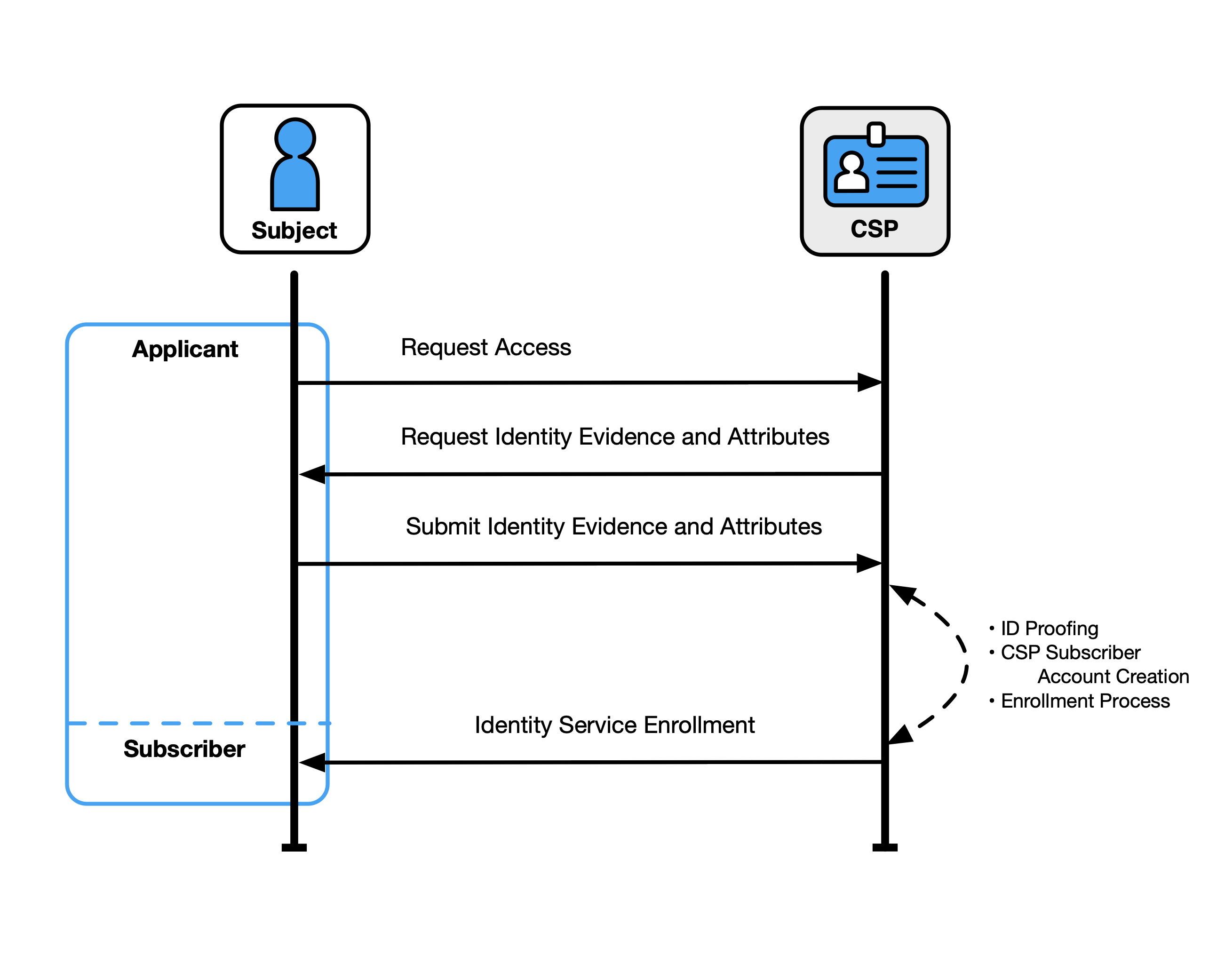
図 1. 本人確認と登録のデジタル ID モデルの例。主体(Subject、左)と CSP(右)の生存線を持つシーケンス図である。主体の生存線を囲む青い枠は、上部が Applicant(申請者)、破線の下が Subscriber(加入者)と記されている。Request Access(アクセスの要求): 主体から CSP へ。Request Identity Evidence and Attributes(ID エビデンスと属性の要求): CSP から主体へ。Submit Identity Evidence and Attributes(ID エビデンスと属性の提出): 主体から CSP へ。CSP の生存線上の破線のループには ID Proofing(本人確認)、CSP Subscriber Account Creation(CSP の加入者アカウントの作成)、Enrollment Process(登録プロセス)と注記されている。Identity Service Enrollment(ID サービスへの登録): CSP から主体へ、枠の加入者の部分に向かう。
Subscriber Accounts
加入者アカウント
At the time of enrollment, the CSP establishes a subscriber account to uniquely identify each subscriber and record information about the subscriber and any authenticators bound to that subscriber account.
登録時に、CSP は各加入者を一意に識別し、その加入者および加入者アカウントに紐付けられた認証器に関する情報を記録するため、加入者アカウントを設定します。
See Sec. 5 of [SP800-63A], subscriber accounts, for more information and normative requirements.
詳細および規範的な要求事項については、[SP800-63A] のセクション 5「加入者アカウント」を参照されました。
Authentication and Authenticator Management
認証および認証器の管理
[SP800-63B], Authentication and Authenticator Management, provides normative descriptions of permitted authenticator types, their characteristics (e.g., phishing resistance), and authentication processes appropriate for each AAL.
[SP800-63B]「認証および認証器の管理」では、許容される認証器の種類、その特性(例:フィッシング耐性)、および各 AAL に適した認証プロセスについて、規範的な説明を提供しています。
Authenticators
認証器
An authenticator is a means of demonstrating the control or possession of one or more factors in an authentication protocol. These guidelines define three types of authentication factors used for authentication:
認証器とは、認証プロトコルにおける 1 つ以上の要素を制御または所持していることを示す手段です。本ガイドラインでは、認証に使用する次の 3 種類の認証要素を定義します。
•Something you know (e.g., a password)
•知識情報(例:パスワード)
•Something you have (e.g., a device containing a cryptographic key)
•所持情報(例:暗号鍵を格納したデバイス)
•Something you are (e.g., a fingerprint or other biometric characteristic data)
•生体情報(例:指紋、その他の生体特性データ)
Single-factor authentication requires only one of the above factors, most often “something you know.” Multiple instances of the same factor still constitute single-factor authentication. For example, a user-generated PIN and a password do not constitute two factors as they are both “something you know.” Multi-factor authentication (MFA) refers to the use of more than one distinct factor.
単一要素認証では、上記の要素のうち 1 つだけを使用します。通常は「知識情報」です。同じ要素を複数回使用しても、単一要素認証のままです。たとえば、利用者が設定した PIN とパスワードは、どちらも「知識情報」であるため、2 つの要素にはなりません。多要素認証(MFA)とは、互いに異なる複数の要素を使用することを指します。
This guideline specifies that authenticators always contain or comprise a secret. The secrets contained in an authenticator are based on either key pairs (i.e., asymmetric cryptographic keys) or shared secrets, including symmetric cryptographic keys, seeds for generating one-time passwords (OTP), and passwords. Asymmetric key pairs are comprised of a public key and a related private key. The private key is stored on the authenticator and is only available for use by the claimant who possesses and controls the authenticators. Symmetric keys generally are chosen at random, complex and long enough to thwart network-based guessing attacks, and stored in hardware or software that the subscriber controls.
本ガイドラインでは、認証器は常に秘密情報を含む、またはそれ自体が秘密情報であることを定めています。認証器に含まれる秘密情報は、鍵ペア(すなわち、非対称暗号鍵)または共有シークレットに基づきます。共有シークレットには、共通鍵暗号鍵、ワンタイムパスワード(OTP)を生成するためのシード、およびパスワードが含まれます。非対称鍵ペアは、公開鍵とそれに対応する秘密鍵で構成されます。秘密鍵は認証器に保存され、その認証器を所持し制御する請求者のみが使用できます。共通鍵は通常、ランダムに選択され、ネットワークベースの推測攻撃を阻止できる程度に複雑かつ長く、加入者が制御するハードウェアまたはソフトウェアに保存されます。
Passwords used locally as an activation factor for a multi-factor authenticator are referred to as activation secrets. An activation secret is used to obtain access to a stored authentication key and remains within the authenticator and its associated user endpoint. An example of an activation secret would be the PIN used to activate a PIV card.
多要素認証器の有効化要素としてローカルで使用されるパスワードは、有効化秘密情報と呼ばれます。有効化秘密情報は、保存された認証鍵へのアクセスを得るために使用され、認証器およびそれに関連付けられた利用者エンドポイント内にとどまります。有効化秘密情報の例として、PIV カードの有効化に使用する PIN があります。
Biometric characteristics are unique, personal attributes that can be used to verify the identity of a person who is physically present at the point of authentication. This includes, facial features, fingerprints, and iris patterns, among others. While biometric characteristics cannot be used for single-factor authentication, they can be used as an authentication factor for multi-factor authentication in combination with a physical authenticator (i.e., something you have).
生体特性は、認証時点で物理的にその場にいる人物の本人性を検証するために使用できる、その人固有の個人的属性です。これには、顔の特徴、指紋、虹彩のパターンなどが含まれます。生体特性は単一要素認証には使用できませんが、物理的な認証器(すなわち、所持情報)と組み合わせれば、多要素認証の認証要素として使用できます。
Some commonly used authentication methods do not contain or comprise secrets and are, therefore, not acceptable for use under these guidelines, such as:
一般的に使用されている認証方法の中には、秘密情報を含まず、またそれ自体が秘密情報でもないため、本ガイドラインでは使用が認められないものがあります。たとえば、次の方法です。
•Knowledge-based authentication (KBA), where the claimant is prompted to answer questions that are presumably known only by the claimant, does not constitute an acceptable secret for digital authentication.
•知識ベース認証(KBA)では、請求者に対して、おそらく請求者だけが知っているとされる質問への回答を求めますが、デジタル認証において許容される秘密情報にはなりません。
•A biometric characteristic does not constitute a secret and cannot be used as a single-factor authenticator.
•生体特性は秘密情報ではなく、単一要素認証器として使用できません。
Authentication Process
認証プロセス
The authentication process enables an RP to trust that a claimant is who they say they are to some level of assurance. The sample authentication process in Fig. 2 shows interactions between the RP, a claimant, and a verifier/CSP. The verifier is a functional role and is frequently implemented in combination with the CSP, RP, or both (as shown in Fig. 4).
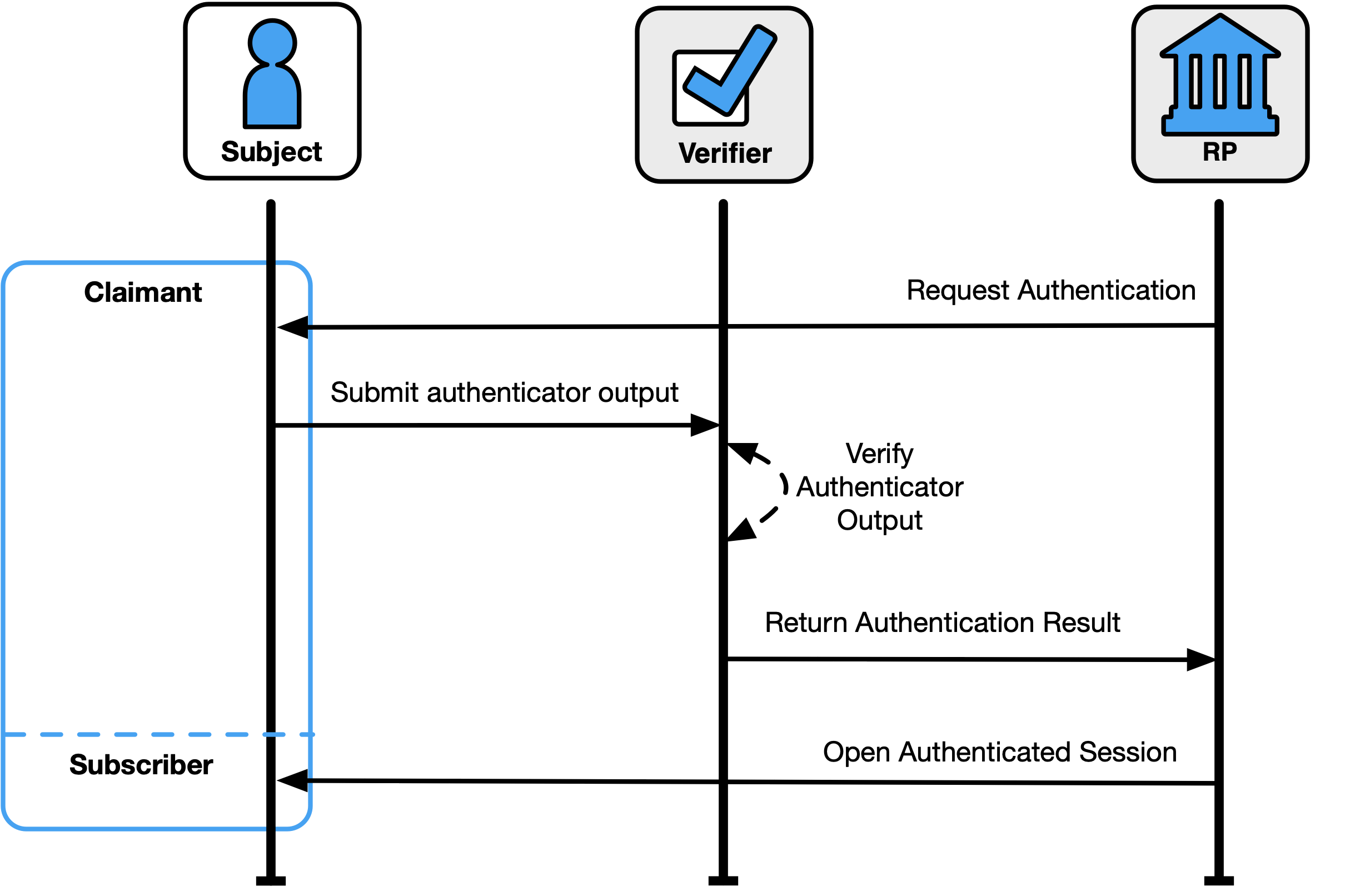
図 2. 認証プロセスの例。主体(Subject)、検証者(Verifier)、RP の生存線を持つシーケンス図である。主体の生存線を囲む青い枠は、上部が Claimant(請求者)、破線の下が Subscriber(加入者)と記されている。Request Authentication(認証の要求): RP から主体へ。Submit authenticator output(認証器出力の提出): 主体から検証者へ。Verify Authenticator Output(認証器出力の検証): 検証者の生存線上の破線のループ。Return Authentication Result(認証結果の返却): 検証者から RP へ。Open Authenticated Session(認証済みセッションの開始): RP から主体へ、枠の加入者の部分に向かう。
A successful authentication process demonstrates that the claimant has possession and control of one or more valid authenticators that are bound to the subscriber’s identity. In general, this is done using an authentication protocol that involves an interaction between the verifier and the claimant, where the claimant uses one or more authenticators to generate the authenticator output to be sent to the verifier. The verifier verifies the output and passes a positive result to the RP. The RP then opens an authenticated session with the verified subscriber.
認証プロセスが成功すると、請求者が加入者の本人性に紐付けられた 1 つ以上の有効な認証器を所持し制御していることが示されます。通常、検証者と請求者の間のやり取りを含む認証プロトコルを使用します。請求者は 1 つ以上の認証器を使って認証器出力を生成し、検証者に送信します。検証者はその出力を検証し、肯定的な結果を RP に伝えます。その後 RP は、検証済みの加入者との認証済みセッションを開始します。
The exact nature of the interaction is important in determining the overall security of the system. Well-designed protocols protect the integrity and confidentiality of communication between the claimant and the verifier both during and after the authentication and can help limit the damage done by an attacker masquerading as a legitimate verifier (i.e., phishing).
相互作用の正確な内容は、システム全体のセキュリティを判断するうえで重要です。適切に設計されたプロトコルは、認証中と認証後の双方で、請求者と検証者間の通信の完全性と機密性を保護します。また、正当な検証者になりすます攻撃者による被害(すなわち、フィッシング)を抑えるのに役立ちます。
Federation and Assertions
フェデレーションとアサーション
Normative requirements can be found in [SP800-63C], Federation and Assertions.
規範的な要求事項は、[SP800-63C]「フェデレーションとアサーション」を参照されました。
Section III of OMB [M-19-17], Enabling Mission Delivery through Improved Identity, Credential, and Access Management, directs agencies to support cross-government identity federation and interoperability. The term federation can be applied to several different approaches that involve the sharing of information between different trust domains, and may differ based on the kind of information that is being shared between the domains. These guidelines address the federation processes that allow for the conveyance of identity and authentication information based on trust agreements across a set of networked systems through federation assertions.
OMB の[M-19-17]「ID、クレデンシャル、およびアクセス管理の改善による使命遂行の実現」の第 III 節は、政府機関に対し、政府横断的な ID フェデレーションと相互運用性を支援するよう指示しています。フェデレーションという語は、異なる信頼ドメイン間で情報を共有する複数の異なる方式に適用でき、ドメイン間で共有する情報の種類によって方式が異なる場合があります。本ガイドラインでは、フェデレーションアサーションを通じて、ネットワーク接続された複数のシステムにわたり、信頼協定に基づいて本人性および認証情報を伝達するフェデレーションプロセスを扱います。
There are many benefits to using federated architectures including, but not limited to:
フェデレーションアーキテクチャの利用には、次のような多くの利点があります(これらに限定されません)。
•Enhancing user experience (e.g., a subject can be identity-proofed once but their subscriber account used at multiple RPs)
•利用者体験の向上(例:対象者の本人確認は一度で済み、加入者アカウントを複数の RP で利用できる)
•Reducing costs for both the subscriber (e.g., reduction in authenticators) and the organization (e.g., reduction in information technology infrastructure and a streamlined architecture)
•加入者(例:認証器の数の削減)と組織(例:情報技術インフラの縮小、アーキテクチャの簡素化)の双方におけるコスト削減
•Minimizing data exposed to RPs by using pseudonymous identifiers and derived attribute values instead of copying account values to each application
•各アプリケーションにアカウントの値を複製する代わりに、仮名識別子と導出属性値を使用して RP に開示されるデータを最小限にする
•Supporting mission success, since organizations will need to focus fewer resources on complex identity management processes
•組織が複雑な ID 管理プロセスに割くリソースを減らせるため、使命の達成を支援する
While the federation process is generally the preferred approach to authentication when the RP and IdP are not administered together under a common security domain, federation can also be applied within a single security domain for a variety of benefits, including centralized account management and technical integration.
RP と IdP が共通のセキュリティドメインの下で一体的に管理されていない場合、一般にフェデレーションは認証に望ましい方式です。一方、集中型のアカウント管理や技術統合などのさまざまな利点を得るため、単一のセキュリティドメイン内でフェデレーションを適用することもできます。
These guidelines are agnostic to the identity proofing, authentication, and federation architectures that an organization selects, and they allow organizations to deploy a digital identity scheme according to their own requirements. However, there are scenarios in which federation could be more efficient and effective than establishing identity services that are local to the organization or individual applications, such as:
本ガイドラインは、組織が選択する本人確認、認証、フェデレーションのアーキテクチャを限定せず、組織独自の要件に沿ったデジタル ID 方式の導入を認めています。ただし、組織または個別のアプリケーションにローカルな ID サービスを確立するよりも、フェデレーションの方が効率的かつ効果的となり得る状況があります。たとえば、次のとおりです。
•Potential users already have an authenticator at or above the required AAL.
•潜在的な利用者が、必要な AAL 以上の認証器をすでに保有しています。
•Multiple types of authenticators are required to cover all possible user communities.
•考えられるすべての利用者コミュニティに対応するため、複数種類の認証器が必要です。
•An organization does not have the necessary infrastructure to support the management of subscriber accounts (e.g., account recovery, authenticator issuance, help desk).
•加入者アカウント管理(例:アカウント回復、認証器の発行、ヘルプデスク)を支援するために必要なインフラが組織にありません。
•There is a desire to allow primary authenticators to be added and upgraded over time without changing the RP’s implementation.
•RP の実装を変更せずに、主要な認証器を後から追加・アップグレードできるようにしました。
•There are different environments to be supported, since federation protocols are network-based and allow for implementation on a wide variety of platforms and languages.
•対応すべき環境が異なります。フェデレーションプロトコルはネットワークベースであり、さまざまなプラットフォームや言語で実装できるためです。
•Potential users come from multiple communities, each with its own existing identity infrastructure.
•潜在的な利用者が複数のコミュニティに属し、それぞれが既存の ID インフラを持っています。
•The organization needs the ability to centrally manage account life cycles, including account revocation and the binding of new authenticators.
•組織が、アカウントの失効や新たな認証器の紐付けを含むアカウントライフサイクルを一元管理する必要があります。
An organization might want to consider accepting federated identity attributes if any of the following apply:
次のいずれかに該当する場合、組織はフェデレーション ID 属性の受け入れを検討できます。
•Pseudonymity is required, necessary, feasible, or important to stakeholders accessing the service.
•サービスにアクセスする関係者にとって、仮名性が必須、必要、実現可能、または重要です。
•Access to the service requires a defined list of attributes.
•サービスへのアクセスに、定義済みの属性リストが必要です。
•Access to the service requires at least one derived attribute value.
•サービスへのアクセスに、少なくとも 1 つの導出属性値が必要です。
•The organization is not the authoritative or issuing source for required attributes.
•その組織は、必要な属性について権威ある情報源でも発行元でもありません。
•Attributes are required temporarily during use (e.g., to make an access decision), and the organization does not need to retain the data.
•属性は利用中に一時的に必要とされ(例:アクセス可否の判断のため)、組織がそのデータを保持する必要はありません。
Examples of Digital Identity Models
デジタル ID モデルの例
In the two cases described in Fig. 3 and Fig. 4, the verifier does not always need to communicate in real time with the CSP to complete the authentication activity (e.g., digital certificates can be used). Therefore, the line between the verifier and the CSP represents a logical link between the two entities. In some implementations, the verifier, RP, and CSP functions are distributed. However, if these functions reside on the same platform, the interactions between the functions are signals between applications or application modules that run on the same system rather than using network protocols.
Non-Federated Digital Identity Model
非フェデレーション型デジタル ID モデル
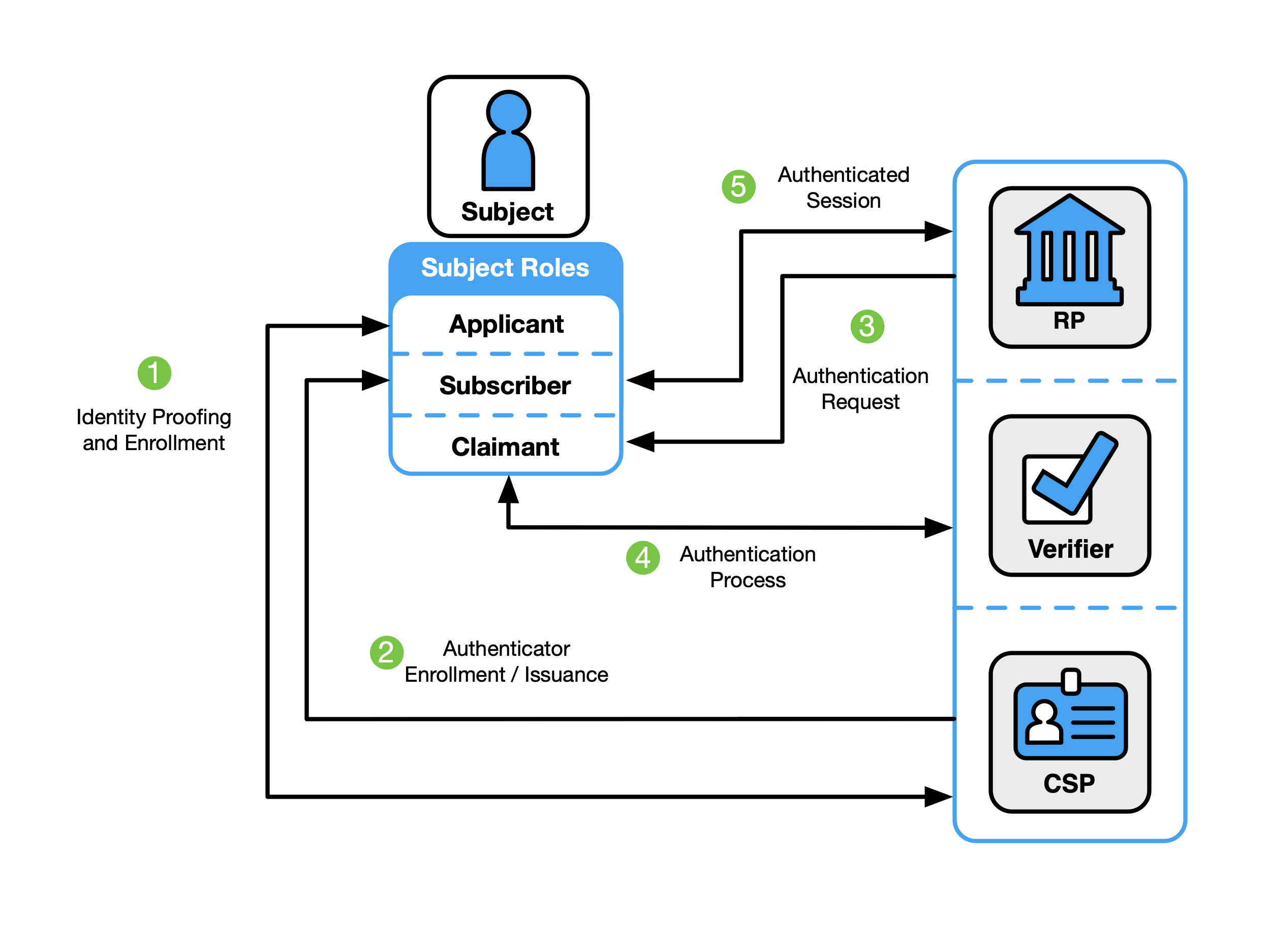
図 3. 非フェデレーション型デジタル ID モデルの例。主体(Subject)のアイコンの下に、Applicant(申請者)、Subscriber(加入者)、Claimant(請求者)に分かれた Subject Roles(主体の役割)の箱がある。右側の青い枠には、破線で区切られた RP、Verifier(検証者)、CSP がある。番号付きの矢印: 1 Identity Proofing and Enrollment(本人確認と登録)は申請者と CSP の間の両方向矢印、2 Authenticator Enrollment / Issuance(認証器の登録/発行)は CSP から加入者へ、3 Authentication Request(認証要求)は RP から請求者へ、4 Authentication Process(認証プロセス)は請求者と検証者の間の両方向矢印、5 Authenticated Session(認証済みセッション)は加入者と RP の間の両方向矢印である。
Figure 3 shows an example of a common sequence of interactions in the non-federated model. Other sequences could also achieve the same functional requirements. One common sequence of interactions for identity proofing and enrollment activities is represented as follows:
図 3は、非フェデレーション型モデルにおける一般的な相互作用の順序の例を示しています。他の順序でも同じ機能要件を満たせます。本人確認および登録活動における一般的な相互作用の順序を次に示します。
•Step 1: An applicant applies to a CSP through an identity proofing and enrollment process. The CSP identity-proofs that applicant.
•ステップ 1:申請者は本人確認および登録プロセスを通じて CSP に申請します。CSP はその申請者の本人確認を行います。
•Step 2: Upon successful identity proofing, the applicant is enrolled into the identity service as a subscriber.
•ステップ 2:本人確認が正常に完了すると、申請者は加入者として ID サービスに登録されます。
•A subscriber account and corresponding authenticators are established between the CSP and the subscriber. The CSP maintains the subscriber account, its status, and the enrollment data. The subscriber maintains their authenticators.
•CSP と加入者の間で、加入者アカウントと対応する認証器が確立されます。CSP は加入者アカウント、その状態、および登録データを管理します。加入者は自身の認証器を管理します。
Steps 3 through 5 can immediately follow steps 1 and 2 or be done at a later time. The usual sequence of interactions involved in using one or more authenticators to perform digital authentication in the non-federated model is as follows:
ステップ 3 から 5 は、ステップ 1 と 2 の直後に続けて実行することも、後の時点で実行することもできます。非フェデレーション型モデルで 1 つ以上の認証器を使ってデジタル認証を行う際の一般的な相互作用の順序は、次のとおりです。
•Step 3: The claimant initiates an online interaction with the RP and the RP requests that the claimant authenticate.
•ステップ 3:請求者は RP とのオンラインでのやり取りを開始し、RP は請求者に認証を要求します。
•Step 4: The claimant proves possession and control of the authenticators to the verifier function through an authentication process:
•ステップ 4:請求者は認証プロセスを通じて、検証者機能に対して認証器の所持および制御を証明します。
•The verifier interacts with the CSP to verify the binding of the claimant’s identity to their authenticators in the subscriber account and to optionally obtain additional subscriber attributes.
•検証者は CSP とやり取りし、加入者アカウント内の請求者の本人性と認証器との紐付けを検証します。また、必要に応じて追加の加入者属性を取得します。
•The CSP or verifier functions of the service provider give information about the subscriber. The RP requests the attributes that it requires from the CSP. The RP optionally uses this information to make authorization decisions.
•サービスプロバイダーの CSP または検証者機能は、加入者に関する情報を提供します。RP は必要とする属性を CSP に要求します。RP は必要に応じて、この情報を認可の判断に使用します。
•Step 5: An authenticated session is established between the subscriber and the RP.
•ステップ 5:加入者と RP の間に認証済みセッションが確立されます。
Federated Digital Identity Model With General-Purpose IdP
汎用 IdP を用いたフェデレーション型デジタル ID モデル
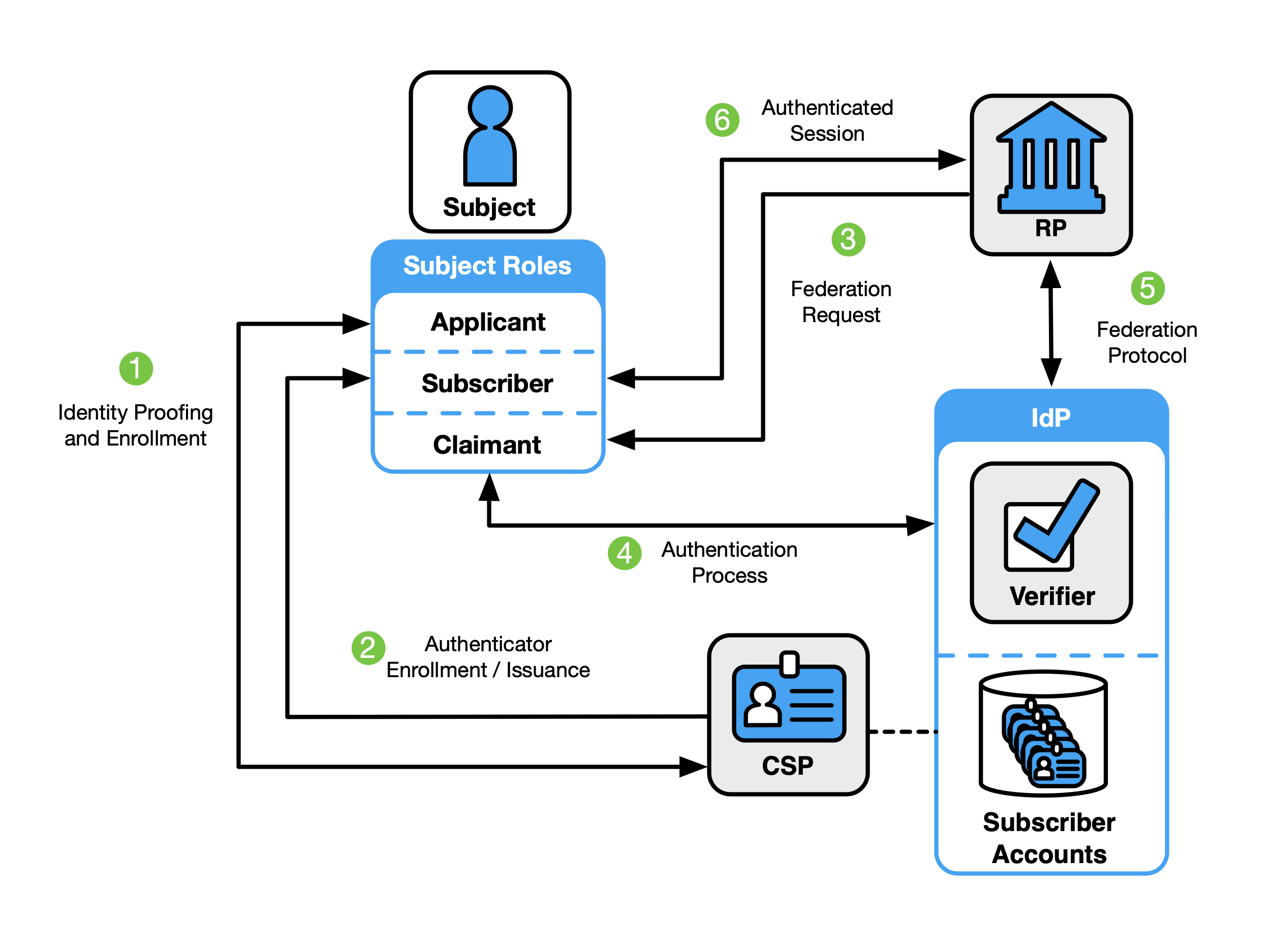
図 4. フェデレーション型デジタル ID モデルの例。主体(Subject)のアイコンの下に、Applicant(申請者)、Subscriber(加入者)、Claimant(請求者)に分かれた Subject Roles(主体の役割)の箱がある。右側には RP と IdP の箱があり、IdP の中には Verifier(検証者)と、破線の下に Subscriber Accounts(加入者アカウント、ID カードのデータベース)がある。CSP の箱は加入者アカウントと点線で結ばれている。番号付きの矢印: 1 Identity Proofing and Enrollment(本人確認と登録)は申請者と CSP の間の両方向矢印、2 Authenticator Enrollment / Issuance(認証器の登録/発行)は CSP から加入者へ、3 Federation Request(フェデレーション要求)は RP から請求者へ、4 Authentication Process(認証プロセス)は請求者と IdP の検証者の間の両方向矢印、5 Federation Protocol(フェデレーションプロトコル)は RP と IdP の間の両方向矢印、6 Authenticated Session(認証済みセッション)は加入者と RP の間の両方向矢印である。
Figure 4 shows an example of those same common interactions in a federated model.
図 4は、フェデレーション型モデルにおける同じ一般的な相互作用の例を示しています。
•Step 1: An applicant applies to a CSP through an identity proofing and enrollment process. The CSP identity-proofs that applicant.
•ステップ 1:申請者は本人確認および登録プロセスを通じて CSP に申請します。CSP はその申請者の本人確認を行います。
•Step 2: Upon successful identity proofing, the applicant is enrolled in the identity service as a subscriber.
•ステップ 2:本人確認が正常に完了すると、申請者は加入者として ID サービスに登録されます。
•A subscriber account and corresponding authenticators are established between the CSP and the subscriber.
•CSP と加入者の間で、加入者アカウントと対応する認証器が確立されます。
•The IdP is provisioned either directly by the CSP or indirectly through access to attributes of the subscriber account. The CSP maintains the subscriber account, its status, and the enrollment data collected in accordance with the records retention and disposal requirements described in Sec. 3.1 of [SP800-63A]. The subscriber maintains their authenticators. The IdP maintains its view of the subscriber account, any federated identifiers assigned to the subscriber account, and any policies and decisions regarding the release of attributes and information to RPs.
•IdP は CSP から直接プロビジョニングされる場合と、加入者アカウントの属性へのアクセスを通じて間接的にプロビジョニングされる場合があります。CSP は、[SP800-63A] のセクション 3.1に記載された記録の保持・廃棄要件に従って収集した登録データと、加入者アカウントおよびその状態を維持します。加入者は自身の認証器を管理します。IdP は、加入者アカウントに関する独自の記録、そのアカウントに割り当てられたフェデレーション識別子、および RP への属性・情報の開示に関するポリシーと判断を管理します。
The usual sequence of interactions involved in using one or more authenticators in the federated model to perform digital authentication is as follows:
フェデレーション型モデルで 1 つ以上の認証器を使用してデジタル認証を行う際の一般的な相互作用の順序は、次のとおりです。
•Step 3: The RP requests that the claimant authenticate and requests any attributes needed from the IdP to make access or authorization decisions. This triggers a request for federated authentication to the IdP.
•ステップ 3:RP は請求者に認証を要求し、アクセスや認可の判断に必要な属性を IdP に要求します。これを受けて、IdP に対するフェデレーション認証要求が開始されます。
•Step 4: The claimant proves possession and control of the authenticators to the verifier function of the IdP through an authentication process.
•ステップ 4:請求者は認証プロセスを通じて、IdP の検証者機能に対して認証器を所持し制御していることを証明します。
•The binding of the claimant’s authenticators are verified with those bound to the claimed subscriber account and optionally to obtain additional subscriber attributes.
•請求者の認証器が、主張された加入者アカウントに紐付けられている認証器と一致することを検証します。また、必要に応じて追加の加入者属性を取得します。
•Step 5: The RP and the IdP communicate through a federation protocol. The IdP provides an assertion and any necessary additional attributes to the RP through a federation protocol. The RP verifies the assertion to establish confidence in the identity and attributes of a subscriber for access to an online service at the RP. RPs use a subscriber’s federated identity (pseudonymous or non-pseudonymous), IAL, AAL, FAL, and other factors to make authorization decisions.
•ステップ 5:RP と IdP はフェデレーションプロトコルを通じて通信します。IdP はアサーションと必要な追加属性を RP に提供します。RP はアサーションを検証し、RP のオンラインサービスへのアクセスにあたり、加入者の本人性および属性を信頼できる度合いを確立します。RP は、加入者のフェデレーション ID(仮名または非仮名)、IAL、AAL、FAL、およびその他の要素を使って認可を判断します。
•Step 6: An authenticated session is established between the subscriber and the RP.
•ステップ 6:加入者と RP の間に認証済みセッションが確立されます。
Federated Digital Identity Model with Subscriber-Controlled Wallet
加入者管理ウォレットを用いたフェデレーション型デジタル ID モデル
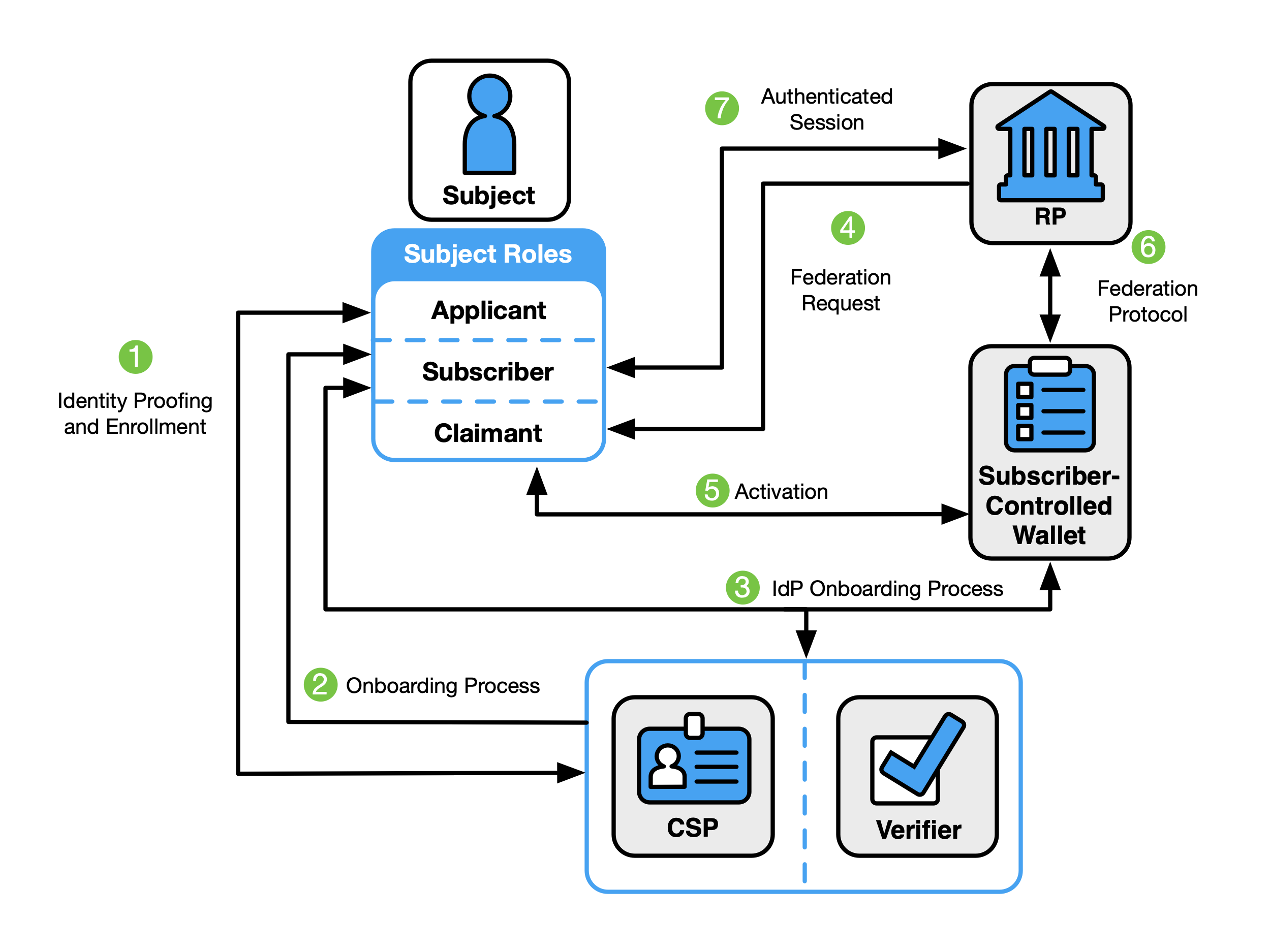
図 5. 加入者管理ウォレットを用いたフェデレーション型デジタル ID モデルの例。主体(Subject)のアイコンの下に、Applicant(申請者)、Subscriber(加入者)、Claimant(請求者)に分かれた Subject Roles(主体の役割)の箱がある。右側には RP、Subscriber-Controlled Wallet(加入者管理ウォレット)、CSP がある。番号付きの矢印: 1 Identity Proofing and Enrollment(本人確認と登録)は申請者と CSP の間の両方向矢印、2 Onboarding Process(オンボーディングプロセス)は CSP から加入者へ、3 Attribute Bundle Issuance(属性バンドルの発行)は加入者、CSP、ウォレットの3か所に矢じりのある線、4 Federation Request(フェデレーション要求)は RP から請求者へ、5 Activation / Authentication(有効化/認証)は請求者とウォレットの間の両方向矢印、6 Federation Protocol(フェデレーションプロトコル)は RP とウォレットの間の両方向矢印、7 Authenticated Session(認証済みセッション)は加入者と RP の間の両方向矢印である。
Figure 5 shows an example of the interactions in a federated digital identity model in which the subscriber controls a device with software (i.e., a digital wallet) or an account with a cloud service provider (i.e., a hosted-wallet) that acts as the IdP. In the terminology of the “three-party model,” the CSP is the issuer, the IdP is the holder (i.e., the users device or agent operating on their behalf), and the RP is the verifier. In this model, it is common for the RP to establish a trust agreement with the CSP using a federation authority, as defined in Sec. 3.5 of [SP800-63C]. This arrangement allows the RP to accept assertions from the subscriber-controlled wallet without needing a direct trust relationship with the wallet, as described in Sec. 5 of [SP800-63C].
図 5は、加入者が IdP として機能するソフトウェア搭載デバイス(すなわち、デジタルウォレット)またはクラウドサービスプロバイダーのアカウント(すなわち、ホスト型ウォレット)を管理する、フェデレーション型デジタル ID モデルの相互作用例を示しています。「三者モデル」の用語では、CSP は発行者、IdP は保持者(すなわち、利用者のデバイスまたは利用者に代わって動作するエージェント)、RP は検証者です。このモデルでは、RP がフェデレーション機関を通じて CSP と信頼協定を確立することが一般的です。これは[SP800-63C] のセクション 3.5で定義されています。この仕組みにより、RP はウォレットとの直接的な信頼関係を必要とせずに、加入者管理ウォレットからのアサーションを受け入れられます。これは[SP800-63C] のセクション 5で説明されています。
•Step 1: An applicant applies to a CSP identity proofing and enrollment process.
•ステップ 1:申請者は CSP の本人確認および登録プロセスに申請します。
•Step 2: Upon successful identity proofing, the applicant goes through an onboarding process and is enrolled in the identity service as a subscriber.
•ステップ 2:本人確認が正常に完了すると、申請者はオンボーディングプロセスを経て、加入者として ID サービスに登録されます。
•Step 3: The subscriber-controlled wallet is onboarded by the CSP, allowing the wallet to act in the role of IdP in later steps.
•ステップ 3:CSP が加入者管理ウォレットをオンボーディングし、後続のステップでウォレットが IdP の役割を担えるようにします。
•The subscriber authenticates to the CSP’s issuance functionality by authenticating to the subscriber account or completes an abbreviated proofing process to demonstrate that they are the same user represented by the subscriber account.
•加入者は、加入者アカウントに認証することで CSP の発行機能に認証するか、または加入者アカウントに記録された利用者と同一人物であることを示すために簡略化された本人確認プロセスを完了します。
•The subscriber activates the subscriber-controlled wallet using an activation factor.
•加入者は、有効化要素を使用して加入者管理ウォレットを有効化します。
•The wallet generates or chooses a signing key and corresponding verification key, including proof of a key held by the wallet.
•ウォレットは、署名鍵と対応する検証鍵を生成または選択します。これには、ウォレットがその鍵を保持していることの証明も含まれます。
•The CSP creates one or more attribute bundles that include subscriber attributes and the wallet’s verification key (or a reference to that key).
•CSP は、加入者属性とウォレットの検証鍵(またはその鍵への参照)を含む属性バンドルを 1 つ以上作成します。
•The CSP issues the attribute bundle with corresponding verification key into the subscriber-controlled wallet.
•CSP は、対応する検証鍵とともに属性バンドルを加入者管理ウォレットに発行します。
Other protocols and specifications often refer to attribute bundles as credentials. These guidelines use the term credentials to refer to a different concept. To avoid a conflict, the term attribute bundle is used within these guidelines. Normative requirements for attribute bundles can be found in Sec. 3.12.1 of [SP800-63C].
他のプロトコルや仕様では、属性バンドルをクレデンシャルと呼ぶことがよくあります。本ガイドラインでは、クレデンシャルという語を別の概念を指すために使用します。用語の混同を避けるため、本ガイドラインでは属性バンドルという語を使用します。属性バンドルに関する規範的な要求事項は、[SP800-63C] のセクション 3.12.1に記載されています。
The usual sequence of interactions involved in providing an assertion to the RP from a subscriber-controlled wallet is as follows:
加入者管理ウォレットから RP にアサーションを提供する際の一般的な相互作用の順序は、次のとおりです。
•Step 4: The RP requests that the claimant authenticate. This triggers a request for federated authentication to the wallet.
•ステップ 4:RP は請求者に認証を要求します。これを受けて、ウォレットに対するフェデレーション認証要求が開始されます。
•Step 5: The claimant proves possession and control of the subscriber-controlled wallet.
•ステップ 5:請求者は、加入者管理ウォレットを所持し制御していることを証明します。
•The claimant activates the wallet using an activation factor or authenticates to a hosted service if the subscriber-controlled wallet is hosted by a service provider.
•請求者は、有効化要素を使用してウォレットを有効化します。加入者管理ウォレットがサービスプロバイダーによってホストされている場合は、ホストされたサービスに対して認証します。
•The wallet prepares an assertion that includes the attribute bundle provided by the CSP for the subscriber account.
•ウォレットは、加入者アカウントについて CSP が提供した属性バンドルを含むアサーションを準備します。
•Step 6: The RP and the wallet communicate through a federation protocol. The wallet provides an assertion, the CSP-signed attribute bundles and optional additional attributes to the RP through a federation protocol. The RP verifies the assertion to establish confidence in the identity and attributes of a subscriber for access to an online service at the RP. RPs use a subscriber’s federated identity (pseudonymous or non-pseudonymous), IAL, AAL, FAL, and other factors to make authorization decisions.
•ステップ 6:RP とウォレットはフェデレーションプロトコルを通じて通信します。ウォレットは、アサーション、CSP が署名した属性バンドル、および任意の追加属性を、フェデレーションプロトコルを通じて RP に提供します。RP はアサーションを検証し、RP のオンラインサービスへのアクセスにあたり、加入者の本人性および属性を信頼できる度合いを確立します。RP は、加入者のフェデレーション ID(仮名または非仮名)、IAL、AAL、FAL、およびその他の要素を使って認可を判断します。
•Step 7: An authenticated session is established between the subscriber and the RP.
•ステップ 7:加入者と RP の間に認証済みセッションが確立されます。
Digital Identity Risk Management
デジタル ID リスク管理
This section is normative.
このセクションは規範的です。
This section describes the methodology for assessing digital identity risks associated with online services, including residual risks to users of the online service, the service provider organization, and its mission and business partners. It offers guidance on selecting usable, privacy-enhancing security, and anti-fraud controls that mitigate those risks. Additionally, it emphasizes the importance of continuously evaluating the performance of the selected controls.
本セクションでは、オンラインサービスに関連するデジタル ID リスク(オンラインサービスの利用者、サービスプロバイダー組織、その使命、およびビジネスパートナーに残るリスクを含む)を評価する方法を説明します。また、そうしたリスクを軽減する、利用しやすくプライバシーを強化するセキュリティ対策や不正対策の選定に関する指針を示します。さらに、選定した対策の性能を継続的に評価する重要性を強調します。
The Digital Identity Risk Management (DIRM) process focuses on the identification and management of risks according to two dimensions: (1) risks that result from operating the online service that might be addressed by an identity system and (2) additional risks that are introduced as a result of implementing the identity system.
デジタル ID リスク管理(DIRM)プロセスでは、次の 2 つの観点に基づいてリスクを特定し、管理します。(1) オンラインサービスの運用に伴い、ID システムで対処できる可能性のあるリスク、(2) ID システムの実装によって生じる追加のリスク。
The first dimension of risk informs initial assurance level selections and seeks to identify risks associated with a compromise of the online service that might be addressed by an identity system. For example:
リスクの第 1 の観点は、初期保証レベルの選択に役立ち、ID システムで対処できる可能性のある、オンラインサービスの侵害に伴うリスクの特定を目的とします。たとえば、次のとおりです。
•Identity proofing: Negative impacts that could reasonably be expected if an imposter were to gain access to a service or receive a credential using the identity of a legitimate user (e.g., an attacker successfully impersonates someone)
•本人確認:なりすまし者が正当な利用者の本人性を使ってサービスにアクセスしたり、クレデンシャルを取得したりした場合に、合理的に予想される悪影響(例:攻撃者が他人になりすますことに成功する)
•Authentication: Negative impacts that could reasonably be expected if a false claimant accessed an account that was not rightfully theirs (e.g., an attacker who compromises or steals an authenticator), often referred to as an account takeover attack
•認証:誤った請求者が自分のものではないアカウントにアクセスした場合に、合理的に予想される悪影響(例:攻撃者が認証器を侵害または窃取します)。これは、一般にアカウント乗っ取り攻撃と呼ばれます。
•Federation: Negative impacts that could reasonably be expected if the wrong subject successfully accessed an online service, system, or data (e.g., compromising or replaying an assertion)
•フェデレーション:誤った対象者がオンラインサービス、システム、またはデータへのアクセスに成功した場合に、合理的に予想される悪影響(例:アサーションの侵害またはリプレイ)
If there are risks associated with a compromise of the online service that could be addressed by an identity system, an initial assurance level is selected and the second dimension of risk is then considered.
ID システムで対処できるオンラインサービスの侵害リスクがある場合、初期保証レベルを選択し、次にリスクの第 2 の観点を検討します。
The second dimension of risk seeks to identify the risks posed by the identity system itself and informs the tailoring process. Tailoring provides a process to modify an initially assessed assurance level, implement compensating or supplemental controls, or modify selected controls based on ongoing detailed risk assessments in areas such as privacy, usability, and resilience to real-world threats.
リスクの第 2 の観点では、ID システム自体がもたらすリスクを特定し、調整プロセスに役立てます。調整では、継続的かつ詳細なリスク評価(プライバシー、ユーザビリティ、現実世界の脅威に対するレジリエンスなどの領域)に基づき、当初評価した保証レベルの変更、補償的または追加的な対策の実施、あるいは選定した対策の変更を行います。
Examples of the types of impact that can result from risks introduced by the identity system itself include:
ID システム自体がもたらすリスクによって生じ得る影響の種類の例を次に示します。
•Identity proofing: Impacts of not successfully identity proofing and enrolling a legitimate subject due to barriers faced by the subject throughout the process of identity proofing, falling victim to a breach of information that was collected and retained to support identity proofing processes, or the initial IAL failing to completely address specific threats, threat actors, and fraud
•本人確認:本人確認の全過程で対象者が直面する障壁により、正当な対象者の本人確認および登録が正常に行われないこと、本人確認プロセスを支えるために収集・保持された情報の漏えい被害に遭うこと、または当初の IAL では特定の脅威、脅威アクター、不正行為に十分に対処できないことによる影響
•Authentication: Impacts of failing to authenticate the correct subject due to barriers faced by the subject in presenting their authenticator, including barriers due to usability issues; the initial AAL failing to completely address targeted account takeover models or specific authenticator types fail to mitigate anticipated attacks
•認証:認証器の提示時に対象者が直面する障壁(ユーザビリティの問題による障壁を含む)により、正しい対象者を認証できないことによる影響。当初の AAL では標的型アカウント乗っ取りの手口に十分に対処できない場合や、特定の認証器の種類では予想される攻撃を軽減できない場合も含みます。
•Federation: Impacts of releasing real subscriber attributes to the wrong online service or system or releasing incorrect or fake attributes to a legitimate RP
•フェデレーション:実際の加入者属性を誤ったオンラインサービスやシステムに開示すること、または正当な RP に誤った属性や偽の属性を開示することによる影響
The outcomes of the DIRM process depend on the role that an entity plays within the digital identity model.
DIRM プロセスの成果は、デジタル ID モデル内でエンティティが果たす役割によって異なります。
1.For relying parties, the intent of this process is to determine the assurance levels and any tailoring required to protect online services and the applications, transactions, and systems that comprise or are impacted by those services. This directly contributes to the selection, development, and procurement of CSP services. Federal RPs SHALL implement the DIRM process for all online services.
1.依拠当事者にとって、このプロセスの目的は、オンラインサービスならびにそのサービスを構成する、またはその影響を受けるアプリケーション、取引、システムを保護するために必要な保証レベルと調整を判断することです。これは CSP サービスの選定、開発、および調達に直接役立ちます。連邦政府の RP は、すべてのオンラインサービスについて DIRM プロセスを実施SHALLします。
2.For credential service providers and identity providers, the intent of this process is to design service offerings that meet the requirements of the defined assurance levels, continuously guard against compromises to the identity system, and meet the needs of RPs. Whenever a service offering deviates from normative guidance, those deviations SHALL be clearly communicated to the RPs that utilize the service.
2.クレデンシャルサービスプロバイダーおよび ID プロバイダーにとって、このプロセスの目的は、定義された保証レベルの要求事項を満たし、ID システムの侵害を継続的に防ぎ、RP のニーズにも応えるサービスを設計することです。サービスの提供内容が規範的な指針から逸脱する場合、その逸脱をサービス利用者である RP に明確に伝達SHALLします。
CSPs and IdPs are expected to offer services at assurance levels that are requested by the RPs they serve. However, CSPs and IdPs that choose to deviate from this guideline or augment their services are expected to conduct an abbreviated digital identity risk assessment and document their modifications in a Digital Identity Acceptance Statement that is provided to RPs (see Sec. 3.4.4).
CSP および IdP には、サービスを提供する RP が要求する保証レベルでサービスを提供することが期待されます。ただし、本ガイドラインから逸脱する、またはサービスを拡張することを選択する CSP や IdP には、簡略化されたデジタル ID リスク評価を実施し、その変更を RP に提供するデジタル ID 受け入れ表明に文書化することが期待されます(セクション 3.4.4を参照してください)。
This process augments the risk management processes required by [FISMA]. The results of the DIRM impact assessment for the online service may be different from the FISMA impact level for the underlying application or system. Identity process failures can result in different levels of impact for various user groups. For example, the overall assessed FISMA impact level for a payment system may result in a ‘FISMA Moderate’ impact category because sensitive financial data is being processed by the system. However, for individuals who are making guest payments where no persistent account is established, the authentication and proofing impact levels may be lower. Agency authorizing officials SHOULD require documentation that demonstrates adherence to the DIRM process as a part of the authority to operate (ATO) for the underlying information system that supports an online service. Agency authorizing officials SHOULD require documentation from CSPs that demonstrates adherence to the DIRM process as part of procurement or ATO processes for integration with CSPs.
このプロセスは、[FISMA]が求めるリスク管理プロセスを補完します。オンラインサービスの DIRM 影響評価の結果は、基礎となるアプリケーションまたはシステムに対する FISMA 影響レベルと異なる場合があります。ID プロセスの失敗は、利用者グループによって異なる影響レベルをもたらす場合があります。たとえば、決済システム全体の FISMA 影響評価では、システムが機微な財務データを処理するため、「FISMA 中」影響カテゴリとなる場合があります。しかし、永続的なアカウントを設定せずにゲスト決済を行う個人については、認証および本人確認の影響レベルがより低い場合があります。政府機関の認可担当者は、オンラインサービスを支える基礎情報システムの運用認可(ATO)の一環として、DIRM プロセスの遵守を示す文書をSHOULD要求します。政府機関の認可担当者は、CSP との統合に向けた調達または ATO プロセスの一環として、CSP が DIRM プロセスを遵守していることを示す文書もSHOULD要求します。
These guidelines use the term FISMA impact level; other NIST RMF publications also use the term system impact level to refer to such impact categorization.
本ガイドラインでは「FISMA 影響レベル」という用語を用いますが、他の NIST RMF 刊行物では、同様の影響分類を指す用語として「システム影響レベル」も使用されています。
There are 5 steps in the DIRM process:
DIRM プロセスは 5 つのステップから成ります。
1.Define the online service: As a starting point, the organization documents a description of the online service in terms of its functional scope, the user groups it is intended to serve, the types of online transactions available to each user group, and the underlying data that the online service processes through its interfaces. If the online service is one element of a broader business process, its role is documented, as are the uses of any data collected and processed by the online service. Additionally, an organization needs to determine the entities that will be impacted by the online service and the broader business process of which it is a part. The outcome is a description of the online service, its users, and the entities that may be impacted by its functionality.
1.オンラインサービスの定義:まず組織は、サービスの機能範囲、対象とする利用者グループ、各利用者グループが利用できるオンライン取引の種類、およびオンラインサービスがインターフェースを通じて処理する基礎データについて説明を文書化します。オンラインサービスがより広範なビジネスプロセスの一部である場合、その役割と、オンラインサービスが収集・処理するデータの用途も文書化します。さらに組織は、オンラインサービスおよびそれが属するより広範なビジネスプロセスによって影響を受けるエンティティを特定する必要があります。このステップの成果は、オンラインサービス、その利用者、およびその機能によって影響を受ける可能性のあるエンティティの説明です。
2.Conduct initial impact assessment: In this step, organizations assess the impacts of a compromise of the online service that might be addressed by an identity system (i.e., identity proofing, authentication, or federation). Each function of the online service is assessed against a defined set of harms and impact categories. Each user group of the online service is considered separately based on the transactions available to that user group (i.e., the permissions that the group is granted relative to the data and functions of the online service). The outcome of this step is a documented set of impact categories and associated impact levels that are determined by considering the transactions available to each user group of the online service.
2.初期影響評価の実施:このステップでは、ID システム(すなわち、本人確認、認証、またはフェデレーション)によって対処できる可能性のある、オンラインサービスの侵害による影響を組織が評価します。オンラインサービスの各機能を、定義された危害および影響カテゴリ一式に照らして評価します。オンラインサービスの各利用者グループは、そのグループが利用できる取引(すなわち、オンラインサービスのデータや機能に対して付与された権限)に基づいて個別に検討します。このステップの成果は、各利用者グループが利用できる取引を考慮して決定した、影響カテゴリと関連する影響レベルの文書化済み一覧です。
3.Select initial assurance levels: In this step, the impact categories and impact levels are evaluated to determine the initial assurance levels to protect the online service from unauthorized access and fraud. Using the assurance levels, the organization identifies the baseline controls for the IAL, AAL, and FAL for each user group based on the requirements in companion volumes [SP800-63A], [SP800-63B], and [SP800-63C], respectively. The outcome of this step is an identified initial IAL, AAL, and FAL, as applicable, for each user group.
3.初期保証レベルの選択:このステップでは、影響カテゴリと影響レベルを評価し、不正アクセスや不正行為からオンラインサービスを保護するための初期保証レベルを決定します。保証レベルに基づいて、組織は利用者グループごとに、補足文書の[SP800-63A]、[SP800-63B]、および[SP800-63C]の要求事項に基づき、それぞれ IAL、AAL、および FAL のベースライン対策を特定します。このステップの成果は、該当する場合に利用者グループごとに特定された初期 IAL、AAL、および FAL です。
4.Tailor and document assurance level determinations: In this step, detailed assessments are conducted or leveraged to determine the potential impact of the initially selected assurance levels and their associated controls on privacy, customer experience, and resistance to the current threat environment. Tailoring may result in a modification of the initially assessed assurance level, the identification of compensating or supplemental controls (see Sec. 3.4.2 and Sec. 3.4.3), or both. All assessments and final decisions are documented and justified. The outcome is a Digital Identity Acceptance Statement (see Sec. 3.4.4) with a defined and implementable set of assurance levels and a final set of controls for the online service.
4.保証レベルの決定の調整と文書化:このステップでは、詳細な評価を実施または活用し、初期選択した保証レベルと関連対策がプライバシー、顧客体験、および現在の脅威環境に対する耐性に及ぼす潜在的影響を判断します。調整の結果、当初評価した保証レベルの変更、補償的または追加的な対策の特定(セクション 3.4.2およびセクション 3.4.3を参照)、またはその両方が生じる場合があります。すべての評価と最終判断を文書化し、その根拠を示します。このステップの成果は、オンラインサービスに対して定義され、実装可能な保証レベル一式と最終対策一式を含むデジタル ID 受け入れ表明(セクション 3.4.4を参照)です。
5.Continuously evaluate and improve: In this step, information on the performance of the identity management approach is gathered and evaluated. This evaluation considers a diverse set of factors, including business impacts, effects on fraud rates, and impacts on user communities. This information is crucial for determining whether the selected assurance levels and controls meet mission, business, security, and — where applicable — program integrity needs. It also helps monitor for unintended harms that impact privacy and access. Opportunities for improvement should also be considered by closely monitoring the evolving threat landscape and investigating new technologies and methodologies that can counter those threats, improve customer experience, or enhance privacy. The outcomes of this step are performance metrics, documented and transparent processes for evaluation and redress, and ongoing improvements to the identity management approach.
5.継続的な評価と改善:このステップでは、ID 管理方式の性能に関する情報を収集し、評価します。この評価では、ビジネスへの影響、不正率への影響、利用者コミュニティへの影響など、多様な要因を考慮します。この情報は、選択した保証レベルと対策が、使命、ビジネス、セキュリティ、さらに該当する場合はプログラムの完全性に関するニーズを満たすか判断するうえで不可欠です。また、プライバシーやアクセスに悪影響を与える意図しない危害の監視にも役立ちます。脅威状況の変化を綿密に監視し、脅威への対抗、顧客体験の改善、またはプライバシー強化に役立つ新しい技術や手法を調査することで、改善の機会も検討するべきです。このステップの成果は、性能指標、評価と救済のための文書化された透明性の高いプロセス、および ID 管理方式の継続的改善です。
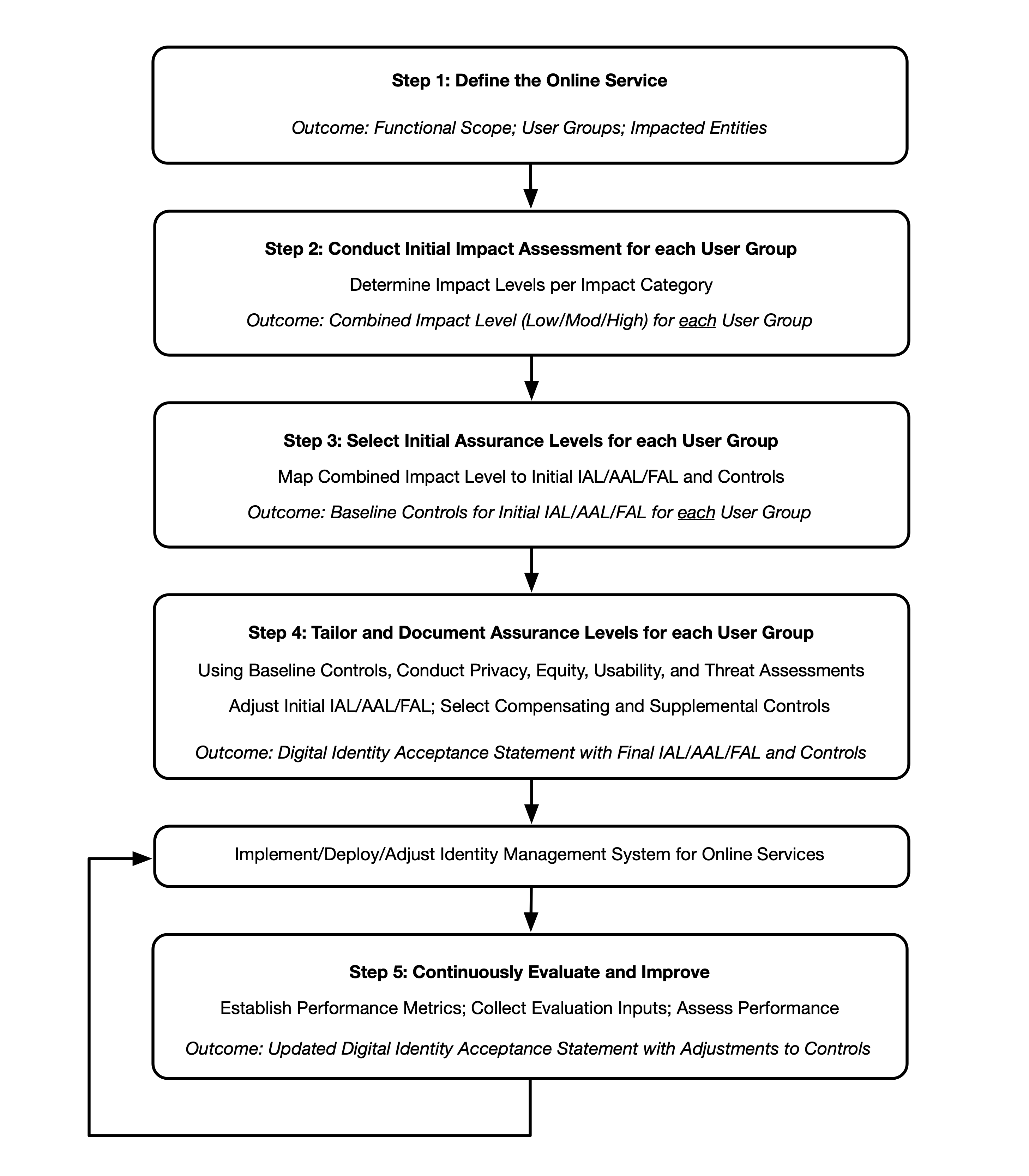
図 6. DIRM プロセスフローの概要図。下向きの矢印で結ばれた箱が縦に並ぶフローチャートである。Step 1: Define the Online Service(ステップ 1: オンラインサービスの定義)– 成果: 機能の範囲、利用者グループ、影響を受けるエンティティ。Step 2: Conduct Initial Impact Assessment for each User Group(ステップ 2: 利用者グループごとの初期影響評価の実施)– 影響カテゴリごとの影響レベルの決定 – 成果: 利用者グループごとの総合影響レベル(低/中/高)。Step 3: Select Initial Assurance Levels for each User Group(ステップ 3: 利用者グループごとの初期保証レベルの選択)– 総合影響レベルを初期の IAL/AAL/FAL と管理策に対応付ける – 成果: 利用者グループごとの初期 IAL/AAL/FAL のベースライン管理策。Step 4: Tailor and Document Assurance Levels for each User Group(ステップ 4: 利用者グループごとの保証レベルの調整と文書化)– ベースライン管理策を用いてプライバシー、顧客体験、脅威の評価を行う、初期 IAL/AAL/FAL を調整する、補償的管理策と補足的管理策を選択する – 成果: 最終的な IAL/AAL/FAL と管理策を記したデジタル ID 受け入れ表明。続いて Implement/Deploy/Adjust Identity Management System for Online Services(オンラインサービスのための ID 管理システムの実装/展開/調整)の箱。Step 5: Continuously Evaluate and Improve(ステップ 5: 継続的な評価と改善)– パフォーマンス指標の設定、評価の入力の収集、パフォーマンスの評価 – 成果: 管理策の調整を反映した更新済みのデジタル ID 受け入れ表明。ステップ 5 から実装/展開/調整の箱へ戻る矢印がある。
Figure 6 illustrates the major actions and outcomes for each step of the DIRM process flow. While presented as a stepwise approach, there can be many points in the process that require divergence from the sequential order, including the need for iterative cycles between initial task execution and revisiting tasks. For example, the introduction of new regulations or requirements while an assessment is in progress may require organizations to revisit a step in the process. Additionally, new functionalities, changes in data usage, and changes to the threat environment may require an organization to revisit steps in the DIRM process at any point, including potentially modifying the assurance levels and/or the related controls of the online service.
図 6は、DIRM プロセスフローの各ステップにおける主な活動と成果を示しています。段階的な手法として示していますが、初期タスクの実行とタスクの再検討を反復する必要がある場合など、順序どおりの進行から外れる必要が生じる箇所がプロセス内に複数あり得ます。たとえば、評価の進行中に新たな規制や要求事項が導入されると、組織はプロセスのステップを再検討する必要が生じる場合があります。また、新たな機能、データ利用の変更、脅威環境の変化により、プロセス内のどの時点でもステップの再検討が必要となり、オンラインサービスの保証レベルや関連対策の変更が必要となる可能性もあります。
Organizations SHOULD adapt and modify this overall approach to meet organizational processes, governance, and enterprise risk management practices. At a minimum, organizations SHALL execute and document each step and complete and document the normative mandates and outcomes of each step, regardless of any organization-specific processes or tools used in the overall DIRM process. Additionally, organizations SHOULD consult with a representative sample of the online service’s user population to inform the design and performance evaluation of the identity management system.
組織は、自身のプロセス、ガバナンス、および全社的なリスク管理慣行に適合するよう、この全体的な手法をSHOULD適応・変更します。少なくとも組織は、DIRM プロセス全体で組織固有のプロセスやツールを使用するかどうかにかかわらず、各ステップをSHALL実行・文書化し、各ステップの規範的な指示事項と成果を完了して文書化します。さらに、ID 管理システムの設計と性能評価に役立てるため、オンラインサービスの利用者集団を代表するサンプルに相談することを組織はSHOULD検討します。
Define the Online Service
オンラインサービスの定義
The purpose of defining the online service is to understand its functionality and establish a common understanding of its context, which will inform subsequent steps of the DIRM process. The role of the online service is contextualized as part of the broader business environment and associated processes, resulting in a documented description of the scope of the online service, user groups and their expectations, data processed, impacted entities, and other pertinent details.
オンラインサービスを定義する目的は、その機能を理解し、状況について共通認識を確立して、DIRM プロセスの後続ステップに役立てることです。オンラインサービスの役割をより広範なビジネス環境および関連プロセスの一部として位置づけ、オンラインサービスの範囲、利用者グループとその期待、処理するデータ、影響を受けるエンティティ、その他関連する詳細を文書化した説明を作成します。
RPs SHALL develop a description of the online service that includes, at minimum:
RP は、少なくとも次の事項を含むオンラインサービスの説明をSHALL作成します。
•The organizational mission and business objectives supported by the online service
•オンラインサービスが支援する、組織の使命およびビジネス目標
•The mission and business partner dependencies associated with the online service
•オンラインサービスに関連する、使命上およびビジネス上のパートナーへの依存関係
•Legal, regulatory, and contractual requirements, including privacy obligations that apply to the online service
•オンラインサービスに適用される、プライバシー義務を含む法律上、規制上、および契約上の要件
•The functionality of the online service and the data that it is expected to process
•オンラインサービスの機能、および処理することが想定されるデータ
•User groups that need to have access to the online service as well as the types of online transactions and access privileges available to each user group
•オンラインサービスへのアクセスが必要な利用者グループ、ならびに各グループが利用できるオンライン取引の種類とアクセス権限
•The set of entities (to include users of the online service, organizations, and populations served) that will be impacted by the online service and the broader business process of which it is a part
•オンラインサービスおよびそれが属する、より広範なビジネスプロセスによって影響を受けるエンティティ(オンラインサービスの利用者、組織、サービス対象の集団を含む)の集合
•The results of any preexisting DIRM assessments (as an input) and the current state of any preexisting identity technologies (i.e., proofing, authentication, or federation)
•既存の DIRM 評価結果(入力情報として)および既存の ID 技術(すなわち、本人確認、認証、フェデレーション)の現状
•The estimated availability of the types of identity evidence required for identity proofing across all user groups served
•サービス対象のすべての利用者グループにおいて、本人確認に必要な種類の本人確認証拠がどの程度利用可能かについての推定
It is imperative to consider unexpected and undesirable impacts, as well as the scale of impact, on different entities that result from an unauthorized user gaining access to the online service due to a failure of the digital identity system. For example, if an attacker obtained unauthorized access to an online service that controls a power plant, the actions taken by the bad actor could have devastating environmental impacts on the local populations that live near the facility and cause power outages for the localities served by the plant.
デジタル ID システムの障害により、権限のない利用者がオンラインサービスにアクセスした結果として、さまざまなエンティティに生じる予期しない望ましくない影響と、その影響の規模を考慮することが不可欠です。たとえば、発電所を制御するオンラインサービスに攻撃者が不正アクセスした場合、その悪意ある行為によって施設周辺の地域住民に壊滅的な環境影響が及び、発電所が電力を供給する地域で停電が発生する可能性があります。
It is important to differentiate between user groups and impacted entities, as described in this document. The online service will allow access to a set of users who may be partitioned into a few user groups based on the kind of functionality that is offered to that user group. For example, an online income tax filing and review service may have the following user groups: (1) citizens who need to check the status of their personal tax returns, (2) tax preparers who file tax returns on behalf of their clients, and (3) system administrators who assign privileges to different groups of users or create new user groups as needed. Impacted entities include all those who could face negative consequences in the event of a digital identity system failure. This will likely include members of the user groups but may also include those who never directly use the system.
本書で説明するように、利用者グループと影響を受けるエンティティを区別することが重要です。オンラインサービスは、提供する機能の種類に基づいていくつかの利用者グループに分けられる利用者集合にアクセスを許可します。たとえば、所得税のオンライン申告・審査サービスには、次の利用者グループが考えられます。(1) 個人の納税申告の状況を確認する市民、(2) 顧客に代わって納税申告を行う税務申告作成者、(3) 異なる利用者グループに権限を付与したり、必要に応じて新しいグループを作成したりするシステム管理者。影響を受けるエンティティには、デジタル ID システムの障害時に悪影響を受ける可能性があるすべての人々が含まれます。これには利用者グループのメンバーが含まれる可能性が高い一方で、システムを直接利用しない人々も含まれる場合があります。
Accordingly, the scope of impact assessments SHALL include individuals who use the online application as well as the organization itself. Additionally, organizations SHALL identify other entities (e.g., mission partners, communities, and those identified in [SP800-30]) that need to be specifically included based on mission and business needs. At a minimum, organizations SHALL document all impacted entities (both internal and external to the organization) when conducting their impact assessments.
したがって、影響評価の対象範囲には、オンラインアプリケーションを利用する個人と組織自体をSHALL含めます。さらに組織は、使命およびビジネス上のニーズに基づいて、具体的に対象に含める必要のある他のエンティティ(例:ミッションパートナー、コミュニティ、および[SP800-30]で特定されているエンティティ)をSHALL特定します。少なくとも、組織は影響評価の実施時に、影響を受けるすべてのエンティティ(組織の内部および外部の双方)をSHALL文書化します。
The output of this step is a documented description of the online service, including a list of the user groups and other entities that are impacted by the functionality provided by the online service. This information will serve as a basis and establish the context for effectively applying the impact assessments detailed in the following sections.
このステップの成果物は、オンラインサービスの機能によって影響を受ける利用者グループおよびその他のエンティティの一覧を含む、オンラインサービスについて文書化された説明です。この情報は、後続のセクションで詳述する影響評価を効果的に適用するための基盤となり、その前提となる状況を定めます。
Conduct Initial Impact Assessment
初期影響評価の実施
This step of the DIRM process addresses the first dimension of risk by identifying the risks to the online service that might be addressed by an identity system.
DIRM プロセスのこのステップでは、ID システムによって対処できる可能性のあるオンラインサービスのリスクを特定し、リスクの第 1 の観点を扱います。
The purpose of the initial impact assessment is to identify the potential adverse impacts of failures in identity proofing, authentication, and federation that are specific to an online service, yielding an initial set of assurance levels. RPs SHOULD consider historical data and results from user focus groups when performing this step. The impact assessment SHALL include:
初期影響評価の目的は、オンラインサービスに固有の、本人確認、認証、およびフェデレーションの失敗による潜在的な悪影響を特定し、初期保証レベルの一式を導き出すことです。このステップを実施する際、RP は過去のデータや利用者フォーカスグループの結果をSHOULD考慮します。 影響評価には次の内容をSHALL含めます。
•Identifying a set of impact categories and the potential harms for each impact category,
•影響カテゴリの集合と、各影響カテゴリで生じ得る危害を特定すること、
•Identifying the levels of impact, and
•影響レベルを特定すること、および
•Assessing the level of impact for each user group.
•各利用者グループの影響レベルを評価すること。
The level of impact for each user group identified in Sec. 3.1 SHALL be considered separately based on the transactions available to that user group. This gives organizations maximum flexibility in selecting and implementing assurance levels that are appropriate for each user group. While impacts to user groups, the organization, and other entities are primary considerations for impact assessments, organizations SHOULD also consider scale (e.g., number of persons impacted by transactions).
セクション 3.1で特定した各利用者グループの影響レベルは、そのグループが利用できる取引に基づいて個別にSHALL検討します。これにより組織は、各利用者グループに適した保証レベルを最大限柔軟に選択・実装できます。影響評価では、利用者グループ、組織、およびその他のエンティティへの影響が主な検討事項ですが、組織は規模(例:取引の影響を受ける人数)もSHOULD考慮します。
The output of this assessment is a defined impact level (i.e., Low, Moderate, or High) for each user group. This serves as the primary input to the initial assurance level selection.
この評価の成果物は、利用者グループごとに定義された影響レベル(すなわち、低、中、高)です。これは初期保証レベルの選択における主要な入力情報となります。
Identify Impact Categories and Potential Harms
影響カテゴリと潜在的な危害の特定
While an online service has a discrete set of users and user groups that authenticate to access the functionality provided by the service, there may be a much larger set of entities that are impacted when imposters and attackers obtain unauthorized access to the online service due to errors in identity proofing, authentication, or federation. In Sec. 3.1, such impacted entities are identified and documented as a part of defining the online service.
オンラインサービスには、その機能にアクセスするために認証を行う特定の利用者および利用者グループが存在します。一方、本人確認、認証、またはフェデレーションの誤りにより、なりすまし者や攻撃者がオンラインサービスに不正アクセスした場合、影響を受けるエンティティははるかに広範囲に及ぶ可能性があります。セクション 3.1では、オンラインサービスの定義の一環として、そのような影響を受けるエンティティを特定し、文書化します。
In this step, organizations identify the categories of impact that are applicable to the impacted entities for a given online service. At a minimum, organizations SHALL include the following impact categories in their impact assessments:
このステップでは、特定のオンラインサービスについて、影響を受けるエンティティに該当する影響カテゴリを組織が特定します。少なくとも、組織は影響評価に次の影響カテゴリをSHALL含めます。
•Degradation of mission delivery
•使命遂行能力の低下
•Damage to trust, standing, or reputation
•信頼、地位、または評判への損害
•Unauthorized access to information
•情報への不正アクセス
•Financial loss or liability
•金銭的損失または責任
•Loss of life or danger to human safety, human health, or environmental health
•人命の損失、または人の安全、人の健康、環境衛生への危険
Organizations SHOULD include additional impact categories, as appropriate, based on their mission and business objectives. Each impact category SHALL be documented and consistently applied when implementing the DIRM process across different online services offered by the organization.
組織は、使命やビジネス目標に応じて、適切な追加の影響カテゴリをSHOULD含めます。組織が提供する複数のオンラインサービスに DIRM プロセスを適用する際、各影響カテゴリをSHALL文書化し、一貫して適用します。
Harms refer to any adverse effects that would be experienced by an impacted entity. They provide a means to effectively understand the impact categories and how they may apply to specific entities impacted by the online service. For each impact category, organizations SHALL consider potential harms for each of the impacted entities identified in Sec. 3.1.
危害とは、影響を受けるエンティティが経験するあらゆる悪影響を指します。危害は、影響カテゴリを効果的に理解し、それらがオンラインサービスによって影響を受ける特定のエンティティにどのように当てはまるかを理解する手段となります。各影響カテゴリについて、組織はセクション 3.1で特定した影響を受ける各エンティティに対する潜在的な危害をSHALL検討します。
Examples of harms associated with each category include:
各カテゴリに関連する危害の例を次に示します。
•Degradation of mission delivery:
•使命遂行能力の低下:
•Harms to individuals may include the inability to access government services or benefits for which they are eligible.
•個人への危害には、受給資格のある政府サービスや給付にアクセスできなくなることが含まれます。
•Harms to the organization (including the organization offering the online service and organizations supported by the online service) may include the inability to perform current mission/business functions in a sufficiently timely manner, with sufficient confidence and/or correctness, or within planned resource constraints, or the inability or limited ability to perform mission/business functions in the future.
•組織への危害(オンラインサービスを提供する組織と、そのサービスが支援する組織を含む)には、現在の使命上・ビジネス上の機能を十分に迅速に、十分な確信度や正確さをもって、または計画された資源の範囲内で実行できないこと、あるいは将来において使命上・ビジネス上の機能を実行できないことや実行能力が制限されることが含まれる場合があります。
•Damage to trust, standing, or reputation:
•信頼、地位、または評判への損害:
•Harms to individuals may include damage to image or reputation as a result of impersonation.
•個人への危害には、なりすましによるイメージや評判への損害が含まれる場合があります。
•Harms to the organization may include damage to reputation resulting in the fostering of a negative image, the deterioration of existing trust relationships, or the inability to forge potential new trust relationships in the future.
•組織への危害には、否定的なイメージの助長につながる評判への損害、既存の信頼関係の悪化、または将来新たな信頼関係を築けなくなることが含まれる場合があります。
•Unauthorized access to information:
•情報への不正アクセス:
•Harms to individuals may include the breach of personal information or other sensitive information that may result in secondary harms, such as financial loss, loss of life, physical or psychological injury, impersonation, identity theft, or persistent inconvenience.
•個人への危害には、個人情報またはその他の機微な情報の漏えいが含まれる場合があります。これにより、金銭的損失、人命の損失、身体的または心理的な損傷、なりすまし、ID 窃盗、または継続的な不便などの二次的な危害が生じる可能性があります。
•Harms to the organization may include the exfiltration, deletion, degradation, or exposure of intellectual property or the unauthorized disclosure of other information assets, such as classified materials or controlled unclassified information (CUI).
•組織への危害には、知的財産の流出、削除、劣化、露出、または機密指定資料や管理対象非機密情報(CUI)など、その他の情報資産の不正開示が含まれる場合があります。
•Financial loss or liability:
•金銭的損失または責任:
•Harms to individuals may include debts incurred or assets lost as a result of fraud or other harm, damage to or loss of credit, actual or potential loss of employment or sources of income, loss of housing, and/or other financial loss.
•個人への危害には、不正行為やその他の危害によって生じた負債や資産の喪失、信用の毀損または喪失、雇用や収入源の実際のまたは潜在的な喪失、住居の喪失、その他の金銭的損失が含まれる場合があります。
•Harms to the organization may include costs related to fraud or other criminal activity, loss of assets, devaluation, or loss of business.
•組織への危害には、不正行為やその他の犯罪行為に伴う費用、資産の損失、資産価値の低下、または事業の喪失が含まれる場合があります。
•Loss of life or danger to human safety, human health, or environmental health:
•人命の損失、または人の安全、人の健康、環境衛生への危険:
•Harms to individuals may include death or damage to physical well-being that may result in secondary harms, such as damage to mental or emotional well-being, or impact on environmental health that could result in the uninhabitability of the local environment and require intervention to address potential or actual damage.
•個人への危害には、死亡や身体的健康の損傷が含まれ、その結果として精神的・情緒的健康の損傷などの二次的な危害が生じる場合があります。また、環境衛生への影響によって地域環境が居住不能となり、実際に生じた、または生じるおそれのある損傷に対処するための介入が必要となる場合があります。
•Harms to the organization may include damage to or loss of the organization’s workforce or damage to the surrounding environment and the subsequent impact of unsafe conditions.
•組織への危害には、組織の人員への損害またはその喪失、周辺環境への損害、およびそれに続いて生じる危険な状況の影響が含まれる場合があります。
The outcome of this activity is a list of impact categories and harms that will be used to assess adverse consequences for impacted entities.
この活動の成果物は、影響を受けるエンティティへの悪影響を評価するために使用する、影響カテゴリと危害の一覧です。
Identify Potential Impact Levels
潜在的な影響レベルの特定
In this step, the organization assesses the potential level of impact caused by an unauthorized user gaining access to the online service for each of the impact categories selected by the organization (from Sec. 3.2.1). Impact levels are assigned using one of the following potential impact values:
このステップでは、組織が選定した各影響カテゴリ(セクション 3.2.1を参照)について、権限のない利用者がオンラインサービスにアクセスした場合に生じ得る影響レベルを評価します。影響レベルには、次のいずれかの値を割り当てます。
•Low: Expected to have a limited adverse effect
•低:限定的な悪影響が予想される
•Moderate: Expected to have a serious adverse effect
•中:深刻な悪影響が予想される
•High: Expected to have a severe or catastrophic adverse effect
•高:重大または壊滅的な悪影響が予想される
Each user group can have a distinct set of privileges and functionalities through the online service. Hence, it is necessary to consider the adverse consequences for each set of impacted entities in each of the impact categories, as a result of an intruder obtaining unauthorized access as a member of a particular user group. To provide a more objective basis for impact level assignments, organizations SHOULD develop thresholds and examples for the impact levels for each impact category. Where this is done, particularly with specifically defined quantifiable values, these thresholds SHALL be documented and used consistently in the DIRM assessments across an organization to allow for a common understanding of risks.
各利用者グループは、オンラインサービスを通じて異なる一連の権限や機能を利用できる場合があります。したがって、侵入者が特定の利用者グループの一員として不正アクセスした場合に、影響カテゴリごとに影響を受ける各エンティティの集合に生じる悪影響を検討する必要があります。影響レベルの割り当てをより客観的に行うため、組織は影響カテゴリごとに、影響レベルのしきい値と例をSHOULD策定します。これを行う場合、特に定量化可能な値を具体的に定める場合には、組織内でリスクを共通に理解できるよう、これらのしきい値をSHALL文書化し、DIRM 評価全体で一貫して使用します。
Examples of potential impacts in each of the impact categories include:
各影響カテゴリにおける潜在的な影響の例を次に示します。
•Degradation of mission delivery:
•使命遂行能力の低下:
•Low: Expected to result in limited mission capability degradation such that the organization is still able to perform its primary functions but with some reduced effectiveness
•低:組織は主要な機能を引き続き実行できるものの、有効性がある程度低下するような、使命遂行能力の限定的な低下が予想される
•Moderate: Expected to result in serious mission capability degradation such that the organization is still able to perform its primary functions but with significantly reduced effectiveness
•中:組織は主要な機能を引き続き実行できるものの、有効性が大幅に低下するような、使命遂行能力の深刻な低下が予想される
•High: Expected to result in severe or catastrophic mission capability degradation or loss over a duration such that the organization is unable to perform one or more of its primary functions
•高:一定期間にわたる使命遂行能力の重大または壊滅的な低下もしくは喪失が予想され、その結果、組織が主要な機能の 1 つ以上を実行できなくなる
•Damage to trust, standing, or reputation:
•信頼、地位、または評判への損害:
•Low: Expected to result in limited, short-term inconvenience, distress, or embarrassment to any party
•低:いずれかの当事者に、限定的かつ短期的な不便、苦痛、または困惑をもたらすことが予想される
•Moderate: Expected to result in serious short-term or limited long-term inconvenience, distress, or damage to the standing or reputation of any party
•中:いずれかの当事者に、短期的で深刻な、または長期的で限定的な不便、苦痛、もしくは地位・評判への損害をもたらすことが予想される
•High: Expected to result in severe or serious long-term inconvenience, distress, or damage to the standing or reputation of any party or many individuals
•高:いずれかの当事者または多数の個人に、深刻もしくは重大で長期的な不便、苦痛、または地位・評判への損害をもたらすことが予想される
•Unauthorized access to information:
•情報への不正アクセス:
•Low: Expected to have a limited adverse effect on organizational operations, organizational assets, or individuals, as defined in [FIPS199]
•低:組織の業務、組織資産、または個人に限定的な悪影響を及ぼすと予想されます([FIPS199]の定義によります)。
•Moderate: Expected to have a serious adverse effect on organizational operations, organizational assets, or individuals, as defined in [FIPS199]
•中:組織の業務、組織資産、または個人に深刻な悪影響を及ぼすと予想されます([FIPS199]の定義によります)。
•High: Expected to have a severe or catastrophic adverse effect on organizational operations, organizational assets, or individuals, as defined in [FIPS199]
•高:組織の業務、組織資産、または個人に重大または壊滅的な悪影響を及ぼすと予想されます([FIPS199]の定義によります)。
•Financial loss or financial liability:
•金銭的損失または金銭的責任:
•Low: Expected to result in limited financial loss or liability to any party
•低:いずれかの当事者に限定的な金銭的損失または責任をもたらすと予想されます。
•Moderate: Expected to result in a serious financial loss or liability to any party
•中:いずれかの当事者に深刻な金銭的損失または責任をもたらすと予想されます。
•High: Expected to result in severe or catastrophic financial loss or liability to any party
•高:いずれかの当事者に重大または壊滅的な金銭的損失または責任をもたらすと予想されます。
•Loss of life or danger to human safety, human health, or environmental health:
•人命の損失、または人の安全、人の健康、環境衛生への危険:
•Low: Expected to result in a limited impact on human safety or health that resolves on its own or with a minor amount of medical attention or a limited impact on environmental health that requires at most minor intervention to prevent further damage or reverse existing damage
•低:人の安全または健康に限定的な影響を及ぼすものの、自然に、または軽微な医療措置で解消すると予想されます。または、環境衛生に限定的な影響を及ぼすものの、それ以上の損害を防ぐ、もしくは既存の損害を回復するために必要な介入が軽微なものにとどまると予想されます。
•Moderate: Expected to result in a serious impact on human safety or health that requires significant medical attention, serious impact on environmental health that results in a period of uninhabitability and requires significant intervention to prevent further damage or reverse existing damage, or the compounding impacts of multiple low-impact events
•中:人の安全または健康に深刻な影響を及ぼし、相当な医療措置が必要になると予想されます。または、環境衛生に深刻な影響を及ぼして一定期間居住不能となり、それ以上の損害を防ぐ、もしくは既存の損害を回復するために相当な介入が必要になると予想されます。複数の低影響事象が重なった結果も含みます。
•High: Expected to result in a severe or catastrophic impact on human safety or health, such as severe injury, trauma, or death, a severe or catastrophic impact on environmental health that results in long-term or permanent uninhabitability and requires extensive intervention to prevent further damage or reverse existing damage, or the compounding impacts of multiple moderate impact events
•高:重傷、トラウマ、死亡など、人の安全または健康に重大または壊滅的な影響を及ぼすと予想されます。または、環境衛生に重大または壊滅的な影響を及ぼして長期的もしくは恒久的に居住不能となり、それ以上の損害を防ぐ、もしくは既存の損害を回復するために広範な介入が必要になると予想されます。複数の中影響事象が重なった結果も含みます。
This guideline provides three impact levels. However, organizations MAY define more granular impact levels and develop their own methodologies for their initial impact assessment activities.
本ガイドラインでは 3 つの影響レベルを定めています。ただし組織は、より細分化された影響レベルをMAY定義し、初期影響評価の活動に独自の方法を策定できます。
Impact Analysis
影響分析
The impact analysis considers the level of impact (i.e., Low, Moderate, or High) of compromises of any of the identity system functions (i.e., identity proofing, authentication, and federation) that results in an intruder obtaining unauthorized access to the online service as a member of a particular user group, and initiating transactions that cause negative effects on impacted entities. The impact analysis considers the following dimensions:
影響分析では、ID システム機能(すなわち、本人確認、認証、およびフェデレーション)のいずれかが侵害され、その結果、侵入者が特定の利用者グループの一員としてオンラインサービスに不正アクセスし、影響を受けるエンティティに悪影響を及ぼす取引を開始する場合について、その影響レベル(すなわち、低、中、または高)を検討します。影響分析では、次の観点を検討します。
•User groups (see Sec. 3.1)
•利用者グループ(セクション 3.1を参照)
•Impacted entities (see Sec. 3.1)
•影響を受けるエンティティ(セクション 3.1を参照)
•Impact categories (see Sec. 3.2.1)
•影響カテゴリ(セクション 3.2.1を参照)
•Impact levels (see Sec. 3.2.2)
•影響レベル(セクション 3.2.2を参照)
The impact analysis SHALL consider the level of impact for each impact category for each type of impacted entity if an intruder obtains unauthorized access as a member of each user group. Because different sets of transactions are available to each user group, it is important to consider each user group separately for this analysis.
侵入者が各利用者グループの一員として不正アクセスした場合に、影響分析では影響カテゴリごとに、影響を受ける各種類のエンティティへの影響レベルをSHALL検討します。利用者グループごとに利用できる取引の集合が異なるため、この分析では各利用者グループを個別に検討することが重要です。
For example, for an online service that allows for the control, operation, and monitoring of a water treatment facility, each group of users (e.g., technicians who control and operate the facility, auditors and monitoring officials, system administrators) is considered separately based on the transactions available to that user group through the online service. The impact analysis assesses the level of impact (i.e., Low, Moderate or High) on various impacted entities (e.g., citizens who drink the water, the organization that owns the facility, auditors, monitoring officials) for each of the impact categories being considered if a bad actor obtains unauthorized access to the online service as a member of a user group.
たとえば、水処理施設の制御、運用、監視を可能にするオンラインサービスでは、オンラインサービスを通じて各利用者グループが利用できる取引に基づき、各グループ(例:施設を制御・運用する技術者、監査担当者および監視担当官、システム管理者)を個別に検討します。影響分析では、悪意ある者が特定の利用者グループの一員としてオンラインサービスに不正アクセスした場合に、検討対象の各影響カテゴリについて、さまざまな影響を受けるエンティティ(例:水を飲む市民、施設を所有する組織、監査担当者、監視担当官)への影響レベル(すなわち、低、中、または高)を評価します。
The impact analysis SHALL be performed for each user group that has access to the online service. For each impact category, the impact level is estimated for each impacted entity as a result of a compromise of the online service caused by failures in the identity management functions.
オンラインサービスにアクセスできる各利用者グループについて、影響分析をSHALL実施します。各影響カテゴリについて、ID 管理機能の障害によってオンラインサービスが侵害された結果として、影響を受ける各エンティティに生じる影響レベルを推定します。
If there is no harm or impact for a given impact category for any entity, the impact level can be marked as None.
ある影響カテゴリについて、いずれのエンティティにも危害や影響がない場合、影響レベルを「なし」としてもかまいません。
The output of this impact analysis is a set of impact levels for each user group that SHALL be documented in a suitable format for further analysis in accordance with Sec. 3.4.
この影響分析の成果物である、利用者グループごとの影響レベル一式は、セクション 3.4に従った後続の分析に適した形式で文書化SHALLします。
Determine the Combined Impact Level for Each User Group
利用者グループごとの総合影響レベルの決定
The impact assessment levels for each user group are combined to establish a single impact level to represent the risks to impacted entities from a compromise of identity proofing, authentication, and/or federation functions for that user group.
各利用者グループの影響評価レベルを組み合わせ、そのグループの本人確認、認証、および/またはフェデレーション機能が侵害された場合に影響を受けるエンティティが負うリスクを表す、単一の影響レベルを定めます。
Organizations can apply a variety of methods for this combinatorial analysis, such as:
組織は、この組み合わせ分析に次のようなさまざまな方法を適用できます。
•Using a high-water mark approach across the various impact categories and impacted entities to derive the effective impact level
•さまざまな影響カテゴリと影響を受けるエンティティ全体で最大値を採用し、有効な影響レベルを導き出す
•Assigning different weights to different impact categories and/or impacted entities and taking an average to derive the effective impact level
•影響カテゴリや影響を受けるエンティティごとに異なる重みを設定し、平均を取って有効な影響レベルを導き出す
•Some other combinatorial logic that aligns with the organization’s mission and priorities
•組織の使命や優先事項に合致する、その他の組み合わせロジックを用いる
Organizations SHALL document the approach they use to combine their impact assessment into an overall impact level for each of their defined user groups and SHALL apply it consistently across all of its online services. At the conclusion of the combinatorial analysis, organizations SHALL document the impact for each user group.
組織は、定義した各利用者グループについて影響評価を総合的な影響レベルに組み合わせる際の方法をSHALL文書化し、すべてのオンラインサービスで一貫して適用SHALLします。組み合わせ分析の終了時に、組織は利用者グループごとの影響をSHALL文書化します。
The outcome of this step is an effective impact level for each user group due to a compromise of the identity management system functions (i.e., identity proofing, authentication, federation).
このステップの成果物は、ID 管理システムの機能(すなわち、本人確認、認証、フェデレーション)の侵害による、利用者グループごとの有効な影響レベルです。
Select Initial Assurance Levels and Baseline Controls
初期保証レベルとベースライン対策の選択
The effective impact level (i.e., Low, Moderate, or High) serves as a primary input to the process of selecting the initial assurance level for each user group (see Sec. 3.3.1) to identify the corresponding set of baseline digital identity controls from the requirements and guidelines in the companion volumes [SP800-63A], [SP800-63B], and [SP800-63C]. The resulting initial assurance level for each user group applies to all three digital identity system functions (i.e., identity proofing, authentication, and federation).
有効な影響レベル(すなわち、低、中、または高)は、利用者グループごとの初期保証レベルを選択するプロセスの主要な入力情報となり(セクション 3.3.1を参照)、関連する補足文書[SP800-63A]、[SP800-63B]、および[SP800-63C]の要求事項とガイドラインから、対応するデジタル ID のベースライン対策一式を特定します。利用者グループごとに定める初期保証レベルは、デジタル ID システムの 3 つすべての機能(すなわち、本人確認、認証、およびフェデレーション)に適用されます。
The initial set of selected digital identity controls and processes will be assessed and tailored in Step 4 based on potential risks generated by the identity management system.
選定したデジタル ID 対策およびプロセスの初期一式は、ID 管理システムによって生じる潜在的リスクに基づき、ステップ 4 で評価・調整します。
Assurance Levels
保証レベル
Depending on the functionality and deployed architecture of the online service, the support of one or more of the identity management functions (i.e., identity proofing, authentication, and federation) may be required. The strength of these functions is described in terms of assurance levels. The RP SHALL identify the types of assurance levels that apply to their online service from the following:
オンラインサービスの機能および実装アーキテクチャに応じて、ID 管理機能(すなわち、本人確認、認証、およびフェデレーション)の 1 つ以上をサポートする必要がある場合があります。これらの機能の強度は保証レベルで表します。RP は、オンラインサービスに適用する保証レベルの種類を次からSHALL特定します。
•IAL: The robustness of the identity proofing process to determine the identity of an individual. The IAL is selected to mitigate risks that result from potential identity proofing failures.
•IAL:個人の本人性を特定する本人確認プロセスの堅牢性。IAL は、本人確認の失敗から生じるリスクを軽減するために選択します。
•AAL: The robustness of the authentication process itself and the binding between an authenticator and a specific individual’s identifier. The AAL is selected to mitigate risks that result from potential authentication failures.
•AAL:認証プロセス自体の堅牢性、および認証器と特定個人の識別子との紐付けの堅牢性。AAL は、認証の失敗から生じるリスクを軽減するために選択します。
•FAL: The robustness of the federation process used to communicate authentication and attribute information to an RP from an IdP. The FAL is selected to mitigate risks that result from potential federation failures.
•FAL:IdP から RP に認証情報および属性情報を伝達するために使用するフェデレーションプロセスの堅牢性。FAL は、フェデレーションの失敗から生じるリスクを軽減するために選択します。
Assurance Level Descriptions
保証レベルの説明
A summary of each of the xALs is provided below. While high-level descriptions of the assurance levels are provided in this subsection, readers of this guideline are encouraged to refer to companion volumes [SP800-63A], [SP800-63B], and [SP800-63C] for normative guidelines and requirements for each assurance level.
各 xAL の概要を以下に示します。本小節では保証レベルの概略を説明しるが、各保証レベルに関する規範的なガイドラインと要求事項については、補足文書[SP800-63A]、[SP800-63B]、および[SP800-63C]を参照することが推奨されます。
Identity Assurance Level
本人確認保証レベル
•IAL1: IAL1 supports the real-world existence of the claimed identity and provides some assurance that the applicant is associated with that identity. Core attributes are obtained from identity evidence or self-asserted by the applicant. All core attributes are validated against authoritative or credible sources, and steps are taken to link the attributes to the person undergoing the identity proofing process.
•IAL1: IAL1 は、主張された本人性が現実世界に存在することを支え、申請者がその本人性に関連付けられていることについて一定の保証を提供します。中核属性は、本人確認証拠から取得するか、申請者が自己申告します。すべての中核属性を権威ある情報源または信頼できる情報源に照らして妥当性確認し、本人確認プロセスを受ける人と属性を結び付ける措置を講じます。
•IAL2: IAL2 requires collecting additional evidence and a more rigorous process for validating the evidence and verifying the identity.
•IAL2: IAL2 では、追加の証拠を収集し、証拠の妥当性確認と本人性の検証をより厳格なプロセスで行う必要があります。
•IAL3: IAL3 adds the requirement for a trained CSP representative (i.e., proofing agent) to interact directly with the applicant, as part of an on-site attended identity proofing session, and the collection of at least one biometric.
•IAL3: IAL3 では、オンサイトで担当者が立ち会う本人確認セッションの一環として、訓練を受けた CSP 担当者(すなわち、本人確認エージェント)が申請者と直接やり取りすること、および少なくとも 1 つの生体情報を収集することが追加で求められます。
Table 1 describes the control objectives (i.e., attack protections) for each identity assurance level.
表 1 は、各本人確認保証レベルの対策目標(すなわち、攻撃からの保護)を示します。
| IAL | Control Objectives | User Profile |
|---|---|---|
| IAL1 | Limit highly scalable attacks. Protect against synthetic identity. Protect against attacks that use compromised personal information. | Access to personal information is required but limited. User actions are limited (e.g., viewing and making modifications to individual personal information). Fraud cannot be directly perpetrated through available user functions. Users cannot receive payments until an offline or manual process is conducted. |
| IAL2 | Limit scaled and targeted attacks. Protect against basic evidence falsification and theft. Protect against basic social engineering. | Users can view and change financial information (e.g., a direct deposit location). Individuals can directly perpetrate financial fraud through the available application functionality. A user can view or modify other users’ personal information. Users have visibility into or access to proprietary information. |
| IAL3 | Limit sophisticated attacks. Protect against advanced evidence falsification, theft, and repudiation. Protect against advanced social engineering attacks. | Users have direct access to multiple highly sensitive records; administrator access to servers, systems, or security data; the ability to access large sets of data that may reveal sensitive information about one or many users; or access that could result in a breach that would constitute a major incident under OMB guidance. |
| IAL | 対策目標 | 利用者プロファイル |
|---|---|---|
| IAL1 | 大規模に実行可能な攻撃を抑制します。合成 ID から保護します。侵害された個人情報を利用する攻撃から保護します。 | 個人情報へのアクセスは必要ですが、限定されています。利用者の操作は限られています(例:個人情報の閲覧と変更)。利用可能な利用者機能を通じて不正行為を直接実行することはできません。オフラインまたは手動の手続きが完了するまで、利用者は支払いを受け取れません。 |
| IAL2 | 大規模攻撃と標的型攻撃を抑制します。基本的な証拠の偽造や窃取から保護します。基本的なソーシャルエンジニアリングから保護します。 | 利用者は財務情報(例:直接入金先)を閲覧・変更できます。利用可能なアプリケーション機能を通じて、個人が直接金融不正を実行できる場合があります。利用者は他の利用者の個人情報を閲覧または変更できます。利用者は専有情報を閲覧または利用できます。 |
| IAL3 | 高度な攻撃を抑制します。高度な証拠の偽造、窃取、および否認から保護します。高度なソーシャルエンジニアリング攻撃から保護します。 | 利用者は、複数の高度に機密性の高い記録、サーバー・システム・セキュリティデータへの管理者アクセス、多数の利用者に関する機微な情報を明らかにする可能性がある大量データへのアクセス、または OMB のガイダンスに基づく重大インシデントに該当する侵害を招き得るアクセスを直接得られます。 |
Authentication Assurance Level
認証保証レベル
•AAL1: AAL1 provides basic confidence that the claimant controls an authenticator that is bound to the subscriber account. AAL1 requires either single-factor or multi-factor authentication using a wide range of available authentication technologies. Verifiers are expected to make multi-factor authentication options available at AAL1 and encourage their use. Successful authentication requires the claimant to prove possession and control of the authenticator through a secure authentication protocol.
•AAL1: AAL1 は、請求者が加入者アカウントに紐付けられた認証器を制御していることについて、基本的な確信を提供します。AAL1 では、幅広く利用可能な認証技術を用いた単一要素認証または多要素認証が必要です。検証者には、AAL1 で多要素認証の選択肢を利用可能にし、その使用を推奨することが期待されます。認証を成功させるには、安全な認証プロトコルを通じて、請求者が認証器を所持し制御していることを証明する必要があります。
•AAL2: AAL2 provides high confidence that the claimant controls one or more authenticators that are bound to the subscriber account. Proof of the possession and control of two distinct authentication factors is required through the use of secure authentication protocols. Approved cryptographic techniques are required.
•AAL2: AAL2 は、請求者が加入者アカウントに紐付けられた 1 つ以上の認証器を制御していることについて、高い確信を提供します。安全な認証プロトコルを用いて、異なる 2 つの認証要素を所持し制御していることの証明が必要です。承認済み暗号技術が必要です。
•AAL3: AAL3 provides very high confidence that the claimant controls authenticators that are bound to the subscriber account. Authentication at AAL3 is based on the proof of possession of a key through the use of a cryptographic protocol and either an activation factor or a password. AAL3 authentication requires the use of a public-key cryptographic authenticator with a non-exportable private key that provides phishing resistance. Approved cryptographic techniques are required.
•AAL3: AAL3 は、請求者が加入者アカウントに紐付けられた認証器を制御していることについて、非常に高い確信を提供します。AAL3 の認証は、暗号プロトコルを用いた鍵の所持証明と、有効化要素またはパスワードのいずれかに基づきます。AAL3 認証では、エクスポート不可能な秘密鍵を備え、フィッシング耐性を提供する公開鍵暗号認証器を使用する必要があります。承認済み暗号技術が必要です。
Table 2 describes the control objectives (i.e., attack protections) for each authentication assurance level.
表 2 は、各認証保証レベルの対策目標(すなわち、攻撃からの保護)を示します。
| AAL | Control Objectives | User Profile |
|---|---|---|
| AAL1 | Provide minimal protections against attacks. Deter password-focused attacks. | No personal information is available to any users, but some profile or preference data maybe retained to support usability and the customization of applications. |
| AAL2 | Require multifactor authentication. Offer phishing-resistant options. | Individual personal information can be viewed or modified by users. Limited proprietary information can be viewed by users. |
| AAL3 | Require phishing resistance and verifier compromise protections. | Highly sensitive information can be viewed or modified. Multiple proprietary records can be viewed or modified by users. Privileged user access could result in a breach that would constitute a major incident under OMB guidance. |
| AAL | 対策目標 | 利用者プロファイル |
|---|---|---|
| AAL1 | 攻撃に対する最低限の保護を提供します。パスワードを狙った攻撃を抑止します。 | 利用者が利用できる個人情報はありませんが、ユーザビリティやアプリケーションのカスタマイズを支援するため、一部のプロファイルデータや設定データが保持される場合があります。 |
| AAL2 | 多要素認証を要求します。フィッシング耐性のある選択肢を提供します。 | 利用者は個人情報を閲覧または変更できます。限定的な専有情報を利用者が閲覧できます。 |
| AAL3 | フィッシング耐性と検証者の侵害に対する保護を要求します。 | 高度に機密性の高い情報を閲覧または変更できます。複数の専有記録を利用者が閲覧または変更できます。特権利用者のアクセスによって、OMB のガイダンスに基づく重大インシデントに該当する侵害が発生する可能性があります。 |
Federation Assurance Level
フェデレーション保証レベル
•FAL1: FAL1 provides a basic level of protection for federation transactions and supports a wide range of use cases and deployment decisions.
•FAL1: FAL1 はフェデレーション取引に基本的な保護を提供し、幅広いユースケースや導入上の判断を支援します。
•FAL2: FAL2 provides a high level of protection for federation transactions and additional protection against a variety of attacks against federated systems, including attempts to inject assertions into a federated transaction.
•FAL2: FAL2 はフェデレーション取引に高度な保護を提供し、フェデレーションシステムに対するさまざまな攻撃(フェデレーション取引へのアサーション挿入の試みを含む)から追加的に保護します。
•FAL3: FAL3 provides a very high level of protection for federation transactions and establishes very high confidence that the information communicated in the federation transaction matches what was established by the CSP and IdP.
•FAL3: FAL3 はフェデレーション取引に非常に高度な保護を提供し、フェデレーション取引で伝達される情報が CSP および IdP によって確立された内容と一致することについて、非常に高い確信を確立します。
Table 3 describes the control objectives (i.e., attack protections) for each federation assurance level.
表 3 は、各フェデレーション保証レベルの対策目標(すなわち、攻撃からの保護)を示します。
| FAL | Control Objectives | User Profile |
|---|---|---|
| FAL1 | Protect against forged assertions. | No sensitive personal information is available to any users but some profile or preference data may be retained to support usability or the customization of applications. |
| FAL2 | Protect against forged assertions and injection attacks. | Users can access personal information and other sensitive data with appropriate authentication assurance levels (e.g., AAL2 or above). |
| FAL3 | Protect against IdP compromise. | Federation primarily supports attribute exchange. Users have access to classified or highly sensitive information or services that could result in a breach that would constitute a major incident under OMB guidance. |
| FAL | 対策目標 | 利用者プロファイル |
|---|---|---|
| FAL1 | 偽造されたアサーションから保護します。 | 利用者が利用できる機密性の高い個人情報はありませんが、ユーザビリティやアプリケーションのカスタマイズを支援するために、一部のプロファイルデータや設定データが保持される場合があります。 |
| FAL2 | 偽造されたアサーションおよびインジェクション攻撃から保護します。 | 利用者は、適切な認証保証レベル(例:AAL2 以上)で個人情報およびその他の機密データにアクセスできます。 |
| FAL3 | IdP の侵害から保護します。 | フェデレーションは主に属性交換を支援します。利用者は、侵害が OMB のガイダンスに基づく重大インシデントに該当する可能性のある、機密指定情報または高度に機密性の高い情報・サービスにアクセスします。 |
Initial Assurance Level Selection
初期保証レベルの選択
Organizations SHALL develop and document a process and governance model for selecting initial assurance levels and controls based on the potential impacts of failures in the digital identity system. The following subsections provide guidance on the major elements to consider in the process for selecting initial assurance levels.
組織は、デジタル ID システムの障害による潜在的影響に基づいて、初期保証レベルおよび対策を選択するためのプロセスとガバナンスモデルをSHALL策定し、文書化します。以下の各項では、初期保証レベルの選択プロセスで検討すべき主要な要素について指針を示します。
The overall impact level for each user group is used as the basis for selecting the initial assurance level and related technical and process controls for the online service under assessment based on the impacts of failures within the digital identity functions. The initial assurance levels and controls can be further assessed and tailored in the next step of the DIRM process.
各利用者グループの総合影響レベルは、評価対象のオンラインサービスについて、ID 機能の障害による影響に基づいて初期保証レベルならびに関連する技術的対策およびプロセス上の対策を選択する際の基礎となります。初期保証レベルと対策は、DIRM プロセスの次のステップでさらに評価し、調整できます。
Although the initial impact assessment (see Sec. 3.2) and the combined impact level determination for each user group (see Sec. 3.2.4) do not differentiate between identity proofing, authentication, and federation risks, the selected initial xALs may still be different. For example, the initial impact assessment may be low impact and indicate IAL1 and FAL1 but may also determine that personal information is accessible and therefore requires AAL2. Similarly, the impact assessment may determine that no proofing is required, resulting in no IAL regardless of the baselines for authentication and federation. Further changes may result from the tailoring process as discussed in Step 4: Tailoring.
初期影響評価(セクション 3.2を参照)および利用者グループごとの総合影響レベルの決定(セクション 3.2.4を参照)では、本人確認、認証、フェデレーションの各リスクを区別しませんが、選択される初期 xAL が異なる場合はあります。たとえば、初期影響評価で影響が低いと判断され、IAL1 と FAL1 が示されても、個人情報にアクセスできることが判明し、そのため AAL2 が必要となる場合があります。同様に、影響評価で本人確認が不要と判断されれば、認証およびフェデレーションのベースラインにかかわらず、IAL が不要となります。ステップ 4「調整」で説明するように、調整プロセスによってさらに変更される場合があります。
The output of this step is a set of initial xALs that are applicable to the online service for each user group.
このステップの成果物は、利用者グループごとにオンラインサービスに適用される初期 xAL の一式です。
Selecting Initial IAL
初期 IAL の選択
Before selecting an initial assurance level, RPs must determine whether identity proofing is needed for the users of their online services. Identity proofing is not required if the online service does not need any personal information to execute digital transactions. If personal information is needed, the RP must determine whether validated attributes are required or if self-asserted attributes are acceptable. The system may also be able to operate without identity proofing if the potential harms from accepting self-asserted attributes are insignificant. In such cases, the identity proofing processes described in [SP800-63A] are not applicable to the system.
初期保証レベルを選択する前に、RP は自身のオンラインサービスの利用者に本人確認が必要かどうかを判断する必要があります。オンラインサービスでデジタル取引を実行するために個人情報が一切不要であれば、本人確認は必要ありません。個人情報が必要な場合、検証済み属性が必要か、それとも自己申告属性で許容されるかを RP が判断する必要があります。自己申告属性を受け入れた場合の潜在的な危害が軽微であれば、本人確認なしでシステムを運用できる場合もあります。そのような場合、[SP800-63A]に記載された本人確認プロセスはシステムに適用されません。
If the online service does require identity proofing, an initial IAL is selected through a simple mapping process:
オンラインサービスで本人確認が必要な場合、次の簡単な対応付けによって初期 IAL を選択します。
•Low impact: IAL1
•影響が低:IAL1
•Moderate impact: IAL2
•影響が中:IAL2
•High impact: IAL3
•影響が高:IAL3
The organization SHALL document whether identity proofing is required for their application and, if it is, SHALL select an initial IAL for each user group based on the effective impact level determination from Sec. 3.2.4.
組織は、自身のアプリケーションに本人確認が必要かどうかをSHALL文書化します。必要な場合、セクション 3.2.4で決定した有効な影響レベルに基づき、利用者グループごとの初期 IAL をSHALL選択します。
The IAL reflects the level of assurance that an applicant holds the claimed real-life identity. The initial selection assumes that higher potential impacts of failures in the identity proofing process should be mitigated by higher assurance processes.
IAL は、申請者が主張する実世界の本人性を保有していることについての保証レベルを表します。初期選択では、本人確認プロセスの失敗による潜在的影響が大きいほど、より高い保証レベルのプロセスによって軽減すべきであると想定します。
Selecting Initial AAL
初期 AAL の選択
Authentication is needed for online services that offer access to personal information, protected information, or subscriber accounts. Organizations should consider the legal, regulatory, or policy requirements that govern online services when making decisions regarding the application of authentication assurance levels and authentication mechanisms. For example, [EO13681] states that “all organizations making personal data accessible to citizens through digital applications require the use of multiple factors of authentication,” which requires a minimum selection of AAL2 for applications that meet those criteria.
個人情報、保護対象情報、または加入者アカウントへのアクセスを提供するオンラインサービスには、認証が必要です。認証保証レベルおよび認証メカニズムの適用を決定する際、組織はオンラインサービスを規律する法律、規制、またはポリシー上の要件を考慮するべきです。たとえば、[EO13681]は、「デジタルアプリケーションを通じて市民が個人データにアクセスできるようにするすべての組織は、多要素認証を使用する必要がある」と定めています。このため、その基準を満たすアプリケーションには、最低でも AAL2 を選択する必要があります。
If the online service requires authentication to be implemented, an initial AAL is selected through a simple mapping process:
オンラインサービスに認証の実装が必要な場合、次の簡単な対応付けによって初期 AAL を選択します。
•Low impact: AAL1
•影響が低:AAL1
•Moderate impact: AAL2
•影響が中:AAL2
•High impact: AAL3
•影響が高:AAL3
The organization SHALL document whether authentication is needed for their online service and, if it is, SHALL select an initial AAL for each user group based on the effective impact level determination from Sec. 3.2.4.
組織は、オンラインサービスに認証が必要かどうかをSHALL文書化します。必要な場合、セクション 3.2.4で決定した有効な影響レベルに基づき、利用者グループごとの初期 AAL をSHALL選択します。
The AAL reflects the level of assurance that the claimant is the same individual to whom the authenticator was registered. The initial selection assumes that higher potential impacts of failures in the authentication process should be mitigated by higher assurance processes.
AAL は、請求者が認証器を登録した本人と同一人物であることについての保証レベルを表します。初期選択では、認証プロセスの失敗による潜在的影響が大きいほど、より高い保証レベルのプロセスで軽減すべきであると想定します。
Selecting Initial FAL
初期 FAL の選択
Identity federation brings many benefits, including a convenient customer experience that avoids redundant, costly, and often time-consuming identity processes. The benefits of federation through a general-purpose IdP model or a subscriber-controlled wallet model are covered in Sec. 5 of [SP800-63C]. However, not all online services will be able to make use of federation, whether for risk-based reasons or due to legal or regulatory requirements. Consistent with [M-19-17], federal agencies that operate online services SHOULD implement federation as an option for user access.
ID フェデレーションには、重複し、費用がかかり、多くの場合時間を要する ID プロセスを避け、便利な顧客体験を実現するなど、多くの利点があります。汎用 IdP モデルまたは加入者管理ウォレットモデルを通じたフェデレーションの利点は、[SP800-63C] のセクション 5で説明されています。ただし、リスクに基づく理由、または法律上・規制上の要件により、すべてのオンラインサービスでフェデレーションを利用できるわけではありません。[M-19-17]に沿って、オンラインサービスを運用する連邦政府機関は、利用者アクセスの選択肢としてフェデレーションをSHOULD実装します。
If the online service implements identity federation, an initial FAL is selected through a simple mapping process:
オンラインサービスで ID フェデレーションを実装する場合、次の簡単な対応付けによって初期 FAL を選択します。
•Low impact: FAL1
•影響が低:FAL1
•Moderate impact: FAL2
•影響が中:FAL2
•High impact: FAL2 or FAL3
•影響が高:FAL2 または FAL3
The organization SHALL document whether federation will be used for their online service and, if it is, SHALL select an initial FAL for each user group based on the effective impact level determination from Sec. 3.2.4.
組織は、自身のオンラインサービスでフェデレーションを使用するかどうかをSHALL文書化します。使用する場合、セクション 3.2.4で決定した有効な影響レベルに基づき、利用者グループごとの初期 FAL をSHALL選択します。
For online services that are assessed to be high impact, organizations SHALL conduct a further assessment to evaluate the risk of a compromised IdP to determine whether FAL2 or FAL3 is more appropriate for their use case. Considerations SHOULD include the type of data being accessed, the location of the IdP (e.g., whether the IdP is internal or external to their enterprise boundary), and the availability of bound authenticators or holder-of-key capabilities.
影響が高いと評価されたオンラインサービスについて、組織は IdP が侵害された場合のリスクをさらに評価し、ユースケースに FAL2 と FAL3 のどちらがより適切かを判断SHALLします。考慮事項には、アクセスするデータの種類、IdP の所在地(例:IdP が組織の境界内にあるか外部にあるか)、および紐付けられた認証器や鍵保持者機能の利用可能性をSHOULD含めます。
The FAL reflects the level of assurance in identity assertions that convey the results of authentication processes and relevant identity information to RP online services. The preliminary selection assumes that higher potential impacts of failures in federated identity architectures should be mitigated by higher assurance processes.
FAL は、認証プロセスの結果と関連する ID 情報を RP のオンラインサービスに伝達する ID アサーションについての保証レベルを表します。初期選択では、フェデレーション型 ID アーキテクチャの障害による潜在的影響が大きいほど、より高い保証レベルのプロセスで軽減すべきであると想定します。
Identify Baseline Controls
ベースライン対策の特定
The selection of the initial assurance levels for each user group and each of the applicable identity functions (i.e., IAL, AAL, and FAL) serves as the basis for selecting the baseline digital identity controls from the guidelines in companion volumes [SP800-63A], [SP800-63B], and [SP800-63C]. As described in Sec. 3.4, the baseline controls include technical and process controls that will be assessed against additional potential impacts.
利用者グループごとに、適用される ID 機能(すなわち、IAL、AAL、および FAL)の初期保証レベルを選択することが、補足文書[SP800-63A]、[SP800-63B]、および[SP800-63C]のガイドラインからデジタル ID のベースライン対策を選択する基礎となります。セクション 3.4で説明するように、ベースライン対策には、追加の潜在的影響に照らして評価する技術的対策とプロセス上の対策が含まれます。
Using the initial xALs selected in Sec. 3.3.3, the organization SHALL identify the applicable baseline controls for each user group as follows:
選択した初期 xAL(セクション 3.3.3を参照)を用いて、組織は利用者グループごとに適用するベースライン対策を次のとおりSHALL特定します。
•Initial IAL and related technical and process controls from [SP800-63A]
•初期 IAL と関連する技術的・プロセス上の対策([SP800-63A])
•Initial AAL and related technical and process controls from [SP800-63B]
•初期 AAL と関連する技術的・プロセス上の対策([SP800-63B])
•Initial FAL and related technical and process controls from [SP800-63C]
•初期 FAL と関連する技術的・プロセス上の対策([SP800-63C])
While online service providers must assess and determine the xALs that are appropriate for protecting their applications, the selection of these assurance levels does not mean that the online service provider must implement the related technical and process controls independently. Based on the identity model that the online service provider implements, some or all of the assurance levels and related controls may be implemented by an external entity, such as a third-party CSP or IdP.
オンラインサービスプロバイダーは、アプリケーションを保護するために適切な xAL を評価して決定する必要がありますが、保証レベルの選択によって、関連する技術的・プロセス上の対策をオンラインサービスプロバイダーが独自に実装する必要があるとは限りません。オンラインサービスプロバイダーが実装する ID モデルに応じて、一部またはすべての保証レベルと関連対策を、第三者 CSP や IdP などの外部エンティティが実装する場合があります。
The output of this step is a set of assigned xALs and baseline controls for each user group.
このステップの成果物は、利用者グループごとに割り当てられた xAL とベースライン対策の一式です。
Tailor and Document Assurance Levels
保証レベルの調整と文書化
The second dimension of risk addressed by the DIRM process focuses on risks from the identity management system that represent the unintended negative consequences of the initial selection of xALs and related technical and process controls in Sec. 3.3.4.
DIRM プロセスで扱うリスクの第 2 の観点は、ID 管理システムに起因するリスクに焦点を当てます。これは、初期に選択した xAL および関連する技術的・プロセス上の対策(セクション 3.3.4を参照)によって意図せず生じる悪影響を指します。
Tailoring provides a process to modify an initially assessed assurance level and implement compensating or supplemental controls based on ongoing detailed risk assessments. It provides a pathway for flexibility and enables organizations to achieve risk management objectives that align with their specific context, users, and threat environments. This process focuses on assessing the risks posed by the identity system itself, specific environmental threats, and privacy and customer experience impacts. It does not prioritize any specific risk area or outcomes for organizations. Making decisions that balance different types of risks to meet organizational outcomes remains the responsibility of organizations.
調整では、継続的かつ詳細なリスク評価に基づき、当初評価した保証レベルを変更し、補償的または追加的な対策を実施するプロセスを提供します。このプロセスは柔軟性を確保し、組織がそれぞれの状況、利用者、および脅威環境に即したリスク管理目標を達成できるようにします。焦点となるのは、ID システム自体がもたらすリスク、特定の環境における脅威、ならびにプライバシーと顧客体験への影響の評価です。組織に対して、特定のリスク領域や成果を優先するものではありません。組織の成果を達成するために異なる種類のリスクのバランスを取る判断は、組織の責任です。
While organizations are required to implement and document a tailoring process, this guideline does not require the initial assurance levels or control sets to be modified as a result. However, organizations are expected to complete the assessments in the tailoring section to fully account for the outcomes of their selected initial assurance levels.
組織には調整プロセスの実施と文書化が求められますが、本ガイドラインは、その結果として初期保証レベルや対策一式を変更することまでは求めません。ただし、組織には、選択した初期保証レベルの結果を十分に把握するため、調整セクションでの評価を完了することが期待されます。
Within the tailoring step, organizations SHALL focus on impacts to mission delivery due to the implementation of identity management controls, including the possibility of legitimate users who are unable to access desired online services or experience sufficient friction or frustration with the identity system (and technology selection) that they abandon attempts to access the online service.
調整ステップでは、ID 管理対策の実装によって使命遂行に生じる影響に組織はSHALL重点を置きます。これには、正当な利用者が希望するオンラインサービスにアクセスできない可能性や、ID システム(および技術の選択)に十分な摩擦や不満を感じ、オンラインサービスへのアクセスを断念する可能性も含まれます。
As a part of the tailoring process, organizations SHALL review the Digital Identity Acceptance Statements and practice statements1 from CSPs and IdPs that they use or intend to use. However, organizations SHALL also conduct their own analysis to ensure that the organization’s specific mission and the communities being served by the online service are given due consideration for tailoring purposes. As a result, the organization MAY require their chosen CSP to strengthen or provide optionality in the implementation of certain controls to address risks and unintended impacts to the organization’s mission and the communities served.
調整プロセスの一環として、組織は利用中または利用予定の CSP および IdP のデジタル ID 受け入れ表明と実務表明1をSHALL確認します。ただし、組織はまた、調整にあたり、組織固有の使命とオンラインサービスが対象とするコミュニティが十分に考慮されるよう、独自の分析をSHALL実施します。その結果、組織は、使命や対象コミュニティに対するリスクおよび意図しない影響に対処するため、選定した CSP に一部の対策の強化や実装上の選択肢の提供をMAY求めます。
To promote interoperability and consistency, organizations SHOULD implement their assessed or tailored xALs consistent with the normative guidance in this document. However, these guidelines provide flexibility to allow organizations to tailor the initial xALs and related controls to meet specific mission needs, address unique risk appetites, and provide secure and accessible online services. In doing so, CSPs MAY offer and organizations MAY utilize tailored sets of controls that differ from the normative statements in this guideline.
相互運用性と一貫性を促進するため、組織は評価または調整した xAL を、本書の規範的な指針に沿ってSHOULD実装します。ただし、本ガイドラインは、組織が特定の使命上のニーズを満たし、固有のリスク許容度に対応し、安全でアクセスしやすいオンラインサービスを提供できるよう、初期 xAL および関連対策を調整する柔軟性を提供します。このため、CSP は本ガイドラインの規範的な記述と異なる対策一式をMAY提供でき、組織はそのような対策一式をMAY利用できます。
Organizations SHALL establish and document their xAL tailoring process. At a minimum, this process:
組織は xAL の調整プロセスをSHALL確立し、文書化します。少なくとも、このプロセスは次の要件を満たします。
•SHALL follow a documented governance approach to allow for decision-making
•意思決定を可能にするため、文書化されたガバナンス手法にSHALL従う
•SHALL document all decisions in the tailoring process, including the assessed xALs, modified xALs, and supplemental and compensating controls in the Digital Identity Acceptance Statement (see Sec. 3.4.4)
•評価した xAL、変更した xAL、追加的および補償的な対策を含め、調整プロセスにおけるすべての決定を、デジタル ID 受け入れ表明(セクション 3.4.4を参照)にSHALL記録する
•SHALL justify and document all risk-based decisions or modifications to the initially assessed xALs in the Digital Identity Acceptance Statement (see Sec. 3.4.4)
•当初評価した xAL へのリスクベースの決定または変更をすべて正当化し、デジタル ID 受け入れ表明(セクション 3.4.4)にSHALL記録する
•SHOULD establish a cross-functional capability to support subject-matter analysis of xAL selection impacts in the tailoring process (e.g., subject-matter experts who can speak about risks and considerations related to privacy, customer experience, fraud and impersonation impacts, and other germane areas)
•調整プロセスにおける xAL 選択の影響について専門分野の分析を支援するため、部門横断的な能力をSHOULD確立する(例:プライバシー、顧客体験、不正・なりすましの影響、その他関連領域のリスクや考慮事項について知見を持つ専門家)
The tailoring process promotes a structured means of balancing risks and impacts while protecting online services, systems, and data in a manner that enables mission success and supports security, customer experience, and privacy for individuals.
調整プロセスは、オンラインサービス、システム、およびデータを保護しながら、リスクと影響のバランスを取る体系的な手段を提供します。これにより、使命の達成を可能にし、個人のセキュリティ、顧客体験、およびプライバシーを支援します。
Assess Privacy, Customer Experience, and Threat Resistance
プライバシー、顧客体験、および脅威耐性の評価
When selecting and tailoring assurance levels for specific online services, considerations extend beyond the initial impact assessment in Sec. 3.2. When progressing from the initial assurance level selection in Sec. 3.3.4 to the final xAL selection and implementation, organizations SHALL conduct detailed assessments of the controls defined for the initially selected xALs to identify potential impacts in the operational environment.
特定のオンラインサービスについて保証レベルを選択・調整する際には、セクション 3.2の初期影響評価以外の考慮事項もあります。初期保証レベルの選択(セクション 3.3.4を参照)から最終的な xAL の選択と実装へ進む際、組織は運用環境における潜在的な影響を特定するため、初期選択した xAL に定められた対策の詳細な評価をSHALL実施します。
At a minimum, organizations SHALL assess the impacts and potential unintended consequences related to the following areas:
少なくとも、組織は次の領域に関連する影響および潜在的な意図しない結果をSHALL評価します。
•Privacy – Identify unintended consequences to the privacy of individuals who will be subject to the controls at an assessed xAL and of individuals affected by organizational or third-party practices related to the establishment, management, or federation of a digital identity. A privacy assessment SHOULD leverage an existing Privacy Threshold Analysis (PTA) or Privacy Impact Assessment (PIA) as inputs during the privacy assessment process.2 However, as the goal of the privacy assessment is to identify privacy risks that arise from the initial assurance level selection, additional assessments and evaluations that are specific to the baseline controls for the assurance levels may be required for the underlying information system.
•プライバシー – 評価対象の xAL における対策の適用対象となる個人、およびデジタル ID の確立、管理、またはフェデレーションに関連する組織や第三者の実務によって影響を受ける個人のプライバシーに対する意図しない結果を特定します。プライバシー評価では、既存のプライバシーしきい値分析(PTA)またはプライバシー影響評価(PIA)を入力情報としてSHOULD活用します。2ただし、プライバシー評価の目的は初期保証レベルの選択に起因するプライバシーリスクの特定であるため、基礎となる情報システムでは、保証レベルのベースライン対策に固有の追加評価が必要となる場合があります。
•Customer Experience – Determine whether implementation of the initial assurance levels may create substantial or unacceptable barriers to individuals seeking to access services. Customer experience assessments SHALL consider impacts that result from the identity management controls to ensure that they do not cause undue burdens, frustrations, or frictions for individuals and that there are pathways to provide service to users of all capabilities, resources, technology access, and economic statuses.
•顧客体験 – 初期保証レベルの実装が、サービスへのアクセスを求める個人に重大または容認できない障壁を生じさせる可能性があるかを判断します。顧客体験の評価では、ID 管理対策による影響をSHALL考慮し、個人に過度な負担、不満、または摩擦を引き起こさないこと、ならびに能力、資源、技術へのアクセス、経済状況を問わず、すべての利用者にサービスを提供する経路があることを確認します。
•Threat Resistance – Determine whether the defined assurance level and related controls will address specific threats to the online service based on the operational environment, its threat actors, and known tactics, techniques, and procedures (TTPs). Threat assessments SHALL consider specific known and potential threats, threat actors, and TTPs within the implementation environment for the identity management functions. For example, certain benefits programs may be more subject to familial threats or collusion. Based on their assessments, organizations MAY implement supplemental controls specific to the communities served by their online service. Conversely, organizations MAY tailor their assessed xAL down or modify their baseline controls if their threat assessment indicates that a reduced threat posture is appropriate based on their environment.
•脅威耐性 – 運用環境、その脅威アクター、および既知の戦術・技法・手順(TTP)に基づき、定義された保証レベルと関連対策がオンラインサービスに対する特定の脅威に対処できるかを判断します。脅威評価では、ID 管理機能の実装環境における既知および潜在的な具体的脅威、脅威アクター、TTP をSHALL考慮します。たとえば、特定の給付プログラムは、家族による脅威や共謀の影響を受けやすい場合があります。評価結果に基づき、組織はオンラインサービスが対象とするコミュニティに特化した追加対策をMAY実施します。反対に、脅威評価によって環境に応じた脅威レベルの引き下げが適切と判断された場合、組織は評価した xAL をMAY引き下げたり、ベースライン対策を変更したりできます。
Organizations SHOULD leverage consultation and feedback from the entities and communities served to ensure that the tailoring process addresses their known constraints.
調整プロセスが、対象となるエンティティやコミュニティの既知の制約に対処できるよう、組織はそれらからの協議とフィードバックをSHOULD活用します。
Organizations SHOULD also conduct additional business-specific assessments as appropriate to fully represent mission- and domain-specific considerations that have not been captured here. All assessments applied during the tailoring phase SHALL be extended to any compensating or supplemental controls, as defined in Sec. 3.4.2 and Sec. 3.4.3. While identity system costs are not specifically included as an input for DIRM processes or as a metric for continuous evaluation, the costs and cost effectiveness of implementation and long-term operation are inherent considerations for responsible program and risk management. Based on their available funding and resources, organizations will likely need to make trade-offs that can be more effectively informed by the DIRM process and its outputs. Any cost-based decisions that result in modifications to assessed xALs or baseline controls SHALL be documented in the Digital Identity Acceptance Statement (see Sec. 3.4.4).
ここで扱っていない使命固有・分野固有の考慮事項を十分に反映するため、組織は必要に応じて、ビジネス固有の追加評価もSHOULD実施します。調整段階で適用するすべての評価を、セクション 3.4.2およびセクション 3.4.3で定義された補償的または追加的な対策にもSHALL適用します。ID システムの費用は、DIRM プロセスへの入力情報や継続的評価の指標として明示的には含まれませんが、責任あるプログラム管理とリスク管理において、実装と長期運用の費用および費用対効果は本質的な考慮事項です。利用可能な資金や資源に応じて、組織は DIRM プロセスとその成果によってより適切に判断できるトレードオフを行う必要が生じる可能性が高いでしょう。評価済み xAL またはベースライン対策の変更につながる費用に基づく判断は、デジタル ID 受け入れ表明(セクション 3.4.4を参照)に SHALL 文書化します。
The outcome of this step is a set of risk assessments for privacy, customer experience, threat resistance, and other dimensions that inform the tailoring of the initial assurance levels and the selection of compensating and supplemental controls.
このステップの成果物は、初期保証レベルの調整と補償的・追加的対策の選択に役立つ、プライバシー、顧客体験、脅威耐性、およびその他の側面に関するリスク評価一式です。
Identify Compensating Controls
補償的対策の特定
A compensating control is a management, operational, or technical control employed by an organization in lieu of a normative control (i.e., SHALL statements) in the defined xALs. To the greatest degree practicable, a compensating control is intended to address the same risks as the baseline control it is replacing. Organizations MAY choose to implement a compensating control if they are unable to implement a baseline control or when a risk assessment indicates that a compensating control sufficiently mitigates risk in alignment with organizational risk tolerance. This control MAY be a modification to the normative statements defined in these guidelines or MAY be applied elsewhere in an online service, digital transaction, or service life cycle. For example:
補償的対策とは、定義された xAL の規範的な対策(すなわち、SHALLの記述)に代えて組織が用いる、管理的、運用上、または技術的な対策です。実行可能な限り、補償的対策は置き換えるベースライン対策と同じリスクに対処することを意図しています。ベースライン対策を実装できない場合、またはリスク評価により補償的対策が組織のリスク許容度に沿ってリスクを十分に軽減すると判断された場合、組織は補償的対策をMAY実装します。この対策は、本ガイドラインで定める規範的な記述の変更としてMAY適用することも、オンラインサービス、デジタル取引、またはサービスライフサイクルの別の箇所でMAY適用することもできます。たとえば、次のとおりです。
•A federal agency could choose to use a federal background investigation and checks [FIPS201] to compensate for the identity evidence validation with authoritative sources requirement under these guidelines.
•連邦政府機関は、本ガイドラインにおける権威ある情報源による本人確認証拠の妥当性確認の要件を補うために、連邦政府の身元調査および確認([FIPS201])を利用できます。
•An organization could choose to implement stricter auditing and transactional review processes on a payment application where verification processes using weaker forms of identity evidence were accepted due to the lack of required evidence in the end-user population.
•エンドユーザー集団に必要な証拠が不足しているため、より弱い形式の本人確認証拠を用いた検証プロセスを受け入れる場合、組織は決済アプリケーションにより厳格な監査と取引レビューのプロセスを実装できます。
Where compensating controls are implemented, organizations SHALL document the compensating control, the rationale for the deviation, comparability of the chosen alternative, and any resulting residual risks. CSPs and IdPs that implement compensating controls SHALL communicate this information to all potential RPs prior to integration to allow the RP to assess and determine the acceptability of the compensating controls for their use cases.
補償的対策を実装する場合、組織は補償的対策、その逸脱理由、選択した代替策の同等性、およびそれに伴う残存リスクをSHALL文書化します。補償的対策を実装する CSP と IdP は、連携前にすべての潜在的な RP にこの情報をSHALL伝達し、RP が自らのユースケースに対する補償的対策の受容可能性を評価・判断できるようにします。
The process of tailoring allows organizations and service providers to make risk-based decisions regarding how they implement their xALs and related controls. It also provides a mechanism for documenting and communicating decisions through the Digital Identity Acceptance Statement described in Sec. 3.4.4.
調整プロセスにより、組織やサービスプロバイダーは xAL と関連対策の実装方法について、リスクに基づく判断を行えます。また、セクション 3.4.4に記載されたデジタル ID 受け入れ表明を通じて、判断を文書化し伝達する仕組みも提供します。
Identify Supplemental Controls
追加的対策の特定
Supplemental controls may be added to further strengthen the baseline controls specified for the organization’s selected assurance levels. Organizations SHOULD identify and implement supplemental controls to address specific threats in the operational environment that may not be addressed by the baseline controls. For example:
組織が選択した保証レベルに指定されているベースライン対策をさらに強化するため、追加的対策を加えることができます。組織は、運用環境における特定の脅威のうち、ベースライン対策では対処できない可能性のあるものに対処するため、追加的対策をSHOULD特定し実装します。たとえば、次のとおりです。
•To complete the proofing process, an organization could choose to verify an individual against additional pieces of identity evidence beyond what is required by the assurance level due to a high prevalence of fraudulent attempts.
•本人確認プロセスを完了するために、詐欺の試みが多発していることを理由として、組織は保証レベルで求められる証拠に加え、追加の本人確認証拠を用いて個人を検証できます。
•An organization could restrict users to only phishing-resistant authentication at AAL2.
•組織は、利用者に AAL2 でフィッシング耐性のある認証のみを許可できます。
•An organization could choose to implement risk-scoring analytics and re-proofing mechanisms to confirm a user’s identity when their access attempts exhibit certain risk factors.
•利用者のアクセス試行に特定のリスク要因が見られた場合、その利用者の本人性を確認するため、組織はリスクスコア分析や再本人確認の仕組みを実装できます。
Any supplemental controls SHALL be assessed for impacts based on the same factors used to tailor the organization’s assurance level and SHALL be documented.
追加的対策は、組織の保証レベルの調整に用いるものと同じ要因に基づき、影響をSHALL評価し、SHALL文書化します。
Digital Identity Acceptance Statement
デジタル ID 受け入れ表明
Organizations SHALL develop a Digital Identity Acceptance Statement (DIAS) to document the results of the DIRM process for (i) each online service managed by the organization, and (ii) each external online service used to support the mission of the organization, including software-as-a-service offerings (e.g., social media platforms, email services, online marketing services). RPs who intend to use a particular CSP/IdP SHALL review the latter’s DIAS and incorporate relevant information into the organization’s DIAS for each online service.
組織は、(i) 組織が管理する各オンラインサービス、および (ii) 組織の使命を支援するために使用する各外部オンラインサービス(例:ソーシャルメディアプラットフォーム、メールサービス、オンラインマーケティングサービスなどのサービスとしてのソフトウェア)について、DIRM プロセスの結果を文書化するため、デジタル ID 受け入れ表明(DIAS)をSHALL作成します。特定の CSP/IdP の利用を予定する RP は、当該 CSP/IdP の DIAS をSHALL確認し、各オンラインサービスについて組織が作成する DIAS に関連情報を反映します。
Organizations SHALL prepare a DIAS for their online service that includes, at a minimum:
組織は、自身のオンラインサービスについて、少なくとも次の事項を含む DIAS をSHALL作成します。
•Initial impact assessment results,
•初期影響評価の結果、
•Initially assessed xALs,
•初期に評価した xAL、
•Tailored xAL and rationale if the tailored xAL differs from the initially assessed xAL,
•調整後の xAL が初期評価時の xAL と異なる場合は、調整後の xAL とその理由、
•All compensating controls with their comparability or residual risks, and
•すべての補償的対策と、それらの同等性または残存リスク、および
•All supplemental controls.
•すべての追加的対策。
Federal agencies SHOULD include this information in the information system authorization package described in [NISTRMF].
連邦機関は、[NISTRMF]で説明されている情報システム認可パッケージにこの情報をSHOULD含めます。
CSPs/IdPs SHALL implement the DIRM process and develop a DIAS for the services they offer if they deviate from the normative guidance in these guidelines, including when supplemental or compensating controls are added. To complete a DIRM of their offered assurance levels and controls, CSPs/IdPs MAY base their assessment on anticipated or representative digital identity services that they wish to support. In creating this risk assessment, they SHOULD seek input from real-world RPs on their user populations and anticipated context. The DIAS prepared by a CSP SHALL include, at a minimum:
CSP/IdP は、追加的または補償的な対策を加える場合を含め、本ガイドラインの規範的な指針から逸脱する場合、提供するサービスについて DIRM プロセスをSHALL実施し、DIAS を作成します。提供する保証レベルおよび対策について DIRM を完了するため、CSP/IdP は、サポートを予定する、または代表例となるデジタル ID サービスを評価の基礎とすることがMAY可能です。このリスク評価の作成にあたっては、実際の RP から、利用者集団と想定される利用状況に関する情報をSHOULD求めます。CSP が作成する DIAS には、少なくとも次の事項をSHALL含めます。
•Claimed xAL, related controls, and rationale for any deviations from normative guidance;
•主張する xAL、関連する対策、および規範的な指針から逸脱する理由;
•All compensating controls with their comparability or residual risks; and
•すべての補償的対策と、それらの同等性または残存リスク;および
•All supplemental controls.
•すべての追加的対策。
The DIRM process for external online services used by the organization SHALL consider relevant inputs from the provider of the service and document the results in a DIAS. The DIAS prepared by the organization for external online services SHALL include, at a minimum:
組織が利用する外部オンラインサービスに関する DIRM プロセスでは、そのサービスのプロバイダーからの関連情報をSHALL考慮し、結果を DIAS に文書化します。外部オンラインサービスについて組織が作成する DIAS には、少なくとも次の事項をSHALL含めます。
•Assessed xAL, related controls, and rationale for any deviations from normative guidance;
•評価した xAL、関連する対策、および規範的な指針から逸脱する理由;
•All compensating controls with their comparability or residual risks; and
•すべての補償的対策と、それらの同等性または残存リスク;および
•All supplemental controls.
•すべての追加的対策。
The final implemented xALs do not all need to be at the same level. There may be variance based on the functions of the online service, the impact assessment, and the tailoring process.
最終的に実装する xAL をすべて同じレベルにする必要はありません。オンラインサービスの機能、影響評価、および調整プロセスに応じて異なる場合があります。
Continuously Evaluate and Improve
継続的な評価と改善
Continuous improvement is a critical tool for keeping pace with the threat and technology environment and identifying programmatic gaps that need to be addressed to balance risk management objectives. For instance, an organization may determine that a portion of the target population intended to be served by the online service does not have access to affordable high-speed internet services, which are needed to support remote identity proofing. The organization could bridge this gap by establishing a program that offers local, in-person proofing services within the community. This could involve providing appointments with proofing agents who can meet individuals at more accessible locations, such as their local community center, the nearest post office, a partner business facility, or even at the individual’s home.
継続的改善は、脅威や技術環境の変化に対応し、リスク管理目標のバランスを取るために対処すべきプログラム上の不足を特定するうえで重要な手段です。たとえば、オンラインサービスが対象とする人々の一部は、遠隔での本人確認に必要な、料金が手頃な高速インターネットを利用できないと組織が判断する場合があります。地域内で対面の本人確認サービスを提供するプログラムを設けることで、この不足を補えます。たとえば、地域のコミュニティセンター、最寄りの郵便局、提携事業者の施設、さらには個人宅など、よりアクセスしやすい場所で本人確認担当者と面会できる予約を提供できます。
To address the shifting environment in which they operate and more rapidly address service capability gaps, organizations SHALL implement a continuous evaluation and improvement program that leverages input from end users who have interacted with the identity management system as well as performance metrics for the online service. This program SHALL be documented, including the metrics that are collected, the sources of data required to enable performance evaluation, and the processes in place for taking timely actions based on the continuous improvement process. This program and its effectiveness SHOULD be assessed on a regular basis to ensure that outcomes are being achieved and that programs are addressing issues in a timely manner.
組織は、変化する運用環境に対応し、サービス能力の不足により迅速に対処するため、ID 管理システムを利用したエンドユーザーからの情報とオンラインサービスの性能指標を活用する継続的な評価・改善プログラムをSHALL実施します。このプログラムは、収集する指標、性能評価に必要なデータの情報源、継続的改善プロセスに基づいて適時に対応するための手順を含めて、SHALL文書化します。成果が達成され、問題に適時に対処できていることを確認するため、このプログラムとその有効性を定期的にSHOULD評価します。
Additionally, organizations SHALL monitor the evolving threat landscape to stay informed of the latest threats and fraud tactics. Organizations SHALL regularly assess the effectiveness of current security measures and fraud detection capabilities against the latest threats and fraud tactics.
さらに組織は、最新の脅威や不正行為の手口を把握するため、変化する脅威状況をSHALL監視します。組織は、最新の脅威や不正行為の手口に照らし、現在のセキュリティ対策と不正検知能力の有効性を定期的にSHALL評価します。
Evaluation Inputs
評価への入力情報
To fully understand the performance of their identity system, organizations will need to identify critical inputs to their continuous evaluation process. At a minimum, these inputs SHALL include:
ID システムの性能を十分に理解するには、組織は継続的評価プロセスに不可欠な入力情報を特定する必要があります。少なくとも、次の情報をSHALL含めます。
•Integrated CSP, IdP, and authentication functions as well as validation, verification, and fraud management systems, as appropriate
•必要に応じて、統合された CSP、IdP、および認証機能に加え、妥当性確認、検証、不正管理の各システム
•Customer feedback mechanisms, such as complaint processes, helpdesk statistics, and other user feedback (e.g., surveys, interviews, or focus groups)
•苦情処理、ヘルプデスクの統計、その他の利用者フィードバック(例:アンケート、インタビュー、フォーカスグループ)などの顧客フィードバック手段
•Threat analysis, threat reporting, and threat intelligence feeds that are available
•利用可能な脅威分析、脅威報告、および脅威インテリジェンスのフィード
•Fraud trends, fraud investigation results, and fraud metrics as available
•入手可能な不正行為の傾向、不正調査の結果、および不正指標
•The results of ongoing customer experience assessments and privacy assessments
•継続的な顧客体験評価およびプライバシー評価の結果
RPs SHALL document their metrics, reporting requirements, and data inputs for any CSP, IdP, or other integrated identity service to ensure that expectations are appropriately communicated to partners and vendors.
RP は、CSP、IdP、またはその他の統合 ID サービスの指標、報告要件、およびデータ入力をSHALL文書化し、期待事項がパートナーやベンダーに適切に伝達されるようにします。
Performance Metrics
性能指標
The exact metrics available to organizations will vary based on the technologies, architectures, and deployment methods they use. Additionally, the availability and usefulness of certain metrics will vary over time. Therefore, these guidelines do not attempt to define a comprehensive set of metrics for all scenarios. Table 4 provides a set of recommended metrics that organizations SHOULD track as part of their continuous evaluation program. However, organizations are not constrained by this table and SHOULD implement metrics based on their specific systems, technology, and program needs. See [SP800-55V2] for more information on identifying additional performance metrics. In Table 4, all references to unique users include both legitimate users and imposters.
組織が利用できる具体的な指標は、使用する技術、アーキテクチャ、および導入方法によって異なります。また、指標によっては、その利用可能性や有用性が時間の経過とともに変化します。そのため本ガイドラインでは、あらゆる状況を網羅する指標一式を定義しません。表 4には、継続的評価プログラムの一環として組織がSHOULD追跡する推奨指標を示します。ただし組織はこの表に限定されず、自らのシステム、技術、およびプログラム上のニーズに基づいて指標をSHOULD実装します。追加の性能指標を特定する方法の詳細については、[SP800-55V2]を参照されました。表 4における一意の利用者への言及はすべて、正当な利用者となりすまし者の両方を含みます。
| Title | Description | Type |
|---|---|---|
| Pass Rate (Overall) | Percentage of unique users who successfully complete identity proofing | Proofing |
| Pass Rate (Per Proofing Type) | Percentage of unique users who are successfully proofed for each offered type (i.e., remote unattended, remote attended, on-site attended, on-site unattended) | Proofing |
| Fail Rate (Overall) | Percentage of unique users who start the identity proofing process but are unable to successfully complete all of the steps | Proofing |
| Estimated Adjusted Fail Rate | Percentage of failures adjusted to account for identity proofing attempts that are suspected to be fraudulent | Proofing |
| Fail Rate (Per Proofing Type) | Percentage of unique users who do not complete proofing due to a process failure for each offered type (i.e., remote unattended, remote attended, on-site attended, on-site unattended) | Proofing |
| Abandonment Rate (Overall) | Percentage of unique users who start the identity proofing process but do not complete it without failing a process | Proofing |
| Abandonment Rate (Per Proofing Type) | Percentage of unique users who start a specific type of identity proofing process but do not complete it without failing a process | Proofing |
| Failure Rates (Per Proofing Process Step) | Percentage of unique users who are unsuccessful at completing each identity proofing step in a CSP process | Proofing |
| Completion Times (Per Proofing Type) | Average time that it takes a user to complete each defined proofing type offered as part of an identity service | Proofing |
| Authenticator Type Usage | Percentage of subscribers who have an active authenticator by each type available | Authentication |
| Authentication Failures | Percentage of authentication events that fail (not to include authentication attempts that are successful after re-entry of an authenticator output) | Authentication |
| Account Recovery Attempts | The number of account or authenticator recovery processes initiated by subscribers | Authentication |
| Confirmed Unauthorized Access or Fraud | Percentage of total transaction events (i.e., identity proofing + authentication events) that the organization determines to be unauthorized or fraudulent through analysis or self-reporting | Fraud |
| Suspected Unauthorized Access or Fraud | Percentage of total transaction events (i.e., identity proofing + authentication events) that are suspected to be unauthorized or fraudulent | Fraud |
| Reported Unauthorized Access or Fraud | Percentage of total transaction events (i.e., identity proofing + authentication events) reported to be unauthorized or fraudulent by users | Fraud |
| Unauthorized Access or Fraud (Per Proofing Type) | Number of identity proofing events that are suspected or reported as being fraudulent for each available type of proofing | Fraud |
| Unauthorized Access or Fraud (Per Authentication Type) | Number of authentication events that are suspected or reported to be unauthorized or fraudulent by each available type of authentication | Fraud |
| Help Desk Calls | Number of calls received by the CSP or identity service | Customer Experience |
| Help Desk Calls (Per Type) | Number of calls received related to each offered service (e.g., proofing failures, authenticator resets, complaints) | Customer Experience |
| Help Desk Resolution Times | Average length of time that it takes to resolve a complaint or help desk ticket | Customer Experience |
| Customer Satisfaction Surveys | The results of customer feedback surveys conducted by CSPs, RP, or both | Customer Experience |
| Redress Requests | The number of redress requests received related to the identity management system | Customer Experience |
| Redress Resolution Times | The average time it takes to resolve redress requests related to the identity management system | Customer Experience |
| 名称 | 説明 | 種類 |
|---|---|---|
| 合格率(全体) | 本人確認を正常に完了した一意の利用者の割合 | 本人確認 |
| 合格率(本人確認の種類別) | 提供される各種類(すなわち、遠隔・無人、遠隔・立会い、オンサイト・立会い、オンサイト・無人)について、本人確認に成功した一意の利用者の割合 | 本人確認 |
| 不合格率(全体) | 本人確認プロセスを開始したものの、すべての手順を正常に完了できなかった一意の利用者の割合 | 本人確認 |
| 推定調整済み不合格率 | 不正が疑われる本人確認の試みを考慮して調整した、不合格の割合 | 本人確認 |
| 不合格率(本人確認の種類別) | 提供される各種類(すなわち、遠隔・無人、遠隔・立会い、オンサイト・立会い、オンサイト・無人)について、プロセスの失敗により本人確認を完了できなかった一意の利用者の割合 | 本人確認 |
| 中断率(全体) | 本人確認プロセスを開始したものの、プロセスの失敗を経ずに完了しなかった一意の利用者の割合 | 本人確認 |
| 中断率(本人確認の種類別) | 特定の種類の本人確認プロセスを開始したものの、プロセスの失敗を経ずに完了しなかった一意の利用者の割合 | 本人確認 |
| 失敗率(本人確認の手順別) | CSP のプロセスにおいて、各本人確認手順を正常に完了できなかった一意の利用者の割合 | 本人確認 |
| 完了時間(本人確認の種類別) | ID サービスの一環として提供される各定義済み本人確認の種類を利用者が完了するのにかかる平均時間 | 本人確認 |
| 認証器の種類別利用状況 | 利用可能な各種類のうち、有効な認証器を持つ加入者の割合 | 認証 |
| 認証の失敗 | 失敗した認証イベントの割合(認証器出力の再入力後に成功した認証の試みは含めない) | 認証 |
| アカウント回復の試み | 加入者が開始したアカウントまたは認証器の回復プロセスの件数 | 認証 |
| 確認済みの不正アクセスまたは不正行為 | 分析または自己申告を通じて組織が不正アクセスまたは不正行為と判断した、取引イベント全体(すなわち、本人確認イベント+認証イベント)に対する割合 | 不正 |
| 不正アクセスまたは不正行為の疑い | 不正アクセスまたは不正行為の疑いがある、取引イベント全体(すなわち、本人確認イベント+認証イベント)に対する割合 | 不正 |
| 報告された不正アクセスまたは不正行為 | 利用者によって不正アクセスまたは不正行為として報告された、取引イベント全体(すなわち、本人確認イベント+認証イベント)に対する割合 | 不正 |
| 不正アクセスまたは不正行為(本人確認の種類別) | 利用可能な各種類の本人確認について、不正の疑いがある、または不正として報告された本人確認イベントの件数 | 不正 |
| 不正アクセスまたは不正行為(認証の種類別) | 利用可能な各種類の認証について、不正アクセスまたは不正行為の疑いがある、またはそのように報告された認証イベントの件数 | 不正 |
| ヘルプデスクへの問い合わせ | CSP または ID サービスが受けた問い合わせの件数 | 顧客体験 |
| ヘルプデスクへの問い合わせ(種類別) | 提供する各サービスに関連して受けた問い合わせの件数(例:本人確認の失敗、認証器のリセット、苦情) | 顧客体験 |
| ヘルプデスクの解決時間 | 苦情またはヘルプデスクチケットの解決にかかる平均時間 | 顧客体験 |
| 顧客満足度調査 | CSP、RP、またはその両方が実施した顧客フィードバック調査の結果 | 顧客体験 |
| 救済の申請 | ID 管理システムに関して受け付けた救済申請の件数 | 顧客体験 |
| 救済の解決時間 | ID 管理システムに関する救済申請の解決にかかる平均時間 | 顧客体験 |
The data used to generate continuous evaluation metrics may not always reside with the identity program or the organizational entity responsible for identity management systems. The intent of these metrics is to integrate with existing data sources whenever possible to collect information that is critical to identity program evaluation. For example, customer service representative (CSR) teams may already have substantial information on customer requests, complaints, or concerns. Organizations that implement and maintain identity management systems are expected to coordinate with these teams to acquire the information needed to discern identity management system-related complaints or issues.
継続的評価の指標を生成するために用いるデータは、ID プログラムや ID 管理システムを担当する組織内のエンティティが常に保有しているとは限りない。これらの指標は、ID プログラムの評価に不可欠な情報を収集するため、可能な限り既存のデータソースと統合することを意図しています。たとえば、顧客サービス担当者(CSR)チームは、顧客の依頼、苦情、懸念に関する相当量の情報をすでに保有している場合があります。ID 管理システムを実装・維持する組織には、ID 管理システムに関連する苦情や問題を見分けるために必要な情報を得られるよう、これらのチームと連携することが期待されます。
Measurement in Support of Customer Experience Outcomes
顧客体験の成果を支える測定
A primary goal of continuous improvement is to enhance customer experience, usability, and accessibility outcomes for different user populations. As a result, the metrics collected by organizations SHOULD be further evaluated to provide insights into the performance of their identity management systems for their supported communities. Where possible, these efforts SHOULD avoid the collection of additional personal information and instead use informed analyses of proxy data to identify potential performance issues. This can include comparing and filtering the metrics to understand deviations in performance across different user populations based on other available data, such as zip code, geographic region, age, or sex.
継続的改善の主な目的は、多様な利用者集団に対する顧客体験、ユーザビリティ、およびアクセシビリティの成果を向上させることです。そのため組織が収集した指標は、支援対象のコミュニティにおける ID 管理システムの性能を把握するため、さらにSHOULD評価します。可能な場合、これらの取り組みでは追加の個人情報の収集をSHOULD避け、代わりに代理データの十分な情報に基づく分析を用いて、性能上の潜在的な問題を特定します。たとえば、郵便番号、地理的地域、年齢、性別など他の利用可能なデータに基づいて指標を比較・絞り込み、多様な利用者集団間の性能の差を把握できます。
Redress
救済
Designing services that support a wide range of populations requires processes to adjudicate issues and provide redress3 as warranted. Service failures, disputes, and other issues tend to arise as part of normal operations, and their impacts can vary broadly, from minor inconveniences to major disruptions or damage. Furthermore, the same issue experienced by one person or community as an inconvenience can have disproportionately damaging impacts on other individuals and communities.
幅広い人々を支援するサービスを設計するには、必要に応じて問題を裁定し、救済3を提供するプロセスが必要です。サービス障害、紛争、その他の問題は通常の運用の一環として発生し、その影響は軽微な不便から重大な混乱や損害まで大きく異なる可能性があります。さらに、ある個人やコミュニティにとって不便なだけの同じ問題が、他の個人やコミュニティには不釣り合いに大きな損害をもたらす場合があります。
To enable access to critical online services while deterring identity-related fraud and cybersecurity threats, it is essential for organizations to plan for potential issues and to design redress approaches that aim to be fair, transparent, easy for legitimate claimants to navigate, and resistant to exploitation attempts.
重要なオンラインサービスへのアクセスを可能にしつつ、ID 関連の不正行為やサイバーセキュリティ上の脅威を抑止するには、組織が潜在的な問題を想定し、公正で透明性があり、正当な請求者が容易に利用でき、悪用の試みに耐えられる救済方法を設計することが不可欠です。
Understanding when and how harms might be occurring is a critical first step for organizations to take informed action. Continuous evaluation and improvement programs can play a key role in identifying instances and patterns of potential harm. Moreover, there may be business processes in place outside of those established to support identity management that can be leveraged as part of a comprehensive approach to issue adjudication and redress. Beyond these activities, additional practices can be implemented to ensure that users of identity management systems are able to voice their concerns and have a path to redress. Requirements for these practices include:
危害がいつどのように発生しているかを理解することは、組織が情報に基づく対応を取るための重要な第一歩です。継続的評価・改善プログラムは、潜在的な危害の事例やパターンの特定に重要な役割を果たします。また、ID 管理の支援を目的として設けたものではない既存の業務プロセスも、問題の裁定と救済に対する包括的な取り組みの一環として活用できる場合があります。これらの活動に加え、ID 管理システムの利用者が懸念を表明し、救済を受けられるようにする追加の実務を実施できます。これらの実務には、次の要求事項が適用されます。
•RPs and CSPs SHALL enable individuals to convey grievances and seek redress through an issue handling process that is documented, accessible, trackable, and usable by all individuals and whose instructions are easy to find on a public-facing website.
•RP および CSP は、文書化され、アクセス可能で、追跡可能であり、すべての個人が利用でき、手順を一般公開ウェブサイトで容易に見つけられる問題処理プロセスを通じて、個人が苦情を申し立て救済を求められるようにSHALLします。
•RPs and CSPs SHALL institute a governance model for implementing this issue handling process, including documented roles and responsibilities.
•RP および CSP は、文書化された役割と責任を含め、この問題処理プロセスを実施するためのガバナンスモデルをSHALL確立します。
•The issue handling process SHALL be implemented as a dedicated function that includes procedures for:
•問題処理プロセスは、次の手順を含む専任の機能としてSHALL実装します。
•Impartially reviewing pertinent evidence,
•関連する証拠を公平に審査すること、
•Requesting and collecting additional evidence that informs the issues, and
•問題の判断に役立つ追加証拠を要求し、収集すること、および
•Expeditiously resolving issues and determining corrective action.
•問題を速やかに解決し、是正措置を決定すること。
•RPs and CSPs SHALL make human support personnel available to intervene and override issue adjudication outputs generated by algorithmic support mechanisms.
•RP および CSP は、アルゴリズムによる支援メカニズムが生成した問題裁定の結果に人間の支援担当者が介入し、覆せるようにSHALLします。
•RPs and CSPs SHALL educate support personnel on issue handling procedures for the digital identity management system, the avenues for redress, and the alternatives available to gain access to services.
•RP および CSP は、支援担当者に対し、デジタル ID 管理システムの問題処理手順、救済の手段、およびサービスへのアクセスを得るための代替手段をSHALL教育します。
•RPs and CSPs SHALL implement a process for personnel and technologies that provides support functions to report and address major barriers that end users face and grievances they may have.
•RP および CSP は、エンドユーザーが直面する重大な障壁や抱える苦情を報告し、対処できるよう、支援機能を提供する担当者と技術のためのプロセスをSHALL実装します。
•RPs and CSPs SHALL incorporate findings derived from the issue handling process into continuous evaluation and improvement activities.
•RP および CSP は、問題処理プロセスから得られた知見を、継続的な評価・改善活動にSHALL反映します。
Organizations are encouraged to consider these and other emerging redress practices. Prior to adopting any new redress practice, including supporting technology, organizations SHOULD test the practice with users to avoid the introduction of unintended consequences, particularly those that may counteract or contradict the goals associated with redress. In addition, organizations SHALL assess the integrity and performance of their redress mechanisms and implement controls to prevent, detect, and remediate attempted identity fraud involving those mechanisms.
組織は、これらおよび新たに登場するその他の救済措置を検討することが推奨されます。新たな救済措置(支援技術を含む)を採用する前に、組織は、特に救済の目的を損なったり妨げたりする意図しない結果を招かないよう、利用者を対象にその措置をSHOULD試験します。さらに組織は、救済メカニズムの完全性と性能をSHALL評価し、それらのメカニズムを利用した ID 不正の試みを防止、検知、修復するための対策を実施します。
Cybersecurity, Fraud, and Identity Program Integrity
サイバーセキュリティ、不正対策、および ID プログラムの健全性
The close coordination of identity functions with teams that are responsible for cybersecurity, privacy, threat intelligence, fraud detection, and program integrity enables a more complete protection of business capabilities and constant improvement. For example, payment fraud data collected by program integrity teams could provide indicators of compromised subscriber accounts and potential weaknesses in identity proofing implementations. Similarly, threat intelligence teams may learn of new TTPs that could impact identity proofing, authentication, and federation processes. Organizations SHALL establish consistent mechanisms for the exchange of information between stakeholers that are responsible for critical internal security and fraud prevention. Organizations SHOULD do the same for external stakeholders and identity services that comprise their online services.
ID 機能と、サイバーセキュリティ、プライバシー、脅威インテリジェンス、不正検知、およびプログラムの健全性を担うチームとの緊密な連携により、ビジネス機能をより包括的に保護し、継続的に改善できます。たとえば、プログラムの健全性を担うチームが収集した決済不正データは、侵害された加入者アカウントや本人確認実装の潜在的な弱点を示す兆候となる場合があります。同様に、脅威インテリジェンスチームは、本人確認、認証、フェデレーションのプロセスに影響する可能性がある新たな TTP を把握することがあります。組織は、重要な内部セキュリティと不正防止を担う関係者間で情報を交換するための一貫した仕組みをSHALL確立します。オンラインサービスを構成する外部の関係者および ID サービスについても、組織は同様の仕組みをSHOULD確立します。
When organizations are supported by external identity providers (e.g., CSPs), the exchange of data related to security, fraud, and other RP functions may be complicated by regulations or policy. However, establishing the necessary mechanisms and guidelines to enable effective information sharing SHOULD be considered in contractual and legal mechanisms. All data collected, transmitted, or shared by the identity service provider SHALL be subject to a detailed privacy and legal assessment by either the entity generating the data (e.g., a CSP) or the related RP for whom the service is provided.
組織が外部の ID プロバイダー(例:CSP)の支援を受ける場合、セキュリティ、不正対策、その他の RP 機能に関連するデータの交換は、規制やポリシーによって複雑になることがあります。ただし、効果的な情報共有を可能にするために必要な仕組みや指針の確立を、契約上および法的な手段でSHOULD検討します。ID サービスプロバイダーが収集、送信、または共有するすべてのデータは、データを生成するエンティティ(例:CSP)または当該サービスの提供先である RP のいずれかによる、詳細なプライバシーおよび法的評価をSHALL受けます。
Coordination and integration with various organizational functional teams can help to achieve better outcomes for the identity functions. Ideally, such coordination is performed throughout the risk management process and operations life cycle. Companion volumes [SP800-63A], [SP800-63B], and [SP800-63C] provide specific fraud mitigation requirements related to each of the identity functions.
組織内のさまざまな機能チームとの連携と統合は、ID 機能の成果向上に役立ちます。理想的には、この連携をリスク管理プロセスおよび運用ライフサイクル全体を通じて行います。補足文書[SP800-63A]、[SP800-63B]、および[SP800-63C]には、それぞれの ID 機能に関連する具体的な不正軽減要件が示されています。
Artificial Intelligence and Machine Learning in Identity Systems
ID システムにおける人工知能と機械学習
Identity solutions use artificial intelligence (AI) and machine learning (ML) in various ways, such as improving the performance of biometric matching systems, automating evidence or attribute validation, detecting fraud, and even assisting users (e.g., chatbots). While the potential applications of AI and ML are extensive, these technologies may also introduce new risks or produce unintended negative outcomes.
ID ソリューションでは、生体照合システムの性能向上、証拠や属性の妥当性確認の自動化、不正検知、さらには利用者支援(例:チャットボット)など、さまざまな形で人工知能(AI)と機械学習(ML)を使用します。AI と ML の用途は幅広い一方、これらの技術は新たなリスクをもたらしたり、意図しない悪影響を生じさせたりする場合があります。
The following requirements apply to all uses of AI and ML in the identity system, regardless of how they are used:
ID システムでの AI および ML の用途には、使用方法を問わず、次の要件が適用されます。
•All uses of AI/ML SHALL be documented and communicated to organizations that rely on these systems. The use of integrated technologies that leverage AI/ML by CSPs, IdPs, or verifiers SHALL be disclosed to all RPs that make access decisions based on information from these systems.
•AI/ML のすべての使用はSHALL文書化し、これらのシステムに依存する組織に伝達します。CSP、IdP、または検証者が AI/ML を活用した統合技術を使用する場合、これらのシステムからの情報に基づいてアクセスを判断するすべての RP に、その使用をSHALL開示します。
•All organizations that use AI/ML SHALL provide information to any entities that use their technology on the methods and techniques used for training their models, a description of the data sets used in training, information on the frequency of model updates, and the results of all testing completed on their algorithms.
•AI/ML を使用するすべての組織は、モデルの訓練に使用する方法や技法、訓練に使用したデータセットの説明、モデル更新の頻度、およびアルゴリズムについて完了したすべての試験結果に関する情報を、その技術を利用するエンティティにSHALL提供します。
•All organizations that use AI/ML systems or rely on services that use these systems SHOULD implement the NIST AI Risk Management Framework ([NISTAIRMF]) to evaluate the risks that may be introduced by such systems.
•AI/ML システムを使用する、またはそのようなシステムを使用するサービスに依存するすべての組織は、これらのシステムによって生じる可能性のあるリスクを評価するため、NIST AI リスク管理フレームワーク([NISTAIRMF])をSHOULD実施します。
•All organizations that use AI/ML systems or rely on services that use these systems SHALL perform and document privacy risk assessments for personal information and data processed by such systems.
•AI/ML システムを使用する、またはそのようなシステムを使用するサービスに依存するすべての組織は、それらのシステムが処理する個人情報およびデータについて、プライバシーリスク評価を実施し文書化SHALLします。
References
参考文献
This section is informative.
このセクションは参考情報です。
[EO13681] Obama B (2014) Improving the Security of Consumer Financial Transactions. (The White House, Washington, DC), Executive Order 13681, October 17, 2014. Available at https://www.federalregister.gov/d/2014-25439
[EO13681] Obama B (2014) 消費者金融取引のセキュリティ向上。(ホワイトハウス、ワシントン D.C.)、大統領令 13681、2014 年 10 月 17 日。入手先:https://www.federalregister.gov/d/2014-25439
[FIPS199] National Institute of Standards and Technology (2004) Standards for Security Categorization of Federal Information and Information Systems. (U.S. Department of Commerce, Washington, DC), Federal Information Processing Standards Publication (FIPS) 199. https://doi.org/10.6028/NIST.FIPS.199
[FIPS199] 米国国立標準技術研究所 (2004) 連邦政府の情報および情報システムのセキュリティ分類基準。(米国商務省、ワシントン D.C.)、連邦情報処理規格刊行物(FIPS)199。https://doi.org/10.6028/NIST.FIPS.199
[U.S.C3552] 44 U.S.C. 3552 - Definitions - Content Details - USCODE-2014-title44-chap35-subchapII-sec3552 Available at https://www.govinfo.gov/app/details/USCODE-2014-title44/USCODE-2014-title44-chap35-subchapII-sec3552
[U.S.C3552] 合衆国法典第 44 編第 3552 条 – 定義 – 内容詳細 – USCODE-2014-title44-chap35-subchapII-sec3552。入手先:https://www.govinfo.gov/app/details/USCODE-2014-title44/USCODE-2014-title44-chap35-subchapII-sec3552
[FIPS201] National Institute of Standards and Technology (2022) Personal Identity Verification (PIV) of Federal Employees and Contractors. (U.S. Department of Commerce, Washington, DC), Federal Information Processing Standards Publication (FIPS) 201-3. https://doi.org/10.6028/NIST.FIPS.201-3
[FIPS201] 米国国立標準技術研究所 (2022) 連邦職員および請負業者の個人 ID 検証(PIV)。(米国商務省、ワシントン D.C.)、連邦情報処理規格刊行物(FIPS)201-3。https://doi.org/10.6028/NIST.FIPS.201-3
[FISMA] Federal Information Security Modernization Act of 2014, Pub. L. 113-283, 128 Stat. 3073. Available at https://www.govinfo.gov/app/details/PLAW-113publ283
[FISMA] 2014 年連邦情報セキュリティ近代化法、Pub. L. 113-283、128 Stat. 3073。入手先:https://www.govinfo.gov/app/details/PLAW-113publ283
[ISO/IEC9241-11] International Standards Organization (2018) ISO/IEC 9241-11 Ergonomics of human-system interaction – Part 11: Usability: Definitions and concepts (ISO, Geneva, Switzerland). Available at https://www.iso.org/standard/63500.html
[ISO/IEC9241-11] 国際標準化機構 (2018) ISO/IEC 9241-11 人間・システム相互作用の人間工学 – 第 11 部:ユーザビリティ:定義と概念 (ISO、スイス、ジュネーブ)。入手先:https://www.iso.org/standard/63500.html
[M-03-22] Office of Management and Budget (2003) OMB Guidance for Implementing the Privacy Provisions of the E-Government Act of 2002. (The White House, Washington, DC), OMB Memorandum M-03-22, September 26, 2003. Available at https://georgewbush-whitehouse.archives.gov/omb/memoranda/m03-22.html
[M-03-22] 行政管理予算局 (2003) 2002 年電子政府法のプライバシー条項を実施するための OMB ガイダンス。(ホワイトハウス、ワシントン D.C.)、OMB 覚書 M-03-22、2003 年 9 月 26 日。入手先:https://georgewbush-whitehouse.archives.gov/omb/memoranda/m03-22.html
[M-19-17] Office of Management and Budget (2019) Enabling Mission Delivery through Improved Identity, Credential, and Access Management. (The White House, Washington, DC), OMB Memorandum M-19-17, May 21, 2019. Available at https://www.whitehouse.gov/wp-content/uploads/2019/05/M-19-17.pdf
[M-19-17] 行政管理予算局 (2019) ID、クレデンシャル、およびアクセス管理の改善による使命遂行の実現。(ホワイトハウス、ワシントン D.C.)、OMB 覚書 M-19-17、2019 年 5 月 21 日。入手先:https://www.whitehouse.gov/wp-content/uploads/2019/05/M-19-17.pdf
[NISTAIRMF] Tabassi E (2023) Artificial Intelligence Risk Management Framework (AI RMF 1.0). (National Institute of Standards and Technology, Gaithersburg, MD), NIST AI 100-1. https://doi.org/10.6028/NIST.AI.100-1
[NISTAIRMF] Tabassi E (2023) 人工知能リスク管理フレームワーク(AI RMF 1.0)。(米国国立標準技術研究所、メリーランド州ゲイサーズバーグ)、NIST AI 100-1。https://doi.org/10.6028/NIST.AI.100-1
[NISTIR8062] Brooks SW, Garcia ME, Lefkovitz NB, Lightman S, Nadeau EM (2017) An Introduction to Privacy Engineering and Risk Management in Federal Systems. (National Institute of Standards and Technology, Gaithersburg, MD), NIST Interagency or Internal Report (IR) NIST IR 8062. https://doi.org/10.6028/NIST.IR.8062
[NISTIR8062] Brooks SW, Garcia ME, Lefkovitz NB, Lightman S, Nadeau EM (2017) 連邦システムにおけるプライバシーエンジニアリングとリスク管理の入門。(米国国立標準技術研究所、メリーランド州ゲイサーズバーグ)、NIST 機関間または内部報告書(IR)NIST IR 8062。https://doi.org/10.6028/NIST.IR.8062
[NISTRMF] Joint Task Force (2018) Risk Management Framework for Information Systems and Organizations: A System Life Cycle Approach for Security and Privacy. (National Institute of Standards and Technology, Gaithersburg, MD), NIST Special Publication (SP) NIST SP 800-37r2. https://doi.org/10.6028/NIST.SP.800-37r2
[NISTRMF] 共同タスクフォース (2018) 情報システムおよび組織のリスク管理フレームワーク:セキュリティとプライバシーのためのシステムライフサイクル手法。(米国国立標準技術研究所、メリーランド州ゲイサーズバーグ)、NIST 特別刊行物(SP)NIST SP 800-37r2。https://doi.org/10.6028/NIST.SP.800-37r2
[NISTPF] National Institute of Standards and Technology (2020) NIST Privacy Framework: A Tool for Improving Privacy Through Enterprise Risk Management, Version 1.0. (National Institute of Standards and Technology, Gaithersburg, MD), NIST Cybersecurity White Paper (CSWP) NIST CSWP 10. https://doi.org/10.6028/NIST.CSWP.10
[NISTPF] 米国国立標準技術研究所 (2020) NIST プライバシーフレームワーク:全社的リスク管理を通じてプライバシーを改善するためのツール、バージョン 1.0。(米国国立標準技術研究所、メリーランド州ゲイサーズバーグ)、NIST サイバーセキュリティ白書(CSWP)NIST CSWP 10。https://doi.org/10.6028/NIST.CSWP.10
[PrivacyAct] Privacy Act of 1974, Pub. L. 93-579, 5 U.S.C. § 552a, 88 Stat. 1896 (1974). Available at https://www.govinfo.gov/content/pkg/USCODE-2018-title5/pdf/USCODE-2018-title5-partI-chap5-subchapII-sec552a.pdf
[PrivacyAct] 1974 年プライバシー法、Pub. L. 93-579、合衆国法典第 5 編第 552a 条、88 Stat. 1896 (1974)。入手先:https://www.govinfo.gov/content/pkg/USCODE-2018-title5/pdf/USCODE-2018-title5-partI-chap5-subchapII-sec552a.pdf
[RFC5280] Cooper D, Santesson S, Farrell S, Boeyen S, Housley R, Polk W (2008) Internet X.509 Public Key Infrastructure Certification and Certificate Revocation List (CRL) Profile. (Internet Engineering Task Force (IETF)), IETF Request for Comments (RFC) 5280. https://doi.org/10.17487/RFC5280
[RFC5280] Cooper D, Santesson S, Farrell S, Boeyen S, Housley R, Polk W (2008) インターネット X.509 公開鍵基盤の証明書および証明書失効リスト(CRL)のプロファイル。(インターネット技術タスクフォース(IETF))、IETF コメント要求(RFC)5280。https://doi.org/10.17487/RFC5280
[RFC8446] Rescorla E (2018) The Transport Layer Security (TLS) Protocol Version 1.3. (Internet Engineering Task Force (IETF)), IETF Request for Comments (RFC) 8446. https://doi.org/10.17487/RFC8446
[RFC8446] Rescorla E (2018) トランスポート層セキュリティ(TLS)プロトコル バージョン 1.3。(インターネット技術タスクフォース(IETF))、IETF コメント要求(RFC)8446。https://doi.org/10.17487/RFC8446
[RFC9325] Sheffer Y, Saint-Andre P, Fossati T (2022) Recommendations for Secure Use of Transport Layer Security (TLS) and Datagram Transport Layer Security (DTLS). (Internet Engineering Task Force (IETF)), IETF Request for Comments (RFC) 9325. https://doi.org/10.17487/RFC9325
[RFC9325] Sheffer Y, Saint-Andre P, Fossati T (2022) トランスポート層セキュリティ(TLS)およびデータグラムトランスポート層セキュリティ(DTLS)を安全に使用するための推奨事項。(インターネット技術タスクフォース(IETF))、IETF コメント要求(RFC)9325。https://doi.org/10.17487/RFC9325
[SP800-30] Blank R, Gallagher P (2012) Guide for Conducting Risk Assessments. (National Institute of Standards and Technology, Gaithersburg, MD) NIST Special Publication (SP) NIST SP 800-30r1. https://doi.org/10.6028/NIST.SP.800-30r1
[SP800-30] Blank R, Gallagher P (2012) リスク評価の実施ガイド。(米国国立標準技術研究所、メリーランド州ゲイサーズバーグ)、NIST 特別刊行物(SP)NIST SP 800-30r1。https://doi.org/10.6028/NIST.SP.800-30r1
[SP800-52] McKay K, Cooper D (2019) Guidelines for the Selection, Configuration, and Use of Transport Layer Security (TLS) Implementations. (National Institute of Standards and Technology), NIST Special Publication (SP) NIST SP 800-52r2. https://doi.org/10.6028/NIST.SP.800-52r2
[SP800-52] McKay K, Cooper D (2019) トランスポート層セキュリティ(TLS)実装の選択、構成、および使用に関するガイドライン。(米国国立標準技術研究所)、NIST 特別刊行物(SP)NIST SP 800-52r2。https://doi.org/10.6028/NIST.SP.800-52r2
[SP800-53] Joint Task Force (2020) Security and Privacy Controls for Information Systems and Organizations. (National Institute of Standards and Technology, Gaithersburg, MD), NIST Special Publication (SP) NIST SP 800-53r5, Includes updates as of December 10, 2020. https://doi.org/10.6028/NIST.SP.800-53r5
[SP800-53] 共同タスクフォース (2020) 情報システムおよび組織のセキュリティ・プライバシー対策。(米国国立標準技術研究所、メリーランド州ゲイサーズバーグ)、NIST 特別刊行物(SP)NIST SP 800-53r5、2020 年 12 月 10 日時点の更新を含みます。https://doi.org/10.6028/NIST.SP.800-53r5
[SP800-55V2] Schroeder K, Trinh H, Pillitteri V (2024) Measurement Guide for Information Security: Volume 2 — Developing an Information Security Measurement Program. (National Institute of Standards and Technology, Gaithersburg, MD), NIST Special Publication (SP) NIST SP 800-55 Vol. 2. https://doi.org/10.6028/NIST.SP.800-55v2
[SP800-55V2] Schroeder K, Trinh H, Pillitteri V (2024) 情報セキュリティ測定ガイド:第 2 巻 — 情報セキュリティ測定プログラムの策定。(米国国立標準技術研究所、メリーランド州ゲイサーズバーグ)、NIST 特別刊行物(SP)NIST SP 800-55 第 2 巻。https://doi.org/10.6028/NIST.SP.800-55v2
[SP800-57Part1] Barker EB (2020) Recommendation for Key Management: Part 1 – General. (National Institute of Standards and Technology, Gaithersburg, MD), NIST Special Publication (SP) NIST SP 800-57pt1r5. https://doi.org/10.6028/NIST.SP.800-57pt1r5
[SP800-57Part1] Barker EB (2020) 鍵管理に関する勧告:第 1 部 – 一般事項。(米国国立標準技術研究所、メリーランド州ゲイサーズバーグ)、NIST 特別刊行物(SP)NIST SP 800-57pt1r5。https://doi.org/10.6028/NIST.SP.800-57pt1r5
[SP800-63A] Temoshok D, Abruzzi C, Choong YY, Fenton JL, Galluzzo R, LaSalle C, Lefkovitz N, Regenscheid A, Vachino M (2025) Digital Identity Guidelines: Identity Proofing and Enrollment. (National Institute of Standards and Technology, Gaithersburg, MD), NIST Special Publication (SP) NIST SP 800-63A-4. https://doi.org/10.6028/NIST.SP.800-63A-4
[SP800-63A] Temoshok D, Abruzzi C, Choong YY, Fenton JL, Galluzzo R, LaSalle C, Lefkovitz N, Regenscheid A, Vachino M (2025) デジタル ID ガイドライン:本人確認と登録。(米国国立標準技術研究所、メリーランド州ゲイサーズバーグ)、NIST 特別刊行物(SP)NIST SP 800-63A-4。https://doi.org/10.6028/NIST.SP.800-63A-4
[SP800-63B] Temoshok D, Fenton JL, Choong YY, Lefkovitz N, Regenscheid A, Galluzzo R, Richer JP (2025) Digital Identity Guidelines: Authentication and Authenticator Management. (National Institute of Standards and Technology, Gaithersburg, MD), NIST Special Publication (SP) NIST SP 800-63B-4. https://doi.org/10.6028/NIST.SP.800-63B-4
[SP800-63B] Temoshok D, Fenton JL, Choong YY, Lefkovitz N, Regenscheid A, Galluzzo R, Richer JP (2025) デジタル ID ガイドライン:認証および認証器の管理。(米国国立標準技術研究所、メリーランド州ゲイサーズバーグ)、NIST 特別刊行物(SP)NIST SP 800-63B-4。https://doi.org/10.6028/NIST.SP.800-63B-4
[SP800-63C] Temoshok D, Richer JP, Choong YY, Fenton JL, Lefkovitz N, Regenscheid A, Galluzzo R (2025) Digital Identity Guidelines: Federation and Assertions. (National Institute of Standards and Technology, Gaithersburg, MD), NIST Special Publication (SP) NIST SP 800-63C-4. https://doi.org/10.6028/NIST.SP.800-63C-4
[SP800-63C] Temoshok D, Richer JP, Choong YY, Fenton JL, Lefkovitz N, Regenscheid A, Galluzzo R (2025) デジタル ID ガイドライン:フェデレーションとアサーション。(米国国立標準技術研究所、メリーランド州ゲイサーズバーグ)、NIST 特別刊行物(SP)NIST SP 800-63C-4。https://doi.org/10.6028/NIST.SP.800-63C-4
[SP800-122] McCallister E, Grance T, Scarfone KA (2010) Guide to Protecting the Confidentiality of Personally Identifiable Information (PII). (National Institute of Standards and Technology, Gaithersburg, MD), NIST Special Publication (SP) NIST SP 800-122. https://doi.org/10.6028/NIST.SP.800-122
[SP800-122] McCallister E, Grance T, Scarfone KA (2010) 個人を特定可能な情報(PII)の機密性を保護するためのガイド。(米国国立標準技術研究所、メリーランド州ゲイサーズバーグ)、NIST 特別刊行物(SP)NIST SP 800-122。https://doi.org/10.6028/NIST.SP.800-122
List of Symbols, Abbreviations, and Acronyms
記号、略語、および頭字語の一覧
1:1 Comparison
1 対 1 の比較
One-to-One Comparison
一対一の比較
AAL
AAL
Authentication Assurance Level
認証保証レベル
ABAC
ABAC
Attribute-Based Access Control
属性ベースアクセス制御
API
API
Application Programming Interface
アプリケーションプログラミングインターフェース
ASCII
ASCII
American Standard Code for Information Interchange
情報交換用米国標準コード
CAC
CAC
Common Access Card
共通アクセスカード
CN
CN
Common Name
共通名
CSP
CSP
Credential Service Provider
クレデンシャルサービスプロバイダー
CSRF
CSRF
Cross-Site Request Forgery
クロスサイトリクエストフォージェリ
DNS
DNS
Domain Name System
ドメインネームシステム
FACT Act
FACT Act
Fair and Accurate Credit Transaction Act of 2003
2003 年公正かつ正確な信用取引法
FAL
FAL
Federation Assurance Level
フェデレーション保証レベル
FEDRAMP
FEDRAMP
Federal Risk and Authorization Management Program
連邦リスク・認可管理プログラム
FIPS
FIPS
Federal Information Processing Standards
連邦情報処理標準
FMR
FMR
False Match Rate
誤一致率
FNMR
FNMR
False Non-Match Rate
誤非一致率
IAL
IAL
Identity Assurance Level
本人確認保証レベル
IdP
IdP
Identity Provider
ID プロバイダー
JWT
JWT
JSON Web Token
JSON ウェブトークン
KBA
KBA
Knowledge-Based Authentication
知識ベース認証
KBV
KBV
Knowledge-Based Verification
知識ベース検証
KDC
KDC
Key Distribution Center
鍵配布センター
MAC
MAC
Message Authentication Code
メッセージ認証コード
MF
MF
Multi-Factor
多要素
MFA
MFA
Multi-Factor Authentication
多要素認証
MNO
MNO
Mobile Network Operator
移動体通信事業者
NARA
NARA
National Archives and Records Administration
国立公文書記録管理局
OIDC
OIDC
OpenID Connect
OpenID Connect
NFC (communications protocol)
NFC(通信プロトコル)
Near-Field Communication
近距離無線通信
NFC (Unicode normalization algorithm)
NFC(Unicode 正規化アルゴリズム)
Normalization Form Canonical Composition
正規化形式正準合成
OTP
OTP
One-Time Password
ワンタイムパスワード
OWASP
OWASP
Open Worldwide Application Security Project
オープン・ワールドワイド・アプリケーション・セキュリティ・プロジェクト
PAD
PAD
Presentation Attack Detection
提示攻撃検知
PIA
PIA
Privacy Impact Assessment
プライバシー影響評価
PIN
PIN
Personal Identification Number
個人識別番号
PIV
PIV
Personal Identity Verification
個人 ID 検証
PKI
PKI
Public-Key Infrastructure
公開鍵基盤
PPI
PPI
Pairwise Pseudonymous Identifier
ペアワイズ仮名識別子
PSTN
PSTN
Public Switched Telephone Network
公衆交換電話網
QR
QR
Quick Response
クイックレスポンス
RMF
RMF
Risk Management Framework
リスク管理フレームワーク
RP
RP
Relying Party
依拠当事者
SA&A
SA&A
Security Authorization & Accreditation
セキュリティ認可および認定
SAML
SAML
Security Assertion Markup Language
セキュリティアサーションマークアップ言語
SAOP
SAOP
Senior Agency Official for Privacy
機関上級プライバシー担当官
SCIM
SCIM
System for Cross-Domain Identity Management
クロスドメイン ID 管理システム
SF
SF
Single-Factor
単一要素
SMS
SMS
Short Message Service
ショートメッセージサービス
SORN
SORN
System of Records Notice
記録システム通知
SSO
SSO
Single Sign-On
シングルサインオン
TEE
TEE
Trusted Execution Environment
信頼実行環境
TLS
TLS
Transport Layer Security
トランスポート層セキュリティ
TPM
TPM
Trusted Platform Module
トラステッド・プラットフォーム・モジュール
TTP
TTP
Tactics, Techniques, and Procedures
戦術、技法、および手順
USB
USB
Universal Serial Bus
ユニバーサル・シリアル・バス
VOIP
VOIP
Voice-Over-IP
IP 電話
XSS
XSS
Cross-Site Scripting
クロスサイトスクリプティング
Glossary
用語集
This section is informative.
このセクションは参考情報です。
A wide variety of terms are used in the realm of digital identity. While many definitions are consistent with earlier versions of SP 800-63, some have changed in this revision. Many of these terms lack a single, consistent definition, warranting careful attention to how the terms are defined here.
デジタル ID の分野では多種多様な用語が使われています。多くの定義は SP 800-63 の以前の版と一貫していますが、この改訂版で変更されたものもあります。これらの用語の多くには単一の一貫した定義がないため、本書における定義には注意が必要です。
account linking
アカウント連携
The association of multiple federated identifiers with a single RP subscriber account or the management of those associations.
複数のフェデレーション識別子を単一のRP 加入者アカウントに関連付けること、またはその関連付けを管理すること。
account recovery
アカウント回復
The ability to regain ownership of a subscriber account and its associated information and privileges.
加入者アカウントとそれに関連する情報および権限の所有権を取り戻す能力。
account resolution
アカウント照合
The association of an RP subscriber account with information that is already held by the RP prior to the federation transaction and outside of a trust agreement.
RP の加入者アカウントを、RPがフェデレーション取引の前にすでに保有しており、信頼協定の範囲外にある情報と関連付けること。
activation
有効化
The process of inputting an activation factor into a multi-factor authenticator to enable its use for authentication.
認証に使用できるよう、多要素認証器に有効化要素を入力するプロセス。
activation factor
有効化要素
An additional authentication factor that is used to enable successful authentication with a multi-factor authenticator.
多要素認証器での認証を成功させるために使用される、追加の認証要素。
activation secret
有効化秘密情報
A password that is used locally as an activation factor for a multi-factor authenticator.
多要素認証器の有効化要素としてローカルに使用されるパスワード。
allowlist
許可リスト
A documented list of specific elements that are allowed, per policy decision. In federation contexts, this is most commonly used to refer to the list of RPs that are allowed to connect to an IdP without subscriber intervention. This concept has historically been known as a whitelist.
ポリシー上の決定に従って許可される特定の要素を記載した文書化済みのリスト。フェデレーションの文脈では、加入者の介入なしにIdPへの接続を許可されるRPのリストを指して最も一般的に使われます。この概念は、歴史的にはホワイトリストと呼ばれていました。
applicant
申請者
A subject undergoing the processes of identity proofing and enrollment.
対象者であり、本人確認および登録のプロセスを受けています。
applicant reference
申請者の身元保証人
A representative of the applicant who can vouch for the identity of the applicant, specific attributes related to the applicant, or conditions relative to the context of the individual (e.g., emergency status, homelessness).
申請者の本人性、申請者に関連する特定の属性、または個人の状況(例:緊急事態、ホームレス状態)について保証できる、申請者の代理人。
approved cryptography
承認済み暗号技術
An encryption algorithm, hash function, random bit generator, or similar technique that is Federal Information Processing Standards (FIPS)-approved or NIST-recommended. Approved algorithms and techniques are either specified or adopted in a FIPS or NIST recommendation.
暗号化アルゴリズム、ハッシュ関数、乱数ビット生成器、またはこれらに類する技法であって、連邦情報処理標準(FIPS)で承認されているか、NIST が推奨しているもの。承認済みのアルゴリズムおよび技法は、FIPS または NIST の勧告で規定または採用されています。
assertion
アサーション
A statement from an IdP to an RP that contains information about an authentication event for a subscriber. Assertions can also contain identity attributes for the subscriber in the form of attribute values, derived attribute values, and attribute bundles.
IdPからRPに送られる、加入者の認証イベントに関する情報を含む声明。アサーションには、加入者の ID 属性を、属性値、導出属性値、および属性バンドルの形式で含めることもできます。
assertion injection attack
アサーション挿入攻撃
In the context of a federated protocol, consists of an attacker attempting to force an RP to accept or process an assertion or assertion reference in order to gain access to the RP or deny a legitimate subscriber access to the RP. The attacker does this by taking an assertion or assertion reference and injecting it into a vulnerable RP.
フェデレーションプロトコルの文脈で、攻撃者が RP にアサーションまたはアサーション参照を受け入れさせたり処理させたりしようとし、そのRPへのアクセスを得る、または正当な加入者の RP へのアクセスを妨げる攻撃。攻撃者は、アサーションまたはアサーション参照を入手し、それを脆弱な RP に注入することでこれを行います。
assertion reference
アサーション参照
A data object that is created in conjunction with an assertion and used by the RP to retrieve an assertion over an authenticated protected channel.
アサーションと同時に作成され、RPが認証済み保護チャネルを介してアサーションを取得するために使用するデータオブジェクト。
assertion presentation
アサーション提示
The method by which an assertion is transmitted to the RP.
アサーションをRPに送信する方法。
asymmetric keys
非対称鍵
Two related cryptographic keys comprised of a public key and a private key that are used to perform complementary operations, such as encryption and decryption or signature verification and generation.
相互に関連する 2 つの暗号鍵で構成され、公開鍵と秘密鍵から成ります。暗号化と復号、または署名の検証と生成など、相補的な操作を実行するために使用します。
attestation
アテステーション
Information conveyed to the CSP, generally at the time that an authenticator is bound, to describe the characteristics of a connected authenticator or the endpoint involved in an authentication operation.
CSPに伝達される情報で、通常は認証器の紐付け時に、接続された認証器や認証操作に関与するエンドポイントの特性を説明します。
attribute
属性
A quality or characteristic ascribed to someone or something. An identity attribute is an attribute about the identity of a subscriber (e.g., name, date of birth, address).
人または物に帰属する性質または特性。ID 属性とは、加入者の本人性に関する属性(例:氏名、生年月日、住所)です。
attribute bundle
属性バンドル
A package of attribute values and derived attribute values from a CSP. The package has the necessary cryptographic protection to allow for the validation of the bundle independent from interaction with the CSP or IdP. Attribute bundles are often used with subscriber-controlled wallets.
CSPから提供される属性値と導出属性値のパッケージ。CSP またはIdPとのやり取りを必要とせずにバンドルを妥当性確認できるよう、必要な暗号学的保護が施されています。属性バンドルは、加入者が管理するウォレットとともに使用されることが多くあります。
attribute provider
属性プロバイダー
The provider of an identity API that provides access to a subscriber’s attributes without necessarily asserting that the subscriber is present to the RP.
ID APIのプロバイダーであり、加入者の属性へのアクセスを、必ずしも加入者がRPに対して存在していることを表明せずに提供します。
attribute validation
属性の妥当性確認
The process or act of confirming that a set of attributes are accurate and associated with a real-life identity. See validation.
属性の集合が正確であり、現実世界の本人性に関連付けられていることを確認するプロセスまたは行為。妥当性確認を参照してください。
attribute value
属性値
A complete statement that asserts an identity attribute of a subscriber, independent of format. For example, for the attribute “birthday,” a value could be “12/1/1980” or “December 1, 1980.”
形式を問わず、加入者の ID 属性を表明する完全な記述。たとえば「誕生日」属性の値は、「12/1/1980」または「1980 年 12 月 1 日」となります。
audience restriction
対象利用者の制限
The restriction of a message to a specific target audience to prevent a receiver from unknowingly processing a message that is intended for another recipient. In federation protocols, assertions are audience-restricted to specific RPs to prevent an RP from accepting an assertion that was generated for a different RP.
意図せず別の受信者宛てのメッセージを受信者が処理してしまうことを防ぐため、メッセージを特定の対象利用者に限定すること。フェデレーションプロトコルでは、別の RP 向けに生成されたアサーションを RP が受け入れないよう、アサーションの対象利用者を特定のRPに限定します。
authenticate
認証する
See authentication.
認証を参照してください。
authenticated protected channel
認証済み保護チャネル
An encrypted communication channel that uses approved cryptography in which the connection initiator (client) has authenticated the recipient (server). Authenticated protected channels are encrypted to provide confidentiality and protection against active intermediaries and are frequently used in the user authentication process. Transport Layer Security (TLS) and Datagram Transport Layer Security (DTLS) [RFC9325] are examples of authenticated protected channels in which the certificate presented by the recipient is verified by the initiator. Unless otherwise specified, authenticated protected channels do not require the server to authenticate the client. Authentication of the server is often accomplished through a certificate chain that leads to a trusted root rather than individually with each server.
接続開始者(クライアント)が受信側(サーバー)を認証する、承認済み暗号技術を用いた暗号化通信チャネル。認証済み保護チャネルは、機密性とアクティブな中間者からの保護を実現するために暗号化され、利用者の認証プロセスで頻繁に使用されます。トランスポート層セキュリティ(TLS)およびデータグラムトランスポート層セキュリティ(DTLS)[RFC9325]は、受信側が提示した証明書を開始側が検証する認証済み保護チャネルの例です。特に指定がない限り、認証済み保護チャネルでは、サーバーがクライアントを認証する必要はありません。サーバーの認証は、多くの場合、サーバーごとに個別に行うのではなく、信頼されたルートにつながる証明書チェーンを通じて実現します。
authenticated session
認証済みセッション
See protected session.
保護されたセッションを参照してください。
authentication
認証
The process by which a claimant proves possession and control of one or more authenticators bound to a subscriber account to demonstrate that they are the subscriber associated with that account.
請求者が、加入者アカウントに紐付けられた 1 つ以上の認証器を所持し制御していることを証明し、そのアカウントに関連付けられた加入者本人であることを示すプロセス。
authentication assurance level (AAL)
認証保証レベル(AAL)
A category that describes the strength of the authentication process.
認証プロセスの強度を表すカテゴリ。
authentication event
認証イベント
An attempt by a user to authenticate to an online service that ends in overall success or failure.
全体として成功または失敗に終わる、利用者によるオンラインサービスへの認証の試み。
authentication factor
認証要素
The three types of authentication factors are something you know, something you have, and something you are. Every authenticator has one or more authentication factors.
認証要素には、知識情報、所持情報、および生体情報の 3 種類があります。すべての認証器は、1 つ以上の認証要素を備えています。
authentication intent
認証意思
The process of confirming the claimant’s intent to authenticate or reauthenticate by requiring user intervention in the authentication flow. Some authenticators (e.g., OTPs) establish authentication intent as part of their operation. Others require a specific step to establish intent, such as pressing a button. Authentication intent is a countermeasure against malware at the endpoint as a proxy for authenticating an attacker without the subscriber’s knowledge.
請求者が認証または再認証を行う意思を、認証フローに利用者の介入を求めて確認するプロセス。一部の認証器(例:OTP)は、動作の一部として認証意思を確立します。ボタンを押すなど、意思を確立するための特定の操作を必要とする認証器もあります。認証意思は、エンドポイント上のマルウェアが、加入者に知られずに攻撃者を認証する代理として動作することへの対抗手段です。
authentication key
認証鍵
A private or symmetric key used by an authenticator to generate the authenticator output.
認証器が認証器出力を生成するために使用する秘密鍵または共通鍵。
authentication protocol
認証プロトコル
A defined sequence of messages between a claimant and a verifier that demonstrates that the claimant has possession and control of one or more valid authenticators to establish their identity and, optionally, demonstrates that the claimant is communicating with the intended verifier.
請求者と検証者の間で取り交わされる、定義済みのメッセージ列。これにより請求者が本人性を確立するために 1 つ以上の有効な認証器を所持し制御していることを証明し、任意で、意図した検証者と通信していることも証明します。
authentication secret
認証秘密情報
A generic term for any secret value that is used to verify the subscriber in an authentication protocol. These are further divided into short-term authentication secrets, which are only useful to an attacker for a limited period of time, and long-term authentication secrets, which allow an attacker to impersonate the subscriber until they are manually reset. The authenticator secret is the canonical example of a long-term authentication secret, while the authenticator output — if it is different from the authenticator secret — is usually a short-term authentication secret.
加入者を認証プロトコルで検証するために使用する、あらゆる秘密値を指す総称。これらは、攻撃者にとって有用な期間が限られる短期認証秘密情報と、手動でリセットされるまで攻撃者が加入者になりすますことを可能にする長期認証秘密情報にさらに分類されます。認証器の秘密情報は長期認証秘密情報の典型例です。一方、認証器出力が認証器の秘密情報と異なる場合、通常は短期認証秘密情報です。
authenticator
認証器
Something that the subscriber possesses and controls (e.g., a cryptographic module or password) and that is used to authenticate a claimant’s identity. See authenticator type and multi-factor authenticator.
加入者が所持し制御するものであり(例:暗号モジュールまたはパスワード)、請求者の本人性を認証するために使用します。認証器の種類および多要素認証器を参照してください。
authenticator binding
認証器の紐付け
The establishment of an association between a specific authenticator and a subscriber account that allows the authenticator to authenticate the subscriber associated with the account, possibly in conjunction with other authenticators.
特定の認証器と加入者アカウントを関連付けること。これにより、当該認証器は、そのアカウントに関連付けられた加入者の認証に使用できます。他の認証器と組み合わせて使用する場合もあります。
authenticator output
認証器出力
The output value generated by an authenticator. The ability to generate valid authenticator outputs on demand proves that the claimant possesses and controls the authenticator. Protocol messages sent to the verifier depend on the authenticator output, but they may or may not explicitly contain it.
認証器が生成する出力値。要求に応じて有効な認証器出力を生成できることにより、請求者が認証器を所持し制御していることが証明されます。検証者に送信するプロトコルメッセージは認証器出力に依存しるが、出力そのものを明示的に含む場合と含まない場合があります。
authenticator type
認証器の種類
A category of authenticators with common characteristics, such as the types of authentication factors they provide and the mechanisms by which they operate.
共通の特性(例:提供する認証要素の種類や動作メカニズム)を持つ認証器のカテゴリ。
authenticity
真正性
The property that data originated from its purported source.
データが主張された情報源から生成されたものであるという性質。
authoritative source
権威ある情報源
An entity that has access to or verified copies of accurate information from an issuing source such that a CSP has high confidence that the source can confirm the validity of the identity attributes or evidence supplied by an applicant during identity proofing. An issuing source may also be an authoritative source. Often, authoritative sources are determined by a policy decision of the agency or CSP before they can be used in the identity proofing validation phase.
発行元から得た正確な情報にアクセスできる、またはその検証済みコピーを保有するエンティティ。そのため、CSPは、その情報源が本人確認中に申請者から提示された ID 属性や証拠の有効性を確認できることについて高い確信を持てます。発行元が権威ある情報源を兼ねることもあります。権威ある情報源は、本人確認の妥当性確認段階で利用する前に、機関または CSP のポリシー上の判断によって決められることがよくあります。
authorize
認可する
A decision to grant access, typically automated by evaluating a subject’s attributes.
アクセスを許可する判断。通常は、対象者の属性を評価して自動的に行われます。
authorized party
認可権限者
In federation, the organization, person, or entity that is responsible for making decisions regarding the release of information within the federation transaction, most notably subscriber attributes. This is often the subscriber (when runtime decisions are used) or the party operating the IdP (when allowlists are used).
フェデレーションにおいて、フェデレーション取引内の情報(特に加入者の属性)の開示に関する判断を担う組織、個人、またはエンティティ。通常、実行時に判断する場合は加入者が、許可リストを使用する場合はIdPを運用する当事者が該当します。
back-channel communication
バックチャネル通信
Communication between two systems that relies on a direct connection without using redirects through an intermediary, such as a browser.
ブラウザーなどの仲介者を経由するリダイレクトを使用せず、直接接続を介して 2 つのシステム間で行う通信。
bearer assertion
ベアラーアサーション
An assertion that can be presented on its own as proof of the identity of the presenter.
提示者の本人性を証明するものとして、単独で提示できるアサーション。
biometric reference
生体参照データ
One or more stored biometric samples, templates, or models attributed to an individual and used as the object of biometric comparison in a database, such as a facial image stored digitally on a passport, fingerprint minutiae template on a National ID card, or Gaussian Mixture Model for speaker recognition.
個人に帰属し、データベース内の生体照合の対象として使用する、保存済みの 1 つ以上の生体サンプル、テンプレート、またはモデル。たとえば、パスポートにデジタル保存された顔画像、国民 ID カード上の指紋の細目テンプレート、話者認識用のガウス混合モデルなどがあります。
biometric sample
生体サンプル
An analog or digital representation of biometric characteristics prior to biometric feature extraction, such as a record that contains a fingerprint image.
生体特徴の抽出前における、生体特性のアナログまたはデジタル表現。たとえば、指紋画像を含む記録。
biometrics
生体認証
Automated recognition of individuals based on their biological or behavioral characteristics. Biological characteristics include but are not limited to fingerprints, palm prints, facial features, iris and retina patterns, voice prints, and vein patterns. Behavioral characteristics include keystroke cadence, the angle of holding a smartphone, screen pressure, typing speed, mouse or mobile phone movements, and gyroscope position, among others.
生物学的または行動的特性に基づき、個人を自動認識すること。生物学的特性には、指紋、掌紋、顔の特徴、虹彩および網膜のパターン、声紋、静脈パターンなどが含まれますが、これらに限定されません。行動的特性には、キーストロークのリズム、スマートフォンを持つ角度、画面を押す圧力、タイピング速度、マウスや携帯電話の動き、ジャイロスコープの位置などがあります。
blocklist
ブロックリスト
A documented list of specific elements that are blocked, per policy decision. This concept has historically been known as a “blacklist.”
ポリシー上の決定に従ってブロックされる特定の要素を記載した文書化済みのリスト。この概念は歴史的には「ブラックリスト」と呼ばれていました。
bound authenticator
紐付けられた認証器
An authenticator verified by the RP in addition to an assertion at FAL3. The bound authenticator is bound to the RP subscriber account.
FAL3 において、アサーションに加えて RP が検証する認証器。紐付けられた認証器は、RP 加入者アカウントに紐付けられています。
challenge-response protocol
チャレンジ・レスポンスプロトコル
An authentication protocol in which the verifier sends the claimant a challenge (e.g., a random value or nonce) that the claimant combines with a secret (e.g., by hashing the challenge and a shared secret together or by applying a private-key operation to the challenge) to generate a response that is sent to the verifier. The verifier can independently verify the response generated by the claimant (e.g., by recomputing the hash of the challenge and the shared secret and comparing it to the response or performing a public-key operation on the response) and establish that the claimant possesses and controls the secret.
認証プロトコルの一種で、検証者が請求者にチャレンジ(例:乱数値またはノンス)を送信し、請求者は秘密情報と組み合わせて(例:チャレンジと共有シークレットを合わせてハッシュ化する、またはチャレンジに秘密鍵操作を適用する)、検証者に送信する応答を生成します。検証者は、請求者が生成した応答を独立して検証し(例:チャレンジと共有シークレットのハッシュを再計算して応答と比較する、または応答に公開鍵操作を実行する)、請求者が秘密情報を所持し制御していることを確認できます。
claimant
請求者
A subject whose identity is to be verified using one or more authentication protocols.
1 つ以上の認証プロトコルを使って本人性を検証される対象者。
claimed identity
主張された本人性
An applicant’s declaration of unvalidated and unverified personal attributes.
未検証かつ妥当性が確認されていない個人属性についての申請者による申告。
compensating controls
補償的対策
Alternative controls to the normative controls for the assessed and selected xALs of an organization based on that organization’s mission, risk tolerance, business processes, risk assessments, and considerations for the privacy, usability, and customer experience of the populations served by the online service.
組織が評価・選択した xAL に対する規範的な対策に代わるもので、組織の使命、リスク許容度、ビジネスプロセス、リスク評価、およびオンラインサービスが対象とする人々のプライバシー、ユーザビリティ、顧客体験に関する考慮事項に基づく対策。
controls
対策
Policies, procedures, guidelines, practices, or organizational structures that manage security, privacy, and other risks. See supplemental controls and compensating controls.
セキュリティ、プライバシー、その他のリスクを管理するポリシー、手順、ガイドライン、実務、または組織構造。追加的対策および補償的対策を参照してください。
core attributes
中核属性
The set of identity attributes that the CSP has determined and documented to be required for identity proofing and to provide services.
CSPが本人確認およびサービス提供に必要であると決定し、文書化した ID 属性の集合。
credential
クレデンシャル
An object or data structure that authoritatively binds an identity — via an identifier — and (optionally) additional attributes to at least one authenticator that is possessed and controlled by a subscriber. A credential is issued, stored, and maintained by the CSP. Copies of information from the credential can be possessed by the subscriber, typically in the form of one or more digital certificates that are often contained in an authenticator along with their associated private keys.
本人性を権威ある形で紐付けるオブジェクトまたはデータ構造。これは識別子を介して本人性を少なくとも 1 つの認証器に結び付け、任意で追加の属性も結び付けます。その認証器は加入者が所持し制御します。クレデンシャルはCSPが発行、保存、維持します。クレデンシャル情報のコピーは加入者が所持できます。通常は 1 つ以上のデジタル証明書の形を取り、多くの場合、対応する秘密鍵とともに認証器内に格納されます。
credential service provider (CSP)
クレデンシャルサービスプロバイダー(CSP)
A trusted entity whose functions include identity proofing applicants to the identity service and registering authenticators to subscriber accounts. A CSP may be an independent third party.
ID サービスへの申請者の本人確認と、加入者アカウントへの認証器の登録を機能に含む、信頼されたエンティティ。CSP は独立した第三者の場合もあります。
credible source
信頼できる情報源
An entity that can provide or validate the accuracy of identity evidence and attribute information. A credible source has access to attribute information that was validated through an identity proofing process or that can be traced to an authoritative source, or it maintains identity attribute information obtained from multiple sources that is checked for data correlation for accuracy, consistency, and currency.
ID 証拠および属性情報を提供し、その正確性を検証できるエンティティ。信頼できる情報源は、本人確認プロセスを通じて妥当性確認された属性情報、または権威ある情報源にたどれる属性情報へのアクセスを持ちます。あるいは、複数の情報源から得た ID 属性情報を維持し、正確性、一貫性、最新性のためにデータの相関を確認しています。
cross-site request forgery (CSRF)
クロスサイトリクエストフォージェリ(CSRF)
An attack in which a subscriber who is currently authenticated to an RP and connected through a secure session browses an attacker’s website, causing the subscriber to unknowingly invoke unwanted actions at the RP. For example, if a bank website is vulnerable to a CSRF attack, it may be possible for a subscriber to unintentionally authorize a large money transfer by clicking on a malicious link in an email while a connection to the bank is open in another browser window.
加入者がRPに対して現在認証済みで、安全なセッションを通じて接続している状態で攻撃者のウェブサイトを閲覧した結果、RP で望まない操作を知らないうちに実行させられる攻撃。たとえば、銀行ウェブサイトが CSRF 攻撃に対して脆弱な場合、別のブラウザーウィンドウで銀行との接続が開いている間に、メール内の悪意あるリンクをクリックするだけで、加入者に高額送金を意図せず認可させることが可能になる場合があります。
cross-site scripting (XSS)
クロスサイトスクリプティング(XSS)
A vulnerability that allows attackers to inject malicious code into an otherwise benign website. These scripts acquire the permissions of scripts that are generated by the target website to compromise the confidentiality and integrity of data transfers between the website and clients. Websites are vulnerable if they display user-supplied data from requests or forms without sanitizing the data so that it is not executable.
攻撃者が、本来は無害なウェブサイトに悪意あるコードを注入できる脆弱性。このスクリプトは、対象ウェブサイトが生成するスクリプトの権限を取得し、ウェブサイトとクライアント間のデータ転送の機密性と完全性を侵害します。要求やフォームから提供された利用者データを、実行できないように無害化せずに表示するウェブサイトは脆弱です。
cryptographic authenticator
暗号認証器
An authenticator that proves possession of an authentication secret through direct communication with a verifier through a cryptographic authentication protocol.
認証器であり、暗号認証プロトコルを通じた検証者との直接通信によって認証秘密情報を所持していることを証明します。
cryptographic key
暗号鍵
A value used to control cryptographic operations, such as decryption, encryption, signature generation, or signature verification. For the purposes of these guidelines, key requirements shall meet the minimum requirements stated in Table 2 of [SP800-57Part1]. See asymmetric keys or symmetric keys.
復号、暗号化、署名生成、署名検証などの暗号操作を制御するために使用される値。本ガイドラインにおいて、鍵の要件は[SP800-57Part1]の表 2 に記載された最低要件を満たす必要があります。非対称鍵または共通鍵を参照してください。
cryptographic module
暗号モジュール
A set of hardware, software, or firmware that implements approved security functions, including cryptographic algorithms and key generation.
承認済みのセキュリティ機能(暗号アルゴリズムや鍵生成を含む)を実装するハードウェア、ソフトウェア、またはファームウェアの集合。
decryption key
復号鍵
The cryptographic key used to decrypt the encrypted payload. In asymmetric cryptography, the decryption key refers to the private key of the cryptographic key pair. In symmetric cryptography, the decryption key is the symmetric key.
暗号化されたペイロードの復号に使用する暗号鍵。公開鍵暗号では、復号鍵は暗号鍵ペアの秘密鍵を指します。共通鍵暗号では、復号鍵は共通鍵です。
derived attribute value
導出属性値
A statement that asserts a limited identity attribute of a subscriber without containing the attribute value from which it is derived, independent of format. For example, instead of requesting the attribute “birthday,” a derived value could be “older than 18.” Instead of requesting the attribute for “physical address,” a derived value could be “currently residing in this district.” Previous versions of these guidelines referred to this construct as an “attribute reference.”
形式を問わず、導出元の属性値を含めることなく、加入者の限定的な ID 属性を表明する記述。たとえば、「誕生日」属性を要求する代わりに、「18 歳超」という導出値を求めることができます。「住所」属性を要求する代わりに、「現在この地区に居住している」という導出値を求めることもできます。本ガイドラインの以前の版では、この構成を「属性参照」と呼んでいました。
digital authentication
デジタル認証
The process of establishing confidence in user identities that are digitally presented to a system. In previous editions of SP 800-63, this was referred to as “electronic authentication.”
システムにデジタル形式で提示された利用者の本人性に対する信頼を確立するプロセス。SP 800-63 の以前の版では、これを「電子認証」と呼んでいました。
digital identity
デジタル ID
An attribute or set of attributes that uniquely describes a subject within a given context.
特定の状況において対象者を一意に記述する属性または属性の集合。
Digital Identity Acceptance Statement (DIAS)
デジタル ID 受け入れ表明(DIAS)
Documents the results of the digital identity risk management process. This includes the impact assessment, initial assurance level selection, and tailoring process.
デジタル IDのリスク管理プロセスの結果を文書化したもの。影響評価、初期保証レベルの選択、および調整プロセスが含まれます。
digital signature
デジタル署名
An asymmetric key operation in which the private key is used to digitally sign data, and the public key is used to verify the signature. Digital signatures provide authenticity protection, integrity protection, and non-repudiation support but not confidentiality or replay attack protection.
データをデジタル署名するには秘密鍵を、署名を検証するには公開鍵を使用する非対称鍵操作です。デジタル署名は、真正性を保護し、完全性を保護し、否認防止を支援しますが、機密性やリプレイ攻撃に対する保護は提供しません。
digital transaction
デジタル取引
A discrete digital event between a user and a system that supports a business or programmatic purpose.
ビジネスまたはプログラム上の目的を支援する、利用者とシステム間の個別のデジタルイベント。
disassociability
関連付け不能性
Enabling the processing of personal information or events without association to individuals or devices beyond the operational requirements of the system. [NISTIR8062]
システムの運用要件を超えて個人またはデバイスと関連付けることなく、個人情報やイベントの処理を可能にすること。[NISTIR8062]
encryption key
暗号化鍵
The cryptographic key used to encrypt a payload. In asymmetric cryptography, the encryption key refers to the public key of the cryptographic key pair. In symmetric cryptography, the encryption key is the symmetric key.
ペイロードの暗号化に使用する暗号鍵。公開鍵暗号では、暗号化鍵は暗号鍵ペアの公開鍵を指します。共通鍵暗号では、暗号化鍵は共通鍵です。
endpoint
エンドポイント
Any device that is used to access a digital identity on a network, such as laptops, desktops, mobile phones, tablets, servers, Internet of Things devices, and virtual environments.
ノートパソコン、デスクトップ、携帯電話、タブレット、サーバー、モノのインターネット(IoT)デバイス、仮想環境など、ネットワーク上でデジタル IDにアクセスするために使用されるデバイス。
enrollment
登録
The process through which a CSP/IdP provides a successfully identity-proofed applicant with a subscriber account and binds authenticators to grant persistent access.
本人確認を正常に終えた申請者にCSP/IdPが加入者アカウントを提供し、継続的なアクセスを許可するために認証器を紐付けるプロセス。
entropy
エントロピー
The amount of uncertainty that an attacker faces to determine the value of a secret. Entropy is usually stated in bits. A value with n bits of entropy has the same degree of uncertainty as a uniformly distributed n-bit random value.
秘密情報の値を攻撃者が特定する際に直面する不確実性の量。通常、エントロピーはビット単位で表します。エントロピーが n ビットの値は、一様分布する n ビットのランダム値と同じ程度の不確実性を持ちます。
factor
要素
See authentication factor.
認証要素を参照してください。
Federal Information Processing Standards (FIPS)
連邦情報処理標準(FIPS)
Standards for adoption and use by federal departments and agencies that are developed by NIST, a part of the U.S. Department of Commerce. FIPS address topics in information technology to achieve common levels of quality, security, and interoperability. FIPS documents are available online on the FIPS home page: https://www.nist.gov/itl/fips.cfm.
米国商務省の一部である NIST が策定する、連邦政府の省庁・機関が採用し使用するための標準。FIPS は、情報技術に関するトピックを扱い、品質、セキュリティ、相互運用性の共通水準を実現します。FIPS 文書は FIPS のホームページでオンライン公開されています。https://www.nist.gov/itl/fips.cfm
federated identifier
フェデレーション識別子
The combination of a subject identifier within an assertion and an identifier for the IdP that issued that assertion. When combined, these pieces of information uniquely identify the subscriber in the context of a federation transaction.
アサーション内の対象者識別子と、そのアサーションを発行したIdPの識別子の組み合わせ。これらを組み合わせることで、フェデレーション取引の文脈において加入者を一意に識別します。
federation
フェデレーション
A process that allows for the conveyance of identity and authentication information across a set of networked systems.
ネットワーク接続された複数のシステム間で、本人性および認証情報を伝達できるようにするプロセス。
federation assurance level (FAL)
フェデレーション保証レベル(FAL)
A category that describes the process used in a federation transaction to communicate authentication events and subscriber attributes to an RP.
フェデレーション取引において、認証イベントと加入者の属性をRPに伝達するプロセスを表すカテゴリ。
federation authority
フェデレーション機関
A party that facilitates the establishment and management of one or more trust agreements between federated parties. The federation authority can also provide other services, such as a federation proxy, discovery and registration support, and conformance evaluation.
フェデレーション参加者間の 1 つ以上の信頼協定の確立と管理を支援する当事者。フェデレーション機関は、フェデレーションプロキシ、発見・登録の支援、適合性評価など、その他のサービスも提供できます。
federation protocol
フェデレーションプロトコル
A technical protocol that is used in a federation transaction between networked systems.
ネットワーク接続されたシステム間のフェデレーション取引で使用される技術プロトコル。
federation proxy
フェデレーションプロキシ
A component that acts as a logical RP to a set of IdPs and a logical IdP to a set of RPs, bridging the two systems with a single component. These are sometimes referred to as “brokers.”
複数のIdPに対する論理RPと、複数の RP に対する論理 IdP の両方の役割を担い、単一のコンポーネントで 2 つのシステムを仲介するコンポーネント。これらは「ブローカー」と呼ばれることもあります。
federation transaction
フェデレーション取引
A specific instance of processing an authentication using a federation process for a specific subscriber by conveying an assertion from an IdP to an RP.
特定の加入者について、フェデレーションプロセスを用いて認証を処理し、IdPからRPへアサーションを伝達する個別の事例。
front-channel communication
フロントチャネル通信
Communication between two systems that relies on passing messages through an intermediary, such as using redirects through the subscriber’s browser.
加入者のブラウザーを経由したリダイレクトなど、仲介者を通じてメッセージを渡すことで行われる、2 つのシステム間の通信。
general-purpose IdP
汎用 IdP
An IdP that is housed and executed separately from a subscriber’s device (e.g., a remote service). Often, a general-purpose IdP will be capable of representing multiple subscribers.
加入者のデバイスとは別に設置され実行される(例:リモートサービス)IdP。汎用 IdP は多くの場合、複数の加入者を表すことができます。
hash function
ハッシュ関数
A function that maps a bit string of arbitrary length to a fixed-length bit string. Approved hash functions satisfy the following properties: One-way — It is computationally infeasible to find any input that maps to any pre-specified output. Collision-resistant — It is computationally infeasible to find any two distinct inputs that map to the same output.
任意の長さのビット列を固定長のビット列に対応付ける関数。承認済みハッシュ関数は、次の特性を満たします。 一方向性 — あらかじめ指定された出力に対応する入力を見つけることは、計算上実行不可能です。 衝突耐性 — 同じ出力に対応する、互いに異なる 2 つの入力を見つけることは、計算上実行不可能です。
identifier
識別子
A data object that is associated with a single, unique entity (e.g., individual, device, or session) within a given context and is never assigned to any other entity within that context.
特定の状況において単一の一意なエンティティ(例:個人、デバイス、またはセッション)に関連付けられ、その状況内で他のエンティティに割り当てられることのないデータオブジェクト。
identity
本人性
See digital identity.
デジタル IDを参照してください。
identity API
ID API
A protected API that is accessed by an RP to retrieve the attributes of a specific subscriber.
特定の加入者の属性を取得するためにRPがアクセスする、保護された API。
identity assurance level (IAL)
本人確認保証レベル(IAL)
A category that conveys the degree of confidence that the subject’s claimed identity is their real identity.
対象者が主張する本人性が実際の本人性であることについての確信度を示すカテゴリ。
identity evidence
本人確認証拠
Information or documentation that supports the real-world existence of the claimed identity. Identity evidence may be physical (e.g., a driver’s license) or digital (e.g., a mobile driver’s license or digital assertion). Evidence must support both validation (i.e., confirming authenticity and accuracy) and verification (i.e., confirming that the applicant is the true owner of the evidence).
主張された本人性が現実世界に存在することを裏付ける情報または文書。本人確認証拠は、物理的なもの(例:運転免許証)またはデジタルなもの(例:モバイル運転免許証、デジタルアサーション)の場合があります。証拠は、妥当性確認(すなわち、真正性と正確性の確認)および検証(すなわち、申請者が証拠の真の所有者であることの確認)の両方を裏付ける必要があります。
identity proofing
本人確認
The processes used to collect, validate, and verify information about a subject to establish assurance in the subject’s claimed identity.
対象者に関する情報を収集、妥当性確認、および検証し、対象者が主張する本人性についての保証を確立するために用いられるプロセス。
identity provider (IdP)
アイデンティティプロバイダー(IdP)
The party in a federation transaction that creates an assertion for the subscriber and transmits the assertion to the RP.
フェデレーション取引において、加入者のためにアサーションを作成し、そのアサーションをRPに送信する当事者。
identity resolution
本人性の照合
The process of collecting information about an applicant to uniquely distinguish an individual within the context of the population that the CSP serves.
申請者に関する情報を収集し、CSPがサービスを提供する集団の中で、その個人を一意に識別するためのプロセス。
identity verification
本人性の検証
See verification.
検証を参照してください。
injection attack
インジェクション攻撃
An attack in which an attacker supplies untrusted biometric information or media into a program or process. For example, this could include injecting a falsified image of identity evidence, a forged video of a user, or a morphed image to defeat evidence validation technology or biometric and visual comparisons for user verification.
攻撃者が信頼できない生体情報またはメディアをプログラムやプロセスに入力する攻撃。たとえば、本人確認証拠の偽造画像、ユーザーの偽造動画、または合成画像を注入し、証拠検証技術やユーザー検証のための生体情報および視覚的な比較を回避することが含まれます。
issuing source
発行元
An authority responsible for the generation of data, digital evidence (i.e., assertions), or physical documents that can be used as identity evidence.
データ、デジタル証拠(すなわち、アサーション)、または本人確認証拠として使用できる物理文書の生成に責任を負う機関。
knowledge-based verification (KBV)
知識ベース検証(KBV)
A process of validating the knowledge of personal or private information associated with an individual for the purpose of verifying the claimed identity of an applicant. KBV does not include collecting personal attributes for the purposes of identity resolution.
申請者が主張する本人性を検証する目的で、個人情報または非公開情報に関する知識を妥当性確認するプロセス。KBVには、本人性の照合を目的とする個人属性の収集は含まれません。
login
ログイン
The establishment of an authenticated session between a person and a system. Also known as “sign in,” “log on,” or “sign on.”
人とシステムとの間に認証済みセッションを確立すること。「サインイン」「ログオン」または「サインオン」とも呼ばれます。
manageability
管理可能性
Providing the capability for the granular administration of personal information, including alteration, deletion, and selective disclosure. [NISTIR8062]
変更、削除、および選択的な開示を含め、個人情報をきめ細かく管理する機能を提供すること。[NISTIR8062]
memorized secret
記憶された秘密情報
See password.
パスワードを参照してください。
message authentication code (MAC)
メッセージ認証コード(MAC)
A cryptographic checksum on data that uses a symmetric key to detect both accidental and intentional modifications of the data. MACs provide authenticity and integrity protection but not non-repudiation protection.
データの偶発的な改変と意図的な改変の両方を検知するため、共通鍵を使用したデータの暗号学的チェックサム。MAC は真正性および完全性の保護を提供しますが、否認防止の保護は提供しません。
mobile code
モバイルコード
Executable code that is normally transferred from its source to another computer system for execution. This transfer is often through the network (e.g., JavaScript embedded in a web page) but may transfer through physical media as well.
通常、実行のためにソースから別のコンピューターシステムに転送される実行可能コード。この転送は多くの場合、ネットワーク経由で行われる(例:ウェブページに埋め込まれた JavaScript)が、物理媒体を介して転送される場合もあります。
multi-factor authentication (MFA)
多要素認証(MFA)
An authentication system that requires more than one distinct type of authentication factor for successful authentication. MFA can be performed using a multi-factor authenticator or by combining single-factor authenticators that provide different types of factors.
認証の成功に複数の異なる種類の認証要素を必要とする認証システム。MFA は、多要素認証器を使用するか、異なる種類の要素を提供する単一要素認証器を組み合わせて実施できます。
multi-factor authenticator
多要素認証器
An authenticator that provides more than one distinct authentication factor, such as a cryptographic authentication device with an integrated biometric sensor that is required to activate the device.
複数の異なる認証要素を提供する認証器。たとえば、有効化に必要な生体センサーを内蔵した暗号認証デバイスがあります。
natural person
自然人
A real-life human being, not synthetic or artificial.
合成または人工ではない、現実世界の人間。
network
ネットワーク
An open communications medium, typically the internet, used to transport messages between the claimant and other parties. Unless otherwise stated, networks are assumed to be open and subject to active (e.g., impersonation, session hijacking) and passive (e.g., eavesdropping) attacks at any point between the parties (e.g., claimant, verifier, CSP, RP).
請求者と他の当事者との間でメッセージを転送する、一般にインターネットなどの公開通信媒体。特に指定がない限り、ネットワークはオープンであり、当事者(例:請求者、検証者、CSP、RP)の間のどの時点でも、能動的攻撃(例:なりすまし、セッションハイジャック)および受動的攻撃(例:盗聴)を受けるものと想定されます。
nonce
ノンス
A value used in security protocols that is never repeated with the same key. For example, nonces used as challenges in challenge-response authentication protocols must not be repeated until authentication keys are changed. Otherwise, there is a possibility of a replay attack. Using a nonce as a challenge is a different requirement than a random challenge because a nonce is not necessarily unpredictable.
セキュリティプロトコルで使用する値で、同じ鍵では二度と繰り返されません。たとえば、チャレンジ・レスポンス認証プロトコルのチャレンジとして使うノンスは、認証鍵を変更するまで再使用してはなりません。そうしないと、リプレイ攻撃を受ける可能性があります。ノンスは必ずしも予測不能ではないため、チャレンジとしてノンスを使用することは、ランダムなチャレンジを要求することとは異なります。
non-repudiation
否認防止
The capability to protect against an individual falsely denying having performed a particular transaction.
特定の取引を実行したことを個人が虚偽に否定することを防ぐ能力。
offline attack
オフライン攻撃
An attack in which the attacker obtains some data (e.g., by eavesdropping on an authentication transaction or by penetrating a system and stealing security files) that the attacker is able to analyze in a system of their own choosing.
攻撃者が何らかのデータ(例:認証取引の盗聴、またはシステムへの侵入によるセキュリティファイルの窃取)を取得し、攻撃者が選んだシステム上で分析できる攻撃。
one-to-one (1:1) comparison
一対一(1:1)照合
The process in which a biometric sample from an individual is compared to a biometric reference to produce a comparison score.
個人の生体サンプルを生体参照データと比較し、照合スコアを算出するプロセス。
online attack
オンライン攻撃
An attack against an authentication protocol in which the attacker either assumes the role of a claimant with a genuine verifier or actively alters the authentication channel.
攻撃者が真正な検証者に対する請求者の役割を担うか、認証チャネルを積極的に改変する、認証プロトコルに対する攻撃。
online guessing attack
オンライン推測攻撃
An attack in which an attacker performs repeated logon trials by guessing possible values of the authenticator output.
攻撃者が認証器の出力としてあり得る値を推測し、ログイン試行を繰り返す攻撃。
online service
オンラインサービス
A service that is accessed remotely via a network, typically the internet.
通常はインターネットなどのネットワークを介して、遠隔からアクセスするサービス。
pairwise pseudonymous identifier
ペアワイズ仮名識別子
A pseudonymous identifier generated by an IdP for use at a specific RP.
特定のRPで使用するためにIdPが生成する仮名識別子。
passphrase
パスフレーズ
A password that consists of a sequence of words or other text that a claimant uses to authenticate their identity. A passphrase is similar to a password in usage but is generally longer for added security.
請求者が自らの身元を認証するために使用する、単語またはその他のテキストを並べたパスワード。パスフレーズの用途はパスワードと似ていますが、セキュリティを高めるため、一般により長いものです。
password
パスワード
A type of authenticator consisting of a character string that is intended to be memorized or memorable by the subscriber to permit the claimant to demonstrate something they know as part of an authentication process. Passwords were referred to as memorized secrets in the initial release of SP 800-63B.
認証プロセスの一環として、請求者が知識要素を示せるように、加入者が記憶する、または記憶しやすいことを意図した文字列からなる認証器の一種。SP 800-63Bの初版では、パスワードは記憶された秘密情報と呼ばれていました。
personal identification number (PIN)
個人識別番号(PIN)
A password that typically consists of only decimal digits.
通常、十進数字のみで構成されるパスワード。
personal information
個人情報
Information that can be used to distinguish or trace an individual’s identity, either alone or when combined with other information that is linked or linkable to a specific individual.
単独で、または特定の個人に関連付けられた、もしくは関連付け可能な他の情報と組み合わせて、個人の身元を識別または追跡するために使用できる情報。
pharming
ファーミング
An attack in which an attacker causes the subscriber to be redirected to a fraudulent website, typically a fraudulent verifier/RP in the context of authentication. This could cause the subscriber to reveal sensitive information (e.g., a password) to the attacker, download harmful software, or contribute to a fraudulent act. This may be accomplished by corrupting an infrastructure service (e.g., the DNS) or the subscriber’s endpoint.
攻撃者が加入者を不正なウェブサイトへリダイレクトさせる攻撃。認証の文脈では、通常、不正な検証者/RPへのリダイレクトを指します。これにより、加入者がパスワードなどの機密情報を攻撃者に明かしたり、有害なソフトウェアをダウンロードしたり、不正行為に加担したりするおそれがあります。DNSなどのインフラストラクチャサービス、または加入者のエンドポイントを改ざんすることで実現される場合があります。
phishing
フィッシング
An attack in which the subscriber is lured (usually through an email) to interact with a counterfeit verifier/RP and tricked into revealing information that can be used to masquerade as that subscriber to the real verifier/RP.
通常は電子メールを通じて加入者を誘い、偽の検証者/RPとやり取りさせ、実際の検証者/RPに対してその加入者になりすますために使用できる情報を明かさせる攻撃。
phishing resistance
フィッシング耐性
The ability of the authentication protocol to prevent the disclosure of authentication secrets and valid authenticator outputs to an impostor verifier without reliance on the vigilance of the claimant.
認証プロトコルが、請求者の警戒に依存することなく、認証秘密情報および有効な認証器出力がなりすまし検証者に開示されるのを防ぐ能力。
physical authenticator
物理認証器
An authenticator that the claimant proves possession of as part of an authentication process.
認証プロセスの一環として、請求者が所持していることを証明する認証器。
possession and control of an authenticator
認証器の所持および制御
The ability to activate and use the authenticator in an authentication protocol.
認証器を有効化し、認証プロトコルで使用する能力。
practice statement
実務表明
A formal statement of the practices followed by parties in an authentication process (e.g., CSP or verifier). It usually describes the parties’ policies and practices and can become legally binding.
認証プロセスにおいて当事者(例:CSPまたは検証者)が従う実務についての正式な表明。通常、当事者のポリシーや実務を説明し、法的拘束力を持つ場合があります。
predictability
予測可能性
Enabling reliable assumptions by individuals, owners, and operators about personal information and its processing by an information system. [NISTIR8062]
情報システムによる個人情報およびその処理について、個人、所有者、運用者が信頼できる前提を持てるようにすること。[NISTIR8062]
presentation attack
提示攻撃
Presentation to the biometric data capture subsystem with the goal of interfering with the operation of the biometric system.
生体システムの動作を妨害することを目的として、生体データ取得サブシステムに何かを提示すること。
presentation attack detection (PAD)
提示攻撃検知(PAD)
Automated determination of a presentation attack. A subset of presentation attack determination methods (i.e., liveness detection) involves the measurement and analysis of anatomical characteristics or voluntary or involuntary reactions to determine whether a biometric sample is being captured from a living subject that is present at the point of capture.
提示攻撃を自動的に判定すること。提示攻撃判定手法の一部(すなわち、生体検知)では、解剖学的特性、または随意・不随意の反応を測定・分析して、取得時点にその場にいる生きた対象者から生体サンプルが取得されているかを判定します。
Privacy Impact Assessment (PIA)
プライバシー影響評価(PIA)
A method of analyzing how personal information is collected, used, shared, and maintained. PIAs are used to identify and mitigate privacy risks throughout the development life cycle of a program or system. They also help ensure that handling information conforms to legal, regulatory, and policy requirements regarding privacy.
個人情報がどのように収集、使用、共有、維持されるかを分析する方法。PIAは、プログラムまたはシステムの開発ライフサイクル全体を通じてプライバシーリスクを特定し、軽減するために使用されます。また、情報の取扱いがプライバシーに関する法的、規制上、およびポリシー上の要件に適合することの確認にも役立ちます。
private key
秘密鍵
A cryptographic key used with a public-key cryptographic algorithm that is uniquely associated with an entity and is not made public. In an asymmetric-key (public-key) cryptosystem, the private key has a corresponding public key. Depending on the algorithm, the private key may be used to: Compute the corresponding public key, Compute a digital signature that may be verified by the corresponding public key, Decrypt keys that were encrypted by the corresponding public key, or Compute a shared secret during a key-agreement transaction.
公開鍵暗号アルゴリズムで使用する暗号鍵で、あるエンティティに一意に関連付けられ、公開されません。非対称鍵(公開鍵)暗号システムでは、秘密鍵に対応する公開鍵があります。アルゴリズムに応じて、秘密鍵は次の目的に使用できます。 対応する公開鍵を計算する、 対応する公開鍵で検証できるデジタル署名を計算する、 対応する公開鍵で暗号化された鍵を復号する、または 鍵合意トランザクション中に共有シークレットを計算します。
problematic data action
問題のあるデータアクション
A data action that could cause an adverse effect for individuals.
個人に悪影響を及ぼすおそれのあるデータアクション。
process assistant
本人確認支援者
An individual who provides support for the proofing process but does not support decision-making or risk-based evaluation (e.g., translation, transcription, or accessibility support).
本人確認プロセスを支援しますが、意思決定やリスクに基づく評価は支援しない個人(例:翻訳、文字起こし、アクセシビリティ支援を行う者)。
processing
処理
An operation or set of operations performed on personal information that can include, but is not limited to, the collection, retention, logging, generation, transformation, use, disclosure, transfer, or disposal of personal information. [NISTIR8062]
個人情報に対して行われる一つまたは複数の操作。これには、個人情報の収集、保持、記録、生成、変換、利用、開示、移転、廃棄などが含まれますが、これらに限定されません。[NISTIR8062]
proofing agent
本人確認担当者
An agent of the CSP who is trained to attend identity proofing sessions and can make limited risk-based decisions, such as physically inspecting identity evidence and comparing the applicant to the identity evidence.
CSPの担当者で、本人確認セッションに立ち会う訓練を受けており、本人確認証拠の実物検査や、申請者と本人確認証拠との照合など、限定的なリスクベースの判断を行える者。
protected session
保護されたセッション
A session in which messages between two participants are encrypted and integrity is protected using a set of shared secrets called “session keys.” A protected session is said to be authenticated if one participant proves possession of one or more authenticators in addition to the session keys and if the other party can verify the identity associated with the authenticators during the session. If both participants are authenticated, the protected session is said to be mutually authenticated.
2者間のメッセージが暗号化され、「セッション鍵」と呼ばれる一連の共有シークレット情報を用いて完全性が保護されるセッション。一方の参加者がセッション鍵に加えて1つ以上の認証器を保有していることを証明し、もう一方の参加者がセッション中にその認証器に関連付けられた身元を検証できる場合、その保護されたセッションは認証済みとされます。両方の参加者が認証されている場合、その保護されたセッションは相互認証済みとされます。
provisioning API
プロビジョニングAPI
A protected API that allows an RP to access identity attributes for multiple subscribers for the purposes of provisioning and managing RP subscriber accounts.
複数の加入者について、RP加入者アカウントのプロビジョニングおよび管理を目的として、RPがアイデンティティ属性にアクセスできるようにする保護されたAPI。
pseudonym
仮名
A name other than a legal name.
法的な氏名以外の名称。
pseudonymity
仮名性
The use of a pseudonym to identify a subject.
対象者を識別するために仮名を使用すること。
pseudonymous identifier
仮名識別子
A meaningless but unique identifier that does not allow the RP to infer anything regarding the subscriber but that does permit the RP to associate multiple interactions with a single subscriber.
意味を持たない一意の識別子で、RPが加入者について何も推測できない一方、RPが複数のやり取りを1人の加入者に関連付けることは可能にするもの。
public key
公開鍵
A cryptographic key used with a public-key cryptographic algorithm that is uniquely associated with an entity and that may be made public. In an asymmetric-key (public-key) cryptosystem, the public key has a corresponding private key. The public key may be known by anyone and, depending on the algorithm, may be used to: Verify a digital signature that was generated using the corresponding private key, Encrypt keys that can be decrypted using the corresponding private key, or Compute a shared secret during a key-agreement transaction.
公開鍵暗号アルゴリズムで使用する暗号鍵で、エンティティに一意に関連付けられ、公開してもよいもの。非対称鍵(公開鍵)暗号システムでは、公開鍵には対応する秘密鍵があります。公開鍵は誰でも知ることができ、アルゴリズムに応じて、次の用途に使用できます。 対応する秘密鍵を使って生成されたデジタル署名を検証します。 対応する秘密鍵で復号できる鍵を暗号化します。 鍵合意のやり取りで共有シークレット情報を計算します。
public-key certificate
公開鍵証明書
A digital document issued and digitally signed by the private key of a certificate authority that binds an identifier to a subscriber’s public key. The certificate indicates that the subscriber identified in the certificate has sole control of and access to the private key. See also [RFC5280].
認証局の秘密鍵で発行され、デジタル署名された電子文書であり、識別子を加入者の公開鍵に結び付けます。証明書は、そこに記載された加入者が秘密鍵を単独で管理し、アクセスできることを示します。[RFC5280]も参照。
public-key infrastructure (PKI)
公開鍵基盤(PKI)
A set of policies, processes, server platforms, software, and workstations used to administer certificates and public-private key pairs, including the ability to issue, maintain, and revoke public-key certificates.
証明書と公開鍵・秘密鍵ペアを管理するために使用する、ポリシー、プロセス、サーバープラットフォーム、ソフトウェア、およびワークステーションの集合。公開鍵証明書の発行、維持、および失効の機能を含みます。
reauthentication
再認証
The process of confirming the subscriber’s continued presence and intent to be authenticated during an extended usage session.
長時間にわたる利用セッション中に、加入者が引き続きその場にいて、認証される意思があることを確認するプロセス。
registration
登録
See enrollment.
登録手続きを参照してください。
relying party (RP)
依拠当事者(RP)
An entity that relies on a verifier’s assertion of a subscriber’s identity, typically to process a transaction or grant access to information or a system.
通常、取引を処理する、または情報やシステムへのアクセスを許可するために、検証者による加入者の本人性についてのアサーションに依拠するエンティティ。
remote
リモート
A process or transaction that is conducted through connected devices over a network rather than in person.
対面ではなく、ネットワークで接続されたデバイスを介して実施されるプロセスまたは取引。
replay attack
リプレイ攻撃
An attack in which the attacker is able to replay previously captured messages between a legitimate claimant and a verifier to masquerade as that claimant to the verifier or vice versa.
攻撃者が正当な請求者と検証者の間で以前に取得したメッセージを再送し、検証者に対して請求者になりすます、またはその逆を行うことができる攻撃。
replay resistance
リプレイ耐性
The property of an authentication process to resist replay attacks, typically by the use of an authenticator output that is only valid for a specific authentication.
特定の認証でのみ有効な認証器出力を通常使用することで、認証プロセスがリプレイ攻撃に耐える性質。
resolution
照合
See identity resolution.
本人性の照合を参照してください。
restricted authenticator
制限付き認証器
An authenticator type, class, or instantiation that has additional risk of false acceptance associated with its use and is therefore subject to additional requirements.
誤受入れのリスクが追加で伴う種類、クラス、または実装の認証器。そのため、追加の要求事項が適用されます。
risk assessment
リスク評価
The process of identifying, estimating, and prioritizing risks to organizational operations (i.e., mission, functions, image, reputation), organizational assets, individuals, and other organizations that result from the operation of a system. A risk assessment is part of risk management, incorporates threat and vulnerability analyses, and considers mitigations provided by security controls that are planned or in place. It is synonymous with “risk analysis.”
システム運用によって生じる組織の業務(すなわち、使命、機能、イメージ、評判)、組織資産、個人、および他の組織に対するリスクを特定、推定、および優先順位付けするプロセス。リスク評価はリスク管理の一部であり、脅威分析と脆弱性分析を取り入れ、計画済みまたは実施済みのセキュリティ対策による軽減効果を考慮します。「リスク分析」と同義です。
risk management
リスク管理
The program and supporting processes that manage information security risk to organizational operations (i.e., mission, functions, image, reputation), organizational assets, individuals, and other organizations and that include (i) establishing the context for risk-related activities, (ii) assessing risk, (iii) responding to risk once determined, and (iv) monitoring risk over time.
組織の業務(すなわち、使命、機能、イメージ、評判)、組織の資産、個人、および他の組織に対する情報セキュリティリスクを管理するプログラムと、それを支えるプロセス。これには、(i) リスク関連活動の状況を確立すること、(ii) リスクを評価すること、(iii) 特定されたリスクに対応すること、(iv) リスクを継続的に監視することが含まれます。
RP subscriber account
RP加入者アカウント
An account established and managed by the RP in a federated system based on the RP’s view of the subscriber account from the IdP. An RP subscriber account is associated with one or more federated identifiers and allows the subscriber to access the account through a federation transaction with the IdP.
フェデレーションシステムにおいて、IdPの加入者アカウントに対するRP側の見方に基づき、RPが確立し管理するアカウント。RP加入者アカウントは1つ以上のフェデレーション識別子に関連付けられ、加入者がIdPとのフェデレーショントランザクションを通じてそのアカウントにアクセスできるようにします。
salt
ソルト
A non-secret value used in a cryptographic process, usually to ensure that the results of computations for one instance cannot be reused by an attacker.
暗号処理で使用する秘密ではない値。通常、ある1回の計算結果を攻撃者が別の場面で再利用できないようにするために用いられます。
security domain
セキュリティドメイン
A set of systems under common administrative and access control.
共通の管理およびアクセス制御の下にあるシステム群。
Senior Agency Official for Privacy (SAOP)
機関プライバシー上級責任者(SAOP)
Person responsible for ensuring that an agency complies with privacy requirements, manages privacy risks, and considers the privacy impacts of all agency actions and policies that involve personal information.
機関がプライバシー要件を遵守し、プライバシーリスクを管理し、個人情報を扱う機関のすべての行動および方針についてプライバシーへの影響を考慮するよう責任を負う者。
session
セッション
A persistent interaction between a subscriber and an endpoint, either an RP or a CSP. A session begins with an authentication event and ends with a session termination event. A session is bound by the use of a session secret that the subscriber’s software (e.g., browser, application, OS) can present to the RP to prove association of the session with the authentication event.
加入者と、RPまたはCSPのいずれかであるエンドポイントとの間で継続するやり取り。セッションは認証イベントで始まり、セッション終了イベントで終わります。セッションはセッション秘密情報の使用によって結び付けられ、加入者のソフトウェア(ブラウザー、アプリケーション、OSなど)は、そのセッションと認証イベントとの関連をRPに証明するためにこれを提示できます。
session hijack attack
セッションハイジャック攻撃
An attack in which the attacker is able to insert themselves between a claimant and a verifier after a successful authentication exchange between the latter two parties. The attacker is able to pose as a subscriber to the verifier or vice versa to control session data exchange. Sessions between the claimant and the RP can be similarly compromised.
2者間で認証のやり取りが成功した後、攻撃者が申立人と検証者の間に割り込む攻撃。攻撃者は、セッションのデータ交換を制御するため、検証者に対して加入者になりすます、またはその逆を行うことができます。申立人とRPの間のセッションも同様に侵害されるおそれがあります。
shared secret
共有シークレット情報
A secret used in authentication that is known to the subscriber and the verifier.
認証で使用され、加入者と検証者が知っている秘密情報。
side-channel attack
サイドチャネル攻撃
An attack enabled by the leakage of information from a physical cryptosystem. Characteristics that could be exploited in a side-channel attack include timing, power consumption, electromagnetic emissions, and acoustic emissions.
物理暗号システムからの情報漏えいを利用して可能になる攻撃。サイドチャネル攻撃で悪用され得る特性には、処理時間、消費電力、電磁放射、および音響放射があります。
signing key
署名鍵
The cryptographic key used to create a signature. In asymmetric cryptography, the signing key refers to the private key of the cryptographic key pair. In symmetric cryptography, the signing key is the symmetric key.
署名の作成に使用する暗号鍵。公開鍵暗号では、署名鍵は暗号鍵ペアの秘密鍵を指します。共通鍵暗号では、署名鍵は共通鍵です。
single-factor
単一要素
A characteristic of an authentication system or an authenticator that requires only one authentication factor (i.e., something you know, something you have, or something you are) for successful authentication.
認証の成功に 1 つの認証要素(すなわち、知識情報、所持情報、または生体情報)だけを必要とする認証システムまたは認証器の特性。
single sign-on (SSO)
シングルサインオン(SSO)
An authentication process by which one account and its authenticators are used to access multiple applications in a seamless manner, generally implemented with a federation protocol.
1 つのアカウントとその認証器を使用して複数のアプリケーションにシームレスにアクセスする認証プロセス。通常はフェデレーションプロトコルを用いて実装されます。
social engineering
ソーシャルエンジニアリング
The act of deceiving an individual into revealing sensitive information, obtaining unauthorized access, or committing fraud by associating with the individual to gain confidence and trust.
個人と関係を築いて信頼を得ることで、その個人を欺いて機密情報を明かさせたり、不正アクセスを得たり、不正行為をさせたりすること。
subject
対象者
A person, organization, device, hardware, network, software, or service. In these guidelines, a subject is a natural person.
個人、組織、デバイス、ハードウェア、ネットワーク、ソフトウェア、またはサービス。本ガイドラインでは、対象者は自然人です。
subscriber
加入者
An individual enrolled in the CSP identity service.
CSPの ID サービスに登録された個人。
subscriber account
加入者アカウント
An account established by the CSP for each subscriber enrolled in its identity service that contains information about the subscriber and a record of any authenticators registered to the subscriber.
CSPが自身の ID サービスに登録した各加入者について設定するアカウント。このアカウントには、加入者に関する情報と、加入者に登録された認証器の記録が含まれます。
subscriber-controlled wallet
加入者管理ウォレット
A type of IdP that is issued attribute bundles by the CSP. The subscriber-controlled wallet that is either housed on a subscriber-controlled device (sometimes known as a digital wallet) or as a remote service (sometimes known as a cloud wallet).
IdPの一種であり、CSP から属性バンドルの発行を受けます。加入者管理ウォレットは、加入者が管理するデバイス上(デジタルウォレットとも呼ばれることがある)またはリモートサービスとして(クラウドウォレットとも呼ばれることがある)設置されます。
supplemental controls
追加的対策
Controls that may be added to address specific threats or attacks in addition to those controls specified in the assurance levels in these guidelines.
本ガイドラインの保証レベルで規定された対策に加え、特定の脅威や攻撃に対処するために追加されることがある対策。
symmetric key
共通鍵
A cryptographic key used to perform both the cryptographic operation and its inverse (e.g., to encrypt and decrypt or to create a message authentication code and verify the code).
暗号操作とその逆操作の両方を実行するために使用する暗号鍵(例:暗号化と復号、またはメッセージ認証コードの生成と検証)。
sync fabric
同期ファブリック
Any on-premises, cloud-based, or hybrid service used to store, transmit, or manage authentication keys generated by syncable authenticators that are not local to the user’s device.
同期可能な認証器が生成した認証鍵で、利用者のデバイス上にローカル保存されないものを保存、送信、または管理する、オンプレミス、クラウドベース、もしくはハイブリッド型のサービス。
syncable authenticators
同期可能な認証器
Software or hardware cryptographic authenticators that allow authentication keys to be cloned and exported to other storage to sync those keys to other authenticators (i.e., devices).
認証鍵を複製して別のストレージへエクスポートし、別の認証器(すなわち、デバイス)へ同期できるソフトウェアまたはハードウェアの暗号認証器。
synthetic identity fraud
合成アイデンティティ詐欺
The use of a combination of personal information to fabricate a person or entity to commit a dishonest act for personal or financial gain.
個人的または金銭的な利益を得るために不正行為を行う目的で、複数の個人情報を組み合わせて人物または組織を捏造すること。
system of record (SOR)
記録システム(SOR)
A collection of records that contain information about individuals and are under the control of an agency. The records can be retrieved by the individual’s name, an identifying number, a symbol, or other identifier.
個人に関する情報を含み、機関の管理下にある記録の集合。記録は、個人の氏名、識別番号、記号、またはその他の識別子によって検索できます。
System of Records Notice (SORN)
記録システム通知(SORN)
A notice that federal agencies publish in the Federal Register to describe their system of record.
連邦機関が自身の記録システムについて説明するために連邦官報で公開する通知。
tailoring
テーラリング
The process by which xALs and specified controls are modified by considering impacts on privacy, usability, and customer experience of the user population; considering specific threats to the organization; identifying and designating common controls; scoping considerations on the applicability and implementation of specified controls; selecting any compensating controls; assigning specific values to organization-defined security control parameters; supplementing xAL controls with additional controls or control enhancements; and specifying additional information for control implementation.
ユーザー集団のプライバシー、ユーザビリティ、および顧客体験への影響を考慮し、組織固有の脅威を検討し、共通管理策を特定・指定し、所定の管理策の適用範囲および実装に関する検討事項を定め、代替管理策を選択し、組織が定義するセキュリティ管理策パラメーターに具体的な値を割り当て、xAL管理策を追加の管理策または管理策の強化で補完し、管理策の実装に必要な追加情報を指定することにより、xALおよび指定された管理策を変更するプロセス。
technical profile
技術プロファイル
A fully conformant subset of functionality of a protocol or standard. Technical profiles are used to enhance interoperability.
プロトコルまたは標準の機能のうち、完全に適合するサブセット。技術プロファイルは相互運用性の向上に用いられます。
token
トークン
See authenticator.
認証器を参照してください。
transaction
トランザクション
See digital transaction.
デジタルトランザクションを参照してください。
Transport Layer Security (TLS)
トランスポート層セキュリティ(TLS)
An authentication and security protocol that is widely implemented in browsers and web servers. TLS provides confidentiality, certificate-based authentication of the receiving (server) endpoint, and certificate-based authentication of the originating (client) endpoint. TLS is specified in [RFC8446] and [SP800-52].
ブラウザーやウェブサーバーに広く実装されている認証およびセキュリティプロトコル。TLSは、通信の機密性、受信側(サーバー)エンドポイントの証明書ベースの認証、および送信側(クライアント)エンドポイントの証明書ベースの認証を提供します。TLSは[RFC8446]および[SP800-52]で規定されています。
trust agreement
信頼合意
A set of conditions under which a CSP, IdP, and RP are allowed to participate in a federation transaction to establish an authentication session between the subscriber and the RP.
CSP、IdP、およびRPが、加入者とRPとの間に認証セッションを確立するためのフェデレーショントランザクションに参加することを許可される一連の条件。
trust anchor
信頼アンカー
A public or symmetric key that is trusted because it is built directly into hardware or software or securely provisioned via out-of-band means rather than because it is vouched for by another trusted entity (e.g., in a public-key certificate). A trust anchor may have name or policy constraints that limit its scope.
ハードウェアまたはソフトウェアに直接組み込まれているか、別経路で安全にプロビジョニングされているために信頼される公開鍵または共通鍵。他の信頼されたエンティティ(例:公開鍵証明書)による保証に基づくものではありません。信頼アンカーには、その適用範囲を制限する名前またはポリシー上の制約が設定されている場合があります。
trusted referee
信頼できる審査担当者
An agent of the CSP who is trained to make risk-based decisions regarding an applicant’s identity proofing case when that applicant is unable to meet the expected requirements of a defined IAL proofing process.
申請者が定められた IAL 本人確認プロセスの要件を満たせない場合に、その申請者の本人確認案件についてリスクに基づく判断を行えるよう訓練された、CSPの担当者。
usability
ユーザビリティ
The extent to which a product can be used by specified users to achieve specified goals with effectiveness, efficiency, and satisfaction in a specified context of use. [ISO/IEC9241-11]
特定の利用状況において、特定の利用者が、効果的かつ効率的に、満足感を得ながら特定の目標を達成するために製品をどの程度使用できますか。[ISO/IEC9241-11]
validation
妥当性確認
The process or act of checking and confirming that the evidence and attributes supplied by an applicant are authentic, accurate, and associated with a real-life identity. See attribute validation.
申請者が提示した証拠および属性が真正で正確であり、現実世界の本人性に関連付けられていることを確認するプロセスまたは行為。属性の妥当性確認を参照してください。
verification
検証
The process or act of confirming that the applicant undergoing identity proofing holds the claimed real-life identity represented by the validated identity attributes and associated evidence. Synonymous with identity verification.
本人確認を受けている申請者が、妥当性確認済みのアイデンティティ属性および関連する証拠によって表される、主張された実世界の本人性を保有していることを確認するプロセスまたは行為。本人性検証と同義です。
verification key
検証鍵
The cryptographic key used to verify a signature. In asymmetric cryptography, the verification key refers to the public key of the cryptographic key pair. In symmetric cryptography, the verification key is the symmetric key.
署名の検証に使用する暗号鍵。公開鍵暗号では、検証鍵は暗号鍵ペアの公開鍵を指します。共通鍵暗号では、検証鍵は共通鍵です。
verifier
検証者
An entity that confirms the claimant’s identity by verifying the claimant’s possession and control of one or more authenticators using an authentication protocol. To do this, the verifier needs to confirm the binding of the authenticators with the subscriber account and check that the subscriber account is active.
請求者が主張する本人性を、1つ以上の認証器の所持および制御を認証プロトコルを用いて検証することで確認するエンティティ。このため、検証者は認証器と加入者アカウントとの紐付けを確認し、加入者アカウントが有効であることを確かめる必要があります。
verifier impersonation
検証者のなりすまし
See phishing.
フィッシングを参照してください。
Change Log
改訂履歴
SP 800-63-1
SP 800-63-1
SP 800-63-1 updated NIST SP 800-63 to reflect current authenticator (then referred to as “token”) technologies and restructured it to provide a better understanding of the digital identity architectural model used here. Additional (minimum) technical requirements were specified for the CSP, protocols used to transport authentication information, and assertions if implemented within the digital identity model.
SP 800-63-1 では、当時「トークン」と呼ばれていた最新の認証器技術を反映して NIST SP 800-63 を更新し、本書で使用するデジタルアイデンティティのアーキテクチャモデルをより理解しやすくするために構成を変更しました。また、デジタルアイデンティティモデルに実装する場合の CSP、認証情報の伝送に使用するプロトコル、およびアサーションについて、追加の(最低限の)技術要件を規定しました。
SP 800-63-2
SP 800-63-2
SP 800-63-2 was a limited update of SP 800-63-1 and substantive changes were only made in Sec. 5, Registration and Issuance Processes. The significant changes were intended to facilitate the use of professional credentials in the identity proofing process and to reduce the need to send postal mail to an address of record to issue credentials for level 3 remote registration. Other changes to Sec. 5 were minor explanations and clarifications.
SP 800-63-2はSP 800-63-1の限定的な更新であり、実質的な変更は第5節「登録および発行プロセス」のみに加えられました。主な変更は、本人確認プロセスにおける職業資格証明書の利用を促進し、レベル3のリモート登録で資格情報を発行する際に、記録上の住所へ郵便物を送付する必要性を減らすことを目的としていました。第5節へのその他の変更は、説明や明確化などの軽微なものだった。
SP 800-63-3
SP 800-63-3
SP 800-63-3 was a substantially updated and restructured SP 800-63-2. It introduces individual components of digital authentication assurance (i.e., AAL, IAL, and FAL) to support the growing need for independent treatment of authentication strength and confidence in an individual’s claimed identity (e.g., in strong pseudonymous authentication). A risk assessment methodology and its application to IAL, AAL, and FAL were included in this guideline. It also moved the whole of digital identity guidance covered under SP 800-63 from a single document describing authentication to a suite of four documents (to separately address the individual components mentioned above) of which SP 800-63-3 is the top-level document.
SP 800-63-3は、SP 800-63-2を大幅に更新し、再構成したものです。個人の主張する本人性に対する認証強度と確信度を個別に扱う必要性の高まり(強固な仮名認証など)に対応するため、デジタル認証保証の各要素(AAL、IAL、FAL)を導入しました。このガイドラインには、リスク評価手法と、それをIAL、AAL、FALに適用する方法も含まれています。また、SP 800-63が扱っていたデジタルアイデンティティに関するガイダンス全体を、認証を説明する単一文書から、上記の各要素を個別に扱う4文書のシリーズへ移行し、そのうちSP 800-63-3を最上位文書としました。
Other areas updated in SP 800-63-3 included:
SP 800-63-3では、次の領域も更新されました。
•Renamed to Digital Identity Guidelines to properly represent that the scope includes identity proofing and federation and to support expanding the scope to include device identity or machine-to-machine authentication in future revisions
•対象範囲に本人確認とフェデレーションが含まれることを適切に示し、将来の改訂でデバイスのアイデンティティやマシン間認証へ対象範囲を拡大できるよう、名称をデジタルアイデンティティガイドラインに変更。
•Changed terminology, including the use of authenticator in place of token to avoid conflicting use of the word token in assertion technologies
•用語を変更し、アサーション技術におけるトークンという語との混同を避けるため、トークンに代えて認証器を使用。
•Updated authentication and assertion requirements to reflect advances in both security technology and threats
•セキュリティ技術の進歩と脅威の変化を反映するため、認証およびアサーションの要件を更新。
•Added requirements on the storage of long-term secrets by verifiers.
•検証者による長期秘密情報の保管に関する要件を追加。
•Restructured identity proofing model
•本人確認モデルを再構成。
•Updated requirements regarding remote identity proofing
•リモート本人確認に関する要件を更新。
•Clarified the use of independent channels and devices as “something you have”
•独立したチャネルおよびデバイスを「所持しているもの」として使用する方法を明確化。
•Removed pre-registered knowledge tokens (authenticators) with the recognition that they are special cases of (often very weak) passwords
•事前登録された知識トークン(認証器)を削除し、それらが(しばしば非常に脆弱な)パスワードの特殊な事例であることを明記。
•Added requirements regarding account recovery in the event of loss or theft of an authenticator
•認証器の紛失または盗難時のアカウント復旧に関する要件を追加。
•Removed email as a valid channel for out-of-band authenticators
•帯域外認証器の有効なチャネルとしての電子メールを削除。
•Expanded the discussion of reauthentication and session management
•再認証およびセッション管理に関する説明を拡充。
•Expanded the discussion of identity federation and restructured assertions in the context of federation
•アイデンティティフェデレーションに関する説明を拡充し、フェデレーションの文脈におけるアサーションを再構成。
SP 800-63-4
SP 800-63-4
SP 800-63-4 substantially updates and reorganizes SP 800-63-3 including:
SP 800-63-4 は SP 800-63-3 を大幅に更新・再構成しており、次の変更を含みます。
•Expanded security, privacy, and customer experience considerations
•セキュリティ、プライバシー、および顧客体験に関する考慮事項を拡充
•Updated digital identity models and the addition of a user-controlled wallet federation model that addresses the increased attention and adoption of digital wallets and attribute bundles
•デジタル ID モデルを更新し、デジタルウォレットや属性バンドルへの注目と採用の拡大に対応する、利用者管理ウォレットを用いたフェデレーションモデルを追加
•Expanded digital identity risk management process that now defines protected online services, user groups, and impacted entities.
•保護対象のオンラインサービス、利用者グループ、および影響を受けるエンティティを新たに定義する形で、デジタル ID リスク管理プロセスを拡充。
•A more descriptive introduction to establish the context of the DIRM process, the two dimensions of risk that it addresses, and its intended outcomes, including defining and understanding the online service that the organization is offering and intending to protect with identity systems
•DIRM プロセスの背景、そのプロセスが扱う 2 つのリスクの観点、および意図する成果を明確にする、より詳しい導入部。意図する成果には、組織が提供し、ID システムで保護しようとするオンラインサービスの定義と理解が含まれます。
•Updated digital identity risk management process that allows for additional assessments to tailor initial baseline control selections
•初期ベースライン対策の選択を調整するため、追加評価を可能にするようデジタル ID リスク管理プロセスを更新
•Added performance metrics for the continuous evaluation of digital identity systems
•デジタル ID システムの継続的評価に用いる性能指標を追加
•A new subsection on redress processes and requirements
•救済プロセスと要求事項に関する新しい小節を追加
•A new subsection to address the use of AI and ML in digital identity services
•デジタル ID サービスでの AI および ML の使用に対応する新しい小節を追加