NIST SP 800-63A-4 日本語訳
英語タイトル : Identity Proofing & Enrollment日本語タイトル : デジタルアイデンティティガイドライン:本人確認と登録
公開日 : 2025-07-31
原文URL : https://csrc.nist.gov/pubs/sp/800/63/a/4/final
翻訳編集 : 自動生成(有志による非公式の日本語訳), 原文取得日 : 2026-09-23, 訳文 : 1160 / 1160 ブロック
[要約] SP 800-63A-4 は、デジタル認証に用いる本人確認および登録に焦点を当て、3つの本人確認保証レベルそれぞれの技術要件を定めるガイドラインです。本人確認では、申請者がクレデンシャルサービスプロバイダー(CSP)に証拠を提示して身元を確実に特定できるようにし、CSP が有用な保証レベルでその結果を表明できるようにします。関連巻の SP 800-63、63B、63C とともに、指定された保証レベルでデジタル ID を管理するプロセスと技術に関する指針を組織に提供し、従来の SP 800-63A に代わるものです。
ABSTRACT
概要
This guideline focuses on identity proofing and enrollment for use in digital authentication. During the process of identity proofing, an applicant provides evidence to a credential service provider (CSP) reliably identifying themselves, thereby allowing the CSP to assert that identification at a useful identity assurance level. This document defines technical requirements for each of three identity assurance levels. The guidelines are not intended to constrain the development or use of standards outside of this purpose. This publication supersedes NIST Special Publication (SP) 800-63A.
本ガイドラインは、デジタル認証に用いる本人確認および登録に焦点を当てます。本人確認の過程で、申請者はクレデンシャルサービスプロバイダー(CSP)に証拠を提示し、自身の身元を確実に特定できるようにします。これによりCSPは、有用な保証レベルでその本人確認結果を表明できます。本書は、3つの本人確認保証レベルそれぞれについて技術要件を定めます。本ガイドラインは、この目的の範囲外にある標準の策定や利用を制約するものではありません。本書は NIST Special Publication (SP) 800-63A に代わるものです。
Keywords
認証、クレデンシャルサービスプロバイダー、デジタル認証、本人確認、フェデレーション。
authentication; credential service provider; digital authentication; identity proofing; federation.
認証、クレデンシャルサービスプロバイダー、デジタル認証、本人確認、フェデレーション。
Preface
序文
This document and associated companion volumes — [SP800-63], [SP800-63B], and [SP800-63C] — provide guidance to organizations on the processes and technologies for managing digital identities at designated levels of assurance.
本書および関連巻である — [SP800-63]、[SP800-63B]、[SP800-63C] — は、指定された保証レベルでデジタルIDを管理するためのプロセスと技術に関する指針を組織に提供します。
This document provides requirements for the identity proofing of individuals at each identity assurance level (IAL) for the purposes of enrolling them into an identity service or providing them access to online resources. It applies to the identity proofing of individuals over a network or in person.
本書は、IDサービスへの登録やオンラインリソースへのアクセス提供を目的として、各本人確認保証レベル(IAL)で個人の本人確認を行うための要件を定めます。ネットワーク経由または対面で行う個人の本人確認に適用されます。
Introduction
序論
This section is informative.
この節は情報提供を目的とします。
One of the challenges of providing online services is being able to associate a set of activities with a single known individual. Situations in which it is important to reliably establish an association with a real-life subject include accessing sensitive government services, executing financial transactions, when required by regulation (e.g., the financial industry’s Customer Identification Program requirements), and when needed to establish accountability for high-risk actions (e.g., changing the release rate of water from a dam).
オンラインサービスを提供する際の課題の一つは、一連の活動を、特定済みの一人の個人に結び付けられるようにすることです。実世界の主体との結び付きを確実に確立することが重要となる状況には、機微な政府サービスへのアクセス、金融取引の実行、規制によって求められる場合(金融業界の顧客確認プログラム要件など)、および高リスクの操作(ダムからの放水量の変更など)に対する説明責任を確立する必要がある場合が含まれます。
These guidelines define identity proofing as the process of establishing a relationship between a subject accessing online services and a real-life person to some degree of assurance. For the purposes of this document, the terms “subject” and “person” refer only to natural persons, not non-person entities, organizations, or things. This document provides guidance for federal agencies, third-party Credential Service Providers (CSPs), and other organizations that provide or use identity proofing services.
本ガイドラインでは、本人確認を、オンラインサービスにアクセスする主体と実在する人物との関係を、一定の保証レベルで確立するプロセスと定義します。本書でいう「主体」と「人」は自然人のみを指し、自然人ではない実体、組織、物は含みません。本書は、連邦政府機関、第三者のクレデンシャルサービスプロバイダー(CSP)、および本人確認サービスを提供または利用するその他の組織に指針を示します。
Expected Outcomes of Identity Proofing
本人確認で期待される成果
The expected outcomes of identity proofing include:
本人確認で期待される成果は次のとおりです。
•Identity resolution: Determine that the claimed identity corresponds to a single, unique individual within the context of the population of users served by the CSP or online service.
•本人の識別:申告された本人が、CSPまたはオンラインサービスの対象ユーザー集団において、単一かつ一意の個人に対応することを確認します。
•Evidence validation: Confirm that supplied identity evidence is genuine, authentic, and accurate.
•証拠の検証:提示された本人確認証拠が真正で、正当なものであり、正確であることを確認します。
•Attribute validation: Confirm the accuracy of the core attributes, which are the minimum set of attributes required to complete identity proofing and provide services.
•属性の検証:本人確認を完了しサービスを提供するために必要な最小限の属性一式である、中核属性の正確性を確認します。
•Identity verification: Confirm that the applicant is the genuine owner of the presented evidence and attributes.
•本人の照合:申請者が、提示した証拠および属性の正当な所有者であることを確認します。
•Identity enrollment: Enroll the identity-proofed applicant into the CSP’s identity service as a subscriber.
•IDサービスへの登録:本人確認を終えた申請者を、加入者としてCSPのIDサービスに登録します。
•Fraud mitigation: Detect, respond to, and prevent access to benefits, services, data, or assets using a fraudulent identity.
•不正利用の軽減:不正なIDを使った給付、サービス、データ、資産へのアクセスを検知し、対応し、防止します。
Identity proofing services are expected to incorporate privacy-enhancing principles (e.g., data minimization) and employ good usability practices to minimize the burden on applicants while still accomplishing the expected outcomes.
本人確認サービスには、プライバシー強化の原則(データ最小化など)を取り入れ、適切なユーザビリティの実践によって、期待される成果を達成しつつ申請者の負担を抑えることが期待されます。
Identity Assurance Levels
本人確認保証レベル
Assurance (confidence) in a subscriber’s identity is established using the processes associated with the identity assurance levels (IAL) defined in these guidelines. Each successive IAL builds on the requirements of lower IALs in order to achieve increased assurance.
加入者の身元に対する保証(確信度)は、本ガイドラインで定める本人確認保証レベル(IAL)に関連付けられたプロセスによって確立されます。各IALは、それより低いIALの要件を引き継ぎ、より高い保証を実現します。
No identity proofing: There is no requirement to link the applicant to a specific, real-life person. Evidence collection is not required; attributes may or may not be validated; and identity verification is not conducted. This does not exclude attributes from being validated as part of other business processes, but attribute validation is not required for access.
本人確認なし:申請者を特定の実在する人物に結び付ける要件はありません。証拠の収集は不要であり、属性を検証する場合もしない場合もあります。また、本人との照合は行いません。これは、ほかの業務プロセスの一環として属性を検証することを妨げるものではありませんが、アクセスのために属性の検証は求められません。
IAL1: The identity proofing process supports the real-world existence of the claimed identity and provides some assurance that the applicant is associated with that identity. Core attributes are obtained from identity evidence or self-asserted by the applicant. All core attributes (see Sec. 2.2) are validated against authoritative or credible sources, and steps are taken to confirm that the attributes are associated with the person undergoing the identity proofing process. Identity proofing is performed using remote or on-site processes, with or without the attendance of a CSP representative. Upon the successful completion of identity proofing, the applicant is enrolled into a subscriber account and any authenticators can then be bound to the account, including subscriber-provided authenticators. IAL1 is designed to limit highly scalable attacks (e.g., automated enrollment attacks) and to protect against synthetic identities and attacks using compromised personal information.
IAL1:申告された本人が現実世界に存在することを本人確認プロセスで裏付け、申請者がその本人に該当するという一定の保証を提供します。中核属性は本人確認証拠から取得するか、申請者が自己申告します。すべての中核属性(第2.2節を参照)を権威ある情報源または信頼できる情報源と照合し、その属性が本人確認を受けている人物に結び付いていることを確認する手順を実施します。本人確認は、CSP担当者の立会いの有無を問わず、リモートまたは現地で行います。本人確認が正常に完了すると申請者は加入者アカウントに登録され、その後、加入者が提供するものを含む認証器をアカウントにバインドできます。IAL1は、大規模に実行できる攻撃(自動登録攻撃など)を抑え、合成IDや漏えいした個人情報を使った攻撃から保護することを目的とします。
IAL2: IAL2 requires collecting additional evidence and more rigorous processes for validating evidence and verifying identities, including enhanced processes to confirm that the applicant is the rightful owner of the presented evidence. Like IAL1, identity proofing at IAL2 can be performed using remote or on-site processes, with or without the attendance of a CSP representative. In addition to those threats addressed by IAL1, IAL2 is designed to limit scaled and targeted attacks and to protect against basic evidence falsification, evidence theft, and social engineering tactics.
IAL2:IAL2では、証拠の追加収集と、証拠の検証および本人照合に関する、より厳格なプロセスが求められます。提示された証拠の正当な所有者が申請者であることを確認するための強化されたプロセスも含みます。IAL1と同様に、CSP担当者の立会いの有無を問わず、リモートまたは現地で本人確認を実施できます。IAL1が対象とする脅威に加えて、IAL2は、大規模攻撃や標的型攻撃を抑え、基本的な証拠の偽造・窃取およびソーシャルエンジニアリング手法から保護することを目的とします。
IAL3: IAL3 adds the requirements for a trained CSP representative (i.e., proofing agent) to interact directly with the applicant as part of an on-site attended identity proofing session and the collection of at least one biometric characteristic. The successful on-site identity proofing session concludes with the enrollment of the applicant into a subscriber account and the delivery of one or more authenticators bound to that account. IAL3 is designed to limit more sophisticated attacks, and protect against advanced evidence falsification, theft, repudiation, and more advanced social engineering tactics.
IAL3:IAL3では、訓練を受けたCSP担当者(本人確認担当者)が、立会いのもと現地で行う本人確認セッションの一環として申請者と直接対面すること、および少なくとも1つの生体特性を収集することが求められます。現地での立会い付き本人確認セッションが正常に完了すると、申請者は加入者アカウントに登録され、そのアカウントにバインドされた1つ以上の認証器が交付されます。IAL3は、より高度な攻撃を抑え、高度な証拠の偽造・窃取、否認、およびさらに巧妙なソーシャルエンジニアリング手法から保護することを目的とします。
Notations
表記法
This guideline uses the following typographical conventions in text:
本ガイドラインでは、本文中で次の表記上の慣例を用います。
•Specific terms in CAPITALS represent normative requirements. When these same terms are not in CAPITALS, the term does not represent a normative requirement.
•大文字で表記された特定の用語は、規範的な要件を示します。同じ用語が大文字で表記されていない場合、その用語は規範的な要件を示しません。
•The terms “SHALL” and “SHALL NOT” indicate requirements to be followed strictly in order to conform to the publication and from which no deviation is permitted.
•用語「SHALL」および「SHALL NOT」は、本書に準拠するために厳密に従うべき要件を示し、逸脱は認められません。
•The terms “SHOULD” and “SHOULD NOT” indicate that among several possibilities, one is recommended as particularly suitable without mentioning or excluding others, that a certain course of action is preferred but not necessarily required, or that (in the negative form) a certain possibility or course of action is discouraged but not prohibited.
•用語「SHOULD」および「SHOULD NOT」は、複数の選択肢の中で特に適切なものとして推奨される行動、必須ではないものの望ましい行動、または(否定形の場合)禁止ではないが推奨されない選択肢や行動を示します。
•The terms “MAY” and “NEED NOT” indicate a course of action permissible within the limits of the publication.
•用語「MAY」および「NEED NOT」は、本書の範囲内で許容される行動を示します。
•The terms “CAN” and “CANNOT” indicate a possibility and capability — whether material, physical, or causal — or, in the negative, the absence of that possibility or capability.
•用語「CAN」および「CANNOT」は、物質的、物理的、因果的な可能性や能力、またはその否定形では、そのような可能性や能力がないことを示します。
Document Structure
文書の構成
This document is organized as follows. Each section is labeled as either normative (i.e., mandatory for compliance) or informative (i.e., not mandatory).
本書は次のように構成されます。各節には、規範的(すなわち準拠に必須)または参考情報(すなわち準拠に必須ではない)のいずれかが示されます。
•Section 1 introduces the document. This section is informative.
•第1節では本書を紹介します。この節は参考情報です。
•Section 2 describes requirements for identity proofing. This section is normative.
•第2節では本人確認の要件を説明します。この節は規範的です。
•Section 3 describes general requirements for IALs. This section is normative.
•第3節ではIALの一般要件を説明します。この節は規範的です。
•Section 4 describes requirements for specific IALs. This section is normative.
•第4節では各IALの要件を説明します。この節は規範的です。
•Section 5 describes subscriber accounts. This section is normative.
•第5節では加入者アカウントについて説明します。この節は規範的です。
•Section 6 provides security considerations. This section is informative.
•第6節ではセキュリティ上の考慮事項を示します。この節は参考情報です。
•Section 7 provides privacy considerations. This section is informative.
•第7節ではプライバシーに関する考慮事項を示します。この節は参考情報です。
•Section 8 provides customer experience considerations. This section is informative.
•第8節では利用者体験に関する考慮事項を示します。この節は参考情報です。
•The References section contains a list of publications that are cited in this document. This section is informative.
•「参考文献」節には、本書で引用した刊行物の一覧が含まれます。この節は参考情報です。
•Appendix A provides a non-exhaustive list of types of identity evidence grouped by strength. This appendix is informative.
•付録Aでは、強度別に分類した本人確認証拠の種類を、網羅的ではない一覧として示します。この付録は参考情報です。
•Appendix B contains a selected list of abbreviations used in this document. This appendix is informative.
•付録Bには、本書で用いる略語のうち選定したものを掲載します。この付録は参考情報です。
•Appendix C contains a glossary of selected terms used in this document. This appendix is informative.
•付録Cには、選定した用語の用語集を掲載します。この付録は参考情報です。
•Appendix D contains a summarized list of changes in this document’s history. This appendix is informative.
•付録Dでは、本書の改訂履歴における変更点を要約します。この付録は参考情報です。
Identity Proofing Overview
本人確認の概要
This section is normative.
この節は規範的です。
This section provides an overview of the identity proofing and enrollment process, as well as requirements to support the resolution, validation, and verification of the identity claimed by an applicant. It also provides guidelines on additional aspects of the identity proofing process. These requirements are intended to ensure that the claimed identity exists in the real world and that the applicant is the individual associated with that identity.
この節では、本人確認と登録のプロセスの概要を示すとともに、申請者が申告した本人について、識別、検証、照合を支援するための要件を定めます。また、本人確認プロセスのその他の側面に関する指針も示します。これらの要件は、申告された本人が実世界に存在し、申請者がその本人に該当することを確保することを目的とします。
These guidelines provide multiple methods by which resolution, validation, and verification can be accomplished, as well as multiple types of identity evidence that support the identity proofing process. CSPs and organizations SHOULD provide options when implementing their identity proofing services and processes to promote access for applicants with different means, capabilities, and technologies. These options SHOULD include accepting multiple types and combinations of identity evidence, supporting multiple data validation sources, enabling multiple methods for verifying identity, providing multiple identity proofing types, and offering exception handling for applicants (e.g., trusted referees, applicant references).
本ガイドラインは、本人の識別、証拠や属性の検証、本人の照合を実施する複数の方法と、本人確認プロセスを支える複数種類の本人確認証拠を示します。異なる手段、能力、技術を持つ申請者の利用機会を確保するため、CSPおよび組織は、本人確認サービスとプロセスの実装にあたり選択肢を設けるべきです(SHOULD)。具体的には、複数種類・組み合わせの本人確認証拠を受け入れ、複数のデータ検証元を利用し、複数の本人照合方法と本人確認方式を提供し、申請者向けの例外対応(信頼できる照会者や申請者の推薦者など)を用意すべきです(SHOULD)。
CSPs SHALL evaluate the risks associated with each identity proofing option offered (e.g., identity proofing types, validation sources, assistance mechanisms) and implement mitigating fraud controls, as appropriate. At a minimum, CSPs SHALL design each option such that the options provide comparable assurance in aggregate.
CSPは、提供する本人確認の各選択肢(本人確認の種類、検証元、支援手段など)に伴うリスクを評価し、必要に応じてリスクを軽減する不正対策を実装しなければなりません(SHALL)。最低限、CSPは各選択肢を、選択肢全体として同等の保証水準を提供するよう設計しなければなりません(SHALL)。
Requirements are typically expressed in these guidelines as responsibilities of the CSP unless otherwise noted. CSP requirements may be performed by a single entity or may include several component services so that all CSP responsibilities are fulfilled.
別段の記載がない限り、本ガイドラインの要件は通常CSPの責任として表現されます。CSPの要件は、単一の主体が実施しても、CSPのすべての責任が果たされるよう複数の構成サービスに分担させてもよいです。
Identity Proofing and Enrollment
本人確認と登録
The intent of identity proofing is to ensure that the applicant involved in the identity proofing process is who they claim to be to a stated level of confidence. This document presents a three-step process for CSPs to identity-proof applicants at designated assurance levels. The first step is identity resolution, which consists of collecting appropriate identity evidence and attribute information to determine whether the applicant is a unique identity in the population served by the CSP and a real-life person. The second step is identity validation, which confirms the authenticity, accuracy, and validity of the evidence and attribute information collected in the first step. The third step is identity verification, which confirms that the applicant presenting the identity evidence is the same individual to whom the evidence was issued. In most cases, upon successfully identity proofing an applicant to the designated IAL, the CSP establishes a unique subscriber account for the applicant (now a subscriber in the identity service), which allows one or more authenticators to be bound to the proven identity in the account.
本人確認の目的は、本人確認プロセスの対象となる申請者が、明示された確信度の水準で、申告どおりの人物であることを確かめることです。本書は、指定された保証レベルで申請者の本人確認を行うため、CSP向けの3段階のプロセスを示します。第1段階は本人の識別であり、適切な本人確認証拠と属性情報を収集し、申請者がCSPのサービス対象集団において一意のIDであり、実在する人物であるかを判断します。第2段階は本人確認証拠の検証であり、第1段階で収集した証拠と属性情報の真正性、正確性、有効性を確認します。第3段階は本人の照合であり、本人確認証拠を提示する申請者が、その証拠の発行対象となった本人と同一人物であることを確認します。指定されたIALで申請者の本人確認が正常に完了した場合、通常CSPは申請者のために一意の加入者アカウントを作成します。これにより、その人物はIDサービスの加入者となり、確認済みの本人に対して1つ以上の認証器をアカウントにバインドできます。
Identity proofing can be part of an organization’s business processes to determine the suitability or entitlement to a benefit or service, though such determinations are outside of the scope of these guidelines.
本人確認は、給付やサービスを受ける適格性を判定する組織の業務プロセスの一部となる場合がありますが、そのような判定は本ガイドラインの対象外です。
Process Flow
プロセスの流れ
This subsection is informative.
この小節は参考情報です。
Figure 1 provides an illustrative example of the three-step identity proofing process.
図1に、3段階の本人確認プロセスの例を示します。
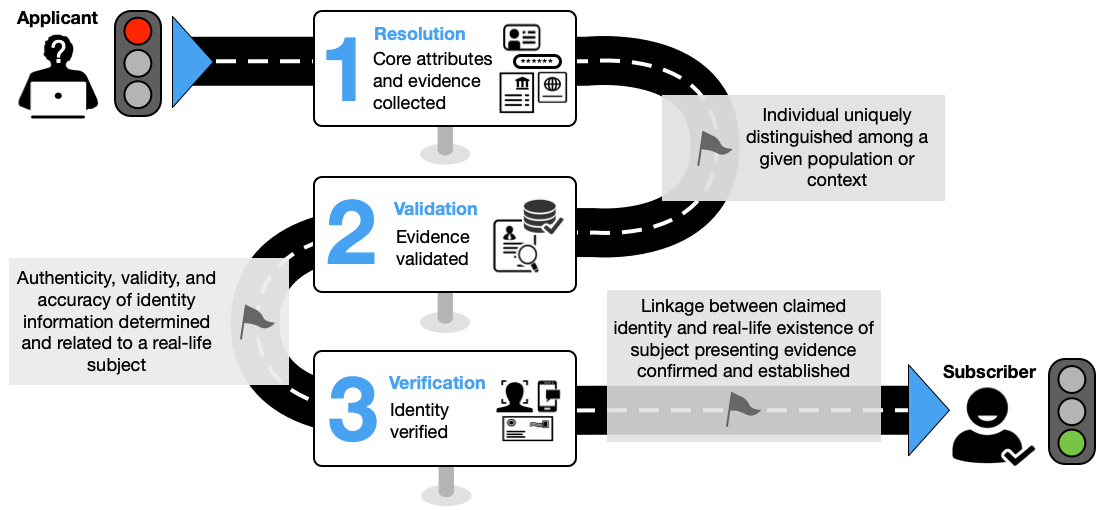
図1 本人確認プロセス。曲がりくねった道が、「Applicant」(申請者。ノートパソコンの前の疑問符の付いた人物で、赤が点灯した信号機の横)から「Subscriber」(加入者。チェックマークの付いた笑顔の人物で、緑が点灯した信号機の横)へ続く。道沿いに番号の付いた標識が3つある。1「Resolution: Core attributes and evidence collected」(識別:中核属性と証拠を収集)で、身分証と書類のアイコンがある。2「Validation: Evidence validated」(検証:証拠を検証)で、書類、データベース、虫眼鏡のアイコンがある。3「Verification: Identity verified」(照合:本人を照合)で、顔のスキャン、電話、身分証のアイコンがある。段階の間の道には旗があり、注記が付いている。識別の後は「Individual uniquely distinguished among a given population or context」(所与の集団または文脈の中で個人が一意に区別される)、検証の後は「Authenticity, validity, and accuracy of identity information determined and related to a real-life subject」(本人情報の真正性、有効性、正確性が判断され、実世界の主体に関連付けられる)、照合の後は「Linkage between claimed identity and real-life existence of subject presenting evidence confirmed and established」(主張された身元と、証拠を提示する主体の実世界での存在との結び付きが確認され、確立される)である。
The following steps present a common workflow example of remote unattended identity proofing and are not intended to represent a normative processing workflow model.
以下の手順は、リモートで担当者が立ち会わない本人確認の一般的なワークフロー例を示すものであり、規範的な処理ワークフローモデルを表すものではありません。
1.Resolution
1.識別
•The CSP collects one or two pieces of identity evidence of appropriate strength.
•CSPは、適切な強度の本人確認証拠を1点または2点収集します。
•The CSP collects any additional core attributes, as needed, from the applicant to supplement those contained in the presented identity evidence.
•CSPは、提示された本人確認証拠に含まれる属性を補うため、必要に応じて申請者から追加の中核属性を収集します。
2.Validation
2.検証
•The CSP confirms that the presented evidence is authentic, accurate, and valid.
•CSPは、提示された証拠が真正で、正確かつ有効であることを確認します。
•The CSP validates the attributes obtained in step 1 by checking them against authoritative or credible validation sources, as described in Sec. 2.4.2.4.
•CSPは、第2.4.2.4節で説明する権威ある検証元または信頼できる検証元と照合し、第1段階で取得した属性を検証します。
3.Verification
3.照合
•The CSP employs an approved identity verification process to confirm that the applicant is the genuine owner of the presented identity evidence.
•CSPは、承認された本人照合プロセスを用いて、提示された本人確認証拠の正当な所有者が申請者であることを確認します。
4.Enrollment Upon the successful completion of the three identity proofing steps, a notification of proofing is sent to a validated address, and the applicant can be enrolled into a subscriber account with the CSP, as described in Sec. 5. A subscriber account includes at least one validated address (e.g., phone number, mailing address) that can be used to communicate with the subscriber about their account. Additionally, one or more authenticators are bound to the proven identity in the subscriber account.
4.登録三つの本人確認ステップが正常に完了すると、本人確認の通知が検証済みの宛先に送信され、申請者は第5節に記載のとおり、CSPの加入者アカウントに登録できます。加入者アカウントには、加入者にアカウントについて連絡するために使用できる、少なくとも一つの検証済み宛先(電話番号、郵送先住所など)が含まれます。さらに、証明された身元に一つ以上の認証器が加入者アカウント内で紐付けられます。
Identity Proofing Roles
本人確認の役割
Different individuals can play different roles within the proofing process. To support the consistent implementation of these guidelines, the following identity proofing roles are defined:
本人確認プロセスでは、異なる個人がそれぞれ異なる役割を担うことがあります。これらのガイドラインを一貫して実施できるよう、次の本人確認の役割を定義します。
•Proofing agent: An agent of the CSP who is vetted and trained to attend on-site or remote identity proofing sessions and make limited, risk-based decisions (e.g., visually inspecting identity evidence and determining it has not been altered). See Sec. 3.13 for minimum training requirements for proofing agents.
•本人確認担当者:CSPの担当者で、審査を受け、対面またはリモートの本人確認セッションに立ち会い、限定的なリスクベースの判断(本人確認証拠を目視で検査し、改ざんされていないと判断するなど)を行うための訓練を受けています。本人確認担当者の最低限の訓練要件については第3.13節を参照されました。
•Trusted referee: An agent of the CSP, a third-party service, or a relying party (RP) who is vetted and trained to make risk-based decisions regarding an applicant’s identity proofing case when that applicant is unable to meet the expected requirements of a defined IAL proofing process. Requirements for trusted referees are contained in Sec. 3.15.1. In contrast to proofing agents, trusted referees receive additional training and resources to support exception handling scenarios, including when applicants do not possess the required identity evidence or the attributes on the evidence do not all match the claimed identity (e.g., due to a recent name or address change).
•信頼できる照会者:CSP、第三者サービス、または依拠当事者(RP)の担当者で、定義されたIALの本人確認プロセスで期待される要件を申請者が満たせない場合、その本人確認案件についてリスクベースの判断を行うため、審査を受け、訓練を受けています。信頼できる照会者の要件は第3.15.1節に記載されています。本人確認担当者とは異なり、信頼できる照会者は、申請者が必要な本人確認証拠を所持していない場合や、証拠上の属性が申告された身元とすべて一致しない場合(最近の氏名または住所の変更など)を含む例外対応を支援するため、追加の訓練とリソースを受けます。
•Applicant reference: A representative of the applicant who can vouch for the identity of the applicant, specific attributes related to the applicant, or conditions relative to the context of the individual (e.g., emergency status, homelessness). An applicant reference does not act on behalf of the applicant in the identity proofing process but can support claims of identity. Requirements for applicant references are contained in Sec. 3.15.3.
•申請者の照会先:申請者の身元、申請者に関する特定の属性、または個人の状況(緊急事態、住居喪失など)に関する申立てを保証できる、申請者の代表者です。申請者の照会先は本人確認プロセスで申請者の代理を務めることはありませんが、身元に関する申立てを裏付けることができます。申請者の照会先の要件は第3.15.3節に記載されています。
•Process assistant: An individual who provides support services (e.g., translation, transcription, or accessibility support) to assist the applicant in the identity proofing process but does not support decision-making or risk-based evaluation. Since the process assistant is not involved in decision-making there are no requirements in these guidelines for this role.
•プロセス支援者:本人確認プロセスで申請者を支援するため、翻訳、文字起こし、アクセシビリティ支援などのサポートを提供する個人です。ただし、意思決定やリスクベースの評価は支援しません。意思決定に関与しないため、本ガイドラインではこの役割に関する要件はありません。
CSPs SHALL identify which of the above roles are applicable to their identity service and SHALL provide training and support resources consistent with the requirements and expectations provided in Sec. 3.
CSPは、上記の役割のうち本人確認サービスに該当するものをSHALL特定し、第3節に示す要件および期待に沿った訓練と支援リソースをSHALL提供します。
Identity Proofing Types
本人確認の種類
For the purposes of this document, identity proofing types are defined by the combination of technologies, communication channels, and identity proofing roles employed by a CSP. Identity proofing types are characterized based on two factors: where the identity proofing takes place and whether the process is attended by an agent of the CSP.
本書において、本人確認の種類は、CSPが採用する技術、通信チャネル、および本人確認の役割の組み合わせによって定義されます。本人確認の種類は、本人確認が行われる場所と、CSPの担当者がプロセスに立ち会うかどうかという二つの要素に基づいて分類されます。
•Remote unattended identity proofing: Identity proofing conducted where the resolution, validation, and verification processes are completely automated, and interaction with a proofing agent or trusted referee is not required. The location and devices used in the proofing process are not controlled by the CSP.
•リモート無人本人確認:解決、検証、および確認のプロセスが完全に自動化され、本人確認担当者または信頼できる照会者とのやり取りが不要な本人確認です。プロセスで使用する場所およびデバイスはCSPの管理下にありません。
•Remote attended identity proofing: Identity proofing conducted where the applicant completes resolution, validation, and verification steps through a secure video session with a proofing agent or trusted referee. The location and devices used in the proofing process are not controlled by the CSP.
•リモート有人本人確認:申請者が本人確認担当者または信頼できる照会者とのセキュアなビデオセッションを通じて、解決、検証、および確認のステップを完了する本人確認です。プロセスで使用する場所およびデバイスはCSPの管理下にありません。
•On-site unattended identity proofing: Identity proofing conducted where an individual interacts with a controlled workstation or kiosk, but interaction with a proofing agent or trusted referee is not required. The process is fully automated but at a physical location and on devices controlled by the CSP.
•現地無人本人確認:本人確認担当者または信頼できる照会者とのやり取りは不要ですが、管理されたワークステーションまたはキオスクを個人が操作する本人確認です。プロセスは完全に自動化されていますが、CSPが管理する物理的な場所およびデバイスで実施されます。
•On-site attended identity proofing: Identity proofing conducted in a physical setting where the applicant completes the entire identity proofing process (i.e., resolution, validation, and verification) in the presence of a proofing agent or trusted referee. The proofing agent or trusted referee can be co-located with the user or interact with the user via a kiosk or device. The physical location and devices are controlled by the CSP.
•現地有人本人確認:申請者が本人確認担当者または信頼できる照会者の立ち会いのもと、本人確認プロセス全体(すなわち、解決、検証、および確認)を完了する物理的な場所での本人確認です。担当者または照会者は利用者と同じ場所にいる場合も、キオスクまたはデバイスを通じて利用者とやり取りする場合もあります。物理的な場所およびデバイスはCSPの管理下にあります。
The requirements at each assurance level are structured to allow CSPs to implement different combinations of identity proofing types to meet the requirements of different assurance levels, as appropriate. CSPs SHOULD offer the combination of identity proofing types that best addresses the needs of the populations served by their identity service and the risk posture of the RPs that use their service.
各保証レベルの要件は、CSPが異なる保証レベルの要件を満たすために、異なる本人確認の種類の組み合わせを適宜実施できるよう構成されています。CSPは、本人確認サービスの対象集団のニーズと、そのサービスを利用するRPのリスク態勢に最もよく対応する本人確認の種類の組み合わせをSHOULD提供します。
Core Attributes
中核属性
The identity proofing process involves the presentation and validation of the minimum attributes necessary to accomplish identity proofing, including what is needed to complete resolution, validation, and verification. The CSP determines and documents the set of attributes that it considers to be core attributes, as specified in Sec. 3.1. CSPs SHALL include a government identifier1 and SHOULD include the following in their set of core attributes for identity proofing at any IAL:
•First name: The applicant’s given name.
•名:申請者の名。
•Middle name or initial: The applicant’s middle name or initial, as applicable.
•ミドルネームまたは頭文字:該当する場合、申請者のミドルネームまたは頭文字。
•Last name: The applicant’s last name or family name, as appropriate.
•姓:適切な場合、申請者の姓または家族名。
•Date of birth: The date on which the applicant was born.
•生年月日:申請者が生まれた日付。
•Physical or digital address: A physical (i.e., mailing address) or digital (e.g., phone number or email) address at which the applicant can receive communications related to the proofing process.
•物理的住所またはデジタルアドレス:本人確認プロセスに関する連絡を申請者が受け取れる、物理的住所(郵送先住所など)またはデジタルアドレス(電話番号やメールアドレスなど)。
Additional attributes MAY be added to these as required by the CSP and RP. The CSP and RP SHALL document all core attributes in trust agreements and practice statements. Following a privacy risk assessment, a CSP MAY request additional attributes that are not required to complete identity proofing, but that may support other RP business processes. See Sec. 3.3 for details on privacy requirements for requesting additional attributes.
CSPおよびRPの必要に応じて、追加の属性をこれらにMAY加えることができます。CSPおよびRPは、すべての中核属性を信頼関係合意および実務声明にSHALL文書化します。プライバシーリスク評価の後、CSPは、本人確認の完了には不要であっても、RPの他の業務プロセスを支援する可能性のある追加属性をMAY要求できます。追加属性の要求に関するプライバシー要件の詳細は第3.3節を参照されました。
Identity Resolution
本人確認対象の特定
Identity resolution involves the CSP’s collection of the minimum amount of identity evidence and attribute information that is needed for identity proofing and to distinguish a unique identity in the population served. Identity resolution is the starting point in the overall identity proofing process, including the initial detection of potential fraud.
本人確認対象の特定では、本人確認に必要な、および対象集団の中で一意の身元を識別するために必要な、最小限の本人確認証拠および属性情報をCSPが収集します。本人確認対象の特定は、潜在的な不正の初期検知を含む、本人確認プロセス全体の出発点です。
Identity Evidence and Attributes
本人確認証拠と属性
Identity evidence is information or documentation that supports the real-world existence of the claimed identity. Identity evidence may be physical (e.g., a driver’s license) or digital (e.g., a mobile driver’s license or digital assertion).
本人確認証拠とは、申告された身元が現実世界に存在することを裏付ける情報または文書です。本人確認証拠には、物理的なもの(運転免許証など)とデジタルのもの(モバイル運転免許証やデジタルアサーションなど)があります。
Identity evidence collection supports the identity validation process and consists of two steps: 1) the presentation of identity evidence by the identity proofing applicant to the CSP and 2) the determination by the CSP that the presented evidence meets the applicable strength requirements.
本人確認証拠の収集は本人確認の検証プロセスを支援し、二つのステップで構成されます。1)本人確認申請者がCSPに本人確認証拠を提示すること、2)提示された証拠が該当する強度要件を満たすとCSPが判定することです。
Evidence Strength Requirements
証拠の強度要件
This section defines the requirements for identity evidence at each strength. The strength of a piece of identity evidence is determined by:
本節では、各強度における本人確認証拠の要件を定義します。本人確認証拠の強度は、次の事項によって決まります。
•The level of rigor associated with its issuance process
•発行プロセスに伴う厳格さのレベル
•The ability to be validated to a given level of confidence, including accuracy and authenticity checks
•正確性および真正性の検査を含め、所定の信頼度で検証できる能力
•The ability to support one or more of the identity verification methods presented in Sec. 2.5.1
•第2.5.1節に示す本人確認方法の一つ以上を裏付ける能力
Appendix A of this document provides a non-exhaustive list of possible evidence types grouped by strength.
本書の付録Aには、強度別に分類した証拠の種類の例が網羅的ではない形で示されています。
Fair Evidence Requirements
FAIR証拠の要件
To be considered FAIR, identity evidence SHALL meet all of the following requirements:
本人確認証拠がFAIRとみなされるには、次のすべての要件をSHALL満たします。
1.There is a reasonable expectation that the issuing source of the evidence confirmed the claimed identity by following formal procedures designed to provide assurance that the claimed identity is associated with the subject, such as evidence issued by financial institutions that have customer identity verification obligations under the Customer Identification Program (CIP) rule or procedures for establishing a mobile phone account with a mobile network operator (MNO).
1.証拠の発行元が、申告された身元と対象者との結び付きを保証するために設計された正式な手順に従って申告された身元を確認したと、合理的に期待できること。例えば、顧客識別プログラム(CIP)規則に基づく顧客の身元確認義務を負う金融機関が発行する証拠や、移動体通信事業者(MNO)で携帯電話アカウントを開設する手続きに基づいて発行される証拠が該当します。
2.The evidence has an issuance process that results in the delivery of the evidence to the person to whom it relates, such as delivery to a postal address, issuance in person, or through a protected remote provisioning process.
2.証拠には、その証拠に関係する本人に証拠が届けられる発行プロセスがあること。例えば、郵送先住所への配達、対面での発行、または保護されたリモートプロビジョニングプロセスを通じた発行が該当します。
3.The evidence contains the name of the claimed identity.
3.証拠に、申告された身元の氏名が含まれること。
4.The evidence contains at least one reference number, a facial image or other biometric characteristic, or sufficient attributes to uniquely identify the person to whom it relates.
4.証拠に、少なくとも一つの参照番号、顔画像もしくはその他の生体特性、または対象者を一意に識別するのに十分な属性が含まれること。
5.The evidence contains physical (e.g., security printing, optically variable features, holograms) or digital (e.g., digitally signed assertions, addressable SIM or ESIM) security features that make it difficult to reproduce.
5.証拠に、複製を困難にする物理的セキュリティ機能(セキュリティ印刷、光学可変機能、ホログラムなど)またはデジタルセキュリティ機能(デジタル署名付きアサーション、アドレス可能なSIMまたはeSIMなど)が含まれること。
6.Core attributes on the evidence can be validated against information held by an authoritative or credible source, as described in Sec. 2.4.2.4.
6.証拠上の中核属性を、権威ある情報源または信頼できる情報源が保有する情報と照合して検証できること(第2.4.2.4節を参照してください)。
7.The evidence can be validated through an approved method, as provided in Sec. 2.4.2.2.
7.証拠を、承認済みの方法(第2.4.2.2節に記載)で検証できること。
8.The evidence can support the identity verification process, as described in Sec. 2.5.1.
8.証拠が、本人確認プロセス(第2.5.1節に記載)を支援できること。
Strong Evidence Requirements
STRONG証拠の要件
In order to be considered STRONG, identity evidence SHALL meet all of the following requirements:
本人確認証拠がSTRONGとみなされるには、次のすべての要件をSHALL満たします。
1.There is a reasonable expectation that the issuing source of the evidence confirmed the claimed identity by following written procedures (e.g., identity proofing at IAL2 or above) designed to provide assurance that the claimed identity is associated with the subject. Additionally, these procedures are subject to recurring oversight by regulatory or publicly accountable institutions, such as states, the Federal Government, and some regulated industries.
1.証拠の発行元が、申告された身元と対象者との結び付きを保証するために設計された文書化済みの手順(IAL2以上での本人確認など)に従って、申告された身元を確認したと合理的に期待できること。さらに、これらの手順は、州、連邦政府、一部の規制対象業界など、規制機関または公的説明責任を負う機関による定期的な監督を受けます。
2.The evidence has an issuance process that results in the delivery of the evidence to the person to whom it relates, such as delivery to a postal address, issuance in person, or through a protected remote provisioning process.
2.証拠には、その証拠に関係する本人に証拠が届けられる発行プロセスがあること。例えば、郵送先住所への配達、対面での発行、または保護されたリモートプロビジョニングプロセスを通じた発行が該当します。
3.The evidence contains the name of the claimed identity.
3.証拠に、申告された身元の氏名が含まれること。
4.The evidence contains a reference number or other attributes that uniquely identify the person to whom it relates.
4.証拠に、対象者を一意に識別する参照番号またはその他の属性が含まれること。
5.The evidence contains a facial image or other biometric characteristic of the person to whom it relates.
5.証拠に、その証拠に関係する本人の顔画像またはその他の生体特性が含まれること。
6.The evidence contains physical (e.g., security printing, optically variable features, holograms) or digital security (e.g., digitally signed assertions, addressable SIM or ESIM) features that make it difficult to reproduce.
6.証拠に、複製を困難にする物理的セキュリティ機能(セキュリティ印刷、光学可変機能、ホログラムなど)またはデジタルセキュリティ機能(デジタル署名付きアサーション、アドレス可能なSIMまたはeSIMなど)が含まれること。
7.Core attributes on the evidence can be validated against information held by authoritative or credible sources, as described in Sec. 2.4.2.4.
7.証拠上の中核属性を、権威ある情報源または信頼できる情報源が保有する情報と照合して検証できること(第2.4.2.4節を参照してください)。
8.The evidence can be validated through an approved method, as provided in Sec. 2.4.2.2.
8.証拠を、承認済みの方法(第2.4.2.2節に記載)で検証できること。
9.The evidence can support the identity verification process, as described in Sec. 2.5.1.
9.証拠が、本人確認プロセス(第2.5.1節に記載)を支援できること。
Superior Evidence Requirements
SUPERIOR証拠の要件
In order to be considered SUPERIOR, identity evidence SHALL meet all of the following requirements:
本人確認証拠がSUPERIORとみなされるには、次のすべての要件をSHALL満たします。
1.The issuing source of the evidence confirmed the claimed identity by following written procedures (e.g., identity proofing at IAL2 or above) designed to enable it to have high confidence that the claimed identity is associated with the subject. Additionally, these procedures are subject to recurring oversight by regulatory or publicly accountable institutions, such as states, the Federal Government, and some regulated industries.
1.証拠の発行元は、申告された身元が対象者と結び付いていることについて高い確信を持てるよう設計された文書化済みの手順(IAL2以上での本人確認など)に従って、申告された身元を確認しています。さらに、これらの手順は、州、連邦政府、一部の規制対象業界など、規制機関または公的説明責任を負う機関による定期的な監督を受けます。
2.The identity evidence contains attributes and data objects that are cryptographically protected and can be validated using approved cryptography through verification of a digital signature applied by the issuing source.
2.本人確認証拠には、暗号学的に保護された属性およびデータオブジェクトが含まれ、それらは発行元が付与したデジタル署名を検証することで、承認済みの暗号技術を用いて検証できます。
3.The issuing source had the subject participate in an attended enrollment and identity proofing process that confirmed their physical existence.
3.発行元は、対象者の物理的な実在を確認する有人登録および本人確認プロセスに対象者を参加させました。
4.The evidence has an issuance process that results in the delivery of the evidence to the person to whom it relates, such as delivery to a postal address, issuance in person, or through a protected remote provisioning process.
4.証拠には、その証拠に関係する本人に証拠が届けられる発行プロセスがあること。例えば、郵送先住所への配達、対面での発行、または保護されたリモートプロビジョニングプロセスを通じた発行が該当します。
5.The evidence contains the name of the claimed identity.
5.証拠に、申告された身元の氏名が含まれること。
6.The evidence contains at least one reference number that uniquely identifies the person to whom it relates.
6.証拠に、その証拠に関係する本人を一意に識別する参照番号が少なくとも一つ含まれること。
7.The evidence contains a facial image or other biometric characteristic of the person to whom it relates.
7.証拠に、その証拠に関係する本人の顔画像またはその他の生体特性が含まれること。
8.The evidence contains physical (e.g., security printing, optically variable features, holograms) or digital security (e.g., digitally signed assertions, addressable SIM or ESIM) features that make it difficult to reproduce.
8.証拠に、複製を困難にする物理的セキュリティ機能(セキュリティ印刷、光学可変機能、ホログラムなど)またはデジタルセキュリティ機能(デジタル署名付きアサーション、アドレス可能なSIMまたはeSIMなど)が含まれること。
9.The evidence can be validated through an approved method, as provided in Sec. 2.4.2.2.
9.証拠を、承認済みの方法(第2.4.2.2節に記載)で検証できること。
10.The evidence can support the identity verification process, as described in Sec. 2.5.1.
10.証拠が、本人確認プロセス(第2.5.1節に記載)を支援できること。
Identity Evidence and Attribute Validation
本人確認証拠および属性の検証
The goal of identity evidence validation is to determine that the collected identity evidence is genuine and valid. The goal of attribute validation is to confirm the accuracy of all the core attributes.
本人確認証拠の検証の目的は、収集した本人確認証拠が真正かつ有効であることを判定することです。属性検証の目的は、すべての中核属性の正確性を確認することです。
This document uses the term “valid” to recognize that evidence can remain a useful means to prove identity, even if it is expired or was issued outside of a determined time frame. CSPs define their policy for addressing expired evidence as part of the CSP practice statement described in Sec. 3.1, and RPs determine whether this is acceptable for accessing their online services.
本書では、証拠が期限切れであったり、所定の期間外に発行されたりしていても、本人確認を証明する有用な手段であり続ける場合があることを踏まえ、「有効」という用語を使用します。CSPは、第3.1節に記載のCSP実務声明の一部として、期限切れの証拠を扱う方針を定めます。RPは、オンラインサービスへのアクセスにそれが許容されるかを判断します。
Identity evidence validation involves examining the presented evidence to confirm that it is authentic (i.e., not forged or altered), accurate (i.e., the information on the evidence is correct), and valid (i.e., unexpired or within the CSP’s defined timeframe for issuance or expiration). Attribute validation involves confirming the accuracy of the core attributes, whether obtained from presented evidence or self-asserted. The following subsections provide acceptable methods for evidence and attribute validation.
本人確認証拠の検証では、提示された証拠を調べ、真正であること(すなわち、偽造または改ざんされていないこと)、正確であること(すなわち、証拠上の情報が正しいこと)、および有効であること(すなわち、期限切れでないこと、またはCSPが定めた発行もしくは有効期限の期間内であること)を確認します。属性検証では、提示された証拠から取得したか自己申告されたかにかかわらず、中核属性の正確性を確認します。以下の各節では、証拠と属性の検証に使用できる方法を示します。
Evidence Validation
証拠の検証
The CSP SHALL validate the authenticity, accuracy, and validity of presented evidence by confirming that:
CSPは、提示された証拠について、次の事項を確認して真正性、正確性、および有効性をSHALL検証します。
•The evidence is in the correct format and includes complete information for the identity evidence type
•証拠が正しい形式であり、その種類に必要な情報がすべて含まれています。
•The evidence does not show signs of being counterfeit or tampered with
•証拠に偽造または改ざんの兆候がありません。
•The evidence contains physical or digital security features
•証拠に物理的またはデジタルのセキュリティ機能が含まれています。
•The core attributes and data fields necessary to determine authenticity on the evidence are accurate
•証拠の真正性を判定するために必要な中核属性およびデータフィールドが正確です。
Evidence Validation Methods
証拠の検証方法
Acceptable methods for validating presented evidence are:
提示された証拠を検証するために、次の方法が許容されます。
•Visual and tactile inspection by trained personnel for on-site identity proofing
•現地での本人確認では、訓練を受けた担当者が目視および触覚による検査を行います。
•Visual inspection by trained personnel for remote identity proofing
•リモート本人確認では、訓練を受けた担当者が目視検査を行います。
•Automated document validation processes using appropriate technologies
•適切な技術を用いて文書を自動検証します。
•Cryptographic verification of the source and integrity of digital evidence or attribute data objects
•デジタル証拠または属性データオブジェクトの発行元および完全性を暗号学的に検証します。
For some digital evidence (e.g., MNO/phone accounts), there is not a physical piece of evidence that can be validated visually or physically. Authenticity is confirmed by validating the identity attributes associated with that account and phone number with an issuing or credible source, such as by validating a digitally signed assertion from the issuer or querying an attribute validation service with access to that account information.
デジタル証拠の一部(MNO/電話アカウントなど)には、目視または物理的に検証できる物理的証拠がありません。このような証拠の真正性は、発行元または信頼できる情報源を用いて、そのアカウントおよび電話番号に関連付けられた本人確認属性を検証することで確認します。例えば、発行元によるデジタル署名付きアサーションを検証する方法や、そのアカウント情報にアクセスできる属性検証サービスに照会する方法があります。
Attribute Validation
属性検証
The CSP SHALL validate all core attributes (Sec. 2.2), whether obtained from identity evidence or self-asserted by the applicant, with an authoritative or credible source (Sec. 2.4.2.4).
Validation Sources
検証情報源
The CSP SHALL use authoritative or credible sources that meet the following criteria.
CSPは、次の基準を満たす権威ある情報源または信頼できる情報源をSHALL使用します。
An authoritative source is the issuing source of identity evidence or attributes or has direct access to the information maintained by issuing sources. Examples of issuing sources include state departments of motor vehicles for driver’s license data and the Social Security Administration for Social Security cards and numbers. An example of an authoritative source that provides or enables direct access to issuing sources is the American Association of Motor Vehicle Administrators’ Driver’s License Data Verification (DLDV) Service.
権威ある情報源とは、本人確認証拠または属性の発行元であるか、発行元が保持する情報に直接アクセスできる情報源です。発行元の例として、運転免許証データを扱う州の自動車管理局や、社会保障カードおよび番号を扱う社会保障庁があります。発行元への直接アクセスを提供または可能にする権威ある情報源の例として、米国自動車管理者協会の運転免許証データ検証(DLDV)サービスがあります。
A credible source has access to attribute information that can be traced to an authoritative source or maintains identity attribute information obtained from multiple sources that is correlated for accuracy, consistency, and currency. Credible sources are subject to regulatory oversight (e.g., the Fair Credit Reporting Act).
信頼できる情報源は、権威ある情報源まで追跡できる属性情報にアクセスできるか、複数の情報源から取得し、正確性、一貫性、および最新性について相関付けた本人確認属性情報を保持しています。信頼できる情報源は、規制上の監督(公正信用報告法など)の対象です。
Identity Verification
本人確認
The goal of identity verification is to establish the linkage between the claimed validated identity and the real-life applicant engaged in the identity proofing process to a specified level of confidence. In other words, verification provides assurance that the applicant presenting the evidence is the rightful owner of that evidence.
本人確認の目的は、申告され検証済みの身元と、本人確認プロセスに参加している現実の申請者との結び付きを、所定の信頼度で確立することです。言い換えると、証拠を提示している申請者がその証拠の正当な所有者であることを本人確認によって保証します。
Identity Verification Methods
本人確認の方法
The CSP SHALL verify the linkage between the claimed identity to the applicant engaged in the identity proofing process through one or more of the following methods.
CSPは、次の方法の一つ以上を用いて、申告された身元と本人確認プロセスに参加している申請者との結び付きをSHALL確認します。
•Confirmation code verification: The individual is able to demonstrate control of a piece of identity evidence through the return of a confirmation code, consistent with the requirements specified in Sec. 3.8.
•確認コードによる検証:個人は、所定の要件に従って確認コードを返信することで、本人確認証拠を管理していることを示せます(第3.8節を参照してください)。
•Authentication and federation protocols: The individual is able to demonstrate control of a digital account (e.g., online bank account) or signed digital assertion through the use of authentication or federation protocols. This can be done in person, through presentation of the credential to a device or reader, or during a remote identity proofing session.
•認証およびフェデレーションのプロトコル:個人は、認証またはフェデレーションのプロトコルを使用して、デジタルアカウント(オンライン銀行口座など)または署名付きデジタルアサーションを管理していることを示せます。これは、対面で、資格情報をデバイスまたはリーダーに提示して、あるいはリモート本人確認セッション中に行えます。
•Transaction verification: An individual is able to demonstrate control of a piece of evidence by returning a value based on a microtransaction made between the CSP and the issuing source of the evidence (e.g., a micro-deposit to verify ownership of a financial account).
•取引検証:個人は、CSPと証拠の発行元との間で行われた少額取引に基づく値を返すことで、証拠を管理していることを示せます(金融口座の所有者を検証するための少額入金など)。
•Visual facial image comparison — on-site attended: The proofing agent and applicant interact directly during the identity proofing process. The proofing agent performs a visual comparison of the facial image presented on identity evidence to the face of the applicant engaged in the identity proofing event.
•顔画像の目視照合—現地有人:本人確認プロセス中に本人確認担当者と申請者が直接やり取りします。本人確認担当者は、本人確認証拠に示された顔画像と、本人確認イベントに参加している申請者の顔を目視で照合します。
•Visual facial image comparison — remote attended or remote unattended: The proofing agent performs a visual comparison of the facial image presented on identity evidence or stored by the issuing source to the facial image of the applicant engaged in the identity proofing event. The proofing agent may interact directly with the applicant during some or all of the identity proofing process or may conduct the comparison at a later time using a captured video or photograph and the uploaded copy of the evidence.
•顔画像の目視照合—リモート有人またはリモート無人:本人確認担当者は、本人確認証拠に示された、または発行元が保管する顔画像と、本人確認イベントに参加している申請者の顔画像を目視で照合します。担当者は本人確認プロセスの一部または全体で申請者と直接やり取りすることも、撮影した動画または写真とアップロードされた証拠のコピーを使い、後で照合することもできます。
•Automated biometric comparison: Automated biometric comparison (e.g., facial recognition or other fully automated algorithm-driven biometric comparison) can be performed for onsite or remote identity proofing events. The facial image or other biometric characteristic (e.g., fingerprints, palm prints, iris and retina patterns, voiceprints, vein patterns) on the identity evidence or stored in authoritative records is compared to the equivalent biometric sample collected from the applicant during the identity proofing event.
•自動生体照合:現地またはリモートの本人確認イベントでは、自動生体照合(顔認識など、アルゴリズムによる完全自動の生体照合)を実施できます。本人確認証拠上または権威ある記録に保存された顔画像その他の生体特性(指紋、掌紋、虹彩・網膜パターン、声紋、静脈パターンなど)を、本人確認イベント中に申請者から収集した対応する生体サンプルと照合します。
Knowledge-based verification (KBV) or knowledge-based authentication SHALL NOT be used for identity verification.
知識ベース検証(KBV)または知識ベース認証を本人確認にSHALL NOT使用します。
Identity Proofing Requirements
本人確認の要件
This section is normative.
本節は規範的です。
This section provides requirements for CSPs that operate identity proofing and enrollment services, including requirements for identity proofing at each of the IALs. This section also includes additional requirements for federal agencies, regardless of whether they operate their own identity service or use an external CSP.
本節では、IALごとの本人確認要件を含め、本人確認および登録サービスを運営するCSPの要件を示します。また、連邦機関が独自の本人確認サービスを運営するか外部CSPを利用するかにかかわらず、連邦機関に適用される追加要件も示します。
Sections 4.1, 4.2, and 4.3 provide the requirements and guidelines for identity proofing at a specific IAL. Section 4.4 includes a summarized list of these requirements by IAL in Table 1.
Identity Service Documentation and Records
本人確認サービスの文書化および記録
The CSP SHALL conduct its operations according to documented procedures or a practice statement that details all identity proofing processes as they are implemented to achieve the defined IAL. These documented procedures SHALL include, at a minimum:
CSPは、定義されたIALを達成するために実施するすべての本人確認プロセスを詳述した文書化済みの手順または実務声明に従って、業務をSHALL行います。この文書化済み手順には、少なくとも次の事項をSHALL含めます。
1.A complete service description, including the particular steps that the CSP follows to identity-proof applicants at each offered assurance level
1.完全なサービス記述。CSPが提供する各保証レベルで申請者を本人確認するために従う具体的なステップを含めます。
2.The CSP’s policy for providing notice to applicants about the types of identity proofing processes available, the evidence and attribute collection requirements for the IALs offered by the CSP, the purpose for collecting personal information (see Sec. 3.3.2), and the purposes for collecting, using, and retaining biometrics (see Sec. 3.1.11)
3.The CSP’s policy for ensuring that the identity proofing process concludes in a timely manner once the applicant has met all of the requirements
3.申請者がすべての要件を満たした後、本人確認プロセスを適時に完了させるためのCSPの方針。
4.The types of evidence that the CSP accepts and the justification for how the evidence fulfills the strength requirements of the level at which it will be accepted by the CSP
4.CSPが受け入れる証拠の種類、およびCSPが受け入れる保証レベルの強度要件をその証拠が満たす理由。
5.The CSP’s policy and process for validating and verifying identity evidence, including training and qualification requirements for personnel who serve in identity proofing roles, as provided in Sec. 2.1.2
5.本人確認証拠を検証および確認するためのCSPの方針とプロセス。本人確認の役割を担う要員の訓練および資格要件を含みます(第2.1.2節を参照してください)。
6.The specific technologies that the CSP employs for evidence validation and verification
6.証拠の検証および確認にCSPが用いる具体的な技術。
7.The CSP’s policy and processes for supporting applicants who lack sufficient identity evidence for the required IAL (Sec. 3.15) and for addressing identity proofing exceptions and errors
7.必要なIALに十分な本人確認証拠を持たない申請者を支援するためのCSPの方針およびプロセス(第3.15節を参照)、ならびに本人確認に関する例外および誤りに対処するための方針およびプロセス。
8.The attributes that the CSP considers to be core attributes (Sec. 2.2) and the authoritative and credible sources it uses for validating those attributes (Sec. 2.4.2.4)
9.The CSP’s policy for managing and communicating service changes to RPs, such as changes in data sources, integrated vendors, or biometric algorithms
9.データソース、統合ベンダー、生体認証アルゴリズムの変更など、サービスの変更を管理し、RPに伝達するCSPの方針。
10.The CSP’s approach to fraud management (see Sec. 3.2), including its policy and process for identifying and remediating suspected or confirmed fraudulent accounts and communicating such information to RPs and affected individuals
10.CSPの不正管理の取り組み(第3.2節を参照してください)。疑わしい、または確認済みの不正アカウントを特定して是正し、その情報をRPおよび影響を受ける個人に伝達する方針とプロセスを含みます。
11.The CSP’s policy for any conditions that would require reverification of the user (e.g., account recovery, account abandonment, regulatory “recertification” requirements)
11.ユーザーの再確認が必要となる条件(アカウント回復、アカウントの放棄、規制上の「再認証」要件など)に関するCSPの方針。
12.The CSP’s policy for conducting privacy risk assessments, including the timing of its periodic reviews and specific conditions that will trigger an updated privacy risk assessment (see Sec. 3.3.1)
12.プライバシーリスク評価を実施するCSPの方針。定期的なレビューの時期、および更新版のプライバシーリスク評価を開始する具体的な条件を含みます(第3.3.1節を参照してください)。
13.The CSP’s policy for assessing customer experience, including the testing methods employed, timing of its periodic reviews, and any specific conditions that will trigger an out-of-cycle review (see Sec. 3.4)
13.顧客体験を評価するCSPの方針。使用するテスト方法、定期レビューの時期、および通常の周期外のレビューを開始する具体的な条件を含みます(第3.4節を参照してください)。
14.The CSP’s policy for the retention, protection, and deletion of all personal, sensitive, and biometric data, including the treatment of all such data if the CSP ceases operation or merges or transfers operations to another CSP
14.すべての個人データ、機微データ、および生体データの保持、保護、削除に関するCSPの方針。CSPが業務を停止する場合や、別のCSPに業務を統合または移管する場合の当該データの取扱いを含みます。
15.The CSP’s policy for reporting and updating performance metrics, as described in Sec. 3.5.2 of SP 800-63
15.SP 800-63の第3.5.2節に記載のとおり、パフォーマンス指標を報告し、更新するCSPの方針。
16.The CSP’s policy for accessing or removing a subscriber’s account in the event of their death or incapacitation (see Sec. 5)
16.加入者が死亡または意思能力を失った場合に、その加入者のアカウントにアクセスする、またはアカウントを削除するためのCSPの方針(第5節を参照してください)。
CSPs SHALL make their documented procedures or practice statements available to RPs that use their identity service. CSPs SHOULD make a summarized version of their documented procedures or practice statements publicly available.
CSPは、本人確認サービスを利用するRPが、文書化済みの手順または実務声明を利用できるようにSHALLします。CSPは、文書化済みの手順または実務声明の要約版を一般公開することをSHOULDします。
SP 800-63C describes the use of trust agreements to define requirements between an identity provider (IdP), CSP, and RP in a federated relationship. CSP practice statements MAY be included directly in these agreements.
SP 800-63Cでは、フェデレーション関係におけるアイデンティティプロバイダー(IdP)、CSP、およびRP間の要件を定めるための信頼関係合意の使用について説明しています。CSPの実務声明をこれらの合意に直接含めることがMAYあります。
Fraud Management
不正管理
A critical aspect of the identity proofing process is to mitigate fraudulent attempts to gain access to benefits, services, data, or assets that are protected by identity management systems. Resolution, validation, and verification processes are designed to mitigate many types of attacks. However, with the constantly changing threat environment, layering additional checks and controls can provide increased confidence in proofed identities and additional protections against advanced and emerging types of attacks. The ability to identify, detect, and resolve instances of potential fraud is a critical functionality for CSPs and RPs.
本人確認プロセスの重要な側面は、ID管理システムによって保護された給付、サービス、データ、または資産へのアクセスを得ようとする不正な試みを軽減することです。解決、検証、および確認のプロセスは、多くの種類の攻撃を軽減するよう設計されています。しかし、脅威環境が絶えず変化する中、追加の確認および制御を重ねることで、本人確認済みの身元に対する信頼度を高め、高度化または新たに出現する攻撃からさらに保護できます。潜在的な不正事例を特定、検知し、解決する能力は、CSPおよびRPにとって重要な機能です。
CSP Fraud Management
CSPの不正管理
1.CSPs SHALL establish and maintain a fraud management program that provides fraud identification, detection, investigation, reporting, and resolution capabilities. The specific capabilities and details of this program SHALL be documented within their CSP practice statement.
1.CSPは、不正の特定、検知、調査、報告、および解決の機能を備えた不正管理プログラムを確立し、維持するSHALLものとします。このプログラムの具体的な機能および詳細をCSP実務声明にSHALL記載します。
2.CSPs SHALL conduct a privacy risk assessment of all fraud checks and fraud mitigation technologies prior to implementation.
2.CSPは、すべての不正確認および不正軽減技術について、導入前にプライバシーリスク評価をSHALL実施します。
3.The CSP SHALL establish a self-reporting mechanism and investigation capability for subjects who believe they have been the victim of fraud or an attempt to compromise their involvement in the identity proofing processes.
3.CSPは、本人確認プロセスへの参加について不正の被害、または参加を侵害する試みの被害に遭ったと考える対象者のために、自己申告の仕組みと調査機能をSHALL確立します。
4.CSPs SHALL analyze all remote proofing communication channels to look for high-risk indicators (e.g., blocklisted proxies and IP addresses).
4.CSPは、リモート本人確認のすべての通信チャネルを分析し、リスクの高い兆候(ブロックリストに登録されたプロキシやIPアドレスなど)を探すSHALLものとします。
5.The CSP SHALL take measures to prevent unsuccessful applicants from inferring the accuracy of any self-asserted information with that confirmed by authoritative or credible sources.1
5.CSPは、本人確認に失敗した申請者が、自己申告情報のうち権威ある情報源または信頼できる情報源によって確認された情報の正確さを推測できないようにする措置をSHALL講じます。1
6.CSPs SHALL monitor the performance of their fraud checks and fraud mitigation technologies to ensure continued effectiveness in mitigating fraud risks.
6.CSPは、不正リスクの軽減において効果が継続していることを確保するため、不正確認および不正軽減技術の性能をSHALL監視します。
7.CSPs SHALL establish a technical or process-based mechanism to communicate suspected and confirmed fraudulent events to RPs.
7.CSPは、疑わしい不正事象および確認済みの不正事象をRPに伝達する技術的またはプロセスベースの仕組みをSHALL確立します。
8.CSPs SHALL implement a death records check for all identity proofing processes by confirming with a credible, authoritative, or issuing source that the applicant is not deceased. Such checks can aid in preventing synthetic identity fraud, the use of stolen identity information, and exploitation by a close associate or relative.
8.CSPは、申請者が死亡していないことを信頼できる情報源、権威ある情報源、または発行元に確認することにより、すべての本人確認プロセスで死亡記録の照合をSHALL実施します。この照合は、合成身元詐欺、盗まれた本人確認情報の使用、ならびに親しい関係者や親族による悪用の防止に役立ちます。
9.CSPs SHOULD implement the following fraud checks for their identity proofing processes based on their available identity proofing types, selected technologies, evidence, and user base:
9.CSPは、利用可能な本人確認の種類、選択した技術、証拠、およびユーザーベースに基づき、本人確認プロセスに次の不正確認を実装することをSHOULDします。
•SIM swap detection: Confirm that the phone number used in the identity proofing process has not been recently ported to a new user or device. Such checks can provide an indication that a phone or device was compromised by a targeted attack.
•SIMスワップ検知:本人確認プロセスで使用する電話番号が、最近、新しい利用者またはデバイスに移転されていないことを確認します。この確認は、標的型攻撃によって電話またはデバイスが侵害された可能性を示す手掛かりになります。
•Device or account tenure check: Evaluate the length of time a phone service subscription or other account (e.g., email account) has existed without substantial modifications or changes. Such checks can provide additional confidence in the reliability of a device or piece of evidence used in the identity proofing process.
•デバイスまたはアカウントの利用期間の確認:電話サービスの契約またはその他のアカウント(メールアカウントなど)が、大幅な変更を伴わずに存在している期間を評価します。この確認により、本人確認プロセスで使用するデバイスまたは証拠の信頼性に対する確信を高められます。
•Mailing address check: Determine whether the mailing address is a known virtual Post Office (PO) Box or has other high-risk characteristics.
•郵送先住所の確認:郵送先住所が既知の仮想郵便私書箱(PO Box)か、その他のリスクの高い特徴を持つかを判定します。
•Device fingerprinting: Incorporate device fingerprinting checks to protect against scaled and automated attacks and enrollment duplication. Device fingerprinting is the process of collecting and analyzing the hardware and software characteristics of a device in order to create a unique identifier (i.e., fingerprint) for the device.
•デバイスフィンガープリンティング:大規模な自動攻撃および登録の重複を防ぐため、デバイスフィンガープリンティングによる確認を取り入れます。デバイスフィンガープリンティングとは、デバイスのハードウェアおよびソフトウェアの特性を収集、分析して、デバイスを一意に識別する識別子(すなわち、フィンガープリント)を作成するプロセスです。
•Transaction analytics: Evaluate anticipated transaction characteristics (e.g., IP addresses, geolocations, transaction velocities) to identify anomalous behaviors or activities that can indicate a higher risk or a potentially fraudulent event. Fraud velocity checks monitor the frequency and pattern of transactions over a specific period of time to identify unusual activity associated with transaction data. Such checks can protect against scaled and automated attacks, as well as indicate whether specific attack patterns are being executed on identity systems.
•取引分析:想定される取引の特性(IPアドレス、位置情報、取引頻度など)を評価し、より高いリスクまたは不正の可能性を示す異常な行動や活動を特定します。不正の頻度確認では、一定期間内の取引の頻度とパターンを監視し、取引データに関連する異常な活動を特定します。こうした確認は、大規模な自動攻撃を防ぐとともに、特定の攻撃パターンがIDシステムに対して実行されているかどうかを示すことができます。
•Fraud indicator check: Evaluate records (e.g., reported, confirmed, or historical fraud events) to determine whether there is an elevated risk related to a specific applicant, applicant’s data, or device. Such checks can indicate identity theft or compromise. Where such information is collected, aggregated, or exchanged across commercial platforms and made available for use by RPs and other CSPs, users SHALL be made aware of any privacy implications based on a privacy risk assessment. This also applies to all websites that report user activity to federal RPs.
•不正兆候の確認:記録(報告済み、確認済み、または過去の不正事象など)を評価し、特定の申請者、申請者のデータ、またはデバイスに関連するリスクが高まっているかを判断します。この確認は、身元の盗用または侵害を示すことがあります。こうした情報を商用プラットフォーム間で収集、集約、または交換し、RPや他のCSPが利用できるようにする場合、プライバシーリスク評価に基づくプライバシー上の影響をユーザーにSHALL知らせます。これは、ユーザー活動を連邦RPに報告するすべてのウェブサイトにも適用されます。
10.CSPs SHOULD periodically employ independent testing (e.g., red teaming exercises) to validate the effectiveness of their fraud mitigation measures.
10.CSPは、不正軽減措置の有効性を検証するため、レッドチーム演習などの独立したテストを定期的に実施することをSHOULDします。
11.CSPs SHOULD consider the recency of fraud-related data when factoring such data into fraud prevention capabilities and decisions.
11.CSPは、不正防止機能および判断に不正関連データを反映する際、そのデータがどれだけ最近のものかを考慮することをSHOULDします。
12.For attended proofing processes, CSPs SHALL train proofing agents to detect indicators of fraud and SHALL provide proofing agents and trusted referees with tools to flag suspected fraudulent events for further treatment and investigation.
12.有人本人確認プロセスでは、CSPは本人確認担当者を訓練して不正の兆候を検知させSHALL、疑わしい不正事象に印を付けて、その後の処理および調査に回すためのツールを本人確認担当者および信頼できる照会者にSHALL提供します。
13.Collusion is possible whenever CSP representatives are directly involved in proofing processes or decisions. CSPs SHALL implement insider threat controls to detect and prevent collusion involving CSP representatives that are directly involved with or can intervene in proofing processes or decisions.
13.CSPの代表者が本人確認プロセスまたは判断に直接関与する場合、共謀が起こる可能性があります。CSPは、本人確認プロセスまたは判断に直接関与する、または介入できるCSP代表者が関わる共謀を検知し、防止する内部脅威対策をSHALL実施します。
14.CSPs SHOULD communicate fraud events in real time to RPs through methods such as shared signaling, as described in Sec. 4.8 of [SP800-63C].
14.CSPは、共有シグナリングなどの方法を通じて、不正事象をRPにリアルタイムで伝達することをSHOULDします([SP800-63C]の第4.8節を参照してください)。
15.CSPs MAY employ KBV as part of its fraud management program.
15.CSPは、不正管理プログラムの一環としてKBVをMAY使用できます。
16.CSPs MAY implement fraud mitigation measures as compensating controls. When this is done, these SHALL be documented as deviations from the normative guidance of these guidelines and SHALL be conveyed to all RPs through a Digital Identity Acceptance Statement (DIAS) prior to integration. See Sec. 3.4.4 of [SP800-63] for more information about the DIAS.
16.CSPは、不正軽減策を代替的統制としてMAY実施できます。この場合、これらの措置を本ガイドラインの規範的指針からの逸脱としてSHALL文書化し、統合前にデジタルID受入声明(DIAS)を通じてすべてのRPにSHALL伝達します。DIASの詳細は[SP800-63]の第3.4.4節を参照すること。
CSPs that employ artificial intelligence (AI) or machine learning (ML) as part of their identity service SHALL adhere to the requirements provided in Sec. 3.8 of [SP800-63], as applicable.
本人確認サービスの一部として人工知能(AI)または機械学習(ML)を使用するCSPは、該当する場合、[SP800-63]の第3.8節に規定された要件をSHALL遵守します。
RP Fraud Management
RPの不正管理
1.RPs SHALL establish a point of contact with whom CSPs can interact and communicate fraud data.
1.RPは、CSPが不正データについて連絡し、やり取りできる窓口をSHALL設けます。
2.RPs SHALL conduct a privacy risk assessment (see Sec. 3.3.1) of any CSP fraud checks and mitigation technologies to identify potential privacy risks or unintended harms. Federal agency RPs SHALL implement this consistent with the requirements contained in Sec. 3.7.
3.RPs SHOULD include any requirements for fraud checks and fraud mitigation technologies in trust agreements with their CSPs.
3.RPは、不正確認および不正軽減技術に関する要件を、CSPとの信頼関係合意に含めることをSHOULDします。
4.RPs SHALL conduct periodic reviews of their CSP’s fraud management program, fraud checks, and fraud technologies to adjust thresholds, review investigations into fraud events, and evaluate the effectiveness and efficacy of fraud controls.
4.RPは、CSPの不正管理プログラム、不正確認、および不正技術を定期的にレビューし、しきい値を調整し、不正事象に関する調査を確認し、不正統制の効果および有効性を評価するSHALLものとします。
5.RPs SHALL review all fraud mitigation measures that have been deployed as compensating or supplemental controls by CSPs to align with their internal risk tolerance and acceptance. The RP SHALL record the CSP’s compensating controls in their own DIAS prior to integration.
5.RPは、CSPが代替的統制または補足的統制として導入したすべての不正軽減策をレビューし、自らの内部リスク許容度および受容基準に沿うことをSHALL確認します。RPは、統合前にCSPの代替的統制を独自のDIASにSHALL記録します。
6.Pursuant to applicable laws and regulations, RPs SHOULD establish a mechanism to communicate the outcomes of fraud reports and investigations, including both positive and negative results, to CSPs and other partners in order to allow them to improve their own fraud identification, mitigation, and reporting capabilities.
6.適用される法律および規則に従い、RPは、不正報告および調査の結果(肯定的な結果と否定的な結果の両方を含む)をCSPおよび他のパートナーに伝える仕組みを確立することをSHOULDします。これにより、各組織が独自の不正特定、軽減、および報告の能力を向上できるようにします。
7.RPs SHOULD establish a fraud management program for digital identity management consistent with their mission, regulatory environment, systems, applications, data, and resources.
7.RPは、自らの使命、規制環境、システム、アプリケーション、データ、およびリソースに沿ったデジタルID管理の不正管理プログラムを確立することをSHOULDします。
8.Informed by risks identified in a privacy risk assessment, the RP MAY also request additional attributes beyond what a CSP provides as its core attributes to combat fraud or to support other business processes.
8.プライバシーリスク評価で特定したリスクを踏まえ、RPは不正対策または他の業務プロセス支援のため、CSPが中核属性として提供する範囲を超えて追加属性をMAY要求できます。
Treatment of Fraud Check Failures
不正確認に失敗した場合の対処
The effectiveness of fraud checks and mitigation technologies will vary based on numerous contributing factors, including the data sources used, the technologies used, and — perhaps most importantly — the applicant population. Therefore, it is critical to have well-structured and documented processes addressing failures that arise from the fraud management measures. The following requirements apply to handling these failures:
不正確認および軽減技術の有効性は、使用するデータソース、技術、そしておそらく最も重要な申請者集団など、多数の要因によって異なります。そのため、不正管理措置によって生じる失敗に対処する、適切に構成され文書化されたプロセスが不可欠です。これらの失敗への対処には、次の要件が適用されます。
1.CSPs SHALL establish and document actions and practices related to each of their fraud checks and provide these actions and practices to RPs.
1.CSPは、それぞれの不正確認に関する措置および運用手順を確立して文書化し、それらをRPに提供するSHALLものとします。
2.CSPs SHALL establish procedures for redress to allow applicants to resolve issues associated with fraud checks and mitigation technologies. See Sec. 3.6 of [SP800-63] for more information about redress.
2.CSPは、不正確認および軽減技術に関連する問題を申請者が解決できるよう、救済手続きを確立するSHALLものとします。救済手続きの詳細は[SP800-63]の第3.6節を参照すること。
3.The CSP SHOULD offer trusted referee services to applicants who fail fraud checks in unattended remote processes. If trusted referees are offered to applicants who fail fraud checks in unattended remote processes, the trusted referees SHALL be provided with a summary of the results of the fraud failures to inform their risk-based decision-making processes.
3.CSPは、無人リモートプロセスで不正確認に失敗した申請者に、信頼できる照会者のサービスを提供することをSHOULDします。そのような申請者に信頼できる照会者を提供する場合、リスクベースの意思決定を支援するため、不正確認の失敗結果の要約を信頼できる照会者にSHALL提供します。
General Privacy Requirements
一般的なプライバシー要件
The following privacy requirements apply to all CSPs that provide identity services at any IAL.
次のプライバシー要件は、いずれかのIALで本人確認サービスを提供するすべてのCSPに適用されます。
Privacy Risk Assessment
プライバシーリスク評価
1.The CSP SHALL conduct and document a privacy risk assessment for the processes used for identity proofing and enrollment.2 At a minimum, the privacy risk assessment SHALL assess the risks associated with:
1.CSPは、本人確認および登録に使用するプロセスについて、プライバシーリスク評価をSHALL実施し、文書化します。2プライバシーリスク評価では、少なくとも次に関連するリスクをSHALL評価します。
1.Processing personal information for the purposes of identity proofing, enrollment, or fraud management, including identity attributes, biometrics, images, video, scans, or copies of identity evidence
1.本人確認、登録、または不正管理を目的とする個人情報の処理。本人確認属性、生体情報、画像、動画、スキャンデータ、本人確認証拠のコピーを含みます。
2.Additional steps that the CSP takes to verify the identity of an applicant beyond the mandatory requirements specified herein
2.ここに定める必須要件を超えて、申請者の身元を確認するためにCSPが追加で実施するステップ。
3.Processing of personal information for purposes outside of the scope of identity proofing and enrollment, except to comply with law or legal processes
3.法律または法的手続きの遵守を目的とする場合を除き、本人確認および登録の範囲外の目的で個人情報を処理すること。
4.The retention schedule for identity records and personal information
4.本人確認記録および個人情報の保持スケジュール。
5.Processing non-personal information that could be used to identify a person when aggregated or processed by an algorithm (e.g., AI or ML tools)
5.集約またはアルゴリズム(AIまたはMLツールなど)による処理を通じて個人の特定に使用される可能性がある、非個人情報の処理。
6.Personal information that is processed by a third-party service on behalf of the CSP
6.CSPに代わって第三者サービスが処理する個人情報。
2.Based on the results of its privacy risk assessment, the CSP SHALL document the measures it takes to maintain the disassociability, predictability, manageability, confidentiality, integrity, and availability of any personal information it collects or processes.3 In determining such measures, the CSP SHOULD apply relevant guidance and standards, such as the NIST Privacy Framework [NIST-Privacy] and NIST SP 800-53 [SP800-53].
2.プライバシーリスク評価の結果に基づき、CSPは、収集または処理する個人情報について、他情報との切り離し可能性、予測可能性、管理可能性、機密性、完全性、および可用性を維持するために講じる措置をSHALL文書化します。3そのような措置を決定する際、CSPは、NISTプライバシーフレームワーク [NIST-Privacy]やNIST SP 800-53 [SP800-53]など、関連するガイダンスおよび標準をSHOULD適用します。
3.The CSP SHALL reassess privacy risks and update its privacy risk assessment any time it makes changes to its identity service that affect the processing of personal information.
3.CSPは、個人情報の処理に影響する本人確認サービスの変更を行うたびに、プライバシーリスクを再評価し、プライバシーリスク評価を更新するSHALLものとします。
4.The CSP SHALL review its privacy risk assessment periodically, as documented in its practice statement, to ensure that it accurately reflects the current risks associated with the collection and processing of personal information.
4.CSPは、個人情報の収集および処理に関連する現在のリスクをプライバシーリスク評価が正確に反映していることを確保するため、実務声明に記載のとおり、定期的にプライバシーリスク評価をレビューするSHALLものとします。
5.The CSP SHALL make a summary of its privacy risk assessment available to any RPs that use its services. The summary SHALL be in sufficient detail to enable such RPs to make reasonable determinations about privacy risks associated with the CSPs services and to complete their own privacy risk assessments.
5.CSPは、そのサービスを利用するすべてのRPがプライバシーリスク評価の要約を利用できるようにSHALLします。この要約には、当該RPがCSPのサービスに関連するプライバシーリスクについて合理的に判断し、独自のプライバシーリスク評価を完了できるだけの詳細をSHALL含めます。
6.The CSP SHALL perform a privacy risk assessment for the processing of any personal information maintained in subscriber accounts (see Sec. 5).
6.CSPは、加入者アカウントに保持される個人情報の処理についてプライバシーリスク評価をSHALL実施します(第5節を参照してください)。
Additional Privacy Protective Measures
追加のプライバシー保護措置
1.The processing of personal information SHALL be limited to the minimum necessary to validate the existence of the claimed identity, associate the claimed identity with the applicant, mitigate fraud, and provide RPs with attributes that they may use to make authorization decisions.
1.個人情報の処理は、申告された身元の存在を検証し、申告された身元を申請者に結び付け、不正を軽減し、RPが認可判断に使用できる属性をRPに提供するために必要な最小限にSHALL制限します。
2.The CSP SHALL provide privacy training to all personnel and any third-party service providers who have access to sensitive information associated with the CSP’s identity service.
2.CSPは、CSPの本人確認サービスに関連する機微情報にアクセスするすべての要員および第三者サービス提供者に、プライバシーに関する訓練をSHALL提供します。
3.The CSP MAY collect a Social Security number (SSN) as an attribute when necessary for identity resolution. Knowledge of an SSN is not sufficient to act as evidence of identity, nor is it considered an acceptable method of verifying possession of the Social Security card when used as evidence. If the SSN is collected on behalf of a federal, state, or local government agency, the CSP SHALL provide notice to the applicant for the collection in accordance with applicable laws.
3.CSPは、本人確認対象の特定に必要な場合、属性として社会保障番号(SSN)をMAY収集できます。SSNを知っていることだけでは本人であることの証拠として不十分であり、SSNが証拠として使用される場合に社会保障カードの所持を検証する許容可能な方法ともみなされません。連邦、州、または地方政府機関に代わってSSNを収集する場合、CSPは適用法に従って、収集について申請者に通知するSHALLものとします。
4.At the time of collection, the CSP SHALL provide explicit notice to the applicant regarding the purpose for collecting any attributes and personal information. Such a notice SHALL include whether the personal information and attributes are voluntary or mandatory to complete the identity proofing process, the specific attributes and other sensitive data that the CSP intends to store in the applicant’s subsequent subscriber account, the consequences of not providing the attributes, and the details of any records retention requirement if one is in place, including an applicant’s right to request data deletion or engage in other forms of redress.
4.属性および個人情報を収集する時点で、CSPはその収集目的について申請者に明示的に通知するSHALLものとします。この通知には、本人確認プロセスを完了するために個人情報および属性の提供が任意か必須か、CSPが後続の加入者アカウントに保存する予定の具体的な属性およびその他の機微データ、属性を提供しない場合の結果、ならびに記録保持要件がある場合はその詳細(データ削除を申請する権利またはその他の救済手段を利用する権利を含む)をSHALL含めます。
5.CSPs SHOULD implement techniques that protect an applicant’s privacy based on the privacy considerations in Sec. 7.
5.CSPは、第7節に示すプライバシー上の考慮事項に基づき、申請者のプライバシーを保護する技法を実施することをSHOULDします。
General Customer Experience Requirements
顧客体験に関する一般要件
CSPs assess the elements of their identity services to identify processes and technologies that may result in customer experience challenges for the populations they serve. If risks to customer experience are identified, CSPs proactively employ mitigations that will reduce or eliminate these issues consistent with their assurance levels and risk posture.
CSPは、本人確認サービスの各要素を評価し、対象集団にとって顧客体験上の課題となり得るプロセスや技術を特定します。顧客体験に関するリスクが特定された場合、CSPは、保証レベルおよびリスク態勢に沿って、これらの問題を軽減または解消する対策を先回りして実施します。
The following requirements apply to all CSPs that provide identity services at any IAL:
次の要件は、いずれかのIALで本人確認サービスを提供するすべてのCSPに適用されます。
1.The CSP SHALL assess the elements of its identity proofing processes to identify processes or technologies that can result in customer experience challenges, particularly if those challenges prevent the CSP from consistently delivering identity proofing services to all users served by an RP.
1.CSPは、本人確認プロセスの各要素を評価し、顧客体験上の課題を引き起こし得るプロセスまたは技術を、特に、これらの課題によってCSPがRPのサービス対象であるすべてのユーザーに本人確認サービスを一貫して提供できなくなる場合には、特定しなければなりません(SHALL)。
2.CSPs SHALL provide RPs with a summary of their customer experience assessments that includes information about common challenges or issues faced by users.
2.CSPは、ユーザーが直面する一般的な課題や問題に関する情報を含む、顧客体験評価の要約をRPに提供するSHALLものとします。
3.Based on the results of its assessment, the CSP SHALL document any measures it takes to mitigate the possible access challenges.
3.評価結果に基づき、CSPはアクセス上の課題を軽減するために講じる措置をSHALL文書化します。
4.The CSP SHALL reassess the customer experience risks periodically and any time the CSP makes changes to its identity service that affect the processes or technologies that impact customer experience.
4.CSPは、顧客体験に影響するプロセスまたは技術に影響する変更を本人確認サービスに加えるたびに、また定期的に、顧客体験に関するリスクをSHALL再評価します。
5.The CSP SHALL NOT make applicant participation in these risk assessments mandatory.
5.CSPは、申請者がこれらのリスク評価に参加することを必須にSHALL NOTします。
General Security Requirements
一般的なセキュリティ要件
1.Each online transaction within the identity proofing process, including transactions that involve third parties, SHALL occur over an authenticated protected channel.
1.本人確認プロセス内の各オンライン取引は、第三者が関与する取引を含め、認証済みの保護されたチャネル上でSHALL行います。
2.The CSP SHALL implement automated attack protections for the identity proofing process, such as bot detection, mitigation, and management solutions; behavioral analytics4; web application firewall settings; and network traffic analysis.
2.CSPは、ボット検知、軽減、管理ソリューション、行動分析4、ウェブアプリケーションファイアウォールの設定、およびネットワークトラフィック分析など、本人確認プロセスに対する自動攻撃の防御策をSHALL実施します。
3.All personal information that is collected as part of the identity proofing process SHALL be protected to maintain the confidentiality and integrity of the information, including the encryption of data at rest and the exchange of information using authenticated protected channels.
3.本人確認プロセスの一環として収集するすべての個人情報は、情報の機密性および完全性を維持できるようSHALL保護します。これには、保存データの暗号化と、認証済みの保護されたチャネルを使用した情報の交換が含まれます。
4.The CSP SHALL assess the information security and privacy risks associated with operating its identity service, according to the NIST Risk Management Framework [NIST-RMF] or equivalent risk management guidelines. At a minimum, the CSP SHALL apply appropriate controls consistent with the NIST SP 800-53 [SP800-53] moderate baseline, regardless of IAL.
4.CSPは、NISTのリスク管理フレームワーク [NIST-RMF]または同等のリスク管理ガイドラインに従って、本人確認サービスの運用に伴う情報セキュリティおよびプライバシーのリスクをSHALL評価します。最低限、IALにかかわらず、CSPはNIST SP 800-53 [SP800-53]の中程度のベースラインに沿った適切な統制をSHALL適用します。
5.The CSP SHALL assess risks associated with its use of third-party services and apply appropriate controls, as provided in the [SP800-161] Cybersecurity Supply Chain Risk Management Practices for Systems and Organizations.
5.CSPは、第三者サービスの利用に伴うリスクをSHALL評価し、[SP800-161] システムおよび組織のためのサイバーセキュリティ・サプライチェーンリスク管理実務に示す適切な統制を適用します。
Redress Requirements
救済要件
1.The CSP SHALL provide mechanisms for the redress of applicant complaints and problems that arise from the identity proofing process, including proofing failures, delays, difficulties, and the recovery of a compromised subscriber account (e.g., as a result of a scam or fraud).
1.CSPは、本人確認プロセスから生じる申請者の苦情や問題(本人確認の失敗、遅延、困難、および詐欺や不正の結果として侵害された加入者アカウントの回復など)を救済する仕組みをSHALL提供します。
2.These redress mechanisms SHALL be easy for applicants to find and use.
2.これらの救済の仕組みは、申請者が容易に見つけ、利用できるSHALLものとします。
3.The CSP SHALL assess the mechanisms for their efficacy in achieving a resolution of complaints or problems.
3.CSPは、苦情または問題の解決を達成する上での有効性について、これらの仕組みをSHALL評価します。
See Sec. 3.6 of [SP800-63] for more information about redress.
救済の詳細は[SP800-63]の第3.6節を参照すること。
Additional Requirements for Federal Agencies
連邦機関に対する追加要件
The following requirements apply to federal agencies, regardless of whether they operate their own identity service or use an external CSP as part of their identity service:
次の要件は、連邦機関が独自の本人確認サービスを運営するか、そのサービスの一部として外部CSPを利用するかにかかわらず、連邦機関に適用されます。
1.The agency SHALL consult with their Senior Agency Official for Privacy (SAOP) to determine whether the collection of personal information, including biometrics, to conduct identity proofing triggers Privacy Act requirements.
1.本人確認を実施するために生体情報を含む個人情報を収集することが、プライバシー法の要件を発生させるかどうかを判断するため、当該機関はプライバシー担当上級機関職員(SAOP)にSHALL相談します。
2.The agency SHALL consult with their SAOP to determine whether the collection of personal information, including biometrics, to conduct identity proofing triggers E-Government Act of 2002 [E-Gov] requirements.
2.本人確認を実施するために生体情報を含む個人情報を収集することが、2002年電子政府法(E-Government Act of 2002)[E-Gov]の要件を発生させるかどうかを判断するため、当該機関はSAOPにSHALL相談します。
3.The agency SHALL publish a System of Records Notice (SORN) to cover such collections, as applicable.5
3.該当する場合、当該機関は、これらの情報収集を対象とする記録システム通知(SORN)をSHALL公表します。5
4.The agency SHALL publish a Privacy Impact Assessment (PIA) to cover such collections, as applicable.
4.該当する場合、当該機関は、これらの情報収集を対象とするプライバシー影響評価(PIA)をSHALL公表します。
5.The agency SHOULD consult with public affairs and communications professionals within their organization to determine whether a communications or public awareness strategy should be developed to accompany the implementation of any new process or update to an existing process, including requirements associated with identity proofing. Such strategies should consider the use of materials that describe how to use the technology associated with the service, a Frequently Asked Questions (FAQs) page, prerequisites to participate in the identity proofing process (e.g., required evidence), or media (e.g., webinars, live or pre-recorded information sessions) to support adoption of the identity service and provide applicants with a mechanism to communicate questions, issues, and feedback.
5.当該機関は、本人確認に関する要件を含む新しいプロセスまたは既存プロセスの更新を導入する際に、広報または一般向け周知の戦略を策定するべきかどうかを判断するため、組織内の広報およびコミュニケーションの専門家に相談することをSHOULDします。そのような戦略では、サービスに関連する技術の使用方法を説明する資料、よくある質問(FAQ)ページ、本人確認プロセスへの参加の前提条件(必要な証拠など)、または本人確認サービスの採用を支援し、申請者が質問、問題、フィードバックを伝える仕組みを提供する媒体(ウェビナー、ライブまたは録画の説明会など)の使用を検討するべきです。
6.If the agency uses a third-party CSP, the agency SHALL conduct its own PIA and use the CSP’s privacy risk assessment as input.
6.当該機関が第三者CSPを利用する場合、自らのPIAを実施し、CSPのプライバシーリスク評価を入力情報として用いるSHALLものとします。
Requirements for Confirmation Codes
確認コードの要件
This section includes requirements for CSPs that support the use of confirmation codes.
本節では、確認コードの使用をサポートするCSPに対する要件を示します。
Confirmation codes are used to confirm that an applicant has access to a postal address, email address, or phone number for the purposes of future communications. Confirmation codes delivered to a postal or phone address can also be used as an identity verification option at IALs 1 and 2, as described in Sec. 4.1.6 and Sec. 4.2.6.
Confirmation codes used for these purposes SHALL include at least 6 decimal digits (or equivalent) from an approved random bit generator (see Sec. 3.2.12 of [SP800-63B]). The confirmation code may be presented as numeric or printable ASCII representation for manual entry, a secure (e.g., https) link containing a representation of the confirmation code, or a machine-readable optical label (e.g., QR code) that contains the confirmation code.
これらの目的に用いる確認コードには、承認済みのランダムビット生成器([SP800-63B]の第3.2.12節を参照)から生成された少なくとも6桁の十進数字(または同等のもの)をSHALL含めます。確認コードは、手動入力用の数字または印字可能なASCII表現、安全な(httpsなど)リンクに含める確認コード表現、または確認コードを含む機械可読な光学ラベル(QRコードなど)として提示できます。
Confirmation codes SHALL be valid for at most:
確認コードは、最長で次の期間SHALL有効です。
•21 days when sent to a validated postal address within the contiguous United States
•米国本土内の検証済み郵送先住所に送信した場合は21日間
•30 days when sent to a validated postal address outside of the contiguous United States
•米国本土外の検証済み郵送先住所に送信した場合は30日間
•10 minutes when sent to a validated telephone number (SMS or voice)
•検証済み電話番号(SMSまたは音声)に送信した場合は10分間
•24 hours when sent to a validated email address
•検証済みメールアドレスに送信した場合は24時間
Upon its use, the CSP SHALL invalidate the confirmation code.
CSPは、確認コードの使用時にそのコードを無効にするSHALLものとします。
Requirements for Continuation Codes
継続コードの要件
Continuation codes are used to reestablish an applicant’s linkage to an incomplete identity proofing or enrollment process. The continuation code provides a temporary secret that can connect one session to another. A typical scenario would involve an applicant starting an identity proofing process online (e.g., remote unattended) but needing to complete it through an in-person (e.g., on-site attended) event. This on-site service is often offered by a third party or through a channel that may not have the technology to support authentication of the applicant with established CSP-issued authenticators. If applicants are able to leverage established authenticators at all steps in the identity proofing process, then a continuation code is not needed.
継続コードは、未完了の本人確認または登録プロセスと申請者との結び付きを再確立するために使用します。継続コードは、あるセッションと別のセッションをつなぐ一時的な秘密情報です。典型的な例では、申請者がオンライン(リモート無人など)で本人確認を開始したものの、対面(現地有人など)のイベントで完了させる必要が生じます。この現地サービスは、多くの場合、第三者または、CSPが発行した既存の認証器を使って申請者を認証する技術を備えていない可能性のあるチャネルが提供します。本人確認プロセスのすべてのステップで申請者が既存の認証器を利用できる場合、継続コードは不要です。
As such, CSPs MAY use continuation codes when an applicant is unable to complete all of the steps necessary to be successfully identity-proofed and enrolled into the CSP’s identity service in a single session, particularly when switching between different identity proofing types. Continuation codes are intended to be maintained offline (e.g., printed or written down) and stored in a secure location by the applicant for use in reestablishing linkage to a previous, incomplete session. In order to facilitate the authentication of the applicant to a subsequent session with the CSP, the CSP SHOULD first bind an authenticator to a record or account that was established for the applicant prior to the cessation of the initial session.
したがって、申請者が一つのセッションでCSPの本人確認サービスにおける本人確認および登録を正常に完了するために必要なすべてのステップを終えられない場合、とりわけ本人確認の種類を切り替える場合、CSPは継続コードをMAY使用できます。継続コードは、前回の未完了セッションとの結び付きを再確立する際に使用するため、申請者がオフライン(印刷または書き留めるなど)で保管し、安全な場所に保存することを想定しています。CSPとの次のセッションで申請者を認証しやすくするため、CSPは、最初のセッションが中断する前に申請者のために作成した記録またはアカウントに、まず認証器を紐付けることをSHOULDします。
If continuation codes are used, the following requirements apply:
継続コードを使用する場合、次の要件が適用されます。
1.Continuation codes SHOULD be delivered in-session but MAY be delivered out-of-band to a physical mailing address, phone number, or email address.
1.継続コードはセッション中にSHOULD送信しますが、物理的な郵送先住所、電話番号、またはメールアドレスに帯域外で送信することもMAYできます。
2.Continuation codes SHALL include at least 64 bits from an approved random bit generator (see Sec. 3.2.12 of [SP800-63B]).
2.継続コードには、承認済みのランダムビット生成器([SP800-63B]の第3.2.12節を参照)から生成された少なくとも64ビットをSHALL含めます。
3.The continuation code MAY be presented as numeric or printable ASCII representation for manual entry or as a machine-readable optical label (e.g., QR code).
3.継続コードは、手動入力用の数字または印字可能なASCII表現、あるいは機械可読な光学ラベル(QRコードなど)として提示することがMAYできます。
4.The verification of continuation codes SHALL be subject to throttling requirements, as provided in Sec. 3.2.2 of [SP800-63B].
4.継続コードの検証には、[SP800-63B]の第3.2.2節に示す試行回数制限要件をSHALL適用します。
5.Continuation codes SHALL be stored in hashed form using a Federal Information Processing Standards (FIPS)-approved or NIST-recommended one-way function.
5.継続コードは、連邦情報処理標準(FIPS)で承認された、またはNISTが推奨する一方向関数を用いて、ハッシュ化した形式でSHALL保存します。
6.Upon its use, the CSP SHALL invalidate the continuation code.
6.CSPは、継続コードの使用時にそのコードを無効にするSHALLものとします。
Since substantial time may elapse between when an applicant receives their continuation code and when they are able to complete the proofing process, expiry is not defined in these guidelines. This will need to be defined by the CSP based on their processes, technologies, and partnerships.
申請者が継続コードを受け取ってから本人確認プロセスを完了できるまでにかなりの時間が経過する可能性があるため、本ガイドラインでは有効期限を定めません。CSPは、自らのプロセス、技術、および提携関係に基づいて有効期限を定める必要があります。
Requirements for Notifications of Identity Proofing
本人確認通知の要件
Notifications of proofing are sent to the applicant’s validated address to inform them that they have been successfully identity-proofed and provide them with information about the identity proofing event and subsequent enrollment. Additionally, the notification explains how the recipient can dispute their involvement in the identity proofing events.
本人確認通知は、検証済みの宛先に送信され、申請者に本人確認が正常に完了したことを知らせるとともに、本人確認イベントおよびその後の登録に関する情報を提供します。また、この通知では、受信者が本人確認イベントへの関与に異議を申し立てる方法も説明します。
The following requirements apply to notifications of proofing at any IAL:
次の要件は、いずれのIALでの本人確認通知にも適用されます。
1.SHALL be sent to a validated postal address or phone number at all IALs or MAY be sent to a validated email address at IAL1
1.すべてのIALで検証済みの郵送先住所または電話番号にSHALL送信します。または、IAL1では検証済みのメールアドレスに送信することもMAYできます。
2.SHALL include details about the identity proofing event, including the name of the identity service and the date on which the identity proofing was completed
2.本人確認イベントの詳細(本人確認サービスの名称および本人確認が完了した日付を含む)をSHALL記載します。
3.SHALL provide clear instructions, including contact information, on actions for the recipient to take if they repudiate their participation in the identity proofing event
3.受信者が本人確認イベントへの参加を否認する場合に取るべき措置について、連絡先情報を含む明確な指示をSHALL提供します。
4.SHALL provide information about how the organization or CSP protects the security and confidentiality of the information it collects
4.組織またはCSPが収集した情報のセキュリティおよび機密性をどのように保護するかについての情報をSHALL提供します。
5.SHALL provide information about any responsibilities that the recipient has as a subscriber of the identity service
5.本人確認サービスの加入者として受信者が負う責任についての情報をSHALL提供します。
6.SHOULD provide instructions on how to access their subscriber account or information about how the subscriber can update the information contained in that account
6.加入者アカウントへのアクセス方法、またはアカウントに含まれる情報を加入者が更新する方法について、指示または情報を提供することをSHOULDします。
If a subscriber repudiates having been identity-proofed by the identity service, the CSP or RP SHALL respond in accordance with its established fraud management and redress policies.
加入者が本人確認サービスによる本人確認を否認した場合、CSPまたはRPは、確立済みの不正管理方針および救済方針に従ってSHALL対応します。
Requirements for the Use of Biometrics
生体情報の使用に関する要件
Biometrics refers to the automated recognition of individuals based on their biological and behavioral characteristics, such as facial features, fingerprints, voice patterns, keystroke patterns, angle of holding a smart phone, screen pressure, typing speed, mouse movements, or gait. As used in these guidelines, biometric data refers to any analog or digital representation of biological and behavioral characteristics at any stage of their capture, storage, or processing, including the transmission of biometric data to other applications or service partners. This includes live biometric samples from applicants (e.g., facial images, fingerprint) as well as biometric references obtained from evidence (e.g., facial image on a driver’s license, fingerprint minutiae template on identification cards). As applied to the identity proofing process, CSPs can use biometrics to verify that an individual is the rightful subject of identity evidence, to bind an individual to a new piece of identity evidence or credential, or for the purposes of deduplication. These requirements also address the additional privacy impacts associated with the use of biometrics in the identity proofing process.
生体認証とは、顔の特徴、指紋、声のパターン、キーストロークのパターン、スマートフォンを持つ角度、画面を押す圧力、タイピング速度、マウスの動き、歩き方など、生物学的および行動的特徴に基づいて個人を自動認識することです。本ガイドラインでいう生体データとは、取得、保存、処理のいずれの段階にあるかを問わず、生物学的および行動的特徴のアナログ表現またはデジタル表現を指し、他のアプリケーションまたはサービスパートナーへの生体データの送信も含みます。申請者から取得する生体サンプル(顔画像、指紋など)と、証拠から得る生体参照情報(運転免許証の顔画像、身分証明書の指紋特徴点テンプレートなど)の両方が含まれます。本人確認プロセスでは、CSPは生体認証を用いて、個人が本人確認証拠の正当な対象者であることを検証したり、個人を新たな本人確認証拠または資格情報に結び付けたり、重複排除を行ったりできます。本要件は、本人確認プロセスで生体認証を使用することに伴う追加のプライバシー影響にも対処します。
The following requirements apply to CSPs that employ biometrics as part of their identity proofing process:
次の要件は、本人確認プロセスの一部として生体認証を用いるCSPに適用されます。
1.CSPs SHALL provide clear, publicly available information about all uses of biometrics, including what biometric data is collected, how it is stored and protected, and how to remove biometric data consistent with applicable laws and regulations.
1.CSPは、収集する生体データ、その保存および保護の方法、適用法令に沿った生体データの削除方法など、生体認証のすべての用途に関する明確な情報を一般に公開するSHALLものとします。
2.CSPs SHALL obtain explicit informed consent to collect and use biometrics from all applicants.
2.CSPは、すべての申請者から、生体情報を収集および使用することについて明示的な説明に基づく同意をSHALL得ます。
3.CSPs SHALL store a record of the subscriber’s consent for biometric use and associate it with the subscriber’s account.
3.CSPは、生体情報の使用に対する加入者の同意の記録をSHALL保存し、その加入者アカウントに関連付けます。
4.CSPs SHALL have a documented and publicly available deletion process and default retention period for all biometric information. Retention periods SHALL be consistent with applicable regulations, policies, and statutes for the regions and sectors that the CSP serves.
4.CSPは、すべての生体情報について、文書化され一般に公開された削除プロセスおよび標準の保持期間をSHALL定めます。保持期間は、CSPがサービスを提供する地域および分野に適用される規則、方針、および法令にSHALL沿うものとします。
5.CSPs SHOULD support the deletion of all of a subscriber’s biometric information upon the subscriber’s request, except where otherwise restricted by regulation, law, or policy. CSPs that do not support biometric deletion requests SHALL publicly document the regulatory, statutory, or risk-based justification for their policy.
5.CSPは、規則、法律、または方針で別途制限される場合を除き、加入者の要求に応じてその加入者のすべての生体情報を削除することをSHOULDサポートします。生体情報の削除要求をサポートしないCSPは、その方針に関する規制上、法令上、またはリスクベースの正当化理由を一般公開してSHALL文書化します。
6.CSPs SHALL have their biometric recognition and attack detection algorithms periodically tested by independent entities (e.g., accredited laboratories or research institutions) for their performance characteristics, including performance across demographic groups. In addition, the CSP SHOULD conduct internal testing on biometric algorithms based on the update schedule of the provider.
6.CSPは、生体認識および攻撃検知アルゴリズムの性能特性(人口統計グループごとの性能を含む)について、認定試験機関または研究機関などの独立機関による定期的な試験をSHALL受けます。さらにCSPは、提供者の更新スケジュールに基づいて生体認証アルゴリズムの内部試験を実施することをSHOULDします。
7.CSPs SHALL assess the performance and demographic impacts of employed biometric technologies in conditions that are substantially similar to the operational environment and user base of the system. The user base is defined by both the expected users and the devices they are expected to use. When such assessments include real-world users, participation by users SHALL be voluntary.
7.CSPは、システムの運用環境およびユーザーベースに実質的に類似する条件で、使用する生体認証技術の性能および人口統計上の影響をSHALL評価します。ユーザーベースは、想定されるユーザーと、使用が想定されるデバイスの両方によって定義されます。この評価に実世界のユーザーが参加する場合、その参加はSHALL任意とします。
8.CSPs SHALL meet the following performance thresholds if one-to-one (1:1) comparison algorithms are used for verification against a claimed identity:
8.1対1(1:1)の照合アルゴリズムを申告された身元との検証に使用する場合、CSPは次の性能しきい値をSHALL満たします。
•False match rate: 1:10,000 or better
•誤一致率:1:10,000以上の性能
•False non-match rate: 1:100 or better
•誤不一致率:1:100以上の性能
9.CSPs MAY use one-to-many (1:N) identification in support of resolution or deduplication, pursuant to a privacy risk assessment. In 1:N scenarios, CSPs SHALL meet a minimum performance threshold for false positive identification of 1:1,000 or better.
9.CSPは、プライバシーリスク評価に従い、本人確認対象の特定または重複排除を支援するために1対多(1:N)の識別をMAY使用できます。1:Nの状況では、CSPは誤った陽性識別について少なくとも1:1,000以上の性能しきい値をSHALL満たします。
10.A 1:N search of an applicant’s collected biometric characteristics against a database is done to determine whether the applicant is already present in the database, possibly under a different name. The false positive identification rate (FPIR) refers to the proportion of 1:N searches in which a biometric system incorrectly identifies another person as a match, which is a false positive result. The performance metric of 1:1,000 means that a false positive outcome occurs for no more than 1 in every 1,000 searches. Tests that demonstrate this requirement SHALL employ a gallery no smaller than 90 % of the current or intended operational size (N).
10.申請者の生体特性を収集し、データベースと1:N検索するのは、申請者が別の氏名で既にデータベースに登録されているかどうかを判定するためです。誤陽性識別率(FPIR)とは、生体認証システムが別の人物を誤って一致と識別する、つまり誤陽性となる1:N検索の割合を指します。1:1,000という性能指標は、1,000回の検索につき誤陽性が1回以下であることを意味します。この要件を実証する試験では、現在または予定されている運用規模(N)の90%以上の規模のギャラリーをSHALL使用します。
11.CSPs that make use of 1:N biometric identification for resolution, deduplication, or fraud detection purposes SHALL NOT decline a user’s enrollment without a manual review to confirm the automated search results and confirm that the results are not a false positive identification (e.g., twins submitting face photographs for different accounts with the same CSP).
11.本人確認対象の特定、重複排除、または不正検知に1:Nの生体識別を使用するCSPは、自動検索結果を確認し、結果が誤陽性の識別ではないことを手動レビューで確認せずにユーザーの登録を拒否SHALL NOTしません(同じCSPで異なるアカウントを作る双子が顔写真を提出する場合など)。
12.Biometric verification technologies SHALL provide performance for applicants of different demographic types that is no more than 25 % worse than the performance for the overall population. For example, if the measured false non-match rate (FNMR) for the overall population is 0.006, the FNMR for a specific demographic group cannot exceed 0.0075. Similarly, if the false match rate (FMR) for the overall population is 0.0001, the FMR for each demographic group cannot exceed 0.000125. The biometric system SHALL be configured with a fixed threshold; it is not feasible to change the threshold for each demographic group. Demographic categories to be considered SHALL include sex, age, and skin tone when these factors affect biometric performance.
12.生体認証技術は、人口全体に対する性能よりも25%を超えて劣らない性能を、異なる人口統計区分の申請者に対してSHALL提供します。例えば、人口全体の測定済み誤不一致率(FNMR)が0.006の場合、特定の人口統計グループのFNMRは0.0075を超えてはなりません。同様に、人口全体の誤一致率(FMR)が0.0001の場合、各人口統計グループのFMRは0.000125を超えてはなりません。生体認証システムは、固定しきい値を用いるようSHALL構成します。人口統計グループごとにしきい値を変更することは現実的ではありません。生体認証の性能に影響する場合、対象とする人口統計区分には性別、年齢、および肌の色をSHALL含めます。
13.All biometric performance tests SHALL be conformant to ISO/IEC 19795-1:2021 and ISO/IEC 19795-10:2024, including demographics testing.
13.人口統計の試験を含む、すべての生体認証性能試験は、ISO/IEC 19795-1:2021およびISO/IEC 19795-10:2024にSHALL準拠します。
14.CSPs SHALL make the results of their biometric algorithm performance and biometric system operational test results publicly available. The CSP MAY provide these test results in summary form if the results indicate performance against the defined metrics in these guidelines and across the tested demographic groups.
14.CSPは、生体認証アルゴリズムの性能試験および生体認証システムの運用試験の結果を一般に公開するSHALLものとします。試験結果が、本ガイドラインで定める指標および試験対象の人口統計グループ全体についての性能を示す場合、CSPはこれらの試験結果を要約形式でMAY提供できます。
The following requirements apply to CSPs that collect biometric characteristics from applicants:
次の要件は、申請者から生体特性を収集するCSPに適用されます。
1.CSP SHALL collect biometric characteristics in a way that provides reasonable assurance that the biometric characteristic is collected from the applicant and not another subject.
1.CSPは、生体特性が別の対象者ではなく申請者から収集されたと合理的に保証できる方法で、生体特性を収集するSHALLものとします。
2.When collecting and comparing biometric characteristics remotely, the CSP SHALL implement presentation attack detection (PAD) capabilities that meet the impostor attack presentation accept rate (IAPAR) performance metric of <0.07 to confirm the genuine presence of a live human being and to mitigate spoofing and impersonation attempts. All biometric presentation attack detection tests SHALL be conformant to ISO/IEC 30107-3:2023.
2.CSPは、リモートで生体特性を収集し照合する場合、生きた人間が実際に存在することを確認し、なりすましや偽装の試みを軽減するため、なりすまし攻撃提示受入率(IAPAR)の性能指標が<0.07を満たす提示攻撃検知(PAD)機能をSHALL実装します。生体提示攻撃検知の試験はすべてISO/IEC 30107-3:2023にSHALL準拠します。
3.When collecting biometric characteristics on-site, the CSP SHALL have the operator view the biometric source (e.g., fingers, face) for the presence of unexpected non-natural materials and perform such inspections as part of the proofing process.
3.CSPは、現地で生体特性を収集する場合、オペレーターに生体情報源(指、顔など)を目視させて、想定外の不自然な素材の有無を確認させ、本人確認プロセスの一環としてそのような検査を実施させるSHALLものとします。
Requirements for Visual Facial Image Comparison
顔画像の目視照合に関する要件
Proofing agents and trusted referees that support identity verification will need to be able to compare the facial portraits on presented evidence to the applicant claiming the identity represented in that evidence. As such, when CSPs offer this visual facial image comparison as a verification option, the following requirements apply:
本人確認を支援する本人確認担当者および信頼できる照会者は、提示された証拠に含まれる顔写真を、その証拠に示された身元を主張する申請者と比較できる必要があります。そのため、CSPがこの顔画像の目視照合を本人確認の選択肢として提供する場合、次の要件が適用されます。
1.Proofing agents and trusted referees SHALL be trained to conduct visual facial image comparison. This training SHALL include techniques and methods for identifying facial characteristics, unique traits, and other indicators of matches or non-matches between an applicant and their presented evidence.
1.本人確認担当者および信頼できる照会者は、顔画像の目視照合を実施する訓練をSHALL受けます。この訓練には、顔の特徴、固有の特性、および申請者と提示された証拠との一致または不一致を示すその他の兆候を特定する技法および方法をSHALL含めます。
2.Proofing agents and trusted referees SHALL be assessed on their ability to conduct visual facial image comparisons. Additionally, proofing agents and trusted referees SHALL be reassessed on an annual basis and remedially trained, if needed. Training SHALL be designed to reflect potential real-world attack scenarios, such as comparing applicants to images of relatives, twins, and individuals with a similar appearance.
2.本人確認担当者および信頼できる照会者は、顔画像の目視照合を実施する能力について評価をSHALL受けます。さらに、本人確認担当者および信頼できる照会者は毎年再評価をSHALL受け、必要に応じて補習訓練を受けます。訓練は、申請者を親族、双子、または外見が似た人の画像と比較するなど、実世界で起こり得る攻撃シナリオを反映するようSHALL設計します。
3.CSPs SHALL provide proofing agents and trusted referees that conduct visual facial comparisons during remote attended transactions with resources that support accurate comparisons, such as high-quality image feeds, high-definition monitors, and image analysis software.
3.CSPは、リモート有人取引中に顔画像の目視照合を行う本人確認担当者および信頼できる照会者に、高品質な画像フィード、高解像度モニター、画像分析ソフトウェアなど、正確な照合を支援するリソースをSHALL提供します。
4.CSPs SHALL document their training and assessment procedures for visual image comparisons and make them available to RPs upon request.
4.CSPは、顔画像の目視照合に関する訓練および評価の手順をSHALL文書化し、RPから要請された場合に利用できるようにします。
5.These requirements SHALL apply for visual facial image comparisons done as manual reviews for failures of automated biometric comparisons (e.g., failure of 1:N checks conducted for resolution or deduplication).
5.これらの要件は、自動生体照合の失敗(本人確認対象の特定または重複排除のために実施した1:N確認の失敗など)に対する手動レビューとして実施する顔画像の目視照合にもSHALL適用します。
Requirements for the Validation of Physical Evidence
物理的証拠の検証要件
The validation of physical evidence can be conducted by optical capture and inspection (often called document authentication or “doc auth”) or via visual inspection by a trained proofing agent or trusted referee. CSPs can employ either or both processes to evaluate the authenticity of identity evidence.
物理的証拠の検証は、光学的な読み取りおよび検査(文書認証または「doc auth」と呼ばれることが多い)、あるいは訓練を受けた本人確認担当者または信頼できる照会者による目視検査で実施できます。CSPは、本人確認証拠の真正性を評価するため、いずれか一方または両方のプロセスを採用できます。
The following requirements apply to CSPs that employ optical capture and inspection for the purposes of determining document authenticity:
次の要件は、文書の真正性を判定する目的で光学的な読み取りおよび検査を用いるCSPに適用されます。
1.Automated evidence validation technology SHALL meet the following performance measures:
1.自動証拠検証技術は、次の性能基準をSHALL満たします。
•Document false acceptance rate (DFAR) of 0.1 or less6
•文書誤受入率(DFAR):0.1以下6
•Document false rejection rate (DFRR) of 0.1 or less7
•文書誤拒否率(DFRR):0.1以下7
2.If a Machine Readable Zone (MRZ) or barcode is present on the evidence, the optical capture and inspection SHALL compare the MRZ data to the printed data on the evidence for consistency.
2.証拠に機械可読ゾーン(MRZ)またはバーコードがある場合、光学的な読み取りおよび検査では、証拠上に印字されたデータとMRZのデータをSHALL比較し、一致することを確認します。
3.CSPs SHALL implement live capture of documents during the validation process and SHALL implement passive or active document presence checks (also called document liveness). Live capture techniques confirm that the document is physically present and that the image captured during the identity proofing session is not a manipulated digital copy. For additional requirements to prevent the injection of modified media (i.e., digitally generated video or images of evidence), see Sec. 3.14.
3.CSPは、検証プロセス中に文書をライブ撮影SHALLし、受動的または能動的な文書存在確認(文書ライブネスとも呼ばれる)をSHALL実施します。ライブ撮影技法により、文書が物理的に存在し、本人確認セッション中に撮影した画像が改変されたデジタルコピーではないことを確認します。改変メディア(デジタル生成された証拠の動画または画像など)の注入を防止する追加要件は第3.14節を参照すること。
4.CSPs SHALL assess the performance of employed optical capture and inspection technologies in conditions that are substantially similar to the operational environment and the types of evidence presented by the user base of the system. These tests SHALL account for all available identity evidence types that the CSPs allow to be validated using optical capture and inspection technology. If subscribers’ documents, personal information, or images are used as part of the testing, it SHALL be on a voluntary basis and with subscriber notification and consent.
4.CSPは、運用環境およびシステムのユーザーベースが提示する証拠の種類に実質的に類似する条件で、使用する光学的読み取りおよび検査技術の性能をSHALL評価します。これらの試験では、CSPが光学的読み取りおよび検査技術で検証可能とするすべての本人確認証拠の種類をSHALL対象とします。加入者の文書、個人情報、または画像を試験に使用する場合、加入者への通知と同意を得た上で、参加は任意とSHALLします。
5.CSPs SHOULD have their evidence validation technology periodically tested by independent entities (e.g., accredited laboratories or research institutions) for their performance characteristics.
5.CSPは、証拠検証技術の性能特性について、認定試験機関または研究機関などの独立機関による定期的な試験を受けることをSHOULDします。
6.CSPs SHALL make the results of their testing publicly available.
6.CSPは、試験結果を一般に公開するSHALLものとします。
These requirements apply to technologies that capture and validate images of physical identity evidence. They do not apply to validation techniques that rely on PKI or other cryptographic technologies that are embedded in the evidence themselves.
これらの要件は、物理的な本人確認証拠の画像を取得し、検証する技術に適用されます。証拠自体に組み込まれたPKIまたはその他の暗号技術に依存する検証技法には適用されません。
The following requirements apply to CSPs that employ visual inspection of evidence by trained proofing agents or trusted referees for the purposes of determining document authenticity:
次の要件は、文書の真正性を判定する目的で、訓練を受けた本人確認担当者または信頼できる照会者による証拠の目視検査を用いるCSPに適用されます。
1.Proofing agents and trusted referees SHALL be trained and provided with the resources to visually inspect all forms of evidence supported by the CSP. This training SHALL include:
1.本人確認担当者および信頼できる照会者は、CSPがサポートするすべての形式の証拠を目視検査できるよう、訓練を受け、リソースを提供されるSHALLものとします。この訓練には、次の事項をSHALL含めます。
•Authentic layouts and topography of evidence types
•証拠の種類ごとの真正なレイアウトおよび構成。
•Physical security features (e.g., raised letters, holographic features, microprinting)
•物理的セキュリティ機能(浮き出し文字、ホログラム機能、マイクロ印刷など)。
•Techniques for assessing features (e.g., tools to be used, where tactile inspection is needed, manipulation required to view specific features)
•機能の評価技法(使用するツール、触覚検査が必要な箇所、特定の機能を確認するために必要な操作など)。
•Common indications of tampering (e.g., damage to the lamination, image modification)
•改ざんを示す一般的な兆候(ラミネートの損傷、画像の改変など)。
2.Proofing agents and trusted referees SHALL be assessed regarding their ability to visually inspect evidence based on their training. Additionally, proofing agents and trusted referees SHALL be reassessed on an annual basis or whenever significant new threats to the evidence validation process are identified and remedially trained as needed.
2.本人確認担当者および信頼できる照会者は、訓練に基づいて証拠を目視検査する能力の評価をSHALL受けます。さらに、本人確認担当者および信頼できる照会者は毎年、または証拠検証プロセスに対する重大な新たな脅威が特定されたときに再評価をSHALL受け、必要に応じて補習訓練を受けます。
3.Proofing agents and trusted referees SHALL be provided with specialized tools and equipment to support the visual inspection of evidence (e.g., magnifiers, ultraviolet lights, barcode readers) as appropriate for the identity evidence type.
3.本人確認担当者および信頼できる照会者には、本人確認証拠の種類に応じて、証拠の目視検査を支援する専用のツールおよび機器(拡大鏡、紫外線ライト、バーコードリーダーなど)をSHALL提供します。
4.Proofing agents and trusted referees who conduct visual inspections via remote means SHALL be provided with devices and internet connections that support sufficiently high-quality imagery to be able to effectively inspect presented evidence. In these instances, the visual validation SHOULD be supported by automated document validation technologies that provide additional confidence in the authenticity of the evidence (e.g., submitting and validating evidence in advance of an attended remote session).
4.リモートで目視検査を実施する本人確認担当者および信頼できる照会者には、提示された証拠を効果的に検査できる十分に高品質な画像に対応するデバイスおよびインターネット接続をSHALL提供します。この場合、証拠の真正性に対する確信を高める自動文書検証技術(リモート有人セッションの前に証拠を提出し、検証するなど)で目視検証を支援することをSHOULDします。
5.CSPs SHALL document their training and assessment procedures for visual inspections of evidence and make them available to RPs upon request.
5.CSPは、証拠の目視検査に関する訓練および評価の手順をSHALL文書化し、RPから要請された場合に利用できるようにします。
Due to the potential number and permutations of identity evidence, these guidelines do not attempt to provide a comprehensive list of security features. CSPs need to provide evidence validation training that is specific to the types of identity evidence they accept.
本人確認証拠の種類およびその組み合わせは多岐にわたるため、本ガイドラインではセキュリティ機能の包括的な一覧を示しません。CSPは、受け入れる本人確認証拠の種類に合わせた証拠検証訓練を提供する必要があります。
Digital Injection Prevention and Forged Media Detection
デジタルインジェクションの防止および偽造メディアの検知
Many emerging attacks on both attended and unattended remote identity proofing processes pair digital injection attacks with increasingly effective and available generative AI tools. These AI tools are used to create or modify media that contain images or videos of applicants and evidence (i.e., deepfakes) to defeat automated document validation processes, biometric operations, and visual comparisons done by proofing agents. Injection attacks insert modified or forged media between the capture point (e.g., a device) and the element conducting the comparison or other operation (e.g., a server running the algorithms, a workstation used by a proofing agent).
有人および無人のリモート本人確認プロセスに対する新たな攻撃の多くは、デジタルインジェクション攻撃と、効果と入手しやすさが高まっている生成AIツールを組み合わせています。これらのAIツールは、申請者や証拠の画像または動画を含むメディア(ディープフェイク)を作成または改変し、自動文書検証プロセス、生体認証処理、および本人確認担当者による目視照合を回避するために使用されます。インジェクション攻撃では、取得地点(デバイスなど)と照合またはその他の処理を行う要素(アルゴリズムを実行するサーバー、本人確認担当者が使用するワークステーションなど)の間に、改変または偽造したメディアを挿入します。
All types of remote identity proofing are in some way vulnerable to these forms of attack, whether the attack is on the remote optical capture and inspection components, the automated biometric mechanisms, or the video systems used in remote attended processes.
あらゆる種類のリモート本人確認は、リモート光学読み取りおよび検査機能、自動生体認証の仕組み、リモート有人プロセスで使用するビデオシステムのいずれを狙う攻撃であっても、何らかの形でこれらの攻撃に対して脆弱です。
A biometric comparison performed with a captured sample does not prevent these attacks. However, live document capture and presentation attack detection mechanisms do provide some protection from injection and forged media attacks by making the injection of viable forged media more challenging. Not only does the media need to be inserted into the communication channel between the applicant endpoint and the CSP comparison component, but the forged media would also need to sufficiently defeat any passive or active presentation attack detection mechanisms implemented by the CSP. However, even these mechanisms are not sufficient to address all possible cases of these kinds of attacks.
取得したサンプルを使う生体照合だけでは、これらの攻撃を防止できません。しかし、ライブ文書撮影と提示攻撃検知の仕組みは、実用的な偽造メディアの注入をより困難にするため、インジェクション攻撃や偽造メディア攻撃からある程度保護します。偽造メディアは、申請者のエンドポイントとCSPの照合コンポーネントとの間の通信チャネルに挿入されるだけでなく、CSPが実装した受動的または能動的な提示攻撃検知の仕組みも十分に回避する必要があります。ただし、これらの仕組みだけでは、この種の攻撃のあらゆる可能な事例に対処できません。
The following requirements apply to all remote identity proofing processes (i.e., unattended and attended) that make use of optical capture and recognition tools for evidence validation, remote biometric capture, and video sessions:
次の要件は、証拠の検証を目的とする光学的読み取りおよび認識ツール、リモート生体情報の取得、またはビデオセッションを利用するすべてのリモート本人確認プロセス(無人および有人)に適用されます。
1.CSPs SHALL implement technical controls to increase confidence that digital media is being produced by a genuine sensor during the proofing process (e.g., detect the presence of a virtual camera, device emulator, or a jailbroken device).
1.CSPは、本人確認プロセス中にデジタルメディアが真正なセンサーによって生成されているという確信を高める技術的統制(仮想カメラ、デバイスエミュレーター、または脱獄済みデバイスの検知など)をSHALL実施します。
2.CSPs SHALL analyze all digital media submitted during the identity proofing process for artifacts and indicators of potential modification, manipulation, tampering, or forgery. Automated image analysis algorithms SHALL be tested against available attack artifacts (i.e., forged and manipulated images and videos) and genuine media to provide a baseline of performance and to determine the expected rate of false positives and false negatives generated by the system. The kinds of available attack artifacts that were tested and the corresponding false negative rates SHALL be documented and made available to RPs upon request. Algorithmic analysis of media and automated decisioning SHOULD be augmented by manual reviews to address detection errors.
2.CSPは、本人確認プロセス中に提出されたすべてのデジタルメディアを分析し、改変、加工、改ざん、または偽造の可能性を示す痕跡および兆候をSHALL調べます。自動画像分析アルゴリズムは、利用可能な攻撃の痕跡(偽造および加工された画像・動画)と真正なメディアに対して試験し、性能の基準値を定め、システムで生じると予測される誤陽性率および誤陰性率を判定するSHALLものとします。試験対象とした利用可能な攻撃の痕跡の種類および対応する誤陰性率を文書化し、RPから要請された場合に利用できるようSHALLします。メディアのアルゴリズム分析および自動判定は、検知誤りに対処するために手動レビューで補完することをSHOULDします。
3.CSPs SHALL only use authenticated protected channels for the exchange of data during remote identity proofing processes.
3.CSPは、リモート本人確認プロセス中のデータ交換に認証済みの保護されたチャネルのみをSHALL使用します。
4.CSPs SHOULD introduce a passive means of detecting forged or manipulated media for all capture scenarios.
4.CSPは、すべての撮影状況で偽造または加工されたメディアを検知する受動的手段を導入することをSHOULDします。
5.CSPs SHOULD authenticate capture sensors or implement device attestation to increase the confidence in a device being used to transmit digital media as part of a remote identity proofing process.
5.CSPは、リモート本人確認プロセスの一部としてデジタルメディアを送信するデバイスに対する確信を高めるため、取得センサーの認証またはデバイスアテステーションの実装をSHOULDします。
6.CSPs SHOULD analyze digital media for signatures of generative AI algorithms and deepfake tools that are known to be used to create forged digital media.
6.CSPは、偽造デジタルメディアの作成に使用されることが知られている生成AIアルゴリズムおよびディープフェイクツールの特徴について、デジタルメディアを分析することをSHOULDします。
The following additional requirements apply to remote attended collection scenarios:
次の追加要件は、リモート有人の情報収集シナリオに適用されます。
1.CSPs SHALL train proofing agents and trusted referees to look for indications of manipulated media (e.g., high latency, synchronization issues, inconsistent skin tone and resolution).
1.CSPは、加工メディアの兆候(高い遅延、同期の問題、一貫しない肌の色や解像度など)を探すよう、本人確認担当者および信頼できる照会者を訓練するSHALLものとします。
2.CSPs SHALL introduce random “human-in-the-loop” cues into their capture processes to increase the possibility of forged or manipulated media being detected (e.g., by requesting user movements or requesting that the user move objects between the capture sensor and their face).
2.CSPは、偽造または加工されたメディアが検知される可能性を高めるため、撮影プロセスに無作為な「人間参加型」の合図(利用者に動作を求める、または撮影センサーと顔の間で物体を動かすよう求めるなど)をSHALL導入します。
Exception and Error Handling
例外およびエラーへの対処
Throughout the identity proofing process, there are many points at which errors or failures may occur. Such exceptions to a standard identity proofing workflow include process failures (e.g., when a user does not possess the required evidence), technical failures (e.g., when an integrated service is not available), and failures due to user error (e.g., when an applicant is unable to capture a clear image of their identity evidence using remote validation tools).
本人確認プロセス全体を通じて、エラーまたは失敗が発生する可能性のある箇所は数多くあります。標準的な本人確認ワークフローに対するこのような例外には、プロセス上の失敗(ユーザーが必要な証拠を所持していないなど)、技術的な失敗(統合サービスを利用できないなど)、ユーザーの誤りによる失敗(リモート検証ツールで申請者が本人確認証拠の鮮明な画像を撮影できないなど)が含まれます。
In order to increase the accessibility of their identity proofing services and address customer experience challenges, CSPs SHALL document their operational processes for dealing with errors and handling exceptions. These documented processes SHOULD include providing trusted referees to support applicants who are otherwise unable to meet the requirements of IALs 1 and 2. Additionally, CSPs SHOULD support the use of applicant references who can vouch for an applicant’s attributes, conditions, or identity.
本人確認サービスのアクセシビリティを高め、顧客体験上の課題に対処するため、CSPはエラーに対処し例外を扱う運用プロセスをSHALL文書化します。これらの文書化されたプロセスには、IAL1およびIAL2の要件を満たせない申請者を支援する信頼できる照会者の提供をSHOULD含めます。さらに、CSPは、申請者の属性、状況、または身元を保証できる申請者の照会先の利用を支援することをSHOULDします。
Requirements for Trusted Referees
信頼できる照会者に関する要件
Trusted referees are used to increase access to online services by facilitating the identity proofing and enrollment of individuals who are otherwise unable to prove their identities using the usual identity proofing process for a specific IAL. A non-exhaustive list of examples of individuals who may need the assistance of trusted referees includes those who do not possess and cannot obtain the required identity evidence, persons with disabilities, older individuals, persons experiencing homelessness, individuals with limited access to online services or computing devices, persons without a bank account or with limited credit history, victims of identity theft, individuals displaced or affected by natural disasters, and children under 18. Trusted referees can be provided by the CSP, a third party, or an RP. The following requirements apply whenever trusted referees are used:
信頼できる照会者は、特定のIALに通常用いられる本人確認プロセスでは身元を証明できない個人について、本人確認および登録を円滑に進めることで、オンラインサービスへのアクセスを拡大するために使用されます。支援を必要とする可能性がある個人の例は網羅的ではありませんが、必要な本人確認証拠を持たず取得もできない人、障害のある人、高齢者、住居を失った人、オンラインサービスまたはコンピューティングデバイスへのアクセスが限られる人、銀行口座を持たない人または信用履歴が限られる人、身元盗用の被害者、自然災害によって避難した人または被害を受けた人、18歳未満の子どもなどが含まれます。信頼できる照会者は、CSP、第三者、またはRPが提供できます。信頼できる照会者を使用する場合、次の要件が適用されます。
1.The CSP SHALL notify the public of the availability of trusted referee services and how such services are obtained.
1.CSPは、信頼できる照会者のサービスを利用できること、およびそのサービスの利用方法を一般に通知するSHALLものとします。
2.The CSP SHALL establish written policies and procedures for the use of trusted referees as part of its practice statement, as specified in Sec. 3.1.
2.CSPは、第3.1節に規定されるとおり、信頼できる照会者の利用に関する方針および手順を書面で定め、実務声明の一部としてSHALL確立します。
3.The CSP SHALL train and certify its trusted referees to make risk-based decisions that allow applicants to be successfully identity-proofed based on their unique circumstances. At a minimum, such training SHALL include:
3.CSPは、申請者がそれぞれ固有の状況に応じて本人確認を正常に完了できるよう、リスクベースの判断を行うための訓練を信頼できる照会者に実施し、資格を付与するSHALLものとします。最低限、この訓練には次の事項をSHALL含めます。
1.Document identification and validation, such as common templates, security features, layouts, and topography (see Sec. 3.13)
1.文書の識別および検証(共通の様式、セキュリティ機能、レイアウト、構成など。第3.13節を参照してください)。
2.Indicators of fraudulent documents, such as damage, tampering, modification, fabrication, or forgery (see Sec. 3.13)
2.損傷、改ざん、変更、捏造、または偽造など、不正な文書を示す兆候(第3.13節を参照してください)。
3.Facial image comparisons to verify applicants against presented documents (see Sec. 3.12)
3.提示された文書に対して申請者を確認する顔画像照合(第3.12節を参照してください)。
4.Indicators of social engineering exhibited by an applicant, such as distress, confusion, or coercion
4.苦痛、混乱、強制など、申請者が示すソーシャルエンジニアリングの兆候。
5.An annual review of the trusted referee’s abilities to visually inspect evidence and make visual facial image comparisons (see Sec. 3.12)
5.証拠を目視検査し顔画像を目視照合する信頼できる照会者の能力に関する年次レビュー(第3.12節を参照してください)。
4.The CSP SHALL establish a record of any identity proofing session that involves a trusted referee, including the reasons why a trusted referee was used (e.g., automated process failure, applicant request, established exception policy), the identity of the trusted referee, what evidence was presented, which processes were completed (e.g., validation or verification), and the trusted referee’s decision and, if negative, their rationale.
4.CSPは、信頼できる照会者が関与する本人確認セッションについて、信頼できる照会者を使用した理由(自動プロセスの失敗、申請者からの要請、確立された例外方針など)、その照会者の身元、提示された証拠、完了したプロセス(検証または確認など)、および照会者の判断と、否定的な判断の場合はその理由を含む記録をSHALL作成します。
5.The CSP MAY offer trusted referee services for either on-site attended or remote attended sessions. These sessions SHALL be consistent with the requirements of these proofing types based on the IAL of the proofing event.
5.CSPは、現地有人またはリモート有人セッションのいずれについても、信頼できる照会者のサービスを提供することがMAYできます。これらのセッションは、本人確認イベントのIALに基づき、該当する本人確認の種類に関する要件とSHALL整合させます。
Uses of Trusted Referees
信頼できる照会者の利用
Trusted referees offer a critical path for those who are unable to complete identity proofing by other means. However, given the number of possible failures that may occur within the proofing process, it is essential for CSPs to define the uses for which a trusted referee can be applied within their own service offerings. The following requirements apply to defining the integration of trusted referees into the identity proofing process:
信頼できる照会者は、他の手段では本人確認を完了できない人にとって、不可欠な経路となります。しかし、本人確認プロセスでは失敗が多数起こり得るため、CSPは自ら提供するサービスの中で信頼できる照会者を適用できる利用場面を定義することが重要です。信頼できる照会者の本人確認プロセスへの組み込みを定義する際には、次の要件が適用されます。
1.CSPs SHALL document which types of exceptions and failures are eligible for the use of a trusted referee.
1.CSPは、信頼できる照会者を利用できる例外および失敗の種類をSHALL文書化します。
2.CSPs SHOULD offer trusted referee services for failures of automated verification processes (e.g., biometric comparisons).
2.CSPは、自動確認プロセス(生体照合など)の失敗について、信頼できる照会者のサービスを提供することをSHOULDします。
3.CSPs SHOULD offer trusted referee services for failures in completing automated validation processes, such as mismatched core attributes or the absence of the applicant in a record source. If a CSP offers trusted referees for this purpose, the following requirements apply:
3.CSPは、中核属性の不一致や記録情報源に申請者の記録がないことなど、自動検証プロセスを完了できない場合に、信頼できる照会者のサービスを提供することをSHOULDします。CSPがこの目的で信頼できる照会者を提供する場合、次の要件が適用されます。
1.CSPs SHALL provide a policy for additional evidence types that may be used to corroborate core attributes or changes in core attributes.
1.CSPは、中核属性または中核属性の変更を裏付けるために使用できる追加の証拠の種類に関する方針をSHALL提供します。
2.Trusted referees SHALL review additional evidence types for authenticity to the greatest degree allowed by the evidence.
2.信頼できる照会者は、証拠が許す最大限の範囲で、追加の証拠の真正性をSHALL確認します。
3.If no authoritative or credible records are available to support validation, the trusted referee MAY compare the attributes on additional pieces of evidence with the strongest piece of evidence available to corroborate the consistency of core attributes.
3.検証を裏付ける権威ある記録または信頼できる記録を利用できない場合、信頼できる照会者は、中核属性の一貫性を裏付けるため、追加証拠に記載された属性を利用可能な最も強い証拠と比較することがMAYできます。
4.If there is a partial mismatch of core attributes to authoritative records, the trusted referee SHALL review evidence that supports the legitimacy of the asserted attribute value (e.g., recent move or change of name).
4.中核属性が権威ある記録と部分的に一致しない場合、信頼できる照会者は、申告された属性値の正当性を裏付ける証拠(最近の転居または氏名の変更など)をSHALL確認します。
Requirements for Applicant References
申請者の照会先に関する要件
Applicant references are individuals who participate in the identity proofing of an applicant in order to vouch for the applicant’s identity, attributes, or circumstances related to the applicant’s ability to complete identity proofing. Applicant references are not agents of the CSP, but rather representatives of the applicant who have sufficient knowledge to aid in the completion of identity proofing when other forms of evidence, validation, and verification are not available.
申請者の照会先とは、申請者の身元、属性、または申請者が本人確認を完了する能力に関連する状況を保証するために、申請者の本人確認に参加する個人です。CSPの代理人ではなく、他の形式の証拠、検証、および確認を利用できない場合に本人確認の完了を支援するのに十分な知識を持つ、申請者の代表者です。
If applicant references are supported at IAL1 or IAL2 the following requirements apply:
IAL1またはIAL2で申請者の照会先を利用する場合、次の要件が適用されます。
1.The CSP SHALL notify the public of the allowability of applicant references and any requirements for the relationship between the reference and an applicant.
1.CSPは、申請者の照会先を利用できること、および申請者と照会先との関係に関する要件を一般に通知するSHALLものとします。
2.The CSP SHALL establish written policies and procedures for the use of applicant references as part of its practice statement, as specified in Sec. 3.1.
2.CSPは、申請者の照会先の利用に関する方針および手順を書面で定め、実務声明の一部としてSHALL確立します。これは第3.1節に規定されています。
3.The CSP SHALL identity-proof an applicant reference to the same or higher IAL intended for the applicant. The CSP SHALL include the information collected, recorded, and retained for identity proofing the applicant references in its privacy risk assessment, as required in section Sec. 3.3.1.
3.CSPは、申請者の照会先について、申請者に適用する予定のIALと同じかそれ以上のIALで本人確認をSHALL実施します。CSPは、申請者の照会先の本人確認のために収集、記録、保持する情報を、第3.3.1節で求められるプライバシーリスク評価にSHALL含めます。
4.The CSP SHALL record the use of an applicant reference in the subscriber account and maintain a record of the applicant reference and their relationship to the applicant.
4.CSPは、加入者アカウントに申請者の照会先の利用をSHALL記録し、申請者の照会先および申請者との関係に関する記録を維持します。
5.The RP SHALL conduct a risk assessment to determine the applicability, business requirements, and potential risks associated with excluding or including applicant references for proofing events.
5.RPは、本人確認イベントで申請者の照会先を含める、または除外することに関連する適用性、業務要件、および潜在的リスクを判断するため、リスク評価をSHALL実施します。
Uses of Applicant References
申請者の照会先の利用
Applicant references can take several different actions to support an applicant in the identity proofing process, depending on the circumstances and context of the CSP and RP services. CSPs SHOULD offer the use of applicant references if the risks to the online service of doing so allow for it. If CSPs allow the use of applicant references, the CSPs and the RPs that use their services SHALL document all acceptable uses for applicant references in their contracts or trust agreements.
CSPおよびRPのサービスの状況や文脈に応じて、申請者の照会先は本人確認プロセスを支援するためにさまざまな行動を取ることができます。オンラインサービスに対するリスクが許容する場合、CSPは申請者の照会先を利用できるようにすることをSHOULDします。CSPが申請者の照会先の利用を認める場合、CSPおよびそのサービスを利用するRPは、申請者の照会先に認める利用場面をすべて契約または信頼関係合意にSHALL文書化します。
1.The applicant reference MAY vouch for one or more claimed core attributes relative to the applicant as part of the evidence and attribute validation process.
1.申請者の照会先は、証拠および属性の検証プロセスの一環として、申請者に関する申告された中核属性の一つ以上をMAY保証できます。
2.The applicant reference MAY vouch for the identity of the applicant in the absence of sufficient identity evidence.
2.十分な本人確認証拠がない場合、申請者の照会先は申請者の身元をMAY保証できます。
3.The applicant reference MAY vouch for a specific condition or status of an applicant relative to the identity proofing process (e.g., homelessness, disaster scenarios).
3.申請者の照会先は、本人確認プロセスに関連する申請者の特定の状況またはステータス(住居喪失、災害時の状況など)をMAY保証できます。
This information is intended to support risk determinations relative to the identity proofing event. Use of applicant reference statements to establish eligibility for status or benefits is outside of the scope of these guidelines.
この情報は、本人確認イベントに関連するリスク判断を支援することを目的としています。申請者の照会先の陳述を、ステータスまたは給付の受給資格を確立するために使用することは、本ガイドラインの対象範囲外です。
In all instances, the CSP SHALL establish a record of the role that the applicant reference played in the process and document these actions sufficient to support any applicable legal and regulatory requirements. This MAY include:
いずれの場合も、CSPは、申請者の照会先がプロセスで果たした役割の記録をSHALL確立し、適用される法的要件および規制要件を満たすのに十分な詳細とともにその行動を文書化します。これには次の事項がMAY含まれます。
1.Capturing and recording the statements and assertions made by the applicant reference
1.申請者の照会先が行った陳述および申立てを取得し、記録すること。
2.Capturing a digital signature or physical signature of the applicant reference
2.申請者の照会先のデジタル署名または物理的な署名を取得すること。
3.Capturing consent and acknowledgement relative to the legal and liability impacts of the applicant reference’s statements
3.申請者の照会先の陳述に伴う法的影響および責任への同意と確認を取得すること。
CSPs SHALL make available to the applicant reference clear and understandable information relative to the legal and liability impacts that may result from their participation as an applicant reference.
CSPは、申請者の照会先として参加した場合に生じ得る法的影響および責任について、明確で分かりやすい情報を申請者の照会先が利用できるようにSHALLします。
Establishing Applicant Reference Relationships
申請者の照会先との関係の確立
In many cases, there will be business, legal, or fraud prevention reasons to confirm the relationship between the applicant and an applicant reference. If such steps are deemed necessary by a risk assessment, the following requirements SHALL apply:
多くの場合、業務上、法的、または不正防止上の理由から、申請者と申請者の照会先との関係を確認する必要があります。リスク評価の結果、そのようなステップが必要と判断された場合、次の要件がSHALL適用されます。
1.The CSP and RP SHALL establish requirements for applicant reference relationship confirmation processes and document them in any contracts or trust agreements.
1.CSPおよびRPは、申請者の照会先との関係を確認するプロセスの要件をSHALL確立し、契約または信頼関係合意に文書化します。
2.The CSP SHALL make a list of acceptable evidence of relationship available to the applicant reference prior to initiating the relationship confirmation process.
2.CSPは、関係確認プロセスを開始する前に、関係を証明するものとして受け入れ可能な証拠の一覧を申請者の照会先が利用できるようにSHALLします。
3.The CSP SHALL request evidence of the applicant’s relationship (e.g., notarized power of attorney, a professional certification).
3.CSPは、申請者との関係を示す証拠(公証済み委任状、専門資格証明など)をSHALL要求します。
4.Upon successfully identity proofing an applicant, the CSP SHALL record the evidence used to confirm the applicant reference’s relationship to the applicant in the subscriber account.
4.申請者の本人確認が正常に完了した後、CSPは、加入者アカウントに、申請者の照会先と申請者との関係を確認するために使用した証拠をSHALL記録します。
Requirements for Interacting With Minors
未成年者とのやり取りに関する要件
The following requirements apply to all CSPs that provide identity proofing services to persons under the age of 18:
次の要件は、18歳未満の人に本人確認サービスを提供するすべてのCSPに適用されます。
1.The CSP SHALL establish a written policy and procedures as part of its practice statement for identity proofing minors who may not be able to meet the evidence requirements for a given IAL.
1.CSPは、特定のIALにおける証拠要件を満たせない可能性がある未成年者の本人確認について、方針および手順を書面で定め、実務声明の一部としてSHALL確立します。
2.When interacting with persons under the age of 13, the CSP SHALL ensure compliance with the Children’s Online Privacy Protection Act of 1998 [COPPA] or other laws and regulations that deal with the protection of minors, as applicable.
2.13歳未満の人とやり取りする場合、CSPは、1998年児童オンラインプライバシー保護法(COPPA)[COPPA]または未成年者の保護に関するその他の法律および規則(該当する場合)への準拠をSHALL確保します。
3.CSPs SHALL support the use of applicant references when interacting with individuals under the age of 18.
3.CSPは、18歳未満の人とやり取りする場合、申請者の照会先の利用をSHALLサポートします。
Elevating Subscriber IALs
加入者のIALの引き上げ
CSPs SHOULD allow subscribers to elevate IALs related to their subscriber accounts to support higher assurance transactions with RPs. For CSPs that support these functions, the following requirements apply:
CSPは、RPとの高保証取引を支援するため、加入者が加入者アカウントに関連付けられたIALを引き上げられるようにすることをSHOULDします。これらの機能をサポートするCSPには、次の要件が適用されます。
1.CSPs SHALL document their approved approaches for elevating assurance levels in their practice statements.
1.CSPは、保証レベルを引き上げるために承認された方法を実務声明にSHALL文書化します。
2.CSPs SHALL require subscribers to authenticate at the highest authentication assurance level (AAL) available on their account prior to initiating the upgrade process.
2.CSPは、アップグレードプロセスを開始する前に、加入者のアカウントで利用できる最も高い認証保証レベル(AAL)で加入者を認証するようSHALL求めます。
3.CSPs SHALL collect, validate, and verify additional evidence, as mandated to achieve the higher IAL.
3.CSPは、高いIALを達成するために必要な追加証拠をSHALL収集、検証、および確認します。
4.CSPs SHOULD avoid collecting, validating, and verifying previously processed evidence, though they MAY do so based on an extended period of account inactivity, indicators of fraud, or if evidence has become invalidated since the original proofing event.
4.CSPは、過去に処理した証拠を再収集、再検証、および再確認しないことをSHOULDします。ただし、アカウントが長期間利用されていない場合、不正の兆候がある場合、または最初の本人確認イベント以降に証拠が無効になった場合はMAY実施できます。
Identity Assurance Level Requirements
IAL要件
This section is normative.
本節は規範的です。
Identity Assurance Level 1 Requirements
本人確認保証レベル1の要件
Identity proofing processes at IAL1 allow for a range of acceptable techniques to detect fraudulent claims to identities by malicious actors while facilitating user adoption, minimizing the rejection of legitimate users, and reducing application departures. The use of biometric matching (e.g., automated comparison of the applicant’s facial image to a facial portrait on supplied evidence) is optional at IAL1.
IAL1での本人確認プロセスでは、悪意ある行為者による身元の不正申告を検知するための許容可能な技法を幅広く採用できます。同時に、ユーザーの利用を促進し、正当なユーザーの拒否を最小限に抑え、申請の離脱を減らすことができます。IAL1では、生体照合(申請者の顔画像を提示された証拠上の顔写真と自動比較するなど)の使用は任意です。
Proofing Types
本人確認の種類
1.IAL1 identity proofing MAY be delivered through any proofing type, as described in Sec. 2.1.3.
1.IAL1の本人確認は、第2.1.3節に記載するいずれの本人確認の種類でも提供することがMAYできます。
2.CSPs MAY combine proofing types and their stated requirements to create hybrid processes. For example, a CSP might leverage remote unattended identity proofing validation processes in advance of a remote attended session where the verification will take place. If such steps are combined, CSPs SHALL document their hybrid process and state how the applicable requirements for each of the employed proofing types are met.
2.CSPは本人確認の種類とその要件を組み合わせ、ハイブリッドプロセスを作成することがMAYできます。例えば、CSPはリモート有人セッションの前にリモート無人本人確認の検証プロセスを活用し、確認をそのセッションで行う場合があります。このようなステップを組み合わせる場合、CSPはハイブリッドプロセスをSHALL文書化し、採用した各本人確認の種類に適用される要件をどのように満たすかを明記します。
Evidence Collection
証拠の収集
For identity proofing at IAL1, the CSP SHALL collect:
IAL1での本人確認では、CSPは次のものをSHALL収集します。
1.One piece of:
1.次のいずれか1点:
•FAIR evidence that can be digitally validated or that includes a facial portrait or other biometric or
•デジタル検証が可能なFAIR証拠、または顔写真その他の生体特性を含むFAIR証拠、または
•STRONG evidence or
•STRONG証拠、または
•SUPERIOR evidence.
•SUPERIOR証拠。
Attribute Collection
属性の収集
The CSP SHALL collect all core attributes, including at least one government identifier. Validated evidence is the preferred source of identity attributes. If the presented identity evidence does not provide all of the attributes that the CSP considers to be core attributes, it MAY collect attributes that are self-asserted by the applicant.
CSPは、少なくとも一つの政府識別子を含むすべての中核属性をSHALL収集します。検証済み証拠は、本人確認属性の優先情報源です。提示された本人確認証拠にCSPが中核属性とみなす属性がすべて含まれていない場合、CSPは申請者の自己申告属性をMAY収集できます。
Evidence Validation
証拠の検証
Each piece of evidence presented SHALL be validated using one of the following methods:
提示された証拠はそれぞれ、次のいずれかの方法を用いてSHALL検証します。
•Confirming the authenticity of digital evidence by interrogating the digital security features (e.g., signatures on assertions or data)
•アサーションまたはデータの署名など、デジタルセキュリティ機能を照会してデジタル証拠の真正性を確認します。
•Confirming the authenticity of physical evidence using automated scanning technology that can detect physical security features, as described in Sec. 3.14
•第3.14節に記載のとおり、物理的セキュリティ機能を検知できる自動スキャン技術を使用して、物理的証拠の真正性を確認します。
•Confirming the integrity of physical security features on presented evidence through visual inspection by a proofing agent using real-time or asynchronous processes (e.g., offline manual review)
•リアルタイムまたは非同期のプロセス(オフラインでの手動レビューなど)で本人確認担当者が目視検査し、提示された証拠の物理的セキュリティ機能の完全性を確認します。
•Confirming the integrity of physical security features through physical and tactile inspection by a proofing agent at an on-site location
•現地で本人確認担当者が物理的および触覚的に検査し、物理的セキュリティ機能の完全性を確認します。
Attribute Validation
属性の検証
1.The CSP SHALL validate all core attributes and the government identifier against an authoritative or credible source to determine accuracy.
1.CSPは、正確性を判定するため、すべての中核属性および政府識別子を権威ある情報源または信頼できる情報源と照合してSHALL検証します。
2.CSPs SHOULD evaluate attributes obtained from different sources (e.g., presented evidence, self-asserted, authoritative or credible sources) for consistency.
2.CSPは、異なる情報源(提示された証拠、自己申告、権威ある情報源または信頼できる情報源など)から得た属性の一貫性を評価することをSHOULDします。
3.CSPs SHOULD validate any reference numbers on the presented identity evidence, if available.
3.CSPは、入手できる場合、提示された本人確認証拠上の参照番号を検証することをSHOULDします。
Verification Requirements
確認の要件
The CSP SHALL verify the applicant’s ownership of one piece of evidence using one of the following methods:
CSPは、次のいずれかの方法を用いて、一つの証拠を申請者が所有していることをSHALL確認します。
•Confirming the applicant’s ability to return a confirmation code delivered to a validated address associated with the evidence
•証拠に関連付けられた検証済みの宛先に送信した確認コードを申請者が返信できることを確認します。
•Confirming the applicant’s ability to return a microtransaction value delivered to a validated financial or similar account
•検証済みの金融口座または同様の口座に送信した少額取引の値を申請者が返信できることを確認します。
•Confirming the applicant’s ability to successfully complete an authentication and federation protocol equivalent to AAL2/FAL2 or higher to access an account related to the identity evidence
•本人確認証拠に関連するアカウントにアクセスするため、申請者がAAL2/FAL2相当以上の認証およびフェデレーションプロトコルを正常に完了できることを確認します。
•Comparing the applicant’s facial image to a facial portrait on evidence via an automated comparison
•自動照合を用いて、申請者の顔画像と証拠上の顔写真を比較します。
•Visually comparing the applicant’s facial image to a facial portrait on evidence or in records associated with the evidence during an on-site attended session (i.e., in-person with a proofing agent), a remote attended session (i.e., live video with a proofing agent), or an asynchronous process (i.e., visual comparison made by a proofing agent at a different time). If the comparison is performed asynchronously at a later time, the CSP SHALL implement PAD and passive or active document presence checks to increase confidence that both the live applicant and physical documents are present during the submission or capture event.
•現地有人セッション(本人確認担当者と対面)、リモート有人セッション(本人確認担当者とのライブビデオ)、または非同期プロセス(本人確認担当者が別の時点で目視照合を実施)において、申請者の顔画像と証拠上または証拠に関連する記録内の顔写真を目視で比較します。後の時点で非同期に照合する場合、申請者の提出または撮影時に、実際の申請者と物理的な文書の両方が存在していたという確信を高めるため、CSPはPADおよび受動的または能動的な文書存在確認をSHALL実施します。
•Using automated means to compare a facial image represented on or stored in the identity evidence or in records associated with the evidence to a live sample provided by the applicant
•自動化された方法を用いて、本人確認証拠上もしくは証拠に関連する記録内に示される、または保存されている顔画像を、申請者が提示したライブサンプルと比較します。
Remote Unattended Requirements
リモート無人本人確認の要件
There are no additional requirements for remote unattended identity proofing beyond the requirements specified in Sec. 2, 3, and 4.
リモート無人本人確認には、第2節、第3節、および第4節に示す要件以外に追加要件はありません。
Remote Attended Requirements
リモート有人本人確認の要件
1.During the video session, the applicant SHALL remain in view of the proofing agent during each step of the proofing process.
1.ビデオセッション中、本人確認プロセスの各ステップで申請者が本人確認担当者の視野内にいる状態をSHALL保ちます。
2.The video quality SHALL be sufficient to support the necessary steps in the validation and verification processes, such as inspecting evidence and comparing the applicant to the evidence.
2.ビデオ品質は、証拠の検査や申請者と証拠の比較など、検証および確認プロセスで必要なステップを支援できる水準をSHALL満たします。
3.The proofing agent SHALL be trained to identify signs of manipulation, coercion, or social engineering occurring during the session.
3.本人確認担当者は、セッション中に発生する操作、強制、またはソーシャルエンジニアリングの兆候を特定できるよう訓練をSHALL受けます。
4.CSPs MAY record and maintain video sessions for fraud prevention and prosecution purposes pursuant to a privacy risk assessment, as defined in Sec. 3.3.1. If the CSP records a video session, the following further requirements apply:
4.CSPは、プライバシーリスク評価(第3.3.1節に定義。第3.3.1節を参照)に基づき、不正防止および訴追の目的でビデオセッションを記録し、保持することがMAYできます。CSPがビデオセッションを記録する場合、次の追加要件が適用されます。
1.The CSP SHALL notify the applicant of the recording prior to initiating a recorded session.
1.CSPは、記録セッションを開始する前に、録画について申請者にSHALL通知します。
2.The CSP SHALL gain consent from the applicant prior to initiating a recorded session.
2.CSPは、記録セッションを開始する前に、申請者から同意をSHALL得ます。
3.The CSP SHALL publish their retention schedule and deletion processes for all video records.
3.CSPは、すべてのビデオ記録について、保持スケジュールおよび削除プロセスをSHALL公開します。
5.The CSP SHALL implement injection protection and modified media controls, as defined in Sec. 3.14.
5.CSPは、第3.14節に定義されたインジェクション防止策および改変メディア対策をSHALL実施します(第3.14節を参照してください)。
6.The CSP SHALL provide proofing agents with a method or mechanism to flag events for potential fraud.
6.CSPは、不正の可能性がある事象に印を付ける方法または仕組みを本人確認担当者にSHALL提供します。
On-Site Attended Requirements
現地有人本人確認の要件
1.The CSP SHALL provide a physical setting in which on-site identity proofing sessions are conducted.
1.CSPは、現地での本人確認セッションを実施する物理的な場所をSHALL提供します。
2.All devices SHALL be protected by appropriate baseline security features comparable to FISMA moderate controls, including malware protection, administrator-specific access controls, and software update processes.
2.すべてのデバイスは、マルウェア対策、管理者固有のアクセス制御、およびソフトウェア更新プロセスを含め、FISMAの中程度の統制に相当する適切な基本セキュリティ機能によってSHALL保護します。
3.CSP proofing agents SHALL be trained to identify signs of manipulation, coercion, or social engineering occurring during the on-site session.
3.CSPの本人確認担当者は、現地セッション中に発生する操作、強制、またはソーシャルエンジニアリングの兆候を特定できるよう訓練をSHALL受けます。
4.CSPs MAY record and maintain video sessions for fraud prevention and prosecution purposes pursuant to a privacy risk assessment, as defined in Sec. 3.3.1. If the CSP records a video session, the following additional requirements apply:
4.CSPは、プライバシーリスク評価(第3.3.1節に定義。第3.3.1節を参照)に基づき、不正防止および訴追の目的でビデオセッションを記録し、保持することがMAYできます。CSPがビデオセッションを記録する場合、次の追加要件が適用されます。
1.The CSP SHALL notify the applicant of the recording prior to initiating a recorded session.
1.CSPは、記録セッションを開始する前に、録画について申請者にSHALL通知します。
2.The CSP SHALL gain consent from the applicant prior to initiating a recorded session.
2.CSPは、記録セッションを開始する前に、申請者から同意をSHALL得ます。
3.The CSP SHALL publish their retention schedule and deletion processes for all video records.
3.CSPは、すべてのビデオ記録について、保持スケジュールおよび削除プロセスをSHALL公開します。
5.The CSP SHALL provide proofing agents with a method or mechanism to covertly flag events for potential fraud.
5.CSPは、不正の可能性がある事象に密かに印を付ける方法または仕組みを本人確認担当者にSHALL提供します。
On-Site Unattended Requirements
現地無人本人確認の要件
1.All devices SHALL be safeguarded from tampering through observation by CSP representatives and/or physical and digital tamper prevention features.
1.すべてのデバイスは、CSP代表者による監視および/または物理的・デジタル的な改ざん防止機能によって、改ざんからSHALL保護します。
2.All devices SHALL be protected by appropriate baseline security features comparable to FISMA moderate controls, including malware protection, administrator-specific access controls, and software update processes.
2.すべてのデバイスは、マルウェア対策、管理者固有のアクセス制御、およびソフトウェア更新プロセスを含め、FISMAの中程度の統制に相当する適切な基本セキュリティ機能によってSHALL保護します。
3.All devices SHALL be inspected periodically by trained technicians to deter tampering, modification, or damage.
3.すべてのデバイスは、改ざん、変更、または損傷を防ぐため、訓練を受けた技術者が定期的にSHALL検査します。
4.CSPs MAY record and maintain video recordings of on-site unattended identity proofing sessions for fraud prevention and prosecution purposes pursuant to a privacy risk assessment, as defined in Sec. 3.3.1. If the CSP records a video session, the following additional requirements apply:
4.CSPは、プライバシーリスク評価(第3.3.1節に定義。第3.3.1節を参照)に基づき、不正防止および訴追の目的で現地無人本人確認セッションのビデオを記録し、保持することがMAYできます。CSPがビデオセッションを記録する場合、次の追加要件が適用されます。
1.The CSP SHALL notify the applicant of the recording prior to initiating a recorded session.
1.CSPは、記録セッションを開始する前に、録画について申請者にSHALL通知します。
2.The CSP SHALL gain consent from the applicant prior to initiating a recorded session.
2.CSPは、記録セッションを開始する前に、申請者から同意をSHALL得ます。
3.The CSP SHALL publish their retention schedule and deletion processes for all video records.
3.CSPは、すべてのビデオ記録について、保持スケジュールおよび削除プロセスをSHALL公開します。
Notification of Proofing
本人確認の通知
Upon the successful completion of identity proofing at IAL1, the CSP SHALL send a notification of proofing to a validated address for the applicant, as specified in Sec. 3.10.
IAL1での本人確認が正常に完了したとき、CSPは第3.10節に規定のとおり、申請者の検証済み宛先に本人確認通知をSHALL送信します(第3.10節を参照してください)。
Initial Authenticator Binding
初期認証器の紐付け
Once a unique subscriber account is established for the applicant (now subscriber) in the CSP’s identity system, one or more authenticators can be associated (i.e., bound) to the subscriber’s account. To minimize the need for account recovery, CSPs SHOULD encourage subscribers to bind at least two separate means of authentication. See Sec. 5 for more information about subscriber accounts and Sec. 4.1.2.1 of [SP800-63B] for more information on binding authenticators.
CSPのIDシステム内で申請者(この時点では加入者)の一意な加入者アカウントが確立されると、一つ以上の認証器を加入者のアカウントに関連付ける(すなわち、紐付ける)ことができます。アカウント回復の必要性を最小限に抑えるため、CSPは加入者に少なくとも二つの異なる認証手段を紐付けるよう促すことをSHOULDします。加入者アカウントの詳細は第5節を、認証器の紐付けの詳細は[SP800-63B]の第4.1.2.1節を参照すること。
1.The CSP SHALL provide the ability for the applicant to bind an authenticator using one of the following methods:
1.CSPは、次のいずれかの方法を用いて申請者が認証器を紐付ける機能をSHALL提供します。
1.Remote enrollment of a subscriber-provided authenticator consistent with the requirements for the authenticator type, as defined in Sec. 4.1.3 of [SP800-63B]
1.認証器の種類に関する要件に沿って、加入者が提供した認証器をリモートで登録します([SP800-63B]の第4.1.3節に定義)。
2.Distribution of a physical authenticator to a validated address
2.検証済みの宛先に物理的な認証器を配送します。
3.Distribution or on-site enrollment of an authenticator
3.認証器を配送する、または現地で登録します。
2.If authenticators are bound outside of a single protected session with the user, the CSP SHALL confirm the presence of the intended subscriber through one of the following methods:
2.ユーザーとの保護された単一のセッション外で認証器を紐付ける場合、CSPは次のいずれかの方法で、想定する加入者がその場にいることをSHALL確認します。
1.Return of a continuation code
1.継続コードの返信。
2.Comparison against a biometric collected at the time of proofing
2.本人確認時に収集した生体情報との照合。
Identity Assurance Level 2 Requirements
本人確認保証レベル2の要件
IAL2 identity proofing includes additional evidence, validation, and verification requirements to better mitigate impersonation attacks and other identity proofing errors relative to IAL1. IAL2 can be achieved through different types of identity proofing (e.g., remote unattended, remote attended), and identity verification at IAL2 can be accomplished with or without the use of biometrics. This section presents three different pathways to align with IAL2 outcomes and requirements: IAL2 Verification — Non-Biometric Pathway, IAL2 Verification — Biometric Pathway, and IAL2 Verification — Digital Evidence Pathway.
IAL2での本人確認には、IAL1と比べてなりすまし攻撃やその他の本人確認エラーをより効果的に軽減するための、追加の証拠、検証、および確認要件が含まれます。IAL2は、異なる種類の本人確認(リモート無人、リモート有人など)で達成でき、IAL2での本人確認は生体認証を使用しても使用しなくても実施できます。本節では、IAL2の成果および要件に適合する三つの経路、すなわち生体認証を使用しないIAL2確認経路、生体認証IAL2確認経路、およびデジタル証拠経路を示します。
Proofing Types
本人確認の種類
1.IAL2 identity proofing MAY be delivered through any identity proofing type, as described in Sec. 2.1.3.
1.IAL2の本人確認は、第2.1.3節に記載するいずれの本人確認の種類でも提供することがMAYできます。
2.CSPs MAY combine identity proofing types and their stated requirements to create hybrid processes. For example, a CSP might leverage remote unattended identity proofing validation processes in advance of a remote attended session where the verification will take place. If such steps are combined, CSPs SHALL document their hybrid process and state how the applicable requirements for each of the employed proofing types are met.
2.CSPは、本人確認の種類とその要件を組み合わせ、ハイブリッドプロセスを作成することがMAYできます。例えば、CSPはリモート有人セッションの前にリモート無人本人確認の検証プロセスを活用し、そのセッションで確認を行う場合があります。このようなステップを組み合わせる場合、CSPはハイブリッドプロセスをSHALL文書化し、採用した各本人確認の種類に適用される要件をどのように満たすかを明記します。
Evidence Collection
証拠の収集
For identity proofing at IAL2, the CSP SHALL collect:
IAL2での本人確認では、CSPは次の証拠をSHALL収集します。
1.One piece of FAIR evidence and one piece of STRONG evidence or
1.FAIR証拠1点およびSTRONG証拠1点、または
2.Two pieces of STRONG evidence or
2.STRONG証拠2点、または
3.One piece of SUPERIOR evidence.
3.SUPERIOR証拠1点。
Attribute Collection
属性の収集
The CSP SHALL collect all core attributes, including at least one government identifier. Validated evidence is the preferred source of identity attributes. If the presented identity evidence does not provide all of the attributes that the CSP considers to be core attributes, it MAY collect attributes that are self-asserted by the applicant.
CSPは、少なくとも一つの政府識別子を含むすべての中核属性をSHALL収集します。検証済み証拠は、本人確認属性の優先情報源です。提示された本人確認証拠にCSPが中核属性とみなす属性がすべて含まれていない場合、CSPは申請者の自己申告属性をMAY収集できます。
Evidence Validation
証拠の検証
1.Each piece of FAIR or STRONG evidence that is presented SHALL be validated using one of the following techniques:
1.提示されたFAIR証拠またはSTRONG証拠はそれぞれ、次のいずれかの技法を用いてSHALL検証します。
1.Confirming the authenticity of the digital evidence by interrogating the digital security features (e.g., signatures on assertions or data)
1.アサーションまたはデータの署名など、デジタルセキュリティ機能を照会してデジタル証拠の真正性を確認します。
2.Confirming the authenticity of the physical evidence using automated scanning technology that can detect physical security features
2.物理的セキュリティ機能を検知できる自動スキャン技術を用いて、物理的証拠の真正性を確認します。
3.Confirming the integrity of any physical security features through a visual inspection by a proofing agent using a real-time or asynchronous process (e.g., offline manual review)
3.リアルタイムまたは非同期のプロセス(オフラインでの手動レビューなど)で本人確認担当者が目視検査し、物理的セキュリティ機能の完全性を確認します。
4.Confirming the integrity of any physical security features through physical and tactile inspection by a proofing agent at an on-site location
4.現地で本人確認担当者が物理的および触覚的に検査し、物理的セキュリティ機能の完全性を確認します。
2.Each piece of SUPERIOR evidence SHALL be validated through the cryptographic verification of the evidence contents and the issuing source, including digital signature verification and the validation of any trust chain back to a trust anchor. Any piece of SUPERIOR evidence that cannot be validated using this method MAY be considered STRONG evidence if it can be validated by using one of the techniques provided above.
2.SUPERIOR証拠はそれぞれ、デジタル署名の検証および信頼アンカーまでの信頼チェーンの検証を含め、証拠の内容および発行元を暗号学的に検証してSHALL検証します。この方法で検証できないSUPERIOR証拠は、上記の技法のいずれかで検証できる場合、STRONG証拠として扱うことがMAYできます。
Attribute Validation
属性の検証
1.The CSP SHALL validate all core attributes by either:
1.CSPは、次のいずれかの方法で、すべての中核属性をSHALL検証します。
1.Comparing the government identifier and other core attributes against an authoritative or credible source to determine accuracy
1.政府識別子およびその他の中核属性を権威ある情報源または信頼できる情報源と照合し、正確性を判定します。
2.Validating the accuracy of digitally signed attributes that are contained on SUPERIOR evidence through the public key of the issuing source
2.SUPERIOR証拠に含まれるデジタル署名付き属性を発行元の公開鍵で検証し、正確性を確認します。
2.CSPs SHOULD evaluate attributes obtained from different sources (e.g., presented evidence, self-asserted, authoritative or credible sources) for consistency.
2.CSPは、異なる情報源(提示された証拠、自己申告、権威ある情報源または信頼できる情報源など)から得た属性の一貫性を評価することをSHOULDします。
3.CSPs SHOULD validate any reference numbers on the presented identity evidence, if available.
3.CSPは、入手できる場合、提示された本人確認証拠上の参照番号を検証することをSHOULDします。
Verification Requirements
確認の要件
Verification pathways SHOULD be implemented consistent with relevant policy and be responsive to the use cases, populations, and threat environment of the online service being protected. CSPs SHOULD deploy more than one pathway to IAL2 verification and MAY combine pathways in order to achieve desired outcomes.
本人確認経路は、関連する方針に沿って実施し、保護対象のオンラインサービスのユースケース、対象集団、および脅威環境に対応させることをSHOULDします。CSPはIAL2確認に複数の経路を導入することをSHOULDし、望ましい結果を達成するために経路を組み合わせることがMAYできます。
CSPs that offer multiple verification pathways SHALL record in the subscriber record which pathways were followed to achieve IAL2 and SHALL make that information available to RPs in the assertion, API, or as part of their trust agreement. When the Non-Biometric Pathway is used, the CSP SHALL additionally record whether a mailed confirmation code or a visual comparison of the applicant against evidence was used for verification.
複数の確認経路を提供するCSPは、IAL2達成のためにたどった経路を加入者記録にSHALL記録し、その情報をアサーション、API、または信頼関係合意の一部としてRPが利用できるようにSHALLします。生体認証を使用しない経路を用いる場合、郵送された確認コードと、申請者を証拠と目視比較する方法のどちらを確認に使用したかも、CSPはSHALL記録します。
IAL2 Verification — Non-Biometric Pathway
IAL2確認—生体認証を使用しない経路
The IAL2 Non-Biometric Pathway provides verification methods that do not use an automated comparison of biometric samples provided by the applicant. This pathway can still involve the collection and verification of biometric data (e.g., visual comparison to a facial image contained on identity evidence performed by a proofing agent), but such comparisons are done through manual rather than automated means. Additional verification methods that do not require the use of automated biometric comparison are also included in the Digital Evidence Pathway requirements specified in Sec. 4.2.6.2. If provided as an option at IAL2, CSPs SHALL communicate their use of the Non-Biometric Pathway to all RPs that use their identity service.
IAL2の生体認証を使用しない経路では、申請者が提示した生体サンプルを自動照合しない確認方法を提供します。この経路でも生体データを収集および検証する場合がある(本人確認担当者が本人確認証拠に含まれる顔画像と目視照合するなど)が、その照合は自動ではなく手動で行います。自動生体照合を必要としない追加の確認方法は、第4.2.6.2節に示すデジタル証拠経路の要件にも含まれます。IAL2の選択肢として生体認証を使用しない経路を提供する場合、CSPは本人確認サービスを利用するすべてのRPにその経路を使用することをSHALL伝えます。
1.For remote attended, remote unattended, and on-site unattended identity proofing, the CSP SHALL verify the applicant’s ownership of all pieces of presented identity evidence. For on-site attended identity proofing, the CSP SHALL verify the applicant’s ownership of the strongest piece of presented identity evidence.
1.リモート有人、リモート無人、および現地無人の本人確認では、CSPは提示された本人確認証拠をすべて申請者が所有していることをSHALL確認します。現地有人の本人確認では、提示された証拠のうち最も強い証拠を申請者が所有していることをCSPはSHALL確認します。
2.Approved non-biometric methods for verifying FAIR evidence at IAL2 include:
2.IAL2でFAIR証拠を確認するために承認されている生体認証を使用しない方法には、次のものがあります。
1.Confirming the applicant’s ability to return a confirmation code delivered to a validated address associated with the evidence (e.g., postal address, phone number)
1.証拠に関連する検証済みの宛先(郵送先住所、電話番号など)に送信された確認コードを申請者が返信できることを確認します。
2.Visually comparing the applicant’s facial image to a facial portrait on the presented evidence (e.g., student or employee ID card) or in records associated with the evidence during an on-site attended session (i.e., in-person with a proofing agent), a remote attended session (i.e., live video with a proofing agent), or an asynchronous process (i.e., visual comparison made by a proofing agent at a different time)
2.現地有人セッション(本人確認担当者と対面)、リモート有人セッション(本人確認担当者とのライブビデオ)、または非同期プロセス(本人確認担当者が別の時点で目視照合を実施)において、申請者の顔画像と提示された証拠上または証拠に関連する記録内の顔写真(学生証または社員証など)を目視で比較します。
3.Approved non-biometric methods for verifying STRONG and SUPERIOR evidence at IAL2 include:
3.IAL2でSTRONG証拠およびSUPERIOR証拠を確認するために承認されている生体認証を使用しない方法には、次のものがあります。
1.Confirming the applicant’s ability to return a confirmation code delivered to a physical address (i.e., postal address) that was obtained from the evidence and validated with an authoritative source
1.証拠から得られ、権威ある情報源と照合して検証された物理的住所(すなわち、郵送先住所)に送信された確認コードを申請者が返信できることを確認します。
2.Visually comparing the applicant’s facial image to a facial portrait on the presented evidence or in records associated with the evidence during an on-site attended session (i.e., in-person with a proofing agent), a remote attended session (i.e., live video with a proofing agent), or an asynchronous process (i.e., visual comparison made by a proofing agent at a different time). If the comparison is performed asynchronously at a later time, the CSP SHALL implement PAD and passive or active document presence checks to increase confidence that both the live applicant and physical documents are present during the captured identity proofing event.
2.現地有人セッション(本人確認担当者と対面)、リモート有人セッション(本人確認担当者とのライブビデオ)、または非同期プロセス(本人確認担当者が別の時点で目視照合を実施)において、申請者の顔画像と提示された証拠上または証拠に関連する記録内の顔写真を目視で比較します。後の時点で非同期に照合する場合、撮影された本人確認イベント中に、実際の申請者と物理的な文書の両方が存在していたという確信を高めるため、CSPはPADおよび受動的または能動的な文書存在確認をSHALL実施します。
Delivering a confirmation code to a physical address combined with the requirement to validate the address with an authoritative source provides reasonable deterrence against scaled, high-volume attacks on identity proofing processes and substantially impacts the time-to-value for attackers. For this reason, mailed confirmation codes are a viable option for identity proofing at IAL2 when biometrics or visual comparisons fail or alternative means are required (e.g., due to a subscriber’s limited access to technology or services). Such delivery methods remain vulnerable to interception by close associates and family members and to other schemes (e.g., mail-forwarding fraud). Organizations that assess a high likelihood and impact of such attacks should offer other methods of verification or apply additional mitigating controls.
物理的住所に確認コードを送り、その住所を権威ある情報源と照合して検証する要件を組み合わせると、本人確認プロセスに対する大規模かつ大量の攻撃を合理的に抑止でき、攻撃者が利益を得るまでの時間に大きな影響を与えます。そのため、生体認証または目視照合に失敗した場合や、別の手段が必要な場合(加入者が技術またはサービスを十分に利用できないなど)、郵送による確認コードはIAL2の本人確認に有効な選択肢です。このような送付方法は、親しい関係者や家族による傍受、およびその他の手口(郵便転送詐欺など)に対して引き続き脆弱です。このような攻撃の可能性と影響が高いと評価する組織は、他の確認方法を提供するか、追加の軽減策を適用すべきです。
IAL2 Verification — Digital Evidence Pathway
IAL2確認—デジタル証拠経路
The IAL2 Digital Evidence Pathway allows individuals to use digital forms of evidence as part of the verification process, such as digital credentials (sometimes referred to as digital identity documents) or digital accounts.
IAL2のデジタル証拠経路では、個人はデジタル資格情報(デジタルID文書と呼ばれる場合もある)やデジタルアカウントなど、デジタル形式の証拠を確認プロセスの一部として使用できます。
1.For remote attended, remote unattended, and on-site unattended identity proofing, the CSP SHALL verify the applicant’s ownership of all pieces of presented identity evidence. For on-site attended identity proofing, the CSP SHALL verify the applicant’s ownership of the strongest piece of presented identity evidence.
1.リモート有人、リモート無人、および現地無人の本人確認では、CSPは提示された本人確認証拠をすべて申請者が所有していることをSHALL確認します。現地有人の本人確認では、提示された証拠のうち最も強い証拠を申請者が所有していることをCSPはSHALL確認します。
2.Approved digital evidence verification methods for FAIR evidence at IAL2 include:
2.IAL2でFAIR証拠を確認するために承認されているデジタル証拠の方法には、次のものがあります。
1.Confirming the applicant’s ability to return a microtransaction value delivered to a validated account (e.g., checking account owned by the applicant that has been validated by an authoritative or credible source)
1.検証済みアカウント(権威ある情報源または信頼できる情報源が検証した、申請者が所有する当座預金口座など)に送信された少額取引の値を申請者が返信できることを確認します。
2.Confirming the applicant’s ability to return a confirmation code delivered to a validated digital address associated with the digital evidence (e.g., MNO/phone account)
2.デジタル証拠に関連する検証済みデジタルアドレス(MNO/電話アカウントなど)に送信された確認コードを申請者が返信できることを確認します。
3.Confirming the applicant’s ability to successfully complete an authentication and federation protocol equivalent to AAL2/FAL2 to access an account related to the identity evidence
3.本人確認証拠に関連するアカウントにアクセスするため、申請者がAAL2/FAL2相当の認証およびフェデレーションプロトコルを正常に完了できることを確認します。
3.Approved digital evidence verification methods for STRONG evidence at IAL2 involve confirming the applicant’s ability to successfully complete an authentication and federation protocol equivalent to AAL2/FAL2 or higher to access an account related to the identity evidence.
3.IAL2でSTRONG証拠に対して承認されているデジタル証拠の確認方法では、本人確認証拠に関連するアカウントにアクセスするため、申請者がAAL2/FAL2相当以上の認証およびフェデレーションプロトコルを正常に完了できることを確認します。
4.Approved digital evidence verification methods for SUPERIOR evidence at IAL2 include confirming the applicant’s possession of the evidence through the use of a local activation factor and the presentation of a cryptographically verifiable attribute bundle.
4.IAL2でSUPERIOR証拠に対して承認されているデジタル証拠の確認方法には、ローカル有効化要素を用いて証拠の所持を確認し、暗号学的に検証できる属性バンドルを提示する方法が含まれます。
This verification method is viable for SUPERIOR evidence that allows for local authentication events, such as subscriber-controlled wallets and PKI credentials on smart cards. SUPERIOR evidence that does not support these functions (e.g., ePassports) can still be used but must be verified through one of the other pathways.
この確認方法は、加入者が管理するウォレットやスマートカード上のPKI資格情報など、ローカル認証イベントに対応するSUPERIOR証拠に有効です。eパスポートなど、この機能をサポートしないSUPERIOR証拠も使用できますが、他の経路のいずれかを通じて確認する必要があります。
IAL2 Verification — Biometric Pathway
IAL2確認—生体認証経路
The IAL2 Biometric Pathway supports the automated comparison of biometric samples provided by the applicant.
IAL2の生体認証経路では、申請者が提示した生体サンプルの自動照合をサポートします。
1.For remote attended, remote unattended, and on-site unattended identity proofing, the CSP SHALL verify the applicant’s ownership of all pieces of presented identity evidence. For on-site attended identity proofing, the CSP SHALL verify the applicant’s ownership of the strongest piece of presented identity evidence.
1.リモート有人、リモート無人、および現地無人の本人確認では、CSPは提示された本人確認証拠をすべて申請者が所有していることをSHALL確認します。現地有人の本人確認では、提示された証拠のうち最も強い証拠を申請者が所有していることをCSPはSHALL確認します。
2.Approved methods for verifying FAIR, STRONG, and SUPERIOR evidence for use in the IAL2 Biometric Pathway include:
2.IAL2の生体認証経路でFAIR証拠、STRONG証拠、およびSUPERIOR証拠を確認するために承認されている方法には、次のものがあります。
1.Using automated means to compare a facial image represented on or stored in the identity evidence or in records associated with the evidence to a live sample provided by the applicant
1.自動化された方法を用いて、本人確認証拠上もしくは証拠に関連する記録内に示される、または保存されている顔画像を、申請者が提示したライブサンプルと比較します。
2.Using automated means to compare a biometric characteristic other than a facial image stored on the identity evidence or in records associated with the evidence to a live sample provided by the applicant
2.自動化された方法を用いて、本人確認証拠上または証拠に関連する記録内に保存された顔画像以外の生体特性を、申請者が提示したライブサンプルと比較します。
Remote Unattended Requirements
リモート無人本人確認の要件
There are no additional requirements for remote unattended identity proofing beyond the requirements specified in Sec. 2, 3, and 4.
リモート無人本人確認には、第2節、第3節、および第4節に示す要件以外に追加要件はありません。
Remote Attended Requirements
リモート有人本人確認の要件
1.During the video session, the applicant SHALL remain in view of the proofing agent during each step of the proofing process.
1.ビデオセッション中、本人確認プロセスの各ステップで申請者が本人確認担当者の視野内にいる状態をSHALL保ちます。
2.The video quality SHALL be sufficient to support the necessary steps in the validation and verification processes, such as inspecting evidence and comparing the user to the evidence.
2.ビデオ品質は、証拠の検査や利用者と証拠の比較など、検証および確認プロセスで必要なステップを支援できる水準をSHALL満たします。
3.The proofing agent SHALL be trained to identify signs of manipulation, coercion, or social engineering occurring during the recorded session.
3.本人確認担当者は、記録されたセッション中に発生する操作、強制、またはソーシャルエンジニアリングの兆候を特定できるよう訓練をSHALL受けます。
4.CSPs MAY record and maintain video sessions for fraud prevention and prosecution purposes pursuant to a privacy risk assessment, as defined in Sec. 3.3.1. If the CSP records a video session, the following further requirements apply:
4.CSPは、第3.3.1節に定義されたプライバシーリスク評価に基づき、不正防止および訴追の目的でビデオセッションを記録し、保持することがMAYできます。CSPがビデオセッションを記録する場合、次の追加要件が適用されます。
1.The CSP SHALL notify the applicant of the recording prior to initiating a recorded session.
1.CSPは、記録セッションを開始する前に、録画について申請者にSHALL通知します。
2.The CSP SHALL gain consent from the applicant prior to initiating a recorded session.
2.CSPは、記録セッションを開始する前に、申請者から同意をSHALL得ます。
3.The CSP SHALL publish their retention schedule and deletion processes for all video records.
3.CSPは、すべてのビデオ記録について、保持スケジュールおよび削除プロセスをSHALL公開します。
5.The CSP SHALL implement injection protection and modified media controls, as defined in Sec. 3.14.
5.CSPは、第3.14節に定義されたインジェクション防止策および改変メディア対策をSHALL実施します。
6.The CSP SHALL provide proofing agents with a method or mechanism to flag events for potential fraud.
6.CSPは、不正の可能性がある事象に印を付ける方法または仕組みを本人確認担当者にSHALL提供します。
On-Site Attended Requirements
現地有人本人確認の要件
1.The CSP SHALL provide a physical setting in which on-site identity proofing sessions are conducted.
1.CSPは、現地での本人確認セッションを実施する物理的な場所をSHALL提供します。
2.All devices SHALL be protected by appropriate baseline security features comparable to FISMA moderate controls, including malware protection, administrator-specific access controls, and software update processes.
2.すべてのデバイスは、マルウェア対策、管理者固有のアクセス制御、およびソフトウェア更新プロセスを含め、FISMAの中程度の統制に相当する適切な基本セキュリティ機能によってSHALL保護します。
3.CSP proofing agents SHALL be trained to identify signs of manipulation, coercion, or social engineering occurring during the on-site session.
3.CSPの本人確認担当者は、現地セッション中に発生する操作、強制、またはソーシャルエンジニアリングの兆候を特定できるよう訓練をSHALL受けます。
4.CSPs MAY record and maintain video sessions for fraud prevention and prosecution purposes pursuant to a privacy risk assessment, as defined in Sec. 3.3.1. If the CSP records a video session, the following additional requirements apply:
4.CSPは、第3.3.1節に定義されたプライバシーリスク評価に基づき、不正防止および訴追の目的でビデオセッションを記録し、保持することがMAYできます。CSPがビデオセッションを記録する場合、次の追加要件が適用されます。
1.The CSP SHALL notify the applicant of the recording prior to initiating a recorded session.
1.CSPは、記録セッションを開始する前に、録画について申請者にSHALL通知します。
2.The CSP SHALL gain consent from the applicant prior to initiating a recorded session.
2.CSPは、記録セッションを開始する前に、申請者から同意をSHALL得ます。
3.The CSP SHALL publish their retention schedule and deletion processes for all video records.
3.CSPは、すべてのビデオ記録について、保持スケジュールおよび削除プロセスをSHALL公開します。
5.The CSP SHALL provide proofing agents with a method or mechanism to safely flag events for potential fraud.
5.CSPは、不正の可能性がある事象に安全に印を付ける方法または仕組みを本人確認担当者にSHALL提供します。
On-Site Unattended Requirements
現地無人本人確認の要件
1.All devices SHALL be safeguarded from tampering through observation by CSP representatives and/or physical and digital tamper prevention features.
1.すべてのデバイスは、CSP代表者による監視および/または物理的・デジタル的な改ざん防止機能によって、改ざんからSHALL保護します。
2.All devices SHALL be protected by appropriate baseline security features comparable to FISMA moderate controls, including malware protection, administrator-specific access controls, and software update processes.
2.すべてのデバイスは、マルウェア対策、管理者固有のアクセス制御、およびソフトウェア更新プロセスを含め、FISMAの中程度の統制に相当する適切な基本セキュリティ機能によってSHALL保護します。
3.All devices SHALL be inspected periodically by trained technicians to deter tampering, modification, or damage.
3.すべてのデバイスは、改ざん、変更、または損傷を防ぐため、訓練を受けた技術者が定期的にSHALL検査します。
4.CSPs MAY record and maintain video recordings of on-site unattended identity proofing sessions for fraud prevention and prosecution purposes pursuant to a privacy risk assessment, as defined in Sec. 3.3.1. If the CSP records a video session, the following additional requirements apply:
4.CSPは、プライバシーリスク評価(第3.3.1節に定義。第3.3.1節を参照)に基づき、不正防止および訴追の目的で現地無人本人確認セッションのビデオを記録し、保持することがMAYできます。CSPがビデオセッションを記録する場合、次の追加要件が適用されます。
1.The CSP SHALL notify the applicant of the recording prior to initiating a recorded session.
1.CSPは、記録セッションを開始する前に、録画について申請者にSHALL通知します。
2.The CSP SHALL gain consent from the applicant prior to initiating a recorded session.
2.CSPは、記録セッションを開始する前に、申請者から同意をSHALL得ます。
3.The CSP SHALL publish their retention schedule and deletion processes for all video records.
3.CSPは、すべてのビデオ記録について、保持スケジュールおよび削除プロセスをSHALL公開します。
Notification of Proofing
本人確認の通知
Upon the successful completion of identity proofing at IAL2, the CSP SHALL send a notification of proofing to a validated address for the applicant, as specified in Sec. 3.10. CSPs SHOULD send the notification of proofing to the applicant’s postal address.
IAL2での本人確認が正常に完了したとき、CSPは第3.10節に規定のとおり、申請者の検証済み宛先に本人確認通知をSHALL送信します(第3.10節を参照してください)。CSPは、本人確認通知を申請者の郵送先住所に送信することをSHOULDします。
Initial Authenticator Binding
初期認証器の紐付け
Once a unique subscriber account is established for the applicant (now subscriber) in the CSP’s identity system, one or more authenticators can be associated (i.e., bound) to the subscriber’s account. To minimize the need for account recovery, CSPs SHOULD encourage subscribers to bind at least two separate means of authentication. See Sec. 5 for more information about subscriber accounts and Sec. 4.1.2.1 of [SP800-63B] for more information on binding authenticators.
CSPのIDシステム内で申請者(この時点では加入者)の一意な加入者アカウントが確立されると、一つ以上の認証器を加入者のアカウントに関連付ける(すなわち、紐付ける)ことができます。アカウント回復の必要性を最小限に抑えるため、CSPは加入者に少なくとも二つの異なる認証手段を紐付けるよう促すことをSHOULDします。加入者アカウントの詳細は第5節を、認証器の紐付けの詳細は[SP800-63B]の第4.1.2.1節を参照されました。
1.The CSP SHALL provide the ability for the applicant to bind an authenticator using one of the following methods:
1.CSPは、次のいずれかの方法を用いて申請者が認証器を紐付ける機能をSHALL提供します。
1.Remote enrollment of a subscriber-provided authenticator consistent with the requirements for the authenticator type, as defined in Sec. 4.1.3 of [SP800-63B]
1.認証器の種類に関する要件に沿って、加入者が提供した認証器をリモートで登録します([SP800-63B]の第4.1.3節に定義)。
2.Distribution of a physical authenticator to a validated address
2.検証済みの宛先に物理的な認証器を配送します。
3.Distribution or on-site enrollment of an authenticator
3.認証器を配送する、または現地で登録します。
2.If authenticators are bound outside of a single protected session with the user, the CSP SHALL confirm the presence of the intended subscriber through one of the following methods:
2.ユーザーとの保護された単一のセッション外で認証器を紐付ける場合、CSPは次のいずれかの方法で、想定する加入者がその場にいることをSHALL確認します。
1.Return of a continuation code
1.継続コードの返信。
2.Comparison against a biometric collected at the time of proofing
2.本人確認時に収集した生体情報との照合。
Identity Assurance Level 3
本人確認保証レベル3
IAL3 adds additional rigor to the steps required at IAL2 and is subject to additional and specific processes, including the use of biometric information comparison, collection, and retention, to further protect the identity and RP from impersonation and other forms of identity fraud. In addition, identity proofing at IAL3 is performed onsite and attended by a proofing agent, as described in Sec. 2.1.2.
IAL3では、IAL2で求めるステップをさらに厳格化し、なりすましやその他の身元詐欺から身元およびRPを保護するため、生体情報の照合、収集、および保持などの追加の具体的なプロセスが求められます。また、IAL3の本人確認は現地で実施し、本人確認担当者が立ち会います(第2.1.2節を参照してください)。
Proofing Types
本人確認の種類
IAL3 identity proofing SHALL only be delivered as on-site attended. The proofing agent MAY be co-located with the applicant or attend the identity proofing session via a CSP-controlled kiosk or device.
IAL3の本人確認は、現地有人方式でのみSHALL提供します。本人確認担当者は申請者と同じ場所にいる場合も、CSPが管理するキオスクまたはデバイスを通じて本人確認セッションに立ち会う場合もMAYあります。
Evidence Collection
証拠の収集
For identity proofing at IAL3, the CSP SHALL collect:
IAL3での本人確認では、CSPは次の証拠をSHALL収集します。
1.One piece of FAIR evidence and one piece of STRONG evidence or
1.FAIR証拠1点およびSTRONG証拠1点、または
2.Two pieces of STRONG evidence or
2.STRONG証拠2点、または
3.One piece of SUPERIOR evidence.
3.SUPERIOR証拠1点。
Attribute Requirements
属性要件
1.The CSP SHALL collect all core attributes, including at least one government identifier. Validated evidence is the preferred source of identity attributes. If the presented identity evidence does not provide all of the attributes that a CSP considers to be core attributes, the CSP MAY collect attributes that are self-asserted by the applicant.
1.CSPは、少なくとも一つの政府識別子を含むすべての中核属性をSHALL収集します。検証済み証拠は、身元属性の優先情報源です。提示された本人確認証拠にCSPが中核属性とみなす属性がすべて含まれていない場合、CSPは申請者の自己申告属性をMAY収集できます。
2.The CSP SHALL collect and retain a biometric sample from the applicant during the identity proofing process to support account recovery and non-repudiation and to establish a high level of confidence that the same participant is present in the proofing and issuance processes, if done separately. CSPs MAY choose to periodically re-enroll user biometrics based on the modalities they use and the likelihood that subscriber accounts will persist long enough to warrant such a refresh.
2.CSPは、アカウント回復および否認防止を支援し、本人確認プロセスと、別々に行われる場合は発行プロセスの両方に同じ参加者がいることについて高い信頼度を確立するため、本人確認プロセス中に申請者から生体サンプルをSHALL収集し、保持します。CSPは、使用するモダリティおよび加入者アカウントが十分長く継続し更新に値する可能性に基づき、ユーザーの生体情報を定期的に再登録することがMAYできます。
Evidence Validation
証拠の検証
1.Each piece of FAIR or STRONG evidence that is presented SHALL be validated using one of the following techniques:
1.提示されたFAIR証拠またはSTRONG証拠はそれぞれ、次のいずれかの技法を用いてSHALL検証します。
1.Confirming the authenticity of the digital evidence by interrogating the digital security features (e.g., signatures on assertions or data)
1.アサーションまたはデータの署名など、デジタルセキュリティ機能を照会してデジタル証拠の真正性を確認します。
2.Confirming the authenticity of the physical evidence using automated scanning technology that can detect physical security features
2.物理的セキュリティ機能を検知できる自動スキャン技術を用いて、物理的証拠の真正性を確認します。
3.Confirming the integrity of any physical security features through a visual inspection by a proofing agent using a real-time or asynchronous process (e.g., offline manual review)
3.リアルタイムまたは非同期のプロセス(オフラインでの手動レビューなど)で本人確認担当者が目視検査し、物理的セキュリティ機能の完全性を確認します。
4.Confirming the integrity of any physical security features through physical and tactile inspection by a proofing agent at an on-site location
4.現地で本人確認担当者が物理的および触覚的に検査し、物理的セキュリティ機能の完全性を確認します。
2.Each piece of SUPERIOR evidence SHALL be validated through the cryptographic verification of the evidence contents and the issuing source, including digital signature verification and the validation of any trust chain back to a trust anchor. Any piece of SUPERIOR evidence that cannot be validated using this method MAY be considered STRONG evidence if it can be validated by using one of the techniques provided above.
2.SUPERIOR証拠はそれぞれ、デジタル署名の検証および信頼アンカーまでの信頼チェーンの検証を含め、証拠の内容および発行元を暗号学的に検証してSHALL検証します。この方法で検証できないSUPERIOR証拠は、上記の技法のいずれかで検証できる場合、STRONG証拠として扱うことがMAYできます。
Attribute Validation
属性の検証
1.The CSP SHALL validate all core attributes by either:
1.CSPは、次のいずれかの方法で、すべての中核属性をSHALL検証します。
1.Comparing the government identifier and other core attributes against an authoritative or credible source to determine accuracy or
1.政府識別子およびその他の中核属性を権威ある情報源または信頼できる情報源と照合し、正確性を判定する、または
2.Validating the accuracy of digitally signed attributes that are contained on SUPERIOR evidence through the public key of the issuing source
2.SUPERIOR証拠に含まれるデジタル署名付き属性を発行元の公開鍵で検証し、正確性を確認します。
2.CSPs SHOULD evaluate attributes obtained from different sources (e.g., presented evidence, self-asserted, authoritative or credible sources) for consistency.
2.CSPは、異なる情報源(提示された証拠、自己申告、権威ある情報源または信頼できる情報源など)から得た属性の一貫性を評価することをSHOULDします。
3.CSPs SHOULD validate any reference numbers on the presented identity evidence, if available.
3.CSPは、入手できる場合、提示された本人確認証拠上の参照番号を検証することをSHOULDします。
Verification Requirements
確認の要件
1.The CSP SHALL verify the applicant’s ownership of the strongest piece of evidence (STRONG or SUPERIOR) by one of the following methods:
1.CSPは、次のいずれかの方法を用いて、最も強い証拠(STRONGまたはSUPERIOR)の所有者が申請者であることをSHALL確認します。
1.Confirming the applicant’s ability to successfully authenticate to a physical device or application (e.g., a mobile driver’s license) and comparing a digitally protected and transmitted facial portrait to the applicant
1.申請者が物理デバイスまたはアプリケーション(モバイル運転免許証など)で認証に成功することを確認し、デジタル保護され送信された顔写真と申請者を比較します。
2.Comparing the applicant’s facial image to the facial portrait on the presented evidence via an automated comparison
2.自動照合を用いて、申請者の顔画像と提示された証拠上の顔写真を比較します。
3.Visually comparing the applicant’s facial image to the facial portrait on the presented evidence during an on-site attended session or a remote attended session
3.現地有人またはリモート有人のセッション中に、申請者の顔画像と提示された証拠上の顔写真を目視で比較します。
4.Performing an automated comparison of a stored biometric on the identity evidence or in the authoritative records associated with the evidence to a sample provided by the applicant
4.本人確認証拠上または証拠に関連する権威ある記録内に保存された生体情報を、申請者が提示したサンプルと自動照合します。
On-Site Attended Requirements — Colocated Agent
現地有人本人確認の要件—同一場所にいる担当者
1.The CSP SHALL provide a secure, physical setting in which on-site identity proofing sessions are conducted.
1.CSPは、現地で本人確認セッションを実施するための安全な物理的環境をSHALL提供します。
2.The CSP SHALL provide sensors and capture devices for the collection of biometrics from the applicant.
2.CSPは、申請者から生体情報を収集するセンサーおよび撮影デバイスをSHALL提供します。
3.The CSP SHALL have the proofing agent view the source of the collected biometric for the presence of any non-natural materials (e.g., putty, glue).
3.CSPは、収集した生体情報の採取元を本人確認担当者に目視させ、不自然な異物(パテや接着剤など)の有無を確認させるSHALLものとします。
4.The CSP SHALL have the proofing agent collect the biometric samples in such a way that ensures the sample was collected from the applicant and no other source.
4.CSPは、サンプルが申請者から採取され、他の採取元から採取されたものではないことを確保できる方法で、本人確認担当者に生体サンプルを収集させるSHALLものとします。
5.The CSP SHALL ensure that all information systems and technology leveraged by proofing agents and trusted referees are protected consistent with at least FISMA moderate or comparable levels of controls, including physical controls for the proofing facility.
5.CSPは、本人確認担当者および信頼できる照会者が利用するすべての情報システムおよび技術を、少なくともFISMA中程度または同等レベルの統制に沿って保護するSHALLものとします。これには、本人確認施設の物理的統制を含みます。
6.CSP proofing agents SHALL be trained to identify signs of manipulation, coercion, or social engineering occurring during the on-site session.
6.CSPの本人確認担当者は、現地セッション中に発生する操作、強制、またはソーシャルエンジニアリングの兆候を特定できるよう訓練をSHALL受けます。
7.CSPs MAY record and maintain video sessions for fraud prevention and prosecution purposes pursuant to a privacy risk assessment, as defined in Sec. 3.3.1. If the CSP records a session, the following additional requirements apply:
7.CSPは、プライバシーリスク評価(第3.3.1節に定義)に基づき、不正防止および訴追の目的でビデオセッションを記録し、保持することがMAYできます。CSPがセッションを記録する場合、次の追加要件が適用されます。
1.The CSP SHALL notify the applicant of the recording prior to initiating a recorded session.
1.CSPは、記録セッションを開始する前に、録画について申請者にSHALL通知します。
2.The CSP SHALL gain consent from the applicant prior to initiating a recorded session.
2.CSPは、記録セッションを開始する前に、申請者から同意をSHALL得ます。
3.The CSP SHALL publish their retention schedule and deletion processes for all video records.
3.CSPは、すべてのビデオ記録について、保持スケジュールおよび削除プロセスをSHALL公開します。
8.The CSP SHALL provide proofing agents with a method or mechanism to discretely flag events or actions as potential fraud.
8.CSPは、不正の可能性がある事象または行為に目立たないよう印を付ける方法または仕組みを本人確認担当者にSHALL提供します。
On-Site Attended Requirements — Kiosk-Based
現地有人本人確認の要件—キオスク型
The CSP MAY offer a remote means of interacting with a proofing agent whereby the agent and the applicant are not co-located (i.e., in the same room). For example, applicants might interact with a CSP-controlled kiosk with the proofing agent participating remotely in the session over video. In such cases, the following requirements apply in addition to those provided for the on-site attended identity proofing in Sec. 4.3.7. In previous versions of this document, this approach was referred to as Supervised Remote Identity Proofing (SRIP).
CSPは、本人確認担当者と申請者が同じ場所(同じ部屋など)にいない状態で、本人確認担当者とやり取りできるリモート手段を提供することがMAYできます。例えば、申請者がCSP管理のキオスクを使用し、本人確認担当者がビデオを通じてリモートでセッションに参加する場合があります。この場合、第4.3.7節に示す現地有人本人確認の要件に加え、次の要件が適用されます。本書の以前の版では、この方法を監督付きリモート本人確認(SRIP)と呼んでいました。
1.The CSP SHALL monitor the entire identity proofing session through a high-resolution video transmission with the applicant.
1.CSPは、申請者との高解像度ビデオ通信を通じて、本人確認セッション全体をSHALL監視します。
2.The CSP SHALL have a live proofing agent participate remotely with the applicant for the evidence collection, evidence validation, and verification steps of the identity proofing process. Data entry of attributes for resolution and enrollment MAY be done without the presence of a live proofing agent.
2.CSPは、本人確認プロセスの証拠収集、証拠検証、および確認ステップにおいて、ライブの本人確認担当者を申請者とリモートで参加させるSHALLものとします。解決および登録のための属性入力は、ライブの本人確認担当者が立ち会わずに行うことがMAYできます。
3.The CSP SHALL require all actions taken by the applicant during the evidence collection, evidence validation, and verification steps to be clearly visible to the remote proofing agent.
3.CSPは、証拠の収集、証拠の検証、および確認のステップで申請者が行うすべての操作が、リモートの本人確認担当者にはっきり見えるようSHALL求めます。
4.The CSP SHALL require that all digital validation and verification of evidence (e.g., via chip or wireless technologies) be performed by integrated scanners and sensors (e.g., embedded fingerprint reader).
4.CSPは、証拠のデジタル検証および確認(チップまたは無線技術を介するものなど)をすべて、統合されたスキャナーおよびセンサー(指紋リーダー内蔵など)で実施するようSHALL求めます。
5.All devices used to support interaction between the proofing agent and the applicantSHALL be safeguarded from tampering through observation by CSP representatives or monitoring devices (e.g., cameras) and through physical and digital tamper prevention features.
5.本人確認担当者と申請者とのやり取りを支援するために使用するすべてのデバイスは、CSP代表者または監視デバイス(カメラなど)による監視、ならびに物理的およびデジタル的な改ざん防止機能によって、改ざんからSHALL保護します。
6.All devices used to support interaction between the proofing agent and the applicant SHALL be protected by appropriate baseline security features that are comparable to at least FISMA moderate controls, including malware protection, administrator-specific access controls, and software update processes.
6.本人確認担当者と申請者とのやり取りを支援するために使用するすべてのデバイスは、マルウェア対策、管理者固有のアクセス制御、およびソフトウェア更新プロセスを含め、少なくともFISMA中程度の統制に相当する適切な基本セキュリティ機能によってSHALL保護します。
7.All devices used to support interaction between the proofing agent and the applicant SHALL be inspected periodically by trained technicians to deter tampering, modification, or damage.
7.本人確認担当者と申請者とのやり取りを支援するために使用するすべてのデバイスは、改ざん、変更、または損傷を防ぐため、訓練を受けた技術者が定期的にSHALL検査します。
Notification of Proofing
本人確認の通知
Upon the successful completion of identity proofing at IAL3, the CSP SHALL send a notification of proofing to a validated address for the applicant, as specified in Sec. 3.10. CSPs SHOULD send the notification of proofing to the applicant’s postal address.
IAL3での本人確認が正常に完了したとき、CSPは第3.10節に規定のとおり、申請者の検証済み宛先に本人確認通知をSHALL送信します。CSPは、本人確認通知を申請者の郵送先住所に送信することをSHOULDします。
Initial Authenticator Binding
初期認証器の紐付け
1.The CSP SHALL distribute or enroll the subscriber’s initial authenticator during an on-site attended interaction with a proofing agent.
1.CSPは、現地で本人確認担当者が立ち会うやり取りの間に、加入者の初期認証器をSHALL配布または登録します。
2.If the CSP distributes or enrolls the initial authenticator outside of a single authenticated protected session with the subscriber, the CSP SHALL compare a biometric sample collected from the subscriber to the one collected at the time of proofing prior to registration of the authenticator and MAY request that the subscriber bring the identity evidence used during the proofing process to further strengthen the process of binding the authenticator to the subscriber.
2.CSPが加入者との認証済み保護セッション外で初期認証器を配布または登録する場合、認証器の登録前に、加入者から収集した生体サンプルを本人確認時に収集した生体サンプルとSHALL比較します。また、認証器を加入者に紐付けるプロセスをさらに強化するため、本人確認プロセスで使用した本人確認証拠を持参するよう加入者に求めることがMAYできます。
Summary of Requirements
要件の概要
Table 1 summarizes the requirements for each of the identity assurance levels.
表1は、各本人確認保証レベルの要件を要約しています。
| Process | IAL1 | IAL2 | IAL3 |
|---|---|---|---|
| Proofing Types | Remote Unattended Remote Attended On-Site Unattended On-Site Attended | Same as IAL1 | On-Site Attended |
| Evidence Collection | Attended: • 1 FAIR, or • 1 STRONG, or • 1 SUPERIOR Unattended: • 1 FAIR, or • 1 STRONG, or • 1 SUPERIOR | For all proofing types: • 1 FAIR + 1 STRONG, or • 2 STRONG, or • 1 SUPERIOR | For all proofing types: • 1 FAIR + 1 STRONG, or • 2 STRONG, or • 1 SUPERIOR |
| Attribute Collection | All Core Attributes | All Core Attributes | All Core Attributes + Biometric Sample |
| Evidence Validation | Physical Evidence: • Automated document authentication • Visual inspection • Physical/tactile inspection Digital Evidence: • Interrogation of digital security features | Same as IAL1, plus: SUPERIOR Evidence: • Digital signature verification | Same as IAL2 |
| Attribute Validation | • Confirmation of core attributes against authoritative or credible sources • Confirmation of digitally signed attributes through digital signature verification | Same as IAL1 | Same as IAL2 |
| Verification | Verify applicant’s ownership of the FAIR, STRONG, or SUPERIOR evidence per 4.1.6 | Verify applicant’s ownership of all presented evidence using methods provided in 4.2.6 | Verify applicant’s ownership of all presented evidence using methods provided in 4.3.6 |
| プロセス | IAL1 | IAL2 | IAL3 |
|---|---|---|---|
| 本人確認の種類 | リモート無人 リモート有人 現地無人 現地有人 | IAL1と同じ | 現地有人 |
| 証拠の収集 | 有人: • FAIR 1点、または • STRONG 1点、または • SUPERIOR 1点 無人: • FAIR 1点、または • STRONG 1点、または • SUPERIOR 1点 | すべての本人確認の種類: • FAIR 1点+STRONG 1点、または • STRONG 2点、または • SUPERIOR 1点 | すべての本人確認の種類: • FAIR 1点+STRONG 1点、または • STRONG 2点、または • SUPERIOR 1点 |
| 属性の収集 | すべての中核属性 | すべての中核属性 | すべての中核属性+生体サンプル |
| 証拠の検証 | 物理的証拠: • 自動文書認証 • 目視検査 • 物理的/触覚的検査 デジタル証拠: • デジタルセキュリティ機能の照会 | IAL1と同じ。さらに: SUPERIOR証拠: • デジタル署名の検証 | IAL2と同じ |
| 属性の検証 | • 中核属性を権威ある情報源または信頼できる情報源と照合して確認 • デジタル署名の検証を通じてデジタル署名付き属性を確認 | IAL1と同じ | IAL2と同じ |
| 確認 | 申請者がFAIR、STRONG、またはSUPERIOR証拠を所有していることを4.1.6に示す方法で確認 | 提示されたすべての証拠を申請者が所有していることを4.2.6に示す方法で確認 | 提示されたすべての証拠を申請者が所有していることを4.3.6に示す方法で確認 |
Subscriber Accounts
加入者アカウント
This section is normative.
本節は規範的です。
Subscriber Accounts
加入者アカウント
The CSP SHALL establish and maintain a unique subscriber account for each active subscriber in its identity system from the time of enrollment to the time of account closure. The CSP establishes a subscriber account to record each subscriber as a unique identity within its identity service and to maintain a record of all authenticators associated with that account.
CSPは、登録時からアカウント閉鎖時まで、IDシステム内の各アクティブな加入者に対して一意の加入者アカウントをSHALL確立し、維持します。CSPは、IDサービス内で各加入者を一意のIDとして記録し、そのアカウントに関連付けられたすべての認証器の記録を維持するために加入者アカウントを確立します。
The CSP SHALL assign a unique identifier to each subscriber account. The identifier SHOULD be randomly generated by the CSP’s system and of sufficient length and entropy to ensure uniqueness within its user population and to support federation with RPs, where applicable. The identifier MAY be used as a subject identifier in the generation of assertions, consistent with [SP800-63C].
CSPは、各加入者アカウントに一意の識別子をSHALL割り当てます。この識別子は、ユーザー集団内で一意性を確保し、該当する場合はRPとのフェデレーションを支援できるよう、CSPのシステムが十分な長さとエントロピーを備えた値をランダムに生成することをSHOULDします。この識別子は、[SP800-63C]に沿ってアサーションを生成する際にサブジェクト識別子として使用することがMAYできます。
At a minimum, the CSP SHALL include the following information in each subscriber account:
CSPは、少なくとも、各加入者アカウントに次の情報をSHALL含めます。
•The unique identifier associated with the subscriber account
•加入者アカウントに関連付けられた一意の識別子。
•Any subject identifiers established for the subscriber, including any RP-specific subject identifiers
•加入者に設定されたすべてのサブジェクト識別子(RP固有のサブジェクト識別子を含みます)。
•A record of the identity proofing steps completed for the subscriber, including:
•加入者について完了した本人確認ステップの記録。次の事項を含みます。
•The type and issuer of identity evidence
•本人確認証拠の種類および発行元。
•The type of proofing (i.e., remote unattended, remote attended, on-site attended, on-site unattended)
•本人確認の種類(すなわち、リモート無人、リモート有人、現地有人、現地無人)。
•The validation and verification methods used
•使用した検証および確認の方法。
•The use of a trusted referee or other exception handling process
•信頼できるレフェリーまたはその他の例外処理プロセスの利用。
•The use of an applicant reference, including a unique identifier for the applicant reference
•申請者の照会先の利用(申請者の照会先の一意の識別子を含みます)。
•Maximum IAL successfully achieved for the identity proofing of the subscriber
•加入者の本人確認で正常に達成した最高のIAL。
•Records of any applicant consent agreements related to the collection and processing of information about the applicant throughout the subscriber account life cycle, including biometrics
•生体情報を含め、加入者アカウントのライフサイクル全体にわたり、申請者に関する情報の収集および処理に関連して取得した、申請者の同意の記録。
•All authenticators currently bound to the subscriber account, whether registered at enrollment or subsequent to enrollment
•登録時または登録後に登録されたかを問わず、現在加入者アカウントに紐付けられているすべての認証器。
•Attributes that were validated during the identity proofing process or in subsequent transactions to support RP access
•本人確認プロセス中、またはRPのアクセスを支援するためのその後の取引で検証された属性。
The CSP may enroll and establish a subscriber account for applicants who have not been identity-proofed (e.g., pseudonymous accounts) and record such status in the subscriber account.
CSPは、本人確認を受けていない申請者(仮名アカウントなど)を登録し、加入者アカウントを確立して、その状態を加入者アカウントに記録することができます。
Subscriber Account Access
加入者アカウントへのアクセス
The CSP SHALL provide the capability for subscribers to authenticate and access information in their subscriber account.
CSPは、加入者が認証を行い、自身の加入者アカウント内の情報にアクセスできる機能をSHALL提供します。
For subscriber accounts that contain personal information, this capability SHALL be accomplished through AAL2 or AAL3 authentication processes using authenticators that are registered to the subscriber account.
個人情報を含む加入者アカウントでは、この機能を加入者アカウントに登録された認証器を使用するAAL2またはAAL3の認証プロセスによってSHALL実現します。
Subscriber Account Maintenance and Updates
加入者アカウントの保守および更新
The CSP SHALL provide the capability for a subscriber to request that information be updated in their subscriber account. The CSP MAY provide a mechanism for subscribers to directly update non-core attributes.
CSPは、加入者が自身の加入者アカウント内の情報の更新を申請できる機能をSHALL提供します。CSPは、加入者が中核属性以外の属性を直接更新する仕組みを提供することがMAYできます。
With the exception of physical addresses, the CSP SHALL validate any changes to core attribute information maintained in the subscriber account. The CSP SHOULD validate a change to the subscriber’s physical address if it is considered a core attribute by the CSP.
物理的住所を除き、CSPは、加入者アカウントに保持されている中核属性情報の変更をSHALL検証します。CSPが加入者の物理的住所を中核属性とみなす場合、住所変更を検証することをSHOULDします。
The CSP SHALL notify the subscriber of any updates made to information in the subscriber account.
CSPは、加入者アカウント内の情報に加えられた更新を加入者にSHALL通知します。
The CSP SHALL provide the capability for the subscriber to report any unauthorized access or potential compromise to information in their subscriber account.
CSPは、加入者が加入者アカウント内の情報への不正アクセスまたは侵害の可能性を報告できる機能をSHALL提供します。
Subscriber Account Suspension or Termination
加入者アカウントの一時停止または終了
The CSP SHALL promptly suspend or terminate the subscriber account when one of the following occurs:
次のいずれかが発生した場合、CSPは加入者アカウントを速やかに一時停止または終了するSHALLものとします。
•The subscriber elects to terminate their subscriber account with the CSP.
•加入者がCSPの加入者アカウントを終了することを選択した場合。
•The CSP determines that the subscriber account has been compromised.
•CSPが加入者アカウントの侵害を判定した場合。
•The CSP determines that the subscriber has violated the policies or rules for participation in the CSP identity service.
•CSPが、加入者はCSPのIDサービスへの参加に関する方針または規則に違反したと判定した場合。
•The CSP determines that the subscriber account is inactive in accordance with the policies or rules established by the CSP.
•CSPが確立した方針または規則に従って、CSPが加入者アカウントを非アクティブと判定した場合。
•The CSP receives notification of a subscriber’s death from an authoritative source.
•CSPが権威ある情報源から加入者の死亡通知を受け取った場合。
•The CSP receives a legal instrument instructing it to terminate a subscriber’s account.
•CSPが加入者アカウントの終了を指示する法的文書を受け取った場合。
•The CSP ceases identity system and services operations.
•CSPがIDシステムおよびサービスの運用を停止した場合。
The CSP SHALL notify the subscriber if their account has been suspended or terminated. Such notices SHALL include information about why the account was suspended or terminated, reactivation or renewal options, and any options for redress if the subscriber thinks the account was suspended or terminated in error.
CSPは、加入者アカウントが一時停止または終了された場合、加入者にSHALL通知します。この通知には、アカウントが一時停止または終了された理由、再有効化または更新の選択肢、ならびに加入者が誤りによる一時停止または終了だと考える場合に利用できる救済手段をSHALL含めます。
The CSP SHALL delete all personal information from the subscriber account records following account termination in accordance with the record retention and disposal requirements, as documented in its practices statement (see Sec. 3.1).
CSPは、実務声明に記載の記録保持および廃棄要件(第3.1節を参照)に従って、アカウント終了後、加入者アカウント記録からすべての個人情報をSHALL削除します。
Data Breach Notification
データ侵害の通知
In the event of a data breach of CSP records, the CSP SHALL provide notification to subscribers whose personal information may have been exposed to unauthorized access. Such notification SHALL include information about the breach and actions for subscribers to take to recover or maintain access to their accounts and to protect against any unauthorized disclosure of their personal information. The CSP SHALL send such notifications as expeditiously as possible to the subscribers’ validated address.
CSPの記録でデータ侵害が発生した場合、個人情報が不正アクセスにさらされた可能性のある加入者に、CSPはSHALL通知します。この通知には、侵害に関する情報、アカウントへのアクセスを回復または維持するために加入者が取るべき措置、および個人情報の不正開示から保護するために取るべき措置をSHALL含めます。CSPは、そのような通知をできるだけ速やかに加入者の検証済み宛先にSHALL送信します。
Multiple Subscriber Account Scenarios
複数の加入者アカウントのシナリオ
Some CSPs need to support a single user’s ability to interact with the CSP while fulfilling different roles or personas. For example, a subscriber may interact as themselves and also as a representative of a business across different services supported by the CSP. Another scenario is a CSP that serves both commercial and federal RPs and must maintain a separation between its services. To limit fraud and avoid redundant costs and processes, CSPs SHOULD provide users with a means to manage multiple user personas without having to create multiple subscriber accounts. If this is not possible, and multiple subscriber accounts are supported for a single subscriber, the CSP SHOULD implement its subscriber accounts in a manner that avoids unnecessary re-proofing of the same subscriber (e.g., linking accounts via a common identifier or through biometric or attribute resolution).
一部のCSPは、単一のユーザーが異なる役割またはペルソナを担いながらCSPとやり取りできるようにする必要があります。例えば、加入者はCSPがサポートする複数のサービスにおいて、自分自身としても、事業者の代表者としてもやり取りする場合があります。また、商用RPと連邦RPの両方にサービスを提供し、サービス間の分離を維持しなければならないCSPもあります。不正を抑え、重複するコストやプロセスを避けるため、CSPはユーザーが複数の加入者アカウントを作成せずに複数のユーザーペルソナを管理できる手段を提供することをSHOULDします。それができず、一人の加入者に複数の加入者アカウントを認める場合、CSPは同じ加入者の本人確認を不必要に繰り返さない方法(共通識別子、生体情報または属性による対象者の特定を通じてアカウントを連結するなど)で加入者アカウントを実装することをSHOULDします。
If multiple subscriber accounts are permitted for a single subscriber, the following requirements apply:
一人の加入者に複数の加入者アカウントを認める場合、次の要件が適用されます。
1.The CSP SHALL develop and document their process for reviewing and assessing subscribers with multiple accounts to identify possible fraud.
1.CSPは、複数のアカウントを持つ加入者をレビューおよび評価し、不正の可能性を特定するプロセスをSHALL策定して文書化します。
2.The CSP SHALL maintain a mapping of all accounts associated with a unique government identifier or common core attributes.
2.CSPは、一意の政府識別子または共通の中核属性に関連付けられたすべてのアカウントの対応関係をSHALL維持します。
3.The CSP SHALL provide individuals with visibility into the full list of subscriber accounts associated with their identity.
3.CSPは、個人が自分の身元に関連付けられた加入者アカウントの完全な一覧を確認できるようにすることをSHALLします。
4.The CSP SHOULD allow subscribers to block the creation of additional accounts using their personal information.
4.CSPは、加入者が自分の個人情報を使った追加アカウントの作成をブロックできるようにすることをSHOULDします。
Similar scenarios can also occur when RPs use the services of multiple CSPs. This is known as account linking, and Sec. 3.8.1 of [SP800-63C] describes the association of an RP subscriber account with multiple CSP/IdP accounts.
RPが複数のCSPのサービスを利用する場合にも、同様のシナリオが発生する場合があります。これはアカウント連結と呼ばれ、[SP800-63C]の第3.8.1節では、一つのRP加入者アカウントを複数のCSP/IdPアカウントに関連付けることについて説明しています。
Threats and Security Considerations
脅威とセキュリティ上の考慮事項
This section is informative.
本節は参考情報です。
Effectively protecting identity proofing processes requires layering security controls and processes throughout a transaction with a given applicant. To achieve this, it is necessary to understand where and how threats can arise and compromise enrollments. There are four general categories of threats to the identity proofing process:
本人確認プロセスを効果的に保護するには、特定の申請者との取引全体を通じて、セキュリティ統制およびプロセスを重ねる必要があります。そのためには、脅威がどこでどのように発生し、登録を侵害する可能性があるかを理解する必要があります。本人確認プロセスに対する脅威は、一般に次の四つのカテゴリに分類されます。
1.Impersonation: An attacker attempts to pose as another legitimate individual (e.g., identity theft)
1.なりすまし:攻撃者が別の正当な個人になりすまそうとします(身元盗用など)。
2.False or fraudulent representation: An attacker attempts to create a false identity or false claims about an identity (e.g., synthetic identity fraud)
2.虚偽または不正な申告:攻撃者が虚偽の身元または身元に関する虚偽の申立てを作成しようとします(合成身元詐欺など)。
3.Social engineering attacks: An attacker uses deception or coercion to convince a victim to take some action during the identity proofing process with the ultimate goal of controlling access to the resulting subscriber account
3.ソーシャルエンジニアリング攻撃:攻撃者が本人確認プロセス中に被害者を欺く、または強制して何らかの行動を取らせ、最終的に作成される加入者アカウントへのアクセスを支配しようとします。
4.Infrastructure attacks: An attacker attempts to compromise the confidentiality, availability, or integrity of the infrastructure, data, software, or people supporting the CSP’s identity proofing process (e.g., distributed denial of service, insider threats)
4.インフラストラクチャ攻撃:攻撃者がCSPの本人確認プロセスを支えるインフラストラクチャ、データ、ソフトウェア、または人々の機密性、可用性、もしくは完全性を侵害しようとします(分散型サービス拒否、内部脅威など)。
This section focuses on impersonation attacks, false or fraudulent representation threats, and social engineering attacks. Infrastructure threats are addressed by traditional computer security controls (e.g., intrusion protection, record keeping, independent audits) and are outside of the scope of this document. For additional security controls beyond what are provided in these guidelines, see [SP800-53], Recommended Security and Privacy Controls for Federal Information Systems and Organizations.
本節では、なりすまし攻撃、虚偽または不正な申告による脅威、およびソーシャルエンジニアリング攻撃に焦点を当てます。インフラストラクチャの脅威は、従来型のコンピューターセキュリティ統制(侵入防御、記録管理、独立監査など)で対処するものであり、本書の対象範囲外です。本ガイドラインに示すもの以外のセキュリティ統制については、[SP800-53] 連邦情報システムおよび組織のための推奨セキュリティおよびプライバシー統制を参照すること。
This section does not provide guidance or controls that specifically address AI as a discrete threat type. Instead, the mitigations below and the requirements in these guidelines address specific threats that may be perpetrated or scaled by attackers with AI tools (e.g., using AI-generated forged documents or media to impersonate an applicant).
本節では、AIを独立した脅威の種類として特に扱うガイダンスや統制は示しません。代わりに、以下の軽減策および本ガイドラインの要件で、AIツールを使う攻撃者が実行または拡大させる可能性のある具体的な脅威(AI生成の偽造文書またはメディアを使った申請者へのなりすましなど)に対処します。
| Attack/Threat | Description | Example |
|---|---|---|
| Automated Enrollment Attempts | Attacker leverages scripts and automated processes to rapidly generate large volumes of enrollments | Bots leverage stolen data to submit benefits claims |
| Evidence Falsification | Attacker creates or modifies evidence in order to claim an identity | A fake driver’s license is used as evidence |
| Synthetic Identity Fraud | Attacker fabricates evidence of an identity that is not associated with a real person | A credit card opened under a fake name to create a credit file |
| Fraudulent Use of Identity (Identity Theft) | Attacker fraudulently uses another individual’s identity or identity evidence | An individual uses a stolen passport |
| Social Engineering | Attacker convinces a legitimate applicant to provide identity evidence or complete the identity proofing process under false pretenses | An individual submits their identity evidence to an attacker who is posing as a potential employer |
| False Claims | Attacker associates false attributes or information with a legitimate identity | An individual falsely claims residence in a state in order to obtain a benefit that is only available to state residents |
| Video or Image Injection Attack | Attacker creates a fake video feed to impersonate a real life person | A deepfake video is used to impersonate an individual portrayed on a stolen driver’s license |
| 攻撃/脅威 | 説明 | 例 |
|---|---|---|
| 自動登録の試行 | 攻撃者がスクリプトおよび自動化プロセスを利用し、大量の登録を迅速に生成します。 | ボットが盗難データを利用して給付を申請します。 |
| 証拠の偽造 | 攻撃者が身元を主張するために証拠を作成または改変します。 | 偽造運転免許証を証拠として使用します。 |
| 合成身元詐欺 | 攻撃者が実在する人物と結び付いていない身元の証拠を捏造します。 | 信用情報ファイルを作成するため、偽名でクレジットカードを開設します。 |
| 身元の不正使用(身元盗用) | 攻撃者が他人の身元または本人確認証拠を不正に使用します。 | 盗難パスポートを使用します。 |
| ソーシャルエンジニアリング | 攻撃者が正当な申請者を説得し、虚偽の口実で本人確認証拠を提供させる、または本人確認プロセスを完了させます。 | 潜在的な雇用主を装った攻撃者に個人が本人確認証拠を提出します。 |
| 虚偽の申立て | 攻撃者が正当な身元に虚偽の属性または情報を結び付けます。 | 州の住民のみが受けられる給付を得るため、州内に居住していると偽って申告します。 |
| 動画または画像のインジェクション攻撃 | 攻撃者が現実の人物になりすます偽のビデオフィードを作成します。 | 盗難運転免許証に写る個人になりすますためにディープフェイク動画を使用します。 |
Threat Mitigation Strategies
脅威の軽減戦略
Threats to the enrollment and identity proofing process are summarized in Table 2. Related mechanisms that assist in mitigating these threats are summarized in Table 3. These mitigations should not be considered comprehensive but rather a summary of mitigations that are detailed more thoroughly at each IAL and applied based on the risk assessment processes detailed in Sec. 3 of [SP800-63].
登録および本人確認プロセスに対する脅威を表2に要約します。これらの脅威の軽減に役立つ関連メカニズムは表3に要約します。これらの軽減策は包括的なものではなく、要約として捉えること。各IALでより詳しく説明され、[SP800-63]の第3節に示すリスク評価プロセスに基づいて適用されます。
| Threat/Attack | Mitigation Strategies | Normative References |
|---|---|---|
| Automated Enrollment Attempts | Web application firewall (WAF) controls and bot detection technology. Out-of-band engagement (e.g., confirmation codes). Biometric verification and liveness detection mechanisms. Traffic and network analysis capabilities to identify indications of malicious traffic. | 3.5, 3.8, 3.11 |
| Evidence Falsification | Validation of core attributes with authoritative or credible sources. Validation of physical or digital security features of the presented evidence. | 4.1.4, 4.1.5, 4.2.4, 4.2.5, 4.3.4, 4.3.5 |
| Synthetic Identity Fraud | Collection of identity evidence. Validation of core attributes with authoritative or credible sources. Biometric comparison of the applicant to validated identity evidence or biometric data. Checks against vital statistics repositories (e.g., Death Master File). | 3.2.1, 4.1.2, 4.1.5, 4.1.6, 4.2.2, 4.2.5, 4.2.6, 4.3.2, 4.3.5, 4.3.6 |
| Fraudulent Use of Identity (Identity Theft) | Biometric comparison of the applicant to validated identity evidence or biometric data. Presentation attack detection measures to confirm the genuine presence of the applicant. Out-of-band engagement (e.g., confirmation codes) and notice of proofing. Checks against vital statistics repositories (e.g., Death Master File). Fraud, transaction, and behavioral analysis capabilities to identify indicators of potentially malicious account establishment. | 3.2.1, 3.8, 3.10, 3.11, 4.1.6, 4.2.6, 4.3.6 |
| Social Engineering | Training trusted referees to identify indications of coercion or distress. Out-of-band engagement and notice of proofing to a validated address. Information for and communication with end users on common threats and schemes. On-site in-person attended identity proofing options. | 2.1.3, 3.8, 3.11, 3.14, 8.1.4 |
| False Claims | Geographic restrictions on traffic. Validation of core attributes with authoritative or credible sources. | 3.2.1, 4.1.5, 4.2.5, 4.3.5 |
| Video or Image Injection Attack | Use of a combination of active and passive PAD. Use of authenticated protected channels for communications between devices and servers. Authentication of biometric sensors. Monitoring and analysis of incoming video and image files to detect signs of forgery or modification. Use of active countermeasures. | 3.8, 3.14 |
| 脅威/攻撃 | 軽減戦略 | 規範的参照 |
|---|---|---|
| 自動登録の試行 | ウェブアプリケーションファイアウォール(WAF)統制およびボット検知技術。確認コードなどの帯域外でのやり取り。生体認証による本人確認およびライブネス検知の仕組み。悪意あるトラフィックの兆候を特定するためのトラフィックおよびネットワーク分析機能。 | 3.5, 3.8, 3.11 |
| 証拠の偽造 | 権威ある情報源または信頼できる情報源を用いた中核属性の検証。提示された証拠の物理的またはデジタルのセキュリティ機能の検証。 | 4.1.4, 4.1.5, 4.2.4, 4.2.5, 4.3.4, 4.3.5 |
| 合成身元詐欺 | 本人確認証拠の収集。権威ある情報源または信頼できる情報源を用いた中核属性の検証。検証済み本人確認証拠または生体データと申請者との生体照合。人口動態統計データベースとの照合(死亡マスターファイルなど)。 | 3.2.1, 4.1.2, 4.1.5, 4.1.6, 4.2.2, 4.2.5, 4.2.6, 4.3.2, 4.3.5, 4.3.6 |
| 身元の不正使用(身元盗用) | 検証済み本人確認証拠または生体データと申請者との生体照合。申請者が実際に存在することを確認する提示攻撃検知策。帯域外でのやり取り(確認コードなど)および本人確認通知。人口動態統計データベースとの照合(死亡マスターファイルなど)。不正、取引、および行動の分析機能による、悪意あるアカウント作成の可能性を示す兆候の特定。 | 3.2.1, 3.8, 3.10, 3.11, 4.1.6, 4.2.6, 4.3.6 |
| ソーシャルエンジニアリング | 強制または苦痛の兆候を見分けるための信頼できるレフェリーへの訓練。帯域外でのやり取りおよび検証済み宛先への本人確認通知。一般的な脅威および手口に関するエンドユーザー向け情報およびコミュニケーション。現地対面の有人本人確認の選択肢。 | 2.1.3, 3.8, 3.11, 3.14, 8.1.4 |
| 虚偽の申立て | トラフィックに対する地理的制限。権威ある情報源または信頼できる情報源を用いた中核属性の検証。 | 3.2.1, 4.1.5, 4.2.5, 4.3.5 |
| 動画または画像のインジェクション攻撃 | 能動的PADと受動的PADの組み合わせの使用。デバイスとサーバー間の通信における認証済み保護チャネルの使用。生体センサーの認証。偽造または改変の兆候を検知するための、受信動画および画像ファイルの監視と分析。能動的な対抗措置の使用。 | 3.8, 3.14 |
Collaboration With Adjacent Programs
関連プログラム間の連携
A close coordination of identity proofing and CSP functions with cybersecurity, privacy, threat intelligence, and program integrity teams can enable a more complete protection of business capabilities while constantly improving identity proofing capabilities. For example, payment fraud data collected by program integrity teams could indicate compromised subscriber accounts and potential weaknesses in identity proofing implementations. Similarly, threat intelligence teams may receive indications of new tactics, techniques, and procedures that may impact identity proofing processes. CSPs and RPs should seek to establish consistent mechanisms for exchanging information between critical security and fraud stakeholders. If the CSP is external to the RP, contractual and legal mechanisms can be used to establish these mechanisms, including technical and interoperability considerations. All data collected, transmitted, or shared should be minimized and subject to a detailed privacy and legal assessment.
本人確認とCSPの機能を、サイバーセキュリティ、プライバシー、脅威インテリジェンス、およびプログラム完全性の各チームと緊密に連携させることで、業務機能をより包括的に保護しながら本人確認能力を継続的に向上させることができます。例えば、プログラム完全性チームが収集した決済不正データから、侵害された加入者アカウントや本人確認の実装上の潜在的な弱点が明らかになる場合があります。同様に、脅威インテリジェンスチームは本人確認プロセスに影響を与える可能性がある新たな戦術、技法、および手順の兆候を受け取る場合があります。CSPおよびRPは、重要なセキュリティおよび不正対応の関係者間で情報を交換する一貫した仕組みの確立を目指すことが望まれます。CSPがRPの外部にある場合、技術面および相互運用性の考慮事項を含め、契約上および法的な仕組みを用いてこうした仕組みを確立できます。収集、送信、または共有するすべてのデータは最小限にし、詳細なプライバシー評価および法的評価の対象とすることが望まれます。
Privacy Considerations
プライバシーに関する考慮事項
This section is informative.
本節は参考情報です。
These privacy considerations provide additional information for implementing the requirements set forth in Sec. 3.3 and are intended to guide CSPs and RPs in designing identity systems that prioritize protecting their users’ privacy.
これらのプライバシー上の考慮事項は、第3.3節に定める要件を実装するための追加情報を提供し(第3.3節を参照)、ユーザーのプライバシー保護を優先する本人確認システムを設計するCSPおよびRPを導くことを目的とします。
Collection and Data Minimization
収集およびデータ最小化
These guidelines permit the collection and processing of only the personal information necessary to validate the claimed identity, associate the claimed identity to the applicant, mitigate fraud, and provide RPs with the attributes they may use to make authorization decisions. Processing personal information, including biometric data, that is unnecessary for the identify proofing service can cause individuals to be concerned that their data is being used in ways that exceed their expectations or authorization. This could lead to privacy problems, such as embarrassment, loss of autonomy, or loss of trust. Furthermore, the retention of personal information can become vulnerable to unauthorized access or use. Data minimization reduces the amount of personal information that is vulnerable to unauthorized access or use and encourages trust in the identity proofing process.
本ガイドラインでは、申告された身元を検証し、申告された身元を申請者に結び付け、不正を軽減し、RPが認可判断に使用できる属性をRPに提供するために必要な個人情報のみを収集および処理することを認めています。生体データを含む、本人確認サービスに不要な個人情報を処理すると、本人の期待または承認を超える方法でデータが使用されているのではないかという懸念を招く可能性があります。これにより、困惑、自律性の喪失、信頼の喪失などのプライバシー上の問題が生じることがあります。さらに、個人情報を保持すると、不正アクセスまたは使用に対する脆弱性が生じる可能性があります。データの最小化は、不正アクセスまたは使用に対して脆弱な個人情報の量を減らし、本人確認プロセスへの信頼を促します。
These guidelines permit the CSP to collect SSNs as an attribute for use in identity resolution. However, overreliance on the SSN can contribute to misuse and place the applicant at risk of harm, such as through identity theft. Nonetheless, the SSN may facilitate identity resolution for CSPs, particularly federal agencies that use the SSN to correlate an applicant to agency records. This document recognizes the role of the SSN as an attribute and makes appropriate allowances for its use. Knowledge of the SSN is not sufficient to serve as identity evidence.
本ガイドラインでは、本人確認対象の特定に使用する属性として、CSPがSSNを収集することを認めています。ただし、SSNに過度に依存すると、不正使用につながり、身元盗用などによって申請者に危害が及ぶリスクがあります。それでも、SSNは、特に申請者と機関の記録を照合するためにSSNを使用する連邦機関にとって、CSPの本人確認対象の特定に役立つ場合があります。本書では、属性としてのSSNの役割を認め、その使用を適切に考慮しています。SSNを知っているだけでは本人確認証拠として不十分です。
Where possible, CSPs and agencies should consider mechanisms to limit the proliferation and exposure of SSNs during the identity proofing process. This is particularly pertinent if the SSN is communicated to third-party providers during attribute validation processes. To the extent possible, privacy protection techniques and technologies should be applied to reduce the risk of an individual’s SSN being exposed, stored, or maintained by third-party systems. Examples of this could be the use of attribute claims (e.g., yes/no responses from a validator) to confirm the validity of an SSN without requiring it to be unnecessarily transmitted by the third party. As with all attributes in the identity proofing process, the value and risk of each attribute being processed is subject to a privacy risk assessment, and federal agencies may address it in their associated PIA and SORN documentation. A CSP is permitted to collect an applicant’s SSN if the CSP considers it to be a core attribute or to support identity resolution.
可能な場合、CSPおよび機関は、本人確認プロセス中にSSNが拡散および露出するのを制限する仕組みを検討することが望まれます。属性検証プロセス中にSSNを第三者提供者に伝達する場合は、特に重要です。可能な限り、プライバシー保護の技法および技術を適用し、第三者システムによって個人のSSNが露出、保存、または保持されるリスクを減らすことが望まれます。例えば、第三者がSSNを不必要に送信せずに有効性を確認できるよう、属性申立て(検証者からの「はい/いいえ」の回答など)を使用できます。本人確認プロセスにおける他のすべての属性と同様、各属性を処理する価値およびリスクはプライバシーリスク評価の対象です。また、連邦機関は関連するPIAおよびSORNの文書でこれを扱うことができます。CSPは、SSNを中核属性とみなす場合、または本人確認対象の特定を支援する場合、申請者のSSNを収集できます。
Notice and Consent
通知と同意
These guidelines require the CSP to provide explicit notice to the applicant at the time of collection regarding the purpose for collecting and maintaining a record of the attributes necessary for identity proofing, including whether such attributes are voluntary or mandatory and the consequences for not providing the attributes. Additionally, Sec. 3.1.11 requires CSPs that collect or process biometric data to provide detailed, publicly available information about this process. An effective notice considers user experience, design standards, research, and an assessment of privacy risks that may arise from the collection. Various factors should be considered, including incorrectly inferring that applicants understand why attributes are collected and that collected information may be combined with other data sources. An effective notice is never only a pointer leading to a complex, legalistic privacy policy or general terms and conditions that applicants are unlikely to read or understand.
本ガイドラインでは、本人確認に必要な属性を収集し記録を維持する目的について、収集時にCSPが申請者に明示的に通知することを求めています。通知には、その属性の提供が任意か必須か、および属性を提供しない場合の結果を含めます。さらに、第3.1.11節では、生体データを収集または処理するCSPに対し、そのプロセスに関する詳細情報を一般に公開するよう求めています。効果的な通知では、ユーザー体験、設計標準、調査、および収集によって生じ得るプライバシーリスクの評価を考慮します。申請者が、属性が収集される理由や、収集された情報が他のデータソースと結合され得ることを理解していると誤って推測することなど、さまざまな要因を考慮することが望まれます。効果的な通知は、申請者が読むことも理解することも難しい複雑で法律用語の多いプライバシーポリシーや一般的な利用規約への単なるリンクであってはなりません。
Consent allows individuals to participate in making decisions about the processing of their information and transfers some of the risk that arises from the processing of personally identifiable information from the organization to an individual. At a minimum, these guidelines require CSPs to obtain consent from users prior to collecting and using biometric data and prior to recording an identity proofing session, as provided in Sec. 3.1.11. RPs should provide additional guidance to applicants on available choices for the selection of CSPs, identity document requirements, related privacy notices, and alternative means of accessing services.
同意によって、個人は自身の情報処理に関する意思決定に参加でき、個人識別情報の処理によって生じるリスクの一部を組織から個人に移します。最低限、本ガイドラインでは、生体データの収集および使用前、ならびに本人確認セッションの記録前に、CSPがユーザーから同意を得ることを求めている(第3.1.11節に規定。第3.1.11節を参照してください)。RPは、CSPの選択肢、本人確認文書の要件、関連するプライバシー通知、およびサービスにアクセスする代替手段について、申請者に追加のガイダンスを提供することが望まれます。
Use Limitation
利用の制限
These guidelines require CSPs to employ measures that maintain predictability (i.e., enabling reliable assumptions by individuals, owners, and operators about the processing of personal information by an information system) and manageability (i.e., providing the capability for the granular administration of personal information, including alteration, deletion, and selective disclosure of personal information) commensurate with the privacy risks that can arise from processing attributes for purposes other than identity proofing, authentication, authorization, attribute assertion, related fraud mitigation, or to comply with laws or legal processes. The NIST Privacy Framework [NIST-Privacy] provides a framework for managing these risks and supporting privacy risk management principles.
本ガイドラインでは、本人確認、認証、認可、属性アサーション、関連する不正軽減、または法律もしくは法的手続きの遵守以外の目的で属性を処理することから生じ得るプライバシーリスクに応じて、個人情報の処理に関する個人、所有者、および運用者の信頼できる想定を可能にする予測可能性、ならびに個人情報の変更、削除、選択的開示を含むきめ細かな管理を可能にする管理可能性を維持する措置をCSPが実施するよう求めています。NISTプライバシーフレームワーク[NIST-Privacy]は、こうしたリスクを管理し、プライバシーリスク管理の原則を支援する枠組みを示します。
CSPs may have various business purposes for processing attributes, including providing non-identity services to subscribers. However, processing attributes for other purposes than those disclosed to a subject can create additional privacy risks. CSPs can determine appropriate measures commensurate with the privacy risks that arise from additional processing. For example, absent applicable laws, regulations, or policies, it may not be necessary to obtain consent when processing attributes to provide non-identity services requested by subscribers, although notices may help subscribers maintain reliable assumptions about the processing (i.e., predictability). Other processing of attributes may carry different privacy risks that may call for obtaining consent or giving subscribers more control over the use or disclosure of specific attributes (i.e., manageability). CSPs cannot make the acceptance of these consent measures a condition of using the identity service.
CSPには、加入者に本人確認以外のサービスを提供することなど、属性を処理するさまざまな業務上の目的がある場合があります。しかし、本人に開示した目的以外で属性を処理すると、追加のプライバシーリスクが生じる可能性があります。CSPは、追加処理によって生じるプライバシーリスクに応じて適切な措置を決定できます。例えば、適用される法律、規則、または方針がない場合、加入者が要請した本人確認以外のサービスを提供するために属性を処理する際、同意を得る必要はないことがありますが、通知によって処理に関する加入者の信頼できる想定(すなわち、予測可能性)を維持できる場合があります。属性の他の処理には異なるプライバシーリスクが伴い、同意の取得、または特定の属性の利用もしくは開示に関する加入者のより大きな管理(すなわち、管理可能性)が必要となる場合があります。CSPは、本人確認サービスを利用する条件として、こうした同意措置の受諾を求めることはできません。
Federal agencies should consult their SAOP if there are questions about whether the proposed processing falls outside of the scope of the permitted processing or the appropriate privacy risk mitigation measures.
連邦機関は、提案する処理が許可された処理の範囲外かどうか、または適切なプライバシーリスク軽減策について疑問がある場合、SAOPに相談することが望まれます。
Redress
救済
These guidelines require the CSP to provide effective and secure mechanisms for redressing applicant complaints or problems that arise from identity proofing and make the mechanisms easy for applicants to find and access.
本ガイドラインでは、本人確認から生じる申請者の苦情や問題を救済するため、CSPが効果的かつ安全な仕組みを提供し、申請者が容易に見つけてアクセスできるようにすることを求めています。
The Privacy Act requires federal CSPs that maintain a system of records to follow procedures to enable applicants to access and amend their records. Any Privacy Act Statement should include references to applicable SORNs (see Sec. 3.3), which provide the applicant with instructions on how to make a request for access or correction. Non-federal CSPs should have comparable procedures, including contact information for any third parties that are the sources of information.
記録システムを維持する連邦CSPは、申請者が自身の記録にアクセスし、訂正できるようにする手順に従う必要があるとプライバシー法で定められています。プライバシー法に関する通知には、該当するSORN(第3.3節を参照)への参照を含めることが望まれます。SORNは、アクセスまたは訂正を申請する方法を申請者に案内します。連邦政府以外のCSPも、情報源となる第三者の連絡先情報を含む、同等の手順を設けることが望まれます。
If an applicant is unable to establish their identity and complete the online enrollment process, CSPs should make the availability of alternative methods for completing the process clear to applicants (e.g., in person at a customer service center).
申請者が身元を確立してオンライン登録プロセスを完了できない場合、CSPはプロセスを完了する代替手段(カスタマーサービスセンターでの対面対応など)が利用可能であることを申請者に明確に伝えることが望まれます。
If the identity proofing process is not successful, CSPs should inform the applicant of the procedures to address the issue but should not inform the applicant of the specifics of why the registration failed (e.g., do not inform the applicant, “Your SSN did not match the one that we have on record for you”), as doing so could allow fraudulent applicants to gain more knowledge about the accuracy of the personal information.
本人確認プロセスが成功しなかった場合、CSPは問題に対処する手順を申請者に伝えることが望まれます。ただし、登録に失敗した具体的な理由は伝えるべきではありません(「SSNが当機関の記録と一致しませんでした」と申請者に伝えないなど)。理由を知らせると、不正な申請者が個人情報の正確さについてさらに情報を得る可能性があるためです。
Privacy Risk Assessment
プライバシーリスク評価
These guidelines require the CSP to conduct a privacy risk assessment. In conducting a privacy risk assessment, CSPs should consider:
本ガイドラインでは、CSPがプライバシーリスク評価を実施するよう求めています。プライバシーリスク評価では、CSPは次の事項を検討することが望まれます。
1.The likelihood that an action it takes (e.g., additional verification steps or records retention) could create a privacy problem for the applicant, such as loss of trust
1.CSPが取る行動(追加の確認ステップや記録保持など)によって、信頼の喪失など申請者にプライバシー上の問題が生じる可能性。
2.The impact on the applicant if a problem should occur. CSPs should be able to justify any response they take to identified privacy risks, including accepting the risk, mitigating the risk, and sharing the risk. Applicant consent is considered to be a form of sharing the risk and, therefore, should only be used when an applicant could reasonably be expected to have the capacity to assess and accept this shared risk.
2.問題が発生した場合に申請者が受ける影響。CSPは、リスクを受容、軽減、または共有することを含め、特定されたプライバシーリスクに対して取る対応を正当化できることが望まれます。申請者の同意はリスク共有の一形態とみなされるため、申請者がこの共有リスクを評価し受け入れる能力を合理的に備えていると期待できる場合に限り、同意を用いることが望まれます。
Agency-Specific Privacy Compliance
機関固有のプライバシー遵守
These guidelines cover specific compliance obligations for federal CSPs. It is critical to involve an agency’s SAOP in the earliest stages of identity service development to assess and mitigate privacy risks and advise the agency on compliance requirements, such as whether the collection of personal information to conduct identity proofing triggers the Privacy Act of 1974 [PrivacyAct] or the E-Government Act of 2002 [E-Gov] requirement to conduct a PIA. For example, with respect to identity proofing, it is likely that Privacy Act requirements will be triggered and require coverage by either a new or existing Privacy Act SORN due to the collection and maintenance of personal information or other attributes that are necessary to conduct identity proofing.
本ガイドラインでは、連邦CSPに対する特定の遵守義務を扱います。プライバシーリスクを評価および軽減し、本人確認のために個人情報を収集することが1974年プライバシー法[PrivacyAct]の適用対象となるか、または2002年電子政府法[E-Gov]のPIA実施要件を発生させるかなど、遵守要件について助言を得るため、本人確認サービスの開発初期段階から機関のSAOPを関与させることが重要です。例えば、本人確認では、個人情報または本人確認に必要なその他の属性を収集し維持するため、新規または既存のプライバシー法SORNで対象とすることが必要になり、プライバシー法要件が発生する可能性が高いと考えられます。
The SAOP can similarly assist the agency in determining whether a PIA is required. These considerations should not be read as a requirement to develop a Privacy Act SORN or PIA for identity proofing alone. In many cases, it will make the most sense to draft a PIA and SORN that encompass the entire digital identity life cycle or include the identity proofing process as part of a larger, programmatic PIA that discusses the program or benefit to which the agency is establishing online access.
SAOPは、PIAが必要かどうかの判断も機関に支援できます。これらの考慮事項を、本人確認だけを対象とするプライバシー法SORNまたはPIAの作成要件と解釈すべきではありません。多くの場合、デジタルIDのライフサイクル全体を対象とするPIAおよびSORNを作成するか、オンラインアクセスを提供するプログラムまたは給付を説明する、より大きなプログラム単位のPIAの一部として本人確認プロセスを含めることが最も適切です。
Due to the many components of the digital identity life cycle, it is important for the SAOP to be aware and understand each individual component. For example, other privacy artifacts may be applicable to an agency that offers or uses identity proofing services (e.g., data use agreements, computer matching agreements). The SAOP can assist the agency in determining what additional requirements apply. Moreover, a thorough understanding of the individual components of identity proofing will enable the SAOP to thoroughly assess and mitigate privacy risks either through compliance or other means.
デジタルIDのライフサイクルには多くの要素があるため、SAOPが各要素を把握し理解することが重要です。例えば、本人確認サービスを提供または使用する機関には、他のプライバシー関連文書(データ利用合意、コンピューター照合合意など)が適用される場合があります。SAOPは、どの追加要件が適用されるかの判断を機関に支援できます。また、本人確認を構成する個別要素を十分に理解することで、SAOPは遵守または他の手段を通じてプライバシーリスクを徹底的に評価し、軽減できます。
Customer Experience Considerations
顧客体験に関する考慮事項
This section is informative.
本節は参考情報です。
To align with the standard terminology of user-centered design, customer experience, and usability, the term “user” is used throughout this section to refer to the human party. In most cases, the user in question will be the subject in the role of applicant, claimant, or subscriber, as described elsewhere in these guidelines. Customer experience sits at the nexus of usability, accessibility, and optionality. Considering user needs allows organizations to provide responsive and secure identity solutions while minimizing unnecessary friction and frustration.
ユーザー中心設計、顧客体験、およびユーザビリティの標準的な用語に合わせ、本節では人間の当事者を指す用語として「ユーザー」を使用します。多くの場合、該当するユーザーは、本ガイドラインの他の箇所で説明する申請者、請求者、または加入者の役割を担う対象者です。顧客体験は、ユーザビリティ、アクセシビリティ、および選択可能性が交わる領域にあります。ユーザーのニーズを考慮することで、組織は不要な煩雑さや不満を最小限に抑えながら、応答性が高く安全な本人確認ソリューションを提供できます。
This section is intended to raise implementers’ awareness of customer experience considerations associated with identity proofing and enrollment.
本節は、本人確認および登録に関連する顧客体験上の考慮事項について、実装者の認識を高めることを目的としています。
Usability
ユーザビリティ
[ISO/IEC9241-11] focuses on the users, goals, and context of use as the necessary elements for achieving effectiveness, efficiency, and satisfaction. A holistic approach that considers these key elements is necessary to achieve usability.
[ISO/IEC9241-11]は、有効性、効率、および満足度を達成するために必要な要素として、ユーザー、目標、および利用状況に焦点を当てています。ユーザビリティを達成するには、これらの主要な要素を考慮する包括的なアプローチが必要です。
The overarching goal of usability for identity proofing and enrollment is to promote a smooth, positive enrollment process for users by minimizing user burden (e.g., time, frustration) and enrollment friction (e.g., the number of steps to complete, the amount of information to track). To achieve this goal, organizations must first familiarize themselves with their users.
本人確認および登録におけるユーザビリティの全体的な目標は、ユーザーの負担(時間、不満など)と登録時の煩雑さ(完了までのステップ数、覚えておく情報量など)を最小限に抑え、円滑で良好な登録プロセスをユーザーに提供することです。この目標を達成するには、まず組織がユーザーについて理解する必要があります。
The identity proofing and enrollment process establishes a user’s interactions with a given CSP and the online services that the user will access. As negative first impressions can influence user perception of subsequent interactions, organizations need to promote a positive user experience throughout the process.
本人確認および登録プロセスによって、ユーザーはCSPおよびアクセスするオンラインサービスとやり取りするようになります。最初に悪い印象を持つと、その後のやり取りに対するユーザーの認識に影響する可能性があるため、組織はプロセス全体を通じて良好なユーザー体験を促進する必要があります。
An effective usability evaluation on the identity proofing and enrollment process involves representative users, realistic goals and tasks, and appropriate contexts of use. The identity proofing and enrollment process should be designed and implemented so that it is easy for users to do the right thing, hard for them to do the wrong thing, and easy for them to recover if the wrong thing happens. [ISO/IEC9241-11], [ISO16982], and [ISO25060] provide guidance on how to evaluate the overall usability of an identity service and additional considerations for improving usability.
本人確認および登録プロセスの有効なユーザビリティ評価には、代表的なユーザー、現実的な目標とタスク、および適切な利用状況が含まれます。本人確認および登録プロセスは、ユーザーが正しい操作を容易に行え、誤った操作を行いにくく、誤りが起きた場合に容易に復旧できるよう設計および実装することが望まれます。[ISO/IEC9241-11]、[ISO16982]、および[ISO25060]は、本人確認サービス全体のユーザビリティを評価する方法と、ユーザビリティを改善するための追加の考慮事項についてガイダンスを示します。
From the user’s perspective, the three main steps of identity proofing and enrollment are 1) preparation, 2) identity proofing and enrollment, and 3) post-enrollment actions. These steps may occur in a single session, or there could be a significant amount of time between each one (e.g., days, weeks).
ユーザーの視点から見ると、本人確認および登録の主なステップは、1)準備、2)本人確認および登録、3)登録後の行動の三つです。これらのステップは一つのセッションで行われる場合も、各ステップの間にかなりの時間(数日または数週間など)が空く場合もあります。
General and step-specific usability considerations are described in the subsections below and are described from the users’ perspective.
一般的なユーザビリティの考慮事項および各ステップ固有の考慮事項を以下の小節に示します。いずれもユーザーの視点から説明します。
Section 508 of the Rehabilitation Act of 1973 [Section508] was enacted to eliminate barriers in information technology and require federal agencies to make electronic and information technology accessible to people with disabilities. While these guidelines do not directly assert requirements from Section 508, identity service providers are expected to comply with Section 508 provisions. Beyond compliance with Section 508, federal agencies and their service providers are generally expected to design services and systems with the experiences of people with disabilities in mind to ensure that accessibility is prioritized throughout identity system life cycles.
1973年リハビリテーション法第508条[Section508]は、情報技術の障壁をなくし、連邦機関に電子情報技術を障害のある人にも利用可能にするよう求めるものです。本ガイドラインは第508条の要件を直接規定していませんが、本人確認サービスの提供者は第508条の規定を遵守することが期待されます。遵守に加えて、連邦機関およびサービス提供者は、IDシステムのライフサイクル全体でアクセシビリティを優先するため、障害のある人の体験を考慮してサービスおよびシステムを設計することが一般に期待されます。
General User Considerations During Identity Proofing and Enrollment
本人確認および登録中の一般的なユーザー考慮事項
The following usability considerations are applicable across all steps of the enrollment process. Additional information about these principles can be found in Sec. 8.1.2, Sec. 8.1.3, and Sec. 8.1.4.
•To avoid user frustration, streamline the identity proofing and enrollment process and make each step as clear and easy as possible.
•ユーザーの不満を避けるため、本人確認および登録プロセスを簡素化し、各ステップをできる限り明確で容易にします。
•Clearly communicate how and where to acquire technical assistance. For example, provide helpful information, such as links to an online self-service portal, chat sessions, and a phone number for help desk support. Ideally, sufficient information should be provided to enable users to answer their own enrollment preparation questions without outside intervention.
•技術支援を受ける方法および窓口を明確に伝えます。例えば、オンラインのセルフサービスポータルへのリンク、チャットセッション、ヘルプデスクの電話番号など、役立つ情報を提供します。理想的には、外部からの介入なしにユーザー自身が登録準備に関する疑問を解決できるだけの十分な情報を提供することが望まれます。
•Clearly explain what personal data is being collected and whether collecting the data is optional or not. Additionally, provide information indicating with whom the data will be shared, where it will be stored, and how it will be protected.
•どの個人データを収集するのか、またデータ収集が任意かどうかを明確に説明します。さらに、データを誰と共有するか、どこに保存するか、どのように保護するかを示す情報を提供します。
•Ensure that all information presented is usable.
•提示するすべての情報が利用しやすいことを確認します。
•Follow good information design practices for all user-facing materials (e.g., data collection notices, fillable forms).
•データ収集通知や入力可能なフォームなど、すべてのユーザー向け資料に適切な情報設計の実務を適用します。
•Write materials in plain language, and avoid technical jargon. If appropriate, tailor the language to the literacy level of the intended population. Use an active voice and a conversational style; logically sequence main points; use the same word consistently rather than synonyms to avoid confusion; and use bullets, numbers, and formatting where appropriate to aid readability.
•資料は平易な言葉で書き、技術的な専門用語を避けます。適切な場合は、対象集団の読解力に合わせて表現を調整します。能動態と会話調を用い、要点を論理的な順序で示します。混乱を避けるため、類義語ではなく同じ用語を一貫して使います。読みやすさを助けるため、適切に箇条書き、番号、および書式を使用します。
•Consider text legibility, such as font style, size, color, and contrast with the surrounding background. The highest contrast is black on white. Text legibility is important because users have different levels of visual acuity. Illegible text will contribute to user comprehension errors or user entry errors (e.g., when completing fillable forms). Use sans serif font styles for electronic materials and serif fonts for paper materials. When possible, avoid fonts that do not clearly distinguish between easily confusable characters (e.g., the letter “O” and the number “0”). This is especially important for confirmation codes. Use a minimum font size of 12 points, as long as the text fits the display.
•フォントの書体、サイズ、色、背景とのコントラストなど、テキストの読みやすさを考慮します。最もコントラストが高いのは白地に黒です。ユーザーによって視力が異なるため、テキストの読みやすさは重要です。読みにくい文字は、入力可能なフォームへの記入時などに、ユーザーの理解や入力の誤りにつながります。電子資料にはサンセリフ体、紙の資料にはセリフ体を使用します。「O」と「0」のように見分けにくい文字を明確に区別できないフォントは、可能な限り避けます。これは確認コードで特に重要です。表示に収まる限り、フォントサイズは最低12ポイントとします。
•Perform a usability evaluation for each step with representative users. Establish realistic goals and tasks and appropriate contexts of use for the usability evaluation.
•各ステップについて、代表的なユーザーを対象にユーザビリティ評価を実施します。評価のための現実的な目標とタスク、および適切な利用状況を設定します。
Preparation
準備
Ensuring that users are as prepared as possible for the identity proofing and enrollment process is critical to the overall success and usability of identity proofing and enrollment.
本人確認および登録プロセスに向けて、ユーザーができる限り準備できるようにすることは、本人確認および登録の全体的な成功とユーザビリティに不可欠です。
Such preparation is only possible if users receive the necessary information (e.g., the required documentation) in a usable format and in a timely manner. This includes making users aware of exactly what identity evidence will be required. Users do not need to know anything about IALs or whether the identity evidence required is considered FAIR, STRONG, or SUPERIOR.
ユーザーが必要な情報(必要書類など)を利用しやすい形式で適時に受け取って初めて、そのような準備が可能になります。必要となる本人確認証拠の内容を正確に知らせることも含まれます。ユーザーは、IALや、必要な本人確認証拠がFAIR、STRONG、SUPERIORのどれに分類されるかを知る必要はありません。
To ensure that users are equipped to make informed decisions about whether to proceed with the identity proofing and enrollment process and what will be needed for their session, provide users with:
本人確認および登録プロセスを進めるかどうか、またセッションに何が必要かについてユーザーが十分な情報に基づいて判断できるよう、次の情報を提供します。
•Information about the entire process, such as what to expect at each step
•各ステップで何が起きるかなど、プロセス全体に関する情報。
•Clear explanations of the expected time frames to allow users to plan accordingly
•ユーザーが適切に計画を立てられるよう、想定される所要時間の明確な説明。
•An explanation of the need for and benefits of identity proofing to enable users to understand the value proposition
•本人確認の必要性および利点についての説明。ユーザーがその価値を理解できるようにします。
•Identity evidence requirements for the intended IAL and a list of acceptable evidence documents with information about how they will be validated
•予定するIALの本人確認証拠要件、および受け入れ可能な証拠文書と検証方法に関する情報の一覧。
•Information about whether there is a fee and, if so, the amount and variety of acceptable forms of payment
•料金の有無に関する情報。料金がある場合は、金額と利用できる支払方法の種類。
•Relevant information on whether the identity proofing and enrollment process will be conducted on-site, over remote channels, or a combination of the two and whether the user has the option to choose
•本人確認および登録プロセスを現地、リモートのチャネル、またはその組み合わせのどれで実施するか、およびユーザーがその方法を選べるかどうかに関する関連情報。
•Information on the location, whether a user can choose their preferred location, and necessary logistical information for on-site attended or unattended sessions. Users may be reluctant to bring identity evidence to certain public places (e.g., a supermarket versus a bank), as it increases exposure to loss or theft.
•場所、ユーザーが希望する場所を選べるかどうか、および現地有人または無人セッションに必要な運営上の情報。本人確認証拠を持参すると紛失または盗難にさらされる可能性が高まるため、ユーザーは特定の公共の場所(例:スーパーマーケットと銀行の比較)に本人確認証拠を持って行くことをためらうことがあります。
•Information on the technical requirements (e.g., requirements for internet access) for remote sessions
•リモートセッションに関する技術要件(インターネットアクセス要件など)の情報。
•An option to set an appointment for remote attended or on-site attended identity proofing sessions in order to minimize wait times. If walk-ins are allowed, make it clear to users that their wait times may be greater without an appointment.
•待ち時間を最小限に抑えるため、リモート有人または現地有人の本人確認セッションを予約する選択肢。予約なしの受付を認める場合は、予約がないと待ち時間が長くなる可能性があることをユーザーに明確に伝えます。
•Provide clear instructions for how to schedule an identity proofing appointment, obtain reminders, and reschedule existing appointments, if necessary.
•本人確認の予約、リマインダーの受け取り、および必要に応じた予約変更の方法を明確に説明します。
•Offer appointment reminders, and allow users to specify their preferred appointment reminder method (e.g., postal mail, voicemail, email, text message). Users need information such as the date, time, location, and a description of the required identity evidence.
•予約のリマインダーを提供し、ユーザーが希望するリマインダー方法(郵便、ボイスメール、メール、テキストメッセージなど)を指定できるようにします。ユーザーには、必要な本人確認証拠の説明に加え、日付、時間、場所などの情報が必要です。
•Information on the allowed and required identity evidence and attributes, whether each piece is voluntary or mandatory, and the consequences for not providing the complete set of identity evidence. Users need to know the specific combinations of identity evidence, including requirements that are specific to a piece of identity evidence (e.g., a raised seal on a birth certificate). This is especially important due to potential difficulties procuring the necessary identity evidence.
•許可または必須の本人確認証拠および属性、その一つひとつの提供が任意か必須か、本人確認証拠一式を提供しない場合の結果に関する情報。ユーザーは、出生証明書の浮き出し印など、本人確認証拠の種類ごとの要件を含め、本人確認証拠の具体的な組み合わせを知る必要があります。必要な本人確認証拠の入手が難しい場合があるため、これは特に重要です。
•Where possible, implement tools to make it easier to obtain the necessary identity evidence.
•可能な場合、必要な本人確認証拠を入手しやすくするツールを実装します。
•Inform users of any special requirements for minors or people with unique needs. For example, provide users with information on whether applicant reference and/or trusted referee processes are available and the information necessary to use those processes (see Sec. 3.14).
•未成年者または特別なニーズのある人に適用される特別な要件をユーザーに知らせます。例えば、申請者の照会先または信頼できる照会者の手続きが利用できるかどうかと、それらの手続きを利用するために必要な情報をユーザーに提供します(第3.14節を参照してください)。
•If forms are required:
•フォームが必要な場合:
•Make fillable forms available before and during the identity proofing process.
•本人確認プロセスの前および実施中に入力可能なフォームを利用できるようにします。
•Do not require users to have access to a printer.
•ユーザーにプリンターへのアクセスを要求しません。
•Minimize the amount of information that users must enter on a form, as users are easily frustrated and more error-prone with longer forms. The CSP may auto-fill form fields when such data entry does not disclose personal information to unauthenticated users, such as data from scanned documents or data provided during the identity proofing process.
•フォームに入力する情報量を最小限にします。ユーザーはフォームが長いと不満を感じやすく、誤りも起こしやすいためです。CSPは、認証されていないユーザーに個人情報を開示しない場合、本人確認証拠のスキャンデータや本人確認プロセス中に提供されたデータなどを用いて、フォームの項目を自動入力することができます。
Identity Proofing and Enrollment
本人確認および登録
The following usability considerations are specific to identity proofing and enrollment:
次のユーザビリティ上の考慮事項は、本人確認および登録に固有です。
•At the start of an identity proofing session, remind users of the procedure. Do not expect them to remember the process that was described during the preparation step. If the identity proofing session does not immediately follow the preparation step, it is especially important to clearly remind users of the typical time frame for completing the identity proofing and enrollment process.
•本人確認セッションの開始時に、手順をユーザーに改めて思い出してもらいます。準備段階で説明したプロセスをユーザーが覚えているとは限りません。本人確認セッションが準備段階の直後に行われない場合、本人確認および登録プロセスを完了する標準的な所要時間をユーザーに改めて明確に知らせることが特に重要です。
•Depending on the identity proofing method (e.g., remote or on-site unattended), provide a separate video window with a step-by-step tutorial of the identity proofing process. When these types of tutorials or examples are offered, service providers should have a range of support options to cover a broad set of users. Alternatives to a video window include verbal or written instructions.
•本人確認方法(リモート無人または現地無人など)に応じて、本人確認プロセスを順を追って説明するチュートリアルの動画を別ウィンドウに表示します。このようなチュートリアルや例を提供する場合、サービス提供者は幅広いユーザーを支援するため、さまざまなサポート選択肢を用意することが望まれます。動画ウィンドウの代わりに、口頭または書面による指示を提供できます。
•Provide options for the user to reschedule the time or type of their identity proofing appointment, if needed.
•必要に応じて、本人確認の予約日時または種類を変更する選択肢をユーザーに提供します。
•Provide a checklist with the allowed and required identity evidence to ensure that users have the requisite identity evidence to proceed with the identity proofing and enrollment process. If users do not have the complete set of identity evidence, they must be informed regarding whether they can complete a partial identity proofing session or use exception processing through a trusted referee or, as appropriate, applicant references for identity proofing exception processing. This would also apply to international users if the types of identity evidence and access to data, services, and validation sources may not be easily or readily available to achieve IAL identity proofing requirements. Trusted referees and applicant references are intended to provide capabilities for alternative identity proofing workflows and risk-based decisions for users who need exception processing.
•ユーザーが本人確認および登録プロセスに進むために必要な証拠を所持していることを確認できるよう、許可および必須の本人確認証拠のチェックリストを提供します。本人確認証拠一式がそろっていないユーザーには、部分的な本人確認セッションを完了できるか、または信頼できる照会者を通じた例外処理、適切な場合には申請者の照会先を利用した例外処理が可能かを知らせる必要があります。IALの本人確認要件を満たすために必要な本人確認証拠の種類、データ、サービス、および検証情報源を容易に入手できない、またはすぐに利用できない可能性がある場合、海外のユーザーにも同じことが当てはまります。信頼できる照会者および申請者の照会先は、例外処理を必要とするユーザー向けに、代替の本人確認ワークフローおよびリスクベースの判断を可能にすることを目的としています。
•Notify users regarding what information will be destroyed or retained for future follow-up sessions and what identity evidence they will need to bring to complete a future session. Ideally, users can choose whether they would like to complete a partial identity proofing session.
•今後のフォローアップセッションのために破棄または保持する情報、および今後のセッションを完了するために持参が必要な本人確認証拠について、ユーザーに通知します。理想的には、部分的な本人確認セッションを完了するかどうかをユーザーが選べるようにします。
•Set user expectations regarding the outcome of the identity proofing and enrollment process, including time frames for any subsequent activities (e.g., delivery of a notification of proofing).
•後続の活動(本人確認通知の送信など)の所要時間を含め、本人確認および登録プロセスの結果について、ユーザーが見通しを持てるようにします。
•Clearly indicate whether users will 1) receive an authenticator immediately at the end of a successful identity proofing and enrollment process, 2) have to schedule a follow-up appointment to pick up an authenticator in person, or 3) receive the authenticator in the mail and, if so, when they can expect to receive it.
•本人確認および登録プロセスが正常に完了した直後に認証器を受け取るのか、認証器を対面で受け取るために再度予約する必要があるのか、または認証器を郵送で受け取るのかを明確に示します。郵送の場合は、受け取り予定時期も示します。
•If subscriber-provided authenticators are permitted, provide information to users about how to register them to their subscriber accounts.
•加入者が提供する認証器を許可する場合、加入者アカウントに登録する方法をユーザーに知らせます。
•During the identity proofing and enrollment process, there are several requirements to provide users with explicit notice, such as what data will be collected and processed by the CSP. See Sec. 3 and Sec. 7 for detailed requirements on notices. CSPs should be aware that seeking consent from users for the use of their attributes for purposes other than identity proofing, authentication, authorization, or attribute assertions may make them uncomfortable. If users do not understand how they will benefit from the additional collection or uses, they may be unwilling or hesitant to provide consent or continue the process. Therefore, it is recommended that CSPs provide users with a thorough explanation of how they may benefit from the additional processing of their personal information and the steps that the CSP takes to mitigate the risks associated with such processing. Additionally, CSPs should provide users with the opportunity to opt out of the additional processing.
•本人確認および登録プロセスでは、CSPが収集および処理するデータなど、ユーザーに明示的に通知する要件がいくつかあります。通知の詳細要件については、第3節および第7節を参照されました。本人確認、認証、認可、または属性アサーション以外の目的で属性を利用する同意をユーザーに求めると、不快に感じさせる可能性があることを、CSPは認識しておくことが望まれます。追加の収集または利用からどのような利益を得られるかユーザーが理解していないと、同意の提供またはプロセスの継続に消極的になったり、ためらったりする場合があります。そのため、CSPは、個人情報の追加処理によってユーザーが得られる可能性のある利益と、関連リスクを軽減するためにCSPが取る措置を十分に説明することが推奨されます。さらに、追加処理を拒否できる機会をユーザーに提供することが望まれます。
•Confirmation codes are used to confirm that an applicant has access to a postal address, email address, or phone number for the purposes of future communications. If confirmation codes are used:
•確認コードは、今後の連絡のため、申請者が郵送先住所、メールアドレス、または電話番号を利用できることを確認するために使用します。確認コードを使用する場合:
•Notify users in advance that they will receive a confirmation code, when to expect it, the length of time for which the code is valid, and how it will arrive (e.g., physical mail, SMS, landline telephone).
•確認コードを受け取ること、受け取り予定時期、コードの有効期間、および受取方法(郵便、SMS、固定電話など)を、事前にユーザーに知らせます。
•When a confirmation code is delivered to a user, remind the users which service they are enrolling in and include instructions on how to use the code and the length of time for which the code is valid. This is especially important given the short validity time frames specified in Sec. 3.8.
•確認コードをユーザーに送信したときは、登録しようとしているサービスをユーザーに改めて知らせ、コードの使用方法および有効期間を説明します。第3.8節で規定されている有効期間が短いことを踏まえると、この点は特に重要です。
•If issuing a machine-readable optical label, such as a QR Code (see Sec. 3.8), provide users with information on how to obtain QR code scanning capabilities (e.g., acceptable QR code applications). Additionally, provide a human-readable code as an alternative to QR codes.
•QRコードなどの機械可読な光学ラベルを発行する場合、QRコード読み取り機能を入手する方法(利用可能なQRコードアプリなど)をユーザーに知らせる(第3.8節を参照してください)。さらに、QRコードの代替として人が読めるコードも提供します。
•Inform users what will happen if the confirmation code expires or is lost before use.
•確認コードの有効期限が切れた場合や、使用前に紛失した場合に何が起きるかをユーザーに知らせます。
•If an applicant is unable to complete identity proofing and enrollment in a single session, or if they will have to complete identity proofing via a different identity proofing type (e.g., remote attended, on-site attended), they may be issued a continuation code. Continuation codes are used to reestablish an applicant’s linkage to an incomplete identity proofing or enrollment process. If a continuation code is issued:
•申請者が一つのセッションで本人確認および登録を完了できない場合、または異なる種類の本人確認(リモート有人、現地有人など)を通じて本人確認を完了する必要がある場合、継続コードが発行されることがあります。継続コードは、未完了の本人確認または登録プロセスと申請者との結び付きを再確立するために使用します。継続コードを発行する場合:
•Provide users with information about continuation codes, why they are used, how they will be delivered, and how they will be used to complete their identity proofing process.
•継続コードについて、その使用理由、送付方法、および本人確認プロセスを完了するための使用方法をユーザーに知らせます。
•When a continuation code is delivered to a user, remind them which service they are enrolling in and include instructions on what they need to do or where to go to complete the identity proofing or enrollment process.
•継続コードをユーザーに送信したときは、登録しようとしているサービスを改めて知らせ、本人確認または登録プロセスを完了するために必要な対応や場所を説明します。
•If issuing a machine-readable optical label, such as a QR Code (see Sec. 3.9), provide users with information on how to obtain QR code scanning capabilities (e.g., acceptable QR code applications). Additionally, provide a human-readable code as an alternative to QR codes.
•QRコードなどの機械可読な光学ラベルを発行する場合、QRコード読み取り機能を入手する方法(利用可能なQRコードアプリなど)をユーザーに知らせる(第3.9節を参照してください)。さらに、QRコードの代替として人が読めるコードも提供します。
•Provide users with alternative options for reestablishing their linkage to an incomplete identity proofing or enrollment process, as not all users may have access to the necessary technologies.
•必要な技術にアクセスできないユーザーもいるため、未完了の本人確認または登録プロセスとの結び付きを再確立する代替手段をユーザーに提供します。
•At the end of the identity proofing and enrollment process:
•本人確認および登録プロセスの終了時:
•If enrollment is successful, send subscribers a notification of proofing that confirms successful identity proofing and enrollment (see Sec. 3.10) as well as directions on the next steps they need to take (e.g., when and where to pick up their authenticator, when it will arrive in the mail).
•登録が成功した場合、本人確認および登録が正常に完了したことを確認する本人確認通知を加入者に送信し、次に取るべき手順(認証器を受け取る日時および場所、郵送の場合の到着時期など)も知らせる(第3.10節を参照してください)。
•If enrollment is partially complete (e.g., due to users not having the complete set of identity evidence, users choosing to stop the process, or session timeouts), communicate to users:
•登録が部分的に完了した場合(本人確認証拠一式がそろっていない、ユーザーがプロセスの中止を選択した、セッションがタイムアウトしたなど)、次の事項をユーザーに伝えます。
•What information will be destroyed;
•破棄される情報。
•What information will be retained for future follow-up sessions;
•今後のフォローアップセッションのために保持される情報。
•How long the information will be retained; and
•情報の保持期間。
•What identity evidence they will need to bring to a future session.
•今後のセッションに持参する必要がある本人確認証拠。
•If enrollment is not successful, provide users with clear instructions for alternative identity proofing and enrollment options (e.g., on-site attended, use of trusted referee).
•登録が成功しなかった場合、代替の本人確認および登録方法(現地有人、信頼できるレフェリーの利用など)について、明確な指示をユーザーに提供します。
•If users receive an authenticator during the enrollment session, provide instructions on its use and maintenance. For example, information could include instructions for use (especially if there are different requirements for first-time use or initialization), information on authenticator expiration, how to protect the authenticator, and what to do if the authenticator is lost or stolen.
•登録セッション中にユーザーが認証器を受け取る場合、その使用方法および保守方法を説明します。例えば、使用手順(特に、初回使用または初期化に異なる要件がある場合)、認証器の有効期限に関する情報、認証器の保護方法、紛失または盗難時の対応などを含めることができます。
•For both in-person and remote identity proofing, additional usability considerations apply:
•対面およびリモートの本人確認には、次の追加のユーザビリティ上の考慮事項が適用されます。
•At the start of the enrollment session, operators or attendants need to explain their role to users (e.g., whether operators or attendants will walk users through the enrollment session or observe silently and only interact as needed).
•登録セッションの開始時に、オペレーターまたは担当者は、自らの役割をユーザーに説明する必要があります(登録セッションを通じてユーザーを案内するのか、または静かに見守り必要に応じてのみやり取りするのかなど)。
•At the start of the enrollment session, inform users that they must not depart during the session and that their actions must be visible throughout the session.
•登録セッションの開始時に、セッション中は退出してはならず、ユーザーの行動が常に見える状態でなければならないことを知らせます。
•When biometric samples are collected during the enrollment session, provide users with clear instructions on how to complete the capture process. The instructions are best given just prior to the process. Verbal instructions with guidance from a live operator are the most effective (e.g., instructing users where the biometric capture device is and how to interact with it, when to begin the capture process, how to know when the biometric capture is completed).
•登録セッション中に生体サンプルを収集する場合、撮影プロセスを完了する方法を明確に説明します。説明は撮影の直前に行うのが最適です。ライブオペレーターの案内による口頭説明が最も効果的です(生体撮影デバイスの場所および操作方法、撮影の開始時期、生体撮影の完了を確認する方法をユーザーに伝えるなど)。
•Since remote identity proofing is conducted online, follow general web usability principles, such as:
•リモート本人確認はオンラインで実施するため、次のような一般的なウェブユーザビリティの原則に従います。
•Design the user interface to walk users through the enrollment process.
•ユーザーが登録プロセスを進められるよう、ユーザーインターフェースを設計します。
•Reduce users’ memory load through techniques such as simplifying the interface or using visual aids.
•インターフェースを簡素化する、視覚資料を使用するなどの技法を用いて、ユーザーの記憶負荷を軽減します。
•Make the interface consistent.
•インターフェースに一貫性を持たせます。
•Clearly label sequential steps.
•順番のあるステップには明確なラベルを付けます。
•Make the starting point clear.
•開始点を明確にします。
•Support multiple platforms and device sizes.
•複数のプラットフォームおよびデバイスサイズに対応します。
•Make the navigation consistent, easy to find, and easy to follow.
•一貫性があり、見つけやすく、理解しやすいナビゲーションを提供します。
Post-Enrollment
登録後
Post-enrollment refers to the step immediately following enrollment but prior to the first use of an authenticator. As previously described, users will have already been informed at the end of their enrollment session regarding the expected delivery, pick-up, or registration mechanism by which they will receive or add their authenticator.
登録後とは、登録の直後から認証器の初回使用までの段階を指します。前述のとおり、ユーザーは登録セッションの終了時に、認証器の配送、受け取り、または登録方法について、予定される手順の説明を受けています。
Usability considerations for post-enrollment include the following:
登録後のユーザビリティ上の考慮事項には、次の事項が含まれます。
•Minimize the amount of time that users wait for their authenticator to arrive. Shorter wait times will allow users to access information systems and services more quickly.
•ユーザーが認証器の到着を待つ時間を最小限にします。待ち時間が短いほど、ユーザーは情報システムおよびサービスに早くアクセスできます。
•Inform users whether they need to go to a physical location to pick up their authenticators. The previously identified usability considerations for appointments and reminders still apply.
•認証器を受け取るために物理的な場所に行く必要があるかどうかをユーザーに知らせます。予約およびリマインダーに関する前述のユーザビリティ上の考慮事項も引き続き適用されます。
•Along with the authenticator, give users information that is relevant to the use and maintenance of the authenticator, such as instructions for use, especially if there are different requirements for first-time use or initialization; information on authenticator expiration; and what to do if the authenticator is lost or stolen.
•認証器とともに、その使用および保守に関連する情報をユーザーに提供します。例えば、使用手順(特に初回使用または初期化に異なる要件がある場合)、認証器の有効期限に関する情報、紛失または盗難時の対応などです。
•Provide information to users about how to protect themselves from common threats to their identity accounts and associated authenticators, such as social engineering and phishing attacks.
•ソーシャルエンジニアリングやフィッシング攻撃など、IDアカウントおよび関連する認証器に対する一般的な脅威から身を守る方法をユーザーに伝えます。
Customer Success Considerations
顧客の成功に関する考慮事項
A primary aspect of customer experience is anticipating the needs of the user population and offering solutions that are suitable for that population. This becomes considerably more difficult within the context of identity proofing as the processes of identity resolution, validation, and verification each introduce their own user challenges. By analyzing the entire proofing process and assessing for common challenges, CSPs can deploy solutions that “meet the user where they are” and provide a more accessible and responsive set of solutions for their users. Consistent with the normative recommendations within this document, the following subsections discuss the value of deploying optionality and choice for users throughout the identity proofing process and the risks they can mitigate.
顧客体験の重要な側面の一つは、ユーザー集団のニーズを予測し、その集団に適したソリューションを提供することです。本人確認では、本人確認対象の特定、検証、および確認の各プロセスがそれぞれ異なるユーザー上の課題を生むため、これを実現するのは特に難しくなります。本人確認プロセス全体を分析し、一般的な課題を評価することで、CSPは「ユーザーの状況に合わせた」ソリューションを導入し、よりアクセスしやすく応答性の高い選択肢をユーザーに提供できます。本書の規範的な推奨事項に沿って、以下の小節では、本人確認プロセス全体を通じてユーザーに任意性と選択肢を提供する価値、およびそれによって軽減できるリスクについて説明します。
Support Multiple Types of Identity Proofing
複数の本人確認の種類のサポート
Whether deployed by a single CSP, multiple CSPs, or through an arrangement with RP customer service representatives, the use of multiple identity proofing types as defined in Sec. 2.1.3 provides more opportunities for users to achieve positive proofing outcomes without sacrificing security or resorting to exception handling. When deployed with effective continuous improvement mechanisms, the use of multiple proofing types can support mitigation of the following common issues:
一つまたは複数のCSPが単独で導入する場合も、RPのカスタマーサービス担当者との取り決めを通じて導入する場合も、第2.1.3節で定義する複数の本人確認の種類を使用すると、セキュリティを損なったり例外処理に頼ったりせず、ユーザーが本人確認を適切に完了できる機会が増えます。効果的な継続的改善の仕組みとともに複数の種類を導入すると、次のような一般的な問題の軽減に役立ちます。
•Users who are unable to complete automated or technology-heavy processes (e.g., due to limited technology fluency, physical or cognitive disabilities) or users for whom certain processes (e.g., automated biometric recognition) may be less effective
•自動化されたプロセスや技術への依存度が高いプロセスを完了できないユーザー(技術に不慣れ、身体または認知に障害があるなど)、または特定のプロセス(自動生体認識など)の有効性が低い可能性があるユーザー。
•Users who may rely on shared computing resources that may be prone to observation or other security risks
•監視やその他のセキュリティリスクにさらされる可能性がある共有コンピューティングリソースを利用するユーザー。
•Users who do not have reliable access to high-speed internet or computing devices that are capable of completing remote identity proofing processes
•リモート本人確認プロセスを完了できる高速インターネットまたはコンピューティングデバイスを安定して利用できないユーザー。
•Users who prefer human interactions to remote or automated processes
•リモートまたは自動化されたプロセスよりも人とのやり取りを好むユーザー。
•Users who may have failed remote or automated approaches through no fault of their own (e.g., false rejections, failure to capture)
•ユーザー自身に過失がないのに、リモートまたは自動化された方法(誤拒否、撮影失敗など)で本人確認に失敗したユーザー。
Partner With Multiple Credible and Authoritative Sources
複数の信頼できる情報源および権威ある情報源との連携
Credible and authoritative sources provide a means to confirm the accuracy of identity data that an applicant claims during the proofing process. It is an essential step in preventing synthetic identity attacks and enabling accurate information for RPs to grant access and connect users to existing data and accounts. However, sources can also introduce inaccuracies, issues, and challenges, particularly when a single source is relied upon for a large volume of users. In such cases, issues with specific types of data can proliferate and persist across a larger user population. For example, the inability of a credible source to validate data from a single mobile network operator can impact entire regions or economic groups, even if data from other network operators is available and accurate.
信頼できる情報源および権威ある情報源を用いると、本人確認プロセス中に申請者が申告した本人確認データの正確性を確認できます。これは合成身元攻撃を防ぎ、RPがアクセスを許可し、ユーザーを既存のデータやアカウントに結び付けるための正確な情報を提供する上で不可欠なステップです。しかし、特に多数のユーザーに対して単一の情報源に依存する場合、情報源によって不正確さ、問題、および課題が生じる可能性もあります。その場合、特定の種類のデータに関する問題が、より大きなユーザー集団に広がり、継続する可能性があります。例えば、他の移動体通信事業者から正確なデータを入手できる場合でも、ある信頼できる情報源が一つの移動体通信事業者のデータを検証できないと、地域全体または経済集団全体に影響する可能性があります。
Therefore, to support users more effectively, the integration of multiple data sources is important for CSPs. Such integrations need to be based on the core attributes that the CSPs and RPs require, the types of evidence available to users, and information about the effectiveness and population coverage of specific vendors based on testing and continuous evaluation processes. Additionally, the use of multiple vendors can create failover or waterfall processes that increase the likelihood of successfully completing identity proofing and limiting the need to expose users to exception handling processes. Leveraging multiple credible and authoritative sources minimizes risks to users who do not have a robust set of records or have incomplete records with individual sources.
そのため、ユーザーをより効果的に支援するには、CSPが複数のデータソースを統合することが重要です。このような統合は、CSPおよびRPが必要とする中核属性、ユーザーが利用できる証拠の種類、ならびに試験および継続的評価プロセスに基づく個々のベンダーの有効性および対象人口のカバー範囲に関する情報を踏まえる必要があります。さらに、複数のベンダーを使うと、フェイルオーバーまたは段階的な処理を構築でき、本人確認を正常に完了できる可能性を高め、例外処理にユーザーを回す必要性を減らせます。複数の信頼できる情報源および権威ある情報源を活用すると、十分な記録がないユーザーや、個々の情報源に不完全な記録しかないユーザーへのリスクが軽減されます。
Section 2.4.2.3 and Sec. 2.4.2.4 address the requirements for data validation and credible and authoritative sources.
Offer Robust and Responsive Exception Handling Processes.
堅牢で応答性の高い例外処理プロセスの提供
Errors in the identity proofing process happen routinely and for a variety of reasons. Exception handling processes enable users to address issues associated with their identity proofing experience while still successfully establishing a subscriber account and accessing services. When deployed with effective continuous improvement mechanisms, exception handling processes can help mitigate the following common issues:
本人確認プロセスでは、さまざまな理由でエラーが日常的に発生します。例外処理プロセスを用いると、ユーザーは本人確認体験に関連する問題に対処しながら、加入者アカウントを正常に確立してサービスにアクセスできます。効果的な継続的改善の仕組みとともに導入すると、例外処理プロセスは次のような一般的な問題の軽減に役立ちます。
•Users with limited history at credible or authoritative sources
•信頼できる情報源または権威ある情報源における記録履歴が限られているユーザー。
•Users whose records with credible or authoritative sources may be incomplete, inaccurate, or impacted by errors resulting from past identity theft
•信頼できる情報源または権威ある情報源にある記録が不完全もしくは不正確なユーザー、または過去の身元盗用による誤りの影響を受けているユーザー。
•Users without common forms of identity evidence or whose evidence has been lost, destroyed, stolen, or otherwise compromised
•一般的な本人確認証拠を持たないユーザー、または証拠が紛失、破壊、盗難された、もしくはその他の形で侵害されたユーザー。
•Users who are unable to complete automated or technology-heavy processes due to internet bandwidth limitations, limited access to devices capable of completing remote identity proofing processes, limited technological fluency, physical or cognitive disabilities, or for whom certain processes (e.g., automated biometric recognition) may be less effective
•インターネット帯域の制約、リモート本人確認プロセスを完了できるデバイスへのアクセスの制限、技術に不慣れであること、身体または認知に障害があること、または特定のプロセス(自動生体認識など)の有効性が低いことにより、自動化されたプロセスや技術への依存度が高いプロセスを完了できないユーザー。
•Users whose attributes have changed and whose records do not reflect those changes
•属性が変更されたにもかかわらず、記録にその変更が反映されていないユーザー。
•Users whose records may be difficult to match as a result of name formatting and data entry design with the identity system
•氏名の形式やIDシステムのデータ入力設計が原因で、記録の照合が難しいユーザー。
Section 3.14 provides specific requirements for exception handling processes. Since exception handling processes result in the acceptance of some risk, they can often be combined with other controls to limit RP exposure. These can include limiting authorizations, entitlements, and access or applying additional monitoring for subscriber accounts that are established under exception handling processes. For RPs to implement these controls, CSPs must provide RPs with an indicator that exception handling processes were used, either in the assertion, via an API, or using another real-time mechanism.
第3.14節では、例外処理プロセスの具体的な要件を示します。例外処理プロセスは一定のリスクを受け入れることにつながるため、RPへのリスクを制限する他の統制と組み合わせられることがよくあります。例えば、例外処理プロセスを通じて確立された加入者アカウントに対して、認可、権限、およびアクセスを制限する、または追加の監視を適用する方法があります。RPがこれらの統制を実施できるよう、CSPは、アサーション、API、またはその他のリアルタイムの仕組みを通じて、例外処理プロセスが使用されたことを示す情報をRPに提供する必要があります。
References
参照文献
This section is informative.
本節は参考情報です。
[COPPA] Children’s Online Privacy Protection Act of 1998, Pub. L. 105-277 Title XIII, 112 Stat. 2681-728. Available at https://www.govinfo.gov/app/details/PLAW-105publ277
[COPPA] 1998年児童オンラインプライバシー保護法、Pub. L. 105-277 Title XIII, 112 Stat. 2681-728。入手先:https://www.govinfo.gov/app/details/PLAW-105publ277
[E-Gov] E-Government Act of 2002, Pub. L. 107-347, 116 Stat. 2899. Available at https://www.govinfo.gov/app/details/PLAW-107publ347
[E-Gov] 2002年電子政府法、Pub. L. 107-347, 116 Stat. 2899。入手先:https://www.govinfo.gov/app/details/PLAW-107publ347
[ISO/IEC9241-11] International Standards Organization (2018) ISO/IEC 9241-11 Ergonomics of human-system interaction – Part 11: Usability: Definitions and concepts (ISO, Geneva, Switzerland). Available at https://www.iso.org/standard/63500.html
[ISO/IEC9241-11] 国際標準化機構(2018)ISO/IEC 9241-11 人間とシステムのインタラクションのエルゴノミクス—第11部:ユーザビリティ:定義および概念(ISO、スイス、ジュネーブ)。入手先:https://www.iso.org/standard/63500.html
[ISO16982] International Standards Organization (2002) ISO/TR 16982:2002 Ergonomics of human-system interaction Usability methods supporting human-centred design (ISO, Geneva, Switzerland). Available at https://www.iso.org/standard/31176.html
[ISO16982] 国際標準化機構(2002)ISO/TR 16982:2002 人間とシステムのインタラクションのエルゴノミクス:人間中心設計を支援するユーザビリティ手法(ISO、スイス、ジュネーブ)。入手先:https://www.iso.org/standard/31176.html
[ISO25060] International Standards Organization (2023) ISO/TR 25060:2023 Systems and software engineering Systems and software Quality Requirements and Evaluation (SQuaRE) General framework for Common Industry Format (CIF) for usability-related information (ISO, Geneva, Switzerland). Available at https://www.iso.org/standard/83763.html
[ISO25060] 国際標準化機構(2023)ISO/TR 25060:2023 システムおよびソフトウェア工学—システムおよびソフトウェア品質要求および評価(SQuaRE):ユーザビリティ関連情報の共通業界形式(CIF)に関する一般的枠組み(ISO、スイス、ジュネーブ)。入手先:https://www.iso.org/standard/83763.html
[NISTIR8062] Brooks SW, Garcia ME, Lefkovitz NB, Lightman S, Nadeau EM (2017) An Introduction to Privacy Engineering and Risk Management in Federal Systems. (National Institute of Standards and Technology, Gaithersburg, MD), NIST Interagency or Internal Report (IR) NIST IR 8062. https://doi.org/10.6028/NIST.IR.8062
[NISTIR8062] Brooks SW、Garcia ME、Lefkovitz NB、Lightman S、Nadeau EM(2017)連邦システムにおけるプライバシーエンジニアリングおよびリスク管理の入門。(米国国立標準技術研究所、メリーランド州ゲイサーズバーグ)、NIST省庁間報告書(IR)NIST IR 8062。https://doi.org/10.6028/NIST.IR.8062
[NIST-Privacy] National Institute of Standards and Technology (2020) NIST Privacy Framework: A Tool for Improving Privacy Through Enterprise Risk Management, Version 1.0. (National Institute of Standards and Technology, Gaithersburg, MD), NIST Cybersecurity White Paper (CSWP) NIST CSWP 10. https://doi.org/10.6028/NIST.CSWP.10
[NIST-Privacy] 米国国立標準技術研究所(2020)NISTプライバシーフレームワーク:エンタープライズリスク管理を通じてプライバシーを改善するためのツール、バージョン1.0。(米国国立標準技術研究所、メリーランド州ゲイサーズバーグ)、NISTサイバーセキュリティ白書(CSWP)NIST CSWP 10。https://doi.org/10.6028/NIST.CSWP.10
[NIST-RMF] Joint Task Force (2018) Risk Management Framework for Information Systems and Organizations: A System Life Cycle Approach for Security and Privacy. (National Institute of Standards and Technology, Gaithersburg, MD), NIST Special Publication (SP) NIST SP 800-37r2. https://doi.org/10.6028/NIST.SP.800-37r2
[NIST-RMF] 共同タスクフォース(2018)情報システムおよび組織のためのリスク管理フレームワーク:セキュリティおよびプライバシーのためのシステムライフサイクルアプローチ。(米国国立標準技術研究所、メリーランド州ゲイサーズバーグ)、NIST特別刊行物(SP)NIST SP 800-37r2。https://doi.org/10.6028/NIST.SP.800-37r2
[PrivacyAct] Privacy Act of 1974, Pub. L. 93-579, 5 U.S.C. § 552a, 88 Stat. 1896 (1974). Available at https://www.govinfo.gov/content/pkg/USCODE-2020-title5/pdf/USCODE-2020-title5-partI-chap5-subchapII-sec552a.pdf
[PrivacyAct] 1974年プライバシー法、Pub. L. 93-579, 5 U.S.C. § 552a, 88 Stat. 1896(1974)。入手先:https://www.govinfo.gov/content/pkg/USCODE-2020-title5/pdf/USCODE-2020-title5-partI-chap5-subchapII-sec552a.pdf
[RFC5280] Cooper D, Santesson S, Farrell S, Boeyen S, Housley R, Polk W (2008) Internet X.509 Public Key Infrastructure Certification and Certificate Revocation List (CRL) Profile. (Internet Engineering Task Force (IETF)), IETF Request for Comments (RFC) 5280. Available at https://doi.org/10.17487/RFC5280
[RFC5280] Cooper D、Santesson S、Farrell S、Boeyen S、Housley R、Polk W(2008)インターネットX.509公開鍵基盤の証明書および証明書失効リスト(CRL)プロファイル。(インターネット技術タスクフォース(IETF))、IETFコメント要求(RFC)5280。入手先:https://doi.org/10.17487/RFC5280
[RFC9325] Sheffer Y, Saint-Andre P, Fossati T (2022) Recommendations for Secure Use of Transport Layer Security (TLS) and Datagram Transport Layer Security (DTLS). (Internet Engineering Task Force (IETF)), IETF Request for Comments (RFC) 9325. https://doi.org/10.17487/RFC9325
[RFC9325] Sheffer Y、Saint-Andre P、Fossati T(2022)トランスポート層セキュリティ(TLS)およびデータグラムトランスポート層セキュリティ(DTLS)の安全な使用に関する推奨事項。(インターネット技術タスクフォース(IETF))、IETFコメント要求(RFC)9325。https://doi.org/10.17487/RFC9325
[Section508] General Services Administration (2022) IT Accessibility Laws and Policies. Available at https://www.section508.gov/manage/laws-and-policies/
[Section508] 米国一般調達局(2022)ITアクセシビリティに関する法律および方針。入手先:https://www.section508.gov/manage/laws-and-policies/
[SP800-53] Joint Task Force (2020) Security and Privacy Controls for Information Systems and Organizations. (National Institute of Standards and Technology, Gaithersburg, MD), NIST Special Publication (SP) NIST SP 800-53r5, Includes updates as of December 10, 2020. https://doi.org/10.6028/NIST.SP.800-53r5
[SP800-53] 共同タスクフォース(2020)情報システムおよび組織のためのセキュリティおよびプライバシー統制。(米国国立標準技術研究所、メリーランド州ゲイサーズバーグ)、NIST特別刊行物(SP)NIST SP 800-53r5、2020年12月10日時点の更新を含みます。https://doi.org/10.6028/NIST.SP.800-53r5
[SP800-63] Temoshok D, Galluzzo R, LaSalle C, Lefkovitz N, Regenscheid A, Choong YY, Proud-Madruga D, Gupta S (2025) Digital Identity Guidelines. (National Institute of Standards and Technology, Gaithersburg, MD), NIST Special Publication (SP) NIST SP 800-63-4. https://doi.org/10.6028/NIST.SP.800-63-4
[SP800-63] Temoshok D、Galluzzo R、LaSalle C、Lefkovitz N、Regenscheid A、Choong YY、Proud-Madruga D、Gupta S(2025)デジタルIDガイドライン。(米国国立標準技術研究所、メリーランド州ゲイサーズバーグ)、NIST特別刊行物(SP)NIST SP 800-63-4。https://doi.org/10.6028/NIST.SP.800-63-4
[SP800-63B] Temoshok D, Fenton JL, Choong YY, Lefkovitz N, Regenscheid A, Galluzzo R, Richer JP (2025) Digital Identity Guidelines: Authentication and Authenticator Management. (National Institute of Standards and Technology, Gaithersburg, MD), NIST Special Publication (SP) NIST SP 800-63B-4. https://doi.org/10.6028/NIST.SP.800-63B-4
[SP800-63B] Temoshok D、Fenton JL、Choong YY、Lefkovitz N、Regenscheid A、Galluzzo R、Richer JP(2025)デジタルIDガイドライン:認証および認証器管理。(米国国立標準技術研究所、メリーランド州ゲイサーズバーグ)、NIST特別刊行物(SP)NIST SP 800-63B-4。https://doi.org/10.6028/NIST.SP.800-63B-4
[SP800-63C] Temoshok D, Richer JP, Choong YY, Fenton JL, Lefkovitz N, Regenscheid A, Galluzzo R (2025) Digital Identity Guidelines: Federation and Assertions. (National Institute of Standards and Technology, Gaithersburg, MD), NIST Special Publication (SP) NIST SP 800-63C-4. https://doi.org/10.6028/NIST.SP.800-63C-4
[SP800-63C] Temoshok D、Richer JP、Choong YY、Fenton JL、Lefkovitz N、Regenscheid A、Galluzzo R(2025)デジタルIDガイドライン:フェデレーションおよびアサーション。(米国国立標準技術研究所、メリーランド州ゲイサーズバーグ)、NIST特別刊行物(SP)NIST SP 800-63C-4。https://doi.org/10.6028/NIST.SP.800-63C-4
[SP800-161] Boyen H, Smith A, Bartol N, Winkler K, Holbrook A (2022) Cybersecurity Supply Chain Risk Management Practices for Systems and Organizations. (National Institute of Standards and Technology, Gaithersburg, MD) NIST Special Publication (SP) NIST SP 800-161r1. https://doi.org/10.6028/NIST.SP.800-161r1
[SP800-161] Boyen H、Smith A、Bartol N、Winkler K、Holbrook A(2022)システムおよび組織のためのサイバーセキュリティ・サプライチェーンリスク管理実務。(米国国立標準技術研究所、メリーランド州ゲイサーズバーグ)、NIST特別刊行物(SP)NIST SP 800-161r1。https://doi.org/10.6028/NIST.SP.800-161r1
Identity Evidence Examples by Strength
強度別の本人確認証拠の例
This appendix is informative.
本付録は参考情報です。
This appendix provides a non-exhaustive list of types of identity evidence grouped by strength.
本付録では、強度別に分類した本人確認証拠の種類を網羅的ではない形で示します。
Fair Evidence Examples
FAIR証拠の例
The qualities and features of the different types of FAIR evidence vary based on how they are implemented. CSPs must evaluate and document the evidence types that it will accept based on the requirements provided in these guidelines.
異なる種類のFAIR証拠の特性および機能は、その実装方法によって異なります。CSPは、本ガイドラインの要件に基づいて受け入れる証拠の種類を評価し、文書化する必要があります。
| Evidence | Proofing | Validation | Verification |
|---|---|---|---|
| Financial Account | KYC/CIP requirements | • Confirm signature on assertion is from intended origin | • Demonstrated possession via an AAL2 authentication event and an FAL2 federated assertion • User input of a microtransaction event of sufficient entropy |
| Phone Account | Established and documented account opening practices | • Confirm presence of user account with MNO • Confirm signature on assertion is from expected source | • Demonstrated possession through enrollment code • Demonstrated possession via an AAL2 authentication event and an FAL2 federated assertion |
| Student ID Card | Student registration and enrollment practices | • Confirm signature on assertion is from expected source • Confirm physical security features and evaluate for tampering | • Demonstrated possession via an AAL2 authentication event and an FAL2 federated assertion • Physical comparison to image on the ID • Biometric comparison to image on the ID |
| Corporate ID Card | Onboarding and background screening practices | • Confirm signature on assertion is from expected source • Confirm physical security features and evaluate for tampering | • Demonstrated possession via an AAL2 authentication event and an FAL2 federated assertion • Physical comparison to image on the ID • Biometric comparison to image on the ID |
| Veteran ID card | VA identity verification, issuance and eligibility process | • Confirm signature on assertion is from expected source • Confirm physical security features and evaluate for tampering | • Demonstrated possession via an AAL2 authentication event and an FAL2 federated assertion • Physical comparison to image on the ID • Biometric comparison to image on the ID |
| SNAP Card with Facial Portrait | State defined eligibility and enrollment requirements | • Confirm signature on assertion is from expected source • Confirm physical security features and evaluate for tampering | • Visual inspection of the card • Physical or biometric comparison to image on the ID |
| 証拠 | 本人確認 | 検証 | 確認 |
|---|---|---|---|
| 金融口座 | KYC/CIP要件 | • アサーションの署名が想定された発行元によるものか確認します。 | • AAL2認証イベントおよびFAL2フェデレーションアサーションを通じて所持を実証します。 • 十分なエントロピーを持つ少額取引イベントの値をユーザーが入力します。 |
| 電話アカウント | 確立され文書化されたアカウント開設手続き | • MNOのユーザーアカウントが存在することを確認します。 • アサーションの署名が想定された情報源によるものか確認します。 | • 登録コードを通じて所持を実証します。 • AAL2認証イベントおよびFAL2フェデレーションアサーションを通じて所持を実証します。 |
| 学生証 | 学生の登録および入学手続き | • アサーションの署名が想定された情報源によるものか確認します。 • 物理的セキュリティ機能を確認し、改ざんの有無を評価します。 | • AAL2認証イベントおよびFAL2フェデレーションアサーションを通じて所持を実証します。 • IDカードの画像と物理的に比較します。 • IDカードの画像と生体照合します。 |
| 企業IDカード | 採用および身元調査の手続き | • アサーションの署名が想定された情報源によるものか確認します。 • 物理的セキュリティ機能を確認し、改ざんの有無を評価します。 | • AAL2認証イベントおよびFAL2フェデレーションアサーションを通じて所持を実証します。 • IDカードの画像と物理的に比較します。 • IDカードの画像と生体照合します。 |
| 退役軍人IDカード | 退役軍人省(VA)の本人確認、発行、および受給資格判定プロセス | • アサーションの署名が想定された情報源によるものか確認します。 • 物理的セキュリティ機能を確認し、改ざんの有無を評価します。 | • AAL2認証イベントおよびFAL2フェデレーションアサーションを通じて所持を実証します。 • IDカードの画像と物理的に比較します。 • IDカードの画像と生体照合します。 |
| 顔写真付きSNAPカード | 州が定める受給資格および登録要件 | • アサーションの署名が想定された情報源によるものか確認します。 • 物理的セキュリティ機能を確認し、改ざんの有無を評価します。 | • カードを目視で検査します。 • IDカードの画像と物理的または生体的に比較します。 |
Strong Evidence Examples
STRONG証拠の例
| Evidence | Proofing | Validation | Verification |
|---|---|---|---|
| Driver’s License or State ID (physical) | State issuance processes or the REAL ID Act | • Confirm physical security features through inspection | • Physical comparison of image on ID • Biometric comparison of the image on the ID • Biometric comparison to issuing source records |
| Permanent Resident Card (issued prior to May 11, 2010) | DHS issuance and eligibility process | • Confirm physical security features through inspection | • Physical comparison of image on ID • Biometric comparison of the image on the ID • Biometric comparison to issuing source records |
| U.S. Uniformed Services Privilege and Identification Card | DoD issuance and eligibility processes | • Confirm physical security features through inspection | • Visual comparison of image on ID • Biometric comparison of the image on the ID • Biometric comparison to issuing source records |
| Native American Tribal Photo Identification Card | Local issuance and eligibility processes | • Confirm physical security features through inspection | • Visual comparison of image on ID • Biometric comparison of the image on the ID • Biometric comparison to issuing source records |
| Veteran Health ID Card (VHIC) | VA identity verification, issuance and eligibility process | • Confirm physical security features and evaluate for tampering | • Visual comparison to image on the ID • Biometric comparison to image on the ID |
| USCIS Security-Enhanced Travel Documents (I-571/I-327) | USCIS issuance and eligibility processes | • Confirm physical security features and evaluate for tampering | • Visual comparison to image on the ID • Biometric comparison to image on the ID |
| 証拠 | 本人確認 | 検証 | 確認 |
|---|---|---|---|
| 運転免許証または州発行ID(物理的証拠) | 州の発行プロセスまたはREAL ID法 | • 検査によって物理的セキュリティ機能を確認します。 | • IDカード上の画像と物理的に比較します。 • IDカード上の画像と生体照合します。 • 発行元の記録と生体照合します。 |
| 永住者カード(2010年5月11日より前に発行) | DHSの発行および受給資格判定プロセス | • 検査によって物理的セキュリティ機能を確認します。 | • IDカード上の画像と物理的に比較します。 • IDカード上の画像と生体照合します。 • 発行元の記録と生体照合します。 |
| 米国制服軍人特権・身分証明カード | DoDの発行および受給資格判定プロセス | • 検査によって物理的セキュリティ機能を確認します。 | • IDカード上の画像と目視で比較します。 • IDカード上の画像と生体照合します。 • 発行元の記録と生体照合します。 |
| ネイティブアメリカン部族の顔写真付き身分証明カード | 地方の発行および受給資格判定プロセス | • 検査によって物理的セキュリティ機能を確認します。 | • IDカード上の画像と目視で比較します。 • IDカード上の画像と生体照合します。 • 発行元の記録と生体照合します。 |
| 退役軍人健康IDカード(VHIC) | VAの本人確認、発行、および受給資格判定プロセス | • 物理的セキュリティ機能を確認し、改ざんの有無を評価します。 | • IDカード上の画像と目視で比較します。 • IDカード上の画像と生体照合します。 |
| USCISのセキュリティ強化型渡航文書(I-571/I-327) | USCISの発行および受給資格判定プロセス | • 物理的セキュリティ機能を確認し、改ざんの有無を評価します。 | • IDカード上の画像と目視で比較します。 • IDカード上の画像と生体照合します。 |
Superior Evidence Examples
SUPERIOR証拠の例
| Evidence | Proofing | Validation | Verification |
|---|---|---|---|
| Personal Identity Verification (PIV) Card | FIPS 201-3 identity verification and issuance processes | • Validation of stored PKI certificate • Revocation check if available | • Authentication consistent with multi-factor cryptographic authenticators per SP 800-63B • Biometric comparison to image stored on ID or biometric stored on ID • Visual comparison of image on ID |
| Personal Identity Verification-Interoperable (PIV-I) Card | FIPS 201-3 identity verification and issuance processes | • Validation of stored PKI certificate • Revocation check if available | • Authentication consistent with multi-factor cryptographic authenticators per SP 800-63B • Biometric comparison to image or biometric stored on ID • Visual comparison of image on ID |
| Common Access Card (CAC) | DoD identity verification and issuance process | • Validation of stored PKI certificate • CRL check if available | • Authentication consistent with multi-factor cryptographic authenticators per SP 800-63B • Biometric comparison to image or biometric stored on ID • Visual comparison of image on ID |
| US Passport | State Department passport issuance process | • Validation of stored PKI certificate • Revocation check if available | • Visual comparison of image on ID on stored in ID • Biometric comparison to image stored on ID • Biometric comparisons to issuing source records |
| International e-Passports | ICAO-compliant and/or State Department-approved | • Validation of stored PKI certificate • Revocation check if available | • Visual comparison of image on ID on stored in ID • Biometric comparison to image on ID • Biometric comparisons to issuing source records |
| Mobile Driver’s License (MDL) | State issuance processes, AAMVA guidance, or Real ID Act | • Validation of mobile security object • Revocation check if available | • Authentication consistent with multi-factor cryptographic authenticators per SP 800-63B |
| Digital Permanent Resident Card (Verifiable Credential) | DHS issuance and eligibility process | • Validation of stored verifiable credential • Revocation check if available | • Authentication consistent with multi-factor cryptographic authenticators per SP 800-63B |
| European Digital Identity Wallet (EUDI Wallet) Personal Identification (PID) Element | EC defined identity verification and issuance process; qualified issuer certified | • Validation of stored verifiable credential or mobile security object • Revocation check if available | • Authentication consistent with multi-factor cryptographic authenticators per SP 800-63B |
| Japan’s My Number Card | Japan’s defined identity verification and issuance process; qualified issuer certified | • Validation of stored verifiable credential • Revocation check if available | • Authentication consistent with multi-factor cryptographic authenticators per SP 800-63B |
| 証拠 | 本人確認 | 検証 | 確認 |
|---|---|---|---|
| 個人識別検証(PIV)カード | FIPS 201-3の本人確認および発行プロセス | • 保存されたPKI証明書を検証します。 • 可能な場合は失効確認を行います。 | • SP 800-63Bに準拠する多要素暗号認証器で認証します。 • IDカードに保存された画像または生体情報と生体照合します。 • IDカード上の画像と目視で比較します。 |
| 個人識別検証相互運用(PIV-I)カード | FIPS 201-3の本人確認および発行プロセス | • 保存されたPKI証明書を検証します。 • 可能な場合は失効確認を行います。 | • SP 800-63Bに準拠する多要素暗号認証器で認証します。 • IDカードに保存された画像または生体情報と生体照合します。 • IDカード上の画像と目視で比較します。 |
| 共通アクセスカード(CAC) | DoDの本人確認および発行プロセス | • 保存されたPKI証明書を検証します。 • 可能な場合はCRLを確認します。 | • SP 800-63Bに準拠する多要素暗号認証器で認証します。 • IDカードに保存された画像または生体情報と生体照合します。 • IDカード上の画像と目視で比較します。 |
| 米国パスポート | 国務省のパスポート発行プロセス | • 保存されたPKI証明書を検証します。 • 可能な場合は失効確認を行います。 | • IDカード上または内部に保存された画像と目視で比較します。 • IDカードに保存された画像と生体照合します。 • 発行元の記録と生体照合します。 |
| 国際電子パスポート | ICAO準拠および/または国務省承認済み | • 保存されたPKI証明書を検証します。 • 可能な場合は失効確認を行います。 | • IDカード上または内部に保存された画像と目視で比較します。 • IDカード上の画像と生体照合します。 • 発行元の記録と生体照合します。 |
| モバイル運転免許証(MDL) | 州の発行プロセス、AAMVAガイダンス、またはREAL ID法 | • モバイルセキュリティオブジェクトを検証します。 • 可能な場合は失効確認を行います。 | • SP 800-63Bに準拠する多要素暗号認証器で認証します。 |
| デジタル永住者カード(検証可能な資格情報) | DHSの発行および受給資格判定プロセス | • 保存された検証可能な資格情報を検証します。 • 可能な場合は失効確認を行います。 | • SP 800-63Bに準拠する多要素暗号認証器で認証します。 |
| 欧州デジタルIDウォレット(EUDIウォレット)の個人識別(PID)要素 | ECが定める本人確認および発行プロセス。認定された適格発行者。 | • 保存された検証可能な資格情報またはモバイルセキュリティオブジェクトを検証します。 • 可能な場合は失効確認を行います。 | • SP 800-63Bに準拠する多要素暗号認証器で認証します。 |
| 日本のマイナンバーカード | 日本が定める本人確認および発行プロセス。認定された適格発行者。 | • 保存された検証可能な資格情報を検証します。 • 可能な場合は失効確認を行います。 | • SP 800-63Bに準拠する多要素暗号認証器で認証します。 |
Training Requirements
訓練要件
This section is informative.
本節は参考情報です。
This appendix provides a guide to sections in this document that include training requirements.
本付録は、本書のうち訓練要件を含む節の案内を示します。
| Training Topic | Personnel to Be Trained | Section |
|---|---|---|
| Visual Facial Image Comparison | Proofing Agents & Trusted Referees | 3.12 |
| Validation of Physical Evidence | Proofing Agents & Trusted Referees | 3.13 |
| Identifying Forged Media | Proofing Agents Trusted Referees | 3.14 |
| Trusted Referee Risk-based Decision Making | Trusted Referees | 3.15.1 |
| Fraud Indicators | Proofing Agents | 3.2.1 |
| Privacy | All Identity Service Personnel w/ Access to Sensitive Information | 3.3.2 |
| Identification of Manipulation, Coercion, Social Engineering | Proofing Agents | 4.1.8, 4.1.9 |
List of Symbols, Abbreviations, and Acronyms
記号、略語、および頭字語の一覧
1:1 Comparison
1:1照合
One-to-One Comparison
1対1照合
AAL
AAL
Authentication Assurance Level
認証保証レベル
CSP
CSP
Credential Service Provider
資格情報サービスプロバイダー
FAL
FAL
Federation Assurance Level
フェデレーション保証レベル
FIPS
FIPS
Federal Information Processing Standards
連邦情報処理標準
FMR
FMR
False Match Rate
誤一致率
FNMR
FNMR
False Non-Match Rate
誤不一致率
IAL
IAL
Identity Assurance Level
本人確認保証レベル
IdP
IdP
Identity Provider
アイデンティティプロバイダー
KBV
KBV
Knowledge-Based Verification
知識ベース検証
MNO
MNO
Mobile Network Operator
移動体通信事業者
PAD
PAD
Presentation Attack Detection
提示攻撃検知
PIA
PIA
Privacy Impact Assessment
プライバシー影響評価
PKI
PKI
Public-Key Infrastructure
公開鍵基盤
QR
QR
Quick Response
クイックレスポンス
RMF
RMF
Risk Management Framework
リスク管理フレームワーク
RP
RP
Relying Party
依拠当事者
SMS
SMS
Short Message Service
ショートメッセージサービス
SORN
SORN
System of Records Notice
記録システム通知
Glossary
用語集
This section is informative.
このセクションは参考情報です。
A wide variety of terms are used in the realm of digital identity. While many definitions are consistent with earlier versions of SP 800-63, some have changed in this revision. Many of these terms lack a single, consistent definition, warranting careful attention to how the terms are defined here.
デジタルアイデンティティの分野では、さまざまな用語が使われています。多くの定義はSP 800-63の旧版と一貫していますが、この改訂で変更されたものもあります。これらの用語の多くには単一の一貫した定義がないため、ここでの定義を注意深く確認する必要があります。
applicant
申請者
A subject undergoing the processes of identity proofing and enrollment.
本人確認および登録の手続きを受けている主体。
applicant reference
申請者の照会先
A representative of the applicant who can vouch for the identity of the applicant, specific attributes related to the applicant, or conditions relative to the context of the individual (e.g., emergency status, homelessness).
申請者の身元、申請者に関する特定の属性、またはその人の状況(例:緊急事態にあること、住居がないこと)を保証できる、申請者の代理人。
approved cryptography
承認済み暗号技術
An encryption algorithm, hash function, random bit generator, or similar technique that is Federal Information Processing Standards (FIPS)-approved or NIST-recommended. Approved algorithms and techniques are either specified or adopted in a FIPS or NIST recommendation.
連邦情報処理標準(FIPS)として承認されているか、NISTが推奨する、暗号化アルゴリズム、ハッシュ関数、乱数ビット生成器、または類似の技術。承認済みのアルゴリズムおよび技術は、FIPSまたはNIST勧告において規定または採用されています。
assertion
アサーション
A statement from an IdP to an RP that contains information about an authentication event for a subscriber. Assertions can also contain identity attributes for the subscriber in the form of attribute values, derived attribute values, and attribute bundles.
加入者に関する認証イベントの情報を含む、IdPからRPへのステートメント。アサーションには、属性値、派生属性値、および属性バンドルの形式で、加入者のアイデンティティ属性を含めることもできます。
attribute
属性
A quality or characteristic ascribed to someone or something. An identity attribute is an attribute about the identity of a subscriber (e.g., name, date of birth, address).
人または物に備わる性質または特性。アイデンティティ属性は、加入者のアイデンティティに関する属性です(例:氏名、生年月日、住所)。
attribute validation
属性の妥当性確認
The process or act of confirming that a set of attributes are accurate and associated with a real-life identity. See validation.
一連の属性が正確であり、実在する人物のアイデンティティに関連付けられていることを確認するプロセスまたは行為。妥当性確認を参照してください。
authenticate
認証する
See authentication.
認証を参照してください。
authenticated protected channel
認証済み保護チャネル
An encrypted communication channel that uses approved cryptography in which the connection initiator (client) has authenticated the recipient (server). Authenticated protected channels are encrypted to provide confidentiality and protection against active intermediaries and are frequently used in the user authentication process. Transport Layer Security (TLS) and Datagram Transport Layer Security (DTLS) [RFC9325] are examples of authenticated protected channels in which the certificate presented by the recipient is verified by the initiator. Unless otherwise specified, authenticated protected channels do not require the server to authenticate the client. Authentication of the server is often accomplished through a certificate chain that leads to a trusted root rather than individually with each server.
承認済み暗号技術を使用する暗号化通信チャネルであり、接続開始者(クライアント)が通信相手(サーバー)を認証しているもの。認証済み保護チャネルは、機密性およびアクティブな中間者に対する保護を提供するために暗号化され、ユーザー認証の過程で頻繁に使用されます。Transport Layer Security(TLS)およびDatagram Transport Layer Security(DTLS)[RFC9325]は、通信相手が提示した証明書を接続開始者が検証する認証済み保護チャネルの例です。別段の定めがない限り、認証済み保護チャネルではサーバーによるクライアントの認証は必要としません。サーバーの認証は、多くの場合、各サーバーを個別に認証するのではなく、信頼されたルートに至る証明書チェーンによって行われます。
authentication
認証
The process by which a claimant proves possession and control of one or more authenticators bound to a subscriber account to demonstrate that they are the subscriber associated with that account.
請求者が、加入者アカウントに紐付けられた1つ以上の認証器を所有し、制御していることを証明し、そのアカウントに関連付けられた加入者本人であることを示すプロセス。
authentication assurance level (AAL)
認証保証レベル(AAL)
A category that describes the strength of the authentication process.
認証プロセスの強度を表すカテゴリ。
authenticator
認証器
Something that the subscriber possesses and controls (e.g., a cryptographic module or password) and that is used to authenticate a claimant’s identity. See authenticator type and multi-factor authenticator.
加入者が所有し制御するもの(例:暗号モジュールまたはパスワード)で、請求者のアイデンティティを認証するために使用されます。認証器の種類および多要素認証器を参照してください。
authenticity
真正性
The property that data originated from its purported source.
データが、そのデータの発信元とされるソースから発生したという性質。
authoritative source
信頼できる情報源
An entity that has access to or verified copies of accurate information from an issuing source such that a CSP has high confidence that the source can confirm the validity of the identity attributes or evidence supplied by an applicant during identity proofing. An issuing source may also be an authoritative source. Often, authoritative sources are determined by a policy decision of the agency or CSP before they can be used in the identity proofing validation phase.
発行元から得た正確な情報へのアクセス、またはその検証済み複製を有する主体であり、その主体が、申請者の本人確認時に提出されたアイデンティティ属性または証拠の有効性を確認できるとCSPが高い確信を持てるもの。発行元が権威ある情報源でもある場合があります。多くの場合、権威ある情報源は、本人確認の検証段階で使用する前に、機関またはCSPの方針決定によって指定されます。
authorize
認可する
A decision to grant access, typically automated by evaluating a subject’s attributes.
通常、主体の属性を評価して自動的に行う、アクセスを許可する決定。
biometric reference
生体参照情報
One or more stored biometric samples, templates, or models attributed to an individual and used as the object of biometric comparison in a database, such as a facial image stored digitally on a passport, fingerprint minutiae template on a National ID card, or Gaussian Mixture Model for speaker recognition.
個人に帰属する、保存済みの1つ以上の生体サンプル、テンプレート、またはモデルであり、データベースにおける生体比較の対象として使用されます。たとえば、パスポートにデジタル保存された顔画像、国民IDカード上の指紋マニューシャ(特徴点)テンプレート、または話者認識用のガウス混合モデルがあります。
biometric sample
生体サンプル
An analog or digital representation of biometric characteristics prior to biometric feature extraction, such as a record that contains a fingerprint image.
生体特徴抽出前の生体特性のアナログまたはデジタル表現。たとえば、指紋画像を含む記録。
biometrics
生体認証技術
Automated recognition of individuals based on their biological or behavioral characteristics. Biological characteristics include but are not limited to fingerprints, palm prints, facial features, iris and retina patterns, voice prints, and vein patterns. Behavioral characteristics include keystroke cadence, the angle of holding a smartphone, screen pressure, typing speed, mouse or mobile phone movements, and gyroscope position, among others.
生物学的特性または行動特性に基づいて個人を自動認識すること。生物学的特性には、指紋、掌紋、顔の特徴、虹彩および網膜のパターン、声紋、静脈パターンなどが含まれますが、これらに限定されません。行動特性には、キー入力のリズム、スマートフォンを持つ角度、画面を押す圧力、タイピング速度、マウスまたは携帯電話の動き、ジャイロスコープの位置などが含まれます。
claimant
請求者
A subject whose identity is to be verified using one or more authentication protocols.
1つ以上の認証プロトコルを用いてアイデンティティを検証する主体。
claimed identity
申告されたアイデンティティ
An applicant’s declaration of unvalidated and unverified personal attributes.
検証も妥当性確認もされていない個人の属性についての、申請者による申告。
core attributes
中核属性
The set of identity attributes that the CSP has determined and documented to be required for identity proofing and to provide services.
CSPが、本人確認およびサービス提供に必要と判断し、文書化したアイデンティティ属性の集合。
credential service provider (CSP)
クレデンシャルサービスプロバイダー(CSP)
A trusted entity whose functions include identity proofing applicants to the identity service and registering authenticators to subscriber accounts. A CSP may be an independent third party.
アイデンティティサービスの申請者の本人確認や、加入者アカウントへの認証器の登録を機能に含む信頼できる主体。CSPは独立した第三者であってもよいです。
credible source
信頼できる情報源
An entity that can provide or validate the accuracy of identity evidence and attribute information. A credible source has access to attribute information that was validated through an identity proofing process or that can be traced to an authoritative source, or it maintains identity attribute information obtained from multiple sources that is checked for data correlation for accuracy, consistency, and currency.
本人確認証拠および属性情報を提供し、またはその正確性を検証できる主体。信頼できる情報源は、本人確認プロセスを通じて検証された属性情報、または権威ある情報源まで追跡できる属性情報にアクセスできるか、複数の情報源から得たアイデンティティ属性情報を保持し、正確性、一貫性、最新性を確かめるためにデータの相関を確認しています。
digital identity
デジタルアイデンティティ
An attribute or set of attributes that uniquely describes a subject within a given context.
特定のコンテキスト内で主体を一意に記述する属性または属性の集合。
digital signature
デジタル署名
An asymmetric key operation in which the private key is used to digitally sign data, and the public key is used to verify the signature. Digital signatures provide authenticity protection, integrity protection, and non-repudiation support but not confidentiality or replay attack protection.
データへのデジタル署名に秘密鍵を使用し、その署名の検証に公開鍵を使用する非対称鍵演算。デジタル署名は、真正性の保護、完全性の保護、および否認防止を支援しますが、機密性やリプレイ攻撃に対する保護は提供しません。
disassociability
関連付け不能性
Enabling the processing of personal information or events without association to individuals or devices beyond the operational requirements of the system. [NISTIR8062]
システムの運用上の必要性を超えて、個人またはデバイスと関連付けることなく、個人情報またはイベントの処理を可能にすること。[NISTIR8062]
enrollment
登録
The process through which a CSP/IdP provides a successfully identity-proofed applicant with a subscriber account and binds authenticators to grant persistent access.
CSP/IdPが、本人確認に成功した申請者に加入者アカウントを提供し、継続的なアクセスを許可するために認証器を紐付けるプロセス。
entropy
エントロピー
The amount of uncertainty that an attacker faces to determine the value of a secret. Entropy is usually stated in bits. A value with n bits of entropy has the same degree of uncertainty as a uniformly distributed n-bit random value.
攻撃者が秘密の値を特定する際に直面する不確実性の量。エントロピーは通常ビット数で表します。nビットのエントロピーを持つ値は、一様分布するnビットのランダム値と同程度の不確実性を持ちます。
Federal Information Processing Standards (FIPS)
連邦情報処理標準(FIPS)
Standards for adoption and use by federal departments and agencies that are developed by NIST, a part of the U.S. Department of Commerce. FIPS address topics in information technology to achieve common levels of quality, security, and interoperability. FIPS documents are available online on the FIPS home page: https://www.nist.gov/itl/fips.cfm.
米国商務省の一部門であるNISTが策定する、連邦政府の各省庁・機関による採用および利用のための標準。FIPSは、品質、セキュリティ、相互運用性の共通水準を実現するため、情報技術に関するトピックを扱います。FIPS文書は、FIPSホームページhttps://www.nist.gov/itl/fips.cfmからオンラインで入手できます。
federation
フェデレーション
A process that allows for the conveyance of identity and authentication information across a set of networked systems.
一連のネットワーク接続されたシステム間で、アイデンティティおよび認証情報を伝達できるようにするプロセス。
federation assurance level (FAL)
フェデレーション保証レベル(FAL)
A category that describes the process used in a federation transaction to communicate authentication events and subscriber attributes to an RP.
RPに対して認証イベントおよび加入者の属性を伝達するために、フェデレーション取引で使用されるプロセスを表すカテゴリ。
identifier
識別子
A data object that is associated with a single, unique entity (e.g., individual, device, or session) within a given context and is never assigned to any other entity within that context.
特定のコンテキスト内で単一の一意なエンティティ(例:個人、デバイス、またはセッション)に関連付けられ、そのコンテキスト内では他のいかなるエンティティにも割り当てられないデータオブジェクト。
identity
アイデンティティ
See digital identity.
デジタルアイデンティティを参照してください。
identity assurance level (IAL)
アイデンティティ保証レベル(IAL)
A category that conveys the degree of confidence that the subject’s claimed identity is their real identity.
主体の申告されたアイデンティティがその主体の実際のアイデンティティであるという確信の度合いを示すカテゴリ。
identity evidence
本人確認の証拠
Information or documentation that supports the real-world existence of the claimed identity. Identity evidence may be physical (e.g., a driver’s license) or digital (e.g., a mobile driver’s license or digital assertion). Evidence must support both validation (i.e., confirming authenticity and accuracy) and verification (i.e., confirming that the applicant is the true owner of the evidence).
申告されたアイデンティティが現実世界に存在することを裏付ける情報または文書。本人確認の証拠は、物理的なもの(例:運転免許証)またはデジタルなもの(例:モバイル運転免許証またはデジタルアサーション)であり得ます。証拠は、妥当性確認(すなわち、真正性と正確性の確認)および検証(すなわち、申請者がその証拠の真の所有者であることの確認)の両方を裏付けなければなりません。
identity proofing
本人確認
The processes used to collect, validate, and verify information about a subject to establish assurance in the subject’s claimed identity.
主体の情報を収集、妥当性確認、および検証し、その主体の申告されたアイデンティティに対する保証を確立するために用いられるプロセス。
identity provider (IdP)
アイデンティティプロバイダー(IdP)
The party in a federation transaction that creates an assertion for the subscriber and transmits the assertion to the RP.
フェデレーション取引において、加入者のアサーションを作成し、そのアサーションをRPに送信する当事者。
identity resolution
アイデンティティ解決
The process of collecting information about an applicant to uniquely distinguish an individual within the context of the population that the CSP serves.
CSPがサービスを提供する対象集団の中で個人を一意に識別するため、申請者に関する情報を収集するプロセス。
identity verification
アイデンティティ検証
See verification.
検証を参照してください。
injection attack
インジェクション攻撃
An attack in which an attacker supplies untrusted biometric information or media into a program or process. For example, this could include injecting a falsified image of identity evidence, a forged video of a user, or a morphed image to defeat evidence validation technology or biometric and visual comparisons for user verification.
攻撃者が信頼されていない生体情報またはメディアをプログラムやプロセスに入力する攻撃。たとえば、証拠の妥当性確認技術、またはユーザー検証のための生体・視覚比較を突破する目的で、偽造した本人確認の証拠画像、ユーザーの偽造動画、または合成画像を注入することが含まれます。
issuing source
発行元
An authority responsible for the generation of data, digital evidence (i.e., assertions), or physical documents that can be used as identity evidence.
本人確認の証拠として使用できるデータ、デジタル証拠(すなわちアサーション)、または物理文書の生成に責任を負う機関。
knowledge-based verification (KBV)
知識ベース検証(KBV)
A process of validating the knowledge of personal or private information associated with an individual for the purpose of verifying the claimed identity of an applicant. KBV does not include collecting personal attributes for the purposes of identity resolution.
申請者の申告されたアイデンティティを検証する目的で、個人に関連付けられた個人的または非公開情報についての知識を妥当性確認するプロセス。KBVには、アイデンティティ解決を目的とした個人の属性の収集は含まれません。
manageability
管理可能性
Providing the capability for the granular administration of personal information, including alteration, deletion, and selective disclosure. [NISTIR8062]
変更、削除、および選択的開示を含む、個人情報のきめ細かな管理機能を提供すること。[NISTIR8062]
natural person
自然人
A real-life human being, not synthetic or artificial.
合成または人工のものではない、現実に存在する人間。
network
ネットワーク
An open communications medium, typically the internet, used to transport messages between the claimant and other parties. Unless otherwise stated, networks are assumed to be open and subject to active (e.g., impersonation, session hijacking) and passive (e.g., eavesdropping) attacks at any point between the parties (e.g., claimant, verifier, CSP, RP).
請求者と他の当事者間でメッセージを転送するために用いられる、通常はインターネットなどのオープンな通信媒体。別段の記載がない限り、ネットワークはオープンであり、当事者(例:請求者、検証者、CSP、RP)間のあらゆる地点で、能動的攻撃(例:なりすまし、セッションハイジャック)および受動的攻撃(例:盗聴)にさらされるものと想定します。
non-repudiation
否認防止
The capability to protect against an individual falsely denying having performed a particular transaction.
特定の取引を実行したことを個人が虚偽に否認することを防ぐ能力。
one-to-one (1:1) comparison
一対一(1:1)比較
The process in which a biometric sample from an individual is compared to a biometric reference to produce a comparison score.
個人の生体サンプルを生体参照情報と比較し、比較スコアを算出するプロセス。
online attack
オンライン攻撃
An attack against an authentication protocol in which the attacker either assumes the role of a claimant with a genuine verifier or actively alters the authentication channel.
攻撃者が真正な検証者に対する請求者の役割を担うか、認証チャネルを能動的に改変する、認証プロトコルに対する攻撃。
online service
オンラインサービス
A service that is accessed remotely via a network, typically the internet.
通常はインターネットなどのネットワーク経由でリモートアクセスするサービス。
personal information
個人情報
Information that can be used to distinguish or trace an individual’s identity, either alone or when combined with other information that is linked or linkable to a specific individual.
単独で、または特定の個人に関連付けられている、もしくは関連付け可能な他の情報と組み合わせて、個人のアイデンティティを識別または追跡するために使用できる情報。
practice statement
実施方針書
A formal statement of the practices followed by parties in an authentication process (e.g., CSP or verifier). It usually describes the parties’ policies and practices and can become legally binding.
CSPや検証者など、認証プロセスに関わる当事者が従う実施方法を正式に記述した文書。当事者の方針および実施方法を通常説明し、法的拘束力を持つ場合があります。
predictability
予測可能性
Enabling reliable assumptions by individuals, owners, and operators about personal information and its processing by an information system. [NISTIR8062]
個人、所有者、および運用者が、個人情報と情報システムによるその処理について、信頼できる前提を持てるようにすること。[NISTIR8062]
presentation attack
提示攻撃
Presentation to the biometric data capture subsystem with the goal of interfering with the operation of the biometric system.
生体認証システムの動作を妨害する目的で、生体データ取得サブシステムに提示すること。
presentation attack detection (PAD)
提示攻撃検知(PAD)
Automated determination of a presentation attack. A subset of presentation attack determination methods (i.e., liveness detection) involves the measurement and analysis of anatomical characteristics or voluntary or involuntary reactions to determine whether a biometric sample is being captured from a living subject that is present at the point of capture.
提示攻撃を自動判定すること。提示攻撃判定方法の一部(すなわち、生体検知)では、解剖学的特性、または自発的・非自発的な反応を測定・分析し、取得地点にいる生きた主体から生体サンプルが取得されているかどうかを判定します。
Privacy Impact Assessment (PIA)
プライバシー影響評価(PIA)
A method of analyzing how personal information is collected, used, shared, and maintained. PIAs are used to identify and mitigate privacy risks throughout the development life cycle of a program or system. They also help ensure that handling information conforms to legal, regulatory, and policy requirements regarding privacy.
個人情報の収集、使用、共有、および保管の方法を分析する手法。PIAは、プログラムまたはシステムの開発ライフサイクル全体を通じてプライバシーリスクを特定し、軽減するために用いられます。また、情報の取扱いがプライバシーに関する法律、規制、および方針上の要件に適合するよう支援します。
private key
秘密鍵
A cryptographic key used with a public-key cryptographic algorithm that is uniquely associated with an entity and is not made public. In an asymmetric-key (public-key) cryptosystem, the private key has a corresponding public key. Depending on the algorithm, the private key may be used to: Compute the corresponding public key, Compute a digital signature that may be verified by the corresponding public key, Decrypt keys that were encrypted by the corresponding public key, or Compute a shared secret during a key-agreement transaction.
公開鍵暗号アルゴリズムで使用する暗号鍵であり、エンティティに一意に関連付けられ、公開されないもの。非対称鍵(公開鍵)暗号システムでは、秘密鍵に対応する公開鍵があります。アルゴリズムによっては、秘密鍵は次の目的に使用されます。 対応する公開鍵の算出、 対応する公開鍵で検証できるデジタル署名の生成、 対応する公開鍵で暗号化された鍵の復号、または 鍵共有取引における共有シークレットの算出。
process assistant
手続支援者
An individual who provides support for the proofing process but does not support decision-making or risk-based evaluation (e.g., translation, transcription, or accessibility support).
本人確認手続を支援しますが、意思決定やリスクに基づく評価は支援しない個人(例:翻訳、文字起こし、またはアクセシビリティ支援)。
processing
処理
An operation or set of operations performed on personal information that can include, but is not limited to, the collection, retention, logging, generation, transformation, use, disclosure, transfer, or disposal of personal information. [NISTIR8062]
個人情報に対して実施される単一または一連の操作。これには、個人情報の収集、保持、記録、生成、変換、使用、開示、移転、または廃棄が含まれますが、これらに限定されません。[NISTIR8062]
proofing agent
本人確認担当者
An agent of the CSP who is trained to attend identity proofing sessions and can make limited risk-based decisions, such as physically inspecting identity evidence and comparing the applicant to the identity evidence.
CSPの担当者であり、本人確認セッションに立ち会う訓練を受け、本人確認の証拠を実際に検査したり、申請者と本人確認の証拠を照合したりするなど、限定的なリスクベースの判断を行うことができる者。
pseudonym
仮名
A name other than a legal name.
法的な氏名以外の名前。
pseudonymity
仮名性
The use of a pseudonym to identify a subject.
主体を識別するために仮名を使用すること。
pseudonymous identifier
仮名識別子
A meaningless but unique identifier that does not allow the RP to infer anything regarding the subscriber but that does permit the RP to associate multiple interactions with a single subscriber.
意味を持たない一意の識別子であり、RPが加入者に関する情報を推測することはできませんが、RPが複数のやり取りを同一の加入者に関連付けることは可能にします。
public key
公開鍵
A cryptographic key used with a public-key cryptographic algorithm that is uniquely associated with an entity and that may be made public. In an asymmetric-key (public-key) cryptosystem, the public key has a corresponding private key. The public key may be known by anyone and, depending on the algorithm, may be used to: Verify a digital signature that was generated using the corresponding private key, Encrypt keys that can be decrypted using the corresponding private key, or Compute a shared secret during a key-agreement transaction.
公開鍵暗号アルゴリズムで使用する暗号鍵であり、エンティティに一意に関連付けられ、公開されることがあるもの。非対称鍵(公開鍵)暗号システムでは、公開鍵に対応する秘密鍵があります。公開鍵は誰でも知ることができ、アルゴリズムによっては次の目的に使用されます。 対応する秘密鍵で生成されたデジタル署名の検証、 対応する秘密鍵で復号できる鍵の暗号化、または 鍵共有取引における共有シークレットの算出。
public-key certificate
公開鍵証明書
A digital document issued and digitally signed by the private key of a certificate authority that binds an identifier to a subscriber’s public key. The certificate indicates that the subscriber identified in the certificate has sole control of and access to the private key. See also [RFC5280].
認証局の秘密鍵で発行・デジタル署名されたデジタル文書であり、識別子を加入者の公開鍵に紐付けます。この証明書は、証明書に記載された加入者が秘密鍵を独占的に制御し、アクセスできることを示します。[RFC5280]も参照。
public-key infrastructure (PKI)
公開鍵基盤(PKI)
A set of policies, processes, server platforms, software, and workstations used to administer certificates and public-private key pairs, including the ability to issue, maintain, and revoke public-key certificates.
証明書および公開鍵・秘密鍵のペアを管理するために使用される一連の方針、プロセス、サーバープラットフォーム、ソフトウェア、およびワークステーション。これには、公開鍵証明書の発行、維持、および失効の機能が含まれます。
registration
登録
See enrollment.
登録手続を参照してください。
relying party (RP)
依拠当事者(RP)
An entity that relies on a verifier’s assertion of a subscriber’s identity, typically to process a transaction or grant access to information or a system.
通常、取引を処理したり、情報またはシステムへのアクセスを許可したりするために、加入者のアイデンティティに関する検証者のアサーションを信頼する主体。
remote
リモート
A process or transaction that is conducted through connected devices over a network rather than in person.
対面ではなく、ネットワーク経由で接続されたデバイスを通じて実施されるプロセスまたは取引。
resolution
解決
See identity resolution.
アイデンティティ解決を参照してください。
risk assessment
リスク評価
The process of identifying, estimating, and prioritizing risks to organizational operations (i.e., mission, functions, image, reputation), organizational assets, individuals, and other organizations that result from the operation of a system. A risk assessment is part of risk management, incorporates threat and vulnerability analyses, and considers mitigations provided by security controls that are planned or in place. It is synonymous with “risk analysis.”
システムの運用から生じる、組織の運営(すなわち、使命、機能、イメージ、評判)、組織の資産、個人、および他の組織に対するリスクを特定、推定、優先順位付けするプロセス。リスク評価はリスク管理の一部であり、脅威分析と脆弱性分析を取り入れ、計画中または実施済みのセキュリティ管理策によるリスク軽減を考慮します。「リスク分析」と同義です。
risk management
リスク管理
The program and supporting processes that manage information security risk to organizational operations (i.e., mission, functions, image, reputation), organizational assets, individuals, and other organizations and that include (i) establishing the context for risk-related activities, (ii) assessing risk, (iii) responding to risk once determined, and (iv) monitoring risk over time.
組織の運営(すなわち、使命、機能、イメージ、評判)、組織の資産、個人、および他の組織に対する情報セキュリティリスクを管理するプログラムおよびそれを支援するプロセス。これには、(i)リスク関連活動の状況を確立すること、(ii)リスクを評価すること、(iii)特定されたリスクに対応すること、(iv)リスクを継続的に監視することが含まれます。
RP subscriber account
RP加入者アカウント
An account established and managed by the RP in a federated system based on the RP’s view of the subscriber account from the IdP. An RP subscriber account is associated with one or more federated identifiers and allows the subscriber to access the account through a federation transaction with the IdP.
フェデレーションシステムにおいて、IdPの加入者アカウントに対するRPの見方に基づき、RPが確立し管理するアカウント。RP加入者アカウントは、1つ以上のフェデレーション識別子に関連付けられ、加入者がIdPとのフェデレーション取引を通じてアカウントにアクセスできるようにします。
Senior Agency Official for Privacy (SAOP)
機関プライバシー担当上級職員(SAOP)
Person responsible for ensuring that an agency complies with privacy requirements, manages privacy risks, and considers the privacy impacts of all agency actions and policies that involve personal information.
機関がプライバシー要件を遵守し、プライバシーリスクを管理し、個人情報を扱うすべての機関の措置および方針によるプライバシーへの影響を考慮することに責任を負う者。
session
セッション
A persistent interaction between a subscriber and an endpoint, either an RP or a CSP. A session begins with an authentication event and ends with a session termination event. A session is bound by the use of a session secret that the subscriber’s software (e.g., browser, application, OS) can present to the RP to prove association of the session with the authentication event.
加入者とエンドポイント(RPまたはCSP)との間の継続的なやり取り。セッションは認証イベントで開始し、セッション終了イベントで終わります。セッションはセッションシークレットの使用によって紐付けられ、加入者のソフトウェア(例:ブラウザー、アプリケーション、OS)はそのシークレットをRPに提示して、セッションと認証イベントとの関連を証明できます。
social engineering
ソーシャルエンジニアリング
The act of deceiving an individual into revealing sensitive information, obtaining unauthorized access, or committing fraud by associating with the individual to gain confidence and trust.
個人と関係を築いて信頼を得たうえで、その個人を欺き、機微な情報を開示させる、不正アクセスを得る、または詐欺を働かせる行為。
subject
主体
A person, organization, device, hardware, network, software, or service. In these guidelines, a subject is a natural person.
人、組織、デバイス、ハードウェア、ネットワーク、ソフトウェア、またはサービス。本ガイドラインにおける主体は自然人です。
subscriber
加入者
An individual enrolled in the CSP identity service.
CSPのアイデンティティサービスに登録された個人。
subscriber account
加入者アカウント
An account established by the CSP for each subscriber enrolled in its identity service that contains information about the subscriber and a record of any authenticators registered to the subscriber.
アイデンティティサービスに登録された各加入者についてCSPが確立するアカウント。加入者に関する情報、および加入者に登録された認証器の記録を含みます。
supplemental controls
補完的管理策
Controls that may be added to address specific threats or attacks in addition to those controls specified in the assurance levels in these guidelines.
本ガイドラインの保証レベルで規定されている管理策に加え、特定の脅威または攻撃に対処するために追加してもよい管理策。
synthetic identity fraud
合成アイデンティティ詐欺
The use of a combination of personal information to fabricate a person or entity to commit a dishonest act for personal or financial gain.
個人またはエンティティを捏造するために個人情報を組み合わせ、個人的または金銭的利益のために不正行為を行うこと。
system of record (SOR)
記録システム(SOR)
A collection of records that contain information about individuals and are under the control of an agency. The records can be retrieved by the individual’s name, an identifying number, a symbol, or other identifier.
個人に関する情報を含み、機関の管理下にある記録の集合。記録は、個人の氏名、識別番号、記号、またはその他の識別子によって検索できます。
System of Records Notice (SORN)
記録システム通知(SORN)
A notice that federal agencies publish in the Federal Register to describe their system of record.
連邦機関がその記録システムを説明するために連邦官報で公表する通知。
transaction
取引
See digital transaction.
デジタル取引を参照してください。
trust agreement
信頼合意
A set of conditions under which a CSP, IdP, and RP are allowed to participate in a federation transaction to establish an authentication session between the subscriber and the RP.
CSP、IdP、およびRPが、加入者とRPとの間で認証セッションを確立するためのフェデレーション取引に参加することを許可される条件の集合。
trust anchor
信頼アンカー
A public or symmetric key that is trusted because it is built directly into hardware or software or securely provisioned via out-of-band means rather than because it is vouched for by another trusted entity (e.g., in a public-key certificate). A trust anchor may have name or policy constraints that limit its scope.
ハードウェアまたはソフトウェアに直接組み込まれているか、帯域外の手段で安全にプロビジョニングされていることにより信頼される、公開鍵または共通鍵。別の信頼されたエンティティ(例:公開鍵証明書)による保証を根拠として信頼されるものではありません。信頼アンカーには、その適用範囲を制限する名前またはポリシー上の制約がある場合があります。
trusted referee
信頼できる審査担当者
An agent of the CSP who is trained to make risk-based decisions regarding an applicant’s identity proofing case when that applicant is unable to meet the expected requirements of a defined IAL proofing process.
定められたIALの本人確認プロセスで期待される要件を満たせない申請者について、その本人確認案件に関するリスクベースの判断を行う訓練を受けたCSPの担当者。
usability
ユーザビリティ
The extent to which a product can be used by specified users to achieve specified goals with effectiveness, efficiency, and satisfaction in a specified context of use. [ISO/IEC9241-11]
特定の利用状況において、指定されたユーザーが指定された目標を有効性、効率性、および満足度をもって達成するために、製品をどの程度使用できますか。[ISO/IEC9241-11]
validation
妥当性確認
The process or act of checking and confirming that the evidence and attributes supplied by an applicant are authentic, accurate, and associated with a real-life identity. See attribute validation.
申請者が提出した証拠および属性が真正かつ正確であり、実在する人物のアイデンティティに関連付けられていることを確認するプロセスまたは行為。属性の妥当性確認を参照してください。
verification
検証
The process or act of confirming that the applicant undergoing identity proofing holds the claimed real-life identity represented by the validated identity attributes and associated evidence. Synonymous with identity verification.
本人確認を受ける申請者が、妥当性確認済みのアイデンティティ属性および関連する証拠によって示される、申告上の現実のアイデンティティを有することを確認するプロセスまたは行為。アイデンティティ検証と同義。
verifier
検証者
An entity that confirms the claimant’s identity by verifying the claimant’s possession and control of one or more authenticators using an authentication protocol. To do this, the verifier needs to confirm the binding of the authenticators with the subscriber account and check that the subscriber account is active.
認証プロトコルを用いて、請求者の1つ以上の認証器の所有および制御を検証することにより、請求者のアイデンティティを確認するエンティティ。そのために検証者は、認証器が加入者アカウントに紐付けられていることを確認し、加入者アカウントが有効であることを確かめる必要があります。
Change Log
変更履歴
This appendix is informative.
この付録は参考情報です。
This appendix provides a high-level overview of the changes made to SP 800-63A since its initial release.
この付録では、SP 800-63Aの初版以降に行われた変更の概要を示します。
•Separates global requirements from IAL-specific requirements to facilitate the design of identity services, regardless of assurance level
•保証レベルにかかわらずアイデンティティサービスを設計しやすくするため、全体に適用される要件とIAL固有の要件を分離。
•Reorganizes the sections to introduce general identity proofing requirements before providing specific requirements
•個別の要件を示す前に一般的な本人確認要件を説明するよう、各セクションの構成を再編。
•Introduces the concept of core attributes
•中核属性の概念を導入。
•Decouples the collection of identity attributes from the collection of identity evidence
•アイデンティティ属性の収集と本人確認の証拠の収集を分離。
•Introduces fraud management guidance and requirements
•不正管理に関する指針および要件を導入。
•Provides guidance and requirements for digital injection prevention and forged media detection
•デジタルインジェクションの防止および偽造メディアの検知に関する指針と要件を提示。
•Adds requirements for CSP-specific privacy risk assessments and considerations for integrating the results into agency assessment processes
•CSP固有のプライバシーリスク評価に関する要件を追加し、その結果を機関の評価プロセスに統合する際の考慮事項を提示。
•Expands acceptable evidence and attribute validation sources to include credible sources
•信頼できる情報源を含めるため、受け入れ可能な証拠および属性の妥当性確認に用いる情報源を拡大。
•Introduces exception handling concepts and requirements, including requirements for the use of trusted referees and applicant references
•例外処理の概念と要件を導入。信頼できる審査担当者および申請者の照会先の利用要件を含みます。
•Provides requirements for lower-risk applications through an updated IAL1
•更新されたIAL1を通じて、リスクの低い用途に関する要件を提示。
•Adjusts evidence collection requirements for IALs 1 and 2
•IAL 1およびIAL 2の証拠収集要件を調整。
•Provides non-biometric options for identity verification at IALs 1 and 2
•IAL 1およびIAL 2における、非生体認証によるアイデンティティ検証の選択肢を提示。
•Adds new guidance and requirements for subscriber accounts
•加入者アカウントに関する新たな指針および要件を追加。
Social Security Numbers
社会保障番号