NIST SP 800-63B-4 日本語訳
英語タイトル : Authentication & Authenticator Management日本語タイトル : デジタルアイデンティティガイドライン:認証と認証器の管理
公開日 : 2025-07-31
原文URL : https://csrc.nist.gov/pubs/sp/800/63/b/4/final
翻訳編集 : 自動生成(有志による非公式の日本語訳), 原文取得日 : 2026-09-22, 訳文 : 1267 / 1267 ブロック
[要約] SP 800-63B-4 は、ネットワークを介して政府の情報システムを利用する主体の認証と認証器イベント管理について、3つの認証保証レベルそれぞれの技術要件を定めるガイドラインです。認証保証レベルごとの許可される認証器と再認証の要件、一般的要件、パスワードやアウトオブバンド、OTP、暗号認証などの認証器タイプ別の要件、フィッシング耐性や生体認証の使用を扱います。認証結果は認証を行うシステム内で使うことも、連携された ID システム内の別の場所に提示することもでき、本書は SP 800-63B に取って代わります。
ABSTRACT
概要
This guideline focuses on the authentication of subjects who interact with government information systems over networks to establish that a given claimant is a subscriber who has been previously authenticated. The result of the authentication process may be used locally by the system performing the authentication or asserted elsewhere in a federated identity system. This document defines technical requirements for each of the three authentication assurance levels.
The guidelines are not intended to constrain the development or use of standards outside of this purpose. This publication supersedes NIST Special Publication (SP) 800-63B.
このガイドラインは、ネットワークを介して政府の情報システムを利用する主体の認証を扱い、認証を求める者が以前に認証された加入者であることを確認するためのものです。認証結果は、認証を行うシステム内で使用することも、連携された ID システム内の別の場所へ提示すこともできます。本書は、3つの認証保証レベルそれぞれの技術要件を定義します。
このガイドラインは、その目的以外における標準の開発や利用を制約するものではありません。本書は NIST Special Publication (SP) 800-63B に取って代わります。
Keywords
キーワード
authentication; authentication assurance; credential service provider; digital authentication; passwords.
認証、認証保証、資格情報サービスプロバイダー、デジタル認証、パスワード。
Preface
まえがき
This publication and its companion volumes — [SP800-63], [SP800-63A], and [SP800-63C] — provide technical guidelines for organizations to implement digital identity services.
本書およびその構成文書 — [SP800-63]、[SP800-63A]、および [SP800-63C] — は、組織がデジタルアイデンティティサービスを実装するための技術的ガイドラインを提供します。
This document, SP 800-63B, provides requirements to credential service providers (CSPs) for remote user authentication at each of three authentication assurance levels (AALs).
本書 SP 800-63B は、3つの認証保証レベル(AAL)のそれぞれについて、リモートユーザー認証に関する資格情報サービスプロバイダー(CSP)の要件を示します。
Introduction
序論
This section is informative.
本セクションは参考情報です。
Authentication is the process of determining the validity of one or more authenticators used to claim a digital identity by establishing that a subject attempting to access a digital service is in control of the secrets used to authenticate. If return visits are applicable to a service, successful authentication provides reasonable risk-based assurance that the subject accessing the service today is the same as the one who previously accessed the service.
One-time services (i.e., the subscriber will only ever access the service once) do not necessarily require persistent digital authentication nor the issuance of authenticators.
認証とは、デジタルサービスへのアクセスを試みている主体が認証に使用される秘密を管理していることを確認することによって、デジタルアイデンティティを申し立てるために使用される1つ以上の認証器の有効性を判定するプロセスです。サービスにおいて再訪問が該当する場合、認証の成功により、本日そのサービスにアクセスしている主体が以前アクセスした主体と同一であるという、リスクに基づく妥当な確証が得られます。
1回限りのサービス(すなわち、加入者がそのサービスに一度しかアクセスしない場合)は、永続的なデジタル認証も認証器の発行も必ずしも必要としません。
The authentication of claimants is central to the process of associating a subscriber with their online activity as recorded in their subscriber account, which is maintained by a credential service provider (CSP). Authentication is performed by verifying that the claimant controls one or more authenticators (called tokens in some earlier editions of SP 800-63) associated with a given subscriber account. The authentication process is conducted by a verifier, which is a role of the CSP or — in federated authentication — of an identity provider (IdP). Upon successful authentication, the verifier asserts the identifier for the subscriber to the relying party (RP). Optionally, the verifier may assert additional attributes to the RP.
申請者の認証は、クレデンシャルサービスプロバイダ(CSP)によって維持管理される加入者アカウントに記録されたオンライン活動と加入者を関連付けるプロセスの中核をなします。認証は、特定の加入者アカウントに関連付けられた1つ以上の認証器(SP 800-63の以前の版ではトークンと呼ばれていた)を申請者が管理していることを検証することによって実行されます。認証プロセスは検証者によって実施され、検証者はCSPの役割、または — 連携認証においては — アイデンティティプロバイダ(IdP)の役割です。認証が成功すると、検証者は加入者の識別子を依拠当事者(RP)に対して表明します。オプションとして、検証者は追加の属性をRPに対して表明してもよいです。
This guideline provides recommendations on types of authentication processes, including choices of authenticators, that may be used at various authentication assurance levels (AALs). It also provides recommendations on events that may occur during the lifetime of authenticators, including initial issuance, maintenance, and invalidation in the event of loss or theft of the authenticator.
本ガイドラインは、さまざまな認証保証レベル(AAL)で使用され得る認証プロセスの種類(認証器の選択肢を含む)に関する推奨事項を提供します。また、初回発行、保守、および認証器の紛失や盗難の際の失効など、認証器のライフタイム中に発生し得るイベントに関する推奨事項も提供します。
This guideline applies to the digital authentication of subjects to systems over a network. It also requires that verifiers and RPs participating in authentication protocols be authenticated to claimants to assure the identity of the services with which they are authenticating. It does not address the authentication of a person for physical access (e.g., to a building).
本ガイドラインは、ネットワークを介したシステムに対する主体のデジタル認証に適用されます。また、認証プロトコルに参加する検証者およびRPが申請者に対して認証され、申請者が認証を行っているサービスの身元を保証することも求めています。物理的アクセス(例:建物への立ち入り)のための個人の認証は対象としていません。
This guideline recognizes that subscribers are responsible for protecting their authentication secrets and not disclosing them to others (e.g., credential sharing). The protections at the various AALs are intended to protect against credential theft and are not intended to protect against willful disclosure of credential secrets by a subscriber. In most cases, there are very few technical controls that can detect and prevent such willful collusion and sharing.
本ガイドラインは、加入者が自身の認証シークレットを保護し、それを他者に開示しないこと(例:クレデンシャル共有)に責任を負っていることを認識しています。各種AALにおける保護は、クレデンシャルの盗難を防ぐことを意図したものであり、加入者によるクレデンシャルシークレットの意図的な開示を防ぐことを意図したものではありません。ほとんどの場合、そのような意図的な共謀や共有を検知および防止できる技術的統制はごくわずかしか存在しません。
AALs categorize the strength of an authentication transaction. Stronger authentication (i.e., a higher AAL) requires malicious actors to have better capabilities and to expend greater resources to successfully subvert the authentication process. Authentication at higher AALs can effectively reduce the risk of attacks. A high-level summary of the technical requirements for each of the AALs is provided below; see Sec. 2 and Sec. 3 of this document for specific normative requirements.
Authentication Assurance Level 1: AAL1 provides basic confidence that the claimant controls an authenticator bound to the subscriber account being authenticated. AAL1 requires only single-factor authentication using a wide range of available authentication technologies. However, it is recommended that applications assessed at AAL1 offer multi-factor authentication options. Successful authentication requires the claimant to prove possession and control of the authenticator.
認証保証レベル1: AAL1は、認証対象の加入者アカウントにバインドされた認証器を申請者が管理しているという基本的な確信を提供します。AAL1は、利用可能な幅広い認証技術を用いた単一要素認証のみを要求します。ただし、AAL1と評価されたアプリケーションは多要素認証の選択肢を提供することが推奨されます。認証の成功には、申請者が認証器の所持および管理を証明することが求められます。
Authentication Assurance Level 2: AAL2 provides high confidence that the claimant controls one or more authenticators bound to the subscriber account being authenticated. Proof of the possession and control of two distinct authentication factors is required. Applications assessed at AAL2 must offer a phishing-resistant authentication (see Sec. 3.2.5) option.
認証保証レベル2: AAL2は、認証対象の加入者アカウントにバインドされた1つ以上の認証器を申請者が制御しているという高い確信を提供します。2つの異なる認証要素の所持および制御の証明が求められます。AAL2で評価されたアプリケーションは、フィッシング耐性のある認証(Sec. 3.2.5を参照)オプションを提供しなければなりません。
Authentication Assurance Level 3: AAL3 provides very high confidence that the claimant controls one or more authenticators bound to the subscriber account being authenticated. Authentication at AAL3 is based on the proof of possession of a key through the use of a public-key cryptographic protocol. AAL3 authentication requires a phishing-resistant authenticator (see Sec. 3.2.5) with a non-exportable authentication key (see Sec. 3.2.13). To authenticate at AAL3, claimants are required to prove possession and control of two distinct authentication factors.
認証保証レベル3: AAL3は、認証対象の加入者アカウントにバインドされた1つ以上の認証器を申請者が制御しているという極めて高い確信を提供します。AAL3での認証は、公開鍵暗号プロトコルの使用を通じた鍵の所持の証明に基づいています。AAL3認証には、フィッシング耐性のある認証器(Sec. 3.2.5を参照)であって、エクスポート不可能な認証鍵(Sec. 3.2.13を参照)を備えたものが必要とされます。AAL3で認証を行うには、申請者は2つの異なる認証要素の所持および制御を証明することが求められます。
When a session has been authenticated at a given AAL and a higher AAL is required, an authentication process may also provide step-up authentication to raise the session’s AAL.
所定のAALでセッションが認証されており、より高いAALが要求される場合、認証プロセスはセッションのAALを引き上げるためのステップアップ認証を提供することもあります。
Notations
表記法
This guideline uses the following typographical conventions in text:
本ガイドラインでは、本文中で以下の印刷表記規則を使用している:
•Specific terms in CAPITALS represent normative requirements. When these same terms are not in CAPITALS, the term does not represent a normative requirement.
•大文字で表記された特定の用語は、規範的要件を表します。これらと同じ用語が大文字で表記されていない場合、その用語は規範的要件を表しません。
•The terms “SHALL” and “SHALL NOT” indicate requirements to be followed strictly in order to conform to the publication and from which no deviation is permitted.
•“SHALL”(〜しなければならない)および“SHALL NOT”(〜してはならない)という用語は、本刊行物に適合するために厳格に従わなければならず、いかなる逸脱も許されない要件を示します。
•The terms “SHOULD” and “SHOULD NOT” indicate that among several possibilities, one is recommended as particularly suitable without mentioning or excluding others, that a certain course of action is preferred but not necessarily required, or that (in the negative form) a certain possibility or course of action is discouraged but not prohibited.
•“SHOULD”(〜すべきである)および“SHOULD NOT”(〜すべきではない)という用語は、いくつかの可能性の中で他について言及または排除することなく、1つが特に適しているとして推奨されること、特定の行動方針が好ましいものの必ずしも要求されるわけではないこと、あるいは(否定形において)特定の可能性または行動方針が推奨されないものの禁止されているわけではないことを示します。
•The terms “MAY” and “NEED NOT” indicate a course of action permissible within the limits of the publication.
•“MAY”(してもよい)および“NEED NOT”(する必要はない)という用語は、本刊行物の制限の範囲内で許容される行動方針を示します。
•The terms “CAN” and “CANNOT” indicate a possibility and capability — whether material, physical, or causal — or, in the negative, the absence of that possibility or capability.
•“CAN”(できる)および“CANNOT”(できない)という用語は、可能性および能力 — 物質的、物理的、または原因によるものであるかを問わず — あるいは否定の場合にはその可能性または能力の欠如を示します。
Document Structure
文書構成
This document is organized as follows. Each section is labeled as either normative (i.e., mandatory for compliance) or informative (i.e., not mandatory).
本文書は以下のように構成されています。各セクションは、規定(すなわち、準拠が必須)または参考(すなわち、必須ではない)のいずれかとしてラベル付けされています。
•Section 1 introduces the document. This section is informative.
•セクション1では本文書を紹介します。このセクションは 参考 です。
•Section 2 describes requirements for AALs. This section is normative.
•セクション2ではAALの要件について説明します。このセクションは 規定 です。
•Section 3 describes authenticator and verifier requirements. This section is normative.
•セクション3では認証器および検証者の要件について説明します。このセクションは 規定 です。
•Section 4 describes requirements for authenticator event management. This section is normative.
•セクション4では認証器イベント管理の要件について説明します。このセクションは 規定 です。
•Section 5 describes requirements for session management. This section is normative.
•セクション5ではセッション管理の要件について説明します。このセクションは 規定 です。
•Section 6 provides security considerations. This section is informative.
•セクション6ではセキュリティに関する考慮事項を提供します。このセクションは 参考 です。
•Section 7 provides privacy considerations. This section is informative.
•セクション7ではプライバシーに関する考慮事項を提供します。このセクションは 参考 です。
•Section 8 provides customer experience considerations. This section is informative.
•セクション8ではカスタマーエクスペリエンスに関する考慮事項を提供します。このセクションは 参考 です。
•The References section lists publications that are cited in this document. This section is informative.
•参考文献セクションでは本文書で引用されている刊行物を一覧表示しています。このセクションは 参考 です。
•Appendix A discusses the strength of passwords. This appendix is informative.
•付録Aではパスワードの強度について論じます。この付録は 参考 です。
•Appendix B discusses syncable authenticators. This appendix is normative.
•付録Bでは同期可能認証器について論じます。この付録は 規定 です。
•Appendix C contains a selected list of abbreviations used in this document. This appendix is informative.
•付録Cには本文書で使用されている略語の抜粋リストが含まれています。この付録は 参考 です。
•Appendix D contains a glossary of selected terms used in this document. This appendix is informative.
•付録Dには、本文書で使用されている用語の用語集が記載されています。この付録は参考情報(informative)です。
•Appendix E contains a summarized list of changes in this document’s history. This appendix is informative.
•付録Eには、本文書の改訂履歴の要約リストが記載されています。この付録は参考情報(informative)です。
Authentication Assurance Levels
認証保証レベル
This section is normative.
本節は規定要件(normative)です。
To satisfy the requirements of a given AAL and be recognized as a subscriber, a claimant SHALL authenticate to an RP (or IdP, as described in [SP800-63C]) with a process whose strength is equal to or greater than the requirements at that level. The authentication process results in an identifier that uniquely identifies the subscriber each time they authenticate to that RP. The identifier MAY be pseudonymous. Other attributes that identify the subscriber as a unique subject MAY also be provided. Detailed normative requirements for authenticators and verifiers at each AAL are provided in Sec. 3. See [SP800-63] Sec. 3 for details on how to choose the most appropriate AAL.
特定のAALの要件を満たし、加入者として認識されるためには、申請者はそのレベルの要件以上の強度を持つプロセスによってRP(または[SP800-63C]で説明されているIdP)に対して認証しなければなりません(SHALL)。この認証プロセスによって、加入者がそのRPに対して認証を行うたびに、当該加入者を一意に識別する識別子が得られます。この識別子は仮名であってもよいです(MAY)。加入者を一意の主体として識別するその他の属性も提供されてもよいです(MAY)。各AALにおける認証器および検証器に関する詳細な規定要件は、Sec. 3に記載されています。最も適切なAALを選択する方法の詳細については、[SP800-63] Sec. 3を参照のこと。
Personal information collected during and after identity proofing (see [SP800-63A]) MAY be made available to the subscriber by the digital identity service through the subscriber account. The release or online availability of any personal information by federal agencies requires multi-factor authentication in accordance with [EO13681]. Therefore, federal agencies SHALL select a minimum of AAL2 when personal information is made available online.
身元確認中およびその後に収集された個人情報([SP800-63A]を参照)は、デジタルアイデンティティサービスによって加入者アカウントを通じて加入者に提供されてもよいです(MAY)。連邦政府機関による個人情報の公開またはオンラインでの利用可能性の提供には、[EO13681]に従った多要素認証が必要となります。したがって、連邦政府機関は、個人情報をオンラインで利用可能にする場合、最低でもAAL2を選択しなければなりません(SHALL)。
At all AALs, indicators of potential fraud, including applicable indicators described in Sec. 5.3, MAY be used to lower the risk of misauthentication. For example, authentication from an unexpected geolocation or IP address block (e.g., a cloud service) might prompt the use of additional risk-based controls. CSPs or verifiers SHALL assess their use of indicators of potential fraud for efficacy and to identify and mitigate potential negative impacts on their user populations. CSPs or verifiers SHALL include fraud indicators in the authentication privacy risk assessment. The use of potential fraud indicators prior to or during the authentication process does not impact or change the AAL of a transaction or substitute for an authentication factor.
すべてのAALにおいて、Sec. 5.3に記載されている該当する指標を含む潜在的な不正の指標は、誤認証のリスクを低減するために使用されてもよいです(MAY)。例えば、予期しない地理的位置やIPアドレスブロック(例:クラウドサービス)からの認証は、追加のリスクベースの制御の使用を促す場合があります。CSPまたは検証者は、潜在的な不正の指標の使用について有効性を評価し、ユーザー層に対する潜在的な悪影響を特定および軽減しなければなりません(SHALL)。CSPまたは検証者は、認証プライバシーリスク評価に不正指標を含めなければなりません(SHALL)。認証プロセスの前または最中における潜在的な不正指標の使用は、トランザクションのAALに影響を与えたり変更したりするものではなく、認証要素の代わりとなるものでもありません。
Throughout this document, [FIPS140] requirements are satisfied by security technologies, products, and services that utilize implementations of cryptography validated by the Cryptography Module Validation Program [CMVP]. FIPS 140 requirements at a given AAL are often different for authenticators and verifiers, with more stringent requirements generally applying to verifiers. This is in recognition of the practical limitations on the certification of authenticators as well as the broader scope that is often associated with a security breach at a verifier.
Authentication Assurance Level 1
認証保証レベル1(Authentication Assurance Level 1)
AAL1 provides basic confidence that the claimant controls an authenticator that is bound to the subscriber account. AAL1 requires either single-factor or multi-factor authentication using a wide range of available authentication technologies. Verifiers SHOULD make multi-factor authentication options available at AAL1 and encourage their use. Successful authentication requires that the claimant prove possession and control of the authenticator through a secure authentication protocol.
AAL1は、申請者が加入者アカウントにバインドされた認証器を制御しているという基本的な確信を提供します。AAL1では、利用可能な広範な認証技術を使用した単要素認証または多要素認証のいずれかが必要です。検証者は、AAL1で多要素認証の選択肢を利用可能にし、その使用を推奨すべきです(SHOULD)。認証を成功させるには、申請者がセキュアな認証プロトコルを通じて認証器の所持と制御を証明する必要があります。
Permitted Authenticator Types
許可される認証器タイプ
AAL1 authentication SHALL use any of the following authentication types, which are further defined in Sec. 3:
AAL1認証では、以下のいずれかの認証タイプを使用しなければなりません(SHALL)。これらはSec. 3でさらに定義されています。
•Password (Sec. 3.1.1): A memorizable secret typically chosen by the subscriber
•パスワード(Sec. 3.1.1):通常は加入者によって選択される記憶シークレット
•Look-up secret (Sec. 3.1.2): A secret determined by the claimant by looking up a prompted value in a list held by the subscriber
•ルックアップシークレット(Sec. 3.1.2):申請者が加入者の保持するリスト内の提示された値を参照することによって決定されるシークレット
•Out-of-band device (Sec. 3.1.3): A secret sent or received through a separate communication channel with the subscriber
•アウトオブバンドデバイス(Sec. 3.1.3):加入者との個別の通信チャネルを通じて送受信されるシークレット
•Single-factor one-time password (OTP) (Sec. 3.1.4): A one-time secret obtained from a device or application held by the subscriber
•単要素ワンタイムパスワード(OTP)(Sec. 3.1.4):加入者が保持するデバイスまたはアプリケーションから取得されるワンタイムシークレット
•Multi-factor OTP (Sec. 3.1.5): A one-time secret obtained from a device or application held by the subscriber that requires activation by a second authentication factor
•多要素OTP(Sec. 3.1.5):第2の認証要素によるアクティベーションを必要とする、加入者が保持するデバイスまたはアプリケーションから取得されるワンタイムシークレット
•Single-factor cryptographic authentication (Sec. 3.1.6): Proof of possession and control via an authentication protocol of a cryptographic key held by the subscriber
•単要素暗号認証(Sec. 3.1.6):認証プロトコルを介した、加入者が保持する暗号鍵の所持と制御の証明
•Multi-factor cryptographic authentication (Sec. 3.1.7): Proof of possession and control via an authentication protocol of a cryptographic key held by the subscriber that requires activation by a second authentication factor
•多要素暗号認証(Sec. 3.1.7):第2の認証要素によるアクティベーションを必要とする、認証プロトコルを介した加入者が保持する暗号鍵の所持と制御の証明
Authenticator and Verifier Requirements
認証器および検証者の要件
Authenticators used at AAL1 SHALL use approved cryptography. In other words, they must use approved algorithms, but the implementation need not be validated under [FIPS140].
AAL1で使用される認証器は、承認された暗号方式を使用しなければなりません(SHALL)。言い換えれば、承認されたアルゴリズムを使用する必要がありますが、その実装は[FIPS140]の下で検証される必要はありません。
Communication between the claimant and verifier SHALL occur via one or more authenticated protected channels.
申請者と検証者の間の通信は、1つ以上の認証された保護されたチャネルを介して行わなければなりません(SHALL)。
Cryptography used by verifiers operated by or on behalf of federal agencies at AAL1 SHALL be validated to meet the requirements of [FIPS140] Level 1.
AAL1で連邦機関が運用する、または連邦機関に代わって運用される検証者が使用する暗号技術は、[FIPS140]のレベル1要件を満たすことが検証されなければなりません(SHALL)。
Reauthentication
再認証
These guidelines provide for two types of timeouts, which are further described in Sec. 5.2:
本ガイドラインは2種類のタイムアウトを定めており、これらはSec. 5.2でさらに説明されている:
1.An overall timeout limits the duration of an authenticated session to a specified period following authentication or a previous reauthentication.
1.全体タイムアウトは、認証または前回の再認証から指定された期間に認証済みセッションの継続時間を制限します。
2.An inactivity timeout terminates a session that has not had activity from the subscriber for a specified period.
2.無活動タイムアウトは、指定された期間加入者からのアクティビティがなかったセッションを終了します。
Periodic reauthentication of subscriber sessions SHALL be performed, as described in Sec. 5.2. A definite reauthentication overall timeout SHALL be established, which SHOULD be no more than 30 days at AAL1. An inactivity timeout MAY be applied but is not required at AAL1.
Sec. 5.2で説明するように、加入者セッションは定期的に再認証しなければなりません(SHALL)。再認証の明確な全体タイムアウトを設定しなければならず(SHALL)、AAL1では30日以内とすべきです(SHOULD)。無操作タイムアウトは設定してもよい(MAY)が、AAL1では必須ではありません。
Authentication Assurance Level 2
認証保証レベル2
AAL2 provides high confidence that the claimant controls one or more authenticators that are bound to the subscriber account. Proof of possession and control of two distinct authentication factors through the use of secure authentication protocols is required. Approved cryptographic techniques are required.
AAL2は、申請者が加入者アカウントにバインドされた1つ以上の認証器を制御しているという高い信頼性を提供します。安全な認証プロトコルの使用を通じて、2つの異なる認証要素の所持および制御の証明が求められます。承認された暗号技術が求められます。
Permitted Authenticator Types
許可される認証器の種類
At AAL2, authentication SHALL use either a multi-factor authenticator or a combination of two separate authentication factors. A multi-factor authenticator requires two factors to execute a single authentication event, such as a cryptographically secure device with an integrated biometric sensor that is required to activate the device. Authenticator requirements are specified in Sec. 3.
AAL2での認証には、多要素認証器または2種類の独立した認証要素の組み合わせのいずれかを使用しなければなりません(SHALL)。多要素認証器では、単一の認証イベントを実行するために2つの要素が必要となります。例えば、アクティベーションに必要な生体センサーを内蔵した暗号学的に安全なデバイスがあります。認証器の要件はSec. 3に定められています。
When a multi-factor authenticator is used, any of the following MAY be used:
多要素認証器を使用する場合は、以下のいずれかを使用してもよい(MAY):
•Multi-factor out-of-band authenticator (Sec. 3.1.3.4)
•多要素アウトオブバンド認証器(Sec. 3.1.3.4)
•Multi-factor OTP (Sec. 3.1.5)
•多要素OTP(Sec. 3.1.5)
•Multi-factor cryptographic authentication (Sec. 3.1.7)
•多要素暗号認証(Sec. 3.1.7)
When a combination of two single-factor authenticators is used, the combination SHALL include one physical authenticator (i.e., “something you have”) from the following list in conjunction with either a password (Sec. 3.1.1) or a biometric comparison:
2つの単一要素認証器を組み合わせて使用する場合、その組み合わせには、パスワード(Sec. 3.1.1)または生体照合と併用する、以下のリストから選んだ1つの物理的認証器(すなわち「所持要素」)を含めなければならない(SHALL):
•Look-up secret (Sec. 3.1.2)
•ルックアップシークレット(Sec. 3.1.2)
•Out-of-band device (Sec. 3.1.3)
•アウトオブバンドデバイス(Sec. 3.1.3)
•Single-factor OTP (Sec. 3.1.4)
•単一要素OTP(Sec. 3.1.4)
•Single-factor cryptographic authentication (Sec. 3.1.6)
•単一要素暗号認証(Sec. 3.1.6)
A biometric characteristic is not recognized as an authenticator by itself. Section 3.2.3 requires a physical authenticator to be authenticated along with a biometric comparison. The physical authenticator then serves as “something you have,” while the biometric match serves as “something you are.” When a biometric comparison is used as an activation factor for a multi-factor authenticator, the authenticator itself serves as the physical authenticator. As noted in that section, local verification of biometric factors (i.e., the use of a multi-factor authenticator with a biometric comparison as an activation factor) is preferred over central biometric factor comparison.
生体特徴だけでは認証器とは認められません。セクション3.2.3では、生体照合とともに物理的認証器を認証するよう求めています。このとき、物理的認証器は「所持要素」、生体照合は「生体要素」として機能します。生体照合を多要素認証器のアクティベーション要素として使う場合は、認証器自体が物理的認証器の役割を担います。同節で述べるように、生体要素を中央で照合するより、多要素認証器を用いてローカルで検証することが推奨されます。
Authenticator and Verifier Requirements
認証器および検証者の要件
Authenticators used at AAL2 SHALL use approved cryptography. Cryptographic authenticators procured by federal agencies SHALL be validated to meet the requirements of [FIPS140] Level 1. At least one authenticator used at AAL2 SHALL be replay-resistant, as described in Sec. 3.2.7. Authentication at AAL2 SHOULD demonstrate authentication intent from at least one authenticator, as discussed in Sec. 3.2.8.
AAL2で使用する認証器は、承認済み暗号方式を使用しなければなりません(SHALL)。連邦政府機関が調達する暗号認証器は、[FIPS140]レベル1の要件を満たすことが検証されなければなりません(SHALL)。AAL2で使用する少なくとも1つの認証器は、Sec. 3.2.7の説明のとおり、リプレイ耐性を備えなければなりません(SHALL)。AAL2での認証では、Sec. 3.2.8で述べるとおり、少なくとも1つの認証器による認証意思を示すべきです(SHOULD)。
Communication between the claimant and verifier SHALL occur via one or more authenticated protected channels.
申請者と検証者の間の通信は、1つ以上の認証済み保護チャネルを介して行わなければなりません(SHALL)。
Cryptography used by verifiers operated by or on behalf of federal agencies at AAL2 SHALL be validated to meet the requirements of [FIPS140] Level 1 unless otherwise specified.
別途指定がない限り、AAL2で連邦政府機関が運用する、または連邦政府機関に代わって運用される検証者が使用する暗号方式は、[FIPS140]レベル1の要件を満たすことが検証されなければなりません(SHALL)。
Verifiers SHALL offer at least one phishing-resistant authentication option at AAL2, as described in Sec. 3.2.5. Federal agencies SHALL require their staff, contractors, and partners to use phishing-resistant authentication to access federal information systems. In all cases, verifiers SHOULD encourage the use of phishing-resistant authentication at AAL2 whenever practical since phishing is a significant threat vector [IC3].
検証者は、Sec. 3.2.5の説明のとおり、AAL2で少なくとも1つのフィッシング耐性認証の選択肢を提供しなければなりません(SHALL)。連邦政府機関は、職員、請負業者、パートナーに対し、連邦情報システムへのアクセスにフィッシング耐性認証を使用するよう義務付けなければなりません(SHALL)。いずれの場合も、フィッシングは重大な脅威ベクトルであるため[IC3]、検証者は、実行可能な場合は常に、AAL2でのフィッシング耐性認証の利用を推奨すべきです(SHOULD)。
Reauthentication
再認証
Periodic reauthentication of subscriber sessions SHALL be performed, as described in Sec. 5.2. A definite reauthentication overall timeout SHALL be established, which SHOULD be no more than 24 hours at AAL2. The inactivity timeout SHOULD be no more than 1 hour. When the inactivity timeout has occurred but the overall timeout has not yet occurred, the verifier MAY allow the subscriber to reauthenticate using only a successful password or biometric comparison in conjunction with the session secret, as described in Sec. 5.1.
Authentication Assurance Level 3
認証保証レベル3
AAL3 provides very high confidence that the claimant controls authenticators that are bound to the subscriber account. Authentication at AAL3 is based on the proof of possession of a key through the use of a cryptographic protocol along with either an activation factor or a password. AAL3 authentication requires the use of a cryptographic authenticator with a non-exportable private key that provides phishing resistance. Approved cryptographic techniques are required.
AAL3は、申請者が加入者アカウントにバインドされた認証器を制御しているという極めて高い信頼性を提供します。AAL3での認証は、アクティベーション要素またはパスワードのいずれかと併せた暗号プロトコルの使用による鍵の所持の証明に基づきます。AAL3認証では、フィッシング耐性を提供するエクスポート不可能な秘密鍵を備えた暗号認証器の使用が求められます。承認された暗号技術が求められます。
Permitted Authenticator Types
許可される認証器の種類
AAL3 authentication SHALL require one of the following authenticator combinations:
AAL3認証では、次の認証器の組み合わせのいずれかが必要です(SHALL)。
•Multi-factor cryptographic authentication (Sec. 3.1.7)
•多要素暗号認証(Sec. 3.1.7)
•Single-factor cryptographic authentication (Sec. 3.1.6) used in conjunction with either a password (Sec. 3.1.1) or a biometric comparison
•パスワード(Sec. 3.1.1)または生体認証照合のいずれかと組み合わせて使用される単一要素暗号認証(Sec. 3.1.6)
A biometric characteristic is not recognized as an authenticator by itself. Section 3.2.3 requires a physical authenticator to be authenticated along with the biometric comparison. The physical authenticator then serves as “something you have,” while the biometric match serves as “something you are.” When a biometric comparison is used as an activation factor for a multi-factor authenticator, the authenticator itself serves as the physical authenticator. As noted in that section, local verification of biometric factors (i.e., the use of a multi-factor authenticator with a biometric comparison as an activation factor) is preferred over central biometric factor comparison.
生体特徴だけでは認証器とは認められません。セクション3.2.3では、生体照合とともに物理的認証器を認証するよう求めています。このとき、物理的認証器は「所持要素」、生体照合は「生体要素」として機能します。生体照合を多要素認証器のアクティベーション要素として使う場合は、認証器自体が物理的認証器の役割を担います。同節で述べるように、生体要素を中央で照合するより、多要素認証器を用いてローカルで検証することが推奨されます。
Authenticator and Verifier Requirements
認証器および検証者の要件
Authenticators used at AAL3 SHALL use approved cryptography. Communication between the claimant and verifier SHALL occur via one or more authenticated protected channels. The cryptographic authenticator used at AAL3 SHALL have a non-exportable private key and SHALL provide phishing resistance, as described in Sec. 3.2.5. The cryptographic authentication protocol SHALL be replay-resistant, as described in Sec. 3.2.7. All authentication and reauthentication processes at AAL3 SHALL demonstrate authentication intent from at least one authenticator, as described in Sec. 3.2.8. Cryptographic authenticators used at AAL3 SHALL use public-key cryptography to protect the authentication secrets from compromise of the verifier.
AAL3で使用される認証器は、承認された暗号技術を使用しなければなりません(SHALL)。申請者と検証者の間の通信は、1つ以上の認証された保護されたチャネルを介して行われなければなりません(SHALL)。AAL3で使用される暗号認証器は、エクスポート不可能な秘密鍵を保持しなければならず(SHALL)、Sec. 3.2.5に記載されているように、フィッシング耐性を提供しなければなりません(SHALL)。暗号認証プロトコルは、Sec. 3.2.7に記載されているように、リプレイ耐性がなければなりません(SHALL)。AAL3におけるすべての認証および再認証プロセスは、Sec. 3.2.8に記載されているように、少なくとも1つの認証器からの認証意図を実証しなければなりません(SHALL)。AAL3で使用される暗号認証器は、検証者の侵害から認証シークレットを保護するために公開鍵暗号を使用しなければなりません(SHALL)。
Single-factor and multi-factor authenticators used at AAL3 SHALL be validated to meet the requirements of [FIPS140] Level 1 or higher overall. As described in Sec. 3.2.12, cryptographic authenticators used at AAL3 are required to provide a hardware-protected, isolated environment to prevent authentication keys from being leaked or extracted. Since syncable authenticators (described in Appendix B) require the private key to be exportable, syncable authenticators SHALL NOT be used at AAL3.
AAL3で使用される単一要素および多要素の認証器は、全体として[FIPS140]レベル1以上の要件を満たすことが検証されなければなりません(SHALL)。Sec. 3.2.12に記載されているように、AAL3で使用される暗号認証器は、認証鍵の漏洩または抽出を防ぐために、ハードウェアで保護された隔離された環境を提供することが求められます。同期可能認証器(Appendix Bに記載)は秘密鍵がエクスポート可能であることを必要とするため、同期可能認証器をAAL3で使用してはなりません(SHALL NOT)。
Cryptography used by verifiers at AAL3 SHALL be validated at [FIPS140] Level 1 or higher.
AAL3の検証者が使用する暗号技術は、[FIPS140]レベル1以上で検証されなければなりません(SHALL)。
Hardware-based authenticators and verifiers at AAL3 SHOULD resist relevant side-channel (e.g., timing and power-consumption analysis) attacks.
AAL3のハードウェアベースの認証器および検証者は、関連するサイドチャネル攻撃(例:タイミング解析や消費電力解析)に耐性を持つべきです(SHOULD)。
Reauthentication
再認証
Periodic reauthentication of subscriber sessions SHALL be performed, as described in Sec. 5.2. At AAL3, the overall timeout for reauthentication SHALL be no more than 12 hours. The inactivity timeout SHOULD be no more than 15 minutes. Unlike AAL2, AAL3 reauthentication requirements are the same as for initial authentication at AAL3.
加入者セッションの定期的な再認証は、Sec. 5.2に記載されているように実行されなければなりません(SHALL)。AAL3では、再認証の全体タイムアウトは12時間以内でなければなりません(SHALL)。無活動タイムアウトは15分以内であるべきです(SHOULD)。AAL2とは異なり、AAL3の再認証要件はAAL3での初期認証の要件と同じです。
General Requirements
一般的要件
The following requirements apply to authentication at all AALs.
以下の要件は、すべてのAALにおける認証に適用されます。
Security Controls
セキュリティ管理策
The verifier SHALL employ appropriately tailored security controls from the moderate baseline security controls defined in [SP800-53] or an equivalent federal (e.g., [FEDRAMP]) or industry standard that the organization has chosen for the information systems, applications, and online services that these guidelines are used to protect.
検証者は、[SP800-53]で定義されている中レベルベースラインのセキュリティ管理策、または本ガイドラインが保護対象とする情報システム、アプリケーション、およびオンラインサービスに対して組織が選択した同等の連邦(例:[FEDRAMP])標準もしくは業界標準から、適切にテーラリングされたセキュリティ管理策を採用しなければなりません(SHALL)。
Records Retention Policy
記録保持方針
The verifier SHALL comply with its respective records retention policies in accordance with applicable laws, regulations, and policies, including any National Archives and Records Administration (NARA) records retention schedules that may apply. If the verifier opts to retain records in the absence of mandatory requirements, the verifier or the CSP or IdP of which it is a part SHALL conduct a risk management process [NISTRMF], including assessments of privacy and security risks, to determine how long records should be retained and SHALL inform the subscriber of that retention policy.
検証者は、適用される可能性のある米国国立公文書記録管理局(NARA)の記録保持スケジュールを含む、適用法令、規制、および方針に従って、それぞれの記録保持方針を遵守しなければなりません(SHALL)。義務的要件がない状況で検証者が記録を保持することを選択する場合、検証者、またはそれが属するCSPもしくはIdPは、記録をどの期間保持すべきかを決定するために、プライバシーリスクおよびセキュリティリスクの評価を含むリスクマネジメントプロセス[NISTRMF]を実施しなければならず(SHALL)、その保持方針を加入者に通知しなければなりません(SHALL)。
Privacy Requirements
プライバシー要件
The verifier SHALL employ appropriately tailored privacy controls defined in [SP800-53] or an equivalent industry standard.
検証者は、[SP800-53]または同等の業界標準で定義されている、適切にテーラリングされたプライバシー管理策を採用しなければなりません(SHALL)。
If CSPs or IdPs process attributes for purposes other than identity services (i.e., identity proofing, authentication, or attribute assertions), related fraud mitigation, or compliance with laws or legal processes, they SHALL implement measures to maintain predictability and manageability commensurate with the privacy risks that arise from the additional processing. Examples of such measures include providing clear notice, obtaining subscriber consent, and enabling the selective use or disclosure of attributes. When CSPs or IdPs use consent measures, they SHALL NOT make consent for the additional processing a condition of the identity service.
CSPまたはIdPが、アイデンティティサービス(すなわち、身元確認、認証、または属性アサーション)、関連する不正対策、または法律や法的手続きの遵守以外の目的で属性を処理する場合、追加の処理から生じるプライバシーリスクに見合った予測可能性と管理可能性を維持するための措置を実施しなければなりません(SHALL)。そのような措置の例には、明確な通知の提供、加入者の同意の取得、属性の選択的使用または開示の有効化が含まれます。CSPまたはIdPが同意措置を使用する場合、追加処理への同意をアイデンティティサービスの条件にしてはなりません(SHALL NOT)。
Regardless of whether the CSP or IdP is an agency or private-sector provider, the following requirements apply to federal agencies that offer or use the authentication service:
CSPまたはIdPが政府機関であるか民間プロバイダーであるかにかかわらず、以下の要件は、その認証サービスを提供または使用する連邦機関に適用されます。
1.The agency SHALL consult with their Senior Agency Official for Privacy (SAOP) and conduct an analysis to determine whether the collection of personal information to issue or maintain authenticators triggers the requirements of the Privacy Act of 1974 [PrivacyAct] (see Sec. 7.4).
1.政府機関は、シニアプライバシー責任者(SAOP)と協議し、認証器の発行または維持に伴う個人情報の収集に1974年プライバシー法([PrivacyAct])の要件が適用されるかを分析しなければなりません(SHALL)。詳細はSec. 7.4を参照してください。
2.The agency SHALL publish a System of Records Notice (SORN) to cover such collections, as applicable.
2.政府機関は、該当する場合、そのような収集を対象とする記録システム告示(SORN)を公表しなければなりません(SHALL)。
3.The agency SHALL consult with its SAOP and conduct an analysis to determine whether the collection of personal information to issue or maintain authenticators triggers the requirements of the E-Government Act of 2002 [E-Gov].
3.政府機関はSAOPと協議し、認証器の発行または維持に伴う個人情報の収集に2002年電子政府法([E-Gov])の要件が適用されるかを分析しなければなりません(SHALL)。
4.The agency SHALL publish a Privacy Impact Assessment (PIA) to cover such collection, as applicable.
4.政府機関は、該当する場合、そのような収集を対象とするプライバシー影響評価(PIA)を公表しなければなりません(SHALL)。
Redress Requirements
救済要件
The verifier and associated CSP or IdP SHALL provide mechanisms for the redress of subscriber complaints and problems that arise from subscriber authentication processes, as described in Sec. 5.6 of [SP800-63]. These mechanisms SHALL be easy for subscribers to find and use. The CSP or IdP SHALL assess the mechanisms for efficacy in resolving complaints or problems.
検証者および関連するCSPまたはIdPは、[SP800-63]のSec. 5.6に記載されているように、加入者認証プロセスから生じる加入者の苦情および問題に対する救済メカニズムを提供しなければなりません(SHALL)。これらのメカニズムは、加入者が容易に見つけて使用できるものでなければなりません(SHALL)。CSPまたはIdPは、苦情や問題を解決する際の有効性についてこれらのメカニズムを評価しなければなりません(SHALL)。
Summary of Requirements
要件の要約
Table 1 provides a non-normative summary of the requirements for each of the AALs.
表1は、各AALの要件の参考となる要約を提供します。
| Requirement | AAL1 | AAL2 | AAL3 |
|---|---|---|---|
| Permitted Authenticator Types | * Any AAL2 or AAL3 authenticator type * Password * Look-up secret * Out-of-band * SF OTP * SF cryptographic | * MF cryptographic * MF out-of-band * MF OTP * Password or biometric comparison plus: –SF cryptographic –Look-up secret –Out-of-band –SF OTP | * MF cryptographic * SF cryptographic plus: –Password –Biometric comparison |
| FIPS 140 Validation (Government Verifiers and Authenticators) | Verifiers –Level 1 | Verifiers –Level 1 Authenticators –Level 1 overall | Verifiers –Level 1 Authenticators –Level 1 overall |
| Reauthentication (recommended) | 30 days overall | 24 hours overall 1 hour inactivity Single factor required | 12 hours overall 15 minutes inactivity |
| Phishing Resistance | Not required | Recommended; Must be available | Required |
| Replay Resistance | Not required | Required | Required |
| Authentication Intent | Not required | Recommended | Required |
| Key Exportability | Permitted | Permitted | Prohibited |
| 要件 | AAL1 | AAL2 | AAL3 |
|---|---|---|---|
| 許可される認証器タイプ | * 任意のAAL2またはAAL3認証器タイプ * パスワード * ルックアップシークレット * アウトオブバンド * SF OTP * SF 暗号 | * MF 暗号 * MF アウトオブバンド * MF OTP * パスワードまたは生体認証照合に加え、次を併用: –SF 暗号 –ルックアップシークレット –アウトオブバンド –SF OTP | * MF 暗号 * SF 暗号に加え、次を併用: –パスワード –生体認証照合 |
| FIPS 140 検証 (政府の検証者および認証器) | 検証者 –レベル1 | 検証者 –レベル1 認証器 –全体としてレベル1 | 検証者 –レベル1 認証器 –全体としてレベル1 |
| 再認証 (推奨) | 全体で30日 | 全体で24時間 無活動1時間 単一要素が必要 | 全体で12時間 無活動15分 |
| フィッシング耐性 | 不要 | 推奨; 利用可能でなければならない | 必須 |
| リプレイ耐性 | 不要 | 必須 | 必須 |
| 認証意図 | 不要 | 推奨 | 必須 |
| 鍵のエクスポート可能性 | 許可 | 許可 | 禁止 |
Authenticator and Verifier Requirements
認証器および検証者の要件
This section is normative.
本節は規定です。
This section provides detailed requirements that are specific to each type of authenticator. With the exception of the reauthentication requirements specified in Sec. 2 and the requirement for phishing resistance at AAL3 described in Sec. 3.2.5, the technical requirements for each authenticator type are the same, regardless of the AAL at which the authenticator is used.
本節では、認証器の各タイプに固有の詳細な要件を提供します。Sec. 2で規定されている再認証要件、およびSec. 3.2.5で説明されているAAL3におけるフィッシング耐性の要件を除き、各認証器タイプの技術的要件は、その認証器が使用されるAALに関係なく同じです。
In federated applications described in [SP800-63C], the authentication functions of an IdP correspond closely with that of a CSP or verifier. In the discussion below, the requirements associated with a CSP also apply to an IdP.
[SP800-63C]に記載されている連携アプリケーションにおいて、IdPの認証機能はCSPまたは検証者のそれと密接に対応しています。以下の説明において、CSPに関連する要件はIdPにも適用されます。
In many circumstances, subscribers need to share devices that are used in authentication processes, such as a family phone that receives OTPs. In public-facing applications, CSPs SHOULD NOT prevent a device from being registered as an authenticator by multiple subscribers. However, they MAY establish restrictions to prevent large-scale fraud or misuse (e.g., limiting the total number of subscriber accounts a single device can be registered with).
多くの状況において、加入者は認証プロセスで使用されるデバイス(OTPを受信する家族用電話など)を共有する必要があります。公開アプリケーションにおいて、CSPは1台のデバイスが複数の加入者によって認証器として登録されることを妨げるべきではありません(SHOULD NOT)。ただし、大規模な不正行為や悪用を防止するための制限(例:単一のデバイスを登録できる加入者アカウントの総数を制限するなど)を設けてもよいです(MAY)。
| Type of Secret | Purpose | Reference Section |
|---|---|---|
| Password | A subscriber-chosen secret used as an authentication factor | 3.1.1 |
| Look-up secret | A secret issued by a verifier and used only once to prove possession of the secret | 3.1.2 |
| Out-of-band secret | A short-lived secret generated by a verifier and independently sent to a subscriber’s device to verify its possession | 3.1.3 |
| One-time passcodes (OTP) | A secret generated by an authenticator and used only once to prove possession of the authenticator | 3.1.4, 3.1.5 |
| Activation secret | A password that is used locally as an activation factor for a multi-factor authenticator | 3.2.10 |
| Long-term authenticator secret | A secret embedded in a physical authenticator to allow it to function for authentication | 4.1 |
| Recovery code | A secret issued to the subscriber to allow them to recover an account at which they are no longer able to authenticate | 4.2 |
| Session secret | A secret issued by the verifier at authentication and used to establish the continuity of authenticated sessions | 5.1 |
| シークレットのタイプ | 目的 | 参照セクション |
|---|---|---|
| パスワード | 認証要素として使用される加入者が選択したシークレット | 3.1.1 |
| ルックアップシークレット | シークレットの所持を証明するために検証者によって発行され、一度だけ使用されるシークレット | 3.1.2 |
| アウトオブバンドシークレット | その所持を検証するために、検証者によって生成され、加入者のデバイスに個別に送信される短命なシークレット | 3.1.3 |
| ワンタイムパスコード(OTP) | 認証器の所持を証明するために認証器によって生成され、一度だけ使用されるシークレット | 3.1.4、3.1.5 |
| アクティベーションシークレット | 多要素認証器のアクティベーション要素としてローカルで使用されるパスワード | 3.2.10 |
| 長期認証器シークレット | 認証のために機能することを可能にする目的で物理認証器に埋め込まれたシークレット | 4.1 |
| リカバリコード | もはや認証できなくなったアカウントを回復できるように加入者に発行されるシークレット | 4.2 |
| セッションシークレット | 認証時に検証者によって発行され、認証済みセッションの継続性を確立するために使用されるシークレット | 5.1 |
Requirements by Authenticator Type
認証器タイプ別の要件
The following requirements apply to specific authenticator types.
以下の要件は、特定の認証器タイプに適用されます。
Passwords
パスワード
A password (sometimes referred to as a passphrase or, if numeric, a personal identification number [PIN]) is a secret value intended to be chosen and either memorized or recorded by the subscriber. Passwords must be of sufficient effective strength and secrecy that it would be impractical for an attacker to guess or otherwise discover the correct secret value. A password is “something you know.”
パスワード(パスフレーズ、または数字の場合は個人識別番号[PIN]とも呼ばれる)は、加入者によって選択され、記憶されるか記録されることを意図した秘密の値です。パスワードは、攻撃者が正しい秘密の値を推測したりその他の方法で発見したりすることが非現実的であるような、十分な実効強度と機密性を備えていなければなりません。パスワードは「知識要素」です。
The requirements in this section apply to centrally verified passwords that are used as independent authentication factors and sent over an authenticated protected channel to the verifier. Passwords used locally as an activation factor for a multi-factor authenticator (e.g., an unlock PIN) are referred to as activation secrets and discussed in Sec. 3.2.10. In contrast to centrally verified passwords, activation secrets (similar to the unlock passwords or PINs on many devices) are not sent to the verifier and instead used locally to gain access to the authentication secret.
本節の要件は、独立した認証要素として使用され、認証された保護されたチャネルを介して検証者に送信される、中央で検証されるパスワードに適用されます。多要素認証器のアクティベーション要素としてローカルで使用されるパスワード(例:ロック解除PIN)はアクティベーションシークレットと呼ばれ、Sec. 3.2.10で論じられます。中央で検証されるパスワードとは対照的に、アクティベーションシークレットは(多くのデバイスにおけるロック解除パスワードやPINと同様に)検証者には送信されず、代わりに認証シークレットへのアクセスを得るためにローカルで使用されます。
Passwords are not phishing-resistant.
パスワードはフィッシング耐性を持ちません。
Password Authenticators
パスワード認証器
Passwords SHALL either be chosen by the subscriber or assigned randomly by the CSP.
パスワードは、加入者によって選択されるか、CSPによってランダムに割り当てられなければなりません(SHALL)。
If the CSP disallows a chosen password because it is on a blocklist of commonly used, expected, or compromised values (see Sec. 3.1.1.2), the subscriber SHALL be required to choose a different password. Other composition requirements for passwords SHALL NOT be imposed. A rationale for this is presented in Appendix A, Strength of Passwords.
よく使われる値、予測される値、または侵害された値のブロックリスト(Sec. 3.1.1.2を参照)に含まれていることを理由にCSPが選択されたパスワードを許可しない場合、加入者は別のパスワードを選択することを要求されなければなりません(SHALL)。パスワードに対するその他の構成要件を課してはなりません(SHALL NOT)。これに関する根拠は、Appendix AのStrength of Passwordsに示されています。
Password Verifiers
パスワード検証者
The following requirements apply to passwords.
以下の要件はパスワードに適用されます。
1.Verifiers and CSPs SHALL require passwords that are used as a single-factor authentication mechanism to be a minimum of 15 characters in length. Verifiers and CSPs MAY allow passwords that are only used as part of multi-factor authentication processes to be shorter but SHALL require them to be a minimum of eight characters in length.
1.検証者およびCSPは、単一要素認証メカニズムとして使用されるパスワードの長さを最小15文字にすることを要求しなければなりません(SHALL)。検証者およびCSPは、多要素認証プロセスの一部としてのみ使用されるパスワードについては、より短くすることを認めてもよいが(MAY)、最小8文字の長さであることを要求しなければなりません(SHALL)。
2.Verifiers and CSPs SHOULD permit a maximum password length of at least 64 characters.
2.検証者およびCSPは、最大パスワード長として少なくとも64文字を許可すべきです(SHOULD)。
3.Verifiers and CSPs SHOULD accept all printing ASCII [RFC20] characters and the space character in passwords.
3.検証者およびCSPは、パスワードにおいてすべての印字可能ASCII([RFC20])文字およびスペース文字を受け入れるべきです(SHOULD)。
4.Verifiers and CSPs SHOULD accept Unicode [ISO/ISC 10646] characters in passwords. Each Unicode code point SHALL be counted as a single character when evaluating password length.
4.検証者およびCSPは、パスワードにおいてUnicode([ISO/ISC 10646])文字を受け入れるべきです(SHOULD)。パスワードの長さを評価する際、各Unicodeコードポイントは1文字としてカウントされなければなりません(SHALL)。
5.Verifiers and CSPs SHALL NOT impose other composition rules (e.g., requiring mixtures of different character types) for passwords.
5.検証者およびCSPは、パスワードに対してその他の構成ルール(例:異なる文字タイプの混在を要求するなど)を課してはなりません(SHALL NOT)。
6.Verifiers and CSPs SHALL NOT require subscribers to change passwords periodically. However, verifiers SHALL force a change if there is evidence that the authenticator has been compromised.
6.検証者およびCSPは、加入者に定期的なパスワード変更を要求してはなりません(SHALL NOT)。ただし、認証器が侵害された証拠がある場合、検証者は強制的に変更させなければなりません(SHALL)。
7.Verifiers and CSPs SHALL NOT permit the subscriber to store a hint (e.g., a reminder of how the password was created) that is accessible to an unauthenticated claimant.
7.検証者およびCSPは、未認証の申請者がアクセスできるヒント(例:パスワードの作成方法の覚書)を加入者が保存することを許可してはなりません(SHALL NOT)。
8.Verifiers and CSPs SHALL NOT prompt subscribers to use knowledge-based authentication (KBA) (e.g., “What was the name of your first pet?”) or security questions when choosing passwords.
8.検証者およびCSPは、パスワードの選択時に知識ベース認証(KBA)(例:「最初のペットの名前は?」)やセキュリティ質問を使用するよう加入者に促してはなりません(SHALL NOT)。
9.Verifiers SHALL request the password to be provided in full (not a subset of it) and SHALL verify the entire submitted password (e.g., not truncate it).
9.検証者は、パスワードが(その一部ではなく)完全な形で提供されるよう要求しなければならず(SHALL)、送信されたパスワード全体を検証しなければならない(例:切り捨てを行わない)(SHALL)。
If Unicode characters are accepted in passwords, the verifier SHOULD apply the normalization process for stabilized strings using the Normalization Form Canonical Composition (NFC) normalization defined in Sec. 12.1 of Unicode Normalization Forms [UAX15]. This process is applied before hashing the byte string that represents the password. Subscribers choosing passwords that contain Unicode characters SHOULD be advised that some endpoints may represent some characters differently, which would affect their ability to authenticate successfully.
パスワードにおいてUnicode文字を受け入れる場合、検証者は、Unicode Normalization Forms [UAX15]のSec. 12.1で定義されている正規化形式正準結合(NFC)正規化を使用して、安定化された文字列の正規化プロセスを適用すべきです(SHOULD)。このプロセスは、パスワードを表すバイト文字列をハッシュ化する前に適用されます。Unicode文字を含むパスワードを選択する加入者には、一部のエンドポイントで一部の文字の表現が異なる場合があり、それが認証の成功に影響を及ぼす可能性があることを助言すべきです(SHOULD)。
When processing a request to establish or change a password, verifiers SHALL compare the prospective secret against a blocklist that contains known commonly used, expected, or compromised passwords. The entire password SHALL be subject to comparison, not substrings or words that might be contained therein. For example, the list may include:
パスワードの設定または変更の要求を処理する際、検証者は、よく使われることや予測されることが既知のパスワード、または侵害されたパスワードを含むブロックリストと候補シークレットを照合しなければなりません(SHALL)。そこに含まれる可能性のある部分文字列や単語ではなく、パスワード全体が照合の対象とならなければなりません(SHALL)。たとえば、リストには以下が含まれ得る:
•Passwords obtained from previous breach corpuses
•過去の侵害コーパスから得られたパスワード
•Dictionary words
•辞書の見出し語
•Context-specific words, such as the name of the service, the username, and derivatives thereof
•サービス名、ユーザー名、およびそれらの派生語などのコンテキスト固有の単語
If the chosen password is found on the blocklist, the CSP SHALL require the subscriber to select a different secret and SHALL provide the reason for rejection. Since the blocklist is used to defend against brute-force attacks and unsuccessful attempts are rate-limited, the blocklist SHOULD be of sufficient size to prevent subscribers from choosing passwords that attackers are likely to guess before reaching the attempt limit.
選択されたパスワードがブロックリスト上で見つかった場合、CSPは加入者に別のシークレットを選択するよう要求しなければならず(SHALL)、拒否の理由を提供しなければなりません(SHALL)。ブロックリストはブルートフォース攻撃を防ぐために使用され、失敗した試行はレート制限されるため、ブロックリストは、試行制限に達する前に攻撃者が推測する可能性の高いパスワードを加入者が選択するのを防ぐのに十分なサイズであるべきです(SHOULD)。
Excessively large blocklists are of little incremental security benefit because the blocklist is used to defend against online attacks, which are already limited by the throttling requirements described in Sec. 3.2.2.
ブロックリストはオンライン攻撃に対する防御に使用され、オンライン攻撃はすでにSec. 3.2.2で説明されているスロットリング(調整)要件によって制限されているため、過度に大きなブロックリストによるセキュリティ上の追加の利点はほとんどありません。
Verifiers SHALL offer guidance to the subscriber to help the subscriber choose a strong password. This is particularly important following the rejection of a password on the blocklist as it discourages trivial modifications of listed weak passwords [Blocklists].
検証者は、加入者が強力なパスワードを選択できるよう支援するガイダンスを加入者に提供しなければなりません(SHALL)。これは、リストにある脆弱なパスワードへのわずかな変更を思いとどまらせるため、ブロックリストにあるパスワードが拒否された後に特に重要です[Blocklists]。
Verifiers SHALL implement a rate-limiting mechanism that effectively limits the number of failed authentication attempts that can be made on the subscriber account, as described in Sec. 3.2.2.
検証者は、Sec. 3.2.2で説明されているように、加入者アカウントに対して試行できる失敗した認証試行の回数を効果的に制限するレート制限メカニズムを実装しなければなりません(SHALL)。
Verifiers SHALL allow the use of password managers and autofill functionality. Verifiers SHOULD permit claimants to use the “paste” function when entering a password to facilitate password manager use when password autofill APIs are unavailable. Password managers have been shown to increase the likelihood that subscribers will choose stronger passwords, particularly if the password managers include password generators [Managers].
検証者は、パスワードマネージャーおよび自動入力機能の使用を許可しなければなりません(SHALL)。検証者は、パスワードの自動入力APIが利用できない場合にパスワードマネージャーの使用を容易にするため、パスワード入力時に申請者が「貼り付け」機能を使用することを許可すべきです(SHOULD)。パスワードマネージャーは、特にパスワードジェネレーターが含まれている場合、加入者がより強力なパスワードを選択する可能性を高めることが示されています[Managers]。
To help the claimant successfully enter a password, the verifier SHOULD offer an option to display the password — rather than a series of dots or asterisks — while it is entered and until it is submitted to the verifier. This allows the claimant to confirm their entry if they are in a location where their screen is unlikely to be observed. The verifier MAY also permit the claimant’s device to display individual entered characters for a short time after each character is typed to verify the correct entry. This is common on mobile devices.
申請者がパスワードを正常に入力できるように支援するため、検証者は、パスワードの入力中および検証者に送信されるまでの間、一連のドットやアスタリスクではなくパスワードを表示すオプションを提供すべきです(SHOULD)。これにより、申請者は画面が見られる可能性が低い場所にいる場合に、入力内容を確認できます。検証者は、正しい入力を確認するために、各文字が入力された直後の短い時間、申請者のデバイスに入力された個々の文字を表示すことを許可してもよいです(MAY)。これはモバイルデバイスで一般的です。
Verifiers MAY make limited allowances for mistyping (e.g., removing leading and trailing whitespace characters before verification, allowing the verification of passwords with differing cases for the leading character) if the password remains at least the required minimum length after such processing and the complexity of the resulting password is not significantly reduced.
そのような処理の後でもパスワードが少なくとも要求される最小長を維持し、結果として得られるパスワードの複雑性が大幅に低下しない場合、検証者は誤入力に対する限定的な許容(例:検証前の先頭および末尾の空白文字の削除、先頭文字の大文字・小文字の違いを許容するパスワード検証など)を行ってもよいです(MAY)。
Verifiers and CSPs SHALL use approved encryption and an authenticated protected channel when requesting passwords.
検証者およびCSPは、パスワードを要求する際、承認された暗号化および認証された保護されたチャネルを使用しなければなりません(SHALL)。
Verifiers SHALL store passwords in a form that is resistant to offline attacks. Passwords SHALL be salted and hashed using a suitable password hashing scheme. Password hashing schemes take a password, a salt, and a cost factor as inputs and generate a password hash. Their purpose is to make each password guess more expensive for an attacker who has obtained a hashed password file, thereby making the cost of a guessing attack high or prohibitive. The chosen cost factor SHOULD be as high as practical without negatively impacting verifier performance. It SHOULD be increased over time to account for increases in computing performance. An approved password hashing scheme published in the latest revision of [SP800-132] or updated NIST guidelines on password hashing schemes SHOULD be used. The chosen output length of the password verifier, excluding the salt and versioning information, SHOULD be the same as the length of the underlying password hashing scheme output.
検証者は、オフライン攻撃に耐性のある形式でパスワードを保存しなければなりません(SHALL)。パスワードは、適切なパスワードハッシュスキームを使用してソルトを付与し、ハッシュ化しなければなりません(SHALL)。パスワードハッシュスキームは、パスワード、ソルト、およびコスト係数を入力として受け取り、パスワードハッシュを生成します。その目的は、ハッシュ化されたパスワードファイルを入手した攻撃者にとって各パスワードの推測をよりコストのかかるものにし、それによって推測攻撃のコストを高くするか実行不可能にすることです。選択されたコスト係数は、検証者のパフォーマンスに悪影響を与えない範囲で、実用的な限り高くすべきです(SHOULD)。計算性能の向上を考慮して、時間の経過とともに引き上げられるべきです(SHOULD)。[SP800-132]の最新改訂版または更新されたパスワードハッシュスキームに関するNISTガイドラインで公開されている、承認されたパスワードハッシュスキームを使用すべきです(SHOULD)。ソルトおよびバージョニング情報を除いた、パスワード検証者の選択された出力長は、基礎となるパスワードハッシュスキームの出力の長さと同じであるべきです(SHOULD)。
The salt SHALL be at least 32 bits in length and chosen to minimize salt value collisions among stored hashes (i.e., to prevent multiple subscriber accounts from having the same hashed password). Both the salt value and the resulting hash SHALL be stored for each password. A reference to the password hashing scheme used, including the cost factor, SHOULD be stored for each password to allow migration to new algorithms and work factors.
ソルトは、少なくとも32ビットの長さでなければならず(SHALL)、保存されたハッシュ間でのソルト値の衝突を最小限に抑える(すなわち、複数の加入者アカウントが同じハッシュ化パスワードを持つことを防ぐ)ように選択されなければなりません。各パスワードに対して、ソルト値と結果のハッシュの両方を保存しなければなりません(SHALL)。新しいアルゴリズムやワークファクターへの移行を可能にするために、コスト係数を含む、使用されたパスワードハッシュスキームへの参照を各パスワードに対して保存すべきです(SHOULD)。
In addition, verifiers SHOULD perform an additional iteration of a keyed hashing or encryption operation using a secret key known only to the verifier. If used, this key value SHALL be generated by an approved random bit generator, as described in Sec. 3.2.12. The secret key value SHALL be stored separately from the hashed passwords. It SHOULD be stored and used within a hardware-protected area, such as a hardware security module or trusted execution environment (TEE), such as a trusted platform module (TPM). With this additional iteration, brute-force attacks on the hashed passwords are impractical as long as the secret key value remains secret.
さらに、検証者は、検証者のみが知る秘密鍵を使用したキー付きハッシュまたは暗号化操作の追加のイテレーションを実行すべきです(SHOULD)。使用される場合、この鍵の値は、Sec. 3.2.12で説明されているように、承認されたランダムビット生成器によって生成されなければなりません(SHALL)。秘密鍵の値は、ハッシュ化されたパスワードとは別個に保存しなければなりません(SHALL)。それは、ハードウェアセキュリティモジュールやトラステッドプラットフォームモジュール(TPM)などのトラステッド実行環境(TEE)などのハードウェア保護領域内に保存および使用されるべきです(SHOULD)。この追加のイテレーションにより、秘密鍵の値が秘密に保たれている限り、ハッシュ化されたパスワードに対するブルートフォース攻撃は非現実的になります。
Look-Up Secrets
ルックアップシークレット
A look-up secret authenticator is a physical or electronic record that stores a set of secrets shared between the claimant and the CSP. The claimant uses the authenticator to look up the appropriate secrets needed to respond to a prompt from the verifier. For example, the verifier could ask a claimant to provide a specific subset of the numeric or character strings printed on a card in table format. A typical application of look-up secrets is for one-time saved recovery codes (see Sec. 4.2.1.1) that the subscriber stores for use if another authenticator is lost or malfunctions. A look-up secret is “something you have.”
ルックアップシークレット認証器は、申請者とCSPの間で共有される一連のシークレットを保存する物理的または電子的な記録です。申請者はこの認証器を使用して、検証者からのプロンプトに応答するために必要な適切なシークレットを参照します。たとえば、検証者は申請者に対して、カード上に表形式で印刷されている数字または文字列の特定のサブセットを提供するよう求めることができます。ルックアップシークレットの典型的な適用例は、別の認証器が紛失または誤動作した場合に使用するために加入者が保存しておくワンタイムの保存されたリカバリコード(Sec. 4.2.1.1を参照)です。ルックアップシークレットは「所持要素」です。
Look-up secrets are not phishing-resistant.
ルックアップシークレットはフィッシング耐性がありません。
Look-Up Secret Authenticators
ルックアップシークレット認証器
CSPs that create look-up secret authenticators SHALL use an approved random bit generator, as described in Sec. 3.2.12, to generate the list of secrets and SHALL deliver the authenticator list securely to the subscriber (e.g., in an in-person session, via an online session, through the postal mail to a contact address). If delivered via an online session, the session SHALL be authenticated by the subscriber at AAL2 or higher and SHALL deliver the secrets through an authenticated protected channel and in accordance with the post-enrollment binding requirements in Sec. 4.1.2. Look-up secrets SHALL be at least six decimal digits (or equivalent) in length. Additional requirements described in Sec. 3.1.2.2 may also apply, depending on their length.
ルックアップシークレット認証器を作成するCSPは、シークレットのリストを生成するために、Sec. 3.2.12で説明されているように承認されたランダムビット生成器を使用しなければならず(SHALL)、認証器リストを安全に加入者に配信しなければなりません(SHALL)(例:対面セッション、オンラインセッション経由、連絡先住所宛ての郵便経由)。オンラインセッション経由で配信される場合、そのセッションはAAL2以上で加入者によって認証されなければならず(SHALL)、認証された保護されたチャネルを通じて、かつSec. 4.1.2の登録後バインディング要件に従ってシークレットを配信しなければなりません(SHALL)。ルックアップシークレットは、少なくとも6桁の10進数(または同等)の長さでなければなりません(SHALL)。その長さに応じて、Sec. 3.1.2.2で説明されている追加の要件が適用される場合もあります。
Look-Up Secret Verifiers
ルックアップシークレット検証者
Verifiers of look-up secrets SHALL prompt the claimant for a secret from their authenticator. A secret from a look-up secret authenticator SHALL be used successfully only once. If the look-up secret is derived from a grid card, each grid cell SHOULD be used only once, which limits the number of authentications that can be accomplished using look-up secrets. A very long list of secrets is potentially required.
ルックアップシークレットの検証者は、申請者に対して認証器からのシークレットを促さなければなりません(SHALL)。ルックアップシークレット認証器からのシークレットが正常に使用できるのは1回のみでなければなりません(SHALL)。ルックアップシークレットがグリッドカードから派生している場合、各グリッドセルは1回のみ使用されるべきであり(SHOULD)、これによりルックアップシークレットを使用して達成できる認証の回数が制限されます。非常に長いシークレットのリストが必要となる可能性があります。
Verifiers SHALL store look-up secrets in a form that is resistant to offline attacks. All look-up secrets SHALL be stored in a hashed form using an approved hashing function.
検証者は、オフライン攻撃に耐性のある形式でルックアップシークレットを保存しなければなりません(SHALL)。すべてのルックアップシークレットは、承認されたハッシュ関数を使用してハッシュ化された形式で保存しなければなりません(SHALL)。
Look-up secrets SHALL be at least six decimal digits (or equivalent) in length, as specified in Sec. 3.1.2.1. Look-up secrets that are shorter than specified lengths have additional verification requirements as follows:
ルックアップシークレットは、Sec. 3.1.2.1で指定されているように、少なくとも6桁の10進数(または同等)の長さでなければなりません(SHALL)。指定された長さよりも短いルックアップシークレットには、次のような追加の検証要件があります。
•Look-up secrets that are shorter than the minimum security strength specified in the latest revision of [SP800-131A] (i.e., 112 bits as of the date of this publication) SHALL be stored in a salted and hashed form using a suitable password hashing scheme, as described in Sec. 3.1.1.2. The salt value SHALL be at least 32 bits in length and arbitrarily chosen to minimize salt value collisions among stored hashes. Both the salt value and the resulting hash SHALL be stored for each look-up secret.
•[SP800-131A]の最新改訂版で指定されている最小セキュリティ強度(すなわち、本出版物の発行日時点で112ビット)よりも短いルックアップシークレットは、Sec. 3.1.1.2で説明されているように、適切なパスワードハッシュスキームを使用してソルトを付与しハッシュ化された形式で保存しなければなりません(SHALL)。ソルト値は、少なくとも32ビットの長さでなければならず(SHALL)、保存されたハッシュ間でのソルト値の衝突を最小限に抑えるように任意に選択されなければなりません。各ルックアップシークレットについて、ソルト値と結果のハッシュの両方を保存しなければなりません(SHALL)。
•The verifier SHALL implement a rate-limiting mechanism that effectively limits the number of failed authentication attempts that can be made on the subscriber account, as described in Sec. 3.2.2.
•検証者は、Sec. 3.2.2で説明されているように、加入者アカウントに対して試行できる失敗した認証試行の回数を効果的に制限するレート制限メカニズムを実装しなければなりません(SHALL)。
The verifier SHALL use approved encryption and an authenticated protected channel when requesting look-up secrets.
検証者は、ルックアップシークレットを要求する際、承認された暗号化および認証された保護されたチャネルを使用しなければなりません(SHALL)。
Out-of-Band Devices
アウトオブバンドデバイス
An out-of-band authenticator is a physical device that is uniquely addressable and can communicate securely with the verifier over an independent communications channel, which is referred to as the secondary channel. The device is possessed and controlled by the claimant and supports private communication over this separate secondary channel, which is separate from the primary channel for authentication. An out-of-band authenticator is “something you have.” Examples of out-of-band devices include smartphones equipped with applications that allow the verifier to independently communicate with the subscriber or the use of text messaging or audio calls to communicate with the subscriber.
アウトオブバンド認証器は、一意にアドレス指定可能であり、セカンダリチャネルと呼ばれる独立した通信チャネルを介して検証者と安全に通信できる物理デバイスです。このデバイスは申請者によって所持および管理され、認証用のプライマリチャネルとは別個の、この独立したセカンダリチャネルを介したプライベートな通信をサポートします。アウトオブバンド認証器は「所持要素」です。アウトオブバンドデバイスの例としては、検証者が加入者と個別に通信できるようにするアプリケーションを備えたスマートフォンや、加入者と通信するためのテキストメッセージングまたは音声通話の使用が挙げられます。
Out-of-band authentication uses a short-term secret generated by the verifier. The secret securely binds the authentication operation on the primary and secondary channels and establishes the claimant’s control of the out-of-band device.
アウトオブバンド認証は、検証者によって生成された短期的なシークレットを使用します。このシークレットは、プライマリチャネルとセカンダリチャネルでの認証操作を安全にバインドし、申請者によるアウトオブバンドデバイスの制御を確立します。
Out-of-band authentication is not phishing-resistant.
アウトオブバンド認証はフィッシング耐性がありません。
The out-of-band authenticator can operate in one of the following ways:
アウトオブバンド認証器は、次のいずれかの方法で動作できます。
•The claimant transfers a secret received by the out-of-band device via the secondary channel to the verifier using the primary channel. For example, the claimant may receive the secret (typically a 6-digit code) on their mobile device and type it into their authentication session. This method is shown in Fig. 1.
•申請者は、セカンダリチャネル経由でアウトオブバンドデバイスが受信したシークレットを、プライマリチャネルを使用して検証者に転送します。たとえば、申請者はモバイルデバイスでシークレット(通常は6桁のコード)を受信し、それを認証セッションに入力することができます。この方法は図1に示されています。

図1. プライマリデバイスへのシークレットの転送。上にチェックマークの付いた Verifier(検証者)の箱、左下にノートパソコン、右下にスマートフォンがある。Primary Channel(プライマリチャネル)と記された両方向の矢印がノートパソコンと検証者を結ぶ。Secondary Channel(セカンダリチャネル)と記された矢印が検証者からスマートフォンへ向かい、スマートフォンの画面には「Authenticator App」とコード 314159 が表示されている。OOB Secret(アウトオブバンドのシークレット)と記された矢印がスマートフォンからノートパソコンへ向かい、ノートパソコンの画面には 6 つの空の入力欄が表示されている。
•The claimant transfers a secret received via the primary channel to the out-of-band device for transmission to the verifier via the secondary channel. For example, the claimant may view the secret on their authentication session and either type it into an application on their mobile device or use a technology such as a barcode or QR code to effect the transfer. This method is shown in Fig. 2.
•申請者は、セカンダリチャネル経由で検証者に送信するために、プライマリチャネル経由で受信したシークレットをアウトオブバンドデバイスに転送します。たとえば、申請者は認証セッションでシークレットを表示し、モバイルデバイス上のアプリケーションにそれを入力するか、バーコードやQRコードなどの技術を使用して転送を実行することができます。この方法は図2に示されています。

図2. アウトオブバンドデバイスへのシークレットの転送。上にチェックマークの付いた Verifier(検証者)の箱、左下にノートパソコン、右下にスマートフォンがある。Primary Channel(プライマリチャネル)と記された両方向の矢印がノートパソコンと検証者を結ぶ。ノートパソコンの画面にはコード 314159 が表示され、OOB Secret(アウトオブバンドのシークレット)と記された矢印がノートパソコンからスマートフォンへ向かう。スマートフォンの画面には「Authenticator App」と 6 つの空の入力欄が表示されている。Secondary Channel(セカンダリチャネル)と記された矢印がスマートフォンから検証者へ向かう。
Note: A third method of out-of-band authentication compares the secrets received from the primary and secondary channels and requests approval on the secondary channel. This method is no longer considered acceptable because it increases the likelihood that the subscriber would approve an authentication request without actually comparing the secrets as required. This has been observed with “authentication fatigue” attacks in which an attacker generates many out-of-band authentication requests to the subscriber, who might approve one to eliminate the annoyance. For this reason, these guidelines require the transfer of the secret between the out-of-band device and the primary channel to increase assurance that the subject is actively participating in the session with the verifier. Presenting the claimant with a list of secrets to compare is not sufficient to meet this requirement, as the claimant may reasonably guess the secret due to the limited size of the list that can be presented.
注: アウトオブバンド認証の第3の方法は、プライマリチャネルとセカンダリチャネルから受信したシークレットを比較し、セカンダリチャネルで承認を要求するものです。この方法は、加入者が要求どおりに実際にシークレットを比較することなく認証要求を承認する可能性を高めるため、もはや許容可能とは見なされません。これは、攻撃者が加入者に対して多数のアウトオブバンド認証要求を生成し、加入者が煩わしさを解消するためにそのうちの1つを承認してしまう「認証疲労」攻撃で観察されています。このため、本ガイドラインでは、主体が検証者とのセッションに能動的に参加しているという確信度を高めるために、アウトオブバンドデバイスとプライマリチャネル間でのシークレットの転送を要求しています。提示できるリストのサイズが限られているために申請者がシークレットを推測できる可能性があるため、比較のためのシークレットのリストを申請者に提示すことは、この要件を満たすのに十分ではありません。
Out-of-Band Authenticators
アウトオブバンド認証器
The out-of-band authenticator SHALL establish a separate channel with the verifier to retrieve the out-of-band secret or authentication request. This channel is considered to be out-of-band with respect to the primary communication channel (even if it terminates on the same device), provided that the device does not leak information from one channel to the other without the claimant’s participation.
アウトオブバンド認証器は、アウトオブバンドシークレットまたは認証要求を取得するために、検証者との間に別個のチャネルを確立しなければなりません(SHALL)。このチャネルは、デバイスが申請者の関与なしに一方のチャネルからもう一方のチャネルへ情報を漏洩させない限り、(たとえ同一デバイス上で終端する場合であっても)プライマリ通信チャネルに対してアウトオブバンドであると見なされます。
The out-of-band device SHOULD be uniquely addressable by the verifier. Communication over the secondary channel SHALL use approved encryption unless sent via the public switched telephone network (PSTN). For additional authenticator requirements that are specific to using the PSTN for out-of-band authentication, see Sec. 3.1.3.3.
アウトオブバンドデバイスは、検証者によって一意にアドレス指定可能であるべきです(SHOULD)。公衆交換電話網(PSTN)経由で送信される場合を除き、セカンダリチャネルを介した通信は承認された暗号化を使用しなければなりません(SHALL)。アウトオブバンド認証にPSTNを使用することに固有の追加の認証器要件については、Sec. 3.1.3.3を参照すること。
Email SHALL NOT be used for out-of-band authentication because it may be vulnerable to:
電子メールは、以下の脆弱性がある可能性があるため、アウトオブバンド認証に使用してはなりません(SHALL NOT)。
•Access using only a password
•パスワードのみを使用したアクセス
•Interception in transit or at intermediate mail servers
•転送中または中間メールサーバーでの傍受
•Rerouting attacks, such as those caused by Domain Name System (DNS) spoofing
•ドメインネームシステム(DNS)スプーフィングなどに起因するリルート攻撃
Confirmation codes that are sent to validate email addresses or are issued as recovery codes (see Sec. 4.2.1.2) are not authentication processes and not affected by the above prohibition.
電子メールアドレスを検証するために送信される確認コード、またはリカバリコードとして発行される確認コード(Sec. 4.2.1.2を参照)は、認証プロセスではないため、上記の禁止条項による影響を受けません。
The out-of-band authenticator SHALL uniquely authenticate itself in one of the following ways when communicating with the verifier:
アウトオブバンド認証器は、検証者と通信する際に、次のいずれかの方法で自身を一意に認証しなければなりません(SHALL)。
•Using approved cryptography, establish a mutually authenticated protected channel (e.g., client-authenticated transport layer security (TLS) [RFC8446]) with the verifier. Communication between the out-of-band authenticator and the verifier MAY use a trusted intermediary service to which each authenticates. The key used to establish the channel SHALL be provisioned in a mutually authenticated session during authenticator binding, as described in Sec. 4.1.
•Authenticate to a public mobile telephone network using a SIM card or equivalent secret that uniquely identifies the subscriber. This method SHALL only be used if a secret is sent from the verifier to the out-of-band device via the PSTN (i.e., SMS or voice) or an encrypted instant messaging service.
•SIMカードまたは加入者を一意に識別する同等のシークレットを使用して公衆携帯電話網に対して認証します。この方法は、検証者からアウトオブバンドデバイスへPSTN(すなわちSMSまたは音声)または暗号化されたインスタントメッセージングサービスを介してシークレットが送信される場合にのみ使用しなければなりません(SHALL)。
•Use a wired connection to the PSTN that the verifier can call and dictate the out-of-band secret. For the purposes of this definition, “wired connection” includes services such as cable providers that offer PSTN services through other wired media and fiber via analog telephone adapters.
•検証者が電話をかけてアウトオブバンドシークレットを読み上げることができる、PSTNへの有線接続を使用します。この定義の目的において、「有線接続」には、他の有線メディアやアナログ電話アダプタを介した光ファイバーを通じてPSTNサービスを提供するケーブルプロバイダなどのサービスが含まれます。
For single-factor out-of-band authenticators, if a secret is sent by the verifier to the out-of-band device, the device SHOULD NOT display the authentication secret while it is locked by the owner. Rather, the device SHOULD require the presentation and verification of a PIN, passcode, or biometric characteristic to view the secret. However, authenticators SHOULD indicate the receipt of an authentication secret on a locked device.
単一要素のアウトオブバンド認証器の場合、検証者によってアウトオブバンドデバイスにシークレットが送信されたとしても、所有者によってロックされている間は、デバイスは認証シークレットを表示すべきではありません(SHOULD NOT)。むしろ、デバイスはシークレットを表示するために、PIN、パスコード、または生体認証特性の提示および検証を要求すべきです(SHOULD)。ただし、認証器はロックされたデバイス上でも認証シークレットの受信を示すべきです(SHOULD)。
If the out-of-band authenticator requests approval over the secondary communication channel rather than by presenting a secret that the claimant transfers to the primary communication channel, it SHALL accept a transfer of the secret from the primary channel and send it to the verifier over the secondary channel to associate the approval with the authentication transaction. The claimant MAY perform the transfer manually or with the assistance of a representation, such as a barcode or quick response (QR) code.
アウトオブバンド認証器が、申請者がプライマリ通信チャネルに転送するシークレットを提示するのではなく、セカンダリ通信チャネルを介して承認を要求する場合、その承認を認証トランザクションに関連付けるために、プライマリチャネルからのシークレットの転送を受け入れ、セカンダリチャネルを介して検証者にそれを送信しなければなりません(SHALL)。申請者は、手動で、またはバーコードやクイックレスポンス(QR)コードなどの表現の助けを借りて転送を行ってもよいです(MAY)。
Out-of-Band Verifiers
アウトオブバンド検証者
The verifier waits for an authenticated protected channel to be established with the out-of-band authenticator and verifies its identifying key. The verifier SHALL NOT store the identifying key itself but SHALL use a verification method (e.g., an approved hash function or proof of possession of the identifying key) to uniquely identify the authenticator. Once authenticated, the verifier transmits the authentication secret to the authenticator. The connection with the out-of-band authenticator MAY be either manually initiated or prompted by a mechanism, such as a push notification.
検証者は、アウトオブバンド認証器との認証された保護されたチャネルが確立されるのを待ち、その識別鍵を検証します。検証者は識別鍵自体を保存してはならず(SHALL NOT)、認証器を一意に識別するために検証方法(例:承認されたハッシュ関数または識別鍵の所持の証明)を使用しなければなりません(SHALL)。認証されると、検証者は認証シークレットを認証器に送信します。アウトオブバンド認証器との接続は、手動で開始されても、プッシュ通知などのメカニズムによって促されてもよいです(MAY)。
Depending on the type of out-of-band authenticator, one of the following SHALL take place:
アウトオブバンド認証器のタイプに応じて、以下のいずれかが行われなければなりません(SHALL)。
•Transfer of the secret from the secondary to the primary channel. As shown in Fig. 1, the verifier MAY signal the device that contains the subscriber’s authenticator to indicate a readiness to authenticate. It SHALL then transmit a random secret to the out-of-band authenticator and wait for the secret to be returned via the primary communication channel.
•セカンダリチャネルからプライマリチャネルへのシークレットの転送。図1に示されているように、検証者は加入者の認証器を含むデバイスに信号を送り、認証の準備が整ったことを示してもよいです(MAY)。その後、アウトオブバンド認証器にランダムなシークレットを送信し、プライマリ通信チャネル経由でそのシークレットが返送されるのを待たなければなりません(SHALL)。
•Transfer of the secret from the primary to the secondary channel. As shown in Fig. 2, the verifier SHALL transmit a random authentication secret to the claimant via the primary channel. It SHALL then wait for the secret to be returned via the secondary channel from the claimant’s out-of-band authenticator. The verifier MAY additionally display an address, such as a phone number or VoIP address, for the claimant to use in addressing its response to the verifier.
•プライマリチャネルからセカンダリチャネルへのシークレットの転送。図2に示されているように、検証者はプライマリチャネルを介して申請者にランダムな認証シークレットを送信しなければなりません(SHALL)。その後、申請者のアウトオブバンド認証器からセカンダリチャネル経由でそのシークレットが返送されるのを待たなければなりません(SHALL)。検証者は、申請者が検証者への応答の宛先指定に使用するために、電話番号やVoIPアドレスなどのアドレスを追加で表示してもよいです(MAY)。
In all cases, the authentication SHALL be considered invalid unless completed within 10 minutes. Verifiers SHALL accept a given authentication secret as valid only once during the validity period to provide replay resistance, as described in Sec. 3.2.7.
すべての場合において、認証は10分以内に完了しない限り無効と見なされなければなりません(SHALL)。検証者は、Sec. 3.2.7で説明されているようにリプレイ耐性を提供するために、有効期間中に特定の認証シークレットを有効として受け入れるのは1回のみでなければなりません(SHALL)。
The verifier SHALL generate random authentication secrets that are at least six decimal digits (or equivalent) in length using an approved random bit generator as described in Sec. 3.2.12. If the authentication secret is less than 64 bits long, the verifier SHALL implement a rate-limiting mechanism that effectively limits the total number of consecutive failed authentication attempts that can be made on the subscriber account as described in Sec. 3.2.2. Generating a new authentication secret SHALL NOT reset the failed authentication count.
検証者は、Sec. 3.2.12で説明されているように承認されたランダムビット生成器を使用して、少なくとも6桁の10進数(または同等)の長さであるランダムな認証シークレットを生成しなければなりません(SHALL)。認証シークレットが64ビット長未満である場合、検証者はSec. 3.2.2で説明されているように、加入者アカウントに対して行われ得る連続した失敗した認証試行の合計回数を効果的に制限するレート制限メカニズムを実装しなければなりません(SHALL)。新しい認証シークレットを生成しても、失敗した認証回数はリセットされてはなりません(SHALL NOT)。
Out-of-band verifiers that send a push notification to a subscriber device SHOULD implement a reasonable limit on the rate or total number of push notifications that will be sent since the last successful authentication.
加入者デバイスにプッシュ通知を送信するアウトオブバンド検証者は、最後に成功した認証以降に送信されるプッシュ通知の頻度または合計数に合理的な制限を設けるべきです(SHOULD)。
For additional verification requirements that are specific to the PSTN, see Sec. 3.1.3.3.
PSTNに固有の追加の検証要件については、Sec. 3.1.3.3を参照すること。
Authentication Using the Public Switched Telephone Network
公衆交換電話網を使用した認証
Use of the PSTN for out-of-band verification is restricted as described in this section and SHALL satisfy the requirements of Sec. 3.2.9. Setting or changing the pre-registered telephone number is considered to be the binding of a new authenticator and SHALL only occur as described in Sec. 4.1.2.
アウトオブバンド検証のためのPSTNの使用は本節で説明されているように制限されており、Sec. 3.2.9の要件を満たさなければなりません(SHALL)。事前登録された電話番号の設定または変更は、新しい認証器のバインディングと見なされ、Sec. 4.1.2で説明されているようにのみ行われなければなりません(SHALL)。
Some subscribers may be unable to use PSTN to deliver out-of-band authentication secrets in areas with limited telephone coverage, particularly without mobile phone service. Accordingly, verifiers SHALL ensure that alternative authenticator types are available to all subscribers and SHOULD remind subscribers of this limitation of PSTN out-of-band authenticators before binding one or more devices controlled by the subscriber.
電話のカバレッジが限られている地域(特に携帯電話サービスがない地域)では、加入者によってはPSTNを使用してアウトオブバンド認証シークレットを受信できない場合があります。したがって、検証者は、代替の認証器タイプがすべての加入者に利用可能であることを保証しなければならず(SHALL)、加入者が管理する1つ以上のデバイスをバインドする前に、PSTNアウトオブバンド認証器のこの制限を加入者に想起させるべきです(SHOULD)。
Verifiers SHOULD consider risk indicators (e.g., device swap, SIM change, number porting, other abnormal behavior) before using the PSTN to deliver an out-of-band authentication secret.
検証者は、PSTNを使用してアウトオブバンド認証シークレットを配信する前に、リスク指標(例:デバイスの交換、SIMの変更、電話番号のポータビリティ、その他の異常な動作)を考慮すべきです(SHOULD)。
Consistent with the discussion of restricted authenticators in Sec. 3.2.9, NIST may adjust the restricted status of out-of-band authentication using the PSTN based on the evolution of the threat landscape and the technical operation of the PSTN.
Sec. 3.2.9における制限付き認証器の議論と整合して、NISTは、脅威の状況の変化およびPSTNの技術運用の進展に基づいて、PSTNを使用したアウトオブバンド認証の制限ステータスを調整する可能性があります。
Multi-Factor Out-of-Band Authenticators
多要素アウトオブバンド認証器
Multi-factor out-of-band authenticators operate similarly to single-factor out-of-band authenticators (see Sec. 3.1.3.1). However, they require the presentation and verification of an activation factor (i.e., a password or a biometric characteristic) before allowing the claimant to complete the authentication transaction (i.e., before accessing or entering the authentication secret as appropriate for the authentication flow being used). Each use of the authenticator SHALL require the presentation of the activation factor.
多要素アウトオブバンド認証器は、単一要素のアウトオブバンド認証器と同様に動作します(Sec. 3.1.3.1を参照してください)。ただし、申請者が認証トランザクションを完了することを許可する前(すなわち、使用されている認証フローに応じて認証シークレットにアクセスまたは入力する前)に、アクティベーション要素(すなわち、パスワードまたは生体認証特性)の提示および検証を必要とします。認証器の各使用では、アクティベーション要素の提示を要求しなければなりません(SHALL)。
Authenticator activation secrets SHALL meet the requirements of Sec. 3.2.10. A biometric activation factor SHALL meet the requirements of Sec. 3.2.3, including limits on the number of consecutive authentication failures. The password or biometric sample used for activation and any biometric data derived from the biometric sample (e.g., a fingerprint image and feature locations produced by a fingerprint feature extractor) SHALL be erased immediately after an authentication operation.
認証器のアクティベーションシークレットは、Sec. 3.2.10の要件を満たさなければなりません(SHALL)。生体認証アクティベーション要素は、連続した認証失敗回数の制限を含め、Sec. 3.2.3の要件を満たさなければなりません(SHALL)。アクティベーションに使用されたパスワードまたは生体生データ(サンプル)、および生体生データから導出された生体データ(例:指紋特徴抽出器によって生成された指紋画像および特徴位置)は、認証操作の直後に消去しなければなりません(SHALL)。
Single-Factor OTP
単一要素OTP
A single-factor OTP generates one-time passwords (OTPs). This category includes hardware devices and software-based OTP generators that are installed on devices such as mobile phones. These authenticators have an embedded secret that is used as the seed for generating OTPs and do not require activation through a second factor. The OTP is displayed on the authenticator and manually input for transmission to the verifier, thereby proving possession and control of the authenticator. A single-factor OTP authenticator is “something you have.”
単要素OTPはワンタイムパスワード(OTP)を生成します。このカテゴリには、ハードウェアデバイスや、携帯電話などのデバイスにインストールされるソフトウェアベースのOTPジェネレータが含まれます。これらの認証器には、OTPを生成するためのシードとして使用されるシークレットが組み込まれており、第2要素によるアクティベーションを必要としません。OTPは認証器上に表示され、検証者への送信のために手動で入力されることで、認証器の所持と制御を証明します。単要素OTP認証器は「所持要素」です。
Single-factor OTPs are similar to look-up secret authenticators except that the secrets are cryptographically and independently generated by the authenticator and the verifier and compared by the verifier. The secret is computed based on a nonce that may be time-based or from a counter on the authenticator and verifier.
単要素OTPは、シークレットが認証器と検証者によって暗号論的かつ独立して生成され、検証者によって比較される点を除いて、ルックアップシークレット認証器と類似しています。シークレットは、時刻ベースであるか、または認証器および検証者上のカウンタからのものであり得るノンスに基づいて計算されます。
OTP authentication is not phishing-resistant. [FIPS140] validation of OTP authenticators and verifiers is not required.
OTP認証はフィッシング耐性がありません。OTP認証器および検証者の[FIPS140]検証は必須ではありません。
Single-Factor OTP Authenticators
単要素OTP認証器
Single-factor OTP authenticators and verifiers contain two persistent values: 1) a symmetric key that persists for the authenticator’s lifetime and 2) a nonce that is either changed each time the authenticator is used or is based on a real-time clock.
単要素OTP認証器および検証者には、2つの永続的な値が含まれます。1) 認証器のライフタイムにわたって永続する共通鍵、および2) 認証器が使用されるたびに変更されるか、またはリアルタイムクロックに基づくノンスです。
The secret key and its algorithm SHALL provide at least the minimum security strength specified in the latest revision of [SP800-131A] (i.e., 112 bits as of the date of this publication). The nonce SHALL be of sufficient length to ensure that it is unique for each operation of the authenticator over its lifetime. If a subscriber needs to change the device on which a software-based OTP authenticator resides, they SHOULD bind the authenticator application on the new device to their subscriber account, as described in Sec. 4.1.2, and invalidate the authenticator application that will no longer be used. Alternatively, the subscriber MAY export the secret key and store it in a sync fabric that meets the requirements in Appendix B.2 and then retrieve the key with their new device.
秘密鍵およびそのアルゴリズムは、[SP800-131A]の最新改訂版で指定されている最低限のセキュリティ強度(すなわち、本書の発行日時点で112ビット)を少なくとも提供しなければなりません(SHALL)。ノンスは、認証器のライフタイムにわたる認証器の各操作において一意であることを保証するのに十分な長さでなければなりません(SHALL)。加入者がソフトウェアベースのOTP認証器が常駐するデバイスを変更する必要がある場合、加入者はSec. 4.1.2に記載されているように、新しいデバイス上の認証器アプリケーションを自身の加入者アカウントにバインドし、使用されなくなる認証器アプリケーションを無効化すべきです(SHOULD)。あるいは、加入者は秘密鍵をエクスポートし、Appendix B.2の要件を満たす同期ファブリックにそれを格納してから、新しいデバイスでその鍵を取得してもよいです(MAY)。
The authenticator output is obtained using an approved block cipher or hash function to securely combine the key and nonce. In coordination with the verifier, the authenticator MAY truncate its output to as few as six decimal digits (or an equivalent representation).
認証器の出力は、承認されたブロック暗号またはハッシュ関数を使用して鍵とノンスを安全に組み合わせることによって取得されます。検証者との協調のもと、認証器はその出力を6桁の10進数(または同等の表現)まで切り詰めてもよいです(MAY)。
If the nonce used to generate the authenticator output is based on a real-time clock, the nonce SHALL be changed at least once every two minutes.
認証器出力の生成に使用されるノンスがリアルタイムクロックに基づいている場合、ノンスは少なくとも2分ごとに1回変更されなければなりません(SHALL)。
Single-Factor OTP Verifiers
単要素OTP検証者
Single-factor OTP verifiers effectively duplicate the process of generating the OTP used by the authenticator. As such, the symmetric keys used by authenticators are also present in the verifier and SHALL be strongly protected against unauthorized disclosure by access controls that limit access to the keys to only those software components that require access.
単要素OTP検証者は、認証器で使用されるOTPを生成するプロセスを事実上複製します。そのため、認証器で使用される共通鍵は検証者にも存在し、鍵へのアクセスを、それを必要とするソフトウェアコンポーネントのみに制限するアクセス制御によって、不正な開示から強力に保護されなければなりません(SHALL)。
When binding a single-factor OTP authenticator to a subscriber account, the verifier or associated CSP SHALL use approved cryptography for key establishment to generate and exchange keys or to obtain the secrets required to duplicate the authenticator output.
単要素OTP認証器を加入者アカウントにバインドする際、検証者または関連するCSPは、鍵を生成および交換するため、あるいは認証器出力を複製するために必要なシークレットを取得するために、鍵確立用の承認された暗号技術を使用しなければなりません(SHALL)。
The verifier SHALL use approved encryption and an authenticated protected channel when collecting the OTP. Verifiers SHALL accept a given OTP only once while it is valid to provide replay resistance, as described in Sec. 3.2.7. If a claimant’s authentication is denied due to the duplicate use of an OTP, verifiers MAY warn the claimant if an attacker has been able to authenticate in advance. Verifiers MAY also warn a subscriber in an existing session of the attempted duplicate use of an OTP.
検証者は、OTPを収集する際に、承認された暗号化および認証された保護されたチャネルを使用しなければなりません(SHALL)。検証者は、Sec. 3.2.7に記載されているように、リプレイ耐性を提供するために、所定のOTPが有効である間、それを1回のみ受け入れなければなりません(SHALL)。OTPの重複使用によって申請者の認証が拒否された場合、攻撃者が事前に認証できていたのであれば、検証者は申請者に警告してもよいです(MAY)。検証者はまた、既存のセッション内にいる加入者に対して、OTPの重複使用の試みを警告してもよいです(MAY)。
Time-based OTPs [TOTP] SHALL have a defined lifetime that is determined by the expected clock drift in either direction of the authenticator over its lifetime plus an allowance for network delay and claimant entry of the OTP.
時刻ベースのOTP [TOTP]は、認証器のライフタイムにわたるいずれかの方向への予想されるクロックドリフトに、ネットワーク遅延および申請者によるOTP入力の許容量を加えたものによって決定される、定義されたライフタイムを持たなければなりません(SHALL)。
The verifier SHOULD implement or, if the authenticator output is less than 64 bits in length, SHALL implement a rate-limiting mechanism that effectively limits the number of failed authentication attempts that can be made on the subscriber account, as described in Sec. 3.2.2.
検証者は、Sec. 3.2.2に記載されているように、加入者アカウントに対して試行可能な失敗した認証試行の回数を事実上制限するレート制限メカニズムを実装すべきであり(SHOULD)、認証器出力が64ビット未満の長さである場合は実装しなければなりません(SHALL)。
Multi-Factor OTPs
多要素OTP
A multi-factor OTP generates one-time passwords for authentication following the input of an activation factor. This includes hardware devices and software-based OTP generators that are installed on mobile phones and similar devices. The second authentication factor may be provided through an integral entry pad, an integral biometric (e.g., fingerprint) reader, or a direct computer interface (e.g., universal serial bus [USB] port). The OTP is displayed on the authenticator and manually input for transmission to the verifier. The multi-factor OTP authenticator is “something you have” activated by either “something you know” or “something you are.”
多要素OTPは、アクティベーション要素の入力に続いて、認証用のワンタイムパスワードを生成します。これには、ハードウェアデバイスや、携帯電話および同様のデバイスにインストールされるソフトウェアベースのOTPジェネレータが含まれます。第2の認証要素は、一体型入力パッド、一体型生体(例:指紋)リーダー、または直接的なコンピュータインターフェース(例:ユニバーサルシリアルバス[USB]ポート)を通じて提供される場合があります。OTPは認証器上に表示され、検証者への送信のために手動で入力されます。多要素OTP認証器は、「知識要素」または「生体要素」のいずれかによってアクティベートされる「所持要素」です。
OTP authentication is not phishing-resistant. [FIPS140] validation of OTP authenticators and verifiers is not required.
OTP認証はフィッシング耐性がありません。OTP認証器および検証者の[FIPS140]検証は必須ではありません。
Multi-Factor OTP Authenticators
多要素OTP認証器
Multi-factor OTP authenticators operate similarly to single-factor OTP authenticators (see Sec. 3.1.4.1), except they require the presentation and verification of an activation factor (i.e., a password or a biometric characteristic) to obtain the OTP from the authenticator. Each use of the authenticator SHALL require the input of the activation factor.
多要素OTP認証器は、認証器からOTPを取得するためにアクティベーション要素(すなわち、パスワードまたは生体特徴)の提示と検証を必要とする点を除いて、単要素OTP認証器と同様に動作します(Sec. 3.1.4.1を参照してください)。認証器の各使用では、アクティベーション要素の入力を要求しなければなりません(SHALL)。
In addition to activation information, multi-factor OTP authenticators and verifiers contain two persistent values: 1) a symmetric key that persists for the authenticator’s lifetime and 2) a nonce that is either changed each time the authenticator is used or based on a real-time clock.
アクティベーション情報に加えて、多要素OTP認証器および検証者には、2つの永続的な値が含まれます。1) 認証器のライフタイムにわたって永続する共通鍵、および2) 認証器が使用されるたびに変更されるか、またはリアルタイムクロックに基づくノンスです。
The secret key and its algorithm SHALL provide at least the minimum security strength specified in the latest revision of [SP800-131A] (i.e., 112 bits as of the date of this publication). The nonce SHALL be of sufficient length to ensure that it is unique for each operation of the authenticator over its lifetime. If a subscriber needs to change the device on which a software-based OTP authenticator resides, they SHOULD bind the authenticator application on the new device to their subscriber account, as described in Sec. 4.1.2, and invalidate the authenticator application that will no longer be used. Alternatively, the subscriber MAY export the secret key and store it in a sync fabric that meets the requirements in Appendix B.2 and retrieve the key with their new device.
秘密鍵およびそのアルゴリズムは、[SP800-131A]の最新改訂版で指定されている最低限のセキュリティ強度(すなわち、本書の発行日時点で112ビット)を少なくとも提供しなければなりません(SHALL)。ノンスは、認証器のライフタイムにわたる認証器の各操作において一意であることを保証するのに十分な長さでなければなりません(SHALL)。加入者がソフトウェアベースのOTP認証器が常駐するデバイスを変更する必要がある場合、加入者はSec. 4.1.2に記載されているように、新しいデバイス上の認証器アプリケーションを自身の加入者アカウントにバインドし、使用されなくなる認証器アプリケーションを無効化すべきです(SHOULD)。あるいは、加入者は秘密鍵をエクスポートし、Appendix B.2の要件を満たす同期ファブリックにそれを格納して、新しいデバイスでその鍵を取得してもよいです(MAY)。
The authenticator output is obtained using an approved cryptography block cipher or hash function to securely combine the key and nonce. In coordination with the verifier, the authenticator MAY truncate its output to as few as six decimal digits or equivalent.
認証器の出力は、承認された暗号化ブロック暗号またはハッシュ関数を使用して鍵とノンスを安全に組み合わせることによって取得されます。検証者との協調のもと、認証器はその出力を6桁の10進数または同等に切り詰めてもよいです(MAY)。
If the nonce used to generate the authenticator output is based on a real-time clock, the nonce SHALL be changed at least once every two minutes.
認証器出力の生成に使用されるノンスがリアルタイムクロックに基づいている場合、ノンスは少なくとも2分ごとに1回変更されなければなりません(SHALL)。
Authenticator activation secrets SHALL meet the requirements of Sec. 3.2.10. A biometric activation factor SHALL meet the requirements of Sec. 3.2.3, including limits on the number of consecutive authentication failures. The unencrypted key and activation secret or biometric sample and any biometric data derived from the biometric sample (e.g., a fingerprint image and feature locations produced by a fingerprint feature extractor) SHALL be erased immediately after an OTP has been generated.
認証器のアクティベーションシークレットは、Sec. 3.2.10の要件を満たさなければなりません(SHALL)。生体アクティベーション要素は、連続する認証失敗の回数に関する制限を含め、Sec. 3.2.3の要件を満たさなければなりません(SHALL)。暗号化されていない鍵およびアクティベーションシークレットまたは生体サンプル、ならびに生体サンプルから導出された任意の生体データ(例:指紋特徴抽出器によって生成された指紋画像および特徴点の位置)は、OTPが生成された直後に消去されなければなりません(SHALL)。
Multi-Factor OTP Verifiers
多要素OTP検証者
Multi-factor OTP verifiers effectively duplicate the process of generating the OTP used by the authenticator without requiring a second authentication factor. As such, the symmetric keys used by authenticators SHALL be strongly protected against unauthorized disclosure by access controls that limit access to the keys to only those software components that require access.
多要素OTP検証者は、第2の認証要素を必要とせずに、認証器で使用されるOTPを生成するプロセスを事実上複製します。そのため、認証器で使用される共通鍵は、鍵へのアクセスを、それを必要とするソフトウェアコンポーネントのみに制限するアクセス制御によって、不正な開示から強力に保護されなければなりません(SHALL)。
When binding a multi-factor OTP authenticator to a subscriber account, the verifier or associated CSP SHALL use approved cryptography for key establishment to generate and exchange keys or to obtain the secrets required to duplicate the authenticator output.
多要素OTP認証器を加入者アカウントにバインドする際、検証者または関連するCSPは、鍵を生成および交換するため、あるいは認証器出力を複製するために必要なシークレットを取得するために、鍵確立用の承認された暗号技術を使用しなければなりません(SHALL)。
The verifier SHALL use approved encryption and an authenticated protected channel when collecting the OTP. Verifiers SHALL accept a given OTP only once while it is valid to provide replay resistance, as described in Sec. 3.2.7. If a claimant’s authentication is denied due to the duplicate use of an OTP, verifiers MAY warn the claimant if an attacker has been able to authenticate in advance. Verifiers MAY also warn a subscriber in an existing session of the attempted duplicate use of an OTP.
検証者は、OTPを収集する際に、承認された暗号化および認証された保護されたチャネルを使用しなければなりません(SHALL)。検証者は、Sec. 3.2.7に記載されているように、リプレイ耐性を提供するために、所定のOTPが有効である間、それを1回のみ受け入れなければなりません(SHALL)。OTPの重複使用によって申請者の認証が拒否された場合、攻撃者が事前に認証できていたのであれば、検証者は申請者に警告してもよいです(MAY)。検証者はまた、既存のセッション内にいる加入者に対して、OTPの重複使用の試みを警告してもよいです(MAY)。
Time-based OTPs [TOTP] SHALL have a defined lifetime that is determined by the expected clock drift in either direction of the authenticator over its lifetime plus an allowance for network delay and claimant entry of the OTP.
時刻ベースのOTP [TOTP]は、認証器のライフタイムにわたるいずれかの方向への予想されるクロックドリフトに、ネットワーク遅延および申請者によるOTP入力の許容量を加えたものによって決定される、定義されたライフタイムを持たなければなりません(SHALL)。
The verifier SHALL implement a rate-limiting mechanism that effectively limits the number of consecutive failed authentication attempts that can be made on the subscriber account, as required by Sec. 3.2.10.
検証者は、Sec. 3.2.10で要求されているように、加入者アカウントに対して試行可能な連続する失敗した認証試行の回数を事実上制限するレート制限メカニズムを実装しなければなりません(SHALL)。
Single-Factor Cryptographic Authentication
単要素暗号認証
Single-factor cryptographic authentication is accomplished by proving the possession and control of a cryptographic key via an authentication protocol. Depending on the strength of authentication required, the authentication key may be stored in a manner that is accessible to the endpoint associated with the authenticator or in a separate, directly connected processor or device. The authenticator output is highly dependent on the specific cryptographic protocol used but is generally some type of signed message. A single-factor cryptographic authenticator is “something you have.” Single-factor cryptographic authenticators used at AAL3 SHALL use public-key cryptography to protect the authentication secrets from compromise of the verifier.
単要素暗号認証は、認証プロトコルを介して暗号鍵の所持と制御を証明することによって達成されます。要求される認証の強度に応じて、認証鍵は認証器に関連付けられたエンドポイントからアクセス可能な方法で、または別個の直接接続されたプロセッサもしくはデバイス内に保存される場合があります。認証器の出力は使用される特定の暗号プロトコルに大きく依存しますが、一般的には何らかの形式の署名付きメッセージです。単要素暗号認証器は「所持要素」です。AAL3で使用される単要素暗号認証器は、検証者の侵害から認証シークレットを保護するために公開鍵暗号を使用しなければなりません(SHALL)。
Cryptographic authentication is phishing-resistant if it meets the additional requirements in Sec. 3.2.5.
暗号認証は、Sec. 3.2.5の追加要件を満たす場合、フィッシング耐性があります。
Single-Factor Cryptographic Authenticators
単要素暗号認証器
Single-factor cryptographic authenticators encapsulate one or more authentication keys. Authentication keys are described as either exportable (see Sec. 3.2.13) or non-exportable. Exportable authentication keys (usable at AAL2 or below) SHOULD be stored in appropriate storage that is available to the authenticator (e.g., keychain storage). If they are accessible to the endpoint being authenticated, exportable authentication keys SHALL be strongly protected against unauthorized disclosure with access controls that limit access to the key to only those software components that require access. Non-exportable authentication keys (usable at AAL3 or below) SHALL be stored in an isolated execution environment that is protected by hardware or in a separate processor with a controlled interface to the central processing unit of the user endpoint.
単要素暗号認証器は、1つ以上の認証鍵をカプセル化します。認証鍵は、エクスポート可能(Sec. 3.2.13を参照)またはエクスポート不可のいずれかとして説明されます。エクスポート可能な認証鍵(AAL2以下で使用可能)は、認証器が利用可能な適切なストレージ(例:キーチェーンストレージ)に保存されるべきです(SHOULD)。認証対象のエンドポイントからアクセス可能である場合、エクスポート可能な認証鍵は、鍵へのアクセスを、それを必要とするソフトウェアコンポーネントのみに制限するアクセス制御によって、不正な開示から強力に保護されなければなりません(SHALL)。エクスポート不可の認証鍵(AAL3以下で使用可能)は、ハードウェアによって保護された隔離された実行環境、またはユーザーエンドポイントのCPUへの制御されたインターフェースを持つ別個のプロセッサに保存されなければなりません(SHALL)。
Some cryptographic authenticators, referred to as syncable authenticators, can manage their authentication keys using a sync fabric (e.g., a cloud provider). Additional requirements for using syncable authenticators are in Appendix B.
同期可能認証器と呼ばれる一部の暗号認証器は、同期ファブリック(例:クラウドプロバイダ)を使用して自身の認証鍵を管理できます。同期可能認証器を使用するための追加要件は、Appendix Bに記載されています。
External (i.e., non-embedded) cryptographic authenticators SHALL meet the requirements for connected authenticators in Sec. 3.2.11.
外部(すなわち、非内蔵型)の暗号認証器は、Sec. 3.2.11における接続型認証器の要件を満たさなければなりません(SHALL)。
As required by Sec. 2.3.2, single-factor cryptographic authenticators that are being used at AAL3 must meet the authentication intent requirements of Sec. 3.2.8.
Sec. 2.3.2で要求されているように、AAL3で使用される単要素暗号認証器は、Sec. 3.2.8の認証意図の要件を満たさなければなりません。
Single-Factor Cryptographic Verifiers
単要素暗号検証者
Single-factor cryptographic verifiers generate a challenge nonce, send it to the corresponding authenticator, and use the authenticator output to verify possession of the authenticator. The authenticator output is highly dependent on the specific cryptographic authenticator and protocol used but is generally some type of signed message.
単要素暗号検証者は、チャレンジノンスを生成して対応する認証器に送信し、認証器の出力を利用して認証器の所持を検証します。認証器の出力は使用される特定の暗号認証器およびプロトコルに大きく依存しますが、一般的には何らかの形式の署名付きメッセージです。
The verifier has a public cryptographic key that corresponds to each authenticator. While both types of keys SHALL be protected against modification, symmetric keys SHALL additionally be protected against unauthorized disclosure by access controls that limit access to the key to only those software components that require access.
検証者は、各認証器に対応する公開暗号鍵を保持します。両タイプの鍵は改ざんから保護されなければならない(SHALL)一方で、共通鍵はさらに、鍵へのアクセスを、それを必要とするソフトウェアコンポーネントのみに制限するアクセス制御によって、不正な開示から保護されなければなりません(SHALL)。
The authentication key and its algorithm SHALL provide at least the minimum security strength specified in the latest revision of [SP800-131A] (i.e., 112 bits as of the date of this publication). The challenge nonce SHALL be at least 64 bits in length and SHALL either be unique over the authenticator’s lifetime or statistically unique (i.e., generated using an approved random bit generator, as described in Sec. 3.2.12). The verification operation SHALL use approved cryptography.
認証鍵およびそのアルゴリズムは、[SP800-131A]の最新改訂版で指定されている最低限のセキュリティ強度(すなわち、本書の発行日時点で112ビット)を少なくとも提供しなければなりません(SHALL)。チャレンジノンスは少なくとも64ビットの長さでなければならず(SHALL)、認証器のライフタイムにわたって一意であるか、または統計的に一意(すなわち、Sec. 3.2.12に記載されている承認された乱数ビット生成器を使用して生成される)でなければなりません(SHALL)。検証操作は承認された暗号技術を使用しなければなりません(SHALL)。
Multi-Factor Cryptographic Authentication
多要素暗号認証
Multi-factor cryptographic authentication uses an authentication protocol to prove possession and control of an authentication key that requires activation through a second authentication factor. Depending on the strength of authentication needed, the authentication key may be stored in a manner that is accessible to the endpoint being authenticated or in a separate, directly connected processor or device. The authenticator output is highly dependent on the specific cryptographic protocol used but is generally some type of signed message. A multi-factor cryptographic authenticator is “something you have” and is activated by an activation factor that represents either “something you know” or “something you are.” Multi-factor cryptographic authenticators used at AAL3 SHALL use public-key cryptography to protect the authentication secrets from compromise of the verifier.
多要素暗号認証は、認証プロトコルを使用して、第2の認証要素によるアクティベーションを必要とする認証鍵の所持と制御を証明します。必要とされる認証の強度に応じて、認証鍵は認証対象のエンドポイントからアクセス可能な方法で、または別個の直接接続されたプロセッサもしくはデバイス内に保存される場合があります。認証器の出力は使用される特定の暗号プロトコルに大きく依存しますが、一般的には何らかの形式の署名付きメッセージです。多要素暗号認証器は「所持要素」であり、「知識要素」または「生体要素」のいずれかを表すアクティベーション要素によってアクティベートされます。AAL3で使用される多要素暗号認証器は、検証者の侵害から認証シークレットを保護するために公開鍵暗号を使用しなければなりません(SHALL)。
Cryptographic authentication is phishing-resistant if it meets the additional requirements in Sec. 3.2.5.
暗号認証は、Sec. 3.2.5の追加要件を満たす場合、フィッシング耐性があります。
Multi-Factor Cryptographic Authenticators
多要素暗号認証器
Multi-factor cryptographic authenticators encapsulate one or more authentication keys that SHALL only be accessible through the presentation and verification of an activation factor (i.e., a password or a biometric characteristic). Non-exportable authentication keys, suitable for use at AAL3, SHALL be stored in an isolated execution environment that is protected by hardware or in a separate processor with a controlled interface to the central processing unit of the user endpoint. Exportable authentication keys (usable at AAL2 or below) SHOULD be stored in appropriate storage that is available to the authenticator (e.g., keychain storage). If accessible to the endpoint being authenticated, authentication keys SHALL be strongly protected against unauthorized disclosure by using access controls that limit access to the authentication keys to only those software components that require access.
多要素暗号認証器に格納される1つ以上の認証鍵は、アクティベーション要素(パスワードまたは生体特徴)を提示し、検証した場合に限りアクセス可能でなければなりません(SHALL)。AAL3で使うエクスポート不可の認証鍵は、ハードウェアで保護された隔離実行環境、またはユーザー端末のCPUと制御されたインターフェースで接続する別個のプロセッサに保存しなければなりません(SHALL)。エクスポート可能な認証鍵(AAL2以下で使用可能)は、認証器から利用できる適切なストレージ(例:キーチェーン)に保存すべきです(SHOULD)。鍵を認証対象のエンドポイントから利用できる場合は、鍵へのアクセスを必要とするソフトウェアコンポーネントだけがアクセスできるよう制御し、不正な開示から強固に保護しなければなりません(SHALL)。
External (non-embedded) cryptographic authenticators SHALL meet the requirements for connected authenticators in Sec. 3.2.11. Each authentication event SHALL require input and verification of the local activation factor. Authenticator activation secrets SHALL meet the requirements of Sec. 3.2.10. A biometric activation factor SHALL meet the requirements of Sec. 3.2.3, including limits on the number of consecutive authentication failures. The activation secret or biometric sample and any biometric data derived from the biometric sample (e.g., a fingerprint image and feature locations produced by a fingerprint feature extractor) SHALL be erased after an authentication transaction.
外部(非内蔵型)の暗号認証器は、Sec. 3.2.11における接続型認証器の要件を満たさなければなりません(SHALL)。各認証イベントは、ローカルなアクティベーション要素の入力および検証を要求しなければなりません(SHALL)。認証器のアクティベーションシークレットは、Sec. 3.2.10の要件を満たさなければなりません(SHALL)。生体アクティベーション要素は、連続する認証失敗の回数に関する制限を含め、Sec. 3.2.3の要件を満たさなければなりません(SHALL)。アクティベーションシークレットまたは生体サンプル、ならびに生体サンプルから導出された任意の生体データ(例:指紋特徴抽出器によって生成された指紋画像および特徴点の位置)は、認証トランザクションの後に消去されなければなりません(SHALL)。
Multi-Factor Cryptographic Verifiers
多要素暗号検証者
The requirements for a multi-factor cryptographic verifier are identical to those for a single-factor cryptographic verifier, as described in Sec. 3.1.6.2. Some multi-factor authenticators include flags to indicate whether an activation factor was used. If such a flag is present and indicates that an activation factor was not used, the authentication SHALL be treated as single-factor. Otherwise, verification of the output from a multi-factor cryptographic authenticator indicates that the activation factor was used.
多要素暗号検証者の要件は、Sec. 3.1.6.2に記載されている単要素暗号検証者の要件と同一です。一部の多要素認証器には、アクティベーション要素が使用されたかどうかを示すフラグが含まれています。そのようなフラグが存在し、アクティベーション要素が使用されなかったことを示している場合、その認証は単要素として扱われなければなりません(SHALL)。それ以外の場合、多要素暗号認証器からの出力の検証は、アクティベーション要素が使用されたことを示します。
Usage With Subscriber-Controlled Wallets
加入者制御ウォレットでの使用
A specific form of multi-factor cryptographic authentication is a subscriber-controlled wallet on the subscriber’s device, as described in Sec. 5 of [SP800-63C]. After the claimant first unlocks the wallet using an activation factor, the authentication process uses a federation protocol, as detailed in [SP800-63C]. The assertion contents and presentation requirements of the federation protocol provide the security characteristics required of cryptographic authenticators. As such, subscriber-controlled wallets on the subscriber’s device can be considered multi-factor authenticators through the activation factor and the presentation and validation of an assertion generated by the wallet.
多要素暗号認証の特定の形式として、[SP800-63C]のSec. 5に記載されている加入者のデバイス上の加入者制御ウォレットがあります。申請者が最初にアクティベーション要素を使用してウォレットのロックを解除した後、認証プロセスは[SP800-63C]に詳述されているフェデレーションプロトコルを使用します。フェデレーションプロトコルのアサーション内容および提示要件は、暗号認証器に求められるセキュリティ特性を提供します。そのため、加入者のデバイス上の加入者制御ウォレットは、アクティベーション要素と、ウォレットによって生成されたアサーションの提示および検証を通じて、多要素認証器と見なすことができます。
Cloud-hosted wallets are not considered cryptographic multi-factor authenticators because access is maintained through authentication over the internet rather than locally. All authentication information from hosted wallets is treated as an assertion, as addressed in Sec. 5 of [SP800-63C].
クラウドホスト型ウォレットは、アクセスがローカルではなくインターネット経由の認証を通じて維持されるため、暗号多要素認証器とは見なされません。ホスト型ウォレットからのすべての認証情報は、[SP800-63C]のSec. 5で扱われているように、アサーションとして扱われます。
Access to the private key SHALL require an activation factor. Authenticator activation secrets SHALL meet the requirements of Sec. 3.2.10. Biometric activation factors SHALL meet the requirements of Sec. 3.2.3, including limits on the number of consecutive authentication failures. The password or biometric sample used for activation and any biometric data derived from the biometric sample SHALL be erased immediately after an authentication transaction.
秘密鍵へのアクセスにはアクティベーション要素を要求しなければなりません(SHALL)。認証器のアクティベーションシークレットは、Sec. 3.2.10の要件を満たさなければなりません(SHALL)。生体アクティベーション要素は、連続する認証失敗の回数に関する制限を含め、Sec. 3.2.3の要件を満たさなければなりません(SHALL)。アクティベーションに使用されたパスワードまたは生体サンプル、ならびに生体サンプルから導出された任意の生体データは、認証トランザクションの直後に消去されなければなりません(SHALL)。
Authentication processes using subscriber-controlled wallets SHALL be used with a federation process as detailed in Sec. 5 of [SP800-63C]. Signed audience-restricted assertions that are generated by subscriber-controlled wallets are considered phishing-resistant because they prevent an assertion presented to an impostor RP from being used by the legitimate one. Assertions that lack a valid signature from the wallet or an audience restriction SHALL NOT be considered phishing-resistant. Assertions SHALL also include sufficient information to determine the nature of the activation method used to activate the wallet.
加入者制御ウォレットを使用する認証プロセスは、[SP800-63C]のSec. 5に詳述されているフェデレーションプロセスとともに使用されなければなりません(SHALL)。加入者制御ウォレットによって生成される署名付きの対象者限定アサーションは、詐称者RPに提示されたアサーションが正当なRPによって使用されるのを防ぐため、フィッシング耐性があると見なされます。ウォレットからの有効な署名または対象者制限を欠くアサーションは、フィッシング耐性があると見なされてはなりません(SHALL NOT)。アサーションには、ウォレットのアクティベートに使用されたアクティベーション方法の性質を判断するのに十分な情報も含めなければなりません(SHALL)。
Syncable Authenticators
同期可能認証器
Some cryptographic authenticators allow the subscriber to copy (i.e., clone) the authentication secret to additional devices, usually via a sync fabric. This eases the burden for subscribers who want to use additional devices to authenticate. Specific requirements for syncable authenticators and the sync fabric are given in Appendix B.
一部の暗号認証器では、通常は同期ファブリックを介して、加入者が認証シークレットを追加のデバイスにコピー(すなわち複製)することが可能です。これにより、認証に追加のデバイスを使用したい加入者の負担が軽減されます。同期可能認証器および同期ファブリックに関する特定の要件は、Appendix Bに記載されています。
General Authenticator Requirements
全般的な認証器要件
The following requirements apply to all types of authentication.
以下の要件は、すべての種類の認証に適用されます。
Physical Authenticators
物理的認証器
CSPs SHALL provide subscriber instructions for appropriately protecting the authenticator against theft or loss. The CSP SHALL provide a mechanism to invalidate1 the authenticator immediately upon notification from a subscriber that the authenticator’s loss, theft, or compromise is suspected.
CSPは、盗難または紛失から認証器を適切に保護するための加入者向け手順を提供しなければなりません(SHALL)。CSPは、認証器の紛失、盗難、または侵害が疑われる旨の加入者からの通知があった場合、直ちに認証器を無効化1するためのメカニズムを提供しなければなりません(SHALL)。
Possession and control of a physical authenticator are based on proof of possession of a secret associated with the authenticator. When an embedded secret (typically a certificate and associated private key) is in the endpoint, its “device identity” can be considered a physical authenticator. However, this requires a secure authentication protocol that is appropriate for the AAL being authenticated. Browser cookies do not satisfy this requirement except as short-term secrets for session maintenance (not authentication), as described in Sec. 5.1.1.
物理的認証器の所持と制御は、認証器に関連付けられたシークレットの所持の証明に基づいています。組み込みシークレット(通常は証明書および関連する秘密鍵)がエンドポイント内にある場合、その「デバイス識別情報」は物理的認証器と見なすことができます。ただし、これには認証対象のAALに適した安全な認証プロトコルが必要です。ブラウザのCookieは、Sec. 5.1.1に記載されているように、セッション維持のための短期的なシークレット(認証用ではない)として使用する場合を除き、この要件を満たしません。
Rate Limiting (Throttling)
レート制限(スロットリング)
When required by the authenticator type descriptions in Sec. 3.1, the verifier SHALL implement controls to protect against online guessing attacks. Unless otherwise specified in the description of a given authenticator, the verifier SHALL limit consecutive failed authentication attempts using a specific authenticator on a single subscriber account to no more than 100 by disabling that authenticator. If more than one authenticator is involved with an excessive number of authentication attempts (e.g., single-factor cryptographic authenticator and centrally verified password), both authenticators SHALL be disabled. Authenticators that have been disabled SHALL be required to rebind to the subscriber account, as described in Sec. 4.1, to be usable in the future.
Sec. 3.1の認証器タイプの説明で要求されている場合、検証者はオンライン推測攻撃から保護するための制御を実装しなければなりません(SHALL)。特定の認証器の説明に別段の規定がない限り、検証者はその認証器を無効化することにより、単一の加入者アカウントでの特定の認証器を使用した連続する失敗した認証試行を100回以下に制限しなければなりません(SHALL)。過度な回数の認証試行に複数の認証器が関与している場合(例:単要素暗号認証器と中央で検証されるパスワード)、両方の認証器を無効化しなければなりません(SHALL)。無効化された認証器が将来使用可能になるためには、Sec. 4.1に記載されているように、加入者アカウントへの再バインドを要求されなければなりません(SHALL)。
The limit of 100 attempts is an upper bound, and agencies MAY impose lower limits. The limit of 100 was chosen to balance the likelihood of a correct guess (e.g., 100 attempts against a six-digit decimal OTP authenticator output) versus the potential need for account recovery when the limit is exceeded.
100回の試行という制限は上限であり、機関はより低い制限を課してもよいです(MAY)。100回という制限は、正しい推測の可能性(例:6桁の10進数OTP認証器出力に対する100回の試行)と、制限を超えた際のアカウント回復の潜在的な必要性とのバランスをとるために選択されました。
Additional techniques MAY be used to reduce the likelihood that an attacker will lock the legitimate claimant out due to rate limiting. These include:
レート制限によって攻撃者が正当な申請者を締め出す可能性を低減するために、追加の手法を使用してもよいです(MAY)。これらには以下が含まれます。
•Requiring the claimant to complete a bot detection and mitigation challenge before attempting authentication
•認証を試行する前にボット検出および緩和のチャレンジを完了することを申請者に要求すること
•Requiring the claimant to wait after a failed attempt for a period of time that increases as the subscriber account approaches its maximum allowance for consecutive failed attempts (e.g., 30 seconds up to an hour)
•失敗した試行の後、加入者アカウントが連続する失敗した試行の最大許容量に近づくにつれて増加する一定期間(例:30秒から最大1時間)、待機することを申請者に要求すること
•Leveraging other risk-based or adaptive authentication techniques to identify claimant behaviors that fall within or outside of typical norms (e.g., the use of the claimant’s IP address, geolocation, timing of request patterns, or browser metadata)
•典型的な規範の範囲内または範囲外に該当する申請者の行動を識別するために、その他のリスクベースまたは適応型の認証技術を活用すること(例:申請者のIPアドレス、地理的位置、リクエストパターンのタイミング、またはブラウザメタデータの使用)
When the subscriber successfully authenticates, the verifier SHOULD disregard any previous failed attempts for the authenticators used in the successful authentication.
加入者が認証に成功した際、検証者は、成功した認証で使用された認証器に対するそれまでの失敗した試行を無視すべきです(SHOULD)。
Following successful authentication at a given AAL, the verifier SHOULD reset the retry count of the authenticators that were used. If this is provided, the maximum AAL of the authenticator being reset SHALL not exceed the AAL of the session from which it is being reset. If the subscriber cannot authenticate at the required AAL, the account recovery procedures in Sec. 4.2 SHALL be used.
所定のAALでの認証が成功した後、検証者は使用された認証器の再試行回数をリセットすべきです(SHOULD)。これが提供される場合、リセットされる認証器の最大AALは、それがリセットされるセッションのAALを超えてはなりません(SHALL)。加入者が要求されたAALで認証できない場合は、Sec. 4.2のアカウント回復手順を使用しなければなりません(SHALL)。
Use of Biometrics
生体認証の使用
Biometrics is the automated recognition of individuals based on their biological and behavioral characteristics, such as fingerprints, voice patterns, facial features, keystroke patterns, angle of holding a smart phone, screen pressure, typing speed, mouse movements, or gait. Such characteristics have multiple modalities that may differ in the extent to which they establish authentication intent, as described in Sec. 3.2.8.
生体認証とは、指紋、音声パターン、顔の特徴、キーストロークパターン、スマートフォンを保持する角度、画面の筆圧、タイピング速度、マウスの動き、または歩行姿勢など、個人の生物学的および行動的特徴に基づく個人の自動認識です。そのような特徴には複数のモダリティがあり、Sec. 3.2.8に記載されているように、認証意図を確立する度合いが異なる場合があります。
Biometric comparisons are based on a measurement from the biometric sensor (e.g., camera, fingerprint reader). This measurement is subject to noise and presentation variations that require setting an acceptance threshold based on the differences between the measured biometric and the reference against which it is being compared. Due to these factors, there is some probability that a comparison will not result in a match, which is referred to as a false non-match rate (FNMR). Similarly, there is a probability that an impostor comparison will result in a match, referred to as a false match rate (FMR). A high-quality biometric system has both a very low FMR and FNMR. The chosen threshold usually emphasizes a low FMR to maximize security since false non-matches can often be mitigated by repeating the measurement or using an alternative authentication method.
生体照合は、生体センサー(例:カメラ、指紋リーダー)からの測定値に基づいています。この測定にはノイズや提示のばらつきが生じるため、測定された生体情報と照合対象のリファレンスとの差異に基づいて受容閾値を設定する必要があります。これらの要因により、照合が一致しない確率が一定程度存在し、これは本人拒否率(FNMR)と呼ばれます。同様に、詐称者の照合が一致する確率が存在し、これは他人受入率(FMR)と呼ばれます。高品質な生体認証システムは、非常に低いFMRとFNMRの両方を備えています。誤った不一致は多くの場合、測定を繰り返すか代替の認証方法を使用することで緩和できるため、選択される閾値は通常、セキュリティを最大化するために低いFMRを重視します。
For a variety of reasons, this document supports only a limited use of biometrics for authentication. These reasons include:
様々な理由から、本書では認証のための生体情報の限定的な使用のみをサポートしています。これらの理由には以下が含まれます。
•The biometric FMR does not provide sufficient confidence in the subscriber’s authentication by itself because it does not account for active impersonation attacks.
•生体のFMRは、能動的ななりすまし攻撃を考慮していないため、それ自体では加入者の認証に対する十分な信頼性を提供しません。
•Biometric comparison is probabilistic, whereas the other authentication factors are deterministic.
•他の認証要素が確定的であるのに対し、生体照合は確率的です。
•Biometric template protection schemes provide a method for revoking biometric characteristics that are comparable to other authentication factors (e.g., PKI certificates, passwords). However, the availability of such solutions is limited.
•生体テンプレート保護方式は、他の認証要素(例:PKI証明書、パスワード)に匹敵する生体特徴の失効方法を提供します。しかし、そのようなソリューションの利用可能性は限られています。
•Biometric characteristics do not constitute secrets. They can often be obtained online or otherwise without consent. A facial image can be obtained by taking a picture; latent fingerprints can be obtained from objects someone touches; and iris patterns can be captured with high-resolution cameras. While presentation attack detection (PAD) technologies can mitigate the risks of these types of attacks, additional trust in the sensor or biometric processing is required to ensure that PAD is operating in accordance with the needs of the CSP and the subscriber.
•生体特徴はシークレットを構成しません。それらは多くの場合、同意なしにオンラインまたはその他の方法で取得できます。顔画像は写真を撮ることで取得でき、潜在指紋は誰かが触れた物体から取得でき、虹彩パターンは高解像度カメラで捉えることができます。提示攻撃検出(PAD)技術によってこれらの種類の攻撃のリスクを緩和できるものの、PADがCSPおよび加入者のニーズに従って動作していることを保証するために、センサーまたは生体処理における追加の信頼が必要とされます。
•The use of biometric characteristics, especially when stored for central verification, introduces new privacy concerns, which are discussed further in Sec. 7.
•生体特徴の使用は、特に中央検証のために保存される場合、新たなプライバシー上の懸念をもたらします。これについてはSec. 7でさらに議論されます。
Therefore, the limited use of biometrics for authentication is supported with specific requirements and guidelines.
したがって、認証のための生体情報の限定的な使用は、特定の要件およびガイドラインを伴ってサポートされます。
Biometrics SHALL only be used as part of multi-factor authentication with a physical authenticator (i.e., “something you have”). The biometric characteristic SHALL be presented and compared for each authentication operation. An alternative non-biometric authentication option SHALL always be provided to the subscriber. Biometric data SHALL be treated and secured as sensitive personal information.
生体認証は、物理的認証器(すなわち「所持要素」)を用いた多要素認証の一部としてのみ使用されなければなりません(SHALL)。生体特徴は、各認証操作において提示され照合されなければなりません(SHALL)。非生体の代替認証オプションが常に加入者に提供されなければなりません(SHALL)。生体データは、機微な個人情報として扱われ、保護されなければなりません(SHALL)。
Biometric Accuracy
生体認証の精度
The biometric system SHALL operate with an FMR [ISO/IEC2382-37] of one in 10000 or better for all demographic groups. Demographic categories to be considered SHALL include sex and skin tone when these factors affect biometric performance. This FMR SHALL be achieved under the conditions of a conformant attack (i.e., zero-effort impostor attempt), as defined in [ISO/IEC30107-1]. The biometric system SHOULD demonstrate a false non-match rate (FNMR) of less than 5 %. Biometric performance SHALL be tested in accordance with [ISO/IEC19795-1]. The biometric system SHALL be configured with a fixed threshold; it is not feasible to change the threshold for each demographic.
生体認証システムは、すべての人口統計グループに対して10000分の1以下のFMR [ISO/IEC2382-37]で動作しなければなりません(SHALL)。考慮すべき人口統計カテゴリには、これらの要因が生体認証性能に影響を与える場合、性別および肌の色合いを含めなければなりません(SHALL)。このFMRは、[ISO/IEC30107-1]で定義されている適合攻撃(すなわち、ゼロエフォートの詐称者の試み)の条件下で達成されなければなりません(SHALL)。生体認証システムは、5 %未満の本人拒否率(FNMR)を実証すべきです(SHOULD)。生体認証性能は、[ISO/IEC19795-1]に従ってテストされなければなりません(SHALL)。生体認証システムは固定閾値で構成されなければならず(SHALL)、人口統計ごとに閾値を変更することは実行可能ではありません。
Presentation Attack Detection
提示攻撃検出
The biometric system SHOULD implement PAD for iris and fingerprint modalities and SHALL implement PAD for facial recognition. Biometric comparison based on voice SHALL NOT be used. Testing the biometric system for deployment SHOULD demonstrate an impostor attack presentation accept rate (IAPAR) of less than 0.07. Presentation attack resistance SHOULD be tested in accordance with Clause 13 of [ISO/IEC30107-3] following security evaluation methodologies in [ISO/IEC19792] or [ISO/IEC19989-1] and [ISO/IEC19989-3]. The PAD decision MAY be made either locally on the claimant’s device or by a central verifier.
生体認証システムは、虹彩および指紋のモダリティに対してPADを実装すべきであり(SHOULD)、顔認識に対してPADを実装しなければなりません(SHALL)。音声に基づく生体照合を使用してはなりません(SHALL NOT)。導入に向けた生体認証システムのテストでは、0.07未満の詐称者攻撃提示受入率(IAPAR)を実証すべきです(SHOULD)。提示攻撃耐性は、[ISO/IEC19792]または[ISO/IEC19989-1]および[ISO/IEC19989-3]のセキュリティ評価方法論に従い、[ISO/IEC30107-3]の箇条13に従ってテストされるべきです(SHOULD)。PADの判定は、申請者のデバイス上でローカルに行われても、中央の検証者によって行われてもよいです(MAY)。
Injection Attack Detection
インジェクション攻撃検出
The biometric system SHALL allow no more than five consecutive failed authentication attempts or 10 consecutive failed attempts if PAD is implemented and meets the above requirements. Once that limit has been reached, the biometric authenticator SHALL impose a delay of at least 30 seconds before each subsequent attempt with an overall limit of no more than 50 consecutive failed authentication attempts or 100 if PAD is implemented due to the mitigation of presentation attacks. Once the overall limit is reached, the biometric system SHALL disable biometric authentication and offer another factor (e.g., a different biometric modality or an activation secret if it is not a required factor) if such an alternative method is already available. These limits are upper bounds, and agencies MAY make risk-based decisions to impose lower limits.
生体認証システムは、連続して失敗した認証試行を5回以下、またはPADが実装され上記の要件を満たしている場合は連続して失敗した試行を10回以下しか許可してはなりません(SHALL)。その制限に達した場合、生体認証器は、その後の各試行の前に少なくとも30秒の遅延を課さなければならず(SHALL)、全体としての制限は、提示攻撃の緩和により、連続して失敗した認証試行を50回以下、またはPADが実装されている場合は100回以下でなければなりません。全体の制限に達した場合、生体認証システムは生体認証を無効化し、そのような代替方法が既に利用可能である場合は、別の要素(例:異なる生体モダリティ、または必須要素でない場合はアクティベーションシークレット)を提供しなければなりません(SHALL)。これらの制限は上限であり、機関はリスクに基づいた決定を行って、より低い制限を課してもよいです(MAY)。
The verifier SHOULD determine the performance and integrity of the sensor and its associated endpoint. This increases the likelihood of detecting injection attacks due to compromised endpoints, sensor emulators, and similar threats. Acceptable methods for making this determination include:
検証者は、センサーおよびその関連エンドポイントの性能と完全性を判断すべきです(SHOULD)。これにより、侵害されたエンドポイント、センサーエミュレータ、および同様の脅威によるインジェクション攻撃を検出する可能性が高まります。この判断を行うための許容可能な方法には以下が含まれます。
•Use of a known sensor, as determined by sensor authentication
•センサー認証によって判断される既知のセンサーの使用
•First- or third-party testing against biometric performance standards
•生体認証性能基準に対する第一者または第三者によるテスト
•Runtime interrogation of signed metadata (e.g., attestation), as described in Sec. 3.2.4
•Sec. 3.2.4に記載されている署名付きメタデータ(例:構成証明)の実行時照会
Biometric comparison can be performed locally on a device being used by the claimant or at a central verifier. Since the potential for attacks on a larger scale is greater at central verifiers, comparison SHOULD be performed locally.
生体照合は、申請者が使用しているデバイス上でローカルに実行することも、中央の検証者で実行することもできます。中央の検証者の方がより大規模な攻撃の潜在性が高いため、照合はローカルで実行されるべきです(SHOULD)。
The presentation of a biometric factor for authenticator activation SHALL be a separate operation from unlocking the host device (e.g., smartphone). However, the same activation factor used to unlock the host device MAY be used in the authentication operation. Agencies MAY lower this requirement for authenticators that are managed by or on behalf of the CSP (e.g., via mobile device management) and constrained to have short agency-determined inactivity timeouts and biometric systems that meet the above requirements.
認証器アクティベーションのための生体要素の提示は、ホストデバイス(例:スマートフォン)のロック解除とは別の操作でなければなりません(SHALL)。ただし、ホストデバイスのロック解除に使用されたものと同じアクティベーション要素を認証操作で使用してもよいです(MAY)。機関は、CSPによって、またはCSPに代わって管理され(例:モバイルデバイス管理経由)、機関が定めた短い無操作タイムアウトと上記の要件を満たす生体システムを持つように制限された認証器について、この要件を引き下げてもよいです(MAY)。
If the comparison is performed centrally:
照合が中央で実行される場合:
•The sensor or endpoint SHALL be authenticated before capturing the biometric sample from the claimant. The verifier MAY limit the use of the centrally stored biometric template to particular sensors or sensor classes (e.g., sensor manufacturers or models).
•センサーまたはエンドポイントは、申請者から生体サンプルを収集する前に認証されなければなりません(SHALL)。検証者は、中央に保存された生体テンプレートの使用を特定のセンサーまたはセンサークラス(例:センサーの製造元またはモデル)に制限してもよいです(MAY)。
•Appropriate controls (e.g., encryption and access controls) for sensitive personal information SHALL be implemented.
•機微な個人情報に対する適切な制御(例:暗号化およびアクセス制御)を実装しなければなりません(SHALL)。
•An authenticated protected channel between the sensor (or an endpoint containing a sensor that resists sensor replacement) and the verifier SHALL be established. All transmission of biometric information SHALL be conducted over that authenticated protected channel.
•センサー(またはセンサーの交換に耐性があるセンサーを含むエンドポイント)と検証者との間に、認証された保護されたチャネルを確立しなければなりません(SHALL)。生体情報のすべての送信は、その認証された保護されたチャネルを介して行われなければなりません(SHALL)。
Use of Biometric Samples
生体サンプルの使用
Biometric samples collected in the authentication process MAY be used locally within the authenticator or verifier performing the biometric comparison to update the templates for the purpose of compensating for changes in subscriber characteristics or — with explicit subscriber consent — other research purposes. The biometric samples and any other biometric data derived from them SHALL be erased immediately after any adaptation or research data has been derived. A limit on the allowable time for adaptation SHALL be established and enforced by the authenticator or the CSP.
認証プロセスで収集された生体サンプルは、加入者の特徴の変化を補正する目的、または—加入者の明示的な同意を得て—その他の研究目的のためにテンプレートを更新するために、生体照合を実行する認証器または検証者の内部でローカルに使用してもよいです(MAY)。生体サンプルおよびそれらから導出されたその他の生体データは、適応データまたは研究データが導出された直後に消去されなければなりません(SHALL)。適応に許容される時間に関する制限が、認証器またはCSPによって確立され、強制されなければなりません(SHALL)。
Attestation
構成証明
The CSP needs to have a reliable basis for evaluating the characteristics of the authenticator, such as the inclusion of a signed attestation. An attestation is information conveyed to the CSP, generally when an authenticator is bound, regarding that connected authenticator or the endpoint involved in an authentication operation. Information conveyed by attestation MAY include but is not limited to:
CSPは、署名付き構成証明の組み込みなど、認証器の特性を評価するための信頼できる根拠を持つ必要があります。構成証明とは、通常は認証器がバインドされる際に、その接続された認証器または認証操作に関与するエンドポイントに関してCSPに伝達される情報です。構成証明によって伝達される情報には以下が含まれてもよい(MAY)が、これらに限定されません。
•The provenance (e.g., manufacturer or supplier certification), health, and integrity of the authenticator and endpoint
•認証器およびエンドポイントの出所(例:製造元またはサプライヤーの認証)、健全性、および完全性
•Security features of the authenticator
•認証器のセキュリティ機能
•Security and performance characteristics of biometric sensors
•生体センサーのセキュリティおよび性能特性
•Sensor modality
•センサーのモダリティ
•Properties of the authentication key
•認証鍵のプロパティ
Attestations SHALL be signed using a digital signature that provides at least the minimum security strength specified in the latest revision of [SP800-131A] (i.e., 112 bits as of the date of this publication).
構成証明は、[SP800-131A]の最新改訂版で指定されている最低限のセキュリティ強度(すなわち、本書の発行日時点で112ビット)を少なくとも提供するデジタル署名を使用して署名されなければなりません(SHALL)。
Verifiers in federal enterprise systems2 SHOULD use attestation features to verify the capabilities and sources of authenticators. In other applications, attestation information MAY be used as part of a verifier’s risk-based authentication decisions.
連邦政府のエンタープライズシステム2における検証者は、認証器の機能および供給元を検証するために構成証明機能を使用すべきです(SHOULD)。その他のアプリケーションでは、構成証明情報は、検証者のリスクベースの認証決定の一部として使用されてもよいです(MAY)。
Phishing Resistance
フィッシング耐性
Phishing attacks, previously referred to in SP 800-63B as “verifier impersonation,” are attempts by fraudulent verifiers and RPs to fool an unwary claimant into presenting an authenticator to an impostor. In some prior versions of SP 800-63, protocols that are resistant to phishing attacks were also referred to as “strongly MitM-resistant.”
以前SP 800-63Bで「検証者のなりすまし」と呼ばれていたフィッシング攻撃は、不用心な申請者を騙して詐称者に認証器を提示させようとする、不正な検証者およびRPによる試みです。SP 800-63の一部の以前のバージョンでは、フィッシング攻撃に耐性のあるプロトコルは「強力なMitM耐性がある」とも呼ばれていました。
In this document, phishing resistance is the ability of the authentication protocol to prevent the disclosure of authentication secrets and valid authenticator outputs to an impostor verifier (i.e., an attacker fraudulently posing as the verifier) without relying on the vigilance of the claimant. How the claimant is directed to the impostor verifier is not relevant. For example, regardless of whether the claimant was directed there via search engine optimization or prompted by email, it is considered to be a phishing attack.
本書においてフィッシング耐性とは、申請者の警戒心に依存することなく、詐称者検証者(すなわち、検証者を不正に装う攻撃者)への認証シークレットおよび有効な認証器出力の開示を防止する認証プロトコルの能力です。申請者がどのように詐称者検証者へ誘導されたかは関係ありません。例えば、検索エンジン最適化によって誘導されたか電子メールで促されたかに関わらず、それはフィッシング攻撃と見なされます。
Approved cryptographic algorithms SHALL be used to establish phishing resistance where required. Keys used for this purpose SHALL provide at least the minimum security strength specified in the latest revision of [SP800-131A] (i.e., 112 bits as of the date of this publication).
要求される場合、フィッシング耐性を確立するために承認された暗号アルゴリズムを使用しなければなりません(SHALL)。この目的で使用される鍵は、[SP800-131A]の最新改訂版で指定されている最低限のセキュリティ強度(すなわち、本書の発行日時点で112ビット)を少なくとも提供しなければなりません(SHALL)。
Phishing resistance requires single- or multi-factor cryptographic authentication. Authenticators that involve the manual entry of an authenticator output (e.g., out-of-band and OTP authenticators) SHALL NOT be considered phishing-resistant because the manual entry does not bind the authenticator output to the specific session being authenticated. For example, an impostor verifier could relay an authenticator output to the verifier and successfully authenticate.
フィッシング耐性には、単要素または多要素の暗号認証が必要です。手動入力では認証器出力が認証対象の特定のセッションにバインドされないため、認証器出力の手動入力を伴う認証器(例:アウトオブバンドおよびOTP認証器)は、フィッシング耐性があると見なされてはなりません(SHALL NOT)。例えば、詐称者検証者が認証器出力を検証者へ中継して認証に成功する可能性があります。
Two methods of phishing resistance are recognized: channel binding and verifier name binding. Channel binding is considered more secure than verifier name binding because it is not vulnerable to the misissuance or misappropriation of verifier certificates, but both methods satisfy the requirements for phishing resistance.
フィッシング耐性の方法として、チャネルバインディングと検証者名バインディングの2つが認められています。チャネルバインディングは、検証者証明書の誤発行や不正流用に対して脆弱ではないため、検証者名バインディングよりも安全であると見なされますが、両方の方法がフィッシング耐性の要件を満たします。
Channel Binding
チャネルバインディング
An authentication protocol with channel binding SHALL establish an authenticated protected channel with the verifier. The protocol SHALL then strongly and irreversibly bind a channel identifier negotiated in establishing the authenticated protected channel to the authenticator output (e.g., by signing the two values together using a private key controlled by the claimant for which the public key is known to the verifier). The verifier SHALL validate the signature or other information used to prove phishing resistance. This prevents an impostor verifier — even one that has obtained a certificate that represents the actual verifier — from successfully relaying that authentication on a different authenticated protected channel.
チャネルバインディングを伴う認証プロトコルは、検証者との間で認証された保護されたチャネルを確立しなければなりません(SHALL)。プロトコルはその後、認証された保護されたチャネルの確立において交渉されたチャネル識別子を認証器出力に強力かつ不可逆的にバインドしなければなりません(SHALL)(例:公開鍵が検証者に知られている、申請者によって制御される秘密鍵を使用して、2つの値に一緒に署名することによります)。検証者は、フィッシング耐性を証明するために使用される署名またはその他の情報を検証しなければなりません(SHALL)。これにより、詐称者検証者が—実際の検証者を表す証明書を取得したものであっても—異なる認証された保護されたチャネル上でその認証を正常に中継することが防止されます。
An example of a phishing-resistant authentication protocol that uses channel binding is client-authenticated TLS [RFC8446] in which the client signs the authenticator output along with earlier messages from the protocol that are unique to the particular TLS connection being negotiated. Personal identity verification (PIV) and common access card (CAC) cards, which use client-authenticated TLS, provide phishing resistance through channel binding.
チャネルバインディングを使用するフィッシング耐性のある認証プロトコルの例は、クライアント認証TLS [RFC8446]であり、ここではクライアントが交渉中の特定のTLS接続に固有であるプロトコルからの初期メッセージとともに認証器出力に署名します。クライアント認証TLSを使用する個人身元検証(PIV)および共通アクセスカード(CAC)カードは、チャネルバインディングを通じてフィッシング耐性を提供します。
Verifier Name Binding
検証者名バインディング
An authentication protocol with verifier name binding SHALL establish an authenticated protected channel with the verifier. The protocol SHALL then generate an authenticator output that is cryptographically bound to a verifier identifier that is authenticated as part of the protocol. In the case of DNS identifiers, the verifier identifier SHALL be either the authenticated hostname of the verifier or a parent domain that is at least one level below the public suffix [PSL] associated with that hostname. The binding MAY be established by choosing an associated authenticator secret, deriving an authenticator secret using the verifier identifier, cryptographically signing the authenticator output with the verifier identifier, or using similar cryptographically secure means.
検証者名バインディングを伴う認証プロトコルは、検証者との間で認証された保護されたチャネルを確立しなければなりません(SHALL)。プロトコルはその後、プロトコルの一部として認証される検証者識別子に暗号論的にバインドされた認証器出力を生成しなければなりません(SHALL)。DNS識別子の場合、検証者識別子は、検証者の認証されたホスト名、またはそのホスト名に関連付けられたパブリックサフィックス[PSL]の少なくとも1レベル下の親ドメインのいずれかでなければなりません(SHALL)。バインディングは、関連付けられた認証器シークレットを選択すること、検証者識別子を使用して認証器シークレットを導出すること、検証者識別子を用いて認証器出力に暗号署名すること、または同様の暗号論的に安全な手段を使用することによって確立してもよいです(MAY)。
WebAuthn [WebAuthn], which is used by authenticators that implement the Fast Identity Online 2 (FIDO2) specifications [FIDO2], is an example of a standard that provides phishing resistance through verifier name binding by choosing an authenticator secret based on the authenticated domain name of the verifier.
Fast Identity Online 2(FIDO2)仕様[FIDO2]を実装する認証器によって使用されるWebAuthn [WebAuthn]は、検証者の認証されたドメイン名に基づいて認証器シークレットを選択することにより、検証者名バインディングを通じてフィッシング耐性を提供する標準の例です。
Verifier-CSP or IdP Communications
検証者とCSPまたはIdP間の通信
If the verifier and CSP or IdP are separate entities (as shown by the dotted line in Fig. 3 of [SP800-63]), communications between the verifier and CSP or IdP SHALL occur through a mutually authenticated protected channel (e.g., a client-authenticated TLS connection) using approved cryptography.
検証者とCSPまたはIdPが別個のエンティティである場合([SP800-63]のFig. 3の点線で示されるとおり)、検証者とCSPまたはIdP間の通信は、承認された暗号技術を使用して、相互に認証された保護されたチャネル(例:クライアント認証TLS接続)を通じて行われなければなりません(SHALL)。
Replay Resistance
リプレイ耐性
An authentication process resists replay attacks if it is impractical to achieve a successful authentication by recording and replaying a previous authentication message. Replay resistance is in addition to the replay-resistant nature of authenticated protected channel protocols since the output could be stolen before entry into the protected channel. Protocols that use nonces or challenges to prove the “freshness” of the transaction are resistant to replay attacks since the verifier will easily detect when old protocol messages are replayed because they will not contain the appropriate nonces or timeliness data. Examples of replay-resistant authenticators include OTP authenticators, cryptographic authenticators, and look-up secrets.
以前の認証メッセージを記録して再生することによって認証を成功させることが非現実的である場合、認証プロセスはリプレイ攻撃に耐性があります。保護されたチャネルに入る前に出力が盗まれる可能性があるため、リプレイ耐性は、認証された保護されたチャネルプロトコルのリプレイ耐性という性質に加わるものです。トランザクションの「鮮度」を証明するためにノンスまたはチャレンジを使用するプロトコルは、古いプロトコルメッセージが再生されても適切なノンスや適時性データが含まれていないため検証者が容易に検出できることから、リプレイ攻撃に耐性があります。リプレイ耐性のある認証器の例には、OTP認証器、暗号認証器、およびルックアップシークレットが含まれます。
In contrast, passwords are not considered replay-resistant because the same authenticator output (i.e., the password itself) is provided for each authentication.
対照的に、パスワードは各認証で同じ認証器出力(すなわちパスワード自体)が提供されるため、リプレイ耐性があるとは見なされません。
Authentication Intent
認証意図
An authentication process demonstrates intent if it requires the claimant to respond explicitly to each authentication or reauthentication request. The goal of authentication intent is to make it more difficult for authenticators (e.g., multi-factor cryptographic authenticators) to be used without the claimant’s knowledge, such as by malware on the endpoint. The authenticator itself SHALL establish authentication intent. Multi-factor authenticators MAY establish intent by reentry of the activation factor for the authenticator.
認証プロセスは、各認証または再認証リクエストに対して申請者が明示的に応答することを要求する場合に、意図を実証します。認証意図の目的は、エンドポイント上のマルウェアなどによって、申請者の知らぬ間に認証器(例:多要素暗号認証器)が使用されることをより困難にすることです。認証器自体が認証意図を確立しなければなりません(SHALL)。多要素認証器は、認証器のアクティベーション要素の再入力によって意図を確立してもよいです(MAY)。
Authentication intent MAY be established in several ways. Authentication processes that require the claimant’s intervention can be used to prove intent (e.g., a claimant entering an authenticator output from an OTP authenticator). Cryptographic authenticators that require claimant action for each authentication or reauthentication operation can also be used to establish intent (e.g., by pushing a button or reinsertion).
認証意図は、いくつかの方法で確立されてもよいです(MAY)。申請者の介入を必要とする認証プロセスを使用して、意図を証明することができます(例:申請者がOTP認証器からの認証器出力を入力するなど)。各認証または再認証操作に対して申請者のアクションを必要とする暗号認証器も、意図を確立するために使用できます(例:ボタンを押す、または再挿入するなど)。
The presentation of biometric characteristics does not always establish authentication intent. For example, using a front-facing camera on a mobile phone to capture a face biometric does not necessarily constitute intent, as it can be reasonably expected to capture a face image while the device is used for other non-authentication purposes. In these scenarios, an explicit mechanism (e.g., tapping a software or physical button) SHALL be provided to establish authentication intent.
生体特性の提示が常に認証意図を確立するとは限りません。例えば、携帯電話のフロントカメラを使用して顔生体情報をキャプチャすることは、必ずしも意図を構成するわけではありません。デバイスが認証以外の目的で使用されている間に顔画像がキャプチャされることが合理的に予想され得るためです。このようなシナリオでは、認証意図を確立するために明示的なメカニズム(例:ソフトウェアボタンまたは物理ボタンをタップすること)を提供しなければなりません(SHALL)。
Restricted Authenticators
制限付き認証器
As threats evolve, authenticators’ ability to resist attacks typically degrades. Conversely, the performance of some authenticators may improve, such as when changes to their underlying standards increase their ability to resist particular attacks.
脅威が進化するにつれて、攻撃に対抗する認証器の能力は通常低下します。逆に、基礎となる標準の変更によって特定の攻撃に対する耐性が向上する場合など、一部の認証器の性能が向上することもあります。
To account for these changes in authenticator performance, NIST places additional restrictions on authenticator types or specific classes or instantiations of an authenticator type. Although they represent a less secure approach to multi-factor authentication, restricted authenticators remain necessary for some government-to-public applications. At the time of publication of these guidelines, there is one restricted authenticator: the use of the PSTN for out-of-band authentication, as described in Sec. 3.1.3.3.
認証器の性能におけるこれらの変化を考慮して、NISTは認証器の種類、または特定のクラスや認証器タイプのインスタンス化に追加の制限を課しています。これらは多要素認証に対するセキュリティの劣るアプローチを表しているものの、制限付き認証器は、一部の政府対一般市民向け(G2C)アプリケーションにおいて依然として必要です。本ガイドラインの公開時点では、Sec. 3.1.3.3に記載されている帯域外認証のためのPSTNの使用という1つの制限付き認証器が存在します。
The acceptance of a restricted authenticator requires the implementing organization to assess, understand, and accept the risks associated with that authenticator and acknowledge that risks will likely increase over time. It is the RP’s responsibility to determine the level of acceptable risk for their systems and associated data, define any methods for mitigating excessive risks, and communicate those determinations to the verifier. If the RP determines that the risk to any party is unacceptable, the restricted authenticator SHALL NOT be used, and an alternative authenticator type SHALL be used.
制限付き認証器の受け入れには、実装する組織がその認証器に関連するリスクを評価、理解、受け入れ、リスクが時間とともに増大する可能性が高いことを認識することが求められます。自組織のシステムおよび関連データに対する許容可能なリスクのレベルを決定し、過度のリスクを軽減するための方法を定義し、それらの決定を検証者に伝えることはRPの責任です。RPが何らかの当事者に対するリスクが容認できないと判断した場合、その制限付き認証器を使用してはならず(SHALL NOT)、代替の認証器タイプを使用しなければなりません(SHALL)。
Furthermore, the risk of an authentication error is typically borne by multiple parties, including the implementing organization, organizations that rely on the authentication decision, and the subscriber. Because the subscriber may be exposed to additional risks when an organization accepts a restricted authenticator and the subscriber may have a limited understanding of and ability to control those risks, the CSP SHALL do all of the following:
さらに、認証エラーのリスクは通常、実装組織、認証決定に依拠する組織、および加入者を含む複数の当事者によって負担されます。組織が制限付き認証器を受け入れる場合、加入者が追加のリスクにさらされる可能性があり、加入者はそれらのリスクに対する理解や制御能力が限られている可能性があるため、CSPは以下のすべてを行わなければならない(SHALL):
1.Offer subscribers at least one alternative authenticator that is not restricted and can be used to authenticate at the required AAL
1.制限されておらず、要求されるAALで認証するために使用できる少なくとも1つの代替認証器を加入者に提供すること
2.Provide subscribers with meaningful notice regarding the restricted authenticator’s security risks and the availability of unrestricted alternatives
2.制限付き認証器のセキュリティリスクおよび無制限の代替手段の利用可能性に関して、加入者に有意義な通知を提供すること
3.Address any additional risks to subscribers and RPs in its risk assessment
3.リスクアセスメントにおいて、加入者およびRPに対する追加のリスクに対処すること
4.Develop a migration plan for the possibility that the restricted authenticator will not be acceptable in the future and include this migration plan in its Digital Identity Acceptance Statement (see Sec. 3.4.4 of [SP800-63])
4.将来的にその制限付き認証器が受け入れられなくなる可能性に備えた移行計画を策定し、この移行計画を自組織のデジタルアイデンティティ受容ステートメント(Digital Identity Acceptance Statement)に含めること([SP800-63]のSec. 3.4.4を参照)
Activation Secrets
アクティベーションシークレット
A password used locally as an activation factor for a multi-factor authenticator is referred to as an activation secret. An activation secret is used to obtain access to a stored authentication key. In all cases, the activation secret SHALL remain within the authenticator and its associated user endpoint.
多要素認証器のアクティベーション要素としてローカルで使用されるパスワードは、アクティベーションシークレットと呼ばれます。アクティベーションシークレットは、保存された認証鍵へのアクセスを取得するために使用されます。いかなる場合も、アクティベーションシークレットは認証器および関連するユーザーエンドポイント内にとどまらなければなりません(SHALL)。
Authenticators that use activation secrets SHALL require the secrets to be at least four characters in length and SHOULD require the secrets to be at least six characters in length. Activation secrets MAY be entirely numeric (i.e., a PIN). Otherwise, all printing ASCII [RFC20] characters, the space character, and Unicode [ISO/ISC 10646] characters SHOULD be permitted in activation secrets. The authenticator or its management tools SHOULD implement a blocklist to discourage subscribers from selecting commonly used activation secrets (e.g., 123456).
アクティベーションシークレットを使用する認証器は、シークレットが少なくとも4文字の長さであることを要求しなければならず(SHALL)、シークレットが少なくとも6文字の長さであることを要求すべきです(SHOULD)。アクティベーションシークレットは、完全に数字(すなわちPIN)であってもよいです(MAY)。そうでない場合、すべての印刷可能ASCII [RFC20]文字、スペース文字、およびUnicode [ISO/ISC 10646]文字がアクティベーションシークレットで許可されるべきです(SHOULD)。認証器またはその管理ツールは、加入者がよく使われるアクティベーションシークレット(例:123456)を選択するのを思いとどまらせるためにブロックリストを実装すべきです(SHOULD)。
The authenticator or verifier SHALL implement a retry-limiting mechanism that limits the number of consecutive failed activation attempts using the authenticator to no more than 10. If an incorrect activation secret entry causes the authenticator to provide an invalid output to the central verifier, the verifier MAY implement this retry-limiting mechanism. Otherwise, retry limiting SHALL be implemented in the authenticator. Once the limit of attempts is reached, the authenticator SHALL be disabled, and a different authenticator SHALL be required for authentication.
認証器または検証者は、認証器を使用した連続失敗アクティベーション試行回数を10回以下に制限するリトライ制限メカニズムを実装しなければなりません(SHALL)。誤ったアクティベーションシークレットの入力によって認証器が中央の検証者に無効な出力を提供することになる場合、検証者がこのリトライ制限メカニズムを実装してもよいです(MAY)。そうでない場合、リトライ制限は認証器に実装されなければなりません(SHALL)。試行制限に達した場合、認証器は無効化されなければならず(SHALL)、認証には別の認証器が要求されなければなりません(SHALL)。
For authenticators that are usable at AAL3, verification of activation secrets SHALL be performed in a hardware-protected environment (e.g., a secure element, TPM, or TEE). At AAL2, if a hardware-protected environment is not used, the authenticator SHALL use the activation secret to derive a key used to decrypt the authentication key.
AAL3で使用可能な認証器の場合、アクティベーションシークレットの検証はハードウェア保護環境(例:セキュアエレメント、TPM、またはTEE)で実行されなければなりません(SHALL)。AAL2において、ハードウェア保護環境が使用されない場合、認証器は認証鍵の復号に使用される鍵を導出するためにアクティベーションシークレットを使用しなければなりません(SHALL)。
Submitting the activation factor SHALL be a separate operation from unlocking the host device (e.g., smartphone). However, the same activation factor used to unlock the host device MAY be used in the authentication operation. Agencies MAY relax this requirement for authenticators that are managed by or on behalf of the CSP (e.g., via mobile device management), are constrained to have short agency-determined inactivity timeouts, and use device activation factors that meet the corresponding requirements in this section.
アクティベーション要素の送信は、ホストデバイス(例:スマートフォン)のロック解除とは別の操作でなければなりません(SHALL)。ただし、ホストデバイスのロック解除に使用されたものと同じアクティベーション要素が認証操作で使用されてもよいです(MAY)。CSPによってまたはCSPの代理として管理され(例:モバイルデバイス管理経由)、機関が決定した短い非アクティブタイムアウトを持つように制約されており、本セクションの対応する要件を満たすデバイスアクティベーション要素を使用する認証器について、機関はこの要件を緩和してもよいです(MAY)。
Connected Authenticators
接続型認証器
Cryptographic authenticators require a trustworthy connection between the authenticator and the endpoint being authenticated that provides resistance to eavesdropping, injection, and relay attacks. This connection SHALL be made using a wired connection (e.g., USB or direct connection with a smartcard), a wireless technology, or a hybrid of those technologies, including network connections.
暗号認証器は、盗聴、インジェクション、およびリレー攻撃に対する耐性を提供する、認証器と認証されるエンドポイントとの間の信頼できる接続を必要とします。この接続は、有線接続(例:USBまたはスマートカードとの直接接続)、ワイヤレステクノロジー、またはネットワーク接続を含むそれらのテクノロジーのハイブリッドを使用して行われなければなりません(SHALL)。
Approved cryptography SHALL be used for all cases in which cryptographic operations are required. All communication of authentication data between authenticators and endpoints SHALL occur directly between those devices or through an authenticated protected channel between the authenticator and endpoint.
暗号操作が必要とされるすべてのケースにおいて、承認された暗号方式が使用されなければなりません(SHALL)。認証器とエンドポイント間の認証データのすべての通信は、それらのデバイス間で直接、または認証器とエンドポイント間の認証された保護されたチャネルを通じて行われなければなりません(SHALL)。
Wired Connections
有線接続
Wired connections, including those with embedded authenticators, MAY be assumed to be trustworthy because their attack surface is minimal. Claimants SHOULD be advised to use trusted hardware (e.g., cables, adapters) to ensure that they have not been compromised.
組み込み認証器を持つ接続を含む有線接続は、そのアタックサーフェスが最小限であるため、信頼できると想定してもよいです(MAY)。申請者は、侵害されていないことを確実にするために、信頼できるハードウェア(例:ケーブル、アダプター)を使用するよう助言されるべきです(SHOULD)。
Wireless Connections
ワイヤレス接続
Wireless authenticator connections are potentially vulnerable to threats, including eavesdropping, injection, and relay attacks. Wireless connections include technologies that function in the absence of a physical connection, such as radio frequency (e.g., Bluetooth and NFC), optical, and acoustic technologies.
ワイヤレス認証器接続は、盗聴、インジェクション、リレー攻撃などの脅威に対して潜在的に脆弱です。ワイヤレス接続には、無線周波数(例:BluetoothやNFC)、光、音響技術など、物理的接続がない状態で機能する技術が含まれます。
The potential for such attacks on wireless connections depends on the technology’s effective range. To minimize the attack surface for threats to the authenticator-endpoint connection, the authentication process SHALL require physical proximity between the authenticator and endpoint by establishing a wireless connection with a range of no more than 240 meters.3
ワイヤレス接続に対するこのような攻撃の可能性は、そのテクノロジーの有効範囲に依存します。認証器とエンドポイント間の接続に対する脅威のアタックサーフェスを最小限に抑えるため、認証プロセスは、240メートル以下の範囲を持つワイヤレス接続を確立することにより、認証器とエンドポイント間の物理的な近接性を要求しなければなりません(SHALL)。3
Wireless connections SHALL establish a key for encrypted communication between the authenticator and endpoint in one of the following ways:
ワイヤレス接続は、次のいずれかの方法で、認証器とエンドポイント間の暗号化通信のための鍵を確立しなければならない(SHALL):
1.Through a temporary wired connection between the devices.
1.デバイス間の一時的な有線接続を通じて。
2.Through an association process that is similar to a pairing process but does not require a persistent relationship between devices to establish a key for encrypted communication between the authenticator and endpoint. The association process SHALL employ a pairing code4 or other shared secret between the devices. Either the authenticator or endpoint SHALL have a pairing code that MAY be printed on the device. The pairing code SHALL be at least six decimal digits (or equivalent) in length. It SHALL be conveyed between the devices by manual entry or using a QR code or similar representation that is optically communicated.
2.ペアリングプロセスに似ていますが、認証器とエンドポイント間の暗号化通信のための鍵を確立するためにデバイス間の永続的な関係を必要としないアソシエーションプロセスを通じて。アソシエーションプロセスは、ペアリングコード4またはデバイス間のその他の共有シークレットを使用しなければなりません(SHALL)。認証器またはエンドポイントのいずれかが、デバイスに印刷されていてもよい(MAY)ペアリングコードを持たなければなりません(SHALL)。ペアリングコードは、長さが少なくとも10進数で6桁(または同等)でなければなりません(SHALL)。それは、手動入力によるか、または光学的に通信されるQRコードもしくは同様の表現を使用して、デバイス間で伝達されなければなりません(SHALL)。
When using a wireless technology with an effective range of less than 1 meter (e.g., NFC), any activation secret transmitted from the endpoint to the authenticator SHALL be encrypted using a key that is established between the devices. An authenticated connection SHOULD be used. A pairing code SHALL be used if the authenticator is configured to require authenticated pairing.
有効範囲が1メートル未満のワイヤレステクノロジー(例:NFC)を使用する場合、エンドポイントから認証器に送信されるアクティベーションシークレットは、デバイス間で確立された鍵を使用して暗号化されなければなりません(SHALL)。認証された接続が使用されるべきです(SHOULD)。認証器が認証付きペアリングを必要とするように構成されている場合、ペアリングコードが使用されなければなりません(SHALL)。
Encrypting only the activation secret and not the entire authentication transaction may expose sensitive information (e.g., the identity of the RP), although this would require the attacker to be very close to the subscriber. Special care should be taken with authenticators that contain personal information but do not require authenticated pairing. Encryption SHOULD be used to protect that information against eavesdropping attacks.
認証トランザクション全体ではなくアクティベーションシークレットのみを暗号化することは、攻撃者が加入者に非常に接近している必要があるものの、機密情報(例:RPのアイデンティティ)を暴露する可能性があります。個人情報を含んでいるが認証付きペアリングを必要としない認証器には、特別な注意を払う必要があります。その情報を盗聴攻撃から保護するために、暗号化が使用されるべきです(SHOULD)。
Network connections and wireless technologies with an effective range of 1 meter or more (e.g., Bluetooth Low Energy [BLE]) SHALL use an authenticated protected channel between the authenticator and endpoint. The entire authentication transaction SHALL be encrypted.
ネットワーク接続および1メートル以上の有効範囲を持つワイヤレステクノロジー(例:Bluetooth Low Energy [BLE])は、認証器とエンドポイント間の認証された保護されたチャネルを使用しなければなりません(SHALL)。認証トランザクション全体が暗号化されなければなりません(SHALL)。
The key established by the association process may be either temporary (i.e., valid for a limited number of transactions or time-limited) or persistent. A mechanism for endpoints to remove persistent keys SHALL be provided.
アソシエーションプロセスによって確立された鍵は、一時的(すなわち、限られたトランザクション数のみ有効または時間制限付き)であっても永続的であってもよいです。エンドポイントが永続鍵を削除するためのメカニズムが提供されなければなりません(SHALL)。
An example of a wireless connection with an authenticator is the virtual contact interface specified in [SP800-73pt2].
認証器とのワイヤレス接続の一例は、[SP800-73pt2]で規定されている仮想コンタクトインターフェースです。
Hybrid Connections
ハイブリッド接続
Hybrid connections use a combination of technologies to establish a secure connection between the authenticator and endpoint via a network tunnel service. A visual representation (e.g., QR code) is used to support key establishment between the authenticator and endpoint, which is supplemented by a wireless technology (e.g., Bluetooth LE) to require physical proximity between the parties when the association is made. The requirement for physical proximity of the authenticator reduces the potential for phishing attacks that might otherwise associate the authenticator with an attacker endpoint.
ハイブリッド接続は、テクノロジーの組み合わせを使用して、ネットワークトンネルサービス経由で認証器とエンドポイント間の安全な接続を確立します。視覚的表現(例:QRコード)が認証器とエンドポイント間の鍵確立をサポートするために使用され、アソシエーションが行われる際に当事者間の物理的な近接性を要求するためにワイヤレステクノロジー(例:Bluetooth LE)によって補完されます。認証器の物理的近接性の要件により、認証器を攻撃者のエンドポイントに関連付けてしまう可能性のあるフィッシング攻撃の潜在的リスクが低減されます。
Hybrid connections (e.g., hybrid transports specified by the CTAP2.2 protocol [FIDO2]) SHALL be established between authenticators and endpoints in one of the following ways:
ハイブリッド接続(例:CTAP2.2プロトコル[FIDO2]で規定されているハイブリッドトランスポート)は、次のいずれかの方法で認証器とエンドポイント間で確立されなければならない(SHALL):
1.By communicating initial keying information and the identity of the tunnel service to be used via a displayed QR code or similar visual representation coupled with the receipt by the endpoint of wireless data containing the additional information required to establish the tunnel connection. The wireless data SHALL be conveyed over a technology with a maximum effective range of no more than 240 meters.
1.表示されたQRコードまたは同様の視覚的表現を介して初期鍵情報および使用されるトンネルサービスの識別情報を伝達し、それに加えてトンネル接続を確立するために必要な追加情報を含むワイヤレスデータをエンドポイントが受信することによる方法。そのワイヤレスデータは、最大有効範囲が240メートル以下のテクノロジーを介して伝達されなければなりません(SHALL)。
2.Through cached keying and tunnel information retained by the authenticator and endpoint from a previous authentication transaction.
2.以前の認証トランザクションから認証器およびエンドポイントによって保持されているキャッシュされた鍵情報およびトンネル情報による方法。
A mechanism for endpoints to remove cached associations with authenticators SHALL be provided.
エンドポイントが認証器とのキャッシュされたアソシエーションを削除するためのメカニズムが提供されなければなりません(SHALL)。
Random Values
乱数値
Random values are extensively used in authentication processes in a variety of roles (e.g., nonces, authentication secrets). Unless otherwise specified, random values that reference this section SHALL be generated by an approved random bit generator [RBG]5 that provides at least the minimum security strength specified in the latest revision of [SP800-131A] (i.e., 112 bits as of the date of this publication).
乱数値は、さまざまな役割(例:ノンス、認証シークレット)で認証プロセスにおいて広範に使用されます。別段の指定がない限り、本セクションを参照する乱数値は、[SP800-131A]の最新リビジョンで指定されている最低限のセキュリティ強度(すなわち、本公開日時点で112ビット)を少なくとも提供する承認されたランダムビット生成器[RBG]5によって生成されなければなりません(SHALL)。
Exportability
エクスポート可能性
Exportability is the ability of an authenticator to replicate, share, or store its authentication keys outside of the protected boundary of the authenticator (e.g., copying it to another authenticator, backing up a key to a separate storage location). Generally, authentication keys are considered exportable unless the authenticator generates, stores, and uses the keys in a protected hardware environment that prevents software from accessing the keys, such as in a security coprocessor (e.g., TPM) or a dedicated device (e.g., a security key). This is intended to prevent software on the endpoint from copying or leaking the authentication secret. Non-exportable authentication keys are considered more secure, and accordingly, non-exportable cryptographic keys are required at AAL3. The authentication keys on syncable authenticators are inherently exportable (see Appendix B).
エクスポート可能性とは、認証器がその認証鍵を認証器の保護された境界の外部に複製、共有、または保存する能力のことです(例:別の認証器へのコピー、別のストレージロケーションへの鍵のバックアップなど)。一般に、認証鍵は、認証器がセキュリティコプロセッサ(例:TPM)や専用デバイス(例:セキュリティキー)など、ソフトウェアが鍵にアクセスするのを防止する保護されたハードウェア環境内で鍵を生成、保存、使用しない限り、エクスポート可能であると見なされます。これは、エンドポイント上のソフトウェアが認証シークレットをコピーまたは漏洩するのを防ぐことを目的としています。エクスポート不可の認証鍵はより安全であると見なされ、それに応じて、AAL3ではエクスポート不可の暗号鍵が要求されます。同期可能認証器上の認証鍵は本質的にエクスポート可能です(付録Bを参照してください)。
To be considered non-exportable, an authenticator SHALL either be a separate piece of hardware or an embedded processor or execution environment (e.g., secure element, TEE, TPM). These hardware authenticators and embedded processors are separate from a host processor, such as the CPU on a laptop or mobile device. A non-exportable authenticator SHALL be designed to prohibit the export of the authentication secret to the host processor and SHALL NOT be capable of being reprogrammed by the host processor to allow the secret to be extracted. The authenticator is subject to applicable [FIPS140] requirements. Organizations SHOULD employ authenticators that have undergone independent security testing, such as authenticators validated to [FIPS140] security level 2 overall with level 3 physical security6 or evaluated against relevant Common Criteria Protection Profiles.
エクスポート不可と見なされるためには、認証器は独立したハードウェアであるか、組み込みプロセッサまたは実行環境(例:セキュアエレメント、TEE、TPM)のいずれかでなければなりません(SHALL)。これらのハードウェア認証器および組み込みプロセッサは、ラップトップやモバイルデバイスのCPUなどのホストプロセッサから分離されています。エクスポート不可の認証器は、ホストプロセッサへの認証シークレットのエクスポートを禁止するように設計されなければならず(SHALL)、シークレットの抽出を可能にするためにホストプロセッサによって再プログラム可能であってはなりません(SHALL NOT)。認証器には該当する[FIPS140]の要件が適用されます。組織は、全体として[FIPS140]セキュリティレベル2で物理セキュリティレベル3を満たすと検証された認証器6や、関連するコモンクライテリア保護プロファイルに照らして評価された認証器など、独立したセキュリティテストを受けた認証器を採用すべきです(SHOULD)。
Authenticator Event Management
認証器イベント管理
This section is normative.
本セクションは規範的(normative)です。
Events can occur over the lifetime of a subscriber’s authenticator and affect its use. These events include binding, maintenance, loss, theft, compromise, unauthorized duplication, expiration, and revocation. This section describes the actions to be taken in response to those events.
イベントは加入者の認証器のライフタイムを通じて発生し、その使用に影響を与える可能性があります。これらのイベントには、バインディング、メンテナンス、喪失、盗難、侵害、不正な複製、有効期限切れ、および失効が含まれます。本セクションでは、それらのイベントに応じて取られるべきアクションについて説明します。
Authenticator Binding
認証器のバインディング
Authenticator binding refers to establishing an association between a specific authenticator and a subscriber account to enable the authenticator to authenticate for that subscriber account, possibly in conjunction with other authenticators.
認証器のバインディングとは、特定の認証器と加入者アカウントとの間の関連付けを確立し、場合によっては他の認証器と連携して、その認証器がその加入者アカウントに対して認証を行えるようにすることを指します。
Authenticators SHALL be bound to subscriber accounts by either:
認証器は、次のいずれかによって加入者アカウントにバインドされなければならない(SHALL):
•Being issued by the CSP as part of enrollment or
•登録の一部としてCSPによって発行されること、または
•Using a subscriber-provided authenticator that is acceptable to the CSP.
•CSPにとって受け入れ可能な加入者提供の認証器を使用すること。
The SP 800-63 suite of guidelines refers to the binding rather than the issuance of authenticators to accommodate both options.
SP 800-63の一連のガイドラインでは、両方の選択肢に対応するために、認証器の発行ではなくバインディングに言及しています。
Throughout the lifetime of a digital identity, CSPs SHALL maintain a record of all authenticators that are bound to each subscriber account. The CSP SHALL determine the characteristics of the authenticator being bound (e.g., single-factor versus multi-factor, phishing-resistant or not) so that verifiers can assess compliance with the requirements at each AAL. This determination MAY be based on strong evidence (e.g., authenticator attestation), direct information from having issued the authenticator, or typical characteristics of authenticator implementations (e.g., whether a user verification bit is set by [WebAuthn]).
デジタルアイデンティティのライフタイム全体を通じて、CSPは各加入者アカウントにバインドされているすべての認証器の記録を維持しなければなりません(SHALL)。検証者が各AALにおける要件への準拠を評価できるように、CSPはバインドされる認証器の特性(例:単一要素か多要素か、フィッシング耐性があるかないか)を決定しなければなりません(SHALL)。この決定は、強力な証拠(例:認証器構成証明)、認証器を発行したことによる直接的な情報、または認証器実装の典型的な特性(例:[WebAuthn]によってユーザー検証ビットが設定されているかどうか)に基づいてもよいです(MAY)。
The CSP SHALL also maintain other state information that is required to meet the authenticator verification requirements. For example, the throttling of authentication attempts described in Sec. 3.2.2 requires the CSP or verifier to maintain state information on recent failed authentication attempts, except for activation factors verified at the authenticator.
CSPはまた、認証器検証要件を満たすために必要なその他の状態情報を維持しなければなりません(SHALL)。例えば、Sec. 3.2.2で説明されている認証試行のスロットリングでは、認証器で検証されるアクティベーション要素を除き、CSPまたは検証者が最近の失敗した認証試行に関する状態情報を維持することが要求されます。
The record created by the CSP SHALL contain the date and time of significant authenticator life cycle events (e.g., binding to the subscriber account, renewal, update, expiration). The record SHOULD include information about the source of the binding (e.g., IP address, device identifier) of any device associated with the event.
CSPによって作成される記録には、重要な認証器ライフサイクルイベント(例:加入者アカウントへのバインディング、更新、アップデート、有効期限切れ)の日時が含まれなければなりません(SHALL)。その記録には、そのイベントに関連付けられたあらゆるデバイスのバインディングの送信元に関する情報(例:IPアドレス、デバイス識別子)が含まれるべきです(SHOULD)。
As part of the binding process, the CSP MAY require additional information about the new authenticator or its associated endpoint to determine whether it is suitable for the requested AAL.
バインディングプロセスの一環として、CSPは新しい認証器またはそれに関連付けられたエンドポイントが要求されたAALに適しているかどうかを判断するために、それらに関する追加情報を要求してもよいです(MAY)。
Binding at Enrollment
登録時のバインディング
Binding at the time of enrollment is considered to be part of the enrollment process and is discussed in [SP800-63A].
登録時のバインディングは登録プロセスの一部と見なされ、[SP800-63A]で論じられています。
Post-Enrollment Binding
登録後のバインディング
Binding an Additional Authenticator
追加の認証器のバインディング
To minimize the need for account recovery, CSPs and verifiers SHOULD encourage subscribers to maintain at least two separate means of authentication. For example, a subscriber who usually uses an OTP authenticator as a physical authenticator MAY also be issued look-up secret authenticators or register a device for out-of-band authentication to be used if the physical authenticator is lost, stolen, or damaged. See Sec. 4.2 for more information on replacing passwords.
アカウントリカバリの必要性を最小限に抑えるために、CSPおよび検証者は、少なくとも2つの個別の認証手段を維持するよう加入者に推奨すべきです(SHOULD)。例えば、通常物理認証器としてOTP認証器を使用する加入者は、物理認証器を紛失、盗難、または破損した場合に使用できるように、ルックアップシークレット認証器を発行されたり、帯域外認証用のデバイスを登録したりしてもよいです(MAY)。パスワードの再設定に関する詳細については、Sec. 4.2を参照のこと。
Accordingly, CSPs SHALL permit the binding of multiple authenticators to a subscriber account. When any new authenticator is bound to a subscriber account, the CSP SHALL ensure that the process requires authentication at either the maximum AAL currently available in the subscriber account or the maximum AAL at which the new authenticator will be used, whichever is lower. For example, binding an authenticator that is suitable for use at AAL2 requires authentication at AAL2 unless the subscriber account currently has only AAL1 authentication capabilities. When an authenticator is added, the CSP SHALL notify the subscriber via a mechanism independent of the transaction binding the new authenticator, as described in Sec. 4.6.
したがって、CSPは1つの加入者アカウントへの複数の認証器のバインディングを許可しなければなりません(SHALL)。新しい認証器が加入者アカウントにバインドされる場合、CSPはそのプロセスにおいて、加入者アカウントで現在利用可能な最大AAL、または新しい認証器が使用される最大AALのいずれか低い方での認証が要求されることを確実にしなければなりません(SHALL)。例えば、AAL2での使用に適した認証器をバインドするには、加入者アカウントが現在AAL1の認証機能しか持たない場合を除き、AAL2での認証が必要となります。認証器が追加された場合、CSPはSec. 4.6に記載されているように、新しい認証器をバインドするトランザクションから独立したメカニズムを介して加入者に通知しなければなりません(SHALL)。
Binding Across Endpoints
エンドポイント間でのバインディング
It may be necessary for a subscriber to bind an authenticator to a subscriber account using a device that is different from the authenticated endpoint (i.e., the endpoint for the session being authenticated). This process is typically used when adding authenticators that are embedded in a new endpoint or when connectivity limitations prevent the newly bound authenticator from being connected to an authenticated endpoint.
加入者が、認証されたエンドポイント(すなわち、認証中のセッションのエンドポイント)とは異なるデバイスを使用して、加入者アカウントに認証器をバインドすることが必要な場合があります。このプロセスは通常、新しいエンドポイントに組み込まれている認証器を追加する場合や、接続性の制限により新しくバインドされた認証器を認証されたエンドポイントに接続できない場合に使用されます。
The binding process SHALL proceed in one of the following ways:
バインディングプロセスは、次のいずれかの方法で進行しなければならない(SHALL):
•An endpoint that has authenticated to the CSP requests a binding code from the CSP. The binding code is input into the endpoint associated with the new authenticator and sent to the CSP.
•CSPに対して認証済みのエンドポイントが、CSPにバインディングコードを要求します。バインディングコードが新しい認証器に関連付けられたエンドポイントに入力され、CSPに送信されます。
•The endpoint associated with the new authenticator obtains a binding code from the CSP. The binding code is input to an authenticated endpoint and sent to the CSP.
•新しい認証器に関連付けられたエンドポイントが、CSPからバインディングコードを取得します。バインディングコードが認証済みエンドポイントに入力され、CSPに送信されます。
In addition to the requirements in Sec. 4.1.2.1 and Sec. 4.2, the following requirements SHALL apply when binding an external authenticator:
外部認証器をバインドする場合、Sec. 4.1.2.1およびSec. 4.2の要件に加えて、以下の要件が適用されなければならない(SHALL):
•An authenticated protected channel SHALL be established by the endpoint associated with the new authenticator and the CSP.
•新しい認証器に関連付けられたエンドポイントとCSPによって、認証された保護されたチャネルが確立されなければなりません(SHALL)。
•The subscriber MAY be prompted to enter an identifier by which the CSP knows them on the endpoint associated with the new authenticator.
•加入者は、新しい認証器に関連付けられたエンドポイント上で、CSPが加入者を識別するための識別子の入力を求められてもよいです(MAY)。
•The CSP SHALL generate a binding code using an approved random bit generator, as described in Sec. 3.2.12 and send it to either the new authenticator endpoint or the authenticated endpoint approving the binding. The binding code SHALL be at least 40 bits in length if it is used with an identifier that was entered in the previous step. Otherwise, a binding code of at least 112 bits in length SHALL be required.
•CSPは、Sec. 3.2.12で説明されているように承認されたランダムビット生成器を使用してバインディングコードを生成し、それを新しい認証器のエンドポイントまたはバインディングを承認する認証済みエンドポイントのいずれかに送信しなければなりません(SHALL)。前のステップで入力された識別子とともに使用される場合、バインディングコードは少なくとも40ビットの長さでなければなりません(SHALL)。そうでない場合、少なくとも112ビットの長さのバインディングコードが要求されなければなりません(SHALL)。
•The subscriber SHALL transfer the binding code to the other endpoint. This transfer SHALL either be manual or via a local out-of-band method (e.g., QR code). The binding code SHALL NOT be communicated over any insecure channel (e.g., email).
•加入者は、バインディングコードをもう一方のエンドポイントに転送しなければなりません(SHALL)。この転送は、手動またはローカルの帯域外方式(例:QRコード)のいずれかで行われなければなりません(SHALL)。バインディングコードは、いかなる安全でないチャネル(例:電子メール)を介しても伝達されてはなりません(SHALL NOT)。
•The binding code SHALL be usable only once and SHALL be valid for a maximum of 10 minutes.
•バインディングコードは1回のみ使用可能でなければならず(SHALL)、最大10分間有効でなければなりません(SHALL)。
•Following the binding of the new authenticator (or issuance of a certificate, in the case of PKI-based authenticators), the CSP SHOULD encourage the subscriber to authenticate with the new authenticator to confirm that the process has been completed successfully.
•新しい認証器のバインディング(またはPKIベースの認証器の場合は証明書の発行)に続いて、CSPはプロセスが正常に完了したことを確認するために新しい認証器で認証を行うよう加入者に推奨すべきです(SHOULD)。
•The CSP SHALL provide clear instructions on what the subscriber should do in the event of an authenticator binding mishap (e.g., making a button available to be pressed or a contact address to be used to allow a misbound authenticator to be quickly invalidated), as appropriate. This MAY be provided in the authenticated session in addition to the binding notification described in Sec. 4.6.
•CSPは、必要に応じて、認証器のバインディングに関する不測の事態が発生した場合に加入者が何をすべきかについての明確な指示(例:誤ってバインドされた認証器を迅速に無効化できるように押下可能なボタンや使用可能な連絡先アドレスを用意するなど)を提供しなければなりません(SHALL)。これは、Sec. 4.6で説明されているバインディング通知に加えて、認証されたセッション内で提供されてもよいです(MAY)。
The binding of an external authenticator may introduce risks due to the potential for the subscriber to be tricked into using a binding code by an attacker or supplying a binding code to an attacker. In some cases, representations (e.g., QR codes) obtained from a trusted source (e.g., an authenticated session, especially when that authentication is phishing-resistant) are considered to be more robust against such attacks because they typically contain the URL of the CSP in addition to the binding code. As a result, there is less potential for the subscriber to be fooled into entering a binding code at a phishing site.
外部認証器のバインディングは、攻撃者によって加入者がバインディングコードを使用するよう騙されたり、攻撃者にバインディングコードを提供してしまう可能性があるため、リスクをもたらす場合があります。場合によっては、信頼できる情報源(例:認証済みセッション、特にその認証にフィッシング耐性がある場合)から取得された表現(例:QRコード)は、通常バインディングコードに加えてCSPのURLを含んでいるため、そのような攻撃に対してより強固であると見なされます。その結果、加入者がフィッシングサイトでバインディングコードを入力するよう騙される可能性が低くなります。
Binding to a Subscriber-Provided Authenticator
加入者提供の認証器へのバインディング
A subscriber may already possess authenticators that are suitable for authentication at a particular AAL. For example, the subscriber may have their own multi-factor authenticator and would like to use that authenticator at a verifier that requires AAL2.
加入者は、特定のAALでの認証に適した認証器をすでに所有している場合があります。例えば、加入者が独自の多要素認証器を持っており、AAL2を要求する検証者でその認証器を使用したいと望む場合があります。
CSPs SHOULD, where practical, accommodate subscriber-provided authenticators to relieve the burden on the subscriber of managing many authenticators. The binding of these authenticators SHALL be done as described in Sec. 4.1.2.
CSPは、多数の認証器を管理するという加入者の負担を軽減するため、実用的な場合には、加入者提供の認証器を受け入れるべきです(SHOULD)。これらの認証器のバインディングは、Sec. 4.1.2に記載されているように行われなければなりません(SHALL)。
As part of this process, CSPs will need to establish the capabilities and characteristics of the subscriber-provided authenticator that they wish to accept to determine its suitability for the use case and the intended AAL. The level of assurance that the CSP requires in the fidelity of these authenticator attributes MAY vary depending on the use case and threat environment. Some authenticators, such as those based on the WebAuthn standard [WebAuthn], provide metadata about the authenticator during the binding or authentication process that can be used by the CSP to inform its decisions. This metadata, for example, could indicate whether an authenticator uses an activation factor to function as a multi-factor authenticator. Similarly, some subscriber-controlled wallets will also offer metadata about its functions, including information about the mechanisms used to unlock the wallet. CSPs SHOULD consider this metadata when choosing how to support a subscriber-provided authenticator. In many cases, such information will not be available, and CSPs SHOULD evaluate the characteristics of commercially available authenticators that are likely to be used by their subscribers and make determinations about what authenticators they will accept. The types of authenticators accepted by the CSP SHALL be documented in the CSP practice statement.
このプロセスの一環として、CSPは、ユースケースおよび意図されたAALへの適合性を判断するために、受け入れを希望する加入者提供の認証器の機能および特性を確立する必要があります。これらの認証器属性の正確性に関してCSPが要求する保証レベルは、ユースケースおよび脅威環境に応じて異なってもよいです(MAY)。WebAuthn標準[WebAuthn]に基づくものなど、一部の認証器は、バインディングまたは認証プロセス中に認証器に関するメタデータを提供し、これをCSPが決定の参考にするために使用できます。このメタデータは、例えば、認証器が多要素認証器として機能するためにアクティベーション要素を使用しているかどうかを示すことができます。同様に、一部の加入者管理ウォレットもその機能に関するメタデータ(ウォレットのロック解除に使用されるメカニズムに関する情報を含む)を提供します。CSPは、加入者提供の認証器をサポートする方法を選択する際に、このメタデータを考慮すべきです(SHOULD)。多くの場合、そのような情報は利用できないため、CSPは自組織の加入者によって使用される可能性が高い市販の認証器の特性を評価し、どの認証器を受け入れるかについての決定を下すべきです(SHOULD)。CSPによって受け入れられる認証器の種類は、CSPプラクティスステートメントに文書化されなければなりません(SHALL)。
In some high assurance use cases, CSPs may desire additional confidence in the attributes of the authenticators registered by their subscribers. Some authenticators support attestation features that can be used to determine the capabilities and manufacturers of specific authenticators. However, such attestation features are not widely available in authenticators that are likely to be used by public users. The lack of support for attestations SHOULD NOT block the use of authenticators for broad public-facing applications.
一部の高保証ユースケースにおいて、CSPは加入者によって登録された認証器の属性についてさらなる確信を求める場合があります。一部の認証器は、特定の認証器の機能および製造元を特定するために使用できる構成証明機能をサポートしています。ただし、このような構成証明機能は、一般ユーザーによって使用される可能性が高い認証器では広く利用できません。構成証明のサポートがないことを理由に、広範な一般公開向けアプリケーションでの認証器の使用を阻止すべきではありません(SHOULD NOT)。
Renewal
更新
The subscriber SHOULD bind a new or updated authenticator before an existing authenticator’s expiration. The process for this SHOULD conform closely to the binding process for an additional authenticator, as described in Sec. 4.1.2. The CSP MAY periodically take other actions (e.g., confirming contact addresses) as a part of the renewal process or separately. Following the successful use of the replacement authenticator, the CSP SHOULD invalidate the expiring authenticator.
加入者は、既存の認証器の有効期限が切れる前に、新しいまたは更新された認証器をバインドすべきです(SHOULD)。このプロセスは、Sec. 4.1.2に記載されている追加の認証器のバインディングプロセスに密接に準拠すべきです(SHOULD)。CSPは、更新プロセスの一環として、または個別に、定期的に他のアクション(例:連絡先アドレスの確認)を実行してもよいです(MAY)。交換用認証器の使用が成功した後に、CSPは期限切れとなる認証器を無効化すべきです(SHOULD)。
Account Recovery
アカウントリカバリ
Account recovery is when a subscriber recovers from losing control of the authenticators that are needed to authenticate at a desired AAL. This may be accomplished by repeating portions of the identity proofing process, using a prearranged recovery contact, or presenting one or more recovery codes, perhaps in conjunction with using an authenticator that is still available to the subscriber bound to their subscriber account. Once this is completed, the subscriber can bind one or more new authenticators to their subscriber account. An account recovery event always causes one or more notifications to be sent to the subscriber to help detect the fraudulent use of account recovery.
アカウントリカバリとは、希望するAALで認証するために必要な認証器の制御を失った状態から加入者が回復することです。これは、本人確認プロセスの部分的なやり直し、事前に取り決められたリカバリ連絡先への連絡、あるいは場合によっては加入者アカウントにバインドされていて加入者が引き続き利用可能な認証器の使用と組み合わせて、1つ以上のリカバリコードを提示することによって達成できます。これが完了すると、加入者は1つ以上の新しい認証器を自身の加入者アカウントにバインドできます。アカウントリカバリの不正使用を検出するのを支援するために、アカウントリカバリイベントが発生すると、常に1つ以上の通知が加入者に送信されます。
Account recovery differs from authentication in several ways. Since account recovery is expected to be invoked infrequently, it is generally less convenient than authentication and — depending on the situation and recovery methods offered by the CSP — may involve extended waiting times.
アカウントリカバリは、いくつかの点で認証とは異なります。アカウントリカバリが呼び出される頻度は稀であると予想されるため、一般に認証よりも利便性が低く、状況やCSPによって提供されるリカバリ方法によっては、長時間の待ち時間を伴う場合があります。
Replacement of a forgotten password where the subscriber can authenticate with one or more other authenticators is considered to be the binding of a new authenticator (see Sec. 4.1.2.1) rather than account recovery.
加入者が1つ以上の他の認証器で認証できる場合に忘れたパスワードを再設定することは、アカウントリカバリではなく、新しい認証器のバインディングと見なされます(Sec. 4.1.2.1を参照してください)。
Account Recovery Methods
アカウントリカバリ方法
Four general classes of account recovery methods are recognized:
アカウントリカバリ方法には、以下の4つの一般的なクラスが認められている:
•Saved recovery codes
•保存されたリカバリコード
•Issued recovery codes
•発行されたリカバリコード
•Use of recovery contacts
•リカバリ連絡先の使用
•Repeated identity proofing
•繰り返しの本人確認
CSPs SHALL support one or more of these and MAY support an application-specific method (e.g., interaction with a CSP agent) to recover a subscriber account. The use of alternative methods SHALL be based on a risk analysis and documented by the CSP.
CSPはこれらの中から1つ以上をサポートしなければならず(SHALL)、加入者アカウントを回復するためのアプリケーション固有の方法(例:CSPエージェントとの対話)をサポートしてもよいです(MAY)。代替方法の使用はリスク分析に基づいていなければならず(SHALL)、CSPによって文書化されなければなりません。
Saved Recovery Codes
保存されたリカバリコード
At enrollment, a CSP that supports this recovery option SHOULD issue a recovery code to the subscriber. The recovery code SHALL include at least 64 bits from an approved random bit generator. The saved recovery code may be presented as numeric or a printable ASCII representation (e.g., Base64) for manual entry or as a machine-readable optical label (e.g., QR code) that contains the recovery code. At any point following enrollment, the subscriber MAY request a replacement recovery code. The issuance of a replacement recovery code SHALL result in an account recovery notification, as described in Sec. 4.6.
登録時、このリカバリオプションをサポートするCSPは、加入者にリカバリコードを発行すべきです(SHOULD)。リカバリコードは、承認されたランダムビット生成器からの少なくとも64ビットを含まなければなりません(SHALL)。保存されたリカバリコードは、手動入力用の数字または印刷可能ASCII表現(例:Base64)として、またはリカバリコードを含む機械可読な光学ラベル(例:QRコード)として提示されてもよいです。登録後の任意の時点で、加入者は交換用リカバリコードを要求してもよいです(MAY)。交換用リカバリコードの発行は、Sec. 4.6に記載されているように、アカウントリカバリ通知をもたらさなければなりません(SHALL)。
Saved recovery codes are intended to be maintained offline (e.g., printed or written down) and stored securely by the subscriber for future use. The verification of saved recovery codes SHALL be subject to the throttling requirements in Sec. 3.2.2. Saved recovery codes SHALL be stored in the subscriber account in hashed form using an approved one-way function, as described in Sec. 3.1.1.2. Following the use of a saved recovery code, the CSP SHALL invalidate that recovery code and SHALL issue a new saved recovery code to the subscriber.
保存されたリカバリコードは、将来の使用のために加入者によってオフラインで維持され(例:印刷または書き留められる)、安全に保管されることが意図されています。保存されたリカバリコードの検証は、Sec. 3.2.2のスロットリング要件の対象とならなければなりません(SHALL)。保存されたリカバリコードは、Sec. 3.1.1.2で説明されているように、承認された一方向関数を使用してハッシュ化された形式で加入者アカウントに保存されなければなりません(SHALL)。保存されたリカバリコードの使用後、CSPはそのリカバリコードを無効化しなければならず(SHALL)、新しい保存されたリカバリコードを加入者に発行しなければなりません(SHALL)。
Issued Recovery Codes
発行されたリカバリコード
CSPs that support this option allow the subscriber to maintain one or more recovery addresses (e.g., postal, email, text message, voice). When recovery is required, a recovery code will be sent to a claimant-chosen address. The issued recovery code SHALL include at least six decimal digits (or equivalent) from an approved random bit generator, as described in Sec. 3.2.12. The issued recovery code may be presented as a numeric or a printable ASCII representation (e.g., Base64) for manual entry, a secure (e.g., https) link with a representation of the recovery code, or a machine-readable optical label (e.g., QR code) that contains the recovery code.
このオプションをサポートするCSPは、加入者が1つ以上のリカバリアドレス(例:郵便、電子メール、テキストメッセージ、音声)を維持することを許可します。リカバリが必要な場合、申請者が選択したアドレスにリカバリコードが送信されます。発行されるリカバリコードは、Sec. 3.2.12で説明されているように、承認されたランダムビット生成器からの少なくとも10進数で6桁(または同等)を含まなければなりません(SHALL)。発行されたリカバリコードは、手動入力用の数字または印刷可能ASCII表現(例:Base64)、リカバリコードの表現を含む安全な(例:https)リンク、またはリカバリコードを含む機械可読な光学ラベル(例:QRコード)として提示されてもよいです。
Issued recovery codes SHALL be valid for at most:
発行されたリカバリコードは、最大で以下の期間有効でなければならない(SHALL):
•21 days when sent to a postal address within the contiguous United States
•米国本土内の郵便住所に送信される場合は21日間
•30 days when sent to a postal address outside of the contiguous United States
•米国本土外の郵便住所に送信される場合は30日間
•10 minutes when sent via text message or voice
•テキストメッセージまたは音声を介して送信される場合は10分間
•24 hours when sent to an email address
•電子メールアドレスに送信される場合は24時間
The verification of issued recovery codes SHALL be subject to the throttling requirements in Sec. 3.2.2.
発行されたリカバリコードの検証は、Sec. 3.2.2のスロットリング要件の対象とならなければなりません(SHALL)。
When establishing recovery addresses other than those validated or verified as part of the identity proofing process, the address SHALL be verified. To verify an address, the CSP SHALL send a confirmation code with the same characteristics as a recovery code to the newly established recovery address. A recovery address SHALL be established only after the subscriber provides the correct confirmation code to the CSP. CSPs SHALL allow the subscriber to establish at least two recovery addresses.
本人確認プロセスの一環として妥当性確認または検証されたアドレス以外のアドレスをリカバリアドレスとして確立する場合、そのアドレスは検証されなければなりません(SHALL)。アドレスを検証するために、CSPはリカバリコードと同じ特性を持つ確認コードを、新しく確立されたリカバリアドレスに送信しなければなりません(SHALL)。リカバリアドレスは、加入者が正しい確認コードをCSPに提供した後にのみ確立されなければなりません(SHALL)。CSPは、加入者が少なくとも2つのリカバリアドレスを確立することを許可しなければなりません(SHALL)。
Recovery Contacts
リカバリ連絡先
CSPs that support the use of recovery contacts SHALL allow the subscriber to specify one or more addresses of trusted associates to receive issued recovery codes. The requirements for recovery contacts are very similar to those for issued recovery codes with the following exceptions:
リカバリ連絡先の使用をサポートするCSPは、発行されたリカバリコードを受信するための信頼できる関係者の1つ以上のアドレスを加入者が指定することを許可しなければなりません(SHALL)。リカバリ連絡先の要件は、以下の例外を除き、発行されたリカバリコードの要件と非常によく似ている:
•The validity time for recovery codes sent to recovery contacts MAY be extended by 24 hours (e.g., valid for no more than 24 hours and 10 minutes if sent via text messaging) to provide additional time for the recovery contact to communicate the recovery code to the subscriber.
•リカバリ連絡先に送信されるリカバリコードの有効期間は、リカバリ連絡先が加入者にリカバリコードを伝達するための追加の時間を提供するために、24時間延長されてもよいです(MAY)(例:テキストメッセージング経由で送信される場合は、最大24時間10分間有効)。
•Confirmation of the recovery code address MAY also be extended by 24 hours to allow the recovery contact to send the confirmation code to the subscriber for entry.
•リカバリ連絡先が加入者に入力用の確認コードを送信できるようにするために、リカバリコードアドレスの確認も24時間延長されてもよいです(MAY)。
If the CSP supports the use of recovery contacts, the CSP SHALL provide methods for subscribers to view and manage recovery contacts. CSPs SHOULD send a reminder annually to subscribers to review their list of recovery contacts.
CSPがリカバリ連絡先の使用をサポートする場合、CSPは加入者がリカバリ連絡先を表示および管理するための方法を提供しなければなりません(SHALL)。CSPは、加入者に年に1回、リカバリ連絡先のリストを見直すようリマインダーを送信すべきです(SHOULD)。
Repeated Identity Proofing
繰り返しの本人確認
When the subscriber account has been identity-proofed at a minimum of identity assurance level 1 (IAL1), CSPs SHOULD support account recovery by repeating a portion of the identity proofing process. The CSP SHALL repeat the necessary steps of identity proofing consistent with the level of initial identity proofing and SHALL confirm that the claimant’s identity is consistent with the previously established account. If the CSP has retained a biometric sample from the user or a copy of the evidence used during the initial proofing that is of sufficient quality and resolution, the CSP MAY repeat only the verification portion of the identity proofing process, as described in [SP800-63A].
加入者アカウントが最低でも身元保証レベル1(IAL1)で本人確認されている場合、CSPは本人確認プロセスの一部を繰り返すことによるアカウントリカバリをサポートすべきです(SHOULD)。CSPは、最初の本人確認のレベルと一致する必要な本人確認のステップを繰り返さなければならず(SHALL)、申請者の身元が以前に確立されたアカウントと一致していることを確認しなければなりません(SHALL)。CSPが、十分な品質と解像度を持つユーザーからの生体サンプルまたは最初の本人確認中に使用された証拠のコピーを保持している場合、CSPは、[SP800-63A]で説明されているように、本人確認プロセスの検証部分のみを繰り返してもよいです(MAY)。
Recovery Requirements by IAL/AAL
IAL/AAL別のリカバリ要件
Different recovery methods apply, depending on the IAL and the maximum AAL associated with the subscriber account.
加入者アカウントに関連付けられているIALおよび最大AALに応じて、異なるリカバリ方法が適用されます。
Recovery Without Identity Proofing
本人確認なしのリカバリ
When subscribers have not been identity-proofed, a reproofing option is not available to support account recovery. The recovery of such subscriber accounts SHALL require the successful use of a saved recovery code, issued recovery code, or recovery contact.
加入者の本人確認が行われていない場合、アカウントリカバリをサポートするための本人確認の再実施は利用できません。そのような加入者アカウントのリカバリには、保存されたリカバリコード、発行されたリカバリコード、またはリカバリ連絡先の使用が成功することを要求しなければなりません(SHALL)。
Since identity proofing requires issuing authenticators that are sufficient for multi-factor authentication to allow the subscriber to access personal information about themselves, subscriber accounts that can authenticate at a maximum of AAL1 are without identity proofing.
本人確認では、加入者が自身に関する個人情報にアクセスできるようにするために多要素認証に十分な認証器を発行する必要があるため、最大AAL1で認証可能な加入者アカウントは本人確認が行われていません。
Recovery at AAL2
AAL2でのリカバリ
To recover an account that can authenticate at a maximum of AAL2, the CSP SHALL require the subscriber to complete one of the following:
最大AAL2で認証可能なアカウントを回復するために、CSPは加入者に以下のいずれかを完了することを要求しなければならない(SHALL):
•Two recovery codes obtained using different methods from the set (i.e., saved, issued, and recovery contacts)
•そのセット(すなわち、保存、発行、およびリカバリ連絡先)から異なる方法を使用して取得された2つのリカバリコード
•One recovery code from the set (i.e., saved, issued, and recovery contacts) plus authentication with a single-factor authenticator that is bound to the subscriber account
•そのセット(すなわち、保存、発行、およびリカバリ連絡先)からの1つのリカバリコードに加えて、加入者アカウントにバインドされている単一要素認証器による認証
•Repeated identity proofing (provided that the subscriber account has been identity-proofed)
•繰り返しの本人確認(加入者アカウントが本人確認済みである場合)
Recovery at AAL3
AAL3でのリカバリ
If an account that can authenticate at AAL3 has been identity-proofed at IAL1 or IAL2, the requirements are the same as those for recovery at AAL2.
AAL3で認証可能なアカウントがIAL1またはIAL2で本人確認されている場合、要件はAAL2でのリカバリの要件と同じです。
If an account that can authenticate at AAL3 has been identity-proofed at IAL3, the CSP SHALL successfully perform a successful biometric comparison against the biometric characteristic collected during an initial on-site attended identity proofing session, as described in [SP800-63A]. The CSP MAY also require the presentation of the evidence used in the initial identity proofing process.
AAL3で認証可能なアカウントがIAL3で本人確認されている場合、CSPは、[SP800-63A]で説明されているように、最初の現地対面本人確認セッション中に収集された生体特性に対する生体比較を正常に実行しなければなりません(SHALL)。CSPは、最初の本人確認プロセスで使用された証拠の提示を要求してもよいです(MAY)。
Account Recovery Notification
アカウントリカバリ通知
In all cases, account recovery SHALL cause a notification to be sent to the subscriber or their designee, as described in Sec. 4.6.
いずれの場合も、アカウント復旧時には、加入者またはその指定代理人に通知を送信しなければなりません(SHALL)。詳細はSec. 4.6を参照してください。
Loss, Theft, Damage, and Compromise
紛失、盗難、破損、および危殆化
Compromised authenticators include those that have been lost, stolen, or subject to unauthorized duplication or that have activation factors that are no longer in the subscriber’s control. Generally, one must assume that a lost authenticator has been stolen or compromised by someone other than the legitimate holder of the authenticator. Damaged or malfunctioning authenticators are also considered compromised to guard against any possibility of the extraction of the authenticator’s secret.
危殆化した認証器には、紛失、盗難、不正に複製されたもの、または加入者の管理下にないアクティベーション要素を持つものが含まれます。一般に、紛失した認証器は、認証器の正当な保持者以外の者によって盗難されたか、危殆化させられたと想定しなければなりません。認証器のシークレットが抽出されるあらゆる可能性を防ぐため、破損または機能不全の認証器も危殆化したとみなされます。
The CSP SHALL suspend, invalidate, or destroy compromised authenticators from the subscriber’s account promptly following compromise detection. Organizations SHOULD establish time limits for this process.
CSPは、侵害を検知した後速やかに、侵害された認証器を加入者アカウントから一時停止、無効化、または破棄しなければなりません(SHALL)。組織は、この手続きの期限を定めるべきです(SHOULD)。
To facilitate the secure reporting of an authenticator’s loss, theft, damage, or compromise, the CSP SHOULD provide the subscriber with a method of authenticating using a backup or alternate authenticator. This backup authenticator SHALL be a password or a physical authenticator. Either could be used, but only one authentication factor is required to make this report. Alternatively, the subscriber MAY establish an authenticated protected channel for the CSP to verify the information collected during identity proofing. The CSP MAY choose to verify a contact address (i.e., the email address, telephone number, or postal address) and suspend or invalidate authenticators that are reported to have been compromised.
認証器の紛失、盗難、破損、または侵害を安全に報告できるよう、CSPは加入者がバックアップ認証器または代替認証器を使って認証する方法を提供すべきです(SHOULD)。このバックアップ認証器は、パスワードまたは物理認証器でなければなりません(SHALL)。どちらも使用できますが、この報告に必要な認証要素は1つだけです。別の方法として、加入者は本人確認時に収集した情報をCSPが検証できる認証済み保護チャネルを確立してもよいです(MAY)。CSPは、連絡先住所(電子メールアドレス、電話番号、または郵送先住所)を検証し、侵害されたと報告された認証器を一時停止または無効化してもよいです(MAY)。
CSPs MAY support the temporary suspension of authenticators that are suspected of possible compromise. If suspension is supported, it SHOULD be reversed after the subscriber successfully authenticates to the CSP using a valid (i.e., not suspended) authenticator and requests reactivation of the suspended authenticator. The CSP MAY set a time limit after which a suspended authenticator can no longer be reactivated.
CSPは、侵害の疑いがある認証器の一時停止をサポートしてもよいです(MAY)。一時停止に対応する場合、加入者が有効な(つまり一時停止されていない)認証器でCSPに認証し、一時停止中の認証器の再有効化を求めた後には、一時停止を解除すべきです(SHOULD)。CSPは、一時停止した認証器を再有効化できる期限を設定してもよいです(MAY)。
Expiration
有効期限
CSPs MAY bind authenticators that expire to subscriber accounts. When an authenticator expires, it SHALL NOT be usable for authentication. When an authentication is attempted using an expired authenticator, the CSP SHOULD indicate to the subscriber that the authentication failure is due to expiration rather than some other cause.
CSPは、期限切れとなる認証器を加入者アカウントにバインドしてもよいです(MAY)。有効期限が切れた認証器を認証に使用してはなりません(SHALL NOT)。期限切れの認証器で認証が試みられた場合、CSPは他の原因ではなく期限切れが原因で認証に失敗したことを加入者に示すべきです(SHOULD)。
The CSP SHOULD retrieve any authenticator that contains personal information or provide for its erasure or destruction promptly following expiration.
CSPは、個人情報を含む認証器を回収するか、有効期限後速やかに消去または破棄するよう措置すべきです(SHOULD)。
The replacement of expired authenticators SHALL conform to the binding process for an additional authenticator, as described in Sec. 4.1.2.
期限切れの認証器を交換する場合は、Sec. 4.1.2に記載された追加認証器のバインディング手順に従わなければなりません(SHALL)。
Invalidation
無効化
The invalidation of an authenticator (sometimes referred to as revocation or termination) is the removal of the binding between the authenticator and a subscriber account.
認証器の無効化(失効または終了と呼ばれることもある)とは、認証器と加入者アカウントとの間のバインディングを解除することです。
CSPs SHALL promptly invalidate authenticators when a subscriber account ceases to exist (e.g., subscriber’s death, the discovery of a fraudulent subscriber), when requested by the subscriber, when the authenticator is compromised, or when the CSP determines that the subscriber no longer meets its eligibility requirements. The CSP SHALL make a risk-based determination of the authenticity of invalidation requests from the subscriber. The consequences of not invalidating a compromised authenticator are usually more significant than the denial-of-service potential of invalidating one in error.
CSPは、加入者アカウントがなくなった場合(例:加入者の死亡、不正な加入者の判明)、加入者から依頼された場合、認証器が侵害された場合、または加入者が適格性要件を満たさなくなったとCSPが判断した場合に、認証器を速やかに無効化しなければなりません(SHALL)。CSPは、加入者からの無効化要求が真正なものかをリスクに基づいて判断しなければなりません(SHALL)。侵害された認証器を無効化しない場合の影響は、誤って無効化することによるサービス拒否の可能性より、通常は重大です。
The CSP SHOULD retrieve any authenticator that contains personal information or provide for its erasure or destruction promptly following invalidation. The CSP SHOULD notify the subscriber when an authenticator is invalidated, as described in Sec. 4.6.
CSPは、個人情報を含む認証器を回収するか、無効化後速やかに消去または破棄するよう措置すべきです(SHOULD)。CSPは、認証器を無効化した際に加入者へ通知すべきです(SHOULD)。詳細はSec. 4.6を参照してください。
Further requirements on the invalidation of PIV authenticators are found in [FIPS201].
PIV認証器の無効化に関するさらなる要件は、[FIPS201] に記載されています。
Account Notifications
アカウント通知
Certain subscriber account events (e.g., the binding of an authenticator, account recovery) require the subscriber or someone designated by them to be independently notified. These notifications help the subscriber detect possible fraud associated with their subscriber account.
特定の加入者アカウントイベント(例:認証器のバインディング、アカウント復旧)では、加入者またはその指定人に個別に通知する必要があります。これらの通知は、加入者が自分の加入者アカウントに関連する潜在的な不正を検知するのに役立ちます。
Events that require notification SHALL cause a notification to be sent to the notification addresses stored in the subscriber account. Notification addresses may be any means by which the subscriber can be reliably contacted, such as:
通知が必要なイベントでは、加入者アカウントに保存されている通知先へ通知を送信しなければなりません(SHALL)。通知先には、次のように加入者へ確実に連絡できるあらゆる方法を使用できる:
•Postal address
•郵送先住所
•Email address
•電子メールアドレス
•Address (e.g., telephone number) to which a text message or voice message may be sent
•テキストメッセージまたは音声メッセージを送信できるアドレス(例:電話番号)
•Reference to the subscriber in a push notification service
•プッシュ通知サービスにおける加入者への参照
CSPs SHALL support at least two notification addresses per subscriber account. For subscriber accounts that have undergone identity proofing, at least one address SHALL have been validated during the identity proofing process. The CSP SHOULD allow subscribers with authentication at AAL2 or higher (or at AAL1 if that is the highest AAL available for the subscriber account) to update their notification addresses. The CSP SHOULD encourage the subscriber to maintain multiple notification addresses to improve the likelihood of contacting them if a contact address changes.
CSPは、加入者アカウントごとに少なくとも2つの通知先をサポートしなければなりません(SHALL)。本人確認を受けた加入者アカウントでは、少なくとも1つの通知先が本人確認の過程で検証済みでなければなりません(SHALL)。CSPは、AAL2以上(または加入者アカウントで利用できる最高AALがAAL1の場合はAAL1)で認証した加入者が通知先を更新できるようにすべきです(SHOULD)。連絡先が変更された場合にも連絡できる可能性を高めるため、CSPは加入者に複数の通知先を維持するよう勧めるべきです(SHOULD)。
Notifications SHALL be sent to all notification addresses except postal addresses. However, notifications SHALL be sent to postal addresses if no other form of notification address is stored in the subscriber account or if the notification is for account recovery at AAL3. Account recovery notifications SHALL also be sent to a postal address if the only other notification address in the subscriber account is the address to which an issued recovery code was sent.
通知は、郵送先住所を除くすべての通知先に送信しなければなりません(SHALL)。ただし、加入者アカウントに他の形式の通知先が保存されていない場合、またはAAL3でのアカウント復旧に関する通知の場合は、郵送先住所にも通知しなければなりません(SHALL)。加入者アカウントにある他の通知先が発行済み復旧コードの送付先だけである場合、アカウント復旧の通知は郵送先住所にも送信しなければなりません(SHALL)。
The notification SHALL provide clear instructions, including contact information, in case the recipient repudiates the event associated with the notification.
通知に関連するイベントを受信者が否認した場合に備え、通知には連絡先情報を含む明確な手順を記載しなければなりません(SHALL)。
Session Management
セッション管理
This section is normative.
本節は規範的(normative)です。
Once an authentication event has occurred, it is often desirable to allow the subscriber to continue using the application across multiple subsequent interactions without requiring them to repeat the authentication event. This is particularly the case with federation scenarios (see [SP800-63C]) in which the authentication event necessarily involves the coordination of several components and parties across a network.
認証イベントが発生した後、その後の複数回のインタラクションにわたって、加入者に認証イベントのやり直しを要求することなくアプリケーションの継続使用を許可することが望ましい場合が多くあります。これは、認証イベントに必然的にネットワークを介した複数のコンポーネントおよび当事者の連携が伴う連携シナリオ([SP800-63C] を参照)において特に当てはまります。
To facilitate this behavior, a session MAY be started in response to an authentication event and continue until it is terminated. The session MAY be terminated for any number of reasons, including an inactivity timeout or an explicit logout event. The session MAY be extended through a reauthentication event (see Sec. 5.2) in which the subscriber repeats some of the initial authentication process or performs a full authentication, thereby reestablishing the authenticated session.
この動作を可能にするため、認証イベントを契機としてセッションを開始し、終了するまで継続してもよいです(MAY)。セッションは、非アクティブタイムアウトや明示的なログアウトなど、さまざまな理由で終了してもよいです(MAY)。加入者が初期認証手順の一部を繰り返すか、完全な認証を実行する再認証イベント(Sec. 5.2)によって、セッションを延長してもよいです(MAY)。これにより、認証済みセッションが再確立されます。
Session management is preferable to the continual presentation of credentials, as the poor usability of continual presentation often creates incentives for workarounds (e.g., caching activation factors), thereby negating authentication intent and obscuring the freshness of the authentication event.
セッション管理は、クレデンシャルの継続的な提示よりも望まれます。継続的な提示の使い勝手の悪さは、しばしば回避策(例:アクティベーション要素のキャッシュ)への動機を生み出し、それによって認証意図を無効化し、認証イベントの新しさを不明瞭にするためです。
Session Bindings
セッションバインディング
A session occurs between the software (i.e., the session subject) that a subscriber is running (e.g., browser, application, operating system) and the RP or CSP that the subscriber is accessing (i.e., the session host). A session secret SHALL be shared between the subscriber’s software and the accessed service. This secret binds the two ends of the session and allows the subscriber to continue using the service over time. The secret SHALL be directly presented by the subscriber’s software, or possession of the secret SHALL be proven using a cryptographic mechanism.
セッションは、加入者が実行するソフトウェア(セッション主体。例:ブラウザー、アプリケーション、オペレーティングシステム)と、加入者がアクセスするRPまたはCSP(セッションホスト)との間で確立されます。加入者のソフトウェアとアクセス先サービスとの間では、セッションシークレットを共有しなければなりません(SHALL)。このシークレットはセッションの両端を結び付け、加入者が時間をおいてもサービスを使い続けられるようにします。加入者のソフトウェアはシークレットを直接提示しなければなりません(SHALL)。または、暗号方式を用いてシークレットの所持を証明しなければなりません(SHALL)。
The continuity of authenticated sessions SHALL be based on the possession of a session secret that is issued by the session host at the time of authentication and optionally refreshed during the session. The nature of a session depends on the application, such as:
認証済みセッションの継続性は、認証時にセッションホストによって発行され、オプションでセッション中に更新されるセッションシークレットの所持に基づくSHALL(ものとします)。セッションの性質は、次のようにアプリケーションに依存する:
•A web browser session with a “session” cookie
•「セッション」クッキーを持つWebブラウザセッション
•An instance of a mobile application that retains a session secret
•セッションシークレットを保持するモバイルアプリケーションのインスタンス
Session secrets that are used as bearer tokens for session management SHOULD NOT be persistent (i.e., retained across a restart of the associated application or a reboot of the host device) because they are tied to specific sessions that a restart or reboot would end. Cookies and similar “remember my browser” features SHALL NOT be used instead of authentication except as provided for reauthentication at AAL2 in Sec. 2.2.3 when the inactivity limit has been exceeded but the time limit has not.
セッション管理にベアラトークンとして使うセッションシークレットは、関連するアプリケーションやホストデバイスの再起動後も保持される形で永続化すべきではありません(SHOULD NOT)。再起動すると当該セッションが終了するためです。非アクティブ制限を超えた一方で時間制限を超えていない場合にSec. 2.2.3が定めるAAL2での再認証を除き、Cookieや同様の「ブラウザーを記憶する」機能を認証の代わりに使用してはなりません(SHALL NOT)。
Some technologies (e.g., the emerging device bound session credentials specification [DBSC]) mitigate the risk of theft of session secrets by using cryptographic protocols that prove the possession of a session secret rather than using them as bearer tokens. These technologies might additionally store and use these session secrets in protected keystores to reduce the risk of exfiltration by malware. Session secrets used with such proof of possession techniques MAY persist. However, RPs and CSPs SHALL ensure that the session lifetime limits described in Sec. 2.2.3 are enforced even when a knowledge of the session secret is demonstrated.
一部の技術(例:策定中のデバイス結合型セッションクレデンシャル仕様[DBSC])は、セッションシークレットをベアラトークンとして使う代わりに、その所持を証明する暗号プロトコルを使って盗難リスクを軽減します。マルウェアによる持ち出しのリスクを下げるため、保護されたキーストアにシークレットを保存して使用する技術もあります。このような所持証明方式で使用するセッションシークレットは、永続化してもよいです(MAY)。ただし、RPとCSPは、セッションシークレットの知識が示された場合も含め、Sec. 2.2.3に記載されたセッション有効期間の上限が適用されるようにしなければなりません(SHALL)。
The secret used for session binding SHALL be generated by the session host in direct response to an authentication event. A session SHOULD inherit the AAL properties of the authentication event that triggered its creation. A session MAY be considered at a lower AAL than the authentication event but SHALL NOT be considered at a higher AAL than the authentication event.
セッションバインディング用のシークレットは、認証イベントへの直接の応答としてセッションホストが生成しなければなりません(SHALL)。セッションには、その生成を引き起こした認証イベントのAAL特性を適用すべきです(SHOULD)。セッションは認証イベントより低いAALとして扱ってもよい(MAY)が、高いAALとして扱ってはなりません(SHALL NOT)。
The secrets used for session binding SHALL meet all of the following requirements:
セッションバインディングに使用されるシークレットは、以下のすべての要件を満たさSHALL(なければならない):
1.Secrets are established during or immediately following authentication.
1.シークレットは、認証中または認証直後に確立されること。
2.Secrets are established using input from an approved random bit generator, as described in Sec. 3.2.12, and are at least 64 bits in length.
2.シークレットは、Sec. 3.2.12 に記載されている承認された乱数ビット生成器からの入力を使用して確立され、長さが少なくとも64ビットであること。
3.Secrets are erased or invalidated by the session subject when the subscriber logs out.
3.シークレットは、加入者がログアウトしたときにセッションサブジェクトによって消去または無効化されること。
4.Secrets are either transferred from the session host to the RP or CSP via an authenticated protected channel or derived from keys that are established as part of establishing a valid, mutually authenticated protected channel.
4.シークレットは、認証済み保護チャネルを介してセッションホストからRPまたはCSPに転送されるか、有効な相互認証された保護チャネルの確立の一環として確立された鍵から導出されること。
5.Secrets will time out and are not accepted after the times specified in Sec. 2.1.3, Sec. 2.2.3, and Sec. 2.3.3, as appropriate for the AAL.
5.シークレットはタイムアウトし、AALに応じてSec. 2.1.3、Sec. 2.2.3、およびSec. 2.3.3で指定された時間を経過した後は受け入れられないこと。
6.Secrets are unavailable to intermediaries between the host and the subscriber’s endpoint.
6.シークレットは、ホストと加入者のエンドポイントとの間の仲介者にとって利用不可能であること。
In addition, the secrets used for session binding SHOULD be erased on the subscriber endpoint when they log out or when the secret is deemed to have expired. They SHOULD NOT be placed in insecure locations (e.g., HTML5 Local Storage) due to the potential exposure of local storage to cross-site scripting (XSS) attacks.
さらに、加入者がログアウトしたとき、または失効したと判断されたときに、セッションバインディング用のシークレットを加入者のエンドポイントから消去すべきです(SHOULD)。クロスサイトスクリプティング(XSS)攻撃によりローカルストレージが露出するおそれがあるため、安全でない場所(例:HTML5 Local Storage)に保存すべきではありません(SHOULD NOT)。
Following authentication, authenticated sessions SHALL NOT fall back to an insecure transport (e.g., from https to http).
認証後、認証済みセッションを安全でない通信路(例:httpsからhttp)へフォールバックさせてはなりません(SHALL NOT)。
POST/PUT content SHALL contain a session identifier that the RP SHALL verify to protect against cross-site request forgery (CSRF).
POST/PUTコンテンツには、セッション識別子を含めなければなりません(SHALL)。RPは、クロスサイトリクエストフォージェリ(CSRF)を防ぐため、その識別子を検証しなければなりません(SHALL)。
Several mechanisms exist for managing a session over time. The following sections give different examples, additional requirements, and considerations for each example technology. Additional informative guidance is available in the Open Worldwide Application Security Project (OWASP) Session Management Cheat Sheet [OWASP-session].
時間の経過に伴いセッションを管理するためのメカニズムがいくつか存在します。以下のセクションでは、それぞれのサンプル技術について、異なる例、追加の要件、および考慮事項を示します。追加の参考ガイダンスは、Open Worldwide Application Security Project(OWASP)の Session Management Cheat Sheet [OWASP-session] で入手可能です。
Sessions SHOULD provide a readily accessible mechanism for subscribers to terminate (i.e., log off) their session when their interaction is complete. Session logoff gives the subscriber additional confidence and control over the security of their session, particularly if the endpoint might be accessible to others.
セッションは、やり取りの完了時に加入者がセッションを終了(ログオフ)できる、すぐに利用可能な手段を備えるべきです(SHOULD)。セッションからログオフできることで、特にエンドポイントを他者が利用できる場合に、加入者はセッションの安全性についてより確信を持ち、自ら制御できます。
Browser Cookies
ブラウザCookie
Browser cookies are the predominant mechanism by which a session is created and tracked when a subscriber accesses a service. Cookies are not authenticators but are suitable as short-term secrets for the duration of a session.
ブラウザCookieは、加入者がサービスにアクセスしたときにセッションが作成され追跡される主要なメカニズムです。Cookieは認証器ではありませんが、セッションの期間中の短期的なシークレットとして適しています。
Cookies used for session maintenance:
セッション維持に使用されるCookieは:
1.SHALL be tagged to be accessible only on secure (i.e., HTTPS) sessions.
1.安全な(すなわちHTTPS)セッションでのみアクセスできるようにタグ付けされSHALL(なければなりません)。
2.SHALL be accessible to the minimum practical hostnames and paths.
2.実用的な最小限のホスト名およびパスからアクセス可能SHALL(でなければなりません)。
3.SHOULD be tagged as inaccessible via JavaScript (i.e., HttpOnly).
3.JavaScript経由ではアクセスできないように設定すべきです(SHOULD)(すなわちHttpOnly)。
4.SHOULD be tagged to expire at or soon after the session’s validity period. This requirement is intended to limit the accumulation of cookies but SHALL NOT be relied upon to enforce session timeouts.
4.セッションの有効期間の終了時またはその直後にCookieが期限切れとなるよう設定すべきです(SHOULD)。これはCookieの蓄積を抑えるための要件であり、セッションタイムアウトの適用をこれに依存してはなりません(SHALL NOT)。
5.SHOULD have the “__Host-“ prefix and set “Path=/”.
5.「__Host-」プレフィックスを付け、「Path=/」を設定すべきです(SHOULD)。
6.SHOULD set “SameSite=Lax” or “SameSite=Strict”.
6.「SameSite=Lax」または「SameSite=Strict」を設定すべきです(SHOULD)。
7.SHOULD contain only an opaque string (e.g., a session identifier) and SHALL NOT contain cleartext personal information.
7.不透明な文字列(例:セッション識別子)のみを含むべきであり(SHOULD)、平文の個人情報を含んではなりません(SHALL NOT)。
Access Tokens
アクセストークン
An access token (e.g., OAuth [RFC6749]) is used to allow an application to access a set of services on a subscriber’s behalf following an authentication event. The RP SHALL NOT interpret the presence of an access token as an indicator of the subscriber’s presence in the absence of other signals. The access token and any associated refresh tokens could be valid long after the authentication session has ended and the subscriber has left the application.
アクセストークン(例:OAuth[RFC6749])は、認証イベント後にアプリケーションが加入者に代わって一連のサービスへアクセスできるようにするために使われます。他のシグナルがない場合、RPはアクセストークンの存在を加入者がその場にいることの指標と解釈してはなりません(SHALL NOT)。アクセストークンおよび関連するリフレッシュトークンは、認証セッション終了後に加入者がアプリケーションを離れても長期間有効な場合があります。
Reauthentication
再認証
The periodic reauthentication of sessions SHALL be performed to confirm the subscriber’s continued presence at an authenticated session (e.g., that the subscriber has not walked away without logging out).
認証済みセッションにおいて加入者が継続して存在していること(例:ログアウトせずに立ち去っていないこと)を確認するため、セッションを定期的に再認証しなければなりません(SHALL)。
Session management uses two types of timeouts. An overall timeout limits the duration of an authenticated session to a specific period following authentication or a previous reauthentication. An inactivity timeout terminates a session without activity from the subscriber for a specific period. For both types of timeouts, the RP MAY alert the subscriber that the session is about to be terminated and allow the subscriber to make the session active or reauthenticate as appropriate before the session expires. When either timeout expires, the session SHALL be terminated. Session activity SHALL reset the inactivity timeout, and successful reauthentication during a session SHALL reset both timeouts.
セッション管理では2種類のタイムアウトを使います。全体タイムアウトは、認証または前回の再認証後の一定期間に認証済みセッションの継続時間を制限します。非アクティブタイムアウトは、加入者の活動が一定期間ない場合にセッションを終了します。いずれのタイムアウトでも、RPはセッション終了が近いことを加入者に知らせ、期限切れ前にセッションを再開するか、必要に応じて再認証する機会を与えてもよいです(MAY)。いずれかのタイムアウトが切れた場合、セッションを終了しなければなりません(SHALL)。セッション中に活動があれば非アクティブタイムアウトをリセットしなければならず(SHALL)、再認証に成功した場合は両方のタイムアウトをリセットしなければなりません(SHALL)。
The overall and inactivity timeout expiration limits depend on several factors, including the AAL of the session, the environment in which the session is conducted (e.g., whether the subscriber is in a restricted area), the type of endpoint being used (e.g., mobile application, web-based), whether the endpoint is a managed device,1 and the nature of the application itself. The limits MAY also be extended when higher security session maintenance technologies (e.g., device-bound mechanisms) are used. Agencies SHALL establish and document the inactivity and overall time limits being enforced in a system security plan, such as that described in [SP800-39]. Detailed requirements for each AAL are given in Sec. 2.1.3, Sec. 2.2.3, and Sec. 2.3.3.
全体タイムアウトと非アクティブタイムアウトの上限は、セッションのAAL、利用環境(例:加入者が制限区域にいるかどうか)、使用するエンドポイントの種類(例:モバイルアプリケーション、ウェブベース)、エンドポイントが管理対象デバイスかどうか1、およびアプリケーション自体の性質など、複数の要因によって決まります。より高い安全性を備えたセッション維持技術(例:デバイス結合型の仕組み)を使う場合、上限を延長してもよいです(MAY)。機関は、[SP800-39]に記載のようなシステムセキュリティ計画で、適用する非アクティブ時間と全体時間の上限を定め、文書化しなければなりません(SHALL)。AALごとの詳細要件はSec. 2.1.3、Sec. 2.2.3、Sec. 2.3.3に示されています。
Special considerations apply to session management and reauthentication when using a federation protocol and IdP to authenticate at the RP, as described in [SP800-63C]. The federation protocol communicates an authentication event at the IdP to the RP using an assertion, and the RP then begins an authenticated session based on the successful validation of this assertion. Since the IdP and RP manage sessions separately from each other and the federation protocol does not connect the session management between the IdP and RP, the termination of the subscriber’s sessions at an IdP and RP are independent of each other. Likewise, the subscriber’s sessions at multiple different RPs are established and terminated independently of each other.
[SP800-63C] に記載されているように、RPで認証するために連携プロトコルおよびIdPを使用する場合、セッション管理および再認証に特別な考慮事項が適用されます。連携プロトコルは、アサーションを使用してIdPでの認証イベントをRPに伝達し、RPはこのアサーションの検証の成功に基づいて認証済みセッションを開始します。IdPとRPは互いに別個にセッションを管理し、連携プロトコルはIdPとRPの間でセッション管理を関連付けないため、IdPおよびRPにおける加入者のセッションの終了は互いに独立しています。同様に、複数の異なるRPにおける加入者のセッションは、互いに独立して確立および終了されます。
Consequently, when an RP session expires and the RP requires reauthentication, it is possible that the session at the IdP has not expired and that a new assertion could be generated from this session at the IdP without explicitly reauthenticating the subscriber. The IdP can communicate the time and details of the authentication event to the RP, but the RP SHALL be authoritative as to whether the reauthentication requirements have been met. Section 4.7 of [SP800-63C] provides additional details and requirements for session management within a federation context.
したがって、RPセッションの期限が切れてRPが再認証を要求しても、IdP側のセッションは有効なままの場合があり、加入者を明示的に再認証しないまま、そのIdPセッションから新しいアサーションを生成できます。IdPは認証イベントの時刻や詳細をRPに伝えられますが、再認証要件が満たされたかどうかはRPが判断しなければなりません(SHALL)。連携環境におけるセッション管理の追加要件は、[SP800-63C] のセクション 4.7に記載されています。
Session Monitoring
セッション監視
Session monitoring (sometimes called continuous authentication) is the ongoing evaluation of session characteristics to detect possible fraud during a session. Session monitoring MAY be performed by the RP in coordination with the CSP or IdP and associated verifier as a risk reduction measure. When potential fraud is detected during a session, the RP SHOULD act in conjunction with the CSP, IdP, or verifier to reauthenticate, terminate the session, or notify appropriate support personnel. Session characteristics that MAY be evaluated include:
セッション監視(継続的認証とも呼ばれる)とは、セッション中に起こり得る不正を検知するため、セッション特性を継続的に評価することです。リスク低減策として、RPはCSPまたはIdPおよび関連する検証者と連携してセッションを監視してもよいです(MAY)。セッション中に不正の可能性が検知された場合、RPはCSP、IdPまたは検証者と協力し、再認証、セッション終了、または適切なサポート担当者への通知を行うべきです(SHOULD)。評価対象としてよい(MAY)セッション特性には、次のものがある:
•Usage patterns, velocity, and timing
•利用パターン、ベロシティ(速度)、およびタイミング
•Behavioral biometric characteristics (e.g., typing cadence)
•行動バイオメトリクス特性(例:タイピングのケイデンス)
•Device and browser characteristics (e.g., accepted languages)
•デバイスおよびブラウザの特性(例:受け入れ可能な言語)
•Geolocation
•地理的位置情報
•IP address characteristics (e.g., whether the IP address is in a block known for abuse)
•IPアドレス特性(例:そのIPアドレスが悪用で知られるブロック内にあるかどうか)
Most of these characteristics have privacy implications. Collection, the storage of expected subscriber characteristics, and the processing of session characteristics SHALL be included in the privacy risk assessment described in Sec. 7.
これらの特性のほとんどはプライバシーに影響します。収集、想定される加入者の特性の保存、およびセッション特性の処理は、Sec. 7に記載されているプライバシーリスク評価に含めなければなりません(SHALL)。
Session monitoring MAY be facilitated by the use of shared signaling between the RP and CSP or IdP, as described in [SP800-63C].
RPとCSPまたはIdPの間で共有されるシグナリングを利用すると、[SP800-63C]に記載されているようにセッション監視を支援してもよいです(MAY)。
Threats and Security Considerations
脅威とセキュリティ上の考慮事項
This section is informative.
本節は参考情報(informative)です。
Authenticator Threats
認証器の脅威
An attacker who can gain control of an authenticator will often be able to masquerade as the authenticator’s owner. Threats to authenticators can be categorized based on attacks on the types of authentication factors that comprise the authenticator:
認証器の制御を獲得できる攻撃者は、多くの場合、認証器の所有者になりすますことができます。認証器に対する脅威は、認証器を構成する認証要素の種類に対する攻撃に基づいて分類できる:
•“Something you know” may be disclosed to an attacker. For example, the attacker may guess a password. If the authenticator is a shared secret, the attacker could access the CSP or verifier and obtain the secret value or perform a dictionary attack on a hash of that value. An attacker may observe the entry of a PIN or passcode, find a written record or journal entry of a PIN or passcode, or install malicious software (e.g., a keyboard logger) to capture the secret. Additionally, an attacker may determine the secret through offline attacks on a password database maintained by the verifier.
•「知識要素(something you know)」は攻撃者に漏洩する可能性があります。例えば、攻撃者がパスワードを推測することがあります。認証器が共有シークレットである場合、攻撃者はCSPまたは検証者にアクセスしてシークレット値を取得したり、その値のハッシュに対して辞書攻撃を実行したりする可能性があります。攻撃者は、PINまたはパスコードの入力を観察したり、PINまたはパスコードの手書きの記録や日誌の記述を発見したり、シークレットをキャプチャするために悪意のあるソフトウェア(例:キーボードロガー)をインストールしたりする可能性があります。さらに、攻撃者は、検証者が管理するパスワードデータベースに対するオフライン攻撃を通じてシークレットを特定する可能性があります。
•“Something you have” may be lost, damaged, stolen from the owner, or cloned by an attacker. For example, an attacker who gains access to the owner’s computer may copy a software authenticator. A hardware authenticator may be stolen, tampered with, or duplicated. Out-of-band secrets may be intercepted by an attacker and used to authenticate their own session. A subscriber may be socially engineered to provide access to secrets without intentional collusion.
•「所持要素(something you have)」は、紛失、破損、所有者からの盗難、または攻撃者によるクローン作成が行われる可能性があります。例えば、所有者のコンピュータへのアクセスを獲得した攻撃者が、ソフトウェア認証器をコピーすることがあります。ハードウェア認証器は、盗難されたり、改ざんされたり、複製されたりする可能性があります。アウトオブバンドシークレットは攻撃者によって傍受され、攻撃者自身のセッションを認証するために使用される可能性があります。加入者は、意図的な共謀なしにシークレットへのアクセスを提供するようソーシャルエンジニアリングされる可能性があります。
•“Something you are” may be replicated, or a false match may occur. For example, an attacker may obtain a copy of the subscriber’s fingerprint and construct a replica.
•「生体要素(something you are)」は複製されるか、誤一致が発生する可能性があります。例えば、攻撃者が加入者の指紋のコピーを入手し、レプリカを作成することがあります。
Subscribers sometimes intentionally collude with attackers, and virtually nothing can be done from an authentication perspective to prevent these attacks. With this caveat in mind, threats to the authenticators used for digital authentication are listed in Table 3 along with some examples.
加入者が攻撃者と意図的に共謀することがあり、認証の観点からはこれらの攻撃を防ぐためにできることは事実上何もありません。この注意点を念頭に置きつつ、デジタル認証に使用される認証器への脅威を、いくつかの例とともに表 3に挙げます。
| Authenticator Threat/Attack | Description | Examples |
|---|---|---|
| Theft | An attacker steals a physical authenticator. | A hardware cryptographic authenticator is stolen. |
| An OTP authenticator is stolen. | ||
| A look-up secret authenticator is stolen. | ||
| A cell phone is stolen. | ||
| Duplication | The subscriber’s authenticator has been copied with or without their knowledge. | Passwords written on paper are disclosed. |
| Passwords stored in an electronic file are copied. | ||
| A vulnerability in an insufficiently secure password manager is exploited. | ||
| A software PKI authenticator (i.e., private key) is copied. | ||
| A look-up secret authenticator is copied. | ||
| A counterfeit biometric authenticator is manufactured. | ||
| Exportable cryptographic keys are obtained from a device or cloud-based sync fabric. | ||
| Eavesdropping | The attacker observes the authenticator secret or authenticator output as the subscriber is authenticating. | Passwords are obtained by watching keyboard entries. |
| Passwords or authenticator outputs are intercepted by keystroke logging software. | ||
| A PIN is captured from a PIN pad device. | ||
| A hashed password is obtained and used by an attacker for another authentication. | ||
| The attacker intercepts an out-of-band secret by compromising the communication channel. | An out-of-band secret is transmitted via unencrypted Wi-Fi and received by the attacker. | |
| Offline Cracking | The authenticator is exposed using analytical methods outside of the authentication mechanism. | A software PKI authenticator is subjected to a dictionary attack to identify the correct password to decrypt the private key. |
| Side-Channel Attack | The authenticator’s secret is exposed using the physical characteristics of the authenticator. | A key is extracted by differential power analysis on a hardware cryptographic authenticator. |
| A cryptographic authenticator secret is extracted by analyzing the authenticator’s response time over several attempts. | ||
| Phishing or Pharming | The authenticator output is captured by fooling the claimant into thinking that the attacker is a verifier or RP. | A claimant reveals a password to a website impersonating the verifier. |
| A password is revealed by a bank subscriber in response to an email inquiry from a phisher pretending to represent the bank. | ||
| A password is revealed by the claimant at a bogus verifier website reached through DNS spoofing. | ||
| Social Engineering | The attacker establishes a level of trust with a subscriber to convince them to reveal their authenticator secret or authenticator output. | A password is revealed by the subscriber to an officemate asking for the password on behalf of the subscriber’s boss. |
| A password is revealed by a subscriber in a telephone inquiry from an attacker masquerading as a system administrator. | ||
| An attacker who has convinced the mobile operator to redirect the victim’s mobile phone to them receives an out-of-band secret sent via SMS. | ||
| Authentication Fatigue | An attacker causes repeated authentication requests to be sent to the subscriber in an effort to get them to approve. | A subscriber approves a fraudulent push-based authentication request to stop repeated requests. |
| Online Guessing | The attacker connects to the verifier online and attempts to guess a valid authenticator output in the context of that verifier. | Online dictionary attacks are used to guess passwords. |
| Online guessing is used to guess authenticator outputs for an OTP authenticator that is registered to a legitimate subscriber. | ||
| Endpoint Compromise | Malicious code on the endpoint proxies allows remote access to a connected authenticator without the subscriber’s consent. | A cryptographic authenticator connected to the endpoint is used to authenticate remote attackers. |
| Malicious code on the endpoint causes authentication to other than the intended verifier. | Authentication is performed on behalf of an attacker rather than the subscriber. | |
| A malicious app on the endpoint reads an out-of-band secret sent via SMS, and the attacker uses the secret to authenticate. | ||
| Malicious code on the endpoint compromises a multi-factor software cryptographic authenticator. | Malicious code proxies authenticate or export authenticator keys from the endpoint. | |
| Unauthorized Binding | An attacker causes an authenticator under their control to be bound to a subscriber account. | An attacker intercepts an authenticator or provisioning key en route to the subscriber. |
| Latent Keys | A decommissioned device retains authentication keys. | A device (e.g., laptop computer) is sold without recognition that device-based authentication keys are present and could be used by a new owner. |
| Proliferation of Keys | Transferring device-based authentication keys between devices increases the attack surface. | A subscriber copies authentication keys to many devices, possibly some that are not under their direct control, and loses track of where the keys are stored. |
| Key Transfer Security | Authentication keys are transferred between devices through an insufficiently secure cloud service. | Access to a cloud service that stores authentication keys requires only single-factor authentication. |
| Keys are made available to others through a URL sent via email. | ||
| Untrusted Devices | Authentication keys are resident on a device that provides insufficient protection. | Keys are transferred to an insecure device via the sync fabric. |
| Insider Threats | A trusted insider proves to be untrustworthy. | An insider with access to the CSP (e.g., customer support representative) colludes with an attacker to give access to subscriber accounts. |
| 認証器の脅威/攻撃 | 説明 | 例 |
|---|---|---|
| 盗難 | 攻撃者が物理認証器を盗みます。 | ハードウェア暗号認証器が盗まれます。 |
| OTP認証器が盗まれます。 | ||
| ルックアップシークレット認証器が盗まれます。 | ||
| 携帯電話が盗まれます。 | ||
| 複製 | 加入者の認証器が、本人の知る、または知らないうちにコピーされます。 | 紙に書かれたパスワードが開示されます。 |
| 電子ファイルに保存されたパスワードがコピーされます。 | ||
| 安全性が不十分なパスワードマネージャーの脆弱性が悪用されます。 | ||
| ソフトウェアPKI認証器(すなわち秘密鍵)がコピーされます。 | ||
| ルックアップシークレット認証器がコピーされます。 | ||
| 偽造バイオメトリック認証器が製造されます。 | ||
| エクスポート可能な暗号鍵がデバイスまたはクラウドベースの同期ファブリックから取得されます。 | ||
| 盗聴 | 加入者が認証を行う際に、攻撃者が認証器シークレットまたは認証器出力を傍受・観察します。 | キーボード入力を監視することでパスワードが取得されます。 |
| キーストロークロギングソフトウェアによってパスワードまたは認証器出力が傍受されます。 | ||
| PINパッドデバイスからPINがキャプチャされます。 | ||
| ハッシュ化されたパスワードが取得され、別の認証のために攻撃者によって使用されます。 | ||
| 攻撃者が通信チャネルを危殆化させることにより、アウトオブバンドシークレットを傍受します。 | アウトオブバンドシークレットが暗号化されていないWi-Fi経由で送信され、攻撃者によって受信されます。 | |
| オフラインクラッキング | 認証メカニズムの外部で分析手法を使用して認証器が暴露されます。 | ソフトウェアPKI認証器が、秘密鍵を復号するための正しいパスワードを特定するために辞書攻撃にさらされます。 |
| サイドチャネル攻撃 | 認証器の物理的特性を使用して認証器のシークレットが暴露されます。 | ハードウェア暗号認証器に対する差分電力解析により鍵が抽出されます。 |
| 複数回の試行にわたる認証器の応答時間を分析することにより、暗号認証器シークレットが抽出されます。 | ||
| フィッシングまたはファーミング | 申請者を騙して攻撃者を検証者またはRPだと思わせることにより、認証器出力がキャプチャされます。 | 申請者が、検証者になりすましたWebサイトにパスワードを開示します。 |
| 銀行を代表していると偽るフィッシャーからの電子メールの問い合わせに応じて、銀行の加入者によってパスワードが開示されます。 | ||
| DNSスプーフィングを通じて到達した偽の検証者Webサイトで、申請者によってパスワードが開示されます。 | ||
| ソーシャルエンジニアリング | 攻撃者が加入者との間に一定の信頼関係を確立し、認証器シークレットまたは認証器出力を開示するよう説得します。 | 加入者の上司に代わってパスワードを求めている職場の同僚に対して、加入者によってパスワードが開示されます。 |
| システム管理者を装った攻撃者からの電話での問い合わせにおいて、加入者によってパスワードが開示されます。 | ||
| 被害者の携帯電話を自分に転送するよう携帯電話事業者を説得した攻撃者が、SMS経由で送信されたアウトオブバンドシークレットを受信します。 | ||
| 認証疲労 | 攻撃者が加入者に承認させようとして、加入者に繰り返し認証要求が送信されるようにします。 | 加入者が、繰り返される要求を停止させるために、不正なプッシュベースの認証要求を承認します。 |
| オンライン推測 | 攻撃者がオンラインで検証者に接続し、その検証者のコンテキストにおいて有効な認証器出力を推測しようと試みます。 | パスワードを推測するためにオンライン辞書攻撃が使用されます。 |
| 正当な加入者に登録されているOTP認証器の認証器出力を推測するために、オンライン推測が使用されます。 | ||
| エンドポイントの危殆化 | エンドポイント上の悪意のあるコードがプロキシとして機能し、加入者の同意なしに接続された認証器へのリモートアクセスを可能にします。 | エンドポイントに接続された暗号認証器が、リモートの攻撃者を認証するために使用されます。 |
| エンドポイント上の悪意のあるコードが、意図した検証者以外への認証を引き起こします。 | 加入者の代わりではなく、攻撃者のために認証が実行されます。 | |
| エンドポイント上の悪意のあるアプリがSMS経由で送信されたアウトオブバンドシークレットを読み取り、攻撃者がそのシークレットを使用して認証します。 | ||
| エンドポイント上の悪意のあるコードが、多要素ソフトウェア暗号認証器を危殆化させます。 | 悪意のあるコードがエンドポイントから認証をプロキシするか、認証器の鍵をエクスポートします。 | |
| 不正なバインディング | 攻撃者が、自身の管理下にある認証器を加入者アカウントにバインドさせます。 | 攻撃者が、加入者への配送途中の認証器またはプロビジョニングキーを傍受します。 |
| 潜在的な鍵 | 廃止されたデバイスが認証鍵を保持し続けます。 | デバイスベースの認証鍵が存在し、新しい所有者によって使用される可能性があることを認識しないまま、デバイス(例:ノートパソコン)が売却されます。 |
| 鍵の増殖 | デバイスベースの認証鍵をデバイス間で転送すると、アタックサーフェスが拡大します。 | 加入者が認証鍵を多くのデバイス(おそらく直接の管理下にないものも含む)にコピーし、鍵がどこに保存されているか把握できなくなります。 |
| 鍵転送のセキュリティ | 安全性が不十分なクラウドサービスを通じて、デバイス間で認証鍵が転送されます。 | 認証鍵を保存するクラウドサービスへのアクセスに、単一要素認証しか必要とされません。 |
| 電子メールで送信されたURLを通じて、鍵が他者に利用可能にされます。 | ||
| 信頼できないデバイス | 保護が不十分なデバイス上に認証鍵が存在します。 | 同期ファブリック経由で安全でないデバイスに鍵が転送されます。 |
| 内部脅威 | 信頼されたインサイダーが信頼できないことが判明します。 | CSPへのアクセス権を持つインサイダー(例:カスタマーサポート担当者)が攻撃者と共謀して、加入者アカウントへのアクセス権を与えます。 |
Threat Mitigation Strategies
脅威緩和戦略
| Authenticator Threat/Attack | Threat Mitigation Mechanisms | Normative Reference Sections |
|---|---|---|
| Theft | Use multi-factor authenticators that must be activated through a password or biometric. | 2.2.1, 2.3.1 |
| Use a combination of authenticators that includes a password or biometric. | 2.2.1, 2.3.1 | |
| Duplication | Use authenticators from which it is difficult to extract and duplicate long-term authentication secrets. | 2.2.2, 2.3.2, 3.1.6.1 |
| Enforce AAL2 requirements for access to sync fabrics that contain exported authentication keys, and only allow them to be imported into trusted devices. | 3.1.7.1 | |
| Eavesdropping | Ensure the endpoint’s security before use, especially with respect to freedom from malware (e.g., key loggers). | 2.2.2 |
| Avoid using unauthenticated and unencrypted communication channels to send out-of-band authenticator secrets. | 3.1.3.1 | |
| Authenticate over authenticated protected channels (e.g., observe the lock icon in the browser window). | 2.1.2, 2.2.2, 2.3.2 | |
| Use authentication protocols that are resistant to replay attacks (e.g., pass-the-hash). | 3.2.7 | |
| Use authentication endpoints that employ trusted input and display capabilities. | 3.1.6.1, 3.1.7.1 | |
| Offline Cracking | Use an authenticator with a high entropy authenticator secret. | 3.1.2.1, 3.1.4.1, 3.1.5.1, 3.1.6.1, 3.1.7.1 |
| Store centrally verified passwords in a salted, hashed form, including a keyed hash. | 3.1.1.1.2 | |
| Side-Channel Attack | Use authenticator algorithms that maintain constant power consumption and timing, regardless of secret values. | 2.3.2 |
| Phishing or Pharming | Use authenticators that provide phishing resistance. | 3.2.5 |
| Social Engineering | Avoid using authenticators that present a social engineering risk to third parties (e.g., customer service agents). | 4.1.2.1, 4.2 |
| Authentication Fatigue | Require the transfer of an authentication secret for OOB authentication rather than approval. | 3.1.3 |
| Online Guessing | Use authenticators that generate high-entropy output. | 3.1.2.1, 3.1.6.1, 3.1.7.1 |
| Use an authenticator that locks after repeated failed activation attempts. | 3.2.2 | |
| Endpoint Compromise | Use hardware authenticators that require physical action by the claimant. | 3.2.8 |
| Maintain software-based keys in storage with restricted access. | 3.1.3.1, 3.1.6.1, 3.1.7.1, 3.2.13 | |
| Unauthorized Binding | Provision authenticators and associated keys using authenticated protected channels or in person. | 4.1 |
| Latent Keys | Ensure the secure disposal of equipment that contains device-based authentication keys. | 4.4, 4.5 |
| In federal enterprise applications, limit the transfer of keys to organizationally managed or trusted devices. | B.2 | |
| Key Transfer Security | Encourage or require subscribers to use cloud services that have been approved for key storage and transfer. | B.2 |
| 認証器の脅威/攻撃 | 脅威緩和メカニズム | 規範的参照セクション |
|---|---|---|
| 盗難 | パスワードまたはバイオメトリクスを通じてアクティベートしなければならない多要素認証器を使用します。 | 2.2.1、2.3.1 |
| パスワードまたはバイオメトリクスを含む認証器の組み合わせを使用します。 | 2.2.1、2.3.1 | |
| 複製 | 長期的な認証シークレットの抽出および複製が困難な認証器を使用します。 | 2.2.2、2.3.2、3.1.6.1 |
| エクスポートされた認証鍵を含む同期ファブリックへのアクセスに対してAAL2要件を適用し、信頼できるデバイスへのインポートのみを許可します。 | 3.1.7.1 | |
| 盗聴 | 使用前にエンドポイントのセキュリティ、特にマルウェア(例:キーロガー)が存在しないことを確認します。 | 2.2.2 |
| 認証されていない、および暗号化されていない通信チャネルを使用してアウトオブバンド認証器シークレットを送信することを避けます。 | 3.1.3.1 | |
| 認証済み保護チャネルを介して認証します(例:ブラウザウィンドウの南京錠アイコンを確認します)。 | 2.1.2、2.2.2、2.3.2 | |
| リプレイ攻撃に耐性のある認証プロトコル(例:pass-the-hash)を使用します。 | 3.2.7 | |
| 信頼できる入力および表示機能を採用した認証エンドポイントを使用します。 | 3.1.6.1、3.1.7.1 | |
| オフラインクラッキング | 高エントロピーの認証器シークレットを持つ認証器を使用します。 | 3.1.2.1、3.1.4.1、3.1.5.1、3.1.6.1、3.1.7.1 |
| 一元的に検証されるパスワードを、鍵付きハッシュを含むソルト付きハッシュ形式で保存します。 | 3.1.1.1.2 | |
| サイドチャネル攻撃 | シークレット値に関係なく、一定の消費電力とタイミングを維持する認証器アルゴリズムを使用します。 | 2.3.2 |
| フィッシングまたはファーミング | フィッシング耐性を提供する認証器を使用します。 | 3.2.5 |
| ソーシャルエンジニアリング | 第三者(例:カスタマーサービス担当者)に対するソーシャルエンジニアリングのリスクをもたらす認証器の使用を避けます。 | 4.1.2.1、4.2 |
| 認証疲労 | OOB認証において承認ではなく認証シークレットの転送を要求します。 | 3.1.3 |
| オンライン推測 | 高エントロピー出力を生成する認証器を使用します。 | 3.1.2.1、3.1.6.1、3.1.7.1 |
| アクティベーション試行が繰り返し失敗した後にロックされる認証器を使用します。 | 3.2.2 | |
| エンドポイントの危殆化 | 申請者による物理的なアクションを必要とするハードウェア認証器を使用します。 | 3.2.8 |
| 制限されたアクセス権を持つストレージ内でソフトウェアベースの鍵を維持します。 | 3.1.3.1、3.1.6.1、3.1.7.1、3.2.13 | |
| 不正なバインディング | 認証済み保護チャネルを使用して、または対面で、認証器および関連する鍵をプロビジョニングします。 | 4.1 |
| 潜在的な鍵 | デバイスベースの認証鍵を含む機器の安全な廃棄を確実にします。 | 4.4、4.5 |
| 連邦エンタープライズアプリケーションにおいて、組織的に管理された、または信頼できるデバイスへの鍵の転送を制限します。 | B.2 | |
| 鍵転送のセキュリティ | 鍵の保存および転送のために承認されたクラウドサービスを使用することを加入者に推奨または義務付けます。 | B.2 |
Several other strategies may be applied to mitigate the threats described in Table 4:
表 4 で説明されている脅威を緩和するために、他のいくつかの戦略が適用される場合がある:
•Multiple factors make successful attacks more difficult to accomplish. If an attacker must steal a cryptographic authenticator and guess a password, then the work to discover both factors may be too high.
•複数の要素は、攻撃を成功させることをより困難にします。攻撃者が暗号認証器を盗み、かつパスワードを推測しなければならない場合、両方の要素を発見するための作業量が大きくなりすぎる可能性があります。
•Physical security mechanisms may be employed to protect a stolen authenticator from duplication. Physical security mechanisms can provide tamper evidence, detection, and response.
•盗まれた認証器を複製から保護するために、物理的セキュリティメカニズムが採用される場合があります。物理的セキュリティメカニズムは、開封・改ざんの痕跡(タンパーエビデンス)、検知、および対応を提供できます。
•Requiring long passwords that do not appear in common dictionaries may force attackers to try every possible value.
•一般的な辞書に載っていない長いパスワードを要求することによって、攻撃者にあらゆる可能な値を試すことを強制できる場合があります。
•System and network security controls may be employed to prevent an attacker from gaining access to a system or installing malicious software.
•攻撃者がシステムへのアクセスを獲得したり悪意のあるソフトウェアをインストールしたりすることを防ぐために、システムおよびネットワークセキュリティ統制が採用される場合があります。
•Periodic training may be performed to ensure that subscribers understand when and how to report a compromise or a suspicion of compromise and to recognize patterns of behavior that may signify that an attacker is attempting to compromise the authentication process.
•加入者が危殆化または危殆化の疑いをいつどのように報告すべきかを理解し、攻撃者が認証プロセスの危殆化を試みていることを示す可能性のある行動パターンを認識できるようにするために、定期的なトレーニングが実施される場合があります。
•Out-of-band techniques may be employed to verify the proof of possession of registered devices (e.g., cell phones).
•登録されたデバイス(例:携帯電話)の所持証明を検証するために、アウトオブバンド技術が採用される場合があります。
Authenticator Recovery
認証器の復旧
The weak point in many authentication mechanisms is the process followed when a subscriber loses control of one or more authenticators and needs to replace them. In many cases, the options for authenticating the subscriber are limited, and economic concerns (e.g., the cost of maintaining call centers) motivate the use of inexpensive and often less secure backup authentication methods. To the extent that authenticator recovery is human-assisted, social engineering attacks also pose risks.
多くの認証メカニズムにおける弱点は、加入者が1つ以上の認証器の制御を失い、それらを交換する必要があるときに従うプロセスです。多くの場合、加入者を認証するための選択肢は限られており、経済的な懸念(例:コールセンターの維持コスト)が、安価でしばしば安全性の低いバックアップ認証方法を使用する動機となります。認証器の復旧が人手を介するものである限り、ソーシャルエンジニアリング攻撃もリスクをもたらします。
To maintain the integrity of the authentication factors, it is essential that one authentication factor cannot be leveraged to obtain an authenticator of a different factor. For example, a password must not be usable to obtain a new list of look-up secrets.
認証要素の完全性を維持するためには、ある認証要素を利用して異なる要素の認証器を取得することができないようにすることが不可欠です。例えば、パスワードを使用してルックアップシークレットの新しいリストを取得できてはなりません。
Session Attacks
セッション攻撃
Hijacking attacks on the session following an authentication event can have similar security impacts. The session management guidelines in Sec. 5 are essential to maintaining session integrity against attacks (e.g., XSS). It is also important to sanitize all information to be displayed [OWASP-XSS-prevention] to ensure that it does not contain executable content. These guidelines recommend that session secrets be made inaccessible to mobile code to provide extra protection against the exfiltration of session secrets.
認証イベントに続くセッションに対するハイジャック攻撃は、同様のセキュリティ上の影響を及ぼす可能性があります。Sec. 5 のセッション管理ガイドラインは、攻撃(例:XSS)に対してセッションの完全性を維持するために不可欠です。また、表示されるすべての情報が実行可能コンテンツを含まないことを保証するために、情報をサニタイズすること[OWASP-XSS-prevention]も重要です。これらのガイドラインでは、セッションシークレットの持ち出しに対する追加の保護を提供するために、セッションシークレットをモバイルコードからアクセスできないようにすることを推奨しています。
Another post-authentication threat is CSRF, which takes advantage of users’ tendency to have multiple sessions active simultaneously. It is essential to embed and verify a session identifier for web requests to prevent a valid URL or request from being unintentionally or maliciously activated.
認証後のもう1つの脅威はCSRFであり、これはユーザーが複数のセッションを同時にアクティブにする傾向を利用します。有効なURLまたはリクエストが意図せずまたは悪意を持ってアクティベートされるのを防ぐために、Webリクエストにセッション識別子を埋め込んで検証することが不可欠です。
Privacy Considerations
プライバシーに関する考慮事項
This section is informative.
本節は参考情報(informative)です。
Privacy Risk Assessment
プライバシーリスク評価
•The likelihood that the records retention could create a privacy problem for the subscriber, such as loss of trust
•記録保持が加入者にプライバシー上の問題(信頼の喪失など)を引き起こす可能性
•The impact if such a problem did occur
•そのような問題が実際に発生した場合の影響
CSPs should be able to reasonably justify any response to identified privacy risks, including accepting, mitigating, and sharing the risk. Subscriber consent is a form of sharing the risk and is, therefore, only appropriate when a subscriber could reasonably be expected to have the capacity to assess and accept the shared risk.
CSPは、リスクの受容、緩和、および共有を含む、特定されたプライバシーリスクへのあらゆる対応を合理的に正当化できるべきです。加入者の同意はリスクを共有する一形態であり、したがって、共有されたリスクを評価し受け入れる能力を加入者が持っていると合理的に期待できる場合にのみ適切です。
Privacy Controls
プライバシー統制
Section 2.4.3 requires CSPs to employ appropriately tailored privacy controls. [SP800-53] provides a set of privacy controls for CSPs to consider when deploying authentication mechanisms, including notices, redress, and other important considerations for successful and trustworthy deployments.
Section 2.4.3 は、適切に調整されたプライバシー統制を採用することをCSPに要求しています。[SP800-53] は、認証メカニズムを配備する際にCSPが考慮すべき一連のプライバシー統制を提供しており、これには通知、是正措置、および成功裏で信頼できる配備のためのその他の重要な考慮事項が含まれます。
Use Limitation
利用制限
Section 2.4.3 requires CSPs to maintain the objectives of predictability (i.e., enabling reliable assumptions by individuals, owners, and operators about personal information and its processing by an information system) and manageability (providing the capability for the granular administration of personal information, including alteration, deletion, and selective disclosure) commensurate with privacy risks that can arise from processing attributes for purposes other than identity proofing, authentication, authorization, attribute assertion, or related fraud mitigation or compliance with laws or legal processes [NISTIR8062].
Section 2.4.3 は、身元確認、認証、認可、属性アサーション、または関連する不正緩和、あるいは法律や法的手続きの遵守以外の目的で属性を処理することから生じる可能性のあるプライバシーリスクに見合った[NISTIR8062]、予測可能性(すなわち、個人情報および情報システムによるその処理に関する、個人、所有者、および運用者による信頼できる前提を可能にすること)および管理可能性(変更、削除、および選択的開示を含む、個人情報のきめ細かな管理のための機能を提供すること)の目標を維持することをCSPに要求しています。
CSPs may have various business purposes for processing attributes, including providing non-identity services to subscribers. However, processing attributes for purposes other than those specified at collection can create privacy risks. CSPs can identify appropriate measures that are commensurate with the privacy risks that arise from additional processing. For example, absent applicable laws, regulations, or policies, obtaining consent may not be necessary when processing attributes to provide non-identity services requested by subscribers. However, notices may help subscribers maintain reliable assumptions about the processing (i.e., predictability). Other processing of attributes may carry different privacy risks that call for obtaining consent or allowing subscribers more control over the use or disclosure of specific attributes (i.e., manageability). Subscriber consent must be meaningful. Therefore, as stated in Sec. 2.4.3, when CSPs use consent measures, the subscriber’s acceptance of additional uses shall not be a condition of providing authentication services.
CSPは、加入者への非アイデンティティサービスの提供を含む、属性を処理するための様々なビジネス目的を持つ場合があります。しかし、収集時に特定された目的以外の目的で属性を処理することは、プライバシーリスクを生み出す可能性があります。CSPは、追加の処理から生じるプライバシーリスクに見合った適切な手段を特定できます。例えば、適用される法令、規制、またはポリシーがない場合、加入者から要求された非アイデンティティサービスを提供するために属性を処理する際には、同意の取得は必要ない場合があります。しかし、通知は加入者が処理に関する信頼できる前提を維持するのに役立つ場合があります(すなわち、予測可能性)。属性のその他の処理には、同意の取得や、特定の属性の使用または開示に対する加入者のより強い制御を可能にすること(すなわち、管理可能性)を必要とする、異なるプライバシーリスクが伴う場合があります。加入者の同意は有意義なものでなければなりません。したがって、Sec. 2.4.3 に述べられているように、CSPが同意手段を使用する場合、加入者が追加の用途を受け入れることを認証サービス提供の条件としてはなりません。
Consult the SAOP if there are questions about whether the proposed processing falls outside of the scope of the permitted processing or appropriate privacy risk mitigation measures.
提案された処理が許可された処理の範囲外であるかどうか、または適切なプライバシーリスク緩和策について疑問がある場合は、SAOPに相談すること。
Agency-Specific Privacy Compliance
機関固有のプライバシーコンプライアンス
Section 2.4.3 describes specific compliance obligations for federal CSPs. It is critical to involve the SAOP in the earliest stages of digital authentication system development to assess and mitigate privacy risks and advise the agency on compliance requirements, such as whether or not the collection of personal information to issue or maintain authenticators triggers the Privacy Act of 1974 [PrivacyAct] or the E-Government Act of 2002 [E-Gov] requirement to conduct a PIA. For example, concerning the centralized maintenance of biometrics, Privacy Act requirements will likely be triggered and require coverage by a new or existing Privacy Act SORN due to the collection and maintenance of personal information and any other attributes that are necessary for authentication. The SAOP can similarly assist the agency in determining whether a PIA is required. These considerations should not be read as a requirement to develop a Privacy Act SORN or PIA for authentication alone. In many instances, a PIA and SORN can encompass the entire digital identity process or include the digital authentication process as part of a larger programmatic PIA that discusses the online services or benefits that the agency is establishing.
Section 2.4.3 は、連邦CSPに対する特定のコンプライアンス義務を説明しています。プライバシーリスクを評価および緩和し、認証器の発行または維持のために個人情報を収集することが 1974年プライバシー法 [PrivacyAct] またはPIAを実施する 2002年電子政府法 [E-Gov] の要件をトリガーするかどうかなど、コンプライアンス要件について機関に助言するために、デジタル認証システム開発の最初期の段階からSAOPを関与させることが極めて重要です。例えば、バイオメトリクスの一元管理に関しては、個人情報および認証に必要なその他の属性の収集と維持により、プライバシー法の要件がトリガーされ、新規または既存のプライバシー法SORNによる対象範囲の設定が必要となる可能性が高いです。SAOPは同様に、PIAが必要かどうかを機関が判断するのを支援できます。これらの考慮事項は、認証のためだけにプライバシー法SORNまたはPIAを作成する要件として解釈されるべきではありません。多くの場合、PIAおよびSORNはデジタルアイデンティティプロセス全体を包含するか、機関が確立しようとしているオンラインサービスまたは給付について論じる、より大規模なプログラムPIAの一部としてデジタル認証プロセスを含めることができます。
Due to the many components of digital authentication, the SAOP needs to be aware of and understand each component. For example, other privacy artifacts may apply to an agency that offers or uses federated CSP or RP services (e.g., Data Use Agreements, Computer Matching Agreements). The SAOP can assist the agency in determining what additional requirements apply. Moreover, a thorough understanding of the individual components of digital authentication will enable the SAOP to assess and mitigate privacy risks through compliance processes or other means.
デジタル認証には多くのコンポーネントがあるため、SAOPは各コンポーネントを認識し理解する必要があります。例えば、連携CSPまたはRPサービスを提供する、あるいは利用する機関には、他のプライバシー成果物(例:データ利用契約、コンピュータマッチング契約)が適用される場合があります。SAOPは、どのような追加要件が適用されるかを機関が判断するのを支援できます。さらに、デジタル認証の個々のコンポーネントを徹底的に理解することで、SAOPはコンプライアンスプロセスまたはその他の手段を通じてプライバシーリスクを評価し、緩和することができるようになります。
Customer Experience Considerations
顧客体験に関する考慮事項
This section is informative.
本節は参考情報(informative)です。
To align with the standard terminology of user-centered design, customer experience, and usability, the term “user” is used throughout this section to refer to the human party. In most cases, the user in question will be the subject in the role of applicant, claimant, or subscriber. Customer experience sits at the nexus of usability, accessibility, and optionality. Considering user needs allows organizations to provide responsive and secure identity solutions while minimizing unnecessary friction and frustration.
人間中心設計、顧客体験、およびユーザビリティの標準的な用語に合わせるため、本節全体を通して「ユーザー」という用語は人間の当事者を指すために使用されます。ほとんどの場合、問題となるユーザーは、本人確認中の申請者、認証時に本人性の確認を求める者、または加入者のいずれかの役割にある主体です。顧客体験は、ユーザビリティ、アクセシビリティ、および選択可能性(optionality)の結節点に位置します。ユーザーのニーズを考慮することにより、組織は不必要な摩擦や不満を最小限に抑えながら、応答性が高く安全なアイデンティティソリューションを提供できるようになります。
Usability
ユーザビリティ
[ISO/IEC9241-11] defines usability as the “extent to which a system, product, or service can be used by specified users to achieve specified goals with effectiveness, efficiency, and satisfaction in a specified context of use.” This definition focuses on users, their goals, and the contexts of use as the key elements necessary for achieving effectiveness, efficiency, satisfaction, and usability.
[ISO/IEC9241-11] は、ユーザビリティを「特定の利用状況において、特定のユーザーによって、特定の目標を達成するために、あるシステム、製品またはサービスが使用できる度合い(有効性、効率性および満足度)」と定義しています。この定義は、有効性、効率性、満足度、およびユーザビリティを達成するために必要な重要な要素として、ユーザー、その目標、および利用状況に焦点を当てています。
A user’s goal when accessing an information system is to perform an intended task. Authentication is the function that enables this goal. However, from the user’s perspective, authentication stands between them and their intended task. Effective design and implementation of the authentication process makes it easy to do the right thing, hard to do the wrong thing, and easy to recover if the wrong thing happens.
情報システムにアクセスする際のユーザーの目標は、意図したタスクを実行することです。認証はその目標を可能にする機能です。しかし、ユーザーの視点からは、認証はユーザーと意図したタスクの間に立ちはだかるものです。認証プロセスの効果的な設計と実装により、正しいことを行うのは容易に、間違ったことを行うのは困難に、そして間違ったことが起きた場合の復旧は容易になります。
Organizations need to be cognizant of the overall implications of their stakeholders’ entire digital authentication ecosystem. Users often employ multiple authenticators, each for a different RP. They then struggle to remember passwords, recall which authenticator goes with which RP, and carry multiple physical authentication devices. Evaluating the usability of authentication is critical, as poor usability often results in coping mechanisms and unintended workarounds that can ultimately degrade the effectiveness of security controls.
組織は、ステークホルダーのデジタル認証エコシステム全体の包括的な影響を認識する必要があります。ユーザーは、異なるRPごとに1つずつ、複数の認証器を使用することがよくあります。その結果、パスワードを記憶すること、どの認証器がどのRPに対応しているかを思い出すこと、および複数の物理的認証デバイスを持ち歩くことに苦労することになります。使い勝手の悪さはしばしば対処行動や意図しない回避策をもたらし、最終的にセキュリティ統制の有効性を低下させる可能性があるため、認証のユーザビリティを評価することは極めて重要です。
Integrating usability into the development process can lead to authentication solutions that are secure and usable while still addressing users’ authentication needs and organizations’ business goals. The impacts of usability across digital systems needs to be considered as part of the risk assessment when deciding on the appropriate AAL. Authenticators with a higher AAL sometimes offer better usability and should be allowed for use with lower AAL applications.
ユーザビリティを開発プロセスに統合することで、ユーザーの認証ニーズや組織のビジネス目標に対応しつつ、安全で使いやすい認証ソリューションにつなげることができます。適切なAALを決定する際には、デジタルシステム全体におけるユーザビリティの影響をリスク評価の一環として考慮する必要があります。より高いAALの認証器の方がより優れたユーザビリティを提供することがあり、より低いAALのアプリケーションでの使用が許可されるべきです。
Leveraging federation for authentication can alleviate many usability issues, though such an approach has its trade-offs, as discussed in [SP800-63C].
認証にフェデレーションを活用することで多くのユーザビリティ上の問題を軽減できますが、[SP800-63C]で論じられているように、そのようなアプローチにはトレードオフが存在します。
This section provides general usability considerations and possible implementations but does not recommend specific solutions. The implementations mentioned are examples that encourage innovative technological approaches to address specific usability needs. Furthermore, usability considerations and their implementations are sensitive to many factors that prevent a one-size-fits-all solution. For example, a font size that works in a desktop computing environment may force text to scroll off of a small OTP authenticator screen. Performing a usability evaluation on the selected authenticator is a critical component of implementation. It is important to conduct evaluations with representative users, set realistic goals and tasks, and identify appropriate contexts of use.
本節では、一般的なユーザビリティ上の考慮事項と可能な実装を提示しますが、特定のソリューションを推奨するものではありません。記載されている実装例は、特定のユーザビリティニーズに対処するための革新的な技術的アプローチを促すための例です。さらに、ユーザビリティの考慮事項とその実装は、万能な単一の解決策を阻む多くの要因の影響を受けやすい傾向があります。例えば、デスクトップコンピューティング環境で機能するフォントサイズであっても、小型のOTP認証器の画面ではテキストがスクロールして画面外へはみ出る場合があります。選択された認証器に対してユーザビリティ評価を実施することは、実装における極めて重要な要素です。代表的なユーザーを対象に評価を実施し、現実的な目標とタスクを設定し、適切な利用コンテキストを特定することが重要です。
Guidelines and considerations are described from the users’ perspective.
ガイドラインおよび考慮事項は、ユーザーの視点から記述されています。
Section 508 of the Rehabilitation Act of 1973 [Section508] was enacted to eliminate barriers in information technology and require federal agencies to make electronic and information technology accessible to people with disabilities. While these guidelines do not directly assert requirements from Section 508, identity service providers are expected to comply with Section 508 provisions. Beyond compliance with Section 508, federal agencies and their service providers are generally expected to design services and systems with the experiences of people with disabilities in mind to ensure that accessibility is prioritized throughout identity system life cycles.
1973年リハビリテーション法第508条[Section508]は、情報技術における障壁を排除し、連邦機関に対して電子・情報技術を障害を持つ人々が利用できるようにすることを義務付けるために制定されました。本ガイドラインは第508条の要件を直接主張するものではありませんが、アイデンティティサービスプロバイダは第508条の規定に準拠することが期待されます。第508条への準拠にとどまらず、連邦機関およびそのサービスプロバイダは一般に、アイデンティティシステムのライフサイクル全体を通じてアクセシビリティが優先されるよう、障害を持つ人々の体験を念頭に置いてサービスやシステムを設計することが期待されます。
Common Usability Considerations for Authenticators
認証器に関する共通のユーザビリティ上の考慮事項
When selecting and implementing an authentication system, consider usability across the entire lifetime of the selected authenticators (e.g., their typical use and intermittent events) while being mindful of users, their goals, and their contexts of use.
認証システムを選択および実装する際は、ユーザー、その目標、および利用コンテキストに留意しつつ、選択された認証器のライフタイム全体(例: 通常の使用や断続的なイベント)にわたるユーザビリティを考慮すること。
A single authenticator type does not usually suffice for the entire user population. Therefore, whenever possible and based on AAL requirements, CSPs should support alternative authenticator types and allow users to choose the type that best meets their needs. Task immediacy, perceived cost-benefit trade-offs, and unfamiliarity with certain authenticators often impact choices. Users tend to choose options that incur the least burden or cost at that moment. For example, if a task requires immediate access to an information system, a user may prefer to create a new subscriber account and password rather than select an authenticator that requires more steps. Alternatively, users may choose a federated identity option that is approved at the appropriate IAL, AAL, and federation assurance level (FAL) if they already have a subscriber account with an identity provider. Users may understand some authenticators better than others and have different levels of trust based on their understanding and experience.
通常、単一の認証器タイプだけではユーザー母集団全体を満たすことはできません。したがって、可能な限り、かつAAL要件に基づいて、CSPは代替の認証器タイプをサポートし、ユーザーが自身のニーズに最も適したタイプを選択できるようにすべきです。タスクの即時性、認識された費用対効果のトレードオフ、特定の認証器に対する不慣れさが、選択に影響を与えることがよくあります。ユーザーは、その瞬間に最も負担やコストが少ない選択肢を選ぶ傾向があります。例えば、あるタスクで情報システムへの即時アクセスが必要な場合、ユーザーは、より多くの手順を要する認証器を選択するよりも、新しい加入者アカウントとパスワードを作成することを好む可能性があります。あるいは、すでにアイデンティティプロバイダの加入者アカウントを持っている場合、適切なIAL、AAL、およびフェデレーション保証レベル (FAL) で承認されたフェデレーションアイデンティティの選択肢を選ぶこともあります。ユーザーは特定の認証器を他の認証器よりもよく理解している場合があり、理解や経験に基づいて信頼度が異なることがあります。
Positive user authentication experiences are integral to achieving desired business outcomes. Therefore, organizations should strive to consider authenticators from the users’ perspective. The overarching authentication usability goal is to minimize user burden and authentication friction (e.g., the number of times a user has to authenticate, the steps involved, the amount of information they have to track). Single sign-on (SSO) exemplifies one such minimization strategy.
良好なユーザー認証体験は、望ましいビジネス成果を達成するために不可欠です。したがって、組織はユーザーの視点から認証器を検討するよう努めるべきです。認証におけるユーザビリティの全体的な目標は、ユーザーの負担と認証の摩擦(例: ユーザーが認証を行わなければならない回数、関与する手順、追跡・管理しなければならない情報量)を最小限に抑えることです。シングルサインオン (SSO) は、そのような最小化戦略の一例です。
Usability considerations that are applicable to most authenticators include the following:
ほとんどの認証器に適用可能なユーザビリティ上の考慮事項には、以下が含まれます。
•Provide information on the use and maintenance of the authenticator (e.g., what to do if the authenticator is lost or stolen) and instructions for use, especially if there are different requirements for first-time use or initialization.
•認証器の使用および保守に関する情報(例: 認証器が紛失または盗難に遭った場合の対処方法)と使用説明を提供します(特に初回の使用または初期化に異なる要件がある場合)。
•Users will need to remember to have their authenticator readily available. Consider the need for alternative authentication options to protect against loss, damage, or other negative impacts on the original authenticator and the potential loss of battery power, if applicable.
•ユーザーは、認証器をすぐに利用できるように手元に用意しておくことを覚えておく必要があります。元の認証器の紛失、破損、その他の悪影響、および該当する場合はバッテリー切れの可能性から保護するために、代替の認証オプションの必要性を考慮すること。
•Alternative authentication options based on AAL requirements allow users to choose an authenticator based on their context, goals, and tasks (e.g., the frequency and immediacy of the task). Alternative authentication options also help address availability issues that may occur with a particular authenticator.
•AAL要件に基づく代替認証オプションにより、ユーザーは自身のコンテキスト、目標、およびタスク(例: タスクの頻度や即時性)に基づいて認証器を選択できるようになります。また、代替認証オプションは、特定の認証器で発生する可能性のある可用性の問題に対処するのにも役立ちます。
•Consider the characteristics of user-facing text:
•ユーザー向けテキストの特性を考慮すること。
•Write user-facing text (e.g., instructions, prompts, notifications, error messages) in plain language for the intended audience. Avoid technical jargon, and write for the audience’s expected literacy level.
•ユーザー向けテキスト(例: 説明、プロンプト、通知、エラーメッセージ)は、想定される読者に合わせて平易な言葉で記述すること。専門用語を避け、読者に期待されるリテラシーレベルに合わせて記述すること。
•Consider the legibility of user-facing and user-entered text, including font style, size, color, and contrast with the surrounding background. Illegible text contributes to user entry errors. To enhance legibility, consider the use of:
•フォントスタイル、サイズ、色、および周囲の背景とのコントラストを含め、ユーザー向けテキストおよびユーザーが入力したテキストの視認性を考慮すること。読みにくいテキストはユーザーの入力エラーの原因となります。視認性を高めるために、以下を使用することを考慮すること。
•High contrast (i.e., black on white)
•高コントラスト(すなわち、白地に黒)
•Sans serif fonts for electronic displays and serif fonts for printed materials
•電子ディスプレイ向けのサンセリフフォントおよび印刷物向けのセリフフォント
•Fonts that clearly distinguish between characters that are easily confused (e.g., the capital letter “O” and the number zero “0”)
•混同しやすい文字(例: 大文字の「O」と数字のゼロ「0」)を明確に区別するフォント
•A minimum font size of 12 points as long as the text fits for display on the device
•テキストがデバイスの画面表示に収まる限り、12ポイント以上の最小フォントサイズ
•Avoid using icons (e.g., padlocks or shields) that might be confused with security indicators in browsers.
•ブラウザのセキュリティインジケーターと混同される可能性のあるアイコン(例: 南京錠や盾)の使用を避けること。
•Consider user experience during authenticator entry:
•認証器の入力時におけるユーザー体験を考慮すること。
•Offer the option to display text during entry, as masked text entry is error-prone. Once a given character is displayed long enough for the user to see, it can be hidden. Consider the device when determining masking delay time, as it takes longer to enter passwords on mobile devices (e.g., tablets and smartphones) than on traditional desktop computers. Ensure that masking delay durations are consistent with user needs.
•マスクされたテキスト入力は誤りが生じやすいため、入力中にテキストを表示するオプションを提供すること。特定の文字がユーザーに視認されるのに十分な時間表示された後は、それを非表示にすることができます。モバイルデバイス(例: タブレットやスマートフォン)でのパスワード入力は従来のデスクトップコンピュータよりも時間がかかるため、マスキングの遅延時間を決定する際はデバイスを考慮すること。マスキングの遅延時間がユーザーのニーズと整合していることを確認すること。
•Ensure that the time allowed for text entry is adequate (i.e., the entry screen does not time out prematurely). Ensure that the allowed text entry times are consistent with user needs.
•テキスト入力に許容される時間が適切であること(すなわち、入力画面が途中でタイムアウトしないこと)を確認すること。許容されるテキスト入力時間がユーザーのニーズと整合していることを確認すること。
•Provide clear, meaningful, and actionable feedback on entry errors to reduce user confusion and frustration. Significant usability implications arise when users have no way of knowing that they have entered text incorrectly.
•ユーザーの混乱やフラストレーションを軽減するために、入力エラーに対して明確で有意義かつ実行可能なフィードバックを提供すること。ユーザーがテキストを誤って入力したことを知る手段がない場合、ユーザビリティに重大な影響が生じます。
•Allow at least 10 entry attempts for authenticators that require the entry of the authenticator output by the user. The longer and more complex the entry text, the greater the likelihood of user entry errors.
•ユーザーによる認証器出力の入力を必要とする認証器については、少なくとも10回の入力試行を許可すること。入力テキストが長く複雑になるほど、ユーザーの入力エラーの可能性が高くなります。
•Provide clear, meaningful feedback on the number of remaining allowed attempts. For rate limiting (i.e., throttling), inform users how long they have to wait until the next attempt.
•許可された残りの試行回数について、明確で有意義なフィードバックを提供すること。レート制限(すなわち、スロットリング)については、次の試行までどれくらい待つ必要があるかをユーザーに通知すること。
•Minimize the impact of form-factor constraints, such as limited touch and display areas on mobile devices:
•モバイルデバイスにおける限られたタッチ領域や表示領域など、フォームファクタの制約による影響を最小限に抑えること。
•Larger touch areas improve usability for text entry since typing on small devices is significantly more error-prone and time-consuming than typing on a full-size keyboard due to the size of the input mechanism (e.g., a finger) relative to the size of the on-screen target.
•画面上のターゲットのサイズに対する入力機構(例: 指)のサイズのために、小型デバイスでのタイピングはフルサイズキーボードでのタイピングよりも大幅にエラーが発生しやすく時間がかかるため、タッチ領域を大きくすることでテキスト入力のユーザビリティが向上します。
•Follow good user interface and information design for small displays.
•小型ディスプレイ向けの優れたユーザーインターフェースおよび情報デザインに従うこと。
Usability considerations for intermittent events (e.g., reauthentication, subscriber account lockout, expiration, revocation, damage, loss, theft, non-functional software) across authenticator types include the following:
認証器タイプを問わず、断続的なイベント(例: 再認証、加入者アカウントのロックアウト、有効期限切れ、失効、破損、紛失、盗難、ソフトウェアの機能不全)に関するユーザビリティ上の考慮事項には、以下が含まれます。
•Prompt users to perform some activity just before (e.g., two minutes before) an inactivity timeout would otherwise occur.
•非アクティブタイムアウトが発生する直前(例: 2分前)に、何らかのアクティビティを実行するようユーザーに促すこと。
•Prompt users to save their work before a fixed reauthentication timeout occurs, regardless of user activity.
•ユーザーのアクティビティにかかわらず、固定の再認証タイムアウトが発生する前に、作業内容を保存するようユーザーに促すこと。
•Clearly communicate how and where to acquire technical assistance (e.g., provide users with a link to an online self-service feature, chat sessions, or a phone number for help desk support). Ideally, sufficient information can be provided to enable users to recover from intermittent events on their own without outside intervention.
•技術支援を受ける方法と場所を明確に伝えること(例: オンラインのセルフサービス機能へのリンク、チャットセッション、またはヘルプデスクサポートの電話番号をユーザーに提供します)。理想的には、外部の介入なしにユーザーが自力で断続的なイベントから回復できるように、十分な情報を提供できることが望まれます。
•Provide an accessible means for the subscriber to end their session (i.e., logoff).
•加入者が自身のセッションを終了(すなわち、ログオフ)するためのアクセシブルな手段を提供すること。
Subsequent sections describe usability considerations specific to a particular authenticator.
以降の節では、特定の認証器に固有のユーザビリティ上の考慮事項について説明します。
Usability Considerations by Authenticator Type
認証器タイプ別のユーザビリティ上の考慮事項
The following sections describe other usability considerations that are specific to particular authenticator types.
以下の節では、特定の認証器タイプに固有のその他のユーザビリティ上の考慮事項について説明します。
Passwords
パスワード
Typical Usage
通常の使用
Users often manually input the password (sometimes referred to as a passphrase or PIN). Alternatively, they may use a password manager to select a secure password and maintain distinct passwords for each authenticated service. The use of distinct passwords is important to avoid “password stuffing” attacks in which an attacker uses a compromised password from one site to access the user’s account on other sites. Agencies should carefully evaluate password managers before making recommendations or mandates to confirm that they meet expectations for secure implementation.
ユーザーは多くの場合、パスワード(パスフレーズやPINと呼ばれることもある)を手動で入力します。あるいは、パスワードマネージャーを使用して安全なパスワードを選択し、認証されるサービスごとに異なる個別のパスワードを保持することもあります。あるサイトから漏洩したパスワードを攻撃者が使用して他のサイトにあるユーザーのアカウントにアクセスする「パスワードスタッフィング」攻撃を回避するために、異なるパスワードを使用することが重要です。機関は、推奨や義務付けを行う前にパスワードマネージャーを慎重に評価し、安全な実装に対する期待を満たしていることを確認すべきです。
Usability considerations for typical usage without a password manager include:
パスワードマネージャーを使用しない通常の使用におけるユーザビリティ上の考慮事項には、以下が含まれます。
•Memorability of the password
•パスワードの記憶しやすさ
•The likelihood of a recall failure increases if there are more items for users to remember. With fewer passwords, users can more easily recall the specific password needed for a particular RP.
•ユーザーが記憶すべき項目が増えるほど、思い出しに失敗する可能性が高くなります。パスワードが少なければ、ユーザーは特定のRPに必要な特定のパスワードをより容易に思い出すことができます。
•The memory burden is greater for a less frequently used password.
•使用頻度の低いパスワードほど、記憶の負担が大きくなります。
Usability considerations for typical usage with a password manager include:
パスワードマネージャーを使用する通常の使用におけるユーザビリティ上の考慮事項には、以下が含まれます。
•Ease of entry
•入力の容易さ
•Support autofill functionality to allow for the safe retrieval of secrets from password managers.
•パスワードマネージャーからのシークレットの安全な取得を可能にするため、自動入力(オートフィル)機能をサポートすること。
•Support copy and paste functionality in fields for entering passwords, including passphrases.
•パスフレーズを含むパスワードを入力するためのフィールドで、コピー&ペースト機能をサポートすること。
Intermittent Events
断続的なイベント
Usability considerations for intermittent events include:
断続的なイベントに関するユーザビリティ上の考慮事項には、以下が含まれます。
•When users create and change passwords
•ユーザーがパスワードを作成および変更するとき
•Clearly communicate information on how to create and change passwords.
•パスワードの作成方法および変更方法に関する情報を明確に伝えること。
•Clearly communicate password requirements, as specified in Sec. 3.1.1.
•Sec. 3.1.1で規定されているパスワード要件を明確に伝えること。
•Allow at least 64 characters in length to support the use of passphrases. Encourage users to make passwords as lengthy as they want and use any characters that they like (including spaces) to aid memorization. Ensure that user interfaces support sufficient password lengths.
•パスフレーズの使用をサポートするため、少なくとも64文字の長さを許可すること。記憶を助けるために、ユーザーが望むだけの長さのパスワードを作成し、(スペースを含む)好みの文字を使用することを推奨すること。ユーザーインターフェースが十分なパスワード長をサポートしていることを確認すること。
•Do not impose other composition rules (e.g., mixtures of different character types) on passwords.
•パスワードに対して他の構成ルール(例: 異なる文字種の混在)を課さないこと。
•Do not require that passwords be changed arbitrarily (e.g., periodically) unless there is a user request or evidence of authenticator compromise (see Sec. 3.1.1).
•ユーザーからの要求がある場合、または認証器の侵害の証拠がある場合を除き、パスワードを任意に(例: 定期的に)変更することを要求しないこと(Sec. 3.1.1を参照してください)。
•Provide clear, meaningful, and actionable feedback when chosen passwords are rejected (e.g., when it appears on a “blocklist” of unacceptable passwords or has been used previously).
•選択されたパスワードが拒否された場合(例: 受け入れられないパスワードの「ブロックリスト」に掲載されている場合や、以前に使用されたことがある場合)、明確で有意義かつ実行可能なフィードバックを提供すること。
Look-Up Secrets
ルックアップシークレット
Typical Usage
通常の使用
Subscribers use a printed or electronic authenticator to look up the appropriate secrets needed to respond to a verifier’s prompt. For example, a user may be asked to provide a specific subset of the numeric or character strings printed on a card in table format.
加入者は、印刷された認証器または電子的な認証器を使用して、検証者のプロンプトに応答するために必要な適切なシークレットを参照(ルックアップ)します。例えば、ユーザーはテーブル形式でカードに印刷された数字または文字列の特定のサブセットを提供するよう求められる場合があります。
Usability considerations for typical usage include the following:
通常の使用におけるユーザビリティ上の考慮事項には、以下が含まれます。
•User experience during entry of look-up secrets
•ルックアップシークレット入力時のユーザー体験
•Consider the complexity and size of the prompts. There are greater usability implications with larger subsets of secrets that a user is prompted to look up. Both the cognitive workload and physical difficulty for entry should be considered.
•プロンプトの複雑さとサイズを考慮すること。ユーザーが参照を求められるシークレットのサブセットが大きくなるほど、ユーザビリティへの影響が大きくなります。認知的な負荷と入力に伴う身体的な難しさの両方を考慮すべきです。
Out-of-Band
アウトオブバンド
Typical Usage
典型的な使用法
Out-of-band authentication requires that users have access to a primary and secondary communication channel.
帯域外認証では、ユーザーがプライマリおよびセカンダリの通信チャネルにアクセスできる必要があります。
Usability considerations for typical usage include the following:
典型的な使用法に関するユーザビリティ上の考慮事項には、以下が含まれます。
•Notify users of the receipt of a secret on a lockable device. If the out-of-band device is locked, authentication to the device should be required to access the secret.
•ロック可能なデバイス上でシークレットを受信したことをユーザーに通知すること。帯域外デバイスがロックされている場合は、シークレットにアクセスするためにデバイスへの認証を要求すべきです。
•Depending on the implementation, consider form-factor constraints, which are particularly problematic when users must enter text on mobile devices. Providing larger touch areas will improve usability for entering secrets on mobile devices.
•実装に応じて、フォームファクタの制約を考慮すること。これは、ユーザーがモバイルデバイス上でテキストを入力しなければならない場合に特に問題となります。より大きなタッチ領域を提供することで、モバイルデバイス上でシークレットを入力する際のユーザビリティが向上します。
•Consider offering features that do not require text entry on mobile devices (e.g., a copy and paste feature), which are particularly helpful when the primary and secondary channels are on the same device. For example, it is difficult for users to transfer the authentication secret manually using a smartphone because they must switch back and forth — potentially multiple times — between the out-of-band application and the primary channel.
•モバイルデバイス上でのテキスト入力を必要としない機能(例えばコピー&ペースト機能)の提供を検討すること。これは、プライマリチャネルとセカンダリチャネルが同一のデバイス上にある場合に特に役立ちます。例えば、スマートフォンを使用して認証シークレットを手動で転送することはユーザーにとって困難です。帯域外アプリケーションとプライマリチャネルの間を — 場合によっては複数回 — 行き来しなければならないためです。
•Messages and notifications to out-of-band devices should contain contextual information for the user, such as the name of the service being accessed.
•帯域外デバイスへのメッセージや通知には、アクセスされているサービス名など、ユーザー向けのコンテキスト情報を含めるべきです。
•Out-of-band messages should be delivered in a consistent manner and style to help the subscriber identify potentially suspicious authentication requests.
•帯域外メッセージは、加入者が不審な可能性のある認証要求を識別しやすくするために、一貫した方法およびスタイルで配信されるべきです。
Single-Factor OTP
単一要素OTP
Typical Usage
典型的な使用法
Users access the OTP generated by the single-factor OTP authenticator. The authenticator output is typically displayed on the authenticator, and the user enters it during the session being authenticated.
ユーザーは、単一要素OTP認証器によって生成されたOTPにアクセスします。認証器出力は通常認証器上に表示され、ユーザーは認証中のセッションにおいてそれを入力します。
Usability considerations for typical usage include the following:
典型的な使用法に関するユーザビリティ上の考慮事項には、以下が含まれます。
•Authenticator output allows at least one minute between changes but ideally allows users two full minutes, as specified in Sec. 3.1.4.1. Users need adequate time to enter the authenticator output, including looking back and forth between the single-factor OTP authenticator and the entry screen.
•Sec. 3.1.4.1 で規定されているように、認証器出力は変更間に少なくとも1分間を許容しますが、理想的にはユーザーに対して丸2分間を許容します。ユーザーには、単一要素OTP認証器と入力画面の間を交互に見ることを含め、認証器出力を入力するための十分な時間が必要です。
Multi-Factor OTP
多要素OTP
Typical Usage
典型的な使用法
Users access the OTP generated by the multi-factor OTP authenticator through a second authentication factor. The OTP is typically displayed on the device, and the user manually enters it during the session being authenticated. The second authentication factor may be achieved through some kind of integral entry pad to enter a password or an integral biometric (e.g., fingerprint) reader. Usability considerations for the additional factor also apply (see Sec. 8.1.2.1 for passwords and Sec. 8.1.4 for biometrics used in multi-factor authenticators).
ユーザーは、第2の認証要素を通じて多要素OTP認証器によって生成されたOTPにアクセスします。OTPは通常デバイス上に表示され、ユーザーは認証中のセッション中にそれを手動で入力します。第2の認証要素は、パスワードを入力するための何らかの一体型入力パッド、または一体型の生体認証(例:指紋)リーダーによって実現され得ます。追加の要素に対するユーザビリティ上の考慮事項も適用されます(パスワードについては Sec. 8.1.2.1、多要素認証器で使用される生体認証については Sec. 8.1.4 を参照してください)。
Usability considerations for typical usage include:
典型的な使用法に関するユーザビリティ上の考慮事項には以下が含まれる:
•User experience during manual entry of the authenticator output
•認証器出力の手動入力時におけるユーザー体験
•For time-based OTPs, provide a grace period in addition to the time during which the OTP is displayed. Users need adequate time to enter the authenticator output, including looking back and forth between the multi-factor OTP authenticator and the entry screen.
•タイムベースOTPの場合、OTPが表示されている時間に加えて猶予期間を提供すること。ユーザーには、多要素OTP認証器と入力画面の間を交互に見ることを含め、認証器出力を入力するための十分な時間が必要です。
•Consider form-factor constraints if users must unlock the multi-factor OTP authenticator via an integral entry pad or enter the authenticator output on mobile devices. Typing on small devices is significantly more error-prone and time-consuming than typing on a traditional keyboard. Providing larger touch areas improves usability for unlocking the multi-factor OTP authenticator or entering the authenticator output on mobile devices.
•ユーザーが一体型入力パッドを介して多要素OTP認証器のロックを解除しなければならない場合、またはモバイルデバイス上で認証器出力を入力しなければならない場合は、フォームファクタの制約を考慮すること。小型デバイス上でのタイピングは、従来のキーボードでのタイピングと比べて著しく誤りが生じやすく、時間がかかります。より大きなタッチ領域を提供することで、多要素OTP認証器のロック解除やモバイルデバイス上での認証器出力の入力に関するユーザビリティが向上します。
Single-Factor Cryptographic Authenticator
単一要素暗号認証器
Typical Usage
典型的な使用法
Users authenticate by proving possession and control of the cryptographic key.
ユーザーは、暗号鍵の所持と管理を証明することによって認証します。
Usability considerations for typical usage include the following:
典型的な使用法に関するユーザビリティ上の考慮事項には、以下が含まれます。
•Give cryptographic keys appropriately descriptive names that are meaningful to users so that they can recognize and recall which cryptographic key to use for which authentication task. This prevents users from having to deal with multiple similarly and ambiguously named cryptographic keys. Requiring the user to select from multiple cryptographic keys on smaller mobile devices may be particularly problematic if the names of the cryptographic keys are shortened due to reduced screen sizes.
•どの認証タスクにどの暗号鍵を使用すべきかをユーザーが認識および想起できるように、ユーザーにとって意味のある適切に説明的な名前を暗号鍵に付与すること。これにより、ユーザーが同様の曖昧な名前が付けられた複数の暗号鍵に対処しなければならなくなることを防ぎます。画面サイズが小さいために暗号鍵の名前が短縮される場合、より小型のモバイルデバイス上で複数の暗号鍵からユーザーに選択を求めることは、特に問題となる可能性があります。
•Requiring a physical input (e.g., pressing a button) to operate a single-factor cryptographic authenticator could pose usability difficulties. For example, some USB ports are located on the back of computers, making it difficult for users to reach the port.
•単一要素暗号認証器を操作するために物理的な入力(例えばボタンを押すこと)を要求することは、ユーザビリティ上の困難をもたらす可能性があります。例えば、一部のUSBポートはコンピュータの背面に配置されており、ユーザーがポートに手を届かせるのが困難になります。
•For connected authenticators, the limited availability of a direct computer interface (e.g., USB port) could pose usability difficulties. For example, laptop computers often have a limited number of USB ports, which may force users to unplug other USB peripherals to use the authenticator.
•接続型認証器の場合、直接的なコンピュータインターフェース(例えばUSBポート)の利用可能性が限られていることが、ユーザビリティ上の困難をもたらす可能性があります。例えば、ラップトップコンピュータは多くの場合USBポートの数が限られており、それによってユーザーは認証器を使用するために他のUSB周辺機器を取り外さざるを得なくなる場合があります。
Multi-Factor Cryptographic Authenticator
多要素暗号認証器
Typical Usage
典型的な使用法
To authenticate, users prove possession and control of the cryptographic key and control of the activation factor. Usability considerations for the additional factor also apply (see Sec. 8.1.2.1 for passwords and Sec. 8.1.4 for biometrics used as activation factors).
認証を行うため、ユーザーは暗号鍵の所持と管理、およびアクティベーション要素の管理を証明します。追加の要素に対するユーザビリティ上の考慮事項も適用されます(アクティベーション要素として使用されるパスワードについては Sec. 8.1.2.1、生体認証については Sec. 8.1.4 を参照してください)。
Usability considerations for typical usage include the following:
典型的な使用法に関するユーザビリティ上の考慮事項には、以下が含まれます。
•Give cryptographic keys appropriately descriptive names that are meaningful to users so that they can recognize and recall which cryptographic key to use for which authentication task. This prevents users from having to deal with multiple similarly and ambiguously named cryptographic keys. Selecting from multiple cryptographic keys on smaller mobile devices may be particularly problematic if the names of the cryptographic keys are shortened due to reduced screen sizes.
•どの認証タスクにどの暗号鍵を使用すべきかをユーザーが認識および想起できるように、ユーザーにとって意味のある適切に説明的な名前を暗号鍵に付与すること。これにより、ユーザーが同様の曖昧な名前が付けられた複数の暗号鍵に対処しなければならなくなることを防ぎます。画面サイズが小さいために暗号鍵の名前が短縮される場合、より小型のモバイルデバイス上で複数の暗号鍵から選択することは、特に問題となる可能性があります。
•Do not require users to keep external multi-factor cryptographic authenticators connected following authentication. Users may forget to disconnect the authenticator when they are done with it (e.g., forgetting a smartcard in the smartcard reader and walking away from the computer).
•認証後に外部の多要素暗号認証器を接続したままにしておくことをユーザーに要求しないこと。ユーザーは使い終わった後に認証器を取り外し忘れる可能性があります(例:スマートカードリーダーにスマートカードを入れたままにしてコンピュータから離れるなど)。
•Users need to be informed about whether the authenticator is required to stay connected or not.
•認証器を接続したままにしておく必要があるかどうかについて、ユーザーに通知する必要があります。
•For connected authenticators, the limited availability of a direct computer interface (e.g., USB port) could pose usability difficulties. For example, laptop computers often have a limited number of USB ports, which may force users to unplug other USB peripherals to use the authenticator.
•接続型認証器の場合、直接的なコンピュータインターフェース(例えばUSBポート)の利用可能性が限られていることが、ユーザビリティ上の困難をもたらす可能性があります。例えば、ラップトップコンピュータは多くの場合USBポートの数が限られており、それによってユーザーは認証器を使用するために他のUSB周辺機器を取り外さざるを得なくなる場合があります。
Summary of Usability Considerations
ユーザビリティ上の考慮事項のまとめ
Figure 3 summarizes the usability considerations for typical usage and intermittent events for each authenticator type. Many of the usability considerations for typical usage apply to most of the authenticator types, as demonstrated in the rows. The table highlights common and divergent usability characteristics across the authenticator types. Each column allows readers to easily identify the usability attributes to address for each authenticator. Depending on the users’ goals and context of use, certain attributes may be valued over others. Whenever possible, provide alternative authenticator types, and allow users to choose between them.
図3 は、各認証器タイプについての典型的な使用法および断続的なイベントに関するユーザビリティ上の考慮事項をまとめています。行に示されているように、典型的な使用法に関するユーザビリティ上の考慮事項の多くは、大部分の認証器タイプに当てはまります。この表は、認証器タイプ間での共通のおよび異なるユーザビリティ特性を際立たせています。各列により、読者は各認証器に対して対処すべきユーザビリティ属性を容易に識別できます。ユーザーの目的や利用コンテキストに応じて、特定の属性が他の属性よりも重視されることがあります。可能な場合は常に、代替の認証器タイプを提供し、ユーザーがそれらの中から選択できるようにすること。
Multi-factor authenticators (e.g., multi-factor OTPs) also inherit their activation factor’s usability considerations. As biometrics are only allowed as an activation factor in multi-factor authentication solutions, usability considerations for biometrics are not included in Fig. 3 and are discussed in Sec. 8.1.4.
多要素認証器(例:多要素OTP)は、そのアクティベーション要素のユーザビリティ上の考慮事項も継承します。生体認証は多要素認証ソリューションにおけるアクティベーション要素としてのみ許可されているため、生体認証に関するユーザビリティ上の考慮事項は 図3 には含まれておらず、Sec. 8.1.4 で論じられています。
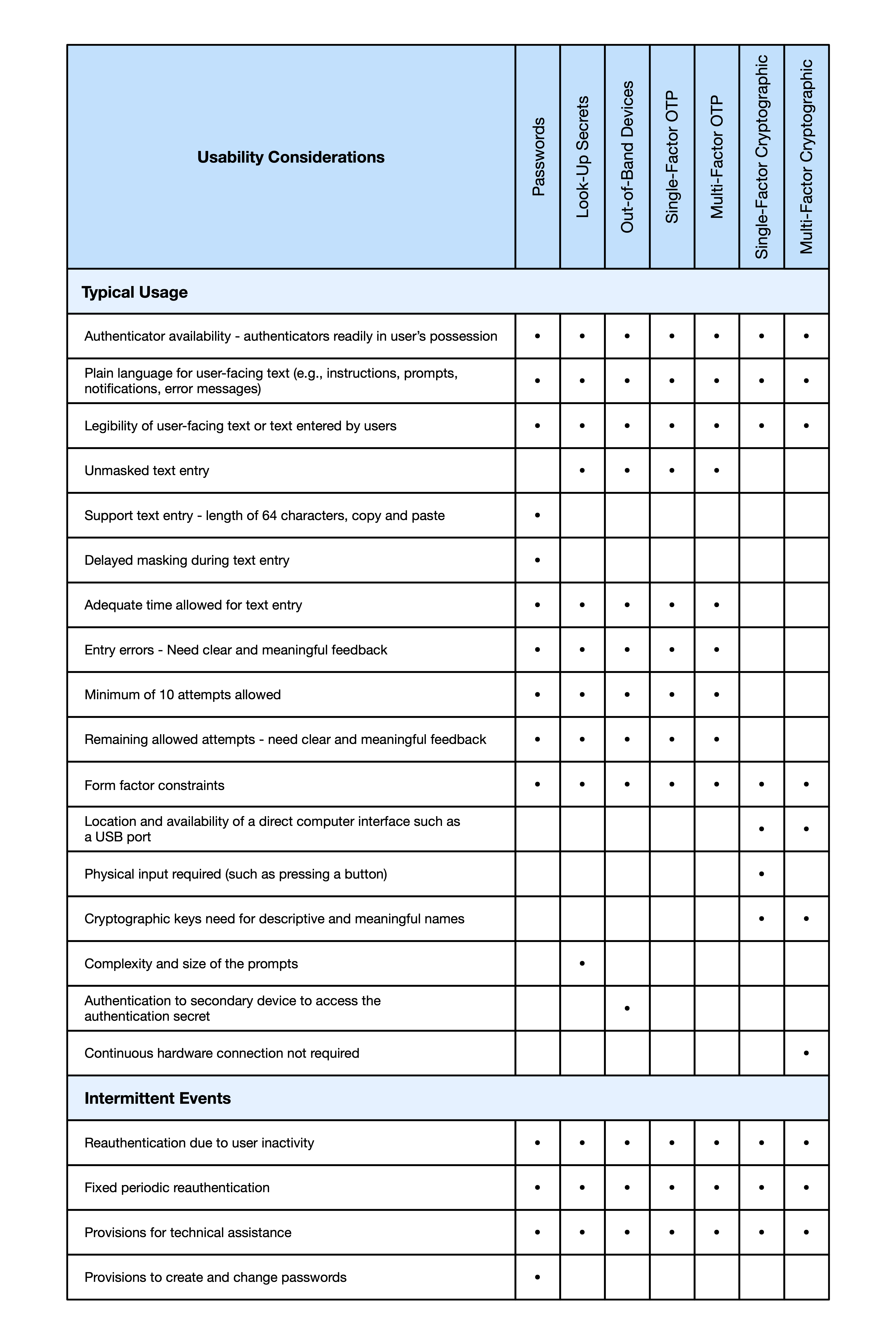
図3 認証器タイプ別のユーザビリティ上の考慮事項。行見出しを Usability Considerations(ユーザビリティ上の考慮事項)とし、パスワード、ルックアップシークレット、アウトオブバンドデバイス、単一要素OTP、多要素OTP、単一要素暗号、多要素暗号の 7 列を持つ表で、考慮事項が当てはまる認証器タイプに点が付いている。Typical Usage(通常の利用): 認証器の可用性(利用者が認証器をすぐに手元に持っていること)(7 種すべて)、利用者向けの文言の平易さ(例: 指示、プロンプト、通知、エラーメッセージ)(7 種すべて)、利用者向けの文字や利用者が入力した文字の読みやすさ(7 種すべて)、マスクしない文字入力(ルックアップシークレット、アウトオブバンドデバイス、単一要素OTP、多要素OTP)、文字入力の支援(64 文字の長さ、コピーと貼り付け)(パスワード)、入力中のマスクの遅延(パスワード)。入力に十分な時間を与えること、入力誤り(明確で意味のあるフィードバックが必要)、少なくとも 10 回の試行を認めること、残りの試行回数(明確で意味のあるフィードバックが必要)はいずれも、パスワード、ルックアップシークレット、アウトオブバンドデバイス、単一要素OTP、多要素OTP。フォームファクターの制約(7 種すべて)、USB ポートなどコンピュータと直接接続するインターフェースの位置と可用性(単一要素暗号、多要素暗号)、物理的な入力(ボタンを押すなど)が必要なこと(単一要素暗号)、暗号鍵に説明的で意味のある名前が必要なこと(単一要素暗号、多要素暗号)、プロンプトの複雑さと大きさ(ルックアップシークレット)、認証シークレットにアクセスするための副デバイスへの認証(アウトオブバンドデバイス)、ハードウェアの常時接続が不要なこと(多要素暗号)。Intermittent Events(断続的な事象): 利用者の非活動による再認証、一定周期の再認証、技術支援の用意はいずれも 7 種すべて。パスワードの作成と変更の手段の用意(パスワード)。
Usability Considerations for Biometrics
生体認証に関するユーザビリティ上の考慮事項
This section provides a high-level overview of general usability considerations for biometrics. A more detailed discussion of biometric usability can be found in Usability & Biometrics, Ensuring Successful Biometric Systems [UsabilityBiometrics].
本節では、生体認証に関する一般的なユーザビリティ上の考慮事項のハイレベルな概要を提供します。生体認証のユーザビリティに関するより詳細な議論は、Usability & Biometrics, Ensuring Successful Biometric Systems [UsabilityBiometrics] に記載されています。
User familiarity and practice with the device improve performance for all modalities. Device affordances (i.e., properties of a device that allow a user to perform an action), feedback, and clear instructions are critical to a user’s success with the biometric device. For example, provide clear instructions on the required actions for liveness detection. Ideally, users can select the modality that they are most comfortable with for their second authentication factor. Various user populations may be more comfortable, familiar with, and accepting of some biometric modalities than others. Provide meaningful feedback on the number of remaining allowed attempts. For example, for rate limiting (i.e., throttling), inform users of the time period they have to wait until their next attempt.
デバイスに対するユーザーの習熟と練習は、すべてのモダリティでパフォーマンスを向上させます。デバイスのアフォーダンス(すなわち、ユーザーが操作を実行できるようにするデバイスの特性)、フィードバック、および明確な指示は、ユーザーが生体認証デバイスを正常に使用するために極めて重要です。例えば、ライブネス検出に必要な動作について明確な指示を提供すること。理想的には、ユーザーが第2の認証要素として最も扱いやすいモダリティを選択できることです。ユーザー層によって、特定の生体認証モダリティのほうが他のものよりも快適で、使い慣れており、受け入れやすい場合があります。許可されている残り試行回数に関する有意義なフィードバックを提供すること。例えば、レート制限(すなわちスロットリング)の場合、次の試行までに待機しなければならない期間をユーザーに通知すること。
Typical Usage
典型的な使用法
The three biometric modalities that are most commonly used for authentication are fingerprint, facial comparison, and iris comparison.
認証に最も一般的に使用される3つの生体認証モダリティは、指紋、顔比較、および虹彩比較です。
•Fingerprint usability considerations:
•指紋に関するユーザビリティ上の考慮事項:
•Users have to remember which fingers they used for initial enrollment.
•ユーザーは、初回登録時にどの指を使用したかを覚えておく必要があります。
•The amount of moisture on the finger affects the sensor’s ability for successful capture.
•指の水分量は、センサーが正常にキャプチャを行う能力に影響を与えます。
•Additional factors that influence fingerprint capture quality include age, sex, and occupation (e.g., users who handle chemicals or work extensively with their hands may have degraded friction ridges).
•指紋キャプチャの品質に影響を与えるその他の要因には、年齢、性別、職業が含まれます(例えば、化学薬品を扱ったり、手作業を広範に行ったりするユーザーは、隆線が摩耗している可能性があります)。
•Facial comparison usability considerations:
•顔比較に関するユーザビリティ上の考慮事項:
•Users have to remember whether they wore any artifacts (e.g., glasses) during enrollment, which affects facial recognition accuracy.
•ユーザーは、登録時に何らかのアーティファクト(例えば眼鏡)を着用していたかどうかを記憶しておく必要があり、これは顔認識の精度に影響を及ぼします。
•Differences in environmental lighting conditions may affect facial recognition accuracy.
•周囲の照明条件の違いが、顔認識の精度に影響を与える可能性があります。
•Facial expressions affect facial recognition accuracy (e.g., smiling versus a neutral expression).
•表情は顔認識の精度に影響を与えます(例えば、笑顔と無表情など)。
•Facial poses affect facial recognition accuracy (e.g., looking down or away from the camera).
•顔の向き(ポーズ)は顔認識の精度に影響を与えます(例えば、下を向くことやカメラから視線をそらすことなど)。
•Iris comparison usability considerations:
•虹彩比較に関するユーザビリティ上の考慮事項:
•Wearing colored contacts may affect iris recognition accuracy.
•カラーコンタクトレンズの着用は、虹彩認識の精度に影響を与える可能性があります。
•Users who have had eye surgery may need to re-enroll after surgery.
•眼科手術を受けたユーザーは、手術後に再登録が必要になる場合があります。
•Differences in environmental lighting conditions may affect iris recognition accuracy, especially for certain iris colors.
•周囲の照明条件の違いは、特に特定の虹彩の色において、虹彩認識の精度に影響を与える可能性があります。
Intermittent Events
断続的なイベント
Since biometrics are only permitted as a second factor for multi-factor authentication, usability considerations for intermittent events with the primary factor still apply. Intermittent events that may affect recognition accuracy using biometrics include:
生体認証は多要素認証の第2要素としてのみ許可されているため、プライマリ要素に関する断続的なイベントについてのユーザビリティ上の考慮事項も引き続き適用されます。生体認証を使用した認識精度に影響を与える可能性のある断続的なイベントには、以下が含まれる:
•Degraded fingerprints or finger injuries
•指紋の劣化または指の負傷
•Dirty, dry, or wet hands
•汚れた手、乾燥した手、または濡れた手
•Wearing gloves or a mask
•手袋やマスクの着用
•Natural facial or weight changes over time
•経年による自然な顔の変化や体重の変化
•Eye surgery
•眼科手術
Across all biometric modalities, usability considerations for intermittent events include the following:
すべての生体認証モダリティにおいて、一時的な事象に関するユーザビリティ上の考慮事項には以下が含まれる:
•An alternative authentication method must be readily available and clearly communicated. Users should never be required to attempt biometric authentication and should be permitted to use a password as an alternative second factor.
•代替の認証方式が容易に利用可能であり、明確に周知されていなければなりません。ユーザーが生体認証の試行を要求されることは決してあってはならず、代替の第2要素としてパスワードを使用することが許可されるべきです。
•There should be provisions for technical assistance:
•技術支援のための措置が講じられているべきである:
•Clearly communicate information on how and where to acquire technical assistance. For example, provide users with a link to an online self-service feature or a phone number for help desk support. Ideally, provide sufficient information to enable users to recover from intermittent events on their own without outside intervention.
•技術支援を受ける方法および場所に関する情報を明確に周知すること。例えば、オンラインセルフサービス機能へのリンクや、ヘルプデスクサポートの電話番号をユーザーに提供します。理想的には、外部の介入なしにユーザーが自力で一時的な事象から回復できるように十分な情報を提供します。
•Inform users of factors that may affect the sensitivity of the biometric sensor (e.g., cleanliness of the sensor).
•生体認証センサーの感度に影響を与える可能性のある要因(センサーの清潔さなど)についてユーザーに通知すること。
Customer Success Considerations
カスタマーサクセスに関する考慮事項
A primary aspect of customer experience is anticipating the needs of the user population and offering authenticator options that are suitable for that population. Some examples of authenticator suitability problems are:
カスタマーエクスペリエンスの主要な側面は、ユーザー層のニーズを予測し、そのユーザー層に適した認証器の選択肢を提供することです。認証器の適合性に関する問題の例には、以下のようなものがある:
•SMS-based out-of-band authentication may not be usable for subscribers in rural areas without mobile phone service.
•携帯電話サービスのない農村地域の加入者にとって、SMSベースのアウトオブバンド認証は利用できない場合があります。
•OTP authenticators may be difficult to read for subscribers with vision issues.
•OTP認証器は、視覚に問題がある加入者にとって読み取りが困難な場合があります。
•Out-of-band authentication secrets sent via a voice telephone call may be difficult to understand for subscribers with hearing issues.
•音声通話で送信されるアウトオブバンド認証シークレットは、聴覚に問題がある加入者にとって聞き取りが困難な場合があります。
•Some facial matching algorithms may not perform equally well for all user populations.
•一部の顔照合アルゴリズムは、すべてのユーザー層に対して同等に良好に機能しない場合があります。
•Some subscribers may have conditions that interfere with fingerprint collection, such as missing fingers, degraded fingerprints (e.g., from working with chemicals or extensively using their hands), or dexterity problems.
•一部の加入者は、指の欠損、指紋の劣化(化学薬品を扱う作業や過度の手の使用などによる)、あるいは手先の巧緻性の問題など、指紋採取の妨げとなる状態を抱えている場合があります。
•The cost of hardware-based authenticators may be beyond the means of some subscribers.
•ハードウェアベースの認証器のコストは、一部の加入者の資力を超えている場合があります。
•Accurate manual entry of passwords may be difficult for subscribers with mobility and dexterity-related physical disabilities.
•運動機能や手先の巧緻性に関する身体障害を持つ加入者にとって、パスワードを正確に手入力することは困難な場合があります。
•Certain authenticator types may be challenging for subscribers with intellectual, developmental, learning, or neurocognitive difficulties.
•特定の認証器タイプは、知的、発達、学習、または神経認知に関する困難を抱える加入者にとって利用が難しい場合があります。
•Lower-income subscribers are less likely to have up-to-date devices that are required by some authentication modes.
•低所得の加入者は、一部の認証モードで必要とされる最新のデバイスを所持している可能性が低いです。
•Subscribers with less technological skill may need help to enter OTP codes from one device to another.
•技術的スキルの低い加入者は、あるデバイスから別のデバイスへOTPコードを入力する際に支援を必要とする場合があります。
•The small form factor of some authenticators may pose challenges for certain users, such as senior citizens and individuals with dexterity challenges.
•一部の認証器の小型のフォームファクタは、高齢者や手先の巧緻性に課題を抱える人々など、特定のユーザーにとって課題となる場合があります。
While CSPs are required to mitigate common and expected problems in this area, it is not feasible to anticipate all potential customer experience problems, which will vary for different applications. Accordingly, CSPs need to provide mechanisms for subscribers to report challenges with authentication requirements and advise them on potential alternative authentication strategies.
CSPはこの分野における一般的かつ予想される問題を緩和することが求められるものの、アプリケーションによって異なる可能性のあるカスタマーエクスペリエンス上の潜在的な問題をすべて予測することは現実的ではありません。したがって、CSPは加入者が認証要件に関する課題を報告できるメカニズムを提供し、潜在的な代替認証戦略について加入者に助言する必要があります。
References
参考文献
This section is informative.
本セクションは参考情報です。
[Blocklists] Habib H, Colnago J, Melicher W, Ur B, Segreti S, Bauer L, Christin N, Cranor L (2017) Password Creation in the Presence of Blacklists. Proceedings 2017 Workshop on Usable Security (Internet Society, San Diego, CA). https://doi.org/10.14722/usec.2017.23043
[Blocklists] Habib H, Colnago J, Melicher W, Ur B, Segreti S, Bauer L, Christin N, Cranor L (2017) Password Creation in the Presence of Blacklists(和訳:ブラックリストが存在する環境におけるパスワード作成). Proceedings 2017 Workshop on Usable Security (Internet Society, San Diego, CA). https://doi.org/10.14722/usec.2017.23043
[CMVP] National Institute of Standards and Technology (2025), Cryptographic Module Validation Program. Available at https://csrc.nist.gov/Projects/Cryptographic-Module-Validation-Program
[CMVP] National Institute of Standards and Technology (2025), Cryptographic Module Validation Program(和訳:暗号モジュール検証プログラム). Available at https://csrc.nist.gov/Projects/Cryptographic-Module-Validation-Program
[Composition] Komanduri S, Shay R, Kelley PG, Mazurek ML, Bauer L, Christin N, Cranor LF, Egelman S (2011) Of Passwords and People: Measuring the Effect of Password-Composition Policies. Proceedings of the SIGCHI Conference on Human Factors in Computing Systems (ACM, New York, NY), pp 2595–2604. Available at https://www.ece.cmu.edu/~lbauer/papers/2011/chi2011-passwords.pdf
[Composition] Komanduri S, Shay R, Kelley PG, Mazurek ML, Bauer L, Christin N, Cranor LF, Egelman S (2011) Of Passwords and People: Measuring the Effect of Password-Composition Policies(和訳:パスワードと人々:パスワード構成ポリシーの効果測定). Proceedings of the SIGCHI Conference on Human Factors in Computing Systems (ACM, New York, NY), pp 2595–2604. Available at https://www.ece.cmu.edu/~lbauer/papers/2011/chi2011-passwords.pdf
[DBSC] W3C (2025) Device Bound Session Credentials. Available at https://github.com/w3c/webappsec-dbsc
[DBSC] W3C (2025) Device Bound Session Credentials(和訳:デバイスに結び付けられたセッション資格情報). Available at https://github.com/w3c/webappsec-dbsc
[E-Gov] E-Government Act of 2002, P.L. 107-347, 116 Stat. 2899, 44 U.S.C. § 101 (2002). Available at https://www.gpo.gov/fdsys/pkg/PLAW-107publ347/pdf/PLAW-107publ347.pdf
[E-Gov] E-Government Act of 2002(和訳:2002年電子政府法), P.L. 107-347, 116 Stat. 2899, 44 U.S.C. § 101 (2002). Available at https://www.gpo.gov/fdsys/pkg/PLAW-107publ347/pdf/PLAW-107publ347.pdf
[EO13681] Obama B (2014) Improving the Security of Consumer Financial Transactions. (The White House, Washington, DC), Executive Order 13681, October 17, 2014. Available at https://www.federalregister.gov/d/2014-25439
[EO13681] Obama B (2014) Improving the Security of Consumer Financial Transactions(和訳:消費者金融取引の安全性向上). (The White House, Washington, DC), Executive Order 13681, October 17, 2014. Available at https://www.federalregister.gov/d/2014-25439
[FEDRAMP] General Services Administration (2022), How to Become FedRAMP Authorized. Available at https://www.fedramp.gov/
[FEDRAMP] General Services Administration (2022), How to Become FedRAMP Authorized(和訳:FedRAMP認証を取得する方法). Available at https://www.fedramp.gov/
[FIDO2] Bradley J, Jones MB, Kumar A, Lindemann R, Verrept J, Waite D (2025) Client to Authenticator Protocol (CTAP). (FIDO Alliance, Beaverton, OR). Available at https://fidoalliance.org/specs/fido-v2.2-ps-20250228/fido-client-to-authenticator-protocol-v2.2-ps-20250228.html
[FIDO2] Bradley J, Jones MB, Kumar A, Lindemann R, Verrept J, Waite D (2025) Client to Authenticator Protocol (CTAP)(和訳:クライアント・認証器間プロトコル(CTAP)). (FIDO Alliance, Beaverton, OR). Available at https://fidoalliance.org/specs/fido-v2.2-ps-20250228/fido-client-to-authenticator-protocol-v2.2-ps-20250228.html
[FIPS140] National Institute of Standards and Technology (2019) Security Requirements for Cryptographic Modules. (U.S. Department of Commerce, Washington, DC), Federal Information Processing Standards Publication (FIPS) 140-3. https://doi.org/10.6028/NIST.FIPS.140-3
[FIPS140] National Institute of Standards and Technology (2019) Security Requirements for Cryptographic Modules(和訳:暗号モジュールのセキュリティ要件). (U.S. Department of Commerce, Washington, DC), Federal Information Processing Standards Publication (FIPS) 140-3. https://doi.org/10.6028/NIST.FIPS.140-3
[FIPS201] National Institute of Standards and Technology (2022) Personal Identity Verification (PIV) of Federal Employees and Contractors. (U.S. Department of Commerce, Washington, DC), Federal Information Processing Standards Publication (FIPS) 201-3. https://doi.org/10.6028/NIST.FIPS.201-3
[FIPS201] National Institute of Standards and Technology (2022) Personal Identity Verification (PIV) of Federal Employees and Contractors(和訳:連邦政府職員および請負業者の個人身元検証(PIV)). (U.S. Department of Commerce, Washington, DC), Federal Information Processing Standards Publication (FIPS) 201-3. https://doi.org/10.6028/NIST.FIPS.201-3
[FISMA] Federal Information Security Modernization Act of 2014, Pub. L. 113-283, 128 Stat. 3073. Available at https://www.govinfo.gov/app/details/PLAW-113publ283
[FISMA] Federal Information Security Modernization Act of 2014(和訳:2014年連邦情報セキュリティ近代化法), Pub. L. 113-283, 128 Stat. 3073. Available at https://www.govinfo.gov/app/details/PLAW-113publ283
[IC3] Federal Bureau of Investigation (2024) Annual Reports - Internet Crime Complaint Center (IC3). Available at https://www.ic3.gov/AnnualReport/Reports/
[IC3] Federal Bureau of Investigation (2024) Annual Reports - Internet Crime Complaint Center (IC3)(和訳:インターネット犯罪苦情センター(IC3)年次報告書). Available at https://www.ic3.gov/AnnualReport/Reports/
[ISO/IEC2382-37] International Standards Organization (2022) Information technology — Vocabulary — Part 37: Biometrics (ISO, Geneva, Switzerland). Available at https://www.iso.org/standard/73514.html
[ISO/IEC2382-37] International Standards Organization (2022) Information technology — Vocabulary — Part 37: Biometrics(和訳:情報技術―用語―第37部:バイオメトリクス) (ISO, Geneva, Switzerland). Available at https://www.iso.org/standard/73514.html
[ISO/IEC9241-11] International Standards Organization (2018) ISO/IEC 9241-11 Ergonomics of human-system interaction – Part 11: Usability: Definitions and concepts (ISO, Geneva, Switzerland). Available at https://www.iso.org/standard/63500.html
[ISO/IEC9241-11] International Standards Organization (2018) ISO/IEC 9241-11 Ergonomics of human-system interaction – Part 11: Usability: Definitions and concepts(和訳:人間とシステムのインタラクションの人間工学―第11部:ユーザビリティ―定義と概念) (ISO, Geneva, Switzerland). Available at https://www.iso.org/standard/63500.html
[ISO/IEC10646] International Standards Organization (2020) Information technology — Universal coded character set (UCS) (ISO, Geneva, Switzerland). Available at https://www.iso.org/standard/76835.html
[ISO/IEC10646] International Standards Organization (2020) Information technology — Universal coded character set (UCS)(和訳:情報技術―汎用符号化文字集合(UCS)) (ISO, Geneva, Switzerland). Available at https://www.iso.org/standard/76835.html
[ISO/IEC19792] International Standards Organization (2009) Information technology — Security techniques — Security evaluation of biometrics (ISO, Geneva, Switzerland). Available at https://www.iso.org/standard/51521.html
[ISO/IEC19792] International Standards Organization (2009) Information technology — Security techniques — Security evaluation of biometrics(和訳:情報技術―セキュリティ技術―バイオメトリクスのセキュリティ評価) (ISO, Geneva, Switzerland). Available at https://www.iso.org/standard/51521.html
[ISO/IEC19795-1] International Standards Organization (2021) Information technology - Biometric performance testing and reporting Part 1: Principles and framework (ISO, Geneva, Switzerland). Available at https://www.iso.org/standard/73515.html
[ISO/IEC19795-1] International Standards Organization (2021) Information technology - Biometric performance testing and reporting Part 1: Principles and framework(和訳:情報技術―バイオメトリクス性能の試験と報告―第1部:原則と枠組み) (ISO, Geneva, Switzerland). Available at https://www.iso.org/standard/73515.html
[ISO/IEC19989-1] International Standards Organization (2020) Information security — Criteria and methodology for security evaluation of biometric systems — Part 1: Framework (ISO, Geneva, Switzerland). Available at https://www.iso.org/standard/72402.html
[ISO/IEC19989-1] International Standards Organization (2020) Information security — Criteria and methodology for security evaluation of biometric systems — Part 1: Framework(和訳:情報セキュリティ―バイオメトリックシステムのセキュリティ評価基準と方法論―第1部:枠組み) (ISO, Geneva, Switzerland). Available at https://www.iso.org/standard/72402.html
[ISO/IEC19989-3] International Standards Organization (2020) Information security — Criteria and methodology for security evaluation of biometric systems — Part 3: Presentation attack detection (ISO, Geneva, Switzerland). Available at https://www.iso.org/standard/73721.html
[ISO/IEC19989-3] International Standards Organization (2020) Information security — Criteria and methodology for security evaluation of biometric systems — Part 3: Presentation attack detection(和訳:情報セキュリティ―バイオメトリックシステムのセキュリティ評価基準と方法論―第3部:提示攻撃検出) (ISO, Geneva, Switzerland). Available at https://www.iso.org/standard/73721.html
[ISO/IEC30107-1] International Standards Organization (2023) Information technology — Biometric presentation attack detection — Part 1: Framework (ISO, Geneva, Switzerland). Available at https://www.iso.org/standard/83828.html
[ISO/IEC30107-1] International Standards Organization (2023) Information technology — Biometric presentation attack detection — Part 1: Framework(和訳:情報技術―バイオメトリック提示攻撃検出―第1部:枠組み) (ISO, Geneva, Switzerland). Available at https://www.iso.org/standard/83828.html
[ISO/IEC30107-3] International Standards Organization (2023) Information technology — Biometric presentation attack detection — Part 3: Testing and reporting (ISO, Geneva, Switzerland). Available at https://www.iso.org/standard/79520.html
[ISO/IEC30107-3] International Standards Organization (2023) Information technology — Biometric presentation attack detection — Part 3: Testing and reporting(和訳:情報技術―バイオメトリック提示攻撃検出―第3部:試験と報告) (ISO, Geneva, Switzerland). Available at https://www.iso.org/standard/79520.html
[Managers] Lyastani SG, Schilling M, Fahl S, Backes M, Bugiel S (2018) Better managed than memorized? Studying the Impact of Managers on Password Strength and Reuse. 27th USENIX Security Symposium (USENIX Security 18) (USENIX Association, Baltimore, MD), pp 203–220. Available at https://www.usenix.org/conference/usenixsecurity18/presentation/lyastani
[Managers] Lyastani SG, Schilling M, Fahl S, Backes M, Bugiel S (2018) Better managed than memorized? Studying the Impact of Managers on Password Strength and Reuse(和訳:記憶するより適切に管理する方がよいか:パスワード管理ツールが強度と再利用に与える影響). 27th USENIX Security Symposium (USENIX Security 18) (USENIX Association, Baltimore, MD), pp 203–220. Available at https://www.usenix.org/conference/usenixsecurity18/presentation/lyastani
[NISTIR8062] Brooks S, Garcia M, Lefkovitz N, Lightman S, Nadeau E (2017) An Introduction to Privacy Engineering and Risk Management in Federal Systems. (National Institute of Standards and Technology, Gaithersburg, MD), NIST Interagency or Internal Report (IR) NIST IR 8062, January 2017. https://doi.org/10.6028/NIST.IR.8062
[NISTIR8062] Brooks S, Garcia M, Lefkovitz N, Lightman S, Nadeau E (2017) An Introduction to Privacy Engineering and Risk Management in Federal Systems(和訳:連邦政府システムにおけるプライバシーエンジニアリングとリスク管理の概要). (National Institute of Standards and Technology, Gaithersburg, MD), NIST Interagency or Internal Report (IR) NIST IR 8062, January 2017. https://doi.org/10.6028/NIST.IR.8062
[NISTRMF] Joint Task Force (2018) Risk Management Framework for Information Systems and Organizations: A System Life Cycle Approach for Security and Privacy. (National Institute of Standards and Technology, Gaithersburg, MD), NIST Special Publication (SP) NIST SP 800-37r2. https://doi.org/10.6028/NIST.SP.800-37r2
[NISTRMF] Joint Task Force (2018) Risk Management Framework for Information Systems and Organizations: A System Life Cycle Approach for Security and Privacy(和訳:情報システムと組織のためのリスク管理枠組み:セキュリティとプライバシーのためのシステムライフサイクルアプローチ). (National Institute of Standards and Technology, Gaithersburg, MD), NIST Special Publication (SP) NIST SP 800-37r2. https://doi.org/10.6028/NIST.SP.800-37r2
[OWASP-session] Open Web Application Security Project (2021) Session Management Cheat Sheet. Available at https://cheatsheetseries.owasp.org/cheatsheets/Session_Management_Cheat_Sheet.html
[OWASP-session] Open Web Application Security Project (2021) Session Management Cheat Sheet(和訳:セッション管理チートシート). Available at https://cheatsheetseries.owasp.org/cheatsheets/Session_Management_Cheat_Sheet.html
[OWASP-XSS-prevention] Open Web Application Security Project (2021) XSS (Cross Site Scripting) Prevention Cheat Sheet. Available at https://cheatsheetseries.owasp.org/cheatsheets/Cross_Site_Scripting_Prevention_Cheat_Sheet.html
[OWASP-XSS-prevention] Open Web Application Security Project (2021) XSS (Cross Site Scripting) Prevention Cheat Sheet(和訳:XSS(クロスサイトスクリプティング)対策チートシート). Available at https://cheatsheetseries.owasp.org/cheatsheets/Cross_Site_Scripting_Prevention_Cheat_Sheet.html
[Persistence] Herley C, Van Oorschot P (2012) A Research Agenda Acknowledging the Persistence of Passwords. IEEE Security & Privacy Magazine, (IEEE, Garden Grove, CA) 10(1):28–36. https://doi.org/10.1109/MSP.2011.150
[Persistence] Herley C, Van Oorschot P (2012) A Research Agenda Acknowledging the Persistence of Passwords(和訳:パスワードが今後も使われ続けることを踏まえた研究課題). IEEE Security & Privacy Magazine, (IEEE, Garden Grove, CA) 10(1):28–36. https://doi.org/10.1109/MSP.2011.150
[Policies] Weir M, Aggarwal S, Collins M, Stern H (2010) Testing Metrics for Password Creation Policies by Attacking Large Sets of Revealed Passwords. Proceedings of the 17th ACM Conference on Computer and Communications Security, CCS ‘10, (ACM, New York, NY, USA), pp 162–175. https://doi.org/10.1145/1866307.1866327
[Policies] Weir M, Aggarwal S, Collins M, Stern H (2010) Testing Metrics for Password Creation Policies by Attacking Large Sets of Revealed Passwords(和訳:大量の漏えいパスワードへの攻撃によるパスワード作成ポリシー評価指標の検証). Proceedings of the 17th ACM Conference on Computer and Communications Security, CCS ‘10, (ACM, New York, NY, USA), pp 162–175. https://doi.org/10.1145/1866307.1866327
[PrivacyAct] Privacy Act of 1974, Pub. L. 93-579, 5 U.S.C. § 552a, 88 Stat. 1896 (1974). Available at https://www.govinfo.gov/content/pkg/USCODE-2020-title5/pdf/USCODE-2020-title5-partI-chap5-subchapII-sec552a.pdf
[PrivacyAct] Privacy Act of 1974(和訳:1974年プライバシー法), Pub. L. 93-579, 5 U.S.C. § 552a, 88 Stat. 1896 (1974). Available at https://www.govinfo.gov/content/pkg/USCODE-2020-title5/pdf/USCODE-2020-title5-partI-chap5-subchapII-sec552a.pdf
[PSL] Mozilla Foundation (2022) Public Suffix List. Available at https://publicsuffix.org/list/
[PSL] Mozilla Foundation (2022) Public Suffix List(和訳:パブリックサフィックスリスト). Available at https://publicsuffix.org/list/
[RBG] National Institute of Standards and Technology (2023) Random Bit Generation. Available at https://csrc.nist.gov/projects/random-bit-generation
[RBG] National Institute of Standards and Technology (2023) Random Bit Generation(和訳:乱数ビット生成). Available at https://csrc.nist.gov/projects/random-bit-generation
[RFC20] Cerf V (1969) ASCII format for network interchange. (Internet Engineering Task Force (IETF)), IETF Request for Comments (RFC) 20. https://doi.org/10.17487/RFC0020
[RFC20] Cerf V (1969) ASCII format for network interchange(和訳:ネットワーク交換用ASCII形式). (Internet Engineering Task Force (IETF)), IETF Request for Comments (RFC) 20. https://doi.org/10.17487/RFC0020
[RFC5280] Cooper D, Santesson S, Farrell S, Boeyen S, Housley R, Polk W (2008) Internet X.509 Public Key Infrastructure Certification and Certificate Revocation List (CRL) Profile. (Internet Engineering Task Force (IETF)), IETF Request for Comments (RFC) 5280. https://doi.org/10.17487/RFC5280
[RFC5280] Cooper D, Santesson S, Farrell S, Boeyen S, Housley R, Polk W (2008) Internet X.509 Public Key Infrastructure Certification and Certificate Revocation List (CRL) Profile(和訳:インターネットX.509公開鍵基盤の証明書および証明書失効リスト(CRL)プロファイル). (Internet Engineering Task Force (IETF)), IETF Request for Comments (RFC) 5280. https://doi.org/10.17487/RFC5280
[RFC6749] Hardt D (2012) The OAuth 2.0 Authorization Framework. (Internet Engineering Task Force (IETF)), IETF Request for Comments (RFC) 6749. https://doi.org/10.17487/RFC6749
[RFC6749] Hardt D (2012) The OAuth 2.0 Authorization Framework(和訳:OAuth 2.0認可フレームワーク). (Internet Engineering Task Force (IETF)), IETF Request for Comments (RFC) 6749. https://doi.org/10.17487/RFC6749
[RFC8446] Rescorla E (2018) The Transport Layer Security (TLS) Protocol Version 1.3. (Internet Engineering Task Force (IETF)), IETF Request for Comments (RFC) 8446. https://doi.org/10.17487/RFC8446
[RFC8446] Rescorla E (2018) The Transport Layer Security (TLS) Protocol Version 1.3(和訳:トランスポート層セキュリティ(TLS)プロトコル バージョン1.3). (Internet Engineering Task Force (IETF)), IETF Request for Comments (RFC) 8446. https://doi.org/10.17487/RFC8446
[RFC9325] Sheffer Y, Saint-Andre P, Fossati T (2022) Recommendations for Secure Use of Transport Layer Security (TLS) and Datagram Transport Layer Security (DTLS). (Internet Engineering Task Force (IETF)), IETF Request for Comments (RFC) 9325. https://doi.org/10.17487/RFC9325
[RFC9325] Sheffer Y, Saint-Andre P, Fossati T (2022) Recommendations for Secure Use of Transport Layer Security (TLS) and Datagram Transport Layer Security (DTLS)(和訳:トランスポート層セキュリティ(TLS)およびデータグラムトランスポート層セキュリティ(DTLS)の安全な使用に関する推奨事項). (Internet Engineering Task Force (IETF)), IETF Request for Comments (RFC) 9325. https://doi.org/10.17487/RFC9325
[Section508] General Services Administration (2022) IT Accessibility Laws and Policies. Available at https://www.section508.gov/manage/laws-and-policies/
[Section508] General Services Administration (2022) IT Accessibility Laws and Policies(和訳:情報技術アクセシビリティに関する法令と方針). Available at https://www.section508.gov/manage/laws-and-policies/
[Shannon] Shannon CE (1948) A Mathematical Theory of Communication. Bell System Technical Journal 27(3):379–423. https://doi.org/10.1002/j.1538-7305.1948.tb01338.x
[Shannon] Shannon CE (1948) A Mathematical Theory of Communication(和訳:通信の数学的理論). Bell System Technical Journal 27(3):379–423. https://doi.org/10.1002/j.1538-7305.1948.tb01338.x
[SP800-39] Joint Task Force (2011) Managing Information Security Risk. (National Institute of Standards and Technology, Gaithersburg, MD), NIST Special Publication (SP) NIST SP 800-39. https://doi.org/10.6028/NIST.SP.800-39
[SP800-39] Joint Task Force (2011) Managing Information Security Risk(和訳:情報セキュリティリスクの管理). (National Institute of Standards and Technology, Gaithersburg, MD), NIST Special Publication (SP) NIST SP 800-39. https://doi.org/10.6028/NIST.SP.800-39
[SP800-52] McKay K, Cooper D (2019) Guidelines for the Selection, Configuration, and Use of Transport Layer Security (TLS) Implementations. (National Institute of Standards and Technology), NIST Special Publication (SP) NIST SP 800-52r2. https://doi.org/10.6028/NIST.SP.800-52r2
[SP800-52] McKay K, Cooper D (2019) Guidelines for the Selection, Configuration, and Use of Transport Layer Security (TLS) Implementations(和訳:トランスポート層セキュリティ(TLS)実装の選択、構成、使用に関するガイドライン). (National Institute of Standards and Technology), NIST Special Publication (SP) NIST SP 800-52r2. https://doi.org/10.6028/NIST.SP.800-52r2
[SP800-53] Joint Task Force (2020) Security and Privacy Controls for Information Systems and Organizations. (National Institute of Standards and Technology, Gaithersburg, MD), NIST Special Publication (SP) NIST SP 800-53r5, Includes updates as of December 10, 2020. https://doi.org/10.6028/NIST.SP.800-53r5
[SP800-53] Joint Task Force (2020) Security and Privacy Controls for Information Systems and Organizations(和訳:情報システムおよび組織のためのセキュリティとプライバシー管理策). (National Institute of Standards and Technology, Gaithersburg, MD), NIST Special Publication (SP) NIST SP 800-53r5, Includes updates as of December 10, 2020. https://doi.org/10.6028/NIST.SP.800-53r5
[SP800-57Part1] Barker EB (2020) Recommendation for Key Management: Part 1 – General. (National Institute of Standards and Technology, Gaithersburg, MD), NIST Special Publication (SP) NIST SP 800-57pt1r5. https://doi.org/10.6028/NIST.SP.800-57pt1r5
[SP800-57Part1] Barker EB (2020) Recommendation for Key Management: Part 1 – General(和訳:鍵管理に関する勧告:第1部―一般). (National Institute of Standards and Technology, Gaithersburg, MD), NIST Special Publication (SP) NIST SP 800-57pt1r5. https://doi.org/10.6028/NIST.SP.800-57pt1r5
[SP800-63] Temoshok D, Galluzzo R, LaSalle C, Lefkovitz N, Regenscheid A, Choong YY, Proud-Madruga D, Gupta S (2025) Digital Identity Guidelines. (National Institute of Standards and Technology, Gaithersburg, MD), NIST Special Publication (SP) NIST SP 800-63-4. https://doi.org/10.6028/NIST.SP.800-63-4
[SP800-63] Temoshok D, Galluzzo R, LaSalle C, Lefkovitz N, Regenscheid A, Choong YY, Proud-Madruga D, Gupta S (2025) Digital Identity Guidelines(和訳:デジタルアイデンティティガイドライン). (National Institute of Standards and Technology, Gaithersburg, MD), NIST Special Publication (SP) NIST SP 800-63-4. https://doi.org/10.6028/NIST.SP.800-63-4
[SP800-63A] Temoshok D, Abruzzi C, Choong YY, Fenton JL, Galluzzo R, LaSalle C, Lefkovitz N, Regenscheid A, Vachino M (2025) Digital Identity Guidelines: Identity Proofing and Enrollment. (National Institute of Standards and Technology, Gaithersburg, MD), NIST Special Publication (SP) NIST SP 800-63A-4. https://doi.org/10.6028/NIST.SP.800-63A-4
[SP800-63A] Temoshok D, Abruzzi C, Choong YY, Fenton JL, Galluzzo R, LaSalle C, Lefkovitz N, Regenscheid A, Vachino M (2025) Digital Identity Guidelines: Identity Proofing and Enrollment(和訳:デジタルアイデンティティガイドライン:身元確認と登録). (National Institute of Standards and Technology, Gaithersburg, MD), NIST Special Publication (SP) NIST SP 800-63A-4. https://doi.org/10.6028/NIST.SP.800-63A-4
[SP800-63C] Temoshok D, Richer JP, Choong YY, Fenton JL, Lefkovitz N, Regenscheid A, Galluzzo R (2025) Digital Identity Guidelines: Federation and Assertions. (National Institute of Standards and Technology, Gaithersburg, MD), NIST Special Publication (SP) NIST SP 800-63C-4. https://doi.org/10.6028/NIST.SP.800-63C-4
[SP800-63C] Temoshok D, Richer JP, Choong YY, Fenton JL, Lefkovitz N, Regenscheid A, Galluzzo R (2025) Digital Identity Guidelines: Federation and Assertions(和訳:デジタルアイデンティティガイドライン:フェデレーションとアサーション). (National Institute of Standards and Technology, Gaithersburg, MD), NIST Special Publication (SP) NIST SP 800-63C-4. https://doi.org/10.6028/NIST.SP.800-63C-4
[SP800-73pt2] Ferraiolo H, Mehta K, Francomacaro S, Chandramouli R, Gupta S (2024) Interfaces for Personal Identity Verification: Part 2 – PIV Card Application Card Command Interface. (National Institute of Standards and Technology, Gaithersburg, MD), NIST Special Publication (SP) NIST SP 800-73pt2-5. https://doi.org/10.6028/NIST.SP.800-73pt2-5
[SP800-73pt2] Ferraiolo H, Mehta K, Francomacaro S, Chandramouli R, Gupta S (2024) Interfaces for Personal Identity Verification: Part 2 – PIV Card Application Card Command Interface(和訳:個人身元検証インターフェース:第2部―PIVカードアプリケーションのカードコマンドインターフェース). (National Institute of Standards and Technology, Gaithersburg, MD), NIST Special Publication (SP) NIST SP 800-73pt2-5. https://doi.org/10.6028/NIST.SP.800-73pt2-5
[SP800-90A] Barker E, Kelsey J (2015) Recommendation for Random Number Generation Using Deterministic Random Bit Generators. (National Institute of Standards and Technology, Gaithersburg, MD), NIST Special Publication (SP) NIST SP 800-90Ar1. https://doi.org/10.6028/NIST.SP.800-90Ar1
[SP800-90A] Barker E, Kelsey J (2015) Recommendation for Random Number Generation Using Deterministic Random Bit Generators(和訳:決定論的乱数ビット生成器を用いる乱数生成に関する勧告). (National Institute of Standards and Technology, Gaithersburg, MD), NIST Special Publication (SP) NIST SP 800-90Ar1. https://doi.org/10.6028/NIST.SP.800-90Ar1
[SP800-90B] Turan MS, Barker E, Kelsey J, McKay K, Baish M, Boyle M (2018) Recommendation for the Entropy Sources Used for Random Bit Generation. (National Institute of Standards and Technology, Gaithersburg, MD), NIST Special Publication (SP) NIST SP 800-90B. https://doi.org/10.6028/NIST.SP.800-90B
[SP800-90B] Turan MS, Barker E, Kelsey J, McKay K, Baish M, Boyle M (2018) Recommendation for the Entropy Sources Used for Random Bit Generation(和訳:乱数ビット生成に用いるエントロピー源に関する勧告). (National Institute of Standards and Technology, Gaithersburg, MD), NIST Special Publication (SP) NIST SP 800-90B. https://doi.org/10.6028/NIST.SP.800-90B
[SP800-90C] Barker E, Kelsey J, McKay K, Roginsky A, Turan MS (2024) Recommendation for Random Bit Generator (RBG) Constructions. (National Institute of Standards and Technology, Gaithersburg, MD), Draft NIST Special Publication (SP) NIST SP 800-90C. https://doi.org/10.6028/NIST.SP.800-90C.4pd
[SP800-90C] Barker E, Kelsey J, McKay K, Roginsky A, Turan MS (2024) Recommendation for Random Bit Generator (RBG) Constructions(和訳:乱数ビット生成器(RBG)の構成に関する勧告). (National Institute of Standards and Technology, Gaithersburg, MD), Draft NIST Special Publication (SP) NIST SP 800-90C. https://doi.org/10.6028/NIST.SP.800-90C.4pd
[SP800-131A] Barker E, Roginsky A (2019) Transitioning the Use of Cryptographic Algorithms and Key Lengths. (National Institute of Standards and Technology, Gaithersburg, MD), NIST Special Publication (SP) NIST SP 800-131Ar2. https://doi.org/10.6028/NIST.SP.800-131Ar2
[SP800-131A] Barker E, Roginsky A (2019) Transitioning the Use of Cryptographic Algorithms and Key Lengths(和訳:暗号アルゴリズムおよび鍵長の使用移行). (National Institute of Standards and Technology, Gaithersburg, MD), NIST Special Publication (SP) NIST SP 800-131Ar2. https://doi.org/10.6028/NIST.SP.800-131Ar2
[SP800-132] Turan M, Barker E, Burr W, Chen L (2010) Recommendation for Password-Based Key Derivation. (National Institute of Standards and Technology, Gaithersburg, MD), NIST Special Publication (SP) NIST SP 800-132. https://doi.org/10.6028/NIST.SP.800-132
[SP800-132] Turan M, Barker E, Burr W, Chen L (2010) Recommendation for Password-Based Key Derivation(和訳:パスワードベース鍵導出に関する勧告). (National Institute of Standards and Technology, Gaithersburg, MD), NIST Special Publication (SP) NIST SP 800-132. https://doi.org/10.6028/NIST.SP.800-132
[SP800-157] Ferraiolo H, Regenscheid AR, Fenton J (2023) Guidelines for Derived Personal Identity Verification (PIV) Credentials. (National Institute of Standards and Technology, Gaithersburg, MD), NIST Special Publication (SP) NIST SP 800-157r1 ipd (initial public draft). https://doi.org/10.6028/NIST.SP.800-157r1.ipd
[SP800-157] Ferraiolo H, Regenscheid AR, Fenton J (2023) Guidelines for Derived Personal Identity Verification (PIV) Credentials(和訳:派生個人身元検証(PIV)資格情報に関するガイドライン). (National Institute of Standards and Technology, Gaithersburg, MD), NIST Special Publication (SP) NIST SP 800-157r1 ipd (initial public draft). https://doi.org/10.6028/NIST.SP.800-157r1.ipd
[Strength] Kelley PG, Komanduri S, Mazurek ML, Shay R, Vidas T, Bauer L, Christin N, Cranor LF, Lopez J (2012) Guess again (and again and again): Measuring password strength by simulating password-cracking algorithms. 2012 IEEE Symposium On Security and Privacy (SP), pp 523–537. Available at http://ieeexplore.ieee.org/iel5/6233637/6234400/06234434.pdf
[Strength] Kelley PG, Komanduri S, Mazurek ML, Shay R, Vidas T, Bauer L, Christin N, Cranor LF, Lopez J (2012) Guess again (and again and again): Measuring password strength by simulating password-cracking algorithms(和訳:何度でも推測する:パスワード解読アルゴリズムのシミュレーションによるパスワード強度の測定). 2012 IEEE Symposium On Security and Privacy (SP), pp 523–537. Available at http://ieeexplore.ieee.org/iel5/6233637/6234400/06234434.pdf
[TOTP] M’Raihi D, Machani S, Pei M, Rydell J (2011) TOTP: Time-Based One-Time Password Algorithm. (Internet Engineering Task Force, Reston, VA), RFC 6238. https://doi.org/10.17487/RFC6238
[TOTP] M’Raihi D, Machani S, Pei M, Rydell J (2011) TOTP: Time-Based One-Time Password Algorithm(和訳:TOTP:時間ベースのワンタイムパスワードアルゴリズム). (Internet Engineering Task Force, Reston, VA), RFC 6238. https://doi.org/10.17487/RFC6238
[UsabilityBiometrics] National Institute of Standards and Technology (2008) Usability & Biometrics: Ensuring Successful Biometric Systems. (National Institute of Standards and Technology, Gaithersburg, MD). Available at https://www.nist.gov/system/files/usability_and_biometrics_final2.pdf
[UsabilityBiometrics] National Institute of Standards and Technology (2008) Usability & Biometrics: Ensuring Successful Biometric Systems(和訳:ユーザビリティとバイオメトリクス:生体認証システムを成功させるために). (National Institute of Standards and Technology, Gaithersburg, MD). Available at https://www.nist.gov/system/files/usability_and_biometrics_final2.pdf
[UAX15] Whistler K (2022) Unicode Normalization Forms. (The Unicode Consortium, South San Francisco, CA), Unicode Standard Annex 15, Version 15.0.0, Rev. 53. Available at https://www.unicode.org/reports/tr15/
[UAX15] Whistler K (2022) Unicode Normalization Forms(和訳:Unicode正規化形式). (The Unicode Consortium, South San Francisco, CA), Unicode Standard Annex 15, Version 15.0.0, Rev. 53. Available at https://www.unicode.org/reports/tr15/
[WebAuthn] Hodges J, Jones JC, Jones MB, Kumar A, Lundberg E (2021) Web Authentication: An API for accessing Public Key Credentials - Level 2. (World Wide Web Consortium, Cambridge, MA). Available at https://www.w3.org/TR/2021/REC-webauthn-2-20210408/
[WebAuthn] Hodges J, Jones JC, Jones MB, Kumar A, Lundberg E (2021) Web Authentication: An API for accessing Public Key Credentials - Level 2(和訳:ウェブ認証:公開鍵資格情報にアクセスするAPI―レベル2). (World Wide Web Consortium, Cambridge, MA). Available at https://www.w3.org/TR/2021/REC-webauthn-2-20210408/
Strength of Passwords
パスワードの強度
This appendix is informative.
本付録は参考情報(informative)です。
This appendix uses the word “password” for ease of discussion. Where used, it should be interpreted to include passphrases and PINs.
本付録では、議論を容易にするために「パスワード」という語を使用します。使用される場合、パスフレーズおよびPINを含むものとして解釈されるべきです。
Introduction
はじめに
Passwords are a widely used form of authentication despite concerns about their use from both a usability and security standpoint [Persistence]. Humans have a limited ability to memorize complex, arbitrary secrets, so they often choose passwords that can be easily guessed. To address the resultant security concerns, online services have introduced rules that increase the effective strength of these passwords. The most notable form is composition rules, which require users to choose passwords that are constructed using a mix of character types (e.g., at least one digit, uppercase letter, and symbol). However, analyses of breached password databases reveal that the benefit of such rules is less significant than initially thought [Policies], and the impacts on usability and memorability are severe.
パスワードは、ユーザビリティとセキュリティの両方の観点からその使用に対する懸念があるにもかかわらず、広く使用されている認証形式です [Persistence]。人間が複雑で任意な秘密情報を記憶する能力には限界があるため、容易に推測され得るパスワードを選択することが多くあります。結果として生じるセキュリティ上の懸念に対処するため、オンラインサービスはこれらパスワードの実効的な強度を高めるルールを導入してきました。最も顕著な形式は構成ルール(composition rules)であり、文字種を混在させて構築されたパスワード(例:少なくとも1つの数字、大文字、記号)を選択することをユーザーに要求します。しかし、漏洩したパスワードデータベースの分析により、そのようなルールの利点は当初考えられていたほど大きくないこと [Policies]、そしてユーザビリティと記憶保持に対する影響は深刻であることが明らかになっています。
The effective strength of user-chosen passwords has often been characterized using the information theory concept of entropy [Shannon]. While entropy can be readily calculated for data with deterministic distribution functions, estimating entropy for user-chosen passwords is challenging. For this reason, a different and somewhat more straightforward approach based primarily on password length is presented herein. The use of passphrases (i.e., passwords with multiple words) is often an effective way to create a longer password.
ユーザーが選択したパスワードの実効的な強度は、情報理論におけるエントロピーの概念を使用して特徴付けられることが多かった [Shannon]。決定論的な分布関数を持つデータのエントロピーは容易に計算できますが、ユーザーが選択したパスワードのエントロピーを推定することは困難です。このため、本稿では主にパスワードの長さに基づく、異なりかつ幾分より分かりやすいアプローチを提示します。パスフレーズ(すなわち、複数の単語からなるパスワード)の使用は、より長いパスワードを作成するための効果的な方法であることが多くあります。
Many attacks associated with passwords are not affected by password complexity and length. Keystroke logging, phishing, and social engineering attacks are equally effective on lengthy and complex passwords as they are on simple ones. These attacks are outside of the scope of this Appendix.
パスワードに関連する攻撃の多くは、パスワードの複雑さや長さの影響を受けません。キーストロークロギング、フィッシング、ソーシャルエンジニアリング攻撃は、単純なパスワードに対すると同様に、長くて複雑なパスワードに対しても等しく有効です。これらの攻撃は本付録の対象外です。
Length
長さ
Password length is a primary factor in characterizing password strength [Strength] [Composition]. Passwords that are too short yield to brute-force attacks and dictionary attacks. The minimum password length required depends on the threat model being addressed. Online attacks in which the attacker attempts to log in by guessing the password can be mitigated by limiting the permitted login attempt rate. To prevent an attacker (or a persistent claimant with poor typing skills) from quickly inflicting a denial-of-service attack on the subscriber by making many incorrect guesses, passwords need to be complex enough that a reasonable number of attempts can be permitted with a low probability of a successful guess, and rate limiting, as described in Sec. 3.2.2 can be applied before there is a significant chance of a successful guess.
パスワードの長さは、パスワードの強度を特徴付ける主な要因です [Strength] [Composition]。短すぎるパスワードは、総当たり攻撃(ブルートフォース攻撃)や辞書攻撃に屈します。要求される最小のパスワード長は、対処対象となる脅威モデルに依存します。攻撃者がパスワードを推測してログインを試みるオンライン攻撃は、許可されるログイン試行レートを制限することで緩和できます。攻撃者(またはタイピング技術が未熟でしつこく試行する申請者)が多数の誤った推測を行うことによって加入者にサービス拒否攻撃を迅速にもたらすのを防ぐため、パスワードは、推測が成功する確率を低く抑えつつ妥当な試行回数を許可できる程度に複雑である必要があり、推測が成功する大幅な確率が生じる前に、Sec. 3.2.2 に記載されているレート制限を適用できます。
Offline attacks are possible when the attacker obtains one or more hashed passwords through a database breach. The ability of the attacker to determine one or more users’ passwords depends on how the password is stored. Commonly, passwords are salted with a random value and hashed, preferably using a computationally expensive algorithm. Even with such measures, the current ability of attackers to compute many billions of hashes per second in an offline environment that is not subject to rate limiting requires passwords to be orders of magnitude more complex than those expected to resist only online attacks.
オフライン攻撃は、攻撃者がデータベース侵害を通じて1つ以上のハッシュ化されたパスワードを取得した場合に可能となります。攻撃者が1人以上のユーザーのパスワードを特定できる能力は、パスワードがどのように保存されているかに依存します。一般的に、パスワードはランダムな値でソルトが付加され、好ましくは計算コストの高いアルゴリズムを使用してハッシュ化されます。そのような対策を講じたとしても、レート制限を受けないオフライン環境において攻撃者が毎秒何十億ものハッシュを計算する現在の能力に対抗するには、オンライン攻撃のみに耐えることが期待されるパスワードよりも桁違いに複雑なパスワードが要求されます。
Users should be encouraged to make their passwords as long as they want within reason. Since the size of a hashed password is independent of its length, there is no reason to prohibit the use of lengthy passwords (or passphrases) if the user wishes. However, extremely long passwords (perhaps megabytes long) could require excessive processing time to hash, so it is reasonable to have some limit.
ユーザーは、妥当な範囲内でパスワードを希望どおり長くすることが推奨されるべきです。ハッシュ化されたパスワードのサイズはその長さとは無関係であるため、ユーザーが望む場合に長いパスワード(またはパスフレーズ)の使用を禁止する理由はありません。ただし、極端に長いパスワード(おそらくメガバイト単位の長さ)はハッシュ化に過度な処理時間を必要とする可能性があるため、何らかの制限を設けることは合理的です。
Complexity
複雑さ
Composition rules are commonly used in an attempt to increase the difficulty of guessing user-chosen passwords. However, research has shown that users respond in very predictable ways to the requirements imposed by composition rules [Policies]. For example, a user who might have chosen “password” as their password would be relatively likely to choose “Password1” if required to include an uppercase letter and a number or “Password1!” if a symbol is also required.
ユーザーが選択するパスワードの推測難易度を高める試みとして、構成ルールが一般的に使用されています。しかし、研究により、構成ルールによって課される要件に対してユーザーは非常に予測可能な方法で対応することが示されています [Policies]。例えば、「password」をパスワードとして選択した可能性のあるユーザーは、大文字と数字を含めることが求められた場合には「Password1」を、記号も求められた場合には「Password1!」を選択する可能性が比較的高くなります。
Users also express frustration when online services reject their attempts to create complex passwords. Many services reject passwords with spaces and various special characters. Characters that are not accepted are sometimes the result of an effort to avoid attacks that depend on those characters (e.g., SQL injection). However, an unhashed password would not be sent intact to a database, so such precautions are unnecessary. Users should also be able to include space characters to allow the use of phrases. Repeated space characters add little to the effective strength of passwords and may introduce usability issues (e.g., the undetected use of two spaces rather than one), so removing repeated spaces in typed passwords may be beneficial if initial verification fails.
また、ユーザーはオンラインサービスが複雑なパスワードを作成しようとする試みを拒否した際に不満を表明します。多くのサービスは、スペースや様々な特殊文字を含むパスワードを拒否しています。受け入れられない文字は、それらの文字に依存する攻撃(例:SQLインジェクション)を回避するための取り組みの結果である場合があります。しかし、ハッシュ化されていないパスワードがそのままの形でデータベースに送信されることはないため、そのような予防措置は不要です。フレーズの使用を可能にするため、ユーザーはスペース文字も含められるべきです。繰り返されるスペース文字はパスワードの実効的な強度をほとんど高めず、ユーザビリティ上の問題(例:1つではなく2つのスペースが気付かずに使用される)を引き起こす可能性があるため、初期検証が失敗した場合に入力されたパスワード内の重複スペースを削除することが有益である場合があります。
Since users’ password choices are often predictable, attackers are likely to guess passwords that have previously proven successful. These include dictionary words and passwords from previous breaches, such as the “Password1!” example above. For this reason, passwords chosen by users should be compared against a blocklist of unacceptable passwords. This list should include passwords from previous breach corpuses, dictionary words used as passwords, and specific words (e.g., the name of the service itself) that users are likely to choose. Since a minimum length requirement will also govern the user’s choice of passwords, this dictionary only needs to include entries that meet that requirement. As noted in Sec. 3.1.1.2, it is not beneficial for the blocklist to be excessively large or comprehensive, since its primary purpose is to prevent the use of very common passwords that might be guessed in an online attack before throttling restrictions take effect. An excessively large blocklist will likely frustrate users who attempt to choose a memorable password.
ユーザーによるパスワードの選択は予測可能であることが多いため、攻撃者は以前に成功したことが証明されているパスワードを推測する可能性が高いです。これらには、辞書の単語や、上記の「Password1!」の例のような以前の侵害で得られたパスワードが含まれます。このため、ユーザーが選択したパスワードは、受け入れられないパスワードのブロックリストと照合されるべきです。このリストには、過去の侵害コーパスからのパスワード、パスワードとして使用される辞書の単語、およびユーザーが選択する可能性の高い特定の単語(例:サービス自体の名称)を含めるべきです。最小長要件もユーザーによるパスワードの選択を規定するため、この辞書はその要件を満たすエントリのみを含める必要があります。Sec. 3.1.1.2 で言及されているように、ブロックリストの主な目的はスロットリング制限が有効になる前にオンライン攻撃で推測される可能性のある極めて一般的なパスワードの使用を防ぐことであるため、ブロックリストが過度に大きかったり包括的であったりしても有益ではありません。過大すぎるブロックリストは、覚えやすいパスワードを選択しようとするユーザーを失望させる可能性が高いです。
Highly complex passwords introduce a new potential vulnerability: they are less likely to be memorable and more likely to be written down or stored electronically in an unsafe manner. While these practices are not necessarily vulnerable, some methods of recording such secrets will be. This is an additional motivation for not requiring excessively long or complex passwords.
非常に複雑なパスワードは、新たな潜在的脆弱性をもたらします。すなわち、覚えにくくなり、安全でない方法で書き留められたり電子的に保存されたりする可能性が高くなります。これらの慣行が必ずしも脆弱であるとは限りませんが、そのような秘密情報を記録するいくつかの方法は脆弱となります。これは、過度に長いパスワードや複雑なパスワードを要求しないことに対する追加の動機となります。
Central vs. Local Verification
中央検証とローカル検証
While passwords that are used as a separate authentication factor are often centrally verified by the CSP’s verifier, those that are used as an activation factor for a multi-factor authenticator are either verified locally by the authenticator or used to derive the authenticator output, which will be incorrect if the wrong activation factor is used. Both of these situations are referred to as “local verification.”
個別の認証要素として使用されるパスワードは、多くの場合CSPの検証者によって中央で検証されますが、多要素認証器のアクティベーション要素として使用されるパスワードは、認証器によってローカルに検証されるか、認証器の出力を導出するために使用されます(この場合、誤ったアクティベーション要素が使用されると出力は不正となります)。これら両方の状況は「ローカル検証」と呼ばれます。
The attack surfaces and vulnerabilities for central and local verification are very different. Accordingly, the requirements for centrally verified passwords differ from those verified locally. Centrally verified passwords require the verifier (i.e., an online resource) to store salted and iteratively hashed verification secrets for all of the subscribers’ passwords. Although the salting and hashing process increases the computational effort to determine the passwords from the hashes, the verifier is an attractive target for attackers, particularly those interested in compromising an arbitrary subscriber rather than a specific one.
中央検証とローカル検証では、アタックサーフェス(攻撃対象領域)および脆弱性が大きく異なります。したがって、中央で検証されるパスワードの要件は、ローカルで検証されるものとは異なります。中央で検証されるパスワードでは、検証者(すなわちオンラインリソース)がすべての加入者のパスワードについて、ソルトが付加され反復ハッシュ化された検証用秘密情報を保存する必要があります。ソルト付加およびハッシュ化のプロセスにより、ハッシュからパスワードを特定するための計算負荷は増大するものの、検証者は攻撃者にとって魅力的な標的であり、特に特定の加入者ではなく不特定の加入者を侵害することに関心を持つ攻撃者にとってはそうです。
Local verifiers do not have the same concerns with large-scale attacks on a central online verifier but depend on the physical security of the authenticator and the integrity of its associated endpoint. To the extent that the authenticator stores the activation factor, that factor must be protected against physical and side-channel (e.g., power and timing analysis) attacks on the authenticator. When the activation factor is entered through the associated endpoint, the endpoint needs to be free of malware (e.g., key-logging software). Since such threats are less dependent on the length and complexity of the password, these requirements are relaxed for local verification.
ローカル検証者は、中央のオンライン検証者に対する大規模攻撃と同じ懸念を持ちませんが、認証器の物理的セキュリティおよびそれに関連付けられたエンドポイントの完全性に依存します。認証器がアクティベーション要素を保存する限りにおいて、その要素は認証器に対する物理攻撃およびサイドチャネル攻撃(例:電力解析やタイミング解析)から保護されなければなりません。アクティベーション要素が関連付けられたエンドポイントを通じて入力される場合、エンドポイントはマルウェア(例:キーロギングソフトウェア)が存在しない状態である必要があります。そのような脅威はパスワードの長さや複雑さへの依存度が低いため、ローカル検証ではこれらの要件が緩和されます。
Online password-guessing attacks are a similar threat to centrally and locally verified passwords. Throttling is the primary defense against online attacks and can be particularly challenging for local verifiers because of the limited ability of some authenticators to securely store information about unsuccessful attempts. Throttling of local activation factors can be done in one of two ways. The authenticator itself could handle the throttling by keeping count of invalid activation attempts or, when activated incorrectly, the authenticator could produce an invalid authenticator output that will be rejected and throttled by the verifier.
オンラインでのパスワード推測攻撃は、中央で検証されるパスワードとローカルで検証されるパスワードの双方にとって同様の脅威です。スロットリングはオンライン攻撃に対する主要な防御策ですが、不成功の試行に関する情報を安全に保存する能力が一部の認証器で限られているため、ローカル検証者にとって特に困難な課題となり得ます。ローカルアクティベーション要素のスロットリングは、2つの方法のいずれかで実行できます。認証器自体が無効なアクティベーション試行をカウントし続けることでスロットリングを処理するか、または誤ってアクティベートされた場合に、認証器が無効な認証器出力を生成し、それが検証者によって拒否されてスロットリングされるようにすることができます。
Summary
要約
Length and complexity requirements beyond those recommended here significantly increase user frustration and the difficulty of using passwords. As a result, users often work around these restrictions counterproductively. Other mitigations (e.g., blocklists, secure hashed storage, machine-generated random passwords, rate limiting) are more effective at preventing modern brute-force attacks, so no additional password requirements are imposed.
ここで推奨されているものを超える長さおよび複雑さの要件は、ユーザーの不満とパスワード使用の難易度を大幅に増大させます。結果として、ユーザーは往々にしてこれらの制限を逆効果な方法で回避しようとします。他の緩和策(例:ブロックリスト、安全なハッシュ化ストレージ、機械生成されたランダムパスワード、レート制限)の方が現代の総当たり攻撃を防ぐ上でより効果的であるため、追加のパスワード要件は課されません。
Syncable Authenticators
同期可能認証器
This appendix is normative.
本付録は規定(normative)です。
Introduction
はじめに
The ability to “sync” authenticators — specifically to copy (i.e., clone) their authentication secrets to the cloud and thence to additional authenticators — is a relatively new development in authentication. This appendix provides additional guidelines on the use of syncable authenticators.
認証器を「同期(sync)」する能力、具体的にはその認証用秘密情報をクラウドにコピー(すなわちクローン作成)し、そこから追加の認証器へとコピーする能力は、認証における比較的新しい進展です。本付録では、同期可能認証器の使用に関する追加のガイドラインを提供します。
Cloning Authentication Keys
認証鍵のクローン作成
In some cases, authentication keys may be stored in a sync fabric (e.g., cloud storage). This allows the keys to be backed up and transferred to other devices. The following requirements apply to keys that are managed in this manner:
場合によっては、認証鍵が同期ファブリック(例:クラウドストレージ)に保存されることがあります。これにより、鍵のバックアップや他のデバイスへの転送が可能になります。この方法で管理される鍵には、以下の要件が適用されます。
•All keys SHALL be generated using approved cryptography.
•すべての鍵は、承認された暗号技術を使用して生成されなければなりません(SHALL)。
•Authentication keys that are cloned or exported from a device to a sync fabric SHALL only be stored in an encrypted form using a key with the minimum security strength specified in the latest revision of [SP800-131A] (i.e., 112 bits as of the date of this publication). These keys SHOULD be encrypted using a method that employs a user-controlled secret.
•デバイスから同期ファブリックにクローン作成またはエクスポートされる認証鍵は、[SP800-131A] の最新リビジョンで指定された最小セキュリティ強度(すなわち、本書の発行日時点で112ビット)を持つ鍵を使用して暗号化された形式でのみ保存されなければなりません(SHALL)。これらの鍵は、ユーザーが管理する秘密情報を使用する方法で暗号化されるべきです(SHOULD)。
•All authentication transactions SHALL perform private-key operations on the local device using cryptographic keys that are generated on-device or recovered from the sync fabric.
•すべての認証トランザクションは、デバイス上で生成されたか、または同期ファブリックから復元された暗号鍵を使用して、ローカルデバイス上で秘密鍵操作を実行しなければなりません(SHALL)。
•Authentication keys stored in the sync fabric SHALL be protected by access control mechanisms such that only the authenticated user can access their authentication keys in the sync fabric.
•同期ファブリックに保存される認証鍵は、認証されたユーザーのみが同期ファブリック内の自身の認証鍵にアクセスできるように、アクセス制御メカニズムによって保護されなければなりません(SHALL)。
•User access to authentication keys in the sync fabric SHALL be protected by AAL2-equivalent MFA to preserve the integrity of the authentication protocols using the synced keys.
•同期された鍵を使用する認証プロトコルの完全性を維持するため、同期ファブリック内の認証鍵へのユーザーアクセスは、AAL2相当のMFAによって保護されなければなりません(SHALL)。
•These general requirements and any other agency-specific requirements for using syncable authenticators SHALL be documented and communicated, including on public-facing websites and digital service policies, where applicable.
•これらの一般的な要件、および同期可能認証器を使用するためのその他の機関固有の要件は、該当する場合、一般公開Webサイトやデジタルサービスポリシーなどにおいて文書化され、周知されなければなりません(SHALL)。
•Authenticators that enable the use of syncable authentication keys SHOULD provide a user interface (UI) that allows subscribers to view the services for which they have created a syncable authentication key, whether that key has been synced, and where that key has been synced. The UI SHALL NOT expose the authentication key itself.
•同期可能認証鍵の使用を可能にする認証器は、同期可能認証鍵を作成したサービス、その鍵が同期されているかどうか、およびその鍵がどこに同期されているかを加入者が確認できるようにするユーザーインターフェース(UI)を提供するべきです(SHOULD)。UIは、認証鍵自体を公開してはなりません(SHALL NOT)。
The following additional requirements apply to federal enterprise1 use of syncable authenticators:
連邦政府エンタープライズ1による同期可能認証器の使用には、以下の追加要件が適用されます。
•Federal enterprise authentication keys SHALL be stored in sync fabrics that have achieved Federal Information Security Modernization Act (FISMA) [FISMA] moderate protections or equivalent.
•連邦政府エンタープライズの認証鍵は、連邦情報セキュリティ近代化法(FISMA)[FISMA] の中程度(moderate)の保護またはそれと同等の保護を達成した同期ファブリックに保存されなければなりません(SHALL)。
•Devices (e.g., mobile phones, laptops, tablets) that generate, store, and sync authenticators containing federal enterprise authentication keys SHALL be protected by mobile device management software or other device configuration controls that prevent the syncing or sharing of keys to unauthorized devices or sync fabrics.
•連邦政府エンタープライズの認証鍵を含む認証器を生成、保存、同期するデバイス(例:携帯電話、ノートパソコン、タブレット)は、許可されていないデバイスや同期ファブリックへの鍵の同期や共有を防止するモバイルデバイス管理ソフトウェアまたはその他のデバイス構成制御によって保護されなければなりません(SHALL)。
•Access to the sync fabric SHALL be controlled by agency-managed accounts (e.g., a central identity and access management solution, platform-based managed account) to maintain federal enterprise control over the authentication key’s life cycle.
•同期ファブリックへのアクセスは、認証鍵のライフサイクルに対する連邦政府エンタープライズの管理を維持するため、機関が管理するアカウント(例:中央ID・アクセス管理ソリューション、プラットフォームベースの管理対象アカウント)によって制御されなければなりません(SHALL)。
•Authenticators that generate authentication keys SHOULD support attestation features that can be used to verify the capabilities and sources of the authenticator (e.g., enterprise attestation).
•認証鍵を生成する認証器は、認証器の機能および供給元を検証するために使用できる構成証明(attestation)機能(例:エンタープライズ構成証明)をサポートするべきです(SHOULD)。
These controls specifically support syncing and should be considered additive to the existing multi-factor cryptographic authenticator requirements and AAL2 requirements, including [FIPS140] validation.
これらの管理策は特に同期をサポートするものであり、[FIPS140] 検証を含む、既存の多要素暗号認証器の要件およびAAL2の要件に追加されるものと見なされるべきです。
Syncing authentication keys inherently means that the key can be exported. Authentication at AAL2 may be supported subject to the above requirements. However, syncing violates the non-exportability requirements of AAL3. Similar protocols using keys not stored in an exportable manner that meet the other requirements of AAL3 may be used.
認証鍵を同期することは、本質的にその鍵がエクスポート可能であることを意味します。上記の要件に従うことを条件として、AAL2での認証がサポートされる場合があります。しかし、同期はAAL3のエクスポート不可要件に違反します。エクスポート不可能な方法で保存され、AAL3のその他の要件を満たす鍵を使用する同様のプロトコルが使用される場合があります。
Implementation Requirements
実装要件
Many syncable authenticators are built on W3C’s [WebAuthn] specification, which provides a common data structure, a challenge-response cryptographic protocol, and an API for leveraging public-key credentials. The specification is flexible and adaptive, meaning that not all deployments of WebAuthn credentials will meet the requirements of federal agencies for implementation.
多くの同期可能認証器は、W3Cの [WebAuthn] 仕様に基づいて構築されており、共通のデータ構造、チャレンジ・レスポンス暗号プロトコル、および公開鍵クレデンシャルを活用するためのAPIを提供します。この仕様は柔軟で適応性があるため、WebAuthnクレデンシャルのすべての導入環境が連邦機関の実装要件を満たすとは限りません。
The specification has a series of flags that the RP application can request from the authenticator to provide additional context for the authentication event and determine whether it meets the RP’s access policies. This section describes certain flags in the WebAuthn specification that federal agencies acting as RPs should understand and interrogate when building their syncable authenticator implementations to align with AAL2 guidelines.
この仕様には、RPアプリケーションが認証イベントの追加コンテキストを提供し、それがRPのアクセスポリシーを満たしているかどうかを判断するために、認証器に要求できる一連のフラグが存在します。本セクションでは、RPとして機能する連邦機関が、AAL2ガイドラインに準拠するように同期可能認証器の実装を構築する際に理解し問い合わせるべき、WebAuthn仕様における特定のフラグについて説明します。
The following requirements apply to WebAuthn Level 3 flags:
WebAuthn Level 3フラグには、以下の要件が適用されます。
User Present (UP)
User Present(ユーザーの存在、UP)
The User Present flag indicates that a “presence” test confirmed that the user has interacted with the authenticator (e.g., tapping a hardware token inserted into a USB port). This supports authentication intent, as described in Sec. 3.2.8. Verifiers SHOULD confirm that the User Present flag has been set.
User Presentフラグは、「プレゼンス(存在)」テストによってユーザーが認証器と対話したこと(例:USBポートに挿入されたハードウェアトークンをタップすること)が確認されたことを示します。これは、Sec. 3.2.8 に記載されている認証の意図をサポートします。検証者は、User Presentフラグが設定されていることを確認するべきです(SHOULD)。
User Verified (UV)
User Verified(ユーザー検証済み、UV)
The User Verified flag indicates that the authenticator has locally authenticated the user using one of the available “user verification” methods. Verifiers SHALL indicate that UV is preferred and SHALL inspect responses to confirm the value of the UV flag. This indicates whether the authenticator can be treated as a multi-factor cryptographic authenticator. If the user is not verified, agencies SHALL treat the authenticator as a single-factor cryptographic authenticator. A further extension to the WebAuthn Level 3 specification (see Sec. 10.3 of [WebAuthn]) provides additional data on verification methods if agencies seek to gain context on the local authentication event.
User Verified(ユーザー検証済み)フラグは、利用可能な「ユーザー検証」方式のいずれかを使用して、認証器がユーザーをローカルで認証したことを示します。検証者はUVが望ましい(preferred)ことを指示しなければならず(SHALL)、UVフラグの値を確認するためにレスポンスを検査しなければなりません(SHALL)。これにより、認証器を多要素暗号認証器として扱えるかどうかが示されます。ユーザーが検証されない場合、機関は認証器を単一要素暗号認証器として扱わなければなりません(SHALL)。機関がローカル認証イベントに関するコンテキストを取得しようとする場合、WebAuthn Level 3仕様のさらなる拡張([WebAuthn]のSec. 10.3を参照)によって、検証方式に関する追加データが提供されます。
Backup Eligible
バックアップ可能(Backup Eligible)
The Backup Eligible flag indicates whether the authenticator can be synced to a different device (i.e., whether the key can be stored elsewhere). It is important to note that just because an authenticator can be synced does not mean that it has been synced. Verifiers MAY use this flag to establish policies that restrict the use of syncable authenticators. This flag is necessary to distinguish authenticators that are device-bound from those that may be cloned to more than one device.
Backup Eligible(バックアップ可能)フラグは、認証器を別のデバイスに同期できるかどうか(すなわち、鍵を別の場所に保存できるかどうか)を示します。認証器が同期できるからといって、同期されたことを意味するわけではない点に注意することが重要です。検証者は、同期可能認証器の使用を制限するポリシーを確立するために、このフラグを使用してもよいです(MAY)。このフラグは、デバイス拘束(device-bound)である認証器と、複数のデバイスに複製される可能性のある認証器を区別するために必要です。
Backup State
バックアップ状態(Backup State)
The Backup State flag indicates whether an authenticator has been synced to a different device. Verifiers MAY use this flag to establish restrictions on authenticators that are synced to other devices. Agencies SHOULD NOT condition acceptance based on this flag for public-facing applications due to user experience concerns.
Backup State(バックアップ状態)フラグは、認証器が別のデバイスに同期されたかどうかを示します。検証者は、他のデバイスに同期されている認証器に対する制限を確立するために、このフラグを使用してもよいです(MAY)。機関は、ユーザーエクスペリエンス上の懸念から、一般公開向けアプリケーションにおいてこのフラグに基づいて受け入れを条件付けるべきではありません(SHOULD NOT)。
In addition to the flags specified above, agencies may wish to gain additional information on the origins and capabilities of the syncable authenticators that they choose to implement and accept. Within the context of WebAuthn, some authenticators support attestation features that can be used to determine the capabilities and manufacturers of specific authenticators. For federal enterprise use cases, agencies SHOULD implement attestation capabilities based on the functionality offered by their platform providers. This would take the form of a manufacturer attestation in which the RP requests identifying information about the authenticator.
上記で指定されたフラグに加えて、機関は、実装および受け入れを選択する同期可能認証器の出所と機能に関する追加情報を取得したいと考える場合があります。WebAuthnのコンテキスト内では、一部の認証器は特定の認証器の機能や製造元を特定するために使用できる構成証明機能をサポートしています。連邦政府エンタープライズのユースケースにおいて、機関はプラットフォームプロバイダーによって提供される機能に基づいて構成証明機能を実装すべきです(SHOULD)。これは、RPが認証器に関する識別情報を要求する製造元構成証明の形式を取ります。
The unavailability of attestations SHOULD NOT block the use of syncable authenticators for broad public-facing applications. Due to the limited availability of attestations in consumer products, requiring their use is likely to divert users to less secure authentication options that are vulnerable to phishing (e.g., PSTN-based out-of-band authentication). While authentication transaction metadata (e.g., the User Verified flag indicating the use of a local activation factor) is available in WebAuthn responses, attestation can provide stronger assurance of the characteristics of the authenticator used in a transaction. RPs SHOULD use attestation to determine the level of confidence they have in a syncable authenticator when attestations are available.
構成証明が利用できないことを理由に、広範な一般公開向けアプリケーションにおいて同期可能認証器の使用を妨げるべきではありません(SHOULD NOT)。コンシューマー向け製品における構成証明の利用可能性には限りがあるため、その使用を要求すると、ユーザーがフィッシングに対して脆弱な安全性の低い認証オプション(例:PSTNベースのアウトオブバンド認証)に逸れてしまう可能性が高くなります。WebAuthnレスポンスでは認証トランザクションのメタデータ(例:ローカルアクティベーション要素の使用を示すUser Verifiedフラグ)が利用可能ですが、構成証明はトランザクションで使用された認証器の特性についてより強力な保証を提供できます。RPは、構成証明が利用可能な場合、同期可能認証器に対して持つ信頼の水準を決定するために構成証明を使用すべきです(SHOULD)。
When the RP receives flag and attestation data, the authenticator may provide information that is incomplete or inconsistent with access to a resource. Agencies SHALL evaluate the use cases for syncable authenticators and determine the appropriate access policy decisions that they intend to make based on the returned information.
RPがフラグと構成証明のデータを受信した際、認証器がリソースへのアクセスに対して不完全または不整合な情報を提供する場合があります。機関は、同期可能認証器のユースケースを評価し、返された情報に基づいて行おうとする適切なアクセスポリシーの決定を行わなければなりません(SHALL)。
Sharing
共有
Cybersecurity guidelines have historically cautioned against sharing authenticators between users. Rather, different users are expected to maintain their own unique authenticators. Despite this, authenticator and password sharing occurs within some user groups and applications to allow individuals to share access to a digital account.
サイバーセキュリティのガイドラインでは、歴史的にユーザー間での認証器の共有に対して警告を発してきました。むしろ、異なるユーザーは各自の一意な認証器を保持することが期待されています。それにもかかわらず、個人がデジタルアカウントへのアクセスを共有できるようにするために、一部のユーザーグループやアプリケーション内で認証器やパスワードの共有が行われています。
As indicated in Table 5, some syncable authenticator implementations have embraced this user behavior and established methods for sharing authentication keys between different users. Further, some implementations actively encourage sharing syncable authenticators as a convenient and more secure alternative to sharing passwords for common services.
表5に示されているように、一部の同期可能認証器の実装はこのようなユーザーの行動を受け入れ、異なるユーザー間で認証鍵を共有するための方法を確立しています。さらに、一部の実装では、一般的なサービスに対するパスワード共有に代わる便利でより安全な代替手段として、同期可能認証器の共有を積極的に推奨しています。
For enterprise use cases, concerns over sharing keys can be effectively mitigated using device management techniques that limit the ability for keys to be moved off of approved devices or sync fabrics. However, similar mitigations are not currently available for public-facing use cases, leaving RPs dependent on the sharing models adopted by syncable authenticator providers. Owners of public-facing applications should be aware of the risks associated with shared authenticators. When interacting with the public, agencies have limited visibility into which specific authenticators are being employed by their users and should assume that all syncable authenticators may be subject to sharing. While many sharing models have substantial controls that minimize risks (e.g., requiring close proximity between devices to allow sharing), other implementations are less restrictive.
エンタープライズのユースケースでは、鍵が承認されたデバイスや同期ファブリックの外に移動される能力を制限するデバイス管理技術を使用することで、鍵の共有に関する懸念を効果的に緩和できます。しかし、同様の緩和策は現在、一般公開向けのユースケースでは利用できず、RPは同期可能認証器プロバイダーによって採用されている共有モデルに依存せざるを得ません。一般公開向けアプリケーションの所有者は、共有された認証器に関連するリスクを認識しておく必要があります。一般の人々と対話する際、機関はユーザーによってどの特定の認証器が採用されているかについての可視性が限られており、すべての同期可能認証器が共有の対象となる可能性があると想定すべきです。多くの共有モデルにはリスクを最小限に抑える実質的な制御(例:共有を許可するためにデバイス間の近接性を要求するなど)がありますが、それほど制限が厳しくない実装もあります。
The risk of sharing posed by this new class of authenticators is not unique. It applies to all authenticator types, some of which are weaker than syncable authenticators. Any authenticator can be shared by a user who is determined to share it. Users can actively share passwords, OTPs, out-of-band authenticators, and even push-based authentication events that allow a designee (whether formal or not) to authenticate on behalf of an end user.
この新しいクラスの認証器によってもたらされる共有のリスクは、特有のものではありません。これはすべての認証器タイプに当てはまり、その中には同期可能認証器よりも弱いものもあります。共有しようと決意したユーザーによって、あらゆる認証器は共有される可能性があります。ユーザーは、パスワード、OTP、アウトオブバンド認証器、さらには指名された者(正式であるかどうかにかかわらず)がエンドユーザーに代わって認証できるようにするプッシュベースの認証イベントさえも能動的に共有できます。
Agencies determine which authenticators they will accept for their applications based on the specific risks, threats, and usability considerations they face. Syncable authenticators may be offered as a new option for applications that seek to implement up to AAL2. The trade-offs of this technology should be balanced with expected outcomes for security, privacy, and user experience.
機関は、直面する特定のリスク、脅威、およびユーザビリティの考慮事項に基づいて、アプリケーションに受け入れる認証器を決定します。同期可能認証器は、最大AAL2までの実装を目指すアプリケーションに対する新しい選択肢として提供される場合があります。この技術のトレードオフは、セキュリティ、プライバシー、およびユーザーエクスペリエンスに関して期待される成果との間でバランスが取られるべきです。
Example
例
A common use of syncable authenticators is in an AAL2 authentication transaction. The following items summarize how WebAuthn syncable authenticators satisfy aspects of AAL2 requirements:
同期可能認証器の一般的な用途は、AAL2認証トランザクションにおけるものです。以下の項目は、WebAuthn同期可能認証器がAAL2要件の側面をどのように満たすかを要約している:
Phishing resistance (recommended, required for federal enterprise)
フィッシング抵抗性(推奨、連邦政府エンタープライズでは必須)
Achieved: Properly configured syncable authenticators create a unique public or private key pair whose use is constrained to the domain in which it was created (i.e., the key can only be used with a specific website or RP). This prevents a falsified web page from being able to capture and reuse an authenticator output.
達成:適切に設定された同期可能認証器は、作成されたドメインに使用が制約される一意な公開鍵・秘密鍵ペアを作成します(すなわち、鍵は特定のウェブサイトまたはRPでのみ使用できます)。これにより、偽造されたウェブページが認証器の出力をキャプチャして再利用することが防止されます。
Replay resistance (required)
リプレイ抵抗性(必須)
Achieved: Syncable authenticators prevent replay resistance (i.e., prevention of reuse in future transactions) through a random nonce that is incorporated into each authentication transaction.
達成:同期可能認証器は、各認証トランザクションに組み込まれるランダムなナンスを通じてリプレイ抵抗性(すなわち、将来のトランザクションにおける再利用の防止)を実現します。
Authentication intent (required)
認証意図(必須)
Achieved: Syncable authenticators require users to present an activation factor (i.e., activation secret, biometric characteristic) to initiate the cryptographic authentication protocol. This serves as authentication intent, as the event cannot proceed without the user’s active participation.
達成:同期可能認証器は、暗号認証プロトコルを開始するためにユーザーがアクティベーション要素(すなわち、アクティベーションシークレット、生体特徴)を提示することを要求します。ユーザーの能動的な関与がなければイベントを進めることができないため、これが認証意図として機能します。
Multi-factor (required)
多要素(必須)
Achieved: The User Verified flag value indicates whether a local authentication mechanism (i.e., an activation factor) was used to complete the transaction. Without user verification, the verifier prompts for an additional authentication factor as part of the transaction.
達成:User Verifiedフラグの値は、トランザクションを完了するためにローカル認証メカニズム(すなわち、アクティベーション要素)が使用されたかどうかを示します。ユーザー検証がない場合、検証者はトランザクションの一部として追加の認証要素を要求します。
If the subscriber provides their own authenticator, the verifier may have limited visibility into the features and capabilities of the sync fabric and the devices to which the user may sync their authentication keys. In this scenario, the verifier SHOULD leverage additional risk indicators or trust signals that may be available from the transaction, device, or sync fabric to increase confidence in the authentication event.
加入者が自身の認証器を提供する場合、検証者は同期ファブリックの機能や性能、およびユーザーが認証鍵を同期する可能性のあるデバイスに対する可視性が限られている場合があります。このシナリオにおいて、検証者は、認証イベントへの信頼性を高めるために、トランザクション、デバイス、または同期ファブリックから利用可能となる追加のリスク指標または信頼シグナルを活用すべきです(SHOULD)。
Syncable authenticators are not unique in this respect. Any subscriber-provided authenticator is subject to the same risks as syncable authenticators, including OTP authenticators and nearly all out-of-band authenticators. It is important for CSPs and IdPs to assess each type of authenticator that they offer at each assurance level and determine which are acceptable based on their users and transaction types.
同期可能認証器はこの点において特有のものではありません。加入者が提供するあらゆる認証器は、OTP認証器やほぼすべてのアウトオブバンド認証器を含め、同期可能認証器と同じリスクの対象となります。CSPおよびIdPにとって、各保証レベルで提供する認証器の各タイプを評価し、ユーザーとトランザクションの種類に基づいてどれが受け入れ可能かを決定することが重要です。
Security Considerations
セキュリティ上の考慮事項
Syncable authenticators present distinct threats and challenges that agencies should evaluate before implementation or deployment, as shown in Table 5.
表5に示されているように、同期可能認証器には、実装や展開の前に機関が評価すべき明確な脅威や課題が存在します。
| Threat or Challenge | Description | Mitigations |
|---|---|---|
| Unauthorized key use or loss of control | Some syncable authenticator deployments support sharing authentication keys to devices that belong to other users who can then misuse the key. | Enforce enterprise device management features or managed profiles that prevent synced keys from being shared. |
| Provide mechanisms for users to view keys, key statuses, and whether/where keys have been shared. | ||
| Educate users about the risks of unauthorized key use through existing awareness and training mechanisms. | ||
| Sync fabric compromise | To support key syncing, most implementations clone keys to a sync fabric (i.e., a cloud-based service connected to multiple devices associated with an account). | Store only encrypted key material. |
| Implement sync fabric access controls that prevent anyone other than the authenticated user from accessing the authentication key. | ||
| Evaluate cloud services for baseline security features (e.g., FISMA moderate protections or comparable). | ||
| Leverage hardware security modules to protect encrypted keys. | ||
| Unauthorized access to sync fabric and recovery | Synced keys are accessible via cloud-based account recovery processes, which represent a potential weakness to the authenticators. | Implement authentication recovery processes that are consistent with SP 800-63B. |
| Restrict recovery capabilities for federal enterprise keys through device management or managed account capabilities. | ||
| Bind multiple authenticators at AAL2 and above to support recovery. | ||
| Require AAL2 authentication to add any new authenticators for user access to the sync fabric. | ||
| Only use synced keys as a derived authenticator in federal enterprise scenarios [SP800-157]. | ||
| Notify the user of any recovery activities. | ||
| Leverage a user-controlled secret (i.e., something not known to the sync fabric provider) to encrypt and recover keys. | ||
| Revocation | Since syncable authenticators use RP-specific keys, the ability to centrally revoke access based on those keys is challenging. For example, with traditional PKI, CRLs can be used centrally to revoke access. A similar process is not available for syncable authenticators or any FIDO WebAuthn-based credentials. | Implement a central identity management (IDM) account for users to manage authenticators and remove them from the “home agency” account if they are compromised or expired. |
| Leverage SSO and federation to limit the number of RP-specific keys that will need to be revoked in an incident. | ||
| Establish policies and tools to request that users periodically review keys for validity and currency. |
| 脅威または課題 | 説明 | 緩和策 |
|---|---|---|
| 不正な鍵の使用または制御の喪失 | 一部の同期可能認証器の展開では、他のユーザーに属するデバイスへの認証鍵の共有をサポートしており、それらのユーザーが鍵を悪用する可能性があります。 | 同期された鍵が共有されるのを防止するエンタープライズデバイス管理機能または管理プロファイルを適用します。 |
| ユーザーが鍵、鍵のステータス、および鍵が共有されているかどうか/ | ||
| 既存の意識向上およびトレーニングのメカニズムを通じて、不正な鍵使用のリスクについてユーザーを教育します。 | ||
| 同期ファブリックの侵害 | 鍵の同期をサポートするために、ほとんどの実装では鍵を同期ファブリック(すなわち、アカウントに関連付けられた複数のデバイスに接続されたクラウドベースのサービス)に複製します。 | 暗号化された鍵マテリアルのみを保存します。 |
| 認証されたユーザー以外の誰も認証鍵にアクセスできないようにする同期ファブリックのアクセス制御を実装します。 | ||
| ベースラインセキュリティ機能(例:FISMA moderate保護または同等のもの)についてクラウドサービスを評価します。 | ||
| 暗号化された鍵を保護するためにハードウェアセキュリティモジュールを活用します。 | ||
| 同期ファブリックへの不正アクセスとリカバリ | 同期された鍵にはクラウドベースのアカウントリカバリプロセス経由でアクセス可能であり、これが認証器に対する潜在的な弱点となります。 | SP 800-63Bと整合性のある認証リカバリプロセスを実装します。 |
| デバイス管理または管理対象アカウント機能を通じて、連邦政府エンタープライズの鍵に対するリカバリ機能を制限します。 | ||
| リカバリをサポートするために、AAL2以上で複数の認証器をバインドします。 | ||
| ユーザーが同期ファブリックにアクセスするための新しい認証器を追加するには、AAL2認証を要求します。 | ||
| 連邦政府エンタープライズのシナリオでは、同期された鍵を派生認証器としてのみ使用します [SP800-157]。 | ||
| リカバリアクティビティについてユーザーに通知します。 | ||
| 鍵の暗号化およびリカバリを行うために、ユーザー管理の秘密(すなわち、同期ファブリックプロバイダーに知られていないもの)を活用します。 | ||
| 失効 | 同期可能認証器はRP固有の鍵を使用するため、それらの鍵に基づいてアクセスを一元的に失効させることは困難です。例えば、従来のPKIでは、アクセスを一元的に失効させるためにCRLを使用できます。同様のプロセスは、同期可能認証器やFIDO WebAuthnベースのクレデンシャルでは利用できません。 | ユーザーが認証器を管理し、侵害された場合や期限切れになった場合に「ホーム機関」アカウントからそれらを削除できるように、一元的なアイデンティティ管理(IDM)アカウントを実装します。 |
| インシデント発生時に失効させる必要のあるRP固有の鍵の数を制限するために、SSOおよびフェデレーションを活用します。 | ||
| 鍵の有効性と最新性を定期的に確認するようユーザーに要求するためのポリシーとツールを確立します。 |
List of Symbols, Abbreviations, and Acronyms
記号、略語、および頭字語の一覧
AAL
AAL
Authentication Assurance Level
認証保証レベル(Authentication Assurance Level)
ASCII
ASCII
American Standard Code for Information Interchange
情報交換用米国標準コード(American Standard Code for Information Interchange)
CAC
CAC
Common Access Card
共通アクセスカード(Common Access Card)
CSP
CSP
Credential Service Provider
クレデンシャルサービスプロバイダー(Credential Service Provider)
CSRF
CSRF
Cross-Site Request Forgery
クロスサイトリクエストフォージェリ(Cross-Site Request Forgery)
DNS
DNS
Domain Name System
ドメインネームシステム(Domain Name System)
FEDRAMP
FEDRAMP
Federal Risk and Authorization Management Program
連邦リスクおよび認証管理プログラム(Federal Risk and Authorization Management Program)
FIPS
FIPS
Federal Information Processing Standards
連邦情報処理標準(Federal Information Processing Standards)
FMR
FMR
False Match Rate
他人受入率(False Match Rate)
FNMR
FNMR
False Non-Match Rate
本人拒否率(False Non-Match Rate)
IAL
IAL
Identity Assurance Level
身元確認保証レベル(Identity Assurance Level)
IdP
IdP
Identity Provider
アイデンティティプロバイダー(Identity Provider)
KBA
KBA
Knowledge-Based Authentication
知識ベース認証(Knowledge-Based Authentication)
MAC
MAC
Message Authentication Code
メッセージ認証コード(Message Authentication Code)
MF
MF
Multi-Factor
多要素(Multi-Factor)
MFA
MFA
Multi-Factor Authentication
多要素認証(Multi-Factor Authentication)
NARA
NARA
National Archives and Records Administration
米国国立公文書記録管理局(National Archives and Records Administration)
NFC (communications protocol)
NFC(通信プロトコル)
Near-Field Communication
近距離無線通信(Near-Field Communication)
OTP
OTP
One-Time Password
ワンタイムパスワード(One-Time Password)
OWASP
OWASP
Open Worldwide Application Security Project
オープン・ワールドワイド・アプリケーション・セキュリティ・プロジェクト(Open Worldwide Application Security Project)
PAD
PAD
Presentation Attack Detection
プレゼンテーション攻撃検知(Presentation Attack Detection)
PIA
PIA
Privacy Impact Assessment
プライバシー影響評価(Privacy Impact Assessment)
PIN
PIN
Personal Identification Number
個人識別番号(Personal Identification Number)
PIV
PIV
Personal Identity Verification
個人身元検証(Personal Identity Verification)
PKI
PKI
Public-Key Infrastructure
公開鍵基盤(Public-Key Infrastructure)
PSTN
PSTN
Public Switched Telephone Network
公衆交換電話網(Public Switched Telephone Network)
QR
QR
Quick Response
クイックレスポンス(Quick Response)
RP
RP
Relying Party
依拠当事者(Relying Party)
SAOP
SAOP
Senior Agency Official for Privacy
プライバシー担当上級機関職員(Senior Agency Official for Privacy)
SF
SF
Single-Factor
単一要素(Single-Factor)
SMS
SMS
Short Message Service
ショートメッセージサービス(Short Message Service)
SORN
SORN
System of Records Notice
記録システム通知(System of Records Notice)
SSO
SSO
Single Sign-On
シングルサインオン(Single Sign-On)
TEE
TEE
Trusted Execution Environment
トラステッド実行環境(Trusted Execution Environment)
TLS
TLS
Transport Layer Security
トランスポート層セキュリティ(Transport Layer Security)
TPM
TPM
Trusted Platform Module
トラステッドプラットフォームモジュール(Trusted Platform Module)
USB
USB
Universal Serial Bus
ユニバーサルシリアルバス(Universal Serial Bus)
VOIP
VOIP
Voice-Over-IP
IP電話技術(Voice-Over-IP)
XSS
XSS
Cross-Site Scripting
クロスサイトスクリプティング(Cross-Site Scripting)
Glossary
用語集
This section is informative.
本セクションは参考情報です。
A wide variety of terms are used in the realm of digital identity. While many definitions are consistent with earlier versions of SP 800-63, some have changed in this revision. Many of these terms lack a single, consistent definition, warranting careful attention to how the terms are defined here.
デジタルアイデンティティの領域では、多種多様な用語が使用されています。多くの定義はSP 800-63の以前の版と一貫しているものの、本改訂版で変更されたものもあります。これらの用語の多くには単一の一貫した定義が存在しないため、本稿で用語がどのように定義されているかに細心の注意を払う必要があります。
account recovery
アカウントリカバリ(account recovery)
The ability to regain ownership of a subscriber account and its associated information and privileges.
加入者アカウント、およびそれに関連する情報と特権の所有権を回復する能力。
activation
アクティベーション(activation)
The process of inputting an activation factor into a multi-factor authenticator to enable its use for authentication.
アクティベーション要素を多要素認証器に入力して、認証のための使用を可能にするプロセス。
activation factor
アクティベーション要素(activation factor)
An additional authentication factor that is used to enable successful authentication with a multi-factor authenticator.
多要素認証器による認証の成功を可能にするために使用される追加の認証要素。
activation secret
アクティベーションシークレット(activation secret)
A password that is used locally as an activation factor for a multi-factor authenticator.
多要素認証器のアクティベーション要素としてローカルで使用されるパスワード。
applicant
申請者(applicant)
A subject undergoing the processes of identity proofing and enrollment.
身元確認および登録のプロセスを経ている最中の主体。
approved cryptography
承認済み暗号技術(approved cryptography)
An encryption algorithm, hash function, random bit generator, or similar technique that is Federal Information Processing Standards (FIPS)-approved or NIST-recommended. Approved algorithms and techniques are either specified or adopted in a FIPS or NIST recommendation.
連邦情報処理標準(FIPS)承認またはNIST推奨の暗号化アルゴリズム、ハッシュ関数、乱数生成器、または同様の技術。承認されたアルゴリズムおよび技術は、FIPSまたはNIST勧告において規定または採用されています。
assertion
アサーション(assertion)
A statement from an IdP to an RP that contains information about an authentication event for a subscriber. Assertions can also contain identity attributes for the subscriber in the form of attribute values, derived attribute values, and attribute bundles.
IdPからRPへのステートメントであり、加入者の認証イベントに関する情報を含みます。アサーションには、属性値、派生属性値、および属性バンドルの形式で、加入者のアイデンティティ属性を含めることもできます。
asymmetric keys
非対称鍵(asymmetric keys)
Two related cryptographic keys comprised of a public key and a private key that are used to perform complementary operations, such as encryption and decryption or signature verification and generation.
暗号化と復号、または署名検証と署名生成など、相補的な処理を実行するために使用される、公開鍵と秘密鍵から構成される2つの関連する暗号鍵。
attestation
構成証明(attestation)
Information conveyed to the CSP, generally at the time that an authenticator is bound, to describe the characteristics of a connected authenticator or the endpoint involved in an authentication operation.
接続された認証器または認証操作に関与するエンドポイントの特性を説明するために、通常は認証器がバインドされる際にCSPに伝達される情報。
attribute
属性(attribute)
A quality or characteristic ascribed to someone or something. An identity attribute is an attribute about the identity of a subscriber (e.g., name, date of birth, address).
人または物に帰属する性質または特性。アイデンティティ属性とは、加入者のアイデンティティに関する属性です(例:氏名、生年月日、住所)。
attribute validation
属性の検証(attribute validation)
The process or act of confirming that a set of attributes are accurate and associated with a real-life identity. See validation.
一連の属性が正確であり、実生活におけるアイデンティティに関連付けられていることを確認するプロセスまたは行為。検証(validation)を参照してください。
authenticate
認証する(authenticate)
See authentication.
認証(authentication)を参照してください。
authenticated protected channel
認証された保護されたチャネル(authenticated protected channel)
An encrypted communication channel that uses approved cryptography in which the connection initiator (client) has authenticated the recipient (server). Authenticated protected channels are encrypted to provide confidentiality and protection against active intermediaries and are frequently used in the user authentication process. Transport Layer Security (TLS) and Datagram Transport Layer Security (DTLS) [RFC9325] are examples of authenticated protected channels in which the certificate presented by the recipient is verified by the initiator. Unless otherwise specified, authenticated protected channels do not require the server to authenticate the client. Authentication of the server is often accomplished through a certificate chain that leads to a trusted root rather than individually with each server.
接続イニシエータ(クライアント)が受信者(サーバー)を認証した、承認された暗号技術を使用する暗号化された通信チャネル。認証された保護されたチャネルは、機密性およびアクティブな仲介者に対する保護を提供するために暗号化され、ユーザー認証プロセスで頻繁に使用されます。Transport Layer Security(TLS)およびDatagram Transport Layer Security(DTLS)[RFC9325]は、受信者から提示された証明書がイニシエータによって検証される、認証された保護されたチャネルの例です。特段の規定がない限り、認証された保護されたチャネルは、サーバーがクライアントを認証することを要求しません。サーバーの認証は、多くの場合、個々のサーバーと個別に行うのではなく、信頼できるルートにつながる証明書チェーンを通じて行われます。
authenticated session
認証されたセッション(authenticated session)
See protected session.
保護されたセッション(protected session)を参照してください。
authentication
認証(authentication)
The process by which a claimant proves possession and control of one or more authenticators bound to a subscriber account to demonstrate that they are the subscriber associated with that account.
申請者が、加入者アカウントにバインドされた1つ以上の認証器の所持と管理を証明することにより、自身がそのアカウントに関連付けられた加入者であることを実証するプロセス。
authentication assurance level (AAL)
認証保証レベル(AAL: authentication assurance level)
A category that describes the strength of the authentication process.
認証プロセスの強度を説明するカテゴリ。
authentication factor
認証要素(authentication factor)
The three types of authentication factors are something you know, something you have, and something you are. Every authenticator has one or more authentication factors.
認証要素は、知識要素(something you know)、所持要素(something you have)、および生体要素(something you are)の3種類です。すべての認証器は、1つ以上の認証要素を持ちます。
authentication intent
認証意図(authentication intent)
The process of confirming the claimant’s intent to authenticate or reauthenticate by requiring user intervention in the authentication flow. Some authenticators (e.g., OTPs) establish authentication intent as part of their operation. Others require a specific step to establish intent, such as pressing a button. Authentication intent is a countermeasure against malware at the endpoint as a proxy for authenticating an attacker without the subscriber’s knowledge.
認証フローにおいてユーザーの介入を要求することにより、認証または再認証を行う申請者の意図を確認するプロセス。一部の認証器(例:OTP)は、その動作の一環として認証意図を確立します。他の認証器は、ボタンを押すなどの意図を確立するための特定のステップを必要とします。認証意図は、加入者に知られることなく攻撃者を認証するためのプロキシとして機能する、エンドポイント上のマルウェアに対する対抗手段です。
authentication key
認証鍵(authentication key)
A private or symmetric key used by an authenticator to generate the authenticator output.
認証器の出力を生成するために認証器によって使用される秘密鍵または共通鍵。
authentication protocol
認証プロトコル(authentication protocol)
A defined sequence of messages between a claimant and a verifier that demonstrates that the claimant has possession and control of one or more valid authenticators to establish their identity and, optionally, demonstrates that the claimant is communicating with the intended verifier.
申請者と検証者との間で定義されたメッセージシーケンスであり、申請者が自身のアイデンティティを確立するために1つ以上の有効な認証器を所持および管理していることを実証し、任意で、申請者が意図した検証者と通信していることを実証するもの。
authentication secret
認証シークレット(authentication secret)
A generic term for any secret value that is used to verify the subscriber in an authentication protocol. These are further divided into short-term authentication secrets, which are only useful to an attacker for a limited period of time, and long-term authentication secrets, which allow an attacker to impersonate the subscriber until they are manually reset. The authenticator secret is the canonical example of a long-term authentication secret, while the authenticator output — if it is different from the authenticator secret — is usually a short-term authentication secret.
認証プロトコルにおいて加入者を検証するために使用される任意の秘密値を指す総称。これらはさらに、限られた期間のみ攻撃者に有用な短期認証シークレットと、手動でリセットされるまで攻撃者が加入者になりすますことを可能にする長期認証シークレットに分類されます。認証器シークレットは長期認証シークレットの代表例であり、認証器出力は(認証器シークレットと異なる場合)通常は短期認証シークレットです。
authenticator
認証器(authenticator)
Something that the subscriber possesses and controls (e.g., a cryptographic module or password) and that is used to authenticate a claimant’s identity. See authenticator type and multi-factor authenticator.
加入者が所持および管理し(例:暗号モジュールまたはパスワード)、申請者のアイデンティティを認証するために使用されるもの。認証器タイプおよび多要素認証器を参照してください。
authenticator binding
認証器のバインディング(authenticator binding)
The establishment of an association between a specific authenticator and a subscriber account that allows the authenticator to authenticate the subscriber associated with the account, possibly in conjunction with other authenticators.
特定の認証器と加入者アカウントとの間の関連付けの確立であり、場合によっては他の認証器と連動して、その認証器がアカウントに関連付けられた加入者を認証できるようにするもの。
authenticator output
認証器出力(authenticator output)
The output value generated by an authenticator. The ability to generate valid authenticator outputs on demand proves that the claimant possesses and controls the authenticator. Protocol messages sent to the verifier depend on the authenticator output, but they may or may not explicitly contain it.
認証器によって生成される出力値。要求に応じて有効な認証器出力を生成できる能力は、申請者が認証器を所持および管理していることを証明します。検証者に送信されるプロトコルメッセージは認証器出力に依存しますが、それらを明示的に含む場合も含まない場合もあります。
authenticator type
認証器タイプ
A category of authenticators with common characteristics, such as the types of authentication factors they provide and the mechanisms by which they operate.
認証器のカテゴリーであり、提供する認証要素のタイプや動作メカニズムなどの共通の特徴を持つもの。
authenticity
真正性
The property that data originated from its purported source.
データが、その主張されている送信元から発生したという特性。
authorize
認可する
A decision to grant access, typically automated by evaluating a subject’s attributes.
アクセスを許可する決定であり、通常はサブジェクトの属性を評価することによって自動化されます。
biometric sample
バイオメトリックサンプル
An analog or digital representation of biometric characteristics prior to biometric feature extraction, such as a record that contains a fingerprint image.
バイオメトリック特徴抽出の前におけるバイオメトリック特性のアナログまたはデジタル表現(指紋画像を含むレコードなど)。
biometrics
バイオメトリクス
Automated recognition of individuals based on their biological or behavioral characteristics. Biological characteristics include but are not limited to fingerprints, palm prints, facial features, iris and retina patterns, voice prints, and vein patterns. Behavioral characteristics include keystroke cadence, the angle of holding a smartphone, screen pressure, typing speed, mouse or mobile phone movements, and gyroscope position, among others.
生物学的または行動的特性に基づく個人の自動認識。生物学的特性には、指紋、掌紋、顔の特徴、虹彩および網膜パターン、声紋、静脈パターンが含まれますが、これらに限定されません。行動的特性には、キーストロークの間隔、スマートフォンを持つ角度、画面への圧力、タイピング速度、マウスまたは携帯電話の動き、ジャイロスコープの位置などが含まれます。
blocklist
ブロックリスト
A documented list of specific elements that are blocked, per policy decision. This concept has historically been known as a “blacklist.”
ポリシー上の決定に基づきブロックされる特定の要素の文書化されたリスト。この概念は歴史的に「ブラックリスト」として知られてきました。
challenge-response protocol
チャレンジレスポンスプロトコル
An authentication protocol in which the verifier sends the claimant a challenge (e.g., a random value or nonce) that the claimant combines with a secret (e.g., by hashing the challenge and a shared secret together or by applying a private-key operation to the challenge) to generate a response that is sent to the verifier. The verifier can independently verify the response generated by the claimant (e.g., by recomputing the hash of the challenge and the shared secret and comparing it to the response or performing a public-key operation on the response) and establish that the claimant possesses and controls the secret.
認証プロトコルの一種であり、検証者が申請者にチャレンジ(例:ランダム値またはナンス)を送信し、申請者が秘密情報とそれを結合して(例:チャレンジと共有シークレットを一緒にハッシュ化する、またはチャレンジに対して秘密鍵演算を適用することによって)レスポンスを生成して検証者に送信します。検証者は、申請者によって生成されたレスポンスを独自に検証でき(例:チャレンジと共有シークレットのハッシュを再計算してレスポンスと比較するか、レスポンスに対して公開鍵演算を実行することによって)、申請者がその秘密情報を所有および制御していることを確認できます。
claimant
申請者
A subject whose identity is to be verified using one or more authentication protocols.
サブジェクトであり、1つ以上の認証プロトコルを使用してその身元が検証されるもの。
claimed identity
主張されたアイデンティティ
An applicant’s declaration of unvalidated and unverified personal attributes.
登録申請者による、妥当性確認および検証が行われていない個人属性の申告。
credential
クレデンシャル
An object or data structure that authoritatively binds an identity — via an identifier — and (optionally) additional attributes to at least one authenticator that is possessed and controlled by a subscriber. A credential is issued, stored, and maintained by the CSP. Copies of information from the credential can be possessed by the subscriber, typically in the form of one or more digital certificates that are often contained in an authenticator along with their associated private keys.
識別子を介してアイデンティティを、また(任意で)追加の属性を、少なくとも1つの認証器に対して権威をもって結び付けるオブジェクトまたはデータ構造であり、その認証器は加入者によって所有および制御されます。クレデンシャルは、CSPによって発行、保存、および維持管理されます。クレデンシャルからの情報のコピーは加入者が所持することができ、通常は、関連付けられた秘密鍵とともに認証器に含まれることが多い1つ以上のデジタル証明書の形式をとります。
credential service provider (CSP)
クレデンシャルサービスプロバイダ(CSP)
A trusted entity whose functions include identity proofing applicants to the identity service and registering authenticators to subscriber accounts. A CSP may be an independent third party.
信頼されたエンティティであり、その機能には、アイデンティティサービスに対する身元確認を登録申請者に対して実施することや、認証器を加入者アカウントに登録することが含まれます。CSPは独立した第三者であってもよいです。
cross-site request forgery (CSRF)
クロスサイトリクエストフォージェリ(CSRF)
An attack in which a subscriber who is currently authenticated to an RP and connected through a secure session browses an attacker’s website, causing the subscriber to unknowingly invoke unwanted actions at the RP. For example, if a bank website is vulnerable to a CSRF attack, it may be possible for a subscriber to unintentionally authorize a large money transfer by clicking on a malicious link in an email while a connection to the bank is open in another browser window.
加入者が、現在認証を受けているRPにセキュアなセッションを通じて接続している最中に攻撃者のウェブサイトを閲覧し、それによって加入者が知らず知らずのうちにRPで望まないアクションを呼び出してしまう攻撃。例えば、銀行のウェブサイトがCSRF攻撃に対して脆弱である場合、別のブラウザウィンドウで銀行への接続が開かれている間に電子メール内の悪意のあるリンクをクリックすることで、加入者が意図せず多額の送金を認可してしまう可能性があります。
cross-site scripting (XSS)
クロスサイトスクリプティング(XSS)
A vulnerability that allows attackers to inject malicious code into an otherwise benign website. These scripts acquire the permissions of scripts that are generated by the target website to compromise the confidentiality and integrity of data transfers between the website and clients. Websites are vulnerable if they display user-supplied data from requests or forms without sanitizing the data so that it is not executable.
攻撃者が、本来は無害なウェブサイトに悪意のあるコードを注入することを可能にする脆弱性。これらのスクリプトは、対象のウェブサイトによって生成されたスクリプトの権限を取得し、ウェブサイトとクライアント間のデータ転送の機密性と完全性を損ないます。ウェブサイトは、リクエストやフォームからのユーザー提供データを、実行不能になるよう無害化(サニタイズ)せずに表示する場合に脆弱となります。
cryptographic authenticator
暗号認証器
An authenticator that proves possession of an authentication secret through direct communication with a verifier through a cryptographic authentication protocol.
認証器であり、認証秘密情報の所持を、検証者との直接通信において暗号認証プロトコルを通じて証明するもの。
cryptographic key
暗号鍵
A value used to control cryptographic operations, such as decryption, encryption, signature generation, or signature verification. For the purposes of these guidelines, key requirements shall meet the minimum requirements stated in Table 2 of [SP800-57Part1]. See asymmetric keys or symmetric keys.
復号、暗号化、署名生成、または署名検証などの暗号演算を制御するために使用される値。本ガイドラインの目的において、鍵の要件は[SP800-57Part1]の表2に記載されている最低要件を満たさなければなりません。非対称鍵または共通鍵を参照してください。
cryptographic module
暗号モジュール
A set of hardware, software, or firmware that implements approved security functions, including cryptographic algorithms and key generation.
暗号アルゴリズムや鍵生成を含む、承認されたセキュリティ機能を実装するハードウェア、ソフトウェア、またはファームウェアの集合。
digital authentication
デジタル認証
The process of establishing confidence in user identities that are digitally presented to a system. In previous editions of SP 800-63, this was referred to as “electronic authentication.”
システムにデジタル形式で提示されたユーザーアイデンティティに対する確信を確立するプロセス。SP 800-63の以前の版では、これは「電子認証」と呼ばれていました。
digital identity
デジタルアイデンティティ
An attribute or set of attributes that uniquely describes a subject within a given context.
所与のコンテキスト内においてサブジェクトを一意に記述する属性または一連の属性。
digital signature
デジタル署名
An asymmetric key operation in which the private key is used to digitally sign data, and the public key is used to verify the signature. Digital signatures provide authenticity protection, integrity protection, and non-repudiation support but not confidentiality or replay attack protection.
秘密鍵を使用してデータにデジタル署名を行い、公開鍵を使用してその署名を検証する非対称鍵演算。デジタル署名は真正性の保護、完全性の保護、および否認防止のサポートを提供しますが、機密性やリプレイ攻撃からの保護は提供しません。
digital transaction
デジタルトランザクション
A discrete digital event between a user and a system that supports a business or programmatic purpose.
業務上またはプログラム上の目的を支える、ユーザーとシステム間の個別のデジタルイベント。
endpoint
エンドポイント
Any device that is used to access a digital identity on a network, such as laptops, desktops, mobile phones, tablets, servers, Internet of Things devices, and virtual environments.
ノートパソコン、デスクトップパソコン、携帯電話、タブレット、サーバー、IoT(モノのインターネット)デバイス、仮想環境など、ネットワーク上のデジタルアイデンティティにアクセスするために使用される任意のデバイス。
enrollment
登録(エンロールメント)
The process through which a CSP/IdP provides a successfully identity-proofed applicant with a subscriber account and binds authenticators to grant persistent access.
CSP/IdPが、身元確認に成功した申請者に加入者アカウントを提供し、永続的なアクセスを付与するために認証器をバインドするプロセス。
entropy
エントロピー
The amount of uncertainty that an attacker faces to determine the value of a secret. Entropy is usually stated in bits. A value with n bits of entropy has the same degree of uncertainty as a uniformly distributed n-bit random value.
攻撃者が秘密の値を突き止めるために直面する不確実性の量。エントロピーは通常、ビット単位で表されます。nビットのエントロピーを持つ値は、一様分布するnビットのランダム値と同じ程度の不確実性を持ちます。
factor
要素(ファクター)
See authentication factor.
認証要素を参照してください。
Federal Information Processing Standards (FIPS)
連邦情報処理標準(FIPS)
Standards for adoption and use by federal departments and agencies that are developed by NIST, a part of the U.S. Department of Commerce. FIPS address topics in information technology to achieve common levels of quality, security, and interoperability. FIPS documents are available online on the FIPS home page: https://www.nist.gov/itl/fips.cfm.
米国商務省の一部であるNISTによって策定された、連邦政府省庁および機関が採用・使用するための標準。FIPSは、品質、セキュリティ、相互運用性の共通水準を達成するために情報技術分野のトピックを扱います。FIPSドキュメントは、FIPSホームページ(https://www.nist.gov/itl/fips.cfm)からオンラインで入手可能です。
federation
フェデレーション
A process that allows for the conveyance of identity and authentication information across a set of networked systems.
一連のネットワーク化されたシステム間でアイデンティティ情報および認証情報を伝達できるようにするプロセス。
federation assurance level (FAL)
フェデレーション保証レベル(FAL)
A category that describes the process used in a federation transaction to communicate authentication events and subscriber attributes to an RP.
フェデレーショントランザクションにおいて認証イベントおよび加入者の属性をRPに伝達するために使用されるプロセスを記述するカテゴリ。
hash function
ハッシュ関数
A function that maps a bit string of arbitrary length to a fixed-length bit string. Approved hash functions satisfy the following properties: One-way — It is computationally infeasible to find any input that maps to any pre-specified output. Collision-resistant — It is computationally infeasible to find any two distinct inputs that map to the same output.
任意長のビット列を固定長のビット列に写像する関数。承認されたハッシュ関数は、以下の特性を満たします。 一方向性 — あらかじめ指定された任意の出力に写像される入力を発見することが計算量的に不可能であること。 衝突耐性 — 同一の出力に写像される2つの異なる入力を発見することが計算量的に不可能であること。
identifier
識別子(アイデンティファイア)
A data object that is associated with a single, unique entity (e.g., individual, device, or session) within a given context and is never assigned to any other entity within that context.
所与のコンテキスト内において単一の一意なエンティティ(例:個人、デバイス、またはセッション)に関連付けられ、そのコンテキスト内の他のいかなるエンティティにも決して割り当てられないデータオブジェクト。
identity
アイデンティティ
See digital identity.
デジタルアイデンティティを参照してください。
identity assurance level (IAL)
アイデンティティ保証レベル(IAL)
A category that conveys the degree of confidence that the subject’s claimed identity is their real identity.
サブジェクトの主張されたアイデンティティがその真のアイデンティティであるという確信度を伝えるカテゴリ。
identity evidence
アイデンティティ証拠(エビデンス)
Information or documentation that supports the real-world existence of the claimed identity. Identity evidence may be physical (e.g., a driver’s license) or digital (e.g., a mobile driver’s license or digital assertion). Evidence must support both validation (i.e., confirming authenticity and accuracy) and verification (i.e., confirming that the applicant is the true owner of the evidence).
主張されたアイデンティティの実世界における存在を裏付ける情報または文書。アイデンティティ証拠は物理的なもの(例:運転免許証)であってもデジタルなもの(例:モバイル運転免許証やデジタルアサーション)であってもよいです。証拠はバリデーション(すなわち、真正性と正確性の確認)と検証(ベリフィケーション)(すなわち、申請者がその証拠の真の所有者であることの確認)の双方を裏付けるものでなければなりません。
identity proofing
身元確認(identity proofing)
The processes used to collect, validate, and verify information about a subject to establish assurance in the subject’s claimed identity.
サブジェクトに関する情報を収集、妥当性確認、検証し、そのサブジェクトの主張された身元に対する確証を確立するために使用されるプロセス。
identity provider (IdP)
アイデンティティプロバイダ(IdP)
The party in a federation transaction that creates an assertion for the subscriber and transmits the assertion to the RP.
連携トランザクションにおいて、加入者のためのアサーションを作成し、そのアサーションをRPに送信する当事者。
injection attack
インジェクション攻撃
An attack in which an attacker supplies untrusted biometric information or media into a program or process. For example, this could include injecting a falsified image of identity evidence, a forged video of a user, or a morphed image to defeat evidence validation technology or biometric and visual comparisons for user verification.
攻撃者が信頼できない生体情報またはメディアをプログラムやプロセスに送り込む攻撃。例えば、証拠妥当性確認技術、または利用者検証のための生体比較および目視比較を破るために、身元証拠の改ざん画像、利用者の偽造ビデオ、またはモーフィングされた画像を注入することなどが含まれ得ます。
manageability
管理性(manageability)
Providing the capability for the granular administration of personal information, including alteration, deletion, and selective disclosure. [NISTIR8062]
変更、削除、選択的開示を含む、個人情報のきめ細かな管理機能を提供すること。[NISTIR8062]
memorized secret
記憶シークレット(memorized secret)
See password.
パスワードを参照してください。
message authentication code (MAC)
メッセージ認証コード(MAC)
A cryptographic checksum on data that uses a symmetric key to detect both accidental and intentional modifications of the data. MACs provide authenticity and integrity protection but not non-repudiation protection.
データの偶発的および意図的な改変の双方を検出するために、共通鍵を使用するデータに対する暗号チェックサム。MACは真正性および完全性の保護を提供しますが、否認防止の保護は提供しません。
mobile code
モバイルコード
Executable code that is normally transferred from its source to another computer system for execution. This transfer is often through the network (e.g., JavaScript embedded in a web page) but may transfer through physical media as well.
通常、実行のために送信元から別のコンピュータシステムへと転送される実行可能コード。この転送は多くの場合ネットワークを介して行われるが(例: ウェブページに埋め込まれたJavaScript)、物理メディアを介して転送されることもあります。
multi-factor authentication (MFA)
多要素認証(MFA)
An authentication system that requires more than one distinct type of authentication factor for successful authentication. MFA can be performed using a multi-factor authenticator or by combining single-factor authenticators that provide different types of factors.
認証を成功させるために複数種類の異なる認証要素を必要とする認証システム。MFAは、多要素認証器を使用するか、異なる種類の要素を提供する複数の単一要素認証器を組み合わせることによって実行できます。
multi-factor authenticator
多要素認証器
An authenticator that provides more than one distinct authentication factor, such as a cryptographic authentication device with an integrated biometric sensor that is required to activate the device.
デバイスのアクティベートに必要な統合バイオメトリックセンサーを備えた暗号認証デバイスなど、複数種類の異なる認証要素を提供する認証器。
network
ネットワーク
An open communications medium, typically the internet, used to transport messages between the claimant and other parties. Unless otherwise stated, networks are assumed to be open and subject to active (e.g., impersonation, session hijacking) and passive (e.g., eavesdropping) attacks at any point between the parties (e.g., claimant, verifier, CSP, RP).
申請者と他の関係者との間でメッセージを伝送するために使用されるオープンな通信媒体(通常はインターネット)。特に明記のない限り、ネットワークはオープンであり、関係者(例: 申請者、検証者、CSP、RP)間の任意のポイントにおいて能動的攻撃(例: なりすまし、セッション乗っ取り)および受動的攻撃(例: 盗聴)にさらされると想定されます。
nonce
ノンス(nonce)
A value used in security protocols that is never repeated with the same key. For example, nonces used as challenges in challenge-response authentication protocols must not be repeated until authentication keys are changed. Otherwise, there is a possibility of a replay attack. Using a nonce as a challenge is a different requirement than a random challenge because a nonce is not necessarily unpredictable.
セキュリティプロトコルにおいて使用される値であり、同一の鍵で繰り返されることが決してないもの。例えば、チャレンジレスポンス認証プロトコルでチャレンジとして使用されるノンスは、認証鍵が変更されるまで繰り返されてはなりません。そうしない場合、リプレイ攻撃の可能性があります。ノンスは必ずしも予測不可能であるとは限らないため、チャレンジとしてノンスを使用することはランダムなチャレンジとは異なる要件です。
non-repudiation
否認防止(non-repudiation)
The capability to protect against an individual falsely denying having performed a particular transaction.
個人が特定の取引を実行したことを虚偽に否認する行為から保護する能力。
offline attack
オフライン攻撃
An attack in which the attacker obtains some data (e.g., by eavesdropping on an authentication transaction or by penetrating a system and stealing security files) that the attacker is able to analyze in a system of their own choosing.
攻撃者が何らかのデータ(例: 認証トランザクションの盗聴、またはシステムに侵入してセキュリティファイルを盗取することによる)を取得し、自身が選択したシステム内でそのデータを分析できるようにする攻撃。
online attack
オンライン攻撃
An attack against an authentication protocol in which the attacker either assumes the role of a claimant with a genuine verifier or actively alters the authentication channel.
攻撃者が正規の検証者に対して申請者の役割を装うか、認証チャネルを能動的に改ざんする認証プロトコルに対する攻撃。
online guessing attack
オンライン推測攻撃
An attack in which an attacker performs repeated logon trials by guessing possible values of the authenticator output.
攻撃者が認証器の出力として考えられる値を推測することによって、ログオントライアルを繰り返し実行する攻撃。
passphrase
パスフレーズ
A password that consists of a sequence of words or other text that a claimant uses to authenticate their identity. A passphrase is similar to a password in usage but is generally longer for added security.
申請者が自身の身元を認証するために使用する、一連の単語またはその他のテキストからなるパスワード。パスフレーズは使用法においてパスワードと類似していますが、セキュリティ向上のために一般的に長くなっています。
password
パスワード
A type of authenticator consisting of a character string that is intended to be memorized or memorable by the subscriber to permit the claimant to demonstrate something they know as part of an authentication process. Passwords were referred to as memorized secrets in the initial release of SP 800-63B.
認証プロセスの一環として申請者が知っていることを実証できるようにするために、加入者によって記憶されること、または記憶可能であることを意図した文字列で構成される認証器の一種。パスワードは、SP 800-63Bの初版では記憶された秘密と呼ばれていました。
personal identification number (PIN)
個人識別番号(PIN)
A password that typically consists of only decimal digits.
通常、10進数字のみで構成されるパスワード。
personal information
個人情報
Information that can be used to distinguish or trace an individual’s identity, either alone or when combined with other information that is linked or linkable to a specific individual.
単独で、または特定の個人にリンクされているかリンク可能な他の情報と組み合わせることで、個人の身元を識別または追跡するために使用できる情報。
pharming
ファーミング
An attack in which an attacker causes the subscriber to be redirected to a fraudulent website, typically a fraudulent verifier/RP in the context of authentication. This could cause the subscriber to reveal sensitive information (e.g., a password) to the attacker, download harmful software, or contribute to a fraudulent act. This may be accomplished by corrupting an infrastructure service (e.g., the DNS) or the subscriber’s endpoint.
攻撃者が加入者を不正なWebサイト(認証の文脈においては通常、不正な検証者/RP)にリダイレクトさせる攻撃。これにより、加入者が機微な情報(例:パスワード)を攻撃者に漏洩したり、有害なソフトウェアをダウンロードしたり、不正行為に加担させられたりする可能性があります。これは、インフラサービス(例:DNS)または加入者のエンドポイントを改ざんすることによって行われる場合があります。
phishing
フィッシング
An attack in which the subscriber is lured (usually through an email) to interact with a counterfeit verifier/RP and tricked into revealing information that can be used to masquerade as that subscriber to the real verifier/RP.
加入者が(通常は電子メールを通じて)偽造された検証者/RPと通信するように誘い込まれ、本物の検証者/RPに対してその加入者になりすますために使用できる情報を開示するように騙される攻撃。
phishing resistance
フィッシング耐性
The ability of the authentication protocol to prevent the disclosure of authentication secrets and valid authenticator outputs to an impostor verifier without reliance on the vigilance of the claimant.
申請者の警戒心に依存することなく、なりすまし検証者に対する認証秘密および有効な認証器出力の開示を防ぐ認証プロトコルの能力。
physical authenticator
物理的認証器
An authenticator that the claimant proves possession of as part of an authentication process.
認証プロセスの一環として、申請者が所持を証明する認証器。
possession and control of an authenticator
認証器の所持と制御
The ability to activate and use the authenticator in an authentication protocol.
認証プロトコルにおいて認証器をアクティブ化して使用する能力。
predictability
予測可能性
Enabling reliable assumptions by individuals, owners, and operators about personal information and its processing by an information system. [NISTIR8062]
情報システムによる個人情報およびその処理について、個人、所有者、および運用者による信頼性の高い前提を可能にすること。[NISTIR8062]
presentation attack
提示攻撃
Presentation to the biometric data capture subsystem with the goal of interfering with the operation of the biometric system.
生体認証システムの動作を妨害することを目的とした、生体データ取得サブシステムへの提示。
presentation attack detection (PAD)
提示攻撃検出(PAD)
Automated determination of a presentation attack. A subset of presentation attack determination methods (i.e., liveness detection) involves the measurement and analysis of anatomical characteristics or voluntary or involuntary reactions to determine whether a biometric sample is being captured from a living subject that is present at the point of capture.
提示攻撃の自動化された判定。提示攻撃判定手法のサブセット(すなわち、ライブネス検出)には、解剖学的特徴や自発的または不随意の反応の測定および分析が含まれ、生体試料が取得ポイントに存在する生きている対象者から取得されているかどうかを判定します。
Privacy Impact Assessment (PIA)
プライバシー影響評価(PIA)
A method of analyzing how personal information is collected, used, shared, and maintained. PIAs are used to identify and mitigate privacy risks throughout the development life cycle of a program or system. They also help ensure that handling information conforms to legal, regulatory, and policy requirements regarding privacy.
個人情報がどのように収集、使用、共有、および維持されているかを分析する手法。PIAは、プログラムまたはシステムの開発ライフサイクル全体を通じてプライバシーリスクを特定し軽減するために使用されます。また、情報の取り扱いがプライバシーに関する法的、規制的、およびポリシー上の要件に適合していることを確認するのにも役立ちます。
private key
秘密鍵
A cryptographic key used with a public-key cryptographic algorithm that is uniquely associated with an entity and is not made public. In an asymmetric-key (public-key) cryptosystem, the private key has a corresponding public key. Depending on the algorithm, the private key may be used to:
- Compute the corresponding public key,
- Compute a digital signature that may be verified by the corresponding public key,
- Decrypt keys that were encrypted by the corresponding public key, or
- Compute a shared secret during a key-agreement transaction.
公開鍵暗号アルゴリズムで使用される暗号鍵であって、一意にエンティティと関連付けられており、公開されないもの。非対称鍵(公開鍵)暗号システムにおいて、秘密鍵には対応する公開鍵が存在します。アルゴリズムに応じて、秘密鍵は以下の用途に使用される場合がある:
- 対応する公開鍵を計算する、
- 対応する公開鍵によって検証され得るデジタル署名を計算する、
- 対応する公開鍵によって暗号化された鍵を復号する、または
- 鍵合意トランザクション中に共有シークレットを計算します。
protected session
保護されたセッション
A session in which messages between two participants are encrypted and integrity is protected using a set of shared secrets called “session keys.” A protected session is said to be authenticated if one participant proves possession of one or more authenticators in addition to the session keys and if the other party can verify the identity associated with the authenticators during the session. If both participants are authenticated, the protected session is said to be mutually authenticated.
「セッション鍵」と呼ばれる一連の共有シークレットを使用して、2つの参加者間のメッセージが暗号化され、完全性が保護されているセッション。一方の参加者がセッション鍵に加えて1つ以上の認証器の所持を証明し、他方の当事者がセッション中にその認証器に関連付けられた身元を検証できる場合、保護されたセッションは認証済みであると言われます。両方の参加者が認証されている場合、保護されたセッションは相互認証済みであると言われます。
pseudonym
仮名
A name other than a legal name.
本名(法的名称)以外の名前。
pseudonymous identifier
仮名識別子
A meaningless but unique identifier that does not allow the RP to infer anything regarding the subscriber but that does permit the RP to associate multiple interactions with a single subscriber.
無意味ではあるが一意な識別子であり、RPが加入者に関して何も推測できないようにしますが、RPが単一の加入者との複数のやり取りを関連付けることは可能にするもの。
public key
公開鍵
A cryptographic key used with a public-key cryptographic algorithm that is uniquely associated with an entity and that may be made public. In an asymmetric-key (public-key) cryptosystem, the public key has a corresponding private key. The public key may be known by anyone and, depending on the algorithm, may be used to:
- Verify a digital signature that was generated using the corresponding private key,
- Encrypt keys that can be decrypted using the corresponding private key, or
- Compute a shared secret during a key-agreement transaction.
エンティティに一意に関連付けられ、公開される可能性がある、公開鍵暗号アルゴリズムで使用される暗号鍵。非対称鍵(公開鍵)暗号システムにおいて、公開鍵には対応する秘密鍵が存在します。公開鍵は誰に知られてもよく、アルゴリズムに応じて以下の目的で使用できる:
- 対応する秘密鍵を使用して生成されたデジタル署名の検証、
- 対応する秘密鍵を使用して復号できる鍵の暗号化、または
- 鍵合意トランザクション中の共有シークレットの計算。
public-key certificate
公開鍵証明書
A digital document issued and digitally signed by the private key of a certificate authority that binds an identifier to a subscriber’s public key. The certificate indicates that the subscriber identified in the certificate has sole control of and access to the private key. See also [RFC5280].
認証局の秘密鍵によって発行され、デジタル署名されたデジタル文書であり、識別子を加入者の公開鍵にバインドするもの。証明書は、証明書で特定された加入者が秘密鍵に対する単独の管理権およびアクセス権を有していることを示します。[RFC5280]も参照のこと。
public-key infrastructure (PKI)
公開鍵基盤(PKI)
A set of policies, processes, server platforms, software, and workstations used to administer certificates and public-private key pairs, including the ability to issue, maintain, and revoke public-key certificates.
証明書および公開鍵・秘密鍵ペアを管理するために使用されるポリシー、プロセス、サーバプラットフォーム、ソフトウェア、およびワークステーションの一連の集まりであり、公開鍵証明書の発行、維持、および失効を行う機能を含みます。
reauthentication
再認証
The process of confirming the subscriber’s continued presence and intent to be authenticated during an extended usage session.
長時間の利用セッションの間、加入者が継続して存在していること、および認証される意思があることを確認するプロセス。
relying party (RP)
依拠当事者(RP)
An entity that relies on a verifier’s assertion of a subscriber’s identity, typically to process a transaction or grant access to information or a system.
通常、トランザクションを処理したり、情報やシステムへのアクセスを許可したりするために、検証者による加入者の身元に関するアサーションを信頼するエンティティ。
remote
リモート
A process or transaction that is conducted through connected devices over a network rather than in person.
対面ではなく、ネットワークを介して接続されたデバイスを通じて行われるプロセスまたはトランザクション。
replay attack
リプレイ攻撃
An attack in which the attacker is able to replay previously captured messages between a legitimate claimant and a verifier to masquerade as that claimant to the verifier or vice versa.
攻撃者が、正当な申請者と検証者の間で過去に捕捉されたメッセージを再生(リプレイ)することで、検証者に対してその申請者になりすましたり、その逆を行ったりできる攻撃。
replay resistance
リプレイ耐性
The property of an authentication process to resist replay attacks, typically by the use of an authenticator output that is only valid for a specific authentication.
通常、特定の認証に対してのみ有効な認証器の出力を使用することにより、リプレイ攻撃に抵抗する認証プロセスの性質。
restricted authenticator
制限付き認証器
An authenticator type, class, or instantiation that has additional risk of false acceptance associated with its use and is therefore subject to additional requirements.
その使用に伴い誤受入の追加リスクが存在し、したがって追加の要件の対象となる認証器のタイプ、クラス、またはインスタンス化。
risk assessment
リスクアセスメント
The process of identifying, estimating, and prioritizing risks to organizational operations (i.e., mission, functions, image, reputation), organizational assets, individuals, and other organizations that result from the operation of a system. A risk assessment is part of risk management, incorporates threat and vulnerability analyses, and considers mitigations provided by security controls that are planned or in place. It is synonymous with “risk analysis.”
システムの運用から生じる、組織の運用(すなわち、ミッション、機能、イメージ、評判)、組織資産、個人、および他の組織に対するリスクを特定、推定、および優先順位付けするプロセス。リスクアセスメントはリスクマネジメントの一部であり、脅威および脆弱性の分析を取り入れ、計画中または導入済みのセキュリティ管理策によって提供される緩和策を考慮します。「リスク分析」と同義です。
risk management
リスクマネジメント
The program and supporting processes that manage information security risk to organizational operations (i.e., mission, functions, image, reputation), organizational assets, individuals, and other organizations and that include (i) establishing the context for risk-related activities, (ii) assessing risk, (iii) responding to risk once determined, and (iv) monitoring risk over time.
組織の運用(すなわち、ミッション、機能、イメージ、評判)、組織資産、個人、および他の組織に対する情報セキュリティリスクを管理するプログラムおよび支援プロセスであり、(i) リスク関連活動のコンテキストの確立、(ii) リスクの評価、(iii) 特定されたリスクへの対応、および (iv) 時間経過に伴うリスクの監視、を含むもの。
salt
ソルト
A non-secret value used in a cryptographic process, usually to ensure that the results of computations for one instance cannot be reused by an attacker.
通常、あるインスタンスの計算結果が攻撃者によって再利用されないようにするために、暗号プロセスで使用される非秘密の値。
Senior Agency Official for Privacy (SAOP)
プライバシー担当上級機関職員(SAOP)
Person responsible for ensuring that an agency complies with privacy requirements, manages privacy risks, and considers the privacy impacts of all agency actions and policies that involve personal information.
機関がプライバシー要件を遵守し、プライバシーリスクを管理し、個人情報に関わるすべての機関の行動およびポリシーのプライバシーへの影響を考慮することを保証する責任者。
session
セッション
A persistent interaction between a subscriber and an endpoint, either an RP or a CSP. A session begins with an authentication event and ends with a session termination event. A session is bound by the use of a session secret that the subscriber’s software (e.g., browser, application, OS) can present to the RP to prove association of the session with the authentication event.
加入者と、RPまたはCSPのいずれかのエンドポイントとの間の永続的な相互作用。セッションは認証イベントで始まり、セッション終了イベントで終了します。セッションは、加入者のソフトウェア(例:ブラウザ、アプリケーション、OS)が認証イベントとセッションの関連性を証明するためにRPに提示できるセッションシークレットの使用によってバインドされます。
session hijack attack
セッションハイジャック攻撃
An attack in which the attacker is able to insert themselves between a claimant and a verifier after a successful authentication exchange between the latter two parties. The attacker is able to pose as a subscriber to the verifier or vice versa to control session data exchange. Sessions between the claimant and the RP can be similarly compromised.
後者の両当事者間での認証のやり取りが成功した後に、攻撃者が申請者と検証者の間に自身を割り込ませることができる攻撃。攻撃者は、検証者に対して加入者になりすましたり、その逆を行ったりして、セッションのデータ交換を制御することができます。申請者とRPとの間のセッションも同様に侵害される可能性があります。
shared secret
共有シークレット
A secret used in authentication that is known to the subscriber and the verifier.
加入者と検証者に知られている、認証で使用される秘密情報。
side-channel attack
サイドチャネル攻撃
An attack enabled by the leakage of information from a physical cryptosystem. Characteristics that could be exploited in a side-channel attack include timing, power consumption, electromagnetic emissions, and acoustic emissions.
物理的な暗号システムからの情報の漏洩によって可能となる攻撃。サイドチャネル攻撃で悪用される可能性のある特性には、タイミング、消費電力、電磁放射、音響放射などがあります。
single-factor
単一要素
A characteristic of an authentication system or an authenticator that requires only one authentication factor (i.e., something you know, something you have, or something you are) for successful authentication.
認証を成功させるために、認証器または認証システムが認証要素を1つだけ要求する特性(認証要素は、知識要素、所持要素、生体要素のいずれか)。
single sign-on (SSO)
シングルサインオン(SSO)
An authentication process by which one account and its authenticators are used to access multiple applications in a seamless manner, generally implemented with a federation protocol.
1つのアカウントとその認証器を使用してシームレスに複数のアプリケーションへアクセスする認証プロセスであり、一般的にはフェデレーションプロトコルを用いて実装されます。
social engineering
ソーシャルエンジニアリング
The act of deceiving an individual into revealing sensitive information, obtaining unauthorized access, or committing fraud by associating with the individual to gain confidence and trust.
個人と関わりを持って信用や信頼を得ることにより、その個人を騙して機微情報を開示させたり、不正アクセスを行ったり、詐欺を働いたりする行為。
subject
サブジェクト
A person, organization, device, hardware, network, software, or service. In these guidelines, a subject is a natural person.
人、組織、デバイス、ハードウェア、ネットワーク、ソフトウェア、またはサービス。本ガイドラインにおいて、サブジェクトは自然人です。
subscriber
加入者
An individual enrolled in the CSP identity service.
CSPのアイデンティティサービスに登録された個人。
subscriber account
加入者アカウント
An account established by the CSP for each subscriber enrolled in its identity service that contains information about the subscriber and a record of any authenticators registered to the subscriber.
アイデンティティサービスに登録された各加入者のためにCSPによって開設されるアカウントであり、加入者に関する情報および当該加入者に登録されたすべての認証器の記録が含まれます。
symmetric key
共通鍵
A cryptographic key used to perform both the cryptographic operation and its inverse (e.g., to encrypt and decrypt or to create a message authentication code and verify the code).
暗号処理とその逆処理の両方を実行するために使用される暗号鍵(例:暗号化と復号、またはメッセージ認証コードの生成とコードの検証)。
sync fabric
同期ファブリック
Any on-premises, cloud-based, or hybrid service used to store, transmit, or manage authentication keys generated by syncable authenticators that are not local to the user’s device.
ユーザーのデバイスに対してローカルでない、同期可能な認証器によって生成された認証鍵を保存、送信、または管理するために使用される、オンプレミス、クラウドベース、またはハイブリッドのあらゆるサービス。
syncable authenticators
同期可能認証器
Software or hardware cryptographic authenticators that allow authentication keys to be cloned and exported to other storage to sync those keys to other authenticators (i.e., devices).
他の認証器(すなわちデバイス)へ鍵を同期するために、認証鍵の複製および他のストレージへのエクスポートを可能にするソフトウェアまたはハードウェアの暗号認証器。
system of record (SOR)
記録体系(SOR)
A collection of records that contain information about individuals and are under the control of an agency. The records can be retrieved by the individual’s name, an identifying number, a symbol, or other identifier.
個人に関する情報を含み、機関の管理下にある記録の集合。これらの記録は、個人の氏名、識別番号、記号、またはその他の識別子によって検索できます。
System of Records Notice (SORN)
記録体系書面(SORN)
A notice that federal agencies publish in the Federal Register to describe their system of record.
連邦機関が自らの記録体系を説明するために官報(Federal Register)に公示する通知。
token
トークン
See authenticator.
認証器を参照してください。
transaction
トランザクション
See digital transaction.
デジタルトランザクションを参照してください。
Transport Layer Security (TLS)
トランスポート層セキュリティ(TLS)
An authentication and security protocol that is widely implemented in browsers and web servers. TLS provides confidentiality, certificate-based authentication of the receiving (server) endpoint, and certificate-based authentication of the originating (client) endpoint. TLS is specified in [RFC8446] and [SP800-52].
ブラウザおよびWebサーバーにおいて広く実装されている認証およびセキュリティプロトコル。TLSは、機密性、受信側(サーバー)エンドポイントの証明書ベースの認証、および発信側(クライアント)エンドポイントの証明書ベースの認証を提供します。TLSは[RFC8446]および[SP800-52]で規定されています。
usability
ユーザビリティ
The extent to which a product can be used by specified users to achieve specified goals with effectiveness, efficiency, and satisfaction in a specified context of use. [ISO/IEC9241-11]
特定の利用状況において、特定のユーザーによって、ある製品が指定された目標を達成するために有効さ、効率、および満足度をもって使用され得る度合い。[ISO/IEC9241-11]
validation
バリデーション(妥当性確認)
The process or act of checking and confirming that the evidence and attributes supplied by an applicant are authentic, accurate, and associated with a real-life identity. See attribute validation.
申請者によって提供された証拠および属性が、本物であり、正確であり、かつ実在する個人の身元に関連付けられていることを検査および確認するプロセスまたは行為。属性のバリデーションを参照してください。
verification
ベリフィケーション(検証)
The process or act of confirming that the applicant undergoing identity proofing holds the claimed real-life identity represented by the validated identity attributes and associated evidence. Synonymous with identity verification.
身元確認を受ける申請者が、妥当性確認済みの身元属性および関連する証拠によって表される、主張された実在する個人の身元を保持していることを確認するプロセスまたは行為。身元検証と同義。
verifier
検証者(検証者)
An entity that confirms the claimant’s identity by verifying the claimant’s possession and control of one or more authenticators using an authentication protocol. To do this, the verifier needs to confirm the binding of the authenticators with the subscriber account and check that the subscriber account is active.
認証プロトコルを用いて、申請者による1つ以上の認証器の所持および制御を検証することにより、申請者の身元を確認する事業体。これを行うために、検証者は認証器と加入者アカウントとのバインディングを確認し、加入者アカウントがアクティブであることを確認する必要があります。
verifier impersonation
検証者のなりすまし
See phishing.
フィッシングを参照してください。
Change Log
改訂履歴
This appendix is informative.
本付録は参考情報です。
This appendix provides an overview of the changes made to SP 800-63B since its initial release.
本付録は、SP 800-63Bの初版リリース以降に加えられた変更の概要を提供します。
•Removes Purpose, Definitions, and Abbreviations numbered sections and renumbers sections accordingly. The section numbers referenced below are the new section numbers.
•「目的」、「定義」、および「略記」の番号付きセクションを削除し、それに応じてセクション番号を再付番しました。以下で参照されるセクション番号は新しいセクション番号です。
•Changes the name of memorized secrets to passwords
•記憶された秘密の名称をパスワードに変更
•Section 2: Describes the use of fraud indicators rather than pre-authentication checks
•セクション 2: 事前認証チェックではなく不正指標の使用を記述
•Section 2.3.2: Reduces required FIPS 140 validation level for authenticators at AAL3
•セクション 2.3.2: AAL3における認証器に要求されるFIPS 140妥当性確認レベルを引き下げ
•Section 2.3.2: Requires a non-exportable cryptographic authenticator rather than a hardware-based authenticator at AAL3
•セクション 2.3.2: AAL3においてハードウェアベースの認証器ではなくエクスポート不可能な暗号化認証器を要求
•Section 3.1.1.2: Increases the minimum length of passwords used as a single authentication factor
•セクション 3.1.1.2: 単一の認証要素として使用されるパスワードの最小長を引き上げ
•Section 3.1.3: Disallows the comparison of secrets from primary and secondary channel for out-of-band authentication
•セクション 3.1.3: アウトオブバンド認証においてプライマリチャネルとセカンダリチャネルの秘密の比較を禁止
•Section 3.1.3.1: Removes the prohibition on the use of VoIP phone numbers for out-of-band authentication
•セクション 3.1.3.1: アウトオブバンド認証におけるVoIP電話番号の使用禁止を解除
•Section 3.1.3.4: Recognizes multi-factor out-of-band authenticators that require an activation factor
•セクション 3.1.3.4: アクティベーション要素を必要とする多要素アウトオブバンド認証器を認定
•Section 3.1.4 and Sec. 3.1.5: Removes “devices” from the authenticator name to recognize OTP applications
•セクション 3.1.4およびセクション 3.1.5: OTPアプリケーションを認めるため、認証器の名称から「機器」を削除
•Section 3.1.6 and Sec. 3.1.7: Removes “software” and “device” distinction from the authenticator name and refers to them as “authenticator characteristics”
•セクション 3.1.6およびセクション 3.1.7: 認証器の名称から「ソフトウェア」および「機器」の区別を削除し、それらを「認証器の特性」として言及
•Section 3.1.7.3: Adds requirements for authentication using subscriber-controlled wallets
•セクション 3.1.7.3: 加入者管理ウォレットを使用した認証の要件を追加
•Section 3.1.7.4 and Appendix B: Adds requirements for syncable authenticators
•セクション 3.1.7.4および付録 B: 同期可能認証器の要件を追加
•Section 3.2.3: Updates biometric performance requirements and metrics
•セクション 3.2.3: バイオメトリックのパフォーマンス要件とメトリクスを更新
•Section 3.2.3.2: Requires PAD for facial recognition and prohibits biometric comparison based on voice
•セクション 3.2.3.2: 顔認識に対するPADを要求し、音声に基づくバイオメトリック照合を禁止
•Section 3.2.5: Adds a definition and updates requirements for phishing-resistant authenticators
•セクション 3.2.5: フィッシング耐性のある認証器の定義を追加し、要件を更新
•Section 3.2.10: Establishes separate requirements for locally verified memorized secrets known as activation secrets
•セクション 3.2.10: アクティベーションシークレットとして知られる、ローカルで検証される記憶された秘密に対する個別の要件を確立
•Section 3.2.11: Adds requirements for authenticators that are connected via wireless technologies, such as NFC and Bluetooth
•セクション 3.2.11: NFCやBluetoothなどのワイヤレス技術を介して接続される認証器の要件を追加
•Section 3.2.11.3: Recognizes hybrid connections as a class of connected authenticators
•セクション 3.2.11.3: 接続型認証器のクラスとしてハイブリッド接続を認定
•Section 3.2.12: Centralizes the requirements for random values used throughout the document
•セクション 3.2.12: 本文書全体で使用される乱数値の要件を集約
•Section 3.2.13: Adds a new section on requirements for the non-exportability of authenticator secrets
•セクション 3.2.13: 認証器の秘密のエクスポート不可能性に関する要件についての新しいセクションを追加
•Section deleted: Removes verifier compromise resistance as a distinctly named requirement because it is generally a characteristic of the chosen authenticator type
•セクションの削除:一般に選択された認証器タイプの特性であるため、個別に命名された要件としての検証者侵害耐性を削除
•Section 4: Renames section to “Authenticator Event Management”
•セクション4:セクション名を「認証器イベント管理(Authenticator Event Management)」に変更
•Section 4.1.1: Moves binding at enrollment to SP 800-63A
•セクション4.1.1:登録時のバインディングをSP 800-63Aに移動
•Section 4.1.2.1: Generalizes binding an additional authenticator to all AALs
•セクション4.1.2.1:追加の認証器のバインディングをすべてのAALに一般化
•Section 4.1.2.2: Adds requirements for binding authenticators that are not connected to an endpoint
•セクション4.1.2.2:エンドポイントに接続されていない認証器をバインドするための要件を追加
•Section 4.2: Revises the requirements and methods for account recovery
•セクション4.2:アカウント復旧の要件と方法を改訂
•Section 4.6: Revises the requirements for notifications sent to subscribers
•セクション4.6:加入者に送信される通知の要件を改訂
•Section 5.1: Recognizes the use of device-bound session credentials
•セクション5.1:デバイスバウンドセッションクレデンシャルの使用を承認
•Section 5.1.1: Adds requirements for browser cookies used for session maintenance
•セクション5.1.1:セッション維持に使用されるブラウザクッキーの要件を追加
•Section 5.2: Revises reauthentication requirements to define the overall structure of reauthentication here and specify timeout values in the AAL requirements
•セクション5.2:再認証の全体的な構造をここで定義し、タイムアウト値をAAL要件で指定するように再認証要件を改訂
•Section 5.3: Adds guidelines for the use of session monitoring (continuous authentication)
•セクション5.3:セッション監視(継続的認証)の使用に関するガイドラインを追加