NIST SP 800-63C-4 日本語訳
英語タイトル : Federation & Assertions日本語タイトル : デジタルアイデンティティガイドライン:フェデレーションとアサーション
公開日 : 2025-07-31
原文URL : https://csrc.nist.gov/pubs/sp/800/63/c/4/final
翻訳編集 : 自動生成(有志による非公式の日本語訳), 原文取得日 : 2026-09-23, 訳文 : 1410 / 1410 ブロック
[要約] SP 800-63C-4 は、IDフェデレーションと、それを実現するためのアサーションの利用に焦点を当てたデジタルアイデンティティのガイドラインです。フェデレーションでは、クレデンシャルサービスプロバイダーが複数の別々に管理される依拠当事者に認証属性を提供でき、依拠当事者も複数のクレデンシャルサービスプロバイダーを利用できる仕組みを扱います。本書はSP 800-63Cに代わるもので、この目的の範囲外にある標準の策定や利用を制約するものではありません。
ABSTRACT
概要
This guideline focuses on identity federations and the use of assertions to implement them. Federation allows a given credential service provider to provide authentication attributes and (optionally) subscriber attributes to a number of separately administered relying parties. Similarly, relying parties may use more than one credential service provider. These guidelines are not intended to constrain the development or use of standards outside of this purpose. This publication supersedes NIST Special Publication (SP) 800-63C.
本ガイドラインは、IDフェデレーションと、それを実現するためのアサーションの利用に焦点を当てます。フェデレーションでは、あるクレデンシャルサービスプロバイダーが、複数の別々に管理される依拠当事者に認証属性(および任意で加入者属性)を提供できます。同様に、依拠当事者は複数のクレデンシャルサービスプロバイダーを利用できます。本ガイドラインは、この目的の範囲外にある標準の策定や利用を制約するものではありません。本書は NIST Special Publication (SP) 800-63C に代わるものです。
Keywords
アサーション、認証、クレデンシャルサービスプロバイダー、デジタル認証、デジタルウォレット、フェデレーション、IDプロバイダー。
assertions; authentication; credential service provider; digital authentication; digital wallets; federations; identity provider.
アサーション、認証、クレデンシャルサービスプロバイダー、デジタル認証、デジタルウォレット、フェデレーション、IDプロバイダー。
Preface
序文
This publication and associated companion volumes — [SP800-63], [SP800-63A], and [SP800-63B] — provide technical guidelines to organizations on the implementation of digital identity services.
本書および関連巻である — [SP800-63]、[SP800-63A]、[SP800-63B] — は、デジタルIDサービスの実装に関する技術ガイドラインを組織に提供します。
This document provides requirements to identity providers (IdPs) and relying parties (RPs) of federated identity systems. Federation allows a given IdP to provide authentication attributes and (optionally) subscriber attributes to a number of separately administered RPs through federation protocols and assertions. Similarly, RPs can use more than one IdP as sources of identities.
本書は、フェデレーション型IDシステムのIDプロバイダー(IdP)および依拠当事者(RP)に要件を示します。フェデレーションでは、IdPがフェデレーションプロトコルとアサーションを通じて、認証属性(および任意で加入者属性)を複数の別々に管理されるRPに提供できます。同様に、RPは複数のIdPをID情報の提供元として利用できます。
Introduction
序論
This section is informative.
この節は情報提供を目的とします。
Federation is the process of authenticating a subscriber to a relying party (RP) without the RP directly verifying the subscriber’s authenticators. An identity provider (IdP) makes the subscriber account defined in [SP800-63A] available to the RP through a federation protocol. The IdP sends an assertion triggered by an authentication event of the subscriber to the RP. An assertion is a verifiable statement about the subscriber account to the RP. The RP verifies the assertion provided by the IdP, creates an authenticated session with the subscriber, and grants the subscriber access to the RP’s functions.
フェデレーションとは、RPが加入者の認証器を直接検証せずに、依拠当事者(RP)に対して加入者を認証するプロセスです。IDプロバイダー(IdP)は、[SP800-63A]で定義される加入者アカウントを、フェデレーションプロトコルを介してRPが利用できるようにします。加入者の認証イベントを契機として、IdPはアサーションをRPに送信します。アサーションは、加入者アカウントに関する、RPが検証可能な主張です。RPはIdPが提供したアサーションを検証し、加入者との認証済みセッションを確立して、RPの機能へのアクセスを許可します。
The IdP works in one of two modes:
IdPは次のいずれかのモードで動作します。
•As a verifier for authenticators bound to the subscriber account, as described in [SP800-63B] (see details in Sec. 4), or
•加入者アカウントにバインドされた認証器の検証者として動作します。詳細は第4節を参照してください。認証器については[SP800-63B]に記載されています。
•As software on a subscriber-controlled device (often known as a digital wallet) or a hosted service (often known as a cloud wallet) that is issued signed attribute bundles by the CSP (see details in Sec. 5).
•CSPが署名した属性バンドルを発行するソフトウェアとして、加入者が管理するデバイス(一般にデジタルウォレットと呼ばれる)上で動作するか、ホスト型サービス(一般にクラウドウォレットと呼ばれる)として動作します。詳細は第5節を参照してください。
The federation process allows the subscriber to obtain services from multiple RPs without the need to hold or maintain separate authenticators at each RP. This process is sometimes known as single sign-on. The federation process is also generally the preferred approach to authentication when the RP and the subscriber account are not administered together under a common security domain, as it eliminates the need for the RP to issue an additional authenticator for the subscriber to manage. Even so, federation can be still applied within a single security domain for a variety of benefits, including centralized account management and technical integration.
フェデレーションプロセスを利用すると、加入者は各RPで個別の認証器を保持・管理せずに、複数のRPからサービスを受けられます。この仕組みは、シングルサインオンとも呼ばれます。RPと加入者アカウントが共通のセキュリティドメインの下で一体的に管理されていない場合、RPが加入者に管理用の追加認証器を発行せずに済むため、フェデレーションは一般に認証の望ましい方法でもあります。それでも、アカウント管理の一元化や技術連携など、さまざまな利点を得るため、単一のセキュリティドメイン内でフェデレーションを適用することもできます。
The federation process can be facilitated by additional parties acting in other roles, such as a federation authority to facilitate the trust agreements in place and federation proxies to facilitate the protocol connections.
フェデレーションプロセスは、信頼関係の合意を支援するフェデレーション機関や、プロトコル接続を支援するフェデレーションプロキシなど、別の役割を担う追加の関係者によって支援される場合があります。
Notations
表記法
This guideline uses the following typographical conventions in text:
本ガイドラインでは、本文中で次の表記上の慣例を用います。
•Specific terms in CAPITALS represent normative requirements. When these same terms are not in CAPITALS, the term does not represent a normative requirement.
•大文字で表記された特定の用語は、規範的な要件を示します。同じ用語が大文字で表記されていない場合、その用語は規範的な要件を示しません。
•The terms “SHALL” and “SHALL NOT” indicate requirements to be followed strictly in order to conform to the publication and from which no deviation is permitted.
•用語「SHALL」および「SHALL NOT」は、本書に準拠するために厳密に従うべき要件を示し、逸脱は認められません。
•The terms “SHOULD” and “SHOULD NOT” indicate that among several possibilities, one is recommended as particularly suitable without mentioning or excluding others, that a certain course of action is preferred but not necessarily required, or that (in the negative form) a certain possibility or course of action is discouraged but not prohibited.
•用語「SHOULD」および「SHOULD NOT」は、複数の選択肢の中で特に適切なものとして推奨される行動、必須ではないものの望ましい行動、または(否定形の場合)禁止ではないが推奨されない選択肢や行動を示します。
•The terms “MAY” and “NEED NOT” indicate a course of action permissible within the limits of the publication.
•用語「MAY」および「NEED NOT」は、本書の範囲内で許容される行動を示します。
•The terms “CAN” and “CANNOT” indicate a possibility and capability — whether material, physical, or causal — or, in the negative, the absence of that possibility or capability.
•用語「CAN」および「CANNOT」は、物質的、物理的、因果的な可能性や能力、またはその否定形では、そのような可能性や能力がないことを示します。
Cryptographic Terminology
暗号用語
In these guidelines, assertions, attribute bundles, and other elements of the federation protocol are verified by an asymmetric digital signature or a symmetric message authentication code (MAC). When either asymmetric or symmetric cryptography is specifically required, the terms sign and signature will be qualified as appropriate to indicate the requirement, such as symmetric signature or asymmetric signature. When either option is possible, the terms sign and signature are used without a qualifier.
本ガイドラインでは、フェデレーションプロトコルのアサーション、属性バンドル、その他の要素を、非対称デジタル署名または共通鍵メッセージ認証コード(MAC)によって検証します。公開鍵暗号または共通鍵暗号のいずれかを明示的に要求する場合、「署名する」および「署名」という用語に、要件を示す修飾語を付けます(例:「共通鍵署名」「非対称署名」)。いずれの方式も選択できる場合は、修飾語を付けずに「署名する」および「署名」を用います。
For both symmetric and asymmetric signatures, the key used to create a signature is known as the signing key. With asymmetric cryptography, the signing key refers to the private key of the cryptographic key pair. Likewise, the key used to verify the signature is known as the verification key. For asymmetric cryptography, the verification key refers to the public key of the cryptographic key pair. With symmetric cryptography, the symmetric key is both the signing key and verification key.
共通鍵署名と非対称署名のいずれでも、署名の作成に用いる鍵を署名鍵といいます。公開鍵暗号では、署名鍵は暗号鍵ペアの秘密鍵を指します。同様に、署名の検証に用いる鍵を検証鍵といいます。公開鍵暗号では、検証鍵は暗号鍵ペアの公開鍵を指します。共通鍵暗号では、同じ共通鍵が署名鍵と検証鍵の両方を兼ねます。
For both symmetric and asymmetric encryption, the key used to encrypt a payload is known as the encryption key. With asymmetric cryptography, the encryption key refers to the public key of the cryptographic key pair, which is used to encapsulate a symmetric key that encrypts the payload. Likewise, the key used to decrypt the encrypted payload is known as the decryption key. With asymmetric cryptography, the decryption key refers to the private key of the cryptographic key pair. With symmetric cryptography, the symmetric key is both the encryption key and the decryption key.
共通鍵暗号と公開鍵暗号のいずれでも、ペイロードの暗号化に用いる鍵を暗号化鍵といいます。公開鍵暗号では、暗号化鍵は暗号鍵ペアの公開鍵を指し、この公開鍵を使ってペイロードを暗号化する共通鍵をカプセル化します。同様に、暗号化されたペイロードの復号に用いる鍵を復号鍵といいます。公開鍵暗号では、復号鍵は暗号鍵ペアの秘密鍵を指します。共通鍵暗号では、同じ共通鍵が暗号化鍵と復号鍵の両方を兼ねます。
Some cryptographic processes use multiple keys in combination, such as using a public-private key pair to derive a shared key for actual use. Unless otherwise specified, these guidelines focus on the initial key material that is known or transferred by the parties taking part in the federation protocol and not the cryptographic material derived from those keys.
公開鍵・秘密鍵ペアを使って、実際に使用する共有鍵を導出する場合など、一部の暗号処理では複数の鍵を組み合わせて使います。別段の指定がない限り、本ガイドラインは、フェデレーションプロトコルに参加する当事者が把握または移転する初期鍵素材を対象とし、それらの鍵から導出される暗号素材は対象としません。
Document Structure
文書の構成
This document is organized as follows. Each section is labeled as either normative (i.e., mandatory for compliance) or informative (i.e., not mandatory).
本書は次のように構成されます。各節には、規範的(すなわち準拠に必須)または参考情報(すなわち準拠に必須ではない)のいずれかが示されます。
•Section 1 introduces the document. This section is informative.
•第1節では本書を紹介します。この節は参考情報です。
•Section 2 describes requirements for Federation Assurance Levels. This section is normative.
•第2節ではFederation Assurance Levelの要件を説明します。この節は規範的です。
•Section 3 describes general requirements for federation systems. This section is normative.
•第3節ではフェデレーションシステムの一般要件を説明します。この節は規範的です。
•Section 4 describes requirements for general-purpose IdPs. This section is normative.
•第4節では汎用IdPの要件を説明します。この節は規範的です。
•Section 5 describes requirements for subscriber-controlled wallets. This section is normative.
•第5節では加入者管理ウォレットの要件を説明します。この節は規範的です。
•Section 6 provides security considerations. This section is informative.
•第6節ではセキュリティ上の考慮事項を示します。この節は参考情報です。
•Section 7 provides privacy considerations. This section is informative.
•第7節ではプライバシーに関する考慮事項を示します。この節は参考情報です。
•Section 8 provides customer experience considerations. This section is informative.
•第8節では利用者体験に関する考慮事項を示します。この節は参考情報です。
•Section 9 provides additional example scenarios. This section is informative.
•第9節では追加の利用シナリオ例を示します。この節は参考情報です。
•The References section contains a list of publications that are cited in this document. This section is informative.
•「参考文献」節には、本書で引用した刊行物の一覧が含まれます。この節は参考情報です。
•Appendix A contains a selected list of abbreviations used in this document. This appendix is informative.
•付録Aには、本書で用いる略語のうち選定したものを掲載します。この付録は参考情報です。
•Appendix B contains a glossary of selected terms used in this document. This appendix is informative.
•付録Bには、選定した用語の用語集を掲載します。この付録は参考情報です。
•Appendix C contains a summarized list of changes in this document’s history. This appendix is informative.
•付録Cでは、本書の改訂履歴における変更点を要約します。この付録は参考情報です。
Federation Assurance Level (FAL)
フェデレーション保証レベル(FAL)
This section is normative.
この節は規範的です。
This section defines federation assurance levels (FALs) and the requirements for securing federation transactions at each FAL. In order to fulfill the requirements for a given FAL, the federation transaction SHALL meet or exceed all requirements listed for that FAL.
この節では、フェデレーション保証レベル(FAL)と、各FALでフェデレーショントランザクションを保護するための要件を定めます。特定のFALの要件を満たすには、フェデレーショントランザクションは、そのFALに列挙されたすべての要件を満たすか、それを上回らなければなりません(SHALL)。
Each FAL is characterized by a set of requirements that increase the security as the FAL increases. These requirements are listed here and expanded in other sections of this document:
各FALは、レベルが上がるにつれてセキュリティを強化する一連の要件によって特徴付けられます。これらの要件を以下に示し、本書の他の節で詳述します。
Audience Restriction
対象者の制限
The assertion presented in the federation protocol targets a specific RP, and the RP can confirm that it is the intended audience of the assertion.
フェデレーションプロトコルで提示されるアサーションは特定のRPを対象とし、そのRPは自らがアサーションの意図された対象者であることを確認できます。
Replay Protection
リプレイ攻撃への保護
The assertion presented in the federation protocol is protected from being presented more than once.
フェデレーションプロトコルで提示されるアサーションは、複数回提示されないよう保護されます。
Assertion Injection Protection
アサーション注入攻撃への保護
The RP is strongly protected from an attacker completing a federated transaction and initiating an authenticated session with a forged, captured, or modified assertion (see Sec. 3.11.1).
RPは、攻撃者が偽造、取得、または改変したアサーションを使ってフェデレーショントランザクションを完了し、認証済みセッションを開始することから強固に保護されます(第3.11.1節を参照してください)。
Trust Agreement Establishment
信頼関係の確立
The rights and expectations of the parties in the federation transaction are established to support trust between those parties for the purposes of creating an authenticated session for the subscriber at the RP (see Sec. 3.5).
RPで加入者の認証済みセッションを確立する目的で、当事者間の信頼を支えるため、フェデレーショントランザクションに関する各当事者の権利と期待事項が確立されます(第3.5節を参照してください)。
Identifier and Key Establishment
識別子と鍵の確立
The IdP and RP have exchanged identifiers and cryptographic key material to allow for the verification of assertions and other artifacts during future federation transactions (see Sec. 3.6).
IdPとRPは識別子および暗号鍵素材を交換し、今後のフェデレーショントランザクションでアサーションなどの成果物を検証できるようにします(第3.6節を参照してください)。
Presentation
提示方式
The assertion can be presented to the RP either on its own (as a bearer assertion) or in concert with an authenticator presented by the subscriber.
アサーションは、それ単独(ベアラー・アサーションとして)、または加入者が提示する認証器と組み合わせて、RPに提示できます。
Table 1 provides a non-normative summary of requirements for each FAL. Each successive level subsumes and fulfills all of the requirements of lower levels (e.g., a federation process at FAL3 can be accepted at FAL2 or FAL1 since FAL3 satisfies all of the requirements of these lower levels). Combinations not found in Table 1 are possible, and agencies can choose to implement stronger protections in one or more areas of requirements at a given FAL.
| Requirement | FAL1 | FAL2 | FAL3 |
|---|---|---|---|
| Audience Restriction | Multiple RPs allowed per assertion; single RP per assertion recommended | Single RP per assertion | Single RP per assertion |
| Replay Protection | Required per RP | Required | Required |
| Assertion Injection Protection | Recommended for all transactions | Required; transaction begins at the RP | Required; transaction begins at the RP |
| Trust Agreement Establishment | Subscriber-driven or pre-established | Pre-established | Pre-established |
| Identifier and Key Establishment | Dynamic or Manual | Dynamic or Manual | Manual |
| Presentation | Bearer Assertion | Bearer Assertion | Holder-of-key Assertion or bound authenticator |
| 要件 | FAL1 | FAL2 | FAL3 |
|---|---|---|---|
| 対象者の制限 | 1つのアサーションで複数RPを許可。アサーションごとにRPを1つとすることを推奨 | アサーションごとにRPは1つ | アサーションごとにRPは1つ |
| リプレイ攻撃への保護 | RPごとに必須 | 必須 | 必須 |
| アサーション注入攻撃への保護 | すべてのトランザクションで推奨 | 必須。トランザクションはRPから開始 | 必須。トランザクションはRPから開始 |
| 信頼関係の確立 | 加入者主導または事前確立 | 事前確立 | 事前確立 |
| 識別子と鍵の確立 | 動的または手動 | 動的または手動 | 手動 |
| 提示方式 | ベアラー・アサーション | ベアラー・アサーション | ホルダー・オブ・キー・アサーションまたはバインド済み認証器 |
While many different federation implementation options are possible, the FAL is intended to provide clear guidance that represents increasingly secure deployment options. See [SP800-63] for details on how to choose the most appropriate FAL.
フェデレーションの実装方法には多くの選択肢がありますが、FALは、セキュリティが段階的に高まる導入方法を明確に示すことを目的とします。最適なFALの選び方については[SP800-63]を参照してください。
Common FAL Requirements
FAL共通要件
If no FAL is specified by the trust agreement or federation transaction, the requirements of this section still apply.
信頼関係の合意またはフェデレーショントランザクションでFALが指定されていない場合でも、この節の要件が適用されます。
At all FALs, all federation transactions SHALL comply with the requirements in Sec. 3 to deliver an assertion to the RP and create an authenticated session at the RP. Examples of assertions used in federation protocols include the ID Token in OpenID Connect [OIDC] and the Security Assertion Markup Language [SAML] Assertion format.
At all FALs, the RP SHALL validate the assertion from the IdP, since the RP needs to trust the IdP to provide valid assertions representing the subscriber’s authentication event.
すべてのFALにおいて、RPはIdPからのアサーションをSHALL検証しなければなりません。これは、RPが、加入者の認証イベントを表す有効なアサーションをIdPが提供することを信頼する必要があるためです。
All parties in the federation SHALL employ security controls, as discussed in Sec. 3.11.
フェデレーションのすべての当事者は、Sec. 3.11で説明するセキュリティ管理策をSHALL採用しなければなりません。
An IdP or RP can be capable of operating at multiple FALs simultaneously, depending on use case and needs. For example, an IdP could provide federation transactions at FAL3 to an RP that provides access to a set of high-risk functionality while simultaneously providing FAL2 to an RP with a lower risk profile. Similarly, an RP could require FAL2 for normal actions but require the subscriber to successfully complete an FAL3 federation transaction for higher impact or more sensitive actions at the RP. This capability extends to other dimensions, as an IdP could simultaneously have access to subscriber accounts that have been proofed at any IAL and allow authentication at any AAL. An RP talking to that IdP would normally have restrictions on the lowest IAL and AAL that it is willing to accept for access. As a consequence, trust agreements are required to establish the xALs allowed and required for different use cases (see Sec. 2.5).
ユースケースやニーズに応じて、IdPまたはRPは複数のFALで同時に運用できます。例えば、IdPは、高リスク機能群へのアクセスを提供するRPにFAL3のフェデレーション取引を提供する一方、より低いリスクプロファイルのRPには同時にFAL2を提供できます。同様に、RPは通常の操作にはFAL2を要求しつつ、RPでより重大な影響を伴う操作またはより機微な操作を行う場合には、加入者にFAL3のフェデレーション取引を正常に完了するよう要求できます。この機能は他の軸にも及びます。IdPは、任意のIALで本人確認された加入者アカウントに同時にアクセスでき、任意のAALで認証を許可できます。通常、そのIdPと通信するRPは、アクセスを許可する際に受け入れるIALおよびAALの最低水準を制限します。そのため、ユースケースごとに許可および要求されるxALを定めるには、信頼合意が必要となります(Sec. 2.5参照)。
Federation Assurance Level 1 (FAL1)
フェデレーション保証レベル1(FAL1)
FAL1 provides a basic level of protection for federation transactions and allows for a wide range of use cases and deployment decisions.
FAL1は、フェデレーション取引に基本的な保護を提供し、幅広いユースケースや導入上の選択を可能にします。
At FAL1, the federation protocol SHOULD apply assertion injection protection, as discussed in Sec. 3.11.1. The federation transaction SHOULD be initiated by the RP.
FAL1では、フェデレーションプロトコルは、Sec. 3.11.1で説明するアサーション注入対策をSHOULD適用するべきです。フェデレーション取引はRPが開始するべきです(SHOULD)。
At FAL1, the IdP SHALL sign the assertion using approved cryptography. The RP SHALL validate the signature using the verification key associated with the expected IdP. The signature protects the integrity of the assertion contents and allows for the IdP to be verified as the source of the assertion.
FAL1では、IdPは承認された暗号技術を用いてアサーションにSHALL署名しなければなりません。RPは、想定されるIdPに関連付けられた検証鍵を用いて署名をSHALL検証しなければなりません。この署名はアサーション内容の完全性を保護し、アサーションの送信元がIdPであることを検証できるようにします。
At FAL1, the assertion SHALL be audience-restricted to a specific RP or set of RPs, and the RP SHALL validate that it is one of the targeted RPs for the given assertion. Each RP in the audience SHALL enforce replay protection mechanisms in the assertion to ensure that the same assertion is not accepted by a given RP multiple times. An assertion with multiple audiences could be accepted by multiple RPs but only once by each RP.
FAL1では、アサーションは特定のRPまたはRP群にSHALL対象者を限定しなければならず、RPは当該アサーションの対象RPの一つであることをSHALL検証しなければなりません。対象者に含まれる各RPは、同じアサーションがそのRPで複数回受理されないよう、アサーション内のリプレイ防止機構をSHALL適用しなければなりません。対象者が複数のアサーションは複数のRPで受理される可能性がありますが、各RPでは一度だけ受理されます。
At FAL1, federated identifiers SHOULD NOT contain plaintext personal information, such as usernames, email addresses, employee numbers, etc.
FAL1では、フェデレーション識別子に、ユーザー名、電子メールアドレス、従業員番号などの平文の個人情報を含めるべきではありません(SHOULD NOT)。
At FAL1, the trust agreement MAY be established by the subscriber during the federation transaction, as discussed in Sec. 4.3.2. Alternatively, the trust agreement MAY be established prior to the federation transaction (i.e., a “pre-established” trust agreement), as discussed in Sec. 4.3.1.
FAL1では、Sec. 4.3.2で説明するように、フェデレーション取引中に加入者が信頼合意を確立してもよいです(MAY)。または、Sec. 4.3.1で説明するように、フェデレーション取引の前に(すなわち「事前確立済み」の信頼合意として)確立してもよいです(MAY)。
Federation Assurance Level 2 (FAL2)
フェデレーション保証レベル2(FAL2)
FAL2 provides a high level of protection for federation transactions by requiring additional protections against a variety of attacks on federated systems, including attempts to inject assertions into a federated transaction. All of the requirements for FAL1 apply at FAL2, except where overridden by more specific or stringent requirements here.
FAL2は、フェデレーションシステムに対するさまざまな攻撃(フェデレーション取引へのアサーション注入の試みを含む)への追加的な防御を要求することで、フェデレーション取引に高い水準の保護を提供します。ここでより具体的または厳格な要件により置き換えられる場合を除き、FAL1のすべての要件はFAL2にも適用されます。
At FAL2, the assertion SHALL be strongly protected from assertion injection attacks, as discussed in Sec. 3.11.1. The federation transaction SHALL be initiated by the RP.
FAL2では、Sec. 3.11.1で説明するように、アサーションはアサーション注入攻撃から強力に保護SHALLされなければなりません。フェデレーション取引はRPが開始SHALLしなければなりません。
At FAL2, the assertion SHALL be audience restricted to a single RP. The RP SHALL enforce replay protection mechanisms in the assertion.
FAL2では、アサーションは単一のRPに対象者を限定SHALLしなければなりません。RPはアサーション内のリプレイ防止機構をSHALL適用しなければなりません。
At FAL2, federated identifiers SHALL NOT contain plaintext personal information, such as usernames, email addresses, employee numbers, etc.
FAL2では、フェデレーション識別子に、ユーザー名、電子メールアドレス、従業員番号などの平文の個人情報を含めてはなりません(SHALL NOT)。
At FAL2, a trust agreement SHALL be established prior to the federation transaction taking place (i.e., a “pre-established” trust agreement), as discussed in Sec. 4.3.1.
FAL2では、Sec. 4.3.1で説明するように、フェデレーション取引の実施前に(すなわち「事前確立済み」の信頼合意として)信頼合意を確立SHALLしなければなりません。
IdPs operated by or on behalf of federal agencies that present assertions at FAL2 or higher SHALL protect signing keys that are used in the generation of assertions with mechanisms validated at [FIPS140] Level 1 or higher.
FAL2以上でアサーションを提示する、連邦機関が運用する、または連邦機関に代わって運用されるIdPは、アサーション生成に使用する署名鍵を、[FIPS140]レベル1以上で検証されたメカニズムによりSHALL保護しなければなりません。
Federation Assurance Level 3 (FAL3)
フェデレーション保証レベル3(FAL3)
FAL3 provides a very high level of protection for federation transactions and establishes very high confidence that the information communicated in the federation transaction matches what was established by the CSP and IdP. FAL3 also protects against the possibility of a compromised IdP by requiring additional authentication by the subscriber at the RP. All of the requirements at FAL1 and FAL2 apply at FAL3, except where overridden by more specific or stringent requirements here.
FAL3は、フェデレーション取引に非常に高い水準の保護を提供し、フェデレーション取引で伝達される情報がCSPおよびIdPによって確立された内容と一致するという非常に高い信頼性を確立します。FAL3はさらに、RPで加入者に追加の認証を要求することで、IdPが侵害された可能性から保護します。ここでより具体的または厳格な要件により置き換えられる場合を除き、FAL1およびFAL2のすべての要件はFAL3にも適用されます。
At FAL3, a trust agreement SHALL be established prior to the federation transaction taking place (i.e., a “pre-established” trust agreement), as discussed in Sec. 4.3.1.
FAL3では、Sec. 4.3.1で説明するように、フェデレーション取引の実施前に(すなわち「事前確立済み」の信頼合意として)信頼合意を確立SHALLしなければなりません。
At FAL3, the identifiers for the CSP, IdP, and RP SHALL be established manually. Each identifier SHALL be uniquely associated with the verification keys for the party represented. Verification keys SHALL be transmitted through a trusted mechanism, which could be manual or automated, as indicated in the trust agreement. For example, a public-key certificate that represents the RP is uploaded to the IdP during a manual registration process. The RP is manually configured with a URL that it can use to download the IdP’s public key. Alternatively, the IdP and RP could each upload their respective public keys to a federation authority and then download each other’s keys from that same location. For a subscriber-controlled wallet, the RP could be manually configured with the URL that represents the CSP’s public key. The RP fetches this public key and uses it to validate the signature of the attribute bundle presented by the subscriber-controlled wallet. See Sec. 3.6 for more information on the establishment, management, rotation, and revocation of keys and their association with identifiers.
FAL3では、CSP、IdP、およびRPの識別子をSHALL手動で確立しなければなりません。各識別子は、表される当事者の検証鍵と一意に関連付けSHALLられなければなりません。検証鍵は、信頼合意で示されるとおり、手動または自動の信頼できるメカニズムを通じてSHALL送信しなければなりません。例として、RPを表す公開鍵証明書を手動の登録プロセス中にIdPへアップロードし、RPにIdPの公開鍵をダウンロードするためのURLを手動で設定する方法があります。あるいは、IdPとRPがそれぞれの公開鍵をフェデレーション機関にアップロードし、同じ場所から互いの鍵をダウンロードしてもよいです。加入者管理ウォレットの場合、RPにはCSPの公開鍵を示すURLを手動で設定できます。RPはこの公開鍵を取得し、加入者管理ウォレットが提示する属性バンドルの署名を検証するために使用します。識別子に関連付けられた鍵の確立、管理、ローテーション、および失効については、Sec. 3.6を参照してください。
Requesting and Processing xALs
xALの要求と処理
Since an IdP is capable of asserting the identities of many different subscribers with a variety of authenticators using a variety of federation parameters, the IAL, AAL, and FAL could vary across different federation transactions, even to the same RP.
IdPはさまざまな認証器を用いる多数の異なる加入者のIDをアサートでき、さまざまなフェデレーションパラメーターにも対応できるため、同じRPとの間であっても、フェデレーション取引ごとにIAL、AAL、およびFALが異なる場合があります。
IdPs SHALL support a mechanism for RPs to specify a set of minimum acceptable xALs as part of the trust agreement and SHOULD support the RP specifying a more strict minimum set at runtime as part of the federation transaction. When an RP requests a particular xAL, the IdP SHOULD fulfill that request, if possible, or SHOULD fail the request if it cannot fulfil the RP’s requested xALs. The IdP SHALL always indicate the resulting xAL in the assertion, even if the request has not been met. For example, if the subscriber has an active session that was authenticated at AAL1, but the RP has requested AAL2, the IdP needs to prompt the subscriber for AAL2 authentication to increase the security of the session at the IdP during the subscriber’s interaction at the IdP, if possible. The IdP sends the resulting AAL as part of the returned assertion, whether it is AAL1 (i.e., the step-up authentication request was not met) or AAL2 (i.e., the step-up authentication request was met successfully).
IdPは、信頼合意の一部としてRPが許容可能なxALの最低水準の組み合わせを指定するための仕組みをSHALLサポートし、フェデレーション取引時にRPがさらに厳格な最低水準を指定することもSHOULDサポートするべきです。RPが特定のxALを要求した場合、IdPは可能であればその要求を満たすべきであり(SHOULD)、RPが要求したxALを満たせない場合は要求を失敗させるべきです(SHOULD)。要求が満たされたかどうかにかかわらず、IdPは結果となるxALをアサーションで常に示すSHALL。例えば、加入者のアクティブセッションがAAL1で認証済みである一方、RPがAAL2を要求した場合、可能であればIdPは加入者がIdPとやり取りする間に、IdPでのセッションのセキュリティを高めるため、加入者にAAL2認証を促す必要があります。IdPは、ステップアップ認証要求が満たされなかった場合のAAL1であれ、正常に満たされた場合のAAL2であれ、結果となるAALを返却するアサーションの一部として送信します。
The IdP SHALL inform the RP of the following information for each federation transaction:
IdPは、各フェデレーション取引について、以下の情報をRPに通知SHALLしなければなりません。
•The IAL of the subscriber account being presented to the RP, or an indication that no IAL claim is being made
•RPに提示される加入者アカウントのIAL、またはIALに関する主張がなされていないことを示す情報
•The AAL of the currently active session of the subscriber at the IdP, or an indication that no AAL claim is being made
•IdPにおける加入者の現在のアクティブセッションのAAL、またはAALに関する主張がなされていないことを示す情報
•The FAL of the federation transaction
•フェデレーション取引のFAL
The RP obtains this xAL information from a combination of the terms of the trust agreement (see Sec. 3.5) and information included in the assertion (see Sec. 4.9 and Sec. 5.8). If the xAL is unchanging for all messages between the IdP and RP (e.g., enterprise scenarios in which all subscribers are identity-proofed at the same IAL and use the same authenticator type), the xAL information SHALL be included in the terms of the trust agreement between the IdP and RP. If the xAL could be within a range of possible values specified by the trust agreement, then sufficient information SHALL be included as part of the assertion contents to allow the RP to determine the xALs.
The IdP MAY indicate that no claim is made to the IAL or AAL for a given federation transaction. In such cases, no default value is assigned to the resulting xAL by the RP. That is, a federation transaction without an IAL declaration in either the trust agreement or the assertion is functionally considered to have “no IAL” and the RP cannot assume the account meets “IAL1,” which is the lowest numbered IAL described in this suite.
IdPは、特定のフェデレーション取引についてIALまたはAALに関する主張を行わないことを示してもよいです(MAY)。この場合、RPは結果となるxALにデフォルト値を割り当てません。つまり、信頼合意にもアサーションにもIALの宣言がないフェデレーション取引は、機能上「IALなし」とみなされ、RPは、この文書群で説明される最も小さい番号のIALである「IAL1」をアカウントが満たすと推定できません。
The RP SHALL determine the minimum IAL, AAL, and FAL that it is willing to accept for access to any offered functionality and assess all IdP assertions to ensure that these xALs have been met before granting access to protected resources. If IdP responses do not meet the requested parameters, the RP SHALL have a mechanism for addressing these requests (e.g., declining the request or routing the user to an exception handling process). The RP MAY vary its functionality based on the IAL, AAL, and FAL of a specific federated authentication. For example, an RP can allow federation transactions authenticated at AAL2 for common functionality (e.g., viewing the status of a dam system) but require AAL3 to be used for higher risk functionality (e.g., changing the flow rates of a dam system). Similarly, an RP could restrict high-risk functionality (e.g., accessing sensitive information) to only certain subscriber accounts that have been identity-proofed at IAL2 while allowing basic functionality for all subscriber accounts, regardless of IAL.
RPは、提供する機能へのアクセスに受け入れるIAL、AAL、およびFALの最低水準をSHALL決定し、保護対象リソースへのアクセスを許可する前に、すべてのIdPアサーションを評価してこれらのxALが満たされていることを確認しなければなりません。IdPの応答が要求されたパラメーターを満たさない場合、RPはこれらの要求に対処する仕組み(例えば、要求の拒否や、ユーザーを例外処理プロセスに誘導するなど)をSHALL備えなければなりません。RPは、特定のフェデレーション認証のIAL、AAL、およびFALに応じて機能を変えてもよいです(MAY)。例えば、RPは一般的な機能(ダムシステムの状態確認など)にはAAL2で認証されたフェデレーション取引を許可し、よりリスクの高い機能(ダムシステムの流量変更など)にはAAL3を要求できます。同様に、RPは高リスク機能(機微な情報へのアクセスなど)をIAL2で本人確認された特定の加入者アカウントだけに制限しつつ、IALにかかわらずすべての加入者アカウントに基本機能を許可できます。
In a federation process, the RP does not have direct access to the details of the subscriber account that have been provided to the IdP by the CSP, which details determine the IAL for the subscriber account. Additionally, since the RP does not participate in the authentication event or activation event at the IdP, the RP cannot determine the AAL. The RP sees many aspects of the federation transaction that determine the FAL, but the IdP also has its own responsibilities related to FAL, including signaling the IdP’s intended FAL of the federation transaction to the RP. Consequently, the IdP SHALL provide the RP with sufficient information to determine the IAL, AAL, and the IdP’s intended FAL for each federation transaction. This MAY be done in the assertions, through previous arrangement in the trust agreement, or a combination of both.
フェデレーションプロセスでは、CSPがIdPに提供した加入者アカウントの詳細にRPは直接アクセスできず、この詳細によって加入者アカウントのIALが決まります。また、RPはIdPでの認証イベントやアクティベーションイベントに参加しないため、AALを判断できません。RPにはFALを決めるフェデレーション取引の多くの側面が見えますが、IdPにもFALに関する責任があり、フェデレーション取引についてIdPが意図するFALをRPに通知することが含まれます。したがって、IdPは各フェデレーション取引について、RPがIAL、AAL、およびIdPの意図するFALを判断できるだけの情報を提供SHALLしなければなりません。これは、アサーション内、信頼合意における事前の取り決め、または両方の組み合わせによって行ってもよいです(MAY)。
The RP SHALL ensure that it meets its obligations in the federation transaction for the FAL declared in the transaction. For example, the RP needs to ensure that the presentation method meets the assertion injection protection requirements at FAL2 and above and that the appropriate holder-of-key proof or bound authenticator is presented at FAL3.
RPは、取引で宣言されたFALについて、フェデレーション取引における自身の義務を満たしていることをSHALL確認しなければなりません。例えば、RPは、提示方法がFAL2以上のアサーション注入対策要件を満たすこと、およびFAL3で適切なholder-of-key証明またはバインド済み認証器が提示されることを確認する必要があります。
Common Federation Requirements
共通のフェデレーション要件
This section is normative.
このセクションは規範的です。
A federation transaction allows the subscriber to establish an authenticated session with the RP based on a subscriber account known to the IdP. The federation transaction can also provide the RP with a set of identity attributes associated with the authenticated session. The authenticated session can then be used by the RP for activities to support use cases, such as the following:
フェデレーション取引により、加入者はIdPが把握している加入者アカウントに基づき、RPとの認証済みセッションを確立できます。また、この取引により、認証済みセッションに関連付けられた一連の識別属性をRPに提供できます。RPはこの認証済みセッションを、例えば次のユースケースを支援する活動に使用できます。
•Logging in the subscriber to access functionality at the RP
•RPの機能にアクセスできるよう加入者をログインさせる
•Identifying the subscriber based on presented attributes
•提示された属性に基づいて加入者を識別する
•Processing the subscriber attributes presented in the federation transaction
•フェデレーション取引で提示された加入者属性を処理する
A federation transaction requires relatively complex multi-party protocols that have subtle security and privacy characteristics. When evaluating a particular federation protocol, profile, or deployment structure, it is often instructive to break it down into its component relationships and evaluate the needs for each of them:
フェデレーション取引には、微妙なセキュリティ特性とプライバシー特性を持つ、比較的複雑な複数当事者間プロトコルが必要となります。特定のフェデレーションプロトコル、プロファイル、または導入構成を評価する際は、それを構成する関係に分解し、それぞれのニーズを評価すると有益なことが多くあります。
•The subscriber to the CSP
•加入者からCSPへ
•The CSP to the IdP
•CSPからIdPへ
•The subscriber to the IdP
•加入者からIdPへ
•The IdP to the RP
•IdPからRPへ
•The subscriber to the RP
•加入者からRPへ
In addition, the subscriber often interacts with the CSP, IdP, and RP through a user agent (e.g., a web browser) that is, as a result, involved in the federation process. While the actions of the subscriber described throughout these guidelines can optionally be performed through a user agent, a user agent is not necessary for all types of applications and interactions (e.g., native applications). When necessary, requirements on the user agent are called out directly.
さらに、加入者は多くの場合、ユーザーエージェント(例えばウェブブラウザー)を通じてCSP、IdP、およびRPとやり取りし、その結果、ユーザーエージェントもフェデレーションプロセスに関与します。本ガイドラインで説明する加入者の行為は、任意でユーザーエージェントを介して実行できますが、すべての種類のアプリケーションややり取り(例えばネイティブアプリケーション)でユーザーエージェントが必要となるわけではありません。必要な場合は、ユーザーエージェントに関する要件を明示します。
Each party in a federation protocol bears specific responsibilities and expectations that must be fulfilled in order for the federated system to function as intended.
フェデレーションプロトコルの各当事者は、フェデレーションシステムが意図どおりに機能するために果たすべき、固有の責任と期待事項を担います。
Federation transactions are comprised of three separate but related elements:
フェデレーション取引は、別個でありながら相互に関連する次の3つの要素で構成されます。
Trust Agreements:
信頼合意:
The establishment of a policy decision that allows the CSP, IdP, and RP to connect for the purposes of federation. This policy is governed by a set of terms that establish the permission to connect.
フェデレーションを目的としてCSP、IdP、およびRPが接続することを許可するポリシー上の決定の確立。このポリシーは、接続を許可する一連の条件によって規定されます。
Identifier and Key Establishment:
識別子と鍵の確立:
The association of cryptographic keys and identifiers for the CSP, IdP, and RP that take part in the federation transaction. This process enables the parties to identify each other securely for future exchanges.
フェデレーション取引に参加するCSP、IdP、およびRPの暗号鍵と識別子の関連付け。このプロセスにより、当事者は今後の交換で互いを安全に識別できます。
Federation Protocol:
フェデレーションプロトコル:
The verification of the subscriber’s identity by the IdP and subsequent issuance of an assertion to the RP. This results in the passing of subscriber attributes to the RP and establishing an authenticated session for the subscriber at the RP.
IdPによる加入者のIDの検証と、それに続くRPへのアサーションの発行。これにより、加入者属性がRPに渡され、RPで加入者の認証済みセッションが確立されます。
These elements all need to be fulfilled for a federation process to be complete. The exact order in which that happens and which parties are involved in which steps can vary depending on the deployment model, protocol choices, and other factors.
フェデレーションプロセスを完了するには、これらすべての要素を満たす必要があります。その正確な順序や、どのステップにどの当事者が関与するかは、導入モデル、プロトコルの選択、その他の要因によって異なります。
Federation Models
フェデレーションモデル
These guidelines provide requirements for two models of federation: general-purpose IdPs and subscriber-controlled wallets. Subscriber-controlled wallets can in turn be hosted on a device that is controlled by the subscriber or on a remote-hosted system that is operated on behalf of the subscriber. The models are generally distinguished by the way in which the contents of the subscriber account are made available to the federation system. In a general-purpose IdP, the subscriber account is made available in whole or in part by the CSP through an action that does not usually involve the subscriber. In a subscriber-controlled wallet, the subscriber account is made available by the CSP through the issuance of attribute bundles.
本ガイドラインは、汎用IdPと加入者管理ウォレットという2つのフェデレーションモデルの要件を示します。加入者管理ウォレットは、加入者が管理するデバイス上でホストすることも、加入者に代わって運用されるリモートホストシステム上でホストすることもできます。これらのモデルは主に、加入者アカウントの内容をフェデレーションシステムで利用可能にする方法によって区別されます。汎用IdPでは、通常は加入者が関与しない操作を通じて、CSPが加入者アカウントの全部または一部を利用可能にします。加入者管理ウォレットでは、CSPが属性バンドルを発行することで加入者アカウントを利用可能にします。
Requirements that are specific to general-purpose IdPs, such as a multi-account identity provider hosted by an organization, are discussed in Sec. 4. Requirements that are specific to subscriber-controlled wallets, such as an on-device digital wallet software or a cloud-hosted wallet provider, are discussed in Sec. 5. All other requirements, including the general requirements in Sec. 3, apply to both models unless otherwise specified. The different models of federation systems fulfill trust and information requirements in different ways.
Table 2 provides a non-normative list of requirements for different models of federated systems and illustrates where core pieces of information are communicated in either an assertion from the IdP or an attribute bundle from the CSP. If a federation implementation has aspects of both models, then the relevant portions of the section in question apply.
表2は、異なるフェデレーションシステムモデルに関する非規範的な要件一覧を示し、IdPからのアサーションまたはCSPからの属性バンドルのどちらで主要な情報が伝達されるかを図示します。フェデレーション実装が両方のモデルの特徴を備える場合は、該当するセクションの関連部分が適用されます。
| Requirement | Location | General-Purpose IdP | Subscriber-controlled Wallet |
|---|---|---|---|
| IdP issuer identifier | Assertion | Required | Optional |
| IdP issuer identifier | Attribute bundle | Optional | Optional |
| IdP verification key | Attribute bundle | Optional | Required |
| Subject identifier | Assertion | Required | Optional |
| Subject identifier | Attribute bundle | Optional | Required unless ephemeral provisioning or account resolution are used |
| CSP issuer identifier | Attribute bundle | Required | Required |
| 要件 | 場所 | 汎用IdP | 加入者管理ウォレット |
|---|---|---|---|
| IdP発行者識別子 | アサーション | 必須 | 任意 |
| IdP発行者識別子 | 属性バンドル | 任意 | 任意 |
| IdP検証鍵 | 属性バンドル | 任意 | 必須 |
| サブジェクト識別子 | アサーション | 必須 | 任意 |
| サブジェクト識別子 | 属性バンドル | 任意 | 一時的なプロビジョニングまたはアカウント解決を使用する場合を除き必須 |
| CSP発行者識別子 | 属性バンドル | 必須 | 必須 |
Roles
役割
Credential Service Provider (CSP)
クレデンシャルサービスプロバイダー(CSP)
The CSP collects and verifies attributes from the subscriber and stores them in a subscriber account. The CSP also binds one or more authenticators to the subscriber account and allows the subscriber to directly authenticate to systems capable of verifying an authenticator.
CSPは加入者から属性を収集して検証し、それらを加入者アカウントに保存します。CSPはさらに、1つ以上の認証器を加入者アカウントにバインドし、認証器を検証できるシステムに加入者が直接認証できるようにします。
The CSP provides attributes, derived attribute values, or attribute bundles to the IdP for use in the federation transaction. In particular, the CSP issues signed attribute bundles to subscriber-controlled wallets to allow the wallet to act as an IdP in the federation process, as discussed in Sec. 5.1.
CSPは、フェデレーション取引で使用する属性、導出属性値、または属性バンドルをIdPに提供します。特に、Sec. 5.1で説明するように、加入者管理ウォレットがフェデレーションプロセスでIdPとして機能できるよう、CSPは署名済み属性バンドルを加入者管理ウォレットに発行します。
Identity Provider (IdP)
アイデンティティプロバイダー(IdP)
The IdP provides a bridge between the subscriber account (as established by the CSP) and the RP that the subscriber is accessing. An IdP can be deployed as a service for multiple subscriber accounts or as a component controlled by a single subscriber, such as a subscriber-controlled wallet on the subscriber’s device.
IdPは、加入者がアクセスしようとしているRPと、加入者アカウント(CSPが確立したもの)との間の橋渡しを行います。IdPは複数の加入者アカウントを対象とするサービスとして導入することも、加入者のデバイス上の加入者管理ウォレットのように単一の加入者が管理するコンポーネントとして導入することもできます。
The IdP establishes an authentication event with the subscriber, either through the verification of an authenticator (for general-purpose IdPs) or the presentation of an activation factor (for subscriber-controlled wallets). The IdP creates assertions to represent the authentication event.
IdPは、認証器の検証(汎用IdPの場合)またはアクティベーション要素の提示(加入者管理ウォレットの場合)を通じて、加入者との認証イベントを確立します。IdPは認証イベントを表すアサーションを作成します。
The IdP augments the subscriber account from the CSP with federation-specific items, including but not limited to the following:
IdPは、CSPから提供された加入者アカウントに、次を含むがこれらに限定されないフェデレーション固有の情報を追加します。
•One or more external federated identifiers for use with a federation protocol
•フェデレーションプロトコルで使用する1つ以上の外部フェデレーション識別子
•A set of access rights that detail which RPs can access which attributes of the subscriber account (such as allowlists and saved runtime decisions by the subscriber)
•どのRPが加入者アカウントのどの属性にアクセスできるかを詳述する一連のアクセス権(許可リストや、加入者が保存した実行時の決定など)
•Federated account usage information
•フェデレーションアカウントの使用情報
•Additional attributes collected by or assigned by the IdP to the account
•IdPがアカウントに収集または割り当てる追加属性
The IdP makes the identity attributes of the subscriber available within the assertion or through an identity API (see Sec. 3.12.3).
IdPは、加入者の識別属性をアサーション内で、またはアイデンティティAPIを通じて利用可能にします(Sec. 3.12.3参照)。
In some systems, this is also known as the offering party (OP).
システムによっては、これをオファリングパーティ(OP)とも呼びます。
Relying Party (RP)
依拠当事者(RP)
The RP processes assertions from the IdP and provides the service that the subscriber is trying to access. Unlike in a direct authentication model, the RP does not provide the verifier function to authenticators that are tied to the subscriber account.
RPはIdPからのアサーションを処理し、加入者がアクセスしようとしているサービスを提供します。直接認証モデルとは異なり、RPは加入者アカウントに紐付けられた認証器に対して検証者の機能を提供しません。
Identity attributes can be made available to the RP through the federation process, either in the assertion or through an identity API (see Sec. 3.12.3). These attributes are often used in determining access privileges for attribute-based access control (ABAC) or facilitating a transaction (e.g., providing a shipping address). The details of authorization and access control are outside of the scope of these guidelines. Requirements for which attributes are required in assertions are found in Sec. 4.9 and Sec. 5.8.
識別属性は、アサーション内またはアイデンティティAPIを通じて、フェデレーションプロセスでRPが利用できるようにすることができます(Sec. 3.12.3参照)。これらの属性は、属性ベースのアクセス制御(ABAC)におけるアクセス権限の決定や、取引(例えば配送先住所の提供)の実施に使用されることが多くあります。認可とアクセス制御の詳細は本ガイドラインの対象範囲外です。アサーションに必要な属性の要件は、Sec. 4.9およびSec. 5.8に記載されています。
To keep and manage these attributes, the RP often maintains an RP subscriber account to represent the subscriber. The RP subscriber account contains information that is local to the RP itself, as described in Sec. 3.8.
これらの属性を保持および管理するために、RPは加入者を表すRP加入者アカウントを維持することが多くあります。RP加入者アカウントには、Sec. 3.8で説明するように、RP自体のローカルな情報が含まれます。
In some systems, this is also known as the service provider (SP).
システムによっては、これをサービスプロバイダー(SP)とも呼びます。
Functions
機能
Trust Agreement Management
信頼合意の管理
The trust agreement that defines the terms for a federated transaction (see Sec. 3.5) can be directly established and managed by the parties involved, such as an RP and IdP making a pairwise agreement to connect with each other or a subscriber making a decision to share their identity from an IdP with an RP. In other situations, the trust agreement can be managed through a dedicated party known as a federation authority. The federation authority facilitates the onboarding and management of parties that fullfil different roles and functions within a trust agreement. The federation authority’s function provides a basis for parties in the agreement to trust each other without those parties needing to make pairwise trust decisions.
フェデレーション取引の条件を定める信頼合意(Sec. 3.5参照)は、RPとIdPが相互接続の二者間合意を結ぶ場合や、加入者がIdPからRPへ自身のIDを共有することを決定する場合など、関係当事者が直接確立・管理できます。また、別の状況では、フェデレーション機関として知られる専任の当事者を通じて信頼合意を管理できます。フェデレーション機関は、信頼合意でさまざまな役割や機能を担う当事者の参加登録と管理を支援します。フェデレーション機関の機能により、合意に参加する各当事者が個別に二者間の信頼判断を行わなくても、当事者同士が互いを信頼する基盤が得られます。
For example, an RP that joins a trust agreement managed by a federation authority can decide that any IdP approved by that federation authority is suitable for its purposes. Alternatively, the RP can select a subset of the IdPs approved by the federation authority based on the RP’s specific application needs. If a particular IdP was not part of the managed trust agreement when the RP joined, the RP can benefit from the federation authority’s ongoing management by trusting the newly added IdP. Federation authorities are used in multilateral trust agreements, as discussed in Sec. 3.5.2.
例えば、フェデレーション機関が管理する信頼合意に参加するRPは、その機関が承認したIdPをすべて自らの目的に適すると判断できます。あるいは、RPは自身のアプリケーション固有のニーズに基づいて、フェデレーション機関が承認したIdPの一部を選択できます。RPの参加時に特定のIdPが管理対象の信頼合意に含まれていなかった場合でも、RPは新たに追加されたIdPを信頼することで、フェデレーション機関による継続的な管理の恩恵を受けられます。Sec. 3.5.2で説明するように、フェデレーション機関は多者間の信頼合意で使用されます。
Authorized Party
認可当事者
The authorized party in a trust agreement is the organization, person, or entity that is responsible for the specific release decisions covered by the trust agreement, including the release of subscriber attributes. The trust agreement stipulates who the expected authorized party is and the parameters under which a request could be automatically granted, be automatically denied, or require a runtime decision from an individual. For public-facing scenarios, the authorized party is expected to be the subscriber. The subscriber’s consent to release attributes is often gathered through an explicit consent process during the federation transaction (see Sec. 4.6.1.3).
信頼合意における認可当事者とは、加入者属性の開示を含め、信頼合意の対象となる特定の開示判断に責任を負う組織、個人、または主体です。信頼合意には、想定される認可当事者と、要求を自動的に許可するか、自動的に拒否するか、個人による実行時の判断を必要とするかを定めるパラメーターが規定されます。一般公開向けのシナリオでは、加入者が認可当事者となることが想定されます。属性を開示する加入者の同意は、多くの場合、フェデレーション取引中の明示的な同意プロセスを通じて取得されます(Sec. 4.6.1.3参照)。
For enterprise scenarios, the authorized party is expected to be the organization. Consent to release attributes is decided by the organization on behalf of all subscribers, and this consent is represented by an allowlist (see Sec. 4.6.1.1) to enable the disclosure of identity attributes without direct decisions and involvement by the subscriber.
企業シナリオでは、組織が認可当事者となることが想定されます。属性開示への同意は、すべての加入者に代わって組織が決定し、この同意は許可リストとして表されます(Sec. 4.6.1.1参照)。これにより、加入者が直接判断したり関与したりすることなく、識別属性を開示できます。
Examples of different authorized parties are found in Sec. 9.10.
異なる認可当事者の例はSec. 9.10に記載されています。
Proxied Federation
プロキシ経由のフェデレーション
In some architectures, the IdP and RP do not communicate directly with each other. A federation proxy acts as an intermediary between the IdP and RP for all communication in the federation protocol. The proxy functions as an RP on the upstream side and an IdP on the downstream side, as shown in Fig. 1. When communicating through a proxy, the upstream IdP and downstream RP communicate with the proxy using a standard federation protocol, and the subscriber takes part in two separate federation transactions. As a consequence, all normative requirements that apply to IdPs and RPs SHALL apply to proxies in their respective roles on each side. Additionally, a proxy can act as an upstream IdP to a downstream proxy in a chaining scenario.
一部のアーキテクチャでは、IdPとRPは互いに直接通信しません。フェデレーションプロキシが、フェデレーションプロトコルにおけるすべての通信の仲介役を担います。図1に示すように、プロキシは上流側ではRP、下流側ではIdPとして機能します。プロキシを介して通信する場合、上流IdPと下流RPは標準的なフェデレーションプロトコルを使ってプロキシと通信し、加入者は個別のフェデレーション取引を2回行います。そのため、IdPおよびRPに適用されるすべての規範的要件は、それぞれの側での役割に応じてプロキシにもSHALL適用されなければなりません。さらに、プロキシは連鎖構成において、下流プロキシに対する上流IdPとして機能できます。
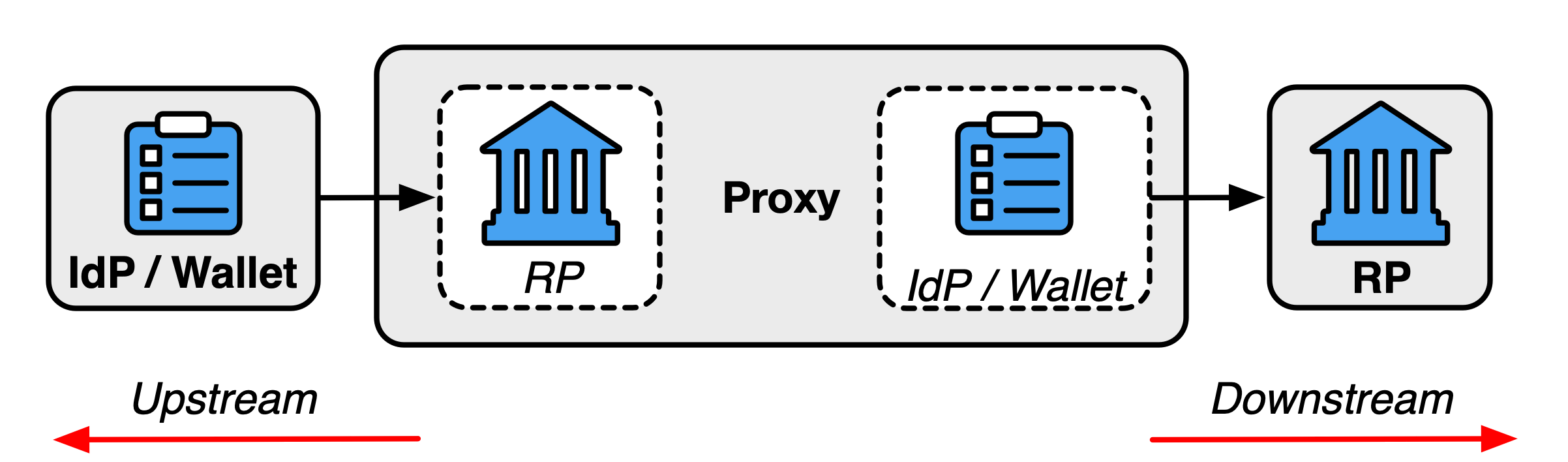
図1. フェデレーションプロキシ。左から右へ、IdP / Wallet(IdP/ウォレット)の箱から矢印が大きなプロキシ(Proxy)の箱に入る。プロキシの中には RP の役割(左の破線の箱)と IdP / Wallet の役割(右の破線の箱)がある。プロキシから右の RP の箱へ矢印が出る。図の下には左向きの赤い矢印に Upstream(上流)、右向きの赤い矢印に Downstream(下流)と記されている。
The role of the proxy is limited to the federation protocol. It is not involved in the establishment or facilitation of a trust agreement between the upstream IdP and downstream RP. The same party can operate a federation authority and a proxy to facilitate federation transactions, but the proxy function is separate from the federation authority’s role in managing the trust agreement. Just like other members of a federation system, the proxy can be involved in separate trust agreements with each of the upstream and downstream components, or a single trust agreement can apply to all parties, such as in a multilateral agreement.
プロキシの役割はフェデレーションプロトコルに限定されます。上流IdPと下流RPの間の信頼合意の確立や促進には関与しません。同じ当事者がフェデレーション機関とプロキシの両方を運用してフェデレーション取引を促進することはできますが、プロキシの機能は信頼合意を管理するフェデレーション機関の役割とは別個です。フェデレーションシステムの他の構成員と同じく、プロキシは上流および下流の各コンポーネントと個別の信頼合意を結ぶことも、例えば多者間合意のように全当事者に単一の信頼合意を適用することもできます。
The downstream RP receives and validates the assertion generated by the proxy, as it would an assertion from any other IdP. This assertion is based on the assertion that the proxy receives from the upstream IdP. The contents of the assertion from the upstream IdP can be handled in several ways, depending on the method used by the proxy:
下流RPは、他のIdPからのアサーションと同様に、プロキシが生成したアサーションを受信して検証します。このアサーションは、プロキシが上流IdPから受け取ったアサーションに基づきます。上流IdPからのアサーションの内容は、プロキシが使用する方式に応じて、いくつかの方法で扱うことができます。
•The proxy can create a new assertion with no information from the assertion from the upstream IdP carried in it. This pattern is useful for blinding the downstream RP so that the RP does not know which upstream IdP the subscriber originally came from.
•プロキシは、上流IdPからのアサーションの情報を一切含めずに、新しいアサーションを作成できます。この方式は、加入者が元々どの上流IdPを利用したかRPに分からないようにするのに役立ちます。
•The proxy can copy attributes from the assertion from the upstream IdP into the assertion from the proxy. This pattern is useful for carrying identity attributes in the assertion to the downstream RP.
•プロキシは、上流IdPからのアサーションの属性を、プロキシからのアサーションにコピーできます。この方式は、識別属性をアサーションに含めて下流RPに伝えるのに役立ちます。
•The proxy can include the entire assertion from the upstream IdP in the assertion from the proxy. This pattern allows the RP to independently validate the assertion from the upstream IdP and the assertion from the proxy.
•プロキシは、上流IdPからのアサーション全体をプロキシからのアサーションに含めることができます。この方式では、RPが上流IdPのアサーションとプロキシのアサーションをそれぞれ独立に検証できます。
The federated identifier (see Sec. 3.4) of an assertion from a proxy SHALL indicate the proxy as the issuer of the assertion.
プロキシからのアサーションに含まれるフェデレーション識別子(Sec. 3.4参照)は、そのアサーションの発行者としてプロキシをSHALL示さなければなりません。
A proxied federation model can provide several benefits. Federation proxies can simplify technical integration between the RP and IdP by providing a common interface for integration, as well as providing translation between federation protocols, formats, and schemas. Additionally, to the extent that a proxy effectively blinds the RP and IdP from each other, it can provide some business confidentiality for organizations that want to guard their subscriber lists from each other. Proxies can also mitigate some of the privacy risks described in Sec. 3.10, though other risks arise from their use since an additional party is now involved in handling subscriber information. For example, if an attacker is able to compromise the proxy, the attacker need not target the IdP or RP directly in order to gain access to subscriber attributes or activity since all of that information flows through the proxy. Additionally, the proxy can perform additional profiling (i.e., aggregating information on which identity the subscriber uses at which RPs) of the subscriber beyond what the IdP and RP can do, since the proxy brokers the federation transactions between the parties and binds the subscriber account to either side of the connection.
プロキシ経由のフェデレーションモデルには、いくつかの利点があります。フェデレーションプロキシは、共通の統合インターフェースを提供し、フェデレーションプロトコル、形式、およびスキーマ間の変換を行うことで、RPとIdPの技術的な統合を簡素化できます。また、プロキシがRPとIdPに互いの情報を効果的に見せない限りにおいて、加入者リストを互いに知られたくない組織に一定の業務上の機密性を提供できます。プロキシはSec. 3.10で説明するプライバシーリスクの一部を軽減することもできますが、加入者情報の取り扱いに別の当事者が加わるため、利用に伴う他のリスクも生じます。例えば、攻撃者がプロキシを侵害できれば、加入者属性や活動の情報がすべてプロキシを通過するため、アクセスを得るのにIdPやRPを直接標的にする必要はありません。さらに、プロキシは当事者間のフェデレーション取引を仲介し、接続の両側で加入者アカウントを紐付けるため、IdPやRP以上に加入者のプロファイリング(すなわち、加入者がどのRPでどのIDを使うかに関する情報の集約)を行うことができます。
See Sec. 7.5 for further information on blinding techniques, their uses, and their limitations.
ブラインディング技法、その用途、および限界については、Sec. 7.5を参照してください。
The FAL of the connection between the proxy and the downstream RP is considered to be the lowest FAL along the entire path, and the proxy SHALL accurately represent this to the downstream RP. For example, if the connection between the upstream IdP and the proxy is FAL1 and the connection between the proxy and the downstream RP otherwise meets the requirements of FAL2, the connection between the proxy and the downstream RP is still considered FAL1. Likewise, if the connection between the upstream IdP and the proxy is FAL2 and the connection between the proxy and the downstream RP is only FAL1, the overall connection through the proxy is considered FAL1.
プロキシと下流RP間の接続のFALは、経路全体における最も低いFALとみなされ、プロキシはこれを下流RPに正確に示すSHALLものとします。例えば、上流IdPとプロキシ間の接続がFAL1で、プロキシと下流RP間の接続がそれ以外の点ではFAL2の要件を満たしている場合でも、プロキシと下流RP間の接続はFAL1とみなされます。同様に、上流IdPとプロキシ間の接続がFAL2で、プロキシと下流RP間の接続がFAL1のみの場合、プロキシ経由の接続全体はFAL1とみなされます。
A subscriber-controlled wallet could potentially function as a proxy. To do so, wallet software would need to act as an RP to an external IdP, just as any other proxy, and then provide those attributes to the downstream RP.
加入者管理ウォレットがプロキシとして機能する可能性もあります。そのためには、他のプロキシと同様に、ウォレットソフトウェアが外部IdPに対してRPとして機能し、その後、下流RPに属性を提供する必要があります。
In some systems, the proxy is referred to as a broker.
システムによっては、プロキシをブローカーと呼びます。
Fulfilling Roles and Functions of a Federation Model
フェデレーションモデルの役割と機能の実現
The roles in a federation transaction can be connected in a variety of ways, but several common patterns are anticipated by these guidelines. The expected trust agreement structure and connection between components will vary based on which pattern is in use.
フェデレーション取引における役割はさまざまな方法で結び付けることができますが、本ガイドラインでは一般的ないくつかのパターンを想定しています。想定される信頼合意の構造とコンポーネント間の接続は、使用するパターンによって異なります。
Different roles and functions can be fulfilled by separate parties that integrate with each other. For example, a CSP can provide attributes of the subscriber account to an IdP that is not operated by the same party or organization as the CSP.
異なる役割や機能は、互いに統合する別々の当事者が担うことができます。例えば、CSPは、自身と同じ当事者または組織が運用していないIdPに加入者アカウントの属性を提供できます。
It is also possible for a single party to fulfill multiple roles within a given federation agreement. For example, if the CSP provides the IdP as part of its identity services, the CSP can provision the subscriber accounts at the IdP as part of the subscriber account establishment process. Similarly, the RP can also be in the same security and administrative domain as the IdP but still use federation technology to connect for technical, deployment, and account management benefits.
単一の当事者が所定のフェデレーション合意の中で複数の役割を担うこともできます。例えば、CSPが自身のIDサービスの一部としてIdPを提供する場合、加入者アカウントの確立プロセスの一環として、CSPがIdPに加入者アカウントをプロビジョニングできます。同様に、RPはIdPと同じセキュリティおよび管理ドメインに属していても、技術、導入、アカウント管理上の利点を得るためにフェデレーション技術を使って接続できます。
The same is true for other functions in the overall federation system, such as a federation authority and proxy. While the roles may seem similar, they are fundamentally distinct and do not need to be connected. A federation authority facilitates the establishment of a trust agreement between parties, and a proxy facilitates the connection of the federation protocol. The same entity can fulfill both the federation authority and proxy functions in the system, providing a means of establishing both trust agreements and technical connections between IdPs and RPs.
フェデレーション機関やプロキシなど、フェデレーションシステム全体の他の機能についても同様です。これらの役割は似ているように見えることがありますが、根本的に異なり、互いに結び付いている必要はありません。フェデレーション機関は当事者間の信頼合意の確立を促進し、プロキシはフェデレーションプロトコルの接続を促進します。同じ組織がシステム内でフェデレーション機関とプロキシの両方の機能を担い、IdPとRP間の信頼合意と技術的接続の双方を確立する手段を提供できます。
Federated Identifiers
フェデレーション識別子
The subscriber is identified in the federation transaction by information in the assertion, which allows the RP to associate the assertion with an RP subscriber account. This identification can happen through an account resolution process (see Sec. 3.8.2) or through a federated identifier.
フェデレーション取引では、アサーション内の情報によって加入者を識別し、RPがそのアサーションをRP加入者アカウントに関連付けられるようにします。この識別は、アカウント解決プロセス(Sec. 3.8.2参照)またはフェデレーション識別子によって行えます。
For general purpose IdPs, a federated identifier is the logical combination of a subject identifier that represents a subscriber account and an issuer identifier that represents the IdP. The subject identifier is assigned by the IdP, and the issuer identifier is usually assigned to the IdP through configuration.
汎用IdPでは、フェデレーション識別子は、加入者アカウントを表すサブジェクト識別子と、IdPを表す発行者識別子を論理的に組み合わせたものです。サブジェクト識別子はIdPが割り当て、発行者識別子は通常、設定を通じてIdPに割り当てられます。
For subscriber-controlled wallets, a federated identifier is the logical combination of a subscriber identifier that represents the subscriber account and an issuer identifier that represents the CSP that issued the attribute bundle. The subject identifier is assigned by the CSP, and the issuer identifier is usually assigned to the CSP through configuration. However, these will not always be available, for example in the case of mobile driver’s licenses where the account resolution is typically done through the use of the driver’s license number and the issuer of the driver’s license. Such a pattern is addressed in Sec. 3.8.2.
加入者管理ウォレットでは、フェデレーション識別子は、加入者アカウントを表す加入者識別子と、属性バンドルを発行したCSPを表す発行者識別子を論理的に組み合わせたものです。サブジェクト識別子はCSPが割り当て、発行者識別子は通常、設定を通じてCSPに割り当てられます。ただし、これらを常に利用できるとは限りません。例えば、モバイル運転免許証の場合、通常、運転免許証番号と運転免許証の発行者を用いてアカウントを解決します。この方式はSec. 3.8.2で扱います。
The multi-part federated identifier pattern is required because different IdPs manage their subject identifiers independently, and could, therefore, potentially collide in their choices of subject identifiers for different subjects. Therefore, it is imperative that an RP never process the subject identifier without accounting for the IdP that issued the subject identifier. For most use cases, the federated identifier is stable for the subscriber across multiple sessions and independent of the authenticator used, allowing the RP to reliably identify the subscriber across multiple authenticated sessions and account changes. However, it is also possible for the federated identifier and its associated use at the RP to be ephemeral to provide some privacy enhancement. Federated identifiers and their constituent parts are intended to be machine-readable and not managed by or exposed to the subscriber, unlike a username or other human-facing identifier.
複数部分からなるフェデレーション識別子のパターンが必要なのは、異なるIdPがそれぞれ独立してサブジェクト識別子を管理し、異なるサブジェクトに同じ識別子を選んで衝突する可能性があるためです。したがって、RPはサブジェクト識別子を発行したIdPを考慮せずに、その識別子を処理してはなりません。大半のユースケースでは、フェデレーション識別子は複数のセッションを通じて加入者について安定しており、使用する認証器にも依存しません。そのため、RPは複数の認証済みセッションやアカウント変更をまたいで加入者を確実に識別できます。一方、プライバシーを高めるため、フェデレーション識別子とRPでの関連する使用を一時的なものにすることもできます。フェデレーション識別子とその構成要素は、ユーザー名など人が扱う識別子とは異なり、機械可読であり、加入者が管理したり加入者に公開したりしないことを想定しています。
When federated identifiers are used, the federated identifier SHALL be unique to that subscriber. Federated identifiers SHALL be associated with a single subscriber at the RP.
フェデレーション識別子を使用する場合、その識別子は加入者ごとに一意SHALLでなければなりません。 RPでは、フェデレーション識別子を単一の加入者に関連付けSHALLなければなりません。
It is recommended that federated identifiers contain no plaintext personal information, such as usernames, email addresses, employee numbers. This restriction is a requirement at FAL2 and above. When a federation process uses account resolution (see Sec. 3.8.2), the RP subscriber account can be resolved by the RP without the use of a federated identifier.
フェデレーション識別子には、ユーザー名、電子メールアドレス、従業員番号などの平文の個人情報を含めないことが推奨されます。この制限はFAL2以上では要件となります。フェデレーションプロセスでアカウント解決(Sec. 3.8.2参照)を使用する場合、RPはフェデレーション識別子を使わずにRP加入者アカウントを解決できます。
Federated identifiers are a logical concept and will typically not be an explicit value distinct from the subject identifier and issuer identifier. Instead, federated identifiers comprise the information needed to ensure that a subscriber is uniquely distinguished and there are no collisions between subject identifiers provided by different IdPs.
フェデレーション識別子は論理的な概念であり、通常、サブジェクト識別子や発行者識別子とは別個の明示的な値ではありません。むしろ、フェデレーション識別子は、加入者を一意に区別し、異なるIdPが提供するサブジェクト識別子同士の衝突を防ぐために必要な情報で構成されます。
Pairwise Pseudonymous Identifiers (PPI)
ペアワイズ仮名識別子(PPI)
In some circumstances, it is desirable to prevent the subscriber account from being easily linked at multiple RPs through the use of a common subject identifier. A pairwise pseudonymous identifier (PPI) allows an IdP to provide multiple distinct federated identifiers to different RPs for a single subscriber account. The use of a PPI prevents different RPs from colluding to track the subscriber using the federated identifier.
場合によっては、共通のサブジェクト識別子を使用して複数のRP間で加入者アカウントが容易に関連付けられることを防ぐのが望まれます。ペアワイズ仮名識別子(PPI)を使うと、IdPは1つの加入者アカウントに対して異なるRPごとに異なるフェデレーション識別子を提供できます。PPIを使用すれば、異なるRPが共謀してフェデレーション識別子を使い加入者を追跡することを防げます。
General Requirements
一般要件
When using pairwise pseudonymous identifiers within the assertions generated by the IdP for the RP, the IdP SHALL generate a different federated identifier for each RP (see Sec. 3.4.1.2) or set of RPs (see Sec. 3.4.1.3).
RP向けにIdPが生成するアサーション内でペアワイズ仮名識別子を使用する場合、IdPは、Sec. 3.4.1.2に従ってRPごとに、またはSec. 3.4.1.3に従ってRP群ごとに、異なるフェデレーション識別子を生成SHALLしなければなりません。
Some identity attributes such as names, physical addresses, phone numbers, email addresses, and others can be used to identify a subscriber outside of a federation transaction. When PPIs are used alongside these kinds of identifying attributes, it may still be possible for multiple colluding RPs to re-identify a subscriber by correlation across systems. For example, if two independent RPs each see the same subscriber identified with a different PPI, the RPs could still determine that the subscriber is the same person by comparing the name, email address, physical address, or other identifying attributes carried alongside the PPI in the respective assertions. If PPIs are used alongside identifying attributes, RPs SHALL establish privacy policies, processes, and procedures to prevent the correlation of subscriber data consistent with applicable legal and regulatory requirements.
氏名、住所、電話番号、電子メールアドレスなどの一部の識別属性は、フェデレーション取引の外でも加入者の識別に使用できます。このような識別属性とPPIを併用しても、共謀する複数のRPがシステム間で照合し、加入者を再識別できる可能性があります。例えば、別個の2つのRPが、異なるPPIで識別された同一の加入者をそれぞれ確認できる場合、各アサーションにPPIとともに含まれる氏名、電子メールアドレス、住所などの識別属性を比較することで、その加入者が同一人物であると判断できる可能性があります。識別属性とPPIを併用する場合、RPは、適用される法律および規制上の要件に従って加入者データの照合を防ぐためのプライバシーポリシー、プロセス、および手順を確立SHALLしなければなりません。
In a proxied federation model (see Sec. 3.3.3), the upstream IdP may not be able to generate a PPI for the downstream RP, since the proxy could blind the IdP from knowing which RP is being accessed by the subscriber. In such situations, the PPI is generally established between the IdP and the federation proxy. Acting as an IdP, the proxy can provide a PPI to the downstream RP. Depending on the protocol, the federation proxy may need to map the PPI back to the associated identifiers from upstream IdPs in order to allow the identity protocol to function. In such cases, the proxy will be able to track and determine which PPIs represent the same subscriber at different RPs. The mapping of a PPI to other identifiers is considered subscriber information and SHALL be treated in accordance with the requirements in Sec. 3.10.1.
プロキシ経由のフェデレーションモデル(Sec. 3.3.3参照)では、プロキシによって加入者がアクセスするRPをIdPが認識できないようにされるため、上流IdPは下流RP用のPPIを生成できないことがあります。このような場合、通常、IdPとフェデレーションプロキシの間でPPIを確立します。IdPとして機能するプロキシは、下流RPにPPIを提供できます。プロトコルによっては、アイデンティティプロトコルを機能させるため、プロキシがPPIを上流IdPからの対応する識別子に対応付ける必要があります。この場合、プロキシは異なるRPにおけるどのPPIが同じ加入者を表すかを追跡し、判断できます。PPIを他の識別子に対応付けた情報は加入者情報とみなされ、Sec. 3.10.1の要件に従ってSHALL取り扱わなければなりません。
Pairwise Pseudonymous Identifier Generation
ペアワイズ仮名識別子の生成
The PPI SHALL contain no identifying information about the subscriber (e.g., username, email address, employee number). The PPI SHALL be difficult to guess by a party with access to information about the subscriber and SHALL provide sufficient entropy as to be unguessable by an attacker. PPIs can be generated randomly and assigned to subscribers by the IdP or derived from other subscriber information if the derivation is done in an irreversible, unguessable manner (e.g., using a keyed hash function with a secret key, as discussed in [SP800-131A]).
PPIには加入者を識別する情報(例えばユーザー名、電子メールアドレス、従業員番号)をSHALL一切含めてはなりません。PPIは、加入者に関する情報を持つ当事者による推測が困難でSHALLなければならず、攻撃者が推測できないだけの十分なエントロピーをSHALL備えなければなりません。PPIはランダムに生成してIdPが加入者に割り当てることも、他の加入者情報から導出することもできます。ただし、導出が不可逆で推測不可能な方法(例えば、[SP800-131A]で説明されているように、秘密鍵を用いた鍵付きハッシュ関数を使用する方法)で行われる場合に限ります。
Unless the PPI is designated as shared by the trust agreement, the PPI SHALL be disclosed to only a single RP.
信頼合意によって共有PPIと指定されている場合を除き、PPIは単一のRPにのみ開示SHALLしなければなりません。
Trust Agreements
信頼合意
Trust agreements are a construct that represent the set of trust relationships established to support parties in a federation transaction. A trust agreement SHALL address one or more of the following relationships:
信頼合意は、フェデレーション取引に参加する当事者を支援するために確立された一連の信頼関係を表す構成要素です。信頼合意は、以下の関係のうち1つ以上を対象とSHALLしなければなりません。
IdP to CSP:
IdPからCSPへ:
The IdP trusts the CSP to provide access to attributes in subscriber accounts, through either an IdP onboarding process or the issuance of attribute bundles. The IdP trusts the CSP’s identity proofing processes used in the establishment of the subscriber account.
IdPは、IdPへの登録プロセスまたは属性バンドルの発行を通じて、加入者アカウントの属性へのアクセスを提供するCSPを信頼します。IdPは、加入者アカウントの確立に用いられたCSPの本人確認プロセスを信頼します。
CSP to IdP:
CSPからIdPへ:
The CSP trusts the IdP to accurately represent subscriber identity attributes to RPs and to not disclose identity attributes outside of agreed-upon functionality. The CSP trusts the IdP to protect the release of attributes, such as requiring authentication of the subscriber or the presentation of an activation factor before attributes are released.
CSPは、IdPが加入者の識別属性を正確にRPに示し、合意した機能の範囲外で識別属性を開示しないことを信頼します。CSPは、属性の開示を保護するため、例えば属性開示前に加入者の認証またはアクティベーション要素の提示を要求するIdPを信頼します。
RP to IdP:
RPからIdPへ:
The RP trusts the IdP to accurately represent subscriber identity attributes as provided by the CSP. The RP trusts the IdP to authenticate or identify the subscriber when representing an authentication event.
RPは、IdPがCSPから提供された加入者の識別属性を正確に示すことを信頼します。RPは、認証イベントを示す際にIdPが加入者を認証または識別することを信頼します。
IdP to RP:
IdPからRPへ:
The IdP trusts the RP to only use the requested attributes for its stated purposes.
IdPは、RPが要求した属性を明示された目的にのみ使用することを信頼します。
RP to CSP:
RPからCSPへ:
The RP trusts the CSP to provide access to subscriber identity attributes through IdPs. The RP trusts that the CSP has identity-proofed the subscriber and is managing the subscriber account.
RPは、IdPを通じて加入者の識別属性へのアクセスを提供するCSPを信頼します。RPは、CSPが加入者の本人確認を行い、加入者アカウントを管理していることを信頼します。
All federation transactions SHALL be governed by the terms of one or more trust agreements between the applicable parties. Different relationships MAY be established at different times and by different processes. For example, a CSP and IdP entering into a trust agreement is generally separate from an RP and IdP entering into a trust agreement, but the overall set of terms for a federation transaction under these parties is drawn from both sets of relationships.
すべてのフェデレーション取引は、該当する当事者間の1つ以上の信頼合意の条件に従ってSHALL管理されなければなりません。異なる関係を異なる時期に異なるプロセスで確立してもよいです(MAY)。例えば、CSPとIdP間の信頼合意の締結は、通常、RPとIdP間の信頼合意の締結とは別個に行われますが、これらの当事者によるフェデレーション取引に適用される条件全体は、両方の関係に基づきます。
Different scenarios will require different combinations of trust in order to function, and these combinations can vary based on the federation model in use. The combination of individual trust agreements that are applicable to a federation transaction fulfills the requirements of these guidelines. Trust agreements can take different forms, including formal contractual agreements, informal dynamic user agreements, and other documented bilateral or multilateral trust decisions by the parties in the federation. In many cases, trust agreements can be implemented using a trust framework, which formalizes a set of rules for parties to connect with each other. Trust frameworks are often used by federation authorities to formalize the rules for the federation being managed by the federation authority.
シナリオによって、機能に必要な信頼の組み合わせは異なり、使用するフェデレーションモデルによってもその組み合わせは変わり得ます。フェデレーション取引に適用される個別の信頼合意を組み合わせることで、本ガイドラインの要件が満たされます。信頼合意には、正式な契約、非公式な動的ユーザー合意、フェデレーションの当事者間で文書化されたその他の二者間または多者間の信頼判断など、さまざまな形態があります。信頼合意は、多くの場合、当事者同士が接続するための一連の規則を正式に定めた信頼フレームワークを使って実装できます。信頼フレームワークは、フェデレーション機関が管理するフェデレーションの規則を正式に定めるために、同機関によって使用されることが多くあります。
For example, consider the case of subscriber-controlled wallets in which an RP might accept assertions without a direct or complete trust agreement with the CSP. As described in Sec. 5.3, provisions of the relevant trust agreements might be determined unilaterally by the RP through the evaluation of publicly available information about CSPs and their processes for issuing attribute bundles. The CSP does not need to know about the RP in order for this part of the trust relationship to be established. In order to fulfill the requirement to disclose the RP’s purpose for using attributes, the RP can disclose these purposes to the subscriber at runtime without informing the CSP.
例えば、RPがCSPとの直接的または完全な信頼合意なしにアサーションを受け入れる場合がある加入者管理ウォレットを考えます。Sec. 5.3で説明するように、関連する信頼合意の規定は、CSPおよびその属性バンドル発行プロセスについて公開されている情報をRPが評価し、RPが一方的に決定する場合があります。この信頼関係の一部を確立するために、CSPがRPを知っている必要はありません。属性の使用目的を開示する要件を満たすには、RPはCSPに知らせず、実行時に加入者へ目的を開示できます。
Trust agreements establish the terms for federation transactions between the parties they affect, including the allowed xALs and the intended purposes of identity attributes exchanged in the federation transaction. The trust agreement SHALL establish customer experience requirements for the federation transaction, as discussed in Sec. 8. The trust agreement SHALL include details of the proofing process used at the CSP for subscribers covered by the trust agreement, including any compensating controls and exception handling processes.
信頼合意は、対象当事者間のフェデレーション取引に関する条件を定めます。これには、許可されるxALや、フェデレーション取引で交換される識別属性の意図された用途が含まれます。信頼合意は、Sec. 8で説明するように、フェデレーション取引の顧客体験に関する要件をSHALL定めなければなりません。信頼合意は、合意の対象となる加入者に対してCSPで使用された本人確認プロセスの詳細(補完的管理策および例外処理プロセスを含む)をSHALL含めなければなりません。
All trust agreements SHALL define a specific population of subscriber accounts to which the agreement is applicable. The exact means of defining this population are out of scope for this document. In many cases, the population is defined as the full set of subscriber accounts that the CSP manages and makes available through an IdP. In other cases, the population is a demarcated subset of accounts that are available through an IdP. It is also possible for an RP to have a distinct trust agreement established with an IdP for a single subscriber account, such as in a subscriber-driven trust agreement.
すべての信頼合意は、その合意が適用される加入者アカウントの集団を具体的にSHALL定義しなければなりません。この集団を定義する具体的な方法は本書の対象範囲外です。多くの場合、この集団はCSPが管理し、IdPを通じて利用可能にするすべての加入者アカウントとして定義されます。その他の場合は、IdPを通じて利用可能なアカウントのうち、明確に区分された一部として定義されます。加入者主導の信頼合意など、RPが単一の加入者アカウントについてIdPと個別の信頼合意を確立することもできます。
During the course of a single federation transaction, it is important for the policies and expectations of all parties to be unambiguous. Therefore, there SHOULD only be one set of trust agreements in effect for a given transaction. This will usually be determined by the unique combination of CSP, IdP, and RP that are participating in the transaction. However, these agreements could vary in other ways, such as different populations of subscribers being governed by different trust agreements. If more than one trust agreement is applicable to a federation transaction, the combined set of terms of all applicable trust agreements SHALL constitute the effective trust agreement of that transaction.
1回のフェデレーション取引の間、すべての当事者のポリシーと期待が明確であることが重要です。したがって、所定の取引に対して有効な信頼合意の組み合わせは1つだけとSHOULDするべきです。通常は、その取引に参加するCSP、IdP、およびRPの一意な組み合わせによって決まります。ただし、異なる加入者集団が異なる信頼合意の適用を受けるなど、他の方法で合意が異なる場合もあります。複数の信頼合意がフェデレーション取引に適用される場合、適用されるすべての信頼合意の条件を合わせたものが、その取引で有効な信頼合意をSHALL構成します。
The existence of a trust agreement between parties does not preclude the existence of other agreements for each party with other parties. For example, an IdP can have independent agreements with multiple RPs simultaneously, and an RP can likewise have independent agreements with multiple IdPs simultaneously. The IdP and RP need not disclose the existence or terms of trust agreements to parties outside of or not covered by the agreement in question.
当事者間に信頼合意が存在していても、各当事者が他の当事者と別の合意を結ぶことは妨げられません。例えば、IdPは複数のRPと同時に個別の合意を結ぶことができ、RPも同様に複数のIdPと同時に個別の合意を結ぶことができます。IdPとRPは、該当する合意の対象外である当事者に対し、その合意の存在や条件を開示する必要はありません。
Trust agreements SHALL establish terms regarding expected and acceptable IALs, AALs, and FALs in connection with the federated relationship.
信頼合意は、フェデレーション関係における想定および許容可能なIAL、AAL、およびFALに関する条件をSHALL定めなければなりません。
Trust agreements SHALL define necessary mechanisms and materials to coordinate redress and issues between the different participants in the federation, as discussed in Sec. 3.5.3.
信頼合意は、フェデレーションの参加者間の救済措置および問題に対処するために必要な調整メカニズムと資料を、Sec. 3.5.3で説明するようにSHALL定義しなければなりません。
Trust agreements SHALL declare the data retention policies expected of all parties.
信頼合意は、すべての当事者に求められるデータ保持ポリシーをSHALL明記しなければなりません。
Even though subscribers are not generally directly involved in the trust agreement’s terms, subscribers are affected by the terms of the trust agreement and the resulting federation transactions. As such, the relevant terms of the trust agreement SHALL be made available to subscribers in clear and understandable language. The terms of the trust agreement SHALL be reviewed by all parties (e.g., the CSP, IdP, RP, or a federation authority) that are responsible for informing the subscriber of the terms of the trust agreement before the disclosure to the subscriber occurs in order to avoid revealing sensitive security information.
加入者は通常、信頼合意の条件に直接関与しませんが、その条件および結果として行われるフェデレーション取引の影響を受けます。そのため、信頼合意の関連条件を、明確で理解しやすい言葉で加入者が利用できるようにSHALLしなければなりません。加入者への開示に先立ち、信頼合意の条件を加入者に知らせる責任を持つすべての当事者(例えばCSP、IdP、RP、またはフェデレーション機関)が、機微なセキュリティ情報の開示を避けるため、その条件をSHALL確認しなければなりません。
The means by which the subscriber can access these terms and the party responsible for informing the subscriber vary based on the means of establishing the trust agreement and the terms of the trust agreement itself. Common methods for disclosure include:
加入者がこれらの条件にアクセスする方法と、加入者への通知に責任を持つ当事者は、信頼合意の確立方法と信頼合意自体の条件によって異なります。一般的な開示方法には次があります。
•Providing a subscriber-accessible web page with relevant trust agreement terms
•関連する信頼合意条件を掲載した、加入者がアクセス可能なウェブページを提供する
•Sending a notice to the subscriber
•加入者に通知を送る
•Displaying a summarization of terms during a runtime decision with an option to review the full terms
•実行時の判断中に条件の要約を表示し、完全な条件を確認する選択肢を提示する
The establishment of a trust agreement is required for all federation transactions, even those for which the roles and applications exist within a single security domain or shared legal ownership, such as an enterprise system. In these cases, the establishment of the trust agreement can be an internal process and does not need to involve a formal agreement. Even in such cases, the organization must still document and disclose the terms of the trust agreement to the subscriber upon request.
単一のセキュリティドメイン内または共通の法的所有権下に役割とアプリケーションが存在する場合(例えば企業システム)も含め、すべてのフェデレーション取引で信頼合意の確立が必要です。このような場合、信頼合意の確立は内部プロセスでもよく、正式な合意を伴う必要はありません。それでも組織は、要求があれば信頼合意の条件を文書化し、加入者に開示しなければなりません。
The subscriber’s user agent is not usually party to the trust agreement, unless it is acting in one of the roles of the federation transaction (e.g., a subscriber-controlled wallet running in the subscriber’s browser software).
加入者のユーザーエージェントは、フェデレーション取引のいずれかの役割(例えば加入者のブラウザーソフトウェア上で動作する加入者管理ウォレット)を担う場合を除き、通常は信頼合意の当事者ではありません。
Bilateral Trust Agreements
二者間信頼合意
In a bilateral trust agreement, the establishment of the trust agreement occurs directly between the federated parties, and the trust agreement is not managed or facilitated by a separate party. Bilateral trust agreements allow for a point-to-point connection to be established between organizations that wish to provide federated identity access to services. Bilateral connections can take many forms, including large enterprise applications with static contracts or subscriber-driven dynamic connections to previously unknown RPs. In all cases, the CSP, IdP, and RP directly manage their policies regarding the federated connection.
二者間信頼合意では、フェデレーション当事者間で直接信頼合意を確立し、別の当事者が合意を管理または促進することはありません。二者間信頼合意により、フェデレーションIDを使ってサービスへのアクセスを提供したい組織間に、ポイントツーポイント接続を確立できます。二者間接続には、静的な契約を伴う大規模な企業向けアプリケーションから、これまで未知だったRPへの加入者主導の動的接続まで、さまざまな形があります。いずれの場合も、CSP、IdP、およびRPがフェデレーション接続に関するポリシーを直接管理します。
Bilateral trust agreements conform to the stated requirements for all trust agreements. However, since these trust agreements do not involve additional parties, there are no additional normative requirements for their establishment and management, such as those mandated for multi-lateral trust agreements (see Sec. 3.5.2).
二者間信頼合意は、すべての信頼合意に定められた要件に従います。ただし、これらの信頼合意には追加の当事者が関与しないため、その確立と管理には、Sec. 3.5.2で多者間信頼合意に対して義務付けられるような、追加の規範的要件はありません。
Multilateral Trust Agreements
多者間信頼合意
In a multilateral trust agreement, the federated parties look to a federation authority to assist in establishing the trust agreement between parties. In this model, the federation authority facilitates the inclusion of CSPs, IdPs, and RPs under the trust agreement.
多者間信頼合意では、フェデレーション当事者は、当事者間の信頼合意の確立を支援するフェデレーション機関を利用します。このモデルでは、フェデレーション機関がCSP、IdP、およびRPを信頼合意に参加させる手続きを促進します。
When onboarding a party in any role, the federation authority conducts vetting on that party to verify its compliance with the terms of the trust agreement, as shown in Fig. 2. The level of vetting is unique to the use cases and models employed within the federation, and details are outside of the scope of this document. As with many other functions, the federation authority can outsource the vetting process to another party, but the federation authority is ultimately responsible for the results of the vetting process.
いずれかの役割を担う当事者の参加登録時に、フェデレーション機関は図2に示すように、信頼合意の条件への適合を確認するため、その当事者の審査を実施します。審査の水準は、フェデレーション内で採用するユースケースとモデルに固有であり、その詳細は本書の対象範囲外です。他の多くの機能と同様に、フェデレーション機関は審査プロセスを別の当事者に委託できますが、最終的には審査プロセスの結果に対する責任を負います。
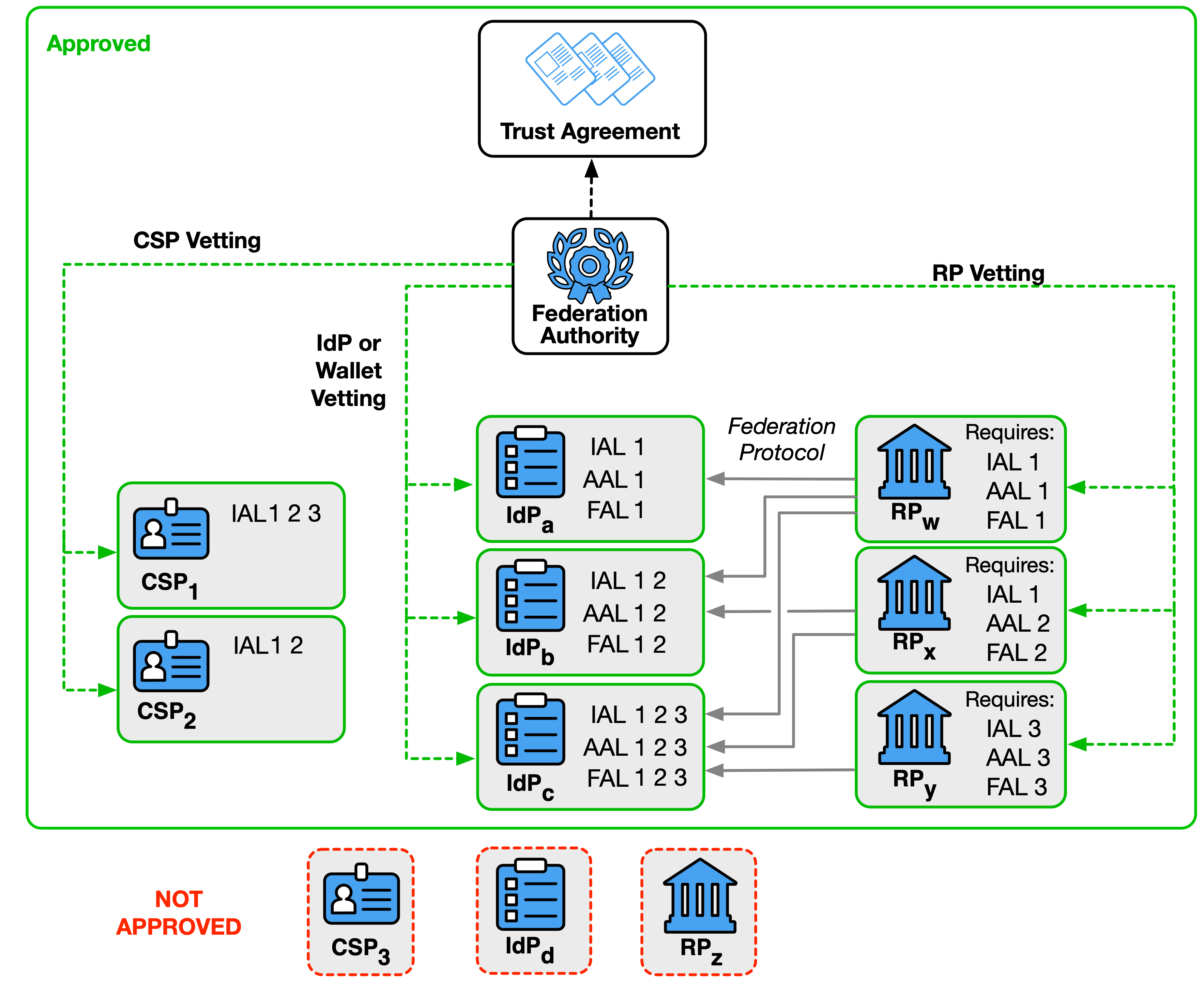
図2. フェデレーション機関。Approved(承認済み)と記された大きな緑の枠の中にフェデレーション機関(Federation Authority)の箱があり、破線の矢印が上の信頼合意(Trust Agreement)の箱に向かう。フェデレーション機関から緑の破線の矢印が出る。CSP Vetting(CSP の審査)は CSP1(IAL 1 2 3)と CSP2(IAL 1 2)へ、IdP or Wallet Vetting(IdP またはウォレットの審査)は IdPa(IAL 1、AAL 1、FAL 1)、IdPb(IAL 1 2、AAL 1 2、FAL 1 2)、IdPc(IAL 1 2 3、AAL 1 2 3、FAL 1 2 3)へ、RP Vetting(RP の審査)は RPw(Requires: IAL 1、AAL 1、FAL 1)、RPx(Requires: IAL 1、AAL 2、FAL 2)、RPy(Requires: IAL 3、AAL 3、FAL 3)へ向かう。Federation Protocol(フェデレーションプロトコル)と記された灰色の矢印が RP から IdP へ向かう。RPw から IdPa・IdPb・IdPc へ、RPx から IdPb・IdPc へ、RPy から IdPc へである。Approved の枠の外には NOT APPROVED(未承認)と記され、赤い破線の箱の CSP3、IdPd、RPz がある。
The trust agreement SHALL enumerate the required practices for vetting all parties and SHALL indicate the party or parties that are responsible for performing the vetting process.
信頼合意は、すべての当事者を審査するために必要な実務をSHALL列挙し、審査プロセスの実施に責任を持つ当事者をSHALL明示しなければなりません。
At a minimum, the vetting of CSPs, IdPs, and RPs SHALL establish that:
最低限、CSP、IdP、およびRPの審査では、以下の事項をSHALL確認しなければなりません。
•CSPs identity proof subscriber accounts in accordance with [SP800-63A].
•CSPは、[SP800-63A]に従って加入者アカウントの本人確認を行います。
•The authenticators used to authenticate the subscriber at the IdP (during a federation transaction) or CSP (while issuing attribute bundles to a subscriber-controlled wallet) are used in accordance with [SP800-63B].
•加入者の認証に用いる認証器は、フェデレーション取引中にIdPで使用する場合も、加入者管理ウォレットに属性バンドルを発行する際にCSPで使用する場合も、[SP800-63B]に従って使用します。
•RPs adhere to requirements for handling subscriber attribute data, such as retention, aggregation, deletion, and disclosure to third parties.
•RPは、加入者属性データの保持、集約、削除、および第三者への開示などの取り扱いに関する要件に従います。
•RP and IdP systems use agreed-upon profiles of federation protocols, as specified by the federation authority.
•RPおよびIdPのシステムは、フェデレーション機関が指定した、合意済みのフェデレーションプロトコルのプロファイルを使用します。
The federation authority MAY provide a programmatic means for parties under the trust agreement to verify the membership of other parties in the trust agreement. For example, a federation authority could provide a discovery API that provides the vetted capabilities of an IdP for providing identities to RPs within the system. Alternatively, the federation authority could provide a signed attestation for RPs to present to IdPs during a registration step.
フェデレーション機関は、信頼合意の対象となる当事者が、他の当事者の信頼合意への参加を確認するためのプログラム的手段を提供してもよいです(MAY)。例えば、フェデレーション機関は、システム内のRPにIDを提供するIdPの審査済み能力を通知するディスカバリーAPIを提供できます。あるいは、登録時にRPがIdPに提示できる署名済み証明を提供できます。
Federation authorities SHALL periodically reevaluate members for compliance with terms disclosed in the trust agreement.
フェデレーション機関は、信頼合意で開示された条件への適合について、参加者を定期的に再評価SHALLしなければなりません。
A multilateral trust agreement MAY establish trust based on other trust agreements that are managed by other entities by creating an interfederation agreement. For example, IdP1 has been vetted under a multilateral agreement with federation authority A1, and RP2 has been vetted under a multilateral agreement with federation authority A2. In order to facilitate connection between IdP1 and RP2, a new federation authority A3 can provide a multilateral agreement that accepts IdPs from A1 and RPs from A2. If IdP1 and RP2 accept the authority of A3, the federation connection can continue under the auspices of this interfederation agreement.
多者間信頼合意は、フェデレーション間合意を作成することで、他の組織が管理する信頼合意に基づいて信頼を確立してもよいです(MAY)。例えば、IdP1はフェデレーション機関A1との多者間合意に基づいて審査済みであり、RP2はフェデレーション機関A2との多者間合意に基づいて審査済みであるとします。IdP1とRP2の接続を促進するため、新たなフェデレーション機関A3が、A1のIdPとA2のRPを受け入れる多者間合意を提供できます。IdP1とRP2がA3の権限を受け入れれば、このフェデレーション接続は当該フェデレーション間合意の下で継続できます。
Redress Requirements
救済要件
Federation transactions occur between multiple parties that are often controlled by multiple entities, and different stages of the federation transaction can lead to situations in which a subscriber would need to seek redress from the other parties.
フェデレーション取引は複数の当事者間で行われ、各当事者は複数の組織によって管理されることが多くあります。また、取引の段階によっては、加入者が他の当事者に救済を求める必要が生じることがあります。
As the recipient of a subscriber’s identity attributes, the RP is the subscriber’s primary view into the federated system. In some instances, the subscriber may be unaware that an IdP is involved with their use of the RP. Therefore, it falls to the RP to provide the subscriber with a clear and accessible method of contacting the RP to request redress. For matters that involve the RP subscriber account (including any attributes stored in the account), RP functionality, bound authenticators, RP allowlists, and other items under the RP’s control, the RP SHALL provide a clear and accessible means of redress to the subscriber. For matters that involve the IdP or CSP, the RP SHALL provide the subscriber with a means of initiating the redress process with the IdP or CSP, as appropriate.
加入者の識別属性を受け取るRPは、フェデレーションシステムを加入者から見た主要な窓口です。加入者は、RPの利用にIdPが関与していることに気付いていない場合もあります。そのため、救済を求めるためRPに連絡する明確で利用しやすい方法を加入者に提供するのはRPの責任です。RP加入者アカウント(アカウントに保存された属性を含む)、RPの機能、バインド済み認証器、RPの許可リスト、およびRPが管理するその他の事項について、RPは加入者に明確で利用しやすい救済手段を提供SHALLしなければなりません。IdPまたはCSPに関わる事項については、RPは、適切にIdPまたはCSPとの救済プロセスを開始する手段を加入者にSHALL提供しなければなりません。
For matters that involve the use of the subscriber account in federation transactions, including attribute values and derived attribute values made available over federation transactions, IdP functionality, holder-of-key authenticators, IdP allowlists, and other items in the IdP’s control, the IdP SHALL provide a clear and accessible means of redress to the subscriber. For matters that also involve a particular RP, the IdP SHALL provide the subscriber with a means of initiating the redress process with the RP. For matters that involve a subscriber account that has been made available to the IdP, the IdP SHALL provide the subscriber with a means of initiating the redress process with the CSP.
フェデレーション取引での加入者アカウントの利用(フェデレーション取引を通じて利用可能な属性値および導出属性値を含む)、IdPの機能、holder-of-key認証器、IdPの許可リスト、およびIdPが管理するその他の事項について、IdPは加入者に明確で利用しやすい救済手段をSHALL提供しなければなりません。特定のRPにも関わる事項について、IdPはRPとの救済プロセスを開始する手段を加入者にSHALL提供しなければなりません。IdPが利用できるようにされた加入者アカウントに関わる事項について、IdPはCSPとの救済プロセスを開始する手段を加入者にSHALL提供しなければなりません。
For matters that involve the subscriber account, including identity attributes and authenticators in the subscriber account, the CSP SHALL provide the subscriber with a clear and accessible means of redress.
加入者アカウント(アカウントの識別属性および認証器を含む)に関わる事項について、CSPは加入者に明確で利用しやすい救済手段をSHALL提供しなければなりません。
See Sec. 3.6 of [SP800-63] for more requirements on providing redress.
救済手段の提供に関する追加要件は[SP800-63]のSec. 3.6を参照してください。
Identifiers and Cryptographic Key Management for CSPs, IdPs, and RPs
CSP、IdP、およびRPの識別子と暗号鍵の管理
While a trust agreement establishes permission to federate, it does not facilitate the secure connection of parties in the federation. In order to communicate over a federation protocol, the CSP, IdP, and RP need to be able to identify each other in a secure fashion with the ability to associate identifiers with cryptographic keys and related security artifacts. In this way, an RP can ensure that an assertion is coming from the intended IdP or that an attribute bundle is coming from the intended CSP. Likewise, an IdP can ensure that it is sending an assertion to the intended RP.
信頼合意はフェデレーションを行う許可を確立しますが、フェデレーションの当事者間で安全な接続を確立するものではありません。 フェデレーションプロトコルを介して通信するには、CSP、IdP、およびRPが、識別子を暗号鍵や関連するセキュリティ成果物に関連付けて、安全な方法で互いを識別できる必要があります。 この仕組みによって、RPはアサーションが意図したIdPから送られていることや、属性バンドルが意図したCSPから送られていることを確認できます。同様に、IdPはアサーションを意図したRPに送っていることを確認できます。
The process of an RP establishing identifiers and cryptographic keys for an IdP or CSP is known as discovery. The process of an IdP establishing identifiers and cryptographic keys for the RP is known as registration. Both the discovery and registration processes can happen prior to any federation transaction or inline as part of the transaction itself. Additionally, both the discovery and registration processes can happen directly between parties or be facilitated through the use of a third-party service, as defined in the trust agreement. These processes can use a combination of manual distribution of keys and identifiers between the IdP, CSP, and RP or associate these entities with sources in which cryptographic key material and metadata can be fetched through automated processes. Different federation protocols and processes have different processes for establishing these identifiers and cryptographic keys, but the end result is that each party can properly identify others as necessary within the protocol.
RPがIdPまたはCSPの識別子と暗号鍵を確立するプロセスはディスカバリーと呼ばれます。IdPがRPの識別子と暗号鍵を確立するプロセスは登録と呼ばれます。ディスカバリーと登録は、フェデレーション取引前に行うことも、取引の一部としてインラインで行うこともできます。また、両方のプロセスは、信頼合意で定めたとおり、当事者間で直接行うことも、第三者のサービスを利用して促進することもできます。これらのプロセスでは、IdP、CSP、およびRP間で鍵と識別子を手動で配布する方法と、暗号鍵素材やメタデータを自動処理で取得できる情報源にこれらの主体を関連付ける方法を組み合わせて使用できます。フェデレーションプロトコルやプロセスによって、これらの識別子と暗号鍵を確立する手順は異なりますが、最終的には各当事者がプロトコル内で必要に応じて他の当事者を適切に識別できます。
The discovery and registration processes SHALL be established in a secure fashion, as defined by the trust agreement that governs the federation transaction. In many cases, the identifier is associated with a trusted source of cryptographic key material and not the key material itself. For example, a URL hosted by an IdP can serve the public signing keys for that IdP. Even if the RP is manually configured with this association, the RP can fetch the actual cryptographic key material at runtime. Protocols that require the transfer of cryptographic key information SHALL use an authenticated protected channel to exchange the cryptographic key information needed to operate the federated relationship, including any shared secrets or public keys. Any symmetric keys used in this relationship SHALL be unique to a pair of federation participants.
ディスカバリーと登録のプロセスは、フェデレーション取引を規定する信頼合意で定義するとおり、安全な方法で確立SHALLしなければなりません。多くの場合、識別子は暗号鍵素材そのものではなく、その素材を提供する信頼できる情報源に関連付けられます。例えば、IdPがホストするURLで、そのIdPの公開署名鍵を提供できます。この関連付けをRPに手動設定した場合でも、RPは実行時に実際の暗号鍵素材を取得できます。暗号鍵情報の転送を必要とするプロトコルは、共有シークレットや公開鍵など、フェデレーション関係の運用に必要な暗号鍵情報の交換に、認証済みの保護されたチャネルをSHALL使用しなければなりません。この関係で使用される共通鍵は、フェデレーション参加者の各ペアに固有SHALLでなければなりません。
CSPs, IdPs (including subscriber-controlled wallets), and RPs MAY have multiple identifiers and cryptographic keys to serve different purposes within a trust agreement or different trust agreements. For example, an IdP could use one set of assertion signing keys for all FAL1 and FAL2 transactions and use a separately managed set of signing keys for FAL3 transactions that are stored in a higher security container.
CSP、IdP(加入者管理ウォレットを含む)、およびRPは、信頼合意または複数の信頼合意における異なる目的に応じて、複数の識別子や暗号鍵を持ってもよいです(MAY)。例えば、IdPはすべてのFAL1およびFAL2取引に1組のアサーション署名鍵を使用し、より安全なコンテナに保存された、別途管理する署名鍵の組をFAL3取引に使用できます。
When domain names, URIs, or other structured identifiers are used to identify parties, wildcards SHALL NOT be used. For example, if an RP is deployed at “www.example.com”, “service.example.com”, and “gateway.example.com”, then each of these identifiers would have to be registered for the RP. A wildcard of “*.example.com” cannot be used, as it would unintentionally allow access to “user.example.com” and “unknown.example.com” under the same RP identifier.
ドメイン名、URI、またはその他の構造化識別子を当事者の識別に用いる場合、ワイルドカードを使用してはなりません(SHALL NOT)。例えば、RPが「www.example.com」、「service.example.com」、および「gateway.example.com」で導入されている場合、それぞれの識別子をRPに登録する必要があります。「*.example.com」というワイルドカードは、同じRP識別子の下で意図せず「user.example.com」や「unknown.example.com」へのアクセスを許してしまうため、使用できません。
Cryptographic Key Rotation
暗号鍵のローテーション
Over time, it can be desirable or necessary to update the cryptographic key associated with a CSP, IdP, or RP. The allowable update process for any identifiers and cryptographic keys SHALL be defined by the trust agreement and SHALL be executed using an authenticated protected channel, as in the initial cryptographic key establishment.
時間の経過に伴い、CSP、IdP、またはRPに関連付けられた暗号鍵を更新することが望ましい、または必要となる場合があります。識別子と暗号鍵の更新に許容されるプロセスは、信頼合意でSHALL定義し、初期の暗号鍵確立と同様に、認証済みの保護されたチャネルを使用してSHALL実行しなければなりません。
For example, if the IdP is identified by a URL, the IdP could publish its current public key set at a location underneath that URL. The IdP can update which keys are published at that location as needed. RPs can then fetch the public key from the known location as needed and obtain updated public keys as they are made available.
例えば、URLで識別されるIdPは、そのURL以下の場所に現在の公開鍵セットを公開できます。必要に応じて、IdPはその場所で公開する鍵を更新できます。RPは必要に応じて既知の場所から公開鍵を取得し、新しい公開鍵が利用可能になったら取得できます。
Cryptographic Key Storage
暗号鍵の保管
CSPs, IdPs (including subscriber-controlled wallets), and RPs SHALL store all signing keys, decryption keys, and symmetric keys in a secure fashion. Cryptographic key storage is subject to applicable [FIPS140] requirements, including applicable tamper resistance requirements.
CSP、IdP(加入者管理ウォレットを含む)、およびRPは、すべての署名鍵、復号鍵、および共通鍵を安全な方法でSHALL保管しなければなりません。暗号鍵の保管には、適用される改ざん耐性要件を含む、該当する[FIPS140]要件が適用されます。
Some circumstances require the cryptographic keys to be stored in a non-exportable manner, such as reaching FAL3 with a subscriber-controlled wallet on a subscriber’s device (see Sec. 5.4.1). To be considered non-exportable, key storage SHALL either be a separate piece of hardware or an embedded processor or execution environment, such as a secure element, trusted execution environment (TEE), or trusted platform module (TPM). These hardware modules or embedded processors are separate from a host processor, such as the CPU on a laptop or mobile device. Non-exportable key storage SHALL be designed to prohibit the export of the secret keys to the host processor and SHALL NOT be capable of being reprogrammed by the host processor to allow the secret keys to be extracted.
加入者のデバイス上の加入者管理ウォレットでFAL3に到達する場合(Sec. 5.4.1参照)など、暗号鍵をエクスポート不可の方法で保管する必要がある状況があります。エクスポート不可とみなされるには、鍵の保管先が独立したハードウェア、またはセキュアエレメント、トラステッド実行環境(TEE)、トラステッドプラットフォームモジュール(TPM)などの組み込みプロセッサーまたは実行環境でSHALLなければなりません。これらのハードウェアモジュールまたは組み込みプロセッサーは、ラップトップやモバイルデバイスのCPUなどのホストプロセッサーとは別個のものです。エクスポート不可の鍵保管は、秘密鍵がホストプロセッサーにエクスポートされることを禁止するようSHALL設計し、秘密鍵を抽出できるようホストプロセッサーが再プログラムすることができてはなりません(SHALL NOT)。
Software Attestations
ソフトウェア証明
Software and device attestations can augment the establishment of identifiers and cryptographic keys, especially in dynamic and distributed systems. Attestations in this usage are cryptographically bound statements that a particular piece of software, device, or runtime system meets a set of agreed-upon parameters. The attestation is presented by the software in the context of establishing the identity of the software, device, or system with which the receiver is interacting. The attestation allows the receiver to verify the request with a higher degree of certainty than they would be able to otherwise.
ソフトウェアおよびデバイスの証明は、特に動的で分散されたシステムにおいて、識別子や暗号鍵の確立を補強できます。この用途における証明とは、特定のソフトウェア、デバイス、または実行時システムが、合意済みの一連のパラメーターを満たしていることを示す、暗号学的に結び付けられたステートメントです。証明は、受信者が通信相手となるソフトウェア、デバイス、またはシステムのIDを確立する過程で、そのソフトウェアによって提示されます。これにより、受信者は他の方法で可能な水準よりも高い確度で要求を検証できます。
For example, a specific distribution of subscriber-controlled wallet software can be signed by its distributor to allow RPs to recognize individual instances of that software. Alternatively, an RP could be issued an attestation from a federation authority to allow IdPs to recognize the RP as part of the federation.
例えば、加入者管理ウォレットソフトウェアの特定の配布物に配布者が署名することで、RPはそのソフトウェアの個々のインスタンスを識別できます。あるいは、フェデレーション機関がRPに証明を発行することで、IdPはRPがフェデレーションの一員であることを識別できます。
When attestations are required by the trust agreement or requested as part of the federation protocol, received attestations SHALL be validated by the receiver.
信頼合意で証明が求められる場合、またはフェデレーションプロトコルの一部として証明が要求された場合、受信者は受け取った証明をSHALL検証しなければなりません。
See [RFC7591] Sec. 2.3 for more information about software statements, which are a means for OAuth and OpenID Connect RPs to communicate a signed set of software attributes during dynamic client registration.
OAuthおよびOpenID ConnectのRPが動的クライアント登録時に署名済みソフトウェア属性を伝達する手段であるソフトウェアステートメントについては、[RFC7591] Sec. 2.3を参照してください。
Authentication and Attribute Disclosure
認証と属性開示
Once the IdP and RP have entered into a trust agreement and completed registration, the federation protocol can be used to pass subscriber attributes from the IdP to the RP.
IdPとRPが信頼合意を締結し、登録を完了すると、フェデレーションプロトコルを使って加入者属性をIdPからRPに渡すことができます。
A subscriber’s identity attributes SHALL only be transmitted between the IdP and the RP for federation transactions or support functions, such as identification of compromised subscriber accounts (see Sec. 3.10.1), even when parties are allowlisted for federation purposes.
当事者がフェデレーション目的で許可リストに登録されている場合であっても、加入者の識別属性は、フェデレーション取引または侵害された加入者アカウントの識別などの支援機能(Sec. 3.10.1参照)のためにのみ、IdPとRP間で送信SHALLしなければなりません。
A subscriber’s identity attributes SHALL NOT be used by the RP for purposes other than those stipulated in the trust agreement unless the subscriber specifically consents to such purposes. A subscriber’s attributes SHALL be stored and managed in accordance with Sec. 3.11.3.
加入者の識別属性を、信頼合意に規定された目的以外にRPが使用してはなりません(SHALL NOT)。ただし、加入者がその目的に明示的に同意した場合を除きます。加入者の属性は、Sec. 3.11.3に従ってSHALL保管および管理しなければなりません。
The subscriber SHALL be informed of the transmission of attributes to an RP. If the authorized party is the organization, the organization SHALL make the list of approved RPs and the associated sets of attributes sent to those RPs available to the subscriber. If the authorized party is the subscriber, the subscriber SHALL be prompted prior to the release of attributes using a runtime decision at the IdP, as described in Sec. 4.6.1.3.
RPへの属性送信について、加入者にSHALL通知しなければなりません。認可当事者が組織である場合、組織は承認済みRPの一覧と、それらのRPに送信される関連属性の組み合わせを加入者が利用できるようにSHALLしなければなりません。認可当事者が加入者である場合、Sec. 4.6.1.3で説明するとおり、IdPでの実行時の判断により属性を開示する前に加入者に確認をSHALL求めなければなりません。
RP Subscriber Accounts
RP加入者アカウント
An RP typically keeps a record known as the RP subscriber account to locally represent a subscriber. The RP subscriber account can contain things like access rights at the RP as well as a cache of identity attributes for the subscriber. The RP subscriber account has a separate life cycle from any subscriber account on which it might be based (e.g., the subscriber accounts maintained by a CSP or IdP).
RPは通常、加入者をローカルに表すRP加入者アカウントと呼ばれる記録を保持します。RP加入者アカウントには、RPでのアクセス権や加入者の識別属性のキャッシュなどを含めることができます。RP加入者アカウントのライフサイクルは、その基礎となる他の加入者アカウント(例えばCSPまたはIdPが管理する加入者アカウント)とは別個です。
An RP subscriber account is provisioned when the RP has associated a set of attributes about the subscriber with a data record that represents the subscriber account at the RP. The provisioning can happen prior to authentication or as a result of the federated authentication process, depending on the deployment patterns (see Sec. 4.6.3). The RP subscriber account MAY be associated with one or more federated identifiers at the time of provisioning or MAY be later linked to federated identifiers through account resolution, as discussed in Sec. 3.8.2.
RPが、加入者を表すデータレコードにその加入者に関する属性の組み合わせを関連付けると、RP加入者アカウントがプロビジョニングされます。導入パターンに応じて、プロビジョニングは認証前に行われる場合と、フェデレーション認証プロセスの結果として行われる場合があります(Sec. 4.6.3参照)。プロビジョニング時にRP加入者アカウントを1つ以上のフェデレーション識別子に関連付けてもよく(MAY)、後にSec. 3.8.2で説明するアカウント解決を通じてフェデレーション識別子にリンクしてもよいです(MAY)。
An RP subscriber account is available for federated authentication when it is bound to one or more federated identifiers from the RP’s trusted IdPs, or an account resolution process is established. The successful authentication of a subscriber through a federation protocol allows the subscriber to access the information and functionality of the RP protected by the RP subscriber account.
RP加入者アカウントは、RPが信頼するIdPからの1つ以上のフェデレーション識別子にバインドされたとき、またはアカウント解決プロセスが確立されたときに、フェデレーション認証に利用できます。フェデレーションプロトコルを通じた加入者の認証が成功すると、加入者はRP加入者アカウントで保護されているRPの情報および機能にアクセスできます。
An RP subscriber account is terminated when the RP removes all access to the account at the RP. Termination SHALL include the removal of all federated identifiers, bound authenticators, attributes, and identity information associated with the account, in accordance with Sec. 3.11.3. An RP MAY terminate an RP subscriber account independently from the IdP, regardless of the current validity of the subscriber account from which it is derived.
RPがRPでのアカウントへのアクセスをすべて削除すると、RP加入者アカウントは終了します。終了時には、アカウントに関連付けられたすべてのフェデレーション識別子、バインド済み認証器、属性、および識別情報を、Sec. 3.11.3に従って削除SHALLしなければなりません。加入者アカウントの現在の有効性にかかわらず、RPはIdPとは独立にRP加入者アカウントを終了してもよいです(MAY)。
An RP subscriber account is disabled when the subscriber cannot access the RP using the account, such as when all federated identifiers and alternate authenticators are removed from the RP subscriber account, but the information in the account is retained. An RP could choose to disable an RP subscriber account rather than terminate it in order to facilitate records retention or investigate suspicious behavior associated with the account.
加入者がアカウントを使ってRPにアクセスできないとき、例えばRP加入者アカウントからすべてのフェデレーション識別子や代替認証器が削除されましたが、アカウント内の情報は保持されているとき、そのRP加入者アカウントは無効化されています。RPは、記録の保持を容易にするため、またはアカウントに関する不審な行動を調査するために、RP加入者アカウントを終了する代わりに無効化できます。
An RP MAY offer a means of recovery of an RP subscriber account with no current means of access.
RPは、現在アクセス手段のないRP加入者アカウントを回復する方法を提供してもよいです(MAY)。
An RP subscriber account can be provisioned at the RP without an authenticated session, but an authenticated session can only be created based on a provisioned account. See Sec. 3.9 for more information on sessions.
RP加入者アカウントは認証済みセッションなしでRPにプロビジョニングできますが、プロビジョニング済みアカウントに基づく場合に限り認証済みセッションを作成できます。セッションの詳細はSec. 3.9を参照してください。
The RP SHALL document the practices and policies that it enacts when an RP subscriber account reaches a state of having zero associated federated identifiers; no means of access, including alternative authenticators (see Sec. 3.8.3); and no means of recovery, including account linking (see Sec. 3.8.1) and account resolution (see Sec. 3.8.2). In such cases, the RP subscriber account SHOULD be disabled or terminated.
RP加入者アカウントに関連付けられたフェデレーション識別子がゼロになり、代替認証器(Sec. 3.8.3参照)を含むアクセス手段がなく、アカウントリンク(Sec. 3.8.1参照)やアカウント解決(Sec. 3.8.2参照)を含む回復手段もない状態になったとき、RPが実施する実務とポリシーをRPはSHALL文書化しなければなりません。この場合、RP加入者アカウントは無効化または終了するべきです(SHOULD)。
The RP SHALL provide a notice to the subscriber when:
次の場合、RPは加入者に通知をSHALLしなければなりません。
•A new federated identifier is added to an existing RP subscriber account, or
•既存のRP加入者アカウントに新しいフェデレーション識別子が追加された場合、または
•A federated identifier is removed from an RP subscriber account, but the account is not terminated.
•フェデレーション識別子がRP加入者アカウントから削除されたものの、アカウントは終了していない場合。
The RP SHOULD provide a notice to the subscriber when the RP subscriber account is disabled or terminated. The RP SHALL consider the reason for termination when determining whether to send a notice to the subscriber, as discussed in Sec. 5.4 of [SP800-63A].
RP加入者アカウントが無効化または終了されたとき、RPは加入者に通知するべきです(SHOULD)。加入者に通知するかどうかを決定する際、RPは[SP800-63A]のSec. 5.4で説明するとおり、終了の理由をSHALL考慮しなければなりません。
For additional considerations on providing a notice to a subscriber about account management events, see Sec. 4.6 of [SP800-63B].
アカウント管理イベントについて加入者に通知する際の追加の考慮事項は、[SP800-63B]のSec. 4.6を参照してください。
Account Linking
アカウントリンク
A single RP subscriber account MAY be associated with more than one federated identifier. This practice is sometimes known as account linking. If the RP allows a subscriber to link multiple subscriber accounts in this way, the RP SHALL require an authenticated session with the subscriber account for all linking functions. This authenticated session SHOULD require authentication using one existing federated identifier before linking the new federated identifier to the RP subscriber account.
単一のRP加入者アカウントを複数のフェデレーション識別子に関連付けてもよいです(MAY)。この方法はアカウントリンクと呼ばれることがあります。RPが加入者によるこの方法での複数アカウントのリンクを許可する場合、RPはすべてのリンク機能に対して、加入者アカウントとの認証済みセッションをSHALL要求しなければなりません。この認証済みセッションでは、新しいフェデレーション識別子をRP加入者アカウントにリンクする前に、既存のフェデレーション識別子を使用した認証を要求するべきです(SHOULD)。
When a federated identifier is removed from an RP subscriber account, the RP SHALL disallow access to the RP subscriber account from the removed federated identifier.
フェデレーション識別子がRP加入者アカウントから削除された場合、RPは削除された識別子からRP加入者アカウントへのアクセスを禁止SHALLしなければなりません。
The RP MAY associate different access rights with the same account, depending on which federated account is used to access the RP. The means by which an RP determines authorization and access is out of scope for these guidelines.
RPは、どのフェデレーションアカウントを使ってRPにアクセスしたかに応じて、同じアカウントに異なるアクセス権を関連付けてもよいです(MAY)。RPが認可とアクセスを判断する方法は、本ガイドラインの対象範囲外です。
Account Resolution
アカウント解決
If the RP has access to existing information about a set of subscribers, and this information is not associated with a federated identifier, the RP performs a process known as account resolution to determine which set of subscriber information to associate with a new RP subscriber account.
RPが加入者群に関する既存情報にアクセスでき、その情報がフェデレーション識別子に関連付けられていない場合、RPはアカウント解決と呼ばれるプロセスを実施し、新しいRP加入者アカウントに関連付ける加入者情報の集合を判断します。
An RP that performs account resolution SHALL ensure that the attributes requested from the IdP are sufficient to uniquely resolve the subscriber within the RP’s system before linking the federated identifier with the RP subscriber account and granting access. The intended use of each attribute by the RP is detailed in the trust agreement, including whether the attribute is used for account resolution in this manner.
アカウント解決を実施するRPは、フェデレーション識別子をRP加入者アカウントにリンクしてアクセスを許可する前に、IdPに要求する属性がRPのシステム内で加入者を一意に解決できるだけのものであることをSHALL確認しなければなりません。RPによる各属性の意図した用途は信頼合意に詳述され、この方法で属性をアカウント解決に使うかどうかも含まれます。
An RP that performs account resolution SHALL design the process such that it does not associate an RP subscriber account’s information with a federated identifier that does not belong to the subscriber.
アカウント解決を実施するRPは、加入者に属さないフェデレーション識別子にRP加入者アカウントの情報を関連付けないよう、プロセスをSHALL設計しなければなりません。
For example, a subscriber-controlled wallet might not provide an RP with a federated identifier but could allow the RP to conduct account resolution by providing the RP an attribute bundle from the CSP that allows the RP to uniquely resolve the subscriber to an RP subscriber account. Alternatively, an RP using a pre-provisioning model could uniquely associate an incoming assertion to an RP subscriber account based on an agreed-upon set of attributes.
例えば、加入者管理ウォレットはRPにフェデレーション識別子を提供しない場合がありますが、CSPからの属性バンドルをRPに提供することで、RPが加入者をRP加入者アカウントに一意に解決できるようにすることがあります。あるいは、事前プロビジョニングモデルを使用するRPは、合意済みの属性の組み合わせに基づいて、受信したアサーションをRP加入者アカウントに一意に関連付けることができます。
A similar account resolution process is also used when the RP verifies an authenticator used in a holder-of-key assertion for the first time. In this case, the RP SHALL ensure that the attributes carried with the authenticator uniquely resolve to the RP subscriber account before accepting the authenticator.
RPがholder-of-keyアサーションで使用された認証器を初めて検証する場合にも、同様のアカウント解決プロセスを使用します。この場合、RPは、認証器を受け入れる前に、認証器に付随する属性によってRP加入者アカウントが一意に解決されることをSHALL確認しなければなりません。
Alternative Authentication Processes
代替認証プロセス
The RP MAY allow a subscriber to access their RP subscriber account using direct authentication processes by allowing the subscriber to add and remove authenticators in the RP subscriber account. The RP SHALL follow the requirements in [SP800-63B] to manage all alternative authenticators.
RPは、RP加入者アカウントへの認証器の追加と削除を加入者に許可することで、加入者が直接認証プロセスを使ってRP加入者アカウントにアクセスできるようにしてもよいです(MAY)。RPは、すべての代替認証器の管理について[SP800-63B]の要件にSHALL従わなければなりません。
Since the RP is using the direct authentication model discussed in [SP800-63], there is no federation transaction and therefore no FAL assigned.
RPは[SP800-63]で説明する直接認証モデルを使用しているため、フェデレーション取引は発生せず、FALも割り当てられません。
If the RP allows this kind of access, the RP SHOULD disclose the following in the trust agreement to allow IdPs to make decisions regarding information shared with the RP:
RPがこの種のアクセスを許可する場合、RPと共有する情報についてIdPが判断できるよう、以下の事項を信頼合意で開示するべきです(SHOULD)。
•The process for adding and removing alternative authenticators in the RP subscriber account
•RP加入者アカウントで代替認証器を追加および削除するプロセス
•Any restrictions on authenticators that the subscriber can use to access the RP
•加入者がRPへのアクセスに使用できる認証器に関する制限
•The AAL required for access to the subscriber account without a federation transaction
•フェデレーション取引なしで加入者アカウントにアクセスするために必要なAAL
•The circumstances under which the RP will require the subscriber to authenticate with their IdP, such as the period of time since the last federation transaction
•加入者にIdPでの認証を要求する状況(最後のフェデレーション取引からの経過時間など)
For additional considerations on providing notice to a subscriber about authenticator management events, see Sec. 4.6 of [SP800-63B].
認証器管理イベントについて加入者に通知する際の追加の考慮事項は、[SP800-63B]のSec. 4.6を参照してください。
While it is possible for bound authenticators (see Sec. 3.16) to be used as an alternative authenticator for direct access to the RP, these uses are distinct from each other and an RP SHALL determine whether a given authenticator can be used in one or both scenarios.
バインド済み認証器(Sec. 3.16参照)をRPへの直接アクセス用の代替認証器として使用できる場合もありますが、これらの用途はそれぞれ別個であり、RPは所定の認証器を一方または両方のシナリオで使用できるかSHALL判断しなければなりません。
Authenticated Sessions at the RP
RPにおける認証済みセッション
The ultimate goal of a federation transaction is to create an authenticated session between the subscriber and the RP that is backed by a verified assertion from the IdP. This authenticated session can be used for allowing the subscriber access to functions at the RP (i.e., logging in), identifying the subscriber to the RP, or processing attributes about the subscriber carried in the federation transaction. An authenticated session SHALL be created by the RP only when the following conditions are true:
フェデレーション取引の最終的な目的は、IdPからの検証済みアサーションに裏付けられた、加入者とRP間の認証済みセッションを作成することです。この認証済みセッションは、RPの機能へのアクセスを加入者に許可する(すなわちログイン)、RPに対して加入者を識別する、またはフェデレーション取引で渡された加入者属性を処理するために使用できます。 以下の条件が満たされる場合に限り、RPは認証済みセッションを作成SHALLしなければなりません。
•The RP has processed and verified a valid assertion.
•RPが有効なアサーションを処理し、検証済みです。
•The assertion is from the expected IdP for a transaction.
•その取引で想定されるIdPからアサーションが送信されています。
•The IdP that issued the assertion is the IdP identified in the federated identifier of the assertion.
•アサーションを発行したIdPが、アサーションのフェデレーション識別子で特定されたIdPです。
•The assertion is associated with an RP subscriber account, which may be ephemeral.
•アサーションがRP加入者アカウントに関連付けられています。このアカウントは一時的なものであってもよいです。
•The RP subscriber account has been provisioned at the RP through the method specified in the trust agreement.
•信頼合意で指定された方法で、RP加入者アカウントがRPにプロビジョニングされています。
When federation is used as part of an identification process, an RP subscriber account may not be established until other processes have been completed.
識別プロセスの一部としてフェデレーションを使用する場合、他のプロセスが完了するまでRP加入者アカウントが確立されないことがあります。
If the assertion is a holder-of-key assertion at FAL3, the authenticator indicated in the assertion SHALL be verified before the RP subscriber account is associated with an authenticated session, as discussed in Sec. 3.15. If the assertion also requires authentication with a bound authenticator at FAL3, a bound authenticator SHALL be verified before the RP subscriber account is associated with an authenticated session, as discussed in Sec. 3.16.
The authenticated session MAY be ended by the RP at any time.
認証済みセッションは、RPがいつでも終了してもよいです(MAY)。
See [SP800-63B] Sec. 5 for more information about session management requirements for both IdPs and RPs. For additional session requirements with general purpose IdPs, see Sec. 4.7.
IdPとRP双方のセッション管理要件の詳細は[SP800-63B] Sec. 5を参照してください。汎用IdPに関するセッションの追加要件はSec. 4.7を参照してください。
Privacy Requirements
プライバシー要件
The goal of a subscriber is to interact with and use the RP. Federation involves the transfer of personal attributes from the IdP, a party that is not involved during direct authentication to an RP. Federation also potentially gives the IdP broad visibility into a subscriber’s activities and status. Accordingly, there are specific privacy requirements associated with federation that do not exist in direct authentication.
加入者の目的は、RPとやり取りしてRPを利用することです。フェデレーションでは、RPへの直接認証には関与しない当事者であるIdPから個人属性が転送されます。また、フェデレーションにより、IdPは加入者の活動や状態を広範に把握できる可能性もあります。そのため、直接認証にはない、フェデレーション固有のプライバシー要件があります。
When the RP requests a federation transaction from the IdP, this request and the subsequent processing of the federation transaction reveal to the IdP where the subscriber is logging in. Over time, the IdP could build a profile of subscriber transactions based on the knowledge of which RPs a given subscriber is using. This aggregation could enable new opportunities for subscriber tracking and the use of subscriber identity information in ways that do not align with subscribers’ privacy interests.
RPがIdPにフェデレーション取引を要求すると、その要求とそれに続くフェデレーション取引の処理によって、加入者がどこにログインしているかがIdPに明らかになります。時間の経過とともに、IdPは加入者が利用するRPを把握し、加入者の取引履歴のプロファイルを構築できる可能性があります。この集約によって加入者追跡の新たな機会が生じ、加入者のプライバシー上の利益に沿わない方法で加入者のID情報が使用されるおそれがあります。
If the same subscriber account is asserted to multiple RPs, and those RPs communicate with each other, the colluding RPs could track a subscriber’s activity across multiple applications and security domains. The IdP SHOULD employ technical measures (e.g., the use of pairwise pseudonymous identifiers described in Sec. 3.4.1, privacy-enhancing cryptographic protocols) to provide disassociability and discourage subscriber activity tracking and profiling between RPs. When determining such measures, the IdP SHOULD apply relevant guidelines and standards, such as the NIST Privacy Framework [NIST-Privacy].
同じ加入者アカウントが複数のRPにアサートされ、それらのRPが互いに通信する場合、共謀するRPは複数のアプリケーションやセキュリティドメインにまたがって加入者の活動を追跡できます。IdPは、非関連付け性(disassociability)を提供し、RP間での加入者の活動の追跡やプロファイリングを抑制する技術的対策(Sec. 3.4.1で説明するペアワイズ仮名識別子や、プライバシー強化型暗号プロトコルなど)を採用するべきです(SHOULD)。このような対策を決定する際、IdPはNIST Privacy Framework [NIST-Privacy]など、関連するガイドラインや標準を適用するべきです(SHOULD)。
The following requirements apply specifically to federal agencies that act as an IdP, an RP, or both:
IdP、RP、またはその両方として機能する連邦機関には、以下の要件が特に適用されます。
1.The agency SHALL consult with their Senior Agency Official for Privacy (SAOP) to conduct an analysis that determines whether the requirements of the Privacy Act are triggered by the agency that is acting as an IdP, by the agency that is acting as an RP, or both (see Sec. 7.4).
1.IdPとして機能する機関、RPとして機能する機関、またはその両方に対して、プライバシー法の要件が適用されるかを判断する分析を実施するため、機関はプライバシー担当上級職員(SAOP)に相談SHALLしなければなりません(Sec. 7.4参照)。
2.The agency SHALL publish or identify coverage by a System of Records Notice (SORN), as applicable.
2.該当する場合、機関は記録システム通知(SORN)を公表するか、既存のSORNの対象であることを明示SHALLしなければなりません。
3.The agency SHALL consult with their SAOP to conduct an analysis that determines whether the requirements of the E-Government Act are triggered by the agency that is acting as an IdP, the agency that is acting as an RP, or both.
3.IdPとして機能する機関、RPとして機能する機関、またはその両方に対して、電子政府法の要件が適用されるかを判断する分析を実施するため、機関はSAOPに相談SHALLしなければなりません。
4.The agency SHALL publish or identify coverage by a Privacy Impact Assessment (PIA), as applicable.
4.該当する場合、機関はプライバシー影響評価(PIA)を公表するか、既存のPIAの対象であることを明示SHALLしなければなりません。
5.The agency SHALL conduct a privacy risk assessment regarding the sharing of subscriber identity information between the IdP and RP.
5.機関は、IdPとRP間で加入者の識別情報を共有することに関するプライバシーリスク評価をSHALL実施しなければなりません。
If the RP subscriber account life cycle process gives the RP access to attributes through a provisioning API (see Sec. 4.6.3), additional privacy measures SHALL be implemented to account for the difference in the RP subscriber account life cycle (e.g., separation of non-active subscriber accounts, proactive removal of disabled and terminated accounts). The IdP SHALL minimize the attributes that are made available to the RP through the provisioning API. The IdP SHALL limit the population of subscriber accounts that are available via the provisioning API to the population of subscribers authorized to use the RP by the trust agreement. To prevent RP retention of identity attributes for accounts that have been terminated at the IdP, the IdP SHALL use the provisioning API to de-provision RP subscriber accounts for terminated subscriber accounts except where restricted by RP data retention requirements, policies, or regulation. This measure helps enforce data minimization principles (see the example in Sec. 9.5). When an RP subscriber account is linked to multiple federated identifiers (see Sec. 3.8.1), the de-provisioning process could result in the RP subscriber account still existing at the RP but linked to a different federated identifier.
RP加入者アカウントのライフサイクルプロセスにより、プロビジョニングAPI(Sec. 4.6.3参照)を通じてRPが属性にアクセスできる場合、RP加入者アカウントのライフサイクルの違いに対応するため、追加のプライバシー対策をSHALL実施しなければなりません(例えば、非アクティブな加入者アカウントを分離し、無効化または終了されたアカウントを積極的に削除します)。IdPは、プロビジョニングAPIを通じてRPが利用できる属性をSHALL最小限にしなければなりません。IdPは、プロビジョニングAPIで利用できる加入者アカウントの集団を、信頼合意によりRPの利用を許可された加入者の集団にSHALL制限しなければなりません。IdPで終了されたアカウントの識別属性がRPに保持されるのを防ぐため、RPのデータ保持要件、ポリシー、または規制による制限がある場合を除き、IdPはプロビジョニングAPIを用いて、終了した加入者アカウントに対応するRP加入者アカウントをSHALLプロビジョニング解除しなければなりません。この対策はデータ最小化の原則の実施に役立ちます(Sec. 9.5の例を参照してください)。RP加入者アカウントが複数のフェデレーション識別子にリンクされている場合(Sec. 3.8.1参照)、プロビジョニング解除の後もRP加入者アカウントがRPに残り、別のフェデレーション識別子にリンクされたままになることがあります。
The IdP and RP SHALL exchange only the minimum data necessary to achieve the function of the system.
IdPとRPは、システムの機能を実現するために必要な最小限のデータのみをSHALL交換しなければなりません。
To increase subscriber control over the release of their identity attributes, trust agreements SHOULD use a runtime decision to control attribute release, as discussed in Sec. 4.6.1.3.
加入者が識別属性の開示をより制御できるよう、信頼合意では、Sec. 4.6.1.3で説明するように、属性の開示を制御するため実行時の判断を使用するべきです(SHOULD)。
When the federation transaction uses an ephemeral provisioning mechanism (see Sec. 4.6.3), the IdP SHOULD use an ephemeral federated identifier for each authorization request to the RP to prevent the RP from storing or correlating information between sessions.
フェデレーション取引で一時的なプロビジョニング機構(Sec. 4.6.3参照)を使用する場合、RPがセッション間で情報を保存または照合するのを防ぐため、IdPはRPへの各認可要求で一時的なフェデレーション識別子を使用するべきです(SHOULD)。
Transmitting Subscriber Information
加入者情報の送信
The IdP SHALL limit the transmission of subscriber information to only that which is necessary for the system to function and is stipulated and disclosed by the trust agreement. These functions include the following:
IdPは、システムの機能に必要であり、信頼合意で規定および開示されている情報のみに加入者情報の送信をSHALL制限しなければなりません。 これらの機能には以下が含まれます。
•Identity proofing, authentication, or attribute assertions (collectively “identity service”);
•本人確認、認証、または属性アサーション(総称して「アイデンティティサービス」)
•A specific subscriber request to transmit the information;
•加入者による情報送信の個別の要求
•Fraud mitigation related to the identity service; or
•アイデンティティサービスに関する不正の軽減、または
•Responding to a security incident related to the identity service.
•アイデンティティサービスに関するセキュリティインシデントへの対応。
If an IdP discloses information on subscriber activities at an RP to any party or processes the subscriber’s attributes for any purpose other than these cases, the IdP SHALL implement measures to maintain predictability and manageability commensurate with the privacy risks that arise from the additional processing. Measures MAY include providing clear notice, obtaining subscriber consent, or enabling the selective use or disclosure of attributes. When an IdP gathers the subscriber’s consent to use information outside the identity transaction, the IdP SHALL NOT make consent for the additional processing a condition of the identity service. For example, an IdP cannot require a subscriber to consent to receiving a newsletter in order to allow the subscriber to log into an RP.
IdPがRPにおける加入者の活動情報をいずれかの当事者に開示する場合、またはこれらのケース以外の目的で加入者の属性を処理する場合、IdPは追加処理によって生じるプライバシーリスクに見合った予測可能性と管理可能性を維持するための対策をSHALL実施しなければなりません。対策には、明確な通知、加入者の同意取得、または属性の選択的な使用や開示を可能にすることを含めてもよいです(MAY)。アイデンティティ取引以外での情報利用についてIdPが加入者の同意を得る場合、追加処理への同意をアイデンティティサービスの条件にしてはなりません(SHALL NOT)。例えば、加入者がRPにログインできるようにするために、ニュースレターの受信に同意することをIdPが加入者に要求することはできません。
An RP SHALL limit the transmission of subscriber activities to the associated IdP to the following cases and only if stipulated and disclosed by the trust agreement:
RPは、加入者の活動情報を関連IdPに送信する場合、信頼合意で規定および開示されている以下のケースに限って送信するようSHALL制限しなければなりません。
•Fraud mitigation related to the identity service
•アイデンティティサービスに関する不正の軽減
•Responding to a security incident related to the identity service
•アイデンティティサービスに関するセキュリティインシデントへの対応
If an RP uses the subscriber’s identity information for any purpose other than those stipulated in the trust agreement, the RP SHALL inform the subscriber and obtain their consent for such additional uses.
加入者の識別情報を信頼合意に規定された目的以外にRPが使用する場合、RPはその旨を加入者に通知し、そのような追加利用について同意を得ることをSHALL要求されます。
Subscriber information could also be transmitted to comply with laws or legal processes, regardless of the terms of the trust agreement.
信頼合意の条件にかかわらず、法律または法的手続きに従うために加入者情報を送信することもできます。
See [NISTIR8062] for additional information on privacy engineering and risk management.
プライバシーエンジニアリングとリスク管理の追加情報は[NISTIR8062]を参照してください。
Sharing Information Between CSPs
CSP間の情報共有
In some larger federation systems, particularly multilateral federations managed by federation authorities, there can be multiple CSPs involved in the same trust agreement. In such cases, it could be desirable for CSPs to share information with each other for activities, such as fraud mitigation (e.g., to prevent an attacker from jumping between CSPs with different accounts to avoid detection). While sharing information in this way can be used to mitigate fraud, there are also substantial privacy concerns as the CSPs could learn subscriber attributes and actions from each other that were not originally disclosed to all CSPs that the subscriber uses.
一部の大規模なフェデレーションシステム、特にフェデレーション機関が管理する多者間フェデレーションでは、同じ信頼合意に複数のCSPが関与することがあります。このような場合、CSP同士が情報を共有して、不正の軽減などの活動を行うことが望ましいことがあります(例えば、攻撃者が検知を逃れるために異なるアカウントを使って複数のCSPを渡り歩くことを防ぎます)。このような情報共有は不正の軽減に役立ちますが、加入者が利用するすべてのCSPに当初開示されていなかった属性や行動を、CSP同士が知る可能性があるため、重大なプライバシー上の懸念もあります。
Similar information sharing could be desirable between IdPs that may operate independently from the CSP, such as between subscriber-controlled wallets that are hosted on remote systems, and such sharing has similar privacy considerations.
CSPとは独立して運用されるIdP間(例えばリモートシステム上でホストされる加入者管理ウォレット間)でも、同様の情報共有が望ましい場合があり、同様のプライバシー上の考慮事項があります。
All information transmissions between CSPs and/or IdPs SHALL be subject to the limitations for IdPs enumerated in Sec. 3.10.1. Any such information sharing between CSPs and/or IdPs SHALL be included in their privacy risk assessments.
CSP間および/またはIdP間のすべての情報送信は、Sec. 3.10.1でIdPについて列挙された制限の対象SHALLとしなければなりません。このようなCSP間および/またはIdP間の情報共有はすべて、プライバシーリスク評価にSHALL含めなければなりません。
The terms of the trust agreement that connects CSPs SHALL define the policies that apply for the transfer of information shared between CSPs. In a trust agreement managed by a federation authority, the federation authority defines these terms.
CSPを接続する信頼合意の条件は、CSP間で共有する情報の転送に適用されるポリシーをSHALL定義しなければなりません。フェデレーション機関が管理する信頼合意では、フェデレーション機関がこれらの条件を定めます。
Security Controls
セキュリティ管理策
IdPs and CSPs SHALL employ appropriately tailored security controls from at least the moderate baseline security controls defined in [SP800-53] or an equivalent federal (e.g., [FEDRAMP]) or industry standard that the organization has determined for the information systems, applications, and online services that these guidelines are used to protect. RPs SHALL employ appropriately tailored security controls from at least the low baseline security controls defined in [SP800-53] or an equivalent federal (e.g., [FEDRAMP]) or industry standard that the organization has determined for the information systems, applications, and online services that these guidelines are used to protect. RPs that request or process personal information SHALL employ appropriately tailored security controls from at least the moderate baseline security controls defined in [SP800-53] or an equivalent federal (e.g., [FEDRAMP]) or industry standard. CSPs, IdPs, and RPs SHALL ensure that the minimum assurance-related controls for the appropriate systems or equivalent are satisfied or exceeded.
IdPおよびCSPは、本ガイドラインで保護する情報システム、アプリケーション、およびオンラインサービスについて組織が定める[SP800-53]の中程度のベースラインセキュリティ管理策以上から適切に調整したセキュリティ管理策、または連邦政府の同等基準(例えば[FEDRAMP])や業界標準の管理策をSHALL採用しなければなりません。 RPは、本ガイドラインで保護する情報システム、アプリケーション、およびオンラインサービスについて組織が定める[SP800-53]の低水準のベースラインセキュリティ管理策以上から適切に調整したセキュリティ管理策、または連邦政府の同等基準(例えば[FEDRAMP])や業界標準の管理策をSHALL採用しなければなりません。個人情報を要求または処理するRPは、[SP800-53]の中程度のベースラインセキュリティ管理策以上から適切に調整したセキュリティ管理策、または連邦政府の同等基準(例えば[FEDRAMP])や業界標準の管理策をSHALL採用しなければなりません。 CSP、IdP、およびRPは、該当するシステムに対する保証関連の最低限の管理策または同等の管理策が満たされているか、それを上回ることをSHALL確認しなければなりません。
Protection From Assertion Injection Attacks
アサーション注入攻撃からの保護
An assertion injection attack in the context of a federated protocol consists of an attacker attempting to force an RP to accept or process an assertion or assertion reference in order to gain access to the RP or deny a legitimate subscriber access to the RP. The attacker does this by taking an assertion or assertion reference and injecting it into a vulnerable RP. A successful attacker can trick an RP into binding the attacker’s session to the federated identifier in the assertion. The attacker’s assertion could be either stolen from a legitimate subscriber or manufactured to perpetrate the attack.
フェデレーションプロトコルにおけるアサーション注入攻撃とは、攻撃者がRPにアサーションまたはアサーション参照を受理または処理させ、RPへのアクセスを得る、あるいは正規の加入者のRPへのアクセスを妨害しようとする攻撃です。攻撃者はアサーションまたはアサーション参照を脆弱なRPに注入します。この攻撃が成功すると、攻撃者のセッションをアサーション内のフェデレーション識別子に紐付けるようRPをだますことができます。攻撃者が使用するアサーションは、正規の加入者から盗んだもの、または攻撃を実行するために偽造したもののいずれかです。
Protection from assertion injection attacks is recommended at all FALs and required at FAL2 and above. In all cases, the RP needs to take reasonable steps to prevent an attacker from presenting an injected assertion or assertion reference based on the nature of the RP software, the capabilities of the federation protocol in use, and the needs of the overall system. Both [OIDC] and [SAML] provide mechanisms for assertion injection protection, including nonces sent from the RP during the request, RP authentication for back-channel communications, and methods for the RP to start the federation transaction and track its state throughout the process. Different mechanisms provide different degrees of protection and are applicable in different circumstances. While the details of specific protections will vary based on the federation protocol and technology in use, common best practices can be used to limit the attack surface, such as:
アサーション注入攻撃からの保護はすべてのFALで推奨され、FAL2以上では必須です。いずれの場合も、RPソフトウェアの性質、使用するフェデレーションプロトコルの機能、およびシステム全体のニーズに基づき、RPは攻撃者が注入されたアサーションまたはアサーション参照を提示するのを防ぐため、妥当な措置を講じる必要があります。[OIDC]と[SAML]はどちらも、RPが要求時に送信するnonce、バックチャネル通信におけるRP認証、RPがフェデレーション取引を開始し、処理全体を通じてその状態を追跡する方法など、アサーション注入を防ぐ仕組みを提供しています。仕組みによって保護の度合いは異なり、それぞれ異なる状況に適用されます。 具体的な保護策の詳細は使用するフェデレーションプロトコルや技術によって異なりますが、攻撃対象領域を限定するために、次のような一般的なベストプラクティスを利用できます。
•Back channel assertion presentation, which prevents an RP from accepting assertions outside of a direct response from the IdP (see Sec. 4.11.1)
•バックチャネルでアサーションを提示します。これにより、IdPからの直接応答以外のアサーションをRPが受理できないようにします(Sec. 4.11.1参照)。
•Using an unguessable value to tie the unauthenticated session at the RP with the request to the back channel, which prevents an attacker from injecting an assertion reference from one session to another
•推測不可能な値を使って、RPの未認証セッションとバックチャネルへの要求を結び付けます。これにより、攻撃者があるセッションのアサーション参照を別のセッションに注入できないようにします。
•Requiring the RP to authenticate to the IdP during an assertion request to prevent the attacker from faking a request from the RP to begin a federation process
•アサーション要求時にRPがIdPに対して認証することを要求し、攻撃者がフェデレーションプロセス開始のためにRPからの要求を偽造できないようにします。
•Prohibiting IdP-initiated federation processes to prevent the RP from accepting unsolicited assertions and assertion references from the IdP, though this prohibition does not include processes in which an external party (e.g., the IdP or a federation authority) signals the RP to start a federation process with the IdP, allowing the RP to begin the federation transaction and securely await a response within that transaction
•IdP起点のフェデレーションプロセスを禁止し、RPがIdPからの未承諾のアサーションやアサーション参照を受け入れないようにします。ただし、外部の当事者(例えばIdPまたはフェデレーション機関)がRPにIdPとのフェデレーションプロセス開始を通知するプロセスはこの禁止に含まれません。このような場合、RPはフェデレーション取引を開始し、その取引内で安全に応答を待つことができます。
•Using a signed front channel response from the IdP with an RP-provided nonce covered by the signature, which prevents the attacker from injecting an assertion reference from one session to another
•署名の対象にRPが指定したnonceを含む、IdPからの署名済みフロントチャネル応答を使用します。これにより、攻撃者があるセッションのアサーション参照を別のセッションに注入できないようにします。
•Using platform APIs for front-channel communication, as opposed to HTTP redirects
•HTTPリダイレクトではなく、フロントチャネル通信にプラットフォームAPIを使用する
Assertion injection attacks are particularly dangerous when combined with phishing attacks because the attacker can either trick the subscriber into generating a valid assertion for the attacker to inject into the attacker’s session, or the attacker can trick the subscriber into injecting the attacker’s assertion into the subscriber’s session at the RP.
アサーション注入攻撃はフィッシング攻撃と組み合わさると特に危険です。攻撃者は、加入者をだまして攻撃者が注入するための有効なアサーションを生成させることも、RPで加入者のセッションに攻撃者のアサーションを注入するよう加入者をだますこともできます。
Protecting Subscriber Information
加入者情報の保護
Communications between the IdP and the RP SHALL be protected in transit using an authenticated protected channel. Communications between the subscriber and either the IdP or the RP (usually through a user agent) SHALL be made using an authenticated protected channel.
IdPとRP間の通信は、認証済みの保護されたチャネルを使用して転送中にSHALL保護しなければなりません。加入者とIdPまたはRPとの間の通信(通常はユーザーエージェントを介する)も、認証済みの保護されたチャネルを使用してSHALL行わなければなりません。
The IdP may have access to information that may be useful to the RP in enforcing security policies, such as device identity, location, system health checks, and configuration management. The IdP MAY disclose this information to the RP within the bounds of the trust agreement and subject to the subscriber’s notice and consent, as described in Sec. 7.2.
IdPは、デバイス識別情報、所在地、システム健全性チェック、および構成管理など、RPによるセキュリティポリシーの適用に役立つ情報にアクセスできる場合があります。IdPは、Sec. 7.2で説明するように、信頼合意の範囲内で、加入者への通知および同意を条件として、この情報をRPに開示してもよいです(MAY)。
Identity attributes MAY be included outside of the assertion itself by authorizing access to an identity API, as discussed in Sec. 3.12.3. Splitting identity information in this manner can help protect subscriber privacy and can allow for the limited disclosure of personal information in addition to the essential information in the authentication assertion itself. The use of identity APIs SHALL be enumerated in the terms of the trust agreement.
Sec. 3.12.3で説明するように、アイデンティティAPIへのアクセスを許可することで、アサーション自体の外部に識別属性を含めてもよいです(MAY)。このように識別情報を分割すると、加入者のプライバシー保護に役立ち、認証アサーション自体の必須情報に加えて個人情報を限定的に開示できます。アイデンティティAPIの使用は信頼合意の条件にSHALL列挙しなければなりません。
When derived attribute values are available and fulfill the RP’s needs, the RP SHOULD request derived attribute values rather than full attribute values, as described in Sec. 7.3. The IdP SHOULD support derived attribute values to the extent that the underlying federation protocol allows.
導出属性値が利用可能でRPのニーズを満たす場合、Sec. 7.3で説明するように、RPは属性の完全な値ではなく導出属性値を要求するべきです(SHOULD)。IdPは、基礎となるフェデレーションプロトコルが許す範囲で、導出属性値をサポートするべきです(SHOULD)。
Storing Subscriber Information
加入者情報の保管
Whether the account is active or not, the IdP and RP SHALL store personal information in a subscriber account or RP subscriber account using tailored security controls defined in [SP800-53] or an equivalent federal (e.g., [FEDRAMP]) or industry standard.
アカウントがアクティブかどうかにかかわらず、IdPおよびRPは、加入者アカウントまたはRP加入者アカウントに含まれる個人情報を、[SP800-53]または連邦政府の同等基準(例えば[FEDRAMP])や業界標準で定められた、適切に調整したセキュリティ管理策を用いてSHALL保管しなければなりません。
When an RP subscriber account can no longer be accessed by a subscriber (e.g., when there are no federated identifiers associated with the account and no alternate means of authentication), the RP SHOULD terminate the RP subscriber account. In particular, if an RP supports account linking (see Sec. 3.8.1) or alternative authenticators (see Sec. 3.8.3), the RP MAY choose to not terminate the RP subscriber account and instead disable the account and retain necessary information in it.
加入者がRP加入者アカウントにアクセスできなくなった場合(例えば、アカウントに関連付けられたフェデレーション識別子がなく、代替認証手段もない場合)、RPはRP加入者アカウントを終了するべきです(SHOULD)。特に、RPがアカウントリンク(Sec. 3.8.1参照)または代替認証器(Sec. 3.8.3参照)をサポートする場合、RPはRP加入者アカウントを終了せず、代わりに無効化して必要な情報を保持することを選択してもよいです(MAY)。
The IdP and RP SHOULD support the deletion of personal information in the subscriber account and RP subscriber account upon account termination, except when otherwise restricted by regulations, laws, or policies or when the risk of an application deems it essential to retain the subscriber’s information. IdPs and RPs that do not support deletion SHALL provide a statutory or risk-based justification and document it in the trust agreement. For example, the RP could record the federated identifier in access and audit logs that are retained even after the account has been terminated. However, all identity attributes and personal information are removed from the RP’s own storage as the RP no longer needs them for its functions.
規制、法律、またはポリシーによる制限がある場合、またはアプリケーションのリスクから加入者情報の保持が不可欠である場合を除き、IdPとRPは、アカウント終了時に加入者アカウントとRP加入者アカウント内の個人情報を削除できるようにするべきです(SHOULD)。削除をサポートしないIdPおよびRPは、法令上またはリスクに基づく正当な理由をSHALL提示し、信頼合意に文書化しなければなりません。 例えば、RPはアカウント終了後も保持するアクセスログや監査ログにフェデレーション識別子を記録できます。しかし、RPは自らの機能に必要なくなるため、すべての識別属性と個人情報を自身のストレージから削除します。
When the RP subscriber account is terminated, the RP SHALL remove all subscriber attributes from storage, except when otherwise restricted by regulations, laws, or policies or when the risk of an application deems it essential.
規制、法律、またはポリシーによる制限がある場合、またはアプリケーションのリスクから不可欠と判断される場合を除き、RP加入者アカウントが終了したとき、RPは保管中の加入者属性をすべてSHALL削除しなければなりません。
Identity Attributes
識別属性
Identity attributes that represent the subscriber are sent to the RP during a federation transaction. These attributes take on multiple aspects that can be combined in different ways.
加入者を表す識別属性は、フェデレーション取引中にRPに送信されます。これらの属性には、さまざまな形態があり、異なる方法で組み合わせることができます。
Bundling:
バンドル化:
Attributes SHALL be either unbundled (i.e., presented directly in an assertion by the IdP) or bundled into a package that is cryptographically signed by the CSP, as described in Sec. 3.12.1.
属性は、非バンドル(すなわちIdPがアサーションで直接提示する)か、Sec. 3.12.1で説明するようにCSPが暗号学的に署名したパッケージにバンドルされるかのいずれかでSHALLなければなりません。
Derivation:
導出:
Attributes SHALL be either attribute values (e.g., a date of birth) or derived attribute values (e.g., an indication of age of majority).
属性は、属性値(例えば生年月日)または導出属性値(例えば成年であることを示す情報)のいずれかでSHALLなければなりません。
Presentation:
提示:
Attributes SHALL be either presented in the assertion and covered by the assertion’s signature or be made available as part of a protected identity API.
属性は、アサーションで提示してその署名の対象にするか、保護されたアイデンティティAPIの一部として利用可能にするかのいずれかでSHALLなければなりません。
Trust agreements SHALL point to the CSP’s practice statements that describe the processes and sources used for attribute validation.
信頼合意は、属性の検証に使用するプロセスおよび情報源を説明するCSPの実務声明をSHALL参照しなければなりません。
Attribute Bundles
属性バンドル
Other protocols and specifications often refer to attribute bundles as credentials. However, this term would be in conflict with its use within these guidelines for a different concept. Consequently, these guidelines use the term “attribute bundle” instead.
他のプロトコルや仕様では、属性バンドルをクレデンシャルと呼ぶことが多くあります。しかし、本ガイドラインでは別の概念にこの用語を使用するため、用語の意味が競合します。そのため、本ガイドラインでは代わりに「属性バンドル」という用語を使用します。
As an alternative to sending attributes directly from the IdP in an assertion or identity API, attribute values and derived attribute values can be collected into bundles that are signed by the CSP. These attribute bundles can be verified by the RP using the cryptographic protections of the attribute bundle, independently of protections provided by the IdP. Attribute bundles are commonly used by subscriber-controlled wallets. Some examples of technologies used to bundle attributes are Selective Disclosure JSON Web Tokens [SD-JWT], the Verifiable Credentials Data Model defined in [VC], and the mDoc Mobile Security Object defined in [ISOIEC18013-5].
IdPからアサーションまたはアイデンティティAPIで属性を直接送信する代わりに、属性値と導出属性値をCSPが署名したバンドルにまとめることができます。属性バンドルは、IdPが提供する保護とは独立して、RPが属性バンドル自体の暗号学的保護を用いて検証できます。属性バンドルは、加入者管理ウォレットで一般的に使用されます。属性をバンドルする技術の例には、[SD-JWT]であるSelective Disclosure JSON Web Tokens、[VC]で定義されるVerifiable Credentials Data Model、および[ISOIEC18013-5]で定義されるmDoc Mobile Security Objectがあります。
The presentation of an attribute bundle SHALL be protected by the IdP in the same manner as non-bundled attributes. That is, attribute bundles that are presented in an assertion are covered by the signature of the assertion, and attribute bundles that are made available by an identity API are protected by the limited access controls to that API.
属性バンドルの提示は、バンドル化されていない属性と同じ方法でIdPによって保護SHALLされなければなりません。すなわち、アサーションで提示される属性バンドルはアサーションの署名の対象となり、アイデンティティAPIによって利用可能になる属性バンドルは、そのAPIへの限定的なアクセス制御によって保護されます。
Attribute bundles include one or more attribute values and derived attribute values along with an identifier for the issuing CSP. One of these attribute values could function as a subscriber identifier if the issuing CSP ensures the uniqueness of this value across its subscribers. Since attribute bundles are carried in the assertion from the IdP, the subscriber attributes within the bundle do not need to be fully disclosed to all RPs on every transaction and can instead be selectively disclosed to the RP. An attribute bundle using selective disclosure technology can increase the privacy of a system by limiting which attributes an RP can read from the attribute bundle without needing a new bundle to be issued to the IdP. The RP can still verify the signature of the attribute bundle as a whole and confirm the bundle’s source as the CSP without the IdP having to disclose all of the contents of the attribute bundle to the RP.
属性バンドルには、1つ以上の属性値および導出属性値と、発行CSPの識別子が含まれます。発行CSPが加入者間での値の一意性を保証する場合、これらの属性値の1つを加入者識別子として機能させることができます。属性バンドルはIdPからのアサーションに含まれるため、バンドル内の加入者属性を各取引で全RPに完全開示する必要はなく、RPに対して選択的に開示できます。選択的開示技術を使用する属性バンドルは、IdPに新たなバンドルが発行されなくても、RPがバンドルから読み取れる属性を制限することで、システムのプライバシーを高められます。RPは、IdPが属性バンドルの内容すべてをRPに開示しなくても、バンドル全体の署名を検証し、バンドルの発行元がCSPであることを確認できます。
The RP SHALL validate the signature specific to the attribute bundle as well as any container signatures, such as the signature of the assertion as a whole.
RPは、属性バンドル固有の署名と、アサーション全体の署名など、コンテナ署名をSHALL検証しなければなりません。
An attribute bundle MAY optionally include a verification key for the IdP to which the bundle has been issued. In such cases, the RP SHALL confirm that the assertion is presented by the identity claimed in the attribute bundle by verifying the signature over the assertion using the IdP’s verification key in the signed attribute bundle.
属性バンドルには、そのバンドルが発行されたIdPの検証鍵を含めてもよいです(MAY)。この場合、RPは、署名済み属性バンドルに含まれるIdPの検証鍵を使用してアサーションの署名を検証し、属性バンドルが主張するIDによってアサーションが提示されていることをSHALL確認しなければなりません。
Derived Attribute Values
導出属性値
For some use cases, knowing the actual value of an identity attribute is not strictly necessary for the RP to function, and a value derived from the identity attribute is sufficient. For example, if the RP needs to know whether the subscriber is above the age of majority, the RP could request the subscriber’s birth date and calculate the majority age question from this value. However, doing so reveals more specific information to the RP than is truly needed for the RP’s functional requirements. Instead, the IdP could calculate whether the subscriber’s age meets the definitions for majority at the time of the RP’s request and return a simple boolean for this derivation instead of the birth date value itself. The RP can then continue its processing without needing to see the underlying value.
一部のユースケースでは、RPが機能するために識別属性の実際の値を知ることは厳密には必要なく、その属性から導出された値で十分です。例えば、RPが加入者の年齢が成年に達しているか知る必要がある場合、加入者の生年月日を要求し、その値から成年年齢に達しているかを計算できます。しかし、この方法では、RPの機能要件に本当に必要な範囲を超えて具体的な情報をRPに明らかにすることになります。代わりに、RPからの要求時にIdPが加入者の年齢が成年の定義を満たすか計算し、生年月日そのものではなく、導出結果を単純な真偽値で返すことができます。そうすれば、RPは元の値を見ることなく処理を続けられます。
Derived attribute values increase the privacy of a system since they allow a more focused release of information to the RP. While some federation systems allow the RP to dynamically query for an arbitrary derived attribute value at request time, many common use cases can be accommodated by the IdP pre-calculating common derived attribute values and offering them as alternatives to the full attribute value. To preserve privacy, derived attribute values SHALL NOT disclose the underlying attribute value to a requester. Selective disclosure technology, as found in some attribute bundles, can be used to carry both full attribute values and derived attribute values in the same response, disclosing only that which is necessary for the application.
導出属性値によりRPに情報をより限定的に開示できるため、システムのプライバシーが高まります。フェデレーションシステムによっては、要求時にRPが任意の導出属性値を動的に問い合わせられますが、多くの一般的なユースケースでは、IdPが一般的な導出属性値をあらかじめ計算し、完全な属性値の代わりに提供できます。プライバシーを保護するため、導出属性値は要求者に元の属性値を開示してはなりません(SHALL NOT)。一部の属性バンドルに使われる選択的開示技術を利用すれば、完全な属性値と導出属性値の両方を同じ応答に含め、アプリケーションに必要なものだけを開示できます。
Derived attribute values are directly included in assertions (see Sec. 4.9 and Sec. 5.8) or included in attribute bundles (see Sec. 3.12.1).
導出属性値は、アサーションに直接含める(Sec. 4.9およびSec. 5.8参照)か、属性バンドルに含めます(Sec. 3.12.1参照)。
Identity APIs
アイデンティティAPI
Attributes about the subscriber, including profile information, MAY be provided to the RP through a protected API known as the identity API. The RP is granted limited access to the identity API during the federation transaction in concert with the assertion. For example, in OpenID Connect, the UserInfo Endpoint provides a standardized identity API for fetching attributes about the subscriber. This API is protected by an OAuth 2.0 Access Token, which is issued to the RP along with OpenID Connect’s assertion, the ID Token. Identity APIs SHOULD require sender-constrained access to ensure that identity information is only made available to authorized RPs.
プロファイル情報を含む加入者に関する属性は、アイデンティティAPIと呼ばれる保護されたAPIを通じてRPに提供してもよいです(MAY)。フェデレーション取引中、アサーションと併せてRPにアイデンティティAPIへの限定的なアクセスが許可されます。例えば、OpenID ConnectではUserInfo Endpointが、加入者属性を取得するための標準化されたアイデンティティAPIを提供します。このAPIはOAuth 2.0 Access Tokenで保護されており、このトークンはOpenID ConnectのアサーションであるID TokenとともにRPに発行されます。識別情報が認可されたRPだけに提供されるよう、アイデンティティAPIでは送信者拘束アクセスを要求するべきです(SHOULD)。
By making attributes available at an identity API, the IdP no longer has to use the assertion to convey as much information to the RP. This not only means that sensitive attributes do not have to be carried in the assertion itself but also makes the assertion smaller and easier to process by the RP. The contents of the assertion can then be limited to essential fields (e.g., unique subject identifiers), information about the authentication event at the IdP, and information about the federation transaction.
アイデンティティAPIで属性を利用できるようにすれば、IdPはRPに多くの情報を伝えるためにアサーションを使わなくてよくなります。これにより、機微な属性をアサーション自体に含めなくてよいだけでなく、アサーションが小さくなり、RPが処理しやすくなります。アサーションの内容は、必須フィールド(例えば一意のサブジェクト識別子)、IdPでの認証イベントに関する情報、およびフェデレーション取引に関する情報に限定できます。
Identity APIs also make it possible for the RP to help manage the transmission of subscriber attributes from the IdP. The RP often caches attributes that are provided by the IdP in an RP subscriber account (see Sec. 3.8), and the RP can record when these attributes were last received from the IdP. The RP can request subscriber attributes only when needed to update the RP subscriber account, instead of receiving them on every federation transaction in the assertion. The IdP can aid this decision by indicating in the assertion the time at which any of the subscriber attributes available to the RP were updated at the IdP. This approach is particularly helpful when a subscriber’s attributes are stable over time, allowing the RP to function without fetching them on every request.
アイデンティティAPIにより、RPがIdPからの加入者属性の送信管理を支援することもできます。RPはIdPが提供する属性をRP加入者アカウント(Sec. 3.8参照)にキャッシュし、それらの属性を最後にIdPから受信した日時を記録することが多くあります。RPはフェデレーション取引ごとにアサーションで属性を受け取る代わりに、RP加入者アカウントの更新が必要なときだけ加入者属性を要求できます。IdPは、RPが利用可能な加入者属性の更新時刻をアサーションで示すことで、この判断を支援できます。加入者の属性が長期にわたり安定している場合、この方法は特に有用であり、RPは要求のたびに属性を取得せずに機能できます。
All possible use of identity APIs, including which provisioning models are available through the API, SHALL be recorded and disclosed as part of the trust agreement. Access to the identity API SHALL be time-limited by the trust agreement. Access to the identity API SHOULD be limited to the duration of the federation transaction plus the time necessary to synchronize attributes, as discussed in Sec. 4.6.4. Since the time limitation is separate from the validity time window of the assertion and the lifetime of the authenticated session at the RP, access to an identity API by the RP without an associated valid assertion SHALL NOT be sufficient for the establishment of an authenticated session at the RP.
APIを通じて利用可能なプロビジョニングモデルを含む、アイデンティティAPIのあらゆる利用を記録し、信頼合意の一部として開示SHALLしなければなりません。アイデンティティAPIへのアクセスは信頼合意により時間制限を設けSHALLなければなりません。アイデンティティAPIへのアクセスは、フェデレーション取引の継続時間と属性の同期に必要な時間に限定するべきです(SHOULD)(Sec. 4.6.4参照)。この時間制限はアサーションの有効期間およびRPでの認証済みセッションの存続期間とは別であるため、関連する有効なアサーションがない状態でRPがアイデンティティAPIにアクセスできることだけでは、RPで認証済みセッションを確立するのに十分であってはなりません(SHALL NOT)。
A given identity API deployment is expected to be capable of providing attributes for all subscribers for whom the IdP can create assertions. However, when access to the identity API is granted within the context of a federation transaction, the attributes provided by an identity API SHALL be associated with only the single subscriber identified in the associated assertion. If the identity API is hosted by the IdP, the returned attributes SHALL include the subject identifier for the subscriber. This allows the RP to positively correlate the assertion’s subject to the returned attributes. When access to an identity API is provided as part of pre-provisioning RP subscriber accounts (see Sec. 4.6.3), the RP is usually granted blanket access to the identity API outside of the context of the federation transaction, and these requirements do not apply. For pre-provisioning use cases, the privacy considerations SHALL be evaluated and recorded as part of the trust agreement. If the identity API is hosted externally from the IdP, the requirements in Sec. 3.12.3.1 apply.
所定のアイデンティティAPI導入環境は、IdPがアサーションを作成できるすべての加入者の属性を提供できることが想定されます。しかし、フェデレーション取引の文脈でアイデンティティAPIへのアクセスを許可する場合、アイデンティティAPIが提供する属性は、関連するアサーションで識別された単一の加入者にのみSHALL関連付けられなければなりません。アイデンティティAPIがIdPによってホストされている場合、返される属性には加入者のサブジェクト識別子をSHALL含めなければなりません。これにより、RPはアサーションのサブジェクトと返された属性を確実に相関付けられます。RP加入者アカウントの事前プロビジョニングの一環としてアイデンティティAPIへのアクセスが提供される場合(Sec. 4.6.3参照)、RPは通常、フェデレーション取引の文脈外でアイデンティティAPIへの包括的なアクセスを許可されるため、これらの要件は適用されません。事前プロビジョニングのユースケースでは、プライバシーに関する考慮事項を評価し、信頼合意の一部として記録SHALLしなければなりません。アイデンティティAPIがIdPの外部でホストされている場合は、Sec. 3.12.3.1の要件が適用されます。
External Identity APIs
外部アイデンティティAPI
While most identity APIs used in federation protocols are hosted as part of the IdP, it is also possible for the IdP to grant the RP access to external identity APIs that are hosted outside of the IdP. External identity APIs are normally provided by attribute providers other than the CSP and provide attributes about the subscriber in addition to those available from the subscriber account. When the IdP grants access to an external identity API, the information returned from the external identity API is associated with the subscriber just like an identity API hosted by the IdP. For the purposes of the trust agreement, the IdP is responsible for the association of the external identity API’s content with the subscriber account, even though the IdP does not have control of the data returned by the external identity API.
フェデレーションプロトコルで使用されるアイデンティティAPIの大半はIdPの一部としてホストされますが、IdPがRPに対してIdP外部でホストされたアイデンティティAPIへのアクセスを許可することもできます。外部アイデンティティAPIは通常、CSP以外の属性プロバイダーが提供し、加入者アカウントで利用可能なものに加えて加入者に関する属性を提供します。IdPが外部アイデンティティAPIへのアクセスを許可する場合、同APIから返される情報は、IdPがホストするアイデンティティAPIと同様に加入者に関連付けられます。信頼合意上、返されるデータをIdPが管理していない場合でも、外部アイデンティティAPIの内容を加入者アカウントに関連付ける責任はIdPにあります。
As the attributes returned by the external identity API are assumed to be independent of those returned directly from the IdP, the contents of the external Identity API MAY use different identifiers, formats, or schemas from those used by the IdP. In particular, an external identity API is not expected to use the same federated identifier as an IdP-hosted identity API. For example, an IdP could provide access to a subscriber’s medical license information. Instead of the IdP asserting the license status directly, the IdP provides the RP access to a record at a medical licensure agency that represents the subscriber. The federation protocol can enable this by allowing the IdP to provide a link to an API with the record that represents the subscriber as well as a credential that allows limited access to this API. The RP can then make a strong association between the subscriber and the medical license record, even though the license record will likely use a different identifier and would not otherwise be correlatable by the RP. The IdP remains responsible for providing this link to the RP.
外部アイデンティティAPIが返す属性はIdPから直接返される属性とは独立していると想定されるため、その内容ではIdPが使用するものとは異なる識別子、形式、またはスキーマを使用してもよいです(MAY)。特に、外部アイデンティティAPIではIdPがホストするアイデンティティAPIと同じフェデレーション識別子を使用することは想定されません。 例えば、IdPは加入者の医師免許情報へのアクセスを提供できます。IdPは免許の状態を直接アサートするのではなく、RPが医師免許機関にある加入者を表す記録へアクセスできるようにします。フェデレーションプロトコルでは、加入者を表す記録のAPIリンクと、そのAPIへの限定的なアクセスを許可するクレデンシャルをIdPが提供することで、これを実現できます。その後、RPは、免許記録が別の識別子を使う可能性が高く、RPが通常は相関付けられない場合でも、加入者と医師免許記録を強く関連付けられます。このリンクをRPに提供する責任は引き続きIdPが負います。
Any use of external identity APIs for providing attributes SHALL be enumerated by the trust agreement as part of listing attribute sources.
属性を提供するために外部アイデンティティAPIを使用する場合は、その使用を属性情報源の一覧の一部として信頼合意にSHALL列挙しなければなりません。
Assertion Protection
アサーションの保護
Assertions SHALL include a set of protections to prevent attackers from manufacturing valid assertions or reusing captured assertions at different RPs. The required protections depend on the details of the use case being considered, and specific protections are listed in the following subsections.
アサーションには、攻撃者による有効なアサーションの偽造や、異なるRPで取得済みのアサーションの再利用を防ぐための一連の保護策をSHALL含めなければなりません。必要な保護策は検討対象のユースケースの詳細によって異なり、個々の保護策は以下の各節に記載されています。
Assertion Identifier
アサーション識別子
Assertions SHALL be sufficiently unique to permit unique identification by the target RP. Assertions MAY accomplish this by using an embedded nonce, issuance timestamp, assertion identifier, or a combination of these or other techniques.
アサーションは、対象RPが一意に識別できるだけの十分な一意性をSHALL備えなければなりません。アサーションでは、埋め込みnonce、発行タイムスタンプ、アサーション識別子、またはこれらや他の技術の組み合わせを使用して、この要件を満たしてもよいです(MAY)。
Signed Assertion
署名済みアサーション
Assertions SHALL be cryptographically signed by the issuer (IdP). The RP SHALL validate the digital signature or MAC of each such assertion based on the issuer’s verification key. This signature SHALL cover the entire assertion, including its identifier, issuer, audience, subject, and time validity window.
アサーションには発行者(IdP)が暗号学的に署名SHALLしなければなりません。RPは、このような各アサーションのデジタル署名またはMACを、発行者の検証鍵に基づいてSHALL検証しなければなりません。この署名は、識別子、発行者、対象者、サブジェクト、および有効期間を含むアサーション全体をSHALL対象にしなければなりません。
The assertion signature SHALL either be a digital signature using asymmetric keys or a MAC using a symmetric key that is shared between the RP and issuer with approved cryptography.
アサーションの署名は、非対称鍵を用いるデジタル署名、または承認された暗号技術を使用してRPと発行者の間で共有される共通鍵を用いるMACのいずれかでSHALLなければなりません。
Encrypted Assertion
暗号化アサーション
The contents of the assertion can be encrypted to protect against exposing sensitive information to untrusted third parties, such as a user agent. This protection is especially relevant when the assertion contains personal information about the subscriber.
アサーションの内容は、ユーザーエージェントなど信頼されていない第三者への機微情報の漏えいを防ぐために暗号化できます。この保護は、アサーションに加入者の個人情報が含まれる場合に特に重要です。
A trust agreement MAY require the encryption of assertion contents in other situations.
信頼合意により、他の状況でもアサーション内容の暗号化を要求してもよいです(MAY)。
While most assertion formats support encryption of the entire assertion, some assertion formats allow for only the personal information portions of the assertion to be encrypted, providing the selective disclosure of sensitive information to the RP without encrypting the entire assertion. When portions of the assertion are encrypted, only an RP that holds the necessary decryption key will be able to access the encrypted information in the assertion.
大半のアサーション形式ではアサーション全体を暗号化できますが、一部の形式ではアサーション内の個人情報部分だけを暗号化できます。この方法では、アサーション全体を暗号化せず、機微情報を選択的にRPに開示できます。 アサーションの一部が暗号化されている場合、必要な復号鍵を持つRPだけがアサーション内の暗号化情報にアクセスできます。
When encrypting assertions, the IdP SHALL encrypt the contents of the assertion using the RP’s encryption key with approved cryptography. For example, a SAML assertion can be encrypted using XML-Encryption, while an OpenID Connect ID Token can be encrypted using JSON Web Encryption (JWE).
アサーションを暗号化する際、IdPは承認された暗号技術を用いてRPの暗号化鍵によりアサーションの内容をSHALL暗号化しなければなりません。 例えば、SAMLアサーションはXML-Encryptionを用いて暗号化でき、OpenID Connect ID TokenはJSON Web Encryption(JWE)を用いて暗号化できます。
When used with back-channel presentation, an assertion can also be encrypted in transit with a mutually authenticated TLS connection if there are no intermediaries between the IdP and RP that interrupt the TLS channel.
バックチャネル提示で使用する場合、IdPとRPの間にTLSチャネルを中断する仲介者がいなければ、相互認証TLS接続を用いて転送中のアサーションを暗号化することもできます。
The meaning of subject identifiers is contextual to their target systems, unlike other possible identifiers, such as SSNs, email addresses, or driver’s license numbers. Therefore, subject identifiers alone do not trigger encryption requirements based on protecting personal information.
サブジェクト識別子の意味は、その識別子が対象とするシステムに応じたものであり、SSN、電子メールアドレス、運転免許証番号などの他の識別子とは異なります。したがって、サブジェクト識別子のみでは個人情報保護に基づく暗号化要件は発生しません。
Audience Restriction
対象者の制限
Assertions SHALL use audience restriction techniques to allow an RP to recognize whether it is the intended target of an issued assertion. All RPs SHALL check that the audience of an assertion contains an identifier for their RP to prevent the assertion injection and replay of an assertion generated for one RP at another RP.
アサーションは、発行されたアサーションの対象が自分であるかRPが認識できるよう、対象者を制限する技法をSHALL使用しなければなりません。すべてのRPは、アサーション注入およびあるRP向けに生成されたアサーションの別のRPでのリプレイを防ぐため、アサーションの対象者に自らのRPの識別子が含まれることをSHALL確認しなければなりません。
In order to limit the places that an assertion could successfully be replayed by an attacker, IdPs SHOULD issue assertions that are designated for only a single audience. Restriction to a single audience is required at FAL2 and above.
攻撃者がアサーションを正常にリプレイできる場所を制限するため、IdPは単一の対象者だけを指定するアサーションを発行するべきです(SHOULD)。FAL2以上では単一対象者への制限が必須です。
Bearer Assertions
ベアラーアサーション
A bearer assertion can be presented on its own as proof of the identity of the party presenting it. No other proof beyond validation of the assertion is required. Similarly, a bearer assertion reference can be presented on its own to the RP and used by the RP to fetch an assertion. If an attacker can capture or manufacture a valid assertion or assertion reference that represents a subscriber and can successfully present that assertion or reference to the RP, then the attacker could impersonate the subscriber at that RP.
ベアラーアサーションは、それを提示する当事者のIDを証明するものとして単独で提示できます。アサーションの検証以外の証明は不要です。同様に、ベアラーアサーション参照は単独でRPに提示でき、RPがそれを使ってアサーションを取得できます。加入者を表す有効なアサーションまたはアサーション参照を攻撃者が取得または偽造し、それをRPに提示することに成功すれば、攻撃者はそのRPで加入者になりすますことができます。
The mere possession of a bearer assertion or reference is not always enough to impersonate a subscriber. For example, if an assertion is presented in the back-channel federation model (see Sec. 4.11.1), additional controls can be placed on the transaction (e.g., identification of the RP, assertion injection protections) that help further protect the RP from fraudulent activity.
ベアラーアサーションまたは参照を所持しているだけで、必ず加入者になりすませるとは限りません。例えば、バックチャネルフェデレーションモデル(Sec. 4.11.1参照)でアサーションを提示する場合、RPの識別やアサーション注入対策など、RPを不正行為からさらに保護する追加の管理策を取引に適用できます。
Holder-of-Key Assertions
Holder-of-keyアサーション
A holder-of-key assertion (Fig. 3) SHALL include a unique identifier for an authenticator that can be verified independently by the RP, such as the public key of a certificate controlled by the subscriber. The RP SHALL verify that the subscriber possesses the authenticator identified by the assertion. Holder-of-key assertions are most often used when the authenticator technology is tied to a public-key infrastructure (PKI) trusted by both the IdP and RP.
holder-of-keyアサーション(図3)には、RPが独立に検証できる認証器の一意な識別子(例えば加入者が管理する証明書の公開鍵)をSHALL含めなければなりません。RPは、加入者がアサーションで識別された認証器を所有していることをSHALL検証しなければなりません。holder-of-keyアサーションは、IdPとRPの両方が信頼する公開鍵基盤(PKI)に認証器技術が結び付いている場合に最もよく使用されます。
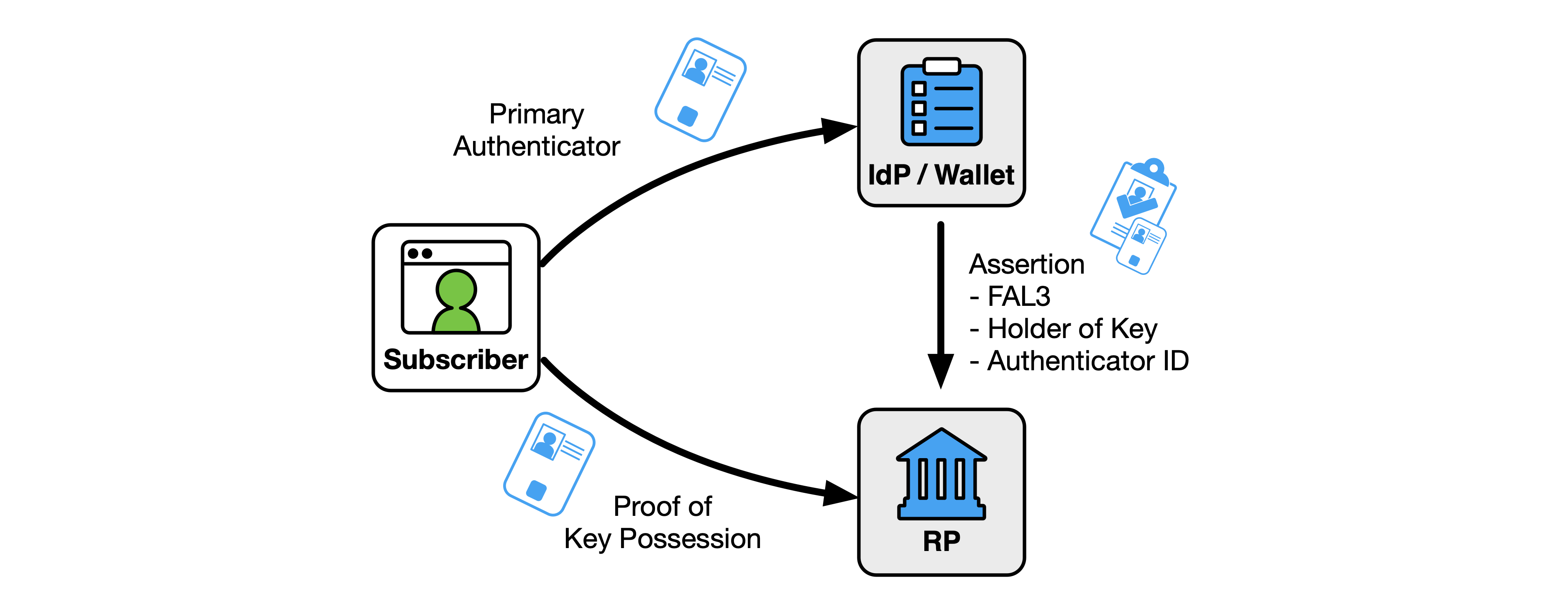
図3. Holder-of-keyアサーション。左の加入者(Subscriber)の箱から 2 本の曲線の矢印が出る。1 本は Primary Authenticator(一次認証器、認証器カードのアイコン付き)と記されて IdP / Wallet(IdP/ウォレット)の箱へ、もう 1 本は Proof of Key Possession(鍵の所持証明、認証器カードのアイコン付き)と記されて RP の箱へ向かう。IdP / Wallet から RP への下向きの矢印には、アサーションのアイコンとともに Assertion(アサーション)- FAL3 - Holder of Key - Authenticator ID(認証器 ID)と記されている。
The authenticator identified in a holder-of-key assertion MAY be distinct from the primary authenticator that the subscriber uses to authenticate to the IdP. The authenticator identified in a holder-of-key assertion SHALL be phishing-resistant, as defined by Sec. 3.2.5 of [SP800-63B]. When the RP encounters an authenticator in a holder-of-key assertion for the first time, the RP SHALL ensure that the authenticator can be uniquely resolved to the RP subscriber account, as discussed in Sec. 3.8.2.
holder-of-keyアサーションで識別される認証器は、加入者がIdPへの認証に使用する一次認証器とは別のものであってもよいです(MAY)。holder-of-keyアサーションで識別される認証器は、[SP800-63B]のSec. 3.2.5で定義するとおり、フィッシング耐性を備えていなければなりません(SHALL)。RPがholder-of-keyアサーション内の認証器に初めて遭遇した場合、Sec. 3.8.2で説明するとおり、その認証器をRP加入者アカウントに一意に解決できることをRPはSHALL確認しなければなりません。
A holder-of-key assertion SHALL NOT include an unencrypted private key or symmetric key to be used as an authenticator.
holder-of-keyアサーションに、認証器として使用する未暗号化の秘密鍵または共通鍵を含めてはなりません(SHALL NOT)。
Assertions from subscriber-controlled wallets that run on a subscriber’s device can be considered holder-of-key assertions.
加入者のデバイス上で動作する加入者管理ウォレットからのアサーションは、holder-of-keyアサーションとみなすことができます。
Section 9.6 provides a more complete example of the use of a mutual TLS connection to provide the proof of possession of a certificate on a smart card that is listed by the assertion.
アサーションに列挙されたスマートカード上の証明書の所持証明を提供するために相互TLS接続を使用する、より詳細な例をSection 9.6に示します。
Since the authenticators used in holder-of-key assertions could be presented to multiple parties, and these authenticators often contain identity attributes, there are additional privacy considerations to address, as discussed in Sec. 7.
holder-of-keyアサーションで使用される認証器は複数の当事者に提示される可能性があり、これらの認証器には識別属性が含まれることが多いため、Sec. 7で説明するとおり、対処すべき追加のプライバシー上の考慮事項があります。
Bound Authenticators
バインド済み認証器
A bound authenticator (Fig. 4) is an authenticator that is bound to the RP subscriber account and managed by the RP. The IdP SHALL include an indicator in the assertion when the assertion is to be used with a bound authenticator at FAL3. The unique identifier for the authenticator (such as its public key) SHALL be stored in the RP subscriber account. The RP needs to have a reliable basis for evaluating the characteristics of the bound authenticator, such as the inclusion of a signed attestation, as discussed in Sec. 3.2.4 of [SP800-63B]. Bound authenticators are most often used when the authenticator technology is not tied to a PKI trusted by both the IdP and RP, for example when no such PKI exists.
バインド済み認証器(図4)とは、RP加入者アカウントにバインドされ、RPによって管理される認証器です。アサーションをFAL3のバインド済み認証器と併用する場合、IdPはその旨を示す指標をアサーションにSHALL含めなければなりません。認証器の一意な識別子(公開鍵など)はRP加入者アカウントにSHALL保存しなければなりません。RPは、[SP800-63B]のSec. 3.2.4で説明する署名済み証明の同梱など、バインド済み認証器の特性を評価するための信頼できる根拠を持つ必要があります。バインド済み認証器は、例えばIdPとRPが信頼するPKIが存在しない場合など、認証器技術がそのようなPKIに結び付いていないときに最もよく使用されます。
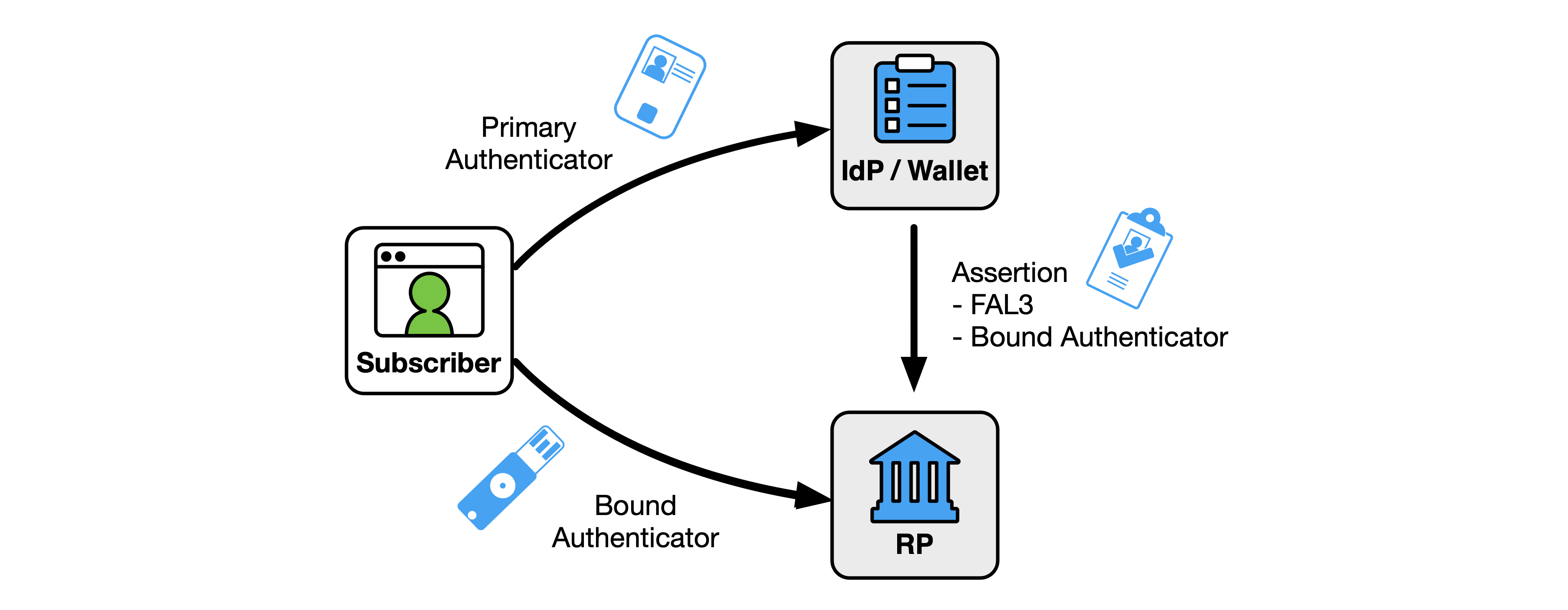
図4. バインド済み認証器。左の加入者(Subscriber)の箱から 2 本の曲線の矢印が出る。1 本は Primary Authenticator(一次認証器、認証器カードのアイコン付き)と記されて IdP / Wallet(IdP/ウォレット)の箱へ、もう 1 本は Bound Authenticator(バインド済み認証器、セキュリティキーのアイコン付き)と記されて RP の箱へ向かう。IdP / Wallet から RP への下向きの矢印には、アサーションのアイコンとともに Assertion(アサーション)- FAL3 - Bound Authenticator(バインド済み認証器)と記されている。
A bound authenticator SHALL be unique per subscriber at the RP such that two subscribers cannot present the same authenticator for their separate RP subscriber accounts. All bound authenticators SHALL use phishing-resistant authentication mechanisms, as defined by Sec. 3.2.5 of [SP800-63B]. Consequently, subscriber-chosen values such as a password cannot be used as bound authenticators. Bound authenticators SHALL be accepted for authentication in the context of processing an FAL3 assertion for a federated transaction. While it is possible for the same authenticator to also be used for direct authentication to the RP (see Sec. 3.8.3), such use is not considered a bound authenticator, and the RP SHALL document these as distinct use cases.
バインド済み認証器はRPにおいて加入者ごとに一意SHALLでなければならず、2人の加入者がそれぞれのRP加入者アカウントに同じ認証器を提示できないようにします。すべてのバインド済み認証器は、[SP800-63B]のSec. 3.2.5で定義するとおり、フィッシング耐性を備えた認証メカニズムをSHALL使用しなければなりません。そのため、パスワードなど加入者が選んだ値をバインド済み認証器として使用できません。 フェデレーション取引のFAL3アサーションを処理する際、認証用としてバインド済み認証器をSHALL受け入れなければなりません。同じ認証器をRPへの直接認証にも使用できるが(Sec. 3.8.3参照)、その用途はバインド済み認証器とはみなされず、RPはこれらを別個のユースケースとしてSHALL文書化しなければなりません。
The IdP MAY specify types or characteristics for allowable bound authenticators in the trust agreement.
IdPは、信頼合意において、使用可能なバインド済み認証器の種類または特性を指定してもよいです(MAY)。
Before an RP can successfully accept an FAL3 assertion, the RP subscriber account SHALL include a reference to a bound authenticator that is to be verified during the FAL3 transaction. These authenticators can be provided by either the RP (as in Sec. 13.15.1) or the subscriber (as in Sec. 13.15.2), and different requirements apply to the initial binding of the authenticator to the RP subscriber account in each case.
RPがFAL3アサーションを正常に受け入れる前に、RP加入者アカウントには、FAL3取引中に検証するバインド済み認証器への参照をSHALL含めなければなりません。認証器はRP(Sec. 13.15.1参照)または加入者(Sec. 13.15.2参照)のいずれかが提供でき、それぞれの場合でRP加入者アカウントへの初回バインドに関する要件が異なります。
The RP SHALL send a notification to the subscriber via an out-of-band mechanism (e.g., an email to an address previously associated with the subscriber) and SHOULD notify the IdP using a shared signaling system (see Sec. 4.8) if any of the following events occur:
次のいずれかのイベントが発生した場合、RPは帯域外の方法(例えば、加入者に以前関連付けられたアドレスへのメール)で加入者に通知SHALLし、共有シグナリングシステム(Sec. 4.8参照)を使ってIdPにも通知するべきです(SHOULD)。
•A new bound authenticator is added to the RP subscriber account.
•新しいバインド済み認証器がRP加入者アカウントに追加されました。
•An existing bound authenticator is removed from the RP subscriber account.
•既存のバインド済み認証器がRP加入者アカウントから削除されました。
For additional considerations on providing notice to a subscriber about authenticator management events, see Sec. 4.6 of [SP800-63B].
認証器管理イベントについて加入者に通知する際の追加の考慮事項は、[SP800-63B]のSec. 4.6を参照してください。
RP-Provided Bound Authenticator Issuance
RP提供のバインド済み認証器の発行
For RP-provided authenticators, the system administrator of the RP SHALL issue the authenticator directly to the subscriber for use with an FAL3 federation transaction. The system administrator of the RP SHALL use an independent means to determine whether the identified subject of the RP subscriber account is the party to which the authenticator is issued. The system administrator of the RP SHALL follow the initial authenticator binding requirements in Sec. 4 of [SP800-63A] or the post-enrollment binding requirements in Sec. 4.1.2 of [SP800-63B], as appropriate. The system administrator of the RP SHALL store a unique identifier for the bound authenticator in the RP subscriber account, such as the public key of the authenticator.
RP提供の認証器について、RPのシステム管理者は、FAL3フェデレーション取引で使用できるよう、加入者に認証器を直接発行SHALLしなければなりません。RPのシステム管理者は、RP加入者アカウントの特定されたサブジェクトが、認証器の発行先の当事者であるかを判断するため、独立した手段をSHALL使用しなければなりません。RPのシステム管理者は、適宜、[SP800-63A]のSec. 4における初回認証器バインド要件、または[SP800-63B]のSec. 4.1.2における登録後のバインド要件にSHALL従わなければなりません。RPのシステム管理者は、公開鍵などのバインド済み認証器の一意な識別子をRP加入者アカウントにSHALL保存しなければなりません。
For example, consider an RP that has a collection of cryptographic authenticators that it has purchased for use with FAL3 authentication. These authenticators are each provisioned to a specific RP subscriber account but are held in a controlled environment by the system administrator of the RP. To issue the authenticator, the RP could use an in-person process in which the system administrator of the RP has the subscriber authenticate to an RP-controlled workstation using an FAL3 federation transaction from the IdP. The system administrator then hands the subscriber the bound authenticator indicated by the RP subscriber account and has them authenticate to the workstation using that. The subscriber is now in possession of a bound authenticator supplied by the RP, which can be used to reach FAL3 for future transactions. Alternatively, the system administrator of the RP could send the authenticator to a verified address for the subscriber and have the subscriber verify receipt through an activation process. Since the use of the bound authenticator still requires a valid assertion from the IdP, interception of the authenticator alone is not sufficient for accessing the RP subscriber account at FAL3.
例えば、FAL3認証で使用するために購入した暗号認証器群を持つRPを考えます。これらの認証器はそれぞれ特定のRP加入者アカウントにプロビジョニングされていますが、RPのシステム管理者が管理する環境で保管されています。認証器を発行するため、RPは対面の手続きを使用できます。その際、RPのシステム管理者は、加入者にIdPからのFAL3フェデレーション取引を使ってRP管理のワークステーションに認証させます。次に、システム管理者はRP加入者アカウントで指定されたバインド済み認証器を加入者に手渡し、その認証器を使用してワークステーションに認証させます。これにより加入者はRPが提供するバインド済み認証器を所持し、今後の取引でFAL3に到達するために使用できます。あるいは、RPのシステム管理者は検証済みの加入者住所に認証器を送付し、アクティベーションプロセスを通じて加入者に受領を確認させることができます。バインド済み認証器を使用する場合もIdPからの有効なアサーションが必要であるため、認証器だけを傍受しても、FAL3でRP加入者アカウントにアクセスするには不十分です。
Subscriber-Provided Bound Authenticator Binding Ceremony
加入者提供のバインド済み認証器のバインド手順
The RP MAY provide a process for associating subscriber-provided authenticators to the RP subscriber account on a trust-on-first-use basis. This process is known as a binding ceremony and has additional requirements beyond a typical FAL3 federation process. The binding cermony is similar to the subscriber-provided authenticator binding process discussed in Sec. 4.1.3 of [SP800-63B].
RPは、加入者が提供した認証器を初回利用時に信頼する方式でRP加入者アカウントに関連付けるプロセスを提供してもよいです(MAY)。このプロセスはバインド手順と呼ばれ、一般的なFAL3フェデレーションプロセスを超える追加要件があります。このバインド手順は、[SP800-63B]のSec. 4.1.3で説明する加入者提供認証器のバインドプロセスと類似しています。
If no bound authenticators are associated with the RP subscriber account, the RP SHALL perform a binding ceremony to establish the connection between the authenticator, the subscriber, and the RP subscriber account, as shown in Fig. 5. The RP SHALL first establish an authenticated session using federation with an assertion that meets all the other requirements of FAL3, including an indication that the assertion is intended for use at FAL3 with a bound authenticator (e.g., the assertion contains an authentication class reference or a Vectors of Trust [RFC8485] value indicating this). The subscriber SHALL immediately be prompted to present and authenticate with the proposed authenticator. Upon successful presentation of the authenticator, the RP SHALL store a unique identifier for the authenticator (such as its public key) and associate this with the RP subscriber account that is associated with the federated identifier. If the subscriber fails to successfully authenticate to the RP using an appropriate authenticator, the binding ceremony fails. The binding ceremony session SHALL have a timeout of five minutes or less and SHALL NOT be used as an authenticated session for any other purpose, as described in Sec. 3.9. Upon successful completion of the binding ceremony, the RP SHALL immediately request a new assertion from the IdP at FAL3. Upon receiving the new assertion, the RP SHALL prompt the subscriber for the newly bound authenticator and SHALL validate the authenticator output.
RP加入者アカウントにバインド済み認証器が関連付けられていない場合、RPは図5に示すように、認証器、加入者、およびRP加入者アカウント間の結び付きを確立するバインド手順をSHALL実施しなければなりません。RPはまず、バインド済み認証器を用いたFAL3での使用を意図する旨の表示を含め、FAL3の他のすべての要件を満たすアサーションを使って、フェデレーションによる認証済みセッションをSHALL確立しなければなりません(例えばアサーションに認証クラス参照または、その旨を示すVectors of Trust [RFC8485]値が含まれます)。加入者には、提案する認証器を提示してそれを使って認証するようSHALL直ちに促さなければなりません。認証器の提示に成功した場合、RPは認証器の公開鍵などの一意な識別子をSHALL保存し、それをフェデレーション識別子に関連付けられたRP加入者アカウントに関連付けなければなりません。加入者が適切な認証器を使ってRPへの認証に成功しなかった場合、バインド手順は失敗します。バインド手順のセッションは5分以下のタイムアウトをSHALL設定し、Sec. 3.9で説明するように、他の目的の認証済みセッションとして使用してはなりません(SHALL NOT)。バインド手順が正常に完了すると、RPはIdPにFAL3の新たなアサーションを直ちにSHALL要求しなければなりません。新しいアサーションを受信すると、RPは加入者に新しくバインドされた認証器を使用するようSHALL促し、その認証器の出力をSHALL検証しなければなりません。
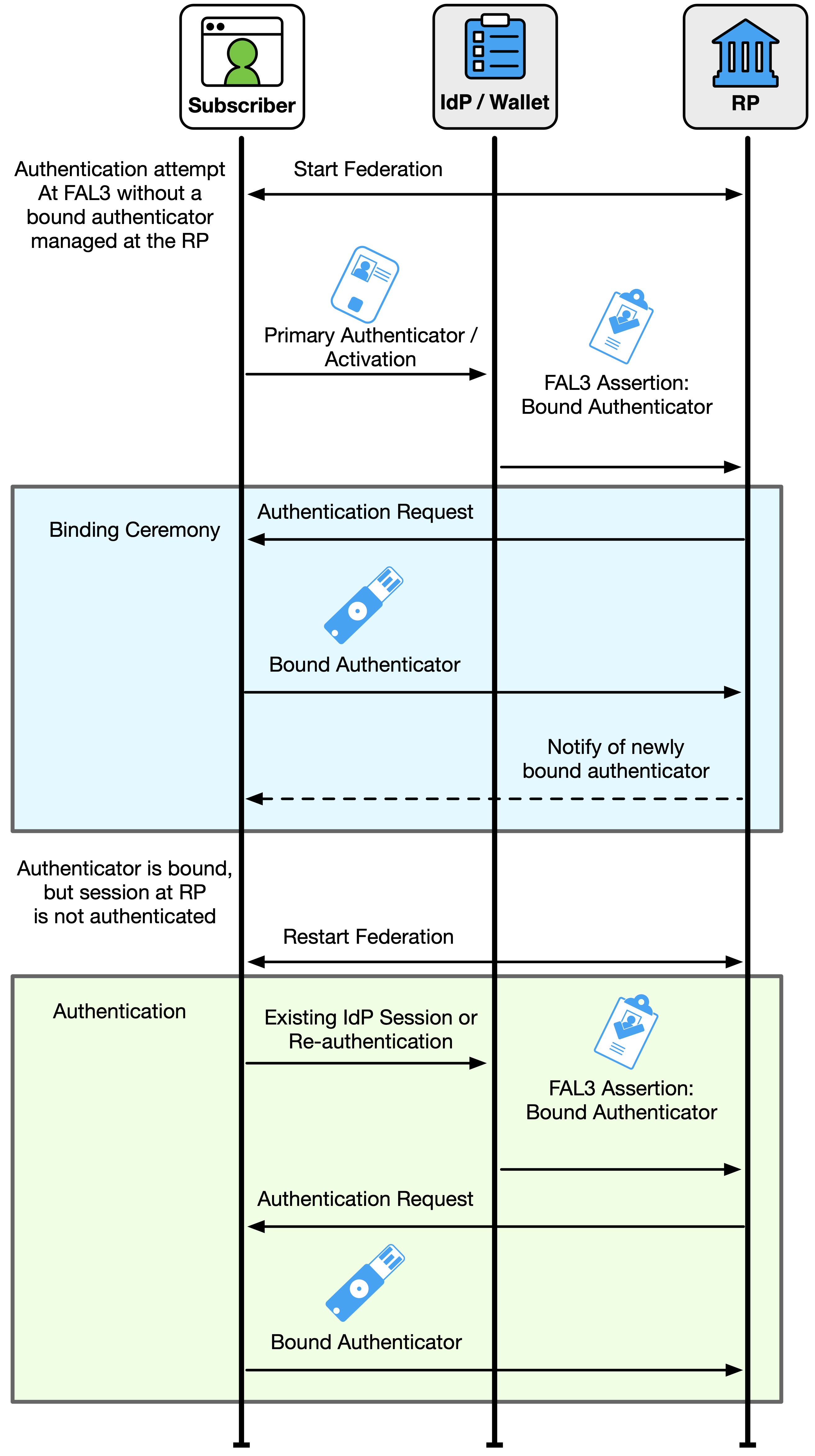
図5. 加入者提供のバインド済み認証器のバインド手順。加入者(Subscriber)、IdP / Wallet(IdP/ウォレット)、RP の生存線を持つシーケンス図で、上から下へ進む。左の注記: Authentication attempt At FAL3 without a bound authenticator managed at the RP(RP で管理されるバインド済み認証器なしの FAL3 での認証の試み)。Start Federation(フェデレーション開始): 加入者と RP の間の両方向矢印。Primary Authenticator / Activation(一次認証器/アクティベーション): 加入者から IdP / Wallet へ。FAL3 Assertion: Bound Authenticator(FAL3 アサーション: バインド済み認証器): IdP / Wallet から RP へ。Binding Ceremony(バインド手順)と記された青い枠: Authentication Request(認証要求)は RP から加入者へ、Bound Authenticator(バインド済み認証器、セキュリティキーのアイコン付き)は加入者から RP へ、Notify of newly bound authenticator(新たにバインドされた認証器の通知)は RP から加入者への破線の矢印である。注記: Authenticator is bound, but session at RP is not authenticated(認証器はバインドされたが、RP のセッションは認証されていない)。Restart Federation(フェデレーション再開): 加入者と RP の間の両方向矢印。Authentication(認証)と記された緑の枠: Existing IdP Session or Re-authentication(既存の IdP セッションまたは再認証)は加入者から IdP / Wallet へ、FAL3 Assertion: Bound Authenticator は IdP / Wallet から RP へ、Authentication Request は RP から加入者へ、Bound Authenticator は加入者から RP へ向かう。
Subscriber-provided bound authenticators are particularly helpful when the subscriber already has access to an appropriate authenticator that the RP allows them to use for FAL3 transactions. For example, a subscriber could have a single-factor cryptographic authenticator that uses name-based phishing resistance, as described in Sec. 3.2.5.2 of [SP800-63B]. With such a device, the IdP and RP would see different verification keys when the authenticator is used in each location, meaning that the bound authenticator cannot be easily verified by the IdP. Furthermore, since the RP did not issue the authenticator, the RP does not know the authenticator’s verification key ahead of time, nor does it know which subscriber account to associate with the verification key. Instead, the RP can use a binding ceremony to allow the subscriber to use this device as a bound authenticator at FAL3. A more complete example is found in Sec. 9.7.
加入者がすでに、RPがFAL3取引で使用を許可する適切な認証器にアクセスできる場合、加入者提供のバインド済み認証器が特に役立ちます。 例えば、加入者は[SP800-63B]のSec. 3.2.5.2で説明する、名前に基づくフィッシング耐性を用いた単一要素の暗号認証器を持っている場合があります。このようなデバイスでは、認証器をIdPとRPのそれぞれで使用すると両者には異なる検証鍵が見えるため、IdPはバインド済み認証器を容易に検証できません。さらに、RPは認証器を発行していないため、事前にその検証鍵を知らず、どの加入者アカウントに関連付けるかも知りません。代わりにRPはバインド手順を用いて、FAL3で加入者がこのデバイスをバインド済み認証器として使用できるようにすることができます。 より詳細な例はSec. 9.7に記載されています。
An RP MAY allow a subscriber to bind multiple subscriber-provided authenticators at FAL3. If this is the case, and the RP subscriber account has one or more existing bound authenticators, the binding ceremony makes use of one of the subscriber’s existing bound authenticators to reach FAL3. During the initial authentication step of the binding ceremony, the RP SHALL request authentication with an existing bound authenticator to reach FAL3. Once this authentication is complete and the binding ceremony session is established, the RP SHALL request authentication with the new authenticator and associate it with the RP subscriber account as a bound authenticator. The RP completes the binding ceremony by requesting a new assertion at FAL3.
RPは加入者が複数の加入者提供認証器をFAL3でバインドできるようにしてもよいです(MAY)。その場合、RP加入者アカウントに既存のバインド済み認証器が1つ以上あれば、バインド手順ではその既存認証器の1つを使用してFAL3に到達します。バインド手順の初期認証ステップで、RPはFAL3に到達するために既存のバインド済み認証器による認証をSHALL要求しなければなりません。この認証が完了しバインド手順のセッションが確立された後、RPは新しい認証器による認証をSHALL要求し、それをバインド済み認証器としてRP加入者アカウントに関連付けなければなりません。RPはFAL3で新しいアサーションを要求してバインド手順を完了します。
In addition to an RP determining that a bound authenticator is no longer viable, a subscriber could choose to stop using a bound authenticator for a variety of reasons, such as the authenticator being lost, compromised, or no longer usable due to technology and platform changes. In such cases, an RP MAY allow a subscriber to remove a subscriber-provided bound authenticator from their RP subscriber account, thereby removing the ability to use that authenticator for FAL3 sessions. When a bound authenticator is removed, the RP SHALL terminate all current FAL3 sessions for the subscriber and SHALL require reauthentication of the subscriber from the IdP at FAL3. The RP SHALL NOT prompt the subscriber to authenticate with the authenticator being removed, since the subscriber will often not have access to the authenticator in question during the unbinding process, particularly if the authenticator is lost or compromised. If all bound authenticators are removed, the subscriber will no longer be able to reach FAL3 until a new bound authenticator is added to the RP subscriber account. This situation poses similar risks to account recovery at the RP.
RPがバインド済み認証器を使用不能と判断した場合に加え、認証器の紛失や侵害、または技術やプラットフォームの変更で使用できなくなった場合など、加入者がさまざまな理由からバインド済み認証器の使用をやめることを選択する場合があります。 その場合、RPは加入者提供のバインド済み認証器をRP加入者アカウントから削除できるようにしてもよいです(MAY)。これにより、FAL3セッションで当該認証器を使用できなくなります。バインド済み認証器が削除された場合、RPは加入者の現在のFAL3セッションをすべてSHALL終了し、FAL3でIdPによる加入者の再認証をSHALL要求しなければなりません。特に紛失または侵害の場合、加入者はバインド解除プロセス中に当該認証器を利用できないことが多いため、RPは削除対象の認証器で認証するよう加入者に促してはなりません(SHALL NOT)。バインド済み認証器がすべて削除されると、RP加入者アカウントに新しいバインド済み認証器が追加されるまで、加入者はFAL3に到達できなくなります。この状況はRPでのアカウント回復と同様のリスクをもたらします。
RP Processing of Holder-of-Key Assertions and Bound Authenticators
RPによるholder-of-keyアサーションとバインド済み認証器の処理
When the RP receives an assertion that is associated with a bound authenticator, the subscriber proves possession of the bound authenticator directly to the RP. The primary authentication at the IdP and the federated authentication at the RP are processed separately. While the subscriber could use the same authenticator during the primary authentication at the IdP as the bound authenticator at the RP, there is no assumption that these will be the same.
バインド済み認証器に関連付けられたアサーションをRPが受信すると、加入者はその認証器を所持していることをRPに直接証明します。IdPでの一次認証とRPでのフェデレーション認証は別々に処理されます。加入者はIdPでの一次認証に使った認証器をRPでのバインド済み認証器としても使用できますが、必ず同じ認証器であるとは限りません。
The following requirements apply to all assertions that are associated with a bound authenticator:
以下の要件は、バインド済み認証器に関連付けられたすべてのアサーションに適用されます。
1.The subscriber SHALL prove possession of the bound authenticator to the RP in addition to presenting the assertion itself.
1.アサーション自体の提示に加えて、加入者はバインド済み認証器を所持していることをRPにSHALL証明しなければなりません。
2.For a holder-of-key assertion, a reference to a given authenticator that is found within an assertion SHALL be trusted at the same level as all other information within the assertion, as stipulated in the trust agreement.
2.holder-of-keyアサーションの場合、アサーション内にある所定の認証器への参照は、信頼合意で規定するとおり、アサーション内の他のすべての情報と同じ水準で信頼SHALLしなければなりません。
3.The RP SHALL process and validate the assertion in addition to the bound authenticator.
3.RPは、バインド済み認証器に加えて、アサーションをSHALL処理および検証しなければなりません。
4.Failure to authenticate with the bound authenticator SHALL result in an error at the RP and SHALL NOT create an authenticated session at the RP.
4.バインド済み認証器での認証に失敗した場合は、RPでエラーという結果にしなければならず(SHALL)、RPで認証済みセッションを作成してはなりません(SHALL NOT)。
General-Purpose IdPs
汎用IdP
This section is normative.
このセクションは規範的です。
A general-purpose IdP is an IdP that the CSP uses to make the subscriber account available through a process of provisioning the IdP, as described in Sec. 4.1. The subscriber provides an authentication event to the IdP using one or more authenticators that are bound to the subscriber account, as described in Sec. 4.5. Usually, a general-purpose IdP is hosted on a remote service and not on the subscriber’s device. Often, a general-purpose IdP supports multiple subscribers.
IdP Account Provisioning
IdPアカウントのプロビジョニング
In order to make subscriber accounts available through an IdP, the subscriber accounts need to be provisioned at the IdP. The means by which the subscriber account is provisioned to the IdP SHALL be disclosed in the trust agreement.
IdPを通じて加入者アカウントを利用可能にするには、IdPに加入者アカウントをプロビジョニングする必要があります。加入者アカウントをIdPにプロビジョニングする方法は、信頼合意でSHALL開示しなければなりません。
Due to the requirement for the IdP to be able to authenticate the subscriber, the IdP is often a service of the CSP and has some level of access to the attributes and authenticators in the subscriber account. Such IdPs are generally in the same security domain as the identity and access management system that houses the subscriber account.
加入者を認証できる必要があるため、IdPは多くの場合CSPのサービスであり、加入者アカウントの属性や認証器にある程度アクセスできます。このようなIdPは通常、加入者アカウントを収容するIDおよびアクセス管理システムと同じセキュリティドメインに属します。
In other cases, one or more authenticators in the subscriber account can be verified outside of the security domain, such as authenticators tied to a common PKI. In these cases, the IdP can pull subscriber attributes and account information from the authenticator to provide a federated login to RPs.
その他の場合、共通のPKIに結び付いた認証器など、加入者アカウントの1つ以上の認証器をセキュリティドメイン外で検証できます。このような場合、IdPは認証器から加入者属性およびアカウント情報を取得し、RPへのフェデレーションログインを提供できます。
The IdP augments the subscriber account with federation-specific attributes, such as a federated identifier. The IdP can collect additional attributes for federation purposes subject to the privacy and storage requirements enumerated by the trust agreement.
IdPは加入者アカウントにフェデレーション識別子などフェデレーション固有の属性を追加します。IdPは、信頼合意で列挙されたプライバシー要件および保管要件に従い、フェデレーション目的で追加属性を収集できます。
The CSP can provide attributes from the subscriber account to the IdP as attribute values, derived attribute values, or attribute bundles. The CSP SHALL sign attribute bundles issued to the IdP.
CSPは、属性値、導出属性値、または属性バンドルとして、加入者アカウントの属性をIdPに提供できます。CSPはIdPに発行する属性バンドルにSHALL署名しなければなりません。
After the subscriber account is provisioned to the IdP, the CSP is party to the trust agreement but is not directly involved in the federation transaction. Consequently, even if the RP fetches attributes through an identity API that is hosted by the CSP, the identity API is considered a function of the IdP and not the CSP for the purposes of these guidelines.
加入者アカウントがIdPにプロビジョニングされた後、CSPは信頼合意の当事者ではありますが、フェデレーション取引には直接関与しません。 そのため、RPがCSPのホストするアイデンティティAPIを通じて属性を取得する場合でも、本ガイドライン上、そのアイデンティティAPIはCSPではなくIdPの機能とみなされます。
Federation Transaction
フェデレーション取引
A federation transaction that involves a general-purpose IdP establishes the subscriber account at the IdP and culminates in an authenticated session for the subscriber at the RP. This process is shown in Fig. 6.
汎用IdPを伴うフェデレーション取引は、IdPで加入者アカウントを確立し、最終的にRPで加入者の認証済みセッションを確立します。このプロセスを図6に示します。
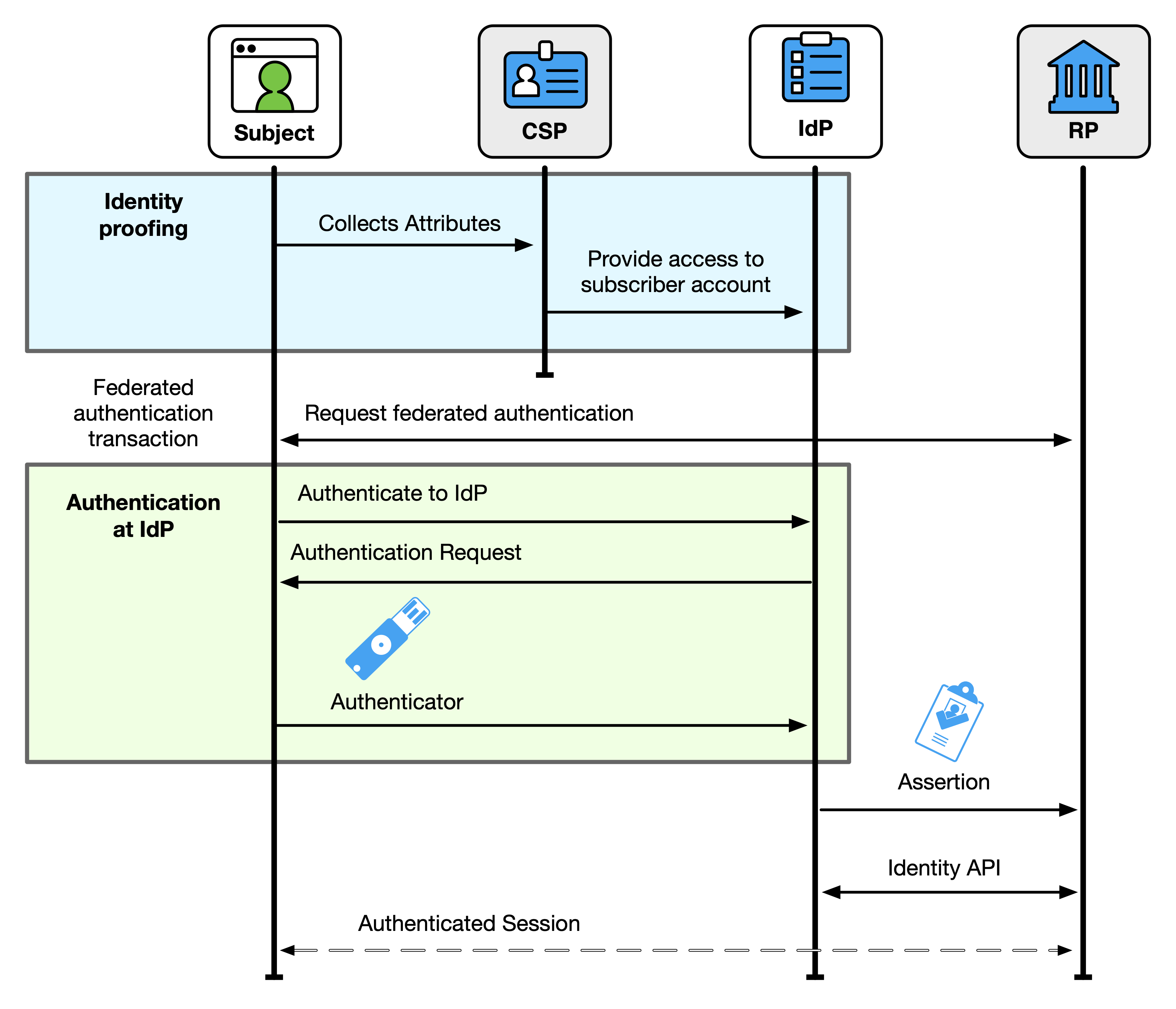
図6. フェデレーションの概要。主体(Subject)、CSP、IdP、RP の生存線を持つシーケンス図で、緑の丸数字が段階を示す。1 Identity proofing(本人確認)と記された青い枠: Collects Attributes(属性の収集)は主体から CSP へ、2 Provide access to subscriber account(加入者アカウントへのアクセスの提供)は CSP から IdP へ向かう。CSP の生存線はこの枠の後で終わる。Federated authentication transaction(フェデレーション認証の取引)と記された部分: 3 Request federated authentication(フェデレーション認証の要求)は主体と RP の間の両方向矢印である。Authentication at IdP(IdP での認証)と記された緑の枠: 4 Authenticate to IdP(IdP への認証)は主体から IdP へ、Authentication Request(認証要求)は IdP から主体へ、Authenticator output(認証器出力、セキュリティキーのアイコン付き)は主体から IdP へ向かう。5 と 6(アサーションのアイコン): Assertion(アサーション)は IdP から RP へ。Identity API(アイデンティティAPI)は IdP と RP の間の両方向矢印。7 Authenticated Session(認証済みセッション)は主体と RP の間の破線の両方向矢印である。
A federation transaction is a multi-stage process:
フェデレーション取引は複数段階のプロセスです。
1.Before federation can occur, the subscriber account is established by the CSP. This account binds the identity attributes collected by the CSP to a set of authenticators used by the subscriber.
1.フェデレーションを行う前に、CSPが加入者アカウントを確立します。このアカウントでは、CSPが収集した識別属性を、加入者が使用する一連の認証器にバインドします。
2.The subscriber account is provisioned at the IdP. The IdP augments the subscriber account with federation-specific attributes, such as a federated identifier.
2.加入者アカウントがIdPにプロビジョニングされます。IdPは加入者アカウントにフェデレーション識別子などフェデレーション固有の属性を追加します。
3.The IdP and RP begin a federated authentication transaction to authenticate a subscriber to the RP.
3.IdPとRPが、RPに対する加入者認証のためにフェデレーション認証取引を開始します。
4.The subscriber authenticates to the IdP using an authenticator that is bound to the subscriber account. If mandated by the trust agreement, the authorized party (often the subscriber) is prompted to approve the release of identity information at runtime.
4.加入者は、加入者アカウントにバインドされた認証器を用いてIdPに認証します。信頼合意で義務付けられている場合、認可当事者(多くの場合は加入者)に実行時の判断として識別情報の開示承認を求めます。
5.The IdP creates an assertion to represent the results of the authentication event. The assertion is based on the terms established by the trust agreement, the request from the RP, the capabilities of the IdP, the subscriber account known to the IdP, and the attributes permitted by the authorized party.
5.IdPは、認証イベントの結果を表すアサーションを作成します。このアサーションは、信頼合意で確立された条件、RPからの要求、IdPの能力、IdPが把握している加入者アカウント、および認可当事者が許可した属性に基づきます。
6.The assertion is passed to the RP across the network.
6.アサーションがネットワークを介してRPに渡されます。
7.The RP processes this assertion from the IdP and establishes an authenticated session with the subscriber. Optionally, the RP receives identity attributes from the IdP that represents the subscriber account, either in the assertion or through an identity API.
7.RPはIdPからのアサーションを処理し、加入者との認証済みセッションを確立します。任意で、アサーションまたはアイデンティティAPIを通じて、加入者アカウントを表す識別属性をIdPから受け取ります。
Federated transactions are enabled by trust agreements, as described in Sec. 3.5. These trust agreements define which parties are fulfilling which roles, the terms under which the parties operate with each other, permission for the systems in question to connect, and the terms under which the parties interact with each other. A single trust agreement often covers multiple federation transactions. The list of available subscriber identity attributes, derived attributes, and attribute bundles is established in the trust agreement, though the decision of which attributes are released to a given RP for a given transaction is finalized during the federation transaction itself. The final set of attributes, derived attribute values, and attribute bundles to be passed to the RP is selected by processing the following:
フェデレーション取引は、Sec. 3.5で説明する信頼合意によって可能になります。これらの信頼合意は、どの当事者がどの役割を担うか、当事者間の運用条件、該当システムの接続許可、および当事者同士のやり取りに関する条件を定めます。1つの信頼合意が複数のフェデレーション取引を対象とすることが多くあります。 利用可能な加入者の識別属性、導出属性、および属性バンドルの一覧は信頼合意で定めますが、所定の取引でどのRPにどの属性を開示するかの判断は、フェデレーション取引そのものの間に確定されます。 RPに渡す属性、導出属性値、および属性バンドルの最終的な組み合わせは、以下を処理して選択します。
•What is allowed by the trust agreement,
•信頼合意で許可される内容、
•What is requested by the RP, and
•RPが要求する内容、および
•What is permitted by the authorized party.
•認可当事者が許可する内容。
The IdP and RP also need to perform discovery and registration to establish the cryptographic keys and identifiers that are needed for information to be securely exchanged between the parties in the federation protocol (see Sec. 4.4). While there may be an existing policy decision that represents a permission to connect (through a pre-established trust agreement), this step entails a connection and integration at the technical level. At any FAL, this stage can occur before subscribers try to access the RP. At FAL1 or FAL2, this stage could alternatively occur in response to a subscriber’s attempt to use an IdP at an RP.
IdPとRPは、フェデレーションプロトコル内で当事者間の情報を安全に交換するために必要な暗号鍵と識別子を確立するため、ディスカバリーと登録も実施する必要があります(Sec. 4.4参照)。事前確立済みの信頼合意を通じて接続許可を表す既存のポリシー決定がある場合でも、この段階では技術レベルでの接続と統合を行います。いずれのFALでも、加入者がRPへのアクセスを試みる前にこの段階を実施できます。FAL1またはFAL2では、加入者がRPでIdPを使用しようとしたことに応じて、この段階を実施する方法もあります。
In a federated identity transaction, the IdP is the source of identity and authentication attributes for the RP. The normal flow of information for a federation transaction is from the IdP to the RP. Due to the directional nature of this information flow, the IdP is considered to be upstream of the RP and the RP is considered to be downstream of the IdP. It is also possible for additional information to flow back up from the RP, particularly through the use of shared signals, as discussed in Sec. 4.8.
フェデレーションID取引では、RPに対するID属性と認証属性の情報源はIdPです。フェデレーション取引における通常の情報の流れはIdPからRPに向かいます。この情報フローの方向性から、IdPはRPの上流、RPはIdPの下流とみなされます。特にSec. 4.8で説明する共有シグナルの使用を通じて、追加情報がRPから上流に戻ることもあります。
Trust Agreements
信頼合意
Trust agreements for general-purpose IdPs are generally expected to be established between the RP and the IdP, where the RP relies on the identity of the IdP to provide the basis of trust for federation transactions. It is expected that the trust agreement between the CSP and IdP is established independent of the federation transaction.
汎用IdPの信頼合意は通常、RPとIdPの間で確立されることが想定されます。この場合、RPはIdPのIDに依拠し、それをフェデレーション取引における信頼の基礎とします。CSPとIdP間の信頼合意は、フェデレーション取引とは独立して確立されることが想定されます。
Trust agreements for general-purpose IdPs SHALL be established either:
汎用IdPの信頼合意は、以下のいずれかによってSHALL確立しなければなりません。
•As the result of an agreement by the federated parties prior to the federation transaction or
•フェデレーション取引前にフェデレーション当事者が行った合意の結果として、または
•As the result of decision or action by the subscriber during the federation transaction
•フェデレーション取引中に加入者が行った決定または行動の結果として
Pre-Established Trust Agreements
事前確立済みの信頼合意
When the trust agreement is established by the federated parties prior to the federation transaction, the trust agreement SHALL establish the following terms:
フェデレーション当事者がフェデレーション取引前に信頼合意を確立する場合、信頼合意は以下の条件をSHALL定めなければなりません。
•The set of subscriber attributes, derived attributes, and attribute bundles that the IdP can make available to the RP
•IdPがRPに提供可能な加入者属性、導出属性、および属性バンドルの組み合わせ
•The attribute storage policy of the IdP for the subscriber account, including any available means for the subscriber to request deletion
•加入者アカウントのIdPの属性保管ポリシー(加入者が削除を要求できる方法を含む)
•Any attribute sources from which the IdP receives applicable subscriber attributes, derived attributes, and attribute bundles, including the CSP
•CSPを含め、IdPが該当する加入者属性、導出属性、および属性バンドルを受け取る情報源
•Any identity APIs that are made available by the IdP, either directly or through an external provider, and which subscriber attributes are available at these APIs
•IdPが直接または外部プロバイダーを通じて利用可能にするアイデンティティAPI、およびそれらのAPIで利用できる加入者属性
•The population of subscriber accounts for which the IdP can create assertions
•IdPがアサーションを作成できる加入者アカウントの集団
•Any additional uses of subscriber information beyond providing the identity service
•アイデンティティサービスの提供以外に加入者情報を使用する追加の目的
•The set of subscriber attributes, derived attributes, and attribute bundles that the RP is allowed to request (i.e., a subset of the attributes made available)
•RPが要求を許可される加入者属性、導出属性、および属性バンドルの組み合わせ(すなわち利用可能な属性の一部)
•The purpose for each attribute requested by the RP
•RPが要求する各属性の目的
•The provisioning models used by the RP for RP subscriber accounts
•RP加入者アカウントにRPが使用するプロビジョニングモデル
•The authorized party responsible for decisions regarding the release of subscriber attributes to the RP (e.g., the IdP organization, the subscriber)
•RPへの加入者属性開示に関する判断に責任を持つ認可当事者(例えばIdP組織、加入者)
•The process and techniques used to inform subscribers about attribute sharing
•属性共有について加入者に通知するプロセスおよび技法
•The process and techniques for collecting consent from the authorized party when necessary
•必要な場合に認可当事者から同意を取得するプロセスおよび技法
•The xALs available from the IdP
•IdPから利用できるxAL
•The xALs required by the RP
•RPが要求するxAL
The terms of the trust agreement SHALL be available to the operators of the RP and the IdP upon its establishment. The terms of the trust agreement SHALL be made available to subscribers upon request to the IdP or RP.
信頼合意の確立時に、その条件をRPおよびIdPの運用担当者が利用できるようにSHALLしなければなりません。信頼合意の条件は、加入者がIdPまたはRPに要求すれば利用できるようにSHALLしなければなりません。
The IdP and RP SHALL each assess their respective redress mechanisms for efficacy in resolving complaints or problems and disclose the results of this assessment as part of the trust agreement. See Sec. 3.5.3 for additional requirements and considerations for redress mechanisms.
IdPとRPはそれぞれ、苦情や問題を解決する各自の救済メカニズムの有効性を評価SHALLし、その評価の結果を信頼合意の一部として開示しなければなりません。救済メカニズムに関する追加要件と考慮事項はSec. 3.5.3を参照してください。
•The means by which holder-of-key assertions can be verified by the RP (such as a common trusted PKI system)
•RPがholder-of-keyアサーションを検証する方法(共通の信頼されたPKIシステムなど)
•The means by which the RP can associate holder-of-key assertions with specific RP subscriber accounts (such as attribute-based account resolution or pre-provisioning)
•RPがholder-of-keyアサーションを特定のRP加入者アカウントに関連付ける方法(属性ベースのアカウント解決や事前プロビジョニングなど)
•Whether bound authenticators are supplied by the RP or the subscriber
•バインド済み認証器をRPと加入者のどちらが提供するか
•Documentation of the binding ceremony used for any subscriber-provided bound authenticators
•加入者提供のバインド済み認証器に使用するバインド手順の文書
If shared signaling is used by the IdP or RP (see Sec. 4.8), the terms of the trust agreement SHALL establish:
IdPまたはRPが共有シグナリングを使用する場合(Sec. 4.8参照)、信頼合意の条件は以下をSHALL定めなければなりません。
•The events that trigger a signal to be sent
•シグナル送信の契機となるイベント
•Which signals are sent for each trigger
•各契機について送信するシグナル
•The information included in each signal
•各シグナルに含まれる情報
•The expected behavior of the party receiving the signal
•シグナル受信側の当事者に期待される動作
Runtime decisions at the IdP (see Sec. 4.6.1.3), MAY be used to further limit which subscriber attributes are sent between parties in the federated transaction (e.g., a runtime decision could opt to not disclose an email address, even though this attribute was included in the terms of the trust agreement).
IdPでの実行時の判断(Sec. 4.6.1.3参照)を使用して、フェデレーション取引で当事者間に送信される加入者属性をさらに限定してもよいです(MAY)。例えば、信頼合意の条件に電子メールアドレスが含まれていても、実行時の判断によってこの属性を開示しない選択ができます。
The trust agreement SHALL be reviewed periodically to ensure that it is still fit for purpose and to avoid unnecessary data exchange and the over-collection of subscriber data.
信頼合意が引き続き目的に適合し、不必要なデータ交換や加入者データの過剰収集を避けられるよう、信頼合意を定期的にSHALL見直さなければなりません。
Subscriber-Driven Trust Agreement Establishment
加入者主導の信頼合意の確立
When the trust agreement is established as the result of a subscriber’s decision (e.g., a subscriber starting a federation transaction between an RP and their IdP without an established agreement), the trust agreement is anchored by the subscriber. In a subscriber-driven trust agreement, the trust agreement takes the form of a set of terms of use as opposed to a formal contract between parties. Consequently, the following terms SHALL be disclosed to the subscriber upon request:
加入者の判断の結果として信頼合意が確立される場合(例えば、加入者が合意のないRPと自分のIdP間のフェデレーション取引を開始する場合)、信頼合意は加入者を起点とします。加入者主導の信頼合意は、当事者間の正式な契約ではなく、一連の利用規約の形をとります。そのため、要求があれば、以下の条件を加入者に開示SHALLしなければなりません。
•Any attribute sources from which the IdP receives applicable subscriber attributes, including the CSP
•該当する加入者属性をIdPが受け取る情報源(CSPを含む)
•Any identity APIs that are made available by the IdP, either directly or through an external provider, and which subscriber attributes are available at these APIs
•IdPが直接または外部プロバイダーを通じて利用可能にするアイデンティティAPI、および各APIで利用できる加入者属性
•The set of subscriber attributes, derived attributes, and attribute bundles that the IdP can make available to the RP
•IdPがRPに提供できる加入者属性、導出属性、および属性バンドルの組み合わせ
•The attribute storage policy of the IdP for the subscriber account, including any available means for the subscriber to request deletion
•加入者アカウントのIdPの属性保管ポリシー(加入者が削除を要求できる方法を含む)
•The use of any shared signaling between the IdP and RP
•IdPとRP間で共有シグナリングを使用すること
•The population of subscriber accounts for which the IdP can create assertions
•IdPがアサーションを作成できる加入者アカウントの集団
•Any additional uses of subscriber information beyond providing the identity service
•アイデンティティサービスの提供以外に加入者情報を使用する追加の目的
•The xALs available from the IdP
•IdPから利用できるxAL
•The xALs required by the RP
•RPが要求するxAL
The IdP SHALL assess its redress mechanisms for efficacy in resolving complaints or problems and disclose the results of this assessment to the subscriber. See Sec. 3.5.3 for additional requirements and considerations for redress mechanisms.
IdPは、苦情や問題を解決する救済メカニズムの有効性を評価SHALLし、その評価結果を加入者に開示しなければなりません。救済メカニズムに関する追加要件と考慮事項はSec. 3.5.3を参照してください。
The release of subscriber attributes SHALL be managed using a runtime decision at the IdP, as described in Sec. 4.6.1.3. The authorized party SHALL be the subscriber.
加入者属性の開示は、Sec. 4.6.1.3で説明するように、IdPでの実行時の判断によってSHALL管理しなければなりません。認可当事者は加入者でなければなりません(SHALL)。
The following terms of the trust agreement SHALL be disclosed to the subscriber during the runtime decision:
実行時の判断中に、信頼合意の以下の条件を加入者にSHALL開示しなければなりません。
•The set of subscriber attributes, derived attributes, and attribute bundles that the RP will request (i.e., a subset of the attributes made available by the IdP)
•RPが要求する加入者属性、導出属性、および属性バンドルの組み合わせ(IdPが利用可能にする属性の一部)
•The purpose for each attribute requested by the RP
•RPが要求する各属性の目的
•The attribute storage policy of the RP for the RP subscriber account, including any available means for the subscriber to request deletion
•RP加入者アカウントのRPの属性保管ポリシー(加入者が削除を要求できる方法を含む)
All information disclosed to the subscriber needs to be conveyed in a manner that is understandable and actionable, as discussed in Sec. 8.
加入者に開示する情報はすべて、Sec. 8で説明するように、理解でき、行動に移せる方法で伝える必要があります。
Discovery and Registration
ディスカバリーと登録
To perform a federation transaction with a general-purpose IdP, the RP has to perform discovery and registration with that IdP, as discussed in Sec. 3.6.
汎用IdPとフェデレーション取引を行うには、Sec. 3.6で説明するとおり、RPはそのIdPに対してディスカバリーと登録を行う必要があります。
The RP SHALL associate the assertion validation keys and other relevant configuration information with the IdP’s identifier, as stipulated by the trust agreement. If the validation keys and configuration information are retrieved over a network connection, request and retrieval SHALL be made over an authenticated protected channel from a location that is associated with the IdP’s identifier by the trust agreement. In many federation protocols, this is accomplished by the RP fetching the public keys and configuration data from a URL that is specified in the trust agreement as being controlled by the IdP or offered on the IdP’s behalf. It is also possible for the RP to be configured directly with this information in a manual fashion, whereby the RP’s system administrator enters the IdP information directly into the RP software’s configuration.
RPは、信頼合意で規定されたとおり、アサーション検証鍵およびその他の関連構成情報をIdPの識別子に関連付けSHALLなければなりません。検証鍵と構成情報をネットワーク接続経由で取得する場合、信頼合意によってIdPの識別子に関連付けられた場所から、認証済みの保護されたチャネルを通じて要求および取得SHALLしなければなりません。多くのフェデレーションプロトコルでは、信頼合意でIdPが管理する、またはIdPに代わって提供されると定めたURLから、RPが公開鍵と構成データを取得することでこれを行います。RPのシステム管理者がIdPの情報をRPソフトウェアの構成に直接入力する手動の方法で、RPにこの情報を直接設定することもできます。
In some systems, particularly those governed by multi-lateral trust agreements, the discovery process can be facilitated by a third-party discovery and registration service.
一部のシステム、特に多者間信頼合意の対象となるシステムでは、第三者のディスカバリーおよび登録サービスがディスカバリープロセスを支援できます。
Additionally, the RP SHALL register its information with either the IdP or an authority that the IdP trusts, as stipulated by the trust agreement. In many federation protocols, the RP is assigned an identifier during this stage, which the RP will use in subsequent communication with the IdP.
さらに、信頼合意で規定されたとおり、RPは自身の情報をIdPまたはIdPが信頼する機関のいずれかに登録SHALLしなければなりません。多くのフェデレーションプロトコルでは、この段階でRPに識別子が割り当てられ、以降のIdPとの通信でRPがその識別子を使用します。
Parties that seek to federate MAY use a trusted third party to facilitate the discovery and registration processes if that trusted third party is identified in the trust agreement. For example, a consortium could use a hosted service that collects the configuration records of IdPs and RPs directly from participants. Instead of going to the IdP directly for its discovery record, an RP would instead go to this service and retrieve the key material for its target IdP. The IdP would, in turn, go to this service to find the identifiers and configuration information for RPs that are needed to connect. This service is often managed by the same party that fulfills the federation authority role in multilateral trust agreements, as discussed in Sec. 3.5.2.
フェデレーションを行う当事者は、信頼合意で特定されている場合、信頼できる第三者を使ってディスカバリーおよび登録プロセスを支援してもよいです(MAY)。例えば、コンソーシアムは、参加者からIdPおよびRPの構成レコードを直接収集するホスト型サービスを使用できます。RPはIdPに直接アクセスしてディスカバリーレコードを取得する代わりに、このサービスにアクセスして対象IdPの鍵素材を取得します。一方、IdPは接続に必要なRPの識別子と構成情報を見つけるため、このサービスを利用します。このサービスは、Sec. 3.5.2で説明するように、多者間信頼合意においてフェデレーション機関の役割を担う当事者が管理することが多くあります。
Manual Registration
手動登録
At all FALs, the cryptographic keys and identifiers of the RP and IdP can be exchanged in a manual process, whereby the system administrator of the RP submits the RP’s configuration to the IdP either directly or through a trusted third party and receives the identifier to use with that IdP. The RP system administrator then configures the RP with this identifier and any additional information needed for the federation transaction to continue.
すべてのFALで、RPのシステム管理者がRPの構成をIdPに直接、または信頼できる第三者を通じて送信し、そのIdPで使用する識別子を受け取る手動プロセスによって、RPとIdPの暗号鍵および識別子を交換できます。RPのシステム管理者は、その後、この識別子と、フェデレーション取引の続行に必要な追加情報でRPを設定します。
As this is a manual process, the registration happens prior to the federation transaction.
手動のプロセスであるため、登録はフェデレーション取引の前に行われます。
This process MAY be facilitated by some level of automated tooling, whereby the manual configuration points the systems in question to a trusted source of information that can be updated over time. If such automation is used, the trust agreement SHALL enumerate the allowable terms of the cryptographic key distribution and assignment, including allowable cache lifetimes.
手動の構成によって対象のシステムに、時間の経過とともに更新可能な信頼できる情報源を指示するなど、ある程度の自動化ツールによってこのプロセスを支援してもよいです(MAY)。このような自動化を使用する場合、信頼合意は、許容されるキャッシュの有効期間を含め、暗号鍵の配布および割り当てに関する許容条件をSHALL列挙しなければなりません。
Dynamic Registration
動的登録
At FAL1 and FAL2, the cryptographic keys and identifiers of the RP can be exchanged in a dynamic process, whereby the RP software presents its configuration to the IdP either directly or through a trusted third party and receives the identifier to use with that IdP. This process is specific to the federation protocol in use but requires machine-readable configuration data to be made available over the network. All transmission of configuration information SHALL be made over a secure protected channel to endpoints that are associated with the IdP’s identifier by the trust agreement.
FAL1およびFAL2では、RPソフトウェアが自身の構成をIdPに直接、または信頼できる第三者を通じて提示し、そのIdPで使用する識別子を受け取る動的プロセスで、RPの暗号鍵および識別子を交換できます。このプロセスは使用するフェデレーションプロトコルに固有ですが、ネットワーク経由で機械可読の構成データを利用可能にする必要があります。構成情報のすべての送信は、信頼合意によってIdPの識別子に関連付けられたエンドポイントに対し、安全な保護されたチャネルを通じてSHALL行わなければなりません。
IdPs SHOULD consider the risks of information leakage to multiple RP instances and take appropriate countermeasures, such as issuing PPIs for subscribers who access dynamically registered RPs, as discussed in Sec. 3.4.1.
IdPは、複数のRPインスタンスへの情報漏えいリスクを検討し、Sec. 3.4.1で説明するように、動的登録されたRPにアクセスする加入者へPPIを発行するなど、適切な対策を講じるべきです(SHOULD)。
Dynamic registration SHOULD be augmented by attestations about the RP software and device, as discussed in Sec. 3.6.3.
動的登録は、Sec. 3.6.3で説明するように、RPソフトウェアおよびデバイスに関する証明で補強するべきです(SHOULD)。
[OIDC-Registration] defines a protocol for the dynamic registration of RPs at an OpenID Connect IdP.
[OIDC-Registration]はOpenID Connect IdPへのRPの動的登録プロトコルを定めています。
Subscriber Authentication at the IdP
IdPにおける加入者の認証
In a federation context, the IdP acts as the verifier for authenticators bound to the subscriber account, as described in [SP800-63B]. Verification of one or more authenticators creates an authentication event that begins the authenticated session at the IdP. This authentication event serves as the basis of the IdP’s claim that the subscriber is present.
フェデレーションの文脈では、IdPは、加入者アカウントにバインドされた認証器の検証者として機能します([SP800-63B]参照)。 1つ以上の認証器を検証すると、IdPの認証済みセッションを開始する認証イベントが発生します。この認証イベントは、加入者がその場にいるというIdPの主張の根拠となります。
The IdP SHALL require the subscriber to have an authenticated session before any of the following events:
以下のいずれかが発生する前に、IdPは加入者に認証済みセッションを持つことをSHALL要求しなければなりません。
•Approval of attribute release
•属性開示の承認
•Creation and issuance of an assertion
•アサーションの作成および発行
•Establishment of a subscriber-driven trust agreement
•加入者主導の信頼合意の確立
Additional requirements for session management and reauthentication are discussed in Sec. 4.7.
セッション管理と再認証に関する追加要件はSec. 4.7で説明します。
Authentication and Attribute Disclosure
認証と属性開示
The authorized party stipulated by the trust agreement SHALL decide whether a federation transaction proceeds and, therefore, whether an assertion is issued and attributes are released to the RP. This decision can be calculated in a variety of ways, including:
信頼合意で規定された認可当事者は、フェデレーション取引を続行するかどうか、ひいてはアサーションを発行してRPに属性を開示するかどうかをSHALL決定しなければなりません。この判断は、例えば以下のさまざまな方法で計算できます。
•An allowlist, which determines the circumstances under which the system can allow the federation transaction to proceed in an automated fashion;
•許可リスト。システムがフェデレーション取引の続行を自動的に許可できる状況を決定します。
•A blocklist, which determines the circumstances under which the system will not allow the federation transaction to proceed; and
•ブロックリスト。システムがフェデレーション取引の続行を許可しない状況を決定します。または
•A runtime decision, which allows the authorized party (e.g., the subscriber) to decide whether the transaction can proceed and under what precise terms. A runtime decision can be stored and applied to future transactions.
•実行時の判断。認可当事者(例えば加入者)が、取引を続行できるかどうか、またどのような具体的条件で続行できるかを決定します。この判断を保存し、今後の取引に適用できます。
The applicability of an allowlist, blocklist, or runtime decision can be influenced by aspects of the federation transaction, including the identity of the IdP and RP, the subscriber attributes requested, the xAL required, and other factors. These decisions can be facilitated by risk management systems, federation authorities, and local system policies.
許可リスト、ブロックリスト、または実行時の判断が適用されるかどうかは、IdPやRPのID、要求された加入者属性、必要なxAL、その他の要因など、フェデレーション取引の側面によって左右される場合があります。リスク管理システム、フェデレーション機関、およびローカルシステムのポリシーが、これらの判断を支援できます。
For a non-normative example of an RP that has been allowlisted at an IdP for a set of subscribers to facilitate single sign-on for an enterprise application, see Sec. 9.5.
企業アプリケーションのシングルサインオンを可能にするため、IdPで加入者群に対して許可リストに登録されたRPの非規範的な例は、Sec. 9.5を参照してください。
The IdP SHALL provide effective mechanisms for the redress of subscriber complaints or problems (e.g., subscriber identifies an inaccurate attribute value). See Sec. 3.5.3 for additional requirements and considerations for redress mechanisms.
IdPは、加入者からの苦情や問題(例えば加入者が不正確な属性値を見つけた場合)に対する実効的な救済メカニズムをSHALL提供しなければなりません。救済メカニズムに関する追加要件と考慮事項はSec. 3.5.3を参照してください。
IdP-Controlled Decisions
IdPが管理する判断
IdP Allowlists of RPs
RPのIdP許可リスト
In a pre-established trust agreement, IdPs MAY establish allowlists of RPs that are authorized to receive authentication and attributes from the IdP without a runtime decision from the subscriber. When placing an RP on its allowlist, the IdP SHALL confirm that the RP abides by the terms of the trust agreement. The IdP SHALL determine which identity attributes are passed to the allowlisted RP upon authentication. IdPs SHALL make allowlists available to subscribers, as described in Sec. 7.2.
事前確立済みの信頼合意では、IdPは加入者の実行時の判断なしに認証や属性を受け取ることを許可されたRPの許可リストを作成してもよいです(MAY)。RPを許可リストに登録する際、IdPはRPが信頼合意の条件を守っていることをSHALL確認しなければなりません。IdPは認証時に許可リスト登録済みのRPに渡す識別属性をSHALL決定しなければなりません。Sec. 7.2で説明するとおり、IdPは許可リストを加入者が利用できるようにSHALL提供しなければなりません。
IdP allowlists SHALL uniquely identify RPs through fully qualified domain names, cryptographic keys, or other identifiers that are applicable to the federation protocol in use. Any entities that share an identifier SHALL be considered equivalent for the purposes of the allowlist. Allowlists SHOULD be as specific as possible to avoid unintentional impersonation of an RP. An allowlist entry for an RP SHALL NOT use a wildcard domain identifier.
IdPの許可リストは、完全修飾ドメイン名、暗号鍵、または使用するフェデレーションプロトコルに適用可能なその他の識別子を通じて、RPを一意にSHALL識別しなければなりません。同じ識別子を共有するすべての主体は、許可リストの目的上、同等のものとみなされなければなりません(SHALL)。RPの意図しないなりすましを避けるため、許可リストは可能な限り具体的にするべきです(SHOULD)。RPの許可リスト項目にワイルドカードドメイン識別子を使用してはなりません(SHALL NOT)。
IdP allowlist entries for an RP SHALL indicate which attributes are included as part of an allowlisted decision. If additional attributes are requested by the RP, the request SHALL be:
RPのIdP許可リスト項目は、許可リストに基づく判断の一部として含める属性をSHALL示さなければなりません。RPが追加属性を要求する場合、その要求は、以下のいずれかの扱いとしなければなりません(SHALL)。
•Subject to a runtime decision of the authorized party to approve the additional attributes requested,
•要求された追加属性を認可当事者が承認するための実行時判断の対象とします。
•Redacted to only the attributes in the allowlist entry, or
•許可リスト項目の属性だけに削減します。または
•Denied outright by the IdP.
•IdPが全面的に拒否します。
IdP allowlist entries MAY be applied based on aspects of the federation transaction, such as the xALs required for the transaction. For example, an IdP could use an allowlist entry to bypass a consent screen for an FAL1 transaction but require confirmation of consent from the subscriber during an FAL3 transaction.
フェデレーション取引の必要xALなどの側面に基づいて、IdPの許可リスト項目を適用してもよいです(MAY)。例えば、IdPは許可リスト項目によってFAL1取引で同意画面を省略し、FAL3取引では加入者に同意を確認することを要求できます。
IdP Blocklists of RPs
RPのIdPブロックリスト
IdPs MAY establish blocklists of RPs that are not authorized to receive authentication assertions or attributes from the IdP, even if requested to do so by the subscriber. If an RP is on an IdP’s blocklist, the IdP SHALL NOT produce an assertion that targets the RP in question under any circumstances.
加入者が要求した場合であっても、IdPは、認証アサーションまたは属性の受信を許可されていないRPのブロックリストを作成してもよいです(MAY)。RPがIdPのブロックリストにある場合、IdPはどのような状況でもそのRPを対象とするアサーションを生成してはなりません(SHALL NOT)。
IdP blocklists SHALL uniquely identify RPs through the means of fully qualified domain names, cryptographic keys, or other identifiers that are applicable to the federation protocol in use. Any entities that share an identifier SHALL be considered equivalent for the purposes of the blocklist. For example, a wildcard domain identifier of “*.example.com” would match the domains “www.example.com”, “service.example.com”, and “unknown.example.com” equally. All three of these sites would be blocked by the same blocklist entry.
IdPのブロックリストは、完全修飾ドメイン名、暗号鍵、または使用するフェデレーションプロトコルに適用可能なその他の識別子を使ってRPを一意にSHALL識別しなければなりません。同じ識別子を共有するすべての主体は、ブロックリストの目的上、同等のものとみなされなければなりません(SHALL)。例えば、「*.example.com」というワイルドカードドメイン識別子は、「www.example.com」、「service.example.com」、および「unknown.example.com」の各ドメインに等しく一致します。同じブロックリスト項目で、これら3つのサイトすべてがブロックされます。
IdP Runtime Decisions
IdPでの実行時の判断
Every RP that is in a trust agreement with an IdP but not on an allowlist with that IdP SHALL be governed by a default policy in which runtime authorization decisions will be made by an authorized party that is identified by the trust agreement. Since the runtime decision occurs during the federation transaction, the authorized party is generally a person and, in most circumstances, is the subscriber. However, it is possible for another party such as a system administrator to be prompted on behalf of the subscriber. In a subscriber-driven trust agreement, a runtime decision with the subscriber is the only allowable means to authorize the release of subscriber attributes.
IdPと信頼合意を結んでいるRPのうち、IdPの許可リストにはないものはすべて、信頼合意で特定された認可当事者が実行時の認可判断を行うというデフォルトポリシーに従わなければなりません(SHALL)。実行時の判断はフェデレーション取引中に行われるため、認可当事者は通常は人であり、多くの場合は加入者です。ただし、システム管理者など別の当事者が加入者に代わって判断を求められる場合もあります。加入者主導の信頼合意では、加入者との実行時の判断だけが、加入者属性の開示を認可する許容可能な方法です。
When processing a runtime decision, the IdP interactively prompts the authorized party during the federation transaction. The authorized party provides consent to release an authentication assertion and specific attributes to the RP. The IdP SHALL provide the authorized party with explicit notice and prompt them for positive confirmation before any attributes about the subscriber are transmitted to the RP. At a minimum, the notice SHOULD be provided by the party in the position to provide the most effective notice and obtain confirmation, consistent with Sec. 7.2. The IdP SHALL disclose which attributes will be released to the RP if the transaction is approved. If the federation protocol in use allows for optional or selective attribute disclosure at runtime, the authorized party SHALL be given the option to decide whether to transmit specific attributes to the RP without terminating the federation transaction entirely.
実行時の判断を処理する際、IdPはフェデレーション取引中に認可当事者へ対話的に確認を求めます。認可当事者は、RPへの認証アサーションと特定の属性の開示に同意します。加入者に関する属性をRPへ送信する前に、IdPは認可当事者に明示的な通知をSHALL提供し、明確な確認を求めなければなりません。最低限、Sec. 7.2に従い、最も効果的に通知と確認を行える立場の当事者が通知を提供するべきです(SHOULD)。取引が承認された場合にRPへ開示される属性をIdPはSHALL明示しなければなりません。使用するフェデレーションプロトコルが実行時の任意または選択的な属性開示を許可する場合、フェデレーション取引全体を終了せずに、特定の属性をRPへ送信するかどうかを認可当事者が決定できる選択肢をSHALL提示しなければなりません。
If the authorized party is the subscriber, the IdP SHALL provide mechanisms for the subscriber to view the attribute values and derived attribute values to be sent to the RP. To mitigate the risk of unauthorized exposure of sensitive information (e.g., shoulder surfing), the IdP SHALL, by default, mask sensitive information displayed to the subscriber. For more details on masking, see Sec. 8 on usability considerations.
認可当事者が加入者である場合、RPに送信される属性値および導出属性値を加入者が確認できる仕組みをIdPはSHALL提供しなければなりません。機微情報の不正な露出(例えばショルダーサーフィン)のリスクを軽減するため、IdPはデフォルトで加入者に表示する機微情報をSHALLマスキングしなければなりません。マスキングの詳細は、ユーザビリティの考慮事項を説明するSec. 8を参照してください。
An IdP MAY employ mechanisms to remember the authorized party’s decision and re-transmit the same set of attributes to the same RP. This mechanism is associated with the subscriber account as managed by the IdP. If such a mechanism is provided, the IdP SHALL disclose to the authorized party that the storage mechanism is in use and SHALL allow the authorized party to revoke such remembered access at a future time.
IdPは、認可当事者の判断を記憶し、同じ属性の組み合わせを同じRPに再送信する仕組みを採用してもよいです(MAY)。この仕組みはIdPが管理する加入者アカウントに関連付けられます。この仕組みを提供する場合、保存機能を使用していることを認可当事者に開示SHALLし、認可当事者が将来いつでも記憶されたアクセスを取り消せるようにSHALLしなければなりません。
RP-Controlled Decisions
RPが管理する判断
RP Allowlists of IdPs
IdPのRP許可リスト
RPs MAY establish allowlists of IdPs from which the RP will accept authentication and attributes without a runtime decision from the subscriber to use the IdP. In practice, many RPs interface with only a single IdP, and this IdP is allowlisted as the only possible entry for that RP. When placing an IdP in its allowlist, the RP SHALL confirm that the IdP abides by the terms of the trust agreement. This confirmation can be facilitated by a federation authority or undertaken directly by the RP.
RPは、加入者がそのIdPを使用するための実行時判断なしに、認証や属性を受け入れるIdPの許可リストを作成してもよいです(MAY)。実際、多くのRPは単一のIdPのみと接続し、そのIdPをRPに対して許容される唯一のエントリーとして許可リストに登録します。IdPを許可リストに登録する際、RPはIdPが信頼合意の条件を守っていることをSHALL確認しなければなりません。この確認はフェデレーション機関が支援しても、RPが直接実施してもよいです。
RP allowlists SHALL uniquely identify IdPs through fully qualified domain names, cryptographic keys, or other identifiers that are applicable to the federation protocol in use. Allowlists SHOULD be as specific as possible to avoid unintentional impersonation of an IdP. An allowlist entry for an IdP SHALL NOT use a wildcard domain identifier.
RPの許可リストは、完全修飾ドメイン名、暗号鍵、または使用するフェデレーションプロトコルに適用可能なその他の識別子によってIdPを一意にSHALL識別しなければなりません。IdPの意図しないなりすましを避けるため、許可リストは可能な限り具体的にするべきです(SHOULD)。IdPの許可リスト項目にワイルドカードドメイン識別子を使用してはなりません(SHALL NOT)。
RP allowlist entries MAY be applied based on aspects of the federation transaction, such as the xALs required for the transaction. For example, an RP could use a runtime decision for FAL1 transactions but require an allowlisted IdP for FAL3 transactions.
フェデレーション取引の必要xALなどの側面に基づいて、RPの許可リスト項目を適用してもよいです(MAY)。例えば、RPはFAL1取引には実行時判断を使い、FAL3取引には許可リストに登録されたIdPを要求できます。
RP Blocklists of IdPs
IdPのRPブロックリスト
RPs MAY establish blocklists of IdPs from which the RP will not accept authentication or attributes, even when requested by the subscriber. A blocklisted IdP can otherwise be in a valid trust agreement with the RP, such as when both are under the same federation authority.
加入者が要求しても、RPは認証または属性を受け入れないIdPのブロックリストを作成してもよいです(MAY)。例えば、RPと同じフェデレーション機関に属する場合など、ブロックリストに登録されたIdPがRPとの有効な信頼合意に含まれていることもあります。
RP blocklists SHALL uniquely identify IdPs through fully qualified domain names, cryptographic keys, or other identifiers that are applicable to the federation protocol in use. Any entities that share an identifier SHALL be considered equivalent for the purposes of the blocklist. For example, a wildcard domain identifier of “*.example.com” would match the domains “www.example.com”, “service.example.com”, and “unknown.example.com” equally. All three of these sites would be blocked by the same blocklist entry.
RPのブロックリストは、完全修飾ドメイン名、暗号鍵、または使用するフェデレーションプロトコルに適用可能なその他の識別子を使ってIdPを一意にSHALL識別しなければなりません。同じ識別子を共有するすべての主体は、ブロックリストの目的上、同等のものとSHALLみなさなければなりません。例えば、「*.example.com」というワイルドカードドメイン識別子は、「www.example.com」、「service.example.com」、および「unknown.example.com」の各ドメインに等しく一致します。同じブロックリスト項目によって、これら3つのサイトすべてがブロックされます。
RP Runtime Decisions
RPでの実行時の判断
Every IdP that is in a trust agreement with an RP but not on an allowlist with that RP SHALL be governed by a default policy in which runtime authorization decisions will be made by the authorized party indicated in the trust agreement. In this mode, the authorized party is prompted by the RP to select or enter which IdP to contact for authentication on behalf of the subscriber. This process can be facilitated by a discovery mechanism that allows the subscriber to enter a human-facing identifier, such as an email address that is then used to programmatically select the IdP for the entered address. Since the runtime decision occurs during the federation transaction, the authorized party is generally a person and, in most circumstances, the subscriber.
RPと信頼合意を結んでいるIdPのうち、RPの許可リストにはないものはすべて、信頼合意で指定された認可当事者が実行時の認可判断を行うというデフォルトポリシーに従うものとSHALLしなければなりません。この方式では、RPが認可当事者に対し、加入者の認証に使用するIdPを選択または入力するよう求めます。このプロセスは、加入者が電子メールアドレスなどの人が扱える識別子を入力すると、そのアドレス用のIdPをプログラムによって選択するディスカバリー機構で支援できます。実行時の判断はフェデレーション取引中に行われるため、認可当事者は通常は人であり、多くの場合は加入者です。
The RP MAY employ mechanisms to remember the authorized party’s decision to use a given IdP. Since this mechanism is employed prior to authentication at the RP, the manner in which the RP provides this mechanism (e.g., a browser cookie outside of the authenticated session) is separate from the RP subscriber account, as described in Sec. 3.8. If such a mechanism is provided, the RP SHALL disclose to the authorized party that the storage mechanism is in use and SHALL allow the authorized party to revoke such remembered access at a future time.
RPは、所定のIdPを使用するという認可当事者の判断を記憶する仕組みを採用してもよいです(MAY)。この仕組みはRPでの認証前に使用されるため、認証済みセッション外のブラウザーCookieなど、RPが仕組みを提供する方法はRP加入者アカウントとは別個です(Sec. 3.8参照)。この仕組みを提供する場合、保存機能を使用していることを認可当事者に開示SHALLし、認可当事者が将来いつでも記憶されたアクセスを取り消せるようにSHALLしなければなりません。
Provisioning Models for RP Subscriber Accounts
RP加入者アカウントのプロビジョニングモデル
The life cycle of the provisioning process for an RP subscriber account varies based on factors including the trust agreement discussed in Sec. 3.5 and the deployment pattern of the IdP and RP. However, in all cases, the RP subscriber account SHALL be provisioned at the RP prior to the establishment of an authenticated session at the RP in one of the following ways:
RP加入者アカウントのプロビジョニングプロセスのライフサイクルは、Sec. 3.5で説明する信頼合意やIdPとRPの導入パターンなどの要因によって異なります。ただし、すべての場合において、RPでは、以下のいずれかの方法で認証済みセッションを確立する前にRP加入者アカウントをSHALLプロビジョニングしなければなりません。
Just-In-Time Provisioning
ジャストインタイムプロビジョニング
An RP subscriber account is created the first time that the RP receives an assertion with an unknown federated identifier from an IdP, an RP subscriber account does not exist, or an existing RP subscriber account can be resolved using an account resolution process, as described in Sec. 3.8.2. Any identity attributes learned during the federation process, either within the assertion or through an identity API as discussed in Sec. 3.12.3, MAY be associated with the RP subscriber account. Accounts that are provisioned in this way are bound to the federated identifier in the assertion used to provision them. This is the most common form of provisioning in federation systems, as it requires the least coordination between the RP and IdP. However, in such systems, the RP SHALL be responsible for managing any cached attributes it might have. See Fig. 7.
IdPから未知のフェデレーション識別子を含むアサーションをRPが初めて受信した時点でRP加入者アカウントが存在しない場合、または既存のRP加入者アカウントをSec. 3.8.2で説明するアカウント解決プロセスで解決できる場合、RP加入者アカウントが作成されます。フェデレーションプロセスで得られる識別属性は、アサーション内で得られたものも、Sec. 3.12.3で説明するアイデンティティAPIを通じて得られたものも、RP加入者アカウントに関連付けてもよいです(MAY)。この方法でプロビジョニングされるアカウントは、プロビジョニングに使用したアサーション内のフェデレーション識別子にバインドされます。 RPとIdP間の調整が最も少なくて済むため、フェデレーションシステムではこのプロビジョニング方式が最も一般的です。ただし、このようなシステムでは、キャッシュした属性を管理する責任はRPにSHALLあります。図7参照。
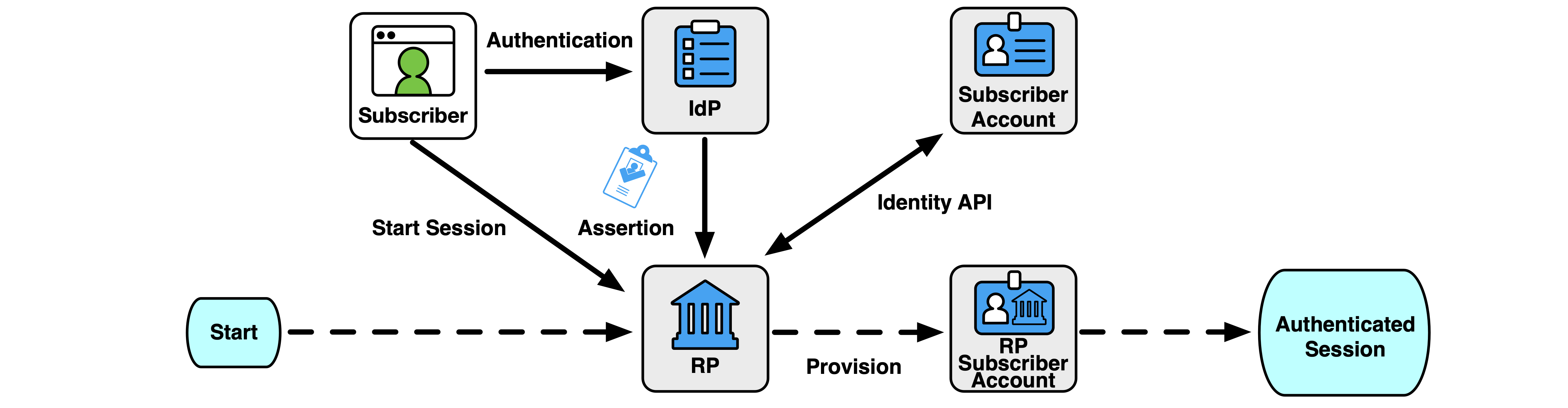
図7. ジャストインタイムプロビジョニング。加入者(Subscriber)から IdP へ Authentication(認証)の矢印がある。加入者から RP へ Start Session(セッション開始)の矢印、IdP から RP へ Assertion(アサーション、アイコン付き)の矢印がある。Identity API(アイデンティティAPI)の両方向矢印が RP と加入者アカウント(Subscriber Account)の箱を結ぶ。下段には破線の矢印が Start(開始)→ RP →(Provision、プロビジョニング)→ RP加入者アカウント(RP Subscriber Account)→ Authenticated Session(認証済みセッション)と続く。
Pre-Provisioning
事前プロビジョニング
An RP subscriber account is created or linked to an existing RP subscriber account by the IdP pushing the attributes to the RP or the RP pulling attributes from the IdP. Pre-provisioning of accounts generally occurs in bulk through a provisioning API (see Sec. 4.6.5), as the provisioning occurs prior to the represented subscribers authenticating through a federation transaction. Pre-provisioned accounts SHALL be bound to a federated identifier at the time of provisioning, unless an alternative means of access is defined by the trust agreement, such as an account linking policy (see Sec. 3.8.1), an account resolution policy (see Sec. 3.8.2), or alternative authentication mechanisms (see Sec. 3.8.3). This form of provisioning requires infrastructure and planning on the part of the IdP and RP, but these processes can be facilitated by automated protocols. Additionally, the IdP and RP must keep the set of provisioned accounts synchronized over time, as discussed in Sec. 4.6.4. See Fig. 8.
IdPが属性をRPにプッシュするか、RPがIdPから属性をプルすることで、RP加入者アカウントを作成するか、既存のRP加入者アカウントにリンクします。事前プロビジョニングでは、加入者がフェデレーション取引を通じて認証する前にプロビジョニングを行うため、通常、プロビジョニングAPI(Sec. 4.6.5参照)を通じてアカウントを一括でプロビジョニングします。事前にプロビジョニングされたアカウントは、アカウントリンクポリシー(Sec. 3.8.1参照)、アカウント解決ポリシー(Sec. 3.8.2参照)、または代替認証メカニズム(Sec. 3.8.3参照)など、信頼合意で別のアクセス方法を定義していない限り、プロビジョニング時にフェデレーション識別子へSHALLバインドされなければなりません。 このプロビジョニング方式にはIdPとRP双方のインフラと計画が必要ですが、自動化プロトコルを使って各プロセスを支援できます。また、Sec. 4.6.4で説明するように、IdPとRPはプロビジョニングされたアカウントの集合を時間の経過とともに同期させなければなりません。図8参照。
In this model, the RP also receives attributes about subscribers who have not yet interacted with the RP and who may never do so. This is in contrast to other models in which the RP only receives information about the subset of subscribers that use the RP, and then only after the subscriber uses the RP for the first time. The privacy considerations of the RP having access to this information prior to a federation transaction SHALL be accounted for in the trust agreement.
このモデルでは、RPはまだRPとやり取りしたことがなく、今後も利用しない可能性がある加入者の属性も受け取ります。RPを利用する加入者の情報だけを、初めてRPを利用した後にRPが受け取る他のモデルとは異なります。フェデレーション取引の前にRPがこの情報にアクセスできることによるプライバシー上の考慮事項を信頼合意にSHALL反映しなければなりません。
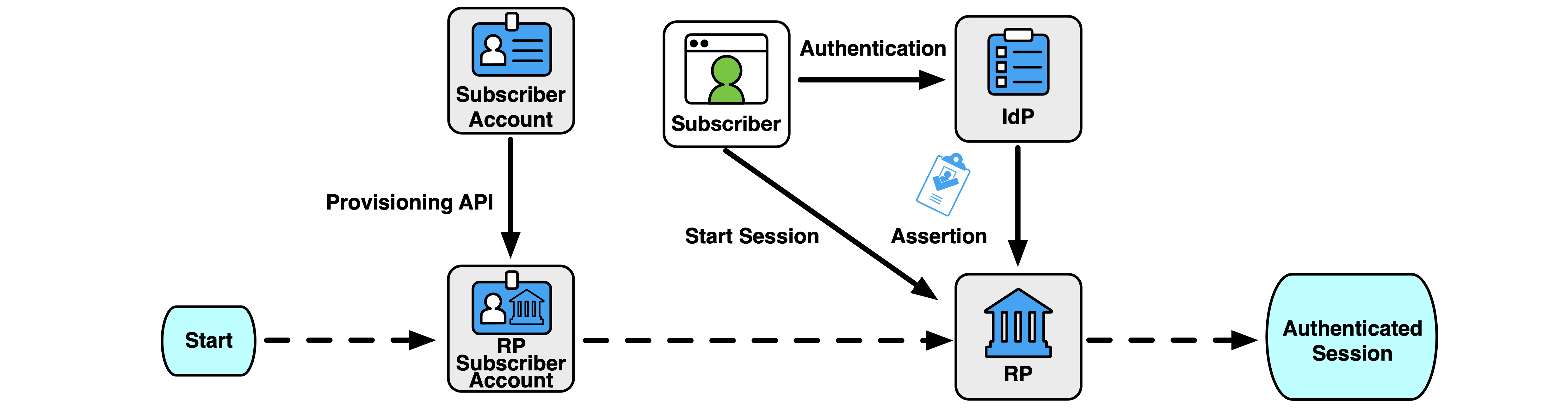
図8. 事前プロビジョニング。加入者アカウント(Subscriber Account)の箱から Provisioning API(プロビジョニングAPI)と記された下向きの矢印が RP加入者アカウント(RP Subscriber Account)の箱に向かう。加入者(Subscriber)から IdP へ Authentication(認証)の矢印があり、加入者から RP へ Start Session(セッション開始)の矢印、IdP から RP へ Assertion(アサーション、アイコン付き)の矢印がある。下段には破線の矢印が Start(開始)→ RP加入者アカウント → RP → Authenticated Session(認証済みセッション)と続く。
Ephemeral Provisioning
一時的なプロビジョニング
When processing an assertion, the RP establishes a link between that assertion and a new or existing RP subscriber account but removes that link when the authenticated session ends. This process is similar to just-in-time provisioning, but the RP keeps no long-term record of the subscriber when the session is complete, in accordance with Sec. 3.11.3. This form of provisioning is useful for RPs that fully externalize access rights to the IdP, allowing the RP to be more simplified with less internal state. If this form of provisioning is used, the federated identifier is not required in the assertion. If a federation identifier is supplied in the assertion, the RP SHALL remove any linkage of the federated identifier from an RP subscriber account. See Fig. 9.
アサーションを処理する際、RPはアサーションと新規または既存のRP加入者アカウントとのリンクを確立しますが、認証済みセッションが終了するとこのリンクを削除します。このプロセスはジャストインタイムプロビジョニングと似ていますが、Sec. 3.11.3に従い、セッション完了後に加入者の長期的な記録をRPが保持しません。 このプロビジョニング方式は、RPがアクセス権を全面的にIdPに委ね、内部状態を少なくしてRPをより簡素化できるため、有用です。この方式を使用する場合、アサーションにフェデレーション識別子は不要です。アサーションにフェデレーション識別子が含まれる場合、RP加入者アカウントから当該識別子への関連付けをRPはSHALL削除しなければなりません。図9参照。
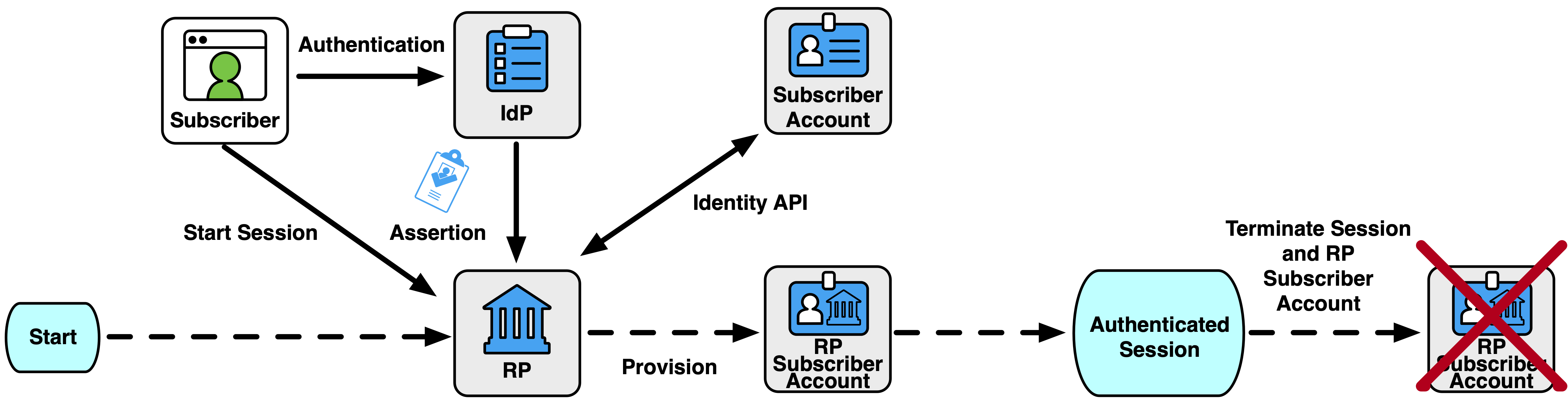
図9. 一時的なプロビジョニング。加入者(Subscriber)から IdP へ Authentication(認証)の矢印がある。加入者から RP へ Start Session(セッション開始)の矢印、IdP から RP へ Assertion(アサーション、アイコン付き)の矢印がある。Identity API(アイデンティティAPI)の両方向矢印が RP と加入者アカウント(Subscriber Account)の箱を結ぶ。下段には破線の矢印が Start(開始)→ RP →(Provision、プロビジョニング)→ RP加入者アカウント(RP Subscriber Account)→ Authenticated Session(認証済みセッション)→(Terminate Session and RP Subscriber Account、セッションと RP加入者アカウントの終了)→ 赤い X で消された RP加入者アカウントの箱と続く。
Other Provisioning Methods
その他のプロビジョニング方法
While other RP subscriber account provisioning models are possible, the details of such models are outside of the scope of these guidelines. However, the details of any alternative provisioning model SHALL be included in the privacy risk assessments of the IdP and RP.
他のRP加入者アカウントのプロビジョニングモデルも可能ですが、その詳細は本ガイドラインの対象範囲外です。ただし、代替プロビジョニングモデルの詳細は、IdPおよびRPのプライバシーリスク評価にSHALL含めなければなりません。
All organizations SHALL document their provisioning models as part of their trust agreement.
すべての組織は、信頼合意の一部としてプロビジョニングモデルをSHALL文書化しなければなりません。
Attribute Synchronization
属性の同期
In a federated process, the IdP and RP each have their own stores of identity attributes that are associated with the subscriber account. The IdP has a direct view of the subscriber account’s attributes, but the RP subscriber account is derived from a subset of attributes that are presented during the federation transaction. Therefore, it is possible for the IdP and RP’s attribute stores to diverge from each other over time.
フェデレーションプロセスでは、IdPとRPはそれぞれ、加入者アカウントに関連付けられた識別属性の保存領域を持ちます。IdPは加入者アカウントの属性を直接確認できますが、RP加入者アカウントはフェデレーション取引中に提示された属性の一部から導出されます。そのため、時間の経過とともにIdPとRPの属性保存領域に差異が生じる可能性があります。
From the RP’s perspective, the IdP is the trusted source for any attributes that the IdP asserts as being associated with the subscriber account at the IdP. However, the RP MAY collect and optionally verify other attributes to associate with the RP subscriber account, as discussed in Sec. 4.6.6.
RPの観点では、IdPが加入者アカウントに関連付けられているとアサートする属性の信頼できる情報源はIdPです。 ただし、RPはSec. 4.6.6で説明するように、RP加入者アカウントに関連付ける他の属性を収集し、任意で検証してもよいです(MAY)。
While it is possible for the IdP to proactively push updated attributes to the RP with every assertion, this practice exposes personal information on every transaction. To limit the amount of personal information sent at each transaction, the IdP SHOULD signal downstream RPs when the attributes of a subscriber account available to the RP have been updated. RPs MAY respond to this signal by requesting the new attributes from the IdP and updating the RP subscriber account. This synchronization can be accomplished by using shared signaling (see Sec. 4.8), through a provisioning API (see Sec. 4.6.5), or by signaling the RP (e.g., by providing a timestamp of when the subscriber account attributes were last updated) to request updated attributes through an identity API (see Sec. 3.12.3).
IdPが更新済みの属性をすべてのアサーションとともにRPへ積極的にプッシュすることも可能ですが、この方法では毎回の取引で個人情報が露出します。各取引で送信する個人情報の量を制限するため、IdPは、RPが利用可能な加入者アカウントの属性が更新されたときに下流RPへ通知するべきです(SHOULD)。RPはこの通知に応じてIdPに新しい属性を要求し、RP加入者アカウントを更新してもよいです(MAY)。同期は、共有シグナリング(Sec. 4.8参照)、プロビジョニングAPI(Sec. 4.6.5参照)、またはRPに通知(例えば加入者アカウントの属性を最後に更新したタイムスタンプの提供)してアイデンティティAPI(Sec. 3.12.3)経由で更新属性を要求することで実現できます。
If the RP is granted access to an identity API, the IdP SHOULD allow the RP to access the identity API for sufficient time to perform synchronization operations after the federation transaction has concluded. While an identity API is most often used during the first login, especially with a just-in-time provisioning process, on subsequent logins it is possible that attributes could have changed since the RP last fetched them. Therefore, the RP ought to be given access to the identity API beyond the initial login process to allow the RP to update its cache of attributes in the RP subscriber account. For example, if the assertion is valid for five minutes, access to the identity API could be valid for 30 minutes to allow the RP to fetch and update attributes out of band if the RP has determined that the RP subscriber account is out of date.
RPにアイデンティティAPIへのアクセスが許可される場合、IdPはフェデレーション取引の終了後、同期処理の実施に十分な時間だけRPがアイデンティティAPIにアクセスできるようにするべきです(SHOULD)。 アイデンティティAPIは初回ログイン時、特にジャストインタイムプロビジョニングプロセスで使われることが最も多いですが、以降のログイン時にはRPが最後に属性を取得した後に属性が変更されている場合があります。そのため、RP加入者アカウントの属性キャッシュを更新できるよう、RPには初回ログインプロセス以降もアイデンティティAPIへのアクセスを与えるべきです。 例えば、アサーションが5分間有効であれば、RPがRP加入者アカウントを最新でないと判断した場合に、帯域外で属性を取得して更新できるよう、アイデンティティAPIへのアクセスを30分間有効にできます。
The IdP SHOULD signal downstream RPs when a subscriber account is terminated or when the subscriber account’s access to an RP is revoked. This can be accomplished through shared signaling (see Sec. 4.8), through a provisioning API (see Sec. 4.6.5), or through an out-of-band mechanism. Upon receiving such a signal, the RP SHALL process the RP subscriber account, as stipulated in the trust agreement and in accordance with Sec. 3.11.3. If the reason for termination is suspicious or fraudulent activity, the IdP SHALL notify the RP of the termination and include the reason in its signal to the RP to allow the RP to review the associated RP subscriber account’s activity for suspicious activity, if specified in the trust agreement with that RP.
加入者アカウントが終了した場合、または加入者アカウントからRPへのアクセスが取り消された場合、IdPは下流RPに通知するべきです(SHOULD)。これは、共有シグナリング(Sec. 4.8参照)、プロビジョニングAPI(Sec. 4.6.5参照)、または帯域外の方法を通じて実現できます。このような通知を受信した場合、RPは、信頼合意の規定およびSec. 3.11.3に従ってRP加入者アカウントをSHALL処理しなければなりません。終了理由が不審な行為または不正行為である場合、IdPはRPに終了を通知SHALLし、当該RPとの信頼合意で定められているなら、RPが関連するRP加入者アカウントの活動を確認できるよう、通知に理由を含めなければなりません。
Provisioning APIs
プロビジョニングAPI
As part of pre-provisioning, the RP can be given access to subscriber attributes through a general-purpose identity API known as a provisioning API. This type of API allows an IdP to push attributes for a range of subscriber accounts and sometimes allows an RP to directly query the attributes of these subscriber accounts. Since access to the API is granted outside of the context of a federation transaction, access to the provisioning API for a given subscriber does not indicate to the RP that a given subscriber has been authenticated.
事前プロビジョニングの一環として、汎用アイデンティティAPIであるプロビジョニングAPIを通じて、RPに加入者属性へのアクセスを許可できます。この種類のAPIにより、IdPは複数の加入者アカウントの属性をプッシュでき、RPがこれらの加入者アカウントの属性を直接問い合わせることも可能になる場合があります。APIへのアクセスはフェデレーション取引の文脈外で許可されるため、特定の加入者に対してプロビジョニングAPIへのアクセス権を持っていることは、その加入者が認証されたことをRPに示すものではありません。
The attributes in the provisioning API that are available to a given RP SHALL be limited to only those necessary for the RP to perform its functions, including any audit and security purposes, as discussed in Sec. 3.10.1. As part of establishing the trust agreement, the IdP SHALL document when an RP is given access to a provisioning API, including at least the following:
特定のRPがプロビジョニングAPIで利用できる属性は、Sec. 3.10.1で説明するとおり、監査およびセキュリティ上の目的を含め、RPが機能を実行するために必要なもののみにSHALL制限しなければなりません。信頼合意を確立する一環として、IdPはRPにプロビジョニングAPIへのアクセスを許可する場合に、最低限以下を含む事項をSHALL文書化しなければなりません。
•The purpose for the access using the provisioning model
•プロビジョニングモデルを用いたアクセスの目的
•The set of attributes made available to the RP
•RPが利用できる属性の組み合わせ
•Whether the API functions as a push to the RP, a pull from the RP, or both
•APIがRPへのプッシュとして機能するか、RPからのプルとして機能するか、またはその両方か
•The population of subscribers whose attributes are made available to the RP
•RPが属性を利用できる加入者の集団
Access to the provisioning API SHALL occur over a mutually authenticated protected channel. The exact means of authentication varies depending on the specifics of the API and whether it is a push model (i.e., the IdP initiates the connection to the RP) or a pull model (i.e., the RP initiates the connection to the IdP).
プロビジョニングAPIへのアクセスは、相互認証された保護済みチャネルを通じてSHALL行わなければなりません。正確な認証方法は、APIの詳細と、プッシュモデル(IdPがRPへの接続を開始)かプルモデル(RPがIdPへの接続を開始)かに応じて異なります。
A provisioning API SHALL NOT be made available under a subscriber-driven trust agreement. The IdP SHALL NOT make a provisioning API available to any RP outside of an established trust agreement. The IdP SHALL provide access to a provisioning API only as part of a federated identity relationship with an RP to facilitate federation transactions with that RP and related functions, such as signaling revocation of the subscriber account. The IdP SHALL revoke an RP’s access to the provisioning API once access is no longer required by the RP for its functioning purposes or when the trust agreement is terminated.
加入者主導の信頼合意では、プロビジョニングAPIを利用可能にしてはなりません(SHALL NOT)。IdPは、確立済みの信頼合意を結んでいないRPにプロビジョニングAPIを提供してはなりません(SHALL NOT)。IdPは、そのRPとのフェデレーション取引や加入者アカウントの失効通知などの関連機能を促進するため、RPとのフェデレーションID関係の一部としてのみプロビジョニングAPIへのアクセスを提供SHALLしなければなりません。RPの機能上アクセスが不要になった場合、または信頼合意が終了した場合、IdPはRPのプロビジョニングAPIへのアクセスをSHALL失効させなければなりません。
Any provisioning API provided to the RP SHALL be under the control and jurisdiction of the IdP. External attribute providers MAY be used as information sources by the IdP to provide attributes through this provisioning API, but the IdP is responsible for the content and accuracy of the information provided by the referenced attribute providers.
RPに提供するプロビジョニングAPIはすべて、IdPの管理および管轄下にSHALL置かなければなりません。IdPはプロビジョニングAPIを通じて属性を提供する情報源として外部属性プロバイダーを使用してもよい(MAY)が、参照する属性プロバイダーが提供する情報の内容と正確性に対する責任はIdPが負います。
When a provisioning API is in use, the IdP SHALL signal to the RP when the state of a subscriber account has been changed, such as when the account has been terminated or disabled. When receiving such a signal, the RP SHALL remove the binding of the federated identifier from the account. The RP MAY terminate the RP subscriber account if it can no longer be accessed by the subscriber. The RP SHALL treat all personal information sourced from the provisioning API in accordance with Sec. 3.11.3.
プロビジョニングAPIを使用する場合、加入者アカウントの状態が変更されたとき(例えばアカウントが終了または無効化されたとき)、IdPはRPに通知SHALLしなければなりません。この通知を受けた場合、RPはアカウントからフェデレーション識別子のバインドをSHALL解除しなければなりません。加入者がRP加入者アカウントにアクセスできなくなった場合、RPは当該アカウントを終了してもよいです(MAY)。RPは、プロビジョニングAPIを情報源とするすべての個人情報をSec. 3.11.3に従ってSHALL取り扱わなければなりません。
Collection of Additional Attributes by the RP
RPによる追加属性の収集
The RP MAY collect and maintain additional attributes from the subscriber beyond those provided by the IdP. For example, the RP could collect a preferred display name directly from the subscriber that is not provided by the IdP. The RP could also have a separate agreement with an attribute provider that gives the RP access to an identity API that is not associated with the IdP. For example, the RP could receive a state license number from the IdP but use a separate attribute verification API to check whether a particular license number is currently valid. The assertion from the IdP binds the license to the subscriber, but the attribute verification API provides additional information beyond what the IdP can share or be authoritative for.
RPはIdPが提供する属性以外に、加入者から追加の属性を収集して維持してもよいです(MAY)。例えば、IdPが提供しない希望表示名をRPが加入者から直接収集できます。またRPは、IdPに関連付けられていないアイデンティティAPIへのアクセスをRPに許可する属性プロバイダーと別の合意を結ぶこともできます。例えば、RPはIdPから州の免許番号を受け取りつつ、別の属性検証APIを使って特定の免許番号が現在有効か確認できます。IdPのアサーションは免許を加入者に結び付けますが、属性検証APIはIdPが共有できる、または権威ある情報源となれる範囲を超えた追加情報を提供します。
These attributes are governed separately from the trust agreement since they are collected by the RP outside of a federation transaction. However, all attributes in the RP subscriber account — regardless of source — SHALL be stored in accordance with Sec. 3.11.3.
これらの属性はフェデレーション取引の外でRPが収集するため、信頼合意とは別個に管理されます。ただし、情報源にかかわらず、RP加入者アカウント内のすべての属性をSec. 3.11.3に従って保管SHALLしなければなりません。
The RP SHALL disclose to the subscriber the purpose for collecting any additional attributes. These attributes SHALL be used solely for the stated purposes of the RP’s functionality. The transmission of additionally collected attributes SHALL be handled in accordance with Sec. 3.10.1.
RPは追加属性を収集する目的を加入者にSHALL開示しなければなりません。これらの属性は、RPの機能について明示された目的にのみSHALL使用しなければなりません。追加で収集した属性の送信はSec. 3.10.1に従ってSHALL扱わなければなりません。
The RP SHALL provide a secure and effective means of redress for the subscriber to update and remove these additionally collected attributes from the RP subscriber account. See Sec. 3.5.3 for additional requirements and considerations for redress mechanisms.
RPは、加入者が追加で収集した属性をRP加入者アカウントから更新および削除できるよう、安全で効果的な救済手段をSHALL提供しなければなりません。救済メカニズムに関する追加要件と考慮事項はSec. 3.5.3を参照してください。
The following requirement applies to federal agencies, regardless of whether they operate their own identity service or use an external CSP as part of their identity service:
以下の要件は、連邦機関が独自のアイデンティティサービスを運用するか、アイデンティティサービスの一環として外部CSPを使用するかにかかわらず適用されます。
•An RP SHALL disclose any additional attributes collected and their use as part of its System of Records Notice (SORN).
•RPは、収集した追加属性とその使用をシステム記録通知(SORN)の一部としてSHALL開示しなければなりません。
Time-Based Removal of RP Subscriber Accounts
時間に基づくRP加入者アカウントの削除
If an RP is using a just-in-time provisioning mechanism, the RP only learns of the existence of a subscriber account when that account is first used at the RP. If the IdP does not inform the RP of terminated subscriber accounts using shared signaling (see Sec. 4.8), an RP could accumulate RP subscriber accounts that are no longer accessible from the IdP. This poses a risk to the RP for holding personal information in the RP subscriber accounts and providing potentially exploitable accounts for an attacker to target. In such circumstances, the RP MAY employ a time-based mechanism to identify RP subscriber accounts for termination that have not been accessed after a period of time that is tailored to the usage patterns of the application. For example, an RP that is usually accessed on a weekly basis could set a timeout of 120 days since last access at the RP to mark the RP subscriber account for termination. An RP that expects longer gaps between access (e.g., a service used annually) should have a much longer time frame for time-based termination, such as five years.
RPがジャストインタイムプロビジョニング機構を使う場合、RPは加入者アカウントがRPで初めて使用されたときに初めて、そのアカウントの存在を知ります。IdPが共有シグナリング(Sec. 4.8参照)で終了済み加入者アカウントをRPに通知しない場合、IdPからアクセスできなくなったRP加入者アカウントがRPに蓄積する可能性があります。これにより、RP加入者アカウントに個人情報を保持するリスクや、攻撃者が標的にできる悪用可能なアカウントを残すリスクが生じます。このような状況では、アプリケーションの利用パターンに合わせた一定期間アクセスされていないRP加入者アカウントを特定し、終了するため、RPは時間に基づく機構を採用してもよいです(MAY)。例えば、通常は週単位でアクセスされるRPは、RPで最後にアクセスされてから120日が経過した時点でタイムアウトを設定し、RP加入者アカウントを終了対象にできます。年1回使用されるサービスなど、アクセス間隔が長いことが想定されるRPは、5年間など、時間に基づく終了までの期間をかなり長くするべきです。
When processing an inactive account, the RP SHALL provide sufficient notice to the subscriber about the pending termination of the account and provide the subscriber with an option to re-activate the account prior to its scheduled termination. Upon termination, the RP SHALL remove all personal information associated with the RP subscriber account in accordance with Sec. 3.11.3.
非アクティブアカウントを処理する場合、RPは加入者にアカウントの終了予定を十分に通知し、予定された終了前にアカウントを再アクティベートする選択肢をSHALL提供しなければなりません。終了時に、RPはSec. 3.11.3に従ってRP加入者アカウントに関連付けられたすべての個人情報をSHALL削除しなければなりません。
Reauthentication and Session Requirements in Federated Environments
フェデレーション環境における再認証とセッション要件
In a federated environment, the RP manages its sessions separately from any sessions at the IdP. The assertion is related to both sessions, but its validity period is ultimately independent of them.
フェデレーション環境では、RPはIdPにおけるセッションとは別に自身のセッションを管理します。アサーションは両方のセッションに関係しますが、その有効期間は最終的にそれぞれのセッションとは独立しています。
As shown in Fig. 10, an assertion is created during an authenticated session at the IdP, and processing an assertion creates an authenticated session at the RP. The validity time window of an assertion is used to manage the RP’s processing of the assertion but does not indicate the lifetime of the authenticated session at the IdP or RP. If a request comes to the IdP for a new federation transaction while the subscriber’s session is still valid at the IdP, a new and separate assertion would be created with its own validity time window. Similarly, after the RP consumes the assertion, the validity of the RP’s session is independent of the validity of the assertion. In most cases, the authenticated session at the RP will far outlive the validity of the assertion. Access granted to an identity API is likewise independent of the validity of the assertion or the lifetime of the authenticated session at the RP.
図10に示すように、アサーションはIdPでの認証済みセッション中に作成され、アサーションを処理するとRPで認証済みセッションが作成されます。アサーションの有効期間はRPによるアサーション処理を管理するために使用されますが、IdPまたはRPでの認証済みセッションの存続期間を示すものではありません。加入者のIdPセッションがまだ有効な間に新しいフェデレーション取引の要求がIdPに届くと、新しい独立したアサーションがその固有の有効期間とともに作成されます。同様に、RPがアサーションを使用した後、RPセッションの有効性はアサーションの有効性とは独立しています。大半の場合、RPの認証済みセッションはアサーションの有効期間よりもはるかに長く継続します。アイデンティティAPIへのアクセスも、アサーションの有効性やRPの認証済みセッションの存続期間とは独立しています。
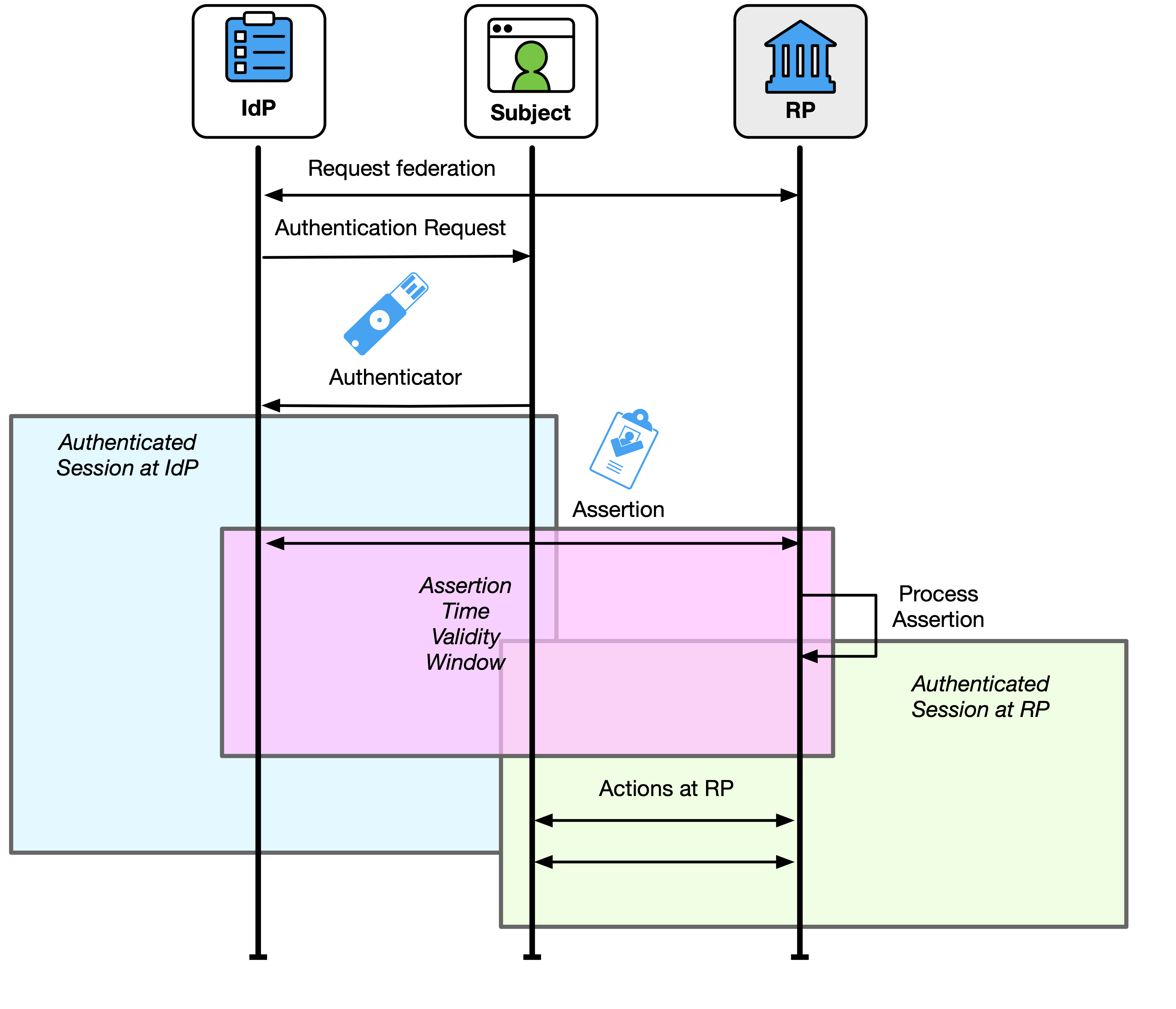
図10. セッションの存続期間。IdP、主体(Subject)、RP の生存線を持つシーケンス図である。Request federation(フェデレーションの要求): IdP と RP の間の両方向矢印。Authentication Request(認証要求): IdP から主体へ。Authenticator(認証器、セキュリティキーのアイコン付き): 主体から IdP へ。Authenticated Session at IdP(IdP での認証済みセッション)と記された青い枠が認証の後に始まり、IdP と主体の生存線にまたがる。Assertion(アサーション、アイコン付き): IdP と RP の間の両方向矢印で、Assertion Time Validity Window(アサーションの有効期間)と記されたピンクの枠の上端にある。Process Assertion(アサーションの処理): RP の生存線上で自分に戻る矢印。Authenticated Session at RP(RP での認証済みセッション)と記された緑の枠が有効期間の枠の途中で始まり、有効期間の枠と IdP のセッションの枠より後まで続く。Actions at RP(RP での操作): RP のセッションの枠の中で、主体と RP の間の 2 本の両方向矢印。
The IdP terminating the subscriber’s session at the IdP will not necessarily terminate any sessions that subscriber might have at downstream RPs. The RP and IdP MAY communicate end-session events to each other if supported by the federation protocol or through shared signaling (see Sec. 4.8).
IdPでIdPが加入者のセッションを終了しても、下流RPにおける加入者のセッションがすべて終了するとは限りません。フェデレーションプロトコルでサポートされる場合や共有シグナリング(Sec. 4.8参照)を通じて、RPとIdPはセッション終了イベントを互いに通知してもよいです(MAY)。
At the time of a federated transaction request, the subscriber could have a pre-existing authenticated session at the IdP that MAY be used to generate an assertion to the RP. The IdP SHALL communicate to the RP any information that the IdP has regarding the recency of the subscriber’s latest authentication event at the IdP, and the RP MAY use this information to make authorization and access decisions. Depending on the capabilities of the federation protocol in use, the IdP SHOULD allow the RP to request that the subscriber provide a fresh authentication at the IdP, such as requesting a maximum time since the subscriber’s last authentication event. For example, suppose that the subscriber authenticates at the IdP for one transaction. The subscriber then starts a federation transaction at the RP 30 minutes later. Depending on xAL requirements, the subscriber’s existing session at the IdP can be used to avoid prompting the subscriber for their authenticators. The resulting assertion to the RP will indicate that the last time the subscriber authenticated to the RP was 30 minutes in the past. The RP can then use this information to determine whether this is reasonable for the RP’s needs. If the authentication time is not sufficient for the RP, the RP can request the IdP to prompt the subscriber for a fresh authentication event.
フェデレーション取引の要求時に、加入者はIdPで事前に確立された認証済みセッションを持っていることがあり、そのセッションを使用してRP向けのアサーションを生成してもよいです(MAY)。IdPは、IdPにおける加入者の最新の認証イベントがどれほど最近かについてIdPが持つ情報をRPにSHALL伝えなければならず、RPはこの情報を認可およびアクセスの判断に使用してもよいです(MAY)。使用するフェデレーションプロトコルの機能に応じて、IdPは、加入者の最後の認証イベントからの最大経過時間を指定するなどして、加入者に新たな認証を求める要求をRPが行えるようにするべきです(SHOULD)。例えば、加入者が1つの取引でIdPに認証し、その30分後にRPでフェデレーション取引を開始するとします。xALの要件に応じて、既存のIdPセッションを利用し、認証器を提示するよう加入者に再度求めずに済む場合があります。RP向けの結果のアサーションには、加入者がRPに最後に認証した時刻は30分前であると示されます。RPはこの情報を使い、RPのニーズに照らして妥当か判断できます。認証時刻がRPにとって十分でない場合、RPはIdPに加入者への新たな認証イベントを促すよう要求できます。
If an RP is granted access to an identity API at the same that time the RP receives an assertion, the lifetime of the access to the identity API is independent of the lifetime of the assertion. As a consequence, the RP’s ability to successfully fetch additional attributes through an identity API SHALL NOT be used to establish or extend a session at the RP. Likewise, the inability to access an identity API SHOULD NOT be used to end the session at the RP.
アサーションをRPが受信するのと同時にRPにアイデンティティAPIへのアクセスが許可される場合でも、アイデンティティAPIへのアクセスの存続期間はアサーションの存続期間とは独立しています。その結果、アイデンティティAPIを通じて追加属性を正常に取得できることを、RPでのセッション確立または延長に使用してはなりません(SHALL NOT)。同様に、アイデンティティAPIにアクセスできないことを、RPでのセッション終了に使用するべきではありません(SHOULD NOT)。
While an RP could also be granted access to other non-identity APIs during the federation transaction (e.g., a subscriber’s calendar), non-identity APIs are out of the scope of these guidelines.
フェデレーション取引中にRPが他の非アイデンティティAPI(例えば加入者のカレンダー)へのアクセスを許可されることもありますが、非アイデンティティAPIは本ガイドラインの対象範囲外です。
The RP MAY terminate its authenticated session with the subscriber or restrict access to the RP’s functions if the assertion, authentication event, or attributes do not meet the RP’s requirements. For example, if an RP is configured to allow access to certain high-risk functionality only if the federation transaction was at FAL3, but the incoming assertion only meets the requirements for FAL2, the RP could decide to deny access to the high-risk functionality while allowing access to a lower risk functionality, or the RP could choose to terminate the session entirely.
アサーション、認証イベント、または属性がRPの要件を満たさない場合、RPは加入者との認証済みセッションを終了するか、RPの機能へのアクセスを制限してもよいです(MAY)。例えば、フェデレーション取引がFAL3の場合に限り、ある高リスク機能へのアクセスを許可するようRPが設定されていますが、受信したアサーションがFAL2の要件しか満たさない場合、RPは高リスク機能へのアクセスを拒否し、よりリスクの低い機能へのアクセスを許可することも、セッション全体を終了することもできます。
See [SP800-63B] Sec. 5 for more information about session management requirements that apply to both IdPs and RPs.
IdPとRP双方に適用されるセッション管理要件の詳細は[SP800-63B] Sec. 5を参照してください。
Assertion Contents
アサーションの内容
An assertion is a statement from the IdP to the RP that contains information about an authentication event for an authenticated subscriber as well as a set of attribute values, derived attribute values, or attribute bundles about or associated with that subscriber. In addition to attribute information, assertions comprise a variety of data, including assertion metadata, information about the subscriber’s authentication at the IdP, and other information that the RP can leverage (e.g., restrictions, validity time window). While the assertion’s primary function is to authenticate the user to an RP, the information conveyed in the assertion can be used by the RP for a number of use cases (e.g., identity proofing, authorization, personalization of a website). These guidelines do not restrict RP use cases nor the type of protocol or data payload used to federate an identity, provided that the chosen solution meets all mandatory requirements contained herein.
アサーションは、認証済み加入者に関する認証イベントの情報と、その加入者についての、またはその加入者に関連付けられた一連の属性値、導出属性値、または属性バンドルを含む、IdPからRPへのステートメントです。属性情報のほかに、アサーションはアサーションメタデータ、IdPでの加入者認証に関する情報、およびRPが活用できる他の情報(例えば制限や有効期間)など、さまざまなデータで構成されます。アサーションの主な機能はRPに対してユーザーを認証することですが、伝達された情報は、本人確認、認可、ウェブサイトのパーソナライズなど、多数のユースケースでRPが使用できます。本ガイドラインは、選択したソリューションが本書に含まれるすべての必須要件を満たす限り、RPのユースケースや、IDをフェデレーションするために使用するプロトコルまたはデータペイロードの種類を制限しません。
Assertions SHALL represent a discrete authentication event of the subscriber at the IdP and SHALL be processed as a discrete authentication event at the RP.
アサーションはIdPにおける加入者の個別の認証イベントをSHALL表し、RPでも個別の認証イベントとしてSHALL処理しなければなりません。
All assertions SHALL include the following attributes:
すべてのアサーションは、以下の属性をSHALL含めなければなりません。
1.Issuer identifier: An identifier for the issuer of the assertion (i.e., the IdP).
1.発行者識別子:アサーションの発行者(IdP)を識別する識別子。
2.Audience identifier: An identifier for the party intended to consume the assertion (i.e., the RP). An assertion can contain more than one audience identifier at FAL1.
2.対象者識別子:アサーションの利用を意図する当事者(RP)を識別する識別子。FAL1では、アサーションに複数の対象者識別子を含めることができます。
3.Issuance time: A timestamp that indicates when the IdP issued the assertion.
3.発行時刻:IdPがアサーションを発行した日時を示すタイムスタンプ。
4.Validity time window: A period of time outside of which the assertion SHALL NOT be accepted as valid by the RP for the purposes of authenticating the subscriber and starting an authenticated session at the RP. This is usually communicated by means of an expiration timestamp for the assertion in addition to the issuance timestamp.
4.有効期間:その期間外では、RPが加入者を認証し、RPで認証済みセッションを開始する目的でアサーションを有効なものとして受け入れてはならない(SHALL NOT)期間。通常、アサーションの発行タイムスタンプに加えて、有効期限のタイムスタンプによって示されます。
5.Assertion identifier: A value that uniquely identifies this assertion and is used to prevent attackers from replaying prior assertions.
5.アサーション識別子:このアサーションを一意に識別し、攻撃者による過去のアサーションのリプレイを防ぐために使用する値。
6.Authentication time: A timestamp that indicates when the IdP last verified the presence of the subscriber at the IdP through a primary authentication event.
6.認証時刻:IdPが最後に一次認証イベントを通じて加入者がIdPにいることを検証した時刻を示すタイムスタンプ。
7.Signature: Digital signature or MAC, including verification key identifier, that covers the entire assertion.
7.署名:アサーション全体を対象とする、検証鍵識別子を含むデジタル署名またはMAC。
If the RP subscriber account does not use an ephemeral provisioning process, the subscriber SHALL be identified in the assertion using a federated identifier (see Sec. 3.4) or through an account resolution process (see Sec. 3.8.2).
RP加入者アカウントで一時的なプロビジョニングプロセスを使用しない場合、加入者は、フェデレーション識別子(Sec. 3.4参照)またはアカウント解決プロセス(Sec. 3.8.2参照)を通じてアサーション内で識別SHALLされなければなりません。
If the subscriber is identified using a federated identifier, the assertion SHALL include:
加入者がフェデレーション識別子を使って識別される場合、アサーションは以下をSHALL含めなければなりません。
•Subject Identifier: An identifier for the party to which the assertion applies (i.e., the subscriber)
•サブジェクト識別子:アサーションが対象とする当事者(加入者)を識別する識別子。
The following aspects of the federation transaction SHALL be provided through information contained in the assertion contents or the applicable trust agreement:
フェデレーション取引に関する以下の側面を、アサーションの内容または適用される信頼合意に含まれる情報を通じてSHALL提供しなければなりません。
1.The IAL as well as the type of verification used during the identity proofing process (e.g., biometric, address verification), an indication of the identity proofing processes used to establish the subscriber account, or an indication that no IAL is asserted
1.IALと、本人確認プロセスで使用された検証の種類(例えば生体認証、住所確認)、加入者アカウントの確立に用いられた本人確認プロセスを示す情報、またはIALがアサートされていないことを示す情報。
2.The AAL used when the subscriber authenticated to the IdP or an indication that no AAL is asserted
2.加入者がIdPに認証した際のAAL、またはAALがアサートされていないことを示す情報。
3.The IdP’s intended FAL of the federation process represented by the assertion
3.アサーションが表すフェデレーションプロセスについてIdPが意図するFAL。
The assertion SHOULD contain additional information about the authentication method used at the IdP, if available (e.g., whether the authenticator used is phishing-resistant). Some technologies that can carry information include Vectors of Trust [RFC8485] or authentication class references in [OIDC] and [SAML].
At FAL2 and above, the assertion SHALL include:
FAL2以上では、アサーションは以下をSHALL含めなければなりません。
1.Nonce: A cryptographic nonce from the RP’s federation request
1.Nonce:RPのフェデレーション要求に含まれる暗号学的nonce
At FAL3, the assertion SHALL include one of the following:
FAL3では、アサーションは以下のいずれかをSHALL含めなければなりません。
1.The public key, key identifier, or other identifier for a holder-of-key assertion or
1.holder-of-keyアサーションの公開鍵、鍵識別子、またはその他の識別子、または
2.An indicator that the verification of a bound authenticator is required to process this assertion.
2.このアサーションを処理するにはバインド済み認証器の検証が必要であることを示す指標。
Assertions SHALL NOT contain subscriber authentication secrets (e.g., passwords).
アサーションに加入者認証の秘密情報(例えばパスワード)を含めてはなりません(SHALL NOT)。
Assertions MAY also include additional items, including:
アサーションには、以下を含む追加項目を含めてもよいです(MAY)。
1.Attribute values and derived attribute values: Information about the subscriber
1.属性値および導出属性値:加入者に関する情報
2.Attribute bundles: Collections of attributes in a signed bundle from the CSP
2.属性バンドル:CSPが署名したバンドル内の属性の集合
3.Subscriber account: Additional details about the subscriber account, such as the set of controls used to obtain the IAL
3.加入者アカウント:IALの取得に使用された管理策の組み合わせなど、加入者アカウントに関する追加情報
4.Attribute metadata: Additional information about one or more subscriber attributes, such as those described in [NISTIR8112]
4.属性メタデータ:1つ以上の加入者属性に関する追加情報([NISTIR8112]で説明される情報など)
5.Authentication event: Additional details about the authentication event, such as the class of authenticators used
5.認証イベント:使用した認証器のクラスなど、認証イベントに関する追加情報
The RP SHALL validate the assertion by checking that all of the following are true:
RPは、以下すべてが真であることを確認してアサーションを検証SHALLしなければなりません。
1.Signature validation: Ensure that the signature of the assertion is valid and corresponds to a verification key that belongs to the IdP sending the assertion.
1.署名検証:アサーションの署名が有効であり、アサーションを送信するIdPに属する検証鍵に対応することを確認します。
2.Issuer verification: Ensure that the assertion was issued by the expected IdP.
2.発行者の検証:アサーションが想定されたIdPによって発行されたことを確認します。
3.Time validation: Ensure that the validity time window is within acceptable limits of the current timestamp.
3.時刻の検証:有効期間が現在のタイムスタンプに対して許容範囲内にあることを確認します。
4.Audience restriction: Ensure that this RP is the intended recipient of the assertion.
4.対象者の制限:このRPがアサーションの意図された受信者であることを確認します。
5.Nonce: Ensure that the cryptographic nonce included in the RP’s request (if applicable) is included in the presentation.
5.Nonce:RPの要求に含まれていた場合、暗号学的nonceが提示に含まれていることを確認します。
6.Transaction terms: Ensure that the IAL, AAL, and FAL represented by the assertion are allowable under the applicable trust agreement and are suitable for the RP’s needs.
6.取引条件:アサーションが表すIAL、AAL、およびFALが適用される信頼合意の下で許容され、RPのニーズに適していることを確認します。
7.Assertion identifier: Ensure that the assertion has not been replayed within its validity time window at this RP.
7.アサーション識別子:このRPでアサーションの有効期間中にリプレイされていないことを確認します。
An RP that uses the federated identifier to identify the subscriber SHALL NOT treat subject identifiers as inherently globally unique across IdPs. Instead, the value of the assertion’s subject identifier is processed in a namespace under the assertion issuer’s control, as discussed in Sec. 3.4. This allows an RP to talk to multiple IdPs without incorrectly conflating subjects from different IdPs.
加入者の識別にフェデレーション識別子を使用するRPは、サブジェクト識別子をIdP間でグローバルに一意であると扱ってはなりません(SHALL NOT)。代わりに、アサーションのサブジェクト識別子の値は、Sec. 3.4で説明するように、アサーション発行者が管理する名前空間内で処理します。これによりRPは、異なるIdPからのサブジェクトを誤って同一視せずに複数のIdPと通信できます。
Any release of identity attributes to the RP is subject to the terms of the trust agreement. Section 3.10 contains privacy requirements for presenting attributes in assertions. The RP MAY be given limited access to an identity API (see Sec. 3.12.3), either in the same response as the assertion is received or through some other mechanism. The RP can use this API to fetch additional identity attributes for the subscriber that are not included in the assertion itself. These attributes are also subject to the terms of the trust agreement.
RPへの識別属性の開示はすべて信頼合意の条件に従います。アサーション内で属性を提示する際のプライバシー要件はSection 3.10に記載されています。アサーションを受信するのと同じ応答内、または他の何らかの方法で、RPにアイデンティティAPIへの限定的アクセスを許可してもよいです(MAY)(Sec. 3.12.3参照)。RPはこのAPIを使用して、アサーション自体に含まれない加入者の追加の識別属性を取得できます。これらの属性も信頼合意の条件に従います。
The assertion’s validity time window is the time between its issuance and its expiration. This window needs to be large enough to allow the RP to process the assertion and create a local application session for the subscriber but should not be longer than necessary for such establishment, including reasonable clock drift between the IdP and RP. Long-lived assertions have a greater risk of being stolen or replayed; a short assertion validity time window mitigates this risk. Assertion validity time windows SHALL NOT be used to limit the session at the RP. See Sec. 4.7 for more information.
アサーションの有効期間は、発行時刻から有効期限までの時間です。この期間は、IdPとRP間の妥当なクロックずれを含め、RPがアサーションを処理して加入者のローカルなアプリケーションセッションを作成するのに十分な長さである必要がありますが、その確立に必要な長さを超えるべきではありません。有効期間の長いアサーションは盗難またはリプレイのリスクが高くなります。アサーションの有効期間を短くすれば、このリスクを軽減できます。アサーションの有効期間をRPでのセッションの制限に使用してはなりません(SHALL NOT)。詳細はSec. 4.7を参照してください。
Assertion Requests
アサーション要求
When the federation transaction is initiated by the RP, the RP’s request for an assertion SHALL contain:
RPがフェデレーション取引を開始する場合、アサーションに対するRPの要求は以下をSHALL含まなければなりません。
1.An identifier for the RP
1.RPの識別子
2.A cryptographic nonce to be returned in the assertion
2.アサーションで返される暗号学的nonce
The RP’s request SHOULD additionally contain:
RPの要求には、以下も含めるべきです(SHOULD)。
1.The set of identity attributes requested by the RP and their purpose of use at the RP; this is a subset of what is allowed by the trust agreement
1.RPが要求する識別属性の組み合わせとRPにおける各属性の使用目的(信頼合意で許可される属性の一部)
2.The requirements for the authentication event at the IdP
2.IdPでの認証イベントに関する要件
When federation transactions are initiated by the IdP (at FAL1), these requirements do not apply. Federation transactions are always initiated by the RP at FAL2 or higher.
IdPがフェデレーション取引を開始する場合(FAL1)、これらの要件は適用されません。FAL2以上では、フェデレーション取引は常にRPが開始します。
Assertion Presentation
アサーションの提示
In most federation protocols, the RP and the IdP communicate with each other in two ways, each of which can be used to pass an assertion from the IdP to the RP:
大半のフェデレーションプロトコルではRPとIdPは2つの方法で互いに通信し、それぞれを使ってIdPからRPにアサーションを渡すことができます。
•The back channel: Through a direct connection between the RP and IdP that does not involve the subscriber directly
•バックチャネル:加入者が直接関与しない、RPとIdP間の直接接続。
•The front channel: Through a third party using redirects that involve the subscriber and the subscriber’s browser or device
•フロントチャネル:加入者および加入者のブラウザーまたはデバイスが関与するリダイレクトを用いた第三者経由の通信。
There are trade-offs with each model, but both require the proper validation of the assertion. Assertions MAY also be proxied to facilitate federation between IdPs and RPs using different presentation methods, as discussed in detail in Sec. 3.3.3.
それぞれの方式にはトレードオフがありますが、どちらの場合もアサーションの適切な検証が必要です。Sec. 3.3.3で詳述するとおり、異なる提示方法を使用するIdPとRP間のフェデレーションを促進するため、アサーションをプロキシ経由で渡してもよいです(MAY)。
Back-Channel Presentation
バックチャネル提示
In the back-channel presentation model shown in Fig. 11, the subscriber is given an assertion reference to present to the RP, generally through the front channel. The assertion reference itself contains no information about the subscriber and SHALL be resistant to tampering and fabrication by an attacker. The RP presents the assertion reference to the IdP to fetch the assertion. Methods for achieving this vary based on the federation protocol in use. In the authorization code flow and some forms of the hybrid flow of [OIDC], the assertion (i.e., the ID Token) is presented in the back channel in exchange for the assertion reference (i.e., the authorization code). In the artifact binding profile of [SAML-Bindings], the SAML assertion is presented in the back channel.
図11に示すバックチャネル提示モデルでは、加入者は通常、フロントチャネルを通じてRPに提示するアサーション参照を受け取ります。アサーション参照自体には加入者に関する情報を含めず、攻撃者による改ざんや偽造に耐えるSHALL必要があります。RPはアサーションを取得するためにアサーション参照をIdPに提示します。これを実現する方法は使用するフェデレーションプロトコルによって異なります。[OIDC]の認可コードフローおよび一部のハイブリッドフローでは、アサーション(すなわちID Token)がバックチャネルで提示され、アサーション参照(すなわち認可コード)と交換されます。[SAML-Bindings]のartifact bindingプロファイルでは、SAMLアサーションがバックチャネルで提示されます。
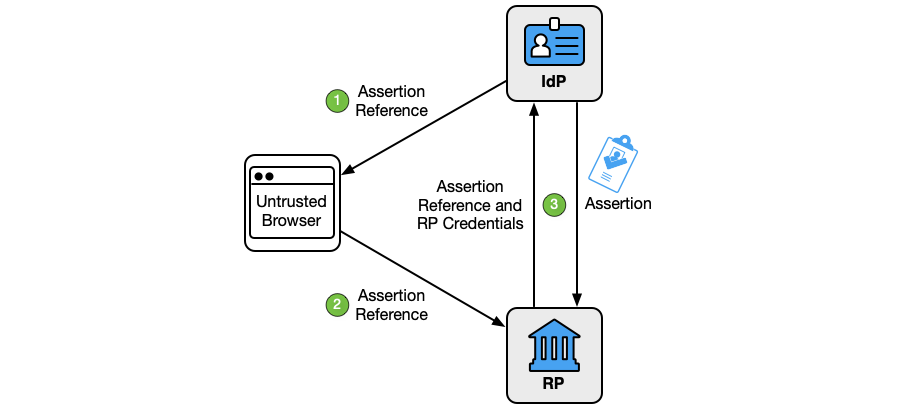
図11. バックチャネル提示。3 つの箱がある: 右上の IdP、左の加入者(Subscriber、Untrusted Browser=信頼されていないブラウザ)、右下の RP。1 Assertion Reference(アサーション参照): IdP から加入者へ。2 Assertion Reference: 加入者から RP へ。3: RP から IdP へ Assertion Reference and RP Credentials(アサーション参照と RP のクレデンシャル)、IdP から RP へ Assertion(アサーション、アイコン付き)。
As shown in Fig. 11, the back-channel presentation model consists of three steps:
図11に示すように、バックチャネル提示モデルは以下の3段階で構成されます。
1.The IdP sends an assertion reference to the subscriber through the front channel.
1.IdPはフロントチャネルを通じて加入者にアサーション参照を送信します。
2.The subscriber sends the assertion reference to the RP through the front channel.
2.加入者はフロントチャネルを通じてRPにアサーション参照を送信します。
3.The RP presents the assertion reference and its RP credentials to the IdP through the back channel. The IdP validates the credentials and returns the assertion.
3.RPはバックチャネルを通じて、アサーション参照とRPのクレデンシャルをIdPに提示します。IdPはクレデンシャルを検証し、アサーションを返します。
The assertion reference:
アサーション参照は、以下の条件を満たします。
1.SHALL be limited to use by a single RP
1.単一のRPのみが使用できるように制限しなければなりません(SHALL)。
2.SHALL be single-use
2.一度しか使用できないものでなければなりません(SHALL)。
3.SHALL be time-limited and SHOULD have a validity time window of no more than five minutes
3.時間制限を設けSHALLなければならず、有効期間は5分以内とするべきです(SHOULD)。
4.SHALL be presented along with authentication of the RP to the IdP
4.RPのIdPに対する認証とともに提示SHALLしなければなりません。
5.SHALL NOT be predictable or guessable by an attacker
5.攻撃者が予測または推測できてはなりません(SHALL NOT)。
In this model, the RP directly requests the assertion from the IdP to minimize the chances of interception and manipulation by a third party, including the subscriber. More network transactions are required in the back-channel method than a front-channel method, but the information is limited to only those parties that need it. Since an RP only expects to get an assertion directly from the IdP as a result of its request, the attack surface is reduced. Consequently, it is more difficult to inject assertions directly into the RP, and this presentation method is recommended for FAL2 and above. Since the IdP and RP are already directly connected, the back-channel presentation method facilitates the use of identity APIs, as described in Sec. 3.12.3.
このモデルでは、RPは第三者(加入者を含む)による傍受や改ざんの可能性を最小限に抑えるため、IdPにアサーションを直接要求します。バックチャネル方式ではフロントチャネル方式より多くのネットワーク取引が必要ですが、情報は必要とする当事者だけに限定されます。RPは要求の結果としてIdPから直接アサーションを受け取ることだけを想定するため、攻撃対象領域が縮小します。その結果、アサーションをRPに直接注入するのが難しくなるため、FAL2以上ではこの提示方法が推奨されます。 IdPとRPはすでに直接接続されているため、バックチャネル提示方式はSec. 3.12.3で説明するアイデンティティAPIの使用を容易にします。
It is technically possible but unlikely for an assertion reference (which is single-audience by definition) to result in a multi-audience assertion. For this reason, back-channel presentation is practically limited to use with single-audience assertions.
アサーション参照(一つの対象者のみを定義上持つ)によって複数対象者のアサーションが生成されることは技術上可能ですが、起こる可能性は低いです。このため、実際には、バックチャネル提示は単一対象者のアサーションでの使用に制限されます。
Conveyance of the assertion reference from the IdP to the subscriber and from the subscriber to the RP SHALL be made over an authenticated protected channel. Conveyance of the assertion reference from the RP to the IdP and vice versa SHALL be made over an authenticated protected channel.
IdPから加入者へ、また加入者からRPへアサーション参照を伝達する際、認証済みの保護されたチャネルをSHALL使用しなければなりません。RPからIdPへ、およびIdPからRPへアサーション参照を伝達する際にも、認証済みの保護されたチャネルをSHALL使用しなければなりません。
The RP SHALL protect itself against the injection of manufactured or captured assertion references by using cross-site scripting (XSS) and cross-site request forgery (CSRF) protection, rejecting assertion references outside of the correct stage of a federation transaction, or other accepted techniques discussed in Sec. 3.11.1. When assertion references are presented to the IdP, the IdP SHALL verify that the RP presenting the assertion reference is the same RP that made the assertion request that resulted in the assertion reference. Examples for this are discussed in Sec. 9.12, including authorization code flow of [OIDC] with additional security profiles, such as [FAPI] and [iGov].
RPは、クロスサイトスクリプティング(XSS)およびクロスサイトリクエストフォージェリ(CSRF)対策、フェデレーション取引の正しい段階以外でのアサーション参照の拒否、またはSec. 3.11.1で説明するその他の認められた技法を用いて、偽造または取得済みアサーション参照の注入から自身を保護SHALLしなければなりません。 アサーション参照がIdPに提示されたとき、提示するRPが、そのアサーション参照につながるアサーションを要求したRPと同一であることをIdPはSHALL検証しなければなりません。この例はSec. 9.12で説明します。追加のセキュリティプロファイルを適用した[OIDC]の認可コードフロー([FAPI]や[iGov]など)もその例に含まれます。
In a federation proxy (see Sec. 3.3.3), the upstream IdP audience restricts the assertion reference and assertion to the proxy, and the proxy restricts any newly created assertion references or assertions to the downstream RP.
フェデレーションプロキシ(Sec. 3.3.3参照)では、上流IdPはアサーション参照とアサーションの対象者をプロキシに制限し、プロキシは新たに作成するアサーション参照またはアサーションの対象者を下流RPに制限します。
Front-Channel Presentation
フロントチャネル提示
In the front-channel presentation model shown in Fig. 12, the IdP creates an assertion and sends it to the RP by means of a third party, such as the subscriber’s user agent. In the implicit flow and some forms of the hybrid flow of [OIDC], the assertion (i.e., the ID Token) is presented in the front channel. In the SAML Web SSO profile defined in [SAML-WebSSO], the SAML assertion is presented in the front channel.
図12に示すフロントチャネル提示モデルでは、IdPがアサーションを作成し、加入者のユーザーエージェントなど第三者を介してRPに送信します。[OIDC]の暗黙フローおよび一部のハイブリッドフローでは、アサーション(すなわちID Token)がフロントチャネルで提示されます。[SAML-WebSSO]で定義するSAML Web SSOプロファイルでは、SAMLアサーションがフロントチャネルで提示されます。
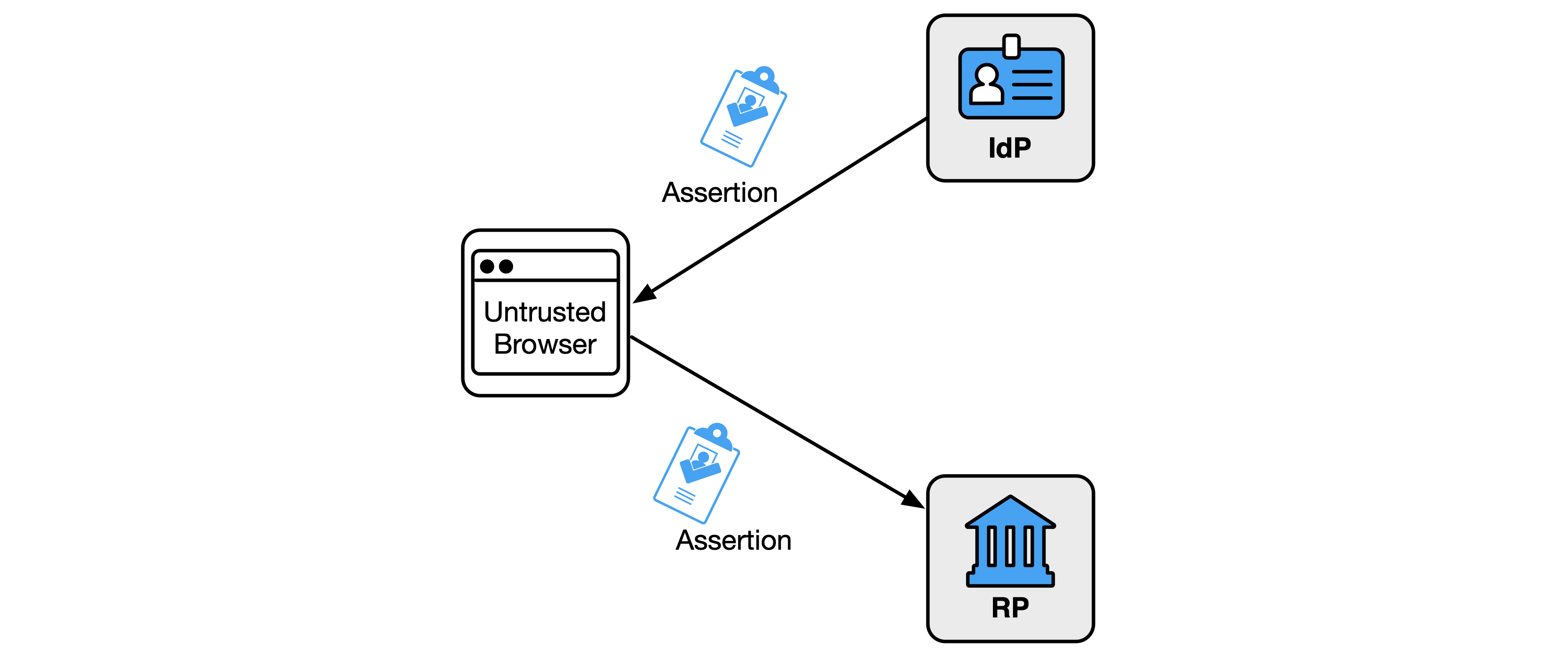
図12. フロントチャネル提示。3 つの箱がある: 右上の IdP、左の加入者(Subscriber、Untrusted Browser=信頼されていないブラウザ)、右下の RP。Assertion(アサーション、アイコン付き)と記された矢印が IdP から加入者へ、もう 1 本の Assertion(アイコン付き)の矢印が加入者から RP へ向かう。
Front-channel presentation methods expose the assertion to parties other than the IdP and RP, which increases the risk of leaking the personal information included in the assertion. Additionally, there is an increased attack surface for the assertion to be captured and replayed by an attacker. As a consequence, front-channel presentation is not recommended when other mechanisms are available.
フロントチャネル提示方式では、IdPとRP以外の当事者にもアサーションが公開され、アサーションに含まれる個人情報が漏えいするリスクが高まります。また、攻撃者にアサーションを取得され、リプレイされる攻撃対象領域も拡大します。そのため、他の仕組みを使用できる場合、フロントチャネル提示は推奨されません。
The RP SHALL use the assertion identifier to ensure that a given assertion is presented at most once during the assertion’s validity time window.
アサーションの有効期間中に所定のアサーションが提示される回数を1回以下にするため、RPはアサーション識別子をSHALL使用しなければなりません。
The RP SHALL protect itself against the injection of manufactured or captured assertions by using XSS and CSRF protection, rejecting assertions outside of the correct stage of a federation transaction, or other accepted techniques discussed in Sec. 3.11.1.
RPは、XSSおよびCSRF対策、フェデレーション取引の正しい段階以外でのアサーションの拒否、またはSec. 3.11.1で説明するその他の認められた技法を用いて、偽造または捕捉されたアサーションの注入から自身を保護SHALLしなければなりません。
Conveyance of the assertion from the IdP to the subscriber and from the subscriber to the RP SHALL be made over an authenticated protected channel.
IdPから加入者へ、また加入者からRPへアサーションを伝達する際、認証済みの保護されたチャネルをSHALL使用しなければなりません。
With general-purpose IdPs, it is common for front-channel communications to be accomplished using HTTP redirects, where the contents of the assertion are made available as part of an HTTP request URL. Due to the nature of the HTTP ecosystem, these request URLs are sometimes available in unexpected places, such as access logs, web proxies, and browser histories. These artifacts tend to live on long past the federation transaction and are available in other contexts, which increases the attack surface for reading the assertion. As a consequence, an IdP that uses HTTP redirects for the front-channel presentation of assertions SHALL encrypt all personal information in the assertion, as discussed in Sec. 3.13.3. Other front-channel presentation mechanisms that do not share these characteristics (e.g., HTTP form-post binding, application-specific URLs) SHOULD encrypt all personal information in the assertion.
汎用IdPでは、フロントチャネル通信でHTTPリダイレクトを使い、アサーションの内容をHTTP要求URLの一部として利用可能にすることが一般的です。HTTPエコシステムの性質上、これらの要求URLは、アクセスログ、ウェブプロキシ、ブラウザー履歴など、予期しない場所で利用可能になることがあります。このような記録はフェデレーション取引後も長期間残り、他の場面で利用できるため、アサーションを読み取る攻撃対象領域が拡大します。そのため、フロントチャネル提示にHTTPリダイレクトを使用するIdPは、Sec. 3.13.3で説明するように、アサーション内の個人情報をすべてSHALL暗号化しなければなりません。このような特性を持たない他のフロントチャネル提示方式(HTTP form-post bindingやアプリケーション固有URLなど)では、アサーション内の個人情報をすべて暗号化するべきです(SHOULD)。
Subscriber-Controlled Wallets
加入者管理ウォレット
This section is normative.
このセクションは規範的です。
A subscriber-controlled wallet is an IdP for which the CSP makes the attributes of the subscriber account available through the issuance of attribute bundles, as described in Sec. 5.1. The subscriber activates the wallet using an activation factor or authenticator, as described in Sec. 5.4. Usually, the subscriber-controlled wallet runs on a device that is controlled by the subscriber and represents only a single subscriber. However, wallets can also be hosted on remote systems in a deployment pattern that is sometimes known as a cloud wallet.
Issuing Attribute Bundles to the Subscriber-Controlled Wallet
加入者管理ウォレットへの属性バンドルの発行
When the CSP issues attribute bundles to the subscriber-controlled wallet, the process SHALL include the following steps:
CSPが加入者管理ウォレットに属性バンドルを発行する際、プロセスには以下のステップをSHALL含めなければなりません。
1.The subscriber proves their identity to the CSP’s issuance functionality using the CSP’s identity proofing process or by authenticating to the subscriber account.
1.加入者は、CSPの本人確認プロセスを用いるか加入者アカウントに認証することで、CSPの発行機能に対して自分のIDを証明します。
2.The subscriber activates the wallet using an activation factor, which might entail authenticating to a hosted wallet service.
2.加入者はアクティベーション要素を使ってウォレットをアクティベートします。この際、ホスト型ウォレットサービスへの認証が必要となる場合があります。
3.The wallet generates or chooses a signing key and corresponding verification key. The wallet proves possession of its signing key to the CSP.
3.ウォレットは署名鍵と対応する検証鍵を生成または選択します。ウォレットは、署名鍵を所持していることをCSPに証明します。
4.The CSP creates one or more attribute bundles that include subscriber attributes and the wallet’s verification key (or a reference to that key).
4.CSPは、加入者属性とウォレットの検証鍵(またはその鍵への参照)を含む1つ以上の属性バンドルを作成します。
5.The wallet stores the attribute bundle for later presentation to RPs.
5.ウォレットは、後でRPに提示するために属性バンドルを保存します。
The subscriber-controlled wallet MAY generate and use a different signing key and verification key for each issuance request with the CSP.
加入者管理ウォレットは、CSPへの発行要求ごとに異なる署名鍵と検証鍵を生成して使用してもよいです(MAY)。
The CSP SHALL create a unique attribute bundle for each requesting wallet and SHOULD create a unique attribute bundle for each request from an individual wallet.
CSPは、要求するウォレットごとに一意な属性バンドルを作成SHALLし、1つのウォレットからの要求ごとにも一意な属性バンドルを作成するべきです(SHOULD)。
Many subscriber-controlled wallets can carry attribute bundles from multiple CSPs simultaneously. The simultaneous presentation of attribute bundles from multiple CSPs in a single assertion is possible with some technologies. When this occurs, the assertion of multiple attribute bundles SHALL conform to the assertion requirements in this guideline.
多くの加入者管理ウォレットは、複数のCSPからの属性バンドルを同時に格納できます。一部の技術では、1つのアサーションで複数のCSPの属性バンドルを同時に提示できます。この場合、複数の属性バンドルを含むアサーションは本ガイドラインのアサーション要件にSHALL従わなければなりません。
Invalidating Attribute Bundles for the Subscriber-Controlled Wallet
加入者管理ウォレット用属性バンドルの無効化
The CSP SHALL provide a means of invalidating attribute bundles that are issued to a subscriber-controlled wallet. This process is used when:
CSPは、加入者管理ウォレットに発行された属性バンドルを無効化する手段をSHALL提供しなければなりません。このプロセスは、以下の場合に使用します。
•The subscriber account is terminated, thereby rendering downstream federation actions invalid;
•加入者アカウントが終了され、下流のフェデレーションにおける操作が無効となる場合。
•The wallet needs to be terminated due to the device being lost, stolen, or compromised; or
•デバイスの紛失、盗難、または侵害のため、ウォレットを終了する必要がある場合。または
•The attribute bundle is disclosed to an attacker or otherwise compromised.
•属性バンドルが攻撃者に開示されたか、その他の方法で侵害された場合。
To accomplish this, the CSP SHOULD issue attribute bundles with a limited time validity window. The CSP SHOULD provide a means to independently verify the status of attribute bundles (i.e., whether a specific bundle has been revoked by the CSP). If such a service is offered, the service SHALL be deployed in a privacy-preserving way such that the CSP is not alerted to the use of a specific attribute bundle at a specific RP.
これを実現するため、CSPは有効期間を限定した属性バンドルを発行するべきです(SHOULD)。またCSPは、属性バンドルの状態(CSPが特定のバンドルを失効させたかどうか)を独立して検証する手段を提供するべきです(SHOULD)。そのようなサービスを提供する場合、特定のRPで特定の属性バンドルが使用されたことをCSPに知らせない、プライバシーを保護する方法でサービスをSHALL導入しなければなりません。
Federation Transaction
フェデレーション取引
A federation transaction with a subscriber-controlled wallet establishes the subscriber’s device as an IdP for the subscriber account and creates an authenticated session for the subscriber at the RP. The process is shown in Fig. 13.
加入者管理ウォレットによるフェデレーション取引では、加入者のデバイスを加入者アカウントに対するIdPとして確立し、RPで加入者の認証済みセッションを作成します。このプロセスを図13に示します。
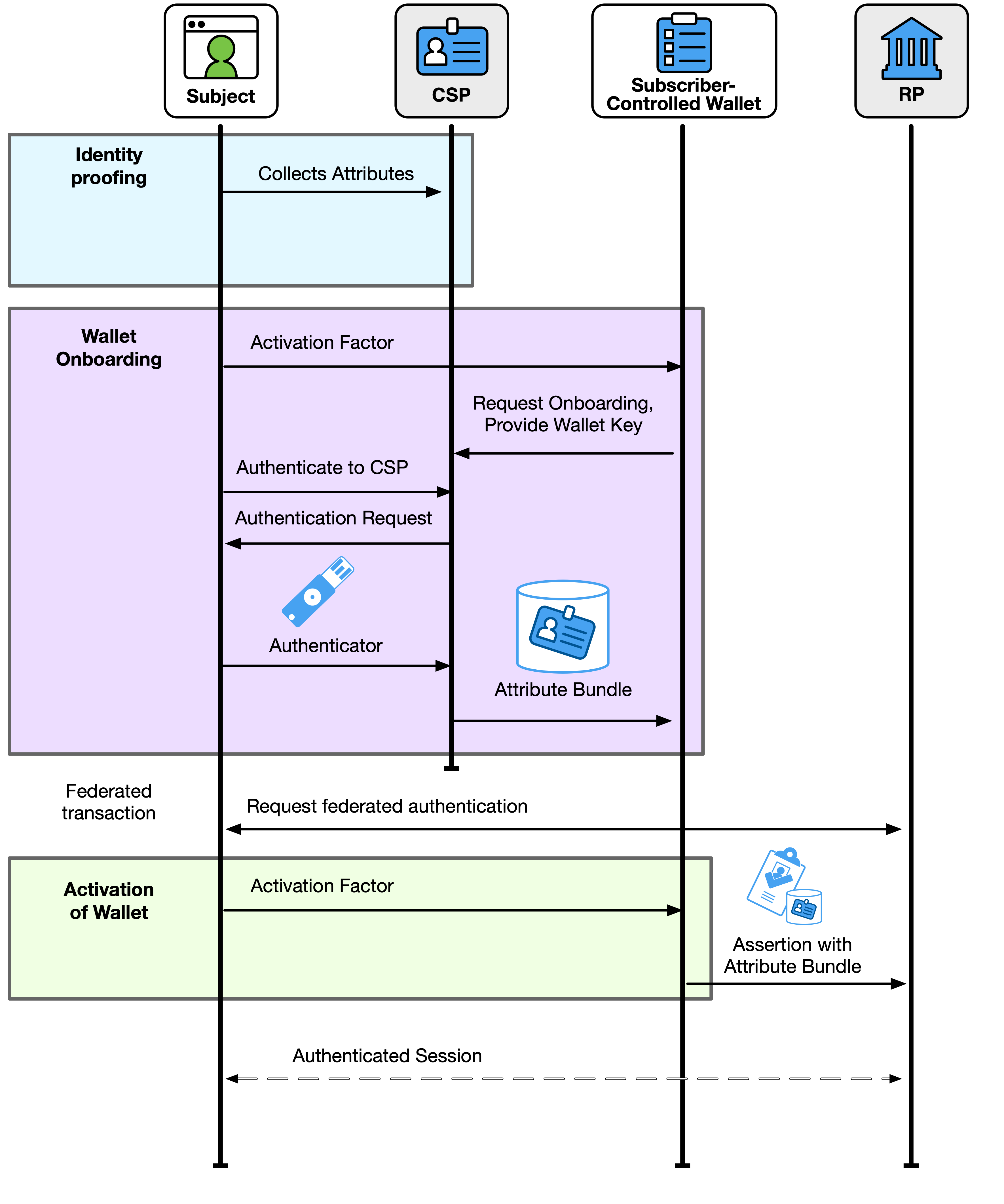
図13. 加入者管理ウォレットによるフェデレーション。主体(Subject)、CSP、加入者管理ウォレット(Subscriber-Controlled Wallet)、RP の生存線を持つシーケンス図で、緑の丸数字が段階を示す。1 Identity proofing(本人確認)と記された青い枠: Collects Attributes(属性の収集)は主体から CSP へ。2 Issuance of Attribute Bundle(属性バンドルの発行)と記された紫の枠: Activation Factor(アクティベーション要素)は主体からウォレットへ、Request Attribute Bundle, Provide Verification Key(属性バンドルの要求、検証鍵の提供)はウォレットから CSP へ向かう。or(または)と記された内側の枠には、Identity Proof at CSP(CSP での本人確認、主体から CSP へ)と、Authentication Request(認証要求、CSP から主体へ)に続く Authenticator output(認証器出力、セキュリティキーのアイコン付き、主体から CSP へ)がある。3 Issue Attribute Bundle(属性バンドルの発行、アイコン付き)は CSP からウォレットへ向かう。CSP の生存線はこの枠の後で終わる。Federation transaction(フェデレーション取引)と記された部分: 4 Request Attribute Bundle(属性バンドルの要求)は主体と RP の間の両方向矢印である。Activation of Wallet(ウォレットのアクティベーション)と記された緑の枠: 5 Activation Factor は主体からウォレットへ。6 と 7 Assertion with Attribute Bundle(属性バンドル付きのアサーション、アサーションと属性バンドルのアイコン付き): ウォレットから RP へ。8 Authenticated Session(認証済みセッション): 主体と RP の間の破線の両方向矢印。
A federation transaction with a subscriber-controlled wallet takes place over several steps:
加入者管理ウォレットによるフェデレーション取引は、以下の複数のステップで行われます。
1.The CSP identity-proofs the subscriber and creates a subscriber account.
1.CSPが加入者の本人確認を行い、加入者アカウントを作成します。
2.The CSP issues attribute bundles from the subscriber account to the wallet in a process that includes the subscriber verifying an authenticator in their subscriber account or completing an abbreviated proofing process (e.g., using a biometric captured at proofing to verify identity).
2.CSPは加入者アカウントからウォレットに属性バンドルを発行します。このプロセスでは、加入者が加入者アカウントの認証器を検証するか、簡略化された本人確認プロセス(例えば本人確認時に取得した生体情報でIDを検証する)を完了します。
3.The wallet receives a signed attribute bundle from the CSP that allows the wallet to act as an IdP.
3.ウォレットが、IdPとして機能できるようCSPから署名済み属性バンドルを受け取ります。
4.The RP requests a federated authentication transaction from the wallet, usually through subscriber action.
4.通常は加入者の操作を通じて、RPがウォレットにフェデレーション認証取引を要求します。
5.The subscriber activates the wallet through an activation factor. In the case of a hosted wallet, this is an authentication to the wallet service.
5.加入者がアクティベーション要素を通じてウォレットをアクティベートします。ホスト型ウォレットの場合、これはウォレットサービスへの認証にあたります。
6.The wallet creates an assertion based on the RP request, subscriber actions, and attribute bundles that are available to the wallet.
6.ウォレットが、RPからの要求、加入者の操作、およびウォレットで利用可能な属性バンドルに基づいてアサーションを作成します。
7.The wallet presents the assertion to the RP.
7.ウォレットがRPにアサーションを提示します。
8.The RP validates the assertion and creates an authenticated session for the subscriber. This process includes validating the attribute bundle from the CSP.
8.RPがアサーションを検証し、加入者の認証済みセッションを作成します。このプロセスには、CSPからの属性バンドルの検証が含まれます。
Trust Agreements
信頼合意
Due to the architectures and design of subscriber-controlled wallets, the trust agreements that support federated transactions are less direct than with general-purpose IdPs. To maintain privacy outcomes and prevent the tracking of user transactions, CSPs and RPs do not typically have direct communication with each other. The following requirements apply to all subscriber-controlled wallet scenarios:
加入者管理ウォレットを支えるアーキテクチャと設計のため、フェデレーション取引を支援する信頼合意は、汎用IdPの場合より直接的ではありません。プライバシーを維持し、ユーザーの取引追跡を防ぐため、CSPとRPは通常、直接通信しません。以下の要件は、加入者管理ウォレットのすべてのシナリオに適用されます。
1.The release of subscriber attributes SHALL be managed using a runtime decision managed by the wallet, as described in Sec. 4.6.1.3.
1.加入者属性の開示は、Sec. 4.6.1.3で説明するように、ウォレットが管理する実行時の判断を使用してSHALL管理しなければなりません。
2.The authorized party SHALL be the subscriber.
2.認可当事者は加入者でSHALLなければなりません。
3.The following terms SHALL be disclosed to the subscriber during the runtime decision:
3.実行時の判断中に、以下の条件を加入者にSHALL開示しなければなりません。
•The set of subscriber attributes, derived attributes, and attribute bundles that the RP will request (a subset of the attributes made available)
•RPが要求する加入者属性、導出属性、および属性バンドルの組み合わせ(利用可能な属性の一部)
•The purpose of each attribute requested by the RP
•RPが要求する各属性の目的
The xALs required by the RP MAY also be disclosed to the subscriber at runtime.
RPが要求するxALも、実行時に加入者に開示してもよいです(MAY)。
All of the information that is disclosed to the subscriber needs to be conveyed in a manner that is understandable and actionable, as discussed in Sec. 8.
加入者に開示するすべての情報は、Sec. 8で説明するように、理解でき、行動に移せる方法で伝える必要があります。
CSPs and RPs
CSPとRP
Trust between the CSP and RP in subscriber-controlled wallet scenarios will not typically be bidirectional. In the general case, the RP trusts the CSP as the source of attribute bundles that are presented by subscriber-controlled wallets during a federation transaction, while the CSP is not expected to have direct knowledge of the RP. This trust relationship between the RP and CSP MAY be facilitated by a federation authority (see Sec. 3.5.2) that defines overarching trust agreements between members of an ecosystem representing RPs, CSPs, and subscriber-controlled wallets. Such trust agreements SHALL contain:
加入者管理ウォレットのシナリオでは、CSPとRP間の信頼は通常、双方向ではありません。一般には、RPはフェデレーション取引中に加入者管理ウォレットが提示する属性バンドルの情報源としてCSPを信頼する一方、CSPがRPを直接把握することは想定されません。Sec. 3.5.2で説明するフェデレーション機関が、RP、CSP、および加入者管理ウォレットを表すエコシステムの構成員間に包括的な信頼合意を定めることで、RPとCSP間の信頼関係を促進してもよいです(MAY)。このような信頼合意には、以下をSHALL含めなければなりません。
•The set of subscriber attributes and derived attributes that the CSP makes available to wallets in attribute bundles
•CSPがウォレットに属性バンドルで提供する加入者属性および導出属性の組み合わせ
•The set of subscriber attributes and derived attributes that the wallet can make available to the RP
•ウォレットがRPに提供できる加入者属性および導出属性の組み合わせ
•The population of subscriber accounts that the CSP can represent
•CSPが表すことのできる加入者アカウントの集団
•The IALs or issuance processes of subscriber accounts that are associated with the attribute bundles from the CSP
•CSPの属性バンドルに関連付けられる、加入者アカウントのIALまたは発行プロセス
•The issuance process related to CSP attribute bundles
•CSP属性バンドルの発行プロセス
•The FALs supported by subscriber-controlled wallets
•加入者管理ウォレットがサポートするFAL
•The allowable purposes for each attribute RPs may request
•RPが各属性に対して要求できる許容される目的
•Expectations of RPs for the protection and management of subscriber data provided through attribute bundles
•属性バンドルを通じて提供される加入者データの保護と管理についてRPに求めること
Trust MAY also be established unilaterally by RP evaluation of publicly available information about CSPs and their processes for issuing attribute bundles. To facilitate this, CSPs SHALL publish the following information to a trusted location for RPs to evaluate:
RPがCSPおよびその属性バンドル発行プロセスに関する公開情報を評価し、一方的に信頼を確立してもよいです(MAY)。その際の参考となるよう、CSPは以下の情報をRPが評価できる信頼できる場所にSHALL公開しなければなりません。
•The set of subscriber attributes and derived attributes that the CSP makes available to wallets in attribute bundles
•CSPがウォレットに属性バンドルで提供する加入者属性および導出属性の組み合わせ
•The set of subscriber attributes and derived attributes that the wallet can make available to the RP
•ウォレットがRPに提供できる加入者属性および導出属性の組み合わせ
•The population of subscriber accounts that the CSP can represent
•CSPが表すことのできる加入者アカウントの集団
•The IALs or issuance processes of subscriber accounts associated with the attribute bundles from the CSP
•CSPの属性バンドルに関連付けられる、加入者アカウントのIALまたは発行プロセス
This information MAY be made available by a trusted third party, such as a federation authority that assesses and evaluates CSP attribute bundle issuance and makes CSP features available through a discovery service.
この情報は、CSPの属性バンドル発行を評価および審査し、ディスカバリーサービスを通じてCSPの機能を利用可能にするフェデレーション機関など、信頼できる第三者が提供してもよいです(MAY)。
Trust between RPs and CSPs MAY be accomplished in either a pre-established (see Sec. 4.3.1) or subscriber-driven fashion (see Sec. 4.3.2). For example, an RP could be statically configured to accept attribute bundles from only a specific set of CSPs for its purposes, or the RP could alternatively accept attribute bundles from any CSP by prompting the subscriber for consent at runtime. This trust relationship could also be made more explicit by the RP being provided a means of verifying CSP-approved subscriber-controlled wallet identifiers beyond the verification of the attribute bundle, such as a discovery service provided through a federation authority.
RPとCSP間の信頼は、事前確立済みの方法(Sec. 4.3.1参照)または加入者主導の方法(Sec. 4.3.2参照)のいずれかで確立してもよいです(MAY)。例えば、RPは目的に応じて特定のCSP群からの属性バンドルのみを受け入れるよう静的に設定できます。あるいは、実行時に加入者へ同意を求めることで、任意のCSPからの属性バンドルを受け入れることができます。属性バンドルの検証以外に、フェデレーション機関が提供するディスカバリーサービスなど、CSPが承認した加入者管理ウォレットの識別子をRPが検証する手段を提供することで、この信頼関係をより明示的にできます。
CSPs and Subscriber-Controlled Wallets
CSPと加入者管理ウォレット
The trust relationship between the CSP and the subscriber-controlled wallets will always be direct in nature. As such, there SHALL be a trust agreement between the CSP and the subscriber-controlled wallets into which they issue attribute bundles. At a minimum, this trust agreement SHALL include the following:
CSPと加入者管理ウォレット間の信頼関係は常に直接的です。そのため、CSPと、CSPが属性バンドルを発行する加入者管理ウォレットとの間には信頼合意がSHALL存在しなければなりません。最低限、この信頼合意には以下をSHALL含めなければなりません。
•The set of subscriber attributes and derived attributes that the CSP makes available to wallets in attribute bundles
•CSPがウォレットに属性バンドルで提供する加入者属性および導出属性の組み合わせ
•The set of subscriber attributes and derived attributes that the wallet can make available to the RP
•ウォレットがRPに提供できる加入者属性および導出属性の組み合わせ
•Any processes the subscriber-controlled wallet needs to implement to support the issuance of attribute bundles (e.g., PAD, data collection, risk scoring)
•属性バンドルの発行をサポートするため加入者管理ウォレットが実装する必要のあるプロセス(PAD、データ収集、リスクスコアリングなど)
•Data storage and security practices for the wallet service
•ウォレットサービスのデータ保管およびセキュリティ実務
•The activation factors or AALs that subscribers use to access the wallet service prior to the generation of any assertion
•アサーションの生成前に加入者がウォレットサービスへアクセスする際に使用するアクティベーション要素またはAAL
•The FALs supported by subscriber-controlled wallets
•加入者管理ウォレットがサポートするFAL
•The allowable purposes or any restrictions that the wallets need to enforce related to the release of attributes to RPs
•ウォレットがRPへの属性開示に関して実施すべき許容目的または制限
RPs and Subscriber-Controlled Wallets
RPと加入者管理ウォレット
The primary extension of trust in a subscriber-controlled wallet scenario is through the RP’s evaluation of the attribute bundles and their issuance process by the CSP. However, wallets play an important role in the degree to which RPs trust the information being presented to them in assertions that contain attribute bundles signed by the CSP.
加入者管理ウォレットのシナリオでは、主としてRPが属性バンドルとCSPによる発行プロセスを評価することで信頼を確立します。ただし、CSPが署名した属性バンドルを含むアサーションの情報をRPがどの程度信頼するかにおいて、ウォレットも重要な役割を担います。
Information about the features and capabilities of a subscriber-controlled wallet can help inform the degree to which RPs trust a given transaction. This information can demonstrate confidence that the subscriber presenting an attribute bundle is the individual represented by that attribute bundle. For example, information about how the wallet locally authenticates the subscriber, protects verification keys, and enforces trust agreement requirements indicated by the CSP or RP all support improved RP federation and access decisions. As such, subscriber-controlled wallets SHALL disclose to RPs:
加入者管理ウォレットの機能や能力に関する情報は、所定の取引についてRPがどの程度信頼するかの判断に役立ちます。この情報は、属性バンドルを提示する加入者が、そのバンドルによって表される本人であることへの信頼を示すことができます。例えば、ウォレットが加入者をローカルに認証する方法、検証鍵を保護する方法、CSPまたはRPが示す信頼合意の要件を適用する方法に関する情報は、RPによるフェデレーションおよびアクセスの判断の改善に役立ちます。そのため、加入者管理ウォレットは以下をRPに開示SHALLしなければなりません。
•Activation or authentication methods they use to authenticate subscribers prior to presentation of an assertion,
•アサーション提示前に加入者を認証するために使用するアクティベーションまたは認証の方法。
•Security features of how the wallet protects the attribute bundles,
•属性バンドルをウォレットが保護するためのセキュリティ機能。
•Key management information, and
•鍵管理に関する情報、および
•Indications of the integrity of the subscriber-controlled wallet’s software.
•加入者管理ウォレットソフトウェアの完全性を示す情報。
This information MAY be provided at runtime or through discovery mechanisms for wallet metadata. For more on this topic, see Sec. 5.8.
この情報は、実行時またはウォレットメタデータのディスカバリー機構を通じて提供してもよいです(MAY)。このトピックの詳細はSec. 5.8を参照してください。
FAL3 for Subscriber-Controlled Wallets
加入者管理ウォレットにおけるFAL3
Since assertions from a subscriber-controlled wallet always contain a reference to one of the wallet’s verification keys inside the signed attribute bundle from the CSP, subscriber-controlled wallets that run on a subscriber-controlled device are capable of issuing holder-of-key assertions if all of the requirements for holder-of-key assertions are met (see Sec. 3.15). These assertions MAY be used to reach FAL3 if all requirements for FAL3 are met (see Sec. 2.4).
The verification keys of a subscriber-controlled wallet on a hosted service do not meet the requirements for holder-of-key assertions on their own since the subscriber is not in control of the key material as they would be on a subscriber-controlled device. To reach FAL3, federation transactions with a subscriber-controlled wallet on a hosted service SHALL use either a holder-of-key assertion (see Sec. 3.15) or a bound authenticator (see Sec. 3.16). All requirements for FAL3 in Sec. 2.4 SHALL be met. For example, a holder-of-key assertion from a subscriber-controlled wallet on a hosted service could include the verification key of an authenticator separate from the wallet verification key. The subscriber would present this additional authenticator to the RP along with the wallet’s assertion.
加入者が鍵素材を管理する加入者管理デバイスの場合とは異なり、ホスト型サービス上の加入者管理ウォレットの検証鍵は加入者が管理していないため、単独ではholder-of-keyアサーションの要件を満たしません。FAL3に到達するには、ホスト型サービス上の加入者管理ウォレットを使うフェデレーション取引では、holder-of-keyアサーション(Sec. 3.15参照)またはバインド済み認証器(Sec. 3.16参照)のいずれかをSHALL使用しなければなりません。Sec. 2.4のFAL3要件をすべてSHALL満たさなければなりません。例えば、ホスト型サービス上の加入者管理ウォレットによるholder-of-keyアサーションには、ウォレット検証鍵とは別の認証器の検証鍵を含めることができます。加入者はウォレットのアサーションとともにこの追加認証器をRPに提示します。
Wallet Activation
ウォレットのアクティベーション
The subscriber-controlled wallet SHALL require the presentation of an activation factor from the subscriber for the following actions that result in the creation of a signed artifact from the wallet’s signing keys:
ウォレットの署名鍵から署名済み成果物が作成される以下の操作について、加入者管理ウォレットは加入者にアクティベーション要素の提示をSHALL要求しなければなりません。
•Providing proof of possession of the wallet’s signing key to the CSP during the issuance process
•発行プロセス中にウォレットの署名鍵の所持をCSPに証明する
•Signing the assertion for presentation to the RP
•RPに提示するアサーションに署名する
The subscriber-controlled wallet SHOULD require the presentation of an activation factor before any other operations that result in the creation of a signed artifact from the wallet’s signing keys. For example, using the wallet as an authenticator at AAL2 or above requires the presentation of an activation factor as per Sec. 3.2.10 of [SP800-63B].
ウォレットの署名鍵から署名済み成果物を作成するその他の操作の前にも、加入者管理ウォレットはアクティベーション要素の提示を要求するべきです(SHOULD)。例えば、AAL2以上でウォレットを認証器として使用するには、[SP800-63B]のSec. 3.2.10に従いアクティベーション要素を提示する必要があります。
The wallet MAY request the reissuance of previously issued attribute bundles from the same CSP without requiring subscriber involvement.
ウォレットは、加入者の関与を求めずに、同じCSPから以前発行された属性バンドルの再発行を要求してもよいです(MAY)。
For subscriber-controlled wallets that run on a device that the subscriber controls, the submission of the activation factor SHALL be a separate operation from the unlocking of the host device (e.g., smartphone), although the same activation factor used to unlock the host device MAY be used in the activation operation. Organizations MAY relax this requirement for subscriber-controlled wallets managed by or on behalf of the CSP (e.g., via mobile device management) and that are constrained to have short, organization-determined inactivity timeouts and device activation factors that meet the above requirements. Additional discussion of activation factors for authenticators is found in Sec. 3.2.10 of [SP800-63B].
加入者が管理するデバイス上で動作する加入者管理ウォレットでは、アクティベーション要素の提示は、ホストデバイス(例えばスマートフォン)のロック解除とは別個の操作でなければなりません(SHALL)。ただし、ホストデバイスのロック解除に使用するものと同じアクティベーション要素をアクティベーション操作で使用してもよいです(MAY)。CSPが管理する、またはCSPに代わって管理される(例えばモバイルデバイス管理を通じて)、短い組織指定の非アクティブタイムアウトが設定され、デバイスのアクティベーション要素が上記の要件を満たす加入者管理ウォレットについては、組織がこの要件を緩和してもよいです(MAY)。認証器に使用するアクティベーション要素の追加説明は[SP800-63B]のSec. 3.2.10を参照してください。
For subscriber-controlled wallets that are hosted on a remote service, activation of the wallet is performed using an authenticator that is registered to the wallet service. This authenticator MAY be separate from those bound to the subscriber account at the CSP.
リモートサービス上でホストされる加入者管理ウォレットのアクティベーションには、ウォレットサービスに登録された認証器を使用します。この認証器は、CSPの加入者アカウントにバインドされた認証器とは別のものでもよいです(MAY)。
Key Storage
鍵の保管
Keys used for signing assertions SHALL NOT be synced or shared across devices, and wallet implementations SHOULD use non-exportable key storage, as discussed in Sec. 3.6.2.
アサーションの署名に使用する鍵を複数のデバイス間で同期または共有してはならず(SHALL NOT)、ウォレットの実装では、Sec. 3.6.2で説明するエクスポート不可の鍵保管を使用するべきです(SHOULD)。
If the wallet’s signing key is used as a holder-of-key authenticator for FAL3, the key SHALL be stored in non-exportable key storage, as discussed in Sec. 3.6.2.
ウォレットの署名鍵をFAL3のholder-of-key認証器として使用する場合、Sec. 3.6.2で説明するエクスポート不可の鍵保管にSHALL保存しなければなりません。
Discovery and Registration
ディスカバリーと登録
To perform a federation transaction with a subscriber-controlled wallet, the RP SHALL first determine the attribute bundle verification key of the CSP through a secure process as stated by the trust agreement. In some systems, this is accomplished by retrieving the CSP’s attribute bundle verification keys from a URL that is known to be controlled by the CSP. In other systems, the RP is configured manually with the verification keys of the CSP before being deployed. In systems governed by multi-lateral trust agreements, this process can be facilitated by a third-party discovery and registration service, such as one provided by a federation authority.
加入者管理ウォレットとのフェデレーション取引を行うため、RPは信頼合意に記載された安全なプロセスを通じて、CSPの属性バンドル検証鍵を最初にSHALL特定しなければなりません。システムによっては、CSPが管理していることが判明しているURLからCSPの属性バンドル検証鍵を取得することで実現します。別のシステムでは、導入前にCSPの検証鍵をRPに手動設定します。多者間信頼合意の対象となるシステムでは、フェデレーション機関が提供するサービスなど、第三者のディスカバリーおよび登録サービスがこのプロセスを支援できます。
The signed attribute bundle includes the CSP that issued the bundle and one or more verification keys that are associated with the subscriber-controlled wallet. Since the RP trusts the CSP’s process of issuing attribute bundles to subscriber-controlled wallets, the RP can trust the presentation of those bundles that are made using proof of one of the subscriber-controlled wallet’s signing keys.
署名済み属性バンドルには、バンドルを発行したCSPと、加入者管理ウォレットに関連付けられた1つ以上の検証鍵が含まれます。RPはCSPによる加入者管理ウォレットへの属性バンドルの発行プロセスを信頼するため、加入者管理ウォレットの署名鍵の1つを所持していることの証明を伴って提示されたバンドルを信頼できます。
In many cases, the process of the RP registering with the subscriber-controlled wallet is expected to be a dynamic process in which the RP exchanges its keys and metadata with the IdP during the federation transaction. The nature of a subscriber-controlled wallet makes it difficult for any specific RP to pre-register with an instance of the wallet, but this can be facilitated through the use of a trusted third party that is stipulated in the trust agreement.
多くの場合、RPを加入者管理ウォレットに登録するプロセスは動的に行われ、RPはフェデレーション取引中にIdPと鍵およびメタデータを交換します。加入者管理ウォレットの性質上、特定のRPがウォレットのインスタンスに事前登録するのは困難ですが、信頼合意で定める信頼できる第三者を使用すれば促進できます。
Parties that seek to federate MAY use a trusted third party to facilitate the discovery and registration processes if that trusted third party is identified in the trust agreement. For example, consider an ecosystem has a centralized service for managing discovery and registration. When an RP joins the ecosystem, it registers itself with the trusted service, downloads the CSP’s verification keys, and receives an identifier to use with wallets. When the CSP issues attribute bundles to the subscriber-controlled wallet, the subscriber-controlled wallet is informed where it can find the list of valid RP identifiers within the ecosystem. When the RP connects to the wallet, the wallet can verify the RP’s identifier without the RP having to register itself directly with the wallet. Likewise, the RP can trust the wallet’s verification keys by verifying the CSP’s signature over the wallet’s verification keys or identifier.
信頼合意で特定されている場合、フェデレーションを行う当事者は、信頼できる第三者を使用してディスカバリーおよび登録プロセスを支援してもよいです(MAY)。例えば、あるエコシステムにディスカバリーと登録を管理する一元化サービスがあるとします。RPはエコシステムへの参加時にこの信頼できるサービスに登録し、CSPの検証鍵をダウンロードして、ウォレットで使用する識別子を受け取ります。CSPが加入者管理ウォレットに属性バンドルを発行すると、エコシステム内の有効なRP識別子の一覧の所在がウォレットに通知されます。RPがウォレットに接続すると、ウォレットはRPが直接登録しなくてもRPの識別子を検証できます。同様に、RPはウォレットの検証鍵または識別子に対するCSPの署名を検証することで、ウォレットの検証鍵を信頼できます。
Authentication and Attribute Disclosure
認証と属性開示
The decision of whether a federation transaction proceeds and, therefore, an assertion is issued and attributes are released to the RP SHALL be determined by the subscriber acting in the role of the authorized party. The decision MAY be augmented by the use of allowlists and blocklists to allow the wallet to help the subscriber make a decision based on configured policies and trust agreements. The subscriber-controlled wallet MAY remember the subscriber’s decision to allow for future actions at the same RP without separate authorization from the subscriber. The use of a stored authorization decision does not supersede the requirement for wallet activation, as discussed in Sec. 5.4.
フェデレーション取引を続行するかどうか、ひいてはアサーションを発行してRPに属性を開示するかどうかの判断は、認可当事者の役割を担う加入者がSHALL行わなければなりません。ウォレットが設定済みポリシーと信頼合意に基づいて加入者の判断を支援できるよう、許可リストやブロックリストを使用して判断を補強してもよいです(MAY)。加入者管理ウォレットは、加入者による個別の認可なしに、同じRPに対する今後の操作で使うため加入者の判断を記憶してもよいです(MAY)。認可判断が保存されていることは、Sec. 5.4で説明するウォレットのアクティベーション要件に優先するものではありません。
The subscriber-controlled wallet MAY provide a mechanism to remember a disclosure decision by the authorized party (i.e., the subscriber) to apply to future requests from the same RP. If such a mechanism is provided, the subscriber-controlled wallet SHALL disclose to the authorized party that the storage mechanism is in use and SHALL allow the authorized party to revoke such remembered access at a future time.
加入者管理ウォレットは、同じRPからの将来の要求に適用するため、認可当事者(加入者)が行った開示判断を記憶する仕組みを提供してもよいです(MAY)。このような仕組みを提供する場合、加入者管理ウォレットは、保存の仕組みを使用していることを認可当事者に開示しなければならず(SHALL)、認可当事者が将来いつでも記憶されたアクセスを取り消せるようにしなければなりません(SHALL)。
The subscriber-controlled wallet SHOULD provide a means to selectively disclose a subset of the attributes in the attribute bundle from the CSP.
加入者管理ウォレットは、CSPの属性バンドル内の属性の一部を選択して開示する手段を提供するべきです(SHOULD)。
The CSP SHALL provide secure and effective means of redress of subscriber complaints or problems (e.g., subscriber identifies an inaccurate attribute value, the need to invalidate attribute bundles that were previously issued to a subscriber-controlled wallet). See Sec. 3.5.3 for additional requirements and considerations for redress mechanisms.
CSPは、加入者からの苦情や問題(例えば加入者が不正確な属性値に気付いた場合や、以前に加入者管理ウォレットに発行した属性バンドルを無効化する必要がある場合)に対して、安全で効果的な救済手段をSHALL提供しなければなりません。救済メカニズムに関する追加要件と考慮事項はSec. 3.5.3を参照してください。
Assertion Requests
アサーション要求
When federation transactions are initiated by the RP, the RP’s request for an assertion SHALL contain:
RPがフェデレーション取引を開始する場合、アサーションに対するRPの要求は以下をSHALL含まなければなりません。
1.An identifier for the RP
1.RPの識別子
2.A cryptographic nonce
2.暗号学的nonce
3.The set of identity attributes, derived attributes, and attribute bundles requested by the RP and their purpose of use at the RP
3.RPが要求する識別属性、導出属性、および属性バンドルの組み合わせとRPにおける各属性の使用目的
When federation transactions are initiated by the IdP (at FAL1), these requirements do not apply. Federation transactions are always initiated by the RP at FAL2 or higher.
IdPがフェデレーション取引を開始する場合(FAL1)、これらの要件は適用されません。FAL2以上では、フェデレーション取引は常にRPが開始します。
Assertion Contents
アサーションの内容
Assertions from a subscriber-controlled wallet SHALL contain:
加入者管理ウォレットからのアサーションは、以下をSHALL含めなければなりません。
1.A signed attribute bundle from the CSP.
1.CSPからの署名済み属性バンドル。
2.Audience identifier: An identifier for the party that is intended to consume the assertion (i.e., the RP).
2.対象者識別子:アサーションの利用を意図する当事者(RP)を識別する識別子。
3.Issuance time: A timestamp that indicates when the wallet issued the assertion.
3.発行時刻:ウォレットがアサーションを発行した日時を示すタイムスタンプ。
4.Validity time window: A period of time outside of which the assertion SHALL NOT be accepted as valid by the RP for the purposes of authenticating the subscriber and starting an authenticated session at the RP. This is usually communicated by means of an expiration timestamp for the assertion in addition to the issuance timestamp.
4.有効期間:この期間外では、RPが加入者の認証およびRPでの認証済みセッションの開始を目的としてアサーションを有効と受け入れてはならない(SHALL NOT)、そのような期間。通常、アサーションの発行タイムスタンプに加えて、有効期限のタイムスタンプによって示されます。
5.Assertion identifier: A value that uniquely identifies this assertion and is used to prevent attackers from replaying prior assertions. For example, this can be a unique nonce generated by the wallet and included in the assertion.
5.アサーション識別子:このアサーションを一意に識別し、攻撃者による過去のアサーションのリプレイを防ぐために使用する値。例えば、ウォレットが生成してアサーションに含める一意なnonceを使用できます。
6.Signature: A digital signature that uses asymmetric cryptography and covers the entire assertion.
6.署名:公開鍵暗号を用い、アサーション全体を対象とするデジタル署名。
Assertions MAY contain:
アサーションには以下を含めてもよいです(MAY)。
1.Subject identifier: An identifier for the party to which the assertion applies (i.e., the subscriber)
1.サブジェクト識別子:アサーションが対象とする当事者(加入者)を識別する識別子。
2.Issuer identifier: An identifier for the issuer of the assertion (i.e., the subscriber-controlled wallet)
2.発行者識別子:アサーションの発行者(加入者管理ウォレット)を識別する識別子。
The following aspects of the federation transaction SHALL be provided through information contained in the assertion contents or the applicable trust agreement:
フェデレーション取引に関する以下の側面を、アサーションの内容または適用される信頼合意に含まれる情報を通じてSHALL提供しなければなりません。
1.The IAL of the subscriber account being represented in the assertion, an indication of the issuance processes, or an indication that no IAL is asserted
1.アサーションで表される加入者アカウントのIAL、発行プロセスを示す情報、またはIALがアサートされていないことを示す情報。
2.The nature of the activation method used to activate the wallet.
2.ウォレットのアクティベーションに使用する方法の性質。
3.The wallet’s intended FAL of the federation process that is represented by the assertion
3.アサーションが表すフェデレーションプロセスについてウォレットが意図するFAL。
If a subscriber-controlled wallet is hosted as a remote service, the AAL of the subscriber’s current session at the hosted wallet service SHALL be provided through information contained in the assertion contents or the applicable trust agreement. In this case, the assertion SHOULD contain additional information about the authentication method used at the IdP, if available (e.g., whether the authenticator used is phishing-resistant). Some technologies that can carry this information include Vectors of Trust [RFC8485] or authentication class references in [OIDC] and [SAML].
At FAL2 and above, the assertion SHALL include:
FAL2以上では、アサーションは以下をSHALL含めなければなりません。
1.Nonce: A cryptographic nonce from the RP’s federation request
1.Nonce:RPのフェデレーション要求に含まれる暗号学的nonce。
At FAL3, the assertion SHALL include one of the following:
FAL3では、アサーションは以下のいずれかをSHALL含めなければなりません。
•The public key, key identifier, or other identifier for a holder-of-key assertion. This MAY be the same key that the subscriber-controlled wallet uses to sign the assertion.
•holder-of-keyアサーションの公開鍵、鍵識別子、またはその他の識別子。これは加入者管理ウォレットがアサーションの署名に使用する鍵と同一であってもよいです(MAY)。
•An indicator that the verification of a bound authenticator is required to process this assertion.
•このアサーションを処理するにはバインド済み認証器の検証が必要であることを示す指標。
Assertions SHALL NOT contain subscriber authentication secrets (e.g., passwords).
アサーションに加入者認証の秘密情報(例えばパスワード)を含めてはなりません(SHALL NOT)。
The signed attribute bundle from the CSP SHALL contain:
CSPからの署名済み属性バンドルは、以下をSHALL含めなければなりません。
1.Keys: A verification key or key identifier for the key used by the subscriber-controlled wallet to sign assertions
1.鍵:加入者管理ウォレットがアサーションに署名するために使用する鍵の検証鍵または鍵識別子。
2.Issuer identifier: An identifier for the issuer of the attribute bundle (i.e., the CSP)
2.発行者識別子:属性バンドルの発行者(CSP)を識別する識別子。
3.Issuance time: A timestamp that indicates when the CSP issued the attribute bundle
3.発行時刻:CSPが属性バンドルを発行した日時を示すタイムスタンプ。
4.IAL: Indicator of the IAL of the subscriber account being represented in the attribute bundle or an indication that no IAL is asserted
4.IAL:属性バンドルで表される加入者アカウントのIALを示す情報、またはIALがアサートされていないことを示す情報。
5.Signature: A digital signature that uses asymmetric cryptography and covers the entire attribute bundle
5.署名:公開鍵暗号を用い、属性バンドル全体を対象とするデジタル署名。
6.Attribute values and derived attribute values: Information about the subscriber
6.属性値および導出属性値:加入者に関する情報。
If the RP subscriber account does not use an ephemeral provisioning process (see Sec. 4.6.5) or an account resolution process (see Sec. 3.8.2), the subscriber SHALL be identified in the assertion using a federated identifier (see Sec. 3.4). The issuer identifier SHALL be of the CSP that issued the signed attribute bundle, and the subject identifier SHALL be contained in the signed attribute bundle and processed in the namespace of the CSP that issued the attribute bundle.
RP加入者アカウントで、一時的なプロビジョニングプロセス(Sec. 4.6.5参照)もアカウント解決プロセス(Sec. 3.8.2参照)も使用しない場合、加入者はフェデレーション識別子(Sec. 3.4参照)を用いてアサーション内で識別SHALLされなければなりません。発行者識別子は署名済み属性バンドルを発行したCSPのものでSHALLなければならず、サブジェクト識別子は署名済み属性バンドルに含まれ、属性バンドルを発行したCSPの名前空間内でSHALL処理されなければなりません。
The signed attribute bundle from the CSP SHOULD contain a validity time window, which is defined as a period of time outside of which the attribute bundle SHALL NOT be accepted as valid by the RP for the purposes of authenticating the subscriber and starting an authenticated session at the RP. This is usually communicated by means of an expiration timestamp for the attribute bundle in addition to the issuance timestamp.
CSPからの署名済み属性バンドルは、有効期間を含めるべきです(SHOULD)。有効期間とは、RPが加入者を認証して認証済みセッションを開始する目的で、その期間外では属性バンドルを有効なものとして受け入れてはならない(SHALL NOT)期間として定義されます。通常、属性バンドルの発行タイムスタンプに加えて、有効期限のタイムスタンプによって示されます。
The signed attribute bundle from the CSP MAY contain additional information about the subscriber account, such as the set of controls used to determine the IAL.
CSPからの署名済み属性バンドルには、IALの判断に使用した管理策の組み合わせなど、加入者アカウントに関する追加情報を含めてもよいです(MAY)。
Additional identity attributes and derived attribute values MAY be included in the attribute bundle. These attributes SHALL be made available to the RP using a selective disclosure method if such a method is made available by the underlying attribute bundle. In selective disclosure, a subset of attributes is revealed rather than the entire set. This may be driven by a minimum set required to complete a transaction as defined by the RP or through selection by the subscriber at runtime.
追加の識別属性および導出属性値を属性バンドルに含めてもよいです(MAY)。基礎となる属性バンドルが選択的開示方式を提供する場合、これらの属性をRPがその方式を用いて利用できるようにSHALLしなければなりません。選択的開示では、属性の全体ではなく一部を開示します。この開示は、RPが取引完了に必要と定めた最低限の属性の組み合わせ、または実行時に加入者が選択した属性によって決まる場合があります。
Identity attributes that are in the assertion but outside of a signed attribute bundle SHALL be considered self-asserted. The RP MAY validate these additional attributes using its own validation process.
アサーション内にあるが署名済み属性バンドル外にある識別属性は、自己申告とみなSHALLされなければなりません。RPは、自身の検証プロセスを使ってこれらの追加属性を検証してもよいです(MAY)。
Assertion Presentation
アサーションの提示
Assertions SHALL be presented to the RP through an authenticated protected channel.
アサーションは、認証済みの保護されたチャネルを通じてRPに提示SHALLしなければなりません。
The presentation SHALL include the cryptographic nonce from the RP’s request, if present (this is required at FAL2 and above). The RP SHALL verify the nonce in accordance with the federation protocol.
提示には、RPの要求に暗号学的nonceが含まれていた場合、そのnonceをSHALL含めなければなりません(FAL2以上では必須)。RPはフェデレーションプロトコルに従ってnonceをSHALL検証しなければなりません。
If the presentation mechanism passes the assertion through a component other than the wallet or RP, personal information in the assertion SHOULD be encrypted by the wallet using the RP’s encryption key, as discussed in Sec. 3.13.3.
提示メカニズムがウォレットまたはRP以外のコンポーネントを経由してアサーションを渡す場合、Sec. 3.13.3で説明するように、ウォレットはRPの暗号化鍵を使用してアサーション内の個人情報を暗号化するべきです(SHOULD)。
To enhance privacy, the presentation mechanism SHOULD provide features to enable unlinkability of the subscriber and their information at different RPs.
プライバシーを強化するため、提示メカニズムは加入者とその情報が異なるRP間で関連付けられることを防ぐ機能を提供するべきです(SHOULD)。
The RP SHALL protect itself against the injection of manufactured or captured assertions by using XSS and CSRF protection, rejecting assertions outside of the correct stage of a federation transaction, or other accepted techniques discussed in Sec. 3.11.1. When possible, subscriber-controlled wallets that run on a subscriber-controlled device SHOULD use platform APIs instead of HTTP redirects when delivering an assertion to the RP.
RPは、XSSおよびCSRF対策、フェデレーション取引の正しい段階以外でのアサーションの拒否、またはSec. 3.11.1で説明するその他の認められた技法を用いて、偽造または捕捉されたアサーションの注入から自身を保護SHALLしなければなりません。可能な場合、加入者が管理するデバイス上で動作する加入者管理ウォレットは、RPにアサーションを送る際にHTTPリダイレクトではなくプラットフォームAPIを使用するべきです(SHOULD)。
Assertion Validation
アサーションの検証
The RP SHALL validate the signature on all signed attribute bundles in the assertion using the verification key from the CSP that issued the signed attribute bundle. The RP SHALL validate the signature of the assertion using the verification key of the subscriber-controlled wallet contained in the signed attribute bundle.
RPは、アサーション内の署名済み属性バンドルすべてについて、署名済み属性バンドルを発行したCSPの検証鍵を使って署名をSHALL検証しなければなりません。RPは、署名済み属性バンドルに含まれる加入者管理ウォレットの検証鍵を使って、アサーションの署名をSHALL検証しなければなりません。
The RP SHALL validate the assertion by checking that all the following are true:
RPは、以下すべてが真であることを確認してアサーションをSHALL検証しなければなりません。
1.Bundle verification: Ensure that the bundle was issued to the wallet that is presenting the assertion to the RP.
1.バンドル検証:バンドルが、RPにアサーションを提示するウォレット向けに発行されたことを確認します。
2.Issuer verification: If a specific wallet was requested by the RP, ensure that the assertion was issued by the requested wallet.
2.発行者の検証:RPが特定のウォレットを要求した場合、アサーションが要求したウォレットによって発行されたことを確認します。
3.Time validation: Ensure that the validity time window is within acceptable limits of the current timestamp.
3.時刻の検証:有効期間が現在のタイムスタンプに対して許容範囲内にあることを確認します。
4.Audience restriction: Ensure that this RP is the intended recipient of the assertion.
4.対象者の制限:このRPがアサーションの意図された受信者であることを確認します。
5.Nonce: Ensure that the cryptographic nonce included in the RP’s request is also included in the presentation.
5.Nonce:RPの要求に含まれていた暗号学的nonceが提示にも含まれていることを確認します。
6.Transaction terms: Ensure that the IAL, AAL, and FAL represented by the assertion are allowable under the applicable trust agreement and are suitable for the RP’s needs.
6.取引条件:アサーションが表すIAL、AAL、およびFALが適用される信頼合意の下で許容され、RPのニーズに適していることを確認します。
7.Assertion identifier: Ensure that the assertion has not been replayed within its validity time window at this RP by validating a transaction specific assertion identifier, such as a wallet-provided nonce.
7.アサーション識別子:ウォレットが提示するnonceなど、取引に固有のアサーション識別子を検証し、このRPでアサーションの有効期間中にリプレイされていないことを確認します。
Additionally, if a mechanism for invalidating attribute bundles is provided by the CSP, the RP SHOULD use this mechanism to determine whether the attribute bundle has been invalidated by the CSP since its issuance, as discussed in Sec. 5.1.1. This validation mechanism is particularly suited for attribute bundles with long or indeterminate lifetimes, since proactive invalidation by the CSP could occur long before expiration of the attribute bundle.
CSPが属性バンドル無効化の仕組みを提供する場合、RPはSec. 5.1.1で説明するとおり、その仕組みを使い、属性バンドルが発行後にCSPによって無効化されたか判断するべきです(SHOULD)。CSPは有効期限よりかなり前にバンドルを能動的に無効化する場合があるため、この検証メカニズムは長期間または有効期間が定められていない属性バンドルに特に適しています。
RP Subscriber Accounts
RP加入者アカウント
Due to expected architectures and trust agreements for subscriber-controlled wallets, it is likely that RP subscriber accounts will be managed with a just-in-time or ephemeral provisioning model (see Sec. 4.6.3). In each of these cases, the RP creates the RP subscriber account and associates it with the federated identifier (if available) after the successful validation of the assertion from the wallet. A pre-provisioning model could also be used, such as when the RP has an established account linking process (see Sec. 3.8.1) that would allow linking of a wallet-based identity to an existing account using a known unique attribute or set of attributes.
加入者管理ウォレットで想定されるアーキテクチャと信頼合意を考慮すると、RP加入者アカウントには、ジャストインタイムまたは一時的なプロビジョニングモデルを使用する可能性が高い(Sec. 4.6.3参照)。これらのいずれの場合も、RPはウォレットからのアサーションを正常に検証した後にRP加入者アカウントを作成し、利用可能であればフェデレーション識別子に関連付けます。RPがSec. 3.8.1で説明する既存のアカウントリンクプロセスを持ち、既知の一意な属性または属性の組み合わせを使用してウォレットベースのIDを既存アカウントにリンクできる場合など、事前プロビジョニングモデルも使用できます。
For many RPs that use wallet-based attribute bundles, the RP will use an account resolution process to link the information in the attribute bundle to a set of functionality at the RP, as discussed in Sec. 3.8.2. If the RP subscriber account is not ephemeral and a federated identifier is present, the RP SHOULD associate the federated identifier presented by the subscriber-controlled wallet with the RP subscriber account and use the federated identifier for future federated transactions with the same subscriber. If a federated identifier is not present (e.g., in the case of mDL), the RP will need to request the necessary attributes to resolve the subscriber to the RP subscriber account for each federated transaction. This attribute set SHALL be the minumum necessary to achieve accurate resolution. Linking to multiple federated identifiers SHALL be managed as discussed in Sec. 3.8.1.
ウォレットベースの属性バンドルを使用する多くのRPでは、Sec. 3.8.2で説明するアカウント解決プロセスを使用して、属性バンドル内の情報をRPにおける一連の機能にリンクします。RP加入者アカウントが一時的なものではなくフェデレーション識別子が提示されている場合、RPは加入者管理ウォレットが提示したフェデレーション識別子をRP加入者アカウントに関連付け、同じ加入者との今後のフェデレーション取引でその識別子を使用するべきです(SHOULD)。フェデレーション識別子が提示されない場合(例えばmDLの場合)、RPはフェデレーション取引ごとに、加入者をRP加入者アカウントに解決するために必要な属性を要求する必要があります。この属性の組み合わせは、正確な解決を実現するために必要な最小限のものでなければなりません(SHALL)。複数のフェデレーション識別子へのリンクは、Sec. 3.8.1で説明するようにSHALL管理しなければなりません。
The RP SHALL disclose its practices for managing subscriber information as part of the trust agreement. The RP SHALL provide effective means of redress to the subscriber for correcting information in the RP subscriber account. See Sec. 3.5.3 for additional requirements and considerations for redress mechanisms.
RPは、信頼合意の一部として加入者情報を管理する実務をSHALL開示しなければなりません。RPは、RP加入者アカウント内の情報を訂正するための効果的な救済手段を加入者にSHALL提供しなければなりません。救済メカニズムに関する追加要件と考慮事項はSec. 3.5.3を参照してください。
Threats and Security Considerations
脅威とセキュリティ上の考慮事項
This section is informative.
このセクションは参考情報です。
Since the federated authentication process involves coordination between multiple components, including the CSP, IdP, and RP, there are additional opportunities for attackers to compromise federated identity transactions and additional ramifications for successful attacks. This section summarizes many of the attacks and mitigations that are applicable to federation.
CSP、IdP、およびRPを含む複数のコンポーネント間の調整が必要なフェデレーション認証プロセスでは、フェデレーションID取引を攻撃者が侵害する機会が増え、攻撃が成功した場合の影響も大きくなります。本セクションでは、フェデレーションに関係する多くの攻撃とその緩和策を要約します。
Federation Threats
フェデレーションの脅威
As in non-federated authentication, attackers’ motivations are typically to gain access (or a greater level of access) to a resource or service provided by an RP. Attackers may also attempt to impersonate a subscriber. Rogue or compromised IdPs, RPs, user agents (e.g., browsers), and parties outside of a typical federation transaction are potential attackers. To accomplish their attack, they might intercept or modify assertions and assertion references. Furthermore, two or more entities may attempt to subvert federation protocols by directly compromising the integrity or confidentiality of the assertion data. For these types of threats, any authorized parties who attempt to exceed their privileges are considered attackers.
フェデレーションを使用しない認証と同様に、攻撃者は通常、RPが提供するリソースまたはサービスへのアクセス(またはより高い水準のアクセス)の取得を目的とします。攻撃者は加入者になりすまそうとする場合もあります。不正なIdPや侵害されたIdP、RP、ユーザーエージェント(例えばブラウザー)、および通常のフェデレーション取引外の当事者も攻撃者となる可能性があります。攻撃を実行するため、攻撃者はアサーションやアサーション参照を傍受または改変する場合があります。さらに、2つ以上の主体がアサーションデータの完全性または機密性を直接侵害し、フェデレーションプロトコルを弱体化させようとする場合があります。この種の脅威では、権限を超えようとする認可済み当事者も攻撃者とみなされます。
In federated systems, successful attacks on the IdP can propagate through to the RPs that rely on that IdP for identity and security information. Consequently, an attack against the IdP that targets one agency’s RP could potentially move laterally to another agency’s RP. To mitigate these attacks, RPs need to maintain independent monitoring and threat evaluation capabilities to identify malicious or compromised accounts. Additionally, maintaining information or shared signaling capabilities with appropriate privacy controls can facilitate investigation and remediation at the IdP or CSP and other potentially impacted RPs.
フェデレーションシステムでは、IdPに対する攻撃が成功すると、そのIdPからIDおよびセキュリティ情報を得るRPに被害が波及する可能性があります。そのため、1つの機関のRPを標的とするIdPへの攻撃が、別の機関のRPに横展開するおそれがあります。このような攻撃を緩和するため、RPは悪意あるアカウントや侵害されたアカウントを特定できるよう、独立した監視および脅威評価機能を維持する必要があります。また、適切なプライバシー管理策を備えた情報または共有シグナリング機能を維持すれば、IdP、CSP、および影響を受ける可能性がある他のRPにおける調査と修復を促進できます。
Deviations in identity proofing practices between CSPs and between subscriber accounts within a single CSP are inevitable. CSPs and IdPs need to maintain capabilities to convey information regarding the controls applied to each account to support RP decision-making and investigation when appropriate.
CSP間や単一CSP内の加入者アカウント間で、本人確認の実務に差異が生じるのは避けられません。適切な場合にRPが判断および調査を行えるよう、CSPとIdPは各アカウントに適用された管理策に関する情報を伝達する機能を維持する必要があります。
| Federation Threats/Attacks | Description | Examples |
|---|---|---|
| Assertion Manufacture or Modification | The attacker generates a false assertion | Compromised IdP asserts the identity of a claimant who has not properly authenticated |
| The attacker modifies an existing assertion | Compromised proxy that changes the AAL of an authentication assertion | |
| Assertion Disclosure | The assertion is visible to a third party | Network monitoring reveals a subscriber address of record to an outside party |
| Assertion Repudiation by the IdP | The IdP later claims not to have signed the transaction | User engages in a fraudulent credit card transaction at the RP, and the IdP claims not to have logged them in |
| Assertion Repudiation by the Subscriber | The subscriber claims not to have performed the transaction | The user agreement (e.g., contract) cannot be enforced |
| Assertion Redirect | The assertion can be used in unintended context | A compromised user agent passes the assertion to an attacker who uses it elsewhere |
| Assertion Reuse | The assertion can be used more than once with same RP | An intercepted assertion is used by an attacker to authenticate their own session |
| Assertion Substitution | The attacker uses an assertion that is intended for a different subscriber | There is a session hijack attack between the IdP and RP |
| Revoked or Stale Attributes | The attacker exploits an RP’s usage of attributes | An attribute bundle with a revoked email address is presented to an RP to allow an attacker to use that email address with the RP |
| フェデレーションの脅威/攻撃 | 説明 | 例 |
|---|---|---|
| アサーションの偽造または改変 | 攻撃者が偽のアサーションを生成する | 適切に認証していない申立人のIDを、侵害されたIdPがアサートする |
| 攻撃者が既存のアサーションを改変する | 認証アサーションのAALを変更する侵害されたプロキシ | |
| アサーションの開示 | アサーションが第三者に見える | ネットワークの監視により、加入者の登録住所が外部の当事者に明らかになる |
| IdPによるアサーションの否認 | IdPが後で取引への署名を否認する | ユーザーがRPで不正なクレジットカード取引を行い、IdPがユーザーをログインさせたことを否認する |
| 加入者によるアサーションの否認 | 加入者が取引を行っていないと主張する | ユーザー合意(例えば契約)を執行できない |
| アサーションの転送 | アサーションが意図しない状況で使用される | 侵害されたユーザーエージェントがアサーションを攻撃者に渡し、攻撃者が別の場所で使用する |
| アサーションの再利用 | 同じRPに対してアサーションを複数回使用できる | 傍受されたアサーションを攻撃者が使用して、自身のセッションを認証する |
| アサーションの差し替え | 攻撃者が別の加入者向けのアサーションを使用する | IdPとRP間でセッションハイジャック攻撃が発生する |
| 失効済みまたは古い属性 | 攻撃者がRPによる属性の使用を悪用する | 失効済みの電子メールアドレスを含む属性バンドルがRPに提示され、攻撃者がその電子メールアドレスをRPで使用する |
Federation Threat Mitigation Strategies
フェデレーションの脅威を緩和する戦略
| Federation Threat/Attack | Threat Mitigation Mechanisms | Normative Reference(s) |
|---|---|---|
| Assertion Manufacture or Modification | Cryptographically sign the assertion at the IdP and verify at the RP | 3.5, 3.12.2 |
| Send the assertion over an authenticated protected channel that authenticates the IdP | 4.11 | |
| Include a non-guessable random identifier in the assertion | 3.12.1 | |
| Assertion Disclosure | Send the assertion over an authenticated protected channel that authenticates the RP | 4.9, 5.8 |
| Encrypt the assertion for a specific RP (may be accomplished using a mutually authenticated protected channel) | 3.12.3 | |
| Assertion Repudiation by the IdP | Cryptographically sign the assertion at the IdP with a signing key that supports non-repudiation, and verify the signature at the RP | 3.12.2 |
| Assertion Repudiation by the Subscriber | Issue holder-of-key assertions or assertions with bound authenticators; proof of possession of the authenticator verifies the subscriber’s participation to the RP | 3.14 3.15 |
| Assertion Redirect | Include the identity of the RP for which the assertion is issued in its signed content; the RP verifies that they are the intended recipient | 3.12.4 |
| Assertion Reuse | Include an issuance timestamp with a short validity period in the signed content of the assertion; the RP verifies the time period | 4.9, 5.8 |
| The RP keeps track of assertions that are consumed within a configurable time window to ensure that a given assertion is not used more than once | 3.12.1 | |
| Assertion Substitution | Ensure that assertions contain a reference to the assertion request or some other nonce that was cryptographically bound to the request by the RP | 4.9, 5.8 |
| Send assertions in the same authenticated protected channel as the request (e.g., back-channel presentation) | 4.11.1 | |
| Revoked or Stale Attributes | Ensure fresh assertions with valid time windows | 4.9, 5.8 |
| Enable checking validity of attribute bundles independently of assertions | 5.1.1 |
| フェデレーションの脅威/攻撃 | 脅威を緩和する仕組み | 規範的参照 |
|---|---|---|
| アサーションの偽造または改変 | IdPでアサーションに暗号学的に署名し、RPで検証する | 3.5、3.12.2 |
| IdPを認証する認証済みの保護されたチャネルを通じてアサーションを送信する | 4.11 | |
| アサーションに推測不可能なランダム識別子を含める | 3.12.1 | |
| アサーションの開示 | RPを認証する認証済みの保護されたチャネルを通じてアサーションを送信する | 4.9、5.8 |
| 特定のRP向けにアサーションを暗号化する(相互認証された保護チャネルを用いて実現できる) | 3.12.3 | |
| IdPによるアサーションの否認 | 否認防止に対応する署名鍵を用いてIdPでアサーションに暗号学的に署名し、RPで署名を検証する | 3.12.2 |
| 加入者によるアサーションの否認 | holder-of-keyアサーションまたはバインド済み認証器を含むアサーションを発行します。認証器の所持証明により、RPは加入者が参加したことを検証する | 3.14 3.15 |
| アサーションの転送 | 署名済みの内容にアサーション発行先のRPのIDを含め、RPが自らが意図された受信者であることを検証する | 3.12.4 |
| アサーションの再利用 | 署名済みアサーションの内容に短い有効期間と発行タイムスタンプを含め、RPが期間を検証する | 4.9、5.8 |
| RPは設定可能な期間内に使用されたアサーションを追跡し、所定のアサーションが2回以上使用されないようにする | 3.12.1 | |
| アサーションの差し替え | アサーションがアサーション要求への参照、またはRPが要求に暗号学的に結び付けた他のnonceを含むようにする | 4.9、5.8 |
| 要求と同じ認証済みの保護されたチャネルでアサーションを送信する(例えばバックチャネル提示) | 4.11.1 | |
| 失効済みまたは古い属性 | 有効期間内の新しいアサーションを確保する | 4.9、5.8 |
| アサーションとは独立して属性バンドルの有効性を確認できるようにする | 5.1.1 |
Privacy Considerations
プライバシーに関する考慮事項
This section is informative.
このセクションは参考情報です。
Minimizing Tracking and Profiling
追跡とプロファイリングの最小化
Federation offers numerous benefits to RPs and subscribers, but it requires subscribers to have trust in the federation participants. Section 3 and Sec. 3.4.1 cover a number of technical requirements whose objective is to minimize privacy risks that arise from increased capabilities to track and profile subscribers. For example, a subscriber using the same IdP to authenticate to multiple RPs allows the IdP to build a profile of subscriber transactions that would not have existed absent federation. The availability of such data makes it vulnerable to uses that may not be anticipated or desired by the subscriber and may inhibit subscriber adoption of federated services.
フェデレーションはRPと加入者に多くの利点をもたらしますが、加入者はフェデレーション参加者を信頼する必要があります。Section 3およびSec. 3.4.1では、加入者を追跡およびプロファイリングする能力の向上によって生じるプライバシーリスクを最小限に抑えることを目的とする、多くの技術要件を取り上げています。例えば、加入者が同じIdPを使って複数のRPに認証すると、フェデレーションがなければ存在しなかったはずの加入者取引のプロファイルをIdPが構築できます。このようなデータを利用できると、加入者が予期または希望しない用途に使用されるリスクがあり、加入者がフェデレーションサービスを利用しにくくなる可能性があります。
Section 3.10 requires IdPs to use measures to maintain the objectives of predictability (i.e., enabling reliable assumptions by individuals, owners, and operators about personal information and its processing by an information system) and manageability (i.e., enabling the granular administration of personal information, including alteration, deletion, and selective disclosure) commensurate with privacy risks that can arise from the processing of attributes for purposes other than those listed in Sec. 3.10.1.
Section 3.10は、Sec. 3.10.1に列挙された目的以外で属性を処理することから生じ得るプライバシーリスクに見合った、予測可能性(個人、所有者、および運用者が、情報システムによる個人情報の処理について信頼できる想定を立てられること)と管理可能性(変更、削除、選択的開示を含め、個人情報をきめ細かく管理できること)を維持するための対策をIdPが講じることを求めています。
IdPs may have various business purposes for processing attributes, including providing non-identity services to subscribers. However, processing attributes for different purposes from the original collection purpose can create privacy risks when individuals do not expect or are not comfortable with the additional processing. IdPs can determine appropriate measures commensurate with the privacy risks that arise from the additional processing. For example, absent applicable laws, regulations, or policies, it may not be necessary to obtain consent when processing attributes to provide non-identity services requested by subscribers, although notices may help subscribers maintain reliable assumptions about the processing (i.e., predictability). Other processing of attributes may carry different privacy risks that call for obtaining consent or allowing subscribers more control over the use or disclosure of specific attributes (i.e., manageability). Subscriber consent needs to be meaningful. Therefore, when IdPs do use consent measures, they cannot make acceptance by the subscriber of additional uses a condition of providing the identity service.
IdPには、加入者への非IDサービスの提供など、属性を処理するさまざまな業務上の目的があります。しかし、個人が追加処理を予期していなかったり、望んでいなかったりする場合、当初の収集目的と異なる目的で属性を処理するとプライバシーリスクが生じ得ます。IdPは追加処理によって生じるプライバシーリスクに見合った対策を判断できます。例えば、適用される法律、規制、またはポリシーで要求されていない限り、加入者が要求した非IDサービスを提供するために属性を処理する場合に同意を得る必要がないこともありますが、通知は加入者が処理について信頼できる想定を維持するのに役立ちます(すなわち予測可能性)。その他の属性処理は異なるプライバシーリスクを伴うことがあり、同意を得るか、特定の属性の使用または開示を加入者がより細かく管理できるようにする必要があります(すなわち管理可能性)。加入者の同意には実質的な意味が必要です。そのためIdPが同意の仕組みを使用する場合、追加用途を加入者が受け入れることをIDサービス提供の条件にできません。
Consult the SAOP if there are questions about whether the proposed processing falls outside of the scope of the permitted processing or the appropriate privacy risk mitigation measures.
提案する処理が許可された処理の範囲外に当たるか、適切なプライバシーリスク緩和策は何かについて質問がある場合は、SAOPに相談します。
When holder-of-key assertions are used at FAL3, the same authenticator is usually used at both the IdP and RP. With authenticators that can fulfill this technical requirement, it is likely that the same authenticator would further be used at multiple RPs. Furthermore, an unrelated RP could use the same authenticator for direct authentication. All such RPs would potentially be able to collude and disclose the use of the same authenticator across all parties in order to track the subscriber through the network. This is true even if per-provider identifiers are used, as the authenticator could be recognizable apart from the assertion. Additionally, many authenticators that are suitable for holder-of-key assertions contain identity attributes that are sent as part of the authenticator output separately from the assertion or an identity API. These additional attributes have to be covered by the privacy risk assessment, even if they are not in the federation protocol.
FAL3でholder-of-keyアサーションを使用する場合、通常はIdPとRPの両方で同じ認証器を使用します。この技術要件を満たせる認証器は、複数のRPでさらに同じものが使われる可能性が高いです。また、無関係なRPが同じ認証器をRPへの直接認証に使用することもできます。このようなRPが共謀し、当事者全体で同じ認証器が使われていることを開示すれば、ネットワーク上で加入者を追跡できるおそれがあります。プロバイダーごとの識別子を使用している場合でも、認証器をアサーションとは別に認識できる可能性があるため、このリスクは残ります。さらに、holder-of-keyアサーションに適した認証器の多くは、アサーションまたはアイデンティティAPIとは別に、認証器の出力の一部として送信される識別属性を含みます。このような追加属性はフェデレーションプロトコルに含まれない場合でも、プライバシーリスク評価の対象にしなければなりません。
Section 3.10 also encourages the use of technical measures to provide disassociability (i.e., enabling the processing of personal information or events without association to individuals or devices beyond the operational requirements of the system) and prevent subscriber activity tracking and profiling [NISTIR8062]. Technical measures, such as those outlined in Sec. 3.3.3 for proxied federation and Sec. 3.4.1 for pairwise pseudonymous identifiers, can increase the effectiveness of policies by making it more difficult to track or profile subscribers beyond operational requirements. However, even these measures have their limitations, and tracking can still occur based on subscriber attributes, statistical demographics, and other kinds of information shared between the IdP and RP.
Section 3.10はまた、システムの運用要件を超えて個人やデバイスと関連付けることなく、個人情報またはイベントを処理できるようにする、分離可能性を提供する技術的対策の使用と、加入者の活動の追跡およびプロファイリングを防ぐことを促しています([NISTIR8062])。プロキシ経由のフェデレーションについてSec. 3.3.3で説明する方法や、ペアワイズ仮名識別子についてSec. 3.4.1で説明する方法などの技術的対策を使えば、運用要件を超えて加入者を追跡またはプロファイリングすることが困難になるため、ポリシーの有効性を高められます。ただし、これらの対策にも限界があり、加入者属性、統計的な人口統計情報、IdPとRP間で共有されるその他の情報に基づいて追跡が行われる可能性があります。
Since attribute bundles are traceable to the issuing CSP, using this technology makes it possible to track subscribers across different wallets and RPs based on where their attributes are issued from. By grouping attribute bundle issuers into a single issuing authority, the risks of divulging the attribute source are lessened at the cost of obscuring the ultimate source of the attributes to the RP. Techniques such as zero-knowledge proofs and one-time-use attribute bundles can further enhance the privacy of attribute bundles.
属性バンドルは発行したCSPまで追跡できるため、この技術を使うと属性がどこで発行されたかに基づいて、異なるウォレットやRP間で加入者を追跡できます。属性バンドルの発行者を単一の発行機関にまとめると、RPに対する属性の最終的な情報源を不明瞭にする代わりに、属性情報源が漏えいするリスクを軽減できます。ゼロ知識証明や一度しか使用できない属性バンドルなどの技法を使えば、属性バンドルのプライバシーをさらに高められます。
In some use cases, such as enterprise systems or services susceptible to fraud, tracking the real-world identity of the subscriber is expected as a means of securing the system, especially at higher IALs. It is the responsibility of the IdP and RP to inform and educate the subscriber about which pieces of information are transmitted and to allow the subscriber to review this information.
企業システムや不正の影響を受けやすいサービスなどの一部のユースケースでは、システムを保護する手段として、加入者の現実世界のIDを追跡することが想定されます。特に高いIALではその傾向があります。どの情報が送信されるかを加入者に知らせて理解を促し、加入者がその情報を確認できるようにするのはIdPとRPの責任です。
Notice and Consent
通知と同意
To build subscriber trust in federation, subscribers need to be able to develop reliable assumptions about how their information is being processed. For instance, it can be helpful for subscribers to understand what information will be transmitted and which attributes for the transaction are required versus optional, and for subscribers to have the ability to decide whether to transmit optional attributes to the RP. Accordingly, Sec. 3.5 requires that positive confirmation be obtained from the authorized party before any attributes about the subscriber are transmitted to any RP.
フェデレーションに対する加入者の信頼を築くには、自身の情報がどのように処理されるかについて、加入者が信頼できる想定を立てられる必要があります。例えば、どの情報が送信されるか、取引でどの属性が必須または任意かを加入者が理解し、任意属性をRPに送信するかどうかを決定できることが役立ちます。そのため、Sec. 3.5は、加入者に関する属性をいずれかのRPに送信する前に認可当事者から明確な確認を得ることを求めています。
In determining when a set of RPs should share a shared pairwise pseudonymous identifier (see Sec. 3.4.1.3), the trust agreement considers the subscriber’s understanding of such a grouping of RPs and provides a means for effective notice to the subscriber in assisting such understanding. An effective notice will consider user experience design standards and research, as well as an assessment of privacy risks that may arise from the information processing. There are various factors to be considered, including the reliability of the assumptions that subscribers may have about the processing and the roles of different entities involved in federation. However, a link to a complex, legalistic privacy policy or general terms and conditions that a substantial number of subscribers do not read or understand is never an effective notice.
信頼合意では、どのRP群が共有ペアワイズ仮名識別子を使用するべきかを決定する際(Sec. 3.4.1.3参照)、加入者がそのRP群のグループ分けを理解できるように考慮し、その理解を支援する効果的な通知手段を提供します。効果的な通知では、ユーザー体験設計の標準および研究に加え、情報処理によって生じる可能性のあるプライバシーリスクの評価を考慮します。加入者が処理について抱く想定の信頼性や、フェデレーションに関与する各主体の役割など、さまざまな要素を考慮します。ただし、多数の加入者が読まない、または理解しない複雑な法律文書形式のプライバシーポリシーや一般利用規約へのリンクが効果的な通知になることは決してありません。
Section 3.5 does not specify which party should provide the notice. In some cases, a party in a federation may not have a direct connection to the subscriber in order to provide notice and obtain consent. Although multiple parties may elect to provide notice, parties can use contracts or trust framework policies to determine in advance which party will provide the notice and obtain confirmation if that determination is based upon factors that center on enabling the subscriber to read the notice and make an informed choice.
Section 3.5では、どの当事者が通知を提供するべきかを指定していません。フェデレーションの当事者が加入者に直接つながっておらず、通知を提供して同意を得ることができない場合もあります。複数の当事者が通知を提供することを選べるが、加入者が通知を読み、情報に基づいた選択を行えるようにする要因に基づくときは、契約または信頼フレームワークのポリシーを使って、どの当事者が通知を提供して確認を得るかを事前に決定できます。
The IdP is required to inform subscribers of all RPs that might access the subscriber’s attributes. If an RP is on an IdP’s allowlist (see Sec. 4.6.1.1), the subscriber will not be prompted at runtime to consent to the release of their attributes. This single sign-on scenario allows for a more seamless login experience for the subscriber, who might not even realize they are participating in a federation transaction. The IdP makes its list of allowlisted RPs available to the subscriber as part of the terms of the trust agreement. This information allows the subscriber to see which RPs might have access to their attributes, under what circumstances, and for what purposes.
加入者の属性にアクセスする可能性があるすべてのRPについて、IdPは加入者に通知する必要があります。RPがIdPの許可リストに登録されている場合(Sec. 4.6.1.1参照)、加入者は実行時に属性開示への同意を求められません。このシングルサインオンのシナリオにより、加入者のログイン体験はよりシームレスになります。加入者は、フェデレーション取引に参加していることにさえ気付かない場合があります。IdPは、信頼合意の条件の一部として、許可リストに登録されたRPの一覧を加入者が利用できるようにします。この情報により、加入者はどのRPがどのような状況や目的で自身の属性にアクセスする可能性があるかを確認できます。
If a subscriber’s runtime decisions at the IdP were stored in the subscriber account by the IdP to facilitate future transactions, the IdP also needs to allow the subscriber to view and revoke any RPs that were previously approved during a runtime decision. This list includes information on which attributes were approved and when the approval was recorded. Similarly, if a subscriber’s runtime decisions at the RP are stored in some fashion, the RP also needs to allow the subscriber to view and revoke any IdPs that were approved during a runtime decision.
加入者の今後の取引を支援するため、IdPが加入者の実行時の判断を加入者アカウントに保存している場合、IdPは実行時の判断中に以前承認されたRPを加入者が確認し、承認を取り消せるようにする必要もあります。この一覧には、承認された属性と承認記録日時の情報が含まれます。同様に、RPが加入者の実行時の判断を何らかの形で保存している場合、RPも実行時の判断中に承認されたIdPを加入者が確認し、承認を取り消せるようにする必要があります。
Data Minimization
データの最小化
Federation enables the data exposed to an RP to be minimized, which can yield privacy protections for subscribers. RPs need to request only the minimal information that they need in order to function instead of all information that is available in the subscriber account. Although an IdP may collect additional attributes beyond what the RP requires for its use case, IdPs are to only transmit those attributes that were explicitly requested by the RP.
フェデレーションを用いるとRPに公開するデータを最小限にでき、加入者のプライバシー保護につながります。RPは加入者アカウントで利用可能なすべての情報ではなく、機能するために必要な最小限の情報だけを要求する必要があります。IdPはRPのユースケースに必要なものを超える属性を収集する場合がありますが、RPが明示的に要求した属性のみを送信するものとします。
In some instances, an RP’s function does not require the full value of an attribute. For example, an RP may need to know whether the subscriber is over 13 years old but not the full date of birth. To minimize the collection of potentially sensitive personal information, the RP may request a derived attribute value (e.g., Question: Is the subscriber over 13 years old? Response: Y/N or Pass/Fail). This minimizes the RP’s collection of potentially sensitive and unnecessary personal information. Accordingly, Sec. 3.11.2 recommends the RP to request derived attribute values rather than full attribute values, where feasible. To support this RP requirement, IdPs ought to support a derived attribute value, where feasible.
一部の場合、RPの機能に属性の完全な値は必要ありません。例えばRPは加入者が13歳を超えているか知る必要がありますが、正確な生年月日を必要としないことがあります。機微な個人情報を収集する可能性を最小限に抑えるため、RPは導出属性値を要求できる(例えば、「加入者は13歳を超えていますか。回答:はい/いいえ、または合格/不合格」)。これにより、RPが収集する機微で不要な可能性のある個人情報が最小限になります。そのため、実現可能な場合、RPは完全な属性値ではなく導出属性値を要求することをSec. 3.11.2で推奨しています。RPのこの要件を支援するため、実現可能な場合、IdPは導出属性値をサポートするべきです。
To minimize the personal information collected and protect privacy, IdPs ought to give users with pseudonymous options for providing data to RPs, where possible. Likewise, RPs ought to request pseudonymous options for users when pseudonymity is possible for the RP’s policy. Both IdPs and RPs need to seek to minimize unnecessary data transmission.
収集する個人情報を最小限に抑え、プライバシーを保護するため、可能であればIdPはユーザーがRPにデータを提供する際に仮名を用いる選択肢を提供するべきです。 同様に、RPのポリシー上、仮名を使用可能な場合、RPはユーザーに仮名を使う選択肢を要求するべきです。IdPとRPの双方は、不要なデータ送信を最小限に抑えるよう努める必要があります。
Agency-Specific Privacy Compliance
機関固有のプライバシー遵守
Section 3.10 identifies agency requirements to consult their SAOP to determine privacy compliance requirements. It is critical to involve the agency’s SAOP in the earliest stages of digital authentication system development to assess and mitigate privacy risks and advise the agency on compliance obligations, such as whether the federation triggers the Privacy Act of 1974 [PrivacyAct] or the E-Government Act of 2002 [E-Gov] requirement to conduct a PIA. For example, if the agency is serving as an IdP in a federation, Privacy Act requirements will likely be triggered and require coverage by either a new or existing Privacy Act SORN since credentials would be maintained at the IdP on behalf of any RP with which it federates. However, if the agency is an RP that uses a third-party IdP, digital authentication may not trigger the requirements of the Privacy Act, depending on what data passed from the RP is maintained by the agency at the RP. In such instances, the agency may have a broader programmatic SORN that covers such data.
Section 3.10では、プライバシー遵守要件を判断するために機関がSAOPに相談する要件を特定しています。プライバシーリスクを評価および緩和し、フェデレーションが1974年プライバシー法[PrivacyAct]の適用対象となるか、または2002年電子政府法[E-Gov]のPIA実施要件を生じさせるかなど、遵守義務について助言を得るため、デジタル認証システムの開発の初期段階から機関のSAOPを関与させることが重要です。例えば、機関がフェデレーションのIdPを運営する場合、フェデレーションするあらゆるRPに代わってIdPでクレデンシャルが維持されるため、プライバシー法の要件が発生する可能性が高く、新規または既存のプライバシー法SORNで対象範囲を定める必要があります。ただし、機関が第三者のIdPを使用するRPである場合、RPから渡されたデータを機関がRP側でどのように維持するかによっては、デジタル認証によってプライバシー法の要件が発生しないこともあります。このような場合、機関が当該データを対象とする、より広範なプログラム用SORNを持っている可能性があります。
The SAOP can similarly assist the agency in determining whether a PIA is required. These considerations should not be read as a requirement to develop a Privacy Act SORN or PIA for the use of a federated transaction alone. In many cases, it will make the most sense to draft a PIA and SORN that encompass the entire digital authentication process or include the digital authentication process as part of a larger programmatic PIA that discusses the program or benefit the agency is establishing online access.
SAOPは、PIAが必要かどうかの判断も機関を支援できます。これらの考慮事項を、フェデレーション取引の使用のみを対象とするプライバシー法SORNまたはPIAの作成要件と解釈してはなりません。多くの場合、デジタル認証プロセス全体を対象とするPIAおよびSORNを作成するか、オンラインアクセスを確立するプログラムまたは給付について論じる、より広範なプログラム用PIAの一部としてデジタル認証プロセスを含めるのが最も合理的です。
Due to the many components of digital authentication, it is important for the SAOP to be aware of and understand each individual component. For example, other privacy artifacts may be applicable to an agency that offers or uses federated IdP or RP services (e.g., Data Use Agreements, Computer Matching Agreements). The SAOP can assist the agency in determining what additional requirements apply. Moreover, a thorough understanding of the individual components of digital authentication will enable the SAOP to properly assess and mitigate privacy risks, either through compliance processes or by other means.
デジタル認証には多くのコンポーネントがあるため、SAOPが各コンポーネントを認識し、理解していることが重要です。例えば、フェデレーションIdPまたはRPサービスを提供または使用する機関には、その他のプライバシー関連文書(データ利用契約、コンピューター照合契約など)が適用される場合があります。どの追加要件が適用されるかの判断をSAOPが支援できます。さらに、デジタル認証の個々のコンポーネントを十分に理解することで、SAOPは遵守プロセスまたはその他の手段を通じ、プライバシーリスクを適切に評価および緩和できます。
Blinding in Proxied Federation
プロキシ経由のフェデレーションにおけるブラインディング
While some proxy structures — typically those that exist primarily to simplify integration — may not offer additional subscriber privacy protection, others offer varying levels of privacy to the subscriber through a range of blinding technologies. Privacy policies may dictate the appropriate use of subscriber attributes and authentication transaction data (e.g., identities of the ultimate IdP and RP) by the IdP, RP, and the federation proxy.
一部のプロキシ構成は、通常は主に統合の簡素化を目的とし、加入者のプライバシーを追加的に保護しない場合があります。一方、他の構成では、さまざまなブラインディング技術を通じて加入者に異なる水準のプライバシーを提供します。プライバシーポリシーでは、IdP、RP、およびフェデレーションプロキシによる加入者属性や認証取引データ(最終的なIdPとRPのIDなど)の適切な使用を定める場合があります。
Blinding can also increase the effectiveness of these policies by making the data more difficult to obtain. A proxy-based system has three parties, and the proxy can be used to hide information from one or more of the parties, including itself. In a double-blind proxy, the IdP and RP do not know each other’s identities, and their relationship is only with the proxy. In a triple-blind proxy, the proxy does not have insight into the data being passed through it. As the level of blinding increases, the technical and operational implementation complexity may also increase. Since proxies need to map transactions to the appropriate parties on either side and manage the cryptographic keys for all parties in the transaction, fully triple-blind proxies are very difficult to implement in practice.
ブラインディングはデータの取得を困難にすることで、これらのポリシーの有効性も高められます。プロキシを用いるシステムは3者で構成され、プロキシを使って、プロキシ自身を含む1つ以上の当事者から情報を隠すことができます。二重ブラインドプロキシでは、IdPとRPは互いのIDを知らず、それぞれプロキシとのみ関係を持ちます。三重ブラインドプロキシでは、プロキシは自身を通過するデータを確認できません。ブラインディングの水準が高まると、技術的および運用上の実装の複雑さも増す場合があります。プロキシは取引を両側の適切な当事者に対応付け、取引に関与するすべての当事者の暗号鍵を管理する必要があるため、実際には完全な三重ブラインドプロキシを実装するのは非常に困難です。
Even with the use of blinding technologies, a blinded party may still infer protected subscriber information through released attribute data or metadata (e.g., by analyzing timestamps, attribute bundle sizes, or attribute signer information). The IdP could consider additional privacy-enhancing approaches to reduce the risk of revealing identifying information about the entities participating in the federation.
ブラインディング技術を使用しても、ブラインド化された当事者が、開示された属性データやメタデータ(例えばタイムスタンプ、属性バンドルのサイズ、属性署名者情報を分析すること)から、保護された加入者情報を推測する場合があります。フェデレーションに関与する主体を識別できる情報が明らかになるリスクを減らすため、IdPは追加のプライバシー強化策を検討できます。
Table 5 shows a spectrum of blinding implementations used in proxied federation. This table is intended to be illustrative and is neither comprehensive nor technology-specific.
表5は、プロキシ経由のフェデレーションで使用するブラインディング実装の範囲を示します。この表は例示を目的としており、包括的なものでも特定技術に固有のものでもありません。
| Proxy Type | RP knows IdP | IdP knows RP | Proxy can track between RP & IdP | Proxy can see attributes of Subscriber |
|---|---|---|---|---|
| Non-Blinding Proxy With Attributes | Yes | Yes | Yes | Yes |
| Non-Blinding Proxy | Yes | Yes | Yes | N/A |
| Double Blind Proxy With Attributes | No | No | Yes | Yes |
| Double Blind Proxy | No | No | Yes | N/A |
| Triple Blind Proxy With or Without Attributes | No | No | No | No |
| プロキシの種類 | RPはIdPを知っている | IdPはRPを知っている | プロキシはRPとIdP間で追跡できる | プロキシは加入者の属性を確認できる |
|---|---|---|---|---|
| 属性付き非ブラインドプロキシ | はい | はい | はい | はい |
| 非ブラインドプロキシ | はい | はい | はい | 該当なし |
| 属性付き二重ブラインドプロキシ | いいえ | いいえ | はい | はい |
| 二重ブラインドプロキシ | いいえ | いいえ | はい | 該当なし |
| 属性の有無を問わない三重ブラインドプロキシ | いいえ | いいえ | いいえ | いいえ |
Customer Experience Considerations
顧客体験に関する考慮事項
This section is informative.
このセクションは参考情報です。
To align with the standard terminology of user-centered design, customer experience, and usability, the term “user” is used throughout this section to refer to the human party. In most cases, the user in question will be the subject in the role of applicant, claimant, or subscriber, as described elsewhere in these guidelines. Customer experience sits at the nexus of usability, accessibility, and optionality. Considering user needs allows organizations to provide responsive and secure identity solutions while minimizing unnecessary friction and frustration.
ユーザー中心設計、顧客体験、およびユーザビリティに関する標準的な用語に合わせて、本セクション全体では人を指す語として「ユーザー」を用います。ほとんどの場合、ここでのユーザーは、他の箇所で説明する申請者、申立人、または加入者の役割にある対象者です。顧客体験はユーザビリティ、アクセシビリティ、および選択肢の交点にあります。ユーザーのニーズを考慮することで、組織は不要な煩雑さや不満を最小限に抑えつつ、応答性が高く安全なIDソリューションを提供できます。
Usability
ユーザビリティ
Ergonomics of Human-System Interaction — Part 11: Usability: Definitions and Concepts [ISO/IEC9241-11] defines usability as the “extent to which a system, product or service can be used by specified users to achieve specified goals with effectiveness, efficiency and satisfaction in a specified context of use.” This definition focuses on users, goals, and the context of use as the key elements necessary for achieving effectiveness, efficiency, and satisfaction. A holistic approach that considers these key elements is necessary to achieve usability.
人とシステムのインタラクションの人間工学 — 第11部:ユーザビリティ — 定義と概念 [ISO/IEC9241-11]では、ユーザビリティを「指定された利用状況において、指定されたユーザーが指定された目標を有効性、効率、満足度を伴って達成するために、システム、製品、またはサービスをどの程度使用できるか」と定義しています。この定義では、有効性、効率性、および満足度を達成するために必要な主要要素として、ユーザー、目標、および利用状況に焦点を当てます。ユーザビリティを実現するには、これらの主要要素を考慮する全体的なアプローチが必要です。
From a usability perspective, one of the major potential benefits of federated identity systems is to address the problem of user fatigue that is associated with managing multiple authenticators. While this has historically been a problem with usernames and passwords, the increasing need for users to manage many authenticators — whether physical or digital — presents a usability challenge.
ユーザビリティの観点から見て、フェデレーションIDシステムの主な潜在的利点の1つは、複数の認証器を管理することに伴うユーザー疲れの問題に対処できることです。これは従来、ユーザー名とパスワードで問題となっていましたが、物理的またはデジタルを問わず、多数の認証器を管理する必要性が高まるにつれて、ユーザビリティ上の課題となっています。
As stated in Sec. 8.1 of [SP800-63A] and Sec. 8.1 of [SP800-63B], overall user experience is critical to the success of digital identity systems. This is especially true for federated identity systems, as federation is a less familiar user interaction paradigm for many users. Users’ prior authentication experiences may influence their expectations.
[SP800-63A]のSec. 8.1および[SP800-63B]のSec. 8.1に記載されているように、デジタルIDシステムの成功にはユーザー体験全体が不可欠です。フェデレーションは多くのユーザーにとって馴染みの薄いユーザーインタラクションの形式であるため、これはフェデレーションIDシステムに特に当てはまります。ユーザーは過去の認証体験に基づいて期待を抱く場合があります。
The overall user experience with federated identity systems should be as smooth and easy as possible for legitimate users. This can be accomplished by following usability standards (e.g., the ISO 25060 series of standards) and established best practices for user interaction design.
フェデレーションIDシステムにおけるユーザー体験全体は、正規ユーザーにとって可能な限り円滑で簡単なものであるべきです。これはISO 25060シリーズなどのユーザビリティ標準と、ユーザーインタラクション設計に関する確立されたベストプラクティスに従うことで実現できます。
Guidelines and considerations are described from the users’ perspective.
ガイドラインと考慮事項はユーザーの視点から説明します。
Section 508 of the Rehabilitation Act of 1973 [Section508] was enacted to eliminate barriers in information technology and require federal agencies to make electronic and information technology accessible to people with disabilities. While these guidelines do not directly assert requirements from Section 508, identity service providers are expected to comply with Section 508 provisions. Beyond compliance with Section 508, federal agencies and their service providers are generally expected to design services and systems with the experiences of people with disabilities in mind to ensure that accessibility is prioritized throughout identity system life cycles.
1973年リハビリテーション法の第508条 [Section508]は、情報技術における障壁の撤廃を目的として制定され、連邦機関に対して、障害のある人が電子情報技術を利用できるようにすることを求めています。本ガイドラインは第508条に由来する要件を直接定めてはいませんが、IDサービスプロバイダーは第508条の規定に従うことが想定されます。第508条の遵守に加え、アクセシビリティをIDシステムのライフサイクル全体で優先するため、連邦機関とサービスプロバイダーは通常、障害のある人の体験を念頭に置いてサービスやシステムを設計することが想定されます。
General Usability Considerations
ユーザビリティに関する一般的な考慮事項
Federated identity systems should:
フェデレーションIDシステムでは、以下を行うべきです。
•Minimize user burden (e.g., frustration, learning curve)
•ユーザーの負担(例えば不満や学習の負荷)を最小限に抑えます。
•Minimize the number of user actions required.
•ユーザーに必要な操作数を最小限に抑えます。
•Allow users to quickly and easily select among multiple subscriber accounts with a single IdP. For example, an account chooser [ACCOUNT-CHOOSER] allows users to select from a list of subscriber accounts that they have accessed in the recent past rather than start the federation process by selecting their IdP from a list of potential IdPs.
•1つのIdPに複数の加入者アカウントがある場合、ユーザーがその中からすばやく簡単に選択できるようにします。例えば、アカウント選択機能 [ACCOUNT-CHOOSER]を使うと、IdP候補の一覧からIdPを選んでフェデレーションプロセスを開始する代わりに、最近アクセスした加入者アカウントの一覧から選択できます。
•Balance minimizing user burden with the need to provide sufficient information to enable users to make informed decisions.
•情報に基づく判断を行えるだけの情報を提供する必要性と、ユーザーの負担の最小化とのバランスを取ります。
•Minimize the use of unfamiliar technical jargon and details (e.g., users do not need to know the terms IdP and RP if the basic concepts are clearly explained, and users do not need to know the specific FAL value if its effects are clearly communicated).
•馴染みのない技術用語や詳細の使用を最小限に抑えます(例えば基本概念を明確に説明すれば、ユーザーはIdPやRPという用語を知る必要はなく、その影響を明確に伝えれば、特定のFAL値を知る必要もありません)。
•Strive for a consistent and integrated user experience across the IdP and RP, particularly when in a single security domain.
•特に単一のセキュリティドメイン内では、IdPとRPをまたいで一貫し統合されたユーザー体験を目指します。
•Help users understand identity by providing resources, such as graphics, illustrations, frequently asked questions (FAQs), tutorials and examples. Resources should explain how users’ information is treated and how transacting parties (e.g., RPs, IdPs, proxies) relate to each other.
•図、イラスト、よくある質問(FAQ)、チュートリアル、例などの資料を提供し、ユーザーのIDに対する理解を支援します。資料では、ユーザー情報の扱いや取引当事者(例えばRP、IdP、プロキシ)間の関係を説明するべきです。
•Provide clear, honest, and meaningful communications to users (i.e., communications should be explicit and easy to understand).
•明確で、誠実で、意味のあるコミュニケーションをユーザーに提供します(すなわち、明示的で理解しやすい内容にします)。
•Provide users with online services that are independent of location and device.
•場所やデバイスに依存しないオンラインサービスをユーザーに提供します。
•Make trust relationships explicit to users to facilitate informed trust decisions. Trust relationships are often dynamic and context-dependent. Users may be more likely to trust some IdPs and RPs with certain attributes or transactions more than others. For example, users may be more hesitant to use federated identity systems on websites that contain valuable personal information (e.g., financial or health). Depending on the perceived sensitivity of users’ personal information, some users may be less comfortable with commercial IdPs since people often have concerns about advertising and the data usage of such companies. Conversely, some may have more confidence in commercial IdPs than in government IdPs based on a general mistrust of government services or because they are more familiar with commercial offerings. Either way, it is critical to be clear to end users about the entities involved in a federation transaction and, ideally, provide options that support the broadest set of stakeholder perceptions possible.
•ユーザーが情報に基づいて信頼を判断できるよう、信頼関係を明確にします。信頼関係は動的であり、状況に依存することが多くあります。ユーザーは、特定の属性や取引について、一部のIdPやRPを他より信頼する場合があります。例えば、金融情報や健康情報などの価値ある個人情報を含むウェブサイトでは、ユーザーはフェデレーションIDシステムを使うのをためらう場合があります。個人情報の機微性に対する認識によっては、広告やそのような企業のデータ利用について懸念があるため、商用IdPの使用に不安を感じるユーザーもいます。一方、政府サービスへの一般的な不信や商用サービスに慣れていることから、政府IdPよりも商用IdPを信頼するユーザーもいます。いずれにしても、フェデレーション取引に関与する主体についてエンドユーザーに明確に伝えることが重要であり、理想的には幅広い利害関係者の認識に応じられる選択肢を提供します。
•Follow the usability considerations specified in [SP800-63A] Sec. 8 for any user-facing information.
•ユーザー向け情報については、[SP800-63A] Sec. 8に規定するユーザビリティに関する考慮事項に従います。
•Clearly communicate how and where to acquire technical assistance. For example, provide users with a link to an online self-service feature, chat sessions, or a phone number for help desk support. Avoid redirecting users back and forth between transacting parties (e.g., RPs, IdPs, and proxies) to receive technical assistance.
•技術的な支援をどのように、どこで得るかを明確に伝えます。例えば、オンラインのセルフサービス機能、チャット、またはヘルプデスクの電話番号へのリンクをユーザーに提供します。技術支援を受けるために取引当事者(RP、IdP、プロキシなど)の間でユーザーを何度もリダイレクトすることは避けます。
•Perform integrative and continuous usability evaluations with representative users and realistic tasks in an appropriate context to ensure the success of federated identity systems from the users’ perspectives.
•ユーザーの観点からフェデレーションIDシステムが成功するよう、代表的なユーザーと現実的なタスクを用い、適切な状況下で統合的かつ継続的なユーザビリティ評価を実施します。
Specific Usability Considerations
具体的なユーザビリティ上の考慮事項
This section addresses the specific usability considerations that have been identified with federated identity systems. This section does not attempt to present exhaustive coverage of all usability factors related to federated identity systems. Rather, it is focused on the larger, more pervasive themes in the usability literature, primarily users’ perspectives on identity, user adoption, trust, and perceptions of federated identity space. In some cases, implementation examples are provided. However, specific solutions are not prescribed. The implementations mentioned are examples to encourage innovative technological approaches addressing specific usability needs. See standards for system design and coding, specifications, APIs, and current best practices for additional examples. Implementations are sensitive to many factors that prevent a one-size-fits-all solution.
本セクションでは、フェデレーションIDシステムに関して特定された具体的なユーザビリティ上の考慮事項を扱います。フェデレーションIDシステムに関係するユーザビリティ要素をすべて網羅するものではありません。むしろ、ユーザビリティに関する文献でより大きく広く論じられているテーマ(主にIDに対するユーザーの見方、ユーザーの採用、信頼、およびフェデレーションID領域の捉え方)に焦点を当てます。実装例を示す場合もありますが、特定の解決策を指定するものではありません。実装例は、特定のユーザビリティニーズに対応する革新的な技術的アプローチを促すために示すものです。追加の例については、システム設計およびコーディングの標準、仕様、API、および現在のベストプラクティスを参照します。実装にはさまざまな要因が関係するため、すべてに共通する単一の解決策はありません。
User Perspectives on Online Identity
オンラインIDに対するユーザーの視点
Even when users are familiar with federated identity systems, there are different approaches to federated identity that make it necessary to establish reliable expectations for how user data is treated, especially in terms of privacy and the sharing of information. Users and implementers have different concepts of identity. Users think of identity as logging in and gaining access to their own private space. Implementers think of identity in terms of authenticators, assertions, assurance levels, and the necessary set of identity attributes to provide a service. Given this disconnect, it is essential to help users form an accurate concept of identity as it applies to federated identity systems. A good model of identity gives users a foundation for understanding the benefits and risks of federated systems and encourages user adoption and trust of these systems.
ユーザーがフェデレーションIDシステムに慣れている場合でも、フェデレーションIDには異なる方式があり、ユーザーデータがどのように扱われるか(特にプライバシーや情報共有の面)について、信頼できる期待を確立する必要があります。ユーザーと実装者ではIDの捉え方が異なります。ユーザーはIDをログインして自分のプライベートな領域にアクセスすることと考えます。実装者はIDを、認証器、アサーション、保証レベル、およびサービス提供に必要な識別属性の組み合わせとして捉えます。このずれを考慮すると、フェデレーションIDシステムにおけるIDについてユーザーが正確に理解できるよう支援することが不可欠です。IDの優れたモデルは、フェデレーションシステムの利点とリスクを理解する土台となり、ユーザーによるシステムの採用と信頼を促します。
To minimize the personal information collected and protect privacy, IdPs and RPs ought to inform users of the benefits and drawbacks of pseudonymous identification, what information is transmitted, and for what purpose.
収集する個人情報を最小限に抑えてプライバシーを保護するため、IdPとRPは、仮名による識別の利点と欠点、送信される情報、およびその目的をユーザーに伝えるべきです。
Many properties of identity have implications for how users manage identities, both within and among federations. Just as users manage multiple identities based on context outside of cyberspace, users must learn to manage their identity in a federated environment. Therefore, it must be clear to users how identity and context are used. The following factors should be considered:
IDの多くの特性は、フェデレーション内およびフェデレーション間でユーザーがIDを管理する方法に影響します。ユーザーはサイバー空間外でも状況に応じて複数のIDを管理するように、フェデレーション環境でも自身のIDを管理する方法を学ぶ必要があります。そのため、IDと状況がどのように使用されるかをユーザーに明確に伝える必要があります。以下の要素を考慮すべきです。
•Provide users with the requisite context and scope in order to distinguish among different user roles. For example, differentiate whether the user is acting on their own behalf or on behalf of another, such as their employer.
•異なるユーザーの役割を区別できるよう、必要な状況と範囲をユーザーに示します。例えば、ユーザーが自分自身のために行動しているのか、雇用主など他者のために行動しているのかを区別します。
•Provide users with unique, meaningful, and descriptive identifiers to distinguish among entities, such as IdPs, RPs, and accounts. Any such user-facing identifiers are likely to be in addition to identifiers used by the underlying protocols, which are not normally exposed to the user.
•IdP、RP、アカウントなどの主体を区別できるよう、一意で意味があり、説明的な識別子をユーザーに提供します。このようなユーザー向け識別子は、基盤となるプロトコルで使われる識別子に加えて提供する可能性が高いです。後者は通常、ユーザーには公開されません。
•Provide users with information on data ownership and those authorized to make changes. Identities and the data associated with them can sometimes be updated and changed by multiple actors. For example, some healthcare data is updated and owned by the patient, while some data is only updated by a hospital or doctor’s practice.
•データの所有者と変更権限を持つ者に関する情報をユーザーに提供します。IDとそれに関連するデータは、複数の主体が更新または変更できる場合があります。例えば、医療データの中には患者が所有し更新するものもあれば、病院や診療所だけが更新するものもあります。
•Provide users with the ability to easily verify, view, and update attributes. Identities and user roles change over time (e.g., address, health, and financial data). The ability to update attributes or make attribute release decisions may not be offered at the same time. Ensure that the process for users to change attributes is well-known, documented, and easy to perform. See Sec. 5.3 of [SP800-63A] for more information about allowing users to update core attributes.
•属性を簡単に確認、表示、および更新できる手段をユーザーに提供します。IDおよびユーザーの役割は時間の経過とともに変化します(例えば住所、健康情報、金融情報)。属性更新機能と属性開示の判断機能が同時に提供されるとは限りません。ユーザーが属性を変更するプロセスを周知し、文書化して簡単に実施できるようにします。中核属性をユーザーが更新できるようにする追加情報は[SP800-63A]のSec. 5.3を参照してください。
•Provide users with a means to update data, even if the associated subscriber account or RP subscriber account is disabled or terminated. Consider applicable audit, legal, or policy constraints when tracking updated data.
•関連する加入者アカウントまたはRP加入者アカウントが無効化または終了された場合でも、ユーザーがデータを更新できる方法を提供します。データの更新を追跡する際は、適用される監査、法律、またはポリシー上の制約を考慮します。
•Provide users with a means to completely delete their identities completely and remove all information about themselves, including their transaction history. In certain cases, deactivating the RP subscriber account is more appropriate than deleting it, as the RP may be required to retain portions of the data in the RP subscriber account. Consider applicable audit, legal, or policy constraints that may preclude such actions.
•取引履歴を含め、ユーザーが自身のIDを完全に削除し、自身に関するすべての情報を削除できる方法を提供します。場合によっては、RP加入者アカウント内のデータの一部をRPが保持する義務を負うため、削除ではなくRP加入者アカウントの無効化が適切なこともあります。このような操作を妨げる可能性のある監査、法律、またはポリシー上の制約を考慮します。
•Provide users with clear, easy-to-find information on the site or application data retention policy.
•データ保持ポリシーについて、サイトまたはアプリケーション上で明確かつ見つけやすい情報をユーザーに提供します。
•Provide users with appropriate anonymity and pseudonymity options and the ability to switch among such identity options as desired, in accordance with the organization’s data access policies.
•組織のデータアクセスポリシーに従い、適切な匿名性および仮名性の選択肢と、ユーザーが希望に応じてそれらのIDの選択肢を切り替えられる機能を提供します。
•Provide a means for users to manage each IdP to RP connection, including complete separation and the removal of RP access to one or more attributes.
•各IdPとRPの接続をユーザーが管理できる方法を提供します。これには、接続を完全に分離し、1つ以上の属性へのRPのアクセスを削除する方法が含まれます。
User Perspectives of Trust and Benefits
信頼と利点に対するユーザーの視点
Many factors can influence user adoption of federated identity systems. As with any technology, users may value some factors more than others. Users often weigh perceived benefits versus risks before making technology adoption decisions. It is critical that IdPs and RPs provide users with sufficient information to enable them to make informed decisions. The concepts of trust and tiers of trust are fundamental principles in federated identity systems that can drive user adoption. Finally, a positive user experience may also result in increased user demand for federation, triggering the increased adoption by RPs.
ユーザーによるフェデレーションIDシステムの採用にはさまざまな要因が影響します。どの技術でも、ユーザーによって重視する要因が異なる場合があります。ユーザーは技術を採用する前に、認識している利点とリスクを比較検討することが多くあります。情報に基づいた判断を行えるよう、IdPとRPがユーザーに十分な情報を提供することが重要です。信頼および信頼の段階という概念は、フェデレーションIDシステムの基本原則であり、ユーザーによる採用を促すことができます。最後に、ユーザー体験の向上によってフェデレーションに対する需要が高まり、その結果、RPによる採用が増える場合もあります。
To encourage user adoption, IdPs and RPs need to establish and build trust with users and help them understand the benefits and risks of adoption. The following factors should be considered:
ユーザーによる採用を促すには、IdPとRPがユーザーとの信頼関係を確立および構築し、採用の利点とリスクの理解を支援する必要があります。以下の要因を考慮するべきです。
•Allow users to control their information disclosure and provide explicit consent through the appropriate use of interactive user interfaces and notifications (see Sec. 7.2). Considerations such as balancing the content, size, and frequency of notifications and tailoring notifications to specific communities are necessary to avoid users clicking through without fully understanding the implications of their consent.
•適切な対話型ユーザーインターフェースと通知(Sec. 7.2参照)を通じて、ユーザーが情報の開示を管理し、明示的に同意できるようにします。通知の内容、長さ、頻度のバランスや、特定のコミュニティに合わせた通知などを考慮する必要があります。そうしないと、同意の意味を十分に理解しないままユーザーが通知を通過させるおそれがあります。
•For attribute sharing, consider the following:
•属性を共有する際は、以下を考慮します。
•Provide a means for users to verify those attributes and attribute values that will be shared. Follow good security practices (see Sec. 3.11.2 and Sec. 6).
•共有される属性と属性値をユーザーが確認する方法を提供します。適切なセキュリティ対策に従います(Sec. 3.11.2およびSec. 6参照)。
•Enable users to consent to a partial list of attributes rather than an all-or-nothing approach. Allow users some degree of online access, even if the user does not consent to share all information.
•すべての属性を一括して共有するのではなく、ユーザーが属性の一部を選択して同意できるようにします。すべての情報の共有に同意しない場合でも、ある程度オンラインアクセスできるようにします。
•Clearly convey to the user what they are sharing, particularly when the user has a choice to selectively disclose their attributes.
•特にユーザーが属性を選択的に開示できる場合は、ユーザーが何を共有しているかを明確に伝えます。
•Allow users to update their consent to their list of shared attributes, and provide a means to convey the updated consent to concerned parties, such as affected RPs.
•共有属性の一覧についてユーザーが同意を更新できるようにし、影響を受けるRPなどの関係当事者に更新後の同意を伝える方法を提供します。
•Minimize unnecessary information presented to users. For example, do not display system-generated attributes (e.g., pairwise pseudonymous identifiers), even if they are shared with the RP as part of the authentication response.
•ユーザーに提示する不要な情報を最小限にします。例えば、システムが生成する属性(ペアワイズ仮名識別子など)が認証応答の一部としてRPに共有される場合でも、これらの属性は表示しません。
•Minimize user steps and navigation. For example, build attribute consent into the federation protocols, such as commonly found in OAuth or OpenID Connect.
•ユーザーの操作や画面遷移を最小限にします。例えば、OAuthまたはOpenID Connectで一般的に見られるように、属性への同意をフェデレーションプロトコルに組み込みます。
•Provide effective redress methods such that a user can recover from invalid attribute information claimed by the IdP or collected by the RP. See Sec. 3.6 of [SP800-63] for more requirements on providing redress.
•IdPがアサートした、またはRPが収集した属性情報が無効な場合、ユーザーが是正できる効果的な救済方法を提供します。救済手段の提供に関する追加要件は[SP800-63]のSec. 3.6を参照してください。
•Minimize the number of times that a user is required to consent to attribute sharing, particularly for requests for the same attributes. Limiting the frequency of consent requests avoids user frustration.
•特に同じ属性の要求について、ユーザーが属性共有に同意する回数を最小限にします。同意要求の頻度を制限するとユーザーの不満を避けられます。
•Allow users to see where their data has been used, particularly within subscriber-controlled wallets.
•特に加入者管理ウォレットでは、ユーザーが自身のデータの利用先を確認できるようにします。
•Collect information for constrained usage only, and minimize information disclosure (see Sec. 7.3). User trust is eroded by unnecessary and superfluous information collection and disclosure or tracking without explicit consent. For example, only request attributes from the user that are relevant to the current transaction, not for all possible transactions that a user may access at the RP.
•用途を限定して必要な情報のみを収集し、情報の開示を最小限にします(Sec. 7.3参照)。不要で過剰な情報の収集および開示や、明示的な同意のない追跡はユーザーの信頼を損ないます。例えば、RPでユーザーがアクセスできる可能性のあるあらゆる取引用ではなく、現在の取引に関係する属性のみをユーザーに要求します。
•Clearly and honestly communicate the potential benefits and risks of using federated identity to users. Benefits that users value include time savings, ease of use, reduced number of passwords to manage, and increased convenience.
•フェデレーションIDを使用する潜在的な利点とリスクをユーザーに明確かつ誠実に伝えます。ユーザーが価値を感じる利点には、時間の節約、使いやすさ、管理するパスワードの数の削減、および利便性の向上などがあります。
User concern over risk can negatively influence their willingness to adopt federated identity systems. Users may have concerns about trust, privacy, security, and single points of failure perceived in federated systems. For example, users may be fearful of losing access to multiple RPs if a single IdP is unavailable, either temporarily or permanently. Additionally, users may be concerned or confused about learning a new authentication process. In order to foster the adoption of federated identity systems, the perceived benefits must outweigh the perceived risks.
ユーザーがリスクを懸念すると、フェデレーションIDシステムの採用意欲に悪影響が及ぶ場合があります。ユーザーは、フェデレーションシステムで認識される信頼、プライバシー、セキュリティ、および単一障害点について懸念を抱く場合があります。例えば、単一のIdPが一時的または恒久的に利用不能になると、複数のRPへのアクセスを失うことを恐れるユーザーもいます。また、新しい認証プロセスの習得に懸念を抱いたり、混乱したりするユーザーもいます。フェデレーションIDシステムの採用を促すには、認識される利点が認識されるリスクを上回る必要があります。
User Mental Models and Beliefs
ユーザーのメンタルモデルと信念
Users’ beliefs and perceptions predispose them to expect certain results and behave in certain ways. Such beliefs, perceptions, and predispositions are referred to in social sciences as “mental models.” For example, people have a mental model of dining out that guides their behavior and expectations at each establishment, such as fast food restaurants, cafeterias, and more formal restaurants. Thus, it is not necessary to be familiar with every establishment to understand how to interact appropriately at each one.
ユーザーの信念や認識は、特定の結果を期待し、それに応じた行動を取る傾向を生み出します。社会科学では、このような信念、認識、および傾向を「メンタルモデル」と呼びます。例えば、人は外食についてメンタルモデルを持ち、それがファストフード店、食堂、より格式の高いレストランなど、各施設での行動や期待を導きます。そのため、それぞれの施設で適切にやり取りする方法を理解するために、すべての施設に詳しくなる必要はありません。
Assisting users in establishing good and complete mental models of federation allows users to generalize beyond a single specific implementation. If federated identity systems are not designed from users’ perspectives, users may form incorrect or incomplete mental models that impact their willingness to adopt these systems. The following factors should be considered:
フェデレーションについて良質で完全なメンタルモデルをユーザーが確立できるよう支援すれば、ユーザーは特定の実装を超えて一般化して考えられます。フェデレーションIDシステムがユーザーの視点から設計されていない場合、ユーザーが不正確または不完全なメンタルモデルを形成し、システムの採用意欲に影響する可能性があります。以下の要因を考慮するべきです。
•Clearly explain the working relationship and information flow among the transacting parties (e.g., RPs, IdPs, proxies) to avoid user misconceptions. Use the actual names of the entities in the explanation rather than the generic terms IdPs and RPs.
•誤解を避けるため、取引当事者(RP、IdP、プロキシなど)間の連携関係と情報の流れを明確に説明します。一般的なIdPやRPという用語ではなく、実際の組織名を使って説明します。
•Provide prominent visual cues and information so that users understand why seemingly unrelated entities have a working relationship. For example, users may be concerned with mixing online personal activities with government services due to a lack of understanding about the information flow in federated identity systems.
•一見関係がない主体同士に連携関係がある理由をユーザーが理解できるよう、目立つ視覚的手掛かりと情報を提供します。例えば、フェデレーションIDシステムにおける情報の流れを理解できないため、オンラインでの個人的な活動と政府サービスを結び付けることに懸念を抱くユーザーがいます。
•Provide prominent visual cues and information to users when an RP needs to redirect control from their site to an IdP. For example, display RP branding within the IdP user interface to inform users when they are logging in with their IdP for access to the destination RP.
•RPが自サイトからIdPへ操作の制御を移す必要がある場合、ユーザーに目立つ視覚的手掛かりと情報を提供します。例えば、IdPのユーザーインターフェースにRPのブランド表示を含め、ユーザーが接続先RPにアクセスするためにIdPでログインしていることを知らせます。
•Provide users with clear and usable ways (e.g., visual assurance) to determine the authenticity of the transacting parties (e.g., RPs, IdPs, proxies). This will also help alleviate user concern over leaving one domain for another, especially if the root domain changes (e.g., .gov to .com). For example, display the URL of the IdP so that the user can verify that they are not being phished by a malicious site.
•取引当事者(RP、IdP、プロキシなど)の真正性を判断するため、ユーザーに明確で使いやすい方法(視覚的な保証など)を提供します。これにより、特にルートドメインが変わる場合(.govから.comなど)に、ユーザーが別のドメインへ移動することへの懸念も和らげられます。例えば、悪意あるサイトによるフィッシングではないことをユーザーが確認できるよう、IdPのURLを表示します。
•Provide users with clear information regarding logins and logouts, including visual cues. Depending on the implementation, logging into an RP with a federated account can create long-running sessions for the user at both the IdP and RP. Users may not realize that ending their session with the RP will not necessarily end their session with the IdP; users will need to explicitly “log out” of the IdP. Users require clear information to remind them if explicit logouts are required to end their IdP sessions. Both the IdP and RP could also have automated logout features, which proactively log the user out based on how long it has been since the user authenticated or how long it has been since the user was active in a session. Users require clear information about when their session might end without any action on their part in order to avoid frustration, lost work, or insecure workarounds (e.g., copying data out of a secure site in order to avoid an unexpected session timeout).
•視覚的な手掛かりを含め、ログインとログアウトに関する明確な情報をユーザーに提供します。実装によっては、フェデレーションアカウントでRPにログインすると、IdPとRPの両方でユーザーのセッションが長時間継続する可能性があります。RPでセッションを終了してもIdPのセッションが必ず終了するとは限らず、IdPから明示的に「ログアウト」する必要があることにユーザーは気付かない場合があります。IdPのセッションを終了するのに明示的なログアウトが必要な場合は、そのことをユーザーに明確に知らせる必要があります。ユーザーが認証してからの経過時間やセッション中に操作してからの経過時間に基づいて、IdPとRPの両方が自動ログアウト機能を持ち、ユーザーを能動的にログアウトさせることもできます。ユーザー側で操作しなくてもセッションが終了する可能性がある時点を明確に伝える必要があります。そうしないと、不満、作業の喪失、安全でない回避策(予期しないセッションタイムアウトを避けるために安全なサイトからデータをコピーするなど)が生じるおそれがあります。
•Provide users with clear and understandable explanations of trust agreement terms and consequences that are free of technical jargon.
•技術用語を避け、信頼合意の条件とその結果について明確で分かりやすい説明をユーザーに提供します。
•Provide users with clear and understandable explanations of the purpose and use of attributes within the system, and clearly disclose the parties to whom attributes are being released and transmitted.
•システム内の属性の目的と使用について明確で分かりやすい説明をユーザーに提供し、属性を開示して送信する相手を明示します。
Customer Success Considerations
顧客の成功に関する考慮事項
A primary aspect of customer experience is anticipating the needs of the user population and offering federation in a manner that is suitable for that population. In assessing customer experience risks and challenges, IdPs and RPs should consider the overall user population that is served by their federated identity service and deploy solutions that support their needs and capabilities.
顧客体験の主要な側面の1つは、ユーザー集団のニーズを予測し、その集団に適した方法でフェデレーションを提供することです。顧客体験上のリスクや課題を評価する際、IdPとRPはフェデレーションIDサービスを利用するユーザー集団全体を考慮し、そのニーズと能力に合ったソリューションを導入するべきです。
Federation is a highly technical process. There is very little process exposed to the end user that directly impacts their customer experience and is not already addressed by authentication and identity proofing customer experience considerations. There are two notable exceptions: 1) the process for selecting and remembering the IdP and 2) handling errors and communication between the IdP and the RP help desks. In addition to what is discussed here, the IdP needs to consider the customer experience related to identity proofing, attribute validation, and enrollment (see Sec. 8.2 of [SP800-63A]) and considerations concerning authenticators (see Sec. 8.2 of [SP800-63B]).
フェデレーションは非常に技術的なプロセスです。認証と本人確認に関する顧客体験上の考慮事項ですでに扱われておらず、エンドユーザーの顧客体験に直接影響するプロセスはごくわずかです。注目すべき例外は、1)IdPの選択と記憶のプロセス、2)エラーの処理とIdP・RP間のヘルプデスクでの連携です。 本書で説明する内容に加え、IdPは本人確認、属性検証、および登録に関する顧客体験([SP800-63A]のSec. 8.2参照)、ならびに認証器に関する考慮事項([SP800-63B]のSec. 8.2参照)も考慮する必要があります。
Provide a Clear Means for Selecting and Remembering IdPs
IdPを選択し記憶する明確な方法の提供
Users can struggle with choosing between multiple IdPs, especially if there is a large volume of them. While there is not a single means for presenting the user with IdP options, RPs that leverage multiple IdPs are encouraged to perform user testing with their presentation design to understand user reactions and evaluate the best means for conveying options. Additionally, by providing information about the practices and capabilities of IdPs, the RP can better support users as they select an IdP that is most likely to meet their means and capabilities.
IdPが多数ある場合など、ユーザーが複数のIdPから選ぶのに苦労することがあります。ユーザーにIdPの選択肢を提示する単一の方法はありませんが、複数のIdPを利用するRPは、提示方法に対するユーザーの反応を理解し、選択肢の伝達に最適な方法を評価するため、ユーザーテストを実施することが推奨されます。また、IdPの実務や能力に関する情報を提供すれば、ユーザーが自身のニーズと能力を最も満たすIdPを選ぶのをRPが支援できます。
Another challenge for users is remembering the IdP with which they established a subscriber account. This is particularly true when interactions between the RP and its IdPs are infrequent. In order to support effective and successful ongoing interactions with their users, RPs are encouraged to develop mechanisms for directing users to a previously used IdP. This could take the form of a look-up mechanisms by a subscriber’s input (such as their email address) or remembering which IdP was used in a previous session. Implementing this can address various issues, such as:
ユーザーにとって別の課題となるのは、加入者アカウントを作成したIdPを覚えておくことです。RPとそのIdPとのやり取りがまれな場合には、特にそうです。ユーザーとの継続的なやり取りを効果的かつ円滑に行えるよう、RPには、以前利用したIdPへユーザーを誘導する仕組みを開発することが推奨されます。たとえば、加入者の入力(メールアドレスなど)を使った検索機能や、前回のセッションで使用したIdPを記憶する方法が考えられます。 この仕組みを導入すると、次のようなさまざまな問題に対処できます。
•Account recovery activities for users who have forgotten their IdP and authentication information
•IdPと認証情報を忘れたユーザーのアカウント回復手続き
•Unnecessary and time-consuming reproofing efforts for users to select a new IdP, even if they have an existing account linked to an IdP
•IdPに既存のアカウントが紐付いているにもかかわらず、ユーザーが新しいIdPを選ぶために再度本人確認を行う、不要で時間のかかる手続き
•Increased costs to the RP for users who reproof with a new IdP/CSP
•新しいIdP/CSPで再度本人確認を行うユーザーに伴ってRPに発生するコストの増加
Provide Clear Paths to Support and Assistance
サポートと支援への明確な窓口の用意
RPs and IdPs need to clearly communicate how and where to acquire technical assistance. For example, provide users with a link to an online self-service feature, chat sessions, or a phone number for help desk support. Avoid redirecting users back and forth among transacting parties (e.g., RPs, IdPs, proxies) to receive technical assistance.
RPとIdPは、技術支援をどこでどのように受けられるかを明確に伝える必要があります。たとえば、オンラインのセルフサービス機能へのリンク、チャット、またはヘルプデスクの電話番号をユーザーに案内します。技術支援を受けるために、取引に関わる当事者(RP、IdP、プロキシなど)の間でユーザーを何度も行き来させないこと。
Further, coordination between participating entities is critical for successful customer experiences. The IdP and RP support teams need to know how to appropriately redirect users to address their concerns in the event they are sent to the incorrect party. For example, if a user were to call an IdP help desk trying to understand why an RP website function is failing, the IdP support staff needs to be able to direct the user to information or an RP-side support capability to help resolve their concerns. This distributed responsibility in a federated model creates interaction points for users that are highly likely to result in frustration and confusion if not addressed in design, usability, operational, and continuous improvement plans.
さらに、良好な顧客体験を実現するには、参加するエンティティ間の連携が不可欠です。ユーザーが誤った窓口に案内された場合に懸念を解決できるよう、IdPとRPのサポートチームは、ユーザーを適切な窓口へどう案内するかを把握しておく必要があります。たとえば、RPウェブサイトの機能が動作しない理由を知ろうとしてユーザーがIdPのヘルプデスクに電話した場合、IdPのサポート担当者は、懸念の解決に役立つ情報またはRP側のサポート窓口を案内できなければなりません。フェデレーションモデルでは責任が分散されるため、設計、ユーザビリティ、運用、継続的改善の計画で対処しなければ、ユーザーが不満や混乱を感じる可能性が非常に高い接点が生じます。
This guideline establishes normative requirements for IdPs and RPs to mitigate commonly experienced customer friction. However, normative requirements are unlikely to anticipate all potential customer experience problems, which will vary for different applications. Accordingly, IdPs and RPs need to provide mechanisms for subscribers to report issues or challenges and to advise them on potential alternative authentication and access strategies.
このガイドラインは、よく見られる顧客の不便を軽減するため、IdPとRPに規範的要件を定めています。しかし、規範的要件だけでは、アプリケーションごとに異なるあらゆる顧客体験上の問題を予測できるとは限りません。したがって、IdPとRPは、加入者が問題や困難を報告できる仕組みを用意し、認証やアクセスの代替手段について助言する必要があります。
Examples
例
This section is informative.
このセクションは参考情報です。
This section provides several example scenarios of federation used in conjunction with the requirements in these guidelines. These scenarios are for illustrative purposes and do not convey additional requirements beyond those imposed by these guidelines.
このセクションでは、本ガイドラインの要件と併せて利用するフェデレーションのシナリオをいくつか例示します。 これらのシナリオは説明を目的としたものであり、本ガイドラインが定める要件を超える追加要件を示すものではありません。
Mapping FALs to Common Federation Protocols
FALと一般的なフェデレーションプロトコルとの対応
OpenID Connect [OIDC], SAML [SAML], and various digital wallet technologies provide a variety of capabilities that can be leveraged to reach the requirements at different FALs. Table 6 provides examples of specific options in these protocols that could be deployed to reach a given FAL. It is important to note that this table does not represent a normative mapping to the given FALs, and the entirety of the federation process has to be considered when establishing an FAL. Additionally, each FAL could be reached by processes, deployments, and procedures that are not listed in this table.
| OIDC | SAML | Wallet | |
|---|---|---|---|
| FAL1 | All core flows in [OIDC] (i.e., Authorization Code, Implicit, and Hybrid) can be configured to require the assertion (i.e., the ID Token) to be signed using JSON Web Signatures. Assertions are presented in a variety of front- and back-channel methods. Each of these flows can be built using both manual and dynamic client registration. Profiles such as [OIDC-Basic] and [OIDC-Implicit] can provide additional guidance for interoperable deployments. | The [SAML-WebSSO] profile allows for the signing of assertions using XML D-Sig and the presentation of the assertion using the front channel. SAML deployments are generally set up with a manual registration that can meet the requirements at FAL1 and above. Registration is sometimes managed through a federation authority. | The subscriber’s CSP issues an attribute bundle to the subscriber’s chosen wallet software using [OIDC4VCI]. The RP requests an attribute from the subscriber’s wallet using [OIDC4VP], and the RP validates that the assertion and the attribute bundle are properly formed and signed. The RP accepts the assertions based on subscriber-driven interactions and does not have a pre-configured list of CSPs from which it will accept attribute bundles. |
| FAL2 | Flows that present the ID Token in the back channel (e.g., Authorization Code, Hybrid) can provide a level of assertion injection protection. | The Artifact Binding of SAML defined in [SAML-Bindings] allows for a back-channel presentation of SAML assertions that can provide a level of assertion injection protection. | The RP can be configured to trust a specific set of CSPs from which it will accept attribute bundles for its purposes without knowing ahead of time the wallets that will be used. By using on-device assertion presentation methods, the wallet can provide assertion injection protection. |
| FAL3 | The ID Token can include the necessary claims for holder-of-key and bound authenticator assertion presentations, though there are no industry standard profiles that do so at the time of publication. | The SAML Holder-of-Key profile can fit the assertion requirements at this level, if combined with other deployment choices. | The RP accepts a trust agreement with a CSP that has a strict process for onboarding any wallets and is managed by a federation authority. In addition to presenting the attribute bundles, the wallet sends proof of possession of an authentication key in its proof, allowing the RP to reach FAL3 using a holder-of-key process. It is also possible to combine an assertion from a subscriber-controlled wallet with a bound authenticator. |
| OIDC | SAML | ウォレット | |
|---|---|---|---|
| FAL1 | [OIDC]のすべてのコアフロー(Authorization Code、Implicit、Hybrid)は、JSON Web Signatureを使用してアサーション(ID Token)に署名するよう設定できます。アサーションは、フロントチャネルとバックチャネルのさまざまな方式で提示されます。これらの各フローは、手動および動的なクライアント登録のどちらでも構築できます。[OIDC-Basic]や[OIDC-Implicit]などのプロファイルは、相互運用可能な導入に関する追加の指針を提供します。 | [SAML-WebSSO]プロファイルでは、XML D-Sigを使用したアサーションへの署名と、フロントチャネルを使用したアサーションの提示が認められています。SAMLの導入では通常、FAL1以上の要件を満たせる手動登録が設定されます。登録はフェデレーション機関が管理する場合もあります。 | 加入者のCSPは、[OIDC4VCI]を使用して、加入者が選んだウォレットソフトウェアに属性バンドルを発行します。RPは[OIDC4VP]を使用して加入者のウォレットに属性を要求し、アサーションと属性バンドルが適切な形式で署名されていることを検証します。RPは加入者主導のやり取りに基づいてアサーションを受け入れ、属性バンドルを受け入れるCSPの事前設定リストを持ちません。 |
| FAL2 | ID Tokenをバックチャネルで提示するフロー(Authorization Code、Hybridなど)により、アサーションインジェクションに対する一定の保護を実現できます。 | [SAML-Bindings]で定義されるSAMLのArtifact Bindingでは、SAMLアサーションをバックチャネルで提示でき、アサーションインジェクションに対する一定の保護を実現できます。 | RPは、利用されるウォレットを事前に把握することなく、目的に応じて属性バンドルを受け入れる特定のCSP群を信頼するよう設定できます。オンデバイスのアサーション提示方式を用いることで、ウォレットはアサーションインジェクションに対する保護を提供できます。 |
| FAL3 | ID Tokenには、Holder-of-Keyおよびバインドされた認証器によるアサーション提示に必要なクレームを含めることができますが、刊行時点ではそれを実現する業界標準のプロファイルは存在しません。 | SAML Holder-of-Keyプロファイルは、他の導入上の選択肢と組み合わせれば、このレベルのアサーション要件に適合できます。 | RPは、ウォレットを登録するための厳格なプロセスを持ち、フェデレーション機関が管理するCSPと信頼合意を結びます。属性バンドルの提示に加えて、ウォレットは証明の中で認証鍵の所持証明を送信するため、RPはHolder-of-Keyプロセスを用いてFAL3を達成できます。また、加入者が管理するウォレットからのアサーションと、バインドされた認証器を組み合わせることもできます。 |
For actual deployments, there are additional considerations outside of those that affect the FAL. For OpenID Connect in particular, it is common practice to give access to an identity API (i.e., the UserInfo Endpoint) and additional APIs. While the security of API access is outside of the scope of these guidelines, an OpenID Connect implementation ought to strive to increase the security of all API calls in tandem with the FAL. For example, in addition to requiring a holder-of-key assertion at FAL3, which requires the verification of a subscriber-held signing key, an OpenID Connect system might also require sender-constrained access tokens for API access, which require the verification of a signing key held by the RP for each API call.
実際の導入では、FALに影響する要素以外にも考慮すべき点があります。特にOpenID Connectでは、アイデンティティAPI(UserInfo Endpointなど)や追加のAPIへのアクセスを提供するのが一般的です。APIアクセスのセキュリティは本ガイドラインの適用範囲外ですが、OpenID Connectの実装では、FALと併せてすべてのAPI呼び出しのセキュリティ向上に努めるべきです。たとえば、加入者が保持する署名鍵の検証を必要とするFAL3のHolder-of-Keyアサーションを必須にするだけでなく、OpenID ConnectシステムではAPIアクセスに送信者制約付きアクセストークンを要求することも考えられます。この方式では、API呼び出しごとにRPが保持する署名鍵を検証する必要があります。
Direct Connection to an Agency’s IdP
機関のIdPへの直接接続
Agency A, which issues and manages subscriber accounts, sets up and operates an OpenID Connect IdP to make these subscriber accounts available online through a federation process.
加入者アカウントを発行・管理する機関Aは、フェデレーションプロセスを通じてこれらのアカウントをオンラインで利用できるようにするため、OpenID Connect IdPを構築して運用します。
The RP enters into a pairwise trust agreement with the IdP to accept assertions for subscribers from Agency A. The RP declares the set of attributes that it needs from the IdP as part of this agreement. The trust agreement stipulates that the subscriber is the authorized party for determining the release of attributes in the federation transaction.
RPはIdPとペアワイズの信頼合意を結び、機関Aの加入者に関するアサーションを受け入れます。この合意の一部として、RPはIdPから必要とする属性の一覧を提示します。信頼合意では、フェデレーション取引において属性を開示するかどうかを決定する権限は加入者にあると定めます。
The IdP generates a federated identifier for the subscriber account by taking the employee number and passing it through a one-way cryptographic function to create a unique identifier for the subscriber account. Such an identifier does not allow an RP to calculate the internal identifier but will be stable across changes to other attributes, such as name and email address.
IdPは、従業員番号に一方向の暗号関数を適用して加入者アカウント固有の識別子を生成し、そのアカウントのフェデレーション識別子とします。この識別子からRPが内部識別子を算出することはできず、氏名やメールアドレスなど他の属性が変更されても安定しています。
Per the terms of the trust agreement, the subscriber is prompted by the IdP the first time they log on to the RP. The IdP asks for the subscriber’s consent at runtime to share their attributes with the RP and displays the RP’s requested uses for these attributes on the subscriber’s consent screen. The IdP also prompts the subscriber to allow the IdP to remember this consent decision. This stored decision causes the IdP to act on the stored consent in a future request and not prompt the subscriber if the same RP requests the same attributes.
信頼合意の条件に従い、加入者が初めてRPにログインするとき、IdPは加入者に確認を求めます。IdPは実行時に、属性をRPと共有することについて加入者の同意を求め、同意画面にRPが要求する属性の利用目的を表示します。またIdPは、この同意の決定を記憶してよいか加入者に確認します。決定が保存されていると、将来同じRPが同じ属性を要求したとき、IdPは保存済みの同意に基づいて処理し、加入者に再確認を求めません。
The assertion is formatted as an OpenID Connect ID Token and contains the minimum set of attributes to facilitate the federated log in. Apart from the federated identifier, the assertion contains no identifying information about the subscriber. In addition to the assertion, the RP is given an OAuth 2.0 access token that allows the RP to access the OpenID Connect UserInfo Endpoint hosted by the IdP. The RP can choose to call this API to obtain additional attributes as needed, such as the first time the subscriber uses the RP. Since this RP follows a just-in-time provisioning model, when the RP sees the subscriber’s federated identifier for the first time, the RP creates an RP subscriber account for that federated identifier and calls the identity API to populate the RP subscriber account with the subscriber’s attributes. For future authentications with this subscriber, the IdP includes a timestamp of when the subscriber’s attributes were last updated. The RP calls the identity API when the updated time is more recent than the last time the RP has called the API. Additionally, the RP proactively refreshes through the identity API twice a year based on their business needs and account management expectations.
アサーションはOpenID Connect ID Tokenとして構成され、フェデレーションログインに必要な最小限の属性を含みます。フェデレーション識別子を除き、加入者を特定する情報は含まれません。アサーションに加え、RPにはOAuth 2.0アクセストークンが渡され、これによりIdPがホストするOpenID Connect UserInfo Endpointにアクセスできます。RPは必要に応じて、たとえば加入者がRPを初めて利用するときに、このAPIを呼び出して追加属性を取得できます。このRPはジャストインタイムのプロビジョニングモデルに従うため、加入者のフェデレーション識別子を初めて受け取ると、その識別子に対応するRP加入者アカウントを作成し、アイデンティティAPIを呼び出して属性を登録します。以後の認証では、IdPは加入者の属性が最後に更新された時刻を含めます。更新時刻がRPによるAPIの前回呼び出しより新しい場合、RPはアイデンティティAPIを呼び出します。さらにRPは、業務上の必要性とアカウント管理上の期待に応じて、年2回、アイデンティティAPIを使って能動的に情報を更新します。
Multilateral Federation Network
多者間フェデレーションネットワーク
Agencies A, B, and C each have an IdP that provides OpenID Connect for their subscriber accounts. All three agencies join a multilateral federation run by an independent agency that is set up to provide interagency connections. The federation authority independently verifies that each IdP represents the agency in question. The federation authority publishes the discovery records of the IdPs for all agencies that are part of the multilateral federation using a discovery specification, such as [OIDFed]. Such specifications allow RPs within the federation to discover the characteristics of IdP that may be used to access accounts for a given agency under the rules of the federation agreement.
機関A、B、Cはそれぞれ、加入者アカウント向けのOpenID Connectを提供するIdPを持ちます。3機関は、機関間接続を提供するために設立された独立機関が運営する多者間フェデレーションに参加します。フェデレーション機関は、各IdPが該当機関を代表していることを独立に検証します。フェデレーション機関は、[OIDFed]などのディスカバリー仕様を用いて、多者間フェデレーションに参加するすべての機関のIdPのディスカバリーレコードを公開します。このような仕様により、フェデレーション内のRPは、フェデレーション合意の規則に基づいて特定機関のアカウントへのアクセスに使用できるIdPの特性を検出できます。
RPs X and Y wish to allow logins from agencies A, B, and C, and the RPs declare their intent to join the federation and send a list of required attributes to the federation authority. The federation authority assesses the RP requests and adds them to the multilateral federation’s trust agreement. This allows both RPs to register at each of the three separate IdPs as needed for each agency.
RP XとYは機関A、B、Cからのログインを許可したいと考え、フェデレーションへの参加意思と必要な属性の一覧をフェデレーション機関に送ります。フェデレーション機関はRPの申請を評価し、多者間フェデレーションの信頼合意に追加します。これにより、各機関で必要に応じて、両RPがそれぞれ3つのIdPに登録できます。
Both RPs interface directly with each of the three IdPs and not through a federation proxy. When a new IdP or RP is added to the multilateral federation agreement, the existing IdPs and RPs are notified of the new component and its parameters.
両RPはフェデレーションプロキシを介さず、3つのIdPそれぞれと直接連携します。多者間フェデレーション合意に新しいIdPまたはRPが追加されると、既存のIdPとRPに新しい構成要素とそのパラメーターが通知されます。
The IdPs and RPs establish a shared signaling channel under the auspices of the federation authority. This allows any IdP or RP to report suspicious or malicious behavior that involves a specific account to the rest of the members under the federation authority.
IdPとRPは、フェデレーション機関の監督のもとで共有のシグナリングチャネルを確立します。これにより、特定のアカウントに関わる疑わしい行為や悪意ある行為を、いずれのIdPまたはRPもフェデレーション機関配下の他のメンバーに報告できます。
Issuance of a Credential to a Digital Wallet
デジタルウォレットへのクレデンシャル発行
Agency B makes its subscriber accounts available for federation through the use of digital wallet technology. The agency’s agreement for issuing attribute bundles (known in this technology space as “credentials”) into wallets is facilitated by a federation authority that is set up to manage digital wallets across the Federal Government. The federation authority establishes the identity of the CSP for each agency under the multilateral agreement and ensures that only the CSP for Agency B can onboard subscriber-controlled wallets for Agency B within the multilateral trust agreement.
機関Bはデジタルウォレット技術を使って、加入者アカウントをフェデレーションで利用できるようにします。ウォレットに属性バンドル(この技術分野では「クレデンシャル」と呼ばれる)を発行するための機関の合意は、連邦政府全体でデジタルウォレットを管理する目的で設立されたフェデレーション機関が仲介します。フェデレーション機関は多者間合意に基づき各機関のCSPの身元を確立し、機関BのCSPだけが多者間信頼合意の範囲内で、加入者が管理するウォレットを機関B用に登録できるようにします。
A subscriber has a digital wallet running on their device that they want to use with their subscriber account from Agency B. The subscriber directs their digital wallet software to Agency B’s CSP. The subscriber uses a biometric factor to activate their digital wallet, and the digital wallet makes an onboarding request to the CSP for the subscriber account. This onboarding request includes proof of a signing key held by the digital wallet. The CSP verifies the wallet’s proof and processes any additional attestations from the wallet device.
加入者は、機関Bの加入者アカウントで使いたいデジタルウォレットを自分のデバイス上で実行しています。加入者はウォレットソフトウェアから機関BのCSPを指定します。加入者は生体要素を使ってウォレットを有効化し、ウォレットは加入者アカウントについてCSPに登録要求を送ります。この登録要求には、ウォレットが保持する署名鍵の所持証明が含まれます。CSPはウォレットの証明を検証し、ウォレットのデバイスからの追加の構成証明(アテステーション)も処理します。
The subscriber authenticates to the CSP during the onboarding process. The CSP prompts the subscriber with the terms of the trust agreement from the federation authority and asks the subscriber to confirm that they wish to issue an identity to the digital wallet in question. The subscriber is informed of the sets of attributes that are made available to the wallet.
加入者は登録手続き中にCSPに対して認証を行います。CSPはフェデレーション機関の信頼合意の条件を加入者に提示し、対象のデジタルウォレットにアイデンティティを発行する意思があるか確認します。ウォレットに提供される属性の種類も加入者に知らせます。
The CSP creates an attribute bundle that includes the subscriber’s attributes and a reference to the digital wallet’s verification key. The CSP signs this attribute bundle with its own signing key and returns the bundle to the digital wallet.
CSPは加入者の属性とデジタルウォレットの検証鍵への参照を含む属性バンドルを作成します。CSPは自身の署名鍵でこの属性バンドルに署名し、デジタルウォレットに返します。
When the subscriber needs to access an RP, whether for authentication or identity proofing, the RP sends a query to the subscriber’s wallet for an attribute bundle that fits the RP’s needs. The RP has a trust agreement with the same federation authority and agrees to trust identities that are issued under the multilateral trust agreement’s rules. The digital wallet, acting as an IdP, identifies that the RP’s request can be fulfilled by the attribute bundle issued from Agency B’s CSP. The digital wallet prompts the subscriber to activate the IdP function of the digital wallet software using a local biometric factor. The digital wallet prompts the subscriber to confirm that they want to present the requested attributes to the RP in question. When the subscriber accepts, the IdP function of the digital wallet creates an assertion for the RP that is signed with the digital wallet’s signing keys. The assertion includes the signed attribute bundle from the CSP. The IdP delivers the assertion to the RP.
加入者が認証または本人確認のためにRPへアクセスする必要があるとき、RPは加入者のウォレットに、RPの要件に合う属性バンドルを問い合わせます。RPは同じフェデレーション機関と信頼合意を結び、多者間信頼合意の規則に従って発行されたアイデンティティを信頼することに同意しています。IdPとして動作するデジタルウォレットは、機関BのCSPが発行した属性バンドルによってRPの要求を満たせると判断します。デジタルウォレットは、端末内の生体要素を使ってウォレットソフトウェアのIdP機能を有効化するよう加入者に求めます。続いて、要求された属性を対象のRPに提示してよいか加入者に確認します。加入者が同意すると、ウォレットのIdP機能はデジタルウォレットの署名鍵で署名したアサーションをRP向けに作成します。アサーションには、CSPが署名した属性バンドルが含まれます。IdPはそのアサーションをRPに渡します。
The RP receives the signed assertion and validates the signature of the attribute bundle from the CSP using the CSP’s verification keys that were identified by the federation authority. The RP then validates the signature of the assertion using the verification key that is identified in the assertion. When these checks pass successfully, the RP creates an RP subscriber account to represent the subscriber at the RP based on the information in the assertion.
RPは署名済みアサーションを受け取り、フェデレーション機関が特定したCSPの検証鍵を使って、CSPからの属性バンドルの署名を検証します。次にRPは、アサーション内で特定された検証鍵を使ってアサーションの署名を検証します。これらの検証に成功すると、RPはアサーション内の情報に基づき、その加入者をRPで表す加入者アカウントを作成します。
Enterprise Application Single-Sign-On
エンタープライズアプリケーションのシングルサインオン
Organizations commonly make enterprise applications available to all potential subscribers within the agency through the use of an allowlist and pre-provisioned accounts.
組織では、許可リストと事前プロビジョニング済みアカウントを用いて、機関内のすべての潜在的な加入者がエンタープライズアプリケーションを利用できるようにすることが一般的です。
In this scenario, Agency E establishes a pairwise agreement with an RP to provide an enterprise-class service to all employees of Agency E through the agency’s OpenID Connect IdP. As part of this trust agreement, the IdP allows access to a SCIM-based provisioning API for the RP. The IdP creates a federated identifier for each subscriber account and uses the provisioning API to push the federated identifiers and their associated attributes to the RP. In this way, the RP can pre-provision an RP subscriber account for every subscriber in the IdP’s system. This allows the RP to offer functionality (e.g., access rights, data sharing, messaging) to all accounts on the system, whether or not a specific account has logged in to the RP yet.
このシナリオでは、機関EはRPとペアワイズ合意を結び、機関のOpenID Connect IdPを通じて機関Eの全従業員にエンタープライズ向けサービスを提供します。この信頼合意の一環として、IdPはRPにSCIMベースのプロビジョニングAPIへのアクセスを許可します。IdPは各加入者アカウントにフェデレーション識別子を作成し、プロビジョニングAPIを使って、その識別子と関連属性をRPにプッシュします。これによりRPは、IdPのシステムにあるすべての加入者について、RP加入者アカウントを事前にプロビジョニングできます。特定のアカウントがまだRPにログインしていない場合でも、RPはシステム上の全アカウントに機能(アクセス権、データ共有、メッセージ機能など)を提供できます。
Under the terms of the trust agreement, the RP is placed on an allowlist with the IdP. The allowlist entry states that the federation transaction can continue automatically if all the following are true:
信頼合意の条件に基づき、RPはIdPの許可リストに登録されます。許可リストの項目には、次のすべてを満たす場合にフェデレーション取引を自動的に続行できると記されています。
•The subscriber has an active subscriber account at Agency E.
•加入者が機関Eで有効な加入者アカウントを持っています。
•The subscriber has authenticated with the IdP at AAL2 or greater.
•加入者がAAL2以上でIdPに対する認証を済ませています。
•The RP requests only the federated identifier and basic authentication event information in the assertion, since all other necessary attributes will be available through the provisioning API.
•RPがアサーションで要求するのは、フェデレーション識別子と基本的な認証イベント情報だけです。他に必要な属性はすべてプロビジョニングAPIから取得できます。
•The federation transaction is at FAL2.
•フェデレーション取引がFAL2です。
When the RP begins the federation transaction, the RP’s request indicates that the subscriber needs to have an active session authenticated at AAL2. The RP requests only the “openid” scope, which indicates that only the federated identifier is returned from the IdP in the assertion. The RP begins a back-channel request with parameters in line with reaching FAL2. Consequently, subscribers are not prompted for consent at runtime because the agency consented to use the service on behalf of all accounts when the RP was onboarded. This gives subscribers a seamless single sign-on experience, even though a federation protocol is being used across security domain boundaries. Since the IdP does not use any runtime decisions, any deviation from the allowlist parameters causes the federation transaction to fail.
RPがフェデレーション取引を開始するとき、その要求には、加入者がAAL2で認証された有効なセッションを持っている必要があることが示されます。RPが要求するスコープは「openid」のみであり、アサーションでIdPから返されるのはフェデレーション識別子だけです。RPはFAL2の達成に沿ったパラメーターでバックチャネル要求を開始します。そのため、RPのオンボーディング時に機関が全アカウントを代表してサービスの利用に同意していることから、加入者には実行時に同意を求めません。これにより、セキュリティドメインの境界を越えてフェデレーションプロトコルを使いながら、加入者にシームレスなシングルサインオン体験を提供できます。IdPは実行時の判断を行わないため、許可リストのパラメーターから外れるとフェデレーション取引は失敗します。
The RP subscriber accounts are synchronized using the provisioning API. When a new subscriber account is created, modified, or deleted at the IdP, the IdP updates the status of the RP subscriber account using the provisioning API. This allows the RP to maintain an up-to-date status for each subscriber account. For example, when the subscriber account is terminated at the IdP, the provisioning API signals to the RP that the corresponding RP subscriber account is to be terminated immediately. The RP removes all locally cached attributes for the account in question, except for the identifiers and references in audit and access logs.
RP加入者アカウントはプロビジョニングAPIを使って同期されます。IdPで加入者アカウントが新規作成、変更、または削除されると、IdPはプロビジョニングAPIを通じてRP加入者アカウントの状態を更新します。これによりRPは各加入者アカウントの状態を最新に保てます。たとえば、IdPで加入者アカウントが終了すると、対応するRP加入者アカウントを直ちに終了するようプロビジョニングAPIがRPに通知します。RPは、監査ログとアクセスログに記録された識別子および参照情報を除き、該当アカウントの属性をローカルキャッシュからすべて削除します。
Holder-of-Key FAL3 With a Smart Card
スマートカードを用いたHolder-of-Key FAL3
A subscriber has a cryptographic authenticator on a smart card. The certificate on this smart card can be verified independently by both the IdP and RP by using a shared PKI system that is stipulated by the trust agreement. This type of authenticator can be used in a holder-of-key assertion at FAL3.
加入者はスマートカード上の暗号認証器を持ちます。このスマートカードの証明書は、信頼合意で定められた共有PKIシステムを使って、IdPとRPの双方が独立に検証できます。この種の認証器は、FAL3のHolder-of-Keyアサーションで使用できます。
The subscriber starts the federation process at the RP, which requests a federation transaction at FAL3. The subscriber authenticates to the IdP using their smart card. The IdP creates an assertion with a flag to indicate that the assertion is intended for use at FAL3. The assertion also contains the certificate common name (CN) and thumbprint of the certificate to be used as in the holder-of-key assertion.
加入者はRPでフェデレーションプロセスを開始し、RPはFAL3でフェデレーション取引を要求します。加入者はスマートカードを使ってIdPに認証します。IdPは、そのアサーションがFAL3での使用を意図していることを示すフラグ付きのアサーションを作成します。アサーションには、Holder-of-Keyアサーションで使用する証明書のコモンネーム(CN)とサムプリントも含まれます。
When the RP receives the assertion, the RP processes the assertion as usual and sees the FAL3 flag and certificate attributes. The subscriber authenticates to the RP using the certificate, and the RP verifies that the certificate presented by the subscriber matches the certificate in the assertion from the IdP. When these match, the RP creates a secure session with the subscriber at FAL3.
RPがアサーションを受け取ると、通常どおり処理し、FAL3フラグと証明書属性を確認します。加入者は証明書を使ってRPに認証し、RPは加入者が提示した証明書がIdPのアサーションに含まれる証明書と一致することを検証します。一致した場合、RPはFAL3で加入者とのセキュアなセッションを確立します。
FAL3 With a Non-PKI Bound Authenticator
非PKIバインド認証器によるFAL3
A subscriber has a hardware cryptographic authenticator that speaks the WebAuthn protocol. This authenticator is not tied to any PKI system, and the authenticator device presents completely different and unlinked verification keys to both the IdP and RP during its normal authentication process. This kind of authenticator can still be used at FAL3 as a bound authenticator.
加入者はWebAuthnプロトコルに対応するハードウェア暗号認証器を持ちます。この認証器はPKIシステムに紐付いておらず、通常の認証プロセスでは、IdPとRPに対して互いに異なり、関連付けられていない検証鍵を提示します。この種の認証器も、バインド認証器としてFAL3で使用できます。
In this example, when the subscriber uses this authentication device at the IdP, it presents proof of Key1. When the subscriber uses the same device at the RP, it presents proof of Key2. These are logically two separate authenticators, but from the perspective of the subscriber, they are using the same device in multiple places.
この例では、加入者が認証デバイスをIdPで使うと、Key1の所持証明が提示されます。同じデバイスをRPで使うと、Key2の所持証明が提示されます。論理的には別々の2つの認証器ですが、加入者から見ると、同じデバイスを複数の場所で使っています。
To start a federation transaction, the subscriber authenticates to the IdP using Key1. The IdP then creates an assertion that is flagged as FAL3. Since the IdP has no visibility into the existence and use of Key2, the assertion says that the subscriber is using a bound authenticator to reach FAL3. When the RP processes this assertion, the RP checks the RP subscriber account associated with the federated identifier in the assertion to find a bound authenticator for that account using Key2. The RP prompts the subscriber to authenticate using Key2. When that key is verified, the RP creates a secure session with the subscriber at FAL3.
フェデレーション取引を開始するには、加入者はKey1を使ってIdPに認証します。続いてIdPはFAL3のフラグが付いたアサーションを作成します。IdPはKey2の存在や使用を把握できないため、アサーションには、加入者がバインド認証器を使ってFAL3に達していると記載されます。RPはこのアサーションを処理するとき、アサーション内のフェデレーション識別子に関連付けられたRP加入者アカウントを調べ、Key2を使うバインド認証器があるか確認します。RPは加入者にKey2を使った認証を求めます。その鍵が検証されると、RPはFAL3で加入者とのセキュアなセッションを確立します。
Holder-of-Key FAL3 With Referred Token Binding
参照型トークンバインディングを用いたHolder-of-Key FAL3
A subscriber authenticates to their IdP using a certificate that is trusted by the IdP but not known to the RP, since the IdP and RP are not in a shared PKI environment. However, the IdP and RP support the referred token binding extension of TLS. When the subscriber presents their certificate to the IdP, the IdP creates an assertion with the CN and thumbprint of the subscriber’s certificate. Along with the assertion or assertion reference, the IdP returns token binding headers. When these headers are presented to the RP, the RP can use them to associate the contents of the assertion with the subscriber’s certificate. The RP still has to verify the certificate, but the token binding allows the RP to do so without having to separately trust the certificate chain of the authenticator’s certificate. This process fulfills the requirements for a holder-of-key FAL3 transaction.
加入者は、IdPには信頼されているものの、IdPとRPが共有PKI環境にないためRPには知られていない証明書を使ってIdPに認証します。ただし、IdPとRPはTLSの参照型トークンバインディング拡張に対応しています。加入者が証明書をIdPに提示すると、IdPは加入者の証明書のCNとサムプリントを含むアサーションを作成します。IdPはアサーションまたはアサーション参照とともにトークンバインディングヘッダーを返します。これらのヘッダーがRPに提示されると、RPはアサーションの内容を加入者の証明書に関連付けられます。RPは証明書を検証する必要がありますが、トークンバインディングにより、認証器の証明書チェーンを別途信頼することなく検証できます。このプロセスは、Holder-of-Key FAL3取引の要件を満たします。
Ephemeral Federated Attribute Exchange
一時的なフェデレーション属性交換
An RP needs to access a specific attribute for a subscriber (e.g., proof of age, agency affiliation) without needing to know the identity of the subscriber. The RP requests only the derived attribute values that it needs in order to process its transaction. In this case, it requests a simple boolean of whether the subscriber is of age or affiliated with an agency. The federation process creates an authenticated session between the RP and the subscriber. However, the RP uses an ephemeral provisioning mechanism and retains only a record of the transaction, not any additional identifying attributes of the subscriber. The IdP provides a pairwise pseudonymous identifier to the RP. Since the IdP knows of the ephemeral nature of the RP subscriber account, the IdP can provide a distinct PPI to the RP on each request without affecting the subscriber’s use of the RP. The IdP prompts the subscriber at runtime to release the derived attributes, preventing the RP from silently polling subscriber accounts against changes in information over time.
RPは加入者の身元を知る必要はありませんが、特定の属性(年齢要件を満たすこと、機関への所属など)を取得する必要があります。RPは取引処理に必要な導出済み属性値だけを要求します。この例では、加入者が年齢要件を満たすか、または機関に所属しているかを示す単純な真偽値を要求します。フェデレーションプロセスによってRPと加入者の間に認証済みセッションが確立されます。しかしRPは一時的なプロビジョニング方式を使い、取引の記録だけを保持し、加入者を特定する追加属性は保持しません。IdPはRPにペアワイズ仮名識別子を提供します。IdPはRP加入者アカウントが一時的なものだと把握しているため、加入者がRPを利用するうえで支障を生じさせずに、要求のたびに異なるPPIをRPに提供できます。IdPは実行時に加入者へ属性の開示を求めます。これによりRPが情報の経時的な変化を加入者アカウントに対してひそかに繰り返し照会することを防ぎます。
Multiple Different Authorized Parties and Trust Agreements
複数の異なる権限当事者と信頼合意
As a subscriber uses services at multiple RPs, there will be different trust agreements with different requirements and experiences. In this scenario, the subscriber has an account through a single IdP that they use at three different RPs, each with a different kind of trust agreement and different requirements for consent and notification.
加入者が複数のRPのサービスを利用する場合、要件や利用体験の異なる信頼合意がそれぞれ結ばれます。このシナリオでは、加入者は1つのIdPを通じてアカウントを持ち、信頼合意の種類と同意・通知の要件がそれぞれ異なる3つのRPでそのアカウントを利用します。
Organizational Authorized Party:
組織が権限当事者となる場合:
A pre-established trust agreement allows an agency to connect to an enterprise service (i.e., the RP) that is available to all subscribers at the agency. The authorized party for this trust agreement is the agency, and the IdP is configured with an allowlist entry for the RP with the set of common attributes requested by the RP for its use. When a subscriber logs in to the enterprise service, they are not prompted with any runtime decisions regarding the service, since the trust agreement establishes this connection as trusted. The details of this trust agreement are available to the subscriber from the IdP, including the list of attributes that are released to the RP and for what purpose.
事前に確立された信頼合意により、機関は機関内のすべての加入者が利用できるエンタープライズサービス(RP)に接続できます。この信頼合意の権限当事者は機関であり、IdPにはRPの許可リスト項目と、RPが利用のために要求する共通属性一式が設定されています。加入者がエンタープライズサービスにログインすると、信頼合意によってこの接続が信頼済みと定められているため、サービスに関する実行時の判断を加入者に求めません。この信頼合意の詳細はIdPから加入者が確認でき、RPに開示される属性の一覧とその利用目的も含まれます。
Individual Authorized Party:
個人が権限当事者となる場合:
A separate pre-established trust agreement is created by the agency for another service (i.e., a different RP) that is available to all subscribers at the same agency. This trust agreement stipulates that the subscriber is the authorized party for the release of attribute information to the RP. When logging in to the service, each subscriber is prompted for their consent to release their attributes to the RP. The prompt includes the context for the subscriber to make an appropriate security decision, including a link to the details of the trust agreement and a list of attributes being released and their purpose of use. The IdP allows the subscriber to save this consent decision so that when this subscriber logs in to this same RP in the future, the subscriber is not prompted again for their consent so long as the trust agreement and the request from the RP have not changed.
同じ機関のすべての加入者が利用できる別のサービス(別のRP)について、機関が別個の事前確立済み信頼合意を作成します。この信頼合意では、RPに属性情報を開示する権限当事者は加入者と定めます。サービスへのログイン時に、各加入者はRPに属性を開示することへの同意を求められます。確認画面には、信頼合意の詳細へのリンク、開示される属性の一覧と利用目的など、加入者が適切なセキュリティ判断を行うための背景情報が含まれます。IdPは加入者がこの同意の決定を保存できるようにします。信頼合意とRPからの要求に変更がない限り、同じRPに今後ログインするときに再度同意を求められることはありません。
Subscriber-Driven Service Access:
加入者主導のサービスアクセス:
A subscriber-driven trust agreement is established when the subscriber accesses an RP that is otherwise unknown by their IdP. The RP informs the subscriber about the uses of all attributes being requested from the IdP, and the IdP prompts the subscriber for consent to release their attributes to the RP. The IdP also warns the subscriber that the RP is unknown to the agency and provides the subscriber with information received by the RP to help the subscriber make a secure decision.
加入者主導の信頼合意は、IdPにとって未知のRPに加入者がアクセスするときに確立されます。RPはIdPに要求するすべての属性の利用目的を加入者に知らせ、IdPはRPへの属性開示について加入者に同意を求めます。またIdPは、そのRPが機関にとって未知であることを加入者に警告し、安全な判断に役立つようRPが受け取った情報を加入者に提供します。
All of these scenarios involve the same subscriber account.
これらのシナリオはいずれも、同じ加入者アカウントを対象としています。
RP Authentication to an IdP
IdPに対するRPの認証
A federation transaction typically takes place over multiple network calls. Throughout this process, it is important for the IdP and RP to know that they are talking to the same party that they were in the previous step and, ultimately, to the party that they expect to be in the transaction with in the first place.
フェデレーション取引は通常、複数回のネットワーク呼び出しを通じて行われます。このプロセス全体を通じて、IdPとRPが、前の段階で通信した相手と同じ当事者、ひいては当初から取引相手として想定している当事者と通信していることを確認できるのが重要です。
Different techniques provide different degrees of assurance, depending on the federation protocol in use and the needs of the system. For example, the Authorization Code Flow of [OIDC] allows the RP to register a shared secret or private key with the IdP prior to the transaction, allowing the IdP to strongly authenticate the RP’s request in the back channel to retrieve the assertion. In addition, the Proof Key for Code Exchange protocol in [RFC7636] allows the RP to dynamically create an unguessable secret that is transmitted in hashed form in the front channel and then transmitted in full in the back channel along with the assertion reference. These techniques can be combined for even greater assurance.
使用するフェデレーションプロトコルやシステムのニーズに応じて、手法ごとに保証の度合いが異なります。たとえば、[OIDC]のAuthorization Code Flowでは、RPが取引前に共有シークレットまたは秘密鍵をIdPに登録できるため、アサーション取得のためにバックチャネルで送るRPの要求をIdPが強固に認証できます。さらに、[RFC7636]のProof Key for Code Exchangeプロトコルでは、RPが推測困難な秘密情報を動的に作成できます。その情報はフロントチャネルでハッシュ形式で送信され、バックチャネルではアサーション参照とともに完全な形式で送信されます。これらの手法を組み合わせると、保証をさらに高められます。
Federation authorities can also facilitate the authentication process. If the RP registers its public key and identifier with the federation authority, the IdP only needs to retrieve the appropriate verification keys from the federation authority instead of requiring the RP to register itself ahead of time.
フェデレーション機関も認証プロセスを支援できます。RPが公開鍵と識別子をフェデレーション機関に登録していれば、IdPはRPに事前登録を要求せず、フェデレーション機関から適切な検証鍵を取得するだけで足ります。
Technical profiles of specific federation protocols are out of the scope of these guidelines, but high-security profiles such as [FAPI] provide extensive guidelines for implementers to deploy secure federation protocols.
特定のフェデレーションプロトコルの技術プロファイルは本ガイドラインの適用範囲外ですが、[FAPI]などの高セキュリティプロファイルは、安全なフェデレーションプロトコルを導入する実装者向けに詳細な指針を提供します。
Cloud Wallet
クラウドウォレット
An agency’s CSP allows its subscribers to issue attribute bundles to a cloud-hosted wallet service. In this scenario, the CSP onboards the cloud wallet service on behalf of the subscriber through a dedicated onboarding process. The subscriber authenticates to the cloud wallet and initiates the onboarding process of the cloud wallet at the CSP. The subscriber authenticates to the CSP and authorizes the issuance of attribute bundles to the cloud wallet. The CSP generates and delivers these attribute bundles to the cloud wallet, the cloud wallet stores the attribute bundles on behalf of the subscriber.
ある機関のCSPは、加入者が属性バンドルをクラウドホスト型ウォレットサービスに発行できるようにします。このシナリオでは、CSPは専用のオンボーディング手続きを通じて加入者に代わってクラウドウォレットサービスをオンボーディングします。加入者はクラウドウォレットに認証し、CSPでのクラウドウォレットのオンボーディング手続きを開始します。加入者はCSPに認証し、属性バンドルをクラウドウォレットに発行することを許可します。CSPは属性バンドルを生成してクラウドウォレットに送り、クラウドウォレットは加入者に代わってそれを保存します。
Later, when the subscriber needs to authenticate to an RP, the subscriber directs the RP to use their cloud wallet. The RP initiates the federation transaction with the cloud wallet. The cloud wallet prompts the subscriber to authenticate and consent to release the attribute bundles to the RP. The cloud wallet generates an assertion and delivers it to the RP. The RP verifies the assertion and the attribute bundles from the CSP.
その後、加入者がRPに認証する必要があるとき、加入者はRPにクラウドウォレットを使うよう指示します。RPはクラウドウォレットとのフェデレーション取引を開始します。クラウドウォレットは加入者に認証と、属性バンドルをRPに開示することへの同意を求めます。クラウドウォレットはアサーションを生成してRPに渡します。RPはアサーションとCSPからの属性バンドルを検証します。
References
参考文献
This section is informative.
このセクションは参考情報です。
[ACCOUNT-CHOOSER] Dingle P, Bray T (2015) OpenID AccountChooser Basic API Profile 1.0. (OpenID Foundation, San Ramon, CA). Available at https://openid.net/wordpress-content/uploads/2011/12/account-chooser-basic1.html
[ACCOUNT-CHOOSER] Dingle P、Bray T(2015)『OpenID AccountChooser Basic API Profile 1.0』。(OpenID Foundation、米国カリフォルニア州サンラモン)。入手先:https://openid.net/wordpress-content/uploads/2011/12/account-chooser-basic1.html
[E-Gov] E-Government Act of 2002, P.L. 107-347, 116 Stat. 2899, 44 U.S.C. § 101 (2002). Available at https://www.gpo.gov/fdsys/pkg/PLAW-107publ347/pdf/PLAW-107publ347.pdf
[E-Gov] 2002年電子政府法、P.L. 107-347、116 Stat. 2899、44 U.S.C. § 101(2002)。入手先:https://www.gpo.gov/fdsys/pkg/PLAW-107publ347/pdf/PLAW-107publ347.pdf
[FAPI] Fett D, Bradley J, Heenan J (2024), FAPI 2.0 Security Profile (draft). (OpenID Foundation, San Ramon, CA). Available at https://openid.bitbucket.io/fapi/fapi-2_0-security-profile.html
[FAPI] Fett D、Bradley J、Heenan J(2024)FAPI 2.0 Security Profile(ドラフト)。(OpenID Foundation、米国カリフォルニア州サンラモン)。入手先:https://openid.bitbucket.io/fapi/fapi-2_0-security-profile.html
[FEDRAMP] General Services Administration (2022), How to Become FedRAMP Authorized. Available at https://www.fedramp.gov/
[FEDRAMP] General Services Administration(2022)FedRAMP認可を取得する方法。入手先:https://www.fedramp.gov/
[FIPS140] National Institute of Standards and Technology (2019) Security Requirements for Cryptographic Modules. (U.S. Department of Commerce, Washington, DC), Federal Information Processing Standards Publication (FIPS) FIPS Pub 140-3. https://doi.org/10.6028/NIST.FIPS.140-3
[FIPS140] National Institute of Standards and Technology(2019)『暗号モジュールのセキュリティ要件』。(米国商務省、ワシントンD.C.)、連邦情報処理標準出版物(FIPS)FIPS Pub 140-3。https://doi.org/10.6028/NIST.FIPS.140-3
[iGov] Varley M, Grassi P (2023) International Government Assurance Profile (iGov) for OpenID Connect 1.0 - draft 04. (OpenID Foundation, San Ramon, CA). Available at https://openid.net/specs/openid-igov-openid-connect-1_0.html
[iGov] Varley M、Grassi P(2023)『OpenID Connect 1.0の国際政府保証プロファイル(iGov)—ドラフト04』。(OpenID Foundation、米国カリフォルニア州サンラモン)。入手先:https://openid.net/specs/openid-igov-openid-connect-1_0.html
[ISO/IEC9241-11] International Standards Organization (2018) ISO/IEC 9241-11 Ergonomics of human-system interaction – Part 11: Usability: Definitions and concepts (ISO, Geneva, Switzerland). Available at https://www.iso.org/standard/63500.html
[ISO/IEC9241-11] International Standards Organization(2018)ISO/IEC 9241-11 人間とシステムのインタラクションの人間工学—第11部:ユーザビリティ:定義と概念(ISO、スイス・ジュネーブ)。入手先:https://www.iso.org/standard/63500.html
[ISO/IEC18013-5] International Standards Organization (2021) ISO/IEC 18013-5 Personal identification — ISO-compliant driving licence — Part 5: Mobile driving licence (mDL) application (ISO, Geneva, Switzerland). Available at https://www.iso.org/obp/ui/en/#iso:std:iso-iec:18013:-5:ed-1:v1:en
[ISO/IEC18013-5] International Standards Organization(2021)ISO/IEC 18013-5 個人識別—ISO準拠運転免許証—第5部:モバイル運転免許証(mDL)アプリケーション(ISO、スイス・ジュネーブ)。入手先:https://www.iso.org/obp/ui/en/#iso:std:iso-iec:18013:-5:ed-1:v1:en
[NISTIR8062] Brooks S, Garcia M, Lefkovitz N, Lightman S, Nadeau E (2017) An Introduction to Privacy Engineering and Risk Management in Federal Systems. (National Institute of Standards and Technology, Gaithersburg, MD), NIST Interagency or Internal Report (IR) NIST IR 8062, January 2017. https://doi.org/10.6028/NIST.IR.8062
[NISTIR8062] Brooks S、Garcia M、Lefkovitz N、Lightman S、Nadeau E(2017)『連邦システムにおけるプライバシーエンジニアリングとリスク管理の入門』。(National Institute of Standards and Technology、米国メリーランド州ゲイサーズバーグ)、NIST省庁間・内部報告書(IR)NIST IR 8062、2017年1月。https://doi.org/10.6028/NIST.IR.8062
[NISTIR8112] Grassi PA, Lefkovitz NB, Nadeau EM, Galluzzo RJ, Dinh AT (2018) Attribute Metadata: A proposed Schema for Evaluating Federated Attributes. (National Institute of Standards and Technology, Gaithersburg, MD), NIST Interagency or Internal Report (IR) NIST IR 8112. https://pages.nist.gov/NISTIR-8112/NISTIR-8112.html
[NISTIR8112] Grassi PA、Lefkovitz NB、Nadeau EM、Galluzzo RJ、Dinh AT(2018)『属性メタデータ:フェデレーション属性を評価するための提案スキーマ』。(National Institute of Standards and Technology、米国メリーランド州ゲイサーズバーグ)、NIST省庁間・内部報告書(IR)NIST IR 8112。https://pages.nist.gov/NISTIR-8112/NISTIR-8112.html
[NIST-Privacy] National Institute of Standards and Technology (2020) NIST Privacy Framework: A Tool for Improving Privacy Through Enterprise Risk Management, Version 1.0. (National Institute of Standards and Technology, Gaithersburg, MD), NIST Cybersecurity White Paper (CSWP) NIST CSWP 10. https://doi.org/10.6028/NIST.CSWP.10
[NIST-Privacy] National Institute of Standards and Technology(2020)『NISTプライバシーフレームワーク:エンタープライズリスク管理によるプライバシー改善のためのツール』バージョン1.0。(National Institute of Standards and Technology、米国メリーランド州ゲイサーズバーグ)、NISTサイバーセキュリティ白書(CSWP)NIST CSWP 10。https://doi.org/10.6028/NIST.CSWP.10
[OIDC] Sakimura N, Bradley J, Jones M, de Medeiros B, Mortimore C (2014) OpenID Connect Core 1.0 incorporating errata set 1 (OpenID Foundation, San Ramon, CA). Available at https://openid.net/specs/openid-connect-core-1_0.html
[OIDC] Sakimura N、Bradley J、Jones M、de Medeiros B、Mortimore C(2014)『正誤表第1版を組み込んだOpenID Connect Core 1.0』(OpenID Foundation、米国カリフォルニア州サンラモン)。入手先:https://openid.net/specs/openid-connect-core-1_0.html
[OIDC-Basic] Sakimura N, Bradley J, Jones M, de Medeiros B, Mortimore C (2022) OpenID Connect Basic Client Implementer’s Guide 1.0 (OpenID Foundation, San Ramon, CA). Available at https://openid.net/specs/openid-connect-basic-1_0.html
[OIDC-Basic] Sakimura N、Bradley J、Jones M、de Medeiros B、Mortimore C(2022)『OpenID Connect Basicクライアント実装者ガイド1.0』(OpenID Foundation、米国カリフォルニア州サンラモン)。入手先:https://openid.net/specs/openid-connect-basic-1_0.html
[OIDC-Implicit] Sakimura N, Bradley J, Jones M, de Medeiros B, Mortimore C (2022) OpenID Connect Implicit Client Implementer’s Guide 1.0 (OpenID Foundation, San Ramon, CA). Available at https://openid.net/specs/openid-connect-implicit-1_0.html
[OIDC-Implicit] Sakimura N、Bradley J、Jones M、de Medeiros B、Mortimore C(2022)『OpenID Connect Implicitクライアント実装者ガイド1.0』(OpenID Foundation、米国カリフォルニア州サンラモン)。入手先:https://openid.net/specs/openid-connect-implicit-1_0.html
[OIDC-Registration] Sakimura N, Bradley J, Jones M (2023) OpenID Connect Dynamic Client Registration 1.0 incorporating errata set 2 (OpenID Foundation, San Ramon, CA). Available at https://openid.net/specs/openid-connect-registration-1_0.html
[OIDC-Registration] Sakimura N、Bradley J、Jones M(2023)『正誤表第2版を組み込んだOpenID Connect Dynamic Client Registration 1.0』(OpenID Foundation、米国カリフォルニア州サンラモン)。入手先:https://openid.net/specs/openid-connect-registration-1_0.html
[OIDC4VCI] Lodderstedt T, Yasuda K, Looker T (2024) OpenID for Verifiable Credential Issuance First Implementer’s Draft (OpenID Foundation, San Ramon, CA). Available at https://openid.net/specs/openid-4-verifiable-credential-issuance-1_0-ID1.html
[OIDC4VCI] Lodderstedt T、Yasuda K、Looker T(2024)『OpenID for Verifiable Credential Issuance 第1版実装者ドラフト』(OpenID Foundation、米国カリフォルニア州サンラモン)。入手先:https://openid.net/specs/openid-4-verifiable-credential-issuance-1_0-ID1.html
[OIDC4VP] Terbu O, Lodderstedt T, Yasuda K, Looker T (2023) OpenID for Verifiable Presentations Second Implementer’s Draft (OpenID Foundation, San Ramon, CA). Available at https://openid.net/specs/openid-4-verifiable-presentations-1_0-ID2.html
[OIDC4VP] Terbu O、Lodderstedt T、Yasuda K、Looker T(2023)『OpenID for Verifiable Presentations 第2版実装者ドラフト』(OpenID Foundation、米国カリフォルニア州サンラモン)。入手先:https://openid.net/specs/openid-4-verifiable-presentations-1_0-ID2.html
[OIDFed] Hedberg R, Jones M, Solberg A, Bradley J, De Marco G, Dzhuvinov V (2024) OpenID Federation 1.0 - draft 41 (OpenID Foundation, San Ramon, CA). Available at https://openid.net/specs/openid-federation-1_0.html
[OIDFed] Hedberg R、Jones M、Solberg A、Bradley J、De Marco G、Dzhuvinov V(2024)『OpenID Federation 1.0—ドラフト41』(OpenID Foundation、米国カリフォルニア州サンラモン)。入手先:https://openid.net/specs/openid-federation-1_0.html
[PrivacyAct] Privacy Act of 1974, Pub. L. 93-579, 5 U.S.C. § 552a, 88 Stat. 1896 (1974). Available at https://www.govinfo.gov/content/pkg/USCODE-2020-title5/pdf/USCODE-2020-title5-partI-chap5-subchapII-sec552a.pdf
[PrivacyAct] 1974年プライバシー法、Pub. L. 93-579、5 U.S.C. § 552a、88 Stat. 1896(1974)。入手先:https://www.govinfo.gov/content/pkg/USCODE-2020-title5/pdf/USCODE-2020-title5-partI-chap5-subchapII-sec552a.pdf
[RFC5280] Cooper D, Santesson S, Farrell S, Boeyen S, Housley R, Polk W (2008) Internet X.509 Public Key Infrastructure Certification and Certificate Revocation List (CRL) Profile. (Internet Engineering Task Force (IETF)), IETF Request for Comments (RFC) 5280. https://doi.org/10.17487/RFC5280
[RFC5280] Cooper D、Santesson S、Farrell S、Boeyen S、Housley R、Polk W(2008)『インターネットX.509公開鍵基盤の証明書および証明書失効リスト(CRL)プロファイル』。(Internet Engineering Task Force(IETF))、IETF Request for Comments(RFC)5280。https://doi.org/10.17487/RFC5280
[RFC7591] Richer J, Jones M, Bradley J, Machulak M, Hunt P (2015) OAuth 2.0 Dynamic Client Registration Protocol. (Internet Engineering Task Force, Reston, VA), RFC 7591. https://doi.org/10.17487/RFC7591
[RFC7591] Richer J、Jones M、Bradley J、Machulak M、Hunt P(2015)『OAuth 2.0動的クライアント登録プロトコル』。(Internet Engineering Task Force、米国バージニア州レストン)、RFC 7591。https://doi.org/10.17487/RFC7591
[RFC7636] Sakimura N, Bradley J, Agarwal N (2015) Proof Key For Code Exchange by OAuth Public Clients. (Internet Engineering Task Force, Reston, VA), RFC 7636. https://doi.org/10.17487/RFC7636
[RFC7636] Sakimura N、Bradley J、Agarwal N(2015)『OAuthパブリッククライアントによるProof Key for Code Exchange』。(Internet Engineering Task Force、米国バージニア州レストン)、RFC 7636。https://doi.org/10.17487/RFC7636
[RFC7644] Hunt P, Grizzle K, Morteza A, Wahlstroem E, Mortimore C (2015) System for Cross-domain Identity Management: Protocol. (Internet Engineering Task Force, Reston, VA), RFC 7644. https://doi.org/10.17487/RFC7644
[RFC7644] Hunt P、Grizzle K、Morteza A、Wahlstroem E、Mortimore C(2015)『クロスドメイン・アイデンティティ管理システム:プロトコル』。(Internet Engineering Task Force、米国バージニア州レストン)、RFC 7644。https://doi.org/10.17487/RFC7644
[RFC8446] Rescorla E (2018) The Transport Layer Security (TLS) Protocol Version 1.3. (Internet Engineering Task Force (IETF)), IETF Request for Comments (RFC) RFC 8446. https://doi.org/10.17487/RFC8446
[RFC8446] Rescorla E(2018)『トランスポート層セキュリティ(TLS)プロトコル バージョン1.3』。(Internet Engineering Task Force(IETF))、IETF Request for Comments(RFC)8446。https://doi.org/10.17487/RFC8446
[RFC8485] Richer J (2018) Vectors of Trust. (Internet Engineering Task Force (IETF)), IETF Request for Comments (RFC) RFC 8485. https://doi.org/10.17487/RFC8485
[RFC8485] Richer J(2018)『信頼のベクトル』。(Internet Engineering Task Force(IETF))、IETF Request for Comments(RFC)8485。https://doi.org/10.17487/RFC8485
[RFC9325] Sheffer Y, Saint-Andre P, Fossati T (2022) Recommendations for Secure Use of Transport Layer Security (TLS) and Datagram Transport Layer Security (DTLS). (Internet Engineering Task Force (IETF)), IETF Request for Comments (RFC) RFC 9325. https://doi.org/10.17487/RFC9325
[RFC9325] Sheffer Y、Saint-Andre P、Fossati T(2022)『トランスポート層セキュリティ(TLS)およびデータグラムトランスポート層セキュリティ(DTLS)の安全な使用に関する推奨事項』。(Internet Engineering Task Force(IETF))、IETF Request for Comments(RFC)9325。https://doi.org/10.17487/RFC9325
[SAML] Ragouzis N, Hughes J, Philpott R, Maler E, Madsen P, Scavo T (2008) Security Assertion Markup Language (SAML) V2.0 Technical Overview. (Organization for Advancement of Structured Information Standards (OASIS) Open, Woburn, MA), SAML 2.0. Available at https://docs.oasis-open.org/security/saml/Post2.0/sstc-saml-tech-overview-2.0.html
[SAML] Ragouzis N、Hughes J、Philpott R、Maler E、Madsen P、Scavo T(2008)『Security Assertion Markup Language(SAML)V2.0技術概要』。(Organization for Advancement of Structured Information Standards(OASIS)Open、米国マサチューセッツ州ウォバーン)、SAML 2.0。入手先:https://docs.oasis-open.org/security/saml/Post2.0/sstc-saml-tech-overview-2.0.html
[SAML-Bindings] Cantor S, Frederick H, Kemp J, Philpott R, Maler M (2005) Bindings for the OASIS Security Assertion Markup Language (SAML) V2.0. (Organization for Advancement of Structured Information Standards (OASIS) Open, Woburn, MA), SAML 2.0. Available at https://docs.oasis-open.org/security/saml/v2.0/saml-bindings-2.0-os.pdf
[SAML-Bindings] Cantor S、Frederick H、Kemp J、Philpott R、Maler M(2005)『OASIS Security Assertion Markup Language(SAML)V2.0のバインディング』。(Organization for Advancement of Structured Information Standards(OASIS)Open、米国マサチューセッツ州ウォバーン)、SAML 2.0。入手先:https://docs.oasis-open.org/security/saml/v2.0/saml-bindings-2.0-os.pdf
[SAML-WebSSO] Hughes J, Cantor S, Hodges J, Hirsch F, Mishra P, Philpott R, Maler E (2005) Profiles for the OASIS Security Assertion Markup Language (SAML) V2.0. (Organization for Advancement of Structured Information Standards (OASIS) Open, Woburn, MA), SAML Profiles 2.0. Available at https://docs.oasis-open.org/security/saml/v2.0/saml-profiles-2.0-os.pdf
[SAML-WebSSO] Hughes J、Cantor S、Hodges J、Hirsch F、Mishra P、Philpott R、Maler E(2005)『OASIS Security Assertion Markup Language(SAML)V2.0のプロファイル』。(Organization for Advancement of Structured Information Standards(OASIS)Open、米国マサチューセッツ州ウォバーン)、SAML Profiles 2.0。入手先:https://docs.oasis-open.org/security/saml/v2.0/saml-profiles-2.0-os.pdf
[Section508] General Services Administration (2022) IT Accessibility Laws and Policies. Available at https://www.section508.gov/manage/laws-and-policies/
[Section508] General Services Administration(2022)ITアクセシビリティに関する法令および方針。入手先:https://www.section508.gov/manage/laws-and-policies/
[SD-JWT] Fett D, Yasuda K, Campbell B (2025) Selective Disclosure for JWTs (SD-JWT). (Internet Engineering Task Force, Reston, VA). Internet Draft. Available at https://datatracker.ietf.org/doc/draft-ietf-oauth-selective-disclosure-jwt/
[SD-JWT] Fett D、Yasuda K、Campbell B(2025)『JWTの選択的開示(SD-JWT)』。(Internet Engineering Task Force、米国バージニア州レストン)。インターネットドラフト。入手先:https://datatracker.ietf.org/doc/draft-ietf-oauth-selective-disclosure-jwt/
[SP800-52] McKay K, Cooper D (2019) Guidelines for the Selection, Configuration, and Use of Transport Layer Security (TLS) Implementations. (National Institute of Standards and Technology), NIST Special Publication (SP) NIST SP 800-52r2. https://doi.org/10.6028/NIST.SP.800-52r2
[SP800-52] McKay K、Cooper D(2019)『トランスポート層セキュリティ(TLS)実装の選択、設定および使用に関するガイドライン』。(National Institute of Standards and Technology)、NIST Special Publication(SP)NIST SP 800-52r2。https://doi.org/10.6028/NIST.SP.800-52r2
[SP800-53] Joint Task Force (2020) Security and Privacy Controls for Information Systems and Organizations. (National Institute of Standards and Technology, Gaithersburg, MD), NIST Special Publication (SP) NIST SP 800-53r5, Includes updates as of December 10, 2020. https://doi.org/10.6028/NIST.SP.800-53r5
[SP800-53] Joint Task Force(2020)『情報システムおよび組織のセキュリティとプライバシー管理策』。(National Institute of Standards and Technology、米国メリーランド州ゲイサーズバーグ)、NIST Special Publication(SP)NIST SP 800-53r5、2020年12月10日時点の更新を含みます。https://doi.org/10.6028/NIST.SP.800-53r5
[SP800-57Part1] Barker EB (2020) Recommendation for Key Management: Part 1 – General. (National Institute of Standards and Technology, Gaithersburg, MD), NIST Special Publication (SP) NIST SP 800-57pt1r5. https://doi.org/10.6028/NIST.SP.800-57pt1r5
[SP800-57Part1] Barker EB(2020)『鍵管理に関する推奨事項:第1部—一般事項』。(National Institute of Standards and Technology、米国メリーランド州ゲイサーズバーグ)、NIST Special Publication(SP)NIST SP 800-57pt1r5。https://doi.org/10.6028/NIST.SP.800-57pt1r5
[SP800-63] Temoshok D, Galluzzo R, LaSalle C, Lefkovitz N, Regenscheid A, Choong YY, Proud-Madruga D, Gupta S (2025) Digital Identity Guidelines. (National Institute of Standards and Technology, Gaithersburg, MD), NIST Special Publication (SP) NIST SP 800-63-4. https://doi.org/10.6028/NIST.SP.800-63-4
[SP800-63] Temoshok D、Galluzzo R、LaSalle C、Lefkovitz N、Regenscheid A、Choong YY、Proud-Madruga D、Gupta S(2025)『デジタルアイデンティティガイドライン』。(National Institute of Standards and Technology、米国メリーランド州ゲイサーズバーグ)、NIST Special Publication(SP)NIST SP 800-63-4。https://doi.org/10.6028/NIST.SP.800-63-4
[SP800-63A] Temoshok D, Abruzzi C, Choong YY, Fenton JL, Galluzzo R, LaSalle C, Lefkovitz N, Regenscheid A, Vachino M (2025) Digital Identity Guidelines: Identity Proofing and Enrollment. (National Institute of Standards and Technology, Gaithersburg, MD), NIST Special Publication (SP) NIST SP 800-63A-4. https://doi.org/10.6028/NIST.SP.800-63A-4
[SP800-63A] Temoshok D、Abruzzi C、Choong YY、Fenton JL、Galluzzo R、LaSalle C、Lefkovitz N、Regenscheid A、Vachino M(2025)『デジタルアイデンティティガイドライン:本人確認と登録』。(National Institute of Standards and Technology、米国メリーランド州ゲイサーズバーグ)、NIST Special Publication(SP)NIST SP 800-63A-4。https://doi.org/10.6028/NIST.SP.800-63A-4
[SP800-63B] Temoshok D, Fenton JL, Choong YY, Lefkovitz N, Regenscheid A, Galluzzo R, Richer JP (2025) Digital Identity Guidelines: Authentication and Authenticator Management. (National Institute of Standards and Technology, Gaithersburg, MD), NIST Special Publication (SP) NIST SP 800-63B-4. https://doi.org/10.6028/NIST.SP.800-63B-4
[SP800-63B] Temoshok D、Fenton JL、Choong YY、Lefkovitz N、Regenscheid A、Galluzzo R、Richer JP(2025)『デジタルアイデンティティガイドライン:認証および認証器管理』。(National Institute of Standards and Technology、米国メリーランド州ゲイサーズバーグ)、NIST Special Publication(SP)NIST SP 800-63B-4。https://doi.org/10.6028/NIST.SP.800-63B-4
[SP800-131A] Barker E, Roginsky A (2019) Transitioning the Use of Cryptographic Algorithms and Key Lengths. (National Institute of Standards and Technology, Gaithersburg, MD), NIST Special Publication (SP) NIST SP 800-131Ar2. https://doi.org/10.6028/NIST.SP.800-131Ar2
[SP800-131A] Barker E、 Roginsky A(2019)『暗号アルゴリズムおよび鍵長の使用移行』。(National Institute of Standards and Technology、米国メリーランド州ゲイサーズバーグ)、NIST Special Publication(SP)NIST SP 800-131Ar2。https://doi.org/10.6028/NIST.SP.800-131Ar2
[VC] Sporny M, Longley D, Chadwick D. (2022) Verifiable Credentials Data Model v1.1. (World Wide Web Consortium (W3C)), W3C Recommendation. Available at https://www.w3.org/TR/vc-data-model/
[VC] Sporny M、Longley D、Chadwick D(2022)『検証可能なクレデンシャルのデータモデル v1.1』。(World Wide Web Consortium(W3C))、W3C勧告。入手先:https://www.w3.org/TR/vc-data-model/
List of Symbols, Abbreviations, and Acronyms
記号、略語および頭字語の一覧
AAL
AAL
Authentication Assurance Level
認証保証レベル
ABAC
ABAC
Attribute-Based Access Control
属性ベースアクセス制御
API
API
Application Programming Interface
アプリケーションプログラミングインターフェース
CN
CN
Common Name
コモンネーム
CSP
CSP
Credential Service Provider
クレデンシャルサービスプロバイダー
CSRF
CSRF
Cross-Site Request Forgery
クロスサイトリクエストフォージェリ
FAL
FAL
Federation Assurance Level
フェデレーション保証レベル
FEDRAMP
FEDRAMP
Federal Risk and Authorization Management Program
連邦リスクおよび認可管理プログラム
FIPS
FIPS
Federal Information Processing Standards
連邦情報処理標準
IAL
IAL
Identity Assurance Level
アイデンティティ保証レベル
IdP
IdP
Identity Provider
アイデンティティプロバイダー
JWT
JWT
JSON Web Token
JSONウェブトークン
MAC
MAC
Message Authentication Code
メッセージ認証コード
OIDC
OIDC
OpenID Connect
OpenID Connect
PIA
PIA
Privacy Impact Assessment
プライバシー影響評価
PIN
PIN
Personal Identification Number
個人識別番号
PKI
PKI
Public-Key Infrastructure
公開鍵基盤
PPI
PPI
Pairwise Pseudonymous Identifier
ペアワイズ仮名識別子
RP
RP
Relying Party
依拠当事者
SAML
SAML
Security Assertion Markup Language
Security Assertion Markup Language
SAOP
SAOP
Senior Agency Official for Privacy
機関プライバシー担当上級職員
SCIM
SCIM
System for Cross-Domain Identity Management
クロスドメイン・アイデンティティ管理システム
SORN
SORN
System of Records Notice
記録システム通知
TLS
TLS
Transport Layer Security
トランスポート層セキュリティ
XSS
XSS
Cross-Site Scripting
クロスサイトスクリプティング
Glossary
用語集
This section is informative.
このセクションは参考情報です。
A wide variety of terms are used in the realm of digital identity. While many definitions are consistent with earlier versions of SP 800-63, some have changed in this revision. Many of these terms lack a single, consistent definition, warranting careful attention to how the terms are defined here.
デジタルアイデンティティの分野では、非常に多くの用語が使われています。定義の多くはSP 800-63の以前の版と一貫していますが、この改訂で変更されたものもあります。これらの用語の多くには単一の一貫した定義がないため、本書における定義を注意深く確認する必要があります。
account linking
アカウント連携
The association of multiple federated identifiers with a single RP subscriber account or the management of those associations.
複数のフェデレーション識別子を単一のRP加入者アカウントに関連付けること、またはその関連付けを管理すること。
account resolution
アカウント解決
The association of an RP subscriber account with information that is already held by the RP prior to the federation transaction and outside of a trust agreement.
フェデレーション取引より前に、かつ信頼合意の範囲外でRPがすでに保持している情報を、RP加入者アカウントに関連付けること。
activation factor
有効化要素
An additional authentication factor that is used to enable successful authentication with a multi-factor authenticator.
多要素認証器による認証を成功させるために使用する、追加の認証要素。
allowlist
許可リスト
A documented list of specific elements that are allowed, per policy decision. In federation contexts, this is most commonly used to refer to the list of RPs that are allowed to connect to an IdP without subscriber intervention. This concept has historically been known as a whitelist.
ポリシー上の判断に従って許可される特定の要素を記録した一覧。フェデレーションの文脈では、加入者の介入なしにIdPへの接続を許可されるRPの一覧を指すことが最も多くあります。この概念は以前ホワイトリストと呼ばれていました。
approved cryptography
承認済み暗号技術
An encryption algorithm, hash function, random bit generator, or similar technique that is Federal Information Processing Standards (FIPS)-approved or NIST-recommended. Approved algorithms and techniques are either specified or adopted in a FIPS or NIST recommendation.
連邦情報処理標準(FIPS)で承認された、またはNISTが推奨する暗号化アルゴリズム、ハッシュ関数、乱数ビット生成器、その他これらに類する技術。承認済みのアルゴリズムや技術は、FIPSまたはNISTの推奨文書で規定または採用されています。
assertion
アサーション
A statement from an IdP to an RP that contains information about an authentication event for a subscriber. Assertions can also contain identity attributes for the subscriber in the form of attribute values, derived attribute values, and attribute bundles.
加入者の認証イベントに関する情報を含む、IdPからRPへの表明。アサーションには、属性値、導出済み属性値、属性バンドルの形式で、加入者のアイデンティティ属性を含めることもできます。
assertion injection attack
アサーションインジェクション攻撃
In the context of a federated protocol, consists of an attacker attempting to force an RP to accept or process an assertion or assertion reference in order to gain access to the RP or deny a legitimate subscriber access to the RP. The attacker does this by taking an assertion or assertion reference and injecting it into a vulnerable RP.
フェデレーションプロトコルの文脈では、攻撃者がRPへのアクセスを得る、または正当な加入者によるRPへのアクセスを妨げるために、アサーションまたはアサーション参照をRPに受け入れさせ、あるいは処理させようとする攻撃。攻撃者はアサーションまたはアサーション参照を取得し、脆弱なRPに注入します。
assertion reference
アサーション参照
A data object that is created in conjunction with an assertion and used by the RP to retrieve an assertion over an authenticated protected channel.
アサーションと併せて作成され、RPが認証済み保護チャネル経由でアサーションを取得するために使用するデータオブジェクト。
assertion presentation
アサーション提示
The method by which an assertion is transmitted to the RP.
アサーションをRPに送信する方法。
asymmetric keys
非対称鍵
Two related cryptographic keys comprised of a public key and a private key that are used to perform complementary operations, such as encryption and decryption or signature verification and generation.
公開鍵と秘密鍵から成る、関連付けられた2つの暗号鍵。暗号化と復号、または署名の検証と生成など、相補的な操作に使用されます。
attribute
属性
A quality or characteristic ascribed to someone or something. An identity attribute is an attribute about the identity of a subscriber (e.g., name, date of birth, address).
人または物に備わる性質や特徴。アイデンティティ属性は、加入者のアイデンティティに関する属性です(氏名、生年月日、住所など)。
attribute bundle
属性バンドル
A package of attribute values and derived attribute values from a CSP. The package has the necessary cryptographic protection to allow for the validation of the bundle independent from interaction with the CSP or IdP. Attribute bundles are often used with subscriber-controlled wallets.
CSPが提供する属性値および導出済み属性値のパッケージ。このパッケージには、CSPやIdPとやり取りすることなくバンドルを検証できるよう、必要な暗号学的保護が施されています。属性バンドルは、加入者が管理するウォレットとともによく使用されます。
attribute provider
属性プロバイダー
The provider of an identity API that provides access to a subscriber’s attributes without necessarily asserting that the subscriber is present to the RP.
加入者の属性へのアクセスを提供するアイデンティティAPIのプロバイダー。加入者がRPの面前に存在していることを必ずしも表明することなく、アクセスを提供します。
attribute value
属性値
A complete statement that asserts an identity attribute of a subscriber, independent of format. For example, for the attribute “birthday,” a value could be “12/1/1980” or “December 1, 1980.”
形式にかかわらず、加入者のアイデンティティ属性を表明する完全な記述。たとえば「誕生日」という属性の値は「12/1/1980」または「December 1, 1980」などです。
audience restriction
対象者制限
The restriction of a message to a specific target audience to prevent a receiver from unknowingly processing a message that is intended for another recipient. In federation protocols, assertions are audience-restricted to specific RPs to prevent an RP from accepting an assertion that was generated for a different RP.
受信者が別の受信者を対象としたメッセージを知らずに処理しないよう、メッセージの送信先を特定の対象者に限定すること。フェデレーションプロトコルでは、別のRP向けに生成されたアサーションをRPが受け入れないよう、アサーションの対象者を特定のRPに限定します。
authenticate
認証する
See authentication.
認証を参照してください。
authenticated protected channel
認証済み保護チャネル
An encrypted communication channel that uses approved cryptography in which the connection initiator (client) has authenticated the recipient (server). Authenticated protected channels are encrypted to provide confidentiality and protection against active intermediaries and are frequently used in the user authentication process. Transport Layer Security (TLS) and Datagram Transport Layer Security (DTLS) [RFC9325] are examples of authenticated protected channels in which the certificate presented by the recipient is verified by the initiator. Unless otherwise specified, authenticated protected channels do not require the server to authenticate the client. Authentication of the server is often accomplished through a certificate chain that leads to a trusted root rather than individually with each server.
承認済み暗号技術を使用する暗号化通信チャネルで、接続開始側(クライアント)が接続先(サーバー)を認証しているもの。認証済み保護チャネルは、機密性とアクティブな中間者に対する保護を提供するために暗号化され、ユーザー認証の過程で頻繁に使用されます。トランスポート層セキュリティ(TLS)およびデータグラムトランスポート層セキュリティ(DTLS)[RFC9325]は、接続先が提示した証明書を接続開始側が検証する認証済み保護チャネルの例です。特に指定がない限り、認証済み保護チャネルではサーバーにクライアントの認証を求めません。サーバー認証は多くの場合、各サーバーを個別に認証するのではなく、信頼できるルートに至る証明書チェーンによって行います。
authenticated session
認証済みセッション
See protected session.
保護されたセッションを参照してください。
authentication
認証
The process by which a claimant proves possession and control of one or more authenticators bound to a subscriber account to demonstrate that they are the subscriber associated with that account.
申請者が、加入者アカウントに紐付けられた1つ以上の認証器を所持し制御していることを証明し、そのアカウントに関連付けられた加入者本人であることを示すプロセス。
authentication assurance level (AAL)
認証保証レベル(AAL)
A category that describes the strength of the authentication process.
認証プロセスの強度を表す区分。
authentication key
認証鍵
A private or symmetric key used by an authenticator to generate the authenticator output.
認証器が認証器出力を生成するために使用する秘密鍵または共通鍵。
authenticator
認証器
Something that the subscriber possesses and controls (e.g., a cryptographic module or password) and that is used to authenticate a claimant’s identity. See authenticator type and multi-factor authenticator.
加入者が所持し制御するもの(暗号モジュールやパスワードなど)であり、申請者の身元を認証するために使用します。認証器の種類および多要素認証器も参照。
authenticator binding
認証器の紐付け
The establishment of an association between a specific authenticator and a subscriber account that allows the authenticator to authenticate the subscriber associated with the account, possibly in conjunction with other authenticators.
特定の認証器と加入者アカウントとの関連付けを確立すること。これにより、その認証器は、他の認証器と併用する場合も含め、アカウントに関連付けられた加入者を認証できます。
authorize
認可する
A decision to grant access, typically automated by evaluating a subject’s attributes.
アクセスを許可する判断。通常は主体の属性を評価して自動的に行います。
authorized party
権限当事者
In federation, the organization, person, or entity that is responsible for making decisions regarding the release of information within the federation transaction, most notably subscriber attributes. This is often the subscriber (when runtime decisions are used) or the party operating the IdP (when allowlists are used).
フェデレーションにおいて、フェデレーション取引で開示する情報、とりわけ加入者の属性について判断する責任を負う組織、個人、またはエンティティ。実行時に判断を行う場合は加入者、許可リストを使用する場合はIdPの運用者が権限当事者となることが多くあります。
back-channel communication
バックチャネル通信
Communication between two systems that relies on a direct connection without using redirects through an intermediary, such as a browser.
ブラウザーなどの仲介者を経由したリダイレクトを使わず、2つのシステム間の直接接続に依存する通信。
bearer assertion
ベアラーアサーション
An assertion that can be presented on its own as proof of the identity of the presenter.
提示者の身元を証明するものとして単独で提示できるアサーション。
blocklist
拒否リスト
A documented list of specific elements that are blocked, per policy decision. This concept has historically been known as a “blacklist.”
ポリシー上の判断により拒否される特定の要素を記録した一覧。この概念は以前「ブラックリスト」と呼ばれていました。
bound authenticator
バインド認証器
An authenticator verified by the RP in addition to an assertion at FAL3. The bound authenticator is bound to the RP subscriber account.
FAL3で、アサーションに加えてRPが検証する認証器。バインド認証器はRP加入者アカウントに紐付けられています。
core attributes
コア属性
The set of identity attributes that the CSP has determined and documented to be required for identity proofing and to provide services.
CSPが、本人確認およびサービス提供に必要と判断し、文書化したアイデンティティ属性の集合。
credential service provider (CSP)
クレデンシャルサービスプロバイダー(CSP)
A trusted entity whose functions include identity proofing applicants to the identity service and registering authenticators to subscriber accounts. A CSP may be an independent third party.
アイデンティティサービスの申請者に対する本人確認や、加入者アカウントへの認証器の登録などを機能として含む信頼できるエンティティ。CSPは独立した第三者である場合もあります。
cross-site request forgery (CSRF)
クロスサイトリクエストフォージェリ(CSRF)
An attack in which a subscriber who is currently authenticated to an RP and connected through a secure session browses an attacker’s website, causing the subscriber to unknowingly invoke unwanted actions at the RP. For example, if a bank website is vulnerable to a CSRF attack, it may be possible for a subscriber to unintentionally authorize a large money transfer by clicking on a malicious link in an email while a connection to the bank is open in another browser window.
RPに認証済みでセキュアなセッションを通じて接続している加入者が攻撃者のウェブサイトを閲覧した結果、RP上で意図しない操作を知らずに実行させられる攻撃。たとえば銀行のウェブサイトがCSRF攻撃に対して脆弱な場合、別のブラウザーウィンドウで銀行への接続が開いている間に、加入者がメール内の悪意あるリンクをクリックすると、意図せず多額の送金を認可してしまう可能性があります。
cross-site scripting (XSS)
クロスサイトスクリプティング(XSS)
A vulnerability that allows attackers to inject malicious code into an otherwise benign website. These scripts acquire the permissions of scripts that are generated by the target website to compromise the confidentiality and integrity of data transfers between the website and clients. Websites are vulnerable if they display user-supplied data from requests or forms without sanitizing the data so that it is not executable.
攻撃者が本来無害なウェブサイトに悪意あるコードを注入できる脆弱性。これらのスクリプトは、対象ウェブサイトが生成するスクリプトの権限を取得し、ウェブサイトとクライアント間のデータ転送の機密性と完全性を侵害します。要求やフォームから受け取ったユーザー提供データを、実行されないよう無害化せずに表示するウェブサイトは脆弱です。
cryptographic key
暗号鍵
A value used to control cryptographic operations, such as decryption, encryption, signature generation, or signature verification. For the purposes of these guidelines, key requirements shall meet the minimum requirements stated in Table 2 of [SP800-57Part1]. See asymmetric keys or symmetric keys.
復号、暗号化、署名生成、署名検証などの暗号操作を制御するために使う値。本ガイドラインでは、鍵の要件は[SP800-57Part1]の表2に記載された最低要件を満たさなければなりません。非対称鍵または共通鍵を参照してください。
decryption key
復号鍵
The cryptographic key used to decrypt the encrypted payload. In asymmetric cryptography, the decryption key refers to the private key of the cryptographic key pair. In symmetric cryptography, the decryption key is the symmetric key.
暗号化されたペイロードを復号するために使う暗号鍵。公開鍵暗号では、復号鍵は暗号鍵ペアの秘密鍵を指します。共通鍵暗号では、復号鍵は共通鍵です。
derived attribute value
導出済み属性値
A statement that asserts a limited identity attribute of a subscriber without containing the attribute value from which it is derived, independent of format. For example, instead of requesting the attribute “birthday,” a derived value could be “older than 18.” Instead of requesting the attribute for “physical address,” a derived value could be “currently residing in this district.” Previous versions of these guidelines referred to this construct as an “attribute reference.”
形式にかかわらず、元となる属性値を含まずに、加入者の限定的なアイデンティティ属性を表明する記述。たとえば「誕生日」という属性を要求する代わりに、「18歳以上」という導出値を要求できます。「物理的な住所」という属性の代わりに、「現在この地区に居住している」という導出値を要求することもできます。本ガイドラインの以前の版では、この構成を「属性参照」と呼んでいました。
digital identity
デジタルアイデンティティ
An attribute or set of attributes that uniquely describes a subject within a given context.
所定のコンテキスト内で主体を一意に記述する属性または属性の集合。
digital signature
デジタル署名
An asymmetric key operation in which the private key is used to digitally sign data, and the public key is used to verify the signature. Digital signatures provide authenticity protection, integrity protection, and non-repudiation support but not confidentiality or replay attack protection.
秘密鍵でデータにデジタル署名し、公開鍵で署名を検証する非対称鍵操作。デジタル署名は真正性と完全性を保護し、否認防止を支援しますが、機密性やリプレイ攻撃への保護は提供しません。
disassociability
非関連付け可能性
Enabling the processing of personal information or events without association to individuals or devices beyond the operational requirements of the system. [NISTIR8062]
システムの運用要件を超えて個人やデバイスに結び付けずに、個人情報やイベントの処理を可能にすること。[NISTIR8062]
encryption key
暗号化鍵
The cryptographic key used to encrypt a payload. In asymmetric cryptography, the encryption key refers to the public key of the cryptographic key pair. In symmetric cryptography, the encryption key is the symmetric key.
ペイロードの暗号化に使う暗号鍵。公開鍵暗号では、暗号化鍵は暗号鍵ペアの公開鍵を指します。共通鍵暗号では、暗号化鍵は共通鍵です。
entropy
エントロピー
The amount of uncertainty that an attacker faces to determine the value of a secret. Entropy is usually stated in bits. A value with n bits of entropy has the same degree of uncertainty as a uniformly distributed n-bit random value.
秘密の値を特定するために攻撃者が直面する不確実性の量。エントロピーは通常、ビット数で表します。エントロピーがnビットの値は、一様分布するnビット乱数値と同程度の不確実性を持ちます。
Federal Information Processing Standards (FIPS)
連邦情報処理標準(FIPS)
Standards for adoption and use by federal departments and agencies that are developed by NIST, a part of the U.S. Department of Commerce. FIPS address topics in information technology to achieve common levels of quality, security, and interoperability. FIPS documents are available online on the FIPS home page: https://www.nist.gov/itl/fips.cfm.
米国商務省の一部門であるNISTが策定する、連邦政府の各省庁・機関が採用し使用するための標準。FIPSは、品質、セキュリティ、相互運用性の共通水準を実現するため、情報技術に関するテーマを扱います。FIPS文書はFIPSホームページでオンライン公開されている:https://www.nist.gov/itl/fips.cfm。
federated identifier
フェデレーション識別子
The combination of a subject identifier within an assertion and an identifier for the IdP that issued that assertion. When combined, these pieces of information uniquely identify the subscriber in the context of a federation transaction.
アサーション内の主体識別子と、そのアサーションを発行したIdPの識別子を組み合わせたもの。これらの情報を組み合わせると、フェデレーション取引の中で加入者を一意に識別できます。
federation
フェデレーション
A process that allows for the conveyance of identity and authentication information across a set of networked systems.
一連のネットワーク接続されたシステム間で、アイデンティティ情報と認証情報を伝達できるようにするプロセス。
federation assurance level (FAL)
フェデレーション保証レベル(FAL)
A category that describes the process used in a federation transaction to communicate authentication events and subscriber attributes to an RP.
フェデレーション取引で、認証イベントおよび加入者の属性をRPに伝達するために用いるプロセスを表す区分。
federation authority
フェデレーション機関
A party that facilitates the establishment and management of one or more trust agreements between federated parties. The federation authority can also provide other services, such as a federation proxy, discovery and registration support, and conformance evaluation.
フェデレーション参加者間の1つ以上の信頼合意の確立と管理を支援する当事者。フェデレーション機関は、フェデレーションプロキシ、ディスカバリーや登録の支援、適合性評価など、他のサービスを提供することもあります。
federation protocol
フェデレーションプロトコル
A technical protocol that is used in a federation transaction between networked systems.
ネットワーク接続されたシステム間のフェデレーション取引で使用される技術プロトコル。
federation proxy
フェデレーションプロキシ
A component that acts as a logical RP to a set of IdPs and a logical IdP to a set of RPs, bridging the two systems with a single component. These are sometimes referred to as “brokers.”
複数のIdPに対して論理上のRPとして、複数のRPに対して論理上のIdPとして機能し、単一の構成要素で両システムを仲介するコンポーネント。「ブローカー」と呼ばれることもあります。
federation transaction
フェデレーション取引
A specific instance of processing an authentication using a federation process for a specific subscriber by conveying an assertion from an IdP to an RP.
特定の加入者について、フェデレーションプロセスを用いて認証を処理する特定の一回の取引。IdPからRPへアサーションを伝達して行います。
front-channel communication
フロントチャネル通信
Communication between two systems that relies on passing messages through an intermediary, such as using redirects through the subscriber’s browser.
加入者のブラウザーを介したリダイレクトなど、仲介者を通じてメッセージを受け渡すことに依存する2つのシステム間の通信。
general-purpose IdP
汎用IdP
An IdP that is housed and executed separately from a subscriber’s device (e.g., a remote service). Often, a general-purpose IdP will be capable of representing multiple subscribers.
加入者のデバイスとは別に設置され、実行されるIdP(リモートサービスなど)。汎用IdPは複数の加入者を扱えることが多くあります。
hash function
ハッシュ関数
A function that maps a bit string of arbitrary length to a fixed-length bit string. Approved hash functions satisfy the following properties: One-way — It is computationally infeasible to find any input that maps to any pre-specified output. Collision-resistant — It is computationally infeasible to find any two distinct inputs that map to the same output.
任意の長さのビット文字列を固定長のビット文字列に写像する関数。承認済みハッシュ関数は、次の性質を満たします。 一方向性 — あらかじめ指定された任意の出力に写像される入力を見つけることは、計算上実行不可能です。 衝突耐性 — 同じ出力に写像される相異なる2つの入力を見つけることは、計算上実行不可能です。
identifier
識別子
A data object that is associated with a single, unique entity (e.g., individual, device, or session) within a given context and is never assigned to any other entity within that context.
所定のコンテキスト内で単一の一意なエンティティ(個人、デバイス、セッションなど)に関連付けられ、そのコンテキスト内の他のエンティティに割り当てられることのないデータオブジェクト。
identity
アイデンティティ
See digital identity.
デジタルアイデンティティを参照してください。
identity API
アイデンティティAPI
A protected API that is accessed by an RP to retrieve the attributes of a specific subscriber.
RPが特定の加入者の属性を取得するためにアクセスする、保護されたAPI。
identity assurance level (IAL)
アイデンティティ保証レベル(IAL)
A category that conveys the degree of confidence that the subject’s claimed identity is their real identity.
主体の申告されたアイデンティティが実際の本人のものであるという確信の度合いを示す区分。
identity provider (IdP)
アイデンティティプロバイダー(IdP)
The party in a federation transaction that creates an assertion for the subscriber and transmits the assertion to the RP.
フェデレーション取引において、加入者のアサーションを作成し、RPに送信する当事者。
login
ログイン
The establishment of an authenticated session between a person and a system. Also known as “sign in,” “log on,” or “sign on.”
個人とシステムの間に認証済みセッションを確立すること。「サインイン」「ログオン」「サインオン」とも呼ばれます。
message authentication code (MAC)
メッセージ認証コード(MAC)
A cryptographic checksum on data that uses a symmetric key to detect both accidental and intentional modifications of the data. MACs provide authenticity and integrity protection but not non-repudiation protection.
データの偶発的または意図的な改変を検出するため、共通鍵を用いてデータから生成する暗号学的チェックサム。MACは真正性と完全性を保護しますが、否認防止は提供しません。
network
ネットワーク
An open communications medium, typically the internet, used to transport messages between the claimant and other parties. Unless otherwise stated, networks are assumed to be open and subject to active (e.g., impersonation, session hijacking) and passive (e.g., eavesdropping) attacks at any point between the parties (e.g., claimant, verifier, CSP, RP).
申請者と他の当事者との間でメッセージを転送するために使われるオープンな通信媒体。通常はインターネットを指します。特に明記がない限り、ネットワークはオープンであり、当事者間の任意の地点で能動的攻撃(なりすまし、セッションハイジャックなど)や受動的攻撃(盗聴など)を受ける可能性があるものとします(当事者には申請者、検証者、CSP、RPなどが含まれます)。
nonce
ノンス
A value used in security protocols that is never repeated with the same key. For example, nonces used as challenges in challenge-response authentication protocols must not be repeated until authentication keys are changed. Otherwise, there is a possibility of a replay attack. Using a nonce as a challenge is a different requirement than a random challenge because a nonce is not necessarily unpredictable.
同じ鍵のもとで二度と繰り返されない、セキュリティプロトコルで使用する値。たとえば、チャレンジ・レスポンス認証プロトコルでチャレンジとして使うノンスは、認証鍵が変更されるまで再使用してはなりません。そうしないと、リプレイ攻撃を受ける可能性があります。ノンスをチャレンジとして使う要件は、ランダムなチャレンジを使う要件とは異なります。これは、ノンスが必ずしも予測不能ではないためです。
pairwise pseudonymous identifier
ペアワイズ仮名識別子
A pseudonymous identifier generated by an IdP for use at a specific RP.
特定のRPで使用するためにIdPが生成する仮名識別子。
personal information
個人情報
Information that can be used to distinguish or trace an individual’s identity, either alone or when combined with other information that is linked or linkable to a specific individual.
個人の身元を識別または追跡するために単独で、あるいは特定の個人に関連付けられた、または関連付け可能な他の情報と組み合わせて使用できる情報。
predictability
予測可能性
Enabling reliable assumptions by individuals, owners, and operators about personal information and its processing by an information system. [NISTIR8062]
情報システムによる個人情報の処理について、個人、所有者、運用者が信頼できる予測を立てられるようにすること。[NISTIR8062]
private key
秘密鍵
A cryptographic key used with a public-key cryptographic algorithm that is uniquely associated with an entity and is not made public. In an asymmetric-key (public-key) cryptosystem, the private key has a corresponding public key. Depending on the algorithm, the private key may be used to: Compute the corresponding public key, Compute a digital signature that may be verified by the corresponding public key, Decrypt keys that were encrypted by the corresponding public key, or Compute a shared secret during a key-agreement transaction.
公開鍵暗号アルゴリズムで使用する暗号鍵で、特定のエンティティに一意に対応し、公開されないもの。非対称鍵(公開鍵)暗号システムでは、秘密鍵に対応する公開鍵があります。アルゴリズムに応じて、秘密鍵は次の目的に使用できます。 対応する公開鍵の計算、 対応する公開鍵で検証できるデジタル署名の計算、 対応する公開鍵で暗号化された鍵の復号、または 鍵合意取引における共有シークレットの計算。
processing
処理
An operation or set of operations performed on personal information that can include, but is not limited to, the collection, retention, logging, generation, transformation, use, disclosure, transfer, or disposal of personal information. [NISTIR8062]
個人情報に対して行われる操作または一連の操作。これには、個人情報の収集、保持、記録、生成、変換、使用、開示、転送、廃棄などが含まれますが、これらに限定されません。[NISTIR8062]
protected session
保護されたセッション
A session in which messages between two participants are encrypted and integrity is protected using a set of shared secrets called “session keys.” A protected session is said to be authenticated if one participant proves possession of one or more authenticators in addition to the session keys and if the other party can verify the identity associated with the authenticators during the session. If both participants are authenticated, the protected session is said to be mutually authenticated.
2者間のメッセージが、「セッション鍵」と呼ばれる一連の共有シークレットを用いて暗号化され、完全性が保護されるセッション。一方の参加者がセッション鍵に加えて1つ以上の認証器の所持を証明し、他方の当事者がセッション中にその認証器に紐付けられた身元を検証できる場合、保護されたセッションは認証済みとされます。両方の参加者が認証されている場合、その保護されたセッションは相互認証済みとされます。
provisioning API
プロビジョニングAPI
A protected API that allows an RP to access identity attributes for multiple subscribers for the purposes of provisioning and managing RP subscriber accounts.
プロビジョニングとRP加入者アカウントの管理を目的として、RPが複数の加入者のアイデンティティ属性にアクセスできるようにする保護されたAPI。
pseudonymous identifier
仮名識別子
A meaningless but unique identifier that does not allow the RP to infer anything regarding the subscriber but that does permit the RP to associate multiple interactions with a single subscriber.
意味を持たないが一意な識別子で、RPが加入者について何かを推測することはできない一方、複数のやり取りを同一の加入者に関連付けることはできます。
public key
公開鍵
A cryptographic key used with a public-key cryptographic algorithm that is uniquely associated with an entity and that may be made public. In an asymmetric-key (public-key) cryptosystem, the public key has a corresponding private key. The public key may be known by anyone and, depending on the algorithm, may be used to: Verify a digital signature that was generated using the corresponding private key, Encrypt keys that can be decrypted using the corresponding private key, or Compute a shared secret during a key-agreement transaction.
公開鍵暗号アルゴリズムで使用する暗号鍵で、特定のエンティティに一意に対応し、公開可能なもの。非対称鍵(公開鍵)暗号システムでは、公開鍵に対応する秘密鍵があります。公開鍵は誰でも知ることができ、アルゴリズムに応じて、次の目的に使用できます。 対応する秘密鍵で生成されたデジタル署名の検証、 対応する秘密鍵で復号できる鍵の暗号化、または 鍵合意取引における共有シークレットの計算。
public-key certificate
公開鍵証明書
A digital document issued and digitally signed by the private key of a certificate authority that binds an identifier to a subscriber’s public key. The certificate indicates that the subscriber identified in the certificate has sole control of and access to the private key. See also [RFC5280].
認証局の秘密鍵で発行され、デジタル署名された文書。識別子を加入者の公開鍵に結び付けます。証明書は、その証明書に記載された加入者が当該秘密鍵を単独で制御し、アクセスできることを示します。[RFC5280]も参照。
public-key infrastructure (PKI)
公開鍵基盤(PKI)
A set of policies, processes, server platforms, software, and workstations used to administer certificates and public-private key pairs, including the ability to issue, maintain, and revoke public-key certificates.
証明書および公開鍵・秘密鍵のペアを管理するために使用する、ポリシー、プロセス、サーバープラットフォーム、ソフトウェア、ワークステーションの集合。公開鍵証明書の発行、維持、失効の機能を含みます。
reauthentication
再認証
The process of confirming the subscriber’s continued presence and intent to be authenticated during an extended usage session.
長時間の利用セッション中に、加入者が引き続きその場にいて、認証済み状態を維持する意思があることを確認するプロセス。
relying party (RP)
依拠当事者(RP)
An entity that relies on a verifier’s assertion of a subscriber’s identity, typically to process a transaction or grant access to information or a system.
通常は取引の処理や情報・システムへのアクセス許可のために、検証者による加入者の身元に関するアサーションに依拠するエンティティ。
replay attack
リプレイ攻撃
An attack in which the attacker is able to replay previously captured messages between a legitimate claimant and a verifier to masquerade as that claimant to the verifier or vice versa.
攻撃者が、正当な申請者と検証者との間で以前に取得したメッセージを再送し、その申請者になりすまして検証者に接触する、またはその逆を行う攻撃。
risk assessment
リスクアセスメント
The process of identifying, estimating, and prioritizing risks to organizational operations (i.e., mission, functions, image, reputation), organizational assets, individuals, and other organizations that result from the operation of a system. A risk assessment is part of risk management, incorporates threat and vulnerability analyses, and considers mitigations provided by security controls that are planned or in place. It is synonymous with “risk analysis.”
システムの運用に起因する、組織の業務(使命、機能、イメージ、評判)、組織資産、個人、その他の組織に対するリスクを特定、推定、優先順位付けするプロセス。リスクアセスメントはリスクマネジメントの一部であり、脅威分析と脆弱性分析を取り入れ、計画済みまたは実施済みのセキュリティ管理策による緩和策を考慮します。「リスク分析」と同義です。
risk management
リスクマネジメント
The program and supporting processes that manage information security risk to organizational operations (i.e., mission, functions, image, reputation), organizational assets, individuals, and other organizations and that include (i) establishing the context for risk-related activities, (ii) assessing risk, (iii) responding to risk once determined, and (iv) monitoring risk over time.
組織の業務(使命、機能、イメージ、評判)、組織資産、個人、その他の組織に対する情報セキュリティリスクを管理するプログラムとその支援プロセス。これらには、(i) リスク関連活動の背景の確立、(ii) リスク評価、(iii) 特定されたリスクへの対応、(iv) リスクの継続的な監視が含まれます。
RP subscriber account
RP加入者アカウント
An account established and managed by the RP in a federated system based on the RP’s view of the subscriber account from the IdP. An RP subscriber account is associated with one or more federated identifiers and allows the subscriber to access the account through a federation transaction with the IdP.
フェデレーションシステムで、IdPから得られる、RPから見た加入者アカウントに基づいてRPが確立し、管理するアカウント。RP加入者アカウントは1つ以上のフェデレーション識別子に関連付けられ、加入者がIdPとのフェデレーション取引を通じてアカウントにアクセスできるようにします。
security domain
セキュリティドメイン
A set of systems under common administrative and access control.
共通の管理およびアクセス制御のもとにあるシステム群。
session
セッション
A persistent interaction between a subscriber and an endpoint, either an RP or a CSP. A session begins with an authentication event and ends with a session termination event. A session is bound by the use of a session secret that the subscriber’s software (e.g., browser, application, OS) can present to the RP to prove association of the session with the authentication event.
加入者とエンドポイント(RPまたはCSP)との間の継続的なやり取り。セッションは認証イベントで始まり、セッション終了イベントで終わります。セッションはセッション秘密情報によって維持され、加入者のソフトウェア(ブラウザー、アプリケーション、OSなど)は、この情報をRPに提示して、セッションと認証イベントとの関連を証明できます。
session hijack attack
セッションハイジャック攻撃
An attack in which the attacker is able to insert themselves between a claimant and a verifier after a successful authentication exchange between the latter two parties. The attacker is able to pose as a subscriber to the verifier or vice versa to control session data exchange. Sessions between the claimant and the RP can be similarly compromised.
申請者と検証者の間で認証交換が成功した後、攻撃者が両者の間に割り込む攻撃。攻撃者は検証者に対して加入者になりすます、またはその逆を行い、セッションのデータ交換を制御できます。申請者とRPとの間のセッションも同様に侵害される可能性があります。
signing key
署名鍵
The cryptographic key used to create a signature. In asymmetric cryptography, the signing key refers to the private key of the cryptographic key pair. In symmetric cryptography, the signing key is the symmetric key.
署名を作成するために使う暗号鍵。公開鍵暗号では、署名鍵は暗号鍵ペアの秘密鍵を指します。共通鍵暗号では、署名鍵は共通鍵です。
single sign-on (SSO)
シングルサインオン(SSO)
An authentication process by which one account and its authenticators are used to access multiple applications in a seamless manner, generally implemented with a federation protocol.
1つのアカウントとその認証器を使って複数のアプリケーションにシームレスにアクセスする認証プロセス。通常はフェデレーションプロトコルによって実装されます。
subject
主体
A person, organization, device, hardware, network, software, or service. In these guidelines, a subject is a natural person.
個人、組織、デバイス、ハードウェア、ネットワーク、ソフトウェア、またはサービス。本ガイドラインにおける主体は自然人です。
subscriber
加入者
An individual enrolled in the CSP identity service.
CSPのアイデンティティサービスに登録された個人。
subscriber account
加入者アカウント
An account established by the CSP for each subscriber enrolled in its identity service that contains information about the subscriber and a record of any authenticators registered to the subscriber.
アイデンティティサービスに登録された各加入者について、CSPが作成するアカウント。加入者に関する情報と、加入者に登録された認証器の記録を含みます。
subscriber-controlled wallet
加入者管理ウォレット
A type of IdP that is issued attribute bundles by the CSP. The subscriber-controlled wallet that is either housed on a subscriber-controlled device (sometimes known as a digital wallet) or as a remote service (sometimes known as a cloud wallet).
CSPから属性バンドルを発行される種類のIdP。加入者管理ウォレットは、加入者が管理するデバイス上に置かれるか(デジタルウォレットと呼ばれることもある)、リモートサービスとして提供されます(クラウドウォレットと呼ばれることもあります)。
symmetric key
共通鍵
A cryptographic key used to perform both the cryptographic operation and its inverse (e.g., to encrypt and decrypt or to create a message authentication code and verify the code).
暗号操作とその逆操作の両方に用いる暗号鍵(暗号化と復号、またはメッセージ認証コードの生成と検証など)。
technical profile
技術プロファイル
A fully conformant subset of functionality of a protocol or standard. Technical profiles are used to enhance interoperability.
プロトコルまたは標準の機能のうち、完全な適合性を持つ一部分。技術プロファイルは相互運用性を高めるために使用されます。
Transport Layer Security (TLS)
トランスポート層セキュリティ(TLS)
An authentication and security protocol that is widely implemented in browsers and web servers. TLS provides confidentiality, certificate-based authentication of the receiving (server) endpoint, and certificate-based authentication of the originating (client) endpoint. TLS is specified in [RFC8446] and [SP800-52].
ブラウザーやウェブサーバーで広く実装されている認証・セキュリティプロトコル。TLSは、機密性、受信側(サーバー)エンドポイントの証明書ベース認証、および発信側(クライアント)エンドポイントの証明書ベース認証を提供します。TLSは[RFC8446]および[SP800-52]で規定されます。
trust agreement
信頼合意
A set of conditions under which a CSP, IdP, and RP are allowed to participate in a federation transaction to establish an authentication session between the subscriber and the RP.
CSP、IdP、RPが加入者とRPとの間に認証セッションを確立するため、フェデレーション取引に参加することを許可する一連の条件。
usability
ユーザビリティ
The extent to which a product can be used by specified users to achieve specified goals with effectiveness, efficiency, and satisfaction in a specified context of use. [ISO/IEC9241-11]
特定の利用状況において、製品を特定のユーザーが使用し、特定の目標を有効、効率的、かつ満足のいく形で達成できる度合い。[ISO/IEC9241-11]
verification key
検証鍵
The cryptographic key used to verify a signature. In asymmetric cryptography, the verification key refers to the public key of the cryptographic key pair. In symmetric cryptography, the verification key is the symmetric key.
署名の検証に使う暗号鍵。公開鍵暗号では、検証鍵は暗号鍵ペアの公開鍵を指します。共通鍵暗号では、検証鍵は共通鍵です。
verifier
検証者
An entity that confirms the claimant’s identity by verifying the claimant’s possession and control of one or more authenticators using an authentication protocol. To do this, the verifier needs to confirm the binding of the authenticators with the subscriber account and check that the subscriber account is active.
申請者が1つ以上の認証器を所持し制御していることを認証プロトコルで検証し、その身元を確認するエンティティ。そのために検証者は、認証器が加入者アカウントに紐付けられていることを確認し、加入者アカウントが有効であることを確かめる必要があります。
Change Log
変更履歴
This appendix is informative.
この付録は参考情報です。
This appendix provides an overview of the changes made to SP 800-63C since its initial release.
この付録では、SP 800-63Cの初版公開以降に行われた変更の概要を示します。
•Establishes trust agreements and registration/discovery (key establishment) as discrete steps in the federation process.
•フェデレーションプロセスにおいて、信頼合意の確立と登録/ディスカバリー(鍵確立)を個別の段階として定めました。
•All FALs have requirements around the establishment of trust agreements and registration.
•すべてのFALに、信頼合意の確立と登録に関する要件を設けました。
•FAL definitions no longer have encryption requirements. Rather, encryption is triggered by passing personal information in an assertion through an untrusted party, regardless of FAL.
•FALの定義から暗号化要件をなくしました。代わりに、FALにかかわらず、信頼されていない当事者を経由してアサーションで個人情報を渡す場合に暗号化を必須としました。
•FAL2 requires assertion injection protection.
•FAL2にアサーションインジェクション対策を要求します。
•FAL3 allows more general bound authenticators in addition to classical holder-of-key assertions, including RP-managed authenticators.
•FAL3では、従来型のHolder-of-Keyアサーションに加えて、RP管理の認証器を含む、より一般的なバインド認証器を認めます。
•Requires communication of IAL/AAL/FAL.
•IAL/AAL/FALの伝達を要求します。
•Adds a definition for and discussion of RP subscriber accounts.
•RP加入者アカウントの定義と説明を追加しました。
•Adds RP subscriber account provisioning models and discussion.
•RP加入者アカウントのプロビジョニングモデルと説明を追加しました。
•Adds a subscriber-controlled wallet model with specific requirements separated from general-purpose IdPs.
•加入者管理ウォレットのモデルを追加し、汎用IdPの要件と分けて具体的な要件を定めました。
•Restructures core document sections to address common, general-purpose, and subscriber-controlled wallet requirements in separate sections.
•共通要件、汎用要件、加入者管理ウォレット要件をそれぞれ別のセクションで扱うよう、本文の構成を変更しました。
•Adds redress requirements for IdPs and RPs.
•IdPとRPに救済措置の要件を追加しました。
•Adds enterprise and dynamic use cases throughout with explicit examples.
•明示的な例を伴うエンタープライズ利用と動的な利用のユースケースを全体に追加しました。