NIST SP 800-73-5 日本語訳
英語タイトル : Interfaces for Personal Identity Verification: Part 2 – PIV Card Application Card Command Interface日本語タイトル : 個人識別検証インタフェース:第2部 PIVカードアプリケーションのカードコマンドインタフェース
公開日 : 2024-07-15
原文URL : https://csrc.nist.gov/pubs/sp/800/73/pt2/5/final
翻訳編集 : 自動生成(有志による非公式の日本語訳), 原文取得日 : 2026-09-30, 訳文 : 786 / 786 ブロック
[要約] SP 800-73-5 第2部は、スマートカードから PIV 身分証明資格情報を取得・利用するための、PIV カードアプリケーションのカードコマンドインターフェースを規定します。SELECT、GET DATA、VERIFY などのカードコマンド、認証や資格情報の初期化・管理に用いるコマンド、およびセキュリティアーキテクチャを扱います。FIPS 201 が定める相互運用可能な身分証明資格情報を前提に、相互運用性と PIV カードの機能を設計目標とし、ISO 7816 の選択肢の解釈を限定して実装を容易にします。
NIST Special Publication 800
NIST特別刊行物800
NIST SP 800-73pt2-5
NIST SP 800-73pt2-5
Interfaces for
~のためのインターフェース
Personal Identity Verification
個人識別検証
Part 2 – PIV Card Application Card Command Interface
第2部 – PIVカードアプリケーションのカードコマンドインターフェース
Hildegard Ferraiolo Ketan Mehta Salvatore Francomacaro Ramaswamy Chandramouli Sarbari Gupta
Hildegard Ferraiolo、Ketan Mehta、Salvatore Francomacaro、Ramaswamy Chandramouli、Sarbari Gupta
This publication is available free of charge from: https://doi.org/10.6028/NIST.SP.800-73pt2-5
本刊行物は次のURLから無料で入手できます: https://doi.org/10.6028/NIST.SP.800-73pt2-5
NIST Special Publication 800
NIST特別刊行物800
NIST SP 800-73pt2-5
NIST SP 800-73pt2-5
Interfaces for
~のためのインターフェース
Personal Identity Verification
個人識別検証
Part 2 – PIV Card Application Card Command Interface
第2部 – PIVカードアプリケーションのカードコマンドインターフェース
Hildegard Ferraiolo Ketan Mehta Salvatore Francomacaro Ramaswamy Chandramouli Computer Security Division
Hildegard Ferraiolo、Ketan Mehta、Salvatore Francomacaro、Ramaswamy Chandramouli、コンピューターセキュリティ部門
Information Technology Laboratory
情報技術研究所
Sarbari Gupta Electrosoft Services, Inc.
Sarbari Gupta、Electrosoft Services, Inc.
This publication is available free of charge from: https://doi.org/10.6028/NIST.SP.800-73pt2-5
本刊行物は次のURLから無料で入手できます: https://doi.org/10.6028/NIST.SP.800-73pt2-5
July 2024
2024年7月
[米国商務省の紋章。公的な標章のため、この非公式サイトには掲載していません。原本 PDF を参照してください。]
U.S. Department of Commerce Gina M. Raimondo, Secretary
米国商務省 Gina M. Raimondo、長官
National Institute of Standards and Technology
国立標準技術研究所
Laurie E. Locascio, NIST Director and Under Secretary of Commerce for Standards and Technology
Laurie E. Locascio、NIST所長兼商務省標準技術担当次官
Certain equipment, instruments, software, or materials, commercial or non-commercial, are identified in this paper in order to specify the experimental procedure adequately. Such identification does not imply recommendation or endorsement of any product or service by NIST, nor does it imply that the materials or equipment identified are necessarily the best available for the purpose.
本稿では、実験手順を十分に特定するため、商用・非商用を問わず、特定の機器、計器、ソフトウェア、または材料を挙げています。こうした記載は、NIST がいかなる製品やサービスも推奨または支持していることを意味せず、挙げられた材料や機器が当該目的に最適であるとも限りません。
There may be references in this publication to other publications currently under development by NIST in accordance with its assigned statutory responsibilities. The information in this publication, including concepts and methodologies, may be used by federal agencies even before the completion of such companion publications. Thus, until each publication is completed, current requirements, guidelines, and procedures, where they exist, remain operative. For planning and transition purposes, federal agencies may wish to closely follow the development of these new publications by NIST.
本刊行物では、NISTに割り当てられた法定責任に従って現在策定中の他の刊行物を参照している場合があります。そのような関連刊行物が完成する前であっても、連邦機関は、本刊行物に含まれる情報(概念および方法論を含む)を利用できます。したがって、各刊行物が完成するまで、既存の要件、ガイドライン、および手順は引き続き有効です。計画および移行のため、連邦機関はNISTによるこれらの新刊行物の策定状況を注意深く確認することが望まれます。
Organizations are encouraged to review all draft publications during public comment periods and provide feedback to NIST. Many NIST cybersecurity publications, other than the ones noted above, are available at https://csrc.nist.gov/publications.
組織には、パブリックコメント期間中にすべての草案刊行物を確認し、NISTに意見を提出することが推奨されます。上記に記載したものを除く多くのNISTサイバーセキュリティ刊行物は、https://csrc.nist.gov/publications から入手できます。
Authority This publication has been developed by NIST in accordance with its statutory responsibilities under the Federal Information Security Modernization Act (FISMA) of 2014, 44 U.S.C. § 3551 et seq., Public Law (P.L.) 113-283. NIST is responsible for developing information security standards and guidelines, including minimum requirements for federal information systems, but such standards and guidelines shall not apply to national security systems without the express approval of appropriate federal officials exercising policy authority over such systems. This guideline is consistent with the requirements of the Office of Management and Budget (OMB) Circular A-130.
権限 本刊行物は、2014年連邦情報セキュリティ近代化法(FISMA)、44 U.S.C. § 3551 et seq.、公法(P.L.)113-283に基づく法定責任に従ってNISTが策定しました。NISTは、連邦情報システムの最低要件を含む情報セキュリティ標準およびガイドラインの策定に責任を負います。ただし、当該標準およびガイドラインは、適切な連邦当局者が国家安全保障システムに対する政策権限を行使して明示的に承認しない限り、国家安全保障システムには適用されません。本ガイドラインは、行政管理予算局(OMB)通達A-130の要件に準拠しています。
Nothing in this publication should be taken to contradict the standards and guidelines made mandatory and binding on federal agencies by the Secretary of Commerce under statutory authority. Nor should these guidelines be interpreted as altering or superseding the existing authorities of the Secretary of Commerce, Director of the OMB, or any other federal official. This publication may be used by nongovernmental organizations on a voluntary basis and is not subject to copyright in the United States. Attribution would, however, be appreciated by NIST.
本刊行物のいかなる記述も、法定権限に基づき商務長官が連邦機関に義務付け、拘束力を持たせた標準およびガイドラインに反するものと解釈すべきではありません。また、これらのガイドラインは、商務長官、OMB長官、またはその他の連邦当局者が有する既存の権限を変更または置き換えるものと解釈すべきではありません。本刊行物は非政府組織が任意で利用してもよく、米国内では著作権の対象ではありません。ただし、NISTへの帰属表示を歓迎します。
NIST Technical Series Policies Copyright, Use, and Licensing Statements NIST Technical Series Publication Identifier Syntax
NIST技術シリーズの方針 著作権、使用、およびライセンスに関する声明 NIST技術シリーズ刊行物識別子の構文
Publication History Approved by the NIST Editorial Review Board on 2024-07-03 Supersedes NIST SP 800-73-4 (May 2015; updated February 8, 2016) https://doi.org/10.6028/NIST.SP.800-73-4
刊行履歴 NIST編集審査委員会により2024-07-03に承認 NIST SP 800-73-4(2015年5月、2016年2月8日更新)に置き換わる https://doi.org/10.6028/NIST.SP.800-73-4
How to Cite this NIST Technical Series Publication: Ferraiolo H, Mehta K, Francomacaro S, Chandramouli R, Gupta S (2024) Interfaces for Personal Identity Verification: Part 2 – PIV Card Application Card Command Interface. (National Institute of Standards and Technology, Gaithersburg, MD), NIST Special Publication (SP) NIST SP 800-73pt2-5. https://doi.org/10.6028/NIST.SP.800-73pt2-5
本NIST技術シリーズ刊行物の引用方法: Ferraiolo H, Mehta K, Francomacaro S, Chandramouli R, Gupta S (2024)「個人識別検証のインターフェース: 第2部 – PIVカードアプリケーションのカードコマンドインターフェース」。(国立標準技術研究所、メリーランド州ゲイサーズバーグ)、NIST特別刊行物(SP)NIST SP 800-73pt2-5。https://doi.org/10.6028/NIST.SP.800-73pt2-5
Author ORCID iDs
著者の ORCID iD
Hildegard Ferraiolo: 0000-0002-7719-5999
Hildegard Ferraiolo: 0000-0002-7719-5999
Ketan Mehta: 0009-0001-1191-8656
Ketan Mehta: 0009-0001-1191-8656
Salvatore Francomacaro: 0009-0009-0487-2520
Salvatore Francomacaro: 0009-0009-0487-2520
Ramaswamy Chandramouli: 0000-0002-7387-5858
Ramaswamy Chandramouli: 0000-0002-7387-5858
Sarbari Gupta: 0000-0003-1101-0856
Sarbari Gupta: 0000-0003-1101-0856
Contact Information
連絡先
piv_comments@nist.gov
piv_comments@nist.gov
National Institute of Standards and Technology Attn: Computer Security Division, Information Technology Laboratory 100 Bureau Drive (Mail Stop 8930) Gaithersburg, MD 20899-8930
国立標準技術研究所 宛先: コンピューターセキュリティ部門、情報技術研究所 100 Bureau Drive(Mail Stop 8930)Gaithersburg, MD 20899-8930
Additional Information Additional information about this publication is available at https://csrc.nist.gov/pubs/sp/800/73/pt2/5/final including related content, potential updates, and document history.
追加情報 本刊行物に関する追加情報(関連コンテンツ、更新の可能性、文書履歴を含む)は、https://csrc.nist.gov/pubs/sp/800/73/pt2/5/final から入手できます。
All comments are subject to release under the Freedom of Information Act (FOIA).
すべてのコメントは、情報公開法(FOIA)に基づく公開の対象となります。
Abstract
要旨
FIPS 201 defines the requirements and characteristics of government-wide interoperable identity credentials. It specifies that these identity credentials must be stored on a smart card and that additional common identity credentials, known as derived PIV credentials, may be issued by a federal department or agency and used when a PIV Card is not practical. This document contains the technical specifications to interface with the smart card to retrieve and use the PIV identity credentials. The specifications reflect the design goals of interoperability and PIV Card functions. The goals are addressed by specifying a PIV data model, card edge interface, and application programming interface. Moreover, this document enumerates requirements for the options and branches in international integrated circuit card standards [ISO7816]. The specifications go further by constraining interpretations of the normative standards to ease implementation, facilitate interoperability, and ensure performance in a manner tailored for PIV applications.
FIPS 201は、政府全体で相互運用可能な身分証明資格情報の要件および特性を定義しています。同規格は、これらの身分証明資格情報をスマートカードに格納しなければならないこと、ならびにPIVカードの使用が実用的でない場合に使用するため、派生PIV資格情報として知られる追加の共通身分証明資格情報を連邦省庁または機関が発行してもよいことを規定しています。本書には、スマートカードとインターフェースしてPIV身分証明資格情報を取得し使用するための技術仕様が記載されています。これらの仕様は、相互運用性およびPIVカード機能という設計目標を反映しています。これらの目標に対応するため、PIVデータモデル、カードエッジインターフェース、およびアプリケーションプログラミングインターフェースを規定しています。さらに、本書では国際集積回路カード規格[ISO7816]における選択肢および分岐に関する要件を列挙しています。仕様では、実装を容易にし、相互運用性を促進し、PIVアプリケーションに適した方法で性能を確保するため、規範的な標準の解釈をさらに限定しています。
Keywords
キーワード
authentication; FIPS 201; identity credential; logical access control; on-card biometric comparison; Personal Identity Verification (PIV); physical access control; smart cards; secure messaging.
認証; FIPS 201; 身分証明資格情報; 論理アクセス制御; カード上生体情報照合; 個人識別検証(PIV); 物理アクセス制御; スマートカード; セキュアメッセージング。
Reports on Computer Systems Technology
コンピューターシステム技術報告書
The Information Technology Laboratory (ITL) at the National Institute of Standards and Technology (NIST) promotes the U.S. economy and public welfare by providing technical leadership for the Nation’s measurement and standards infrastructure. ITL develops tests, test methods, reference data, proof of concept implementations, and technical analyses to advance the development and productive use of information technology. ITL’s responsibilities include the development of management, administrative, technical, and physical standards and guidelines for the cost-effective security and privacy of other than national security-related information in Federal information systems. The Special Publication 800-series reports on ITL’s research, guidelines, and outreach efforts in information system security, and its collaborative activities with industry, government, and academic organizations.
国立標準技術研究所(NIST)の情報技術研究所(ITL)は、国の計測および標準インフラストラクチャに技術的リーダーシップを提供することにより、米国経済と公共の福祉を促進しています。ITLは、情報技術の発展と生産的利用を推進するため、試験、試験方法、参照データ、概念実証実装、および技術分析を開発しています。ITLの責務には、連邦情報システムにおける国家安全保障関連以外の情報の費用対効果に優れたセキュリティとプライバシーを確保するための、管理、運用、技術、および物理的な標準とガイドラインの策定が含まれます。特別刊行物800シリーズは、情報システムセキュリティに関するITLの研究、ガイドライン、普及活動、ならびに産業界、政府、学術機関との協力活動を報告します。
Patent Disclosure Notice
特許開示に関する通知
NOTICE: ITL has requested that holders of patent claims whose use may be required for compliance with the guidance or requirements of this publication disclose such patent claims to ITL. However, holders of patents are not obligated to respond to ITL calls for patents and ITL has not undertaken a patent search in order to identify which, if any, patents may apply to this publication. As of the date of publication and following call(s) for the identification of patent claims whose use may be required for compliance with the guidance or requirements of this publication, no such patent claims have been identified to ITL. No representation is made or implied by ITL that licenses are not required to avoid patent infringement in the use of this publication.
通知: 本刊行物のガイダンスまたは要件への準拠に特許権の使用が必要となる可能性のある特許請求項について、保有者はITLに開示するよう、ITLは要請しています。ただし、特許保有者はITLからの特許に関する要請に応じる義務を負わず、またITLは、本刊行物に適用される可能性のある特許の有無を特定するための特許調査を実施していません。本刊行物の発行日現在、本刊行物のガイダンスまたは要件への準拠に特許請求項の使用が必要となる可能性のある特許請求項の特定を求める要請を行った結果、そのような特許請求項はITLに特定されていません。本刊行物の使用において特許侵害を避けるためのライセンスが不要であると、ITLが表明または示唆するものではありません。
Table of Contents
目次
List of Tables
表一覧
List of Figures
図一覧
Acknowledgments
謝辞
The authors — Hildegard Ferraiolo, Ketan Mehta, Salvatore Francomacaro, and Ramaswamy Chandramouli of NIST and Sarbari Gupta of Electrosoft Services, Inc. — gratefully acknowledge the contributions of David Cooper, James Dray, William MacGregor, Scott Guthery, Teresa Schwarzhoff, and Jason Mohler, who co-authored prior versions of this three-part publication. The authors also gratefully acknowledge and appreciate the many contributions from the public and private sectors whose thoughtful and constructive comments improved the quality and usefulness of this publication.
著者であるNISTのHildegard Ferraiolo、Ketan Mehta、Salvatore Francomacaro、Ramaswamy Chandramouli、およびElectrosoft Services, Inc.のSarbari Guptaは、本3部構成の刊行物の以前の版を共同執筆したDavid Cooper、James Dray、William MacGregor、Scott Guthery、Teresa Schwarzhoff、Jason Mohlerの貢献に深く感謝します。また、本刊行物の品質と有用性を高める、公共部門および民間部門から寄せられた多くの思慮深く建設的なコメントにも深く感謝し、謝意を表します。
1. Introduction
1. はじめに
Homeland Security Presidential Directive-12 (HSPD-12) called for the adoption of a common identification standard to govern the interoperable use of identity credentials to allow physical and logical access to federally controlled facilities and information systems. In response, Federal Information Processing Standard (FIPS) 201 [FIPS201], Personal Identity Verification (PIV) of Federal Employees and Contractors, was developed to define reliable, government-wide identity credentials for use in applications such as access to federally controlled facilities and information systems. FIPS 201 supports multiple types of authenticators, including authenticators on smart cards (also known as PIV cards) and derived PIV credential authenticators in various other form factors. This publication contains technical specifications to interface with PIV Cards to retrieve and use identity credentials. Other specifications, such as NIST Special Publication (SP) 800-157r1 (Revision 1), contain procedures and life cycle activities to issue, maintain, and use derived PIV credentials.
国土安全保障大統領指令第12号(HSPD-12)は、連邦政府が管理する施設および情報システムへの物理的アクセスと論理的アクセスを可能にするため、身分証明資格情報の相互運用可能な利用を統制する共通の識別標準の採用を求めました。これに応えて、連邦情報処理標準(FIPS)201「連邦政府職員および請負業者の個人識別検証(PIV)」が策定され、連邦政府が管理する施設や情報システムへのアクセスなどの用途で使用する、信頼性の高い政府全体の身分証明資格情報を定義しました。FIPS 201は、スマートカード上の認証器(PIVカードとも呼ばれる)や、さまざまな他のフォームファクターによる派生PIV資格情報の認証器など、複数の種類の認証器をサポートします。本刊行物には、身分証明資格情報を取得して使用するためにPIVカードとインターフェースする技術仕様が記載されています。NIST Special Publication(SP)800-157r1(改訂第1版)などの他の仕様には、派生PIV資格情報を発行、維持、使用するための手順およびライフサイクル活動が記載されています。
1.1. Purpose
1.1. 目的
FIPS 201 defines processes for binding identities to authenticators, such as the PIV Card and derived PIV credentials used in the federal PIV system. SP 800-73-5 contains the technical specifications to interface with the PIV Card to retrieve and use the identity credentials. The specifications reflect the design goals of interoperability and PIV Card functions. The goals are addressed by specifying a PIV data model, card edge interface, and application programming interface. Moreover, SP 800-73-5 enumerates requirements for the options and branches in international integrated circuit card (ICC) standards [ISO7816]. The specifications go further by constraining interpretations of the normative standards to ease implementation, facilitate interoperability, and ensure performance in a manner tailored for PIV applications.
FIPS 201は、連邦政府のPIVシステムで使用するPIVカードや派生PIV資格情報などの認証器に、IDを結び付けるプロセスを定義しています。SP 800-73-5には、身分証明資格情報を取得して使用するためにPIVカードとインターフェースする技術仕様が記載されています。これらの仕様は、相互運用性およびPIVカード機能という設計目標を反映しています。これらの目標に対応するため、PIVデータモデル、カードエッジインターフェース、およびアプリケーションプログラミングインターフェースを規定しています。さらに、SP 800-73-5は、国際集積回路カード(ICC)規格[ISO7816]における選択肢および分岐に関する要件を列挙しています。仕様では、実装を容易にし、相互運用性を促進し、PIVアプリケーションに適した方法で性能を確保するため、規範的標準の解釈をさらに限定しています。
1.2. Scope
1.2. 適用範囲
SP 800-73-5 specifies the PIV data model, application programming interface (API), and card interface requirements necessary to comply with the use cases, as defined in Section 6 of FIPS 201 and further described in Appendix B of SP 800-73-5 Part 1. Interoperability is defined as the use of PIV identity credentials such that client-application programs, compliant card applications, and compliant ICCs CAN be used interchangeably by all information processing systems across federal agencies. SP 800-73-5 defines the PIV data elements’ identifiers, structure, and format, as well as the client API and card command interface for use with the PIV Card.
SP 800-73-5は、FIPS 201の6節で定義され、SP 800-73-5第1部の付録Bでさらに説明されているユースケースに準拠するために必要な、PIVデータモデル、アプリケーションプログラミングインターフェース(API)、およびカードインターフェースの要件を規定します。相互運用性とは、PIV身分証明資格情報を使用することで、クライアントアプリケーションプログラム、適合カードアプリケーション、および適合集積回路カード(ICC)を、連邦機関全体のすべての情報処理システムで相互交換可能に使用(CAN)できることと定義されます。SP 800-73-5は、PIVカードで使用するPIVデータ要素の識別子、構造、形式に加え、クライアントAPIおよびカードコマンドインターフェースを定義します。
This document — SP 800-73-5, Interfaces for Personal Identity Verification: Part 2 – PIV Card Application Card Command Interface — contains the technical specifications for the PIV Card command interface to the PIV Card. The specifications define the set of commands surfaced by the PIV Card Application at the card edge of the ICC.
本書(SP 800-73-5「個人識別検証のインターフェース: 第2部 – PIVカードアプリケーションのカードコマンドインターフェース」)には、PIVカードに対するPIVカードコマンドインターフェースの技術仕様が記載されています。この仕様では、ICCのカードエッジでPIVカードアプリケーションが公開するコマンド一式を定義します。
1.3. Audience and Assumptions
1.3. 対象読者および前提
This document is intended for federal agencies and implementers of PIV systems. Readers are assumed to have a working knowledge of smart card standards and applications.
本書は連邦機関およびPIVシステムの実装者を対象とします。読者はスマートカードの標準およびアプリケーションに関する実務知識を有しているものと想定します。
Readers should also be aware of the following important content in SP 800-73-5 Part 1:
読者は、SP 800-73-5第1部の以下の重要な内容も把握しておくべきです。
•The front matter describes configuration management recommendations.
•前付けは、構成管理に関する推奨事項を記述しています。
•Section 1.3 specifies the effective date of SP 800-73-5.
•セクション 1.3 では、SP 800-73-5 の発効日を規定します。
•The front matter also specifies NPIVP conformance testing procedures.
•前付けは、NPIVP の適合性テスト手順も規定しています。
•Appendix G provides the full Revision History of SP 800-73.
•付録 G には、SP 800-73 の改訂履歴全体を掲載します。
1.4. Content and Organization
1.4. 内容および構成
All sections in this document are normative (i.e., mandatory for compliance) unless specified as informative (i.e., non-mandatory) and are structured as follows:
本書のすべての節は、参考情報(すなわち、非必須)として指定されていない限り、規範的(すなわち、適合性のために必須)であり、次のように構成されています。
•Section 1, Introduction, provides the purpose, scope, audience, and assumptions of the document and outlines its structure.
•第1節「はじめに」では、本書の目的、適用範囲、対象読者、および前提を示し、構成を概説します。
•Section 2, Overview: Concepts and Constructs, describes the model of computation of the PIV Card Application and the PIV client application programming interface, including information processing concepts and data representation constructs.
•第2節「概要: 概念および構成要素」では、情報処理の概念およびデータ表現の構成要素を含め、PIVカードアプリケーションの計算モデルとPIVクライアントアプリケーションプログラミングインターフェースについて説明します。
•Section 3, PIV Card Application Card Command Interface, describes the set of commands accessible by the PIV Middleware to communicate with the PIV Card Application.
•第3節「PIVカードアプリケーションのカードコマンドインターフェース」では、PIVミドルウェアがPIVカードアプリケーションと通信するためにアクセスできるコマンド一式について説明します。
•Section 4, Secure Messaging, describes the secure messaging protocol that is used to enable data confidentiality and integrity.
•第4節「セキュアメッセージング」では、データの機密性および完全性を実現するために使用するセキュアメッセージングプロトコルについて説明します。
•Appendix A demonstrates the GENERAL AUHTENTICATE command. This section is informative.
•付録AではGENERAL AUHTENTICATEコマンドを例示します。本節は参考情報です。
•Appendix B contains the list of acronyms used in this document. This section is informative.
•付録Bには、本書で使用する頭字語の一覧が記載されています。本節は参考情報です。
•Appendix C contains a Glossary of terms used in this document. This section is informative.
•付録Cには、本書で使用する用語の用語集が記載されています。本節は参考情報です。
•Appendix D explains the notation in use in this document. This section is informative.
•付録Dでは、本書で使用する表記法を説明します。本節は参考情報です。
2. Overview: Concepts and Constructs
2. 概要: 概念および構成要素
SP 800-73-5 Parts 2 and 3 define two interfaces to an ICC that contain the PIV Card Application: a low-level card command interface (Part 2) and a high-level client API (Part 3). SP 800-73-5 Part 3 is optional, and NIST Personal Identity Verification Program (NPIVP) conformance testing for PIV Middleware in accordance with SP 800-73 Part 3 is discontinued since endpoints support high-level client API natively at the time of this publication.
SP 800-73-5第2部および第3部は、PIVカードアプリケーションを含むICCへの2種類のインターフェースを定義します。すなわち、低レベルのカードコマンドインターフェース(第2部)と高レベルのクライアントAPI(第3部)です。SP 800-73-5第3部は任意です。また、本刊行物の発行時点ではエンドポイントが高レベルのクライアントAPIをネイティブにサポートしているため、SP 800-73第3部に従ったPIVミドルウェアのNIST個人識別検証プログラム(NPIVP)適合性試験は中止されています。
The information processing concepts and data constructs on both interfaces are identical and MAY be referred to generically as the information processing concepts and data constructs on the PIV interfaces without specific reference to the client API or the card command interface.
両インターフェース上の情報処理概念およびデータ構成要素は同一であり、クライアントAPIまたはカードコマンドインターフェースを特定せず、PIVインターフェース上の情報処理概念およびデータ構成要素と総称してもよいです(MAY)。
The client API provides task-specific programmatic access to these concepts and constructs, and the card command interface provides communication access. The client API is used by client applications using the PIV Card Application. The card command interface is used by software that implement the client API (middleware).
クライアントAPIは、これらの概念および構成要素へのタスク固有のプログラム的アクセスを提供し、カードコマンドインターフェースは通信アクセスを提供します。クライアントAPIは、PIVカードアプリケーションを使用するクライアントアプリケーションによって使用されます。カードコマンドインターフェースは、クライアントAPIを実装するソフトウェア(ミドルウェア)によって使用されます。
The client API is thought of as being at a higher level than the card command interface because access to a single entry point on the client API may cause multiple card commands to traverse the card command interface. In other words, it may require more than one card command on the card command interface to accomplish the task represented by a single call on an entry point of the client API.
クライアントAPIの単一のエントリーポイントへのアクセスによって、複数のカードコマンドがカードコマンドインターフェースを通過することがあるため、クライアントAPIはカードコマンドインターフェースより高いレベルにあると考えられます。言い換えると、クライアントAPIのエントリーポイントに対する単一の呼び出しが表すタスクを達成するには、カードコマンドインターフェース上で複数のカードコマンドが必要になる場合があります。
The client API is a program execution, call/return style interface, whereas the card command interface is a communication protocol, command/response style interface. Because of this difference, the representation of the PIV concepts and constructs as bits and bytes on the client API may be different from the representation of these same concepts and constructs on the card command interface.
クライアントAPIはプログラム実行型の呼び出し/戻り方式のインターフェースであるのに対し、カードコマンドインターフェースはコマンド/応答方式の通信プロトコルです。この違いにより、クライアントAPI上のビットおよびバイトとして表現されるPIVの概念および構成要素は、カードコマンドインターフェース上の同じ概念および構成要素の表現とは異なる場合があります。
2.1. Platform Requirements
2.1. プラットフォーム要件
The PIV Card Application places the following requirements on the ICC platform on which it is implemented or installed:
PIVカードアプリケーションは、実装またはインストールされるICCプラットフォームに次の要件を課します。
•Global security status that includes the security status of a global cardholder PIN
•グローバルカード所有者PINのセキュリティ状態を含む、グローバルなセキュリティ状態
•Application selection using a truncated Application Identifier (AID)
•切り詰められたアプリケーション識別子(AID)を使用したアプリケーション選択
•Ability to reset the security status of an individual application
•個々のアプリケーションのセキュリティ状態をリセットする機能
•Indication to applications as to which physical communication interface — contact versus contactless — is in use
•使用中の物理通信インターフェース(接触または非接触)をアプリケーションに通知すること
•Support for the default selection of an application upon warm or cold reset
•ウォームリセットまたはコールドリセット時に、アプリケーションを既定で選択する機能のサポート
2.2. Namespaces of the PIV Card Application
2.2. PIVカードアプリケーションの名前空間
Part 1 specifies the AID, names, Tag-Length-Value (BER-TLV) tags [ISO8825], ASN.1 Object Identifiers (OIDs) [ISO8824], and Proprietary Identifier eXtensions (PIXes) of the NIST Registered Application Provider IDentifier (RID) used on the PIV interfaces. Part 1 also states that all unspecified names, BER-TLV tags, OIDs, and values of algorithm identifiers, key references, and cryptographic mechanism identifiers are reserved for future use.
第1部では、PIVインターフェースで使用するNIST登録アプリケーションプロバイダー識別子(RID)のAID、名前、タグ長値(BER-TLV)タグ[ISO8825]、ASN.1オブジェクト識別子(OID)[ISO8824]、およびプロプライエタリ識別子拡張(PIX)を規定します。第1部では、指定されていない名前、BER-TLVタグ、OID、アルゴリズム識別子の値、鍵参照、および暗号メカニズム識別子は、すべて将来使用のために予約されていることも述べています。
2.3. Card Applications
2.3. カードアプリケーション
Each command that appears on the card command interface SHALL be implemented by a card application that is resident on the ICC. The card command enables operations on and with the data objects to which the card application has access.
カードコマンドインターフェース上に現れる各コマンドは、ICC上に常駐するカードアプリケーションによって実装されなければなりません(SHALL)。カードコマンドにより、カードアプリケーションがアクセスできるデータオブジェクトに対する操作および当該データオブジェクトを用いた操作が可能になります。
Each card application SHALL have a globally unique name called its Application Identifier (AID) [ISO7816, Part 4]. Except for the default applications, access to the card commands and data objects of a card application SHALL be gained by selecting the card application using its application identifier.1 The PIX of the AID SHALL contain an encoding of the version of the card application. The AID of the PIV Card Application is defined in Part 1.
各カードアプリケーションは、アプリケーション識別子(AID)[ISO7816, Part 4]と呼ばれる、グローバルに一意な名前を持たなければなりません(SHALL)。既定のアプリケーションを除き、カードアプリケーションのカードコマンドおよびデータオブジェクトにアクセスするには、そのアプリケーション識別子を用いてカードアプリケーションを選択しなければなりません(SHALL)。1 AIDのPIXには、カードアプリケーションのバージョンを符号化して含めなければなりません(SHALL)。PIVカードアプリケーションのAIDは第1部で定義されています。
The card application whose commands are currently being used is called the currently selected application.
現在コマンドが使用されているカードアプリケーションを、現在選択されているアプリケーションと呼びます。
2.3.1. Default Selected Card Application
2.3.1. 既定で選択されるカードアプリケーション
The card platform SHALL support a default selected card application. In other words, there SHALL be a currently selected application immediately after a cold or warm reset. This card application is the default selected card application. The default card application MAY be the PIV Card Application, or it MAY be another card application.
カードプラットフォームは、既定で選択されるカードアプリケーションをサポートしなければなりません(SHALL)。言い換えると、コールドリセットまたはウォームリセットの直後に、現在選択されているアプリケーションが存在しなければなりません(SHALL)。このカードアプリケーションが既定で選択されるカードアプリケーションです。既定のカードアプリケーションは、PIVカードアプリケーションであってもよく(MAY)、または別のカードアプリケーションであってもよいです(MAY)。
2.4. Security Architecture
2.4. セキュリティアーキテクチャ
The security architecture of an ICC is the means by which the security policies governing access to each data object stored on the card are represented within the card. These security policy representations are applied to all PIV card commands, thereby ensuring that the prescribed data policies for the card applications are enforced.
ICCのセキュリティアーキテクチャは、カードに保存された各データオブジェクトへのアクセスを統制するセキュリティポリシーを、カード内で表現する仕組みです。これらのセキュリティポリシー表現はすべてのPIVカードコマンドに適用され、それによりカードアプリケーションに規定されたデータポリシーが確実に適用されます。
The following subsections describe the security architecture of the PIV Card Application.
以下の各項では、PIVカードアプリケーションのセキュリティアーキテクチャについて説明します。
2.4.1. Access Control Rule
2.4.1. アクセス制御規則
An access control rule SHALL consist of an access mode and a security condition. The access mode is an operation that CAN be performed on a data object. A security condition is a Boolean expression using variables called security statuses (see Sec. 2.4.2).
アクセス制御規則は、アクセスモードとセキュリティ条件から構成されなければなりません(SHALL)。アクセスモードは、データオブジェクトに対して実行できる操作(CAN)です。セキュリティ条件は、セキュリティ状態と呼ばれる変数を用いたブール式です(2.4.2節を参照してください)。
According to an access control rule, the action described by the access mode CAN be performed on the data object if and only if the security condition evaluates to TRUE for the current values of the security statuses. If there is no access control rule with an access mode that describes a particular action, then that action SHALL never be performed on the data object.
アクセス制御規則に従い、現在のセキュリティ状態の値に対してセキュリティ条件がTRUEと評価された場合に限り、アクセスモードが記述する操作をデータオブジェクトに対して実行できます(CAN)。特定の操作を記述するアクセスモードを持つアクセス制御規則がない場合、その操作をデータオブジェクトに対して実行してはなりません(SHALL)。
2.4.2. Security Status
2.4.2. セキュリティ状態
A set of one or more Boolean variables — each called a security status indicator of the authenticable entity — SHALL be associated with each authenticable entity. Each security status indicator is, in turn, associated with a credential that CAN be used to authenticate the entity. The security status indicator of an authenticable entity SHALL be TRUE if the credentials associated with the security status indicator of the authenticable entity have been authenticated and FALSE otherwise.
1つ以上のブール変数(それぞれを認証可能エンティティのセキュリティ状態インジケーターと呼ぶ)を、各認証可能エンティティに関連付けなければなりません(SHALL)。各セキュリティ状態インジケーターは、次に、そのエンティティの認証に使用できる(CAN)資格情報に関連付けられます。認証可能エンティティのセキュリティ状態インジケーターは、それに関連付けられた資格情報が認証済みの場合はTRUE、そうでない場合はFALSEでなければなりません(SHALL)。
A successful execution of an authentication protocol SHALL set the security status indicator associated with the credential used in the protocol to TRUE. An aborted or failed execution of an authentication protocol SHALL set the security status indicator associated with the credential used in the protocol to FALSE.
認証プロトコルの実行に成功した場合、そのプロトコルで使用した資格情報に関連付けられたセキュリティ状態インジケーターをTRUEに設定しなければなりません(SHALL)。認証プロトコルの実行が中断または失敗した場合、そのプロトコルで使用した資格情報に関連付けられたセキュリティ状態インジケーターをFALSEに設定しなければなりません(SHALL)。
As an example, the credentials associated with three security status indicators of the cardholder might be a PIN, fingerprint, and pairing code. Demonstrating knowledge of the PIN is the authentication protocol for the first security status indicator wherein the PIN is the credential. Comparing the fingerprint template on the card with a fingerprint acquired from the cardholder is the authentication protocol for the second security status indicator wherein the fingerprint is the credential. Demonstrating knowledge of the pairing code is the authentication protocol for the third security status indicator wherein the pairing code is the credential. A security condition using these three security status indicators might be “pairing code AND (PIN OR fingerprint).” A security status indicator SHALL be said to be a global security status indicator if it is not changed when the currently selected application changes from one application to another. In essence, when changing from one application to another, the global security status indicators SHALL remain unchanged.
例えば、カード所有者の3つのセキュリティ状態インジケーターに関連付けられる資格情報は、PIN、指紋、およびペアリングコードである場合があります。PINを知っていることを証明するのが第1のセキュリティ状態インジケーターの認証プロトコルであり、この場合PINが資格情報です。カード上の指紋テンプレートをカード所有者から取得した指紋と比較するのが第2のセキュリティ状態インジケーターの認証プロトコルであり、この場合指紋が資格情報です。ペアリングコードを知っていることを証明するのが第3のセキュリティ状態インジケーターの認証プロトコルであり、この場合ペアリングコードが資格情報です。これら3つのセキュリティ状態インジケーターを用いるセキュリティ条件は、「ペアリングコード AND(PIN OR 指紋)」のようになります。現在選択されているアプリケーションが別のアプリケーションに切り替わっても変更されない場合、そのセキュリティ状態インジケーターは、グローバルセキュリティ状態インジケーターと呼ぶものとします(SHALL)。要するに、あるアプリケーションから別のアプリケーションに切り替える際、グローバルセキュリティ状態インジケーターは変更されずに保たれなければなりません(SHALL)。
A security status indicator is said to be an application security status indicator if it is set to FALSE when the currently selected application changes from one application to another. Every security status indicator is either a global security status indicator or an application security status indicator. The security status indicators associated with the PIV Card Application PIN, the PIN Unblocking Key (PUK), OCC, pairing code, and the PIV Card Application Administration Key are application security status indicators for the PIV Card Application, whereas the security status indicator associated with the Global PIN is a global security status indicator.
現在選択されているアプリケーションが別のアプリケーションに切り替わるとFALSEに設定されるセキュリティ状態インジケーターを、アプリケーションセキュリティ状態インジケーターと呼びます。すべてのセキュリティ状態インジケーターは、グローバルセキュリティ状態インジケーターまたはアプリケーションセキュリティ状態インジケーターのいずれかです。PIVカードアプリケーションのPIN、PINブロック解除キー(PUK)、OCC、ペアリングコード、およびPIVカードアプリケーション管理鍵に関連付けられたセキュリティ状態インジケーターは、PIVカードアプリケーションのアプリケーションセキュリティ状態インジケーターです。一方、Global PINに関連付けられたセキュリティ状態インジケーターは、グローバルセキュリティ状態インジケーターです。
The term global security status refers to the set of all global security status indicators. The term application security status refers to the set of all application security status indicators for a specific application.
グローバルセキュリティ状態という用語は、すべてのグローバルセキュリティ状態インジケーターの集合を指します。アプリケーションセキュリティ状態という用語は、特定のアプリケーションに対するすべてのアプリケーションセキュリティ状態インジケーターの集合を指します。
2.4.3. Authentication of an Individual
2.4.3. 個人の認証
Knowledge of a PIN is the means by which an individual CAN be authenticated to the PIV Card Application.
PINを知っていることにより、個人をPIVカードアプリケーションに対して認証できます(CAN)。
The pairing code SHALL be exactly 8 bytes in length, and the PIV Card Application PIN SHALL be between 6 and 8 bytes in length. If the actual length of the PIV Card Application PIN is less than 8 bytes, it SHALL be padded to 8 bytes with 'FF' when presented to the card command interface. The 'FF' padding bytes SHALL be appended to the actual value of the PIN. The bytes that comprise the PIV Card Application PIN and pairing code SHALL be limited to values 0x30 – 0x39, the ASCII values for the decimal digits '0' – '9'. For example:
ペアリングコードは正確に8バイト長でなければならず(SHALL)、PIVカードアプリケーションのPINは6~8バイト長でなければなりません(SHALL)。PIVカードアプリケーションのPINが実際には8バイト未満の場合、カードコマンドインターフェースに提示する際には'FF'を用いて8バイトになるようパディングしなければなりません(SHALL)。'FF'のパディングバイトは、PINの実際の値の後に付加しなければなりません(SHALL)。PIVカードアプリケーションのPINおよびペアリングコードを構成するバイトは、10進数字'0'~'9'のASCII値である0x30~0x39に限定しなければなりません(SHALL)。例えば、次のとおりです。
•Actual PIV Card Application PIN: “123456” or '31 32 33 34 35 36'
•実際のPIVカードアプリケーションPIN: “123456”または'31 32 33 34 35 36'
•Padded PIV Card Application PIN presented to the card command interface: '31 32 33 34 35 36 FF FF'
•カードコマンドインタフェースに提示されるパディング済みの PIV カードアプリケーション PIN: '31 32 33 34 35 36 FF FF'
The PIV Card Application SHALL enforce the minimum length requirement of 6 bytes for the PIV Card Application PIN (i.e., SHALL verify that at least the first 6 bytes of the value presented to the card command interface are in the range 0x30 – 0x39) and the other formatting requirements specified in this section.
PIV カードアプリケーションは、PIV カードアプリケーション PIN について最小長 6 バイトの要件を強制しなければならず(すなわち、カードコマンドインタフェースに提示された値の少なくとも先頭 6 バイトが 0x30 – 0x39 の範囲にあることを検証しなければならず(SHALL))、本節で規定するその他の書式要件も強制しなければなりません(SHALL)。
If the Global PIN is used by the PIV Card Application, then the above encoding, length, padding, and enforcement of minimum PIN length requirements for the PIV Card Application PIN SHALL apply to the Global PIN.
PIVカードアプリケーションがGlobal PINを使用する場合、上記のPIVカードアプリケーションPINに関する符号化、長さ、パディング、および最小PIN長要件の強制を、Global PINにも適用しなければなりません(SHALL)。
The PUK SHALL be 8 bytes in length and MAY be any 8-byte binary value. That is, the bytes that comprise the PUK MAY have any value in the range 0x00 – 0xFF.
PUKは8バイト長でなければならず(SHALL)、任意の8バイトのバイナリー値であってもかまいません(MAY)。すなわち、PUKを構成するバイトは0x00~0xFFの任意の値であってもかまいません(MAY)。
2.5. Current State of the PIV Card Application
2.5. PIVカードアプリケーションの現在の状態
The elements of the current state of the PIV Card Application when the PIV Card Application is the currently selected application are described in Table 1.
PIVカードアプリケーションが現在選択されているアプリケーションである場合の、PIVカードアプリケーションの現在の状態を構成する要素を表1に示します。
Table 1. State of the PIV Card Application
表1. PIVカードアプリケーションの状態
| State Name | Always Defined | Comment | Location of State |
|---|---|---|---|
| Global security status | Yes | Contains security status indicators that span all card applications on the platform | PIV Platform |
| Currently selected application | Yes | The platform SHALL support the selection of a card application using the full application identifier or by providing the right-truncated version, and there SHALL | PIV Platform |
| 状態名 | 常時定義 | コメント | 状態の所在 |
|---|---|---|---|
| グローバルセキュリティ状態 | はい | プラットフォーム上のすべてのカードアプリケーションにまたがるセキュリティ状態インジケーターを含む | PIVプラットフォーム |
| 現在選択されているアプリケーション | はい | プラットフォームは、完全なアプリケーション識別子を用いるか、右側を切り詰めたバージョンを提供することにより、カードアプリケーションの選択をサポートしなければなりません(SHALL)。また、(SHALL) | PIVプラットフォーム |
| always be a currently selected application. | |||
| Application security status | Yes | Contains security status indicators local to the PIV Card Application | PIV Card Application |
| 常に現在選択されているアプリケーションが存在しなければなりません。 | |||
| アプリケーションセキュリティ状態 | はい | PIVカードアプリケーションにローカルなセキュリティ状態インジケーターを含む | PIVカードアプリケーション |
3. PIV Card Application Card Command Interface
3. PIVカードアプリケーションのカードコマンドインターフェース
Table 2 lists the card commands surfaced by the PIV Card Application at the card edge of the ICC when it is the currently selected card application. All PIV Card Application card commands SHALL be supported by a PIV Card Application. Card commands indicated by a “Yes” in the Command Chaining column SHALL support command chaining for transmitting a data string that is too long for a single command, as defined in [ISO7816].
表2には、PIVカードアプリケーションが現在選択されているカードアプリケーションである場合に、ICCのカードエッジでPIVカードアプリケーションが公開するカードコマンドを示します。すべてのPIVカードアプリケーションのカードコマンドは、PIVカードアプリケーションがサポートしなければなりません(SHALL)。コマンド連鎖列に「はい」と示されたカードコマンドは、[ISO7816]で定義されているように、単一のコマンドでは長すぎるデータ文字列を送信するためのコマンド連鎖をサポートしなければなりません(SHALL)。
Table 2. PIV Card Application card commands
表2. PIVカードアプリケーションのカードコマンド
| Type | Name | Contact Interface | Contactless Interface | Security Condition for Use | Command Chaining |
|---|---|---|---|---|---|
| PIV Card Application Card Commands for Data Access | SELECT | Yes | Yes | Always | No |
| GET DATA | Yes | Yes | Data Dependent. See Table 2, Part 1. | No | |
| PIV Card Application Card Commands for Authentication | VERIFY | Yes | SM or VCI (see Note 1) | Always | Yes2 |
| CHANGE REFERENCE DATA | Yes | VCI | PIN or OCC | Yes3 | |
| RESET RETRY COUNTER | Yes | No | PIN Unblocking Key | No | |
| GENERAL AUTHENTICATE | Yes | Yes (See Note 2) | Key Dependent. See Table 5, Part 1. | Yes | |
| PIV Card Application Card Commands for Credential Initialization and Administration | PUT DATA | Yes | No | PIV Card Application Administrator | Yes |
| GENERATE ASYMMETRIC KEY PAIR | Yes | No | PIV Card Application Administrator | Yes |
| 種類 | 名称 | 接触インターフェース | 非接触インターフェース | 使用時のセキュリティ条件 | コマンドチェイニング |
|---|---|---|---|---|---|
| PIVカードアプリケーションのデータアクセス用カードコマンド | SELECT | はい | はい | 常時 | いいえ |
| GET DATA | はい | はい | データ依存。第1部の表2を参照してください。 | いいえ | |
| PIVカードアプリケーションの認証用カードコマンド | VERIFY | はい | SMまたはVCI(注1を参照) | 常時 | はい2 |
| CHANGE REFERENCE DATA | はい | VCI | PINまたはOCC | はい3 | |
| RESET RETRY COUNTER | はい | いいえ | PINブロック解除キー | いいえ | |
| GENERAL AUTHENTICATE | はい | はい(注2を参照) | 鍵依存。第1部の表5を参照してください。 | はい | |
| PIVカードアプリケーションの資格情報初期化および管理用カードコマンド | PUT DATA | はい | いいえ | PIVカードアプリケーション管理者 | はい |
| GENERATE ASYMMETRIC KEY PAIR | はい | いいえ | PIVカードアプリケーション管理者 | はい |
The PIV Card Application shall return the status word of '6A 81' (Function not supported) when it receives a card command on the contactless interface marked “No” in the Contactless Interface column in Table 2. The PIV Card Application may return a different status word (e.g., '69 82') if the card command can be performed over the contactless interface in support of card management. The PIV Card Application will only perform the command in support of card management if the requirements specified in Section 2.9.2 of FIPS 201-2 are satisfied.
PIVカードアプリケーションは、表2の非接触インターフェース列で「いいえ」と示されたカードコマンドを非接触インターフェースで受信した場合、'6A 81'(機能がサポートされていない)というステータスワードを返さなければなりません(shall)。カード管理をサポートするために非接触インターフェース経由でカードコマンドを実行できる場合、PIVカードアプリケーションは別のステータスワード(例: '69 82')を返してもかまいません(may)。PIVカードアプリケーションは、FIPS 201-2の2.9.2節に規定された要件が満たされる場合に限り、カード管理をサポートするためにそのコマンドを実行します(will)。
Note 1: For SM, OCC and pairing code alone CAN be submitted via secure messaging (SM) over the contactless interface. All other key references require VCI for communication over the contactless interface.
注1: SMの場合、OCCおよびペアリングコードのみを、非接触インターフェース上のセキュアメッセージング(SM)経由で送信できます(CAN)。その他すべての鍵参照では、非接触インターフェース経由の通信にVCIが必要です。
Note 2: Cryptographic protocols using private/secret keys that require the “PIN” or “OCC” security condition SHALL only be used on the contactless interface after a virtual contact interface (VCI) has been established. The VCI4 is established when the following security condition is met:
注2: 「PIN」または「OCC」セキュリティ条件を必要とする、秘密鍵/共通鍵を使用する暗号プロトコルは、仮想接触インターフェース(VCI)が確立された後に限り、非接触インターフェース上で使用しなければなりません(SHALL)。VCI4は、次のセキュリティ条件が満たされると確立されます。
(command is submitted over secure messaging) AND (the Discovery Object is present) AND (Bit 4 of the first byte of the PIN Usage Policy is one) AND ((the security status indicator associated with the pairing code is TRUE) OR (Bit 3 of the first byte of the PIN Usage Policy is one))
(コマンドがセキュアメッセージング経由で送信される) AND (Discovery Objectが存在する) AND (PIN Usage Policyの先頭バイトのビット4が1である) AND ((ペアリングコードに関連付けられたセキュリティ状態インジケーターがTRUEである) OR (PIN Usage Policyの先頭バイトのビット3が1である))
3.1. PIV Card Application Card Commands for Data Access
3.1. データアクセス用PIVカードアプリケーションカードコマンド
3.1.1. SELECT Card Command
3.1.1. SELECTカードコマンド
The SELECT card command sets the currently selected application. The PIV Card Application SHALL be selected by providing its application identifier (see Part 1, Sec. 2.2) in the data field of the SELECT command.
SELECTカードコマンドは、現在選択されているアプリケーションを設定します。SELECTコマンドのデータフィールドにアプリケーション識別子(第1部2.2節を参照)を指定することにより、PIVカードアプリケーションを選択しなければなりません(SHALL)。
There SHALL be at most one PIV Card Application on any ICC. The PIV Card Application CAN also be made the currently selected application by providing the right-truncated version (see Part 1, Sec. 2.2) — that is, without the 2-byte version number in the data field of the SELECT command.
いずれのICCにも、PIVカードアプリケーションは最大1つしか存在してはなりません(SHALL)。右側を切り詰めたバージョン(第1部2.2節を参照)、すなわちSELECTコマンドのデータフィールドに2バイトのバージョン番号を含めない形式を指定することで、PIVカードアプリケーションを現在選択されているアプリケーションにすることもできます(CAN)。
The complete AID of the PIV Card Application – including the 2-byte version – that became the currently selected card application upon successful execution of the SELECT command (using the full or right-truncated PIV AID) SHALL be returned in the application property template.
SELECTコマンド(完全なPIV AIDまたは右側を切り詰めたPIV AIDを使用)の実行に成功した結果、現在選択されているカードアプリケーションとなったPIVカードアプリケーションの完全なAID(2バイトのバージョンを含む)を、アプリケーションプロパティテンプレートで返さなければなりません(SHALL)。
If the currently selected application is the PIV Card Application when the SELECT command is given and the AID in the data field of the SELECT command is either the AID of the PIV Card Application or the right-truncated version thereof, then the PIV Card Application SHALL continue to be the currently selected card application, and the setting of all security status indicators in the PIV Card Application SHALL be unchanged.
SELECTコマンドが指定された時点で現在選択されているアプリケーションがPIVカードアプリケーションであり、かつSELECTコマンドのデータフィールド内のAIDがPIVカードアプリケーションのAIDまたはその右側を切り詰めたバージョンである場合、PIVカードアプリケーションは引き続き現在選択されているカードアプリケーションでなければならず(SHALL)、PIVカードアプリケーション内のすべてのセキュリティ状態インジケーターの設定は変更されてはなりません(SHALL)。
If the currently selected application is the PIV Card Application when the SELECT command is given and the AID in the data field of the SELECT command is not the PIV Card Application (or the right-truncated version thereof) but a valid AID supported by the ICC, then the PIV Card Application SHALL be deselected, and all the PIV Card Application security status indicators in the PIV Card Application SHALL be set to FALSE.
SELECTコマンドが指定された時点で現在選択されているアプリケーションがPIVカードアプリケーションであり、かつSELECTコマンドのデータフィールド内のAIDがPIVカードアプリケーションのAID(またはその右側を切り詰めたバージョン)ではなく、ICCがサポートする有効なAIDである場合、PIVカードアプリケーションの選択を解除しなければならず(SHALL)、PIVカードアプリケーションのすべてのセキュリティ状態インジケーターをFALSEに設定しなければなりません(SHALL)。
If the currently selected application is the PIV Card Application when the SELECT command is given and the AID in the data field of the SELECT command is an invalid AID not supported by the ICC, then the PIV Card Application SHALL remain the currently selected application, and all PIV Card Application security status indicators SHALL remain unchanged.
SELECTコマンドが指定された時点で現在選択されているアプリケーションがPIVカードアプリケーションであり、かつSELECTコマンドのデータフィールド内のAIDがICCでサポートされていない無効なAIDである場合、PIVカードアプリケーションは現在選択されているアプリケーションのままでなければならず(SHALL)、すべてのPIVカードアプリケーションのセキュリティ状態インジケーターは変更されないままでなければなりません(SHALL)。
Command Syntax
コマンド構文
| CLA | '00' |
| INS | 'A4' |
| CLA | '00' |
| INS | 'A4' |
| P1 | '04' |
| P2 | '00' |
| Lc | Length of application identifier |
| Data Field | AID of the PIV Card Application using the full AID or the right-truncated AID (see Sec. 2.2, Part 1) |
| Le | '00' |
| P1 | '04' |
| P2 | '00' |
| Lc | アプリケーション識別子の長さ |
| データフィールド | 完全なAIDまたは右側を切り詰めたAIDを使用した、PIV Card ApplicationのAID(第1部2 |
| Le | '00' |
Response Syntax
応答構文
| Data Field | Application property template (APT). See Table 3 below |
| SW1-SW2 | Status word |
| データフィールド | アプリケーションプロパティテンプレート(APT)。下記の表3を参照 |
| SW1-SW2 | ステータスワード |
Upon selection, the PIV Card Application SHALL return the application property template described in Table 3.
選択時に、PIVカードアプリケーションは表3に記載されたアプリケーションプロパティテンプレートを返さなければなりません(SHALL)。
Table 3. Data objects in the PIV Card Application property template (Tag '61')
表3. PIVカードアプリケーションプロパティテンプレート(タグ '61')内のデータオブジェクト
| Description | Tag | M/O/C | Comment |
|---|---|---|---|
| Application identifier of application | '4F' | M | The PIX of the AID includes the encoding of the version of the PIV Card Application. See Sec. 2.2, Part 1. |
| Coexistent tag allocation authority | '79' | M | Coexistent tag allocation authority template. See Table 4. |
| Application label | '50' | O | Text describing the application (e.g., for use on a human-machine interface) |
| Uniform resource locator | '5F50' | O | Reference to the specification describing the application |
| Cryptographic algorithms supported | 'AC' | C | Cryptographic algorithm identifier template. See Table 5. |
| 説明 | タグ | M/O/C | コメント |
|---|---|---|---|
| アプリケーションのアプリケーション識別子 | '4F' | M | AIDのPIXにはPIVカードアプリケーションのバージョン符号化が含まれます。第1部2 |
| 共存タグ割当機関 | '79' | M | 共存タグ割当機関テンプレート。表4を参照してください。 |
| アプリケーションラベル | '50' | O | アプリケーションを説明するテキスト(例: 人間と機械のインターフェース上での使用) |
| URL | '5F50' | O | アプリケーションを説明する仕様への参照 |
| サポートされる暗号アルゴリズム | 'AC' | C | 暗号アルゴリズム識別子テンプレート。表5を参照してください。 |
Table 4. Data objects in a coexistent tag allocation authority template (Tag '79')
表4. 共存タグ割当機関テンプレート(タグ '79')内のデータオブジェクト
| Name | Tag | M/O | Comment |
|---|---|---|---|
| Application identifier | '4F' | M | See Sec. 2.2, Part 1 |
| 名称 | タグ | M/O | コメント |
|---|---|---|---|
| アプリケーション識別子 | '4F' | M | 第1部2.2節を参照 |
A PIV Card Application MAY use a subset of the cryptographic algorithms defined in SP 800-78. Tag 0xAC encodes the cryptographic algorithms supported by the PIV Card Application. The encoding of tag 0xAC SHALL be as specified in Table 5. Each instance of tag 0x80 SHALL encapsulate one algorithm. The presence of algorithm identifier '27' or '2E' indicates that the corresponding cipher suite is supported by the PIV Card Application for secure messaging and that the PIV Card Application possesses a PIV Secure Messaging key of the appropriate size for the specified cipher suite. Tag 0xAC SHALL be present and indicate algorithm identifier 0x27 or 0x2E (but not both) when the PIV Card Application supports secure messaging.
PIVカードアプリケーションは、SP 800-78で定義されている暗号アルゴリズムの一部を使用してもかまいません(MAY)。タグ0xACはPIVカードアプリケーションがサポートする暗号アルゴリズムを符号化します。タグ0xACの符号化は表5に従わなければなりません(SHALL)。タグ0x80の各インスタンスは、1つのアルゴリズムをカプセル化しなければなりません(SHALL)。アルゴリズム識別子'27'または'2E'が存在する場合、対応する暗号スイートがセキュアメッセージング用にPIVカードアプリケーションでサポートされており、PIVカードアプリケーションが指定された暗号スイートに適切なサイズのPIVセキュアメッセージング鍵を保有することを示します。PIVカードアプリケーションがセキュアメッセージングをサポートする場合、タグ0xACが存在し、アルゴリズム識別子0x27または0x2Eのいずれか(両方ではない)を示さなければなりません(SHALL)。
Table 5. Data objects in a cryptographic algorithm identifier template (Tag 'AC')
表5. 暗号アルゴリズム識別子テンプレート(タグ 'AC')内のデータオブジェクト
| Name | Tag | M/O | Comment |
|---|---|---|---|
| Cryptographic algorithm identifier | '80' | M | For values, see [SP800-78, Table 9] |
| Object identifier | '06' | M | Its value is set to 0x00 |
| 名称 | タグ | M/O | コメント |
|---|---|---|---|
| 暗号アルゴリズム識別子 | '80' | M | 値については[SP800-78, 表9]を参照 |
| オブジェクト識別子 | '06' | M | 値は0x00に設定される |
| SW1 | SW2 | Meaning |
|---|---|---|
| '6A' | '82' | Application not found |
| '90' | '00' | Successful execution |
| SW1 | SW2 | 意味 |
|---|---|---|
| '6A' | '82' | アプリケーションが見つからない |
| '90' | '00' | 正常に実行 |
3.1.2. GET DATA Card Command
3.1.2. GET DATAカードコマンド
The GET DATA card command retrieves the data content of the single data object whose tag is given in the data field.5
GET DATAカードコマンドは、データフィールドにタグが指定された単一のデータオブジェクトのデータ内容を取得します。5
Command Syntax
コマンド構文
| CLA | '00' or '0C' for secure messaging |
| INS | 'CB' |
| P1 | '3F' |
| P2 | 'FF' |
| Lc | Length of data field6 |
| Data Field | See Table 6 |
| Le | '00' |
| CLA | セキュアメッセージングの場合は'00'または'0C' |
| INS | 'CB' |
| P1 | '3F' |
| P2 | 'FF' |
| Lc | データフィールドの長さ6 |
| データフィールド | 表6を参照 |
| Le | '00' |
Table 6. Data objects in the data field of the GET DATA card command
表6. GET DATAカードコマンドのデータフィールド内のデータオブジェクト
| Name | Tag | M/O | Comment |
|---|---|---|---|
| Tag list | '5C' | M | BER-TLV tag of the data object to be retrieved. See Table 3, Part 1. |
| 名称 | タグ | M/O | コメント |
|---|---|---|---|
| タグリスト | '5C' | M | 取得するデータオブジェクトのBER-TLVタグ。第1部の表3を参照してください。 |
Response Syntax
応答構文
For the 0x7E Discovery Object (if present) and the 0x7F61 BIT Group Template (if present):
0x7E Discovery Object(存在する場合)および0x7F61 BIT Group Template(存在する場合)について:
| Data Field | - BER-TLV of the 0x7E Discovery data object (see Sec. 3.3.2, Part 1 for a description of the Discovery Object’s structure returned in the data field) or - BER-TLV of the 0x7F61 BIT Group Template (see Table 7 of SP 800-76) |
| SW1-SW2 | Status word |
| データフィールド | - 0x7E Discovery data objectのBER-TLV(データフィールドで返されるDiscovery Objectの構造の説明については第1部3 - 0x7F61 BIT Group TemplateのBER-TLV(SP 800-76の表7を参照) |
| SW1-SW2 | ステータスワード |
For all other PIV data objects (if present):
その他すべてのPIVデータオブジェクト(存在する場合)について:
| Data Field | BER-TLV with the tag '53' containing in the value field of the requested data object. |
| SW1-SW2 | Status word |
| データフィールド | 要求されたデータオブジェクトを値フィールドに含む、タグ'53'のBER-TLV。 |
| SW1-SW2 | ステータスワード |
| SW1 | SW2 | Meaning |
|---|---|---|
| '61' | 'xx' | Successful execution where SW2 encodes the number of response data bytes still available |
| SW1 | SW2 | 意味 |
|---|---|---|
| '61' | 'xx' | 実行成功。SW2は、引き続き取得可能な応答データバイト数を符号化する |
| '69' | '82' | Security status not satisfied |
| '6A' | '82' | Data object not found |
| '90' | '00' | Successful execution |
| '69' | '82' | セキュリティ状態が満たされていない |
| '6A' | '82' | データオブジェクトが見つからない |
| '90' | '00' | 正常に実行 |
3.2. PIV Card Application Card Commands for Authentication
3.2. PIVカードアプリケーションの認証用カードコマンド
3.2.1. VERIFY Card Command
3.2.1. VERIFYカードコマンド
The VERIFY card command initiates the comparison in the card of the reference data indicated by the key reference with authentication data in the data field of the command.
VERIFYカードコマンドは、コマンドのデータフィールドにある認証データと、鍵参照で示される参照データとのカード内での照合を開始します。
Key reference '80' specific to the PIV Card Application (i.e., local key references) and, optionally, the Global PIN with key reference '00', the OCC data (key references '96' and '97'), and pairing code (key reference '98') are the only key references that MAY be verified by the PIV Card Application’s VERIFY command. The PIV Card Application MAY allow other key references to be verified by the PIV Card Application’s VERIFY command if they are used for card management operations.
PIVカードアプリケーション固有の鍵参照'80'(すなわちローカル鍵参照)、および任意でGlobal PIN(鍵参照'00')、OCCデータ(鍵参照'96'および'97')、ペアリングコード(鍵参照'98')のみを、PIVカードアプリケーションのVERIFYコマンドで検証してもかまいません(MAY)。カード管理操作に他の鍵参照を使用する場合、PIVカードアプリケーションはVERIFYコマンドでそれらを検証することを許可してもかまいません(MAY)。
Key reference '80' SHALL be able to be verified by the PIV Card Application VERIFY command. If the PIV Card Application does not contain the Discovery Object as described in Part 1, then no other key reference SHALL be able to be verified by the PIV Card Application VERIFY command. If the PIV Card Application contains the Discovery Object, then the ability of the PIV Card Application’s VERIFY command to verify key references '00', '96', '97', and '98' SHALL be as specified by the first byte of the Discovery Object’s PIN Usage Policy value:
鍵参照'80'はPIVカードアプリケーションのVERIFYコマンドで検証可能でなければなりません(SHALL)。第1部で説明されているDiscovery ObjectがPIVカードアプリケーションに含まれていない場合、その他の鍵参照はPIVカードアプリケーションのVERIFYコマンドで検証可能であってはなりません(SHALL)。PIVカードアプリケーションにDiscovery Objectが含まれる場合、鍵参照'00'、'96'、'97'、および'98'を検証するPIVカードアプリケーションのVERIFYコマンドの機能は、Discovery ObjectのPIN Usage Policy値の先頭バイトによって次のように規定されなければなりません(SHALL)。
•If Bit 6 is one, then key reference '00' SHALL be able to be verified by the PIV Card Application VERIFY command.
•ビット6が1の場合、鍵参照'00'はPIVカードアプリケーションのVERIFYコマンドで検証可能でなければなりません(SHALL)。
•If Bit 5 is one, then key references '96' and/or '97', as specified in the Biometric Information Templates Group Template, SHALL be able to be verified by the PIV Card Application VERIFY command.
•ビット5が1の場合、Biometric Information Templates Group Templateで規定される鍵参照'96'および/または'97'は、PIVカードアプリケーションのVERIFYコマンドで検証可能でなければなりません(SHALL)。
•If Bit 4 is one, then key reference '98' SHALL be able to be verified by the PIV Card Application VERIFY command.
•ビット4が1の場合、鍵参照'98'はPIVカードアプリケーションのVERIFYコマンドで検証可能でなければなりません(SHALL)。
If any key reference value is specified that CANNOT be verified by the PIV Card Application, then the PIV Card Application SHALL return the status word '6A 88'.
PIVカードアプリケーションで検証できない(CANNOT)鍵参照値が指定された場合、PIVカードアプリケーションはステータスワード'6A 88'を返さなければなりません(SHALL)。
The VERIFY command MAY be submitted over the contact interface and, under some conditions, over the contactless interface. The card command SHALL fail if:
VERIFYコマンドは接触インターフェース経由で送信してもよく(MAY)、特定の条件下では非接触インターフェース経由で送信してもかまいません。次の場合、カードコマンドは失敗しなければなりません(SHALL)。
•The key reference is '00' or '80', and the command is not submitted over either the contact interface or the VCI, or
•鍵参照が'00'または'80'であり、コマンドが接触インターフェースまたはVCIのいずれからも送信されていない場合、または
•The key reference is '96', '97', or '98', and the command is submitted over the contactless interface without secure messaging.
•鍵参照が'96'、'97'、または'98'であり、コマンドがセキュアメッセージングなしで非接触インターフェース経由で送信された場合。
The P1 parameter SHALL be either '00' or 'FF'. If any other value is specified for the P1 parameter, then the PIV Card Application SHALL return the status word '6A 86'.
P1パラメーターは'00'または'FF'でなければなりません(SHALL)。P1パラメーターにその他の値が指定された場合、PIVカードアプリケーションはステータスワード'6A 86'を返さなければなりません(SHALL)。
If the VERIFY command fails for one of the reasons specified above, then the security status and the retry counter of the key reference SHALL remain unchanged.
上記の理由のいずれかによりVERIFYコマンドが失敗した場合、鍵参照のセキュリティ状態および再試行カウンターは変更されないままでなければなりません(SHALL)。
If P1='00' and \(L_c\) and the command data field are absent, the command CAN be used to retrieve the number of further retries allowed ('63 CX') or to check whether verification is not needed ('90 00').
P1='00' で、\(L_c\) とコマンドデータフィールドがない場合、このコマンドは、許容される残りの再試行回数('63 CX')の取得、または検証が不要であること('90 00')の確認に使用できます(CAN)。
If P1='00' and \(L_c\) and the command data field are present, then the authentication data in the command data field SHALL be compared against the reference data associated with the key reference, as specified in the following subsections. However, if the key reference is '00', '80', '96', or '97' and the current value of the retry counter associated with the key reference is zero, then the PIV Card Application SHALL return the status word '69 83'.7 In order to protect against blocking over the contactless interface, PIV Card Applications that implement secure messaging SHALL define an issuer-specified intermediate retry value for each of these key references and return '69 83' if the command is submitted over the contactless interface (over secure messaging or the VCI, as required for the key reference) and the current value of the retry counter associated with the key reference is at or below the issuer-specified intermediate retry value. If status word '69 83' is returned, then the comparison SHALL NOT be made, and the security status and the retry counter of the key reference SHALL remain unchanged.
P1='00' で、\(L_c\) とコマンドデータフィールドが存在する場合、コマンドデータフィールド内の認証データは、以下の各節に規定するとおり、鍵参照に関連付けられた参照データと照合されなければなりません(SHALL)。ただし、鍵参照が '00'、'80'、'96'、'97' のいずれかであり、鍵参照に関連付けられた再試行カウンタの現在値がゼロである場合、PIV カードアプリケーションはステータスワード '69 83' を返さなければなりません(SHALL)。7 非接触インタフェース経由でのブロックを防ぐため、セキュアメッセージングを実装する PIV カードアプリケーションは、これらの各鍵参照について、発行者が指定する中間の再試行値を定義しなければならず(SHALL)、コマンドが非接触インタフェース経由で(鍵参照に応じて、セキュアメッセージングまたは VCI 経由で)送信され、かつ鍵参照に関連付けられた再試行カウンタの現在値が発行者指定の中間の再試行値以下である場合は、'69 83' を返さなければなりません。ステータスワード '69 83' が返された場合、照合を行ってはならず(SHALL NOT)、鍵参照のセキュリティ状態と再試行カウンタは変更されないままでなければなりません(SHALL)。
If P1='FF', and \(L_c\) and the command data field are absent, the command SHALL reset the security status of the key reference in P2. The security status of the key reference specified in P2 SHALL be set to FALSE, and the retry counter associated with the key reference SHALL remain unchanged.
P1='FF' で、\(L_c\) とコマンドデータフィールドがない場合、このコマンドは P2 の鍵参照のセキュリティ状態をリセットしなければなりません(SHALL)。P2 で指定された鍵参照のセキュリティ状態は FALSE に設定しなければならず(SHALL)、その鍵参照に関連付けられた再試行カウンタは変更されないままでなければなりません(SHALL)。
3.2.1.1. PIV Card Application PIN and Global PIN
3.2.1.1. PIVカードアプリケーションPINおよびGlobal PIN
If the key reference is '00' or '80' and the authentication data in the command data field does not satisfy the criteria in Sec. 2.4.3, then the card command SHALL fail, and the PIV Card Application SHALL return either the status word '6A 80' or '63 CX'. If status word '6A 80' is returned, the security status and the retry counter of the key reference SHALL remain unchanged.8 If status word '63 CX' is returned, the security status of the key reference SHALL be set to FALSE, and the retry counter associated with the key reference SHALL be decremented by one.
鍵参照が '00' または '80' であり、コマンドデータフィールド内の認証データが 2.4.3 項の基準を満たさない場合、そのカードコマンドは失敗しなければならず(SHALL)、PIV カードアプリケーションはステータスワード '6A 80' または '63 CX' のいずれかを返さなければなりません(SHALL)。ステータスワード '6A 80' が返される場合、その鍵参照のセキュリティ状態と再試行カウンタは変更されないままでなければなりません(SHALL)。8ステータスワード '63 CX' が返される場合、その鍵参照のセキュリティ状態は FALSE に設定しなければならず(SHALL)、その鍵参照に関連付けられた再試行カウンタは 1 減らさなければなりません(SHALL)。
If the authentication data in the command data field is properly formatted (see previous paragraph) and does not match reference data associated with the key reference, then the card command SHALL fail, the PIV Card Application SHALL return the status word '63 CX', the security status of the key reference SHALL be set to FALSE, and the retry counter associated with the key reference SHALL be decremented by one.
コマンドデータフィールド内の認証データが正しく形式化されていて(前段落を参照)、鍵参照に関連付けられた参照データと一致しない場合、カードコマンドは失敗しなければならず(SHALL)、PIVカードアプリケーションはステータスワード'63 CX'を返さなければなりません(SHALL)。さらに、鍵参照のセキュリティ状態をFALSEに設定しなければならず(SHALL)、鍵参照に関連付けられた再試行カウンターを1減らさなければなりません(SHALL)。
If the card command succeeds, then the security status of the key reference SHALL be set to TRUE, and the retry counter associated with the key reference SHALL be set to the reset retry value associated with the key reference. The initial value of the retry counter and the reset retry value associated with the key reference (i.e., the number of successive failures/retries before the retry counter associated with the key reference reaches zero) is 10 or less for both key references in accordance with FIPS 201, Section 2.9.3.
カードコマンドが成功した場合、鍵参照のセキュリティ状態をTRUEに設定しなければならず(SHALL)、鍵参照に関連付けられた再試行カウンターを、その鍵参照に対応するリセット再試行値に設定しなければなりません(SHALL)。FIPS 201第2.9.3節に従い、鍵参照に対応する再試行カウンターの初期値およびリセット再試行値(すなわち、再試行カウンターが0に達するまでの連続した失敗/再試行回数)は、どちらの鍵参照についても10以下です。
3.2.1.2. On-Card Biometric Comparison
3.2.1.2. カード上での生体情報照合
If the key reference is '96' or '97' and the authentication data in the command data field is not of length 3N, where N satisfies the requirements for the minimum and maximum number of minutiae specified in the BIT, then the card command SHALL fail, and the PIV Card Application SHALL return the status word '6A 80'. The security status and the retry counter of the key reference SHALL remain unchanged.
鍵参照が'96'または'97'であり、コマンドデータフィールド内の認証データの長さが3N(NはBITで規定された細部点数の最小数および最大数の要件を満たす)でない場合、カードコマンドは失敗しなければならず(SHALL)、PIVカードアプリケーションはステータスワード'6A 80'を返さなければなりません(SHALL)。鍵参照のセキュリティ状態および再試行カウンターは変更されないままでなければなりません(SHALL)。
If the authentication data in the command data field is properly formatted (see previous paragraph) and does not match the reference data associated with the key reference, then the card command SHALL fail, the PIV Card Application SHALL return the status word '63 CX', the security status of the key reference SHALL be set to FALSE, and the retry counter associated with the key reference SHALL be decremented by one.
コマンドデータフィールド内の認証データが正しく形式化されていて(前段落を参照)、鍵参照に関連付けられた参照データと一致しない場合、カードコマンドは失敗しなければならず(SHALL)、PIVカードアプリケーションはステータスワード'63 CX'を返さなければなりません(SHALL)。さらに、鍵参照のセキュリティ状態をFALSEに設定しなければならず(SHALL)、鍵参照に関連付けられた再試行カウンターを1減らさなければなりません(SHALL)。
If the card command succeeds, then the security status of the key reference SHALL be set to TRUE, and the retry counter associated with the key reference SHALL be set to the reset retry value associated with the key reference. The initial value of the retry counter and the reset retry value associated with the key reference (i.e., the number of successive failures/retries before the retry counter associated with the key reference reaches zero) are 10 or less in accordance with FIPS 201, Section 2.9.3.
カードコマンドが成功した場合、鍵参照のセキュリティ状態をTRUEに設定しなければならず(SHALL)、鍵参照に関連付けられた再試行カウンターを、その鍵参照に対応するリセット再試行値に設定しなければなりません(SHALL)。FIPS 201第2.9.3節に従い、鍵参照に対応する再試行カウンターの初期値およびリセット再試行値(すなわち、再試行カウンターが0に達するまでの連続した失敗/再試行回数)は10以下です。
3.2.1.3. Pairing Code
3.2.1.3. ペアリングコード
If the key reference is '98' and the authentication data in the command data field does not match the reference data associated with the key reference, the command SHALL fail, and the PIV Card Application SHALL return the status word '63 00'. If the authentication data in the command data field does not satisfy the criteria in Sec. 2.4.3, then the PIV Card Application MAY return the status word '6A 80' instead of '63 00'. If status word '6A 80' is returned, the security status of the key reference SHALL remain unchanged. If status word '63 00' is returned, the security status of the key reference SHALL be set to FALSE.
鍵参照が'98'であり、コマンドデータフィールド内の認証データが鍵参照に関連付けられた参照データと一致しない場合、コマンドは失敗しなければならず(SHALL)、PIVカードアプリケーションはステータスワード'63 00'を返さなければなりません(SHALL)。コマンドデータフィールド内の認証データが2.4.3節の基準を満たさない場合、PIVカードアプリケーションは'63 00'の代わりにステータスワード'6A 80'を返してもかまいません(MAY)。ステータスワード'6A 80'が返された場合、鍵参照のセキュリティ状態は変更されないままでなければなりません(SHALL)。ステータスワード'63 00'が返された場合、鍵参照のセキュリティ状態をFALSEに設定しなければなりません(SHALL)。
If the card command succeeds, then the security status of the key reference SHALL be set to TRUE.
カードコマンドが成功した場合、鍵参照のセキュリティ状態は TRUE に設定されなければなりません(SHALL)。
Command Syntax
コマンド構文
| CLA | '00' or '10' indicating command chaining '0C' or '1C' for secure messaging |
| INS | '20' |
| P1 | '00' or 'FF' |
| CLA | コマンドチェイニングを示す場合は'00'または'10' セキュアメッセージングの場合は'0C'または'1C' |
| INS | '20' |
| P1 | '00'または'FF' |
| P2 | Key reference. See Part 1, Table 4a. |
| Lc | Absent9 – for absent command data field '08' – for PIV Card Application PIN, Global PIN, or pairing code 3N – for OCC data (where N is the number of minutiae) |
| Data Field | Absent,7 PIV Card Application PIN, Global PIN, pairing code authentication data as described in Sec. 2.4.3, or OCC data as described in Sec. 5.5.2 of [SP 800-76] |
| Le | Absent |
| P2 | 鍵参照。第1部の表4aを参照してください。 |
| Lc | なし9 – コマンドデータフィールドがない場合 '08' – PIV Card Application PIN、Global PIN、またはペアリングコードの場合 3N – OCCデータの場合(Nは細部点数) |
| データフィールド | なし、7 PIV Card Application PIN、Global PIN、2.4.3節で説明されているペアリングコード認証データ、または[SP 800-76]の5 |
| Le | なし |
Response Syntax
応答構文
| SW1 | SW2 | Meaning |
|---|---|---|
| '63' | '00' | Verification failed |
| '63' | 'CX' | Verification failed, X indicates the number of further allowed retries |
| '69' | '82' | Security status not satisfied |
| '69' | '83' | Authentication method blocked |
| '6A' | '80' | Incorrect parameter in command data field |
| '6A' | '81' | Function not supported |
| '6A' | '86' | Incorrect parameter in P1 |
| '6A' | '88' | Key reference not found |
| '90' | '00' | Successful execution |
| SW1 | SW2 | 意味 |
|---|---|---|
| '63' | '00' | 検証失敗 |
| '63' | 'CX' | 検証失敗。Xは許可される残りの再試行回数を示す |
| '69' | '82' | セキュリティ状態が満たされていない |
| '69' | '83' | 認証方法がブロックされている |
| '6A' | '80' | コマンドデータフィールドのパラメータが不正 |
| '6A' | '81' | 機能がサポートされていない |
| '6A' | '86' | P1内のパラメーターが不正 |
| '6A' | '88' | 鍵参照が見つからない |
| '90' | '00' | 正常に実行 |
3.2.2. CHANGE REFERENCE DATA Card Command
3.2.2. CHANGE REFERENCE DATAカードコマンド
The CHANGE REFERENCE DATA card command initiates the comparison of the authentication data in the command data field with the current value of the reference data and replaces the reference data with new reference data if the comparison is successful. This command CAN be used by the PIV Card Application Administrator and the Cardholder. The CHANGE REFERENCE DATA command SHALL support command chaining if the PIV Card Application supports OCC.
CHANGE REFERENCE DATAカードコマンドは、コマンドデータフィールド内の認証データと参照データの現在値との照合を開始し、照合に成功した場合は参照データを新しい参照データに置き換えます。このコマンドはPIVカードアプリケーション管理者およびカード所有者が使用できます(CAN)。PIVカードアプリケーションがOCCをサポートする場合、CHANGE REFERENCE DATAコマンドはコマンド連鎖をサポートしなければなりません(SHALL)。
Only reference data associated with key references '80', '81' specific to the PIV Card Application (i.e., local key reference), and the Global PIN with key reference '00' MAY be changed by the PIV Card Application CHANGE REFERENCE DATA command. The PIV Card Application MAY allow the reference data associated with other key references (e.g., ‘96’ and ‘97’) to be changed by the PIV Card Application CHANGE REFERENCE DATA if they are used for card management operations and the requirements specified in Section 2.9.2 of FIPS 201-3 are satisfied. If any key reference value is specified that is not supported by the card, the PIV Card Application SHALL return the status word '6A 88'. Key reference '80' reference data SHALL be changed by the PIV Card Application CHANGE REFERENCE DATA command. The ability to change reference data associated with key references '81' and '00' using the PIV Card Application CHANGE REFERENCE DATA command is optional.
PIVカードアプリケーション固有の鍵参照'80'および'81'(すなわちローカル鍵参照)、ならびに鍵参照'00'のGlobal PINに関連付けられた参照データのみを、PIVカードアプリケーションのCHANGE REFERENCE DATAコマンドで変更してもかまいません(MAY)。他の鍵参照(例: ‘96’および‘97’)に関連付けられた参照データがカード管理操作に使用され、FIPS 201-3の2.9.2節に規定された要件を満たす場合、PIVカードアプリケーションはCHANGE REFERENCE DATAコマンドでそれらの参照データの変更を許可してもかまいません(MAY)。カードでサポートされていない鍵参照値が指定された場合、PIVカードアプリケーションはステータスワード'6A 88'を返さなければなりません(SHALL)。鍵参照'80'の参照データは、PIVカードアプリケーションのCHANGE REFERENCE DATAコマンドによって変更できなければなりません(SHALL)。PIVカードアプリケーションのCHANGE REFERENCE DATAコマンドを使用して鍵参照'81'および'00'に関連付けられた参照データを変更する機能は任意です。
If key reference '81' is specified and the command is not submitted over the contact interface, then the card command SHALL fail. If key reference '00' or '80' is specified and the command is not submitted over either the contact interface or the VCI, then the card command SHALL fail.
鍵参照'81'が指定され、コマンドが接触インターフェース経由で送信されていない場合、カードコマンドは失敗しなければなりません(SHALL)。鍵参照'00'または'80'が指定され、コマンドが接触インターフェースまたはVCIのいずれからも送信されていない場合も、カードコマンドは失敗しなければなりません(SHALL)。
In each case, the security status and the retry counter of the key reference SHALL remain unchanged.
いずれの場合も、鍵参照のセキュリティ状態および再試行カウンターは変更されないままでなければなりません(SHALL)。
If the current value of the retry counter associated with the key reference is zero, then the reference data associated with the key reference SHALL NOT be changed, and the PIV Card Application SHALL return the status word '69 83'. If the command is submitted over the contactless interface (VCI) and the current value of the retry counter associated with the key reference is at or below the issuer-specified intermediate retry value (see Sec. 3.2.1), then the reference data associated with the key reference SHALL NOT be changed, and the PIV Card Application SHALL return the status word '69 83'.
鍵参照に関連付けられた再試行カウンターの現在値が0の場合、鍵参照に関連付けられた参照データを変更してはならず(SHALL NOT)、PIVカードアプリケーションはステータスワード'69 83'を返さなければなりません(SHALL)。コマンドが非接触インターフェース(VCI)経由で送信され、鍵参照に関連付けられた再試行カウンターの現在値が発行者指定の中間再試行値(3.2.1節を参照)以下の場合も、参照データを変更してはならず(SHALL NOT)、PIVカードアプリケーションはステータスワード'69 83'を返さなければなりません(SHALL)。
If the authentication data in the command data field does not match the current value of the reference data or if either the authentication data or the new reference data in the command data field of the command does not satisfy the criteria in Sec. 2.4.3, the PIV Card Application SHALL NOT change the reference data associated with the key reference and SHALL return either status word '6A 80' or '63 CX', with the following restrictions. If the authentication data in the command data field satisfies the criteria in Sec. 2.4.3 and matches the current value of the reference data, but the new reference data in the command data field of the command does not satisfy the criteria in Sec. 2.4.3, the PIV Card Application SHALL return status word '6A 80'. If the authentication data in the command data field does not match the current value of the reference data, but both the authentication data and the new reference data in the command data field of the command satisfy the criteria in Sec. 2.4.3, the PIV Card Application SHALL return status word '63 CX'. If status word '6A 80' is returned, the security status and retry counter associated with the key reference SHALL remain unchanged.10 If status word '63 CX' is returned, the security status of the key reference SHALL be set to FALSE, and the retry counter associated with the key reference SHALL be decremented by one.
コマンドデータフィールド内の認証データが参照データの現在値と一致しない場合、またはコマンドデータフィールド内の認証データもしくは新しい参照データが2.4.3節の基準を満たさない場合、PIVカードアプリケーションは鍵参照に関連付けられた参照データを変更してはならず(SHALL NOT)、ステータスワード'6A 80'または'63 CX'のいずれかを、次の制約に従って返さなければなりません(SHALL)。コマンドデータフィールド内の認証データが2.4.3節の基準を満たし、参照データの現在値と一致する一方、新しい参照データが2.4.3節の基準を満たさない場合、PIVカードアプリケーションはステータスワード'6A 80'を返さなければなりません(SHALL)。コマンドデータフィールド内の認証データが参照データの現在値と一致しない一方、認証データと新しい参照データの両方が2.4.3節の基準を満たす場合、PIVカードアプリケーションはステータスワード'63 CX'を返さなければなりません(SHALL)。ステータスワード'6A 80'が返された場合、鍵参照に関連付けられたセキュリティ状態および再試行カウンターは変更されないままでなければなりません(SHALL)。10ステータスワード'63 CX'が返された場合、鍵参照のセキュリティ状態をFALSEに設定しなければならず(SHALL)、鍵参照に関連付けられた再試行カウンターを1減らさなければなりません(SHALL)。
If the card command succeeds, then the security status of the key reference SHALL be set to TRUE, and the retry counter associated with the key reference SHALL be set to the reset retry value associated with the key reference.
カードコマンドが成功した場合、鍵参照のセキュリティ状態をTRUEに設定しなければならず(SHALL)、鍵参照に関連付けられた再試行カウンターを、その鍵参照に対応するリセット再試行値に設定しなければなりません(SHALL)。
The initial value of the retry counter and the reset retry value associated with the key reference (i.e., the number of successive failures/retries before the retry counter associated with the key reference reaches zero) are issuer-dependent.
鍵参照に関連付けられた再試行カウンターの初期値およびリセット再試行値(すなわち、鍵参照の再試行カウンターが0に達するまでの連続した失敗/再試行回数)は、発行者に依存します。
Command Syntax
コマンド構文
| CLA | '00' or '0C' for secure messaging |
| INS | '24' |
| P1 | '00' |
| P2 | '00' (Global PIN), '80' (PIV Card Application PIN), or '81' (PUK) |
| Lc | '10' |
| Data Field | Current PIN authentication data concatenated without delimitation with the new PIN reference data, both PINs as described in Sec. 2.4.3 |
| Le | Absent |
| CLA | セキュアメッセージングの場合は'00'または'0C' |
| INS | '24' |
| P1 | '00' |
| P2 | '00'(Global PIN)、'80'(PIV Card Application PIN)、または'81'(PUK) |
| Lc | '10' |
| データフィールド | 現在のPIN認証データに新しいPIN参照データを区切りなしで連結したもの。両方のPINは2 |
| Le | 存在しない |
Response Syntax
応答構文
| SW1 | SW2 | Meaning |
|---|---|---|
| '63' | 'CX' | Reference data change failed, X indicates the number of further allowed retries or resets |
| '69' | '82' | Security status not satisfied |
| '69' | '83' | Reference data change operation blocked |
| '6A' | '80' | Incorrect parameter in command data field |
| '6A' | '81' | Function not supported |
| '6A' | '88' | Key reference not found |
| '90' | '00' | Successful execution |
| SW1 | SW2 | 意味 |
|---|---|---|
| '63' | 'CX' | 参照データの変更に失敗。Xは許可される残りの再試行回数またはリセット回数を示す |
| '69' | '82' | セキュリティ状態が満たされていない |
| '69' | '83' | 参照データ変更操作がブロックされている |
| '6A' | '80' | コマンドデータフィールドのパラメータが不正 |
| '6A' | '81' | 機能がサポートされていない |
| '6A' | '88' | 鍵参照が見つからない |
| '90' | '00' | 正常に実行 |
3.2.3. RESET RETRY COUNTER Card Command
3.2.3. RESET RETRY COUNTERカードコマンド
The RESET RETRY COUNTER card command resets the retry counter of the PIN to its initial value and changes the reference data. The command enables recovery of the PIV Card Application PIN if the cardholder forgets it.
RESET RETRY COUNTERカードコマンドは、PINの再試行カウンターを初期値にリセットし、参照データを変更します。このコマンドにより、カード所有者がPINを忘れた場合にPIVカードアプリケーションPINを復旧できます。
The only key reference allowed in the P2 parameter of the RESET RETRY COUNTER command is '80', the PIV Card Application PIN. The PIV Card Application MAY allow the reference data associated with other key references to be changed by the PIV Card Application RESET RETRY but only if the requirements specified in Section 2.9.2 of FIPS 201-2 are satisfied. If a key reference is specified in P2 that is not supported by the card, the PIV Card Application SHALL return the status word '6A 88'.11
RESET RETRY COUNTERコマンドのP2パラメーターで許可される唯一の鍵参照は'80'、すなわちPIVカードアプリケーションPINです。PIVカードアプリケーションは、FIPS 201-2の2.9.2節に規定された要件を満たす場合に限り、RESET RETRYコマンドで他の鍵参照に関連付けられた参照データの変更を許可してもかまいません(MAY)。カードがサポートしない鍵参照がP2に指定された場合、PIVカードアプリケーションはステータスワード'6A 88'を返さなければなりません(SHALL)。11
If the reset retry counter authentication data (PUK) in the command data field of the command does not match the reference data associated with the PUK, then the PIV Card Application SHALL return the status word '63 CX'. If the current value of the PUK’s retry counter is zero, then the PIN’s retry counter shall not be reset, the PIV Card Application shall return the status word '69 83', and the reset operation shall be blocked.
コマンドのデータフィールド内のリセット再試行カウンター認証データ(PUK)がPUKに関連付けられた参照データと一致しない場合、PIVカードアプリケーションはステータスワード'63 CX'を返さなければなりません(SHALL)。PUKの再試行カウンターの現在値が0の場合、PINの再試行カウンターをリセットしてはならず、PIVカードアプリケーションはステータスワード'69 83'を返さなければならず、リセット操作はブロックされなければなりません。
If the new reference data (PIN) in the command data field of the command does not satisfy the criteria in Sec. 2.4.3, then the PIV Card Application SHALL return the status word '6A 80'. If the reset retry counter authentication data (PUK) in the command data field of the command does not match the reference data associated with the PUK and the new reference data (PIN) in the command data field of the command does not satisfy the criteria in Sec. 2.4.3, then the PIV Card Application SHALL return status word '6A 80' or '63 CX'. If the PIV Card Application returns status word '6A 80', then the retry counter associated with the PIN SHALL NOT be reset, the security status of the PIN’s key reference SHALL remain unchanged, and the PUK’s retry counter SHALL remain unchanged.12 If the PIV Card Application returns status word '63 CX', then the retry counter associated with the PIN SHALL NOT be reset, the security status of the PIN’s key reference SHALL be set to FALSE, and the PUK’s retry counter SHALL be decremented by one.
コマンドデータフィールド内の新しい参照データ(PIN)が2.4.3節の基準を満たさない場合、PIVカードアプリケーションはステータスワード'6A 80'を返さなければなりません(SHALL)。コマンドデータフィールド内の再試行カウンターのリセット用認証データ(PUK)がPUKに関連付けられた参照データと一致せず、新しい参照データ(PIN)も2.4.3節の基準を満たさない場合、PIVカードアプリケーションはステータスワード'6A 80'または'63 CX'を返さなければなりません(SHALL)。PIVカードアプリケーションがステータスワード'6A 80'を返した場合、PINに関連付けられた再試行カウンターをリセットしてはならず(SHALL NOT)、PINの鍵参照のセキュリティ状態は変更されないままでなければならず(SHALL)、PUKの再試行カウンターも変更されないままでなければなりません(SHALL)。12 PIVカードアプリケーションがステータスワード'63 CX'を返した場合、PINに関連付けられた再試行カウンターをリセットしてはならず(SHALL NOT)、PINの鍵参照のセキュリティ状態をFALSEに設定しなければならず(SHALL)、PUKの再試行カウンターを1減らさなければなりません(SHALL)。
If the card command succeeds, then the PIN’s retry counter SHALL be set to its reset retry value. Optionally, the PUK’s retry counter MAY be set to its initial reset retry value. The security status of the PIN’s key reference SHALL NOT be changed.
カードコマンドが成功した場合、PINの再試行カウンターをリセット再試行値に設定しなければなりません(SHALL)。任意で、PUKの再試行カウンターを初期リセット再試行値に設定してもかまいません(MAY)。PINの鍵参照のセキュリティ状態を変更してはなりません(SHALL NOT)。
The initial retry counter associated with the PUK (i.e., the number of failures of the RESET RETRY COUNTER command before the PUK’s retry counter reaches zero) is issuer-dependent.
PUKに関連付けられた初期再試行カウンター(すなわち、PUKの再試行カウンターが0に達するまでのRESET RETRY COUNTERコマンドの失敗回数)は、発行者に依存します。
Command Syntax
コマンド構文
| CLA | '00' |
| INS | '2C' |
| P1 | '00' |
| P2 | '80' (PIV Card Application PIN). |
| Lc | '10' |
| Data Field | Reset retry counter authentication data (PUK) concatenated without delimitation with the new reference data (PIN) (both PUK and PIN as described in Sec. 2.4.3) |
| Le | Absent |
| CLA | '00' |
| INS | '2C' |
| P1 | '00' |
| P2 | '80'(PIV Card Application PIN)。 |
| Lc | '10' |
| データフィールド | リセット再試行カウンター認証データ(PUK)に新しい参照データ(PIN)を区切りなしで連結したもの(PUKとPINはいずれも2 |
| Le | 存在しない |
Response Syntax
応答構文
| SW1 | SW2 | Meaning |
|---|---|---|
| '63' | 'CX' | Reset failed, X indicates the number of further allowed resets |
| '69' | '83' | Reset operation blocked |
| '6A' | '80' | Incorrect parameter in command data field |
| '6A' | '81' | Function not supported |
| '6A' | '88' | Key reference not found |
| '90' | '00' | Successful execution |
| SW1 | SW2 | 意味 |
|---|---|---|
| '63' | 'CX' | リセット失敗。Xは許可される残りのリセット回数を示す |
| '69' | '83' | リセット操作がブロックされている |
| '6A' | '80' | コマンドデータフィールドのパラメータが不正 |
| '6A' | '81' | 機能がサポートされていない |
| '6A' | '88' | 鍵参照が見つからない |
| '90' | '00' | 正常に実行 |
3.2.4. GENERAL AUTHENTICATE Card Command
3.2.4. GENERAL AUTHENTICATEカードコマンド
The GENERAL AUTHENTICATE card command performs a cryptographic operation, such as an authentication protocol, using the data provided in the data field of the command and returns the result of the cryptographic operation in the response data field.13
GENERAL AUTHENTICATE カードコマンドは、コマンドのデータフィールドで提供されたデータを用いて、認証プロトコルなどの暗号操作を実行し、その暗号操作の結果をレスポンスデータフィールドで返します。13
The GENERAL AUTHENTICATE command SHALL be used with the PIV authentication keys ('9A', '9B', '9E') to authenticate the card or a card application to the client application (INTERNAL AUTHENTICATE), to authenticate an entity to the card (EXTERNAL AUTHENTICATE), and to perform a mutual authentication between the card and an entity external to the card (MUTUAL AUTHENTICATE).
GENERAL AUTHENTICATE コマンドは、PIV 認証鍵('9A'、'9B'、'9E')とともに用いて、カードまたはカードアプリケーションをクライアントアプリケーションに対して認証し(INTERNAL AUTHENTICATE)、エンティティをカードに対して認証し(EXTERNAL AUTHENTICATE)、カードとカード外部のエンティティとの間で相互認証を行わなければならない(MUTUAL AUTHENTICATE)(SHALL)。
The GENERAL AUTHENTICATE command SHALL be used with the digital signature key ('9C') to realize the signing functionality on the PIV client application programming interface. Data to be signed is expected to be hashed off-card. Appendix A.4 illustrates the use of the GENERAL AUTHENTICATE command for signature generation.
GENERAL AUTHENTICATE コマンドは、PIV クライアントアプリケーションプログラミングインタフェースで署名機能を実現するため、デジタル署名鍵('9C')とともに用いなければなりません(SHALL)。署名対象のデータは、カード外でハッシュ化されることが想定されています。付録 A.4 に、署名生成における GENERAL AUTHENTICATE コマンドの使用例を示します。
The GENERAL AUTHENTICATE command SHALL be used with the key management key ('9D') and the retired key management keys ('82' – '95') to realize the key establishment schemes specified in SP 800-78 (ECDH and RSA). Appendix A.5 illustrates the use of the GENERAL AUTHENTICATE command for key establishment schemes aided by the PIV Card Application.
GENERAL AUTHENTICATEコマンドは、SP 800-78で規定された鍵確立方式(ECDHおよびRSA)を実現するため、鍵管理鍵('9D')および退役鍵管理鍵('82'~'95')とともに使用しなければなりません(SHALL)。PIVカードアプリケーションが支援する鍵確立方式にGENERAL AUTHENTICATEコマンドを使用する方法を付録A.5に示します。
The GENERAL AUTHENTICATE command SHALL be used with the PIV Secure Messaging key ('04') and cryptographic algorithm identifier '27' or '2E' to establish session keys for secure messaging, as specified in Sec. 4. If key reference '04' is specified in P2, then algorithm identifiers in P1 other than '27' and '2E' SHALL NOT be permitted, and the PIV Card Application SHALL return the status word '6A 86'.
GENERAL AUTHENTICATEコマンドは、PIVセキュアメッセージング鍵('04')および暗号アルゴリズム識別子'27'または'2E'とともに使用し、4節に規定されているセッション鍵を確立しなければなりません(SHALL)。鍵参照'04'がP2に指定されている場合、'27'および'2E'以外のアルゴリズム識別子をP1に指定してはならず(SHALL NOT)、PIVカードアプリケーションはステータスワード'6A 86'を返さなければなりません(SHALL)。
The GENERAL AUTHENTICATE command supports command chaining to permit the uninterrupted transmission of long command data fields to the PIV Card Application. If a card command other than the GENERAL AUTHENTICATE command is received by the PIV Card Application before the termination of a GENERAL AUTHENTICATE chain, the PIV Card Application SHALL roll back to the state it was in immediately prior to the reception of the first command in the interrupted chain. In other words, an interrupted GENERAL AUTHENTICATE chain has no effect on the PIV Card Application.
GENERAL AUTHENTICATEコマンドは、長いコマンドデータフィールドを中断なくPIVカードアプリケーションに送信できるよう、コマンド連鎖をサポートします。GENERAL AUTHENTICATE連鎖の終了前に、GENERAL AUTHENTICATEコマンド以外のカードコマンドをPIVカードアプリケーションが受信した場合、PIVカードアプリケーションは、中断された連鎖の最初のコマンドを受信する直前の状態にロールバックしなければなりません(SHALL)。言い換えると、中断されたGENERAL AUTHENTICATE連鎖はPIVカードアプリケーションに影響しません。
Command Syntax
コマンド構文
| CLA | '00' or '10' indicating command chaining '0C' or '1C' for secure messaging |
| INS | '87' |
| P1 | Algorithm reference. See Table 14 and [SP800-78, Table 9] |
| P2 | Key reference. See Table 5, Part 1 for key reference values |
| Lc | Length of data field |
| Data Field | See Table 7 |
| Le | Absent or '00' |
| CLA | コマンドチェイニングを示す場合は'00'または'10' セキュアメッセージングの場合は'0C'または'1C' |
| INS | '87' |
| P1 | アルゴリズム参照。表14および[SP800-78, 表9]を参照 |
| P2 | 鍵参照。鍵参照値については第1部の表5を参照 |
| Lc | データフィールドの長さ |
| データフィールド | 表7を参照 |
| Le | なし、または'00' |
Table 7. Data objects in the dynamic authentication template (Tag '7C')
表7. 動的認証テンプレート(タグ '7C')内のデータオブジェクト
| Name | Tag | M/O | Description |
|---|---|---|---|
| Witness | '80' | C | Demonstration of knowledge of a fact without revealing the fact. An empty witness is a request for a witness. |
| Challenge | '81' | C | One or more random numbers or byte sequences to be used in the authentication protocol |
| Response | '82' | C | A sequence of bytes encoding a response step in an authentication protocol |
| Exponentiation | '85' | C | A parameter used in ECDH key agreement protocol |
| 名称 | タグ | M/O | 説明 |
|---|---|---|---|
| Witness | '80' | C | 事実を明かさずにその事実を知っていることを証明すること。空のWitnessはWitness要求を意味します。 |
| Challenge | '81' | C | 認証プロトコルで使用される1つ以上の乱数またはバイト列 |
| Response | '82' | C | 認証プロトコルにおける応答ステップを符号化するバイト列 |
| Exponentiation | '85' | C | ECDH鍵合意プロトコルで使用するパラメーター |
The data objects that appear in the dynamic authentication template (tag '7C') in the data field of the GENERAL AUTHENTICATE card command depend on the authentication protocol being executed. The Witness (tag '80') contains encrypted data (unrevealed fact), which is decrypted by the card. The Challenge (tag '81') contains clear data (byte sequence), which is encrypted by the card. The Response (tag '82') contains either the decrypted data from tag '80' or the encrypted data from tag '81'. Exponentiation SHALL NOT be allowed on keys 9A, 9C, and 9E. Note that the empty tags (i.e., tags with no data) return the same tag with content (they CAN be seen as “requests for requests”):
GENERAL AUTHENTICATEカードコマンドのデータフィールドにある動的認証テンプレート(タグ'7C')内のデータオブジェクトは、実行される認証プロトコルによって異なります。Witness(タグ'80')には暗号化データ(明かされていない事実)が含まれ、カードによって復号されます。Challenge(タグ'81')には平文データ(バイト列)が含まれ、カードによって暗号化されます。Response(タグ'82')には、タグ'80'からの復号データまたはタグ'81'からの暗号化データのいずれかが含まれます。鍵9A、9C、および9Eでべき乗演算を許可してはなりません(SHALL NOT)。なお、空のタグ(すなわち、データを含まないタグ)は、内容を伴う同じタグを返す(「要求の要求」とみなすことができます(CAN))。
•'80 00' Returns '80 TL <encrypted random>' (as per definition)
•'80 00'は'80 TL <encrypted random>'を返します(定義に従います)。
•'81 00' Returns '81 TL <random>' (as per external authenticate example)
•'81 00'は'81 TL <random>'を返します(EXTERNAL AUTHENTICATEの例に従います)。
Response Syntax
応答構文
| Data Field | Absent, authentication-related data, signed data, shared secret, or transported key |
| SW1-SW2 | Status word |
| データフィールド | 存在しない、認証関連データ、署名対象データ、共有シークレット、または転送された鍵 |
| SW1-SW2 | ステータスワード |
| SW1 | SW2 | Meaning |
|---|---|---|
| '61' | 'xx' | Successful execution where SW2 encodes the number of response data bytes still available |
| '69' | '82' | Security status not satisfied |
| '6A' | '80' | Incorrect parameter in command data field |
| '6A' | '86' | Incorrect parameter in P1 or P2 |
| '90' | '00' | Successful execution |
| SW1 | SW2 | 意味 |
|---|---|---|
| '61' | 'xx' | 実行成功。SW2は、引き続き取得可能な応答データバイト数を符号化する |
| '69' | '82' | セキュリティ状態が満たされていない |
| '6A' | '80' | コマンドデータフィールドのパラメータが不正 |
| '6A' | '86' | P1またはP2のパラメータが不正 |
| '90' | '00' | 正常に実行 |
3.3. PIV Card Application Card Commands for Credential Initialization and Administration
3.3. PIVカードアプリケーションの資格情報初期化および管理用カードコマンド
3.3.1. PUT DATA Card Command
3.3.1. PUT DATAカードコマンド
The PUT DATA card command completely replaces the data content of a single data object in the PIV Card Application with new content.
PUT DATAカードコマンドは、PIVカードアプリケーション内の単一のデータオブジェクトのデータ内容全体を、新しい内容に置き換えます。
Command Syntax
コマンド構文
| CLA | '00' or '10' indicating command chaining |
| INS | 'DB' |
| P1 | '3F' |
| P2 | 'FF' |
| Lc | Length of data field |
| Data Field | See Tables 8, 9, and 10 |
| Le | Absent |
| CLA | コマンドチェイニングを示す場合は'00'または'10' |
| INS | 'DB' |
| P1 | '3F' |
| P2 | 'FF' |
| Lc | データフィールドの長さ |
| データフィールド | 表8、9、および10を参照 |
| Le | 存在しない |
For the 0x7E Discovery Object:
0x7E Discovery Objectの場合:
Table 8. Data field of the PUT DATA card command for the Discovery Object
表8. Discovery Object用PUT DATAカードコマンドのデータフィールド
| Tag | M/O | Description |
|---|---|---|
| '7E' | M | BER-TLV of tag '7E' as illustrated in Sec. 3.3.2, Part 1 |
| タグ | M/O | 説明 |
|---|---|---|
| '7E' | M | 第1部3 |
For the 0x7F61 BIT Group template:
0x7F61 BIT Groupテンプレートの場合:
Table 9. Data field of the PUT DATA card command for the BIT Group template
表9. BIT Groupテンプレート用PUT DATAカードコマンドのデータフィールド
| Tag | M/O | Description |
|---|---|---|
| '7F61' | M | BER-TLV of tag '7F61' as illustrated in Table 7 of SP 800-76 |
| タグ | M/O | 説明 |
|---|---|---|
| '7F61' | M | SP 800-76の表7に示すタグ'7F61'のBER-TLV |
For all other PIV data objects:
その他すべてのPIVデータオブジェクトの場合:
Table 10. Data field of the PUT DATA card command for all other PIV data objects
表10. その他すべてのPIVデータオブジェクト用PUT DATAカードコマンドのデータフィールド
| Name | Tag | M/O | Description |
|---|---|---|---|
| Tag list | '5C' | M | Tag of the data object whose data content is to be replaced. See Table 3, Part 1. |
| Data | '53' | M | Data with tag '53' as an unstructured byte sequence |
| 名称 | タグ | M/O | 説明 |
|---|---|---|---|
| タグリスト | '5C' | M | データ内容を置き換える対象データオブジェクトのタグ。第1部の表3を参照してください。 |
| データ | '53' | M | 構造化されていないバイト列としての、タグ'53'を持つデータ |
Response Syntax
応答構文
| Data Field | Absent |
| SW1-SW2 | Status word |
| データフィールド | 存在しない |
| SW1-SW2 | ステータスワード |
| SW1 | SW2 | Meaning |
|---|---|---|
| '69' | '82' | Security status not satisfied |
| '6A' | '81' | Function not supported |
| '6A' | '84' | Not enough memory |
| '90' | '00' | Successful execution |
| SW1 | SW2 | 意味 |
|---|---|---|
| '69' | '82' | セキュリティ状態が満たされていない |
| '6A' | '81' | 機能がサポートされていない |
| '6A' | '84' | メモリー不足 |
| '90' | '00' | 正常に実行 |
3.3.2. GENERATE ASYMMETRIC KEY PAIR Card Command
3.3.2. GENERATE ASYMMETRIC KEY PAIRカードコマンド
The GENERATE ASYMMETRIC KEY PAIR card command initiates the generation and storage of the reference data of an asymmetric key pair (i.e., a public key and a private key) in the card. The public key of the generated key pair is returned as the response to the command. If there is reference data currently associated with the key reference, it is replaced in full by the generated data.
GENERATE ASYMMETRIC KEY PAIRカードコマンドは、非対称鍵ペア(すなわち、公開鍵と秘密鍵)の参照データをカード内で生成して格納する処理を開始します。生成された鍵ペアの公開鍵は、コマンドへの応答として返されます。鍵参照に現在関連付けられている参照データがある場合、それは生成されたデータ全体で置き換えられます。
Command Syntax
コマンド構文
| CLA | '00' or '10' indicating command chaining |
| INS | '47' |
| P1 | '00' |
| P2 | Key reference '04', '9A', '9C', '9D', or '9E' |
| Lc | Length of data field |
| Data Field | Control reference template. See Table 11. |
| Le | '00' |
| CLA | コマンドチェイニングを示す場合は'00'または'10' |
| INS | '47' |
| P1 | '00' |
| P2 | 鍵参照'04'、'9A'、'9C'、'9D'、または'9E' |
| Lc | データフィールドの長さ |
| データフィールド | 制御参照テンプレート。表11を参照してください。 |
| Le | '00' |
Table 11. Data objects in the template (Tag 'AC')
表11. テンプレート(タグ 'AC')内のデータオブジェクト
| Name | Tag | M/O | Description |
|---|---|---|---|
| Cryptographic mechanism identifier | '80' | M | See Part 1, Table 6 |
| Parameter | '81' | C | Specific to the cryptographic mechanism |
| 名称 | タグ | M/O | 説明 |
|---|---|---|---|
| 暗号メカニズム識別子 | '80' | M | 第1部の表6を参照 |
| パラメーター | '81' | C | 暗号メカニズムに固有 |
Response Syntax
応答構文
| Data Field | Data objects of public key of generated key pair. See Table 12 |
| SW1-SW2 | Status word |
| データフィールド | 生成された鍵ペアの公開鍵のデータオブジェクト。表12を参照 |
| SW1-SW2 | ステータスワード |
Table 12. Data objects in the template (Tag '7F49')
表12. テンプレート(タグ '7F49')内のデータオブジェクト
| Name | Tag |
|---|---|
| Public-key data objects for RSA | |
| Modulus | '81' |
| Public exponent | '82' |
| Public key data objects for ECC | |
| Point | '86' |
| 名称 | タグ |
|---|---|
| RSA用公開鍵データオブジェクト | |
| 法 | '81' |
| 公開指数 | '82' |
| ECC用公開鍵データオブジェクト | |
| 点 | '86' |
The public-key data object in tag '86' is encoded as follows:
タグ'86'内の公開鍵データオブジェクトは、次のように符号化されます。
Table 13. Public-key encoding for ECC
表13. ECCの公開鍵エンコーディング
| Tag | Length | Value |
| '86' | \(\mathrm{L}\) | \(04 \parallel \mathrm{X} \parallel \mathrm{Y}\) [SECG, Section 2.3.3] |
| タグ | 長さ | 値 |
| '86' | \(\mathrm{L}\) | \(04 \parallel \mathrm{X} \parallel \mathrm{Y}\) [SECG, Section 2.3.3] |
The octet '04' indicates that the X and Y coordinates of point P are encoded without the use of point compression. The length L is 65 bytes for points on Curve P-256 and 97 bytes for points on Curve P-384.
オクテット'04'は、点PのX座標とY座標が点圧縮を使用せずに符号化されていることを示します。長さLは、Curve P-256上の点では65バイト、Curve P-384上の点では97バイトです。
| SW1 | SW2 | Meaning |
|---|---|---|
| '61' | 'xx' | Successful execution where SW2 encodes the number of response data bytes still available |
| '69' | '82' | Security status not satisfied |
| '6A' | '80' | Incorrect parameter in command data field (e.g., unrecognized cryptographic mechanism) |
| '6A' | '81' | Function not supported |
| '6A' | '86' | Incorrect parameter P2; the cryptographic mechanism of the reference data to be generated is different than the cryptographic mechanism of the reference data of a given key reference |
| '90' | '00' | Successful execution |
| SW1 | SW2 | 意味 |
|---|---|---|
| '61' | 'xx' | 実行成功。SW2は、引き続き取得可能な応答データバイト数を符号化する |
| '69' | '82' | セキュリティ状態が満たされていない |
| '6A' | '80' | コマンドデータフィールド内のパラメーターが不正(例: 認識されない暗号メカニズム) |
| '6A' | '81' | 機能がサポートされていない |
| '6A' | '86' | P2内のパラメーターが不正。生成する参照データの暗号メカニズムが、指定された鍵参照の参照データの暗号メカニズムと異なる |
| '90' | '00' | 正常に実行 |
4. Secure Messaging
4. セキュアメッセージング
If a PIV Card Application implements the optional secure messaging protocol for non-card management operations, it SHALL be implemented as specified in this section. Secure messaging is initiated through the use of a key establishment protocol. The key establishment protocol defined here is a one-way authentication protocol that authenticates the PIV Card Application to the client application and establishes a set of session keys that MAY be subsequently used to protect the communication channel between the two parties.14 PIV Cards MAY implement a different secure messaging protocol for card management operations. Such a protocol is outside of the scope of this document. However, if it is to be used for remote post-issuance updates, it SHALL satisfy the requirements of [FIPS201, Section 2.9.2].
PIVカードアプリケーションが、カード管理以外の操作用に任意のセキュアメッセージングプロトコルを実装する場合、そのプロトコルは本節の規定に従って実装しなければなりません(SHALL)。セキュアメッセージングは鍵確立プロトコルを用いて開始されます。ここで定義する鍵確立プロトコルは、一方向認証プロトコルであり、PIVカードアプリケーションをクライアントアプリケーションに認証し、その後、両者間の通信チャネルを保護するために使用してもよい(MAY)一組のセッション鍵を確立します。14 PIVカードは、カード管理操作に別のセキュアメッセージングプロトコルを実装してもかまいません(MAY)。そのようなプロトコルは本書の適用範囲外です。ただし、発行後のリモート更新に使用する場合は、[FIPS201, Section 2.9.2]の要件を満たさなければなりません(SHALL)。
Section 4.1 describes the key establishment protocol used to support secure messaging in the PIV Card Application. Section 4.2 describes the use of secure messaging to protect the commands and responses sent between the client application and the PIV Card Application.
4.1節では、PIVカードアプリケーションのセキュアメッセージングをサポートするために使用する鍵確立プロトコルについて説明します。4.2節では、クライアントアプリケーションとPIVカードアプリケーションの間で送信されるコマンドおよび応答を保護するためのセキュアメッセージングの使用について説明します。
4.1. Key Establishment Protocol
4.1. 鍵確立プロトコル
The key establishment protocol for the PIV Card Application uses the One-Pass Diffie-Hellman, C(1e, 1s, ECC CDH) Scheme from [SP800-56A] in a manner that is based on a simplified profile of OPACITY with Zero Key Management [ANSI504-1], as depicted in below.
PIVカードアプリケーションの鍵確立プロトコルでは、下図に示すように、Zero Key Managementを用いるOPACITY [ANSI504-1]の簡略プロファイルに基づき、[SP800-56A]のOne-Pass Diffie-Hellman, C(1e, 1s, ECC CDH)スキームを使用します。
Table 14: Key Establishment Protocol for PIV Card Application
表14: PIVカードアプリケーションの鍵確立プロトコル
Client Application (H)
クライアントアプリケーション(H)
PIV Card Application (ICC)
PIVカードアプリケーション(ICC)
CBH = 0x00
CBH = 0x00
H1
Generate an ephemeral key pair \((\mathrm{d}_{\mathrm{eH}}; \mathrm{Q}_{\mathrm{eH}})\) from the domain parameters specified in the response to the SELECT command
Send \(\mathrm{CB}_{\mathrm{H}} \parallel \mathrm{ID}_{\mathrm{sH}} \parallel \mathrm{Q}_{\mathrm{eH}}\)
SELECTコマンドへの応答で指定されたドメインパラメーターから一時鍵ペア\((\mathrm{d}_{\mathrm{eH}}; \mathrm{Q}_{\mathrm{eH}})\)を生成する
\(\mathrm{CB}_{\mathrm{H}} \parallel \mathrm{ID}_{\mathrm{sH}} \parallel \mathrm{Q}_{\mathrm{eH}}\)を送信する
H3 \(\mathrm{CB}_{\mathrm{H}} \parallel \mathrm{ID}_{\mathrm{sH}} \parallel \mathrm{Q}_{\mathrm{eH}}\)
H3 \(\mathrm{CB}_{\mathrm{H}} \parallel \mathrm{ID}_{\mathrm{sH}} \parallel \mathrm{Q}_{\mathrm{eH}}\)
\(\mathrm{ID}_{\mathrm{sICC}} = \mathrm{T}_8(\mathrm{SHA256}(\mathrm{C}_{\mathrm{ICC}}))\)
\(\mathrm{ID}_{\mathrm{sICC}} = \mathrm{T}_8(\mathrm{SHA256}(\mathrm{C}_{\mathrm{ICC}}))\)
C1
\(\mathrm{CB}_{\mathrm{ICC}} = \mathrm{CB}_{\mathrm{H}} \mathbin{\&} \text{'F0'}\)
\(\mathrm{CB}_{\mathrm{ICC}} = \mathrm{CB}_{\mathrm{H}} \mathbin{\&} \text{'F0'}\)
C2
Check that CBICC is 0x00
CBICCが0x00であることを確認します。
C3
Verify that \(\mathrm{Q}_{\mathrm{eH}}\) is a valid public key for the domain parameters of \(\mathrm{Q}_{\mathrm{sICC}}\)
\(\mathrm{Z} = \mathrm{ECC\_CDH}(\mathrm{d}_{\mathrm{sICC}}, \mathrm{Q}_{\mathrm{eH}})\)
\(\mathrm{Q}_{\mathrm{eH}}\)が\(\mathrm{Q}_{\mathrm{sICC}}\)のドメインパラメーターに対して有効な公開鍵であることを検証する
\(\mathrm{Z} = \mathrm{ECC\_CDH}(\mathrm{d}_{\mathrm{sICC}}, \mathrm{Q}_{\mathrm{eH}})\)
C5 C6
C5 C6
Generate nonce \(\mathrm{N}_{\mathrm{ICC}}\)
\(\mathrm{SK}_{\mathrm{CFRM}} \parallel \mathrm{SK}_{\mathrm{MAC}} \parallel \mathrm{SK}_{\mathrm{ENC}} \parallel \mathrm{SK}_{\mathrm{RMAC}} = \mathrm{KDF}(\mathrm{Z}, \mathit{len}, \mathit{OtherInfo})\)
nonce \(\mathrm{N}_{\mathrm{ICC}}\)を生成する
\(\mathrm{SK}_{\mathrm{CFRM}} \parallel \mathrm{SK}_{\mathrm{MAC}} \parallel \mathrm{SK}_{\mathrm{ENC}} \parallel \mathrm{SK}_{\mathrm{RMAC}} = \mathrm{KDF}(\mathrm{Z}, \mathit{len}, \mathit{OtherInfo})\)
C7
Zeroize Z
Zを消去します。
C8
AuthCryptogramICC =
AuthCryptogramICC =
C9
\(\mathrm{CMAC}(\mathrm{SK}_{\mathrm{CRFM}}, \text{“KC\_1\_V”} \parallel \mathrm{ID}_{\mathrm{sICC}} \parallel \mathrm{ID}_{\mathrm{sH}} \parallel \mathrm{Q}_{\mathrm{eH}})\)
Zeroize \(\mathrm{SK}_{\mathrm{CFRM}}\)
\(\mathrm{CMAC}(\mathrm{SK}_{\mathrm{CRFM}}, \text{“KC\_1\_V”} \parallel \mathrm{ID}_{\mathrm{sICC}} \parallel \mathrm{ID}_{\mathrm{sH}} \parallel \mathrm{Q}_{\mathrm{eH}})\)
\(\mathrm{SK}_{\mathrm{CFRM}}\)を消去する
C10
C10
Return \(\mathrm{CB}_{\mathrm{ICC}} \parallel \mathrm{N}_{\mathrm{ICC}} \parallel \mathrm{AuthCryptogram}_{\mathrm{ICC}} \parallel \mathrm{C}_{\mathrm{ICC}}\)
\(\mathrm{CB}_{\mathrm{ICC}} \parallel \mathrm{N}_{\mathrm{ICC}} \parallel \mathrm{AuthCryptogram}_{\mathrm{ICC}} \parallel \mathrm{C}_{\mathrm{ICC}}\)を返す
C11
C11
\(\mathrm{CB}_{\mathrm{ICC}} \parallel \mathrm{N}_{\mathrm{ICC}} \parallel \mathrm{AuthCryptogram}_{\mathrm{ICC}} \parallel \mathrm{C}_{\mathrm{ICC}}\)
\(\mathrm{CB}_{\mathrm{ICC}} \parallel \mathrm{N}_{\mathrm{ICC}} \parallel \mathrm{AuthCryptogram}_{\mathrm{ICC}} \parallel \mathrm{C}_{\mathrm{ICC}}\)
Check that CBICC is 0x00
CBICCが0x00であることを確認します。
H4
Verify CICC signature and subject public key
CICCの署名および主体公開鍵を検証します。
H5
\(\mathrm{ID}_{\mathrm{sICC}} = \mathrm{T}_8(\mathrm{SHA256}(\mathrm{C}_{\mathrm{ICC}}))\)
\(\mathrm{ID}_{\mathrm{sICC}} = \mathrm{T}_8(\mathrm{SHA256}(\mathrm{C}_{\mathrm{ICC}}))\)
H6
Extract QsICC from CICC
CICCからQsICCを抽出します。
H7
\(\mathrm{Z} = \mathrm{ECC\_CDH}(\mathrm{d}_{\mathrm{eH}}, \mathrm{Q}_{\mathrm{sICC}})\)
\(\mathrm{Z} = \mathrm{ECC\_CDH}(\mathrm{d}_{\mathrm{eH}}, \mathrm{Q}_{\mathrm{sICC}})\)
H8
Zeroize deH
deHを消去します。
H9
\(\mathrm{SK}_{\mathrm{CFRM}} \parallel \mathrm{SK}_{\mathrm{MAC}} \parallel \mathrm{SK}_{\mathrm{ENC}} \parallel \mathrm{SK}_{\mathrm{RMAC}} = \mathrm{KDF}(\mathrm{Z}, \mathit{len}, \mathit{OtherInfo})\)
Zeroize \(\mathrm{Z}\)
\(\mathrm{SK}_{\mathrm{CFRM}} \parallel \mathrm{SK}_{\mathrm{MAC}} \parallel \mathrm{SK}_{\mathrm{ENC}} \parallel \mathrm{SK}_{\mathrm{RMAC}} = \mathrm{KDF}(\mathrm{Z}, \mathit{len}, \mathit{OtherInfo})\)
\(\mathrm{Z}\)を消去する
H11
H11
Check that AuthCryptogramICC equals
AuthCryptogramICCが次の値と等しいことを確認する
H12
H12
\(\mathrm{CMAC}(\mathrm{SK}_{\mathrm{CFRM}}, \text{“KC\_1\_V”} \parallel \mathrm{ID}_{\mathrm{sICC}} \parallel \mathrm{ID}_{\mathrm{sH}} \parallel \mathrm{Q}_{\mathrm{eH}})\)
\(\mathrm{CMAC}(\mathrm{SK}_{\mathrm{CFRM}}, \text{“KC\_1\_V”} \parallel \mathrm{ID}_{\mathrm{sICC}} \parallel \mathrm{ID}_{\mathrm{sH}} \parallel \mathrm{Q}_{\mathrm{eH}})\)
Zeroize SKCFRM
SKCFRMを消去します。
H13
H13
Sections 4.1.1 and 4.1.2 provide additional details about each of the protocol steps performed by the client application and the PIV Card Application. Section 4.1.3 defines the notations used in the description of the protocol. Section 4.1.4 provides details about the two cipher suites that MAY be supported by the PIV Card Application. Section 4.1.5 specifies the format for the secure messaging card verifiable certificate (CVC) that is used to authenticate the PIV Card Application and for the optional Intermediate CVC that is used to verify the signature on the secure messaging CVC when the public key needed to verify the signature on the secure messaging CVC does not appear in an X.509 content signing certificate. Section 4.1.6 provides additional information about the key derivation function (KDF) used to derive the session keys that are used during secure messaging. Section 4.1.7 provides additional information about the computation of the authentication cryptogram for key confirmation. Section 4.1.8 demonstrates the use of the GENERAL AUTHENTICATE command to perform the key establishment protocol.
4.1.1節および4.1.2節では、クライアントアプリケーションとPIVカードアプリケーションが実行する各プロトコル手順の詳細を説明します。4.1.3節では、プロトコルの説明で使用する表記法を定義します。4.1.4節では、PIVカードアプリケーションがサポートしてもよい(MAY)2種類の暗号スイートについて詳しく説明します。4.1.5節では、PIVカードアプリケーションの認証に使用するセキュアメッセージング用カード検証可能証明書(CVC)の形式、およびセキュアメッセージングCVCの署名検証に必要な公開鍵がX.509コンテンツ署名証明書に含まれていない場合に、そのCVC上の署名を検証するために使用する任意の中間CVCの形式を規定します。4.1.6節では、セキュアメッセージング中に使用するセッション鍵の導出に用いる鍵導出関数(KDF)の追加情報を示します。4.1.7節では、鍵確認用認証クリプトグラムの計算に関する追加情報を示します。4.1.8節では、鍵確立プロトコルを実行するためにGENERAL AUTHENTICATEコマンドを使用する方法を示します。
4.1.1. Client Application Steps
4.1.1. クライアントアプリケーションの手順
Table 15: Protocol Steps for Client Application
表15: クライアントアプリケーションのプロトコル手順
| Step # | Description | Comment |
| H1 | Set \(\mathrm{CB}_{\mathrm{H}}\) to 0x00 | The client application’s control byte is set to 0x00 to indicate that the client application does not support persistent binding. |
| H2 | Generate an ephemeral key pair \((\mathrm{d}_{\mathrm{eH}}; \mathrm{Q}_{\mathrm{eH}})\) | Generate an ephemeral ECC key pair for the client application using an approved method [FIPS186, Appendix B], and perform partial public-key validation [SP800-56A, Sec. 5.6.2.3.2], either as part of the key generation process or as a separate process. If the 0xAC tag of the application property template (APT) includes '27', then generate an ephemeral key pair over Curve P-256. If the 0xAC tag of the APT includes '2E', then generate an ephemeral key pair over Curve P-384. |
| H3 | Send \(\mathrm{CB}_{\mathrm{H}} \parallel \mathrm{ID}_{\mathrm{sH}} \parallel \mathrm{Q}_{\mathrm{eH}}\) | |
| Wait for response from PIV Card Application: \(\mathrm{CB}_{\mathrm{ICC}} \parallel \mathrm{N}_{\mathrm{ICC}} \parallel \mathrm{AuthCryptogram}_{\mathrm{ICC}} \parallel \mathrm{C}_{\mathrm{ICC}}\) |
| 手順番号 | 説明 | コメント |
| H1 | \(\mathrm{CB}_{\mathrm{H}}\)を0x00に設定 | クライアントアプリケーションが永続バインディングをサポートしないことを示すため、クライアントアプリケーションの制御バイトを0x00に設定します。 |
| H2 | 一時鍵ペア\((\mathrm{d}_{\mathrm{eH}}; \mathrm{Q}_{\mathrm{eH}})\)を生成 | 承認された方法[FIPS186, Appendix B]を用いてクライアントアプリケーションの一時ECC鍵ペアを生成し、鍵生成プロセスの一部として、または別個のプロセスとして、部分公開鍵検証[SP800-56A, Sec. 5 |
| H3 | \(\mathrm{CB}_{\mathrm{H}} \parallel \mathrm{ID}_{\mathrm{sH}} \parallel \mathrm{Q}_{\mathrm{eH}}\)を送信 | |
| PIVカードアプリケーションからの応答を待つ: \(\mathrm{CB}_{\mathrm{ICC}} \parallel \mathrm{N}_{\mathrm{ICC}} \parallel \mathrm{AuthCryptogram}_{\mathrm{ICC}} \parallel \mathrm{C}_{\mathrm{ICC}}\) |
| Step # | Description | Comment |
| H4 | Check that \(\mathrm{CB}_{\mathrm{ICC}}\) is 0x00 | Verify that the card executed the protocol in accordance with the parameters specified in Step H1. Return an authentication error if check fails. |
| H5 | Verify \(\mathrm{C}_{\mathrm{ICC}}\) signature and subject public key | Verify signature on \(\mathrm{C}_{\mathrm{ICC}}\) and, using standards-compliant PKI path validation, validate the content signing certificate needed to verify the signature on \(\mathrm{C}_{\mathrm{ICC}}\).15,16 Verify that the domain parameters of the subject public key in \(\mathrm{C}_{\mathrm{ICC}}\) are the same as the domain parameters for \(\mathrm{Q}_{\mathrm{eH}}\) by checking the Algorithm OID in the CardHolderPublicKey data object (see Table 19). Return an authentication error if either verification fails. |
| H6 | \(\mathrm{ID}_{\mathrm{sICC}} = \mathrm{T}_8(\mathrm{SHA256}(\mathrm{C}_{\mathrm{ICC}}))\) | \(\mathrm{ID}_{\mathrm{sICC}}\) — the leftmost 8 bytes of the SHA-256 hash of \(\mathrm{C}_{\mathrm{ICC}}\) — is used as an input for session key derivation. |
| H7 | Extract \(\mathrm{Q}_{\mathrm{sICC}}\) from \(\mathrm{C}_{\mathrm{ICC}}\) | |
| H8 | \(\mathrm{Z} = \mathrm{ECC\_CDH}(\mathrm{d}_{\mathrm{eH}}, \mathrm{Q}_{\mathrm{sICC}})\) | Compute the shared secret \(\mathrm{Z}\) using the ECC CDH primitive [SP800-56A, Sec. 5.7.1.2]. |
| H9 | Zeroize \(\mathrm{d}_{\mathrm{eH}}\) | Destroy the ephemeral private key generated in Step H2. |
| H10 | \(\mathrm{SK}_{\mathrm{CFRM}} \parallel \mathrm{SK}_{\mathrm{MAC}} \parallel \mathrm{SK}_{\mathrm{ENC}} \parallel \mathrm{SK}_{\mathrm{RMAC}} = \mathrm{KDF}(\mathrm{Z}, \mathit{len}, \mathit{OtherInfo})\) | Compute the key confirmation key and the session keys. See Sec. 4.1.6. |
| H11 | Zeroize \(\mathrm{Z}\) | Destroy the shared secret generated in Step H8. |
| H12 | Check that \(\mathrm{AuthCryptogram}_{\mathrm{ICC}}\) equals \(\mathrm{CMAC}(\mathrm{SK}_{\mathrm{CFRM}}, \text{"KC\_1\_V"} \parallel \mathrm{ID}_{\mathrm{sICC}} \parallel \mathrm{ID}_{\mathrm{sH}} \parallel \mathrm{Q}_{\mathrm{eH}})\) | Perform key confirmation by verifying the authentication cryptogram, as described in Sec. 4.1.7. Return an authentication error if verification fails. |
| H13 | Zeroize \(\mathrm{SK}_{\mathrm{CFRM}}\) | Destroy the key confirmation key derived in Step H10. |
| 手順番号 | 説明 | コメント |
| H4 | \(\mathrm{CB}_{\mathrm{ICC}}\)が0x00であることを確認 | カードが手順H1で指定されたパラメーターに従ってプロトコルを実行したことを検証します。確認に失敗した場合、認証エラーを返します。 |
| H5 | \(\mathrm{C}_{\mathrm{ICC}}\)の署名および主体公開鍵を検証 | \(\mathrm{C}_{\mathrm{ICC}}\)の署名を検証し、標準準拠のPKIパス検証を用いて、\(\mathrm{C}_{\mathrm{ICC}}\)の署名検証に必要なコンテンツ署名証明書を検証します。15,16 \(\mathrm{C}_{\mathrm{ICC}}\)内の主体公開鍵のドメインパラメーターが\(\mathrm{Q}_{\mathrm{eH}}\)のドメインパラメーターと同じであることを、CardHolderPublicKeyデータオブジェクトのAlgorithm OIDを確認して検証します(表19を参照)。いずれかの検証に失敗した場合、認証エラーを返します。 |
| H6 | \(\mathrm{ID}_{\mathrm{sICC}} = \mathrm{T}_8(\mathrm{SHA256}(\mathrm{C}_{\mathrm{ICC}}))\) | \(\mathrm{ID}_{\mathrm{sICC}}\)(\(\mathrm{C}_{\mathrm{ICC}}\)のSHA-256ハッシュの左端8バイト)は、セッション鍵導出の入力として使用されます。 |
| H7 | \(\mathrm{Q}_{\mathrm{sICC}}\)を\(\mathrm{C}_{\mathrm{ICC}}\)から抽出 | |
| H8 | \(\mathrm{Z} = \mathrm{ECC\_CDH}(\mathrm{d}_{\mathrm{eH}}, \mathrm{Q}_{\mathrm{sICC}})\) | 共有シークレット\(\mathrm{Z}\)を、ECC CDHプリミティブ[SP800-56A, Sec. 5.7.1.2]を用いて計算します。 |
| H9 | \(\mathrm{d}_{\mathrm{eH}}\)をゼロ化 | 手順H2で生成した一時秘密鍵を破棄します。 |
| H10 | \(\mathrm{SK}_{\mathrm{CFRM}} \parallel \mathrm{SK}_{\mathrm{MAC}} \parallel \mathrm{SK}_{\mathrm{ENC}} \parallel \mathrm{SK}_{\mathrm{RMAC}} = \mathrm{KDF}(\mathrm{Z}, \mathit{len}, \mathit{OtherInfo})\) | 鍵確認鍵およびセッション鍵を計算します。4 |
| H11 | \(\mathrm{Z}\)をゼロ化 | 手順H8で生成した共有シークレットを破棄します。 |
| H12 | \(\mathrm{AuthCryptogram}_{\mathrm{ICC}}\)が\(\mathrm{CMAC}(\mathrm{SK}_{\mathrm{CFRM}}, \text{"KC\_1\_V"} \parallel \mathrm{ID}_{\mathrm{sICC}} \parallel \mathrm{ID}_{\mathrm{sH}} \parallel \mathrm{Q}_{\mathrm{eH}})\)と等しいことを確認 | 4 |
| H13 | \(\mathrm{SK}_{\mathrm{CFRM}}\)をゼロ化 | 手順H10で導出した鍵確認鍵を破棄します。 |
4.1.2. PIV Card Application Protocol Steps
4.1.2. PIVカードアプリケーションのプロトコル手順
Table 16: Protocol Steps for PIV Card Application
表16: PIVカードアプリケーションのプロトコル手順
| Step # | Description | Comment |
| C1 | \(\mathrm{ID}_{\mathrm{sICC}} = \mathrm{T}_8(\mathrm{SHA256}(\mathrm{C}_{\mathrm{ICC}}))\) | \(\mathrm{ID}_{\mathrm{sICC}}\) — the leftmost 8 bytes of the SHA-256 hash of \(\mathrm{C}_{\mathrm{ICC}}\) — is used as an input for session key derivation. (Note that \(\mathrm{ID}_{\mathrm{sICC}}\) is static and MAY be pre-computed off-card.) |
| 手順番号 | 説明 | コメント |
| C1 | \(\mathrm{ID}_{\mathrm{sICC}} = \mathrm{T}_8(\mathrm{SHA256}(\mathrm{C}_{\mathrm{ICC}}))\) | \(\mathrm{ID}_{\mathrm{sICC}}\)(\(\mathrm{C}_{\mathrm{ICC}}\)のSHA-256ハッシュの左端8バイト)は、セッション鍵導出の入力として使用されます。(\(\mathrm{ID}_{\mathrm{sICC}}\)は固定であり、カード外で事前計算してもよい(MAY)ことに注意されました。) |
| Step # | Description | Comment |
| C2 | \(\mathrm{CB}_{\mathrm{ICC}} = \mathrm{CB}_{\mathrm{H}} \mathbin{\&} \text{'F0'}\) | Create the PIV Card Application’s control byte from the client application’s control byte, indicating that persistent binding has not been used in the transaction even if \(\mathrm{CB}_{\mathrm{H}}\) indicates that the client application supports it. This MAY be done by setting \(\mathrm{CB}_{\mathrm{ICC}}\) to the value of \(\mathrm{CB}_{\mathrm{H}}\) and then setting the four least significant bits of \(\mathrm{CB}_{\mathrm{ICC}}\) to 0. |
| C3 | Check that \(\mathrm{CB}_{\mathrm{ICC}}\) is 0x00 | Return an error ('6A 80') if \(\mathrm{CB}_{\mathrm{ICC}}\) is not 0x00. |
| C4 | Verify that \(\mathrm{Q}_{\mathrm{eH}}\) is a valid public key for the domain parameters of \(\mathrm{Q}_{\mathrm{sICC}}\) | Perform partial public-key validation of \(\mathrm{Q}_{\mathrm{eH}}\) [SP800-56A, Sec. 5.6.2.3.3],17 where the domain parameters are those of \(\mathrm{Q}_{\mathrm{sICC}}\). Verify that P1 is '27' if the domain parameters of \(\mathrm{Q}_{\mathrm{sICC}}\) are those of Curve P-256 or that P1 is '2E' if the domain parameters of \(\mathrm{Q}_{\mathrm{sICC}}\) are those of Curve P-384. Return '6A 86' if P1 has the incorrect value. Return '6A 80' if public-key validation fails. |
| C5 | \(\mathrm{Z} = \mathrm{ECC\_CDH}(\mathrm{d}_{\mathrm{sICC}}, \mathrm{Q}_{\mathrm{eH}})\) | Compute the shared secret \(\mathrm{Z}\) using the ECC CDH primitive [SP800-56A, Sec. 5.7.1.2]. |
| C6 | Generate nonce \(\mathrm{N}_{\mathrm{ICC}}\) | Create a random nonce, where the length is as specified in Table 18. The nonce should be created using an approved random bit generator where the security strength supported by the random bit generator is at least as great as the bit length of the nonce being generated [SP800-56A, Sec. 5.3]. |
| C7 | \(\mathrm{SK}_{\mathrm{CFRM}} \parallel \mathrm{SK}_{\mathrm{MAC}} \parallel \mathrm{SK}_{\mathrm{ENC}} \parallel \mathrm{SK}_{\mathrm{RMAC}} = \mathrm{KDF}(\mathrm{Z}, \mathit{len}, \mathit{Otherinfo})\) | Compute the key confirmation key and the session keys. See Sec. 4.1.6. |
| C8 | Zeroize \(\mathrm{Z}\) | Destroy the shared secret generated in Step C5. |
| C9 | \(\mathrm{AuthCryptogram}_{\mathrm{ICC}} = \mathrm{CMAC}(\mathrm{SK}_{\mathrm{CFRM}}, \text{"KC\_1\_V"} \parallel \mathrm{ID}_{\mathrm{sICC}} \parallel \mathrm{ID}_{\mathrm{sH}} \parallel \mathrm{Q}_{\mathrm{eH}})\) | Compute the authentication cryptogram for key confirmation, as described in Sec. 4.1.7. |
| C10 | Zeroize \(\mathrm{SK}_{\mathrm{CFRM}}\) | Destroy the key confirmation key derived in Step C7. |
| C11 | Return \(\mathrm{CB}_{\mathrm{ICC}} \parallel \mathrm{N}_{\mathrm{ICC}} \parallel \mathrm{AuthCryptogram}_{\mathrm{ICC}} \parallel \mathrm{C}_{\mathrm{ICC}}\) |
| 手順番号 | 説明 | コメント |
| C2 | \(\mathrm{CB}_{\mathrm{ICC}} = \mathrm{CB}_{\mathrm{H}} \mathbin{\&} \text{'F0'}\) | クライアントアプリケーションの制御バイトからPIVカードアプリケーションの制御バイトを作成します。\(\mathrm{CB}_{\mathrm{H}}\)がクライアントアプリケーションによる永続バインディングのサポートを示していても、このトランザクションでは永続バインディングが使用されていないことを示します。\(\mathrm{CB}_{\mathrm{ICC}}\)を\(\mathrm{CB}_{\mathrm{H}}\)の値に設定し、次に\(\mathrm{CB}_{\mathrm{ICC}}\)の最下位4ビットを0に設定することで実行してもよいです(MAY)。 |
| C3 | \(\mathrm{CB}_{\mathrm{ICC}}\)が0x00であることを確認 | エラー('6A 80')を、\(\mathrm{CB}_{\mathrm{ICC}}\)が0x00でない場合に返します。 |
| C4 | \(\mathrm{Q}_{\mathrm{eH}}\)が\(\mathrm{Q}_{\mathrm{sICC}}\)のドメインパラメーターに対して有効な公開鍵であることを検証 | \(\mathrm{Q}_{\mathrm{eH}}\)の部分公開鍵検証[SP800-56A, Sec. 5.6.2.3.3]を実行します。17 ここで、ドメインパラメーターは\(\mathrm{Q}_{\mathrm{sICC}}\)のものとします。P1が'27'であること(\(\mathrm{Q}_{\mathrm{sICC}}\)のドメインパラメーターがCurve P-256のものである場合)、またはP1が'2E'であること(\(\mathrm{Q}_{\mathrm{sICC}}\)のドメインパラメーターがCurve P-384のものである場合)を検証します。P1の値が不正な場合は'6A 86'を返します。公開鍵検証に失敗した場合は'6A 80'を返します。 |
| C5 | \(\mathrm{Z} = \mathrm{ECC\_CDH}(\mathrm{d}_{\mathrm{sICC}}, \mathrm{Q}_{\mathrm{eH}})\) | 共有シークレット\(\mathrm{Z}\)を、ECC CDHプリミティブ[SP800-56A, Sec. 5.7.1.2]を用いて計算します。 |
| C6 | nonce \(\mathrm{N}_{\mathrm{ICC}}\)を生成 | 表18で指定される長さのランダムnonceを生成します。生成するnonceのビット長以上のセキュリティ強度をサポートする承認済み乱数ビット生成器を使用してnonceを生成するべきです(should)[SP800-56A, Sec. 5.3]。 |
| C7 | \(\mathrm{SK}_{\mathrm{CFRM}} \parallel \mathrm{SK}_{\mathrm{MAC}} \parallel \mathrm{SK}_{\mathrm{ENC}} \parallel \mathrm{SK}_{\mathrm{RMAC}} = \mathrm{KDF}(\mathrm{Z}, \mathit{len}, \mathit{Otherinfo})\) | 鍵確認鍵およびセッション鍵を計算します。4 |
| C8 | \(\mathrm{Z}\)をゼロ化 | 手順C5で生成した共有シークレットを破棄します。 |
| C9 | \(\mathrm{AuthCryptogram}_{\mathrm{ICC}} = \mathrm{CMAC}(\mathrm{SK}_{\mathrm{CFRM}}, \text{"KC\_1\_V"} \parallel \mathrm{ID}_{\mathrm{sICC}} \parallel \mathrm{ID}_{\mathrm{sH}} \parallel \mathrm{Q}_{\mathrm{eH}})\) | 4 |
| C10 | \(\mathrm{SK}_{\mathrm{CFRM}}\)をゼロ化 | 手順C7で導出した鍵確認鍵を破棄します。 |
| C11 | \(\mathrm{CB}_{\mathrm{ICC}} \parallel \mathrm{N}_{\mathrm{ICC}} \parallel \mathrm{AuthCryptogram}_{\mathrm{ICC}} \parallel \mathrm{C}_{\mathrm{ICC}}\)を返す |
4.1.3. Notations
4.1.3. 表記法
Table 17: Notations used in Protocol Description
表17: プロトコル記述で使用する表記法
| Name | Comment | Format | Size (in bytes) |
|---|---|---|---|
| ICC | Integrated Circuit Card (PIV Card) | N/A | N/A |
| IDsICC | Static, non-anonymous PIV Card identifier, which is the truncated hash of CICC | Binary | 8 bytes |
| GUID | Card UUID (see Sec. 3.4.1 of Part 1) | Binary | 16 bytes |
| CICC | Secure messaging card verifiable certificate, which is authenticated by client application. See Sec. 4.1.5. | CVC |
| 名称 | コメント | 形式 | サイズ(バイト) |
|---|---|---|---|
| ICC | 集積回路カード(PIVカード) | N/A | N/A |
| IDsICC | 固定の非匿名PIVカード識別子。CICCの切り詰めハッシュ。 | バイナリー | 8バイト |
| GUID | カードUUID(第1部3.4.1節を参照) | バイナリー | 16バイト |
| CICC | セキュアメッセージング用カード検証可能証明書。クライアントアプリケーションによって認証されます。4 | CVC |
| Name | Comment | Format | Size (in bytes) |
| \(\mathit{ID}_{\mathit{sH}}\) | Client application identifier. This is a locally assigned identifier for the client application. If none is available, it could be set to all zeros. | Binary | 8 bytes |
| \(\mathit{N}_{\mathit{ICC}}\) | PIV Card Application nonce. See Table 18 for the length. | Binary | 16 or 24 bytes |
| \(\mathit{SK}_{\mathit{CFRM}}\) | Key confirmation key used to compute authentication cryptogram. See Table 18 for the length. | 16 or 32 bytes | |
| \(\mathit{SK}_{\mathit{MAC}}\), \(\mathit{SK}_{\mathit{RMAC}}\), \(\mathit{SK}_{\mathit{ENC}}\) | Secure messaging session keys. See Table 18 for encryption or MAC session key length. | 16 or 32 bytes | |
| \(\mathit{T}_8(\mathit{Data})\) | Leftmost 8 bytes of \(\mathit{Data}\). | Binary | 8 bytes |
| \(\mathit{T}_{16}(\mathit{Data})\) | Leftmost 16 bytes of \(\mathit{Data}\). | Binary | 16 bytes |
| \(\mathit{KDF}(Z, \mathit{len}, \mathit{OtherInfo})\) | Key Derivation Function (KDF) specified in Section 4.1.6. | N/A | N/A |
| \(\mathit{ECC\_CDH}\) | Elliptic curve cryptography cofactor Diffie-Hellman (ECC CDH) primitive, as specified in [SP800-56A, Section 5.7.1.2]. | N/A | N/A |
| \(\mathit{OtherInfo}\) | Input parameters to the KDF. See Section 4.1.6. | N/A | N/A |
| \(\mathit{len}\) | The length (in bits) of the secret keying material to be generated using the KDF (\(\mathit{len} = 512\) for cipher suite 2 and 1024 for cipher suite 7). | N/A | N/A |
| \(\mathit{CB}_{\mathit{ICC}}\) | Protocol control byte returned by the PIV Card | Binary | 1 byte |
| \(\mathit{CB}_{\mathit{H}}\) | Protocol control byte sent by client application (host) | Binary | 1 byte |
| 名称 | コメント | 形式 | サイズ(バイト) |
| \(\mathit{ID}_{\mathit{sH}}\) | クライアントアプリケーション識別子。クライアントアプリケーションにローカルに割り当てられる識別子です。利用できない場合は、すべて0に設定できます。 | バイナリー | 8バイト |
| \(\mathit{N}_{\mathit{ICC}}\) | PIVカードアプリケーションのnonce。長さについては表18を参照してください。 | バイナリー | 16または24バイト |
| \(\mathit{SK}_{\mathit{CFRM}}\) | 認証クリプトグラムの計算に使用する鍵確認鍵。長さについては表18を参照してください。 | 16または32バイト | |
| \(\mathit{SK}_{\mathit{MAC}}\), \(\mathit{SK}_{\mathit{RMAC}}\), \(\mathit{SK}_{\mathit{ENC}}\) | セキュアメッセージングのセッション鍵。暗号化またはMACセッション鍵の長さについては表18を参照してください。 | 16または32バイト | |
| \(\mathit{T}_8(\mathit{Data})\) | \(\mathit{Data}\)の左端8バイト。 | バイナリー | 8バイト |
| \(\mathit{T}_{16}(\mathit{Data})\) | \(\mathit{Data}\)の左端16バイト。 | バイナリー | 16バイト |
| \(\mathit{KDF}(Z, \mathit{len}, \mathit{OtherInfo})\) | 4.1.6節で規定された鍵導出関数(KDF)。 | N/A | N/A |
| \(\mathit{ECC\_CDH}\) | [SP800-56A, Section 5 | N/A | N/A |
| \(\mathit{OtherInfo}\) | KDFへの入力パラメーター。4 | N/A | N/A |
| \(\mathit{len}\) | KDFを用いて生成するシークレット鍵素材の長さ(ビット単位)。(暗号スイート2では\(\mathit{len} = 512\)、暗号スイート7では1024)。 | N/A | N/A |
| \(\mathit{CB}_{\mathit{ICC}}\) | PIVカードが返すプロトコル制御バイト | バイナリー | 1バイト |
| \(\mathit{CB}_{\mathit{H}}\) | クライアントアプリケーション(ホスト)が送信するプロトコル制御バイト | バイナリー | 1バイト |
4.1.4. Cipher Suite
4.1.4. 暗号スイート
This document specifies two cipher suites (see Table 18) that MAY be used for key establishment and secure messaging: one that provides 128 bits of channel strength and one that provides 192 bits of channel strength. If the PIV Card Application supports the VCI and either the digital signature key ('9C'), the key management key ('9D'), or one of the retired key management keys ('82' – '95') is an ECC (Curve P-384) key, then PIV Card Application SHALL only support cipher suite CS7. Otherwise, the PIV Card Application MAY support either CS2 or CS7.
本書では、鍵確立およびセキュアメッセージングに使用してもよい(MAY)2種類の暗号スイート(表18を参照)を規定します。1つは128ビットのチャネル強度を、もう1つは192ビットのチャネル強度を提供します。PIVカードアプリケーションがVCIをサポートし、デジタル署名鍵('9C')、鍵管理鍵('9D')、または退役鍵管理鍵('82'~'95')のいずれかがECC(Curve P-384)鍵である場合、PIVカードアプリケーションは暗号スイートCS7のみをサポートしなければなりません(SHALL)。それ以外の場合、PIVカードアプリケーションはCS2またはCS7のいずれかをサポートしてもよいです(MAY)。
Table 18. Cipher suite for PIV secure messaging
表18. PIVセキュアメッセージング用暗号スイート
| Cipher suite properties | 128-bit channel strength | 192-bit channel strength |
|---|---|---|
| Cipher Suite ID | CS2 | CS7 |
| Algorithm Identifier (P1) | '27' | '2E' |
| Key confirmation and session keys (SKCFRM, SKMAC, SKRMAC, SKENC) | AES 128 | AES 256 |
| CICC signature | ECDSA with SHA-256 using an ECDSA (Curve P-256) key | ECDSA with SHA-384 using an ECDSA (Curve P-384) key |
| CICC public key | ECDH (Curve P-256) | ECDH (Curve P-384) |
| KDF hash | SHA-256 | SHA-384 |
| Nonce (NICC) | 16 bytes | 24 bytes |
| 暗号スイートの特性 | 128ビットのチャネル強度 | 192ビットのチャネル強度 |
|---|---|---|
| 暗号スイートID | CS2 | CS7 |
| アルゴリズム識別子(P1) | '27' | '2E' |
| 鍵確認およびセッション鍵(SKCFRM, SKMAC, SKRMAC, SKENC) | AES 128 | AES 256 |
| CICC署名 | ECDSA鍵(Curve P-256)を使用するSHA-256によるECDSA | ECDSA鍵(Curve P-384)を使用するSHA-384によるECDSA |
| CICC公開鍵 | ECDH(Curve P-256) | ECDH(Curve P-384) |
| KDFハッシュ | SHA-256 | SHA-384 |
| nonce(NICC) | 16バイト | 24バイト |
4.1.5. Card Verifiable Certificates
4.1.5. カード検証可能証明書
Table 15 specifies the format for the secure messaging CVC, \(C_{ICC}\). Table 20 specifies the format for the optional Intermediate CVC.
表 15 は、セキュアメッセージング CVC である \(C_{ICC}\) の書式を規定します。表 20 は、任意の中間 CVC の書式を規定します。
\(C_{ICC}\) is used to authenticate the PIV Card Application. The specific data object tags and specified order must be used for both CVCs to allow the CVC processing within authentication protocols. The specific data object tags for \(C_{ICC}\) and the optional Intermediate CVC are provided in Table 19 and Table 20, respectively.
\(C_{ICC}\) は PIV カードアプリケーションの認証に使用されます。認証プロトコル内で CVC を処理できるようにするため、両方の CVC について、特定のデータオブジェクトタグと規定された順序を使用しなければなりません。\(C_{ICC}\) と任意の中間 CVC の特定のデータオブジェクトタグは、それぞれ表 19 と表 20 に示します。
The signature of the secure messaging CVC (DigitalSignature object) is calculated over the concatenation of the TLV-encoded Credential Profile Identifier, Issuer Identification Number, Subject Identifier, CardHolderPublicKey Data Object, and Role Identifier (i.e., { '5F29' '01' '80' } \(\parallel\) { '42' '08' IIN } \(\parallel\) { '5F20' '10' GUID } \(\parallel\) { '7F49' \(\mathrm{L1}\) { { '06' \(\mathrm{L2}\) OID } { '86' \(\mathrm{L3}\) '04' \(\mathrm{X}\) \(\mathrm{Y}\) } } } { '5F4C' '01' '00' }). Before signing the CVC, the signer SHALL perform partial public-key validation [SP800-56A, Section 5.6.2.3.2] for the public key that will be placed in the public-key object and SHALL verify that the PIV Card is in possession of the corresponding private key (see [SP800-56A, Section 5.6.2.2.3.2] and [SP800-57, Section 8.1.5.1.1.2] for discussions on methods to obtain assurance of private-key possession).
セキュアメッセージングCVCの署名(DigitalSignatureオブジェクト)は、TLV符号化されたCredential Profile Identifier、Issuer Identification Number、Subject Identifier、CardHolderPublicKey Data Object、およびRole Identifierを連結したもの(すなわち、{ '5F29' '01' '80' } \(\parallel\) { '42' '08' IIN } \(\parallel\) { '5F20' '10' GUID } \(\parallel\) { '7F49' \(\mathrm{L1}\) { { '06' \(\mathrm{L2}\) OID } { '86' \(\mathrm{L3}\) '04' \(\mathrm{X}\) \(\mathrm{Y}\) } } } { '5F4C' '01' '00' })に対して計算されます。CVCに署名する前に、署名者は、公開鍵オブジェクトに格納される公開鍵について部分公開鍵検証[SP800-56A, Section 5.6.2.3.2]を実行しなければならず(SHALL)、PIVカードが対応する秘密鍵を保有していることを検証しなければならない(SHALL)(秘密鍵の保有の保証を得る方法についての議論は、[SP800-56A, Section 5.6.2.2.3.2]および[SP800-57, Section 8.1.5.1.1.2]を参照してください)。
Table 19. Secure messaging card verifiable certificate format
表 19. セキュアメッセージングのカード検証可能証明書の書式
| Tag | Tag | Tag | Length | Name | Value |
| 0x7F21 | Card Verifiable Certificate | ||||
| 0x5F29 | 1 | Credential Profile Identifier | 0x80 | ||
| 0x42 | 8 | Issuer Identification Number | The leftmost 8 bytes of the subjectKeyIdentifier in the content signing certificate needed to verify the signature on \(\mathrm{C}_{\mathrm{ICC}}\)18 | ||
| 0x5F20 | 16 | Subject Identifier | GUID (Card UUID) | ||
| 0x7F49 | Variable | CardHolderPublicKey Data Object | |||
| 0x06 | Variable | Algorithm OID | Possible values are: 0x2A8648CE3D030107 for ECDH (Curve P-256) or 0x2B81040022 for ECDH (Curve P-384) | ||
| 0x86 | Variable | Public-key object | Coded as follows: \(04 \parallel \mathrm{X} \parallel \mathrm{Y}\), where \(\mathrm{X}\) and \(\mathrm{Y}\) are the coordinates of the point on the curve. See the “Value” column of Table 13. | ||
| 0x5F4C | 1 | Role Identifier | 0x00 for card-application key CVC | ||
| 0x5F37 | Variable | DigitalSignature object | DigitalSignature ::= SEQUENCE { signatureAlgorithm AlgorithmIdentifier, signatureValue BIT STRING } AlgorithmIdentifier ::= SEQUENCE { |
| タグ | タグ | タグ | 長さ | 名前 | 値 |
| 0x7F21 | カード検証可能証明書 | ||||
| 0x5F29 | 1 | 資格情報プロファイル識別子 | 0x80 | ||
| 0x42 | 8 | 発行者識別番号 | コンテンツ署名証明書内のsubjectKeyIdentifierの左端8バイト。この証明書は署名の検証に必要であり、署名の対象は\(\mathrm{C}_{\mathrm{ICC}}\)である18 | ||
| 0x5F20 | 16 | 主体識別子 | GUID(カードUUID) | ||
| 0x7F49 | 可変 | CardHolderPublicKeyデータオブジェクト | |||
| 0x06 | 可変 | アルゴリズムOID | 値の候補: ECDH(Curve P-256)の場合0x2A8648CE3D030107、またはECDH(Curve P-384)の場合0x2B81040022 | ||
| 0x86 | 可変 | 公開鍵オブジェクト | 次のように符号化: \(04 \parallel \mathrm{X} \parallel \mathrm{Y}\)。ここで\(\mathrm{X}\)と\(\mathrm{Y}\)は曲線上の点の座標です。表13の「値」列を参照してください。 | ||
| 0x5F4C | 1 | 役割識別子 | カードアプリケーション鍵CVCの場合は0x00 | ||
| 0x5F37 | 可変 | DigitalSignatureオブジェクト | DigitalSignature ::= SEQUENCE { signatureAlgorithm AlgorithmIdentifier, signatureValue BIT STRING } AlgorithmIdentifier ::= SEQUENCE { |
| Tag | Tag | Tag | Length | Name | Value |
|---|---|---|---|---|---|
| algorithm OBJECT IDENTIFIER, parameters ANY DEFINED BY algorithm OPTIONAL } algorithm is 1.2.840.10045.4.3.2 for ECDSA with SHA-256 (cipher suite 2) and 1.2.840.10045.4.3.3 for ECDSA with SHA-384 (cipher suite 7). For both algorithms, the parameters field is absent. signatureValue is the DER encoding of signature result ECDSA-Sig-Value defined below. ECDSA-Sig-Value ::= SEQUENCE { r INTEGER, s INTEGER } |
| タグ | タグ | タグ | 長さ | 名称 | 値 |
|---|---|---|---|---|---|
| algorithm OBJECT IDENTIFIER, parameters ANY DEFINED BY algorithm OPTIONAL } algorithm は、SHA-256を用いるECDSA(暗号スイート2)では1 signatureValue は、下に定義する署名結果ECDSA-Sig-ValueのDER符号化です。 ECDSA-Sig-Value ::= SEQUENCE { r INTEGER, s INTEGER } |
Table 20. Intermediate card verifiable certificate format
表20. 中間カード検証可能証明書の形式
| Tag | Tag | Tag | Length | Name | Value |
| 0x7F21 | Variable | Card Verifiable Certificate | |||
| 0x5F29 | 1 | Credential Profile Identifier | 0x80 | ||
| 0x42 | 8 | Issuer Identification Number | The leftmost 8 bytes of the subjectKeyIdentifier in the content signing certificate needed to verify the signature on the Intermediate CVC | ||
| 0x5F20 | 8 | Subject Identifier | The leftmost 8 bytes of the SHA-1 hash of the public-key object | ||
| 0x7F49 | Variable | PublicKey Data Object | |||
| 0x06 | Variable | Algorithm OID | Possible values are: 0x2A8648CE3D030107 for ECDH (Curve P-256) or 0x2B81040022 for ECDH (Curve P-384) | ||
| 0x86 | Variable | Public-key object | Coded as follows: \(04 \parallel \mathrm{X} \parallel \mathrm{Y}\), where \(\mathrm{X}\) and \(\mathrm{Y}\) are the coordinates of the point on the curve. See the “Value” column of Table 13. | ||
| 0x5F4C | 1 | Role Identifier | 0x12 for card-application root CVC | ||
| 0x5F37 | Variable | DigitalSignature object | DigitalSignature ::= SEQUENCE { signatureAlgorithm AlgorithmIdentifier, signatureValue BIT STRING } AlgorithmIdentifier ::= SEQUENCE { algorithm OBJECT IDENTIFIER, parameters ANY DEFINED BY algorithm OPTIONAL } |
| タグ | タグ | タグ | 長さ | 名前 | 値 |
| 0x7F21 | 可変 | カード検証可能証明書 | |||
| 0x5F29 | 1 | 資格情報プロファイル識別子 | 0x80 | ||
| 0x42 | 8 | 発行者識別番号 | 中間CVCの署名を検証するために必要なコンテンツ署名証明書のsubjectKeyIdentifierの左端8バイト | ||
| 0x5F20 | 8 | 主体識別子 | 公開鍵オブジェクトのSHA-1ハッシュの左端8バイト | ||
| 0x7F49 | 可変 | 公開鍵データオブジェクト | |||
| 0x06 | 可変 | アルゴリズムOID | 指定可能な値:0x2A8648CE3D030107はECDH(曲線P-256)、0x2B81040022はECDH(曲線P-384) | ||
| 0x86 | 可変 | 公開鍵オブジェクト | 次の形式で符号化する:\(04 \parallel \mathrm{X} \parallel \mathrm{Y}\)。\(\mathrm{X}\)および\(\mathrm{Y}\)は曲線上の点の座標です。表13の「値」列を参照してください。 | ||
| 0x5F4C | 1 | 役割識別子 | カードアプリケーションルートCVCの場合は0x12 | ||
| 0x5F37 | 可変 | DigitalSignatureオブジェクト | DigitalSignature ::= SEQUENCE { signatureAlgorithm AlgorithmIdentifier, signatureValue BIT STRING } AlgorithmIdentifier ::= SEQUENCE { algorithm OBJECT IDENTIFIER, parameters ANY DEFINED BY algorithm OPTIONAL } |
| Tag | Tag | Tag | Length | Name | Value |
|---|---|---|---|---|---|
| algorithm is 1.2.840.113549.1.1.11 for RSA with SHA-256 and PKCS #1 v1.5 padding. The parameters field SHALL be NULL. |
| タグ | タグ | タグ | 長さ | 名称 | 値 |
|---|---|---|---|---|---|
| algorithm は1 |
The signature of the Intermediate CVC (DigitalSignature object) is calculated over the concatenation of the TLV-encoded Credential Profile Identifier, Issuer Identification Number, Subject Identifier, PublicKey Data Object, and Role Identifier (i.e., { '5F29' '01' '80' } \(\parallel\) { '42' '08' IIN } \(\parallel\) { '5F20' '08' SI } \(\parallel\) { '7F49' \(\mathrm{L1}\) { { '06' \(\mathrm{L2}\) OID } { '86' \(\mathrm{L3}\) '04' \(\mathrm{X}\) \(\mathrm{Y}\) } } } { '5F4C' '01' '12' }).
中間CVC(DigitalSignatureオブジェクト)の署名は、資格情報プロファイル識別子、発行者識別番号、主体識別子、公開鍵データオブジェクト、および役割識別子をTLV符号化して連結したものに対して計算する(すなわち、{ '5F29' '01' '80' } \(\parallel\) { '42' '08' IIN } \(\parallel\) { '5F20' '08' SI } \(\parallel\) { '7F49' \(\mathrm{L1}\) { { '06' \(\mathrm{L2}\) OID } { '86' \(\mathrm{L3}\) '04' \(\mathrm{X}\) \(\mathrm{Y}\) } } } { '5F4C' '01' '12' })。
Before signing the CVC, the signer SHALL perform partial public-key validation [SP800-56A, Section 5.6.2.3.2] for the public key that will be placed in the public-key object and SHALL verify that the subject is in possession of the corresponding private key (see [SP800-56A, Section 5.6.2.2.3.2] and [SP800-57, Section 8.1.5.1.1.2] for discussions on methods to obtain assurance of private-key possession).
CVCに署名する前に、署名者は公開鍵オブジェクトに格納する公開鍵について部分的公開鍵検証[SP800-56A, Section 5.6.2.3.2]を実施しなければなりません(SHALL)。また、主体が対応する秘密鍵を保有していることを検証しなければならない(SHALL)(秘密鍵の保有保証を得る方法については、[SP800-56A, Section 5.6.2.2.3.2]および[SP800-57, Section 8.1.5.1.1.2]の説明を参照してください)。
4.1.6. Key Derivation
4.1.6. 鍵導出
The session keys SHALL be derived in Steps C7 and H10 of the protocol using the key derivation function from [SP800-56A, Section 5.8.1], with the auxiliary function H being the hash function specified as the KDF hash in Table 18, the length of the keying material to be derived (len) being 512 bits for CS2 and 1024 bits for CS7, and OtherInfo being constructed using the following concatenation format:
セッション鍵は、プロトコルのステップC7およびH10において[SP800-56A, Section 5.8.1]の鍵導出関数を用いて導出しなければなりません(SHALL)。補助関数Hには表18でKDFハッシュとして指定されたハッシュ関数を用い、導出する鍵素材の長さ(len)はCS2では512ビット、CS7では1024ビットとし、OtherInfoは次の連結形式を用いて構成する:
| Cipher Suite ID | |
| \(\mathit{OtherInfo}\) | |
| CS2 | \(\mathrm{0x04} \parallel \mathrm{0x09} \parallel \mathrm{0x09} \parallel \mathrm{0x09} \parallel \mathrm{0x09} \parallel \mathrm{0x08} \parallel \mathrm{ID}_{\mathrm{sH}} \parallel \mathrm{0x01} \parallel \mathrm{CB}_{\mathrm{H}} \parallel \mathrm{0x10} \parallel \mathrm{T}_{16}(\mathrm{Q}_{\mathrm{eH}}) \parallel \mathrm{0x08} \parallel \mathrm{ID}_{\mathrm{sICC}} \parallel \mathrm{0x10} \parallel \mathrm{N}_{\mathrm{ICC}} \parallel \mathrm{0x01} \parallel \mathrm{CB}_{\mathrm{ICC}}\) |
| CS7 | \(\mathrm{0x04} \parallel \mathrm{0x0D} \parallel \mathrm{0x0D} \parallel \mathrm{0x0D} \parallel \mathrm{0x0D} \parallel \mathrm{0x08} \parallel \mathrm{ID}_{\mathrm{sH}} \parallel \mathrm{0x01} \parallel \mathrm{CB}_{\mathrm{H}} \parallel \mathrm{0x10} \parallel \mathrm{T}_{16}(\mathrm{Q}_{\mathrm{eH}}) \parallel \mathrm{0x08} \parallel \mathrm{ID}_{\mathrm{sICC}} \parallel \mathrm{0x18} \parallel \mathrm{N}_{\mathrm{ICC}} \parallel \mathrm{0x01} \parallel \mathrm{CB}_{\mathrm{ICC}}\) |
| 暗号スイートID | |
| \(\mathit{OtherInfo}\) | |
| CS2 | \(\mathrm{0x04} \parallel \mathrm{0x09} \parallel \mathrm{0x09} \parallel \mathrm{0x09} \parallel \mathrm{0x09} \parallel \mathrm{0x08} \parallel \mathrm{ID}_{\mathrm{sH}} \parallel \mathrm{0x01} \parallel \mathrm{CB}_{\mathrm{H}} \parallel \mathrm{0x10} \parallel \mathrm{T}_{16}(\mathrm{Q}_{\mathrm{eH}}) \parallel \mathrm{0x08} \parallel \mathrm{ID}_{\mathrm{sICC}} \parallel \mathrm{0x10} \parallel \mathrm{N}_{\mathrm{ICC}} \parallel \mathrm{0x01} \parallel \mathrm{CB}_{\mathrm{ICC}}\) |
| CS7 | \(\mathrm{0x04} \parallel \mathrm{0x0D} \parallel \mathrm{0x0D} \parallel \mathrm{0x0D} \parallel \mathrm{0x0D} \parallel \mathrm{0x08} \parallel \mathrm{ID}_{\mathrm{sH}} \parallel \mathrm{0x01} \parallel \mathrm{CB}_{\mathrm{H}} \parallel \mathrm{0x10} \parallel \mathrm{T}_{16}(\mathrm{Q}_{\mathrm{eH}}) \parallel \mathrm{0x08} \parallel \mathrm{ID}_{\mathrm{sICC}} \parallel \mathrm{0x18} \parallel \mathrm{N}_{\mathrm{ICC}} \parallel \mathrm{0x01} \parallel \mathrm{CB}_{\mathrm{ICC}}\) |
For Q , the coordinates of the ephemeral public key are converted from field elements to byte
Q の場合、一時公開鍵の座標を有限体要素からバイト
eH
strings (as specified in [SP800-56A, Appendix C.2]), Field-Element-to-Byte String Conversion, and concatenated (with x first) to form a single byte string. The first 16 bytes from this byte string are included in OtherInfo.
列に変換し([SP800-56A, Appendix C.2]のField-Element-to-Byte String Conversionに規定)、連結して(xを先頭として)単一のバイト列を形成します。このバイト列の先頭16バイトをOtherInfoに含めます。
4.1.7. Key Confirmation
4.1.7. 鍵確認
Key confirmation SHALL be performed in Steps C9 and H12 of the protocol by the generation of AuthCryptogram in accordance with Sections 5.9.1.1 and 6.2.2.3 of [SP800-56A].
鍵確認は、プロトコルのステップC9およびH12において[SP800-56A]のSection 5.9.1.1および6.2.2.3に従いAuthCryptogramを生成して実施しなければなりません(SHALL)。
ICC
ICC
AuthCryptogram SHALL be computed as CMAC(MacKey, MacLen, MacData ), where MacKey
AuthCryptogramはCMAC(MacKey, MacLen, MacData )として計算しなければなりません(SHALL)。ここでMacKey
p
ICC
ICC
is \(\mathrm{SK}_{\mathrm{CFRM}}\), \(\mathit{MacLen}\) is 128 bits, and \(\mathit{MacData}_p\) is \(\text{"KC\_1\_V"} \parallel \mathrm{ID}_{\mathrm{sICC}} \parallel \mathrm{ID}_{\mathrm{sH}} \parallel \mathrm{Q}_{\mathrm{eH}}\). "KC_1_V" is a 6-
は\(\mathrm{SK}_{\mathrm{CFRM}}\)、\(\mathit{MacLen}\)は128ビット、\(\mathit{MacData}_p\)は\(\text{"KC\_1\_V"} \parallel \mathrm{ID}_{\mathrm{sICC}} \parallel \mathrm{ID}_{\mathrm{sH}} \parallel \mathrm{Q}_{\mathrm{eH}}\)です。"KC_1_V"は6
sICC sH eH
sICC sH eH
byte ASCII string ('4B 43 5F 31 5F 56'). For Q , the coordinates of the ephemeral public key are eH converted from field elements to byte strings (as specified in [SP800-56A, Appendix C.2]), Field-Element-to-Byte String Conversion, and concatenated (with x first) to form a single byte string.
バイトのASCII文字列('4B 43 5F 31 5F 56')です。QeHの場合、一時公開鍵の座標を有限体要素からバイト列に変換し([SP800-56A, Appendix C.2]のField-Element-to-Byte String Conversionに規定)、連結して(xを先頭として)単一のバイト列を形成します。
CMAC is a cipher-based message authentication code from [SP800-38B], where the block cipher is AES.
CMACは[SP800-38B]に定めるブロック暗号ベースのメッセージ認証コードであり、ブロック暗号にはAESを用います。
4.1.8. Command Interface
4.1.8. コマンドインターフェース
The following command interface SHALL be used for the key establishment protocol.
鍵確立プロトコルには、次のコマンドインターフェースを使用しなければなりません(SHALL)。
Command Syntax
コマンド構文
| CLA | '00' |
| INS | '87' |
| P1 | Algorithm reference ('27' or '2E'), as specified in the 0xAC tag of the application property template |
| P2 | '04' (PIV Secure Messaging key). |
| \(\mathrm{L}_{\mathrm{c}}\) | Length of data field |
| Data Field | '7C' \(\mathrm{L1}\) { '81' \(\mathrm{L2}\) { \(\mathrm{CB}_{\mathrm{H}} \parallel \mathrm{ID}_{\mathrm{sH}} \parallel \mathrm{Q}_{\mathrm{eH}}\) } '82 00' }, where \(\mathrm{CB}_{\mathrm{H}}\) is 0x00, \(\mathrm{ID}_{\mathrm{sH}}\) is an 8-byte client application identifier as described in Section 4.1.3, and \(\mathrm{Q}_{\mathrm{eH}}\) is an ephemeral public key encoded as \(04 \parallel \mathrm{X} \parallel \mathrm{Y}\), as specified in the “Value” column of Table 13. |
| \(\mathrm{L}_{\mathrm{e}}\) | '00' |
| CLA | '00' |
| INS | '87' |
| P1 | アルゴリズム参照('27'または'2E')。この値はアプリケーションプロパティテンプレートの0xACタグに規定される |
| P2 | '04'(PIVセキュアメッセージング鍵)。 |
| \(\mathrm{L}_{\mathrm{c}}\) | データフィールドの長さ |
| データフィールド | '7C' \(\mathrm{L1}\) { '81' \(\mathrm{L2}\) { \(\mathrm{CB}_{\mathrm{H}} \parallel \mathrm{ID}_{\mathrm{sH}} \parallel \mathrm{Q}_{\mathrm{eH}}\) } '82 00' }。\(\mathrm{CB}_{\mathrm{H}}\)は0x00、\(\mathrm{ID}_{\mathrm{sH}}\)はSection 4.1.3に記載された8バイトのクライアントアプリケーション識別子、\(\mathrm{Q}_{\mathrm{eH}}\)は一時公開鍵であり、\(04 \parallel \mathrm{X} \parallel \mathrm{Y}\)として符号化します(表13の「値」列の規定による)。 |
| \(\mathrm{L}_{\mathrm{e}}\) | '00' |
Response Syntax
レスポンス構文
| Data Field | '7C' \(\mathrm{L1}\) { '82' \(\mathrm{L2}\) { \(\mathrm{CB}_{\mathrm{ICC}} \parallel \mathrm{N}_{\mathrm{ICC}} \parallel \mathrm{AuthCryptogram}_{\mathrm{ICC}} \parallel \mathrm{C}_{\mathrm{ICC}}\) } } |
| SW1-SW2 | Status word |
| データフィールド | '7C' \(\mathrm{L1}\) { '82' \(\mathrm{L2}\) { \(\mathrm{CB}_{\mathrm{ICC}} \parallel \mathrm{N}_{\mathrm{ICC}} \parallel \mathrm{AuthCryptogram}_{\mathrm{ICC}} \parallel \mathrm{C}_{\mathrm{ICC}}\) } } |
| SW1-SW2 | ステータスワード |
| SW1 | SW2 | Meaning |
|---|---|---|
| '61' | 'xx' | Successful execution, where SW2 encodes the number of response data bytes still available |
| '6A' | '80' | Incorrect parameter in command data field |
| '6A' | '86' | Incorrect parameter in P1 or P2 |
| '90' | '00' | Successful execution |
| SW1 | SW2 | 意味 |
|---|---|---|
| '61' | 'xx' | 正常に実行。SW2は残りの応答データバイト数を符号化する |
| '6A' | '80' | コマンドデータフィールドのパラメータが不正 |
| '6A' | '86' | P1またはP2のパラメータが不正 |
| '90' | '00' | 正常に実行 |
4.2. Secure Messaging
4.2. セキュアメッセージング
PIV secure messaging is used to protect the integrity and confidentiality of the PIV data being transmitted between the card and the relying system. PIV secure messaging SHALL be provided using symmetric session keys derived through the key establishment protocol defined Section 4.1.
PIVセキュアメッセージングは、カードと依拠システム間で伝送されるPIVデータの完全性および機密性を保護するために使用します。PIVセキュアメッセージングは、4.1節に定義する鍵確立プロトコルで導出した共通鍵セッション鍵を用いて提供しなければなりません(SHALL)。
Once session keys are established and the card is authenticated as specified in Section 4.1, subsequent communication with the card CAN be performed using secure messaging by setting bits b3 and b4 of the CLA byte of the command APDU to 1, resulting in a '0C' or '1C' CLA byte. If bits b3 and b4 of the CLA byte are set, then both the command and the response SHALL be encrypted and integrity protected, as described in this section. If the PIV Card Application CANNOT encrypt and integrity protect the response (e.g., because it does not support secure messaging or no session keys have been established), the PIV Card Application SHALL return an error (see Section 4.2.7). In the case of command chaining, if bits b3 and b4 of the CLA are set in any command in the chain, then they SHALL be set in every command in the chain.
セッション鍵が確立され、Section 4.1に規定するカード認証が完了した後は、コマンドAPDUのCLAバイトのビットb3およびb4を1に設定して(CLAバイトは'0C'または'1C'となる)、以降のカードとの通信をセキュアメッセージングで実行できます(CAN)。CLAバイトのビットb3およびb4が設定されている場合、コマンドと応答の両方を、この節の説明に従って暗号化し、完全性を保護しなければなりません(SHALL)。PIVカードアプリケーションが応答を暗号化して完全性保護できない(CANNOT)場合(例:セキュアメッセージングをサポートしない、またはセッション鍵が確立されていない場合)、PIVカードアプリケーションはエラーを返さなければなりません(SHALL)(Section 4.2.7を参照してください)。コマンド連鎖の場合、連鎖内のいずれかのコマンドでCLAのビットb3およびb4を設定したときは、連鎖内のすべてのコマンドでそれらのビットを設定しなければなりません(SHALL)。
When secure messaging is used, the data field of the card command (or response) is encrypted first and then a message authentication code (MAC) is applied to the entire command (or response). When command (or response) chaining is required, the encryption and MAC are applied to the entire message, and the result is then fragmented into separate command (or response) data fields.
セキュアメッセージングを使用する場合、カードコマンド(または応答)のデータフィールドを最初に暗号化し、次にコマンド(または応答)全体にメッセージ認証コード(MAC)を適用します。コマンド(または応答)チェイニングが必要な場合は、メッセージ全体に暗号化とMACを適用し、その結果を個別のコマンド(または応答)データフィールドに分割します。
In order to ensure that message reordering or replay attacks CAN be detected, a 16-byte MAC chaining value (MCV) is used. For the first command, and for the first response, sent after successful completion of the key establishment protocol the MCV consists of 16 bytes of '00'. For each subsequent command the MCV is the 16-byte MAC value computed on the previous command, and for each subsequent response the MCV is the 16-byte MAC value computed on the previous response. The MCV is included as part of the message over which the MAC value for each command (or response) is computed.
メッセージの並べ替えまたはリプレイ攻撃を検知できる(CAN)ようにするため、16バイトのMAC連鎖値(MCV)を使用します。鍵確立プロトコルの正常完了後に送信する最初のコマンドおよび最初の応答では、MCVは16バイトの'00'で構成します。その後の各コマンドのMCVは直前のコマンドで計算した16バイトのMAC値であり、その後の各応答のMCVは直前の応答で計算した16バイトのMAC値です。MCVは、各コマンド(または応答)のMAC値を計算する対象メッセージの一部として含めます。
The \(SK_{ENC}\) session key SHALL be used to encrypt the command data field and response data field, as described in Section 4.2.2. The \(SK_{MAC}\) session key SHALL be used to add integrity to the command, as described in Section 4.2.3. The \(SK_{RMAC}\) session key SHALL be used to add integrity to the response, as described in Section 4.2.5.
セッション鍵 \(SK_{ENC}\) は、4.2.2 節に述べるとおり、コマンドデータフィールドとレスポンスデータフィールドの暗号化に使用されなければなりません(SHALL)。セッション鍵 \(SK_{MAC}\) は、4.2.3 節に述べるとおり、コマンドに完全性を付加するために使用されなければなりません(SHALL)。セッション鍵 \(SK_{RMAC}\) は、4.2.5 節に述べるとおり、レスポンスに完全性を付加するために使用されなければなりません(SHALL)。
Secure messaging specified in this section CAN be applied to the following commands:
この節で規定するセキュアメッセージングは、次のコマンドに適用できる(CAN):
•GET DATA
•GET DATA
•VERIFY
•VERIFY
•CHANGE REFERENCE DATA
•CHANGE REFERENCE DATA
•GENERAL AUTHENTICATE
•GENERAL AUTHENTICATE
4.2.1. Secure Messaging Data Objects
4.2.1. セキュアメッセージングデータオブジェクト
The command and response messages SHALL be BER-TLV encoded according to Table 21.
コマンドおよび応答メッセージは、表21に従ってBER-TLV符号化しなければなりません(SHALL)。
Table 21. Secure messaging data objects
表21. セキュアメッセージングデータオブジェクト
| Tag | Description |
|---|---|
| '87' | Padding content indicator byte followed by the encrypted data |
| '8E' | Cryptographic checksum (MAC) |
| '97' | Le |
| '99' | Status word |
| タグ | 説明 |
|---|---|
| '87' | パディング内容インジケータバイトと、それに続く暗号化データ |
| '8E' | 暗号チェックサム(MAC) |
| '97' | Le |
| '99' | ステータスワード |
4.2.2. Command and Response Data Confidentiality
4.2.2. コマンドおよび応答データの機密性
Under secure messaging, the PIV data is encrypted using AES in Cipher Block Chaining (CBC) mode with the \(SK_{ENC}\) session key, where \(SK_{ENC}\) is a 128-bit key for CS2 and a 256-bit key for CS7, as per Table 18. The encryption and encoding process for command data and response data SHALL be the same. The encryption of the command data or response data and encoding in BER-TLV format is illustrated Fig. 1. The encryption SHALL be computed over the entire message before applying fragmentation for data transportation.
セキュアメッセージングでは、PIV データは、セッション鍵 \(SK_{ENC}\) を用いた AES の Cipher Block Chaining(CBC)モードで暗号化されます。ここで \(SK_{ENC}\) は、表 18 のとおり、CS2 では 128 ビット鍵、CS7 では 256 ビット鍵です。コマンドデータとレスポンスデータの暗号化および符号化のプロセスは同一でなければなりません(SHALL)。コマンドデータまたはレスポンスデータの暗号化と BER-TLV 形式での符号化を、図 1 に示します。暗号化は、データ転送のためのフラグメント化を適用する前に、メッセージ全体に対して計算されなければなりません(SHALL)。
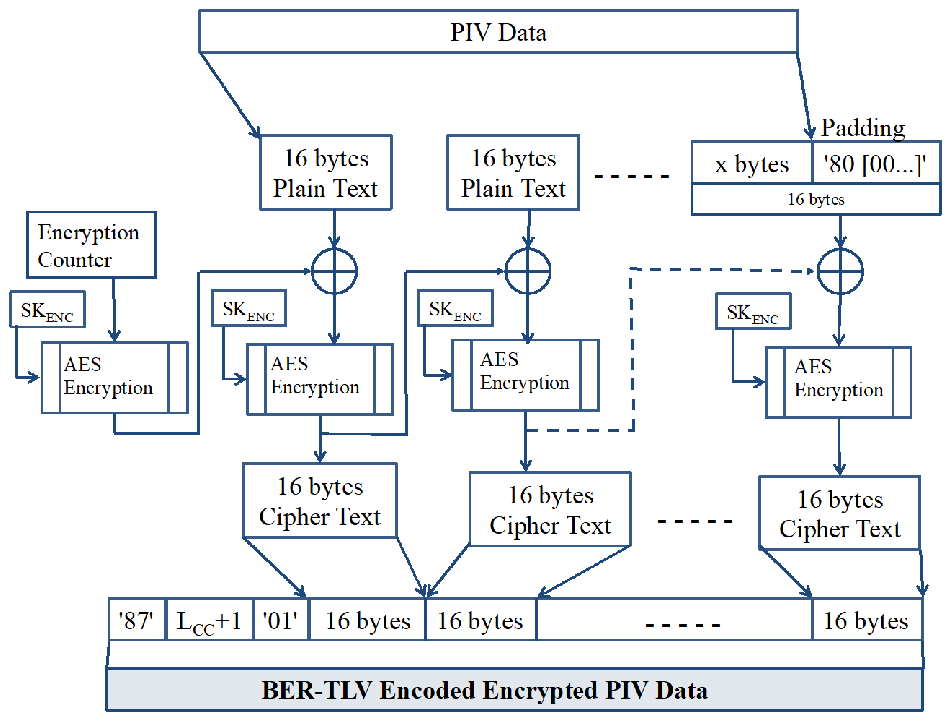
図1. PIVデータの機密性。上部の PIV Data(PIV データ)が「16 bytes Plain Text」(16 バイトの平文)のブロックに分割され、間は「- - - -」で省略されている。最後のブロックは「x bytes」に Padding(パディング)'80 [00...]' を加えて 16 バイトとする。Encryption Counter(暗号化カウンター)が SK_ENC を鍵とする AES Encryption(AES 暗号化)の箱に入り、その出力が最初の平文ブロックと XOR(⊕)され、結果が SK_ENC を鍵とする別の AES 暗号化の箱に入って「16 bytes Cipher Text」(16 バイトの暗号文)となる。各暗号文ブロックは次の平文ブロックとの XOR に入り(最後のブロックの前は破線)、各結果は SK_ENC の AES で暗号化される。暗号文ブロックは '87' | L_CC+1 | '01' | 16 bytes | 16 bytes | - - - - | 16 bytes の構造に収められ、「BER-TLV Encoded Encrypted PIV Data」(BER-TLV で符号化された暗号化 PIV データ)と記されている。
Fig. 1. PIV data confidentiality
図1. PIVデータの機密性
Initialization Vector (IV). The IV for the AES CBC encryption of command data SHALL be generated by applying the AES block cipher to a 16-byte encryption counter. The initial value of the encryption counter upon successful completion of the key establishment protocol SHALL be '00 00 00 00 00 00 00 00 00 00 00 00 00 00 00 01'. The encryption counter SHALL be incremented by one after each APDU sent over secure messaging (except for the GET RESPONSE command and APDUs with a CLA of '1C'), and it SHALL be reset to its initial value after each successful completion of the key establishment protocol. The 16-byte IV SHALL be created by encrypting the encryption counter with SK using AES in the electronic codebook
初期化ベクトル(IV)。コマンドデータをAES CBCで暗号化するIVは、16バイトの暗号化カウンターにAESブロック暗号を適用して生成しなければなりません(SHALL)。鍵確立プロトコルの正常完了時における暗号化カウンターの初期値は、'00 00 00 00 00 00 00 00 00 00 00 00 00 00 00 01'でなければなりません(SHALL)。セキュアメッセージングで送信する各APDUの後(GET RESPONSEコマンドおよびCLAが'1C'のAPDUを除く)に暗号化カウンターを一増加させなければならず(SHALL)、鍵確立プロトコルが正常に完了するたびに初期値へリセットしなければなりません(SHALL)。16バイトのIVは、SKを用いて暗号化カウンターを暗号化して生成しなければなりません(SHALL)。この暗号化でAESに用いるのは、電子符号帳
ENC
ENC
(ECB) mode of operation.
(ECB)モードです。
The IV for the AES CBC encryption of response data SHALL also be generated by encrypting an encryption counter with SK using AES in the ECB mode of operation. The encryption counter
応答データをAES CBCで暗号化するIVも、SKを用いてAES ECBモードで暗号化カウンターを暗号化して生成しなければなりません(SHALL)。暗号化カウンター
ENC
ENC
value used to generate the IV to encrypt the response data SHALL be the same as the encryption counter value used to generate the IV to encrypt the corresponding request data, with the exception that the most significant byte of the 16-byte counter SHALL be set to '80' (i.e., the IV used to encrypt the first response after successful completion of the key establishment protocol SHALL be generated by encrypting '80 00 00 00 00 00 00 00 00 00 00 00 00 00 00 01' with SK ).
応答データを暗号化するIVの生成に用いる値は、対応する要求データを暗号化するIVの生成に用いる暗号化カウンター値と同じでなければなりません(SHALL)。ただし、16バイトカウンターの最上位バイトを'80'に設定しなければならない(SHALL)(すなわち、鍵確立プロトコルの正常完了後、最初の応答を暗号化するIVは、'80 00 00 00 00 00 00 00 00 00 00 00 00 00 00 01'をSKで暗号化して生成しなければならない(SHALL))
ENC
ENC
Padding. Prior to encryption, 1 – 16 bytes of padding data SHALL be appended to the PIV data. The padding SHALL be '80' followed by the number of zeros needed to make the total length of the message to be encrypted (i.e., PIV data plus padding) a multiple of 16 bytes. The first byte of the value field of tag '87' — the padding content indicator byte — SHALL be '01' to indicate that padding has been applied.
パディング。暗号化前に、1~16バイトのパディングデータをPIVデータに追加しなければなりません(SHALL)。パディングは'80'とし、暗号化対象メッセージ(すなわちPIVデータとパディングの合計)の長さが16バイトの倍数になるのに必要な数のゼロを後続させなければなりません(SHALL)。タグ'87'の値フィールドの最初のバイト、すなわちパディング内容インジケータバイトは、パディングが適用されたことを示すため'01'でなければなりません(SHALL)。
As illustrated in Fig. 1, the input and output of encryption are as follows:
図1に示すように、暗号化の入力および出力は次のとおりである:
•Encryption input:
•暗号化入力:
Plain Text
平文
•Encryption output:
•暗号化出力:
BER-TLV-encoded encrypted message, which consists of tag '87' followed by the length of the encoded encrypted message (L + 1), the padding indicator byte ('01'), and then cc the encrypted data. L is the length of the encrypted PIV data; it SHALL be a multiple of
BER-TLV符号化された暗号化メッセージ。これはタグ'87'、続いて符号化された暗号化メッセージの長さ(L + 1)、パディングインジケータバイト('01')、さらに暗号化データから成ります。Lは暗号化されたPIVデータの長さであり、その値が次の数の倍数でなければならない(SHALL):
cc
16.
16。
4.2.3. Command Integrity
4.2.3. コマンドの完全性
The Command MAC (C-MAC) SHALL be generated by applying the cipher-based MAC (CMAC) [SP800-38B] to the header and data field of a command using the SK session key. If
コマンドMAC(C-MAC)は、SKセッション鍵を用い、コマンドのヘッダーおよびデータフィールドに暗号ベースMAC(CMAC)[SP800-38B]を適用して生成しなければなりません(SHALL)。もし
MAC
MAC
fragmentation is required for data transmission, the command SHALL be constructed without fragmentation for the purposes of computing the MAC, and the CLA byte used in the computation of the MAC SHALL be '0C'.
データ伝送で分割が必要な場合、MAC計算では分割しないコマンドを構成しなければならず(SHALL)、MAC計算に使用するCLAバイトは'0C'でなければなりません(SHALL)。
The data to be MACed, M , SHALL be constructed by concatenating the following:
MAC対象データMは、次を連結して構成しなければならない(SHALL):
C-MAC
C-MAC
1.The 16-byte MAC chaining value (MCV). For the first command sent after successful completion of the key establishment protocol the MCV consists of 16 bytes of '00'. For each subsequent command the MCV is the 16-byte MAC value computed for the previous command.
1.16バイトのMACチェイニング値(MCV)。鍵確立プロトコルの正常完了後に送信する最初のコマンドでは、MCVは16バイトの'00'で構成します。その後の各コマンドでは、MCVは直前のコマンドに対して計算した16バイトのMAC値です。
2. A 16-btye encoded header. The encoded header SHALL consist of the CLA byte ('0C'), the INS byte, P1, and P2, followed by twelve bytes of padding, consisting of '80' followed eleven bytes of '00'. (The length of the data field, \(\mathrm{L}_{\mathrm{c}}\), is not included in the data to be MACed.)
2. 16バイトの符号化ヘッダー。符号化ヘッダーは、CLAバイト('0C')、INSバイト、P1、P2と、それに続く十二バイトのパディング('80'とそれに続く十一バイトの'00')で構成しなければなりません(SHALL)。(データフィールドの長さ\(\mathrm{L}_{\mathrm{c}}\)は、MACの計算対象データに含めません。)
3.The data field, which is the BER-TLV-encoded encrypted message.19
3.データフィールド。これはBER-TLV符号化された暗号化メッセージです。19
4.L encapsulated in BER-TLV format with tag '97' if the L field is included in the e e command.20
4.コマンドにLeフィールドが含まれる場合は、Leをタグ'97'でBER-TLV形式にカプセル化したもの。20
Let \(\mathit{T}_{\mathit{C\text{-}MAC}} = \mathrm{CMAC}(\mathrm{SK}_{\mathrm{MAC}}, \mathit{M}_{\mathit{C\text{-}MAC}})\), as described in [SP800-38B]. The BER-TLV-encoded C-MAC for
[SP800-38B]に記載のとおり、\(\mathit{T}_{\mathit{C\text{-}MAC}} = \mathrm{CMAC}(\mathrm{SK}_{\mathrm{MAC}}, \mathit{M}_{\mathit{C\text{-}MAC}})\)とします。BER-TLV符号化されたC-MACについて、
MAC C-MAC
MAC C-MAC
the command SHALL be the 8 most significant bytes of T encapsulated in BER-TLV format
コマンドは、T の最上位 8 バイトを BER-TLV 形式でカプセル化したものとしなければならない(SHALL)
C-MAC
C-MAC
with tag '8E'. The entire 16-byte value T will be the MCV for the next command. C-MAC
タグ '8E' を付けます。T の 16 バイト全体が次のコマンドの MCV となります。C-MAC
Figure 2 illustrates how the C-MAC is generated for each command.
図 2 は、各コマンドについて C-MAC がどのように生成されるかを示します。
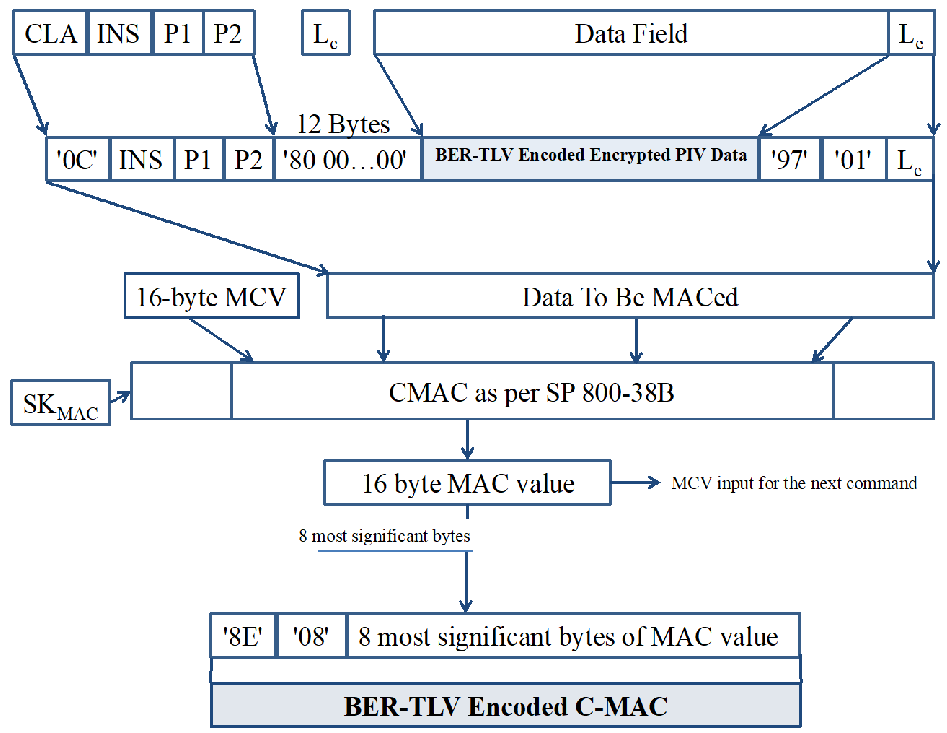
図 2. コマンドの PIV データ完全性。上段は元のコマンドで、CLA | INS | P1 | P2、L_c、Data Field(データフィールド)| L_e である。矢印がこれらを '0C' | INS | P1 | P2 | '80 00…00'(12 Bytes、12 バイト)| BER-TLV Encoded Encrypted PIV Data(BER-TLV で符号化された暗号化 PIV データ)| '97' | '01' | L_e の行に対応付ける。'0C' から L_e までが「Data To Be MACed」(MAC の対象データ)となる。16-byte MCV(16 バイトの MCV)と MAC の対象データが、SK_MAC を鍵とする「CMAC as per SP 800-38B」(SP 800-38B による CMAC)に入る。出力は「16 byte MAC value」(16 バイトの MAC 値)で、これは「MCV input for the next command」(次のコマンドの MCV 入力)にもなる。その「8 most significant bytes」(上位 8 バイト)が '8E' | '08' | 8 most significant bytes of MAC value(MAC 値の上位 8 バイト)に入り、「BER-TLV Encoded C-MAC」(BER-TLV で符号化された C-MAC)と記されている。
Fig. 2. PIV data integrity of command
図 2. コマンドの PIV データ完全性
4.2.4. Command With PIV Secure Messaging
4.2.4. PIV セキュアメッセージングを使用するコマンド
For secure messaging, the secure messaging data field SHALL be constructed as the concatenation of the following:
セキュアメッセージングでは、セキュアメッセージングデータフィールドを、次の要素を連結して構成しなければなりません (SHALL)。
•The BER-TLV-encoded encrypted PIV data;21
•BER-TLV エンコードされた暗号化済み PIV データ;21
•The 3-btye BER-TLV-encoded L , as described in Section 4.2.3, if L would have been e e included in a message sent without secure messaging;
•セキュアメッセージングを使用せずに送信するメッセージに Le が含まれる場合は、Section 4.2.3 に記載の、3 バイトの BER-TLV エンコードされた Le;
•The 10-byte BER-TLV-encoded C-MAC of the command, as described in Section 4.2.3; and
•Section 4.2.3 に記載の、コマンドの 10 バイト BER-TLV エンコード C-MAC; および
•A new L field, which SHALL be 1 byte and SHALL have a value of '00'.22 e
•新しい L フィールド。これは 1 バイトでなければならず (SHALL)、値は '00' でなければなりません (SHALL)。22 e
Figure 3 shows the APDU for secure messaging when command chaining is not required. The APDU consists of the CLA byte ('0C'), INS, P1, P2, the length of the secure messaging data field (\(\mathrm{L}_{\mathrm{c}}'\)), the secure messaging data field, and the new \(\mathrm{L}_{\mathrm{e}}\) field ('00').
図3は、コマンドチェイニングが不要な場合のセキュアメッセージング用APDUを示します。APDUは、CLAバイト('0C')、INS、P1、P2、セキュアメッセージングデータフィールドの長さ(\(\mathrm{L}_{\mathrm{c}}'\))、セキュアメッセージングデータフィールド、および新しい\(\mathrm{L}_{\mathrm{e}}\)フィールド('00')で構成されます。
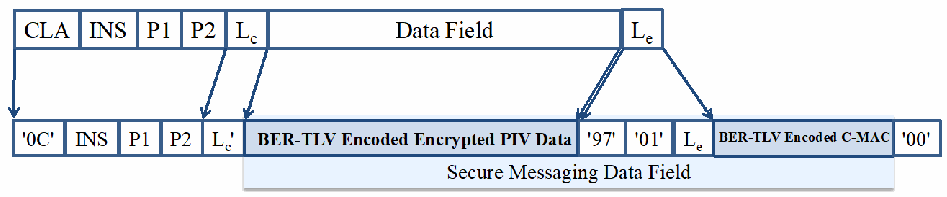
図 3. セキュアメッセージング下の単一コマンド。上段は CLA | INS | P1 | P2 | L_c | Data Field(データフィールド)| L_e である。矢印がこれを下段の '0C' | INS | P1 | P2 | L_c' | BER-TLV Encoded Encrypted PIV Data(BER-TLV で符号化された暗号化 PIV データ)| '97' | '01' | L_e | BER-TLV Encoded C-MAC(BER-TLV で符号化された C-MAC)| '00' に対応付ける。暗号化 PIV データから C-MAC までが「Secure Messaging Data Field」(セキュアメッセージングデータフィールド)としてまとめられている。
Fig. 3. Single command under secure messaging
図 3. セキュアメッセージング下の単一コマンド
Command chaining will be needed if the secure messaging data field to be transported is larger than 255 bytes. Figure 4 shows the APDUs for secure messaging when the length of the secure messaging data field is between 256 and 510 bytes, which requires the data to be fragmented across two APDUs. The APDUs are constructed in the same manner as when fragmentation is not required, except that the CLA byte for the first APDU is '1C', the first APDU contains the first 255 bytes of the secure messaging data field, and the second APDU contains the remaining bytes of the secure messaging data field and the new L field ('00'). The PIV Card Application
転送するセキュアメッセージングデータフィールドが 255 バイトを超える場合は、コマンドチェイニングが必要となります。図 4 は、セキュアメッセージングデータフィールドの長さが 256~510 バイトで、データを 二つの APDU に分割する必要がある場合の APDU を示します。APDU は、分割が不要な場合と同じ方法で構成しますが、最初の APDU の CLA バイトは '1C' とし、最初の APDU にセキュアメッセージングデータフィールドの先頭 255 バイトを格納し、後続の APDU に残りのバイトと新しい L フィールド ('00') を格納します。PIV Card Application
e
provides a 2-byte response of '90 00' for the first APDU. After receiving the second APDU, the PIV Card Application reconstructs and processes the entire command.
最初の APDU に対して '90 00' の 2 バイト応答を返します。後続の APDU を受信すると、PIV Card Application はコマンド全体を再構成して処理します。
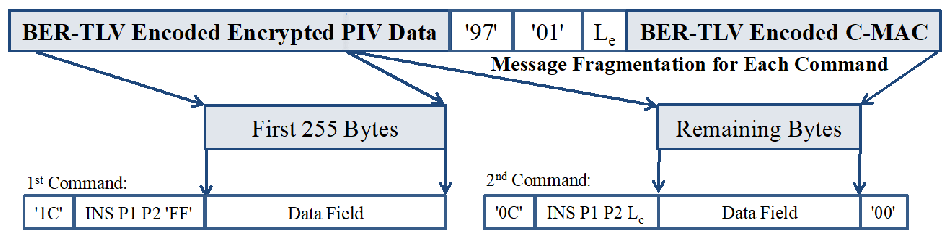
図 4. セキュアメッセージング下のチェイン化コマンド。上段は BER-TLV Encoded Encrypted PIV Data(BER-TLV で符号化された暗号化 PIV データ)| '97' | '01' | L_e | BER-TLV Encoded C-MAC(BER-TLV で符号化された C-MAC)で、「Message Fragmentation for Each Command」(コマンドごとのメッセージ分割)と記されている。矢印がこれを「First 255 Bytes」(最初の 255 バイト)と「Remaining Bytes」(残りのバイト)に分ける。最初の 255 バイトは 1st Command(1 番目のコマンド)'1C' | INS P1 P2 'FF' | Data Field のデータフィールドとなり、残りのバイトは 2nd Command(2 番目のコマンド)'0C' | INS P1 P2 L_c | Data Field | '00' のデータフィールドとなる。
Fig. 4. Chained command under secure messaging
図 4. セキュアメッセージング下のチェイン化コマンド
4.2.5. Response Integrity
4.2.5. 応答の完全性
The response MAC (R-MAC) SHALL be generated by applying CMAC [SP800-38B] to the data field and status bytes of the response using the SK session key. An R-MAC SHALL be
応答 MAC (R-MAC) は、SK セッション鍵を使用して、応答のデータフィールドおよびステータスバイトに CMAC [SP800-38B] を適用して生成しなければなりません (SHALL)。R-MAC は、次のとおりでなければならない (SHALL):
RMAC generated for each response that corresponds to a command that was sent to the card using secure messaging.
セキュアメッセージングを使用してカードに送信されたコマンドに対応する各応答について生成されるR-MAC。
The data to be MACed, M , SHALL be constructed by concatenating the following:
MAC 対象データ M は、次の要素を連結して構成しなければなりません (SHALL)。
R-MAC
R-MAC
1.The 16-byte MAC chaining value (MCV). For the first response sent after successful completion of the key establishment protocol the MCV consists of 16 bytes of '00'. For each subsequent response the MCV is the 16-byte MAC value computed for the previous response.
1.16 バイトの MAC チェイニング値 (MCV)。鍵確立プロトコルの正常な完了後に送信される最初の応答では、MCV は '00' の 16 バイトで構成されます。それ以降の各応答では、MCV は直前の応答について計算された 16 バイトの MAC 値です。
2.The data field (if present), which is the BER-TLV-encoded encrypted message
2.データフィールド (存在する場合)。これは BER-TLV エンコードされた暗号化済みメッセージです。
3.The status word, SW1, and SW2 encapsulated in BER-TLV format with tag '99'
3.ステータスワード SW1 および SW2 を、タグ '99' の BER-TLV 形式でカプセル化したもの
Let \(\mathit{T}_{\mathit{R\text{-}MAC}} = \mathrm{CMAC}(\mathrm{SK}_{\mathrm{RMAC}}, \mathit{M}_{\mathit{R\text{-}MAC}})\), as described in [SP800-38B]. The BER-TLV-encoded R-MAC
[SP800-38B]に記載のとおり、\(\mathit{T}_{\mathit{R\text{-}MAC}} = \mathrm{CMAC}(\mathrm{SK}_{\mathrm{RMAC}}, \mathit{M}_{\mathit{R\text{-}MAC}})\)とします。BER-TLV符号化されたR-MACは、
RMAC R-MAC
RMAC R-MAC
for the response SHALL be the 8 most significant bytes of T encapsulated in BER-TLV format
応答用のものは、T の最上位 8 バイトを BER-TLV 形式でカプセル化したものとしなければならない (SHALL)
R-MAC
R-MAC
with tag '8E'. The entire 16-byte value T will be the MCV for the next response. R-MAC
タグ'8E'を付けて。Tの16バイト全体が次の応答のMCVとなります。R-MAC
Figure 5 illustrates how the R-MAC is generated for the response.
図 5 は、応答の R-MAC がどのように生成されるかを示します。
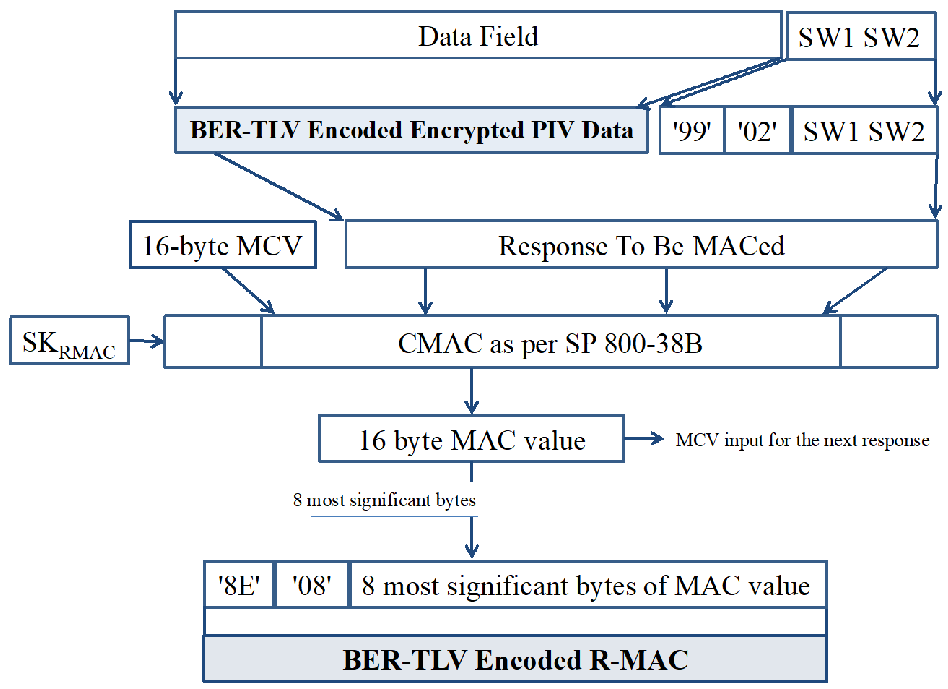
図 5. 応答の PIV データ完全性。上段は Data Field(データフィールド)| SW1 SW2 である。矢印がデータフィールドを「BER-TLV Encoded Encrypted PIV Data」(BER-TLV で符号化された暗号化 PIV データ)に、SW1 SW2 を '99' | '02' | SW1 SW2 に対応付ける。これらがまとまって「Response To Be MACed」(MAC の対象となる応答)となる。16-byte MCV(16 バイトの MCV)と MAC の対象となる応答が、SK_RMAC を鍵とする「CMAC as per SP 800-38B」(SP 800-38B による CMAC)に入る。出力は「16 byte MAC value」(16 バイトの MAC 値)で、これは「MCV input for the next response」(次の応答の MCV 入力)にもなる。その「8 most significant bytes」(上位 8 バイト)が '8E' | '08' | 8 most significant bytes of MAC value(MAC 値の上位 8 バイト)に入り、「BER-TLV Encoded R-MAC」(BER-TLV で符号化された R-MAC)と記されている。
Fig. 5. PIV data integrity of response
図 5. 応答の PIV データ完全性
4.2.6. Response With PIV Secure Messaging
4.2.6. PIV セキュアメッセージングを使用する応答
For secure messaging, the secure messaging data field that is sent by the PIV Card Application SHALL be constructed as the concatenation of the following:
セキュアメッセージングでは、PIVカードアプリケーションが送信するセキュアメッセージングデータフィールドを、次の要素を連結して構成しなければなりません(SHALL)。
•The BER-TLV-encoded encrypted message (when present);
•BER-TLV エンコードされた暗号化済みメッセージ (存在する場合);
•The 4-byte BER-TLV-encoded status word, as described in Section 4.2.5; and
•4.2.5節に記載の、BER-TLVで符号化された4バイトのステータスワード;および
•The 10-byte BER-TLV-encoded R-MAC of the response, as described in Section 4.2.5.
•4.2.5節に記載の、BER-TLVで符号化された応答の10バイトR-MAC。
Figure 6 illustrates a response under secure messaging when response chaining is not required. The APDU consists of the secure messaging data field and the 2-byte SW processing status ('90 00'), which indicates that the PIV Card Application successfully verified the C-MAC on the command and decrypted the data field in the command (if present). If the PIV Card Application was unable to verify the C-MAC on the command or decrypt the data field in the command, then it SHALL return a 2-byte error response, as described in Section 4.2.7.
図6は、応答チェイニングが不要な場合のセキュアメッセージング応答を示します。APDUはセキュアメッセージングデータフィールドと2バイトのSW処理ステータス('90 00')で構成されます。このステータスは、PIVカードアプリケーションがコマンド上のC-MACを正常に検証し、コマンドのデータフィールド(存在する場合)を復号したことを示します。PIVカードアプリケーションがコマンド上のC-MACを検証できなかった場合、またはコマンドのデータフィールドを復号できなかった場合、4.2.7節に記載の2バイトのエラー応答を返さなければなりません(SHALL)。
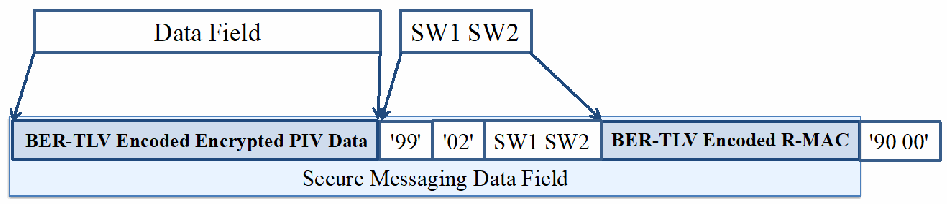
図6. セキュアメッセージングにおける単一応答。上段は Data Field(データフィールド)| SW1 SW2 である。矢印がこれらを下段の BER-TLV Encoded Encrypted PIV Data(BER-TLV で符号化された暗号化 PIV データ)| '99' | '02' | SW1 SW2 | BER-TLV Encoded R-MAC(BER-TLV で符号化された R-MAC)| '90 00' に対応付ける。暗号化 PIV データから R-MAC までが「Secure Messaging Data Field」(セキュアメッセージングデータフィールド)と記されている。
Fig. 6. Single response under secure messaging
図6. セキュアメッセージングにおける単一応答
Response chaining23 will be needed if the secure messaging data field to be transported is larger than 256 bytes. Figure 7 shows the APDUs for secure messaging that are sent by the PIV Card Application when the length of the secure messaging data field is between 513 and 768 bytes, which requires the data to be fragmented across three APDUs. After the first response, an APDU of '00 C0 00 00 00' will be sent to request the second response. After the second response, an APDU of '00 C0 00 00 xx' will be sent to request the third response.
転送するセキュアメッセージングデータフィールドが256バイトを超える場合、応答チェイニング23が必要となります。図7は、セキュアメッセージングデータフィールドの長さが513~768バイトで、データを3つのAPDUに分割する必要がある場合に、PIVカードアプリケーションが送信するセキュアメッセージング用APDUを示します。最初の応答の後、2つ目の応答を要求するためにAPDU '00 C0 00 00 00'が送信されます。2つ目の応答の後、3つ目の応答を要求するためにAPDU '00 C0 00 00 xx'が送信されます。
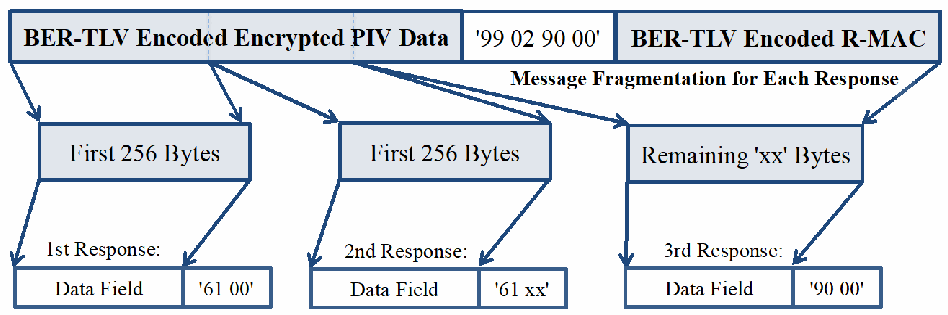
図7. セキュアメッセージングにおけるチェイニング応答。上段は BER-TLV Encoded Encrypted PIV Data(BER-TLV で符号化された暗号化 PIV データ)| '99 02 90 00' | BER-TLV Encoded R-MAC(BER-TLV で符号化された R-MAC)で、「Message Fragmentation for Each Response」(応答ごとのメッセージ分割)と記されている。矢印がこれを 3 つに分ける。「First 256 Bytes」(最初の 256 バイト)、同じく「First 256 Bytes」と記された 2 番目の部分、R-MAC の末尾までの「Remaining 'xx' Bytes」(残りの xx バイト)である。これらが 1st Response(1 番目の応答: Data Field | '61 00')、2nd Response(2 番目の応答: Data Field | '61 xx')、3rd Response(3 番目の応答: Data Field | '90 00')のデータフィールドとなる。
Fig. 7. Chained response under secure messaging
図7. セキュアメッセージングにおけるチェイニング応答
4.2.7. Error Handling
4.2.7. エラー処理
The SW processing status is the status word of the overall secure messaging command and response processing. It indicates whether the secure messaging was performed successfully. If the processing was successful, it SHALL be '90 00'. Otherwise, it SHALL be as follows:
SW処理ステータスは、セキュアメッセージングのコマンドおよび応答処理全体のステータスワードです。セキュアメッセージングが正常に実行されたかどうかを示します。処理が成功した場合は'90 00'でなければなりません(SHALL)。それ以外の場合は、次のとおりでなければなりません(SHALL)。
•'68 82' – Secure messaging not supported
•'68 82' – セキュアメッセージングはサポートされていない
•'69 82' – Security status not satisfied24
•'69 82' – セキュリティ状態が満たされていない24
•'69 87' – Expected secure messaging data objects are missing
•'69 87' – 想定されるセキュアメッセージングデータオブジェクトがない
•'69 88' – Secure messaging data objects are incorrect
•'69 88' – セキュアメッセージングデータオブジェクトが正しくない
If the command processing was unsuccessful, the card SHALL return one of the above status words without performing further secure messaging.
コマンド処理が失敗した場合、カードはそれ以上セキュアメッセージングを実行せず、上記のステータスワードのいずれかを返さなければなりません(SHALL)。
4.3. Session Key Destruction
4.3. セッション鍵の破棄
The session keys established after successful execution of the key establishment protocol in Section 4.1 SHALL be zeroized in the following circumstances:
4.1節の鍵確立プロトコルが正常に実行された後に確立されたセッション鍵は、以下の場合にゼロ化しなければなりません。 (SHALL)
•The card is reset,
•カードがリセットされた場合、
•An error occurs in secure messaging,25 or
•セキュアメッセージングでエラーが発生した場合、25または
•New session keys are requested by the client application by sending a GENERAL AUTHENTICATE command to the card to perform the key establishment protocol using the PIV Secure Messaging key.
•クライアントアプリケーションが、PIVセキュアメッセージング鍵を使用する鍵確立プロトコルを実行するためにGENERAL AUTHENTICATEコマンドをカードに送信し、新しいセッション鍵を要求した場合。
References
参考文献
[ANSI504-1] InterNational Committee for Information Technology Standards (2023) INCITS 504-1-2013 (R2023) - Information Technology - Generic Identity Command Set – Part 1: Card Application Command Set, [or as amended]. Available at https://webstore.ansi.org/standards/incits/incits5042013r2023
[ANSI504-1] InterNational Committee for Information Technology Standards (2023) INCITS 504-1-2013 (R2023) - Information Technology - Generic Identity Command Set – Part 1: Card Application Command Set, [またはその改訂版]. 入手先: https://webstore.ansi.org/standards/incits/incits5042013r2023
[FIPS201] National Institute of Standards and Technology (2022) Personal Identity Verification (PIV) of Federal Employees and Contractors. (Department of Commerce, Washington, DC), Federal Information Processing Standards Publication (FIPS) 201-3. https://doi.org/10.6028/NIST.FIPS.201-3
[FIPS201] National Institute of Standards and Technology (2022) Personal Identity Verification (PIV) of Federal Employees and Contractors. (Department of Commerce, Washington, DC), Federal Information Processing Standards Publication (FIPS) 201-3. https://doi.org/10.6028/NIST.FIPS.201-3
[ISO7816] International Organization for Standardization/International Electrotechnical Commission (2004-2020) ISO/IEC 7816 — Identification cards — Integrated circuit cards. (multiple parts):
[ISO7816] International Organization for Standardization/International Electrotechnical Commission (2004-2020) ISO/IEC 7816 — Identification cards — Integrated circuit cards. (複数のパート):
•International Organization for Standardization/International Electrotechnical Commission (2020) ISO/IEC 7816-4:2020 — Identification cards — Integrated circuit cards — Part 4: Organization, security and commands for interchange. (International Organization for Standardization, Geneva, Switzerland) [or as amended]. Available at https://www.iso.org/standard/77180.html
•International Organization for Standardization/International Electrotechnical Commission (2020) ISO/IEC 7816-4:2020 — Identification cards — Integrated circuit cards — Part 4: Organization, security and commands for interchange. (International Organization for Standardization, Geneva, Switzerland) [or as amended]. 入手先: https://www.iso.org/standard/77180.html
•International Organization for Standardization/International Electrotechnical Commission (2004) ISO/IEC 7816-5:2004 — Identification cards — Integrated circuit cards — Part 5: Registration of application providers. (International Organization for Standardization, Geneva, Switzerland) [or as amended]. Available at https://www.iso.org/standard/34259.html
•International Organization for Standardization/International Electrotechnical Commission (2004) ISO/IEC 7816-5:2004 — Identification cards — Integrated circuit cards — Part 5: Registration of application providers. (International Organization for Standardization, Geneva, Switzerland) [or as amended]. 入手先: https://www.iso.org/standard/34259.html
•International Organization for Standardization/International Electrotechnical Commission (2023) ISO/IEC 7816-6:2023 — Identification cards — Integrated circuit cards — Part 6: Interindustry data elements for interchange. (International Organization for Standardization, Geneva, Switzerland) [or as amended]. Available at https://www.iso.org/standard/77181.html
•International Organization for Standardization/International Electrotechnical Commission (2023) ISO/IEC 7816-6:2023 — Identification cards — Integrated circuit cards — Part 6: Interindustry data elements for interchange. (International Organization for Standardization, Geneva, Switzerland) [or as amended]. 入手先: https://www.iso.org/standard/77181.html
•International Organization for Standardization/International Electrotechnical Commission (2021) ISO/IEC 7816-8:2021 — Identification cards — Integrated circuit cards — Part 8: Commands and mechanisms for security operations. (International Organization for Standardization, Geneva, Switzerland) [or as amended]. Available at https://www.iso.org/standard/79893.html
•International Organization for Standardization/International Electrotechnical Commission (2021) ISO/IEC 7816-8:2021 — Identification cards — Integrated circuit cards — Part 8: Commands and mechanisms for security operations. (International Organization for Standardization, Geneva, Switzerland) [or as amended]. 入手先: https://www.iso.org/standard/79893.html
•International Organization for Standardization/International Electrotechnical Commission (2017) ISO/IEC 7816-9:2017 — Identification cards — Integrated circuit cards — Part 9: Commands for card management. (International Organization for Standardization, Geneva, Switzerland) [or as amended]. Available at https://www.iso.org/standard/67802.html
•International Organization for Standardization/International Electrotechnical Commission (2017) ISO/IEC 7816-9:2017 — Identification cards — Integrated circuit cards — Part 9: Commands for card management. (International Organization for Standardization, Geneva, Switzerland) [or as amended]. 入手先: https://www.iso.org/standard/67802.html
[ISO8824] International Organization for Standardization/International Electrotechnical Commission (2021) ISO/IEC 8824-2:2021 — Information technology — Abstract Syntax Notation One (ASN.1) – Part 2: Information object specification. (International Organization for Standardization, Geneva, Switzerland) [or as amended]. Available at https://www.iso.org/standard/81417.html
[ISO8824] International Organization for Standardization/International Electrotechnical Commission (2021) ISO/IEC 8824-2:2021 — Information technology — Abstract Syntax Notation One (ASN.1) – Part 2: Information object specification. (International Organization for Standardization, Geneva, Switzerland) [or as amended]. 入手先: https://www.iso.org/standard/81417.html
[ISO8825] International Organization for Standardization/International Electrotechnical Commission (2015) ISO/IEC 8825-1:2015— Information technology — ASN.1 encoding rules: Specification of Basic Encoding Rules (BER), Canonical Encoding Rules (CER) and Distinguished Encoding Rules (DER) Part 1. (International Organization for Standardization, Geneva, Switzerland) [or as amended]. Available at https://www.iso.org/standard/81420.html
[ISO8825] International Organization for Standardization/International Electrotechnical Commission (2015) ISO/IEC 8825-1:2015— Information technology — ASN.1 encoding rules: Specification of Basic Encoding Rules (BER), Canonical Encoding Rules (CER) and Distinguished Encoding Rules (DER) Part 1. (International Organization for Standardization, Geneva, Switzerland) [or as amended]. 入手先: https://www.iso.org/standard/81420.html
[PKCS1] Moriarty K, Kaliski B, Jonsson J, Rusch A (2016). Public-Key Cryptography Standards (PKCS) #1: RSA Cryptography Specifications Version 2.2. (Internet Engineering Task Force (IETF)), IETF Request for Comments (RFC) 8017. Available at https://www.rfc-editor.org/rfc/rfc8017
[PKCS1] Moriarty K, Kaliski B, Jonsson J, Rusch A (2016). Public-Key Cryptography Standards (PKCS) #1: RSA Cryptography Specifications Version 2.2. (Internet Engineering Task Force (IETF)), IETF Request for Comments (RFC) 8017. 入手先: https://www.rfc-editor.org/rfc/rfc8017
[SECG] Certicom (2009) Standards for Efficient Cryptography, SEC 1: Elliptic Curve Cryptography, Version 2.0. Available at https://www.secg.org/sec1-v2.pdf
[SECG] Certicom (2009) Standards for Efficient Cryptography, SEC 1: Elliptic Curve Cryptography, Version 2.0. Available at https://www.secg.org/sec1-v2.pdf
[SP800-38B] Dworkin MJ (2005) Recommendation for Block Cipher Modes of Operation: the CMAC Mode for Authentication. (National Institute of Standards and Technology, Gaithersburg, MD), NIST Special Publication (SP) 800-38B, Includes updates as of October 6, 2016 [or as amended]. https://doi.org/10.6028/NIST.SP.800-38B
[SP800-38B] Dworkin MJ (2005) Recommendation for Block Cipher Modes of Operation: the CMAC Mode for Authentication. (National Institute of Standards and Technology, Gaithersburg, MD), NIST Special Publication (SP) 800-38B, Includes updates as of October 6, 2016 [or as amended]. https://doi.org/10.6028/NIST.SP.800-38B
[SP800-56A] Barker EB, Chen L, Roginsky AL, Vassilev A, Davis R (2018) Recommendation for Pair-Wise Key-Establishment Schemes Using Discrete Logarithm Cryptography. (National Institute of Standards and Technology, Gaithersburg, MD), NIST Special Publication (SP) 800-56A, Rev. 3 [or as amended]. https://doi.org/10.6028/NIST.SP.800-56Ar3
[SP800-56A] Barker EB, Chen L, Roginsky AL, Vassilev A, Davis R (2018) Recommendation for Pair-Wise Key-Establishment Schemes Using Discrete Logarithm Cryptography. (National Institute of Standards and Technology, Gaithersburg, MD), NIST Special Publication (SP) 800-56A, Rev. 3 [または改正版]。https://doi.org/10.6028/NIST.SP.800-56Ar3
[SP800-76] Grother PJ, Salamon WJ, Chandramouli R (2013) Biometric Specifications for Personal Identity Verification. (National Institute of Standards and Technology, Gaithersburg, MD), NIST Special Publication (SP) 800-76-2 [or as amended]. https://doi.org/10.6028/NIST.SP.800-76-2
[SP800-76] Grother PJ, Salamon WJ, Chandramouli R (2013) Biometric Specifications for Personal Identity Verification. (National Institute of Standards and Technology, Gaithersburg, MD), NIST Special Publication (SP) 800-76-2 [または改正版]。https://doi.org/10.6028/NIST.SP.800-76-2
[SP800-78] Ferraiolo H, Regenscheid A (2024) Cryptographic Algorithms and Key Sizes for Personal Identity Verification. (National Institute of Standards and Technology, Gaithersburg, MD), NIST Special Publication (SP) 800-78-5 [or as amended]. https://doi.org/10.6028/NIST.SP.800-78-5
[SP800-78] Ferraiolo H, Regenscheid A (2024) Cryptographic Algorithms and Key Sizes for Personal Identity Verification. (National Institute of Standards and Technology, Gaithersburg, MD), NIST Special Publication (SP) 800-78-5 [または改正版]。https://doi.org/10.6028/NIST.SP.800-78-5
Appendix A. Examples of the Use of the GENERAL AUTHENTICATE Command
付録 A. GENERAL AUTHENTICATE コマンドの使用例
A.1. Authentication of the PIV Card Application Administrator
A.1. PIV Card Application 管理者の認証
The PIV Card Application Administrator is authenticated by the PIV Card Application using a challenge-response protocol. A challenge retrieved from the PIV Card Application is encrypted by the client application and returned to the PIV Card Application associated with key reference '9B', which is the key reference of the PIV Card Application Administration key. The PIV Card Application decrypts the response using this reference data and the algorithm associated with the key reference (e.g., AES-128 – ECB, algorithm identifier '08'). If this decrypted value matches the previously provided challenge, then the security status indicator of the PIV Card Application Administration key is set to TRUE within the PIV Card Application.
PIV Card Application 管理者は、チャレンジ・レスポンスプロトコルを使用して PIV Card Application によって認証されます。PIV Card Application から取得したチャレンジをクライアントアプリケーションが暗号化し、PIV Card Application 管理鍵の鍵参照である鍵参照 '9B' を指定して PIV Card Application に返します。PIV Card Application は、この参照データと鍵参照に対応付けられたアルゴリズム (例: AES-128 – ECB、アルゴリズム識別子 '08') を使用して応答を復号します。復号した値が先に提供されたチャレンジと一致する場合、PIV Card Application 内で PIV Card Application 管理鍵のセキュリティ状態インジケーターが TRUE に設定されます。
Table 22 shows the GENERAL AUTHENTICATE card commands sent to the PIV Card Application to realize this particular challenge-response protocol.
表 22 は、このチャレンジ・レスポンスプロトコルを実現するために PIV Card Application に送信される GENERAL AUTHENTICATE カードコマンドを示します。
Table 22. Authentication of PIV Card Application Administrator
表 22. PIV Card Application 管理者の認証
| Command | Response | Comment |
|---|---|---|
| '00 87 08 9B 04 7C 02 81 00 00' | The client application requests a challenge from the PIV Card Application. | |
| '7C 12 81 10 01 02 03 04 05 06 07 08 09 0A 0B 0C 0D 0E 0F 10 90 00' | The challenge ('01 02 03 04 05 06 07 08 09 0A 0B 0C 0D 0E 0F 10') returned to client application by the PIV Card Application. | |
| '00 87 08 9B 0C 7C 12 82 10 88 77 66 55 44 33 22 11 88 77 66 55 22 11 33 11' | The client application returns the encryption of the challenge ('88 77 66 55 44 33 22 11 88 77 66 55 22 11 33 11') referencing algorithm '08' and key reference '9B' [SP800-78, Tables 8 and 9]. | |
| '90 00' | The PIV Card Application indicates successful authentication of PIV Card Application Administrator after decrypting '88 77 66 55 44 33 22 11 88 77 66 55 22 11 33 11' using the referenced algorithm and key and getting '01 02 03 04 05 06 07 08 09 0A 0B 0C 0D 0E 0F 10'. |
| コマンド | 応答 | コメント |
|---|---|---|
| '00 87 08 9B 04 7C 02 81 00 00' | クライアントアプリケーションが PIV Card Application にチャレンジを要求します。 | |
| '7C 12 81 10 01 02 03 04 05 06 07 08 09 0A 0B 0C 0D 0E 0F 10 90 00' | PIV Card Applicationがクライアントアプリケーションに返すチャレンジ('01 02 03 04 05 06 07 08 09 0A 0B 0C 0D 0E 0F 10')。 | |
| '00 87 08 9B 0C 7C 12 82 10 88 77 66 55 44 33 22 11 88 77 66 55 22 11 33 11' | クライアントアプリケーションが、アルゴリズム'08'および鍵参照'9B'を指定して、チャレンジを暗号化した値('88 77 66 55 44 33 22 11 88 77 66 55 22 11 33 11')を返します [SP800-78, Tables 8 and 9]。 | |
| '90 00' | PIV Card Applicationは、参照されたアルゴリズムと鍵を使用して'88 77 66 55 44 33 22 11 88 77 66 55 22 11 33 11'を復号し、'01 02 03 04 05 06 07 08 09 0A 0B 0C 0D 0E 0F 10'を得た後、PIV Card Application管理者の認証成功を示します。 |
Table 23. Mutual authentication of client application and PIV Card Application
表 23. クライアントアプリケーションと PIV Card Application の相互認証
| Command | Response | Comment |
|---|---|---|
| '00 87 08 9B 04 7C 02 80 00 00' | The client application requests a witness from the PIV Card Application. | |
| '7C 12 80 10 88 77 66 55 44 33 22 11 88 77 66 55 22 11 33 11 90 00' | The PIV Card Application returns a witness that is created by generating 16 bytes of random data ('01 02 03 04 05 06 07 08 09 0A 0B 0C 0D 0E 0F 10') and encrypting the data using the referenced key ('9B') and algorithm ('08') [SP800-78, Tables 8 and 9]. | |
| '00 87 08 9B 18 7C 24 80 10 01 02 03 04 05 06 07 08 09 0A 0B 0C 0D 0E 0F 10 81 10 09 0A 0B 0C 0D 0E 0F 10 09 08 07 06 05 04 03 02 82 00 00' | The client application returns the decrypted witness ('01 02 03 04 05 06 07 08 09 0A 0B 0C 0D 0E 0F 10’), which references algorithm '08' and key reference '9B'. The client application requests the encryption of challenge data ('09 0A 0B 0C 0D 0E 0F 10 09 08 07 06 05 04 03 02') from the card using the same key. | |
| '7C 12 82 10 11 FF EE DD CC BB AA 99 88 77 66 55 44 33 22 11 90 00' | The PIV Card Application authenticates the client application by verifying the decrypted witness. The PIV Card Application indicates the successful authentication of the PIV Card Application Administrator and sends back the encrypted challenge ('11 FF EE DD CC BB AA 99 88 77 66 55 44 33 22 11'). The client application authenticates the PIV Card Application by decrypting the encrypted challenge and getting ('09 0A 0B 0C 0D 0E 0F 10 09 08 07 06 05 04 03 02'). |
| コマンド | 応答 | コメント |
|---|---|---|
| '00 87 08 9B 04 7C 02 80 00 00' | クライアントアプリケーションが PIV Card Application に witness を要求します。 | |
| '7C 12 80 10 88 77 66 55 44 33 22 11 88 77 66 55 22 11 33 11 90 00' | PIV Card Applicationは、16バイトの乱数データ('01 02 03 04 05 06 07 08 09 0A 0B 0C 0D 0E 0F 10')を生成し、参照された鍵('9B')とアルゴリズム('08')を使用してそのデータを暗号化して作成したwitnessを返します [SP800-78, Tables 8 and 9]。 | |
| '00 87 08 9B 18 7C 24 80 10 01 02 03 04 05 06 07 08 09 0A 0B 0C 0D 0E 0F 10 81 10 09 0A 0B 0C 0D 0E 0F 10 09 08 07 06 05 04 03 02 82 00 00' | クライアントアプリケーションは、復号したwitness('01 02 03 04 05 06 07 08 09 0A 0B 0C 0D 0E 0F 10’)を返し、アルゴリズム'08'と鍵参照'9B'を指定します。クライアントアプリケーションは、同じ鍵を使用してカードにチャレンジデータ('09 0A 0B 0C 0D 0E 0F 10 09 08 07 06 05 04 03 02')の暗号化を要求します。 | |
| '7C 12 82 10 11 FF EE DD CC BB AA 99 88 77 66 55 44 33 22 11 90 00' | PIV Card Applicationは、復号したwitnessを検証してクライアントアプリケーションを認証します。PIV Card Applicationは、PIV Card Application管理者の認証成功を示し、暗号化したチャレンジ('11 FF EE DD CC BB AA 99 88 77 66 55 44 33 22 11')を返します。クライアントアプリケーションは、暗号化されたチャレンジを復号して('09 0A 0B 0C 0D 0E 0F 10 09 08 07 06 05 04 03 02')を得ることで、PIV Card Applicationを認証します。 |
Table 24 shows the GENERAL AUTHENTICATE card commands sent to the PIV Card Application to realize cardholder authentication when the X.509 Certificate for PIV Authentication includes a 2048-bit27 RSA public key. It is assumed that the cardholder PIN or OCC data has been successfully verified prior to sending the GENERAL AUTHENTICATE command.
表 24 は、PIV 認証用 X.509 証明書に 2048-bit27 RSA 公開鍵が含まれる場合に、カード保有者認証を実現するため PIV Card Application に送信する GENERAL AUTHENTICATE カードコマンドを示します。GENERAL AUTHENTICATE コマンドを送信する前に、カード保有者の PIN または OCC データの検証が正常に完了しているものとします。
Table 24. Validation of the PIV Card Application using GENERAL AUTHENTICATE
表 24. GENERAL AUTHENTICATE を使用した PIV Card Application の検証
| Command | Response | Comment |
|---|---|---|
| '10 87 07 9A FF 7C 82 01 06 82 00 81 82 01 00 00 01 FF FF FF FF ... FF FF FF FF FF 00 9D F4 6E 09 E7 D6 19 18 53 1E 6E 1C 66 87 C4 3E CF FF 7D 53 47 BD 2E 93 19' ('..' represents 208 bytes of challenge data) | The client application sends a challenge to the PIV Card Application indicating that the reference data associated with key reference '9A' is to be used with algorithm '07' [SP800-78, Tables 9 and 10]. The challenge data, which in this example is encoded as specified for TLS version 1.3 client authentication, is '00 01 FF ... 18 BC A7'. Bit 5 of the CLA byte is set to one to indicate that command chaining is needed. Le is absent to indicate that no data is expected. | |
| ‘90 00’ | The PIV Card Application indicates that it received the command successfully. | |
| '00 87 07 9A 0B 94 53 76 FE A7 91 72 14 18 BC A7 00' | The client application sends the remaining data with the second and last command of the chain. Le is ‘00’ to indicate that the expected length of the response data field is 256 bytes. | |
| '7C 82 01 04 82 82 01 00 29 69 44 3B 49 AC 5B 70 63 51 A1 5B B5 … AD F7 0B 7D A6 4C 6C AA 62 40 C5 FA A8 7E A2 2B DC 92 18 56 8B CE F4 69 14 D9 83 61 08' ('..' represents 208 bytes of response data) | The PIV Card Application returns the result of signing the challenge using the indicated key reference data and algorithm ('29 69 44 3B 49 AC…'). The last 2 bytes '61 08' indicate that 8 more bytes are available to read from the card. |
| コマンド | 応答 | コメント |
|---|---|---|
| '10 87 07 9A FF 7C 82 01 06 82 00 81 82 01 00 00 01 FF FF FF FF ... FF FF FF FF FF 00 9D F4 6E 09 E7 D6 19 18 53 1E 6E 1C 66 87 C4 3E CF FF 7D 53 47 BD 2E 93 19'(' | クライアントアプリケーションは、鍵参照'9A'に対応付けられた参照データをアルゴリズム'07'とともに使用することを示すチャレンジを、PIV Card Applicationに送信します [SP800-78, Tables 9 and 10]。この例のチャレンジデータは、TLS version 1 | |
| ‘90 00’ | PIV Card Application は、コマンドを正常に受信したことを示します。 | |
| '00 87 07 9A 0B 94 53 76 FE A7 91 72 14 18 BC A7 00' | クライアントアプリケーションは、チェインの最後となる後続コマンドで残りのデータを送信します。応答データフィールドの期待長が 256 バイトであることを示すため、Le は ‘00’ です。 | |
| '7C 82 01 04 82 82 01 00 29 69 44 3B 49 AC 5B 70 63 51 A1 5B B5 … AD F7 0B 7D A6 4C 6C AA 62 40 C5 FA A8 7E A2 2B DC 92 18 56 8B CE F4 69 14 D9 83 61 08'('..'は応答データ208バイトを表す) | PIV Card Applicationは、指定された鍵参照データとアルゴリズムを使用してチャレンジに署名した結果('29 69 44 3B 49 AC…')を返します。最後の2バイト'61 08'は、カードから読み出せるデータがさらに8バイトあることを示します。 |
| '00 C0 00 00 08' | The GET RESPONSE command is used to request the remaining 8 bytes. | |
| '30 1B 11 06 AE E2 F1 2E 90 00' | The PIV Card Application sends the remaining 8 bytes. |
| '00 C0 00 00 08' | GET RESPONSEコマンドを使用して、残りの8バイトを要求します。 | |
| '30 1B 11 06 AE E2 F1 2E 90 00' | PIV Card Applicationが残りの8バイトを送信します。 |
A.4. Signature Generation With the Digital Signature Key
A.4. デジタル署名鍵による署名生成
The GENERAL AUTHENTICATE command CAN be used to generate signatures. The pre-signature hash and padding (if applicable) are computed off-card. The PIV Card Application receives the hashed value of the original message, applies the private signature key (key reference '9C'), and returns the resulting signature to the client application.
GENERAL AUTHENTICATE コマンドは署名生成に使用できます (CAN)。署名前ハッシュおよびパディング (該当する場合) はカード外で計算されます。PIV Card Application は元のメッセージのハッシュ値を受信し、署名用秘密鍵 (鍵参照 '9C') を適用して、生成された署名をクライアントアプリケーションに返します。
The card commands sent to the PIV Card Application to generate a signature are listed below. It is assumed that the cardholder PIN or OCC data has been successfully verified prior to sending the GENERAL AUTHENTICATE command.
署名を生成するために PIV Card Application に送信するカードコマンドを以下に示します。GENERAL AUTHENTICATE コマンドを送信する前に、カード保有者の PIN または OCC データの検証が正常に完了しているものとします。
A.4.1. RSA
A.4.1. RSA
This example illustrates signature generation using RSA 204828 (i.e., algorithm identifier '07'). Command chaining is used in the first command since the padded hash value sent to the card for signature generation is bigger than the length of the data field.
この例は RSA 204828 (すなわちアルゴリズム識別子 '07') による署名生成を示します。署名生成のためにカードへ送信するパディング済みハッシュ値がデータフィールドの長さを超えるため、最初のコマンドではコマンドチェイニングを使用します。
Command 1 — GENERAL AUTHENTICATE (first chain)
コマンド 1 — GENERAL AUTHENTICATE (チェインの最初)
| CLA | '10' indicating command chaining |
| INS | '87' |
| P1 | '07' |
| P2 | '9C' |
| Lc | Length of data field |
| Data Field | '7C' – L1 { '82' '00' '81' L2 {first part of the PKCS #1 v1.5 or PSS padded message hash value }} |
| Le | Absent (no response expected) |
| CLA | コマンドチェイニングを示す'10' |
| INS | '87' |
| P1 | '07' |
| P2 | '9C' |
| Lc | データフィールドの長さ |
| データフィールド | '7C' – L1 { '82' '00' '81' L2 {PKCS #1 v1 |
| Le | 存在しない(応答を期待しない) |
Response 1
応答 1
| Data Field | Absent |
| SW1-SW2 | '90 00' (Status word) |
| データフィールド | 存在しない |
| SW1-SW2 | '90 00'(ステータスワード) |
Command 2 — GENERAL AUTHENTICATE (last chain)
コマンド 2 — GENERAL AUTHENTICATE (チェインの最後)
| CLA | '00' indicates last command of the chain |
| INS | '87' |
| P1 | '07' |
| P2 | '9C' |
| Lc | Length of data field |
| Data Field | {second and last part of the PKCS #1 v1.5 or PSS padded message hash value} |
| CLA | チェインの最後のコマンドであることを示す'00' |
| INS | '87' |
| P1 | '07' |
| P2 | '9C' |
| Lc | データフィールドの長さ |
| データフィールド | {PKCS #1 v1.5 または PSS でパディングされたメッセージハッシュ値の後半部分} |
| Le | '00' |
| Le | '00' |
Response 2
応答 2
| Data Field | '7C' – L1 {'82' L2 {first part of signature} } |
| SW1-SW2 | '61 xx', where xx indicates the number of bytes remaining to send by the PIV Card Application |
| データフィールド | '7C' – L1 {'82' L2 {署名の最初の部分} } |
| SW1-SW2 | '61 xx'。ここでxxは、PIV Card Applicationが送信すべき残りのバイト数を示す |
Command 3 — GET RESPONSE APDU)
コマンド 3 — GET RESPONSE APDU)
| CLA | '00' |
| INS | 'C0' |
| P1 | '00' |
| P2 | '00' |
| Le | xx length of remaining response as indicated by previous SW1-SW2 |
| CLA | '00' |
| INS | 'C0' |
| P1 | '00' |
| P2 | '00' |
| Le | xx 前のSW1-SW2が示す残りの応答長 |
Response 3
応答3
| Data Field | {second and last part of signature} |
| SW1-SW2 | '90 00' (Status word) |
| データフィールド | {署名の第2部かつ最終部} |
| SW1-SW2 | '90 00'(ステータスワード) |
A.4.2. ECDSA
A.4.2. ECDSA
The following example illustrates signature generation with ECDSA using ECC: Curve P-256 (i.e., algorithm identifier '11'). Command chaining is not used in this example, as the hash value fits into the data field of the command. Padding does not apply to ECDSA.
以下の例は、ECC Curve P-256(すなわちアルゴリズム識別子'11')を用いたECDSAによる署名生成を示します。ハッシュ値がコマンドのデータフィールドに収まるため、この例ではコマンドチェイニングを使用しません。ECDSAにはパディングは適用されません。
Command — GENERAL AUTHENTICATE
コマンド — GENERAL AUTHENTICATE
| CLA | '00' |
| INS | '87' |
| P1 | '11' |
| P2 | '9C' |
| Lc | Length of data field |
| Data Field | '7C' – L1 { '82' '00' '81' L2 {hash value of message}} |
| Le | '00' |
| CLA | '00' |
| INS | '87' |
| P1 | '11' |
| P2 | '9C' |
| Lc | データフィールドの長さ |
| データフィールド | '7C' – L1 { '82' '00' '81' L2 {メッセージのハッシュ値}} |
| Le | '00' |
Response
応答
| Data Field | '7C' – L1 {'82' L2 (r,s)}, where • (r,s) is DER-encoded with the following ASN.1 structure: Ecdsa-Sig-Value ::= SEQUENCE { r INTEGER, s INTEGER } • L1 is the length of tag '82' TLV structure • L2 is the length of the DER-encoded Ecdsa-Sig-Value structure |
| SW1-SW2 | '90 00' (Status word) |
| データフィールド | '7C' – L1 {'82' L2 (r,s)}。ここで • (r,s)は、次のASN • L1は、タグ'82'のTLV構造の長さである • L2は、DER符号化されたEcdsa-Sig-Value構造の長さである |
| SW1-SW2 | '90 00'(ステータスワード) |
A.5. Key Establishment Schemes With the PIV Key Management Key
A.5. PIV鍵管理鍵を用いた鍵確立方式
FIPS 201 specifies a public key pair and associated X.509 Certificate for Key Management. The key management key (KMK) is further defined in SP 800-78, which defines two distinct key establishment schemes for the KMK:
FIPS 201は、鍵管理用公開鍵ペアとそれに対応するX.509証明書を規定します。鍵管理鍵(KMK)はSP 800-78でさらに定義されており、KMKには2種類の鍵確立方式が定められています。
1.RSA key transport and
1.RSA鍵転送、および
2.Elliptic Curve Diffie-Hellman (ECDH) key agreement.
2.楕円曲線Diffie-Hellman(ECDH)鍵合意。
The use of the KMK for RSA key transport and ECDH key agreement is discussed in Appendices A.5.1 and A.5.2, respectively.
RSA鍵転送およびECDH鍵合意におけるKMKの使用については、それぞれAppendix A.5.1およびA.5.2で説明します。
A.5.1. RSA Key Transport
A.5.1. RSA鍵転送
In general, RSA transport keys are used to establish symmetric keys, where a sender encrypts a symmetric key with the receiver’s public key and sends the encrypted key to the receiver. The receiver decrypts the encrypted key with the corresponding private key. The decrypted symmetric key is subsequently used by both parties to protect further communication between them. Many types of security protocols employ the RSA key transport technique, such as Secure/Multipurpose Internet Mail Extensions (S/MIME) for secure email.
一般に、RSA転送鍵は共通鍵の確立に用いられます。送信者は共通鍵を受信者の公開鍵で暗号化し、その暗号化された鍵を受信者に送ります。受信者は対応する秘密鍵で暗号化された鍵を復号します。復号された共通鍵は、その後、両者間の通信を保護するために双方で使用されます。セキュアメール用のSecure/Multipurpose Internet Mail Extensions(S/MIME)など、多くの種類のセキュリティプロトコルがRSA鍵転送方式を採用しています。
A.5.1.1. RSA Key Transport With the PIV KMK
A.5.1.1. PIV KMKを用いたRSA鍵転送
As specified in SP 800-78, the on-card private KMK CAN be an RSA transport key that complies with [PKCS1]. In the scenario described above, a sender encrypts a symmetric key with the public RSA transport key of the recipient’s KMK. The role of the on-card KMK private RSA transport key is to decrypt the sender’s symmetric key on behalf of the cardholder and provide it to the client application cryptographic module.
SP 800-78に規定されているとおり、カード内の秘密KMKは[PKCS1]に準拠するRSA転送鍵であってもよいです。 (CAN) 前述のシナリオでは、送信者は受信者のKMKの公開RSA転送鍵で共通鍵を暗号化します。カード内のKMK秘密RSA転送鍵の役割は、カード保有者に代わって送信者の共通鍵を復号し、クライアントアプリケーションの暗号モジュールに提供することです。
A.5.1.1.1GENERAL AUTHENTICATE Command
A.5.1.1.1 GENERAL AUTHENTICATEコマンド
The card commands sent to the PIV Card to decrypt the symmetric key are listed below. It is assumed that the cardholder’s PIN or OCC data has been successfully verified prior to sending the GENERAL AUTHENTICATE command to the card.
共通鍵を復号するためPIVカードに送信するカードコマンドを以下に示します。GENERAL AUTHENTICATEコマンドをカードに送信する前に、カード保有者のPINまたはOCCデータの検証が正常に完了しているものとします。
Command 1 — GENERAL AUTHENTICATE (first chain)
コマンド1 — GENERAL AUTHENTICATE(最初のチェーン)
| CLA | '10' indicates command chaining |
| INS | '87' |
| P1 | '07'29 |
| P2 | '9D' |
| Lc | Length of data field |
| Data Field | '7C' – L1 {'82' '00' '81' L2 {first part of C}}, where C is the ciphertext to be decrypted, as defined in [PKCS1, Sections 7.1.2 and 7.2.2] |
| Le | Absent (no response expected) |
| CLA | コマンドチェイニングを示す'10' |
| INS | '87' |
| P1 | '07'29 |
| P2 | '9D' |
| Lc | データフィールドの長さ |
| データフィールド | '7C' – L1 {'82' '00' '81' L2 {Cの最初の部分}}。ここでCは、[PKCS1, Sections 7.1.2 and 7.2.2]で定義される、復号対象の暗号文である |
| Le | 存在しない(応答を期待しない) |
Response 1
応答1
| Data Field | Absent |
| SW1-SW2 | '90 00' (Status word) |
| データフィールド | 存在しない |
| SW1-SW2 | '90 00'(ステータスワード) |
Command 2 — GENERAL AUTHENTICATE (last chain)
コマンド2 — GENERAL AUTHENTICATE(最後のチェーン)
| CLA | '00' indicates last command of the chain |
| INS | '87' |
| P1 | '07'30 |
| P2 | '9D' |
| Lc | Length of data field |
| Data Field | {second and last part of ciphertext to be decrypted C }} |
| Le | '00' |
| CLA | チェインの最後のコマンドであることを示す'00' |
| INS | '87' |
| P1 | '07'30 |
| P2 | '9D' |
| Lc | データフィールドの長さ |
| データフィールド | {復号対象の暗号文Cの第2部かつ最終部}} |
| Le | '00' |
Response 2
応答2
| Data Field | '7C' – L1 {'82' L2 {first part of encoded message EM}}, where EM is as defined in [PKCS1, Sections 7.1.2 and 7.2.2] |
| SW1-SW2 | '61 xx', where x indicates the number of bytes remaining to send |
| データフィールド | '7C' – L1 {'82' L2 {符号化メッセージEMの最初の部分}}。ここでEMは、[PKCS1, Sections 7.1.2 and 7.2.2]で定義されるとおりである |
| SW1-SW2 | '61 xx'。ここでxは、残りの送信バイト数を示す |
Command 3 — GET RESPONSE APDU
コマンド3 — GET RESPONSE APDU
| CLA | '00' |
| INS | 'C0' |
| P1 | '00' |
| P2 | '00' |
| Le | xx length of remaining response, as indicated by previous SW1-SW2 |
| CLA | '00' |
| INS | 'C0' |
| P1 | '00' |
| P2 | '00' |
| Le | xx 前のSW1-SW2が示す残りの応答長 |
Response 3:
応答3:
| Data Field | {second and last part of encoded message EM} |
| SW1-SW2 | '90 00' (Status word) |
| データフィールド | {符号化メッセージEMの第2部かつ最終部} |
| SW1-SW2 | '90 00'(ステータスワード) |
A.5.2. Elliptic Curve Cryptography Diffie-Hellman
A.5.2. 楕円曲線暗号Diffie-Hellman
An ECDH key agreement scheme does not send an encrypted symmetric key to the participating entities. Instead, the two entities involved in the key agreement scheme compute a shared secret by combining their ECC private key(s) with the other party’s public key(s). The resulting shared secret (Z) serves as an input to a key derivation function (KDF), which each entity independently invokes to derive a common secret key. The secret key MAY be used as a session key or to encrypt a session key.
ECDH鍵合意方式では、参加エンティティに暗号化された共通鍵を送信しません。代わりに、鍵合意方式に関与する2つのエンティティは、自身のECC秘密鍵と相手の公開鍵を組み合わせて共有シークレットを計算します。結果として得られる共有シークレット(Z)は、鍵導出関数(KDF)への入力となり、各エンティティはこれを個別に実行して共通秘密鍵を導出します。秘密鍵はセッション鍵として、またはセッション鍵を暗号化するために使用してもよいです。 (MAY)
A.5.2.1. ECDH With the PIV KMK
A.5.2.1. PIV KMKを用いたECDH
The PIV Card supports ECDH key agreement by performing the elliptic curve cryptography cofactor Diffie-Hellman (ECC CDH) primitive [SP800-56A, Section 5.7.1.2] using its ECC KMK private key and an ECC public key that is provided as input to the GENERAL AUTHENTICATE command. All other procedures required to complete key agreement are performed by the cardholder’s client application and its associated cryptographic module.
PIVカードは、ECC KMK秘密鍵と、GENERAL AUTHENTICATEコマンドへの入力として提供されるECC公開鍵を使用して、楕円曲線暗号コファクターDiffie-Hellman(ECC CDH)プリミティブ[SP800-56A, Section 5.7.1.2]を実行することでECDH鍵合意をサポートします。鍵合意を完了するために必要なその他すべての手順は、カード保有者のクライアントアプリケーションおよび関連する暗号モジュールが実行します。
A.5.2.1.1. GENERAL AUTHENTICATE Command
A.5.2.1.1 GENERAL AUTHENTICATEコマンド
The sequence of commands to perform the ECC CDH primitive from [SP800-56A, Section 5.7.1.2] with the private ECC KMK is illustrated below for ECC: Curve P-256.
[SP800-56A, Section 5.7.1.2]のECC CDHプリミティブを、ECC用Curve P-256の秘密ECC KMKで実行するコマンド列を以下に示します。
Command – GENERAL AUTHENTICATE
コマンド – GENERAL AUTHENTICATE
| CLA | '00' |
| INS | '87' |
| P1 | '11' |
| P2 | '9D' |
| \(\mathrm{L}_{\mathrm{c}}\) | Length of data field |
| Data Field | '7C' – \(\mathrm{L1}\) {'82' '00' '85' \(\mathrm{L2}\) { \(\text{'04'} \parallel \mathrm{X} \parallel \mathrm{Y}\)}}, where • \(\text{'04'} \parallel \mathrm{X} \parallel \mathrm{Y}\) is the other party’s public key, a point on Curve P-256, encoded without the use of point compression, as described in [SECG, Section 2.3.3]. • The length of each coordinate (\(\mathrm{X}\) and \(\mathrm{Y}\)) is 32 bytes. • The value of \(\mathrm{L2}\) is 65 bytes. |
| \(\mathrm{L}_{\mathrm{e}}\) | '00' |
| CLA | '00' |
| INS | '87' |
| P1 | '11' |
| P2 | '9D' |
| \(\mathrm{L}_{\mathrm{c}}\) | データフィールドの長さ |
| データフィールド | '7C' – \(\mathrm{L1}\) {'82' '00' '85' \(\mathrm{L2}\) { \(\text{'04'} \parallel \mathrm{X} \parallel \mathrm{Y}\)}}。ここで • \(\text{'04'} \parallel \mathrm{X} \parallel \mathrm{Y}\)は相手側の公開鍵であり、Curve P-256上の点を、[SECG, Section 2.3.3]に記載されているとおり点圧縮を使用せずに符号化したものです。 • 各座標(\(\mathrm{X}\)および\(\mathrm{Y}\))の長さは32バイトです。 • \(\mathrm{L2}\)の値は65バイトです。 |
| \(\mathrm{L}_{\mathrm{e}}\) | '00' |
Response:
応答:
| Data Field | '7C' – L1 {'82' L2 {shared secret Z}}, where • Z is the X coordinate of point P, as defined in [SP800-56A, Section 5.7.1.2] • L2 is 32 bytes. |
| SW1-SW2 | '90 00' (Status word) |
| データフィールド | '7C' – L1 {'82' L2 {共有シークレットZ}}。ここで • Zは、[SP800-56A, Section 5.7.1.2]で定義される点PのX座標である • L2は32バイトです。 |
| SW1-SW2 | '90 00'(ステータスワード) |
A.5.2.2. PIV KMK-Specific ECDH Key Agreement Schemes
A.5.2.2. PIV KMK固有のECDH鍵合意方式
SP 800-56A describes five different ECDH key agreement schemes that a client application cryptographic module MAY implement. These schemes differ in the number of keys (i.e., 1 or 2) and the type of keys (i.e., ephemeral or static) used by each party. Since the PIV Card only computes the ECC CDH primitive using its static private key, the client application cryptographic module only employs the PIV Card to implement an ECDH key agreement scheme when the scheme involves the use of the cardholder’s static key pair. The ECDH key agreement schemes that involve the use of at least one party’s static key pair and, thus, MAY involve the use of the PIV Card are:
SP 800-56Aは、クライアントアプリケーションの暗号モジュールが実装してもよい5種類のECDH鍵合意方式を説明しています。 (MAY) これらの方式は、各当事者が使用する鍵の数(すなわち1個または2個)および鍵の種類(すなわち一時鍵または静的鍵)が異なります。PIVカードは自身の静的秘密鍵を使用してECC CDHプリミティブのみを計算するため、クライアントアプリケーションの暗号モジュールは、カード保有者の静的鍵ペアを使用する方式である場合に限り、ECDH鍵合意方式を実装するためにPIVカードを使用します。少なくとも一方の当事者の静的鍵ペアを使用し、したがってPIVカードを使用する場合があるECDH鍵合意方式は次のとおりです。 (MAY)
•C(2e, 2s) — Each party has a static key pair and generates an ephemeral key pair [SP800-56A, Section 6.1.1].
•C(2e, 2s) — 各当事者が静的鍵ペアを持ち、一時鍵ペアを生成します [SP800-56A, Section 6.1.1]。
In this scheme, the information sent between the client application and the PIV Card is the same when acting as the initiator or the responder. The other party’s static public key is sent to the PIV Card, and a static shared secret is returned by the PIV Card in plaintext. Note that an ephemeral key pair is generated by the client application, and the private key of that key pair is combined with the other party’s ephemeral public key to produce an ephemeral shared secret.
この方式では、開始側または応答側のいずれで動作する場合も、クライアントアプリケーションとPIVカードの間で送信される情報は同じです。相手側の静的公開鍵がPIVカードに送られ、静的共有シークレットが平文でPIVカードから返されます。一時鍵ペアはクライアントアプリケーションによって生成され、その鍵ペアの秘密鍵と相手側の一時公開鍵を組み合わせて一時共有シークレットを生成します。
•C(1e, 2s) — The initiator has a static key pair and generates an ephemeral key pair, while the responder has a static key pair [SP800-56A, Section 6.2.1].
•C(1e, 2s) — 開始側は静的鍵ペアを持ち一時鍵ペアを生成する一方、応答側は静的鍵ペアを持ちます[SP800-56A, Section 6.2.1]。
When the cardholder is acting as the initiator, the other party’s static public key is sent to the PIV Card, and a static shared secret is returned in plaintext by the PIV Card. Note that, in this case, an ephemeral key pair is generated by the client application’s cryptographic module, and the corresponding ephemeral private key is combined with the other party’s static public key to produce a second shared secret.
カード保有者が開始側の場合、相手側の静的公開鍵がPIVカードに送られ、静的共有シークレットが平文でPIVカードから返されます。この場合、クライアントアプリケーションの暗号モジュールが一時鍵ペアを生成し、対応する一時秘密鍵と相手側の静的公開鍵を組み合わせて、2つ目の共有シークレットを生成することに注意します。
When the cardholder is acting as the responder, two public keys are sent by the client application to the PIV Card (i.e., the other party’s static and ephemeral public keys), and two shared secrets are returned in plaintext (i.e., the static shared secret and the ephemeral shared secret). Note that two GENERAL AUTHENTICATE commands are required to provide the two shared secrets to the client application’s cryptographic module.
カード保有者が応答側の場合、クライアントアプリケーションからPIVカードに2つの公開鍵(すなわち相手側の静的公開鍵および一時公開鍵)が送られ、2つの共有シークレット(すなわち静的共有シークレットおよび一時共有シークレット)が平文で返されます。2つの共有シークレットをクライアントアプリケーションの暗号モジュールに渡すには、GENERAL AUTHENTICATEコマンドが2回必要です。
•C(1e, 1s) — The initiator only generates an ephemeral key pair, while the responder only has a static key pair [SP800-56A, Section 6.2.2].
•C(1e, 1s) — 開始側は一時鍵ペアのみを生成し、応答側は静的鍵ペアのみを持ちます[SP800-56A, Section 6.2.2]。
In this scheme, the PIV Card is only employed by the client application if the cardholder is acting as the responder. In this case, the other party’s ephemeral public key is sent to the PIV Card, and the shared secret is returned by the PIV Card in plaintext.
この方式では、カード保有者が応答側の場合に限り、クライアントアプリケーションがPIVカードを使用します。この場合、相手側の一時公開鍵がPIVカードに送られ、共有シークレットが平文でPIVカードから返されます。
•C(0e, 2s) — Both the initiator and responder use only static key pairs [SP800-56A, Section 6.3].
•C(0e, 2s) — 開始側と応答側の双方が静的鍵ペアのみを使用します[SP800-56A, Section 6.3]。
In the C(0e, 2s) scheme, the information sent between the client application’s cryptographic module, and the PIV Card is the same when acting as the initiator or the responder. The other party’s static public key is sent to the PIV Card, and the static shared secret is returned in plaintext. Note that, for this scheme, the client application’s cryptographic module also generates a nonce when acting as the initiator of the scheme.
C(0e, 2s)方式では、開始側または応答側のいずれで動作する場合も、クライアントアプリケーションの暗号モジュールとPIVカードの間で送信される情報は同じです。相手側の静的公開鍵がPIVカードに送信され、静的共有シークレットが平文で返されます。この方式では、クライアントアプリケーションの暗号モジュールは、開始側として動作する際にnonceも生成することに注意します。
The C(2e, 0s) scheme does not involve the use of static keys, so the PIV Card would not be involved in the implementation of this scheme.
C(2e, 0s)方式は静的鍵を使用しないため、この方式の実装にPIVカードは関与しません。
A.6. Authentication of the PIV Cardholder Over the Virtual Contact Interface
A.6. 仮想接触インターフェースを介したPIVカード保有者認証
If the PIV Card supports the virtual contact interface, then all non-card management operations of the PIV Card Application MAY be performed over the contactless interface. In order to perform an operation that would otherwise be restricted to the contact interface, the key establishment protocol in Section 4.1 needs to be performed to establish session keys for secure messaging, and the pairing code needs to be submitted over secure messaging in order to establish a virtual contact interface.31
PIVカードが仮想接触インターフェースをサポートする場合、PIVカードアプリケーションのカード管理以外のすべての操作を非接触インターフェース経由で実行してもよいです。 (MAY) それ以外では接触インターフェースに制限される操作を実行するには、4.1節の鍵確立プロトコルを実行してセキュアメッセージング用セッション鍵を確立し、仮想接触インターフェースを確立するためにペアリングコードをセキュアメッセージング経由で送信する必要があります。31
This appendix shows an example of the establishment of a VCI and its use to perform cardholder authentication using the PIV Authentication key. First, the GENERAL AUTHENTICATE command is used to perform the key establishment protocol. The VERIFY command is then used to submit the pairing code and establish the VCI. At that point, the GET DATA command is used to read the X.509 Certificate for PIV Authentication. The GENERAL AUTHENTICATE command is used to perform a challenge/response with the PIV Authentication key after the PIN is submitted using the VERIFY command.
この付録では、VCIを確立し、PIV認証鍵を使用してカード保有者を認証する例を示します。まずGENERAL AUTHENTICATEコマンドを使用して鍵確立プロトコルを実行します。次にVERIFYコマンドを使用してペアリングコードを送信し、VCIを確立します。その後、GET DATAコマンドを使用してPIV認証用X.509証明書を読み取ります。PINをVERIFYコマンドで送信した後、GENERAL AUTHENTICATEコマンドを使用してPIV認証鍵によるチャレンジ/レスポンスを実行します。
Table 25: PIV Cardholder Authentication over Virtual Contact Interface
表25:仮想接触インターフェースを介したPIVカード保有者認証
| Command | Response | Comment |
| 00 87 27 04 50 7C 4E 81 4A 00 00 00 00 00 00 00 00 00 04 \(\mathrm{X}\) \(\mathrm{Y}\) 82 00 00 | The GENERAL AUTHENTICATE command is used to perform the key establishment protocol, as specified in Section 4.1.8, where cipher suite CS2 is being used, \(\mathrm{ID}_{\mathrm{sH}}\) is all zeros, and \(\mathrm{X}\) and \(\mathrm{Y}\) are the coordinates of \(\mathrm{Q}_{\mathrm{eH}}\). \(\mathrm{X}\) and \(\mathrm{Y}\) are 32 bytes each. | |
| 7C \(\mathrm{L1}\) 82 \(\mathrm{L2}\) 00 \(\mathrm{N}_{\mathrm{ICC}}\) \(\mathrm{AuthCryptogram}_{\mathrm{ICC}}\) \(\mathrm{C}_{\mathrm{ICC}}\) | The response for the key establishment protocol, as specified in Sec. 4.1.8, where \(\mathrm{N}_{\mathrm{ICC}}\) and \(\mathrm{AuthCryptogram}_{\mathrm{ICC}}\) are 16 bytes each and \(\mathrm{C}_{\mathrm{ICC}}\) is as specified in Sec. 4.1.5. | |
| After the client application verifies \(\mathrm{C}_{\mathrm{ICC}}\) and the authentication cryptogram and validates the certificate(s) needed to verify the signature on \(\mathrm{C}_{\mathrm{ICC}}\), the PIV Card has been authenticated, and session keys for secure messaging have been established (\(\mathrm{SK}_{\mathrm{ENC}}\), \(\mathrm{SK}_{\mathrm{MAC}}\), and \(\mathrm{SK}_{\mathrm{RMAC}}\)). | ||
| The VERIFY command is used to submit the pairing code (“65135275”) to the PIV Card Application. For the command, \(\mathrm{ENC}_{\mathrm{C1}}\) is the result of encrypting '36 35 31 33 35 32 37 35 80 00 00 00 00 00 00 00' using an IV of AES(\(\mathrm{SK}_{\mathrm{ENC}}\), '00 00 00 00 00 00 00 00 00 00 00 00 00 00 00 01') and \(\mathrm{T}_{\mathrm{C\text{-}MAC},1}\) = CMAC(\(\mathrm{SK}_{\mathrm{MAC}}\), '00 00 00 00 00 00 00 00 00 00 00 00 00 00 00 00 0C 20 00 98 80 00 00 00 00 00 00 00 00 00 00 00 87 11 01' \(\parallel\) \(\mathrm{ENC}_{\mathrm{C1}}\)). For the response, \(\mathrm{T}_{\mathrm{R\text{-}MAC},1}\) = CMAC(\(\mathrm{SK}_{\mathrm{RMAC}}\), '00 00 00 00 00 00 00 00 00 00 00 00 00 00 00 00 99 02 90 00'). | ||
| 0C 20 00 98 1D 87 11 01 \(\mathrm{ENC}_{\mathrm{C1}}\) 8E 08 \(\mathrm{T}_8(\mathrm{T}_{\mathrm{C\text{-}MAC},1})\) 00 | The VERIFY command is used over secure messaging to submit the pairing code to the card. | |
| 99 02 90 00 8E 08 \(\mathrm{T}_8(\mathrm{T}_{\mathrm{R\text{-}MAC},1})\) 90 00 | The card responds that the command has been successfully executed and that the VCI has been established. | |
| Once the VCI has been established, the GET DATA command MAY be used to retrieve the X.509 Certificate for PIV Authentication. For the command, \(\mathrm{ENC}_{\mathrm{C2}}\) is the result of encrypting '5C 03 5F C1 05 80 00 00 00 00 00 00 00 00 00 00' using an IV of AES(\(\mathrm{SK}_{\mathrm{ENC}}\), '00 00 00 00 00 00 00 00 00 00 00 00 00 00 00 02'), and \(\mathrm{T}_{\mathrm{C\text{-}MAC},2}\) is computed using \(\mathrm{T}_{\mathrm{C\text{-}MAC},1}\) as the MCV. |
| コマンド | 応答 | 注記 |
| 00 87 27 04 50 7C 4E 81 4A 00 00 00 00 00 00 00 00 00 04 \(\mathrm{X}\) \(\mathrm{Y}\) 82 00 00 | Sec. 4.1.8に規定される鍵確立プロトコルを実行するGENERAL AUTHENTICATEコマンドです。暗号スイートCS2を使用し、\(\mathrm{ID}_{\mathrm{sH}}\)はすべて0、\(\mathrm{X}\)および\(\mathrm{Y}\)は\(\mathrm{Q}_{\mathrm{eH}}\)の座標です。\(\mathrm{X}\)と\(\mathrm{Y}\)はそれぞれ32バイトです。 | |
| 7C \(\mathrm{L1}\) 82 \(\mathrm{L2}\) 00 \(\mathrm{N}_{\mathrm{ICC}}\) \(\mathrm{AuthCryptogram}_{\mathrm{ICC}}\) \(\mathrm{C}_{\mathrm{ICC}}\) | Sec. 4.1.8に規定される鍵確立プロトコルの応答です。\(\mathrm{N}_{\mathrm{ICC}}\)および\(\mathrm{AuthCryptogram}_{\mathrm{ICC}}\)はそれぞれ16バイトであり、\(\mathrm{C}_{\mathrm{ICC}}\)はSec. 4.1.5に規定するとおりです。 | |
| クライアントアプリケーションが\(\mathrm{C}_{\mathrm{ICC}}\)および認証クリプトグラムを検証し、\(\mathrm{C}_{\mathrm{ICC}}\)の署名を検証するために必要な証明書を検証すると、PIVカードが認証され、セキュアメッセージング用セッション鍵(\(\mathrm{SK}_{\mathrm{ENC}}\)、\(\mathrm{SK}_{\mathrm{MAC}}\)、\(\mathrm{SK}_{\mathrm{RMAC}}\))が確立されます。 | ||
| VERIFYコマンドを使用して、ペアリングコード(“65135275”)をPIVカードアプリケーションに送信します。このコマンドでは、\(\mathrm{ENC}_{\mathrm{C1}}\)は'36 35 31 33 35 32 37 35 80 00 00 00 00 00 00 00'を暗号化した結果であり、そのIVにはAES(\(\mathrm{SK}_{\mathrm{ENC}}\), '00 00 00 00 00 00 00 00 00 00 00 00 00 00 00 01')を用います。また、\(\mathrm{T}_{\mathrm{C\text{-}MAC},1}\) = CMAC(\(\mathrm{SK}_{\mathrm{MAC}}\), '00 00 00 00 00 00 00 00 00 00 00 00 00 00 00 00 0C 20 00 98 80 00 00 00 00 00 00 00 00 00 00 00 87 11 01' \(\parallel\) \(\mathrm{ENC}_{\mathrm{C1}}\))です。応答については、\(\mathrm{T}_{\mathrm{R\text{-}MAC},1}\) = CMAC(\(\mathrm{SK}_{\mathrm{RMAC}}\), '00 00 00 00 00 00 00 00 00 00 00 00 00 00 00 00 99 02 90 00')です。 | ||
| 0C 20 00 98 1D 87 11 01 \(\mathrm{ENC}_{\mathrm{C1}}\) 8E 08 \(\mathrm{T}_8(\mathrm{T}_{\mathrm{C\text{-}MAC},1})\) 00 | セキュアメッセージングを使用して、VERIFYコマンドでペアリングコードをカードに送信します。 | |
| 99 02 90 00 8E 08 \(\mathrm{T}_8(\mathrm{T}_{\mathrm{R\text{-}MAC},1})\) 90 00 | カードは、コマンドが正常に実行され、VCIが確立されたことを応答します。 | |
| VCIの確立後、GET DATAコマンドを使用してPIV認証用X.509証明書を取得してもよいです(MAY)。このコマンドでは、\(\mathrm{ENC}_{\mathrm{C2}}\)は'5C 03 5F C1 05 80 00 00 00 00 00 00 00 00 00 00'を暗号化した結果であり、そのIVにはAES(\(\mathrm{SK}_{\mathrm{ENC}}\), '00 00 00 00 00 00 00 00 00 00 00 00 00 00 00 02')を用います。\(\mathrm{T}_{\mathrm{C\text{-}MAC},2}\)は\(\mathrm{T}_{\mathrm{C\text{-}MAC},1}\)をMCVとして計算されます。 |
| Command | Response | Comment |
| For the response, \(\mathrm{ENC}_{\mathrm{R2}}\) is the result of encrypting the X.509 Certificate for the PIV Authentication data object encapsulated in BER-TLV format with tag '53' using an IV of AES(\(\mathrm{SK}_{\mathrm{ENC}}\), '80 00 00 00 00 00 00 00 00 00 00 00 00 00 00 02'), and \(\mathrm{T}_{\mathrm{R\text{-}MAC},2}\) is computed using \(\mathrm{T}_{\mathrm{R\text{-}MAC},1}\) as the MCV. | ||
| 0C CB 3F FF 20 87 11 01 \(\mathrm{ENC}_{\mathrm{C2}}\) 97 01 00 8E 08 \(\mathrm{T}_8(\mathrm{T}_{\mathrm{C\text{-}MAC},2})\) 00 | The GET DATA command is used to request the X.509 Certificate for PIV Authentication. The command is submitted over VCI. | |
| 87 82 05 91 01 <bytes 1 – 251 of \(\mathrm{ENC}_{\mathrm{R2}}\)> 61 00 | The response includes the tag, length, and padding indicator bytes of the BER-TLV-encoded encrypted response data, the first 251 bytes of the encrypted response, and an indicator that at least 256 bytes of additional data is available. The padding indicator is '01' to indicate that padding was applied. | |
| 00 C0 00 00 00 | Request the next 256 bytes of the response. | |
| <bytes 252 – 507 of \(\mathrm{ENC}_{\mathrm{R2}}\)> 61 00 | Return the next 256 bytes of the response. | |
| … | … | |
| 00 C0 00 00 A3 | Request the final 163 bytes of the response. | |
| <bytes 1276 – 1424 of \(\mathrm{ENC}_{\mathrm{R2}}\)> 99 02 90 00 8E 08 \(\mathrm{T}_8(\mathrm{T}_{\mathrm{R\text{-}MAC},2})\) 90 00 | Return the final 163 bytes of the response, including the BER-TLV-encoded status word for the command and the BER-TLV-encoded R-MAC. | |
| At this point, the VERIFY command could be used to submit the PIV Card Application PIN to the PIV Card Application. However, in this example and for illustrative purposes only, a VERIFY command is sent to the card without a data field in order to retrieve the current value of the retry counter associated with the PIV Card Application PIV. | ||
| 0C 20 00 80 0A 8E 08 \(\mathrm{T}_8(\mathrm{T}_{\mathrm{C\text{-}MAC},3})\) 00 | The VERIFY command is used to retrieve the number of additional retries allowed for the PIV Card Application PIN. | |
| 99 02 63 C3 8E 08 \(\mathrm{T}_8(\mathrm{T}_{\mathrm{R\text{-}MAC},3})\) 90 00 | The PIV Card Application indicates that three additional retries are allowed ('63 C3'). | |
| The VERIFY command is used to submit the PIV Card Application PIN to the PIV Card Application. Other than the key reference and the PIN value, the command and response are the same as when using the VERIFY command to submit the pairing code. For the command, \(\mathrm{ENC}_{\mathrm{C4}}\) is the result of encrypting the PIN value along with the padding bytes using an IV of AES(\(\mathrm{SK}_{\mathrm{ENC}}\), '00 00 00 00 00 00 00 00 00 00 00 00 00 00 00 04'), and \(\mathrm{T}_{\mathrm{C\text{-}MAC},4}\) is computed using \(\mathrm{T}_{\mathrm{C\text{-}MAC},3}\) as the MCV. (Note that the encryption counter used to generate the IV was incremented as a result of the previous VERIFY command even though no encryption was performed for that command.) For the response, \(\mathrm{T}_{\mathrm{R\text{-}MAC},4}\) is computed using \(\mathrm{T}_{\mathrm{R\text{-}MAC},3}\) as the MCV. | ||
| 0C 20 00 80 1D 87 11 01 \(\mathrm{ENC}_{\mathrm{C4}}\) 8E 08 \(\mathrm{T}_8(\mathrm{T}_{\mathrm{C\text{-}MAC},4})\) 00 | The VERIFY command is used to submit the PIV Card Application PIN to the card. |
| コマンド | 応答 | 注記 |
| 応答では、\(\mathrm{ENC}_{\mathrm{R2}}\)は、タグ'53'を持つBER-TLV形式にカプセル化されたPIV認証用X.509証明書データオブジェクトを、IVをAES(\(\mathrm{SK}_{\mathrm{ENC}}\), '80 00 00 00 00 00 00 00 00 00 00 00 00 00 00 02')として暗号化した結果であり、\(\mathrm{T}_{\mathrm{R\text{-}MAC},2}\)は\(\mathrm{T}_{\mathrm{R\text{-}MAC},1}\)をMCVとして計算されます。 | ||
| 0C CB 3F FF 20 87 11 01 \(\mathrm{ENC}_{\mathrm{C2}}\) 97 01 00 8E 08 \(\mathrm{T}_8(\mathrm{T}_{\mathrm{C\text{-}MAC},2})\) 00 | GET DATAコマンドを使用してPIV認証用X | |
| 87 82 05 91 01 <bytes 1 – 251 of \(\mathrm{ENC}_{\mathrm{R2}}\)> 61 00 | 応答には、BER-TLV符号化された暗号化応答データのタグ、長さ、パディングインジケーターの各バイト、暗号化応答の最初の251バイト、および256バイト以上の追加データが利用可能であることを示すインジケーターが含まれます。パディングが適用されたことを示すパディングインジケーターは'01'です。 | |
| 00 C0 00 00 00 | 応答の次の256バイトを要求します。 | |
| <bytes 252 – 507 of \(\mathrm{ENC}_{\mathrm{R2}}\)> 61 00 | 応答の次の256バイトを返します。 | |
| … | … | |
| 00 C0 00 00 A3 | 応答の最後の163バイトを要求します。 | |
| <bytes 1276 – 1424 of \(\mathrm{ENC}_{\mathrm{R2}}\)> 99 02 90 00 8E 08 \(\mathrm{T}_8(\mathrm{T}_{\mathrm{R\text{-}MAC},2})\) 90 00 | コマンドのBER-TLV符号化ステータスワードおよびBER-TLV符号化R-MACを含む、応答の最後の163バイトを返します。 | |
| この時点でVERIFYコマンドを使用し、PIVカードアプリケーションPINをPIVカードアプリケーションに送信できます。ただし、この例では説明のみを目的として、PIVカードアプリケーションに関連付けられたリトライカウンターの現在値を取得するため、データフィールドなしでVERIFYコマンドをカードに送信します。 | ||
| 0C 20 00 80 0A 8E 08 \(\mathrm{T}_8(\mathrm{T}_{\mathrm{C\text{-}MAC},3})\) 00 | VERIFYコマンドを使用して、PIVカードアプリケーションPINの追加リトライ可能回数を取得します。 | |
| 99 02 63 C3 8E 08 \(\mathrm{T}_8(\mathrm{T}_{\mathrm{R\text{-}MAC},3})\) 90 00 | PIVカードアプリケーションは、追加リトライが3回可能であることを示します('63 C3')。 | |
| VERIFYコマンドを使用してPIVカードアプリケーションPINをPIVカードアプリケーションに送信します。鍵参照およびPIN値を除き、コマンドと応答は、VERIFYコマンドでペアリングコードを送信する場合と同じです。このコマンドでは、\(\mathrm{ENC}_{\mathrm{C4}}\)は、IVをAES(\(\mathrm{SK}_{\mathrm{ENC}}\), '00 00 00 00 00 00 00 00 00 00 00 00 00 00 00 04')としてパディングバイトとともにPIN値を暗号化した結果であり、\(\mathrm{T}_{\mathrm{C\text{-}MAC},4}\)は\(\mathrm{T}_{\mathrm{C\text{-}MAC},3}\)をMCVとして計算されます。(このコマンドでは暗号化を行わませんでしたが、前のVERIFYコマンドの結果、IV生成に使用する暗号化カウンターがインクリメントされたことに注意します。)応答については、\(\mathrm{T}_{\mathrm{R\text{-}MAC},4}\)を\(\mathrm{T}_{\mathrm{R\text{-}MAC},3}\)をMCVとして計算します。 | ||
| 0C 20 00 80 1D 87 11 01 \(\mathrm{ENC}_{\mathrm{C4}}\) 8E 08 \(\mathrm{T}_8(\mathrm{T}_{\mathrm{C\text{-}MAC},4})\) 00 | VERIFYコマンドを使用してPIVカードアプリケーションPINをカードに送信します。 |
| Command | Response | Comment |
| 99 02 90 00 8E 08 \(\mathrm{T}_8(\mathrm{T}_{\mathrm{R\text{-}MAC},4})\) 90 00 | The card responds that the command has been successfully executed. | |
| Now that a virtual contact interface has been established and the PIV Card Application PIN has been verified, privileged operations MAY be performed over the contactless interface. The GENERAL AUTHENTICATE command is used to perform a challenge/response with the PIV Authentication key. For the command, \(\mathrm{ENC}_{\mathrm{C5}}\) is the result of encrypting the challenge along with the padding bytes using an IV of AES(\(\mathrm{SK}_{\mathrm{ENC}}\), '00 00 00 00 00 00 00 00 00 00 00 00 00 00 00 05'), and \(\mathrm{T}_{\mathrm{C\text{-}MAC},5}\) is computed using \(\mathrm{T}_{\mathrm{C\text{-}MAC},4}\) as the MCV. The challenge to be encrypted is '7C 82 01 06 82 00 81 82 01 00 00 01 FF FF … BC A7' from the example in Table 24. For the response, \(\mathrm{ENC}_{\mathrm{R5}}\) is the result of encrypting the response along with the padding bytes using an IV of AES(\(\mathrm{SK}_{\mathrm{ENC}}\), '80 00 00 00 00 00 00 00 00 00 00 00 00 00 00 05'), and \(\mathrm{T}_{\mathrm{R\text{-}MAC},5}\) is computed using \(\mathrm{T}_{\mathrm{R\text{-}MAC},4}\) as the MCV. The response to be encrypted is '7C 82 01 04 82 82 01 00 29 69 44 3B … E2 F1 2E' from the example in Table 24. | ||
| 1C 87 07 9A FF 87 82 01 11 01 <bytes 1 – 250 of \(\mathrm{ENC}_{\mathrm{C5}}\)> | The GENERAL AUTHENTICATE command is used to send a challenge to the PIV Card. This command includes the first part of the challenge. | |
| 90 00 | The PIV Card Application indicates that it received the first part of the command successfully. | |
| 0C 87 07 9A 23 <bytes 251 – 272 of \(\mathrm{ENC}_{\mathrm{C5}}\)> 97 01 00 8E 08 \(\mathrm{T}_8(\mathrm{T}_{\mathrm{C\text{-}MAC},5})\) 00 | The remaining challenge data is sent, including the BER-TLV-encoded \(\mathrm{L}_{\mathrm{e}}\) and the BER-TLV-encoded C-MAC. | |
| 87 82 01 11 01 <bytes 1 – 251 of \(\mathrm{ENC}_{\mathrm{R5}}\)> 61 1B | The PIV Card Application sends the first part of the result of signing the challenge. The padding indicator is '01' to indicate that padding was applied. | |
| 00 C0 00 00 1B | The remaining portion of response is requested. | |
| <bytes 252 – 272 of \(\mathrm{ENC}_{\mathrm{R5}}\)> 99 02 90 00 8E 08 \(\mathrm{T}_8(\mathrm{T}_{\mathrm{R\text{-}MAC},5})\) 90 00 | The PIV Card Application sends the final portion of the result of signing the challenge, along with the BER-TLV-encoded status word and R-MAC. |
| コマンド | 応答 | 注記 |
| 99 02 90 00 8E 08 \(\mathrm{T}_8(\mathrm{T}_{\mathrm{R\text{-}MAC},4})\) 90 00 | カードは、コマンドが正常に実行されたことを応答します。 | |
| 仮想接触インターフェースが確立され、PIVカードアプリケーションPINが検証されたため、特権操作を非接触インターフェース経由で実行してもよいです (MAY)。GENERAL AUTHENTICATEコマンドを使用して、PIV認証鍵によるチャレンジ/レスポンスを実行します。このコマンドでは、\(\mathrm{ENC}_{\mathrm{C5}}\)は、IVをAES(\(\mathrm{SK}_{\mathrm{ENC}}\), '00 00 00 00 00 00 00 00 00 00 00 00 00 00 00 05')としてパディングバイトとともにチャレンジを暗号化した結果であり、\(\mathrm{T}_{\mathrm{C\text{-}MAC},5}\)は\(\mathrm{T}_{\mathrm{C\text{-}MAC},4}\)をMCVとして計算されます。暗号化するチャレンジは表24の例にある'7C 82 01 06 82 00 81 82 01 00 00 01 FF FF … BC A7'です。応答については、\(\mathrm{ENC}_{\mathrm{R5}}\)は、IVをAES(\(\mathrm{SK}_{\mathrm{ENC}}\), '80 00 00 00 00 00 00 00 00 00 00 00 00 00 00 05')としてパディングバイトとともに応答を暗号化した結果であり、\(\mathrm{T}_{\mathrm{R\text{-}MAC},5}\)は\(\mathrm{T}_{\mathrm{R\text{-}MAC},4}\)をMCVとして計算されます。暗号化する応答は表24の例にある'7C 82 01 04 82 82 01 00 29 69 44 3B … E2 F1 2E'です。 | ||
| 1C 87 07 9A FF 87 82 01 11 01 <bytes 1 – 250 of \(\mathrm{ENC}_{\mathrm{C5}}\)> | GENERAL AUTHENTICATEコマンドを使用してPIVカードにチャレンジを送信します。このコマンドにはチャレンジの最初の部分が含まれます。 | |
| 90 00 | PIVカードアプリケーションは、コマンドの最初の部分を正常に受信したことを示します。 | |
| 0C 87 07 9A 23 <bytes 251 – 272 of \(\mathrm{ENC}_{\mathrm{C5}}\)> 97 01 00 8E 08 \(\mathrm{T}_8(\mathrm{T}_{\mathrm{C\text{-}MAC},5})\) 00 | BER-TLV符号化\(\mathrm{L}_{\mathrm{e}}\)およびBER-TLV符号化C-MACを含む、残りのチャレンジデータを送信します。 | |
| 87 82 01 11 01 <bytes 1 – 251 of \(\mathrm{ENC}_{\mathrm{R5}}\)> 61 1B | PIVカードアプリケーションは、チャレンジに署名した結果の最初の部分を送信します。パディングが適用されたことを示すパディングインジケーターは'01'です。 | |
| 00 C0 00 00 1B | 応答の残りの部分を要求します。 | |
| <bytes 252 – 272 of \(\mathrm{ENC}_{\mathrm{R5}}\)> 99 02 90 00 8E 08 \(\mathrm{T}_8(\mathrm{T}_{\mathrm{R\text{-}MAC},5})\) 90 00 | PIVカードアプリケーションは、チャレンジに署名した結果の最後の部分と、BER-TLV符号化ステータスワードおよびR-MACを送信します。 |
A.6.1. Authentication of the PIV Cardholder Using SM-AUTH
A.6.1. SM-AUTHを用いたPIVカード保有者認証
PIV Cards that implement VCI or OCC use the key establishment protocol described Sec. 4.1 to establish a secure messaging key and subsequently protect communication between the PIV Card and the host. During the key establishment protocol, the PIV Card and the Cardholder are authenticated. Departments and agencies CAN use these authentication steps as a stand-alone authentication mechanism known as SM-AUTH.
VCIまたはOCCを実装するPIVカードは、4.1節に記載された鍵確立プロトコルを使用してセキュアメッセージング鍵を確立し、その後PIVカードとホスト間の通信を保護します。鍵確立プロトコル中にPIVカードとカード保有者が認証されます。各省庁および機関は、これらの認証ステップをSM-AUTHと呼ばれる単独の認証メカニズムとして使用できます。 (CAN)
The SM-AUTH authentication mechanism is performed with the GENERAL AUTHENTICATE command as follows:
SM-AUTH認証メカニズムは、次のようにGENERAL AUTHENTICATEコマンドを用いて実行します。
Table 26: PIV Cardholder Authentication using Secure Messaging Key
表26:セキュアメッセージング鍵を用いたPIVカード保有者認証
| Command | Response | Comment |
| 00 87 27 04 50 7C 4E 81 4A 00 00 00 00 00 00 00 00 00 04 \(\mathrm{X}\) \(\mathrm{Y}\) 82 00 00 | The GENERAL AUTHENTICATE command is used to perform the key establishment protocol, as specified in Sec. 4.1.8, where cipher suite CS2 is being used, \(\mathrm{ID}_{\mathrm{sH}}\) is all zeros, and \(\mathrm{X}\) and \(\mathrm{Y}\) are the coordinates of \(\mathrm{Q}_{\mathrm{eH}}\). \(\mathrm{X}\) and \(\mathrm{Y}\) are 32 bytes each. | |
| 7C L1 82 L2 00 \(\mathrm{N}_{\mathrm{ICC}}\) \(\mathrm{AuthCryptogram}_{\mathrm{ICC}}\) \(\mathrm{C}_{\mathrm{ICC}}\) | The response for the key establishment protocol, as specified in Sec. 4.1.8, where \(\mathrm{N}_{\mathrm{ICC}}\) and \(\mathrm{AuthCryptogram}_{\mathrm{ICC}}\) are 16 bytes each, and \(\mathrm{C}_{\mathrm{ICC}}\) is as specified in Sec. 4.1.5 | |
| After the client application verifies \(\mathrm{C}_{\mathrm{ICC}}\) and the authentication cryptogram and validates the certificate(s) needed to verify the signature on \(\mathrm{C}_{\mathrm{ICC}}\), the PIV Card has been authenticated, and session keys for secure messaging have been established (\(\mathrm{SK}_{\mathrm{ENC}}\), \(\mathrm{SK}_{\mathrm{MAC}}\), and \(\mathrm{SK}_{\mathrm{RMAC}}\)). The session keys are zeroized since they are not used32 in subsequent communication. |
| コマンド | 応答 | 注記 |
| 00 87 27 04 50 7C 4E 81 4A 00 00 00 00 00 00 00 00 00 04 \(\mathrm{X}\) \(\mathrm{Y}\) 82 00 00 | GENERAL AUTHENTICATEコマンドを使用して、Sec. 4.1.8に規定される鍵確立プロトコルを実行します。暗号スイートCS2を使用し、\(\mathrm{ID}_{\mathrm{sH}}\)はすべて0、\(\mathrm{X}\)および\(\mathrm{Y}\)は\(\mathrm{Q}_{\mathrm{eH}}\)の座標です。\(\mathrm{X}\)と\(\mathrm{Y}\)はそれぞれ32バイトです。 | |
| 7C L1 82 L2 00 \(\mathrm{N}_{\mathrm{ICC}}\) \(\mathrm{AuthCryptogram}_{\mathrm{ICC}}\) \(\mathrm{C}_{\mathrm{ICC}}\) | Sec. 4.1.8に規定される鍵確立プロトコルの応答です。\(\mathrm{N}_{\mathrm{ICC}}\)および\(\mathrm{AuthCryptogram}_{\mathrm{ICC}}\)はそれぞれ16バイトであり、\(\mathrm{C}_{\mathrm{ICC}}\)はSec. 4.1.5に規定するとおりです。 | |
| クライアントアプリケーションが\(\mathrm{C}_{\mathrm{ICC}}\)および認証暗号文を検証し、\(\mathrm{C}_{\mathrm{ICC}}\)の署名検証に必要な証明書を検証すると、PIVカードが認証され、セキュアメッセージング用セッション鍵(\(\mathrm{SK}_{\mathrm{ENC}}\)、\(\mathrm{SK}_{\mathrm{MAC}}\)、\(\mathrm{SK}_{\mathrm{RMAC}}\))が確立されます。セッション鍵は、以後の通信では使用されない32ため、ゼロ化されます。 |
Appendix B. List of Symbols, Abbreviations, and Acronyms
付録B. 記号、略語、および頭字語の一覧
AES Advanced Encryption Standard
AES Advanced Encryption Standard(高度暗号化標準)
AID Application Identifier
AID Application Identifier(アプリケーション識別子)
APDU Application Protocol Data Unit
APDU Application Protocol Data Unit(アプリケーションプロトコルデータ単位)
API Application Programming Interface
API Application Programming Interface(アプリケーションプログラミングインターフェース)
APT Application Property Template
APT Application Property Template(アプリケーションプロパティテンプレート)
ASCII American Standard Code for Information Interchange
ASCII American Standard Code for Information Interchange(情報交換用米国標準コード)
ASN.1 Abstract Syntax Notation One
ASN.1 Abstract Syntax Notation One(抽象構文記法1)
BER Basic Encoding Rules
BER Basic Encoding Rules(基本符号化規則)
BIT Biometric Information Template
BIT Biometric Information Template(生体情報テンプレート)
CLA Class (first) byte of a card command
CLA カードコマンドのクラス(最初の)バイト
CMAC Cipher-Based Message Authentication Code
CMAC 暗号ベースのメッセージ認証コード
C-MAC Command Message Authentication Code
C-MAC コマンドメッセージ認証コード
CVC Card Verifiable Certificate
CVC カード検証可能証明書
DER Distinguished Encoding Rules
DER 識別符号化規則
ECB Electronic Codebook
ECB 電子コードブック
ECC Elliptic Curve Cryptography
ECC 楕円曲線暗号
ECDSA Elliptic Curve Digital Signature Algorithm
ECDSA 楕円曲線デジタル署名アルゴリズム
ECDH Elliptic Curve Diffie-Hellman
ECDH 楕円曲線ディフィー・ヘルマン
EC CDH Elliptic Curve Cryptography Cofactor Diffie-Hellman
EC CDH 楕円曲線暗号コファクター・ディフィー・ヘルマン
FIPS Federal Information Processing Standard
FIPS 連邦情報処理標準
FISMA Federal Information Security Management Act
FISMA 連邦情報セキュリティ管理法
HSPD Homeland Security Presidential Directive
HSPD 国土安全保障大統領指令
ICC Integrated Circuit Card
ICC 集積回路カード
IEC International Electrotechnical Commission
IEC 国際電気標準会議
IETF Internet Engineering Task Force
IETF インターネット技術タスクフォース
INS Instruction (second) byte of a card command
INS カードコマンドの命令(第二の)バイト
INCITS InterNational Committee for Information Technology Standards
INCITS 情報技術規格に関する米国国内委員会
ISO International Organization for Standardization
ISO 国際標準化機構
ITL Information Technology Laboratory
ITL 情報技術研究所
KDF Key Derivation Function
KDF 鍵導出関数
LSB Least Significant Bit
LSB 最下位ビット
MAC Message Authentication Code
MAC メッセージ認証コード
MSB Most Significant Bit
MSB 最上位ビット
MCV MAC Chaining Value
MCV MAC チェイニング値
NIST National Institute of Standards and Technology
NIST 米国国立標準技術研究所
OCC On-Card Biometric Comparison
OCC カード上での生体認証照合
OID Object Identifier
OID オブジェクト識別子
OMB Office of Management and Budget
OMB 行政管理予算局
OPACITY Open Protocol for Access Control, Identification, and Ticketing with privacY
OPACITY プライバシーに配慮したアクセス制御、識別およびチケッティングのためのオープンプロトコル
P1 First parameter of a card command
P1 カードコマンドの第一パラメーター
P2 Second parameter of a card command
P2 カードコマンドの第二パラメーター
PKCS Public-Key Cryptography Standards
PKCS 公開鍵暗号規格
PIN Personal Identification Number
PIN 個人識別番号
PIV Personal Identity Verification
PIV 個人識別検証
PIX Proprietary Identifier extension
PIX 独自識別子拡張
PUK PIN Unblocking Key
PUK PIN ブロック解除鍵
RFU Reserved for Future Use
RFU 将来使用のために予約
RID Registered Application Provider Identifier
RID 登録済みアプリケーションプロバイダー識別子
R-MAC Response Message Authentication Code
R-MAC 応答メッセージ認証コード
RSA Rivest–Shamir–Adleman
RSA Rivest–Shamir–Adleman
SM Secure Messaging
SM セキュアメッセージング
S/MIME Secure/Multipurpose Internet Mail Extensions
S/MIME セキュア/多目的インターネットメール拡張
SP Special Publication
SP 特別刊行物
SW1 First byte of a 2-byte status word
SW1 2バイトのステータスワードの第一バイト
SW2 Second byte of a 2-byte status word
SW2 2バイトのステータスワードの第二バイト
TLS Transport Layer Security
TLS トランスポート層セキュリティ
TLV Tag-Length-Value
TLV タグ・長さ・値
VCI Virtual Contact Interface
VCI 仮想コンタクトインターフェース
Appendix C. Glossary
付録 C. 用語集
application identifier — A globally unique identifier of a card application, as adapted from ISO/IEC 7816-4.
application identifier — カードアプリケーションのグローバルに一意な識別子。ISO/IEC 7816-4 を基に適合させたもの。
algorithm identifier — A 1-byte identifier that specifies a cryptographic algorithm and key size. For symmetric cryptographic operations, the algorithm identifier also specifies a mode of operation (i.e., ECB).
algorithm identifier — 暗号アルゴリズムと鍵サイズを指定する 1 バイトの識別子。共通鍵暗号操作では、アルゴリズム識別子は動作モード(すなわち ECB)も指定します。
authenticable entity — An entity that can successfully participate in an authentication protocol with a card application.
authenticable entity — カードアプリケーションとの認証プロトコルに正常に参加できるエンティティ。
BER-TLV data object — A data object coded according to ISO/IEC 8824-2:2021.
BER-TLV data object — ISO/IEC 8824-2:2021 に従って符号化されたデータオブジェクト。
card — An integrated circuit card.
card — 集積回路カード。
card application — A set of data objects and card commands that can be selected using an application identifier.
card application — アプリケーション識別子を用いて選択できる、データオブジェクトとカードコマンドの集合。
card management operation — Any operation involving the PIV Card Application Administrator.
card management operation — PIV カードアプリケーション管理者が関与するあらゆる操作。
Card Verifiable Certificate — A certificate stored on the card that includes a public key, the signature of a certification authority, and the information needed to verify the certificate.
Card Verifiable Certificate — カード上に格納された証明書で、公開鍵、認証局の署名、および証明書の検証に必要な情報を含みます。
data object — An item of information seen at the card command interface for which is specified a name, a description of logical content, a format, and a coding.
data object — カードコマンドインタフェースで見える情報の単位で、名前、論理的内容の説明、書式、および符号化が規定されているもの。
key reference — A 1-byte identifier that specifies a cryptographic key according to its PIV Key Type. The identifier is part of cryptographic material used in a cryptographic protocol, such as an authentication or a signing protocol.
key reference — PIV 鍵種別に従って暗号鍵を指定する 1 バイトの識別子。この識別子は、認証プロトコルや署名プロトコルなどの暗号プロトコルで使用される暗号素材の一部です。
MAC Chaining Value — A 16-byte value that is an input to the CMAC function and used to detect communication errors in duplicate or missing commands.
MAC Chaining Value — CMAC 関数への入力となる 16 バイトの値で、重複したコマンドや欠落したコマンドによる通信エラーを検出するために使用されます。
object identifier — A globally unique identifier of a data object, as adapted from ISO/IEC 8824-2:2021.
object identifier — データオブジェクトのグローバルに一意な識別子。ISO/IEC 8824-2:2021 を基に適合させたもの。
reference data — Cryptographic material used in the performance of a cryptographic protocol, such as an authentication or a signing protocol. The reference data length is the maximum length of a password or PIN. For algorithms, the reference data length is the length of a key.
reference data — 認証プロトコルや署名プロトコルなどの暗号プロトコルの実行に使用される暗号素材。参照データ長は、パスワードまたは PIN の最大長です。アルゴリズムの場合、参照データ長は鍵の長さです。
status word — Two bytes returned by an integrated circuit card after processing any command that signify the success of or errors encountered during said processing.
status word — 集積回路カードがコマンドを処理した後に返す 2 バイトで、その処理の成功またはその間に発生したエラーを示します。
template — A (constructed) BER-TLV data object whose value field contains specific BER-TLV data objects.
template — 値フィールドに特定の BER-TLV データオブジェクトを含む(構造化)BER-TLV データオブジェクト。
Appendix D. Notation
付録 D. 表記法
The 16 hexadecimal digits SHALL be denoted using the alphanumeric characters 0, 1, 2, …, 9, A, B, C, D, E, and F. A byte consists of two hexadecimal digits, such as '2D'. The two hexadecimal digits are represented in quotations '2D' or as 0x2D. A sequence of bytes MAY be enclosed in single quotation marks (e.g., 'A0 00 00 01 16') rather than given as a sequence of individual bytes (e.g., 'A0' '00' '00' '01' '16').
16個の十六進数字は、英数字 0, 1, 2, …, 9, A, B, C, D, E, F で表記しなければなりません (SHALL)。一バイトは '2D' のような二つの十六進数字から成ります。この二つの十六進数字は、引用符で囲んだ '2D'、または 0x2D として表します。バイト列は、個々のバイト列として (例: 'A0' '00' '00' '01' '16') 示す代わりに、単一引用符で囲んでもよい (MAY) (例: 'A0 00 00 01 16')。
A byte can also be represented by bits b8 to b1, where b8 is the most significant bit (MSB) and b1 is the least significant bit (LSB) of the byte. In textual or graphic representations, the leftmost bit is the MSB. Thus, for example, the most significant bit b8 of '80' is 1, and the least significant bit b1 is 0.
バイトは、ビット b8 から b1 によって表すこともできます。ここで、b8 はバイトの最上位ビット (MSB)、b1 は最下位ビット (LSB) です。テキストまたは図による表記では、最も左のビットが MSB です。したがって、例えば '80' の最上位ビット b8 は 1、最下位ビット b1 は 0 です。
All bytes specified as RFU SHALL be set to '00', and all bits specified as RFU SHALL be set to 0.
RFU と指定されたすべてのバイトは '00' に設定しなければならず (SHALL)、RFU と指定されたすべてのビットは 0 に設定しなければなりません (SHALL)。
All lengths SHALL be measured in number of bytes unless otherwise noted.
特に記載がない限り、すべての長さはバイト数で測定しなければなりません (SHALL)。
The expression 'X' & 'Y' is a bitwise AND operation between bytes 'X' and 'Y'.
式 'X' & 'Y' は、バイト 'X' と 'Y' のビット単位 AND 演算を表します。
The symbol \(\parallel\) means concatenation of byte strings. For example, if \(\mathrm{X}\) is '00 01 02' and \(\mathrm{Y}\) is '03 04 05', then \(\mathrm{X} \parallel \mathrm{Y}\) is '00 01 02 03 04 05'.
記号 \(\parallel\) はバイト列の連結を意味します。例えば、\(\mathrm{X}\) が '00 01 02'、\(\mathrm{Y}\) が '03 04 05' の場合、\(\mathrm{X} \parallel \mathrm{Y}\) は '00 01 02 03 04 05' となります。
Data objects in templates are described as being mandatory (M), optional (O), or conditional (C). Mandatory means that the data object SHALL appear in the template. Optional means that the data object MAY appear in the template. For conditional data objects, the conditions under which they are required are provided.
テンプレート内のデータオブジェクトは、必須 (M)、任意 (O)、または条件付き (C) と記述されます。必須とは、データオブジェクトがテンプレートに現れなければならない (SHALL) ことを意味します。任意とは、データオブジェクトがテンプレートに現れてもよい (MAY) ことを意味します。条件付きデータオブジェクトについては、それが必要となる条件が示されます。
In other tables, the M/O/C column identifies properties of the PIV Card Application that SHALL be present (M), may be present (O), or are conditionally required to be present (C).
他の表では、M/O/C列は、PIVカードアプリケーションに存在しなければならない(SHALL)(M)、存在してもよい(O)、または条件付きで存在することが必要な(C)プロパティを示します。
BER-TLV data object tags are represented as byte sequences, as described above. Thus, for example, 0x4F is the interindustry data object tag for an application identifier, and 0x7F60 is the interindustry data object tag for the Biometric Information Templates Group template.
BER-TLV データオブジェクトのタグは、前述のとおりバイト列として表します。したがって、例えば 0x4F はアプリケーション識別子の業界間データオブジェクトタグであり、0x7F60 は Biometric Information Templates Group テンプレートの業界間データオブジェクトタグです。
This document uses the following typographical conventions in text:
本文書では、テキストに次の組版上の規約を使用します。
•ASN.1 data types are represented in a monospaced font. For example, SignedData and SignerInfo are data types defined for digital signatures.
•ASN.1 データ型は等幅フォントで表します。例えば、SignedData および SignerInfo はデジタル署名用に定義されたデータ型です。
•Specific terms in CAPITALS represent normative requirements. When these same terms are not in CAPITALS, the term does not represent a normative requirement.
•大文字で表記された特定の用語は規範的な要求事項を表します。同じ用語が大文字で表記されていない場合、その用語は規範的な要求事項を表しません。
•The terms SHALL and SHALL NOT indicate requirements to be strictly followed in order to conform to the publication and from which no deviation is permitted.
•SHALL および SHALL NOT は、本刊行物に適合するため厳密に従わなければならず、逸脱が許されない要求事項を示します。
•The terms SHOULD and SHOULD NOT indicate that among several possibilities, one is recommended as particularly suitable without mentioning or excluding others, that a certain course of action is preferred but not necessarily required, or that — in the negative form — a certain possibility or course of action is discouraged but not prohibited.
•SHOULD および SHOULD NOT は、複数の可能性のうち、他を排除または言及することなく特に適切なものとして推奨される選択肢、必須ではないが望ましい行動方針、または否定形では禁止されてはいないものの推奨されない可能性や行動方針を示します。
•The terms MAY and NEED NOT indicate a course of action that is permissible within the limits of the publication.
•MAY および NEED NOT は、本刊行物の範囲内で許容される行動方針を示します。
•The terms CAN and CANNOT indicate a material, physical, or causal possibility or capability or — in the negative — the absence of that possibility or capability.
•CAN および CANNOT は、物質的、物理的、または因果的な可能性もしくは能力、または否定形ではその可能性もしくは能力が存在しないことを示します。