NIST SP 800-76-2 日本語訳
英語タイトル : Biometric Specifications for Personal Identity Verification日本語タイトル : 個人識別検証(PIV)の生体仕様
公開日 : 2013-07-11
原文URL : https://csrc.nist.gov/pubs/sp/800/76/2/final
翻訳編集 : 自動生成(有志による非公式の日本語訳), 原文取得日 : 2026-10-01, 訳文 : 746 / 746 ブロック
[要約] SP 800-76-2 は、FIPS 201 が義務付ける、または許可する PIV の生体データ(指紋、虹彩、顔画像)の取得・形式に関する技術仕様を定めています。指紋の登録とカード外認証・カード内照合の仕様、虹彩認識と顔画像の仕様、生体センサーのインターフェース、共通ヘッダー、最低精度仕様、本仕様への適合を章立てで扱います。仕様は PIV カードと PIV プロセスの相互運用性、性能、セキュリティという設計目標を反映しており、背景調査や指紋テンプレートの作成・保持・認証を支援します。
NIST Special Publication 800-76-2
NIST Special Publication 800-76-2
Biometric Specifications
生体認証仕様
for Personal Identity Verification
個人識別検証のための
Patrick Grother Wayne Salamon
Patrick Grother Wayne Salamon
Ramaswamy Chandramouli
Ramaswamy Chandramouli
I N F O R M A T I O N S E C U R I T Y
情報セキュリティ
[NIST のロゴ。公的な標章のため、この非公式サイトには掲載していません。原本 PDF を参照してください。]
NIST Special Publication 800-76-2
NIST Special Publication 800-76-2
Biometric Specifications
生体認証仕様
for Personal Identity Verification
個人識別検証のための
Patrick Grother Wayne Salamon
Patrick Grother Wayne Salamon
Information Access Division Information Technology Laboratory
情報アクセス部門 情報技術研究所
Ramaswamy Chandramouli Computer Security Division Information Technology Laboratory
Ramaswamy Chandramouli コンピュータセキュリティ部門 情報技術研究所
July 2013
2013年7月
U.S. Department of Commerce Penny Pritzker, Secretary
米国商務省 Penny Pritzker、長官
National Institute of Standards and Technology
米国国立標準技術研究所
Patrick D. Gallagher, Under Secretary of Commerce for Standards and Technology and Director
Patrick D. Gallagher、商務省標準技術担当次官兼所長
National Institute of Standards and Technology Special Publication 800-76-2 Natl. Inst. Stand. Technol. Spec. Publ. 800-76-2, 61 pages (July 2013) CODEN: NSPUE2 http://dx.doi.org/10.6028/NIST.SP.800-76-2
National Institute of Standards and Technology Special Publication 800-76-2 Natl. Inst. Stand. Technol. Spec. Publ. 800-76-2, 61 pages (July 2013) CODEN: NSPUE2 http://dx.doi.org/10.6028/NIST.SP.800-76-2
Certain commercial entities, equipment, or materials may be identified in this document in order to describe an experimental procedure or concept adequately. Such identification is not intended to imply recommendation or endorsement by NIST, nor is it intended to imply that the entities, materials, or equipment are necessarily the best available for the purpose.
本書では、実験手順や概念を十分に説明するため、特定の商業的組織、機器、または材料を挙げている場合があります。こうした記載は、NIST による推奨または支持を意味するものではなく、当該の組織、材料、または機器が当該目的に最適であることを意味するものでもありません。
There may be references in this publication to other publications currently under development by NIST in accordance with its assigned statutory responsibilities. The information in this publication, including concepts and methodologies, may be used by Federal agencies even before the completion of such companion publications. Thus, until each publication is completed, current requirements, guidelines, and procedures, where they exist, remain operative. For planning and transition purposes, Federal agencies may wish to closely follow the development of these new publications by NIST.
本文書には、NISTが割り当てられた法定責任に従って現在策定中の他の文書への参照が含まれることがあります。本文書に含まれる情報は、概念や方法論を含め、それらの関連文書の完成前であっても連邦政府機関が利用してもよいです。したがって、各文書が完成するまでは、現行の要件、ガイドライン、および手順は、存在する場合には引き続き有効です。計画立案および移行の目的のため、連邦政府機関は、NISTによるこれらの新しい文書の策定状況を注意深く追うことが望まれます。
Organizations are encouraged to review all draft publications during public comment periods and provide feedback to NIST. All NIST Computer Security Division publications, other than the ones noted above, are available at http://csrc.nist.gov/publications.
各組織には、パブリックコメント期間中にすべての草案を確認し、NISTにフィードバックを提供することが奨励されます。上記の文書を除くNISTコンピュータセキュリティ部門のすべての文書は、http://csrc.nist.gov/publications で入手できます。
Comments on this publication may be submitted to:
本刊行物に関するコメントの提出先:
National Institute of Standards and Technology Attn: Information Access Division, Information Technology Laboratory 100 Bureau Drive (Mail Stop 8940) Gaithersburg, MD 20899-8940
National Institute of Standards and Technology Attn: Information Access Division, Information Technology Laboratory 100 Bureau Drive (Mail Stop 8940) Gaithersburg, MD 20899-8940
Reports on Computer Systems Technology
コンピュータシステム技術に関する報告書
The Information Technology Laboratory (ITL) at the National Institute of Standards and Technology (NIST) promotes the U.S. economy and public welfare by providing technical leadership for the Nation’s measurement and standards infrastructure. ITL develops tests, test methods, reference data, proof of concept implementations, and technical analyses to advance the development and productive use of information technology. ITL’s responsibilities include the development of management, administrative, technical, and physical standards and guidelines for the cost-effective security and privacy of other than national security-related information in Federal information systems. The Special Publication 800-series reports on ITL’s research, guidelines, and outreach efforts in information system security, and its collaborative activities with industry, government, and academic organizations.
National Institute of Standards and Technology(NIST)のInformation Technology Laboratory(ITL)は、国の計測および標準インフラストラクチャに技術的リーダーシップを提供することで、米国経済と公共福祉を促進しています。ITLは、情報技術の発展と生産的な利用を促進するため、テスト、テスト方法、参照データ、概念実証実装、技術分析を開発します。ITLの責務には、国家安全保障関連以外の情報を扱う連邦情報システムの費用対効果の高いセキュリティおよびプライバシーのための管理、運用、技術、物理的な標準およびガイドラインの策定が含まれます。Special Publication 800シリーズは、情報システムセキュリティに関するITLの研究、ガイドライン、普及活動、および産業界、政府、学術機関との協力活動を報告します。
Abstract
要約
Homeland Security Presidential Directive HSPD-12, Policy for a Common Identification Standard for Federal Employees and Contractors [HSPD-12], called for Homeland Security Presidential Directive HSPD-12, Policy for a Common Identification Standard for Federal Employees and Contractors [HSPD-12], called for new standards to be adopted governing interoperable use of identity credentials to allow physical and logical access to Federal government locations and systems. The Personal Identity Verification (PIV) standard for Federal Employees and Contractors, Federal Information Processing Standard Personal Identity Verification (PIV) of Federal Employees and Contractors (FIPS 201), was developed to define procedures and specifications for issuance and use of an interoperable identity credential. This document, Special Publication 800-76 (SP 800-76), is a companion document to FIPS 201. It describes technical acquisition and formatting specifications for the PIV system, including the PIV Card itself. It also establishes minimum accuracy specifications for deployed biometric authentication processes. The approach is to enumerate procedures and formats for collection and preparation of fingerprint, iris and facial data, and to restrict values and practices included generically in published biometric standards. The primary design objective behind these particular specifications is to enable high performance and universal interoperability. The introduction of iris and face specifications into the current edition adds alternative modalities for biometric authentication and extends coverage to persons for whom fingerprinting is problematic. The addition of on-card comparison offers an alternative to PIN-mediated card activation as well as an additional authentication method.
Homeland Security Presidential Directive HSPD-12『連邦職員および請負業者のための共通識別標準に関する方針』[HSPD-12]は、連邦政府の施設およびシステムへの物理的および論理的アクセスを可能にするため、身分証明クレデンシャルの相互運用可能な使用を規定する新たな標準の採用を求めました。連邦職員および請負業者のための個人識別検証(PIV)標準であるFederal Information Processing Standard Personal Identity Verification(PIV)of Federal Employees and Contractors(FIPS 201)は、相互運用可能な身分証明クレデンシャルの発行および使用の手順と仕様を定義するために策定されました。本書Special Publication 800-76(SP 800-76)はFIPS 201の補足文書です。PIV Card自体を含むPIVシステムの技術的取得および形式仕様を記述します。また、導入済みの生体認証プロセスに対する最低精度仕様も定めます。アプローチは、指紋、虹彩、顔データの収集および準備に関する手順と形式を列挙し、公表済みの生体認証標準に一般的に含まれる値および慣行を限定することです。これらの仕様の主な設計目標は、高い性能と普遍的な相互運用性を実現することです。現行版に虹彩および顔の仕様を導入することで、生体認証の代替モダリティが加わり、指紋採取に問題がある人々にも適用範囲が広がります。カード上での比較を追加することで、PINを介したカード有効化に代わる方法と追加の認証方式を提供します。
Keywords
キーワード
biometrics; credentials; identity management
生体認証、資格情報、アイデンティティ管理
Acknowledgements
謝辞
The authors from the National Institute of Standards and Technology (NIST) wish to thank their colleagues who reviewed drafts of this document and contributed to its development. Particular thanks go to the many external commenters who produced detailed comments on the drafts, to Charles Wilson who directed the development of the original SP 800-76 and its early update, SP 800-76-1, and to R. Michael McCabe for his extensive knowledge of various fingerprint standards and the Federal Bureau of Investigation's procedures. The authors also gratefully acknowledge and appreciate the many contributions from the public and private sectors for the continued interest and involvement in the development of this publication.
米国国立標準技術研究所(NIST)の著者らは、本書の草案をレビューし、作成に貢献した同僚に感謝します。特に、草案に対して詳細なコメントを寄せた多数の外部コメント提供者、当初の SP 800-76 とその初期の更新版である SP 800-76-1 の作成を指揮した Charles Wilson、ならびに各種の指紋標準および連邦捜査局(FBI)の手続きに関する豊富な知識を提供した R. Michael McCabe に感謝します。著者らはまた、本刊行物の作成に対して継続的な関心と関与を示した官民の多くの貢献にも深く感謝します。
Executive Summary
エグゼクティブサマリー
Scope: Homeland Security Presidential Directive 12, Policy for a Common Identification Standard for Federal Employees and Contractors [HSPD-12], called for new standards to be adopted governing interoperable use of identity credentials to allow physical and logical access to Federal government locations and systems. The Personal Identity Verification (PIV) standard for Federal Employees and Contractors, Federal Information Processing Standard 201, Personal Identity Verification (PIV) of Federal Employees and Contractors (FIPS 201), was developed to define procedures and specifications for issuance and use of an interoperable identity credential. This document, Special Publication 800-76 (SP 800-76), is a companion document to FIPS 201. It describes technical acquisition and formatting specifications for the PIV system, including the PIV Card1 itself. It also establishes minimum accuracy specifications for deployed biometric authentication processes.
範囲:Homeland Security Presidential Directive 12『連邦職員および請負業者のための共通識別標準に関する方針』[HSPD-12]は、連邦政府の施設およびシステムへの物理的および論理的アクセスを可能にするため、身分証明クレデンシャルの相互運用可能な使用を規定する新たな標準の採用を求めました。連邦職員および請負業者のための個人識別検証(PIV)標準であるFederal Information Processing Standard 201『連邦職員および請負業者の個人識別検証(PIV)』(FIPS 201)は、相互運用可能な身分証明クレデンシャルの発行および使用の手順と仕様を定義するために策定されました。本書Special Publication 800-76(SP 800-76)はFIPS 201の補足文書です。PIV Card1自体を含むPIVシステムの技術的取得および形式仕様を記述します。また、導入済みの生体認証プロセスに対する最低精度仕様も定めます。
Approach: The approach is to enumerate procedures and formats for collection and preparation of fingerprint, iris and facial data, and to restrict values and practices included generically in published biometric standards. The primary design objective behind these particular specifications is to enable high performance and universal interoperability. The introduction of iris and face specifications into the current edition adds additional modalities for biometric authentication and extends coverage to persons for whom fingerprinting is problematic. The addition of on-card biometric comparison offers an alternative to PIN-mediated card activation as well as an additional authentication method. For the preparation of biometric data suitable for the Federal Bureau of Investigation (FBI) background check, SP 800-76 references the ANSI/NIST Fingerprint Standard [AN2011] and the FBI's Electronic Biometric Transmission Specification [EBTS].
アプローチ:本書のアプローチは、指紋、虹彩、顔データの収集および準備に関する手順と形式を列挙し、公表済みの生体認証標準に一般的に含まれる値および慣行を限定することです。これらの仕様の主な設計目標は、高い性能と普遍的な相互運用性を実現することです。現行版に虹彩および顔の仕様を導入することで、生体認証に追加のモダリティが加わり、指紋採取に問題がある人々にも適用範囲が広がります。カード内での生体認証照合を追加することで、PINを介したカード有効化に代わる方法と、追加の認証方式を提供します。連邦捜査局(FBI)の身元調査に適した生体データの準備について、SP 800-76はANSI/NIST Fingerprint Standard [AN2011]およびFBI's Electronic Biometric Transmission Specification [EBTS]を参照します。
Domain of use: Recognizing that PIV specifications are sometimes leveraged in other identity management applications, it should be noted that derivative programs should adopt these PIV-specifications with appropriate deliberative technical augmentation. The biometric data elements contained in this standard are suitable for one-to-one verification of document holders when other application-specific factors are maintained. But, for example, if the fingerprint templates mandated here are used in conjunction with fingerprints captured on non-PIV compliant fingerprint sensors, there may be systematic degradations in recognition accuracy. Similarly, while it would be appropriate to take the compressed iris specification defined here for use on a nation state's e-Passports2, it would be technically suboptimal to then copy those iris images to be the enrollment samples of an expedited traveler program running in one-to-many single-factor mode (i.e., the mode of [NEXUS,UKIRIS]).
利用領域:PIV仕様が他のID管理アプリケーションで利用されることがある点を踏まえ、派生プログラムでは、適切かつ慎重な検討に基づく技術的拡張を加えたうえで、これらのPIV仕様を採用すべきであることに留意します。本標準に含まれる生体データ要素は、他のアプリケーション固有の要因が維持される場合、文書所持者の一対一検証に適しています。ただし、例えば、ここで規定する指紋テンプレートを、PIV準拠でない指紋センサーで取得した指紋と組み合わせて使用すると、認識精度が系統的に低下する可能性があります。同様に、ここで定義する圧縮虹彩仕様を、ある国家の電子パスポート2に使用することは適切ですが、これらの虹彩画像を、一対多の単一要素モード(すなわち[NEXUS,UKIRIS]のモード)で稼働する迅速審査対象者プログラムの登録サンプルとしてコピーすることは、技術的に最適とはいえません。
Biometric data used outside the PIV Data Model is not within the scope of this standard.
PIV Data Modelの範囲外で使用される生体データは、本標準の適用範囲外です。
Table of Contents
目次
List of Figures
図一覧
List of Tables
表一覧
1. Introduction
1. はじめに
1.1 Authority
1.1 権限
This document has been developed by the National Institute of Standards and Technology (NIST) in furtherance of its statutory responsibilities under the Federal Information Security Management Act (FISMA) of 2002, Public Law 107-347.
本書は、2002年連邦情報セキュリティマネジメント法(FISMA)、公法107-347に基づく法定責任を遂行するため、米国国立標準技術研究所(NIST)が策定しました。
NIST is responsible for developing standards and guidelines, including minimum requirements, for providing adequate information security for all agency operations and assets, but such standards and guidelines shall not apply to national security systems. This recommendation is consistent with the requirements of the Office of Management and Budget (OMB) Circular A-130, Section 8b(3), Securing Agency Information Systems, as analyzed in A-130, Appendix IV: Analysis of Key Sections. Supplemental information is provided in A-130, Appendix III.
NISTは、すべての機関の業務および資産に適切な情報セキュリティを提供するための最低要件を含む標準およびガイドラインを策定する責任を負います。ただし、このような標準およびガイドラインは国家安全保障システムには適用されません。本勧告は、A-130付録IV「主要条項の分析」で分析されている行政管理予算局(OMB)通達A-130第8b(3)節「機関情報システムの保護」の要件と整合しています。補足情報はA-130付録IIIに示されています。
This recommendation, prepared for use by federal agencies, may be used by non-governmental organizations on a voluntary basis and is not subject to copyright. Nothing in this document should be taken to contradict standards and guidelines made mandatory and binding on Federal agencies by the Secretary of Commerce under statutory authority. Nor should this recommendation be interpreted as altering or superseding the existing authorities of the Secretary of Commerce, Director of the Office of Management and Budget, or any other Federal official.
連邦機関での使用を目的として作成された本勧告は、非政府組織も任意で使用してもよいです。著作権の対象ではありません。本書のいかなる記述も、法定権限に基づき商務長官が連邦機関に義務付け、拘束力を持たせた標準およびガイドラインに矛盾すると解釈されるべきではありません。また、本勧告は、商務長官、行政管理予算局長、またはその他の連邦政府職員の既存の権限を変更もしくは置き換えるものと解釈されるべきではありません。
1.2 Purpose and scope
1.2 目的および適用範囲
FIPS 201 [FIPS], Personal Identity Verification (PIV) for Federal Employees and Contractors, defines procedures for the PIV lifecycle activities including identity proofing, registration, PIV Card issuance and re-issuance, chain-of-trust operations, and PIV Card usage. [FIPS] also defines an identity credential that includes biometric data. Requirements on interfaces are described in [800-73, parts 1-3]. Those on cryptographic protection of the biometric data are described in [FIPS] and in [800-78].
FIPS 201 [FIPS]「連邦職員および契約業者のための個人識別検証(PIV)」は、本人確認、登録、PIVカードの発行および再発行、信頼連鎖の運用、ならびにPIVカードの使用を含むPIVライフサイクル活動の手順を定義します。[FIPS]は、生体データを含む本人確認資格情報も定義します。インターフェースの要件は[800-73, parts 1-3]に記述されています。生体データの暗号保護に関する要件は[FIPS]および[800-78]に記述されています。
This document contains technical specifications for biometric data mandated or allowed in [FIPS]. These specifications reflect the design goals of interoperability, performance and security of the PIV Card and PIV processes. This specification addresses iris, face and fingerprint image acquisition to variously support background checks, fingerprint template creation, retention, and authentication. These goals are addressed by normatively citing and mandating conformance to biometric standards and by enumerating requirements where the standards include options and branches. In such cases, a biometric profile can be used to declare what content is required and what is optional. This document goes further by constraining implementers' interpretation of the standards. Such restrictions are designed to ease implementation, assure conformity, facilitate interoperability, and ensure performance, in a manner tailored for PIV applications.
本書には、[FIPS]で義務付けられる、または許可される生体データの技術仕様が含まれます。これらの仕様は、PIVカードおよびPIVプロセスの相互運用性、性能およびセキュリティに関する設計目標を反映しています。本仕様は、背景調査、指紋テンプレートの作成、保持および認証をさまざまな形で支援するための、虹彩、顔および指紋画像の取得を対象とします。これらの目標は、生体認証標準を規範的に引用し、その準拠を義務付けること、および標準に選択肢や分岐が含まれる場合に要件を列挙することで達成します。このような場合、生体認証プロファイルを使用して、必須コンテンツと任意コンテンツを宣言できます。本書はさらに、実装者による標準の解釈を制約します。このような制約は、PIVアプリケーションに合わせて、実装を容易にし、適合を保証し、相互運用性を促進し、性能を確保するために設けられています。
The biometric data specifications herein are mandatory for biometric data carried in the PIV Data Model (Appendix A of [800-73, Part 1]). Biometric data used outside the PIV Data Model is not within the scope of this standard.
本書の生体データ仕様は、PIVデータモデル([800-73, Part 1]の付録A)に含まれる生体データに対して必須です。PIVデータモデル外で使用される生体データは、本標準の適用範囲外です。
This document does however specify that most biometric data in the PIV Data Model shall be embedded in the Common Biometric Exchange Formats Framework [CBEFF] structure of Section 9. This supports record integrity (using digital signatures) and multimodal encapsulation.
ただし本書では、PIVデータモデル内の大半の生体データを、第9節の共通生体認証交換形式フレームワーク(CBEFF)構造に埋め込むことを規定します(shall be embedded)。これは、レコードの完全性(デジタル署名を使用)および複数モダリティのカプセル化を支援します。
This document provides an overview of the strategy that can be used for testing conformance to the standard. It is not meant to be a comprehensive set of test requirements that can be used for certification or demonstration of compliance to the specifications in this document. NIST Special Publications 800-85A and 800-85-B [800-85] implements those objectives.
本書は、本標準への適合性試験に使用できる戦略の概要を示します。本書は、認証または本書の仕様への準拠を実証するために使用できる包括的な試験要件一式を意図したものではありません。NIST特別刊行物800-85Aおよび800-85-B [800-85] がこれらの目的を実装します。
1.3 Audience and assumptions
1.3 対象読者および前提
This document is targeted at Federal agencies and implementers of PIV systems. In addition, it should be of interest to the biometric access control industry. Readers are assumed to have a working knowledge of biometric standards and applications.
本書は、連邦機関およびPIVシステムの実装者を対象とします。また、生体認証アクセス制御業界にも関心を持たれるべきです(should be of interest)。読者は、生体認証標準およびアプリケーションに関する実務知識を有するものとします。
1.4 Overview
1.4 概要
1.4.1 Document structure
1.4.1 文書の構成
This document defines:
本書では次を定義する:
― In Section 2, acronyms and terms; ― in Section 3, the fingerprint acquisition process, requirements for transmission of data to FBI, and a format for agency-optional image retention; ― in Section 4, the format of the PIV Card minutiae templates for off-card authentication, and specifications for algorithms used in the generation and matching of such; ― in Section 5, the formats and data structures for minutiae used in on-card comparison operations, and specifications for algorithms used in the generation and matching of such; ― in Section 6, the format for iris data stored on and off PIV Cards, and specifications for cameras and algorithms used for the collection, preparations and matching of such; ― in Section 7, the format and data structures for facial images on PIV Cards, and specifications for collection thereof; ― in Section 8, interface specifications for biometric sensors; ― in Section 9, the CBEFF header and footer supporting digital signatures on all PIV biometric data; ― in Section 10, minimum accuracy specifications; ― in Section 11, additional conformance information, beyond the specifications embedded in Sections 4 through 7; ― in Section 12, references. Figure 1 gives an approximate procedure for biometric data acquisition and disposition.
― 第2節では略語および用語、― 第3節では指紋取得プロセス、FBIへのデータ送信要件、および機関が任意で画像を保持するための形式、― 第4節ではカード外認証用PIVカード特徴点テンプレートの形式、ならびにその生成および照合に使用するアルゴリズムの仕様、― 第5節ではカード内照合処理で使用する特徴点の形式およびデータ構造、ならびにその生成および照合に使用するアルゴリズムの仕様、― 第6節ではPIVカード内外に保存される虹彩データの形式、ならびにその取得、準備および照合に使用するカメラおよびアルゴリズムの仕様、― 第7節ではPIVカード上の顔画像の形式およびデータ構造、ならびにその取得仕様、― 第8節では生体センサーのインターフェイス仕様、― 第9節ではすべてのPIV生体データのデジタル署名を支援するCBEFFヘッダーおよびフッター、― 第10節では最低精度仕様、― 第11節では第4節から第7節に含まれる仕様に加えた適合情報、― 第12節では参考文献。図1は、生体データ取得および処置の概略手順を示します。
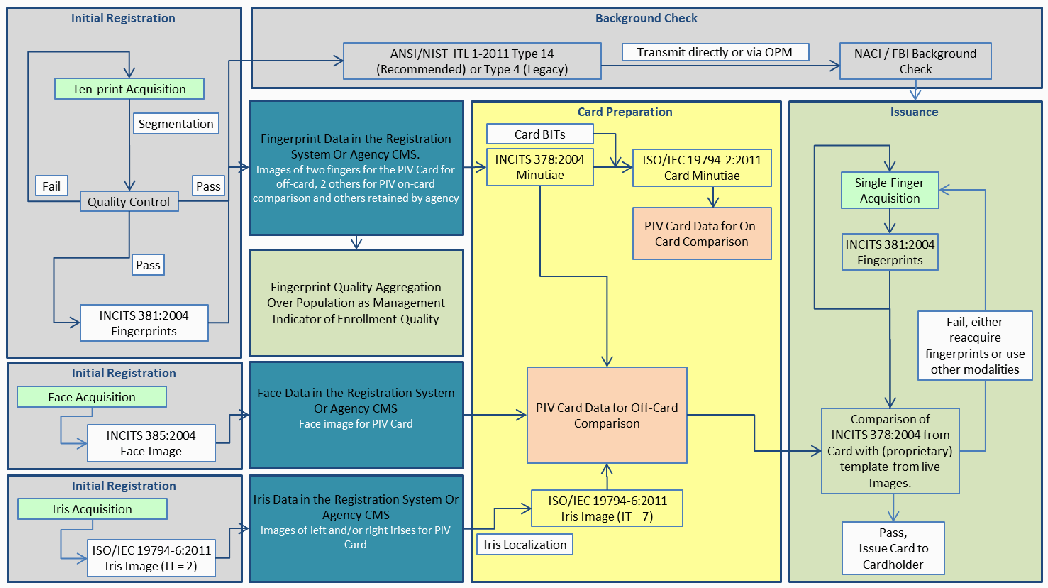
図1 − PIV生体データフロー。左に3つの初期登録パネル(指紋、顔、虹彩)、上部に身元調査、右にカード準備(黄色)と発行(緑色)のパネルがある。指紋登録では、10指採取から分割を経て品質管理へ進む。不合格なら10指採取に戻り、合格ならINCITS 381:2004 Fingerprintsへ進む。別の合格経路はANSI/NIST ITL 1-2011 Type 14 (Recommended) or Type 4 (Legacy)のレコードへ進み、このレコードは(直接またはOPM経由で)NACI / FBI身元調査へ送信され、その結果が発行へ渡る。INCITS 381:2004 Fingerprintsは「登録システムまたは機関CMS内の指紋データ。PIVカードのカード外照合用に2指、PIVカード上照合用に別の2指の画像、その他は機関が保持」へ渡る。そこから「登録品質の管理指標としての母集団全体の指紋品質集計」と、カード準備のINCITS 378:2004 Minutiae(特徴点)へ進む。顔登録では、顔取得からINCITS 385:2004 Face Imageへ進み、「登録システムまたは機関CMS内の顔データ、PIVカード用の顔画像」へ渡る。虹彩登録では、虹彩取得からISO/IEC 19794-6:2011 Iris Image (IT = 2)へ進み、「登録システムまたは機関CMS内の虹彩データ、PIVカード用の左虹彩および/または右虹彩の画像」へ渡る。カード準備では、INCITS 378:2004 MinutiaeとカードBITからISO/IEC 19794-2:2011 Card Minutiaeへ進み、カード上照合用PIVカードデータへ渡る。また、INCITS 378:2004 Minutiae、顔データ、および虹彩位置特定を経たISO/IEC 19794-6:2011 Iris Image (IT = 7)から、カード外照合用PIVカードデータへ進む。発行では、単指取得からINCITS 381:2004 Fingerprintsへ進み、「カード上のINCITS 378:2004と、ライブ画像から得た(独自)テンプレートとの照合」へ渡る。この照合にはカード外照合用データも入力される。「不合格の場合は、指紋を再取得するか他のモダリティを使用」なら単指取得に戻り、成功すれば「合格、カード所有者にカードを発行」へ進む。
Figure 1 − PIV biometric data flow
図1 − PIV生体認証データフロー
1.4.2 Inclusion of iris recognition
1.4.2 虹彩認識の採用
Iris specifications are included, in Section 6, to support biometric authentication of individuals. [FIPS] allows use of iris for this purpose. The recommendation to agencies to install and operate iris equipment in its PIV issuance processes allows agencies to additionally populate PIV Cards with iris as an alternative authentication modality. [FIPS] requires the cardholder to enter a PIN number to release the templates. When the card is cryptographically authenticated, this constitutes multi-factor authentication.
個人の生体認証を支援するため、虹彩仕様を第6節に含めます。[FIPS]は、この目的で虹彩を使用することを許可しています。PIV発行プロセスに虹彩機器を導入・運用するよう機関に勧告することで、機関は代替認証モダリティとしてPIVカードに虹彩情報を追加格納できます。[FIPS]は、テンプレートを解放するため、カード保有者がPIN番号を入力することを求めています。カードが暗号学的に認証される場合、これは多要素認証を構成します。
1.4.3 Inclusion of fingerprint on-card comparison
1.4.3 指紋のカード内照合の採用
[FIPS] requires fingerprint templates of Section 4 as the mandatory biometric element for PIV. These templates are intended to be compared on a reader device with templates collected in an authentication attempt. [FIPS] requires the cardholder to enter a PIN number to release the templates. When the card is cryptographically authenticated, this constitutes multi-factor authentication.
[FIPS]は、第4節の指紋テンプレートをPIVに必須の生体要素として求めています。これらのテンプレートは、認証試行時に取得されたテンプレートとリーダーデバイス上で照合することを意図しています。[FIPS]は、テンプレートを解放するため、カード保有者がPIN番号を入力することを求めています。カードが暗号学的に認証される場合、これは多要素認証を構成します。
Agencies may additionally choose to populate the card with an on-card comparison algorithm, and on-card comparison templates. The specifications for these appear in Section 5. [FIPS] does not require PIN entry ahead of a fingerprint minutiae on-card comparison transaction. Indeed, [FIPS] extends on-card comparison as an alternative to PIN entry in altering the security state of the PIV Card.
機関はさらに、カード内照合アルゴリズムおよびカード内照合テンプレートをカードに格納してもよいです(may)。これらの仕様は第5節に示されています。[FIPS]は、指紋細線分のカード内照合処理の前にPINを入力することを求めていません。実際、[FIPS]は、PIVカードのセキュリティ状態を変更する際に、PIN入力の代替手段としてカード内照合を拡張しています。
Agencies should consider economics of on vs. off card comparison. Particularly, a security flaw, for example, in a card may have different remediation cost than in a card reader.
機関は、カード内照合とカード外照合の経済性を検討すべきです(should)。特に、例えばカードのセキュリティ上の欠陥は、カードリーダーの欠陥とは是正コストが異なる場合があります(may)。
Table 1 describes the differences between the off-card and on-card specifications.
表1では、カード外仕様とカード内仕様の相違を説明します。
Table 1 − Summary of properties and roles of on- and off-card fingerprint comparison
表1 − カード内およびカード外の指紋照合の特性と役割の概要
| # | Aspect | Off-card comparison / On-card comparison |
| 1. | [FIPS] requirement on | Mandatory / Optional |
| presence of biometric data | ||
| 2. | Use cases and pre-requisites | See [FIPS] |
| for access to the data | ||
| 3. | Interagency interoperable | Yes / No (As OCC is optional, it is only interoperable across agencies if both agencies implement it). |
| 4. | Number of fingers required | 2. But 0 or 1 are allowed in exceptional cases – see [FIPS] / 1 or 2 |
| to be stored on card | ||
| 5. | Number of fingers to be used | 1 or 2 / 1 or 2 |
| in a biometric operation | ||
| 6. | Which fingers | Members of the set \(A\), which is a subset of the ten finger set \(T\) / Members of the set \(B\), which is a subset of the ten finger set \(T\), and \(|A \cap B| \ge 0\), i.e., , fingers may be the same. See Section 5.4. |
| 7. | Encoding of specific fingers | INCITS 378:2004 [MINUSTD] / ISO/IEC 7816-11:2004 [CARD-BIO] |
| 8. | Data format specifications | This document, Section 4 / This document, Section 5 |
| 9. | Card interface specifications | SP 800-73-4 [800-73] / SP 800-73-4 |
| 10. | Underlying data format | INCITS 378:2004 [MINUSTD] / ISO/IEC 19794-2:2011 [CARD-MIN] This template shall be computed from the off-card INCITS 378:2004 template. |
| standard | ||
| 11. | Fingerprint capture device | Plain impression as specified in Section 4.7 |
| for biometric operations | ||
| 12. | Accuracy testing | MINEX III / MINEX IV |
| # | 観点 | カード外照合 / カード内照合 |
| 1. | [FIPS]における生体データの | 必須 / 任意 |
| 存在要件 | ||
| 2. | データへのアクセスに関する | [FIPS]を参照 |
| ユースケースおよび前提条件 | ||
| 3. | 機関間の相互運用性 | あり / なし(OCCは任意であるため、両機関が実装した場合に限り機関間で相互運用可能。) |
| 4. | カードに保存する必要がある | 2。ただし例外的な場合は0または1も許可される — [FIPS]を参照 / 1または2 |
| 指の数 | ||
| 5. | 生体認証操作で使用する | 1または2 / 1または2 |
| 指の数 | ||
| 6. | 対象となる指 | 集合\(A\)(十本の指の集合\(T\)の部分集合)の要素 / 集合\(B\)(十本の指の集合\(T\)の部分集合)の要素、かつ\(|A \cap B| \ge 0\)、すなわち、指は同一であってもよいです(may)。第5.4節を参照してください。 |
| 7. | 特定の指の符号化 | INCITS 378:2004 [MINUSTD] / ISO/IEC 7816-11:2004 [CARD-BIO] |
| 8. | データ形式仕様 | 本書、第4節 / 本書、第5節 |
| 9. | カードインターフェイス仕様 | SP 800-73-4 [800-73] / SP 800-73-4 |
| 10. | 基礎となるデータ形式 | INCITS 378:2004 [MINUSTD] / ISO/IEC 19794-2:2011 [CARD-MIN] このテンプレートは、カード外INCITS 378:2004テンプレートから算出しなければなりません(shall)。 |
| 標準 | ||
| 11. | 生体認証操作用の指紋 | 第4.7節に規定する平面接触画像 |
| 取得装置 | ||
| 12. | 精度試験 | MINEX III / MINEX IV |
1.5 Relation to other biometric applications
1.5 他の生体認証アプリケーションとの関係
[FIPS] advances a PIV concept of biometric operations that is three-factor3: A PIN verification is required before biometric data is read from the PIV Card and matched in a 1:1 mode during authentication. In other programs, biometrics are sometimes stored on a central server, or read from a card and cached on one. In others, the biometric is matched in a one-to-many mode without presentation of a card to claim an identity. There are tradeoffs with such approaches.
[FIPS]は、生体認証処理に関する三要素3のPIV構想を推進します。認証中にPIVカードから生体データを読み取り、1:1モードで照合する前にPINの検証が求められます。他のプログラムでは、生体情報を中央サーバーに保存したり、カードから読み取ってサーバーにキャッシュしたりすることがあります。また、身元を申告するためのカード提示なしに、生体情報を一対多数モードで照合する場合もあります。このようなアプローチにはトレードオフがあります。
― PIV Card read times are replaced with network transmission times. ― PIN entry times are eliminated but the something-you-know additional factor is lost. ― The remote server is subject to physical or logical attack (e.g., a denial-of-service attack). Many kinds of templates stored on a server can be reversed to produce a matchable-sample [REVFING, REVIRIS, REVFACE]. Formal template protection schemes, which mitigate the effect of compromise of a database, require further testing. ― If the PIV Card is not used to make an explicit claim to one of the N enrolled identities, the biometric-only one-to-many authentication loses the something-you-have factor, and necessitates mitigation of a N-fold increase in false match rates. ― Such use cases are not addressed by this specification.
― PIVカードの読み取り時間がネットワーク送信時間に置き換わります。― PIN入力時間はなくなりますが、「知っているもの」という追加要素が失われます。― リモートサーバーは物理的または論理的攻撃(例: サービス拒否攻撃)の対象となります。サーバーに保存された多くの種類のテンプレートは、照合可能なサンプルに逆変換できます [REVFING, REVIRIS, REVFACE]。データベース侵害の影響を軽減する正式なテンプレート保護方式については、さらなる試験が必要です。― PIVカードを使用して登録済みN個の本人識別情報のいずれかを明示的に主張しない場合、生体情報のみを用いる一対多数認証では「所有するもの」という要素が失われ、誤照合率のN倍増加を緩和する必要があります。― このようなユースケースは本仕様では扱いません。
1.6 Second generation standards
1.6 第二世代標準
Since the first publication of SP 800-76 in 2005, considerable effort has been dedicated to the development of second-generation biometric data interchange standards. These are the various parts of ISO/IEC 19794, as revised, and updates to the analogous INCITS standards in c. 2009. These standards have not been adopted here as replacements for the extant PIV biometric standards - INCITS 385:2004 (face), INCITS 381:2004 (fingerprint image), and INCITS 378:2004 (fingerprint minutiae) – because ― they are not binary compatible with the earlier standards, ― deployed infrastructure (readers) would need to be updated to support both the legacy and second generation standards, and ― they confer essentially no performance advantages over the earlier standards. For data elements that were not included in the 2005 PIV specifications, i.e., images to support iris recognition and minutia data to support on-card comparison, this specification adopts the latest ISO/IEC 19794 Part 2 and Part 6 standards [CARD-MIN, IRISSTD].
2005年にSP 800-76が初めて刊行されて以降、第二世代の生体データ交換標準の策定に相当な努力が注がれてきました。これらは、改訂されたISO/IEC 19794の各部および2009年頃の対応するINCITS標準の更新版です。これらの標準は、既存のPIV生体認証標準であるINCITS 385:2004(顔)、INCITS 381:2004(指紋画像)、およびINCITS 378:2004(指紋特徴点)を置き換えるものとして採用されていません。その理由は、― 旧標準とバイナリ互換性がないこと、― 従来世代と第二世代の両標準に対応するには、配備済みインフラストラクチャ(リーダー)の更新が必要になること、および― 旧標準に比べて実質的に性能上の利点がないことです。2005年のPIV仕様に含まれていなかったデータ要素、すなわち虹彩認識を支援する画像およびカード内照合を支援する特徴点データについては、本仕様は最新のISO/IEC 19794 Part 2およびPart 6標準 [CARD-MIN, IRISSTD] を採用します。
2. Terms and acronyms
2. 用語および略語
2.1 Terms
2.1 用語
| Term | Definition |
|---|---|
| Fingerprint segmentation | Segmentation is the automated (and often manually reviewed) separation of an image of N fingers into N images of individual fingers. N is usually four, for the index through little finger, and two for a capture of two thumbs. |
| Iris segmentation | Segmentation is the automated (and possibly manually reviewed) detection of the iris-sclera and iris-pupil boundaries. This localizes the iris texture that is used for actual recognition. |
| One-to-many | Of or relating to biometric identification in which submitted feature data is compared with that of all enrolled identities. |
| One-to-one | Of or relating to biometric verification in which submitted feature data is compared with that of one, claimed, identity. |
| 用語 | 定義 |
|---|---|
| 指紋セグメンテーション | セグメンテーションとは、N本の指の画像を個々の指のN枚の画像に自動的に(多くの場合、手動でレビューして)分離することです。Nは通常、示指から小指までの四本分と、両親指を取得する場合の二本分です。 |
| 虹彩セグメンテーション | セグメンテーションとは、虹彩と強膜の境界および虹彩と瞳孔の境界を自動的に(場合によっては手動でレビューして)検出することです。これにより、実際の認識に使用する虹彩テクスチャの位置を特定します。 |
| 一対多 | 入力された特徴データを登録済みのすべての本人識別情報の特徴データと比較する生体認証識別に関する、またはそれを指します。 |
| 一対一 | 入力された特徴データを申告された一人の本人識別情報の特徴データと比較する生体認証検証に関する、またはそれを指します。 |
Other biometrics-related terms are defined and harmonized in [VOCABSTD].
生体認証に関するその他の用語は、[VOCABSTD]で定義され、整合化されています。
2.2 Acronyms
2.2 略語
| Acronym | Definition |
|---|---|
| BIT | Biometric Information Template – a [CARD-BIO] data structure indicating Card capability |
| CBEFF | Common Biometric Exchange Formats Framework |
| DET | Detection Error Tradeoff (characteristic) – A plot of FRR vs. FAR, or FNMR vs. FMR, used to inform security-convenience tradeoffs in (biometric) authentication processes |
| FAR | False Accept Rate (defined over an authentication transaction) |
| FIPS | Federal Information Processing Standard |
| FMR | False Match Rate (defined over single comparisons) |
| FNMR | False Non-Match Rate (defined over single comparisons) |
| FRR | False Reject Rate (defined over an authentication transaction) |
| FTE | Failure to Enroll Rate |
| EBTS | Electronic Biometric Transmission Specification (See References Section 12) |
| JPEG | Joint Photographic Experts Group, standardized compression algorithm for face images |
| OCC | On-card comparison |
| PNG | Portable Network Graphics, standardized lossless compression algorithm for images |
| IREX | Iris Exchange – the NIST program supporting iris-based biometrics |
| MINEX | Minutia Exchange – the NIST program supporting minutia-based biometrics |
| NACI | National Agency Check with Inquiries |
| NFIQ | NIST Fingerprint Image Quality – an automated algorithm for quantifying good fingerprint images; available as open-source. |
| SP | Special Publication – a designation for NIST documents, sometimes supporting FIPS. |
| WSQ | Wavelet Scalar Quantization |
| 略語 | 定義 |
|---|---|
| BIT | 生体情報テンプレート(Biometric Information Template)– カードの機能を示す[CARD-BIO]データ構造 |
| CBEFF | 共通生体認証交換形式フレームワーク(Common Biometric Exchange Formats Framework) |
| DET | 検知誤差トレードオフ(特性)(Detection Error Tradeoff)– 生体認証を用いる認証プロセスにおけるセキュリティと利便性のトレードオフを把握するために使用するFRR対FAR、またはFNMR対FMRのプロット |
| FAR | 誤受入率(False Accept Rate)(認証トランザクションについて定義) |
| FIPS | 連邦情報処理標準(Federal Information Processing Standard) |
| FMR | 誤照合率(False Match Rate)(個々の照合について定義) |
| FNMR | 誤非照合率(False Non-Match Rate)(個々の照合について定義) |
| FRR | 誤拒否率(False Reject Rate)(認証トランザクションについて定義) |
| FTE | 登録失敗率(Failure to Enroll Rate) |
| EBTS | 電子生体認証伝送仕様(Electronic Biometric Transmission Specification)(第12節の参考文献を参照) |
| JPEG | Joint Photographic Experts Group、顔画像用の標準化された圧縮アルゴリズム |
| OCC | カード内照合(On-card comparison) |
| PNG | Portable Network Graphics、画像用の標準化された可逆圧縮アルゴリズム |
| IREX | 虹彩交換(Iris Exchange)– 虹彩ベースの生体認証を支援するNISTプログラム |
| MINEX | 細線分交換(Minutia Exchange)– 細線分ベースの生体認証を支援するNISTプログラム |
| NACI | 照会付き国家機関チェック(National Agency Check with Inquiries) |
| NFIQ | NIST指紋画像品質(NIST Fingerprint Image Quality)– 良好な指紋画像を定量化する自動アルゴリズム。オープンソースとして入手可能。 |
| SP | 特別刊行物(Special Publication)– NIST文書の呼称であり、FIPSを補足することもあります。 |
| WSQ | ウェーブレットスカラー量子化(Wavelet Scalar Quantization) |
2.3 Organizations
2.3 組織
| Acronym | Definition |
|---|---|
| ANSI | American National Standards Institute |
| FBI | Federal Bureau of Investigation |
| IEC | International Electrotechnical Commission |
| INCITS | InterNational Committee for Information Technology Standards |
| ISO | International Organization for Standardization |
| ITL | Information Technology Laboratory (of NIST) |
| NIST | National Institute of Standards and Technology |
| OMB | Office of Management and Budget |
| OPM | Office of Personnel Management |
| SC 37 | The Biometrics standardization subcommittee under ISO/IEC Joint Technical Committee 1 |
| 略語 | 定義 |
|---|---|
| ANSI | 米国規格協会(American National Standards Institute) |
| FBI | 連邦捜査局(Federal Bureau of Investigation) |
| IEC | 国際電気標準会議(International Electrotechnical Commission) |
| INCITS | 情報技術規格に関する国際委員会(InterNational Committee for Information Technology Standards) |
| ISO | 国際標準化機構(International Organization for Standardization) |
| ITL | 情報技術研究所(NIST内)(Information Technology Laboratory) |
| NIST | 米国国立標準技術研究所(National Institute of Standards and Technology) |
| OMB | 行政管理予算局(Office of Management and Budget) |
| OPM | 人事管理局(Office of Personnel Management) |
| SC 37 | ISO/ |
3. Fingerprint enrollment
3. 指紋の登録
3.1 Scope
3.1 適用範囲
The specifications in this Section pertain to the production of the mandatory PIV biometric enrollment data. That is, this Section provides specifications for acquisition, formatting, and storage of fingerprint images and templates. The following is an overview of the material covered in this Section.
本節の仕様は、必須の PIV 生体登録データの作成に関するものです。すなわち、本節は、指紋画像およびテンプレートの取得、書式化、格納に関する仕様を示します。以下は、本節で扱う内容の概要です。
•Sub-Section 3.2.1 gives specifications capture of fingerprints for PIV Registration and background checks;
•3.2.1 節は、PIV登録および身元調査のための指紋採取に関する仕様を示します。
•Sub-Section 3.2.2 recommends training of enrollment station operators;
•3.2.2 節は、登録端末の操作者の訓練を推奨します。
•Sub-Section 3.2.3 recommends use of automated means to track fingerprint image quality over time;
•3.2.3 節は、指紋画像の品質を経時的に追跡するための自動化された手段の使用を推奨します。
•Sub-Section 3.3 gives specifications for how fingerprint images are retained by agencies. [FIPS] gives requirements and options for the retention of biometric data. Retention of data supports, for example, detection of duplicate identities. When fingerprint images are retained they shall be stored in the format specified in sub-Section 3.3. The format specification includes the [CBEFF] header of Section 9 to implement the requirement to protect the integrity, and to allow for encryption, of the image records.
•3.3 節は、機関が指紋画像をどのように保持するかについての仕様を示します。[FIPS] は、生体データの保持に関する要件と選択肢を示しています。データの保持は、たとえば重複したアイデンティティの検出を支援します。指紋画像を保持する場合は、3.3 節で規定する書式で格納しなければなりません(shall)。この書式の仕様には、画像レコードの完全性を保護し、暗号化を可能にするという要件を実装するため、9 節の [CBEFF] ヘッダが含まれます。
•Sub-Section 3.4 specifies the transformation of fingerprints into records suitable for transmission to the FBI for the background check.
•3.4 節は、指紋を、身元調査のために FBI へ送信するのに適したレコードへ変換する方法を規定します。
Although FBI requirements drive the sensor specifications, the permanent electronic storage format specified in sub-Section 3.3 is an INCITS standard record and is therefore specified independently.
センサ仕様は FBI の要件によって決まりますが、3.3 節で規定する恒久的な電子格納書式は INCITS 標準のレコードであるため、独立して規定されています。
If an agency retains fingerprint templates, in either proprietary or standardized formats, then they shall be embedded in the [CBEFF] header of Section 9 which requires integrity protection and allows for encryption of the records.
機関が、独自形式または標準化された形式のいずれであっても指紋テンプレートを保持する場合は、完全性保護を必須とし、レコードの暗号化を可能にする 9 節の [CBEFF] ヘッダに埋め込まなければなりません(shall)。
3.2 Fingerprint image acquisition
3.2 指紋画像の取得
3.2.1 Fingerprint collection
3.2.1 指紋の採取
This Section specifies the capture of a full set of fingerprint images for PIV registration. A subject's fingerprints shall be collected according to one of the three imaging modes enumerated in Table 2.
本節は、PIV 登録のための指紋画像一式の取得について規定します。対象者の指紋は、表 2 に列挙された 3 つの撮像モードのいずれかに従って採取しなければなりません(shall)。
Table 2 − Fingerprint acquisition protocols
表 2 − 指紋取得プロトコル
| # | Option 1 – Required presentations for plain live scan | |
|---|---|---|
| 1 | Combined plain impression of the four fingers on the right hand (no thumb) | |
| 2 | Combined plain impression of the four fingers on the left hand (no thumb) | |
| 3 | Combined impression of the two thumbs | |
| Option 2 – Required presentations for rolled live scan | ||
| 1 | 10 separately rolled fingers | |
| 2 | Combined plain impression of the four fingers on the right hand (no thumb) | |
| 3 | Combined plain impression of the four fingers on the left hand (no thumb) | |
| 4 | Left thumb plain impression | These captures may be simultaneous (two thumbs next to each other) or sequential (one thumb at a time) |
| 5 | Right thumb plain impression | |
| Option 3 – Required presentations for rolled ink on card | ||
| 1 | 10 separately rolled fingers | |
| 2 | Combined plain impression of the four fingers on the right hand (no thumb) | |
| 3 | Combined plain impression of the four fingers on the left hand (no thumb) | |
| 4 | Left thumb plain impression | These captures may be simultaneous (two thumbs next to each other) or sequential (one thumb at a time) |
| 5 | Right thumb plain impression | |
| # | 選択肢1 – 平面接触ライブスキャンで必要な提示 | |
|---|---|---|
| 1 | 右手の四本の指(親指を除く)の合成平面接触画像 | |
| 2 | 左手の四本の指(親指を除く)の合成平面接触画像 | |
| 3 | 両親指の合成画像 | |
| 選択肢2 – 回転ライブスキャンで必要な提示 | ||
| 1 | 個別に回転させた10本の指 | |
| 2 | 右手の四本の指(親指を除く)の合成平面接触画像 | |
| 3 | 左手の四本の指(親指を除く)の合成平面接触画像 | |
| 4 | 左親指の平面接触画像 | これらの取得は同時(両親指を並べる)でも順次(親指を一度に一本ずつ)でもよい |
| 5 | 右親指の平面接触画像 | |
| 選択肢3 – カード上の回転インク指紋で必要な提示 | ||
| 1 | 個別に回転させた10本の指 | |
| 2 | 右手の四本の指(親指を除く)の合成平面接触画像 | |
| 3 | 左手の四本の指(親指を除く)の合成平面接触画像 | |
| 4 | 左親指の平面接触画像 | これらの取得は同時(両親指を並べる)でも順次(親指を一度に一本ずつ)でもよい |
| 5 | 右親指の平面接触画像 | |
INFORMATIVE NOTES:
参考情報:
1.There is no requirement that the order specified above is the order in which the images should be acquired.
1.上記に規定された順序が、画像を取得すべき順序であるという要件はありません。
2.The combined multi-finger plain-impression images are also referred to as slaps or flats. They are obtained by simultaneous placement of multiple fingers on the imaging surface without specific rolling movement.
2.複数指の平面押捺を合成した画像は、スラップまたはフラットとも呼ばれます。これは、特定のローリング動作を伴わずに、複数の指を同時に撮像面に置くことで得られます。
3.Options 2 and 3 represent existing agency practice. Although Option 1 is now acceptable to the FBI, agencies may still need to implement Options 2 or 3 for transmission via the Office of Personnel Management.
3.選択肢2および3は、既存の機関の慣行を表します。選択肢1は現在FBIに受け入れられていますが、機関は人事管理局を介した送信のために選択肢2または3を実装する必要がある場合があります(may)。
For Options 1 and 2 the devices used for capture of the fingerprints shall have been certified by the FBI to conform to Appendix F of the FBI’s Electronic Biometric Transmission Specification [EBTS, Appendix F]. For Option 3, a scan of the inked card shall be performed to effect conversion to electronic form. The scanner shall be certified by the FBI as being compliant with [EBTS, Appendix F]. The scanning is needed to produce fingerprints in the digital formats of Sub-sections 3.3 and 3.4. The FBI specifications include width and height specifications for the imaging surface. The native scanning resolution of the device shall be 197 pixels per centimeter (500 pixels per inch) in both the horizontal and vertical directions. These specifications comply with the FBI submission requirements and with the Image Acquisition Setting Level 31 of the Finger Image-Based Data Interchange Format standard, INCITS 381 [FINGSTD].
選択肢1および2では、指紋取得に使用する装置は、FBIの電子生体認証伝送仕様[EBTS, Appendix F]の付録Fへの適合認定をFBIから受けていなければなりません(shall)。選択肢3では、インクを付けたカードをスキャンし、電子形式に変換しなければなりません(shall)。スキャナーは[EBTS, Appendix F]に準拠しているとしてFBIの認定を受けていなければなりません(shall)。このスキャンは、第3.3小節および第3.4小節のデジタル形式の指紋を作成するために必要です。FBI仕様には、画像取得面の幅および高さの仕様が含まれます。装置のネイティブスキャン解像度は、水平方向および垂直方向の両方でセンチメートル当たり197ピクセル(インチ当たり500ピクセル)でなければなりません(shall)。これらの仕様は、FBI提出要件および指紋画像ベースデータ交換形式標準INCITS 381 [FINGSTD]の画像取得設定レベル31に準拠しています。
For live-scan acquisition i.e., options 1 and 2, the enrollment client software should display the images to the attending operator. The operator should repeat acquisition if the ridge structure is not clear, broken, or incomplete in the displayed images.
ライブスキャン取得(すなわち選択肢1および2)では、登録クライアントソフトウェアは立会い操作者に画像を表示すべきです(should)。表示画像で隆線構造が不明瞭、途切れている、または不完全な場合、操作者は取得をやり直すべきです(should)。
The procedure for the collection of fingerprints, presented in Table 3, shall be followed. The procedure shall employ the NIST Fingerprint Image Quality [NFIQ] algorithm4 to initiate any needed reacquisition of the images. An attending official shall be present at the time of fingerprint capture. The agency shall employ measures to ensure the quality of acquisition and guard against faulty presentation, whether malicious or unintentional. Quality assessment might be an integral function of the acquisition device or might be implemented by the attending official. In any case, the agency shall ensure that the applicant does not swap finger positions or hands, occlude fingers, or misalign or misplace the fingers. Particularly, because it is common during collection of multi-finger plain impressions for little fingers (i.e., positions 05 and 10) to not be long enough to reach the imaging platen, it is accepted practice for the hand to be placed at an angle to the horizontal to ensure imaging of all four fingers. Although this is not needed with newer large-platen devices the official shall in all cases take care to image all fingers completely. The procedure requires segmentation of the multi-finger plain impressions; this operation may be assisted by the attending official.
表3に示す指紋採取手順に従わなければなりません(shall)。この手順では、必要な画像の再取得を開始するためにNIST指紋画像品質[NFIQ]アルゴリズム4を使用しなければなりません(shall)。指紋取得時には立会い担当者がいなければなりません(shall)。機関は、取得品質を確保し、悪意の有無を問わず不適切な提示を防止する措置を講じなければなりません(shall)。品質評価は取得装置の組込み機能である場合も、立会い担当者が実施する場合もあります。いずれの場合も、機関は、申請者が指の位置や手を入れ替えたり、指を遮蔽したり、指の位置合わせを誤ったり、指を不適切に置いたりしないことを確保しなければなりません(shall)。特に、複数指の平面接触画像の採取では、小指(すなわち位置05および10)が画像取得プラテンに届くほど長くないことが一般的であるため、四本すべての指を画像化するために、手を水平に対して斜めに置くことが許容されています。新しい大型プラテン装置ではこの方法は不要ですが、担当者はすべての場合に全指を完全に画像化するよう注意しなければなりません(shall)。この手順では複数指の平面接触画像をセグメント化する必要があり、この作業は立会い担当者が支援してもよいです(may)。
Table 3 − Quality control procedure for acquisition of a full set of fingerprint images
表3 − 指紋画像一式を取得するための品質管理手順
| Step | Action |
|---|---|
| 1. | Attending official should start by inspecting fingers and require absence of dirt, coatings, gels, and other foreign material. |
| 2. | Official should ensure imaging surface of the sensor or the paper card is clean. |
| 3. | Acquire fingerprints according to Option 1, 2, or 3 in Table 2. For Option 3, scan the inked card using [EBTS, Appendix F] certified scanner. |
| 4. | Segment the multi-finger plain impression images into single-finger images. Automated segmentation is recommended. Attending official should inspect the boundaries of the automatic segmentation and correct any failures, perhaps via an interactive graphical user interface. |
| 5. | Compute NFIQ value5 for thumbs and index fingers. If all have NFIQ values 1, 2, or 3 (i.e., , good quality) then go to step 8. |
| 6. | Repeat steps 2-5 up to three more times. |
| 7. | If after four acquisitions the index fingers and thumbs do not all have NFIQ values of 1, 2 or 3 then select that set, acquired in step 3 and segmented in step 4, for which the mean of the NFIQ values of the left index, right index, left thumb, and right thumb is minimum (i.e., of best quality). If all of the index finger and thumb quality values are unavailable (perhaps because of injury to one or more of those fingers) then use the last set from step 3 of those fingers that are available, without any application of NFIQ. |
| 8. | Prepare and store the final records per Sub-sections 3.3 and 3.4 |
| 手順 | 操作 |
|---|---|
| 1. | 立会い担当者はまず指を検査し、汚れ、被膜、ゲル、およびその他の異物がないことを確認すべきです。 |
| 2. | 担当者はセンサーまたは紙カードの画像取得面が清潔であることを確認すべきです。 |
| 3. | 表2の選択肢1、2、または3に従って指紋を取得します。選択肢3では、[EBTS, Appendix F]認定スキャナーを用いてインクを付けたカードをスキャンします。 |
| 4. | 複数指の平面接触画像を単指画像にセグメント化します。自動セグメンテーションが推奨されます。立会い担当者は自動セグメンテーションの境界を検査し、誤りがあれば、場合によっては対話型グラフィカルユーザーインターフェイスを介して修正すべきです。 |
| 5. | 親指および示指のNFIQ値5を算出します。すべてが1、2、または3(すなわち、良好な品質)であれば、手順8に進みます。 |
| 6. | 手順2~5をさらに最大三回繰り返します。 |
| 7. | 四回取得した後も、示指および親指のNFIQ値がすべて1、2または3にならない場合は、手順3で取得し手順4でセグメント化した組のうち、左示指、右示指、左親指および右親指のNFIQ値の平均が最小(すなわち品質が最良)となるものを選択します。示指および親指の品質値がすべて得られない場合(それらの指の一本以上に負傷があるなどの理由による)は、利用可能な指について、手順3で取得した最後の組を、NFIQを適用せずに使用します。 |
| 8. | 3 |
Ordinarily, all ten fingerprints shall be imaged in this process; however, if one or more fingers are not available (for instance, because of amputation) then as many fingers as are available shall be imaged. When fewer than ten fingers are collected, the FBI background transaction of Sub-section 3.4 requires field AMP 2.084 of the accompanying Type 2 record [see EBTS, Appendix C] to have labels indicating fingers that are amputated or otherwise not imaged.
通常、このプロセスでは十本すべての指を画像化しなければなりません(shall)。ただし、切断などの理由で一つ以上の指を利用できない場合は、利用可能な指をできるだけ多く画像化しなければなりません(shall)。十本未満の指を採取した場合、第3.4小節のFBI背景調査トランザクションでは、付随するタイプ2レコード[EBTS, Appendix Cを参照]のフィールドAMP 2.084に、切断またはその他の理由で画像化されていない指を示すラベルを付す必要があります。
3.2.2 Training of PIV fingerprint collection staff
3.2.2 PIV指紋採取担当者の訓練
Quality of the biometric data is critical to the success of a biometric application. This is particularly true for enrollment data that typically persists for years. As enrollment is an attended operation, the operator is important to the collection of high quality data. Attending staff should be trained to maintain and clean the sensor, and to collect in accordance with manufacturer's guidance and this document. Specifically Agencies shall apprise staff that: ― Low humidity - typical in winter – causes dry fingers from which good images are more difficult to collect. This risk can be mitigated by measurement and appropriate use of supplemental humidification. Fingers may be lightly moisturized. ― Exposure of biometric equipment to bright light sources, such as direct sunlight, is generally adverse for collection of fingerprints. ― The background check can be defeated by mutilation of the fingerprints e.g.,either temporarily (e.g.,by burns or abrasives) or permanently (e.g.,by surgical means). In addition certain medications can cause loss of fingerprint ridge structure. It is recommended that collection of fingerprints from applicants with finger injuries be delayed until the fingers heal.
生体データの品質は、生体認証アプリケーションの成功にとって極めて重要です。これは、通常は何年も保持される登録データに特に当てはまります。登録は立会いの下で行うため、高品質データの採取には操作者が重要です。立会い担当者は、センサーの保守および清掃、ならびに製造業者の指針および本書に従った採取について訓練を受けるべきです(should)。特に、機関は担当者に次を周知しなければなりません(shall)。― 低湿度(冬季に典型的)は指を乾燥させ、良好な画像の採取を難しくします。このリスクは、湿度を測定し、適切に補助加湿を使用することで軽減できます。指を軽く保湿してもよいです(may)。― 直射日光などの強い光源に生体認証機器をさらすことは、一般に指紋採取に悪影響を及ぼします。― 指紋を損傷させることで身元調査を回避できます。これは一時的(例: 火傷または研磨剤による)または永続的(例: 外科的手段による)であり得ます。さらに、特定の薬剤が指紋の隆線構造の喪失を引き起こす場合もあります。指に負傷のある申請者の指紋採取は、指が治癒するまで延期することが推奨されます。
3.2.3 Monitoring overall enrollment quality
3.2.3 登録品質全体の監視
In order to track enrollment quality over time, a numerical summary of operational quality may be computed as a management indicator. If computed, this summary shall be computed from the NFIQ values of primary fingers of all PIV Card applicants processed in each calendar month. If computed, the summary shall be computed using the method of NIST Interagency Report 7422 [NFIQ SUMMARY] which uses a simple formula to aggregate NFIQ values. This calculation is readily automated.
登録品質を時間の経過とともに追跡するため、運用品質の数値要約を管理指標として算出してもよいです(may)。算出する場合、この要約は、各暦月に処理したすべてのPIVカード申請者の主要な指のNFIQ値から算出しなければなりません(shall)。算出する場合、この要約は、NFIQ値を集約する簡単な式を用いるNIST省庁間報告書7422 [NFIQ SUMMARY]の方法で算出しなければなりません(shall)。この計算は容易に自動化できます。
Managers can track this over time, across collection sites or stations, over different populations (e.g., contractors vs. employees), across functions (PIV issuance vs. re-issuance), or even across fingers. Managers can use aggregated quality indicators as a tool to identify fingerprint collection problems. These may be due to changes in the physical environment or unintended changes in operating procedures.
管理者は、この指標を時間の経過に伴って、採取場所またはステーション間で、異なる母集団間(例: 契約業者と職員)、異なる機能間(PIV発行と再発行)、さらには指ごとに追跡できます。管理者は、集約品質指標を指紋採取上の問題を特定するツールとして使用できます。これらの問題は、物理的環境の変化または意図しない運用手順の変更による場合があります(may)。
3.3 Fingerprint image format for images retained by agencies
3.3 機関が保持する画像の指紋画像形式
This Section specifies a common data format record for the retention of the fingerprint images collected in Sub-section 3.2. Specifically any fingerprint images enrolled or otherwise retained by agencies shall be formatted according to the INCITS 381-2004 finger image based interchange format standard [FINGSTD]. This set should include single-finger images. These shall be obtained by segmentation of the plain multi-finger images gathered in accordance with Options 1, 2 or 3 of Table 2, and the single plain thumb impressions from presentations 4 & 5 of Options 2 and 3. These images shall be placed into a single [FINGSTD] record. The record may also include the associated multi-finger plain impressions and the rolled images. This document ([800-76]) does not specify uses for any single-finger rolled images gathered according to Options 2 or 3 of Table 2. The record shall be wrapped in the CBEFF structure described in Section 9. Agencies may encrypt this data per the provisions of Section 9, Table 14, Note 2.
本節では、第3.2小節で採取した指紋画像を保持するための共通データ形式レコードを規定します。具体的には、機関が登録またはその他の方法で保持する指紋画像は、INCITS 381-2004指紋画像ベース交換形式標準[FINGSTD]に従って形式化しなければなりません(shall)。この画像一式には単指画像を含めるべきです(should)。単指画像は、表2の選択肢1、2、または3に従って採取した複数指の平面接触画像、および選択肢2と3の提示4 & 5で得た単独の親指平面接触画像をセグメント化して取得しなければなりません(shall)。これらの画像は単一の[FINGSTD]レコードに格納しなければなりません(shall)。レコードには、関連する複数指の平面接触画像および回転画像も含めてもよいです(may)。本書([800-76])は、表2の選択肢2または3に従って取得した単指回転画像の用途を規定しません。このレコードは第9節に記述するCBEFF構造でラップしなければなりません(shall)。機関は、第9節、表14、注2の規定に従ってこのデータを暗号化してもよいです(may)。
Table 4 is a clause-by-clause profile of [FINGSTD] for PIV. Its structure is as follows. ― Rows 1-10 give normative content in INCITS 381 on the kind of images to be acquired. ― Row 11 requires the CBEFF structure of Section 9 (i.e., header of Table 14, digital signature of Section 9.3). ― Rows 12-27 give PIV specifications for the fields of the General Record Header of [FINGSTD, Table 2]. These are common to all images in the record. ― Similarly, rows 28-36 provide specifications for the Finger Image Header Record in Table 4 of [FINGSTD]. The "PIV Conformance" column provides PIV specific practice and parameter defaults of the standard. While INCITS 381 has been revised by the INCITS M1 committee, the 2004 edition is sufficient for PIV so the 2009 revision is irrelevant to PIV; however implementations should respect the version number on Line 14 of Table 4.
表4は、PIV向け[FINGSTD]の条項ごとのプロファイルです。その構造は次のとおりです。― 行1-10は、取得対象画像の種類に関するINCITS 381の規範的内容を示します。― 行11は第9節のCBEFF構造(すなわち、表14のヘッダーおよび第9.3節のデジタル署名)を要求します。― 行12-27は、[FINGSTD, 表2]の一般レコードヘッダーのフィールドに関するPIV仕様を示します。これらはレコード内のすべての画像に共通です。― 同様に、行28-36は[FINGSTD]の表4にある指紋画像ヘッダーレコードの仕様を示します。「PIV Conformance」列は、PIV固有の実務および標準のパラメーター既定値を示します。INCITS 381はINCITS M1委員会によって改訂されていますが、2004年版でPIVには十分であるため、2009年改訂版はPIVには無関係です。ただし、実装は表4の行14にあるバージョン番号を尊重すべきです(should)。
To assist implementers, NIST has made [FINGSTD] sample data available6.
実装者を支援するため、NISTは[FINGSTD]のサンプルデータを公開している6。
Table 4 − INCITS 381 profile for agency retention of fingerprint Images
表4 − 機関による指紋画像保持のためのINCITS 381プロファイル
| Clause title and/or field name | INCITS 381-2004 | PIV Conformance | ||||
| (Numbers in parentheses are | Field or | Value | Informative Remarks | |||
| Values allowed | ||||||
| [FINGSTD] clause numbers) | content | required | ||||
| 1. | Byte and bit ordering (5.1) | NC | A | Big Endian MSB then LSB | ||
| 2. | Scan sequence (5.2) | NC | A | |||
| 3. | Image acquisition reqs. (6) | NC | Level 31 | See [FINGSTD] and also Table 1 | ||
| 4. | Pixel Aspect Ratio (6.1) | NC | A | 1:1 | ||
| 5. | Pixel Depth (6.2) | NC | A | Level 31 - 8 | ||
| 6. | Grayscale data (6.3) | NC | A | Level 31 - 1 byte per pixel | ||
| 7. | Dynamic Range (6.4) | NC | A | Level 31 - 200 gray levels | ||
| 8. | Scan resolution (6.5) | NC | A | Level 31 - 500 ppi | ||
| 9. | Image resolution (6.6) | NC | 197 | Pixels per centimeter - no interpolation | ||
| 10. | Fingerprint image location (6.7) | NC | A | Slap placement info, centering | ||
| 11. | CBEFF Header (7) | MF | MV | Patron Format PIV | Multi-field CBEFF Header, Sec. 7.3 | |
| 12. | General Record Header (7.1) | NC | A | |||
| 13. | Finger image record format | Format Identifier (7.1.1) | MF | MV | 0x46495200 | i.e., ASCII "FIR\0" |
| 14. | Version Number (7.1.2) | MF | MV | 0x30313000 | i.e., ASCII "010\0" | |
| 15. | Record Length (7.1.3) | MF | MV | MIT | Size excluding CBEFF structure | |
| 16. | CBEFF Product Owner (7.1.4) | MF | MV | \(> 0\) | CBEFF PID. | |
| 17. | CBEFF Product Identifier Type (7.1.4) | MF | MV | \(> 0\) | ||
| 18. | Capture Device ID (7.1.5) | MF | MV | MIT | Vendor specified. See Note 1 | |
| 19. | Image Acquisition Level (7.1.6) | MF | MV | 31 | Settings Level 31 | |
| 20. | Number of Images (7.1.7) | MF | MV | MIT | Denote by \(K\), see lines 28-37, see Notes 2-4 | |
| 21. | Scale units (7.1.8) | MF | MV | 0x02 | Centimeters | |
| 22. | Scan resolution (horz) (7.1.9) | MF | MV | 197 | Pixels per centimeter | |
| 23. | Scan resolution (vert) (7.1.10) | MF | MV | 197 | ||
| 24. | Image resolution (horz) (7.1.11) | MF | MV | 197 | ||
| 25. | Image resolution (vert) (7.1.12) | MF | MV | 197 | ||
| 26. | Pixel Depth (7.1.13) | MF | MV | 8 | Grayscale with 256 levels | |
| 27. | Image compression algorithm (7.1.14) | MF | MV | 0 or 2 | Uncompressed or WSQ 3.1 See Notes 5 and 6. | |
| 28. | Reserved (7.1.15) | MF | MV | 0 | Two bytes, see Note 12 | |
| 29. | \(K\) fingerprints, or multi-finger prints | Finger data block length (7.2.1) | MF | MV | MIT | |
| 30. | Finger position (7.2.2) | MF | MV | MIT | ||
| 31. | Count of views (7.2.3) | MF | MV | \(\ge 1\) | \(M\) views of this finger, see Note 7 | |
| 32. | \(M\) finger views | View number (7.2.4) | MF | MV | MIT | |
| 33. | Finger image quality (7.2.5) | MF | MV | 20,40,60,80,100, 254 | Transformed NFIQ. See Notes 8 and 9 | |
| 34. | Impression type (7.2.6) | MF | MV | 0 or 2 | See ANSI NIST ITL 1-2000 | |
| 35. | Horizontal line length (7.2.7) | MF | MV | MIT | See Note 10 | |
| 36. | Vertical line length (7.2.8) | MF | MV | MIT | ||
| 37. | Reserved (no clause) | MF | MV | 0 | See Note 11 | |
| 38. | Finger image data (7.2.9) | MF | MV | MIT | Uncompressed or compressed WSQ Data | |
| 39. | CBEFF Signature Block | MF | MV | See Section 9.3 of this document | ||
| END OF TABLE |
| 条項名および/またはフィールド名 | INCITS 381-2004 | PIV Conformance | ||||
| (括弧内の数字は | フィールドまたは | 値 | 参考情報 | |||
| 許容値 | ||||||
| [FINGSTD]の条項番号) | 内容 | 必須 | ||||
| 1. | バイトおよびビットの順序(5.1) | NC | A | ビッグエンディアン、MSBからLSBの順 | ||
| 2. | スキャン順序(5.2) | NC | A | |||
| 3. | 画像取得要件(6) | NC | Level 31 | [FINGSTD]および表1を参照 | ||
| 4. | 画素アスペクト比(6.1) | NC | A | 1:1 | ||
| 5. | 画素深度(6.2) | NC | A | レベル31 - 8 | ||
| 6. | グレースケールデータ(6.3) | NC | A | レベル31 - 1バイト/画素 | ||
| 7. | ダイナミックレンジ(6.4) | NC | A | レベル31 - 200階調 | ||
| 8. | スキャン解像度(6.5) | NC | A | レベル31 - 500 ppi | ||
| 9. | 画像解像度(6.6) | NC | 197 | センチメートル当たりの画素数 - 補間なし | ||
| 10. | 指紋画像の位置(6.7) | NC | A | スラップ配置情報、中央揃え | ||
| 11. | CBEFFヘッダー(7) | MF | MV | Patron形式PIV | 複数フィールドCBEFFヘッダー、第7.3節 | |
| 12. | 一般レコードヘッダー(7.1) | NC | A | |||
| 13. | 指画像レコード形式 | 形式識別子(7.1.1) | MF | MV | 0x46495200 | すなわち、ASCII "FIR\0" |
| 14. | バージョン番号(7.1.2) | MF | MV | 0x30313000 | すなわち、ASCII "010\0" | |
| 15. | レコード長(7.1.3) | MF | MV | MIT | CBEFF構造を除くサイズ | |
| 16. | CBEFF製品所有者(7.1.4) | MF | MV | \(> 0\) | CBEFF PID. | |
| 17. | CBEFF製品識別子の種類(7.1.4) | MF | MV | \(> 0\) | ||
| 18. | 取得装置ID(7.1.5) | MF | MV | MIT | ベンダー指定。注1を参照 | |
| 19. | 画像取得レベル(7.1.6) | MF | MV | 31 | 設定レベル31 | |
| 20. | 画像数(7.1.7) | MF | MV | MIT | \(K\)で表します。行28-37および注2-4を参照 | |
| 21. | 尺度単位(7.1.8) | MF | MV | 0x02 | センチメートル | |
| 22. | スキャン解像度(水平)(7.1.9) | MF | MV | 197 | センチメートル当たりの画素数 | |
| 23. | スキャン解像度(垂直)(7.1.10) | MF | MV | 197 | ||
| 24. | 画像解像度(水平)(7.1.11) | MF | MV | 197 | ||
| 25. | 画像解像度(垂直)(7.1.12) | MF | MV | 197 | ||
| 26. | 画素深度(7.1.13) | MF | MV | 8 | 256階調のグレースケール | |
| 27. | 画像圧縮アルゴリズム(7.1.14) | MF | MV | 0または2 | 非圧縮またはWSQ 3.1。注5および6を参照してください。 | |
| 28. | 予約済み(7.1.15) | MF | MV | 0 | 二バイト。注12を参照 | |
| 29. | \(K\)個の指紋、または複数指の指紋 | 指データブロック長(7.2.1) | MF | MV | MIT | |
| 30. | 指の位置(7.2.2) | MF | MV | MIT | ||
| 31. | ビュー数(7.2.3) | MF | MV | \(\ge 1\) | この指の\(M\)個のビュー。注7を参照 | |
| 32. | \(M\)個の指ビュー | ビュー番号(7.2.4) | MF | MV | MIT | |
| 33. | 指紋画像品質(7.2.5) | MF | MV | 20,40,60,80,100, 254 | 変換済みNFIQ。注8および9を参照 | |
| 34. | 採取方法の種類(7.2.6) | MF | MV | 0または2 | ANSI NIST ITL 1-2000を参照 | |
| 35. | 水平線長(7.2.7) | MF | MV | MIT | 注10を参照 | |
| 36. | 垂直線長(7.2.8) | MF | MV | MIT | ||
| 37. | 予約済み(条項なし) | MF | MV | 0 | 注11を参照 | |
| 38. | 指紋画像データ(7.2.9) | MF | MV | MIT | 非圧縮または圧縮WSQデータ | |
| 39. | CBEFF署名ブロック | MF | MV | 本書の第9.3節を参照 | ||
| 表終わり |
| Acronym | Meaning | |
|---|---|---|
| MF | mandatory field | [FINGSTD] mandates a field shall be present in the record |
| MV | mandatory value | [FINGSTD] mandates a meaningful value for this field |
| NC | normative content | [FINGSTD] gives normative practice for PIV. Such clauses do not define a field in the FIR. |
| A | as required by standard | For PIV, value or practice is as specified in [FINGSTD] |
| MIT | mandatory at time of instantiation | For PIV, mandatory value that shall be determined at the time the record is instantiated and shall follow the practice specified in [FINGSTD] |
| 略語 | 意味 | |
|---|---|---|
| MF | 必須フィールド | [FINGSTD]は、レコード内にフィールドが存在しなければならないと規定する |
| MV | 必須値 | [FINGSTD]は、このフィールドに意味のある値を設定することを規定する |
| NC | 規範的内容 | [FINGSTD]はPIVに関する規範的な実務を示します。このような条項はFIR内のフィールドを定義しません。 |
| A | 標準で要求されるとおり | PIVでは、値または実務は[FINGSTD]に規定されるとおりである |
| MIT | インスタンス化時に必須 | PIVでは、レコードのインスタンス化時に決定しなければならず、かつ[FINGSTD]に規定された実務に従わなければならない必須値 |
NORMATIVE NOTES:
規範的注記:
1.The Capture Device ID should indicate the hardware model. The CBEFF PID [FINGSTD, 7.1.4] should indicate the firmware or software version.
1.取得装置IDはハードウェアモデルを示すべきです(should)。CBEFF PID [FINGSTD, 7.1.4]はファームウェアまたはソフトウェアのバージョンを示すべきです(should)。
2.If certain fingers cannot be imaged, the value of this field shall be decremented accordingly.
2.特定の指を画像化できない場合、このフィールドの値をそれに応じて減少させなければなりません(shall)。
3.The left and right four-finger images and two-thumb images may also be included. The value of this field shall be incremented accordingly.
3.左右の四指画像および両親指画像も含めてもよいです(may)。このフィールドの値はそれに応じて増加させなければなりません(shall)。
4.For PIV enrollment sets, the number of images will ordinarily be thirteen (that is, the ten segmented images from the multi-finger plain impressions, and the three plain impressions themselves, 10+4+4+2) or fourteen (if the plain thumb impressions were imaged sequentially, 10+4+4+1+1).
4.PIV登録セットでは、通常、画像数は十三枚となります(すなわち、複数指の平面接触画像からセグメント化した十枚と、元の平面接触画像三枚、10+4+4+2)。平面接触の親指画像を順次取得した場合は十四枚となります(10+4+4+1+1)。
5.Images shall either be uncompressed or compressed using an implementation of the Wavelet Scalar Quantization (WSQ) algorithm that has been certified by the FBI. As of February 2011, Version 3.1 of the WSQ algorithm shall be used [WSQ31]. The FBI's requirement for a 15:1 nominal compression ratio shall apply.
5.画像は非圧縮とするか、FBI認定を受けたウェーブレットスカラー量子化(WSQ)アルゴリズムの実装を用いて圧縮しなければなりません(shall)。2011年2月現在、WSQアルゴリズムのバージョン3.1を使用しなければなりません(shall)[WSQ31]。FBIの公称圧縮率15:1の要件を適用しなければなりません(shall)。
6.Image compression should only be applied after the record content has been prepared, and the NFIQ quality values have been computed.
6.画像圧縮は、レコード内容の準備後、かつNFIQ品質値の算出後にのみ適用すべきです(should)。
7.The term view refers to the number of images of that particular finger (position). This value would exceed one if imaging has been repeated. Inclusion of more than one image of a finger can afford some benefit in a matching process. This document recommends that any additionally available images (say, from a PIV Card re-issuance procedure) with quality value 1 to 3 should be included in the record. In all cases the images shall be stored in order of capture date, with newest first.
7.「ビュー」とは、その特定の指(位置)の画像数を指します。画像取得を繰り返した場合、この値は1を超えます。一本の指について複数画像を含めると、照合処理に一定の利点が得られる場合があります。本書は、品質値が1から3の追加取得画像(例えばPIVカード再発行手順で取得した画像)もレコードに含めることを推奨します。いずれの場合も、画像は取得日の順に、新しいものを先に保存しなければなりません(shall)。
8. Quality values shall be present. These shall be calculated from the NIST Fingerprint Image Quality (NFIQ) method described in [NFIQ] using the formula \(Q = 20 * (6 - \mathrm{NFIQ})\). This scale reversal ensures that high quality values connote high predicted performance and consistency with the dictionary definition. The values are intended to be predictive of the relative accuracy of a minutia based fingerprint matching system. It is recommended that a user should be prompted to first attempt authentication using the finger with the highest quality, regardless of whether this is the primary or secondary finger.
8. 品質値を含めなければなりません(shall)。これらは[NFIQ]に記載のNIST指紋画像品質(NFIQ)方式を用いて、式\(Q = 20 * (6 - \mathrm{NFIQ})\)で算出しなければなりません(shall)。この尺度の反転により、高い品質値が高い予測性能を示し、辞書の定義とも整合します。これらの値は、マニューシャに基づく指紋照合システムの相対精度を予測することを意図しています。ユーザーには、主要指か副次指かにかかわらず、品質が最も高い指を最初に用いて認証を試みるよう促すことが推奨されます。
9.The quality value shall be set to 254 (the [FINGSTD] code for undefined) if this record is not a single finger print (i.e., , it is a multi-finger image, or a palm print) or if the NFIQ implementation fails.
9.このレコードが単指紋画像ではない場合(すなわち、、複数指画像または掌紋画像である場合)、またはNFIQ実装が失敗した場合、品質値を254(未定義を示す[FINGSTD]コード)に設定しなければなりません(shall)。
10.There is no restriction on the image size. However non-background pixels of the target finger shall be retained (i.e., cropping of the image data is prohibited).
10.画像サイズに制限はありません。ただし、対象指の背景以外の画素を保持しなければなりません(shall)(すなわち、画像データの切り取りは禁止されます)。
11.[FINGSTD, Table 4] refers to a single-byte field labeled "reserved", but there is no corresponding clause to formally define it. The M1 committee has undertaken to resolve this by inserting a new sub-clause to require inclusion of the "Reserved" field. This will appear in a revision of [FINGSTD]. In any case, PIV implementations shall include the single byte field, setting the value to 0.
11.[FINGSTD, 表4]は「reserved」とラベル付けされた1バイトフィールドに言及していますが、これを正式に定義する対応条項はありません。M1委員会は、「Reserved」フィールドの包含を要求する新しい小節を追加してこの問題を解決することに取り組んでいます。これは[FINGSTD]の改訂版に盛り込まれます。いずれにせよ、PIV実装はこの1バイトフィールドを含め、値を0に設定しなければなりません(shall)。
12.Line 27 indicates that the "Reserved" field shall have length 2 bytes. [FINGSTD, 7.1.15] indicates a length of 4 bytes which disagrees with the value in [FINGSTD, Table 2]. The INCITS M1 committee has indicated 2 bytes is the correct value. PIV implementations shall include the 2 byte field, setting the value to 0.
12.行27は、「Reserved」フィールドの長さが2バイトでなければならない(shall)と示しています。[FINGSTD, 7.1.15]は長さを4バイトと示しており、[FINGSTD, 表2]の値と一致しません。INCITS M1委員会は2バイトが正しい値であると示しています。PIV実装は2バイトフィールドを含め、値を0に設定しなければなりません(shall)。
3.4 Fingerprint image specifications for background checks
3.4 背景調査用指紋画像仕様
PIV fingerprint images transmitted to the FBI as part of the background checking process shall be formatted according to the ANSI/NIST-ITL 1-2011 standard [AN2011] and the CJIS-RS-0010 [EBTS] specification. Such records shall be prepared from, and contain, only those images collected per specifications in Section 3.2.
背景調査プロセスの一環としてFBIに送信するPIV指紋画像は、ANSI/NIST-ITL 1-2011標準[AN2011]およびCJIS-RS-0010 [EBTS]仕様に従って形式化しなければなりません(shall)。このようなレコードは、第3.2節の仕様に従って採取された画像のみから作成し、それらのみを含めなければなりません(shall)。
Table 5 enumerates the appropriate transaction formats for the three acquisition options of Section 3.2. The FBI documentation [EBTS] should be consulted for definitive requirements.
表5には、第3.2節の三つの取得選択肢に適切なトランザクション形式を列挙します。確定的な要件についてはFBI文書[EBTS]を参照すべきです(should)。
Table 5 − Record types for background checks
表5 − 背景調査のレコード種別
| Option | Transaction Data Format in [AN2011] | Reference |
|---|---|---|
| 1 | Three Type 14 records (see Note 1) | [EBTS, Appendix N]. |
| 2 or 3 | Fourteen Type 4 records (see Notes 1 + 2) | Clause 3.1.1.4 "Federal Applicant User Fee" of [EBTS] |
| 選択肢 | [AN2011]のトランザクションデータ形式 | 参照 |
|---|---|---|
| 1 | Type 14レコード3件(注1を参照) | [EBTS, Appendix N]. |
| 2または3 | Type 4レコード14件(注1と注2を参照) | [EBTS]の条項3.1.1.4 "Federal Applicant User Fee" |
1.All types of transactions with the FBI require both a Type 1 and Type 2 record to accompany the data; see [AN2011, Table 2]. The Type 2 record supports labeling of missing fingers.
1.FBIとのすべての種類のトランザクションでは、データにType 1レコードおよびType 2レコードの両方を添付する必要があります。[AN2011, 表2]を参照してください。Type 2レコードは欠落指のラベル付けを支援します。
2.Fourteen records, one for each of 10 fingers, one for each four-finger plain, and one for each thumb (segmented from a two-thumb image if necessary).
2.14件のレコードで、10本の指それぞれに1件、四指の平面接触画像それぞれに1件、各親指に1件(必要に応じて両親指画像からセグメント化)。
4. Fingerprint off-card authentication specifications
4. 指紋のカード外認証仕様
4.1 Scope
4.1 適用範囲
This Section specifies how the PIV mandatory biometric elements specified in [FIPS] are to be generated and stored. This specification applies to templates stored within the PIV Card, and to [MINUSTD] templates otherwise retained by agencies. The templates constitute the enrollment biometrics for PIV authentication and as such are supported by a high quality image acquisition specification, and an FBI-certified compression format. The specification of a standardized template here enables use of the PIV Card in a multi-vendor product environment.
本節は、[FIPS]で規定されるPIV必須の生体要素をどのように生成し保存するかを規定します。この仕様は、PIVカード内に保存されるテンプレート、および機関がそれ以外に保持する[MINUSTD]テンプレートに適用されます。これらのテンプレートはPIV認証のための登録用生体情報であり、そのため高品質な画像取得仕様およびFBI認定の圧縮形式によって支えられています。ここで標準化されたテンプレートを規定することにより、複数ベンダー製品環境でPIVカードを使用できるようになります。
4.2 Source images
4.2 元画像
Two [MINUSTD] fingerprint templates shall be stored on the PIV Card; these are hereafter referred to as PIV Card templates. These shall be prepared from images of the primary and secondary fingers. These fingers should be selected on the basis of:
二つの[MINUSTD]指紋テンプレートをPIVカードに保存しなければなりません(shall)。以下、これらをPIVカードテンプレートと呼びます。これらは主要指および副次指の画像から作成しなければなりません(shall)。これらの指は次の基準に基づいて選択すべきです(should)。
― Availability: Ability of individuals to mechanically place the finger on a generic sensor – this contraindicates ring fingers, and sometimes thumbs. ― Quality: High quality fingers, preferably those of NFIQ = 1 or 2, should be used. Lower quality fingers should only be used if recapture (per Section 3.2.1) has failed and if other items in this list preclude use of better quality fingers. ― Control: Ability to use fine motor control in placing the finger on a sensor – for most individuals this indicates use of index fingers. ― Handedness: Individuals should favor their preferred hand, for most people this is the right hand. ― Injury: Presence of permanent or temporary injury to the friction ridge structure, or the finger itself – this contraindicates use of afflicted fingers. ― Area: Physical area of the finger's volar pad – this favors use of thumbs, and contraindicates little "pinky" fingers. ― Two-finger sensors: If two-finger sensors are deployed and used, adjacent fingers can be placed simultaneously. ― Sensor placement: If the fingerprint sensor is to the side of a user vs. in front (as for the driver of a vehicle), the fingers from the same hand might be used. Thus a PIV Card applicant, in consultation with an attending operator, should select primary and secondary fingers with the following being the default, in descending order of priority.
― 利用可能性: 個人が一般的なセンサーに機械的に指を置ける能力。環指、場合によっては親指はこの条件に適しません。― 品質: 高品質の指、できればNFIQ = 1または2の指を使用すべきです(should)。低品質の指は、再取得(第3.2.1節による)が失敗し、かつこの一覧の他の項目がより高品質の指の使用を妨げる場合に限って使用すべきです(should)。― 操作性: センサー上に指を置く際に細かな運動制御を行う能力。ほとんどの個人では、示指の使用がこれに該当します。― 利き手: 個人は好みの手を優先すべきであり(should)、ほとんどの人では右手です。― 負傷: 摩擦隆線構造または指自体に恒久的もしくは一時的な負傷があること。この場合、該当する指は使用に適しません。― 面積: 指の腹側面の物理的面積。この条件は親指の使用を支持し、小指(“pinky”)の使用は適さないことを示します。― 二指センサー: 二指センサーが配備され使用されている場合、隣接する指を同時に置くことができます。― センサーの配置: 指紋センサーがユーザーの正面ではなく横側にある場合(車両の運転者の場合など)、同じ手の指を使う場合があります。したがって、PIVカード申請者は、立会い操作者と協議のうえ、以下を優先順位の高い順の既定として、主要指および副次指を選択すべきです(should)。
| 1. Preferred index | 3. Preferred middle | 5. Preferred thumb | 7. Preferred ring | 9. Preferred little |
| 2. Other index | 4. Other middle | 6. Other thumb | 8. Other ring | 10. Other little |
| 1. 優先する示指 | 3. 優先する中指 | 5. 優先する親指 | 7. 優先する環指 | 9. 優先する小指 |
| 2. もう一方の示指 | 4. もう一方の中指 | 6. もう一方の親指 | 8. もう一方の環指 | 10. もう一方の小指 |
These images shall be either: ― those obtained by segmenting the initial plain impressions of the full set of fingerprints captured during PIV Registration and stored in Row 8 of Table 3, or ― new images collected and matched against the initial plain impressions (see [FIPS]). Significant rotation, exceeding 30 degrees, of the multi-finger plain impressions (for example, that which can occur when four fingers are imaged using a narrow platen) shall be removed prior to, or as part of, the generation of the mandatory minutiae templates. The rotation angle shall be that which makes the inter-phalangeal creases approximately horizontal or, equivalently, the inter-finger spaces approximately vertical. This requirement supports interoperable fingerprint matching.
これらの画像は次のいずれかでなければなりません(shall)。― PIV登録中に取得され、表3の行8に保存された指紋一式の最初の平面接触画像をセグメント化して得た画像。― 新たに採取され、最初の平面接触画像と照合された画像([FIPS]を参照してください)。複数指の平面接触画像における30度を超える大幅な回転(例えば、狭いプラテンで四本の指を画像化する際に生じる回転)は、必須の特徴点テンプレートの生成前または生成の一環として除去しなければなりません(shall)。回転角度は、指節間しわをほぼ水平にする角度、または同等に指間の隙間をほぼ垂直にする角度でなければなりません(shall)。この要件は、相互運用可能な指紋照合を支援します。
4.3 Card issuance
4.3 カード発行
[FIPS] establishes requirements on authentication of card applicants for example to bind the PIV Cardholder to the individual whose background was checked. This authentication shall use images collected using either a [EBTS, Appendix F] multi-finger fingerprint imaging device of Section 3.2, or a [SINGFING] device of Section 4.7.
[FIPS]は、例えば背景調査を受けた個人とPIVカード保有者を結び付けるためのカード申請者認証要件を定めます。この認証では、第3.2節の[EBTS, Appendix F]に適合した複数指指紋画像取得装置または第4.7節の[SINGFING]装置を用いて採取した画像を使用しなければなりません(shall)。
4.4 Minutia record for off-card authentication
4.4 カード外認証用特徴点レコード
4.4.1 Use of a standard
4.4.1 標準の使用
PIV Card templates shall be a conformant instance of the INCITS 378-2004 [MINUSTD] minutiae template standard. A standard record is used to satisfy global interoperability objectives. Second generation standards have been published since the first PIV specification appeared in 2005; these standards are not cited in SP 800-76-2 for the reasons given in Section 1.6. Implementations shall therefore respect the version number on Line 14 of Table 6.
PIVカードテンプレートは、INCITS 378-2004 [MINUSTD]細線分テンプレート標準に適合するインスタンスでなければなりません(shall)。グローバルな相互運用性の目標を満たすため、標準レコードを使用します。2005年に最初のPIV仕様が公開されて以降、第二世代標準が公開されていますが、第1.6節に記載された理由により、これらの標準はSP 800-76-2では引用されていません。したがって実装は、表6の行14にあるバージョン番号を尊重しなければなりません(shall)。
4.4.2 General case
4.4.2 一般的な場合
The minutiae from both the primary and secondary fingers shall reside within a single INCITS 378 record. This means that there will be one instance of the "General Record Header" [MINUSTD, 6.2-6.4], and two instances of the "Finger View Record" [MINUSTD, 6.5]. The entire Table 6 record shall be wrapped in a single instance of the CBEFF structure specified in Section 8 prior to storage on the PIV Card. The PIV Card templates shall not be encrypted.
主要指および副次指の両方の細線分は、単一のINCITS 378レコード内に格納しなければなりません(shall)。つまり、「一般レコードヘッダー」[MINUSTD, 6.2-6.4]のインスタンスが一つ、「指ビュー・レコード」[MINUSTD, 6.5]のインスタンスが二つ存在します。表6のレコード全体は、PIVカードに保存する前に、第8節で規定されるCBEFF構造の単一インスタンスでラップしなければなりません(shall)。PIVカードテンプレートを暗号化してはなりません(shall not)。
Table 6 is a profile of the generic [MINUSTD] standard. Its specifications shall apply to all minutiae templates placed on PIV Cards. These constraints are included to promote highly accurate and interoperable personal identity verification. This document recommends that the minutiae records should be prepared soon after the images are captured and before they are compressed for storage. To assist implementers, NIST has made [MINUSTD] sample data available7. Implementers should buy [MINUSTD] for information such as the number of bits used in each field.
表6は、汎用[MINUSTD]標準のプロファイルです。その仕様はPIVカードに配置されるすべての特徴点テンプレートに適用しなければなりません(shall)。これらの制約は、高精度で相互運用可能な個人識別検証を促進するために含まれています。本書は、特徴点レコードを画像取得後速やかに、かつ画像を保存用に圧縮する前に作成すべきであると推奨します。実装者を支援するため、NISTは[MINUSTD]のサンプルデータを提供している7。実装者は、各フィールドで使用するビット数などの情報を得るため、[MINUSTD]を購入すべきです(should)。
Table 6 − INCITS 378 profile for PIV Card templates
表6 − PIVカードテンプレート用INCITS 378プロファイル
| Clause title and/or field name | INCITS 378-2004 | PIV Conformance | |||
| (Numbers in parentheses are [MINUSTD] | Field or | Value | Informative Remarks | ||
| Values Allowed | |||||
| clause numbers) | content | Required | |||
| 1. | Principle (5.1) | NC | A | Defines fingerprint minutiae | |
| 2. | Minutia Type (5.2) | See Note 1 | [MINUSTD, 5.2] defines minutiae type but contains no normative content | ||
| 3. | Minutia Location : Coordinate System (5.3.1) | NC | A | Minutia placement and angle are influential on accuracy and interoperability. Developers should ensure the listed requirements are actually achieved by their minutia detection algorithms. In addition, correct detection of true minutiae, and correct suppression of false minutiae have been shown to influence interoperability [BAZIN, MANSFIELD]. | |
| 4. | Minutia Location : Minutia Placement on a Ridge Ending (5.3.2) | NC | A | ||
| 5. | Minutia Location : Minutia Placement on a Ridge Bifurcation (5.3.3) | NC | A | ||
| 6. | Minutia Location : Minutia Placement on Other Minutia Types (5.3.4) | NC | See Note 1 | ||
| 7. | Minutia Direction : Angle Conventions (5.4.1) | NC | A | ||
| 8. | Minutia Direction : Angle of a Ridge Ending (5.4.2) | NC | A | ||
| 9. | Minutia Direction : Angle of a Ridge Bifurcation (5.4.3) | NC | A | ||
| 10. / General Record Header | Byte Ordering (6.2) | NC | A | Big Endian, unsigned integers | |
| 11. | Minutia Record Organization (6.3) | NC | A | ||
| 12. | CBEFF Record Header (6.4) | MF | MV | Patron format PIV | Multi-field CBEFF Header, Sec. 9.2. This wrapper is required by PIV. It is not present in [MINUSTD] |
| 13. | Format Identifier (6.4.1) | MF | MV | 0x464D5200 | i.e., ASCII "FMR\0" |
| 14. | Version Number (6.4.2) | MF | MV | 0x20323000 | i.e., ASCII " 20\0" which is INCITS 378- 2004. See Note 2 |
| 15. | Record Length (6.4.3) | MF | MV | \(26 \le L \le 1574\) | This connotes a 2 byte field. See Note 3 |
| 16. | CBEFF Product Identifier Owner (6.4.4) | MF | MV | \(> 0\) | See Note 4 |
| 17. | CBEFF Product Identifier Type (6.4.4) | MF | MV | \(> 0\) | See Note 4 |
| 18. | Capture Equipment Compliance (6.4.5) | MF | MV | 1000b | Sensor complies with EBTS, Appendix F per PIV Registration requirement |
| 19. | Capture Equipment ID (6.4.6) | MF | MV | \(> 0\) | See Note 5 |
| 20. | Size of Scanned Image in x direction (6.4.7) | MF | MV | MIT | See Note 11 |
| 21. | Size of Scanned Image in y direction (6.4.8) | MF | MV | MIT | |
| 22. | X (horizontal) resolution (6.4.9) | MF | MV | 197 | Parent images conform to Section 4.2 |
| 条項名および/またはフィールド名 | INCITS 378-2004 | PIV Conformance | |||
| (括弧内の数字は[MINUSTD]の | フィールドまたは | 値 | 参考情報 | ||
| 許容値 | |||||
| 条項番号) | 内容 | 必須 | |||
| 1. | 原則(5.1) | NC | A | 指紋の細線分を定義 | |
| 2. | 細線分の種類(5.2) | 注1を参照 | [MINUSTD, 5 | ||
| 3. | 細線分の位置: 座標系(5.3.1) | NC | A | 細線分の配置および角度は、精度と相互運用性に影響します。開発者は、細線分検出アルゴリズムが列挙された要件を実際に満たすことを確実にすべきです(should)。さらに、真の細線分を正しく検出し、偽の細線分を正しく抑制することが相互運用性に影響することが示されています [BAZIN, MANSFIELD]。 | |
| 4. | 細線分の位置: 隆線端点上の細線分配置(5.3.2) | NC | A | ||
| 5. | 細線分の位置: 隆線分岐上の細線分配置(5.3.3) | NC | A | ||
| 6. | 細線分の位置: その他の細線分種別上の配置(5.3.4) | NC | 注1を参照 | ||
| 7. | 細線分の方向: 角度規約(5.4.1) | NC | A | ||
| 8. | 細線分の方向: 隆線端点の角度(5.4.2) | NC | A | ||
| 9. | 細線分の方向: 隆線分岐の角度(5.4.3) | NC | A | ||
| 10. / 一般レコードヘッダー | バイト順序(6.2) | NC | A | ビッグエンディアン、符号なし整数 | |
| 11. | 細線分レコードの構成(6.3) | NC | A | ||
| 12. | CBEFFレコードヘッダー(6.4) | MF | MV | Patron形式PIV | 複数フィールドCBEFFヘッダー、第9 |
| 13. | 形式識別子(6.4.1) | MF | MV | 0x464D5200 | すなわち、ASCII "FMR\0" |
| 14. | バージョン番号(6.4.2) | MF | MV | 0x20323000 | すなわち、ASCII " 20\0"(INCITS 378- 2004)。注2を参照 |
| 15. | レコード長(6.4.3) | MF | MV | \(26 \le L \le 1574\) | これは2バイトフィールドを意味します。注3を参照 |
| 16. | CBEFF製品識別子の所有者(6.4.4) | MF | MV | \(> 0\) | 注4を参照 |
| 17. | CBEFF製品識別子の種類(6.4.4) | MF | MV | \(> 0\) | 注4を参照 |
| 18. | 取得機器の適合性(6.4.5) | MF | MV | 1000b | センサーはPIV登録要件に従い、EBTS付録Fに準拠する |
| 19. | 取得機器ID(6.4.6) | MF | MV | \(> 0\) | 注5を参照 |
| 20. | スキャン画像のx方向サイズ(6.4.7) | MF | MV | MIT | 注11を参照 |
| 21. | スキャン画像のy方向サイズ(6.4.8) | MF | MV | MIT | |
| 22. | X(水平)解像度(6.4.9) | MF | MV | 197 | 親画像は第4.2節に適合する |
| Clause title and/or field name | INCITS 378-2004 | PIV Conformance | ||||
| (Numbers in parentheses are [MINUSTD] | Field or | Value | Informative Remarks | |||
| Values Allowed | ||||||
| clause numbers) | content | Required | ||||
| 23. | Y (vertical) resolution (6.4.10) | MF | MV | 197 | ||
| 24. | Number of Finger Views (6.4.11) | MF | MV | 2 | Once each for primary and secondary | |
| 25. | Reserved Byte (6.4.12) | MF | MV | 0 | ||
| 26. / \(K\) finger views | View header | Finger View Header (6.5.1) | NC | A | ||
| 27. | Finger Position (6.5.1.1) | MF | MV | MIT | ||
| 28. | View Number (6.5.1.2) | MF | MV | 0 | See Note 10 | |
| 29. | Impression Type (6.5.1.3) | MF | MV | 0 or 2 | Plain live or non-live scan images. | |
| 30. | Finger Quality (6.5.1.4) | MF | MV | 20,40,60,80,100, 254, 255 | See Note 6 | |
| 31. | Number of Minutiae (6.5.1.5) | MF | MV | \(0 \le M \le 128\) | \(M\) minutiae data records follow. If only \(M \le 10\) minutiae are found re-enrollment should be attempted. | |
| 32. | \(M\) minutiae | Minutiae Type (6.5.2.1) | MF | MV | 01b, 10b, or 00b | See Note 1 |
| 33. | Minutiae Position (6.5.2.2) | MF | MV | MIT | See Note 7 | |
| 34. | Minutiae Angle (6.5.2.3) | MF | MV | MIT | See Note 8 | |
| 35. | Minutiae Quality (6.5.2.4) | MF | MV | MIT | This may be populated. | |
| 36. | Extended Data Block Length (6.6.1.1) | MF | MV | 0 | See Note 9 | |
| 37. | CBEFF Signature Block | MF | MV | See Section 9.3 of this document | ||
| END OF TABLE |
| 条項名および/またはフィールド名 | INCITS 378-2004 | PIV Conformance | ||||
| (括弧内の数字は[MINUSTD]の | フィールドまたは | 値 | 参考情報 | |||
| 許容値 | ||||||
| 条項番号) | 内容 | 必須 | ||||
| 23. | Y(垂直)解像度(6.4.10) | MF | MV | 197 | ||
| 24. | 指ビュー数(6.4.11) | MF | MV | 2 | 主要指および副次指につき各一回 | |
| 25. | 予約バイト(6.4.12) | MF | MV | 0 | ||
| 26. / \(K\)個の指ビュー | ビューヘッダー | 指ビュー・ヘッダー(6.5.1) | NC | A | ||
| 27. | 指の位置(6.5.1.1) | MF | MV | MIT | ||
| 28. | ビュー番号(6.5.1.2) | MF | MV | 0 | 注10を参照 | |
| 29. | 採取方法の種類(6.5.1.3) | MF | MV | 0または2 | 平面接触ライブスキャンまたは非ライブスキャン画像。 | |
| 30. | 指の品質(6.5.1.4) | MF | MV | 20,40,60,80,100, 254, 255 | 注6を参照 | |
| 31. | 細線分数(6.5.1.5) | MF | MV | \(0 \le M \le 128\) | \(M\)個の細線分データレコードが続きます。\(M \le 10\)個の細線分しか見つからない場合は、再登録を試みるべきです(should)。 | |
| 32. | \(M\)個の細線分 | 細線分の種類(6.5.2.1) | MF | MV | 01b, 10b, or 00b | 注1を参照 |
| 33. | 細線分の位置(6.5.2.2) | MF | MV | MIT | 注7を参照 | |
| 34. | 細線分の角度(6.5.2.3) | MF | MV | MIT | 注8を参照 | |
| 35. | 細線分の品質(6.5.2.4) | MF | MV | MIT | このフィールドに値を設定してもよいです(may)。 | |
| 36. | 拡張データブロック長(6.6.1.1) | MF | MV | 0 | 注9を参照 | |
| 37. | CBEFF署名ブロック | MF | MV | 本書の第9.3節を参照 | ||
| 表終わり |
| Acronym | Meaning | |
|---|---|---|
| MF | mandatory field | [MINUSTD] requires a field shall be present in the FMR |
| MV | mandatory value | [MINUSTD] requires a meaningful value for a field |
| NC | normative content | [MINUSTD] gives normative practice for PIV. Such clauses do not define a field in the FMR. |
| A | as required | For PIV, value or practice is as normatively specified in [MINUSTD]. |
| MIT | mandatory at time of instantiation | For PIV, mandatory value that shall be determined at the time the record is instantiated and shall follow the practice specified in [MINUSTD] |
| 略語 | 意味 | |
|---|---|---|
| MF | 必須フィールド | [MINUSTD]は、FMR内にフィールドが存在しなければならないと規定する |
| MV | 必須値 | [MINUSTD]は、フィールドに意味のある値を設定することを規定する |
| NC | 規範的内容 | [MINUSTD]はPIVに関する規範的な実務を示します。このような条項はFMR内のフィールドを定義しません。 |
| A | 要求されるとおり | PIVでは、値または実務は[MINUSTD]に規範的に規定されるとおりです。 |
| MIT | インスタンス化時に必須 | PIVでは、レコードのインスタンス化時に決定しなければならず、かつ[MINUSTD]に規定された実務に従わなければならない必須値 |
NORMATIVE NOTES:
規範的注記:
1.[MINUSTD] requires that each stored minutia have a type associated with it. For PIV, the mandatory card templates shall contain minutiae of type ridge ending or ridge bifurcation. These types are defined in [MINUSTD, 5.3.{2,3}]. Other types of minutiae, such as trifurcations and crossovers, shall not be included in PIV Card templates. However, for those minutiae where it is not possible to reliably distinguish between a ridge ending and a bifurcation, the category of "other" shall be assigned and encoded using bit values 00b. The angle and location for a minutia of type "other" should be the angle and location that would have applied to the corresponding ridge ending or bifurcation depending on which one the encoding algorithm determines to be the most likely for that particular minutiae. This is a common characteristic of "inked" impressions that exhibit ridge endings being converted to bifurcations and vice-versa due to over- or under-inking in the image.
1.[MINUSTD]は、保存する各細線分に種類を関連付けることを要求します。PIVでは、必須カードテンプレートに隆線端点または隆線分岐の種類の細線分を含めなければなりません(shall)。これらの種類は[MINUSTD, 5.3.{2,3}]で定義されます。三叉分岐や交差など、その他の細線分種別をPIVカードテンプレートに含めてはなりません(shall not)。ただし、隆線端点と分岐のどちらかを確実に区別できない細線分には、「other」カテゴリを割り当て、ビット値00bを用いて符号化しなければなりません(shall)。「other」種類の細線分の角度および位置は、符号化アルゴリズムがその細線分について最も可能性が高いと判断する方に応じて、対応する隆線端点または分岐に適用される角度および位置とすべきです(should)。これは、画像の過剰または不足したインク付着によって隆線端点が分岐に、またはその逆に変換される「インク」採取画像に共通する特性です。
2.The second paragraph of [MINUSTD, 6.4.2] refers both to an ASCII space and "three ASCII numerals" mentioned in the first paragraph. The practice of using an ASCII space character as the first character of the version number shall be followed: " 20\0" i.e., 0x20323000.
2.[MINUSTD, 6.4.2]の第二段落は、第一段落に記載されたASCII空白および「三つのASCII数字」の両方に言及しています。バージョン番号の最初の文字にASCII空白文字を使用する慣行に従わなければならない(shall): " 20\0"、すなわち0x20323000。
3.The length of the entire record shall fit within the container size limits specified in [800-73]. These limits apply to the entire CBEFF wrapped and signed entity, not just the [MINUSTD] record.
3.レコード全体の長さは、[800-73]に規定されたコンテナサイズ制限内に収まらなければなりません(shall)。この制限は、[MINUSTD]レコードだけでなく、CBEFFでラップされ署名されたエンティティ全体に適用されます。
4.Both fields ("Owner" and "Type") of the CBEFF Product Identifier of [MINUSTD, Clause 6.4.4] shall be non-zero. The two most significant bytes shall identify the vendor, and the two least significant bytes shall identify the version number of that supplier's minutiae detection algorithm.
4.[MINUSTD, Clause 6.4.4]のCBEFF製品識別子の両フィールド(「Owner」および「Type」)はゼロ以外でなければなりません(shall)。上位二バイトはベンダーを識別しなければなりません(shall)。下位二バイトはそのサプライヤーの細線分検出アルゴリズムのバージョン番号を識別しなければなりません(shall)。
5.The Capture Equipment ID shall be reported. Its use may improve interoperability.
5.取得機器IDを報告しなければなりません(shall)。これを使用すると相互運用性が向上する場合があります(may)。
6. The quality value shall be that computed for the parent image using [NFIQ] and reported here as \(Q = 20 * (6 - \mathrm{NFIQ})\). A value of "255" shall be assigned when fingerprints are temporarily unusable for matching. A value of "254" shall be assigned when the fingerprints are permanently unusable.
6. 品質値は、[NFIQ]を用いて親画像について算出した値でなければならず(shall)、\(Q = 20 * (6 - \mathrm{NFIQ})\)としてここに報告します。指紋が一時的に照合不能な場合は「255」を割り当てなければなりません(shall)。指紋が恒久的に照合不能な場合は「254」を割り当てなければなりません(shall)。
7.All coordinates and angles for minutiae shall be recorded with respect to the original finger image. They shall not be recorded with respect to any sub-image(s) created during the template creation process.
7.細線分のすべての座標および角度は、元の指紋画像を基準として記録しなければなりません(shall)。テンプレート作成プロセスで生成されたサブ画像を基準として記録してはなりません(shall not)。
8.Determination of the minutia direction can be extracted from each skeleton bifurcation. The three legs of every skeleton bifurcation must be examined and the endpoint of each leg determined. Figures 2A through 2C illustrate the three methods used for determining the end of a leg. The ending is established according to the event that occurs first:
8.細線分の方向は、各骨格分岐から抽出できます。骨格分岐ごとに三本の枝を調べ、各枝の端点を特定しなければなりません(must)。図2Aから2Cは、枝の端点を特定するために使用される三つの方法を示します。端点は、次の事象のうち最初に発生するものに基づいて確定する:
•The 32nd pixel – see Figures 2A and 2B – or
•32 番目のピクセル(図 2A および 2B を参照)、または
•The end of skeleton leg if greater than 10 pixels (legs shorter are not used) – see Figure 2B – or
•スケルトンの枝が 10 ピクセルを超える場合はその端(10 ピクセル以下の枝は使用しない)(図 2B を参照)、または
•A second bifurcation is encountered before the 32nd pixel – see Figure 2C.
•32 番目のピクセルより前に 2 つ目の分岐に遭遇した場合(図 2C を参照してください)。
The angle of the minutiae is determined by constructing three virtual rays originating at the bifurcation point and extending to the end of each leg. The smallest of the three angles formed by the rays is bisected to indicate the minutiae direction.
特徴点の角度は、分岐点を起点として各枝の端まで延びる 3 本の仮想的な線を作図して求めます。この線がなす 3 つの角のうち最小のものを二等分して、特徴点の方向を示します。
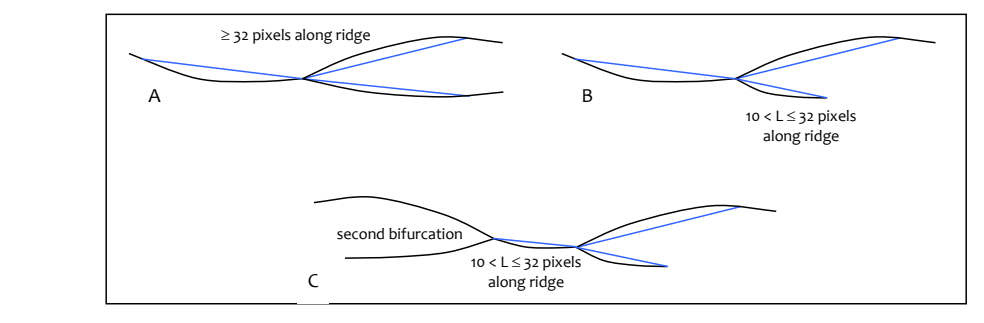
図 2 − 特徴点の角度の決定。枠の中に A、B、C の 3 つの略図があり、いずれも隆線が分岐点で 2 本の枝に分かれ、分岐点から青い線(仮想的な線)が引かれている。A では、線が隆線と両方の枝に沿って延び、「≥ 32 pixels along ridge(隆線に沿って 32 ピクセル以上)」と記されている。B では、一方の枝が短く、その線は枝の端で終わり、「10 < L ≤ 32 pixels along ridge(隆線に沿って 10 < L ≤ 32 ピクセル)」と記されている。C では、一方の側の線が 2 つ目の分岐点で止まり、「second bifurcation(2 つ目の分岐)」と記され、その距離に「10 < L ≤ 32 pixels along ridge」と記されている。
Figure 2 − Minutiae angle determination
図 2 − 特徴点の角度の決定
Extensive, refined and complete guidance on minutia detection and estimation appears in INCITS 378:2009 Clause 6. That standard is the revision of INCITS 378-2004 [MINUSTD]. While PIV still requires [MINUSTD] for off-card comparison template formatting, the 2009 standard might be consulted because it gives elaborate information on the semantic (placement + selection) aspects associated with this note.
特徴点の検出と推定に関する詳細で洗練された完全な指針は、INCITS 378:2009 の箇条 6 に記載されています。この標準は INCITS 378-2004 [MINUSTD] の改訂版です。PIV は、カード外照合用のテンプレート書式化には引き続き [MINUSTD] を要求しますが、この注記に関連する意味的側面(配置と選択)について詳細な情報を示しているため、2009 年版の標準を参照することが考えられます。
9.The mandatory value of zero codifies the PIV specification that templates shall not include extended data.
9.ゼロという必須値は、テンプレートに拡張データを含めてはならない(shall)というPIV仕様を符号化します。
10.Per [MINUSTD, 6.5.1.2] this view number field shall have value 0 for the primary finger and 0 for the secondary finger. The combination of view number and finger position uniquely identifies each template.
10.[MINUSTD, 6.5.1.2]によれば、このビュー番号フィールドの値は、主要指については0、副次指についても0でなければなりません(shall)。ビュー番号と指の位置の組み合わせにより、各テンプレートを一意に識別します。
11.[MINUSTD] does not specify how to report the image sizes in the header when two or more views are included in the record and these were derived from images of different sizes. For PIV, the width on Line 20 shall be the larger of the widths of the two input images. Similarly the height on Line 21 shall be the larger of the heights of the two input images.
11.[MINUSTD]は、レコードに二つ以上のビューが含まれ、それらが異なるサイズの画像から生成された場合に、ヘッダーで画像サイズを報告する方法を規定していません。PIVでは、行20の幅は二つの入力画像の幅のうち大きい方でなければなりません(shall)。同様に、行21の高さは二つの入力画像の高さのうち大きい方でなければなりません(shall)。
4.4.3 Special case for individuals who cannot be fingerprinted
4.4.3 指紋を採取できない個人に関する特別な場合
If two fingerprints have never been collected (e.g., because of injury, amputation, or persistent poor quality), or all fingerprint authentication attempts fail during Section 4.3 card issuance, then the PIV Card shall be populated with the standardized minutia record of Section 4.4 which
2 本の指の指紋がこれまで一度も採取されていない場合(例:負傷、切断、または継続的な低品質のため)、または 4.3 節のカード発行時にすべての指紋認証の試行が失敗した場合、PIV カードには、4.4 節の標準化された特徴点レコードを格納しなければなりません(shall)。このレコードは
•has two empty views (i.e., there are zero minutiae, such that Table 6, Line 31 shall be zero),
•2 つの空のビューを持ち(すなわち、特徴点が 0 個であり、したがって表 6 の 31 行目はゼロでなければならない(shall))、
•is digitally signed as usual using the properly populated CBEFF structure of Section 9,
•9 節の適切に設定された CBEFF 構造を用いて通常どおりデジタル署名され、
•has fingerprint qualities (Table 6, Line 30) assigned 255 for temporarily unusable, or 254 for permanently unusable, fingerprints, and
•指紋品質(表 6 の 30 行目)に、一時的に使用できない指紋には 255、恒久的に使用できない指紋には 254 が割り当てられており、
•overrides the CBEFF quality values (Table 14, Line 11) with -1 indicating temporarily, and -2 permanently unusable fingerprints.
•CBEFF 品質値(表 14 の 11 行目)を、一時的に使用できない指紋には -1、恒久的に使用できない指紋には -2 で上書きします。
[FIPS] allows iris or face biometrics (see Sections 6 and 7) for some PIV operations for applicants with unavailable or unusable fingerprints.
[FIPS] は、指紋を利用できないか使用できない申請者に対して、一部の PIV 操作で虹彩または顔の生体情報(6 節および 7 節を参照)を使用することを認めています。
If only one finger is available, the first view shall be populated and the second view shall be empty, as above. Authentication systems encountering cards populated with empty minutia templates might use iris authentication, if the data is present on card.
指が一本しか利用できない場合、上記のとおり第一ビューに値を格納しなければならない(shall)、第二ビューは空にしなければなりません(shall)。空の細線分テンプレートが格納されたカードに遭遇した認証システムは、カードにデータがある場合、虹彩認証を使用してもよいです(might)。
NOTE Minutia detection and matching algorithms continue to improve. Their accuracies have been measured on reference data sets [MINEX04]. Some certified implementations are significantly more accurate than others, affording lower false match rates for equal false rejection rates.
注: 細線分検出および照合アルゴリズムは引き続き改善されています。その精度は参照データセットで測定されています [MINEX04]。認証済みの実装の中には、他よりも大幅に高精度なものがあり、同じ誤拒否率でより低い誤照合率を実現します。
4.5 Performance specifications for PIV compliance
4.5 PIV準拠の性能仕様
4.5.1 Background and scope
4.5.1 背景および適用範囲
The intent of the [FIPS] specification of a government-wide interoperable biometric is to support cross-vendor and cross-agency authentication of PIV Cards. These multi-party aspects cause fingerprint recognition accuracy to vary, as documented in [MINEX04]. To mitigate against poor authentication performance this document requires template generators (minutia detection algorithms) and template matchers to produce low verification error rates in interoperability tests. These specifications apply to off-card comparison of templates - separate specifications are advanced for on-card comparison in Section 5.7. For off-card comparison, these components shall perform according to
[FIPS]における政府全体で相互運用可能な生体認証の仕様の意図は、ベンダー間および機関間でPIVカード認証を支援することです。これらの複数当事者間の側面により指紋認識精度が変動することが、[MINEX04]に記録されています。認証性能の低下を軽減するため、本書は、テンプレート生成器(特徴点検出アルゴリズム)およびテンプレート照合器が相互運用性試験で低い検証エラー率を達成することを要求します。これらの仕様はテンプレートのカード外照合に適用されます。第5.7節にはカード内照合の別個の仕様が示されています。カード外照合では、これらのコンポーネントは次に従って機能しなければならない(shall)
•interoperability specifications of sections 4.5.2, and
•第4.5.2節の相互運用性仕様、および
•the accuracy specifications of Section 4.5.3.
•第4.5.3節の精度仕様。
The criteria implement the core government-wide interoperability objectives of HSPD-12 by populating PIV Cards with interoperable enrollment templates. This is necessary to exclude systematically incorrect implementations of the underlying [MINUSTD] from PIV. The effect of this is to give increased assurance of low operational error rates.
これらの基準は、相互運用可能な登録テンプレートをPIVカードに格納することで、HSPD-12の政府全体の中核的な相互運用性目標を実装します。これは、基礎となる[MINUSTD]の体系的に誤った実装をPIVから排除するために必要です。この結果、運用上のエラー率が低いことへの保証が高まります。
4.5.2 Minimum interoperability specification
4.5.2 最小相互運用性仕様
The core cross-vendor interoperability specification is met by establishing requirements on template generators and template matchers as described in the following two sub-sections.
テンプレート生成器およびテンプレート照合器に対する要件を次の二つの小節に記載のとおり定めることで、中核的なベンダー間相互運用性仕様を満たします。
4.5.2.1 Conformance of template generators
4.5.2.1 テンプレート生成器の適合性
A template generator is certified on the basis of the conformance of its output, its speed of computation, and on the error rates observed when its templates are matched. A template generator shall be certified only if
テンプレート生成器は、その出力の適合性、計算速度、および生成テンプレートを照合した際に観測されるエラー率に基づいて認証されます。テンプレート生成器は、次の場合に限り認証しなければなりません(shall)。
1.it converts all input PIV representative enrollment images to Table 18 templates, and
1.すべての入力PIV代表登録画像を表18のテンプレートに変換すること、および
2.all templates are syntactically conformant to the Table 18 profile of [MINUSTD], and
2.すべてのテンプレートが[MINUSTD]の表18プロファイルに構文的に適合していること、および
3.it converts 90% of PIV representative enrollment images to templates in fewer than 1.3 seconds8 each, and
3.それは、PIVの代表的な登録画像の90%を、各画像につき1.3秒未満8でテンプレートに変換し、
4.all certified matchers verify their output templates with FNMR less than or equal to 0.01 at a FMR of 0.01 (where this is calculated from the sum of scores from two finger comparisons e.g., left and right index fingers), and
4.すべての認証済み照合器は、FMR 0.01においてFNMR 0.01以下で出力テンプレートを検証すること(これは二指照合(例: 左右の示指)のスコアの合計から算出する)、および
5.the minutiae it reports have unique (x, y) values i.e., no two minutiae may share the same location. This requirement is additional to the minutia detection requirements of the [MINUSTD] and is instituted because non-uniqueness impedes some matching algorithms.
5.報告する特徴点の(x, y)値は一意でなければなりません。すなわち、どの二つの特徴点も同じ位置を共有してはなりません。この要件は[MINUSTD]の特徴点検出要件に追加されるものであり、一意でないことが一部の照合アルゴリズムを妨げるため導入されました。
4.5.2.2 Conformance of template matchers
4.5.2.2 テンプレート照合器の適合性
A template matcher is certified on the basis of its speed of computation, and on the error rates observed when it matches templates in interoperability tests. A template matcher shall be certified only if
テンプレート照合器は、計算速度および相互運用性試験でテンプレートを照合した際に観測されるエラー率に基づいて認証されます。テンプレート照合器は、次の場合に限り認証しなければなりません(shall)。
1.it compares all pairs of Table 18 templates to scalar scores, and
1.表18のテンプレートのすべてのペアを比較してスカラー・スコアを求めること、および
2.it executes 90% of the Annex A.4 template matches in fewer than 0.1 seconds8 each, and
2.附属書A.4のテンプレート照合の90%を各0.1秒未満で実行すること8、および
3.it matches templates from all certified template generators, and the template generator accompanying the matcher, with FNMR less than or equal to 0.01 at an FMR of 0.01 (where this is calculated from scores from the sum of scores from two finger comparisons e.g., left and right index fingers).
3.すべての認証済みテンプレート生成器および照合器に付属するテンプレート生成器のテンプレートを照合し、二指照合(例: 左右の示指)のスコア合計から算出した場合、FMR 0.01においてFNMRが0.01以下となること。
4.5.3 Minimum accuracy specification
4.5.3 最低精度仕様
The interoperability criterion of Section 4.5.2.29 is designed to support low false rejection when templates can come from many sources (i.e., conformant [MINUSTD] template generators). This FMR value, however, is too high for operational application i.e., it is higher than the minimum accuracy requirements of Section 10. To support actual authentication of PIV Card templates, a template generator and matcher-pair shall be certified if
4.5.2.29 節の相互運用性基準は、テンプレートが多数の供給元(すなわち、適合する [MINUSTD] テンプレート生成器)から得られる場合に、誤拒否を低く抑えることを支援するよう設計されています。ただし、この FMR 値は運用への適用には高すぎます。すなわち、10 節の最小精度要件より高いです。PIV カードのテンプレートの実際の認証を支援するため、テンプレート生成器と照合器の組は、次の場合に認証されなければならない(shall)
1.it meets all the interoperability criteria of sections 4.5.2.1 and 4.5.2.2, and
1.第4.5.2.1節および第4.5.2.2節の相互運用性基準をすべて満たすこと、および
2.it matches single-finger native templates with FNMR less than or equal to 0.02 when the FMR is at or below 0.0001. The word native here means that all templates originate from one template generator and the provider of the template generation algorithm is the same as that of the comparison algorithm. Native mode operation will occur within an Agency that procures its template generation and matching equipment from the same provider.
2.FNMRが0.02以下で、FMRが0.0001以下の場合に、単指のネイティブテンプレートを照合すること。ここで「ネイティブ」とは、すべてのテンプレートが一つのテンプレート生成器に由来し、テンプレート生成アルゴリズムのプロバイダーと照合アルゴリズムのプロバイダーが同一であることを意味します。ネイティブモードの運用は、テンプレート生成装置および照合装置を同じプロバイダーから調達する機関内で行われます。
4.5.4 Test method
4.5.4 試験方法
The performance specifications of sections 4.5.2.1, 4.5.2.2 and referred to as Level 1 accuracy specifications. The specifications of Section 4.5.3 are referred to as Level 2 accuracy specifications. Both Level 1 and Level 2 criteria shall be tested as defined in Annex A.
4.5.2.1節、4.5.2.2節の性能仕様は、レベル1精度仕様と呼ばれます。4.5.3節の仕様は、レベル2精度仕様と呼ばれます。レベル1とレベル2の両方の基準を、附属書Aで定義されるとおりに試験しなければなりません(shall)。
INFORMATIVE NOTE NIST's MINEX III program10 implements these tests [MINEX-III] – see Section A.6.
参考情報 NIST の MINEX III プログラム10は、これらの試験 [MINEX-III] を実施しています。A.6 節を参照してください。
4.6 Performance specifications for PIV operations
4.6 PIV 操作の性能仕様
Off-card fingerprint authentication implementations shall be configured according to the specifications of Section 10.
カード外指紋認証の実装は、第10節の仕様に従って構成しなければなりません(shall)。
4.7 Fingerprint capture
4.7 指紋の取得
4.7.1 Scope
4.7.1 適用範囲
This Section gives specifications for fingerprint sensors used for capture of single finger images. These sensors shall not be used for collection of images for use in the background check i.e., the specifications are unrelated to those of Section 2.3 which govern ten-print enrollment. This document does not establish specifications on performance of four-finger segmentation algorithms.
本節では、単指画像の取得に使用する指紋センサーの仕様を示します。このようなセンサーを背景調査用画像の採取に使用してはなりません(shall not)。すなわち、この仕様は十指登録を規定する第2.3節の仕様とは関係がありません。本書は、四指セグメンテーションアルゴリズムの性能仕様を定めません。
4.7.2 Fingerprint acquisition specifications for flat capture sensors
4.7.2 平面取得センサーの指紋取得仕様
Fingerprint sensors used for PIV authentication shall conform to the FBI's Image Quality Specifications For Single Finger Capture Devices [SINGFING]. The [SINGFING] specification establishes minimum sizes for the imaging platen and for the scanning resolution.
PIV認証に使用する指紋センサーは、FBIの単指取得装置向け画像品質仕様[SINGFING]に適合しなければなりません(shall)。[SINGFING]仕様は、画像取得プラテンの最小サイズおよびスキャン解像度を定めます。
5. Fingerprint on-card comparison specifications
5. 指紋のカード内照合仕様
5.1 Scope
5.1 適用範囲
[FIPS] allows (but does not require) Agencies to use on-card comparison (OCC) of fingerprint minutiae. This Section gives specifications for OCC for PIV. This specification includes enrollment data to be placed on the card, authentication data to be sent to the card, and OCC certification information. This Section also specifies the data structure for the storage of card parameters, and the procedure for preparation of OCC fingerprint minutiae templates from those for off-card comparisons.
[FIPS]は、機関が指紋細線分のカード内照合(OCC)を使用することを許可します(ただし要求はしません)。本節では、PIV用OCCの仕様を示します。この仕様には、カードに格納する登録データ、カードに送信する認証データ、およびOCC認証情報が含まれます。本節では、カードパラメーターを保存するデータ構造と、カード外照合用の指紋細線分テンプレートからOCC指紋細線分テンプレートを作成する手順も規定します。
[800-73] indicates where OCC data is stored and that this data is separate and different from the mandatory off-card comparison fingerprint templates. [800-73, Part 2] specifies the secure channel mechanisms to realize on-card comparison over the [FIPS]-specified interfaces.
[800-73]は、OCCデータの保存場所と、このデータが必須のカード外照合用指紋テンプレートとは別個で異なることを示します。[800-73, Part 2]は、[FIPS]で規定されたインターフェイスを介してカード内照合を実現するセキュアチャネルメカニズムを規定します。
5.2 Background
5.2 背景
NIST conducted two studies to support the use of on-card biometric comparison in identity management applications. ― The Secure Biometric Match on Card11 activity engaged commercial providers to execute fingerprint authentication over a contactless interface within a specific time limit. The study required privacy protection via secured communication protocols and integrity protection using cryptographic signatures computed from the biometric data. In addition, the card was authenticated to the reader. The activity has been published as NIST Interagency Report 7452 [SBMOC]. ― The MINEX II evaluation was initiated to measure the core algorithmic speed and accuracy of fingerprint minutia matchers running on ISO/IEC 7816 smartcards. Conducted in phases, the test required card- and fingerprint matcher-provider teams to submit on-card comparison enabled cards. The latest results were reported in NIST Interagency Report 7477 [MINEX II]. The main attraction of on-card comparison has been that someone who finds a card has only a small chance of authenticating to it with fingerprints (related to the configured false match rate) – the fact that template data never leaves the card means that the attacker has no prior knowledge. See the related discussion in Section 5.4. In the off-card comparison world, the PIN entry requirement is used to mitigate this risk.
NISTは、本人確認管理アプリケーションにおけるカード内生体照合の使用を支援するため、二つの研究を実施しました。― Secure Biometric Match on Card11活動では、商用プロバイダーが非接触インターフェイスを介して、所定の時間制限内に指紋認証を実行しました。この研究では、安全な通信プロトコルによるプライバシー保護と、生体データから生成される暗号署名を用いた完全性保護を要求しました。さらに、カードをリーダーに対して認証しました。この活動はNIST省庁間報告書7452 [SBMOC]として公開されています。― MINEX II評価は、ISO/IEC 7816スマートカード上で実行される指紋特徴点照合器の基本的なアルゴリズム速度および精度を測定するために開始されました。複数段階で実施されたこの試験では、カードプロバイダーおよび指紋照合器プロバイダーのチームに、カード内照合機能を備えたカードの提出を求めました。最新結果はNIST省庁間報告書7477 [MINEX II]で報告されました。カード内照合の主な利点は、カードを拾った人が指紋で認証できる可能性が低いこと(設定された誤照合率に関係する)です。テンプレートデータがカードから外に出ないため、攻撃者は事前知識を持ちません。第5.4節の関連説明を参照してください。カード外照合では、このリスクを軽減するためにPIN入力要件が使用されます。
5.3 Approach to the use of standards
5.3 標準の使用に関するアプローチ
The PIV specification for on-card matching leverages international standards. Specifically, PIV Cards shall ― be prepared and used by executing the commands of ISO/IEC 7816-4:2005 [CARD-CMD] per [800-73, Part 2] ― embed the biometric data in the data structures defined in ISO/IEC 7816-11:2004 [CARD-BIO], ― use the core three-byte-per-minutia format defined in the ISO/IEC 19794-2:2011 [CARD-MIN] standard12 (implementers may choose to prepare these from INCITS 378:2004 templates, as shown in Figure 3), and ― adopt certain defined constants from ISO/IEC 19785-3:2007.
カード内照合に関するPIV仕様は国際標準を活用します。具体的に、PIVカードは、― [800-73, Part 2]に従ってISO/IEC 7816-4:2005 [CARD-CMD]のコマンドを実行して準備・使用しなければなりません(shall)。― 生体データをISO/IEC 7816-11:2004 [CARD-BIO]で定義されたデータ構造に埋め込まなければなりません。― ISO/IEC 19794-2:2011 [CARD-MIN]標準で定義された特徴点当たり三バイトの基本形式12を使用しなければならない(実装者は図3に示すようにINCITS 378:2004テンプレートからこれらを作成してもよいです(may))。― ISO/IEC 19785-3:2007の特定の定義済み定数を採用しなければなりません。
For conversion ISO/IEC 19794-2:2011 PIV Card for On-Card
変換用 ISO/IEC 19794-2:2011 カード内用PIVカード
Parent fingerprint images:
元の指紋画像:
Card Minutiae
カード特徴点
Comparison
照合
see Section 5.5
第5.5節を参照
Section 3.2 Live capture, OR
第3.2節 ライブ取得、または
Section 5.4
第5.4節
Section 3.4 ANSI/NIST Type 14, OR Section 3.4 ANSI/NIST Type 4, OR
第3.4節 ANSI/NIST Type 14、または第3.4節 ANSI/NIST Type 4、または
INCITS 378:2004
INCITS 378:2004
PIV Card for Off-Card
カード外照合用PIVカード
Section 3.3 INCITS 381:2004
第3.3節 INCITS 381:2004
Minutiae
特徴点
Comparison
照合
Section 4.4
第4.4節
Figure 3 − Preparation of PIV Fingerprint Minutia Templates
図3 − PIV指紋特徴点テンプレートの作成
5.4 Finger selection
5.4 指の選択
This document recommends that different fingers should be imaged for off-card and on-card comparison. This mitigates an attack where off-card templates are stolen (after PIN release) and used to prepare spoofs via [REVFING] for use in on-card comparison (which is not preceded by PIN entry). This document nevertheless allows data from the same fingers in on-card and off-card comparison operations for two reasons. First is to mitigate a usability issue, namely that users might be confused as to which fingers should be presented. Second, there is always the possibility that fingerprints are stolen from other sources (including latent acquisition) and used in a spoof attack.
本書は、カード外照合とカード内照合で異なる指を撮像することを推奨します(should)。これにより、カード外テンプレートが窃取され(PIN解除後)、カード内照合(PIN入力を前提としない)に用いる偽造物を[REVFING]を通じて作成する攻撃を軽減できます。それでも本書がカード内照合とカード外照合の両方で同じ指のデータを許容する理由は二つあります。第一に、提示すべき指について利用者が混乱する可能性があるという使いやすさの問題を軽減するためです。第二に、指紋が他の情報源(潜在指紋の取得を含む)から窃取され、偽造攻撃に使われる可能性は常にあるためです。
5.5 Data objects
5.5 データオブジェクト
5.5.1 Biometric Information Template
5.5.1 生体情報テンプレート
Each submitted card shall be populated with Biometric Information Templates (BITs) grouped under the BIT Group Template of Table 7 according to the requirements of [CARD-CMD, Tables 1 and 2]. The number of BITs shall be equal to 2, one for each finger.
提出される各カードには、[CARD-CMD, Tables 1 and 2]の要件に従い、表7のBITグループテンプレートの下にグループ化された生体情報テンプレート(BIT)を格納しなければなりません(shall)。BITの数は2(各指につき一つ)でなければなりません(shall)。
Table 7 − BIT group template and profile
表7 − BITグループテンプレートおよびプロファイル
| Tag | Len. | Value | Allowed values | ||||||||
|---|---|---|---|---|---|---|---|---|---|---|---|
| 7F61 | Var. | BIT group template | |||||||||
| Tag | Len. | Value | |||||||||
| 02 | 1 | 1…4 (Number of BITs in the group, corresponding to number of fingers that follow) | 2 | ||||||||
| 7F60 | Var. | Biometric Information Template (BIT) for the first finger | |||||||||
| Tag | Len. | Value | |||||||||
| 83 | 1 | Reference data qualifier used by VERIFY | '96' | ||||||||
| A1 | Var. | Biometric Header Template (BHT) conforming to ISO/IEC 19785-3:2005 | |||||||||
| Tag | Len. | Value | |||||||||
| 81 | 1 | Biometric type (i.e., modality, 08 = fingerprint) | 08 | ||||||||
| 82 | 1 | Biometric subtype (e.g., finger position) - These values shall be from ISO/IEC 19785-3:2007, NOT from [CARD-MIN]. | See NOTE 2 | ||||||||
| 87 | 2 | CBEFF BDB format owner | 0101 i.e., JTC1/SC37 | ||||||||
| 88 | 2 | 0x0005 (CBEFF BDB format type) | '00 05' See NOTE 1 | ||||||||
| B1 | Var. | Biometric matching algorithm parameters. [CARD-MIN Table 14] | |||||||||
| Tag | Len. | Value | |||||||||
| 81 | 2 | Min. and max. numbers of minutiae, see ISO/IEC 19794-2 (Sub-clause 8.3.3, Table 10) | |||||||||
| 82 | 1 | Minutiae order, see ISO/IEC 19794-2005 (Sub-clause 8.3.4 and Tables 11 and 12) | |||||||||
| 83 | This tag shall not be present Feature handling indicator, see [CARD-MIN, Table 15] | ||||||||||
| 7F60 | Var. | Biometric Information Template (BIT) for the second finger | |||||||||
| Tag | Len. | Value | |||||||||
| 83 | 1 | Reference data qualifier used by VERIFY | '97' | ||||||||
| A1 | Var. | Biometric Header Template (BHT) conforming to ISO/IEC 19785-3:2005 | |||||||||
| Tag | Len. | Value | |||||||||
| 81 | 1 | Biometric type (i.e., modality, 08 = fingerprint) | 08 | ||||||||
| 82 | 1 | Biometric subtype (e.g., finger position) - These values shall be from ISO/IEC 19785-3:2007, NOT from [CARD-MIN]. | See NOTE 2 | ||||||||
| 87 | 2 | CBEFF BDB format owner | 0101 i.e., JTC1/SC37 | ||||||||
| 88 | 2 | 0x0005 (CBEFF BDB format type) | '00 05' See NOTE 1 | ||||||||
| B1 | Var. | Biometric matching algorithm parameters. [CARD-MIN Table 14] | |||||||||
| Tag | Len. | Value | |||||||||
| 81 | 2 | Min. and max. numbers of minutiae, see ISO/IEC 19794-2 (Sub-clause 8.3.3, Table 10) | |||||||||
| 82 | 1 | Minutiae order, see ISO/IEC 19794-2"2005 (Sub-clause 8.3.4 and Tables 11 and 12) | |||||||||
| 83 | This tag shall not be present Feature handling indicator, see [CARD-MIN, Table 15] | ||||||||||
| タグ | 長さ | 値 | 許容される値 | ||||||||
|---|---|---|---|---|---|---|---|---|---|---|---|
| 7F61 | 可変 | BITグループテンプレート | |||||||||
| タグ | 長さ | 値 | |||||||||
| 02 | 1 | 1…4(グループ内のBITの数。後続の指の本数に対応する) | 2 | ||||||||
| 7F60 | 可変 | 1本目の指の生体情報テンプレート(BIT) | |||||||||
| タグ | 長さ | 値 | |||||||||
| 83 | 1 | VERIFYで使用される参照データ修飾子 | '96' | ||||||||
| A1 | 可変 | ISO/IEC 19785-3:2005に準拠する生体ヘッダーテンプレート(BHT) | |||||||||
| タグ | 長さ | 値 | |||||||||
| 81 | 1 | 生体種別(すなわちモダリティ。08 = 指紋) | 08 | ||||||||
| 82 | 1 | 生体サブタイプ(例:指の位置)– これらの値はISO/IEC 19785-3:2007のものでなければならず、[CARD-MIN]のものであってはなりません。 | 注2を参照 | ||||||||
| 87 | 2 | CBEFF BDBフォーマット所有者 | 0101、すなわちJTC1/SC37 | ||||||||
| 88 | 2 | 0x0005(CBEFF BDBフォーマットタイプ) | '00 05' 注1を参照 | ||||||||
| B1 | 可変 | 生体照合アルゴリズムのパラメーター。[CARD-MIN Table 14] | |||||||||
| タグ | 長さ | 値 | |||||||||
| 81 | 2 | 細線分の最小数および最大数。ISO/IEC 19794-2(副箇条8.3.3、Table 10)を参照 | |||||||||
| 82 | 1 | 細線分の順序。ISO/IEC 19794-2005(副箇条8 | |||||||||
| 83 | このタグは存在してはなりません。特徴処理指示子。[CARD-MIN, Table 15]を参照 | ||||||||||
| 7F60 | 可変 | 2本目の指の生体情報テンプレート(BIT) | |||||||||
| タグ | 長さ | 値 | |||||||||
| 83 | 1 | VERIFYで使用される参照データ修飾子 | '97' | ||||||||
| A1 | 可変 | ISO/IEC 19785-3:2005に準拠する生体ヘッダーテンプレート(BHT) | |||||||||
| タグ | 長さ | 値 | |||||||||
| 81 | 1 | 生体種別(すなわちモダリティ。08 = 指紋) | 08 | ||||||||
| 82 | 1 | 生体サブタイプ(例:指の位置)– これらの値はISO/IEC 19785-3:2007のものでなければならず、[CARD-MIN]のものであってはなりません。 | 注2を参照 | ||||||||
| 87 | 2 | CBEFF BDBフォーマット所有者 | 0101、すなわちJTC1/SC37 | ||||||||
| 88 | 2 | 0x0005(CBEFF BDBフォーマットタイプ) | '00 05' 注1を参照 | ||||||||
| B1 | 可変 | 生体照合アルゴリズムのパラメーター。[CARD-MIN Table 14] | |||||||||
| タグ | 長さ | 値 | |||||||||
| 81 | 2 | 細線分の最小数および最大数。ISO/IEC 19794-2(副箇条8.3.3、Table 10)を参照 | |||||||||
| 82 | 1 | 細線分の順序。ISO/IEC 19794-2"2005(副箇条8 | |||||||||
| 83 | このタグは存在してはなりません。特徴処理指示子。[CARD-MIN, Table 15]を参照 | ||||||||||
NORMATIVE NOTES:
規範的注記:
1.The 0x0005 value indicates one of two definitions for reporting locations of minutiae defined in the ISO standard. This one requires that the endings of ridges be reported at the point of the valley bifurcation (versus at the ridge tip itself). These are the semantics required by INCITS 378:2004. The on-card comparison templates might reasonably be produced from the parent INCITS 378 templates.
1.値0x0005は、ISO規格で定義される細線分位置の報告方法二種類のうち一方を示します。この方式では、隆線の終端を隆線先端そのものではなく谷の分岐点で報告する必要があります。これはINCITS 378:2004が要求する意味です。カード内照合テンプレートは、元となるINCITS 378テンプレートから適切に生成できます。
2.Which fingers are present is encoded using integers from Table 8. The finger position codes differ in the fingerprint vs. smart-card standards. For on-card comparison data, ISO/IEC 19785-3:2007 finger position codes shall be used (column B). For the PIV mandatory off-card comparison templates, [MINUSTD] finger positions shall be used (column A). Card issuance processes shall transcode using the mapping of Table 8.
2.どの指が含まれるかは表8の整数を用いて符号化します。指位置コードは、指紋規格とスマートカード規格とで異なります。カード内照合データでは、ISO/IEC 19785-3:2007の指位置コードを使用しなければなりません(shall、列B)。PIVで必須のカード外照合テンプレートでは、[MINUSTD]の指位置を使用しなければなりません(shall、列A)。カード発行処理では、表8の対応付けを用いてコード変換しなければなりません(shall)。
Table 8 − ISO/IEC 19794-2 and ISO/IEC 19785-3 finger position codes
表8 − ISO/IEC 19794-2およびISO/IEC 19785-3の指位置コード
| Finger ID Biometric subtype | ISO/IEC 19794-2:2011 + INCITS 378:2004 | ISO/IEC 19785-3:2007 | ||
|---|---|---|---|---|
| Binary value | Hex Value | Binary value | Hex Value | |
| A | B | |||
| No information given | 00000b | 00 | 00000000b | 00 |
| right thumb | 00001b | 01 | 00000101b | 05 |
| right index | 00010b | 02 | 00001001b | 09 |
| right middle | 00011b | 03 | 00001101b | 0D |
| right ring | 00100b | 04 | 00010001b | 11 |
| right little | 00101b | 05 | 00010101b | 15 |
| left thumb | 00110b | 06 | 00000110b | 06 |
| left index | 00111b | 07 | 00001010b | 0A |
| left middle | 01000b | 08 | 00001110b | 0E |
| left ring | 01001b | 09 | 00010010b | 12 |
| left little | 01010b | 0A | 00010110b | 16 |
| 指ID(生体サブタイプ) | ISO/IEC 19794-2:2011 + INCITS 378:2004 | ISO/IEC 19785-3:2007 | ||
|---|---|---|---|---|
| 2進値 | 16進値 | 2進値 | 16進値 | |
| A | B | |||
| 情報なし | 00000b | 00 | 00000000b | 00 |
| 右親指 | 00001b | 01 | 00000101b | 05 |
| 右示指 | 00010b | 02 | 00001001b | 09 |
| 右中指 | 00011b | 03 | 00001101b | 0D |
| 右環指 | 00100b | 04 | 00010001b | 11 |
| 右小指 | 00101b | 05 | 00010101b | 15 |
| 左親指 | 00110b | 06 | 00000110b | 06 |
| 左示指 | 00111b | 07 | 00001010b | 0A |
| 左中指 | 01000b | 08 | 00001110b | 0E |
| 左環指 | 01001b | 09 | 00010010b | 12 |
| 左小指 | 01010b | 0A | 00010110b | 16 |
PIV readers involved in on-card and off-card authentication attempts shall heed Table 8 to correctly prompt users for which finger to present.
カード内およびカード外の認証試行に関与するPIVリーダーは、利用者に提示する指を正しく案内するため、表8に従わなければなりません(shall)。
Note that the penultimate (i.e., FDIS) draft of ISO/IEC 19785-3:2007 erroneously set bit six to 1. The final standard and the PIV specification require that bits 6, 7 and 8 shall be 0.
ISO/IEC 19785-3:2007の最終から二番目の草案(すなわちFDIS)では、誤ってビット六が1に設定されていた点に注意します。最終規格およびPIV仕様では、ビット6、7、8を0にしなければなりません(shall)。
5.5.2 Minutiae data for on-card comparison
5.5.2 カード内照合用のマニューシャデータ
This Section defines the data to be used for on-card comparison implementations. It is included here because ISO/IEC 19794-2:2011 [CARD-MIN] and its antecedents defined multiple variants13.
この節では、カード内照合の実装で使用するデータを定義します。ISO/IEC 19794-2:2011 [CARD-MIN]およびその前身規格には複数の形式が定義されていたため、ここに記載する13。
On-card comparison data in PIV shall conform to the ISO/IEC 19794-2:2011, Clause 9 compact on-card comparison format [CARD-MIN]. This format encodes the x and y coordinates, minutia type, and minutia angle of each minutia point in 3 bytes. This format also allows encoding of cores, deltas and ridge counts. Two cases exist: ― Data stored on-card (i.e., enrollment data): Neither this document nor [800-73] regulate what data must be stored on card; instead this specification only requires that the authentication instruction of [800-73, Part 2] shall be operable. Thus a card might validly be populated with minutiae, cores, and ancillary proprietary data. ― Data sent to card during operations (for comparison): This minutia data shall be included in the APDU specified in [800-73, Part 2] and shall consist of exactly 3N bytes from N minutia as specified in [CARD-MIN]. No leading tagged header information is necessary. Extended and proprietary data shall not be sent to the card. The BITs of Section 5.5.1 shall parameterize the production of templates that a reader, or other system, sends to the PIV Card – see Section 5.6.2. This applies to both the reference templates stored on the card, and those produced during, for example, an authentication transaction.
PIVのカード内照合データは、[CARD-MIN]のISO/IEC 19794-2:2011、箇条9のコンパクトカード内照合形式に適合しなければなりません。この形式は、各特徴点のx座標、y座標、特徴点の種別および角度を3バイトで符号化します。この形式では、核、三角州および隆線数も符号化できます。ケースは2つあります。― カード内に保存するデータ(すなわち登録データ):本書も[800-73]も、カードにどのようなデータを保存しなければならないかは規定していません。代わりに、この仕様が要求するのは、[800-73, Part 2]の認証命令が動作可能でなければならないということだけです。したがって、特徴点、核、および補助的な独自データがカードに格納されていても仕様に適合します。― 処理中にカードへ送信するデータ(照合用):この特徴点データは[800-73, Part 2]で規定されるAPDUに含めなければならず、[CARD-MIN]に規定されるN個の特徴点からなる正確に3Nバイトでなければなりません。先頭にタグ付きヘッダー情報を付ける必要はありません。拡張データおよび独自データをカードに送信してはなりません。リーダーまたは他のシステムがPIVカードに送信するテンプレートの生成は、5.5.1節のBITをパラメータとして行わなければなりません。5.6.2節を参照してください。これは、カード上に保存される参照テンプレートと、例えば認証トランザクション中に生成されるテンプレートの両方に適用されます。
5.6 Preparation of the minutia templates
5.6 特徴点テンプレートの作成
5.6.1 Conversion of INCITS 378 to ISO/IEC 19794-2 on-card comparison templates
5.6.1 INCITS 378からISO/IEC 19794-2カード内照合テンプレートへの変換
Existing PIV equipment produces (CBEFF-wrapped) [MINUSTD] instances of Table 6 for off-card comparison. An OCC process may choose to use such equipment in which case [CARD-MIN] data would appropriately be prepared from live [MINUSTD] templates via the non-trivial conversion of Figure 4. The conversion operation proceeds with a pruning operation (Sec. 5.6.2.1 and 5.6.2.2), a re-encoding (conversion of 8 bit to 6 bit minutia angle, conversion from 14 bit to 8 bit position coordinates), and a sorting operation (Sec. 5.6.2.3). The order matters here due to arithmetic rounding.
既存のPIV機器は、カード外照合用に表6の(CBEFFでラップされた)[MINUSTD]インスタンスを生成します。OCCプロセスではこのような機器を使用してもよいです。その場合、図4の複雑な変換を通じて、ライブの[MINUSTD]テンプレートから[CARD-MIN]データを適切に作成することになります。変換処理は、刈込み(5.6.2.1節および5.6.2.2節)、再符号化(特徴点角度の8ビットから6ビットへの変換、位置座標の14ビットから8ビットへの変換)、および並べ替え(5.6.2.3節)の順に進みます。算術丸めのため、この順序が重要です。
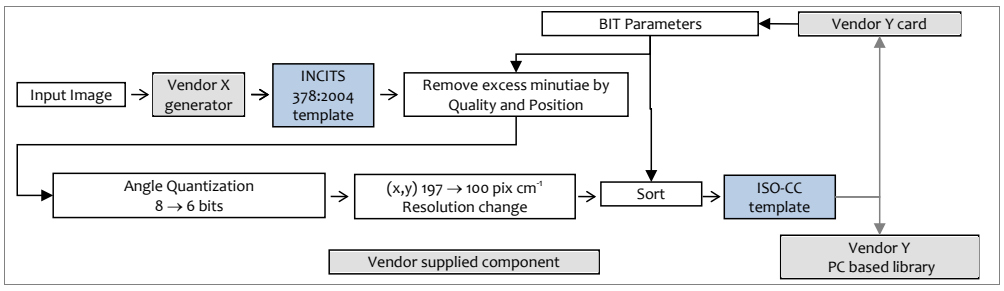
図4 − INCITS 378からISO/IEC 19794-2カードデータへの変換。枠で囲んだ流れ図である。上段は左から右へ矢印で「Input Image」(入力画像)→「Vendor X generator」(ベンダーXの生成器、灰色)→「INCITS 378:2004 template」(INCITS 378:2004テンプレート、青)→「Remove excess minutiae by Quality and Position」(品質および位置に基づいて余分な特徴点を除去する)と進む。この箱から線が下へ下り、下段の左端へ戻る。下段は左から右へ矢印で「Angle Quantization 8 → 6 bits」(角度の量子化 8 → 6ビット)→「(x,y) 197 → 100 pix cm⁻¹ Resolution change」((x,y) 197 → 100 pix cm⁻¹ の解像度の変更)→「Sort」(並べ替え)→「ISO-CC template」(ISO-CCテンプレート、青)と進む。右上では、「Vendor Y card」(ベンダーYのカード、灰色)から「BIT Parameters」(BITパラメータ)へ矢印が向かい、BITパラメータから「品質および位置に基づいて余分な特徴点を除去する」と「並べ替え」へそれぞれ下向きの矢印が出る。ISO-CCテンプレートからの灰色の線は縦の灰色の線に合流し、その線は上のベンダーYのカードと下の「Vendor Y PC based library」(ベンダーYのPCベースのライブラリ、灰色)を矢印で指す。下部の灰色の箱「Vendor supplied component」(ベンダー提供コンポーネント)は凡例である。
Figure 4 − Conversion of INCITS 378 to ISO/IEC 19794-2 card data
図4 − INCITS 378からISO/IEC 19794-2カードデータへの変換
5.6.2 Effect of the BIT
5.6.2 BITの効果
5.6.2.1 Number of minutiae
5.6.2.1 特徴点の数
The number of minutiae sent to a PIV Card for on-card comparison is not limited by this document. However, the number may be subject to limits implied by the interface specifications of [800-73, Part 2].
カード内照合のためにPIVカードへ送信する特徴点の数は、本書では制限しません。ただし、その数は[800-73, Part 2]のインターフェース仕様から暗黙に生じる制限を受ける場合があります。
INFORMATIVE NOTE 1 Leading commercial minutia detectors produce a median of 41 minutiae from plain impression images with the 5% and 95% quantiles being 24 and 61 respectively over four large operational single index finger datasets.
参考注記1:主要な商用特徴点検出器は、単一の人差し指を対象とした四つの大規模な実運用データセットにおいて、平面捺印画像から中央値41個の特徴点を生成し、5%点および95%点はそれぞれ24個および61個です。
INFORMATIVE NOTE 2 A short-length APDU command constrains the maximum number of three-byte minutiae. Implementers should consult [800-73, Part 2] on the availability of command chaining [CARD-CMD] for larger templates.
参考注記2:短形式APDUコマンドでは、三バイトの特徴点の最大数が制約されます。実装者は、より大きなテンプレートに対するコマンド連鎖[CARD-CMD]の利用可能性について[800-73, Part 2]を参照すべきです(should)。
Because some templates will naturally contain 0 minutiae (i.e., the algorithm does not find any), the (off-card) client shall respect the minimum number indicated by the card in its BIT structure. The client shall either terminate the minutia-based authentication attempt or prompt for (re-)presentation of one of the enrolled fingers.
一部のテンプレートでは当然ながら特徴点が0個になることがある(すなわち、アルゴリズムが一つも検出しない)ため、(カード外の)クライアントは、カードがBIT構造で示す最小数を遵守しなければなりません。クライアントは、特徴点に基づく認証試行を終了するか、登録済みの指のいずれかを提示または再提示するよう促さなければなりません。
All reference and verification templates shall be parameterized by the BIT parameters, as follows. If, ― the value indicated in the BIT for the minimum number of minutiae is \(N \ge 0\), ― the value indicated in the BIT for the maximum number of minutiae is \(N \le M\), ― the number of minutiae available for sending to the card for OCC is \(K\), then ― the number of minutiae sent to the card, \(S\), shall be
すべての参照テンプレートおよび検証テンプレートは、次のとおりBITパラメータでパラメータ化しなければなりません(shall)。次の場合、― 細線分の最小数としてBITに示された値が\(N \ge 0\)であり、― 細線分の最大数としてBITに示された値が\(N \le M\)であり、― OCCのためにカードへ送信可能な細線分の数が\(K\)であるとき、― カードへ送信する細線分の数\(S\)は次のとおりでなければなりません(shall)。
In the case \(K < N\), the client should initially recapture fingerprints (by re-prompting the user to replace finger on the sensor) and it that is unsuccessful should terminate the authentication.
\(K < N\)の場合、クライアントはまず指紋を再取得する(センサー上に指を置き直すよう利用者に再度促す)べきです(should)。それが失敗した場合、認証を終了すべきです(should)。
5.6.2.2 Minutiae removal mechanism
5.6.2.2 特徴点の除去機構
Minutiae shall be removed according to the specifications of [CARD-MIN, Clause 9.3.2]. Note that because the parent [MINUSTD] template allows larger spatial extent (14 bit integers at 197 pixels cm-1 off card), very large fingers may yield minutiae outside the maximum possible spatial extent that can be encoded here (8 bit integers at 100 pixels cm-1 on card). The pruning mechanism of Sections 5.6.2.1 and 5.6.2.2 shall be used to remove such minutiae.
特徴点は[CARD-MIN, Clause 9.3.2]の仕様に従って除去しなければなりません。親となる[MINUSTD]テンプレートでは、より広い空間範囲(カード外で197 pixels cm-1、14ビット整数)が許容されるため、非常に大きな指では、ここで符号化可能な最大空間範囲(カード内で100 pixels cm-1、8ビット整数)を超える特徴点が生じる場合がある点に注意します。そのような特徴点の除去には、5.6.2.1節および5.6.2.2節の剪定機構を使用しなければなりません。
5.6.2.3 Sort order of minutiae
5.6.2.3 細線分の並べ替え順序
The BIT associated with the on-card comparison algorithm shall indicate how minutiae must be sorted according to the options extended in [CARD-MIN, Clause 9.4]. However, because single finger PIV images have widths of fewer than 500 pixels when scanned at 19.7 pixels mm-1, all possible minutiae coordinates shall be encoded in 8 bits, and the modulo sorting technique defined in [CARD-MIN] shall not be used.
カード内照合アルゴリズムに関連付けられたBITは、[CARD-MIN, Clause 9.4]で示される選択肢に従って特徴点をどのように並べ替えなければならないかを示さなければなりません。ただし、PIVの単指画像は19.7 pixels mm-1で走査した場合に幅が500ピクセル未満であるため、可能なすべての特徴点座標を8ビットで符号化しなければならず、[CARD-MIN]で定義された剰余並べ替え方式を使用してはなりません。
INFORMATIVE NOTE Open-source INCITS 378 "C" code is maintained in http://www.nist.gov/itl/iad/ig/biomdi.cfm . On-card biometric comparison client software is here: http://www.nist.gov/itl/iad/ig/bioapp.cfm.
参考注記:オープンソースのINCITS 378「C」コードは http://www.nist.gov/itl/iad/ig/biomdi.cfm で保守されています。カード内生体照合クライアントソフトウェアは http://www.nist.gov/itl/iad/ig/bioapp.cfm にあります。
5.7 Performance specifications for PIV compliance
5.7 PIV適合のための性能仕様
5.7.1 Scope
5.7.1 適用範囲
Minutia template generators and minutia matching algorithms used for on-card comparison shall perform according to the interoperability specifications of Section 5.7.3, and the accuracy specifications of Section 5.7.4. The accuracy specifications are intended to afford low operational error rates by assuring highly accurate matching in typical authentication scenarios.
カード内照合に使用するマニューシャ・テンプレート生成器およびマニューシャ照合アルゴリズムは、5.7.3節の相互運用性仕様および5.7.4節の精度仕様に従って動作しなければなりません(shall)。精度仕様は、一般的な認証シナリオで高精度の照合を保証し、運用上のエラー率を低くすることを意図しています。
5.7.2 Background
5.7.2 背景
NIST conducted tests of on-card comparison performance [MINEX-II]. Over four phases conducted between 2007 and 2010, the tests showed that four implementations would have attained the cross-provider interoperability specifications of Section 4.5.2.
NISTはカード内照合性能の試験[MINEX-II]を実施しました。2007年から2010年にかけて実施された四段階の試験では、四つの実装が4.5.2節のプロバイダー間相互運用性仕様を達成していたことが示されました。
In parallel, NIST's Secure Biometrics Match-on-Card program demonstrated cryptographic protection of the template data, and transactional durations below two seconds [SBMOC].
並行して、NISTのSecure Biometrics Match-on-Cardプログラムでは、テンプレートデータの暗号学的保護と、二秒未満のトランザクション所要時間が実証されました[SBMOC]。
5.7.3 Minimum interoperability specification
5.7.3 最小相互運用性仕様
The core cross-vendor interoperability specification is met by establishing requirements on paired template generators and on-card matchers as described in the following two Sub-sections.
中核となるベンダー間相互運用性仕様は、次の二つの小節で説明する、対となるテンプレート生成器およびカード内照合器の要件を定めることで満たされます。
5.7.3.1 Conformance of template generators used to prepare on-card comparison templates
5.7.3.1 カード内照合テンプレートの作成に使用するテンプレート生成器の適合性
Template generators shall conform to the specification of Section 4.5.2.1 for off-card authentication (because on-card comparison templates are generated off-card). No additional conformance specifications are defined here.
テンプレート生成器は、カード外認証に関する4.5.2.1節の仕様に適合しなければならない(カード内照合テンプレートはカード外で生成されるため)(shall)。ここでは追加の適合性仕様を定めません。
5.7.3.2 Conformance of on-card template matchers
5.7.3.2 カード内テンプレート照合器の適合性
A template matcher shall be certified if
テンプレート照合器は、次の場合に認証されなければなりません(shall)。
1.it conforms to the off-card template matcher interoperability specifications of Section 4.5.2.2 but operating with Section 5.5.2 [CARD-MIN] format templates, and
1.4.5.2.2節のカード外テンプレート照合器の相互運用性仕様に適合し、かつ5.5.2節の[CARD-MIN]形式のテンプレートを用いて動作し、さらに
2.it executes 90% of on-card genuine template pair comparisons (using the VERIFY command [CARD-CMD], for example) in fewer than 0.50 seconds, and
2.カード内の真正なテンプレート対の比較(例えばVERIFYコマンド[CARD-CMD]を使用)を90%について0.50秒未満で実行し、
3.when implemented on a functional but modified PIV Card, and in a software library, it produces identical output similarity scores14, and
3.改変されているが機能するPIVカード上とソフトウェアライブラリ内に実装した場合に、同一の出力類似度スコア14を生成すること。
4.it produces at least 512 unique integer scores when comparing many templates of different persons.
4.異なる人物の多数のテンプレートを比較したとき、少なくとも512個の一意な整数スコアを生成します。
5.7.3.3 Test method
5.7.3.3 試験方法
The performance specifications shall be tested according to the test defined by Annex A modified to use [CARD-MIN] templates. This test shall conform to the requirements of the ISO/IEC 19795-7 testing standard.
性能仕様は、[CARD-MIN]テンプレートを使用するよう変更した付録Aの試験に従って試験しなければなりません(shall)。この試験はISO/IEC 19795-7試験規格の要件に適合しなければなりません(shall)。
INFORMATIVE NOTE NIST's MINEX IV program15 implements this test [MINEX-IV] – see Annex A.6.
参考注記:NISTのMINEX IVプログラム15はこの試験を実施します[MINEX-IV]。付録A.6を参照してください。
5.7.4 Minimum accuracy specification
5.7.4 最小精度仕様
5.7.4.1 Specification
5.7.4.1 仕様
To support operational authentication of PIV Card templates against live samples, a template generator and matcher-pair shall be certified if
PIVカードのテンプレートとライブサンプルとの運用認証を支援するため、テンプレート生成器と照合器のペアは、次の場合に認証されなければなりません(shall)。
1.it meets all the interoperability criteria of sections 4.5.2.1 and 4.5.2.2, and
1.4.5.2.1節および4.5.2.2節の相互運用性基準をすべて満たし、かつ
2.it matches single-finger native templates with FNMR less than or equal to 0.02 when the FMR is at or below 0.0001. The word native here means that all templates originate from one template generator and the provider of the template generation algorithm is the same as that of the comparison algorithm. Native mode operation will occur within an Agency that procures its template generation and matching equipment from the same provider.
2.FMRが0.0001以下の場合に、単指のネイティブテンプレートをFNMR 0.02以下で照合します。ここで「ネイティブ」とは、すべてのテンプレートが一つのテンプレート生成器から生成され、テンプレート生成アルゴリズムの提供者が照合アルゴリズムの提供者と同一であることを意味します。ネイティブモードの運用は、テンプレート生成装置および照合装置を同一の提供者から調達する機関内で行われます(will)。
5.7.4.2 Test method
5.7.4.2 試験方法
The performance specifications shall be tested according to the test defined by Annex A.
性能仕様は付録Aで定義された試験に従って試験しなければなりません(shall)。
INFORMATIVE NOTE NIST's MINEX IV program implements this test [MINEX-IV] – see Section A.6.
参考注記:NISTのMINEX IVプログラムはこの試験を実施します[MINEX-IV]。A.6節を参照してください。
5.7.5 Performance specifications for PIV operations
5.7.5 PIV運用の性能仕様
On-card comparison authentication implementations shall be configured according to the specifications of Section 10.
カード内照合認証の実装は、10節の仕様に従って構成しなければなりません(shall)。
5.8 Fingerprint capture
5.8 指紋の取得
On-card comparison shall be implemented using the fingerprint sensors specified in Section 4.7.
カード内照合は4.7節で規定する指紋センサーを使用して実装しなければなりません(shall)。
5.9 On-card comparison interface
5.9 カード内照合インターフェース
[FIPS] establishes requirements on interfaces to OCC implementations.
[FIPS]はOCC実装へのインターフェースに関する要件を定めます。
6. Iris recognition specifications
6. 虹彩認識仕様
6.1 Scope
6.1 適用範囲
This Section standardizes specifications for use of iris images as allowed by [FIPS]. The Section includes specifications ― for iris images stored on and off PIV Cards, ― for iris capture devices, and ― for components involved in automated recognition of PIV iris imagery. The specifications extend the format requirements of ISO/IEC 19794-6:2011 with image quality related properties. The capture device specifications concern imaging properties of the iris camera, and software interfaces around it. The recognition component is specified in terms of minimum authentication accuracy and processing speed.
この節では、[FIPS]で認められている虹彩画像の使用に関する仕様を標準化します。この節には、― PIVカード内外に保存される虹彩画像、― 虹彩撮像装置、― PIV虹彩画像の自動認識に関与するコンポーネント、に関する仕様が含まれます。これらの仕様は、ISO/IEC 19794-6:2011の形式要件を画像品質関連の特性で拡張します。撮像装置の仕様は虹彩カメラの撮像特性およびその周辺のソフトウェアインターフェースを扱います。認識コンポーネントは、最低認証精度および処理速度によって規定します。
This document makes no mention of an iris template. In iris recognition, templates are proprietary non-standardized mathematical encodings16 of information extracted from the formally standardized images that are defined in this document. Templates are not interoperable. Interoperability is achieved with standardized images. Agencies electing to retain only templates are vulnerable to supplier lock-in, and an inability to benefit from technology updates.
本書では虹彩テンプレートについて言及しません。虹彩認識におけるテンプレートとは、本書で定義する正式に標準化された画像から抽出した情報を、独自の非標準化数学形式で符号化したもの16です。テンプレートには相互運用性がありません。相互運用性は標準化された画像によって実現されます。テンプレートのみを保持する機関は、供給元へのロックインや、技術更新の恩恵を受けられないリスクにさらされます。
6.2 Background
6.2 背景
Iris recognition affords highly accurate recognition of individuals. It has been used both for 1:1 verification and 1:N identification [UKIRIS, IREX-III] and has proven stable [NEXUS, IREX-VI] for over a decade. Moreover, iris images can be compressed to achieve small sizes [IREX-I, IREX-IV] affording rapid transmission across band-limited networks and storage on identity credentials. This aspect is leveraged below.
虹彩認識は個人を高精度で認識できます。1:1の検証と1:Nの識別の両方に使用され[UKIRIS, IREX-III]、十年以上にわたり安定性が実証されています[NEXUS, IREX-VI]。さらに、虹彩画像は圧縮して小さなサイズにでき[IREX-I, IREX-IV]、帯域幅の制約があるネットワークでの高速伝送や身分証明媒体への保存が可能になります。以下ではこの特性を活用します。
Digital representations of rectilinear images of the human iris have been formally standardized as ISO/IEC 19794-6:2011 [IRISSTD]. This standard, which replaces earlier editions, is a necessary component in an interoperable marketplace of iris cameras and iris recognition algorithms. The standard is used because it includes specialized image formats that support compact storage17 on ISO/IEC 7816 Integrated Circuit cards. The PIV formats are shown in Figure 5.
人間の虹彩の直線投影画像をデジタル表現する形式は、ISO/IEC 19794-6:2011 [IRISSTD]として正式に標準化されています。旧版に代わるこの規格は、虹彩カメラと虹彩認識アルゴリズムの相互運用可能な市場に不可欠な要素です。この規格を採用するのは、ISO/IEC 7816集積回路カード上でのコンパクトな保存17に対応する専用画像形式を含むためです。PIV形式を図5に示します。
| Label | A | B |
|---|---|---|
| Example Image | ||
| ISO/IEC 19794-6:2011 | Image Type 2 | Image Type 7 |
| Properties | Parent image, typically the output of a camera of size 640x480 pixels, not necessarily centered, but conformant to Image Type 2 of [IRISSTD]. Images of this kind are not intended to be heavily compressed. | Cropped, masked and centered iris conformant to Image Type 7 of [IRISSTD]. Images of this kind can be compressed to a few kilobytes. For PIV, the recommended size is 3KB. The eyelids and sclera shall be masked. |
| PIV Role | Image captured from camera. This format is suitable for retention of iris images e.g.,in the [FIPS] chain-of-trust. | Prepared from (A), it shall be used if an agency chooses to store iris images on the PIV Card. |
| ラベル | A | B |
|---|---|---|
| 画像例 | ||
| ISO/IEC 19794-6:2011 | Image Type 2 | Image Type 7 |
| 特性 | 親画像。通常は640x480ピクセルのカメラ出力で、必ずしも中央配置ではありませんが、[IRISSTD]のImage Type 2に適合します。この種の画像は強く圧縮することを意図していません。 | [IRISSTD]のImage Type 7に適合する、切り抜き、マスク処理および中央配置が施された虹彩画像。この種の画像は数キロバイトに圧縮できます。PIVで推奨されるサイズは3KBです。まぶたおよび強膜をマスク処理しなければなりません。 |
| PIVでの役割 | カメラから取得した画像。この形式は、例えば[FIPS]の信頼の連鎖における虹彩画像の保持に適しています。 | (A)から作成し、機関が虹彩画像をPIVカードに格納することを選択する場合に使用しなければなりません。 |
虹彩画像の例。眼と虹彩を撮影範囲に収めた画像。 [人物の写真。人物が写っているため、この非公式サイトには掲載していません。原本 PDF を参照してください。]
虹彩認識用に撮影された眼のグレースケール画像。 [人物の写真。人物が写っているため、この非公式サイトには掲載していません。原本 PDF を参照してください。]
Figure 5 − Image formats of ISO/IEC 19794-6:2011
図5 − ISO/IEC 19794-6:2011の画像形式
6.3 Iris image specification for PIV Cards
6.3 PIVカード用虹彩画像仕様
6.3.1 General case
6.3.1 一般的な場合
Iris images on PIV Cards shall conform to the requirements expressed in the Table 9 profile of the ISO/IEC 19794-6:2011 standard. Where required values and practice are not stated, the underlying requirements of the base standard shall apply. The profile defines a standard record that contains one or two specialized iris images each of size around 3 kilobytes. These images shall follow the semantic requirements of Image Type 7 images defined in the standard. The objective of these specifications is to afford maximum possible iris accuracy, low storage requirements, and corresponding fast read times. These requirements include centering and masking of the eyelid and sclera regions (an example is shown in Figure 5, column B). The masked regions can be very efficiently compressed. This affords small record sizes and, vitally, preservation of the iris texture.
PIVカード上の虹彩画像は、ISO/IEC 19794-6:2011規格の表9プロファイルに示された要件に適合しなければなりません(shall)。必要な値や実務が規定されていない場合は、基礎となる規格の要件を適用しなければなりません(shall)。このプロファイルは、それぞれ約3キロバイトの専用虹彩画像を一つまたは二つ含む標準レコードを定義します。これらの画像は、同規格で定義されたImage Type 7画像の意味要件に従わなければなりません(shall)。この仕様の目的は、可能な限り高い虹彩認識精度、少ない保存容量、およびそれに伴う高速な読出しを実現することです。要件には、まぶた領域および強膜領域の中央配置とマスキングが含まれます(例を図5の列Bに示します)。マスク領域は非常に効率よく圧縮できます。これにより、レコードサイズを小さくし、さらに重要な虹彩テクスチャを保持できます。
Table 9 − ISO/IEC 19794-6 profile for iris images stored on PIV Cards
表9 − PIVカードに保存される虹彩画像のISO/IEC 19794-6プロファイル
| Clause or field of ISO/IEC | ISO/IEC 19794-6 | |||||
| PIV Conformance | Remarks | |||||
| 19794-6 | ||||||
| Field | Value | Values Allowed | ||||
| 1. | CBEFF Header | MF | MV | Patron format PIV | Multi-field CBEFF Header. Sec. 9.2. | |
| 2. | Iris General Header | Format identifier | MF | MV | 0x49495200 | IIR\0 Four byte format identifier including null terminator. |
| 3. | Version number | MF | MV | 0x30323000 | 020\0 Second 19794-6 version - not the 2005 standard | |
| 4. | Length of record | MF | MV | See NOTE 1 | The length (in bytes) of the entire iris image data. | |
| 5. | Number of iris representations | MF | MV | 1 or 2 | Number of iris representations that follow. This value would ordinarily be 1. See NOTE 4. | |
| 6. | Certification flag | MF | MV | 0x00 | ||
| 7. | Number of eyes represented | MF | MV | 1 or 2 | 2 if left and right are known present, else 1 if left or right is known present. If camera does not estimate eye label automatically, these shall be manually assigned. | |
| Representation 1: Data for the first eye image follows | ||||||
| 8. | Representation Header + Image Data | Representation Length | MF | MV | Bytes for this representation including the header + image | |
| 9. | Capture date and time | MF | MV | 2011 onwards. | Capture start time in UTC | |
| 10. | Capture device technology identifier | MF | MV | |||
| 11. | Capture device vendor ID | MF | MV | Manufacturer ID | ||
| 12. | Capture device type ID | MF | MV | Vendor assigned make model product ID. | ||
| 13. | Quality block | MF | OIT | |||
| 14. | Representation number | MF | MIT | 1 and then, optionally, 2 | Representation sequence number | |
| 15. | Eye label | MF | MIT | 1 or 2 | Left, right. If camera does not estimate eye label automatically, these shall be manually assigned. | |
| 16. | Image type | MF | MV | 7 | IMAGE_TYPE_CROPPED_AND_MASKED = 7 (\(07_{\mathrm{Hex}}\)) i.e., a cropped and region-of-interest masked, centered, iris image with (\(0{,}6R\) \(0{,}2R\)) margins. See NOTE 2 | |
| 17. | Image format | MF | MV | 10 = 0x0A | Compression algorithm and encoding shall be mono JPEG 2000. The format shall not be PNG, RAW, or JPEG. | |
| 18. | Iris image properties bit field | MF | MIT MIT MV MV | Bits 1-2: 01 or 10 Bits 3-4: 01 or 10 Bits 5-6: 01 Bits 7-8: 01 Bit 1 is the least signif. bit. Bit 8 is the most signif. bit. | Horizontal + vertical orientation shall not be undefined Scan type shall be progressive. Compression history shall be none; i.e., the cropped and masked image shall be prepared from an uncompressed parent image. | |
| 19. | Image width, \(W\) | MF | MIT | \(288 \le W \le 448\) | Dimensions ranges, in pixels, are implied by the exact [IRISSTD] margin requirements based on iris size. | |
| 20. | Image height, \(H\) | MF | MIT | \(216 \le H \le 336\) | ||
| 21. | Bit depth | MF | MV | 8 | Bit depth in bits per pixel. This shall not be used to indicate compression level | |
| 22. | Range | MF | OIT | Required field; optionally populated. | ||
| 23. | Roll angle of eye | MF | OIT | \(\le 20\) | Camera or software should estimate roll angle. Rotation should only be applied if angle is \(> 20\) deg. | |
| 24. | Roll angle uncertainty | MF | OIT | \(\le 5\) | ||
| 25. | Iris centre, lowest X | MF | MV | \(W/2\) for \(W\) odd, else \(W/2+1\) for \(W\) even | These values are redundant for Image type = 7 for which image shall be exactly centered. The iris center shall be estimated by the iris localization code, or if necessary by a human inspector. | |
| 26. | iris centre, highest X | MF | MV | |||
| 27. | Iris centre, lowest Y | MF | MV | \(H/2\) for \(H\) odd, else \(H/2+1\) for \(H\) even | ||
| 28. | Iris centre, highest Y | MF | MV | |||
| 29. | Iris diameter, lowest | MF | MIT | \(D \ge 160\) | These two fields are used to express a normative PIV requirement on iris size. See NOTE 3 | |
| 30. | Iris diameter, highest | MF | MIT | \(D \le 280\) | ||
| 31. | Image length | MF | Approx 3KB for single iris, | Size of the JPEG 2000 encoded image data, in bytes, is limited |
| ISO/IECの箇条またはフィールド | ISO/IEC 19794-6 | |||||
| PIV適合 | 備考 | |||||
| 19794-6 | ||||||
| フィールド | 値 | 許容値 | ||||
| 1. | CBEFFヘッダー | MF | MV | Patron format PIV | 複数フィールドのCBEFFヘッダー。9.2節。 | |
| 2. | 虹彩一般ヘッダー | 形式識別子 | MF | MV | 0x49495200 | IIR\0 ヌル終端を含む四バイトの形式識別子。 |
| 3. | バージョン番号 | MF | MV | 0x30323000 | 020\0 19794-6の第二版。2005年規格ではありません。 | |
| 4. | レコード長 | MF | MV | 注1を参照 | 虹彩画像データ全体の長さ(バイト単位)。 | |
| 5. | 虹彩表現の数 | MF | MV | 1または2 | 後続する虹彩表現の数。通常、この値は1です。注4を参照してください。 | |
| 6. | 認証フラグ | MF | MV | 0x00 | ||
| 7. | 表現される眼の数 | MF | MV | 1または2 | 左右両方の眼が存在すると分かっている場合は2、左右いずれか一方の存在が分かっている場合は1。カメラが眼ラベルを自動推定しない場合、手動で割り当てなければなりません(shall)。 | |
| 表現1:第一眼画像のデータが続く | ||||||
| 8. | 表現ヘッダー + 画像データ | 表現長 | MF | MV | ヘッダーと画像を含む、この表現のバイト数 | |
| 9. | 撮像日時 | MF | MV | 2011年以降。 | UTCでの撮像開始時刻 | |
| 10. | 撮像装置技術識別子 | MF | MV | |||
| 11. | 撮像装置ベンダーID | MF | MV | 製造者ID | ||
| 12. | 撮像装置タイプID | MF | MV | ベンダーが割り当てるメーカー、モデル、製品ID。 | ||
| 13. | 品質ブロック | MF | OIT | |||
| 14. | 表現番号 | MF | MIT | 1、続いて任意で2 | 表現の通し番号 | |
| 15. | 眼ラベル | MF | MIT | 1または2 | 左または右。カメラが眼ラベルを自動推定しない場合、手動で割り当てなければなりません(shall)。 | |
| 16. | 画像タイプ | MF | MV | 7 | IMAGE_TYPE_CROPPED_AND_MASKED = 7 (\(07_{\mathrm{Hex}}\))、すなわち切り抜きおよび関心領域のマスキングが施され、中央配置された虹彩画像。余白は(\(0{,}6R\) \(0{,}2R\))。注2を参照 | |
| 17. | 画像形式 | MF | MV | 10 = 0x0A | 圧縮アルゴリズムおよび符号化はモノクロJPEG 2000でなければなりません(shall)。PNG、RAWまたはJPEG形式であってはなりません(shall not)。 | |
| 18. | 虹彩画像プロパティのビットフィールド | MF | MIT MIT MV MV | ビット1-2:01または10。ビット3-4:01または10。ビット5-6:01。ビット7-8:01。ビット1が最下位ビット、ビット8が最上位ビット。 | 水平および垂直方向は未定義であってはなりません(shall not)。走査方式はプログレッシブでなければなりません(shall)。圧縮履歴はなしでなければなりません(shall)。すなわち、切り抜きおよびマスキング済み画像は非圧縮の親画像から作成しなければなりません(shall)。 | |
| 19. | 画像幅、\(W\) | MF | MIT | \(288 \le W \le 448\) | ピクセル単位の寸法範囲は、虹彩サイズに基づく[IRISSTD]の正確な余白要件から導かれます。 | |
| 20. | 画像高さ、\(H\) | MF | MIT | \(216 \le H \le 336\) | ||
| 21. | ビット深度 | MF | MV | 8 | ピクセルあたりのビット数によるビット深度。圧縮レベルを示すために使用してはなりません(shall not)。 | |
| 22. | 範囲 | MF | OIT | 必須フィールド。値の設定は任意。 | ||
| 23. | 眼の回転角 | MF | OIT | \(\le 20\) | カメラまたはソフトウェアは回転角を推定すべきです(should)。回転を適用するのは、角度が\(> 20\)度の場合に限るべきです(should)。 | |
| 24. | 回転角の不確かさ | MF | OIT | \(\le 5\) | ||
| 25. | 虹彩中心、最小X | MF | MV | \(W/2\)(\(W\)が奇数の場合)、それ以外は\(W/2+1\)(\(W\)が偶数の場合) | これらの値は、画像を正確に中央配置しなければならない(shall)画像タイプ7では冗長です。虹彩中心は、虹彩位置特定コードにより、または必要に応じて人間の検査員により推定しなければなりません(shall)。 | |
| 26. | 虹彩中心、最大X | MF | MV | |||
| 27. | 虹彩中心、最小Y | MF | MV | \(H/2\)(\(H\)が奇数の場合)、それ以外は\(H/2+1\)(\(H\)が偶数の場合) | ||
| 28. | 虹彩中心、最大Y | MF | MV | |||
| 29. | 虹彩直径、最小 | MF | MIT | \(D \ge 160\) | これら二つのフィールドは、虹彩サイズに関するPIVの規範要件を表すために使用します。注3を参照してください。 | |
| 30. | 虹彩直径、最大 | MF | MIT | \(D \le 280\) | ||
| 31. | 画像長 | MF | 虹彩が一つの場合は約3KB、 | JPEG 2000で符号化された画像データのサイズ(バイト単位)には上限があります。 |
| and 6KB if two irises are stored. | by container defined in NIST Special Pub 800-73, and the size of its CBEFF header and digital signature. | |||||
| Representation 2: Data for the second eye image follows | ||||||
| Analogous to Representation 1, above. | ||||||
| 32. | CBEFF Signature Block | MF | MV | See Section 9.3 of this document | ||
| 2つの虹彩を格納する場合は6KB。 | NIST Special Publication 800-73で定義されるコンテナ、およびそのCBEFFヘッダーとデジタル署名のサイズによります。 | |||||
| 表現2:2つ目の眼の画像のデータが続く | ||||||
| 上記の表現1と同様。 | ||||||
| 32. | CBEFF署名ブロック | MF | MV | 本書の9.3節を参照 | ||
| Acronym | Meaning | |
|---|---|---|
| MF | mandatory field | [IRISSTD] requires a field shall be present in the IIR |
| MV | mandatory value | [IRISSTD] requires a meaningful value for a field |
| OV | optional value | [IRISSTD] allows a meaningful value or allows 0 to be used to connote "unspecified" |
| MIT | mandatory at time of instantiation | For PIV, mandatory value that shall be determined at the time the record is instantiated and shall follow the practice specified in [IRISSTD] |
| OIT | optional at time of instantiation | For PIV, optional header value that may be determined at the time the record is instantiated |
| 略語 | 意味 | |
|---|---|---|
| MF | 必須フィールド | [IRISSTD]は、IIR内にフィールドが存在しなければならないと規定する |
| MV | 必須値 | [IRISSTD]は、フィールドに意味のある値を設定することを規定する |
| OV | 任意値 | [IRISSTD]は、意味のある値を許容するか、0を「未指定」の意味で使用することを許容する |
| MIT | インスタンス化時に必須 | PIVでは、レコードのインスタンス化時に決定しなければならず、かつ[IRISSTD]に規定された実務に従わなければならない必須値 |
| OIT | インスタンス化時に任意 | PIVでは、レコードのインスタンス化時に決定してもよい任意のヘッダー値 |
NORMATIVE NOTES:
規範的注記:
1.The entire record length plus the CBEFF header and CBEFF signature block length must be less than or equal to size specified in NIST Special Publication 800-73-4. A single image of size 3K, or two images of each of size 3K, will fit in this container. These sizes refer to the JPEG 2000 compressed iris image. JPEG 2000 implementations shall be executed with a bit rate input value that corresponds to a 3Kilobyte target result. Higher bit rates and higher sizes are allowed.
1.レコード全体の長さにCBEFFヘッダーおよびCBEFF署名ブロックの長さを加えた値は、NIST Special Publication 800-73-4で規定されるサイズ以下でなければなりません(must)。サイズ3Kの画像一つ、またはそれぞれサイズ3Kの画像二つがこのコンテナに収まります(will)。これらのサイズはJPEG 2000圧縮後の虹彩画像を指します。JPEG 2000の実装は、3キロバイトを目標とする結果に対応するビットレート入力値で実行しなければなりません(shall)。より高いビットレートおよびより大きいサイズも許容されます。
2.The specification of a Type 7 image requires that the image captured from the camera has sufficient margin around the iris to support the strict (0.6R, 0.2R) margin requirements of Image Type 7. During enrollment, client capture software might usefully display the result with a prototypical overlay.
2.Type 7画像の仕様では、Image Type 7の厳密な余白要件(0.6R, 0.2R)を満たせるよう、カメラで撮影した画像に虹彩周辺の十分な余白が必要です。登録時には、クライアントの撮像ソフトウェアが、典型的なオーバーレイを重ねた結果を表示すると有用な場合があります。
3.If any captured iris has diameter outside of the range [160,280] pixels, see Section 6.7.1.3.
3.撮像された虹彩の直径が[160,280]ピクセルの範囲外である場合は、6.7.1.3節を参照してください。
4.The record should include a single iris. This recommendation exists because one iris can easily satisfy 1:1 comparison accuracy objectives [IREX-III] and, moreover, a single eye will be read faster and its digital signature can be accessed and verified faster. Two eyes will be useful if one of the images is somehow of poor quality, or if one eye is somehow occasionally unavailable for authentication. Quality control of the PIV Card imagery is imperative.
4.レコードには虹彩を一つ含めるべきです(should)。この推奨は、虹彩一つで1:1照合の精度目標[IREX-III]を容易に満たせるうえ、片眼の方が読出しが速く、そのデジタル署名にもより速くアクセスして検証できる(will)ためです。画像の一方の品質が何らかの理由で低い場合や、認証時に片眼が一時的に利用できない場合には、両眼が有用となります(will)。PIVカード画像の品質管理は不可欠です。
6.3.2 Special case for individuals whose eyes cannot be captured
6.3.2 眼を撮影できない個人の特別な場合
In cases where an Agency elects to place iris records on PIV Cards, there may be a few instances where iris images cannot be captured (for example, due to rare medical conditions). In these cases the Card should nevertheless be populated with the special "null" iris record of Table 10. This defines an empty but conformant instance of [IRISSTD] with an image of width and height equal to 1 pixel. The reason for doing this is to ensure that a cryptographically signed record exists on the PIV Card where it should. Implementations shall check the digital signature and shall reject all iris-based attempts at authentication
機関が虹彩レコードをPIVカードに格納することを選択した場合、(例えば、まれな病状のため)虹彩画像を取得できない事例が少数ながら存在することがあります。この場合でも、カードには表10の特別な「null」虹彩レコードを格納すべきです。これは、画像の幅と高さがそれぞれ1ピクセルに等しい、空だが[IRISSTD]に適合するインスタンスを定義します。このようにする理由は、暗号署名されたレコードが、存在すべき場所であるPIVカード上に確実に存在するようにするためです。実装はデジタル署名を検証しなければならず、虹彩に基づく認証の試行をすべて拒否しなければならない
Table 10 − ISO/IEC 19794-6 profile for a null iris image stored on PIV Cards
表10 − PIVカードに保存されるnull虹彩画像のISO/IEC 19794-6プロファイル
| Clause or field of ISO/IEC 19794-6 | ISO/IEC 19794-6 | PIV Conformance | Remarks | |||
|---|---|---|---|---|---|---|
| Field | Value | Values Allowed | ||||
| 1. | CBEFF Header | MF | MV | Patron format PIV | Multi-field CBEFF Header. Sec. 9.2. | |
| 2. | Iris General Header | Format identifier | MF | MV | 0x49495200 | IIR\0 Four byte format identifier including null terminator. |
| 3. | Version number | MF | MV | 0x30323000 | 020\0 Second 19794-6 version - not the 2005 standard | |
| 4. | Length of record | MF | MV | See NOTE 1 | The length (in bytes) of the entire iris image data. | |
| 5. | Number of iris representations | MF | MV | 1 | Number of iris representations that follow. | |
| 6. | Certification flag | MF | MV | 0x00 | ||
| 7. | Number of eyes represented | MF | MV | 0 | 0 indicates laterality is unknown | |
| Representation 1: Data for the only eye image follows | ||||||
| 8. | Representatio | Representation Length | MF | MV | Bytes for this representation including the header + image | |
| 9. | Capture date and time | MF | MV | 2011 onwards. | Capture start time in UTC | |
| 10. | Capture device technology identifier | MF | MV | |||
| 11. | Capture device vendor ID | MF | MV | Manufacturer ID | ||
| 12. | Capture device type ID | MF | MV | Vendor assigned make model product ID. | ||
| ISO/IEC 19794-6の箇条またはフィールド | ISO/IEC 19794-6 | PIV適合 | 備考 | |||
|---|---|---|---|---|---|---|
| フィールド | 値 | 許容される値 | ||||
| 1. | CBEFFヘッダー | MF | MV | パトロンフォーマットPIV | 複数フィールドのCBEFFヘッダー。9.2節。 | |
| 2. | 虹彩一般ヘッダー | フォーマット識別子 | MF | MV | 0x49495200 | IIR\0 ヌル終端文字を含む4バイトのフォーマット識別子。 |
| 3. | バージョン番号 | MF | MV | 0x30323000 | 020\0 19794-6の第2版 – 2005年の規格ではない | |
| 4. | レコード長 | MF | MV | 注1を参照 | 虹彩画像データ全体の長さ(バイト単位)。 | |
| 5. | 虹彩表現の数 | MF | MV | 1 | 後続する虹彩表現の数。 | |
| 6. | 認証情報フラグ | MF | MV | 0x00 | ||
| 7. | 表現される眼の数 | MF | MV | 0 | 0は左右が不明であることを示す | |
| 表現1:唯一の眼の画像のデータが続く | ||||||
| 8. | 表現 | 表現長 | MF | MV | ヘッダー+画像を含む、この表現のバイト数 | |
| 9. | 取得日時 | MF | MV | 2011年以降。 | UTCでの取得開始時刻 | |
| 10. | 取得デバイス技術識別子 | MF | MV | |||
| 11. | 取得デバイスのベンダーID | MF | MV | 製造者ID | ||
| 12. | 取得デバイスの種類ID | MF | MV | ベンダーが割り当てたメーカー・モデル・製品ID。 | ||
| 13. | Quality block | MF | MV | 0 | Zero indicates no quality blocks follow | |
| 14. | Representation number | MF | MIT | 1 | Representation sequence number | |
| 15. | Eye label | MF | MIT | 0 | Undefined which eye | |
| 16. | Image type | MF | MV | 7 | IMAGE | |
| 17. | Image format | MF | MV | 2 = 0x2 | Encoding shall be RAW | |
| 18. | Iris image properties bit field | MF | MV | 01010101 | Bit field values. | |
| 19. | Image width, W | MF | MIT | 1 | Dimensions ranges, in pixels, are implied by the exact [IRISSTD] margin requirements based on iris size. | |
| 20. | Image height, H | MF | MIT | 1 | ||
| 21. | Bit depth | MF | MV | 8 | Bit depth in bits per pixel. This shall not be used to indicate compression level | |
| 22. | Range | MF | OIT | 0 | Required field; optionally populated. | |
| 23. | Roll angle of eye | MF | OIT | 0 | Camera or software should estimate roll angle. Rotation should only be applied if angle is > 20 deg. | |
| 24. | Roll angle uncertainty | MF | OIT | 0 | ||
| 25. | Iris centre, lowest X | MF | MV | 0 | These values are redundant for Image type = 7 for which image shall be exactly centered. The iris center shall be estimated by the iris localization code, or if necessary by a human inspector. | |
| 26. | iris centre, highest X | MF | MV | |||
| 27. | Iris centre, lowest Y | MF | MV | 0 | ||
| 28. | Iris centre, highest Y | MF | MV | |||
| 29. | Iris diameter, lowest | MF | MIT | 0 | These two fields are used to express a normative PIV requirement on iris size. See NOTE 3 | |
| 30. | Iris diameter, highest | MF | MIT | 0 | ||
| 31. | Image length | MF | 1 | 1 byte | ||
| 32. | CBEFF Signature Block | MF | MV | See Section 9.3 of this document |
| 13. | 品質ブロック | MF | MV | 0 | 0は品質ブロックが続かないことを示す | |
| 14. | 表現番号 | MF | MIT | 1 | 表現の通し番号 | |
| 15. | 眼ラベル | MF | MIT | 0 | どちらの眼かは未定義 | |
| 16. | 画像タイプ | MF | MV | 7 | IMAGE | |
| 17. | 画像フォーマット | MF | MV | 2 = 0x2 | エンコードはRAWでなければならない | |
| 18. | 虹彩画像プロパティのビットフィールド | MF | MV | 01010101 | ビットフィールド値。 | |
| 19. | 画像の幅 W | MF | MIT | 1 | ピクセル単位の寸法範囲は、虹彩のサイズに基づく[IRISSTD]の正確な余白要件から導かれます。 | |
| 20. | 画像の高さ H | MF | MIT | 1 | ||
| 21. | ビット深度 | MF | MV | 8 | 1ピクセルあたりのビット数で表すビット深度。圧縮レベルを示すために使用してはならない | |
| 22. | 範囲 | MF | OIT | 0 | 必須フィールド。値の設定は任意。 | |
| 23. | 眼のロール角 | MF | OIT | 0 | カメラまたはソフトウェアがロール角を推定すべきです。角度が20度を超える場合にのみ、回転を適用すべきです。 | |
| 24. | ロール角の不確かさ | MF | OIT | 0 | ||
| 25. | 虹彩中心、最小X | MF | MV | 0 | これらの値は、画像タイプが7であり画像が正確に中央配置される場合には冗長です。虹彩中心は、虹彩位置特定コードによって、または必要に応じて人間の検査者によって推定しなければなりません。 | |
| 26. | 虹彩中心、最大X | MF | MV | |||
| 27. | 虹彩中心、最小Y | MF | MV | 0 | ||
| 28. | 虹彩中心、最大Y | MF | MV | |||
| 29. | 虹彩直径、最小 | MF | MIT | 0 | これら2つのフィールドは、虹彩サイズに関する規範的なPIV要件を表現するために使用されます。注3を参照 | |
| 30. | 虹彩直径、最大 | MF | MIT | 0 | ||
| 31. | 画像長 | MF | 1 | 1バイト | ||
| 32. | CBEFF署名ブロック | MF | MV | 本書の9.3節を参照 |
6.4 Iris image specification for iris images retained outside the PIV Card
6.4 PIVカード外に保持する虹彩画像の仕様
This document neither requires nor precludes agencies from retaining iris images. [FIPS] recommends use of iris imagery (and face in limited cases) in cases where fingerprints cannot be captured satisfactorily. In addition, [FIPS] allows iris whenever fingerprints are used, and indicates that iris image data may be available outside the PIV Card for authentication during PIV Card issuance, re-issuance, and verification data reset transactions. If agencies elect to retain images, they shall be stored in the format specified in this clause. This clause establishes a profile of ISO/IEC 19794-6:2011 suited for retention of iris images outside the PIV Card. The format specification includes the [CBEFF] header of Section 9, and this requires integrity protection and allows for encryption of the image records.
本書は、機関による虹彩画像の保持を要求も禁止もしません。[FIPS]は、指紋を満足に取得できない場合に虹彩画像(限定的な場合には顔画像も)を使用することを推奨します。さらに[FIPS]は、指紋を使用する場合に虹彩も使用することを認め、PIVカードの発行、再発行、および検証データのリセット処理中の認証のために、虹彩画像データをPIVカード外で利用できる場合がある(may)と示しています。機関が画像を保持することを選択する場合、画像は本節で規定する形式で保存しなければなりません(shall)。本節では、PIVカード外での虹彩画像保持に適したISO/IEC 19794-6:2011のプロファイルを定めます。この形式仕様には9節の[CBEFF]ヘッダーが含まれ、完全性保護を要求し、画像レコードの暗号化を可能にします。
Retention of data supports, for example, detection of duplicate identities.
データを保持することで、例えば重複する身元の検出が可能になります。
Table 11 − ISO/IEC 19794-6 profile for iris images stored outside PIV Cards
表11 − PIVカード外に保存される虹彩画像のISO/IEC 19794-6プロファイル
| Clause or field of ISO/IEC 19794-6 | ISO/IEC 19794-6 | PIV Conformance | Remarks | |||
|---|---|---|---|---|---|---|
| Field | Value | Values Allowed | ||||
| 1. | CBEFF Header (5.3) | MF | MV | Patron format PIV | Multi-field CBEFF Header. Sec. 8. | |
| 2. | Iris General Header | Format identifier | MF | MV | 0x49495200 | IIR\0 Four byte format identifier including null terminator. |
| 3. | Version number | MF | MV | 0x30323000 | 020\0 Second 19794-6 version - not the 2005 standard | |
| 4. | Length of record | MF | MV | The length (in bytes) of the entire iris image data. | ||
| 5. | Number of iris representations | MF | MV | 1 or 2 | Number of iris representations that follow. One iris is ample for verification tasks. | |
| 6. | Certification flag | MF | MV | 0x00 | Is certification information present in the representation headers? | |
| 7. | Number of eyes represented | MF | MV | 1 or 2 | 2 if left and right are known present, else 1 if left or right is known present. | |
| Representation 1: Data for the first eye image follows | ||||||
| 8. | Representation Header + Image | Representation Length | MF | MV | Bytes for this representation including the header + image | |
| 9. | Capture date and time | MF | MV | 2011 onwards. | Capture start time in UTC | |
| 10. | Capture device technology identifier | MF | MV | 0x00 0x01 | Unknown or Unspecified CMOS/CCD | |
| 11. | Capture device vendor ID | MF | MV | Manufacturer ID | ||
| 12. | Capture device type ID | MF | MV | Vendor assigned make model product ID. | ||
| 13. | Quality block | MF | OIT | |||
| 14. | Representation number | MF | MIT | 1 and then 2 | Representation sequence number | |
| 15. | Eye label | MF | MIT | 1 or 2 | Left, right. If camera does not estimate eye label automatically, these shall be manually assigned. | |
| 16. | Image type | MF | MV | 2 | IMAGE_TYPE_VGA = 0x02 i.e., 640 x 480 pixels. See [IRISSTD] | |
| 17. | Image format | MF | MV | 14 = 0x0E | Compression and encoding shall be PNG or RAW. | |
| ISO/IEC 19794-6の箇条またはフィールド | ISO/IEC 19794-6 | PIV適合 | 備考 | |||
|---|---|---|---|---|---|---|
| フィールド | 値 | 許容される値 | ||||
| 1. | CBEFFヘッダー(5.3) | MF | MV | パトロンフォーマットPIV | 複数フィールドのCBEFFヘッダー。8節。 | |
| 2. | 虹彩一般ヘッダー | フォーマット識別子 | MF | MV | 0x49495200 | IIR\0 ヌル終端文字を含む4バイトのフォーマット識別子。 |
| 3. | バージョン番号 | MF | MV | 0x30323000 | 020\0 19794-6の第2版 – 2005年の規格ではない | |
| 4. | レコード長 | MF | MV | 虹彩画像データ全体の長さ(バイト単位)。 | ||
| 5. | 虹彩表現の数 | MF | MV | 1または2 | 後続する虹彩表現の数。検証タスクには1つの虹彩で十分です。 | |
| 6. | 認証情報フラグ | MF | MV | 0x00 | 表現ヘッダーに認証情報が存在しますか。 | |
| 7. | 表現される眼の数 | MF | MV | 1または2 | 左右両方が存在すると分かっている場合は2、左または右のいずれかが存在すると分かっている場合は1。 | |
| 表現1:最初の眼の画像のデータが続く | ||||||
| 8. | 表現ヘッダー+画像 | 表現長 | MF | MV | ヘッダー+画像を含む、この表現のバイト数 | |
| 9. | 取得日時 | MF | MV | 2011年以降。 | UTCでの取得開始時刻 | |
| 10. | 取得デバイス技術識別子 | MF | MV | 0x00 0x01 | 不明または未指定のCMOS/CCD | |
| 11. | 取得デバイスのベンダーID | MF | MV | 製造者ID | ||
| 12. | 取得デバイスの種類ID | MF | MV | ベンダーが割り当てたメーカー・モデル・製品ID。 | ||
| 13. | 品質ブロック | MF | OIT | |||
| 14. | 表現番号 | MF | MIT | 1、次いで2 | 表現の通し番号 | |
| 15. | 眼ラベル | MF | MIT | 1または2 | 左、右。カメラが眼ラベルを自動的に推定しない場合、これらは手動で割り当てなければなりません。 | |
| 16. | 画像タイプ | MF | MV | 2 | IMAGE_TYPE_VGA = 0x02、すなわち640 x 480ピクセル。[IRISSTD]を参照 | |
| 17. | 画像フォーマット | MF | MV | 14 = 0x0E | 圧縮およびエンコードはPNGまたはRAWでなければなりません。 | |
| 2 = 0x02 | |||||
| 18. | Iris image properties bit field | MF | MIT MIT MV MV | Bits 1-2: 01 or 10 Bits 3-4: 01 or 10 Bits 5-6: 01 Bits 7-8: 01 Bit 1 is the least signif. bit. Bit 8 is the most signif. bit. | Horizontal + vertical orientation shall not be undefined Scan type shall be progressive. Compression history shall be none |
| 19. | Image width, \(W\) | MF | MIT | 640 | width in pixels, \(W\) |
| 20. | Image height, \(H\) | MF | MIT | 480 | height in pixels, \(H\) |
| 21. | Bit depth | MF | MV | 8 | Bit depth in bits per pixel. This shall not be used to indicate compression level |
| 22. | Range | MF | OIT | Required field; optionally populated. | |
| 23. | Roll angle of eye | MF | OIT | \(\le 20\) | Camera or software should estimate roll angle. Rotation should only be applied if angle is \(> 20\) deg. |
| 24. | Roll angle uncertainty | MF | OIT | \(\le 5\) | |
| 25. | Iris centre, lowest X | MF | MIT | Iris need not be centered for Image type 2 but iris centre must be in a range such that margin requirements of [IRISSTD] are met. | |
| 26. | iris centre, highest X | MF | MIT | ||
| 27. | Iris centre, lowest Y | MF | MIT | ||
| 28. | Iris centre, highest Y | MF | MIT | ||
| 29. | Iris diameter, lowest | MF | MIT | \(\ge 160\) | These two fields are used to express a normative PIV requirement that iris diameter shall be no smaller than 160 pixels, and no larger than 280 pixels. See NOTE 1 |
| 30. | Iris diameter, highest | MF | MIT | \(\le 280\) | |
| 31. | Image length | MF | MIT | Size of the PNG encoded image data, in bytes, is unlimited | |
| Representation 2: Data for the second eye image follows | |||||
| Analogous to Representation 1, above. | |||||
| 32. | CBEFF Signature Block | MF | MV | See Section 9.3 of this document |
| 2 = 0x02 | |||||
| 18. | 虹彩画像プロパティのビットフィールド | MF | MIT MIT MV MV | ビット1-2:01または10。ビット3-4:01または10。ビット5-6:01。ビット7-8:01。ビット1が最下位ビット、ビット8が最上位ビット。 | 水平および垂直方向は未定義であってはなりません(shall not)。走査方式はプログレッシブでなければなりません(shall)。圧縮履歴はなしでなければなりません(shall)。 |
| 19. | 画像幅、\(W\) | MF | MIT | 640 | 幅(ピクセル単位)、\(W\) |
| 20. | 画像高さ、\(H\) | MF | MIT | 480 | 高さ(ピクセル単位)、\(H\) |
| 21. | ビット深度 | MF | MV | 8 | ピクセルあたりのビット数によるビット深度。圧縮レベルを示すために使用してはなりません(shall not)。 |
| 22. | 範囲 | MF | OIT | 必須フィールド。値の設定は任意。 | |
| 23. | 眼の回転角 | MF | OIT | \(\le 20\) | カメラまたはソフトウェアは回転角を推定すべきです(should)。回転を適用するのは、角度が\(> 20\)度の場合に限るべきです(should)。 |
| 24. | 回転角の不確かさ | MF | OIT | \(\le 5\) | |
| 25. | 虹彩中心、最小X | MF | MIT | 画像タイプ2では虹彩を中央配置する必要はありませんが、虹彩中心は[IRISSTD]の余白要件を満たす範囲内になければなりません(must)。 | |
| 26. | 虹彩中心、最大X | MF | MIT | ||
| 27. | 虹彩中心、最小Y | MF | MIT | ||
| 28. | 虹彩中心、最大Y | MF | MIT | ||
| 29. | 虹彩直径、最小 | MF | MIT | \(\ge 160\) | これら二つのフィールドは、虹彩直径を160ピクセル以上280ピクセル以下としなければならない(shall)というPIVの規範要件を表すために使用します。注1を参照してください。 |
| 30. | 虹彩直径、最大 | MF | MIT | \(\le 280\) | |
| 31. | 画像長 | MF | MIT | PNGで符号化された画像データのサイズ(バイト単位)に上限はない | |
| 表現2:第二眼画像のデータが続く | |||||
| 上記の表現1と同様。 | |||||
| 32. | CBEFF署名ブロック | MF | MV | 本書の9.3節を参照 |
NORMATIVE NOTE:
規範的注記:
1.If any captured iris has diameter outside of the range [160,280] pixels, see Section 6.7.1.3.
1.撮像された虹彩の直径が[160,280]ピクセルの範囲外である場合は、6.7.1.3節を参照してください。
6.5 Conformance of ISO/IEC 19794-6:2011 records
6.5 ISO/IEC 19794-6:2011 レコードへの適合
For the standard records of sections 6.3 and 6.4, implementers may wish to download the NIST-developed conformance test suites [BIOCTS] which include provision for testing of the ISO/IEC 19794-6:2011 PIV records. The source code for these CTSs is also available for download. The software for testing the syntactic correctness of these records exists in two forms: One runs under a conformance testing architecture; the other can be compiled and run in standalone applications. The former can test single-instances or been run in batch mode.
6.3節および6.4節の標準レコードについて、実装者はISO/IEC 19794-6:2011 PIVレコードの試験機能を含む、NIST開発の適合性試験スイート[BIOCTS]をダウンロードしてもよいです(may)。これらのCTSのソースコードもダウンロードできます。レコードの構文的正しさを試験するソフトウェアには二つの形態があります。一方は適合性試験アーキテクチャ上で動作し、もう一方は単独のアプリケーションとしてコンパイルして実行できます。前者は単一インスタンスを試験することも、バッチモードで実行することもできます。
6.6 Iris image quality control
6.6 虹彩画像の品質管理
Agencies electing to store iris on PIV Cards should require PIV Applicants to:
虹彩をPIVカードに保存することを選択する機関は、PIV申請者に次のことを求めるべきです(should)。
1.Remove eyeglasses, hard contact lenses, or patterned contact lenses during initial enrollment;
1.初回登録時に眼鏡、ハードコンタクトレンズ、または模様入りコンタクトレンズを外します。
2.Perform a one-to-one verification of a newly captured iris image with the image that is, or will be stored, on the Card. If this authentication fails, the client software shall recapture an image and repeat the matching procedure. The camera and associated software might collect several images and cross match them.
2.新たに撮像した虹彩画像を、カードに保存されている、または保存される予定の画像と一対一で検証します。この認証に失敗した場合、クライアントソフトウェアは画像を再取得し、照合手順を繰り返さなければなりません(shall)。カメラおよび関連ソフトウェアは、複数の画像を収集して相互照合する場合があります。
Additionally, agencies might train their operators in how to collect iris images: NIST has made available several documentary materials to support proficient collection and review of iris enrollments [IREX-V]. In any case the attending operator should:
さらに、機関は虹彩画像の収集方法についてオペレーターを訓練することも考えられます。NISTは、虹彩登録画像の適切な収集とレビューを支援する複数の文書資料を公開しています[IREX-V]。いずれの場合も、立会いオペレーターは次のことを行うべきです(should)。
•Instruct the PIV Cardholder to open their eyes widely, remain still and look into the camera as designed;
•PIV カード保持者に、目を大きく開き、じっとして、カメラを見るよう指示します。
•Inspect captured images to verify that the eyes are open, not blurred, looking toward the camera, and that the iris is centered.
•取得した画像を検査し、目が開いていること、ぼやけていないこと、カメラの方を向いていること、虹彩が中央にあることを確認します。
Automated quality control software is available also [IREX-II, IRISQUAL].
自動化された品質管理ソフトウェアも利用できます [IREX-II, IRISQUAL]。
6.7 Performance specifications for PIV compliance
6.7 PIV 適合性の性能仕様
The core cross-provider interoperability specification is supported by establishing requirements on components preparing and matching [IRISSTD] records as described in sub-sections 6.7.1 through 6.7.3.
中核となるプロバイダー間相互運用性仕様は、6.7.1節から6.7.3節で説明する、[IRISSTD]レコードを作成および照合するコンポーネントの要件を定めることで支援されます。
6.7.1 Properties of iris cameras
6.7.1 虹彩カメラの特性
6.7.1.1 Scope
6.7.1.1 適用範囲
The following sub-sections support interoperable recognition by specifying iris camera and iris image properties. Additionally, when selecting iris cameras, Agencies should consult informative Annex B.
以下の各節では、虹彩カメラおよび虹彩画像の特性を規定することで、相互運用可能な認識を支援します。また、虹彩カメラを選択する際、機関は参考付録Bを参照すべきです(should)。
6.7.1.2 Format
6.7.1.2 形式
The camera shall produce, possibly in conjunction with client-side software, conformant Table 11 [IRISSTD, Image Type 2] instances (suitable for use in an authentication transaction).
カメラは、クライアント側ソフトウェアと連携してもよく、適合する表11 [IRISSTD, Image Type 2]のインスタンス(認証トランザクションで使用可能なもの)を生成しなければなりません(shall)。
6.7.1.3 Iris size
6.7.1.3 虹彩サイズ
All iris images prepared in PIV (for storage on cards, for authentication and other purposes) shall have an iris diameter between 160 and 280 pixels. If the camera or client software detects an iris of radius outside this range, re-capture of the PIV cardholder's iris images should be attempted at least two times. The recapture requirement is intended to correct out-of-focus irises that have incorrect diameter.
PIVで作成するすべての虹彩画像(カード保存用、認証用、その他の用途)では、虹彩直径を160~280ピクセルとしなければなりません(shall)。カメラまたはクライアントソフトウェアがこの範囲外の半径の虹彩を検出した場合、PIVカード保有者の虹彩画像の再撮像を少なくとも二回試みるべきです(should)。再撮像要件は、焦点が合わず直径が不適切になった虹彩を修正することを意図しています。
Interpolation of iris images to increase size shall not be performed, unless the physical iris size is actually below 9mm. Thus the optical design of the camera shall ensure that an iris of physical dimension 10 mm produces an iris of diameter at least 160 pixels in the digital image.
実際の虹彩サイズが9mm未満である場合を除き、サイズを拡大するために虹彩画像を補間してはなりません(shall not)。したがって、カメラの光学設計では、物理寸法10 mmの虹彩がデジタル画像上で直径160ピクセル以上となることを確保しなければなりません(shall)。
6.7.1.4 Rectilinear imaging and aspect ratio
6.7.1.4 直線性結像およびアスペクト比
The output of the camera shall be a rectilinear image of the iris region. The digital representation of the iris shall exhibit minimal projective distortion such that the vertical and horizontal scale factors are uniform to within ±2% throughout the image.
カメラの出力は虹彩領域の直線投影画像でなければなりません。虹彩のデジタル表現では投影歪みを最小限に抑え、画像全体で垂直方向および水平方向の倍率を±2%以内で均一にしなければなりません。
6.7.1.5 Spectral properties of the illuminant
6.7.1.5 照明光の分光特性
The iris camera shall use dedicated infrared illuminators emitting light in the [700,900] wavelength interval. Cameras that are primarily sensitive to visible light (e.g.,as used for face photography) are not suitable for PIV and shall not be used. See Annex B.
虹彩カメラは、波長範囲[700,900]の光を放射する専用赤外線照明器を使用しなければなりません(shall)。主に可視光に感度を持つカメラ(例:顔写真撮影用)はPIVに適さず、使用してはなりません(shall not)。付録Bを参照してください。
6.7.1.6 Safety of the illuminant
6.7.1.6 照明光の安全性
The camera shall conform to relevant (irradiance and exposure duration) limits specified for infrared illumination given in [ICNIRP-LED, ICNIRP-BB] and the threshold limit values specified in [IECLAMP].
カメラは、[ICNIRP-LED, ICNIRP-BB]に示される赤外線照明に関する該当する(放射照度および曝露時間の)限度値ならびに[IECLAMP]に規定されるしきい限度値に適合しなければなりません(shall)。
6.7.2 Specifications for iris record generators
6.7.2 虹彩レコード生成器の仕様
Production of the standard PIV Card records of Section 6.3 is a non-trivial task because it requires iris detection, and localization, and preparation of the Figure 5B image. A standard record generator shall be certified if all of the following hold. ― It converts all PIV-representative18 captured images to syntactically conformant Table 9 [IRISSTD, Image Type 7] instances (suitable for enrollment on PIV Cards). ― The median time taken to convert PIV-representative captured images to Table 9 [IRISSTD] records is below 0.5 seconds19 each. ― At least one matcher verifies its uncompressed single-eye Table 9 records with false non-match rate (FNMR) no higher than the FNMR measured for the parent Table 11 images, when the threshold is set to achieve a false match rate (FMR) at or below 0.0001. This specification ensures that the crop, mask and centering operations alone do not degrade accuracy (before compression is applied). ― The images meet the [IRISSTD] requirements for cropping, centering, masking, and boundary blurring. Particularly, the eyelids and sclera shall be masked.
6.3節の標準PIVカードレコードの作成は、虹彩検出、位置特定、および図5Bの画像作成が必要となるため、容易ではありません。標準レコード生成器は、次のすべてを満たす場合に認証されなければなりません。― PIVを代表する18撮像画像をすべて、構文上適合する表9 [IRISSTD, Image Type 7]のインスタンス(PIVカードへの登録に適したもの)に変換します。― PIVを代表する撮像画像を表9 [IRISSTD]レコードに変換する所要時間の中央値が、1件あたり0.5秒19未満です。― しきい値を誤一致率(FMR)が0.0001以下となるように設定したとき、少なくとも一つの照合器が、非圧縮の単眼表9レコードを、元となる表11画像で測定されたFNMR以下の誤非一致率(FNMR)で照合します。この仕様により、切抜き、マスキングおよび中央配置の処理だけでは精度が低下しないこと(圧縮前)が保証されます。― 画像が、切抜き、中央配置、マスキングおよび境界ぼかしに関する[IRISSTD]の要件を満たします。特に、まぶたおよび強膜をマスキングしなければなりません。
6.7.3 Specifications for iris image matchers
6.7.3 虹彩画像照合器の仕様
A recognition algorithm is certified on the basis of its speed of computation, and on the error rates observed when it matches single-eye records. Specifically, a recognition algorithm shall be certified if the following hold.
認識アルゴリズムは、計算速度および単眼レコード照合時に観測されるエラー率に基づいて認証されます。具体的には、次を満たす場合に認識アルゴリズムを認証しなければなりません(shall)。
― The median time taken to execute comparisons of genuine template pairs is below 0.05 seconds. ― It matches both compressed Table 9 and Table 11 [IRISSTD] records from all certified record generators with FNMR less than or equal to 0.01 at a FMR no larger than 0.0001.
― 真正なテンプレート対の照合に要する時間の中央値が0.05秒未満です。― 認証済みのすべてのレコード生成器からの圧縮済み表9および表11 [IRISSTD]レコードを、FMR 0.0001以下においてFNMR 0.01以下で照合します。
6.7.4 Test methods
6.7.4 試験方法
The performance specifications of sections 6.7.2 and 6.7.3 shall be tested in an offline test using sequestered image data. That test shall include visual inspection of the images produced for, and embedded in, the Table 9 records [IRISSTD, Image Type 7].
6.7.2節および6.7.3節の性能仕様は、隔離された画像データを用いたオフライン試験で試験しなければなりません(shall)。この試験には、表9レコード[IRISSTD, Image Type 7]用に生成され、その中に埋め込まれる画像の目視検査を含めなければなりません(shall)。
INFORMATIVE NOTE NIST's IREX VIII activity is a program that implements this test.
参考注記:NISTのIREX VIII活動は、この試験を実施するプログラムです。
6.8 Performance specifications for PIV operations
6.8 PIV運用の性能仕様
Iris authentication implementations shall be configured according to the specifications of Section 10.
虹彩認証の実装は、10節の仕様に従って構成しなければなりません(shall)。
7. Facial image specifications
7. 顔画像仕様
7.1 Scope
7.1 適用範囲
[FIPS] establishes requirements and options for agency-collection, storage, and use of a facial image from PIV applicants. The facial imagery shall be stored in the format specified here. The face specification has a very similar format, and is functionally identical to, the ISO/IEC 19794-5:2005 face image adopted by the International Civil Aviation Organization for e-Passports [ICAO]. However, note that two images are involved in one-to-one applications:
[FIPS]は、PIV申請者の顔画像について、機関による収集、保存および使用の要件と選択肢を定めます。顔画像は、ここで規定する形式で保存しなければなりません(shall)。顔画像仕様は、国際民間航空機関が電子パスポート用に採用したISO/IEC 19794-5:2005顔画像と非常によく似た形式を持ち、機能的にも同一です[ICAO]。ただし、一対一の用途では次の二つの画像が関係する点に注意します。
― The enrollment image i.e., the PIV image as specified here. ― The live authentication image for which additional capture specifications are typically necessary to address subject height variations and the illumination environment (see [BSI-FACE], for example).
― 登録画像、すなわちここで規定するPIV画像。― ライブ認証画像。被写体の身長差や照明環境に対応するため、通常は追加の撮像仕様が必要となります(例えば[BSI-FACE]を参照してください)。
The image is suitable for automated face recognition and therefore fielded implementations shall conform to the accuracy specifications given in this Section.
この画像は顔自動認識に適しているため、実運用に配備される実装は本節に示す精度仕様に適合しなければなりません(shall)。
7.2 Acquisition and format
7.2 取得および形式
This Section provides specifications for the retention of facial images. Facial images collected during PIV Registration shall be formatted such that they conform to INCITS 385-2004 [FACESTD]. In addition to establishing a format, [FACESTD] specifies how a face image should be acquired. This is done to improve image quality and, ultimately, performance. The images shall be embedded within the CBEFF structure defined in Section 9. Because [FACESTD] is generic across applications it includes either-or requirements. Table 12 is an application profile of [FACESTD] tailored for PIV. It gives concrete specifications for much of the generic content. Column 3 references [FACESTD] and columns 4 and 5 give [FACESTD] requirements. For PIV, column 6 of Table 12 gives normative practice or value specifications. The table is not conformant with the Implementation Conformance Statement [ICS] standard. Particularly, it extends the function of ICS but, because it has the needed rows, it may be useful in construction of a traditional ICS. Nevertheless, a "values supported column" [ICS, Clause 9.1] should be added by implementers for checking conformance to the specifications.
本節では顔画像の保持仕様を示します。PIV登録時に収集した顔画像は、INCITS 385-2004 [FACESTD]に適合する形式にしなければなりません(shall)。[FACESTD]は形式を定めるだけでなく、顔画像をどのように取得すべきか(should)も規定します。これは画像品質、ひいては性能を向上させるためです。画像は9節で定義するCBEFF構造内に埋め込まなければなりません(shall)。[FACESTD]は用途横断的な一般規格であるため、いずれか一方を選択する要件を含みます。表12は、PIV向けに調整した[FACESTD]のアプリケーションプロファイルであり、一般的な内容の多くについて具体的な仕様を示します。第3列は[FACESTD]を参照し、第4列および第5列は[FACESTD]の要件を示します。PIVについては、表12の第6列に規範的な実務または値の仕様を示します。この表はImplementation Conformance Statement [ICS]規格には適合していません。特にICSの機能を拡張していますが、必要な行を備えるため、従来型ICSの作成に役立つ可能性があります。それでも、仕様への適合性を確認するため、実装者は「サポートされる値」列[ICS, Clause 9.1]を追加すべきです(should)。
While the INCITS 385 standard has been superseded by the ISO/IEC 19794-5 standard, it is retained here because PIV has used it since inception – see Section 1.6.
INCITS 385規格はISO/IEC 19794-5規格に置き換えられていますが、PIVでは当初から使用しているため、ここでは引き続き採用します。1.6節を参照してください。
Table 12 − INCITS 385 profile for PIV facial images
表12 − PIV顔画像のINCITS 385プロファイル
| PIV | ||||||
| Clause title and/or field name | INCITS 385-2004 | |||||
| Conformance | ||||||
| (Numbers in parentheses are | Informative Remarks | |||||
| Field or | Value | |||||
| [FACESTD] clause numbers) | Values Allowed | |||||
| content | Required | |||||
| 1. | Byte Ordering (5.2.1) | NC | A | Big Endian | ||
| 2. | Numeric Values (5.2.2) | NC | A | Unsigned Integers | ||
| 3. | CBEFF | CBEFF Header (5.3) | MF | MV | Patron format PIV | Multi-field CBEFF Header. Sec. 7.3. |
| 4. | Facial Header | Format Identifier (5.4.1) | MF | MV | 0x46414300 | i.e., ASCII "FAC\0" |
| 5. | Version Number (5.4.2) | MF | MV | 0x30313000 | i.e., ASCII "010\0" | |
| 6. | Record Length (5.4.3) | MF | MV | MIT | See Note 1 | |
| 7. | Number of Facial Images (5.4.4) | MF | MV | \(\ge 1\) | One or more images (\(K \ge 1\)). See Notes 2 and 3, and also line 20. | |
| 8. | Facial Info. Single instance of subject- specific info. | Facial image Block Length (5.5.1) | MF | MV | MIT | |
| 9. | Number of Feature Points (5.5.2) | MF | MV | \(\ge 0\) | Positive, if features computed | |
| 10. | Gender (5.5.3) | MF | OV | OIT | These fields populated with meaningful values at agency discretion, otherwise 0 for unspecified. | |
| 11. | Eye color (5.5.4) | MF | OV | OIT | ||
| 12. | Hair color (5.5.5) | MF | OV | OIT | ||
| 13. | Feature Mask (5.5.6) | MF | OV | OIT | ||
| 14. | Expression (5.5.7) | MF | OV | 1 | Neutral | |
| 15. | Pose Angles (5.5.8) | MF | OV | 0 | Unspecified = Frontal | |
| 16. | Pose Angle Uncertainty (5.5.9) | MF | OV | 0 | Attended operation so should be frontal. | |
| 17. | Features | MPEG4 Features (5.6.1) | NC | OIT | ||
| 18. | Center of Facial Features (5.6.2) | NC | OIT | |||
| 19. | The Facial Feature Block Encoding (5.6.3) | OF | OV | OIT | ||
| 20. | Image Info. Each instance has | Facial Image Type (5.7.1) | MF | MV | 1 | See Note 4. |
| 21. | Image Data Type (5.7.2) | MF | MV | 0 or 1 | See Note 5. Compression algorithm. |
| PIV | ||||||
| 箇条のタイトルおよび/またはフィールド名 | INCITS 385-2004 | |||||
| 適合性 | ||||||
| (括弧内の数字は | 参考情報 | |||||
| フィールドまたは | 値 | |||||
| [FACESTD]の箇条番号) | 許容値 | |||||
| 内容 | 必須 | |||||
| 1. | バイト順(5.2.1) | NC | A | ビッグエンディアン | ||
| 2. | 数値(5.2.2) | NC | A | 符号なし整数 | ||
| 3. | CBEFF | CBEFFヘッダー(5.3) | MF | MV | Patron format PIV | 複数フィールドのCBEFFヘッダー。7.3節。 |
| 4. | 顔ヘッダー | 形式識別子(5.4.1) | MF | MV | 0x46414300 | すなわちASCII「FAC\0」 |
| 5. | バージョン番号(5.4.2) | MF | MV | 0x30313000 | すなわちASCII「010\0」 | |
| 6. | レコード長(5.4.3) | MF | MV | MIT | 注1を参照 | |
| 7. | 顔画像数(5.4.4) | MF | MV | \(\ge 1\) | 画像は一つ以上(\(K \ge 1\))。注2、注3および20行目も参照。 | |
| 8. | 顔情報。被写体固有情報の単一インスタンス。 | 顔画像ブロック長(5.5.1) | MF | MV | MIT | |
| 9. | 特徴点数(5.5.2) | MF | MV | \(\ge 0\) | 特徴を計算した場合は正の値 | |
| 10. | 性別(5.5.3) | MF | OV | OIT | これらのフィールドには機関の裁量で意味のある値を設定し、それ以外の場合は未指定を示す0を使用します。 | |
| 11. | 目の色(5.5.4) | MF | OV | OIT | ||
| 12. | 髪の色(5.5.5) | MF | OV | OIT | ||
| 13. | 特徴マスク(5.5.6) | MF | OV | OIT | ||
| 14. | 表情(5.5.7) | MF | OV | 1 | 無表情 | |
| 15. | 姿勢角(5.5.8) | MF | OV | 0 | 未指定 = 正面 | |
| 16. | 姿勢角の不確かさ(5.5.9) | MF | OV | 0 | 立会い下での操作であるため、正面向きであるべきです(should)。 | |
| 17. | 特徴 | MPEG4特徴(5.6.1) | NC | OIT | ||
| 18. | 顔特徴の中心(5.6.2) | NC | OIT | |||
| 19. | 顔特徴ブロック符号化(5.6.3) | OF | OV | OIT | ||
| 20. | 画像情報。各インスタンスには次が含まれます。 | 顔画像タイプ(5.7.1) | MF | MV | 1 | 注4を参照してください。 |
| 21. | 画像データ型(5.7.2) | MF | MV | 0または1 | 注5を参照してください。圧縮アルゴリズム。 |
| PIV | ||||||
| Clause title and/or field name | INCITS 385-2004 | |||||
| Conformance | ||||||
| (Numbers in parentheses are | Informative Remarks | |||||
| Field or | Value | |||||
| [FACESTD] clause numbers) | Values Allowed | |||||
| content | Required | |||||
| 22. | image-specific info. | Width (5.7.3) | MF | MV | MIT | See Note 7. |
| 23. | Height (5.7.4) | MF | MV | MIT | ||
| 24. | Image Color Space (5.7.5) | MF | MV | 1 | sRGB. See Note 8. | |
| 25. | Source Type (5.7.6) | MF | MV | 2 or 6 | Digital still or digital video | |
| 26. | Device Type (vendor supplied device ID) (5.7.7) | MF | MV | MIT | ||
| 27. | Quality (5.7.8) | MF | 0-100 | A | [FACESTD] requires 0 (unspecified) but allowed here. | |
| 28. | Image Data | Data Structure (5.8.1) | MF | MV | MIT | Compressed Data |
| 29. / Basic (Clause 6) | Inheritance | Inheritance (6.1) | NC | A | ||
| 30. | Image Data Encoding (6.2) | NC | A | See Note 5 | ||
| 31. | Image Data Compression (6.3) | NC | A | See Notes 5+6 | ||
| 32. | Format | Facial Header (6.4.1) | NC | A | Include 4 fields | |
| 33. | Facial Information (6.4.2) | NC | A | Include 9 fields | ||
| 34. | Image Information (6.4.3) | NC | A | Include 8 fields | ||
| 35. / Frontal (Clause 7) | Inheritance | Inheritance (7.1) | NC | A | Inherits Basic | |
| 36. | Scene | Purpose (7.2.1) | NC | A | frontal Annex A | |
| 37. | Pose (7.2.2) | NC | Frontal | +/- 5 degrees | ||
| 38. | Expression (7.2.3) | NC | Neutral | |||
| 39. | Assistance in positioning face (7.2.4) | NC | A | Only the subject appears | ||
| 40. | Shoulders (7.2.5) | NC | A | Body + Face toward camera | ||
| 41. | Backgrounds (7.2.6) | NC | Annex A.4.3 | Uniform | ||
| 42. | Subject and scene lighting (7.2.7) | NC | A | Uniform | ||
| 43. | Shadows over the face (7.2.8) | NC | A | None | ||
| 44. | Eye socket shadows (7.2.9) | NC | A | None | ||
| 45. | Hot spots (7.2.10) | NC | A | Should be absent. Diffuse light. | ||
| 46. | Eye glasses (7.2.11) | NC | A | Subject's normal condition | ||
| 47. | Eye patches (7.2.12) | NC | A | Medical only | ||
| 48. | Photographic | Exposure (7.3.2) | NC | A | No saturation | |
| 49. | Focus and Depth of Field (7.3.3) | NC | A | In focus | ||
| 50. | Unnatural Color (7.3.4) | NC | A | White balance | ||
| 51. | Color or grayscale enhancement (7.3.5) | NC | A + no recompress | No post-processing | ||
| 52. | Radial Distortion of the camera lens (7.3.6) | NC | A + Follow Annex A.8 | |||
| 53. | Digital | Geometry / aspect ratio (7.4.2.1) | NC | A | 1:1 pixels | |
| 54. | origin (7.4.2.2) | NC | A | top left is 0,0 | ||
| 55. | Color Profile / Density (7.4.3.1) | NC | A | 7 bits dynamic range in gray | ||
| 56. | Color Sat (7.4.3.2) | NC | A | 7 bits dynamic once in grayscale | ||
| 57. | Color space (7.4.3.3) | NC | 24 bit RGB | Option a, reported in color space field above. See Note 8 | ||
| 58. | Video Interlacing (7.4.4) | NC | A | Interlaced sensors are not permitted. | ||
| 59. / Full Frontal (Clause 8) | Inheritance | Inheritance (8.1) | NC | A | Inherits Frontal + Basic | |
| 60. | Scene | Scene (8.2) | NC | A | Inherits Frontal + Basic | |
| 61. | Photographic | Centered Image (8.3.2) | NC | A | Nose on vertical centerline | |
| 62. | Position of Eyes (8.3.3) | NC | A | Above horizontal centerline | ||
| 63. | Width of Head (8.3.4) | NC | A | See Note 7 | ||
| 64. | Length of Head (8.3.5) | NC | A | See Note 7 | ||
| 65. | Digital | Resolution (8.4.1) | NC | \(\mathrm{CC} \ge 240\) | See Note 7 | |
| 66. | Format | Inheritance (8.5.1) | NC | A | ||
| 67. | Image Information (8.5.2) | NC | A | |||
| END OF TABLE |
| PIV | ||||||
| 箇条のタイトルおよび/またはフィールド名 | INCITS 385-2004 | |||||
| 適合性 | ||||||
| (括弧内の数字は | 参考情報 | |||||
| フィールドまたは | 値 | |||||
| [FACESTD]の箇条番号) | 許容値 | |||||
| 内容 | 必須 | |||||
| 22. | 画像固有の情報。 | 幅(5.7.3) | MF | MV | MIT | 注7を参照してください。 |
| 23. | 高さ(5.7.4) | MF | MV | MIT | ||
| 24. | 画像色空間(5.7.5) | MF | MV | 1 | sRGB。注8を参照してください。 | |
| 25. | ソース種別(5.7.6) | MF | MV | 2または6 | デジタル静止画またはデジタル動画 | |
| 26. | デバイス種別(ベンダー提供デバイスID)(5 | MF | MV | MIT | ||
| 27. | 品質(5.7.8) | MF | 0-100 | A | [FACESTD]は0(未指定)を要求しますが、ここでは許容します。 | |
| 28. | 画像データ | データ構造(5.8.1) | MF | MV | MIT | 圧縮データ |
| 29. / 基本(箇条6) | 継承 | 継承(6.1) | NC | A | ||
| 30. | 画像データ符号化(6.2) | NC | A | 注5を参照 | ||
| 31. | 画像データ圧縮(6.3) | NC | A | 注5および注6を参照してください。 | ||
| 32. | 形式 | 顔ヘッダー(6.4.1) | NC | A | 4つのフィールドを含める | |
| 33. | 顔情報(6.4.2) | NC | A | 9つのフィールドを含める | ||
| 34. | 画像情報(6.4.3) | NC | A | 8つのフィールドを含める | ||
| 35. / 正面(箇条7) | 継承 | 継承(7.1) | NC | A | 基本を継承 | |
| 36. | 場面 | 目的(7.2.1) | NC | A | 正面、付録A | |
| 37. | 姿勢(7.2.2) | NC | 正面 | +/- 5度 | ||
| 38. | 表情(7.2.3) | NC | 無表情 | |||
| 39. | 顔の位置合わせ支援(7.2.4) | NC | A | 被写体のみが写る | ||
| 40. | 肩(7.2.5) | NC | A | 身体と顔をカメラに向ける | ||
| 41. | 背景(7.2.6) | NC | 付録A.4.3 | 均一 | ||
| 42. | 被写体および場面の照明(7.2.7) | NC | A | 均一 | ||
| 43. | 顔にかかる影(7.2.8) | NC | A | なし | ||
| 44. | 眼窩の影(7.2.9) | NC | A | なし | ||
| 45. | ホットスポット(7.2.10) | NC | A | 存在しないことが望ましい(should)。拡散光。 | ||
| 46. | 眼鏡(7.2.11) | NC | A | 被写体の通常の状態 | ||
| 47. | 眼帯(7.2.12) | NC | A | 医療上の理由に限る | ||
| 48. | 写真撮影 | 露光(7.3.2) | NC | A | 飽和なし | |
| 49. | 焦点および被写界深度(7.3.3) | NC | A | 焦点が合っている | ||
| 50. | 不自然な色(7.3.4) | NC | A | ホワイトバランス | ||
| 51. | カラーまたはグレースケールの強調(7.3.5) | NC | A + 再圧縮なし | 後処理なし | ||
| 52. | カメラレンズの放射歪み(7.3.6) | NC | A + 付録A.8に従う | |||
| 53. | デジタル | 幾何形状/アスペクト比(7.4.2.1) | NC | A | 1:1ピクセル | |
| 54. | 原点(7.4.2.2) | NC | A | 左上が0,0 | ||
| 55. | カラープロファイル/濃度(7.4.3.1) | NC | A | グレーのダイナミックレンジ7ビット | ||
| 56. | 色飽和度(7.4.3.2) | NC | A | グレースケール化後のダイナミックレンジ7ビット | ||
| 57. | 色空間(7.4.3.3) | NC | 24ビットRGB | オプションa。上記の色空間フィールドに報告します。注8を参照してください。 | ||
| 58. | ビデオのインターレース(7.4.4) | NC | A | インターレース方式のセンサーは許可されません。 | ||
| 59. / 完全正面(箇条8) | 継承 | 継承(8.1) | NC | A | 正面 + 基本を継承 | |
| 60. | 場面 | 場面(8.2) | NC | A | 正面 + 基本を継承 | |
| 61. | 写真撮影 | 中央配置画像(8.3.2) | NC | A | 鼻を垂直中心線上に配置 | |
| 62. | 目の位置(8.3.3) | NC | A | 水平中心線より上 | ||
| 63. | 頭部幅(8.3.4) | NC | A | 注7を参照 | ||
| 64. | 頭部長(8.3.5) | NC | A | 注7を参照 | ||
| 65. | デジタル | 解像度(8.4.1) | NC | \(\mathrm{CC} \ge 240\) | 注7を参照 | |
| 66. | 形式 | 継承(8.5.1) | NC | A | ||
| 67. | 画像情報(8.5.2) | NC | A | |||
| 表の終わり |
| Acronym | Meaning | |
|---|---|---|
| FAC | Face Information Record | Facial header + facial info + repetition of (image info + image data) |
| MF | mandatory field | [FACESTD] requires a field shall be present in the FAC |
| OF | optional field | [FACESTD] allows a field to be present in record |
| MV | mandatory value | [FACESTD] requires a meaningful value for a field |
| OV | optional value | [FACESTD] allows a meaningful value or allows 0 to be used to connote "unspecified" |
| NC | normative content | [FACESTD] gives normative practice for PIV. Such clauses do not define a field in the FAC. |
| 略語 | 意味 | |
|---|---|---|
| FAC | 顔情報レコード | 顔ヘッダー+顔情報+(画像情報+画像データ)の繰り返し |
| MF | 必須フィールド | [FACESTD]は、FAC内にフィールドが存在しなければならないと規定する |
| OF | 任意フィールド | [FACESTD]は、レコード内にフィールドが存在することを許容する |
| MV | 必須値 | [FACESTD]は、フィールドに意味のある値を設定することを規定する |
| OV | 任意値 | [FACESTD]は、意味のある値を許容するか、0を「未指定」の意味で使用することを許容する |
| NC | 規範的内容 | [FACESTD]はPIVに関する規範的な実務を示します。このような条項はFAC内のフィールドを定義しません。 |
| A | as required | For PIV, value or practice is as specified in [FACESTD] |
| MIT | mandatory at time of instantiation | For PIV, mandatory value that shall be determined at the time the record is instantiated and shall follow the practice specified in [FACESTD] |
| OIT | optional at time of instantiation | For PIV, optional header value that may be determined at the time the record is instantiated |
| A | 要求されるとおり | PIVでは、値または実務は[FACESTD]に規定されるとおりである |
| MIT | インスタンス化時に必須 | PIVでは、レコードのインスタンス化時に決定しなければならず、かつ[FACESTD]に規定された実務に従わなければならない必須値 |
| OIT | インスタンス化時に任意 | PIVでは、レコードのインスタンス化時に決定してもよい任意のヘッダー値 |
NORMATIVE NOTES:
規範的注記:
1.The length of the entire record shall fit within the container size limits specified in [800-73]. These limits apply to the entire CBEFF-wrapped and signed entity, not just the [FACESTD] record. Key lengths and signing algorithms are specified in [800-78]. The size of the digital signature scales with the key length; it does not scale with the size of the biometric record.
1.レコード全体の長さは、[800-73]で規定されるコンテナのサイズ制限内に収まらなければなりません(shall)。これらの制限は、[FACESTD]レコードだけでなく、CBEFFでラップされ署名されたエンティティ全体に適用されます。鍵長および署名アルゴリズムは[800-78]で規定されます。デジタル署名のサイズは鍵長に応じて変わり、生体レコードのサイズには応じて変わりません。
2.More than one image may be stored in the record. It may be appropriate to store several images if appearance changes over time (beard, no beard, beard) and images are gathered at re-issuance. The most recent image shall appear first and serve as the default provided to applications. PIV Card capacity, however, will limit the number of images that can be stored (usually to one).
2.レコードには複数の画像を保存してもよいです(may)。外見が時間とともに変化し(ひげあり、ひげなし、ひげあり)、再発行時に画像を収集する場合には、複数の画像の保存が適切なことがあります。最新の画像を先頭に置き、アプリケーションに提供される既定の画像としなければなりません(shall)。ただし、PIVカードの容量により、保存できる画像の数は制限されます(通常は1枚)。
3.The recommendation is that only one image should be stored on the PIV Card.
3.推奨事項は、PIVカードには画像を1枚のみ保存すべきである(should)というものです。
4.PIV facial images shall conform to the Full Frontal Image Type defined in Clause 8 of [FACESTD].
4.PIVの顔画像は、[FACESTD]の箇条8で定義されるFull Frontal Image Typeに適合しなければなりません(shall)。
5.Facial image data shall be formatted in either of the compression formats enumerated in Clause 6.2 of [FACESTD]. Both whole-image and single-region-of-interest (ROI) compression are permitted. This document ([800-76]) recommends that newly collected facial image should be compressed using ISO/IEC 15444 (i.e., JPEG 2000). This applies when images will be input to automated face recognition products for authentication, and when images are stored on PIV Cards. In this latter case, ROI compression should be used. The older ISO/IEC 10918 standard (i.e., JPEG) should be used only for legacy images.
5.顔画像データは、[FACESTD]の箇条6.2に列挙された圧縮形式のいずれかで書式化しなければなりません(shall)。画像全体の圧縮と、単一関心領域(ROI)の圧縮の両方が認められます。本文書([800-76])は、新たに収集する顔画像をISO/IEC 15444(すなわちJPEG 2000)で圧縮すべきである(should)と推奨します。これは、画像を認証のために顔自動認識製品へ入力する場合、およびPIVカードに画像を保存する場合に適用されます。後者の場合は、ROI圧縮を用いるべきです(should)。より古いISO/IEC 10918規格(すなわちJPEG)は、レガシー画像にのみ用いるべきです(should)。
6.Facial images shall be compressed using a compression ratio no higher than 15:1. However, when facial images are stored on PIV Cards JPEG 2000 should be used with ROI compression. The innermost region should be centered on the face and compressed at no more than 24:1.
6.顔画像は、圧縮率15:1以下で圧縮しなければなりません(shall)。ただし、顔画像をPIVカードに保存する場合は、ROI圧縮付きのJPEG 2000を用いるべきです(should)。最も内側の領域は顔を中心に置き、24:1以下で圧縮すべきです(should)。
7.Face recognition performance is a function of the spatial resolution of the image. [FACESTD] does not specify a minimum resolution for the Full Frontal Image Type. For PIV, faces shall be acquired such that a 20 centimeter target placed on, and normal to, a camera's optical axis at a range of 1.5 meters shall be imaged with at least 240 pixels across it. This ensures that the width of the head (i.e., dimension CC in Figure 8 of [FACESTD]) shall have sufficient resolution for the printed face element of the PIV Card. This specification and Clause 8.3.4 of [FACESTD] implies that the image width shall exceed 420 pixels. This resolution specification shall be attained optically without digital interpolation. The distance from the camera to the subject should be greater than or equal to 1.5 meters (for distortion reasons discussed in [FACESTD, Annex A.8]). While the size specification is a minimum, larger sizes might be used but this would require greater compression to achieve the size mandated by [800-73].
7.顔認識性能は画像の空間解像度の関数です。[FACESTD]は、Full Frontal Image Typeの最小解像度を規定していません。PIVでは、カメラの光軸上に光軸に垂直に置いた20センチメートルのターゲットを1.5メートルの距離から撮像したとき、その幅が少なくとも240画素で撮像されるように、顔を取得しなければなりません(shall)。これにより、頭部の幅(すなわち[FACESTD]の図8における寸法CC)が、PIVカードに印刷される顔要素に対して十分な解像度を持つこと(shall)が保証されます。この仕様と[FACESTD]の8.3.4項から、画像の幅は420画素を超えなければならない(shall)ことになります。この解像度仕様は、デジタル補間を用いずに光学的に達成しなければなりません(shall)。カメラから対象者までの距離は、[FACESTD, Annex A.8]で論じられているひずみの理由から、1.5メートル以上であるべきです(should)。サイズ仕様は最小値であるため、より大きなサイズを使用する場合がありますが、その場合は[800-73]が定めるサイズにするために、より強い圧縮が必要になります。
8.Facial image data shall be converted to the sRGB color space. As stated in Clause 7.4.3.3 of [FACESTD] this requires application of the color profile associated with the camera in use.
8.顔画像データはsRGB色空間に変換しなければなりません(shall)。[FACESTD]の箇条7.4.3.3に述べられているとおり、これには使用中のカメラに対応するカラープロファイルの適用が必要です。
7.3 Performance specifications for PIV operations
7.3 PIV運用の性能仕様
[FIPS] allows automated face recognition for certain authentication purposes. Automated face recognition implementations shall be configured according to the specifications of Section 10. This standard does not establish qualification criteria for face recognition algorithms; Agencies should consult available test reports to select capable algorithms, for example [FACEPERF].
[FIPS]は、特定の認証目的で顔自動認識を認めます。顔自動認識の実装は10節の仕様に従って構成しなければなりません(shall)。本規格は顔認識アルゴリズムの適格性基準を定めません。機関は、能力のあるアルゴリズムを選択するため、例えば[FACEPERF]など、入手可能な試験報告書を参照すべきです(should)。
8. Biometric sensor interface specifications
8. 生体センサーインターフェース仕様
8.1 Scope
8.1 適用範囲
This Section guides implementers of biometric enrollment and authentication applications that use biometric sensors.
本節では、生体センサーを使用する生体登録および認証アプリケーションの実装者に指針を示します。
8.2 Available specifications and standards
8.2 利用可能な仕様および規格
The Biometric Identity Assurance Services standard [BIAS] standardizes remotely invoked biometric services, particularly it defines a framework for deploying and invoking biometrics-based identity assurance capabilities that can be readily accessed using services-based frameworks (e.g., web services). Excluded from the scope is a) single platform functionality (e.g., client-side capture) and b) integration of biometric services within an authentication protocol.
Biometric Identity Assurance Services規格[BIAS]は、リモートから呼び出される生体サービスを標準化します。特に、サービスベースのフレームワーク(例:ウェブサービス)を用いて容易にアクセスできる、生体認証に基づく本人保証機能を配備し呼び出すための枠組みを定義します。単一プラットフォーム機能(例:クライアント側での撮像)および認証プロトコル内への生体サービスの統合は適用範囲に含まれません。
NIST Special Publication 500-288 Specification for Web Services Biometric Devices [WSBD], establishes specifications for access to, and command and control of, a target biometric sensor by enrollment or recognition clients via web services. As such, it leverages formal standardization of web services, and the wide availability of infrastructure and resources supporting such, to allow PIV implementers to maximize device-interface level interoperability i.e., the ability to replace a biometric sensor with minimal specialization. PIV implementers should consider the utility of [WSBD] and its supporting tools and documents.
NIST Special Publication 500-288 Specification for Web Services Biometric Devices [WSBD]は、ウェブサービスを介して登録または認識クライアントが対象の生体センサーにアクセスし、指令および制御するための仕様を定めます。これにより、ウェブサービスの正式な標準化と、それを支えるインフラストラクチャおよびリソースの広範な利用可能性を活用し、PIV実装者がデバイスインターフェースレベルの相互運用性、すなわち最小限の個別対応で生体センサーを置き換える能力を最大化できます。PIV実装者は[WSBD]ならびにその支援ツールおよび文書の有用性を検討すべきです(should)。
PIV implementers should also note the availability of standard BioAPI Function Provider Interfaces for the sensor [BIOAPI-SENS] and for archives [BIOAPI-ARCH], and the general BioAPI standards [BIOAPI, BIOAPI-GUI, BIOAPI-FF, BIOAPI-SEC]. The simpler version 1 predecessor [BIOAPI-US] also exists. These have similar goals to those of [WSBD] but take a different approach.
PIV実装者は、センサー用[BIOAPI-SENS]およびアーカイブ用[BIOAPI-ARCH]の標準BioAPI Function Provider Interfaceと、一般的なBioAPI規格[BIOAPI, BIOAPI-GUI, BIOAPI-FF, BIOAPI-SEC]も利用可能であることに留意すべきです(should)。より単純な先行版1 [BIOAPI-US]も存在します。これらは[WSBD]と同様の目標を持ちますが、異なるアプローチを採用します。
9. Common header for PIV biometric data
9. PIV生体データ用共通ヘッダー
9.1 Scope
9.1 適用範囲
All PIV biometric data shall be embedded in a data structure conforming to Common Biometric Exchange Formats Framework [CBEFF]. This specifies that all biometric data shall be digitally signed and uniformly encapsulated. This covers the following static data: ― The PIV Card fingerprints mandated by [FIPS]; ― The PIV Card facial image mandated by [FIPS]; ― Any other biometric data that agencies elect to place on PIV Cards (e.g.,iris); ― Any biometric records that agencies elect to retain (including purely proprietary, or derivative, elements); ― Any biometric data retained by, or for, agencies or Registration Authorities. There are three pieces of data that are exempt: ― The [EBTS] data of Section 3.4 sent for background checks20; ― The OCC data of Section 5.4 that is stored on the PIV Card21; For the relevant data above, integrity shall be protected by pre-pending the data with a CBEFF header and appending with a signature stored in the CBEFF signature block as depicted in the linear structure of Table 13.
すべてのPIV生体データは、Common Biometric Exchange Formats Framework [CBEFF]に適合するデータ構造に埋め込まなければなりません(shall)。これは、すべての生体データにデジタル署名を付与し、一貫した形式でカプセル化しなければならない(shall)ことを定めます。対象となる静的データは次のとおりです。― [FIPS]が義務付けるPIVカードの指紋。― [FIPS]が義務付けるPIVカードの顔画像。― 機関がPIVカードに格納することを選択するその他の生体データ(例:虹彩)。― 機関が保持することを選択する生体レコード(完全に独自の要素または派生要素を含みます)。― 機関または登録機関が保持する、あるいはそれらのために保持される生体データ。適用除外となるデータは三つあります。― バックグラウンドチェックのために送信される3.4節の[EBTS]データ20。― PIVカードに保存される5.4節のOCCデータ21。上記の該当データについては、表13の線形構造に示すように、データの先頭にCBEFFヘッダーを付加し、末尾にCBEFF署名ブロック内に保存された署名を付加することで完全性を保護しなければなりません(shall)。
Table 13 − CBEFF concatenation structure
表13 − CBEFF連結構造
| CBEFF_HEADER | CBEFF_BIOMETRIC_RECORD | CBEFF_SIGNATURE_BLOCK |
| Section 9.2 | Sections 3.2.2, 3.3, 6.3. 6.4 and 7.2 | Section 9.3 |
| INCITS 398 5.2.1 | INCITS 398 5.2.2 | INCITS 398 5.2.3 |
| CBEFF_HEADER | CBEFF_BIOMETRIC_RECORD | CBEFF_SIGNATURE_BLOCK |
| 9.2節 | 3 | 9.3節 |
| INCITS 398 5.2.1 | INCITS 398 5.2.2 | INCITS 398 5.2.3 |
9.2 The CBEFF Header
9.2 CBEFFヘッダー
The CBEFF Header specified in Table 14 and its notes has been established by NIST as Patron Format "PIV". This format has been established as a formal Patron Format per the provisions of [CBEFF, 6.2]. It adds definitive data types and the FASC-N field mandated by [FIPS] to a subset of the fields given in Patron Format A [CBEFF, Annex A]. It exists independently of Patron Format A. All fields of the format are mandatory.
表14およびその注記で規定するCBEFFヘッダーは、NISTによってPatron Format「PIV」として制定されました。この形式は[CBEFF, 6.2]の規定に従い、正式なPatron Formatとして制定されています。[CBEFF, Annex A]のPatron Format Aに示されるフィールドの一部に、確定的なデータ型および[FIPS]が義務付けるFASC-Nフィールドを追加します。この形式はPatron Format Aから独立しています。この形式の全フィールドは必須です。
Table 14 − Patron format PIV specification
表14 − Patron format PIV仕様
| Patron Format PIV Field (Numbers in parentheses are [CBEFF] clauses) | Length Bytes | PIV Data Type | PIV Conformance Required Value | |
|---|---|---|---|---|
| 1. | Patron Header Version (5.2.1.4) | 1 | UINT | 0x03 |
| 2. | SBH Security Options (5.2.1.1, 5.2.1.2) | 1 | Bitfield | See Note 2 |
| 3. | Biometric data block (BDB) Length | 4 | UINT | Length, in bytes, of the biometric data CBEFF_BIOMETRIC_RECORD |
| 4. | Signature block (SB) Length | 2 | UINT | Length, in bytes, of the CBEFF_SIGNATURE_BLOCK. See Note 3 |
| 5. | BDB Format Owner (5.2.1.17) | 2 | UINT | Some of the CBEFF Header fields in Table 14 take modality-specific values as detailed in Table 15. Table 15, row "Biometric Format Owner", identifying the standards developer |
| 6. | BDB Format Type (5.2.1.17) | 2 | UINT | Some of the CBEFF Header fields in Table 14 take modality-specific values as detailed in Table 15. Table 15, row "Biometric Format Type", identifying the standard |
| 7. | Biometric Creation Date (5.2.1.10) | 8 | See Note 4 for data type | |
| 8. | Validity Period (5.2.1.11) | 16 | See Note 5 for data type | |
| 9. | Biometric Type (5.2.1.5) | 3 | UINT | Some of the CBEFF Header fields in Table 14 take modality-specific values as detailed in Table 15. Table 15, row "Biometric Type" – which modality |
| 10. | Biometric Data Type (5.2.1.7) | 1 | Bitfield | Some of the CBEFF Header fields in Table 14 take modality-specific values as detailed in Table 15. Table 15, row "Biometric Data Type" – what degree of processing |
| パトロンフォーマットPIVフィールド(括弧内の数字は[CBEFF]の箇条) | 長さ(バイト) | PIVデータ型 | PIV適合に必要な値 | |
|---|---|---|---|---|
| 1. | パトロンヘッダーバージョン(5.2.1.4) | 1 | UINT | 0x03 |
| 2. | SBHセキュリティオプション(5 | 1 | Bitfield | 注2を参照 |
| 3. | 生体データブロック(BDB)長 | 4 | UINT | 生体データCBEFF |
| 4. | 署名ブロック(SB)長 | 2 | UINT | CBEFF |
| 5. | BDBフォーマット所有者(5.2.1.17) | 2 | UINT | 表14のCBEFFヘッダーフィールドの一部は、表15に詳述されるとおり、モダリティ固有の値を取ります。表15の「Biometric Format Owner」行。規格開発者を識別する |
| 6. | BDBフォーマットタイプ(5.2.1.17) | 2 | UINT | 表14のCBEFFヘッダーフィールドの一部は、表15に詳述されるとおり、モダリティ固有の値を取ります。表15の「Biometric Format Type」行。規格を識別する |
| 7. | 生体作成日(5.2.1.10) | 8 | データ型については注4を参照 | |
| 8. | 有効期間(5.2.1.11) | 16 | データ型については注5を参照 | |
| 9. | 生体種別(5.2.1.5) | 3 | UINT | 表14のCBEFFヘッダーフィールドの一部は、表15に詳述されるとおり、モダリティ固有の値を取ります。表15の「Biometric Type」行 – どのモダリティか |
| 10. | 生体データ型(5.2.1.7) | 1 | Bitfield | 表14のCBEFFヘッダーフィールドの一部は、表15に詳述されるとおり、モダリティ固有の値を取ります。表15の「Biometric Data Type」行 – どの程度の処理が行われているか |
| 11. | Biometric Data Quality (5.2.1.9) | 1 | SINT | [-2,100]. A value of -2 shall denote that assignment was not supported by the implementation; A value of -1 shall indicate that an attempt to compute a quality value failed. Values from 0 to 100 shall indicate an increased expectation that the sample will ultimately lead to a successful match. |
| 12. | Creator (5.2.1.12) | 18 | Note 6 | See Note 6 for data type |
| 13. | FASC-N | 25 | Note 7 | See Note 7 for data type |
| 14. | Reserved for future use | 4 | 0x00000000 |
| 11. | 生体データ品質(5.2.1.9) | 1 | SINT | [-2,100]。値-2は、実装が割り当てをサポートしていなかったことを示さなければなりません。値-1は、品質値の算出の試行が失敗したことを示さなければなりません。0から100までの値は、そのサンプルが最終的に照合の成功につながるという期待の高まりを示さなければなりません。 |
| 12. | 作成者(5.2.1.12) | 18 | 注6 | データ型については注6を参照 |
| 13. | FASC-N | 25 | 注7 | データ型については注7を参照 |
| 14. | 将来の使用のために予約 | 4 | 0x00000000 |
Some of the CBEFF Header fields in Table 14 take modality-specific values as detailed in Table 15.
表14のCBEFFヘッダーフィールドの一部は、表15に詳述するモダリティ固有の値を取ります。
Table 15 – CBEFF content for specific modalities
表15 – 特定モダリティ向けCBEFF内容
| Quantity | Fingerprint Images | Fingerprint Templates | Iris Images | Facial Images | Other modalities |
|---|---|---|---|---|---|
| Section | 3.2.2 | 3.3 | 6 | 7 | - |
| Biometric Format Owner | 0x001B i.e., M1, the INCITS Technical Committee on Biometrics | 0x001B i.e., M1, the INCITS Technical Committee on Biometrics | 0x0101 i.e., ISO/IEC JTC 1/SC 37 Biometrics | 0x001B i.e., M1, the INCITS Technical Committee on Biometrics | For other biometric data on PIV Cards, or retained by agencies, this field shall be assigned in accordance with [CBEFF, 5.2.1.17]. |
| Biometric Format Type | 0x0401 | 0x0201 | 0x0009 | 0x0501 | |
| Biometric Type | 0x000008 | 0x000008 | 0x000010 | 0x000002 | 0x0 |
| Biometric Data Type | b001xxxxx i.e., raw | b100xxxxx i.e., processed | b010xxxxx i.e., Intermediate | b001xxxxx i.e., raw | [CBEFF, 5.2.1.7] has 3 categories for the degree biometric data has been processed. |
| Quality value | Quality value shall be Q = 20(6 - NFIQ) where NFIQ is computed using the method of [NFIQ]. | See NOTE 8 | [FACESTD] requires 0 which shall be coded here as -2. Also 0-100 values are allowed when quality assessment is available. | ||
| When multiple views or samples of a biometric are contained in the record the largest (i.e., best) value should be reported. For all biometric data, whether stored on a PIV Card or otherwise, the quality value shall be a signed integer between -2 and 100 per the text of INCITS 358. | |||||
| 項目 | 指紋画像 | 指紋テンプレート | 虹彩画像 | 顔画像 | その他のモダリティ |
|---|---|---|---|---|---|
| 節 | 3.2.2 | 3.3 | 6 | 7 | - |
| Biometric Format Owner | 0x001B、すなわちM1(INCITS生体認証技術委員会) | 0x001B、すなわちM1(INCITS生体認証技術委員会) | 0x0101、すなわちISO/IEC JTC 1/SC 37 Biometrics | 0x001B、すなわちM1(INCITS生体認証技術委員会) | PIVカード上のその他の生体データ、または機関が保持するその他の生体データについては、このフィールドは[CBEFF, 5 |
| Biometric Format Type | 0x0401 | 0x0201 | 0x0009 | 0x0501 | |
| Biometric Type | 0x000008 | 0x000008 | 0x000010 | 0x000002 | 0x0 |
| Biometric Data Type | b001xxxxx、すなわち生データ | b100xxxxx、すなわち処理済み | b010xxxxx、すなわち中間 | b001xxxxx、すなわち生データ | [CBEFF, 5 |
| 品質値 | 品質値は、Q = 20(6 - NFIQ)でなければなりません。ここで、NFIQは[NFIQ]の方法を用いて算出します。 | 注8を参照 | [FACESTD]は0を要求しますが、ここでは-2として符号化しなければなりません。また、品質評価が利用可能な場合は、0~100の値も許容されます。 | ||
| レコードに生体の複数のビューまたはサンプルが含まれる場合は、最大(すなわち最良)の値を報告すべきです。PIVカードに格納されるか否かを問わず、すべての生体データについて、品質値は、INCITS 358の本文に従い、-2から100までの符号付き整数でなければなりません。 | |||||
NORMATIVE NOTES TO Table 14 AND Table 15.
表14および表15に関する規範的注記。
1.Unsigned integers are denoted by UINT. Signed integers are denoted by SINT. Multi-byte integers shall be in Big Endian byte order.
1.符号なし整数はUINT、符号付き整数はSINTで表します。複数バイトの整数はビッグエンディアンのバイト順でなければなりません(shall)。
2.The security options field has two acceptable values. The value b00001101 indicates that the biometric data block is digitally signed but not encrypted; the value b00001111 indicates the biometric data block is digitally signed and encrypted. For the mandatory [MINUSTD] elements on the PIV Card the value shall be b00001101.
2.セキュリティオプションフィールドには二つの許容値があります。値b00001101は生体データブロックがデジタル署名されるが暗号化されないことを示し、値b00001111は生体データブロックがデジタル署名され暗号化されることを示します。PIVカード上の必須[MINUSTD]要素では、値はb00001101でなければなりません(shall)。
The fourth bit (mask 0x08) is set per prior versions of this document. The third bit (mask 0x04), which in each case is set, implements the [CBEFF, 5.2.1.2] requirement that digital signature is differentiated from message authentication code. The second bit (mask 0x02) indicates the use of encryption. The first bit (mask 0x01) indicates the use of a digital signature. See [FIPS, 800-78] for specifications on digital signatures.
第四ビット(マスク0x08)は本書の旧版に従って設定します。第三ビット(マスク0x04)はいずれの場合も設定され、デジタル署名をメッセージ認証コードと区別するという[CBEFF, 5.2.1.2]の要件を実装します。第二ビット(マスク0x02)は暗号化の使用を示します。第一ビット(マスク0x01)はデジタル署名の使用を示します。デジタル署名の仕様については[FIPS, 800-78]を参照してください。
3.The signature shall be computed over the concatenated CBEFF_HEADER and CBEFF_BIOMETRIC_RECORD in Table 13. The CBEFF_HEADER is given in Table 14. This includes the signature block length (on line 4) which may not be known before the signature is computed. This problem may be solved by conducting a two phase computation: 1) a dummy SB length value is inserted, the signature is computed (and discarded), the signature length is written into the SB length field, and 2) the signature is recomputed. For some signing algorithms an iterative procedure may be necessary.
3.署名は、表13のCBEFF_HEADERとCBEFF_BIOMETRIC_RECORDを連結したデータに対して計算しなければなりません(shall)。CBEFF_HEADERは表14に示します。これには署名ブロック長(4行目)が含まれますが、署名計算前にはその値が不明な場合があります(may)。この問題は、次の二段階計算によって解決できる(may):1) 仮のSB長を設定して署名を計算(その後破棄)し、署名長をSB長フィールドに書き込み、2) 署名を再計算します。一部の署名アルゴリズムでは反復手順が必要となる場合があります(may)。
4.This date shall be the date the biometric sample was acquired from the subject. For processed samples (e.g.,templates) this date should be the date of acquisition of the parent sample. Creation Date shall be encoded in eight bytes using a binary representation of "YYYYMMDDhhmmssZ". Each pair of characters (for example, "DD") is coded in 8 bits as an unsigned integer. Thus 17:35:30 December 15, 2005 is represented as: 00010100 00000101 00001100 00001111 00010001 00100011 00011110 01011010 where the last byte is the binary representation of the ASCII character Z which is included to indicate that the time is represented in Coordinated Universal Time (UTC). The field "hh" shall code a 24 hour clock value.
4.この日付は、生体サンプルを被験者から取得した日付でなければなりません(shall)。処理済みサンプル(例:テンプレート)では、この日付は親サンプルの取得日とすべきです(should)。Creation Dateは「YYYYMMDDhhmmssZ」の二進表現を用いて8バイトで符号化しなければなりません(shall)。文字の各ペア(例えば「DD」)は、符号なし整数として8ビットで符号化します。したがって、2005年12月15日17:35:30は次のように表される:00010100 00000101 00001100 00001111 00010001 00100011 00011110 01011010。最後のバイトはASCII文字Zの二進表現であり、時刻が協定世界時(UTC)で表されていることを示すために含まれます。「hh」フィールドは24時間制の値を符号化しなければなりません(shall)。
When multiple samples (e.g., two single finger minutiae views) are included in one record (e.g., an INCITS 378 record) and the Creation Dates are different, the Creation Date shall be the earliest of the multiple views.
複数のサンプル(例:単指の細線分ビュー二つ)が一つのレコード(例:INCITS 378レコード)に含まれ、Creation Dateが異なる場合、Creation Dateは複数ビューのうち最も早い日付でなければなりません(shall)。
5.The Validity Period contains two dates each of which shall be coded according to Normative Note 4.
5.有効期間には 2 つの日付が含まれ、それぞれ規範的注記 4 に従って符号化しなければなりません(shall)。
a.The validity period should start at the time when the biometric data is available for use (e.g., according to policy or issuance considerations). It shall be no earlier than the Creation Date. Biometric applications (e.g., authentication) should respect this date.
a.有効期間は、生体データが使用可能になる時点(例:ポリシーや発行上の考慮に従う)から開始すべきです(should)。作成日より前であってはなりません(shall)。生体認証アプリケーション(例:認証)は、この日付を尊重すべきです(should)。
b.[FIPS 201-2] limits the lifetime for biometric data. For facial images, agencies might reduce those limits to eight years22 (Creation Date to closing date), but this might vary with technical or policy factors at agency discretion. Biometric ageing is considered to be a slow continuous process. This field therefore serves as an advisory that biometric data should be re-collected from the Cardholder at the next opportunity. This date is not intended to invalidate any function of the card (see [FIPS] for that).
b.[FIPS 201-2] は、生体データの寿命を制限しています。顔画像については、機関はその制限を 8 年22(作成日から終了日まで)に短縮する場合がありますが、これは機関の裁量により、技術的要因やポリシー上の要因で異なる場合があります。生体の経年変化は、ゆっくりと連続的に進行する過程と考えられます。したがって、このフィールドは、次の機会にカード保持者から生体データを再採取すべきであることを示す勧告として機能します。この日付は、カードの機能を無効にすることを意図したものではありません(その点は [FIPS] を参照してください)。
6. For PIV the Creator field has length 18 bytes of which the first \(K \le 17\) bytes shall be printable ASCII characters, and the first of the remaining \(18-K\) shall be a null terminator (zero).
6. PIVではCreatorフィールドの長さは18バイトであり、先頭の\(K \le 17\)バイトは印字可能なASCII文字でなければならず(shall)、残りの\(18-K\)バイトの最初のバイトはヌル終端(ゼロ)でなければなりません(shall)。
7.This field shall contain the 25 bytes of the FASC-N component of the CHUID identifier, per [800-73, 1.8.{3,4}]. The FASC-N field may be filled with zeroes in the one exceptional case where PIV registration images are being stored before a FASC-N has been assigned. In such instances, the digital signature shall be regenerated once the FASC-N is known.
7.このフィールドには、[800-73, 1.8.{3,4}]に従い、CHUID識別子のFASC-N構成要素の25バイトを含めなければなりません(shall)。FASC-Nが割り当てられる前にPIV登録画像を保存するという唯一の例外的な場合には、FASC-Nフィールドをゼロで埋めてもよいです(may)。その場合、FASC-Nが判明した時点でデジタル署名を再生成しなければなりません(shall)。
8.Iris quality may be set to [-2,100]. Note that formal standardization of iris image properties and quality metrics are pending in the ISO/IEC 29794-6 standard [IRISQUAL] with publications expected in late 2013 or early 2014. The value -2 indicates a failure to compute, and -1 indicates no attempt to compute quality.
8.虹彩品質は[-2,100]に設定してもよいです(may)。虹彩画像の特性および品質指標の正式な標準化はISO/IEC 29794-6規格[IRISQUAL]で保留中であり、2013年後半または2014年前半の刊行が見込まれる点に留意します。値-2は計算失敗を示し、-1は品質計算を試みなかったことを示します。
6.For PIV the Creator field has length 18 bytes of which the first K ≤ 17 bytes shall be printable ASCII characters, and the first of the remaining 18-K shall be a null terminator (zero).
6.PIV では、Creator フィールドの長さは 18 バイトであり、そのうち先頭の K ≤ 17 バイトは印字可能な ASCII 文字でなければならず(shall)、残りの領域の先頭は null 終端文字(ゼロ)でなければなりません(shall)。
9.3 The CBEFF Signature Block
9.3 CBEFF 署名ブロック
The CBEFF_SIGNATURE_BLOCK contains the digital signature of the biometric data and thus facilitates the verification of the integrity of the biometric data. The process of generating a CBEFF_SIGNATURE_BLOCK is described as follows. The CBEFF_SIGNATURE_BLOCK shall be encoded as a CMS external digital signature as defined in [RFC5652]. The digital signature shall be computed over the entire CBEFF structure except the CBEFF_SIGNATURE_BLOCK itself (which means that it shall include the CBEFF_HEADER and the biometric records). The algorithm and key size specifications for the digital signature shall be implemented according to [800-78].
CBEFF_SIGNATURE_BLOCKには生体データのデジタル署名が含まれ、生体データの完全性検証を可能にします。CBEFF_SIGNATURE_BLOCKの生成手順を以下に示します。CBEFF_SIGNATURE_BLOCKは、[RFC5652]で定義されるCMS外部署名として符号化しなければなりません(shall)。デジタル署名は、CBEFF_SIGNATURE_BLOCK自体を除くCBEFF構造全体に対して計算しなければならない(shall)(これは、CBEFF_HEADERおよび生体レコードを含めなければならない(shall)ことを意味します)。デジタル署名のアルゴリズムおよび鍵長の仕様は[800-78]に従って実装しなければなりません(shall)。
The CMS encoding of the CBEFF_SIGNATURE_BLOCK is as a SignedData type, and shall include the following information:
CBEFF_SIGNATURE_BLOCK の CMS 符号化は SignedData 型であり、次の情報を含めなければなりません(shall)。
•The message shall include a version field specifying version v3
•メッセージには、バージョン v3 を指定する version フィールドを含めなければなりません(shall)。
•The digestAlgorithms field shall be as specified in [SP 800-78]
•digestAlgorithms フィールドは、[SP 800-78] で規定されたとおりでなければなりません(shall)。
•The encapcontentInfo shall:
•encapcontentInfo は、次を満たさなければなりません(shall)。
•Specify an eContentType of id-PIV-biometricObject
•eContentType として id-PIV-biometricObject を指定する
•Omit the eContent field
•eContent フィールドを省略する
•If the signature on the biometric was generated with the same key as the signature on the CHUID, the certificates field shall be omitted
•生体情報の署名が CHUID の署名と同じ鍵で生成された場合、certificates フィールドを省略しなければなりません(shall)。
•If the signature on the biometric was generated with a different key than the signature on the CHUID, the certificates field shall include only a single certificate, which can be used to verify the signature in the SignerInfo field. The certificate shall be an X.509 digital signature certificate that has been issued in accordance with Section 4.2.1 of FIPS 201-2
•生体情報の署名が CHUID の署名とは異なる鍵で生成された場合、certificates フィールドには、SignerInfo フィールドの署名の検証に使用できる証明書を 1 つだけ含めなければなりません(shall)。この証明書は、FIPS 201-2 の 4.2.1 節に従って発行された X.509 デジタル署名証明書でなければならない(shall)
•The crls field shall be omitted
•crls フィールドは省略しなければなりません(shall)。
•signerInfos shall be present and include only a single SignerInfo
•signerInfos が存在し、SignerInfo を 1 つだけ含まなければなりません(shall)。
•The SignerInfo shall:
•SignerInfo は、次を満たさなければなりません(shall)。
•Use the issuerAndSerialNumber choice for SignerIdentifier − Specify a digestAlgorithm in accordance with [800-78] − Include, at a minimum, the following signed attributes:
•SignerIdentifierにはissuerAndSerialNumber選択肢を使用します。− [800-78]に従ってdigestAlgorithmを指定します。− 少なくとも次の署名属性を含める:
•A MessageDigest attribute containing the hash of the concatenated CBEFF_HEADER + Biometric Record − A pivFASC-N attribute containing the FASC-N of the PIV Card (to link the biometric data and PIV Card) − An entryUUID attribute [RFC4530] containing the 16-byte representation of the UUID value that appears in the GUID data element of the PIV Card's CHUID data element. − A pivSigner-DN attribute containing the subject name that appears in the PKI certificate for the entity that signed the biometric data
•連結したCBEFF_HEADER + Biometric Recordのハッシュを含むMessageDigest属性。− 生体データとPIVカードを関連付けるため、PIVカードのFASC-Nを含むpivFASC-N属性。− [RFC4530]のentryUUID属性。PIVカードのCHUIDデータ要素のGUIDデータ要素に現れるUUID値の16バイト表現を含みます。− 生体データに署名したエンティティのPKI証明書に記載された主体名を含むpivSigner-DN属性。
•Include the digital signature.
•デジタル署名を含めます。
10. Minimum accuracy specifications
10. 最低精度仕様
10.1 Scope
10.1 適用範囲
This Section establishes specifications for configuration of deployed biometric verification algorithms. In previous sections23, this document includes performance specifications for qualification of components that influence recognition outcomes. This Section establishes minimum accuracy specifications and performance parameters for components configured and used in operational PIV biometric authentication subsystems.
本節では、実運用に配備される生体検証アルゴリズムの構成仕様を定めます。本書の前節23では、認識結果に影響するコンポーネントの適格性評価に関する性能仕様を示しました。本節では、運用中のPIV生体認証サブシステムで構成および使用されるコンポーネントの最低精度仕様および性能パラメータを定めます。
NOTE [FIPS] establishes options and requirements for all PIV functions including authentication. It allows only certain modalities to be used in PIV contexts.
注記:[FIPS]は、認証を含むすべてのPIV機能の選択肢および要件を定めます。PIVの状況で使用できるモダリティは限定されます。
10.2 Approach
10.2 アプローチ
FIPS 140-2 establishes minimum requirements for authentication for activation of cryptographic-modules. This Section defines analogous specifications for biometric person authentication. The specifications implement the primary security objective of using biometrics as an authentication factor.
FIPS 140-2は、暗号モジュールの有効化に関する認証の最低要件を定めます。本節では、生体による個人認証について同様の仕様を定義します。これらの仕様は、生体情報を認証要素として使用するという主要なセキュリティ目標を実現します。
The approach is to require recognition algorithm operating thresholds to be set to achieve false match rates (FMR) no higher than those advanced here. These false match rates apply to zero-effort authentication, i.e., the one-to-one comparison of sample pairs from randomly selected different persons24. The false match criteria implement the core biometric security objectives. These are the primary interest of a security policy.
このアプローチでは、認識アルゴリズムの運用しきい値を、本書で示す値以下の誤一致率(FMR)を達成するよう設定することを要求します。これらの誤一致率は、努力を伴わない認証、すなわち無作為に選ばれた異なる人物のサンプル対を一対一で照合する場合に適用される24。誤一致基準は、生体認証の中核的なセキュリティ目標を実現するものです。これらは、セキュリティ方針が主として重視する事項です。
While any false match criterion can always be met by setting a stringent25 comparison threshold, the adoption of stringent thresholds will imply elevated false rejection rates (FNMR or FRR) because of the error-rate tradeoff26. High false rejection rates will inconvenience legitimate users, and it is therefore imperative that biometric systems offering sufficient performance are used – see Section 10.5.
厳格な25照合しきい値を設定すれば、どのような誤一致基準も常に満たすことができる一方、厳格なしきい値を採用すると、エラー率のトレードオフ26により誤拒否率(FNMRまたはFRR)が高くなります。高い誤拒否率は正当な利用者に不便をもたらすため、十分な性能を備えた生体システムを使用すべきです。10.5節を参照してください。
10.3 Operating threshold specification
10.3 運用しきい値仕様
The threshold applied to scores from the biometric comparison algorithms shall be set to achieve false match rates at or below the respective values in Table 16. The threshold shall be calibrated in tests conformant to Annex A27. Agencies may require lower (more secure) FMR values; particularly some implementations can attain lower false match rates.
生体照合アルゴリズムのスコアに適用するしきい値は、表16の各値以下の誤一致率を達成するよう設定しなければなりません。しきい値は附属書 A27 に適合する試験で較正しなければなりません。機関は、より低い(より安全な)FMR値を要求する場合があります。特に、一部の実装ではさらに低い誤一致率を達成できます。
Table 16 – Maximum allowed false match rates by modality
表16 – モダリティ別の最大許容誤一致率
| Modality | Authentication | False match rate | Notes |
|---|---|---|---|
| Fingerprint minutia matching | Off-card | 0.001 | Applies to one comparison with one finger. See NOTE 1 and Section 10.5 |
| Fingerprint minutia matching | On-card | 0.001 | |
| Iris image matching | Off-card | 0.0001 | Applies to one comparison with one eye. See NOTE 1 and Section 10.5. See NOTE 2 |
| Face image matching | Off-card | 0.001 | Applies to one comparison. See NOTE 1 and Section 10.5 |
| モダリティ | 認証 | 誤照合率 | 備考 |
|---|---|---|---|
| 指紋細線分照合 | カード外 | 0.001 | 1本の指での1回の比較に適用されます。注1および10 |
| 指紋細線分照合 | カード内 | 0.001 | |
| 虹彩画像照合 | カード外 | 0.0001 | 1つの眼での1回の比較に適用されます。注1および10 |
| 顔画像照合 | カード外 | 0.001 | 1回の比較に適用されます。注1および10 |
NOTE 1 Transactional false accept rates will be higher than these values if the transaction allows presentation of more than one sample (e.g., a second finger) or biometrics (e.g., iris and face).
注記1 取引において複数のサンプル(例:二本目の指)や生体情報(例:虹彩と顔)の提示が認められる場合、取引としての誤受入率はこれらの値より高くなります(will)。
NOTE 2 The iris false match rate is considerably lower because iris is readily capable of achieving this lower more secure value without appreciable increases in false non-match rates [IREX-III]
注記2 虹彩の誤一致率が大幅に低いのは、虹彩が、誤不一致率を目立って上げることなく、この、より低くより安全な値を容易に達成できるためである [IREX-III]
10.4 Conformance to accuracy specifications
10.4 精度仕様への適合
The false match rate (FMR) requirements shall be assured by submitting biometric comparison algorithms to the test and calibration programs given in Table 17. Those programs shall provide the algorithm developer with a tabulation of false match rate vs. threshold calibration.
誤一致率(FMR)の要件は、生体照合アルゴリズムを表17に示す試験および較正プログラムに提出することで保証しなければなりません(shall)。これらのプログラムは、アルゴリズム開発者に誤一致率としきい値較正の対応表を提供しなければなりません(shall)。
Table 17 – Example performance test and threshold calibration programs
表17 – 性能試験およびしきい値較正プログラムの例
| Modality | Authentication | Test + Calibration Program | Status |
|---|---|---|---|
| Fingerprint minutia matching | Off-card | MINEX III | This program was formerly known as Ongoing MINEX. It includes an interoperability component (Level 1 certification) and an operational support component (Level 2 certification). |
| On-card | MINEX IV | This program follows the [MINEXII] protocol to implement the Level 1 and 2 components described in MINEX III. | |
| Iris image matching | Off-card | IREX VIII | This program follows the [IREX-I] test ensuring correct generation and matching of PIV Card (Image Type 7) standard images. |
| Face image matching | Off-card | Agencies may reference recent test results from any source, or take a vendor-recommended value. | Examples of such tests are [FACEPERF]. |
| モダリティ | 認証 | テスト+較正プログラム | 状況 |
|---|---|---|---|
| 指紋細線分照合 | カード外 | MINEX III | このプログラムは以前はOngoing MINEXと呼ばれていました。相互運用性の構成要素(レベル1認証)と運用支援の構成要素(レベル2認証)を含みます。 |
| カード内 | MINEX IV | このプログラムは、[MINEXII]のプロトコルに従い、MINEX IIIに記載されたレベル1およびレベル2の構成要素を実施します。 | |
| 虹彩画像照合 | カード外 | IREX VIII | このプログラムは、PIVカードの標準画像(画像タイプ7)の正しい生成と照合を確実にする[IREX-I]テストに従います。 |
| 顔画像照合 | カード外 | 機関は、任意の出典からの最近のテスト結果を参照してもよいし、ベンダーが推奨する値を採用してもよいです。 | そのようなテストの例として[FACEPERF]があります。 |
The test measurements are typically obtained by running algorithms on commodity PC hardware.
試験測定値は通常、市販PCハードウェア上でアルゴリズムを実行して得られます。
Thereafter, the algorithm provider or integrator shall provide documented attestation that:
その後、アルゴリズム提供者またはインテグレーターは、次の事項を文書で証明しなければなりません(shall)。
•All components of the recognition software (including template generation and comparison algorithms) are functionally identical to those submitted to the recognized test and calibration program. The use of recognition algorithms on other platforms, such as wall mounted embedded processors, is allowed. The algorithm provider shall submit the same software to the test program wherever it is ultimately installed.
•テンプレート生成および照合アルゴリズムを含む認識ソフトウェアの全コンポーネントが、認定された試験・較正プログラムに提出したものと機能的に同一であること。壁面設置型の組込みプロセッサなど、他のプラットフォームで認識アルゴリズムを使用することは許可されます。アルゴリズム提供者は、最終的な設置場所にかかわらず、同じソフトウェアを試験プログラムに提出しなければなりません(shall)。
•All instances of the fielded comparison algorithms are configured with an operating decision threshold that is at least as strong as that established in FMR vs. threshold calibration.
•配備された照合アルゴリズムのすべてのインスタンスが、FMR対しきい値の較正で確立されたものと同等以上に厳しい運用判定しきい値で構成されていること。
Agencies might require inspection of source code and institute appropriate controls to ensure that the source code is indeed that installed in deployed equipment.
機関は、ソースコードの検査を求め、そのソースコードが配備機器に実際にインストールされたものであることを確保するための適切な管理策を講じる場合があります(might)。
Additionally, Agencies could elect to conduct a biometric performance test to confirm the hypothesis that the FMR is conformant to the specification of Section 10.3.
さらに、機関はFMRが10.3節の仕様に適合するという仮説を確認するため、生体性能試験を実施することを選択してもよいです。
10.4.1 Use of multiple samples with fixed thresholds
10.4.1 固定しきい値での複数サンプルの使用
The thresholds are set to target particular false match rates between single fingers, irises or faces of different individuals. However, if agency policy is to allow two fingers or eyes to be used in an authentication attempt, then false acceptance rates will typically be twice the calibrated value. However, if a system is configured to always or conditionally require multiple instances (e.g., two fingers or two eyes), then a threshold can be adopted (using different decision or fusion logic) to target a lower false accept rate. Similarly if multiple captures (e.g., of face) are allowed, false acceptance is also increased.
しきい値は、異なる個人の単指、虹彩または顔の間で、所定の誤一致率となるよう設定されます。ただし、認証試行で二本の指または両眼の使用を認める方針の場合、誤受入率は通常、較正値の二倍になります。一方、システムが常に、または条件付きで複数インスタンス(例:二本の指または両眼)を要求するよう構成されている場合、より低い誤受入率を目標に、別の判定または融合ロジックを用いたしきい値を採用できます。同様に、複数回の撮像(例:顔)が許可される場合も、誤受入率は上昇します。
10.5 Agency consideration of false rejection performance
10.5 誤拒否性能に関する機関の考慮事項
An authentication transaction may involve several core comparisons each of which will be expected to have failure rates given by false match rates (FMR, for impostors) and false non-match rates (FNMR, for genuine comparisons). These are matching error rates defined over outcomes of sample comparisons. Operational authentication performance is quantified in terms of both the false reject rate (FRR) and the false accept rate (FAR) which are defined over outcomes of transactions28: In PIV, FRR is the proportion of legitimate cardholders incorrectly denied access; FAR would be the proportion of impostors incorrectly allowed access. The error rates depend on a number of factors including: the environment, the number of attempts (e.g., finger placements on the sensor), the sensor itself, the quality of the PIV Card templates' parent images, the number of fingerprints or irises invoked, and the familiarity of users with the process. The use of two fingers or irises in all authentication transactions offers substantially improved performance over single-instance authentication.
認証トランザクションには複数の中核照合が含まれる場合があり、それぞれに、誤一致率(FMR、なりすましの場合)および誤非一致率(FNMR、真正な照合の場合)で表される失敗率があると想定されます。これらはサンプル照合の結果に基づいて定義される照合エラー率です。運用時の認証性能は、トランザクション結果に基づく誤拒否率(FRR)と誤受入率(FAR)の両方で定量化される28。PIVでは、FRRは正当なカード保有者が誤ってアクセスを拒否される割合であり、FARはなりすまし者が誤ってアクセスを許可される割合です。エラー率は、環境、試行回数(例:センサーへの指の置き方)、センサー自体、PIVカードテンプレートの元画像の品質、使用する指紋または虹彩の数、利用者の手順への習熟度など、さまざまな要因に依存します。すべての認証トランザクションで二本の指または二つの虹彩を使用すると、単一インスタンス認証より性能が大幅に向上します。
This document does not establish false rejection performance criteria – how often genuine users are unable to successfully authenticate – because it does not represent a direct security objective. Agencies are cautioned that false rejection performance is operationally vital in access control applications and is achieved by using high performance cameras and algorithms, by ensuring good quality enrollment, by correct control of the environment, by adherence to enrollment specifications, by subject and operator instruction, and by subject habituation. Agencies are therefore strongly encouraged to consider:
本書は、正当な利用者が認証に成功できない頻度である誤拒否性能の基準を定めません。これは直接的なセキュリティ目標ではないためです。アクセス制御用途では誤拒否性能が運用上きわめて重要であり、高性能カメラおよびアルゴリズムの使用、良質な登録の確保、環境の適切な管理、登録仕様の順守、被写体およびオペレーターへの指示、被写体の慣れによって実現される点について、機関に注意を喚起します。したがって、機関には次の事項を検討することを強く推奨します。
•Establishing a policy on how many times a subject can attempt to authenticate;
•被写体が認証を試行できる回数に関する方針を定めること。
•Establishing false rejection accuracy criteria against which tests and qualification procedures can be conducted;
•試験および適格性評価手順の基準となる誤拒否精度基準を定めること。
•Referring to false rejection performance measures reported for algorithms evaluated using the IREX test and calibration procedure;
•IREX試験・較正手順で評価されたアルゴリズムについて報告された誤拒否性能指標を参照すること。
•Referring to false rejection performance measures reported for algorithms conforming to the MINEX test and calibration procedure;
•MINEX試験・較正手順に適合するアルゴリズムについて報告された誤拒否性能指標を参照すること。
•Training staff to recognize poor quality images at time of enrollment;
•登録時に低品質画像を認識できるよう職員を訓練すること。
•Requiring the use of multiple samples (e.g., two fingers);
•複数サンプル(例:二本の指)の使用を要求すること。
•Conditions under which an alternative modality for authentication (e.g., iris instead of fingerprint) might be used;
•認証に代替モダリティ(例:指紋の代わりに虹彩)を使用してもよい(might)条件を定めること。
•Conditions under which an additional modality for authentication (e.g., iris and fingerprint) might be used;
•認証に追加モダリティ(例:虹彩と指紋)を使用してもよい(might)条件を定めること。
•Conducting their own supplementary tests. These might be performance tests of single products or interoperability tests, and might be used to estimate application-specific performance. The execution of tests conforming to one or more parts of the ISO/IEC 19795 standard is strongly recommended because biometric testing is a specialized discipline. Particularly a number of subtleties and difficulties exist that can potentially fatally undermine a test.
•独自の補足試験を実施すること。このような試験は、単一製品の性能試験または相互運用性試験である場合があり、用途固有の性能推定に用いられる場合があります。生体試験は専門分野であるため、ISO/IEC 19795規格の一つ以上の部に適合する試験を実施すべきです。とりわけ、試験を致命的に損なう可能性のある微妙な点や困難が複数存在します。
This specification does not:
本仕様は、次のことを行いません。
•Preclude agencies from establishing more stringent false match criteria. The false match criteria can always be met by setting a high (i.e., stringent) comparison threshold. However, more stringent thresholds imply elevated false rejection errors because of the error-rate tradeoff. One mitigation is to use two fingers or two eyes.
•機関がより厳しい誤一致基準を定めることを妨げること。誤一致基準は、高い(すなわち厳格な)照合しきい値を設定すれば常に満たすことができます。ただし、しきい値を厳しくすると、エラー率のトレードオフにより誤拒否エラーが増加します。緩和策の一つは、二本の指または両眼を使用することです。
11. Conformance to this specification
11. 本仕様への適合
11.1 Conformance
11.1 適合
Conformance to this specification will be achieved if an implementation and its associated data records conform to normative ("shall") Sections 3 through 10 but not Section 8. The following text summarizes these statements.
実装およびそれに関連するデータレコードが、規範的な「shall」を含む3節から10節(ただし8節を除く)に適合すれば、本仕様への適合が達成されます。以下にこれらの記述を要約します。
11.2 Conformance to PIV registration fingerprint acquisition specifications
11.2 PIV登録用指紋取得仕様への適合
Conformance to Section 3.2 requires the use of an [EBTS, Appendix F] certified scanner to collect a full set of fingerprint images and the application of a segmentation algorithm and the [NFIQ]-based quality assurance procedure. Images shall be conformant to this specification if:
3.2節への適合には、[EBTS, Appendix F]の認証を受けたスキャナーを使用して指紋画像一式を収集し、セグメンテーションアルゴリズムおよび[NFIQ]に基づく品質保証手順を適用することが必要です。画像は、次の場合に本仕様に適合するものとします(shall)。
― The acquisition procedures of Section 3.2 are followed. This may be tested by human observation. ― The images are conformant to [FINGSTD] as profiled by Table 4 and its normative notes.
― 3.2節の取得手順に従っていること。これは人による観察で試験してもよいです。 ― 画像が、表4およびその規範的注記で規定された[FINGSTD]に適合していること。
11.3 Conformance of PIV Card fingerprint template records
11.3 PIVカード指紋テンプレートレコードの適合
Conformance to Section 3.2.2 is achieved by conformance to all the normative content of the Section. This includes production of records conformant to [MINUSTD] as profiled in Section 3.2.2. Conformance shall be tested by inspection of the records and performing the test assertions of the "PIV Conformance" column of Table 6. Performance certification according to Section 4.5.2.1 is necessary.
3.2.2節への適合は、同節の規範的内容すべてに適合することで達成されます。これには、3.2.2節でプロファイルされた[MINUSTD]に適合するレコードの生成が含まれます。適合性は、レコードを検査し、表6の「PIV Conformance」列にある試験アサーションを実施して試験しなければなりません(shall)。4.5.2.1節に基づく性能認証が必要です。
11.4 Conformance of PIV registration fingerprints retained by agencies
11.4 機関が保持するPIV登録指紋の適合
Conformance to Section 3.3 is achieved by conformance to all the normative content of the Section. This includes production of records conformant to [FINGSTD] as profiled in Section 3.3. Conformance shall be tested by inspection of the records and performing the test assertions of the "PIV Conformance" column of Table 4. Quality values [NFIQ] shall be checked against the NIST reference implementation.
3.3節への適合は、同節の規範的内容すべてに適合することで達成されます。これには、3.3節でプロファイルされた[FINGSTD]に適合するレコードの生成が含まれます。適合性は、レコードを検査し、表4の「PIV Conformance」列にある試験アサーションを実施して試験しなければなりません(shall)。[NFIQ]品質値は、NIST参照実装に照らして確認しなければなりません(shall)。
11.5 Conformance of PIV background check records
11.5 PIVバックグラウンドチェックレコードの適合
Conformance to Section 3.4 is achieved by conformance to all the normative content of the Section. This necessitates conformance to the normative requirements of the FBI for background checks. These shall be tested by inspection of the transactions submitted to the FBI. This inspection may be performed either by capturing the transactions at the submitting agency or at the FBI.
3.4節への適合は、同節の規範的内容すべてに適合することで達成されます。これには、背景調査に関するFBIの規範要件への適合が必要となります。これらは、FBIに提出されたトランザクションを検査して試験しなければなりません(shall)。この検査は、提出機関またはFBIのいずれかでトランザクションを捕捉して実施してもよいです(may)。
11.6 Conformance to PIV authentication fingerprint acquisition specifications
11.6 PIV認証用指紋取得仕様への適合
Conformance to Section 4.7 shall be achieved if certification according to [SINGFING] is achieved, and if the resolution and area specifications are met. The [SINGFING] certification process entails inspection of output images.
4.7節への適合は、[SINGFING]に基づく認証を取得し、かつ解像度および領域の仕様を満たした場合に達成されるものとします(shall)。[SINGFING]認証プロセスでは、出力画像の検査を行います。
11.7 Conformance of PIV facial image records
11.7 PIV顔画像レコードの適合
Conformance to Section 7 shall be achieved by conformance to all the normative content of the Section. This includes production of records conformant to [FACESTD] as profiled in Section 7.2. Conformance shall be tested by inspection of records and performing the test assertions of the "PIV Conformance" column of Table 12.
7節への適合は、同節の規範的内容すべてに適合することで達成しなければなりません(shall)。これには、7.2節でプロファイルされた[FACESTD]に適合するレコードの生成が含まれます。適合性は、レコードを検査し、表12の「PIV Conformance」列にある試験アサーションを実施して試験しなければなりません(shall)。
11.8 Conformance of CBEFF wrappers
11.8 CBEFFラッパーの適合
A PIV implementation will be conformant to Section 9 if all biometric data records, whether or not mandated by this document or [FIPS], are encapsulated in conformant CBEFF records. CBEFF records shall be conformant if: ― The fields of the Table 14 header are present; ― The fields of Table 14 contain the allowed values as governed by its normative notes; ― A digital signature conformant to [800-78] is present; ― The values are consistent with the enclosed biometric data and the trailing digital signature. An application that tests conformance of PIV biometric data shall be provided with appropriate keys to decrypt and check the digital signature.
すべての生体データレコードが、本書または[FIPS]によって義務付けられているかどうかにかかわらず、適合するCBEFFレコードにカプセル化されている場合、PIV実装は9節に適合します。CBEFFレコードは、次の条件を満たす場合に適合しなければなりません。 ― 表14ヘッダーのフィールドが存在すること。 ― 表14のフィールドが、その規範的注記で定める許容値を含むこと。 ― [800-78]に適合するデジタル署名が存在すること。 ― 値が、格納された生体データおよび末尾のデジタル署名と整合していること。PIV生体データの適合性を試験するアプリケーションには、デジタル署名を復号して検証するための適切な鍵を提供しなければなりません。
12. References
12. 参考文献
| Citation | Document |
|---|---|
| 800-73 | NIST Special Publication 800-73-4, Interfaces for Personal Identity Verification. There are currently three parts: Pt. 1- PIV Card Application Namespace, Data Model & Representation Pt. 2- PIV Card Application Card Command Interface Pt. 3- PIV Client Application Programming Interface http:/ |
| 800-78 | NIST Special Publication 800-78-4, Cryptographic Algorithms and Key Sizes for Personal Identity Verification http:/ |
| 800-85 | NIST Special Publication 800-85 A-2, PIV Card Application and Middleware Interface Test Guidelines (SP800-73-3 Compliance), July 2010 NIST Special Publication 800-85 B, PIV Data Model Test Guidelines, Jul 2006 http:/ |
| AN2011 | ANSI/NIST-ITL 1-2011 – Data Format for the Interchange of Fingerprint, Facial & Other Biometric Information, NIST Special Publication 500-290, 2011. This supersedes SP 500-245. http:/ |
| APP/F | See EBTS entry below. |
| BAZIN | A. Bazin and T. Mansfield. An investigation of minutiae interoperability. In Proc. Fifth IEEE Workshop on Automated Identification Advanced Technologies, June 2007. AUTO-ID 2007, Alghero Italy. |
| BIAS | Biometric Identity Assurance Services (BIAS) SOAP Profile, Version 1.0, OASIS Standard, 24 May 2012, https:/ |
| BIOAPI | ISO/IEC 19784-1:2006[2007] BioAPI – Biometric Application Programming Interface – Part 1: BioAPI Specification http:/ |
| BIOAPI-ARCH | ISO/IEC 19784-2:2007[2008] Biometric Application Programming Interface (BioAPI) – Part 2: Biometric Archive Function Provider Interface http:/ |
| BIOAPI-GUI | ISO/IEC 19784- 1:2006/AM1 -2007 [2008 ], Information technology - BioAPI - Biometric Application Programming Interface - Part 1: BioAPI Specification - Amendment 1: BioGUI specification |
| BIOAPI-FF | ISO/IEC 19784-1, Amd. 2 19784-1:2006, Amd. 2:2009 [2009] - - Information technology - Biometric application programming interface – Part 1: BioAPI specification – Amendment 2: Framework-free BioAPI http:/ |
| BIOAPI-SEC | ISO/IEC 19784-1, Amd. 3 19784-1:2006, Amd. 3:2010 - Information technology -Biometric application programming interface – Part 1: BioAPI specification – Amendment 3: Support for interchange of certificates and security assertions, and other security aspects http:/ |
| BIOAPI-SENS | BIOAPI-SFPI: ISO/IEC 19784-4:2011 Biometric Application Programming Interface (BioAPI) – Part 4: Biometric Sensor Function Provider Interface http:/ |
| BIOAPI-US | ANSI INCITS 358-2002 (R2007) Information technology - BioAPI Specification (Version 1.1) and its amendment ANSI INCITS 358-2002/AM1-2007 - Amendment 1: Support for Biometric Fusion. |
| BIOCTS | F. Podio, D. Yaga, and C. J. McGinnis, NIST/ITL CSD Conformance Test Architectures (CTA) and Test Suites (CTS) for Biometric Data Interchange Formats http:/ |
| BSI-FACE | Markus Nuppeney, Marco Breitenstein and Matthias Niesing, EasyPASS - Evaluation of face recognition performance in an operational automated border control system. BSI and Secunet, DE. http:/ |
| CARD-BIO | ISO/IEC 7816-11:2004 Identification cards -- Integrated circuit cards -- Part 11: Personal verification through |
| 引用略称 | 文書 |
|---|---|
| 800-73 | NIST Special Publication 800-73-4, Interfaces for Personal Identity Verification. 現在、3つのパートがある: Pt. 1- PIV Card Application Namespace, Data Model & Representation Pt. 2- PIV Card Application Card Command Interface Pt. 3- PIV Client Application Programming Interface http:/ |
| 800-78 | NIST Special Publication 800-78-4, Cryptographic Algorithms and Key Sizes for Personal Identity Verification http:/ |
| 800-85 | NIST Special Publication 800-85 A-2, PIV Card Application and Middleware Interface Test Guidelines (SP800-73-3 Compliance), July 2010 NIST Special Publication 800-85 B, PIV Data Model Test Guidelines, Jul 2006 http:/ |
| AN2011 | ANSI/NIST-ITL 1-2011 – Data Format for the Interchange of Fingerprint, Facial & Other Biometric Information, NIST Special Publication 500-290, 2011. This supersedes SP 500-245. http:/ |
| APP/F | 下記のEBTSの項目を参照してください。 |
| BAZIN | A. Bazin and T. Mansfield. An investigation of minutiae interoperability. In Proc. Fifth IEEE Workshop on Automated Identification Advanced Technologies, June 2007. AUTO-ID 2007, Alghero Italy. |
| BIAS | Biometric Identity Assurance Services (BIAS) SOAP Profile, Version 1.0, OASIS Standard, 24 May 2012, https:/ |
| BIOAPI | ISO/IEC 19784-1:2006[2007] BioAPI – Biometric Application Programming Interface – Part 1: BioAPI Specification http:/ |
| BIOAPI-ARCH | ISO/IEC 19784-2:2007[2008] Biometric Application Programming Interface (BioAPI) – Part 2: Biometric Archive Function Provider Interface http:/ |
| BIOAPI-GUI | ISO/IEC 19784- 1:2006/AM1 -2007 [2008 ], Information technology - BioAPI - Biometric Application Programming Interface - Part 1: BioAPI Specification - Amendment 1: BioGUI specification |
| BIOAPI-FF | ISO/IEC 19784-1, Amd. 2 19784-1:2006, Amd. 2:2009 [2009] - - Information technology - Biometric application programming interface – Part 1: BioAPI specification – Amendment 2: Framework-free BioAPI http:/ |
| BIOAPI-SEC | ISO/IEC 19784-1, Amd. 3 19784-1:2006, Amd. 3:2010 - Information technology -Biometric application programming interface – Part 1: BioAPI specification – Amendment 3: Support for interchange of certificates and security assertions, and other security aspects http:/ |
| BIOAPI-SENS | BIOAPI-SFPI: ISO/IEC 19784-4:2011 Biometric Application Programming Interface (BioAPI) – Part 4: Biometric Sensor Function Provider Interface http:/ |
| BIOAPI-US | ANSI INCITS 358-2002 (R2007) Information technology - BioAPI Specification (Version 1.1) and its amendment ANSI INCITS 358-2002/AM1-2007 - Amendment 1: Support for Biometric Fusion. |
| BIOCTS | F. Podio, D. Yaga, and C. J. McGinnis, NIST/ITL CSD Conformance Test Architectures (CTA) and Test Suites (CTS) for Biometric Data Interchange Formats http:/ |
| BSI-FACE | Markus Nuppeney, Marco Breitenstein and Matthias Niesing, EasyPASS - Evaluation of face recognition performance in an operational automated border control system. BSI and Secunet, DE. http:/ |
| CARD-BIO | ISO/IEC 7816-11:2004 Identification cards -- Integrated circuit cards -- Part 11: Personal verification through |
| Citation | Document |
|---|---|
| biometric methods http:/ | |
| CARD-CMD | ISO/IEC 7816-4:2005 Identification cards -- Integrated circuit cards -- Part 4: Organization, security and commands for interchange http:/ |
| CARD-MIN | ISO/IEC 19794-2:2011 Information technology -- Biometric data interchange formats -- Part 2: Finger minutiae data. This standard is not INCITS 378 nor ISO/IEC 19794-2:2005. |
| CBEFF | INCITS 398-2005, American National Standard for Information Technology - Common Biometric Exchange Formats Framework (CBEFF) http://webstore.ansi.org |
| EBTS | AFIS-DOC-01078-9.1 CJIS-RS-0010 (V9.1) – Electronic Biometric Transmission Specification, Criminal Justice Information Services, Federal Bureau of Investigation, Department of Justice, May 25, 2010. Linked from here https:/ |
| FACEPERF | P. Grother, G.W. Quinn, and P. J. Phillips. Evaluation of 2D still-image face recognition algorithms. NIST Interagency Report 7709, National Institute of Standards and Technology, August 2010. http:/ |
| FACESTD | INCITS 385-2004, American National Standard for Information Technology - Face Recognition Format for Data Interchange http://webstore.ansi.org |
| FINGSTD | INCITS 381-2004, American National Standard for Information Technology - Finger Image-Based Data Interchange Format http://webstore.ansi.org |
| FIPS | FIPS 201-2, Personal Identity Verification, National Institute of Standards and Technology, 2013. As of the publication of this document (i.e., SP 800-76-2), FIPS 201-1 remains the formal published standard. FIPS 201-2 is expected to be released in 2013. http:/ |
| HSPD-12 | The text of HOMELAND SECURITY PRESIDENTIAL DIRECTIVE/HSPD-12 of August 27, 2004 appears in an attachment to OMB's August 5, 2005 Memorandum M-05-24 Implementation of HSPD 12 - Policy for a Common Identification Standard for Federal Employees and Contractors linked from http:/ |
| ICAO | ICAO Doc 9303, Machine Readable Travel Documents: Part 1- Machine Readable Passports. Volume 2 - Specifications for Electronically Enabled Passports with Biometric Identification Capability http:/ |
| ICS | Methods for Testing and Specification (MTS); Implementation Conformance Statement (ICS) Proforma style guide. EG 201 058 V1.2.3 (1998-04) |
| IDQT | D. Potter, P. Grother, E. Tabassi, Imaging Criteria and Test Methods for Qualification of Iris Cameras, NIST Special Publication 500-XXX. This specification is under development (July 2013) – Latest editions of the document will be published here: http:/ |
| ICNIRP-LED | ICNIRP Statement on Light-Emitting Diodes, Implications for Hazard Assessment http:/ |
| ICNIRP-BB | ICNIRP Statement on Light-Emitting Diodes, Guidelines on Limits of Exposure to Broadband Incoherent Optical Radiation, http:/ |
| IECLAMP | IEC 62471 Ed. 1.0 b:2006 Photobiological safety of lamps and lamp systems, Edition: 1.0 International Electrotechnical Commission / 26-Jul-2006 / 89 pages This document derives some of its content from: Threshold Limit Values for Chemical Substances and Physical Agents & Biological Exposure Indices, 2007, ACGIH |
| 引用略称 | 文書 |
|---|---|
| biometric methods http:/ | |
| CARD-CMD | ISO/IEC 7816-4:2005 Identification cards -- Integrated circuit cards -- Part 4: Organization, security and commands for interchange http:/ |
| CARD-MIN | ISO/IEC 19794-2:2011 Information technology -- Biometric data interchange formats -- Part 2: Finger minutiae data. この規格は、INCITS 378でもISO/IEC 19794-2:2005でもありません。 |
| CBEFF | INCITS 398-2005, American National Standard for Information Technology - Common Biometric Exchange Formats Framework (CBEFF) http://webstore.ansi.org |
| EBTS | AFIS-DOC-01078-9.1 CJIS-RS-0010 (V9.1) – Electronic Biometric Transmission Specification, Criminal Justice Information Services, Federal Bureau of Investigation, Department of Justice, May 25, 2010. Linked from here https:/ |
| FACEPERF | P. Grother, G.W. Quinn, and P. J. Phillips. Evaluation of 2D still-image face recognition algorithms. NIST Interagency Report 7709, National Institute of Standards and Technology, August 2010. http:/ |
| FACESTD | INCITS 385-2004, American National Standard for Information Technology - Face Recognition Format for Data Interchange http://webstore.ansi.org |
| FINGSTD | INCITS 381-2004, American National Standard for Information Technology - Finger Image-Based Data Interchange Format http://webstore.ansi.org |
| FIPS | FIPS 201-2, Personal Identity Verification, National Institute of Standards and Technology, 2013. 本書(すなわちSP 800-76-2)の公表時点では、FIPS 201-1が正式に公表された標準のままです。FIPS 201-2は2013年に公表される見込みです。 http:/ |
| HSPD-12 | The text of HOMELAND SECURITY PRESIDENTIAL DIRECTIVE/HSPD-12 of August 27, 2004 appears in an attachment to OMB's August 5, 2005 Memorandum M-05-24 Implementation of HSPD 12 - Policy for a Common Identification Standard for Federal Employees and Contractors linked from http:/ |
| ICAO | ICAO Doc 9303, Machine Readable Travel Documents: Part 1- Machine Readable Passports. Volume 2 - Specifications for Electronically Enabled Passports with Biometric Identification Capability http:/ |
| ICS | Methods for Testing and Specification (MTS); Implementation Conformance Statement (ICS) Proforma style guide. EG 201 058 V1.2.3 (1998-04) |
| IDQT | D. Potter, P. Grother, E. Tabassi, Imaging Criteria and Test Methods for Qualification of Iris Cameras, NIST Special Publication 500-XXX. This specification is under development (July 2013) – Latest editions of the document will be published here: http:/ |
| ICNIRP-LED | ICNIRP Statement on Light-Emitting Diodes, Implications for Hazard Assessment http:/ |
| ICNIRP-BB | ICNIRP Statement on Light-Emitting Diodes, Guidelines on Limits of Exposure to Broadband Incoherent Optical Radiation, http:/ |
| IECLAMP | IEC 62471 Ed. 1.0 b:2006 Photobiological safety of lamps and lamp systems, Edition: 1.0 International Electrotechnical Commission / 26-Jul-2006 / 89 pages This document derives some of its content from: Threshold Limit Values for Chemical Substances and Physical Agents & Biological Exposure Indices, 2007, ACGIH |
| Citation | Document |
|---|---|
| Worldwide www.acgih.org (American Conference of Governmental Industrial Hygienists). ANSI/IESNA RP-27.1-05 Recommended Practice for Photobiological Safety for Lamps and Lamp Systems, http:/ | |
| IREX-I | P. Grother, E. Tabassi, G. W. Quinn, and W. Salamon. IREX-I: Performance of Iris Recognition Algorithms on Standard Images. Technical Report NIST Interagency Report 7629, http:/ |
| IREX-II | E. Tabassi, P. Grother, and W. Salamon. IREX-II: Iris Quality Calibration and Evaluation (IQCE), Performance of Iris Image Quality Assessment Algorithms, NIST Interagency Report 7820, September 30, 2011 |
| IREX-III | P. Grother, G.W. Quinn, J. Matey, M. Ngan, W. Salamon, G. Fiumara, C. Watson, Iris Exchange III, Performance of Iris Identification Algorithms, NIST Interagency Report 7836, April 9, 2012. http:/ |
| IREX-IV | IREX IV Part 1: Evaluation of Iris Identification Algorithms, George W. Quinn and Patrick Grother, NIST Interagency Report XXX. July 2013. http:/ |
| IREX-V | IREX V - Best Practices for Iris Image Collection, James Matey, Elham Tabassi, George W. Quinn, Patrick Grother NIST Interagency Report XXX September 2013 http:/ |
| IREX-VI | IREX VI - Temporal Stability of Iris Recognition Accuracy, NIST Interagency Report XXXX P. Grother J. R. Matey E. Tabassi G. W. Quinn and M. Chumakov http:/ |
| IRISSTD | ISO/IEC 19794-6:2011 Information technology -- Biometric data interchange formats -- Part 6: Iris image data This document revises and replaces the 2005 iris standard. Published September 29, 2011. This standard is being amended, with publication expected 2014. The amendment does two things: It establishes conformance tests for 19794-6 iris records and, in support of that, clarifies the Image Type 7 appearance requirements. In particular it emphasizes that the sclera shall be masked. The title of the amendment is: Information Technology — Biometric data interchange formats — Part 6: Iris image format - Amendment 1: Conformance testing methodologies. |
| IRISQUAL | ISO/IEC 29794-6:2014 (est. date) Information technology -- Biometric sample quality -- Part 6: Iris image quality This standard is currently nearing completion, at the Draft IS level. |
| MANSFIELD | T. Mansfield et al. Research report on minutiae interoperability tests. Technical report, Minutiae Template Interoperability Testing, 2007. http:/ |
| MINEX04 | P. Grother et al., Minutiae Interoperability Exchange Test, Evaluation Report: NISTIR 7296. The report is archived here: http:/ |
| MINEX II | P. Grother, W. Salamon, C. Watson, M. Indovina, and P. Flanagan, MINEX II Performance of Fingerprint Match-on-Card Algorithms Phase II / III / IV Report NIST Interagency Report 7477 (Revision I+II) http:/ |
| MINUSTD | INCITS 378-2004, American National Standard for Information Technology - Finger Minutiae Format for Data Interchange http://webstore.ansi.org |
| NFACS | IAFIS-DOC-07054-1.0, Criminal Justice Information Services, Federal Bureau of Investigation, Department of Justice, April 2004. |
| NEXUS | Canada Border Services Agency. Nexus. Expedited border clearance for pre-approved travelers into Canada and United States. 2003–2013. http:/ |
| NFIQ | E. Tabassi and C. Wilson - NISTIR 7151 - Fingerprint Image Quality, NIST Interagency Report, August 2004 http:/ |
| NFIQ SUMMARY | E. Tabassi and P. Grother - NISTIR 7422 Quality Summarization - Recommendations on Biometric Quality Summarization across the Application Domain |
| PERFSCEN | ISO/IEC 19795-2:2007 Information technology -- Biometric performance testing and reporting -- Part 2: Testing methodologies for technology and scenario evaluation http://webstore.ansi.org |
| PERFSWAP | ISO/IEC 19795-4:2008 Information Technology -- Biometric Performance Testing and Reporting -- Part 4: Interoperability Performance Testing http://webstore.ansi.org |
| REVFACE | A. Adler, Sample images can be independently restored from face recognition templates, Proc. Canadian |
| 引用略称 | 文書 |
|---|---|
| Worldwide www.acgih.org (American Conference of Governmental Industrial Hygienists). ANSI/IESNA RP-27.1-05 Recommended Practice for Photobiological Safety for Lamps and Lamp Systems, http:/ | |
| IREX-I | P. Grother, E. Tabassi, G. W. Quinn, and W. Salamon. IREX-I: Performance of Iris Recognition Algorithms on Standard Images. Technical Report NIST Interagency Report 7629, http:/ |
| IREX-II | E. Tabassi, P. Grother, and W. Salamon. IREX-II: Iris Quality Calibration and Evaluation (IQCE), Performance of Iris Image Quality Assessment Algorithms, NIST Interagency Report 7820, September 30, 2011 |
| IREX-III | P. Grother, G.W. Quinn, J. Matey, M. Ngan, W. Salamon, G. Fiumara, C. Watson, Iris Exchange III, Performance of Iris Identification Algorithms, NIST Interagency Report 7836, April 9, 2012. http:/ |
| IREX-IV | IREX IV Part 1: Evaluation of Iris Identification Algorithms, George W. Quinn and Patrick Grother, NIST Interagency Report XXX. July 2013. http:/ |
| IREX-V | IREX V - Best Practices for Iris Image Collection, James Matey, Elham Tabassi, George W. Quinn, Patrick Grother NIST Interagency Report XXX September 2013 http:/ |
| IREX-VI | IREX VI - Temporal Stability of Iris Recognition Accuracy, NIST Interagency Report XXXX P. Grother J. R. Matey E. Tabassi G. W. Quinn and M. Chumakov http:/ |
| IRISSTD | ISO/IEC 19794-6:2011 Information technology -- Biometric data interchange formats -- Part 6: Iris image data This document revises and replaces the 2005 iris standard. Published September 29, 2011. This standard is being amended, with publication expected 2014. The amendment does two things: It establishes conformance tests for 19794-6 iris records and, in support of that, clarifies the Image Type 7 appearance requirements. In particular it emphasizes that the sclera shall be masked. The title of the amendment is: Information Technology — Biometric data interchange formats — Part 6: Iris image format - Amendment 1: Conformance testing methodologies. |
| IRISQUAL | ISO/IEC 29794-6:2014 (est. date) Information technology -- Biometric sample quality -- Part 6: Iris image quality This standard is currently nearing completion, at the Draft IS level. |
| MANSFIELD | T. Mansfield et al. Research report on minutiae interoperability tests. Technical report, Minutiae Template Interoperability Testing, 2007. http:/ |
| MINEX04 | P. Grother et al., Minutiae Interoperability Exchange Test, Evaluation Report: NISTIR 7296. The report is archived here: http:/ |
| MINEX II | P. Grother, W. Salamon, C. Watson, M. Indovina, and P. Flanagan, MINEX II Performance of Fingerprint Match-on-Card Algorithms Phase II / III / IV Report NIST Interagency Report 7477 (Revision I+II) http:/ |
| MINUSTD | INCITS 378-2004, American National Standard for Information Technology - Finger Minutiae Format for Data Interchange http://webstore.ansi.org |
| NFACS | IAFIS-DOC-07054-1.0, Criminal Justice Information Services, Federal Bureau of Investigation, Department of Justice, April 2004. |
| NEXUS | Canada Border Services Agency. Nexus. Expedited border clearance for pre-approved travelers into Canada and United States. 2003–2013. http:/ |
| NFIQ | E. Tabassi and C. Wilson - NISTIR 7151 - Fingerprint Image Quality, NIST Interagency Report, August 2004 http:/ |
| NFIQ SUMMARY | E. Tabassi and P. Grother - NISTIR 7422 Quality Summarization - Recommendations on Biometric Quality Summarization across the Application Domain |
| PERFSCEN | ISO/IEC 19795-2:2007 Information technology -- Biometric performance testing and reporting -- Part 2: Testing methodologies for technology and scenario evaluation http://webstore.ansi.org |
| PERFSWAP | ISO/IEC 19795-4:2008 Information Technology -- Biometric Performance Testing and Reporting -- Part 4: Interoperability Performance Testing http://webstore.ansi.org |
| REVFACE | A. Adler, Sample images can be independently restored from face recognition templates, Proc. Canadian |
| Citation | Document |
|---|---|
| Conference Electronic and Computer Engineering, 1163–1166 (2003) | |
| REVFING | Jianjiang Feng, A. K. Jain, A.K. Fingerprint Reconstruction: From Minutiae to Phase, IEEE Transactions on Pattern Analysis and Machine Intelligence, Volume: 33 , Issue: 2, pp. 209 – 223. Feb. 2011 R. Cappelli, A. Lumini, D Maio, Evaluating Minutiae Template Vulnerability to Masquerade Attack IEEE Workshop on Automatic Identification Advanced Technologies, 7-8 June 2007 pp. 174 - 179 |
| REVIRIS | S. Venugopalan, M. Savvides, How to Generate Spoofed Irises From an Iris Code Template, IEEE Transactions on Information Forensics and Security, Volume: 6 , Issue: 2, pp. 385 – 395, June 2011, |
| RF5652 | Cryptographic Message Syntax (CMS), Internet Engineering Task Force, September 2009, http:/ |
| SBMOC | D. Cooper, H. Dang, P. Lee, W. MacGregor, and K. Mehta. Secure Biometric Match-on-Card Feasibility Report. Technical report, National Institute of Standards and Technology, November 2007. Published as NIST Interagency Report 7452. |
| SINGFING | See "Personal Identity Verification (PIV): Image Quality Specifications For Single Finger Capture Devices". https:/ |
| UKIRIS | Home Office UK Border Agency. UK IRIS. Automated registered passenger entry to the UK, 2005–2013. http:/ |
| VOCABSTD | Part 37 of the ISO/IEC 2382 Vocabulary Standard covering Biometrics was published in December 2012. http:/ |
| WSBD | Ross J. Micheals, Kevin Mangold, Matt Aronoff, Kayee Kwong, and Karen Marshall, Specification for WS-Biometric Devices (WS-BD), NIST Special Publication 500-288, Version 1, 3/27/2012, http:/ |
| WSQ31 | WSQ Gray-Scale Fingerprint Image Compression Specification, IAFIS-IC-0110(V3), October 4, 2010. https:/ |
| 引用略称 | 文書 |
|---|---|
| Conference Electronic and Computer Engineering, 1163–1166 (2003) | |
| REVFING | Jianjiang Feng, A. K. Jain, A.K. Fingerprint Reconstruction: From Minutiae to Phase, IEEE Transactions on Pattern Analysis and Machine Intelligence, Volume: 33 , Issue: 2, pp. 209 – 223. Feb. 2011 R. Cappelli, A. Lumini, D Maio, Evaluating Minutiae Template Vulnerability to Masquerade Attack IEEE Workshop on Automatic Identification Advanced Technologies, 7-8 June 2007 pp. 174 - 179 |
| REVIRIS | S. Venugopalan, M. Savvides, How to Generate Spoofed Irises From an Iris Code Template, IEEE Transactions on Information Forensics and Security, Volume: 6 , Issue: 2, pp. 385 – 395, June 2011, |
| RF5652 | Cryptographic Message Syntax (CMS), Internet Engineering Task Force, September 2009, http:/ |
| SBMOC | D. Cooper, H. Dang, P. Lee, W. MacGregor, and K. Mehta. Secure Biometric Match-on-Card Feasibility Report. Technical report, National Institute of Standards and Technology, November 2007. Published as NIST Interagency Report 7452. |
| SINGFING | See "Personal Identity Verification (PIV): Image Quality Specifications For Single Finger Capture Devices". https:/ |
| UKIRIS | Home Office UK Border Agency. UK IRIS. Automated registered passenger entry to the UK, 2005–2013. http:/ |
| VOCABSTD | Part 37 of the ISO/IEC 2382 Vocabulary Standard covering Biometrics was published in December 2012. http:/ |
| WSBD | Ross J. Micheals, Kevin Mangold, Matt Aronoff, Kayee Kwong, and Karen Marshall, Specification for WS-Biometric Devices (WS-BD), NIST Special Publication 500-288, Version 1, 3/27/2012, http:/ |
| WSQ31 | WSQ Gray-Scale Fingerprint Image Compression Specification, IAFIS-IC-0110(V3), October 4, 2010. https:/ |
Annex A. Fingerprint minutiae performance testing and certification procedures
附属書 A. 指紋特徴点の性能試験および認証手順
A.1 Scope
A.1 適用範囲
This Annex gives normative specifications for tests used to certify implementations that generate and/or match the mandatory minutia-based biometric elements specified by [FIPS], i.e., the two fingerprint minutiae templates placed on the PIV Card for either off-card comparison, or on-card. That is, this annex regulates the test itself, and the testing laboratory, not the products under test, and the data specifications here should not be confused with those given in Section 2.3 for fielded PIV implementations.
本附属書は、[FIPS] が規定する必須の特徴点ベースの生体要素、すなわちカード外照合またはカード上照合のために PIV カードに格納される 2 つの指紋特徴点テンプレートを生成または照合する実装を認証するために用いる試験について、規範的な仕様を示します。つまり、本附属書が規制するのは試験そのものと試験機関であり、被試験製品は規制対象ではありません。また、ここでのデータ仕様を、実運用の PIV 実装に関する 2.3 節のものと混同すべきではありません。
A.2 PIV authentication
A.2 PIV 認証
The fingerprint templates conform to [MINUSTD] as profiled in Section 3.2.2. The use cases given in [800-73, Appendix C] detail how the templates and the PIV Card are used for interoperable authentication. Authentication may involve one or both of the fingers whose data is encoded in a PIV Card record. These will be compared with newly acquired (i.e., live) fingerprint images of either or both of the primary and secondary fingers. The inclusion of the finger position in the [MINUSTD] header allows the system to prompt the user for one or more specific fingers.
指紋テンプレートは、3.2.2 節でプロファイル化された [MINUSTD] に適合します。[800-73, Appendix C] に示されたユースケースは、相互運用可能な認証のためにテンプレートと PIV カードをどのように使用するかを詳述しています。認証には、PIV カードのレコードにデータが符号化されている指の一方または両方が関与する場合があります。これらは、主たる指と副次的な指のいずれかまたは両方について新たに取得した(すなわちライブの)指紋画像と比較されます。[MINUSTD] ヘッダに指の位置が含まれているため、システムは利用者に特定の 1 本以上の指を入力するよう促すことができます。
Authentication performance is quantified in terms of both the false reject rate (FRR) and the false accept rate (FAR). In PIV, FRR is the proportion of legitimate cardholders incorrectly denied access; the latter would be the proportion of impostors incorrectly allowed access. The error rates depend on a number of factors including: the environment, the number of attempts (i.e., finger placements on the sensor), the sensor itself, the quality of the PIV Card templates' parent images, the number of fingerprints invoked, and the familiarity of users with the process. The use of two fingers in all authentication transactions offers substantially improved performance over single-finger authentication. The intent of the [FIPS] specification of an interoperable biometric is to support cross-vendor and cross-agency authentication of PIV Cards. This plural aspect introduces a source of accuracy variation [MINEX04] because template generators report minutia (locations) idiosyncratically.
認証性能は、誤拒否率(FRR)および誤受入率(FAR)の両方で定量化されます。PIVにおいてFRRは、正当なカード保有者が誤ってアクセスを拒否される割合であり、後者(FAR)は、なりすまし者が誤ってアクセスを許可される割合です。誤り率は、環境、試行回数(すなわちセンサーへの指の置き直し回数)、センサー自体、PIVカードテンプレートの元画像の品質、使用する指紋の数、ユーザーの手順への習熟度など、複数の要因に依存します。すべての認証トランザクションで2本の指を使用すると、単指認証より性能が大幅に向上します。[FIPS]が相互運用可能な生体情報を規定する意図は、ベンダー間および機関間でPIVカードを相互認証できるようにすることです。この複数主体という性質は、テンプレート生成器がマニューシャ(位置)をそれぞれ独自の方法で報告するため、精度の変動要因となります[MINEX04]。
A.3 Test overview
A.3 試験の概要
This Section specifies procedures for the certification of generators and matchers of [MINUSTD] templates.
本節は、[MINUSTD] テンプレートの生成器と照合器の認証手順を規定します。
Interoperability testing requires exchange of templates between products, which shall therefore be tested as a group. Accordingly, the testing laboratory shall conduct a first round of testing to establish a primary group of interoperable template generators and matchers. Certification shall be determined quantitatively at the conclusion of the test. Thereafter certification requires interoperability with previously certified products.
相互運用性試験ではテンプレートを製品間で交換する必要があるため、製品はグループとして試験しなければなりません(shall)。したがって、試験機関は最初の試験ラウンドを実施し、相互運用可能なテンプレート生成器および照合器の基本グループを確立しなければなりません(shall)。認証は試験終了時に定量的に判定しなければなりません(shall)。その後の認証では、既に認証された製品との相互運用性が必要となります。
The certification procedure shall be conducted offline. This allows products to be certified using very large biometric data sets, in repeatable, deterministic and therefore auditable evaluations. Offline evaluation is needed to measure performance when template data is exchanged between all pairs of interoperable products. Large populations shall be used to quantify the effect of sample variance on performance. A template generator is logically a converter of images to templates. A template matcher logically compares one or two templates with one or two templates to produce a similarity score. Template generators and template matchers shall be certified separately. This aspect is instituted because:
認証手順はオフラインで実施しなければなりません(shall)。これにより、非常に大規模な生体データセットを用い、反復可能で決定論的、したがって監査可能な評価によって製品を認証できます。相互運用可能な製品の全ペア間でテンプレートデータを交換した場合の性能を測定するには、オフライン評価が必要です。標本分散が性能に及ぼす影響を定量化するため、大規模な母集団を使用しなければなりません(shall)。テンプレート生成器は論理的には画像をテンプレートに変換するものです。テンプレート照合器は論理的には1つまたは2つのテンプレートを別の1つまたは2つのテンプレートと比較し、類似度スコアを生成するものです。テンプレート生成器とテンプレート照合器は別々に認証しなければなりません(shall)。この方式を採用する理由は次のとおりです。
1.Template generation is procedurally, algorithmically and physically distinct from matching.
1.テンプレート生成は、手順、アルゴリズムおよび物理的側面において照合とは異なります。
2.Template generation is required by [FIPS], but matching is not.
2.[FIPS]ではテンプレート生成が必須ですが、照合は必須ではありません。
3.Fingerprint template interoperability is dependent on the quality of the PIV Card templates. The full benefits of an interoperable template will not be realized if a supplier is required to produce both a high performing generator and a high performing matcher.
3.指紋テンプレートの相互運用性は、PIVカードテンプレートの品質に依存します。供給者に高性能の生成器と高性能の照合器の両方の製造を求めると、相互運用可能なテンプレートの利点を十分に実現できません。
4.Once a template generator is certified and deployed, its templates will be in circulation. It is necessary for all matchers to be able to process these templates. Subsequent certification rounds will be complicated if generators and matchers are certified together.
4.テンプレート生成器が認証され配備されると、そのテンプレートは流通します。すべての照合器がこれらのテンプレートを処理できる必要があります。生成器と照合器を同時に認証すると、その後の認証ラウンドが複雑になります。
Separate certification means that a supplier may submit one or more template generators and zero or more matchers for certification. Zero or more of the submitted products shall ultimately be certified.
別々に認証する場合、供給者は1つ以上のテンプレート生成器と、0個以上の照合器を認証に提出してもよいです。提出された製品のうち最終的に認証されるものは、0個以上です。
This test design conforms to the provisions of the ISO/IEC 19795-4 [PERFSWAP] standard, as profiled by this document. One Section of that standard deals with blind testing. For PIV testing the template matcher shall not be able to discern the source of the enrollment templates.
この試験設計は、本書でプロファイルされたISO/IEC 19795-4 [PERFSWAP]規格の規定に適合します。同規格の一節ではブラインド試験を扱います。PIV試験では、テンプレート照合器が登録テンプレートの出所を識別できてはなりません。
A.3.1 Template generator
A.3.1 テンプレート生成器
A template generator shall be certified as a software library. For PIV, a template generator is a library function that shall convert an image into a minutiae record. The input image represents a PIV enrollment plain impression. The output template represents one of the PIV Card templates. A supplier's implementation, submitted for certification, shall satisfy the requirements of an application programming interface (API) specification to be published by the test organizer. The API specification will require the template generator to accept image data and produce [MINUSTD] templates conformant to Table 18. Where values or practices are not explicitly stated in Table 18, the specifications of Section 4.3 and Table 6 apply (e.g., on minutiae type). The CBEFF header and CBEFF signature shall not be included.
テンプレート生成器は、ソフトウェアライブラリとして認証されなければなりません(shall)。PIV では、テンプレート生成器は、画像を特徴点レコードに変換するライブラリ関数でなければなりません(shall)。入力画像は PIV 登録時の平面押捺を表します。出力テンプレートは、PIV カードのテンプレートの 1 つを表します。認証のために提出される供給者の実装は、試験主催者が公表するアプリケーションプログラミングインタフェース(API)仕様の要件を満たさなければなりません(shall)。この API 仕様は、テンプレート生成器に、画像データを受け付け、表 18 に適合する [MINUSTD] テンプレートを生成することを要求します。値や実施方法が表 18 に明示されていない場合は、4.3 節および表 6 の仕様(例:特徴点の種別について)が適用されます。CBEFF ヘッダと CBEFF 署名は含めてはなりません(shall not)。
The testing laboratory shall input images to the generator. The template generator shall produce a conformant template regardless of the input. Such a template may contain zero minutiae. This provision transparently and correctly accounts for failures to enroll. In a deployed system, if quality assessment or image analysis algorithms made some determination that the input was unmatchable a failure to enroll might be declared. In an offline test such a determination shall result in at least a template containing zero minutiae. However, because in PIV other suppliers' matchers may be capable of handling even poor templates, it is recommended that a template generator submitted for testing should deprecate any internal quality acceptance mechanism, and attempt production of a viable template.
試験機関は生成器に画像を入力しなければなりません。テンプレート生成器は入力にかかわらず、適合するテンプレートを生成しなければなりません。そのようなテンプレートにマニューシャが0個含まれていてもよいです。この規定により、登録失敗が透明かつ正確に扱われます。配備済みシステムでは、品質評価または画像解析アルゴリズムが入力を照合不可能と判断した場合、登録失敗を宣言することがあります。オフライン試験では、そのような判断があった場合、少なくともマニューシャが0個のテンプレートを生成しなければなりません。ただしPIVでは、他の供給者の照合器が品質の低いテンプレートも処理できる可能性があるため、試験に提出するテンプレート生成器については、内部品質受入れ機構を無効化し、実用可能なテンプレートの生成を試みることが推奨されます。
Table 18 − INCITS 378 specification for PIV Card template generator and matcher certification
表 18 − PIV カードのテンプレート生成器および照合器の認証のための INCITS 378 仕様
| # | Clause title and/or field name | PIV Conformance | Informative Remarks |
| (Numbers in parentheses are [MINUSTD] | Values Allowed | ||
| clause numbers) | |||
| 1. | Format Identifier (6.4.1) | 0x464D5200 | i.e., ASCII "FMR\0" |
| 2. | Version Number (6.4.2) | 0x20323000 | i.e., ASCII " 20\0". |
| 3. | Record Length (6.4.3) | \(26 \le L \le 800\) | 26 byte header, max of 128 minutiae. See row 18. |
| 4. | CBEFF Product Identifier Owner (6.4.4) | 0 | |
| 5. | CBEFF Product Identifier Type (6.4.4) | 0 | |
| 6. | Capture Equipment Compliance (6.4.5) | 0 | |
| 7. | Capture Equipment ID (6.4.6) | 0 | |
| 8. | Size of Scanned Image in x direction (6.4.7) | MIT | Inherited directly from input data |
| 9. | Size of Scanned Image in y direction (6.4.8) | MIT | |
| 10. | X (horizontal) resolution (6.4.9) | 197 | |
| 11. | Y (vertical) resolution (6.4.10) | 197 | |
| 12. | Number of Finger Views (6.4.11) | 1 | |
| 13. | Reserved Byte (6.4.12) | 0 | |
| 14. | Finger Position (6.5.1.1) | MIT | Inherited directly from input data |
| 15. | View Number (6.5.1.2) | 0 | |
| 16. | Impression Type (6.5.1.3) | 0 or 2 | Inherited directly from input data |
| 17. | Finger Quality (6.5.1.4) | MIT | Inherited directly from input data |
| 18. | Number of Minutiae (6.5.1.5) | \(0 \le M \le 128\) | \(M\) minutiae data records follow |
| 19. | Minutiae Type (6.5.2.1) | 01b, 10b, or 00b | See Note 1 below Table 6 |
| 20. | Minutiae Position (6.5.2.2) | MIT | See Note 7 below Table 6 |
| 21. | Minutiae Angle (6.5.2.3) | MIT | See Note 8 below Table 6 |
| 22. | Minutiae Quality (6.5.2.4) | MIT | This test specification previously required minutia quality values to be zero. This requirement no longer applies. It did not and does not apply to the PIV operational specification. |
| 23. | Extended Data Block Length (6.6.1.1) | 0 | No bytes shall be included following this field. |
| END OF TABLE |
| # | 箇条のタイトルおよび/またはフィールド名 | PIV適合性 | 参考情報 |
| (括弧内の数字は[MINUSTD]の | 許容値 | ||
| 箇条番号) | |||
| 1. | 形式識別子 (6.4.1) | 0x464D5200 | すなわちASCII "FMR\0" |
| 2. | バージョン番号 (6.4.2) | 0x20323000 | すなわちASCII " 20\0". |
| 3. | レコード長 (6.4.3) | \(26 \le L \le 800\) | 26バイトのヘッダー、マニューシャ最大128個。18行目を参照してください。 |
| 4. | CBEFF製品識別子所有者 (6.4.4) | 0 | |
| 5. | CBEFF製品識別子種別 (6.4.4) | 0 | |
| 6. | 取得装置適合性 (6.4.5) | 0 | |
| 7. | 取得装置ID (6.4.6) | 0 | |
| 8. | スキャン画像のx方向サイズ (6.4.7) | MIT | 入力データから直接継承 |
| 9. | スキャン画像のy方向サイズ (6.4.8) | MIT | |
| 10. | X(水平)解像度 (6.4.9) | 197 | |
| 11. | Y(垂直)解像度 (6.4.10) | 197 | |
| 12. | 指ビュー数 (6.4.11) | 1 | |
| 13. | 予約バイト (6.4.12) | 0 | |
| 14. | 指位置 (6.5.1.1) | MIT | 入力データから直接継承 |
| 15. | ビュー番号 (6.5.1.2) | 0 | |
| 16. | 印象種別 (6.5.1.3) | 0または2 | 入力データから直接継承 |
| 17. | 指品質 (6.5.1.4) | MIT | 入力データから直接継承 |
| 18. | マニューシャ数 (6.5.1.5) | \(0 \le M \le 128\) | 後続する\(M\)個のマニューシャデータレコード |
| 19. | マニューシャ種別 (6.5.2.1) | 01b、10b、または00b | 表6下の注1を参照 |
| 20. | マニューシャ位置 (6.5.2.2) | MIT | 表6下の注7を参照 |
| 21. | マニューシャ角度 (6.5.2.3) | MIT | 表6下の注8を参照 |
| 22. | マニューシャ品質 (6.5.2.4) | MIT | 本試験仕様では以前、マニューシャ品質値を0とすることを要求していました。この要件は現在適用されません。PIV運用仕様には以前も現在も適用されません。 |
| 23. | 拡張データブロック長 (6.6.1.1) | 0 | このフィールドの後にバイトを含めてはなりません(shall)。 |
| 表の終わり |
| Acronym | Meaning | |
|---|---|---|
| MIT | mandatory at time of instantiation | For PIV Certification, a mandatory value that shall be determined at the time the record is instantiated and shall follow the practice specified in [FINGSTD] |
| 略語 | 意味 | |
|---|---|---|
| MIT | インスタンス化時に必須 | PIV認証では、レコードのインスタンス化時に決定しなければならず、かつ[FINGSTD]に規定された実務に従わなければならない必須値 |
A.3.2 Template matcher
A.3.2 テンプレート照合器
A template matcher shall be certified as a software library. For PIV, a matcher is a software function that compares enrollment templates with authentication templates to produce a similarity score. The similarity score shall be an integer or real value quantity. The enrollment templates represent the PIV Card templates. The authentication templates represent those extracted from fingerprints collected in an authentication attempt. A supplier's implementation, submitted for certification, shall satisfy the API specification published by the test organizer.
テンプレート照合器は、ソフトウェアライブラリとして認証されなければなりません(shall)。PIV では、照合器は、登録テンプレートと認証テンプレートを比較して類似度スコアを生成するソフトウェア関数です。類似度スコアは、整数または実数の量でなければなりません(shall)。登録テンプレートは、PIV カードのテンプレートを表します。認証テンプレートは、認証の試行で採取された指紋から抽出されたものを表します。認証のために提出される供給者の実装は、試験主催者が公表する API 仕様を満たさなければなりません(shall)。
The API specification will support at a minimum the comparison of one authentication template (from an individual's primary or secondary fingers) with one enrollment template (from the same finger of either the same person or another individual). Both templates shall conform to the Table 6 profile of [MINUSTD].
API仕様は、少なくとも、1つの認証テンプレート(個人の第一指または第二指から得たもの)と、1つの登録テンプレート(同一人物または別人の同じ指から得たもの)との比較をサポートします。両テンプレートは、[MINUSTD]の表6プロファイルに適合しなければなりません。
The test shall require that all invocations of the matching function shall yield a similarity score regardless of the input templates. Larger scores shall be construed as indicating higher likelihood that the input data originated from the same person. A failure or refusal to compare the inputs shall in all cases result in the reporting of a score. This document recommends implementers report a low score in this case.
試験では、照合関数のすべての呼び出しが、入力テンプレートにかかわらず類似度スコアを返すことを要求しなければなりません。大きいスコアほど、入力データが同一人物に由来する可能性が高いことを示すものと解釈しなければなりません。入力の比較に失敗した場合または比較を拒否した場合も、すべてスコアを報告しなければなりません。本書は、この場合に低いスコアを報告することを実装者に推奨します。
The input [MINUSTD] enrollment templates shall be prepared by the test agent using software from a supplier. The input [MINUSTD] authentication templates shall be the output of the template generation software provided by the supplier of the matcher under test. This means that a matcher cannot be certified as a standalone item.
入力となる[MINUSTD]登録テンプレートは、試験エージェントが供給者のソフトウェアを用いて準備しなければなりません。入力となる[MINUSTD]認証テンプレートは、試験対象の照合器の供給者が提供するテンプレート生成ソフトウェアの出力でなければなりません。つまり、照合器を単独の製品として認証することはできません。
A.4 Test procedure
A.4 試験手順
The testing laboratory shall publish a test specification document. This document shall establish deadlines for submission of products for certification.
試験機関は、試験仕様書を公表しなければなりません(shall)。この文書は、認証のための製品提出の期限を定めなければなりません(shall)。
The supplier of a template generator shall submit a request for certification to the testing laboratory. The testing laboratory shall provide a set of image samples to these suppliers. The supplier shall submit templates from this data to the testing laboratory. The supplier shall submit the template generator to the testing laboratory. The testing laboratory shall execute it and check that it produces identical templates to those submitted by the supplier. The testing laboratory shall apply a conformance assessor to the templates. The testing laboratory shall report to the supplier whether identical templates were produced and whether the templates are conformant to the specifications in Table 18. This validation process may be iterative.
テンプレート生成器の供給者は、試験機関に認証を申請しなければなりません。試験機関は、供給者に画像サンプル一式を提供しなければなりません。供給者は、このデータから得たテンプレートを試験機関に提出しなければなりません。供給者はテンプレート生成器を試験機関に提出しなければなりません。試験機関はそれを実行し、供給者が提出したテンプレートと同一のテンプレートが生成されることを確認しなければなりません。試験機関はテンプレートに適合性評価器を適用しなければなりません。試験機関は、同一のテンプレートが生成されたか、およびテンプレートが表18の仕様に適合しているかを供給者に報告しなければなりません。この検証プロセスは反復的であってもよいです。
The supplier of a template matcher shall submit a request for certification to the testing laboratory. The testing laboratory shall provide a set of samples to these suppliers. This set shall support debugging and shall consist of images representative of those collected in PIV registration. The supplier shall submit similarity scores from this data to the testing laboratory. The supplier shall submit the template matcher to the testing laboratory. The testing laboratory shall execute it and check that it produces identical scores to those submitted by the supplier. The testing laboratory shall report to the supplier the result of the check. This validation process may be iterative.
テンプレート照合器の供給者は、試験機関に認証を申請しなければなりません。試験機関は、供給者にサンプル一式を提供しなければなりません。この一式はデバッグを支援するもので、PIV登録時に収集される画像を代表する画像で構成しなければなりません。供給者は、このデータから得た類似度スコアを試験機関に提出しなければなりません。供給者はテンプレート照合器を試験機関に提出しなければなりません。試験機関はそれを実行し、供給者が提出したスコアと同一のスコアが生成されることを確認しなければなりません。試験機関は確認結果を供給者に報告しなければなりません。この検証プロセスは反復的であってもよいです。
The testing laboratory shall apply all template generators to the first biometric sample from each member of the test corpus. The testing laboratory shall invoke all template matchers to compare the resulting enrollment templates with second authentication templates from each member of the corpus. The authentication template shall be generated by the matcher supplier's generator (i.e., not by another supplier's generator). This shall be done for all pair wise combinations of template generators and template matchers. The result is a set of genuine similarity scores for each combination.
試験機関は、試験コーパスの各構成員から得た最初の生体サンプルに、すべてのテンプレート生成器を適用しなければなりません。試験機関は、すべてのテンプレート照合器を呼び出し、生成された登録テンプレートを、コーパス各構成員から得た2つ目の認証テンプレートと比較しなければなりません。認証テンプレートは、照合器供給者の生成器(すなわち、別の供給者の生成器ではないもの)で生成しなければなりません。これは、テンプレート生成器とテンプレート照合器のすべてのペアの組合せについて行わなければなりません。その結果、各組合せについて本人の類似度スコア一式が得られます。
The testing laboratory shall invoke all template matchers to compare enrollment templates with second authentication templates from members of a disjoint population. The authentication template shall, in all cases, be generated by the matcher supplier's generator. This shall be done for all pair wise combinations of template generators and template matchers. The result is a set of impostor similarity scores for each combination. The order in which genuine and impostor similarity scores are generated shall be randomized (i.e., it is not implied by the order of the last two paragraphs).
試験機関は、すべてのテンプレート照合器を呼び出し、登録テンプレートを、互いに重複しない母集団の構成員から得た2つ目の認証テンプレートと比較しなければなりません。認証テンプレートは、いずれの場合も照合器供給者の生成器で生成しなければなりません。これは、テンプレート生成器とテンプレート照合器のすべてのペアの組合せについて行わなければなりません。その結果、各組合せについて他人の類似度スコア一式が得られます。本人および他人の類似度スコアを生成する順序はランダム化しなければなりません(すなわち、直前の2段落の順序に従う必要はありません)。
The testing laboratory shall sum the similarity score obtained from matching of the image of a primary finger with that obtained from matching of the image of a secondary finger. This sum-rule fusion represents two-finger authentication.
試験機関は、第一指画像の照合で得た類似度スコアと、第二指画像の照合で得た類似度スコアを合算しなければなりません。この加算則による融合は、2指認証を表します。
A.5 Determination of an interoperable group
A.5 相互運用可能なグループの決定
The testing laboratory shall compute the detection error tradeoff characteristic (DET) for all pair wise combinations of the template generators and template matchers. The testing laboratory shall generate a rectangular interoperability matrix (see [PERFSWAP]). The matrix has rows corresponding to the generators and columns corresponding to the matchers. Each element of the interoperability matrix shall be the false reject rate at a fixed false accept rate. This value corresponds to one operating point on the DET. As described in Annex A.3, the DET automatically includes the effect of failure to enroll and acquire.
試験機関は、テンプレート生成器とテンプレート照合器のすべての対の組合せについて、検出誤りトレードオフ特性(DET)を計算しなければなりません(shall)。試験機関は、矩形の相互運用性行列を生成しなければなりません(shall)([PERFSWAP] を参照してください)。この行列の行は生成器に、列は照合器に対応します。相互運用性行列の各要素は、固定された誤受理率における誤拒否率でなければなりません(shall)。この値は、DET 上の 1 つの動作点に対応します。A.3 節で述べたとおり、DET には登録および取得の失敗の影響が自動的に含まれます。
An interoperable group of template generators and matchers shall be established as the largest subgroup of products submitted in an initial certification round for which all elements of the interoperability sub-matrix (i.e., FRR values) are less than or equal to 0.01 at a fixed 0.01 FAR operating point. The condition that all pair wise product combinations should be below this threshold is instituted because the PIV application is intolerant of non-interoperable pairs.
相互運用可能なテンプレート生成器と照合器のグループは、最初の認証ラウンドで提出された製品のうち、固定されたFAR 0.01の動作点で相互運用性部分行列のすべての要素(すなわちFRR値)が0.01以下となる最大のサブグループとして定められなければなりません。すべての製品対の組合せがこのしきい値以下であるべきという条件が設けられているのは、PIVアプリケーションが相互運用できない製品対を許容しないためです。
A.6 The MINEX Program
A.6 MINEX プログラム
NIST's Minutia Exchange program supports interoperable standardized-minutia based biometric authentication. An overview appears in Figure 6.
NIST の Minutia Exchange プログラムは、標準化された特徴点に基づく、相互運用可能な生体認証を支援します。概要を図 6 に示します。
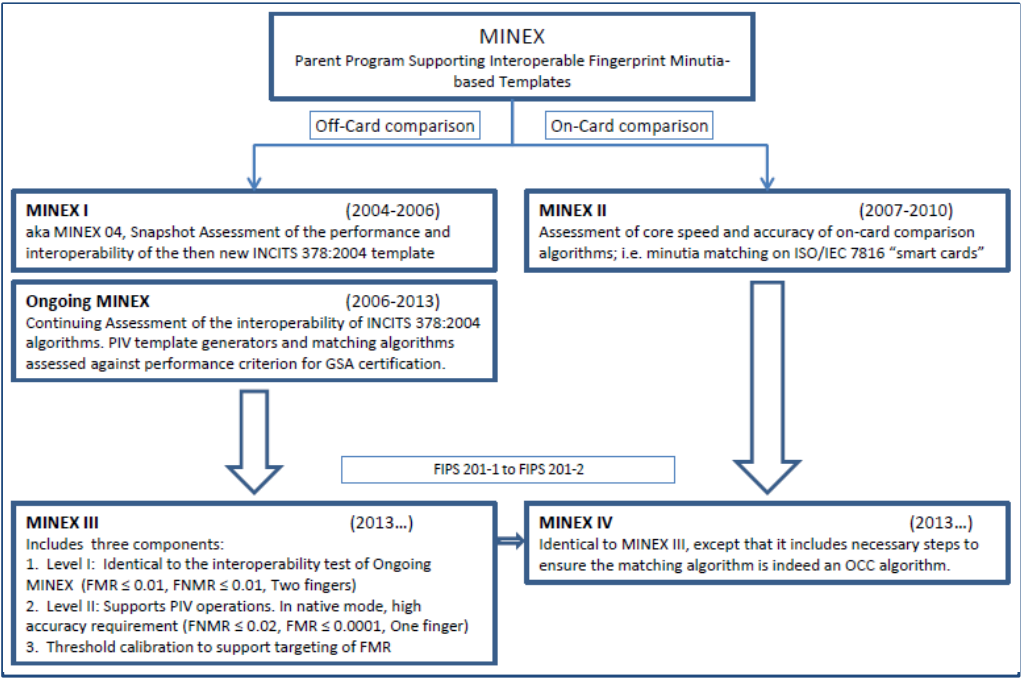
図 6 -- NIST MINEX プログラム。枠で囲まれた階層図。最上部の「MINEX – 相互運用可能な指紋特徴点ベースのテンプレートを支援する親プログラム」から、Off-Card comparison(カード外照合、左)と On-Card comparison(カード上照合、右)と記された 2 本の矢印が伸びる。左側:「MINEX I(2004-2006)、別名 MINEX 04。当時新しかった INCITS 378:2004 テンプレートの性能と相互運用性のスナップショット評価」、続いて「Ongoing MINEX(2006-2013)。INCITS 378:2004 アルゴリズムの相互運用性の継続的評価。PIV テンプレート生成器および照合アルゴリズムを GSA 認定の性能基準に照らして評価」。大きな矢印が下の「MINEX III(2013...)。3 つの構成要素を含む。1. レベル I:Ongoing MINEX の相互運用性試験と同一(FMR ≤ 0.01、FNMR ≤ 0.01、2 本の指)。2. レベル II:PIV の運用を支援。ネイティブモードでは高精度要件(FNMR ≤ 0.02、FMR ≤ 0.0001、1 本の指)。3. FMR の目標値を設定するためのしきい値較正」へ向かう。右側:「MINEX II(2007-2010)。カード上照合アルゴリズムの中核的な速度と精度の評価。すなわち、ISO/IEC 7816「スマートカード」上での特徴点照合」。大きな矢印が下の「MINEX IV(2013...)。MINEX III と同一だが、照合アルゴリズムが実際に OCC アルゴリズムであることを確認するために必要な手順を含む」へ向かう。MINEX III から MINEX IV へ二重矢印が伸びる。2 本の大きな矢印の間には「FIPS 201-1 to FIPS 201-2」(FIPS 201-1 から FIPS 201-2 へ)というラベルがある。
Figure 6 -- The NIST MINEX Program
図 6 -- NIST MINEX プログラム
Annex B. Selection of iris camera
附属書 B. 虹彩カメラの選定
This document does not establish certification criteria for iris cameras used in PIV. The motivation for this is that a formal certification procedure is not yet ready (see below) and, that as an Agency-optional biometric, iris certification costs are not warranted given the wide availability of high-performing cameras. Instead, Agencies might reasonably consider evidence of deployed track record, prior test or operational results, standards-compliance, and the guidance of the following Sub-sections.
本書は、PIV で使用する虹彩カメラの認証基準を定めていません。その理由は、正式な認証手順がまだ整っていない(後述)こと、また、機関任意の生体情報であるため、高性能なカメラが広く入手可能な状況では虹彩認証のコストは正当化されないことです。代わりに、機関は、導入実績、過去の試験結果または運用結果、標準への準拠、および以下の各節の指針を考慮することが妥当でしょう。
B.1 Modes of use
B.1 使用モード
虹彩認識用に撮影された眼のグレースケール画像。 [装飾の画像。本文を読むのに必要のない装飾のため、この非公式サイトには掲載していません。原本 PDF を参照してください。]
For collection of images suitable for enrollment, retention, and preparation of the specialized PIV Card images, an iris camera should routinely collect sharp, well focused, well exposed, 640x480 images in which the iris is looking at the camera directly (frontal gaze), closely centered, minimally occluded by the eyelid. One such image appears at right. Such cameras have long been available, and used for enrollment and access control.
登録、保持、および特殊な PIV カード画像の作成に適した画像を採取するには、虹彩カメラは、虹彩がカメラを直接見ており(正面視)、中央に近く、まぶたによる遮蔽が最小限である、鮮明でピントが合い、適切に露光された 640x480 の画像を日常的に採取すべきです。そのような画像の一例を右に示します。このようなカメラは以前から入手可能であり、登録やアクセス制御に使用されてきました。
Agencies might plan for, and select, different cameras for authentication transactions. The reason for this is that specific iris cameras are available in at least five categories: wall mounted, desktop mounted, handheld (tethered and not), stand-off, and outdoor (binocular). These variously will image just one or both eyes. Some of these specifically implement tradeoffs of speed-of-capture for image quality so that authentication can proceed more quickly than enrolment, where capture of a pristine image is needed for use over future years.
機関は、認証トランザクション用に異なるカメラを計画し、選定する場合があります。その理由は、特定の虹彩カメラが少なくとも 5 つのカテゴリ、すなわち壁面設置型、卓上設置型、携帯型(ケーブル接続型および非接続型)、遠距離型、および屋外型(両眼)で入手可能だからです。これらのカメラは、片眼のみ、または両眼を撮像します。一部のカメラでは、将来にわたって使用するための鮮明な画像が必要な登録時よりも認証を迅速に進められるよう、取得速度と画質とのトレードオフを特に実装しています。
B.2 Imaging capability
B.2 撮像能力
Fingerprint sensors are often selected on the basis of [APP/F] or [SINGFING] certification. These are optical imaging tests designed to show that a sensor has the ability to collect fingerprint images that are faithful to the source29. An analogous specification for iris camera was circulated for public comment in May 2013. A joint NIST DHS S&T Special Publication titled Iris Device Qualification Test [IDQT] will result. It will define both optical imaging specifications and test methods for iris cameras. Its procedures constitute a repeatable, laboratory-based test of a camera's peak imaging capability. It is conceived of as a necessary precursor to human-in-the-loop trials that may be used to measure other performance parameters (e.g., accuracy and speed, see Section B.4).
指紋センサは、[APP/F] または [SINGFING] の認証に基づいて選定されることが多くあります。これらは、センサが元の指紋に忠実な画像を採取する能力を持つことを示すよう設計された光学撮像試験である29。虹彩カメラに対する類似の仕様が、2013 年 5 月にパブリックコメントのために配布されました。その結果として、NIST と DHS S&T による共同の Special Publication である Iris Device Qualification Test [IDQT] が作成される予定です。これは、虹彩カメラの光学撮像仕様と試験方法の両方を定義します。その手順は、カメラのピーク撮像能力を測る、再現可能な実験室ベースの試験を構成します。これは、精度や速度など他の性能パラメータ(B.4 節を参照)の測定に用いられる場合がある、人間が介在する試験に先立つ必要な段階として構想されています。
Agencies might adopt this specification to support procurement of equipment for enrolment and authentication. It might do so by running an actual certification program, or by requiring providers to formally attest that a camera meets particular criteria.
機関は、登録および認証用機器の調達を支援するために、この仕様を採用してもよいです。実際の認証プログラムを実施する方法、またはカメラが特定の基準を満たすことを提供者に正式に証明させる方法があります。
B.3 Image quality
B.3 画像品質
The ISO/IEC 29794-6 iris image quality standard is approaching completion [IRISQUAL]. That standard is likely to establish requirements on images and, separately, on iris cameras. Image quality assessment algorithms can serve as in a quality control role during applicant enrolment.
ISO/IEC 29794-6 虹彩画像品質標準は完成に近づいています [IRISQUAL]。この標準は、画像について、また別途、虹彩カメラについての要件を定める可能性が高いです。画像品質評価アルゴリズムは、申請者の登録時に品質管理の役割を果たすことができます。
Agencies could elect to base camera selection decisions on this standard, by measuring whether a camera produces enough images of sufficiently high quality, according to the standard's metrics. This would involve capture of images from a representative human (volunteer) population. Additionally, Agencies could require that the standard's imaging specifications are met. These are a subset of the [IDQT] specifications.
機関は、この規格の指標に従い、カメラが十分な品質の画像を十分な枚数生成するかを測定して、カメラ選定の判断をこの規格に基づかせてもよいです。この場合、代表的な人間(ボランティア)の母集団から画像を取得します。さらに、機関は規格の撮像仕様を満たすことを要求してもよいです。これらは[IDQT]仕様の一部です。
B.4 Recognition performance
B.4 認識性能
Agencies might elect to select cameras on the basis of a performance and usability test. Such tests are conducted to measure recognition accuracy (error rates), speed, and ease-of-use. Such tests recruit a test population to use cameras; the tests may be conducted in the laboratory or in an operational "pilot" setting. The use of a human population means the tests may be expensive to conduct, and will not be exactly repeatable.
機関は、性能およびユーザビリティの試験に基づいてカメラを選定する場合があります。このような試験は、認識精度(誤り率)、速度、使いやすさを測定するために実施されます。こうした試験では、カメラを使用する被験者集団を募集します。試験は実験室または運用上の「パイロット」環境で実施される場合があります。人間の集団を使用するため、試験の実施には費用がかかることがあり、結果を完全に再現することはできません。
This approach measures accuracy and this necessarily involves using an iris recognition algorithm. Agencies might allow each tested camera to be associated with an algorithm, or might instead select a separate reference algorithm against which all cameras will be compared. The decision on which of these options to take will depend on the operational context and on availability of algorithms.
この方法では精度を測定するため、虹彩認識アルゴリズムを使用する必要があります。機関は、試験する各カメラにアルゴリズムを組み合わせてもよいし、すべてのカメラを比較するための別個の参照アルゴリズムを選択してもよいです。どちらを選ぶかは、運用状況とアルゴリズムの入手可能性によって決まります。
Agencies might choose to select cameras that demonstrate adequate accuracy and speed in a scenario test of the sort defined below. A test laboratory should execute such a test in formal conformance to the scenario testing requirements in Section 7 of the ISO/IEC 19795-2:2007 Testing Methodologies for Technology and Scenario Evaluation standard [PERFSCEN]. The test laboratory should additionally execute the test given the design and reporting constraints given in Table 19 - the specifications define the scenario under test, and restrict the parameters of the test design to ensure production of actionable performance data while mitigating the cost of the test.
機関は、以下に定義するシナリオ試験で十分な精度および速度を示すカメラを選択してもよいです。試験機関は、ISO/IEC 19795-2:2007「Testing Methodologies for Technology and Scenario Evaluation」規格[PERFSCEN]の7節にあるシナリオ試験要件に正式に適合する形で、この試験を実施すべきです。試験機関はさらに、表19に示す設計および報告上の制約に従って試験を実施すべきです。この仕様は試験対象のシナリオを定義し、試験設計のパラメーターを制限することで、試験費用を抑えながら実用可能な性能データを確実に得られるようにします。
The test laboratory should deliver a test report to the requesting Agency. The test report should conform to the reporting requirements of [PERFSCEN] and should report all accuracy and speed data mentioned in Section 6.7 of this document.
試験機関は、試験を依頼した機関に試験報告書を提出すべきです。試験報告書は[PERFSCEN]の報告要件に適合し、本書6.7節で言及する精度および速度のデータをすべて報告すべきです。
Table 19 − Profile of ISO/IEC 19795-2 for iris camera testing
表19 − 虹彩カメラ試験に関するISO/IEC 19795-2のプロファイル
| # | ISO/IEC 19795-2 clause | Test parameter, topic or requirement | PIV specific scenario; test execution practice |
|---|---|---|---|
| 1 | 7.1.2.1 | Concept of operations | A test to represent a physical access control scenario for an habituated population. |
| 2 | 7.1.2.2 | Comparison functionality | One-to-one verification, after presentation of a PIV Card or equivalent as an identity claim. The test may proceed without reading iris imagery from the token i.e., it may be stored on a server. |
| 3 | 7.1.2.3 | Evaluation environment | Indoors, entrance, vestibule, atrium, or interior office, without augmentation of the environmental lighting. |
| 4 | 7.1.2.4 | Test platform | Not specified. |
| 5 | 7.1.3.1 | Test subject instruction | The test crew may be instructed on how to use the biometric system. |
| 6 | 7.1.3.2 | Test subject training | The test crew may execute up to ten enrollment and ten verification attempts before starting the test. |
| 7 | 7.1.3.3 | Attended enrollment | The enrollment attempts may be attended. The attendant should be distinct from the laboratory staff involved in the test measurements. |
| 8 | 7.1.3.3 | Unattended verification | The verification attempts shall be unattended. |
| 9 | 7.1.3.4 | Guidance | During enrollment, the operator may guide the user on correct preparation and use of the system. |
| 10 | 7.1.3.5 | Test order | The test may proceed with several devices being evaluated in parallel. |
| 11 | 7.1.3.6 | Test subject identifiers | The test should include presentation of a PIV Card or similar electronic token that identifies the individual. |
| 12 | 7.1.4.1 | Enrollment level of effort | Either or both eyes may be enrolled. The maximum number of presentations allowed for enrollment is three. The maximum duration of the entire enrollment transaction is 60 seconds. |
| 13 | 7.1.4.2 | Verification level of effort | Either or both eyes may be verified. The maximum number of presentations allowed for verification is three. The maximum duration of the biometric part of the entire verification transaction is 12 seconds. This may include presentation of the identity token. |
| 14 | 7.1.4.3 | Reference adaptation | The enrollment data shall not be augmented or updated during verification attempts. |
| 15 | 7.1.4.5 | Native configuration | The camera and ancillary software shall be pre-configured by the manufacturer prior to the start of the test. The test laboratory shall not further customize or reconfigure any component. |
| 16 | 7.1.5 | Multiple transactions | A test subject shall execute three attempts to verify as himself. This constitutes a transaction. |
| 17 | 7.1.5 | Multiple visits | A test subject shall visit on two separate days. The enrollment and genuine verification transactions shall not be conducted on the same day. |
| 18 | 7.1.6 | Executing genuine trials | A test subject shall execute two or more genuine transactions. |
| 19 | 7.1.6 | Executing impostor trials | A test subject shall execute at least three impostor transactions against different identities by presentation of another individual's identity token. The test subject should not be aware of whether she is making a genuine or impostor |
| # | ISO/IEC 19795-2の箇条 | テストパラメーター、トピックまたは要件 | PIV固有のシナリオ、テスト実施の実務 |
|---|---|---|---|
| 1 | 7.1.2.1 | 運用概念 | 習熟した母集団に対する物理アクセス制御シナリオを表すテスト。 |
| 2 | 7.1.2.2 | 比較機能 | 本人識別情報の申告としてPIVカードまたはそれに相当するものを提示した後の、一対一の検証。テストは、トークンから虹彩画像を読み取らずに進めてもよいです(つまり、画像がサーバーに格納されていてもよいです)。 |
| 3 | 7.1.2.3 | 評価環境 | 屋内の入口、玄関ホール、アトリウム、または屋内オフィスで、環境照明を増強しません。 |
| 4 | 7.1.2.4 | テストプラットフォーム | 規定なし。 |
| 5 | 7.1.3.1 | 被験者への指示 | テスト参加者には、生体認証システムの使い方を指示してもよいです。 |
| 6 | 7.1.3.2 | 被験者の訓練 | テスト参加者は、テストを開始する前に、最大10回の登録および10回の検証を試行してもよいです。 |
| 7 | 7.1.3.3 | 立会い付きの登録 | 登録の試行には立会いを付けてもよいです。立会者は、テストの測定に関与する試験所の職員とは別の者であるべきです。 |
| 8 | 7.1.3.3 | 立会いなしの検証 | 検証の試行は、立会いなしで行わなければなりません。 |
| 9 | 7.1.3.4 | 案内 | 登録中、オペレーターは、システムの正しい準備と使用方法について利用者を案内してもよいです。 |
| 10 | 7.1.3.5 | テストの順序 | テストは、複数のデバイスを並行して評価しながら進めてもよいです。 |
| 11 | 7.1.3.6 | 被験者の識別子 | テストには、個人を識別するPIVカードまたは同様の電子トークンの提示を含めるべきです。 |
| 12 | 7.1.4.1 | 登録に要する労力の水準 | 片方または両方の眼を登録してもよいです。登録で許可される提示の最大回数は3回です。登録トランザクション全体の最大所要時間は60秒です。 |
| 13 | 7.1.4.2 | 検証に要する労力の水準 | 片方または両方の眼を検証してもよいです。検証で許可される提示の最大回数は3回です。検証トランザクション全体のうち生体認証部分の最大所要時間は12秒です。これには、本人識別トークンの提示を含めてもよいです。 |
| 14 | 7.1.4.3 | 参照データの適応 | 登録データは、検証の試行中に補強または更新してはなりません。 |
| 15 | 7.1.4.5 | 標準構成 | カメラおよび付属ソフトウェアは、テストの開始前に製造者によってあらかじめ構成されていなければなりません。試験所は、いかなるコンポーネントもこれ以上カスタマイズまたは再構成してはなりません。 |
| 16 | 7.1.5 | 複数のトランザクション | 被験者は、本人として検証を3回試行しなければなりません。これが1つのトランザクションとなります。 |
| 17 | 7.1.5 | 複数回の来訪 | 被験者は、2つの別々の日に来訪しなければなりません。登録と本人検証トランザクションは、同じ日に実施してはなりません。 |
| 18 | 7.1.6 | 本人試行の実施 | 被験者は、2回以上の本人トランザクションを実施しなければなりません。 |
| 19 | 7.1.6 | なりすまし試行の実施 | 被験者は、別の個人の本人識別トークンを提示して、異なる本人識別情報に対するなりすましトランザクションを少なくとも3回実施しなければなりません。被験者は、次のことを認識しているべきではありません。すなわち、自分が行っているのが本人の提示か、なりすましの |
| presentation. | |||
| 20 | 7.1.7 | Image and subject identity collection | The test laboratory shall retain all collected images. The camera or its ancillary software shall export one image per enrollment per eye in ISO/IEC 19794-6:2011 format. |
| 21 | 7.2.2 | Test crew habituation | The test crew should be habituated or pre-trained to mimic habituation. The test crew may have prior use of the iris camera and system. |
| 22 | 7.2.3 | Test crew composition | The test crew shall be comprised of at least 250 individuals who appear on two or more occasions. The test crew shall include at least 40% males. The test crew shall include at least 40% subjects with age above 40. |
| 23 | 7.2.4 | Test subject management | Each subject shall be assigned an identity token. |
| 24 | 7.3.1 | Performance | Specifications appear in Section 6.7. |
| 25 | 7.3.2 | Enrollment performance | Failure to enroll rate (FTE) shall be calculated as the fraction of persons for which at least one eye cannot be enrolled. |
| 26 | 7.3.3 | Failure-to-acquire performance | Failure to acquire events, if detected, shall be counted and reported. |
| 27 | 7.3.4 | Verification performance | False rejection rates shall be computed as the fraction of genuine subject-transactions that result in verification failure. If false acceptance occurs, testing should be stopped because false matches are unlikely to occur in a test of with this population size and the occurrence of a false match would be an indication of inappropriately weak threshold or a faulty implementation. |
| 28 | 7.3.5 | Identification metrics | None. |
| 29 | 7.3.6 | Generalized error rates including failure to acquire | Failure to acquire events encountered during genuine subject transactions shall be combined with false rejects to produce an effective or generalized false rejection rate. |
| 30 | 7.3.7 | Interim analyses | A test may be terminated early if the observed measurements support, at a statistically supported 99% confidence level, the hypothesis that the PIV requirements on FRR and capture time are violated. |
| 提示かということです。 | |||
| 20 | 7.1.7 | 画像および被験者の本人識別情報の収集 | 試験所は、収集したすべての画像を保持しなければなりません。カメラまたはその付属ソフトウェアは、登録ごと、眼ごとに1枚の画像を、ISO/ |
| 21 | 7.2.2 | テスト参加者の習熟 | テスト参加者は、習熟しているか、習熟を模倣するように事前に訓練されているべきです。テスト参加者が、虹彩カメラおよびシステムを事前に使用した経験があってもよいです。 |
| 22 | 7.2.3 | テスト参加者の構成 | テスト参加者は、2回以上来訪する少なくとも250人で構成されなければなりません。テスト参加者には、男性が少なくとも40%含まれなければなりません。テスト参加者には、40歳を超える被験者が少なくとも40%含まれなければなりません。 |
| 23 | 7.2.4 | 被験者の管理 | 各被験者には、本人識別トークンを割り当てなければなりません。 |
| 24 | 7.3.1 | 性能 | 仕様は6.7節に示されています。 |
| 25 | 7.3.2 | 登録性能 | 登録失敗率(FTE)は、少なくとも片方の眼を登録できない人の割合として算出しなければなりません。 |
| 26 | 7.3.3 | 取得失敗性能 | 取得失敗の事象は、検出された場合、計数して報告しなければなりません。 |
| 27 | 7.3.4 | 検証性能 | 誤拒否率は、検証の失敗に終わった本人の被験者トランザクションの割合として算出しなければなりません。誤受入が発生した場合は、この規模の母集団を用いるテストでは誤照合が起こる可能性が低く、誤照合の発生は閾値が不適切に緩いか実装に欠陥があることの兆候となるため、テストを中止すべきです。 |
| 28 | 7.3.5 | 識別メトリクス | なし。 |
| 29 | 7.3.6 | 取得失敗を含む一般化誤り率 | 本人の被験者トランザクション中に発生した取得失敗の事象は、誤拒否と合算して、有効な、または一般化された誤拒否率を算出しなければなりません。 |
| 30 | 7.3.7 | 中間分析 | 観測された測定値が、統計的に裏付けられた99%の信頼水準で、FRRおよび取得時間に関するPIV要件が満たされていないという仮説を支持する場合、テストを早期に終了してもよいです。 |
Given this test report, the agency should elect to certify a camera against a set of performance requirements – an example of such follows.
この試験報告書を踏まえ、機関は一連の性能要件に照らしてカメラを認証することを選択すべきです。その例を以下に示します。
EXAMPLE The camera shall support accurate recognition. An iris camera shall be certified if it completes the performance test defined in Annex B with all of the following results:
例 カメラは、正確な認識をサポートしなければなりません(shall)。虹彩カメラは、附属書 B で定義された性能試験を完了し、次の結果をすべて満たす場合に認証されなければなりません(shall)。
•The proportion of subjects, executing up to three enrollment attempts, for which zero eyes can be captured i.e., failure-to-enroll rate (FTE) is at or below 0.01;
•最大 3 回の登録試行を行って、どちらの眼も取得できない被験者の割合、すなわち登録失敗率(FTE)が 0.01 以下であること。
•The proportion of genuine verification transactions, each embedding up to three verification attempts, that are falsely rejected (FRR) is at or below 0.01 given a configuration consistent with false acceptance rate (FAR) at or below 0.0003 using only a PIV compliant [IRISSTD] generator and matcher;
•それぞれ最大 3 回の検証試行を含む真正な検証トランザクションのうち、誤って拒否される割合(FRR)が 0.01 以下であること。ただし、PIV 準拠の [IRISSTD] 生成器と照合器のみを使用し、誤受理率(FAR)が 0.0003 以下となる設定であること。
•Retains all [IRISSTD] images to be used in offline comparisons and confirmation of the online results for which false match rate (FMR) shall be at or below 0.0001.
•オンライン結果のオフライン比較と確認に用いるすべての [IRISSTD] 画像を保持すること。オフライン比較・確認の誤一致率(FMR)は 0.0001 以下でなければなりません。
These performance specifications apply to one-to-one authentication30.
これらの性能仕様は、1 対 1 の認証に適用される30。