NIST SP 800-82 Rev. 3 日本語訳
英語タイトル : Guide to Operational Technology (OT) Security日本語タイトル : 運用技術(OT)セキュリティガイド
公開日 : 2023-09-28
原文URL : https://csrc.nist.gov/pubs/sp/800/82/r3/final
翻訳編集 : 自動生成(有志による非公式の日本語訳), 原文取得日 : 2026-09-30, 訳文 : 3466 / 3474 ブロック
[要約] SP 800-82 Rev. 3 は、運用技術(OT)固有の性能、信頼性、安全性の要件に配慮しながら、OT を保護する方法に関する指針を示すガイドです。OT システムと典型的なシステムトポロジの概要、共通する脅威と脆弱性、関連リスクを緩和するセキュリティ対策を扱い、OT サイバーセキュリティ・プログラムの策定、リスク管理、アーキテクチャ、サイバーセキュリティフレームワークの適用を章立てで示します。物理環境と相互作用する広範なプログラム可能システムや装置を含む OT を対象に、安全な OT を確立するためのガイダンスを提供することが目的です。
NIST Special Publication
NIST Special Publication
NIST SP 800-82r3
NIST SP 800-82r3
Guide to Operational Technology (OT) Security
Guide to Operational Technology (OT) Security
Keith Stouffer
Keith Stouffer
Michael Pease
Michael Pease
CheeYee Tang
CheeYee Tang
Timothy Zimmerman
Timothy Zimmerman
Victoria Pillitteri
Victoria Pillitteri
Suzanne Lightman
Suzanne Lightman
Adam Hahn
Adam Hahn
Stephanie Saravia
Stephanie Saravia
Aslam Sherule
Aslam Sherule
Michael Thompson
Michael Thompson
This publication is available free of charge from: https://doi.org/10.6028/NIST.SP.800-82r3
本出版物は次から無料で入手できる:https://doi.org/10.6028/NIST.SP.800-82r3
NIST Special Publication
NIST Special Publication
NIST SP 800-82r3
NIST SP 800-82r3
Guide to Operational Technology (OT) Security
Guide to Operational Technology (OT) Security
Keith Stouffer
Keith Stouffer
Michael Pease
Michael Pease
CheeYee Tang
CheeYee Tang
Timothy Zimmerman
Timothy Zimmerman
Smart Connected Systems Division
スマートコネクテッドシステム部門(Smart Connected Systems Division)
Communications Technology Laboratory
通信技術研究所(Communications Technology Laboratory)
Victoria Pillitteri
Victoria Pillitteri
Suzanne Lightman
Suzanne Lightman
Computer Security Division
コンピュータセキュリティ部門
Information Technology Laboratory
情報技術研究所(Information Technology Laboratory)
Adam Hahn
Adam Hahn
Stephanie Saravia
Stephanie Saravia
Aslam Sherule
Aslam Sherule
Michael Thompson
Michael Thompson
The MITRE Corporation
The MITRE Corporation
This publication is available free of charge from: https://doi.org/10.6028/NIST.SP.800-82r3
本出版物は次から無料で入手できる:https://doi.org/10.6028/NIST.SP.800-82r3
September 2023
2023年9月
[米国商務省の紋章。公的な標章のため、この非公式サイトには掲載していません。原本 PDF を参照してください。]
U.S. Department of Commerce
米国商務省
Gina M. Raimondo, Secretary
Gina M. Raimondo、長官
National Institute of Standards and Technology
米国国立標準技術研究所
Laurie E. Locascio, NIST Director and Under Secretary of Commerce for Standards and Technology
Laurie E. Locascio、NIST所長 兼 標準・技術担当商務次官
Certain commercial equipment, instruments, software, or materials, commercial or non-commercial, are identified in this paper in order to specify the experimental procedure adequately. Such identification does not imply recommendation or endorsement of any product or service by NIST, nor does it imply that the materials or equipment identified are necessarily the best available for the purpose.
本文書では、実験手順を適切に記述するために、商用・非商用を問わず特定の商用機器、計器、ソフトウェア、または資材を挙げています。こうした記載は、NISTによる製品やサービスの推奨または支持を意味するものではなく、挙げた資材や機器がその目的にとって必ずしも最適であることを意味するものでもありません。
There may be references in this publication to other publications currently under development by NIST in accordance with its assigned statutory responsibilities. The information in this publication, including concepts and methodologies, may be used by federal agencies even before the completion of such companion publications. Thus, until each publication is completed, current requirements, guidelines, and procedures, where they exist, remain operative. For planning and transition purposes, federal agencies may wish to closely follow the development of these new publications by NIST.
本刊行物は、NISTが割り当てられた法定責務に従って現在策定中の他の刊行物を参照する場合があります。関連刊行物が完成する前であっても、連邦機関は、本刊行物に記載された情報(概念および方法論を含む)を利用できます。したがって各刊行物が完成するまでは、現行の要件、ガイドラインおよび手順は、存在する場合には引き続き有効です。計画および移行のため、連邦機関はNISTによるこれらの新たな刊行物の策定状況を注意深く追ってもよいです。
Organizations are encouraged to review all draft publications during public comment periods and provide feedback to NIST. Many NIST cybersecurity publications, other than the ones noted above, are available at https://csrc.nist.gov/publications.
組織には、公開意見募集期間中にすべての草案を確認し、NISTに意見を提出することを推奨します。上記以外のNISTサイバーセキュリティ刊行物の多くは、https://csrc.nist.gov/publications で入手できます。
Authority This publication has been developed by NIST in accordance with its statutory responsibilities under the Federal Information Security Modernization Act (FISMA) of 2014, 44 U.S.C. § 3551 et seq., Public Law (P.L.) 113-283. NIST is responsible for developing information security standards and guidelines, including minimum requirements for federal information systems, but such standards and guidelines shall not apply to national security systems without the express approval of appropriate federal officials exercising policy authority over such systems. This guideline is consistent with the requirements of the Office of Management and Budget (OMB) Circular A-130.
権限 本刊行物は、2014年連邦情報セキュリティ近代化法(FISMA)、44 U.S.C. § 3551 et seq.、公法(P.L.)113-283に基づく法定責務に従ってNISTが作成しました。NISTは、連邦情報システムの最低要件を含む情報セキュリティ標準およびガイドラインの策定を担います。ただし、適切な連邦当局者が当該システムに関する政策権限を行使し、明示的に承認しない限り、そのような標準およびガイドラインを国家安全保障システムに適用してはなりません。このガイドラインは行政管理予算局(OMB)通達A-130の要件に整合します。
Nothing in this publication should be taken to contradict the standards and guidelines made mandatory and binding on federal agencies by the Secretary of Commerce under statutory authority. Nor should these guidelines be interpreted as altering or superseding the existing authorities of the Secretary of Commerce, Director of the OMB, or any other federal official. This publication may be used by nongovernmental organizations on a voluntary basis and is not subject to copyright in the United States. Attribution would, however, be appreciated by NIST.
本刊行物のいかなる内容も、法定権限に基づき商務長官が連邦機関に義務付け、拘束力を持たせた標準およびガイドラインに反すると解釈してはなりません。また、これらのガイドラインを、商務長官、OMB長官、その他の連邦当局者の既存権限を変更または置き換えるものと解釈してはなりません。本刊行物は非政府組織が任意に利用でき、米国では著作権の対象ではありません。ただし、NISTへの帰属表示を歓迎します。
NIST Technical Series Policies Copyright, Use, and Licensing Statements NIST Technical Series Publication Identifier Syntax
NIST技術シリーズの方針 著作権、使用およびライセンスに関する声明 NIST技術シリーズ刊行物識別子の構文
Publication History Approved by the NIST Editorial Review Board on 2023-09-20 Supersedes NIST Special Publication (SP) 800-82 Rev. 2 (May 2015) https://doi.org/10.6028/NIST.SP.800-82r2
刊行履歴 NIST編集審査委員会承認日: 2023-09-20 NIST特別刊行物(SP)800-82 Rev. 2(2015年5月)を置き換える https://doi.org/10.6028/NIST.SP.800-82r2
How to Cite this NIST Technical Series Publication:
本NIST技術シリーズ出版物の引用方法:
Stouffer K, Pease M, Tang CY, Zimmerman T, Pillitteri V, Lightman S, Hahn A, Saravia S, Sherule A, Thompson M (2023) Title. (National Institute of Standards and Technology, Gaithersburg, MD), NIST Special Publication (SP) NIST SP 800-82r3. https://doi.org/10.6028/NIST.SP.800-82r3
Stouffer K, Pease M, Tang CY, Zimmerman T, Pillitteri V, Lightman S, Hahn A, Saravia S, Sherule A, Thompson M (2023) Title. (National Institute of Standards and Technology, Gaithersburg, MD), NIST Special Publication (SP) NIST SP 800-82r3. https://doi.org/10.6028/NIST.SP.800-82r3
Author ORCID iDs
著者のORCID iD
Keith Stouffer: 0000-0003-1220-5487
Keith Stouffer: 0000-0003-1220-5487
Michael Pease: 0000-0002-6489-2621
Michael Pease: 0000-0002-6489-2621
CheeYee Tang: 0000-0002-5488-8645
CheeYee Tang: 0000-0002-5488-8645
Timothy Zimmerman: 0000-0001-8451-0515
Timothy Zimmerman: 0000-0001-8451-0515
Victoria Pillitteri: 0000-0002-7446-7506
Victoria Pillitteri: 0000-0002-7446-7506
Suzanne Lightman: 0000-0002-5007-3887
Suzanne Lightman: 0000-0002-5007-3887
Contact Information sp800-82rev3@nist.gov
連絡先 sp800-82rev3@nist.gov
National Institute of Standards and Technology Attn: Computer Security Division, Information Technology Laboratory 100 Bureau Drive (Mail Stop 8930) Gaithersburg, MD 20899-8930
国立標準技術研究所 宛先: Computer Security Division, Information Technology Laboratory 100 Bureau Drive (Mail Stop 8930) Gaithersburg, MD 20899-8930
All comments are subject to release under the Freedom of Information Act (FOIA).
すべての意見は、情報公開法(FOIA)に基づく公開対象となります。
Abstract
要約
This document provides guidance on how to secure operational technology (OT) while addressing their unique performance, reliability, and safety requirements. OT encompasses a broad range of programmable systems and devices that interact with the physical environment (or manage devices that interact with the physical environment). These systems and devices detect or cause a direct change through the monitoring and/or control of devices, processes, and events. Examples include industrial control systems, building automation systems, transportation systems, physical access control systems, physical environment monitoring systems, and physical environment measurement systems. The document provides an overview of OT and typical system topologies, identifies common threats and vulnerabilities to these systems, and provides recommended security countermeasures to mitigate the associated risks.
本書は、運用技術(OT)固有の性能、信頼性、安全性の要件に対応しながら、OTを保護する方法に関する指針を示します。OTには、物理環境と相互作用する(または物理環境と相互作用する装置を管理する)広範なプログラム可能システムおよび装置が含まれます。これらのシステムおよび装置は、装置、プロセス、イベントを監視および/または制御することで、直接的な変化を検出または引き起こします。例として、産業制御システム、ビルオートメーションシステム、輸送システム、物理アクセス制御システム、物理環境監視システム、物理環境測定システムが挙げられます。本書はOTと典型的なシステムトポロジーの概要を示し、これらのシステムに共通する脅威と脆弱性を特定し、関連リスクを軽減するための推奨セキュリティ対策を示します。
Keywords
キーワード
computer security; distributed control systems (DCS); industrial control systems (ICS); information security; network security; operational technology (OT); programmable logic controllers (PLC); risk management; security controls; supervisory control and data acquisition (SCADA) systems.
コンピューターセキュリティ、分散制御システム(DCS)、産業制御システム(ICS)、情報セキュリティ、ネットワークセキュリティ、運用技術(OT)、プログラマブルロジックコントローラー(PLC)、リスク管理、セキュリティ管理策、監視制御・データ収集(SCADA)システム。
Reports on Computer Systems Technology
コンピューターシステム技術報告
The Information Technology Laboratory (ITL) at the National Institute of Standards and Technology (NIST) promotes the U.S. economy and public welfare by providing technical leadership for the Nation’s measurement and standards infrastructure. ITL develops tests, test methods, reference data, proof of concept implementations, and technical analyses to advance the development and productive use of information technology. ITL’s responsibilities include the development of management, administrative, technical, and physical standards and guidelines for the cost-effective security and privacy of other than national security-related information in federal information systems. The Special Publication 800-series reports on ITL’s research, guidelines, and outreach efforts in information system security, and its collaborative activities with industry, government, and academic organizations.
国立標準技術研究所(NIST)の情報技術研究所(ITL)は、米国の計量・標準インフラに技術的リーダーシップを提供し、米国経済と公共の福祉を促進します。ITLは、情報技術の発展と生産的利用を進めるため、試験、試験方法、参照データ、概念実証の実装、技術分析を開発します。ITLの責務には、国家安全保障関連以外の連邦情報システムにおける情報の費用対効果に優れたセキュリティとプライバシーのため、管理、行政、技術、物理の各面の標準・ガイドラインを策定することが含まれます。特別刊行物800シリーズは、情報システムセキュリティ分野におけるITLの研究、ガイドライン、普及活動、および産業界、政府、学術機関との協力活動を報告します。
Note to Readers
読者への注記
This document is the third revision of NIST SP 800-82. Updates in this revision include:
本書はNIST SP 800-82の第3次改訂版です。本改訂の更新内容は次のとおり。
•Expansion in scope from industrial control systems to operational technology (OT)
•産業制御システムから運用技術(OT)へ適用範囲を拡大
•Updates to OT threats and vulnerabilities
•OTの脅威と脆弱性を更新
•Updates to OT risk management, recommended practices, and architectures
•OTのリスク管理、推奨実務およびアーキテクチャを更新
•Updates to current activities in OT security
•OTセキュリティに関する現行の活動を更新
•Updates to security capabilities and tools for OT
•OT向けセキュリティ機能およびツールを更新
•Additional alignment with other OT security standards and guidelines, including the Cybersecurity Framework
•サイバーセキュリティフレームワークなど、他のOTセキュリティ標準およびガイドラインとの整合性を強化
•New tailoring guidance for NIST SP 800-53, Rev. 5 security controls
•NIST SP 800-53 Rev. 5のセキュリティ管理策に関する新たな調整指針
•An OT overlay for NIST SP 800-53, Rev. 5 security controls that provides tailored security control baselines for low-, moderate-, and high-impact OT systems
•影響度が低・中・高のOTシステム向けに調整済みのセキュリティ管理策ベースラインを示す、NIST SP 800-53 Rev. 5管理策のOTオーバーレイ
Patent Disclosure Notice
特許開示に関する通知
NOTICE: ITL has requested that holders of patent claims whose use may be required for compliance with the guidance or requirements of this publication disclose such patent claims to ITL. However, holders of patents are not obligated to respond to ITL calls for patents and ITL has not undertaken a patent search in order to identify which, if any, patents may apply to this publication. As of the date of publication and following call(s) for the identification of patent claims whose use may be required for compliance with the guidance or requirements of this publication, no such patent claims have been identified to ITL. No representation is made or implied by ITL that licenses are not required to avoid patent infringement in the use of this publication.
通知: ITLは、本刊行物のガイダンスまたは要件への適合に使用が必要となる可能性のある特許請求の保有者に対し、その特許請求をITLに開示するよう求めています。ただし、特許保有者はITLによる特許照会に回答する義務を負わず、ITLも本刊行物に適用される可能性のある特許を特定するための調査を行っていません。刊行日時点で、適合に使用が必要となる可能性のある特許請求の特定を求めた照会を行った結果、そのような特許請求はITLに特定されていません。本刊行物の使用において特許侵害を避けるライセンスが不要であると、ITLが表明または暗示するものではありません。
Table of Contents
目次
D.5.5. Stockholm International Summit on Cyber Security in SCADA and ICS
D.5.5. SCADAおよびICSのサイバーセキュリティに関するストックホルム国際サミット
(CS3STHLM) — 206
(CS3STHLM)— 206
Appendix E. OT Security Capabilities and Tools — 207
付録E. OTセキュリティの機能およびツール — 207
E.1. Network Segmentation and Isolation — 207
E.1. ネットワークのセグメンテーションおよび分離 — 207
E.1.1. Firewalls — 207
E.1.1. ファイアウォール — 207
E.1.2. Unidirectional Gateways — 207
E.1.2. 一方向ゲートウェイ — 207
E.1.3. Virtual Local Area Networks (VLANs) — 207
E.1.3. 仮想LAN(VLAN)— 207
E.1.4. Software-Defined Networking (SDN) — 208
E.1.4. ソフトウェア定義ネットワーキング(SDN)— 208
E.2. Network Monitoring – Security Information and Event Management (SIEM) — 208
E.2. ネットワーク監視—セキュリティ情報・イベント管理(SIEM)— 208
E.2.1. Centralized Logging — 208
E.2.1. 集中ログ管理 — 208
E.2.2. Passive Scanning — 208
E.2.2. パッシブスキャン — 208
E.2.3. Active Scanning — 209
E.2.3. アクティブスキャン — 209
E.2.4. Malware Detection — 209
E.2.4. マルウェア検知 — 209
E.2.5. Behavioral Anomaly Detection — 209
E.2.5. 振る舞い異常検知 — 209
E.2.6. Data Loss Prevention (DLP) — 210
E.2.6. データ損失防止(DLP)— 210
E.2.7. Deception Technology — 210
E.2.7. デセプション技術 — 210
E.2.8. Digital Twins — 210
E.2.8. デジタルツイン — 210
E.3. Data Security — 210
E.3. データセキュリティ — 210
E.3.1. Backup Storage — 210
E.3.1. バックアップストレージ — 210
E.3.2. Immutable Storage — 211
E.3.2. イミュータブルストレージ — 211
E.3.3. File Hashing — 211
E.3.3. ファイルハッシュ — 211
E.3.4. Digital Signatures — 211
E.3.4. デジタル署名 — 211
E.3.5. Block Ciphers — 211
E.3.5. ブロック暗号 — 211
E.3.6. Remote Access — 212
E.3.6. リモートアクセス — 212
Appendix F. OT Overlay — 213
付録F. OTオーバーレイ — 213
F.1. Overlay Characteristics — 213
F.1. オーバーレイの特性 — 213
F.2. Applicability — 214
F.2. 適用可能性 — 214
F.3. Overlay Summary — 214
F.3. オーバーレイの概要 — 214
F.4. Tailoring Considerations — 223
F.4. テーラリング時の考慮事項 — 223
F.5. OT Communication Protocols — 224
F.5. OT通信プロトコル — 224
F.6. Definitions — 225
F.6. 定義 — 225
F.7. Detailed Overlay Control Specifications — 225
F.7. オーバーレイの詳細な管理策仕様 — 225
F.7.1. ACCESS CONTROL – AC — 227
F.7.1. アクセス制御 — AC — 227
F.7.2. AWARENESS AND TRAINING – AT — 235
F.7.2. 意識向上およびトレーニング — AT — 235
F.7.3. AUDITING AND ACCOUNTABILITY – AU — 236
F.7.3. 監査および説明責任 — AU — 236
F.7.4. ASSESSMENT, AUTHORIZATION, AND MONITORING – CA — 240
F.7.4. 評価、認可および監視 — CA — 240
F.7.5. CONFIGURATION MANAGEMENT – CM — 243
F.7.5. 構成管理 — CM — 243
F.7.6. CONTINGENCY PLANNING – CP — 247
F.7.6. 緊急時対応計画 — CP — 247
F.7.7. IDENTIFICATION AND AUTHENTICATION – IA — 252
F.7.7. 識別および認証 — IA — 252
F.7.8. INCIDENT RESPONSE – IR — 256
F.7.8. インシデント対応 — IR — 256
F.7.9. MAINTENANCE – MA — 258
F.7.9. 保守 — MA — 258
F.7.10. MEDIA PROTECTION –MP — 260
F.7.10. 媒体保護 — MP — 260
F.7.11. PHYSICAL AND ENVIRONMENTAL PROTECTION – PE — 262
F.7.11. 物理的および環境的保護 — PE — 262
F.7.12. PLANNING – PL — 267
F.7.12. 計画 — PL — 267
F.7.13. ORGANIZATION-WIDE INFORMATION SECURITY PROGRAM
F.7.13. 組織全体の情報セキュリティ・プログラム
MANAGEMENT CONTROLS – PM — 269
マネジメント管理策 — PM — 269
F.7.14. PERSONNEL SECURITY – PS — 276
F.7.14. 人員セキュリティ — PS — 276
F.7.15. RISK ASSESSMENT – RA — 278
F.7.15. リスク評価 — RA — 278
F.7.16. SYSTEM AND SERVICES ACQUISITION – SA — 280
F.7.16. システムおよびサービスの取得 — SA — 280
F.7.17. SYSTEM AND COMMUNICATIONS PROTECTION – SC — 283
F.7.17. システムおよび通信の保護 — SC — 283
F.7.18. SYSTEM AND INFORMATION INTEGRITY – SI — 291
F.7.18. システムおよび情報の完全性 — SI — 291
F.7.19. SUPPLY CHAIN RISK MANAGEMENT – SR — 296
F.7.19. サプライチェーン・リスク管理 — SR — 296
Appendix G. Change Log — 299
付録G. 変更履歴 — 299
List of Tables
表一覧
List of Figures
図一覧
Acknowledgments for Revision
改訂第3版への謝辞
The authors gratefully acknowledge and appreciate the significant contributions from Sallie Edwards, Blaine Jefferies, and John Hoyt from The MITRE Corporation and Megan Corso and Brett Ramsay from the Department of Defense. The authors wish to thank their colleagues who reviewed drafts of the document and contributed to its content, including Eran Salfati, Karen Scarfone, and Isabel Van Wyk.
著者らは、MITRE CorporationのSallie Edwards、Blaine JefferiesおよびJohn Hoyt、ならびに国防総省のMegan CorsoおよびBrett Ramsayからの多大な貢献に感謝し、謝意を表します。また、本書の草案を査読し内容に貢献した同僚、Eran Salfati、Karen ScarfoneおよびIsabel Van Wykにも謝意を表します。
Acknowledgments for Previous Versions
旧版への謝辞
The authors wish to thank their colleagues who reviewed drafts of the original version of the document and contributed to its technical content. The authors would particularly like to acknowledge Tim Grance, Ron Ross, Stu Katzke, and Freemon Johnson of NIST for their keen and insightful assistance throughout the development of the document. The authors also gratefully acknowledge and appreciate the many contributions from the public and private sectors whose thoughtful and constructive comments improved the quality and usefulness of the publication. The authors would particularly like to thank the members of ISA99, Lisa Kaiser, Department of Homeland Security, the Department of Homeland Security Industrial Control System Joint Working Group (ICSJWG), the Office of the Deputy Undersecretary of Defense for Installations and Environment, Business Enterprise Integration Directorate staff, Daryl Haegley, and Michael Chipley for their exceptional contributions to this publication. The authors would also like to thank the UK National Centre for the Protection of National Infrastructure (CPNI) for allowing portions of the Good Practice Guide on Firewall Deployment for SCADA and Process Control Network to be used in the document as well as ISA for allowing portions of the ISA-62443 Standards to be used in the document.
本書の初版草案を査読し、技術的内容に貢献した同僚に感謝します。特に、文書の策定全体を通じて鋭く洞察に富む支援を行ったNISTのTim Grance、Ron Ross、Stu KatzkeおよびFreemon Johnsonに謝意を表します。また、本書の品質と有用性を高める思慮深く建設的な意見を寄せた官民各分野の多くの方々にも深く感謝します。特に、ISA99のメンバー、国土安全保障省のLisa Kaiser、国土安全保障省産業用制御システム合同作業部会(ICSJWG)、国防副次官(施設・環境担当)室、事業企業統合局の職員、Daryl Haegley、およびMichael Chipleyによる本書への卓越した貢献に感謝します。さらに、SCADAおよびプロセス制御ネットワーク向けファイアウォール導入に関する Good Practice Guide の一部を本書で使用することを認めた英国国家インフラ防護センター(CPNI)、ならびにISA-62443規格の一部を本書で使用することを認めたISAにも感謝します。
Executive Summary
エグゼクティブサマリー
This document provides guidance for establishing secure operational technology (OT)1 while addressing OT’s unique performance, reliability, and safety requirements. OT encompasses a broad range of programmable systems and devices that interact with the physical environment (or manage devices that interact with the physical environment). These systems and devices detect or cause a direct change through the monitoring and/or control of devices, processes, and events. Examples include industrial control systems (ICS), building automation systems, transportation systems, physical access control systems, physical environment monitoring systems, and physical environment measurement systems. This document provides an overview of OT and typical system topologies, identifies common threats and vulnerabilities to these systems, and recommends security countermeasures to mitigate the associated risks.
本文書は、OT固有の性能、信頼性、および安全性の要件に対処しつつ、セキュアな運用技術(OT)1を確立するためのガイダンスを提供します。OTは、物理環境と相互作用する(または物理環境と相互作用するデバイスを管理する)幅広いプログラム可能なシステムおよびデバイスを包含します。これらのシステムおよびデバイスは、デバイス、プロセス、および事象の監視や制御を通じて、直接的な変化を検知し、または引き起こします。例として、産業制御システム(ICS)、ビルオートメーションシステム、輸送システム、物理アクセス制御システム、物理環境監視システム、および物理環境計測システムがあります。本文書は、OTと典型的なシステムトポロジーの概要を示し、これらのシステムに対する一般的な脅威と脆弱性を特定し、関連するリスクを軽減するためのセキュリティ対策を推奨します。
OT is vital to the operation of U.S. critical infrastructures, which are often highly interconnected, mutually dependent systems. It is important to note that while federal agencies operate many of the Nation’s critical infrastructures, many others are privately owned and operated. Additionally, critical infrastructures are often referred to as a “system of systems” because of the interdependencies that exist between various industrial sectors and interconnections between business partners.
OTは米国の重要インフラの運用に不可欠です。重要インフラは、高度に相互接続され、相互に依存するシステムであることが多くあります。連邦政府機関が国の重要インフラの多くを運用している一方で、それ以外の多くは民間が所有・運用している点に留意することが重要です。さらに、重要インフラは、さまざまな産業セクター間に存在する相互依存性や事業パートナー間の相互接続のため、「システムのシステム(system of systems)」と呼ばれることが多くあります。
Initially, OT had little resemblance to traditional information technology (IT) systems because OT systems were isolated, ran proprietary control protocols, and used specialized hardware and software. As OT systems adopt IT solutions to enable corporate business systems connectivity and remote access capabilities and are designed and implemented using industry-standard computers, operating systems (OSs), and network protocols, they have begun to resemble IT systems. This integration supports new IT capabilities, but it provides significantly less isolation for OT from the outside world than predecessor systems, creating a greater need to secure OT systems. The increasing use of wireless networking places OT implementations at greater risk from adversaries who are in relatively close physical proximity but do not have direct physical access to the equipment. While security solutions have been designed to deal with these issues in typical IT systems, special precautions must be taken when introducing these same solutions to OT environments. In some cases, new security solutions that are tailored to the OT environment are needed.
当初、OTは従来の情報技術(IT)システムとはほとんど似ていませんでした。OTシステムは隔離されており、独自の制御プロトコルを実行し、専用のハードウェアとソフトウェアを使用していたためです。OTシステムが企業の業務システムとの接続やリモートアクセス機能を実現するためにITソリューションを採用し、業界標準のコンピュータ、オペレーティングシステム(OS)、およびネットワークプロトコルを用いて設計・実装されるようになるにつれ、OTシステムはITシステムに似てきました。この統合は新たなIT機能を支える一方で、従来のシステムと比べてOTを外部世界から隔離する度合いが大幅に低くなり、OTシステムを保護する必要性が高まっています。無線ネットワークの利用が増えることで、機器に直接物理的にアクセスすることはできないが物理的に比較的近い場所にいる敵対者からのリスクに、OTの実装がより大きくさらされます。典型的なITシステムではこうした問題に対処するセキュリティソリューションが設計されてきましたが、同じソリューションをOT環境に導入する際には特別な予防措置を講じなければなりません。場合によっては、OT環境に合わせて調整された新たなセキュリティソリューションが必要となります。
Although some characteristics are similar, OT also has characteristics that differ from traditional information processing systems. Many of these differences stem from the fact that logic executing in OT has a direct effect on the physical world. Some of these characteristics include significant risk to the health and safety of human lives, serious damage to the environment, and severe financial issues, such as production losses, negative impacts to the Nation’s economy, and the compromise of proprietary information. OT has unique performance and reliability requirements and often uses OSs and applications that may be considered unconventional to typical IT personnel. Furthermore, the goals of safety and efficiency sometimes conflict with security in the design and operation of OT systems.
一部の特性は類似しているものの、OTには従来の情報処理システムとは異なる特性もあります。こうした違いの多くは、OTで実行されるロジックが物理世界に直接影響を及ぼすという事実に起因します。こうした特性には、人命の健康と安全に対する重大なリスク、環境への深刻な損害、ならびに生産損失、国家経済への悪影響、専有情報の侵害といった深刻な財務上の問題が含まれます。OTには固有の性能要件と信頼性要件があり、典型的なIT担当者にとっては一般的でないと見なされうるOSやアプリケーションを使用することが多くあります。さらに、OTシステムの設計と運用においては、安全性と効率性という目標がセキュリティと相反することがあります。
OT cybersecurity programs should always be part of broader OT safety and reliability programs at both industrial sites and enterprise cybersecurity programs because cybersecurity is essential to the safe and reliable operation of modern industrial processes. Threats to OT systems can come from numerous sources, including hostile governments, terrorist groups, disgruntled employees, malicious intruders, complexities, natural disasters, malicious actions by insiders, and unintentional actions such human error or failure to follow established policies and procedures. OT security objectives typically prioritize integrity and availability, followed by confidentiality, but also must consider safety as an overarching priority. Possible incidents that an OT system may face include:
OTサイバーセキュリティ・プログラムは、産業サイトにおけるOTの安全・信頼性プログラムおよび企業のサイバーセキュリティ・プログラムの一部として常に位置付けるべきです。サイバーセキュリティは現代の産業プロセスを安全かつ信頼性高く運用するうえで不可欠だからです。OTシステムへの脅威源には、敵対的な政府、テロ集団、不満を持つ従業員、悪意ある侵入者、複雑性、自然災害、内部者による悪意ある行為、人的ミスや確立した方針・手順に従わないことなどの意図しない行為が含まれます。OTのセキュリティ目標では通常、完全性と可用性を優先し、その次に機密性を重視しますが、最優先事項として安全性も考慮しなければなりません。OTシステムが直面し得るインシデントには、次があります。
•Blocked or delayed flow of information through OT networks, which could disrupt OT operation, including loss of view and loss of control
•OTネットワーク上の情報フローが遮断または遅延し、状況把握の喪失や制御の喪失を含め、OTの運用を妨げます。
•Unauthorized changes to instructions, commands, or alarm thresholds that could damage, disable, or shut down equipment, create environmental impacts, and/or endanger human life
•指示、コマンドまたはアラームしきい値が不正に変更され、機器の損傷、無効化もしくは停止、環境への影響、および/または人命への危険を引き起こしうます。
•Inaccurate information sent to system operators, either to disguise unauthorized changes or to cause operators to initiate inappropriate actions that could have various negative effects
•不正な変更を隠すため、またはオペレーターにさまざまな悪影響を及ぼしうる不適切な操作を開始させるため、不正確な情報がシステムオペレーターに送信されます。
•Modified OT software or configuration settings or OT software infected with malware, which could have various negative effects
•OTソフトウェアまたは構成設定が変更される、あるいはOTソフトウェアがマルウェアに感染し、さまざまな悪影響が生じうます。
•Interference with the operation of equipment protection systems, which could endanger costly and difficult-to-replace equipment
•機器保護システムの動作が妨害され、費用が高く交換が困難な機器が危険にさらされうます。
•Interference with the operation of safety systems, which could endanger human life
•安全システムの動作が妨害され、人命が危険にさらされます。
Major security objectives for an OT implementation should include the following:
OT実装における主なセキュリティ目標には、次を含めるべきです。
•Restrict logical access to the OT network, network activity, and systems. This may include using unidirectional gateways, utilizing a demilitarized zone (DMZ) network architecture with firewalls to prevent network traffic from passing directly between the corporate and OT networks, and having separate authentication mechanisms and credentials for users of the corporate and OT networks. The OT system should also use a network topology that has multiple layers, with the most critical communications occurring in the most secure and reliable layer.
•OTネットワーク、ネットワーク活動およびシステムへの論理的アクセスを制限します。これには、一方向ゲートウェイの使用、企業ネットワークとOTネットワーク間をネットワークトラフィックが直接通過しないようファイアウォールを備えた非武装地帯(DMZ)ネットワークアーキテクチャの利用、企業ネットワークとOTネットワークの利用者に別個の認証機構と資格情報を設けることが含まれます。OTシステムも多層構造のネットワークトポロジを使用し、最も重要な通信を最も安全で信頼性の高い層で行うべきです。
•Restrict physical access to the OT network and devices. Unauthorized physical access to components can seriously disrupt the OT’s functionality. A combination of physical access controls should be used, such as locks, card readers, and/or guards.
•OTネットワークおよびデバイスへの物理アクセスを制限します。不正な物理アクセスはOT機能を深刻に妨げる可能性があります。錠、カードリーダーおよび/または警備員などを組み合わせた物理アクセス制御を用いるべきです。
•• Protect individual OT components from exploitation. This includes deploying security patches in as expeditious a manner as possible after testing them under field conditions, disabling all unused ports and services and ensuring that they remain disabled, restricting OT user privileges to only those that are required for each user’s role, tracking and monitoring audit trails, and using security controls such as antivirus software and file integrity checking software where technically feasible to prevent, deter, detect, and mitigate malware. Keys of OT assets like programmable logic controllers (PLCs) and safety systems should be in the “Run” position at all times unless they are being actively programmed.
•• 個々のOTコンポーネントを悪用から保護します。これには、現場条件下で試験した後に可能な限り迅速にセキュリティパッチを適用すること、未使用のポートおよびサービスをすべて無効化して無効状態を維持すること、OT利用者の権限を各利用者の役割に必要なものだけに制限すること、監査証跡を追跡・監視すること、さらに、技術的に実施可能な場合に、マルウェアを防止、抑止、検知および緩和するためにウイルス対策ソフトウェアやファイル完全性検査ソフトウェアなどのセキュリティ管理策を用いることが含まれます。プログラマブルロジックコントローラ(PLC)や安全システムなどのOT資産のキーは、能動的にプログラムしている場合を除き、常に「Run」の位置にしておくべきです。
•Restrict unauthorized modification of data. This includes data in all states (e.g., at rest, in transit, in use) including data flows crossing network boundaries.
•データの不正な変更を制限します。これは、ネットワーク境界を越えるデータフローを含む、保管中、転送中、使用中などあらゆる状態のデータを対象とします。
•Detect security events and incidents. Detecting security events that have not yet escalated into incidents can help defenders break the attack chain before attackers attain their objectives. This includes the capability to detect failed OT components, unavailable services, and exhausted resources that are important to provide proper and safe functioning of the OT system.
•セキュリティイベントおよびインシデントを検知します。インシデントに発展する前のセキュリティイベントを検知すれば、攻撃者が目的を達成する前に防御側が攻撃の連鎖を断ち切れます。これには、OTシステムの適切かつ安全な機能に重要なOTコンポーネントの故障、サービス停止およびリソース枯渇を検知する能力を含みます。
•Maintain functionality during adverse conditions. This involves designing the OT system with the ability to ensure delivery of critical operations through disruption. Critical components should have a redundant counterpart. Additionally, if a component fails, it should fail in a manner that does not generate unnecessary traffic on the OT or other networks nor causes another problem elsewhere, such as a cascading event. The OT system should also allow for graceful degradation, such as moving from “normal operation” with full automation to “emergency operation” with operators more involved and less automation to “manual operation” with no automation.
•有害な状況下でも機能を維持します。中断時にも重要な運用を継続できるようOTシステムを設計します。重要なコンポーネントには冗長な代替系を設けるべきです。コンポーネントが故障した場合、OTや他のネットワークに不要なトラフィックを発生させず、連鎖的なイベントなど別の問題を引き起こさない方法で故障すべきです。OTシステムは、完全自動化の「通常運転」から、オペレーターの関与を増やし自動化を減らした「緊急運転」、さらに自動化のない「手動運転」へ移行するなど、段階的な縮退も可能にすべきです。
•Restore and recover the system after an incident. Incidents are inevitable, and an incident response plan is essential. A major characteristic of a good security program is how quickly the system can be recovered after an incident has occurred.
•インシデント後にシステムを復元・復旧します。インシデントは避けられず、インシデント対応計画が不可欠です。優れたセキュリティ・プログラムの重要な特性の一つは、インシデント発生後にどれだけ速くシステムを復旧できるかです。
A cross-functional cybersecurity team can share their varied domain knowledge and experience to evaluate and mitigate risks to the OT system. At a minimum, the cybersecurity team should consist of a member of the organization’s IT staff, a control engineer, a control system operator, a network and system security expert, a member of the management staff, and a member of the physical security department. For continuity and completeness, the cybersecurity team should consult with the control system vendor and/or system integrator as well. The cybersecurity team should coordinate closely with site management (e.g., facility superintendent) and the company’s Chief Information Officer (CIO) or Chief Security Officer (CSO), who – along with the Chief Executive Officer (CEO) or Chief Operating Officer (COO) – accepts complete responsibility and accountability for the cybersecurity of the OT system and for any safety incidents, reliability incidents, or equipment damage caused directly or indirectly by cyber incidents. An effective cybersecurity program for an OT system should apply a strategy known as “defense in depth,” while calls for layering security mechanisms such that the impact of a failure in any one mechanism is minimized. Organizations should not rely on “security by obscurity.”
部門横断型のサイバーセキュリティ・チームは、多様な専門知識と経験を持ち寄り、OTシステムのリスクを評価・緩和できます。最低限、このチームには組織のITスタッフ、制御エンジニア、制御システムオペレーター、ネットワークおよびシステムセキュリティの専門家、管理スタッフ、物理セキュリティ部門の担当者を含めるべきです。継続性と完全性を確保するため、制御システムのベンダーおよび/またはシステムインテグレーターにも相談すべきです。チームはサイト管理者(例:施設管理責任者)および企業の最高情報責任者(CIO)または最高セキュリティ責任者(CSO)と緊密に連携すべきです。CIOまたはCSOは最高経営責任者(CEO)または最高執行責任者(COO)とともに、OTシステムのサイバーセキュリティ、およびサイバーインシデントが直接・間接に引き起こす安全インシデント、信頼性インシデントまたは機器損傷について、全面的な責任と説明責任を負います。効果的なOTサイバーセキュリティ・プログラムは「多層防御」と呼ばれる戦略を適用し、複数のセキュリティ機構を重ねることで、いずれか1つの機構が失敗した場合の影響を最小化すべきです。組織は「秘匿によるセキュリティ」に依存すべきではありません。
In a typical OT system, a defense-in-depth strategy includes:
典型的なOTシステムにおける多層防御戦略には、次を含みます。
•Developing security policies, procedures, training, and educational material that apply specifically to the OT system
•OTシステムに特化したセキュリティ方針、手順、トレーニングおよび教育資料を策定します。
•Considering OT security policies and procedures based on the National Terrorism Advisory System and deploying increasingly heightened security postures as the Threat Level increases
•国家テロ脅威警戒システムに基づいてOTセキュリティ方針および手順を検討し、脅威レベルの上昇に応じてセキュリティ態勢を段階的に強化します。
•Addressing security throughout the life cycle of the OT system, including architecture design, procurement, installation, operations, maintenance, and decommissioning
•アーキテクチャ設計、調達、設置、運用、保守および廃止を含む、OTシステムのライフサイクル全体を通じてセキュリティに取り組みます。
•Implementing a network topology for the OT system that has multiple layers, with the most critical communications occurring in the most secure and reliable layer
•最も重要な通信が最も安全で信頼性の高い層で行われる、多層構造のOTネットワークトポロジを実装します。
•Providing logical separation between the corporate and OT networks (e.g., stateful inspection firewalls between the networks, unidirectional gateways)
•企業ネットワークとOTネットワークを論理的に分離します(例:ネットワーク間のステートフルインスペクション・ファイアウォール、一方向ゲートウェイ)。
•Considering where physical separation may be required as opposed to logical separation
•論理的分離ではなく物理的分離が必要となる箇所を検討します。
•Employing a DMZ network architecture (e.g., prevent direct traffic between the corporate and OT networks)
•DMZネットワークアーキテクチャを用います(例:企業ネットワークとOTネットワーク間の直接通信を防ぎます)。
•Using multi-factor authentication for remote access to the OT system
•OTシステムへのリモートアクセスに多要素認証を使用します。
•Ensuring that critical components are redundant and are on redundant networks
•重要なコンポーネントを冗長化し、冗長ネットワーク上に配置します。
•Designing critical systems for graceful degradation (fault tolerant) to prevent catastrophic cascading events
•壊滅的な連鎖イベントを防ぐため、重要システムを段階的な縮退が可能な(フォールトトレラントな)設計とします。
•Disabling unused ports and services on OT devices after testing to ensure that this will not impact OT operation
•OT運用に影響しないことを試験で確認した後、OTデバイスの未使用ポートおよびサービスを無効化します。
•Restricting physical access to the OT network and devices
•OTネットワークおよびデバイスへの物理アクセスを制限します。
•Restricting OT user privileges to only those that are required to perform each user’s function (e.g., establishing role-based access control, configuring each role based on the principle of least privilege)
•各利用者が職務を遂行するために必要な権限だけにOT利用者の権限を制限します(例:ロールベースアクセス制御を確立し、最小権限の原則に基づいて各ロールを設定します)。
•Using separate authentication mechanisms and credentials for users of the OT network and the corporate network (i.e., OT network accounts do not use corporate network user accounts)
•OTネットワークと企業ネットワークの利用者について、認証機構と資格情報を分けます(すなわち、OTネットワークのアカウントに企業ネットワークの利用者アカウントを使用しません)。
•Using modern technology, such as smart cards for user authentication
•利用者認証にスマートカードなどの最新技術を用います。
•Implementing security controls (e.g., intrusion detection software, antivirus software, file integrity checking software) where technically feasible to prevent, deter, detect, and mitigate the introduction, exposure, and propagation of malicious software to, within, and from the OT system
•技術的に実施可能な場合、侵入検知ソフトウェア、ウイルス対策ソフトウェア、ファイル完全性検査ソフトウェアなどのセキュリティ制御を導入し、OTシステムへの、システム内での、システムからの悪意あるソフトウェアの侵入、露出および拡散を防止、抑止、検知、緩和します。
•Applying security techniques, such as encryption and/or cryptographic hashes, to OT data storage and communications where appropriate
•適切な場合、暗号化および/または暗号学的ハッシュなどのセキュリティ技術をOTデータの保管と通信に適用します。
•Expeditiously deploying security patches after testing all patches under field conditions on a test system, if possible, before installation on the OT system
•OTシステムに適用する前に、可能であれば試験システム上で現場条件下の全パッチを試験し、その後セキュリティパッチを速やかに適用します。
•Tracking and monitoring audit trails on critical areas of the OT system
•OTシステムの重要領域に関する監査証跡を追跡・監視します。
•Employing reliable and secure network protocols and services where feasible
•実施可能な場合、信頼性が高く安全なネットワークプロトコルおよびサービスを採用します。
In cooperation with the public and private sector OT community, NIST has developed specific guidance on the application of the security controls in NIST Special Publication (SP) 800-53, Rev. 5, Security and Privacy Controls for Information Systems and Organizations [SP800-53r5], to OT. This guidance is included in Appendix F of this document. While many of the controls in NIST SP 800-53, Rev. 5 are applicable to OT as written, some controls require OT-specific interpretation and/or augmentation by adding one or more of the following:
官民のOTコミュニティと協力して、NISTはNIST特別刊行物(SP)800-53改訂5「情報システムおよび組織のセキュリティ・プライバシー管理策」[SP800-53r5]の管理策をOTに適用するための具体的なガイダンスを作成しました。このガイダンスは本書の付録Fに収録します。NIST SP 800-53改訂5の管理策の多くは記載どおりOTに適用できますが、一部の管理策ではOT固有の解釈および/または次の一つ以上を追加する補強が必要となります。
•OT Discussion provides organizations with additional information on the application of the security controls and control enhancements to OT and the environments in which these specialized systems operate. The guidance also provides information as to why a particular security control or control enhancement may not be applicable in some OT environments or may be a candidate for tailoring (i.e., the application of scoping guidance and/or compensating controls). OT Discussion does not replace the original Supplemental Guidance in NIST SP 800-53, Rev. 5.
•OTに関する説明(OT Discussion)は、セキュリティ管理策および管理策の強化策をOTならびに専門システムが稼働する環境に適用する方法について、組織に追加情報を提供します。また、特定のセキュリティ管理策または強化策が一部のOT環境に適用できない理由や、テーラリング(すなわち、適用範囲の指針および/または代替管理策の適用)の候補となる理由も説明します。OTに関する説明は、NIST SP 800-53改訂5の元の補足ガイダンスに取って代わるものではありません。
•Control Enhancements (one or more) provide augmentations to the original control that may be required for some OT systems.
•管理策の強化策(Control Enhancements)は、OTシステムによっては必要となる、元の管理策に対する一つ以上の補強を提供します。
The most successful method for securing OT systems is to gather industry-recommended practices and engage in a proactive, collaborative effort between management, the OT engineers and operators, the IT organization, and a trusted OT advisor. This team should draw upon the wealth of information available from the ongoing Federal Government, industry group, vendor, and standards activities listed in Appendix D.
OTシステムを保護する最も成功した方法は、業界推奨の実務を集め、管理者、OTエンジニアおよびオペレーター、IT組織、信頼できるOTアドバイザーの間で積極的かつ協力的な取り組みを行うことです。このチームは、付録Dに記載した、連邦政府、業界団体、ベンダーおよび標準化活動による継続中の取り組みから得られる豊富な情報を活用すべきです。
1. Introduction
1. はじめに
1.1. Purpose and Scope
1.1. 目的および適用範囲
The purpose of this document is to provide guidance for establishing secure operational technology (OT)2 while addressing OT’s unique performance, reliability, and safety requirements. This document gives an overview of OT systems and typical system topologies, identifies common threats and vulnerabilities for these systems, and recommends security countermeasures to mitigate the associated risks. Additionally, it presents an OT-tailored security control overlay based on NIST Special Publication (SP) 800-53, Rev. 5 [SP800-53r5] that customizes controls for the unique characteristics of the OT domain. The body of the document provides context for the overlay, but the overlay is intended to stand alone. Because there are many types of OT with varying levels of potential risk and impact, this document provides a list of many methods and techniques for securing OT systems. The document should not be used purely as a checklist to secure a specific system. Readers are encouraged to perform a risk-based assessment on their systems and to tailor the recommended guidelines and solutions to meet their specific security, business, and operational requirements. The range of applicability of the basic concepts for securing OT systems presented in this document continues to expand.
本書の目的は、OT固有の性能、信頼性および安全性の要件に配慮しながら、安全な運用技術(OT)2を確立するためのガイダンスを示すことです。本書ではOTシステムと典型的なシステムトポロジの概要を示し、これらのシステムに共通する脅威と脆弱性を特定し、関連リスクを緩和するセキュリティ対策を推奨します。さらに、NIST特別刊行物(SP)800-53改訂5[SP800-53r5]に基づき、OT固有の特性に合わせて管理策を調整したOT向けセキュリティ管理策オーバーレイを提示します。本書本文はオーバーレイの背景を説明しますが、オーバーレイ自体は独立して利用できます。OTには潜在的リスクと影響の異なる多様な種類があるため、本書ではOTシステムを保護する多くの方法と技法を列挙します。本書を特定のシステムを保護するための単なるチェックリストとして使用すべきではありません。読者は自らのシステムについてリスクベースの評価を行い、推奨する指針と解決策を固有のセキュリティ、事業および運用要件に合わせて調整することが推奨されます。本書に示すOTシステム保護の基本概念は、適用範囲を拡大し続けています。
1.2. Audience
1.2. 対象読者
This document covers details that are specific to OT systems. Readers of this document should be acquainted with general computer security concepts and communication protocols, such as those used in networking. The document is technical in nature. However, it provides the necessary background to understand the topics that are discussed. The intended audience is varied and includes the following:
本書はOTシステムに固有の詳細を扱います。読者には、ネットワークで用いられるものなど、一般的なコンピュータセキュリティの概念および通信プロトコルに関する知識が求められます。本書は技術的な内容ですが、扱うテーマを理解するために必要な背景情報も提供します。対象読者は多岐にわたり、次を含みます。
•Control engineers, integrators, and architects who design or implement OT systems
•OTシステムを設計または実装する制御エンジニア、インテグレーターおよびアーキテクト
•System administrators, engineers, and other information technology (IT) professionals who administer, patch, or secure OT systems
•OTシステムを管理、パッチ適用または保護するシステム管理者、エンジニアおよびその他の情報技術(IT)専門家
•Security consultants who perform security assessments and penetration testing of OT systems
•OTシステムのセキュリティ評価や侵入テストを実施するセキュリティコンサルタント
•Managers who are responsible for OT systems
•OTシステムに責任を負う管理者
•Senior management who need to better understand the risks to OT systems as they justify and apply an OT cybersecurity program
•OTシステムのリスクをより深く理解し、OTサイバーセキュリティ・プログラムの正当性を説明して適用する必要がある上級管理職
•Researchers and analysts who are trying to understand the unique security needs of OT systems
•OTシステム固有のセキュリティニーズを理解しようとする研究者およびアナリスト
•Vendors who are developing products that will be deployed as part of an OT system
•OTシステムの一部として導入される製品を開発するベンダー
1.3. Document Structure
1.3. 文書の構成
The remainder of this document is divided into the following major sections:
本書の残りは、次の主要な節で構成されます。
•Section 2 gives an overview of OT, including a comparison between OT and IT systems.
•Section 2では、OTの概要と、OTシステムとITシステムの比較を示します。
•Section 3 discusses the development and deployment of an OT cybersecurity program to mitigate risk for the vulnerabilities identified in Appendix C.
•Section 3では、付録Cで特定した脆弱性によるリスクを緩和するためのOTサイバーセキュリティ・プログラムの策定と展開を論じます。
•Section 4 examines OT security risk management and applying the Risk Management Framework to OT systems.
•Section 4では、OTセキュリティのリスク管理と、リスク管理フレームワーク(RMF)をOTシステムに適用する方法を検討します。
•Section 5 provides recommendations for integrating security into network architectures typically found in OT systems, with an emphasis on network segmentation and separation practices.
•Section 5では、OTシステムで一般的なネットワークアーキテクチャにセキュリティを統合するための推奨事項を示し、ネットワークのセグメンテーションと分離の実践を重視します。
•Section 6 offers guidance on applying the Cybersecurity Framework to OT systems.
•Section 6では、サイバーセキュリティ・フレームワークをOTシステムに適用するためのガイダンスを示します。
•The References section provides a list of references used in the development of this document.
•参考文献には、本書の作成に用いた参考資料を列挙します。
This guide also contains several appendices with supporting material, as follows:
本ガイドには、補足資料として次の付録も含まれます。
•Appendix A lists the acronyms and abbreviations used in this document.
•付録Aには、本書で用いる頭字語および略語を列挙します。
•Appendix B contains a glossary of the terms used in this document.
•付録Bには、本書で用いる用語の用語集を掲載します。
•Appendix C discusses OT threat sources, vulnerabilities and predisposing conditions, threat events, and incidents.
•付録Cでは、OTの脅威源、脆弱性と素因、脅威イベントおよびインシデントを論じます。
•Appendix D presents lists and descriptions of OT security organizations, research, and activities.
•付録Dには、OTセキュリティ関連組織、研究および活動の一覧と説明を掲載します。
•Appendix E discusses various OT security capabilities and tools.
•付録Eでは、OTセキュリティのさまざまな機能およびツールを論じます。
•Appendix F defines the NIST SP 800-53, Rev. 5 OT overlay and lists security controls, enhancements, and supplemental guidance that apply specifically to OT systems.
•付録FではNIST SP 800-53改訂5のOTオーバーレイを定義し、OTシステムに特化したセキュリティ管理策、強化策および補足ガイダンスを列挙します。
2. OT Overview
2. OTの概要
Operational technology (OT)3 encompasses a broad range of programmable systems and devices that interact with the physical environment (or manage devices that interact with the physical environment). These systems and devices detect or cause a direct change through the monitoring and/or control of devices, processes, and events. Examples include industrial control systems, building automation systems, transportation systems, physical access control systems, physical environment monitoring systems, and physical environment measurement systems.
運用技術(OT)3は、物理環境と相互作用する(または物理環境と相互作用するデバイスを管理する)幅広いプログラム可能なシステムおよびデバイスを包含します。これらのシステムおよびデバイスは、デバイス、プロセス、および事象の監視や制御を通じて、直接的な変化を検知し、または引き起こします。例として、産業制御システム、ビルオートメーションシステム、輸送システム、物理アクセス制御システム、物理環境監視システム、および物理環境計測システムがあります。
OT systems consist of combinations of control components (e.g., electrical, mechanical, hydraulic, pneumatic) that act together to achieve an objective (e.g., manufacturing, transportation of matter or energy). The part of the system primarily concerned with producing an output is referred to as the process. The part of the system primarily concerned with maintaining conformance with specifications is referred to as the controller (or control). The control components of the system include the specification of the desired output or performance. The system can be configured in one of three ways:
OTシステムは、目的(例:製造、物質やエネルギーの輸送)を達成するために連携して動作する制御コンポーネント(例:電気、機械、油圧、空圧)の組み合わせで構成されます。システムのうち、主に出力の生成に関わる部分をプロセスと呼びます。システムのうち、主に仕様への適合の維持に関わる部分をコントローラ(または制御)と呼びます。システムの制御コンポーネントには、望ましい出力または性能の仕様が含まれます。システムは次の3つの方法のいずれかで構成できます。
•Open loop: The output is controlled by established settings.
•開ループ:確立済みの設定によって出力を制御します。
•Closed loop: The output affects the input in such a way as to maintain the desired control objective.
•閉ループ:望ましい制御目標を維持するように、出力が入力に影響します。
•Manual mode: The system is completely controlled by humans.
•手動モード:システムを人間が全面的に制御します。
This section provides an overview of several types of common OT systems, including supervisory control and data acquisition (SCADA), distributed control systems (DCS), programmable logic controllers (PLCs), building automation systems (BASs), physical access control systems (PACSs), and the Industrial Internet of Things (IIoT). Diagrams depict the network topology, connections, components, and protocols that are typically used for each system type. These examples only attempt to identify notional topology concepts. Actual implementations of these types of control systems may be hybrids that blur the lines between them. Note that the diagrams in this section do not focus on securing OT. Security architecture and security controls are discussed in Section 5 and Appendix F of this document, respectively.
本節では、監視制御・データ収集(SCADA)、分散制御システム(DCS)、プログラマブルロジックコントローラ(PLC)、ビルオートメーションシステム(BAS)、物理アクセス制御システム(PACS)、産業用モノのインターネット(IIoT)など、一般的なOTシステムの種類を概説します。図は各システムの種類で一般的に用いられるネットワークトポロジ、接続、コンポーネントおよびプロトコルを示します。これらの例は概念的なトポロジを示すことのみを目的とします。実際の制御システムは、複数の種類の境界が曖昧になるハイブリッド構成の場合があります。本節の図はOTのセキュリティ確保を主題とするものではありません。セキュリティアーキテクチャとセキュリティ制御については、それぞれ本書のSection 5および付録Fで論じます。
2.1. Evolution of OT
2.1. OTの発展
Much of today’s OT evolved from the insertion of IT capabilities into existing physical systems, often replacing or supplementing physical control mechanisms. For example, embedded digital controls replaced analog mechanical controls in rotating machines and engines. Improvements in cost and performance have encouraged this evolution and resulted in many of today’s “smart” technologies, such as the smart electric grid, smart transportation, smart buildings, smart manufacturing, and the Internet of Things. While this increases the connectivity and criticality of these systems, it also creates a greater need for their adaptability, resilience, safety, and security.
今日のOTの多くは、既存の物理システムにIT機能を組み込むことで発展してきたものであり、物理的な制御機構を置き換えたり補完したりすることが多くあります。例えば、回転機械やエンジンでは、アナログの機械式制御が組込みデジタル制御に置き換えられました。コストと性能の向上がこの発展を後押しし、スマート電力網、スマート交通、スマートビル、スマート製造、モノのインターネットといった今日の多くの「スマート」技術を生み出しました。これによりこれらのシステムの接続性と重要度が高まる一方で、適応性、レジリエンス、安全性、およびセキュリティの必要性も高まっています。
Engineering OT continues to provide new capabilities while maintaining the typical long life cycles of these systems. The introduction of IT capabilities into physical systems presents emergent behavior with security implications. Engineering models and analysis are evolving to address these emergent properties, including safety, security, privacy, and environmental impact interdependencies.
OTのエンジニアリングは、これらのシステムに典型的な長いライフサイクルを維持しながら、新たな機能を提供し続けています。物理システムへのIT機能の導入は、セキュリティに影響を及ぼす創発的な挙動をもたらします。エンジニアリングのモデルと分析は、安全性、セキュリティ、プライバシー、および環境影響の相互依存性を含め、こうした創発的特性に対処するよう発展しつつあります。
2.2. OT-Based Systems and Their Interdependencies
2.2. OTベースのシステムとその相互依存関係
OT is used in many industries and infrastructures, including those identified by the Cybersecurity and Infrastructure Security Agency (CISA) as critical infrastructure sectors listed below. OT can be found in all critical infrastructures and is more prevalent in the sectors that are in bold.
OTは、以下に列挙する、サイバーセキュリティ・インフラセキュリティ庁(CISA)が重要インフラ・セクターとして特定したものを含め、多くの産業およびインフラで使用されています。OTはすべての重要インフラに存在し、太字で示されるセクターでより広く利用されています。
•Chemical Sector
•化学セクター
•Commercial Facilities Sector
•商業施設セクター
•Communications Sector
•通信セクター
•Critical Manufacturing Sector
•重要製造業セクター
•Dams Sector
•ダムセクター
•Defense Industrial Base Sector
•防衛産業基盤セクター
•Emergency Services Sector
•緊急サービスセクター
•Energy Sector
•エネルギーセクター
•Financial Services Sector
•金融サービスセクター
•Food and Agriculture Sector
•食品・農業セクター
•Government Facilities Sector
•政府施設セクター
•Healthcare and Public Health Sector
•医療・公衆衛生セクター
•Information Technology Sector
•情報技術セクター
•Nuclear Reactors, Materials, and Waste Sector
•原子炉・核物質・核廃棄物セクター
•Transportation Systems Sector
•交通システムセクター
•Water and Wastewater Systems Sector
•水道・下水道システムセクター
OT is vital to the operation of U.S. critical infrastructures, which are often highly interconnected and mutually dependent systems, both physically and through a host of information and communications technologies. It is important to note that while federal agencies operate many of the critical infrastructures mentioned above, many others are privately owned and operated. Additionally, critical infrastructures are often referred to as a “system of systems” because of the interdependencies that exist between various industrial sectors and the interconnections between business partners [Peerenboom][Rinaldi]. An incident in one infrastructure can directly and indirectly affect other infrastructures through cascading and escalating failures.
OTは米国の重要インフラの運用に不可欠です。重要インフラは、物理的にも多様な情報通信技術を通じても、高度に相互接続され相互に依存するシステムであることが多くあります。連邦政府機関が上述の重要インフラの多くを運用している一方で、それ以外の多くは民間が所有・運用している点に留意することが重要です。さらに、重要インフラは、さまざまな産業セクター間に存在する相互依存性や事業パートナー間の相互接続のため、「システムのシステム(system of systems)」と呼ばれることが多くあります[Peerenboom][Rinaldi]。あるインフラで発生したインシデントは、連鎖的かつ拡大的な障害を通じて、他のインフラに直接的にも間接的にも影響を及ぼしうます。
For example, both the electrical power transmission and distribution grid industries use geographically distributed SCADA control technology to operate highly interconnected and dynamic systems that consist of thousands of public and private utilities and rural cooperatives for supplying electricity to end users. Some SCADA systems monitor and control electricity distribution by collecting data from and issuing commands to geographically remote field control stations from a centralized location. SCADA systems are also used to monitor and control water, oil, and natural gas distribution, including pipelines, ships, trucks, rail systems, and wastewater collection systems.
例えば、送電網と配電網の業界はいずれも、地理的に分散したSCADA制御技術を用いて、エンドユーザーに電力を供給する数千の公営・民間の電力事業者と農村協同組合から成る、高度に相互接続された動的なシステムを運用しています。一部のSCADAシステムは、中央の拠点から地理的に離れた現場制御局のデータを収集し、それらに指令を発行することで、配電を監視・制御します。SCADAシステムは、パイプライン、船舶、トラック、鉄道システム、下水収集システムを含む、水、石油、天然ガスの供給の監視・制御にも使用されます。
SCADA systems and DCS are often networked together. This is the case for electric power control centers and generation facilities. Although electric power generation facility operation is controlled by a DCS, the DCS must communicate with the SCADA system to coordinate production output with transmission and distribution demands.
SCADAシステムとDCSは、ネットワークで相互に接続されることが多くあります。電力制御センターと発電施設がその例です。発電施設の運転はDCSによって制御されますが、生産出力を送配電の需要と調整するために、DCSはSCADAシステムと通信しなければなりません。
Electric power is often thought to be one of the most prevalent sources of disruptions of interdependent critical infrastructures. For example, a cascading failure can be initiated by a disruption of the microwave communications network used for an electric power transmission SCADA system. The lack of monitoring and control capabilities could cause a large generating unit to be taken offline and lead to the loss of power at a transmission substation. This loss could cause a major imbalance, triggering a cascading failure across the power grid and resulting in large area blackouts that potentially affect oil and natural gas production, refinery operations, water treatment systems, wastewater collection systems, and pipeline transport systems that rely on the grid for electric power.
電力は、相互依存する重要インフラの途絶を引き起こす最も一般的な原因の一つと考えられることが多くあります。例えば、送電用SCADAシステムに使用されるマイクロ波通信ネットワークの途絶によって、連鎖的な障害が始まりうます。監視・制御能力が失われると、大型発電ユニットが停止し、送電変電所での電力喪失につながる可能性があります。この喪失は大きな需給不均衡を引き起こし、電力網全体に連鎖的な障害を誘発して広域停電をもたらしうます。その結果、電力を電力網に依存する石油・天然ガス生産、製油所の操業、水処理システム、下水収集システム、およびパイプライン輸送システムに影響が及ぶ可能性があります。
2.3. OT System Operation, Architectures, and Components
2.3. OTシステムの運用、アーキテクチャおよびコンポーネント
As Fig. 1 depicts, a typical OT system contains numerous control loops, human-machine interfaces, and remote diagnostics and maintenance tools. The system is built using an array of network protocols on layered network architectures. Some critical processes may also include safety systems.
図1に示すように、典型的なOTシステムには、多数の制御ループ、ヒューマンマシンインタフェース、および遠隔診断・保守ツールが含まれます。システムは、階層化されたネットワークアーキテクチャ上で多様なネットワークプロトコルを用いて構築されます。重要なプロセスの中には安全システムを含むものもあります。
A control loop utilizes sensors, actuators, and controllers to manipulate some controlled process. A sensor is a device that produces a measurement of some physical property and then sends this information as controlled variables to the controller. The controller interprets the measurements and generates corresponding manipulated variables based on a control algorithm and target set points, which it transmits to the actuators. Actuators – such as control valves, breakers, switches, and motors – are used to directly manipulate the controlled process based on commands from the controller.
制御ループは、センサ、アクチュエータ、およびコントローラを用いて、何らかの被制御プロセスを操作します。センサは、何らかの物理的特性の測定値を生成し、その情報を制御量としてコントローラに送るデバイスです。コントローラは測定値を解釈し、制御アルゴリズムと目標設定値に基づいて対応する操作量を生成し、それをアクチュエータに送信します。制御弁、遮断器、スイッチ、モーターなどのアクチュエータは、コントローラからの指令に基づいて被制御プロセスを直接操作するために使用されます。
In a typical monitoring system, there are generally no direct connections between the sensors and any actuators. Sensor values are transmitted to a monitoring station to be analyzed by a human. However, these types of systems can still be considered OT systems (albeit with a human in the loop) because the objective of the monitoring system is likely to identify and ultimately mitigate an event or condition (e.g., a door alerting that it has been forced open, resulting in security personnel being sent to investigate; an environmental sensor that detects high temperatures in a server room, resulting in control center personnel activating an auxiliary air conditioning unit).
典型的な監視システムでは、一般にセンサとアクチュエータの間に直接の接続はありません。センサの値は監視ステーションに送信され、人間によって分析されます。しかし、このようなシステムも(人間がループに介在するとはいえ)OTシステムと見なすことができます。監視システムの目的は、事象や状態を特定し、最終的にそれを緩和することにあると考えられるためである(例:ドアがこじ開けられたことを警報し、その結果、警備要員が調査のために派遣されます。サーバルームの高温を検知した環境センサにより、制御センターの要員が補助空調装置を作動させます)。
Operators and engineers use human-machine interfaces (HMIs) to monitor and configure set points, control algorithms, and adjust and establish parameters in the controller. The HMI also displays process status information and historical information. Diagnostics and maintenance utilities are used to prevent, identify, and recover from abnormal operation or failures.
運転員とエンジニアは、ヒューマンマシンインタフェース(HMI)を用いて、設定値と制御アルゴリズムを監視・設定し、コントローラのパラメータを調整・確立します。HMIはまた、プロセスの状態情報と履歴情報を表示します。診断・保守ユーティリティは、異常な動作や故障を防止し、特定し、そこから復旧するために使用されます。
Sometimes, control loops are nested and/or cascading, whereby the set point for one loop is based on the process variable determined by another loop. Supervisory-level loops and lower-level loops operate continuously over the duration of a process with cycle times ranging in the order of milliseconds to minutes.
制御ループは入れ子状やカスケード状になることがあり、その場合、あるループの設定値は別のループが決定するプロセス変数に基づきます。監視レベルのループと下位レベルのループは、プロセスの期間中、ミリ秒から分のオーダーのサイクル時間で継続的に動作します。
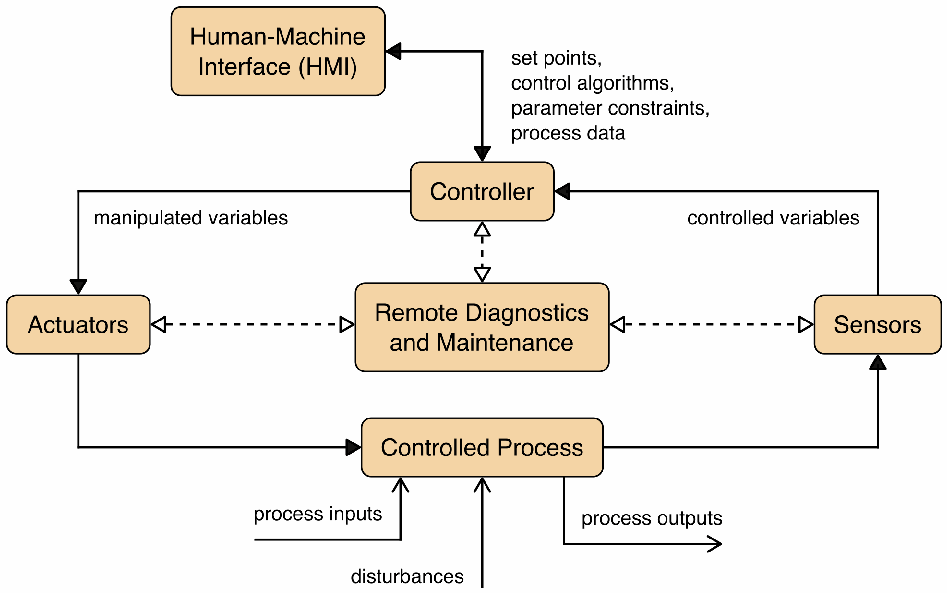
図1. 一般的なOTシステムの基本動作。ヒューマンマシンインタフェース(HMI)とコントローラが、設定値、制御アルゴリズム、パラメータ制約、プロセスデータと記された双方向の矢印で結ばれている。コントローラは操作変数(manipulated variables)をアクチュエータへ送り、センサは制御変数(controlled variables)をコントローラへ送る。遠隔診断・保守(Remote Diagnostics and Maintenance)は、コントローラ、アクチュエータ、センサとそれぞれ破線の双方向の矢印で結ばれている。アクチュエータは被制御プロセス(Controlled Process)に作用し、被制御プロセスはセンサへつながる。被制御プロセスにはプロセス入力と外乱が入り、プロセス出力が出ていく。
Fig. 1. Basic operation of a typical OT system
図1. 一般的なOTシステムの基本動作
2.3.1. OT System Design Considerations
2.3.1. OTシステムの設計上の考慮事項
The design of an OT system depends on many factors, including whether a SCADA, DCS, or PLC-based topology is used. This section identifies key factors that drive design decisions regarding the control, communication, reliability, and redundancy properties of the OT system. Because these factors heavily influence the design of the OT system, they also help determine the system’s security needs.
OTシステムの設計は、SCADA、DCS、PLCベースのどのトポロジーを採用するかなど、多くの要因に左右されます。本節では、OTシステムの制御、通信、信頼性、冗長性に関する設計判断を左右する主な要因を示します。これらの要因はOTシステムの設計に大きく影響するため、システムのセキュリティニーズを決める際にも役立ちます。
•Safety. Systems must be able to detect unsafe conditions and trigger actions to reduce unsafe conditions to safe ones. In most safety-critical operations, human oversight and control of a potentially dangerous process are essential.
•安全性。システムは危険な状態を検知し、その状態を安全なものにするための措置を起動できなければなりません。ほとんどの安全上重要な運用では、危険を伴う可能性のあるプロセスに対する人間の監督と制御が不可欠です。
•Control timing requirements. System processes have a wide range of time-related requirements, including very high speed, consistency, regularity, and synchronization. Humans may be unable to reliably and consistently meet these requirements, so automated controllers may be necessary. Some systems may require computation to be performed as close to sensors and actuators as possible to reduce communication latency and perform necessary control actions on time.
•制御タイミング要件。システムのプロセスには、非常に高い速度、一貫性、規則性、同期性など、幅広い時間関連要件があります。人間がこれらの要件を確実かつ一貫して満たせない場合があるため、自動コントローラーが必要となることがあります。通信遅延を減らし、必要な制御動作を時間内に実行するため、一部のシステムではセンサーやアクチュエーターのできるだけ近くで計算を行う必要があります。
•Geographic distribution. Systems have varying degrees of distribution, ranging from a small system (e.g., local PLC-controlled process) to large, distributed systems (e.g., oil pipelines, electric power grids). Greater distribution typically implies a need for wide area networking (e.g., leased lines, circuit switching, packet switching) and mobile communication.
•地理的な分散。システムの分散度はさまざまであり、(例えば、ローカルPLCで制御するプロセスのような)小規模システムから、(例えば、石油パイプラインや電力網のような)大規模な分散システムまであります。分散範囲が広いほど、通常、広域ネットワーク(例えば、専用回線、回線交換、パケット交換)やモバイル通信が必要となります。
•Hierarchy. Supervisory control is used to provide a central location that can aggregate data from multiple locations to support control decisions based on the current state of the system. A hierarchical or centralized control is often used to provide human operators with a comprehensive view of the entire system.
•階層構造。監督制御は、複数の場所からデータを集約する中央拠点を設け、システムの現在の状態に基づく制御判断を支援するために用いられます。階層型または集中型の制御は、人間のオペレーターにシステム全体の包括的な状況を示すためによく用いられます。
•Control complexity. Simple controllers and preset algorithms can often perform control functions. However, more complex systems (e.g., air traffic control) require human operators to ensure that all control actions are appropriate for meeting the larger objectives of the system.
•制御の複雑さ。単純なコントローラーや事前設定されたアルゴリズムで制御機能を実行できる場合が多くあります。しかし、航空管制などのより複雑なシステムでは、システム全体の目標達成に向け、すべての制御動作が適切であることを人間のオペレーターが確認する必要があります。
•Availability. Systems with strong availability and up-time requirements may require more redundancy or alternate implementations across all communications and controls.
•可用性。高い可用性と稼働時間が求められるシステムでは、通信および制御全体にわたって、冗長性を高めたり代替構成を用意したりする必要があります。
•Impact of failures. The failure of a control function could cause substantially different impacts across domains. Systems with greater impacts often require the ability to continue operations through redundant controls or to operate in a degraded state.
•障害の影響。制御機能の障害がもたらす影響は、分野によって大きく異なる可能性があります。影響が大きいシステムでは、冗長制御によって運用を継続するか、縮退状態で運用する能力が求められることが多くあります。
2.3.2. SCADA Systems
2.3.2. SCADAシステム
Supervisory control and data acquisition (SCADA) systems are used to control dispersed assets for which centralized data acquisition is as important as control [Bailey][Boyer]. These systems are used in distribution systems, such as water distribution and wastewater collection systems, oil and natural gas pipelines, electrical utility transmission and distribution systems, and rail and other public transportation systems. SCADA systems integrate data acquisition systems with data transmission systems and HMI software to provide a centralized monitoring and control system for numerous process inputs and outputs. SCADA systems are designed to collect field information, transfer it to a control center, and display the information to the operator graphically or textually, thereby allowing the operator to monitor or control an entire system from a central location in near real-time. Based on the sophistication and setup of the individual system, control of any individual system, operation, or task can be automatic, or it can be performed by operator commands. Typical hardware includes a control server placed at a control center, communications equipment (e.g., radio, telephone line, cable, or satellite), and one or more geographically distributed field sites that consist of remote terminal units (RTUs) and/or PLCs that control actuators and/or monitor sensors. The control server stores and processes the information from RTU inputs and outputs, while the RTU or PLC controls the local process. The communications hardware allows for the transfer of information and data between the control server and the RTUs or PLCs. The software is programmed to tell the system what and when to monitor, what parameter ranges are acceptable, and what response to initiate when a process variable changes outside of acceptable values. An intelligent electronic device (IED), such as a protective relay, may communicate directly to the control server, or a local RTU may poll the IEDs to collect the data and pass it to the control server. IEDs provide a direct interface to control and monitor equipment and sensors. IEDs may be directly polled and controlled by the control server and, in most cases, have local programming that allows for the IED to act without direct instructions from the control center. SCADA systems are usually designed to be fault-tolerant systems with significant redundancy built in, although redundancy may not be a sufficient countermeasure in the face of a malicious attack.
監視制御・データ取得(SCADA)システムは、集中データ取得が制御と同じくらい重要な、分散資産を制御するために用いられます [Bailey][Boyer]。水道配水や下水収集、石油・天然ガスのパイプライン、電力の送配電、鉄道その他の公共交通機関などの配給システムで使われます。SCADAシステムは、データ取得システムをデータ伝送システムおよびHMIソフトウェアと統合し、多数のプロセス入出力を一元的に監視・制御します。現場情報を収集して制御センターに転送し、情報を図形またはテキストでオペレーターに表示することで、中央拠点からシステム全体をほぼリアルタイムに監視・制御できるように設計されています。個々のシステムの高度さや構成に応じて、システム、運用、タスクの制御は自動で行うことも、オペレーターの指令で行うこともできます。典型的なハードウェアには、制御センターに設置された制御サーバー、通信機器(例えば、無線、電話回線、ケーブル、衛星)、および地理的に分散した1つ以上の現場サイトが含まれます。現場サイトには、アクチュエーターを制御する、またはセンサーを監視する遠隔端末装置(RTU)やPLCが置かれます。制御サーバーはRTUの入出力情報を保存・処理し、RTUまたはPLCはローカルプロセスを制御します。通信ハードウェアは制御サーバーとRTUまたはPLC間の情報・データ転送を担います。ソフトウェアには、何をいつ監視するか、許容されるパラメーター範囲、およびプロセス変数が許容値を外れた場合に開始する応答が設定されます。保護リレーなどのインテリジェント電子機器(IED)は制御サーバーと直接通信する場合があり、ローカルRTUがIEDをポーリングしてデータを収集し、制御サーバーに渡す場合もあります。IEDは機器やセンサーを直接制御・監視するインターフェースを提供します。IEDは制御サーバーから直接ポーリング・制御されることもあり、多くの場合、制御センターから直接指示がなくても動作するローカルプログラムを備えます。SCADAシステムは通常、十分な冗長性を備えたフォールトトレラントシステムとして設計されますが、悪意ある攻撃に対して冗長性だけでは十分な対策にならないことがあります。
Figure 2 shows the components and general configuration of a SCADA system. The control center at the top of the diagram houses a control server and the communications routers. Other control center components include the HMI, engineering workstations, and the data historian, which are all connected by a local area network (LAN). The control center collects and logs information gathered by the field sites, displays information to the HMI, and may generate actions based on detected events. The control center is also responsible for centralized alarming, trend analyses, and reporting.
図2は、SCADAシステムのコンポーネントと一般的な構成を示しています。図の上部にある制御センターには、制御サーバと通信ルータが設置されています。制御センターのその他のコンポーネントには、HMI、エンジニアリングワークステーション、およびデータヒストリアンがあり、いずれもローカルエリアネットワーク(LAN)で接続されています。制御センターは、現場サイトが収集した情報を集めて記録し、HMIに情報を表示し、検知した事象に基づいてアクションを生成することがあります。制御センターはまた、集中警報、傾向分析、および報告も担います。
The field sites at the bottom of Fig. 2 locally control actuators and monitor sensors. Field sites are often equipped with a remote access capability to allow operators to perform remote diagnostics and repairs, usually over a separate dial-up modem or wide area network (WAN) connection. Standard and proprietary communication protocols that run over serial and network communications are used to transport information between the control center and field sites using telemetry techniques, such as telephone line, cable, fiber, and radio frequencies (e.g., broadcast, microwave, satellite).
図2の下部にある現場サイトは、アクチュエータをローカルで制御し、センサを監視します。現場サイトには、運転員が遠隔診断や修理を行えるよう、リモートアクセス機能が備えられていることが多く、通常は個別のダイヤルアップモデムまたは広域ネットワーク(WAN)接続を介します。シリアル通信やネットワーク通信上で動作する標準プロトコルや独自の通信プロトコルが、電話回線、ケーブル、光ファイバ、無線周波数(例:放送、マイクロ波、衛星)といったテレメトリ技術を用いて、制御センターと現場サイトの間で情報を伝送するのに使用されます。
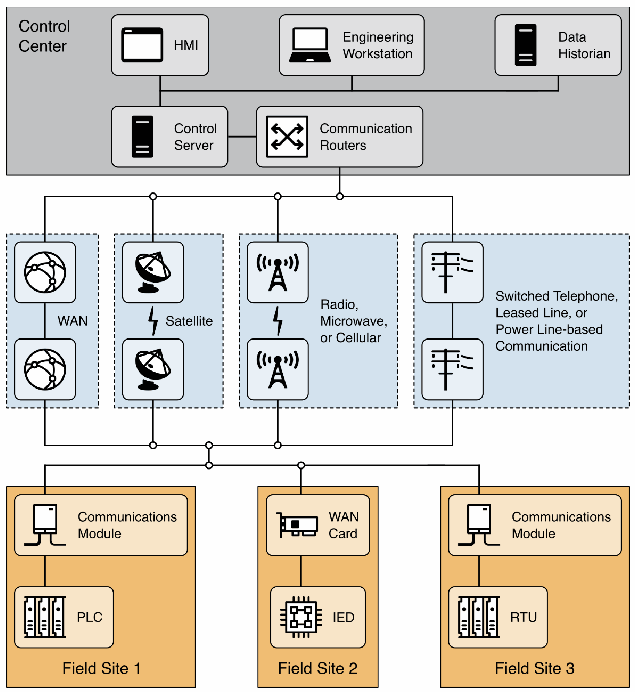
図2. 制御センターの機器、通信機器、および現場サイトを示す一般的なSCADAシステムの配置。上部の灰色の制御センター(Control Center)には、共通の線に接続された HMI、エンジニアリングワークステーション、データヒストリアンがあり、制御サーバと通信ルータに接続されている。通信ルータは、アイコンの対で示した 4 種類の通信手段、すなわち WAN、衛星(Satellite)、無線・マイクロ波・セルラー(Radio, Microwave, or Cellular)、交換電話・専用線・電力線通信(Switched Telephone, Leased Line, or Power Line-based Communication)に接続する。これらは下部の 3 つの現場サイト、Field Site 1(通信モジュールと PLC)、Field Site 2(WAN カードと IED)、Field Site 3(通信モジュールと RTU)に接続する。
Fig. 2. A general SCADA system layout that shows control center devices, communications equipment, and field sites
図2. 制御センターの機器、通信機器、および現場サイトを示す一般的なSCADAシステムの配置
SCADA communication topologies vary among implementations. The various topologies used are shown in Fig. 3, including point-to-point, series, series-star, and multi-drop [AGA12]. Point-to-point is functionally the simplest type, though it can be expensive because of the individual channels needed for each connection. In a series configuration, the number of channels used is reduced, though channel sharing impacts the efficiency and complexity of SCADA operations. Similarly, the series-star and multi-drop configurations’ use of one channel per device results in decreased efficiency and increased system complexity.
SCADAの通信トポロジーは実装によって異なります。使用されるさまざまなトポロジーを図3に示します。これには、ポイントツーポイント、シリーズ、シリーズスター、およびマルチドロップが含まれます[AGA12]。ポイントツーポイントは機能的に最も単純な形態ですが、接続ごとに個別のチャネルが必要となるため高価になりうます。シリーズ構成では使用するチャネル数は減りますが、チャネルの共有がSCADA運用の効率と複雑さに影響します。同様に、シリーズスター構成とマルチドロップ構成では、デバイスごとに1つのチャネルを使用するため、効率が低下し、システムの複雑さが増します。
The four basic SCADA topologies shown in Fig. 3 can be further augmented by using dedicated devices to manage communication exchanges and perform message switching and buffering.
図3に示す4つの基本的なSCADAトポロジーは、通信のやり取りを管理し、メッセージの交換とバッファリングを行う専用デバイスを用いることで、さらに拡張できます。
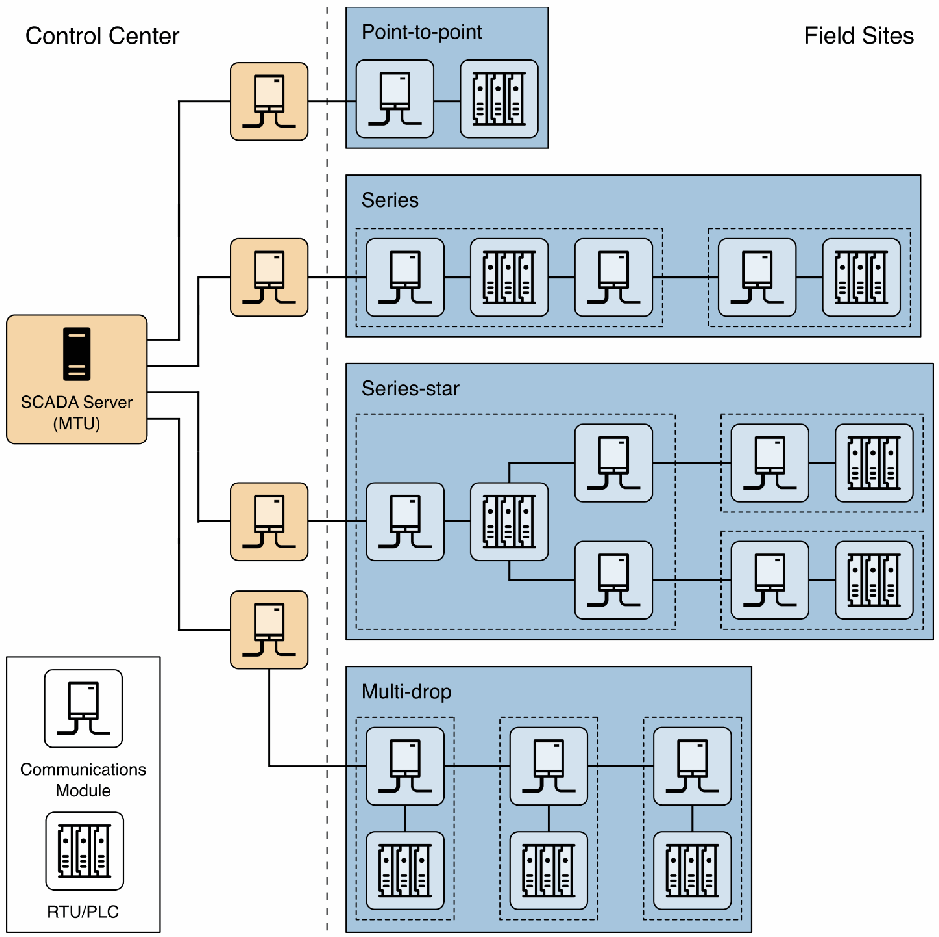
図3. ポイントツーポイント、シリーズ、シリーズスター、およびマルチドロップのSCADA通信トポロジーの例。破線の縦線が左の制御センター(Control Center)と右の現場サイト(Field Sites)を分ける。制御センターの SCADA サーバ(MTU)は、トポロジーごとに 1 つずつ、計 4 つの通信モジュールに接続する。ポイントツーポイント: 現場の通信モジュール 1 つと RTU/PLC 1 つ。シリーズ: 通信モジュール、RTU/PLC、通信モジュールからなる破線のグループが、通信モジュールと RTU/PLC からなる 2 つ目のグループに直列につながる。シリーズスター: 通信モジュールと RTU/PLC があり、RTU/PLC から 2 つの通信モジュールに分岐し、それぞれが通信モジュールと RTU/PLC からなるグループにつながる。マルチドロップ: 1 本の線上に 3 つの通信モジュールが並び、それぞれの下に RTU/PLC がある。凡例が通信モジュールと RTU/PLC のアイコンを示す。
Fig. 3. Examples of point-to-point, series, series-star, and multi-drop SCADA communications topologies
図3. ポイントツーポイント、シリーズ、シリーズスター、およびマルチドロップのSCADA通信トポロジーの例
Large SCADA systems that contain hundreds of RTUs often employ a sub-control server to alleviate the burden on the primary server. This type of topology is shown in Fig. 4.
数百台のRTUを含む大規模SCADAシステムでは、主サーバーの負荷を軽減するためにサブ制御サーバーを採用することが多くあります。この種のトポロジーを図4に示します。
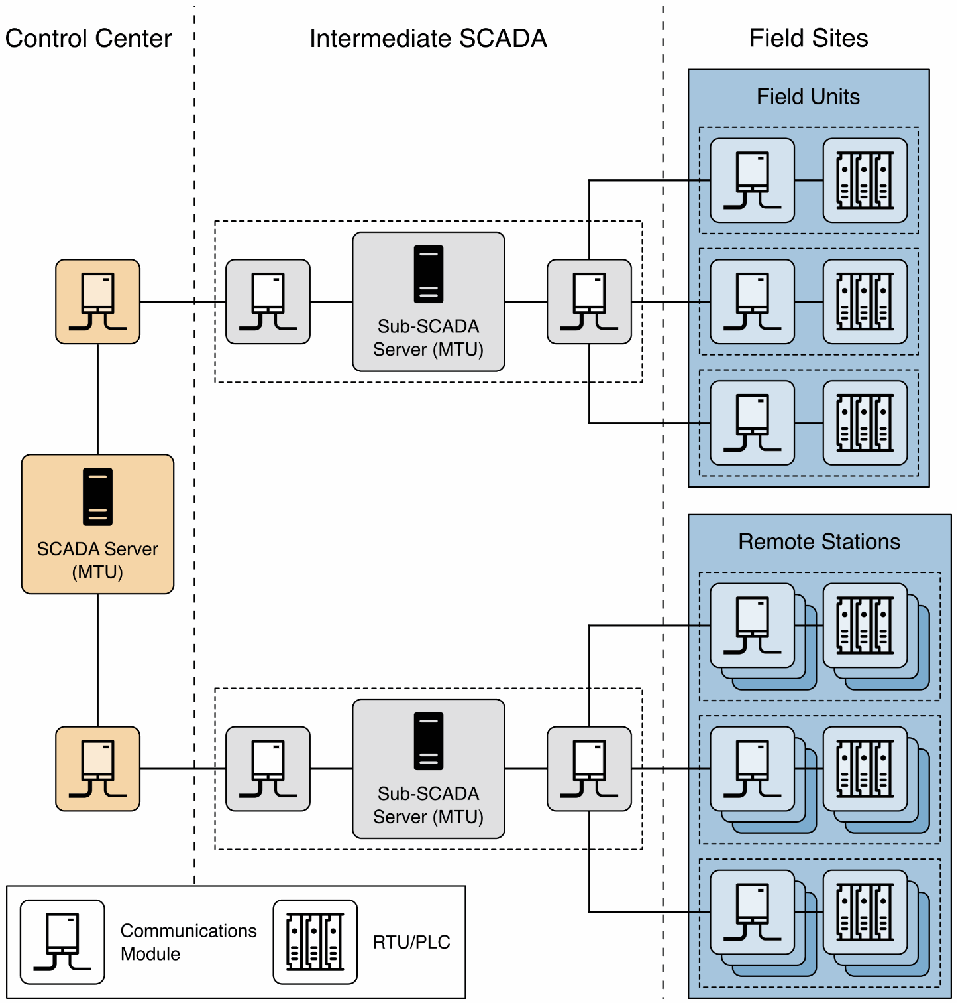
図4. 多数の遠隔局に対応するSCADAトポロジーの例。破線で区切られた 3 列、制御センター(Control Center)、中間SCADA(Intermediate SCADA)、現場サイト(Field Sites)からなる。制御センターでは SCADA サーバ(MTU)が 2 つの通信モジュールにつながる。それぞれが、通信モジュール、サブSCADAサーバ(Sub-SCADA Server (MTU))、もう 1 つの通信モジュールからなる中間SCADAのグループ(破線の枠)に接続する。上のグループは 3 つの現場ユニット(Field Units、それぞれ通信モジュールと RTU/PLC)に分岐し、下のグループは 3 つの遠隔局(Remote Stations、それぞれ複数重ねた通信モジュールと RTU/PLC)に分岐する。凡例が通信モジュールと RTU/PLC のアイコンを示す。
Fig. 4. An example SCADA topology that supports a large number of remote stations
図4. 多数の遠隔局に対応するSCADAトポロジーの例
Figure 5 shows an example SCADA system implementation that consists of a primary control center and three field sites. A second backup control center provides redundancy in the event of a primary control center malfunction. Point-to-point connections are used for all communications between the control center and field site, and two connections use radio telemetry. The third field site is local to the control center and uses the WAN for communications. A regional control center resides above the primary control center for a higher level of supervisory control. The corporate enterprise network has access to all control centers through the WAN, and field sites can be accessed remotely for troubleshooting and maintenance operations. The primary control center polls field devices for data at defined intervals (e.g., 5 seconds, 60 seconds) and can send new set points to field devices as required. In addition to polling and issuing high-level commands, the control server also watches for priority interrupts from field site alarm systems.
図5は、主制御センターと3つの現場サイトで構成されるSCADAシステムの実装例を示します。主制御センターの故障に備え、2つ目のバックアップ制御センターが冗長性を提供します。制御センターと現場サイト間の通信にはすべてポイントツーポイント接続を用い、そのうち2つの接続では無線テレメトリーを使用します。3つ目の現場サイトは制御センターの近くにあり、WANで通信します。主制御センターの上位には地域制御センターがあり、より高いレベルの監督制御を行います。企業ネットワークはWAN経由ですべての制御センターにアクセスでき、現場サイトにも遠隔からアクセスしてトラブルシューティングや保守を行えます。主制御センターは、定義された間隔(例えば、5秒、60秒)で現場機器をポーリングしてデータを取得し、必要に応じて新しい設定値を送信できます。ポーリングや上位指令の発行に加え、制御サーバーは現場サイトの警報システムからの優先割り込みも監視します。
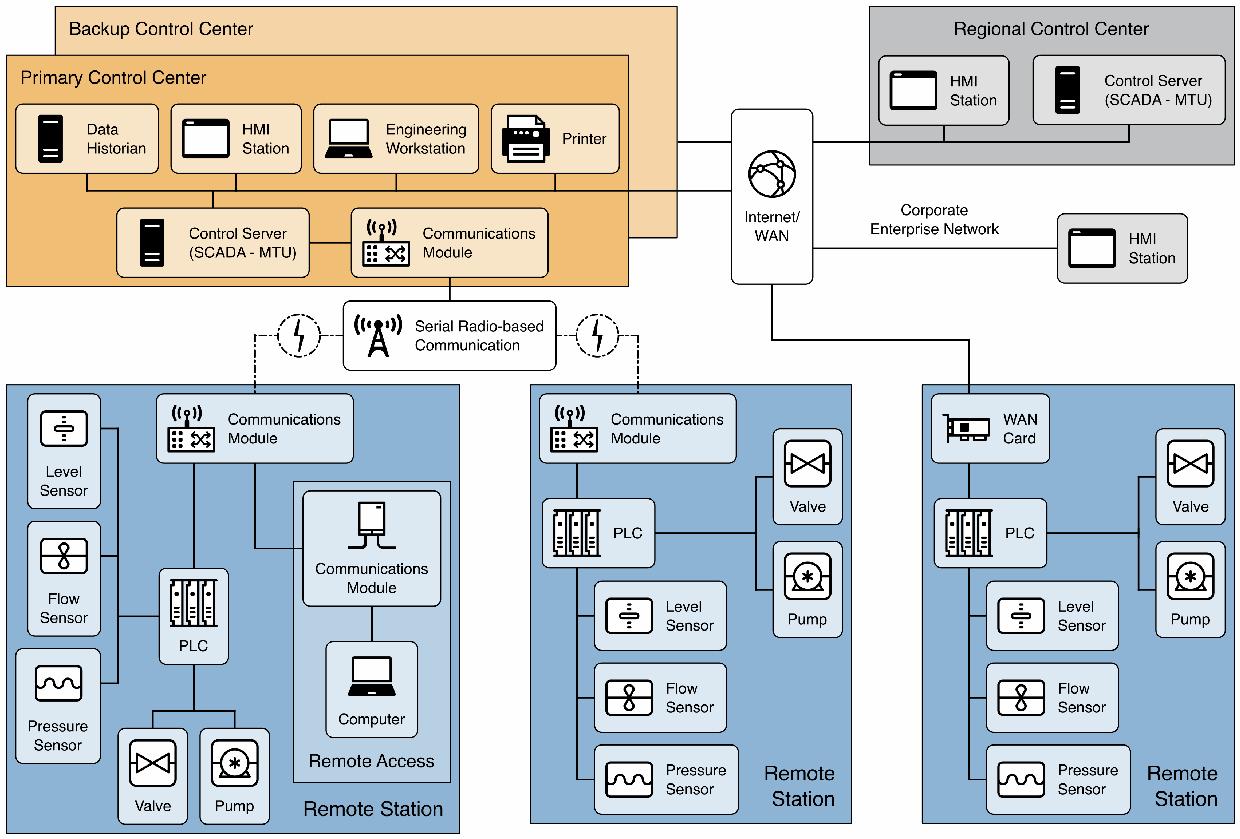
図5. 包括的なSCADAシステム実装例。主制御センター(Primary Control Center: データヒストリアン、HMI ステーション、エンジニアリングワークステーション、プリンタ、制御サーバ(SCADA - MTU)、通信モジュール)がバックアップ制御センター(Backup Control Center)の手前に重なっている。制御センターはインターネット/WAN に接続し、インターネット/WAN は地域制御センター(Regional Control Center: HMI ステーションと制御サーバ(SCADA - MTU))と、企業ネットワーク(Corporate Enterprise Network)経由で HMI ステーションにも接続する。通信モジュールはシリアル無線通信(Serial Radio-based Communication)につながり、無線で 2 つの遠隔局に届く。1 つは通信モジュール、PLC、レベル・流量・圧力センサ、弁、ポンプと、通信モジュールとコンピュータからなる遠隔アクセス(Remote Access)の区画を持つ。もう 1 つは通信モジュール、PLC、弁、ポンプ、レベル・流量・圧力センサを持つ。3 つ目の遠隔局は WAN カードでインターネット/WAN に接続し、PLC、弁、ポンプ、レベル・流量・圧力センサを持つ。
Fig. 5. A comprehensive SCADA system implementation example
図5. 包括的なSCADAシステム実装例
Figure 6 shows an example implementation for rail monitoring and control. This example includes a rail control center that houses the SCADA system and three sections of a rail system. The SCADA system polls the rail sections for information, such as the status of the trains, signal systems, traction electrification systems, and ticket vending machines. This information is also fed to operator consoles at the HMI stations within the rail control center. The SCADA system monitors operator inputs at the rail control center and disperses high-level operator commands to the rail section components. In addition, the SCADA system monitors conditions at the individual rail sections and issues commands based on these conditions (e.g., stopping a train to prevent it from entering an area that has been flooded or is occupied by another train).
図6は、鉄道の監視・制御の実装例を示します。ここには、SCADAシステムを備えた鉄道制御センターと、鉄道システムの3つの区間が含まれます。SCADAシステムは各区間をポーリングし、列車、信号システム、牽引電化システム、券売機などの状態を取得します。この情報は、鉄道制御センター内のHMIステーションにあるオペレーターコンソールにも送られます。SCADAシステムは鉄道制御センターでのオペレーター入力を監視し、上位のオペレーター指令を鉄道区間のコンポーネントに配信します。また、個々の区間の状態を監視し、その状態に基づいて指令を発行します(例えば、浸水した区域や別の列車が占有している区域への進入を防ぐため、列車を停止させます)。
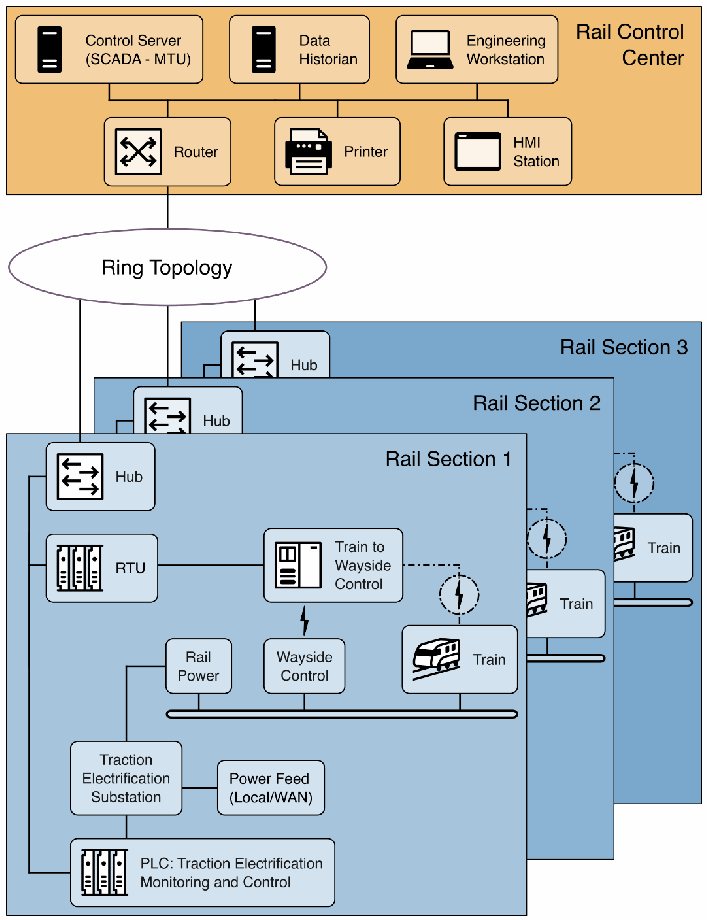
図6. 鉄道の監視・制御を行うSCADAシステムの実装例。鉄道制御センター(Rail Control Center)には、制御サーバ(SCADA - MTU)、データヒストリアン、エンジニアリングワークステーション、ルータ、プリンタ、HMI ステーションがある。ルータはリングトポロジー(Ring Topology)に接続し、リングは重ねて描かれた鉄道区間 1・2・3(Rail Section 1〜3)のそれぞれのハブにつながる。鉄道区間 1 では、ハブが RTU と PLC(Traction Electrification Monitoring and Control: き電の監視・制御)に接続する。RTU は Train to Wayside Control(列車・地上間制御)に接続し、これが無線で Wayside Control(地上制御)と列車(Train)に通信する。Rail Power(鉄道電力)、Wayside Control、列車は線路上にある。Power Feed (Local/WAN) から給電される Traction Electrification Substation(き電変電所)が Rail Power に電力を供給する。鉄道区間 2・3 にはそれぞれ無線リンク付きの列車が示されている。
Fig. 6. An example rail monitoring and control SCADA system implementation
図6. 鉄道の監視・制御を行うSCADAシステムの実装例
2.3.3. Distributed Control Systems
2.3.3. 分散制御システム
A distributed control system (DCS) is used to control production systems within the same geographic location for industries such as oil refineries, water and wastewater treatment, electric power generation, chemical manufacturing, automotive production, and pharmaceutical processing. These systems are usually process control or discrete part control systems.
分散制御システム(DCS)は、石油精製、上下水処理、発電、化学製造、自動車生産、医薬品製造などの産業において、同一の地理的拠点内の生産システムを制御するために使用されます。これらのシステムは通常、プロセス制御システムまたは個別部品制御システムです。
A DCS is integrated as a control architecture that contains a supervisory level of control to oversee multiple integrated sub-systems that are responsible for controlling the details of a localized process. A DCS uses a centralized supervisory control loop to mediate a group of localized controllers that share the overall tasks of carrying out an entire production process [Erickson]. Product and process control are usually achieved by deploying feedback or feedforward control loops, whereby key product and/or process conditions are automatically maintained around a desired set point. Specific process controllers or more capable PLCs are employed in the field and tuned to provide the desired tolerance and the rate of self-correction during process upsets. By modularizing the production system, a DCS reduces the impact of a single fault on the overall system. In many modern systems, the DCS is interfaced with the corporate enterprise network to give business operations a view of production.
DCSは、局所的なプロセスの詳細な制御を担う複数の統合されたサブシステムを監督する監視制御レベルを含む制御アーキテクチャとして統合されます。DCSは、集中化された監視制御ループを用いて、生産プロセス全体の実行という全体的なタスクを分担する一群の局所コントローラを仲介します[Erickson]。製品とプロセスの制御は通常、フィードバック制御ループまたはフィードフォワード制御ループを配備することで実現され、これにより製品やプロセスの主要な状態が所望の設定値の付近に自動的に維持されます。現場には特定のプロセスコントローラやより高機能なPLCが配置され、プロセスの異常時に所望の許容範囲と自己修正の速度が得られるよう調整されます。生産システムをモジュール化することで、DCSは単一の障害がシステム全体に及ぼす影響を低減します。最新のシステムの多くでは、DCSは企業のエンタープライズネットワークと接続され、事業運営部門が生産状況を把握できるようになっています。
Figure 7 shows an example implementation of the components and general configuration of a DCS. This DCS encompasses an entire facility, from the bottom-level production processes up to the corporate enterprise layer. In this example, a supervisory controller (control server) communicates to its subordinates via a control network. The supervisor sends set points to and requests data from the distributed field controllers. The distributed controllers control their process actuators based on control server commands and sensor feedback from process sensors.
図7は、DCSの構成要素と一般的な構成の実装例を示しています。このDCSは、最下層の生産プロセスから企業のエンタープライズ層に至るまで、施設全体を包含します。この例では、監視コントローラ(制御サーバ)が制御ネットワークを介して下位のコントローラと通信します。監視コントローラは、分散配置された現場コントローラに設定値を送信し、データを要求します。分散コントローラは、制御サーバのコマンドとプロセスセンサからのセンサフィードバックに基づいてプロセスアクチュエータを制御します。
Figure 7 also gives examples of low-level controllers found on a DCS system. The field control devices shown include a machine controller, a PLC, and a process controller. The machine controller interfaces with sensors and actuators using point-to-point wiring, while the other three field devices incorporate fieldbus networks to interface with process sensors and actuators. Fieldbus networks eliminate the need for point-to-point wiring between a controller and individual field sensors and actuators. Additionally, a fieldbus allows for greater functionality beyond control, including field device diagnostics, and can accomplish control algorithms within the fieldbus, thereby avoiding signal routing back to the PLC for every control operation. Standard industrial communication protocols designed by industry groups such as Modbus and Fieldbus [Berge] are often used on control networks and fieldbus networks.
図7には、DCSシステムに見られる下位レベルのコントローラの例も示されています。示されている現場制御デバイスには、機械コントローラ、PLC、プロセスコントローラが含まれます。機械コントローラはポイントツーポイント配線でセンサやアクチュエータと接続するのに対し、他の3つの現場デバイスはフィールドバスネットワークを用いてプロセスセンサやアクチュエータと接続します。フィールドバスネットワークにより、コントローラと個々の現場センサやアクチュエータとの間のポイントツーポイント配線が不要になります。さらにフィールドバスは、現場デバイスの診断など制御以外の機能も提供でき、制御アルゴリズムをフィールドバス内で実行できるため、制御操作のたびに信号をPLCまで戻す必要がなくなります。ModbusやFieldbus[Berge]など、業界団体が策定した標準的な産業用通信プロトコルが、制御ネットワークやフィールドバスネットワークでよく使われています。
In addition to the supervisory-level and field-level control loops, intermediate levels of control may also exist. For example, in the case of a DCS controlling a discrete part manufacturing facility, there could be an intermediate level supervisor for each cell within the plant. This supervisor encompasses a manufacturing cell containing a machine controller that processes a part and a robot controller that handles raw stock and final products. There could be several of these cells that manage field-level controllers under the main DCS supervisory control loop.
監視レベルと現場レベルの制御ループに加えて、中間レベルの制御が存在することもあります。たとえば、ディスクリート部品の製造施設を制御するDCSの場合、工場内の各セルに中間レベルの監視コントローラを置くことがあります。この監視コントローラは、部品を加工する機械コントローラと、原材料や最終製品を扱うロボットコントローラを含む製造セルを包含します。主たるDCSの監視制御ループの下に、現場レベルのコントローラを管理するこのようなセルが複数存在することがあります。
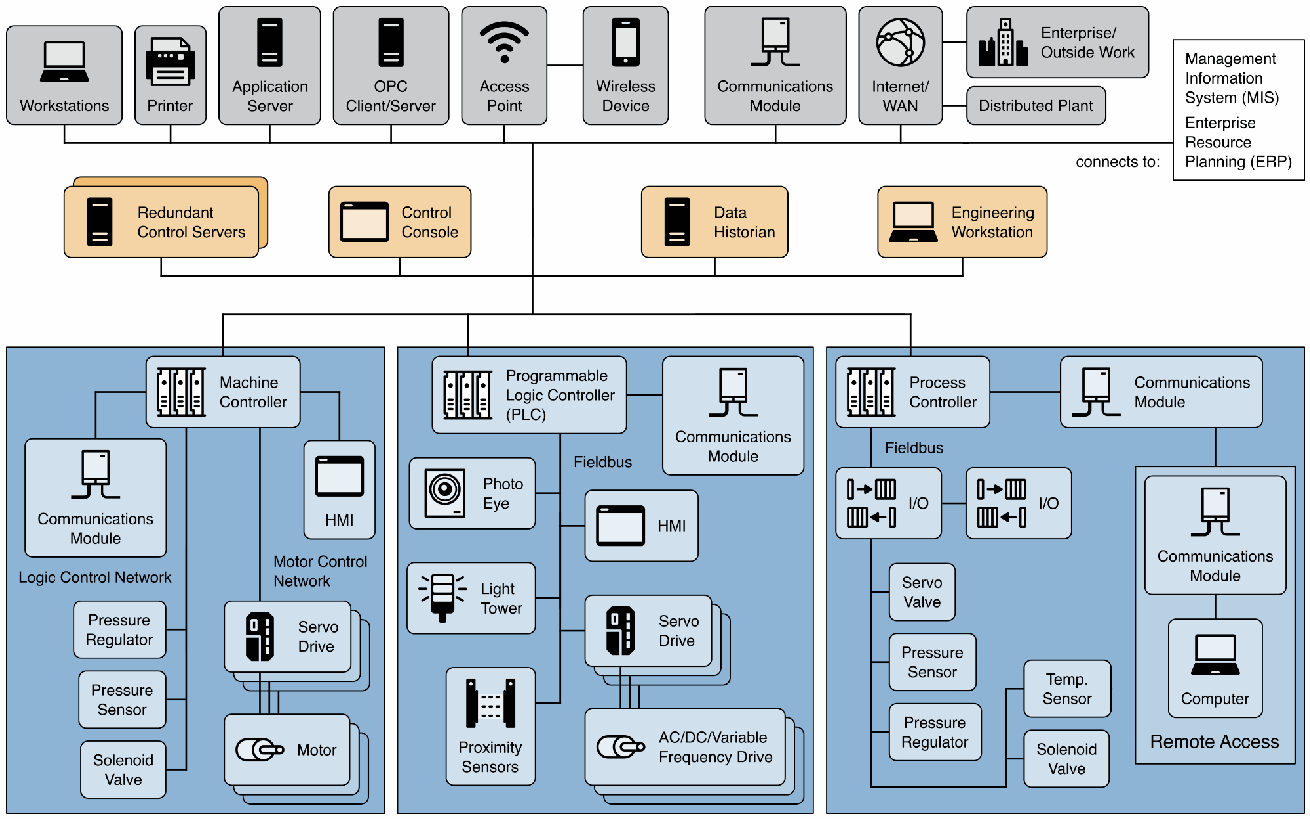
図7. 包括的なDCS実装例。上部のネットワークには、ワークステーション、プリンタ、アプリケーションサーバ、OPC クライアント/サーバ、アクセスポイント(無線デバイス付き)、通信モジュール、インターネット/WAN(Enterprise/Outside Work と Distributed Plant 付き)が接続し、接続先として Management Information System (MIS) と Enterprise Resource Planning (ERP) が注記されている。その下で、冗長制御サーバ、制御コンソール、データヒストリアン、エンジニアリングワークステーションが共通の線でつながり、3 つの制御区画へ続く。左: 通信モジュールと HMI を持つ機械コントローラ(Machine Controller)、圧力レギュレータ・圧力センサ・電磁弁がつながるロジック制御ネットワーク(Logic Control Network)、サーボドライブとモータがつながるモータ制御ネットワーク(Motor Control Network)。中央: 通信モジュールを持つプログラマブルロジックコントローラ(PLC)と、光電センサ(Photo Eye)、表示灯(Light Tower)、近接センサ、HMI、サーボドライブ、AC/DC/可変周波数ドライブがつながるフィールドバス。右: 通信モジュールを持つプロセスコントローラ、2 つの I/O モジュール、サーボ弁、圧力センサ、圧力レギュレータ、温度センサ、電磁弁がつながるフィールドバス、通信モジュールとコンピュータからなる遠隔アクセス(Remote Access)の区画。
Fig. 7. A comprehensive DCS implementation example
図7. 包括的なDCS実装例
2.3.4. Programmable Logic Controller-Based Topologies
2.3.4. プログラマブル・ロジック・コントローラーを用いたトポロジー
PLCs are used in both SCADA and DCS systems as the control components of an overall hierarchical system to locally manage processes through feedback control, as described in the previous sections. In the case of SCADA systems, they may provide similar functionality to RTUs. When used in DCS systems, PLCs are implemented as local controllers within a supervisory control scheme. PLCs can also be implemented as the primary controller in smaller OT system configurations to provide operational control of discrete processes (e.g., automobile assembly lines, process controllers). These topologies differ from SCADA and DCS in that they generally lack a central control server or HMI and, therefore, primarily provide closed-loop control with minimal human involvement. PLCs have a user-programmable memory for storing instructions for the purpose of implementing specific functions, such as I/O control, logic, timing, counting, three mode proportional-integral-derivative (PID) control, communications, arithmetic, and data and file processing. Figure 8 shows a PLC over a fieldbus network performing the control of a manufacturing process. The PLC is accessible via a programming interface located on an engineering workstation, and data is stored in a data historian, all of which are connected on a LAN.
PLCは、前節で説明したように、SCADAとDCSの両方で階層型システムの制御コンポーネントとして使われ、フィードバック制御によってプロセスをローカルに管理します。SCADAシステムでは、RTUと同様の機能を提供する場合があります。DCSでは、監督制御方式の下でローカルコントローラーとして実装されます。PLCは、小規模なOTシステム構成で主コントローラーとして実装し、自動車組立ラインやプロセスコントローラーなど、離散プロセスの運用制御を行うこともできます。これらのトポロジーは、通常、中央制御サーバーやHMIを持たず、人間の関与を最小限に抑えた閉ループ制御を主に行う点で、SCADAやDCSと異なります。PLCは、I/O制御、論理、タイミング、カウント、3モード比例・積分・微分(PID)制御、通信、算術、データ処理、ファイル処理などの特定機能を実装する命令を保存するユーザープログラム可能メモリーを備えます。図8は、フィールドバスネットワーク上のPLCが製造プロセスを制御する例を示します。PLCにはエンジニアリング・ワークステーション上のプログラミングインターフェースからアクセスでき、データはデータヒストリアンに保存されます。これらはすべてLANに接続されます。
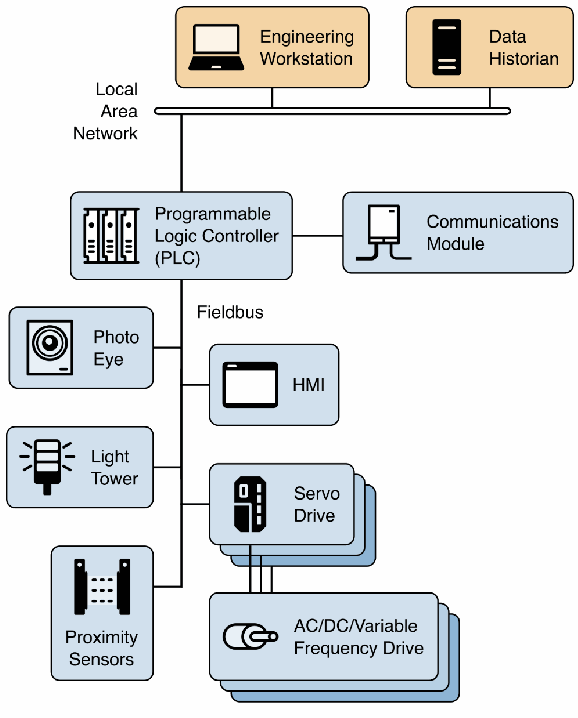
図8. PLC制御システムの実装例。エンジニアリングワークステーションとデータヒストリアンがローカルエリアネットワーク(LAN)上にあり、LAN はプログラマブルロジックコントローラ(PLC)に接続する。PLC は通信モジュールに接続し、フィールドバスを介して光電センサ(Photo Eye)、表示灯(Light Tower)、近接センサ、HMI、複数重ねたサーボドライブに接続する。サーボドライブは複数重ねた AC/DC/可変周波数ドライブにつながる。
Fig. 8. A PLC control system implementation example
図8. PLC制御システムの実装例
2.3.5. Building Automation Systems
2.3.5. ビルオートメーションシステム
A building automation system (BAS) is a type of OT used to control the many systems used in a building, including heating, ventilation, and air conditioning (HVAC); fire; electrical; lighting; physical access control; physical security; and other utility systems. Most modern buildings contain some form of a BAS when they are constructed. However, older buildings and equipment may have to be retrofitted to take advantage of the benefits that a BAS provides.
ビルオートメーションシステム(BAS)は、建物で使用される多数のシステムを制御するために用いられるOTの一種であり、制御対象には暖房・換気・空調(HVAC)、防火、電気、照明、物理的アクセス制御、物理セキュリティ、その他の設備システムが含まれます。最新の建物の多くは、建設時に何らかの形のBASを備えています。しかし、古い建物や設備では、BASがもたらす利点を活用するために改修が必要となる場合があります。
Some of the most common functions of a BAS include maintaining environmental conditions for occupant comfort, reducing energy consumption, reducing operating and maintenance costs, increasing security, recording historical data (e.g., temperature, humidity), and performing general equipment monitoring (e.g., provide alerts to building personnel of device failure or an alarm condition).
BASの最も一般的な機能には、居住者の快適性のための環境条件の維持、エネルギー消費の削減、運用・保守コストの削減、セキュリティの向上、履歴データ(例:温度、湿度)の記録、一般的な設備監視(例:デバイスの故障や警報状態を建物の担当者に通知する)があります。
An example of a BAS is shown in Fig. 9. A BAS may communicate over wired or wireless paths to controllers or gateways. For example, environmental control sensors can provide the temperature and humidity to a building controller. If the sensor values are outside of the set points, the controller can signal a variable air volume (VAV) box to increase or decrease airflow and bring the temperature to the desired state. Similarly, a building occupant scanning their identification badge at a badge reader can result in the credentials being sent to the access control controller and application control server to determine whether access should be granted.
BASの例を図9に示します。BASは、有線または無線の経路を介してコントローラやゲートウェイと通信することがあります。たとえば、環境制御センサは温度と湿度をビルコントローラに提供できます。センサの値が設定値の範囲外であれば、コントローラは可変風量(VAV)ボックスに信号を送って風量を増減させ、温度を所望の状態にすることができます。同様に、建物の居住者がバッジリーダーで身分証バッジをスキャンすると、その資格情報がアクセス制御コントローラとアプリケーション制御サーバに送信され、アクセスを許可すべきかどうかが判断されます。
While this guide contains recommendations that are applicable and could be used as a reference to protect a BAS against cybersecurity threats, readers are encouraged to perform a risk-based assessment on their systems and tailor the recommended guidelines and solutions to meet their specific security, business, and operational requirements.
本ガイドには、BASをサイバーセキュリティ上の脅威から保護するために適用でき、参考として利用できる推奨事項が含まれていますが、読者には、自らのシステムについてリスクに基づく評価を実施し、推奨されるガイドラインと解決策を自らのセキュリティ、事業、運用上の固有の要件に合わせて調整することを推奨します。
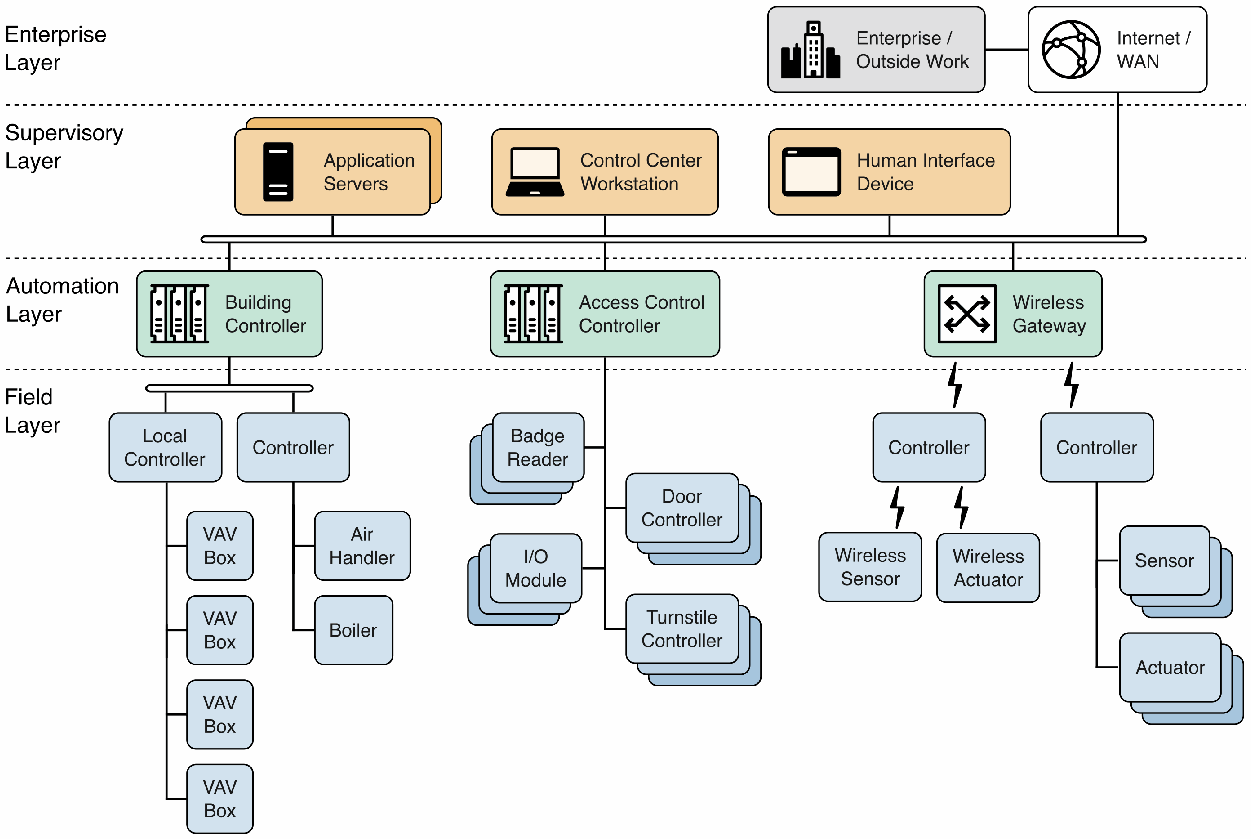
図9. BASの実装例。破線で 4 つの層に分かれる。企業層(Enterprise Layer): Enterprise / Outside Work がインターネット / WAN に接続する。監視層(Supervisory Layer): アプリケーションサーバ、制御センターワークステーション、ヒューマンインタフェースデバイスがバスに接続し、バスはインターネット / WAN にもつながる。自動化層(Automation Layer): ビルコントローラ、入退室管理コントローラ(Access Control Controller)、無線ゲートウェイがそのバスに接続する。現場層(Field Layer): ビルコントローラは、4 つの VAV ボックスを持つローカルコントローラと、空調機(Air Handler)とボイラを持つコントローラに接続する。入退室管理コントローラはバッジリーダ、I/O モジュール、ドアコントローラ、ターンスタイルコントローラに接続する。無線ゲートウェイは 2 つのコントローラと無線で通信し、一方は無線センサおよび無線アクチュエータと無線で通信し、他方はセンサとアクチュエータに有線で接続する。
Fig. 9. A BAS implementation example
図9. BASの実装例
2.3.6. Physical Access Control Systems
2.3.6. 物理アクセス制御システム
A physical access control system (PACS) is a type of physical security system designed to control access to an area. Unlike standard physical barriers, physical access control can control who is granted access, when the access is granted, and how long the access should last. An access point is the entrance or barrier where access control is required. Some common physical access control examples of access points are doors and locks, security gates, turnstiles, and vehicular gate arms. Depending on the type of facility, there can be a single access point (e.g., for high-security areas) or many (e.g., for a large office building). An identification (ID) or personal credential is used to identify the authorized user trying to gain access to the area or facility. A PACS often requires a user to have credentials to gain entrance to a facility or access sensitive data. Examples of identification credentials include simple controls (e.g., PIN codes, passwords, key fobs, key cards) and more advanced credentials (e.g., encrypted badges, mobile credentials). Identification credentials allow the system to know who is attempting to gain access and to maintain access logs. Readers and/or keypads are typically located at the access point. The reader reads the data and sends it to a door controller to validate the credential and determine whether access should be authorized. If a keypad or biometric reader is also required (i.e., for multi-factor authentication), the user will enter their PIN or perform the biometric scan following their credential scan. An example of a PACS is shown in Fig. 10.
物理アクセス制御システム(PACS)は、区域へのアクセスを制御するために設計された物理セキュリティシステムの一種です。通常の物理的障壁と異なり、物理アクセス制御では、誰に、いつ、どのくらいの時間アクセスを許可するかを制御できます。アクセスポイントとは、アクセス制御が必要な入口または障壁を指します。一般的なアクセスポイントには、ドアと錠、セキュリティゲート、回転式ゲート、車両用ゲートアームがあります。施設の種類に応じて、アクセスポイントが1か所(例えば、高セキュリティ区域)だけの場合も、多数(例えば、大規模オフィスビル)の場合もあります。区域または施設へのアクセスを試みる利用者が許可された者か識別するため、識別情報(ID)または個人認証情報を使います。PACSでは、施設への入場や機密データへのアクセスに認証情報を要求することが多くあります。認証情報の例には、PINコード、パスワード、キーフォブ、キーカードなどの簡易なものと、暗号化バッジやモバイル認証情報などの高度なものがあります。認証情報によって、システムはアクセスを試みている人物を把握し、アクセスログを維持できます。リーダーやキーパッドは通常、アクセスポイントに設置されます。リーダーはデータを読み取り、ドアコントローラーに送信して認証情報を検証し、アクセスを許可すべきか判断します。キーパッドや生体認証リーダーも必要な場合(すなわち多要素認証を行う場合)、認証情報を読み取らせた後に利用者がPINを入力するか、生体認証を行います。PACSの例を図10に示します。
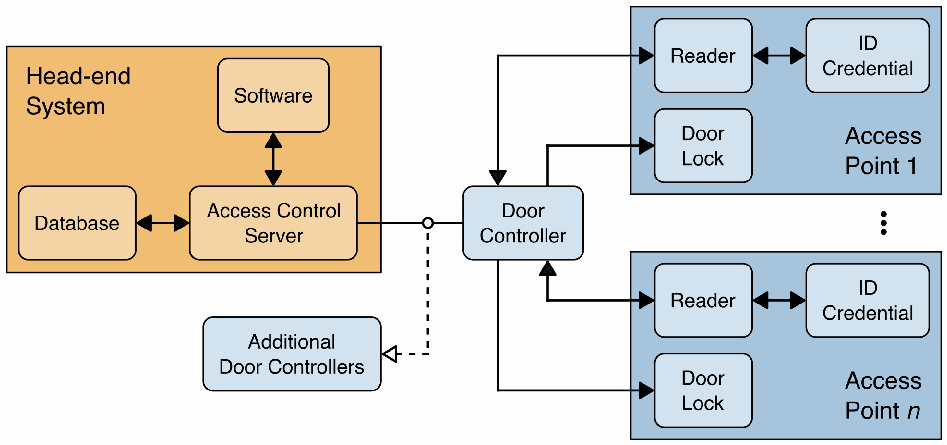
図10. PACSの実装例。ヘッドエンドシステム(Head-end System)にはソフトウェア、入退室管理サーバ(Access Control Server)、データベースがあり、ソフトウェアとデータベースはそれぞれ入退室管理サーバと双方向の矢印で結ばれている。入退室管理サーバはドアコントローラに接続し、破線の矢印で追加のドアコントローラ(Additional Door Controllers)にも接続する。ドアコントローラは、アクセスポイント 1 とアクセスポイント n(間は省略記号)のリーダとドアロックへ矢印を送り、リーダから矢印を受け取る。各リーダは ID クレデンシャルと双方向の矢印で結ばれている。
Fig. 10. A PACS implementation example
図10. PACSの実装例
In this example, the door controller receives credential data from the reader and verifies the identification credential. If the credential is approved by the access control server, the control panel transmits the command to authorize access and unlock the door. If the credential is denied, the door will remain locked, and the user will not be able to gain entry. All access attempts are logged by the door controller(s) and, ultimately, the access control server. The access control server is the repository for user information, access privileges, and audit logs. Depending on the system, the server might be on-premises or managed in the cloud.
この例では、ドアコントローラーがリーダーから資格情報データを受け取り、識別用資格情報を検証します。資格情報がアクセス制御サーバーによって承認されると、制御盤はアクセスを許可して扉を解錠するコマンドを送信します。資格情報が拒否された場合、扉は施錠されたままとなり、利用者は入室できません。すべてのアクセス試行はドアコントローラーによって記録され、最終的にはアクセス制御サーバーにも記録されます。アクセス制御サーバーは、利用者情報、アクセス権限、監査ログのリポジトリです。システムによっては、サーバーはオンプレミスに置かれる場合も、クラウドで管理される場合もあります。
While this guide contains recommendations that are applicable and could be used as a reference to protect a PACS against cybersecurity threats, readers are encouraged to perform a risk-based assessment on their systems and tailor the recommended guidelines and solutions to meet their specific security, business, and operational requirements.
本ガイドには、PACS をサイバーセキュリティ上の脅威から保護するための参考として利用できる推奨事項が含まれていますが、読者は、自らのシステムについてリスクベースの評価を実施し、推奨されるガイドラインおよびソリューションを、自らのセキュリティ、業務、運用の各要件に合わせて調整することが推奨されます。
2.3.7. Safety Systems
2.3.7. 安全システム
Many of the physical processes that OT systems control have the potential to create hazardous situations to human life and safety, property, and the environment. Safety systems are designed to reduce the likelihood and/or consequence of these potentially hazardous situations by bringing the system to a safe state. There are several types of safety systems related to OT environments, including emergency shut down (ESD), process safety shutdown (PSS), and fire and gas systems (FGS).
OT システムが制御する物理プロセスの多くは、人命と安全、財産、環境にとって危険な状況を生じさせる可能性があります。安全システムは、システムを安全な状態にすることで、こうした危険な状況が生じる可能性や結果を低減するように設計されています。OT 環境に関連する安全システムには、緊急遮断(ESD)、プロセス安全遮断(PSS)、火災・ガスシステム(FGS)など、いくつかの種類があります。
One of the more well-known types of safety system is the safety instrumented system (SIS), which is composed of one or more safety instrumented functions (SIFs). An SIF is an engineered system that is typically comprised of sensors, logic solvers, and final control elements (e.g., actuators) whose purpose is to bring a system to a safe state when predetermined thresholds are violated. An SIS is implemented as part of an overall risk reduction strategy to reduce the likelihood and/or potential consequences of a previously identified event so that it is within the organization’s risk tolerance. Although numerous other terms are associated with safety systems, the SIS is specifically designed in accordance with [IEC61511]. An SIS is typically found in chemical, refinery, and nuclear processes.
安全システムのうち、よく知られているものの 1 つが安全計装システム(SIS)であり、1 つ以上の安全計装機能(SIF)で構成されます。SIF は、通常、センサー、ロジックソルバー、最終制御要素(例:アクチュエーター)から構成されるよう設計されたシステムであり、あらかじめ定められたしきい値に違反したときにシステムを安全な状態にすることを目的とします。SIS は、あらかじめ特定された事象の発生可能性や潜在的な結果を低減し、組織のリスク許容度の範囲内に収めるための、リスク低減戦略全体の一部として実装されます。安全システムに関連する用語はほかにも数多くありますが、SIS は特に [IEC61511] に従って設計されます。SIS は、通常、化学、精製、原子力のプロセスで見られます。
An SIS is often independent from all other control systems in such a manner that a failure of the basic process control system (BPCS) will not impact SIS functionality in a deleterious manner. Historically, an SIS was designed to be stand-alone, physically and logically separated, and air-gapped from the rest of the control system. In the configuration shown in Fig. 11, the SIS and BPCS operate completely independent of each other with no direct communication between the systems. However, some modern SISs have been designed to allow communication with the control system. These types of SISs are called Integrated Control and Safety Systems (ICSSs). An ICSS solution may be an all-in-one device from a single vendor or incorporate multiple devices from multiple vendors. While an ICSS combines the functionality of both control and safety systems, the SIS must still comply with the requirements outlined in [IEC61511]. One of the advantages to this ICSS methodology is the ability to communicate information from the SIS to the BPCS.
SIS は、基本プロセス制御システム(BPCS)の障害が SIS の機能に悪影響を及ぼさないよう、他のすべての制御システムから独立していることが多くあります。従来、SIS は、制御システムの他の部分から物理的にも論理的にも分離され、エアギャップが設けられた、スタンドアロンのものとして設計されていました。図 11 に示す構成では、SIS と BPCS は互いに完全に独立して動作し、両システム間に直接の通信はありません。一方、最近の SIS の中には、制御システムとの通信を可能にするよう設計されたものもあります。このような SIS は、統合制御安全システム(ICSS)と呼ばれます。ICSS ソリューションは、単一のベンダーによるオールインワンの装置であることもあれば、複数のベンダーの複数の装置を組み込んだものであることもあります。ICSS は制御システムと安全システムの両方の機能を組み合わせたものですが、SIS は依然として [IEC61511] に定められた要件を満たさなければなりません。この ICSS 方式の利点の 1 つは、SIS から BPCS へ情報を伝達できることです。
While this guide contains recommendations that are applicable and could be used as a reference to protect safety systems against cybersecurity threats, readers are encouraged to perform a risk-based assessment on their systems and tailor the recommended guidelines and solutions to meet their specific security, business, and operational requirements.
本ガイドには、安全システムをサイバーセキュリティ上の脅威から保護するための参考として利用できる推奨事項が含まれていますが、読者は、自らのシステムについてリスクベースの評価を実施し、推奨されるガイドラインおよびソリューションを、自らのセキュリティ、業務、運用の各要件に合わせて調整することが推奨されます。
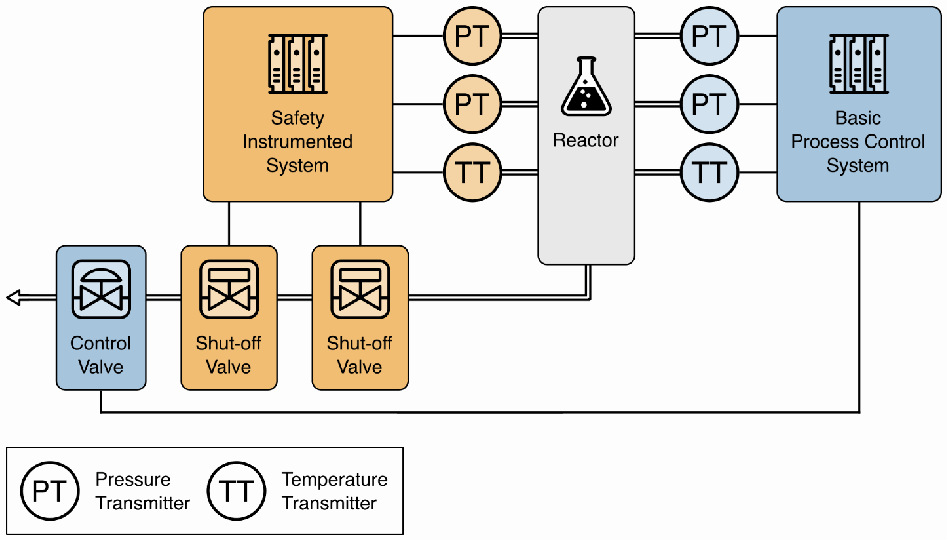
図11. SISの実装例。中央の反応器(Reactor)は、左側で安全計装システム(Safety Instrumented System)に接続された 2 つの PT と 1 つの TT に、右側で基本プロセス制御システム(Basic Process Control System)に接続された 2 つの PT と 1 つの TT に監視されている。反応器からの出口配管は、安全計装システムが制御する 2 つの遮断弁(Shut-off Valve)と、基本プロセス制御システムが制御する調節弁(Control Valve)を通って左へ出ていく。凡例が PT を圧力伝送器(Pressure Transmitter)、TT を温度伝送器(Temperature Transmitter)と説明する。
Fig. 11. An SIS implementation example
図11. SISの実装例
2.3.8. Industrial Internet of Things
2.3.8. 産業用モノのインターネット
The Industrial Internet of Things (IIoT) consists of sensors, instruments, machines, and other devices that are networked together and use internet connectivity to enhance industrial and manufacturing business processes and applications [Berge]. As IT and OT systems continue to converge and become even more interconnected, the control of physical processes remains a relatively unique and critical concept of OT.
産業用モノのインターネット(IIoT)は、ネットワークで相互に接続され、インターネット接続を利用して産業・製造の業務プロセスやアプリケーションを強化するセンサー、計器、機械、その他の装置で構成されます [Berge]。IT システムと OT システムの融合と相互接続が進み続けても、物理プロセスの制御は、OT に比較的特有で重要な概念であり続けます。
The Industry IoT Consortium proposes a three-tier system architecture model for representing IIoT systems [IIRA19]: the edge tier, platform tier, and enterprise tier. Each tier plays a specific role in processing the data flows and control flows involved in usage activities. The tiers are connected by three networks: the proximity network, access network, and service network. An example architecture is shown in Fig. 12.
Industry IoT Consortium は、IIoT システムを表現するために、エッジ層、プラットフォーム層、エンタープライズ層という 3 層のシステムアーキテクチャモデルを提案しています [IIRA19]。各層は、利用活動に関わるデータフローと制御フローの処理において、それぞれ固有の役割を担います。各層は、近接ネットワーク、アクセスネットワーク、サービスネットワークの 3 つのネットワークで接続されます。アーキテクチャの例を図 12 に示します。
The enterprise tier implements domain-specific applications and decision support systems, provides interfaces to end users, receives data flows from the other tiers, and issues control commands to the other tiers.
エンタープライズ層は、ドメイン固有のアプリケーションと意思決定支援システムを実装し、エンドユーザーへのインターフェースを提供し、他の層からのデータフローを受け取り、他の層へ制御コマンドを発行します。
The platform tier receives, processes, and forwards control commands from the enterprise tier to the edge tier. It consolidates processes and analyzes data flows from the other tiers, provides management functions for devices and assets, and offers non-domain-specific services, such as data query and analytics. Based on the specific implementation, these functions can be implemented on the IIoT platform that is deployed in an on-site data center, an off-site data center, or in the cloud.
プラットフォーム層は、エンタープライズ層からエッジ層への制御コマンドを受信、処理、転送します。また、他の層からのデータフローを統合して処理・分析し、装置および資産の管理機能を提供し、データクエリや分析など、ドメインに依存しないサービスを提供します。具体的な実装によっては、これらの機能は、オンサイトのデータセンター、オフサイトのデータセンター、またはクラウドに配備された IIoT プラットフォーム上に実装できます。
The service network enables connectivity between the services in the platform tier, the enterprise tier, and the services within each tier. This connectivity may be an overlay private network over the public internet or the internet itself, allowing enterprise-grade security between end users and services.
サービスネットワークは、プラットフォーム層およびエンタープライズ層のサービス間と、各層内のサービス間の接続を実現します。この接続は、公衆インターネット上のオーバーレイ型プライベートネットワークの場合もあれば、インターネットそのものの場合もあり、エンドユーザーとサービスの間でエンタープライズ級のセキュリティを可能にします。
The edge tier collects data from the edge nodes using the proximity network. The architectural characteristics of this tier vary depending on the specific implementation (e.g., geographical distribution, physical location, governance scope). It is a logical layer rather than a true physical division. From a business perspective, the location of the edge depends on the business objectives.
エッジ層は、近接ネットワークを用いてエッジノードからデータを収集します。この層のアーキテクチャ上の特性は、具体的な実装(例:地理的分散、物理的な所在地、ガバナンスの範囲)によって異なります。これは真の物理的な区分ではなく、論理的な層です。事業の観点では、エッジの所在地は事業目標によって決まります。
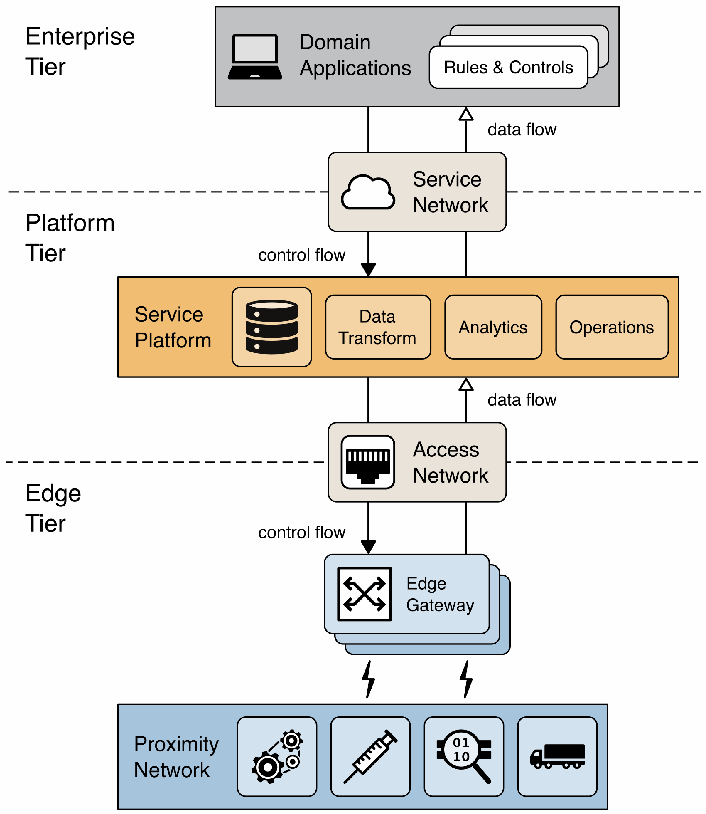
図12. 3層のIIoTシステムアーキテクチャ。破線で企業層(Enterprise Tier)、プラットフォーム層(Platform Tier)、エッジ層(Edge Tier)に分かれる。企業層には、複数重ねた Rules & Controls(ルールと制御)を持つドメインアプリケーションがある。サービスネットワーク(Service Network)がこれをプラットフォーム層のサービスプラットフォーム(データ変換、分析、運用、データベースのアイコン)に接続し、制御フロー(control flow)は下向き、データフロー(data flow)は上向きである。アクセスネットワーク(Access Network)がサービスプラットフォームをエッジ層の複数重ねたエッジゲートウェイに接続し、ここでも制御フローは下向き、データフローは上向きである。エッジゲートウェイは近接ネットワーク(Proximity Network)と無線で通信し、近接ネットワークは歯車、注射器、データを調べる虫眼鏡、トラックのアイコンで示されている。
Fig. 12. A three-tiered IIoT system architecture
図12. 3層のIIoTシステムアーキテクチャ
Edge computing is a decentralized computing infrastructure in which computing resources and application services can be distributed along the communication path between the data source and the cloud. It exists vertically within the full stack (i.e., from the device to the cloud) and horizontally across IIoT subsystems. The edge is not merely a way to collect data for transmission to the datacenter or cloud; it also processes, analyzes, and acts on data collected at the edge and is, therefore, essential for optimizing industrial data at every aspect of an operation.
エッジコンピューティングは、データソースとクラウド間の通信経路に沿って、計算リソースとアプリケーションサービスを分散配置できる分散型コンピューティング基盤です。デバイスからクラウドまでのフルスタック内に垂直方向に存在し、IIoTサブシステム間に水平方向にも広がります。エッジは、データセンターやクラウドに送るデータを収集するだけの仕組みではありません。エッジで収集したデータを処理・分析し、それに基づいて動作も行うため、運用のあらゆる側面で産業データを最適化するうえで不可欠です。
The IIoT system architecture is fully distributed and can support a wide range of interactions and communication paradigms, including:
IIoTシステムアーキテクチャは完全に分散されており、次のような幅広い相互作用や通信パラダイムをサポートできます。
•Peer-to-peer networking (e.g., security cameras communicating about identified objects)
•ピアツーピアネットワーク(例えば、識別した物体について通信するセキュリティカメラ)
•Edge-device collaboration (e.g., wind turbines in remote locations)
•エッジデバイス間の協調(例えば、遠隔地にある風力タービン)
•Distributed queries across data stored in devices, in the cloud, and anywhere in between
•デバイス、クラウド、その中間に保存されたデータに対する分散クエリ
•Distributed data management that defines where and what data is to be stored and for how long
•データの保存場所・内容・保存期間を定める分散データ管理
•Data governance, including quality, discovery, usability, privacy, and security
•品質、探索可能性、ユーザビリティ、プライバシー、セキュリティを含むデータガバナンス
The proximity network connects edge nodes (e.g., sensors, actuators, devices, OT systems and assets) to the stack. It typically connects these edge nodes as one or more clusters to a gateway that bridges to other networks. The access network enables connectivity for data and control flow between the edge and platform tiers. This connection may be a corporate network or an overlay private network over the public internet or a 4G/5G network. While this guide contains recommendations that are applicable and could be used as a reference to protect IIoT against cybersecurity threats, readers are encouraged to perform a risk-based assessment on their systems and tailor the recommended guidelines and solutions to meet their specific security, business, and operational requirements.
近接ネットワークは、エッジノード(例えば、センサー、アクチュエーター、デバイス、OTシステムおよび資産)をスタックに接続します。通常、1つ以上のクラスターとしてエッジノードをゲートウェイに接続し、ゲートウェイが他のネットワークとの橋渡しをします。アクセスネットワークは、エッジ層とプラットフォーム層間のデータフローおよび制御フローの接続を可能にします。この接続は企業ネットワークの場合もあれば、公衆インターネット上のオーバーレイプライベートネットワークや4G/5Gネットワークの場合もあります。本ガイドの推奨事項はIIoTをサイバーセキュリティ上の脅威から保護する際に適用・参照できますが、読者はシステムのリスクベース評価を実施し、個別のセキュリティ、ビジネス、運用要件に合わせて推奨ガイドラインとソリューションを調整することが望まれます。
2.4. Comparing OT and IT System Security
2.4. OTとITシステムのセキュリティ比較
OT has many characteristics that differ from traditional IT systems, including different risks and priorities. Some of these include significant risk to the health and safety of human lives, serious damage to the environment, and financial issues, such as production losses. OT has different performance and reliability requirements and uses OSs and applications that may be considered unconventional in a typical IT network environment. Security protections must be implemented in a way that maintains system integrity during normal operations as well as during cyber attacks [Knapp]. Initially, OT systems had little resemblance to IT systems because they were isolated and ran proprietary control protocols using specialized hardware and software. Widely available and low-cost Ethernet, Internet Protocol (IP), and wireless devices are now replacing older proprietary technologies, which increases the likelihood of cybersecurity vulnerabilities and incidents. OT are increasingly resembling IT systems as they adopt IT technologies to promote corporate connectivity and remote access capabilities (e.g., using industry standard computers, OSs, and network protocols). This integration supports new IT capabilities but provides significantly less isolation for OT from the outside world than predecessor systems, creating a greater need to secure them. While security solutions have been designed to deal with these issues in typical IT systems, special precautions must be taken when introducing these same solutions to OT environments. In some cases, new security solutions are needed that are tailored to the OT environment.
OTには、従来のITシステムとは異なるリスクや優先事項など、多くの相違点があります。人命の健康と安全に対する重大なリスク、環境への深刻な損害、生産損失などの財務上の問題が含まれます。OTには異なる性能・信頼性要件があり、一般的なITネットワーク環境では特殊と見なされるOSやアプリケーションが使われます。セキュリティ保護は、通常運用時もサイバー攻撃時もシステムの完全性を維持する方法で実装しなければなりません [Knapp]。当初のOTシステムは隔離され、独自の制御プロトコルを専用ハードウェアとソフトウェアで実行していたため、ITシステムとはほとんど似ていませんでした。現在は、広く普及し低コストのイーサネット、インターネットプロトコル(IP)、無線機器が従来の独自技術に置き換わり、サイバーセキュリティの脆弱性やインシデントの可能性が高まっています。OTは、企業接続やリモートアクセスを可能にするためにIT技術(例えば、業界標準のコンピューター、OS、ネットワークプロトコル)を採用し、ITシステムにますます似てきています。この統合は新しいIT機能を支える一方、以前のシステムよりも外部からの隔離を大きく弱め、セキュリティ確保の必要性を高めています。一般的なITシステムでこうした問題に対処するために設計されたセキュリティソリューションをOT環境に導入する場合は、特別な注意が必要です。場合によっては、OT環境に合わせた新しいセキュリティソリューションが必要となります。
Some special considerations when securing OT include:
OTを保護する際の特別な考慮事項には、次のものがあります。
•Timeliness and performance requirements. OT systems are generally time-critical, with the criterion for acceptable levels of delay and jitter dictated by the individual installation. Some systems require reliable, deterministic responses. High throughput is typically not essential to OT. In contrast, IT systems typically require high throughput and can withstand some level of delay and jitter. For some OT, automated response times or system responses to human interaction is critical. Many OT systems utilize real-time OSs (RTOS), where real-time refers to timeliness requirements. The units of real time are highly application-dependent and must be explicitly stated.
•適時性と性能の要件。OTシステムは一般に時間制約が厳しく、許容可能な遅延やジッターの基準は個々の設置環境で定められます。確実で決定論的な応答を必要とするシステムもあります。OTでは通常、高スループットは必須ではありません。一方、ITシステムでは通常、高スループットが求められ、ある程度の遅延やジッターを許容できます。一部のOTでは、自動応答時間や人間の操作に対するシステム応答が重要です。多くのOTシステムではリアルタイムOS(RTOS)を使用します。ここでいうリアルタイムとは、適時性の要件を指します。リアルタイムの単位はアプリケーションに大きく依存するため、明示しなければなりません。
•Availability requirements. Many OT processes are continuous in nature. Unexpected outages of systems that control industrial processes are unacceptable. Outages must often be planned and scheduled days or weeks in advance. Exhaustive pre-deployment testing is essential to ensuring high availability (i.e., reliability) for the OT. OT systems often cannot be stopped and started without affecting production. In some cases, the products produced or equipment being used are more important than the information being relayed. Therefore, typical IT strategies (e.g., rebooting a component) are usually not acceptable for OT due to adverse impacts on the requirements for high availability, reliability, and maintainability. Some OT employ redundant components – often running in parallel – to provide continuity when primary components are unavailable.
•可用性要件。多くのOTプロセスは継続的に稼働します。産業プロセスを制御するシステムの予期しない停止は許容できません。停止は数日または数週間前に計画・調整しなければならないことが多くあります。OTの高可用性(すなわち信頼性)を確保するには、展開前の徹底的な試験が不可欠です。OTシステムは、生産に影響を与えずに停止・再起動できないことが多くあります。情報伝達よりも、生産物や使用中の設備の方が重要な場合もあります。そのため、再起動などの一般的なIT戦略は、高可用性、信頼性、保守性の要件に悪影響を及ぼすため、通常OTでは許容できません。一部のOTでは、主コンポーネントが利用できない場合も継続できるよう、並行稼働することが多い冗長コンポーネントを使用します。
•Risk management requirements. In a typical IT system, primary concerns include data confidentiality and integrity. For OT, primary concerns include safety, fault tolerance to prevent the loss of life or endangerment of public health or confidence, regulatory compliance, loss of equipment, loss of intellectual property, or lost or damaged products. The personnel responsible for operating, securing, and maintaining OT must understand the important link between safety and security. Any security measure that impairs safety is unacceptable.
•リスク管理要件。一般的なITシステムでは、データの機密性と完全性が主な関心事です。OTでは、安全性、人命の損失や公衆衛生・信頼への危険を防ぐフォールトトレランス、規制遵守、設備の損失、知的財産の損失、製品の損失や損傷などが主な関心事となります。OTの運用、保護、保守を担当する人員は、安全とセキュリティの重要な結びつきを理解しなければなりません。安全性を損なうセキュリティ対策は許容できません。
•Physical effects. Field devices (e.g., PLCs, operator stations, DCS controllers) are directly responsible for controlling physical processes. OT can have complex interactions with physical processes and consequences in the OT domain that can manifest in physical events. Understanding these potential physical effects often requires communication between experts in OT and experts in the particular physical domain.
•物理的影響。フィールド機器(例えば、PLC、オペレーターステーション、DCSコントローラー)は物理プロセスを直接制御します。OTは物理プロセスと複雑に相互作用し、OT領域内の結果が物理的事象として現れることがあります。こうした物理的影響の可能性を理解するには、OTの専門家と特定の物理分野の専門家との連携が必要となることが多くあります。
•System operation. OT OSs and control networks are often quite different from their IT counterparts and require different skill sets, experience, and levels of expertise. Control networks are typically managed by control engineers rather than IT personnel. Assuming that differences are insignificant can have disastrous consequences on system operations.
•システム運用。OTのOSや制御ネットワークはITのものと大きく異なることが多く、異なる技能、経験、専門性が必要となります。制御ネットワークは通常、IT担当者ではなく制御エンジニアが管理します。相違点は重要でないと仮定すると、システム運用に壊滅的な結果をもたらすおそれがあります。
•Resource constraints. OT and their real-time operating systems (RTOSs) are often resource-constrained systems that do not include typical contemporary IT security capabilities. Legacy systems often lack resources that are common on modern IT systems. Many systems may also lack desired features, including encryption capabilities, error logging, and password protection. Indiscriminate use of IT security practices in OT may cause availability and timing disruptions. There may not be computing resources available on OT components to retrofit these systems with current security capabilities. Adding resources or features may not be possible.
•リソース制約。OTとそのリアルタイムOS(RTOS)はリソース制約のあるシステムであることが多く、一般的な最新ITセキュリティ機能を備えていません。レガシーシステムには、最新ITシステムに一般的なリソースが不足していることが多くあります。暗号化、エラーログ、パスワード保護など、望ましい機能を欠くシステムもあります。ITセキュリティ慣行を無差別にOTへ適用すると、可用性やタイミングに支障を来す可能性があります。OTコンポーネントには、現在のセキュリティ機能を追加するための計算リソースがない場合もあります。リソースや機能を追加できないこともあります。
•Communications. Communication protocols and media used by OT environments for field device control and intra-processor communication are typically different from IT environments and may be proprietary.
•通信。OT環境でフィールド機器制御やプロセッサ内通信に使われる通信プロトコルや媒体は、通常IT環境とは異なり、独自仕様の場合もあります。
•Change management. Change management is paramount to maintaining the integrity of both IT and OT systems. Unpatched software represents one of the greatest vulnerabilities to a system. Software updates on IT systems, including security patches, are typically applied in a timely fashion based on appropriate security policies and procedures. In addition, these procedures are often automated using server-based tools. Software updates on OT cannot always be implemented on a timely basis. These updates need to be thoroughly tested by both the vendor and the end user of the industrial control application before being implemented. Additionally, the OT owner must plan and schedule OT outages days or weeks in advance. The OT may also require revalidation as part of the update process. Another issue is that many OT utilize older versions of OSs that are no longer supported by the vendor through patches. Change management is also applicable to hardware and firmware. The change management process requires careful assessment by OT experts (e.g., control engineers) working in conjunction with security and IT personnel.
•変更管理。変更管理は、ITシステムとOTシステムの完全性を維持するうえで極めて重要です。未修正のソフトウェアはシステムにとって最大級の脆弱性の一つです。ITシステムでは、適切なセキュリティ方針・手順に基づき、セキュリティパッチを含むソフトウェア更新を通常適時に適用し、サーバーベースのツールで自動化することも多くあります。OTではソフトウェア更新を適時に実施できない場合があります。更新は、導入前にベンダーと産業制御アプリケーションのエンドユーザーの双方が十分に試験する必要があります。また、OT所有者は数日または数週間前に停止を計画・調整しなければなりません。更新の一環としてOTの再検証が必要な場合もあります。さらに、多くのOTでは、ベンダーがパッチでサポートしなくなった古いOSを使用しています。変更管理はハードウェアとファームウェアにも適用されます。変更管理プロセスでは、OTの専門家(例えば、制御エンジニア)がセキュリティ担当者やIT担当者と連携し、慎重に評価する必要があります。
•Managed support. Typical IT systems allow for diversified support styles, perhaps supporting disparate but interconnected technology architectures. For OT, service support is sometimes only available from a single vendor. In some instances, third-party security solutions are not allowed due to OT vendor licensing and service agreements, and service support can be lost if third-party applications are installed without vendor acknowledgement or approval.
•管理されたサポート。一般的なITシステムでは、相互接続された異種技術アーキテクチャを支援するなど、多様なサポート形態が可能です。OTでは、単一ベンダーしかサービスサポートを提供できない場合があります。OTベンダーのライセンスやサービス契約により、サードパーティ製セキュリティソリューションが認められない場合もあります。また、ベンダーの承認を得ずにサードパーティ製アプリケーションを導入すると、サービスサポートを受けられなくなることもあります。
•Component lifetime. Typical IT components have a lifetime on the order of three to five years due to the quick evolution of technology. For OT, where technology has been developed in many cases for specific uses and implementations, the lifetime of the deployed technology is often in the order of 10 to 15 years and sometimes longer.
•コンポーネントの寿命。技術の進歩が速いため、一般的なITコンポーネントの寿命は3~5年程度です。OTでは、特定の用途や実装向けに開発された技術が多く、導入済み技術の寿命は通常10~15年程度、場合によってはそれ以上となります。
•Component location. Most IT components and some OT components are located in business and commercial facilities that are physically accessible by local transportation. Remote locations may be utilized for backup facilities. Distributed OT components may be isolated, remote, and require extensive transportation effort to reach. The component location also needs to consider necessary physical and environmental security measures.
•コンポーネントの設置場所。ITコンポーネントの大半とOTコンポーネントの一部は、地域交通で物理的にアクセス可能な業務・商業施設に設置されます。遠隔地がバックアップ施設として使われることもあります。分散型OTコンポーネントは隔離された遠隔地にあり、到達に多大な移動が必要な場合があります。設置場所に応じて、必要な物理的・環境的セキュリティ対策も考慮する必要があります。
Table 1 summarizes some of the typical differences between IT and OT systems.
表1に、ITシステムとOTシステムの典型的な相違点をまとめます。
Table 1. Summary of typical differences between IT and OT systems
表1. ITシステムとOTシステムの典型的な相違点の概要
| Category | Information Technology | Operational Technology |
|---|---|---|
| Performance Requirements | Non-real time Response must be consistent. High throughput is demanded. High delay and jitter may be acceptable. Emergency interaction is less critical. Tightly restricted access control can be implemented to the degree necessary for security. | Real-time Response is time-critical. Modest throughput is acceptable. High delay and/or jitter is unacceptable. Response to human and other emergency interaction is critical. Access to OT should be strictly controlled but should not hamper or interfere with human-machine interaction. |
| 区分 | 情報技術 | 運用技術 |
|---|---|---|
| 性能要件 | 非リアルタイム。応答は一貫している必要があります。高スループットが求められます。高い遅延やジッターは許容される場合があります。緊急時の対話の重要性は比較的低いです。セキュリティ上必要な程度まで、厳格に制限されたアクセス制御を実装できます。 | リアルタイム。応答には厳しい時間制約があります。中程度のスループットであれば許容されます。高い遅延やジッターは許容できません。人間やその他の緊急時の操作への応答が重要です。OTへのアクセスは厳格に管理すべきですが、人間と機械の対話を妨げてはなりません。 |
| Category | Information Technology | Operational Technology |
|---|---|---|
| Availability (Reliability) Requirements | Responses such as rebooting are acceptable. Availability deficiencies can often be tolerated, depending on the system’s operational requirements. | Responses such as rebooting may not be acceptable because of process availability requirements. Availability requirements may necessitate redundant systems. Outages must be planned and scheduled days or weeks in advance. High availability requires exhaustive pre-deployment testing. |
| Risk Management Requirements | Manage data Data confidentiality and integrity is paramount. Fault tolerance is less important; momentary downtime is not a major risk. The major risk impact is a delay of business operations. | Control physical world Human safety is paramount, followed by protection of the process. Fault tolerance is essential; even momentary downtime may be unacceptable. The major risk impacts are regulatory non-compliance, environmental impacts, and the loss of life, equipment, or production. |
| System Operation | Systems are designed for use with typical OSs. Upgrades are straightforward with the availability of automated deployment tools. | Systems often use different and possibly proprietary OSs, sometimes without security capabilities built in. Software changes must be carefully made, usually by software vendors, because of the specialized control algorithms and potentially modified hardware and software involved. |
| Resource Constraints | Systems are specified with enough resources to support the addition of third-party applications, such as security solutions. | Systems are designed to support the intended industrial process and may not have enough memory and computing resources to support the addition of security capabilities. |
| Communications | Standard IT communications protocols are used. Primarily wired networks with some localized wireless capabilities. Typical IT networking practices are employed. | Many proprietary and standard communication protocols are used. Several types of communications media are used, including dedicated wired and wireless (e.g., radio and satellite). Complex networks exist that sometimes require the expertise of control engineers. |
| Change Management | Software changes are applied in a timely fashion in the presence of good security policies and procedures, and the procedures are often automated. | Software changes must be thoroughly tested and deployed incrementally throughout a system to ensure that the integrity of the OT system is maintained. OT outages must often be planned and scheduled days or weeks in advance. OT may use OSs that are no longer supported. OT systems often have custom applications. |
| Managed Support | Allow for diversified support styles | Service support is usually provided through a single vendor. |
| Component Lifetime | Lifetime on the order of three to five years | Lifetime on the order of 10 to 15 years |
| Components Location | Components are usually local and easy to access. | Components can be isolated, remote, and require extensive physical effort to gain access to them. |
| 区分 | 情報技術 | 運用技術 |
|---|---|---|
| 可用性(信頼性)要件 | 再起動などの対応は許容されます。システムの運用要件に応じて、可用性の不足を許容できることが多くあります。 | プロセスの可用性要件により、再起動などの対応が許容されない場合があります。可用性要件から冗長システムが必要になることがあります。停止は数日または数週間前に計画・調整しなければなりません。高可用性を確保するには、展開前に徹底的な試験が必要です。 |
| リスク管理要件 | データを管理します。データの機密性と完全性が最重要です。フォールトトレランスの重要性は比較的低く、一時的な停止は大きなリスクではありません。主なリスクの影響は業務の遅延です。 | 物理世界を制御します。人間の安全が最重要であり、次にプロセスの保護が続きます。フォールトトレランスは不可欠であり、わずかな停止も許容できない場合があります。主なリスクの影響は規制不遵守、環境への影響、人命・設備・生産の損失です。 |
| システム運用 | 一般的なOSでの利用を想定して設計されています。自動展開ツールが利用できるため、アップグレードは容易です。 | 異なる、場合によっては独自仕様のOSを使用していることが多く、セキュリティ機能が組み込まれていない場合もあります。専用の制御アルゴリズムや、変更された可能性のあるハードウェアとソフトウェアが関わるため、ソフトウェアの変更は、通常はソフトウェアベンダーが慎重に行わなければなりません。 |
| リソースの制約 | セキュリティソリューションなどのサードパーティ製アプリケーションの追加を支えるのに十分なリソースを備えるよう仕様が定められています。 | 想定する産業プロセスを支えるように設計されており、セキュリティ機能を追加するための十分なメモリや計算リソースがない場合があります。 |
| 通信 | 標準的なIT通信プロトコルが使用されます。主に有線ネットワークで、一部に局所的なワイヤレス機能があります。典型的なITネットワーキングの実務が採用されます。 | 多くの独自および標準の通信プロトコルが使用されます。専用の有線やワイヤレス(例:無線や衛星)を含め、複数の種類の通信媒体が使用されます。複雑なネットワークが存在し、制御エンジニアの専門知識が必要になることもあります。 |
| 変更管理 | 優れたセキュリティ方針と手順があれば、ソフトウェアの変更は適時に適用され、その手順は自動化されていることが多くあります。 | OTシステムの完全性を維持するため、ソフトウェアの変更は徹底的にテストし、システム全体に段階的に展開しなければなりません。OTの停止は、数日または数週間前に計画・調整しなければならないことが多くあります。OTは、もはやサポートされていないOSを使用している場合があります。OTシステムには、カスタムアプリケーションが多くあります。 |
| 管理サポート | 多様なサポート形態を許容する | サービスサポートは通常、単一のベンダーによって提供されます。 |
| コンポーネントの寿命 | 寿命は3~5年程度 | 寿命は10~15年程度 |
| コンポーネントの設置場所 | コンポーネントは通常、ローカルにあり、容易にアクセスできます。 | コンポーネントは孤立していたり遠隔地にあったりする場合があり、アクセスするために多大な物理的労力を要します。 |
In summary, the operational and risk differences between IT and OT systems create the need for increased sophistication in applying cybersecurity and operational strategies. A cross-functional team of control engineers, control system operators, and IT security professionals must work closely to understand the possible implications of the installation, operation, and maintenance of security solutions in conjunction with control system operation. IT professionals working with OT need to understand the reliability impacts of information security technologies before deployment. Moreover, some of the OSs and applications that run on OT may not operate correctly with commercial-off-the-shelf (COTS) IT cybersecurity solutions because of their unique requirements.
要約すると、ITシステムとOTシステムの運用上およびリスク上の違いにより、サイバーセキュリティ戦略と運用戦略の適用には、より高度な対応が必要となります。制御エンジニア、制御システムオペレーター、ITセキュリティ専門家から成る部門横断チームが緊密に連携し、制御システムの運用と併せてセキュリティソリューションを導入・運用・保守する場合の影響を理解しなければなりません。OTに携わるIT専門家は、導入前に情報セキュリティ技術が信頼性に及ぼす影響を理解する必要があります。さらに、OT上で動作するOSやアプリケーションの中には、固有の要件により、市販の既製品(COTS)であるITサイバーセキュリティソリューションと正しく動作しないものもあります。
3. OT Cybersecurity Program Development
3. OTサイバーセキュリティ・プログラムの策定
To mitigate cybersecurity risks to their OT systems, organizations need to develop and deploy an OT cybersecurity program. It should be consistent and integrated with existing IT cybersecurity programs and practices but also account for the specific requirements and characteristics of OT systems and environments. Organizations should regularly review and update their OT cybersecurity plans and programs to reflect changes in technologies, operations, standards, regulations, and the security needs of specific facilities. Effective integration of cybersecurity into the operation of OT requires defining and executing a comprehensive program that addresses all aspects of cybersecurity. This includes defining the objectives and scope of the program; establishing a cross-functional team that understands OT and cybersecurity; establishing policies and procedures; identifying cyber risk management capabilities that include people, processes, and technologies; and identifying day-to-day operations of event monitoring and auditing for compliance and improvement. When a new system is being designed and installed, it is imperative to take the time to address security throughout the life cycle, including architecture, procurement, installation, maintenance, and decommissioning. Deploying systems to the field based on the assumption that these systems will be secured later introduces significant risks to the systems and the organization. If there are not enough time and resources to properly secure the system before deployment, it is unlikely that security will be addressed at a later time. Since new OT systems are designed and deployed less frequently than IT systems, it is much more common to improve, expand, or update an existing OT system than to design a new one. This section introduces the basic process for developing an OT cybersecurity program and applies to new and deployed OT systems. Additional guidance for developing the specific elements of an OT cybersecurity program can be found in Section 3.3.10.
OTシステムのサイバーセキュリティリスクを軽減するため、組織はOTサイバーセキュリティ・プログラムを策定し、展開する必要があります。このプログラムは既存のITサイバーセキュリティ・プログラムや慣行と整合し、統合される一方、OTシステムと環境固有の要件や特性も考慮する必要があります。組織は、技術、運用、規格、規制、各施設のセキュリティニーズの変化を反映するため、OTサイバーセキュリティ計画とプログラムを定期的に見直し、更新する必要があります。OT運用にサイバーセキュリティを効果的に組み込むには、サイバーセキュリティのあらゆる側面に対処する包括的プログラムを定義し、実行する必要があります。これには、プログラムの目的と範囲の定義、OTとサイバーセキュリティを理解する部門横断チームの設置、方針・手順の確立、人・プロセス・技術を含むサイバーリスク管理能力の特定、ならびに事象監視や遵守状況の監査、改善などの日常業務の特定が含まれます。新しいシステムを設計・設置する際には、アーキテクチャ、調達、設置、保守、廃止を含むライフサイクル全体でセキュリティに取り組むことが不可欠です。後でセキュリティを確保するという前提でシステムを現場に展開すると、システムと組織に重大なリスクが生じます。展開前にシステムを適切に保護する時間やリソースが足りない場合、後からセキュリティに取り組める可能性は低いです。OTシステムはITシステムほど頻繁に新規設計・展開されないため、新しいシステムを設計するより既存のOTシステムを改善、拡張、更新する方が一般的です。本節では、導入前と導入済みのOTシステムに適用できる、OTサイバーセキュリティ・プログラム策定の基本プロセスを紹介します。OTサイバーセキュリティ・プログラムの各要素の策定に関する追加ガイダンスは3.3.10節に記載されています。
3.1. Establish a Charter for the OT Cybersecurity Program
3.1. OTサイバーセキュリティ・プログラムの憲章の策定
Senior management must demonstrate a clear commitment to cybersecurity and communicate its importance throughout the organization. Cybersecurity is a business responsibility shared by all members of the organization, especially by its leaders and IT and OT teams. Commitment to cybersecurity can be demonstrated by establishing a charter for a cybersecurity program with adequate funding, visibility, governance, and support from senior leaders. A cybersecurity program that has commitment from senior management is more likely to achieve the mission and business goals of the organization. A charter for a cybersecurity program is a plain-language high-level description that establishes clear ownership and accountability for protecting OT resources and provides a mandate for the most senior person responsible to establish and maintain the cybersecurity program (e.g., CISO). This section focuses on an OT-specific program, which should be integrated with the organization’s overall cybersecurity program. A cybersecurity program charter should include program objectives, scope, and responsibilities. Senior management establishes the OT cybersecurity program charter and identifies an OT cybersecurity manager with appropriate authority to lead the OT cybersecurity program. The OT cybersecurity manager should define the roles and responsibilities of system owners, mission and business process managers, and users. The OT cybersecurity manager should also document the objectives and scope of the OT security program, including the business organizations affected, the systems and networks involved, the budget and resources required, and the division of responsibilities. The organization may already have an information security program in place or have developed one for its IT systems. The OT cybersecurity manager should identify which existing practices to leverage and which practices are specific to the OT system. Ultimately, it will be more effective for the team to share resources with others in the organization that have similar objectives.
上級管理職はサイバーセキュリティへの明確なコミットメントを示し、その重要性を組織全体に伝えなければなりません。サイバーセキュリティは組織の全員が共有する業務上の責任であり、特にリーダーやIT・OTチームが担います。十分な資金、可視性、ガバナンス、上級リーダーの支援を備えたプログラム憲章を策定することで、コミットメントを示せます。上級管理職が支援するサイバーセキュリティ・プログラムは、組織の使命と業務目標を達成しやすい傾向があります。憲章は、OT資源の保護に関する明確な所有者と説明責任を定め、サイバーセキュリティ・プログラムの確立・維持を最終責任者(例えば、CISO)に命じる、平易な言葉で書かれた高水準の説明です。本節では、組織全体のサイバーセキュリティ・プログラムに統合すべきOT固有のプログラムを扱います。憲章には、プログラムの目的、範囲、責任を含める必要があります。上級管理職はOTサイバーセキュリティ・プログラム憲章を策定し、適切な権限を持つOTサイバーセキュリティ管理者を任命してプログラムを主導させます。管理者は、システム所有者、ミッション・業務プロセス管理者、利用者の役割と責任を定義する必要があります。また、影響を受ける業務組織、対象システムとネットワーク、必要な予算・リソース、責任分担など、OTセキュリティ・プログラムの目的と範囲を文書化する必要があります。組織には情報セキュリティ・プログラムがすでに存在する場合や、ITシステム向けに策定済みの場合があります。OTサイバーセキュリティ管理者は、既存の慣行のうち活用するものとOTシステム固有のものを特定する必要があります。同様の目標を持つ組織内の他者とリソースを共有する方が、最終的にはより効果的です。
3.2. Business Case for the OT Cybersecurity Program
3.2. OTサイバーセキュリティ・プログラムのビジネスケース
The cybersecurity of OT systems is a critical component in the overall security of the organization. Cybersecurity events could potentially impact the organization’s mission and objectives, the environment, regulatory compliance, and even human safety. OT systems can also be used as an entry point to organizational IT systems and other enterprise systems. As OT systems are increasingly being connected to IT networks, relying on traditional measures (e.g., air gaps) is not enough to protect such systems from cyber attacks. Therefore, security measures tailored to the OT system are required to protect the organization. An OT cybersecurity program considers the characteristics of OT systems that require special consideration in order to mitigate these risks.
OTシステムのサイバーセキュリティは、組織全体のセキュリティに不可欠です。サイバーセキュリティ事象は、組織の使命や目標、環境、規制遵守、さらには人の安全に影響を与える可能性があります。OTシステムが組織のITシステムやその他のエンタープライズシステムへの侵入口として使われることもあります。OTシステムがITネットワークにますます接続される中、エアギャップなど従来の対策だけでは十分に保護できません。したがって、組織を保護するにはOTシステムに合わせたセキュリティ対策が必要です。OTサイバーセキュリティ・プログラムでは、リスク軽減のために特別な配慮が必要となるOTシステムの特性を考慮します。
3.2.1. Benefits of Cybersecurity Investments
3.2.1. サイバーセキュリティ投資の利点
OT cybersecurity supports the mission and business functions of the organization and provides additional benefits, including:
OTサイバーセキュリティは組織の使命と業務機能を支え、次のような追加の利点をもたらします。
•Improving OT system safety, reliability, and availability
•OTシステムの安全性、信頼性、可用性の向上
•Improving OT system efficiency
•OTシステムの効率向上
•Reducing community concerns
•地域社会の懸念の軽減
•Reducing legal liabilities
•法的責任の軽減
•Meeting regulatory requirements
•規制要件の充足
•Helping with insurance coverage and costs
•保険の適用範囲と費用への対応
A strong OT cybersecurity program is fundamental to a sustainable business operation and can potentially enhance system reliability and availability. This includes minimizing unintentional OT system information security impacts from inappropriate testing, policies, and misconfigured systems. Cyber attacks can also have other significant impacts, such as:
強固なOTサイバーセキュリティ・プログラムは持続可能な事業運営の基盤であり、システムの信頼性と可用性を高める可能性があります。これには、不適切な試験、方針、設定ミスによってOTシステムの情報セキュリティに意図せず生じる影響を最小限に抑えることが含まれます。サイバー攻撃は、他にも次のような重大な影響をもたらします。
•Physical impacts. Physical impacts encompass the set of direct consequences of OT failure, particularly personal injury and the loss of life. Other effects include the loss of property (including data) and potential damage to the environment.
•物理的影響。物理的影響とは、OT障害が直接もたらす結果の総体であり、特に人の負傷や死亡が含まれます。その他の影響には、財産(データを含む)の損失や環境への潜在的な損害があります。
•• Economic impacts. Economic impacts are a second-order effect of physical impacts that ensue from an OT incident, which in turn inflict a greater economic loss on the facility, organization, or others who are dependent on the OT systems. The unavailability of critical infrastructure (e.g., electrical power, transportation) can have economic impacts far beyond the systems that sustain direct and physical damage. These effects could negatively impact the local, regional, national, or possibly global economy.
•• 経済的影響。経済的影響は、OTインシデントに起因する物理的影響から生じる二次的な影響であり、その物理的影響が、施設、組織、またはOTシステムに依存する他者に、さらに大きな経済損失をもたらします。重要インフラ(例えば、電力、輸送)が利用できなくなると、直接的かつ物理的な損害を受けたシステムをはるかに超える範囲に経済的影響が及ぶことがあります。こうした影響は、地方、地域、国、場合によっては世界の経済に悪影響を及ぼす可能性があります。
•Social impacts. Another second-order effect is the loss of national or public confidence in an organization.
•社会的影響。もう一つの二次的影響は、組織に対する国民または社会の信頼の喪失です。
Additional examples of the potential consequences of an OT incident are listed below. Note that items in this list are not independent. For example, the release of hazardous material could lead to injury or death.
OTインシデントがもたらす可能性のある結果の例を以下に示します。この一覧の項目は互いに独立ではない点に注意します。例えば、危険物質の放出が負傷や死亡につながることがあります。
•Impact on national security (e.g., facilitate an act of terrorism)
•国家安全保障への影響(例えば、テロ行為を助長する)
•Reduction or loss of production at one site or multiple sites simultaneously
•単一の拠点または複数の拠点における同時の生産の縮小または停止
•Injury or death of employees
•従業員の負傷または死亡
•Injury or death of persons in the community
•地域住民の負傷または死亡
•Damage to equipment
•機器の損傷
•Release, diversion, or theft of hazardous materials
•危険物質の放出、転用、または窃盗
•Environmental damage
•環境への損害
•Violation of regulatory requirements
•規制要件への違反
•Product contamination
•製品の汚染
•Criminal or civil legal liabilities
•刑事上または民事上の法的責任
•Loss of proprietary or confidential information
•専有情報または機密情報の損失
•Loss of brand image or customer confidence
•ブランドイメージまたは顧客の信頼の喪失
Safety and security incidents can have negative impacts that last longer than other types of incidents on all stakeholders, including employees, shareholders, customers, and the communities in which an organization operates. Senior management should identify and evaluate the highest priority items to estimate the annual business impact (e.g., in financial terms).
安全・セキュリティインシデントの悪影響は、従業員、株主、顧客、組織が事業を行う地域社会など、すべての利害関係者に対し、他の種類のインシデントより長く続く可能性があります。上級管理職は、年間の事業影響(例えば、金銭的影響)を見積もるため、最優先項目を特定・評価する必要があります。
3.2.2. Building an OT Cybersecurity Business Case
3.2.2. OTサイバーセキュリティのビジネスケースの構築
A well-defined business case for an OT cybersecurity program is essential for management buy-in to ensure the long-term commitment of the organization and the allocation of resources needed for the development, implementation, and maintenance of the program. The first step in developing an OT security program is to identify the organization’s business objectives and missions, as well as how the cybersecurity program can lower risk and protect the organization’s ability to perform those objectives and missions. The business case should capture the business concerns of senior management and provide the business impact and financial justification for creating an integrated organizational cybersecurity program. It should include detailed information about the following:
明確に定義されたOTサイバーセキュリティ・プログラムのビジネスケースは、経営陣の支持を得て、プログラムの策定、実装、保守に必要な組織の長期的なコミットメントとリソース配分を確保するために不可欠です。OTセキュリティ・プログラムを策定する最初の手順は、組織の業務目標と使命、およびサイバーセキュリティ・プログラムがどのようにリスクを低減し、目標や使命を遂行する組織の能力を保護するかを特定することです。ビジネスケースには上級管理職の業務上の懸念を反映させ、統合型の組織サイバーセキュリティ・プログラムを作るための事業影響と財務上の正当性を示す必要があります。次の事項に関する詳細な情報を含めるべきである:
•Benefits of creating an integrated security program
•統合型セキュリティ・プログラムを構築する利点
•Potential costs and failure scenarios if an OT cybersecurity program is not implemented
•OTサイバーセキュリティ・プログラムを導入しない場合の潜在的コストと障害シナリオ
•High-level overview of the process required to implement, operate, monitor, review, maintain, and improve the information security program
•情報セキュリティ・プログラムを実装、運用、監視、見直し、保守、改善するために必要なプロセスの概要
The costs and resources required to develop, implement, and maintain the security program should be considered. The economic benefits of the cybersecurity program may be evaluated in the same way that worker health and safety programs are. However, an attack on the OT system could have significant consequences that far exceed monetary costs.
セキュリティ・プログラムの策定、実装、保守に必要なコストとリソースを考慮する必要があります。サイバーセキュリティ・プログラムの経済的利点は、労働者の健康・安全プログラムと同じ方法で評価できる場合があります。しかし、OTシステムへの攻撃は金銭的コストを大幅に上回る重大な結果をもたらす可能性があります。
3.2.3. Resources for Building a Business Case
3.2.3. ビジネスケース構築のためのリソース
Helpful resources can be found through information sharing exchanges, trade and standards organizations, consulting firms, and internal risk management programs or engineering and operations. External organizations can also provide useful tips as to what factors most strongly influenced management to support their efforts and what resources within their organizations proved most helpful. While these factors may vary across industries, there may be similarities in the roles that other risk management specialists can play. Appendix D lists some current activities in OT security.
有用なリソースは、情報共有の場、業界団体や標準化団体、コンサルティング会社、社内のリスク管理プログラムやエンジニアリング部門・運用部門を通じて見つけることができます。外部の組織からも、どのような要因が経営陣の支援を最も強く後押ししたか、組織内のどのリソースが最も役立ったかについて有用な助言を得られることがあります。こうした要因は業界によって異なるかもしれませんが、他のリスク管理の専門家が果たしうる役割には共通点があることもあります。付録Dには、OTセキュリティに関する現在の活動を列挙しています。
Internal resources in related risk management efforts (e.g., information security, health, safety and environmental risk, physical security, business continuity) can provide tremendous assistance in prioritizing threats and estimating business impacts. These resources can also provide insight into which managers are focused on dealing with which risks and who may be the most appropriate or receptive to serving as a champion.
関連するリスク管理の取組み(例:情報セキュリティ、健康・安全・環境リスク、物理セキュリティ、事業継続)に携わる社内リソースは、脅威の優先順位付けと事業への影響の見積もりにおいて大きな助けとなります。これらのリソースは、どの管理者がどのリスクへの対処に注力しているか、また誰が推進者として最も適任であるか、あるいは推進者の役割を最も受け入れやすいかについての知見も提供できます。
3.2.4. Presenting the OT Cybersecurity Business Case to Leadership
3.2.4. OTサイバーセキュリティのビジネスケースのリーダーへの提示
In order to be successful, the OT cybersecurity program must have active participation from senior management. Organization-level management in both IT and OT operations has the perspective to understand the risks as well as the authority to assume responsibility for them.
OTサイバーセキュリティプログラムを成功させるには、上級管理職の積極的な参画が不可欠です。IT運用とOT運用の双方における組織レベルの管理職は、リスクを理解する視野と、そのリスクに対する責任を引き受ける権限を持っています。
Senior management will be responsible for approving and driving information security policies, assigning security roles and responsibilities, and implementing the information security program across the organization. Funding for the entire program can usually be done in phases. While some funding may be required to start the program, additional funding can be obtained later as the security vulnerabilities and needs of the program are better understood and additional strategies are developed. Additionally, costs should be considered for retrofitting the OT for security versus addressing security to begin with.
上級管理職は、情報セキュリティポリシーの承認と推進、セキュリティの役割と責任の割り当て、組織全体での情報セキュリティプログラムの実施に責任を負います。プログラム全体の資金は、通常、段階的に確保することができます。プログラムの開始にはある程度の資金が必要となるかもしれませんが、セキュリティ上の脆弱性とプログラムのニーズがよりよく理解され、追加の戦略が策定されるにつれて、追加の資金を後から獲得することができます。さらに、セキュリティのためにOTを後から改修する場合のコストと、当初からセキュリティに対処する場合のコストを比較検討すべきです。
Often, a good approach to obtaining management buy-in is to base the business case on a successful example of another organization that had a similar problem and how they solved it. This will often prompt management to ask how that solution might be applicable to their organization.
経営陣の賛同を得るためには、同様の問題を抱えていた他の組織の成功例とその解決方法に基づいてビジネスケースを作成することが、多くの場合よい方法です。これにより、経営陣はその解決策を自組織にどのように適用できるかを問うようになることが多くあります。
When presenting the business case to leadership, it may also be helpful to mention the specific challenges in securing the OT systems:
経営陣にビジネスケースを提示する際には、OTシステムのセキュリティ確保における具体的な課題に言及することも有用である:
•OT systems operate under different environments and requirements than IT systems. For example, OT systems tend to prioritize availability and safety over other factors like confidentiality.
•OTシステムの環境と要件はITシステムとは異なります。例えば、OTシステムでは機密性などの要素より可用性と安全性を優先する傾向があります。
•IT programs or tools may not be suitable or effective for OT systems.
•ITプログラムやツールは、OTシステムに適さない、または有効でない場合があります。
•Compensatory measures may be an effective solution to securing an OT system without affecting system performance.
•補完的な対策は、システム性能に影響を与えずにOTシステムを保護する有効な解決策となる場合があります。
•Protecting OT systems is critical, and a cybersecurity incident on an OT system may have catastrophic consequences that affect human life and the environment.
•OTシステムの保護は極めて重要であり、OTシステムでのサイバーセキュリティインシデントは、人命や環境に影響する壊滅的な結果をもたらす可能性があります。
3.3. OT Cybersecurity Program Content
3.3. OT サイバーセキュリティプログラムの内容
This section provides recommendations for establishing, implementing, maintaining, and continually improving an OT cybersecurity program. These recommendations are independent, which allows the organization to select the approaches and technologies that are most suitable to its needs.
本節は、OT サイバーセキュリティプログラムの確立、実装、維持、継続的改善に関する推奨事項を示します。これらの推奨事項は互いに独立しているため、組織は自らのニーズに最も適したアプローチと技術を選択できます。
An OT cybersecurity program is typically tailored to a specific OT environment. An organization may have multiple sites, each with multiple specific OT environments. In such situations, an organizational-level OT security program should be defined with recommendations that cascade down and adapt to the needs of individual sites and OT environments.
OT サイバーセキュリティプログラムは、通常、特定の OT 環境に合わせて調整されます。組織が複数の拠点を持ち、それぞれに複数の特定の OT 環境がある場合もあります。そのような場合には、組織レベルの OT セキュリティプログラムを定め、その推奨事項が個々の拠点や OT 環境に展開され、それぞれのニーズに適応されるべきです。
The effectiveness of an OT cybersecurity program is often enhanced through coordination or integration with the organization’s processes and information security program. However, information security programs typically focus on the confidentiality, integrity, and availability – in that order – of information for the entire organization. Information security programs do not necessarily address all of the specific security and operational needs of an OT environment, which instead prioritizes safety, followed by availability, integrity, and confidentiality. This difference in focus and priorities between IT and OT security programs should be kept in mind. NIST SP 800-100, Information Security Handbook: A Guide for Managers [SP800-100], provides a broad overview of information security program elements to assist in establishing and implementing an information security program in an organization.
OT サイバーセキュリティプログラムの有効性は、組織のプロセスや情報セキュリティプログラムとの調整または統合によって高まることが多くあります。ただし、情報セキュリティプログラムは、通常、組織全体の情報について、機密性、完全性、可用性をこの順に重視します。情報セキュリティプログラムは、OT 環境に固有のセキュリティ上および運用上のニーズのすべてに必ずしも対応するわけではなく、OT 環境では安全を最優先とし、次いで可用性、完全性、機密性の順に重視します。IT セキュリティプログラムと OT セキュリティプログラムの間にあるこの重点と優先順位の違いに留意すべきです。NIST SP 800-100, Information Security Handbook: A Guide for Managers [SP800-100] は、組織における情報セキュリティプログラムの確立と実装を支援するため、情報セキュリティプログラムの要素の概要を示しています。
The lifespan of an OT system can exceed 20 years. As a result, many legacy systems may contain hardware and software that are no longer supported by vendors and cannot be patched or updated to protect against new vulnerabilities. In that case, the security program should be tailored to the unique characteristics of the legacy system to determine whether the controls are applicable. When security controls are not supported by the legacy OT system, compensating controls should be considered. For example, anti-malware software may not be available for systems such as PLCs and DCS, which means that malware protection requirements cannot be applied to these endpoints. In this case, a compensating control should be considered, such as using a firewall with a deep packet inspection capability that can monitor and block advanced threats like malware.
OT システムの寿命は 20 年を超えることがあります。その結果、多くのレガシーシステムには、ベンダーのサポートが終了し、新たな脆弱性から保護するためのパッチ適用や更新ができないハードウェアやソフトウェアが含まれている場合があります。その場合、セキュリティプログラムは、そのレガシーシステム固有の特性に合わせて調整し、管理策が適用可能かどうかを判断するべきです。レガシー OT システムがセキュリティ管理策をサポートしていない場合は、代替管理策を検討するべきです。例えば、PLC や DCS などのシステムではマルウェア対策ソフトウェアが利用できない場合があり、そのためこれらのエンドポイントにはマルウェア対策要件を適用できません。この場合は、マルウェアなどの高度な脅威を監視・阻止できるディープパケットインスペクション機能を備えたファイアウォールを使用するなど、代替管理策を検討するべきです。
The primary purpose of investing in a cybersecurity program is risk management. Risk to operations exists because of the potential of threat actors exploiting the vulnerabilities in the applications and infrastructures. Therefore, the most appropriate decision regarding what to include in the scope of a cybersecurity program can be made if investments are viewed through the lens of corporate risk management. To help design and drive a cybersecurity program with a risk management perspective, NIST SP 800-37, Rev. 2 [SP800-37r2] describes the Risk Management Framework, which defines the core tasks and processes for implementing a cybersecurity program. This is briefly summarized in Section 3.3.6 and further elaborated in Section 4.
サイバーセキュリティプログラムへの投資の主な目的は、リスクマネジメントです。運用に対するリスクは、脅威アクターがアプリケーションやインフラストラクチャの脆弱性を悪用する可能性があるために存在します。したがって、サイバーセキュリティプログラムの対象範囲に何を含めるかについては、投資を組織のリスクマネジメントという観点から捉えたときに、最も適切な判断ができます。リスクマネジメントの観点からサイバーセキュリティプログラムを設計し推進する助けとして、NIST SP 800-37, Rev. 2 [SP800-37r2] は、サイバーセキュリティプログラムを実装するための中核的なタスクとプロセスを定義するリスクマネジメントフレームワークを説明しています。これは 3.3.6 節で簡単にまとめ、4 節でさらに詳述します。
The OT cybersecurity program should also address policy exceptions and deviations. In a demanding OT environment, situations may arise that require a temporary deviation from the security policy in order to maintain the mission or goal of the OT system. Such deviations or exceptions must be handled with great care and receive approval from management and the cross-functional team. The security program can establish a policy and procedure for handling these policy exceptions. All of these guidance documents recognize that one size does not fit all. Rather, domain knowledge combined with site-specific constraints should be applied in adapting this guidance to a specific organization.
OT サイバーセキュリティプログラムは、方針の例外と逸脱にも対処すべきです。要求の厳しい OT 環境では、OT システムの任務または目標を維持するために、セキュリティ方針からの一時的な逸脱が必要となる状況が生じることがあります。このような逸脱や例外は、細心の注意を払って扱い、経営層と部門横断型チームの承認を得なければなりません。セキュリティプログラムでは、こうした方針の例外を扱うための方針と手順を定めることができます。これらのガイダンス文書はいずれも、万能の解決策はないと認識しています。むしろ、このガイダンスを特定の組織に適応させる際には、ドメイン知識とサイト固有の制約を組み合わせて適用すべきです。
3.3.1. Establish OT Cybersecurity Governance
3.3.1. OTサイバーセキュリティ・ガバナンスの確立
OT governance should include the policies, procedures, and processes for managing the organization’s regulatory, legal, risk, environmental, and operational requirements. The governance should ensure that the policies, procedures, and processes are well understood by staff and inform the management of OT cybersecurity risk. To establish an effective OT cybersecurity governance capability, develop a process and assign responsibilities and accountability to appropriate roles in the corporate risk management function. Typically, a cybersecurity governance process should include the following:
OTガバナンスには、組織の規制、法務、リスク、環境、運用上の要件を管理する方針、手順、プロセスを含める必要があります。方針、手順、プロセスが職員に十分理解され、OTサイバーセキュリティリスクの管理に役立つようにします。効果的なOTサイバーセキュリティ・ガバナンス能力を確立するには、プロセスを策定し、全社的なリスク管理機能の適切な役割に責任と説明責任を割り当てます。通常、サイバーセキュリティ・ガバナンスのプロセスには次を含める必要があります。
•Ensure that the OT cybersecurity policy is established and communicated.
•OTサイバーセキュリティ方針を確立し、周知します。
•Ensure that OT cybersecurity roles and responsibilities are coordinated and aligned with internal roles and external partners.
•OTサイバーセキュリティの役割と責任が社内の役割および外部パートナーと調整・整合されるようにします。
•Ensure that legal and regulatory requirements regarding OT cybersecurity, including privacy, are understood and managed.
•プライバシーを含むOTサイバーセキュリティに関する法的・規制上の要件を理解し、管理します。
•Ensure that cybersecurity risks are integrated into corporate risk management processes.
•サイバーセキュリティリスクを全社的なリスク管理プロセスに統合します。
Further guidance for establishing OT cybersecurity guidance can be found in Section 6. Additional information with specific examples for establishing a cybersecurity governance capability are also provided in NIST Internal or Interagency Report (NIST IR) 8183A, Cybersecurity Framework Manufacturing Profile Low Impact Level Example Implementations Guide [IR8183A].
OTサイバーセキュリティ・ガバナンスの確立に関する追加ガイダンスは第6節を参照してください。サイバーセキュリティ・ガバナンス能力を確立する具体例を含む追加情報は、NIST内部報告書/省庁間報告書(NIST IR)8183A, Cybersecurity Framework Manufacturing Profile Low Impact Level Example Implementations Guide [IR8183A]にも記載されています。
3.3.2. Build and Train a Cross-Functional Team to Implement the OT Cybersecurity Program
3.3.2. OT サイバーセキュリティプログラムを実施する部門横断型チームの構築と訓練
It is essential for a cross-functional cybersecurity team to share their varied domain knowledge and experience to evaluate and manage risk in OT. The OT cybersecurity team should consist of representatives from the following departments: IT staff, control engineer, control system operator, security subject-matter expert, and enterprise risk management. For completeness, the information security team should also include any cybersecurity service providers.
部門横断型のサイバーセキュリティチームが、それぞれの分野の知識と経験を共有して OT のリスクを評価・管理することは不可欠です。OT サイバーセキュリティチームは、IT スタッフ、制御エンジニア、制御システムオペレーター、セキュリティの専門家、エンタープライズリスクマネジメントの各部門の代表者で構成すべきです。網羅性のため、情報セキュリティチームには、サイバーセキュリティサービス提供者も含めるべきです。
From a safety perspective, major accident hazards and the loss of containment due to equipment failure or operator mistakes can have serious consequences. Cybersecurity is another threat to the safety and reliability of industrial processes, so including safety experts as part of the cybersecurity team will be beneficial in identifying potential impact areas due to cyber vulnerabilities. Their insight into OT design and safety considerations will also help in formulating cyber mitigations.
安全の観点では、重大事故ハザードや、機器の故障またはオペレーターのミスによる封じ込めの喪失は、深刻な結果をもたらしうます。サイバーセキュリティは、産業プロセスの安全性と信頼性に対するもう 1 つの脅威であるため、安全の専門家をサイバーセキュリティチームに加えれば、サイバー脆弱性による潜在的な影響範囲を特定するうえで有益です。OT の設計や安全上の考慮事項に関する彼らの知見は、サイバー緩和策を策定する際にも役立ちます。
While the control engineers will play a large role in securing OT, they will not be able to do so without collaboration and support from both the IT department and management. IT often has years of cybersecurity experience, much of which is applicable to OT. As the cultures of control engineering and IT are often significantly different, their integration will be essential for the development of a collaborative security design and operation.
制御エンジニアは OT の保護で大きな役割を果たしますが、IT 部門と経営層の双方の協力と支援がなければ、それを成し遂げることはできません。IT 部門は長年にわたるサイバーセキュリティの経験を持つことが多く、その多くは OT にも適用できます。制御エンジニアリングと IT の文化は大きく異なることが多いため、両者の統合は、協調的なセキュリティの設計と運用を発展させるうえで不可欠となります。
Organizations come in various sizes, structures, geographical spreads, and complexities. These factors and the strategies related to resources and budget constraints may drive organizations to hire OT cybersecurity resources as employees or contractors or outsource the OT security operation function as a managed security service. Irrespective of the security operation and resource model used, the responsibility for OT cybersecurity management should be integrated with IT cybersecurity and the corporate risk management function.
組織の規模、構造、地理的な広がり、複雑さはさまざまです。これらの要因や、リソースと予算の制約に関する戦略によって、組織は、OT サイバーセキュリティ要員を従業員または契約者として雇用したり、OT セキュリティ運用機能をマネージドセキュリティサービスとして外部委託したりすることがあります。採用するセキュリティ運用およびリソースのモデルにかかわらず、OT サイバーセキュリティ管理の責任は、IT サイバーセキュリティおよび組織のリスクマネジメント機能と統合すべきです。
The responsibility and accountability for implementing and managing cybersecurity functions typically falls under the IT and OT infrastructure organization, whereas cybersecurity operational metrics and risks are reported to the risk management office. These two lines of reporting structure need to collaborate in terms of funding and expectations of what can be achieved given a funding and resource level. The risk executive function works with executive management to decide the risk tolerance and residual risk.
サイバーセキュリティ機能の実装と管理に対する責任と説明責任は、通常、IT および OT インフラストラクチャ組織が負います。一方、サイバーセキュリティの運用指標とリスクは、リスクマネジメント部門に報告されます。この 2 つの報告系統は、資金の配分と、与えられた資金およびリソースの水準で何を達成できるかについての期待に関して、協調する必要があります。リスクエグゼクティブ機能は、経営幹部と協力して、リスク許容度と残余リスクを決定します。
As part of building a cybersecurity team, the following tasks should be included:
サイバーセキュリティチームを構築する一環として、次のタスクを含めるべきです。
•Establish and maintain cybersecurity roles and responsibilities for building, operating, and improving an OT cybersecurity program.
•OTサイバーセキュリティ・プログラムの構築、運用、改善に関するサイバーセキュリティ上の役割と責任を確立し、維持します。
•Establish cybersecurity roles and responsibilities for third-party providers, which can include service providers, contractors, and other organizations that provide OT system development and services and security operation and management.
•サービスプロバイダー、請負業者、OTシステムの開発・サービスやセキュリティ運用・管理を提供するその他の組織など、サードパーティープロバイダーのサイバーセキュリティ上の役割と責任を確立します。
Further guidance for establishing a cross-functional team can be found in Section 4 and Appendix D. Additional information with specific examples for establishing a cross-functional team are also provided in NIST IR 8183A, Cybersecurity Framework Manufacturing Profile Low Impact Level Example Implementations Guide [IR8183A].
部門横断チームの確立に関する追加ガイダンスは第4節および付録Dを参照してください。部門横断チームの具体例を含む追加情報は、NIST IR 8183A, Cybersecurity Framework Manufacturing Profile Low Impact Level Example Implementations Guide [IR8183A]にも記載されています。
3.3.3. Define the OT Cybersecurity Strategy
3.3.3. OTサイバーセキュリティ戦略の定義
An organization-wide risk management strategy is foundational to developing an OT cybersecurity strategy.4 The OT cybersecurity strategy leverages the organization-wide risk management strategy – including organization-defined risk tolerance, threats, assumptions, constraints, priorities, and trade-offs – to further tailor the strategy to apply to the OT cybersecurity program.
組織全体のリスク管理戦略は、OTサイバーセキュリティ戦略を策定する基盤となります。4 OTサイバーセキュリティ戦略は、組織が定めたリスク許容度、脅威、前提、制約、優先事項、トレードオフなどを含む組織全体のリスク管理戦略を活用し、OTサイバーセキュリティ・プログラムに適用できるよう戦略をさらに調整します。
The OT cybersecurity strategy:
OTサイバーセキュリティ戦略は、次の事項を行います。
•Refines and supplements guidance from the organization-wide risk management strategy to address OT-specific constraints and requirements
•OT固有の制約と要件に対処するため、組織全体のリスク管理戦略のガイダンスを精緻化し、補足します。
•Identifies the OT cybersecurity team and personnel
•OTサイバーセキュリティチームと要員を特定します。
•Addresses the OT cybersecurity operation model (e.g., insource, outsource, and/or use managed security services)
•OTサイバーセキュリティ運用モデル(例えば、内製、外部委託、マネージドセキュリティサービスの利用)に対処します。
•Outlines the appropriate cybersecurity architecture for the various OT sites within the OT program
•OTプログラム内の各OTサイトに適切なサイバーセキュリティアーキテクチャを概説します。
•Defines OT-specific cybersecurity training and awareness
•OT固有のサイバーセキュリティ訓練と意識向上を定義します。
The OT cybersecurity strategy should help refine the organizational risk tolerance for the OT operation, which in turn drives the priorities for the OT cybersecurity operation. The program should also address both IT and OT concerns and requirements. For example, IT may consider data loss or system availability as a higher priority, but OT may value system safety, production efficiency, and environmental damage as higher priorities. Further guidance for developing an OT cybersecurity strategy can be found in Section 5, Section 6, Appendix C, and Appendix D. Additional information and specific examples for establishing an OT cybersecurity strategy are also provided in NIST IR 8183A, Cybersecurity Framework Manufacturing Profile Low Impact Level Example Implementations Guide [IR8183A].
OTサイバーセキュリティ戦略は、OT運用に対する組織のリスク許容度を精緻化し、それによってOTサイバーセキュリティ運用の優先順位を決めるのに役立つ必要があります。プログラムではITとOT双方の懸念事項・要件にも対処する必要があります。例えば、ITではデータ損失やシステム可用性の優先度が高いと見なす場合がありますが、OTではシステムの安全性、生産効率、環境損害をより重視する場合があります。OTサイバーセキュリティ戦略の策定に関する追加ガイダンスは第5節、第6節、付録C、付録Dを参照してください。具体例を含む追加情報は、NIST IR 8183A, Cybersecurity Framework Manufacturing Profile Low Impact Level Example Implementations Guide [IR8183A]にも記載されています。
3.3.4. Define OT-Specific Policies and Procedures
3.3.4. OT固有の方針と手順の定義
Policies and procedures are essential to the success of any cybersecurity program. Where possible, OT-specific security policies and procedures should be derived from existing IT cybersecurity and plant operational policies and procedures for consistency throughout the organization. As discussed earlier, organizational management is responsible for developing and communicating the risk tolerance level of the organization (i.e., the level of risk that the organization is willing to accept), which allows the OT cybersecurity manager to determine the risk management strategy. The development of cybersecurity policies should be based on a risk assessment that will set the security priorities and goals for the organization. Procedures that support the policies need to be developed so that the policies are implemented fully and properly for OT. Cybersecurity procedures should be documented, tested, and updated periodically in response to policy, technology, and threat changes. Further guidance for developing OT-specific policies and procedures can be found in Section 6. Additional information with examples for establishing OT-specific policies and procedures are also provided in NIST IR 8183A, Cybersecurity Framework Manufacturing Profile Low Impact Level Example Implementations Guide [IR8183A].
方針と手順は、あらゆるサイバーセキュリティ・プログラムの成功に不可欠です。可能な場合、組織全体で一貫性を保つため、OT固有のセキュリティ方針・手順は既存のITサイバーセキュリティ方針や工場運用方針・手順から導出する必要があります。前述のとおり、組織の経営陣は組織のリスク許容度(すなわち組織が受け入れる意思のあるリスク水準)を策定し、周知する責任を負います。これによりOTサイバーセキュリティ管理者はリスク管理戦略を決定できます。サイバーセキュリティ方針は、組織のセキュリティ優先事項と目標を定めるリスク評価に基づいて策定する必要があります。方針をOTに完全かつ適切に実装するため、それを支援する手順を策定する必要があります。サイバーセキュリティ手順は文書化し、試験し、方針、技術、脅威の変化に応じて定期的に更新する必要があります。OT固有の方針・手順の策定に関する追加ガイダンスは第6節を参照してください。具体例を含む追加情報は、NIST IR 8183A, Cybersecurity Framework Manufacturing Profile Low Impact Level Example Implementations Guide [IR8183A]にも記載されています。
3.3.5. Establish a Cybersecurity Awareness Training Program for the OT Environment
3.3.5. OT環境向けのサイバーセキュリティ意識向上トレーニングプログラムの確立
Organizations should ensure that all personnel who interact with OT systems – including employees, contractors, consultants, and vendors – receive cybersecurity training that is relevant to the OT environment in addition to general IT cybersecurity awareness training. This training is used to inform personnel of basic cybersecurity principles, teach them about their potential impacts on security and safety, and outline the steps that they need to follow when interacting with OT systems. Cybersecurity awareness training should be required for new employees at the time of hire and at regular intervals, as dictated by regulatory requirements and organizational policies.
組織は、OTシステムに関わるすべての要員(従業員、請負業者、コンサルタント、ベンダーを含む)が、一般的なITサイバーセキュリティ意識向上トレーニングに加えて、OT環境に即したサイバーセキュリティトレーニングを受けるようにすべきです。このトレーニングは、要員に基本的なサイバーセキュリティの原則を伝え、要員がセキュリティと安全性に及ぼしうる影響を教え、OTシステムに関わる際に従うべき手順を示すために用いられます。サイバーセキュリティ意識向上トレーニングは、規制要件と組織のポリシーの定めに従い、新規従業員に対して採用時に、また定期的に受講を義務付けるべきです。
Further guidance for OT cybersecurity awareness training can be found in Section 6 and Appendix D. Additional information with specific examples for OT cybersecurity awareness training are also provided in NIST IR 8183A, Cybersecurity Framework Manufacturing Profile Low Impact Level Example Implementations Guide [IR8183A].
OTサイバーセキュリティ意識向上トレーニングに関するさらなるガイダンスは、第6章と付録Dに記載されています。OTサイバーセキュリティ意識向上トレーニングの具体例を含む追加情報は、NIST IR 8183A, Cybersecurity Framework Manufacturing Profile Low Impact Level Example Implementations Guide [IR8183A]にも示されています。
3.3.6. Implement a Risk Management Framework for OT
3.3.6. OTへのリスク管理フレームワークの実装
OT system risk is another risk confronting an organization (e.g., financial, safety, environmental, IT). In each case, managers responsible for the mission or business function establish and operate a risk management program in coordination with senior management. NIST SP 800-39, Managing Information Security Risk: Organization, Mission, and Information System View [SP800-39], provides a framework for an enterprise-level risk management program, which is also detailed in Section 4 of this document. OT personnel should be involved in developing the OT cybersecurity risk management program and communicating with senior management.
OTシステムのリスクは、組織が直面するリスク(例:財務、安全、環境、IT)の一つです。いずれの場合も、ミッションや業務機能に責任を負う管理者が、上級管理職と連携してリスク管理プログラムを確立し運用します。NIST SP 800-39, Managing Information Security Risk: Organization, Mission, and Information System View [SP800-39]は、エンタープライズレベルのリスク管理プログラムのためのフレームワークを提供しており、これについては本文書の第4章でも詳述します。OT要員は、OTサイバーセキュリティリスク管理プログラムの策定と上級管理職とのコミュニケーションに関与すべきです。
NIST SP 800-37, Risk Management Framework for Information Systems and Organizations: A System Life Cycle Approach for Security and Privacy [SP800-37r2], provides a structured process for managing security and privacy risk. This includes preparing for organization-wide risk management; system categorization; control selection, implementation, and assessment; system and common control authorizations; and continuous monitoring.
NIST SP 800-37, Risk Management Framework for Information Systems and Organizations: A System Life Cycle Approach for Security and Privacy [SP800-37r2]は、セキュリティリスクとプライバシーリスクを管理するための体系的なプロセスを提供します。これには、組織全体のリスク管理の準備、システムの分類、管理策の選択・実装・評価、システムと共通管理策の認可、継続的監視が含まれます。
Applying the Risk Management Framework (RMF) to OT systems is detailed in Section 4.
OTシステムへのリスク管理フレームワーク(RMF)の適用については、第4章で詳述します。
3.3.7. Develop a Maintenance Tracking Capability
3.3.7. 保守追跡能力の開発
Establish processes and implement tools to ensure that routine and preventative maintenance and repairs (both local and remote) of OT assets are performed consistent with OT organizational policies and procedures. The tools used for maintenance logging and tracking should be controlled and managed. Ensure that the processes and tools allow for scheduling, authorizing, tracking, monitoring, and auditing maintenance and repair activities for OT assets. If the ability for remote maintenance is required, ensure that the remote access tool supports the authentication of maintenance personnel, connection establishment at the beginning of maintenance activities, and immediate teardown once the maintenance activities are performed. Also ensure that the tool can log the remote maintenance activities that are performed.
OT資産の定期保守、予防保守、修理(ローカルおよびリモート)が、OT組織の方針・手順に従って実施されるよう、プロセスを確立しツールを導入します。保守記録・追跡ツールは管理・統制すべきです。OT資産の保守・修理活動の計画、承認、追跡、監視、監査が可能となるよう、プロセスとツールを整備します。リモート保守が必要な場合は、リモートアクセスツールが保守要員の認証、保守開始時の接続確立、作業完了後の即時切断をサポートすることを確認します。また、実施されたリモート保守作業を記録できるツールであることも確認します。
Further guidance for OT maintenance tracking can be found in Section 6. Additional information with specific examples for OT maintenance tracking are also provided in NIST IR 8183A, Cybersecurity Framework Manufacturing Profile Low Impact Level Example Implementations Guide [IR8183A].
OT保守追跡に関する追加ガイダンスは第6節を参照してください。具体例を含む追加情報は、NIST IR 8183A, Cybersecurity Framework Manufacturing Profile Low Impact Level Example Implementations Guide [IR8183A]にも記載されています。
3.3.8. Develop an Incident Response Capability
3.3.8. インシデント対応能力の開発
Organizations should establish an OT cybersecurity incident response (IR) function that should include planning, detection, analysis, containment, and reporting activities in the case of a cybersecurity incident. The IR function requires the establishment of several cybersecurity capabilities, including incident management, forensic analysis, vulnerability management, and response communication. As part of building the IR function, the OT cybersecurity department should create an incident response plan. The purpose of the incident response capability is to determine the scope and risk of cybersecurity incidents, respond appropriately to the incident, communicate the incident to all stakeholders, and reduce the future impact. This plan applies to all OT personnel, networks, systems, and data. The IR plan guides the activities of the cybersecurity team to respond, communicate, and coordinate in the event of a cybersecurity incident. Without such a plan, the organization will find it extremely difficult to respond when a cybersecurity incident occurs. The plan includes the roles and responsibilities of personnel, the incident response workflow, incident type and severity classification, contacts of critical personnel who should be involved, contacts of external entities that may be useful in assisting with IR, information sharing policy, and internal and external communication. Further guidance for OT incident response can be found in Section 6.2.4.5 and Appendix C. Additional information with specific examples for OT incident response are also provided in NIST IR 8183A, Cybersecurity Framework Manufacturing Profile Low Impact Level Example Implementations Guide [IR8183A].
組織は、サイバーセキュリティインシデント発生時の計画、検知、分析、封じ込め、報告を含むOTサイバーセキュリティ・インシデント対応(IR)機能を確立する必要があります。IR機能の確立には、インシデント管理、フォレンジック分析、脆弱性管理、対応時のコミュニケーションなど、複数のサイバーセキュリティ能力が必要です。IR機能の構築の一環として、OTサイバーセキュリティ部門はインシデント対応計画を作成する必要があります。インシデント対応能力の目的は、サイバーセキュリティインシデントの範囲とリスクを特定し、適切に対応し、すべての利害関係者に伝達し、将来の影響を軽減することです。この計画はすべてのOT要員、ネットワーク、システム、データに適用されます。IR計画は、インシデント時にサイバーセキュリティチームが対応、連絡、調整を行うための指針となります。計画がなければ、インシデント発生時に組織が対応するのは極めて困難となります。計画には、要員の役割と責任、インシデント対応ワークフロー、インシデントの種類と重大度の分類、参加が必要な主要要員の連絡先、IR支援に役立つ外部組織の連絡先、情報共有方針、内部・外部コミュニケーションを含めます。OTインシデント対応の追加ガイダンスは第6.2.4.5節および付録Cを参照してください。具体例を含む追加情報は、NIST IR 8183A, Cybersecurity Framework Manufacturing Profile Low Impact Level Example Implementations Guide [IR8183A]にも記載されています。
3.3.9. Develop a Recovery and Restoration Capability
3.3.9. 復旧・復元能力の開発
The organization should establish the capability to recover from cybersecurity incidents and to restore the assets and services that were impaired by the cybersecurity incident to a pre-cyber-incident state. This capability typically includes the following tasks:
組織は、サイバーセキュリティインシデントから復旧し、インシデントによって機能低下した資産やサービスをインシデント発生前の状態に戻す能力を確立する必要があります。この能力には通常、次のタスクが含まれます。
•Define recovery objectives when recovering from disruptions. For example, the recovery capability shall prioritize human safety and environmental safety prior to restarting the OT operation that was impaired by the cybersecurity event.
•中断からの復旧時に用いる復旧目標を定義します。例えば、復旧能力では、サイバーセキュリティ事象によって機能低下したOT運用を再開する前に、人の安全と環境の安全を優先しなければなりません。
•Develop a site disaster recovery plan (DRP) and business continuity plan (BCP) to prepare the OT organization to respond appropriately to significant disruptions in their operations due to the cybersecurity incident.
•サイバーセキュリティインシデントによる重大な運用中断に適切に対応できるよう、OT組織の拠点災害復旧計画(DRP)および事業継続計画(BCP)を策定します。
•Establish backup systems and processes to back up the relevant OT systems’ state, data, configuration files, and programs at regular intervals to support recovery to a stable state.
•安定した状態への復旧を支援するため、関連するOTシステムの状態、データ、構成ファイル、プログラムを定期的にバックアップするシステムとプロセスを確立します。
•Establish processes for restoring relevant OT systems’ state, data, configuration files, and programs from backups in a timely manner.
•関連するOTシステムの状態、データ、構成ファイル、プログラムをバックアップから適時に復元するプロセスを確立します。
•Establish recovery processes and procedures that will be executed to restore the OT assets and services affected by cybersecurity incidents.
•サイバーセキュリティインシデントの影響を受けたOT資産やサービスを復元するために実行する復旧プロセスと手順を確立します。
•Establish communication plans to coordinate restoration activities with internal and external stakeholders and the executive management team.
•内部・外部の利害関係者および経営幹部チームと復元活動を調整するための連絡計画を確立します。
•Establish communication plans to manage public relations.
•広報対応を管理するための連絡計画を確立します。
•Establish a task for lessons learned as part of the recovery process for continuous improvement of the cybersecurity capabilities (e.g., vulnerability management, cybersecurity operation, incident response handling, and recovery handling).
•脆弱性管理、サイバーセキュリティ運用、インシデント対応、復旧対応などのサイバーセキュリティ能力を継続的に改善するため、復旧プロセスの一環として教訓を得るタスクを設けます。
•Test these plans at reasonable intervals that are appropriate for the organization.
•組織に適した妥当な間隔で、これらの計画を試験します。
Further guidance for OT recovery and restoration can be found in Section 6. Additional information with specific examples for OT recovery and restoration are also provided in NIST IR 8183A, Cybersecurity Framework Manufacturing Profile Low Impact Level Example Implementations Guide [IR8183A].
OTの復旧・復元に関する追加ガイダンスは第6節を参照してください。具体例を含む追加情報は、NIST IR 8183A, Cybersecurity Framework Manufacturing Profile Low Impact Level Example Implementations Guide [IR8183A]にも記載されています。
3.3.10. Summary of OT Cybersecurity Program Content
3.3.10. OTサイバーセキュリティ・プログラムの内容の概要
This section presented the elements of a cybersecurity program and the various considerations for establishing such a program. Further guidance can be found in the document sections listed in Table 2.
本節では、サイバーセキュリティ・プログラムの構成要素と、その確立に関するさまざまな考慮事項を示しました。追加ガイダンスは表2に示す本書の各節に記載されています。
Table 2. Sections with additional guidance for establishing a cybersecurity program
表2. サイバーセキュリティ・プログラムの確立に関する追加ガイダンスの参照先
| Cybersecurity Program Element | Section Number for Additional Guidance |
|---|---|
| Establish OT cybersecurity governance | Section 6 |
| Build and train a cross-functional team to implement an OT cybersecurity program | Section 4, Appendix D |
| Define the OT cybersecurity strategy | Sections 5 and 6, Appendices 169 and 186 |
| Define OT-specific policies and procedures | Section 6 |
| Establish a cybersecurity awareness training program for an OT organization | Section 6, Appendix 186 |
| Implement a Risk Management Framework for OT | Section 4 and 6, Appendices 169 and 186 |
| Develop a maintenance tracking capability | Section 6 |
| Develop an incident response capability | Section 6, Appendix 169 |
| Develop a recovery and restoration capability | Section 6 |
| サイバーセキュリティプログラム要素 | 追加ガイダンスの掲載章番号 |
|---|---|
| OTサイバーセキュリティガバナンスを確立する | 第6章 |
| OTサイバーセキュリティプログラムを実施するため、部門横断型チームを編成し訓練する | 第4章、付録D |
| OTサイバーセキュリティ戦略を定義する | 第5章および第6章、付録169および186 |
| OT固有の方針および手順を定義する | 第6章 |
| OT組織向けのサイバーセキュリティ意識向上訓練プログラムを確立する | 第6章、付録186 |
| OT向けのリスク管理フレームワークを実装する | 第4章および第6章、付録169および186 |
| 保守追跡機能を整備する | 第6章 |
| インシデント対応機能を整備する | 第6章、付録169 |
| 復旧およびリストア機能を整備する | 第6章 |
4. Risk Management for OT Systems
4. OTシステムのリスク管理
Organizations manage risks every day when meeting their business objectives, including financial losses, equipment failure, and personnel safety. Organizations develop processes to evaluate the risks associated with their business and to decide how to manage those risks based on organizational priorities, risk tolerance, and internal and external constraints. This risk management is an interactive ongoing process that is part of normal operations. Organizations that use OT systems have historically managed risk through good practices in safety and engineering. Safety assessments are well established in most sectors and often incorporated into regulatory requirements. Information security risk management is an added dimension that can be complementary. The risk management process and framework outlined in this section can be applied to managing safety, information security, and cyber supply chain risk. Privacy is also a risk consideration for some OT systems. For additional guidance on privacy risk management, refer to the NIST Risk Management Framework [SP800-37r2] and the Privacy Framework [PF].
組織は、事業目標を達成するうえで、財務上の損失、設備の故障、要員の安全などのリスクを日々管理しています。組織は、事業に関連するリスクを評価し、組織の優先事項、リスク許容度、内外の制約に基づいてそれらのリスクをどのように管理するかを決定するためのプロセスを策定します。このリスク管理は、通常業務の一部をなす相互作用的かつ継続的なプロセスです。OTシステムを使用する組織は、歴史的に、安全とエンジニアリングにおける優れた慣行を通じてリスクを管理してきました。安全評価はほとんどのセクターで確立されており、規制要件に組み込まれていることも多くあります。情報セキュリティのリスク管理は、これを補完しうる新たな側面です。本章で概説するリスク管理のプロセスとフレームワークは、安全、情報セキュリティ、サイバーサプライチェーンリスクの管理に適用できます。一部のOTシステムでは、プライバシーもリスクの考慮事項となります。プライバシーリスク管理に関する追加のガイダンスについては、NIST Risk Management Framework [SP800-37r2]およびPrivacy Framework [PF]を参照されました。
A risk management process is deployed throughout an organization using a three-level approach to address risk at the (i) organization level, (ii) mission and business process level, and (iii) system level (i.e., IT and OT). The risk management process is carried out seamlessly across the three levels with the overall objective of continuous improvement in the organization’s risk-related activities and effective inter-tier and intra-tier communication among all stakeholders with a shared interest in the success of the organization.
リスク管理プロセスは、(i) 組織レベル、(ii) ミッション・業務プロセスレベル、(iii) システムレベル(すなわちITとOT)でリスクに対処する3レベルのアプローチを用いて、組織全体に展開されます。リスク管理プロセスは3つのレベルにわたって途切れなく実施され、その全体的な目的は、組織のリスク関連活動を継続的に改善すること、および組織の成功に共通の利害を持つすべてのステークホルダー間で、階層間と階層内の効果的なコミュニケーションを実現することです。
This section focuses primarily on OT system considerations at the system level, though the risk management activities, information, and artifacts at each level impact and inform the other levels. Section 6 applies the Cybersecurity Framework to OT systems, while Appendix F provides OT-specific recommendations to augment the NIST SP 800-53, Rev. 5 [SP800-53r5] control families. This section also discusses OT system considerations and the impact that these considerations have on the risk management process.
本章では主にシステムレベルにおけるOTシステムの考慮事項に焦点を当てますが、各レベルのリスク管理活動、情報、成果物は他のレベルに影響を与え、情報を提供します。第6章ではCybersecurity FrameworkをOTシステムに適用し、付録FではNIST SP 800-53, Rev. 5 [SP800-53r5]の管理策ファミリーを補強するOT固有の推奨事項を示します。本章では、OTシステムの考慮事項と、それらの考慮事項がリスク管理プロセスに及ぼす影響についても論じます。
For more information on multi-tiered risk management and the risk management process, refer to NIST SP 800-39, Managing Information Security Risk: Organization, Mission, and Information System View [SP800-39]. NIST SP 800-37, Rev. 2, Risk Management Framework for Information Systems and Organizations: A System Life Cycle Approach for Security and Privacy [SP800-37r2], provides guidelines for applying the Risk Management Framework to federal information systems, including conducting the activities of security categorization,5 security control selection and implementation, security control assessment, information system authorization,6 and security control monitoring. NIST SP 800-30, Guide for Conducting Risk Assessments [SP800-30r1], provides a step-by-step process for organizations on how to (i) prepare for risk assessments, (ii) conduct risk assessments, (iii) communicate risk assessment results to key organizational personnel, and (iv) maintain the risk assessments over time.
多層的なリスク管理とリスク管理プロセスの詳細については、NIST SP 800-39, Managing Information Security Risk: Organization, Mission, and Information System View [SP800-39]を参照されました。NIST SP 800-37, Rev. 2, Risk Management Framework for Information Systems and Organizations: A System Life Cycle Approach for Security and Privacy [SP800-37r2]は、連邦情報システムにリスク管理フレームワークを適用するためのガイドラインを提供しており、これにはセキュリティ分類5、セキュリティ管理策の選択と実装、セキュリティ管理策の評価、情報システムの認可,6セキュリティ管理策の監視という活動の実施が含まれます。NIST SP 800-30, Guide for Conducting Risk Assessments [SP800-30r1]は、組織が (i) リスクアセスメントを準備し、(ii) リスクアセスメントを実施し、(iii) リスクアセスメントの結果を組織の主要な要員に伝達し、(iv) リスクアセスメントを長期にわたって維持する方法について、段階的なプロセスを提供します。
4.1. Managing OT Security Risk
4.1. OTセキュリティリスクの管理
While the risk management process presented in NIST SP 800-39 [SP800-39] applies to all types of systems, there are some unique aspects to consider when it comes to managing OT system security risk. As shown in Fig. 13, the risk management process has four components: framing risk (i.e., establishing the context for risk-based decisions), assessing risk, responding to risk, and monitoring risk. These activities are interdependent and often occur simultaneously within an organization. For example, the results of the monitoring component will feed into the framing component. Because the environment in which organizations operate is always changing, risk management must be a continuous process in which all components have ongoing activities. It is important to remember that these components apply to the management of any type of risk, including cybersecurity, physical security, safety, and financial. Sections 4.1.1 through 4.1.4 discuss the four components of the risk management process in further detail and provide OT-specific implementation guidance.
NIST SP 800-39 [SP800-39] に示されるリスク管理プロセスはあらゆる種類のシステムに適用されますが、OTシステムのセキュリティリスク管理では固有の側面を考慮する必要があります。図13に示すように、リスク管理プロセスには4つの要素があります。リスクの枠組み設定(すなわち、リスクに基づく判断の文脈を定めること)、リスク評価、リスク対応、リスク監視です。これらの活動は相互依存し、組織内で同時に行われることも多くあります。例えば、監視要素の結果は枠組み設定要素に反映されます。組織を取り巻く環境は常に変化するため、すべての要素について継続的に活動する、継続的なプロセスとしてリスク管理を行う必要があります。これらの要素は、サイバーセキュリティ、物理セキュリティ、安全、財務など、あらゆる種類のリスク管理に適用される点に留意します。4.1.1節から4.1.4節でリスク管理プロセスの4要素を詳述し、OT固有の実装ガイダンスを示します。
ASSESS
評価
FRAME
枠組み設定
RESPOND
対応
MONITOR
監視
Fig. 13. Risk management process: Frame, assess, respond, and monitor
図13. リスク管理プロセス:枠組み設定、評価、対応、監視
Organization-wide risk management is applied at three levels, as Fig. 14 depicts. Level 1 addresses risk management from the organizational perspective and implements risk framing by providing context for all risk management activities within the organization. Level 2 addresses risk from a mission and business process perspective and is informed by the Level 1 risk context, decisions, and activities. Level 3 addresses risk at the system level and is informed by the Level 1 and 2 activities and outputs.
図14に示すように、組織全体のリスク管理は3つのレベルで適用されます。レベル1では組織の観点からリスクを管理し、組織内のあらゆるリスク管理活動に文脈を与えることでリスクの枠組みを設定します。レベル2ではミッションおよび業務プロセスの観点からリスクを扱い、レベル1のリスクの文脈、判断、活動を踏まえます。レベル3ではシステムレベルのリスクを扱い、レベル1と2の活動・成果を踏まえます。
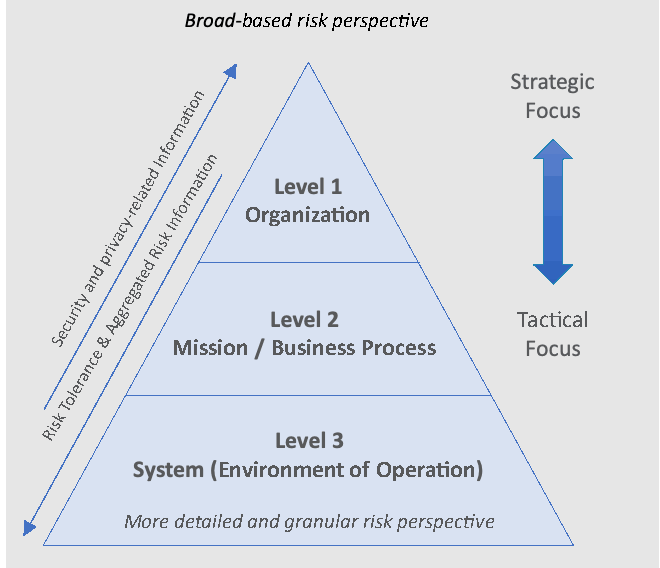
図14:組織、ミッション・業務プロセス、システムの各リスク管理レベルと、戦略的・戦術的な焦点、および詳細化するリスクの視点を示す。
Strategic Focus
原文のみ
Level 1 Organization
原文のみ
Tactical
原文のみ
Level 2
原文のみ
Focus
原文のみ
Mission / Business Process
原文のみ
Level 3 System (Environment of Operation)
原文のみ
More detailed and granular risk perspective
原文のみ
Fig. 14. Risk management levels: Organization, mission and business process, and system
図14. リスク管理レベル:組織、ミッション・業務プロセス、システム
Together, each of the risk management components (i.e., frame, assess, respond, and monitor) are applied across the risk management levels, resulting in organization-wide risk awareness and the traceability and transparency of risk-based decisions.
各リスク管理要素(すなわち、枠組み設定、評価、対応、監視)を各リスク管理レベルに適用することで、組織全体のリスク認識が高まり、リスクに基づく判断の追跡可能性と透明性が確保されます。
4.1.1. Framing OT Risk
4.1.1. OTリスクの枠組み設定
The framing component consists of the processes for establishing the required assumptions, constraints, risk tolerances, and risk management strategies for organizations to make consistent risk management decisions. Specifically, risk framing supports the overall risk management strategy by incorporating elements from the organizational governance structure, legal/regulatory environment, and other factors to establish how the organization intends to assess, respond to, and monitor risk to all IT and OT systems.
枠組み設定要素には、組織が一貫したリスク管理判断を行うために必要な前提、制約、リスク許容度、リスク管理戦略を確立するプロセスが含まれます。具体的には、組織のガバナンス構造、法的・規制環境、その他の要因を取り入れ、すべてのIT・OTシステムのリスクをどのように評価、対応、監視するかを定め、組織全体のリスク管理戦略を支援します。
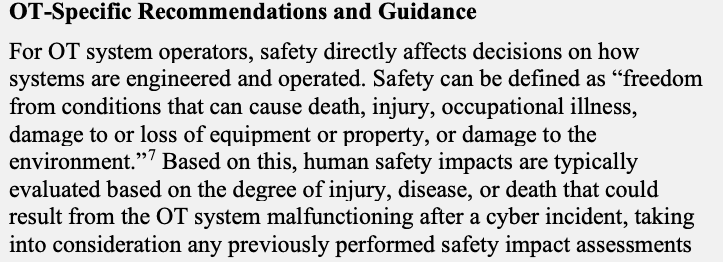
OT固有の推奨事項およびガイダンス
For OT system operators, safety directly affects decisions on how systems are engineered and operated. Safety can be defined as “freedom from conditions that can cause death, injury, occupational illness, damage to or loss of equipment or property, or damage to the environment.”7 Based on this, human safety impacts are typically evaluated based on the degree of injury, disease, or death that could result from the OT system malfunctioning after a cyber incident, taking into consideration any previously performed safety impact assessments regarding the employees and the public. The importance of safety and developing a safety culture plays a critical role in determining risk tolerance.
OTシステムの運用者にとって、安全は、システムの設計と運用の判断に直接影響します。安全とは、「死亡、傷害、職業性疾病、機器や財産の損傷・損失、または環境への損害を引き起こしうる状態がないこと」と定義できます。7これに基づき、人間の安全への影響は通常、サイバーインシデントの後にOTシステムが誤作動した場合に生じうる傷害、疾病、死亡の程度によって評価され、従業員および一般市民に関して過去に実施された安全影響評価も考慮に入れます。安全の重要性と安全文化の醸成は、リスク許容度の決定において重要な役割を果たします。
Organizations should consider incorporating an analysis of cybersecurity effects on OT systems that impact personnel safety and the environment, as well as mitigating controls. More specifically, organizations may want to consider employing a comprehensive process to systematically predict or identify the operational behavior of each safety-critical failure condition, fault condition, or human error that could lead to a hazard or potential human harm.
組織は、要員の安全と環境に影響するOTシステムへのサイバーセキュリティの影響の分析と、緩和管理策を組み込むことを検討すべきです。より具体的には、危険や人的被害につながりうる、安全上重要な各故障状態、異常状態、人為的ミスの運用上の挙動を体系的に予測または特定するための包括的なプロセスの採用を検討してもよいです。
Organizations may also want to consider the impact of legacy systems and components on their environment. Specifically, legacy systems may be unable to adequately support cybersecurity to prevent risks from exceeding organizational tolerance levels.
組織は、レガシーシステムやコンポーネントが環境に及ぼす影響も検討してもよいです。特に、レガシーシステムは、リスクが組織の許容水準を超えないようにするためのサイバーセキュリティを十分にサポートできない場合があります。
Another major concern for OT system operators is the availability of services provided by the OT system. The OT system may be part of critical infrastructure (e.g., water or power systems), where there is a significant need for continuous and reliable operations. As a result, OT systems may have strict requirements for availability or recovery. Organizations should understand and plan for the levels of redundancy required to achieve the desired resilience for their operating environments and incorporate these requirements into their risk framing. This will help organizations make risk decisions that avoid unintended consequences on those who depend on the services provided. More specifically, organizations should consider identifying interdependent OT systems that pose cybersecurity risks that threaten system availability.
OTシステム運用者にとってのもう一つの大きな懸念は、OTシステムが提供するサービスの可用性です。OTシステムは、継続的で信頼性の高い運用が強く求められる重要インフラ(例:水道や電力のシステム)の一部である場合があります。そのため、OTシステムには、可用性や復旧に関する厳格な要件が課される場合があります。組織は、運用環境で望ましいレジリエンスを実現するために必要な冗長性のレベルを理解して計画し、これらの要件をリスクの枠組み設定に組み込むべきです。これにより、組織は、提供されるサービスに依存する人々に意図しない影響を与えないリスク判断を行いやすくなります。より具体的には、組織は、システムの可用性を脅かすサイバーセキュリティリスクをもたらす、相互依存するOTシステムの特定を検討すべきです。
Additionally, organizations should consider how an incident could propagate to a connected system and system components. An OT may be interconnected with other systems, such that failures in one system or process can easily cascade to other systems either within or outside of the organization. Impact propagation could occur due to both physical and logical dependencies. Properly communicating the results of risk assessments to the operators of connected or interdependent systems and processes is one way to manage such impacts.
さらに、組織は、インシデントが接続先のシステムおよびシステムコンポーネントにどのように波及しうるかを検討すべきです。OTは他のシステムと相互接続されている場合があり、あるシステムやプロセスの障害が、組織内外の他のシステムに容易に連鎖することがあります。影響の波及は、物理的依存関係と論理的依存関係の両方によって生じうます。リスクアセスメントの結果を、接続先または相互依存するシステムやプロセスの運用者に適切に伝えることは、こうした影響を管理する一つの方法です。
Logical damage to an interconnected OT could occur if the cyber incident propagates to connected OT systems. For example, a virus or worm may propagate to a connected OT and impact that system. Physical damage could also propagate to other interconnected OT or related physical domains. For example, the impact could result in a physical hazard that degrades nearby physical environments or common shared dependencies (e.g., power supply) or result in a shortage of material that will be needed for a later stage in an industrial process.
サイバーインシデントが接続されたOTシステムに波及した場合、相互接続されたOTに論理的な損害が生じうます。例えば、ウイルスやワームが接続先のOTに伝播し、そのシステムに影響を及ぼす場合があります。物理的な損害も、相互接続された他のOTや関連する物理領域に波及する可能性があります。例えば、その影響が、近隣の物理環境や共有される共通の依存先(例:電源)を劣化させる物理的危険をもたらしたり、産業プロセスの後の段階で必要となる材料の不足を招いたりする場合があります。
CISA promotes a cohesive effort between government and industry to improve their ability to anticipate, prioritize, and manage national-level OT risk. CISA assists OT system vendors and asset owners, operators, and other vendors across all critical infrastructure sectors to identify security vulnerabilities and develop sound, proactive mitigation strategies that strengthen their OT systems’ cybersecurity posture.
CISAは、政府と産業界が連携して、国家レベルのOTリスクを予測、優先順位付け、管理する能力を高める取り組みを推進しています。CISAはすべての重要インフラ分野にわたり、OTシステムベンダー、資産所有者、運用者、その他のベンダーが、セキュリティ脆弱性を特定し、OTシステムのサイバーセキュリティ態勢を強化する適切かつ先見的な緩和戦略を策定できるよう支援しています。
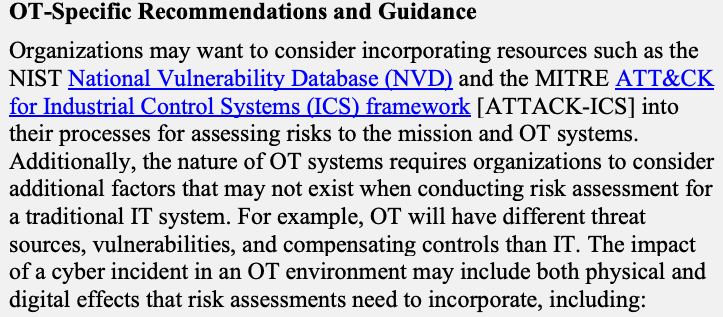
OT固有の推奨事項およびガイダンス
Organizations may want to consider incorporating resources such as the NIST National Vulnerability Database (NVD) and the MITRE ATT&CK for Industrial Control Systems (ICS) framework [ATTACK-ICS] into their processes for assessing risks to the mission and OT systems. Additionally, the nature of OT systems requires organizations to consider additional factors that may not exist when conducting risk assessment for a traditional IT system. For example, OT will have different threat sources, vulnerabilities, and compensating controls than IT. The impact of a cyber incident in an OT environment may include both physical and digital effects that risk assessments need to incorporate, including:
組織は、ミッションとOTシステムに対するリスクを評価するプロセスに、NISTの国家脆弱性データベース(NVD)や、MITRE ATT&CK for Industrial Control Systems(ICS)フレームワーク [ATTACK-ICS] などのリソースを組み込むことを検討してもよいです。さらに、OTシステムの性質上、組織は、従来のITシステムのリスクアセスメントを行う場合には存在しない追加の要因を考慮する必要があります。例えば、OTには、ITとは異なる脅威源、脆弱性、代替管理策があります。OT環境でのサイバーインシデントの影響には、物理的な影響とデジタルの影響の両方が含まれる場合があり、リスクアセスメントではこれらを取り入れる必要があります。その例を次に示します。
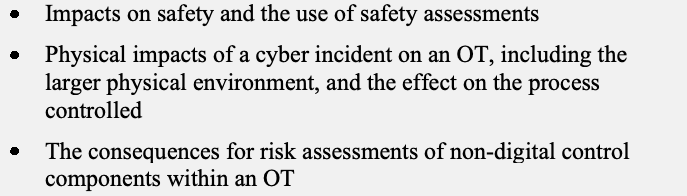
•安全への影響と安全評価の活用
•Physical impacts of a cyber incident on an OT, including the larger physical environment, and the effect on the process controlled
•OTに対するサイバーインシデントの物理的影響(より広い物理環境を含む)と、制御されるプロセスへの影響
•The consequences for risk assessments of non-digital control components within an OT
•OT内の非デジタル制御コンポーネントがリスクアセスメントに及ぼす影響
During risk framing, organizations should select appropriate risk assessment methodologies that include OT. When evaluating the potential physical damage from a cyber incident, organizations with OT systems may consider i) how a cyber incident could manipulate the operation to impact the physical environment, ii) what design features exist in the OT system to prevent or mitigate an impact, and iii) how a physical incident could emerge based on these conditions.
リスクの枠組みを設定する際、組織はOTを含む適切なリスク評価手法を選択するべきです。サイバーインシデントによる潜在的な物理損害を評価する際、OTシステムを持つ組織は、i) サイバーインシデントがどのように運用を操作し、物理環境に影響し得るか、ii) 影響を防止または緩和する設計機能がOTシステムにあるか、iii) その条件のもとで物理インシデントがどのように発生し得るか、を検討できます。
OT固有の推奨事項およびガイダンス
When framing risks within an OT environment, organizations may discover that cybersecurity threats are not always as well understood or predictable as OT hazards. Organizations may consider incorporating cyber attack and IT failure scenarios into their process hazard analysis (PHA) or failure mode and effects analysis (FMEA) processes. By including risks due to cyber attacks and cyber risk management measures in these processes, organizations may gain a better understanding of the cyber risks to the OT operational environment.
OT環境内でリスクを枠組み化する際、組織は、サイバーセキュリティの脅威がOTの危険源ほどよく理解されておらず、予測もしにくい場合があることに気づく場合があります。組織は、プロセスハザード分析(PHA)や故障モード影響解析(FMEA)のプロセスに、サイバー攻撃やIT障害のシナリオを組み込むことを検討してもよいです。これらのプロセスにサイバー攻撃によるリスクとサイバーリスク管理策を含めることで、組織は、OTの運用環境に対するサイバーリスクをより良く理解できる場合があります。
As part of risk framing, organizations may also need to consider:
リスクの枠組み設定の一環として、組織は次の事項も考慮する必要がある場合があります。
•Assumptions about how risk is assessed, responded to, and monitored across the organization
原本PDFの抜粋画像

•組織全体でリスクがどのように評価され、対応され、監視されるかについての前提
•The risk tolerance for the organization, the level of risk that can be accepted as part of achieving strategic goals and objectives, and the priorities and trade-offs considered as part of managing risk
•組織のリスク許容度、すなわち戦略的な目標や目的の達成の一環として受け入れられるリスクのレベルと、リスク管理の一環として考慮される優先順位およびトレードオフ
In the context of OT, the potential for damage to equipment, human safety, the natural environment, and other critical infrastructures is part of these considerations. Organizations may need to consider evaluating the potential physical impacts for all parts of an OT system. Organizations may also need to determine how OT systems interact or depend on IT to support risk framing. These processes may require organizations to identify a common framework for evaluating impacts that incorporate OT considerations. One approach is based on NIST FIPS 199 [FIPS199], which specifies that systems are categorized as low impact, moderate impact, or high impact for the security objectives of confidentiality, integrity, and availability. Another approach that is based on ISA 62443-3-2 [ISA62443] provides example definitions for determining a system categorization utilizing OT impacts.
原本PDFの抜粋画像
OTの文脈では、機器、人の安全、自然環境、その他の重要インフラへの損害可能性も考慮事項となります。組織は、OTシステムのすべての部分について物理的影響の可能性を評価することを検討する必要がある場合があります。また、リスクの枠組み設定を支援するため、OTシステムがITとどのように連携または依存するかを特定する必要がある場合もあります。これらのプロセスでは、OTの考慮事項を含む影響評価の共通フレームワークを特定する必要が生じる場合があります。ひとつの方法はNIST FIPS 199 [FIPS199] に基づくもので、機密性、完全性、可用性というセキュリティ目的について、システムを低影響、中影響、高影響に分類することを規定しています。別の方法はISA 62443-3-2 [ISA62443] に基づくもので、OTへの影響を用いてシステムを分類するための定義例を示しています。
Table 3 provides possible example categories and impact levels that organizations may customize to meet their specific industry or business requirements. For example, some organizations may see an outage lasting up to one day as a having a high impact instead of moderate, as shown in the table.
表3は、組織が業界または業務要件に合わせて調整できるカテゴリと影響度の例を示します。例えば、表では中程度とされる最長1日の停止を、高影響と評価する組織もあります。
Table 3. Possible definitions for OT impact levels based on the product produced, the industry, and security concerns
表3. 生産物、業界およびセキュリティ上の懸念に基づくOT影響レベルの定義例
| Category | High Impact | Moderate Impact | Low Impact |
|---|---|---|---|
| Outage at multiple Sites | Significant disruption to operations at multiple sites with restoration expected to require one or more days | Operational disruptions at multiple sites with restoration expected to require more than one hour | Partially disrupted operations at multiple sites with restoration to full capability requiring less than one hour |
| National infrastructure and services | Impacts multiple sectors or disrupts community services in a major way | Potential to impact sector at a level beyond the company | Little to no impact to sectors beyond the individual company and little to no impact on community |
| Cost (% of revenue) | > 25 % | > 5 % | < 5 % |
| Legal | Felony criminal offense or compliance violation that affects the license to operate | Misdemeanor criminal offense or compliance violation that results in fines | None |
| Public confidence | Loss of brand image | Loss of customer confidence | None |
| People on-site | Fatality | Loss of workday or major injury | First aid or recordable injury |
| People off-site | Fatality or major community incident | Complaints or local community impact | No complaints |
| Environment | Citation by regional agency or long-term significant damage over large area | Citation by local agency | Small, contained release below reportable limits |
| 区分 | 高影響 | 中程度の影響 | 低影響 |
|---|---|---|---|
| 複数の拠点での停止 | 複数の拠点で運用に重大な中断が生じ、復旧に1日以上を要すると見込まれる | 複数の拠点で運用が中断し、復旧に1時間を超える時間を要すると見込まれる | 複数の拠点で運用が部分的に中断し、完全な能力への復旧に1時間未満を要する |
| 国家インフラおよびサービス | 複数のセクターに影響する、または地域社会のサービスに重大な混乱をもたらす | 企業を超えてセクターに影響を及ぼす可能性 | 個々の企業を超えるセクターへの影響はほとんど、またはまったくなく、地域社会への影響もほとんど、またはまったくない |
| コスト(収益に対する割合) | > 25 % | > 5 % | < 5 % |
| 法務 | 操業許可に影響する重罪またはコンプライアンス違反 | 罰金を科される軽罪またはコンプライアンス違反 | なし |
| 公衆の信頼 | ブランドイメージの喪失 | 顧客の信頼の喪失 | なし |
| 人員(現場内) | 死亡 | 労働日数の損失または重大な負傷 | 応急手当または記録対象となる負傷 |
| 人員(現場外) | 死亡または地域社会に及ぶ重大インシデント | 苦情または地域社会への影響 | 苦情なし |
| 環境 | 地域機関による指摘、または広範囲に及ぶ長期的かつ重大な被害 | 地方機関による指摘 | 報告対象となる限度を下回る、封じ込められた少量の放出 |
To support the risk assessment process, organizations should also define how the likelihood of occurrence for cybersecurity events will be determined to maintain consistency when assessing risks. NIST SP 800-30, Rev. 1 [SP800-30r1] provides guidance for organizations to develop likelihood weighted risk factors. Organizations should consider weighting risk factors based on an analysis of the probability that a given threat is capable of exploiting a given vulnerability (or set of vulnerabilities), that the threat event will be initiated, and that the threat event will result in adverse impacts. For adversarial threats, an assessment of likelihood of occurrence is typically based on adversary intent, capability, and targeting. For other-than-adversarial threat events, the likelihood of occurrence is estimated using historical evidence, empirical data, and other factors. If organizations find that there is minimal organizational historical data, they may want to consider extending their analysis to consider industry-specific data describes cybersecurity events reported for similar organizations. The likelihood of threat occurrence can also be based on the state of the organization (e.g., its core mission and business processes, enterprise architecture, information security architecture, information systems, and the environments in which those systems operate) and consider predisposing conditions and the presence and effectiveness of deployed security controls to protect against unauthorized or undesirable behavior, detect and limit damage, and/or other resiliency factors for the OT capabilities.
リスク評価プロセスを支援するため、組織は、リスク評価時の一貫性を保てるよう、サイバーセキュリティ事象の発生可能性をどのように決定するかも定義すべきです。NIST SP 800-30 Rev. 1 [SP800-30r1] は、組織が発生可能性で重み付けしたリスク要因を策定するためのガイダンスを示しています。組織は、特定の脅威が特定の脆弱性(又は脆弱性の集合)を悪用できる確率、脅威事象が開始される確率、及び脅威事象が悪影響をもたらす確率の分析に基づいて、リスク要因に重み付けすることを検討すべきです。敵対的脅威については、発生可能性の評価は通常、攻撃者の意図、能力、及び標的選定に基づきます。敵対的でない脅威事象については、発生可能性は過去の証拠、実証データ、及びその他の要因を用いて推定されます。組織内の過去のデータがわずかしかない場合、組織は、類似組織で報告されたサイバーセキュリティ事象を記述した業界固有のデータも考慮するよう分析を拡張することを検討するとよいです。脅威の発生可能性は、組織の状態(例えば、中核的なミッション及び業務プロセス、エンタープライズアーキテクチャ、情報セキュリティアーキテクチャ、情報システム、及びそれらのシステムが運用される環境)に基づくこともでき、その際には、素因となる条件、不正な又は望ましくない振る舞いから防護し、損害を検知・限定するために展開したセキュリティ管理策の存在と有効性、及び/又はOT能力に関するその他のレジリエンス要因を考慮することもできます。
OT固有の推奨事項およびガイダンス
Organizations that establish definitions for event likelihood may want to review Appendix G of NIST SP 800-30, Rev. 1 for more detailed guidance and suggestions. Based on this guidance, organizations should consider defining five levels of likelihood from Very Low to Very High based on both adversarial (i.e., intentional threat actors) and non-adversarial (e.g., errors, accidents, acts of nature, etc.) events. Additionally, organizations may want to establish definitions for the likelihood that an event may result in an adverse impact. Using these two factors, organizations can establish a heat map like the one depicted in Table 4 to determine the likelihood factor for supporting the risk analysis.
事象の可能性の定義を確立する組織は、より詳細なガイダンスと提案について、NIST SP 800-30 Rev. 1の付録Gを確認することを検討してもよいです。このガイダンスに基づき、組織は、敵対的な(すなわち意図的な脅威アクターによる)事象と非敵対的な(例:誤り、事故、自然現象など)事象の両方について、「非常に低い」から「非常に高い」までの5段階の可能性を定義することを検討すべきです。さらに、組織は、事象が悪影響をもたらす可能性の定義を確立してもよいです。これら2つの要因を用いて、組織は、リスク分析を支える可能性係数を決定するため、表4に示すようなヒートマップを作成できます。
Table 4. Event Likelihood Evaluation
表4. 事象発生可能性の評価
| Likelihood of Threat Event Initiation or Occurrence | Likelihood That Threat Events Result in Adverse Impacts | ||||
|---|---|---|---|---|---|
| Very Low | Low | Moderate | High | Very High | |
| Very High | Low | Moderate | High | Very High | Very High |
| High | Low | Moderate | Moderate | High | Very High |
| Moderate | Low | Low | Moderate | Moderate | High |
| Low | Very Low | Low | Low | Moderate | Moderate |
| Very Low | Very Low | Very Low | Low | Low | Low |
| 脅威事象の開始または発生の可能性 | 脅威事象が悪影響をもたらす可能性 | ||||
|---|---|---|---|---|---|
| 非常に低い | 低 | 中程度 | 高 | 非常に高い | |
| 非常に高い | 低 | 中程度 | 高 | 非常に高い | 非常に高い |
| 高 | 低 | 中程度 | 中程度 | 高 | 非常に高い |
| 中程度 | 低 | 低 | 中程度 | 中程度 | 高 |
| 低 | 非常に低い | 低 | 低 | 中程度 | 中程度 |
| 非常に低い | 非常に低い | 非常に低い | 低 | 低 | 低 |
4.1.2. Assessing Risk in an OT Environment
4.1.2. OT環境におけるリスク評価
Risk assessments leverage the outputs of framing risk (e.g., acceptable risk assessment methodologies, risk management strategy, and risk tolerance) and facilitate efforts to identify, estimate, and prioritize risks to operations, assets, individuals, and other organizations. Risk assessments occur at all risk management levels (i.e., organization, mission and business function, and system) and can be used to inform risk assessments at other levels. Regardless of which risk management level the risk assessment is conducted at, assessing risk requires identifying threats and vulnerabilities, the harm that such threats and vulnerabilities may cause, and the likelihood that adverse events may arise from those threats and vulnerabilities.
リスクアセスメントは、リスクのフレーミングの成果(例:許容されるリスクアセスメント手法、リスク管理戦略、リスク許容度)を活用し、業務、資産、個人、他の組織に対するリスクを特定、推定、優先順位付けする取組みを促進します。リスクアセスメントはすべてのリスク管理レベル(すなわち組織、ミッション・業務機能、システム)で行われ、他のレベルでのリスクアセスメントに情報を提供するために用いることができます。どのリスク管理レベルでリスクアセスメントを実施するかにかかわらず、リスクを評価するには、脅威と脆弱性、その脅威と脆弱性が引き起こしうる損害、およびその脅威と脆弱性から有害事象が生じる可能性を特定する必要があります。
When the organization conducts a risk assessment that includes OT systems, there may be additional considerations that do not exist when assessing the risks of traditional IT systems. For example, the impact of a cyber incident on an OT may include both physical and digital effects.
組織がOTシステムを含むリスクアセスメントを実施する場合、従来のITシステムのリスクを評価する際には存在しない追加の考慮事項がありうます。たとえば、OTにおけるサイバーインシデントの影響には、物理的な影響とデジタルな影響の両方が含まれることがあります。
OT固有の推奨事項およびガイダンス
Risk assessments are typically point-in-time reports. As a result, organizations should ensure that they are updated to remain current and that the security level remains adequate.
リスクアセスメントは通常、ある時点の報告書です。したがって、組織は、最新の状態を保つために更新され、セキュリティレベルが適切であり続けることを確実にすべきです。
Organizations may want to review the information provided by CISA’s Alerts and Advisories, NIST’s NVD, and MITRE ATT&CK for ICS to identify common vulnerability areas for OT environments, such as:
組織は、OT環境に共通する脆弱性領域を特定するため、CISAのアラートおよび勧告、NISTのNVD、MITRE ATT&CK for ICSが提供する情報を確認してもよいです。その例を次に示します。
•不適切なコーディング手法、ネットワーク設計、またはデバイス構成
•Vulnerable network services and protocols
•脆弱なネットワークサービスとプロトコル
•Weak authentication
•脆弱な認証
•Excessive privileges
•過剰な権限
•Information disclosure
•情報漏えい
OT systems often have specific environmental requirements (e.g., a manufacturing process may require a precise temperature), or they may be tied to their physical environment for operations. Organizations may want to consider incorporating these requirements and constraints into the framing component so that associated risks are identified. Additionally, organizations may want to consider:
原本PDFの抜粋画像
OTシステムには固有の環境要件(例えば、製造工程で正確な温度が必要)があることが多く、運用上、物理環境に結び付いている場合もあります。組織は、関連リスクを特定できるよう、これらの要件・制約をリスクの枠組み設定要素に取り入れることを検討するとよいです。さらに、次の事項を検討できます。
•Identifying the physical assets and security controls that directly relate to safety, human life, and maintaining continuity of operations of the OT system
原本PDFの抜粋画像
•安全、人命、OTシステムの運用継続性の維持に直接関係する物理資産とセキュリティ管理策を特定する
•Identifying the cybersecurity risks associated with physical assets that could threaten OT system functionality
•OTシステムの機能を脅かしうる物理資産に関連するサイバーセキュリティリスクを特定する
•Ensuring that physical security personnel understand the relative risks and physical security countermeasures associated with the OT system environments that they protect
•物理セキュリティ要員が、自らが保護するOTシステム環境に関連する相対的なリスクと物理セキュリティ対策を理解していることを確認する
•Ensuring that physical security personnel are aware of areas in an OT system production environment that house data acquisition and operate in sensitive spaces
原本PDFの抜粋画像
•物理セキュリティ要員が、OTシステムの本番環境のうち、データ収集を行う区域や機微な空間で運用される区域を認識していることを確認する
•Mitigating business continuity risks by specifying immediate response plans if physical safety is jeopardized
•物理的な安全が脅かされた場合の即時対応計画を定めることで、事業継続リスクを緩和する
Risk assessments also require reviewing the digital and non-digital mechanisms that are implemented to minimize adverse event impacts. OT systems often incorporate non-digital mechanisms to provide fault tolerance and prevent the OT from acting outside of acceptable parameters. These non-digital mechanisms may help reduce the negative impacts that a digital incident on the OT might have and should be incorporated into the risk assessment process. For example, OT often have non-digital control mechanisms that can prevent it from operating outside of a safe boundary and thereby limit the impact of an attack (e.g., a mechanical relief pressure valve). Analog mechanisms (e.g., meters, alarms) can also be used to observe the physical system state and provide operators with reliable data if digital readings are unavailable or corrupted. Table 5 categorizes non-digital control mechanisms that could reduce the impact of an OT incident.
リスク評価では、悪影響を最小限に抑えるため実装されているデジタル・非デジタルの仕組みも確認する必要があります。OTシステムでは、フォールトトレランスを確保し、OTが許容パラメーターを逸脱して動作することを防ぐため、非デジタルの仕組みを組み込むことが多くあります。これらの仕組みは、OTに対するデジタルインシデントの悪影響を軽減する可能性があり、リスク評価に含めるべきです。例えば、OTには安全境界を逸脱した動作を防ぎ、攻撃の影響を制限できる非デジタル制御機構(例えば、機械式圧力逃し弁)が備わることが多くあります。アナログ機構(例えば、計器、警報)も物理システムの状態を観測し、デジタル表示が利用できないか破損した場合に信頼できるデータを運用者に提供できます。表5は、OTインシデントの影響を軽減し得る非デジタル制御機構を分類します。
Table 5. Categories of non-digital OT control components
表5. 非デジタルOT制御コンポーネントの分類
| Control Type | Description |
|---|---|
| Analog displays or alarms | Non-digital mechanisms measure and display the state of the physical system (e.g., temperature, pressure, voltage, current) and can provide the operator with accurate information when digital displays are unavailable or corrupted. The information may be provided to the operator on some non-digital display (e.g., thermometers, pressure gauges) and through audible alarms. |
| Manual control mechanisms | Manual control mechanisms (e.g., manual valve controls, physical breaker switches) allow operators to manually control an actuator without relying on the digital OT system. This ensures that an actuator can be controlled even if the OT system is unavailable or compromised. |
| Analog control systems | Analog control systems use non-digital sensors and actuators to monitor and control a physical process. These may prevent the physical process from entering an undesired state when the digital OT system is unavailable or corrupted. Analog controls include devices such as regulators, governors, and electromechanical relays. An example is a device that is designed to open during emergency or abnormal conditions to prevent the rise of internal fluid pressure in excess of a specified value, thus bringing the process to a safer state. The device may also be designed to prevent an excessive internal vacuum, such as a pressure relief valve, a non-reclosing pressure relief device (e.g., rupture disc), or a vacuum relief valve. |
| 管理策タイプ | 説明 |
|---|---|
| アナログ表示またはアラーム | デジタルではない仕組みが、物理システムの状態(例:温度、圧力、電圧、電流)を計測して表示し、デジタル表示が利用できない場合や破損した場合でも、オペレーターに正確な情報を提供できます。この情報は、デジタルではない表示(例:温度計、圧力計)や可聴アラームによってオペレーターに提供される場合があります。 |
| 手動制御メカニズム | 手動制御メカニズム(例:手動バルブ制御、物理的なブレーカースイッチ)により、オペレーターはデジタルOTシステムに頼らずにアクチュエーターを手動で制御できます。これにより、OTシステムが利用できない場合や危殆化している場合でも、アクチュエーターを制御できます。 |
| アナログ制御システム | アナログ制御システムは、デジタルではないセンサーとアクチュエーターを使って物理プロセスを監視・制御します。これにより、デジタルOTシステムが利用できない場合や破損した場合でも、物理プロセスが望ましくない状態に入るのを防げる場合があります。アナログ制御には、レギュレーター、ガバナー、電気機械式リレーなどのデバイスが含まれます。一例として、緊急時または異常時に開くよう設計され、内部の流体圧力が規定値を超えて上昇するのを防ぎ、プロセスをより安全な状態にするデバイスがあります。このデバイスは、過度の内部真空を防ぐように設計されることもあり、圧力逃がし弁、再閉鎖しない圧力逃がし装置(例:破裂板)、真空逃がし弁などがこれに当たります。 |
OT固有の推奨事項およびガイダンス
Organizations should analyze all digital and non-digital control mechanisms and the extent to which they can mitigate potential negative impacts to the OT. For example, non-digital control mechanisms may require additional time and human involvement, such as operators travelling to a remote site to perform certain control functions. Such mechanisms may also depend on human response times, which may be slower than automated controls.
組織は、すべてのデジタルおよび非デジタルの制御メカニズムと、それらがOTへの潜在的な悪影響をどの程度緩和できるかを分析すべきです。例えば、非デジタルの制御メカニズムには、オペレーターが遠隔地へ移動して特定の制御機能を実行するなど、追加の時間と人の関与が必要になる場合があります。また、そうしたメカニズムは、自動制御よりも遅い可能性がある人間の応答時間にも依存する場合があります。
Additionally, organizations may need to consider privacy with their risk assessment, which sometimes require a different approach. The NIST Privacy Risk Assessment Methodology (PRAM) is a tool that applies the risk model from NIST IR 8062 [IR8062] and helps organizations analyze, assess, and prioritize privacy risks to determine how to respond and select appropriate solutions.
さらに、プライバシーは異なるアプローチを要する場合があるため、組織はリスク評価で考慮する必要があります。NIST Privacy Risk Assessment Methodology(PRAM)は、NIST IR 8062 [IR8062] のリスクモデルを適用し、組織がプライバシーリスクを分析、評価、優先順位付けし、対応方法と適切な解決策を選べるよう支援するツールです。
4.1.3. Responding to Risk in an OT Environment
4.1.3. OT環境におけるリスク対応
The risk response component provides an organization-wide response to risk in accordance with the risk framing component by identifying possible courses of actions to address risk, evaluating those possibilities while considering the organization’s risk tolerance and other issues identified during framing, and choosing the best alternative for the organization. The response component includes the implementation of the chosen course of action to address the identified risk: acceptance, avoidance, mitigation, sharing, transfer, or any combination of these options.8
リスク対応要素では、リスクの枠組み設定要素に沿った組織全体の対応を行います。リスクに対処する行動方針を特定し、組織のリスク許容度や枠組み設定時に特定したその他の事項を考慮して選択肢を評価し、最適な代替案を選びます。対応要素には、特定したリスクに対処するため選択した行動方針(受容、回避、緩和、共有、移転、またはこれらの組み合わせ)の実装が含まれます。8
OT固有の推奨事項およびガイダンス
For an OT system, available risk responses may be constrained by system requirements, potential adverse impacts on operations, or even regulatory compliance regimes. An example of risk sharing is when utilities enter into agreements to “loan” line workers in an emergency, which reduces the duration of an incident’s effect to acceptable levels.
OTシステムでは、利用可能なリスク対応が、システム要件、運用への潜在的な悪影響、さらには規制遵守の枠組みによって制約される場合があります。リスク共有の例として、電力会社が緊急時に送電線作業員を「貸し出す」協定を結び、インシデントの影響の継続時間を許容できる水準まで短縮する場合があります。
4.1.4. Monitoring Risk in an OT Environment
4.1.4. OT環境におけるリスク監視
Monitoring risk is the fourth component of risk management activities. Organizations monitor risk on an ongoing basis, including the implementation of chosen risk management strategies, changes in the environment that may affect the risk calculation, and the effectiveness and efficiency of risk reduction activities. The activities in the monitoring component impact all of the other components.
リスク監視はリスク管理活動の第4要素です。組織は、選択したリスク管理戦略の実装、リスク計算に影響する環境変化、リスク低減活動の有効性と効率性などを継続的に監視します。監視要素の活動は他のすべての要素に影響します。
OT固有の推奨事項およびガイダンス
Many OT system monitoring capabilities leverage passive monitoring techniques to detect system changes. However, this may not always capture all modifications to the system. Modern monitoring platforms that leverage native protocol communications to access more system information may improve awareness, but the limitations of these OT systems must be understood. Often OT systems are implemented with an undefined frequency for monitoring cyber activities. Users should set a frequency in accordance with the respective risk profile.
多くのOTシステム監視機能は、パッシブ監視技術を利用してシステムの変更を検知します。ただし、これではシステムへのすべての変更を捕捉できるとは限りません。ネイティブのプロトコル通信を利用してより多くのシステム情報にアクセスする最新の監視プラットフォームは、状況認識を向上させる可能性がありますが、これらのOTシステムの限界を理解する必要があります。OTシステムは、サイバー活動を監視する頻度が定義されないまま実装されることが多くあります。ユーザーは、それぞれのリスクプロファイルに応じて頻度を設定すべきです。
Threat information as it relates to the OT environment is evolving, and the availability and accuracy of this threat information is early in its development. By their nature, threats may be difficult to accurately predict, even with historical data. Organizations should categorize threats based on the likelihood of occurrence and their potential consequences. For example, the threat of an internet-connected system being scanned would have a high likelihood and a low severity consequence, but the threat of a nation-state actor disrupting a supply chain may have low likelihood and high severity consequences.
OT環境に関する脅威情報は発展途上であり、この脅威情報の入手可能性と正確性は開発の初期段階にあります。脅威は、その性質上、過去のデータがあっても正確に予測することが難しい場合があります。組織は、発生の可能性と潜在的な影響に基づいて脅威を分類すべきです。例えば、インターネットに接続されたシステムがスキャンされるという脅威は発生の可能性が高く影響の深刻度は低いですが、国家主体のアクターがサプライチェーンを混乱させるという脅威は、発生の可能性が低く影響の深刻度が高い場合があります。
Since security countermeasures are typically developed for IT environments, organizations should consider how deploying security technologies into OT environments may negatively impact operations or safety.
セキュリティ対策は通常、IT環境向けに開発されているため、組織は、OT環境にセキュリティ技術を展開すると運用や安全にどのような悪影響が及びうるかを検討すべきです。
4.2. Special Areas for Consideration
4.2. 特別な考慮事項
Supply chain risk management and risk management for safety are critical aspects of OT cybersecurity risk management.
サプライチェーンリスク管理と安全に関するリスク管理は、OTサイバーセキュリティリスク管理の重要な側面です。
4.2.1. Supply Chain Risk Management
4.2.1. サプライチェーンリスク管理
Cybersecurity risks can arise from the products or services acquired to support OT needs. These risks can be introduced anywhere in the supply chain and at any stage in the life cycle. Whether they are malicious, natural, or unintentional, these risks have the potential to compromise the availability and integrity of critical OT systems and components, as well as the availability, integrity, and confidentiality of the data utilized by the OT, thereby causing harms that range from minor disruptions to impacts on life and safety. With few exceptions, organizations that are responsible for OT rely upon suppliers, other third-party providers, and their extended supply chains for a range of needs. These supply-side organizations perform critical roles and functions, including manufacturing and provisioning technology products, providing software upgrades and patches, performing integration services, or otherwise supporting the day-to-day operations and maintenance of OT systems, components, and operational environments. For this reason, OT organizations should seek to understand and mitigate the supply chain-related risks that can be inherited from these supply-side organizations and the products and services that they provide. Identifying, assessing, and effectively responding to cybersecurity risks in supply chains is best accomplished by incorporating cybersecurity supply chain risk management (C-SCRM) considerations into organizational policies, plans, and practices. This includes extending cybersecurity expectations and requirements to vendors and gaining better understanding, visibility, and control over the supply chains that are associated with acquired products and services. Organizations should vet suppliers and service providers to ascertain their capabilities, trustworthiness, the adequacy of their internal security practices, the effectiveness of safeguards, their supply chain relationships, and any risks that may be associated with those relationships and dependencies. The requirements for and evaluation of products and discrete components should extend beyond an assessment of whether functional and technical requirements are satisfied and address applicable C-SCRM factors, such as a product’s provenance, pedigree, and composition and whether the product is taint-free and authentic. Additionally, special consideration should be given to how difficult it may be to attain original replacement parts or updates over the life of the product and how diverse the sources of supply are and may be in the future.
OTのニーズを支えるために取得する製品やサービスから、サイバーセキュリティリスクが生じる場合があります。こうしたリスクはサプライチェーンのあらゆる場所やライフサイクルのどの段階でも入り込む可能性があります。悪意によるもの、自然に起因するもの、意図しないものを問わず、重要なOTシステムやコンポーネントの可用性・完全性、およびOTが利用するデータの可用性・完全性・機密性を損なう可能性があります。その結果、軽微な中断から人命や安全に関わる影響まで、さまざまな被害が生じ得ます。ごく一部の例外を除き、OTに責任を持つ組織は、多様なニーズに対応するため、サプライヤー、その他のサードパーティープロバイダー、さらにその先のサプライチェーンに依存しています。これらの供給側組織は、技術製品の製造・提供、ソフトウェアのアップグレードやパッチの提供、統合サービスの実施、OTシステム・コンポーネント・運用環境の日常運用・保守支援など、重要な役割と機能を担います。このためOT組織は、供給側組織やその製品・サービスから引き継ぐサプライチェーン関連リスクを理解し、緩和する必要があります。サプライチェーンのサイバーセキュリティリスクを特定、評価し、効果的に対応するには、サイバーセキュリティ・サプライチェーンリスク管理(C-SCRM)の考慮事項を組織の方針、計画、慣行に組み込むのが最善です。これには、サイバーセキュリティ上の期待と要件をベンダーに拡張し、取得する製品・サービスに関連するサプライチェーンの理解、可視性、統制を高めることが含まれます。組織は、サプライヤーやサービスプロバイダーを審査し、その能力、信頼性、内部セキュリティ慣行の適切性、安全対策の有効性、サプライチェーン関係、それらの関係・依存に伴うリスクを確認する必要があります。製品や個別コンポーネントの要件・評価では、機能要件・技術要件の充足確認にとどまらず、来歴、系譜、構成、汚染されていない真正な製品かどうかなど、該当するC-SCRM要因にも対処する必要があります。さらに、製品の寿命を通じて純正交換部品や更新を入手する難しさ、現在および将来の供給元がどれほど多様かも特に考慮する必要があります。
OT organizations should familiarize themselves with NIST SP 800-161, Supply Chain Risk Management Practices for Federal Information Systems and Organizations [SP800-161], and begin or continue to implement the key practices, C-SCRM security controls, and C-SCRM risk management process activities described in that publication. There is extensive guidance about how to establish a C-SCRM program using a phased approach that begins with putting the foundational elements in place and expanding upon that foundation over time to ensure sustained effectiveness and the ability to enhance program capabilities. There is also guidance about conducting supply chain risk assessments, incorporating C-SCRM into procurement requirements, the importance of an integrated and inter-disciplinary risk management approach, supplemental C-SCRM security control guidance, and templates that organizations can leverage.
OT組織は、NIST SP 800-161, Supply Chain Risk Management Practices for Federal Information Systems and Organizations [SP800-161] をよく理解するべきであり、同書に記載された主要慣行、C-SCRMセキュリティ管理策、C-SCRMリスク管理プロセス活動の実装を開始または継続するべきです。C-SCRMプログラムの確立方法については、基礎要素を整備することから始め、継続的な有効性とプログラム能力の強化を確保するために、その基盤を時間をかけて拡張していく段階的アプローチによる広範なガイダンスがあります。また、サプライチェーンリスク評価の実施、調達要件へのC-SCRMの組み込み、統合的・学際的なリスク管理アプローチの重要性、補足的なC-SCRMセキュリティ管理策ガイダンスに関するガイダンスや、組織が活用できるテンプレートもあります。
4.2.2. Safety Systems
4.2.2. 安全システム
The culture of safety and safety assessments is well established within much of the OT user community. Information security risk assessments should complement such assessments, though they may use different approaches and cover different areas. Safety assessments are primarily concerned with the physical world, while information security risk assessments consider the digital world. However, in an OT environment, the physical and the digital are intertwined, and significant overlap may occur. Organizations should, therefore, consider all aspects of risk management for safety (e.g., risk framing, risk tolerances) and the safety assessment results when carrying out risk assessments for information security. The personnel responsible for the information security risk assessment must be able to identify and communicate identified risks that could have safety implications. Conversely, the personnel charged with safety assessments must be familiar with the potential physical impacts and their likelihood. Safety systems may reduce the impact of a cyber incident on the OT and are often deployed to perform specific monitoring and control functions to ensure the safety of people, the environment, processes, and assets. While these systems are traditionally implemented to be fully redundant and independent from the primary OT, some architectures combine control and safety functions, components, or networks. Combining control and safety could allow a sophisticated attacker access to both control and safety systems if the OT were compromised. Organizations should ensure the adequate separation of components consistent with the risk of compromise and evaluate the impact of the implemented security controls on the safety system to determine whether they negatively impact the system.
OT利用者コミュニティの多くでは、安全文化と安全評価が十分に確立されています。情報セキュリティリスク評価は、異なる方法を用い対象範囲が異なる場合があるものの、安全評価を補完する必要があります。安全評価は主に物理世界を扱い、情報セキュリティリスク評価はデジタル世界を扱います。しかしOT環境では物理とデジタルが絡み合い、大きく重複することがあります。そのため組織は、情報セキュリティリスク評価を実施する際、安全に関するリスク管理のあらゆる側面(例えば、リスクの枠組み設定、リスク許容度)と安全評価結果を考慮する必要があります。情報セキュリティリスク評価を担当する要員は、安全に影響し得る特定済みリスクを識別し、伝達できなければなりません。逆に、安全評価担当者は潜在的な物理的影響とその発生可能性を理解する必要があります。安全システムはOTへのサイバーインシデントの影響を軽減する場合があり、人、環境、プロセス、資産の安全を確保する特定の監視・制御機能を担うために導入されることが多くあります。従来、これらのシステムは主OTから完全に冗長かつ独立して実装されてきましたが、制御と安全の機能、コンポーネント、ネットワークを組み合わせるアーキテクチャもあります。制御と安全を統合すると、OTが侵害された際に高度な攻撃者が制御システムと安全システムの両方にアクセスできる可能性があります。組織は、侵害リスクに応じた適切なコンポーネント分離を確保し、実装したセキュリティ管理策が安全システムに与える影響を評価し、システムに悪影響がないか判断する必要があります。
4.3. Applying the Risk Management Framework to OT Systems
4.3. OTシステムへのリスク管理フレームワークの適用
The NIST Risk Management Framework (RMF) applies the risk management process and concepts (i.e., framing risk, assessing risk, responding to risk, and monitoring risk) to systems and organizations. The following subsections describe the process of applying the RMF to OT and include a brief description of each step and task, the intended outcome of each task, task mappings to other standards and guidelines applicable to OT (e.g., the Cybersecurity Framework and IEC 62443), and OT-specific implementation guidance. Some tasks are optional, and not all tasks include OT-specific considerations or guidance.
NISTリスク管理フレームワーク(RMF)は、リスク管理のプロセスと概念(すなわち、リスクの枠組み設定、評価、対応、監視)をシステムと組織に適用します。以下の小節ではRMFをOTに適用するプロセスを説明します。各ステップとタスクの簡潔な説明、各タスクの意図する成果、OTに適用可能な他の規格・ガイドライン(例えば、サイバーセキュリティ・フレームワークやIEC 62443)とのタスク対応、およびOT固有の実装ガイダンスを含みます。一部のタスクは任意であり、すべてのタスクにOT固有の考慮事項やガイダンスが含まれるわけではありません。
The RMF steps in Fig. 15, while shown sequentially, can be implemented in a different order to be consistent with established management and system development life cycle processes.
図15ではRMFの各ステップを順番に示していますが、既存の管理プロセスやシステム開発ライフサイクルプロセスに合わせ、別の順序で実装することもできます。
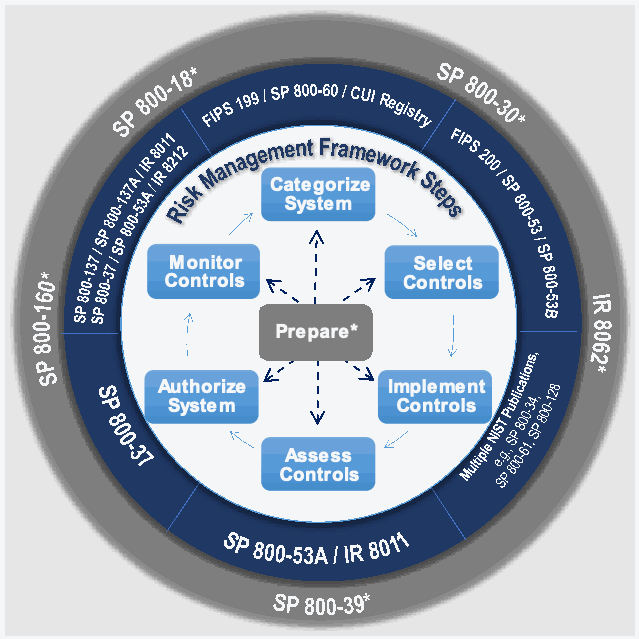
図15. リスク管理フレームワークのステップ。Risk Management Framework Steps と題した円形の図である。中央の準備(Prepare*)から破線の矢印が 6 つのステップに伸び、6 つのステップは矢印で循環する。分類(Categorize System)、管理策の選択(Select Controls)、管理策の実装(Implement Controls)、管理策の評価(Assess Controls)、認可(Authorize System)、管理策の監視(Monitor Controls)である。濃色の輪には各ステップに対応する文書が記されている。FIPS 199 / SP 800-60 / CUI Registry(分類)、FIPS 200 / SP 800-53 / SP 800-53B(選択)、Multiple NIST Publications, e.g., SP 800-34, SP 800-61, SP 800-128(実装)、SP 800-53A / IR 8011(評価)、SP 800-37(認可)、SP 800-137 / SP 800-137A / IR 8011、SP 800-37 / SP 800-53A / IR 8212(監視)。外側の灰色の輪には SP 800-18*、SP 800-30*、IR 8062*、SP 800-39*、SP 800-160* がある。
Fig. 15. Risk Management Framework steps
図15. リスク管理フレームワークのステップ
4.3.1. Prepare
4.3.1. 準備
The purpose of the Prepare step is to carry out essential activities at the organizational, mission and business process, and system levels to help the organization manage its security and privacy risks using the RMF. The Prepare step leverages activities that are already being conducted within cybersecurity programs to emphasize the importance of having organization-wide governance and resources in place to support risk management. Table 6 provides details on applying the Prepare step to OT.
準備ステップの目的は、RMFを用いて組織がセキュリティリスクとプライバシーリスクを管理できるよう、組織、ミッション・業務プロセス、システムの各レベルで必要な活動を実施することです。準備ステップでは、サイバーセキュリティ・プログラム内ですでに実施している活動を活用し、リスク管理を支援する組織全体のガバナンスとリソースを整備する重要性を強調します。表6に、準備ステップをOTに適用する詳細を示します。
Table 6. Applying the RMF Prepare step to OT
表6. RMFの準備ステップをOTに適用する
| Tasks | Outcomes | OT-Specific Guidance |
|---|---|---|
| Organizational and Mission and Business Process Levels | ||
| TASK P-1 RISK MANAGEMENT ROLES | Individuals are identified and assigned key roles for executing the RMF. [Cybersecurity Framework: ID.AM-6; ID.GV-2] [IEC 62443-2-1: ORG 1.3] | Establish and maintain personnel cybersecurity roles and responsibilities for both IT and OT systems. Include cybersecurity roles and responsibilities for third-party providers. Examples of OT |
| タスク | 成果 | OT固有のガイダンス |
|---|---|---|
| 組織、ミッションおよび業務プロセスのレベル | ||
| タスクP-1 リスク管理の役割 | RMFを実行する主要な役割に、個人が特定され割り当てられています。[サイバーセキュリティフレームワーク:ID | ITシステムとOTシステムの両方について、要員のサイバーセキュリティ上の役割と責任を確立し維持します。第三者プロバイダーのサイバーセキュリティ上の役割と責任も含めます。OT要員の例には |
| Tasks | Outcomes | OT-Specific Guidance |
|---|---|---|
| personnel include the Process/Plant Manager, Process Control Engineer, Operator, Functional Safety Engineer, Maintenance Personnel, and Process Safety Manager. | ||
| TASK P-2 RISK MANAGEMENT STRATEGY | A risk management strategy for the organization that includes a determination and expression of organizational risk tolerance is established. [Cybersecurity Framework: ID.RM; ID.SC] [IEC 62443-2-1: ORG 2.1] | The risk management strategy encompasses the whole organization. Consider the unique regulatory requirements as it relates to organizations with OT systems. |
| TASK P-3 RISK ASSESSMENT— ORGANIZATION | An organization-wide risk assessment is completed, or an existing risk assessment is updated. [Cybersecurity Framework: ID.RA; ID.SC-2] [IEC 62443-2-1: Event1.9; ORG 1.3; 2.1] | |
| TASK P-4 ORGANIZATIONALLY TAILORED CONTROL BASELINES AND CYBERSECURITY FRAMEWORK PROFILES (OPTIONAL) | Organizationally tailored control baselines and/or Cybersecurity Framework profiles are established and made available. [Cybersecurity Framework: Profile] | An organizationally tailored control baseline for OT systems can be developed to address mission and business needs, unique operating environments, and/or other requirements. |
| TASK P-5 COMMON CONTROL IDENTIFICATION | Common controls that are available for inheritance by organizational systems are identified, documented, and published. | Common controls available for inheritance may adversely impact OT system operation. Consider whether common controls can be applied to OT systems effectively, safely, and without adverse impacts on OT system operation. |
| TASK P-6 IMPACT-LEVEL PRIORITIZATION (OPTIONAL) | A prioritization of organizational systems with the same impact level is conducted. [Cybersecurity Framework: ID.AM-5] [IEC 62443-2-1: DATA 1.1] | Criteria such as safety or critical service delivery can be used in the impact-level prioritization. |
| TASK P-7 CONTINUOUS MONITORING STRATEGY – ORGANIZATION | An organization-wide strategy for monitoring control effectiveness is developed and implemented. [Cybersecurity Framework: DE.CM; ID.SC-4] [IEC 62443-2-1: EVENT 1.1; COMP 2.2 USER 1.06; EVENT 1.1.; ORG2.2 | |
| System-Level | ||
| TASK P-8 MISSION OR BUSINESS FOCUS | Missions, business functions, and mission and business processes that the system is intended to support are identified. [Cybersecurity Framework: Profile; Implementation Tiers; ID.BE] [IEC 62443-2-1: ORG1.6; AVAIL 1.2; AVAIL 1.1] | When mapping OT and IT processes, the information flows and protocols should also be documented. |
| TASK P-9 SYSTEM STAKEHOLDERS | The stakeholders with an interest in the system are identified. | Example OT personnel include the Process/Plant Manager, |
| タスク | 成果 | OT固有のガイダンス |
|---|---|---|
| プロセス/プラント管理者、プロセス制御エンジニア、オペレーター、機能安全エンジニア、保守要員、プロセス安全管理者が含まれます。 | ||
| タスクP-2 リスク管理戦略 | 組織のリスク許容度の判断と表明を含む、組織のリスク管理戦略が確立されています。[サイバーセキュリティフレームワーク:ID | リスク管理戦略は組織全体を対象とします。OTシステムを持つ組織に関する固有の規制要件を考慮します。 |
| タスクP-3 リスクアセスメント – 組織 | 組織全体のリスクアセスメントが完了している、または既存のリスクアセスメントが更新されています。[サイバーセキュリティフレームワーク:ID | |
| タスクP-4 組織向けにテーラリングした管理策ベースラインおよびサイバーセキュリティフレームワークのプロファイル(任意) | 組織向けにテーラリングした管理策ベースラインまたはサイバーセキュリティフレームワークのプロファイル(あるいはその両方)が確立され、利用可能になっています。[サイバーセキュリティフレームワーク:プロファイル] | ミッションおよび業務上のニーズ、固有の運用環境、またはその他の要件に対応するため、OTシステム向けに組織向けにテーラリングした管理策ベースラインを策定できます。 |
| タスクP-5 共通管理策の識別 | 組織のシステムが継承できる共通管理策が、特定され、文書化され、公開されています。 | 継承可能な共通管理策がOTシステムの運用に悪影響を及ぼす場合があります。共通管理策を、OTシステムの運用に悪影響を与えることなく、効果的かつ安全にOTシステムへ適用できるかどうかを検討します。 |
| タスクP-6 影響度レベルの優先順位付け(任意) | 同じ影響度レベルの組織のシステムに対する優先順位付けが行われています。[サイバーセキュリティフレームワーク:ID | 影響度レベルの優先順位付けには、安全や重要サービスの提供などの基準を使用できます。 |
| タスクP-7 継続的モニタリング戦略 – 組織 | 管理策の有効性を監視するための組織全体の戦略が策定され実施されています。[サイバーセキュリティフレームワーク:DE | |
| システムレベル | ||
| タスクP-8 ミッションまたは業務の重点 | システムが支えることを意図するミッション、業務機能、ミッションおよび業務プロセスが特定されています。[サイバーセキュリティフレームワーク:プロファイル; 実装ティア; ID.BE] [IEC 62443-2-1: ORG1.6; AVAIL 1.2; AVAIL 1.1] | OTとITのプロセスをマッピングする際は、情報フローとプロトコルも文書化すべきです。 |
| タスクP-9 システムの利害関係者 | システムに利害関係を持つ関係者が特定されています。 | OT要員の例には、プロセス/プラント管理者、 |
| Tasks | Outcomes | OT-Specific Guidance |
|---|---|---|
| [Cybersecurity Framework: ID.AM; ID.BE] | Process Control Engineer, Operator, Functional Safety Engineer, and Process Safety Manager. | |
| TASK P-10 ASSET IDENTIFICATION | Stakeholder assets are identified and prioritized. [Cybersecurity Framework: ID.AM] | OT system components can include PLCs, sensors, actuators, robots, machine tools, firmware, network switches, routers, power supplies, and other networked components or devices. |
| TASK P-11 AUTHORIZATION BOUNDARY | The authorization boundary (i.e., system) is determined. | |
| TASK P-12 INFORMATION TYPES | The types of information processed, stored, and transmitted by the system are identified. [Cybersecurity Framework: ID.AM-5] | |
| TASK P-13 INFORMATION LIFE CYCLE | All stages of the information life cycle are identified and understood for each information type processed, stored, or transmitted by the system. [Cybersecurity Framework: ID.AM-3; ID.AM-4] | |
| TASK P-14 RISK ASSESSMENT – SYSTEM | A system-level risk assessment is completed, or an existing risk assessment is updated. [Cybersecurity Framework: ID.RA; ID.SC-2] | Risk assessments, including performance/load testing and penetration testing, are conducted on the OT systems with care to ensure that OT operations are not adversely impacted by the testing process. |
| TASK P-15 REQUIREMENTS DEFINITION | Security and privacy requirements are defined and prioritized. [Cybersecurity Framework: ID.GV; PR.IP] | |
| TASK P-16 ENTERPRISE ARCHITECTURE | The placement of the system within the enterprise architecture is determined. | Group OT components by function or sensitivity level to optimize cybersecurity control implementation. |
| TASK P-17 REQUIREMENTS ALLOCATION | Security and privacy requirements are allocated to the system and the environment in which the system operates. [Cybersecurity Framework: ID.GV] | As security and privacy requirements are allocated to the OT system, considerations such as impact on performance and safety are considered. |
| TASK P-18 SYSTEM REGISTRATION | The system is registered for purposes of management, accountability, coordination, and oversight. [Cybersecurity Framework: ID.GV] |
| タスク | 成果 | OT固有のガイダンス |
|---|---|---|
| [サイバーセキュリティフレームワーク:ID | プロセス制御エンジニア、オペレーター、機能安全エンジニア、およびプロセス安全管理者。 | |
| タスクP-10 資産の識別 | 関係者の資産が特定され、優先順位付けされています。[サイバーセキュリティフレームワーク:ID | OTシステムコンポーネントには、PLC、センサー、アクチュエーター、ロボット、工作機械、ファームウェア、ネットワークスイッチ、ルーター、電源装置、その他のネットワーク接続されたコンポーネントやデバイスが含まれうます。 |
| タスクP-11 認可境界 | 認可境界(すなわちシステム)が決定されています。 | |
| タスクP-12 情報タイプ | システムが処理、保存、送信する情報のタイプが特定されています。[サイバーセキュリティフレームワーク:ID | |
| タスクP-13 情報ライフサイクル | システムが処理、保存、または送信する情報タイプごとに、情報ライフサイクルのすべての段階が特定され、理解されています。[サイバーセキュリティフレームワーク:ID | |
| タスクP-14 リスクアセスメント – システム | システムレベルのリスクアセスメントが完了している、または既存のリスクアセスメントが更新されています。[サイバーセキュリティフレームワーク:ID | 性能/負荷テストやペネトレーションテストを含むリスクアセスメントは、テストプロセスによってOTの運用に悪影響が及ばないよう注意して、OTシステムに対して実施されます。 |
| タスクP-15 要件定義 | セキュリティ要件およびプライバシー要件が定義され、優先順位付けされています。[サイバーセキュリティフレームワーク:ID | |
| タスクP-16 エンタープライズアーキテクチャ | エンタープライズアーキテクチャ内でのシステムの配置が決定されています。 | サイバーセキュリティ管理策の実装を最適化するため、OTコンポーネントを機能または機微度のレベルでグループ化します。 |
| タスクP-17 要件の割り当て | セキュリティ要件およびプライバシー要件が、システムとシステムが稼働する環境に割り当てられています。[サイバーセキュリティフレームワーク:ID | セキュリティ要件およびプライバシー要件をOTシステムに割り当てる際には、性能や安全への影響などの考慮事項を勘案します。 |
| タスクP-18 システム登録 | システムが、管理、説明責任、調整、監督を目的として登録されています。[サイバーセキュリティフレームワーク:ID |
4.3.2. Categorize
4.3.2. 分類
In the Categorize step, the potential adverse impacts of the loss of confidentiality, integrity, and availability of the information and system are determined. For each information type and system under consideration, the three security objectives – confidentiality, integrity, and availability – are associated with one of three levels of potential impacts of a security breach. Of the three security objectives, availability is generally the greatest concern for an OT. The standards and guidance for this categorization process can be found in FIPS 199 [FIPS199] and NIST SP 800-60 [SP800-60v1r1][SP800-60v2r1], respectively.
分類ステップでは、情報とシステムの機密性、完全性、可用性が失われた場合に生じうる悪影響を判定します。検討対象の各情報タイプとシステムについて、3つのセキュリティ目標(機密性、完全性、可用性)のそれぞれを、セキュリティ侵害による潜在的影響の3つのレベルのいずれかに対応付けます。3つのセキュリティ目標のうち、OTにとって一般に最も重大な関心事は可用性です。この分類プロセスの標準とガイダンスは、それぞれFIPS 199 [FIPS199]とNIST SP 800-60 [SP800-60v1r1][SP800-60v2r1]に記載されています。
The following OT example is taken from FIPS 199:
以下のOTの例はFIPS 199から引用したものである:
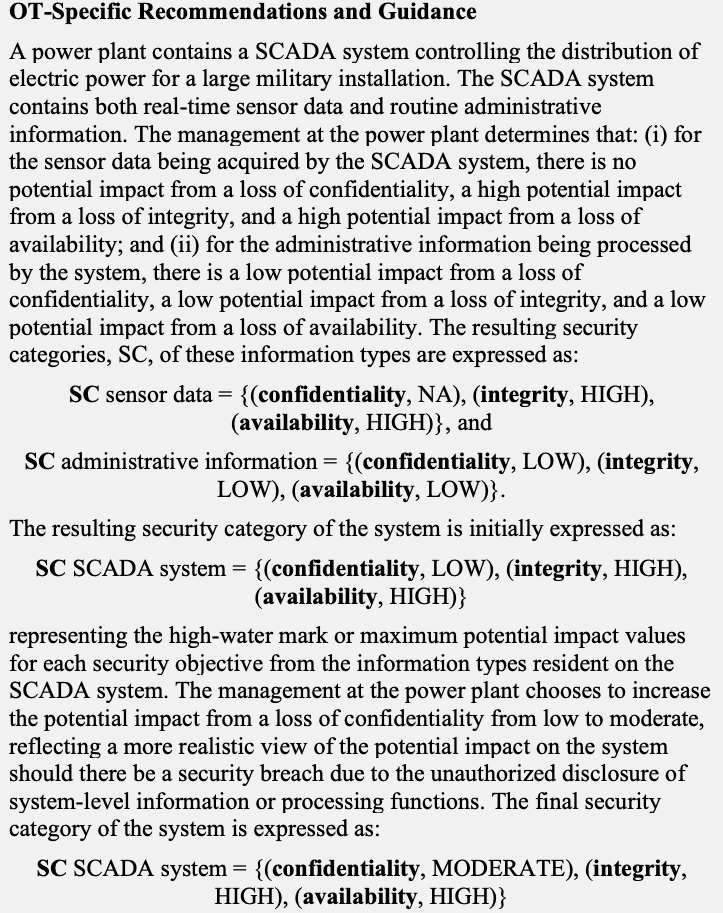
OT固有の推奨事項およびガイダンス
A power plant contains a SCADA system controlling the distribution of electric power for a large military installation. The SCADA system contains both real-time sensor data and routine administrative information. The management at the power plant determines that: (i) for the sensor data being acquired by the SCADA system, there is no potential impact from a loss of confidentiality, a high potential impact from a loss of integrity, and a high potential impact from a loss of availability; and (ii) for the administrative information being processed by the system, there is a low potential impact from a loss of confidentiality, a low potential impact from a loss of integrity, and a low potential impact from a loss of availability. The resulting security categories, SC, of these information types are expressed as:
ある発電所のSCADAシステムが、大規模な軍事施設への電力供給を制御しています。このSCADAシステムには、リアルタイムのセンサーデータと日常的な管理情報の両方が含まれます。発電所の管理者は次のように判断しました。(i) SCADAシステムが取得するセンサーデータについては、機密性の喪失による潜在的影響はなく、完全性の喪失による潜在的影響は高く、可用性の喪失による潜在的影響は高いです。(ii) システムが処理する管理情報については、機密性の喪失による潜在的影響は低く、完全性の喪失による潜在的影響は低く、可用性の喪失による潜在的影響は低いです。これらの情報タイプのセキュリティ分類(SC)は、次のように表される:
SC sensor data = {(confidentiality, NA), (integrity, HIGH), (availability, HIGH)}, and
SC センサーデータ = {(機密性, NA), (完全性, HIGH), (可用性, HIGH)}、および
SC administrative information = {(confidentiality, LOW), (integrity, LOW), (availability, LOW)}.
SC 管理情報 = {(機密性, LOW), (完全性, LOW), (可用性, LOW)}。
The resulting security category of the system is initially expressed as:
その結果としてのシステムのセキュリティ分類は、当初、次のように表されます。
SC SCADA system = {(confidentiality, LOW), (integrity, HIGH), (availability, HIGH)}
SC SCADAシステム = {(機密性, LOW), (完全性, HIGH), (可用性, HIGH)}
representing the high-water mark or maximum potential impact values for each security objective from the information types resident on the SCADA system. The management at the power plant chooses to increase the potential impact from a loss of confidentiality from low to moderate, reflecting a more realistic view of the potential impact on the system should there be a security breach due to the unauthorized disclosure of system-level information or processing functions. The final security category of the system is expressed as:
SCADAシステム上に存在する情報タイプの各セキュリティ目的について、最大値を示す基準点、または最大の潜在的影響値を表したものです。発電所の管理者は、システムレベルの情報または処理機能が不正に開示された結果セキュリティ侵害が生じた場合のシステムへの潜在的影響を、より現実的に反映するため、機密性の喪失による潜在的影響を低から中に引き上げることを選択しました。システムの最終的なセキュリティ分類は、次のように表されます。
SC SCADA system = {(confidentiality, MODERATE), (integrity, HIGH), (availability, HIGH)}
SC SCADAシステム = {(機密性, MODERATE), (完全性, HIGH), (可用性, HIGH)}
Table 7 provides details on applying the RMF Categorize step to OT.
表7に、RMFの分類ステップをOTに適用する詳細を示します。
Table 7. Applying the RMF Categorize step to OT
表7. RMF「分類」ステップのOTへの適用
| Tasks | Outcomes | OT-Specific Guidance |
|---|---|---|
| TASK C-1 SYSTEM DESCRIPTION | The characteristics of the system are described and documented. [Cybersecurity Framework: Profile] | |
| TASK C-2 SECURITY CATEGORIZATION | A security categorization of the system, including the information processed by the system represented by the organization-identified information types, is completed. [Cybersecurity Framework: ID.AM-1; ID.AM-2; ID.AM-3; ID.AM-4; ID.AM-5] Security categorization results are documented in the security, privacy, and SCRM plans. [Cybersecurity Framework: Profile] Security categorization results are consistent with the enterprise architecture and commitment to protecting organizational missions, business functions, and mission and business processes. [Cybersecurity Framework: Profile] Security categorization results reflect the organization’s risk management strategy. | OT and IT systems may have different categorization criteria. System information and the system process (e.g., chemical production) should be considered during the security categorization. |
| TASK C-3 SECURITY CATEGORIZATION REVIEW AND APPROVAL | The security categorization results are reviewed, and the categorization decision is approved by senior leaders in the organization. |
| タスク | 成果 | OT固有のガイダンス |
|---|---|---|
| タスクC-1 システムの記述 | システムの特性が記述され、文書化されています。[サイバーセキュリティフレームワーク:プロファイル] | |
| タスクC-2 セキュリティ分類 | システムのセキュリティ分類が完了しています。これには、組織が特定した情報タイプで表される、システムが処理する情報が含まれます。[サイバーセキュリティフレームワーク:ID | OTとITのシステムでは、分類基準が異なる場合があります。セキュリティ分類では、システム情報とシステムプロセス(例:化学品の生産)を考慮すべきです。 |
| タスクC-3 セキュリティ分類のレビューと承認 | セキュリティ分類の結果がレビューされ、分類の決定が組織の上級リーダーによって承認されています。 |
4.3.3. Select
4.3.3. 選択
The purpose of the Select step is to select the initial controls to protect the system commensurate with risk. The control baselines are the starting point for the control selection process and are chosen based on the security category and associated impact level of the systems identified in the Categorize step. NIST SP 800-53B [SP800-53B] identifies the recommended control baselines for federal systems and information. To address the need for developing community-wide and specialized sets of controls for systems and organizations, the concept of overlays is introduced. An overlay is a fully specified set of controls, control enhancements, and supplemental guidance derived from the application of tailoring guidance to security control baselines described in NIST SP 800-53B, Appendix C.
選択ステップの目的は、リスクに見合った形でシステムを保護するための初期の管理策を選択することです。管理策ベースラインは管理策選択プロセスの出発点であり、分類ステップで特定されたシステムのセキュリティカテゴリと関連する影響レベルに基づいて選ばれます。NIST SP 800-53B [SP800-53B]は、連邦のシステムと情報に推奨される管理策ベースラインを特定しています。システムと組織のために、コミュニティ全体で共有する管理策セットや特化した管理策セットを策定する必要性に対処するため、オーバーレイの概念が導入されています。オーバーレイとは、テーラリングガイダンスをNIST SP 800-53B, Appendix Cに記載されたセキュリティ管理策ベースラインに適用して導出された、管理策、管理策の強化、補足ガイダンスを完全に規定したセットです。
In general, overlays are intended to reduce the need for ad hoc tailoring of baselines by organizations through the selection of a set of controls and control enhancements that more closely correspond to common circumstances, situations, and/or conditions. Appendix F of this publication includes an OT-specific overlay of applicable NIST SP 800-53 controls that provides tailored baselines for low-impact, moderate-impact, and high-impact OT. These tailored baselines are starting specifications and recommendations that can be applied to specific OT by responsible personnel.
一般に、オーバーレイは、一般的な状況、事態、条件により密接に対応する管理策と管理策の強化のセットを選択することで、組織がベースラインを場当たり的にテーラリングする必要性を減らすことを目的としています。本書の付録Fには、適用可能なNIST SP 800-53管理策のOT固有のオーバーレイが含まれており、低影響、中影響、高影響のOT向けにテーラリングしたベースラインを提供しています。これらのテーラリングしたベースラインは出発点となる仕様と推奨事項であり、責任を負う要員が特定のOTに適用することができます。
OT owners can tailor the overlay from Appendix F when it is not possible or feasible to implement specific controls. The use of overlays does not in any way preclude organizations from performing further tailoring (i.e., overlays can also be subject to tailoring) to reflect organization-specific needs, assumptions, or constraints. However, all tailoring activities should primarily focus on meeting the intent of the original controls whenever possible or feasible. For example, when the OT cannot support or the organization determines that it is not advisable to implement particular controls or control enhancements in an OT (e.g., performance, safety, or reliability are adversely impacted), the organization should provide a complete and convincing rationale for how the selected compensating controls provide an equivalent security capability or level of protection for the OT and why the related baseline controls could not be employed. If the OT cannot support the use of automated mechanisms, the organization employs nonautomated mechanisms or procedures as compensating controls in accordance with the general tailoring guidance in Section 3.3 of NIST SP 800-53. Compensating controls are not exceptions or waivers to the baseline controls. Rather, they are alternative safeguards and countermeasures employed within the OT that accomplish the intent of the original controls that could not be effectively employed. Organizational decisions on the use of compensating controls are documented in the security plan for the OT.
OTの所有者は、特定の管理策の実装が不可能または実行困難な場合、付録Fのオーバーレイをテーラリングすることができます。オーバーレイを使用しても、組織固有のニーズ、前提、制約を反映するために組織がさらにテーラリングを行うこと(すなわち、オーバーレイもテーラリングの対象となりうる)は何ら妨げられません。ただし、すべてのテーラリング活動は、可能または実行可能な限り、元の管理策の意図を満たすことに主眼を置くべきです。たとえば、OTが特定の管理策や管理策の強化をサポートできない場合、または組織がOTでそれらを実装することが望ましくないと判断した場合(例:性能、安全性、信頼性に悪影響が及ぶ場合)、組織は、選択した代替管理策がOTに対してどのように同等のセキュリティ能力または保護レベルを提供するか、および関連するベースライン管理策を採用できなかった理由について、完全かつ説得力のある根拠を示すべきです。OTが自動化されたメカニズムの使用をサポートできない場合、組織は、NIST SP 800-53の3.3節にある一般的なテーラリングガイダンスに従い、自動化されていないメカニズムや手順を代替管理策として採用します。代替管理策は、ベースライン管理策の例外や免除ではありません。むしろ、効果的に採用できなかった元の管理策の意図を達成するために、OT内で採用される代替的な保護手段と対抗策です。代替管理策の使用に関する組織の決定は、OTのセキュリティ計画に文書化されます。
Table 8 provides additional details on applying the RMF Select step to OT.
表8は、RMFの選択ステップをOTに適用する際の追加の詳細を示しています。
Table 8. Applying the RMF Select step to OT
表8. RMF「選択」ステップのOTへの適用
| Tasks | Outcomes | OT-Specific Guidance |
|---|---|---|
| TASK S-1 CONTROL SELECTION | Control baselines necessary to protect the system commensurate with risk are selected. [Cybersecurity Framework: Profile] | OT systems can leverage the OT control baselines identified in Appendix F as a starting point or an organization-defined control selection approach. |
| TASK S-2 CONTROL TAILORING | Controls are tailored to produce specific control baselines. [Cybersecurity Framework: Profile] | Due to operational or technical constraints, it may not be feasible to implement certain controls. Organizations should consider the use of compensating controls to manage risk to an acceptable level. |
| TASK S-3 CONTROL ALLOCATION | Controls are assigned as system-specific, hybrid, or common controls. Controls are allocated to the specific system elements (i.e., machine, physical, or human elements). [Cybersecurity Framework: Profile; PR.IP] | |
| TASK S-4 DOCUMENTATION OF PLANNED CONTROL IMPLEMENTATIONS | Controls and associated tailoring actions are documented in security and privacy plans or equivalent documents. [Cybersecurity Framework: Profile] | |
| TASK S-5 CONTINUOUS MONITORING STRATEGY – SYSTEM | A continuous monitoring strategy for the system that reflects the organizational risk management strategy is developed. [Cybersecurity Framework: ID.GV; DE.CM] | An OT-specific continuous monitoring strategy to measure control effectiveness may be necessary due to unique operational, environmental, and/or availability constraints. |
| タスク | 成果 | OT固有のガイダンス |
|---|---|---|
| タスクS-1 管理策の選択 | リスクに見合ってシステムを保護するために必要な管理策ベースラインが選択されています。[サイバーセキュリティフレームワーク:プロファイル] | OTシステムは、付録Fで特定されたOT管理策ベースラインを出発点として活用するか、組織が定める管理策選択のアプローチを活用できます。 |
| タスクS-2 管理策のテーラリング | 管理策は、特定の管理策ベースラインを作成するためにテーラリングされています。[サイバーセキュリティフレームワーク:プロファイル] | 運用上または技術上の制約のため、一部の管理策を実装できない場合があります。組織は、リスクを許容できる水準に管理するため、代替管理策の利用を検討すべきです。 |
| タスクS-3 管理策の割り当て | 管理策は、システム固有、ハイブリッド、または共通のいずれかに割り当てられています。管理策は、特定のシステム要素(すなわち、機械要素、物理要素、または人的要素)に割り当てられています。[サイバーセキュリティフレームワーク:プロファイル; PR.IP] | |
| タスクS-4 計画された管理策実装の文書化 | 管理策および関連するテーラリング措置が、セキュリティ計画およびプライバシー計画またはそれに相当する文書に文書化されています。[サイバーセキュリティフレームワーク:プロファイル] | |
| タスクS-5 継続的モニタリング戦略 – システム | 組織のリスク管理戦略を反映した、システムの継続的モニタリング戦略が策定されています。[サイバーセキュリティフレームワーク:ID | 運用上、環境上、または可用性上の固有の制約があるため、管理策の有効性を測定するOT固有の継続的モニタリング戦略が必要になる場合があります。 |
| Tasks | Outcomes | OT-Specific Guidance |
|---|---|---|
| TASK S-6 PLAN REVIEW AND APPROVAL | Security and privacy plans reflecting the selection of controls necessary to protect the system and the environment of operation commensurate with risk are reviewed and approved by the authorizing official. | Review any potential impact to the OT system’s operational effectiveness and safety. |
| タスク | 成果 | OT固有のガイダンス |
|---|---|---|
| タスクS-6 計画のレビューと承認 | リスクに見合ってシステムと運用環境を保護するために必要な管理策の選択を反映したセキュリティ計画およびプライバシー計画が、認可担当者によってレビューされ承認されています。 | OTシステムの運用有効性と安全に及ぼしうる影響をレビューします。 |
4.3.4. Implement
4.3.4. 実装
The Implement step involves the implementation of controls in new or legacy systems. The control selection process described in this section can be applied to OT from two perspectives: new development and legacy. For new development systems, the control selection process is applied from a requirements definition perspective since the systems do not yet exist and organizations are conducting initial security categorizations. The controls included in the security plans for the systems serve as security specifications and are expected to be incorporated into the systems during the development and implementation phases of the system development life cycle. In contrast, the security control selection process for legacy systems is applied from a gap analysis perspective when organizations anticipate significant changes to the systems (e.g., during major upgrades, modifications, or outsourcing). Since the systems already exist, organizations have likely completed the security categorization and security control selection processes, resulting in the establishment of previously agreed-upon controls in the respective security plans and the implementation of those controls within the systems. Table 9 provides additional details on applying the RMF Implement step to OT.
「実装」ステップでは、新規またはレガシーシステムに管理策を実装します。この節で述べた管理策選択プロセスは、新規開発とレガシーの2つの観点からOTに適用できます。新規開発システムでは、システムがまだ存在せず、組織が初期のセキュリティ分類を行うため、要件定義の観点から管理策選択プロセスを適用します。システムのセキュリティ計画に含まれる管理策はセキュリティ仕様となり、システム開発ライフサイクルの開発および実装段階でシステムに組み込むことが期待されます。一方、レガシーシステムでは、システムに大幅な変更(大規模アップグレード、改修、外部委託など)を予定する際、ギャップ分析の観点からセキュリティ管理策選択プロセスを適用します。システムはすでに存在するため、組織は通常、セキュリティ分類と管理策選択を完了し、各セキュリティ計画に合意済みの管理策を定め、システム内に実装しています。表9に、RMF「実装」ステップをOTに適用する際の詳細を示します。
Table 9. Applying the RMF Implement step to OT
表9. RMF「実装」ステップのOTへの適用
| Tasks | Outcomes | OT-Specific Guidance |
|---|---|---|
| TASK I-1 CONTROL IMPLEMENTATION | Controls specified in the security and privacy plans are implemented. [Cybersecurity Framework: PR.IP-1] Systems security and privacy engineering methodologies are used to implement the controls in the system security and privacy plans. [Cybersecurity Framework: PR.IP-2] | For existing (operational) OT systems, schedule control implementation during the OT system maintenance window. A complete verification is recommended to ensure that the controls are not affecting or degrading the performance and safety of the OT system. In some cases, it may not be feasible to immediately mitigate the risk due to scheduling issues. However, interim compensating controls can be leveraged. |
| TASK I-2 UPDATE CONTROL IMPLEMENTATION INFORMATION | Changes to the planned implementation of controls are documented. [Cybersecurity Framework: PR.IP-1] The security and privacy plans are updated based on information obtained during the implementation of the controls. [Cybersecurity Framework: Profile] |
| タスク | 成果 | OT固有のガイダンス |
|---|---|---|
| タスクI-1 管理策の実装 | セキュリティ計画およびプライバシー計画に規定された管理策が実装されています。[サイバーセキュリティフレームワーク:PR | 既存の(運用中の)OTシステムでは、管理策の実装をOTシステムの保守時間枠に合わせて計画します。管理策がOTシステムの性能と安全に影響を与えたり、それらを低下させたりしていないことを確認するため、完全な検証を推奨します。スケジュールの都合により、リスクをすぐに緩和できない場合もあります。ただし、暫定的な代替管理策を活用できます。 |
| タスクI-2 管理策実装情報の更新 | 管理策の計画された実装に対する変更が文書化されています。[サイバーセキュリティフレームワーク:PR |
4.3.5. Assess
4.3.5. 評価
The Assess step of the RMF determines the extent to which the controls in the system are effective in their application and producing the desired results. NIST SP 800-53A [SP800-53Ar5] provides guidance for assessing selected controls from NIST SP 800-53 to ensure that they are implemented correctly, operating as intended, and producing the desired outcome with respect to meeting the security requirements of the system.
RMFの評価ステップでは、システム内の管理策が、その適用において有効であり所望の結果を生み出している程度を判定します。NIST SP 800-53A [SP800-53Ar5]は、NIST SP 800-53から選択した管理策が、システムのセキュリティ要件を満たすという観点から、正しく実装され、意図したとおりに動作し、所望の成果を生み出していることを確認するために、それらを評価するためのガイダンスを提供します。
Table 10 provides additional details on applying the Assess step to OT.
表10は、評価ステップをOTに適用する際の追加の詳細を示しています。
Table 10. Applying the RMF Assess step to OT
表10. RMF「評価」ステップのOTへの適用
| Tasks | Outcomes | OT-Specific Guidance |
|---|---|---|
| TASK A-1 ASSESSOR SELECTION | An assessor or assessment team is selected to conduct the control assessments. The appropriate level of independence is achieved for the assessor or assessment team selected. | Include OT system personnel and operator in the assessment team. |
| TASK A-2 ASSESSMENT PLAN | Documentation needed to conduct the assessments is provided to the assessor or assessment team. Security and privacy assessment plans are developed and documented. Security and privacy assessment plans are reviewed and approved to establish the expectations for the control assessments and the level of effort required. | |
| TASK A-3 CONTROL ASSESSMENTS | Control assessments are conducted in accordance with the security and privacy assessment plans. Opportunities to reuse assessment results from previous assessments to make the risk management process timely and cost-effective are considered. Use of automation to conduct control assessments is maximized to increase speed, effectiveness, and efficiency of assessments. | Consider the use of tabletop exercises or simulations to reduce the impact to production OT. Use automated tools to conduct assessments with care to ensure that the OT system is not adversely impacted by the testing process. |
| TASK A-4 ASSESSMENT REPORTS | Security and privacy assessment reports that provide findings and recommendations are completed. [Cybersecurity Framework: ID.RA-1 and ID.RA-3] | |
| TASK A-5 REMEDIATION ACTIONS | Remediation actions to address deficiencies in the controls implemented in the system and environment of operation are taken. Security and privacy plans are updated to reflect the control implementation changes made based on the assessments and subsequent remediation actions. [Cybersecurity Framework: Profile] | Ensure that remediation actions do not negatively impact the efficiency and safe operations of OT. Consider the use of compensating controls as one of the remediation actions. |
| TASK A-6 PLAN OF ACTION AND MILESTONES | A plan of action and milestones detailing remediation plans for unacceptable risks identified in security and privacy assessment reports is developed. [Cybersecurity Framework: ID.RA-6] | Consider the unique time constraints of the OT system in the plan of action and milestones, and take into account planned schedule maintenance or shutdowns of the OT system. |
| タスク | 成果 | OT固有のガイダンス |
|---|---|---|
| タスクA-1 評価者の選定 | 管理策評価を実施する評価者または評価チームが選定されています。選定された評価者または評価チームについて、適切なレベルの独立性が確保されています。 | 評価チームに、OTシステム要員とオペレーターを含めます。 |
| タスクA-2 評価計画 | 評価の実施に必要な文書が、評価者または評価チームに提供されています。セキュリティおよびプライバシー評価計画が策定され、文書化されています。セキュリティおよびプライバシー評価計画は、管理策評価に対する期待値と必要な作業量を定めるため、レビューされ承認されています。 | |
| タスクA-3 管理策評価 | 管理策評価は、セキュリティおよびプライバシー評価計画に従って実施されています。過去の評価結果を再利用して、リスク管理プロセスを適時かつ費用対効果の高いものにする機会が検討されています。管理策評価の実施には自動化を最大限に活用し、評価の速度、有効性、効率を高めています。 | 机上演習やシミュレーションの利用を検討し、本番のOTへの影響を減らします。自動化ツールを使って評価を行う場合は、テストプロセスによってOTシステムに悪影響が及ばないよう注意します。 |
| タスクA-4 評価報告書 | 調査結果と推奨事項を示すセキュリティおよびプライバシー評価報告書が完成しています。[サイバーセキュリティフレームワーク:ID | |
| タスクA-5 是正措置 | システムおよび運用環境に実装された管理策の不備に対処するための是正措置が講じられています。評価とそれに続く是正措置に基づいて行った管理策実装の変更を反映するよう、セキュリティ計画およびプライバシー計画が更新されています。[サイバーセキュリティフレームワーク:プロファイル] | 是正措置が、OTの効率と安全な運用に悪影響を及ぼさないことを確認します。是正措置の一つとして、代替管理策の利用を検討します。 |
| タスクA-6 行動計画およびマイルストーン | セキュリティおよびプライバシー評価報告書で特定された許容できないリスクに対する是正計画を詳述した行動計画およびマイルストーン(POA | 行動計画およびマイルストーンでは、OTシステムに固有の時間的制約を考慮し、OTシステムの計画された定期保守または停止を勘案します。 |
4.3.6. Authorize
4.3.6. 承認
The Authorize step involves a management decision to authorize the operation of a system and explicitly accept the risks to operations, assets, and individuals based on the implementation of an agreed-upon set of controls. A new system is not placed into production or operation until the system is authorized.
認可ステップは、合意された一連の管理策の実装に基づいて、システムの運用を認可し、運用、資産、および個人に対するリスクを明示的に受容するという経営上の意思決定を伴います。新しいシステムは、認可されるまで本番環境に投入されず、運用もされません。
Table 11 provides additional details on applying the Authorize step to OT.
表11は、認可ステップをOTに適用する際の追加の詳細を示します。
Table 11. Applying the RMF Authorize step to OT
表11. RMF「承認」ステップのOTへの適用
| Tasks | Outcomes | OT-Specific Guidance |
|---|---|---|
| TASK R-1 AUTHORIZATION PACKAGE | An authorization package is developed for submission to the authorizing official. | |
| TASK R-2 RISK ANALYSIS AND DETERMINATION | A risk determination by the authorizing official that reflects the risk management strategy, including risk tolerance, is rendered. | |
| TASK R-3 RISK RESPONSE | Risk responses for determined risks are provided. [Cybersecurity Framework: ID.RA-6] | Develop and implement a comprehensive strategy to manage risk to the OT system that includes the identification and prioritization of risk responses. |
| TASK R-4 AUTHORIZATION DECISION | The authorization for the system or the common controls is approved or denied. | Organizations may need to determine remediation strategies when system risks drift out of the acceptable range while considering OT-specific dependencies, such as the inability to take a system or component offline until remediated. |
| TASK R-5 AUTHORIZATION REPORTING | Authorization decisions, significant vulnerabilities, and risks are reported to organizational officials. | Ensure that decisions, vulnerabilities, and risks are reported to OT and operations personnel. |
| タスク | 成果 | OT固有のガイダンス |
|---|---|---|
| タスクR-1 認可パッケージ | 認可担当者に提出するための認可パッケージが作成されています。 | |
| タスクR-2 リスク分析と判定 | リスク許容度を含むリスク管理戦略を反映した、認可担当者によるリスク判断が行われています。 | |
| タスクR-3 リスク対応 | 判定されたリスクに対するリスク対応が提供されています。[サイバーセキュリティフレームワーク:ID | リスク対応の特定と優先順位付けを含む、OTシステムのリスクを管理するための包括的な戦略を策定し実施します。 |
| タスクR-4 認可の決定 | システムまたは共通管理策に対する認可が承認または拒否されています。 | 組織は、システムのリスクが許容範囲から外れた場合の是正戦略を、是正が完了するまでシステムやコンポーネントをオフラインにできないなどのOT固有の依存関係を考慮しながら、決定する必要がある場合があります。 |
| タスクR-5 認可報告 | 認可の決定、重大な脆弱性、リスクが、組織の責任者に報告されています。 | 意思決定、脆弱性、リスクが、OT要員および運用要員に報告されていることを確認します。 |
4.3.7. Monitor
4.3.7. 監視
The Monitor step continuously tracks changes to the system that may affect controls and assesses control effectiveness. NIST SP 800-37, Rev. 2 provides guidance on cybersecurity continuous monitoring [SP800-37r2].
監視ステップは、管理策に影響を及ぼしうるシステムの変更を継続的に追跡し、管理策の有効性をアセスメントします。NIST SP 800-37, Rev. 2は、サイバーセキュリティの継続的監視に関するガイダンスを提供しています[SP800-37r2]。
Table 12 provides additional details on applying the Monitor step to OT.
表12は、監視ステップをOTに適用する際の追加の詳細を示します。
Table 12. Applying the RMF Monitor step to OT
表12. RMF「監視」ステップのOTへの適用
| Tasks | Outcomes | OT-Specific Guidance |
|---|---|---|
| TASK M-1 SYSTEM AND ENVIRONMENT CHANGES | The system and environment of operation are monitored in accordance with the continuous monitoring strategy. [Cybersecurity Framework: DE.CM; ID.GV] | Leverage the OT-specific continuous monitoring strategy that considers performance impacts and safety systems to be critical. |
| TASK M-2 ONGOING ASSESSMENTS | Ongoing assessments of control effectiveness are conducted in accordance with the continuous monitoring strategy. [Cybersecurity Framework: ID.SC-4] | Conduct ongoing assessments that consider system performance and safety impacts. |
| TASK M-3 ONGOING RISK RESPONSE | The output of continuous monitoring activities is analyzed and responded to appropriately. [Cybersecurity Framework: RS.AN] | Correlate detected event information with risk assessment outcomes to achieve perspective on incident impact on the OT system. |
| TASK M-4 AUTHORIZATION PACKAGE UPDATES | Risk management documents are updated based on continuous monitoring activities. [Cybersecurity Framework: RS.IM] | |
| TASK M-5 SECURITY AND PRIVACY REPORTING | A process is in place to report the security and privacy posture to the authorizing official and other senior leaders and executives. | |
| TASK M-6 ONGOING AUTHORIZATION | Authorizing officials conduct ongoing authorizations using the results of continuous monitoring activities and communicate changes in risk determination and acceptance decisions. | |
| TASK M-7 SYSTEM DISPOSAL | A system disposal strategy is developed and implemented, as needed. | Planned obsolescence found in IT components may not extend to OT components. Consider the maintenance and repair of OT components that are required to be sustained beyond IT component availability. |
| タスク | 成果 | OT固有のガイダンス |
|---|---|---|
| タスクM-1 システムと環境の変更 | システムと運用環境が、継続的モニタリング戦略に従って監視されています。[サイバーセキュリティフレームワーク:DE | 性能への影響と安全システムを重要なものとして考慮する、OT固有の継続的モニタリング戦略を活用します。 |
| タスクM-2 継続的評価 | 管理策の有効性の継続的な評価が、継続的モニタリング戦略に従って実施されています。[サイバーセキュリティフレームワーク:ID | システムの性能および安全への影響を考慮した継続的な評価を実施します。 |
| タスクM-3 継続的リスク対応 | 継続的モニタリング活動の出力が分析され、適切に対応されています。[サイバーセキュリティフレームワーク:RS | 検知されたイベント情報をリスクアセスメントの結果と関連付け、OTシステムに対するインシデントの影響を把握します。 |
| タスクM-4 認可パッケージの更新 | リスク管理文書が、継続的モニタリング活動に基づいて更新されています。[サイバーセキュリティフレームワーク:RS | |
| タスクM-5 セキュリティおよびプライバシーの報告 | セキュリティおよびプライバシーの状況を認可担当者(AO)およびその他の上級幹部・経営層に報告するプロセスが整備されています。 | |
| タスクM-6 継続的認可 | 認可担当者は、継続的モニタリング活動の結果を用いて継続的な認可を行い、リスク判断と受容の決定の変更を伝達します。 | |
| タスクM-7 システムの廃棄 | システムの廃棄戦略が、必要に応じて策定され実施されています。 | ITコンポーネントに見られる計画的陳腐化は、OTコンポーネントには及ばない場合があります。ITコンポーネントが入手できなくなった後も維持する必要があるOTコンポーネントの保守と修理を検討します。 |
5. OT Cybersecurity Architecture
5. OTサイバーセキュリティアーキテクチャ
When designing a security architecture for an OT environment, it is generally recommended to separate the OT network(s) from the corporate network. The nature of network traffic on these two network types is different. For example, internet access, email, and remote access are typically permitted on the corporate network but not allowed on OT networks. There may also be differences in the degree of rigor associated with corporate and OT environment change control procedures. Additionally, using the corporate network for OT communication protocols could expose the OT components to cyber attacks (e.g., DoS, adversary-in-the-middle or other network-based attacks). Utilizing separate networks allows for greater flexibility to address security and performance requirements between the two environments.
OT環境のセキュリティアーキテクチャを設計する際には、一般に、OTネットワークを企業ネットワークから分離することが推奨されます。これら2種類のネットワークでは、ネットワークトラフィックの性質が異なります。たとえば、インターネットアクセス、電子メール、およびリモートアクセスは、企業ネットワークでは通常許可されますが、OTネットワークでは許可されません。また、企業環境とOT環境とでは、変更管理手順に求められる厳格さの程度が異なる場合もあります。さらに、OTの通信プロトコルに企業ネットワークを使用すると、OTコンポーネントがサイバー攻撃(例:DoS、adversary-in-the-middle、その他のネットワークベースの攻撃)にさらされるおそれがあります。ネットワークを分離することで、2つの環境の間のセキュリティ要件と性能要件に、より柔軟に対処できるようになります。
Practical considerations – such as digital transformation, the cost of OT installation, or maintaining a homogenous network infrastructure – often mean that a connection is required between OT and corporate or other IT networks. This connection represents additional risk, and organizations may want to minimize these connections and consider additional security controls for them. This section outlines security strategies for organizations to consider when engineering their OT environments to support cybersecurity objectives.
デジタルトランスフォーメーション、OTの設置コスト、均質なネットワークインフラストラクチャの維持といった実務上の事情により、OTと企業ネットワークまたはその他のITネットワークとの間の接続が必要になることが多くあります。この接続は追加のリスクとなるため、組織はこうした接続を最小限にし、それらに対する追加のセキュリティ管理策を検討することが望ましい場合があります。本節では、サイバーセキュリティの目的を支えるようにOT環境をエンジニアリングする際に、組織が検討すべきセキュリティ戦略の概要を示します。
5.1. Cybersecurity Strategy
5.1. サイバーセキュリティ戦略
The adoption of a cybersecurity strategy can result in a more systematic implementation of risk decisions into system development and operation. A comprehensive and accepted cybersecurity strategy can assist an organization with consistently maintaining acceptable risk management throughout the life cycle of an OT system.
サイバーセキュリティ戦略を採用することにより、システムの開発と運用に対するリスク判断の反映を、より体系的に行えるようになります。包括的で合意されたサイバーセキュリティ戦略は、組織がOTシステムのライフサイクル全体を通じて、許容可能なリスク管理を一貫して維持する助けとなります。
System security is optimized by engineering design that is based on a proactive loss prevention strategy. Such a strategy includes planned measures that are engineered to address what can happen rather than what is likely to happen in order to proactively identify and rid the system of weaknesses and defects that lead to security vulnerabilities, understand the certainty and uncertainty of adversarial and non-adversarial threats, and put in place the means and methods to protect against adverse consequences. Proactive systems security engineering also includes planning for failure regardless of whether the failure results from adversarial or non-adversarial events and ensuring that the system is resilient to such events.
システムセキュリティは、プロアクティブな損失防止戦略に基づくエンジニアリング設計によって最適化されます。このような戦略には、起こりそうなことではなく起こりうることに対処するようにエンジニアリングされた計画的な対策が含まれます。その目的は、セキュリティ脆弱性につながる弱点や欠陥をプロアクティブに特定してシステムから除去すること、敵対的脅威および非敵対的脅威の確実性と不確実性を理解すること、そして有害な結果から保護するための手段と方法を整備することです。プロアクティブなシステムセキュリティエンジニアリングには、障害が敵対的事象によるものか非敵対的事象によるものかにかかわらず障害に備えて計画を立てること、およびシステムがそのような事象に対してレジリエントであることを確保することも含まれます。
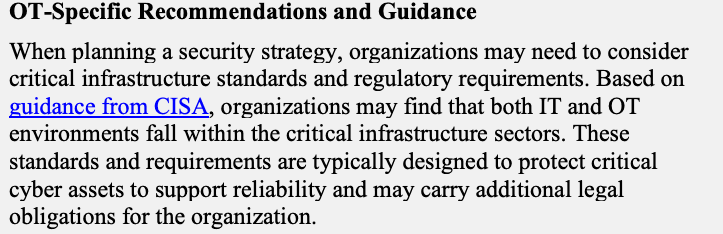
OT固有の推奨事項およびガイダンス
When planning a security strategy, organizations may need to consider critical infrastructure standards and regulatory requirements. Based on guidance from CISA, organizations may find that both IT and OT environments fall within the critical infrastructure sectors. These standards and requirements are typically designed to protect critical cyber assets to support reliability and may carry additional legal obligations for the organization.
セキュリティ戦略を計画する際、組織は、重要インフラ標準と規制要件を考慮する必要がある場合があります。CISAのガイダンスに基づき、組織は、ITとOTの両方の環境が重要インフラセクターに該当することに気づく場合があります。これらの標準と要件は通常、信頼性を支えるために重要なサイバー資産を保護することを目的としており、組織に追加の法的義務を課す場合があります。
5.1.1. Impacts of Choosing a Cybersecurity Strategy
5.1.1. サイバーセキュリティ戦略の選択による影響
By consciously choosing to develop and implement a cybersecurity strategy, an organization establishes a disciplined approach that considers all aspects of the system life cycle – from procurement to decommissioning – with cybersecurity in mind. As a result, the organization can ensure that cybersecurity goals are realized in its systems.
サイバーセキュリティ戦略の策定と実装を意識的に選択することにより、組織は、調達から廃棄に至るまでのシステムライフサイクルのあらゆる側面をサイバーセキュリティを念頭に置いて検討する、規律あるアプローチを確立します。その結果、組織は、自らのシステムにおいてサイバーセキュリティの目標が実現されることを確保できます。
Decisions on cybersecurity strategy should flow from a high-level understanding of the operations, objectives, and cybersecurity goals of the organization. For example, the organization may want its systems to display certain characteristics, such as resiliency or trustworthiness. The strategy provides a framework for incorporating those characteristics into the final systems. The strategy can also include additional considerations, such as the flexibility to adopt new technologies (e.g., crypto agility, artificial intelligence [AI] and machine learning [ML] technologies, digital twins). Finally, the strategy can state the need for sound cybersecurity practices, such as patching or monitoring.
サイバーセキュリティ戦略に関する決定は、組織の業務、目的、およびサイバーセキュリティの目標に対する高いレベルでの理解から導かれるべきです。たとえば、組織は、自らのシステムにレジリエンスや信頼性などの特定の特性を持たせたいと考える場合があります。戦略は、そうした特性を最終的なシステムに組み込むための枠組みを提供します。戦略には、新しい技術(例:暗号アジリティ、人工知能[AI]および機械学習[ML]技術、デジタルツイン)を採用する柔軟性など、追加の考慮事項を含めることもできます。さらに、戦略では、パッチ適用や監視など、健全なサイバーセキュリティ実践の必要性を述べることができます。
The cybersecurity strategy should directly impact the architectural decisions made for systems. The existence of an architecture informed by a cybersecurity strategy increases the likelihood that high-level cybersecurity goals will be reflected in the cybersecurity of individual systems. The strategy provides a document and reminder of those goals when decisions are being made at the system level.
サイバーセキュリティ戦略は、システムについて行われるアーキテクチャ上の決定に直接影響を与えるべきです。サイバーセキュリティ戦略を踏まえたアーキテクチャが存在することで、高いレベルのサイバーセキュリティ目標が個々のシステムのサイバーセキュリティに反映される可能性が高まります。戦略は、システムレベルで決定が行われる際に、それらの目標を記した文書となり、目標を想起させるものとなります。
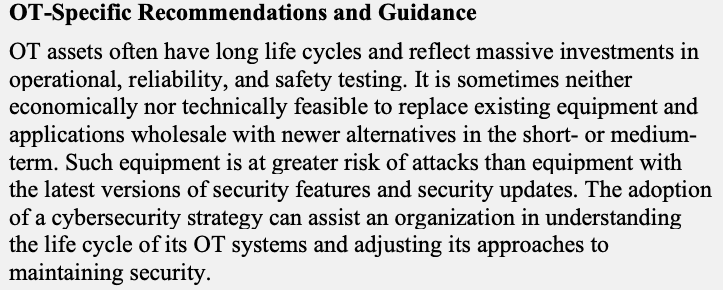
OT固有の推奨事項およびガイダンス
OT assets often have long life cycles and reflect massive investments in operational, reliability, and safety testing. It is sometimes neither economically nor technically feasible to replace existing equipment and applications wholesale with newer alternatives in the short- or medium-term. Such equipment is at greater risk of attacks than equipment with the latest versions of security features and security updates. The adoption of a cybersecurity strategy can assist an organization in understanding the life cycle of its OT systems and adjusting its approaches to maintaining security.
OT資産はライフサイクルが長く、運用、信頼性、安全性の試験に多額の投資がなされていることが多くあります。短期または中期的に、既存の機器やアプリケーションを新しい代替品へ全面的に置き換えることは、経済的にも技術的にも実現できない場合があります。そのような機器は、最新バージョンのセキュリティ機能とセキュリティ更新を備えた機器に比べて、攻撃を受けるリスクが高いです。サイバーセキュリティ戦略を採用することで、組織はOTシステムのライフサイクルを把握し、セキュリティ維持の取り組みを調整しやすくなります。
5.1.2. Defense-in-Depth Strategy
5.1.2. 多層防御戦略
Defense in depth is a multifaceted strategy that integrates people, technology, and operational capabilities to establish variable barriers across multiple layers and dimensions of the organization. Many cybersecurity architectures incorporate the principles of defense in depth. It is considered best practice and integrates into numerous standards and regulatory frameworks.
多層防御は、人、技術、および運用能力を統合し、組織の複数の層と次元にわたって多様な障壁を確立する多面的な戦略です。多くのサイバーセキュリティアーキテクチャは、多層防御の原則を取り入れています。多層防御はベストプラクティスとみなされており、数多くの標準や規制の枠組みに組み込まれています。
The basic concepts are to prevent single points of failure in cybersecurity defenses and to assume no single origin of threats. From this position, cybersecurity controls are organized to provide layers of protection around the critical system and system components.
基本的な考え方は、サイバーセキュリティ防御における単一障害点を防ぐこと、および脅威の発生源を単一と想定しないことです。この立場から、サイバーセキュリティ管理策は、重要なシステムおよびシステムコンポーネントの周囲に保護の層を提供するように編成されます。

OT固有の推奨事項およびガイダンス
A defense-in-depth strategy is particularly useful in OT environments because it can focus attention and defensive mechanisms on critical functions. Additionally, the principles of defense in depth are flexible and can be applied to a wide range of OT environments, including ICS, SCADA, Internet of Things (IoT), IIoT, and hybrid environments.
多層防御戦略は、重要な機能に注意と防御の仕組みを集中できるため、OT環境で特に有用です。さらに、多層防御の原則は柔軟であり、ICS、SCADA、モノのインターネット(IoT)、IIoT、ハイブリッド環境など、幅広いOT環境に適用できます。
Defense in depth requires an integration of people, processes, and technology to be effective. Additionally, cybersecurity defenses are not static and require changes and updates as risks change for the environment. To help establish and support an effective defense-in-depth architecture, organizations should consider:
多層防御を有効にするには、人、プロセス、技術の統合が必要です。さらに、サイバーセキュリティの防御は静的ではなく、環境のリスクの変化に応じて変更と更新が必要です。効果的な多層防御アーキテクチャの確立と支援のため、組織は次の事項を検討すべきです。
•Training people to support the security environment and reduce risky behaviors
原本PDFの抜粋画像
•セキュリティ環境を支え、リスクのある行動を減らすための要員の訓練
•Implementing appropriate and sustainable cybersecurity technology
•適切で持続可能なサイバーセキュリティ技術を導入する
•Implementing procedures to monitor, respond, and adapt cybersecurity defenses to changing conditions
•変化する状況に合わせてサイバーセキュリティ防御を監視、対応、適応させる手順を実施する
5.1.3. Other Cybersecurity Strategy Considerations
5.1.3. サイバーセキュリティ戦略に関するその他の考慮事項
Traditional OT systems were designed to operate industrial processes safely and reliably without connections to external networks. However, due to the need for business agility and cost reduction for OT infrastructures, OT systems and networks are becoming more integrated into business networks and cloud infrastructures. Additionally, the introduction of IIoT systems into OT environments may have unintended cybersecurity consequences.
従来のOTシステムは、外部ネットワークに接続することなく、産業プロセスを安全かつ確実に運転するように設計されていました。しかし、ビジネスの俊敏性とOTインフラストラクチャのコスト削減が求められることから、OTシステムとネットワークは、ビジネスネットワークやクラウドインフラストラクチャとの統合を深めつつあります。さらに、OT環境へのIIoTシステムの導入は、意図しないサイバーセキュリティ上の影響をもたらす可能性があります。
Similarly, cloud computing capabilities (e.g., infrastructure as a service, platform as a service, software as a service, and security as a service) are increasingly being utilized by organizations. While the use of these capabilities to support IT services is relatively well understood, the ability to utilize these services to support OT environments may have additional availability challenges resulting from increased sensitivity to system performance levels or connection issues. As a result, the adoption of a security architecture strategy may be impacted by the current state of existing OT environments. For example, based on the architectural strategy, procurement decisions might be adjusted to include migrating specific components to support the new strategy. Organizations may also find that existing systems already support some or most of the security architecture strategy, so building on these existing capabilities could accelerate the strategy implementation. Additionally, new OT environments provide an opportunity to evaluate cyber risk early on and build cybersecurity into the design.
同様に、クラウドコンピューティングの機能(例:Infrastructure as a Service、Platform as a Service、Software as a Service、Security as a Service)を利用する組織が増えています。ITサービスを支えるためのこれらの機能の利用については比較的よく理解されていますが、これらのサービスをOT環境の支援に利用する場合には、システムの性能水準や接続の問題に対する感度が高いことから、可用性に関する追加の課題が生じる可能性があります。その結果、セキュリティアーキテクチャ戦略の採用は、既存のOT環境の現状に左右される可能性があります。たとえば、アーキテクチャ戦略に基づいて、新しい戦略を支えるために特定のコンポーネントの移行を含めるよう調達決定を調整することがありうます。また、既存のシステムがセキュリティアーキテクチャ戦略の一部または大部分をすでにサポートしていることが判明する場合もあり、その場合はこれらの既存の能力を基盤とすることで戦略の実装を加速できます。さらに、新しいOT環境は、早い段階でサイバーリスクを評価し、設計にサイバーセキュリティを組み込む機会となります。

OT固有の推奨事項およびガイダンス
Organizations should ensure that their security architecture strategy provides the required flexibility to evolve their environment while also carefully considering the impacts to operations and cybersecurity.
組織は、運用とサイバーセキュリティへの影響を慎重に考慮しながら、環境を進化させるために必要な柔軟性をセキュリティアーキテクチャ戦略が提供していることを確認すべきです。
5.2. Defense-in-Depth Architecture Capabilities
5.2. 多層防御アーキテクチャの機能
Many organizations are embracing digital transformation initiatives that require altering their OT environments and developing strategies that provide a multi-tiered information architecture by supporting organization objectives, such as:
多くの組織は、OT環境の変更を必要とするデジタルトランスフォーメーション施策を進めています。組織の目的を支える多層情報アーキテクチャを構築する戦略が必要となります。目的には、次のようなものがあります。
•Maintenance of field devices, telemetry collection, or industrial-level process systems
•フィールドデバイス、テレメトリ収集、または産業レベルのプロセスシステムの保守
•Enhanced data collection and dissemination
•データ収集および配信の強化
•Remote access
•リモートアクセス
Overall, integration between IT and OT is increasing as organizations adapt to changing local and global needs and requirements. Utilizing the principles of a defense-in-depth architecture to systematically layer security controls – including people, processes, and technology – can help organizations strengthen their overall cybersecurity defenses. As a result, adversaries may find it increasingly difficult to penetrate the environment without detection. The following sections discuss specific defense-in-depth layers, including topics and ideas for organizations to consider when developing and implementing their defense-in-depth cybersecurity architecture. The layers are:
組織が地域および世界のニーズや要件の変化に適応するにつれて、ITとOTの統合は全体として進んでいます。人、プロセス、技術を含むセキュリティ管理策を体系的に階層化する多層防御アーキテクチャの原則を用いることで、組織はサイバーセキュリティ防御全体を強化できます。その結果、敵対者は検知されずに環境へ侵入することがますます難しくなる可能性があります。本節以降では、多層防御サイバーセキュリティアーキテクチャの開発および実装時に組織が検討すべき事項や考え方を含め、各防御層を説明します。各層は次のとおりです。
•Layer 1 – Security Management
•レイヤー1―セキュリティ管理
•Layer 2 – Physical Security
•レイヤー2―物理セキュリティ
•Layer 3 – Network Security
•レイヤー3―ネットワークセキュリティ
•Layer 4 – Hardware Security
•レイヤー4―ハードウェアセキュリティ
•Layer 5 – Software Security
•レイヤー5―ソフトウェアセキュリティ
5.2.1. Layer 1 – Security Management
5.2.1. レイヤー1―セキュリティ管理
Security management or governance is the overarching cybersecurity program that supports the OT environment. Sections 3 and 4 discuss the program and risk management considerations for organizations to establish their cybersecurity programs. These programmatic and organizational decisions will guide and impact the decisions made for the other defense-in-depth layers. As a result, organizations should complete this layer before attempting to implement the other layers.
セキュリティ管理またはガバナンスは、OT環境を支える包括的なサイバーセキュリティプログラムです。第3節および第4節では、組織がサイバーセキュリティプログラムを確立するためのプログラムおよびリスク管理上の考慮事項を説明しました。これらのプログラム上および組織上の決定は、他の多層防御レイヤーに関する決定を導き、影響を与えます。そのため、他のレイヤーの実装に着手する前に、このレイヤーを完了するべきです。
5.2.2. Layer 2 – Physical Security
5.2.2. レイヤー2―物理セキュリティ
Physical security measures are designed to reduce the risk of accidental or deliberate loss or damage to assets and the surrounding environment. Safeguarded assets may include control systems, tools, equipment, the environment, the surrounding community, and intellectual property, including proprietary data (e.g., process settings and customer information). Organizations may also need to consider additional environmental, safety, regulatory, legal, and other requirements when implementing physical security.
物理セキュリティ対策は、資産および周辺環境が偶発的または意図的に失われたり損傷したりするリスクを低減するために設計されます。保護対象資産には、制御システム、ツール、機器、環境、周辺地域社会、ならびに専有データ(プロセス設定や顧客情報など)を含む知的財産が含まれる場合があります。物理セキュリティを実装する際には、環境、安全、規制、法務その他の要件も考慮する必要があります。
A defense-in-depth solution to physical security should consider the following attributes:
多層防御による物理セキュリティでは、次の特性を考慮するべきです。
•Protection of physical locations. Classic physical security considerations typically include an architecture of layered security measures that create several physical barriers around buildings, facilities, rooms, equipment, and other informational assets. Physical security controls should be implemented to protect physical locations and may include fences, anti-vehicle ditches, earthen mounds, walls, reinforced barricades, gates, door and cabinet locks, guards, or other measures.
•物理的な場所の保護。従来の物理セキュリティでは、建物、施設、部屋、機器、その他の情報資産の周囲に複数の物理的障壁を設ける多層構造を検討します。物理的な場所を保護するため物理セキュリティ管理策を実装するべきであり、フェンス、車両阻止溝、土塁、壁、強化バリケード、門扉、ドアやキャビネットの錠、警備員などの対策を含められます。
•Physical access control. Equipment cabinets should be locked when not required for operation or safety, and wiring should be neat and contained within cabinets or under floors. Additionally, consider keeping all computing and networking equipment in secured areas. Keys of OT assets, like PLCs and safety systems, should be in the “Run” position at all times unless they are being actively programmed.
•物理アクセス制御。運用または安全上必要でないときは機器キャビネットを施錠し、配線は整然とまとめてキャビネット内または床下に収めるべきです。また、すべてのコンピューターおよびネットワーク機器を安全な区域に置くことを検討します。PLCや安全システムなどOT資産のキーは、プログラミング中を除き、常に「Run」位置にしておくべきです。
•Access monitoring systems. Access monitoring systems include electronic surveillance capabilities, such as still and video cameras, sensors, and identification systems (e.g., badge readers, biometric scanners, electronic keypads). Such devices do not typically prevent access to a particular location. Rather, they store and record either the physical presence or the lack of physical presence of individuals, vehicles, animals, or other physical entities. Adequate lighting should be provided based on the type of access monitoring device deployed. These systems can also sometimes alert or initiate action upon the detection of unauthorized access.
•アクセス監視システム。アクセス監視システムには、静止画・動画カメラ、センサー、識別システム(バッジリーダー、生体認証スキャナー、電子キーパッドなど)といった電子監視機能が含まれます。このような装置は通常、特定の場所への侵入そのものを防止しません。むしろ、人、車両、動物その他の物理的主体の存在または不在を保存、記録します。設置したアクセス監視装置の種類に応じて適切な照明を確保するべきです。これらのシステムは、不正アクセスを検知した際に警報を出したり措置を開始したりする場合もあります。
•People and asset tracking. Locating people and vehicles in a facility can be important for both safety and security reasons. Asset location technologies can be used to track the movements of people and vehicles to ensure that they stay in authorized areas, to identify personnel who may need assistance, and to support emergency response.
•人および資産の追跡。施設内の人や車両の位置を把握することは、安全とセキュリティの両面で重要な場合があります。資産位置情報技術を使って人や車両の移動を追跡し、許可区域内にいることの確認、支援が必要な要員の特定、緊急対応の支援を行えます。
OT固有の推奨事項およびガイダンス
Organizations should consider whether the physical security of remote assets is implemented at differing levels and whether those differences could create cyber risks. For example, one remote location may utilize only a padlock with minimal electronic surveillance to secure access to network equipment that, if bypassed, could allow a malicious actor to gain access to an OT network segment from the remote location.
組織は、リモート資産の物理セキュリティが異なるレベルで実装されているかどうか、またその違いがサイバーリスクを生む可能性があるかどうかを検討すべきです。例えば、ある遠隔地では、ネットワーク機器へのアクセスを守るのに南京錠と最小限の電子監視しか使用していない場合があり、これが突破されると、悪意のある者がその遠隔地からOTネットワークセグメントにアクセスできるおそれがあります。
Organizations should also consider whether secondary services, such as the communications and power that support physical security devices (e.g., cameras, sensors, etc.), require additional redundancy, isolation, protection, and monitoring.
組織は、物理セキュリティデバイス(例:カメラ、センサーなど)を支える通信や電源などの二次的なサービスに、追加の冗長性、分離、保護、監視が必要かどうかも検討すべきです。
5.2.3. Layer 3 – Network Security
5.2.3. レイヤー3―ネットワークセキュリティ
Building from physical security, organizations should investigate network communications and how to protect the data and devices used to support their OT environment. This section focuses on several foundational elements to assist organizations with planning and implementing their network security capabilities. These include applying the network architecture principles of segmentation and isolation, centralizing logging, network monitoring, and malicious code protection. Additionally, this section discusses zero trust architecture (ZTA) and considerations for applying these architecture enhancements to an OT environment.
物理セキュリティを基礎として、組織はネットワーク通信と、OT環境を支えるデータおよびデバイスの保護方法を検討するべきです。本節では、ネットワークセキュリティ機能の計画および実装を支援する基礎要素として、ネットワークアーキテクチャにおけるセグメンテーションと分離、ログの一元化、ネットワーク監視、および悪意あるコードからの保護を取り上げます。また、ゼロトラストアーキテクチャ(ZTA)と、そのアーキテクチャ強化をOT環境に適用する際の考慮事項についても述べます。
5.2.3.1. Network Architecture
5.2.3.1. ネットワークアーキテクチャ
A good practice for network architectures is to characterize, segment, and isolate IT and OT devices. For example, devices may be segmented based on management authority, level of trust, functional criticality, data flow, location, or other logical combinations. Organizations may also consider using an industry-recognized model to organize their OT network segmentation, such as the Purdue model [Williams], ISA-95 levels [IEC62264], the three-tier IIoT system architecture [IIRA19], or a combination of these models.
ネットワークアーキテクチャの望ましい慣行は、ITおよびOTデバイスの特性を把握し、セグメント化して分離することです。たとえば、管理権限、信頼レベル、機能上の重要度、データフロー、場所、またはこれらを論理的に組み合わせた基準でデバイスをセグメント化できます。OTネットワークのセグメンテーションを構成する業界で広く認知されたモデルとして、Purdueモデル[Williams]、ISA-95レベル[IEC62264]、3層IIoTシステムアーキテクチャ[IIRA19]、またはこれらの組合せを使うことも検討できます。
Additional, organizations may consider incorporating a DMZ as an enforcement boundary between network segments, as depicted in Fig. 16. Implementing network segmentation utilizing levels, tiers, or zones allows organizations to control access to sensitive information and components while also considering operational performance and safety.
さらに、図16に示すように、ネットワークセグメント間の強制境界としてDMZを組み込むことを検討できます。レベル、ティア、またはゾーンを使ったネットワークセグメンテーションにより、運用性能と安全性を考慮しながら、機密情報およびコンポーネントへのアクセスを制御できます。
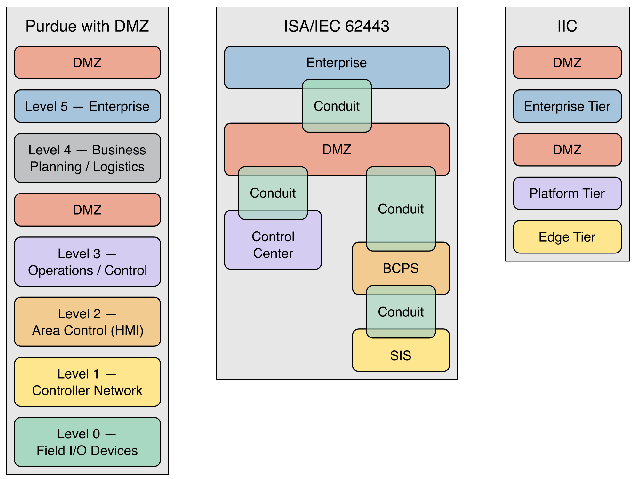
図16. DMZセグメントを備えた、PurdueモデルおよびIIoTモデルによるネットワークセグメンテーションの高水準例。3 列からなる。Purdue with DMZ(上から順に): DMZ、Level 5 — Enterprise、Level 4 — Business Planning / Logistics、DMZ、Level 3 — Operations / Control、Level 2 — Area Control (HMI)、Level 1 — Controller Network、Level 0 — Field I/O Devices。ISA/IEC 62443: Enterprise がコンジット(Conduit)で DMZ に結ばれ、DMZ はコンジットで Control Center と BCPS に結ばれ、BCPS はコンジットで SIS に結ばれる。IIC: DMZ、Enterprise Tier、DMZ、Platform Tier、Edge Tier。
Fig. 16. High-level example of the Purdue model and IIoT model for network segmentation with DMZ segments
図16. DMZセグメントを備えた、PurdueモデルおよびIIoTモデルによるネットワークセグメンテーションの高水準例
OT固有の推奨事項およびガイダンス
Whether using a risk-based approach, functional model, or other organizing principle, grouping components into levels, tiers, or zones is a precursor activity before organizations can consider applying isolation devices to protect and monitor communications between levels, tiers, or zones. When organizing assets, organizations should consider how the zone and isolation configuration impact their day-to-day operations, safety, and response capabilities.
リスクベースのアプローチ、機能モデル、その他の整理原則のいずれを用いるにしても、コンポーネントをレベル、階層、ゾーンにグループ化することは、組織がレベル、階層、ゾーン間の通信を保護・監視する分離デバイスの適用を検討できるようになる前の準備作業です。資産を整理する際、組織は、ゾーンと分離の構成が日常の運用、安全、対応能力にどのように影響するかを考慮すべきです。
When properly configured, network architectures support segmentation and isolation by enforcing security policies and controlling network communications. Organizations typically utilize their mapped data flows to identify required communications. These requirements are then incorporated into the network architecture and configured into the policy engines of the network devices to support monitoring communication between segments and permitting only authorized communications. Network devices that support traffic enforcement capabilities (e.g., switches, routers, firewalls, and unidirectional gateways or data-diodes) can be used to implement network segmentation and isolation.
適切に構成されたネットワークアーキテクチャは、セキュリティポリシーを強制し、ネットワーク通信を制御することで、セグメンテーションと分離を支えます。組織は通常、必要な通信を特定するため、マッピング済みのデータフローを利用します。これらの要件をネットワークアーキテクチャに取り込み、ネットワーク装置のポリシーエンジンに設定して、セグメント間通信を監視し、許可された通信のみを許可します。スイッチ、ルーター、ファイアウォール、一方向ゲートウェイまたはデータダイオードなど、トラフィックを強制制御する機能を備えたネットワーク装置を、ネットワークのセグメンテーションと分離に利用できます。
Firewalls are commonly used to support network isolation and employed as boundary protection devices to control connections and information flows between network segments. Firewalls may be deployed as network devices or directly run on some hosts. Firewalls are very flexible isolation devices and typically constitute the primary mechanism for protecting OT devices.
ファイアウォールは、ネットワーク分離を支えるために一般的に使用され、ネットワークセグメント間の接続および情報フローを制御する境界保護装置として用いられます。ファイアウォールはネットワーク装置として導入することも、一部のホスト上で直接実行することもできます。ファイアウォールは柔軟性の高い分離装置であり、通常、OTデバイスを保護する主要な仕組みとなります。
OT固有の推奨事項およびガイダンス
Appropriate firewall configuration is essential to properly securing the network segments. Firewall rulesets should be established to only permit connections between adjacent levels, tiers, or zones. For example, organizations that utilize a Purdue model architecture should implement firewall rules and connection paths that prevent Level 4 devices from directly communicating with Level 2, 1, or 0 devices. A similar concept would be applied to ISA/IEC 62443 and IIC architectures.
ネットワークセグメントを適切に保護するには、ファイアウォールの適切な構成が不可欠です。ファイアウォールのルールセットは、隣接するレベル、階層、ゾーンの間の接続のみを許可するように設定すべきです。例えば、パデューモデルのアーキテクチャを利用する組織は、レベル4のデバイスがレベル2、1、0のデバイスと直接通信するのを防ぐファイアウォールルールと接続経路を実装すべきです。ISA/IEC 62443やIICのアーキテクチャにも同様の考え方を適用できます。
One area of considerable variation in practice associated with firewall rules is the control of outbound traffic from the control network. Allowing outbound connections from lower levels, tiers, or zones could represent a significant risk if unmanaged. Organizations should consider making outbound rules as stringent as inbound rules to reduce these risks.
ファイアウォールルールに関する運用で大きな差が出る領域の一つが、制御ネットワークからの外向きトラフィックの制御です。下位のレベル、階層、ゾーンからの外向きの接続を許可すると、管理されない場合に重大なリスクとなりうます。組織は、こうしたリスクを減らすため、外向きのルールを内向きのルールと同程度に厳格にすることを検討すべきです。
An alternative to firewalls is a unidirectional gateway or data diode that permits authorized communication in only one direction. The use of unidirectional gateways may provide additional protections associated with system compromises at higher levels or tiers within the environment. For example, a unidirectional gateway deployed between Layers 2 and 3 may protect Layer 0, 1, and 2 devices from a cybersecurity event that occurs at Layers 3, 4, or 5.
ファイアウォールの代替として、許可された通信を一方向のみに通す単方向ゲートウェイまたはデータダイオードがあります。単方向ゲートウェイを使用すると、環境内の上位のレベルまたは階層でのシステムの危殆化に関連する追加の保護が得られる場合があります。例えば、レイヤー2と3の間に単方向ゲートウェイを配置すると、レイヤー3、4、5で発生したサイバーセキュリティイベントから、レイヤー0、1、2のデバイスを保護できる場合があります。
5.2.3.2. Centralized Logging
5.2.3.2. ログの一元化
Network and computing devices (e.g., routers, gateways, switches, firewalls, servers, and workstations) should be configured to log events to support monitoring, alerting, and incident response analysis. Logging capabilities are typically available for recording events in applications, OSs, and network communications. A centralized log management platform can assist organizations with supporting log retention, monitoring, and analysis efforts.
ルーター、ゲートウェイ、スイッチ、ファイアウォール、サーバー、ワークステーションなどのネットワーク装置およびコンピューティング装置は、監視、警告、インシデント対応分析を支援するため、イベントを記録するよう構成するべきです。ログ機能は通常、アプリケーション、OS、ネットワーク通信のイベント記録に利用できます。一元的なログ管理プラットフォームは、ログの保持、監視、分析の取り組みを支援します。
OT固有の推奨事項およびガイダンス
Organizations should review their available logging capabilities and configure them to record the operational and cybersecurity events that are appropriate for their environment.
組織は、利用可能なログ記録機能を確認し、自らの環境に適した運用イベントとサイバーセキュリティイベントを記録するよう構成すべきです。
Organizations should establish how long event logs should be retained and ensure that adequate storage is available to support log retention requirements.
組織は、イベントログを保持する期間を定め、ログ保持の要件を満たすために十分なストレージが利用できることを確認すべきです。
5.2.3.3. Network Monitoring
5.2.3.3. ネットワーク監視
Network monitoring involves reviewing alerts and logs and analyzing them for signs of possible cybersecurity incidents. Tools and capabilities that support behavior anomaly detection (BAD), security information and event management (SIEM), intrusion detection systems (IDS), and intrusion prevention systems (IPS) can assist organizations with monitoring traffic throughout the network and generate alerts when they identify anomalous or suspicious traffic. Some other capabilities to consider for network monitoring include:
ネットワーク監視では、警告やログを確認し、サイバーセキュリティインシデントの兆候がないか分析します。行動異常検知(BAD)、セキュリティ情報イベント管理(SIEM)、侵入検知システム(IDS)、侵入防止システム(IPS)を支援するツールおよび機能は、ネットワーク全体のトラフィック監視や、異常または疑わしいトラフィックを検出した際の警告生成に役立ちます。ネットワーク監視では、次の機能も検討できます。
•Asset management, including discovering and inventorying devices connected to the network
•ネットワークに接続されたデバイスの発見とインベントリ作成を含む資産管理
•Baselining typical network traffic, data flows, and device-to-device communications
•通常のネットワークトラフィック、データフロー、およびデバイス間通信のベースライン作成
•Diagnosing network performance issues
•ネットワーク性能の問題の診断
•Identifying misconfigurations or malfunctions of networked devices
•ネットワークデバイスの設定ミスまたは誤動作の特定
Organizations may also want to consider incorporating additional services and capabilities, such as threat intelligence monitoring, to assist with establishing and maintaining an effective network monitoring capability.
有効なネットワーク監視機能の確立と維持を支援するため、脅威インテリジェンス監視などの追加サービスや機能の導入も検討できます。
OT固有の推奨事項およびガイダンス
OT system traffic is typically more deterministic (i.e., repeatable, predictable, and designed) than IT network traffic, which can leveraged to support network monitoring for anomaly and error detection.
OTシステムのトラフィックは通常、ITネットワークのトラフィックよりも決定的(すなわち、反復可能、予測可能で、設計されたもの)であり、異常やエラーの検知のためのネットワーク監視を支援するために活用できます。
Organizations should understand the normal state of the OT network as a prerequisite for implementing network security monitoring to help distinguish attacks from transient conditions or normal operations within the environment. Implementing network monitoring in a passive (e.g., listen or learning) mode and analyzing the information to differentiate between known and unknown communication may be a necessary first step in implementing network security monitoring.
組織は、攻撃と、環境内の一時的な状態や通常の運用を区別しやすくするため、ネットワークセキュリティ監視を実装する前提として、OTネットワークの正常な状態を理解すべきです。ネットワーク監視をパッシブな(例:リッスンまたは学習)モードで実装し、情報を分析して既知の通信と未知の通信を区別することが、ネットワークセキュリティ監視を実装する最初の手順として必要になる場合があります。
Organizations should consider the effects of encrypted network communications on their network monitoring capabilities and deployment strategies. For example, a BAD system or IDS may be unable to determine whether encrypted network communication is malicious and could generate false positive or negative alerts for the traffic. Changing the data collection point to capture network traffic before or after encryption (e.g., using host-based network monitoring tools) could help improve monitoring capabilities when encrypted communication is expected.
組織は、暗号化されたネットワーク通信が自らのネットワーク監視機能と展開戦略に及ぼす影響を考慮すべきです。例えば、BADシステムやIDSは、暗号化されたネットワーク通信が悪意のあるものかどうかを判断できず、そのトラフィックに対して誤検知または検知漏れのアラートを生成する可能性があります。暗号化された通信が想定される場合は、暗号化の前または後にネットワークトラフィックを取得するようデータ収集ポイントを変更する(例:ホストベースのネットワーク監視ツールを使用する)と、監視機能の改善に役立つ場合があります。
IDS and IPS products are effective at detecting and preventing well-known internet attacks, and some IDS and IPS vendors have incorporated attack signatures for various OT protocols, such as Modbus, Distributed Network Protocol 3 (DNP3), and Inter-Control Center Communications Protocol (ICCP). An effective IDS/IPS deployment typically involves both host-based and network-based capabilities. Organizations should consider the impact that automated responses associated with IPS may have on the OT environment before deploying. In some cases, organizations may consider placing IPS units at higher levels in the environment (e.g., the DMZ interfaces) to minimize potential issues with automated responses impacting OT.
IDSおよびIPS製品は、よく知られたインターネット攻撃の検知と防止に有効であり、一部のIDS/IPSベンダーは、Modbus、分散ネットワークプロトコル3(DNP3)、制御センター間通信プロトコル(ICCP)など、さまざまなOTプロトコルの攻撃シグネチャを取り込んでいます。効果的なIDS/IPSの展開には、通常、ホストベースとネットワークベースの両方の機能が必要になります。組織は、展開前に、IPSに関連する自動応答がOT環境に及ぼしうる影響を検討すべきです。場合によっては、自動応答がOTに影響する問題を最小限に抑えるため、IPSユニットを環境のより上位のレベル(例:DMZインターフェース)に配置することを検討してもよいです。
In OT environments, network-based monitoring capabilities are typically deployed on boundary protection devices using switched port analyzer (SPAN) ports or passive network taps. Organizations should also consider deploying host-based monitoring capabilities on compatible OT devices – such as HMIs, SCADA servers, and engineering workstations – to improve monitoring capabilities, provided that the addition of the tools does not adversely impact operational performance or safety.
OT環境では、ネットワークベースの監視機能は通常、スイッチドポートアナライザー(SPAN)ポートまたはパッシブネットワークタップを使用して、境界保護デバイスに展開されます。組織は、ツールの追加が運用性能や安全に悪影響を及ぼさないのであれば、監視機能を高めるため、互換性のあるOTデバイス(HMI、SCADAサーバー、エンジニアリングワークステーションなど)にホストベースの監視機能を展開することも検討すべきです。
5.2.3.4. Zero Trust Architecture (ZTA)
5.2.3.4. ゼロトラストアーキテクチャ(ZTA)
A ZTA is a cybersecurity paradigm that focuses on protecting resources (e.g., information services, data) based on the premise that authorization decisions are made closer to the resource being requested and are continuously evaluated rather than implicitly granted [SP800-207]. Conventional network security focuses on segmentation and perimeter defenses. Once inside the network perimeter, users are typically considered “trusted” and often given broad access to accessible resources. As a result, boundary protection devices between zones do not mitigate lateral movement risks within a zone. Additionally, with the growing prevalence of distributed computing, wireless and cellular communications, and cloud and hybrid-cloud environments, traditional network perimeters and boundaries are becoming less defined. For these situations, organizations might consider incorporating the principles of zero trust into their security architecture. Some challenges to implementing a ZTA include:
ZTAは、要求されたリソースに近い場所で認可判断を行い、暗黙に付与せず継続的に評価するという前提に基づき、リソース(情報サービス、データなど)の保護に重点を置くサイバーセキュリティのパラダイムです[SP800-207]。従来のネットワークセキュリティはセグメンテーションと境界防御を重視します。ネットワーク境界の内側に入ると、利用者は通常「信頼済み」とみなされ、アクセス可能なリソースへの広範なアクセス権を与えられることが多くあります。その結果、ゾーン間の境界保護装置は、ゾーン内の横方向移動のリスクを軽減しません。さらに、分散コンピューティング、無線・携帯通信、クラウドおよびハイブリッドクラウド環境が普及するにつれ、従来のネットワーク境界は曖昧になっています。このような状況では、組織はセキュリティアーキテクチャにゼロトラストの原則を組み込むことを検討できます。ZTAの実装には次のような課題があります。
•Organizations may not find a suitable single solution for a ZTA and may instead need to integrate several technologies with varying maturity levels to support their environment.
•ZTAに適した単一のソリューションが見つからず、環境を支えるため成熟度の異なる複数の技術を統合する必要がある場合があります。
•Implementing zero trust principles into an existing environment may require more investments in time, resources, and technical ability.
•既存環境にゼロトラストの原則を実装するには、時間、資源、技術力への追加投資が必要となる場合があります。
OT固有の推奨事項およびガイダンス
Some OT components (e.g., PLCs, controllers, HMI) may not support the technologies or protocols required to fully integrate with a ZTA implementation. As a result, a ZTA implementation might not be practical for some OT devices. Instead, organizations should consider applying a ZTA to compatible devices, such as those typically found at the functionally higher levels of the OT architecture (e.g., Purdue model Levels 3, 4, 5, and the OT DMZ).
一部のOTコンポーネント(例:PLC、コントローラー、HMI)は、ZTAの実装と完全に統合するために必要な技術やプロトコルをサポートしていない場合があります。その結果、一部のOTデバイスではZTAの実装が現実的でない可能性があります。その代わりに、組織は、OTアーキテクチャの機能的に上位のレベル(例:パデューモデルのレベル3、4、5、およびOT DMZ)に通常見られる、互換性のあるデバイスにZTAを適用することを検討すべきです。
Organizations may also want to consider whether any adverse impacts might occur, such as if the ZTA solution increases the latency to respond to resource requests or if one or more ZTA components become unavailable. Based on this analysis, organizations should consider adjusting the ZTA implementations to minimize latency and ensure adequate redundancy to minimize risks to OT and safety operations.
組織は、ZTAソリューションがリソース要求への応答の遅延を増大させたり、1つ以上のZTAコンポーネントが利用できなくなったりするなど、悪影響が生じる可能性があるかどうかも検討してもよいです。この分析に基づき、組織は、OTと安全運用に対するリスクを最小限に抑えるため、遅延を最小化し、十分な冗長性を確保するようZTAの実装を調整することを検討すべきです。
Another important aspect of ZTA implementations is the identity of person and non-person entities accessing resources. Within OT environments, shared credentials may be utilized, which could impact the ability to fully implement a ZTA solution.
ZTA実装のもう一つの重要な側面は、リソースにアクセスする人および人以外のエンティティの識別です。OT環境では共有の資格情報が使われることがあり、ZTAソリューションを完全に実装する能力に影響を及ぼす可能性があります。
5.2.4. Layer 4 – Hardware Security
5.2.4. レイヤー4―ハードウェアセキュリティ
Hardware security protection mechanisms provide the foundation for supporting security and trust for the devices within an environment. Once device trust is established, the state must be maintained and tracked in accordance with the system model and policy. To support these capabilities, some vendors provide embedded technology, such as the Trusted Platform Module (TPM), or hardware implementation for the Advanced Encryption Standard (AES) and the Secure Hash Algorithm (SHA). Overall, hardware security capabilities enhance endpoints to provide specific function and security requirements, including:
ハードウェアセキュリティ保護機構は、環境内のデバイスに対するセキュリティと信頼を支える基盤を提供します。デバイスの信頼を確立した後は、システムモデルおよびポリシーに従ってその状態を維持、追跡する必要があります。この機能を支えるため、一部ベンダーはトラステッドプラットフォームモジュール(TPM)などの組込み技術や、Advanced Encryption Standard(AES)およびSecure Hash Algorithm(SHA)のハードウェア実装を提供しています。全体として、ハードウェアセキュリティ機能はエンドポイントを強化し、次のような特定の機能要件およびセキュリティ要件に対応します。
•Monitoring and analysis
•監視および分析
•Secure configuration and management
•セキュアな構成および管理
•Endpoint hardening
•エンドポイントの堅牢化
•Integrity protection
•完全性保護
•Access control
•アクセス制御
•Device identity
•デバイス識別
•Root of trust
•信頼の起点
•Physical security
•物理セキュリティ

OT固有の推奨事項およびガイダンス
Organizations should review available hardware security and automated capabilities to determine how they can support OT environments without impacting operational performance, safety, or capabilities.
組織は、運用性能、安全、機能に影響を与えずにOT環境をどのように支援できるかを判断するため、利用可能なハードウェアセキュリティと自動化機能をレビューすべきです。
5.2.5. Layer 5 – Software Security
5.2.5. レイヤー5―ソフトウェアセキュリティ
Software security protection mechanisms provide organizations with capabilities to ensure that applications and services supporting OT are used and maintained properly. Overall, software security capabilities can enhance endpoint security when organizations incorporate:
ソフトウェアセキュリティ保護機構は、OTを支えるアプリケーションおよびサービスが適切に使用、維持されることを確保する機能を組織に提供します。組織が次を取り入れると、ソフトウェアセキュリティ機能によってエンドポイントセキュリティを強化できます。
•Application allowlisting
•アプリケーション許可リスト
•Patching
•パッチ適用
•Secure code development
•セキュアなコード開発
•Configuration management, including application hardening
•アプリケーションの堅牢化を含む構成管理
5.2.5.1. Application Allowlisting
5.2.5.1. アプリケーション許可リスト
Application allowlisting technologies provide an additional protection mechanism on hosts by restricting which applications are allowed to execute. When properly configured, non-authorized applications will not execute on the host environment.
アプリケーション許可リスト技術は、実行を許可するアプリケーションを限定し、ホストに追加の保護機構を提供します。適切に構成されていれば、許可されていないアプリケーションはホスト環境で実行されません。
OT固有の推奨事項およびガイダンス
The relatively static nature of OT environments presents an opportunity for organizations to include application allowlisting as part of their defense-in-depth strategy and is a recommended best practice by DHS. When considering application allowlisting within an OT environment, organizations should coordinate with their vendors and review available implementation guidance, such as NIST SP 800-167, Guide to Application Whitelisting [SP800-167]; Guidelines for Application Whitelisting in Industrial Control Systems; or relevant guidance for their industry. The configurations and policies should be thoroughly tested before being deployed to ensure that the rules and settings properly support organizational security objectives.
OT環境は比較的静的な性質を持つため、組織は多層防御戦略の一環としてアプリケーションの許可リスト化を取り入れることができ、これはDHSが推奨するベストプラクティスでもあります。OT環境でアプリケーションの許可リスト化を検討する際、組織は、ベンダーと調整し、NIST SP 800-167『アプリケーションホワイトリスト化ガイド(Guide to Application Whitelisting)』[SP800-167]、『産業用制御システムにおけるアプリケーションホワイトリスト化のガイドライン(Guidelines for Application Whitelisting in Industrial Control Systems)』、または自らの業界に関連するガイダンスなど、利用可能な実装ガイダンスを確認すべきです。ルールと設定が組織のセキュリティ目標を適切に支えることを確認するため、構成とポリシーは展開前に徹底的にテストすべきです。
5.2.5.2. Patching
5.2.5.2. パッチ適用
Patches have two main purposes: to address vulnerabilities and to enhance functionality. In the context of defense-in-depth software security, patching is associated with reducing vulnerabilities. As a result, patch management is a defense-in-depth capability that supports vulnerability management as part of an organizational risk management strategy. Deploying patches to OT environments requires additional considerations for organizations, including testing and validation to ensure that the patches do not impact operational capabilities or safety. OT operational requirements can also impact the frequency with which patches are applied. For example, some OT environments must run nearly continuously for extended periods of time or have small maintenance windows for applying approved updates. Additionally, patching older OT components that run on unsupported OSs may not be an option. In these cases, organizations may want to consider updating their OSs or investing in additional controls that can protect the environment from attempts to exploit known vulnerabilities. Some tools, such as web application firewalls (WAF) and IPS, could be configured to provide additional protection to detect or prevent attacks against unpatched vulnerabilities while the organization waits for an opportunity to apply the updates. Other tools, such as bump-in-the-wire security devices, can be installed in line with devices that cannot be updated or are using obsolete operating systems.
パッチには主に2つの目的があります。脆弱性への対処と機能の強化です。多層防御のソフトウェアセキュリティの観点では、パッチ適用は脆弱性低減に関係します。そのため、パッチ管理は組織のリスク管理戦略の一部として脆弱性管理を支える多層防御機能です。OT環境へのパッチ導入では、運用能力または安全性に影響しないことを確かめる試験と検証など、追加の考慮が必要です。OTの運用要件はパッチ適用頻度にも影響し得ます。たとえば、OT環境によっては長期間ほぼ連続して稼働する必要があるか、承認済み更新を適用できる保守時間が短くあります。また、サポート対象外OSを稼働する古いOTコンポーネントにはパッチを適用できない場合があります。その場合、組織はOSの更新、または既知の脆弱性を悪用する試みから環境を保護する追加管理策への投資を検討するとよいです。Webアプリケーションファイアウォール(WAF)やIPSなどのツールを構成し、更新を適用できる機会を待つ間、未パッチ脆弱性を狙う攻撃の検出または防止を強化できます。バンプ・イン・ザ・ワイヤー型のセキュリティ装置などは、更新できない、または旧式OSを使用するデバイスにインラインで設置できます。
OT固有の推奨事項およびガイダンス
Whenever possible, patches should be tested on a sandbox system (i.e., test environment) to ensure that they do not cause problems before being deployed into a production system. Organizations should plan patches and updates during scheduled maintenance windows for the environment and have a recovery plan for the OT component or system being patched.
可能な限り、パッチは、本番システムに展開する前に、サンドボックスシステム(すなわちテスト環境)でテストし、問題を引き起こさないことを確認すべきです。組織は、環境の定期保守時間枠にパッチと更新を計画し、パッチを適用するOTコンポーネントまたはシステムの復旧計画を用意すべきです。
Organizations should also consider that different levels, tiers, and zones may have different availability requirements and, as such, may have different abilities to support patching. Whenever possible, organizations should prioritize patching components within DMZ environments and when vulnerabilities exist that impact availability and integrity or would allow unauthorized remote access to the OT environment.
原本PDFの抜粋画像
組織は、レベル、ティア、ゾーンによって可用性要件が異なり、パッチ適用の可否も異なる場合があることを考慮するべきです。可能な場合は、DMZ環境のコンポーネント、および可用性や完全性に影響する脆弱性やOT環境への不正なリモートアクセスを可能にする脆弱性が存在するコンポーネントへのパッチ適用を優先するべきです。
5.2.5.3. Secure Code Development
5.2.5.3. セキュアなコード開発
Organizations that develop in-house systems and components should incorporate policies and procedures that support and validate secure code development practices into the cybersecurity program. The software development life cycle (SDLC) should include security during each phase of software development. This should include security reviews and coding techniques for each of the following processes:
自社でシステムおよびコンポーネントを開発する組織は、セキュアなコード開発慣行を支援、検証するポリシーと手順をサイバーセキュリティプログラムに取り入れるべきです。ソフトウェア開発ライフサイクル(SDLC)の各段階でセキュリティを考慮するべきです。これには次の各プロセスのセキュリティレビューおよびコーディング技法を含めるべきです。
•Using or developing tools to audit and automate secure code techniques
•セキュアなコード技法を監査、自動化するツールの使用または開発
•Testing and reviewing code to comply with secure coding practices
•セキュアコーディング慣行への適合を確かめるコードの試験およびレビュー
•Testing the software for security errors in programming
•プログラミング上のセキュリティエラーがないかソフトウェアを試験すること
For organizations that procure components or services from third parties, reviewing these same practices should be considered prior to executing contracts with vendors. Organizations can help industries move toward more secure products by requesting these practices in their service-level agreements and procurement actions.
第三者からコンポーネントまたはサービスを調達する組織は、ベンダーとの契約締結前に同様の慣行をレビューすることを検討するべきです。サービスレベル合意および調達活動でこれらの慣行を求めることにより、業界がより安全な製品へ移行するのを支援できます。
5.2.5.4. Configuration Management
5.2.5.4. 構成管理
Applying configuration management practices that support secure configurations and application hardening is important to meet organizational and regulatory security requirements. These settings may include setting access controls to restrict access or enabling encryption to protect data at rest or in transit. Application hardening procedures may include disabling or blocking specific network communication ports, application features, or unnecessary services that run on the system. Encrypting data that flows over networks (i.e., in transit) or data stored in memory and local storage (i.e., at rest) can also be used in defending OT. Encryption prevents an attacker from viewing or modifying cleartext data streams. Because encryption and the subsequent decryption process use algorithms to create ciphers, encryption adds latency and may not be suitable for all OT devices. Knowing the advantages and disadvantages of encryption can help organizations make an informed decision on where to include encryption in the defense-in-depth strategy.
セキュアな構成およびアプリケーション堅牢化を支える構成管理慣行の適用は、組織および規制上のセキュリティ要件を満たすために重要です。設定には、アクセスを制限するアクセス制御や、保存データまたは転送中データを保護する暗号化の有効化などが含まれます。アプリケーション堅牢化手順では、システム上で動作する特定のネットワーク通信ポート、アプリケーション機能、不要なサービスを無効化または遮断する場合があります。ネットワーク上を流れるデータ(転送中)やメモリおよびローカルストレージに保存されたデータ(保存時)の暗号化も、OTの防御に利用できます。暗号化は、攻撃者による平文データストリームの閲覧または改変を防ぎます。暗号化とそれに続く復号処理ではアルゴリズムを用いて暗号文を生成するため、遅延が加わり、すべてのOTデバイスに適するとは限りません。暗号化の利点と欠点を把握することで、多層防御戦略のどこに暗号化を含めるかを組織が十分な情報に基づいて判断できます。
OT固有の推奨事項およびガイダンス
Organizations should consider using encryption to support secure connections or conduits for OT environments when the connections must pass over non-OT network segments, such as the corporate network or the internet. Virtual private network (VPN) connections should also use encryption protocols, such as Transport Layer Security (TLS) or Internet Protocol Security (IPsec), to secure the data.
組織は、接続がコーポレートネットワークやインターネットなど非OTのネットワークセグメントを通過しなければならない場合、OT環境向けのセキュアな接続またはコンジットを支えるために暗号化の使用を検討すべきです。仮想プライベートネットワーク(VPN)接続も、データを保護するために、Transport Layer Security(TLS)やInternet Protocol Security(IPsec)などの暗号化プロトコルを使用すべきです。
Encryption can also be used on hard local storage to protect information at rest. Full disk encryption is recommended for portable laptops and devices. Organizations may also want to consider encrypting folders that contain sensitive files.
原本PDFの抜粋画像
暗号化は、ローカルのハードストレージ上の保存情報を保護するためにも使用できます。ポータブルのノートPCやデバイスには、ディスク全体の暗号化を推奨します。組織は、機微なファイルを含むフォルダーの暗号化も検討するとよいです。
Organizations must also consider that encryption can negatively impact other defense tools, such as network monitoring. For example, an IDS might not be able to determine whether an encrypted packet is malicious, resulting in either false-positive or false-negative alerts.
組織は、暗号化がネットワーク監視などの他の防御ツールに悪影響を及ぼしうることも考慮しなければなりません。例えば、IDSは暗号化されたパケットが悪意のあるものかどうかを判断できず、誤検知または検知漏れのアラートが生じる可能性があります。
Organizations should also create procedures to manage changes to control logic to protect against the risk that improperly tested or malicious changes to logic could disrupt the system.
組織は、ロジックに対する不適切にテストされた変更または悪意のある変更がシステムを中断させるリスクから保護するため、制御ロジックへの変更を管理する手順も作成すべきです。
5.3. Additional Cybersecurity Architecture Considerations
5.3. サイバーセキュリティアーキテクチャに関する追加の考慮事項
Organizations should include considerations for supporting cyber-related safety, availability, geographically distributed systems, environmental considerations, and regulatory requirements into the security architecture designs and implementations for OT and IIoT environments. The following subsections discuss these considerations in more detail.
組織はOTおよびIIoT環境のセキュリティアーキテクチャの設計と実装に、サイバー関連の安全性、可用性、地理的に分散したシステム、環境面の考慮事項、規制要件への対応を含めるべきです。以下の小節では、これらの考慮事項を詳しく説明します。
5.3.1. Cyber-Related Safety Considerations
5.3.1. サイバー関連の安全性に関する考慮事項
OT systems are generally designed with specific safety goals, depending on both the business environment and regulatory requirements. Organizations should consider whether the additional communication and cybersecurity requirements of safety systems (e.g., segmentation and the isolation of safety systems from other OT systems) is required. Additionally, safety requirements can influence the selection of security mechanisms. For example, safety considerations may require that an organization use physical separation as opposed to logical separation. OT systems typically employ fail-to-a-known-state design (i.e., fail-safe design) in the event of an unexpected situation or a component failure. Fail-safe design considers placing the equipment or process in a safe state that prevents injury to individuals or the destruction of property and avoids cascading events or secondary hazards. Cyber-related events, such as the loss of network communications, could trigger these fail-safe events. To minimize false positives, organizations should define the thresholds at which OT components can operate with reduced or disrupted capabilities, such as lost network communications.
OTシステムは一般に、事業環境と規制要件に応じた特定の安全目標を設けて設計されます。安全システムに追加の通信要件やサイバーセキュリティ要件(安全システムを他のOTシステムからセグメント化、分離することなど)が必要かを検討するべきです。また、安全要件がセキュリティ機構の選定に影響する場合があります。たとえば、安全上の考慮から論理分離ではなく物理分離が必要となることがあります。OTシステムは通常、予期しない状況やコンポーネント故障時に既知の状態へ移行する設計(フェイルセーフ設計)を採用します。フェイルセーフ設計では、人身傷害や財産損壊を防ぎ、連鎖事象や二次的危険を回避する安全な状態に機器またはプロセスを移すことを考慮します。ネットワーク通信の喪失などサイバー関連事象が、こうしたフェイルセーフ動作を引き起こす場合があります。誤検知を最小化するため、ネットワーク通信喪失などによりOTコンポーネントの機能が低下または中断した状態で運転できる閾値を定義するべきです。
5.3.2. Availability Considerations
5.3.2. 可用性に関する考慮事項
Operational continuity management requires managing availability at multiple levels, including data, applications, IT infrastructure, power, and other supporting utilities (e.g., HVAC, water, steam, compressed air, etc.). The failure of these systems can have a cascading effect on OT systems and can adversely impact the OT operation. Different availability considerations are presented below.
運用継続性管理では、データ、アプリケーション、ITインフラ、電力、その他の支援ユーティリティ(空調、水、蒸気、圧縮空気など)を含む複数のレベルで可用性を管理する必要があります。これらのシステムが故障するとOTシステムに連鎖的な影響が及び、OT運用に悪影響を与える場合があります。以下に、可用性に関する考慮事項を示します。
5.3.2.1. Data, Applications, and Infrastructure
5.3.2.1. データ、アプリケーション、インフラストラクチャ
Architecture requirements and design should support the redundancy needs of OT systems. Availability can be enhanced using redundancy at the communication, system, or component level such that a single failure is less likely to result in a capability or information outage. Cybersecurity architecture should consider any redundant communication and protect it to the same security level as the primary. Additionally, a data backup and restoration process will facilitate the speedy recovery of systems if data is lost due to cyber attacks or other reasons. Examples of important data and files are operational data, program files, configuration files, system images, firewall rules, and access control lists (ACLs). A “backup-in-depth” approach with multiple layers of backups (e.g., local, facility, disaster) that are time-sequenced such that rapid recent local backups are available for immediate use and secure backups are available to recover from a massive security incident (e.g., ransomware attack) can help improve OT system availability. Periodically testing data backup and restore capabilities will ensure their availability when the need arises.
アーキテクチャ要件および設計は、OTシステムの冗長性ニーズを支えるべきです。通信、システム、またはコンポーネントの各レベルで冗長性を設ければ、単一の故障が機能または情報の停止につながる可能性を減らし、可用性を高められます。サイバーセキュリティアーキテクチャでは、冗長通信を考慮し、主系と同じセキュリティレベルで保護するべきです。また、サイバー攻撃その他の理由でデータが失われた場合、データのバックアップおよび復元プロセスがシステムの迅速な復旧を可能にします。重要なデータやファイルには、運用データ、プログラムファイル、構成ファイル、システムイメージ、ファイアウォールルール、アクセス制御リスト(ACL)などがあります。複数層のバックアップ(ローカル、施設、災害時用など)を時系列に配置する「バックアップの多層化」方式を採用すると、直近のローカルバックアップをすぐ利用できる一方、大規模なセキュリティインシデント(ランサムウェア攻撃など)から復旧するための安全なバックアップを確保でき、OTシステムの可用性向上に役立ちます。データのバックアップおよび復元機能を定期的に試験することで、必要が生じたときにそれらを確実に利用できます。
5.3.2.2. Primary and Alternate Power Sources
5.3.2.2. 主電源および代替電源
Architectural considerations should include the impact of power outages on OT systems. For example, if the OT systems need a graceful degradation or orderly shutdown, then an alternate backup power may be considered. In addition, if the organization’s business continuity plan requires that the OT systems continue operating in the event of an extended loss of the primary power source, a long-term alternate power supply for the OT systems that is self-contained and not reliant on external power generation can be implemented. The monitoring and controls systems for the power system are vulnerable to cyber attacks, so appropriate cybersecurity practices should be implemented.
アーキテクチャを検討する際は、停電がOTシステムに及ぼす影響を考慮するべきです。たとえば、OTシステムに段階的な機能低下または秩序あるシャットダウンが必要なら、代替バックアップ電源を検討できます。また、主電源の長期喪失時にもOTシステムを運転し続けることが事業継続計画で求められるなら、外部発電に依存しない独立型の長期代替電源をOTシステムに導入できます。電力システムの監視・制御システムもサイバー攻撃に対して脆弱であるため、適切なサイバーセキュリティ慣行を実施するべきです。
5.3.2.3. Other Utilities
5.3.2.3. その他のユーティリティ
Industrial facilities typically have monitoring and controls systems that manage uninterruptable power supplies (UPSs), generators, HVAC, fire alarm systems, boilers, cooling water plant, steam, compressed air, and other critical functions. These monitoring and controls systems are also vulnerable to cyber attacks and can affect the OT systems, so appropriate cybersecurity practices should be implemented to protect them.
産業施設には通常、無停電電源装置(UPS)、発電機、空調、火災警報システム、ボイラー、冷却水設備、蒸気、圧縮空気その他の重要機能を管理する監視・制御システムがあります。これらの監視・制御システムもサイバー攻撃に対して脆弱で、OTシステムに影響する可能性があるため、保護のため適切なサイバーセキュリティ慣行を実施するべきです。
OT固有の推奨事項およびガイダンス
Disaster recovery planning is another important activity for OT systems, especially when there are safety concerns. Organizations should establish and maintain a disaster recovery plan (DRP) that details the actions to take before, during, and after a natural, environmental, or human-caused (intentionally or unintentionally) disaster. The DRP should also include instructions for restoring and restarting failed components and integrating them back into operation. Organizations should consider testing the DRP to ensure that the necessary architecture capabilities can be operationalized in an actual disaster recovery scenario. Tabletop exercises can also be used to simulate a disaster recovery event to support testing.
災害復旧計画も、特に安全上の懸念がある場合、OTシステムにとって重要な活動です。組織は、自然災害、環境災害、人為的災害(意図的か非意図的かを問わない)の前、最中、後に取るべき措置を詳述した災害復旧計画(DRP)を策定し、維持すべきです。DRPには、障害が発生したコンポーネントを復元して再起動し、運用に再統合するための手順も含めるべきです。組織は、実際の災害復旧シナリオで必要なアーキテクチャ機能を運用できることを確認するため、DRPのテストを検討すべきです。災害復旧イベントを模擬してテストを支援するために、机上演習も利用できます。
5.3.3. Geographically Distributed Systems
5.3.3. 地理的に分散したシステム
Many critical infrastructure industries have sites that are geographically distributed. Organizations should consider whether differences in physical security at remote locations create risks to the OT operational capabilities or safety. The necessary cybersecurity and communication infrastructure should be provided at the remote sites to protect them from cyber threats and to communicate cybersecurity monitoring information.
重要インフラの多くの業界では、地理的に離れた場所に拠点があります。遠隔拠点の物理セキュリティの違いがOT運用能力または安全性にリスクを生むかを検討するべきです。遠隔拠点には、サイバー脅威から保護し、サイバーセキュリティ監視情報を通信するために必要なサイバーセキュリティおよび通信インフラを整備するべきです。
OT固有の推奨事項およびガイダンス
The communication between sites should be encrypted and authenticated end to end, whether the connection is via point-to-point link, satellite, or internet. Organizations should also ensure that adequate bandwidth is provisioned for collecting cyber monitoring data in addition to the operational data from remote locations.
拠点間の通信は、接続がポイントツーポイント回線、衛星、インターネットのいずれであっても、エンドツーエンドで暗号化し認証すべきです。組織は、遠隔地からの運用データに加えて、サイバー監視データを収集するための十分な帯域幅が確保されていることも確認すべきです。
If the organization has several geographically dispersed sites, it should consider whether security operation will be managed from a central security operations center (SOC) or regionally distributed SOCs. The availability of qualified personnel can impact these decisions.
組織が地理的に分散した複数の拠点を持つ場合は、セキュリティ運用を中央のセキュリティ運用センター(SOC)で管理するか、地域ごとに分散したSOCで管理するかを検討すべきです。有資格要員を確保できるかどうかが、これらの判断に影響することがあります。
5.3.4. Regulatory Requirements
5.3.4. 規制要件
Regulated industries must consider cyber-related regulatory requirements when designing their cybersecurity architecture. For example, NERC Standard CIP-005 (see Appendix D.1.9) provides cybersecurity architecture requirements for bulk electric systems. Similar requirements and guidance exist for other regulated industries.
規制対象業界は、サイバーセキュリティアーキテクチャの設計時にサイバー関連の規制要件を考慮しなければなりません。たとえば、NERC標準CIP-005(付録D.1.9参照)は、一括電力システムに対するサイバーセキュリティアーキテクチャ要件を定めます。他の規制対象業界にも同様の要件およびガイダンスがあります。
5.3.5. Environmental Considerations
5.3.5. 環境に関する考慮事項
Organizations should conduct a hazard analysis to determine whether any of their processes or equipment pose environmental hazards. If potential environmental hazards due to cybersecurity failure have been identified, organizations should consider architectural measures to prevent them.
組織は、プロセスまたは機器が環境上の危険をもたらすかを判定するため、ハザード分析を実施するべきです。サイバーセキュリティの失敗に起因する環境上の危険が特定された場合、それを防止するアーキテクチャ対策を検討するべきです。
5.3.6. Field I/O (Purdue Level 0) Security Considerations
5.3.6. フィールドI/O(Purdueレベル0)のセキュリティに関する考慮事項
Many of the devices and the communication protocols at the Field I/O level (Purdue Level 0) (e.g., sensors, actuators) cannot be authenticated. Without authentication, there is the potential to replay, modify, or spoof data. Organizations should make a risk-based decision to decide where within the OT system (e.g., the most critical process) the use of mitigating security controls (e.g., digital twins, separate Field I/O monitoring network) should be implemented to detect incorrect data.
フィールドI/Oレベル(Purdueレベル0)の多くのデバイスおよび通信プロトコル(センサー、アクチュエーターなど)は認証できません。認証がなければ、データのリプレイ、改ざん、なりすましが起こり得ます。組織はリスクに基づいて、誤ったデータを検出するための緩和セキュリティ管理策(デジタルツイン、独立したフィールドI/O監視ネットワークなど)をOTシステム内のどこ(最重要プロセスなど)に実装するかを決定するべきです。
5.3.7. Additional Security Considerations for IIoT
5.3.7. IIoTに関する追加のセキュリティ考慮事項
The introduction of IIoT to OT environments can increase connectivity and information exchanges with enterprise systems and cloud-based systems, which may require additional considerations for the security architecture. For example, the introduction of IIoT devices in OT environments may require altering boundaries or exposing more interfaces and services. Additionally, the security capabilities of IIoT devices may need to be considered when developing the security architecture.
OT環境にIIoTを導入すると、企業システムやクラウドベースシステムとの接続および情報交換が増加し、セキュリティアーキテクチャで追加の考慮が必要になる場合があります。たとえば、OT環境にIIoTデバイスを導入すると、境界の変更や、より多くのインターフェースおよびサービスの公開が必要になることがあります。また、セキュリティアーキテクチャの策定時にIIoTデバイスのセキュリティ機能を考慮する必要があります。
OT固有の推奨事項およびガイダンス
Organizations may need to consider the impacts of supporting IIoT on policy management, enforcement, and governance. Additionally, the integration of IIoT into OT environments may require a tighter collaboration between IT and OT security teams to manage the security operations. For example, real-time situational awareness should be shared between IT and OT security teams.
組織は、IIoTのサポートが方針の管理、実施、ガバナンスに及ぼす影響を検討する必要がある場合があります。さらに、IIoTをOT環境に統合するには、セキュリティ運用を管理するために、ITとOTのセキュリティチーム間でより緊密な連携が必要となる場合があります。例えば、リアルタイムの状況認識をITとOTのセキュリティチーム間で共有すべきです。
5.3.7.1. Application and Infrastructure
5.3.7.1. アプリケーションおよびインフラストラクチャ
Organizations should consider the IIoT data flow use cases, including those that share data externally, to determine whether additional access control mechanisms are necessary. Organizations should also consider that the attack vectors for IIoT may be different from those managed for OT environments (e.g., due to increased communications requirements or the use of additional services, such as cloud systems, to support operational requirements).
組織は、外部とデータを共有する用途も含め、IIoTデータフローのユースケースを検討し、追加のアクセス制御機構が必要かを判断するべきです。また、IIoTの攻撃経路はOT環境で管理されるものと異なる場合があることも考慮するべきです(通信要件の増加や、運用要件を支えるクラウドシステムなど追加サービスの利用などによります)。

OT固有の推奨事項およびガイダンス
Organizations should consider the following endpoint security capabilities of the IIoT devices being deployed:
組織は、展開するIIoTデバイスの次のエンドポイントセキュリティ機能を検討すべきです。
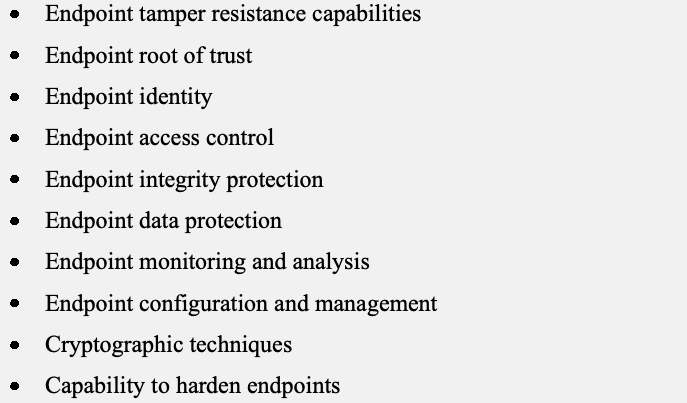
•エンドポイントの耐タンパー機能
•Endpoint root of trust
•エンドポイントのルート・オブ・トラスト
•Endpoint identity
•エンドポイントの識別
•Endpoint access control
•エンドポイントアクセス制御
•Endpoint integrity protection
•エンドポイント完全性保護
•Endpoint data protection
•エンドポイントデータ保護
•Endpoint monitoring and analysis
•エンドポイントの監視と分析
•Endpoint configuration and management
•エンドポイントの構成と管理
•Cryptographic techniques
•暗号技術
•Capability to harden endpoints
•エンドポイントを堅牢化する能力
5.3.7.2. Cybersecurity Capability Considerations
5.3.7.2. サイバーセキュリティ機能に関する考慮事項
Compute resources – including processing, memory, and storage – vary among IIoT devices. Some IIoT devices may have constrained resources, while others may have unused capabilities, both of which have implications for cybersecurity. Organizations should consider how the resources and capabilities available in the IIoT devices will integrate into the security architecture to achieve their cybersecurity objectives. Additionally, organizations should consider whether the operational and safety impacts for IIoT differ from the operational and safety impacts for other OT devices. For example, IIoT devices may support a separate data monitoring (i.e., read-only capability) for the environment and have minimal impact on operational controls or safety, which may allow organizations to implement security operations differently than those established for OT devices.
処理、メモリ、ストレージなどのコンピューティング資源はIIoTデバイスによって異なります。資源が制約されたデバイスもあれば、未使用の機能を備えるデバイスもあり、どちらもサイバーセキュリティに影響します。IIoTデバイスで利用可能な資源および機能をセキュリティアーキテクチャにどのように統合し、サイバーセキュリティ目標を達成するかを検討するべきです。また、IIoTの運用および安全性への影響が他のOTデバイスと異なるかも考慮するべきです。たとえば、IIoTデバイスは環境のデータ監視(すなわち読み取り専用機能)を別に行い、運用制御または安全性への影響を最小限にできる場合があります。その場合、OTデバイス向けに確立されたものとは異なるセキュリティ運用を実施できる可能性があります。
5.4. Cybersecurity Architecture Models
5.4. サイバーセキュリティアーキテクチャモデル
Building on the concepts and guidance from Sections 5.1, 5.2, and 5.3, the following subsections expand on the general OT and IIoT environments described in Section 2 and provide examples for how the environments might be adapted to support defense-in-depth security architectures.
第5.1節、第5.2節、第5.3節の概念およびガイダンスを踏まえ、以下の小節では第2節で説明した一般的なOTおよびIIoT環境を詳しく取り上げ、多層防御セキュリティアーキテクチャを支えるための環境適応例を示します。
5.4.1. Distributed Control System (DCS)-Based OT Systems
5.4.1. DCSベースのOTシステム
As described in Section 2, a distributed control system (DCS) is used to control production systems within the same geographic location for industries. Figure 17 shows an example DCS system implementation. Figure 18 shows an example defense-in-depth architecture applied to the DCS system.
第2節で説明したように、分散制御システム(DCS)は、各業界の同一地理拠点内にある生産システムの制御に用いられます。図17にDCSシステムの実装例を、図18にDCSシステムに適用した多層防御アーキテクチャの例を示します。
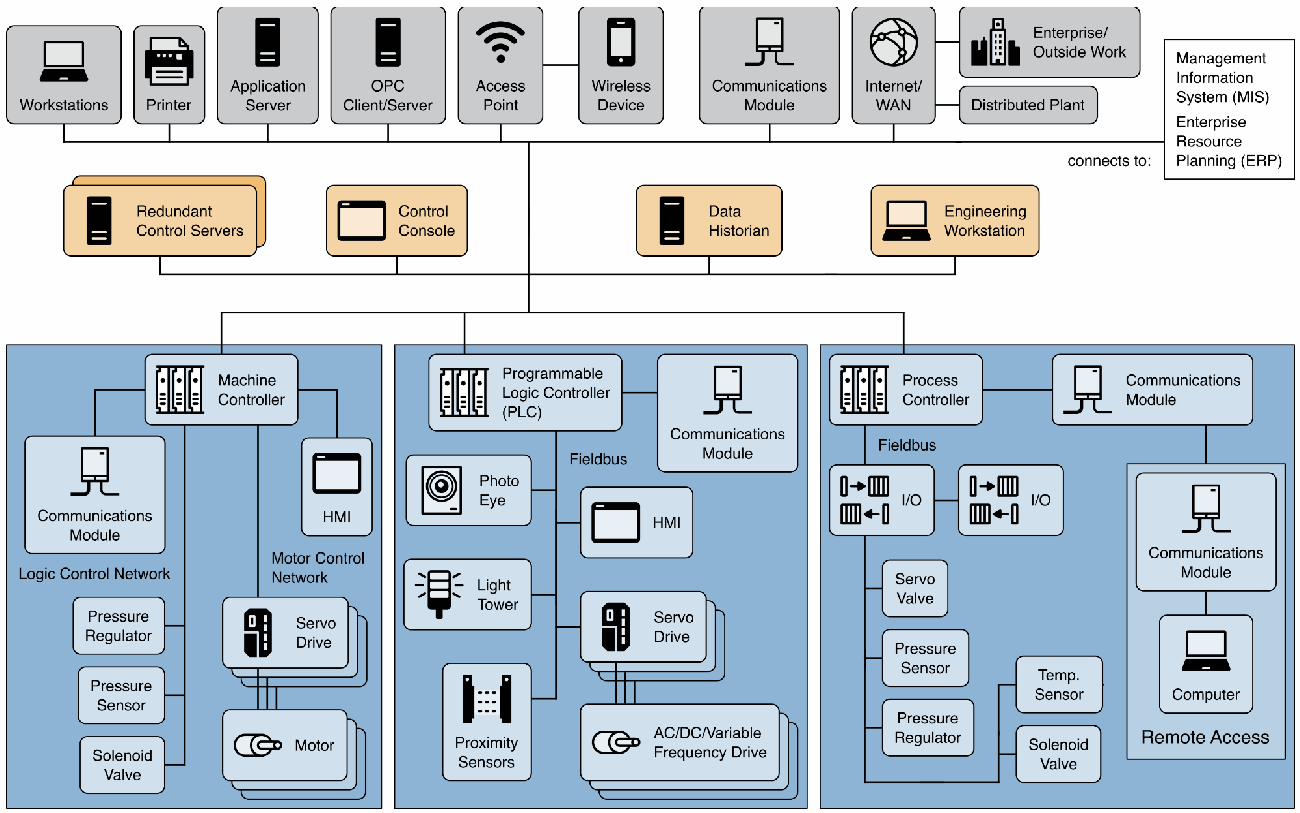
図17. DCSの実装例。上部のネットワークには、ワークステーション、プリンタ、アプリケーションサーバ、OPC クライアント/サーバ、アクセスポイント(無線デバイス付き)、通信モジュール、インターネット/WAN(Enterprise/Outside Work と Distributed Plant 付き)が接続し、接続先として Management Information System (MIS) と Enterprise Resource Planning (ERP) が注記されている。その下で、冗長制御サーバ、制御コンソール、データヒストリアン、エンジニアリングワークステーションが共通の線でつながり、3 つの制御区画へ続く。左: 通信モジュールと HMI を持つ機械コントローラ(Machine Controller)、圧力レギュレータ・圧力センサ・電磁弁がつながるロジック制御ネットワーク(Logic Control Network)、サーボドライブとモータがつながるモータ制御ネットワーク(Motor Control Network)。中央: 通信モジュールを持つプログラマブルロジックコントローラ(PLC)と、光電センサ(Photo Eye)、表示灯(Light Tower)、近接センサ、HMI、サーボドライブ、AC/DC/可変周波数ドライブがつながるフィールドバス(Fieldbus)。右: 通信モジュールを持つプロセスコントローラ、2 つの I/O モジュール、サーボ弁、圧力センサ、圧力レギュレータ、温度センサ、電磁弁がつながるフィールドバス(Fieldbus)、および通信モジュールとコンピュータからなる遠隔アクセス(Remote Access)の区画。
Fig. 17. A DCS implementation example
図17. DCSの実装例
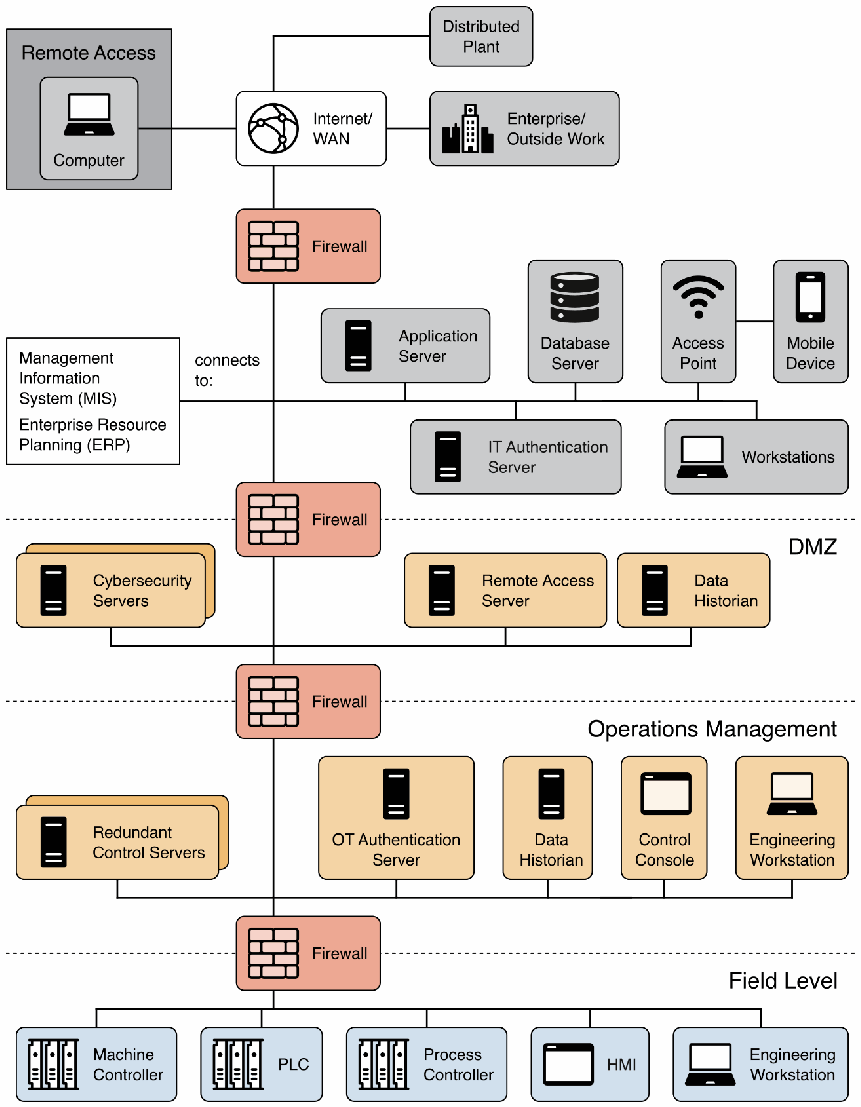
図18. DCSシステム向け多層防御セキュリティアーキテクチャの例。インターネット/WAN(Distributed Plant、Enterprise/Outside Work、コンピュータを持つ遠隔アクセス(Remote Access)の区画に接続)から縦の経路が 4 つのファイアウォールを通る。1 つ目のファイアウォールの下は企業ネットワークで、アプリケーションサーバ、データベースサーバ、モバイルデバイス付きのアクセスポイント、IT 認証サーバ、ワークステーションがあり、Management Information System (MIS) と Enterprise Resource Planning (ERP) に接続すると注記されている。2 つ目のファイアウォールの下は DMZ で、サイバーセキュリティサーバ、遠隔アクセスサーバ、データヒストリアンがある。3 つ目のファイアウォールの下は運用管理(Operations Management)で、冗長制御サーバ、OT 認証サーバ、データヒストリアン、制御コンソール、エンジニアリングワークステーションがある。4 つ目のファイアウォールの下は現場レベル(Field Level)で、機械コントローラ、PLC、プロセスコントローラ、HMI、エンジニアリングワークステーションがある。
Fig. 18. A defense-in-depth security architecture example for a DCS system
図18. DCSシステム向け多層防御セキュリティアーキテクチャの例
In Fig. 18, the assumption is that the organization has already addressed Layer 1 and Layer 2. For Layer 3, the organization should consider incorporating the following capabilities into the security architecture:
図18では、組織がレイヤー1およびレイヤー2にすでに対処済みであることを前提とします。レイヤー3では、次の機能をセキュリティアーキテクチャに組み込むことを検討するべきです。
•Separate networks into different levels or zones. In this example, the devices are split into different levels based on function. The field level includes devices that are typically found in the Purdue model levels 0, 1, and 2. The operations management level includes devices for monitoring and managing the field level devices and the Purdue level 3 components. The DMZ includes devices that support bridging the operations management and enterprise tiers. Organizations should also consider whether additional network segments are required for safety or security systems (e.g., physical monitoring and access controls, doors, gates, cameras, Voice over Internet Protocol [VoIP], access card readers). Network segmentation is an important step in applying a defense-in-depth strategy.
•ネットワークを異なるレベルまたはゾーンに分割します。この例では、機能に基づいてデバイスを異なるレベルに分けています。フィールドレベルには、通常Purdueモデルのレベル0、1、2にあるデバイスが含まれます。運用管理レベルには、フィールドレベルのデバイスおよびPurdueレベル3のコンポーネントを監視、管理するデバイスが含まれます。DMZには、運用管理層と企業層を橋渡しするデバイスが含まれます。安全またはセキュリティシステム(物理監視、アクセス制御、ドア、ゲート、カメラ、Voice over Internet Protocol [VoIP]、アクセスカードリーダーなど)に追加のネットワークセグメントが必要かも検討するべきです。ネットワークセグメンテーションは、多層防御戦略を適用するうえで重要な手順です。
•Boundary devices (e.g., firewalls) are added to control and monitor communications between different levels. Industrial-class firewalls are sometimes used between the field and operations management levels to provide additional support for OT-specific protocols or to allow devices to operate in harsh environments. Rules for both inbound and outbound communication should be defined so that only authorized communication passes between adjacent levels.
•異なるレベル間の通信を制御、監視するため、境界装置(ファイアウォールなど)を追加します。OT固有プロトコルへの追加対応や過酷な環境での動作を可能にするため、フィールド層と運用管理層の間に産業用ファイアウォールを使用する場合があります。隣接レベル間で許可された通信のみが通過するよう、インバウンドおよびアウトバウンド通信のルールを定義するべきです。
•Implement a DMZ to separate the OT environment from the enterprise network. Any communications between the enterprise level and the operations management level are required to go through services within the DMZ. Since the DMZ connects to outside environments, the services within the DMZ must be monitored and protected to avoid compromises that allow attackers to pivot to the OT environment without detection.
•OT環境を企業ネットワークから分離するためDMZを実装します。企業レベルと運用管理レベル間の通信は、DMZ内のサービスを必ず経由させます。DMZは外部環境に接続するため、検知されずに攻撃者がOT環境へ横展開できる侵害を防ぐよう、DMZ内のサービスを監視、保護しなければなりません。
•The security architecture diagram shows an IT authentication server in the enterprise network to authenticate users and a separate OT authentication server in the operations management network for OT users. Organizations may want to consider this approach if it supports their risk-based security objectives.
•このセキュリティアーキテクチャ図では、企業ネットワークにIT認証サーバーを置いて利用者を認証し、運用管理ネットワークにはOT利用者向けの別のOT認証サーバーを置いています。リスクベースのセキュリティ目標に合致する場合、組織はこの方式を検討するとよいです。
For Layer 4 and Layer 5, organizations should consider applying the principle of least functionality on all field, operations management, and DMZ devices to support application and device hardening. Organizations should identify and disable any non-essential capability, software, or ports on the devices. For example, a web server or SSH server may be available in some newer PLCs or HMIs. If these services are not used, they should be disabled, and the associated TCP/UDP ports should be disabled as well. Only enable the functionality when required.
レイヤー4およびレイヤー5では、アプリケーションとデバイスの堅牢化を支えるため、フィールド、運用管理、DMZのすべてのデバイスに最小機能の原則を適用することを検討するべきです。組織はデバイス上の不可欠でない機能、ソフトウェア、ポートを特定して無効化するべきです。たとえば、一部の新しいPLCやHMIではWebサーバーまたはSSHサーバーを利用できる場合があります。これらのサービスを使用しないなら無効化し、関連するTCP/UDPポートも無効化するべきです。必要な場合にのみ機能を有効にします。
5.4.2. DCS- and PLC-Based OT with IIoT
5.4.2. DCS・PLCベースOTとIIoT
Building on the guidance for DCS- and PLC-based OT environments in Section 5.4.1, Fig. 19 shows a simplified example security architecture implementation for the DCS system with additional IIoT devices configured to utilize a local IIoT platform for providing computing capabilities. Due to the different communication and architectural components that support IIoT, the example shows separate network segments for supporting the additional IIoT components. Communication from the IIoT platform tier is routed through the DMZ border firewall to allow organizations to consider data transmission to servers in the DMZ or to the enterprise/internet as required to support IIoT operational requirements. Additionally, this also permits the cybersecurity services located in the DMZ to monitor the IIoT platform tier.
第5.4.1節のDCSおよびPLCベースOT環境に関するガイダンスを踏まえ、図19に、コンピューティング機能を提供するローカルIIoTプラットフォームを利用するよう構成したIIoTデバイスを追加したDCSシステムの、簡略化したセキュリティアーキテクチャ実装例を示します。IIoTを支える通信およびアーキテクチャコンポーネントが異なるため、この例ではIIoTコンポーネント用に別のネットワークセグメントを示しています。IIoT運用要件を支えるためDMZ内のサーバーまたは企業ネットワーク/インターネットへのデータ送信を検討できるよう、IIoTプラットフォーム層からの通信はDMZ境界ファイアウォールを経由します。これによりDMZ内のサイバーセキュリティサービスがIIoTプラットフォーム層を監視できます。
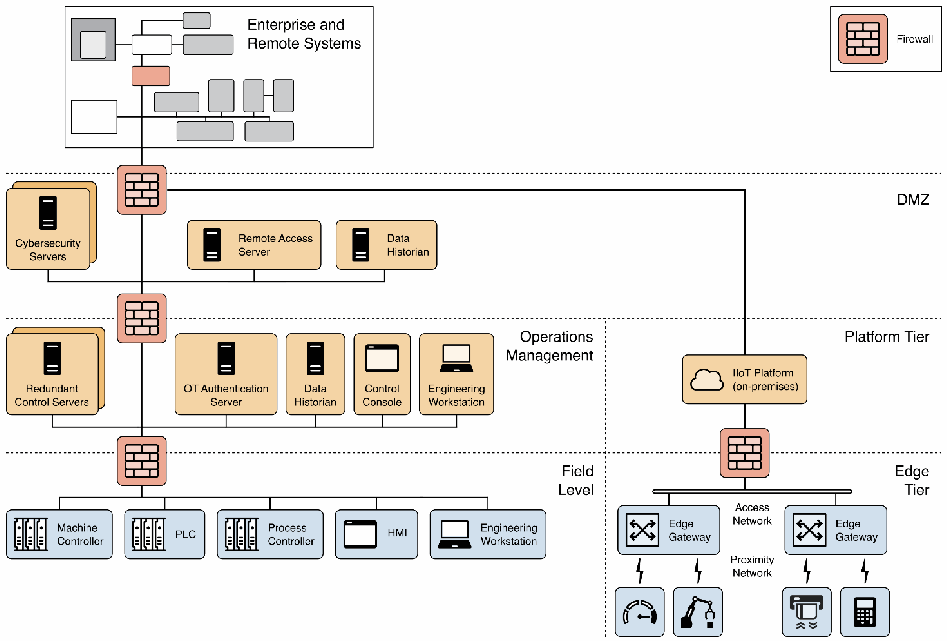
図19. IIoTデバイスを含むDCSシステムのセキュリティアーキテクチャ例。左側は図18 の構成を縮小したもので、上部に Enterprise and Remote Systems(ラベルのない小さな箱)があり、その下にファイアウォールで区切られた DMZ(サイバーセキュリティサーバ、遠隔アクセスサーバ、データヒストリアン)、運用管理(冗長制御サーバ、OT 認証サーバ、データヒストリアン、制御コンソール、エンジニアリングワークステーション)、現場レベル(機械コントローラ、PLC、プロセスコントローラ、HMI、エンジニアリングワークステーション)が並ぶ。右側では、最上部のファイアウォールから伸びる線がプラットフォーム層(Platform Tier)の IIoT Platform (on-premises) に届く。ファイアウォールがこれとエッジ層(Edge Tier)を分け、エッジ層ではアクセスネットワーク上の 2 つのエッジゲートウェイが近接ネットワークを介して 4 つの機器アイコンと無線で通信する。凡例がファイアウォールのアイコンを示す。
Fig. 19. A security architecture example for DCS system with IIoT devices
図19. IIoTデバイスを含むDCSシステムのセキュリティアーキテクチャ例
5.4.3. SCADA-Based OT Environments
5.4.3. SCADAベースのOT環境
Figure 20 shows an example implementation of the components and general configuration of a SCADA system. Typically, primary and backup control centers support one or more remote stations based on geographic locations, and regional control centers are geographically located to support one or more primary or backup control centers. Due to the distributed nature of the remote stations and control centers, communication between locations typically passes over external or WAN connections using wireless or wired mediums.
図20に、SCADAシステムのコンポーネントおよび一般的な構成の実装例を示します。通常、主制御センターとバックアップ制御センターが地理的な場所に応じて1つ以上の遠隔局を支え、地域制御センターは地理的に配置されて1つ以上の主またはバックアップ制御センターを支えます。遠隔局および制御センターは分散しているため、拠点間通信は通常、無線または有線媒体による外部接続またはWAN接続を経由します。
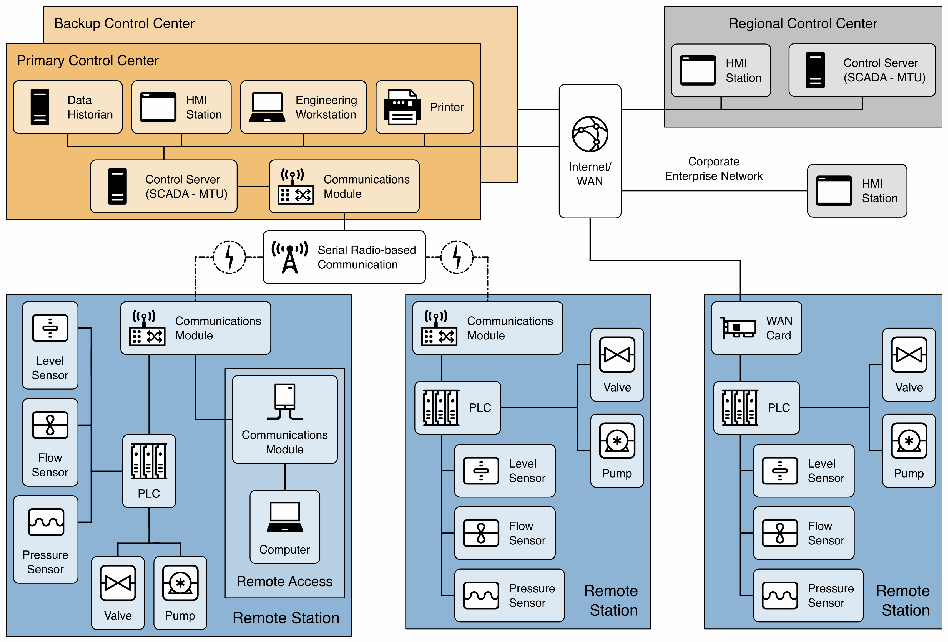
図20. OT環境におけるSCADAシステムの例。主制御センター(データヒストリアン、HMI ステーション、エンジニアリングワークステーション、プリンタ、制御サーバ(SCADA - MTU)、通信モジュール)がバックアップ制御センターの手前に重なり、インターネット/WAN に接続する。インターネット/WAN は地域制御センター(HMI ステーションと制御サーバ(SCADA - MTU))と、企業ネットワーク(Corporate Enterprise Network)経由で HMI ステーションにも接続する。通信モジュールはシリアル無線通信につながり、無線で 2 つの遠隔局に届く。1 つは通信モジュール、PLC、レベル・流量・圧力センサ、弁、ポンプと、通信モジュールとコンピュータからなる遠隔アクセスの区画を持つ。もう 1 つは通信モジュール、PLC、弁、ポンプ、レベル・流量・圧力センサを持つ。3 つ目の遠隔局は WAN カードでインターネット/WAN に接続し、PLC、弁、ポンプ、レベル・流量・圧力センサを持つ。
Fig. 20. An example SCADA system in an OT environment
図20. OT環境におけるSCADAシステムの例
Figure 21 shows an example defense-in-depth implementation for a SCADA system that assumes that the organization has already addressed Layer 1 and Layer 2. For Layer 3, the organization should consider incorporating the following capabilities in the security architecture:
図21は、組織がレイヤー1およびレイヤー2にすでに対処済みであることを前提とした、SCADAシステムの多層防御実装例を示します。レイヤー3では、次の機能をセキュリティアーキテクチャに組み込むことを検討するべきです。
•Separate networks into different zones or regions, which is important for applying a defense-in-depth strategy in a SCADA environment. Additional separation should be considered for security systems (e.g., physical monitoring and access controls, doors, gates, cameras, VoIP, access card readers).
•ネットワークを異なるゾーンまたは地域に分けることは、SCADA環境に多層防御戦略を適用するために重要です。セキュリティシステム(物理監視、アクセス制御、ドア、ゲート、カメラ、VoIP、アクセスカードリーダーなど)について、追加の分離を検討するべきです。
•Boundary devices (e.g., firewalls) are added between the different regions to control and monitor communications between the network segments. Industrial-class stateful firewalls may offer more support for OT-specific protocols and enhance protection for OT devices, like the PLC and controllers. Rules for inbound and outbound communication should be defined so that only authorized communication passes between regions.
•異なる地域間に境界装置(ファイアウォールなど)を追加し、ネットワークセグメント間の通信を制御、監視します。ステートフルな産業用ファイアウォールは、OT固有プロトコルへの対応を強化し、PLCやコントローラーなどのOTデバイスの保護を高める場合があります。地域間で許可された通信のみが通過するよう、インバウンドおよびアウトバウンド通信のルールを定義するべきです。
•Use secure connections (e.g., VPN tunnel, encrypted channel, point-to-point connection) between network segments, such as between a regional center and primary control centers and between remote stations and control centers. For geographically distanced locations, secure connections can be connected over the internet/WAN. Devices in the network segments should only connect to other segments through the secure connection and should be restricted when accessing the internet.
•ネットワークセグメント間(地域センターと主制御センター間、遠隔局と制御センター間など)にセキュアな接続(VPNトンネル、暗号化チャネル、ポイントツーポイント接続など)を使用します。地理的に離れた拠点では、インターネット/WAN経由でセキュアな接続を確立できます。ネットワークセグメント内のデバイスはセキュア接続経由でのみ他のセグメントに接続し、インターネットへのアクセスを制限するべきです。
•Implement a DMZ to separate the control centers from the enterprise network. Any communications between the enterprise network and the control centers must go through services within the DMZ. Since the DMZ connects to outside environments, the services within the DMZ must be monitored and protected to avoid compromises within the DMZ that might allow attackers to pivot to the OT environment without detection.
•制御センターを企業ネットワークから分離するためDMZを実装します。企業ネットワークと制御センター間の通信は、DMZ内のサービスを必ず経由させます。DMZは外部環境に接続するため、検知されずに攻撃者がOT環境へ横展開できるDMZ内の侵害を防ぐよう、サービスを監視、保護しなければなりません。
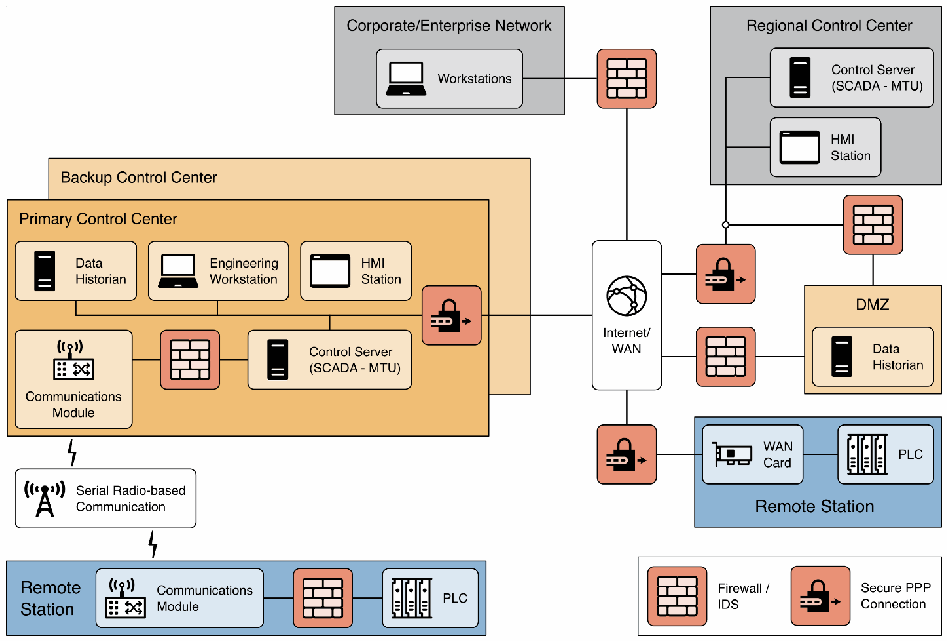
図21. SCADAシステムのセキュリティアーキテクチャ例。企業ネットワーク(Corporate/Enterprise Network: ワークステーション)はファイアウォール/IDS を介してインターネット/WAN に接続する。地域制御センター(制御サーバ(SCADA - MTU)と HMI ステーション)は分岐点につながり、そこから Secure PPP 接続を介してインターネット/WAN へ、ファイアウォールを介して DMZ(データヒストリアン)へつながる。DMZ はファイアウォールを介してインターネット/WAN にも接続する。バックアップ制御センターの手前にある主制御センター(データヒストリアン、エンジニアリングワークステーション、HMI ステーション、通信モジュール、ファイアウォール、制御サーバ(SCADA - MTU))は Secure PPP 接続を介してインターネット/WAN に接続する。遠隔局(WAN カードと PLC)は Secure PPP 接続を介してインターネット/WAN に接続する。通信モジュールはシリアル無線通信で別の遠隔局(通信モジュール、ファイアウォール、PLC)と通信する。凡例がファイアウォール/IDS と Secure PPP 接続のアイコンを示す。
Fig. 21. A security architecture example for a SCADA system
図21. SCADAシステムのセキュリティアーキテクチャ例
For Layer 4 and Layer 5, organizations should consider applying the principle of least functionality to all remote station components, control center components, and DMZ devices to support application and device hardening. Organizations should identify and disable any non-essential capability, software, or ports on the devices. For example, a webserver or SSH server may be available in some newer PLCs or HMIs. If these services are not used, they should be disabled, and the associated TCP/UDP ports should be disabled. Only enable the functionality when required.
レイヤー4およびレイヤー5では、アプリケーションとデバイスの堅牢化のため、遠隔局コンポーネント、制御センターコンポーネント、DMZデバイスすべてに最小機能の原則を適用することを検討するべきです。組織は、デバイス上の不可欠でない機能、ソフトウェア、ポートを特定して無効化するべきです。たとえば、一部の新しいPLCやHMIではWebサーバーまたはSSHサーバーが利用できる場合があります。これらのサービスを使用しない場合は無効にするべきであり、関連するTCP/UDPポートも無効にするべきです。機能は必要な場合にのみ有効にします。
6. Applying the Cybersecurity Framework to OT
6. サイバーセキュリティフレームワークのOTへの適用
Many public and private-sector organizations have adopted the NIST Cybersecurity Framework (CSF) [CSF] to guide cybersecurity activities and consider cybersecurity risks. The Framework consists of five concurrent and continuous Functions – Identify, Protect, Detect, Respond, and Recover – for presenting industry standards, guidelines, and practices in a manner that allows for the communication of cybersecurity activities and outcomes across the organization. When considered together, these Functions provide a high-level, strategic view for cybersecurity risk management. The Framework further identifies underlying key Categories and Subcategories for each Function and matches them with example Informative References, such as existing standards, guidelines, and practices for each Subcategory.
多くの公的機関および民間組織が、サイバーセキュリティ活動の指針とし、サイバーセキュリティリスクを検討するために、NISTサイバーセキュリティフレームワーク(CSF)[CSF]を採用しています。フレームワークは、識別(Identify)、防御(Protect)、検知(Detect)、対応(Respond)、復旧(Recover)という、並行して継続的に実施される5つの機能で構成され、業界の標準、ガイドライン、および実践を、組織全体でサイバーセキュリティ活動とその成果を伝達できる形で提示します。これらの機能をまとめて検討することにより、サイバーセキュリティリスク管理の高いレベルの戦略的な視点が得られます。フレームワークはさらに、各機能の基礎となる主要なカテゴリとサブカテゴリを特定し、各サブカテゴリについて、既存の標準、ガイドライン、実践などの参考情報の例と対応付けています。
The five Functions include 23 Categories of cybersecurity outcomes and Subcategories that further divide the Categories into more specific technical or management activities. For this section, each subsection references a CSF Function and Category and includes the CSF two-letter abbreviations for reference.
5つの機能には、サイバーセキュリティの成果に関する23のカテゴリと、カテゴリをより具体的な技術的活動または管理的活動に細分化したサブカテゴリが含まれます。本節では、各小節がCSFの機能とカテゴリを参照し、参照用にCSFの2文字の略語を付しています。
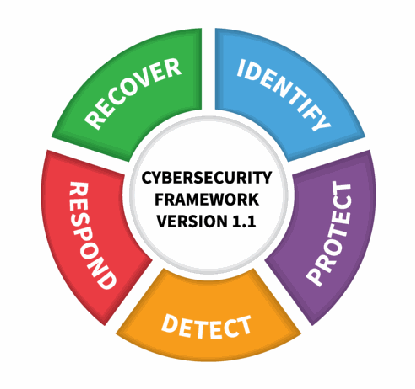
サイバーセキュリティフレームワーク バージョン1.1の機能。CYBERSECURITY FRAMEWORK VERSION 1.1 と記された中心の周りに、5 色の区画からなる輪があり、時計回りに IDENTIFY(識別、青)、PROTECT(防御、紫)、DETECT(検知、橙)、RESPOND(対応、赤)、RECOVER(復旧、緑)と並ぶ。
The CSF Functions guide the following actions:
CSFの機能は、以下の行動の指針となります。
Identify (ID) – Develop an organizational understanding to manage cybersecurity risk to systems, people, assets, data, and capabilities.
識別(ID)- システム、人、資産、データ、および能力に対するサイバーセキュリティリスクを管理するための組織的な理解を深めます。
Protect (PR) – Develop and implement appropriate safeguards to ensure delivery of critical services.
防御(PR)- 重要なサービスの提供を確保するための適切な保護策を策定し、実装します。
Detect (DE) – Develop and implement appropriate activities to identify the occurrence of the cybersecurity event.
検知(DE)- サイバーセキュリティイベントの発生を識別するための適切な活動を策定し、実装します。
Respond (RS) – Develop and implement appropriate activities to take action regarding a detected cybersecurity incident.
対応(RS)- 検知されたサイバーセキュリティインシデントに関して措置を講じるための適切な活動を策定し、実装します。
Recover (RC) – Develop and implement appropriate activities to maintain plans for resilience and to restore any capabilities or services that were impaired due to a cybersecurity incident.
復旧(RC)- レジリエンスのための計画を維持し、サイバーセキュリティインシデントによって損なわれた能力またはサービスを復旧するための適切な活動を策定し、実装します。
This section discusses all CSF Functions and selected CSF Categories and Subcategories. Additionally, some Categories include additional OT-specific considerations that are not included in the CSF.
本節ではCSFのすべての機能と、選択したCSFカテゴリおよびサブカテゴリを説明します。また、一部カテゴリではCSFに含まれないOT固有の追加考慮事項も示します。
6.1. Identify (ID)
6.1. 識別(ID)
The Identify Function provides foundational activities to effectively use the CSF. The intended outcome of the Identify Function is to develop an organizational understanding to manage cybersecurity risks to systems, people, assets, data, and capabilities.
「識別」機能は、CSFを効果的に活用するための基盤となる活動を提供します。この機能が目指す成果は、システム、人、資産、データ、能力に対するサイバーセキュリティリスクを管理するための組織的理解を深めることです。
6.1.1. Asset Management (ID.AM)
6.1.1. 資産管理(ID.AM)
The ability for organizations to properly and consistently identify and manage data, personnel, devices, systems, and facilities based on their relative importance provides a foundational capability to support an organizational cybersecurity program. Additionally, updating inventory information when components are added, removed, or changed (e.g., patched, new firmware installed, component swapped during maintenance) helps organizations accurately manage their overall environmental risks. Organizations should consider including the following to support their asset management capability:
データ、人員、デバイス、システム、施設を相対的重要度に基づいて適切かつ一貫して識別、管理できることは、組織のサイバーセキュリティプログラムを支える基盤機能です。また、コンポーネントの追加、削除、変更(パッチ適用、新しいファームウェア導入、保守時のコンポーネント交換など)の際にインベントリ情報を更新すると、環境全体のリスクを正確に管理できます。資産管理機能を支えるため、次を含めることを検討するべきです。
•Unique identifiers to differentiate and track assets
•資産を識別、追跡する一意の識別子
•Hardware inventory management to track computing and network devices within the environment, including device details and location. Device details may include vendor, model, serial number, purchase information, and manufacturing/build information (e.g., provenance information).
•環境内のコンピューティングおよびネットワークデバイスを追跡するハードウェアインベントリ管理(デバイスの詳細および場所を含みます)。デバイス詳細にはベンダー、モデル、シリアル番号、購入情報、製造/構築情報(来歴情報など)を含められます。
•Software and firmware inventory management to track the software and firmware installed with the OT components, including version numbers, location information, and software bill of materials (SBOM)
•OTコンポーネントに導入されたソフトウェアおよびファームウェアを追跡するインベントリ管理(バージョン番号、場所情報、ソフトウェア部品表(SBOM)を含む)
•Vendor information to establish a repository of vendor information, points of contact, warranty information, locations of recall, and update information
•ベンダー情報の保管庫を確立するためのベンダー情報、連絡先、保証情報、リコールの所在、更新情報
•Documented roles and responsibilities to identify specific individuals, teams, or organization groups who represent the asset owner and those with operation, maintenance, and cybersecurity roles and responsibilities
•資産所有者、および運用、保守、サイバーセキュリティの役割と責任を持つ個人、チーム、組織グループを特定する文書化された役割および責任
Supplemental guidance for ID.AM can be found in the following documents:
ID.AMに関する補足ガイダンスは次の文書にあります。
•NIST SP 1800-5, IT Asset Management
•NIST SP 1800-5, IT資産管理
•NIST SP 800-53, Rev. 5, Security and Privacy Controls for Information Systems and Organizations
•NIST SP 800-53 Rev. 5, 情報システムおよび組織のセキュリティ・プライバシー管理策
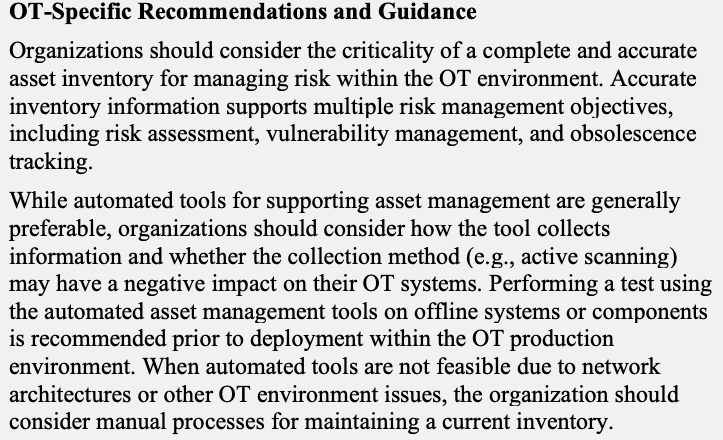
OT固有の推奨事項およびガイダンス
Organizations should consider the criticality of a complete and accurate asset inventory for managing risk within the OT environment. Accurate inventory information supports multiple risk management objectives, including risk assessment, vulnerability management, and obsolescence tracking.
組織は、OT環境内でリスクを管理するうえで、完全かつ正確な資産インベントリが重要であることを考慮すべきです。正確なインベントリ情報は、リスクアセスメント、脆弱性管理、陳腐化の追跡など、複数のリスク管理目標を支えます。
While automated tools for supporting asset management are generally preferable, organizations should consider how the tool collects information and whether the collection method (e.g., active scanning) may have a negative impact on their OT systems. Performing a test using the automated asset management tools on offline systems or components is recommended prior to deployment within the OT production environment. When automated tools are not feasible due to network architectures or other OT environment issues, the organization should consider manual processes for maintaining a current inventory.
資産管理を支える自動化ツールは一般に望ましいですが、組織は、ツールがどのように情報を収集するか、また収集方法(例:アクティブスキャン)がOTシステムに悪影響を及ぼす可能性があるかどうかを検討すべきです。OTの本番環境に展開する前に、オフラインのシステムやコンポーネントで自動資産管理ツールを使ったテストを実施することを推奨します。ネットワークアーキテクチャやその他のOT環境の問題により自動化ツールが実現可能でない場合、組織は、最新のインベントリを維持する手動プロセスを検討すべきです。
6.1.1.1. Mapping Data Flows (ID.AM-3)
6.1.1.1. データフローのマッピング(ID.AM-3)
Data flow diagrams help a manufacturer understand the flow of data between networked components. Documenting data flows enables organizations to understand the expected behavior of their networks. This understanding of how devices communicate assists with troubleshooting as well as response and recovery activities. This information can be leveraged during forensic activities or used for analysis to identify anomalies.
データフロー図は、製造事業者がネットワーク接続されたコンポーネント間のデータの流れを理解する助けとなります。データフローを文書化すると、ネットワークの想定動作を理解できます。デバイス間通信の理解は、トラブルシューティング、対応、復旧活動に役立ちます。この情報をフォレンジック活動に活用したり、異常を特定する分析に使ったりできます。
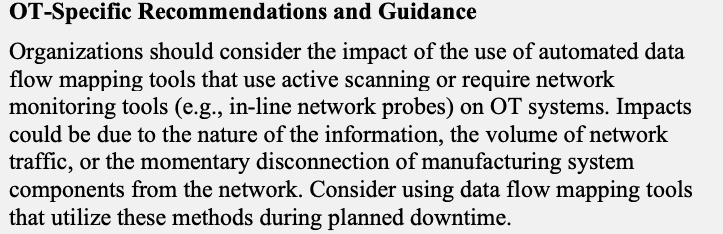
OT固有の推奨事項およびガイダンス
Organizations should consider the impact of the use of automated data flow mapping tools that use active scanning or require network monitoring tools (e.g., in-line network probes) on OT systems. Impacts could be due to the nature of the information, the volume of network traffic, or the momentary disconnection of manufacturing system components from the network. Consider using data flow mapping tools that utilize these methods during planned downtime.
組織は、アクティブスキャンを用いる、またはネットワーク監視ツール(例:インラインのネットワークプローブ)を必要とする自動データフローマッピングツールの使用が、OTシステムに及ぼす影響を検討すべきです。影響は、情報の性質、ネットワークトラフィックの量、または製造システムコンポーネントのネットワークからの一時的な切断によって生じうます。これらの方法を利用するデータフローマッピングツールは、計画停止中に使用することを検討します。
6.1.1.2. Network Architecture Documentation (Supports the Outcome of ID.AM)
6.1.1.2. ネットワークアーキテクチャの文書化(ID.AMの成果を支援)
Network architecture documentation tools help a manufacturer identify, document, and diagram the interconnections between networked devices, corporate networks, and other external connections. A comprehensive understanding of the interconnections within the environment is critical for the successful deployment of cybersecurity controls. This information is equally important for effective network monitoring.
ネットワークアーキテクチャ文書化ツールは、製造事業者がネットワークデバイス、企業ネットワーク、その他の外部接続間の相互接続を特定、文書化、図示するのに役立ちます。環境内の相互接続を包括的に理解することは、サイバーセキュリティ管理策の導入を成功させるうえで不可欠です。この情報は、効果的なネットワーク監視にも同様に重要です。
OT固有の推奨事項およびガイダンス
Network architecture documentation tools that use automated topology discovery technologies can only capture details from IP-based networked devices. Many OT environments contain isolated systems, components, or systems connected on non-IP networks. The OT environment may not be technically capable of using automated network architecture documentation tools, and manual processes may be required to document these components.
自動トポロジー検出技術を用いるネットワークアーキテクチャ文書化ツールは、IPベースのネットワーク接続デバイスの詳細しか取得できません。多くのOT環境には、孤立したシステム、コンポーネント、または非IPネットワークに接続されたシステムが含まれます。OT環境が技術的に自動ネットワークアーキテクチャ文書化ツールを使用できない場合があり、これらのコンポーネントを文書化するには手作業のプロセスが必要になる可能性があります。
Asset owners may also want to consider how automated scanning activities may potentially impact the OT system by testing automation tools in a non-production environment. Based on testing results, asset owners should consider utilizing automated OT network architecture documentation tools during planned downtime.
資産所有者は、非本番環境で自動化ツールをテストすることにより、自動スキャン活動がOTシステムに及ぼす可能性のある影響を検討することも考えられます。テスト結果に基づき、資産所有者は、計画停止中に自動化されたOTネットワークアーキテクチャ文書化ツールを利用することを検討すべきです。
Organizations may also want to consider physically inspecting OT network connections or analyzing network logs to document the OT network architecture, especially if the network is not large or complicated. Incorporating OT network activity monitoring may help organizations identify the addition or removal of devices within the environment between planned scanning activities.
組織は、OTネットワークアーキテクチャを文書化するため、OTネットワーク接続の物理的な確認やネットワークログの分析を検討してもよいです。特にネットワークが大規模でも複雑でもない場合に有効です。OTネットワーク活動の監視を組み込むと、計画されたスキャンとスキャンの間に環境内でデバイスが追加または撤去されたことを特定するのに役立つ場合があります。
6.1.2. Governance (ID.GV)
6.1.2. ガバナンス(ID.GV)
Effective governance involves organizational leadership incorporating risk management objectives into the strategic planning process along with resiliency, privacy, and cybersecurity objectives, as well as providing the required resources to effectively implement and sustain the cybersecurity program. From this process, organizational leadership develops and disseminates policies that establish security requirements for their environments. These policies may include the identification and assignment of roles, responsibilities, management commitment, and compliance. The policies may also reflect coordination among the organizational entities responsible for the different aspects of security (e.g., technical, physical, personnel, cyber-physical, access control, media protection, vulnerability management, maintenance, monitoring).
効果的なガバナンスには、組織の指導層が、レジリエンス、プライバシー、およびサイバーセキュリティの目的とともにリスク管理の目的を戦略計画プロセスに組み込むこと、ならびにサイバーセキュリティプログラムを効果的に実装し維持するために必要なリソースを提供することが含まれます。このプロセスから、組織の指導層は、自らの環境に対するセキュリティ要件を定めるポリシーを策定し、周知します。これらのポリシーには、役割の特定と割り当て、責任、経営層のコミットメント、およびコンプライアンスが含まれる場合があります。ポリシーには、セキュリティのさまざまな側面(例:技術、物理、人的、サイバーフィジカル、アクセス制御、媒体保護、脆弱性管理、保守、監視)を担当する組織内の主体間の連携が反映されることもあります。
Sections 3 and 4 provide additional details for governance. Supplemental guidance for ID.GV can be found in the following documents:
第3章および第4章では、ガバナンスに関する追加の詳細を示します。ID.GVに関する補足ガイダンスは、以下の文書に記載されています。
•NIST SP 800-39, Managing Information Security Risk: Organization, Mission, and Information System View
•NIST SP 800-39, Managing Information Security Risk: Organization, Mission, and Information System View
•NIST SP 800-37, Rev. 2, Risk Management Framework for Information Systems and Organizations: A System Life Cycle Approach for Security and Privacy
•NIST SP 800-37 Rev. 2, 情報システムおよび組織のリスク管理フレームワーク:セキュリティとプライバシーのためのシステムライフサイクルアプローチ
•NIST SP 800-100, Information Security Handbook: A Guide for Managers
•NIST SP 800-100, 情報セキュリティハンドブック:管理者向けガイド
•NIST IR 8286, Integrating Cybersecurity and Enterprise Risk Management (ERM)
•NIST IR 8286, サイバーセキュリティとエンタープライズリスク管理(ERM)の統合

OT固有の推奨事項およびガイダンス
Organizations should consider:
組織は、次の事項を検討すべきです。
•Ensuring that the cybersecurity program is given sufficient resources to support the organization’s IT and OT risk management strategy
原本PDFの抜粋画像
•サイバーセキュリティプログラムに、組織のITおよびOTのリスク管理戦略を支えるのに十分なリソースが与えられていることを確認する
•Ensuring that policies take the full life cycle of the OT systems into consideration
•方針がOTシステムのライフサイクル全体を考慮していることを確認する
•Ensuring that legal and regulatory cybersecurity requirements that affect OT operations are understood and managed
•OTの運用に影響する法的・規制上のサイバーセキュリティ要件が理解され、管理されていることを確認する
•Establishing one or more senior official positions that are responsible and accountable for the organization’s governance and risk management for IT and OT cybersecurity programs
•ITおよびOTのサイバーセキュリティプログラムに関する組織のガバナンスとリスク管理に責任を負い、説明責任を持つ上級職を一つ以上設ける
•Establishing communication and coordination between IT and OT organizations
•ITとOTの組織間のコミュニケーションと調整を確立する
•Cross-training IT and OT personnel to support the cybersecurity program
•ITとOTの要員を相互訓練してサイバーセキュリティプログラムを支援する
6.1.3. Risk Assessment (ID.RA)
6.1.3. リスク評価(ID.RA)
A cybersecurity risk assessment is performed to identify risks and estimate the magnitude of harm to operations, assets, or individuals that might result from cyber incidents, such as unauthorized access, use, disclosure, disruption, modification, or destruction of an information system or data. Organizations should consider the frequency with which to update risk assessments and test system cybersecurity controls. Supplemental guidance for ID.RA can be found in the following documents:
サイバーセキュリティリスク評価は、情報システムまたはデータへの不正なアクセス、使用、開示、中断、改変、破壊などのサイバーインシデントによって運用、資産、個人に生じ得る損害のリスクを特定し、その規模を推定するために実施します。リスク評価を更新し、システムのサイバーセキュリティ管理策を試験する頻度を検討するべきです。ID.RAの補足ガイダンスは次の文書にあります。
•NIST SP 800-30, Rev. 1, Guide for Conducting Risk Assessments
•NIST SP 800-30 Rev. 1, リスク評価実施ガイド
•NIST SP 800-37, Rev. 2, Risk Management Framework for Information Systems and Organizations: A System Life Cycle Approach for Security and Privacy
•NIST SP 800-37, Rev. 2, Risk Management Framework for Information Systems and Organizations: A System Life Cycle Approach for Security and Privacy
•NIST SP 800-39, Managing Information Security Risk: Organization, Mission, and Information System View
•NIST SP 800-39, 情報セキュリティリスク管理:組織、ミッション、情報システムの視点
OT固有の推奨事項およびガイダンス
In OT environments, risks and impacts may be related to safety, health, and the environment, in addition to business and financial impacts. As a result, organizations may find that conducting a cost-benefit analysis for some types of risks is not possible. In these cases, organizations should consider reviewing past cyber and non-cyber incidents that have resulted in the loss of power, control, upstream feed, or downstream capacity, as well as major equipment failures. A PHA, FMEA, or analysis of past events can be used to understand the potential impact of a cyber incident. ISA 62443-3-2 provides guidance on how to assess cyber risk in an environment with these potential consequences.
OT環境では、リスクと影響が、事業上および財務上の影響に加えて、安全、健康、環境に関連する場合があります。その結果、組織は、一部の種類のリスクについて費用便益分析を実施できないと判断する場合があります。そのような場合、組織は、電力、制御、上流供給、下流の処理能力の喪失を招いた過去のサイバーインシデントおよび非サイバーインシデント、ならびに重大な機器故障のレビューを検討すべきです。サイバーインシデントの潜在的な影響を理解するために、PHA、FMEA、または過去の事象の分析を用いることができます。ISA 62443-3-2は、こうした潜在的な結果を伴う環境でサイバーリスクを評価する方法についての指針を提供しています。
Risk assessments also require the identification of both vulnerabilities and threats to the OT environment. Maintaining an accurate inventory of the IT and OT assets within the environment of operation – including the product vendor, model numbers, firmware, OSs, and software versions installed on the assets – facilitates the identification, tracking, and remediation of vulnerabilities. OT-specific vulnerability information is available through multiple methods, including:
リスクアセスメントでは、OT環境に対する脆弱性と脅威の両方の特定も必要です。運用環境内のITおよびOT資産の正確なインベントリ(製品ベンダー、型番、ファームウェア、OS、資産にインストールされているソフトウェアのバージョンを含む)を維持すると、脆弱性の特定、追跡、是正が容易になります。OT固有の脆弱性情報は、次を含む複数の方法で入手できます。
•Using OT-specific tools to automate asset inventory creation, cross-correlation of the inventory with known vulnerabilities and threats, and regular updates
原本PDFの抜粋画像
•OT固有のツールを使用して、資産インベントリの作成、インベントリと既知の脆弱性および脅威との照合、定期的な更新を自動化する
•Monitoring security groups, associations, and vendors for security alerts and advisories
•セキュリティ関連のグループ、団体、ベンダーからのセキュリティアラートおよび勧告の監視
•Reviewing the NVD database for detailed information on known vulnerabilities for hardware and software assets
•ハードウェア資産とソフトウェア資産の既知の脆弱性に関する詳細情報について、NVDデータベースを確認する
Threat information that is relevant to the environment can be obtained from both internal resources and external threat intelligence information-sharing forums. Organizations should consider participating in cyber threat information sharing [SP800-150].
原本PDFの抜粋画像

環境に関係する脅威情報は、内部資源と外部の脅威インテリジェンス共有フォーラムの双方から入手できます。組織はサイバー脅威情報の共有への参加を検討すべきです[SP800-150]。
6.1.4. Risk Management Strategy (ID.RM)
6.1.4. リスク管理戦略(ID.RM)
The risk management strategy guides how risk is framed, assessed, responded to, and monitored and provides a consistent approach to making risk-based decisions across the organization. Risk tolerance, assumptions, constraints, priorities, and trade-offs are identified for investment and operational decision making. Additionally, the risk management strategy identifies acceptable risk assessment methodologies, potential risk responses, and a process to continuously monitor the security posture (or implementation of security countermeasures and outcomes) of the organization.
リスク管理戦略は、リスクをどのようにフレーミングし、アセスメントし、対応し、監視するかを導くものであり、組織全体でリスクに基づく意思決定を行うための一貫したアプローチを提供します。投資と運用に関する意思決定のために、リスク許容度、前提、制約、優先順位、およびトレードオフが特定されます。さらに、リスク管理戦略では、許容されるリスクアセスメント手法、考えられるリスク対応、および組織のセキュリティ態勢(またはセキュリティ対策の実装とその成果)を継続的に監視するプロセスを特定します。
Section 3 describes the overall risk management process for supporting an effective cybersecurity program. The following NIST documents provide additional implementation guidance for developing a risk management strategy:
第3章では、効果的なサイバーセキュリティプログラムを支えるためのリスク管理プロセス全体について説明します。リスク管理戦略の策定に関する追加の実装ガイダンスは、以下のNIST文書に記載されています。
•NIST SP 800-37, Rev. 2, Risk Management Framework for Information Systems and Organizations: A System Life Cycle Approach for Security and Privacy
•NIST SP 800-37 Rev. 2, 情報システムおよび組織のリスク管理フレームワーク:セキュリティとプライバシーのためのシステムライフサイクルアプローチ
•NIST SP 800-39, Managing Information Security Risk: Organization, Mission, and Information System View
•NIST SP 800-39, 情報セキュリティリスク管理:組織、ミッション、情報システムの視点
•NIST IR 8179, Criticality Analysis Process Model: Prioritizing Systems and Components
•NIST IR 8179, 重要度分析プロセスモデル:システムおよびコンポーネントの優先順位付け

OT固有の推奨事項およびガイダンス
When establishing an OT risk management strategy, organizations should consider:
OTのリスク管理戦略を確立する際、組織は次の事項を検討すべきです。
•Ensuring that the risk tolerance of an OT environment is informed by the organization’s role in critical infrastructure and sector-specific risk analysis
原本PDFの抜粋画像
•OT環境のリスク許容度が、重要インフラにおける組織の役割と、セクター固有のリスク分析を踏まえて決定されていることを確認する
•Documenting failure scenarios that involve IT components within the OT environment and their effect on operations and safety
•OT環境内のIT構成要素が関わる障害シナリオと、それが運用と安全に与える影響を文書化する
•Establishing processes to periodically update information to determine the current risk posture for the environment and coordinate required adjustments to risk management and management controls
•環境の現在のリスク態勢を判断するための情報を定期的に更新し、リスク管理および管理策に必要な変更を調整するプロセスを確立する
Overall risk can also be reduced by addressing likelihood and consequence. For OT systems, the risk management strategy should consider non-security and safety controls (e.g., pressure relief valves, manual valves) that can also help reduce the consequence of a failure.
原本PDFの抜粋画像

発生可能性と結果に対処することでも全体的なリスクを低減できます。OTシステムでは、故障の結果を低減する助けにもなる圧力逃し弁や手動バルブなど、セキュリティ目的ではない管理策および安全管理策をリスク管理戦略で考慮すべきです。
6.1.5. Supply Chain Risk Management (ID.SC)
6.1.5. サプライチェーンリスク管理(ID.SC)
Supply chains are multifaceted and built on a variety of business, economic, and technological factors. Organizations choose their suppliers, and consumers choose their sources based on a range of factors that vary from corporate preferences and existing business relationships to more discrete considerations, such as the existence of limited sources of supply or other unique characteristics.
サプライチェーンは多面的であり、さまざまな事業、経済、技術要因に基づいて構成されます。組織は多様な要因に基づいて供給業者を選び、消費者も供給元を選択します。要因には、企業の嗜好や既存の取引関係から、供給元の限定やその他の固有特性といった個別の事情まで含まれます。
The Subcategories (outcomes) that fall within the CSF Supply Chain Risk Management Category provide the basis for developing processes and procedures for managing supply chain risk. These risks include the insertion of counterfeits, unauthorized production, malicious insiders, tampering, theft, and the insertion of malicious software and hardware, as well as poor manufacturing and development practices in the cyber supply chain. These risks must be identified, assessed, and managed. The CSF Category also addresses supplier and third-party partner contracts, assessments, evaluations, and response and recovery planning. Additionally, organizations should investigate SBOMs and distributed ledger (e.g., blockchain) technologies to support supply chain risk management. For example, SBOM information can identify software components and their relationships or dependencies on other components. Having this information available can help an organization determine whether a device is affected by reported software vulnerabilities. Supplemental guidance for Supply Chain Risk Management can be found in the following documents:
CSFの「サプライチェーンリスク管理」カテゴリに属するサブカテゴリ(成果)は、サプライチェーンリスクを管理するプロセスおよび手順を策定する基礎となります。リスクには、偽造品の混入、無許可の製造、悪意ある内部関係者、改ざん、窃盗、悪意あるソフトウェアやハードウェアの挿入、サイバーサプライチェーンにおける不適切な製造・開発慣行が含まれます。これらのリスクを特定、評価、管理しなければなりません。このCSFカテゴリでは、供給業者および第三者パートナーとの契約、評価、査定、対応・復旧計画も扱います。また、サプライチェーンリスク管理を支えるため、SBOMや分散型台帳(ブロックチェーンなど)技術を調査するべきです。たとえばSBOM情報から、ソフトウェアコンポーネントと他のコンポーネントとの関係または依存関係を特定できます。この情報を利用できれば、報告されたソフトウェア脆弱性がデバイスに影響するか組織が判断しやすくなります。サプライチェーンリスク管理の補足ガイダンスは次の文書にあります。
•NIST SP 800-161, Supply Chain Risk Management Practices for Federal Information Systems and Organizations
•NIST SP 800-161, 連邦情報システムおよび組織のサプライチェーンリスク管理慣行
•NIST IR 8276, Key Practices in Cyber Supply Chain Risk Management: Observations from Industry
•NIST IR 8276, サイバーサプライチェーンリスク管理の主要慣行:業界からの観察
OT固有の推奨事項およびガイダンス
Organizations should consider documenting and tracking serial numbers, checksums, digital certificates/signatures, or other identifying features that can enable them to verify the authenticity of vendor-provided OT hardware, software, and firmware. Organizations should also consider whether OT is purchased directly from the original equipment manufacturer (OEM) or an authorized third-party distributor or reseller. Suppliers should be assessed or reviewed to ensure that they continue to follow best practices.
組織は、ベンダーが提供するOTのハードウェア、ソフトウェア、ファームウェアの真正性を検証できるよう、シリアル番号、チェックサム、デジタル証明書/署名、その他の識別特性を文書化し追跡することを検討すべきです。組織は、OTを相手先商標製品製造業者(OEM)から直接購入するのか、認可されたサードパーティの販売業者または再販業者から購入するのかも検討すべきです。供給業者がベストプラクティスに引き続き従っていることを確認するため、供給業者を評価またはレビューすることを検討すべきです。
Many OT components and devices utilize open-source libraries to support their functional capabilities. Organizations should identify the open-source dependencies for their OT components and establish monitoring for open-source information, such as vendor websites or cyber news sources, to ensure that no known vulnerabilities or counterfeits have been disclosed. Additionally, organizations might consider utilizing an industry-recognized certification process for OT products to support supply chain risk management.
多くのOTコンポーネントやデバイスは、機能を実現するためにオープンソースライブラリを利用しています。組織は、OTコンポーネントのオープンソース依存関係を特定し、既知の脆弱性や偽造品が開示されていないことを確認するため、ベンダーのウェブサイトやサイバーニュースなどのオープンソース情報の監視を確立すべきです。さらに、組織は、サプライチェーンリスク管理を支えるため、OT製品に対する業界で認知された認証プロセスの利用を検討してもよいです。
6.2. Protect (PR)
6.2. 防御(PR)
The Protect Function supports the ability to limit or contain the impact of a potential cybersecurity event. Examples of outcome Categories within this Function include: Identity Management and Access Control; Awareness and Training; Data Security; Information Protection Processes and Procedures; Maintenance; and Protective Technology
「防御」機能は、潜在的なサイバーセキュリティ事象の影響を制限または封じ込める能力を支えます。この機能の成果カテゴリの例には、ID管理とアクセス制御、認識向上と訓練、データセキュリティ、情報保護のプロセスと手順、保守、保護技術があります。
6.2.1. Identity Management and Access Control (PR.AC)
6.2.1. ID管理とアクセス制御(PR.AC)
Identity Management and Access Control (PR.AC) identifies outcomes around establishing and managing the identification mechanisms and credentials for users, devices, and services. Identity management supports the cybersecurity principle of positively and uniquely identifying and authorizing a person, process, or device before granting physical or logical access to resources such as the system, information, or location being protected. Access controls represent the policies, processes, and technologies for specifying the use of system resources by only authorized users, programs, processes, or other systems. PR.AC controls allow organizations to manage logical and physical access to support system risk management requirements.
アイデンティティ管理とアクセス制御(PR.AC)は、ユーザ、デバイス、およびサービスの識別メカニズムとクレデンシャルの確立と管理に関する成果を特定します。アイデンティティ管理は、保護対象となるシステム、情報、場所などのリソースへの物理的または論理的なアクセスを許可する前に、人、プロセス、またはデバイスを確実かつ一意に識別し認可するというサイバーセキュリティの原則を支えます。アクセス制御は、認可されたユーザ、プログラム、プロセス、またはその他のシステムのみがシステムリソースを使用するよう規定するためのポリシー、プロセス、および技術です。PR.ACの管理策により、組織は論理的アクセスと物理的アクセスを管理し、システムのリスク管理要件を支えることができます。
Supplemental guidance for implementing identity management and access control outcomes can be found in the following documents:
アイデンティティ管理とアクセス制御の成果を実装するための補足ガイダンスは、以下の文書に記載されています。
•NIST SP 800-63-3, Digital Identity Guidelines
•NIST SP 800-63-3, デジタルIDガイドライン
•NIST SP 800-73-4, Interfaces for Personal Identity Verification
•NIST SP 800-73-4, 個人ID検証インターフェース
•NIST SP 800-76-2, Biometric Specifications for Personal Identity Verification
•NIST SP 800-76-2, 個人ID検証の生体認証仕様
•NIST SP 800-100, Information Security Handbook: A Guide for Managers
•NIST SP 800-100, 情報セキュリティハンドブック:管理者向けガイド
OT固有の推奨事項およびガイダンス
Organizations should consider the life cycle for managing OT credentials, including issuance, revocation, and updates across the OT environment.
組織は、OT環境全体での発行、失効、更新を含む、OT資格情報のライフサイクルを管理することを検討すべきです。
Organizations should also consider the centralization of identification and authentication for users, devices, and processes within the OT environments to improve account management and monitoring capabilities. Common network technologies – such as Active Directory, Lightweight Directory Access Protocol (LDAP), and similar technologies – can be utilized to support the centralization of identity management across environments. Organizations should weigh the increased risks of authenticated accounts from IT environments having access within the OT environment against the benefits of using centralized accounts.
組織は、アカウント管理と監視機能を向上させるため、OT環境内のユーザー、デバイス、プロセスの識別と認証を一元化することも検討すべきです。Active Directory、Lightweight Directory Access Protocol(LDAP)などの一般的なネットワーク技術を利用して、環境をまたいだ識別管理の一元化を支援できます。組織は、IT環境の認証済みアカウントがOT環境内にアクセスできることによるリスクの増大と、一元化されたアカウントを使用する利点を比較検討すべきです。
When OT cannot support authentication or the organization determines that it is not advisable due to adverse impacts on performance, safety, or reliability, the organization should select compensating countermeasures, such as the use of physical security (e.g., control center keycard access for authorized users) to provide an equivalent security capability or level of protection for the OT. This guidance also applies to the use of session lock and session termination in an OT.
OTが認証をサポートできない場合、または性能、安全、信頼性への悪影響のために認証が望ましくないと組織が判断した場合は、OTに同等のセキュリティ機能または保護レベルを提供するため、物理セキュリティ(例:許可されたユーザーに対する制御センターのキーカードによるアクセス)の利用などの代替対策を選択すべきです。このガイダンスは、OTにおけるセッションロックとセッション終了の使用にも適用されます。
A unique challenge in OT is the need for immediate access to an HMI in emergency situations. The time needed to enter a user’s credentials may impede response or intervention by the operator, resulting in negative consequences to safety, health, or the environment.
OT特有の課題として、緊急時にHMIへ即座にアクセスする必要がある点が挙げられます。ユーザーの資格情報の入力に要する時間が、オペレーターの対応や介入を妨げ、安全、健康、環境に悪影響を及ぼすおそれがあります。
6.2.1.1. Logical Access Controls (PR.AC)
6.2.1.1. 論理アクセス制御(PR.AC)
Logical access controls restrict logical access to an organization’s systems, data, and networks. ACLs are sometimes used to support logical access controls. An ACL is a list of one or more rules for determining whether an access request should be granted or denied, and it is used to support the principle of least functionality and control access to restricted areas. ACLs are commonly used with isolation technologies, such as firewalls, where an ACL might specify the source, destination, and protocol allowed through the isolation device to or from the protected network segment. ACLs may also be used for physical or logical access to areas or information, such as network file shares, databases, or other data repositories and applications.
論理アクセス制御は、組織のシステム、データ、およびネットワークへの論理的なアクセスを制限します。論理アクセス制御を支えるために、ACLが用いられることがあります。ACLは、アクセス要求を許可すべきか拒否すべきかを判断するための1つ以上のルールのリストであり、最小機能の原則を支え、制限区域へのアクセスを制御するために用いられます。ACLは、ファイアウォールなどの分離技術とともに用いられることが多く、その場合ACLは、保護されたネットワークセグメントとの間で分離デバイスを通過することが許可される送信元、宛先、およびプロトコルを指定します。ACLは、ネットワークファイル共有、データベース、その他のデータリポジトリやアプリケーションなど、区域や情報への物理的または論理的なアクセスにも用いられることがあります。
Role-based access control (RBAC) also supports logical access controls. RBAC is a technology that has the potential to reduce the complexity and cost of security administration in networks with large numbers of intelligent devices. RBAC is built on the principle that employees change roles and responsibilities more frequently than the duties within those roles and responsibilities. Under RBAC, security administration is simplified using roles, hierarchies, and constraints to organize user access levels.
ロールベースアクセス制御(RBAC)も論理アクセス制御を支えます。RBACは、多数のインテリジェントデバイスを有するネットワークにおいて、セキュリティ管理の複雑さとコストを削減できる可能性のある技術です。RBACは、従業員の役割と責任が変わる頻度は、それらの役割と責任に含まれる職務が変わる頻度よりも高いという原則に基づいています。RBACでは、ロール、階層、および制約を用いてユーザのアクセスレベルを整理することにより、セキュリティ管理が簡素化されます。
Additionally, attribute-based access control (ABAC) is an access control approach in which access is determined based on the attributes associated with subjects (requesters) and the objects being accessed. Each object and subject has a set of associated attributes, such as location, time of creation, and access rights. Access to an object is authorized or denied depending on whether the required (e.g., policy-defined) correlation can be made between the attributes of that object and the requesting subject.
さらに、属性ベースアクセス制御(ABAC)は、主体(要求者)およびアクセス対象となるオブジェクトに関連付けられた属性に基づいてアクセスを決定するアクセス制御のアプローチです。各オブジェクトと主体には、場所、作成日時、アクセス権など、関連付けられた一連の属性があります。オブジェクトへのアクセスは、そのオブジェクトと要求元の主体の属性の間に、必要な(例:ポリシーで定義された)相関関係が成り立つかどうかに応じて、認可または拒否されます。
For federal employees and contractors, Personal Identity Verification (PIV), used in accordance with FIPS 201, may be required to achieve access control. Organizations may also consider one or more of these techniques when determining how to support local access controls within their environments. Supplemental guidance for access controls can be found in the following documents:
連邦職員および契約者については、アクセス制御を実現するために、FIPS 201に従って使用される個人識別検証(PIV)が求められる場合があります。組織は、自らの環境内でローカルなアクセス制御をどのように支えるかを決定する際に、これらの手法の1つ以上を検討することもできます。アクセス制御に関する補足ガイダンスは、以下の文書に記載されています。
•NIST SP 800-63-3, Digital Identity Guidelines
•NIST SP 800-63-3, デジタルIDガイドライン
•NIST SP 800-73-4, Interfaces for Personal Identity Verification
•NIST SP 800-73-4, 個人ID検証インターフェース
•NIST SP 800-76-2, Biometric Specifications for Personal Identity Verification
•NIST SP 800-76-2, 個人ID検証の生体認証仕様
•NIST SP 800-78-4, Cryptographic Algorithms and Key Sizes for Personal Identity Verification
•NIST SP 800-78-4, 個人ID検証の暗号アルゴリズムおよび鍵長
•NIST SP 800-96, PIV Card to Reader Interoperability Guidelines
•NIST SP 800-96, PIVカードとリーダーの相互運用ガイドライン
•NIST SP 800-97, Establishing Wireless Robust Security Networks: A Guide to IEEE 802.11i
•NIST SP 800-97, 堅牢な無線セキュリティネットワークの確立:IEEE 802.11iガイド
•NIST SP 800-162, Guide to Attribute Based Access Control (ABAC) Definition and Considerations
•NIST SP 800-162, 属性ベースアクセス制御(ABAC)の定義および考慮事項ガイド

OT固有の推奨事項およびガイダンス
Organizations should consider the following:
組織は、次の事項を検討すべきです。
•Some logical access controls, such as RBAC, support the principle of least privilege and the separation of duties by providing a uniform means to manage access to OT devices while reducing the cost of maintaining individual device access levels and minimizing errors. These logical access controls can also restrict OT user privileges to only those required to perform each person’s job (i.e., configuring each role based on the principle of least privilege). The level of access can take several forms, including viewing, using, and altering specific OT data or device functions.
原本PDFの抜粋画像

•RBACなどの一部の論理アクセス制御は、OTデバイスへのアクセスを管理する統一的な手段を提供しつつ、個々のデバイスのアクセスレベルの維持にかかるコストを下げ、誤りを最小限に抑えることで、最小権限の原則と職務分離をサポートします。これらの論理アクセス制御は、OTユーザーの権限を、各人の職務の遂行に必要なものだけに制限することもできます(すなわち、最小権限の原則に基づいて各ロールを構成します)。アクセスのレベルには、特定のOTデータやデバイス機能の閲覧、使用、変更など、いくつかの形があります。
•Solutions that provide credential management, authentication, authorization, and system use monitoring technical capabilities. These technologies may help manage risks associated with OT devices and protocols by providing a secure platform to allow authorized personnel to access the OT devices.
•資格情報管理、認証、認可、システム使用監視の技術的機能を提供するソリューション。これらの技術は、認可された要員がOTデバイスにアクセスするためのセキュアなプラットフォームを提供することで、OTデバイスやプロトコルに関連するリスクの管理に役立つ場合があります。
•Access control systems that verify the identity of the individual, process, or device before granting access to minimize latency or delays in processing OT system access or commands.
•OTシステムへのアクセスやコマンドの処理における待ち時間や遅延を最小限に抑えるため、アクセスを許可する前に個人、プロセス、またはデバイスの識別情報を検証するアクセス制御システム。
•Highly reliable systems that do not interfere with the routine or emergency duties of OT personnel. Solutions should be designed to reduce the impact of determining identity and authorization on OT operations and safety.
•OT要員の日常業務や緊急時の業務を妨げない、信頼性の高いシステム。識別と認可の判断がOTの運用と安全に及ぼす影響を小さくするよう、ソリューションを設計すべきです。
To support access controls, an organization is not limited to a single access control approach. In some cases, applying different access control techniques to different zones based on criticality, safety, and operational requirements is more efficient and effective. For example, ACLs on network zone firewalls combined with RBAC on engineering workstations and servers and ABAC integrated into physical security to sensitive areas may achieve the risk-based access control requirements of an organization.
アクセス制御を支える際、組織が単一のアクセス制御方式に限定されることはありません。重要度、安全性、運用要件に基づいて異なるゾーンに異なる方式を適用する方が効率的かつ有効な場合があります。たとえば、ネットワークゾーンファイアウォールのACLとエンジニアリングワークステーションおよびサーバーのRBACを組み合わせ、機密区域の物理セキュリティにABACを統合すると、組織のリスクベースのアクセス制御要件を満たせる場合があります。
6.2.1.2. Physical Access Controls (PR.AC-2)
6.2.1.2. 物理アクセス制御(PR.AC-2)
Physical security controls are physical measures that limit physical access to assets to prevent undesirable effects, including unauthorized physical access to sensitive locations; the unauthorized introduction of new systems, infrastructure, communications interfaces, or removable media; and unauthorized disruption of the physical process. Physical access controls include controls for managing and monitoring physical access, maintaining logs, and handling visitors.
物理セキュリティ管理策は、資産への物理的なアクセスを制限して望ましくない影響を防止する物理的な対策です。望ましくない影響には、機微な場所への不正な物理的アクセス、新たなシステム、インフラストラクチャ、通信インタフェース、またはリムーバブルメディアの不正な持ち込み、および物理プロセスの不正な妨害が含まれます。物理アクセス制御には、物理的なアクセスの管理と監視、ログの維持、および訪問者の対応のための管理策が含まれます。
The deployment of physical security controls is often subject to specific environmental, safety, regulatory, legal, and other requirements that must be identified and addressed for a given environment. Physical security controls may be broadly applied or specific to certain assets.
物理セキュリティ管理策の導入は、多くの場合、所与の環境について特定し対処しなければならない、環境、安全、規制、法律、その他に関する特定の要件の影響を受けます。物理セキュリティ管理策は、広範に適用される場合もあれば、特定の資産に固有の場合もあります。
The initial layers of physical access control are often determined based on the risk of access to the overall facility, not just OT components. Some regulations, such as NERC CIP-006-5 (Physical Security of BES Cyber Systems) or from the Nuclear Regulatory Commission (NRC), may also determine the strength and quantity of barriers used for the physical protection of a facility.
物理アクセス制御の最初の層は、多くの場合、OTコンポーネントだけでなく施設全体へのアクセスのリスクに基づいて決定されます。NERC CIP-006-5(Physical Security of BES Cyber Systems)や原子力規制委員会(NRC)による規制など、一部の規制は、施設の物理的保護に用いられる障壁の強度と数量を定める場合もあります。
OT固有の推奨事項およびガイダンス
The physical protection of the cyber components and data associated with OT must be addressed as part of the overall security for OT environments. Security at many OT facilities is closely tied to operational safety. A primary goal is to keep personnel out of hazardous situations without preventing them from doing their jobs or carrying out emergency procedures.
OTに関連するサイバーコンポーネントとデータの物理的保護は、OT環境全体のセキュリティの一部として扱わなければなりません。多くのOT施設のセキュリティは、運用上の安全と密接に結びついています。主な目的は、要員が職務や緊急手順の実施を妨げられることなく、危険な状況に近づかないようにすることです。
Physical access controls are often applied to the OT environment as compensating controls when legacy systems do not support modern IT logical access controls (e.g., an asset could be locked in a cabinet when the USB port or power button cannot be logically disabled). When implementing these mitigations, organizations should consider whether the OT component being protected can be compromised using a wireless or network connection that might bypass the physical security controls.
物理アクセス制御は、レガシーシステムが最新のITの論理アクセス制御をサポートしない場合(例:USBポートや電源ボタンを論理的に無効化できない場合に、資産をキャビネットに施錠する)、OT環境に代替管理策としてよく適用されます。こうした緩和策を実装する際、組織は、保護対象のOTコンポーネントが、物理セキュリティ管理策を迂回しうるワイヤレス接続やネットワーク接続によって危殆化されうるかどうかを検討すべきです。
A defense-in-depth solution to physical security should consider the following attributes:
物理セキュリティの多層防御ソリューションでは、次の属性を考慮すべきです。
•Protection of physical locations. Classic physical security considerations typically include an architecture of layered security measures that create several physical barriers around buildings, facilities, rooms, equipment, or other informational assets. Physical security controls should be implemented to protect physical locations and may include fences, anti-vehicle ditches, earthen mounds, walls, reinforced barricades, gates, door and cabinet locks, guards, or other measures.
原本PDFの抜粋画像
•物理的な場所の保護。従来の物理セキュリティの考慮事項には通常、建物、施設、部屋、機器、その他の情報資産の周囲に複数の物理的障壁を設ける、階層化されたセキュリティ対策の構成が含まれます。物理的な場所を保護するための物理セキュリティ管理策を実装すべきであり、その管理策にはフェンス、車両侵入防止の溝、土塁、壁、強化バリケード、ゲート、ドアやキャビネットの錠、警備員、その他の対策が含まれる場合があります。
•Physical access control. Equipment cabinets should be locked when not required for operation or safety, and wiring should be neat and contained within cabinets or under floors. Additionally, consider keeping all computing and networking equipment in secured areas. Keys of OT assets, like PLCs and safety systems, should be in the “Run” position at all times unless they are being actively programmed.
•物理アクセス制御。機器キャビネットは、運用や安全のために必要でないときは施錠し、配線は整然とキャビネット内または床下に収めるべきです。さらに、すべてのコンピューティング機器とネットワーク機器を保護された区域に置くことを検討します。PLCや安全システムなどのOT資産のキーは、プログラミング作業を行っている間を除き、常に「Run」位置にしておくべきです。
•Access monitoring systems. Access monitoring systems include electronic surveillance capabilities, such as still and video cameras, sensors, and identification systems (e.g., badge readers, biometric scanners, electronic keypads). Such devices typically do not prevent access to a particular location. Rather, they store and record either the physical presence or the lack of physical presence of individuals, vehicles, animals, or other physical entities. Adequate lighting should be provided based on the type of access monitoring device deployed. These systems can also sometimes alert or initiate action upon the detection of unauthorized access.
•アクセス監視システム。アクセス監視システムには、スチルカメラやビデオカメラ、センサー、識別システム(例:バッジリーダー、生体スキャナー、電子キーパッド)などの電子的な監視機能が含まれます。このようなデバイスは通常、特定の場所へのアクセスを防止するものではありません。むしろ、個人、車両、動物、その他の物理的な実体が物理的に存在すること、または存在しないことのいずれかを保存し記録します。配備するアクセス監視デバイスの種類に応じて、十分な照明を確保すべきです。これらのシステムは、不正アクセスを検知した際に警報を発したり対応処置を開始したりできる場合もあります。
•People and asset tracking. Locating people and vehicles in a facility can be important for both safety and security reasons. Asset location technologies can be used to track the movements of people and vehicles to ensure that they stay in authorized areas, to identify personnel who may need assistance, and to support emergency response.
•人および資産の追跡。施設内での人や車両の所在の把握は、安全上およびセキュリティ上の理由の両方で重要になりうます。資産位置特定技術は、人や車両の動きを追跡して許可された区域内にとどまっていることを確認したり、支援が必要になりうる要員を特定したり、緊急対応を支えたりするために使用できます。
The following are additional physical security considerations:
追加の物理セキュリティ上の考慮事項を以下に示します。
•Portable devices. Organizations should apply a verification process that includes, at a minimum, scanning devices (e.g., laptops, USB storage, etc.) for malicious code prior to allowing the device to connect to OT devices or networks.
原本PDFの抜粋画像
•可搬デバイス。組織は、少なくとも、デバイス(例:ノートPC、USBストレージなど)がOTデバイスやネットワークに接続することを許可する前に、悪意のあるコードがないかスキャンする検証プロセスを適用すべきです。
•Cabling. While unshielded twisted pair communications cables may be acceptable in an office environment, they may not be suitable for some OT environments due to their susceptibility to interference from magnetic fields, radio waves, temperature extremes, moisture, dust, and vibration. Organizations should consider using alternative cabling or shielding that provides suitable protection against environmental threats. Additionally, organizations should consider color-coded cables, connectors, conduits, and labeling to clearly delineate OT and IT network segments and reduce the risk of potential cross-connections.
•ケーブル配線。シールドなしのツイストペア通信ケーブルはオフィス環境では許容されても、磁場、電波、極端な温度、湿気、粉塵、振動による干渉を受けやすいため、一部のOT環境には適さない場合があります。組織は、環境上の脅威から適切に保護できる代替ケーブルやシールドの使用を検討すべきです。さらに、OTとITのネットワークセグメントを明確に区別し、相互接続の誤りのリスクを減らすため、色分けしたケーブル、コネクター、導管、ラベル表示の使用を検討すべきです。
•Control centers and control rooms. Providing physical security for control centers and control rooms can reduce the potential of many threats, including unauthorized access. Access to these areas should be limited to authorized personnel due to the increased probability of finding sensitive servers, network components, control systems, and consoles that support continuous monitoring and rapid response. Gaining physical access to a control room or OT system components often implies gaining logical access to the system or system components. In extreme cases, organizations may need to consider designing control centers to be blast-proof or provide an off-site emergency control center so that control can be maintained if the primary control center becomes uninhabitable.
•制御センターおよび制御室。制御センターと制御室に物理セキュリティを施すと、不正アクセスをはじめ多くの脅威の可能性を減らせます。これらの区域には、継続的な監視と迅速な対応を支える機微なサーバー、ネットワークコンポーネント、制御システム、コンソールが存在する可能性が高いため、アクセスは認可された要員に限定すべきです。制御室やOTシステムコンポーネントへの物理的アクセスを得ることは、システムまたはシステムコンポーネントへの論理的アクセスを得ることを意味する場合が多くあります。極端な場合、組織は、主制御センターが使用不能になっても制御を維持できるよう、制御センターを耐爆仕様にすること、または遠隔地に緊急制御センターを設けることを検討する必要があります。
6.2.1.3. Network Segmentation and Isolation (PR.AC-5)
6.2.1.3. ネットワークのセグメンテーションと分離(PR.AC-5)
As discussed in Section 5, a common architecture for supporting a defense-in-depth cybersecurity approach involves the use of network segmentation or zoning to organize devices by location or function. Network segmentation is typically implemented physically using different network switches or logically using virtual local area network (VLAN) configurations. When properly configured, network segmentation helps enforce security policies and segmented traffic at the Ethernet layer and facilitates network isolation. For network isolation, organizations typically utilize their mapped data flows to identify required communications between segments. Network isolation devices, such as gateways (including unidirectional gateways or data-diodes) and firewalls, are then configured to enforce these communication restrictions by monitoring all communication traffic and only permitting explicitly authorized communication between segments. Supplemental guidance for access controls can be found in the following documents:
第5節で述べたように、多層防御サイバーセキュリティ方式を支える一般的なアーキテクチャでは、場所または機能によってデバイスを構成するためネットワークのセグメンテーションまたはゾーニングを用います。ネットワークセグメンテーションは、通常、異なるネットワークスイッチを用いて物理的に、または仮想LAN(VLAN)構成を用いて論理的に実装します。適切に構成されたセグメンテーションは、イーサネット層でセキュリティポリシーを強制し、トラフィックを分割してネットワーク分離を容易にします。分離にあたり、組織はマッピング済みデータフローを用いてセグメント間の必要通信を特定します。ゲートウェイ(一方向ゲートウェイまたはデータダイオードを含む)やファイアウォールなどの分離装置を構成し、すべての通信トラフィックを監視して明示的に許可した通信のみをセグメント間に通すことで、通信制限を強制します。アクセス制御の補足ガイダンスは次の文書にあります。
•NIST SP 800-41, Rev. 1, Guidelines on Firewalls and Firewall Policy
•NIST SP 800-41 Rev. 1, ファイアウォールおよびファイアウォールポリシーのガイドライン
•NIST SP 800-207, Zero Trust Architecture
•NIST SP 800-207, ゼロトラストアーキテクチャ
•NIST SP 1800-15, Securing Small-Business and Home Internet of Things (IoT) Devices: Mitigating Network-Based Attacks Using Manufacturer Usage Description (MUD)
•NIST SP 1800-15, 小規模事業者および家庭のIoTデバイスの保護:製造業者使用記述(MUD)を用いたネットワーク攻撃の緩和
OT固有の推奨事項およびガイダンス
The use of network segmentation and isolation should support an organization’s OT cybersecurity defense-in-depth architecture, as described in Section 5.
ネットワークのセグメンテーションと分離の利用は、第5章で述べる組織のOTサイバーセキュリティ多層防御アーキテクチャを支えるものであるべきです。
While VLANs can be a cost-effective solution for OT network segmentation, organizations should consider utilizing physically separate switches for segmenting high-criticality devices, such as those that support safety systems.
VLANはOTネットワークのセグメンテーションに費用対効果の高いソリューションとなりうますが、組織は、安全システムを支えるデバイスなど、重要度の高いデバイスのセグメンテーションには、物理的に分離されたスイッチの利用を検討すべきです。
When configuring network isolation devices, organizations may find it difficult to determine which network traffic is necessary for proper OT operations. In these situations, organizations might consider temporarily allowing and recording all communication between the network segments. This can provide reviewable logs to identify and document authorized communication for implementing network isolation rules. This activity may also reveal previously unknown or undocumented communication that needs to be reviewed by the organization.
ネットワーク分離デバイスを構成する際、組織は、OTの適切な運用にどのネットワークトラフィックが必要かを判断することが難しいと感じる場合があります。そのような場合、組織は、ネットワークセグメント間のすべての通信を一時的に許可して記録することを検討してもよいです。これにより、ネットワーク分離ルールを実装するための許可された通信を特定し、文書化するための、確認可能なログが得られます。この作業により、組織が確認する必要のある、これまで知られていなかった、または文書化されていなかった通信が明らかになる場合もあります。
Organizations should also consider whether regulatory requirements stipulate the type of network isolation devices required for OT environments or specific network segments. If organizations choose to utilize firewalls to support network isolation, modern firewalls should be considered, such as stateful and deep packet inspection devices and devices specifically designed to support OT environments. Organizations should enforce a deny-all, permit-by-exception policy where possible and also review the Centre for the Protection of National Infrastructure’s (CPNI) Firewall Deployment for SCADA and Process Control Networks: Good Practice Guide to assist with their firewall implementations.
組織は、OT環境や特定のネットワークセグメントに必要なネットワーク分離デバイスの種類を規制要件が定めているかどうかも検討すべきです。組織がネットワーク分離を支えるためにファイアウォールを利用する場合は、ステートフルインスペクションやディープパケットインスペクションを行うデバイス、OT環境をサポートするよう特別に設計されたデバイスなど、最新のファイアウォールを検討すべきです。組織は、可能な限り「すべて拒否し、例外的に許可する」方針を徹底し、ファイアウォールの実装を支援するため、英国の国家インフラ保護センター(CPNI)の『SCADAおよびプロセス制御ネットワークのためのファイアウォール展開:グッドプラクティスガイド(Firewall Deployment for SCADA and Process Control Networks: Good Practice Guide)』も確認すべきです。
Network isolation devices may not protect against all network-based risks. For example, network isolation does not mitigate risks associated with lateral movement within a network segment, such as the propagation of a worm or other malicious code. Additionally, some IT protocols and many industrial communications protocols have known security vulnerabilities that might be exploitable through network isolation devices. Organizations should consider limiting the flow of insecure protocols, restricting information flow to be unidirectional, and utilizing secure and authenticated protocols for supporting information exchange between the OT environment and other network segments.
ネットワーク分離デバイスは、ネットワークに基づくすべてのリスクから保護できるとは限りません。例えば、ネットワーク分離では、ワームなどの悪意のあるコードの伝播のように、ネットワークセグメント内での横方向の移動に伴うリスクは緩和されません。さらに、一部のITプロトコルや多くの産業用通信プロトコルには、ネットワーク分離デバイスを通じて悪用されうる既知のセキュリティ脆弱性があります。組織は、安全でないプロトコルのフローの制限、情報フローの単方向への制限、OT環境と他のネットワークセグメントとの間の情報交換を支えるセキュアで認証されたプロトコルの利用を検討すべきです。
6.2.1.4. User, Device, and Asset Authentication (PR.AC-7)
6.2.1.4. 利用者、デバイス、資産の認証(PR.AC-7)
Various authentication methods can be implemented within OT environments, including, but not limited to the methods discussed in this section.
OT環境には、本節で述べる方式を含むさまざまな認証方式を実装できますが、これらに限定されません。
6.2.1.4.1. Physical Token Authentication
6.2.1.4.1. 物理トークン認証
Physical token authentication primarily addresses the easy duplication of a secret code or sharing it with others (e.g., a password to a “secure” system being written on the wall next to a PC or operator station). With physical token authentication, the security token cannot be duplicated without special access to equipment and supplies.
物理トークン認証は、主に、秘密のコードが容易に複製されたり他者と共有されたりする問題(例:「セキュアな」システムのパスワードがPCやオペレータステーションの横の壁に書かれている)に対処します。物理トークン認証では、特別な機器や資材を入手できなければ、セキュリティトークンを複製することはできません。
A second benefit is that the secret within a physical token can be very large, physically secure, and randomly generated. Because it is embedded in metal or silicon, it does not have the same risks that manually entered passwords do. Traditional passwords can become lost or stolen without notice, leaving credentials more vulnerable to exploitation. If a security token is lost or stolen, the token owner is aware of the missing token and can notify security personnel to disable access.
第二の利点は、物理トークン内の秘密を非常に大きく、物理的に安全で、ランダムに生成されたものにできることです。秘密は金属またはシリコンに埋め込まれているため、手入力のパスワードと同じリスクを持ちません。従来のパスワードは、気付かれないうちに紛失したり盗まれたりすることがあり、クレデンシャルが悪用されやすくなります。セキュリティトークンが紛失または盗難にあった場合、トークンの所有者はトークンがないことに気付き、セキュリティ担当者に通知してアクセスを無効にさせることができます。
Common forms of physical or token authentication include:
物理認証またはトークン認証の一般的な形態には、以下のものがあります。
•Traditional physical locks and keys
•従来型の物理錠および鍵
•Security cards (e.g., magnetic, smart chip, optical coding)
•セキュリティカード(磁気式、スマートチップ式、光学符号化式など)
•Radio frequency devices in the form of cards, key fobs, or mounted tags
•カード、キーフォブ、または取り付け式タグとして用いる無線周波数デバイス
•Dongles with secure encryption keys that attach to the USB, serial, or parallel ports of computers
•USB、シリアル、またはパラレルポートに接続する、暗号鍵を安全に格納したドングル
•One-time authentication code generators (e.g., key fobs)
•ワンタイム認証コード生成器(キーフォブなど)
For single-factor authentication with a physical token, the greatest weakness is that physically holding the token means access is granted (e.g., anyone who finds a set of lost keys can now access whatever those keys open). Physical token authentication is more secure when combined with a second form of authentication, such as a memorized PIN used alongside the token.
物理トークンを使う単要素認証の最大の弱点は、トークンを物理的に所持しているだけでアクセスが許可されることです(紛失した鍵束を拾った人が、その鍵で開くすべてのものにアクセスできるなど)。トークンと併用する暗記PINなど、別の認証要素を組み合わせると物理トークン認証の安全性が高まります。
When token-based access control employs cryptographic verification, the access control system should conform to the requirements of NIST SP 800-78-4 [SP800-78-4].
トークンベースのアクセス制御で暗号検証を用いる場合、アクセス制御システムはNIST SP 800-78-4 [SP800-78-4]の要件に適合するべきです。
6.2.1.4.2. Biometric Authentication
6.2.1.4.2. 生体認証
Biometric authentication enhances software-only solutions, such as password authentication, by offering an additional authentication factor and removing the need for people to memorize complex secrets. In addition, because biometric characteristics are unique to a given individual, biometric authentication addresses the issues of lost or stolen physical tokens and smart cards. Biometric devices make a useful secondary check versus other forms of authentication that can become lost or borrowed. Using biometric authentication in combination with token-based access control or badge-operated employee time clocks increases security.
生体認証は、追加の認証要素を提供し、人が複雑な秘密を記憶する必要をなくすことにより、パスワード認証などのソフトウェアのみのソリューションを強化します。さらに、生体的特性は個人ごとに固有であるため、生体認証は物理トークンやスマートカードの紛失や盗難の問題に対処します。生体認証デバイスは、紛失したり貸し借りされたりしうる他の形態の認証に対する二次的なチェックとして有用です。生体認証をトークンベースのアクセス制御やバッジで操作する従業員用タイムレコーダーと組み合わせて使用すると、セキュリティが向上します。
Noted issues with biometric authentication include:
生体認証に関して指摘されている問題には、以下のものがあります。
•Distinguishing a real object from a fake one (e.g., distinguishing a real human finger from a silicon rubber cast of one or a real human voice from a recorded one)
•本物と偽物を区別する(本物の人間の指とその指のシリコンゴム製の複製、本物の人間の声と録音音声を区別するなど)
•Generating type-I and type-II errors, which is the probability of rejecting a valid biometric image and accepting an invalid biometric image, respectively. Biometric authentication devices should be configured to the lowest crossover between these two probabilities, also known as the crossover error rate.
•第I種エラーと第II種エラーを生じます。これらはそれぞれ、正当な生体画像を拒否する確率と無効な生体画像を受け入れる確率です。生体認証装置は、交差誤り率とも呼ばれるこれら2つの確率の交点が最小となるよう構成するべきです。
•Handling environmental factors, such as temperature and humidity, to which some biometric devices are sensitive
•一部の生体認証装置が影響を受けやすい温度や湿度などの環境要因に対処する
•Addressing industrial applications where employees may have to wear safety glasses and/or gloves and industrial chemicals are present
•従業員が安全眼鏡や手袋を着用し、産業用化学物質が存在する場合がある産業用途に対処する
•Retraining biometric scanners that occasionally “drift” over time. Human biometric traits may also shift over time, necessitating periodic scanner retraining.
•時間経過とともに時折「ドリフト」する生体スキャナーを再訓練します。人間の生体的特徴も時間経過に伴って変わり得るため、スキャナーの定期的な再訓練が必要となります。
•Requiring face-to-face technical support and verification for device training, unlike a password that can be given over a phone or an access card that can be handed out by a receptionist
•パスワードなら電話で伝えられ、アクセスカードなら受付担当者が手渡せるが、デバイスの訓練では対面の技術支援および確認が必要となる
•Denying needed access to the OT system because of a temporary inability of the sensing device to acknowledge a legitimate user
•センサー装置が正当な利用者を一時的に認識できないために、必要なOTシステムアクセスを拒否する
•Being socially acceptable. Users consider some biometric authentication devices more acceptable than others. For example, retinal scans may be considered very low on the scale of acceptability, while thumbprint scanners may be considered high on the scale of acceptability. Users of biometric authentication devices will need to take social acceptability for their target group into consideration when selecting among biometric authentication technologies.
•社会的に受け入れられること。利用者は、一部の生体認証装置を他の装置よりも受け入れやすいと考えます。たとえば網膜スキャンは受容性の尺度で非常に低いとみなされる場合があり、拇印スキャナーは受容性の尺度で高いとみなされる場合があります。生体認証装置の利用者は、生体認証技術を選ぶ際、対象グループにとっての社会的受容性を考慮する必要があります。
When token-based access control employs biometric verification, the access control system should conform to the requirements of NIST SP 800-76-2 [SP800-76-2].
トークンベースのアクセス制御で生体検証を用いる場合、アクセス制御システムはNIST SP 800-76-2 [SP800-76-2]の要件に適合するべきです。

OT固有の推奨事項およびガイダンス
While biometrics can provide a valuable authentication mechanism, organizations may need to carefully assess the technology for use with industrial applications. Physical and environmental issues within OT environments may decrease the reliability of biometric authorized authentication. Organizations may need to coordinate with system vendors or manufacturers regarding their specific physical and environmental properties and biometric authentication requirements.
生体認証は有用な認証メカニズムとなりうますが、組織は産業用途で使用するために、この技術を慎重に評価する必要がある場合があります。OT環境内の物理的および環境的な問題により、生体認証による認証の信頼性が低下することがあります。組織は、システムのベンダーまたは製造業者と、システム固有の物理的および環境的特性ならびに生体認証の要件について協議する必要がある場合があります。
6.2.1.4.3. Smart Card Authentication
6.2.1.4.3. スマートカード認証
Smart cards come in a variety of form factors, from USB devices to embedded chips on cards the size of credit cards that can be printed and embossed. Smart cards can be customized, individualized, and issued in-house or outsourced to service providers who manufacture hundreds or thousands per day. Smart cards enhance software-only solutions, such as password authentication, by offering an additional authentication factor and removing the human element in memorizing complex secrets by:
スマートカードには、USBデバイスから、クレジットカード大で印刷や型押しが可能なカードに埋め込まれたチップまで、さまざまな形態があります。スマートカードはカスタマイズ、個別化でき、社内で発行することも、毎日数百から数千枚を製造するサービス事業者に委託することもできます。スマートカードは追加の認証要素を提供し、複雑な秘密情報を人が記憶する必要をなくすことで、パスワード認証などのソフトウェアのみの方式を次のように強化します。
•Isolating security-critical computations that involve authentication, digital signatures, and key exchange from other parts of the system that do not have a need to know
•認証、デジタル署名、鍵交換に関わるセキュリティ上重要な計算を、知る必要のないシステムの他の部分から分離する
•Enabling the portability of credentials and other private information between computer systems
•コンピューターシステム間で資格情報その他の個人情報を携帯可能にする
•Providing tamper-resistant storage for protecting private keys and other forms of personal information
•秘密鍵その他の個人情報を保護する改ざん耐性ストレージを提供する
Most issues regarding the use of smart cards are logistical and focus on issuing cards, particularly replacing lost or stolen cards.
スマートカード利用の問題の多くは運用上のものであり、特に紛失または盗難カードの再発行など、カード発行に関するものです。
OT固有の推奨事項およびガイダンス
Although smart cards offer useful functionality, their implementation in OT must consider the overall security context of the OT environment. The necessary identification of individuals, issuance of cards, revocation if compromise is suspected, and the assignment of authorizations to authenticated identities represents a significant initial and ongoing challenge. In some cases, corporate IT or other resources may be available to assist in the deployment of smart cards and the required public key infrastructures. Organizations should also consider the impact on OT operational capabilities if dependency on IT systems and services are required to support the smart card technology.
スマートカードは有用な機能を提供しますが、OTへの導入にあたっては、OT環境全体のセキュリティ上の文脈を考慮しなければなりません。個人を適切に識別すること、カードを発行すること、危殆化が疑われる場合にカードを失効させること、ならびに認証済みの識別情報に認可を割り当てることは、導入時および運用継続中の大きな課題となります。場合によっては、企業のITやその他のリソースを利用して、スマートカードおよび必要な公開鍵基盤の導入を支援できます。組織は、スマートカード技術のサポートにITシステムおよびサービスへの依存が必要となる場合に、OTの運用能力に及ぼす影響も考慮すべきです。
Additionally, if smart cards are implemented in an OT setting, organizations should consider provisions for managing lost or damaged cards, the costs to incorporate and sustain a respective access control system, and a management process for card distribution and retrieval. These procedures should consider the ability to grant temporary access to OT personnel to prevent operational or safety disruptions.
さらに、OT環境にスマートカードを導入する場合、組織は、紛失・破損したカードの管理、対応するアクセス制御システムの組み込みと維持にかかるコスト、カードの配布と回収の管理プロセスについての規定を検討すべきです。これらの手順では、運用や安全の中断を防ぐため、OT要員に一時的なアクセスを付与できることも考慮すべきです。
A common approach in the Federal Government is based on the standardization on Federal PIV smart cards, which allows organizations to use the same credential mechanism in multiple applications with one to three factors for authentication (i.e., Card-Only, Card+PIN, Card+PIN+Biometric), depending on the risk level of the protected resource. If the Federal PIV is used as an identification token, the access control system should conform to the requirements of FIPS 201 [FIPS201] and NIST SP 800-73-4 [SP800-73-4] and employ either cryptographic verification or biometric verification.
連邦政府における一般的なアプローチは、連邦PIVスマートカードの標準化に基づいており、保護対象リソースのリスクレベルに応じて、1~3要素の認証(すなわち、カードのみ、カード+PIN、カード+PIN+生体認証)を用い、複数のアプリケーションで同じ資格情報の仕組みを使えるようにするものです。連邦PIVを識別トークンとして使用する場合、アクセス制御システムはFIPS 201 [FIPS201] およびNIST SP 800-73-4 [SP800-73-4] の要件に適合し、暗号による検証または生体による検証のいずれかを採用すべきです。
6.2.1.4.4. Multi-Factor Authentication
6.2.1.4.4. 多要素認証
There are several possible factors for determining the authenticity of a person, device, or system, including something you know (e.g., PIN number or password), something you have (e.g., key, dongle, smart card), and something you are (i.e., a biological characteristic, such as a fingerprint or retinal signature). When two or more factors are used, the process is known as multi-factor authentication (MFA). In general, the more factors that are used in the authentication process, the more robust the process.
人、デバイス、システムの真正性を判断する要素には、知っているもの(PINやパスワードなど)、所持しているもの(鍵、ドングル、スマートカードなど)、本人固有のもの(指紋や網膜パターンなどの生体的特徴)があります。2つ以上の要素を用いる認証を多要素認証(MFA)といいます。一般に認証プロセスで用いる要素が多いほど、認証は強固になります。
OT固有の推奨事項およびガイダンス
Organizations need to consider whether MFA is required for protecting OT environments in whole or in part. MFA is an accepted best practice for remote access to OT applications. When determining the placement and usage of MFA within an OT environment, organizations may need to consider different authentication scenarios since some OT components support only a single factor or no authentication. Organizations may consider adjusting credential requirements based on the type of access or other mitigating factors for the environment. For example, remote access to the OT environment may require MFA, while local access may only require a user ID and password due to other mitigating factors, such as physical access controls before gaining physical access to the area where the user ID and password may be used.
組織は、OT環境の全体または一部を保護するために多要素認証(MFA)が必要かどうかを検討する必要があります。MFAは、OTアプリケーションへのリモートアクセスにおいて認められたベストプラクティスです。OT環境内でのMFAの配置と使用を決定する際、一部のOTコンポーネントは単一要素のみをサポートするか、認証をサポートしないため、組織は異なる認証シナリオを考慮する必要がある場合があります。組織は、アクセスの種類や環境におけるその他のリスク緩和要因に基づいて、資格情報の要件を調整することを検討してもよいです。例えば、OT環境へのリモートアクセスではMFAが必要となる場合がある一方、ローカルアクセスでは、ユーザーIDとパスワードが使用される区域へ入る前に適用される物理的アクセス制御などの他のリスク緩和要因があるため、ユーザーIDとパスワードのみが必要となる場合があります。
6.2.1.4.5. Password Authentication
6.2.1.4.5. パスワード認証
While password authentication schemes are arguably the most common and simplest form of authentication, numerous vulnerabilities are associated with the use of and reliance on password-only authentication. For example, systems are often delivered with default passwords that can be easily guessed, discovered, or researched. Another weakness is the ease of third-party eavesdropping. Passwords typed at a keyboard can be visually observed by others or recorded using keystroke loggers. Some network services and protocols transmit passwords as plaintext (unencrypted), allowing any network capture tool to expose the passwords. Additionally, passwords may be shared and not changed frequently. The use of shared credentials, including shared passwords, limits the ability to positively identify the individual person, process, or device that accessed a protected resource. Defense in depth is often utilized to prevent password authentication from being the only control in place to prevent unauthorized modification.
パスワード認証方式は最も一般的で単純な認証方式と言えますが、パスワードのみの認証への依存や使用には多くの脆弱性があります。システムには推測、発見、調査が容易な初期パスワードが設定されていることが多くあります。第三者による盗聴が容易なことも弱点です。キーボードで入力したパスワードは他者から見られたり、キーロガーで記録されたりする可能性があります。一部のネットワークサービスおよびプロトコルはパスワードを平文(暗号化なし)で送信するため、ネットワークキャプチャツールで露見します。パスワードは共有され、頻繁に変更されない場合もあります。共有パスワードを含む共有資格情報では、保護対象資源にアクセスした個人、プロセス、デバイスを確実に識別する能力が制限されます。不正な変更を防ぐため、パスワード認証だけを唯一の管理策としない多層防御がよく用いられます。
OT固有の推奨事項およびガイダンス
Many OT systems do not offer password recovery mechanisms, so the secure and reliable handling of passwords is critical to maintaining continuous operation. Organizations are encouraged to change the default password on OT equipment to make it more difficult for an adversary to guess the password. Once changed, the password needs to be made available to those who need to know. Organizations may want to consider using a password management tool that is secure and accessible by those who need to know.
多くのOTシステムにはパスワード回復の仕組みがないため、パスワードの安全かつ確実な取扱いが、継続的な運用を維持するうえで重要です。組織は、攻撃者がパスワードを推測しにくくするため、OT機器のデフォルトパスワードを変更することが推奨されます。変更後は、そのパスワードを知る必要のある者が利用できるようにしておく必要があります。組織は、安全で、知る必要のある者がアクセスできるパスワード管理ツールの利用を検討してもよいです。
Some OT OSs make setting secure passwords difficult if the password size is smaller than current password standards and the system allows only group passwords at each level of access rather than individual passwords. Some industrial (and internet) protocols transmit passwords in plaintext, making them susceptible to interception. In cases where this practice cannot be avoided, it is important that users have different (and unrelated) passwords for use with encrypted and non-encrypted protocols.
一部のOTのOSでは、パスワードのサイズが現行のパスワード標準より小さく、システムがアクセスレベルごとに個別のパスワードではなくグループパスワードしか認めない場合、安全なパスワードの設定が困難です。一部の産業用(およびインターネット)プロトコルはパスワードを平文で送信するため、傍受されやすい傾向があります。この慣行を避けられない場合、ユーザーは、暗号化されたプロトコルと暗号化されていないプロトコルで、異なる(かつ無関係な)パスワードを使用することが重要です。
Additionally, special considerations may be required when applying policies based on login password authentication within the OT environment. Without an exclusion list based on machine identification (ID), non-operator login can result in policies such as auto-logoff timeout and administrator password replacement being pushed down, which can be detrimental to the operation of the OT system.
さらに、OT環境でログインパスワード認証に基づくポリシーを適用する際には、特別な配慮が必要になる場合があります。マシン識別子(ID)に基づく除外リストがないと、オペレーター以外のログインによって、自動ログオフのタイムアウトや管理者パスワードの置換といったポリシーが適用され、OTシステムの運用に悪影響を及ぼすおそれがあります。
The following are general recommendations and considerations with regard to the use of passwords:
パスワードの使用に関する一般的な推奨事項と考慮事項を次に示します。
•OTコンポーネントのデフォルトパスワードをすべて変更します。
•Passwords should have appropriate length, strength, and complexity balanced with security and operational ease of access within the capabilities of the software and underlying OS.
•パスワードは、ソフトウェアと基盤となるOSの能力の範囲内で、セキュリティと運用上のアクセスのしやすさのバランスをとりながら、適切な長さ、強度、複雑性を持たせるべきです。
•Passwords should not be able to be found in a dictionary or contain predictable sequences of numbers or letters.
•パスワードは、辞書に載っている語であってはならず、予測可能な数字や文字の並びを含まないようにすべきです。
•Passwords should be used with care on specialized OT devices, such as control consoles on critical processes. Using passwords on these consoles could introduce potential safety issues if operators are locked out or access is delayed during critical events. Organizations should consider physical or network isolation for devices where password protection is not recommended.
•制御プロセスの制御コンソールなど、専用のOTデバイスでは、パスワードの使用に注意すべきです。これらのコンソールでパスワードを使用すると、重大な事態の最中にオペレーターがロックアウトされたりアクセスが遅れたりした場合に、潜在的な安全上の問題が生じるおそれがあります。組織は、パスワード保護が推奨されないデバイスについて、物理的またはネットワーク的な分離を検討すべきです。
•Copies of shared or administrator passwords must be stored in a secure location with limited access that can also be accessed in an emergency. Organizations may also need to consider procedures to periodically change passwords when a password is compromised or an individual with access leaves the organization.
•共有パスワードまたは管理者パスワードのコピーは、アクセスが制限され、緊急時にもアクセスできる安全な場所に保管しなければなりません。組織は、パスワードが危殆化した場合やアクセス権を持つ個人が組織を離れた場合に、パスワードを定期的に変更する手順も検討する必要があるかもしれません。
•Privileged (administrative) account passwords require additional protection, such as stronger password requirements, more frequent changing, and additional physical safeguards.
•特権(管理者)アカウントのパスワードには、より強力なパスワード要件、より頻繁な変更、追加の物理的保護措置など、追加の保護が必要です。
•Passwords should not be sent across any network unless they are protected by some form of FIPS-approved encryption or salted cryptographic hash that is specifically designed to prevent replay attacks.
•パスワードは、リプレイ攻撃を防ぐよう特別に設計されたFIPS承認の暗号化またはソルト付き暗号ハッシュのいずれかの形で保護されていない限り、いかなるネットワークでも送信すべきではありません。
6.2.2. Awareness and Training (PR.AT)
6.2.2. 認識向上および訓練(PR.AT)
The Awareness and Training category provides policies and procedures for ensuring that all users are given basic cybersecurity awareness and training.
意識向上およびトレーニングのカテゴリは、すべてのユーザが基本的なサイバーセキュリティの意識向上とトレーニングを受けられるようにするための方針と手順を提供します。
Supplemental guidance can be found in the following documents:
補足的なガイダンスは次の文書にあります。
•NIST SP 800-50, Building an Information Technology Security Awareness and Training Program
•NIST SP 800-50, Building an Information Technology Security Awareness and Training Program
•NIST SP 800-100, Information Security Handbook: A Guide for Managers
•NIST SP 800-100, 情報セキュリティハンドブック:管理者向けガイド
•NIST SP 800-181, Rev. 1, Workforce Framework for Cybersecurity (NICE Framework)
•NIST SP 800-181 Rev. 1, サイバーセキュリティ人材フレームワーク(NICEフレームワーク)
OT固有の推奨事項およびガイダンス
Personnel should receive security awareness and training for the OT environment and specific applications. In addition, organizations should identify, document, and train all personnel who have significant OT roles and responsibilities. Awareness and training should cover the physical process being controlled as well as the OT system.
要員は、OT環境と特定のアプリケーションに関するセキュリティ意識向上と訓練を受けるべきです。さらに、組織は、OTに関して重要な役割と責任を持つすべての要員を特定し、文書化し、訓練すべきです。意識向上と訓練では、OTシステムだけでなく、制御されている物理プロセスも対象とすべきです。
Security awareness is a critical part of OT incident prevention, particularly when it comes to social engineering threats. Social engineering is a technique used to manipulate individuals into giving away private information, such as passwords. This information can then be used to compromise otherwise secure systems.
セキュリティ意識は、特にソーシャルエンジニアリングの脅威に関して、OTインシデント防止の重要な要素です。ソーシャルエンジニアリングとは、パスワードなどの秘密情報を個人に漏らさせるよう操る手法です。この情報は、本来安全なシステムを危殆化するために利用されうます。
OT security-specific awareness and training programs could include a basic understanding of social engineering techniques, how to identify anomalous behavior in the OT environment, when and how to connect and disconnect the OT environment from external security domains, password complexity and management requirements, and reporting practices. All personnel with OT responsibilities should be provided with training, which may be tailored based on roles and responsibilities. Roles to consider in the training program could include senior executives, privileged account users, third-party providers, physical security personnel, control engineers, operators, and maintainers.
OTセキュリティに特化した意識向上・訓練プログラムには、ソーシャルエンジニアリング手法の基本的な理解、OT環境での異常な動作の識別方法、外部のセキュリティドメインからOT環境を接続・切断すべき時期と方法、パスワードの複雑性と管理の要件、報告の実務を含めることができます。OTに関する責任を持つすべての要員に訓練を提供すべきであり、役割と責任に応じて調整してもよいです。訓練プログラムで考慮すべき役割には、上級経営幹部、特権アカウントのユーザー、サードパーティプロバイダー、物理セキュリティ要員、制御エンジニア、オペレーター、保守担当者が含まれます。
6.2.3. Data Security (PR.DS)
6.2.3. データセキュリティ(PR.DS)
Providing data security includes protecting the confidentiality, integrity, and availability of data at rest and data in transit, protecting assets after removal, and preventing data leaks. Cryptography can support data security requirements. Encryption, digital signatures, hashing, and other cryptographic functions are available to prevent unauthorized access or the modification of data at rest and in transit [RFC4949]. When cryptography is selected, organizations should use a certified cryptographic system. Federal organizations are required to comply with FIPS 140-3 [FIPS140-3] and the Cryptographic Module Validation Program (CMVP). Additionally, cryptographic hardware should be protected from physical tampering and uncontrolled electronic connections. Supplemental guidance for data security can be found in the following documents:
データセキュリティには、保存中および転送中データの機密性、完全性、可用性の保護、資産搬出後の保護、データ漏えい防止が含まれます。暗号技術はデータセキュリティ要件を支えられます。暗号化、デジタル署名、ハッシュその他の暗号機能を使い、保存中および転送中データへの不正アクセスや改変を防止できます[RFC4949]。暗号技術を選ぶ場合、認証済み暗号システムを使用するべきです。連邦政府組織はFIPS 140-3 [FIPS140-3]および暗号モジュール検証プログラム(CMVP)に準拠しなければなりません。また、暗号ハードウェアは物理的改ざんおよび制御されていない電子接続から保護するべきです。データセキュリティの補足ガイダンスは次の文書にあります。
•NIST SP 800-47, Rev. 1, Managing the Security of Information Exchanges
•NIST SP 800-47 Rev. 1, 情報交換のセキュリティ管理
•NIST SP 800-111, Guide to Storage Encryption Technologies for End User Devices
•NIST SP 800-111, エンドユーザーデバイス向けストレージ暗号化技術ガイド
•NIST SP 800-209, Security Guidelines for Storage Infrastructure
•NIST SP 800-209, ストレージインフラストラクチャのセキュリティガイドライン
OT固有の推奨事項およびガイダンス
Identify critical physical and electronic file types and data to protect while at rest. This may include personally identifiable information and sensitive, proprietary, or trade secret information (e.g., PLC program code, robot programs, computer-aided drafting [CAD] or computer-aided manufacturing [CAM] files, operating manuals and documentation, electrical diagrams, network diagrams, historical production data [IR8183A]). Organizations should consider centralizing critical data within secure storage locations.
保存時に保護すべき重要なファイルの種類とデータを特定します。これには、個人を特定できる情報や、機微情報、専有情報、営業秘密情報(例:PLCプログラムコード、ロボットプログラム、コンピュータ支援製図(CAD)またはコンピュータ支援製造(CAM)ファイル、操作マニュアルおよび文書、電気図面、ネットワーク図、過去の生産データ [IR8183A])が含まれる場合があります。組織は、重要なデータを安全な保管場所に集約することを検討すべきです。
When OT data is stored in the cloud or on vendor servers, organizations should consider performing a risk analysis to determine how the data is protected by the service provider and whether additional countermeasures should be implemented to manage risk to an acceptable level.
OTデータをクラウドやベンダーのサーバーに保存する場合、組織は、サービスプロバイダーによってデータがどのように保護されているか、また、リスクを許容できる水準に管理するために追加の対策を実施すべきかどうかを判断するため、リスク分析の実施を検討すべきです。
Monitor information flows from the OT security domain to other security domains and connections between security domains. Technologies such as data diodes, firewalls, and ACLs can be used to restrict the information flow. Examples of critical interfaces and interconnections may include interfaces between IT and OT, OT and external industry partners, or OT and third-party support vendors.
OTセキュリティドメインから他のセキュリティドメインへの情報フローと、セキュリティドメイン間の接続を監視します。情報フローを制限するために、データダイオード、ファイアウォール、ACLなどの技術を使用できます。重要なインターフェースと相互接続の例には、ITとOTの間、OTと外部の業界パートナーの間、OTとサードパーティの支援ベンダーの間のインターフェースがあります。
To protect data on system components at end of life, an asset disposal program should be implemented, including considerations for wiping, sanitizing, or otherwise destroying critical data and media prior to disposal. The asset disposal program should include any removeable media, mobile devices, and traditional OT hardware.
耐用期間が終了したシステムコンポーネント上のデータを保護するため、資産廃棄プログラムを実施すべきです。これには、廃棄前に重要なデータや媒体を消去、サニタイズ、またはその他の方法で破壊する際の考慮事項を含めます。資産廃棄プログラムには、リムーバブルメディア、モバイルデバイス、従来のOTハードウェアを含めるべきです。
暗号
Critical OT data should be protected while in transit, especially over third-party network segments and other untrusted or vulnerable network paths (e.g., cellular, wireless, internet, WAN). Identify critical data, and implement cryptographic mechanisms (e.g., encryption) to prevent unauthorized access or the modification of system data and audit records. Encryption provides a mechanism for ensuring confidentiality and integrity for data in transit.
重要なOTデータは、特に第三者のネットワークセグメントやその他の信頼できない、または脆弱なネットワーク経路(例:携帯電話網、ワイヤレス、インターネット、WAN)を通過する間、保護すべきです。重要なデータを特定し、暗号メカニズム(例:暗号化)を実装して、システムデータおよび監査記録への不正アクセスや改変を防止します。暗号化は、伝送中のデータの機密性と完全性を確保する手段です。
OT applications often focus on the availability of data. Before deploying encryption in OT, ensure that confidentiality or integrity is the goal of applying the security control. The use of encryption within an OT environment could introduce communications latency due to the additional time and computing resources required to encrypt, decrypt, and authenticate each message. Encryption may also cause performance degradation of the end device or system. Before deploying encryption within an OT environment, solutions should be tested to determine whether latency is acceptable for the application. Encryption at OSI Layer 2 rather than Layer 3 may be implemented to help reduce encryption latency.
OTアプリケーションは、データの可用性に重点を置くことが多くあります。OTに暗号化を展開する前に、そのセキュリティ管理策を適用する目的が機密性または完全性の確保であることを確認します。OT環境で暗号化を使用すると、各メッセージの暗号化、復号、認証に追加の時間と計算資源が必要となるため、通信の遅延が生じる可能性があります。暗号化により、エンドデバイスやシステムの性能が低下する場合もあります。OT環境に暗号化を展開する前に、ソリューションをテストして、そのアプリケーションにとって遅延が許容できるかどうかを判断すべきです。暗号化の遅延を減らすため、OSIレイヤー2でレイヤー3ではなく暗号化を実装してもよいです。
Additionally, while encryption provides confidentiality between encryption and decryption devices, anomaly detection tools that support OT environments may be unable to read encrypted data. Encryption should, therefore, be carefully planned and implemented to manage operational risks.
さらに、暗号化は暗号化デバイスと復号デバイスの間で機密性を提供しますが、OT環境をサポートする異常検知ツールは暗号化されたデータを読み取れない場合があります。したがって、運用リスクを管理するため、暗号化は慎重に計画し実装すべきです。
Organizations should also consider that cryptography may introduce key management issues. Sound security policies require key management processes that can become more difficult as the geographic size of the OT increases. Because site visits to change or manage keys can be costly and slow, organizations should consider whether cryptographic protection with remote key management may be beneficial, such as when the protected units become so numerous or geographically dispersed that managing keys is difficult or expensive.
組織は、暗号技術が鍵管理の問題をもたらす可能性があることも考慮すべきです。適切なセキュリティ方針には鍵管理プロセスが必要であり、OTの地理的範囲が広がるほど、それは困難になりうます。鍵の変更や管理のための現地訪問は、費用がかかり時間もかかるため、保護対象のユニットが非常に多くなったり地理的に分散したりして鍵の管理が困難または高コストになる場合などには、リモート鍵管理を伴う暗号保護が有益かどうかを検討すべきです。
For OT, encryption can be deployed as part of a comprehensive, enforced security policy. A cryptographic key should be long enough so that guessing it or determining it through analysis takes more effort, time, and cost than the value of the protected asset.
OTでは、暗号化を、包括的で強制力のあるセキュリティ方針の一部として展開できます。暗号鍵は、推測や解析による特定に要する労力、時間、コストが保護対象資産の価値を上回る長さにすべきです。
6.2.4. Information Protection Processes and Procedures (PR.IP)
6.2.4. 情報保護のプロセスおよび手順(PR.IP)
Policies, processes, and procedures should be maintained and used to manage the protection of information systems and assets. Countermeasures and outcomes should be in place to manage configuration changes throughout the life cycle of the component and system. Backups should be maintained, and response and recovery plans should be prepared and tested. A plan should be developed and implemented for vulnerability management throughout the life cycle of the components.
情報システムおよび資産の保護を管理するため、ポリシー、プロセス、手順を維持し使用するべきです。コンポーネントおよびシステムのライフサイクル全体で構成変更を管理する対抗策および成果を整備するべきです。バックアップを維持するべきであり、対応および復旧計画を準備し、試験するべきです。コンポーネントのライフサイクル全体にわたる脆弱性管理計画を策定し、実施するべきです。
6.2.4.1. Least Functionality (PR.IP-1)
6.2.4.1. 最小機能(PR.IP-1)
The principle of least functionality involves configuring systems to only provide essential functions and services. Some default functions and services may not be necessary to support essential organizational missions, functions, or operations. These functions include network ports and protocols, software, and services.
最小機能の原則とは、必要不可欠な機能とサービスのみを提供するようにシステムを設定することです。デフォルトの機能とサービスの中には、組織の必要不可欠なミッション、機能、業務の支援には不要なものもあります。こうした機能には、ネットワークのポートとプロトコル、ソフトウェア、サービスが含まれます。
Supplemental guidance can be found in the following document:
補足的なガイダンスは次の文書にあります。
•NIST SP 800-167, Guide to Application Whitelisting
•NIST SP 800-167, アプリケーションホワイトリスト化ガイド
OT固有の推奨事項およびガイダンス
Systems and devices in the OT environment include many functions and services that are unnecessary for their proper operation, some of which may be enabled by default and without the organization’s knowledge. Any functions or services that are not required for proper operation should be disabled to reduce exposure.
OT環境のシステムやデバイスには、適切な動作に不要な機能やサービスが数多く含まれており、その一部は、組織が気づかないうちにデフォルトで有効になっている場合があります。適切な動作に必要でない機能やサービスは、さらされる範囲を減らすため、無効化すべきです。
Care should be taken when disabling these functions and services, as unintended impacts may result if a critical function or service is unknowingly disabled (e.g., disabling all external communications to a PLC may also disable the ability to communicate with associated HMIs). Devices should be subjected to extensive testing before being deployed on the OT network.
これらの機能やサービスを無効化する際は、注意を払わなければなりません。重要な機能やサービスを知らずに無効化すると、意図しない影響が生じるおそれがあります(例:PLCへの外部通信をすべて無効化すると、関連するHMIと通信する機能も無効になる場合があります)。デバイスは、OTネットワークに展開する前に、広範なテストを行うべきです。
6.2.4.2. Configuration Change Control (Configuration Management) (PR.IP-3)
6.2.4.2. 構成変更管理(構成管理)(PR.IP-3)
Configuration management helps ensure that systems are deployed and maintained in a secure and consistent state to reduce risks from outages due to configuration issues and security breaches through improved visibility and tracking of changes to the system. In addition, configuration management can detect improper configurations before they negatively impact performance, safety, or security. Configuration management tools enable an asset owner to establish and maintain the integrity of system hardware and software components by controlling the processes for initializing, changing, monitoring, and auditing the configurations of the components throughout the system life cycle.
構成管理は、システムに対する変更の可視性と追跡を向上させることで、システムを安全で一貫した状態で導入・維持し、構成の問題による停止やセキュリティ侵害によるリスクを低減するのに役立ちます。さらに、構成管理は、性能、安全性、セキュリティに悪影響が及ぶ前に不適切な構成を検出できます。構成管理ツールにより、資産所有者は、システムライフサイクル全体を通じてコンポーネントの構成の初期化、変更、監視、監査のプロセスを管理することで、システムのハードウェアとソフトウェアのコンポーネントの完全性を確立し、維持できます。
Supplemental guidance for configuration management can be found in the following documents:
構成管理に関する補足的なガイダンスは次の文書にあります。
•NIST SP 800-128, Guide for Security-Focused Configuration Management of Information Systems
•NIST SP 800-128, Guide for Security-Focused Configuration Management of Information Systems
•NIST SP 1800-5, IT Asset Management
•NIST SP 1800-5, IT Asset Management

OT固有の推奨事項およびガイダンス
Organizations should document the approved baseline configuration for their OT devices and establish the system development life cycle (SDLC) approach to document, test, and approve changes before deploying them to the OT environment.
組織は、OTデバイスの承認済みベースライン構成を文書化し、変更をOT環境に展開する前に文書化、テスト、承認するためのシステム開発ライフサイクル(SDLC)のアプローチを確立すべきです。
Some organizations may maintain logbooks or other similar methods to document changes to OT components. Organizations should consider centralizing the tracking and documentation of changes to the OT environment to improve visibility and ensure proper testing and approvals for system changes. Such a process may help organizations to prevent accidental reconfiguration or identify the intentional reconfiguration of components to unapproved or untested versions.
組織によっては、OTコンポーネントへの変更を文書化するために、ログブックや同様の方法を保持している場合があります。組織は、可視性を高め、システム変更に対する適切なテストと承認を確保するため、OT環境への変更の追跡と文書化の一元化を検討すべきです。このようなプロセスは、組織がコンポーネントの偶発的な再構成を防いだり、未承認またはテスト未実施のバージョンへの意図的な再構成を特定したりするのに役立つ場合があります。
If the use of automated configuration management tools are deemed to be appropriate, processes should be in place to validate configurations prior to deployment. Many changes to OT can be made only during scheduled maintenance downtimes to minimize impacts. When considering automated configuration management tools, organizations should also consider potential impacts to the OT system. In some cases, these tools transfer numerous types and potentially large amounts of data over the manufacturing system network. Additionally, some tools may also have the potential to impact OT system operations by attempting to change device configurations or manipulating active files.
自動化された構成管理ツールの使用が適切と判断される場合は、展開前に構成を検証するプロセスを整備すべきです。OTに対する多くの変更は、影響を最小限に抑えるため、計画された保守停止中にしか行えません。自動化された構成管理ツールを検討する際には、組織はOTシステムへの潜在的な影響も考慮すべきです。場合によっては、これらのツールが、製造システムネットワーク上で多数の種類の、場合によっては大量のデータを転送します。さらに、一部のツールは、デバイスの構成を変更しようとしたり、稼働中のファイルを操作したりすることで、OTシステムの運用に影響を及ぼす可能性もあります。
6.2.4.3. Backups (PR.IP-4)
6.2.4.3. バックアップ(PR.IP-4)
Conducting, maintaining, and testing backups is a critical outcome for the recovery process if a cyber or reliability incident occurs. Supplemental guidance for determining the priority and strategy for backups can be found in the following documents:
サイバー事象または信頼性事象が発生した際の復旧プロセスにとって、バックアップの実施、維持、試験は重要な成果です。バックアップの優先順位および戦略を決める補足ガイダンスは次の文書にあります。
•NIST SP 800-34, Rev. 1, Contingency Planning Guide for Federal Information Systems
•NIST SP 800-34, Rev. 1, Contingency Planning Guide for Federal Information Systems
•NIST SP 800-209, Security Guidelines for Storage Infrastructure
•NIST SP 800-209, ストレージインフラストラクチャのセキュリティガイドライン
OT固有の推奨事項およびガイダンス
A list of all maintained backups should be developed, including installation media, license keys, and configuration information. Additional measures should be taken to ensure that backups are readily available when needed, such as:
インストールメディア、ライセンスキー、構成情報を含め、保守しているすべてのバックアップの一覧を作成すべきです。必要なときにバックアップをすぐに利用できるよう、次のような追加の措置を講じるべきです。
•バックアップの信頼性と完全性を検証します(技術的に可能な場合)。
•Establish an on-site location for backups that is accessible to all personnel who may need access during a recovery event.
•復旧イベント時にアクセスが必要になりうる全要員がアクセスできる、バックアップのオンサイト保管場所を設けます。
•Establish an alternate secondary storage location for additional copies of backups to ensure that the same incident that disrupts the primary data cannot modify or destroy the backup (e.g., store PLC logic and configuration files at an off-site, geographically diverse location that cannot be destroyed by the same [hurricane, wildfire, tornado] that may destroy the PLC).
•バックアップの追加コピー用に代替の二次保管場所を設け、一次データを損なうのと同じインシデントによってバックアップが改変・破壊されないようにします(例:PLCを破壊しうる[ハリケーン、山火事、竜巻]によって破壊されない、地理的に分散した遠隔地にPLCのロジックと構成ファイルを保管します)。
•Test the restoration process from backup data as part of contingency plan testing.
•コンティンジェンシープランのテストの一環として、バックアップデータからのリストア手順をテストします。
•Ensure that backup procedures are included in configuration or change management processes.
•バックアップ手順が構成管理プロセスまたは変更管理プロセスに含まれていることを確認します。
•Secure backups according to access control requirements.
•アクセス制御要件に従ってバックアップを保護します。
•Monitor environmental conditions where backup media is stored.
•バックアップ媒体を保管している場所の環境条件を監視します。
6.2.4.4. Physical Operating Environment (PR.IP-5)
6.2.4.4. 物理的運用環境(PR.IP-5)
Managing the physical operating environment includes emergency protection controls, such as emergency shutdown of the system, backup for power and lighting, controls for temperature and humidity, and protection against fire and water damage. Organizations should develop policies and procedures to ensure that environmental operating requirements for assets are achieved.
物理的運用環境の管理には、システムの緊急停止、電力および照明のバックアップ、温度・湿度制御、火災・水害からの保護などの緊急保護管理策が含まれます。資産の環境運用要件を満たすポリシーおよび手順を策定するべきです。

OT固有の推奨事項およびガイダンス
Organizations should consider the following factors when identifying potential countermeasures to protect the physical operating environment:
組織は、物理的な運用環境を保護するための潜在的な対策を特定する際に、次の要素を検討すべきです。
•Environmental factors. Environmental factors can be important. For example, if a site is dusty, systems should be placed in a filtered environment, especially if the dust is likely to be conductive or magnetic, as in the case of sites that process coal or iron. If vibration is likely to be a problem, systems should be mounted on rubber bushings to prevent disk crashes and wiring connection problems. In addition, environments that contain systems and media (e.g., backup tapes, floppy disks) should have stable temperature and humidity. An alarm to the OT system should be generated when environmental specifications, such as temperature or humidity, are exceeded.
原本PDFの抜粋画像
•環境要因。環境要因は重要となりうます。例えば、現場が粉塵の多い環境である場合、特にその粉塵が石炭や鉄を扱う現場のように導電性や磁性を持つ可能性があるときは、システムをフィルタを備えた環境に設置すべきです。振動が問題になりうる場合は、ディスククラッシュや配線接続の問題を防ぐため、システムをゴムブッシュに取り付けるべきです。さらに、システムや媒体(例:バックアップテープ、フロッピーディスク)がある環境では、温度と湿度を安定させるべきです。温度や湿度などの環境仕様を超えた場合は、OTシステムにアラームを生成すべきです。
•Environmental control systems. HVAC systems for control rooms must support OT personnel during normal operation and emergency situations, which could include the release of toxic substances. Risk assessments should consider the risk of operating an HVAC system (e.g., air intakes) in an occupied shelter during a toxic release, as well as continued operation during a power outage (e.g., using an uninterruptible power supply in critical environments). Additionally, fire systems must be carefully designed to avoid causing more harm than good (e.g., to avoid mixing water with incompatible products). HVAC and fire systems have significant roles that arise from the interdependence of process control and security. For example, fire prevention and HVAC systems that support industrial control computers need to be protected against cyber incidents.
•環境制御システム。制御室のHVACシステムは、通常運用時と、有毒物質の放出を含みうる緊急時の両方で、OT要員を支えるものでなければなりません。リスクアセスメントでは、有毒物質の放出時に有人のシェルターでHVACシステム(例:外気取入口)を運転するリスクや、停電時の運転継続(例:重要な環境での無停電電源装置の使用)のリスクを考慮すべきです。さらに、消火システムは、益よりも害をもたらさないよう(例:水と相容れない製品が混ざることのないよう)慎重に設計しなければなりません。HVACシステムと消火システムは、プロセス制御とセキュリティの相互依存から生じる重要な役割を担います。例えば、産業用制御コンピューターを支える火災予防システムとHVACシステムは、サイバーインシデントから保護する必要があります。
•Power. Reliable power for OT is essential, so a UPS should be provided for critical systems. If the site has an emergency generator, the UPS battery life may only need to last for a few seconds. However, if the site relies on external power, the UPS battery life may need to last for hours. At a minimum, it should be sized so that the system can be shut down safely.
原本PDFの抜粋画像
•電力。OTには信頼性の高い電力が不可欠であり、重要システムにはUPSを用意すべきです。現場に非常用発電機があればUPSの電池は数秒間もてばよい場合があります。一方、外部電力に依存する現場では数時間の電池寿命が必要な場合があります。少なくともシステムを安全に停止できる容量にすべきです。
6.2.4.5. Response and Recovery Plans (PR.IP-9) and Response and Recovery Plan Testing (PR.IP-10)
6.2.4.5. 対応計画と復旧計画(PR.IP-9)および対応計画と復旧計画のテスト(PR.IP-10)
Organizations should develop and maintain response plans, including incident response and business continuity. Response plans should be measured against the service being provided, not just the system that was compromised. Organizations should consider a systematic approach to response planning, such as the process described in CISA’s Cybersecurity Incident and Vulnerability Response Playbooks [CISA-CIVR]. Common planning steps include preparation, detection and analysis, containment, recovery, post-incident activity, communication, and coordination. Organizations should also regularly review and update their response plans.
組織は、インシデント対応や事業継続を含む対応計画を策定し、維持すべきです。対応計画は、侵害されたシステムだけでなく、提供されているサービスに照らして評価すべきです。組織は、CISAのCybersecurity Incident and Vulnerability Response Playbooks [CISA-CIVR]に記載されたプロセスのような、体系的な対応計画策定のアプローチを検討すべきです。一般的な計画策定のステップには、準備、検知と分析、封じ込め、復旧、インシデント後の活動、コミュニケーション、および連携が含まれます。組織はまた、対応計画を定期的にレビューし、更新すべきです。
The response plans should be documented in paper form or on an offline system (i.e., air gapped) that cannot be compromised during a cyber attack. Individuals should be trained on where to find the response plan and the actions to take as part of an incident response. Additionally, during the preparation of the incident response plan, input should be obtained from the various stakeholders, including operations, engineering, IT, system support vendors, management, organized labor, legal, and safety. These stakeholders should also review and approve the plan.
対応計画は、紙媒体で、またはサイバー攻撃の際に侵害されることのないオフラインのシステム(すなわち、エアギャップされたシステム)上で文書化すべきです。個人は、対応計画の所在と、インシデント対応の一環として講じるべき措置について訓練を受けるべきです。さらに、インシデント対応計画の準備にあたっては、運用、エンジニアリング、IT、システムサポートベンダ、経営層、労働組合、法務、安全など、さまざまな利害関係者から意見を得るべきです。これらの利害関係者は、計画をレビューし、承認することもすべきです。
Business continuity planning addresses the overall issue of maintaining or reestablishing production in the case of an interruption. An outage can take days, weeks, or months to recover from a natural disaster or minutes or hours to recover from a malware infection or a mechanical or electrical failure. Business continuity plans (BCPs) are often written to cover many types of incidents involving several different disciplines. The BCP for cybersecurity incidents should broadly cover long-term outages, including disaster recovery, and short-term outages that require operational recovery. It is important to work with physical security on developing the BCP related to cybersecurity incidents. This collaboration with physical security should include the identification of critical equipment and the associated countermeasures in place to prevent an incident.
事業継続計画は、中断が発生した場合に生産を維持または再開するという全体的な課題を扱います。停止からの復旧には、自然災害であれば数日、数週間、あるいは数か月を要することがあり、マルウェア感染や機械的・電気的故障であれば数分から数時間を要することがあります。事業継続計画(BCP)は、複数の異なる専門分野にかかわる多様な種類のインシデントを対象として作成されることが多くあります。サイバーセキュリティインシデントを対象とするBCPは、災害復旧を含む長期の停止と、運用上の復旧を要する短期の停止の両方を幅広く対象とするべきです。サイバーセキュリティインシデントに関するBCPの策定にあたっては、物理セキュリティ部門と連携することが重要です。この物理セキュリティ部門との連携には、重要な機器と、インシデントを防止するために講じられている関連対策の特定を含めるべきです。
Before creating a BCP to address potential outages, it is important to specify the recovery objectives for the various systems and subsystems involved based on typical business needs. There are two distinct types of objectives: system recovery and data recovery. System recovery involves the recovery of communication links and processing capabilities and is usually specified in terms of a recovery time objective (RTO). Management should define the acceptable RTO, and technical personnel should work to achieve that target. Data recovery involves the recovery of data that describes production or product conditions in the past and is usually specified in terms of a recovery point objective (RPO). This is defined as the time for which an absence of data can be tolerated. The RTO and RPO may justify investment in spare inventory if recovery objectives cannot be met by other means.
想定される停止に対処するBCPを作成する前に、関係する各種システムおよびサブシステムについて、通常の業務上のニーズに基づいて復旧目標を定めることが重要です。目標には、システム復旧とデータ復旧という2つの異なる種類があります。システム復旧は通信リンクと処理能力の復旧を指し、通常は目標復旧時間(RTO)によって規定されます。経営陣が許容可能なRTOを定め、技術担当者がその目標の達成に取り組むべきです。データ復旧は、過去の生産状態や製品状態を記述するデータの復旧を指し、通常は目標復旧時点(RPO)によって規定されます。RPOは、データの欠落を許容できる期間として定義されます。他の手段で復旧目標を達成できない場合には、RTOとRPOが予備品在庫への投資を正当化する根拠となり得ます。
Once the recovery objectives are defined, a list of potential interruptions should be created, and the recovery procedure should be developed and described. A contingency plan is then created for the variety of potential interruptions. The contingency plan should be reviewed with managers to ensure that the cost to meet the contingency plan is approved. For many smaller-scale interruptions, a critical spares inventory will likely prove adequate to meet the recovery objectives. For larger-scale recovery, vendor relationships will likely be leveraged. For all types of recovery, backups are critical.
復旧目標を定めたら、想定される中断の一覧を作成し、復旧手順を策定して記述するべきです。次に、想定されるさまざまな中断に対するコンティンジェンシー計画を作成します。コンティンジェンシー計画は管理者とともにレビューし、計画の実施に要する費用が承認されていることを確認するべきです。比較的小規模な中断の多くについては、重要予備品の在庫があれば復旧目標を十分に達成できる可能性が高いです。より大規模な復旧では、ベンダーとの関係を活用することになる可能性が高いです。いずれの種類の復旧においても、バックアップは不可欠です。
A disaster recovery plan (DRP) is a documented process or set of procedures that comprise a comprehensive statement of recovery actions to be taken before, during, and after a disaster. The DRP is ordinarily documented in both electronic and paper form to ensure that it is readily available during any type of disaster (e.g., natural, environmental, or caused by humans, whether intentionally or unintentionally). Organizations should develop, maintain, and validate disaster recovery plans for their environments to help minimize an event impact by reducing the time required to restore capabilities.
災害復旧計画(DRP)は、災害の前、最中、および後に講じる復旧措置を包括的に記述した、文書化されたプロセスまたは一連の手順です。DRPは通常、あらゆる種類の災害(例:自然災害、環境に起因する災害、人為的な災害(意図的か否かを問わない))の際にすぐに利用できるよう、電子形式と紙形式の両方で文書化されます。組織は、機能の復元に要する時間を短縮することで事象の影響を最小限に抑えられるよう、自組織の環境に対する災害復旧計画を策定、維持、および検証するべきです。
Organizations may already have some emergency response plans in place and should consider leveraging existing plans when developing a response plan for cybersecurity events.
組織はすでに何らかの緊急時対応計画を備えている場合があり、サイバーセキュリティ事象に対する対応計画を策定する際には、既存の計画の活用を検討するべきです。
Supplemental guidance for response planning can be found in the following documents:
対応計画に関する補足的なガイダンスは、以下の文書に記載されています。
•NIST SP 800-34, Rev. 1, Contingency Planning Guide for Federal Information Systems
•NIST SP 800-34 Rev. 1, 連邦情報システムの緊急時対応計画ガイド
•NIST SP 800-61, Rev. 2, Computer Security Incident Handling Guide
•NIST SP 800-61 Rev. 2, コンピューターセキュリティインシデント対応ガイド
•NIST SP 800-83, Rev. 1, Guide to Malware Incident Prevention and Handling for Desktops and Laptops
•NIST SP 800-83 Rev. 1, デスクトップおよびノートPCのマルウェアインシデント防止・対応ガイド
•NIST SP 800-100, Information Security Handbook: A Guide for Managers
•NIST SP 800-100, 情報セキュリティハンドブック:管理者向けガイド
•CISA, Handling Destructive Malware
•CISA, 破壊的マルウェアへの対応
•Federal Emergency Management Agency (FEMA) National Incident Management System (NIMS)
•連邦緊急事態管理庁(FEMA)国家インシデント管理システム(NIMS)
•FEMA National Preparedness Goal
•FEMA国家備え目標

OT固有の推奨事項およびガイダンス
Incident response planning may include the following elements:
インシデント対応計画には、次の要素が含まれる場合があります。
•Identification and classification of incidents. The various types of OT incidents should be identified and classified based on potential impact so that a proper response can be formulated for each potential incident.
原本PDFの抜粋画像
•インシデントの識別と分類。各潜在的インシデントに適切な対応を策定できるよう、OTインシデントのさまざまな種類を、潜在的な影響に基づいて識別し分類すべきです。
•Response actions. Incident response can range from doing nothing to performing a full system shutdown, which could result in a shutdown of the physical process. The response taken will depend on the type of incident and its effect on the OT system and the physical process being controlled. A written plan that documents the response to each type of incident should be prepared. This will provide guidance during times when there might be confusion or stress due to the incident. This plan should include step-by-step actions to be taken by various stakeholders. Reporting requirements should be documented along with contact information and the reporting format to reduce confusion.
•対応措置。インシデント対応は、何もしないことから、物理プロセスの停止につながりうるシステム全体の停止まで、幅があります。取るべき対応は、インシデントの種類と、それがOTシステムおよび制御される物理プロセスに及ぼす影響によって決まります。インシデントの種類ごとの対応を文書化した計画書を作成しておくべきです。これにより、インシデントによって混乱やストレスが生じうる場面で指針が得られます。この計画には、さまざまな関係者が取るべき手順ごとの行動を含めるべきです。混乱を減らすため、報告要件を、連絡先情報および報告形式とあわせて文書化すべきです。
Response actions should also include steps for detection, analysis, containment, eradication, recovery, and post-incident activity. Some considerations for OT may include:
原本PDFの抜粋画像

対応措置には検知、分析、封じ込め、根絶、復旧、事後活動の各手順も含めるべきです。OT固有の考慮事項には次があります。
•Determining a priority, such as returning to normal operations as quickly as possible or performing an investigation and preserving forensic data
原本PDFの抜粋画像
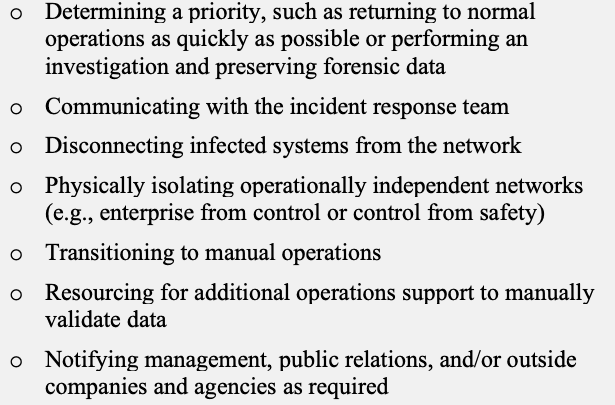
•優先順位の決定。例えば、できるだけ早く通常運用に復帰すること、または調査を実施してフォレンジックデータを保全すること
•Communicating with the incident response team
•インシデント対応チームとの連絡
•Disconnecting infected systems from the network
•感染したシステムをネットワークから切り離す
•Physically isolating operationally independent networks (e.g., enterprise from control or control from safety)
•運用上独立したネットワーク(例:エンタープライズと制御、または制御と安全)を物理的に分離する
•Transitioning to manual operations
•手動運用への移行
•Resourcing for additional operations support to manually validate data
•データを手動で検証するための、追加の運用サポートのリソース確保
•Notifying management, public relations, and/or outside companies and agencies as required
•必要に応じて、管理層、広報部門、および/または社外の企業・機関に通知する
If an incident is discovered, organizations should conduct a focused risk assessment on the OT environment to evaluate the effects of the attack and the options to respond. For example, one possible response option is to physically isolate the system under attack. However, this may have a negative impact on the OT and may not be possible without impacting operational performance or safety. A focused risk assessment should be used to determine the response action.
原本PDFの抜粋画像
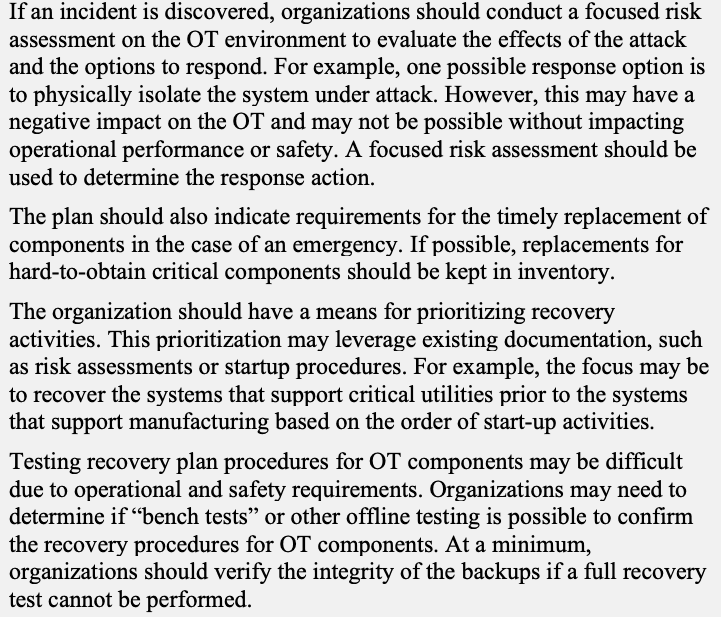
インシデントが発見された場合、組織は、攻撃の影響と対応の選択肢を評価するため、OT環境に焦点を当てたリスクアセスメントを実施すべきです。例えば、対応の選択肢の一つとして、攻撃を受けているシステムを物理的に隔離することが考えられます。しかし、これはOTに悪影響を及ぼす可能性があり、運用性能や安全に影響を与えずに実施できない場合もあります。対応措置を決定するには、焦点を絞ったリスクアセスメントを用いるべきです。
The plan should also indicate requirements for the timely replacement of components in the case of an emergency. If possible, replacements for hard-to-obtain critical components should be kept in inventory.
計画には、緊急時にコンポーネントを適時に交換するための要件も示すべきです。可能であれば、入手困難な重要コンポーネントの交換品を在庫として保管しておくべきです。
The organization should have a means for prioritizing recovery activities. This prioritization may leverage existing documentation, such as risk assessments or startup procedures. For example, the focus may be to recover the systems that support critical utilities prior to the systems that support manufacturing based on the order of start-up activities.
組織は、復旧活動の優先順位を付ける手段を持つべきです。この優先順位付けには、リスクアセスメントや起動手順などの既存の文書を活用できます。例えば、起動作業の順序に基づいて、製造を支えるシステムよりも先に、重要なユーティリティを支えるシステムを復旧することに重点を置く場合があります。
Testing recovery plan procedures for OT components may be difficult due to operational and safety requirements. Organizations may need to determine if “bench tests” or other offline testing is possible to confirm the recovery procedures for OT components. At a minimum, organizations should verify the integrity of the backups if a full recovery test cannot be performed.
OTコンポーネントの復旧計画手順のテストは、運用上および安全上の要件のために困難な場合があります。組織は、OTコンポーネントの復旧手順を確認するために、「ベンチテスト」やその他のオフラインテストが可能かどうかを判断する必要がある場合があります。完全な復旧テストを実施できない場合は、少なくともバックアップの完全性を検証すべきです。
6.2.5. Maintenance (PR.MA)
6.2.5. 保守(PR.MA)
The outcomes that fall within the CSF Maintenance Category provide guidance for performing routine and preventative maintenance on the components of an information system. This includes the usage of local and remote maintenance tools and the management of maintenance personnel.
CSF「保守」カテゴリの成果は、情報システムのコンポーネントに定期保守および予防保守を行うためのガイダンスを提供します。これには現地および遠隔保守ツールの利用と、保守要員の管理が含まれます。
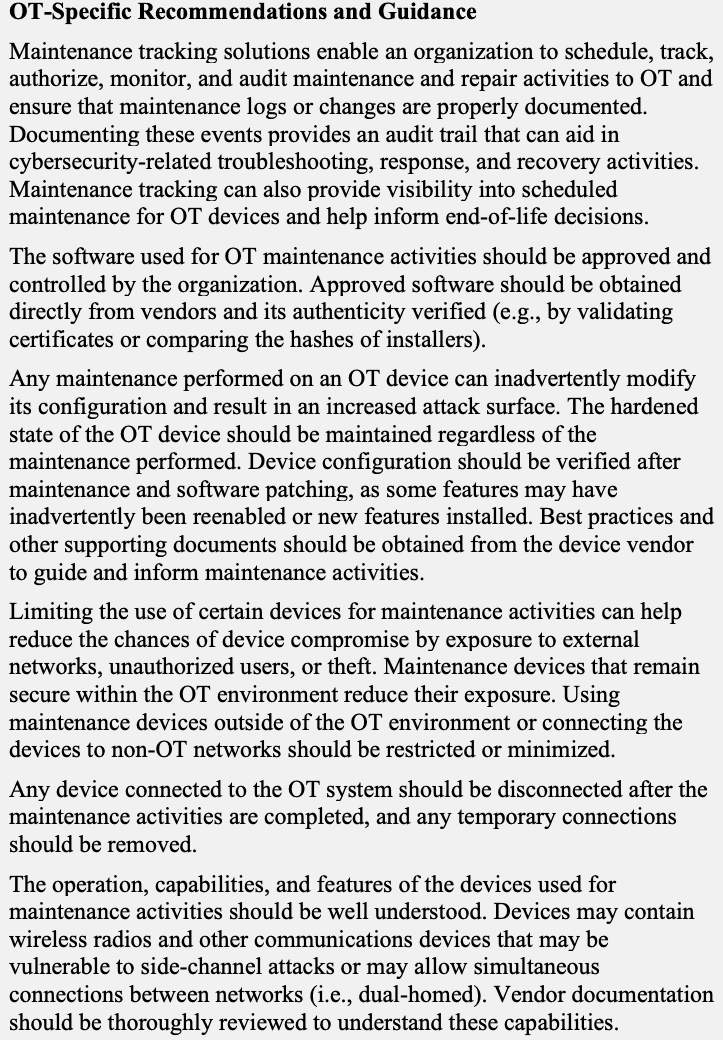
OT固有の推奨事項およびガイダンス
Maintenance tracking solutions enable an organization to schedule, track, authorize, monitor, and audit maintenance and repair activities to OT and ensure that maintenance logs or changes are properly documented. Documenting these events provides an audit trail that can aid in cybersecurity-related troubleshooting, response, and recovery activities. Maintenance tracking can also provide visibility into scheduled maintenance for OT devices and help inform end-of-life decisions.
保守追跡ソリューションにより、組織は、OTに対する保守・修理活動の計画、追跡、認可、監視、監査を行い、保守ログや変更が適切に文書化されていることを確認できます。これらのイベントを文書化すると、サイバーセキュリティ関連のトラブルシューティング、対応、復旧活動に役立つ監査証跡が得られます。保守追跡は、OTデバイスの計画保守を可視化し、サポート終了の判断にも役立ちます。
The software used for OT maintenance activities should be approved and controlled by the organization. Approved software should be obtained directly from vendors and its authenticity verified (e.g., by validating certificates or comparing the hashes of installers).
OTの保守作業に使用するソフトウェアは、組織が承認し管理すべきです。承認済みのソフトウェアはベンダーから直接入手し、その真正性を検証すべきです(例:証明書の検証やインストーラーのハッシュの比較によります)。
Any maintenance performed on an OT device can inadvertently modify its configuration and result in an increased attack surface. The hardened state of the OT device should be maintained regardless of the maintenance performed. Device configuration should be verified after maintenance and software patching, as some features may have inadvertently been reenabled or new features installed. Best practices and other supporting documents should be obtained from the device vendor to guide and inform maintenance activities.
OTデバイスに対して行う保守作業は、意図せずその構成を変更し、攻撃対象領域を拡大させるおそれがあります。実施する保守の内容にかかわらず、OTデバイスの堅牢化された状態を維持すべきです。一部の機能が意図せず再び有効化されたり、新しい機能がインストールされたりすることがあるため、保守およびソフトウェアパッチ適用の後にデバイスの構成を検証すべきです。保守作業を導き、その情報とするために、デバイスのベンダーからベストプラクティスやその他の支援文書を入手すべきです。
Limiting the use of certain devices for maintenance activities can help reduce the chances of device compromise by exposure to external networks, unauthorized users, or theft. Maintenance devices that remain secure within the OT environment reduce their exposure. Using maintenance devices outside of the OT environment or connecting the devices to non-OT networks should be restricted or minimized.
保守作業に使用するデバイスを特定のものに限定すると、外部ネットワーク、権限のないユーザー、または盗難にさらされることによるデバイスの侵害の可能性を減らせます。OT環境内で安全に保たれる保守用デバイスは、外部への露出を低減します。OT環境の外で保守用デバイスを使用したり、デバイスを非OTネットワークに接続したりすることは、制限するか最小限にすべきです。
Any device connected to the OT system should be disconnected after the maintenance activities are completed, and any temporary connections should be removed.
OTシステムに接続されたデバイスは、保守作業の完了後に切り離し、一時的な接続はすべて取り外すべきです。
The operation, capabilities, and features of the devices used for maintenance activities should be well understood. Devices may contain wireless radios and other communications devices that may be vulnerable to side-channel attacks or may allow simultaneous connections between networks (i.e., dual-homed). Vendor documentation should be thoroughly reviewed to understand these capabilities.
保守作業に使用するデバイスの動作、機能、特性は十分に理解しておくべきです。デバイスには、サイドチャネル攻撃に対して脆弱であったり、ネットワーク間の同時接続(すなわちデュアルホーム)を可能にしたりするワイヤレス無線機やその他の通信デバイスが含まれている場合があります。これらの機能を理解するため、ベンダーの文書を徹底的に確認すべきです。
6.2.6. Protective Technology (PR.PT)
6.2.6. 保護技術(PR.PT)
Technical mechanisms assist organizations with protecting the devices and information within their environments. These technologies alone may not be sufficient to sustain security capabilities as threats evolve and change. As such, organizations should manage the technical solutions that secure the organizational assets in a manner consistent with policies, procedures, and agreements.
技術的機構は、環境内のデバイスおよび情報を組織が保護する助けとなります。脅威が進化、変化するにつれ、これらの技術だけではセキュリティ機能を維持できない場合があります。そのため、組織資産を保護する技術ソリューションをポリシー、手順、合意に沿って管理するべきです。
6.2.6.1. Logging (PR.PT-1)
6.2.6.1. ログ記録(PR.PT-1)
Logging enables an organization to capture events that occur within its systems and networks. Events can be generated by many different systems, including OSs, workstations, servers, networking devices, cybersecurity software, and applications. Supplemental guidance can be found in the following document:
ログ記録によって、組織はシステムおよびネットワーク内で発生した事象を取得できます。OS、ワークステーション、サーバー、ネットワーク装置、サイバーセキュリティソフトウェア、アプリケーションなど、多様なシステムが事象を生成します。補足ガイダンスは次の文書にあります。
•NIST SP 800-92, Guide to Computer Security Log Management
•NIST SP 800-92, コンピューターセキュリティログ管理ガイド
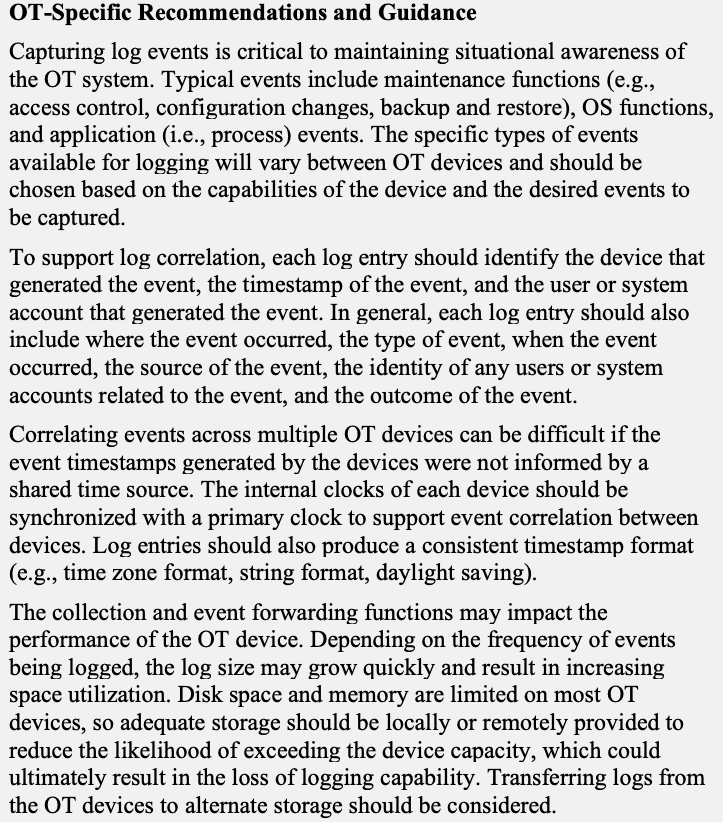
OT固有の推奨事項およびガイダンス
Capturing log events is critical to maintaining situational awareness of the OT system. Typical events include maintenance functions (e.g., access control, configuration changes, backup and restore), OS functions, and application (i.e., process) events. The specific types of events available for logging will vary between OT devices and should be chosen based on the capabilities of the device and the desired events to be captured.
ログイベントの取得は、OTシステムの状況認識を維持するうえで重要です。一般的なイベントには、保守機能(例:アクセス制御、構成変更、バックアップとリストア)、OS機能、アプリケーション(すなわちプロセス)のイベントがあります。ログに記録できるイベントの具体的な種類はOTデバイスによって異なるため、デバイスの能力と取得したいイベントに基づいて選択すべきです。
To support log correlation, each log entry should identify the device that generated the event, the timestamp of the event, and the user or system account that generated the event. In general, each log entry should also include where the event occurred, the type of event, when the event occurred, the source of the event, the identity of any users or system accounts related to the event, and the outcome of the event.
ログの相関付けを支えるため、各ログエントリには、イベントを生成したデバイス、イベントのタイムスタンプ、およびイベントを生成したユーザーまたはシステムアカウントを特定する情報を含めるべきです。一般に、各ログエントリには、イベントが発生した場所、イベントの種類、発生時刻、イベントの発生元、イベントに関連するユーザーまたはシステムアカウントの識別情報、およびイベントの結果も含めるべきです。
Correlating events across multiple OT devices can be difficult if the event timestamps generated by the devices were not informed by a shared time source. The internal clocks of each device should be synchronized with a primary clock to support event correlation between devices. Log entries should also produce a consistent timestamp format (e.g., time zone format, string format, daylight saving).
複数のOTデバイスにまたがるイベントの相関付けは、デバイスが生成したイベントのタイムスタンプが共有の時刻源に基づいていない場合、困難になりうます。デバイス間のイベント相関を支えるため、各デバイスの内部クロックは主クロックと同期させるべきです。ログエントリも、一貫したタイムスタンプ形式(例:タイムゾーン形式、文字列形式、夏時間)で出力すべきです。
The collection and event forwarding functions may impact the performance of the OT device. Depending on the frequency of events being logged, the log size may grow quickly and result in increasing space utilization. Disk space and memory are limited on most OT devices, so adequate storage should be locally or remotely provided to reduce the likelihood of exceeding the device capacity, which could ultimately result in the loss of logging capability. Transferring logs from the OT devices to alternate storage should be considered.
収集とイベント転送の機能は、OTデバイスの性能に影響を与える場合があります。記録するイベントの頻度によっては、ログのサイズが急速に増大し、使用領域が増える場合があります。ほとんどのOTデバイスではディスク容量とメモリが限られているため、デバイスの容量超過の可能性を減らすために、ローカルまたはリモートで十分なストレージを用意すべきです。容量を超過すると、最終的にログ記録機能が失われるおそれがあります。OTデバイスから代替ストレージへのログ転送を検討すべきです。
6.2.7. Media Protection (PR.PT-2)
6.2.7. 媒体保護(PR.PT-2)
Removable media is protected, and use is restricted in accordance with policy. This includes labeling media for distribution and handling requirements, as well as storage, transport, sanitization, destruction, and disposal of the media. Supplemental guidance can be found in the following documents:
リムーバブルメディアは保護し、ポリシーに従って使用を制限します。これには、配布・取扱要件のラベル付け、保管、輸送、無害化、破壊、廃棄が含まれます。補足ガイダンスは次の文書にあります。
•NIST SP 800-88, Rev. 1, Guidelines for Media Sanitation
•NIST SP 800-88 Rev. 1, 媒体の無害化に関するガイドライン
•NIST SP 800-100, Information Security Handbook: A Guide for Managers
•NIST SP 800-100, 情報セキュリティハンドブック:管理者向けガイド
•NIST SP 800-209, Security Guidelines for Storage Infrastructure
•NIST SP 800-209, ストレージインフラストラクチャのセキュリティガイドライン
OT固有の推奨事項およびガイダンス
Processes and procedures for the handling of media assets should be developed and followed. Media assets include removable media and devices, such as floppy disks, CDs, DVDs, SD cards, and USB memory sticks, as well as printed reports and documents. Physical security controls should address specific requirements for the safe and secure maintenance of these assets and provide guidance for transporting, handling, and erasing or destroying these assets. Security requirements could include safe storage from loss, fire, theft, unintentional distribution, or environmental damage.
媒体資産の取扱いに関するプロセスと手順を策定し、遵守すべきです。媒体資産には、フロッピーディスク、CD、DVD、SDカード、USBメモリなどのリムーバブルメディアやデバイスのほか、印刷された報告書や文書が含まれます。物理セキュリティ管理策では、これらの資産の安全かつ確実な保守に関する具体的な要件を扱い、これらの資産の輸送、取扱い、消去または破壊に関する指針を示すべきです。セキュリティ要件には、紛失、火災、盗難、意図しない配布、環境による損傷からの安全な保管を含めることができます。
OT devices should be protected against the misuse of media. The use of any unauthorized removable media or device on any node that is part of or connected to the OT should not be permitted. Solutions could be either procedural or technical to prevent the introduction of malware or the inadvertent loss or theft of data.
OTデバイスは、媒体の不正使用から保護すべきです。OTの一部であるか、OTに接続されているノードで、許可されていないリムーバブルメディアやデバイスを使用することを許可してはなりません。マルウェアの持ち込みや、データの不注意による紛失・盗難を防ぐため、手続き的な解決策でも技術的な解決策でもよいです。
Physically protecting media or encrypting the data on media is critical to protecting the OT environment. Gaining access to media that contains OT data could provide a malicious actor with valuable information for launching an attack.
媒体の物理的な保護、または媒体上のデータの暗号化は、OT環境を保護するうえで重要です。OTデータを含む媒体にアクセスできれば、悪意のある者が攻撃を仕掛けるための貴重な情報を得られる可能性があります。
6.2.8. Personnel Security
6.2.8. 人員セキュリティ
Cybersecurity should be included in human resources practices to reduce the risk of human error, theft, fraud, or other intentional or unintentional misuse of information systems. Supplemental guidance for the Personnel Security controls can be found in the following documents:
人的ミス、盗難、詐欺、その他の情報システムの意図的・偶発的な誤用リスクを減らすため、人事慣行にサイバーセキュリティを含めるべきです。人員セキュリティ管理策の補足ガイダンスは次の文書にあります。
•NIST SP 800-35, Guide to Information Technology Security Services
•NIST SP 800-35, 情報技術セキュリティサービスガイド
•NIST SP 800-73-4, Interfaces for Personal Identity Verification
•NIST SP 800-73-4, 個人ID検証インターフェース
•NIST SP 800-76-2, Biometric Specifications for Personal Identity Verification
•NIST SP 800-76-2, 個人ID検証の生体認証仕様
•NIST SP 800-100, Information Security Handbook: A Guide for Managers
•NIST SP 800-100, 情報セキュリティハンドブック:管理者向けガイド
OT固有の推奨事項およびガイダンス
A general personnel security program should address policy, position risk designations, personnel screening, terminations, transfers, access agreements, and third-party roles and responsibilities. OT personnel should communicate with human resources, IT, and physical security to ensure that personnel security requirements are being met.
一般的な要員セキュリティプログラムでは、方針、職位のリスク指定、要員の審査、離職、異動、アクセス合意、第三者の役割と責任を扱うべきです。OT要員は、要員セキュリティ要件が満たされていることを確認するため、人事、IT、物理セキュリティの各部門と連絡を取るべきです。
An organization should consider establishing an access agreement and request form for managing physical and/or logical access to OT equipment. Organizations should also screen the personnel assigned to critical positions who control and maintain the OT.
組織は、OT機器への物理的または論理的アクセスを管理するための、アクセス合意書と申請書の整備を検討すべきです。また、OTを管理・保守する重要な職位に就く要員を審査すべきです。
Additionally, each employee should receive training that is relevant to and necessary for their job functions. Employees should demonstrate competence in their job functions to retain physical and logical access to OT. Organizations should consider adopting a framework, such as the National Initiative for Cybersecurity Education (NICE) Framework, for training their OT personnel.
さらに、各従業員は、自身の職務に関連し、かつ必要な訓練を受けるべきです。従業員は、OTへの物理的・論理的アクセスを維持するために、職務遂行能力を示すべきです。組織は、OT要員の訓練にあたり、NICE(National Initiative for Cybersecurity Education)フレームワークなどのフレームワークの採用を検討すべきです。
6.2.9. Wireless Communications
6.2.9. 無線通信
Wireless communications utilize radio frequency (RF) to support data transmission. This can include a Wireless Fidelity (Wi-Fi) local area network communication based on IEEE 802.11 protocols and may also include cellular or other radio-based communications. RF-based communications provide enhanced flexibility over traditional physical (i.e., wired) communication capabilities. However, RF communications are also more susceptible to interference and may allow unauthorized personnel to eavesdrop. Supplemental guidance for wireless communications can be found in the following documents:
無線通信は無線周波数(RF)を用いてデータを伝送します。これにはIEEE 802.11プロトコルに基づくWi-Fiローカルエリアネットワーク通信、携帯通信その他の無線通信が含まれます。RF通信は従来の物理的(有線)通信より柔軟性が高い一方、干渉を受けやすく、不正な要員に盗聴される可能性があります。無線通信の補足ガイダンスは次の文書にあります。
•NIST SP 800-97, Establishing Wireless Robust Security Networks: A Guide to IEEE 802.11i
•NIST SP 800-97, Establishing Wireless Robust Security Networks: A Guide to IEEE 802.11i
•NIST SP 800-121, Rev. 2, Guide to Bluetooth Security
•NIST SP 800-121 Rev. 2, Bluetoothセキュリティガイド
•NIST SP 800-153, Guidelines for Securing Wireless Local Area Networks (WLANs)
•NIST SP 800-153, 無線LAN(WLAN)セキュリティガイドライン
•NIST SP 800-187, Guide to LTE Security
•NIST SP 800-187, LTEセキュリティガイド
OT固有の推奨事項およびガイダンス
The use of temporary or permanent wireless communication within an OT is a risk-based decision determined by the organization. Generally, devices that utilize wireless communication should be placed in a separate network segment and only be deployed where the residual risks to health, safety, the environment, and finances are low.
OT内で一時的または恒久的なワイヤレス通信を使用するかどうかは、組織が決定するリスクベースの判断です。一般に、ワイヤレス通信を利用するデバイスは別のネットワークセグメントに配置し、健康、安全、環境、財務に対する残留リスクが低い場合にのみ展開すべきです。
Prior to installation, a wireless survey should be performed to identify antenna locations and signal strength for adequate coverage and to minimize the exposure of the wireless network to interference from OT environmental factors and eavesdropping. Attackers typically use directional antennas to extend the effective range of a wireless network beyond the standard range.
設置前にワイヤレスサーベイを実施して、十分なカバレッジを得るためのアンテナの位置と信号強度を特定し、OTの環境要因による干渉や盗聴にワイヤレスネットワークがさらされる機会を最小限に抑えるべきです。攻撃者は通常、指向性アンテナを使って、ワイヤレスネットワークの有効範囲を標準の範囲を超えて拡大します。
Organizations may choose to implement a wireless mesh network to improve resiliency or to eliminate areas with poor signal strength. Mesh networks can provide fault tolerance through alternate route selection and preemptive fail-over of the network. Organizations should also consider the performance and security impacts associated with the use of mesh networks. For example, when roaming between access points, devices may experience temporary communication loss. Roaming may also require different security controls to reduce the transition time. Organizations will need to find the appropriate balance between functional capabilities and cybersecurity to achieve the risk tolerance.
組織は、レジリエンスを向上させるため、または信号強度の弱い領域をなくすために、ワイヤレスメッシュネットワークの導入を選択してもよいです。メッシュネットワークは、代替経路の選択とネットワークの先行的なフェイルオーバーによって、耐障害性を提供できます。組織は、メッシュネットワークの使用に伴う性能とセキュリティへの影響も検討すべきです。例えば、アクセスポイント間をローミングする際に、デバイスで通信が一時的に失われる場合があります。ローミングでは、切り替え時間を短縮するために異なるセキュリティ管理策が必要になる場合もあります。組織は、リスク許容度を達成するため、機能とサイバーセキュリティの間で適切なバランスを見つける必要があります。
Wireless LANs
ワイヤレスLAN
•Wireless device communications should be encrypted, and the encryption must not degrade the operational performance of the end devices. To reduce encryption latency, encryption should be considered at OSI Layer 2 rather than at Layer 3. The use of hardware accelerators to perform cryptographic functions should also be considered.
原本PDFの抜粋画像
•ワイヤレスデバイスの通信は暗号化すべきであり、その暗号化によってエンドデバイスの運用性能を低下させてはなりません。暗号化の遅延を減らすため、OSI参照モデルのレイヤー3ではなくレイヤー2での暗号化を検討すべきです。暗号処理を実行するハードウェアアクセラレーターの使用も検討すべきです。
•Wireless access points should establish independent network segments (rather than extending an existing segment) and be used in combination with a boundary protection device to restrict and control communication.
•ワイヤレスアクセスポイントは、(既存のセグメントを拡張するのではなく)独立したネットワークセグメントを確立し、通信を制限・制御するために境界保護デバイスと組み合わせて使用すべきです。
•Wireless access points should be configured to have a unique service set identifier (SSID) and enable media access control (MAC) address filtering at a minimum.
•ワイヤレスアクセスポイントは、少なくとも、一意のサービスセット識別子(SSID)を持つよう構成し、メディアアクセス制御(MAC)アドレスフィルタリングを有効にすべきです。
•Wireless devices may require different security controls and should be zoned accordingly.
•ワイヤレスデバイスには異なるセキュリティ管理策が必要な場合があり、それに応じてゾーン分けすべきです。
•An adaptive routing protocol should be considered if the devices are to be used for wireless mobility. The convergence time of the network should be as fast as possible to support rapid network recovery in the event of a failure or power loss.
•デバイスをワイヤレスの移動に使用する場合は、適応型ルーティングプロトコルを検討すべきです。障害や電源喪失が発生した場合に迅速にネットワークを復旧できるよう、ネットワークの収束時間はできる限り短くすべきです。

ワイヤレスフィールドネットワーク
When implementing a wireless field network, the following security features should be considered:
ワイヤレスフィールドネットワークを実装する際は、次のセキュリティ機能を検討すべきです。
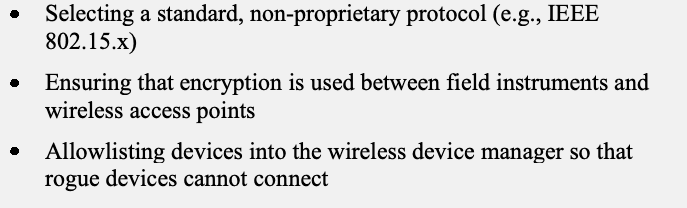
•標準的な非独自プロトコル(例:IEEE 802.15.x)を選択する
•Ensuring that encryption is used between field instruments and wireless access points
•フィールド計器とワイヤレスアクセスポイントの間で暗号化が使用されていることを確認する
•Allowlisting devices into the wireless device manager so that rogue devices cannot connect
•不正なデバイスが接続できないよう、ワイヤレスデバイスマネージャーにデバイスを許可リストとして登録する
•Implementing appropriately complex passwords and join keys
•適切な複雑さのパスワードおよび参加鍵を実装する
Most wireless field networks are inherently less reliable than their wired counterparts due to their susceptibility to signal jamming, distance limitations, and line-of-sight requirements. Work with the system vendor to design a wireless network that is appropriate for the application.
原本PDFの抜粋画像

ほとんどの無線フィールドネットワークは、信号妨害、距離の制限、見通し要件の影響を受けやすいため、有線ネットワークより本質的に信頼性が低いです。用途に適した無線ネットワークを設計するため、システムベンダーと協力するべきです。
6.2.10. Remote Access
6.2.10. リモートアクセス
Security controls should be implemented to prevent unauthorized remote access to the organization’s networks, systems, and data. A virtual private network (VPN) is a set of protocols designed to support secure remote access to network environments. A VPN can provide both strong authentication and encryption to secure communication data by establishing a private network that operates as an overlay on a public infrastructure. The most common types of VPN technologies are:
組織のネットワーク、システム、データへの不正なリモートアクセスを防止するため、セキュリティ管理策を実装するべきです。仮想プライベートネットワーク(VPN)は、ネットワーク環境へのセキュアなリモートアクセスを支えるプロトコル一式です。VPNは公開インフラ上のオーバーレイとして動作するプライベートネットワークを確立し、強力な認証と暗号化で通信データを保護できます。一般的なVPN技術は次のとおりです。
•Internet Protocol Security (IPsec). IPsec supports two encryption modes: transport and tunnel. Transport mode encrypts only the data portion (i.e., payload) of each packet while leaving the packet header untouched. The more secure tunnel mode adds a new header to each packet and encrypts both the original header and the payload. On the receiving side, an IPsec-compliant device decrypts each packet.
•Internet Protocol Security(IPsec)。IPsecはトランスポートモードとトンネルモードの2種類の暗号化モードを支えます。トランスポートモードは各パケットのデータ部分(ペイロード)のみを暗号化し、パケットヘッダーは変更しません。より安全なトンネルモードでは各パケットに新しいヘッダーを加え、元のヘッダーとペイロードの両方を暗号化します。受信側ではIPsec準拠デバイスが各パケットを復号します。
•Transport Layer Security (TLS). Sometimes referred to by the legacy terminology of Secure Sockets Layer (SSL), TLS provides a secure channel between two machines that encrypts the contents of each packet. TLS is most often recognized for securing Hypertext Transfer Protocol (HTTP) traffic in a protocol implementation known as HTTP Secure (HTTPS). However, TLS is not limited to HTTP traffic and can be used to secure many application-layer programs. Only TLS 1.2 or above should be considered.
•Transport Layer Security(TLS)。旧称Secure Sockets Layer(SSL)とも呼ばれたTLSは、2台のコンピューター間にセキュアなチャネルを提供し、各パケットの内容を暗号化します。TLSはHTTP Secure(HTTPS)として知られる実装でHypertext Transfer Protocol(HTTP)トラフィックを保護する用途で最もよく知られます。しかしTLSはHTTPトラフィックに限定されず、多くのアプリケーション層プログラムを保護できます。TLS 1.2以降のみを検討するべきです。
•Secure Shell (SSH). SSH is a command interface and protocol for securely gaining access to a remote computer. It is widely used by network administrators to remotely control Linux-based servers. SSH is a secure alternative to a telnet application, is included in most UNIX distributions, and is typically added to other platforms through a third-party package.
•Secure Shell(SSH)。SSHはリモートコンピューターに安全にアクセスするコマンドインターフェースおよびプロトコルです。Linuxベースサーバーを遠隔制御するためネットワーク管理者が広く利用します。SSHはtelnetアプリケーションのセキュアな代替であり、ほとんどのUNIXディストリビューションに含まれ、他のプラットフォームには通常第三者パッケージで追加します。
Supplemental guidance for access controls can be found in the following documents:
アクセス制御の補足ガイダンスは次の文書にあります。
•NIST SP 800-52, Rev. 2, Guidelines for the Selection, Configuration, and Use of Transport Layer Security (TLS) Implementations
•NIST SP 800-52, Rev. 2, Guidelines for the Selection, Configuration, and Use of Transport Layer Security (TLS) Implementations
•NIST SP 800-63B, Digital Identity Guidelines: Authentication and Lifecycle Management
•NIST SP 800-63B, デジタルIDガイドライン:認証とライフサイクル管理
•NIST SP 800-77, Rev. 1, Guide to IPsec VPNs
•NIST SP 800-77 Rev. 1, IPsec VPNガイド
•NIST SP 800-113, Guide to SSL VPNs
•NIST SP 800-113, SSL VPNガイド

OT固有の推奨事項およびガイダンス
Many OT security architectures are designed with multiple levels, such as in the Purdue model. This can significantly limit access, which can minimize accidental or unauthorized disruptions to operations. A process should be developed and communicated to the organization for requesting and enabling remote access. Remote access should be provided only if justified and limited to what is required for the business need. Remote access should not circumvent or negate safety or security controls. Multi-factor authentication should be considered for remote access to the OT system.
多くのOTセキュリティアーキテクチャは、パデューモデルのように複数のレベルで設計されています。これによりアクセスを大幅に制限でき、運用に対する偶発的または不正な中断を最小限に抑えられます。リモートアクセスを要求し有効化するためのプロセスを策定し、組織に周知すべきです。リモートアクセスは、正当な理由がある場合にのみ、業務上必要な範囲に限って提供すべきです。リモートアクセスが安全管理策やセキュリティ管理策を回避したり無効にしたりしてはなりません。OTシステムへのリモートアクセスには、多要素認証を検討すべきです。
In critical situations or when vendor support is needed, temporary remote access may be requested to perform maintenance. In such cases, procedures should still be followed to ensure that secure connections are being utilized.
重大な状況の場合やベンダーの支援が必要な場合は、保守を実施するために一時的なリモートアクセスが要求されることがあります。そのような場合でも、セキュアな接続が使用されるよう、手順に従うべきです。
There are several different techniques for implementing temporary remote access, including:
一時的なリモートアクセスを実装する手法はいくつかあり、次のようなものがあります。
•Users or protocols (e.g., RDP, SSH) that are temporarily permitted through the OT or enterprise firewall
原本PDFの抜粋画像
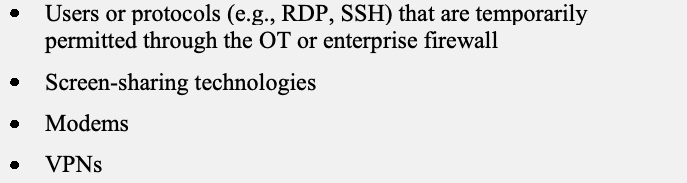
•OTまたはエンタープライズのファイアウォールを一時的に通過することを許可されるユーザーやプロトコル(例:RDP、SSH)
•Screen-sharing technologies
•画面共有技術
•Modems
•モデム
•VPNs
•VPN

技術にかかわらず、組織は次を検討すべきです。
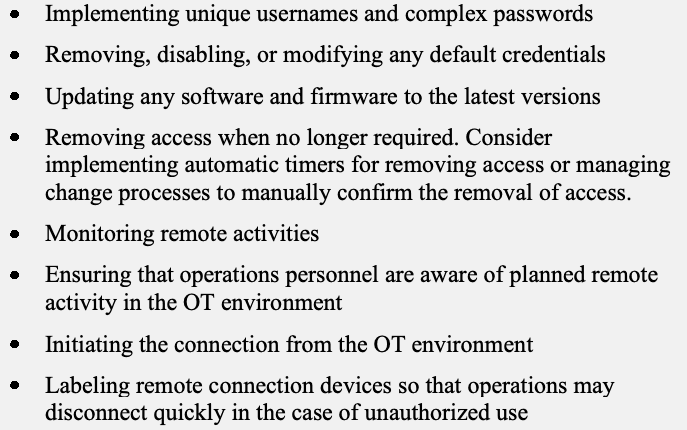
•一意のユーザー名と複雑なパスワードを導入すること
•Removing, disabling, or modifying any default credentials
•デフォルトの資格情報を削除する、無効化する、または変更する
•Updating any software and firmware to the latest versions
•すべてのソフトウェアとファームウェアを最新バージョンに更新する
•Removing access when no longer required. Consider implementing automatic timers for removing access or managing change processes to manually confirm the removal of access.
•不要になったアクセスの削除。アクセスを削除する自動タイマーの導入や、変更管理プロセスによるアクセス削除の手動確認を検討します。
•Monitoring remote activities
•リモート活動の監視
•Ensuring that operations personnel are aware of planned remote activity in the OT environment
•運用要員が、OT環境で計画されているリモート作業を認識していることを確認する
•Initiating the connection from the OT environment
•OT環境から接続を開始する
•Labeling remote connection devices so that operations may disconnect quickly in the case of unauthorized use
•無許可の使用があった場合に運用側が速やかに切断できるよう、リモート接続デバイスにラベルを付ける
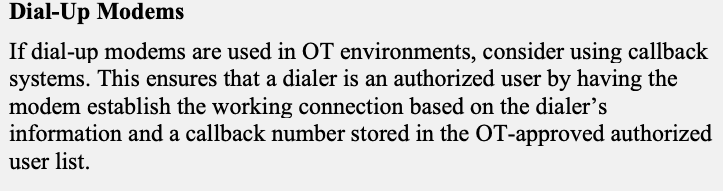
ダイヤルアップモデム
If dial-up modems are used in OT environments, consider using callback systems. This ensures that a dialer is an authorized user by having the modem establish the working connection based on the dialer’s information and a callback number stored in the OT-approved authorized user list.
OT環境でダイヤルアップモデムを使用する場合は、コールバックシステムの利用を検討します。これは、ダイヤルした側の情報と、OTで承認された許可ユーザーリストに保存されたコールバック番号に基づいてモデムが実際の接続を確立することで、ダイヤルした側が許可ユーザーであることを保証するものです。
If feasible, disconnect modems when not in use, or consider automating this disconnection process by having modems disconnect after being on for a given amount of time. Sometimes, modem connections are part of the legal support service agreement with the vendor (e.g., 24/7 support with 15-minute response time). Personnel should be aware that disconnecting or removing the modems may require contracts to be renegotiated.
原本PDFの抜粋画像
可能であれば、使用していないときはモデムを切断するか、モデムが一定時間オンになった後に切断されるようにして、この切断プロセスを自動化することを検討します。モデム接続が、ベンダーとの契約上のサポートサービス契約の一部(例:応答時間15分の24時間365日サポート)になっている場合もあります。要員は、モデムの切断や撤去には契約の再交渉が必要になる場合があることを認識しておくべきです。
VPNs
VPN
VPN devices used to protect OT systems should be thoroughly tested to verify that the VPN technology is compatible with the application and that implementation of the VPN devices does not negatively impact network traffic characteristics.
OTシステムの保護に使用するVPNデバイスは、VPN技術がアプリケーションと互換性があること、およびVPNデバイスの実装がネットワークトラフィックの特性に悪影響を与えないことを確認するため、徹底的にテストすべきです。
VPN technology can also be applied between network segments. For example, a remote site might have a boundary protection device on-site that uses a VPN to establish a secure tunnel over an untrusted network (e.g., the internet) to a VPN-enabled device in the main control center at a different location.
VPN技術は、ネットワークセグメント間にも適用できます。例えば、遠隔地に境界保護デバイスを設置し、VPNを使って信頼できないネットワーク(例:インターネット)を介して、別の場所にある主制御センターのVPN対応デバイスとの間にセキュアなトンネルを確立する場合があります。
6.2.11. Flaw Remediation and Patch Management
6.2.11. 欠陥是正およびパッチ管理
Patches are additional pieces of code that have been developed to address specific problems or flaws in existing software. A systematic approach to managing and using software patches can help organizations improve the overall security of their systems in a cost-effective way. Organizations that actively manage and use software patches can reduce the chances that the vulnerabilities in their systems can be exploited, and they can save time and money that might be better spent responding to vulnerability-related incidents. NIST SP 800-40, Rev. 4 [SP800-40r4] provides guidance for CIOs, CISOs, and others who are responsible for managing organizational risk related to the use of software. This publication frames patching as a critical component of preventive maintenance for computing technologies – a cost of doing business and a necessary part of what organizations need to do in order to achieve their missions. This publication also discusses common factors that affect enterprise patch management and recommends creating an enterprise strategy to simplify and operationalize patching while also improving risk reduction. This guidance may also be useful to business and mission owners, security engineers and architects, system administrators, and security operations personnel. Supplemental guidance for flaw remediation and patch management can be found in the following document:
パッチは、既存ソフトウェアの特定の問題または欠陥に対処するため開発された追加コードです。ソフトウェアパッチの体系的な管理および使用により、費用対効果高くシステム全体のセキュリティを高められます。ソフトウェアパッチを積極的に管理、使用する組織は、システムの脆弱性が悪用される可能性を減らし、脆弱性関連インシデントへの対応に充てる時間と費用を節約できます。NIST SP 800-40 Rev. 4 [SP800-40r4]は、ソフトウェア利用に伴う組織リスクを管理するCIO、CISOその他の担当者向けのガイダンスを示します。同書はパッチ適用を、コンピューティング技術の予防保守に不可欠な要素、すなわち事業運営コストであり組織のミッション達成に必要な活動として位置付けます。また、エンタープライズパッチ管理に影響する一般的要因を説明し、リスク低減を改善しつつパッチ適用を簡素化、運用化する全社戦略の策定を推奨します。このガイダンスは事業・ミッション責任者、セキュリティエンジニアおよびアーキテクト、システム管理者、セキュリティ運用要員にも有用です。欠陥是正およびパッチ管理の補足ガイダンスは次の文書にあります。
•NIST SP 800-40, Rev. 4, Guide to Enterprise Patch Management Planning: Preventive Maintenance for Technology
•NIST SP 800-40 Rev. 4, エンタープライズパッチ管理計画ガイド:技術の予防保守

OT固有の推奨事項およびガイダンス
Significant care should be exercised when applying patches to OS components. Patches should be adequately tested (e.g., offline system testing) to determine the acceptability of any performance impacts. Regression testing is also advised. It is not uncommon for patches to have an adverse impact on other software. A patch may remove a vulnerability, but it can also introduce a greater risk from a production or safety perspective. Patching the vulnerability may also change the way the OS or application works with control applications, causing the control application to lose some of its functionality. Many OT systems utilize older versions of OSs that are no longer supported by the vendor, so patches may not be available.
OSコンポーネントにパッチを適用する際は、十分な注意を払うべきです。パッチは、性能への影響が許容できるかどうかを判断するため、適切にテスト(例:オフラインシステムでのテスト)すべきです。回帰テストも推奨されます。パッチが他のソフトウェアに悪影響を及ぼすことは珍しくありません。パッチは脆弱性を取り除く一方で、生産や安全の観点からより大きなリスクをもたらす場合もあります。脆弱性にパッチを適用すると、OSやアプリケーションが制御アプリケーションと連携する方法が変わり、制御アプリケーションの機能の一部が失われる場合もあります。多くのOTシステムは、ベンダーがもはやサポートしていない古いバージョンのOSを使用しているため、パッチが提供されない場合があります。
Organizations should implement a systematic, accountable, and documented OT patch management process for managing exposure to vulnerabilities. The patch management process should include guidance on how to monitor for patches, when to apply patches, how to test the patches (e.g., with vendors or on offline systems), and how to select compensating controls to limit exposure of the vulnerable system when patching is delayed.
組織は、脆弱性へのさらされ方を管理するため、体系的で、説明責任があり、文書化されたOTパッチ管理プロセスを実施すべきです。パッチ管理プロセスには、パッチの監視方法、パッチ適用の時期、パッチのテスト方法(例:ベンダーとともに、またはオフラインシステムで)、パッチ適用が遅れる場合に脆弱なシステムのさらされ方を抑えるための代替管理策の選択方法に関するガイダンスを含めるべきです。
Many OT vulnerabilities are published to CISA as advisories. However, not all vendors report known vulnerabilities to CISA. Organizations can often stay informed of vulnerabilities by subscribing to vendor-specific notifications in addition to CISA alerts and advisories. Private cybersecurity companies also offer services to assist organizations with staying informed about known vulnerabilities within their OT environment. An organization is responsible for staying informed and determining when patches should be applied as part of their documented patch management process.
多くのOT脆弱性は、勧告としてCISAに公開されます。ただし、すべてのベンダーが既知の脆弱性をCISAに報告するわけではありません。組織は、CISAのアラートや勧告に加えて、ベンダー固有の通知を購読することで、脆弱性について常に情報を得られることが多くあります。民間のサイバーセキュリティ企業も、OT環境内の既知の脆弱性について組織が常に情報を得られるよう支援するサービスを提供しています。組織は、文書化されたパッチ管理プロセスの一環として、情報を得続け、パッチをいつ適用すべきかを判断する責任を負います。
When and how to deploy patches should be determined by knowledgeable OT personnel. Consider separating the automated process for OT patch management from the automated process for non-OT applications. Patching should be deployed during planned OT outages.
パッチをいつ、どのように展開するかは、知識のあるOT要員が決定すべきです。OTパッチ管理の自動化プロセスを、非OTアプリケーションの自動化プロセスから分離することを検討します。パッチ適用は、計画されたOTの停止期間中に展開すべきです。
Organizations may be required to follow industry-specific guidance on patch management. Otherwise, they may develop patch management procedures based on existing standards, such as NIST SP 800-40, Rev. 4 [SP800-40r4]; NERC CIP-007, or ISA 62443-2-3, Patch Management in the IACS Environment.
組織は、パッチ管理に関する業界固有のガイダンスに従うことが求められる場合があります。そうでない場合は、NIST SP 800-40 Rev. 4 [SP800-40r4]、NERC CIP-007、ISA 62443-2-3『IACS環境におけるパッチ管理(Patch Management in the IACS Environment)』など、既存の標準に基づいてパッチ管理手順を策定してもよいです。
6.2.12. Time Synchronization
6.2.12. 時刻同期
Time synchronization solutions enable an organization to synchronize time across many devices. This is important for many functions, including event and log correlation, authentication mechanisms, access control, and quality of service. Supplemental guidance can be found in the following documents:
時刻同期ソリューションにより、多数のデバイス間で時刻を同期できます。これは事象とログの相関、認証機構、アクセス制御、サービス品質など多くの機能に重要です。補足ガイダンスは次の文書にあります。
•NIST SP 800-92, Guide to Computer Security Log Management
•NIST SP 800-92, コンピューターセキュリティログ管理ガイド
•NIST IR 8323, Foundational PNT Profile: Applying the Cybersecurity Framework for the Responsible Use of Positioning, Navigation, and Timing (PNT) Services
•NIST IR 8323, 基礎PNTプロファイル:測位・航法・時刻(PNT)サービスの責任ある利用にCSFを適用
OT固有の推奨事項およびガイダンス
Synchronizing the internal clocks of OT systems and devices is critical for cyber event correlation and other OT functions (e.g., motion control). If a device or system clock is inaccurate, the timestamps generated by the clock for event and log entries will also be inaccurate, as well as any other functions that utilize the clock.
OTシステムとデバイスの内部クロックの同期は、サイバーイベントの相関付けやその他のOT機能(例:モーション制御)にとって重要です。デバイスやシステムのクロックが不正確であれば、そのクロックが生成するイベントやログエントリのタイムスタンプも不正確になり、クロックを利用するその他の機能も不正確になります。
A common time should be used across all OT devices. Utilizing multiple time sources can benefit OT devices by reducing clock error and providing backup time sources if the primary time source is lost or if the time quality of a primary time source has degraded.
すべてのOTデバイスで共通の時刻を使用すべきです。複数の時刻源を利用すると、クロック誤差を減らせるほか、主たる時刻源が失われた場合やその時刻品質が低下した場合のバックアップ時刻源にもなるため、OTデバイスにとって有益です。
Authenticated Network Time Protocol (NTP) and secure Precision Time Protocol (PTP) (i.e., PTP with an authentication TLV [type, length, value]) can be used if there is a risk of malicious modification to the network time (e.g., RF jamming, packet spoofing, denial of service). Non-authenticated NTP is susceptible to spoofing and should be located behind the firewall.
認証済みのネットワークタイムプロトコル(NTP)とセキュアな高精度時間プロトコル(PTP)(すなわち、認証TLV [type, length, value] を備えたPTP)は、ネットワーク時刻が悪意をもって改変されるリスク(例:RFジャミング、パケットのなりすまし、サービス拒否)がある場合に使用できます。認証のないNTPはなりすましを受けやすく、ファイアウォールの内側に配置すべきです。
Time sources located in the OT environment should be included in the system and network monitoring programs. If available, logs from each time source (e.g., syslog) should be forwarded to a log collection system.
OT環境にある時刻源は、システムとネットワークの監視プログラムに含めるべきです。可能であれば、各時刻源のログ(例:syslog)をログ収集システムに転送すべきです。
6.3. Detect (DE)
6.3. 検知(DE)
The Detect Function enables the timely discovery of cybersecurity events by ensuring that appropriate activities are developed and implemented.
「検知」機能は、適切な活動を策定、実施することで、サイバーセキュリティ事象を適時に発見できるようにします。
6.3.1. Anomalies and Events (DE.AE)
6.3.1. 異常および事象(DE.AE)
Organizations should understand different events, anomalies, and their potential impacts to systems and the environment to establish an effective detection capability. Within any environment, numerous non-malicious and potentially malicious events and anomalies occur almost continuously. Some examples of common events include:
有効な検知機能を確立するには、システムおよび環境への潜在的影響を含め、さまざまな事象や異常を理解するべきです。どの環境でも、悪意のないものや悪意がある可能性のある事象・異常がほぼ絶え間なく発生します。一般的な事象の例は次のとおりです。
Information Events
情報関連事象
•Multiple failed logon attempts
•複数回のログオン失敗
•Locked-out accounts
•ロックアウトされたアカウント
•Unauthorized creation of new accounts
•新規アカウントの不正作成
•Unexpected remote logons (e.g., logons of individuals who are on vacation, remote logon when the individual is expected to be local, remote logon for maintenance support when no support was requested)
•予期しないリモートログオン(休暇中の人によるログオン、現地にいる予定の人によるリモートログオン、サポート依頼がない保守支援のリモートログオンなど)
•Cleared event logs
•イベントログの消去
•Unexpectedly full event logs
•予期せぬイベントログの容量超過
•Antivirus or IDS alerts
•ウイルス対策またはIDSの警告
•Disabled antivirus or other security controls
•ウイルス対策その他のセキュリティ管理策の無効化
•Requests for information about the system or architecture (e.g., social engineering or phishing attempts)
•システムまたはアーキテクチャに関する情報要求(ソーシャルエンジニアリングやフィッシングの試みなど)
Operational Events
運用上の事象
•Unauthorized configuration changes
•構成の不正変更
•Unauthorized patching of systems
•システムへの不正なパッチ適用
•Unplanned shutdowns
•予定外のシャットダウン
Physical Access Events
物理アクセス事象
•Physical intrusions
•物理的侵入
Networking Events
ネットワーク事象
•Unexpected communication, including new ports or protocols being used without appropriate change management
•変更管理を経ずに新しいポートやプロトコルが使用されるなど、予期しない通信
•Unusually heavy network traffic
•異常に大量のネットワークトラフィック
•Unauthorized devices connecting to the network
•ネットワークに接続する不正デバイス
•Unauthorized communication to external IPs
•外部IPアドレスへの不正通信
Organizations should consider that not all events and anomalies are malicious or require investigation. Organizations should define incident alerting thresholds and response requirements for the events and anomalies that affect their systems and environment to establish an efficient incident detection capability. Organizations should consider collecting and correlating event data from multiple sources and sensors using automated mechanisms where possible to improve detecting and alerting capabilities. For example, a centralized intrusion detection system could accept data feeds and logs from multiple devices and network segments to identify organization- or environment-specific events and sound an alarm. Detection tools should also be integrated with asset management tools. This integration can provide additional context to an event (e.g., where the system is located, which firmware version it runs, what the criticality of the system is) to help an organization determine the event impact. Supplemental guidance can be found in the following documents:
すべての事象や異常が悪意あるもの、または調査を要するものではないことを考慮するべきです。効率的なインシデント検知機能を確立するため、システムおよび環境に影響する事象・異常について、インシデント警告の閾値および対応要件を定義するべきです。可能な場合は自動化機構を用い、複数のソースやセンサーから事象データを収集、相関させて検知・警告機能を高めることを検討するべきです。たとえば、一元的な侵入検知システムが複数のデバイスやネットワークセグメントからデータフィードおよびログを受け取り、組織または環境固有の事象を特定して警報を発することができます。検知ツールは資産管理ツールとも統合するべきです。統合によって、システムの場所、ファームウェア版、重要度などの追加情報を事象に付与し、影響判断を支援できます。補足ガイダンスは次の文書にあります。
•NIST SP 800-92, Guide to Computer Security Log Management
•NIST SP 800-92, コンピューターセキュリティログ管理ガイド
•NIST SP 800-94, Guide to Intrusion Detection and Prevention Systems
•NIST SP 800-94, 侵入検知・防止システムガイド
•NIST SP 1800-7, Situational Awareness for Electric Utilities
•NIST SP 1800-7, 電力事業者向け状況認識
OT固有の推奨事項およびガイダンス
Organizations should consider OT-specific events and anomalies for their processes and environments. Organizations should also note that some tools and alerts for behaviors or events that could indicate an intrusion may be normal behaviors and events within the OT environment. To reduce false positive and nuisance alarms, organizations should establish their OT alerting thresholds based on baselines of normal network traffic and data flows in addition to normal human and OT process behavior. Additionally, OT components are often physically remote and not continually staffed. Alerting thresholds may need to take into consideration the response time associated with the alert. For example, a temperature alert threshold may have to be set to alert earlier based on the expected response time to correct the situation in order to avoid an incident.
組織は、自らのプロセスと環境におけるOT固有のイベントと異常を考慮すべきです。侵入を示す可能性のある動作やイベントを検知するツールやアラートの一部は、OT環境内では正常な動作やイベントである場合があることにも留意すべきです。誤検知や不要なアラームを減らすため、組織は、通常の人の行動とOTプロセスの動作に加えて、通常のネットワークトラフィックとデータフローのベースラインに基づいて、OTのアラートしきい値を設定すべきです。さらに、OTコンポーネントは物理的に離れた場所にあり、常時人が配置されていないことが多くあります。アラートしきい値では、アラートに伴う対応時間を考慮する必要がある場合があります。例えば、インシデントを避けるため、状況を是正するために必要と見込まれる対応時間を踏まえ、温度アラートのしきい値を早めに設定してアラートを出す必要がある場合があります。
Shared credentials are often used on OT systems. Anomalous behavior on shared accounts may be more difficult to determine, so organizations should consider whether additional controls are required, such as identifying the use of shared credentials using physical access monitoring.
OTシステムでは共有の資格情報が使用されることが多くあります。共有アカウントの異常な動作は判断が難しい場合があるため、組織は、物理アクセス監視を用いた共有資格情報の使用の識別など、追加の管理策が必要かどうかを検討すべきです。
6.3.2. Security Continuous Monitoring (DE.CM)
6.3.2. セキュリティの継続的監視(DE.CM)
Organizations should implement continuous monitoring as part of the organizational risk management strategy to monitor the effectiveness of protective measures. This includes establishing the frequency for evaluating the implementation of the desired outcomes. Continuous monitoring can be performed by internal or external resources to identify security gaps within the environment. Peer reviews (i.e., cold eyes reviews) between sites of the same organization are highly encouraged. When leveraging third-party services for security continuous monitoring, it is important to understand and evaluate how the organization’s continuous monitoring data is protected by the third party. A third party that aggregates continuous monitoring information from multiple organizations may be a desirable target for adversaries. Supplemental guidance can be found in the following documents:
組織は保護対策の有効性を監視するため、組織のリスク管理戦略の一環として継続的監視を実装すべきです。これには望ましい成果の実装状況を評価する頻度の設定を含みます。環境内のセキュリティギャップを特定するため、内部または外部の資源で継続的監視を実施できます。同一組織の拠点間の相互レビュー(いわゆる第三者の目によるレビュー)を強く推奨します。第三者サービスを継続的監視に利用する場合、組織の監視データが第三者によってどのように保護されるかを理解、評価することが重要です。複数組織の継続的監視情報を集約する第三者は、敵対者にとって魅力的な標的となり得ます。補足ガイダンスは次の文書にあります。
•NIST SP 800-53A, Rev. 5, Assessing Security and Privacy Controls in Information Systems and Organizations
•NIST SP 800-53A, Rev. 5, Assessing Security and Privacy Controls in Information Systems and Organizations
•NIST SP 800-55, Rev. 1, Performance Measurement Guide for Information Security
•NIST SP 800-55 Rev. 1, 情報セキュリティ性能測定ガイド
•NIST SP 800-115, Technical Guide to Information Security Testing and Assessment
•NIST SP 800-115, 情報セキュリティ試験・評価の技術ガイド
•NIST SP 800-137, Information Security Continuous Monitoring (ISCM) for Federal Information Systems and Organizations
•NIST SP 800-137, 連邦情報システムおよび組織の情報セキュリティ継続的監視(ISCM)
•NIST SP 800-137A, Assessing Information Security Continuous Monitoring (ISCM) Programs: Developing an ISCM Program Assessment
•NIST SP 800-137A, 情報セキュリティ継続的監視(ISCM)プログラムの評価:ISCMプログラム評価の策定
OT固有の推奨事項およびガイダンス
Organizations may find that automation within OT environments may not be possible due to the sensitivity of the systems or the resources required to support the automation. For example, some automated systems may utilize active scanning to support vulnerability or patch management or to validate device configurations. Solutions that perform active scanning or use local resources to support automation should be tested before deployment into the OT system.
組織は、システムの機微性や自動化を支えるために必要なリソースのため、OT環境内での自動化が不可能な場合があることに気づく場合があります。例えば、一部の自動化システムは、脆弱性管理やパッチ管理、デバイス構成の検証を支えるためにアクティブスキャンを利用することがあります。アクティブスキャンを行う、または自動化を支えるためにローカルリソースを使用するソリューションは、OTシステムに展開する前にテストすべきです。
Continuous monitoring can be achieved using automated tools, through passive scanning, or with manual monitoring performed at a frequency deemed commensurate with the risk. For example, a risk assessment may determine that the logs from isolated (i.e., non-networked), non-critical devices should be reviewed monthly by OT personnel to determine whether anomalous behavior is occurring. Alternatively, a passive network monitor might be able to detect vulnerable network services without having to scan the devices.
原本PDFの抜粋画像
継続的モニタリングは、自動化ツール、パッシブスキャン、またはリスクに見合うと判断される頻度で実施する手動監視によって実現できます。例えば、リスクアセスメントにより、孤立した(すなわちネットワークに接続されていない)重要度の低いデバイスのログを、異常な動作が起きているかどうかを判断するために、OT要員が毎月レビューすべきであると判断される場合があります。あるいは、パッシブネットワークモニターであれば、デバイスをスキャンせずに脆弱なネットワークサービスを検知できる場合があります。
When organizations implement a sampling methodology, the criticality of the components should be considered. For example, the sampling methodology should not inadvertently exclude higher risk devices, such as Layer 3 or Layer 4 firewalls.
組織がサンプリング手法を実施する場合は、コンポーネントの重要度を考慮すべきです。例えば、サンプリング手法が、レイヤー3やレイヤー4のファイアウォールなど、リスクの高いデバイスを意図せず除外しないようにすべきです。
When using third parties to continuously monitor security controls, ensure that the personnel involved have the appropriate skillset to analyze OT environments.
セキュリティ管理策を継続的に監視するためにサードパーティを使用する場合は、関与する要員がOT環境を分析するための適切なスキルセットを持っていることを確認します。
6.3.2.1. Network Monitoring (DE.CM-1)
6.3.2.1. ネットワーク監視(DE.CM-1)
Network monitoring involves organizations reviewing alerts and logs and analyzing them for signs of possible cybersecurity incidents. Organizations should consider automation – including in-house developed, commercially available solutions or some combination of tools – to assist with monitoring efforts. Tools and capabilities that support behavior anomaly detection (BAD), security information and event management (SIEM), intrusion detection systems (IDS), and intrusion prevention systems (IPS) can assist organizations with monitoring traffic throughout the network and generate alarms when they identify anomalous or suspicious traffic. Some other capabilities to consider for network monitoring include:
ネットワーク監視では、組織が警告およびログをレビューし、サイバーセキュリティインシデントの兆候を分析します。監視を支援するため、内製、商用、またはこれらを組み合わせた自動化ソリューションを検討するべきです。行動異常検知(BAD)、セキュリティ情報イベント管理(SIEM)、侵入検知システム(IDS)、侵入防止システム(IPS)を支えるツールや機能は、組織によるネットワーク全体のトラフィック監視を支援し、異常または疑わしいトラフィックを特定したときに警報を生成できます。ネットワーク監視で考慮できるその他の機能は次のとおりです。
•Asset management, including discovering and inventorying devices connected to the network
•ネットワーク接続デバイスの発見・インベントリ作成を含む資産管理
•Baselining typical network traffic, data flows, and device-to-device communications
•通常のネットワークトラフィック、データフロー、デバイス間通信のベースライン作成
•Diagnosing network performance issues
•ネットワーク性能問題の診断
•Identifying misconfigurations or malfunctions of networked devices
•ネットワークデバイスの構成ミスまたは誤動作の特定
Supplemental guidance can be found in the following documents:
補足ガイダンスは次の文書にあります。
•NIST SP 800-94, Guide to Intrusion Detection and Prevention Systems (IDPS)
•NIST SP 800-94, 侵入検知・防止システム(IDPS)ガイド
•NIST IR 8219, Securing Manufacturing Industrial Control Systems: Behavioral Anomaly Detection
•NIST IR 8219, 製造業産業制御システムの保護:行動異常検知
OT固有の推奨事項およびガイダンス
Network monitoring can greatly enhance the ability to detect attacks entering or leaving the OT networks. It can also improve network efficiency by detecting non-essential traffic. OT cybersecurity personnel must be part of the diagnostic process of interpreting the alerts provided by network monitoring tools. Careful monitoring and an understanding of the normal state of the OT network can help distinguish transient conditions from legitimate attacks and provide insight into events that are outside of the normal state.
ネットワーク監視により、OTネットワークに出入りする攻撃を検知する能力を大幅に高めることができます。また、不要なトラフィックを検知することで、ネットワークの効率も改善できます。OTサイバーセキュリティ要員は、ネットワーク監視ツールが提供するアラートを解釈する診断プロセスに参加しなければなりません。入念な監視とOTネットワークの正常な状態の理解は、一時的な状態と正当な攻撃を区別し、正常な状態を外れたイベントについての洞察を得るのに役立ちます。
Gaining access to network traffic is typically performed with network test access points (TAPs) and switched port analyzer (SPAN) ports, though performance impacts to the OT system may result from their use, especially with SPAN ports.
ネットワークトラフィックの取得は通常、ネットワークテストアクセスポイント(TAP)やスイッチドポートアナライザー(SPAN)ポートで行われますが、これらの使用(特にSPANポート)はOTシステムの性能に影響を及ぼす場合があります。
Network sensors should be placed to effectively monitor the OT network. Typical installations locate the network sensors between the control network and corporate network, but other locations can include network perimeters, key network segments (e.g., DMZ), and critical OT devices.
ネットワークセンサーは、OTネットワークを効果的に監視できる位置に配置すべきです。典型的な設置では、ネットワークセンサーを制御ネットワークと企業ネットワークの間に配置しますが、ネットワーク境界、主要なネットワークセグメント(例:DMZ)、重要なOTデバイスなどに配置することもできます。
All sensors should be subjected to extensive testing and be implemented in a test environment before being deployed into the OT network. Configuring the sensor into a test or learning mode after it is installed on the network provides an opportunity to tune the device with real OT network traffic. Tuning can help reduce false positive alerts, reduce the alert “noise” from typical network traffic, and help identify implementation and configuration problems.
すべてのセンサーは、OTネットワークに展開する前に、広範なテストを行い、テスト環境に実装すべきです。ネットワークへの設置後にセンサーをテストモードまたは学習モードに設定すると、実際のOTネットワークトラフィックでデバイスを調整する機会が得られます。調整により、誤検知アラートを減らし、通常のネットワークトラフィックによるアラートの「ノイズ」を抑え、実装や構成の問題を特定しやすくなります。
Failure modes of network sensors in the event of a sensor failure should be considered (e.g., does the sensor fail-safe or fail-open if the device fails).
ネットワークセンサーの障害時の故障モードを考慮すべきです(例:デバイスが故障した場合、センサーはフェイルセーフになるのか、それともフェイルオープンになるのか)。
6.3.2.2. System Use Monitoring (DE.CM-1 and DE-CM-3)
6.3.2.2. システム利用監視(DE.CM-1およびDE-CM-3)
System use monitoring solutions enable an organization to monitor, store, and audit system events (e.g., system logs, running processes, file access and modification, system and application configuration changes) that occur within a system. Monitoring users and systems helps to ensure that they are behaving as expected and can aid in troubleshooting when events occur by providing information about which users were working within the system during the event. System and device misconfigurations can also be identified. Compared to network monitoring, system use monitoring solutions can analyze activity that does not traverse the network. In host-based solutions, this can be achieved with real-time monitoring of inter-process communications and other internal OS data, while active scanning solutions gather information by querying the OS or application programming interfaces (APIs). Supplemental guidance can be found in the following documents:
システム利用監視ソリューションは、システム内で発生するイベント(システムログ、実行中プロセス、ファイルアクセス・変更、システムおよびアプリケーション構成変更など)を監視、保存、監査できます。利用者とシステムを監視すると、想定どおりに動作していることを確認でき、事象発生時に誰がシステムを操作していたかを示すことでトラブルシューティングに役立ちます。システムおよびデバイスの構成ミスも特定できます。ネットワーク監視と異なり、システム利用監視はネットワークを通過しない活動も分析できます。ホストベースソリューションではプロセス間通信やその他のOS内部データをリアルタイム監視し、アクティブスキャン方式ではOSまたはアプリケーションプログラミングインターフェース(API)に問い合わせて情報を収集します。補足ガイダンスは次の文書にあります。
•NIST SP 800-94, Guide to Intrusion Detection and Prevention Systems (IDPS)
•NIST SP 800-94, Guide to Intrusion Detection and Prevention Systems (IDPS)
•NIST SP 800-137, Information Security Continuous Monitoring (ISCM) for Federal Information Systems and Organizations
•NIST SP 800-137, 連邦情報システムおよび組織の情報セキュリティ継続的監視(ISCM)

OT固有の推奨事項およびガイダンス
Situational awareness of the OT system is imperative to understanding the current state of the system, validating that it is operating as intended, and ensuring that no policy violations or cyber incidents have hindered its operation. Strong device monitoring, logging, and auditing are necessary to collect, correlate, and analyze security-related information and provide actionable communication about the security status across the complete OT system. In the event of a cybersecurity incident, the information gathered by system use monitoring solutions can be used to perform forensic analysis of the OT system.
OTシステムの状況認識は、システムの現在の状態を理解し、意図したとおりに動作していることを検証し、方針違反やサイバーインシデントによってその動作が妨げられていないことを確認するうえで不可欠です。OTシステム全体にわたりセキュリティ関連情報を収集、相関付け、分析し、セキュリティ状況について実際の対応につながる情報共有を行うには、強力なデバイス監視、ログ記録、監査が必要です。サイバーセキュリティインシデントが発生した場合、システム使用監視ソリューションが収集した情報を、OTシステムのフォレンジック分析に使用できます。
System use monitoring solutions can generate significant amounts of events, so these solutions should be used in combination with a control log management system, such as a SIEM, to help filter the types of events and reduce alert fatigue. The amount of tuning and customization of events and alerts depends on the type of OT system and the number of devices in the system.
システム使用監視ソリューションは大量のイベントを生成しうるため、SIEMなどの制御ログ管理システムと組み合わせて使用し、イベントの種類を絞り込んでアラート疲れを減らすべきです。イベントとアラートの調整やカスタマイズの量は、OTシステムの種類とシステム内のデバイス数によって異なります。
System use monitoring solutions should be subjected to extensive testing and implemented in a test environment before being deployed to devices in the OT system. Concerns include the performance impacts of host-based agents on devices, the impact of active scanning on devices, and the capability of the network infrastructure bandwidth. Separate appliances can offload the processing. Host-based agents can impact the performance of the OT device because of the resources that they consume.
システム使用監視ソリューションは、OTシステムのデバイスに展開する前に、広範なテストを行い、テスト環境で実装すべきです。懸念事項には、ホストベースのエージェントがデバイスの性能に及ぼす影響、アクティブスキャンがデバイスに及ぼす影響、ネットワークインフラの帯域幅が十分かどうかが含まれます。別個のアプライアンスに処理を肩代わりさせることができます。ホストベースのエージェントは、リソースを消費するため、OTデバイスの性能に影響を与える場合があります。
6.3.2.3. Malicious Code Detection (DE.CM-4)
6.3.2.3. 悪意あるコードの検出(DE.CM-4)
When stored, processed, and transmitted, files and data streams should be scanned using specialized tools with a combination of heuristic algorithms and known malware signatures to detect and block potentially malicious code. Malicious code protection tools only function effectively when they are installed, configured, run full-time, and maintained properly against the state of known attack methods and payloads. Supplemental guidance for anti-malware practices can be found in the following documents:
保存、処理、転送されるファイルおよびデータストリームを、ヒューリスティックアルゴリズムと既知マルウェアシグネチャを組み合わせた専用ツールでスキャンし、悪意ある可能性のあるコードを検出、遮断するべきです。悪意あるコード保護ツールは、インストール、構成、常時実行され、既知の攻撃方法およびペイロードの状況に合わせて適切に保守されて初めて効果を発揮します。マルウェア対策慣行の補足ガイダンスは次の文書にあります。
•NIST SP 800-83, Rev. 1, Guide to Malware Incident Prevention and Handling for Desktops and Laptops
•NIST SP 800-83 Rev. 1, デスクトップおよびノートPCのマルウェアインシデント防止・対応ガイド
•NIST SP 1058, Using Host-Based Anti-Virus Software on Industrial Control Systems: Integration Guidance and a Test Methodology for Assessing Performance Impacts
•NIST SP 1058, 産業制御システムでのホストベースウイルス対策ソフトウェアの使用:統合ガイダンスおよび性能影響評価試験方法
OT固有の推奨事項およびガイダンス
While antivirus tools are common in IT computer systems, the use of antivirus with OT may require adopting special practices, including compatibility checks, change management, and performance impact metrics. These practices should be utilized to test new signatures and new versions of antivirus software.
アンチウイルスツールはITコンピューターシステムでは一般的ですが、OTでアンチウイルスを使用するには、互換性チェック、変更管理、性能影響の測定指標など、特別な実務の採用が必要になる場合があります。これらの実務は、新しいシグネチャやアンチウイルスソフトウェアの新バージョンをテストするために活用すべきです。
Some OT vendors recommend and even support the use of vendor-specific antivirus tools. In some cases, OT system vendors may have performed regression testing across their product line for supported versions of a particular antivirus tool and provide associated installation and configuration documentation.
一部のOTベンダーは、ベンダー固有のアンチウイルスツールの使用を推奨し、さらにはサポートしています。場合によっては、OTシステムのベンダーが、特定のアンチウイルスツールのサポート対象バージョンについて自社の製品ライン全体で回帰テストを実施し、関連するインストールおよび構成の文書を提供していることがあります。
Generally:
一般に:
•General-purpose Windows, Unix, and Linux systems that are used as engineering workstations, data historians, maintenance laptops, and backup servers can be secured like commercial IT equipment by installing push or auto-updated antivirus software with updates distributed via an antivirus server located inside the process control network. Follow organization-developed procedures for transferring the latest updates from known vendor sites to the OT antivirus servers and other OT computers and servers.
原本PDFの抜粋画像
•エンジニアリングワークステーション、データヒストリアン、保守用ノートPC、バックアップサーバーとして使用される汎用のWindows、Unix、Linuxシステムは、プロセス制御ネットワーク内に設置したアンチウイルスサーバーから更新を配布する、プッシュ型または自動更新型のアンチウイルスソフトウェアをインストールすることで、市販のIT機器と同様に保護できます。既知のベンダーサイトから最新の更新をOTのアンチウイルスサーバーやその他のOTコンピューター・サーバーへ転送するには、組織が策定した手順に従います。
•Follow vendor recommendations on all other servers and computers (e.g., DCS, PLC, instruments) that have time-dependent code, modified or extended OSs, or any other change that makes them different from a standard PC. Test the antivirus software and updates on an offline system if possible (e.g., install on a backup HMI and validate that performance is not degraded before applying to the primary HMI).
•時刻依存のコード、改変または拡張されたOS、その他標準的なPCと異なる変更を伴うその他のサーバーおよびコンピューター(例:DCS、PLC、計器)については、ベンダーの推奨に従います。可能であれば、アンチウイルスソフトウェアとその更新をオフラインのシステムでテストします(例:バックアップHMIにインストールし、主HMIに適用する前に性能が低下しないことを確認します)。
According to NIST SP 1058 [SP1058], antivirus software may negatively impact the time-critical control processes of an ICS. The SP also identified significant CPU usage when running manual scans and signature updates, which could have negative impacts on OT computers and servers. As a result:
原本PDFの抜粋画像

NIST SP 1058 [SP1058]によると、ウイルス対策ソフトウェアはICSの時間制約が厳しい制御プロセスに悪影響を及ぼす場合があります。同書は、手動スキャンおよびシグネチャ更新時のCPU使用量が大きく、OTコンピューターおよびサーバーに悪影響を及ぼす可能性も示しています。そのため、次のようにします。
•Configuration of the antivirus software should be tested on an offline system, if possible.
原本PDFの抜粋画像
•アンチウイルスソフトウェアの構成は、可能であればオフラインのシステムでテストすべきです。
•Manual scanning and signature updates should be performed while the system is not critical for operations.
•手動のスキャンとシグネチャ更新は、システムが運用上重要でない間に実施すべきです。
•Redundancy should be considered for critical systems that require ongoing antivirus updates such that signature updates can be performed without impacting operations (e.g., consoles and HMIs).
•継続的なアンチウイルス更新が必要な重要システム(例:コンソールやHMI)では、運用に影響を与えずにシグネチャを更新できるよう、冗長化を検討すべきです。
•When configuring file exclusion lists, determine which control application files should not be scanned during production time because of possible OT system malfunction or performance degradation.
•ファイル除外リストを構成する際は、OTシステムの誤作動や性能低下の可能性があるため、本番稼働中にスキャンすべきでない制御アプリケーションファイルを判断します。
CISA provides a recommended practice for updating antivirus in OT environments.
原本PDFの抜粋画像

CISAはOT環境のウイルス対策更新に関する推奨慣行を提供しています。
6.3.2.4. Vulnerability Scanning (DE.CM-8)
6.3.2.4. 脆弱性スキャン(DE.CM-8)
Vulnerabilities can be identified through a combination of automated and manual techniques. These vulnerability scans should be performed on an ongoing basis to capture new vulnerabilities as they are discovered.
自動および手動の技法を組み合わせて脆弱性を特定できます。新しい脆弱性の発見を把握するため、継続的にスキャンを実施するべきです。

OT固有の推奨事項およびガイダンス
Some common ways to achieve vulnerability identification in the OT environment are:
OT環境で脆弱性の特定を実現する一般的な方法には、次のようなものがあります。
•Continuous monitoring using passive or active scanning capabilities. Organizations should consider how vulnerability scanning tools may impact OT components and communications by testing them in an offline environment prior to implementing them in production.
原本PDFの抜粋画像
•• パッシブまたはアクティブスキャン機能を用いた継続的監視。組織は、脆弱性スキャンツールを本番環境に導入する前にオフライン環境で試験し、それらのツールがOTコンポーネントおよび通信にどのような影響を及ぼす可能性があるかを検討すべきです。
•Passive scanning tools typically utilize network traffic analyzers to detect assets and determine possible vulnerabilities affecting the assets.
原本PDFの抜粋画像
•パッシブスキャンツールは通常、ネットワークトラフィックアナライザーを利用して資産を検出し、資産に影響を及ぼす可能性のある脆弱性を判定します。
•Active scanning tools typically utilize an agent to connect to networked assets and perform detailed queries and analysis of the components to determine possible vulnerabilities affecting the assets.
•アクティブスキャンツールは通常、エージェントを利用してネットワーク接続された資産に接続し、コンポーネントの詳細な照会と分析を行って、資産に影響を及ぼす可能性のある脆弱性を判定します。
•Performance testing, load testing, and penetration testing if the test will not adversely impact the production environment
原本PDFの抜粋画像

•テストが本番環境に悪影響を及ぼさない場合の、性能テスト、負荷テスト、ペネトレーションテスト
•Regular audits, assessments, and peer reviews to identify gaps in security
•セキュリティ上の欠陥を特定するための定期的な監査、評価、ピアレビュー
6.3.3. Detection Process (DE.DP)
6.3.3. 検知プロセス(DE.DP)
The detection process includes maintaining and testing processes, procedures, and tools to ensure that anomalous events are identified in a prompt manner and responsible parties (individuals) are alerted and held accountable for adequate responses. To ensure the ongoing awareness of anomalous events, define roles and responsibilities for accountability, periodically review that detection activities comply with the requirements, test the detection processes regularly, communicate detected events to appropriate personnel to act, and continuously improve detection capabilities.
検知プロセスでは、異常事象を迅速に特定し、責任者(個人)に警告して適切な対応の責任を負わせるため、プロセス、手順、ツールを維持、試験します。異常事象の認識を継続的に保つため、説明責任を担う役割と責任を定義し、検知活動が要件に適合するか定期的にレビューし、検知プロセスを定期試験し、検知事象を対応する適切な要員に連絡し、検知能力を継続的に改善します。
6.4. Respond (RS)
6.4. 対応(RS)
The Respond Function supports the ability to take the appropriate course of action and activities to contain a cybersecurity incident when it occurs.
「対応」機能は、サイバーセキュリティインシデント発生時に適切な行動および活動を取り、インシデントを封じ込める能力を支えます。
6.4.1. Response Planning (RS.RP)
6.4.1. 対応計画(RS.RP)
When responding to events, organizations should attempt to capture the details associated with executing the documented response plans. This may help organizations identify gaps or potential opportunities for improvement in the response plan during the post-incident review process. Due to the time sensitivity of response efforts, organizations may want to consider other techniques (e.g., reviewing logs, reviewing video footage captured during the response activities, or interviewing response personnel) if capturing execution details impacts safety or increases the time to complete the response plan.
事象への対応時、組織は文書化済み対応計画の実行に関する詳細を記録するよう努めるべきです。事後レビュー時に対応計画のギャップや改善機会を特定する助けとなる場合があります。対応作業は時間制約があるため、実行詳細の記録が安全に影響する、または計画完了時間を長引かせる場合には、別の手法(ログのレビュー、対応中に撮影した映像の確認、対応要員への聞き取りなど)を検討できます。
6.4.2. Response Communications (RS.CO)
6.4.2. 対応時の連絡(RS.CO)
Responding to a cybersecurity incident includes coordinating with internal and external stakeholders. An incident response team should be assembled. Depending on the complexity and impact of the incident, the incident response team could consist of one or many individuals who have been trained on incident response. The FEMA National Incident Management System (NIMS) can be used to standardize common terminology and roles for incident response. Prior to an incident, organizations should consider how to communicate with response personnel and external entities, including:
サイバーセキュリティインシデント対応には内部・外部の利害関係者との調整が含まれます。インシデント対応チームを編成するべきです。インシデントの複雑さと影響に応じて、対応訓練を受けた1人または複数人で構成できます。FEMAの国家インシデント管理システム(NIMS)を利用すると、インシデント対応の共通用語および役割を標準化できます。インシデント前に、組織は対応要員および外部組織との連絡方法を検討するべきであり、次を含みます。
•Developing an email distribution list for incident response
•インシデント対応用電子メール配布リストの作成
•Leveraging an emergency notification system
•緊急通知システムの活用
•Establishing backup communication plans for radio, phone, or email if primary communication systems fail
•主通信システムが故障した場合の無線、電話、電子メール用バックアップ連絡計画の確立
•Designating a spokesperson for external communications
•外部連絡用スポークスパーソンの指定
•Designating a scribe for internal incident communications
•内部インシデント連絡用記録担当者の指定
OT固有の推奨事項およびガイダンス
Organizations should consider FEMA’s guidance on crisis communications when establishing their communication plans and strategies.
組織は、コミュニケーション計画および戦略を策定する際に、FEMAの危機コミュニケーションに関するガイダンスを検討すべきです。
The personnel responsible for responding to an incident should be informed of and trained on their responsibilities.
インシデントへの対応を担う要員には、自らの責任について周知を受け、訓練を受けさせるべきです。
The response plan should include a detailed list of organizations and personnel that should be contacted for incident response and reporting under various circumstances. Each individual should be assigned roles that are required for incident response, which could include incident commander; operations, planning, logistics, or finance/administration section chief or member; and public information, safety, or liaison officer.
対応計画には、さまざまな状況でインシデント対応と報告のために連絡すべき組織と要員の詳細な一覧を含めるべきです。各個人には、インシデント対応に必要な役割を割り当てるべきであり、これにはインシデント指揮官、運用・計画・兵站・財務/総務の各セクションの長またはメンバー、広報・安全・連絡の各担当官が含まれうます。
To support a response in an OT environment, an organization should consider including the following personnel in the response plan.
OT環境での対応を支えるため、組織は、対応計画に次の要員を含めることを検討すべきです。
Internal Resources
内部リソース
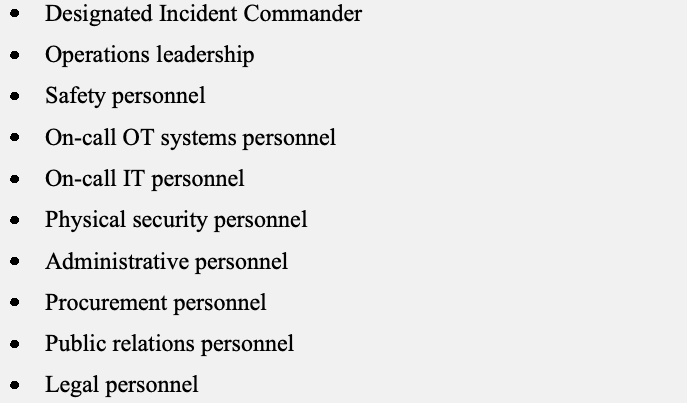
•指名されたインシデント指揮官
•Operations leadership
•運用部門のリーダー
•Safety personnel
•安全担当要員
•On-call OT systems personnel
•呼出し待機中のOTシステム要員
•On-call IT personnel
•呼出し待機中のIT要員
•Physical security personnel
•物理セキュリティ要員
•Administrative personnel
•管理担当要員
•Procurement personnel
•調達担当要員
•Public relations personnel
•広報担当要員
•Legal personnel
•法務要員
External Industry Partners
外部の業界パートナー
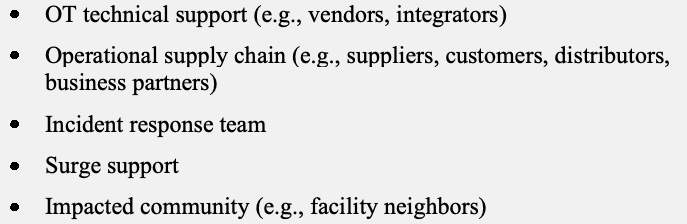
•OT技術サポート(例:ベンダー、インテグレーター)
•Operational supply chain (e.g., suppliers, customers, distributors, business partners)
•運用上のサプライチェーン(例:供給業者、顧客、販売業者、ビジネスパートナー)
•Incident response team
•インシデント対応チーム
•Surge support
•増員支援
•Impacted community (e.g., facility neighbors)
•影響を受ける地域社会(例:施設の近隣住民)
Organizations are required to report incidents involving federal agencies in accordance with PPD-21 [PPD-21] and PPD-41 [PPD-41]. CISA maintains the list of sector-specific contacts.
原本PDFの抜粋画像
組織は、連邦機関が関与するインシデントを、PPD-21 [PPD-21] およびPPD-41 [PPD-41] に従って報告することが求められます。CISAは、セクター別の連絡先の一覧を維持しています。
Legal departments can often assist with developing non-disclosure agreements or other contracts if an organization plans to utilize external resources for incident response. It may be beneficial to develop these contracts prior to an incident occurring so that incident response can be immediate. Private companies can be held on retainer in case of an OT incident.
組織がインシデント対応に外部リソースの利用を計画している場合、法務部門は、秘密保持契約その他の契約の策定を支援できることが多くあります。インシデント対応を即時に実施できるよう、インシデント発生前にこうした契約を締結しておくと有益な場合があります。OTインシデントに備えて、民間企業と待機契約を結んでおくことができます。
6.4.3. Response Analysis (RS.AN)
6.4.3. 対応分析(RS.AN)
Cybersecurity incidents are analyzed to ensure effective response and recovery activities that are consistent with the detection process and the response plan. Analysis includes reviewing notifications, determining whether an investigation is required, understanding potential impacts, performing forensics, categorizing the incident consistent with the response plan, and analyzing disclosed vulnerabilities. Supplemental guidance for the response analysis controls can be found in the following document:
検知プロセスおよび対応計画に整合した効果的な対応・復旧活動を確保するため、サイバーセキュリティインシデントを分析します。分析には通知のレビュー、調査の要否判断、潜在的影響の把握、フォレンジック実施、対応計画に沿ったインシデント分類、公表された脆弱性の分析が含まれます。対応分析管理策の補足ガイダンスは次の文書にあります。
•NIST SP 800-86, Guide to Integrating Forensic Techniques into Incident Response
•NIST SP 800-86, インシデント対応にフォレンジック技法を統合するガイド
OT固有の推奨事項およびガイダンス
When determining the overall impact of a cybersecurity incident, consider the dependencies of OT and its resulting impact on operations. For example, an OT system may be dependent on IT for business applications, such that an incident on the IT network results in an OT disconnect or shutdown.
サイバーセキュリティインシデントの全体的な影響を判断する際は、OTの依存関係と、その結果として運用に生じる影響を考慮します。例えば、OTシステムが業務アプリケーションをITに依存している場合があり、ITネットワークでのインシデントがOTの切断または停止につながることがあります。
If an organization does not have adequate resources or capabilities to conduct OT forensics, consider engaging external organizations to perform forensic analysis.
組織にOTフォレンジックを実施するための十分なリソースや能力がない場合は、フォレンジック分析を実施する外部組織への依頼を検討します。
Organizations should identify and classify cyber and non-cyber incidents that affect the OT environment according to the incident response plan. When developing the OT incident response plan, potential classes of incidents could include accidental actions taken by authorized personnel, targeted malicious attacks, and untargeted malicious attacks.
組織は、OT環境に影響するサイバーインシデントおよび非サイバーインシデントを、インシデント対応計画に従って識別し分類すべきです。OTインシデント対応計画を策定する際、インシデントの潜在的な分類には、権限を持つ要員による偶発的な行為、標的型の悪意ある攻撃、および非標的型の悪意ある攻撃が含まれる場合があります。
6.4.4. Response Mitigation (RS.MI)
6.4.4. 対応緩和(RS.MI)
Mitigation activities are meant to prevent expansion of the incident, mitigate its effects, and resolve the incident and should be consistent with the response plan.
緩和活動は、インシデントの拡大防止、影響緩和、インシデント解決を目的とし、対応計画に整合するべきです。
OT固有の推奨事項およびガイダンス
OT components are often physically remote and not continually staffed. For these cases, consider how the organization would respond during an incident and the additional time required to coordinate the response. The system may need to be designed with the capability to minimize impacts until personnel can arrive on-site (e.g., remote shutdown or disconnects).
OTコンポーネントは物理的に離れた場所にあり、常時人が配置されていないことが多くあります。このような場合、組織がインシデント中にどのように対応するか、また対応の調整に必要な追加の時間を検討します。要員が現地に到着するまで影響を最小限に抑える機能(例:リモート停止や切断)を備えるようシステムを設計する必要がある場合があります。
Cyber incident mitigation may involve process shutdowns or communication disconnects that impact operations. These impacts should be understood and communicated during incident mitigation.
サイバーインシデントの緩和には、運用に影響するプロセスの停止や通信の切断が伴う場合があります。これらの影響は、インシデントの緩和中に理解し、伝達すべきです。
6.4.5. Response Improvements (RS.IM)
6.4.5. 対応の改善(RS.IM)
Organizational response activities are improved by incorporating lessons learned from current and previous detection and response activities. Organizations should designate one or more individuals to be responsible for documenting and communicating response actions to the incident response team, which can later be reviewed for lessons learned.
現在および過去の検知・対応活動から得た教訓を取り入れることで、組織の対応活動を改善します。対応措置を文書化し、インシデント対応チームに伝達して、後に教訓をレビューできるよう、担当者を1人以上指定するべきです。
6.5. Recover (RC)
6.5. 復旧(RC)
Timely recovery to normal operations after a cybersecurity incident is critical. The Recover Function addresses developing and implementing activities to maintain system resilience and ensure timely restoration of capabilities and services affected by a cybersecurity incident.
サイバーセキュリティインシデント後に通常運用へ適時に復旧することは重要です。「復旧」機能は、システムのレジリエンスを維持し、インシデントによる影響を受けた能力およびサービスを適時に復元する活動の策定と実施を扱います。
6.5.1. Recovery Planning (RC.RP)
6.5.1. 復旧計画(RC.RP)
When recovering from events, organizations should attempt to capture details associated with the execution of the documented recovery plans. Capturing execution details may help organizations during the post-incident review process to determine whether any gaps or potential opportunities for improvement in the recovery plan should be considered. Due to the time sensitivity of recovery efforts, organizations may want to consider other techniques (e.g., reviewing logs, reviewing video footage captured during the recovery activities, or interviewing recovery personnel) if capturing execution details impacts safety or increases the time to complete the recovery plan. Supplemental guidance for recovery planning can be found in the following documents:
事象から復旧する際、組織は文書化済み復旧計画の実行に関する詳細を記録するよう努めるべきです。実行詳細の記録は、事後レビューで復旧計画のギャップや改善機会を検討する助けとなる場合があります。復旧作業は時間制約があるため、記録が安全に影響する、または計画完了時間を延ばす場合には、ログのレビュー、復旧中に撮影した映像の確認、復旧要員への聞き取りなど別の手法を検討できます。復旧計画の補足ガイダンスは次の文書にあります。
•NIST SP 800-184, Guide for Cybersecurity Event Recovery
•NIST SP 800-184, サイバーセキュリティ事象復旧ガイド
•NIST SP 800-209, Security Guidelines for Storage Infrastructure
•NIST SP 800-209, Security Guidelines for Storage Infrastructure
6.5.2. Recovery Improvements (RC.IM)
6.5.2. 復旧の改善(RC.IM)
As a recovery effort is ongoing, the recovery steps taken should be documented to identify lessons learned. These lessons can be used to improve recovery plans and processes. Supplemental guidance for recovery improvements can be found in the following document:
復旧作業の進行中に取った手順を文書化し、教訓を特定するべきです。教訓を復旧計画およびプロセスの改善に利用できます。復旧改善の補足ガイダンスは次の文書にあります。
•NIST SP 800-184, Guide for Cybersecurity Event Recovery
•NIST SP 800-184, サイバーセキュリティ事象復旧ガイド
6.5.3. Recovery Communications (RC.CO)
6.5.3. 復旧時の連絡(RC.CO)
Restoration activities are coordinated with internal and external parties. In addition to operational recovery, an organization may need to manage public relations and repair its reputation.
復元活動は、内部および外部の関係者と調整されます。運用上の復旧に加えて、組織は広報対応を行い、評判を回復する必要が生じる場合があります。
Supplemental guidance for recovery communications can be found in the following document:
復旧時のコミュニケーションに関する補足的なガイダンスは、以下の文書に記載されています。
•NIST SP 800-184, Guide for Cybersecurity Event Recovery
•NIST SP 800-184, サイバーセキュリティ事象復旧ガイド
OT固有の推奨事項およびガイダンス
A list of internal and external resources for recovery activities should be developed as part of the recovery planning effort. During an event, this list should be used to get all necessary personnel on-site, as required, to recover within the RTO and RPO.
復旧計画の策定作業の一環として、復旧活動に用いる内部・外部リソースの一覧を作成すべきです。イベント発生時には、RTOおよびRPOの範囲内で復旧できるよう、この一覧を用いて、必要に応じて必要な要員全員を現地に集めるべきです。
Internal Communications
内部通信
•OT要員
•IT personnel
•IT要員
•Procurement
•調達
•Management with appropriate authority to approve the cost of recovery
•復旧費用を承認する適切な権限を持つ管理者
•Storage or warehouse personnel
•保管または倉庫担当要員
External Communications
外部コミュニケーション
•OTベンダー
•Security companies that may be held on retainer for response and recovery efforts
•対応および復旧の取り組みのために顧問契約(リテーナー)を結んでおくことができるセキュリティ企業
•Storage or warehouse personnel
•保管または倉庫担当要員
•Internet service providers
•インターネットサービスプロバイダー
•Owners of the attacking systems and potential victims
•攻撃元システムの所有者および潜在的な被害者
References
参考文献
[AGA12] American Gas Association (2006) Cryptographic Protection of SCADA Communications, Part 1: Background, Policies and Test Plan. AGA Report No. 12.
[AGA12] American Gas Association (2006) Cryptographic Protection of SCADA Communications, Part 1: Background, Policies and Test Plan. AGA Report No. 12.
[ANSI-ISA-5-1] International Society of Automation (2009) Instrumentation Symbols and Identification, ANSI/ISA-5.1-2009. Available at https://webstore.ansi.org/Standards/ISA/ANSIISA2009
[ANSI-ISA-51-1] International Society of Automation (1993) Process Instrumentation Terminology, ANSI/ISA-51.1-1979 (R1993). Available at https://www.isa.org/products/isa-51-1-1979-r1993-process-instrumentation-termin
[ANSI-ISA-5-1] International Society of Automation(2009年)Instrumentation Symbols and Identification, ANSI/ISA-5.1-2009。入手先:https://webstore.ansi.org/Standards/ISA/ANSIISA2009
[ANSI-ISA-51-1] International Society of Automation(1993年)Process Instrumentation Terminology, ANSI/ISA-51.1-1979 (R1993)。入手先:https://www.isa.org/products/isa-51-1-1979-r1993-process-instrumentation-termin
[ANSI-ISA-84] Instrumentation, Systems, and Automation Society (2004) Functional Safety: Safety Instrumented Systems for the Process Industry Sector – Part 1:
[ANSI-ISA-84] Instrumentation, Systems, and Automation Society (2004) Functional Safety: Safety Instrumented Systems for the Process Industry Sector – Part 1:
[ANSI-ISA-84] Instrumentation, Systems, and Automation Society (2004) Functional Safety: Safety Instrumented Systems for the Process Industry Sector – Part 1: Framework, Definitions, System, Hardware, and Software Requirements. ANSI/ISA-84.00.01-2004 Part 1. Available at https://webstore.ansi.org/standards/isa/ansiisa8400012004part
[ANSI-ISA-84] Instrumentation, Systems, and Automation Society (2004) Functional Safety: Safety Instrumented Systems for the Process Industry Sector – Part 1: Framework, Definitions, System, Hardware, and Software Requirements. ANSI/ISA-84.00.01-2004 Part 1. 入手先:https://webstore.ansi.org/standards/isa/ansiisa8400012004part
[ATTACK-ICS] The MITRE Corporation (2022) ATT&CK® for Industrial Control Systems. Available at https://attack.mitre.org/techniques/ics/
[Bailey] Bailey D, Wright E (2003) Practical SCADA for Industry. (IDC Technologies, Vancouver, Canada).
[ATTACK-ICS] The MITRE Corporation(2022年)ATT&CK® for Industrial Control Systems. 入手先:https://attack.mitre.org/techniques/ics/
[Bailey] Bailey D, Wright E(2003年)Practical SCADA for Industry.(IDC Technologies, Vancouver, Canada)。
[Berge] Berge J (2002) Fieldbuses for Process Control: Engineering, Operation, and Maintenance. (International Society of Automation, Research Triangle Park, North Carolina).
[Berge] Berge J (2002) Fieldbuses for Process Control: Engineering, Operation, and Maintenance. (International Society of Automation, Research Triangle Park, North Carolina).
[Boyer] Boyer S (2010) SCADA: Supervisory Control and Data Acquisition. 4th ed. (International Society of Automation, Research Triangle Park, North Carolina).
[Boyer] Boyer S (2010) SCADA: Supervisory Control and Data Acquisition. 4th ed. (International Society of Automation, Research Triangle Park, North Carolina).
[CISA-CIVR] Cybersecurity and Infrastructure Security Agency (2021) Cybersecurity Incident & Vulnerability Response Playbooks: Operational Procedures for Planning and Conducting Cybersecurity Incident and Vulnerability Response Activities in FCEB Information Systems. Available at https://www.cisa.gov/sites/default/files/publications/Federal_Government_Cybersecurity_Incident_and_Vulnerability_Response_Playbooks_508C.pdf
[CISA-CIVR] Cybersecurity and Infrastructure Security Agency(2021年)Cybersecurity Incident & Vulnerability Response Playbooks: Operational Procedures for Planning and Conducting Cybersecurity Incident and Vulnerability Response Activities in FCEB Information Systems。入手先:https://www.cisa.gov/sites/default/files/publications/Federal_Government_Cybersecurity_Incident_and_Vulnerability_Response_Playbooks_508C.pdf
[CNSS1253] Committee on National Security Systems (2014) Security Categorization and Control Selection for National Security Systems. CNSS Instruction (CNSSI) No. 1253. Available at https://www.cnss.gov/CNSS/issuances/Instructions.cfm
[CNSS1253] Committee on National Security Systems(2014年)Security Categorization and Control Selection for National Security Systems。CNSS Instruction (CNSSI) No. 1253。入手先:https://www.cnss.gov/CNSS/issuances/Instructions.cfm
[CNSS4009] Committee on National Security Systems (2022) Committee on National Security Systems (CNSS) Glossary. CNSS Instruction (CNSSI) No. 4009. Available at https://www.cnss.gov/CNSS/issuances/Instructions.cfm
[CNSS4009] Committee on National Security Systems(2022年)Committee on National Security Systems (CNSS) Glossary。CNSS Instruction (CNSSI) No. 4009。入手先:https://www.cnss.gov/CNSS/issuances/Instructions.cfm
[CSF] National Institute of Standards and Technology (2018) Framework for Improving Critical Infrastructure Cybersecurity, Version 1.1. (National Institute of Standards and Technology, Gaithersburg, MD). https://doi.org/10.6028/NIST.CSWP6
[CSF] National Institute of Standards and Technology (2018) Framework for Improving Critical Infrastructure Cybersecurity, Version 1.1. (National Institute of Standards and Technology, Gaithersburg, MD). https://doi.org/10.6028/NIST.CSWP6
[EO13636] Executive Order 13636 (2013) Improving Critical Infrastructure Cybersecurity. (The White House, Washington, DC), DCPD-201300091, February 12, 2013. https://www.govinfo.gov/app/details/DCPD-201300091
[EO13636] 大統領令13636(2013)Improving Critical Infrastructure Cybersecurity. (ホワイトハウス、ワシントンDC)、DCPD-201300091、2013年2月12日。https://www.govinfo.gov/app/details/DCPD-201300091
[Erickson] Erickson K, Hedrick J (1999) Plantwide Process Control. (John Wiley & Sons, Inc., New York, NY).
[Erickson] Erickson K、Hedrick J(1999)Plantwide Process Control. (John Wiley & Sons, Inc.、ニューヨーク州ニューヨーク)。
[FIPS140-2] National Institute of Standards and Technology (2001) Security Requirements for Cryptographic Modules. (U.S. Department of Commerce, Washington, DC), Federal Information Processing Standards Publication (FIPS) 140-2, Change Notice 2 December 03, 2002. https://doi.org/10.6028/NIST.FIPS.140-2
[FIPS140-2] National Institute of Standards and Technology(2001)Security Requirements for Cryptographic Modules. (米国商務省、ワシントンDC)、連邦情報処理標準出版物(FIPS)140-2、変更通知2、2002年12月3日。https://doi.org/10.6028/NIST.FIPS.140-2
[FIPS140-3] National Institute of Standards and Technology (2019) Security Requirements for Cryptographic Modules. (U.S. Department of Commerce, Washington, DC), Federal Information Processing Standards Publication (FIPS) 140-3. https://doi.org/10.6028/NIST.FIPS.140-3
[FIPS140-3] National Institute of Standards and Technology(2019)Security Requirements for Cryptographic Modules. (米国商務省、ワシントンDC)、連邦情報処理標準出版物(FIPS)140-3。https://doi.org/10.6028/NIST.FIPS.140-3
[FIPS180] National Institute of Standards and Technology (2015) Secure Hash Standard (SHS). (U.S. Department of Commerce, Washington, DC), Federal Information Processing Standards Publication (FIPS) 180-4. https://doi.org/10.6028/NIST.FIPS.180-4
[FIPS180] National Institute of Standards and Technology (2015) Secure Hash Standard (SHS). (U.S. Department of Commerce, Washington, DC), Federal Information Processing Standards Publication (FIPS) 180-4. https://doi.org/10.6028/NIST.FIPS.180-4
[FIPS186] National Institute of Standards and Technology (2023) Digital Signature Standard (DSS). (U.S. Department of Commerce, Washington, DC), Federal Information Processing Standards Publication (FIPS) 186-5. https://doi.org/10.6028/NIST.FIPS.186-5
[FIPS186] National Institute of Standards and Technology (2023) Digital Signature Standard (DSS). (U.S. Department of Commerce, Washington, DC), Federal Information Processing Standards Publication (FIPS) 186-5. https://doi.org/10.6028/NIST.FIPS.186-5
[FIPS197] National Institute of Standards and Technology (2001) Advanced Encryption Standard (AES). (U.S. Department of Commerce, Washington, DC), Federal Information Processing Standards Publication (FIPS) NIST FIPS 197-upd1, updated May 9, 2023. https://doi.org/10.6028/NIST.FIPS.197-upd1
[FIPS197] National Institute of Standards and Technology (2001) Advanced Encryption Standard (AES). (U.S. Department of Commerce, Washington, DC), Federal Information Processing Standards Publication (FIPS) NIST FIPS 197-upd1, updated May 9, 2023. https://doi.org/10.6028/NIST.FIPS.197-upd1
[FIPS199] National Institute of Standards and Technology (2004) Standards for Security Categorization of Federal Information and Information Systems. (U.S. Department of Commerce, Washington, DC), Federal Information Processing Standards Publication (FIPS) 199. https://doi.org/10.6028/NIST.FIPS.199
[FIPS199] National Institute of Standards and Technology (2004) Standards for Security Categorization of Federal Information and Information Systems. (U.S. Department of Commerce, Washington, DC), Federal Information Processing Standards Publication (FIPS) 199. https://doi.org/10.6028/NIST.FIPS.199
[FIPS200] National Institute of Standards and Technology (2006) Minimum Security Requirements for Federal Information and Information Systems. (U.S. Department of Commerce, Washington, DC), Federal Information Processing Standards Publication (FIPS) 200. https://doi.org/10.6028/NIST.FIPS.200
[FIPS200] National Institute of Standards and Technology (2006) Minimum Security Requirements for Federal Information and Information Systems. (U.S. Department of Commerce, Washington, DC), Federal Information Processing Standards Publication (FIPS) 200. https://doi.org/10.6028/NIST.FIPS.200
[FIPS201] National Institute of Standards and Technology (2022) Personal Identity Verification (PIV) of Federal Employees and Contractors. (U.S. Department of Commerce, Washington, DC), Federal Information Processing Standards Publication (FIPS) 201-3. https://doi.org/10.6028/NIST.FIPS.201-3
[FIPS201] National Institute of Standards and Technology (2022) Personal Identity Verification (PIV) of Federal Employees and Contractors. (U.S. Department of Commerce, Washington, DC), Federal Information Processing Standards Publication (FIPS) 201-3. https://doi.org/10.6028/NIST.FIPS.201-3
[FIPS202] National Institute of Standards and Technology (2015) SHA-3 Standard: Permutation-Based Hash and Extendable-Output Functions. (U.S. Department of Commerce, Washington, DC), Federal Information Processing Standards Publication (FIPS) 202. https://doi.org/10.6028/NIST.FIPS.202
[FIPS202] National Institute of Standards and Technology (2015) SHA-3 Standard: Permutation-Based Hash and Extendable-Output Functions. (U.S. Department of Commerce, Washington, DC), Federal Information Processing Standards Publication (FIPS) 202. https://doi.org/10.6028/NIST.FIPS.202
[FISMA] Federal Information Security Modernization Act of 2014, Pub. L. 113-283, 128 Stat. 3073. https://www.govinfo.gov/app/details/PLAW-113publ283
[FISMA] Federal Information Security Modernization Act of 2014, Pub. L. 113-283, 128 Stat. 3073. https://www.govinfo.gov/app/details/PLAW-113publ283
[IEC61511] International Electrotechnical Commission (2016) Functional safety – Safety instrumented systems for the process industry sector – Part 1: Framework, definitions, system, hardware and application programming requirements, IEC 61511-1:2016. Available at https://webstore.iec.ch/publication/24241
[IEC61511] International Electrotechnical Commission(2016)Functional safety – Safety instrumented systems for the process industry sector – Part 1: Framework, definitions, system, hardware and application programming requirements、IEC 61511-1:2016。入手先:https://webstore.iec.ch/publication/24241
[IEC62264] International Electrotechnical Commission (2013) Enterprise-control system integration - Part 1: Models and terminology, IEC 62264-1:2013. Available at https://webstore.iec.ch/publication/6675
[IEC62264] International Electrotechnical Commission(2013)Enterprise-control system integration - Part 1: Models and terminology、IEC 62264-1:2013。入手先:https://webstore.iec.ch/publication/6675
[IIRA19] Industry IoT Consortium (2019) The Industrial Internet of Things Volume G1: Reference Architecture, Version 1.9. Available at https://www.iiconsortium.org/pdf/IIRA-v1.9.pdf
[IIRA19] Industry IoT Consortium (2019) The Industrial Internet of Things Volume G1: Reference Architecture, Version 1.9. 入手先:https://www.iiconsortium.org/pdf/IIRA-v1.9.pdf
[IR6859] Falco J, Stouffer K, Wavering A, Proctor F (2002) IT Security for Industrial Control Systems. (National Institute of Standards and Technology, Gaithersburg, MD), NIST Interagency Report (IR) 6859. Available at https://doi.org/10.6028/NIST.IR.6859
[IR6859] Falco J, Stouffer K, Wavering A, Proctor F (2002) IT Security for Industrial Control Systems. (National Institute of Standards and Technology, Gaithersburg, MD), NIST Interagency Report (IR) 6859. 入手先:https://doi.org/10.6028/NIST.IR.6859
[IR8062] Brooks SW, Garcia ME, Lefkovitz NB, Lightman S, Nadeau EM (2017) An Introduction to Privacy Engineering and Risk Management in Federal Systems. (National Institute of Standards and Technology, Gaithersburg, MD), NIST Internal or Interagency Report (IR) 8062. https://doi.org/10.6028/NIST.IR.8062
[IR8062] Brooks SW, Garcia ME, Lefkovitz NB, Lightman S, Nadeau EM (2017) An Introduction to Privacy Engineering and Risk Management in Federal Systems. (National Institute of Standards and Technology, Gaithersburg, MD), NIST Internal or Interagency Report (IR) 8062. https://doi.org/10.6028/NIST.IR.8062
[IR8183A] Stouffer KA, Zimmerman T, Tang C, Pease M, Cichonski JA, Shah N, Downard W (2019) Cybersecurity Framework Manufacturing Profile Low Impact Level Example Implementations Guide: Volume 1 – General Implementation Guidance. (National Institute of Standards and Technology, Gaithersburg, MD), NIST Interagency or Internal Report (IR) 8183A, Vol. 1. https://doi.org/10.6028/NIST.IR.8183A-1
Stouffer KA, Zimmerman T, Tang C, Pease M, Cichonski JA, Shah N, Downard W (2019) Cybersecurity Framework Manufacturing Profile Low Impact Level Example Implementations Guide: Volume 2 – Process-based Manufacturing System Use Case. (National Institute of Standards and Technology, Gaithersburg, MD), NIST Interagency or Internal Report (IR) 8183A, Vol. 2. https://doi.org/10.6028/NIST.IR.8183A-2
Stouffer KA, Zimmerman T, Tang C, Pease M, Cichonski JA, Shah N, Downard W (2019) Cybersecurity Framework Manufacturing Profile Low Impact Level Example Implementations Guide: Volume 3 – Discrete-based Manufacturing System Use Case. (National Institute of Standards and Technology, Gaithersburg, MD), NIST Interagency or Internal Report (IR) 8183A, Vol. 3. https://doi.org/10.6028/NIST.IR.8183A-3
[IR8183A] Stouffer KA、Zimmerman T、Tang C、Pease M、Cichonski JA、Shah N、Downard W(2019)Cybersecurity Framework Manufacturing Profile Low Impact Level Example Implementations Guide: Volume 1 – General Implementation Guidance. (National Institute of Standards and Technology、メリーランド州ゲイサーズバーグ)、NIST省庁間・内部報告書(IR)8183A、第1巻。https://doi.org/10.6028/NIST.IR.8183A-1
Stouffer KA、Zimmerman T、Tang C、Pease M、Cichonski JA、Shah N、Downard W(2019)Cybersecurity Framework Manufacturing Profile Low Impact Level Example Implementations Guide: Volume 2 – Process-based Manufacturing System Use Case. (National Institute of Standards and Technology、メリーランド州ゲイサーズバーグ)、NIST省庁間・内部報告書(IR)8183A、第2巻。https://doi.org/10.6028/NIST.IR.8183A-2
Stouffer KA、Zimmerman T、Tang C、Pease M、Cichonski JA、Shah N、Downard W(2019)Cybersecurity Framework Manufacturing Profile Low Impact Level Example Implementations Guide: Volume 3 – Discrete-based Manufacturing System Use Case. (National Institute of Standards and Technology、メリーランド州ゲイサーズバーグ)、NIST省庁間・内部報告書(IR)8183A、第3巻。https://doi.org/10.6028/NIST.IR.8183A-3
[ISA62443] International Society of Automation (2020) Security for industrial automation and control systems (all parts), ISA-62443. Available at https://www.isa.org/standards-and-publications/isa-standards/isa-standards-committees/isa99
[ISA62443] International Society of Automation(2020)Security for industrial automation and control systems (all parts)、ISA-62443。入手先:https://www.isa.org/standards-and-publications/isa-standards/isa-standards-committees/isa99
[ISADICT] International Society of Automation [2002] The Automation, Systems, and Instrumentation Dictionary, 4th Edition. International Society of Automation.
[ISADICT] International Society of Automation [2002] The Automation, Systems, and Instrumentation Dictionary, 4th Edition. International Society of Automation。
[ISO7498-1] ISO/IEC 7498-1:1994, Available at https://www.iso.org/standard/20269.html
[ISO7498-1] ISO/IEC 7498-1:1994, 入手先:https://www.iso.org/standard/20269.html
[Knapp] Knapp E (2011) Industrial Network Security: Securing Critical Infrastructure Networks for Smart Grid, SCADA, and Other Industrial Control Systems, (Syngress, Waltham, Massachusetts).
[Knapp] Knapp E (2011) Industrial Network Security: Securing Critical Infrastructure Networks for Smart Grid, SCADA, and Other Industrial Control Systems, (Syngress, Waltham, Massachusetts).
[OMB-A130] Office of Management and Budget (2016) Managing Information as a Strategic Resource. (The White House, Washington, DC), OMB Circular A-130, July 28, 2016. Available at https://www.federalregister.gov/documents/2016/07/28/2016-17872/revision-of-omb-circular-no-a-130-managing-information-as-a-strategic-resource
[OMB-A130] Office of Management and Budget(2016)Managing Information as a Strategic Resource. (ホワイトハウス、ワシントンDC)、OMB Circular A-130、2016年7月28日。入手先:https://www.federalregister.gov/documents/2016/07/28/2016-17872/revision-of-omb-circular-no-a-130-managing-information-as-a-strategic-resource
[OMB-M1917] Office of Management and Budget (2019) Enabling Mission Delivery through Improved Identity, Credential, and Access Management. (The White House, Washington, DC), OMB Memorandum M-19-17, May 21, 2019. Available at https://www.whitehouse.gov/wp-content/uploads/2019/05/M-19-17.pdf
[OMB-M1917] Office of Management and Budget(2019)Enabling Mission Delivery through Improved Identity, Credential, and Access Management. (ホワイトハウス、ワシントンDC)、OMB Memorandum M-19-17、2019年5月21日。入手先:https://www.whitehouse.gov/wp-content/uploads/2019/05/M-19-17.pdf
[Peerenboom] Peerenboom J (2001) “Infrastructure Interdependencies: Overview of Concepts and Terminology.” (NSF/OSTP Workshop on Critical Infrastructure: Needs in Interdisciplinary Research and Graduate Training, Washington, DC).
[Peerenboom] Peerenboom J (2001) “Infrastructure Interdependencies: Overview of Concepts and Terminology.” (NSF/OSTP Workshop on Critical Infrastructure: Needs in Interdisciplinary Research and Graduate Training, Washington, DC).
[PF] National Institute of Standards and Technology (2020) NIST Privacy Framework: A Tool for Improving Privacy Through Enterprise Risk Management, Version 1.0. (National Institute of Standards and Technology, Gaithersburg, MD). https://doi.org/10.6028/NIST.CSWP.10
[PF] National Institute of Standards and Technology (2020) NIST Privacy Framework: A Tool for Improving Privacy Through Enterprise Risk Management, Version 1.0. (National Institute of Standards and Technology, Gaithersburg, MD). https://doi.org/10.6028/NIST.CSWP.10
[PPD-21] Presidential Policy Directive 21 (2013) Critical Infrastructure Security and Resilience. (The White House, Washington, DC), February 12, 2013. Available at https://obamawhitehouse.archives.gov/the-press-office/2013/02/12/presidential-policy-directive-critical-infrastructure-security-and-resil
[PPD-21] Presidential Policy Directive 21 (2013) Critical Infrastructure Security and Resilience. (The White House, Washington, DC), 2013年2月12日. 入手先:https://obamawhitehouse.archives.gov/the-press-office/2013/02/12/presidential-policy-directive-critical-infrastructure-security-and-resil
[PPD-41] Presidential Policy Directive 41 (2016) United States Cyber Incident Coordination. (The White House, Washington, DC), July 26, 2016. Available at https://obamawhitehouse.archives.gov/the-press-office/2016/07/26/presidential-policy-directive-united-states-cyber-incident
[PPD-41] Presidential Policy Directive 41 (2016) United States Cyber Incident Coordination. (The White House, Washington, DC), 2016年7月26日. 入手先:https://obamawhitehouse.archives.gov/the-press-office/2016/07/26/presidential-policy-directive-united-states-cyber-incident
[RFC4949] Shirey R (2007) Internet Security Glossary, Version 2. (Internet Engineering Task Force (IETF)), IETF Request for Comments (RFC) 4949. https://doi.org/10.17487/RFC4949
[RFC4949] Shirey R (2007) Internet Security Glossary, Version 2. (Internet Engineering Task Force (IETF)), IETF Request for Comments (RFC) 4949. https://doi.org/10.17487/RFC4949
[Rinaldi] Rinaldi SM, Peerenboom JP, Kelly TK (2001) “Identifying, Understanding, and Analyzing Critical Infrastructure Interdependencies,” IEEE Control Systems Magazine, Vol. 21, No. 6, pp. 11-25, December 2001). https://doi.org/10.1109/37.969131
[Rinaldi] Rinaldi SM, Peerenboom JP, Kelly TK (2001) “Identifying, Understanding, and Analyzing Critical Infrastructure Interdependencies,” IEEE Control Systems Magazine, Vol. 21, No. 6, pp. 11-25, 2001年12月). https://doi.org/10.1109/37.969131
[SP1058] Falco JA, Hurd S, Teumim D (2006) Using Host-Based Anti-Virus Software on Industrial Control Systems: Integration Guidance and a Test Methodology for Assessing Performance Impacts. (National Institute of Standards and Technology, Gaithersburg, MD), NIST Special Publication (SP) 1058. https://doi.org/10.6028/NIST.SP.1058
[SP1058] Falco JA, Hurd S, Teumim D (2006) Using Host-Based Anti-Virus Software on Industrial Control Systems: Integration Guidance and a Test Methodology for Assessing Performance Impacts. (National Institute of Standards and Technology, Gaithersburg, MD), NIST Special Publication (SP) 1058. https://doi.org/10.6028/NIST.SP.1058
[SP800-100] Bowen P, Hash J, Wilson M (2006) Information Security Handbook: A Guide for Managers. (National Institute of Standards and Technology, Gaithersburg, MD), NIST Special Publication (SP) 800-100, Includes updates as of March 7, 2007. https://doi.org/10.6028/NIST.SP.800-100
[SP800-100] Bowen P, Hash J, Wilson M (2006) Information Security Handbook: A Guide for Managers. (National Institute of Standards and Technology, Gaithersburg, MD), NIST Special Publication (SP) 800-100, 2007年3月7日時点の更新を含みます。 https://doi.org/10.6028/NIST.SP.800-100
[SP800-150] Johnson CS, Waltermire DA, Badger ML, Skorupka C, Snyder J (2016) Guide to Cyber Threat Information Sharing. (National Institute of Standards and Technology, Gaithersburg, MD), NIST Special Publication (SP) 800-150. https://doi.org/10.6028/NIST.SP.800-150
[SP800-150] Johnson CS、Waltermire DA、Badger ML、Skorupka C、Snyder J(2016)Guide to Cyber Threat Information Sharing. (National Institute of Standards and Technology、メリーランド州ゲイサーズバーグ)、NIST特別出版物(SP)800-150。https://doi.org/10.6028/NIST.SP.800-150
[SP800-161] Boyens JM, Smith AM, Bartol N, Winkler K, Holbrook A, Fallon M (2022) Cybersecurity Supply Chain Risk Management Practices for Systems and Organizations. (National Institute of Standards and Technology, Gaithersburg, MD), NIST Special Publication (SP) 800-161r1. https://doi.org/10.6028/NIST.SP.800-161r1
[SP800-161] Boyens JM, Smith AM, Bartol N, Winkler K, Holbrook A, Fallon M (2022) Cybersecurity Supply Chain Risk Management Practices for Systems and Organizations. (National Institute of Standards and Technology, Gaithersburg, MD), NIST Special Publication (SP) 800-161r1. https://doi.org/10.6028/NIST.SP.800-161r1
[SP800-167] Sedgewick A, Souppaya MP, Scarfone KA (2015) Guide to Application Whitelisting. (National Institute of Standards and Technology, Gaithersburg, MD), NIST Special Publication (SP) 800-167. https://doi.org/10.6028/NIST.SP.800-167
[SP800-167] Sedgewick A、Souppaya MP、Scarfone KA(2015)Guide to Application Whitelisting. (National Institute of Standards and Technology、メリーランド州ゲイサーズバーグ)、NIST特別出版物(SP)800-167。https://doi.org/10.6028/NIST.SP.800-167
[SP800-18r1] Swanson MA, Hash J, Bowen P (2006) Guide for Developing Security Plans for Federal Information Systems. (National Institute of Standards and Technology, Gaithersburg, MD), NIST Special Publication (SP) 800-18, Rev. 1. https://doi.org/10.6028/NIST.SP.800-18r1
[SP800-18r1] Swanson MA, Hash J, Bowen P (2006) Guide for Developing Security Plans for Federal Information Systems. (National Institute of Standards and Technology, Gaithersburg, MD), NIST Special Publication (SP) 800-18, Rev. 1. https://doi.org/10.6028/NIST.SP.800-18r1
[SP800-207] Rose SW, Borchert O, Mitchell S, Connelly S (2020) Zero Trust Architecture.
[SP800-207] Rose SW、Borchert O、Mitchell S、Connelly S(2020)『ゼロトラストアーキテクチャ』。
(National Institute of Standards and Technology, Gaithersburg, MD), NIST Special Publication (SP) 800-207. https://doi.org/10.6028/NIST.SP.800-207
(National Institute of Standards and Technology、メリーランド州ゲイサーズバーグ)、NIST特別出版物(SP)800-207。https://doi.org/10.6028/NIST.SP.800-207
[SP800-28v2] Jansen W, Winograd T, Scarfone KA (2008) Guidelines on Active Content and Mobile Code. (National Institute of Standards and Technology, Gaithersburg, MD), NIST Special Publication (SP) 800-28, Version 2. https://doi.org/10.6028/NIST.SP.800-28ver2
[SP800-28v2] Jansen W, Winograd T, Scarfone KA (2008) Guidelines on Active Content and Mobile Code. (National Institute of Standards and Technology, Gaithersburg, MD), NIST Special Publication (SP) 800-28, Version 2. https://doi.org/10.6028/NIST.SP.800-28ver2
[SP800-30r1] Joint Task Force Transformation Initiative (2012) Guide for Conducting Risk Assessments. (National Institute of Standards and Technology, Gaithersburg, MD), NIST Special Publication (SP) 800-30, Rev. 1. https://doi.org/10.6028/NIST.SP.800-30r1
[SP800-30r1] Joint Task Force Transformation Initiative (2012) Guide for Conducting Risk Assessments. (National Institute of Standards and Technology, Gaithersburg, MD), NIST Special Publication (SP) 800-30, Rev. 1. https://doi.org/10.6028/NIST.SP.800-30r1
[SP800-34r1] Swanson MA, Bowen P, Phillips AW, Gallup D, Lynes D (2010) Contingency Planning Guide for Federal Information Systems. (National Institute of Standards and Technology, Gaithersburg, MD), NIST Special Publication (SP) 800-34, Rev. 1, Includes updates as of November 11, 2010. https://doi.org/10.6028/NIST.SP.800-34r1
[SP800-34r1] Swanson MA、Bowen P、Phillips AW、Gallup D、Lynes D(2010)Contingency Planning Guide for Federal Information Systems. (National Institute of Standards and Technology、メリーランド州ゲイサーズバーグ)、NIST特別出版物(SP)800-34、改訂1、2010年11月11日までの更新を含みます。https://doi.org/10.6028/NIST.SP.800-34r1
[SP800-37r2] Joint Task Force (2018) Risk Management Framework for Information Systems and Organizations: A System Life Cycle Approach for Security and Privacy. (National Institute of Standards and Technology, Gaithersburg, MD), NIST Special Publication (SP) 800-37, Rev. 2. https://doi.org/10.6028/NIST.SP.800-37r2
[SP800-37r2] Joint Task Force(2018)Risk Management Framework for Information Systems and Organizations: A System Life Cycle Approach for Security and Privacy. (National Institute of Standards and Technology、メリーランド州ゲイサーズバーグ)、NIST特別出版物(SP)800-37、改訂2。https://doi.org/10.6028/NIST.SP.800-37r2
[SP800-39] Joint Task Force Transformation Initiative (2011) Managing Information Security Risk: Organization, Mission, and Information System View. (National Institute of Standards and Technology, Gaithersburg, MD), NIST Special Publication (SP) 800-39. https://doi.org/10.6028/NIST.SP.800-39
[SP800-39] Joint Task Force Transformation Initiative(2011)Managing Information Security Risk: Organization, Mission, and Information System View. (National Institute of Standards and Technology、メリーランド州ゲイサーズバーグ)、NIST特別出版物(SP)800-39。https://doi.org/10.6028/NIST.SP.800-39
[SP800-40r4] Souppaya MP, Scarfone KA (2022) Guide to Enterprise Patch Management Planning: Preventive Maintenance for Technology. (National Institute of Standards and Technology, Gaithersburg, MD), NIST Special Publication (SP) 800-40, Rev. 4. https://doi.org/10.6028/NIST.SP.800-40r4
[SP800-40r4] Souppaya MP, Scarfone KA (2022) Guide to Enterprise Patch Management Planning: Preventive Maintenance for Technology. (National Institute of Standards and Technology, Gaithersburg, MD), NIST Special Publication (SP) 800-40, Rev. 4. https://doi.org/10.6028/NIST.SP.800-40r4
[SP800-41r1] Scarfone KA, Hoffman P (2009) Guidelines on Firewalls and Firewall Policy.
[SP800-41r1] Scarfone KA、Hoffman P(2009)『ファイアウォールおよびファイアウォールポリシーに関するガイドライン』。
(National Institute of Standards and Technology, Gaithersburg, MD), NIST Special Publication (SP) 800-41, Rev. 1. https://doi.org/10.6028/NIST.SP.800-41r1
(National Institute of Standards and Technology、メリーランド州ゲイサーズバーグ)、NIST特別出版物(SP)800-41、改訂1。https://doi.org/10.6028/NIST.SP.800-41r1
[SP800-47] Grance T, Hash J, Peck S, Smith J, Korow-Diks K (2002) Security Guide for Interconnecting Information Technology Systems. (National Institute of Standards and Technology, Gaithersburg, MD), NIST Special Publication (SP) 800-47. https://doi.org/10.6028/NIST.SP.800-47
[SP800-47] Grance T、Hash J、Peck S、Smith J、Korow-Diks K(2002)Security Guide for Interconnecting Information Technology Systems. (National Institute of Standards and Technology、メリーランド州ゲイサーズバーグ)、NIST特別出版物(SP)800-47。https://doi.org/10.6028/NIST.SP.800-47
[SP800-53Ar5] Joint Task Force (2022) Assessing Security and Privacy Controls in Information Systems and Organizations. (National Institute of Standards and Technology, Gaithersburg, MD), NIST Special Publication (SP) 800-53A, Rev. 5. https://doi.org/10.6028/NIST.SP.800-53Ar5
[SP800-53Ar5] Joint Task Force(2022)Assessing Security and Privacy Controls in Information Systems and Organizations. (National Institute of Standards and Technology、メリーランド州ゲイサーズバーグ)、NIST特別出版物(SP)800-53A、改訂5。https://doi.org/10.6028/NIST.SP.800-53Ar5
[SP800-53B] Joint Task Force (2020) Control Baselines for Information Systems and Organizations. (National Institute of Standards and Technology, Gaithersburg, MD), NIST Special Publication (SP) 800-53B, Includes updates as of December 10, 2020. https://doi.org/10.6028/NIST.SP.800-53B
[SP800-53B] Joint Task Force(2020)Control Baselines for Information Systems and Organizations. (National Institute of Standards and Technology、メリーランド州ゲイサーズバーグ)、NIST特別出版物(SP)800-53B、2020年12月10日までの更新を含みます。https://doi.org/10.6028/NIST.SP.800-53B
[SP800-53r5] Joint Task Force (2020) Security and Privacy Controls for Information Systems and Organizations. (National Institute of Standards and Technology, Gaithersburg, MD), NIST Special Publication (SP) 800-53, Rev. 5. Includes updates as of December 10, 2020. https://doi.org/10.6028/NIST.SP.800-53r5
[SP800-53r5] Joint Task Force(2020)Security and Privacy Controls for Information Systems and Organizations. (National Institute of Standards and Technology、メリーランド州ゲイサーズバーグ)、NIST特別出版物(SP)800-53、改訂5。2020年12月10日までの更新を含みます。https://doi.org/10.6028/NIST.SP.800-53r5
[SP800-60v1r1] Stine KM, Kissel RL, Barker WC, Fahlsing J, Gulick J (2008) Guide for Mapping Types of Information and Information Systems to Security Categories. (National Institute of Standards and Technology, Gaithersburg, MD), NIST Special Publication (SP) 800-60, Vol. 1, Rev. 1. https://doi.org/10.6028/NIST.SP.800-60v1r1
[SP800-60v1r1] Stine KM、Kissel RL、Barker WC、Fahlsing J、Gulick J(2008)Guide for Mapping Types of Information and Information Systems to Security Categories. (National Institute of Standards and Technology、メリーランド州ゲイサーズバーグ)、NIST特別出版物(SP)800-60、第1巻、改訂1。https://doi.org/10.6028/NIST.SP.800-60v1r1
[SP800-60v2r1] Stine KM, Kissel RL, Barker WC, Lee A, Fahlsing J (2008) Guide for Mapping Types of Information and Information Systems to Security Categories: Appendices. (National Institute of Standards and Technology, Gaithersburg, MD), NIST Special Publication (SP) 800-60, Vol. 2, Rev. 1. https://doi.org/10.6028/NIST.SP.800-60v2r1
[SP800-60v2r1] Stine KM、Kissel RL、Barker WC、Lee A、Fahlsing J(2008)Guide for Mapping Types of Information and Information Systems to Security Categories: Appendices. (National Institute of Standards and Technology、メリーランド州ゲイサーズバーグ)、NIST特別出版物(SP)800-60、第2巻、改訂1。https://doi.org/10.6028/NIST.SP.800-60v2r1
[SP800-61] Grance T, Kent K, Kim B (2004) Computer Security Incident Handling Guide. (National Institute of Standards and Technology, Gaithersburg, MD), NIST Special Publication (SP) 800-61. https://doi.org/10.6028/NIST.SP.800-61
[SP800-61] Grance T、Kent K、Kim B(2004)Computer Security Incident Handling Guide. (National Institute of Standards and Technology、メリーランド州ゲイサーズバーグ)、NIST特別出版物(SP)800-61。https://doi.org/10.6028/NIST.SP.800-61
[SP800-61r2] Cichonski PR, Millar T, Grance T, Scarfone KA (2012) Computer Security Incident Handling Guide. (National Institute of Standards and Technology, Gaithersburg, MD), NIST Special Publication (SP) 800-61, Rev. 2. https://doi.org/10.6028/NIST.SP.800-61r2
[SP800-61r2] Cichonski PR、Millar T、Grance T、Scarfone KA(2012)Computer Security Incident Handling Guide. (National Institute of Standards and Technology、メリーランド州ゲイサーズバーグ)、NIST特別出版物(SP)800-61、改訂2。https://doi.org/10.6028/NIST.SP.800-61r2
[SP800-67r2] Barker EB, Mouha N (2017) Recommendation for the Triple Data Encryption Algorithm (TDEA) Block Cipher. (National Institute of Standards and Technology, Gaithersburg, MD), NIST Special Publication (SP) 800-67, Rev. 2. https://doi.org/10.6028/NIST.SP.800-67r2
[SP800-67r2] Barker EB, Mouha N (2017) Recommendation for the Triple Data Encryption Algorithm (TDEA) Block Cipher. (National Institute of Standards and Technology, Gaithersburg, MD), NIST Special Publication (SP) 800-67, Rev. 2. https://doi.org/10.6028/NIST.SP.800-67r2
[SP800-73-4] Cooper DA, Ferraiolo H, Mehta KL, Francomacaro S, Chandramouli R, Mohler J (2015) Interfaces for Personal Identity Verification. (National Institute of Standards and Technology, Gaithersburg, MD), NIST Special Publication (SP) 800-73-4, Includes updates as of February 8, 2016. https://doi.org/10.6028/NIST.SP.800-73-4
[SP800-73-4] Cooper DA、Ferraiolo H、Mehta KL、Francomacaro S、Chandramouli R、Mohler J(2015)Interfaces for Personal Identity Verification. (National Institute of Standards and Technology、メリーランド州ゲイサーズバーグ)、NIST特別出版物(SP)800-73-4、2016年2月8日までの更新を含みます。https://doi.org/10.6028/NIST.SP.800-73-4
[SP800-76-2] Grother PJ, Salamon WJ, Chandramouli R (2013) Biometric Specifications for Personal Identity Verification. (National Institute of Standards and Technology, Gaithersburg, MD), NIST Special Publication (SP) 800-76-2. https://doi.org/10.6028/NIST.SP.800-76-2
[SP800-76-2] Grother PJ、Salamon WJ、Chandramouli R(2013)Biometric Specifications for Personal Identity Verification. (National Institute of Standards and Technology、メリーランド州ゲイサーズバーグ)、NIST特別出版物(SP)800-76-2。https://doi.org/10.6028/NIST.SP.800-76-2
[SP800-78-4] Polk WT, Dodson DF, Burr WE, Ferraiolo H, Cooper DA (2015) Cryptographic Algorithms and Key Sizes for Personal Identity Verification. (National Institute of Standards and Technology, Gaithersburg, MD), NIST Special Publication (SP) 800-78-4. https://doi.org/10.6028/NIST.SP.800-78-4
[SP800-78-4] Polk WT, Dodson DF, Burr WE, Ferraiolo H, Cooper DA (2015) Cryptographic Algorithms and Key Sizes for Personal Identity Verification. (National Institute of Standards and Technology, Gaithersburg, MD), NIST Special Publication (SP) 800-78-4. https://doi.org/10.6028/NIST.SP.800-78-4
[USC44-3552] “Definitions,” Title 44 U.S. Code, Sec. 3552. 2018 ed. Available at https://www.govinfo.gov/app/details/USCODE-2020-title44/USCODE-2020-title44-chap35-subchapII-sec3552
[USC44-3552] “Definitions,” Title 44 U.S. Code, Sec. 3552. 2018年版。入手先:https://www.govinfo.gov/app/details/USCODE-2020-title44/USCODE-2020-title44-chap35-subchapII-sec3552
[Williams] Williams TJ (1989) A Reference Model For Computer Integrated Manufacturing (CIM). (Instrument Society of America, Research Triangle Park, NC). Available at http://www.pera.net/Pera/PurdueReferenceModel/ReferenceModel.html
[Williams] Williams TJ(1989)A Reference Model For Computer Integrated Manufacturing (CIM). (Instrument Society of America、ノースカロライナ州リサーチトライアングルパーク)。入手先:http://www.pera.net/Pera/PurdueReferenceModel/ReferenceModel.html
Appendix A. List of Symbols, Abbreviations, and Acronyms
付録A. 記号、略語、および頭字語の一覧
Selected acronyms and abbreviations used in this paper are defined below.
本書で使用する主な頭字語および略語を以下に定義します。
A3 Association for Advancing Automation
A3 自動化推進協会
ABAC Attribute-Based Access Control
ABAC 属性ベースアクセス制御
ACC American Chemistry Council
ACC 米国化学評議会
ACI Aviation Cyber Initiative
ACI 航空サイバーイニシアティブ
ACL Access Control List
ACL アクセス制御リスト
AES Advanced Encryption Standard
AES Advanced Encryption Standard(高度暗号化標準)
AFPM American Fuel and Petrochemical Manufacturers
AFPM 米国燃料・石油化学製造業者協会
AGA American Gas Association
AGA 米国ガス協会
AHA American Hospital Association
AHA 米国病院協会
AI Artificial Intelligence
AI 人工知能
AMA American Medical Association
AMA 米国医師会
AMWA Association of Metropolitan Water Agencies
AMWA 大都市水道事業者協会
AO Authorizing Official
AO 承認権者
APCP American Hospital Association Preferred Cybersecurity Provider
APCP 米国病院協会推奨サイバーセキュリティプロバイダー
API American Petroleum Institute, Application Programming Interface
API 米国石油協会、アプリケーションプログラミングインターフェース
APPA American Public Power Association
APPA 米国公共電力協会
ASDSO Association of State Dam Safety Officials
ASDSO 州ダム安全担当者協会
ATO Air Traffic Organization
ATO 航空交通機関
AWWA American Water Works Association
AWWA 米国水道協会(American Water Works Association)
BAD Behavioral Anomaly Detection
BAD 行動異常検知
BAS Building Automation System
BAS ビル自動化システム
BCP Business Continuity Plan
BCP 事業継続計画
BES Bulk Electric System
BES 一括電力システム
BPCS Basic Process Control System
BPCS 基本プロセス制御システム
C-SCRM Cybersecurity Supply Chain Risk Management
C-SCRM サイバーセキュリティサプライチェーンリスク管理
CCE Consequence-Driven Cyber-Informed Engineering
CCE 結果重視型サイバーインフォームドエンジニアリング
CD Compact Disc
CD コンパクトディスク
CDC Cybersecurity Defense Community
CDC サイバーセキュリティ防御コミュニティ
CEDS Cybersecurity for Energy Delivery Systems
CEDS エネルギー供給システムのサイバーセキュリティ
CEO Chief Executive Officer
CEO 最高経営責任者
CERT Computer Emergency Response Team
CERT コンピューター緊急対応チーム
CESER Cybersecurity, Energy Security, and Emergency Response
CESER サイバーセキュリティ、エネルギーセキュリティ、緊急対応
CFATS Chemical Facility Anti-Terrorism Standards
CFATS 化学施設テロ対策基準
CI Critical Infrastructure
CI 重要インフラ
CIE Cyber-Informed Engineering
CIE サイバーインフォームドエンジニアリング
CIGRE International Council on Large Electric Systems
CIGRE 大規模電力システム国際評議会
CIM Computer Integrated Manufacturing
CIM コンピューター統合製造
CIO Chief Information Officer
CIO 最高情報責任者
CIP Common Industrial Protocol, Critical Infrastructure Protection
CIP Common Industrial Protocol、重要インフラ保護
CIPAC Critical Infrastructure Partnership Advisory Council
CIPAC 重要インフラパートナーシップ諮問評議会
CISA Cybersecurity and Infrastructure Security Agency
CISA サイバーセキュリティ・インフラストラクチャ安全保障庁
CISO Chief Information Security Officer
CISO 最高情報セキュリティ責任者
CMVP Cryptographic Module Validation Program
CMVP 暗号モジュール検証プログラム
CNSS Committee on National Security Systems
CNSS 国家安全保障システム委員会
CNSSI Committee on National Security Systems Instruction
CNSSI 国家安全保障システム委員会指示書
COO Chief Operating Officer
COO 最高執行責任者
COTS Commercial Off-the-Shelf
COTS 市販品
CPNI Centre for the Protection of National Infrastructure
CPNI 英国重要インフラ保護センター
CPS Cyber-Physical System
CPS サイバー・物理システム
CPU Central Processing Unit
CPU 中央処理装置
CRISP Cybersecurity Risk Information Sharing Program
CRISP サイバーセキュリティリスク情報共有プログラム
CS3STHLM Stockholm International Summit on Cyber Security in SCADA and ICS
CS3STHLM SCADAおよびICSのサイバーセキュリティに関するストックホルム国際サミット
CSET Cyber Security Evaluation Tool
CSET サイバーセキュリティ評価ツール
CSF Cybersecurity Framework
CSF サイバーセキュリティフレームワーク
CSO Chief Security Officer
CSO 最高セキュリティ責任者
CSRC Computer Security Resource Center
CSRC コンピューターセキュリティリソースセンター
CSRIC Communications Security, Reliability, and Interoperability Council
CSRIC 通信セキュリティ・信頼性・相互運用性評議会
CVE Common Vulnerabilities and Exposures
CVE 共通脆弱性識別子
CyOTE Cybersecurity for the Operational Technology Environment
CyOTE 運用技術環境のサイバーセキュリティ
CyTRICS Cyber Testing for Resilient Industrial Control Systems
CyTRICS レジリエントな産業制御システムのためのサイバーテスト
DCS Distributed Control System
DCS 分散制御システム
DES Data Encryption Standard
DES データ暗号化標準
DHCP Dynamic Host Configuration Protocol
DHCP 動的ホスト構成プロトコル
DHS Department of Homeland Security
DHS 米国国土安全保障省
DICWG Digital Instrumentation and Control Working Group
DICWG デジタル計装・制御ワーキンググループ
DLP Data Loss Prevention
DLP データ損失防止
DMZ Demilitarized Zone
DMZ 非武装地帯
DNP3 DNP3 Distributed Network Protocol (published as IEEE 1815)
DNP3 DNP3分散ネットワークプロトコル(IEEE 1815として刊行)
DNS Domain Name System
DNS ドメインネームシステム
DOE Department of Energy
DOE 米国エネルギー省
DoS Denial of Service
DoS サービス拒否
DOT United States Department of Transportation
DOT 米国運輸省
DRP Disaster Recovery Plan
DRP 災害復旧計画
DSS Digital Signature Standard
DSS デジタル署名標準
DVD Digital Video Disc
DVD デジタルビデオディスク
E-ISAC Electricity Information Sharing and Analysis Center
E-ISAC 電力情報共有・分析センター
EM Electromagnetic
EM 電磁
EMBS IEEE Engineering in Medicine and Biology Society
EMBS IEEE医用生体工学会
EMP Electromagnetic Pulse
EMP 電磁パルス
EMS Energy Management System
EMS エネルギー管理システム
EPA United States Environmental Protection Agency
EPA 米国環境保護庁
EPRI Electric Power Research Institute
EPRI 電力研究所
ERM Enterprise Risk Management
ERM エンタープライズリスク管理
ESD Emergency Shutdown
ESD 緊急停止
FAA Federal Aviation Administration
FAA 米国連邦航空局
FCC Federal Communications Commission
FCC 米国連邦通信委員会
FDA United States Food and Drug Administration
FDA 米国食品医薬品局
FEMA Federal Emergency Management Agency
FEMA 米国連邦緊急事態管理庁
FGS Fire and Gas System
FGS 火災・ガスシステム
FHWA Federal Highway Administration
FHWA 米国連邦道路庁
FIPS Federal Information Processing Standards
FIPS 連邦情報処理標準
FISMA Federal Information Security Modernization Act
FISMA 連邦情報セキュリティ近代化法
FMCSA Federal Motor Carrier Safety Administration
FMCSA 米国連邦自動車運送安全局
FMEA Failure Mode and Effects Analysis
FMEA 故障モード影響解析
FRA Federal Railroad Administration
FRA 米国連邦鉄道局
FTA Federal Transit Administration
FTA 米国連邦公共交通局
FTP File Transfer Protocol
FTP ファイル転送プロトコル
GCC Government Coordinating Council
GCC 政府調整評議会
GCIP GIAC Critical Infrastructure Protection
GCIP GIAC重要インフラ保護
GIAC Global Information Assurance Certification
GIAC グローバル情報保証認定
GICSP Global Industrial Cyber Security Professional
GICSP グローバル産業サイバーセキュリティ専門家
GPS Global Positioning System
GPS 全地球測位システム
GRID GIAC Response and Industrial Defense
GRID GIAC対応・産業防御
HART Highway Addressable Remote Transducer Protocol
HART ハイウェイアドレス指定可能リモートトランスデューサープロトコル
HC3 Health Sector Cybersecurity Coordination Center
HC3 医療分野サイバーセキュリティ調整センター
HHS Health and Human Services
HHS 米国保健福祉省
HMI Human-Machine Interface
HMI ヒューマン・マシン・インターフェース
HR Human Resources
HR 人事
HSIN Homeland Security Information Network
HSIN 国土安全保障情報ネットワーク
HSIN-CI Homeland Security Information Network - Critical Infrastructure
HSIN-CI 国土安全保障情報ネットワーク―重要インフラ
HTTP Hypertext Transfer Protocol
HTTP ハイパーテキスト転送プロトコル
HTTPS Hypertext Transfer Protocol Secure
HTTPS セキュアハイパーテキスト転送プロトコル
HVAC Heating, Ventilation, and Air Conditioning
HVAC 暖房・換気・空調
I/O Input/Output
I/O 入出力
I3P Institute for Information Infrastructure Protection
I3P 情報インフラ保護研究所
IAARC International Association for Automation and Robotics in Construction
IAARC 建設オートメーション・ロボティクス国際協会
IACS Industrial Automation and Control System
IACS 産業オートメーション・制御システム
IAEA International Atomic Energy Agency
IAEA 国際原子力機関
ICCP Inter-Control Center Communications Protocol
ICCP 制御センター間通信プロトコル
ICS Industrial Control System
ICS 産業制御システム
ICSJWG Industrial Control Systems Joint Working Group
ICSJWG 産業制御システム合同ワーキンググループ
ICSS Integrated Control and Safety Systems
ICSS 統合制御・安全システム
ID Identification
ID 識別
IDS Intrusion Detection System
IDS 侵入検知システム
IEC International Electrotechnical Commission
IEC 国際電気標準会議
IED Intelligent Electronic Device
IED インテリジェント電子デバイス
IEEE Institute of Electrical and Electronics Engineers
IEEE 電気電子技術者協会
IES IEEE Industrial Electronics Society
IES IEEE産業エレクトロニクス学会
IETF Internet Engineering Task Force
IETF インターネット技術タスクフォース
IFIP International Federation for Information Processing
IFIP 国際情報処理連盟
IIC Industry IoT Consortium, Industrial Internet of Things Consortium
IIC 産業IoTコンソーシアム、Industrial Internet of Thingsコンソーシアム
IIoT Industrial Internet of Things
IIoT 産業用モノのインターネット
INL Idaho National Laboratory
INL アイダホ国立研究所
IoT Internet of Things
IoT モノのインターネット
IP Internet Protocol
IP インターネットプロトコル
IPS Intrusion Prevention System
IPS 侵入防止システム
IPsec Internet Protocol Security
IPsec インターネットプロトコルセキュリティ
IR Incident Response
IR インシデント対応
ISA International Society of Automation
ISA オートメーション国際協会
ISAC International Sharing and Analysis Center
ISAC 国際共有・分析センター
ISCM Information Security Continuous Monitoring
ISCM 情報セキュリティ継続的監視
ISO International Organization for Standardization
ISO 国際標準化機構
IT Information Technology
IT 情報技術
ITL Information Technology Laboratory
ITL 情報技術研究所
LAN Local Area Network
LAN ローカルエリアネットワーク
LDAP Lightweight Directory Access Protocol
LDAP ライトウェイトディレクトリアクセスプロトコル
LOGIIC Linking the Oil and Gas Industry to Improve Cybersecurity
LOGIIC サイバーセキュリティ向上のための石油・ガス業界連携
MAC Media Access Control
MAC 媒体アクセス制御
MARAD Maritime Administration
MARAD 米国海事局
MBR Master Boot Record
MBR マスターブートレコード
MCAA Measurement, Control, & Automation Association
MCAA 計測・制御・自動化協会
MFA Multi-Factor Authentication
MFA 多要素認証
MIB Management Information Base
MIB 管理情報ベース
ML Machine Learning
ML 機械学習
MTU Master Terminal Unit
MTU マスターターミナルユニット
NAM National Association of Manufacturers
NAM 全米製造業者協会
NAWC National Association of Water Companies
NAWC 全米水道事業者協会
NCC National Coordinating Center for Communications
NCC 通信国家調整センター
NEA Nuclear Energy Agency
NEA 原子力機関
NEI Nuclear Energy Institute
NEI 原子力エネルギー協会
NERC North American Electric Reliability Corporation
NERC 北米電力信頼度協議会
NESCOR National Electric Sector Cybersecurity Resource
NESCOR 全米電力部門サイバーセキュリティリソース
NFS Network File System
NFS ネットワークファイルシステム
NFU National Farmers Union
NFU 全米農民組合
NGFW Next Generation Firewall
NGFW 次世代ファイアウォール
NHTSA National Highway Traffic Safety Administration
NHTSA 米国国家道路交通安全局
NICE National Initiative for Cybersecurity Education
NICE サイバーセキュリティ教育国家イニシアティブ
NIH National Institutes of Health
NIH 米国国立衛生研究所
NIMS National Incident Management System
NIMS 国家インシデント管理システム
NIST National Institute of Standards and Technology
NIST 米国国立標準技術研究所
NIST IR National Institute of Standards and Technology Internal or Interagency Report
NIST IR 米国国立標準技術研究所内部・省庁間報告書
NITAAC National Institutes of Health Information Technology Acquisition and Assessment Center
NITAAC 米国国立衛生研究所情報技術調達・評価センター
NRC United States Nuclear Regulatory Commission
NRC 米国原子力規制委員会
NREL National Renewable Energy Laboratory
NREL 米国国立再生可能エネルギー研究所
NTP Network Time Protocol
NTP ネットワークタイムプロトコル
NTSB National Transportation Safety Board
NTSB 米国国家運輸安全委員会
NVD National Vulnerability Database
NVD 国家脆弱性データベース
OEM Original Equipment Manufacturer
OEM 相手先ブランド製造業者
OMB Office of Management and Budget
OMB 米国行政管理予算局
OPC Open Platform Communications
OPC オープンプラットフォーム通信
OS Operating System
OS オペレーティングシステム
OSI Open Systems Interconnection
OSI 開放型システム間相互接続
OT Operational Technology
OT 運用技術
PACS Physical Access Control System, Picture Archiving and Communications Systems
PACS 物理アクセス制御システム、画像保管通信システム
PC Personal Computer
PC パーソナルコンピューター
PERA Purdue Enterprise Reference Architecture
PERA Purdueエンタープライズリファレンスアーキテクチャ
PES IEEE Power & Energy Society
PES IEEE電力・エネルギー学会
PHA Process Hazard Analysis
PHA プロセスハザード分析
PHM4SM Prognostics and Health Management for Reliable Operations in Smart Manufacturing
PHM4SM スマート製造における信頼性の高い運用のための予後診断・健全性管理
PHMSA Pipeline and Hazardous Materials Safety Administration
PHMSA 米国パイプライン・危険物安全局
PID Proportional-Integral-Derivative
PID 比例・積分・微分
PIN Personal Identification Number
PIN 個人識別番号
PIV Personal Identity Verification
PIV 個人ID検証
PLC Programmable Logic Controller
PLC プログラマブルロジックコントローラー
PNNL Pacific Northwest National Laboratory
PNNL パシフィック・ノースウェスト国立研究所
PNT Positioning, Navigation, and Timing
PNT 測位・航法・時刻
PPD Presidential Policy Directive
PPD 大統領政策指令
PRAM Privacy Risk Assessment Methodology
PRAM プライバシーリスク評価方法論
PSCCC IEEE Power System Communications and Cybersecurity
PSCCC IEEE電力システム通信・サイバーセキュリティ
PSS Process Safety Shutdown
PSS プロセス安全停止
PT Pressure Transmitter
PT 圧力伝送器
PTP Precision Time Protocol
PTP 高精度時刻プロトコル
R&D Research and Development
R&D 研究開発
RAS IEEE Robotics and Automation Society
RAS IEEEロボティクス・オートメーション学会
RBAC Role-Based Access Control
RBAC ロールベースアクセス制御
RDP Remote Desktop Protocol
RDP リモートデスクトッププロトコル
RF Radio Frequency
RF 無線周波数
RFC Request for Comments
RFC コメント要求
RFID Radio Frequency Identification
RFID 無線周波数識別
RMF Risk Management Framework
RMF リスク管理フレームワーク
RPC Remote Procedure Call
RPC リモートプロシージャコール
RPO Recovery Point Objective
RPO 目標復旧時点
RTO Recovery Time Objective
RTO 目標復旧時間
RTOS Real-Time Operating System
RTOS リアルタイムオペレーティングシステム
RTU Remote Terminal Unit
RTU 遠隔端末装置
S4 SCADA Security Scientific Symposium
S4 SCADAセキュリティ科学シンポジウム
SBOM Software Bill of Materials
SBOM ソフトウェア部品表
SBU Sensitive But Unclassified
SBU 取扱注意だが非機密の情報
SC Security Category
SC セキュリティカテゴリ
SCADA Supervisory Control and Data Acquisition
SCADA 監視制御・データ収集
SCAI Safety, Controls, Alarms, and Interlocks
SCAI 安全・制御・警報・インターロック
SCC Sector Coordinating Council
SCC 分野調整評議会
SD Secure Digital
SD セキュアデジタル
SDLC Software Development Life Cycle, System Development Life Cycle
SDLC ソフトウェア開発ライフサイクル、システム開発ライフサイクル
SDN Software-Defined Networking
SDN ソフトウェア定義ネットワーク
SEPA Smart Electric Power Alliance
SEPA スマート電力連盟
SGCC Smart Grid Cybersecurity Committee
SGCC スマートグリッドサイバーセキュリティ委員会
SHA Secure Hash Algorithm
SHA セキュアハッシュアルゴリズム
SIEM Security Information and Event Management
SIEM セキュリティ情報イベント管理
SIF Safety Instrumented Function
SIF 安全計装機能
SIS Safety Instrumented System
SIS 安全計装システム
SOC Security Operations Center
SOC セキュリティオペレーションセンター
SOCMA Society of Chemical Manufacturers and Affiliates
SOCMA 化学品製造業者・関連企業協会
SP Special Publication
SP 特別出版物
SPAN Switched Port Analyzer
SPAN スイッチドポートアナライザー
SQL Structured Query Language
SQL 構造化照会言語
SSA Sector-Specific Agency
SSA 分野別担当機関
SSCP Secure SCADA Communications Protocol
SSCP セキュアSCADA通信プロトコル
SSH Secure Shell
SSH セキュアシェル
SSID Service Set Identifier
SSID サービスセット識別子
SSL Secure Sockets Layer
SSL セキュアソケットレイヤー
SSPP Substation Serial Protection Protocol
SSPP 変電所シリアル保護プロトコル
TC Technical Committee
TC 技術委員会
TCP Transmission Control Protocol
TCP 伝送制御プロトコル
TCP/IP Transmission Control Protocol/Internet Protocol
TCP/IP 伝送制御プロトコル/インターネットプロトコル
TFTP Trivial File Transfer Protocol
TFTP 簡易ファイル転送プロトコル
TIP Technical Information Paper
TIP 技術情報ペーパー
TLS Transport Layer Security
TLS トランスポート層セキュリティ
TLV Type, Length, Value
TLV 種類、長さ、値
TPM Trusted Platform Module
TPM トラステッドプラットフォームモジュール
TSA Transportation Security Administration
TSA 米国運輸保安庁
TT Temperature Transmitter
TT 温度伝送器
UDP User Datagram Protocol
UDP ユーザーデータグラムプロトコル
UPS Uninterruptible Power Supply
UPS 無停電電源装置
U.S. United States
U.S. 米国
USB Universal Serial Bus
USB ユニバーサルシリアルバス
USDA United States Department of Agriculture
USDA 米国農務省
VAV Variable Air Volume
VAV 可変風量
VDP Vulnerability Disclosure Policy
VDP 脆弱性開示ポリシー
VLAN Virtual Local Area Network
VLAN 仮想ローカルエリアネットワーク
VoIP Voice over Internet Protocol
VoIP インターネットプロトコル音声通信
VPN Virtual Private Network
VPN 仮想プライベートネットワーク
VTS IEEE Vehicular Technology Society
VTS IEEE車両技術学会
WAF Web Application Firewall
WAF Webアプリケーションファイアウォール
WAN Wide Area Network
WAN 広域ネットワーク
WG Working Group
WG ワーキンググループ
Wi-Fi Wireless Fidelity
Wi-Fi ワイヤレスフィデリティ
WINS World Institute of Nuclear Security
WINS 世界原子力セキュリティ研究所
ZTA Zero Trust Architecture
ZTA ゼロトラストアーキテクチャ
Appendix B. Glossary
付録 B. 用語集
Selected terms used in this publication are defined below. Source references are included for certain definitions.
本刊行物で使用する選定された用語を以下に定義します。一部の定義には出典を示しています。
access control list — A mechanism that implements access control for a system resource by enumerating the identities of the system entities that are permitted to access the resources. [RFC4949] (adapted)
access control list — システムリソースへのアクセスを許可されたシステムエンティティの識別情報を列挙することにより、そのリソースのアクセス制御を実装する仕組み。[RFC4949](改変)
actuator — A device for moving or controlling a mechanism or system. It is operated by a source of energy, typically electric current, hydraulic fluid pressure, or pneumatic pressure, and converts that energy into motion. An actuator is the mechanism by which a control system acts upon an environment. The control system can be simple (a fixed mechanical or electronic system), software-based (e.g., a printer driver, robot control system), or a human or other agent.
actuator — 機構やシステムを動かしたり制御したりする装置。電流、油圧、空気圧などのエネルギー源によって作動し、そのエネルギーを運動に変換します。アクチュエーターは、制御システムが環境に働きかける仕組みです。制御システムは、単純なもの(固定された機械式または電子式のシステム)、ソフトウェアベースのもの(例:プリンタードライバー、ロボット制御システム)、あるいは人間やその他のエージェントです。
alarm — A device or function that signals the existence of an abnormal condition by making an audible or visible discrete change, or both, so as to attract attention to that condition. [ANSI-ISA-5-1]
alarm — 異常な状態の存在を、可聴または可視の離散的な変化、あるいはその両方によって知らせ、その状態に注意を向けさせる装置または機能。[ANSI-ISA-5-1]
antivirus tools — Software products and technology used to detect malicious code, prevent it from infecting a system, and remove malicious code that has infected the system.
antivirus tools — 悪意のあるコードを検出し、システムへの感染を防ぎ、システムに感染した悪意のあるコードを除去するために用いるソフトウェア製品および技術。
attack — An attempt to gain unauthorized access to system services, resources, or information or an attempt to compromise system integrity, availability, or confidentiality.
attack — システムのサービス、リソース、情報への不正アクセスを試みること、またはシステムの完全性、可用性、機密性を損なおうと試みること。
authentication — Verifying the identity of a user, process, or device, often as a prerequisite to allowing access to resources in an information system. [FIPS200]
authentication — 利用者、プロセス、またはデバイスの身元を検証すること。情報システム内のリソースへのアクセスを許可するための前提条件であることが多くあります。[FIPS200]
authorization — The right or a permission that is granted to a system entity to access a system resource. [RFC4949] (adapted)
authorization — システムリソースにアクセスするためにシステムエンティティに付与される権利または許可。[RFC4949](改変)
backdoor — An undocumented way of gaining access to a computer system. A backdoor is a potential security risk.
backdoor — コンピュータシステムにアクセスするための、文書化されていない手段。バックドアは潜在的なセキュリティリスクです。
buffer overflow — A condition at an interface under which more input can be placed into a buffer or data holding area than the capacity allocated, overwriting other information. Adversaries exploit such a condition to crash a system or to insert specially crafted code that allows them to gain control of the system. [SP800-28v2]
buffer overflow — インターフェースにおいて、割り当てられた容量を超える入力をバッファまたはデータ保持領域に置くことができ、他の情報が上書きされる状態。攻撃者は、この状態を悪用してシステムをクラッシュさせたり、巧妙に細工したコードを挿入してシステムの制御を奪ったりします。[SP800-28v2]
cleartext — Information that is not encrypted.
cleartext — 暗号化されていない情報。
communications router — A communications device that transfers messages between two networks. Common uses for routers include connecting a LAN to a WAN and connecting MTUs and RTUs to a long-distance network medium for SCADA communication.
communications router — 2 つのネットワーク間でメッセージを転送する通信機器。ルーターの一般的な用途には、LAN と WAN の接続や、SCADA 通信のために MTU や RTU を長距離ネットワーク媒体に接続することがあります。
confidentiality — Preserving authorized restrictions on information access and disclosure, including means for protecting personal privacy and proprietary information. [USC44-3552] (adapted)
confidentiality — 個人のプライバシーや専有情報を保護する手段を含め、情報へのアクセスと開示について認可された制限を維持すること。[USC44-3552](改変)
configuration (of a system or device) — Step in system design; for example, selecting functional units, assigning their locations, and defining their interconnections.
configuration (of a system or device) — システム設計の段階の 1 つ。例えば、機能ユニットの選択、その配置の割り当て、相互接続の定義などを行います。
configuration control — Process for controlling modifications to hardware, firmware, software, and documentation to ensure the information system is protected against improper modifications before, during, and after system implementation. [CNSS4009] (adapted)
configuration control — 情報システムが、システム実装の前、実装中、実装後において不適切な変更から保護されるよう、ハードウェア、ファームウェア、ソフトウェア、文書の変更を管理するプロセス。[CNSS4009](改変)
control — The part of the OT system used to monitor and control the physical process. This includes all control servers, field devices, actuators, sensors, and their supporting communication systems.
control — OT システムのうち、物理プロセスの監視と制御に用いる部分。すべての制御サーバー、フィールドデバイス、アクチュエーター、センサー、およびそれらを支える通信システムを含みます。
control algorithm — A mathematical representation of the control action to be performed. [ISADICT]
control algorithm — 実行すべき制御動作を数学的に表現したもの。[ISADICT]
control center — An equipment structure or group of structures from which a process is measured, controlled, and/or monitored. [ANSI-ISA-51-1]
control center — プロセスの計測、制御、監視(またはそのいずれか)を行う設備構造物、または構造物群。[ANSI-ISA-51-1]
control loop — A control loop consists of sensors for measurement, controller hardware (e.g., PLCs), actuators (e.g., control valves, breakers, switches, and motors), and the communication of variables. Controlled variables are transmitted to the controller from the sensors. The controller interprets the signals and generates corresponding manipulated variables based on set points, which it transmits to the actuators. Process changes from disturbances result in new sensor signals, identifying the state of the process, to again be transmitted to the controller.
control loop — 計測用のセンサー、コントローラーのハードウェア(例:PLC)、アクチュエーター(例:制御弁、ブレーカー、スイッチ、モーター)、および変数の通信で構成されます。被制御変数は、センサーからコントローラーへ送信されます。コントローラーは信号を解釈し、設定値に基づいて対応する操作変数を生成し、アクチュエーターへ送信します。外乱によるプロセスの変化は、プロセスの状態を示す新たなセンサー信号となり、再びコントローラーへ送信されます。
control network — Those networks of an enterprise typically connected to equipment that controls physical processes and that is time or safety critical. The control network can be subdivided into zones, and there can be multiple separate control networks within one enterprise and site.
control network — 企業のネットワークのうち、通常、物理プロセスを制御し、時間的または安全上の制約が厳しい機器に接続されているもの。制御ネットワークはゾーンに細分でき、1 つの企業や拠点の中に複数の独立した制御ネットワークが存在することもあります。
control server — A controller that also acts as a server that hosts the control software that communicates with lower-level control devices, such as remote terminal units (RTUs) and programmable logic controllers (PLCs), over an OT network. In a SCADA system, this is often called a SCADA server, MTU, or supervisory controller.
control server — OT ネットワークを介して、リモートターミナルユニット(RTU)やプログラマブルロジックコントローラー(PLC)などの下位の制御デバイスと通信する制御ソフトウェアをホストする、サーバーとしても動作するコントローラー。SCADA システムでは、SCADA サーバー、MTU、または監視コントローラーと呼ばれることが多くあります。
control system — A system in which deliberate guidance or manipulation is used to achieve a prescribed value for a variable. Control systems include SCADA, DCS, PLCs, BAS, and other types of OT measurement and control systems.
control system — 変数について所定の値を達成するために、意図的な誘導または操作を用いるシステム。制御システムには、SCADA、DCS、PLC、BAS、その他の種類の OT 計測・制御システムが含まれます。
controlled variable — The variable that the control system attempts to keep at the set point value. The set point may be constant or variable. [ISADICT]
controlled variable — 制御システムが設定値に保とうとする変数。設定値は一定の場合も可変の場合もあります。[ISADICT]
controller — A device or program that operates automatically to regulate a controlled variable. [ANSI-ISA-51-1]
controller — 被制御変数を調整するために自動的に動作する装置またはプログラム。[ANSI-ISA-51-1]
cycle time — The time, usually expressed in seconds, for a controller to complete one control loop where sensor signals are read into memory, control algorithms are executed, and corresponding control signals are transmitted to actuators that create changes to the process resulting in new sensor signals. [ISADICT]
cycle time — コントローラーが 1 つの制御ループを完了するのに要する時間(通常は秒単位)。センサー信号をメモリに読み込み、制御アルゴリズムを実行し、対応する制御信号をアクチュエーターへ送信し、アクチュエーターがプロセスに変化を生じさせ、新たなセンサー信号が得られるまでをいいます。[ISADICT]
data diode — A network appliance or device that allows data to travel only in one direction. Also referred to as a unidirectional gateway, deterministic one-way boundary device, or unidirectional network.
data diode — データを一方向にのみ流すネットワークアプライアンスまたは装置。単方向ゲートウェイ、決定論的一方向境界装置、単方向ネットワークとも呼ばれます。
data historian — A centralized database that supports data analysis using statistical process control techniques.
data historian — 統計的プロセス制御の手法を用いたデータ分析を支援する、集中型データベース。
database — A repository of information that usually holds plant-wide information including process data, recipes, personnel data, and financial data. [IR6859] (adapted)
database — 通常、プロセスデータ、レシピ、要員データ、財務データなど、プラント全体の情報を保持する情報リポジトリ。[IR6859](改変)
demilitarized zone — An interface on a routing firewall that is similar to the interfaces found on the firewall’s protected side. Traffic moving between the DMZ and other interfaces on the protected side of the firewall still goes through the firewall and can have firewall protection policies applied. [SP800-41r1]
demilitarized zone — ルーティング型ファイアウォール上のインターフェースで、ファイアウォールの保護側にあるインターフェースに似たもの。DMZ とファイアウォールの保護側にある他のインターフェースとの間を移動するトラフィックは、依然としてファイアウォールを通過し、ファイアウォールの保護ポリシーを適用できます。[SP800-41r1]
denial of service — The prevention of authorized access to a system resource or the delaying of system operations and functions. [RFC4949]
denial of service — システムリソースへの認可されたアクセスを妨げること、またはシステムの運用や機能を遅延させること。[RFC4949]
diagnostics — Information concerning known failure modes and their characteristics. Such information can be used in troubleshooting and failure analysis to help pinpoint the cause of a failure and help define suitable corrective measures. [ISADICT]
diagnostics — 既知の故障モードとその特性に関する情報。この情報は、トラブルシューティングや故障解析で、故障原因の特定や適切な是正措置の定義に役立てられます。[ISADICT]
disaster recovery plan — A written plan for processing critical applications in the event of a major hardware or software failure or destruction of facilities. [SP800-34r1] (adapted)
disaster recovery plan — 大規模なハードウェアまたはソフトウェアの障害、あるいは施設の破壊が発生した場合に、重要なアプリケーションを処理するための文書化された計画。[SP800-34r1](改変)
discrete process — A type of process where a specified quantity of material moves as a unit (part or group of parts) between work stations and each unit maintains its unique identity. [ISADICT]
discrete process — 特定の量の材料が、単位(部品または部品群)として作業ステーション間を移動し、各単位が固有の識別性を保つ種類のプロセス。[ISADICT]
distributed control system — In a control system, refers to control achieved by intelligence that is distributed about the process to be controlled, rather than by a centrally located single unit. [ISADICT]
distributed control system — 制御システムにおいて、制御対象のプロセスの各所に分散された知能によって制御を実現する方式。中央に置かれた単一のユニットによる制御ではありません。[ISADICT]
disturbance — An undesired change in a variable being applied to a system that tends to adversely affect the value of a controlled variable. [ANSI-ISA-51-1]
disturbance — システムに加わる変数の望ましくない変化で、被制御変数の値に悪影響を及ぼす傾向があるもの。[ANSI-ISA-51-1]
domain — An environment or context that includes a set of system resources and a set of system entities that have the right to access the resources as defined by a common security policy, security model, or security architecture. [RFC4949] (adapted)
domain — 共通のセキュリティポリシー、セキュリティモデル、またはセキュリティアーキテクチャによって定義される、システムリソースの集合と、そのリソースにアクセスする権利を持つシステムエンティティの集合を含む環境またはコンテキスト。[RFC4949](改変)
encryption — Cryptographic transformation of data (called “plaintext”) into a form (called “ciphertext”) that conceals the data’s original meaning to prevent it from being known or used. If the transformation is reversible, the corresponding reversal process is called “decryption,” which is a transformation that restores encrypted data to its original state. [RFC4949] (adapted)
encryption — データ(「平文」と呼ぶ)を、元の意味を隠して知られたり使われたりするのを防ぐ形式(「暗号文」と呼ぶ)へ暗号的に変換すること。変換が可逆である場合、対応する逆のプロセスを「復号」と呼び、暗号化されたデータを元の状態に戻す変換です。[RFC4949](改変)
enterprise — An organization that coordinates the operation of one or more processing sites.
enterprise — 1 つ以上の処理サイトの運用を調整する組織。
fault tolerant — A system having the built-in capability to provide continued, correct execution of its assigned function in the presence of a hardware and/or software fault.
fault tolerant — ハードウェアまたはソフトウェア(あるいはその両方)の障害が存在する状況でも、割り当てられた機能の正しい実行を継続できる能力を内蔵しているシステム。
field device — Equipment that is connected to the field side on an ICS. Types of field devices include RTUs, PLCs, actuators, sensors, HMIs, and associated communications.
field device — ICS のフィールド側に接続される機器。フィールドデバイスの種類には、RTU、PLC、アクチュエーター、センサー、HMI、および関連する通信が含まれます。
field site — A subsystem that is identified by physical, geographical, or logical segmentation within the ICS. A field site may contain RTUs, PLCs, actuators, sensors, HMIs, and associated communications.
field site — ICS 内の物理的、地理的、または論理的なセグメンテーションによって識別されるサブシステム。フィールドサイトには、RTU、PLC、アクチュエーター、センサー、HMI、および関連する通信が含まれる場合があります。
fieldbus — A digital, serial, multi-drop, two-way data bus or communication path or link between low-level industrial field equipment, such as sensors, transducers, actuators, local controllers, and even control room devices. Use of fieldbus technologies eliminates the need for point-to-point wiring between the controller and each device. A protocol is used to define messages over the fieldbus network, and each message identifies a particular sensor on the network.
fieldbus — センサー、トランスデューサー、アクチュエーター、ローカルコントローラー、さらには制御室の機器などの下位の産業用フィールド機器の間を結ぶ、デジタル、シリアル、マルチドロップ、双方向のデータバス、通信経路、またはリンク。フィールドバス技術を用いると、コントローラーと各機器の間の一対一の配線が不要になります。プロトコルによってフィールドバスネットワーク上のメッセージが定義され、各メッセージはネットワーク上の特定のセンサーを識別します。
File Transfer Protocol — An standard for transferring files over the internet. FTP programs and utilities are used to upload and download web pages, graphics, and other files between local media and a remote server that allows FTP access.
File Transfer Protocol — インターネット上でファイルを転送するための標準。FTP プログラムおよびユーティリティは、ウェブページ、画像、その他のファイルを、ローカルの媒体と、FTP アクセスを許可するリモートサーバーとの間でアップロードおよびダウンロードするために使われます。
firewall — An inter-network gateway that restricts data communication traffic to and from one of the connected networks (the one said to be “inside” the firewall) and thus protects that network’s system resources against threats from the other network (the one that is said to be “outside” the firewall). [RFC4949]
firewall — 接続されたネットワークの 1 つ(ファイアウォールの「内側」にあるとされるもの)との間のデータ通信トラフィックを制限し、もう一方のネットワーク(ファイアウォールの「外側」にあるとされるもの)からの脅威に対して、そのネットワークのシステムリソースを保護するネットワーク間ゲートウェイ。[RFC4949]
human-machine interface — The hardware or software through which an operator interacts with a controller. An HMI can range from a physical control panel with buttons and indicator lights to an industrial PC with a color graphics display running dedicated HMI software. [IR6859]
human-machine interface — オペレーターがコントローラーとやり取りするためのハードウェアまたはソフトウェア。HMI は、ボタンと表示灯を備えた物理的な制御盤から、専用の HMI ソフトウェアを実行しカラーグラフィックスディスプレイを備えた産業用 PC まで、さまざまです。[IR6859]
identification — The process of verifying the identity of a user, process, or device, usually as a prerequisite for granting access to resources in an IT system. [SP800-47]
identification — 利用者、プロセス、またはデバイスの身元を検証するプロセス。通常、IT システム内のリソースへのアクセスを許可するための前提条件です。[SP800-47]
incident — An occurrence that actually or potentially jeopardizes the confidentiality, integrity, or availability of an information system or the information the system processes, stores, or transmits or that constitutes a violation or imminent threat of violation of security policies, security procedures, or acceptable use policies. [FIPS200]
incident — 情報システム、またはそのシステムが処理、保存、送信する情報の機密性、完全性、可用性を現に危うくする、もしくは危うくするおそれのある事象、あるいはセキュリティポリシー、セキュリティ手順、許容される使用ポリシーへの違反もしくは違反の差し迫った脅威となる事象。[FIPS200]
industrial control system — General term that encompasses several types of control systems, including supervisory control and data acquisition (SCADA) systems, distributed control systems (DCS), and other control system configurations that are often found in the industrial sectors and critical infrastructures, such as programmable logic controllers (PLC). An ICS consists of combinations of control components (e.g., electrical, mechanical, hydraulic, pneumatic) that act together to achieve an industrial objective (e.g., manufacturing, transportation of matter or energy).
industrial control system — 監視制御・データ収集(SCADA)システム、分散制御システム(DCS)、および産業部門や重要インフラでよく見られるプログラマブルロジックコントローラー(PLC)などのその他の制御システム構成を含む、複数の種類の制御システムを包含する総称。ICS は、産業上の目的(例:製造、物質やエネルギーの輸送)を達成するために連携して動作する制御コンポーネント(例:電気、機械、油圧、空気圧)の組み合わせで構成されます。
information security program plan — Formal document that provides an overview of the security requirements for an organization-wide information security program and describes the program management controls and common controls in place or planned for meeting those requirements. [OMB-A130]
information security program plan — 組織全体の情報セキュリティプログラムに対するセキュリティ要件の概要を示し、それらの要件を満たすために整備済みまたは計画中のプログラム管理策と共通管理策を記述した、正式な文書。[OMB-A130]
input/output — A general term for the equipment that is used to communicate with a computer as well as the data involved in the communications. [ISADICT]
input/output — コンピュータと通信するために用いる機器、およびその通信に関わるデータを指す一般的な用語。[ISADICT]
insider — An entity inside the security perimeter that is authorized to access system resources but uses them in a way that is not approved by those who granted the authorization.
insider — セキュリティ境界の内側にいて、システムリソースへのアクセスを認可されていますが、認可を与えた者が承認していない方法でそれらを使用するエンティティ。
integrity — Guarding against improper information modification or destruction, and includes ensuring information non-repudiation and authenticity. [USC44-3552] (adapted)
integrity — 不適切な情報の改変や破壊から保護すること。情報の否認防止と真正性の確保を含みます。[USC44-3552](改変)
intelligent electronic device — Any device incorporating one or more processors with the capability to receive or send data/control from or to an external source (e.g., electronic multifunction meters, digital relays, controllers). [AGA12]
intelligent electronic device — 外部ソースからデータや制御を受信する、または外部ソースへデータや制御を送信する能力を持つ、1つ以上のプロセッサを組み込んだあらゆる装置(例:電子式多機能メーター、デジタルリレー、コントローラー)。[AGA12]
internet — The single interconnected worldwide system of commercial, government, educational, and other computer networks that share the set of protocols specified by the Internet Architecture Board (IAB) and the name and address spaces managed by the Internet Corporation for Assigned Names and Numbers (ICANN). [RFC4949] (adapted)
internet — Internet Architecture Board(IAB)が規定するプロトコル群と、Internet Corporation for Assigned Names and Numbers(ICANN)が管理する名前空間およびアドレス空間を共有する、商用、政府、教育機関、その他のコンピュータネットワークからなる、世界中を相互接続した単一のシステム。[RFC4949](改変)
intrusion detection system — A security service that monitors and analyzes network or system events for the purpose of finding, and providing real-time or near real-time warning of, attempts to access system resources in an unauthorized manner. [RFC4949] (adapted)
intrusion detection system — システムリソースに不正な方法でアクセスしようとする試みを発見し、リアルタイムまたはほぼリアルタイムで警告を提供する目的で、ネットワークやシステムのイベントを監視・分析するセキュリティサービス。[RFC4949](改変)
intrusion prevention system — A system that can detect an intrusive activity and also attempt to stop the activity, ideally before it reaches its targets.
intrusion prevention system — 侵入行為を検知でき、さらに、理想的には標的に到達する前に、その行為を阻止しようとするシステム。
jitter — The time or phase difference between the data signal and the ideal clock.
jitter — データ信号と理想クロックの間の時間差または位相差。
key logger — A program designed to record which keys are pressed on a computer keyboard in order to obtain passwords or encryption keys and thus bypass other security measures.
key logger — パスワードや暗号鍵を入手して他のセキュリティ対策を回避するために、コンピュータのキーボードで押されたキーを記録するよう設計されたプログラム。
local area network — A group of computers and other devices dispersed over a relatively limited area and connected by a communications link that enables any device to interact with any other on the network.
local area network — 比較的限られた範囲に分散し、ネットワーク上のあらゆる装置が他の任意の装置と相互にやり取りできる通信リンクで接続された、コンピュータその他の装置の集まり。
machine controller — A control system/motion network that electronically synchronizes drives within a machine system instead of relying on synchronization via mechanical linkage. [IR6859]
machine controller — 機械システム内のドライブを、機械的な連結による同期に頼らず、電子的に同期させる制御システム/モーションネットワーク。[IR6859]
maintenance — Any act that either prevents the failure or malfunction of equipment or restores its operating capability. [ISADICT]
maintenance — 機器の故障や誤動作を防ぐ、または機器の動作能力を回復させる、あらゆる行為。[ISADICT]
malware — Software or firmware intended to perform an unauthorized process that will have adverse impact on the confidentiality, integrity, or availability of an information system. A virus, worm, Trojan horse, or other code-based entity that infects a host. [SP800-53r5] (adapted)
malware — 情報システムの機密性、完全性、可用性に悪影響を及ぼす不正なプロセスを実行する目的のソフトウェアまたはファームウェア。ホストに感染するウイルス、ワーム、トロイの木馬、その他のコードベースのエンティティを指します。[SP800-53r5](改変)
manipulated variable — In a process that is intended to regulate some condition, a quantity or a condition that the control alters to initiate a change in the value of the regulated condition. [ISADICT]
manipulated variable — ある条件を調整することを意図したプロセスにおいて、調整される条件の値に変化を起こさせるために制御が変更する量または条件。[ISADICT]
master terminal unit — See Control Server.
master terminal unit — Control Server を参照してください。
modem — A device used to convert serial digital data from a transmitting terminal to a signal suitable for transmission over a telephone channel to reconvert the transmitted signal to serial digital data for the receiving terminal. [IR6859]
modem — 送信側端末からのシリアルデジタルデータを電話回線での伝送に適した信号に変換し、電話回線を通じて伝送された信号を、受信側端末向けのシリアルデジタルデータに再変換するために用いる装置。[IR6859]
operating system — An integrated collection of service routines for supervising the sequencing of programs by a computer. An operating system may perform the functions of input/output control, resource scheduling, and data management. It provides application programs with the fundamental commands for controlling the computer. [ISADICT]
operating system — コンピュータによるプログラムの実行順序を管理するためのサービスルーチンを統合した集合体。入出力制御、リソーススケジューリング、データ管理の機能を果たす場合があります。アプリケーションプログラムに、コンピュータを制御するための基本的なコマンドを提供します。[ISADICT]
operational controls — The security controls (i.e., safeguards or countermeasures) for an information system that are primarily implemented and executed by people (as opposed to systems). [FIPS200]
operational controls — 情報システムのセキュリティ管理策(すなわち、保護手段または対策)のうち、主として(システムではなく)人によって実装・実行されるもの。[FIPS200]
operational technology — A broad range of programmable systems and devices that interact with the physical environment or manage devices that interact with the physical environment. These systems and devices detect or cause a direct change through the monitoring and/or control of devices, processes, and events. Examples include industrial control systems, building automation systems, transportation systems, physical access control systems, physical environment monitoring systems, and physical environment measurement systems.
operational technology — 物理環境と相互作用する、または物理環境と相互作用する装置を管理する、広範なプログラマブルシステムおよび装置。これらのシステムおよび装置は、装置、プロセス、イベントの監視、制御(またはそのいずれか)を通じて、直接的な変化を検知または引き起こします。例として、産業用制御システム、ビルディングオートメーションシステム、輸送システム、物理アクセス制御システム、物理環境監視システム、物理環境計測システムがあります。
password — A string of characters (letters, numbers, and other symbols) used to authenticate an identity or to verify access authorization. [FIPS140-2]
password — 本人性の認証、またはアクセス認可の検証に用いる文字列(英字、数字、その他の記号)。[FIPS140-2]
phishing — Tricking individuals into disclosing sensitive personal information by claiming to be a trustworthy entity in an electronic communication (e.g., internet web sites).
phishing — 電子的通信(例:インターネットのウェブサイト)において信頼できる主体を装い、個人をだまして機微な個人情報を開示させること。
plant — The physical elements necessary to support the physical process. This can include many of the static components not controlled by the ICS. However, the operation of the ICS may impact the adequacy, strength, and durability of the plant’s components.
plant — 物理プロセスを支えるために必要な物理的要素。ICSによって制御されない静的な構成要素の多くを含むことがあります。ただし、ICSの運用が、プラントの構成要素の適切性、強度、耐久性に影響を及ぼす場合があります。
port — The entry or exit point from a computer for connecting communications or peripheral devices.
port — 通信機器や周辺機器を接続するための、コンピューターへの入口または出口。
port scanning — Using a program to remotely determine which ports on a system are open (e.g., whether systems allow connections through those ports).
port scanning — プログラムを用いて、システムのどのポートが開いているか(例:そのポートを通じた接続をシステムが許可するかどうか)を遠隔から判定すること。
predisposing condition — A condition that exists within an organization, a mission/business process, enterprise architecture, or information system including its environment of operation, which contributes to (i.e., increases or decreases) the likelihood that one or more threat events, once initiated, will result in undesirable consequences or adverse impact to organizational operations and assets, individuals, other organizations, or the Nation. [SP800-30r1]
predisposing condition — 組織、ミッション/業務プロセス、エンタープライズアーキテクチャ、または運用環境を含む情報システムの内部に存在する条件で、1つ以上の脅威事象がいったん開始された場合に、それが組織の運用および資産、個人、他の組織、あるいは国家に望ましくない結果や悪影響をもたらす可能性に寄与する(すなわち、高める、または低める)もの。[SP800-30r1]
pressure regulator — A device used to control the pressure of a gas or liquid. [IR6859]
pressure regulator — 気体または液体の圧力を制御するために用いる装置。[IR6859]
pressure sensor — A sensor system that produces an electrical signal related to the pressure acting on it by its surrounding medium. Pressure sensors can also use differential pressure to obtain level and flow measurements. [IR6859] (adapted)
pressure sensor — 周囲の媒体から受ける圧力に関連する電気信号を生成するセンサーシステム。圧力センサーは差圧を利用して、レベルや流量の測定値を得ることもできます。[IR6859](改変)
printer — A device that converts digital data to human-readable text on a paper medium. [IR6859] (adapted)
printer — デジタルデータを、紙媒体上の人間が読めるテキストに変換する装置。[IR6859](改変)
process controller — A type of computer system, typically rack-mounted, that processes sensor input, executes control algorithms, and computes actuator outputs. [IR6859] (adapted)
process controller — 通常はラックに搭載され、センサー入力を処理し、制御アルゴリズムを実行し、アクチュエーター出力を計算するコンピューターシステムの一種。[IR6859](改変)
programmable logic controller — A solid-state control system that has a user-programmable memory for storing instructions for the purpose of implementing specific functions such as I/O control, logic, timing, counting, three mode (PID) control, communication, arithmetic, and data and file processing. [ISADICT]
programmable logic controller — I/O制御、論理、タイミング、カウント、3モード(PID)制御、通信、算術演算、データおよびファイル処理などの特定の機能を実現するための命令を格納する、ユーザーがプログラム可能なメモリーを備えた半導体式の制御システム。[ISADICT]
protocol — A set of rules (i.e., formats and procedures) to implement and control some type of association (e.g., communication) between systems. [RFC4949]
protocol — システム間の何らかの種類の関係(例:通信)を実装し制御するための規則の集合(すなわち、形式と手順)。[RFC4949]
protocol analyzer — A device or software application that enables the user to analyze the performance of network data so as to ensure that the network and its associated hardware/software are operating within network specifications. [ISADICT]
protocol analyzer — ネットワークデータの性能を利用者が分析できるようにし、ネットワークと関連するハードウェア/ソフトウェアがネットワーク仕様の範囲内で動作していることを確認するための装置またはソフトウェアアプリケーション。[ISADICT]
real time — Pertaining to the performance of a computation during the actual time that the related physical process transpires so that the results of the computation can be used to guide the physical process.
real time — 計算の結果が物理プロセスの誘導に使えるように、関連する物理プロセスが実際に進行している時間内に計算を実行することに関するもの。
redundant control server — A backup to the control server that maintains the current state of the control server at all times. [IR6859]
redundant control server — 制御サーバーの現在の状態を常に維持する、制御サーバーのバックアップ。[IR6859]
relay — An electromechanical device that completes or interrupts an electrical circuit by physically moving conductive contacts. The resultant motion can be coupled to another mechanism such as a valve or breaker. [ISADICT]
relay — 導電性の接点を物理的に動かすことで電気回路を閉じたり遮断したりする電気機械式の装置。その結果生じる動きを、バルブや遮断器などの別の機構に連動させることができます。[ISADICT]
remote access — Access to an organizational system by a user (or a process acting on behalf of a user) communicating through an external network. [SP800-53r5]
remote access — 外部ネットワークを通じて通信する利用者(または利用者に代わって動作するプロセス)による、組織のシステムへのアクセス。[SP800-53r5]
remote diagnostics — Diagnostic activities conducted by individuals who are outside of an information system security perimeter.
remote diagnostics — 情報システムのセキュリティ境界の外にいる者が実施する診断活動。
remote maintenance — Maintenance activities conducted by individuals communicating through an external network. [SP800-53r5]
remote maintenance — 外部ネットワークを通じて通信する者が実施する保守活動。[SP800-53r5]
remote terminal unit — A computer with radio interfacing used in remote situations where communications via wire is unavailable. Usually used to communicate with remote field equipment. PLCs with radio communication capabilities are also used in place of RTUs. [IR6859]
remote terminal unit — 有線による通信が利用できない遠隔地の状況で使用される、無線インタフェースを備えたコンピューター。通常、遠隔のフィールド機器との通信に使用されます。無線通信機能を持つPLCもRTUの代わりに使用されます。[IR6859]
risk — The level of impact on agency operations (including mission, functions, image, or reputation), agency assets, or individuals resulting from the operation of an information system, given the potential impact of a threat and the likelihood of that threat occurring. [FIPS200] (adapted)
risk — 脅威の潜在的な影響と、その脅威が発生する可能性を前提として、情報システムの運用に起因する、機関の運用(任務、機能、イメージ、評判を含む)、機関の資産、または個人への影響の程度。[FIPS200](改変)
risk assessment — The process of identifying risks to agency operations (including mission, functions, image, or reputation), agency assets, or individuals by determining the probability of occurrence, the resulting impact, and additional security controls that would mitigate this impact. Part of risk management, synonymous with risk analysis. Incorporates threat and vulnerability analyses. [SP800-39] (adapted)
risk assessment — 発生確率、結果として生じる影響、およびその影響を緩和する追加のセキュリティ管理策を判定することにより、機関の運用(任務、機能、イメージ、評判を含む)、機関の資産、または個人に対するリスクを特定するプロセス。リスクマネジメントの一部であり、リスク分析と同義。脅威分析と脆弱性分析を含みます。[SP800-39](改変)
risk management — The process of managing risks to organizational operations (including mission, functions, image, reputation), organizational assets, individuals, other organizations, and the Nation, resulting from the operation of an information system, and includes: (i) the conduct of a risk assessment; (ii) the implementation of a risk mitigation strategy; and (iii) employment of techniques and procedures for the continuous monitoring of the security state of the information system. [FIPS200] (adapted)
risk management — 情報システムの運用に起因する、組織の運用(任務、機能、イメージ、評判を含む)、組織の資産、個人、他の組織、および国家に対するリスクを管理するプロセス。(i) リスクアセスメントの実施、(ii) リスク緩和戦略の実施、(iii) 情報システムのセキュリティ状態を継続的に監視するための技法と手順の採用を含みます。[FIPS200](改変)
router — A computer that is a gateway between two networks at OSI layer 3 and that relays and directs data packets through that inter-network. The most common form of router operates on IP packets. [RFC4949] (adapted)
router — OSI第3層で2つのネットワークの間のゲートウェイとなり、そのネットワーク間でデータパケットを中継し、方向付けるコンピューター。最も一般的なルーターはIPパケットを扱います。[RFC4949](改変)
safety instrumented system — A system that is composed of sensors, logic solvers, and final control elements whose purpose is to take the process to a safe state when predetermined conditions are violated. Other terms commonly used include emergency shutdown system (ESS), safety shutdown system (SSD), and safety interlock system (SIS). [ANSI-ISA-84]
safety instrumented system — センサー、ロジックソルバー、最終制御要素で構成され、あらかじめ定められた条件が破られたときにプロセスを安全な状態に移行させることを目的とするシステム。ほかに、緊急停止システム(ESS)、安全停止システム(SSD)、安全インターロックシステム(SIS)などの用語もよく使われます。[ANSI-ISA-84]
SCADA server — The device that acts as the master in a SCADA system.
SCADA server — SCADAシステムにおいてマスターとして動作する装置。
security audit — Independent review and examination of a system’s records and activities to determine the adequacy of system controls, ensure compliance with established security policy and procedures, detect breaches in security services, and recommend any changes that are indicated for countermeasures. [ISO7498-1]
security audit — システムの記録と活動を独立にレビューし検査することで、システムの管理策の妥当性を判断し、確立されたセキュリティ方針および手順への準拠を確認し、セキュリティサービスの侵害を検知し、対抗策について必要な変更を勧告すること。[ISO7498-1]
security controls — The management, operational, and technical controls (i.e., safeguards or countermeasures) prescribed for an information system to protect the confidentiality, integrity, and availability of the system and its information. [FIPS199]
security controls — 情報システムとその情報の機密性、完全性、可用性を保護するために、情報システムに対して規定される管理的、運用的、技術的な管理策(すなわち、保護手段または対抗策)。[FIPS199]
security plan — Formal document that provides an overview of the security requirements for an information system and describes the security controls in place or planned for meeting those requirements. [SP800-18r1]
security plan — 情報システムのセキュリティ要件の概要を示し、それらの要件を満たすために実施されている、または計画されているセキュリティ管理策を記述した正式な文書。[SP800-18r1]
security policy — Security policies define the objectives and constraints for the security program. Policies are created at several levels, ranging from organization or corporate policy to specific operational constraints (e.g., remote access). In general, policies provide answers to the questions “what” and “why” without dealing with “how.” Policies are normally stated in terms that are technology-independent.
security policy — セキュリティ方針は、セキュリティプログラムの目的と制約を定めます。方針は、組織全体または企業全体の方針から、特定の運用上の制約(例:リモートアクセス)まで、複数のレベルで作成されます。一般に、方針は「何を」と「なぜ」という問いに答えるものであり、「どのように」には踏み込みません。方針は通常、技術に依存しない形で記述されます。
sensor — A device that produces a voltage or current output that is representative of some physical property being measured (e.g., speed, temperature, flow). [ISADICT]
sensor — 測定対象の物理的特性(例:速度、温度、流量)を表す電圧または電流を出力する装置。[ISADICT]
set point — An input variable that sets the desired value of the controlled variable. This variable may be manually set, automatically set, or programmed. [ISADICT]
set point — 被制御変数の望ましい値を設定する入力変数。この変数は、手動で設定することも、自動で設定することも、プログラムで設定することもできます。[ISADICT]
single loop controller — A controller that controls a very small process or a critical process. [IR6859]
single loop controller — 非常に小規模なプロセス、または重要なプロセスを制御するコントローラー。[IR6859]
social engineering — An attempt to trick someone into revealing information (e.g., a password) that can be used to attack systems or networks. [SP800-61r2]
social engineering — 他者をだまして、システムやネットワークへの攻撃に利用できる情報(例:パスワード)を開示させようとする試み。[SP800-61r2]
supervisory control — A term that is used to imply that the output of a controller or computer program is used as input to other controllers. See Control Server. [ISADICT]
supervisory control — コントローラーまたはコンピュータープログラムの出力が、他のコントローラーへの入力として使われることを意味する用語。制御サーバーを参照してください。[ISADICT]
supervisory control and data acquisition — A generic name for a computerized system that is capable of gathering and processing data and applying operational controls over long distances. Typical uses include power transmission and distribution and pipeline systems. SCADA was designed for the unique communication challenges (e.g., delays, data integrity) posed by the various media that must be used, such as phone lines, microwave, and satellite. Usually shared rather than dedicated. [ISADICT]
supervisory control and data acquisition — 長距離にわたってデータを収集・処理し、運用上の制御を適用できる、コンピューター化されたシステムの総称。典型的な用途として、送配電やパイプラインシステムがあります。SCADAは、電話回線、マイクロ波、衛星など、使用せざるを得ないさまざまな媒体がもたらす固有の通信上の課題(例:遅延、データの完全性)に対応するよう設計されました。通常、専用ではなく共用されます。[ISADICT]
technical controls — The security controls (i.e., safeguards or countermeasures) for an information system that are primarily implemented and executed by the information system through mechanisms contained in the hardware, software, or firmware components of the system. [FIPS200]
technical controls — 情報システムのセキュリティ管理策(すなわち、保護手段または対抗策)のうち、主として、システムのハードウェア、ソフトウェア、またはファームウェアの構成要素に含まれる仕組みを通じて、情報システム自身が実装・実行するもの。[FIPS200]
threat — Any circumstance or event with the potential to adversely impact agency operations (including safety, mission, functions, image, or reputation), agency assets, or individuals through an information system via unauthorized access, destruction, disclosure, modification of information, and/or denial of service. [FIPS200] (adapted)
threat — 不正アクセス、情報の破壊、開示、改ざん、および/またはサービス拒否を通じて、情報システム経由で、機関の運用(安全、任務、機能、イメージ、評判を含む)、機関の資産、または個人に悪影響を及ぼす可能性を持つあらゆる状況または事象。[FIPS200](改変)
threat event — An event or situation that has the potential for causing undesirable consequences or impact. [SP800-30r1]
threat event — 望ましくない結果や影響を引き起こす可能性のある事象または状況。[SP800-30r1]
threat source — The intent and method targeted at the intentional exploitation of a vulnerability or a situation and method that may accidentally trigger a vulnerability. Synonymous with threat agent. [FIPS200]
threat source — 脆弱性を意図的に悪用することを目標とする意図と手法、または脆弱性を偶発的に誘発しうる状況と手法。脅威エージェントと同義。[FIPS200]
Transmission Control Protocol — TCP is one of the main protocols in TCP/IP networks. Whereas the IP protocol deals only with packets, TCP enables two hosts to establish a connection and exchange streams of data. TCP guarantees the delivery of data and also guarantees that packets will be delivered in the same order in which they were sent.
Transmission Control Protocol — TCPは、TCP/IPネットワークの主要なプロトコルの1つです。IPプロトコルがパケットのみを扱うのに対し、TCPは2つのホストが接続を確立してデータストリームを交換できるようにします。TCPはデータの配送を保証し、パケットが送信された順序どおりに配送されることも保証します。
Trojan horse — A computer program that appears to have a useful function, but also has a hidden and potentially malicious function that evades security mechanisms, sometimes by exploiting legitimate authorizations of a system entity that invokes the program. [RFC4949]
Trojan horse — 有用な機能を持つように見えますが、隠れた、悪意を持つ可能性のある機能も備えており、セキュリティ機構を回避するコンピュータープログラム。プログラムを呼び出すシステムエンティティの正当な認可を悪用することで回避する場合もあります。[RFC4949]
unauthorized access — A person gains logical or physical access without permission to a network, system, application, data, or other resource. [SP800-61]
unauthorized access — 人が、許可なく、ネットワーク、システム、アプリケーション、データ、その他のリソースに論理的または物理的にアクセスすること。[SP800-61]
unidirectional gateway — Unidirectional gateways are a combination of hardware and software. The hardware permits data to flow from one network to another but is physically unable to send any information at all back to the source network. The software replicates databases and emulates protocol servers and devices.
unidirectional gateway — 単方向ゲートウェイは、ハードウェアとソフトウェアの組み合わせです。ハードウェアは、あるネットワークから別のネットワークへのデータの流れを許可しますが、送信元ネットワークへ情報を送り返すことは物理的にまったくできません。ソフトウェアは、データベースを複製し、プロトコルサーバーと装置をエミュレートします。
valve — An in-line device in a fluid-flow system that can interrupt flow, regulate the rate of flow, or divert flow to another branch of the system. [ISADICT]
valve — 流体の流れを持つシステムにおいて、流れを遮断し、流量を調整し、またはシステムの別の分岐へ流れを迂回させることができる、管路に挿入された装置。[ISADICT]
virtual private network — A restricted-use, logical (i.e., artificial or simulated) computer network that is constructed from the system resources of a relatively public, physical (i.e., real) network (such as the Internet), often by using encryption (located at hosts or gateways), and often by tunneling links of the virtual network across the real network. [RFC4949] (adapted)
virtual private network — 比較的公開されている物理(すなわち実在の)ネットワーク(インターネットなど)のシステムリソースから構築される、利用が制限された論理的(すなわち人工的または模擬的)なコンピューターネットワーク。多くの場合、(ホストまたはゲートウェイに置かれた)暗号化を用い、仮想ネットワークのリンクを実在のネットワーク上でトンネリングすることで構築されます。[RFC4949](改変)
virus — A hidden, self-replicating section of computer software, usually malicious logic, that propagates by infecting (i.e., inserting a copy of itself into and becoming part of) another program. A virus cannot run by itself; it requires that its host program be run to make the virus active. [RFC4949] (adapted)
virus — 他のプログラムに感染する(すなわち、自身のコピーを挿入してそのプログラムの一部となる)ことで伝播する、隠された自己複製型のコンピューターソフトウェアの一部分で、通常は悪意のあるロジック。ウイルスは単独では実行できず、ウイルスを活性化するにはホストプログラムが実行される必要があります。[RFC4949](改変)
vulnerability — Weakness in an information system, system security procedures, internal controls, or implementation that could be exploited or triggered by a threat source. [FIPS200]
vulnerability — 脅威源によって悪用または誘発されうる、情報システム、システムのセキュリティ手順、内部統制、または実装における弱点。[FIPS200]
wide area network — A physical or logical network that provides data communications to a larger number of independent users than are typically served by a local area network (LAN) and that is usually spread over a larger geographic area than that of a LAN.
wide area network — ローカルエリアネットワーク(LAN)が通常対象とするよりも多くの独立した利用者にデータ通信を提供し、通常はLANよりも広い地理的範囲に広がる、物理的または論理的なネットワーク。
wireless device — Any device that can connect to an OT network via radio or infrared waves, usually to collect or monitor data but also to modify control set points in some cases.
wireless device — 電波または赤外線を介してOTネットワークに接続できるあらゆる装置。通常はデータの収集や監視に用いられますが、場合によっては制御の設定値を変更するためにも用いられます。
workstation — A computer used for tasks such as programming, engineering, and design. [IR6859]
workstation — プログラミング、エンジニアリング、設計などの作業に用いるコンピューター。[IR6859]
worm — A computer program that can run independently, can propagate a complete working version of itself onto other hosts on a network, and may consume computer resources destructively. [RFC4949] (adapted)
worm — 単独で実行でき、ネットワーク上の他のホストに自身の完全に動作するコピーを伝播させることができ、コンピューターリソースを破壊的に消費する場合があるコンピュータープログラム。[RFC4949](改変)
Appendix C. Threat Sources, Vulnerabilities, and Incidents
付録C. 脅威源、脆弱性、およびインシデント
Several terms are used to describe the interrelated concepts of threat, threat source, threat event, and incident. A threat is any circumstance or event with the potential to adversely impact organizational operations (including mission, functions, image, or reputation), organizational assets, individuals, other organizations, or the Nation through an information system via unauthorized access, destruction, disclosure, modification of information, and/or denial of service. Threats have some intent or method that may exploit a vulnerability through either intentional or unintentional means. This intent or method is referred to as the threat source. A vulnerability is a weakness in an information system (including an OT), system security procedures, internal controls, or implementation that could be exploited or triggered by a threat source. A threat event is an event or situation that has the potential to cause undesirable consequences or impacts. When a threat event occurs, it becomes an incident that actually or potentially jeopardizes the confidentiality, integrity, or availability of an information system or the information the system processes, stores, or transmits or that constitutes a violation or imminent threat of violation of security policies, security procedures, or acceptable use policies.
脅威、脅威源、脅威事象、およびインシデントという相互に関連する概念を表すために、いくつかの用語が使われます。脅威とは、情報システムを介した認可されていないアクセス、破壊、開示、情報の改変、またはサービス妨害(あるいはこれらの組み合わせ)によって、組織の業務(ミッション、機能、イメージ、または評判を含む)、組織の資産、個人、他の組織、または国家に悪影響を及ぼす可能性のあるあらゆる状況または事象です。脅威には、意図的または非意図的な手段によって脆弱性を悪用し得る何らかの意図または手法があります。この意図または手法を脅威源と呼びます。脆弱性とは、情報システム(OTを含む)、システムセキュリティ手順、内部統制、または実装における弱点であって、脅威源によって悪用またはトリガーされ得るものです。脅威事象とは、望ましくない結果または影響を引き起こす可能性のある事象または状況です。脅威事象が発生すると、それはインシデントとなります。インシデントとは、情報システム、またはそのシステムが処理、保存、もしくは送信する情報の機密性、完全性、もしくは可用性を実際に、または潜在的に危険にさらすもの、あるいはセキュリティポリシー、セキュリティ手順、もしくは利用規定の違反または差し迫った違反の脅威に当たるものです。
This appendix explores OT-specific threat sources, vulnerabilities, and incidents. It also cites examples of OT-specific incidents to illustrate their potential impacts. Each organization calculates risk based on the specific threats, vulnerabilities, impacts, and likelihood of incidents within their environment.
本付録では、OT固有の脅威源、脆弱性、およびインシデントを検討します。また、OT固有のインシデントの事例を挙げて、その潜在的な影響を示します。各組織は、自組織の環境における固有の脅威、脆弱性、影響、およびインシデントの発生可能性に基づいてリスクを算定します。
C.1. Threat Sources
C.1. 脅威源
Threats to OT can come from numerous sources that can be classified as adversarial, accidental, structural, or environmental. Table 13 lists and defines known threat sources to OT. These threat sources should be considered part of the risk management strategy. The threat source must be well understood in order to define and implement adequate protection. For example, environmental events (e.g., floods, earthquakes) are well understood but may vary in their magnitude, frequency, and ability to compound other interconnected events. However, adversarial threats depend on the resources available to the adversary and the emergence of previously unknown vulnerabilities or attacks.
OTへの脅威は多様な源から発生し、敵対的、偶発的、構造的、環境的に分類できます。表13に既知のOT脅威源を示し、定義します。これらの脅威源はリスクマネジメント戦略の一部として考慮するべきです。適切な保護を定義・実施するには、脅威源を十分理解する必要があります。例えば洪水や地震などの環境事象はよく知られていますが、その規模、頻度、相互接続した他事象を増幅する可能性は変動します。一方、敵対的脅威は、攻撃者が利用できる資源と、未知の脆弱性や攻撃の出現に左右されます。
Table 13. Threats to OT
表13. OTへの脅威
| Type of Threat Source | Description | Characteristics |
|---|---|---|
| ADVERSARIAL - Bot network operators - Criminal groups - Hackers/hacktivists - Insiders - Nations - Terrorists | Individuals, groups, organizations, or nation-states that seek to exploit the organization’s dependence on cyber resources (e.g., information in electronic form, information and communications technologies, and the communications and information-handling capabilities provided by those technologies) | Capability, Intent, Targeting |
| ACCIDENTAL - User - Privileged user or administrator | Erroneous actions taken by individuals in the course of executing their everyday responsibilities (e.g., operator accidentally typing 100 instead of 10 as a set point; engineer making a change in the production environment while thinking that they are in the development environment) | Range of effects |
| 脅威源の種類 | 説明 | 特性 |
|---|---|---|
| 敵対的 - ボットネットワーク運用者 - 犯罪集団 - ハッカー/ハクティビスト - 内部関係者 - 国家主体 - テロリスト | 組織がサイバーリソース(例:電子形式の情報、情報通信技術、およびそれらの技術が提供する通信および情報取扱い能力)に依存していることを悪用しようとする個人、集団、組織、または国家主体 | 能力、意図、標的設定 |
| 偶発的 - ユーザー - 特権ユーザーまたは管理者 | 個人が日常の責務を遂行する過程で行う誤った操作(例:オペレーターが設定値として10の代わりに100を誤って入力する、エンジニアが開発環境にいると思い込んで本番環境で変更を行う) | 影響の範囲 |
| Type of Threat Source | Description | Characteristics |
|---|---|---|
| STRUCTURAL - Hardware failure • Processors, input/output cards, communications cards • Networking equipment • Power supply • Sensor, final element • HMI, displays - Software failure • OS • General-purpose applications • Mission-specific applications - Environmental controls failure • Temperature control • Humidity control - Communications degradation • Wireless • Wired | Failures of equipment, environmental controls, or software due to aging, resource depletion, or other circumstances that exceed expected operating parameters, including failures of critical infrastructures within the control of the organization | Range of effects |
| ENVIRONMENTAL - Natural or human-caused disaster • Fire • Flood/tsunami • Windstorm/tornado • Hurricane • Earthquake • Bombing • Animal interference • Solar flares, meteorites - Critical infrastructure failure • Telecommunications • Electrical power • Transportation • Water/wastewater | Natural disasters and failures of critical infrastructures on which the organization depends but that are outside of the control of the organization. Note: Natural and human-caused disasters can also be characterized in terms of their severity and/or duration. However, because the threat source and the threat event are strongly identified, severity and duration can be included in the description of the threat event (e.g., Category 5 hurricane causes extensive damage to the facilities that house mission-critical systems, making those systems unavailable for three weeks). | Range of effects |
| 脅威源の種類 | 説明 | 特性 |
|---|---|---|
| 構造的 - ハードウェアの障害 • プロセッサー、入出力カード、通信カード • ネットワーク機器 • 電源 • センサー、最終要素 • HMI、ディスプレイ - ソフトウェアの障害 • OS • 汎用アプリケーション • ミッション固有のアプリケーション - 環境制御の障害 • 温度制御 • 湿度制御 - 通信の劣化 • ワイヤレス • 有線 | 老朽化、リソースの枯渇、またはその他の状況により、想定される運用パラメーターを超えて生じる、機器、環境制御、またはソフトウェアの障害。組織の管理下にある重要インフラの障害を含む | 影響の範囲 |
| 環境的 - 自然災害または人為的災害 • 火災 • 洪水/津波 • 暴風/竜巻 • ハリケーン • 地震 • 爆破 • 動物による妨害 • 太陽フレア、隕石 - 重要インフラの障害 • 電気通信 • 電力 • 輸送 • 水道/下水道 | 組織が依存しているものの、組織の管理外にある自然災害および重要インフラの障害。注:自然災害と人為的災害は、その深刻度および/または継続期間によっても特徴づけられます。ただし、脅威源と脅威事象が明確に特定されるため、深刻度と継続期間は脅威事象の記述に含めることができます(例:カテゴリー5のハリケーンがミッションクリティカルなシステムを収容する施設に広範な被害を与え、それらのシステムが3週間利用不能になります)。 | 影響の範囲 |
C.2. Vulnerabilities and Predisposing Conditions
C.2. 脆弱性および素因となる条件
Vulnerabilities are weaknesses in information systems, system procedures, controls, or implementations that can be exploited by a threat source. Predisposing conditions are properties of the organization, mission or business process, architecture, or information systems that contribute to the likelihood of a threat event. The order of these vulnerabilities and predisposing conditions does not reflect priority in terms of likelihood of occurrence or severity of impact. Additionally, the vulnerabilities and predisposing conditions identified in this section should not be considered a complete list, nor should they be assumed to occur in every OT environment.
脆弱性とは、情報システム、システム手順、管理策、または実装における弱点であり、脅威源によって悪用されうるものです。素因条件とは、組織、ミッションまたは業務プロセス、アーキテクチャ、情報システムの特性のうち、脅威事象の発生可能性の一因となるものです。これらの脆弱性と素因条件の並び順は、発生可能性や影響の深刻度の観点での優先度を反映するものではありません。さらに、本節で特定する脆弱性と素因条件は、完全な一覧とみなすべきではなく、すべてのOT環境で発生すると想定すべきでもありません。
Vulnerabilities and predisposing conditions are grouped according to where they exist, such as in the organization’s policy and procedures, or the inadequacy of security mechanisms implemented in hardware, firmware, and software. The former is referred to as being in the organization and the latter as being in the system. Understanding the source of vulnerabilities and predisposing conditions can help identify optimal mitigation strategies. Deeper analysis may uncover that causes and observations may not be one-to-one – that is, some underlying causes may exhibit multiple symptoms, and some symptoms may come from more than one cause.
脆弱性と素因条件は、それが存在する場所によってグループ化しています。例えば、組織の方針や手順の中にあるもの、あるいはハードウェア、ファームウェア、ソフトウェアに実装されたセキュリティ機構の不備などです。前者は組織内にあるもの、後者はシステム内にあるものと呼びます。脆弱性と素因条件の発生源を理解することは、最適な緩和戦略を特定する助けとなります。より深く分析すると、原因と観測結果が一対一ではないことが明らかになる場合があります。すなわち、1 つの根本原因が複数の症状として現れることもあれば、1 つの症状が複数の原因に由来することもあります。
Any given OT will usually exhibit a subset of the identified vulnerabilities in this appendix but may also contain additional vulnerabilities and predisposing conditions that are unique to a particular technology or implementation. Specific current information on OT vulnerabilities can be found on the CISA website, though many vendors publish notifications and patches that are not always found on the CISA website. It is beneficial to maintain relationships with vendors in order to stay up to date with known vulnerabilities.
ある OT には、通常、この付録で特定した脆弱性の一部が見られますが、特定の技術や実装に固有の脆弱性や素因条件が追加で含まれることもあります。OT の脆弱性に関する具体的な最新情報は CISA のウェブサイトで確認できますが、多くのベンダーが公表する通知やパッチは、CISA のウェブサイトに必ずしも掲載されていません。既知の脆弱性に関する最新情報を得るため、ベンダーとの関係を維持することは有益です。
Some vulnerabilities and predisposing conditions can be mitigated. Others can only be accepted and controlled by appropriate countermeasures but will result in some residual risk to the OT environment. For example, some existing policies and procedures may be changed with a level of effort that the organization considers acceptable, while others are more expeditiously dealt with by instituting additional policies and procedures.
脆弱性と素因条件の中には、緩和できるものがあります。一方、適切な対策によって受け入れ、管理するしかなく、OT 環境に一定の残余リスクが残るものもあります。例えば、既存の方針や手順の中には、組織が許容できると考える労力で変更できるものがありますが、追加の方針や手順を導入するほうが迅速に対処できるものもあります。
Vulnerabilities in the products and services acquired from outside of the organization are rarely under the direct control of the organization. Changes may be influenced by market forces, but this is a slow and indirect approach. Instead, the organization may change predisposing conditions to reduce the likelihood that a systemic vulnerability will be exploited.
組織の外部から調達した製品やサービスに含まれる脆弱性は、組織が直接管理できることがまれです。市場の力が変更に影響する場合もありますが、これは緩やかで間接的な方法です。代わりに、組織は素因条件を変更することで、体系的な脆弱性が悪用される可能性を低減できます。
C.2.1. Policy and Procedure Vulnerabilities and Predisposing Conditions
C.2.1. 方針・手順の脆弱性および素因となる条件
Vulnerabilities and predisposing conditions are often introduced into the OT environment because of incomplete, inappropriate, or nonexistent security policy, including documentation, implementation guides (e.g., procedures), and enforcement. Management support of security policy and procedures is the cornerstone of any security program. Organization security policy can reduce vulnerabilities by mandating and enforcing proper conduct. Written policy and procedures are mechanisms for informing staff and stakeholders of decisions about behavior that is beneficial to the organization. From this perspective, policy is an educational and instructive way to reduce vulnerabilities. Enforcement is a partner to policy and encourages people to do the proper thing. Various forms of corrective action are the usual consequences to personnel not following policy and procedures. Policies should be explicit about the consequences to individuals or organizations that do not conform. There is usually a complex policy and procedure environment that includes laws, regulations, overlapping jurisdictions and spheres of influence, economics, custom, and history. The larger enterprise is often subdivided into organizational units that should work together to reduce vulnerabilities. The scope and hierarchical relationship among policies and procedures needs to be managed for maximum effectiveness.
不完全、不適切または未整備のセキュリティ方針(文書、実施ガイド(手順など)、執行を含む)により、OT環境に脆弱性や素因条件が持ち込まれることが多くあります。経営陣による方針・手順の支援は、あらゆるセキュリティプログラムの基礎です。組織のセキュリティ方針は適切な行動を義務付け、執行することで脆弱性を減らせます。文書化された方針・手順は、組織に有益な行動に関する決定を職員や関係者に伝える手段であり、教育・指導を通じて脆弱性を低減します。執行は方針を補完し、適切な行動を促します。方針・手順に従わない職員には通常、是正措置が適用されます。方針では、違反した個人または組織への結果を明示すべきです。法律、規制、管轄や影響範囲の重複、経済、慣習、歴史を含む複雑な方針・手順環境が一般的です。大規模な企業は複数の組織単位に分かれていることが多く、脆弱性低減のため連携すべきです。効果を最大化するには、方針・手順の適用範囲と階層関係を管理する必要があります。
Table 14 presents examples of observed policy and procedure vulnerabilities and predisposing conditions for OT.
表14に、OTで観察された方針・手順の脆弱性および素因条件の例を示します。
Table 14. Policy and procedure vulnerabilities and predisposing conditions
表14. 方針・手順の脆弱性および素因となる条件
| Vulnerability | Description |
|---|---|
| Inadequate organizational ownership of risk assessments | Risk assessments should be performed with acknowledgement from appropriate levels within the organization. The lack of understanding of risk could lead to under-mitigated scenarios or inadequate funding and selection of controls. |
| Inadequate security policy for OT | Vulnerabilities are often introduced into the OT environment due to inadequate policies or the lack of policies specifically for OT system security. Controls and countermeasures should be derived from a risk assessment or policy to ensure uniformity and accountability. |
| Inadequate OT security training and awareness program | A documented formal OT security training and awareness program is designed to keep staff up to date on organizational security policies and procedures, threats, industry cybersecurity standards, and recommended practices. Without adequate ongoing training on specific OT policies and procedures, staff cannot be expected to maintain a secure OT environment. |
| Lack of inventory management policy | Inventory policy and procedures should include installation, removal, and changes made to hardware, firmware, and software. An incomplete inventory could lead to unmanaged and unprotected devices within the OT environment. |
| Lack of configuration management policy | Lack of policy and procedures for OT configuration management can lead to an unmanageable and highly vulnerable inventory of hardware, firmware, and software. |
| Inadequate OT equipment implementation guidelines | Equipment implementation guidelines should be kept up to date and readily available. These guidelines are an integral part of security procedures in the event of an OT malfunction. |
| Lack of administrative mechanisms for security policy enforcement | Without accountability for enforcing policy, there is limited ability to ensure that security policies are followed adequately. Administrative mechanisms should be in place to ensure accountability. |
| Inadequate review of the effectiveness of the OT security controls | Procedures and schedules should exist to determine the extent to which the security program and its constituent controls are implemented correctly, operating as intended, and producing the desired outcome with respect to meeting the security requirements of the OT. The examination is sometimes called an “audit,” “evaluation,” or “assessment.” Policy should address the stage of the life cycle, purpose, technical expertise, methodology, and level of independence. |
| No OT-specific contingency plan | A contingency plan (e.g., business continuity plan, disaster recovery plan) should be prepared, tested, and available in the event of a major hardware or software failure or destruction of facilities. The lack of a specific plan for the OT could lead to extended downtimes and production losses. |
| Lack of adequate access control policy | Access control enforcement depends on policy that correctly models roles, responsibilities, and authorizations. The policy model must enable the way the organization functions. |
| Lack of adequate authentication policy | Authentication policies are needed to define when authentication mechanisms (e.g., passwords, smart cards) must be used, how strong they must be, and how they must be maintained. Without this policy, systems may not have appropriate authentication controls, making unauthorized access to systems more likely. Authentication policies should be developed as part of an overall OT security program, taking into account the capabilities of the OT and its personnel to handle more complex passwords and other mechanisms. |
| 脆弱性 | 説明 |
|---|---|
| リスクアセスメントに対する組織の責任主体が不十分 | リスクアセスメントは、組織内の適切なレベルから認識を得て実施すべきです。リスクの理解不足は、緩和が不十分なシナリオや、管理策の予算措置および選択の不備につながるおそれがあります。 |
| OTのセキュリティ方針が不十分 | OTシステムのセキュリティ専用の方針が不十分、または存在しないために、OT環境に脆弱性が持ち込まれることが多くあります。均一性と説明責任を確保するため、管理策と対策はリスクアセスメントまたは方針から導くべきです。 |
| OTセキュリティ訓練・意識向上プログラムが不十分 | 文書化された正式なOTセキュリティ訓練・意識向上プログラムは、職員が組織のセキュリティ方針・手順、脅威、業界のサイバーセキュリティ標準、推奨される実践について常に最新の知識を保てるよう設計されます。OT固有の方針・手順に関する適切な継続的訓練がなければ、職員にセキュアなOT環境の維持を期待することはできません。 |
| インベントリ管理方針がない | インベントリの方針および手順には、ハードウェア、ファームウェア、ソフトウェアのインストール、撤去、変更を含めるべきです。インベントリが不完全だと、OT環境内に管理されず保護されないデバイスが生じるおそれがあります。 |
| 構成管理方針がない | OT構成管理の方針と手順がないと、ハードウェア、ファームウェア、ソフトウェアのインベントリが管理不能になり、きわめて脆弱になるおそれがあります。 |
| OT機器の実装ガイドラインが不十分 | 機器の実装ガイドラインは、最新の状態に保ち、すぐに利用できるようにしておくべきです。これらのガイドラインは、OTに不具合が生じた際のセキュリティ手順の不可欠な一部です。 |
| セキュリティ方針を実施するための管理メカニズムがない | 方針の実施に対する説明責任がなければ、セキュリティ方針が適切に遵守されていることを確実にする能力は限られます。説明責任を確保するため、管理メカニズムを整備すべきです。 |
| OTセキュリティ管理策の有効性のレビューが不十分 | セキュリティプログラムとその構成要素である管理策が、正しく実装され、意図したとおりに運用され、OTのセキュリティ要件を満たす点で望ましい成果を生み出している程度を判断するための手順とスケジュールを設けるべきです。この検査は、「監査」、「評価」、または「アセスメント」と呼ばれることもあります。方針では、ライフサイクルの段階、目的、技術的専門性、方法論、独立性のレベルを扱うべきです。 |
| OT固有のコンティンジェンシープランがない | 重大なハードウェアもしくはソフトウェアの障害、または施設の破壊に備えて、コンティンジェンシープラン(例:事業継続計画、災害復旧計画)を準備し、テストし、利用可能にしておくべきです。OT向けの個別の計画がないと、停止の長期化や生産損失につながるおそれがあります。 |
| 適切なアクセス制御方針がない | アクセス制御の実施は、役割、責任、認可を正しくモデル化した方針に依存します。この方針モデルは、組織の運営の仕方を実現できるものでなければなりません。 |
| 適切な認証方針がない | 認証メカニズム(例:パスワード、スマートカード)をいつ使用しなければならないか、どの程度の強度が必要か、どのように維持しなければならないかを定義するために、認証方針が必要です。この方針がないと、システムに適切な認証管理策が備わらず、システムへの不正アクセスが起こりやすくなるおそれがあります。認証方針は、より複雑なパスワードやその他のメカニズムを扱うOTとその要員の能力を考慮して、OTセキュリティプログラム全体の一部として策定すべきです。 |
| Vulnerability | Description |
|---|---|
| Inadequate incident detection and response plan and procedures | Incident detection and response plans, procedures, and methods are necessary for rapidly detecting incidents, minimizing loss and destruction, preserving evidence for later forensic examination, mitigating the weaknesses that were exploited, and restoring services. Establishing a successful incident response capability includes continually monitoring for anomalies, prioritizing the handling of incidents, and implementing effective methods for collecting, analyzing, and reporting data. |
| Lack of redundancy for critical components | Lack of redundancy in critical components could provide single-point-of-failure possibilities. |
| 脆弱性 | 説明 |
|---|---|
| インシデント検知・対応計画および手順が不十分 | インシデント検知・対応の計画、手順、方法は、インシデントの迅速な検知、損失と破壊の最小化、後のフォレンジック調査のための証拠の保全、悪用された弱点の緩和、サービスの復旧のために必要です。効果的なインシデント対応能力を確立するには、異常を継続的に監視すること、インシデントへの対処に優先順位を付けること、データを収集、分析、報告するための効果的な方法を実装することが含まれます。 |
| 重要なコンポーネントの冗長性がない | 重要なコンポーネントに冗長性がないと、単一障害点が生じる可能性があります。 |
C.2.2. System Vulnerabilities and Predisposing Conditions
C.2.2. システムの脆弱性および素因となる条件
Security controls must clearly identify the systems to which they apply. Systems range widely in size, scope, and capability. At the small end of the spectrum, a system may be an individual hardware or software product or service. At the other end of the spectrum are large and complex systems, systems-of-systems, and networks, all of which incorporate hardware architectures and software frameworks (including application frameworks) to support operations. An organization may choose to identify security zones such that security controls may be applied to all systems within the security zone.
セキュリティ管理策は、それが適用されるシステムを明確に特定しなければなりません。システムの規模、範囲、および能力は多岐にわたります。最も小さい側では、システムは個々のハードウェア製品、ソフトウェア製品、またはサービスであることがあります。反対側には、大規模で複雑なシステム、システムオブシステムズ、およびネットワークがあり、これらはいずれも運用を支えるためにハードウェアアーキテクチャとソフトウェアフレームワーク(アプリケーションフレームワークを含む)を組み込んでいます。組織は、セキュリティゾーン内のすべてのシステムにセキュリティ管理策を適用できるよう、セキュリティゾーンを定めることを選択してもよいです。
System vulnerabilities can occur in the hardware, firmware, and software used to build the OT. Sources of vulnerabilities include design flaws, development flaws, misconfigurations, poor maintenance, poor administration, and connections with other systems and networks. Many of the controls in the NIST SP 800-53 and the OT overlay in Appendix F specify what the system must do to mitigate these vulnerabilities.
システムの脆弱性は、OTの構築に用いられるハードウェア、ファームウェア、およびソフトウェアに生じ得ます。脆弱性の発生源には、設計上の欠陥、開発上の欠陥、設定の誤り、不十分な保守、不十分な管理、および他のシステムやネットワークとの接続があります。NIST SP 800-53および付録FのOTオーバーレイに含まれる管理策の多くは、これらの脆弱性を緩和するためにシステムが何をしなければならないかを規定しています。
Vulnerabilities can also exist in the auxiliary components that support the OT systems. A subset of those vulnerabilities with the potential to impact the physical process are described in this section.
脆弱性は、OTシステムを支える補助的な構成要素にも存在し得ます。本節では、それらの脆弱性のうち、物理プロセスに影響を及ぼす可能性のあるものを取り上げます。
The potential vulnerabilities and predisposing conditions commonly found within OT systems are categorized into the following tables:
OTシステムに一般的に見られる潜在的な脆弱性と素因となる条件は、以下の表に分類されています。
•Table 15. Architecture and design vulnerabilities and predisposing conditions
•表15. アーキテクチャおよび設計の脆弱性・素因条件
•Table 16. Configuration and maintenance vulnerabilities and predisposing conditions
•表16. 構成管理および保守の脆弱性・素因条件
•Table 17. Physical vulnerabilities and predisposing conditions
•表17. 物理的脆弱性・素因条件
•Table 18. Software development vulnerabilities and predisposing conditions
•表18. ソフトウェア開発の脆弱性・素因条件
•Table 19. Communication and network configuration vulnerabilities and predisposing conditions
•表19. 通信およびネットワーク構成の脆弱性・素因条件
•Table 20. Sensor, final element, and asset management vulnerabilities and predisposing conditions
•表20. センサー、最終制御要素、および資産管理の脆弱性と素因となる条件
Table 15. Architecture and design vulnerabilities and predisposing conditions
表15. アーキテクチャおよび設計の脆弱性・素因条件
| Vulnerability | Description |
|---|---|
| Inadequate incorporation of security into architecture and design | Incorporating security into the OT architecture and design must start with a budget and schedule designated for OT. The architectures must address the identification and authorization of users, access control mechanism, network topologies, and system configuration and integrity mechanisms. |
| Inadequate management of change that allows insecure architecture to evolve | The network infrastructure within the OT environment has often been developed and modified based on business and operational requirements with little consideration for the potential security impacts of the changes. Over time, security gaps may have been inadvertently introduced within the infrastructure. Without remediation, these gaps may represent backdoors into the OT. Sensors and controllers that were historically simple devices are now often manufactured as intelligent devices. In some cases, sensors and controllers may be replaced with IIoT devices that allow direct internet connections. Security should be incorporated into change management for all OT devices, not just traditional IT components. |
| No security perimeter defined | If the OT does not have a security perimeter clearly defined, it is not possible to ensure that the necessary security controls are deployed and configured properly. This can lead to unauthorized access to systems and data, as well as other problems. |
| Control networks used for non-control traffic | Control and non-control traffic have different requirements, such as determinism and reliability. Having both types of traffic on a single network creates challenges for meeting the requirements of control traffic. For example, non-control traffic could inadvertently consume resources that control traffic needs, causing disruptions in OT functions. |
| Control network services dependent on a non-control network | When IT services such as a Domain Name System (DNS) and Dynamic Host Configuration Protocol (DHCP) are used by control networks, they are often implemented in the IT network. This causes the OT network to become dependent on the IT network, which may not have the reliability and availability requirements needed by OT. |
| Inadequate collection of event data history | Forensic analysis depends on the collection and retention of sufficient data. Without proper and accurate data collection, it may be impossible to determine what caused a security incident to occur. Incidents might go unnoticed, leading to additional damage and/or disruption. Regular security monitoring is also needed to identify problems with security controls, such as misconfigurations and failures. Event data for an OT environment could include physical process data, system use data, and network data. |
| 脆弱性 | 説明 |
|---|---|
| アーキテクチャと設計へのセキュリティの組み込みが不十分 | セキュリティをOTのアーキテクチャと設計に組み込むには、OT向けに指定された予算とスケジュールから始めなければなりません。アーキテクチャでは、ユーザーの識別と認可、アクセス制御メカニズム、ネットワークトポロジー、システム構成と完全性のメカニズムを扱わなければなりません。 |
| 安全でないアーキテクチャが発展することを許してしまう、変更管理の不備 | OT環境内のネットワークインフラは、変更がセキュリティに及ぼしうる影響をほとんど考慮せず、業務上および運用上の要件に基づいて開発・変更されてきたことが多くあります。時間とともに、インフラ内に意図せずセキュリティ上の隙間が生じている場合があります。是正しなければ、これらの隙間はOTへのバックドアとなりうます。従来は単純なデバイスだったセンサーやコントローラーは、現在ではインテリジェントデバイスとして製造されることが多くあります。場合によっては、センサーやコントローラーがインターネットに直接接続できるIIoTデバイスに置き換えられることもあります。セキュリティは、従来のITコンポーネントだけでなく、すべてのOTデバイスの変更管理に組み込むべきです。 |
| セキュリティ境界が定義されていない | OTに明確に定義されたセキュリティ境界がない場合、必要なセキュリティ管理策が適切に展開・構成されていることを保証できません。その結果、システムやデータへの不正アクセスなどの問題が生じるおそれがあります。 |
| 制御以外のトラフィックに使用されている制御ネットワーク | 制御トラフィックと非制御トラフィックには、決定性や信頼性など、異なる要件があります。両方のトラフィックを単一のネットワークに置くと、制御トラフィックの要件を満たすことが難しくなります。例えば、非制御トラフィックが制御トラフィックに必要なリソースを意図せず消費し、OT機能の中断を引き起こす可能性があります。 |
| 制御ネットワーク以外のネットワークに依存する制御ネットワークサービス | ドメインネームシステム(DNS)や動的ホスト構成プロトコル(DHCP)などのITサービスを制御ネットワークが使用する場合、それらはITネットワーク内に実装されることが多くあります。これにより、OTネットワークがITネットワークに依存することになり、ITネットワークがOTに必要な信頼性と可用性の要件を満たしていない可能性があります。 |
| イベントデータの履歴の収集が不十分 | フォレンジック分析は、十分なデータの収集と保持に依存します。適切で正確なデータ収集がなければ、セキュリティインシデントの原因を特定できない場合があります。インシデントが気づかれないまま、さらなる被害や中断につながるおそれもあります。設定ミスや障害など、セキュリティ管理策の問題を特定するためには、定期的なセキュリティ監視も必要です。OT環境のイベントデータには、物理プロセスデータ、システム使用データ、ネットワークデータが含まれうます。 |
Table 16. Configuration and maintenance vulnerabilities and predisposing conditions
表16. 構成管理および保守の脆弱性・素因となる条件
| Vulnerability | Description |
|---|---|
| Hardware, firmware, and software that are not under asset management | The organization does not know what it has (e.g., make, model), where they are, or what version it is, resulting in an inconsistent and ineffective defense posture. To properly secure an OT, there should be an accurate inventory of the assets in the environment. Procedures should be in place to manage additions, deletions, and modifications of assets, which include asset inventory management. These procedures are critical to executing business continuity and disaster recovery plans. |
| 脆弱性 | 説明 |
|---|---|
| 資産管理の対象になっていないハードウェア、ファームウェア、ソフトウェア | 組織が、何を保有しているか(例:メーカー、型番)、それらがどこにあるか、どのバージョンかを把握しておらず、一貫性がなく有効でない防御態勢になります。OTを適切に保護するには、環境内の資産の正確なインベントリを整備すべきです。資産インベントリ管理を含め、資産の追加、削除、変更を管理する手順を整備すべきです。これらの手順は、事業継続計画と災害復旧計画を実行するうえで重要です。 |
| Vulnerability | Description |
|---|---|
| Hardware, firmware, and software are not under configuration management | The organization does not know the patch management status, security settings, or configuration versions that it has, resulting in an inconsistent and ineffective defense posture. A lack of configuration change management procedures can lead to security oversights, exposures, and risks. A process for controlling modifications to hardware, firmware, software, and documentation should be implemented to ensure that an OT is protected against inadequate or improper modifications before, during, and after system implementation. To properly secure an OT, there should be an accurate listing or repository of the current configurations. |
| OS and vendor software patches may not be developed until long after security vulnerabilities are found | Because of the tight coupling between OT software and the underlying OT, changes must undergo expensive and time-consuming comprehensive regression testing. The elapsed time for such testing and the subsequent distribution of updated software provides a long window of vulnerability. Vulnerability management procedures should include flexibility for interim alternative mitigations. |
| Vendor declines to develop patches for vulnerability | Out-of-date OSs and applications may contain newly discovered vulnerabilities that could be exploited. Security patch support may not be available for legacy OT, so vulnerability management procedures should include contingency plans for mitigating vulnerabilities where patches may never be available or replacement plans. |
| Lack of a vulnerability management program | Vulnerabilities not considered by the organization could result in exploitation. Vulnerability management procedures should be in place to determine a plan of action or inaction upon the discovery of a vulnerability. Some OT considerations are: availability concerns may push patching until the next planned operational downtime; security patch support may not be available for OT systems that use outdated OSs; isolated systems may not require immediate patching; and OT exposed to the internet may need to be prioritized for patching. |
| Inadequate testing of security changes | Modifications to hardware, firmware, and software deployed without testing could compromise normal operation of the OT. Documented procedures should be developed for testing all changes for security impacts. The live operational systems should never be used for testing. The testing of system modifications may need to be coordinated with system vendors and integrators. |
| Poor remote access controls | There are many reasons why an OT may need to be remotely accessed, including vendors and system integrators performing system maintenance functions or OT engineers accessing geographically remote system components. The concept of least privilege should be applied to remote access controls. Remote access capabilities must be adequately controlled to prevent unauthorized individuals from gaining access or authorized individuals from gaining excessive access to the OT. |
| Poor configurations are used | Improperly configured systems may leave unnecessary ports and protocols open. These unnecessary functions may contain vulnerabilities that increase the overall risk to the system. Using default configurations often exposes vulnerabilities and exploitable services. All settings should be examined. |
| Critical configurations are not stored or backed up | Procedures should be available for restoring OT configuration settings in the event of accidental or adversary-initiated configuration changes to maintain system availability and prevent the loss of data. Documented procedures should be developed for maintaining configuration settings. |
| Data unprotected on portable device | System security could be compromised if sensitive data (e.g., passwords, dial-up numbers) is stored in cleartext on lost or stolen portable devices, such as laptops and mobile devices. Policy, procedures, and mechanisms are required for protection. |
| 脆弱性 | 説明 |
|---|---|
| ハードウェア、ファームウェア、ソフトウェアが構成管理の対象になっていない | 組織が、保有するパッチ管理の状況、セキュリティ設定、構成バージョンを把握しておらず、一貫性がなく有効でない防御態勢になります。構成変更管理の手順がないと、セキュリティ上の見落とし、情報漏えいにつながる状態、リスクが生じるおそれがあります。システム実装の前、実装中、実装後に、OTが不十分または不適切な変更から保護されるよう、ハードウェア、ファームウェア、ソフトウェア、文書の変更を管理するプロセスを実装すべきです。OTを適切に保護するには、現在の構成の正確な一覧またはリポジトリが必要です。 |
| セキュリティ脆弱性が発見されてからずっと後まで、OSやベンダーソフトウェアのパッチが開発されない場合がある | OTソフトウェアと基盤となるOTが密接に結合しているため、変更には、費用と時間のかかる包括的な回帰テストが必要です。このテストと、その後の更新ソフトウェアの配布に要する経過時間により、脆弱性にさらされる期間が長くなります。脆弱性管理の手順には、暫定的な代替緩和策を取れる柔軟性を含めるべきです。 |
| ベンダーが脆弱性に対するパッチの開発を拒否する | 古いOSやアプリケーションには、悪用されうる新たに発見された脆弱性が含まれている場合があります。レガシーOTにはセキュリティパッチのサポートが提供されない場合があるため、脆弱性管理の手順には、パッチが提供されない可能性のある脆弱性を緩和するためのコンティンジェンシープランや、置き換え計画を含めるべきです。 |
| 脆弱性管理プログラムがない | 組織が考慮していない脆弱性は、悪用につながるおそれがあります。脆弱性が発見されたときに対処する(または対処しない)行動計画を決定するため、脆弱性管理の手順を整備すべきです。OTに関する考慮事項には、可用性への懸念からパッチ適用が次の計画停止まで延期される場合があること、古いOSを使用するOTシステムにはセキュリティパッチのサポートが提供されない場合があること、孤立したシステムには即時のパッチ適用が不要な場合があること、インターネットに公開されているOTにはパッチ適用を優先する必要がある場合があること、などがあります。 |
| セキュリティ変更のテストが不十分 | テストなしに展開されたハードウェア、ファームウェア、ソフトウェアの変更は、OTの通常運用を損なうおそれがあります。すべての変更についてセキュリティへの影響をテストするための文書化された手順を策定すべきです。稼働中の運用システムをテストに使用してはなりません。システム変更のテストは、システムのベンダーやインテグレーターとの調整が必要になる場合があります。 |
| リモートアクセスの制御が不十分 | ベンダーやシステムインテグレーターによるシステム保守機能の実施や、OTエンジニアによる地理的に離れたシステムコンポーネントへのアクセスなど、OTにリモートアクセスが必要となる理由は数多くあります。リモートアクセス制御には最小権限の概念を適用すべきです。権限のない者がOTにアクセスしたり、権限のある者がOTへ過剰なアクセスを得たりしないよう、リモートアクセス機能を十分に制御しなければなりません。 |
| 不適切な構成が使用されている | システムが適切に構成されていないと、不要なポートやプロトコルが開いたままになる場合があります。こうした不要な機能には、システム全体のリスクを高める脆弱性が含まれていることがあります。デフォルト構成を使用すると、脆弱性や悪用可能なサービスがさらされることが多くあります。すべての設定を点検すべきです。 |
| 重要な構成が保存もバックアップもされていない | 偶発的または攻撃者による構成変更が発生した場合に、システムの可用性を維持しデータの損失を防ぐため、OT構成設定を復元する手順を用意すべきです。構成設定を維持するための文書化された手順を策定すべきです。 |
| ポータブルデバイス上のデータが保護されていない | ノートPCやモバイルデバイスなどの可搬デバイスが紛失または盗難に遭った場合に、機微なデータ(例:パスワード、ダイヤルアップ番号)が平文で保存されていると、システムのセキュリティが危殆化するおそれがあります。保護のための方針、手順、メカニズムが必要です。 |
| Vulnerability | Description |
|---|---|
| Vendor default passwords are used | Most vendor default passwords are easy to discover within vendor product manuals, which are also available to adversaries. Using the default password can drastically increase OT vulnerability. |
| Password generation, use, and protection do not comply with policy | Password policy and procedures must be followed to be effective. Violations of password policy and procedures can increase OT vulnerability. |
| Inadequate access controls applied | Access controls must match how the organization allocates responsibilities and privilege to its personnel. Poorly specified access controls can result in an OT user having too many or too few privileges. The following exemplify each case: • System configured with default access control settings gives an operator administrative privileges • System configured improperly results in an operator being unable to take corrective actions in an emergency situation |
| Improper data linking | OT data storage systems may be linked to non-OT data sources. An example of this is database links, which allow data from one database (e.g., data historian) to be automatically replicated on others. Data linkage may create a vulnerability if it is not properly configured and may allow unauthorized data access or manipulation. |
| Malware protection is not installed or up to date | The installation of malware (i.e., malicious software) is a common attack. Malware protection software, such as antivirus software, should be kept current in a dynamic environment. Outdated malware protection software and definitions leave the system open to malware threats. |
| Malware protection implemented without sufficient testing | Malware protection software that is deployed without sufficient testing could impact normal operation of the OT and block the system from performing necessary control actions. |
| Denial of service (DoS) | OT software could be vulnerable to DoS attacks, resulting in the prevention of authorized access to a system resource or delaying system operations and functions. |
| Intrusion detection and prevention software is not installed | Incidents can result in loss of system availability and integrity; the capture, modification, and deletion of data; and incorrect execution of control commands. IDS/IPS software may stop or prevent various types of attacks, including DoS attacks, and also identify attacked internal hosts, such as those infected with worms. IDS/IPS software must be tested prior to deployment to ensure that it does not compromise normal operation of the OT. |
| Logs are not maintained | Without proper and accurate logs, it might be impossible to determine what caused a security event to occur and perform adequate forensics. |
| 脆弱性 | 説明 |
|---|---|
| ベンダーのデフォルトパスワードが使用されている | ベンダーのデフォルトパスワードの多くは、ベンダーの製品マニュアルから容易に見つけられ、そのマニュアルは攻撃者も入手できます。デフォルトパスワードを使用すると、OTの脆弱性が劇的に高まるおそれがあります。 |
| パスワードの生成、使用、保護が方針に準拠していない | パスワードの方針と手順は、遵守されなければ有効になりません。パスワードの方針や手順への違反は、OTの脆弱性を高めるおそれがあります。 |
| 不適切なアクセス制御が適用されている | アクセス制御は、組織が要員に責任と権限を割り当てる方法と一致していなければなりません。アクセス制御の指定が不適切だと、OTユーザーの権限が多すぎたり少なすぎたりする場合があります。それぞれの例を次に示します。 • システムがデフォルトのアクセス制御設定で構成されているため、オペレーターに管理者権限が与えられる • システムの構成が不適切なため、オペレーターが緊急時に是正措置を取れない |
| 不適切なデータの連携 | OTのデータ保存システムは、非OTのデータソースにリンクされている場合があります。その例として、あるデータベース(例:データヒストリアン)のデータを他のデータベースに自動的に複製できるデータベースリンクがあります。データのリンクは、適切に構成されていないと脆弱性を生み、不正なデータアクセスや操作を許す可能性があります。 |
| マルウェア対策がインストールされていない、または最新でない | マルウェア(すなわち悪意のあるソフトウェア)のインストールは、一般的な攻撃です。アンチウイルスソフトウェアなどのマルウェア対策ソフトウェアは、動的な環境では最新の状態に保つべきです。古いマルウェア対策ソフトウェアと定義ファイルは、システムをマルウェアの脅威にさらします。 |
| 十分なテストなしにマルウェア対策が実装されている | 十分なテストなしに展開されたマルウェア対策ソフトウェアは、OTの通常運用に影響を及ぼし、システムが必要な制御動作を実行するのを妨げる場合があります。 |
| サービス拒否(DoS) | OTソフトウェアはDoS攻撃に対して脆弱である可能性があり、その結果、システムリソースへの許可されたアクセスが妨げられたり、システムの運用や機能が遅延したりします。 |
| 侵入検知・防止ソフトウェアがインストールされていない | インシデントにより、システムの可用性と完全性の喪失、データの取得・改変・削除、制御コマンドの誤実行が生じうます。IDS/IPSソフトウェアは、DoS攻撃を含むさまざまな種類の攻撃を停止または防止し、ワームに感染したものなど攻撃を受けた内部ホストを特定することもできます。IDS/IPSソフトウェアは、OTの通常運用を損なわないことを確認するため、展開前にテストしなければなりません。 |
| ログが保守されていない | 適切で正確なログがなければ、セキュリティイベントの原因を特定し、十分なフォレンジックを実施することが不可能な場合があります。 |
Table 17. Physical vulnerabilities and predisposing conditions
表17. 物理的脆弱性・素因条件
| Vulnerability | Description |
|---|---|
| Unauthorized personnel have physical access to equipment | Physical access to OT equipment should be restricted to only the necessary personnel while taking safety requirements into account, such as emergency shutdown or restarts. Improper access to OT equipment can lead to any of the following: • Physical theft of data and hardware • Physical damage to or destruction of data and hardware • Modification of the operational process • Unauthorized changes to the functional environment (e.g., data connections, unauthorized use of removable media, adding/removing resources) • Disconnection of physical data links • Undetectable interception of data (e.g., keystroke and other input logging) |
| Radio frequency, electromagnetic pulse (EMP), static discharge, brownouts, and voltage spikes | Some hardware used for OT systems is vulnerable to radio frequency, electromagnetic pulses (EMP), static discharge, brownouts, and voltage spikes. The impacts can range from the temporary disruption of command and control to permanent damage to circuit boards. Proper shielding, grounding, power conditioning, and/or surge suppression is recommended. |
| Lack of backup power | Without backup power to critical assets, a general loss of power will shut down the OT and could create an unsafe situation. Loss of power could also lead to insecure default settings. If the program file or data is stored in volatile memory, the process may not be able to restart after a power outage without appropriate backup power. |
| Loss of environmental control | The loss of environmental control (e.g., temperatures, humidity) could lead to equipment damage, such as processors overheating. Some processors will shut down to protect themselves. Others may continue to operate in a minimal capacity and produce intermittent errors, continually reboot, or become permanently inoperable. |
| Unsecured physical ports | Unsecured universal serial bus (USB) and PS/2 ports could allow unauthorized connection of thumb drives or keystroke loggers. |
| 脆弱性 | 説明 |
|---|---|
| 権限のない要員が機器に物理的にアクセスできる | OT機器への物理的アクセスは、緊急停止や再起動などの安全要件を考慮しつつ、必要な要員のみに制限すべきです。OT機器への不適切なアクセスは、次のいずれかを招くおそれがあります。 • データおよびハードウェアの物理的盗難 • データおよびハードウェアの物理的損傷または破壊 • 運用プロセスの改変 • 機能環境への不正な変更(例:データ接続、リムーバブルメディアの不正使用、リソースの追加/削除) • 物理データリンクの切断 • 検知不能なデータの傍受(例:キーストロークやその他の入力のログ記録) |
| 無線周波数、電磁パルス(EMP)、静電気放電、電圧低下、電圧スパイク | OTシステムに使用される一部のハードウェアは、無線周波数、電磁パルス(EMP)、静電気放電、電圧低下、電圧スパイクに対して脆弱です。その影響は、指令・制御の一時的な中断から、回路基板の恒久的な損傷までさまざまです。適切なシールド、接地、電源調整、またはサージ抑制(あるいはそれらの組み合わせ)を推奨します。 |
| バックアップ電源がない | 重要な資産にバックアップ電源がないと、全般的な停電によってOTが停止し、危険な状態が生じるおそれがあります。停電は、安全でないデフォルト設定にもつながりうます。プログラムファイルやデータが揮発性メモリに保存されている場合、適切なバックアップ電源がなければ、停電後にプロセスを再開できない場合があります。 |
| 環境制御の喪失 | 環境制御(例:温度、湿度)が失われると、プロセッサーの過熱など、機器の損傷を招くおそれがあります。自己保護のために停止するプロセッサーもあれば、最小限の能力で動作を続けて断続的なエラーを生じたり、再起動を繰り返したり、恒久的に動作不能になったりするものもあります。 |
| 保護されていない物理ポート | 保護されていないユニバーサルシリアルバス(USB)ポートやPS/ |
Table 18. Software development vulnerabilities and predisposing conditions
表18. ソフトウェア開発の脆弱性・素因条件
| Vulnerability | Description |
|---|---|
| Improper data validation | OT software may not properly validate user inputs or received data to ensure validity. Invalid data may result in numerous vulnerabilities, including buffer overflows, command injections, cross-site scripting, and path traversals. |
| Installed security capabilities are not enabled by default | Security capabilities that were installed with the product are useless if they are not enabled or at least identified as being disabled. |
| Inadequate authentication, privileges, and access control in software | Unauthorized access to configuration and programming software could provide the ability to corrupt a device. |
| 脆弱性 | 説明 |
|---|---|
| 不適切なデータ検証 | OTソフトウェアは、ユーザー入力や受信データが有効であることを適切に検証していない場合があります。無効なデータは、バッファオーバーフロー、コマンドインジェクション、クロスサイトスクリプティング、パストラバーサルなど、多数の脆弱性を引き起こす可能性があります。 |
| 導入済みのセキュリティ機能がデフォルトで有効になっていない | 製品とともにインストールされたセキュリティ機能は、有効化されておらず、少なくとも無効であると識別もされていない場合には役に立ちません。 |
| ソフトウェアにおける認証、権限、アクセス制御が不十分 | 構成ソフトウェアやプログラミングソフトウェアへの不正アクセスにより、デバイスを破損させることが可能になるおそれがあります。 |
Table 19. Communication and network configuration vulnerabilities and predisposing conditions
表19. 通信およびネットワーク構成の脆弱性・素因条件
| Vulnerability | Description |
|---|---|
| Data flow controls are not employed | Data flow controls based on data characteristics are needed to restrict the information that is permitted between systems. These controls can prevent the exfiltration of information and illegal operations. |
| Firewalls are nonexistent or improperly configured | A lack of properly configured firewalls could permit unnecessary data to pass between networks, such as control and corporate networks, thus allowing attacks and malware to spread between networks, making sensitive data susceptible to monitoring/ |
| Inadequate firewall and router logs | Without proper and accurate logs, it might be impossible to determine what caused a security incident to occur. |
| Standard, well-documented communication protocols are used in plaintext | Adversaries that can monitor the OT network activity can use a protocol analyzer or other utilities to decode the data transferred by protocols, such as telnet, File Transfer Protocol (FTP), Hypertext Transfer Protocol (HTTP), and Network File System (NFS). The use of such protocols also makes it easier for adversaries to perform attacks against the OT and manipulate OT network activity. |
| Authentication of users, data, or devices is substandard or nonexistent | Many OT protocols have no authentication at any level. Without authentication, there is the potential to replay, modify, or spoof data or devices, such as sensors and user identities. |
| Use of unsecure OT protocols | OT protocols often have few or no security capabilities, such as authentication and encryption, to protect data from unauthorized access or tampering. The incorrect implementation of the protocols can also lead to additional vulnerabilities. |
| Lack of integrity checking for communications | Integrity checks are not built into most OT protocols, so adversaries could manipulate communications undetected. To ensure integrity, the OT can use lower-layer protocols (e.g., IPsec) that offer data integrity protection when traversing untrusted physical media. |
| Inadequate authentication between wireless clients and access points | Strong mutual authentication between wireless clients and access points is needed to ensure that legitimate OT clients do not connect to a rogue access point deployed by an adversary and that adversary clients do not connect to any of the OT wireless networks. |
| Inadequate data protection between wireless clients and access points | Sensitive data between wireless clients and access points should be protected using strong encryption to ensure that adversaries cannot gain unauthorized access to the unencrypted data. |
| 脆弱性 | 説明 |
|---|---|
| データフロー制御が採用されていない | データの特性に基づくデータフロー制御は、システム間で許可される情報を制限するために必要です。これらの制御は、情報の外部流出や不正な操作を防止できます。 |
| ファイアウォールが存在しない、または不適切に構成されている | ファイアウォールが適切に構成されていないと、制御ネットワークと企業ネットワークなどネットワーク間で不要なデータが通過し、攻撃やマルウェアがネットワーク間で拡散したり、機微なデータが監視・盗聴にさらされたり、個人がシステムに不正にアクセスできるようになったりするおそれがあります。 |
| ファイアウォールおよびルーターのログが不十分 | 適切で正確なログがなければ、セキュリティインシデントの原因を特定することが不可能な場合があります。 |
| 標準的で十分に文書化された通信プロトコルが平文で使用されている | OTネットワークの活動を監視できる攻撃者は、プロトコルアナライザーなどのユーティリティを使って、telnet、ファイル転送プロトコル(FTP)、ハイパーテキスト転送プロトコル(HTTP)、ネットワークファイルシステム(NFS)などのプロトコルで転送されるデータを復号できます。こうしたプロトコルの使用は、攻撃者がOTに対する攻撃を実行し、OTネットワークの活動を操作することも容易にします。 |
| ユーザー、データ、またはデバイスの認証が不十分、または存在しない | 多くのOTプロトコルは、どの層でも認証を行いません。認証がないと、センサーやユーザー識別情報などのデータやデバイスに対して、リプレイ、改変、なりすましが行われる可能性があります。 |
| 安全でないOTプロトコルの使用 | OTプロトコルには、認証や暗号化など、データを不正アクセスや改ざんから保護するセキュリティ機能がほとんど、またはまったくないことが多くあります。プロトコルの実装が不適切だと、さらなる脆弱性につながる場合もあります。 |
| 通信の完全性チェックがない | ほとんどのOTプロトコルには完全性チェックが組み込まれていないため、攻撃者は検知されることなく通信を操作できます。完全性を確保するため、OTは、信頼できない物理媒体を通過する際にデータ完全性保護を提供する下位層のプロトコル(例:IPsec)を利用できます。 |
| ワイヤレスクライアントとアクセスポイントの間の認証が不十分 | 正当なOTクライアントが攻撃者の設置した不正なアクセスポイントに接続せず、攻撃者のクライアントがOTのどのワイヤレスネットワークにも接続しないよう、ワイヤレスクライアントとアクセスポイントの間で強力な相互認証が必要です。 |
| ワイヤレスクライアントとアクセスポイントの間のデータ保護が不十分 | ワイヤレスクライアントとアクセスポイントの間の機微なデータは、攻撃者が暗号化されていないデータに不正にアクセスできないよう、強力な暗号化を用いて保護すべきです。 |
Table 20. Sensor, final element, and asset management vulnerabilities and predisposing conditions
表20. センサー、最終制御要素、資産管理の脆弱性・素因条件
| Vulnerability | Description |
|---|---|
| Unauthorized physical access to sensors or final elements | Physical access to sensors and final elements allows for direct manipulation of the physical process. Many devices are configured on a fieldbus such that physical access to the sensor network allows for manipulation of controlling parameters. Physical access to the whole of the loop should be managed to prevent incidents. |
| Unauthorized wireless access to sensors or final elements | Wireless access to sensors and final elements allows for direct manipulation of the physical process. Many smart devices allow for wireless configuration (e.g., Bluetooth, Wi-Fi, WirelessHART). Wireless access should be securely configured or disabled using hardware write-protect where possible to prevent unauthorized modification of the sensors and final elements that are connected to both the physical process and the OT environment. |
| Inappropriate segmentation of the asset management system | Most architectures are designed for PLCs, RTUs, DCS, and SCADA controllers to manipulate the process and for asset management systems to monitor the assets connected to the controllers. Many asset management systems also have the technical ability to modify the configuration of sensors and final elements, although modification may not be their primary function. The asset management system should be controlled appropriately based on its ability (or lack of ability) to manipulate the process. |
| 脆弱性 | 説明 |
|---|---|
| センサーや最終要素への不正な物理アクセス | センサーや最終要素への物理的アクセスは、物理プロセスの直接的な操作を可能にします。多くのデバイスはフィールドバス上に構成されており、センサーネットワークへの物理的アクセスによって制御パラメーターを操作できます。インシデントを防ぐため、ループ全体への物理的アクセスを管理すべきです。 |
| センサーや最終要素への不正なワイヤレスアクセス | センサーや最終要素へのワイヤレスアクセスにより、物理プロセスを直接操作できます。多くのスマートデバイスは、ワイヤレスでの構成(例:Bluetooth、Wi-Fi、WirelessHART)が可能です。物理プロセスとOT環境の両方に接続されているセンサーや最終要素が不正に変更されることを防ぐため、ワイヤレスアクセスは安全に構成するか、可能な場合はハードウェアの書き込み保護を用いて無効化すべきです。 |
| 資産管理システムのセグメンテーションが不適切 | ほとんどのアーキテクチャは、PLC、RTU、DCS、SCADAコントローラーがプロセスを操作し、資産管理システムがコントローラーに接続された資産を監視するように設計されています。多くの資産管理システムは、主たる機能ではないとしても、センサーや最終要素の構成を変更する技術的な能力も備えています。資産管理システムは、プロセスを操作できる能力(またはその欠如)に応じて、適切に制御すべきです。 |
C.3. Threat Events and Incidents
C.3. 脅威事象およびインシデント
A threat event is an event or situation that could potentially cause an undesirable consequence or impact to operations resulting from some threat source. NIST SP 800-30, Rev. 1 [SP800-30r1] Appendix E identifies a broad set of threat events that could potentially impact information systems. The properties of OT may also present unique threat events, such as how the threat events can manipulate OT processes to cause physical damage. Table 21 provides an overview of potential OT threat events and leverages MITRE’s ATT&CK® for Industrial Control Systems [ATTACK-ICS].
脅威事象とは、何らかの脅威源に起因して、業務に望ましくない結果または影響を引き起こす可能性のある事象または状況です。NIST SP 800-30, Rev. 1 [SP800-30r1] の付録Eは、情報システムに影響を及ぼす可能性のある脅威事象を幅広く示しています。OTの特性によって、脅威事象がOTプロセスを操作して物理的損害を引き起こし得るといった、固有の脅威事象が生じることもあります。表21は、MITREのATT&CK® for Industrial Control Systems [ATTACK-ICS] を活用して、潜在的なOT脅威事象の概要を示しています。
Table 21. Examples of potential threat events
表21. 潜在的脅威事象の例
| Threat Event | Description |
|---|---|
| Denial of control | Temporarily prevents operators and engineers from interfacing with process controls. An affected process may still be operating during the period of control loss but not necessarily in a desired state. |
| Manipulation of control | Unauthorized changes made to programmed instructions in PLCs, RTUs, DCS, or SCADA controllers, alarm thresholds changed, or unauthorized commands issued to control equipment. These changes could potentially result in damage to equipment (if tolerances are exceeded), premature shutdown of processes (e.g., prematurely shutting down transmission lines), an environmental incident, or even disabled control equipment. |
| Spoofed reporting message | False information sent to an OT system operator, either for evasion or to impair process control. The adversary could make the defenders and operators think that other errors are occurring in order to distract them from the actual source of the problem (i.e., alarm floods). |
| Theft of operational information | Adversaries may steal operational information for personal gain or to inform future operations. |
| 脅威事象 | 説明 |
|---|---|
| 制御不能 | オペレーターやエンジニアがプロセス制御と対話できなくなる状態が一時的に生じます。影響を受けたプロセスは、制御喪失の期間中も稼働し続けている場合がありますが、望ましい状態にあるとは限りません。 |
| 制御の操作 | PLC、RTU、DCS、SCADAコントローラーにプログラムされた命令への不正な変更、アラームしきい値の変更、制御機器への不正なコマンドの発行。これらの変更により、機器の損傷(許容範囲を超えた場合)、プロセスの早すぎる停止(例:送電線の早すぎる停止)、環境インシデント、さらには制御機器の無効化が生じる可能性があります。 |
| なりすまされた報告メッセージ | 回避のため、またはプロセス制御を損なうために、OTシステムのオペレーターに送られる虚偽の情報。攻撃者は、実際の問題の原因から注意をそらすため、防御者やオペレーターに他のエラーが起きていると思わせることがあります(すなわち、アラームの氾濫)。 |
| 運用情報の窃取 | 攻撃者は、個人的な利益を得るため、または今後の作戦の材料とするために、運用情報を窃取する場合があります。 |
| Threat Event | Description |
|---|---|
| Loss of safety | Adversaries may target and disable safety system functions as a prerequisite to subsequent attack execution or to allow future unsafe conditionals to go unchecked. |
| Loss of availability | Adversaries may leverage malware to delete or encrypt critical data on HMIs, workstations, or databases. |
| 脅威事象 | 説明 |
|---|---|
| 安全の喪失 | 攻撃者は、後続の攻撃を実行するための前提として、あるいは将来の危険な状態が見過ごされるようにするために、安全システムの機能を標的にして無効化する場合があります。 |
| 可用性の喪失 | 攻撃者は、マルウェアを悪用して、HMI、ワークステーション、データベース上の重要なデータを削除または暗号化する場合があります。 |
Numerous OT incidents have been reported and documented. Descriptions of these events help demonstrate the severity of the threat sources, vulnerabilities, and impacts within the OT domain. As mentioned in Appendix C.2, the four broad categories of threat sources are adversarial, accidental, structural, and environmental. Often, the incident can be the result of multiple threat sources (e.g., an environmental event causes a system failure, which is responded to incorrectly by an operator and results in an accidental event).
これまでに多数のOTインシデントが報告され、記録されています。これらの事象の記述は、OT領域における脅威源、脆弱性、影響の深刻さを示すのに役立ちます。付録C.2で述べたように、脅威源は大きく、敵対的、偶発的、構造的、環境的の4つのカテゴリに分けられます。インシデントは複数の脅威源の結果であることが多い(例:環境的な事象がシステム障害を引き起こし、それに運用者が誤って対応した結果、偶発的な事象となります)。
Below is a limited selection of reported incidents that fall into each of the four categories. The incidents have been additionally categorized into malicious or non-malicious and direct or indirect to further distinguish the possible causes of OT incidents.
以下は、4つのカテゴリのそれぞれに該当する報告済みインシデントの一部を選んだものです。OTインシデントの考えられる原因をさらに区別するため、インシデントは悪意あり/悪意なし、直接/間接にも分類しています。
M = Malicious. The event was initiated by someone for a harmful purpose. The initiator may or may not have been targeting the OT or known the potential consequences.
M=悪意あり。事象は誰かによって有害な目的で引き起こされました。引き起こした者がOTを標的としていたか、起こり得る結果を知っていたかは問いません。
N = Non-malicious. There does not appear to be evidence that the initiating event was intended to cause an incident.
N=悪意なし。発端となった事象がインシデントを引き起こすことを意図していたという証拠は見当たりません。
D = Direct. The event was designed to discover, inhibit, impair, or otherwise impact the OT system.
D=直接。事象は、OTシステムを探知、阻害、損傷、またはその他の形で影響を与えるよう設計されていました。
I = Indirect. The event was not believed to be designed to discover, inhibit, impair, or otherwise impact the OT system. The OT system shut down or caused disruption as a result of impact to the supporting infrastructure.
I=間接。事象は、OTシステムを探知、阻害、損傷、またはその他の形で影響を与えるよう設計されたものではないと考えられます。OTシステムは、支援インフラストラクチャへの影響の結果として停止した、または混乱を引き起こしました。
C.3.1. Adversarial Events
C.3.1. 敵対的事象
•[M][D] Marconi wireless hack.9 In 1903, Italian radio pioneer Guglielmo Marconi was preparing for his first public demonstration of long-distance secure wireless communications from Cornwall to Professor Fleming at the Royal Institution of London. Inventor and magician Nevil Maskelyne hacked the system and sent a comical message in Morse code referencing “rats.” Maskelyne then published an explanation of his hack in the trade journal The Electrician.
•[M][D] Marconiの無線ハッキング。9 1903年、イタリアの無線の先駆者Guglielmo Marconiは、Cornwallからロンドン王立研究所のFleming教授への長距離の安全な無線通信の初の公開実演を準備していました。発明家で奇術師のNevil Maskelyneはこのシステムをハッキングし、「ネズミ」に言及した滑稽なメッセージをモールス信号で送りました。その後Maskelyneは、業界誌The Electricianにこのハッキングの説明を発表しました。
•[M][I] Worcester air traffic communications.10 In March 1997, a teenager in Worcester, Massachusetts, disabled part of the public switched telephone network using a dial-up modem connected to the system. This disabled phone service at the control tower, airport security, the airport fire department, the weather service, and carriers that use the airport. The tower’s main radio transmitter and another transmitter that activated runway lights were also shut down, as well as a printer that controllers used to monitor flight progress. The attack also disabled phone service to 600 homes and businesses in the nearby town of Rutland.
•[M][I] Worcesterの航空交通通信。10 1997年3月、マサチューセッツ州Worcesterのティーンエイジャーが、公衆交換電話網に接続されたダイヤルアップモデムを使って、その一部を機能停止させました。これにより、管制塔、空港保安部門、空港消防部門、気象サービス、空港を利用する航空会社の電話サービスが停止しました。管制塔の主無線送信機と、滑走路灯を点灯させる別の送信機も停止し、管制官が飛行の進行を監視するために使っていたプリンタも停止しました。この攻撃は、近隣のRutland町の600の住宅と事業所の電話サービスも停止させました。
•[M][D] Maroochy Shire sewage spill.11 In the spring of 2000, a former employee of an Australian organization that developed manufacturing software applied for a job with the local government but was rejected. Over a two-month period, the disgruntled employee reportedly used a radio transmitter on as many as 46 occasions to remotely break into the controls of a sewage treatment system. He altered electronic data for particular sewerage pumping stations and caused malfunctions in their operations, ultimately releasing about 264,000 gallons of raw sewage into nearby rivers and parks.
•[M][D] Maroochy Shireの下水流出。11 2000年春、製造用ソフトウェアを開発していたオーストラリアの組織の元従業員が、地方自治体の職に応募したが不採用となりました。報道によれば、この不満を抱いた元従業員は、2か月にわたり最大46回、無線送信機を使って下水処理システムの制御に遠隔から侵入しました。彼は特定の下水ポンプ場の電子データを改変してその運転に不具合を生じさせ、最終的に約264,000ガロンの未処理下水を近隣の河川や公園に流出させました。
•[M][I] Night Dragon.12 McAfee reported a series of attacks that were designed to steal sensitive data from global oil, energy, and petrochemical industries. Adversaries exfiltrated proprietary operations data and project financing information with regard to oil and gas field bids and operations.
•[M][I] Night Dragon。12 McAfeeは、世界の石油、エネルギー、石油化学産業から機微なデータを窃取するよう設計された一連の攻撃を報告しました。攻撃者は、油田・ガス田の入札と操業に関する専有の操業データとプロジェクトの資金調達情報を持ち出しました。
•[M][D] Iranian centrifuge, Stuxnet.13 Stuxnet was a Microsoft Windows computer worm discovered in July 2010 that specifically targeted industrial software and equipment. The worm initially spread indiscriminately but included a highly specialized malware payload that was designed to only target particular SCADA systems that were configured to control and monitor specific industrial processes.
•[M][D] イランの遠心分離機、Stuxnet。13 Stuxnetは2010年7月に発見されたMicrosoft Windowsのコンピュータワームであり、産業用のソフトウェアと機器を特に標的としていました。このワームは当初は無差別に拡散しましたが、特定の産業プロセスを制御・監視するよう構成された特定のSCADAシステムのみを標的とするよう設計された、高度に特化したマルウェアのペイロードを含んでいました。
•[M][D] German steel mill attack.14 In 2014, hackers manipulated and disrupted control systems to such a degree that a blast furnace could not be properly shut down, resulting in unspecified “massive” damage.
•[M][D] ドイツの製鉄所への攻撃。14 2014年、ハッカーが制御システムを操作・妨害し、溶鉱炉を適切に停止できなくなるほどの状態にした結果、詳細不明の「甚大な」損害が生じた。
•[M][I] Shamoon.15 In 2012, Saudi Aramco experienced a malware attack that targeted their refineries and overwrote the attacked systems’ master boot records (MBRs), partition tables, and other data files. This caused the systems to become unusable.
•[M][I] Shamoon。15 2012年、Saudi Aramcoは同社の製油所を標的とするマルウェア攻撃を受け、攻撃されたシステムのマスターブートレコード(MBR)、パーティションテーブル、その他のデータファイルが上書きされました。これによりシステムは使用不能になりました。
•[M][D] New York dam.16 In 2013, an Iranian computer security company obtained remote access to a computer that controlled the SCADA system for the Bowman Dam located in Rye, New York. The adversary was able to view water levels, temperature, and the status of the sluice gate. The sluice gate control was disconnected for maintenance at the time of adversarial remote access, so the dam could not be remotely controlled.
•[M][D] ニューヨークのダム。16 2013年、イランのコンピュータセキュリティ企業が、ニューヨーク州RyeにあるBowman DamのSCADAシステムを制御するコンピュータへのリモートアクセスを得ました。攻撃者は水位、温度、水門の状態を閲覧できました。攻撃者によるリモートアクセスの時点では水門の制御が保守のために切り離されていたため、ダムを遠隔から制御することはできませんでした。
•[M][D] Dragonfly campaign, Havex.17 The energy sector was targeted during a multi-year cyber-espionage campaign that primarily used Havex malware. Havex was a remote access Trojan that used the Open Platform Communications (OPC) standard to gather information about connected ICS devices on a network. The campaigns were exploratory.
•[M][D] Dragonflyキャンペーン、Havex。17エネルギー部門は、主にHavexマルウェアを使った複数年にわたるサイバー諜報キャンペーンの標的となりました。Havexはリモートアクセス型トロイの木馬であり、Open Platform Communications(OPC)標準を使って、ネットワークに接続されたICSデバイスに関する情報を収集しました。これらのキャンペーンは偵察的なものでした。
•[M][D] Ukrainian power grid, BlackEnergy3.18 On December 23, 2015, Ukrainian power companies experienced a cyberattack that caused power outages and impacted over 225,000 customers in Ukraine. Over 50 regional substations experienced malicious remote operation of their breakers. KillDisk malware was used to erase files on targeted systems, including at least one Windows-based HMI. The actors also corrupted the firmware of serial-to-Ethernet devices at the substations. This was the first known cyber attack on a power grid.
•[M][D] ウクライナ電力網、BlackEnergy3。18 2015年12月23日、ウクライナの電力会社がサイバー攻撃を受け、国内で225,000人を超える顧客に停電などの影響が及びました。50か所を超える地域変電所で遮断器が悪意をもって遠隔操作されました。少なくとも1台のWindowsベースHMIを含む標的システムでは、KillDiskマルウェアによりファイルが消去されました。攻撃者は変電所のシリアル-Ethernet装置のファームウェアも破壊しました。電力網への既知のサイバー攻撃として初めての事例だった。
•[M][D] Ukrainian power grid, Industroyer.19 On December 17, 2016, a cyber attack occurred at a substation outside of Kyiv, Ukraine, and resulted in an outage for customers of one substation for approximately one hour. This attack was the first known malware specifically designed to attack the power grid.
•[M][D] ウクライナ電力網、Industroyer。19 2016年12月17日、ウクライナのキーウ郊外の変電所でサイバー攻撃が発生し、同変電所の顧客が約1時間停電しました。電力網を攻撃する目的で特別に設計されたマルウェアとして初めて知られる事例だった。
•[M][I] Maersk, NotPetya. In 2017, the NotPetya malware encrypted computers globally with no method for decryption. Although the malware initially targeted Ukrainian companies, it spread throughout the world with significant impacts to Maersk, FedEx, Merck, and Saint-Gobain. The malware destroyed data and disrupted shipping operations for Maersk, costing the company over $300 million in repairs and recovery efforts.
•[M][I] Maersk、NotPetya。2017年、NotPetyaマルウェアは復号手段のない状態で世界中のコンピューターを暗号化しました。当初ウクライナ企業を標的としましたが、世界各地に広がり、Maersk、FedEx、Merck、Saint-Gobainに大きな影響を与えました。データを破壊し、Maerskの輸送業務を妨害したため、復旧・修復費用は3億ドルを超えました。
•[M][D] Saudi Petrochem, TRITON.20 A petrochemical facility in Saudi Arabia was attacked using malicious software that targeted the industrial SIS. The SIS initiated a safe shutdown of the petrochemical process in 2017 when the triple-redundant processors identified mismatched code amongst the processors.
•[M][D] Saudi Petrochem、TRITON。20サウジアラビアの石油化学施設が、産業用SISを標的とする悪意あるソフトウェアによる攻撃を受けました。2017年、三重冗長プロセッサー間のコード不一致を検出したSISが、石油化学プロセスを安全停止させました。
•[M][I] Norsk Hydro, LockerGoga.21 In March 2019, Norsk Hydro experienced a cyberattack that used LockerGoga ransomware to encrypt its computer files. The aluminum and renewable energy company transitioned to manual operations and was transparent with the public on its progress to recovery. Norsk Hydro’s transparency throughout the discovery and recovery process is well regarded by the security industry.
•[M][I] Norsk Hydro、LockerGoga。21 2019年3月、Norsk HydroはLockerGogaランサムウェアによるサイバー攻撃を受け、コンピューターファイルが暗号化されました。アルミニウム・再生可能エネルギー企業である同社は手動運転に移行し、復旧状況を公に透明性をもって説明しました。発見から復旧までの同社の透明性はセキュリティ業界で高く評価されています。
•[M][I] Colonial Pipeline.22 In May 2021, over 5,500 miles of pipeline transporting more than 100 million gallons per day of refined products to the East Coast of the U.S. shutdown operations because of a ransomware attack. Colonial Pipeline was a victim of a ransomware cyber attack that encrypted their IT systems by exploiting a legacy VPN profile. The investigation is ongoing, but at the time of this writing, there is no evidence that the ransomware had any direct impact on the OT environment. Colonial made the decision to shut down the physical operations on the pipeline to contain any potential damage. Colonial Pipeline also decided to pay the ransom to cybercriminal group Darkside in order to have all possible tools, including the decryption tools, available to
•[M][I] Colonial Pipeline。22 2021年5月、米国東海岸へ1日あたり1億ガロンを超える精製製品を輸送する全長5,500マイル超のパイプラインが、ランサムウェア攻撃により操業を停止しました。同社は旧式VPNプロファイルを悪用され、ITシステムが暗号化されました。調査は継続中ですが、執筆時点ではランサムウェアがOT環境に直接影響した証拠はありません。潜在的損害を封じ込めるため、パイプラインの物理的操業停止を決定しました。同社は復号ツールを含む利用可能なすべての手段を確保するため、サイバー犯罪グループDarksideへ身代金を支払うことも決定しました。
bring the pipeline system back online. The U.S. Government was able to recover some of the ransom payment.23
パイプラインシステムを再稼働させるためだった。米国政府は身代金の一部を回収できました。23
•[M][I] Ransomware targeting healthcare.24 A string of malware delivered via phishing attacks targeted the healthcare and public health sectors to disrupt services and steal data. In fall 2020, a CISA Alert (AA20-302A) was issued to warn healthcare and public health sector companies of the prevalence of these attacks.
•[M][I] 医療を標的とするランサムウェア。24フィッシング攻撃で配信された一連のマルウェアが、サービス妨害とデータ窃取を目的に医療・公衆衛生分野を標的としました。2020年秋、これらの攻撃の蔓延について医療・公衆衛生分野の企業に警告するため、CISAアラート(AA20-302A)が発行されました。
C.3.2. Structural Events
C.3.2. 構造的事象
•[N][D] Bellingham, Washington, gasoline pipeline failure.25 In June 1999, 237,000 gallons of gasoline leaked from a 16-inch pipeline and ignited 1.5 hours later, causing three deaths, eight injuries, and extensive property damage. The pipeline failure was exacerbated by control systems that were unable to perform control and monitoring functions. Immediately prior to and during the incident, the SCADA system exhibited poor performance that inhibited the pipeline controllers from seeing and reacting to the development of an abnormal pipeline operation. A key recommendation from the NTSB report issued in October 2002 was to utilize an offline development and testing system for implementing and testing changes to the SCADA database.
•[N][D] ワシントン州ベリンガムのガソリンパイプライン事故。25 1999年6月、16インチのパイプラインから237,000ガロンのガソリンが漏れ、1.5時間後に引火し、3人が死亡、8人が負傷、広範な物的損害が生じた。制御システムが制御・監視機能を果たせなかったため、事故は悪化しました。事故直前および発生中、SCADAシステムの性能低下によりパイプライン運転員は異常運転の進展を確認できず、それに対応できませんでした。2002年10月のNTSB報告書の主要勧告の一つは、SCADAデータベースの変更を実装・試験するためオフラインの開発・試験システムを使用することだった。
•[M][I] CSX train signaling system.26 In August 2003, the Sobig computer virus was blamed for shutting down train signaling systems throughout the East Coast of the U.S. The virus infected the computer system at CSX Corp.’s Jacksonville, Florida, headquarters and shut down signaling, dispatching, and other systems. According to Amtrak spokesman Dan Stessel, 10 Amtrak trains were affected in the morning. Trains between Pittsburgh, PA, and Florence, South Carolina, were halted because of dark signals, and one regional Amtrak train from Richmond, Virginia, to Washington and New York was delayed for more than two hours. Long-distance trains were also delayed between four and six hours.
•[M][I] CSX列車信号システム。26 2003年8月、Sobigコンピューターウイルスが米国東海岸一帯の列車信号システムを停止させたとされました。ウイルスはフロリダ州ジャクソンビルのCSX社本社のコンピューターシステムに感染し、信号、配車その他のシステムを停止させました。Amtrakの広報担当者Dan Stesselによると、午前中に10本のAmtrak列車が影響を受けました。ピッツバーグ(ペンシルベニア州)からフローレンス(サウスカロライナ州)間の列車は信号消灯のため停止し、リッチモンド(バージニア州)からワシントン、ニューヨークへ向かう地域列車は2時間以上遅れました。長距離列車も4~6時間遅延しました。
•[N][D] Browns Ferry-3 PLC failure.27 In August 2006, TVA was forced to manually shut down one of their plant’s two reactors after unresponsive PLCs problems caused two water pumps to fail and threatened the stability of the plant itself. Although there were dual redundant PLCs, they were connected to the same Ethernet network. Later testing on the failed devices discovered that they would crash when they encountered excessive network traffic.
•[N][D] Browns Ferry-3 PLC障害。27 2006年8月、応答しないPLCの問題で2台の水ポンプが故障し、発電所自体の安定性が脅かされたため、TVAは2基の原子炉のうち1基を手動停止せざるを得ませんでした。PLCは二重化されていましたが、同じEthernetネットワークに接続されていました。後日の故障機器の試験では、過剰なネットワークトラフィックを受けると停止することが判明しました。
C.3.3. Environmental Events
C.3.3. 環境事象
•[N][I] Fukushima Daiichi nuclear disaster.28 The Great East Japan Earthquake on March 11, 2011, struck off the coast of Japan and sent a massive tsunami inland toward the nuclear plant. The tsunami compromised the plant’s seawall, flooding much of the plant, including the location housing the emergency generators. This emergency power was critical for operating the control rooms and providing coolant water for the reactors. The loss of coolant caused the reactor cores to overheat to the point where the fuel’s zirconium cladding reacted with water, releasing hydrogen gas and fueling large explosions in three of the four reactor buildings. This resulted in large-scale radiation leakage that has impacted plant employees, nearby citizens, and the local environment. Post-event analysis found that the plant’s emergency response center had insufficient secure communication lines to provide other areas of the plant with information on key safety-related instrumentation.
•[N][I] 福島第一原子力発電所事故。28 2011年3月11日の東日本大震災は沿岸沖で発生し、巨大津波が原子力発電所へ押し寄せました。津波は防潮壁を損傷させ、非常用発電機を収容する場所を含む発電所の大部分を浸水させました。この非常用電源は制御室の運転と原子炉への冷却水供給に不可欠だった。冷却材喪失により炉心が過熱し、燃料のジルコニウム被覆管が水と反応して水素ガスを放出、4棟の原子炉建屋のうち3棟で大規模爆発が起きました。大規模な放射性物質漏えいにより、従業員、近隣住民、地域環境に影響が及びました。事後分析では、緊急時対策所に、プラント内の他の区域へ重要な安全計装情報を伝えるための安全な通信回線が不足していたことが判明しました。
C.3.4. Accidental Events
C.3.4. 偶発的事象
•[N][D] Vulnerability scanner incidents.29 While a ping sweep was being performed on an active SCADA network that controlled 9-foot robotic arms, one arm became active and swung around 180 degrees. The controller for the arm was in standby mode before the ping sweep was initiated. In a separate incident, a ping sweep was being performed on an ICS network to identify the hosts that were attached to the network for inventory purposes, and it caused a system that controlled the creation of integrated circuits in the fabrication plant to hang. This test resulted in the destruction of $50,000 worth of wafers.
•[N][D] 脆弱性スキャナーのインシデント。29 9フィートのロボットアームを制御する稼働中のSCADAネットワークでpingスイープを実行したところ、アームの1本が起動し、約180度旋回しました。pingスイープ開始前、アームのコントローラーは待機モードだった。別の事例では、ネットワーク接続ホストの資産目録作成のためICSネットワークでpingスイープを行ったところ、製造工場で集積回路の製造を制御するシステムが停止しました。この試験により50,000ドル相当のウェハーが破壊されました。
•[N][D] Penetration testing incident.30 A natural gas utility hired an IT security consulting organization to conduct penetration testing on its corporate IT network. The consulting organization carelessly ventured into a part of the network that was directly connected to the SCADA system. The penetration test locked up the SCADA system, and the utility was not able to send gas through its pipelines for four hours.
•[N][D] 侵入テストのインシデント。30天然ガス事業者がITセキュリティコンサルティング組織に企業ITネットワークの侵入テストを依頼しました。コンサルティング組織は不注意にもSCADAシステムへ直接接続されたネットワーク領域に踏み込みました。テストによりSCADAシステムが停止し、事業者は4時間にわたってパイプラインでガスを送れませんでした。
•[N][I] NERC Enforcement Action.31 In 2019, a U.S. energy company was fined $10 million by NERC for cybersecurity violations that took place between 2015 and 2018. The inability to comply with U.S. standards for cybersecurity was seen as a risk to the security and reliability of the overall power system.
•[N][I] NERC執行措置。31 2019年、米国のエネルギー企業は2015~2018年に発生したサイバーセキュリティ違反によりNERCから1,000万ドルの罰金を科されました。米国のサイバーセキュリティ基準を遵守できないことは、電力システム全体のセキュリティと信頼性に対するリスクとみなされました。
•[N][D] NASA fire.32 A security patch was applied to an OT component that controlled a large engineering oven. The patch and associated reboot caused the oven to stop running, which led to a fire that destroyed the spacecraft hardware. The reboot also impeded alarm activation, which allowed the fire to go undetected for 3.5 hours before discovery.
•[N][D] NASA火災。32大型エンジニアリング炉を制御するOTコンポーネントにセキュリティパッチが適用されました。パッチとそれに伴う再起動で炉が停止し、火災が発生して宇宙機のハードウェアが破壊されました。再起動により警報の作動も妨げられ、火災は発見まで3.5時間見過ごされました。
•[N][D] Hatch Nuclear Power Plant.33 In 2008, the Hatch nuclear power plant in Georgia was forced into an emergency shutdown for forty-eight hours after a software update was installed on a single Windows computer. When the updated computer rebooted, it reset the data on the control system, causing safety systems to errantly interpret the lack of data as a drop in water reservoirs that cool the plant’s radioactive nuclear fuel rods. As a result, automated safety systems at the plant triggered a shutdown.
•[N][D] Hatch原子力発電所。33 2008年、ジョージア州のHatch原子力発電所は、単一のWindowsコンピューターにソフトウェア更新をインストールした後、48時間の緊急停止を余儀なくされました。更新されたコンピューターの再起動で制御システムのデータがリセットされ、安全システムがデータ欠落を、放射性燃料棒を冷却する水槽の水位低下と誤認しました。その結果、発電所の自動安全システムが停止を作動させました。
Appendix D. OT Security Organizations, Research, and Activities
付録D. OTセキュリティの組織、研究および活動
This appendix contains abstracts of some of the many activities that are addressing OT cybersecurity. Organization descriptions and the related information provided in this appendix have been drawn primarily from the listed organizations’ websites and other reliable public sources but have not been verified. Readers are encouraged to contact the organizations directly for the most up-to-date and complete information.
本付録では、OTサイバーセキュリティに取り組む多くの活動の一部を要約します。本付録の組織説明と関連情報は、主として各組織のウェブサイトおよびその他の信頼できる公開情報から得ましたが、検証はしていません。最新かつ完全な情報については、各組織へ直接問い合わせることを推奨します。
D.1. Consortiums and Standards
D.1. コンソーシアムおよび標準
D.1.1. Critical Infrastructure Partnership Advisory Council (CIPAC)
D.1.1. 重要インフラ・パートナーシップ諮問評議会(CIPAC)
The U.S. Department of Homeland Security established the Critical Infrastructure Partnership Advisory Council (CIPAC) to facilitate interaction between governmental entities and critical infrastructure owners and operators. CIPAC is aligned with and supports the implementation of the National Infrastructure Protection Plan 2013: Partnering for Critical Infrastructure Security and Resilience and Presidential Policy Directive 21, Critical Infrastructure Security and Resilience to provide a forum in which the government and private-sector entities, organized as coordinating councils, can jointly engage in a broad spectrum of activities to support and collaborate on critical infrastructure security and resilience efforts.
米国国土安全保障省は、政府機関と重要インフラの所有者および運用者との交流を促進するために、Critical Infrastructure Partnership Advisory Council(CIPAC)を設立しました。CIPACは、National Infrastructure Protection Plan 2013: Partnering for Critical Infrastructure Security and ResilienceおよびPresidential Policy Directive 21, Critical Infrastructure Security and Resilienceに沿ってその実施を支援しており、政府と、調整協議会として組織された民間部門の主体が、重要インフラのセキュリティとレジリエンスに関する取り組みを支援し協働するための幅広い活動に共同で参加できる場を提供しています。
https://www.cisa.gov/critical-infrastructure-partnership-advisory-council
https://www.cisa.gov/critical-infrastructure-partnership-advisory-council
D.1.2. Institute for Information Infrastructure Protection (I3P)
D.1.2. 情報インフラ保護研究所(I3P)
The Institute for Information Infrastructure Protection (I3P) is a consortium of leading national cybersecurity institutions, including academic research centers, government laboratories, and non-profit organizations. It was founded in September 2001 to help meet a well-documented need for improved research and development (R&D) to protect the Nation’s information infrastructure against catastrophic failures. The institute’s main role is to coordinate a national cybersecurity R&D program and help build bridges between academia, industry, and government. The I3P works toward identifying and addressing critical research problems in information infrastructure protection and opening information channels between researchers, policymakers, and infrastructure operators.
Institute for Information Infrastructure Protection(I3P)は、大学の研究センター、政府の研究所、および非営利組織を含む、米国の主要なサイバーセキュリティ機関によるコンソーシアムです。I3Pは、国家の情報インフラを壊滅的な障害から守るための研究開発(R&D)の改善が必要であるという、十分に裏付けられたニーズに応えるため、2001年9月に設立されました。I3Pの主な役割は、国家のサイバーセキュリティR&Dプログラムを調整し、学界、産業界、および政府の間の橋渡しを支援することです。I3Pは、情報インフラ保護における重要な研究課題を特定してそれに取り組むとともに、研究者、政策立案者、およびインフラ運用者の間に情報の経路を開くことに取り組んでいます。
https://www.thei3p.org
https://www.thei3p.org
D.1.3. International Electrotechnical Commission (IEC)
D.1.3. 国際電気標準会議(IEC)
IEC is a standards organization that prepares and publishes international standards for all electrical, electronic, and related technologies. These standards serve as a basis for creating national standards and as references for drafting international tenders and contracts. IEC’s members include manufacturers, providers, distributors, vendors, consumers, users, and all levels of governmental agencies, professional societies, trade associations, and standards developers from over 60 countries. Below are relevant IEC Technical Committees (TC) that contribute to the field of OT security.
IECは、あらゆる電気、電子、および関連技術に関する国際規格を作成し発行する標準化団体です。これらの規格は、各国の国家規格を作成する際の基礎となり、また国際入札や契約を起草する際の参照となります。IECの会員には、60か国以上の製造業者、提供者、流通業者、ベンダー、消費者、利用者、あらゆるレベルの政府機関、専門学会、業界団体、および規格開発者が含まれます。以下は、OTセキュリティの分野に貢献している関連するIEC専門委員会(TC)です。
https://www.iec.ch
https://www.iec.ch
D.1.3.1. IEC Technical Committee 57
D.1.3.1. IEC専門委員会57
The scope of TC 57 is to prepare international standards for power systems control equipment and systems, including energy management systems (EMSs), SCADA, distribution automation, teleprotection, and associated information exchange for real-time and non-real-time information used in the planning, operation, and maintenance of power systems.
TC 57の対象範囲は、電力系統の制御機器およびシステムに関する国際規格を作成することであり、これにはエネルギー管理システム(EMS)、SCADA、配電自動化、遠隔保護、ならびに電力系統の計画、運用、および保守に用いられるリアルタイムおよび非リアルタイムの情報に関する情報交換が含まれます。
https://www.iec.ch/dyn/www/f?p=103:7:3323052731869::::FSP_ORG_ID,FSP_LANG_ID:1273,25
https://www.iec.ch/dyn/www/f?p=103:7:3323052731869::::FSP_ORG_ID,FSP_LANG_ID:1273,25
The list of current working groups (WGs) within TC 57 includes:
TC 57内の現行のワーキンググループ(WG)には以下があります。
•WG 3: Telecontrol protocols
•WG 3:遠隔制御プロトコル
•WG 10: Power system IED communication and associated data models
•WG 10:電力システムIED通信および関連データモデル
•WG 13: Software interfaces for operation and planning of the electric grid
•WG 13:電力網の運用および計画のためのソフトウェアインタフェース
•WG 14: Enterprise business function interfaces for utility operations
•WG 14:電力事業者の運用における企業業務機能インタフェース
•WG 15: Data and communication security
•WG 15:データおよび通信のセキュリティ
•WG 16: Deregulated energy market communications
•WG 16:自由化されたエネルギー市場の通信
•WG 17: Power system intelligent electronic device communication and associated data models for microgrids, distributed energy resources and distribution automation
•WG 17:マイクログリッド、分散型エネルギー資源、配電自動化向けの、電力システムのインテリジェント電子機器の通信および関連データモデル
•WG 18: Hydroelectric power plants - Communication for monitoring and control
•WG 18:水力発電所—監視および制御のための通信
•WG 19: Interoperability within TC 57 in the long term
•WG 19:TC 57における長期的な相互運用性
•WG 20: Power Line Carrier Communication Systems
•WG 20:電力線搬送通信システム
•WG 21: Interfaces and protocol profiles relevant to systems connected to the electrical grid
•WG 21:電力網に接続されるシステムに関連するインタフェースおよびプロトコルプロファイル
D.1.3.2. IEC Technical Committee 65
D.1.3.2. IEC 技術委員会65
The scope of TC 65 is to prepare international standards for the systems and elements used for industrial process measurement, control, and automation to coordinate standardization activities that affect the integration of components and functions into such systems, including safety and security aspects. This work of standardization is to be carried out in the international fields for equipment and systems.
TC 65の対象範囲は、工業プロセスの計測、制御、および自動化に用いられるシステムと要素に関する国際規格を作成し、セーフティとセキュリティの側面を含め、そうしたシステムへの構成要素と機能の統合に影響する標準化活動を調整することです。この標準化作業は、機器およびシステムに関する国際的な分野で行われます。
https://www.iec.ch/dyn/www/f?p=103:7:3323052731869::::FSP_ORG_ID,FSP_LANG_ID:1250,25
https://www.iec.ch/dyn/www/f?p=103:7:3323052731869::::FSP_ORG_ID,FSP_LANG_ID:1250,25
D.1.4. Institute of Electrical and Electronics Engineers, Inc. (IEEE)
D.1.4. Institute of Electrical and Electronics Engineers, Inc.(IEEE)
IEEE inspires the global community to innovate for a better tomorrow through its more than 400,000 members in more than 160 countries and its highly cited publications, conferences, technology standards, and professional and educational activities.
IEEEは、160か国以上にわたる40万人を超える会員と、高く引用される出版物、会議、技術標準、ならびに専門的・教育的活動を通じて、より良い未来に向けたイノベーションを世界の人々に促しています。
https://www.ieee.org/
https://www.ieee.org/
Below are relevant IEEE subsocieties that contribute to the field of OT security.
以下は、OTセキュリティの分野に貢献している関連するIEEEの下部ソサエティです。
D.1.4.1. IEEE Engineering in Medicine and Biology Society (EMBS)
D.1.4.1. IEEE 医学生体工学会(EMBS)
EMBS is the world’s largest international society of biomedical engineers who design the electrical circuits that make a pacemaker run, create the software that reads an MRI, and help develop the wireless technologies that allow patients and doctors to communicate over long distances.
EMBSは世界最大の生体医工学者の国際学会であり、その会員は、ペースメーカーを動作させる電気回路を設計し、MRIを読み取るソフトウェアを作成し、患者と医師が遠隔で連絡を取り合えるようにする無線技術の開発を支援しています。
https://www.embs.org/
https://www.embs.org/
D.1.4.2. IEEE Industrial Electronics Society (IES)
D.1.4.2. IEEE 産業エレクトロニクス学会(IES)
IES members focus on the theory and application of electronics, controls, communications, instrumentation, and computational intelligence for industrial and manufacturing systems and processes.
IESの会員は、産業および製造のシステムとプロセスを対象とする、エレクトロニクス、制御、通信、計測、および計算知能の理論と応用に取り組んでいます。
http://www.ieee-ies.org/
http://www.ieee-ies.org/
D.1.4.3. IEEE Power & Energy Society (PES)
D.1.4.3. IEEE 電力・エネルギー学会(PES)
IEEE PES is the world’s largest forum for sharing the latest in technological developments in the electric power industry, for developing standards that guide the development and construction of equipment and systems, and for educating members of the industry and the general public.
IEEE PESは、電力業界における最新の技術開発を共有し、機器およびシステムの開発と構築の指針となる規格を策定し、業界関係者と一般市民を教育するための世界最大の場です。
https://www.ieee-pes.org/
https://www.ieee-pes.org/
D.1.4.4. IEEE Technical Committee on Power System Communications and Cybersecurity (PSCCC)
D.1.4.4. IEEE 電力システム通信・サイバーセキュリティ技術委員会(PSCCC)
IEEE PSCCC Cybersecurity Subcommittee (SO) leads numerous working groups dedicated to maintaining standards within the field of OT security.
IEEE PSCCC Cybersecurity Subcommittee(SO)は、OTセキュリティの分野における規格の維持に取り組む多数のワーキンググループを主導しています。
https://site.ieee.org/pes-pscc/cybersecurity-subcommittee-s0/
https://site.ieee.org/pes-pscc/cybersecurity-subcommittee-s0/
•IEEE Std 1686, Standard for Intelligent Electronic Devices Cyber Security Capabilities
•IEEE Std 1686「インテリジェント電子機器のサイバーセキュリティ機能に関する規格」
•IEEE Std 1711.1, Standard for a Cryptographic Protocol for Cyber Security of Substation Serial Links: Substation Serial Protection Protocol (SSPP)
•IEEE Std 1711.1「変電所シリアルリンクのサイバーセキュリティ向け暗号プロトコルの規格:変電所シリアル保護プロトコル(SSPP)」
•IEEE Std 2030.102.1-2020, Standard for Interoperability of Internet Protocol Security (IPsec) Utilized within Utility Control Systems
•IEEE Std 2030.102.1-2020, Standard for Interoperability of Internet Protocol Security (IPsec) Utilized within Utility Control Systems
•IEEE Std 1711.2-2019, Standard for Secure SCADA Communications Protocol (SSCP)
•IEEE Std 1711.2-2019, Standard for Secure SCADA Communications Protocol (SSCP)
•IEEE Std C37.240, Standard Cybersecurity Requirements for Power System Automation, Protection and Control Systems
•IEEE Std C37.240, Standard Cybersecurity Requirements for Power System Automation, Protection and Control Systems
•IEEE Std 2808, Standard for Function Designations used in Electrical Power Systems for Cyber Services and Cybersecurity
•IEEE Std 2808「電力システムにおけるサイバーサービスおよびサイバーセキュリティ用機能名称の規格」
•IEEE Std 2658, Guide for Cybersecurity Testing in Electric Power Systems
•IEEE Std 2658「電力システムのサイバーセキュリティ試験に関するガイド」
•IEEE Std 1547.3, Guide for Cybersecurity of DERs Interface with Electric Power Systems
•IEEE Std 1547.3「電力システムに接続される分散型エネルギー資源(DER)のサイバーセキュリティに関するガイド」
•IEEE Std 1815-2012, Standard for Electric Power Systems Communications-Distributed Network Protocol (DNP3)
•IEEE Std 1815-2012, Standard for Electric Power Systems Communications-Distributed Network Protocol (DNP3)
D.1.4.5. IEEE Robotics and Automation Society (RAS)
D.1.4.5. IEEE ロボティクス・オートメーション学会(RAS)
RAS members foster the development and facilitate the exchange of scientific and technological knowledge in robotics and automation that benefits the profession and humanity. https://www.ieee-ras.org/
RASの会員は、ロボティクスおよびオートメーションに関する科学的・技術的知識の発展と共有を促進し、専門分野と人類に貢献しています。https://www.ieee-ras.org/
D.1.4.6. IEEE Vehicular Technology Society (VTS)
D.1.4.6. IEEE 車両技術学会(VTS)
The Vehicular Technology Society (VTS) is composed of engineers, scientists, students, and technicians interested in advancing the theory and practice of electrical engineering as it applies to mobile communications, land transportation, railroad/mass transit, vehicular electro-technology equipment and systems, and land, airborne, and maritime mobile services. https://vtsociety.org
車両技術学会(VTS)は、移動通信、陸上輸送、鉄道・大量輸送機関、車両用電気技術の機器およびシステム、ならびに陸上・航空・海上の移動体通信サービスに適用される電気工学の理論と実践の発展に関心を持つエンジニア、科学者、学生、技術員で構成されます。https://vtsociety.org
D.1.5. International Society of Automation (ISA)
D.1.5. 国際オートメーション学会(ISA)
The International Society of Automation (ISA) is a non-profit professional association founded in 1945 to create a better world through automation. ISA advances technical competence by connecting the automation community to achieve operational excellence. It is the trusted provider of standards-based foundational technical resources, driving the advancement of individual careers and the overall profession. ISA develops widely used global standards, certifies professionals, provides education and training, publishes books and technical articles, hosts conferences and exhibits, and provides networking and career development programs for its members and customers around the world. https://www.isa.org
ISAは、オートメーションを通じてよりよい世界を実現するため、1945年に設立された非営利の専門職団体です。ISAはオートメーション分野のコミュニティをつなぎ、運用上の卓越性を実現することで、技術的能力の向上を支援します。ISAは、標準に基づく基礎的な技術リソースを提供する信頼できる機関として、個人のキャリアと専門分野全体の発展を推進しています。世界中の会員や顧客に向けて、広く利用される国際規格の策定、専門家認証、教育・研修、書籍や技術論文の出版、会議・展示会の開催、交流やキャリア形成の機会の提供を行います。https://www.isa.org
D.1.5.1. ISA95, Enterprise-Control System Integration
D.1.5.1. ISA95, Enterprise-Control System Integration
The ISA95 standards development committee defines the interface between control functions and other enterprise functions based upon the Purdue Reference Model for Computer Integrated Manufacturing (CIM). The ISA95 standard grew from the Purdue Enterprise Reference Architecture (PERA), first published by ISA in 1992. Since then, it has served as a common reference for defining the interfaces between the enterprise and control networks across all OT sectors.
ISA95規格開発委員会は、Purdue Reference Model for Computer Integrated Manufacturing(CIM)に基づいて、制御機能とその他の企業機能との間のインタフェースを定義しています。ISA95規格は、ISAが1992年に初めて発行したPurdue Enterprise Reference Architecture(PERA)から発展したものです。それ以来、ISA95規格は、あらゆるOT分野において企業ネットワークと制御ネットワークの間のインタフェースを定義するための共通の参照となっています。
https://www.isa.org/standards-and-publications/isa-standards/isa-standards-committees/isa95
https://www.isa.org/standards-and-publications/isa-standards/isa-standards-committees/isa95
D.1.5.2. ISA99, Industrial Automation and Control Systems Security
D.1.5.2. ISA99、産業オートメーションおよび制御システムのセキュリティ
The ISA99 standards development committee brings together industrial cybersecurity experts from across the globe to develop ISA standards on industrial automation and control systems security. This original and ongoing ISA99 work is being utilized by the International Electrotechnical Commission in producing the multi-standard ISA/IEC 62443 series, which are currently organized into four categories: General, Policies and Procedures, System, and Component.
ISA99規格策定委員会は、世界中の産業サイバーセキュリティの専門家を集め、産業オートメーション・制御システムのセキュリティに関するISA規格を策定しています。この当初からの、また現在も続くISA99の作業は、国際電気標準会議(International Electrotechnical Commission)が複数規格からなるISA/IEC 62443シリーズを作成する際に活用されています。同シリーズは現在、一般、ポリシーおよび手順、システム、コンポーネントの4つのカテゴリに編成されています。
https://www.isa.org/standards-and-publications/isa-standards/isa-standards-committees/isa99
https://www.isa.org/standards-and-publications/isa-standards/isa-standards-committees/isa99
General
一般
•ISA-62443-1-1, Concepts and models
•ISA-62443-1-1「概念およびモデル」
•ISA-62443-1-2, Master glossary of terms and abbreviations
•ISA-62443-1-2「用語および略語の総合用語集」
•ISA-62443-1-3, Security system conformance metrics
•ISA-62443-1-3「セキュリティシステムの適合性指標」
•ISA-62443-1-4, IACS security lifecycle and use cases Policies and Procedures
•ISA-62443-1-4「IACSのセキュリティライフサイクルおよびユースケース:方針および手順」
•ISA-62443-2-1, Security program requirements for IACS asset owners
•ISA-62443-2-1「IACS資産所有者向けセキュリティプログラム要件」
•ISA-62443-2-2, IACS Security Protection Ratings (Draft)
•ISA-62443-2-2「IACSセキュリティ保護評価(ドラフト)」
•ISA-62443-2-3, Patch management in the IACS environment
•ISA-62443-2-3, Patch management in the IACS environment
•ISA-62443-2-4, Security Program requirements for IACS service providers
•ISA-62443-2-4「IACSサービス提供者向けセキュリティプログラム要件」
•ISA-62443-2-5, Implementation guidance for IACS asset owners
•ISA-62443-2-5, Implementation guidance for IACS asset owners
System
システム
•ISA-62443-3-1, Security technologies for IACS
•ISA-62443-3-1「IACS向けセキュリティ技術」
•ISA-62443-3-2, Security risk assessment for system design
•ISA-62443-3-2, Security risk assessment for system design
•ISA-62443-3-3, System security requirements and security levels
•ISA-62443-3-3, System security requirements and security levels
Component
コンポーネント
•ISA-62443-4-1, Product security development life cycle requirements
•ISA-62443-4-1「製品セキュリティ開発ライフサイクル要件」
•ISA-62443-4-2, Technical security requirements for IACS components
•ISA-62443-4-2, Technical security requirements for IACS components
D.1.5.3. ISASecure
D.1.5.3. ISASecure
https://isasecure.org/
https://isasecure.org/
The ISASecure program is a certification scheme certifying off-the-shelf automation and control systems to the ISA/IEC 62443 series of standards.
ISASecureプログラムは、市販の既製オートメーション・制御システムをISA/IEC 62443シリーズの規格に照らして認証する認証制度です。
D.1.5.4. ISA-TR84.00.09, Cybersecurity Related to the Functional Safety Lifecycle
D.1.5.4. ISA-TR84.00.09「機能安全ライフサイクルに関連するサイバーセキュリティ」
This document provides guidance for integrating the cybersecurity life cycle with the safety life cycle as they relate to Safety Controls, Alarms, and Interlocks (SCAI), inclusive of safety instrumented systems (SISs). This scope includes the work processes and countermeasures used to reduce the risk involved due to cybersecurity threats to the industrial automation and control system (IACS) network.
この文書は、安全計装システム(SIS)を含む安全制御・警報・インターロック(SCAI)に関わる範囲で、サイバーセキュリティライフサイクルを安全ライフサイクルに統合するためのガイダンスを提供します。この範囲には、産業オートメーション・制御システム(IACS)ネットワークに対するサイバーセキュリティ脅威に起因するリスクを低減するために用いる作業プロセスと対策が含まれます。
https://www.isa.org/products/isa-tr84-00-09-2017-cybersecurity-related-to-the-f
https://www.isa.org/products/isa-tr84-00-09-2017-cybersecurity-related-to-the-f
D.1.6. International Organization for Standardization (ISO)
D.1.6. 国際標準化機構(ISO)
The International Organization for Standardization (ISO) is an independent, non-governmental international organization with a membership of 165 national standards bodies. Through its members, it brings together experts to share knowledge and develop voluntary, consensus-based, and market-relevant international standards that support innovation and provide solutions to global challenges. While the 27001/27002 standards are defined for IT systems and environments, they still have many applications to OT security. The most recent versions of each standard were released in 2013.
国際標準化機構(ISO)は、165の国家標準化団体を会員とする独立した非政府の国際機関です。会員を通じて専門家を集め、知識を共有し、イノベーションを支え、世界的課題への解決策を提供する、任意で、コンセンサスに基づく、市場に即した国際規格を策定しています。27001/27002規格はITシステムとIT環境向けに定められたものですが、OTセキュリティにも適用できる点が多くあります。各規格の最新版は2013年に公開されました。
https://www.iso.org/home.html
https://www.iso.org/home.html
D.1.6.1. ISO 27001
D.1.6.1. ISO 27001
ISO/IEC 27001 specifies the requirements for establishing, implementing, maintaining, and continually improving an information security management system within the context of the organization. It also includes requirements for the assessment and treatment of information security risks tailored to the needs of the organization. The requirements set out in ISO/IEC 27001 are generic and intended to be applicable to all organizations, regardless of type, size, or nature.
ISO/IEC 27001は、組織の状況の中で情報セキュリティマネジメントシステムを確立し、実施し、維持し、継続的に改善するための要求事項を規定します。また、組織のニーズに合わせた情報セキュリティリスクのアセスメントと対応に関する要求事項も含みます。ISO/IEC 27001に定める要求事項は汎用的なものであり、種類、規模、性質を問わずあらゆる組織に適用できることを意図しています。
https://www.iso.org/standard/54534.html
https://www.iso.org/standard/54534.html
D.1.6.2. ISO 27002:2022
D.1.6.2. ISO 27002:2022
ISO/IEC 27002:2022 gives guidelines for organizational information security standards and information security management practices, including the selection, implementation, and management of controls while taking into consideration the organization’s information security risk environment.
ISO/IEC 27002:2022は、組織の情報セキュリティリスク環境を考慮しつつ、管理策の選定、実施、管理を含め、組織の情報セキュリティ標準と情報セキュリティマネジメントの実践に関する指針を示します。
https://www.iso.org/standard/75652.html
https://www.iso.org/standard/75652.html
D.1.7. National Council of Information Sharing and Analysis Centers (ISACs)
D.1.7. 情報共有分析センター(ISAC)全国協議会(National Council of Information Sharing and Analysis Centers)
Formed in 2003, the NCI is comprised of 25 organizations and is a coordinating body designed to maximize information flow across private-sector critical infrastructures and with government. Information Sharing and Analysis Centers help critical infrastructure owners and operators protect their facilities, personnel, and customers from cyber and physical security threats and other hazards. ISACs collect, analyze, and disseminate actionable threat information to their members and provide tools to mitigate risks and enhance resiliency. ISACs reach deep into their sectors, communicating critical information far and wide and maintaining sector-wide situational awareness.
NCIは2003年に設立され、25の組織で構成される調整機関であり、民間部門の重要インフラ間および政府との間の情報の流れを最大化することを目的としています。情報共有分析センター(ISAC)は、重要インフラの所有者・運用者が自らの施設、人員、顧客をサイバーおよび物理的なセキュリティ脅威やその他の危険から守ることを支援します。ISACは、対応につながる脅威情報を収集・分析して会員に配信し、リスクを緩和しレジリエンスを高めるためのツールを提供します。ISACは各セクターの深部まで入り込み、重要な情報を広く伝達し、セクター全体の状況認識を維持しています。
https://www.nationalisacs.org/member-isacs-3
https://www.nationalisacs.org/member-isacs-3
D.1.8. National Institute of Standards and Technology (NIST)
D.1.8. 米国国立標準技術研究所(NIST)
NIST promotes U.S. innovation and industrial competitiveness by advancing measurement science, standards, and technology in ways that enhance economic security and improve quality of life. From the smart electric power grid and electronic health records to atomic clocks, advanced nanomaterials, and computer chips, innumerable products and services rely on NIST’s technology, measurements, and standards. NIST’s Information Technology Laboratory (ITL) develops and maintains an extensive collection of computer security standards, guidelines, recommendations, and research, which are released through SPs and other reporting mediums.
NISTは、経済安全保障を強化し生活の質を向上させる形で計測科学、標準、技術を発展させることにより、米国のイノベーションと産業競争力を促進しています。スマート電力網や電子健康記録から、原子時計、先端ナノ材料、コンピュータチップに至るまで、無数の製品やサービスがNISTの技術、計測、標準に依拠しています。NISTの情報技術研究所(ITL)は、コンピュータセキュリティに関する標準、ガイドライン、推奨事項、研究の広範な集積を策定・維持しており、それらはSPやその他の報告媒体を通じて公開されています。
https://csrc.nist.gov/publications/
https://csrc.nist.gov/publications/
D.1.8.1. NIST SP 800 Series Cybersecurity Guidelines
D.1.8.1. NIST SP 800シリーズのサイバーセキュリティガイドライン
The NIST SP 800 series on information technology reports on the NIST ITL research, guidance, and outreach efforts in computer security and its collaborative activities with industry, government, and academic organizations. Focus areas include cryptographic technology and applications, advanced authentication, public key infrastructure, internetworking security, criteria and assurance, and security management and support.
情報技術に関するNIST SP 800シリーズは、コンピュータセキュリティにおけるNIST ITLの研究、ガイダンス、アウトリーチの取り組みと、産業界、政府、学術機関との協働活動について報告するものです。重点分野には、暗号技術とその応用、高度な認証、公開鍵基盤、インターネットワーキングのセキュリティ、評価基準と保証、セキュリティ管理と支援が含まれます。
https://csrc.nist.gov/publications/sp800
https://csrc.nist.gov/publications/sp800
In addition to NIST SP 800-82, the following is an abbreviated list of additional 800 series documents that are broadly applicable to the OT security community:
NIST SP 800-82に加え、OTセキュリティコミュニティに幅広く適用できるその他の800シリーズ文書を以下に抜粋して示します。
•NIST SP 800-30, Rev. 1, Guide for Conducting Risk Assessments
•NIST SP 800-30 Rev. 1「リスク評価の実施ガイド」
•NIST SP 800-37, Rev. 2, Risk Management Framework for Information Systems and Organizations: A System Life Cycle Approach for Security and Privacy
•NIST SP 800-37, Rev. 2, Risk Management Framework for Information Systems and Organizations: A System Life Cycle Approach for Security and Privacy
•NIST SP 800-40, Rev. 4, Guide to Enterprise Patch Management Planning: Preventive Maintenance for Technology
•NIST SP 800-40 Rev. 4「組織的なパッチ管理計画ガイド:技術の予防保守」
•NIST SP 800-50, Building an Information Technology Security Awareness and Training Program
•NIST SP 800-50「情報技術セキュリティ意識向上・研修プログラムの構築」
•NIST SP 800-53, Rev. 5, Security and Privacy Controls for Information Systems and Organizations
•NIST SP 800-53, Rev. 5, Security and Privacy Controls for Information Systems and Organizations
•NIST SP 800-53A, Rev. 5, Assessing Security and Privacy Controls in Information Systems and Organizations
•NIST SP 800-53A, Rev. 5, Assessing Security and Privacy Controls in Information Systems and Organizations
•NIST SP 800-53B, Control Baselines for Information Systems and Organizations
•NIST SP 800-53B「情報システムおよび組織の管理策ベースライン」
•NIST SP 800-70, Rev. 4, National Checklist Program for IT Products: Guidelines for Checklist Users and Developers
•NIST SP 800-70, Rev. 4, National Checklist Program for IT Products: Guidelines for Checklist Users and Developers
•NIST SP 800-98, Guidelines for Securing Radio Frequency Identification (RFID) Systems
•NIST SP 800-98 無線周波数識別(RFID)システムのセキュリティ確保に関するガイドライン
•NIST SP 800-116, Rev. 1, Guidelines for the Use of PIV Credentials in Facility Access
•NIST SP 800-116 Rev. 1 施設アクセスにおけるPIV資格情報の使用に関するガイドライン
•NIST SP 800-123, Guide to General Server Security
•NIST SP 800-123 サーバーセキュリティ全般のガイド
•NIST SP 800-124, Rev. 1, Guidelines for Managing the Security of Mobile Devices in the Enterprise
•NIST SP 800-124 Rev. 1 企業におけるモバイルデバイスのセキュリティ管理に関するガイドライン
•NIST SP 800-125, Guide to Security for Full Virtualization Technologies
•NIST SP 800-125 完全仮想化技術のセキュリティに関するガイド
•NIST SP 800-137, Information Security Continuous Monitoring (ISCM) for Federal Information Systems and Organizations
•NIST SP 800-137 連邦情報システムおよび組織のための情報セキュリティ継続的監視(ISCM)
•NIST SP 800-137A, Assessing Information Security Continuous Monitoring (ISCM) Programs: Developing an ISCM Program Assessment
•NIST SP 800-137A 情報セキュリティ継続的監視(ISCM)プログラムの評価:ISCMプログラム評価の策定
•NIST SP 800-150, Guide to Cyber Threat Information Sharing
•NIST SP 800-150 サイバー脅威情報共有のガイド
•NIST SP 800-160 Vol. 1, Systems Security Engineering: Considerations for a Multidisciplinary Approach in the Engineering of Trustworthy Secure Systems
•NIST SP 800-160 Vol. 1, Systems Security Engineering: Considerations for a Multidisciplinary Approach in the Engineering of Trustworthy Secure Systems
•NIST SP 800-160 Vol. 2, Rev. 1, Developing Cyber-Resilient Systems: A Systems Security Engineering Approach
•NIST SP 800-160 Vol. 2, Rev. 1, Developing Cyber-Resilient Systems: A Systems Security Engineering Approach
D.1.8.2. NIST SP 1800 Series Cybersecurity Practice Guides
D.1.8.2. NIST SP 1800シリーズのサイバーセキュリティ実践ガイド
NIST SP 1800 series presents practical and usable solutions for applying standards-based cybersecurity approaches and best practices in the real world. The guides are designed to help organizations gain efficiencies in implementing cybersecurity technologies while saving them research and proof-of-concept costs. An 1800 document can map capabilities to the Cybersecurity Framework and outline the steps needed for another entity or organization to recreate an example solution.
NIST SP 1800シリーズは、標準に基づくサイバーセキュリティのアプローチとベストプラクティスを現実に適用するための、実践的で使いやすいソリューションを提示します。これらのガイドは、組織がサイバーセキュリティ技術を効率的に導入できるよう支援し、調査や概念実証のコストを節約できるように設計されています。1800文書では、機能をサイバーセキュリティフレームワークに対応付け、他の主体や組織がソリューションの例を再現するために必要な手順を概説することがあります。
https://csrc.nist.gov/publications/sp1800
https://csrc.nist.gov/publications/sp1800
The following 1800 series documents are applicable to the OT security community:
OTセキュリティコミュニティに適用できる1800シリーズ文書は以下のとおりです。
•NIST SP 1800-2, Identity and Access Management for Electric Utilities
•NIST SP 1800-2 電力事業者のためのID管理とアクセス管理
•NIST SP 1800-7, Situational Awareness for Electric Utilities
•NIST SP 1800-7 電力事業者のための状況認識
•NIST SP 1800-8, Securing Wireless Infusion Pumps in Healthcare Delivery Organizations
•NIST SP 1800-8, Securing Wireless Infusion Pumps in Healthcare Delivery Organizations
•NIST SP 1800-10, Protecting Information and System Integrity in Industrial Control System Environments: Cybersecurity for the Manufacturing Sector
•NIST SP 1800-10, Protecting Information and System Integrity in Industrial Control System Environments: Cybersecurity for the Manufacturing Sector
•NIST SP 1800-11, Data Integrity: Recovering from Ransomware and Other Destructive Events
•NIST SP 1800-11 データ完全性:ランサムウェアおよびその他の破壊的事象からの復旧
•NIST SP 1800-23, Energy Sector Asset Management: For Electric Utilities, Oil & Gas Industry
•NIST SP 1800-23 エネルギー部門の資産管理:電力事業者、石油・ガス産業向け
•NIST SP 1800-24, Securing Picture Archiving and Communication System (PACS): Cybersecurity for the Healthcare Sector
•NIST SP 1800-24 画像保管通信システム(PACS)のセキュリティ確保:医療部門のサイバーセキュリティ
•NIST SP 1800-25, Data Integrity: Identifying and Protecting Assets Against Ransomware and Other Destructive Events
•NIST SP 1800-25, Data Integrity: Identifying and Protecting Assets Against Ransomware and Other Destructive Events
•NIST SP 1800-26, Data Integrity: Detecting and Responding to Ransomware and Other Destructive Events
•NIST SP 1800-26 データ完全性:ランサムウェアその他の破壊的事象の検知と対応
•NIST SP 1800-27, Securing Property Management Systems
•NIST SP 1800-27 物件管理システムのセキュリティ確保
•NIST SP 1800-30, Securing Telehealth Remote Patient Monitoring Ecosystem
•NIST SP 1800-30 遠隔医療遠隔患者モニタリング・エコシステムのセキュリティ確保
•NIST SP 1800-32, Securing Distributed Energy Resources: An Example of Industrial Internet of Things
•NIST SP 1800-32, Securing Distributed Energy Resources: An Example of Industrial Internet of Things
D.1.8.3. NIST Internal or Interagency Reports
D.1.8.3. NIST内部報告書または省庁間報告書
NIST IR series documents are reports on research findings, including background information for FIPS and SPs. https://csrc.nist.gov/publications/ir The following NIST IR documents are applicable to the OT security community:
NIST IRシリーズ文書は、FIPSおよびSPの背景情報を含む研究成果に関する報告書です。 https://csrc.nist.gov/publications/ir 以下のNIST IR文書はOTセキュリティコミュニティに適用できる:
•NIST IR 7628, Rev. 1, Guidelines for Smart Grid Cybersecurity
•NIST IR 7628 Rev. 1 スマートグリッドのサイバーセキュリティに関するガイドライン
•NIST IR 8011 Vol. 1, Automation Support for Security Control Assessments: Volume 1: Overview
•NIST IR 8011 Vol. 1 セキュリティ管理策評価の自動化支援:第1巻:概要
•NIST IR 8011 Vol. 2, Automation Support for Security Control Assessments: Volume 2: Hardware Asset Management
•NIST IR 8011 Vol. 2 セキュリティ管理策評価の自動化支援:第2巻:ハードウェア資産管理
•NIST IR 8011 Vol. 3, Automation Support for Security Control Assessments: Software Asset Management
•NIST IR 8011 Vol. 3 セキュリティ管理策評価の自動化支援:ソフトウェア資産管理
•NIST IR 8011 Vol. 4, Automation Support for Security Control Assessments: Software Vulnerability Management
•NIST IR 8011 Vol. 4, Automation Support for Security Control Assessments: Software Vulnerability Management
•NIST IR 8170, Approaches for Federal Agencies to Use the Cybersecurity Framework
•NIST IR 8170 連邦機関がサイバーセキュリティ・フレームワークを利用するためのアプローチ
•NIST IR 8183, Rev. 1, Cybersecurity Framework Version 1.1 Manufacturing Profile
•NIST IR 8183 Rev. 1 サイバーセキュリティ・フレームワーク バージョン1.1 製造業プロファイル
•NIST IR 8183A Vol. 1, Cybersecurity Framework Manufacturing Profile Low Impact Level Example Implementations Guide: Volume 1 – General Implementation Guidance
•NIST IR 8183A Vol. 1, Cybersecurity Framework Manufacturing Profile Low Impact Level Example Implementations Guide: Volume 1 – General Implementation Guidance
•NIST IR 8183A Vol. 2, Cybersecurity Framework Manufacturing Profile Low Impact Level Example Implementations Guide: Volume 2 – Process-based Manufacturing System Use Case
•NIST IR 8183A Vol. 2, Cybersecurity Framework Manufacturing Profile Low Impact Level Example Implementations Guide: Volume 2 – Process-based Manufacturing System Use Case
•NIST IR 8183A Vol. 3, Cybersecurity Framework Manufacturing Profile Low Impact Level Example Implementations Guide: Volume 3 – Discrete-based Manufacturing System Use Case
•NIST IR 8183A Vol. 3, Cybersecurity Framework Manufacturing Profile Low Impact Level Example Implementations Guide: Volume 3 – Discrete-based Manufacturing System Use Case
•NIST IR 8212, ISCMA: An Information Security Continuous Monitoring Program Assessment
•NIST IR 8212, ISCMA: An Information Security Continuous Monitoring Program Assessment
•NIST IR 8219, Securing Manufacturing Industrial Control Systems: Behavioral Anomaly Detection
•NIST IR 8219, Securing Manufacturing Industrial Control Systems: Behavioral Anomaly Detection
D.1.9. North American Electric Reliability Corporation (NERC)
D.1.9. 北米電力信頼度協議会(NERC)
The mission of the North American Electric Reliability Corporation (NERC) is to improve the reliability and security of the bulk power system in North America. To achieve that, NERC develops and enforces reliability standards; monitors the bulk power system; assesses future adequacy; audits owners, operators, and users for preparedness; and educates and trains industry personnel. NERC is a self-regulatory organization that relies on the diverse and collective expertise of industry participants. As the Electric Reliability Organization, NERC is subject to audit by the U.S. Federal Energy Regulatory Commission and governmental authorities in Canada. https://www.nerc.com
北米電力信頼度協議会(NERC)の使命は、北米の一括電力システムの信頼性とセキュリティを向上させることです。その実現のため、NERCは信頼性基準を策定・執行し、一括電力システムを監視し、将来の十分性を評価し、所有者、運用者および利用者の準備状況を監査し、業界関係者を教育・訓練します。NERCは、業界参加者の多様かつ集合的な専門知識に依拠する自主規制組織です。電力信頼度機関として、NERCは米国連邦エネルギー規制委員会およびカナダの政府当局による監査を受けます。 https://www.nerc.com
D.1.9.4. NERC Critical Infrastructure Protection (CIP) Standards
D.1.9.1. NERC重要インフラ保護(CIP)基準[訳注: 原本では「D.1.9.4」。D.1.9 の唯一の小節のため D.1.9.1 とした。]
NERC has issued a set of cybersecurity standards to reduce the risk of compromise to electrical generation resources and high-voltage transmission systems above 100 kV, also referred to as bulk electric systems. Bulk electric systems include balancing authorities, reliability coordinators, interchange authorities, transmission providers, transmission owners, transmission operators, generation owners, generation operators, and load serving entities. The cybersecurity standards include audit measures and levels of non-compliance that can be tied to penalties. NERC currently maintains 12 Critical Infrastructure Protection (CIP) standards subject to enforcement with two additional standards that are filed and pending regulatory approval. https://www.nerc.com/pa/Stand/Pages/ReliabilityStandards.aspx
NERCは、100 kVを超える発電資源および高電圧送電システム(バルク電力システムとも呼ばれる)の侵害リスクを低減するため、一連のサイバーセキュリティ基準を発行しています。バルク電力システムには、需給調整機関、信頼性調整機関、電力融通機関、送電サービス提供者、送電設備所有者、送電運用者、発電設備所有者、発電運用者、および負荷供給事業者が含まれます。サイバーセキュリティ基準には監査措置および不遵守の程度が含まれ、罰則に結び付けられる場合があります。NERCは現在、執行対象となる12の重要インフラ保護(CIP)基準を維持しており、さらに2つの基準が提出され、規制当局の承認待ちです。 https://www.nerc.com/pa/Stand/Pages/ReliabilityStandards.aspx
•CIP-002, Cyber Security - BES Cyber System Categorization
•CIP-002, サイバーセキュリティ-BESサイバーシステムの分類
•CIP-003, Cyber Security - Security Management Controls
•CIP-003, サイバーセキュリティ-セキュリティ管理策
•CIP-004, Cyber Security - Personnel & Training
•CIP-004, Cyber Security - Personnel & Training
•CIP-005, Cyber Security - Electronic Security Perimeter(s)
•CIP-005, サイバーセキュリティ-電子セキュリティ境界
•CIP-006, Cyber Security - Physical Security of BES Cyber Systems
•CIP-006, Cyber Security - Physical Security of BES Cyber Systems
•CIP-007, Cyber Security - System Security Management
•CIP-007, Cyber Security - System Security Management
•CIP-008, Cyber Security - Incident Reporting and Response Planning
•CIP-008, Cyber Security - Incident Reporting and Response Planning
•CIP-009, Cyber Security - Recovery Plans for BES Cyber Systems
•CIP-009, サイバーセキュリティ-BESサイバーシステムの復旧計画
•CIP-010, Cyber Security - Configuration Change Management and Vulnerability Assessments
•CIP-010, サイバーセキュリティ-構成変更管理および脆弱性評価
•CIP-011, Cyber Security - Information Protection
•CIP-011, サイバーセキュリティ-情報保護
•CIP-013, Cyber Security - Supply Chain Risk Management
•CIP-013, Cyber Security - Supply Chain Risk Management
•CIP-014, Cyber Security - Physical Security
•CIP-014, Cyber Security - Physical Security
D.1.10. Operational Technology Cybersecurity Coalition
D.1.10. 運用技術サイバーセキュリティ連合
The Operational Technology Cybersecurity Coalition’s mission is to promote open, vendor-neutral, interoperable, standards-based cybersecurity solutions for OT. https://www.otcybercoalition.org/
運用技術サイバーセキュリティ連合の使命は、OT向けにオープンで、ベンダー中立かつ相互運用可能な、標準に基づくサイバーセキュリティソリューションを推進することです。 https://www.otcybercoalition.org/
D.2. Research Initiatives and Programs
D.2. 研究イニシアチブおよびプログラム
D.2.1. Clean Energy Cybersecurity Accelerator Initiative
D.2.1. クリーンエネルギー・サイバーセキュリティ・アクセラレーター・イニシアチブ
This initiative is led by the U.S. Department of Energy (DOE) and the National Renewable Energy Laboratory (NREL) and brings together federal infrastructure and expertise, asset owners in the energy sector, and technology innovators in a unified effort to catalyze the development of new cybersecurity solutions for the Nation’s future clean energy grid. The Cybersecurity Accelerator program offers a world-class facility for asset owners of all sizes and types to work jointly to develop and deploy renewable, modern, and secure grid technologies that are cost competitive. These innovative technologies will also advance the state of the practice in demonstrating “security by design,” thus ensuring that cybersecurity is built into renewable technologies and architectures at the start of the design and development process, not bolted on after deployment. https://www.energy.gov/ceser/department-energy-clean-energy-accelerator-initiative
このイニシアチブは米国エネルギー省(DOE)および国立再生可能エネルギー研究所(NREL)が主導し、連邦政府のインフラと専門知識、エネルギー部門の資産所有者、技術革新者を結集して、将来の米国クリーンエネルギー網向けの新たなサイバーセキュリティソリューションの開発を促進する統一的な取り組みを行います。サイバーセキュリティ・アクセラレーター・プログラムは、あらゆる規模・種類の資産所有者が共同で、コスト競争力のある再生可能で近代的かつセキュアな電力網技術を開発・展開するための世界水準の施設を提供します。これらの革新的技術は、「設計によるセキュリティ」の実証における実践水準も高め、サイバーセキュリティが展開後に後付けされるのではなく、設計・開発プロセスの最初から再生可能エネルギー技術とアーキテクチャに組み込まれることを確実にします。 https://www.energy.gov/ceser/department-energy-clean-energy-accelerator-initiative
D.2.2. Cybersecurity for Energy Delivery Systems (CEDS) R&D Program
D.2.2. エネルギー供給システムのサイバーセキュリティ(CEDS)研究開発プログラム
The Department of Energy (DOE) Cybersecurity, Energy Security, and Emergency Response (CESER) Office designed the CEDS R&D program in 2010 to develop cybersecurity solutions for energy delivery systems through a focused research and development effort. Since then, DOE CESER has invested more than $240 million with industry partners to make advances in cybersecurity capabilities for energy delivery systems. These research partnerships are helping to detect, prevent, and mitigate the consequences of a cyber incident for current and future energy delivery systems. https://www.energy.gov/ceser/activities/cybersecurity-critical-energy-infrastructure/cybersecurity-research-development-and
エネルギー省(DOE)のサイバーセキュリティ・エネルギーセキュリティ・緊急対応局(CESER)は、エネルギー供給システム向けのサイバーセキュリティソリューションを重点的な研究開発を通じて開発するため、2010年にCEDS研究開発プログラムを設計しました。それ以来、DOE CESERは業界パートナーとともに2億4,000万ドルを超える投資を行い、エネルギー供給システムのサイバーセキュリティ能力を進展させてきました。これらの研究パートナーシップは、現行および将来のエネルギー供給システムに対するサイバーインシデントを検知・防止し、その影響を軽減するのに役立っています。 https://www.energy.gov/ceser/activities/cybersecurity-critical-energy-infrastructure/cybersecurity-research-development-and
D.2.3. Cybersecurity for the Operational Technology Environment (CyOTE)
D.2.3. 運用技術環境のためのサイバーセキュリティ(CyOTE)
DOE CESER has partnered with the Idaho National Laboratory and energy companies on a research initiative to enhance energy-sector threat detection of anomalous behavior that potentially indicates malicious cyber activity in OT networks.
DOE CESERは、アイダホ国立研究所およびエネルギー企業と連携し、OTネットワークにおける悪意あるサイバー活動を示す可能性のある異常な挙動について、エネルギーセクターの脅威検知を強化する研究イニシアチブを進めています。
https://inl.gov/cyote/
https://inl.gov/cyote/
D.2.4. Cybersecurity Risk Information Sharing Program (CRISP)
D.2.4. サイバーセキュリティリスク情報共有プログラム(CRISP)
The Cybersecurity Risk Information Sharing Program (CRISP) is a public-private partnership that is co-funded by DOE and industry and managed by the Electricity Information Sharing and Analysis Center (E-ISAC) at NERC. The purpose of CRISP is to collaborate with energy-sector partners to facilitate the timely bidirectional sharing of unclassified and classified threat information and to develop situational awareness tools that enhance the sector’s ability to identify, prioritize, and coordinate the protection of critical infrastructure and key resources. CRISP leverages DOE’s advanced sensors, threat analysis techniques, and expertise to better inform the energy sector of high-level cyber risks. This information is shared with voluntary utility participants who collectively deliver more than 80 % of the Nation’s electricity. The Pacific Northwest National Laboratory (PNNL) plays a lead role at CRISP.
サイバーセキュリティリスク情報共有プログラム(CRISP)は、DOEと産業界が共同で資金を拠出し、NERCの電力情報共有分析センター(E-ISAC)が運営する官民パートナーシップです。CRISPの目的は、エネルギーセクターのパートナーと協働して、非機密および機密の脅威情報の適時な双方向共有を促進し、重要インフラと主要資源の保護を特定し、優先順位付けし、調整するセクターの能力を高める状況認識ツールを開発することです。CRISPは、DOEの高度なセンサー、脅威分析手法、専門知識を活用し、高レベルのサイバーリスクについてエネルギーセクターにより的確な情報を提供します。この情報は、合わせて米国の電力の80%以上を供給する、任意参加の電力事業者と共有されます。パシフィック・ノースウェスト国立研究所(PNNL)がCRISPにおいて主導的な役割を担っています。
https://www.energy.gov/sites/default/files/2021-12/CRISP%20Fact%20Sheet_508.pdf
https://www.energy.gov/sites/default/files/2021-12/CRISP%20Fact%20Sheet_508.pdf
D.2.5. Cyber Testing for Resilient Industrial Control Systems (CyTRICS)
D.2.5. レジリエントな産業用制御システムのためのサイバーテスト(CyTRICS)
DOE CESER has partnered with the Idaho National Laboratory and other stakeholders to identify high-priority OT components, perform expert testing, share information about vulnerabilities in the digital supply chain, and inform improvements in component design and manufacturing.
DOE CESERは、アイダホ国立研究所およびその他の利害関係者と連携し、優先度の高いOTコンポーネントを特定し、専門家によるテストを実施し、デジタルサプライチェーンにおける脆弱性に関する情報を共有し、コンポーネントの設計と製造の改善に資する情報を提供しています。
https://inl.gov/cytrics/
https://inl.gov/cytrics/
D.2.6. Homeland Security Information Network – Critical Infrastructure (HSIN-CI)
D.2.6. 国土安全保障情報ネットワーク-重要インフラ(HSIN-CI)
The Homeland Security Information Network (HSIN) is the trusted network for homeland security mission operations to share Sensitive But Unclassified (SBU) information. The critical infrastructure community on HSIN (HSIN-CI) is the primary system through which private-sector owners and operators, DHS, and other federal, state, and local government agencies collaborate to protect the Nation’s critical infrastructure. HSIN-CI provides real-time collaboration tools at no charge, including a virtual meeting space, document sharing, alerts, and instant messaging.
国土安全保障情報ネットワーク(HSIN)は、国土安全保障の任務遂行において機微だが非機密(SBU)の情報を共有するための信頼できるネットワークです。HSIN上の重要インフラコミュニティ(HSIN-CI)は、民間部門の所有者・運用者、DHS、その他の連邦・州・地方政府機関が米国の重要インフラを保護するために協働する主要なシステムです。HSIN-CIは、仮想会議スペース、文書共有、アラート、インスタントメッセージングなどのリアルタイム協働ツールを無償で提供しています。
https://www.dhs.gov/hsin-critical-infrastructure
https://www.dhs.gov/hsin-critical-infrastructure
D.2.7. INL Cyber-Informed Engineering (CIE) and Consequence-Driven CIE (CCE)
D.2.7. INLのサイバー情報に基づくエンジニアリング(CIE)および結果主導型CIE(CCE)
The DOE and the Idaho National Laboratory have developed a framework to guide the application of cybersecurity principles across the engineering design life cycle. The Cyber-Informed Engineering (CIE) framework and body of knowledge drives the inclusion of cybersecurity as a foundational element of risk management for engineering functions that are aided by digital technology. Consequence-Driven Cyber-Informed Engineering (CCE) is a rigorous process for applying CIE’s core principles to a specific organization, facility, or mission by identifying their most critical functions and methods, as well as the means by which an adversary would likely use to manipulate or compromise them, and determining the most effective means of removing or mitigating those risks.
DOEとアイダホ国立研究所は、エンジニアリング設計ライフサイクル全体にサイバーセキュリティの原則を適用するための指針となるフレームワークを開発しました。サイバー情報に基づくエンジニアリング(CIE)のフレームワークと知識体系は、デジタル技術に支えられたエンジニアリング機能について、サイバーセキュリティをリスク管理の基礎的要素として組み込むことを促します。結果主導型サイバー情報に基づくエンジニアリング(CCE)は、特定の組織、施設、または任務に対してCIEの中核原則を適用するための厳密なプロセスです。CCEでは、その組織等の最も重要な機能と手法、および敵対者がそれらを操作または侵害するために用いる可能性の高い手段を特定し、それらのリスクを除去または緩和する最も効果的な手段を決定します。
CIE emphasizes “engineering out” potential risk in key areas and ensuring resiliency and response maturity within the design of the engineered system. CCE walks an organization through core components of CIE in CCE’s 4-phase process to evaluate and remove or mitigate weaknesses in their critical functions.
CIEは、主要分野における潜在的リスクを「設計によって取り除く」こと、およびエンジニアリングされたシステムの設計の中でレジリエンスと対応の成熟度を確保することを重視します。CCEは、CCEの4段階のプロセスの中でCIEの中核要素を組織に順を追って適用させ、重要な機能の弱点を評価し、除去または緩和します。
https://inl.gov/cie/
https://inl.gov/cie/
D.2.8. Linking the Oil and Gas Industry to Improve Cybersecurity (LOGIIC)
D.2.8. サイバーセキュリティ向上のための石油・ガス業界連携(LOGIIC)
The Linking the Oil and Gas Industry to Improve Cybersecurity (LOGIIC) program is a collaboration of oil and natural gas companies and the U.S. Department of Homeland Security Science and Technology Directorate. LOGIIC undertakes collaborative research and development projects to improve the level of cybersecurity in critical systems of interest to the oil and natural gas sector. The objective is to promote the cybersecurity of the sector while maintaining impartiality, the independence of the participants, and vendor neutrality.
Linking the Oil and Gas Industry to Improve Cybersecurity(LOGIIC)プログラムは、石油・天然ガス企業と米国国土安全保障省科学技術局の協働です。LOGIICは、石油・天然ガスセクターにとって関心のある重要システムのサイバーセキュリティ水準を向上させるため、共同研究開発プロジェクトを実施しています。その目的は、公平性、参加者の独立性、ベンダー中立性を維持しつつ、同セクターのサイバーセキュリティを推進することです。
The Automation Federation serves as the LOGIIC host organization and has entered into agreements with LOGIIC member companies and all other LOGIIC project participants. The U.S. Department of Homeland Security Science and Technology Directorate previously contracted with scientific research organization SRI International to provide scientific and technical guidance for LOGIIC.
Automation FederationはLOGIICのホスト組織を務めており、LOGIICの会員企業およびその他すべてのLOGIICプロジェクト参加者と協定を締結しています。米国国土安全保障省科学技術局は以前、科学研究機関であるSRI Internationalと契約し、LOGIICに科学的・技術的指導を提供させていました。
https://www.logiic.org/
https://www.logiic.org/
D.2.9. NIST Cyber-Physical Systems and Internet of Things Program
D.2.9. NISTサイバーフィジカルシステムおよびモノのインターネット・プログラム
The definitions of cyber-physical systems (CPS) and IoT are converging over time to include a common emphasis on interacting digital, analog, physical, and human components in systems engineered for function through integrated physics and logic. CPS and IoT enable innovative applications in important economic sectors, such as smart cities, energy, manufacturing, transportation, and emergency response. The CPS/IoT Program develops and demonstrates new measurement science and promotes the emergence of consensus standards and protocols for advanced cyber-physical systems and IoT that are scalable, effective, measurable, interoperable, trustworthy, and assured. The Engineering Laboratory’s Smart Grid and Cyber-Physical Systems Program Office also provides leadership to support NIST-wide CPS/IoT program coordination with the Information Technology, Communications Technology, and Physical Measurement Laboratories.
サイバーフィジカルシステム(CPS)とIoTの定義は時とともに収束しつつあり、統合された物理とロジックを通じて機能するように設計されたシステムにおいて、相互作用するデジタル、アナログ、物理、人間の各要素を共通して重視するようになっています。CPSとIoTは、スマートシティ、エネルギー、製造、輸送、緊急対応などの重要な経済セクターにおいて革新的な応用を可能にします。CPS/IoTプログラムは、新たな計測科学を開発・実証するとともに、スケーラブルで、有効で、測定可能で、相互運用可能で、信頼でき、保証された先進的なサイバーフィジカルシステムとIoTのためのコンセンサス標準とプロトコルの形成を促進しています。エンジニアリング研究所のスマートグリッド・サイバーフィジカルシステムプログラムオフィスも、情報技術研究所、通信技術研究所、物理計測研究所とのNIST全体のCPS/IoTプログラム調整を支援する主導的役割を果たしています。
https://www.nist.gov/programs-projects/cyber-physical-systems-and-internet-things-program
https://www.nist.gov/programs-projects/cyber-physical-systems-and-internet-things-program
D.2.10. NIST Cybersecurity for Smart Grid Systems Project
D.2.10. NISTスマートグリッドシステムのためのサイバーセキュリティプロジェクト
Smart grid cybersecurity must address both inadvertent compromises of the electric infrastructure due to user error, equipment failures, and natural disasters, as well as deliberate attacks, such as from disgruntled employees, industrial espionage, and terrorists. NIST will address these challenges through research conducted in the NIST Smart Grid Testbed facility and leadership within the Smart Electric Power Alliance (SEPA) Cybersecurity Committee (SGCC) to evaluate cybersecurity policies and measures in industry standards and develop relevant guidance documents for the smart grid cybersecurity community. The primary goal is to develop a cybersecurity risk management strategy for the smart grid to enable secure interoperability of solutions across different domains and components. The Cybersecurity for Smart Grid Systems Project is moving forward to address critical cybersecurity needs by promoting the technology transfer of best practices, standards, voluntary guidance, and research in the areas of applied cryptography and cybersecurity for microgrids. This project will provide foundational cybersecurity guidance, cybersecurity reviews and recommendations for standards and requirements, outreach, and collaborations in the cross-cutting issue of cybersecurity in the smart grid.
スマートグリッドのサイバーセキュリティは、ユーザーの誤り、機器の故障、自然災害による電力インフラの意図しない侵害と、不満を持つ従業員、産業スパイ、テロリストなどによる意図的な攻撃の両方に対処しなければなりません。NISTは、NISTスマートグリッドテストベッド施設で行う研究と、Smart Electric Power Alliance(SEPA)サイバーセキュリティ委員会(SGCC)における主導的役割を通じてこれらの課題に取り組み、業界標準におけるサイバーセキュリティのポリシーと対策を評価し、スマートグリッドのサイバーセキュリティコミュニティ向けの関連ガイダンス文書を作成します。主な目標は、異なるドメインやコンポーネントにまたがるソリューションの安全な相互運用を可能にするため、スマートグリッドのためのサイバーセキュリティリスク管理戦略を策定することです。スマートグリッドシステムのためのサイバーセキュリティプロジェクトは、マイクログリッド向けの応用暗号とサイバーセキュリティの分野におけるベストプラクティス、標準、任意のガイダンス、研究の技術移転を促進することにより、重要なサイバーセキュリティのニーズへの対応を進めています。本プロジェクトは、スマートグリッドにおけるサイバーセキュリティという分野横断的な課題について、基礎的なサイバーセキュリティガイダンス、標準と要件に対するサイバーセキュリティのレビューと推奨事項、アウトリーチ、協働を提供します。
https://www.nist.gov/programs-projects/cybersecurity-smart-grid-systems
https://www.nist.gov/programs-projects/cybersecurity-smart-grid-systems
D.2.11. NIST Cybersecurity for Smart Manufacturing Systems Project
D.2.11. NISTスマート製造システム向けサイバーセキュリティ・プロジェクト
The Cybersecurity for Smart Manufacturing Systems project develops cybersecurity implementation methods, metrics, and tools to enable manufacturers to implement cybersecurity capabilities in smart manufacturing systems while addressing the demanding performance, reliability, and safety requirements of these systems.
スマート製造システムのためのサイバーセキュリティプロジェクトは、スマート製造システムに求められる厳しい性能、信頼性、安全性の要件に対処しつつ、製造業者がそれらのシステムにサイバーセキュリティ機能を実装できるよう、サイバーセキュリティの実装手法、メトリクス、ツールを開発しています。
https://www.nist.gov/programs-projects/cybersecurity-smart-manufacturing-systems
https://www.nist.gov/programs-projects/cybersecurity-smart-manufacturing-systems
D.2.12. NIST Reliable, High Performance Wireless Systems for Factory Automation
D.2.12. NISTの工場自動化向け高信頼・高性能ワイヤレスシステム
The Reliable, High Performance Wireless Systems for Factory Automation project develops robust requirements, system models, recommended architectures, and guidelines for the integration of trustworthy wireless systems within a factory workcell where wireless is the primary mode of communication enabling robot mobility and ease of installation of edge devices.
ファクトリーオートメーションのための高信頼・高性能無線システムプロジェクトは、無線が主要な通信手段となり、ロボットの移動性とエッジデバイスの設置の容易さを可能にする工場のワークセル内に、信頼できる無線システムを統合するための堅牢な要件、システムモデル、推奨アーキテクチャ、ガイドラインを開発しています。
https://www.nist.gov/programs-projects/reliable-high-performance-wireless-systems-factory-automation
https://www.nist.gov/programs-projects/reliable-high-performance-wireless-systems-factory-automation
D.2.13. NIST Prognostics and Health Management for Reliable Operations in Smart Manufacturing (PHM4SM)
D.2.13. NISTスマート製造における信頼性の高い運用のための予知・健全性管理(PHM4SM)
The NIST Prognostics and Health Management for Reliable Operations in Smart Manufacturing (PHM4SM) project develops and deploys measurement science to promote the implementation, verification, and validation of advanced monitoring, diagnostic, and prognostic technologies to increase reliability and decrease downtime in smart manufacturing systems.
NISTのスマート製造における信頼性の高い運用のための予知・健全性管理(PHM4SM)プロジェクトは、スマート製造システムの信頼性を高めダウンタイムを減らすため、高度な監視、診断、予知の技術の実装、検証、妥当性確認を促進する計測科学を開発・展開しています。
https://www.nist.gov/programs-projects/prognostics-and-health-management-reliable-operations-smart-manufacturing-phm4sm
https://www.nist.gov/programs-projects/prognostics-and-health-management-reliable-operations-smart-manufacturing-phm4sm
D.2.14. NIST Supply Chain Traceability for Agri-Food Manufacturing
D.2.14. 農産食品製造のためのNISTサプライチェーン追跡可能性
The NIST Supply Chain Traceability for Agri-Food Manufacturing project develops and deploys new standards, tools, and guidelines for traceability and cybersecurity that increase trust among participants and customers of agri-food manufacturing supply chains.
NISTの農業・食品製造のためのサプライチェーントレーサビリティプロジェクトは、農業・食品製造のサプライチェーンの参加者と顧客の間の信頼を高める、トレーサビリティとサイバーセキュリティに関する新たな標準、ツール、ガイドラインを開発・展開しています。
https://www.nist.gov/programs-projects/supply-chain-traceability-agri-food-manufacturing
https://www.nist.gov/programs-projects/supply-chain-traceability-agri-food-manufacturing
D.3. Tools and Training
D.3. ツールおよびトレーニング
D.3.1. CISA Cyber Security Evaluation Tool (CSET®)
D.3.1. CISAサイバーセキュリティ評価ツール(CSET®)
CISA’s Cyber Security Evaluation Tool (CSET®) provides a systematic, disciplined, and repeatable approach for evaluating an organization’s security posture. CSET is a desktop software tool that guides asset owners and operators through a step-by-step process to evaluate ICS and IT network security practices. Users can evaluate their own cybersecurity stance using many recognized government and industry standards and recommendations.
CISAのCyber Security Evaluation Tool(CSET®)は、組織のセキュリティ態勢を評価するための体系的で規律ある、反復可能なアプローチを提供します。CSETはデスクトップソフトウェアツールであり、資産の所有者・運用者がICSおよびITネットワークのセキュリティ対策を段階的なプロセスで評価できるよう案内します。ユーザーは、政府や業界で認知された多くの標準と推奨事項を用いて、自らのサイバーセキュリティ態勢を評価できます。
https://github.com/cisagov/cset/releases
https://github.com/cisagov/cset/releases
D.3.2. CISA Cybersecurity Framework Guidance
D.3.2. CISAサイバーセキュリティ・フレームワークのガイダンス
Sector-specific guidance has been completed by all six critical infrastructure sectors for which the Department of Homeland Security’s Office of Infrastructure Protection is the Sector-Specific Agency (SSA): Chemical, Commercial Facilities, Critical Manufacturing, Dams, Emergency Services, and Nuclear. Guidance is developed in close collaboration with the SSA alongside the Sector Coordinating Councils (SCC) and Government Coordinating Councils (GCC) to provide a holistic view of a sector’s cybersecurity risk environment.
国土安全保障省インフラ保護局がセクター所管機関(SSA)となっている6つの重要インフラセクター(化学、商業施設、重要製造、ダム、緊急サービス、原子力)のすべてについて、セクター別ガイダンスが完成しています。ガイダンスは、セクターのサイバーセキュリティリスク環境を包括的に捉えるため、SSAと緊密に協力し、セクター調整協議会(SCC)および政府調整協議会(GCC)とともに作成されます。
https://www.cisa.gov/resources-tools/resources/chemical-sector-cybersecurity-framework-implementation-guidance https://www.cisa.gov/resources-tools/resources/commercial-facilities-sector-cybersecurity-framework-implementation https://www.cisa.gov/resources-tools/resources/critical-manufacturing-sector-cybersecurity-framework-implementation https://www.cisa.gov/resources-tools/resources/dams-sector-cybersecurity-framework-implementation-guidance-2020 https://www.cisa.gov/resources-tools/resources/emergency-services-sector-cybersecurity-framework-implementation-guidance https://www.cisa.gov/resources-tools/resources/nuclear-sector-cybersecurity-framework-implementation-guidance
https://www.cisa.gov/resources-tools/resources/chemical-sector-cybersecurity-framework-implementation-guidance https://www.cisa.gov/resources-tools/resources/commercial-facilities-sector-cybersecurity-framework-implementation https://www.cisa.gov/resources-tools/resources/critical-manufacturing-sector-cybersecurity-framework-implementation https://www.cisa.gov/resources-tools/resources/dams-sector-cybersecurity-framework-implementation-guidance-2020 https://www.cisa.gov/resources-tools/resources/emergency-services-sector-cybersecurity-framework-implementation-guidance https://www.cisa.gov/resources-tools/resources/nuclear-sector-cybersecurity-framework-implementation-guidance
D.3.3. CISA ICS Alerts, Advisories, and Reports
D.3.3. CISAのICSアラート、アドバイザリ、レポート
CISA Alert is intended to provide timely notification to critical infrastructure owners and operators concerning threats or activities with the potential to impact critical infrastructure computing networks.
CISAアラートは、重要インフラのコンピューティングネットワークに影響を及ぼす可能性のある脅威や活動について、重要インフラの所有者・運用者に適時に通知することを目的としています。
Advisories provide timely information about current security issues, vulnerabilities, and exploits.
アドバイザリは、現在のセキュリティ問題、脆弱性、エクスプロイトに関する適時の情報を提供します。
CISA maintains a list of ICS-related Technical Information Papers (TIPs), Annual Reports (Year in Review), and third-party products that it considers to be of interest to persons engaged in protecting ICS.
CISAは、ICS関連の技術情報ペーパー(TIP)、年次報告書(Year in Review)、およびICSの保護に携わる人々にとって有用と考えるサードパーティ製品の一覧を維持しています。
https://www.cisa.gov/topics/industrial-control-systems
https://www.cisa.gov/topics/industrial-control-systems
D.3.4. CISA ICS Training Courses
D.3.4. CISA ICSトレーニングコース
CISA offers both self-paced virtual online training courses via a virtual learning portal as well as instructor-led classes provided at various venues. All CISA training courses are presented with no tuition cost to the attendee.
CISAは、仮想学習ポータルによる自分のペースで進めるオンライン研修コースと、さまざまな会場で行う講師主導のクラスの両方を提供しています。CISAの研修コースはすべて、受講者の受講料負担なしで提供されます。
https://www.cisa.gov/uscert/ics/Training-Available-Through-CISA
https://www.cisa.gov/uscert/ics/Training-Available-Through-CISA
D.3.5. MITRE ATT&CK for ICS
D.3.5. ICS向けMITRE ATT&CK
MITRE ATT&CK for ICS is a curated knowledge base for cyber adversary behavior in the ICS technology domain. It reflects the various phases of an adversary’s attack life cycle and the assets and systems they are known to target. ATT&CK for ICS originated from MITRE internal research focused on applying the ATT&CK methodology to the ICS technology domain.
MITRE ATT&CK for ICSは、ICS技術領域におけるサイバー敵対者の行動に関する精選された知識ベースです。これは、敵対者の攻撃ライフサイクルのさまざまな段階と、敵対者が標的とすることが知られている資産やシステムを反映しています。ATT&CK for ICSは、ATT&CKの方法論をICS技術領域に適用することに焦点を当てたMITREの内部研究から生まれました。
https://attack.mitre.org/techniques/ics/
https://attack.mitre.org/techniques/ics/
D.3.6. NIST Cybersecurity Framework
D.3.6. NISTサイバーセキュリティ・フレームワーク
Recognizing that the national and economic security of the United States depends on the reliable functioning of critical infrastructure, the President issued Executive Order 13636, Improving Critical Infrastructure Cybersecurity, in February 2013 [EO13636]. It directed NIST to work with stakeholders to develop a voluntary framework for reducing cyber risks to critical infrastructure based on existing standards, guidelines, and practices.
米国の国家安全保障と経済安全保障が重要インフラの確実な機能に依存していることを認識し、大統領は2013年2月に大統領令13636「Improving Critical Infrastructure Cybersecurity」を発出しました[EO13636]。同大統領令はNISTに対し、利害関係者と協力して、既存の標準、ガイドライン、プラクティスに基づき、重要インフラに対するサイバーリスクを低減するための任意のフレームワークを策定するよう指示しました。
NIST released the first version of the Framework for Improving Critical Infrastructure Cybersecurity on February 12, 2014. The Framework was created through collaboration between industry and government and consists of standards, guidelines, and practices to promote the protection of critical infrastructure. The prioritized, flexible, repeatable, and cost-effective approach of the Framework helps owners and operators of critical infrastructure to manage cybersecurity-related risk.
NISTは2014年2月12日に、Framework for Improving Critical Infrastructure Cybersecurityの初版を公開しました。このフレームワークは産業界と政府の協力によって作成されたものであり、重要インフラの保護を推進するための標準、ガイドライン、プラクティスから構成されます。フレームワークの優先順位付けされた、柔軟で、反復可能かつ費用対効果の高いアプローチは、重要インフラの所有者と運用者がサイバーセキュリティ関連のリスクを管理する助けとなります。
In April of 2018, NIST published Version 1.1 of the Framework for Improving Critical Infrastructure Cybersecurity. Edits were driven by dialogue with over 1200 participants at the 2016 and 2017 annual framework workshops in addition to over 200 written comments regarding draft publications.
2018年4月、NISTはFramework for Improving Critical Infrastructure CybersecurityのVersion 1.1を公開しました。改訂は、2016年と2017年の年次フレームワークワークショップにおける1200人を超える参加者との対話と、草案に寄せられた200件を超える書面コメントに基づいて行われました。
https://www.nist.gov/cyberframework/framework
https://www.nist.gov/cyberframework/framework
D.3.7. SANS ICS Security Courses
D.3.7. SANS ICSセキュリティコース
SANS offers several courses that provide hands-on training focused on the cybersecurity of OT environments. These courses equip both security professionals and control system engineers with the knowledge and skills that they need to safeguard critical infrastructure.
SANSは、OT環境のサイバーセキュリティに焦点を当てた実践的なトレーニングを提供する複数のコースを開講しています。これらのコースは、セキュリティ専門家と制御システムエンジニアの双方に、重要インフラを保護するために必要な知識とスキルを身につけさせます。
https://www.sans.org/industrial-control-systems-security/
https://www.sans.org/industrial-control-systems-security/
Current course offerings and their corresponding certifications are listed below:
現在提供されているコースと、それぞれに対応する認定資格を以下に示します。
•ICS410: ICS/SCADA Security Essentials, Global Industrial Cyber Security Professional (GICSP)
•ICS410:ICS/SCADAセキュリティの基礎、Global Industrial Cyber Security Professional(GICSP)
•ICS456: Essentials for NERC CIP, GIAC Critical Infrastructure Protection (GCIP)
•ICS456:NERC CIPの基礎、GIAC Critical Infrastructure Protection(GCIP)
•ICS515: ICS Visibility Detection, and Response, GIAC Response and Industrial Defense (GRID)
•ICS515: ICS Visibility Detection, and Response, GIAC Response and Industrial Defense (GRID)
D.4. Sector-Specific Resources
D.4. 部門固有のリソース
D.4.1. Chemical
D.4.1. 化学
•Chemical Facility Anti-Terrorism Standards (CFATS) – https://www.cisa.gov/chemical-facility-anti-terrorism-standards
•Chemical Facility Anti-Terrorism Standards(CFATS) – https://www.cisa.gov/chemical-facility-anti-terrorism-standards
•ChemLock – https://www.cisa.gov/chemlock
•ChemLock- https://www.cisa.gov/chemlock
•American Chemistry Council (ACC) – https://www.americanchemistry.com
•米国化学工業協会(ACC)- https://www.americanchemistry.com
•American Petroleum Institute (API) – https://www.api.org
•米国石油協会(API)- https://www.api.org
•American Gas Association (AGA) – https://www.aga.org
•米国ガス協会(AGA)- https://www.aga.org
•American Fuel and Petrochemical Manufacturers (AFPM) – https://www.afpm.org
•米国燃料・石油化学製造者協会(AFPM)- https://www.afpm.org
•Society of Chemical Manufacturers and Affiliates (SOCMA) – https://www.socma.org
•Society of Chemical Manufacturers and Affiliates(SOCMA) – https://www.socma.org
D.4.2. Communications
D.4.2. 通信
•Federal Communications Commission (FCC) – https://www.fcc.gov
•連邦通信委員会(FCC)- https://www.fcc.gov
•Cybersecurity and Communications Reliability Division
•Cybersecurity and Communications Reliability Division
•Communications Security, Reliability, and Interoperability Council (CSRIC)
•Communications Security, Reliability, and Interoperability Council(CSRIC)
D.4.3. Critical Manufacturing
D.4.3. 重要製造
•National Association of Manufacturers (NAM) – https://www.nam.org
•全米製造業者協会(NAM)- https://www.nam.org
•NAM Cyber Cover
•NAM Cyber Cover
•Association for Advancing Automation (A3) – https://www.automate.org
•Association for Advancing Automation(A3) – https://www.automate.org
•Measurement, Control & Automation Association (MCAA) – https://www.themcaa.org
•計測・制御・自動化協会(MCAA)- https://www.themcaa.org
•International Association for Automation and Robotics in Construction (IAARC) – https://www.iaarc.org
•国際建設自動化・ロボティクス協会(IAARC)- https://www.iaarc.org
•ODVA – https://www.odva.org
•ODVA- https://www.odva.org
D.4.4. Dams
D.4.4. ダム
•Association of State Dam Safety Officials (ASDSO) – http://www.damsafety.org
•州ダム安全担当者協会(ASDSO)- http://www.damsafety.org
D.4.5. Energy
D.4.5. エネルギー
•U.S. Department of Energy (DOE) – https://www.energy.gov
•米国エネルギー省(DOE)— https://www.energy.gov
•The Office of Cybersecurity, Energy Security, and Emergency Response (CESER)
•The Office of Cybersecurity, Energy Security, and Emergency Response(CESER)
•International Council on Large Electric Systems (CIGRE) – https://www.cigre.org
•国際大電力システム会議(CIGRE)— https://www.cigre.org
•American Public Power Association (APPA) – https://www.publicpower.org
•米国公営電力協会(APPA)— https://www.publicpower.org
•Cybersecurity Defense Community (CDC)
•Cybersecurity Defense Community(CDC)
•Electric Power Research Institute (EPRI) – https://www.epri.com
•Electric Power Research Institute(EPRI) – https://www.epri.com
•National Electric Sector Cybersecurity Resource (NESCOR)
•National Electric Sector Cybersecurity Resource(NESCOR)
D.4.6. Food and Agriculture
D.4.6. 食品・農業
•U.S. Department of Agriculture (USDA) – https://www.usda.gov
•米国農務省(USDA)— https://www.usda.gov
•U.S. Food and Drug Administration (FDA) – https://www.fda.gov
•米国食品医薬品局(FDA)— https://www.fda.gov
•National Farmers Union (NFU) – https://www.nfu.org
•全米農民組合(NFU)— https://www.nfu.org
•Farm Crisis Center
•Farm Crisis Center
D.4.7. Healthcare and Public Health
D.4.7. 医療・公衆衛生
•U.S. Food and Drug Administration (FDA) – https://www.fda.gov
•米国食品医薬品局(FDA)— https://www.fda.gov
•Digital Health Center of Excellence
•Digital Health Center of Excellence
•Department of Health and Human Services (HHS) – https://www.hhs.gov
•保健福祉省(Department of Health and Human Services、HHS) – https://www.hhs.gov
•Health Sector Cybersecurity Coordination Center (HC3)
•Health Sector Cybersecurity Coordination Center(HC3)
•American Hospital Association (AHA) – https://www.aha.org/
•American Hospital Association(AHA) – https://www.aha.org/
•AHA Preferred Cybersecurity Provider (APCP) Program
•AHA Preferred Cybersecurity Provider(APCP)Program
•National Institutes of Health (NIH) – https://www.nih.gov
•国立衛生研究所(National Institutes of Health、NIH) – https://www.nih.gov
•NIH Information Technology Acquisition and Assessment Center (NITAAC)
•NIH Information Technology Acquisition and Assessment Center(NITAAC)
•American Medical Association (AMA) – https://www.ama-assn.org
•American Medical Association(AMA) – https://www.ama-assn.org
D.4.8. Nuclear Reactors, Materials, and Waste
D.4.8. 原子炉、核物質および廃棄物
•U.S. Nuclear Regulatory Commission (NRC) – https://www.nrc.gov
•米国原子力規制委員会(NRC)— https://www.nrc.gov
•Office of Nuclear Security and Incident Response Cyber Security Branch (CSB)
•Office of Nuclear Security and Incident Response Cyber Security Branch(CSB)
•International Atomic Energy Agency (IAEA) – https://www.iaea.org
•国際原子力機関(International Atomic Energy Agency、IAEA) – https://www.iaea.org
•Nuclear Energy Agency (NEA) – https://www.oecd-nea.org
•原子力機関(NEA)— https://www.oecd-nea.org
•Digital Instrumentation and Control Working Group (DICWG)
•Digital Instrumentation and Control Working Group(DICWG)
•Nuclear Energy Institute (NEI) – https://www.nei.org
•Nuclear Energy Institute(NEI) – https://www.nei.org
•World Institute of Nuclear Security (WINS) – https://www.wins.org
•世界原子力セキュリティ研究所(WINS)— https://www.wins.org
D.4.9. Transportation Systems
D.4.9. 交通システム
•U.S. Department of Transportation (DOT) – https://www.transportation.gov
•米国運輸省(DOT)— https://www.transportation.gov
•Intelligent Transportation Systems Joint Program Office
•Intelligent Transportation Systems Joint Program Office
•Federal Aviation Administration (FAA) – https://www.faa.gov
•連邦航空局(Federal Aviation Administration、FAA) – https://www.faa.gov
•Aviation Cyber Initiative (ACI)
•Aviation Cyber Initiative(ACI)
•Air Traffic Organization (ATO) Cybersecurity Group
•Air Traffic Organization(ATO)Cybersecurity Group
•Federal Highway Administration (FHWA) – https://highways.dot.gov
•連邦道路庁(Federal Highway Administration、FHWA) – https://highways.dot.gov
•FHWA Office of Operations Research, Development, and Technology
•FHWA Office of Operations Research, Development, and Technology
•Federal Motor Carrier Safety Administration (FMCSA) – https://www.fmcsa.dot.gov
•連邦自動車運送業者安全局(Federal Motor Carrier Safety Administration、FMCSA) – https://www.fmcsa.dot.gov
•Federal Railroad Administration (FRA) – https://railroads.dot.gov
•連邦鉄道局(FRA)— https://railroads.dot.gov
•FRA Office of Research, Development, and Technology
•FRA Office of Research, Development, and Technology
•Federal Transit Administration (FTA) – https://www.transit.dot.gov
•連邦公共交通局(Federal Transit Administration、FTA) – https://www.transit.dot.gov
•Maritime Administration (MARAD) – https://www.maritime.dot.gov
•海事局(MARAD)— https://www.maritime.dot.gov
•Office of Maritime Security
•Office of Maritime Security
•Pipeline and Hazardous Materials Safety Administration (PHMSA) – https://www.phmsa.dot.gov
•パイプライン・危険物安全局(Pipeline and Hazardous Materials Safety Administration、PHMSA) – https://www.phmsa.dot.gov
•National Highway Traffic Safety Administration (NHTSA) – https://www.nhtsa.gov
•全米道路交通安全局(NHTSA)— https://www.nhtsa.gov
•Transportation Security Administration (TSA) – https://www.tsa.gov/for-industry
•運輸保安庁(TSA)— https://www.tsa.gov/for-industry
•Surface Transportation Cybersecurity Resource Toolkit
•Surface Transportation Cybersecurity Resource Toolkit
•Association of American Railroads – https://www.aar.org
•全米鉄道協会(Association of American Railroads) – https://www.aar.org
D.4.10. Water and Wastewater
D.4.10. 水道および廃水
•U.S. Environmental Protection Agency (EPA) – https://www.epa.gov
•米国環境保護庁(EPA)— https://www.epa.gov
•Drinking Water and Wastewater Resilience
•Drinking Water and Wastewater Resilience
•American Water Works Association (AWWA) – https://www.awwa.org
•米国水道協会(American Water Works Association、AWWA) – https://www.awwa.org
•AWWA Cybersecurity Tool
•AWWA Cybersecurity Tool
•Association of Metropolitan Water Agencies (AMWA) – https://www.amwa.net
•大都市圏水道事業体協会(Association of Metropolitan Water Agencies、AMWA) – https://www.amwa.net
•National Association of Water Companies (NAWC) – https://www.nawc.org
•全米水道会社協会(NAWC)— https://www.nawc.org
D.5. Conferences and Working Groups
D.5. 会議およびワーキンググループ
D.5.1. Digital Bond’s SCADA Security Scientific Symposium (S4)
D.5.1. Digital Bond主催 SCADA Security Scientific Symposium(S4)
Since 2007, S4 has hosted an ICS security conference that was initially founded to showcase advanced and highly technical content to the ICS audience. S4 has since grown to accommodate other ICS security content but remains a premier venue to present technical findings within OT security. https://s4xevents.com/
S4は2007年以来、ICSセキュリティ会議を開催しています。当初は、ICS分野の参加者に高度で専門的な内容を紹介するために設立されました。以来、ICSセキュリティに関する他の内容も取り扱うようになりましたが、OTセキュリティの技術的な知見を発表する主要な場であり続けています。https://s4xevents.com/
D.5.2. Industrial Control Systems Joint Working Group (ICSJWG)
D.5.2. 産業制御システム共同ワーキンググループ(ICSJWG)
CISA hosts a bi-annual working group to facilitate communication and partnerships between federal agencies and departments and private asset owners and operators of industrial control systems across all critical infrastructure (CI) sectors. The goal of the ICSJWG is to enhance the collaborative efforts of the industrial control systems stakeholder community in securing CI by accelerating the design, development, and deployment of secure industrial control systems.
原本PDFの抜粋画像

CISAは年2回のワーキンググループを主催し、重要インフラ(CI)の全分野にわたり、連邦機関・省庁と、民間の資産所有者・運用者との間のコミュニケーションおよび連携を促進しています。ICSJWGの目的は、安全な産業制御システムの設計、開発および導入を加速することにより、CI保護に取り組む産業制御システム関係者の協働を強化することです。
https://www.cisa.gov/resources-tools/groups/industrial-control-systems-joint-working-group-icsjwg
原本PDFの抜粋画像

https://www.cisa.gov/resources-tools/groups/industrial-control-systems-joint-working-group-icsjwg
D.5.3. IFIP Working Group 11.10 on Critical Infrastructure Protection
D.5.3. 重要インフラ保護に関するIFIPワーキンググループ11.10
The International Federation for Information Processing (IFIP) Working Group 11.10 is an active international community of scientists, engineers, and practitioners dedicated to advancing state-of-the-art of research and practices in the emerging field of critical infrastructure protection.
International Federation for Information Processing(IFIP)のWorking Group 11.10は、新たな分野である重要インフラ保護の研究と実践の最先端を前進させることに取り組む、科学者、エンジニア、実務者からなる活発な国際コミュニティです。
http://ifip1110.org/Conferences/
http://ifip1110.org/Conferences/
D.5.4. SecurityWeek’s ICS Cyber Security Conference
D.5.4. SecurityWeek主催 ICSサイバーセキュリティ会議
Since 2002, SecurityWeek has held an annual conference focused on cybersecurity for the industrial control systems sector where ICS users, vendors, system security providers, and government representatives can meet to discuss the latest cyber incidents, analyze their causes, and cooperate on solutions.
SecurityWeekは2002年以来、産業制御システム分野のサイバーセキュリティに焦点を当てた年次カンファレンスを開催しています。このカンファレンスでは、ICSのユーザ、ベンダ、システムセキュリティプロバイダ、政府の代表者が集まり、最新のサイバーインシデントについて議論し、その原因を分析し、解決策について協力することができます。
https://www.icscybersecurityconference.com/
https://www.icscybersecurityconference.com/
D.5.5. Stockholm International Summit on Cyber Security in SCADA and ICS (CS3STHLM)
D.5.5. SCADAおよびICSのサイバーセキュリティに関するストックホルム国際サミット(CS3STHLM)
Organized in 2014, CS3STHLM has quickly become the premier ICS Security Summit in Northern Europe. CS3STHLM is a summit that offers generous time for lectures, networking, and knowledge sharing with regard to today’s ICS security challenges.
2014年に創設されたCS3STHLMは、短期間で北欧随一のICSセキュリティサミットとなりました。CS3STHLMは、今日のICSセキュリティの課題に関する講演、ネットワーキング、知識共有のための十分な時間を提供するサミットです。
https://cs3sthlm.se/
https://cs3sthlm.se/
Appendix E. OT Security Capabilities and Tools
付録E. OTセキュリティの機能とツール
This appendix provides an overview of key security technologies that are available to or being developed to support the OT community. There are several security products that are marketed specifically for OT, while others are general IT security products that are also applicable to OT. Many cybersecurity products are marketed as a single platform that combines the capabilities and tools listed here. Each organization should make a risk-based determination on whether to employ the security technologies and tools mentioned in this appendix.
この付録では、OTコミュニティが利用できる、または開発中の主要なセキュリティ技術の概要を示します。OT向けに特化して販売されているセキュリティ製品もあれば、OTにも適用できる一般的なITセキュリティ製品もあります。多くのサイバーセキュリティ製品は、ここに記載する機能やツールを組み合わせた単一のプラットフォームとして販売されています。各組織は、リスクに基づいて、本付録に記載するセキュリティ技術やツールを採用するか判断すべきです。
E.1. Network Segmentation and Isolation
E.1. ネットワークのセグメンテーションおよび分離
Network segmentation and separation technologies allow OT network owners to implement cybersecurity strategies that isolate devices and network traffic by both physical and logical means. Popular tooling for this capability area is described below.
ネットワークのセグメンテーションおよび分離技術を使うと、OTネットワークの所有者は、物理的手段と論理的手段の両方によって、機器とネットワークトラフィックを隔離するサイバーセキュリティ戦略を実装できます。この機能領域で一般的に使われるツールを以下に説明します。
E.1.1. Firewalls
E.1.1. ファイアウォール
Firewalls can be used to logically enforce user-defined rule sets on network traffic. Commonly placed at network boundaries, firewalls can limit both incoming and outgoing traffic based on a variety of data characteristics.
ファイアウォールは、ユーザ定義のルールセットをネットワークトラフィックに論理的に適用するために使用できます。ファイアウォールは一般にネットワーク境界に配置され、さまざまなデータ特性に基づいて着信トラフィックと発信トラフィックの両方を制限できます。
There are several types of general IT firewalls. Basic packet filtering firewalls directly inspect current network traffic at OSI Layers 3 and 4 to inform decisions on whether to drop or forward packets to their destination. Conversely, stateful inspection firewalls draw upon the memory of both past and present network connections when making filtering decisions, thereby offering more capabilities at an increased computational cost. Next generation firewalls (NGFWs) expand upon stateful inspection firewalls by adding features such as application filtering, deep packet inspection, VPN traffic awareness, adaptive rules, and threat detection.
一般的なITファイアウォールにはいくつかの種類があります。基本的なパケットフィルタリングファイアウォールは、現在のネットワークトラフィックをOSI参照モデルの第3層と第4層で直接検査し、パケットを破棄するか宛先へ転送するかの判断材料とします。これに対し、ステートフルインスペクションファイアウォールは、フィルタリングの判断を行う際に過去と現在の両方のネットワーク接続の記憶を利用するため、計算コストは増すものの、より多くの機能を提供します。次世代ファイアウォール(NGFW)は、ステートフルインスペクションファイアウォールを拡張し、アプリケーションフィルタリング、ディープパケットインスペクション、VPNトラフィックの認識、適応型ルール、脅威検知などの機能を追加したものです。
Several vendors also offer OT-specific firewalls with unique feature sets. For example, they often provide built-in parsers for common OT protocols, such as DNP3, CIP, and Modbus, allowing for deep packet inspection of OT traffic.
複数のベンダが、独自の機能セットを備えたOT専用のファイアウォールも提供しています。たとえば、これらはDNP3、CIP、Modbusといった一般的なOTプロトコル用のパーサを内蔵していることが多く、OTトラフィックのディープパケットインスペクションを可能にします。
E.1.2. Unidirectional Gateways
E.1.2. 単方向ゲートウェイ
Unidirectional gateways, also referred to as data diodes, are designed to only allow data transmission in a single direction. Unlike a firewall, data diodes cannot be programmed to allow data to flow in both directions because the hardware is incapable. A common use case is placing a data diode at the boundary between the operational network and the enterprise network. The data diode would allow network traffic to leave the operational network but not enter, preventing a potential avenue of cyber attack.
データダイオードとも呼ばれる単方向ゲートウェイは、データ伝送を一方向のみに許可するよう設計されています。ファイアウォールと異なり、ハードウェア上の制約により、データダイオードを双方向にデータが流れるようプログラムすることはできません。一般的な用途は、運用ネットワークと企業ネットワークとの境界にデータダイオードを設置することです。データダイオードは運用ネットワークから外へ向かうトラフィックを許可しますが、内へ入るトラフィックは許可しないため、サイバー攻撃の侵入口となる可能性を防げます。
E.1.3. Virtual Local Area Networks (VLANs)
E.1.3. 仮想LAN(VLAN)
A VLAN can be used to logically separate areas within a network when physical separation may not be feasible due to cost or other prohibitive measures. VLANs are implemented on modern network switching equipment that logically separates network traffic based on switch ports. For example, an 8-port switch can be configured to separate traffic into two VLANs. One VLAN would be provided for ports 1-4, while another would be provided for ports 5-8. While all eight ports are physically connected to a single device, each port is only logically connected to the other ports within its VLAN.
物理的な分離が費用などの制約から実現困難な場合、VLANを使ってネットワーク内の領域を論理的に分離できます。VLANは、スイッチポートに基づいてネットワークトラフィックを論理的に分離する、最新のネットワークスイッチ機器で実装されます。例えば、8ポートのスイッチを設定し、トラフィックを2つのVLANに分けられます。一方のVLANにはポート1〜4を、もう一方にはポート5〜8を割り当てます。8つのポートすべてが物理的には1台の装置に接続されていますが、各ポートは自分と同じVLAN内のポートに対してのみ論理的に接続されます。
E.1.4. Software-Defined Networking (SDN)
E.1.4. ソフトウェア定義ネットワーク(SDN)
Traditional networking switches are responsible for both forwarding packets (data plane) and running the distributed algorithms that determine routing (control plane). SDN is a technology that evolves this concept by keeping the data plane at the switch and moving the control plane to a centralized controller. The centralized controller acts as an abstraction layer for network programmability, eliminating the need to individually manage each switch within the network. SDN allows for easy dynamic reconfiguration of the data plane, which can in turn allow for the quick isolation of devices or redirection and duplication of traffic for monitoring and data capture. Utilizing SDN technology within an OT environment gives asset owners greater flexibility when initially designing their network architectures and when updating them in the future.
従来のネットワークスイッチは、パケット転送(データプレーン)と、経路を決定する分散アルゴリズムの実行(制御プレーン)の両方を担います。SDNはこの概念を発展させ、データプレーンをスイッチに残す一方、制御プレーンを集中型コントローラーへ移す技術です。集中型コントローラーはネットワークのプログラマビリティを抽象化する層として機能し、ネットワーク内の各スイッチを個別に管理する必要をなくします。SDNによりデータプレーンを容易かつ動的に再構成でき、その結果、機器を迅速に隔離したり、監視やデータ取得のためにトラフィックを転送・複製したりできます。OT環境でSDN技術を利用すると、資産所有者はネットワークアーキテクチャを当初設計するときも、後に更新するときも、より柔軟に対応できます。
E.2. Network Monitoring – Security Information and Event Management (SIEM)
E.2. ネットワーク監視-セキュリティ情報およびイベント管理(SIEM)
Network monitoring technologies allow OT network owners to maintain situational awareness of their controlled processes and support cybersecurity objectives, such as event or anomaly detection. OT vendors often market their network monitoring technology as being capable of integrating with SIEM technologies. These systems collect data through log aggregation and network scanning tools, detect threats through analytics, and can provide automated incident response. Capabilities continue to be added, including the use of ML and AI to improve detection and reduce unnecessary alerts. OT owners must exercise caution when implementing these technologies as they can directly impact the availability of the controlled process.
ネットワーク監視技術により、OTネットワークの所有者は制御対象プロセスの状況を把握し、イベントまたは異常の検知などのサイバーセキュリティ目標を支援できます。OTベンダーは、自社のネットワーク監視技術がSIEM技術と統合可能であるとしばしば宣伝します。これらのシステムはログ集約およびネットワークスキャンツールを通じてデータを収集し、分析によって脅威を検知し、自動化されたインシデント対応を提供できます。MLおよびAIを利用して検知を改善し、不要なアラートを減らす機能などが継続的に追加されています。これらの技術は制御対象プロセスの可用性に直接影響し得るため、OT所有者は導入時に注意を払わなければなりません。
E.2.1. Centralized Logging
E.2.1. ログの一元管理
System and network logs from all sources in an environment are the foundation of SIEM. Logs act as the primary historical artifact for incident response. When aggregated at a central location, logs can be analyzed together to provide a holistic view of the network state. A SIEM will utilize a variety of sensors strategically placed within a target network to collect logs from endpoints and network traffic information, which are then stored in a database for real-time analysis. Specific to OT networks, data historians can serve as a supplemental source of event data to provide greater context surrounding a cyber incident.
環境内のすべてのソースから得られるシステムログおよびネットワークログは、SIEMの基盤です。ログはインシデント対応における主要な履歴記録として機能します。ログを一元的に集約すると、ネットワーク状態を包括的に把握するために相互に関連付けて分析できます。SIEMは、対象ネットワーク内に戦略的に配置されたさまざまなセンサーを用いて、エンドポイントのログとネットワークトラフィック情報を収集し、それらをリアルタイム分析のためデータベースに保存します。OTネットワークでは、データヒストリアンをイベントデータの補足的な情報源として利用し、サイバーインシデントの状況をより詳しく把握できます。
E.2.2. Passive Scanning
E.2.2. パッシブスキャン
Passive network scans are a form of network discovery that inspects existing network traffic by watching traffic passing through network switches or other dedicated network capture devices. Systems that implement passive network scans do not introduce any additional traffic to the network, which is ideal for sensitive devices found on OT networks that may exhibit unexpected behavior when directly probed. Passive scanning can identify all of the devices that are actively communicating on monitored network segments. Through the inspection of network data, passive scanning can identify significant amounts of information about devices, potentially including manufacturers, part numbers, and firmware versions. Passive scanning cannot identify devices that are not actively communicating, nor can it inspect encrypted traffic (without special provisioning). Additionally, a passive scan will often take days to complete due to its dependence on existing network traffic.
パッシブネットワークスキャンはネットワーク探索の一形態であり、ネットワークスイッチまたは専用の他のネットワークキャプチャ装置を通過するトラフィックを監視して、既存のネットワークトラフィックを調べます。パッシブネットワークスキャンを実装するシステムはネットワークに追加のトラフィックを発生させないため、直接プローブすると予期しない挙動を示す可能性があるOTネットワーク上の高感度デバイスに適しています。パッシブスキャンは、監視対象のネットワークセグメント上で現在通信中のすべてのデバイスを特定できます。ネットワークデータを調べることで、製造者、部品番号、ファームウェアバージョンなどを含む、デバイスに関する相当量の情報を特定できる可能性があります。パッシブスキャンでは、現在通信していないデバイスを特定できず、特別な設定がない限り暗号化トラフィックも検査できません。また、既存のネットワークトラフィックに依存するため、完了まで数日かかることが多くあります。
E.2.3. Active Scanning
E.2.3. アクティブスキャン
Active network scans are a form of network discovery that directly probe the network for attached devices. Systems that employ active scanning introduce traffic to the network and will directly interact with the devices within the scan’s scope. OT network owners should exercise extreme caution when permitting active scanning on an operational network due to device sensitivity on the target network. Active scans may cause device instability or interfere with the device process state, potentially impacting safety and integrity. Active scans should be scheduled to occur during planned OT outages whenever possible.
アクティブネットワークスキャンは、接続されたデバイスをネットワークに直接プローブして調べるネットワーク探索の一形態です。アクティブスキャンを用いるシステムはネットワークにトラフィックを発生させ、スキャン範囲内のデバイスと直接やり取りします。対象ネットワーク上のデバイスが高感度であるため、OTネットワークの所有者は運用中のネットワークでアクティブスキャンを許可する際、最大限の注意を払うべきです。アクティブスキャンはデバイスの不安定化やデバイスのプロセス状態への干渉を引き起こし、安全性および完全性に影響を及ぼす可能性があります。可能な限り、アクティブスキャンは計画済みのOT停止期間中に実施するようスケジュールすべきです。
Some OT-specific scanning devices combine passive and active scanning to enable a safer version of active scanning. Safe active scanning first learns about connected equipment through passive means and then uses device-specific communication to actively gain additional information about connected equipment without risk to OT operations.
OT専用のスキャンデバイスの中には、パッシブスキャンとアクティブスキャンを組み合わせて、より安全なアクティブスキャンを可能にするものがあります。セーフアクティブスキャンは、まずパッシブな手段で接続機器について学習し、その後、デバイス固有の通信を使用してOT運用にリスクを与えずに接続機器から追加情報を能動的に取得します。
E.2.4. Malware Detection
E.2.4. マルウェア検知
Endpoint malware detection can be bolstered with antivirus software. Antivirus software monitors activity on the host device and alerts the user to possible malicious activities. Older detection techniques rely on file signatures to detect known threats. Over time, malware developers have found ways to bypass this mechanism, such as with polymorphic code. Modern antivirus software uses behavioral analysis of running processes and advanced file analysis to detect potentially malicious activity.
エンドポイントにおけるマルウェア検知は、アンチウイルスソフトウェアによって強化できます。アンチウイルスソフトウェアはホストデバイス上の活動を監視し、悪意のある可能性のある活動をユーザに警告します。従来の検知手法は、ファイルシグネチャに依存して既知の脅威を検知します。時が経つにつれ、マルウェア開発者はポリモーフィックコードなどにより、この仕組みを回避する方法を見いだしてきました。最新のアンチウイルスソフトウェアは、実行中のプロセスの振る舞い分析と高度なファイル分析を用いて、悪意のある可能性のある活動を検知します。
Host-based malware detection with antivirus software may not be advisable for some OT endpoints due to OS incompatibility, software incompatibility, or runtime requirements. However, network-based malware detection can still be utilized. Unlike host-based antivirus software, network-based malware detection runs on an independent system that aggregates and inspects network traffic for anomalies. Network-based malware detection offers similar capabilities to host-based detection without the computational overhead being placed on the defended component. Network-based detection is a primary component of SIEM packages.
アンチウイルスソフトウェアによるホストベースのマルウェア検知は、OSの非互換性、ソフトウェアの非互換性、または実行時の要件のために、一部のOTエンドポイントには推奨できない場合があります。しかし、ネットワークベースのマルウェア検知は引き続き利用できます。ホストベースのアンチウイルスソフトウェアとは異なり、ネットワークベースのマルウェア検知は独立したシステム上で動作し、ネットワークトラフィックを集約して異常の有無を検査します。ネットワークベースのマルウェア検知は、防御対象のコンポーネントに計算上のオーバーヘッドをかけることなく、ホストベースの検知と同様の機能を提供します。ネットワークベースの検知は、SIEMパッケージの主要な構成要素です。
E.2.5. Behavioral Anomaly Detection
E.2.5. 振る舞い異常検知
Behavioral anomaly detection (BAD) systems compare the current state of an environment with a baseline to detect abnormal activity for further investigation. This could be unusual network traffic, such as large amounts of data being transferred, new ports or protocols, or new connections between devices. Unusual activity on an endpoint may include excessive processor usage, logins outside of work hours, or new processes. The detectable events are dependent on the sensor capabilities of the specific implementation. Some BAD systems utilize AI and ML algorithms to automatically update the baseline model. By automating this process, the BAD system can maintain knowledge of normal activity even as the environment evolves over time. This ultimately reduces false positive detections and improves incident response capabilities.
振る舞い異常検知(BAD)システムは、環境の現在の状態をベースラインと比較し、異常な活動を検知してさらなる調査につなげます。これには、大量のデータ転送、新しいポートまたはプロトコル、デバイス間の新たな接続など、通常と異なるネットワークトラフィックが含まれる可能性があります。エンドポイントでの異常な活動には、過剰なプロセッサ使用、勤務時間外のログイン、新しいプロセスなどが含まれます。検知可能なイベントは、個別の実装におけるセンサー機能に依存します。一部のBADシステムはAIおよびMLアルゴリズムを利用してベースラインモデルを自動的に更新します。このプロセスを自動化することで、環境が時間とともに変化しても、BADシステムは通常の活動に関する知識を維持できます。これにより最終的に、誤検知が減少し、インシデント対応能力が向上します。
E.2.6. Data Loss Prevention (DLP)
E.2.6. データ損失防止(DLP)
DLP is a collection of tools built to improve the confidentiality of sensitive data on a network. DLP is often marketed as a feature set within SIEM that actively monitors both data at rest to prevent unauthorized access and data in transit to prevent unauthorized extraction. Even if DLP is unable to prevent the data loss, it can still alert the organization to a breach.
DLPは、ネットワーク上の機密データの秘密性を高めるために構築されたツール群です。DLPは、SIEMに含まれる機能群として宣伝されることが多く、保存データを能動的に監視して不正アクセスを防ぎ、転送中データを監視して不正な持ち出しを防止します。DLPがデータ損失を防止できない場合でも、組織に侵害を警告できます。
E.2.7. Deception Technology
E.2.7. デセプション技術
A deception technology uses decoy data and/or devices placed across the network to lure attackers away from legitimate assets. Decoys can range from access credentials and files to complete endpoints. When a threat actor interacts with a decoy, it triggers an alarm to alert cyber defenders to its presence. Defenders can then choose to further monitor the adversary for intelligence or immediately mitigate the threat. Because decoys do not actively interact with other network components, deception technologies can support malicious activity monitoring and detection without jeopardizing the controlled process.
デセプション技術は、攻撃者を正規の資産から誘導するため、ネットワーク全体に配置したおとりデータおよび/またはデバイスを使用します。おとりはアクセス資格情報やファイルから、完全なエンドポイントまでさまざまです。脅威アクターがおとりとやり取りするとアラームが作動し、サイバー防御担当者にその存在を知らせます。防御担当者は、情報収集のため敵対者をさらに監視するか、直ちに脅威を軽減するかを選択できます。おとりは他のネットワークコンポーネントと能動的にやり取りしないため、デセプション技術は制御対象プロセスを危険にさらすことなく、悪意ある活動の監視および検知を支援できます。
E.2.8. Digital Twins
E.2.8. デジタルツイン
A digital twin is a digital replica of a physical system or component that can be deployed within OT environments as a tool for anomaly detection. The digital twin utilizes real-time sensor inputs and compares them using heuristics and algorithms (including ML) against a baseline model. Operational anomalies detected by digital twins most often indicate a maintenance or failure situation. However, a detected operational anomaly could indicate an advanced cyber attack that has bypassed other security mechanisms and would otherwise have gone undetected.
デジタルツインは物理システムまたはコンポーネントのデジタル複製であり、異常検知のツールとしてOT環境内に展開できます。デジタルツインはセンサーからのリアルタイム入力を利用し、ヒューリスティックおよびアルゴリズム(MLを含む)を使ってベースラインモデルと比較します。デジタルツインが検知する運用上の異常は、多くの場合、保守または故障の状況を示します。ただし、検知された運用上の異常は、他のセキュリティ機構を回避し、通常なら検知されなかった高度なサイバー攻撃を示している可能性もあります。
E.3. Data Security
E.3. データセキュリティ
Various data security technologies assist information owners in protecting the confidentiality, integrity, and availability of their data. OT network owners are encouraged to identify the critical files and data that reside in their networks and implement data security technologies to mitigate risk.
さまざまなデータセキュリティ技術は、情報所有者がデータの秘密性、完全性、および可用性を保護するのに役立ちます。OTネットワークの所有者は、ネットワーク内に存在する重要なファイルおよびデータを特定し、リスクを軽減するデータセキュリティ技術を実装することが推奨されます。
E.3.1. Backup Storage
E.3.1. バックアップストレージ
Backup storage is an alternative file storage location where copies of critical files are stored and protected to assist with recovery should the originals be lost, compromised, or unusable. Using backup tools and procedures is fundamental to ensuring the availability of critical data within an OT network environment. Based on risk, backup plans should specify which files require backup, how often they should be backed up, the number of copies to be made, the location of the backup (e.g., offline, off-site) and how long backup copies should be kept. Various solutions exist to automate backup storage of critical data on a regular basis.
バックアップストレージは、重要ファイルのコピーを保存・保護する代替ファイル保管場所であり、元のファイルが失われた、侵害された、または使用不能になった場合の復旧を支援します。バックアップツールおよび手順の利用は、OTネットワーク環境における重要データの可用性を確保するうえで基本となります。リスクに基づき、バックアップ計画では、バックアップが必要なファイル、バックアップの頻度、作成するコピー数、バックアップの保管場所(例:オフライン、遠隔地)、およびコピーの保管期間を指定すべきです。重要データのバックアップストレージを定期的に自動化するさまざまなソリューションが存在します。
E.3.2. Immutable Storage
E.3.2. イミュータブルストレージ
Immutable storage is a special type of backup storage that provides additional data integrity through data storage in a read-only format. Immutable storage can be used to store backups of programs or device configurations. It can also be used as a read-only drive in a maintenance workstation for added protection against the installation of new software.
イミュータブルストレージは、読み取り専用形式でデータを保存することにより、データ完全性をさらに高める特殊な種類のバックアップストレージです。プログラムまたはデバイス構成のバックアップ保存に使用できます。また、新しいソフトウェアのインストールに対する保護を強化するため、保守用ワークステーションの読み取り専用ドライブとして使用することもできます。
E.3.3. File Hashing
E.3.3. ファイルハッシュ
The integrity of critical files such as program logic can be validated by using hashes. A hashing algorithm calculates a fixed-size string from a file’s contents. If a hash is calculated and stored for a critical file when it is first created, the integrity of the file can be checked later by calculating the hash again. For example, if an end user needs to restore functionality to a device by returning it to a baseline, the integrity of the baseline files can first be validated by recomputing the file hash. If a different hash is calculated for a target file, the data owner can assume that the backup files have been compromised. Many data backup software systems include hashing within their feature set. NIST-approved hash algorithms are specified in FIPS 180-4, Secure Hash Standard [FIPS180], and FIPS 202, SHA-3 Standard [FIPS202].
プログラムロジックなどの重要ファイルの完全性は、ハッシュを用いて検証できます。ハッシュアルゴリズムは、ファイルの内容から固定サイズの文字列を計算します。重要ファイルが最初に作成された時点でハッシュを計算して保存しておけば、後で再計算することによってファイルの完全性を確認できます。たとえば、エンドユーザーがベースラインに戻してデバイスの機能を復元する必要がある場合、まずファイルハッシュを再計算してベースラインファイルの完全性を検証できます。対象ファイルについて異なるハッシュが計算された場合、データ所有者はバックアップファイルが侵害されたとみなすことができます。多くのデータバックアップソフトウェアシステムは、機能の一部としてハッシュ処理を備えています。NIST承認のハッシュアルゴリズムは、FIPS 180-4「Secure Hash Standard」[FIPS180]およびFIPS 202「SHA-3 Standard」[FIPS202]に規定されています。
E.3.4. Digital Signatures
E.3.4. デジタル署名
Digital signatures are an additional data integrity measure. They are the electronic analogue of a written signature and provide assurance that the claimed signatory signed the information and that the information was not modified following signature. FIPS 186-4, Digital Signature Standard (DSS) [FIPS186], specifies three NIST-approved digital signature algorithms: DSA, RSA, and ECDSA.
デジタル署名は、データ完全性を確保するための追加的な手段です。これは手書き署名に相当する電子的なものであり、主張された署名者が情報に署名したこと、および署名後に情報が変更されていないことを保証します。FIPS 186-4「Digital Signature Standard (DSS)」[FIPS186]は、NIST承認のデジタル署名アルゴリズムとしてDSA、RSA、およびECDSAの3つを規定しています。
E.3.5. Block Ciphers
E.3.5. ブロック暗号
Asset owners can protect the confidentiality of data at rest using block ciphers. Block ciphers are algorithms that encrypt data in block-sized chunks rather than one bit at a time. This is beneficial when encrypting large amounts of data at once. NIST-approved block ciphers are the Advanced Encryption Standard (AES) and Triple Data Encryption Standard (DES). AES is specified in FIPS 197, Advanced Encryption Standard [FIPS197]. Triple DES is specified in NIST SP 800-67, Rev. 2, Recommendation for the Triple Data Encryption Algorithm Block Cipher [SP800-67r2].
資産所有者はブロック暗号を用いて保存データの秘密性を保護できます。ブロック暗号は、データを一度に1ビットずつではなく、ブロック単位で暗号化するアルゴリズムです。これは大量のデータを一度に暗号化する場合に有効です。NIST承認のブロック暗号は、Advanced Encryption Standard(AES)およびTriple Data Encryption Standard(DES)です。AESはFIPS 197「Advanced Encryption Standard」[FIPS197]に規定されています。Triple DESはNIST SP 800-67 Rev. 2「Recommendation for the Triple Data Encryption Algorithm Block Cipher」[SP800-67r2]に規定されています。
E.3.6. Remote Access
E.3.6. リモートアクセス
Security controls should be implemented to prevent unauthorized remote access to an organization’s networks, systems, and data. A virtual private network (VPN) is a set of technologies and protocols designed to support secure remote access to network environments. A VPN can provide both strong authentication and encryption to secure communication data by establishing a private network that operates as an overlay on a public infrastructure. The most common types of VPN technologies are:
組織のネットワーク、システム、およびデータへの不正なリモートアクセスを防止するため、セキュリティ管理策を実装すべきです。仮想プライベートネットワーク(VPN)は、ネットワーク環境へのセキュアなリモートアクセスを支援するために設計された技術およびプロトコルの集合です。VPNは、パブリックインフラストラクチャ上にオーバーレイとして動作するプライベートネットワークを確立し、強力な認証と暗号化の両方によって通信データを保護できます。最も一般的なVPN技術の種類は次のとおりである:
•Internet Protocol Security (IPsec). IPsec supports two encryption modes: transport and tunnel. Transport mode encrypts only the data portion (payload) of each packet while leaving the packet header untouched. The more secure tunnel mode adds a new header to each packet and encrypts both the original header and the payload. On the receiving side, an IPsec-compliant device decrypts each packet. See NIST SP 800-77, Rev. 1, Guide to IPsec VPNs for more information.
•インターネットプロトコルセキュリティ(IPsec)。IPsecはトランスポートモードとトンネルモードの2つの暗号化モードをサポートします。トランスポートモードはパケットヘッダーを変更せず、各パケットのデータ部分(ペイロード)のみを暗号化します。よりセキュアなトンネルモードでは各パケットに新しいヘッダーを追加し、元のヘッダーとペイロードの両方を暗号化します。受信側では、IPsec準拠デバイスが各パケットを復号します。詳細についてはNIST SP 800-77 Rev. 1「Guide to IPsec VPNs」を参照してください。
•Transport Layer Security (TLS). Sometimes referred to by the legacy terminology of Secure Sockets Layer (SSL), TLS provides a secure channel between two machines that encrypts the contents of each packet. TLS is most often recognized for securing HTTP traffic in a protocol implementation known as HTTP Secure (HTTPS). However, TLS is not limited to HTTP traffic and can be used to secure many application-layer programs. For more information, see NIST SP 800-52, Rev. 2, Guidelines for the Selection, Configuration, and Use of Transport Layer Security (TLS) Implementations.
•トランスポート層セキュリティ(TLS)。従来の用語ではSecure Sockets Layer(SSL)とも呼ばれるTLSは、各パケットの内容を暗号化する2台のマシン間のセキュアなチャネルを提供します。TLSは、HTTP Secure(HTTPS)として知られるプロトコル実装においてHTTPトラフィックを保護するものとして最もよく知られています。ただし、TLSはHTTPトラフィックに限定されず、多くのアプリケーション層プログラムの保護に使用できます。詳細については、NIST SP 800-52 Rev. 2「Guidelines for the Selection, Configuration, and Use of Transport Layer Security (TLS) Implementations」を参照してください。
•Secure Shell (SSH). SSH is a command interface and protocol for securely gaining access to a remote computer. It is widely used by network administrators to remotely control Linux-based servers. SSH is a secure alternative to a telnet application, is included in most UNIX distributions, and is typically added to other platforms through a third-party package.
•セキュアシェル(SSH)。SSHは、リモートコンピューターへセキュアにアクセスするためのコマンドインターフェースおよびプロトコルです。ネットワーク管理者がLinuxベースのサーバーをリモート制御するために広く使用されています。SSHはtelnetアプリケーションに代わるセキュアな手段であり、ほとんどのUNIXディストリビューションに含まれ、通常はサードパーティ製パッケージを通じて他のプラットフォームに追加されます。
When implemented with diligence, remote access technologies can improve an organization’s capabilities. There are several options for remote access and desktop control, including the Remote Desktop Protocol (RDP), screens, and other stand-alone packages. If remote technologies are not managed properly using vulnerability and patch management, these connections can serve as another channel for an adversary to exploit.
リモートアクセス技術を慎重に実装すれば、組織の能力を向上させられます。リモートアクセスおよびデスクトップ制御には、リモートデスクトッププロトコル(RDP)、画面(screens)、その他のスタンドアロンパッケージなど、複数の選択肢があります。脆弱性管理およびパッチ管理によってリモート技術を適切に管理しない場合、これらの接続が敵対者に悪用される別の経路となる可能性があります。
Appendix F. OT Overlay
付録F. OTオーバーレイ
読者への注記
The OT overlay is a partial tailoring of the controls and control baselines in NIST SP 800-53, Rev. 5 and adds supplementary guidance specific to OT. The concept of overlays is discussed in Appendix C of NIST SP 800-53B. The OT overlay is intended to be applicable to all OT systems in all industrial sectors. Further tailoring can add specificity to a particular sector (e.g., pipeline, energy). Ultimately, an overlay may be produced for a specific system (e.g., the XYZ company).
OT オーバーレイは、NIST SP 800-53, Rev. 5 の管理策と管理策ベースラインを部分的にテーラリングし、OT 固有の補足ガイダンスを追加するものです。オーバーレイの概念は、NIST SP 800-53B の付録 C で説明されています。OT オーバーレイは、すべての産業部門のすべての OT システムに適用できることを意図しています。さらにテーラリングすることで、特定の部門(例:パイプライン、エネルギー)に固有の内容を追加できます。最終的には、特定のシステム(例:XYZ 社)向けのオーバーレイを作成する場合もあります。
This OT overlay constitutes supplemental guidance and tailoring for NIST SP 800-53, Rev. 5. Duplicating Appendix F of NIST SP 800-53 would increase the size of this publication significantly, so it is not included here.
この OT オーバーレイは、NIST SP 800-53, Rev. 5 に対する補足ガイダンスとテーラリングを構成します。NIST SP 800-53 の付録 F を重複して掲載すると本刊行物の分量が大幅に増えるため、ここには含めていません。
The authoring team also considered that this OT overlay may serve as a model for other overlays. Feedback on this appendix’s structure would be appreciated, especially on the level of abstraction and whether the examples provided in the supplemental guidance are sufficient and beneficial for implementation.
作成チームは、この OT オーバーレイが他のオーバーレイのモデルとなりうることも考慮しました。この付録の構成について、特に抽象化の水準や、補足ガイダンスで示した例が実装に十分かつ有益かどうかについて、フィードバックをいただければ幸いです。
Overlays provide a structured approach to help organizations tailor control baselines and develop specialized security plans that can be applied to specific mission and business functions, environments of operation, and/or technologies. This specialization approach is important as the number of threat-driven controls and control enhancements in the catalog increases and organizations develop risk management strategies to address their specific protection needs within defined risk tolerances.
オーバーレイは、組織が管理策ベースラインをテーラリングし、特定のミッション・業務機能、運用環境、技術、またはそのいずれかに適用できる特化したセキュリティ計画を策定するのを助ける、構造化されたアプローチを提供します。カタログ内の脅威主導型の管理策と管理策拡張の数が増え、組織が定められたリスク許容度の範囲内で固有の保護ニーズに対処するためのリスク管理戦略を策定するにつれて、この特化のアプローチは重要になります。
A repository of overlays may be found at https://csrc.nist.gov/Projects/risk-management/sp800-53-controls/overlay-repository. This overlay may be referenced as the NIST SP 800-82, Rev. 3 Operational Technology Overlay (“NIST SP 800-82 Rev 3 OT Overlay”). It is based on NIST SP 800-53, Rev. 5 [SP800-53r5].
オーバーレイのリポジトリは https://csrc.nist.gov/Projects/risk-management/sp800-53-controls/overlay-repository にあります。本オーバーレイは、NIST SP 800-82, Rev. 3 Operational Technology Overlay(「NIST SP 800-82 Rev 3 OT Overlay」)として参照できます。本オーバーレイはNIST SP 800-53, Rev. 5 [SP800-53r5]に基づいています。
NIST developed this overlay in furtherance of its statutory responsibilities under the Federal Information Security Modernization Act (FISMA) of 2014 (Public Law 113-283) [FISMA], Presidential Policy Directive 21 (PPD-21) [PPD-21], and Executive Order 13636 [EO13636]. NIST is responsible for developing standards and guidelines, including minimum requirements, for providing adequate information security for all agency operations and assets, but such standards and guidelines shall not apply to national security systems without the express approval of appropriate federal officials exercising policy authority over such systems.
NISTは、2014年連邦情報セキュリティ近代化法(Federal Information Security Modernization Act、FISMA)(Public Law 113-283)[FISMA]、大統領政策指令21(PPD-21)[PPD-21]、および大統領令13636 [EO13636]に基づく法定の責任を果たすために、本オーバーレイを策定しました。NISTは、すべての政府機関の業務と資産に適切な情報セキュリティを提供するための、最低要件を含む標準とガイドラインを策定する責任を負います。ただし、そうした標準とガイドラインは、国家安全保障システムに対する政策権限を行使する適切な連邦政府職員の明示的な承認なしに、国家安全保障システムに適用されてはなりません。
F.1. Overlay Characteristics
F.1. オーバーレイの特性
OT encompasses a broad range of programmable systems and devices that interact with the physical environment (or manage devices that interact with the physical environment). These systems and devices detect or cause a direct change through the monitoring and/or control of devices, processes, and events. Examples include industrial control systems, building automation systems, transportation systems, physical access control systems, physical environment monitoring systems, and physical environment measurement systems.
OT は、物理環境と相互作用する(または物理環境と相互作用する装置を管理する)広範なプログラマブルシステムおよび装置を包含します。これらのシステムおよび装置は、装置、プロセス、イベントの監視および/または制御を通じて、直接的な変化を検知または引き起こします。例として、産業用制御システム、ビルディングオートメーションシステム、輸送システム、物理アクセス制御システム、物理環境監視システム、物理環境計測システムがあります。
ICS consists of combinations of control components (e.g., electrical, mechanical, hydraulic, pneumatic) that act together to achieve an objective (e.g., manufacturing, transportation of matter or energy). The part of the system primarily concerned with producing an output is referred to as the process. The control part of the system includes the specification of the desired output or performance. Control can be fully automated or may include a human in the loop.
ICS は、目的(例:製造、物質やエネルギーの輸送)を達成するために連携して動作する制御コンポーネント(例:電気、機械、油圧、空気圧)の組み合わせで構成されます。システムのうち、主に出力の生成に関わる部分をプロセスと呼びます。システムの制御部分には、望ましい出力または性能の仕様が含まれます。制御は完全に自動化される場合も、人間が介在する場合もあります。
Section 2 provides an overview of various OT systems, such as SCADA, DCS, PLCs, BASs, PACSs, and IIoT.
2 節では、SCADA、DCS、PLC、BAS、PACS、IIoT など、各種の OT システムの概要を示しています。
F.2. Applicability
F.2. 適用可能性
The purpose of this overlay is to provide guidance for securing OT systems. This overlay has been prepared for use by federal agencies. It may be used by non-governmental organizations on a voluntary basis.
このオーバーレイの目的は、OT システムを保護するためのガイダンスを提供することです。このオーバーレイは連邦機関が使用するために作成されました。非政府組織が任意で使用してもよいです。
Privacy is a risk consideration for OT systems. For additional guidance, refer to the NIST Privacy Framework [PF]. The application of privacy in OT will depend on sector and organizational risks, so controls that are exclusively related to privacy have not been included in this OT overlay. Each organization will need to independently determine applicability. All controls and control enhancements that only appear in the privacy baseline have been removed from this OT overlay according to this rationale.
プライバシーは、OT システムにおけるリスク上の考慮事項です。追加のガイダンスについては、NIST Privacy Framework [PF] を参照のこと。OT へのプライバシーの適用は、部門および組織のリスクによって異なるため、プライバシーのみに関連する管理策はこの OT オーバーレイに含めていません。適用可否は、各組織が個別に判断する必要があります。プライバシーベースラインにのみ現れるすべての管理策と管理策強化は、この根拠に基づいて、この OT オーバーレイから除外されています。
F.3. Overlay Summary
F.3. オーバーレイの概要
Table 22 provides a summary of the controls and control enhancements from NIST SP 800-53, Rev. 5, Appendix F [SP800-53r5] that have been allocated to the initial control baselines (i.e., Low, Moderate, and High) along with indications of OT discussion and OT tailoring. The table uses the following conventions:
表22は、初期管理策ベースライン(すなわちLow、Moderate、High)に割り当てられたNIST SP 800-53 Rev. 5付録F [SP800-53r5]の管理策および管理策強化を、OTに関する説明およびOT向けテーラリングの表示とともに要約します。表では次の表記を用いる:
•Bold indicates controls and control enhancements with OT discussions.
•太字は、OTに関する説明がある管理策および管理策強化を示します。
•Underline indicates that this overlay has added a control to the baseline that is supplemental to the baselines provided in NIST SP 800-53B.
•下線は、NIST SP 800-53Bに示されるベースラインを補足する管理策を、このオーバーレイがベースラインに追加したことを示します。
•Strikethrough indicates that a control or control enhancement has been removed from this baseline compared to the baselines provided in NIST SP 800-53B.
•取り消し線は、NIST SP 800-53Bに示されるベースラインと比べて、このベースラインから削除された管理策または管理策強化を示します。
In the following example, OT discussion was added to Control Enhancement 1 of AU-4 (bolded). In addition, Control Enhancement 1 of AU-4 was added to the Low, Moderate (Mod), and High baselines (underlined), compared with the NIST 800-53B baseline, which did not include AU-4 Control Enhancement 1.
次の例では、AU-4の管理策強化1にOTに関する説明が追加されています(太字)。さらに、NIST 800-53BベースラインにはAU-4の管理策強化1が含まれていませんが、AU-4の管理策強化1がLow、Moderate(Mod)、およびHighのベースラインに追加されています(下線)。
| AU-4 | Audit Storage Capacity | AU-4 (1) | AU-4 (1) | AU-4 (1) |
| AU-4 | 監査用ストレージ容量 | AU-4 (1) | AU-4 (1) | AU-4 (1) |
Some controls and control enhancements are useful to many OT environments but are not applicable across all OT sectors or architectures. Such controls may have additional OT discussion. These will appear in the individual control tables. Controls and control enhancements without baselines are not included in Table 22.
一部の管理策および管理策強化は多くのOT環境で有用ですが、すべてのOT部門またはアーキテクチャに適用できるわけではありません。そのような管理策には、OTに関する追加説明が付される場合があります。これらは個別の管理策表に示されます。ベースラインのない管理策および管理策強化は表22に含まれません。
Table 22. Control baselines
表22. 管理策ベースライン
| CNTL NO. | CONTROL NAME | INITIAL CONTROL BASELINES | ||
|---|---|---|---|---|
| LOW | MOD | HIGH | ||
| AC-1 | Policy and Procedures | AC-1 | AC-1 | AC-1 |
| AC-2 | Account Management | AC-2 | AC-2 (1) (2) (3) (4) (5) (13) | AC-2 (1) (2) (3) (4) (5) (11) (12) (13) |
| AC-3 | Access Enforcement | AC-3 | AC-3 | AC-3 (11) |
| AC-4 | Information Flow Enforcement | AC-4 | AC-4 (4) | |
| AC-5 | Separation of Duties | AC-5 | AC-5 | |
| AC-6 | Least Privilege | AC-6 (1) (2) (5) (7) (9) (10) | AC-6 (1) (2) (3) (5) (7) (9) (10) | |
| AC-7 | Unsuccessful Logon Attempts | AC-7 | AC-7 | AC-7 |
| AC-8 | System Use Notification | AC-8 | AC-8 | AC-8 |
| AC-10 | Concurrent Session Control | AC-10 | ||
| AC-11 | Device Lock | AC-11 (1) | AC-11 (1) | |
| AC-12 | Session Termination | AC-12 | AC-12 | |
| AC-14 | Permitted Actions without Identification or Authentication | AC-14 | AC-14 | AC-14 |
| AC-17 | Remote Access | AC-17 (9) | AC-17 (1) (2) (3) (4) (9) (10) | AC-17 (1) (2) (3) (4) (9) (10) |
| AC-18 | Wireless Access | AC-18 | AC-18 (1) (3) | AC-18 (1) (3) (4) (5) |
| AC-19 | Access Control for Mobile Devices | AC-19 | AC-19 (5) | AC-19 (5) |
| AC-20 | Use of External Systems | AC-20 | AC-20 (1) (2) | AC-20 (1) (2) |
| AC-21 | Information Sharing | AC-21 | AC-21 | |
| AC-22 | Publicly Accessible Content | AC-22 | AC-22 | AC-22 |
| AT-1 | Policy and Procedures | AT-1 | AT-1 | AT-1 |
| AT-2 | Literacy Training and Awareness | AT-2 (2) | AT-2 (2) (3) (4) | AT-2 (2) (3) (4) |
| AT-3 | Role-Based Training | AT-3 | AT-3 | AT-3 |
| AT-4 | Training Records | AT-4 | AT-4 | AT-4 |
| AU-1 | Policy and Procedures | AU-1 | AU-1 | AU-1 |
| AU-2 | Event Logging | AU-2 | AU-2 | AU-2 |
| AU-3 | Content of Audit Records | AU-3 | AU-3 (1) | AU-3 (1) |
| 管理策番号 | 管理策名 | 初期管理策ベースライン | ||
|---|---|---|---|---|
| LOW | MOD | HIGH | ||
| AC-1 | 方針および手順 | AC-1 | AC-1 | AC-1 |
| AC-2 | アカウント管理 | AC-2 | AC-2 (1) (2) (3) (4) (5) (13) | AC-2 (1) (2) (3) (4) (5) (11) (12) (13) |
| AC-3 | アクセスの強制 | AC-3 | AC-3 | AC-3 (11) |
| AC-4 | 情報フローの強制 | AC-4 | AC-4 (4) | |
| AC-5 | 職務の分離 | AC-5 | AC-5 | |
| AC-6 | 最小権限 | AC-6 (1) (2) (5) (7) (9) (10) | AC-6 (1) (2) (3) (5) (7) (9) (10) | |
| AC-7 | ログオン試行の失敗 | AC-7 | AC-7 | AC-7 |
| AC-8 | システム使用通知 | AC-8 | AC-8 | AC-8 |
| AC-10 | 同時セッション制御 | AC-10 | ||
| AC-11 | デバイスロック | AC-11 (1) | AC-11 (1) | |
| AC-12 | セッション終了 | AC-12 | AC-12 | |
| AC-14 | 識別または認証なしで許可される操作 | AC-14 | AC-14 | AC-14 |
| AC-17 | リモートアクセス | AC-17 (9) | AC-17 (1) (2) (3) (4) (9) (10) | AC-17 (1) (2) (3) (4) (9) (10) |
| AC-18 | 無線アクセス | AC-18 | AC-18 (1) (3) | AC-18 (1) (3) (4) (5) |
| AC-19 | モバイルデバイスのアクセス制御 | AC-19 | AC-19 (5) | AC-19 (5) |
| AC-20 | 外部システムの使用 | AC-20 | AC-20 (1) (2) | AC-20 (1) (2) |
| AC-21 | 情報共有 | AC-21 | AC-21 | |
| AC-22 | 一般公開可能なコンテンツ | AC-22 | AC-22 | AC-22 |
| AT-1 | 方針および手順 | AT-1 | AT-1 | AT-1 |
| AT-2 | リテラシー訓練および意識向上 | AT-2 (2) | AT-2 (2) (3) (4) | AT-2 (2) (3) (4) |
| AT-3 | 役割ベースの訓練 | AT-3 | AT-3 | AT-3 |
| AT-4 | 訓練記録 | AT-4 | AT-4 | AT-4 |
| AU-1 | 方針および手順 | AU-1 | AU-1 | AU-1 |
| AU-2 | イベントログ記録 | AU-2 | AU-2 | AU-2 |
| AU-3 | 監査記録の内容 | AU-3 | AU-3 (1) | AU-3 (1) |
| CNTL NO. | CONTROL NAME | INITIAL CONTROL BASELINES | ||
|---|---|---|---|---|
| LOW | MOD | HIGH | ||
| AU-4 | Audit Log Storage Capacity | AU-4 (1) | AU-4 (1) | AU-4 (1) |
| AU-5 | Response to Audit Logging Process Failures | AU-5 | AU-5 | AU-5 (1) (2) |
| AU-6 | Audit Record Review, Analysis, and Reporting | AU-6 | AU-6 (1) (3) | AU-6 (1) (3) (5) (6) |
| AU-7 | Audit Record Reduction and Report Generation | AU-7 (1) | AU-7 (1) | |
| AU-8 | Time Stamps | AU-8 | AU-8 | AU-8 |
| AU-9 | Protection of Audit Information | AU-9 | AU-9 (4) | AU-9 (2) (3) (4) |
| AU-10 | Non-repudiation | AU-10 | ||
| AU-11 | Audit Record Retention | AU-11 | AU-11 | AU-11 |
| AU-12 | Audit Generation | AU-12 | AU-12 | AU-12 (1) (3) |
| CA-1 | Policy and Procedures | CA-1 | CA-1 | CA-1 |
| CA-2 | Control Assessments | CA-2 | CA-2 (1) | CA-2 (1) (2) |
| CA-3 | Information Exchange | CA-3 | CA-3 | CA-3 (6) |
| CA-5 | Plan of Action and Milestones | CA-5 | CA-5 | CA-5 |
| CA-6 | Authorization | CA-6 | CA-6 | CA-6 |
| CA-7 | Continuous Monitoring | CA-7 (4) | CA-7 (1) (4) | CA-7 (1) (4) |
| CA-8 | Penetration Testing | CA-8 | ||
| CA-9 | Internal System Connections | CA-9 | CA-9 | CA-9 |
| CM-1 | Policy and Procedures | CM-1 | CM-1 | CM-1 |
| CM-2 | Baseline Configuration | CM-2 | CM-2 (2) (3) (7) | CM-2 (2) (3) (7) |
| CM-3 | Configuration Change Control | CM-3 (2) (4) | CM-3 (1) (2) (4) (6) | |
| CM-4 | Impact Analysis | CM-4 | CM-4 (2) | CM-4 (1) (2) |
| CM-5 | Access Restrictions for Change | CM-5 | CM-5 | CM-5 (1) |
| CM-6 | Configuration Settings | CM-6 | CM-6 | CM-6 (1) (2) |
| CM-7 | Least Functionality | CM-7 | CM-7 (1) (2) (5) | CM-7 (1) (2) (5) |
| CM-8 | System Component Inventory | CM-8 | CM-8 (1) (3) | CM-8 (1) (2) (3) (4) |
| CM-9 | Configuration Management Plan | CM-9 | CM-9 | |
| 管理策番号 | 管理策名 | 初期管理策ベースライン | ||
|---|---|---|---|---|
| LOW | MOD | HIGH | ||
| AU-4 | 監査ログの記憶容量 | AU-4 (1) | AU-4 (1) | AU-4 (1) |
| AU-5 | 監査ログ記録プロセスの障害への対応 | AU-5 | AU-5 | AU-5 (1) (2) |
| AU-6 | 監査記録のレビュー、分析および報告 | AU-6 | AU-6 (1) (3) | AU-6 (1) (3) (5) (6) |
| AU-7 | 監査記録の削減およびレポート生成 | AU-7 (1) | AU-7 (1) | |
| AU-8 | タイムスタンプ | AU-8 | AU-8 | AU-8 |
| AU-9 | 監査情報の保護 | AU-9 | AU-9 (4) | AU-9 (2) (3) (4) |
| AU-10 | 否認防止 | AU-10 | ||
| AU-11 | 監査記録の保持 | AU-11 | AU-11 | AU-11 |
| AU-12 | 監査生成 | AU-12 | AU-12 | AU-12 (1) (3) |
| CA-1 | 方針および手順 | CA-1 | CA-1 | CA-1 |
| CA-2 | 管理策アセスメント | CA-2 | CA-2 (1) | CA-2 (1) (2) |
| CA-3 | 情報交換 | CA-3 | CA-3 | CA-3 (6) |
| CA-5 | 行動計画およびマイルストーン | CA-5 | CA-5 | CA-5 |
| CA-6 | 認可 | CA-6 | CA-6 | CA-6 |
| CA-7 | 継続的監視 | CA-7 (4) | CA-7 (1) (4) | CA-7 (1) (4) |
| CA-8 | 侵入テスト | CA-8 | ||
| CA-9 | 内部システム接続 | CA-9 | CA-9 | CA-9 |
| CM-1 | 方針および手順 | CM-1 | CM-1 | CM-1 |
| CM-2 | ベースライン構成 | CM-2 | CM-2 (2) (3) (7) | CM-2 (2) (3) (7) |
| CM-3 | 構成変更管理 | CM-3 (2) (4) | CM-3 (1) (2) (4) (6) | |
| CM-4 | 影響分析 | CM-4 | CM-4 (2) | CM-4 (1) (2) |
| CM-5 | 変更に対するアクセス制限 | CM-5 | CM-5 | CM-5 (1) |
| CM-6 | 構成設定 | CM-6 | CM-6 | CM-6 (1) (2) |
| CM-7 | 最小機能 | CM-7 | CM-7 (1) (2) (5) | CM-7 (1) (2) (5) |
| CM-8 | システムコンポーネント目録 | CM-8 | CM-8 (1) (3) | CM-8 (1) (2) (3) (4) |
| CM-9 | 構成管理計画 | CM-9 | CM-9 | |
| CNTL NO. | CONTROL NAME | INITIAL CONTROL BASELINES | ||
|---|---|---|---|---|
| LOW | MOD | HIGH | ||
| CM-10 | Software Usage Restrictions | CM-10 | CM-10 | CM-10 |
| CM-11 | User-Installed Software | CM-11 | CM-11 | CM-11 |
| CM-12 | Information Location | CM-12 (1) | CM-12 (1) | |
| CP-1 | Policy and Procedures | CP-1 | CP-1 | CP-1 |
| CP-2 | Contingency Plan | CP-2 | CP-2 (1) (3) (8) | CP-2 (1) (2) (3) (5) (8) |
| CP-3 | Contingency Training | CP-3 | CP-3 | CP-3 (1) |
| CP-4 | Contingency Plan Testing | CP-4 | CP-4 (1) | CP-4 (1) (2) |
| CP-6 | Alternate Storage Site | CP-6 (1) (3) | CP-6 (1) (2) (3) | |
| CP-7 | Alternate Processing Site | CP-7 (1) (2) (3) | CP-7 (1) (2) (3) (4) | |
| CP-8 | Telecommunications Services | CP-8 (1) (2) | CP-8 (1) (2) (3) (4) | |
| CP-9 | System Backup | CP-9 | CP-9 (1) (8) | CP-9 (1) (2) (3) (5) (8) |
| CP-10 | System Recovery and Reconstitution | CP-10 | CP-10 (2) (6) | CP-10 (2) (4) (6) |
| CP-12 | Safe Mode | CP-12 | CP-12 | CP-12 |
| IA-1 | Policy and Procedures | IA-1 | IA-1 | IA-1 |
| IA-2 | Identification and Authentication (Organizational Users) | IA-2 (1) (2) (8) (12) | IA-2 (1) (2) (8) (12) | IA-2 (1) (2) (5) (8) (12) |
| IA-3 | Device Identification and Authentication | IA-3 | IA-3 | IA-3 |
| IA-4 | Identifier Management | IA-4 | IA-4 (4) | IA-4 (4) |
| IA-5 | Authenticator Management | IA-5 (1) | IA-5 (1) (2) (6) | IA-5 (1) (2) (6) |
| IA-6 | Authentication Feedback | IA-6 | IA-6 | IA-6 |
| IA-7 | Cryptographic Module Authentication | IA-7 | IA-7 | IA-7 |
| IA-8 | Identification and Authentication (Non-Organizational Users) | IA-8 (1) (2) (4) | IA-8 (1) (2) (4) | IA-8 (1) (2) (4) |
| IA-11 | Re-authentication | IA-11 | IA-11 | IA-11 |
| IA-12 | Identity Proofing | IA-12 (2) (3) (5) | IA-12 (1) (2) (3) (4) (5) | |
| IR-1 | Policy and Procedures | IR-1 | IR-1 | IR-1 |
| IR-2 | Incident Response Training | IR-2 | IR-2 | IR-2 (1) (2) |
| IR-3 | Incident Response Testing | IR-3 (2) | IR-3 (2) | |
| 管理策番号 | 管理策名 | 初期管理策ベースライン | ||
|---|---|---|---|---|
| LOW | MOD | HIGH | ||
| CM-10 | ソフトウェア使用制限 | CM-10 | CM-10 | CM-10 |
| CM-11 | ユーザーがインストールするソフトウェア | CM-11 | CM-11 | CM-11 |
| CM-12 | 情報の所在 | CM-12 (1) | CM-12 (1) | |
| CP-1 | 方針および手順 | CP-1 | CP-1 | CP-1 |
| CP-2 | 緊急時対応計画 | CP-2 | CP-2 (1) (3) (8) | CP-2 (1) (2) (3) (5) (8) |
| CP-3 | 緊急時対応訓練 | CP-3 | CP-3 | CP-3 (1) |
| CP-4 | 緊急時対応計画のテスト | CP-4 | CP-4 (1) | CP-4 (1) (2) |
| CP-6 | 代替保管サイト | CP-6 (1) (3) | CP-6 (1) (2) (3) | |
| CP-7 | 代替処理サイト | CP-7 (1) (2) (3) | CP-7 (1) (2) (3) (4) | |
| CP-8 | 電気通信サービス | CP-8 (1) (2) | CP-8 (1) (2) (3) (4) | |
| CP-9 | システムバックアップ | CP-9 | CP-9 (1) (8) | CP-9 (1) (2) (3) (5) (8) |
| CP-10 | システムの復旧および再構成 | CP-10 | CP-10 (2) (6) | CP-10 (2) (4) (6) |
| CP-12 | セーフモード | CP-12 | CP-12 | CP-12 |
| IA-1 | 方針および手順 | IA-1 | IA-1 | IA-1 |
| IA-2 | 識別および認証(組織ユーザー) | IA-2 (1) (2) (8) (12) | IA-2 (1) (2) (8) (12) | IA-2 (1) (2) (5) (8) (12) |
| IA-3 | デバイス識別および認証 | IA-3 | IA-3 | IA-3 |
| IA-4 | 識別子管理 | IA-4 | IA-4 (4) | IA-4 (4) |
| IA-5 | 認証器管理 | IA-5 (1) | IA-5 (1) (2) (6) | IA-5 (1) (2) (6) |
| IA-6 | 認証フィードバック | IA-6 | IA-6 | IA-6 |
| IA-7 | 暗号モジュール認証 | IA-7 | IA-7 | IA-7 |
| IA-8 | 識別および認証(組織外ユーザー) | IA-8 (1) (2) (4) | IA-8 (1) (2) (4) | IA-8 (1) (2) (4) |
| IA-11 | 再認証 | IA-11 | IA-11 | IA-11 |
| IA-12 | 身元確認 | IA-12 (2) (3) (5) | IA-12 (1) (2) (3) (4) (5) | |
| IR-1 | 方針および手順 | IR-1 | IR-1 | IR-1 |
| IR-2 | インシデント対応訓練 | IR-2 | IR-2 | IR-2 (1) (2) |
| IR-3 | インシデント対応テスト | IR-3 (2) | IR-3 (2) | |
| CNTL NO. | CONTROL NAME | INITIAL CONTROL BASELINES | ||
|---|---|---|---|---|
| LOW | MOD | HIGH | ||
| IR-4 | Incident Handling | IR-4 | IR-4 (1) | IR-4 (1) (4) (11) |
| IR-5 | Incident Monitoring | IR-5 | IR-5 | IR-5 (1) |
| IR-6 | Incident Reporting | IR-6 | IR-6 (1) (3) | IR-6 (1) (3) |
| IR-7 | Incident Response Assistance | IR-7 | IR-7 (1) | IR-7 (1) |
| IR-8 | Incident Response Plan | IR-8 | IR-8 | IR-8 |
| MA-1 | Policy and Procedures | MA-1 | MA-1 | MA-1 |
| MA-2 | Controlled Maintenance | MA-2 | MA-2 | MA-2 (2) |
| MA-3 | Maintenance Tools | MA-3 (1) (2) (3) | MA-3 (1) (2) (3) | |
| MA-4 | Nonlocal Maintenance | MA-4 | MA-4 (1) | MA-4 (1) (3) |
| MA-5 | Maintenance Personnel | MA-5 | MA-5 | MA-5 (1) |
| MA-6 | Timely Maintenance | MA-6 | MA-6 | |
| MA-7 | Field Maintenance | MA-7 | MA-7 | MA-7 |
| MP-1 | Policy and Procedures | MP-1 | MP-1 | MP-1 |
| MP-2 | Media Access | MP-2 | MP-2 | MP-2 |
| MP-3 | Media Marking | MP-3 | MP-3 | |
| MP-4 | Media Storage | MP-4 | MP-4 | |
| MP-5 | Media Transport | MP-5 | MP-5 | |
| MP-6 | Media Sanitization | MP-6 | MP-6 | MP-6 (1) (2) (3) |
| MP-7 | Media Use | MP-7 | MP-7 | MP-7 |
| PE-1 | Policy and Procedures | PE-1 | PE-1 | PE-1 |
| PE-2 | Physical Access Authorizations | PE-2 | PE-2 | PE-2 |
| PE-3 | Physical Access Control | PE-3 | PE-3 | PE-3 (1) |
| PE-4 | Access Control for Transmission | PE-4 | PE-4 | |
| PE-5 | Access Control for Output Devices | PE-5 | PE-5 | |
| PE-6 | Monitoring Physical Access | PE-6 | PE-6 (1) (4) | PE-6 (1) (4) |
| PE-8 | Visitor Access Records | PE-8 | PE-8 | PE-8 (1) |
| PE-9 | Power Equipment and Cabling | PE-9 | PE-9 | |
| 管理策番号 | 管理策名 | 初期管理策ベースライン | ||
|---|---|---|---|---|
| LOW | MOD | HIGH | ||
| IR-4 | インシデント処理 | IR-4 | IR-4 (1) | IR-4 (1) (4) (11) |
| IR-5 | インシデント監視 | IR-5 | IR-5 | IR-5 (1) |
| IR-6 | インシデント報告 | IR-6 | IR-6 (1) (3) | IR-6 (1) (3) |
| IR-7 | インシデント対応支援 | IR-7 | IR-7 (1) | IR-7 (1) |
| IR-8 | インシデント対応計画 | IR-8 | IR-8 | IR-8 |
| MA-1 | 方針および手順 | MA-1 | MA-1 | MA-1 |
| MA-2 | 管理された保守 | MA-2 | MA-2 | MA-2 (2) |
| MA-3 | 保守ツール | MA-3 (1) (2) (3) | MA-3 (1) (2) (3) | |
| MA-4 | 遠隔保守 | MA-4 | MA-4 (1) | MA-4 (1) (3) |
| MA-5 | 保守要員 | MA-5 | MA-5 | MA-5 (1) |
| MA-6 | 適時保守 | MA-6 | MA-6 | |
| MA-7 | 現場保守 | MA-7 | MA-7 | MA-7 |
| MP-1 | 方針および手順 | MP-1 | MP-1 | MP-1 |
| MP-2 | 媒体アクセス | MP-2 | MP-2 | MP-2 |
| MP-3 | 媒体のマーキング | MP-3 | MP-3 | |
| MP-4 | 媒体の保管 | MP-4 | MP-4 | |
| MP-5 | 媒体の輸送 | MP-5 | MP-5 | |
| MP-6 | 媒体のサニタイズ | MP-6 | MP-6 | MP-6 (1) (2) (3) |
| MP-7 | 媒体の使用 | MP-7 | MP-7 | MP-7 |
| PE-1 | 方針および手順 | PE-1 | PE-1 | PE-1 |
| PE-2 | 物理アクセス認可 | PE-2 | PE-2 | PE-2 |
| PE-3 | 物理アクセス制御 | PE-3 | PE-3 | PE-3 (1) |
| PE-4 | 伝送に対するアクセス制御 | PE-4 | PE-4 | |
| PE-5 | 出力デバイスに対するアクセス制御 | PE-5 | PE-5 | |
| PE-6 | 物理アクセスの監視 | PE-6 | PE-6 (1) (4) | PE-6 (1) (4) |
| PE-8 | 来訪者アクセス記録 | PE-8 | PE-8 | PE-8 (1) |
| PE-9 | 電源装置およびケーブル配線 | PE-9 | PE-9 | |
| CNTL NO. | CONTROL NAME | INITIAL CONTROL BASELINES | ||
|---|---|---|---|---|
| LOW | MOD | HIGH | ||
| PE-10 | Emergency Shutoff | PE-10 | PE-10 | |
| PE-11 | Emergency Power | PE-11 | PE-11 (1) | |
| PE-12 | Emergency Lighting | PE-12 | PE-12 | PE-12 |
| PE-13 | Fire Protection | PE-13 | PE-13 (1) | PE-13 (1) (2) |
| PE-14 | Environmental Controls | PE-14 | PE-14 | PE-14 |
| PE-15 | Water Damage Protection | PE-15 | PE-15 | PE-15 (1) |
| PE-16 | Delivery and Removal | PE-16 | PE-16 | PE-16 |
| PE-17 | Alternate Work Site | PE-17 | PE-17 | |
| PE-18 | Location of System Components | PE-18 | ||
| PE-22 | Component Marking | PE-22 | PE-22 | |
| PL-1 | Policy and Procedures | PL-1 | PL-1 | PL-1 |
| PL-2 | System Security and Privacy Plans | PL-2 | PL-2 | PL-2 |
| PL-4 | Rules of Behavior | PL-4 (1) | PL-4 (1) | PL-4 (1) |
| PL-8 | Security and Privacy Architecture | PL-8 | PL-8 | |
| PL-10 | Baseline Selection | PL-10 | PL-10 | PL-10 |
| PL-11 | Baseline Tailoring | PL-11 | PL-11 | PL-11 |
| PM-1 | Information Security Program Plan | PM-1 | ||
| PM-2 | Information Security Program Leadership Role | PM-2 | ||
| PM-3 | Information Security and Privacy Resources | PM-3 | ||
| PM-4 | Plan of Action and Milestones Process | PM-4 | ||
| PM-5 | System Inventory | PM-5 | ||
| PM-6 | Measures of Performance | PM-6 | ||
| PM-7 | Enterprise Architecture | PM-7 | ||
| PM-8 | Critical Infrastructure Plan | PM-8 | ||
| PM-9 | Risk Management Strategy | PM-9 | ||
| PM-10 | Authorization Process | PM-10 | ||
| PM-11 | Mission and Business Process Definition | PM-11 | ||
| 管理策番号 | 管理策名 | 初期管理策ベースライン | ||
|---|---|---|---|---|
| LOW | MOD | HIGH | ||
| PE-10 | 緊急電源遮断 | PE-10 | PE-10 | |
| PE-11 | 非常用電源 | PE-11 | PE-11 (1) | |
| PE-12 | 非常用照明 | PE-12 | PE-12 | PE-12 |
| PE-13 | 防火 | PE-13 | PE-13 (1) | PE-13 (1) (2) |
| PE-14 | 環境制御 | PE-14 | PE-14 | PE-14 |
| PE-15 | 水害対策 | PE-15 | PE-15 | PE-15 (1) |
| PE-16 | 搬入および搬出 | PE-16 | PE-16 | PE-16 |
| PE-17 | 代替作業場所 | PE-17 | PE-17 | |
| PE-18 | システムコンポーネントの設置場所 | PE-18 | ||
| PE-22 | コンポーネントのマーキング | PE-22 | PE-22 | |
| PL-1 | 方針および手順 | PL-1 | PL-1 | PL-1 |
| PL-2 | システムセキュリティおよびプライバシー計画 | PL-2 | PL-2 | PL-2 |
| PL-4 | 行動規範 | PL-4 (1) | PL-4 (1) | PL-4 (1) |
| PL-8 | セキュリティおよびプライバシーアーキテクチャ | PL-8 | PL-8 | |
| PL-10 | ベースラインの選択 | PL-10 | PL-10 | PL-10 |
| PL-11 | ベースラインの調整 | PL-11 | PL-11 | PL-11 |
| PM-1 | 情報セキュリティプログラム計画 | PM-1 | ||
| PM-2 | 情報セキュリティプログラムのリーダーシップの役割 | PM-2 | ||
| PM-3 | 情報セキュリティおよびプライバシー資源 | PM-3 | ||
| PM-4 | 行動計画およびマイルストーンのプロセス | PM-4 | ||
| PM-5 | システムインベントリ | PM-5 | ||
| PM-6 | パフォーマンス測定指標 | PM-6 | ||
| PM-7 | エンタープライズアーキテクチャ | PM-7 | ||
| PM-8 | 重要インフラ計画 | PM-8 | ||
| PM-9 | リスク管理戦略 | PM-9 | ||
| PM-10 | 認可プロセス | PM-10 | ||
| PM-11 | 任務および業務プロセスの定義 | PM-11 | ||
| CNTL NO. | CONTROL NAME | INITIAL CONTROL BASELINES | ||
|---|---|---|---|---|
| LOW | MOD | HIGH | ||
| PM-12 | Insider Threat Program | PM-12 | ||
| PM-13 | Security and Privacy Workforce | PM-13 | ||
| PM-14 | Testing, Training, and Monitoring | PM-14 | ||
| PM-15 | Security and Privacy Groups and Associations | PM-15 | ||
| PM-16 | Threat Awareness Program | PM-16 | ||
| PM-17 | Protecting Controlled Unclassified Information on External Systems | PM-17 | ||
| PM-18 | Privacy Program Plan | PM-18 | ||
| PM-19 | Privacy Program Leadership Role | PM-19 | ||
| PM-20 | Dissemination of Privacy Program Information | PM-20 (1) | ||
| PM-21 | Accounting of Disclosures | PM-21 | ||
| PM-22 | Personally Identifiable Information Quality Management | PM-22 | ||
| PM-23 | Data Governance Body | PM-23 | ||
| PM-24 | Data Integrity Board | PM-24 | ||
| PM-25 | Minimization of Personally Identifiable Information Used in Testing, Training, and Research | PM-25 | ||
| PM-26 | Complaint Management | PM-26 | ||
| PM-27 | Privacy Reporting | PM-27 | ||
| PM-28 | Risk Framing | PM-28 | ||
| PM-29 | Risk Management Program Leadership Roles | PM-29 | ||
| PM-30 | Supply Chain Risk Management Strategy | PM-30 (1) | ||
| PM-31 | Continuous Monitoring Strategy | PM-31 | ||
| PM-32 | Purposing | PM-32 | ||
| PS-1 | Policy and Procedures | PS-1 | PS-1 | PS-1 |
| PS-2 | Position Risk Designation | PS-2 | PS-2 | PS-2 |
| PS-3 | Personnel Screening | PS-3 | PS-3 | PS-3 |
| PS-4 | Personnel Termination | PS-4 | PS-4 | PS-4 (2) |
| PS-5 | Personnel Transfer | PS-5 | PS-5 | PS-5 |
| 管理策番号 | 管理策名 | 初期管理策ベースライン | ||
|---|---|---|---|---|
| LOW | MOD | HIGH | ||
| PM-12 | 内部脅威プログラム | PM-12 | ||
| PM-13 | セキュリティおよびプライバシー人員 | PM-13 | ||
| PM-14 | テスト、訓練、および監視 | PM-14 | ||
| PM-15 | セキュリティおよびプライバシーのグループと団体 | PM-15 | ||
| PM-16 | 脅威認識プログラム | PM-16 | ||
| PM-17 | 外部システム上の管理対象非機密情報の保護 | PM-17 | ||
| PM-18 | プライバシープログラム計画 | PM-18 | ||
| PM-19 | プライバシープログラムのリーダーシップの役割 | PM-19 | ||
| PM-20 | プライバシープログラム情報の普及 | PM-20 (1) | ||
| PM-21 | 開示の記録 | PM-21 | ||
| PM-22 | 個人識別情報の品質管理 | PM-22 | ||
| PM-23 | データガバナンス機関 | PM-23 | ||
| PM-24 | データ完全性委員会 | PM-24 | ||
| PM-25 | テスト、訓練および研究で使用する個人を特定できる情報の最小化 | PM-25 | ||
| PM-26 | 苦情管理 | PM-26 | ||
| PM-27 | プライバシー報告 | PM-27 | ||
| PM-28 | リスクの枠組み | PM-28 | ||
| PM-29 | リスク管理プログラムのリーダーシップの役割 | PM-29 | ||
| PM-30 | サプライチェーンリスク管理戦略 | PM-30 (1) | ||
| PM-31 | 継続的監視戦略 | PM-31 | ||
| PM-32 | 目的設定 | PM-32 | ||
| PS-1 | 方針および手順 | PS-1 | PS-1 | PS-1 |
| PS-2 | 職位リスク指定 | PS-2 | PS-2 | PS-2 |
| PS-3 | 人員審査 | PS-3 | PS-3 | PS-3 |
| PS-4 | 人員の離職手続 | PS-4 | PS-4 | PS-4 (2) |
| PS-5 | 人員異動 | PS-5 | PS-5 | PS-5 |
| CNTL NO. | CONTROL NAME | INITIAL CONTROL BASELINES | ||
|---|---|---|---|---|
| LOW | MOD | HIGH | ||
| PS-6 | Access Agreements | PS-6 | PS-6 | PS-6 |
| PS-7 | External Personnel Security | PS-7 | PS-7 | PS-7 |
| PS-8 | Personnel Sanctions | PS-8 | PS-8 | PS-8 |
| PS-9 | Position Descriptions | PS-9 | PS-9 | PS-9 |
| RA-1 | Policy and Procedures | RA-1 | RA-1 | RA-1 |
| RA-2 | Security Categorization | RA-2 | RA-2 | RA-2 |
| RA-3 | Risk Assessment | RA-3 (1) | RA-3 (1) | RA-3 (1) |
| RA-5 | Vulnerability Monitoring and Scanning | RA-5 (2) (11) | RA-5 (2) (5) (11) | RA-5 (2) (4) (5) (11) |
| RA-7 | Risk Response | RA-7 | RA-7 | RA-7 |
| RA-9 | Criticality Analysis | RA-9 | RA-9 | |
| SA-1 | Policy and Procedures | SA-1 | SA-1 | SA-1 |
| SA-2 | Allocation of Resources | SA-2 | SA-2 | SA-2 |
| SA-3 | System Development Life Cycle | SA-3 | SA-3 | SA-3 |
| SA-4 | Acquisition Process | SA-4 (10) (12) | SA-4 (1) (2) (9) (10) (12) | SA-4 (1) (2) (5) (9) (10) (12) |
| SA-5 | System Documentation | SA-5 | SA-5 | SA-5 |
| SA-8 | Security and Privacy Engineering Principles | SA-8 | SA-8 | SA-8 |
| SA-9 | External System Services | SA-9 | SA-9 (2) | SA-9 (2) |
| SA-10 | Developer Configuration Management | SA-10 | SA-10 | |
| SA-11 | Developer Testing and Evaluation | SA-11 | SA-11 | |
| SA-15 | Development Process, Standards, and Tools | SA-15 (3) | SA-15 (3) | |
| SA-16 | Developer-Provided Training | SA-16 | ||
| SA-17 | Developer Security Architecture and Design | SA-17 | ||
| SA-21 | Developer Screening | SA-21 | ||
| SA-22 | Unsupported System Components | SA-22 | SA-22 | SA-22 |
| SC-1 | Policy and Procedures | SC-1 | SC-1 | SC-1 |
| SC-2 | Separation of System and User Functionality | SC-2 | SC-2 | |
| SC-3 | Security Function Isolation | SC-3 | ||
| 管理策番号 | 管理策名 | 初期管理策ベースライン | ||
|---|---|---|---|---|
| LOW | MOD | HIGH | ||
| PS-6 | アクセス合意 | PS-6 | PS-6 | PS-6 |
| PS-7 | 外部要員のセキュリティ | PS-7 | PS-7 | PS-7 |
| PS-8 | 要員への制裁 | PS-8 | PS-8 | PS-8 |
| PS-9 | 職務記述書 | PS-9 | PS-9 | PS-9 |
| RA-1 | 方針および手順 | RA-1 | RA-1 | RA-1 |
| RA-2 | セキュリティ分類 | RA-2 | RA-2 | RA-2 |
| RA-3 | リスク評価 | RA-3 (1) | RA-3 (1) | RA-3 (1) |
| RA-5 | 脆弱性の監視およびスキャン | RA-5 (2) (11) | RA-5 (2) (5) (11) | RA-5 (2) (4) (5) (11) |
| RA-7 | リスク対応 | RA-7 | RA-7 | RA-7 |
| RA-9 | 重要度分析 | RA-9 | RA-9 | |
| SA-1 | 方針および手順 | SA-1 | SA-1 | SA-1 |
| SA-2 | 資源の配分 | SA-2 | SA-2 | SA-2 |
| SA-3 | システム開発ライフサイクル | SA-3 | SA-3 | SA-3 |
| SA-4 | 調達プロセス | SA-4 (10) (12) | SA-4 (1) (2) (9) (10) (12) | SA-4 (1) (2) (5) (9) (10) (12) |
| SA-5 | システム文書 | SA-5 | SA-5 | SA-5 |
| SA-8 | セキュリティおよびプライバシーのエンジニアリング原則 | SA-8 | SA-8 | SA-8 |
| SA-9 | 外部システムサービス | SA-9 | SA-9 (2) | SA-9 (2) |
| SA-10 | 開発者による構成管理 | SA-10 | SA-10 | |
| SA-11 | 開発者によるテストおよび評価 | SA-11 | SA-11 | |
| SA-15 | 開発プロセス、標準、およびツール | SA-15 (3) | SA-15 (3) | |
| SA-16 | 開発者提供の訓練 | SA-16 | ||
| SA-17 | 開発者によるセキュリティアーキテクチャと設計 | SA-17 | ||
| SA-21 | 開発者の審査 | SA-21 | ||
| SA-22 | サポート対象外のシステムコンポーネント | SA-22 | SA-22 | SA-22 |
| SC-1 | 方針および手順 | SC-1 | SC-1 | SC-1 |
| SC-2 | システム機能とユーザー機能の分離 | SC-2 | SC-2 | |
| SC-3 | セキュリティ機能の分離 | SC-3 | ||
| CNTL NO. | CONTROL NAME | INITIAL CONTROL BASELINES | ||
|---|---|---|---|---|
| LOW | MOD | HIGH | ||
| SC-4 | Information in System Shared Resources | SC-4 | SC-4 | |
| SC-5 | Denial-of-Service Protection | SC-5 | SC-5 | SC-5 |
| SC-7 | Boundary Protection | SC-7 (28) (29) | SC-7 (3) (4) (5) (7) (8) (18) (28) (29) | SC-7 (3) (4) (5) (7) (8) (18) (21) (28) (29) |
| SC-8 | Transmission Confidentiality and Integrity | SC-8 (1) | SC-8 (1) | |
| SC-10 | Network Disconnect | |||
| SC-12 | Cryptographic Key Establishment and Management | SC-12 | SC-12 | SC-12 (1) |
| SC-13 | Cryptographic Protection | SC-13 | SC-13 | SC-13 |
| SC-15 | Collaborative Computing Devices and Applications | SC-15 | SC-15 | SC-15 |
| SC-17 | Public Key Infrastructure Certificates | SC-17 | SC-17 | |
| SC-18 | Mobile Code | SC-18 | SC-18 | |
| SC-20 | Secure Name /Address Resolution Service (Authoritative Source) | SC-20 | SC-20 | SC-20 |
| SC-21 | Secure Name /Address Resolution Service (Recursive or Caching Resolver) | SC-21 | SC-21 | SC-21 |
| SC-22 | Architecture and Provisioning for Name/Address Resolution Service | SC-22 | SC-22 | SC-22 |
| SC-23 | Session Authenticity | SC-23 | SC-23 | |
| SC-24 | Fail in Known State | SC-24 | SC-24 | |
| SC-28 | Protection of Information at Rest | SC-28 (1) | SC-28 (1) | |
| SC-39 | Process Isolation | SC-39 | SC-39 | SC-39 |
| SC-41 | Port and I/O Device Access | SC-41 | SC-41 | SC-41 |
| SC-45 | System Time Synchronization | SC-45 | SC-45 | SC-45 |
| SC-47 | Alternate Communications Path | SC-47 | ||
| SI-1 | Policy and Procedures | SI-1 | SI-1 | SI-1 |
| SI-2 | Flaw Remediation | SI-2 | SI-2 (2) | SI-2 (2) |
| SI-3 | Malicious Code Protection | SI-3 | SI-3 | SI-3 |
| SI-4 | System Monitoring | SI-4 | SI-4 (2) (4) (5) | SI-4 (2) (4) (5) (10) (12) (14) (20) (22) |
| SI-5 | Security Alerts, Advisories, and Directives | SI-5 | SI-5 | SI-5 (1) |
| 管理策番号 | 管理策名 | 初期管理策ベースライン | ||
|---|---|---|---|---|
| LOW | MOD | HIGH | ||
| SC-4 | システム共有リソース内の情報 | SC-4 | SC-4 | |
| SC-5 | サービス拒否攻撃からの保護 | SC-5 | SC-5 | SC-5 |
| SC-7 | 境界保護 | SC-7 (28) (29) | SC-7 (3) (4) (5) (7) (8) (18) (28) (29) | SC-7 (3) (4) (5) (7) (8) (18) (21) (28) (29) |
| SC-8 | 伝送の機密性および完全性 | SC-8 (1) | SC-8 (1) | |
| SC-10 | ネットワーク切断 | |||
| SC-12 | 暗号鍵の確立および管理 | SC-12 | SC-12 | SC-12 (1) |
| SC-13 | 暗号保護 | SC-13 | SC-13 | SC-13 |
| SC-15 | 協調コンピューティングデバイスおよびアプリケーション | SC-15 | SC-15 | SC-15 |
| SC-17 | 公開鍵基盤証明書 | SC-17 | SC-17 | |
| SC-18 | モバイルコード | SC-18 | SC-18 | |
| SC-20 | セキュアな名前/アドレス解決サービス(権威ソース) | SC-20 | SC-20 | SC-20 |
| SC-21 | セキュアな名前/アドレス解決サービス(再帰またはキャッシュリゾルバー) | SC-21 | SC-21 | SC-21 |
| SC-22 | 名前/アドレス解決サービスのアーキテクチャおよびプロビジョニング | SC-22 | SC-22 | SC-22 |
| SC-23 | セッションの真正性 | SC-23 | SC-23 | |
| SC-24 | 既知状態でのフェイル | SC-24 | SC-24 | |
| SC-28 | 保存情報の保護 | SC-28 (1) | SC-28 (1) | |
| SC-39 | プロセス分離 | SC-39 | SC-39 | SC-39 |
| SC-41 | ポートおよびI/Oデバイスへのアクセス | SC-41 | SC-41 | SC-41 |
| SC-45 | システム時刻の同期 | SC-45 | SC-45 | SC-45 |
| SC-47 | 代替通信経路 | SC-47 | ||
| SI-1 | 方針および手順 | SI-1 | SI-1 | SI-1 |
| SI-2 | 欠陥の修正 | SI-2 | SI-2 (2) | SI-2 (2) |
| SI-3 | 悪意のあるコードからの保護 | SI-3 | SI-3 | SI-3 |
| SI-4 | システム監視 | SI-4 | SI-4 (2) (4) (5) | SI-4 (2) (4) (5) (10) (12) (14) (20) (22) |
| SI-5 | セキュリティアラート、勧告および指令 | SI-5 | SI-5 | SI-5 (1) |
| CNTL NO. | CONTROL NAME | INITIAL CONTROL BASELINES | ||
|---|---|---|---|---|
| LOW | MOD | HIGH | ||
| SI-6 | Security and Privacy Function Verification | SI-6 | ||
| SI-7 | Software, Firmware, and Information Integrity | SI-7 (1) (7) | SI-7 (1) (2) (5) (7) (15) | |
| SI-8 | Spam Protection | SI-8 | SI-8 | |
| SI-10 | Information Input Validation | SI-10 | SI-10 | |
| SI-11 | Error Handling | SI-11 | SI-11 | |
| SI-12 | Information Handling and Retention | SI-12 | SI-12 | SI-12 |
| SI-13 | Predictable Failure Prevention | SI-13 | ||
| SI-16 | Memory Protection | SI-16 | SI-16 | |
| SI-17 | Fail-Safe Procedures | SI-17 | SI-17 | SI-17 |
| SR-1 | Policy and Procedures | SR-1 | SR-1 | SR-1 |
| SR-2 | Supply Chain Risk Management Plan | SR-2 (1) | SR-2 (1) | SR-2 (1) |
| SR-3 | Supply Chain Controls and Processes | SR-3 | SR-3 | SR-3 |
| SR-5 | Acquisition Strategies, Tools, and Methods | SR-5 | SR-5 (1) | SR-5 (1) |
| SR-6 | Supplier Assessments and Reviews | SR-6 | SR-6 | |
| SR-8 | Notification Agreements | SR-8 | SR-8 | SR-8 |
| SR-9 | Tamper Resistance and Detection | SR-9 (1) | ||
| SR-10 | Inspection of Systems or Components | SR-10 | SR-10 | SR-10 |
| SR-11 | Component Authenticity | SR-11 (1) (2) | SR-11 (1) (2) | SR-11 (1) (2) |
| SR-12 | Component Disposal | SR-12 | SR-12 | SR-12 |
| 管理策番号 | 管理策名 | 初期管理策ベースライン | ||
|---|---|---|---|---|
| LOW | MOD | HIGH | ||
| SI-6 | セキュリティおよびプライバシー機能の検証 | SI-6 | ||
| SI-7 | ソフトウェア、ファームウェアおよび情報の完全性 | SI-7 (1) (7) | SI-7 (1) (2) (5) (7) (15) | |
| SI-8 | スパム保護 | SI-8 | SI-8 | |
| SI-10 | 情報入力の検証 | SI-10 | SI-10 | |
| SI-11 | エラー処理 | SI-11 | SI-11 | |
| SI-12 | 情報の取扱いと保持 | SI-12 | SI-12 | SI-12 |
| SI-13 | 予測可能な障害の防止 | SI-13 | ||
| SI-16 | メモリ保護 | SI-16 | SI-16 | |
| SI-17 | フェイルセーフ手順 | SI-17 | SI-17 | SI-17 |
| SR-1 | 方針および手順 | SR-1 | SR-1 | SR-1 |
| SR-2 | サプライチェーンリスク管理計画 | SR-2 (1) | SR-2 (1) | SR-2 (1) |
| SR-3 | サプライチェーン管理策およびプロセス | SR-3 | SR-3 | SR-3 |
| SR-5 | 調達戦略、ツール、および方法 | SR-5 | SR-5 (1) | SR-5 (1) |
| SR-6 | 供給者の評価およびレビュー | SR-6 | SR-6 | |
| SR-8 | 通知に関する合意 | SR-8 | SR-8 | SR-8 |
| SR-9 | 改ざん耐性および検知 | SR-9 (1) | ||
| SR-10 | システムまたはコンポーネントの検査 | SR-10 | SR-10 | SR-10 |
| SR-11 | コンポーネントの真正性 | SR-11 (1) (2) | SR-11 (1) (2) | SR-11 (1) (2) |
| SR-12 | コンポーネントの廃棄 | SR-12 | SR-12 | SR-12 |
F.4. Tailoring Considerations
F.4. テーラリングに関する考慮事項
The OT overlay in this publication leverages the NIST SP 800-53B control baselines that account for the unique characteristics of OT systems, such as an increased need for availability, safety, and environmental or operating environment considerations. Additionally, OT systems vary widely in their architecture and technology selection. The NIST SP 800-53B control baselines were tailored for these general considerations, including the addition of controls relevant for OT environments. Organizations can use this overlay as a starting point and further tailor controls to meet specific operational needs to address the variability of OT systems.
本刊行物の OT オーバーレイは、可用性、安全性、環境や運用環境への配慮の必要性が高いなど、OT システムの固有の特性を考慮した NIST SP 800-53B の管理策ベースラインを活用しています。さらに、OT システムはアーキテクチャや技術の選択が大きく異なります。NIST SP 800-53B の管理策ベースラインは、OT 環境に関連する管理策の追加も含め、こうした一般的な考慮事項に合わせてテーラリングされています。組織は、このオーバーレイを出発点として、OT システムの多様性に対処するため、特定の運用ニーズを満たすよう管理策をさらにテーラリングできます。
As organizations further tailor controls to meet their internal security requirements, limitations (e.g., technology, operational constraints, environmental considerations) may necessitate the selection of compensating controls. Compensating controls in the OT environment may be required when the OT cannot support certain controls or control enhancements or when the organization determines that it is not advisable to implement controls or control enhancements due to potential adverse impacts to performance, safety, or reliability. Compensating controls are alternatives to a specific baseline control or enhancement that provides equivalent or comparable protection. For example, if controls or control enhancements require automated mechanisms that are not readily available, cost-effective, or technically feasible in OT environments, compensating controls implemented through nonautomated mechanisms or procedures may be acceptable to meet the intent of the control.
組織が内部のセキュリティ要件を満たすよう管理策をさらにテーラリングする際には、制約(例:技術、運用上の制約、環境面の考慮事項)により、代替管理策の選定が必要になる場合があります。OT 環境での代替管理策は、OT が特定の管理策または管理策強化をサポートできない場合や、性能、安全性、信頼性への悪影響の可能性から、組織が管理策または管理策強化の実装は得策でないと判断した場合に必要となることがあります。代替管理策とは、特定のベースライン管理策または管理策強化に代わるもので、同等または同程度の保護を提供するものです。例えば、管理策または管理策強化が、OT 環境で容易に入手できない、費用対効果が低い、または技術的に実現困難な自動化機構を必要とする場合、非自動化の機構や手順で実装した代替管理策が、その管理策の趣旨を満たすものとして許容される場合があります。
Compensating controls implemented in accordance with PL-11 from SP 800-53, Rev. 5 are not considered exceptions or waivers to the baseline controls. Rather, they are alternative safeguards and countermeasures employed within the OT environment that accomplish the intent of the original controls that could not be effectively employed. See “Control Tailoring” in Section 3.3 of NIST SP 800-37, Rev. 2 [SP800-37r2].
SP 800-53, Rev. 5 の PL-11 に従って実装された代替管理策は、ベースライン管理策に対する例外や免除とはみなされません。むしろ、有効に採用できなかった元の管理策の趣旨を達成するために OT 環境内で採用される、代替の保護手段および対策です。NIST SP 800-37, Rev. 2 [SP800-37r2] の 3.3 節にある「管理策のテーラリング」を参照のこと。
Using compensating controls may also include control enhancements that supplement the baseline. Using compensating controls typically involves a trade-off between additional risk and reduced functionality. Every use of compensating controls should involve a risk-based determination of how much residual risk to accept and how much functionality to reduce. Additionally, when compensating controls are employed, organizations should document the rationale and describe:
代替管理策の使用には、ベースラインを補う管理策強化が含まれる場合もあります。代替管理策の使用には、通常、追加のリスクと機能の低下とのトレードオフが伴います。代替管理策を使用する際は、毎回、どれだけの残余リスクを受け入れ、どれだけ機能を縮小するかについて、リスクに基づく判断を行うべきです。さらに、代替管理策を採用する場合、組織はその根拠を文書化し、次を記述すべきです。
•Why the baseline control could not be implemented
•ベースライン管理策を実装できなかった理由
•How the compensating controls provide equivalent security capabilities for OT systems
•代替管理策がOTシステムに同等のセキュリティ能力をどのように提供するか
•The risk acceptance for any residual risk that results from using the compensating controls instead of the baseline control
•ベースライン管理策の代わりに代替管理策を使用した結果として生じる残留リスクに対するリスク受容
Organizational decisions on the use of compensating controls are documented in the security plan for the OT.
代替管理策の使用に関する組織の決定は、その OT のセキュリティ計画に文書化します。
Controls that contain assignments (e.g., Assignment: organization-defined conditions or trigger events) may be tailored out of the baseline. This is equivalent to assigning a value of “none.” The assignment may take on different values for different impact baselines.
割り当て(例:割り当て:組織が定義する条件またはトリガーイベント)を含む管理策は、ベースラインからテーラリングして除外してもよいです。これは「なし」という値を割り当てることと同等です。割り当ては、影響度ベースラインごとに異なる値を取りうます。
F.5. OT Communication Protocols
F.5. OT通信プロトコル
The unique network properties within OT may warrant specific attention when applying certain controls. Many of the controls in NIST SP 800-53, Rev. 5 that pertain to communication, devices, and interfaces implicitly assume the applicability of network routing or communication between network segments or zones. Some devices or subsystems used in OT may be configured or architected in a way that may create an exception to this assumption. As a result, controls for devices that communicate using standards and protocols that do not include network addressing generally require tailoring. An RS-232 (serial) interface is an example of a non-network addressable or routable communication method that is commonly employed in OT equipment.
OT固有のネットワーク特性を踏まえると、特定の管理策を適用する際に個別の考慮が必要となる場合があります。通信、デバイス、およびインターフェースに関するNIST SP 800-53 Rev. 5の管理策の多くは、ネットワークセグメントまたはゾーン間のネットワークルーティングまたは通信が適用されることを暗黙に前提としています。OTで使用される一部のデバイスまたはサブシステムは、この前提の例外となる構成またはアーキテクチャを持つ場合があります。その結果、一般にネットワークアドレス指定を含まない標準およびプロトコルで通信するデバイス向けの管理策には、テーラリングが必要となります。RS-232(シリアル)インターフェースは、OT機器で一般的に用いられる、ネットワークアドレス指定またはルーティングができない通信方式の一例です。
F.6. Definitions
F.6. 定義
Terms used in this overlay are listed in the CSRC glossary.
このオーバーレイで使用する用語は、CSRC用語集に掲載されています。
F.7. Detailed Overlay Control Specifications
F.7. オーバーレイの詳細な管理策仕様
This overlay is based on NIST SP 800-53, Rev. 5, Security and Privacy Controls for Information Systems and Organizations [SP800-53r5], which provides a catalog of security and privacy controls, and NIST SP 800-53B, Control Baselines for Information Systems and Organizations [SP800-53B]. The controls are customizable and implemented as part of an organization-wide process that manages security and privacy risk. The controls address a diverse set of security and privacy requirements across the Federal Government and critical infrastructure and are derived from legislation, Executive Orders, policies, directives, regulations, standards, and mission and business needs. The documents also describe how to develop specialized sets of controls or overlays that are tailored for specific types of mission and business functions, technologies, or environments of operation. Finally, the catalog controls address security from both a functionality perspective (i.e., the strength of security and privacy functions and mechanisms provided) and an assurance perspective (i.e., the measures of confidence in the implemented capability). Addressing both functionality and assurance helps to ensure that component products and the systems built from those products use sound system and security engineering principles and are sufficiently trustworthy. In preparation for selecting and specifying the appropriate controls for organizational systems and their respective environments of operation, organizations should first determine the criticality and sensitivity of the information to be processed, stored, or transmitted by those systems. This process is known as security categorization. FIPS 199 [FIPS199] enables federal agencies to establish security categories for both information and information systems. Other documents, such as those produced by ISA and CNSS, also provide guidance for defining low, moderate, and high levels of security based on impact. The security categories are based on the potential impact on an organization or on people (i.e., employees and/or the public) should certain events occur that jeopardize the information and systems needed by the organization to accomplish its assigned mission, such as protecting its assets, fulfilling its legal responsibilities, maintaining its day-to-day functions, and protecting individuals’ safety, health, and life. Security categories are to be used in conjunction with vulnerability and threat information to assess the risk to an organization. This overlay provides OT Discussions for the controls and control enhancements prescribed for a system or an organization designed to protect the confidentiality, integrity, and availability of its data and to meet a set of defined security requirements. Discussions for all controls and control enhancements in Section 3 of NIST SP 800-53, Rev. 5 should be used in conjunction with the OT Discussions in this overlay. This overlay contains a tailoring of the control baselines, and its specification may be more stringent or less stringent than the original control baseline specification. It is high-level, applicable to all OT environments, can be applied to multiple systems, and may be used as the basis for more specific overlays. Use cases for specific systems in specific environments may be separately published (e.g., as a NIST IR). Figure 22 uses the AU-4 control as an example of the format and content of the detailed overlay control specifications.
このオーバーレイは、セキュリティおよびプライバシー管理策のカタログを提供するNIST SP 800-53, Rev. 5, Security and Privacy Controls for Information Systems and Organizations [SP800-53r5]、ならびにNIST SP 800-53B, Control Baselines for Information Systems and Organizations [SP800-53B]に基づきます。これらの管理策はカスタマイズ可能であり、セキュリティおよびプライバシーのリスクを管理する組織全体のプロセスの一環として実装されます。管理策は、連邦政府および重要インフラにわたる多様なセキュリティおよびプライバシー要件を扱い、法律、大統領令、方針、指令、規則、規格、ならびに任務および業務上のニーズに由来します。これらの文書では、特定の任務・業務機能、技術または運用環境に合わせた、専門的な管理策群またはオーバーレイの開発方法も説明します。さらに、カタログの管理策は、機能性の観点(提供されるセキュリティおよびプライバシー機能・機構の強度)と保証の観点(実装された能力への信頼度を測る尺度)の両方からセキュリティを扱います。機能性と保証の両方を扱うことで、構成製品およびそれらから構築されるシステムが健全なシステム工学・セキュリティ工学の原則を使用し、十分に信頼できることを確保しやすくなります。組織システムおよびそれぞれの運用環境に適切な管理策を選択・指定する準備として、組織はまず、それらのシステムが処理、保存または送信する情報の重要度と機微性を判断すべきです。このプロセスをセキュリティ分類といいます。FIPS 199 [FIPS199]により、連邦機関は情報および情報システムのセキュリティカテゴリを定めることができます。ISAおよびCNSSが作成した文書など、他の文書も、影響に基づく低・中・高のセキュリティレベルの定義に関する指針を提供します。セキュリティカテゴリは、組織が資産を保護し、法的責任を果たし、日常業務を維持し、個人の安全、健康および生命を守るなど、割り当てられた任務を遂行するために必要な情報およびシステムを危険にさらす事象が発生した場合に、組織または人々(従業員および/または一般市民)に及ぶ潜在的影響に基づきます。セキュリティカテゴリは、脆弱性および脅威情報と併せて、組織に対するリスク評価に使用します。このオーバーレイは、データの機密性、完全性および可用性を保護し、定義されたセキュリティ要件を満たすために、システムまたは組織に規定される管理策および管理策の拡張に関するOT考察を示します。NIST SP 800-53, Rev. 5のSection 3にあるすべての管理策および管理策の拡張に関する説明は、このオーバーレイのOT考察と併用すべきです。このオーバーレイには管理策ベースラインの調整が含まれ、その仕様は元の管理策ベースライン仕様より厳格にも緩やかにもなり得ます。これは高レベルで、すべてのOT環境に適用でき、複数システムに適用可能であり、より具体的なオーバーレイの基礎として使用できます。特定環境内の特定システムに関するユースケースは、別途(例:NIST IRとして)公開される場合があります。図22では、詳細なオーバーレイ管理策仕様の形式と内容の例としてAU-4管理策を用います。
•❶ Control number and title
•❶ 管理策の番号と名称
•❷ Column for control and control enhancement number
•❷ 管理策と管理策拡張の番号の列
•❸ Column for control and control enhancement name
•❸ 管理策と管理策拡張の名称の列
•❹ Columns for baselines. If the baselines have been supplemented, then SUPPLEMENTED appears.
•❹ ベースラインの列。ベースラインが補足されている場合は、SUPPLEMENTEDと表示されます。
•❺ A row for each control or control enhancement
•❺ 管理策または管理策拡張ごとの行
•❻ Columns for LOW, MODERATE, and HIGH baselines
•❻ LOW、MODERATE、HIGHの各ベースラインの列
•❼ “Select” indicates that the control is selected in NIST SP 800-53, Rev. 5. “Add” indicates that the control is added to a baseline in the OT overlay. A blank cell indicates that the control is not selected. “Remove” indicates that the control is removed from the baseline.
•❼ 「Select」は、その管理策がNIST SP 800-53, Rev. 5で選択されていることを示します。「Add」は、その管理策がOTオーバーレイでベースラインに追加されていることを示します。空欄は、その管理策が選択されていないことを示します。「Remove」は、その管理策がベースラインから削除されていることを示します。
•❽ The OT Discussion. If there is none, that is stated.
•❽ OT考察。ない場合は、その旨が記載されます。
•❾ The control enhancement OT Discussion. If there is none, that is stated.
•❾ 管理策拡張のOT考察。ない場合は、その旨が記載されます。
•❿ The rationale for changing the presence of a control or control enhancement in the baseline
•❿ ベースラインにおける管理策または管理策拡張の有無を変更した根拠
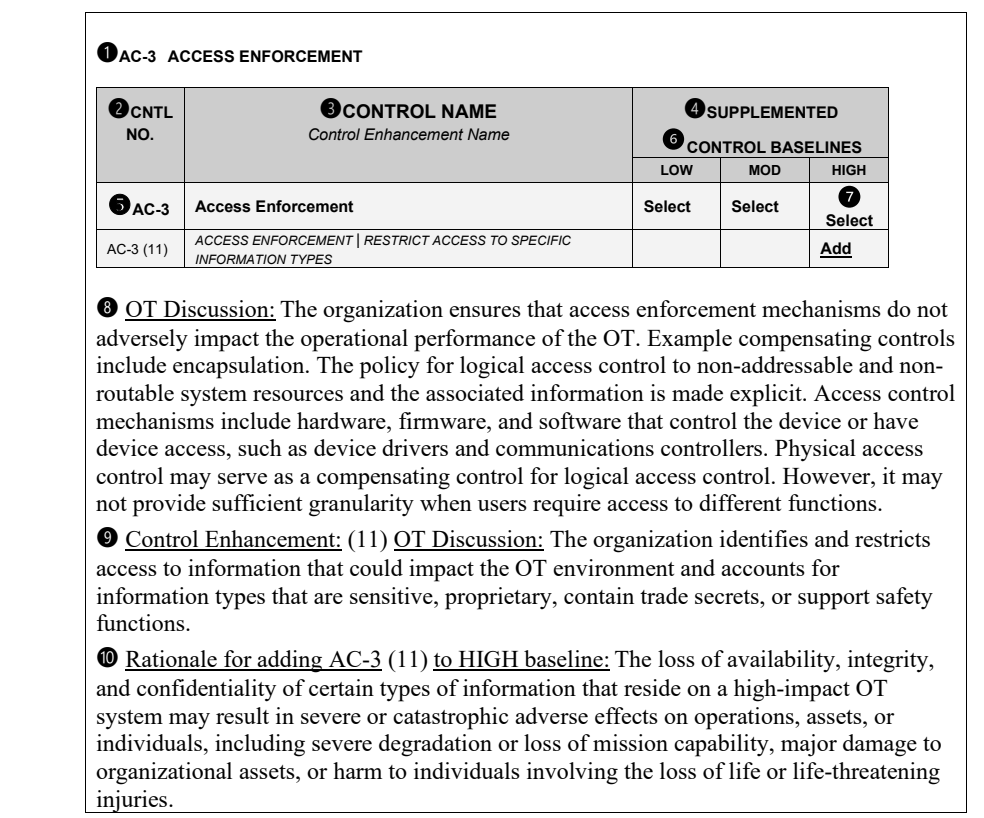
図22. 詳細なオーバーレイ管理策仕様の例。1〜10 の番号付きの吹き出しで各部を示したオーバーレイ項目の例。(1) 見出し: AC-3 ACCESS ENFORCEMENT(アクセス実施)。表の列は (2) CNTL NO.(管理策番号)、(3) CONTROL NAME/Control Enhancement Name(管理策名/管理策拡張名)、(4) SUPPLEMENTED(補足)と (6) CONTROL BASELINES(管理策ベースライン)の LOW・MOD・HIGH。行 (5) AC-3、Access Enforcement: Select、Select、(7) Select。行 AC-3 (11)、ACCESS ENFORCEMENT | RESTRICT ACCESS TO SPECIFIC INFORMATION TYPES(特定の情報タイプへのアクセスの制限): HIGH に Add。(8) OT に関する議論: 組織は、アクセス実施メカニズムが OT の運用性能に悪影響を及ぼさないようにする。補償管理策の例にはカプセル化がある。アドレス指定できない、またはルーティングできないシステム資源と関連情報への論理アクセス制御の方針を明示する。アクセス制御メカニズムには、デバイスドライバや通信コントローラなど、デバイスを制御する、またはデバイスにアクセスするハードウェア、ファームウェア、ソフトウェアが含まれる。物理アクセス制御は、論理アクセス制御の補償管理策となる場合がある。ただし、利用者が異なる機能へのアクセスを必要とする場合には、十分な粒度が得られないことがある。(9) 管理策拡張: (11) OT に関する議論: 組織は、OT 環境に影響を及ぼしうる情報へのアクセスを特定して制限し、機微な情報、専有情報、営業秘密を含む情報、または安全機能を支える情報の種類を考慮する。(10) AC-3 (11) を HIGH ベースラインに追加する根拠: 影響度の高い OT システム上にある特定の種類の情報の可用性、完全性、機密性が失われると、業務、資産、または個人に対して、任務遂行能力の深刻な低下や喪失、組織資産への重大な損害、人命の喪失や生命を脅かす傷害を伴う個人への危害など、深刻または壊滅的な悪影響が生じる場合がある。
Fig. 22. Detailed overlay control specifications illustrated
図22. 詳細なオーバーレイ管理策仕様の例示
F.7.1. ACCESS CONTROL – AC
F.7.1. アクセス制御 – AC
Tailoring Considerations for the Access Control Family
アクセス制御ファミリのテーラリングに関する考慮事項
Before implementing controls in the AC family, consider the trade-offs among security, privacy, latency, performance, throughput, and reliability. For example, the organization considers whether latency induced from the use of confidentiality and integrity mechanisms that employ cryptographic mechanisms would adversely impact the operational performance of the OT.
ACファミリの管理策を実装する前に、セキュリティ、プライバシー、遅延、性能、スループット、信頼性の間のトレードオフを考慮します。たとえば組織は、暗号メカニズムを用いる機密性・完全性メカニズムの使用によって生じる遅延が、OTの運用性能に悪影響を及ぼすかどうかを検討します。
When the OT cannot support the specific access control requirements of a control, the organization employs compensating controls in accordance with the general tailoring guidance. Examples of compensating controls are given with each control as appropriate.
OTが管理策の特定のアクセス制御要件をサポートできない場合、組織は一般的なテーラリングガイダンスに従って代替管理策を採用します。代替管理策の例は、必要に応じて各管理策とともに示します。
AC-1 ACCESS CONTROL POLICY AND PROCEDURES
AC-1 アクセス制御方針および手順
| CNTL NO. | CONTROL NAME Control Enhancement Name | CONTROL BASELINES | ||
|---|---|---|---|---|
| LOW | MOD | HIGH | ||
| AC-1 | Policy and Procedures | Select | Select | Select |
| 管理策番号 | 管理策名 管理策拡張名 | 管理策ベースライン | ||
|---|---|---|---|---|
| LOW | MOD | HIGH | ||
| AC-1 | 方針および手順 | Select | Select | Select |
OT Discussion: The policy specifically addresses the unique properties and requirements of OT and the relationship to non-OT systems. OT access by vendors and maintenance staff can occur over a large facility footprint or geographic area and into unobserved spaces, such as mechanical or electrical rooms, ceilings, floors, field substations, switch and valve vaults, and pump stations.
OTに関する考察:方針では、OT固有の特性および要件ならびに非OTシステムとの関係を明示的に扱います。ベンダーおよび保守要員によるOTへのアクセスは、広大な施設敷地または地理的区域に及び、機械室や電気室、天井、床、現場変電所、開閉器・バルブピット、ポンプ場など、監視されていない空間に入ることがあります。
| CNTL NO. | CONTROL NAME Control Enhancement Name | CONTROL BASELINES | ||
|---|---|---|---|---|
| LOW | MOD | HIGH | ||
| AC-2 | Account Management | Select | Select | Select |
| AC-2 (1) | ACCOUNT MANAGEMENT | AUTOMATED SYSTEM ACCOUNT MANAGEMENT | Select | Select | |
| AC-2 (2) | ACCOUNT MANAGEMENT | AUTOMATED TEMPORARY AND EMERGENCY ACCOUNT MANAGEMENT | Select | Select | |
| AC-2 (3) | ACCOUNT MANAGEMENT | DISABLE ACCOUNTS | Select | Select | |
| AC-2 (4) | ACCOUNT MANAGEMENT | AUTOMATED AUDIT ACTIONS | Select | Select | |
| AC-2 (5) | ACCOUNT MANAGEMENT | INACTIVITY LOGOUT | Select | Select | |
| AC-2 (11) | ACCOUNT MANAGEMENT | USAGE CONDITIONS | Select | ||
| AC-2 (12) | ACCOUNT MANAGEMENT | ACCOUNT MONITORING FOR ATYPICAL USAGE | Select | ||
| AC-2 (13) | ACCOUNT MANAGEMENT | DISABLE ACCOUNTS FOR HIGH-RISK INDIVIDUALS | Select | Select | |
| 管理策番号 | 管理策名 管理策拡張名 | 管理策ベースライン | ||
|---|---|---|---|---|
| LOW | MOD | HIGH | ||
| AC-2 | アカウント管理 | Select | Select | Select |
| AC-2 (1) | アカウント管理 | 自動化されたシステムアカウント管理 | Select | Select | |
| AC-2 (2) | アカウント管理 | 自動化された一時/緊急アカウント管理 | Select | Select | |
| AC-2 (3) | アカウント管理 | アカウントの無効化 | Select | Select | |
| AC-2 (4) | アカウント管理 | 自動化された監査処理 | Select | Select | |
| AC-2 (5) | アカウント管理 | 非アクティブ時のログアウト | Select | Select | |
| AC-2 (11) | アカウント管理 | 使用条件 | Select | ||
| AC-2 (12) | アカウント管理 | 非定型的な使用に対するアカウント監視 | Select | ||
| AC-2 (13) | アカウント管理 | 高リスク個人のアカウント無効化 | Select | Select | |
OT Discussion: In OT systems, physical security, personnel security, intrusion detection, or auditing measures may support this control objective.
OT考察:OTシステムでは、物理セキュリティ、人的セキュリティ、侵入検知、または監査の措置がこの管理策の目的を支援する場合があります。
Control Enhancement: (1) (3) (4) No OT discussion for this control.
管理策拡張:(1) (3) (4) この管理策についてOT考察はありません。
Control Enhancement: (2) OT Discussion: When the OT (e.g., field devices) cannot support temporary or emergency accounts, this enhancement does not apply. Example compensating controls include employing nonautomated mechanisms or procedures.
管理策拡張:(2) OT考察:OT(例:フィールドデバイス)が一時アカウントまたは緊急アカウントをサポートできない場合、この拡張は適用されません。代替管理策の例には、自動化されていないメカニズムまたは手順の採用があります。
Control Enhancement: (5) OT Discussion: This control enhancement defines situations or timeframes in which users log out of accounts in the policy. Automatic enforcement is not addressed by this control enhancement. Organizations determine whether this control enhancement is appropriate for the mission and/or functions of the OT system and define the timeframe or scenarios. If no timeframe or scenarios apply, the organization-defined parameter reflects as much.
管理策拡張:(5) OT考察:この管理策拡張は、ユーザがアカウントからログアウトする状況または時間枠をポリシーで定めます。自動的な強制はこの管理策拡張の対象外です。組織は、この管理策拡張がOTシステムのミッションまたは機能、あるいはその両方に適切かどうかを判断し、時間枠またはシナリオを定めます。適用される時間枠やシナリオがない場合は、組織が定めるパラメータにその旨を反映します。
Control Enhancement: (11) (12) No OT Discussion for this control.
管理策拡張:(11) (12) この管理策についてOT考察はありません。
Control Enhancement: (13) OT Discussion: Close coordination occurs between OT, HR, IT, and physical security personnel to ensure the timely removal of high-risk individuals.
管理策拡張:(13) OT考察:リスクの高い個人を適時に排除するため、OT、人事、IT、物理セキュリティの各担当者の間で緊密な連携を行います。
AC-3 ACCESS ENFORCEMENT
AC-3 アクセスの強制
| CNTL NO. | CONTROL NAME Control Enhancement Name | SUPPLEMENTED CONTROL BASELINES | ||
|---|---|---|---|---|
| LOW | MOD | HIGH | ||
| AC-3 | Access Enforcement | Select | Select | Select |
| AC-3 (11) | ACCESS ENFORCEMENT | RESTRICT ACCESS TO SPECIFIC INFORMATION TYPES | Add | ||
| 管理策番号 | 管理策名 管理策拡張名 | 補足された管理策ベースライン | ||
|---|---|---|---|---|
| LOW | MOD | HIGH | ||
| AC-3 | アクセスの強制 | Select | Select | Select |
| AC-3 (11) | アクセスの強制 | 特定の情報種別へのアクセス制限 | Add | ||
OT Discussion: The organization ensures that access enforcement mechanisms do not adversely impact the operational performance of the OT. Example compensating controls include encapsulation. The policy for logical access control to non-addressable and non-routable system resources and the associated information is made explicit. Access control mechanisms include hardware, firmware, and software that control the device or have device access, such as device drivers and communications controllers. Physical access control may serve as a compensating control for logical access control. However, it may not provide sufficient granularity when users require access to different functions.
OT考察:組織は、アクセス強制メカニズムがOTの運用性能に悪影響を及ぼさないようにします。代替管理策の例には、カプセル化があります。アドレス指定不可能かつルーティング不可能なシステムリソースおよび関連する情報に対する論理アクセス制御のポリシーを明示します。アクセス制御メカニズムには、デバイスドライバや通信コントローラなど、デバイスを制御する、またはデバイスにアクセスするハードウェア、ファームウェア、ソフトウェアが含まれます。物理アクセス制御は、論理アクセス制御の代替管理策となりうます。ただし、ユーザが異なる機能へのアクセスを必要とする場合には、十分な粒度を提供できないことがあります。
Control Enhancement: (11) OT Discussion: The organization identifies and restricts access to information that could impact the OT environment and accounts for information types that are sensitive, proprietary, contain trade secrets, or support safety functions.
管理策拡張:(11) OT考察:組織は、OT環境に影響を及ぼしうる情報を特定してそのアクセスを制限し、機微な情報、専有情報、営業秘密を含む情報、安全機能を支える情報といった情報の種類を考慮します。
Rationale for adding AC-3 (11) to HIGH baseline: The loss of availability, integrity, and confidentiality of certain types of information that reside on a high-impact OT system may result in severe or catastrophic adverse effects on operations, assets, or individuals, including severe degradation or loss of mission capability, major damage to organizational assets, or harm to individuals involving the loss of life or life-threatening injuries.
AC-3 (11)をHIGHベースラインに追加する根拠:高影響度のOTシステム上に存在する特定の種類の情報の可用性、完全性、機密性が失われると、業務、資産、または個人に対して、ミッション遂行能力の深刻な低下や喪失、組織の資産への重大な損害、人命の喪失や生命を脅かす負傷を伴う個人への危害など、深刻または壊滅的な悪影響が生じるおそれがあります。
AC-4 INFORMATION FLOW ENFORCEMENT
AC-4 情報フローの強制
| CNTL NO. | CONTROL NAME Control Enhancement Name | CONTROL BASELINES | ||
|---|---|---|---|---|
| LOW | MOD | HIGH | ||
| AC-4 | Information Flow Enforcement | Select | Select | |
| AC-4 (4) | INFORMATION FLOW ENFORCEMENT | FLOW CONTROL OF ENCRYPTED INFORMATION | Select | ||
| 管理策番号 | 管理策名 管理策拡張名 | 管理策ベースライン | ||
|---|---|---|---|---|
| LOW | MOD | HIGH | ||
| AC-4 | 情報フローの強制 | Select | Select | |
| AC-4 (4) | 情報フローの強制 | 暗号化情報のフロー制御 | Select | ||
OT Discussion: Information flow policy may be achieved using a combination of logical and physical flow restriction techniques. The inspection of message content may enforce information flow policy. For example, industrial OT protocols may be restricted using inbound and outbound traffic rules on a network control device between OT and IT networks. For non-routable communication, such as serial connections, devices may be configured to limit commands to and from specific tags within the OT device. The information flow policy may be supported by labeling or coloring physical connectors to aid in connecting networks. Devices that do not have a business need to communicate should not be connected (i.e., air gapped).
OT考察:情報フローポリシーは、論理的および物理的なフロー制限手法の組み合わせによって実現できます。メッセージ内容の検査によって情報フローポリシーを強制することもできます。たとえば、OTネットワークとITネットワークの間にあるネットワーク制御デバイス上の受信・送信トラフィックルールを用いて、産業用OTプロトコルを制限できます。シリアル接続などのルーティング不可能な通信については、OTデバイス内の特定のタグとの間のコマンドを制限するようにデバイスを設定できます。ネットワークの接続作業を助けるため、物理コネクタにラベルを付けたり色分けしたりすることで、情報フローポリシーを支援できます。業務上通信する必要のないデバイスは接続すべきではありません(すなわち、エアギャップを設けます)。
Control Enhancement: (4) No OT discussion for this control.
管理策拡張:(4) この管理策についてOT考察はありません。
AC-5 SEPARATION OF DUTIES
AC-5 職務の分離
| CNTL NO. | CONTROL NAME Control Enhancement Name | CONTROL BASELINES | ||
|---|---|---|---|---|
| LOW | MOD | HIGH | ||
| AC-5 | Separation of Duties | Select | Select | |
| 管理策番号 | 管理策名 管理策拡張名 | 管理策ベースライン | ||
|---|---|---|---|---|
| LOW | MOD | HIGH | ||
| AC-5 | 職務の分離 | Select | Select | |
OT Discussion: Example compensating controls include providing increased personnel security and auditing. The organization carefully considers the appropriateness of a single individual performing multiple critical roles.
OTに関する考察:補償的管理策の例として、要員セキュリティおよび監査の強化があります。組織は、1人の個人が複数の重要な役割を担うことの適切性を慎重に検討します。
AC-6 LEAST PRIVILEGE
AC-6 最小権限
| CNTL NO. | CONTROL NAME Control Enhancement Name | CONTROL BASELINES | ||
|---|---|---|---|---|
| LOW | MOD | HIGH | ||
| AC-6 | Least Privilege | Select | Select | |
| AC-6 (1) | LEAST PRIVILEGE | AUTHORIZE ACCESS TO SECURITY FUNCTIONS | Select | Select | |
| AC-6 (2) | LEAST PRIVILEGE | NON-PRIVILEGED ACCESS FOR NONSECURITY FUNCTIONS | Select | Select | |
| AC-6 (3) | LEAST PRIVILEGE | NETWORK ACCESS TO PRIVILEGED COMMANDS | Select | ||
| AC-6 (5) | LEAST PRIVILEGE | PRIVILEGED ACCOUNTS | Select | Select | |
| AC-6 (7) | LEAST PRIVILEGE | REVIEW OF USER PRIVILEGES | Select | Select | |
| AC-6 (9) | LEAST PRIVILEGE | LOG USE OF PRIVILEGED FUNCTIONS | Select | Select | |
| AC-6 (10) | LEAST PRIVILEGE | PROHIBIT NON-PRIVILEGED USERS FROM EXECUTING PRIVILEGED FUNCTIONS | Select | Select | |
| 管理策番号 | 管理策名 管理策拡張名 | 管理策ベースライン | ||
|---|---|---|---|---|
| LOW | MOD | HIGH | ||
| AC-6 | 最小権限 | Select | Select | |
| AC-6 (1) | 最小権限 | セキュリティ機能へのアクセスの認可 | Select | Select | |
| AC-6 (2) | 最小権限 | 非セキュリティ機能に対する非特権アクセス | Select | Select | |
| AC-6 (3) | 最小権限 | 特権コマンドへのネットワークアクセス | Select | ||
| AC-6 (5) | 最小権限 | 特権アカウント | Select | Select | |
| AC-6 (7) | 最小権限 | ユーザー権限のレビュー | Select | Select | |
| AC-6 (9) | 最小権限 | 特権機能の使用記録 | Select | Select | |
| AC-6 (10) | 最小権限 | 非特権ユーザーによる特権機能の実行の禁止 | Select | Select | |
OT Discussion: Example compensating controls include providing increased personnel security and auditing. The organization carefully considers the appropriateness of a single individual having multiple critical privileges. System privilege models may be tailored to enforce integrity and availability (e.g., lower privileges include read access, and higher privileges include write access). Control Enhancement: (1) (2) (3) (5) (9) OT Discussion: When OT components (e.g., PLCs) cannot support the logging of privileged functions, other system components within the authorization boundary may be used (e.g., engineering workstations or physical access monitoring). Control Enhancement: (7) No OT Discussion for this control. Control Enhancement: (10) OT Discussion: Example compensating controls include enhanced auditing.
OT考察:代替管理策の例には、人的セキュリティの強化および監査が含まれます。組織は、1人の個人が複数の重要な特権を持つことの適切性を慎重に検討します。システムの特権モデルは、完全性および可用性を確保するように調整できます(例:低い特権には読み取りアクセスが含まれ、高い特権には書き込みアクセスが含まれます)。管理策拡張:(1) (2) (3) (5) (9) OT考察:OTコンポーネント(例:PLC)が特権機能のログ記録に対応できない場合、認可境界内の他のシステムコンポーネント(例:エンジニアリングワークステーションまたは物理アクセス監視)を使用できます。管理策拡張:(7) この管理策についてOT考察はありません。管理策拡張:(10) OT考察:代替管理策の例には、監査の強化が含まれます。
AC-7 UNSUCCESSFUL LOGON ATTEMPTS
AC-7 ログオン試行の失敗
| CNTL NO. | CONTROL NAME Control Enhancement Name | CONTROL BASELINES | ||
|---|---|---|---|---|
| LOW | MOD | HIGH | ||
| AC-7 | Unsuccessful Logon Attempts | Select | Select | Select |
| 管理策番号 | 管理策名 管理策拡張名 | 管理策ベースライン | ||
|---|---|---|---|---|
| LOW | MOD | HIGH | ||
| AC-7 | ログオン試行の失敗 | Select | Select | Select |
OT Discussion: Many OT systems remain in continuous operation, and operators remain logged onto the system at all times. A “log-over” capability may be employed. Example compensating controls include logging or recording all unsuccessful logon attempts and alerting OT security personnel through alarms or other means when the number of organization-defined consecutive invalid access attempts is exceeded. Unsuccessful logon attempt limits are enforced for accounts (e.g., administrator) or systems (e.g., engineering workstations) that are not required for continuous operation.
OTに関する説明:多くのOTシステムは連続運転を続け、オペレーターは常時システムにログオンしたままです。「ログオーバー」機能を使用できる場合があります。補償的管理策の例には、ログオン試行の失敗をすべて記録し、組織が定めた連続する無効なアクセス試行回数を超えたときに、アラームその他の手段でOTセキュリティ担当者に警告することが含まれます。ログオン試行の失敗回数の上限は、連続運転に必要でないアカウント(例:管理者)またはシステム(例:エンジニアリングワークステーション)に対して適用します。
AC-8 SYSTEM USE NOTIFICATION
AC-8 システム使用通知
| CNTL NO. | CONTROL NAME Control Enhancement Name | CONTROL BASELINES | ||
|---|---|---|---|---|
| LOW | MOD | HIGH | ||
| AC-8 | System Use Notification | Select | Select | Select |
| 管理策番号 | 管理策名 管理策拡張名 | 管理策ベースライン | ||
|---|---|---|---|---|
| LOW | MOD | HIGH | ||
| AC-8 | システム使用通知 | Select | Select | Select |
OT Discussion: Many OT systems must remain in continuous operation, and system use notification may not be supported or effective. Example compensating controls include posting physical notices in OT facilities or providing recurring training on system use prior to permitting access.
OTに関する説明:多くのOTシステムは連続運転を維持する必要があり、システム使用通知がサポートされない、または有効でない場合があります。補償的管理策の例には、OT施設内に物理的な通知を掲示すること、またはアクセスを許可する前にシステム使用に関する定期的な研修を実施することが含まれます。
AC-10 CONCURRENT SESSION CONTROL
AC-10 同時セッション制御
| CNTL NO. | CONTROL NAME Control Enhancement Name | CONTROL BASELINES | ||
|---|---|---|---|---|
| LOW | MOD | HIGH | ||
| AC-10 | Concurrent Session Control | Select | ||
| 管理策番号 | 管理策名 管理策拡張名 | 管理策ベースライン | ||
|---|---|---|---|---|
| LOW | MOD | HIGH | ||
| AC-10 | 同時セッション制御 | Select | ||
OT Discussion: The number, account type, and privileges of concurrent sessions consider the roles and responsibilities of the affected individuals. Example compensating controls include providing increased auditing measures.
OTに関する説明:同時セッションの数、アカウントの種類、および特権は、影響を受ける個人の役割と責任を考慮します。補償的管理策の例には、監査措置の強化が含まれます。
AC-11 DEVICE LOCK
AC-11 デバイスロック
| CNTL NO. | CONTROL NAME Control Enhancement Name | CONTROL BASELINES | ||
|---|---|---|---|---|
| LOW | MOD | HIGH | ||
| AC-11 | Device Lock | Select | Select | |
| AC-11 (1) | DEVICE LOCK | PATTERN-HIDING DISPLAYS | Select | Select | |
| 管理策番号 | 管理策名 管理策拡張名 | 管理策ベースライン | ||
|---|---|---|---|---|
| LOW | MOD | HIGH | ||
| AC-11 | デバイスロック | Select | Select | |
| AC-11 (1) | デバイスロック | パターンを隠す表示 | Select | Select | |
OT Discussion: This control assumes a staffed environment where users interact with system displays. This control may be tailored appropriately where systems do not have displays configured, systems are placed in an access-controlled facility or locked enclosure, or immediate operator response is required in emergency situations. Example compensating controls include locating the display in an area with physical access controls that limit access to individuals with permission and need-to-know for the displayed information.
OT考察:この管理策は、ユーザがシステムのディスプレイを操作する、人員が配置された環境を前提としています。システムにディスプレイが設定されていない場合、システムがアクセス制御された施設や施錠された筐体内に設置されている場合、または緊急時にオペレータの即時対応が必要な場合には、この管理策を適宜テーラリングしてもよいです。代替管理策の例には、表示される情報について許可と知る必要性を有する個人にアクセスを限定する物理アクセス制御が施された区域にディスプレイを設置することがあります。
Control Enhancement: (1) OT Discussion: Physical protection may be employed to prevent access to a display or the attachment of a display. When the OT cannot conceal displayed information, the organization employs nonautomated mechanisms or procedures as compensating controls in accordance with the general tailoring guidance.
管理策拡張:(1) OT考察:ディスプレイへのアクセスやディスプレイの取り付けを防ぐために、物理的保護を用いることができます。OTが表示情報を隠すことができない場合、組織は一般的なテーラリングガイダンスに従い、自動化されていないメカニズムまたは手順を代替管理策として採用します。
AC-12 SESSION TERMINATION
AC-12 セッション終了
| CNTL NO. | CONTROL NAME Control Enhancement Name | CONTROL BASELINES | ||
|---|---|---|---|---|
| LOW | MOD | HIGH | ||
| AC-12 | Session Termination | Select | Select | |
| 管理策番号 | 管理策名 管理策拡張名 | 管理策ベースライン | ||
|---|---|---|---|---|
| LOW | MOD | HIGH | ||
| AC-12 | セッション終了 | Select | Select | |
OT Discussion: Example compensating controls include providing increased auditing measures or limiting remote access privileges to key personnel.
OTに関する説明:補償的管理策の例には、監査措置の強化、またはリモートアクセス権限を主要な要員に限定することが含まれます。
AC-14 PERMITTED ACTIONS WITHOUT IDENTIFICATION OR AUTHENTICATION
AC-14 識別または認証なしで許可される操作
| CNTL NO. | CONTROL NAME Control Enhancement Name | CONTROL BASELINES | ||
|---|---|---|---|---|
| LOW | MOD | HIGH | ||
| AC-14 | Permitted Actions without Identification or Authentication | Select | Select | Select |
| 管理策番号 | 管理策名 管理策拡張名 | 管理策ベースライン | ||
|---|---|---|---|---|
| LOW | MOD | HIGH | ||
| AC-14 | 識別または認証なしで許可される操作 | Select | Select | Select |
No OT Discussion for this control.
この管理策にはOTに関する考察はありません。
AC-17 REMOTE ACCESS
AC-17 リモートアクセス
| CNTL NO. | CONTROL NAME Control Enhancement Name | SUPPLEMENTED CONTROL BASELINES | ||
|---|---|---|---|---|
| LOW | MOD | HIGH | ||
| AC-17 | Remote Access | Select | Select | Select |
| AC-17 (1) | REMOTE ACCESS | AUTOMATED MONITORING / CONTROL | Select | Select | |
| AC-17 (2) | REMOTE ACCESS | PROTECTION OF CONFIDENTIALITY / INTEGRITY USING ENCRYPTION | Select | Select | |
| AC-17 (3) | REMOTE ACCESS | MANAGED ACCESS CONTROL POINTS | Select | Select | |
| AC-17 (4) | REMOTE ACCESS | PRIVILEGED COMMANDS / ACCESS | Select | Select | |
| AC-17 (9) | REMOTE ACCESS | DISCONNECT OR DISABLE ACCESS | Add | Add | Add |
| AC-17 (10) | REMOTE ACCESS | AUTHENTICATE REMOTE COMMANDS | Add | Add | |
| 管理策番号 | 管理策名 管理策拡張名 | 補足された管理策ベースライン | ||
|---|---|---|---|---|
| LOW | MOD | HIGH | ||
| AC-17 | リモートアクセス | Select | Select | Select |
| AC-17 (1) | リモートアクセス | 自動化された監視/制御 | Select | Select | |
| AC-17 (2) | リモートアクセス | 暗号化による機密性/完全性の保護 | Select | Select | |
| AC-17 (3) | リモートアクセス | 管理されたアクセス制御ポイント | Select | Select | |
| AC-17 (4) | リモートアクセス | 特権コマンド/アクセス | Select | Select | |
| AC-17 (9) | リモートアクセス | アクセスの切断または無効化 | Add | Add | Add |
| AC-17 (10) | リモートアクセス | リモートコマンドの認証 | Add | Add | |
OT Discussion: When the OT cannot implement any or all of the components of this control, the organization employs other mechanisms or procedures as compensating controls in accordance with the general tailoring guidance.
OTに関する説明:OTでこの制御の一部または全部の要素を実装できない場合、組織は一般的な調整ガイダンスに従い、補償的管理策として他の仕組みまたは手順を採用します。
Control Enhancement: (1) OT Discussion: Example compensating controls include employing nonautomated mechanisms or procedures as compensating controls. Compensating controls could include limiting remote access to a specified period of time or placing a call from the OT site to the authenticated remote entity.
管理策拡張:(1) OT考察:代替管理策の例には、自動化されていないメカニズムまたは手順を代替管理策として採用することがあります。代替管理策には、リモートアクセスを指定した期間に限定することや、OTサイトから認証済みのリモートエンティティに電話をかけることが含まれうます。
Control Enhancement: (2) OT Discussion: Encryption-based technologies should be used to support the confidentiality and integrity of remote access sessions. While OT devices often lack the ability to support modern encryption, additional devices (e.g., VPNs) can be added to support these features. This control should not be confused with SC-8 – Transmission Confidentiality and Integrity, which discusses confidentiality and integrity requirements for general communications, including between OT devices.
管理策拡張:(2) OT考察:リモートアクセスセッションの機密性と完全性を支えるために、暗号化に基づく技術を用いるべきです。OTデバイスは最新の暗号化をサポートする能力を欠いていることが多いですが、これらの機能をサポートするために追加のデバイス(例:VPN)を加えることができます。この管理策を、OTデバイス間を含む一般的な通信の機密性と完全性の要件を扱うSC-8 – Transmission Confidentiality and Integrityと混同してはなりません。
Control Enhancement: (3) OT Discussion: Example compensating controls include connection-specific manual authentication of the remote entity.
管理策拡張:(3) OT考察:代替管理策の例には、接続ごとにリモートエンティティを手動で認証することがあります。
Control Enhancement: (4) (10) No OT Discussion for this control.
管理策拡張:(4) (10) この管理策についてOT考察はありません。
Control Enhancement: (9) OT Discussion: Implementation of the remote access disconnect should not impact OT operations. OT personnel should be trained on how to use the remote access disconnect.
管理策拡張:(9) OT考察:リモートアクセス切断の実装がOTの運用に影響を及ぼすべきではありません。OT担当者には、リモートアクセス切断の使い方について訓練を行うべきです。
Rationale for adding AC-17 (9) to LOW, MOD, and HIGH baselines: As more OT systems become accessible remotely, the capability to disconnect or disable remote access is critical to managing risk and may be required to provide stable and safe operations.
AC-17 (9)をLOW、MOD、HIGHの各ベースラインに追加する根拠:リモートからアクセス可能なOTシステムが増えるにつれ、リモートアクセスを切断または無効化する機能はリスク管理にとって極めて重要となっており、安定かつ安全な運用を実現するために必要となる場合があります。
Rationale for adding AC-17 (10) to MOD and HIGH baselines: The ability to authenticate remote commands is important to prevent unauthorized commands that may have immediate or serious consequences, such as injury, death, property damage, the loss of high-value assets, the failure of mission or business functions, or compromise of sensitive information.
AC-17 (10)をMODおよびHIGHベースラインに追加する根拠:リモートコマンドを認証する能力は、負傷、死亡、物的損害、高価値資産の喪失、ミッション・業務機能の失敗、機微な情報の侵害など、即時の、または深刻な結果をもたらしうる不正なコマンドを防ぐために重要です。
AC-18 WIRELESS ACCESS
AC-18 無線アクセス
| CNTL NO. | CONTROL NAME Control Enhancement Name | CONTROL BASELINES | ||
|---|---|---|---|---|
| LOW | MOD | HIGH | ||
| AC-18 | Wireless Access | Select | Select | Select |
| AC-18 (1) | WIRELESS ACCESS | AUTHENTICATION AND ENCRYPTION | Select | Select | |
| AC-18 (3) | WIRELESS ACCESS | DISABLE WIRELESS NETWORKING | Select | Select | |
| AC-18 (4) | WIRELESS ACCESS | RESTRICT CONFIGURATIONS BY USERS | Select | ||
| AC-18 (5) | WIRELESS ACCESS | ANTENNAS AND TRANSMISSION POWER LEVELS | Select | ||
| 管理策番号 | 管理策名 管理策拡張名 | 管理策ベースライン | ||
|---|---|---|---|---|
| LOW | MOD | HIGH | ||
| AC-18 | 無線アクセス | Select | Select | Select |
| AC-18 (1) | 無線アクセス | 認証および暗号化 | Select | Select | |
| AC-18 (3) | 無線アクセス | 無線ネットワーク機能の無効化 | Select | Select | |
| AC-18 (4) | 無線アクセス | ユーザーによる構成の制限 | Select | ||
| AC-18 (5) | 無線アクセス | アンテナおよび送信電力レベル | Select | ||
OT Discussion: When OT cannot implement any or all of the components of this control, the organization employs other mechanisms or procedures as compensating controls in accordance with the general tailoring guidance.
OT考察:OTがこの管理策の構成要素の一部またはすべてを実装できない場合、組織は一般的なテーラリングガイダンスに従い、他のメカニズムまたは手順を代替管理策として採用します。
Control Enhancement: (1) OT Discussion: The implementation of authentication and encryption is driven by the OT environment. If devices and users cannot all be authenticated and encrypted due to operational or technology constraints, compensating controls include providing increased auditing for wireless access, limiting wireless access privileges to key personnel, or using AC-18 (5) to reduce the boundary of wireless access.
管理策拡張:(1) OT考察:認証と暗号化の実装はOT環境によって左右されます。運用上または技術上の制約により、すべてのデバイスとユーザを認証し暗号化することができない場合、代替管理策には、無線アクセスに対する監査の強化、無線アクセス権限の主要な担当者への限定、AC-18 (5)を用いた無線アクセス境界の縮小があります。
Control Enhancement: (3) (4) No OT Discussion for this control.
管理策拡張:(3) (4) この管理策についてOT考察はありません。
Control Enhancement: (5) Availability and interference for wireless signals may be a concern within OT environments. Antennas and power levels should be designed to overcome and achieve availability goals. Where confidentiality is concerned, antennas and power levels can also be designed to minimize signal exposure outside of the facility.
管理策拡張:(5) OT環境では、無線信号の可用性と干渉が懸念となりうます。アンテナと出力レベルは、これらを克服し可用性の目標を達成できるように設計すべきです。機密性が懸念される場合は、施設外への信号の露出を最小限に抑えるようにアンテナと出力レベルを設計することもできます。
AC-19 ACCESS CONTROL FOR MOBILE DEVICES
AC-19 モバイルデバイスのアクセス制御
| CNTL NO. | CONTROL NAME Control Enhancement Name | CONTROL BASELINES | ||
|---|---|---|---|---|
| LOW | MOD | HIGH | ||
| AC-19 | Access Control for Mobile Devices | Select | Select | Select |
| AC-19 (5) | ACCESS CONTROL FOR MOBILE DEVICES | FULL DEVICE / CONTAINER-BASED ENCRYPTION | Select | Select | |
| 管理策番号 | 管理策名 管理策拡張名 | 管理策ベースライン | ||
|---|---|---|---|---|
| LOW | MOD | HIGH | ||
| AC-19 | モバイルデバイスのアクセス制御 | Select | Select | Select |
| AC-19 (5) | モバイルデバイスのアクセス制御 | デバイス全体/コンテナベースの暗号化 | Select | Select | |
No OT Discussion for this control.
この管理策にはOTに関する考察はありません。
AC-20 USE OF EXTERNAL SYSTEMS
AC-20 外部システムの使用
| CNTL NO. | CONTROL NAME Control Enhancement Name | CONTROL BASELINES | ||
|---|---|---|---|---|
| LOW | MOD | HIGH | ||
| AC-20 | Use of External Systems | Select | Select | Select |
| AC-20 (1) | USE OF EXTERNAL SYSTEMS | LIMITS ON AUTHORIZED USE | Select | Select | |
| AC-20 (2) | USE OF EXTERNAL SYSTEMS | PORTABLE STORAGE MEDIA | Select | Select | |
| 管理策番号 | 管理策名 管理策拡張名 | 管理策ベースライン | ||
|---|---|---|---|---|
| LOW | MOD | HIGH | ||
| AC-20 | 外部システムの使用 | Select | Select | Select |
| AC-20 (1) | 外部システムの使用 | 許可された使用の制限 | Select | Select | |
| AC-20 (2) | 外部システムの使用 | 可搬記憶媒体 | Select | Select | |
OT Discussion: Organizations refine the definition of “external” to reflect lines of authority and responsibility, the granularity of an organization entity, and their relationships. An organization may consider a system to be external if that system performs different functions, implements different policies, falls under different management authorities, or does not provide sufficient visibility into the implementation of controls to allow the establishment of a satisfactory trust relationship. For example, an OT system and a business data processing system may be considered external to each other depending on the organization’s system boundaries.
OT考察:組織は、権限と責任の系統、組織エンティティの粒度、およびそれらの関係を反映するように「外部」の定義を精緻化します。組織は、あるシステムが異なる機能を実行する、異なるポリシーを実装する、異なる管理権限の下にある、または満足のいく信頼関係を確立できるほど管理策の実装について十分な可視性を提供しない場合に、そのシステムを外部とみなすことができます。たとえば、組織のシステム境界によっては、OTシステムと業務データ処理システムが互いに外部とみなされることがあります。
Access to an OT for support by a business partner, such as a vendor or support contractor, is another common example. The definition and trustworthiness of external systems is reexamined with respect to OT functions, purposes, technology, and limitations to establish a clearly documented technical or business case for use and an acceptance of the risk inherent in the use of an external system.
ベンダやサポート請負業者などのビジネスパートナーによるサポートのためのOTへのアクセスも、よくある例です。外部システムの使用について明確に文書化された技術上または業務上の正当性を確立し、外部システムの使用に内在するリスクを受容するために、OTの機能、目的、技術、制約に照らして外部システムの定義と信頼性を再検討します。
Control Enhancement: (1) (2) No OT Discussion for this control.
管理策拡張:(1) (2) この管理策についてOT考察はありません。
AC-21 INFORMATION SHARING
AC-21 情報共有
| CNTL NO. | CONTROL NAME Control Enhancement Name | CONTROL BASELINES | ||
|---|---|---|---|---|
| LOW | MOD | HIGH | ||
| AC-21 | Information Sharing | Select | Select | |
| 管理策番号 | 管理策名 管理策拡張名 | 管理策ベースライン | ||
|---|---|---|---|---|
| LOW | MOD | HIGH | ||
| AC-21 | 情報共有 | Select | Select | |
No OT Discussion for this control.
この管理策にはOTに関する考察はありません。
AC-22 PUBLICLY ACCESSIBLE CONTENT
AC-22 一般公開可能なコンテンツ
| CNTL NO. | CONTROL NAME Control Enhancement Name | CONTROL BASELINES | ||
|---|---|---|---|---|
| LOW | MOD | HIGH | ||
| AC-22 | Publicly Accessible Content | Select | Select | Select |
| 管理策番号 | 管理策名 管理策拡張名 | 管理策ベースライン | ||
|---|---|---|---|---|
| LOW | MOD | HIGH | ||
| AC-22 | 一般公開可能なコンテンツ | Select | Select | Select |
OT Discussion: Generally, public access to OT systems is not permitted. Select information may be transferred to a publicly accessible system, possibly with added controls. The organization should review what information is being made accessible prior to publication.
OTに関する考察:一般に、OTシステムへの公開アクセスは許可されません。選択された情報は、場合によっては追加の管理策を適用したうえで、一般公開システムに転送できます。組織は、公開前に、どの情報をアクセス可能にするかを確認すべきです。
F.7.2. AWARENESS AND TRAINING – AT
F.7.2. 意識向上および訓練 – AT
AT-1 POLICY AND PROCEDURES
AT-1 方針および手順
| CNTL NO. | CONTROL NAME Control Enhancement Name | CONTROL BASELINES | ||
|---|---|---|---|---|
| LOW | MOD | HIGH | ||
| AT-1 | Policy and Procedures | Select | Select | Select |
| 管理策番号 | 管理策名 管理策拡張名 | 管理策ベースライン | ||
|---|---|---|---|---|
| LOW | MOD | HIGH | ||
| AT-1 | 方針および手順 | Select | Select | Select |
OT Discussion: The policy specifically addresses the unique properties and requirements of OT and the relationship to non-OT systems.
OTに関する考察:方針では、OT固有の特性および要件と、非OTシステムとの関係を明示的に扱います。
AT-2 LITERACY TRAINING AND AWARENESS
AT-2 リテラシー訓練および意識向上
| CNTL NO. | CONTROL NAME Control Enhancement Name | SUPPLEMENTED CONTROL BASELINES | ||
|---|---|---|---|---|
| LOW | MOD | HIGH | ||
| AT-2 | Literacy Training and Awareness | Select | Select | Select |
| AT-2 (2) | LITERACY TRAINING AND AWARENESS | INSIDER THREAT | Select | Select | Select |
| AT-2 (3) | LITERACY TRAINING AND AWARENESS | SOCIAL ENGINEERING AND MINING | Select | Select | |
| AT-2 (4) | LITERACY TRAINING AND AWARENESS | SUSPICIOUS COMMUNICATIONS AND ANOMALOUS SYSTEM BEHAVIOR | Add | Add | |
| 管理策番号 | 管理策名 管理策拡張名 | 補足された管理策ベースライン | ||
|---|---|---|---|---|
| LOW | MOD | HIGH | ||
| AT-2 | リテラシー訓練および意識向上 | Select | Select | Select |
| AT-2 (2) | リテラシー訓練および意識向上 | 内部脅威 | Select | Select | Select |
| AT-2 (3) | リテラシー訓練および意識向上 | ソーシャルエンジニアリングおよびソーシャルマイニング | Select | Select | |
| AT-2 (4) | リテラシー訓練および意識向上 | 不審な通信および異常なシステム動作 | Add | Add | |
OT Discussion: Security awareness training includes initial and periodic review of OT-specific policies, standard operating procedures, security trends, and vulnerabilities. The OT security awareness program is consistent with the requirements of the security awareness and training policy established by the organization. Control Enhancement: (2) (3) No OT Discussion for this control.
OT考察:セキュリティ意識向上訓練には、OT固有の方針、標準運用手順、セキュリティ動向、および脆弱性の初回および定期的な確認を含めます。OTセキュリティ意識向上プログラムは、組織が定めたセキュリティ意識向上および訓練方針の要件に整合します。管理策拡張:(2) (3) この管理策についてOT考察はありません。
Control Enhancement: (4) OT Discussion: Identify and communicate suspicious and anomalous behaviors within the OT environment. Some examples of OT suspicious or anomalous behavior may include a PLC still in programming mode when it is expected to be in run mode, process trips with an undetermined root cause, malware on an HMI, unexpected mouse movement, or process changes that are not being performed by the operator.
管理策の拡張:(4) OT考察:OT環境内の不審な挙動および異常な挙動を識別し、伝達します。OTにおける不審な挙動または異常な挙動の例としては、実行モードであるべきPLCがプログラミングモードのままになっている、根本原因が特定できないプロセストリップが発生する、HMI上にマルウェアが存在する、予期しないマウスの動きがある、オペレータが行っていないプロセス変更が生じる、などがあります。
Rationale for adding AT-2 (4) to MOD and HIGH baselines: Training OT personnel on potentially suspicious communications and anomalous behaviors as well as the actions to take if anomalous system behavior occurs can supplement system detection and protection mechanisms for improved response.
AT-2 (4) をMODおよびHIGHベースラインに追加する根拠:不審な可能性のある通信や異常な挙動、ならびにシステムの異常な挙動が発生した場合にとるべき行動についてOT要員を訓練することは、システムの検知・保護メカニズムを補完し、対応の改善につながります。
AT-3 ROLE-BASED TRAINING
AT-3 役割ベースの訓練
| CNTL NO. | CONTROL NAME Control Enhancement Name | CONTROL BASELINES | ||
|---|---|---|---|---|
| LOW | MOD | HIGH | ||
| AT-3 | Role-Based Training | Select | Select | Select |
| 管理策番号 | 管理策名 管理策拡張名 | 管理策ベースライン | ||
|---|---|---|---|---|
| LOW | MOD | HIGH | ||
| AT-3 | 役割ベースの訓練 | Select | Select | Select |
OT Discussion: Security training includes initial and periodic review of OT-specific policies, standard operating procedures, security trends, and vulnerabilities. The OT security training program is consistent with the requirements of the security awareness and training policy established by the organization. The training may be customized for specific OT roles, which could include operators, maintainers, engineers, supervisors, and administrators.
OTに関する考察:セキュリティ訓練には、OT固有の方針、標準運用手順、セキュリティ動向、および脆弱性の初回および定期的な確認を含めます。OTセキュリティ訓練プログラムは、組織が定めたセキュリティ意識向上および訓練方針の要件に整合します。訓練は、オペレーター、保守担当者、エンジニア、監督者、および管理者など、特定のOT上の役割に合わせて調整できます。
AT-4 TRAINING RECORDS
AT-4 訓練記録
| CNTL NO. | CONTROL NAME Control Enhancement Name | CONTROL BASELINES | ||
|---|---|---|---|---|
| LOW | MOD | HIGH | ||
| AT-4 | Training Records | Select | Select | Select |
| 管理策番号 | 管理策名 管理策拡張名 | 管理策ベースライン | ||
|---|---|---|---|---|
| LOW | MOD | HIGH | ||
| AT-4 | 訓練記録 | Select | Select | Select |
No OT Discussion for this control.
この管理策にはOTに関する考察はありません。
F.7.3. AUDITING AND ACCOUNTABILITY – AU
F.7.3. 監査および説明責任 – AU
Tailoring Considerations for the Audit Family
監査ファミリのテーラリングに関する考慮事項
In general, security audit information and audit tools are not available on legacy OT. When OT cannot support the specific audit and accountability requirements of a control, the organization employs compensating controls in accordance with the general tailoring guidance. For example, organizations may want to consider whether security audit information is available from separate systems or system components (e.g., the historian, firewall logs, physical security systems). Additional examples of compensating controls are given with each control as appropriate.
一般に、レガシーOTではセキュリティ監査情報や監査ツールを利用できません。OTが管理策の特定の監査および説明責任の要件に対応できない場合、組織は一般的なテーラリングガイダンスに従って代替管理策を採用します。たとえば組織は、セキュリティ監査情報を別のシステムやシステムコンポーネント(ヒストリアン、ファイアウォールログ、物理セキュリティシステムなど)から入手できるかどうかを検討するとよいです。代替管理策のその他の例は、必要に応じて各管理策とともに示します。
AU-1 AUDIT AND ACCOUNTABILITY POLICY AND PROCEDURES
AU-1 監査および説明責任に関する方針および手順
| CNTL NO. | CONTROL NAME Control Enhancement Name | CONTROL BASELINES | ||
|---|---|---|---|---|
| LOW | MOD | HIGH | ||
| AU-1 | Policy and Procedures | Select | Select | Select |
| 管理策番号 | 管理策名 管理策拡張名 | 管理策ベースライン | ||
|---|---|---|---|---|
| LOW | MOD | HIGH | ||
| AU-1 | 方針および手順 | Select | Select | Select |
OT Discussion: The policy specifically addresses the unique properties and requirements of OT and the relationship to non-OT systems.
OTに関する考察:方針では、OT固有の特性および要件と、非OTシステムとの関係を明示的に扱います。
AU-2 EVENT LOGGING
AU-2 イベントログ記録
| CNTL NO. | CONTROL NAME Control Enhancement Name | CONTROL BASELINES | ||
|---|---|---|---|---|
| LOW | MOD | HIGH | ||
| AU-2 | Event Logging | Select | Select | Select |
| 管理策番号 | 管理策名 管理策拡張名 | 管理策ベースライン | ||
|---|---|---|---|---|
| LOW | MOD | HIGH | ||
| AU-2 | イベントログ記録 | Select | Select | Select |
OT Discussion: Organizations may want to include relevant OT events (e.g., alerts, alarms, configuration and status changes, operator actions) in their event logging, which may be designated as audit events.
OTに関する考察:組織は、監査イベントとして指定する可能性のある関連OTイベント(例:アラート、アラーム、構成および状態の変更、オペレーターの操作)をイベントログ記録に含めることを検討できます。
AU-3 CONTENT OF AUDIT RECORDS
AU-3 監査記録の内容
| CNTL NO. | CONTROL NAME Control Enhancement Name | CONTROL BASELINES | ||
|---|---|---|---|---|
| LOW | MOD | HIGH | ||
| AU-3 | Content of Audit Records | Select | Select | Select |
| AU-3 (1) | CONTENT OF AUDIT RECORDS | ADDITIONAL AUDIT INFORMATION | Select | Select | |
| 管理策番号 | 管理策名 管理策拡張名 | 管理策ベースライン | ||
|---|---|---|---|---|
| LOW | MOD | HIGH | ||
| AU-3 | 監査記録の内容 | Select | Select | Select |
| AU-3 (1) | 監査記録の内容 | 追加監査情報 | Select | Select | |
No OT Discussion for this control.
この制御に関するOTの説明はありません。
AU-4 AUDIT LOG STORAGE CAPACITY
AU-4 監査ログの記憶容量
| CNTL NO. | CONTROL NAME Control Enhancement Name | SUPPLEMENTED CONTROL BASELINES | ||
|---|---|---|---|---|
| LOW | MOD | HIGH | ||
| AU-4 | Audit Log Storage Capacity | Select | Select | Select |
| AU-4 (1) | AUDIT LOG STORAGE CAPACITY | TRANSFER TO ALTERNATE STORAGE | Add | Add | Add |
| 管理策番号 | 管理策名 管理策拡張名 | 補足された管理策ベースライン | ||
|---|---|---|---|---|
| LOW | MOD | HIGH | ||
| AU-4 | 監査ログの記憶容量 | Select | Select | Select |
| AU-4 (1) | 監査ログの記憶容量 | 代替ストレージへの転送 | Add | Add | Add |
No OT Discussion for this control. Rationale for adding AU-4 (1) to LOW, MOD, and HIGH baselines: Organizational requirements may require the storage of very large amounts of data, which OT components may not be able to support directly.
この管理策についてOT考察はありません。AU-4 (1) をLOW、MOD、HIGHの各ベースラインに追加する根拠:組織の要件により、非常に大量のデータを保存する必要が生じる場合があり、OTコンポーネントでは直接サポートできないことがあります。
AU-5 RESPONSE TO AUDIT LOGGING PROCESS FAILURES
AU-5 監査ログ記録プロセスの障害への対応
| CNTL NO. | CONTROL NAME Control Enhancement Name | CONTROL BASELINES | ||
|---|---|---|---|---|
| LOW | MOD | HIGH | ||
| AU-5 | Response to Audit Logging Process Failures | Select | Select | Select |
| AU-5 (1) | RESPONSE TO AUDIT LOGGING PROCESS FAILURES | AUDIT STORAGE CAPACITY | Select | ||
| AU-5 (2) | RESPONSE TO AUDIT LOGGING PROCESS FAILURES | REAL-TIME ALERTS | Select | ||
| 管理策番号 | 管理策名 管理策拡張名 | 管理策ベースライン | ||
|---|---|---|---|---|
| LOW | MOD | HIGH | ||
| AU-5 | 監査ログ記録プロセスの障害への対応 | Select | Select | Select |
| AU-5 (1) | 監査ログ記録プロセスの障害への対応 | 監査用ストレージ容量 | Select | ||
| AU-5 (2) | 監査ログ記録プロセスの障害への対応 | リアルタイム警報 | Select | ||
No OT Discussion for this control.
この制御に関するOTの説明はありません。
AU-6 AUDIT RECORD REVIEW, ANALYSIS, AND REPORTING
AU-6 監査記録のレビュー、分析および報告
| CNTL NO. | CONTROL NAME Control Enhancement Name | CONTROL BASELINES | ||
|---|---|---|---|---|
| LOW | MOD | HIGH | ||
| AU-6 | Audit Review, Analysis, and Reporting | Select | Select | Select |
| AU-6 (1) | AUDIT RECORD REVIEW, ANALYSIS, AND REPORTING | AUTOMATED PROCESS INTEGRATION | Select | Select | |
| AU-6 (3) | AUDIT RECORD REVIEW, ANALYSIS, AND REPORTING | CORRELATE AUDIT RECORD REPOSITORIES | Select | Select | |
| AU-6 (5) | AUDIT RECORD REVIEW, ANALYSIS, AND REPORTING | INTEGRATED ANALYSIS OF AUDIT RECORDS | Select | ||
| AU-6 (6) | AUDIT RECORD REVIEW, ANALYSIS, AND REPORTING | CORRELATION WITH PHYSICAL MONITORING | Select | ||
| 管理策番号 | 管理策名 管理策拡張名 | 管理策ベースライン | ||
|---|---|---|---|---|
| LOW | MOD | HIGH | ||
| AU-6 | 監査レビュー、分析、および報告 | Select | Select | Select |
| AU-6 (1) | 監査記録のレビュー、分析および報告 | 自動化されたプロセス統合 | Select | Select | |
| AU-6 (3) | 監査記録のレビュー、分析および報告 | 監査記録リポジトリ間の相関 | Select | Select | |
| AU-6 (5) | 監査記録のレビュー、分析および報告 | 監査記録の統合分析 | Select | ||
| AU-6 (6) | 監査記録のレビュー、分析および報告 | 物理監視との相関 | Select | ||
No OT Discussion for this control. Control Enhancement: (1) OT Discussion: Example compensating controls include manual mechanisms or procedures. For devices where audit records cannot be feasibly collected, periodic manual review may be necessary. Control Enhancement: (3) (5) (6) No OT Discussion for this control.
この管理策についてOT考察はありません。管理策拡張:(1) OT考察:代替管理策の例には、手動のメカニズムまたは手順が含まれます。監査記録を実行可能な方法で収集できないデバイスでは、定期的な手動レビューが必要となる場合があります。管理策拡張:(3) (5) (6) この管理策についてOT考察はありません。
AU-7 AUDIT RECORD REDUCTION AND REPORT GENERATION
AU-7 監査記録の削減およびレポート生成
| CNTL NO. | CONTROL NAME Control Enhancement Name | CONTROL BASELINES | ||
|---|---|---|---|---|
| LOW | MOD | HIGH | ||
| AU-7 | Audit Record Reduction and Report Generation | Select | Select | |
| AU-7 (1) | AUDIT RECORD REDUCTION AND REPORT GENERATION | AUTOMATIC PROCESSING | Select | Select | |
| 管理策番号 | 管理策名 管理策拡張名 | 管理策ベースライン | ||
|---|---|---|---|---|
| LOW | MOD | HIGH | ||
| AU-7 | 監査記録の削減およびレポート生成 | Select | Select | |
| AU-7 (1) | 監査記録の削減およびレポート生成 | 自動処理 | Select | Select | |
No OT Discussion for this control.
この制御に関するOTの説明はありません。
AU-8 TIME STAMPS
AU-8 タイムスタンプ
| CNTL NO. | CONTROL NAME Control Enhancement Name | CONTROL BASELINES | ||
|---|---|---|---|---|
| LOW | MOD | HIGH | ||
| AU-8 | Time Stamps | Select | Select | Select |
| 管理策番号 | 管理策名 管理策拡張名 | 管理策ベースライン | ||
|---|---|---|---|---|
| LOW | MOD | HIGH | ||
| AU-8 | タイムスタンプ | Select | Select | Select |
OT Discussion: Example compensating controls include using a separate system designated as an authoritative time source. See related control SC-45.
OTに関する説明:補償的管理策の例には、権威ある時刻源として指定された別個のシステムを使用することが含まれます。関連する制御SC-45を参照してください。
AU-9 PROTECTION OF AUDIT INFORMATION
AU-9 監査情報の保護
| CNTL NO. | CONTROL NAME Control Enhancement Name | CONTROL BASELINES | ||
|---|---|---|---|---|
| LOW | MOD | HIGH | ||
| AU-9 | Protection of Audit Information | Select | Select | Select |
| AU-9 (2) | PROTECTION OF AUDIT INFORMATION | STORE ON SEPARATE PHYSICAL SYSTEMS OR COMPONENTS | Select | ||
| AU-9 (3) | PROTECTION OF AUDIT INFORMATION | CRYPTOGRAPHIC PROTECTION | Select | ||
| AU-9 (4) | PROTECTION OF AUDIT INFORMATION | ACCESS BY SUBSET OF PRIVILEGED USERS | Select | Select | |
| 管理策番号 | 管理策名 管理策拡張名 | 管理策ベースライン | ||
|---|---|---|---|---|
| LOW | MOD | HIGH | ||
| AU-9 | 監査情報の保護 | Select | Select | Select |
| AU-9 (2) | 監査情報の保護 | 物理的に分離されたシステムまたはコンポーネントへの保存 | Select | ||
| AU-9 (3) | 監査情報の保護 | 暗号保護 | Select | ||
| AU-9 (4) | 監査情報の保護 | 特権ユーザーの一部によるアクセス | Select | Select | |
No OT Discussion for this control.
この制御に関するOTの説明はありません。
AU-10 NON-REPUDIATION
AU-10 否認防止
| CNTL NO. | CONTROL NAME Control Enhancement Name | CONTROL BASELINES | ||
|---|---|---|---|---|
| LOW | MOD | HIGH | ||
| AU-10 | Non-Repudiation | Select | ||
| 管理策番号 | 管理策名 管理策拡張名 | 管理策ベースライン | ||
|---|---|---|---|---|
| LOW | MOD | HIGH | ||
| AU-10 | 否認防止 | Select | ||
OT Discussion: OT devices may not enforce non-repudiation of audit records and may require compensating controls. Example compensating controls include physical security systems, cameras to monitor user access, or a separate device for log collection.
OTに関する考察:OTデバイスは監査記録の否認防止を強制できない場合があり、補償的管理策が必要となることがあります。補償的管理策の例には、物理セキュリティシステム、ユーザーアクセスを監視するカメラ、またはログ収集用の別個のデバイスが含まれます。
AU-11 AUDIT RECORD RETENTION
AU-11 監査記録の保持
| CNTL NO. | CONTROL NAME Control Enhancement Name | CONTROL BASELINES | ||
|---|---|---|---|---|
| LOW | MOD | HIGH | ||
| AU-11 | Audit Record Retention | Select | Select | Select |
| 管理策番号 | 管理策名 管理策拡張名 | 管理策ベースライン | ||
|---|---|---|---|---|
| LOW | MOD | HIGH | ||
| AU-11 | 監査記録の保持 | Select | Select | Select |
No OT Discussion for this control.
この制御に関するOTの説明はありません。
AU-12 AUDIT RECORD GENERATION
AU-12 監査記録の生成
| CNTL NO. | CONTROL NAME Control Enhancement Name | CONTROL BASELINES | ||
|---|---|---|---|---|
| LOW | MOD | HIGH | ||
| AU-12 | Audit Record Generation | Select | Select | Select |
| AU-12 (1) | AUDIT RECORD GENERATION | SYSTEM-WIDE AND TIME-CORRELATED AUDIT TRAIL | Select | ||
| AU-12 (3) | AUDIT RECORD GENERATION | CHANGES BY AUTHORIZED INDIVIDUALS | Select | ||
| 管理策番号 | 管理策名 管理策拡張名 | 管理策ベースライン | ||
|---|---|---|---|---|
| LOW | MOD | HIGH | ||
| AU-12 | 監査記録の生成 | Select | Select | Select |
| AU-12 (1) | 監査記録の生成 | システム全体の時間的に相関付けられた監査証跡 | Select | ||
| AU-12 (3) | 監査記録の生成 | 認可された個人による変更 | Select | ||
No OT Discussion for this control. Control Enhancement: (1) OT Discussion: Example compensating controls include providing time-correlated audit records on a separate system. Control Enhancement: (3) OT Discussion: Example compensating controls include employing nonautomated mechanisms or procedures.
この管理策についてOT考察はありません。管理策拡張:(1) OT考察:代替管理策の例には、別個のシステム上で時刻相関済み監査記録を提供することが含まれます。管理策拡張:(3) OT考察:代替管理策の例には、自動化されていないメカニズムまたは手順を採用することが含まれます。
F.7.4. ASSESSMENT, AUTHORIZATION, AND MONITORING – CA
F.7.4. 評価、認可および監視 – CA
Tailoring Considerations for the Security Assessment and Authorization Family
セキュリティ評価および認可ファミリのテーラリングに関する考慮事項
When the OT cannot support the specific assessment, authorization, and monitoring requirements of a control, the organization employs compensating controls in accordance with the general tailoring guidance. Examples of compensating controls are given with each control as appropriate.
OTが管理策の特定の評価、認可、および監視の要件をサポートできない場合、組織は一般的なテーラリングガイダンスに従って代替管理策を採用します。代替管理策の例は、必要に応じて各管理策とともに示します。
CA-1 POLICY AND PROCEDURES
CA-1 方針および手順
| CNTL NO. | CONTROL NAME Control Enhancement Name | CONTROL BASELINES | ||
|---|---|---|---|---|
| LOW | MOD | HIGH | ||
| CA-1 | Policy and Procedures | Select | Select | Select |
| 管理策番号 | 管理策名 管理策拡張名 | 管理策ベースライン | ||
|---|---|---|---|---|
| LOW | MOD | HIGH | ||
| CA-1 | 方針および手順 | Select | Select | Select |
OT Discussion: The policy specifically addresses the unique properties and requirements of OT and the relationship to non-OT systems.
OTに関する考察:方針では、OT固有の特性および要件と、非OTシステムとの関係を明示的に扱います。
CA-2 CONTROL ASSESSMENTS
CA-2 管理策アセスメント
| CNTL NO. | CONTROL NAME Control Enhancement Name | CONTROL BASELINES | ||
|---|---|---|---|---|
| LOW | MOD | HIGH | ||
| CA-2 | Control Assessments | Select | Select | Select |
| CA-2 (1) | CONTROL ASSESSMENTS | INDEPENDENT ASSESSORS | Select | Select | |
| CA-2 (2) | CONTROL ASSESSMENTS | SPECIALIZED ASSESSMENTS | Select | ||
| 管理策番号 | 管理策名 管理策拡張名 | 管理策ベースライン | ||
|---|---|---|---|---|
| LOW | MOD | HIGH | ||
| CA-2 | 管理策アセスメント | Select | Select | Select |
| CA-2 (1) | 管理策アセスメント | 独立した評価者 | Select | Select | |
| CA-2 (2) | 管理策アセスメント | 専門的なアセスメント | Select | ||
OT Discussion: Assessments are performed and documented by qualified assessors (i.e., experienced in assessing OT) authorized by the organization. The individual or group conducting the assessment fully understands the organizational information security policies and procedures, the OT security policies and procedures, and the specific health, safety, and environmental risks associated with a particular facility and/or process. The organization ensures that the assessment does not affect system operation or result in unintentional system modification. If assessment activities must be performed on the production OT, it may need to be taken offline before an assessment can be conducted, or the assessment should be scheduled to occur during planned OT outages whenever possible. Control Enhancement: (1) No OT Discussion on this control. Control Enhancement: (2) OT Discussion: The organization conducts risk analysis to support the selection of an assessment target (e.g., the live system, an offline replica, or lab system).
OT考察:評価は、組織が認可した適格な評価者(すなわち、OT評価の経験者)が実施し、文書化します。評価を実施する個人またはグループは、組織の情報セキュリティ方針および手順、OTセキュリティ方針および手順、ならびに特定の施設またはプロセスに関連する健康、安全、および環境上のリスクを十分に理解します。組織は、評価がシステム運用に影響せず、意図しないシステム変更を生じさせないようにします。稼働中のOTで評価活動を実施する必要がある場合、評価実施前にオフラインにする必要があることがあり、可能な限り、計画されたOT停止中に評価を行うようスケジュールすべきです。管理策拡張:(1) この管理策についてOT考察はありません。管理策拡張:(2) OT考察:組織は、評価対象(例:稼働中のシステム、オフラインの複製、またはラボシステム)の選択を支援するためにリスク分析を実施します。
CA-3 INFORMATION EXCHANGE
CA-3 情報交換
| CNTL NO. | CONTROL NAME Control Enhancement Name | CONTROL BASELINES | ||
|---|---|---|---|---|
| LOW | MOD | HIGH | ||
| CA-3 | Information Exchange | Select | Select | Select |
| CA-3 (6) | INFORMATION EXCHANGE | TRANSFER AUTHORIZATION | Select | ||
| 管理策番号 | 管理策名 管理策拡張名 | 管理策ベースライン | ||
|---|---|---|---|---|
| LOW | MOD | HIGH | ||
| CA-3 | 情報交換 | Select | Select | Select |
| CA-3 (6) | 情報交換 | 転送認可 | Select | ||
OT Discussion: Organizations perform risk-benefit analysis to determine whether an OT should be connected to other systems. The authorizing official (AO) fully understands the organizational information security policies and procedures; the OT security policies and procedures; the risks to organizational operations and assets, individuals, other organizations, and the Nation associated with the connection to other systems; the individuals and organizations that operate and maintain the systems, including maintenance contractors or service providers; and the specific health, safety, and environmental risks associated with a particular interconnection. Connections from the OT environment to other security zones may cross the authorization boundary such that two different authorizing officials may be required to approve the connection. Decisions to accept risk are documented. Control Enhancement: (6) No OT Discussion for this control.
OT考察:組織は、OTを他のシステムに接続すべきか判断するため、リスクと便益を分析します。認可担当者(AO)は、組織の情報セキュリティ方針および手順、OTセキュリティ方針および手順、他システムへの接続に伴う組織の運用および資産、個人、他組織、ならびに国家に対するリスク、保守請負業者またはサービスプロバイダーを含むシステムの運用・保守を担う個人および組織、さらに特定の相互接続に伴う健康、安全、および環境上のリスクを十分に理解します。OT環境から他のセキュリティゾーンへの接続は認可境界をまたぐ場合があり、その場合、接続承認に異なる認可担当者が2名必要となることがあります。リスク受容の決定は文書化します。管理策拡張:(6) この管理策についてOT考察はありません。
CA-5 PLAN OF ACTION AND MILESTONES
CA-5 行動計画およびマイルストーン
| CNTL NO. | CONTROL NAME Control Enhancement Name | CONTROL BASELINES | ||
|---|---|---|---|---|
| LOW | MOD | HIGH | ||
| CA-5 | Plan of Action and Milestones | Select | Select | Select |
| 管理策番号 | 管理策名 管理策拡張名 | 管理策ベースライン | ||
|---|---|---|---|---|
| LOW | MOD | HIGH | ||
| CA-5 | 行動計画およびマイルストーン | Select | Select | Select |
OT Discussion: Corrective actions identified in assessments may not be immediately actionable in an OT environment. Therefore, short-term mitigations may be implemented to reduce risk as part of the gap closure plan or plan of action and milestones.
OTに関する考察:評価で特定された是正措置は、OT環境では直ちに実行可能でない場合があります。そのため、ギャップ解消計画または行動計画およびマイルストーンの一環として、リスクを低減する短期的な緩和策を実施できます。
CA-6 AUTHORIZATION
CA-6 認可
| CNTL NO. | CONTROL NAME Control Enhancement Name | CONTROL BASELINES | ||
|---|---|---|---|---|
| LOW | MOD | HIGH | ||
| CA-6 | Authorization | Select | Select | Select |
| 管理策番号 | 管理策名 管理策拡張名 | 管理策ベースライン | ||
|---|---|---|---|---|
| LOW | MOD | HIGH | ||
| CA-6 | 認可 | Select | Select | Select |
No OT Discussion for this control.
この制御に関するOTの説明はありません。
CA-7 CONTINUOUS MONITORING
CA-7 継続的監視
| CNTL NO. | CONTROL NAME Control Enhancement Name | CONTROL BASELINES | ||
|---|---|---|---|---|
| LOW | MOD | HIGH | ||
| CA-7 | Continuous Monitoring | Select | Select | Select |
| CA-7 (1) | CONTINUOUS MONITORING | INDEPENDENT ASSESSMENT | Select | Select | |
| CA-7 (4) | CONTINUOUS MONITORING | RISK MONITORING | Select | Select | Select |
| 管理策番号 | 管理策名 管理策拡張名 | 管理策ベースライン | ||
|---|---|---|---|---|
| LOW | MOD | HIGH | ||
| CA-7 | 継続的監視 | Select | Select | Select |
| CA-7 (1) | 継続的監視 | 独立評価 | Select | Select | |
| CA-7 (4) | 継続的監視 | リスク監視 | Select | Select | Select |
OT Discussion: Continuous monitoring programs for OT are designed, documented, and implemented with input from OT personnel. The organization ensures that continuous monitoring does not interfere with OT functions. The individual or group designing and conducting the continuous monitoring for the OT systems implements a monitoring program that is consistent with the organizational information security policies and procedures, the OT security policies and procedures, and the specific health, safety, and environmental risks associated with a particular facility and/or process. Continuous monitoring can be automated or manual at a frequency sufficient to support risk-based decisions. For example, the organization may monitor event logs manually on a specified frequency less often for lower-risk, isolated systems than for higher-risk, networked systems. Control Enhancement: (1) (4) No OT Discussion for this control.
OT考察:OTの継続的監視プログラムは、OT要員の意見を取り入れて設計、文書化および実装します。組織は、継続的監視がOT機能を妨げないようにします。OTシステムの継続的監視を設計・実施する個人またはグループは、組織の情報セキュリティ方針および手順、OTセキュリティ方針および手順、ならびに特定の施設またはプロセスに関する健康、安全、および環境上のリスクに整合した監視プログラムを実施します。リスクに基づく判断を支援するのに十分な頻度で、継続的監視を自動または手動で実施できます。例えば、組織は、低リスクの分離されたシステムでは、高リスクのネットワーク接続システムより低い頻度で、イベントログを手動監視することがあります。管理策拡張:(1) (4) この管理策についてOT考察はありません。
CA-8 PENETRATION TESTING
CA-8 侵入テスト
| CNTL NO. | CONTROL NAME Control Enhancement Name | CONTROL BASELINES | ||
|---|---|---|---|---|
| LOW | MOD | HIGH | ||
| CA-8 | Penetration Testing | Select | ||
| CA-8 (1) | PENETRATION TESTING | INDEPENDENT PENETRATION TESTING AGENT OR TEAM | |||
| 管理策番号 | 管理策名 管理策拡張名 | 管理策ベースライン | ||
|---|---|---|---|---|
| LOW | MOD | HIGH | ||
| CA-8 | 侵入テスト | Select | ||
| CA-8 (1) | 侵入テスト | 独立した侵入テストの実施者またはチーム | |||
OT Discussion: Penetration testing is used with care on OT networks to ensure that OT functions are not adversely impacted by the testing process. In general, OT systems are highly sensitive to timing constraints and have limited resources. Example compensating controls include employing a replicated, virtualized, or simulated system to conduct penetration testing. Production OT may need to be taken offline before testing can be conducted. If OT systems are taken offline for testing, tests are scheduled to occur during planned OT outages whenever possible. If penetration testing is performed on non-OT networks, extra care is taken to ensure that tests do not propagate into the OT network.
OTに関する考察:OTネットワークで侵入テストを行う際は、テストプロセスがOT機能に悪影響を及ぼさないよう慎重に実施します。一般に、OTシステムはタイミング制約に非常に敏感で、リソースも限られています。補償的管理策の例には、複製、仮想化、またはシミュレーションされたシステムを侵入テストに使用することが含まれます。テスト実施前に稼働中のOTをオフラインにする必要がある場合があります。テストのためにOTシステムをオフラインにする場合、可能な限り、計画されたOT停止中にテストを行うようスケジュールします。非OTネットワークで侵入テストを実施する場合、テストがOTネットワークに波及しないよう特に注意します。
Rationale for removing CA-8 (1) from HIGH baseline: Specific expertise is necessary to conduct effective penetration testing on OT systems, and it may not be feasible to identify independent personnel with the appropriate skillset or knowledge to perform penetration testing on an OT environment. While an independent penetration test agent or team is recommended, it may not be feasible for all high-impact OT systems.
CA-8 (1) をHIGHベースラインから削除する根拠:OTシステムで有効な侵入テストを実施するには特定の専門知識が必要であり、OT環境で侵入テストを行う適切な技能または知識を持つ独立要員を特定することが実行可能でない場合があります。独立した侵入テスト担当者またはチームが推奨されるものの、すべての高影響OTシステムで実現可能とは限りません。
CA-9 INTERNAL SYSTEM CONNECTIONS
CA-9 内部システム接続
| CNTL NO. | CONTROL NAME Control Enhancement Name | CONTROL BASELINES | ||
|---|---|---|---|---|
| LOW | MOD | HIGH | ||
| CA-9 | Internal System Connections | Select | Select | Select |
| 管理策番号 | 管理策名 管理策拡張名 | 管理策ベースライン | ||
|---|---|---|---|---|
| LOW | MOD | HIGH | ||
| CA-9 | 内部システム接続 | Select | Select | Select |
OT Discussion: Organizations perform risk-benefit analysis to determine whether OT equipment should be connected to other internal system components and then document those connections. The AO fully understands the potential risks associated with approving individual connections or approving a class of components to be connected. For example, the AO may broadly approve the connection of any sensors limited to 4 to 20 milliamp (mA) communication, while other connection types (e.g., serial or Ethernet) require individual approval. Decisions to accept risk are documented.
OTに関する考察:組織は、OT機器を他の内部システムコンポーネントに接続すべきか判断するためリスクと便益を分析し、その接続を文書化します。AOは、個別の接続を承認する、またはコンポーネントのクラスの接続を承認することに伴う潜在的リスクを十分に理解します。例えば、AOは4~20ミリアンペア(mA)通信に限定したセンサーの接続を包括的に承認する一方、他の接続方式(例:シリアルまたはイーサネット)は個別承認を必要とします。リスク受容の決定は文書化します。
F.7.5. CONFIGURATION MANAGEMENT – CM
F.7.5. 構成管理 – CM
Tailoring Considerations for the Configuration Management Family
構成管理ファミリのテーラリングに関する考慮事項
When the OT cannot be configured to restrict the use of unnecessary functions or cannot support the use of automated mechanisms to implement configuration management functions, the organization employs nonautomated mechanisms or procedures as compensating controls in accordance with the general tailoring guidance. Examples of compensating controls are given with each control as appropriate.
OTを不要な機能の使用を制限するよう構成できない場合、または構成管理機能の実装に自動化されたメカニズムを使用できない場合、組織は一般的なテーラリングガイダンスに従い、自動化されていないメカニズムまたは手順を代替管理策として採用します。代替管理策の例は、必要に応じて各管理策とともに示します。
CM-1 POLICY AND PROCEDURES
CM-1 方針および手順
| CNTL NO. | CONTROL NAME Control Enhancement Name | CONTROL BASELINES | ||
|---|---|---|---|---|
| LOW | MOD | HIGH | ||
| CM-1 | Policy and Procedures | Select | Select | Select |
| 管理策番号 | 管理策名 管理策拡張名 | 管理策ベースライン | ||
|---|---|---|---|---|
| LOW | MOD | HIGH | ||
| CM-1 | 方針および手順 | Select | Select | Select |
OT Discussion: The policy specifically addresses the unique properties and requirements of OT and the relationship to non-OT systems.
OTに関する考察:方針では、OT固有の特性および要件と、非OTシステムとの関係を明示的に扱います。
CM-2 BASELINE CONFIGURATION
CM-2 ベースライン構成
| CNTL NO. | CONTROL NAME Control Enhancement Name | CONTROL BASELINES | ||
|---|---|---|---|---|
| LOW | MOD | HIGH | ||
| CM-2 | Baseline Configuration | Select | Select | Select |
| CM-2 (2) | BASELINE CONFIGURATION | AUTOMATION SUPPORT FOR ACCURACY / CURRENCY | Select | Select | |
| CM-2 (3) | BASELINE CONFIGURATION | RETENTION OF PREVIOUS CONFIGURATIONS | Select | Select | |
| CM-2 (7) | BASELINE CONFIGURATION | CONFIGURE SYSTEMS, COMPONENTS, OR DEVICES FOR HIGH-RISK AREAS | Select | Select | |
| 管理策番号 | 管理策名 管理策拡張名 | 管理策ベースライン | ||
|---|---|---|---|---|
| LOW | MOD | HIGH | ||
| CM-2 | ベースライン構成 | Select | Select | Select |
| CM-2 (2) | ベースライン構成 | 正確性/最新性のための自動化支援 | Select | Select | |
| CM-2 (3) | ベースライン構成 | 以前の構成の保持 | Select | Select | |
| CM-2 (7) | ベースライン構成 | 高リスク領域向けにシステム、コンポーネント、またはデバイスを構成する | Select | Select | |
No OT Discussion for this control.
この制御に関するOTの説明はありません。
CM-3 CONFIGURATION CHANGE CONTROL
CM-3 構成変更管理
| CNTL NO. | CONTROL NAME Control Enhancement Name | CONTROL BASELINES | ||
|---|---|---|---|---|
| LOW | MOD | HIGH | ||
| CM-3 | Configuration Change Control | Select | Select | |
| CM-3 (1) | CONFIGURATION CHANGE CONTROL | AUTOMATED DOCUMENT / NOTIFICATION / PROHIBITION OF CHANGES | Select | ||
| CM-3 (2) | CONFIGURATION CHANGE CONTROL | TEST / VALIDATE / DOCUMENT CHANGES | Select | Select | |
| CM-3 (4) | CONFIGURATION CHANGE CONTROL | SECURITY AND PRIVACY REPRESENTATIVES | Select | Select | |
| CM-3 (6) | CONFIGURATION CHANGE CONTROL | CRYPTOGRAPHY MANAGEMENT | Select | ||
| CM-3 (7) | CONFIGURATION CHANGE CONTROL | REVIEW SYSTEM CHANGES | |||
| CM-3 (8) | CONFIGURATION CHANGE CONTROL | PREVENT OR RESTRICT CONFIGURATION CHANGES | |||
| 管理策番号 | 管理策名 管理策拡張名 | 管理策ベースライン | ||
|---|---|---|---|---|
| LOW | MOD | HIGH | ||
| CM-3 | 構成変更管理 | Select | Select | |
| CM-3 (1) | 構成変更管理 | 自動化された文書化/通知/変更の禁止 | Select | ||
| CM-3 (2) | 構成変更管理 | 変更のテスト/検証/文書化 | Select | Select | |
| CM-3 (4) | 構成変更管理 | セキュリティおよびプライバシー担当者 | Select | Select | |
| CM-3 (6) | 構成変更管理 | 暗号管理 | Select | ||
| CM-3 (7) | 構成変更管理 | システム変更のレビュー | |||
| CM-3 (8) | 構成変更管理 | 構成変更の防止または制限 | |||
OT Discussion: Configuration change control procedures should align with the organization’s management of change practices. Control Enhancement: (1) (2) (4) (6) No OT Discussion for this control. Control Enhancement: (7) OT Discussion: The organization considers OT-specific requirements when determining the frequency and/or circumstances for reviewing system changes. For example, safety instrumented systems may be justified for the review of system changes on a predetermined frequency to ensure that no inadvertent changes have been made to the logic solver portion of a safety instrumented function. Control Enhancement: (8) OT Discussion: The organization prevents or restricts configuration changes based on a risk determination that the system should not be modified without additional permission. For example, some PLCs have physical key switches that are used to place the PLC in a mode that allows for programming changes. Physical key switches can restrict configuration changes so that physical access is required to make a modification to the system.
OT考察:構成変更管理手順は、組織の変更管理慣行と整合させるべきです。管理策拡張:(1) (2) (4) (6) この管理策についてOT考察はありません。管理策拡張:(7) OT考察:システム変更をレビューする頻度または状況を決定する際、組織はOT固有の要件を考慮します。例えば、安全計装システムでは、安全計装機能のロジックソルバー部分に意図しない変更が加えられていないことを確認するため、あらかじめ定められた頻度でシステム変更をレビューすることが正当化される場合があります。管理策拡張:(8) OT考察:追加の許可なしにシステムを変更すべきでないというリスク判断に基づいて、組織は構成変更を防止または制限します。例えば、一部のPLCには物理キースイッチがあり、プログラミング変更を可能にするモードにPLCを設定するために使用されます。物理キースイッチにより構成変更を制限し、システム変更に物理アクセスが必要となるようにできます。
CM-4 IMPACT ANALYSES
CM-4 影響分析
| CNTL NO. | CONTROL NAME Control Enhancement Name | CONTROL BASELINES | ||
|---|---|---|---|---|
| LOW | MOD | HIGH | ||
| CM-4 | Impact Analyses | Select | Select | Select |
| CM-4 (1) | IMPACT ANALYSES | SEPARATE TEST ENVIRONMENTS | Select | ||
| CM-4 (2) | IMPACT ANALYSES | VERIFICATION OF CONTROLS | Select | Select | |
| 管理策番号 | 管理策名 管理策拡張名 | 管理策ベースライン | ||
|---|---|---|---|---|
| LOW | MOD | HIGH | ||
| CM-4 | 影響分析 | Select | Select | Select |
| CM-4 (1) | 影響分析 | 分離されたテスト環境 | Select | ||
| CM-4 (2) | 影響分析 | 管理策の検証 | Select | Select | |
OT Discussion: The organization considers OT safety and security interdependencies. OT security and safety personnel are included in change process management if the change to the system may impact safety or security. Control Enhancement: (1) (2) No OT Discussion for this control.
OT考察:組織はOTの安全性とセキュリティの相互依存性を考慮します。システムへの変更が安全性またはセキュリティに影響する可能性がある場合、変更プロセス管理にOTセキュリティおよび安全担当者を含めます。管理策拡張:(1) (2) この管理策についてOT考察はありません。
CM-5 ACCESS RESTRICTIONS FOR CHANGE
CM-5 変更に対するアクセス制限
| CNTL NO. | CONTROL NAME Control Enhancement Name | CONTROL BASELINES | ||
|---|---|---|---|---|
| LOW | MOD | HIGH | ||
| CM-5 | Access Restrictions for Change | Select | Select | Select |
| CM-5 (1) | ACCESS RESTRICTIONS FOR CHANGE | AUTOMATED ACCESS ENFORCEMENT / AUDITING | Select | ||
| 管理策番号 | 管理策名 管理策拡張名 | 管理策ベースライン | ||
|---|---|---|---|---|
| LOW | MOD | HIGH | ||
| CM-5 | 変更に対するアクセス制限 | Select | Select | Select |
| CM-5 (1) | 変更に対するアクセス制限 | 自動化されたアクセス強制/監査 | Select | ||
OT Discussion: Some OT devices allow for the configuration and use of mode change switches. Where available, these should be used to prevent unauthorized changes. For example, many PLCs have key switches that allow the device to be placed in a programming mode or a running mode. Those PLCs should be placed in a running or remote mode to prevent unauthorized programming changes, and the key should be removed from the key switch and managed appropriately. Control Enhancement: (1) No OT Discussion for this control.
OT考察:一部のOTデバイスでは、モード変更スイッチの構成および使用が可能です。利用可能な場合、未認可の変更を防ぐためにこれらを使用すべきです。例えば、多くのPLCには、デバイスをプログラミングモードまたは運転モードに設定するキースイッチがあります。未認可のプログラミング変更を防ぐため、これらのPLCを運転モードまたはリモートモードに設定し、キースイッチからキーを抜いて適切に管理すべきです。管理策拡張:(1) この管理策についてOT考察はありません。
CM-6 CONFIGURATION SETTINGS
CM-6 構成設定
| CNTL NO. | CONTROL NAME Control Enhancement Name | CONTROL BASELINES | ||
|---|---|---|---|---|
| LOW | MOD | HIGH | ||
| CM-6 | Configuration Settings | Select | Select | Select |
| CM-6 (1) | CONFIGURATION SETTINGS | AUTOMATED CENTRAL MANAGEMENT / APPLICATION / VERIFICATION | Select | ||
| CM-6 (2) | CONFIGURATION SETTINGS | RESPOND TO UNAUTHORIZED CHANGES | Select | ||
| 管理策番号 | 管理策名 管理策拡張名 | 管理策ベースライン | ||
|---|---|---|---|---|
| LOW | MOD | HIGH | ||
| CM-6 | 構成設定 | Select | Select | Select |
| CM-6 (1) | 構成設定 | 自動化された集中管理/適用/検証 | Select | ||
| CM-6 (2) | 構成設定 | 認可されていない変更への対応 | Select | ||
No OT Discussion for this control.
この制御に関するOTの説明はありません。
CM-7 LEAST FUNCTIONALITY
CM-7 最小機能
| CNTL NO. | CONTROL NAME Control Enhancement Name | CONTROL BASELINES | ||
|---|---|---|---|---|
| LOW | MOD | HIGH | ||
| CM-7 | Least Functionality | Select | Select | Select |
| CM-7 (1) | LEAST FUNCTIONALITY | PERIODIC REVIEW | Select | Select | |
| CM-7 (2) | LEAST FUNCTIONALITY | PREVENT PROGRAM EXECUTION | Select | Select | |
| CM-7 (5) | LEAST FUNCTIONALITY | AUTHORIZED SOFTWARE — ALLOW-BY-EXCEPTION | Select | Select | |
| 管理策番号 | 管理策名 管理策拡張名 | 管理策ベースライン | ||
|---|---|---|---|---|
| LOW | MOD | HIGH | ||
| CM-7 | 最小機能 | Select | Select | Select |
| CM-7 (1) | 最小機能 | 定期的レビュー | Select | Select | |
| CM-7 (2) | 最小機能 | プログラム実行の防止 | Select | Select | |
| CM-7 (5) | 最小機能 | 許可されたソフトウェア — 例外による許可 | Select | Select | |
OT Discussion: The organization implements least functionality by allowing only the specified functions, protocols, and/or services required for OT operations. For non-routable protocols, such as serial communications, interrupts could be disabled or set points could be made read-only except for privileged users to limit functionality. Ports are part of the address space in network protocols and are often associated with specific protocols or functions. For routable protocols, ports can be disabled on many networking devices to limit functionality to the minimum required for operation. Control Enhancement: (1) (2) No OT Discussion. Control Enhancement: (5) OT Discussion: The set of applications that run in OT is relatively static, making allowlisting practical. DHS recommends using application allowlisting for OT equipment.
OT考察:組織は、OT運用に必要な指定された機能、プロトコル、および/またはサービスのみを許可することで最小機能を実装します。シリアル通信などのルーティング不可能なプロトコルでは、機能を制限するため、割込みを無効にするか、特権ユーザー以外には設定値を読み取り専用にできます。ネットワークプロトコルではポートはアドレス空間の一部であり、多くの場合、特定のプロトコルまたは機能に関連付けられています。ルーティング可能なプロトコルでは、多くのネットワーク機器でポートを無効化し、運用に必要な最小限の機能に制限できます。管理策の拡張:(1) (2) この管理策についてOT考察はありません。管理策の拡張:(5) OT考察:OTで稼働するアプリケーションの集合は比較的固定されているため、許可リストの実用性が高いです。DHSはOT機器にアプリケーション許可リストを使用することを推奨しています。
CM-8 SYSTEM COMPONENT INVENTORY
CM-8 システムコンポーネント目録
| CNTL NO. | CONTROL NAME Control Enhancement Name | CONTROL BASELINES | ||
|---|---|---|---|---|
| LOW | MOD | HIGH | ||
| CM-8 | System Component Inventory | Select | Select | Select |
| CM-8 (1) | SYSTEM COMPONENT INVENTORY | UPDATES DURING INSTALLATIONS / REMOVALS | Select | Select | |
| CM-8 (2) | SYSTEM COMPONENT INVENTORY | AUTOMATED MAINTENANCE | Select | ||
| CM-8 (3) | SYSTEM COMPONENT INVENTORY | AUTOMATED UNAUTHORIZED COMPONENT DETECTION | Select | Select | |
| CM-8 (4) | SYSTEM COMPONENT INVENTORY | PROPERTY ACCOUNTABILITY INFORMATION | Select | ||
| 管理策番号 | 管理策名 管理策拡張名 | 管理策ベースライン | ||
|---|---|---|---|---|
| LOW | MOD | HIGH | ||
| CM-8 | システムコンポーネント目録 | Select | Select | Select |
| CM-8 (1) | システムコンポーネント目録 | 設置/撤去時の更新 | Select | Select | |
| CM-8 (2) | システムコンポーネント目録 | 自動化された保守 | Select | ||
| CM-8 (3) | システムコンポーネント目録 | 認可されていないコンポーネントの自動検知 | Select | Select | |
| CM-8 (4) | システムコンポーネント目録 | 資産責任情報 | Select | ||
No OT Discussion for this control.
この制御に関するOTの説明はありません。
CM-9 CONFIGURATION MANAGEMENT PLAN
CM-9 構成管理計画
| CNTL NO. | CONTROL NAME Control Enhancement Name | CONTROL BASELINES | ||
|---|---|---|---|---|
| LOW | MOD | HIGH | ||
| CM-9 | Configuration Management Plan | Select | Select | |
| 管理策番号 | 管理策名 管理策拡張名 | 管理策ベースライン | ||
|---|---|---|---|---|
| LOW | MOD | HIGH | ||
| CM-9 | 構成管理計画 | Select | Select | |
OT Discussion: Configuration management plans apply to the internal and external (e.g., contractors, integrators) resources responsible for device configuration.
OTに関する説明:構成管理計画は、デバイス構成を担当する内部および外部(例:請負業者、インテグレーター)のリソースに適用されます。
CM-10 SOFTWARE USAGE RESTRICTIONS
CM-10 ソフトウェア使用制限
| CNTL NO. | CONTROL NAME Control Enhancement Name | CONTROL BASELINES | ||
|---|---|---|---|---|
| LOW | MOD | HIGH | ||
| CM-10 | Software Usage Restrictions | Select | Select | Select |
| 管理策番号 | 管理策名 管理策拡張名 | 管理策ベースライン | ||
|---|---|---|---|---|
| LOW | MOD | HIGH | ||
| CM-10 | ソフトウェア使用制限 | Select | Select | Select |
No OT Discussion for this control.
この制御に関するOTの説明はありません。
CM-11 USER-INSTALLED SOFTWARE
CM-11 ユーザーがインストールするソフトウェア
| CNTL NO. | CONTROL NAME Control Enhancement Name | CONTROL BASELINES | ||
|---|---|---|---|---|
| LOW | MOD | HIGH | ||
| CM-11 | User-Installed Software | Select | Select | Select |
| 管理策番号 | 管理策名 管理策拡張名 | 管理策ベースライン | ||
|---|---|---|---|---|
| LOW | MOD | HIGH | ||
| CM-11 | ユーザーがインストールするソフトウェア | Select | Select | Select |
No OT Discussion for this control.
この制御に関するOTの説明はありません。
CM-12 INFORMATION LOCATION
CM-12 情報の所在
| CNTL NO. | CONTROL NAME Control Enhancement Name | CONTROL BASELINES | ||
|---|---|---|---|---|
| LOW | MOD | HIGH | ||
| CM-12 | Information Location | Select | Select | |
| CM-12 (1) | INFORMATION LOCATION | AUTOMATED TOOLS TO SUPPORT INFORMATION LOCATION | Select | Select | |
| 管理策番号 | 管理策名 管理策拡張名 | 管理策ベースライン | ||
|---|---|---|---|---|
| LOW | MOD | HIGH | ||
| CM-12 | 情報の所在 | Select | Select | |
| CM-12 (1) | 情報の所在 | 情報の所在の特定を支援する自動化ツール | Select | Select | |
OT Discussion: Organizations identify specific information types or components to track where information is being processed and stored. Information to consider in the OT environment may include shared account passwords, PLC backup files, detailed network drawings, and risk assessments that identify specific threats with the environment.
OT考察:組織は、情報が処理・保存されている場所を追跡するために、特定の情報タイプまたはコンポーネントを識別します。OT環境において考慮すべき情報には、共有アカウントのパスワード、PLCのバックアップファイル、詳細なネットワーク図、環境に対する具体的な脅威を特定したリスクアセスメントなどがあります。
Control Enhancement: (1) No OT Discussion for this control.
管理策の拡張:(1) この管理策に関するOT考察はありません。
F.7.6. CONTINGENCY PLANNING – CP
F.7.6. 緊急時対応計画 – CP
Tailoring Considerations for the Contingency Planning Family
緊急時対応計画ファミリーのテーラリングに関する考慮事項
OT systems often contain a physical component at a fixed location that may not be relocated logically, and some replacement components may not be readily available. The continuance of essential mission and business functions with little or no loss of operational continuity may not be possible. When the organization cannot provide necessary essential services, support, or automated mechanisms during contingency operations, it should provide nonautomated mechanisms or predetermined procedures as compensating controls in accordance with the general tailoring guidance. Examples of compensating controls are given with each control as appropriate.
OT システムは、固定された場所に論理的には移設できない物理コンポーネントを含むことが多く、交換部品が容易に入手できない場合もあります。運用の継続性をほとんど、あるいはまったく損なわずに、必須のミッション機能および業務機能を継続することは、不可能な場合があります。組織が、緊急時の運用中に必要な必須サービス、支援、自動化機構を提供できない場合は、一般的なテーラリングガイダンスに従い、代替管理策として非自動化の機構または事前に定めた手順を提供するべきです。代替管理策の例は、必要に応じて各管理策に示しています。
CP-1 POLICY AND PROCEDURES
CP-1 方針および手順
| CNTL NO. | CONTROL NAME Control Enhancement Name | CONTROL BASELINES | ||
|---|---|---|---|---|
| LOW | MOD | HIGH | ||
| CP-1 | Policy and Procedures | Select | Select | Select |
| 管理策番号 | 管理策名 管理策拡張名 | 管理策ベースライン | ||
|---|---|---|---|---|
| LOW | MOD | HIGH | ||
| CP-1 | 方針および手順 | Select | Select | Select |
OT Discussion: The policy specifically addresses the unique properties and requirements of OT and the relationship to non-OT systems.
OTに関する考察:方針では、OT固有の特性および要件と、非OTシステムとの関係を明示的に扱います。
CP-2 CONTINGENCY PLAN
CP-2 緊急時対応計画
| CNTL NO. | CONTROL NAME Control Enhancement Name | CONTROL BASELINES | ||
|---|---|---|---|---|
| LOW | MOD | HIGH | ||
| CP-2 | Contingency Plan | Select | Select | Select |
| CP-2 (1) | CONTINGENCY PLAN | COORDINATE WITH RELATED PLANS | Select | Select | |
| CP-2 (2) | CONTINGENCY PLAN | CAPACITY PLANNING | Select | ||
| CP-2 (3) | CONTINGENCY PLAN | RESUME MISSION AND BUSINESS FUNCTIONS | Select | Select | |
| CP-2 (5) | CONTINGENCY PLAN | CONTINUE MISSION AND BUSINESS FUNCTIONS | Select | ||
| CP-2 (8) | CONTINGENCY PLAN | IDENTIFY CRITICAL ASSETS | Select | Select | |
| 管理策番号 | 管理策名 管理策拡張名 | 管理策ベースライン | ||
|---|---|---|---|---|
| LOW | MOD | HIGH | ||
| CP-2 | 緊急時対応計画 | Select | Select | Select |
| CP-2 (1) | 緊急時対応計画 | 関連計画との調整 | Select | Select | |
| CP-2 (2) | 緊急時対応計画 | 容量計画 | Select | ||
| CP-2 (3) | 緊急時対応計画 | ミッションおよび業務機能の再開 | Select | Select | |
| CP-2 (5) | 緊急時対応計画 | ミッションおよび業務機能の継続 | Select | ||
| CP-2 (8) | 緊急時対応計画 | 重要資産の特定 | Select | Select | |
OT Discussion: The organization defines contingency plans for categories of disruptions or failures. In the case of a contingency, the OT equipment executes preprogrammed functions, such as alerting the operator of the failure and then doing nothing, alerting the operator and then safely shutting down the industrial process, or alerting the operator and then maintaining the last operational setting prior to failure. Contingency plans for widespread disruption may involve specialized organizations (e.g., FEMA, emergency services, regulatory authorities). Control Enhancement: (1) (2) (3) (5) (8) No OT Discussion for this control.
OT考察:組織は、混乱または障害のカテゴリーごとに緊急時対応計画を定義します。緊急時には、OT機器は事前にプログラムされた機能を実行します。例えば、障害をオペレーターに通知して何も行わない、通知後に産業プロセスを安全に停止する、または通知後に障害発生前の最後の運転設定を維持する、などです。広範囲に及ぶ混乱に対する緊急時対応計画には、専門組織(例:FEMA、緊急サービス、規制当局)が関与する場合があります。管理策の拡張:(1) (2) (3) (5) (8) この管理策に関するOT考察はありません。
CP-3 CONTINGENCY TRAINING
CP-3 緊急時対応訓練
| CNTL NO. | CONTROL NAME Control Enhancement Name | CONTROL BASELINES | ||
|---|---|---|---|---|
| LOW | MOD | HIGH | ||
| CP-3 | Contingency Training | Select | Select | Select |
| CP-3 (1) | CONTINGENCY TRAINING | SIMULATED EVENTS | Select | ||
| 管理策番号 | 管理策名 管理策拡張名 | 管理策ベースライン | ||
|---|---|---|---|---|
| LOW | MOD | HIGH | ||
| CP-3 | 緊急時対応訓練 | Select | Select | Select |
| CP-3 (1) | 緊急時対応訓練 | 模擬的な事象 | Select | ||
No OT Discussion for this control.
この制御に関するOTの説明はありません。
CP-4 CONTINGENCY PLAN TESTING
CP-4 緊急時対応計画のテスト
| CNTL NO. | CONTROL NAME Control Enhancement Name | CONTROL BASELINES | ||
|---|---|---|---|---|
| LOW | MOD | HIGH | ||
| CP-4 | Contingency Plan Testing | Select | Select | Select |
| CP-4 (1) | CONTINGENCY PLAN TESTING | COORDINATE WITH RELATED PLANS | Select | Select | |
| CP-4 (2) | CONTINGENCY PLAN TESTING | ALTERNATE PROCESSING SITE | Select | ||
| 管理策番号 | 管理策名 管理策拡張名 | 管理策ベースライン | ||
|---|---|---|---|---|
| LOW | MOD | HIGH | ||
| CP-4 | 緊急時対応計画のテスト | Select | Select | Select |
| CP-4 (1) | 緊急時対応計画のテスト | 関連計画との調整 | Select | Select | |
| CP-4 (2) | 緊急時対応計画のテスト | 代替処理サイト | Select | ||
No OT Discussion for this control. Control Enhancement: (1) No OT Discussion for this control. Control Enhancement: (2) OT Discussion: Not all systems will have alternate processing sites, as discussed in CP-7.
この管理策に関するOT考察はありません。管理策の拡張:(1) この管理策に関するOT考察はありません。管理策の拡張:(2) OT考察:CP-7で論じたように、すべてのシステムが代替処理サイトを持つわけではありません。
CP-6 ALTERNATE STORAGE SITE
CP-6 代替保管サイト
| CNTL NO. | CONTROL NAME Control Enhancement Name | CONTROL BASELINES | ||
|---|---|---|---|---|
| LOW | MOD | HIGH | ||
| CP-6 | Alternate Storage Site | Select | Select | |
| CP-6 (1) | ALTERNATE STORAGE SITE | SEPARATION FROM PRIMARY SITE | Select | Select | |
| CP-6 (2) | ALTERNATE STORAGE SITE | RECOVERY TIME AND RECOVERY POINT OBJECTIVES | Select | ||
| CP-6 (3) | ALTERNATE STORAGE SITE | ACCESSIBILITY | Select | Select | |
| 管理策番号 | 管理策名 管理策拡張名 | 管理策ベースライン | ||
|---|---|---|---|---|
| LOW | MOD | HIGH | ||
| CP-6 | 代替保管サイト | Select | Select | |
| CP-6 (1) | 代替保管サイト | 主たるサイトからの分離 | Select | Select | |
| CP-6 (2) | 代替保管サイト | 復旧時間目標および復旧時点目標 | Select | ||
| CP-6 (3) | 代替保管サイト | アクセス可能性 | Select | Select | |
No OT Discussion for this control.
この制御に関するOTの説明はありません。
CP-7 ALTERNATE PROCESSING SITE
CP-7 代替処理サイト
| CNTL NO. | CONTROL NAME Control Enhancement Name | CONTROL BASELINES | ||
|---|---|---|---|---|
| LOW | MOD | HIGH | ||
| CP-7 | Alternate Processing Site | Select | Select | |
| CP-7 (1) | ALTERNATE PROCESSING SITE | SEPARATION FROM PRIMARY SITE | Select | Select | |
| CP-7 (2) | ALTERNATE PROCESSING SITE | ACCESSIBILITY | Select | Select | |
| CP-7 (3) | ALTERNATE PROCESSING SITE | PRIORITY OF SERVICE | Select | Select | |
| CP-7 (4) | ALTERNATE PROCESSING SITE | PREPARATION FOR USE | Select | ||
| 管理策番号 | 管理策名 管理策拡張名 | 管理策ベースライン | ||
|---|---|---|---|---|
| LOW | MOD | HIGH | ||
| CP-7 | 代替処理サイト | Select | Select | |
| CP-7 (1) | 代替処理サイト | 主サイトからの分離 | Select | Select | |
| CP-7 (2) | 代替処理サイト | アクセス可能性 | Select | Select | |
| CP-7 (3) | 代替処理サイト | サービスの優先順位 | Select | Select | |
| CP-7 (4) | 代替処理サイト | 使用準備 | Select | ||
OT Discussion: Many site-wide supervisory or optimization servers (i.e., Level 3 and above of the Purdue model) can be supported from an alternate processing site. It is likely not feasible for control systems or field devices, such as sensors or final elements (i.e., Level 1 and 0 of the Purdue model), to be made available from an alternate processing site. Control Enhancement: (1) (2) (3) (4) No OT Discussion for this control.
OT考察:サイト全体の監督サーバーまたは最適化サーバーの多く(すなわち、Purdueモデルのレベル3以上)は、代替処理サイトから支援できます。センサーや最終要素などの制御システムまたはフィールドデバイス(すなわち、Purdueモデルのレベル1および0)を代替処理サイトから利用可能にすることは、実現可能でない可能性が高いです。管理策の拡張:(1) (2) (3) (4) この管理策に関するOT考察はありません。
CP-8 TELECOMMUNICATIONS SERVICES
CP-8 電気通信サービス
| CNTL NO. | CONTROL NAME Control Enhancement Name | CONTROL BASELINES | ||
|---|---|---|---|---|
| LOW | MOD | HIGH | ||
| CP-8 | Telecommunications Services | Select | Select | |
| CP-8 (1) | TELECOMMUNICATIONS SERVICES | PRIORITY OF SERVICE PROVISIONS | Select | Select | |
| CP-8 (2) | TELECOMMUNICATIONS SERVICES | SINGLE POINTS OF FAILURE | Select | Select | |
| CP-8 (3) | TELECOMMUNICATIONS SERVICES | SEPARATION OF PRIMARY AND ALTERNATE PROVIDERS | Select | ||
| CP-8 (4) | TELECOMMUNICATIONS SERVICES | PROVIDER CONTINGENCY PLAN | Select | ||
| 管理策番号 | 管理策名 管理策拡張名 | 管理策ベースライン | ||
|---|---|---|---|---|
| LOW | MOD | HIGH | ||
| CP-8 | 電気通信サービス | Select | Select | |
| CP-8 (1) | 電気通信サービス | サービス優先順位の規定 | Select | Select | |
| CP-8 (2) | 電気通信サービス | 単一障害点 | Select | Select | |
| CP-8 (3) | 電気通信サービス | 主たるプロバイダと代替プロバイダの分離 | Select | ||
| CP-8 (4) | 電気通信サービス | プロバイダーのコンティンジェンシープラン | Select | ||
OT Discussion: Quality of service factors for OT include latency and throughput. Control Enhancement: (1) (2) (3) (4) No OT Discussion for this control.
OTにおけるサービス品質の要素には、遅延およびスループットが含まれます。制御強化:(1) (2) (3) (4) この制御に関するOTの説明はありません。
CP-9 SYSTEM BACKUP
CP-9 システムバックアップ
| CNTL NO. | CONTROL NAME Control Enhancement Name | CONTROL BASELINES | ||
|---|---|---|---|---|
| LOW | MOD | HIGH | ||
| CP-9 | System Backup | Select | Select | Select |
| CP-9 (1) | SYSTEM BACKUP | TESTING FOR RELIABILITY AND INTEGRITY | Select | Select | |
| CP-9 (2) | SYSTEM BACKUP | TEST RESTORATION USING SAMPLING | Select | ||
| CP-9 (3) | SYSTEM BACKUP | SEPARATE STORAGE FOR CRITICAL INFORMATION | Select | ||
| CP-9 (5) | SYSTEM BACKUP | TRANSFER TO ALTERNATE STORAGE SITE | Select | ||
| CP-9 (8) | SYSTEM BACKUP | CRYPTOGRAPHIC PROTECTION | Select | Select | |
| 管理策番号 | 管理策名 管理策拡張名 | 管理策ベースライン | ||
|---|---|---|---|---|
| LOW | MOD | HIGH | ||
| CP-9 | システムバックアップ | Select | Select | Select |
| CP-9 (1) | システムバックアップ | 信頼性および完全性のテスト | Select | Select | |
| CP-9 (2) | システムバックアップ | 標本を用いた復元テスト | Select | ||
| CP-9 (3) | システムバックアップ | 重要情報の別保管 | Select | ||
| CP-9 (5) | システムバックアップ | 代替保管サイトへの転送 | Select | ||
| CP-9 (8) | システムバックアップ | 暗号保護 | Select | Select | |
No OT Discussion for this control. Control Enhancement: (1) (2) OT Discussion: Testing for reliability and integrity increases confidence that the system can be restored after an incident and minimizes the impact associated with downtime and outages. The ability to test backups is often dependent on the resources needed to appropriately represent the environment, such as the availability of spare devices and testing equipment. Testing backup and restoration on OT is often limited to systems with redundancy or spare equipment. In certain cases, sampling will be limited to those redundant systems. Compensating controls may include alternative methods for testing backups, such as hash or checksum validations. Control Enhancement: (3) (5) (8) No OT Discussion for this control.
この管理策に関するOT考察はありません。管理策の拡張:(1) (2) OT考察:信頼性および完全性のテストにより、インシデント後にシステムを復旧できるという確信が高まり、ダウンタイムおよび停止に伴う影響が最小化されます。バックアップをテストできるかどうかは、予備デバイスやテスト機器の利用可能性など、環境を適切に再現するために必要なリソースに左右されることが多くあります。OTのバックアップおよび復元のテストは、冗長性または予備機器を備えたシステムに限られることが多くあります。場合によっては、サンプリングはそのような冗長システムに限られます。代替管理策には、ハッシュまたはチェックサムによる検証など、バックアップをテストする代替方法を含めることができます。管理策の拡張:(3) (5) (8) この管理策に関するOT考察はありません。
CP-10 SYSTEM RECOVERY AND RECONSTITUTION
CP-10 システムの復旧および再構成
| CNTL NO. | CONTROL NAME Control Enhancement Name | SUPPLEMENTED CONTROL BASELINES | ||
|---|---|---|---|---|
| LOW | MOD | HIGH | ||
| CP-10 | System Recovery and Reconstitution | Select | Select | Select |
| CP-10 (2) | SYSTEM RECOVERY AND RECONSTITUTION | TRANSACTION RECOVERY | Select | Select | |
| CP-10 (4) | SYSTEM RECOVERY AND RECONSTITUTION | RESTORE WITHIN TIME PERIOD | Select | ||
| CP-10 (6) | SYSTEM RECOVERY AND RECONSTITUTION | COMPONENT PROTECTION | Add | Add | |
| 管理策番号 | 管理策名 管理策拡張名 | 補足された管理策ベースライン | ||
|---|---|---|---|---|
| LOW | MOD | HIGH | ||
| CP-10 | システムの復旧および再構成 | Select | Select | Select |
| CP-10 (2) | システムの復旧および再構成 | トランザクション復旧 | Select | Select | |
| CP-10 (4) | システムの復旧および再構成 | 期間内の復元 | Select | ||
| CP-10 (6) | システムの復旧および再構成 | コンポーネントの保護 | Add | Add | |
OT Discussion: Reconstitution of the OT includes considering whether system state variables should be restored to initial values or the values before disruption (e.g., are valves restored to full open, full closed, or settings prior to disruption). Restoring system state variables may be disruptive to ongoing physical processes (e.g., valves initially closed may adversely affect system cooling). Control Enhancement: (2) (4) No OT Discussion for this control. Control Enhancement: (6) OT Discussion: Organizations should consider recovery and reconstitution timeframes when storing spare equipment, including environmental hazards that could damage the equipment. Storage locations and environments should be chosen appropriately for the type of backup equipment. Rationale for adding CP-10 (6) to MOD and HIGH baselines: OT system components stored without protection against environmental threats and unauthorized physical or logical access can be susceptible to compromise or damage. Certain system components may include embedded electronics that must be protected from environmental hazards.
OT考察:OTの再構成では、システム状態変数を初期値または混乱前の値に復元すべきか検討します(例:バルブを全開、全閉、または混乱前の設定値に戻しますか)。システム状態変数の復元は、進行中の物理プロセスを妨げる場合があります(例:初期状態で閉じているバルブを復元すると、システム冷却に悪影響を与える可能性があります)。管理策の拡張:(2) (4) この管理策に関するOT考察はありません。管理策の拡張:(6) OT考察:組織は、予備機器を保管する際、機器を損傷しうる環境上の危険を含め、復旧および再構成に要する時間枠を考慮すべきです。保管場所および環境は、バックアップ機器の種類に応じて適切に選択すべきです。CP-10 (6) をMODおよびHIGHの各ベースラインに追加する根拠:環境上の脅威および未認可の物理的または論理的アクセスから保護されずに保管されたOTシステムコンポーネントは、侵害または損傷を受けやすい傾向があります。システムコンポーネントには、環境上の危険から保護しなければならない組込み電子機器が含まれることがあります。
CP-12 SAFE MODE
CP-12 セーフモード
| CNTL NO. | CONTROL NAME Control Enhancement Name | SUPPLEMENTED CONTROL BASELINES | ||
|---|---|---|---|---|
| LOW | MOD | HIGH | ||
| CP-12 | Safe Mode | Add | Add | Add |
| 管理策番号 | 管理策名 管理策拡張名 | 補足された管理策ベースライン | ||
|---|---|---|---|---|
| LOW | MOD | HIGH | ||
| CP-12 | セーフモード | Add | Add | Add |
No OT Discussion for this control. Rationale for adding CP-12 to LOW, MOD, and HIGH baselines: This control provides a framework for the organization to plan its policy and procedures for dealing with IT and OT conditions beyond its control in the environment of operations to minimize potential safety and environmental impacts.
この管理策に関するOT考察はありません。CP-12をLOW、MOD、HIGHの各ベースラインに追加する根拠:この管理策は、運用環境における組織の制御範囲外のITおよびOTの状況に対処するため、方針および手順を計画する枠組みを提供し、潜在的な安全および環境への影響を最小限に抑えます。
F.7.7. IDENTIFICATION AND AUTHENTICATION – IA
F.7.7. 識別および認証 – IA
Tailoring Considerations for the Identification and Authentication Family
識別および認証ファミリのテーラリングに関する考慮事項
Before implementing controls in the IA family, consider the trade-offs among security, privacy, latency, performance, and throughput. For example, the organization considers whether latency induced from the use of authentication mechanisms that employ cryptography would adversely impact the operational performance of the OT.
IAファミリの管理策を実装する前に、セキュリティ、プライバシー、遅延、性能、スループットの間のトレードオフを検討します。たとえば組織は、暗号を用いる認証メカニズムの使用によって生じる遅延が、OTの運用性能に悪影響を及ぼさないかを検討します。
When the OT cannot support the specific identification and authentication requirements of a control, the organization employs compensating controls in accordance with the general tailoring guidance. Examples of compensating controls are given with each control as appropriate.
OTが管理策の特定の識別および認証の要件に対応できない場合、組織は一般的なテーラリングガイダンスに従って代替管理策を採用します。代替管理策の例は、必要に応じて各管理策とともに示します。
IA-1 POLICY AND PROCEDURES
IA-1 方針および手順
| CNTL NO. | CONTROL NAME Control Enhancement Name | CONTROL BASELINES | ||
|---|---|---|---|---|
| LOW | MOD | HIGH | ||
| IA-1 | Policy and Procedures | Select | Select | Select |
| 管理策番号 | 管理策名 管理策拡張名 | 管理策ベースライン | ||
|---|---|---|---|---|
| LOW | MOD | HIGH | ||
| IA-1 | 方針および手順 | Select | Select | Select |
OT Discussion: The policy specifically addresses the unique properties and requirements of OT and the relationship to non-OT systems.
OTに関する説明:方針では、OT固有の特性および要件と、非OTシステムとの関係を明示的に扱います。
IA-2 IDENTIFICATION AND AUTHENTICATION (ORGANIZATIONAL USERS)
IA-2 識別および認証(組織ユーザー)
| CNTL NO. | CONTROL NAME Control Enhancement Name | CONTROL BASELINES | ||
|---|---|---|---|---|
| LOW | MOD | HIGH | ||
| IA-2 | Identification and Authentication (Organizational Users) | Select | Select | Select |
| IA-2 (1) | IDENTIFICATION AND AUTHENTICATION | MULTI-FACTOR AUTHENTICATION TO PRIVILEGED ACCOUNTS | Select | Select | Select |
| IA-2 (2) | IDENTIFICATION AND AUTHENTICATION | MULTI-FACTOR AUTHENTICATION TO NON-PRIVILEGED ACCOUNTS | Select | Select | Select |
| IA-2 (5) | IDENTIFICATION AND AUTHENTICATION | INDIVIDUAL AUTHENTICATION WITH GROUP AUTHENTICATION | Select | ||
| IA-2 (8) | IDENTIFICATION AND AUTHENTICATION | ACCESS TO ACCOUNTS - REPLAY RESISTANT | Select | Select | Select |
| IA-2 (12) | IDENTIFICATION AND AUTHENTICATION | ACCEPTANCE OF PIV CREDENTIALS | Select | Select | Select |
| 管理策番号 | 管理策名 管理策拡張名 | 管理策ベースライン | ||
|---|---|---|---|---|
| LOW | MOD | HIGH | ||
| IA-2 | 識別および認証(組織ユーザー) | Select | Select | Select |
| IA-2 (1) | 識別および認証 | 特権アカウントへの多要素認証 | Select | Select | Select |
| IA-2 (2) | 識別および認証 | 非特権アカウントへの多要素認証 | Select | Select | Select |
| IA-2 (5) | 識別および認証 | グループ認証を伴う個人認証 | Select | ||
| IA-2 (8) | 識別および認証 | アカウントへのアクセス - リプレイ耐性 | Select | Select | Select |
| IA-2 (12) | 識別および認証 | PIV資格情報の受け入れ | Select | Select | Select |
OT Discussion: When shared accounts are required, compensating controls include providing increased physical security, personnel security, and auditing measures. For certain OT, the capability for immediate operator interaction is critical. Local emergency actions for OT are not hampered by identification or authentication requirements. Access to these systems may be restricted by appropriate physical controls.
OT に関する考察:共有アカウントが必要な場合、代替管理策には、物理セキュリティ、要員セキュリティ、監査対策の強化が含まれます。OT によっては、オペレーターが即座に操作できる能力が極めて重要です。OT に対するローカルの緊急対応は、識別や認証の要件によって妨げられません。これらのシステムへのアクセスは、適切な物理的管理策によって制限してもよいです。
Control Enhancement: (1) (2) OT Discussion: As a compensating control, physical access restrictions may sufficiently represent one authentication factor, provided that the system is not remotely accessible.
管理策強化:(1) (2) OT に関する考察:代替管理策として、システムにリモートアクセスできない場合には、物理アクセスの制限が認証要素の 1 つに十分相当する場合があります。
Control Enhancement: (5) OT Discussion: For local access, physical access controls and logging may be used as an alternative to individual authentication on an OT system. For remote access, the remote access authentication mechanism will be used to identify, permit, and log individual access before permitting the use of shared accounts.
管理策強化:(5) OT に関する考察:ローカルアクセスでは、OT システムでの個人認証の代替として、物理アクセス制御とログ記録を用いてもよいです。リモートアクセスでは、共有アカウントの使用を許可する前に、リモートアクセス認証機構を用いて個々のアクセスを識別、許可、記録します。
Control Enhancement: (8) No OT Discussion for this control.
管理策強化:(8) この管理策に関する OT の考察はありません。
Control Enhancement: (12) OT Discussion: The acceptance of PIV credentials is only required for federal organizations, as defined by OMB Memorandum M-19-17 [OMB-M1917]. Non-federal organizations should refer to IA-2 (1) (2) for guidance on multi-factor authentication credentials. Furthermore, many OT systems do not have the ability to accept PIV credentials and will require compensating controls.
管理策強化:(12) OT に関する考察:PIV 資格情報の受け入れは、OMB Memorandum M-19-17 [OMB-M1917] で定義された連邦組織にのみ必要です。非連邦組織は、多要素認証資格情報に関するガイダンスについて IA-2 (1) (2) を参照するべきです。さらに、多くの OT システムは PIV 資格情報を受け入れる機能を持たないため、代替管理策が必要となります。
IA-3 DEVICE IDENTIFICATION AND AUTHENTICATION
IA-3 デバイス識別および認証
| CNTL NO. | CONTROL NAME Control Enhancement Name | SUPPLEMENTED CONTROL BASELINES | ||
|---|---|---|---|---|
| LOW | MOD | HIGH | ||
| IA-3 | Device Identification and Authentication | Add | Select | Select |
| IA-3 (1) | DEVICE IDENTIFICATION AND AUTHENTICATION | CRYPTOGRAPHIC BIDIRECTIONAL AUTHENTICATION | |||
| IA-3 (4) | DEVICE IDENTIFICATION AND AUTHENTICATION | DEVICE ATTESTATION | |||
| 管理策番号 | 管理策名 管理策拡張名 | 補足された管理策ベースライン | ||
|---|---|---|---|---|
| LOW | MOD | HIGH | ||
| IA-3 | デバイス識別および認証 | Add | Select | Select |
| IA-3 (1) | デバイス識別および認証 | 暗号による双方向認証 | |||
| IA-3 (4) | デバイス識別および認証 | デバイスアテステーション | |||
OT Discussion: OT devices may not inherently support device authentication. If devices are local to one another, physical security measures that prevent unauthorized communication between devices can be used as compensating controls. For remote communication, additional hardware may be required to meet authentication requirements. Control Enhancement: (1) (4) OT Discussion: For OT systems that include IIoT devices, these enhancements may be needed to protect device-to-device communication. Rationale for adding IA-3 to LOW baseline: Given the variety of OT devices and physical locations of OT devices, organizations may consider whether OT devices that may be vulnerable to tampering or spoofing require unique identification and authentication and for what types of connections.
OT考察:OTデバイスは、デバイス認証を本来サポートしていない場合があります。デバイス同士が近接している場合、デバイス間の未認可通信を防止する物理セキュリティ対策を代替管理策として使用できます。リモート通信では、認証要件を満たすために追加のハードウェアが必要となる場合があります。管理策の拡張:(1) (4) OT考察:IIoTデバイスを含むOTシステムでは、デバイス間通信を保護するため、これらの拡張が必要となる場合があります。IA-3をLOWベースラインに追加する根拠:OTデバイスの種類が多様であり、設置場所もさまざまであることから、組織は、改ざんまたはなりすましに対して脆弱な可能性があるOTデバイスに、一意の識別および認証が必要か、またどの種類の接続に必要かを検討できます。
IA-4 IDENTIFIER MANAGEMENT
IA-4 識別子管理
| CNTL NO. | CONTROL NAME Control Enhancement Name | CONTROL BASELINES | ||
|---|---|---|---|---|
| LOW | MOD | HIGH | ||
| IA-4 | Identifier Management | Select | Select | Select |
| IA-4 (4) | IDENTIFIER MANAGEMENT | IDENTIFY USER STATUS | Select | Select | |
| 管理策番号 | 管理策名 管理策拡張名 | 管理策ベースライン | ||
|---|---|---|---|---|
| LOW | MOD | HIGH | ||
| IA-4 | 識別子管理 | Select | Select | Select |
| IA-4 (4) | 識別子管理 | ユーザーの状態の識別 | Select | Select | |
No OT Discussion for this control. Control Enhancement: (4) OT Discussion: This control enhancement is typically implemented by the organization rather than at the system level. However, to manage risk for certain OT environments, identifiers (e.g., badges) may have different markings to indicate the status of individuals, such as contractors, foreign nationals, and non-organizational users.
この管理策に関するOT考察はありません。管理策の拡張:(4) OT考察:この管理策の拡張は通常、システムレベルではなく組織によって実装されます。ただし、特定のOT環境でリスクを管理するため、請負業者、外国籍の個人、組織外ユーザーなど、個人の状態を示すために、識別子(例:バッジ)に異なる表示を付与する場合があります。
IA-5 AUTHENTICATOR MANAGEMENT
IA-5 認証器管理
| CNTL NO. | CONTROL NAME Control Enhancement Name | CONTROL BASELINES | ||
|---|---|---|---|---|
| LOW | MOD | HIGH | ||
| IA-5 | Authenticator Management | Select | Select | Select |
| IA-5 (1) | AUTHENTICATOR MANAGEMENT | PASSWORD-BASED AUTHENTICATION | Select | Select | Select |
| IA-5 (2) | AUTHENTICATOR MANAGEMENT | PUBLIC KEY-BASED AUTHENTICATION | Select | Select | |
| IA-5 (6) | AUTHENTICATOR MANAGEMENT | PROTECTION OF AUTHENTICATORS | Select | Select | |
| 管理策番号 | 管理策名 管理策拡張名 | 管理策ベースライン | ||
|---|---|---|---|---|
| LOW | MOD | HIGH | ||
| IA-5 | 認証器管理 | Select | Select | Select |
| IA-5 (1) | 認証器管理 | パスワードベースの認証 | Select | Select | Select |
| IA-5 (2) | 認証器管理 | 公開鍵ベース認証 | Select | Select | |
| IA-5 (6) | 認証器管理 | 認証子の保護 | Select | Select | |
OT Discussion: Example compensating controls include physical access control and encapsulating the OT to provide authentication external to the OT. Control Enhancement: (1) (2) (6) No OT Discussion for this control.
OT考察:代替管理策の例には、物理アクセス制御、およびOTの外部で認証を提供するためのOTのカプセル化が含まれます。管理策の拡張:(1) (2) (6) この管理策に関するOT考察はありません。
IA-6 AUTHENTICATION FEEDBACK
IA-6 認証フィードバック
| CNTL NO. | CONTROL NAME Control Enhancement Name | CONTROL BASELINES | ||
|---|---|---|---|---|
| LOW | MOD | HIGH | ||
| IA-6 | Authentication Feedback | Select | Select | Select |
| 管理策番号 | 管理策名 管理策拡張名 | 管理策ベースライン | ||
|---|---|---|---|---|
| LOW | MOD | HIGH | ||
| IA-6 | 認証フィードバック | Select | Select | Select |
OT Discussion: This control assumes a visual interface that provides feedback about authentication information during the authentication process. When OT authentication uses an interface that does not support visual feedback (e.g., protocol-based authentication), this control may be tailored out.
OTに関する説明:この制御は、認証プロセス中に認証情報について視覚的なフィードバックを提供するインターフェースを想定しています。OT認証で、視覚的フィードバックをサポートしないインターフェース(例:プロトコルベース認証)を使用する場合、この制御を調整によって除外できます。
IA-7 CRYPTOGRAPHIC MODULE AUTHENTICATION
IA-7 暗号モジュール認証
| CNTL NO. | CONTROL NAME Control Enhancement Name | CONTROL BASELINES | ||
|---|---|---|---|---|
| LOW | MOD | HIGH | ||
| IA-7 | Cryptographic Module Authentication | Select | Select | Select |
| 管理策番号 | 管理策名 管理策拡張名 | 管理策ベースライン | ||
|---|---|---|---|---|
| LOW | MOD | HIGH | ||
| IA-7 | 暗号モジュール認証 | Select | Select | Select |
No OT Discussion for this control.
この制御に関するOTの説明はありません。
IA-8 IDENTIFICATION AND AUTHENTICATION (NON-ORGANIZATIONAL USERS)
IA-8 識別および認証(組織外ユーザー)
| CNTL NO. | CONTROL NAME Control Enhancement Name | CONTROL BASELINES | ||
|---|---|---|---|---|
| LOW | MOD | HIGH | ||
| IA-8 | Identification and Authentication (Non-Organizational Users) | Select | Select | Select |
| IA-8 (1) | IDENTIFICATION AND AUTHENTICATION (NON-ORGANIZATIONAL USERS) | ACCEPTANCE OF PIV CREDENTIALS FROM OTHER AGENCIES | Select | Select | Select |
| IA-8 (2) | IDENTIFICATION AND AUTHENTICATION (NON-ORGANIZATIONAL USERS) | ACCEPTANCE OF EXTERNAL AUTHENTICATORS | Select | Select | Select |
| IA-8 (4) | IDENTIFICATION AND AUTHENTICATION (NON-ORGANIZATIONAL USERS) | USE OF DEFINED PROFILES | Select | Select | Select |
| 管理策番号 | 管理策名 管理策拡張名 | 管理策ベースライン | ||
|---|---|---|---|---|
| LOW | MOD | HIGH | ||
| IA-8 | 識別および認証(組織外ユーザー) | Select | Select | Select |
| IA-8 (1) | 識別および認証(組織外ユーザー) | 他の機関からのPIV資格情報の受け入れ | Select | Select | Select |
| IA-8 (2) | 識別および認証(組織外ユーザー) | 外部認証器の受け入れ | Select | Select | Select |
| IA-8 (4) | 識別および認証(組織外ユーザー) | 定義済みプロファイルの使用 | Select | Select | Select |
OT Discussion: The OT Discussion for IA-2, Identification and Authentication (Organizational Users) is applicable for non-organizational users. Control Enhancement: (1) OT Discussion: Acceptance of PIV credentials is only required for organizations that follow OMB Memorandum M-19-17 [OMB-M1917] (e.g., federal agencies and contractors). Control Enhancement: (2) (4) OT Discussion: Example compensating controls include implementing support external to the OT and multi-factor authentication.
OT考察:IA-2「識別および認証(組織ユーザー)」のOT考察は、組織外ユーザーにも適用されます。管理策の拡張:(1) OT考察:PIV認証情報の受け入れが必要なのは、OMB Memorandum M-19-17 [OMB-M1917]に従う組織(例:連邦機関および請負業者)に限られます。管理策の拡張:(2) (4) OT考察:代替管理策の例には、OT外部でのサポートの実装および多要素認証が含まれます。
IA-11 RE-AUTHENTICATION
IA-11 再認証
| CNTL NO. | CONTROL NAME Control Enhancement Name | CONTROL BASELINES | ||
|---|---|---|---|---|
| LOW | MOD | HIGH | ||
| IA-11 | Re-authentication | Select | Select | Select |
| 管理策番号 | 管理策名 管理策拡張名 | 管理策ベースライン | ||
|---|---|---|---|---|
| LOW | MOD | HIGH | ||
| IA-11 | 再認証 | Select | Select | Select |
No OT Discussion for this control.
この制御に関するOTの説明はありません。
IA-12 IDENTITY PROOFING
IA-12 身元確認
| CNTL NO. | CONTROL NAME Control Enhancement Name | SUPPLEMENTED CONTROL BASELINES | ||
|---|---|---|---|---|
| LOW | MOD | HIGH | ||
| IA-12 | Identity Proofing | Select | Select | |
| IA-12 (1) | IDENTITY PROOFING | SUPERVISOR AUTHORIZATION | Add | ||
| IA-12 (2) | IDENTITY PROOFING | IDENTITY EVIDENCE | Select | Select | |
| IA-12 (3) | IDENTITY PROOFING | IDENTITY EVIDENCE VALIDATION AND VERIFICATION | Select | Select | |
| IA-12 (4) | IDENTITY PROOFING | IN-PERSON VALIDATION AND VERIFICATION | Select | ||
| IA-12 (5) | IDENTITY PROOFING | ADDRESS CONFIRMATION | Select | Select | |
| 管理策番号 | 管理策名 管理策拡張名 | 補足された管理策ベースライン | ||
|---|---|---|---|---|
| LOW | MOD | HIGH | ||
| IA-12 | 身元確認 | Select | Select | |
| IA-12 (1) | 身元確認 | 監督者による認可 | Add | ||
| IA-12 (2) | 身元確認 | 身元証拠 | Select | Select | |
| IA-12 (3) | 身元確認 | 身元証拠の妥当性確認および検証 | Select | Select | |
| IA-12 (4) | 身元確認 | 対面による妥当性確認および検証 | Select | ||
| IA-12 (5) | 身元確認 | 住所の確認 | Select | Select | |
OT Discussion: Identity proofing is likely performed by different departments within the organization. Existing organizational systems (e.g., HR or IT processes) should be leveraged to perform this control. Control Enhancement: (1) OT Discussion: Maintenance, engineering, or third-party organizations may require OT access in order to support operations. The organization should determine the AO for proving identity prior to allowing access to the OT environment. Consider obtaining supervisor or sponsor authorization, where the sponsor may be someone within operations. Control Enhancement: (2) (3) (4) (5) OT Discussion: If the organization already performs these controls, existing organizational processes should be leveraged. For example, HR may provide a system for tracking identity evidence. OT does not need to develop an independent system for achieving this control.
OT考察:身元確認は、組織内の異なる部門によって実施される可能性が高いです。この管理策を実施するには、既存の組織システム(例:人事またはITプロセス)を活用すべきです。管理策の拡張:(1) OT考察:運用を支援するため、保守、エンジニアリング、または第三者組織にOTアクセスが必要となる場合があります。組織は、OT環境へのアクセスを許可する前に、身元を証明するためのAOを定めるべきです。監督者またはスポンサーの承認を得ることを検討します。スポンサーは運用部門内の人物であってもよいです。管理策の拡張:(2) (3) (4) (5) OT考察:組織がすでにこれらの管理策を実施している場合、既存の組織プロセスを活用すべきです。例えば、人事部門が身元証拠を追跡するシステムを提供する場合があります。この管理策を達成するため、OTが独立したシステムを開発する必要はありません。
Rationale for adding IA-12 (1) to HIGH baseline: A supervisor or sponsor should be made aware of any access that an employee has to the OT environment since unauthorized or accidental access could affect the physical process.
IA-12 (1) をHIGHベースラインに追加する根拠:従業員によるOT環境へのアクセスは、未認可または偶発的なアクセスが物理プロセスに影響を及ぼす可能性があるため、監督者またはスポンサーに認識されるべきです。
F.7.8. INCIDENT RESPONSE – IR
F.7.8. インシデント対応 – IR
Tailoring Considerations for the Incident Response Family
インシデント対応ファミリのテーラリングに関する考慮事項
The automated mechanisms used to support the tracking of security incidents are typically not part of or connected to the OT.
セキュリティインシデントの追跡を支援するために用いる自動化メカニズムは、通常、OTの一部ではなく、OTに接続されてもいません。
IR-1 POLICY AND PROCEDURES
IR-1 方針および手順
| CNTL NO. | CONTROL NAME Control Enhancement Name | CONTROL BASELINES | ||
|---|---|---|---|---|
| LOW | MOD | HIGH | ||
| IR-1 | Policy and Procedures | Select | Select | Select |
| 管理策番号 | 管理策名 管理策拡張名 | 管理策ベースライン | ||
|---|---|---|---|---|
| LOW | MOD | HIGH | ||
| IR-1 | 方針および手順 | Select | Select | Select |
OT Discussion: The policy specifically addresses the unique properties and requirements of OT and the relationship to non-OT systems.
OTに関する考察:方針では、OT固有の特性および要件と、非OTシステムとの関係を明示的に扱います。
IR-2 INCIDENT RESPONSE TRAINING
IR-2 インシデント対応訓練
| CNTL NO. | CONTROL NAME Control Enhancement Name | CONTROL BASELINES | ||
|---|---|---|---|---|
| LOW | MOD | HIGH | ||
| IR-2 | Incident Response Training | Select | Select | Select |
| IR-2 (1) | INCIDENT RESPONSE TRAINING | SIMULATED EVENTS | Select | ||
| IR-2 (2) | INCIDENT RESPONSE TRAINING | AUTOMATED TRAINING ENVIRONMENTS | Select | ||
| 管理策番号 | 管理策名 管理策拡張名 | 管理策ベースライン | ||
|---|---|---|---|---|
| LOW | MOD | HIGH | ||
| IR-2 | インシデント対応訓練 | Select | Select | Select |
| IR-2 (1) | インシデント対応訓練 | 模擬イベント | Select | ||
| IR-2 (2) | インシデント対応訓練 | 自動化訓練環境 | Select | ||
No OT Discussion for this control.
この制御に関するOTの説明はありません。
IR-3 INCIDENT RESPONSE TESTING
IR-3 インシデント対応テスト
| CNTL NO. | CONTROL NAME Control Enhancement Name | CONTROL BASELINES | ||
|---|---|---|---|---|
| LOW | MOD | HIGH | ||
| IR-3 | Incident Response Testing | Select | Select | |
| IR-3 (2) | INCIDENT RESPONSE TESTING | COORDINATION WITH RELATED PLANS | Select | Select | |
| 管理策番号 | 管理策名 管理策拡張名 | 管理策ベースライン | ||
|---|---|---|---|---|
| LOW | MOD | HIGH | ||
| IR-3 | インシデント対応テスト | Select | Select | |
| IR-3 (2) | インシデント対応テスト | 関連計画との調整 | Select | Select | |
No OT Discussion for this control.
この制御に関するOTの説明はありません。
IR-4 INCIDENT HANDLING
IR-4 インシデント処理
| CNTL NO. | CONTROL NAME Control Enhancement Name | CONTROL BASELINES | ||
|---|---|---|---|---|
| LOW | MOD | HIGH | ||
| IR-4 | Incident Handling | Select | Select | Select |
| IR-4 (1) | INCIDENT HANDLING | AUTOMATED INCIDENT HANDLING PROCESSES | Select | Select | |
| IR-4 (4) | INCIDENT HANDLING | INFORMATION CORRELATION | Select | ||
| IR-4 (11) | INCIDENT HANDLING | INTEGRATED INCIDENT RESPONSE TEAM | Select | ||
| 管理策番号 | 管理策名 管理策拡張名 | 管理策ベースライン | ||
|---|---|---|---|---|
| LOW | MOD | HIGH | ||
| IR-4 | インシデント処理 | Select | Select | Select |
| IR-4 (1) | インシデント処理 | 自動化されたインシデント対応プロセス | Select | Select | |
| IR-4 (4) | インシデント処理 | 情報の相関付け | Select | ||
| IR-4 (11) | インシデント処理 | 統合インシデント対応チーム | Select | ||
OT Discussion: As part of the incident handling capability, the organization coordinates with external vendors, integrators, or suppliers as necessary to ensure that they have the capability to address events that are specific to embedded components and devices. Control Enhancement: (1) (4) (11) No OT Discussion for this control.
OT考察:インシデント処理能力の一環として、組織は必要に応じて外部ベンダー、インテグレーター、またはサプライヤーと調整し、それらが組込みコンポーネントおよびデバイスに固有の事象に対処する能力を有することを確保します。管理策の拡張:(1) (4) (11) この管理策に関するOT考察はありません。
IR-5 INCIDENT MONITORING
IR-5 インシデント監視
| CNTL NO. | CONTROL NAME Control Enhancement Name | CONTROL BASELINES | ||
|---|---|---|---|---|
| LOW | MOD | HIGH | ||
| IR-5 | Incident Monitoring | Select | Select | Select |
| IR-5 (1) | INCIDENT MONITORING | AUTOMATED TRACKING, DATA COLLECTION, AND ANALYSIS | Select | ||
| 管理策番号 | 管理策名 管理策拡張名 | 管理策ベースライン | ||
|---|---|---|---|---|
| LOW | MOD | HIGH | ||
| IR-5 | インシデント監視 | Select | Select | Select |
| IR-5 (1) | インシデント監視 | 自動化された追跡、データ収集、および分析 | Select | ||
No OT Discussion for this control.
この制御に関するOTの説明はありません。
IR-6 INCIDENT REPORTING
IR-6 インシデント報告
| CNTL NO. | CONTROL NAME Control Enhancement Name | CONTROL BASELINES | ||
|---|---|---|---|---|
| LOW | MOD | HIGH | ||
| IR-6 | Incident Reporting | Select | Select | Select |
| IR-6 (1) | INCIDENT REPORTING | AUTOMATED REPORTING | Select | Select | |
| IR-6 (3) | INCIDENT REPORTING | SUPPLY CHAIN COORDINATION | Select | Select | |
| 管理策番号 | 管理策名 管理策拡張名 | 管理策ベースライン | ||
|---|---|---|---|---|
| LOW | MOD | HIGH | ||
| IR-6 | インシデント報告 | Select | Select | Select |
| IR-6 (1) | インシデント報告 | 自動化された報告 | Select | Select | |
| IR-6 (3) | インシデント報告 | サプライチェーンの連携 | Select | Select | |
OT Discussion: The organization should report incidents on a timely basis. CISA collaborates with international and private-sector computer emergency response teams (CERTs) to share control systems-related security incidents and mitigation measures. Control Enhancement: (1) OT Discussion: The automated mechanisms used to support the incident reporting process are not necessarily part of or connected to the OT. Control Enhancement: (3) No OT Discussion for this control.
OT考察:組織はインシデントを適時に報告すべきです。CISAは、国際および民間部門のコンピューター緊急対応チーム(CERT)と連携し、制御システム関連のセキュリティインシデントおよび緩和策を共有します。管理策の拡張:(1) OT考察:インシデント報告プロセスを支援する自動化メカニズムは、必ずしもOTの一部ではなく、OTに接続されてもいません。管理策の拡張:(3) この管理策に関するOT考察はありません。
IR-7 INCIDENT RESPONSE ASSISTANCE
IR-7 インシデント対応支援
| CNTL NO. | CONTROL NAME Control Enhancement Name | CONTROL BASELINES | ||
|---|---|---|---|---|
| LOW | MOD | HIGH | ||
| IR-7 | Incident Response Assistance | Select | Select | Select |
| IR-7 (1) | INCIDENT RESPONSE ASSISTANCE | AUTOMATION SUPPORT FOR AVAILABILITY OF INFORMATION AND SUPPORT | Select | Select | |
| 管理策番号 | 管理策名 管理策拡張名 | 管理策ベースライン | ||
|---|---|---|---|---|
| LOW | MOD | HIGH | ||
| IR-7 | インシデント対応支援 | Select | Select | Select |
| IR-7 (1) | インシデント対応支援 | 情報および支援の可用性のための自動化支援 | Select | Select | |
No OT Discussion for this control.
この制御に関するOTの説明はありません。
IR-8 INCIDENT RESPONSE PLAN
IR-8 インシデント対応計画
| CNTL NO. | CONTROL NAME Control Enhancement Name | CONTROL BASELINES | ||
|---|---|---|---|---|
| LOW | MOD | HIGH | ||
| IR-8 | Incident Response Plan | Select | Select | Select |
| 管理策番号 | 管理策名 管理策拡張名 | 管理策ベースライン | ||
|---|---|---|---|---|
| LOW | MOD | HIGH | ||
| IR-8 | インシデント対応計画 | Select | Select | Select |
No OT Discussion for this control.
この制御に関するOTの説明はありません。
F.7.9. MAINTENANCE – MA
F.7.9. 保守 – MA
Tailoring Considerations for the Maintenance Family
保守ファミリのテーラリングに関する考慮事項
The automated mechanisms used to schedule, conduct, and document maintenance and repairs are not necessarily part of or connected to the OT.
保守および修理の計画、実施、文書化に用いる自動化メカニズムは、必ずしもOTの一部であるとは限らず、OTに接続されているとも限りません。
When the OT cannot support the specific maintenance requirements of a control, the organization employs compensating controls in accordance with the general tailoring guidance. Examples of compensating controls are given with each control as appropriate.
OTが管理策の特定の保守要件に対応できない場合、組織は一般的なテーラリングガイダンスに従って代替管理策を採用します。代替管理策の例は、必要に応じて各管理策とともに示します。
MA-1 POLICY AND PROCEDURES
MA-1 方針および手順
| CNTL NO. | CONTROL NAME Control Enhancement Name | CONTROL BASELINES | ||
|---|---|---|---|---|
| LOW | MOD | HIGH | ||
| MA-1 | Policy and Procedures | Select | Select | Select |
| 管理策番号 | 管理策名 管理策拡張名 | 管理策ベースライン | ||
|---|---|---|---|---|
| LOW | MOD | HIGH | ||
| MA-1 | 方針および手順 | Select | Select | Select |
OT Discussion: The policy specifically addresses the unique properties and requirements of OT and the relationship to non-OT systems.
OTに関する説明:方針では、OT固有の特性および要件と、非OTシステムとの関係を明示的に扱います。
MA-2 CONTROLLED MAINTENANCE
MA-2 管理された保守
| CNTL NO. | CONTROL NAME Control Enhancement Name | CONTROL BASELINES | ||
|---|---|---|---|---|
| LOW | MOD | HIGH | ||
| MA-2 | Controlled Maintenance | Select | Select | Select |
| MA-2 (2) | CONTROLLED MAINTENANCE | AUTOMATED MAINTENANCE ACTIVITIES | Select | ||
| 管理策番号 | 管理策名 管理策拡張名 | 管理策ベースライン | ||
|---|---|---|---|---|
| LOW | MOD | HIGH | ||
| MA-2 | 管理された保守 | Select | Select | Select |
| MA-2 (2) | 管理された保守 | 自動化された保守活動 | Select | ||
No OT Discussion for this control.
この制御に関するOTの説明はありません。
MA-3 MAINTENANCE TOOLS
MA-3 保守ツール
| CNTL NO. | CONTROL NAME Control Enhancement Name | CONTROL BASELINES | ||
|---|---|---|---|---|
| LOW | MOD | HIGH | ||
| MA-3 | Maintenance Tools | Select | Select | |
| MA-3 (1) | MAINTENANCE TOOLS | INSPECT TOOLS | Select | Select | |
| MA-3 (2) | MAINTENANCE TOOLS | INSPECT MEDIA | Select | Select | |
| MA-3 (3) | MAINTENANCE TOOLS | PREVENT UNAUTHORIZED REMOVAL | Select | Select | |
| 管理策番号 | 管理策名 管理策拡張名 | 管理策ベースライン | ||
|---|---|---|---|---|
| LOW | MOD | HIGH | ||
| MA-3 | 保守ツール | Select | Select | |
| MA-3 (1) | 保守ツール | ツールの検査 | Select | Select | |
| MA-3 (2) | 保守ツール | 媒体の検査 | Select | Select | |
| MA-3 (3) | 保守ツール | 未認可の持出し防止 | Select | Select | |
No OT Discussion for this control.
この制御に関するOTの説明はありません。
MA-4 NONLOCAL MAINTENANCE
MA-4 遠隔保守
| CNTL NO. | CONTROL NAME Control Enhancement Name | SUPPLEMENTED CONTROL BASELINES | ||
|---|---|---|---|---|
| LOW | MOD | HIGH | ||
| MA-4 | Nonlocal Maintenance | Select | Select | Select |
| MA-4 (1) | NONLOCAL MAINTENANCE | LOGGING AND REVIEW | Add | Add | |
| MA-4 (3) | NONLOCAL MAINTENANCE | COMPARABLE SECURITY AND SANITIZATION | Select | ||
| 管理策番号 | 管理策名 管理策拡張名 | 補足された管理策ベースライン | ||
|---|---|---|---|---|
| LOW | MOD | HIGH | ||
| MA-4 | 遠隔保守 | Select | Select | Select |
| MA-4 (1) | 遠隔保守 | ログ記録とレビュー | Add | Add | |
| MA-4 (3) | 遠隔保守 | 同等のセキュリティおよびサニタイズ | Select | ||
No OT Discussion for this control. Control Enhancement: (1) No OT Discussion for this control. Control Enhancement: (3) OT Discussion: The organization may need access to nonlocal maintenance and diagnostic services in order to restore essential OT operations or services. Example compensating controls include limiting the extent of the maintenance and diagnostic services to the minimum essential activities and carefully monitoring and auditing the nonlocal maintenance and diagnostic activities. Rationale for adding MA-4 (1) to MOD and HIGH baselines: OT environments are often heavily dependent on nonlocal maintenance providers, so organizations should have the ability to review logs about relevant maintenance activities.
この管理策に関するOT考察はありません。管理策の拡張:(1) この管理策に関するOT考察はありません。管理策の拡張:(3) OT考察:不可欠なOT運用またはサービスを復旧するため、組織は非ローカル保守および診断サービスへのアクセスを必要とする場合があります。代替管理策の例には、保守および診断サービスの範囲を不可欠な最小限の活動に限定し、非ローカル保守および診断活動を注意深く監視・監査することが含まれます。MA-4 (1) をMODおよびHIGHの各ベースラインに追加する根拠:OT環境は非ローカルの保守プロバイダーに大きく依存することが多いため、関連する保守活動のログをレビューする能力を組織が備えるべきです。
MA-5 MAINTENANCE PERSONNEL
MA-5 保守要員
| CNTL NO. | CONTROL NAME Control Enhancement Name | CONTROL BASELINES | ||
|---|---|---|---|---|
| LOW | MOD | HIGH | ||
| MA-5 | Maintenance Personnel | Select | Select | Select |
| MA-5 (1) | MAINTENANCE PERSONNEL | INDIVIDUALS WITHOUT APPROPRIATE ACCESS | Select | ||
| 管理策番号 | 管理策名 管理策拡張名 | 管理策ベースライン | ||
|---|---|---|---|---|
| LOW | MOD | HIGH | ||
| MA-5 | 保守要員 | Select | Select | Select |
| MA-5 (1) | 保守要員 | 適切なアクセス権を持たない個人 | Select | ||
No OT Discussion for this control.
この制御に関するOTの説明はありません。
MA-6 TIMELY MAINTENANCE
MA-6 適時保守
| CNTL NO. | CONTROL NAME Control Enhancement Name | CONTROL BASELINES | ||
|---|---|---|---|---|
| LOW | MOD | HIGH | ||
| MA-6 | Timely Maintenance | Select | Select | |
| 管理策番号 | 管理策名 管理策拡張名 | 管理策ベースライン | ||
|---|---|---|---|---|
| LOW | MOD | HIGH | ||
| MA-6 | 適時保守 | Select | Select | |
No OT Discussion for this control.
この管理策にはOTに関する説明はありません。
MA-7 FIELD MAINTENANCE
MA-7 現場保守
| CNTL NO. | CONTROL NAME Control Enhancement Name | SUPPLEMENTED CONTROL BASELINES | ||
|---|---|---|---|---|
| LOW | MOD | HIGH | ||
| MA-7 | Field Maintenance | Add | Add | Add |
| 管理策番号 | 管理策名 管理策拡張名 | 補足された管理策ベースライン | ||
|---|---|---|---|---|
| LOW | MOD | HIGH | ||
| MA-7 | 現場保守 | Add | Add | Add |
OT Discussion: Organizations identify OT systems and system components with specific calibration, maintenance, or other requirements and limit maintenance to specific facilities. Some examples may include safety-critical systems or systems involved in custody transfer where accuracy tolerances are limited and additional quality control checks are required. Rationale for adding MA-7 to LOW, MOD, and HIGH baselines: Some OT equipment have specific requirements for calibration, maintenance, and modification to meet regulatory or safety standards. Different deployed locations may impact the quality and precision of field maintenance.
OT考察:組織は、校正、保守、またはその他の要件が特定されたOTシステムおよびシステムコンポーネントを識別し、保守を特定の施設に限定します。例えば、安全上重要なシステムや、精度許容差が限られ追加の品質管理確認が必要となる所有権移転計量に関わるシステムがあります。MA-7をLOW、MOD、HIGHの各ベースラインに追加する根拠:一部のOT機器は、規制または安全基準を満たすため、校正、保守、および変更に関する固有の要件を有します。配備場所の違いが、現場保守の品質および精度に影響する場合があります。
F.7.10. MEDIA PROTECTION –MP
F.7.10. 媒体保護 – MP
MP-1 POLICY AND PROCEDURES
MP-1 方針および手順
| CNTL NO. | CONTROL NAME Control Enhancement Name | CONTROL BASELINES | ||
|---|---|---|---|---|
| LOW | MOD | HIGH | ||
| MP-1 | Policy and Procedures | Select | Select | Select |
| 管理策番号 | 管理策名 管理策拡張名 | 管理策ベースライン | ||
|---|---|---|---|---|
| LOW | MOD | HIGH | ||
| MP-1 | 方針および手順 | Select | Select | Select |
OT Discussion: The policy specifically addresses the unique properties and requirements of OT and the relationship to non-OT systems.
OTに関する説明:方針では、OT固有の特性および要件と、非OTシステムとの関係を明示的に扱います。
MP-2 MEDIA ACCESS
MP-2 媒体アクセス
| CNTL NO. | CONTROL NAME Control Enhancement Name | CONTROL BASELINES | ||
|---|---|---|---|---|
| LOW | MOD | HIGH | ||
| MP-2 | Media Access | Select | Select | Select |
| 管理策番号 | 管理策名 管理策拡張名 | 管理策ベースライン | ||
|---|---|---|---|---|
| LOW | MOD | HIGH | ||
| MP-2 | 媒体アクセス | Select | Select | Select |
No OT Discussion for this control.
この管理策にはOTに関する説明はありません。
MP-3 MEDIA MARKING
MP-3 媒体のマーキング
| CNTL NO. | CONTROL NAME Control Enhancement Name | CONTROL BASELINES | ||
|---|---|---|---|---|
| LOW | MOD | HIGH | ||
| MP-3 | Media Marking | Select | Select | |
| 管理策番号 | 管理策名 管理策拡張名 | 管理策ベースライン | ||
|---|---|---|---|---|
| LOW | MOD | HIGH | ||
| MP-3 | 媒体のマーキング | Select | Select | |
No OT Discussion for this control.
この管理策にはOTに関する説明はありません。
MP-4 MEDIA STORAGE
MP-4 媒体の保管
| CNTL NO. | CONTROL NAME Control Enhancement Name | CONTROL BASELINES | ||
|---|---|---|---|---|
| LOW | MOD | HIGH | ||
| MP-4 | Media Storage | Select | Select | |
| 管理策番号 | 管理策名 管理策拡張名 | 管理策ベースライン | ||
|---|---|---|---|---|
| LOW | MOD | HIGH | ||
| MP-4 | 媒体の保管 | Select | Select | |
No OT Discussion for this control.
この管理策にはOTに関する説明はありません。
MP-5 MEDIA TRANSPORT
MP-5 媒体の輸送
| CNTL NO. | CONTROL NAME Control Enhancement Name | CONTROL BASELINES | ||
|---|---|---|---|---|
| LOW | MOD | HIGH | ||
| MP-5 | Media Transport | Select | Select | |
| 管理策番号 | 管理策名 管理策拡張名 | 管理策ベースライン | ||
|---|---|---|---|---|
| LOW | MOD | HIGH | ||
| MP-5 | 媒体の輸送 | Select | Select | |
No OT Discussion for this control.
この管理策にはOTに関する説明はありません。
MP-6 MEDIA SANITIZATION
MP-6 媒体のサニタイズ
| CNTL NO. | CONTROL NAME Control Enhancement Name | CONTROL BASELINES | ||
|---|---|---|---|---|
| LOW | MOD | HIGH | ||
| MP-6 | Media Sanitization | Select | Select | Select |
| MP-6 (1) | MEDIA SANITIZATION | REVIEW, APPROVE, TRACK, DOCUMENT, AND VERIFY | Select | ||
| MP-6 (2) | MEDIA SANITIZATION | EQUIPMENT TESTING | Select | ||
| MP-6 (3) | MEDIA SANITIZATION | NONDESTRUCTIVE TECHNIQUES | Select | ||
| 管理策番号 | 管理策名 管理策拡張名 | 管理策ベースライン | ||
|---|---|---|---|---|
| LOW | MOD | HIGH | ||
| MP-6 | 媒体のサニタイズ | Select | Select | Select |
| MP-6 (1) | 媒体のサニタイズ | レビュー、承認、追跡、文書化および検証 | Select | ||
| MP-6 (2) | 媒体のサニタイズ | 機器試験 | Select | ||
| MP-6 (3) | 媒体のサニタイズ | 非破壊技法 | Select | ||
No OT Discussion for this control.
この管理策にはOTに関する説明はありません。
MP-7 MEDIA USE
MP-7 媒体の使用
| CNTL NO. | CONTROL NAME Control Enhancement Name | CONTROL BASELINES | ||
|---|---|---|---|---|
| LOW | MOD | HIGH | ||
| MP-7 | Media Use | Select | Select | Select |
| 管理策番号 | 管理策名 管理策拡張名 | 管理策ベースライン | ||
|---|---|---|---|---|
| LOW | MOD | HIGH | ||
| MP-7 | 媒体の使用 | Select | Select | Select |
No OT Discussion for this control.
この管理策にはOTに関する説明はありません。
F.7.11. PHYSICAL AND ENVIRONMENTAL PROTECTION – PE
F.7.11. 物理的および環境的保護 – PE
Tailoring Considerations for the Physical and Environmental Protection Family
物理的および環境的保護ファミリのテーラリングに関する考慮事項
Physical and environmental protections are often used as a compensating control for many OT systems, so physical and environmental protection controls are especially important. Any selected compensating control mitigates risk to an acceptable level.
物理的・環境的保護は多くのOTシステムで代替管理策として用いられることが多いため、物理的および環境的保護の管理策は特に重要です。選択した代替管理策はいずれも、リスクを許容可能なレベルまで低減します。
PE-1 POLICY AND PROCEDURES
PE-1 方針および手順
| CNTL NO. | CONTROL NAME Control Enhancement Name | CONTROL BASELINES | ||
|---|---|---|---|---|
| LOW | MOD | HIGH | ||
| PE-1 | Policy and Procedures | Select | Select | Select |
| 管理策番号 | 管理策名 管理策拡張名 | 管理策ベースライン | ||
|---|---|---|---|---|
| LOW | MOD | HIGH | ||
| PE-1 | 方針および手順 | Select | Select | Select |
OT Discussion: The policy specifically addresses the unique properties and requirements of OT and the relationship to non-OT systems. The OT components can be distributed over a large facility footprint or geographic area and can be an entry point into the entire organizational network OT. Regulatory controls may also apply.
OTに関する説明:方針では、OT固有の特性および要件と、非OTシステムとの関係を明示的に扱います。OTコンポーネントは広大な施設区域または地理的範囲に分散している可能性があり、組織ネットワーク全体におけるOTへの侵入点となる場合があります。規制上の管理策が適用される場合もあります。
PE-2 PHYSICAL ACCESS AUTHORIZATIONS
PE-2 物理アクセス認可
| CNTL NO. | CONTROL NAME Control Enhancement Name | CONTROL BASELINES | ||
|---|---|---|---|---|
| LOW | MOD | HIGH | ||
| PE-2 | Physical Access Authorizations | Select | Select | Select |
| 管理策番号 | 管理策名 管理策拡張名 | 管理策ベースライン | ||
|---|---|---|---|---|
| LOW | MOD | HIGH | ||
| PE-2 | 物理アクセス認可 | Select | Select | Select |
No OT Discussion for this control.
この管理策にはOTに関する説明はありません。
PE-3 PHYSICAL ACCESS CONTROL
PE-3 物理アクセス制御
| CNTL NO. | CONTROL NAME Control Enhancement Name | CONTROL BASELINES | ||
|---|---|---|---|---|
| LOW | MOD | HIGH | ||
| PE-3 | Physical Access Control | Select | Select | Select |
| PE-3 (1) | PHYSICAL ACCESS CONTROL | SYSTEM ACCESS | Select | ||
| 管理策番号 | 管理策名 管理策拡張名 | 管理策ベースライン | ||
|---|---|---|---|---|
| LOW | MOD | HIGH | ||
| PE-3 | 物理アクセス制御 | Select | Select | Select |
| PE-3 (1) | 物理アクセス制御 | システムへのアクセス | Select | ||
OT Discussion: The organization considers OT safety and security interdependencies and access requirements in emergency situations. During an emergency, the organization may restrict access to OT facilities and assets to authorized individuals only. OT systems are often constructed of devices that do not have or cannot use comprehensive access control capabilities due to time-restrictive safety constraints. Physical access controls and defense-in-depth measures are used by the organization when necessary and possible to supplement OT security when electronic mechanisms are unable to fulfill the security requirements of the organization’s security plan.
OT考察:組織は、緊急事態におけるOTの安全とセキュリティの相互依存関係およびアクセス要件を考慮します。緊急時には、組織はOTの施設および資産へのアクセスを認可された個人のみに制限することがあります。OTシステムは、時間的制約の厳しい安全上の制約のために、包括的なアクセス制御機能を持たない、または使用できないデバイスで構成されていることが多くあります。電子的なメカニズムでは組織のセキュリティ計画のセキュリティ要件を満たせない場合、組織は必要かつ可能な場合に、物理的アクセス制御と多層防御の対策を用いてOTのセキュリティを補完します。
Control Enhancement: (1) No OT Discussion for this control.
管理策の拡張:(1) この管理策に関するOT考察はありません。
PE-4 ACCESS CONTROL FOR TRANSMISSION
PE-4 伝送に対するアクセス制御
| CNTL NO. | CONTROL NAME Control Enhancement Name | CONTROL BASELINES | ||
|---|---|---|---|---|
| LOW | MOD | HIGH | ||
| PE-4 | Access Control for Transmission | Select | Select | |
| 管理策番号 | 管理策名 管理策拡張名 | 管理策ベースライン | ||
|---|---|---|---|---|
| LOW | MOD | HIGH | ||
| PE-4 | 伝送に対するアクセス制御 | Select | Select | |
No OT Discussion for this control.
この管理策にはOTに関する説明はありません。
PE-5 ACCESS CONTROL FOR OUTPUT DEVICES
PE-5 出力デバイスに対するアクセス制御
| CNTL NO. | CONTROL NAME Control Enhancement Name | CONTROL BASELINES | ||
|---|---|---|---|---|
| LOW | MOD | HIGH | ||
| PE-5 | Access Control for Output Devices | Select | Select | |
| 管理策番号 | 管理策名 管理策拡張名 | 管理策ベースライン | ||
|---|---|---|---|---|
| LOW | MOD | HIGH | ||
| PE-5 | 出力デバイスに対するアクセス制御 | Select | Select | |
No OT Discussion for this control.
この管理策にはOTに関する説明はありません。
PE-6 MONITORING PHYSICAL ACCESS
PE-6 物理アクセスの監視
| CNTL NO. | CONTROL NAME Control Enhancement Name | SUPPLEMENTED CONTROL BASELINES | ||
|---|---|---|---|---|
| LOW | MOD | HIGH | ||
| PE-6 | Monitoring Physical Access | Select | Select | Select |
| PE-6 (1) | MONITORING PHYSICAL ACCESS | INTRUSION ALARMS AND SURVEILLANCE EQUIPMENT | Select | Select | |
| PE-6 (4) | MONITORING PHYSICAL ACCESS | MONITORING PHYSICAL ACCESS TO SYSTEMS | Add | Select | |
| 管理策番号 | 管理策名 管理策拡張名 | 補足された管理策ベースライン | ||
|---|---|---|---|---|
| LOW | MOD | HIGH | ||
| PE-6 | 物理アクセスの監視 | Select | Select | Select |
| PE-6 (1) | 物理アクセスの監視 | 侵入警報および監視装置 | Select | Select | |
| PE-6 (4) | 物理アクセスの監視 | システムへの物理アクセスの監視 | Add | Select | |
No OT Discussion for this control.
この管理策に関するOT考察はありません。
Control Enhancement: (1) (4) No OT Discussion for this control.
管理策の拡張:(1) (4) この管理策に関するOT考察はありません。
Rationale for adding PE-6 (4) to MOD baseline: Many of the OT components are in remote geographical and dispersed locations. Other components may be in ceilings, floors, or distribution closets. Furthermore, physical access controls are frequently used as compensating controls when devices lack the ability to enforce logical access restrictions.
PE-6 (4) をMODベースラインに追加する根拠:OTコンポーネントの多くは、地理的に遠隔で分散した場所に設置されています。その他のコンポーネントが天井、床下、配線クローゼットに設置されている場合もあります。さらに、デバイスが論理アクセス制限を実施する機能を持たない場合、物理的アクセス制御が代替管理策として頻繁に用いられます。
PE-8 VISITOR ACCESS RECORDS
PE-8 来訪者アクセス記録
| CNTL NO. | CONTROL NAME Control Enhancement Name | CONTROL BASELINES | ||
|---|---|---|---|---|
| LOW | MOD | HIGH | ||
| PE-8 | Visitor Access Records | Select | Select | Select |
| PE-8 (1) | VISITOR ACCESS RECORDS | AUTOMATED RECORDS MAINTENANCE AND REVIEW | Select | ||
| 管理策番号 | 管理策名 管理策拡張名 | 管理策ベースライン | ||
|---|---|---|---|---|
| LOW | MOD | HIGH | ||
| PE-8 | 来訪者アクセス記録 | Select | Select | Select |
| PE-8 (1) | 来訪者アクセス記録 | 自動化された記録の維持およびレビュー | Select | ||
No OT Discussion for this control.
この管理策にはOTに関する説明はありません。
PE-9 POWER EQUIPMENT AND CABLING
PE-9 電源装置およびケーブル配線
| CNTL NO. | CONTROL NAME Control Enhancement Name | CONTROL BASELINES | ||
|---|---|---|---|---|
| LOW | MOD | HIGH | ||
| PE-9 | Power Equipment and Cabling | Select | Select | |
| 管理策番号 | 管理策名 管理策拡張名 | 管理策ベースライン | ||
|---|---|---|---|---|
| LOW | MOD | HIGH | ||
| PE-9 | 電源装置およびケーブル配線 | Select | Select | |
No OT Discussion for this control.
この管理策にはOTに関する説明はありません。
PE-10 EMERGENCY SHUTOFF
PE-10 緊急電源遮断
| CNTL NO. | CONTROL NAME Control Enhancement Name | CONTROL BASELINES | ||
|---|---|---|---|---|
| LOW | MOD | HIGH | ||
| PE-10 | Emergency Shutoff | Select | Select | |
| 管理策番号 | 管理策名 管理策拡張名 | 管理策ベースライン | ||
|---|---|---|---|---|
| LOW | MOD | HIGH | ||
| PE-10 | 緊急電源遮断 | Select | Select | |
OT Discussion: It may not be possible or advisable to shut off power to some OT. The organizational-defined parameters for this control should be implemented in consultation with safety and operational personnel. Example compensating controls include failing to a known state and emergency procedures.
OTに関する説明:一部のOTでは電源を遮断できない、または遮断することが望ましくない場合があります。この管理策について組織が定義するパラメーターは、安全および運用担当者と協議して実装すべきです。補償的管理策の例には、既知の状態へのフェイル、および緊急時手順が含まれます。
PE-11 EMERGENCY POWER
PE-11 非常用電源
| CNTL NO. | CONTROL NAME Control Enhancement Name | SUPPLEMENTED CONTROL BASELINES | ||
|---|---|---|---|---|
| LOW | MOD | HIGH | ||
| PE-11 | Emergency Power | Select | Select | |
| PE-11 (1) | EMERGENCY POWER | ALTERNATE POWER SUPPLY - MINIMAL OPERATIONAL CAPABILITY | Select | ||
| PE-11 (2) | EMERGENCY POWER | ALTERNATE POWER SUPPLY - SELF-CONTAINED | |||
| 管理策番号 | 管理策名 管理策拡張名 | 補足された管理策ベースライン | ||
|---|---|---|---|---|
| LOW | MOD | HIGH | ||
| PE-11 | 非常用電源 | Select | Select | |
| PE-11 (1) | 非常用電源 | 代替電源供給 - 最小限の運用能力 | Select | ||
| PE-11 (2) | 非常用電源 | 代替電源供給 - 自己完結型 | |||
No OT Discussion for this control.
この管理策にはOTに関する説明はありません。
PE-12 EMERGENCY LIGHTING
PE-12 非常用照明
| CNTL NO. | CONTROL NAME Control Enhancement Name | CONTROL BASELINES | ||
|---|---|---|---|---|
| LOW | MOD | HIGH | ||
| PE-12 | Emergency Lighting | Select | Select | Select |
| 管理策番号 | 管理策名 管理策拡張名 | 管理策ベースライン | ||
|---|---|---|---|---|
| LOW | MOD | HIGH | ||
| PE-12 | 非常用照明 | Select | Select | Select |
No OT Discussion for this control.
この管理策にはOTに関する説明はありません。
PE-13 FIRE PROTECTION
PE-13 防火
| CNTL NO. | CONTROL NAME Control Enhancement Name | CONTROL BASELINES | ||
|---|---|---|---|---|
| LOW | MOD | HIGH | ||
| PE-13 | Fire Protection | Select | Select | Select |
| PE-13 (1) | FIRE PROTECTION | DETECTION SYSTEMS – AUTOMATIC ACTIVATION AND NOTIFICATION | Select | Select | |
| PE-13 (2) | FIRE PROTECTION | SUPPRESSION SYSTEMS – AUTOMATIC ACTIVATION AND NOTIFICATION | Select | ||
| 管理策番号 | 管理策名 管理策拡張名 | 管理策ベースライン | ||
|---|---|---|---|---|
| LOW | MOD | HIGH | ||
| PE-13 | 防火 | Select | Select | Select |
| PE-13 (1) | 防火 | 検知システム – 自動起動および通知 | Select | Select | |
| PE-13 (2) | 防火 | 消火システム – 自動起動および通知 | Select | ||
OT Discussion: Fire suppression mechanisms should take the OT environment into account (e.g., water sprinkler systems could be hazardous in specific environments).
OT考察:消火メカニズムはOT環境を考慮すべきです(たとえば、特定の環境では水スプリンクラーシステムが危険となりうます)。
Control Enhancement: (1) (2) No OT Discussion for this control.
管理策の拡張:(1) (2) この管理策に関するOT考察はありません。
PE-14 ENVIRONMENTAL CONTROLS
PE-14 環境制御
| CNTL NO. | CONTROL NAME Control Enhancement Name | CONTROL BASELINES | ||
|---|---|---|---|---|
| LOW | MOD | HIGH | ||
| PE-14 | Environmental Controls | Select | Select | Select |
| 管理策番号 | 管理策名 管理策拡張名 | 管理策ベースライン | ||
|---|---|---|---|---|
| LOW | MOD | HIGH | ||
| PE-14 | 環境制御 | Select | Select | Select |
OT Discussion: Temperature and humidity controls are typically components of other OT systems (e.g., HVAC, process, or lighting systems) or can be a stand-alone and unique OT system. OT can operate in extreme environments and both interior and exterior locations. For a specific OT, the temperature and humidity design and operational parameters dictate the performance specifications. Power circuits, distribution closets, routers, and switches that support fire protection and life safety systems must be maintained at the proper temperature and humidity. When environmental controls cannot be implemented, use hardware that is engineered to withstand the OT’s unique environmental hazards.
OTに関する説明:温度および湿度の制御は、通常、他のOTシステム(例:HVAC、プロセス、照明システム)の構成要素であるか、独立した固有のOTシステムです。OTは極端な環境や屋内・屋外の両方で運用されることがあります。特定のOTでは、温度および湿度に関する設計・運用パラメーターが性能仕様を決定します。防火および生命安全システムを支える電源回路、配電盤室、ルーター、およびスイッチは、適切な温度および湿度に保たなければなりません。環境制御を実装できない場合は、OT固有の環境上の危険に耐えるよう設計されたハードウェアを使用します。
PE-15 WATER DAMAGE PROTECTION
PE-15 水害対策
| CNTL NO. | CONTROL NAME Control Enhancement Name | CONTROL BASELINES | ||
|---|---|---|---|---|
| LOW | MOD | HIGH | ||
| PE-15 | Water Damage Protection | Select | Select | Select |
| PE-15 (1) | WATER DAMAGE PROTECTION | AUTOMATION SUPPORT | Select | ||
| 管理策番号 | 管理策名 管理策拡張名 | 管理策ベースライン | ||
|---|---|---|---|---|
| LOW | MOD | HIGH | ||
| PE-15 | 水害対策 | Select | Select | Select |
| PE-15 (1) | 水害対策 | 自動化による支援 | Select | ||
OT Discussion: Water damage protection and the use of shutoff and isolation valves are procedural actions and specific types of OT. OT used in the manufacturing, hydropower, transportation/navigation, water, and wastewater industries rely on the movement of water and are specifically designed to manage the quantity, flow, and pressure of water. Power circuits, distribution closets, routers, and switches that support fire protection and life safety systems should ensure that water will not disable the system (e.g., a fire that activates the sprinkler system does not spray onto the fire control servers, routers, or switches or short out the alarms, egress systems, emergency lighting, or suppression systems).
OT考察:水害からの保護および遮断弁・隔離弁の使用は、手順上の措置であり、特定の種類のOTでもあります。製造、水力発電、輸送/航行、上水道、下水道の各業界で用いられるOTは水の移動に依存しており、水の量、流れ、圧力を管理するように特別に設計されています。防火システムおよび生命安全システムを支える電源回路、配線クローゼット、ルータ、スイッチについては、水によってシステムが機能しなくならないようにすべきである(たとえば、火災によってスプリンクラーシステムが作動しても、防火制御用のサーバ、ルータ、スイッチに水がかからず、警報、避難システム、非常用照明、消火システムが短絡しないようにします)。
Control Enhancement: (1) No OT Discussion for this control.
管理策の拡張:(1) この管理策に関するOT考察はありません。
PE-16 DELIVERY AND REMOVAL
PE-16 搬入および搬出
| CNTL NO. | CONTROL NAME Control Enhancement Name | CONTROL BASELINES | ||
|---|---|---|---|---|
| LOW | MOD | HIGH | ||
| PE-16 | Delivery and Removal | Select | Select | Select |
| 管理策番号 | 管理策名 管理策拡張名 | 管理策ベースライン | ||
|---|---|---|---|---|
| LOW | MOD | HIGH | ||
| PE-16 | 搬入および搬出 | Select | Select | Select |
No OT Discussion for this control.
この管理策にはOTに関する説明はありません。
PE-17 ALTERNATE WORK SITE
PE-17 代替作業場所
| CNTL NO. | CONTROL NAME Control Enhancement Name | CONTROL BASELINES | ||
|---|---|---|---|---|
| LOW | MOD | HIGH | ||
| PE-17 | Alternate Work Site | Select | Select | |
| 管理策番号 | 管理策名 管理策拡張名 | 管理策ベースライン | ||
|---|---|---|---|---|
| LOW | MOD | HIGH | ||
| PE-17 | 代替作業場所 | Select | Select | |
No OT Discussion for this control.
この管理策にはOTに関する説明はありません。
PE-18 LOCATION OF SYSTEM COMPONENTS
PE-18 システムコンポーネントの設置場所
| CNTL NO. | CONTROL NAME Control Enhancement Name | CONTROL BASELINES | ||
|---|---|---|---|---|
| LOW | MOD | HIGH | ||
| PE-18 | Location of System Components | Select | ||
| 管理策番号 | 管理策名 管理策拡張名 | 管理策ベースライン | ||
|---|---|---|---|---|
| LOW | MOD | HIGH | ||
| PE-18 | システムコンポーネントの設置場所 | Select | ||
No OT Discussion for this control.
この管理策にはOTに関する説明はありません。
PE-21 ELECTROMAGNETIC PULSE PROTECTION
PE-21 電磁パルス防護
| CNTL NO. | CONTROL NAME Control Enhancement Name | CONTROL BASELINES | ||
|---|---|---|---|---|
| LOW | MOD | HIGH | ||
| PE-21 | Electromagnetic Pulse Protection | |||
| 管理策番号 | 管理策名 管理策拡張名 | 管理策ベースライン | ||
|---|---|---|---|---|
| LOW | MOD | HIGH | ||
| PE-21 | 電磁パルス防護 | |||
OT Discussion: Organizations that manage OT equipment may choose to utilize EMP protection to prevent adversarial or environmental electromagnetic threats. Organizations may select to follow National Coordinating Center for Communications (NCC) guidelines on EM pulse protection.
OTに関する説明:OT機器を管理する組織は、敵対者または環境による電磁的脅威を防止するため、EMP保護を利用することを選択できます。組織は、電磁パルス保護に関するNational Coordinating Center for Communications(NCC)のガイドラインに従うことを選択できます。
PE-22 COMPONENT MARKING
PE-22 コンポーネントのマーキング
| CNTL NO. | CONTROL NAME Control Enhancement Name | SUPPLEMENTED CONTROL BASELINES | ||
|---|---|---|---|---|
| LOW | MOD | HIGH | ||
| PE-22 | Component Marking | Add | Add | |
| 管理策番号 | 管理策名 管理策拡張名 | 補足された管理策ベースライン | ||
|---|---|---|---|---|
| LOW | MOD | HIGH | ||
| PE-22 | コンポーネントのマーキング | Add | Add | |
OT Discussion: Hardware components are marked or labeled to indicate information that is processed, stored, or transmitted. Component markings can be useful for differentiating between safety and control systems, OT and IT equipment, and internally and externally connected systems. Marking components reduces the probability of mismanaging the system or performing maintenance on an incorrect device.
OTに関する説明:ハードウェアコンポーネントには、処理、保存、または伝送する情報を示すマーキングまたはラベルを付けます。コンポーネントのマーキングは、安全システムと制御システム、OT機器とIT機器、ならびに内部接続システムと外部接続システムを区別するうえで役立ちます。コンポーネントにマーキングすることで、システムの取り扱いを誤る、または不適切なデバイスを保守する可能性を低減します。
Rationale for adding PE-22 to MOD and HIGH baselines: OT is unique in that it may look like an IT component but perform a very different function. Visible differentiation between components that perform different functions can help reduce reliability incidents due to maintenance errors.
PE-22をMODおよびHIGHの各ベースラインに追加する根拠:OTは、ITコンポーネントのように見えても、まったく異なる機能を果たす場合があるという点で固有です。異なる機能を果たすコンポーネントを視覚的に区別することで、保守ミスに起因する信頼性インシデントを減らすことができます。
F.7.12. PLANNING – PL
F.7.12. 計画 – PL
PL-1 POLICY AND PROCEDURES
PL-1 方針および手順
| CNTL NO. | CONTROL NAME Control Enhancement Name | CONTROL BASELINES | ||
|---|---|---|---|---|
| LOW | MOD | HIGH | ||
| PL-1 | Policy and Procedures | Select | Select | Select |
| 管理策番号 | 管理策名 管理策拡張名 | 管理策ベースライン | ||
|---|---|---|---|---|
| LOW | MOD | HIGH | ||
| PL-1 | 方針および手順 | Select | Select | Select |
OT Discussion: The policy specifically addresses the unique properties and requirements of OT and the relationship to non-OT systems.
OTに関する説明:方針では、OT固有の特性および要件と、非OTシステムとの関係を明示的に扱います。
PL-2 SYSTEM SECURITY AND PRIVACY PLANS
PL-2 システムセキュリティおよびプライバシー計画
| CNTL NO. | CONTROL NAME Control Enhancement Name | CONTROL BASELINES | ||
|---|---|---|---|---|
| LOW | MOD | HIGH | ||
| PL-2 | System Security and Privacy Plans | Select | Select | Select |
| 管理策番号 | 管理策名 管理策拡張名 | 管理策ベースライン | ||
|---|---|---|---|---|
| LOW | MOD | HIGH | ||
| PL-2 | システムセキュリティおよびプライバシー計画 | Select | Select | Select |
OT Discussion: When systems are highly interconnected, coordinated planning is essential. A low-impact system could adversely affect a higher-impact system.
OTに関する説明:システム間の相互接続性が高い場合、連携した計画が不可欠です。影響度の低いシステムが、影響度の高いシステムに悪影響を及ぼす場合があります。
PL-4 RULES OF BEHAVIOR
PL-4 行動規範
| CNTL NO. | CONTROL NAME Control Enhancement Name | CONTROL BASELINES | ||
|---|---|---|---|---|
| LOW | MOD | HIGH | ||
| PL-4 | Rules of Behavior | Select | Select | Select |
| PL-4 (1) | RULES OF BEHAVIOR | SOCIAL MEDIA AND EXTERNAL SITE / APPLICATION USAGE RESTRICTIONS | Select | Select | Select |
| 管理策番号 | 管理策名 管理策拡張名 | 管理策ベースライン | ||
|---|---|---|---|---|
| LOW | MOD | HIGH | ||
| PL-4 | 行動規範 | Select | Select | Select |
| PL-4 (1) | 行動規範 | ソーシャルメディアおよび外部サイト/アプリケーションの使用制限 | Select | Select | Select |
No OT Discussion for this control.
この管理策にはOTに関する説明はありません。
PL-7 CONCEPT OF OPERATIONS
PL-7 運用概念
| CNTL NO. | CONTROL NAME Control Enhancement Name | SUPPLEMENTED CONTROL BASELINES | ||
|---|---|---|---|---|
| LOW | MOD | HIGH | ||
| PL-7 | Concept of Operations | |||
| 管理策番号 | 管理策名 管理策拡張名 | 補足された管理策ベースライン | ||
|---|---|---|---|---|
| LOW | MOD | HIGH | ||
| PL-7 | 運用概念 | |||
OT Discussion: Organizations need to consider documenting known operational procedures and exploring how they relate to the combination of IT and OT technologies within the environment.
OTに関する説明:組織は、既知の運用手順を文書化し、それらが環境内のIT技術とOT技術の組み合わせにどのように関係するかを検討する必要があります。
PL-8 SECURITY AND PRIVACY ARCHITECTURES
PL-8 セキュリティおよびプライバシーアーキテクチャ
| CNTL NO. | CONTROL NAME Control Enhancement Name | SUPPLEMENTED CONTROL BASELINES | ||
|---|---|---|---|---|
| LOW | MOD | HIGH | ||
| PL-8 | Security and Privacy Architectures | Select | Select | |
| PL-4 (1) | SECURITY AND PRIVACY ARCHITECTURES | DEFENSE IN DEPTH | |||
| 管理策番号 | 管理策名 管理策拡張名 | 補足された管理策ベースライン | ||
|---|---|---|---|---|
| LOW | MOD | HIGH | ||
| PL-8 | セキュリティおよびプライバシーアーキテクチャ | Select | Select | |
| PL-4 (1) | セキュリティおよびプライバシーアーキテクチャ | 多層防御 | |||
No OT Discussion for this control.
この管理策に関するOT考察はありません。
Control Enhancement: (1) OT Discussion: Defense in depth is considered a common practice for security architecture within OT environments.
管理策の拡張:(1) OT考察:多層防御は、OT環境におけるセキュリティアーキテクチャの一般的な慣行とみなされています。
PL-9 CENTRAL MANAGEMENT
PL-9 集中管理
| CNTL NO. | CONTROL NAME Control Enhancement Name | CONTROL BASELINES | ||
|---|---|---|---|---|
| LOW | MOD | HIGH | ||
| PL-9 | Central Management | |||
| 管理策番号 | 管理策名 管理策拡張名 | 管理策ベースライン | ||
|---|---|---|---|---|
| LOW | MOD | HIGH | ||
| PL-9 | 集中管理 | |||
OT Discussion: If the architecture allows for it, consider centrally managing flaw remediation, malicious code protection, logging, and incident detection.
OTに関する説明:アーキテクチャ上可能であれば、欠陥修正、悪意あるコードからの保護、ロギング、およびインシデント検知を一元管理することを検討します。
PL-10 BASELINE SELECTION
PL-10 ベースラインの選択
| CNTL NO. | CONTROL NAME Control Enhancement Name | CONTROL BASELINES | ||
|---|---|---|---|---|
| LOW | MOD | HIGH | ||
| PL-10 | Baseline Selection | Select | Select | Select |
| 管理策番号 | 管理策名 管理策拡張名 | 管理策ベースライン | ||
|---|---|---|---|---|
| LOW | MOD | HIGH | ||
| PL-10 | ベースラインの選択 | Select | Select | Select |
No OT Discussion for this control.
この管理策に関するOT考察はありません。
PL-11 BASELINE TAILORING
PL-11 ベースラインの調整
| CNTL NO. | CONTROL NAME Control Enhancement Name | CONTROL BASELINES | ||
|---|---|---|---|---|
| LOW | MOD | HIGH | ||
| PL-11 | Baseline Tailoring | Select | Select | Select |
| 管理策番号 | 管理策名 管理策拡張名 | 管理策ベースライン | ||
|---|---|---|---|---|
| LOW | MOD | HIGH | ||
| PL-11 | ベースラインの調整 | Select | Select | Select |
No OT Discussion for this control.
この管理策にはOTに関する説明はありません。
F.7.13. ORGANIZATION-WIDE INFORMATION SECURITY PROGRAM MANAGEMENT CONTROLS – PM
F.7.13. 組織全体の情報セキュリティプログラム管理の管理策 – PM
Characteristics of the Organization-Wide Information Security Program Management Control Family
組織全体の情報セキュリティプログラム管理の管理策ファミリの特徴
Organization-wide information security program management controls are deployed to support the information security program. They are not associated with control baselines and are independent of any system impact level.
組織全体の情報セキュリティプログラム管理の管理策は、情報セキュリティプログラムを支援するために展開されます。これらは管理策ベースラインには関連付けられておらず、いかなるシステム影響レベルにも依存しません。
Program management controls should specifically address the unique properties and requirements of OT, the relationship to non-OT systems, and the relationship to other programs concerned with the operational characteristics of OT (e.g., safety, efficiency, reliability, resilience). To achieve this, the security program should utilize interdisciplinary teams that can help reconcile and balance conflicting equities, objectives, and responsibilities, such as capability, adaptability, resilience, safety, security, usability, and efficiency.
プログラム管理の管理策は、OT固有の特性と要件、非OTシステムとの関係、およびOTの運用特性(安全性、効率性、信頼性、レジリエンスなど)に関わる他のプログラムとの関係に、具体的に対処すべきです。そのために、セキュリティプログラムは、能力、適応性、レジリエンス、安全性、セキュリティ、ユーザビリティ、効率性など、相反する利害、目的、責任の調整とバランスに役立つ学際的なチームを活用すべきです。
PM-1 INFORMATION SECURITY PROGRAM PLAN
PM-1 情報セキュリティプログラム計画
| CNTL NO. | CONTROL NAME Control Enhancement Name |
|---|---|
| PM-1 | Information Security Program Plan |
| 管理策番号 | 管理策名 管理策拡張名 |
|---|---|
| PM-1 | 情報セキュリティプログラム計画 |
No OT Discussion for this control.
この管理策にはOTに関する説明はありません。
PM-2 INFORMATION SECURITY PROGRAM LEADERSHIP ROLE
PM-2 情報セキュリティプログラムのリーダーシップの役割
| CNTL NO. | CONTROL NAME Control Enhancement Name |
|---|---|
| PM-2 | Information Security Program Leadership Role |
| 管理策番号 | 管理策名 管理策拡張名 |
|---|---|
| PM-2 | 情報セキュリティプログラムのリーダーシップの役割 |
No OT Discussion for this control.
この管理策にはOTに関する説明はありません。
PM-3 INFORMATION SECURITY AND PRIVACY RESOURCES
PM-3 情報セキュリティおよびプライバシー資源
| CNTL NO. | CONTROL NAME Control Enhancement Name |
|---|---|
| PM-3 | Information Security and Privacy Resources |
| 管理策番号 | 管理策名 管理策拡張名 |
|---|---|
| PM-3 | 情報セキュリティおよびプライバシー資源 |
No OT Discussion for this control.
この管理策にはOTに関する説明はありません。
PM-4 PLAN OF ACTION AND MILESTONES PROCESS
PM-4 行動計画およびマイルストーンのプロセス
| CNTL NO. | CONTROL NAME Control Enhancement Name |
|---|---|
| PM-4 | Plan of Action and Milestones Process |
| 管理策番号 | 管理策名 管理策拡張名 |
|---|---|
| PM-4 | 行動計画およびマイルストーンのプロセス |
No OT Discussion for this control.
この管理策にはOTに関する説明はありません。
PM-5 SYSTEM INVENTORY
PM-5 システムインベントリ
| CNTL NO. | CONTROL NAME Control Enhancement Name |
|---|---|
| PM-5 | System Inventory |
| 管理策番号 | 管理策名 管理策拡張名 |
|---|---|
| PM-5 | システムインベントリ |
No OT Discussion for this control.
この管理策にはOTに関する説明はありません。
PM-6 MEASURES OF PERFORMANCE
PM-6 パフォーマンス測定指標
| CNTL NO. | CONTROL NAME Control Enhancement Name |
|---|---|
| PM-6 | Measures of Performance |
| 管理策番号 | 管理策名 管理策拡張名 |
|---|---|
| PM-6 | パフォーマンス測定指標 |
No OT Discussion for this control.
この管理策にはOTに関する説明はありません。
PM-7 ENTERPRISE ARCHITECTURE
PM-7 エンタープライズアーキテクチャ
| CNTL NO. | CONTROL NAME Control Enhancement Name |
|---|---|
| PM-7 | Enterprise Architecture |
| 管理策番号 | 管理策名 管理策拡張名 |
|---|---|
| PM-7 | エンタープライズアーキテクチャ |
No OT Discussion for this control.
この管理策にはOTに関する説明はありません。
PM-8 CRITICAL INFRASTRUCTURE PLAN
PM-8 重要インフラ計画
| CNTL NO. | CONTROL NAME Control Enhancement Name |
|---|---|
| PM-8 | Critical Infrastructure Plan |
| 管理策番号 | 管理策名 管理策拡張名 |
|---|---|
| PM-8 | 重要インフラ計画 |
OT Discussion: Organizations should be familiar with the protection requirements and guidance defined by Executive Orders, government sector-specific agencies (SSAs), and industry trade organizations.
OTに関する説明:組織は、大統領令、政府の部門別機関(SSA)、および業界団体が定める保護要件とガイダンスを理解しておくべきです。
PM-9 RISK MANAGEMENT STRATEGY
PM-9 リスク管理戦略
| CNTL NO. | CONTROL NAME Control Enhancement Name |
|---|---|
| PM-9 | Risk Management Strategy |
| 管理策番号 | 管理策名 管理策拡張名 |
|---|---|
| PM-9 | リスク管理戦略 |
No OT Discussion for this control.
この管理策にはOTに関する説明はありません。
PM-10 AUTHORIZATION PROCESS
PM-10 認可プロセス
| CNTL NO. | CONTROL NAME Control Enhancement Name |
|---|---|
| PM-10 | Authorization Process |
| 管理策番号 | 管理策名 管理策拡張名 |
|---|---|
| PM-10 | 認可プロセス |
No OT Discussion for this control.
この管理策にはOTに関する説明はありません。
PM-11 MISSION AND BUSINESS PROCESS DEFINITION
PM-11 任務および業務プロセスの定義
| CNTL NO. | CONTROL NAME Control Enhancement Name |
|---|---|
| PM-11 | Mission and Business Process Definition |
| 管理策番号 | 管理策名 管理策拡張名 |
|---|---|
| PM-11 | 任務および業務プロセスの定義 |
No OT Discussion for this control.
この管理策にはOTに関する説明はありません。
PM-12 INSIDER THREAT PROGRAM
PM-12 内部脅威プログラム
| CNTL NO. | CONTROL NAME Control Enhancement Name |
|---|---|
| PM-12 | Insider Threat Program |
| 管理策番号 | 管理策名 管理策拡張名 |
|---|---|
| PM-12 | 内部脅威プログラム |
No OT Discussion for this control.
この管理策にはOTに関する説明はありません。
PM-13 SECURITY AND PRIVACY WORKFORCE
PM-13 セキュリティおよびプライバシー人員
| CNTL NO. | CONTROL NAME Control Enhancement Name |
|---|---|
| PM-13 | Security and Privacy Workforce |
| 管理策番号 | 管理策名 管理策拡張名 |
|---|---|
| PM-13 | セキュリティおよびプライバシーの人材 |
No OT Discussion for this control.
この管理策にはOTに関する説明はありません。
PM-14 TESTING, TRAINING, AND MONITORING
PM-14 テスト、訓練、および監視
| CNTL NO. | CONTROL NAME Control Enhancement Name |
|---|---|
| PM-14 | Testing, Training, and Monitoring |
| 管理策番号 | 管理策名 管理策拡張名 |
|---|---|
| PM-14 | テスト、訓練、および監視 |
No OT Discussion for this control.
この管理策にはOTに関する説明はありません。
PM-15 SECURITY AND PRIVACY GROUPS AND ASSOCIATIONS
PM-15 セキュリティおよびプライバシーのグループと協会
| CNTL NO. | CONTROL NAME Control Enhancement Name |
|---|---|
| PM-15 | Security and Privacy Groups and Associations |
| 管理策番号 | 管理策名 管理策拡張名 |
|---|---|
| PM-15 | セキュリティおよびプライバシーのグループと団体 |
OT Discussion: Organizations should be familiar with relevant security-focused and industry-specific groups or associations, including government sector-specific agencies (SSAs), Information Sharing and Analysis Centers (ISACs), and industry trade organizations.
OT考察:組織は、政府の分野別機関(SSA)、情報共有分析センター(ISAC)、業界団体など、セキュリティを重視する関連団体および業界固有の団体や協会を把握しておくべきです。
PM-16 THREAT AWARENESS PROGRAM
PM-16 脅威認識プログラム
| CNTL NO. | CONTROL NAME Control Enhancement Name |
|---|---|
| PM-16 | Threat Awareness Program |
| 管理策番号 | 管理策名 管理策拡張名 |
|---|---|
| PM-16 | 脅威認識プログラム |
OT Discussion: The organization should collaborate and share information about potential incidents on a timely basis. CISA serves as a centralized location where operational elements involved in cybersecurity and communications reliance are coordinated and integrated. Organizations should consider having both an unclassified and classified information sharing capability.
OTに関する説明:組織は、潜在的なインシデントに関する情報を適時に連携・共有すべきです。CISAは、サイバーセキュリティおよび通信依存に関与する運用要素が調整・統合される一元的な拠点として機能します。組織は、非機密情報および機密情報の両方を共有できる能力を備えることを検討すべきです。
PM-17 PROTECTING CONTROLLED UNCLASSIFIED INFORMATION ON EXTERNAL SYSTEMS
PM-17 外部システム上の管理対象非機密情報の保護
| CNTL NO. | CONTROL NAME Control Enhancement Name |
|---|---|
| PM-17 | Protecting Controlled Unclassified Information on External Systems |
| 管理策番号 | 管理策名 管理策拡張名 |
|---|---|
| PM-17 | 外部システム上の管理対象非機密情報の保護 |
OT Discussion: This control applies to federal agencies and other organizations that support the Government and process controlled unclassified information (CUI).
OTに関する説明:この管理策は、連邦機関、および政府を支援し管理対象非機密情報(CUI)を処理するその他の組織に適用されます。
PM-18 PRIVACY PROGRAM PLAN
PM-18 プライバシープログラム計画
| CNTL NO. | CONTROL NAME Control Enhancement Name |
|---|---|
| PM-18 | Privacy Program Plan |
| 管理策番号 | 管理策名 管理策拡張名 |
|---|---|
| PM-18 | プライバシープログラム計画 |
No OT Discussion for this control.
この管理策に関するOTの説明はありません。
PM-19 PRIVACY PROGRAM LEADERSHIP ROLE
PM-19 プライバシープログラムのリーダーシップの役割
| CNTL NO. | CONTROL NAME Control Enhancement Name |
|---|---|
| PM-19 | Privacy Program Leadership Role |
| 管理策番号 | 管理策名 管理策拡張名 |
|---|---|
| PM-19 | プライバシープログラムのリーダーシップの役割 |
No OT Discussion for this control.
この管理策に関するOTの説明はありません。
PM-20 DISSEMINATION OF PRIVACY PROGRAM INFORMATION
PM-20 プライバシープログラム情報の普及
| CNTL NO. | CONTROL NAME Control Enhancement Name |
|---|---|
| PM-20 | Dissemination of Privacy Program Information |
| PM-20 (1) | DISSEMINATION OF PRIVACY PROGRAM INFORMATION | PRIVACY POLICIES ON WEBSITES, APPLICATIONS, AND DIGITAL SERVICES |
| 管理策番号 | 管理策名 管理策拡張名 |
|---|---|
| PM-20 | プライバシープログラム情報の普及 |
| PM-20 (1) | プライバシープログラム情報の普及 | ウェブサイト、アプリケーション、デジタルサービスにおけるプライバシーポリシー |
No OT Discussion for this control.
この制御に関するOTの説明はありません。
PM-21 ACCOUNTING OF DISCLOSURES
PM-21 開示の記録
| CNTL NO. | CONTROL NAME Control Enhancement Name |
|---|---|
| PM-21 | Accounting of Disclosures |
| 管理策番号 | 管理策名 管理策拡張名 |
|---|---|
| PM-21 | 開示の記録 |
No OT Discussion for this control.
この管理策に関するOTの説明はありません。
PM-22 PERSONALLY IDENTIFIABLE INFORMATION QUALITY MANAGEMENT
PM-22 個人識別情報の品質管理
| CNTL NO. | CONTROL NAME Control Enhancement Name |
|---|---|
| PM-22 | Personally Identifiable Information Quality Management |
| 管理策番号 | 管理策名 管理策拡張名 |
|---|---|
| PM-22 | 個人識別情報の品質管理 |
No OT Discussion for this control.
この管理策に関するOT Discussionはありません。
PM-23 DATA GOVERNANCE BODY
PM-23 データガバナンス機関
| CNTL NO. | CONTROL NAME Control Enhancement Name |
|---|---|
| PM-23 | Data Governance Body |
| 管理策番号 | 管理策名 管理策拡張名 |
|---|---|
| PM-23 | データガバナンス機関 |
No OT Discussion for this control.
この管理策に関するOT Discussionはありません。
PM-24 DATA INTEGRITY BOARD
PM-24 データ完全性委員会
| CNTL NO. | CONTROL NAME Control Enhancement Name |
|---|---|
| PM-24 | Data Integrity Board |
| 管理策番号 | 管理策名 管理策拡張名 |
|---|---|
| PM-24 | データ完全性委員会 |
No OT Discussion for this control.
この管理策に関するOT Discussionはありません。
PM-25 MINIMIZATION OF PERSONALLY IDENTIFIABLE INFORMATION USED IN TESTING, TRAINING, AND RESEARCH
PM-25 テスト、訓練および研究で使用する個人を特定できる情報の最小化
| CNTL NO. | CONTROL NAME Control Enhancement Name |
|---|---|
| PM-25 | Minimization of Personally Identifiable Information Used in Testing, Training, and Research |
| 管理策番号 | 管理策名 管理策拡張名 |
|---|---|
| PM-25 | テスト、訓練および研究で使用する個人識別情報の最小化 |
No OT Discussion for this control.
この管理策に関するOT Discussionはありません。
PM-26 COMPLAINT MANAGEMENT
PM-26 苦情管理
| CNTL NO. | CONTROL NAME Control Enhancement Name |
|---|---|
| PM-26 | Complaint Management |
| 管理策番号 | 管理策名 管理策拡張名 |
|---|---|
| PM-26 | 苦情管理 |
No OT Discussion for this control.
この管理策に関するOT Discussionはありません。
PM-27 PRIVACY REPORTING
PM-27 プライバシー報告
| CNTL NO. | CONTROL NAME Control Enhancement Name |
|---|---|
| PM-27 | Privacy Reporting |
| 管理策番号 | 管理策名 管理策拡張名 |
|---|---|
| PM-27 | プライバシー報告 |
No OT Discussion for this control.
この管理策に関するOT Discussionはありません。
PM-28 RISK FRAMING
PM-28 リスクの枠組み
| CNTL NO. | CONTROL NAME Control Enhancement Name |
|---|---|
| PM-28 | Risk Framing |
| 管理策番号 | 管理策名 管理策拡張名 |
|---|---|
| PM-28 | リスクの枠組み |
No OT Discussion for this control.
この管理策に関するOT Discussionはありません。
PM-29 RISK MANAGEMENT PROGRAM LEADERSHIP ROLES
PM-29 リスク管理プログラムのリーダーシップの役割
| CNTL NO. | CONTROL NAME Control Enhancement Name |
|---|---|
| PM-29 | Risk Management Program Leadership Roles |
| 管理策番号 | 管理策名 管理策拡張名 |
|---|---|
| PM-29 | リスク管理プログラムのリーダーシップの役割 |
No OT Discussion for this control.
この管理策に関するOT Discussionはありません。
PM-30 SUPPLY CHAIN RISK MANAGEMENT STRATEGY
PM-30 サプライチェーンリスク管理戦略
| CNTL NO. | CONTROL NAME Control Enhancement Name |
|---|---|
| PM-30 | Supply Chain Risk Management Strategy |
| PM-30 (1) | SUPPLY CHAIN RISK MANAGEMENT STRATEGY | SUPPLIERS OF CRITICAL OR MISSION-ESSENTIAL ITEMS |
| 管理策番号 | 管理策名 管理策拡張名 |
|---|---|
| PM-30 | サプライチェーンリスク管理戦略 |
| PM-30 (1) | サプライチェーンリスク管理戦略 | 重要な、またはミッションに必須の品目のサプライヤー |
No OT Discussion for this control.
この管理策にはOTに関する説明はありません。
PM-31 CONTINUOUS MONITORING STRATEGY
PM-31 継続的監視戦略
| CNTL NO. | CONTROL NAME Control Enhancement Name |
|---|---|
| PM-31 | Continuous Monitoring Strategy |
| 管理策番号 | 管理策名 管理策拡張名 |
|---|---|
| PM-31 | 継続的監視戦略 |
No OT Discussion for this control.
この管理策にはOTに関する説明はありません。
PM-32 PURPOSING
PM-32 目的設定
| CNTL NO. | CONTROL NAME Control Enhancement Name |
|---|---|
| PM-32 | Purposing |
| 管理策番号 | 管理策名 管理策拡張名 |
|---|---|
| PM-32 | 目的設定 |
No OT Discussion for this control.
この管理策にはOTに関する説明はありません。
F.7.14. PERSONNEL SECURITY – PS
F.7.14. 人員セキュリティ-PS
Tailoring Considerations for the Personnel Security Family
人員セキュリティファミリのテーラリングに関する考慮事項
Personnel security controls require collaboration between OT, IT, security, and HR personnel.
人員セキュリティ管理策には、OT、IT、セキュリティ、および人事(HR)担当者間の連携が必要です。
PS-1 POLICY AND PROCEDURES
PS-1 方針および手順
| CNTL NO. | CONTROL NAME Control Enhancement Name | CONTROL BASELINES | ||
|---|---|---|---|---|
| LOW | MOD | HIGH | ||
| PS-1 | Policy and Procedures | Select | Select | Select |
| 管理策番号 | 管理策名 管理策拡張名 | 管理策ベースライン | ||
|---|---|---|---|---|
| LOW | MOD | HIGH | ||
| PS-1 | 方針および手順 | Select | Select | Select |
OT Discussion: The policy specifically addresses the unique properties and requirements of OT and the relationship to non-OT systems.
OTに関する説明:方針では、OT固有の特性および要件と、OT以外のシステムとの関係を明確に扱います。
PS-2 POSITION RISK DESIGNATION
PS-2 職位リスク指定
| CNTL NO. | CONTROL NAME Control Enhancement Name | CONTROL BASELINES | ||
|---|---|---|---|---|
| LOW | MOD | HIGH | ||
| PS-2 | Position Risk Designation | Select | Select | Select |
| 管理策番号 | 管理策名 管理策拡張名 | 管理策ベースライン | ||
|---|---|---|---|---|
| LOW | MOD | HIGH | ||
| PS-2 | 職位リスク指定 | Select | Select | Select |
OT Discussion: Private organizations should utilize existing sector-specific regulations, laws, policy, and guidance for determining appropriate risk designations for positions.
OTに関する説明:民間組織は、職位に適切なリスク指定を決定するため、既存の分野固有の規制、法律、方針、およびガイダンスを利用すべきです。
PS-3 PERSONNEL SCREENING
PS-3 人員審査
| CNTL NO. | CONTROL NAME Control Enhancement Name | CONTROL BASELINES | ||
|---|---|---|---|---|
| LOW | MOD | HIGH | ||
| PS-3 | Personnel Screening | Select | Select | Select |
| 管理策番号 | 管理策名 管理策拡張名 | 管理策ベースライン | ||
|---|---|---|---|---|
| LOW | MOD | HIGH | ||
| PS-3 | 人員審査 | Select | Select | Select |
No OT Discussion for this control.
この管理策にはOTに関する説明はありません。
PS-4 PERSONNEL TERMINATION
PS-4 人員の離職手続
| CNTL NO. | CONTROL NAME Control Enhancement Name | CONTROL BASELINES | ||
|---|---|---|---|---|
| LOW | MOD | HIGH | ||
| PS-4 | Personnel Termination | Select | Select | Select |
| PS-4 (2) | PERSONNEL TERMINATION | AUTOMATED ACTIONS | Select | ||
| 管理策番号 | 管理策名 管理策拡張名 | 管理策ベースライン | ||
|---|---|---|---|---|
| LOW | MOD | HIGH | ||
| PS-4 | 人員の離職手続 | Select | Select | Select |
| PS-4 (2) | 人員の離職手続 | 自動化された処理 | Select | ||
No OT Discussion for this control.
この管理策にはOTに関する説明はありません。
PS-5 PERSONNEL TRANSFER
PS-5 人員異動
| CNTL NO. | CONTROL NAME Control Enhancement Name | CONTROL BASELINES | ||
|---|---|---|---|---|
| LOW | MOD | HIGH | ||
| PS-5 | Personnel Transfer | Select | Select | Select |
| 管理策番号 | 管理策名 管理策拡張名 | 管理策ベースライン | ||
|---|---|---|---|---|
| LOW | MOD | HIGH | ||
| PS-5 | 人員異動 | Select | Select | Select |
No OT Discussion for this control.
この管理策に関するOTの説明はありません。
PS-6 ACCESS AGREEMENTS
PS-6 アクセス合意
| CNTL NO. | CONTROL NAME Control Enhancement Name | CONTROL BASELINES | ||
|---|---|---|---|---|
| LOW | MOD | HIGH | ||
| PS-6 | Access Agreements | Select | Select | Select |
| 管理策番号 | 管理策名 管理策拡張名 | 管理策ベースライン | ||
|---|---|---|---|---|
| LOW | MOD | HIGH | ||
| PS-6 | アクセス合意 | Select | Select | Select |
No OT Discussion for this control.
この管理策に関するOTの説明はありません。
PS-7 EXTERNAL PERSONNEL SECURITY
PS-7 外部要員のセキュリティ
| CNTL NO. | CONTROL NAME Control Enhancement Name | CONTROL BASELINES | ||
|---|---|---|---|---|
| LOW | MOD | HIGH | ||
| PS-7 | External Personnel Security | Select | Select | Select |
| 管理策番号 | 管理策名 管理策拡張名 | 管理策ベースライン | ||
|---|---|---|---|---|
| LOW | MOD | HIGH | ||
| PS-7 | 外部要員のセキュリティ | Select | Select | Select |
No OT Discussion for this control.
この管理策に関するOTの説明はありません。
PS-8 PERSONNEL SANCTIONS
PS-8 要員への制裁
| CNTL NO. | CONTROL NAME Control Enhancement Name | CONTROL BASELINES | ||
|---|---|---|---|---|
| LOW | MOD | HIGH | ||
| PS-8 | Personnel Sanctions | Select | Select | Select |
| 管理策番号 | 管理策名 管理策拡張名 | 管理策ベースライン | ||
|---|---|---|---|---|
| LOW | MOD | HIGH | ||
| PS-8 | 要員への制裁 | Select | Select | Select |
No OT Discussion for this control.
この管理策に関するOTの説明はありません。
PS-9 POSITION DESCRIPTIONS
PS-9 職務記述書
| CNTL NO. | CONTROL NAME Control Enhancement Name | CONTROL BASELINES | ||
|---|---|---|---|---|
| LOW | MOD | HIGH | ||
| PS-9 | Position Descriptions | Select | Select | Select |
| 管理策番号 | 管理策名 管理策拡張名 | 管理策ベースライン | ||
|---|---|---|---|---|
| LOW | MOD | HIGH | ||
| PS-9 | 職務記述書 | Select | Select | Select |
No OT Discussion for this control.
この管理策に関するOTの説明はありません。
F.7.15. RISK ASSESSMENT – RA
F.7.15. リスク評価 – RA
Many OT organizations have well-established risk assessment programs that can be leveraged for cybersecurity risk analysis.
多くのOT組織には確立されたリスク評価プログラムがあり、サイバーセキュリティリスク分析に活用できます。
RA-1 POLICY AND PROCEDURES
RA-1 方針および手順
| CNTL NO. | CONTROL NAME Control Enhancement Name | CONTROL BASELINES | ||
|---|---|---|---|---|
| LOW | MOD | HIGH | ||
| RA-1 | Policy and Procedures | Select | Select | Select |
| 管理策番号 | 管理策名 管理策拡張名 | 管理策ベースライン | ||
|---|---|---|---|---|
| LOW | MOD | HIGH | ||
| RA-1 | 方針および手順 | Select | Select | Select |
OT Discussion: The policy specifically addresses the unique properties and requirements of OT and the relationship to non-OT systems.
OTに関する説明:方針では、OT固有の特性および要件と、非OTシステムとの関係を明示的に扱います。
RA-2 SECURITY CATEGORIZATION
RA-2 セキュリティ分類
| CNTL NO. | CONTROL NAME Control Enhancement Name | CONTROL BASELINES | ||
|---|---|---|---|---|
| LOW | MOD | HIGH | ||
| RA-2 | Security Categorization | Select | Select | Select |
| 管理策番号 | 管理策名 管理策拡張名 | 管理策ベースライン | ||
|---|---|---|---|---|
| LOW | MOD | HIGH | ||
| RA-2 | セキュリティ分類 | Select | Select | Select |
OT Discussion: PHA, functional safety assessments, and other organization-established risk assessments can be referenced to identify the impact level of the OT systems.
OTに関する説明:PHA、機能安全評価、および組織が定めたその他のリスク評価を参照して、OTシステムの影響度を特定できます。
RA-3 RISK ASSESSMENT
RA-3 リスク評価
| CNTL NO. | CONTROL NAME Control Enhancement Name | CONTROL BASELINES | ||
|---|---|---|---|---|
| LOW | MOD | HIGH | ||
| RA-3 | Risk Assessment | Select | Select | Select |
| RA-3 (1) | RISK ASSESSMENT | SUPPLY CHAIN RISK ASSESSMENT | Select | Select | Select |
| 管理策番号 | 管理策名 管理策拡張名 | 管理策ベースライン | ||
|---|---|---|---|---|
| LOW | MOD | HIGH | ||
| RA-3 | リスク評価 | Select | Select | Select |
| RA-3 (1) | リスク評価 | サプライチェーンリスクアセスメント | Select | Select | Select |
No OT Discussion for this control.
この制御に関するOTの説明はありません。
RA-5 VULNERABILITY MONITORING AND SCANNING
RA-5 脆弱性の監視およびスキャン
| CNTL NO. | CONTROL NAME Control Enhancement Name | CONTROL BASELINES | ||
|---|---|---|---|---|
| LOW | MOD | HIGH | ||
| RA-5 | Vulnerability Monitoring and Scanning | Select | Select | Select |
| RA-5 (2) | VULNERABILITY MONITORING AND SCANNING | UPDATE VULNERABILITIES TO BE SCANNED | Select | Select | Select |
| RA-5 (4) | VULNERABILITY MONITORING AND SCANNING | DISCOVERABLE INFORMATION | Select | ||
| RA-5 (5) | VULNERABILITY MONITORING AND SCANNING | PRIVILEGED ACCESS | Select | Select | |
| RA-5 (11) | VULNERABILITY MONITORING AND SCANNING | PUBLIC DISCLOSURE PROGRAM | Select | Select | Select |
| 管理策番号 | 管理策名 管理策拡張名 | 管理策ベースライン | ||
|---|---|---|---|---|
| LOW | MOD | HIGH | ||
| RA-5 | 脆弱性の監視およびスキャン | Select | Select | Select |
| RA-5 (2) | 脆弱性の監視およびスキャン | スキャン対象脆弱性の更新 | Select | Select | Select |
| RA-5 (4) | 脆弱性の監視およびスキャン | 発見可能な情報 | Select | ||
| RA-5 (5) | 脆弱性の監視およびスキャン | 特権アクセス | Select | Select | |
| RA-5 (11) | 脆弱性の監視およびスキャン | 公開開示プログラム | Select | Select | Select |
OT Discussion: The organization makes a risk-based determination of how to monitor or scan for vulnerabilities on their system. This may include active scanning, passive monitoring, or compensating controls, depending on the system being scanned. For example, vulnerability examination may be performed using passive monitoring and manual visual inspection to maintain an up-to-date inventory of assets. That inventory can be cross-referenced against a list of known vulnerabilities (e.g., CISA advisories, NIST NVD). Production may need to be taken offline before active scans can be conducted. Scans are scheduled to occur during planned OT outages whenever possible. If vulnerability scanning tools are used on adjacent non-OT networks, extra care is taken to ensure that they do not mistakenly scan the OT network. Automated network scanning is not applicable to non-routable communications, such as serial networks. Compensating controls include providing a replicated or simulated system for conducting scans or host-based vulnerability applications.
OT に関する考察:組織は、システム上の脆弱性をどのように監視またはスキャンするかを、リスクに基づいて判断します。これには、スキャン対象のシステムに応じて、アクティブスキャン、パッシブ監視、代替管理策が含まれる場合があります。例えば、脆弱性の調査は、パッシブ監視と手動の目視検査を用いて資産の最新の一覧を維持するかたちで実施してもよいです。その一覧を、既知の脆弱性のリスト(例:CISA のアドバイザリ、NIST NVD)と照合できます。アクティブスキャンを実施する前に、生産をオフラインにする必要がある場合があります。スキャンは、可能な限り、計画された OT の停止中に実施するよう予定します。隣接する非 OT ネットワークで脆弱性スキャンツールを使用する場合は、OT ネットワークを誤ってスキャンしないよう、特に注意します。自動ネットワークスキャンは、シリアルネットワークなどのルーティング不可能な通信には適用できません。代替管理策には、スキャンを実施するための複製またはシミュレートされたシステムの提供や、ホストベースの脆弱性アプリケーションがあります。
Control Enhancement: (2) (5) No OT Discussion for this control.
管理策強化:(2) (5) この管理策に関する OT の考察はありません。
Control Enhancement: (4) OT Discussion: Examples of discoverable information in OT could include information about key personnel or technical information related to systems and configurations. Locations that may need to be monitored or scanned include technical forums, blogs, and vendor or contractor websites.
管理策強化:(4) OT に関する考察:OT で発見可能な情報の例としては、主要要員に関する情報や、システムおよび構成に関する技術情報があります。監視またはスキャンが必要となりうる場所には、技術フォーラム、ブログ、ベンダーや契約業者のウェブサイトがあります。
Control Enhancement: (11) OT Discussion: For federal organizations, CISA Binding Operational Directive 20-01 requires individual federal civilian executive branch agencies to develop and publish a vulnerability disclosure policy (VDP) for their internet-accessible systems and services and maintain processes to support their VDP. A VDP may be implemented at the organization level rather than for each individual system. Federal and non-federal organizations could achieve this control by creating and monitoring an email address published on a public-facing website for contacting the organization regarding disclosures.
管理策強化:(11) OT に関する考察:連邦組織については、CISA の Binding Operational Directive 20-01 が、各連邦文民行政機関に対し、インターネットからアクセス可能なシステムおよびサービスの脆弱性開示ポリシー(VDP)を策定・公表し、VDP を支えるプロセスを維持することを求めています。VDP は、個々のシステムごとではなく、組織レベルで実装される場合があります。連邦組織および非連邦組織は、開示に関して組織に連絡するための電子メールアドレスを、一般向けウェブサイトに公開して監視することで、この管理策を達成できる場合があります。
RA-7 RISK RESPONSE
RA-7 リスク対応
| CNTL NO. | CONTROL NAME Control Enhancement Name | CONTROL BASELINES | ||
|---|---|---|---|---|
| LOW | MOD | HIGH | ||
| RA-7 | Risk Response | Select | Select | Select |
| 管理策番号 | 管理策名 管理策拡張名 | 管理策ベースライン | ||
|---|---|---|---|---|
| LOW | MOD | HIGH | ||
| RA-7 | リスク対応 | Select | Select | Select |
No OT Discussion for this control.
この管理策に関するOT Discussionはありません。
RA-9 CRITICALITY ANALYSIS
RA-9 重要度分析
| CNTL NO. | CONTROL NAME Control Enhancement Name | CONTROL BASELINES | ||
|---|---|---|---|---|
| LOW | MOD | HIGH | ||
| RA-9 | Criticality Analysis | Select | Select | |
| 管理策番号 | 管理策名 管理策拡張名 | 管理策ベースライン | ||
|---|---|---|---|---|
| LOW | MOD | HIGH | ||
| RA-9 | 重要度分析 | Select | Select | |
No OT Discussion for this control.
この管理策に関するOT Discussionはありません。
F.7.16. SYSTEM AND SERVICES ACQUISITION – SA
F.7.16. システムおよびサービスの取得 – SA
Tailoring Considerations for the System and Services Acquisition Family
システムおよびサービスの取得ファミリのテーラリングに関する考慮事項
In situations where the OT cannot support the specific system and services acquisition requirements of a control, the organization employs compensating controls in accordance with the general tailoring guidance. Examples of compensating controls are given with each control as appropriate.
OTが管理策の特定のシステムおよびサービスの取得要件に対応できない状況では、組織は一般的なテーラリングガイダンスに従って代替管理策を採用します。代替管理策の例は、必要に応じて各管理策とともに示します。
SA-1 POLICY AND PROCEDURES
SA-1 方針および手順
| CNTL NO. | CONTROL NAME Control Enhancement Name | CONTROL BASELINES | ||
|---|---|---|---|---|
| LOW | MOD | HIGH | ||
| SA-1 | Policy and Procedures | Select | Select | Select |
| 管理策番号 | 管理策名 管理策拡張名 | 管理策ベースライン | ||
|---|---|---|---|---|
| LOW | MOD | HIGH | ||
| SA-1 | 方針および手順 | Select | Select | Select |
OT Discussion: The policy specifically addresses the unique properties and requirements of OT and the relationship to non-OT systems.
OT Discussion: 方針では、OT固有の特性および要件と非OTシステムとの関係を具体的に扱います。
SA-2 ALLOCATION OF RESOURCES
SA-2 資源の配分
| CNTL NO. | CONTROL NAME Control Enhancement Name | CONTROL BASELINES | ||
|---|---|---|---|---|
| LOW | MOD | HIGH | ||
| SA-2 | Allocation of Resources | Select | Select | Select |
| 管理策番号 | 管理策名 管理策拡張名 | 管理策ベースライン | ||
|---|---|---|---|---|
| LOW | MOD | HIGH | ||
| SA-2 | 資源の配分 | Select | Select | Select |
No OT Discussion for this control.
この管理策に関するOT Discussionはありません。
SA-3 SYSTEM DEVELOPMENT LIFE CYCLE
SA-3 システム開発ライフサイクル
| CNTL NO. | CONTROL NAME Control Enhancement Name | CONTROL BASELINES | ||
|---|---|---|---|---|
| LOW | MOD | HIGH | ||
| SA-3 | System Development Life Cycle | Select | Select | Select |
| SA-3 (1) | SYSTEM DEVELOPMENT LIFE CYCLE | MANAGE PREPRODUCTION ENVIRONMENT | |||
| SA-3 (3) | SYSTEM DEVELOPMENT LIFE CYCLE | TECHNOLOGY REFRESH | |||
| 管理策番号 | 管理策名 管理策拡張名 | 管理策ベースライン | ||
|---|---|---|---|---|
| LOW | MOD | HIGH | ||
| SA-3 | システム開発ライフサイクル | Select | Select | Select |
| SA-3 (1) | システム開発ライフサイクル | 本番前環境の管理 | |||
| SA-3 (3) | システム開発ライフサイクル | 技術更新 | |||
No OT Discussion for this control.
この管理策に関するOT考察はありません。
Control Enhancements: (1) OT Discussion: Organizations that do not maintain local pre-production environments and utilize a third-party integrator should ensure that contracts are developed to limit security and privacy risks.
管理策の拡張:(1) OT考察:ローカルな本番前環境を維持せず、サードパーティのインテグレータを利用する組織は、セキュリティおよびプライバシーのリスクを抑えるための契約を確実に整備すべきです。
Control Enhancements: (3) OT Discussion: Many OT systems have an expected life cycle that is longer than most IT components. Technology refresh is addressed in budget planning to limit the use of obsolete systems that present security or reliability risks.
管理策の拡張:(3) OT考察:多くのOTシステムは、大半のITコンポーネントよりも長いライフサイクルが想定されています。セキュリティ上または信頼性上のリスクをもたらす旧式システムの使用を抑えるため、技術の更新を予算計画で扱います。
SA-4 ACQUISITION PROCESS
SA-4 調達プロセス
| CNTL NO. | CONTROL NAME Control Enhancement Name | SUPPLEMENTED CONTROL BASELINES | ||
|---|---|---|---|---|
| LOW | MOD | HIGH | ||
| SA-4 | Acquisition Process | Select | Select | Select |
| SA-4 (1) | ACQUISITION PROCESS | FUNCTIONAL PROPERTIES OF CONTROLS | Select | Select | |
| SA-4 (2) | ACQUISITION PROCESS | DESIGN AND IMPLEMENTATION INFORMATION FOR CONTROLS | Select | Select | |
| SA-4 (5) | ACQUISITION PROCESS | SYSTEM, COMPONENT, AND SERVICE CONFIGURATIONS | Select | ||
| SA-4 (9) | ACQUISITION PROCESS | FUNCTIONS, PORTS, PROTOCOLS, AND SERVICES IN USE | Select | Select | |
| SA-4 (10) | ACQUISITION PROCESS | USE OF APPROVED PIV PRODUCTS | Select | Select | Select |
| SA-4 (12) | ACQUISITION PROCESS | DATA OWNERSHIP | Add | Add | Add |
| 管理策番号 | 管理策名 管理策拡張名 | 補足された管理策ベースライン | ||
|---|---|---|---|---|
| LOW | MOD | HIGH | ||
| SA-4 | 調達プロセス | Select | Select | Select |
| SA-4 (1) | 調達プロセス | 管理策の機能特性 | Select | Select | |
| SA-4 (2) | 調達プロセス | 管理策の設計および実装の情報 | Select | Select | |
| SA-4 (5) | 調達プロセス | システム、コンポーネント、サービスの構成 | Select | ||
| SA-4 (9) | 調達プロセス | 使用する機能、ポート、プロトコルおよびサービス | Select | Select | |
| SA-4 (10) | 調達プロセス | 承認済みPIV製品の使用 | Select | Select | Select |
| SA-4 (12) | 調達プロセス | データ所有権 | Add | Add | Add |
OT Discussion: Organizations engage with OT suppliers to raise awareness of cybersecurity needs. The SCADA/Control Systems Procurement Project provides example cybersecurity procurement language for OT.
OT考察:組織は、サイバーセキュリティのニーズに対する認識を高めるため、OTサプライヤーと連携します。SCADA/Control Systems Procurement Projectは、OT向けのサイバーセキュリティ調達文言の例を提供しています。
Control Enhancements: (1) (2) (9) OT Discussion: When acquiring OT products, consideration for security requirements may not have been incorporated into the design. Procurement may need to consider alternative products or complementary hardware or plan for compensating controls.
管理策の拡張:(1) (2) (9) OT考察:OT製品を取得する際、その設計にセキュリティ要件への配慮が組み込まれていない場合があります。調達においては、代替製品や補完的なハードウェアを検討するか、代替管理策を計画する必要がありうます。
Control Enhancement: (10) OT Discussion: The use of approved PIV products is only required for organizations that follow OMB Memorandum M-19-17 (e.g., federal agencies and contractors). Example compensating controls include employing external products on the FIPS 201-approved products list for PIV capabilities in conjunction with OT products.
管理策の拡張:(10) OT考察:承認済みPIV製品の使用が求められるのは、OMB Memorandum M-19-17に従う組織(連邦政府機関および請負業者など)のみです。代替管理策の例としては、PIV機能のためにFIPS 201承認製品リストに掲載された外部製品をOT製品と組み合わせて採用することが挙げられます。
Control Enhancement: (5) (12) No OT Discussion for this control.
管理策の拡張:(5) (12) この管理策に関するOT考察はありません。
Rationale for adding SA-4 (12) to LOW, MOD, and HIGH baselines: Organizationally sensitive or proprietary OT data is often provided to contractors for project development or support, so data ownership should be defined prior to exchanging data with a vendor or integrator. The potential sharing of data with other parties and the potential deletion of the data after project completion should be determined. OT systems that are operated by contractors on behalf of the organization may be subject to the same requirements (e.g., legal, regulatory, etc.) for data ownership and retention.
SA-4 (12) をLOW、MOD、HIGHベースラインに追加する根拠:組織にとって機微なOTデータや独自のOTデータは、プロジェクトの開発や支援のために請負業者に提供されることが多いため、ベンダーやインテグレータとデータを交換する前にデータの所有権を定めておくべきです。他者とのデータ共有の可能性や、プロジェクト完了後のデータ削除の可能性についても決定すべきです。組織に代わって請負業者が運用するOTシステムは、データの所有権と保持に関して同じ要件(法的要件、規制要件など)の対象となる場合があります。
SA-5 SYSTEM DOCUMENTATION
SA-5 システム文書
| CNTL NO. | CONTROL NAME Control Enhancement Name | CONTROL BASELINES | ||
|---|---|---|---|---|
| LOW | MOD | HIGH | ||
| SA-5 | System Documentation | Select | Select | Select |
| 管理策番号 | 管理策名 管理策拡張名 | 管理策ベースライン | ||
|---|---|---|---|---|
| LOW | MOD | HIGH | ||
| SA-5 | システム文書 | Select | Select | Select |
No OT Discussion for this control.
この管理策に関するOT Discussionはありません。
SA-8 SECURITY AND PRIVACY ENGINEERING PRINCIPLES
SA-8 セキュリティおよびプライバシーのエンジニアリング原則
| CNTL NO. | CONTROL NAME Control Enhancement Name | CONTROL BASELINES | ||
|---|---|---|---|---|
| LOW | MOD | HIGH | ||
| SA-8 | Security and Privacy Engineering Principles | Select | Select | Select |
| 管理策番号 | 管理策名 管理策拡張名 | 管理策ベースライン | ||
|---|---|---|---|---|
| LOW | MOD | HIGH | ||
| SA-8 | セキュリティおよびプライバシーのエンジニアリング原則 | Select | Select | Select |
No OT Discussion for this control.
この管理策にはOTに関する説明はありません。
SA-9 EXTERNAL SYSTEM SERVICES
SA-9 外部システムサービス
| CNTL NO. | CONTROL NAME Control Enhancement Name | CONTROL BASELINES | ||
|---|---|---|---|---|
| LOW | MOD | HIGH | ||
| SA-9 | External System Services | Select | Select | Select |
| SA-9 (2) | EXTERNAL SYSTEM SERVICES | IDENTIFICATION OF FUNCTIONS, PORTS, PROTOCOLS, AND SERVICES | Select | Select | |
| 管理策番号 | 管理策名 管理策拡張名 | 管理策ベースライン | ||
|---|---|---|---|---|
| LOW | MOD | HIGH | ||
| SA-9 | 外部システムサービス | Select | Select | Select |
| SA-9 (2) | 外部システムサービス | 機能、ポート、プロトコル、およびサービスの特定 | Select | Select | |
No OT Discussion for this control.
この管理策にはOTに関する説明はありません。
SA-10 DEVELOPER CONFIGURATION MANAGEMENT
SA-10 開発者による構成管理
| CNTL NO. | CONTROL NAME Control Enhancement Name | CONTROL BASELINES | ||
|---|---|---|---|---|
| LOW | MOD | HIGH | ||
| SA-10 | Developer Configuration Management | Select | Select | |
| 管理策番号 | 管理策名 管理策拡張名 | 管理策ベースライン | ||
|---|---|---|---|---|
| LOW | MOD | HIGH | ||
| SA-10 | 開発者による構成管理 | Select | Select | |
OT Discussion: Personnel with knowledge about security and privacy requirements are included in the change management process for the developer.
OTに関する説明:セキュリティおよびプライバシー要件に関する知識を持つ人員を、開発者の変更管理プロセスに含めます。
SA-11 DEVELOPER TESTING AND EVALUATION
SA-11 開発者によるテストおよび評価
| CNTL NO. | CONTROL NAME Control Enhancement Name | CONTROL BASELINES | ||
|---|---|---|---|---|
| LOW | MOD | HIGH | ||
| SA-11 | Developer Testing and Evaluation | Select | Select | |
| 管理策番号 | 管理策名 管理策拡張名 | 管理策ベースライン | ||
|---|---|---|---|---|
| LOW | MOD | HIGH | ||
| SA-11 | 開発者によるテストおよび評価 | Select | Select | |
No OT Discussion for this control.
この管理策にはOTに関する説明はありません。
SA-15 DEVELOPMENT PROCESS, STANDARDS, AND TOOLS
SA-15 開発プロセス、標準、およびツール
| CNTL NO. | CONTROL NAME Control Enhancement Name | CONTROL BASELINES | ||
|---|---|---|---|---|
| LOW | MOD | HIGH | ||
| SA-15 | Development Process, Standards, and Tools | Select | Select | |
| SA-15 (3) | DEVELOPMENT PROCESS, STANDARDS, AND TOOLS | CRITICALITY ANALYSIS | Select | Select | |
| 管理策番号 | 管理策名 管理策拡張名 | 管理策ベースライン | ||
|---|---|---|---|---|
| LOW | MOD | HIGH | ||
| SA-15 | 開発プロセス、標準、およびツール | Select | Select | |
| SA-15 (3) | 開発プロセス、標準、およびツール | 重要度分析 | Select | Select | |
No OT Discussion for this control.
この管理策にはOTに関する説明はありません。
SA-16 DEVELOPER-PROVIDED TRAINING
SA-16 開発者提供の訓練
| CNTL NO. | CONTROL NAME Control Enhancement Name | CONTROL BASELINES | ||
|---|---|---|---|---|
| LOW | MOD | HIGH | ||
| SA-16 | Developer-Provided Training | Select | ||
| 管理策番号 | 管理策名 管理策拡張名 | 管理策ベースライン | ||
|---|---|---|---|---|
| LOW | MOD | HIGH | ||
| SA-16 | 開発者提供の訓練 | Select | ||
No OT Discussion for this control.
この管理策にはOTに関する説明はありません。
SA-17 DEVELOPER SECURITY AND PRIVACY ARCHITECTURE AND DESIGN
SA-17 開発者によるセキュリティおよびプライバシーのアーキテクチャと設計
| CNTL NO. | CONTROL NAME Control Enhancement Name | CONTROL BASELINES | ||
|---|---|---|---|---|
| LOW | MOD | HIGH | ||
| SA-17 | Developer Security and Privacy Architecture and Design | Select | ||
| 管理策番号 | 管理策名 管理策拡張名 | 管理策ベースライン | ||
|---|---|---|---|---|
| LOW | MOD | HIGH | ||
| SA-17 | 開発者によるセキュリティおよびプライバシーのアーキテクチャと設計 | Select | ||
No OT Discussion for this control.
この管理策にはOTに関する説明はありません。
SA-21 DEVELOPER SCREENING
SA-21 開発者の審査
| CNTL NO. | CONTROL NAME Control Enhancement Name | CONTROL BASELINES | ||
|---|---|---|---|---|
| LOW | MOD | HIGH | ||
| SA-21 | Developer Screening | Select | ||
| 管理策番号 | 管理策名 管理策拡張名 | 管理策ベースライン | ||
|---|---|---|---|---|
| LOW | MOD | HIGH | ||
| SA-21 | 開発者の審査 | Select | ||
No OT Discussion for this control.
この管理策にはOTに関する説明はありません。
SA-22 UNSUPPORTED SYSTEM COMPONENTS
SA-22 サポート対象外のシステムコンポーネント
| CNTL NO. | CONTROL NAME Control Enhancement Name | CONTROL BASELINES | ||
|---|---|---|---|---|
| LOW | MOD | HIGH | ||
| SA-22 | Unsupported System Components | Select | Select | Select |
| 管理策番号 | 管理策名 管理策拡張名 | 管理策ベースライン | ||
|---|---|---|---|---|
| LOW | MOD | HIGH | ||
| SA-22 | サポート対象外のシステムコンポーネント | Select | Select | Select |
OT Discussion: OT systems may contain system components that are no longer supported by the developer, vendor, or manufacturer and have not been replaced due to various operational, safety, availability, or lifetime constraints. Organizations identify alternative methods to continue supported operation of such system components and consider additional compensating controls to mitigate against known threats and vulnerabilities to unsupported system components.
OTに関する説明:OTシステムには、開発者、ベンダー、または製造業者によるサポートが終了しており、さまざまな運用上、安全性、可用性、またはライフサイクル上の制約により交換されていないシステムコンポーネントが含まれる場合があります。組織は、そのようなシステムコンポーネントのサポート対象の運用を継続する代替方法を特定し、サポート対象外のシステムコンポーネントに対する既知の脅威および脆弱性を緩和するため、追加の補償的管理策を検討します。
F.7.17. SYSTEM AND COMMUNICATIONS PROTECTION – SC
F.7.17. システムおよび通信の保護 – SC
Tailoring Considerations for the System and Communications Protection Family
システムおよび通信の保護ファミリのテーラリングに関する考慮事項
The use of cryptography is determined after careful consideration of the security needs and the potential ramifications on system performance. For example, the organization considers whether latency induced from the use of cryptography would adversely impact the operational performance of the OT. While the legacy devices commonly found within OT often lack direct support for cryptographic functions, compensating controls (e.g., encapsulations) may be used to meet the intent of the control.
暗号技術の使用は、セキュリティ上の必要性と、システム性能に及ぼし得る影響を慎重に検討したうえで決定します。例えば、暗号技術の使用に伴う遅延がOTの運用性能に悪影響を及ぼすかどうかを組織は考慮します。OTで一般的に見られるレガシーデバイスは暗号機能を直接サポートしないことが多いですが、管理策の意図を満たすために、代替管理策(例:カプセル化)を使用できる場合があります。
When the OT cannot support the specific system and communications protection requirements of a control, the organization employs compensating controls in accordance with the general tailoring guidance. Examples of compensating controls are given with each control as appropriate.
OTが制御に固有のシステムおよび通信保護要件をサポートできない場合、組織は一般的な調整ガイダンスに従い、補償的管理策を採用します。適切な場合、補償的管理策の例を各制御に示します。
SC-1 POLICY AND PROCEDURES
SC-1 方針および手順
| CNTL NO. | CONTROL NAME Control Enhancement Name | CONTROL BASELINES | ||
|---|---|---|---|---|
| LOW | MOD | HIGH | ||
| SC-1 | Policy and Procedures | Select | Select | Select |
| 管理策番号 | 管理策名 管理策拡張名 | 管理策ベースライン | ||
|---|---|---|---|---|
| LOW | MOD | HIGH | ||
| SC-1 | 方針および手順 | Select | Select | Select |
OT Discussion: The policy specifically addresses the unique properties and requirements of OT and the relationship to non-OT systems.
OTに関する説明:方針では、OT固有の特性および要件と、非OTシステムとの関係を明示的に扱います。
SC-2 SEPARATION OF SYSTEM AND USER FUNCTIONALITY
SC-2 システム機能とユーザー機能の分離
| CNTL NO. | CONTROL NAME Control Enhancement Name | CONTROL BASELINES | ||
|---|---|---|---|---|
| LOW | MOD | HIGH | ||
| SC-2 | Separation of System and User Functionality | Select | Select | |
| 管理策番号 | 管理策名 管理策拡張名 | 管理策ベースライン | ||
|---|---|---|---|---|
| LOW | MOD | HIGH | ||
| SC-2 | システム機能とユーザー機能の分離 | Select | Select | |
OT Discussion: Physical separation includes using separate systems for managing the OT and for operating OT components. Logical separation includes the use of different user accounts for administrative and operator privileges. Example compensating controls include providing increased auditing measures.
OTに関する説明:物理的な分離には、OTの管理用とOTコンポーネントの運用用に別個のシステムを使用することが含まれます。論理的な分離には、管理者特権とオペレーター特権に異なるユーザーアカウントを使用することが含まれます。補償的管理策の例には、監査措置を強化することが含まれます。
SC-3 SECURITY FUNCTION ISOLATION
SC-3 セキュリティ機能の分離
| CNTL NO. | CONTROL NAME Control Enhancement Name | CONTROL BASELINES | ||
|---|---|---|---|---|
| LOW | MOD | HIGH | ||
| SC-3 | Security Function Isolation | Select | ||
| 管理策番号 | 管理策名 管理策拡張名 | 管理策ベースライン | ||
|---|---|---|---|---|
| LOW | MOD | HIGH | ||
| SC-3 | セキュリティ機能の分離 | Select | ||
OT Discussion: Organizations consider implementing this control when designing new architectures or updating existing components. An example compensating control includes access controls.
OTに関する説明:新しいアーキテクチャを設計する場合、または既存のコンポーネントを更新する場合、組織はこの制御の実装を検討します。補償的管理策の例には、アクセス制御が含まれます。
SC-4 INFORMATION IN SHARED SYSTEM RESOURCES
SC-4 共有システムリソース内の情報
| CNTL NO. | CONTROL NAME Control Enhancement Name | CONTROL BASELINES | ||
|---|---|---|---|---|
| LOW | MOD | HIGH | ||
| SC-4 | Information in Shared System Resources | Select | Select | |
| 管理策番号 | 管理策名 管理策拡張名 | 管理策ベースライン | ||
|---|---|---|---|---|
| LOW | MOD | HIGH | ||
| SC-4 | 共有システムリソース内の情報 | Select | Select | |
OT Discussion: This control is especially relevant for OT systems that process confidential data. Example compensating controls include engineering the use of the OT to prevent sharing system resources.
OTに関する説明:この制御は、機密データを処理するOTシステムに特に関係します。補償的管理策の例には、システムリソースを共有しないようOTの使用を設計することが含まれます。
SC-5 DENIAL-OF-SERVICE PROTECTION
SC-5 サービス拒否攻撃からの保護
| CNTL NO. | CONTROL NAME Control Enhancement Name | CONTROL BASELINES | ||
|---|---|---|---|---|
| LOW | MOD | HIGH | ||
| SC-5 | Denial-of-Service Protection | Select | Select | Select |
| 管理策番号 | 管理策名 管理策拡張名 | 管理策ベースライン | ||
|---|---|---|---|---|
| LOW | MOD | HIGH | ||
| SC-5 | サービス拒否攻撃からの保護 | Select | Select | Select |
OT Discussion: Some OT equipment may be more susceptible to DoS attacks due to the time criticality of some OT applications. Risk-based analysis informs the prioritization of DoS protection and the establishment of policy and procedure.
OTに関する説明:一部のOT機器は、OTアプリケーションの時間的な重要性により、DoS攻撃の影響を受けやすい場合があります。リスクベースの分析は、DoS保護の優先順位付けや、方針および手順の策定に情報を提供します。
SC-7 BOUNDARY PROTECTION
SC-7 境界保護
| CNTL NO. | CONTROL NAME Control Enhancement Name | SUPPLEMENTED CONTROL BASELINES | ||
|---|---|---|---|---|
| LOW | MOD | HIGH | ||
| SC-7 | Boundary Protection | Select | Select | Select |
| SC-7 (3) | BOUNDARY PROTECTION | ACCESS POINTS | Select | Select | |
| SC-7 (4) | BOUNDARY PROTECTION | EXTERNAL TELECOMMUNICATIONS SERVICES | Select | Select | |
| SC-7 (5) | BOUNDARY PROTECTION | DENY BY DEFAULT – ALLOW BY EXCEPTION | Select | Select | |
| SC-7 (7) | BOUNDARY PROTECTION | SPLIT TUNNELING FOR REMOTE DEVICES | Select | Select | |
| SC-7 (8) | BOUNDARY PROTECTION | ROUTE TRAFFIC TO AUTHENTICATED PROXY SERVERS | Select | Select | |
| SC-7 (18) | BOUNDARY PROTECTION | FAIL SECURE | Add | Select | |
| SC-7 (21) | BOUNDARY PROTECTION | ISOLATION OF SYSTEM COMPONENTS | Select | ||
| SC-7 (28) | BOUNDARY PROTECTION | CONNECTIONS TO PUBLIC NETWORKS | Add | Add | Add |
| SC-7 (29) | BOUNDARY PROTECTION | SEPARATE SUBNETS TO ISOLATE FUNCTIONS | Add | Add | Add |
| 管理策番号 | 管理策名 管理策拡張名 | 補足された管理策ベースライン | ||
|---|---|---|---|---|
| LOW | MOD | HIGH | ||
| SC-7 | 境界保護 | Select | Select | Select |
| SC-7 (3) | 境界保護 | アクセスポイント | Select | Select | |
| SC-7 (4) | 境界保護 | 外部通信サービス | Select | Select | |
| SC-7 (5) | 境界保護 | デフォルト拒否 – 例外による許可 | Select | Select | |
| SC-7 (7) | 境界保護 | リモートデバイス向けのスプリットトンネリング | Select | Select | |
| SC-7 (8) | 境界保護 | トラフィックの認証済みプロキシサーバーへの経路制御 | Select | Select | |
| SC-7 (18) | 境界保護 | セキュアフェイル | Add | Select | |
| SC-7 (21) | 境界保護 | システム構成要素の分離 | Select | ||
| SC-7 (28) | 境界保護 | 公衆ネットワークへの接続 | Add | Add | Add |
| SC-7 (29) | 境界保護 | 機能を分離するサブネットの分割 | Add | Add | Add |
No OT Discussion for this control. Control Enhancement: (3) (4) (5) (7) (8) (21) No OT discussion for this control. Control Enhancement: (18) OT Discussion: The organization selects an appropriate failure mode (e.g., permit or block all communications). Control Enhancement: (28) OT Discussion: Organizations consider the need for a direct connection to a public network for each OT system, including potential benefits, additional threat vectors, and potential adverse impacts that are specifically relevant to the type of public access that connection introduces. Control Enhancement: (29) OT Discussion: Subnets can be used to isolate low-risk functions from higher-risk ones and control from safety. Subnets should be considered along with other boundary protection technologies.
この管理策に関するOT考察はありません。管理策の拡張:(3) (4) (5) (7) (8) (21) この管理策に関するOT考察はありません。管理策の拡張:(18) OT考察:組織は、適切な障害モード(例:すべての通信を許可する、または遮断する)を選択します。管理策の拡張:(28) OT考察:組織は、潜在的な便益、追加の脅威ベクトル、およびその接続が導入する公開アクセスの種類に固有の潜在的な悪影響を含め、各OTシステムについて公開ネットワークへの直接接続が必要か検討します。管理策の拡張:(29) OT考察:サブネットを使用して、低リスク機能を高リスク機能から分離し、制御機能を安全機能から分離できます。サブネットは、他の境界保護技術と併せて検討すべきです。
Rationale for adding SC-7 (18) to MOD baseline: The ability to choose the failure mode for the physical part of the OT differentiates the OT from other IT systems. This choice may be a significant influence in mitigating the impact of a failure. Rationale for adding SC-7 (28) to LOW, MOD, and HIGH baselines: Access to OT should be restricted to the individuals required for operation. A connection made from the OT directly to a public network has limited applicability in OT environments but significant potential risk. Rationale for adding SC-7 (29) to LOW, MOD, and HIGH baselines: In OT environments, subnets and zoning are common practices for isolating functions.
SC-7 (18) をMODベースラインに追加する根拠:OTの物理的な部分について障害モードを選択できることは、OTを他のITシステムと区別する特徴です。この選択は、障害の影響を緩和するうえで大きな要因となる場合があります。SC-7 (28) をLOW、MOD、HIGHの各ベースラインに追加する根拠:OTへのアクセスは、運用に必要な個人に限定すべきです。OTから公開ネットワークへの直接接続はOT環境では適用可能性が限られる一方、重大な潜在リスクを伴います。SC-7 (29) をLOW、MOD、HIGHの各ベースラインに追加する根拠:OT環境では、機能を分離するためのサブネットおよびゾーニングが一般的な慣行です。
SC-8 TRANSMISSION CONFIDENTIALITY AND INTEGRITY
SC-8 伝送の機密性および完全性
| CNTL NO. | CONTROL NAME Control Enhancement Name | CONTROL BASELINES | ||
|---|---|---|---|---|
| LOW | MOD | HIGH | ||
| SC-8 | Transmission Confidentiality and Integrity | Select | Select | |
| SC-8 (1) | TRANSMISSION CONFIDENTIALITY AND INTEGRITY | CRYPTOGRAPHIC PROTECTION | Select | Select | |
| 管理策番号 | 管理策名 管理策拡張名 | 管理策ベースライン | ||
|---|---|---|---|---|
| LOW | MOD | HIGH | ||
| SC-8 | 伝送の機密性および完全性 | Select | Select | |
| SC-8 (1) | 伝送の機密性および完全性 | 暗号保護 | Select | Select | |
No OT Discussion for this control. Control Enhancement: (1) OT Discussion: When transmitting across untrusted network segments, the organization explores all possible cryptographic integrity mechanisms (e.g., digital signature, hash function) to protect the confidentiality and integrity of the information. Example compensating controls include physical protections, such as a secure conduit (e.g., point-to-point link) between two system components.
この管理策に関するOT考察はありません。管理策の拡張:(1) OT考察:信頼できないネットワークセグメントを越えて送信する場合、組織は情報の機密性および完全性を保護するため、利用可能なすべての暗号学的完全性機構(デジタル署名、ハッシュ関数など)を検討します。代替管理策の例には、2つのシステムコンポーネント間のセキュアな導管(ポイントツーポイントリンクなど)といった物理的保護が含まれます。
SC-10 NETWORK DISCONNECT
SC-10 ネットワーク切断
| CNTL NO. | CONTROL NAME Control Enhancement Name | CONTROL BASELINES | ||
|---|---|---|---|---|
| LOW | MOD | HIGH | ||
| SC-10 | Network Disconnect | |||
| 管理策番号 | 管理策名 管理策拡張名 | 管理策ベースライン | ||
|---|---|---|---|---|
| LOW | MOD | HIGH | ||
| SC-10 | ネットワーク切断 | |||
No OT Discussion for this control. Rationale for removing SC-10 from MOD and HIGH baselines: The intent of this control is effectively covered by AC-17 (9) for OT systems.
この管理策に関するOT考察はありません。MODおよびHIGHベースラインからSC-10を削除する根拠:OTシステムでは、この管理策の意図はAC-17 (9)によって実質的にカバーされています。
SC-12 CRYPTOGRAPHIC KEY ESTABLISHMENT AND MANAGEMENT
SC-12 暗号鍵の確立および管理
| CNTL NO. | CONTROL NAME Control Enhancement Name | CONTROL BASELINES | ||
|---|---|---|---|---|
| LOW | MOD | HIGH | ||
| SC-12 | Cryptographic Key Establishment and Management | Select | Select | Select |
| SC-12 (1) | CRYPTOGRAPHIC KEY ESTABLISHMENT AND MANAGEMENT | AVAILABILITY | Select | ||
| 管理策番号 | 管理策名 管理策拡張名 | 管理策ベースライン | ||
|---|---|---|---|---|
| LOW | MOD | HIGH | ||
| SC-12 | 暗号鍵の確立および管理 | Select | Select | Select |
| SC-12 (1) | 暗号鍵の確立および管理 | 可用性 | Select | ||
No OT Discussion for this control.
この管理策にはOTに関する説明はありません。
SC-13 CRYPTOGRAPHIC PROTECTION
SC-13 暗号保護
| CNTL NO. | CONTROL NAME Control Enhancement Name | CONTROL BASELINES | ||
|---|---|---|---|---|
| LOW | MOD | HIGH | ||
| SC-13 | Cryptographic Protection | Select | Select | Select |
| 管理策番号 | 管理策名 管理策拡張名 | 管理策ベースライン | ||
|---|---|---|---|---|
| LOW | MOD | HIGH | ||
| SC-13 | 暗号保護 | Select | Select | Select |
No OT Discussion for this control.
この管理策にはOTに関する説明はありません。
SC-15 COLLABORATIVE COMPUTING DEVICES
SC-15 コラボレーションコンピューティングデバイス
| CNTL NO. | CONTROL NAME Control Enhancement Name | CONTROL BASELINES | ||
|---|---|---|---|---|
| LOW | MOD | HIGH | ||
| SC-15 | Collaborative Computing Devices | Select | Select | Select |
| 管理策番号 | 管理策名 管理策拡張名 | 管理策ベースライン | ||
|---|---|---|---|---|
| LOW | MOD | HIGH | ||
| SC-15 | コラボレーションコンピューティングデバイス | Select | Select | Select |
No OT Discussion for this control.
この管理策にはOTに関する説明はありません。
SC-17 PUBLIC KEY INFRASTRUCTURE CERTIFICATES
SC-17 公開鍵基盤証明書
| CNTL NO. | CONTROL NAME Control Enhancement Name | CONTROL BASELINES | ||
|---|---|---|---|---|
| LOW | MOD | HIGH | ||
| SC-17 | Public Key Infrastructure Certificates | Select | Select | |
| 管理策番号 | 管理策名 管理策拡張名 | 管理策ベースライン | ||
|---|---|---|---|---|
| LOW | MOD | HIGH | ||
| SC-17 | 公開鍵基盤証明書 | Select | Select | |
No OT Discussion for this control.
この管理策にはOTに関する説明はありません。
SC-18 MOBILE CODE
SC-18 モバイルコード
| CNTL NO. | CONTROL NAME Control Enhancement Name | CONTROL BASELINES | ||
|---|---|---|---|---|
| LOW | MOD | HIGH | ||
| SC-18 | Mobile Code | Select | Select | |
| 管理策番号 | 管理策名 管理策拡張名 | 管理策ベースライン | ||
|---|---|---|---|---|
| LOW | MOD | HIGH | ||
| SC-18 | モバイルコード | Select | Select | |
No OT Discussion for this control.
この管理策にはOTに関する説明はありません。
SC-20 SECURE NAME / ADDRESS RESOLUTION SERVICE (AUTHORITATIVE SOURCE)
SC-20 セキュアな名前/アドレス解決サービス(権威ソース)
| CNTL NO. | CONTROL NAME Control Enhancement Name | CONTROL BASELINES | ||
|---|---|---|---|---|
| LOW | MOD | HIGH | ||
| SC-20 | Secure Name /Address Resolution Service (Authoritative Source) | Select | Select | Select |
| 管理策番号 | 管理策名 管理策拡張名 | 管理策ベースライン | ||
|---|---|---|---|---|
| LOW | MOD | HIGH | ||
| SC-20 | セキュアな名前/アドレス解決サービス(権威ソース) | Select | Select | Select |
OT Discussion: Secure name/address resolution services should only be used after careful consideration and verification that they do not adversely impact the operational performance of the OT.
OTに関する説明:セキュアな名前/アドレス解決サービスは、慎重に検討し、OTの運用性能に悪影響を及ぼさないことを確認した後にのみ使用すべきです。
SC-21 SECURE NAME / ADDRESS RESOLUTION SERVICE (RECURSIVE OR CACHING RESOLVER)
SC-21 セキュアな名前/アドレス解決サービス(再帰またはキャッシュリゾルバー)
| CNTL NO. | CONTROL NAME Control Enhancement Name | CONTROL BASELINES | ||
|---|---|---|---|---|
| LOW | MOD | HIGH | ||
| SC-21 | Secure Name /Address Resolution Service (Recursive or Caching Resolver) | Select | Select | Select |
| 管理策番号 | 管理策名 管理策拡張名 | 管理策ベースライン | ||
|---|---|---|---|---|
| LOW | MOD | HIGH | ||
| SC-21 | セキュアな名前/アドレス解決サービス(再帰またはキャッシュリゾルバー) | Select | Select | Select |
OT Discussion: Secure name/address resolution services should only be used after careful consideration and verification that they do not adversely impact the operational performance of the OT.
OTに関する説明:セキュアな名前/アドレス解決サービスは、慎重に検討し、OTの運用性能に悪影響を及ぼさないことを確認した後にのみ使用すべきです。
SC-22 ARCHITECTURE AND PROVISIONING FOR NAME / ADDRESS RESOLUTION SERVICE
SC-22 名前/アドレス解決サービスのアーキテクチャおよびプロビジョニング
| CNTL NO. | CONTROL NAME Control Enhancement Name | CONTROL BASELINES | ||
|---|---|---|---|---|
| LOW | MOD | HIGH | ||
| SC-22 | Architecture and Provisioning for Name/Address Resolution Service | Select | Select | Select |
| 管理策番号 | 管理策名 管理策拡張名 | 管理策ベースライン | ||
|---|---|---|---|---|
| LOW | MOD | HIGH | ||
| SC-22 | 名前/アドレス解決サービスのアーキテクチャおよびプロビジョニング | Select | Select | Select |
OT Discussion: Secure name/address resolution services should only be used after careful consideration and verification that they do not adversely impact the operational performance of the OT.
OTに関する説明:セキュアな名前/アドレス解決サービスは、慎重に検討し、OTの運用性能に悪影響を及ぼさないことを確認した後にのみ使用すべきです。
SC-23 SESSION AUTHENTICITY
SC-23 セッションの真正性
| CNTL NO. | CONTROL NAME Control Enhancement Name | CONTROL BASELINES | ||
|---|---|---|---|---|
| LOW | MOD | HIGH | ||
| SC-23 | Session Authenticity | Select | Select | |
| 管理策番号 | 管理策名 管理策拡張名 | 管理策ベースライン | ||
|---|---|---|---|---|
| LOW | MOD | HIGH | ||
| SC-23 | セッションの真正性 | Select | Select | |
OT Discussion: Example compensating controls include auditing measures.
OTに関する説明:代替管理策の例には、監査措置が含まれます。
SC-24 FAIL IN KNOWN STATE
SC-24 既知状態でのフェイル
| CNTL NO. | CONTROL NAME Control Enhancement Name | SUPPLEMENTED CONTROL BASELINES | ||
|---|---|---|---|---|
| LOW | MOD | HIGH | ||
| SC-24 | Fail in Known State | Add | Select | |
| 管理策番号 | 管理策名 管理策拡張名 | 補足された管理策ベースライン | ||
|---|---|---|---|---|
| LOW | MOD | HIGH | ||
| SC-24 | 既知状態でのフェイル | Add | Select | |
OT Discussion: The organization selects an appropriate failure state. Preserving OT state information includes consistency among OT state variables and the physical state that the OT represents (e.g., whether valves are open or closed, communication permitted or blocked, continue operations). Rationale for adding SC-24 to MOD baseline: As part of the architecture and design of the OT, the organization selects an appropriate failure state in accordance with the function performed by the OT and the operational environment. The ability to choose the failure mode for the physical part of OT differentiates OT systems from other IT systems. This choice may be a significant influence in mitigating the impact of a failure since it may be disruptive to ongoing physical processes (e.g., valves failing in closed position may adversely affect system cooling).
OT考察:組織は適切な障害状態を選択します。OTの状態情報の保持には、OTの状態変数間の整合性と、OTが表す物理状態との整合性が含まれます(例:バルブが開いているか閉じているか、通信が許可されているか遮断されているか、運転を継続しますか)。SC-24をMODベースラインに追加する根拠:OTのアーキテクチャおよび設計の一環として、組織はOTが実行する機能および運用環境に従って、適切な障害状態を選択します。OTの物理部分における障害モードを選択できる点は、OTシステムを他のITシステムと区別します。この選択は、障害が進行中の物理プロセスを妨げる可能性があるため、障害の影響を軽減するうえで重要な要因となる場合があります(例:バルブが閉状態で故障すると、システム冷却に悪影響を及ぼす可能性があります)。
SC-28 PROTECTION OF INFORMATION AT REST
SC-28 保存情報の保護
| CNTL NO. | CONTROL NAME Control Enhancement Name | CONTROL BASELINES | ||
|---|---|---|---|---|
| LOW | MOD | HIGH | ||
| SC-28 | Protection of Information at Rest | Select | Select | |
| SC-28 (1) | PROTECTION OF INFORMATION AT REST |CRYPTOGRAPHIC PROTECTION | Select | Select | |
| 管理策番号 | 管理策名 管理策拡張名 | 管理策ベースライン | ||
|---|---|---|---|---|
| LOW | MOD | HIGH | ||
| SC-28 | 保存情報の保護 | Select | Select | |
| SC-28 (1) | 保存情報の保護 | 暗号保護 | Select | Select | |
OT Discussion: Cryptographic mechanisms are implemented only after careful consideration and verification that they do not adversely impact the operational performance of the OT. When cryptographic mechanisms are not feasible on certain OT devices, compensating controls may include relocating the data to a location that does support cryptographic mechanisms. Control Enhancement: (1) No OT Discussion for this control.
OT考察:暗号機構は、慎重な検討と確認を行い、OTの運用性能に悪影響を及ぼさないことを確かめた後にのみ実装します。特定のOTデバイスで暗号機構が実現できない場合、代替管理策には、暗号機構をサポートする場所へのデータの移動が含まれることがあります。管理策の拡張:(1) この管理策に関するOT考察はありません。
SC-32 SYSTEM PARTITIONING
SC-32 システムの分割
| CNTL NO. | CONTROL NAME Control Enhancement Name | CONTROL BASELINES | ||
|---|---|---|---|---|
| LOW | MOD | HIGH | ||
| SC-32 | System Partitioning | |||
| SC-32 (1) | SYSTEM PARTITIONING | SEPARATE PHYSICAL DOMAINS FOR PRIVILEGED FUNCTIONS | |||
| 管理策番号 | 管理策名 管理策拡張名 | 管理策ベースライン | ||
|---|---|---|---|---|
| LOW | MOD | HIGH | ||
| SC-32 | システムの分割 | |||
| SC-32 (1) | システムの分割 | 特権機能のための別々の物理ドメイン | |||
No OT Discussion for this control. Control Enhancement: (1) OT Discussion: Organizations consider separate physical domains for privileged functions, such as those that affect security and safety.
この管理策に関するOT考察はありません。管理策の拡張:(1) OT考察:組織は、セキュリティおよび安全性に影響する機能など、特権機能のために物理ドメインを分離することを検討します。
SC-39 PROCESS ISOLATION
SC-39 プロセス分離
| CNTL NO. | CONTROL NAME Control Enhancement Name | CONTROL BASELINES | ||
|---|---|---|---|---|
| LOW | MOD | HIGH | ||
| SC-39 | Process Isolation | Select | Select | Select |
| 管理策番号 | 管理策名 管理策拡張名 | 管理策ベースライン | ||
|---|---|---|---|---|
| LOW | MOD | HIGH | ||
| SC-39 | プロセス分離 | Select | Select | Select |
OT Discussion: Example compensating controls include partition processes to separate platforms.
OTに関する説明:代替管理策の例には、プラットフォームを分離するためにプロセスを分割することが含まれます。
SC-41 PORT AND I/O DEVICE ACCESS
SC-41 ポートおよびI/Oデバイスへのアクセス
| CNTL NO. | CONTROL NAME Control Enhancement Name | SUPPLEMENTED CONTROL BASELINES | ||
|---|---|---|---|---|
| LOW | MOD | HIGH | ||
| SC-41 | Port and I/O Device Access | Add | Add | Add |
| 管理策番号 | 管理策名 管理策拡張名 | 補足された管理策ベースライン | ||
|---|---|---|---|---|
| LOW | MOD | HIGH | ||
| SC-41 | ポートおよびI/Oデバイスへのアクセス | Add | Add | Add |
No OT discussion for this control. Rationale for adding SC-41 to LOW, MOD, and HIGH baselines: OT functionality is generally defined in advance and does not change often.
この管理策に関するOT考察はありません。SC-41をLOW、MOD、およびHIGHベースラインに追加する根拠:OTの機能は一般に事前に定義され、頻繁には変更されません。
SC-45 SYSTEM TIME SYNCHRONIZATION
SC-45 システム時刻の同期
| CNTL NO. | CONTROL NAME Control Enhancement Name | SUPPLEMENTED CONTROL BASELINES | ||
|---|---|---|---|---|
| LOW | MOD | HIGH | ||
| SC-45 | System Time Synchronization | Add | Add | Add |
| SC-45 (1) | SYSTEM TIME SYNCHRONIZATION | SYNCHRONIZATION WITH AUTHORITATIVE TIME SOURCE | |||
| 管理策番号 | 管理策名 管理策拡張名 | 補足された管理策ベースライン | ||
|---|---|---|---|---|
| LOW | MOD | HIGH | ||
| SC-45 | システム時刻の同期 | Add | Add | Add |
| SC-45 (1) | システム時刻の同期 | 信頼できる時刻源との同期 | |||
OT Discussion: Organizations coordinate time synchronization on OT to allow for accurate troubleshooting and forensics. Control Enhancement: (1) OT Discussion: Syncing with an authoritative time source may be selected as a control when data is being correlated across organizational boundaries. OT employ suitable mechanisms (e.g., GPS, IEEE 1588) for timestamps. Rationale for adding SC-45 to LOW, MOD, and HIGH baselines: Organizations may find relative system time beneficial for many OT systems to ensure the safe and reliable delivery of essential functions. Time synchronization can also make root cause analysis more efficient by ensuring that audit logs from different systems are aligned so that organizations have an accurate view of events across multiple systems when the logs are aggregated.
OT考察:組織は、正確なトラブルシューティングおよびフォレンジックを可能にするため、OTの時刻同期を調整します。管理策の拡張:(1) OT考察:組織境界を越えてデータを相関付ける場合、権威ある時刻源との同期を管理策として選択できます。OTは、タイムスタンプに適したメカニズム(例:GPS、IEEE 1588)を使用します。SC-45をLOW、MOD、HIGHの各ベースラインに追加する根拠:必須機能を安全かつ信頼性高く提供するため、多くのOTシステムでは相対システム時刻が有益であると組織が判断する場合があります。時刻同期により、異なるシステムの監査ログを整合させ、集約時に複数のシステムにわたる事象を正確に把握できるため、根本原因分析を効率化することもできます。
SC-47 ALTERNATE COMMUNICATIONS PATHS
SC-47 代替通信経路
| CNTL NO. | CONTROL NAME Control Enhancement Name | SUPPLEMENTED CONTROL BASELINES | ||
|---|---|---|---|---|
| LOW | MOD | HIGH | ||
| SC-47 | Alternate Communications Paths | Add | ||
| 管理策番号 | 管理策名 管理策拡張名 | 補足された管理策ベースライン | ||
|---|---|---|---|---|
| LOW | MOD | HIGH | ||
| SC-47 | 代替通信経路 | Add | ||
OT Discussion: Organizations consider which systems require alternate communication paths to ensure that a loss of communication does not lead to an unacceptable loss of view or control or to a safety event. Rationale for adding SC-47 to HIGH baseline: For continuity of operations during an incident, organizations should consider establishing alternate communications paths for command-and-control purposes to continue to operate and take appropriate actions for high-impact systems when the loss of availability or integrity may result in severe or catastrophic adverse impacts, including impacts to safety and critical service delivery.
OT考察:通信の喪失によって、可視性または制御の許容できない喪失や安全事象が生じないよう、組織はどのシステムに代替通信経路が必要かを検討します。SC-47をHIGHベースラインに追加する根拠:インシデント中の運用継続のため、可用性または完全性の喪失が安全性および重要サービスの提供への重大または壊滅的な悪影響をもたらす可能性のある高影響システムについて、運用を継続し適切な措置を取れるよう、指揮統制を目的とする代替通信経路の確立を組織は検討すべきです。
SC-51 HARDWARE-BASED PROTECTION
SC-51 ハードウェアベースの保護
| CNTL NO. | CONTROL NAME Control Enhancement Name | SUPPLEMENTED CONTROL BASELINES | ||
|---|---|---|---|---|
| LOW | MOD | HIGH | ||
| SC-51 | Hardware-Based Protection | |||
| 管理策番号 | 管理策名 管理策拡張名 | 補足された管理策ベースライン | ||
|---|---|---|---|---|
| LOW | MOD | HIGH | ||
| SC-51 | ハードウェアベースの保護 | |||
OT Discussion: Some OT systems support write-protection by implementing physical key switches or write-protect switches. Organizations define the systems for which write-protection will be enabled and develop a process for how to take the system out of write-protect mode.
一部のOTシステムでは、物理キースイッチまたは書き込み保護スイッチを実装することで、書き込み保護をサポートします。組織は、書き込み保護を有効にするシステムを定め、システムを書き込み保護モードから解除する手順を策定します。
F.7.18. SYSTEM AND INFORMATION INTEGRITY – SI
F.7.18. システムおよび情報の完全性 – SI
Tailoring Considerations for the System and Information Integrity Family
システムおよび情報の完全性ファミリのテーラリングに関する考慮事項
When the OT cannot support the specific system and information integrity requirements of a control, the organization employs compensating controls in accordance with the general tailoring guidance. Examples of compensating controls are given with each control as appropriate.
OTが管理策の特定のシステムおよび情報の完全性の要件に対応できない場合、組織は一般的なテーラリングガイダンスに従って代替管理策を採用します。代替管理策の例は、必要に応じて各管理策とともに示します。
SI-1 POLICY AND PROCEDURES
SI-1 方針および手順
| CNTL NO. | CONTROL NAME Control Enhancement Name | CONTROL BASELINES | ||
|---|---|---|---|---|
| LOW | MOD | HIGH | ||
| SI-1 | Policy and Procedures | Select | Select | Select |
| 管理策番号 | 管理策名 管理策拡張名 | 管理策ベースライン | ||
|---|---|---|---|---|
| LOW | MOD | HIGH | ||
| SI-1 | 方針および手順 | Select | Select | Select |
OT Discussion: The policy specifically addresses the unique properties and requirements of OT and the relationship to non-OT systems.
OTに関する説明:方針は、OT固有の特性および要件、ならびに非OTシステムとの関係に特に対処します。
SI-2 FLAW REMEDIATION
SI-2 欠陥の修正
| CNTL NO. | CONTROL NAME Control Enhancement Name | CONTROL BASELINES | ||
|---|---|---|---|---|
| LOW | MOD | HIGH | ||
| SI-2 | Flaw Remediation | Select | Select | Select |
| SI-2 (2) | FLAW REMEDIATION | AUTOMATED FLAW REMEDIATION STATUS | Select | Select | |
| 管理策番号 | 管理策名 管理策拡張名 | 管理策ベースライン | ||
|---|---|---|---|---|
| LOW | MOD | HIGH | ||
| SI-2 | 欠陥の修正 | Select | Select | Select |
| SI-2 (2) | 欠陥の修正 | 自動化された欠陥修正状況の把握 | Select | Select | |
OT Discussion: Flaw remediation, or patching, is complicated since many OT employ OSs and other software that are no longer maintained by the vendors. OT operators may also not have the resources or capability to test patches and are dependent on vendors to validate the operability of a patch. Sometimes, the organization has no choice but to accept additional risk if no vendor patch is available, if patching requires additional time to complete validation or testing, or if deployment requires an unacceptable operations shutdown. In these situations, compensating controls should be implemented (e.g., limiting the exposure of the vulnerable system, restricting vulnerable services, implementing virtual patching). Other compensating controls that do not decrease the residual risk but increase the ability to respond may be desirable (e.g., provide a timely response in case of an incident, devise a plan to ensure that the OT can identify exploitation of the flaw). Testing flaw remediation in an OT may exceed the organization’s available resources.
OT考察:多くのOTはベンダーによる保守が終了したOSやその他のソフトウェアを使用しているため、欠陥の修正(パッチ適用)は複雑です。また、OTの運用者はパッチをテストするリソースや能力を持たず、パッチの動作可能性の検証をベンダーに依存している場合もあります。ベンダーのパッチが提供されていない場合、パッチ適用に検証やテストを完了するための追加の時間が必要な場合、または展開に許容できない運用停止が必要な場合には、組織は追加のリスクを受容せざるを得ないこともあります。このような状況では、代替管理策を実装すべきです(脆弱なシステムの露出の制限、脆弱なサービスの制限、仮想パッチの実装など)。残存リスクは低減しないが対応能力を高めるその他の代替管理策が望ましい場合もあります(インシデント発生時に適時に対応する、欠陥の悪用をOTが確実に識別できるようにする計画を策定するなど)。OTにおける欠陥修正のテストは、組織が利用可能なリソースを超える場合があります。
Control Enhancement: (2) No OT discussion for this control.
管理策の拡張:(2) この管理策に関するOT考察はありません。
SI-3 MALICIOUS CODE PROTECTION
SI-3 悪意のあるコードからの保護
| CNTL NO. | CONTROL NAME Control Enhancement Name | CONTROL BASELINES | ||
|---|---|---|---|---|
| LOW | MOD | HIGH | ||
| SI-3 | Malicious Code Protection | Select | Select | Select |
| 管理策番号 | 管理策名 管理策拡張名 | 管理策ベースライン | ||
|---|---|---|---|---|
| LOW | MOD | HIGH | ||
| SI-3 | 悪意のあるコードからの保護 | Select | Select | Select |
OT Discussion: Malicious code protection should only be deployed after careful consideration and verification that it does not adversely impact the operation of the OT. Malicious code protection tools should be configured to minimize their potential impact on the OT (e.g., employ notification rather than quarantine). Example compensating controls include increased traffic monitoring and auditing.
OTに関する考察:悪意のあるコードからの保護は、OTの運用に悪影響がないことを慎重に検討・検証した後にのみ展開すべきです。悪意のあるコードからの保護ツールは、OTへの潜在的影響を最小限にするよう構成すべきです(例:隔離ではなく通知を利用します)。補償的管理策の例には、トラフィック監視および監査の強化が含まれます。
SI-4 SYSTEM MONITORING
SI-4 システム監視
| CNTL NO. | CONTROL NAME Control Enhancement Name | CONTROL BASELINES | ||
|---|---|---|---|---|
| LOW | MOD | HIGH | ||
| SI-4 | System Monitoring | Select | Select | Select |
| SI-4 (2) | SYSTEM MONITORING | AUTOMATED TOOLS AND MECHANISMS FOR REAL-TIME ANALYSIS | Select | Select | |
| SI-4 (4) | SYSTEM MONITORING | INBOUND AND OUTBOUND COMMUNICATIONS TRAFFIC | Select | Select | |
| SI-4 (5) | SYSTEM MONITORING | SYSTEM-GENERATED ALERTS | Select | Select | |
| SI-4 (10) | SYSTEM MONITORING | VISIBILITY OF ENCRYPTED COMMUNICATIONS | Select | ||
| SI-4 (12) | SYSTEM MONITORING | AUTOMATED ORGANIZATION-GENERATED ALERTS | Select | ||
| SI-4 (14) | SYSTEM MONITORING | WIRELESS INTRUSION DETECTION | Select | ||
| SI-4 (20) | SYSTEM MONITORING | PRIVILEGED USERS | Select | ||
| SI-4 (22) | SYSTEM MONITORING | UNAUTHORIZED NETWORK SERVICES | Select | ||
| 管理策番号 | 管理策名 管理策拡張名 | 管理策ベースライン | ||
|---|---|---|---|---|
| LOW | MOD | HIGH | ||
| SI-4 | システム監視 | Select | Select | Select |
| SI-4 (2) | システム監視 | リアルタイム分析のための自動化ツールおよびメカニズム | Select | Select | |
| SI-4 (4) | システム監視 | 受信および送信通信トラフィック | Select | Select | |
| SI-4 (5) | システム監視 | システム生成アラート | Select | Select | |
| SI-4 (10) | システム監視 | 暗号化通信の可視性 | Select | ||
| SI-4 (12) | システム監視 | 自動化された組織生成警報 | Select | ||
| SI-4 (14) | システム監視 | 無線侵入検知 | Select | ||
| SI-4 (20) | システム監視 | 特権ユーザー | Select | ||
| SI-4 (22) | システム監視 | 未認可ネットワークサービス | Select | ||
OT Discussion: The organization ensures that the use of monitoring tools and techniques does not adversely impact the operational performance of the OT. Example compensating controls include deploying sufficient network, process, and physical monitoring. Control Enhancement: (2) OT Discussion: When the OT cannot support the use of automated tools for near-real-time analysis of events, the organization employs compensating controls (e.g., providing an auditing capability on a separate system, nonautomated mechanisms or procedures) in accordance with the general tailoring guidance. Control Enhancement: (4) (10) (12) (14) (20) (22) No OT Discussion for this control. Control Enhancement: (5) OT Discussion: Example compensating controls include manually generating alerts.
OT考察:監視ツールおよび技法の使用がOTの運用性能に悪影響を与えないよう、組織は確保します。代替管理策の例には、ネットワーク、プロセス、および物理的監視を十分に展開することが含まれます。管理策の拡張:(2) OT考察:OTがほぼリアルタイムのイベント分析に自動化ツールを使用できない場合、組織は一般的なテーラリングガイダンスに従い、代替管理策(例:別個のシステム上で監査機能を提供する、非自動化の仕組みまたは手順)を採用します。管理策の拡張:(4) (10) (12) (14) (20) (22) この管理策に関するOT考察はありません。管理策の拡張:(5) OT考察:代替管理策の例には、アラートを手動で生成することが含まれます。
SI-5 SECURITY ALERTS, ADVISORIES, AND DIRECTIVES
SI-5 セキュリティアラート、勧告および指令
| CNTL NO. | CONTROL NAME Control Enhancement Name | CONTROL BASELINES | ||
|---|---|---|---|---|
| LOW | MOD | HIGH | ||
| SI-5 | Security Alerts, Advisories, and Directives | Select | Select | Select |
| SI-5 (1) | SECURITY ALERTS, ADVISORIES, AND DIRECTIVES | AUTOMATED ALERTS AND ADVISORIES | Select | ||
| 管理策番号 | 管理策名 管理策拡張名 | 管理策ベースライン | ||
|---|---|---|---|---|
| LOW | MOD | HIGH | ||
| SI-5 | セキュリティアラート、勧告および指令 | Select | Select | Select |
| SI-5 (1) | セキュリティアラート、勧告および指令 | 自動化されたアラートおよびアドバイザリ | Select | ||
OT Discussion: CISA generates security alerts and advisories relative to OT at https://www.cisa.gov/uscert/ics. Industry-specific ISACs often provide tailored advisories and alerts, which can be found at https://www.nationalisacs.org/.
OTに関する説明:CISAは、OTに関するセキュリティアラートおよび勧告を https://www.cisa.gov/uscert/ics で公開しています。業界別ISACは、個別に調整された勧告およびアラートを提供することが多く、https://www.nationalisacs.org/ で確認できます。
Control Enhancement: (1) No OT Discussion for this control.
管理策の強化:(1) この管理策にはOTに関する説明はありません。
SI-6 SECURITY AND PRIVACY FUNCTION VERIFICATION
SI-6 セキュリティおよびプライバシー機能の検証
| CNTL NO. | CONTROL NAME Control Enhancement Name | CONTROL BASELINES | ||
|---|---|---|---|---|
| LOW | MOD | HIGH | ||
| SI-6 | Security and Privacy Function Verification | Select | ||
| 管理策番号 | 管理策名 管理策拡張名 | 管理策ベースライン | ||
|---|---|---|---|---|
| LOW | MOD | HIGH | ||
| SI-6 | セキュリティおよびプライバシー機能の検証 | Select | ||
OT Discussion: Shutting down and restarting the OT may not always be feasible upon the identification of an anomaly. These actions should be scheduled according to OT operational requirements.
OTに関する説明:異常の特定時にOTを停止して再起動することが常に実現可能とは限りません。これらの措置はOTの運用要件に従って予定すべきです。
SI-7 SOFTWARE, FIRMWARE, AND INFORMATION INTEGRITY
SI-7 ソフトウェア、ファームウェアおよび情報の完全性
| CNTL NO. | CONTROL NAME Control Enhancement Name | CONTROL BASELINES | ||
|---|---|---|---|---|
| LOW | MOD | HIGH | ||
| SI-7 | Software, Firmware, and Information Integrity | Select | Select | |
| SI-7 (1) | SOFTWARE, FIRMWARE, AND INFORMATION INTEGRITY | INTEGRITY CHECKS | Select | Select | |
| SI-7 (2) | SOFTWARE, FIRMWARE, AND INFORMATION INTEGRITY | AUTOMATED NOTIFICATIONS OF INTEGRITY VIOLATIONS | Select | ||
| SI-7 (5) | SOFTWARE, FIRMWARE, AND INFORMATION INTEGRITY | AUTOMATED RESPONSE TO INTEGRITY VIOLATIONS | Select | ||
| SI-7 (7) | SOFTWARE, FIRMWARE, AND INFORMATION INTEGRITY | INTEGRATION OF DETECTION AND RESPONSE | Select | Select | |
| SI-7 (15) | SOFTWARE, FIRMWARE, AND INFORMATION INTEGRITY | CODE AUTHENTICATION | Select | ||
| 管理策番号 | 管理策名 管理策拡張名 | 管理策ベースライン | ||
|---|---|---|---|---|
| LOW | MOD | HIGH | ||
| SI-7 | ソフトウェア、ファームウェアおよび情報の完全性 | Select | Select | |
| SI-7 (1) | ソフトウェア、ファームウェアおよび情報の完全性 | 完全性チェック | Select | Select | |
| SI-7 (2) | ソフトウェア、ファームウェアおよび情報の完全性 | 完全性違反の自動通知 | Select | ||
| SI-7 (5) | ソフトウェア、ファームウェアおよび情報の完全性 | 完全性違反への自動応答 | Select | ||
| SI-7 (7) | ソフトウェア、ファームウェアおよび情報の完全性 | 検知と対応の統合 | Select | Select | |
| SI-7 (15) | ソフトウェア、ファームウェアおよび情報の完全性 | コード認証 | Select | ||
OT Discussion: The organization determines whether the use of integrity verification applications would adversely impact operation of the ICS and employs compensating controls (e.g., manual integrity verifications that do not affect performance). Control Enhancements: (1) OT Discussion: The organization ensures that the use of integrity verification applications does not adversely impact the operational performance of the OT. Control Enhancement: (2) OT Discussion: When the organization cannot employ automated tools that provide notifications about integrity discrepancies, the organization employs nonautomated mechanisms or procedures. Example compensating controls include performing scheduled manual inspections for integrity violations. Control Enhancement: (5) OT Discussion: Shutting down and restarting the ICS may not always be feasible upon identification of an anomaly. These actions should be scheduled according to ICS operational requirements. Control Enhancement: (7) OT Discussion: When the ICS cannot detect unauthorized security-relevant changes, the organization employs compensating controls (e.g., manual procedures) in accordance with the general tailoring guidance. Control Enhancement: (15) OT Discussion: Code authentication provides assurance that the software and firmware have not been tampered with. If automated mechanisms are not available, organizations could manually verify code authentication by using a combination of techniques, including verifying hashes, downloading from reputable sources, verifying version numbers with the vendor, or testing software and firmware in offline or test environments.
OT考察:組織は、完全性検証アプリケーションの使用がICSの運用に悪影響を及ぼすかどうかを判断し、代替管理策(性能に影響しない手作業の完全性検証など)を採用します。管理策の拡張:(1) OT考察:組織は、完全性検証アプリケーションの使用がOTの運用性能に悪影響を及ぼさないことを確保します。管理策の拡張:(2) OT考察:完全性の不一致を通知する自動化ツールを組織が使用できない場合、組織は自動化されていない仕組みまたは手順を用います。代替管理策の例には、完全性違反について予定された手動点検の実施が含まれます。管理策の拡張:(5) OT考察:異常の特定時にICSを停止して再起動することが常に実現可能とは限りません。これらの措置はICSの運用要件に従って予定すべきです。管理策の拡張:(7) OT考察:ICSがセキュリティ関連の不正な変更を検知できない場合、組織は一般的なテーラリングガイダンスに従い代替管理策(手動手順など)を用います。管理策の拡張:(15) OT考察:コード認証により、ソフトウェアおよびファームウェアが改ざんされていないことを保証できます。自動化された仕組みを利用できない場合、組織はハッシュの検証、信頼できる提供元からのダウンロード、ベンダーによるバージョン番号の確認、またはオフライン環境もしくはテスト環境でのソフトウェアおよびファームウェアの試験など、複数の技法を組み合わせてコード認証を手動で検証できます。
SI-8 SPAM PROTECTION
SI-8 スパム保護
| CNTL NO. | CONTROL NAME Control Enhancement Name | CONTROL BASELINES | ||
|---|---|---|---|---|
| LOW | MOD | HIGH | ||
| SI-8 | Spam Protection | Select | Select | |
| SI-8 (2) | SPAM PROTECTION | AUTOMATIC UPDATES | |||
| 管理策番号 | 管理策名 管理策拡張名 | 管理策ベースライン | ||
|---|---|---|---|---|
| LOW | MOD | HIGH | ||
| SI-8 | スパム保護 | Select | Select | |
| SI-8 (2) | スパム保護 | 自動更新 | |||
OT Discussion: OT organizations implement spam protection by removing spam transport mechanisms, functions, and services (e.g., electronic mail, web browsing) from the OT. Rationale for removing SI-8 (2) from MOD and HIGH baselines: Spam transport mechanisms are disabled or removed from the OT, so automatic updates are not necessary.
OT考察:OT組織は、スパムの転送機構、機能およびサービス(電子メール、ウェブ閲覧など)をOTから除去してスパム保護を実装します。MODおよびHIGHベースラインからSI-8 (2)を削除する根拠:スパム転送機構はOTで無効化または除去されるため、自動更新は必要ありません。
SI-10 INFORMATION INPUT VALIDATION
SI-10 情報入力の検証
| CNTL NO. | CONTROL NAME Control Enhancement Name | CONTROL BASELINES | ||
|---|---|---|---|---|
| LOW | MOD | HIGH | ||
| SI-10 | Information Input Validation | Select | Select | |
| 管理策番号 | 管理策名 管理策拡張名 | 管理策ベースライン | ||
|---|---|---|---|---|
| LOW | MOD | HIGH | ||
| SI-10 | 情報入力の検証 | Select | Select | |
No OT Discussion for this control.
この管理策にはOTに関する説明はありません。
SI-11 ERROR HANDLING
SI-11 エラー処理
| CNTL NO. | CONTROL NAME Control Enhancement Name | CONTROL BASELINES | ||
|---|---|---|---|---|
| LOW | MOD | HIGH | ||
| SI-11 | Error Handling | Select | Select | |
| 管理策番号 | 管理策名 管理策拡張名 | 管理策ベースライン | ||
|---|---|---|---|---|
| LOW | MOD | HIGH | ||
| SI-11 | エラー処理 | Select | Select | |
No OT Discussion for this control.
この管理策にはOTに関する説明はありません。
SI-12 INFORMATION MANAGEMENT AND RETENTION
SI-12 情報管理および保持
| CNTL NO. | CONTROL NAME Control Enhancement Name | CONTROL BASELINES | ||
|---|---|---|---|---|
| LOW | MOD | HIGH | ||
| SI-12 | Information Management and Retention | Select | Select | Select |
| 管理策番号 | 管理策名 管理策拡張名 | 管理策ベースライン | ||
|---|---|---|---|---|
| LOW | MOD | HIGH | ||
| SI-12 | 情報管理および保持 | Select | Select | Select |
No OT Discussion for this control.
この管理策にはOTに関する説明はありません。
SI-13 PREDICTABLE FAILURE PREVENTION
SI-13 予測可能な障害の防止
| CNTL NO. | CONTROL NAME Control Enhancement Name | SUPPLEMENTED CONTROL BASELINES | ||
|---|---|---|---|---|
| LOW | MOD | HIGH | ||
| SI-13 | Predictable Failure Prevention | Add | ||
| 管理策番号 | 管理策名 管理策拡張名 | 補足された管理策ベースライン | ||
|---|---|---|---|---|
| LOW | MOD | HIGH | ||
| SI-13 | 予測可能な障害の防止 | Add | ||
No OT Discussion for this control. Rationale for adding SI-13 control to HIGH baseline: OT are designed and built with certain boundary conditions, design parameters, and assumptions about their environment and mode of operation. OT may run much longer than conventional systems, allowing latent flaws that are not manifest in other environments to become effective. For example, integer overflow might never occur in systems that are re-initialized more frequently than the occurrence of the overflow. Experience and forensic studies of anomalies and incidents in OT can lead to the identification of emergent properties that were previously unknown, unexpected, or unanticipated. Preventative and restorative actions (e.g., restarting the system or application) are prudent but may not be acceptable in OT for operational reasons.
この管理策に関するOT考察はありません。SI-13をHIGHベースラインに追加する根拠:OTは、特定の境界条件、設計パラメータ、環境および運用モードに関する前提の下で設計・構築されます。OTは従来型システムよりはるかに長期間稼働する場合があり、他の環境では顕在化しない潜在的欠陥が有効になる可能性があります。たとえば、オーバーフローが発生する頻度より高い頻度で再初期化されるシステムでは、整数オーバーフローが決して発生しない可能性があります。OTの異常およびインシデントに関する経験やフォレンジック調査から、これまで未知、予想外または想定外であった創発的特性が特定される場合があります。予防措置および復旧措置(システムまたはアプリケーションの再起動など)は妥当ですが、運用上の理由でOTでは許容されない場合があります。
SI-16 MEMORY PROTECTION
SI-16 メモリ保護
| CNTL NO. | CONTROL NAME Control Enhancement Name | CONTROL BASELINES | ||
|---|---|---|---|---|
| LOW | MOD | HIGH | ||
| SI-16 | Memory Protection | Select | Select | |
| 管理策番号 | 管理策名 管理策拡張名 | 管理策ベースライン | ||
|---|---|---|---|---|
| LOW | MOD | HIGH | ||
| SI-16 | メモリ保護 | Select | Select | |
No OT Discussion for this control.
この管理策にはOTに関する説明はありません。
SI-17 FAIL-SAFE PROCEDURES
SI-17 フェイルセーフ手順
| CNTL NO. | CONTROL NAME Control Enhancement Name | SUPPLEMENTED CONTROL BASELINES | ||
|---|---|---|---|---|
| LOW | MOD | HIGH | ||
| SI-17 | Fail-Safe Procedures | Add | Add | Add |
| 管理策番号 | 管理策名 管理策拡張名 | 補足された管理策ベースライン | ||
|---|---|---|---|---|
| LOW | MOD | HIGH | ||
| SI-17 | フェイルセーフ手順 | Add | Add | Add |
OT Discussion: The selected failure conditions and corresponding procedures may vary among baselines. The same failure event may trigger different responses, depending on the impact level. Mechanical and analog systems can be used to provide mechanisms to ensure fail-safe procedures. Fail-safe states should incorporate potential impacts to human safety, physical systems, and the environment. A related controls is CP-6. Rationale for adding SI-17 to LOW, MOD, and HIGH baselines: This control provides a structure for the organization to identify its policy and procedures for dealing with failures and other incidents. Creating a written record of the decision process for selecting incidents and appropriate responses in light of a changing environment of operations is part of risk management.
OT考察:選択する障害条件および対応手順は、ベースラインによって異なる場合があります。同じ障害事象でも、影響度に応じて異なる対応が引き起こされる場合があります。機械式およびアナログ式のシステムを利用して、フェイルセーフ手順を確実にする機構を提供できます。フェイルセーフ状態では、人の安全、物理システム、および環境への潜在的な影響を考慮すべきです。関連する管理策としてCP-6があります。SI-17をLOW、MOD、およびHIGHベースラインに追加する根拠:この管理策は、障害その他のインシデントに対処するための方針および手順を組織が特定する枠組みを提供します。運用環境の変化を踏まえてインシデントおよび適切な対応を選択する意思決定プロセスを文書に記録することは、リスク管理の一部です。
SI-22 INFORMATION DIVERSITY
SI-22 情報多様性
| CNTL NO. | CONTROL NAME Control Enhancement Name | SUPPLEMENTED CONTROL BASELINES | ||
|---|---|---|---|---|
| LOW | MOD | HIGH | ||
| SI-22 | Information Diversity | |||
| 管理策番号 | 管理策名 管理策拡張名 | 補足された管理策ベースライン | ||
|---|---|---|---|---|
| LOW | MOD | HIGH | ||
| SI-22 | 情報多様性 | |||
OT Discussion: Many OT systems use information diversity in their design to achieve reliability requirements. Some examples of information diversity for an OT system include sensor voting and state estimation.
OTに関する説明:多くのOTシステムは、信頼性要件を満たすため、設計に情報多様性を用いています。OTシステムにおける情報多様性の例には、センサー投票および状態推定があります。
F.7.19. SUPPLY CHAIN RISK MANAGEMENT – SR
F.7.19. サプライチェーンリスク管理 – SR
SR-1 POLICY AND PROCEDURES
SR-1 方針および手順
| CNTL NO. | CONTROL NAME Control Enhancement Name | CONTROL BASELINES | ||
|---|---|---|---|---|
| LOW | MOD | HIGH | ||
| SR-1 | Policy and Procedures | Select | Select | Select |
| 管理策番号 | 管理策名 管理策拡張名 | 管理策ベースライン | ||
|---|---|---|---|---|
| LOW | MOD | HIGH | ||
| SR-1 | 方針および手順 | Select | Select | Select |
OT Discussion: Supply chain policies and procedures for OT should consider both components received and components produced. Many OT systems use legacy components that cannot meet modern supply chain expectations. Appropriate compensating controls should be developed to achieve organizational supply chain expectations for legacy systems.
OTに関する説明:OTのサプライチェーン方針および手順では、受領するコンポーネントと生産するコンポーネントの両方を考慮すべきです。多くのOTシステムでは、現代のサプライチェーンに関する期待を満たせないレガシーコンポーネントが使用されています。レガシーシステムに関する組織のサプライチェーン上の期待を達成するため、適切な代替管理策を策定すべきです。
SR-2 SUPPLY CHAIN RISK MANAGEMENT PLAN
SR-2 サプライチェーンリスク管理計画
| CNTL NO. | CONTROL NAME Control Enhancement Name | CONTROL BASELINES | ||
|---|---|---|---|---|
| LOW | MOD | HIGH | ||
| SR-2 | Supply Chain Risk Management Plan | Select | Select | Select |
| SR-2 (1) | SUPPLY CHAIN RISK MANAGEMENT PLAN | ESTABLISH SCRM TEAM | Select | Select | Select |
| 管理策番号 | 管理策名 管理策拡張名 | 管理策ベースライン | ||
|---|---|---|---|---|
| LOW | MOD | HIGH | ||
| SR-2 | サプライチェーンリスク管理計画 | Select | Select | Select |
| SR-2 (1) | サプライチェーンリスク管理計画 | SCRMチームの設置 | Select | Select | Select |
No OT Discussion for this control.
この管理策にはOTに関する説明はありません。
SR-3 SUPPLY CHAIN CONTROLS AND PROCESSES
SR-3 サプライチェーン管理策およびプロセス
| CNTL NO. | CONTROL NAME Control Enhancement Name | SUPPLEMENTED CONTROL BASELINES | ||
|---|---|---|---|---|
| LOW | MOD | HIGH | ||
| SR-3 | Supply Chain Controls and Processes | Select | Select | Select |
| SR-3 (1) | SUPPLY CHAIN CONTROLS AND PROCESSES | DIVERSE SUPPLY BASE | |||
| 管理策番号 | 管理策名 管理策拡張名 | 補足された管理策ベースライン | ||
|---|---|---|---|---|
| LOW | MOD | HIGH | ||
| SR-3 | サプライチェーン管理策およびプロセス | Select | Select | Select |
| SR-3 (1) | サプライチェーン管理策およびプロセス | 多様な供給基盤 | |||
No OT Discussion for this control. Control Enhancement: (1) OT Discussion: Using a diverse set of suppliers in the OT environment can improve reliability by reducing common cause failures. This is not always possible since some technologies have limited supply options that meet the operational requirements.
この管理策に関するOT考察はありません。管理策の拡張:(1) OT考察:OT環境で多様な供給者を利用すると、共通原因故障を減らし、信頼性を向上できます。運用要件を満たす技術の供給元が限られているため、これが常に可能とは限りません。
SR-5 ACQUISITION STRATEGIES, TOOLS, AND METHODS
SR-5 調達戦略、ツール、および方法
| CNTL NO. | CONTROL NAME Control Enhancement Name | SUPPLEMENTED CONTROL BASELINES | ||
|---|---|---|---|---|
| LOW | MOD | HIGH | ||
| SR-5 | Acquisition Strategies, Tools, and Methods | Select | Select | Select |
| SR-5 (1) | ACQUISITION STRATEGIES, TOOLS, AND METHODS | ADEQUATE SUPPLY | Add | Add | |
| 管理策番号 | 管理策名 管理策拡張名 | 補足された管理策ベースライン | ||
|---|---|---|---|---|
| LOW | MOD | HIGH | ||
| SR-5 | 調達戦略、ツール、および方法 | Select | Select | Select |
| SR-5 (1) | 調達戦略、ツール、および方法 | 十分な供給 | Add | Add | |
No OT Discussion for this control. Control Enhancement: (1) OT Discussion: Vendor relationships and spare parts strategies are developed to ensure that an adequate supply of critical components is available to meet operational needs. Rationale for adding SR-5 (1) to MOD and HIGH baselines: OT systems and system components are often built for purpose and have a limited number of vendors or suppliers for a specific component. Organizations identify critical OT system components and controls to ensure an adequate supply in the event of supply chain disruptions.
この管理策に関するOT考察はありません。管理策の拡張:(1) OT考察:運用ニーズを満たす重要コンポーネントを十分に供給できるよう、ベンダーとの関係および予備部品戦略を策定します。SR-5 (1)をMODおよびHIGHベースラインに追加する根拠:OTシステムおよびシステムコンポーネントは、多くの場合、特定の目的に合わせて構築され、特定のコンポーネントを供給できるベンダーまたは供給者の数が限られています。組織は、サプライチェーンの混乱が発生した場合に十分な供給を確保できるよう、重要なOTシステムコンポーネントおよび管理策を特定します。
SR-6 SUPPLIER ASSESSMENTS AND REVIEWS
SR-6 供給者の評価およびレビュー
| CNTL NO. | CONTROL NAME Control Enhancement Name | CONTROL BASELINES | ||
|---|---|---|---|---|
| LOW | MOD | HIGH | ||
| SR-6 | Supplier Assessments and Reviews | Select | Select | |
| 管理策番号 | 管理策名 管理策拡張名 | 管理策ベースライン | ||
|---|---|---|---|---|
| LOW | MOD | HIGH | ||
| SR-6 | 供給者の評価およびレビュー | Select | Select | |
No OT Discussion for this control.
この管理策にはOTに関する説明はありません。
SR-8 NOTIFICATION AGREEMENTS
SR-8 通知に関する合意
| CNTL NO. | CONTROL NAME Control Enhancement Name | CONTROL BASELINES | ||
|---|---|---|---|---|
| LOW | MOD | HIGH | ||
| SR-8 | Notification Agreements | Select | Select | Select |
| 管理策番号 | 管理策名 管理策拡張名 | 管理策ベースライン | ||
|---|---|---|---|---|
| LOW | MOD | HIGH | ||
| SR-8 | 通知に関する合意 | Select | Select | Select |
No OT Discussion for this control.
この管理策にはOTに関する説明はありません。
SR-9 TAMPER RESISTANCE AND DETECTION
SR-9 改ざん耐性および検知
| CNTL NO. | CONTROL NAME Control Enhancement Name | CONTROL BASELINES | ||
|---|---|---|---|---|
| LOW | MOD | HIGH | ||
| SR-9 | Tamper Resistance and Detection | Select | ||
| SR-9 (1) | TAMPER RESISTANCE AND DETECTION | MULTIPLE STAGES OF SYSTEM DEVELOPMENT LIFE CYCLE | Select | ||
| 管理策番号 | 管理策名 管理策拡張名 | 管理策ベースライン | ||
|---|---|---|---|---|
| LOW | MOD | HIGH | ||
| SR-9 | 改ざん耐性および検知 | Select | ||
| SR-9 (1) | 改ざん耐性および検知 | システム開発ライフサイクルの複数段階 | Select | ||
No OT Discussion for this control.
この管理策にはOTに関する説明はありません。
SR-10 INSPECTION OF SYSTEMS OR COMPONENTS
SR-10 システムまたはコンポーネントの検査
| CNTL NO. | CONTROL NAME Control Enhancement Name | CONTROL BASELINES | ||
|---|---|---|---|---|
| LOW | MOD | HIGH | ||
| SR-10 | Inspection of Systems or Components | Select | Select | Select |
| 管理策番号 | 管理策名 管理策拡張名 | 管理策ベースライン | ||
|---|---|---|---|---|
| LOW | MOD | HIGH | ||
| SR-10 | システムまたはコンポーネントの検査 | Select | Select | Select |
No OT Discussion for this control.
この管理策にはOTに関する説明はありません。
SR-11 COMPONENT AUTHENTICITY
SR-11 コンポーネントの真正性
| CNTL NO. | CONTROL NAME Control Enhancement Name | CONTROL BASELINES | ||
|---|---|---|---|---|
| LOW | MOD | HIGH | ||
| SR-11 | Component Authenticity | Select | Select | Select |
| SR-11 (1) | COMPONENT AUTHENTICITY | ANTI-COUNTERFEIT TRAINING | Select | Select | Select |
| SR-11 (2) | COMPONENT AUTHENTICITY | CONFIGURATION CONTROL FOR COMPONENT SERVICE AND REPAIR | Select | Select | Select |
| 管理策番号 | 管理策名 管理策拡張名 | 管理策ベースライン | ||
|---|---|---|---|---|
| LOW | MOD | HIGH | ||
| SR-11 | コンポーネントの真正性 | Select | Select | Select |
| SR-11 (1) | コンポーネントの真正性 | 偽造防止訓練 | Select | Select | Select |
| SR-11 (2) | コンポーネントの真正性 | コンポーネントのサービスおよび修理に関する構成管理 | Select | Select | Select |
No OT Discussion for this control.
この管理策にはOTに関する説明はありません。
SR-12 COMPONENT DISPOSAL
SR-12 コンポーネントの廃棄
| CNTL NO. | CONTROL NAME Control Enhancement Name | CONTROL BASELINES | ||
|---|---|---|---|---|
| LOW | MOD | HIGH | ||
| SR-12 | Component Disposal | Select | Select | Select |
| 管理策番号 | 管理策名 管理策拡張名 | 管理策ベースライン | ||
|---|---|---|---|---|
| LOW | MOD | HIGH | ||
| SR-12 | コンポーネントの廃棄 | Select | Select | Select |
No OT Discussion for this control.
この管理策にはOTに関する説明はありません。
Appendix G. Change Log
付録G. 変更履歴
This document is the third revision of NIST SP 800-82. Updates in this revision include:
本書はNIST SP 800-82の第3版です。この改訂での更新内容は次のとおり。
•Expansion in scope from industrial control systems to OT
•産業用制御システムからOTへ対象範囲を拡大
•Updates to OT threats and vulnerabilities
•OTの脅威および脆弱性を更新
•Updates to OT risk management, recommended practices, and architectures
•OTのリスク管理、推奨される実践、およびアーキテクチャを更新
•Updates to current activities in OT security
•OTセキュリティにおける現在の活動を更新
•Updates to security capabilities and tools for OT
•OT向けセキュリティ機能およびツールを更新
•Additional alignment with other OT security standards and guidelines, including the Cybersecurity Framework
•サイバーセキュリティフレームワークを含む、他のOTセキュリティ標準およびガイドラインとの整合性を追加
•New tailoring guidance for NIST SP 800-53, Rev. 5 security controls
•NIST SP 800-53, Rev. 5のセキュリティ管理策に関する新たな調整ガイダンス
•An OT overlay for NIST SP 800-53, Rev. 5 security controls that provides tailored security control baselines for low-, moderate-, and high-impact OT systems
•NIST SP 800-53 Rev. 5のセキュリティ管理策に対するOTオーバーレイ。影響度が低、中程度、高のOTシステム向けにテーラリングされたセキュリティ管理策ベースラインを提供します。