NIST SP 800-98 日本語訳
英語タイトル : Guidelines for Securing Radio Frequency Identification (RFID) Systems日本語タイトル : 無線周波数識別(RFID)システムのセキュリティガイドライン
公開日 : 2007-04-06
原文URL : https://csrc.nist.gov/pubs/sp/800/98/final
翻訳編集 : 自動生成(有志による非公式の日本語訳), 原文取得日 : 2026-09-30, 訳文 : 1614 / 1614 ブロック
[要約] SP 800-98 は、RFIDシステムに伴うセキュリティとプライバシーのリスクと、それを軽減するための推奨慣行を示すガイドラインです。RFID技術とシステムの構成要素、アプリケーション、リスク、管理策、プライバシー上の考慮事項を説明し、ライフサイクルを通じた推奨事項と2つの仮想ケーススタディを示します。現在商業的に入手可能な管理策に焦点を当て、RFIDをすでに理解している読者は第2・3節を読み飛ばして第4節から読んでもよいとしています。
[NIST のロゴ。公的な標章のため、この非公式サイトには掲載していません。原本 PDF を参照してください。]
Special Publication 800-98
Special Publication 800-98
Guidelines for Securing Radio Frequency Identification (RFID) Systems
無線周波数識別(RFID)システムのセキュリティ保護に関するガイドライン
Recommendations of the National Institute of Standards and Technology
米国国立標準技術研究所(NIST)の推奨事項
Tom Karygiannis Bernard Eydt Greg Barber Lynn Bunn Ted Phillips
Tom Karygiannis、Bernard Eydt、Greg Barber、Lynn Bunn、Ted Phillips
NIST Special Publication 800-98
NIST Special Publication 800-98
Guidelines for Securing Radio Frequency Identification (RFID) Systems
無線周波数識別(RFID)システムのセキュリティ確保のためのガイドライン
Recommendations of the National Institute of Standards and Technology
米国国立標準技術研究所の勧告
Tom Karygiannis
Tom Karygiannis
Bernard Eydt
Bernard Eydt
Greg Barber
Greg Barber
Lynn Bunn
Lynn Bunn
Ted Phillips
Ted Phillips
C O M P U T E R S E C U R I T Y
コンピュータセキュリティ
Computer Security Division Information Technology Laboratory National Institute of Standards and Technology Gaithersburg, MD 20899-8930
コンピュータセキュリティ部門 情報技術研究所 米国国立標準技術研究所 Gaithersburg, MD 20899-8930
April 2007
2007年4月
US Department of Commerce
米国商務省
Carlos M. Gutierrez, Secretary
Carlos M. Gutierrez, 長官
Technology Administration
技術管理局
Robert C. Cresanti, Under Secretary of Commerce for Technology
Robert C. Cresanti, 技術担当商務次官
National Institute of Standards and Technology
米国国立標準技術研究所
William Jeffrey, Director
William Jeffrey, 所長
Reports on Computer Systems Technology
コンピューターシステム技術に関する報告書
The Information Technology Laboratory (ITL) at the National Institute of Standards and Technology (NIST) promotes the US economy and public welfare by providing technical leadership for the nation’s measurement and standards infrastructure. ITL develops tests, test methods, reference data, proof of concept implementations, and technical analysis to advance the development and productive use of information technology. ITL’s responsibilities include the development of technical, physical, administrative, and management standards and guidelines for the cost-effective security and privacy of sensitive unclassified information in Federal computer systems. Special Publication 800-series documents report on ITL’s research, guidelines, and outreach efforts in computer security and its collaborative activities with industry, government, and academic organizations.
National Institute of Standards and Technology(NIST)のInformation Technology Laboratory(ITL)は、国内の計測および標準基盤に対する技術的リーダーシップを提供することで、米国経済および公共の福祉を促進しています。ITLは、情報技術の発展と生産的な利用を推進するため、試験、試験方法、参照データ、概念実証実装、および技術分析を開発します。ITLの責務には、連邦政府のコンピューターシステムにおける機微な非機密情報の費用対効果に優れたセキュリティおよびプライバシーのための、技術的、物理的、管理上およびマネジメント上の標準ならびにガイドラインの策定が含まれます。Special Publication 800シリーズの文書は、コンピューターセキュリティに関するITLの研究、ガイドラインおよび普及活動ならびに産業界、政府、学術機関との協働活動について報告します。
National Institute of Standards and Technology Special Publication 800-98 Natl. Inst. Stand. Technol. Spec. Publ. 800-98, 154 pages (April 2007)
National Institute of Standards and Technology Special Publication 800-98 Natl. Inst. Stand. Technol. Spec. Publ. 800-98, 154 pages(2007年4月)
Certain commercial entities, equipment, or materials may be identified in this document to describe an experimental procedure or concept adequately. Such identification is not intended to imply recommendation or endorsement by the National Institute of Standards and Technology, nor is it intended to imply that the entities, materials, or equipment are necessarily the best available for the purpose.
原本PDFの抜粋画像
特定の商業事業体、機器または材料は、実験手順または概念を適切に説明するため、本書で特定される場合があります(may)。このような特定は、National Institute of Standards and Technologyによる推奨または是認を意味するものではなく、また、当該事業体、材料または機器がその目的に利用可能な最良のものであることを意味するものでもありません。
Acknowledgments
謝辞
The authors, Tom Karygiannis of NIST, and Bernard Eydt, Greg Barber, Lynn Bunn, and Ted Phillips of Booz Allen Hamilton, wish to thank Steven Fick, Rick Korchak, Kate Remley, Jeff Guerrieri, Dylan Williams, Karen Scarfone, and Tim Grance of NIST, and Kenneth Waldrop and Beth Mallory of Booz Allen Hamilton. These individuals reviewed drafts of this document and contributed to its technical content.
著者であるNISTのTom Karygiannis、およびBooz Allen HamiltonのBernard Eydt、Greg Barber、Lynn Bunn、Ted Phillipsは、NISTのSteven Fick、Rick Korchak、Kate Remley、Jeff Guerrieri、Dylan Williams、Karen Scarfone、Tim Grance、ならびにBooz Allen HamiltonのKenneth WaldropおよびBeth Malloryに謝意を表します。これらの方々は本書の草案をレビューし、技術的内容に貢献しました。
The authors would also like to express their thanks to several experts for their critical review and feedback on drafts of the publication. These experts include V.C. Kumar of Texas Instruments; Simson Garfinkel of the Naval Postgraduate School; Peter Sand of the Department of Homeland Security; Erika McCallister of MITRE; and several professionals supporting Automatic Identification Technology (AIT) program offices within the Department of Defense (DoD), especially Nicholas Tsougas, Fred Naigle, Vince Pontani, Jere Engelman, and Kathleen Smith.
著者はさらに、本書の草案を批判的にレビューし、フィードバックを寄せた複数の専門家にも謝意を表しました。これらの専門家には、Texas InstrumentsのV.C. Kumar、Naval Postgraduate SchoolのSimson Garfinkel、Department of Homeland SecurityのPeter Sand、MITREのErika McCallister、ならびにDepartment of Defense(DoD)内のAutomatic Identification Technology(AIT)プログラム事務局を支援する複数の専門家、特にNicholas Tsougas、Fred Naigle、Vince Pontani、Jere Engelman、Kathleen Smithが含まれます。
During the public comment period we received helpful comments from the following Federal Government agencies: the US Departments of Defense, Health and Human Services, Homeland Security, Labor, and State; the Office of the Director of National Intelligence; the Office of Management and Budget; and the General Services Administration. We also received several helpful contributions from commercial industry, including comments from EPCglobal, VeriSign, and Priway.
パブリックコメント期間中、以下の連邦政府機関から有益なコメントを受領しました。米国のDepartment of Defense、Health and Human Services、Homeland Security、Labor、State、Office of the Director of National Intelligence、Office of Management and Budget、General Services Administration。また、EPCglobal、VeriSign、Priwayからのコメントを含め、民間産業界からも複数の有益な貢献を得ました。
Finally, the authors wish to thank the following individuals for their comments and assistance: Brian Tiplady, Daniel Bailey, Paul Dodd, Craig K. Harmon, William MacGregor, Ted Winograd, Russell Lange, Perry F. Wilson, John Pescatore, Ronald Dugger, Stephan Engberg, Morten Borup Harning, Matt Sexton, Brian Cute, Asterios Tsibertzopoulos, Mike Francis, Joshua Slobin, Jack Harris, and Judith Myerson.
最後に、著者は、コメントおよび支援を寄せた以下の方々に謝意を表します。Brian Tiplady、Daniel Bailey、Paul Dodd、Craig K. Harmon、William MacGregor、Ted Winograd、Russell Lange、Perry F. Wilson、John Pescatore、Ronald Dugger、Stephan Engberg、Morten Borup Harning、Matt Sexton、Brian Cute、Asterios Tsibertzopoulos、Mike Francis、Joshua Slobin、Jack Harris、Judith Myerson。
Table of Contents
目次
5.1 Management Controls5.1.1 RFID Usage Policy5.1.2 IT Security Policies5.1.3 Agreements with External Organizations5.1.4 Minimizing Sensitive Data Stored on Tags5.2 Operational Controls5.2.1 Physical Access Control5.2.2 Appropriate Placement of Tags and Readers5.2.3 Secure Disposal of Tags5.2.4 Operator and Administrator Training5.2.5 Information Labels / Notice5.2.6 Separation of Duties5.2.7 Non-revealing Identifier Formats5.2.8 Fallback Identification System5.3 Technical Controls5.3.1 Authentication and Data Integrity5.3.2 RF Interface Protection5.3.3 Tag Data Protection5.4 Summary
6.1 Types of Personal Information6.2 The Applicability of Privacy Considerations to RFID Systems6.3 Privacy Principles6.4 Privacy Requirements for Federal Agencies6.4.1 Privacy Act of 19746.4.2 E-Government Act of 20026.4.3 Federal Information Security Management Act (FISMA)6.4.4 Consolidated Appropriations Act of 20056.4.5 Office of Management and Budget (OMB) Privacy Memoranda6.5 Health Insurance Portability and Accountability Act (HIPAA) of 19966.6 Federal CIO Council Privacy Control Families6.7 Industry Resources Addressing RFID Privacy6.8 Summary
6.1 個人情報の種類6.2 RFIDシステムにおけるプライバシー上の考慮事項の適用6.3 プライバシー原則6.4 連邦機関のプライバシー要件6.4.1 1974年Privacy Act6.4.2 2002年E-Government Act6.4.3 連邦情報セキュリティ管理法(FISMA)6.4.4 2005年包括歳出法6.4.5 Office of Management and Budget(OMB)のプライバシー覚書6.5 1996年医療保険の相互運用性と説明責任に関する法律(HIPAA)6.6 Federal CIO Councilのプライバシー管理策ファミリー6.7 RFIDプライバシーに関する業界資料6.8 まとめ
List of Appendices
付録一覧
List of Figures
図一覧
Figure 2-1. An Example of a Simple RF SubsystemFigure 2-2. RFID Tag PrinterFigure 2-3. Fixed Reader in Item Management ApplicationFigure 2-4. Fixed Reader in Automatic Toll Collection ApplicationFigure 2-5. Mobile Handheld ReaderFigure 2-6. RFID System ArchitectureFigure 2-7. Inter-Enterprise ArchitectureFigure 5-1. Example 96-bit EPCFigure 5-2. Cover-CodingFigure 5-3. Grounded Metal Fencing as ShieldingFigure 6-1. Taxonomy of Personal Information
List of Tables
表一覧
This page has been left blank intentionally.
意図的に空白にしたページ。
Executive Summary
エグゼクティブサマリー
Like any information technology (IT), radio frequency identification (RFID) presents security and privacy risks that must be carefully mitigated through management, operational, and technical controls in order to realize the numerous benefits the technology has to offer. When practitioners adhere to sound security engineering principles, RFID technology can help a wide range of organizations and individuals realize substantial productivity gains and efficiencies. These organizations and individuals include hospitals and patients, retailers and customers, and manufacturers and distributors throughout the supply chain. This document provides an overview of RFID technology, the associated security and privacy risks, and recommended practices that will enable organizations to realize productivity improvements while safeguarding sensitive information and protecting the privacy of individuals. While RFID security is a rapidly evolving field with a number of promising innovations expected in the coming years, these guidelines focus on controls that are commercially available today.
あらゆる情報技術(IT)と同様に、無線周波数識別(RFID)にはセキュリティおよびプライバシーのリスクが伴い、この技術がもたらす多くの便益を実現するには、マネジメント、運用および技術的管理策を通じて、それらのリスクを慎重に軽減しなければなりません。実務者が健全なセキュリティエンジニアリングの原則を守れば、RFID技術は幅広い組織および個人に大幅な生産性向上と効率化をもたらすのに役立ちます。これらの組織および個人には、病院と患者、小売業者と顧客、ならびにサプライチェーン全体の製造業者と流通業者が含まれます。本書は、RFID技術、その関連するセキュリティおよびプライバシーリスク、ならびに機微情報を保護し個人のプライバシーを守りながら生産性向上を実現するための推奨慣行を示します。RFIDセキュリティは急速に進展する分野であり、今後数年で有望な革新が多数見込まれますが、本ガイドラインは現在商業的に入手可能な管理策に焦点を当てます。
RFID is a form of automatic identification and data capture (AIDC) technology that uses electric or magnetic fields at radio frequencies to transmit information. An RFID system can be used to identify many types of objects, such as manufactured goods, animals, and people. Each object that needs to be identified has a small object known as an RFID tag affixed to it or embedded within it. The tag has a unique identifier and may optionally hold additional information about the object. Devices known as RFID readers wirelessly communicate with the tags to identify the item connected to each tag and possibly read or update additional information stored on the tag. This communication can occur without optical line of sight and over greater distances than other AIDC technologies. RFID technologies support a wide range of applications—everything from asset management and tracking to access control and automated payment.
RFIDは、自動識別およびデータ取得(AIDC)技術の一種であり、無線周波数の電界または磁界を利用して情報を伝送します。RFIDシステムは、製造品、動物、人など、多種多様な対象物の識別に使用できます。識別する必要がある各対象物には、RFIDタグと呼ばれる小型の物体が取り付けられるか、内部に埋め込まれます。タグは一意の識別子を持ち、対象物に関する追加情報を任意で保持することもあります。RFIDリーダーと呼ばれる機器はタグと無線通信し、各タグに結び付けられた物品を識別し、タグに保存された追加情報を読み取る、または更新する場合があります。これらの通信は、光学的な見通し線なしに、また他のAIDC技術より長い距離で行うことができます。RFID技術は、資産管理や追跡からアクセス制御、自動決済まで、幅広いアプリケーションに対応します。
Every RFID system includes a radio frequency (RF) subsystem, which is composed of tags and readers. In many RFID systems, the RF subsystem is supported by an enterprise subsystem that is composed of middleware, analytic systems, and networking services. RFID systems that share information across organizational boundaries, such as supply chain applications, also have an inter-enterprise subsystem. Each RFID system has different components and customizations so that it can support a particular business process for an organization; as a result, the security risks for RFID systems and the controls available to address them are highly varied. The enterprise and inter-enterprise subsystems involve common IT components such as servers, databases, and networks and therefore can benefit from typical IT security controls for those components.
すべてのRFIDシステムは、タグとリーダーで構成される無線周波数(RF)サブシステムを含みます。多くのRFIDシステムでは、RFサブシステムは、ミドルウェア、分析システムおよびネットワークサービスから成るエンタープライズサブシステムによって支えられます。サプライチェーンアプリケーションなど、組織の境界を越えて情報を共有するRFIDシステムには、企業間サブシステムもあります。各RFIDシステムは、組織の特定の業務プロセスに対応できるよう、異なる構成要素およびカスタマイズを備えます。そのため、RFIDシステムのセキュリティリスクと、それらに対処するために利用できる管理策は大きく異なります。エンタープライズおよび企業間サブシステムにはサーバー、データベース、ネットワークなど一般的なIT構成要素が含まれるため、それらの構成要素向けの標準的なITセキュリティ管理策の恩恵を受けることができます。
Implementing the recommendations presented in this publication should help organizations improve the security of their RFID systems.
本刊行物に示す推奨事項を実施することで、組織はRFIDシステムのセキュリティを改善できるはずです。
Personnel responsible for designing RFID systems should understand what type of application an RFID system will support so that they can select the appropriate security controls.
RFIDシステムの設計責任者は、適切なセキュリティ管理策を選択できるよう、RFIDシステムがどの種類のアプリケーションを支援することになるかを理解すべきです。
Each type of application uses a different combination of components and has a different set of risks. For example, protecting the information used to conduct financial transactions in an automated payment system requires different security controls than those used for protecting the information needed to track livestock. Factors to consider include:
アプリケーションの種類ごとに、使用する構成要素の組合せもリスクも異なります。例えば、自動決済システムにおける金融取引の情報を保護するには、家畜追跡に必要な情報を保護する場合とは異なるセキュリティ管理策が必要となります。考慮すべき要因には以下が含まれます。
•The general functional objective of the RFID technology. For example, does the system need to determine the location of an object or the presence of an object, authenticate a person, perform a financial transaction, or ensure that certain items are not separated?
•RFID技術の全般的な機能目的。例えば、システムは対象物の位置または存在を判定する必要がある(need)のか、個人を認証するのか、金融取引を実行するのか、または特定の物品が分離されないことを確保するのか。
•The nature of the information that the RFID system processes or generates. One application may only need to have a unique, static identifier value for each tagged object, while another application may need to store additional information about each tagged object over time. The sensitivity of the information is also an important consideration.
•RFIDシステムが処理または生成する情報の性質。アプリケーションによっては、タグ付けされた各対象物に一意で静的な識別子値だけが必要となる(need)場合もあれば(may)、別のアプリケーションでは、各タグ付き対象物に関する追加情報を時間の経過に伴って保存する必要がある場合もあります(may need)。情報の機微性も重要な考慮事項です。
•The physical and technical environment at the time RFID transactions occur. This includes the distance between the readers and the tags, and the amount of time in which each transaction must be performed.
•RFID取引が行われる時点での物理的および技術的環境。これには、リーダーとタグの間の距離、および各取引を完了しなければならない(must)時間が含まれます。
•The physical and technical environment before and after RFID transactions take place. For example, human and environmental threats may pose risks to tags’ integrity while the tagged objects are in storage or in transit. Some applications require the use of tags with sensors that can track environmental conditions over time, such as temperature and humidity.
•RFID取引の実施前後における物理的および技術的環境。例えば、タグ付き対象物が保管中または輸送中に、人的脅威および環境上の脅威がタグの完全性にリスクをもたらす場合があります(may)。一部のアプリケーションでは、温度や湿度などの環境条件を時間の経過に伴い追跡できる(can)センサー付きタグの使用が必要となります。
•The economics of the business process and RFID system. The economic factors for RFID systems are different than those for traditional IT systems. For example, many RFID tags offer few or no security features; selecting tags that incorporate basic security functionality significantly increases the cost of tags, especially if encryption features are needed. Also, the operational cost of some basic IT security controls, such as setting unique passwords and changing them regularly, may be higher for RFID systems because of the logistical challenges in managing security for thousands or millions of tags.
•業務プロセスおよびRFIDシステムの経済性。RFIDシステムに関する経済的要因は、従来型ITシステムのものとは異なります。例えば、多くのRFIDタグはセキュリティ機能をほとんど、またはまったく備えません。基本的なセキュリティ機能を組み込んだタグを選択すると、特に暗号化機能が必要な(needed)場合、タグの費用が大幅に増加します。また、一意のパスワードの設定や定期的な変更などの基本的なITセキュリティ管理策の運用コストは、数千または数百万のタグに対するセキュリティ管理上の物流的課題により、RFIDシステムでは高くなる可能性があります(may)。
For RFID implementations to be successful, organizations should effectively manage their risk.
RFIDの実装を成功させるには、組織はリスクを効果的に管理すべきです。
Like other technologies, RFID technology enables organizations to significantly change their business processes to increase efficiency and effectiveness. This technology is complex and combines a number of different computing and communications technologies. Both the changes to business process and the complexity of the technology generate risk. The major risks associated with RFID systems are as follows:
他の技術と同様に、RFID技術によって組織は業務プロセスを大幅に変更し、効率性および有効性を高めることができます。RFID技術は複雑で、複数の異なるコンピューティング技術および通信技術を組み合わせています。業務プロセスの変化と技術の複雑さの双方がリスクを生みます。RFIDシステムに関連する主なリスクは次のとおりです。
•Business process risk. Direct attacks on RFID system components potentially could undermine the business processes the RFID system was designed to enable. For example, a warehouse that relies solely on RFID to track items in its inventory may not be able to process orders in a timely fashion if the RFID system fails.
•業務プロセスリスク。RFIDシステムの構成要素への直接攻撃は、RFIDシステムが実現するために設計された業務プロセスを損なう可能性があります(could)。例えば、在庫品の追跡をRFIDだけに依存する倉庫では、RFIDシステムに障害が発生すると、注文を適時に処理できない場合があります(may)。
•Business intelligence risk. An adversary or competitor potentially could gain unauthorized access to RFID-generated information and use it to harm the interests of the organization implementing the RFID system. For example, an adversary might use an RFID reader to determine whether a shipping container holds expensive electronic equipment, and then target the container for theft when it gets a positive reading.
•ビジネスインテリジェンスリスク。敵対者または競合他社は、RFIDが生成した情報に不正アクセスし、それをRFIDシステムを導入する組織の利益を損なうために利用できる可能性があります(could)。例えば、敵対者はRFIDリーダーを使って輸送コンテナに高価な電子機器が入っているかを判定し、肯定的な読み取り結果を得た場合に窃盗対象としてコンテナを狙うことがあります(might)。
•Privacy risk. Personal privacy rights or expectations may be compromised if an RFID system uses what is considered personally identifiable information for a purpose other than originally intended or understood. As people possess more tagged items and networked RFID readers become ever more prevalent, organizations may have the ability to combine and correlate data across applications to infer personal identity and location and build personal profiles in ways that increase the privacy risk.
•プライバシーリスク。RFIDシステムが、個人識別情報とみなされる情報を、当初意図または理解されていたものとは異なる目的に使用すると、個人のプライバシー権または期待が損なわれる可能性があります(may)。人々がより多くのタグ付き物品を所有し、ネットワーク接続されたRFIDリーダーが普及するにつれ、組織はアプリケーション間でデータを結合・相関させ、個人の身元および位置を推測し、プライバシーリスクを増大させるような形で個人プロファイルを作成する能力を持つ場合があります(may)。
•Externality risk. RFID technology potentially could represent a threat to non-RFID networked or collocated systems, assets, and people. For example, an adversary could gain unauthorized access to computers on an enterprise network through Internet Protocol (IP) enabled RFID readers if the readers are not designed and configured properly.
•外部性リスク。RFID技術は、RFID以外のネットワーク接続された、または同一場所に配置されたシステム、資産および人々に脅威をもたらす可能性があります(could)。例えば、適切に設計・構成されていない場合、敵対者はInternet Protocol(IP)対応RFIDリーダーを介して企業ネットワーク上のコンピューターに不正アクセスできます(could)。
Organizations need to assess the risks they face and choose an appropriate mix of management, operational, and technical security controls for their environments. These organizational assessments should take into account many factors, such as regulatory requirements, the magnitude of each threat, and cost and performance implications of the technology or operational practice.
組織は、自らが直面するリスクを評価し、それぞれの環境に適したマネジメント、運用および技術的セキュリティ管理策の組合せを選択する必要があります。こうした組織の評価では、規制要件、各脅威の大きさ、技術または運用慣行の費用および性能への影響など、多くの要因を考慮すべきです。
Privacy regulations and guidance are often complex and change over time. Organizations planning, implementing, or managing an RFID system should always consult with the organization’s privacy officer, legal counsel, and chief information officer.
プライバシーに関する規制およびガイダンスは複雑であり、時間とともに変化することが多くあります。RFIDシステムを計画、実装または管理する組織は、常に組織のプライバシー担当者、法律顧問および最高情報責任者に相談すべきです。
When securing an RFID system, organizations should select security controls that are compatible with the RFID technologies they currently deploy or purchase new RFID technologies that support the necessary controls.
RFIDシステムを保護する際、組織は現在導入しているRFID技術と互換性のあるセキュリティ管理策を選択するか、必要な管理策をサポートする新しいRFID技術を購入すべきです。
To be most effective, RFID security controls should be incorporated throughout the entire life cycle of RFID systems—from policy development and design to operations and retirement. However, many RFID products support only a fraction of the possible protection mechanisms. Tags, in particular, have very limited computing capabilities. Most tags supporting asset management applications do not support authentication, access control, or encryption techniques commonly found in other business IT systems. RFID standards specify security features including passwords to protect access to certain tag commands and memory, but the level of security offered differs across these standards. Vendors also offer proprietary security features, including proprietary extensions to standards-based technologies, but they are not always compatible with other components of the system. Careful planning and procurement is necessary to ensure an organization’s RFID system meets its security objectives.
最も効果的にするため、RFIDセキュリティ管理策は、方針策定および設計から運用、廃止まで、RFIDシステムのライフサイクル全体を通じて組み込むべきです。しかし、多くのRFID製品は、可能な保護機構の一部しかサポートしていません。特にタグの計算能力は非常に限られています。資産管理アプリケーションを支援するタグの大半は、他の業務用ITシステムで一般的な認証、アクセス制御または暗号化技法をサポートしていません。RFID規格は、特定のタグコマンドおよびメモリへのアクセスを保護するパスワードなどのセキュリティ機能を規定していますが、提供されるセキュリティレベルは規格によって異なります。ベンダーは、規格準拠技術への独自拡張を含む独自のセキュリティ機能も提供しますが、それらはシステムの他の構成要素と常に互換性があるとは限りません。組織のRFIDシステムがセキュリティ目標を満たすことを確実にするには、慎重な計画および調達が必要です。
This page has been left blank intentionally.
意図的に空白にしたページ。
1. Introduction
1. 序論
1.1 Authority
1.1 権限
The National Institute of Standards and Technology (NIST) developed this document in furtherance of its statutory responsibilities under the Federal Information Security Management Act (FISMA) of 2002, Public Law 107-347.
National Institute of Standards and Technology(NIST)は、2002年Federal Information Security Management Act(FISMA)、Public Law 107-347に基づく法定責任をさらに推進するため、本書を作成しました。
NIST is responsible for developing standards and guidelines, including minimum requirements, for providing adequate information security for all agency operations and assets; but such standards and guidelines shall not apply to national security systems. This guideline is consistent with the requirements of the Office of Management and Budget (OMB) Circular A-130, Section 8b(3), “Securing Agency Information Systems,” as analyzed in A-130, Appendix IV: Analysis of Key Sections. Supplemental information is provided in A-130, Appendix III.
NISTは、すべての機関の業務および資産に適切な情報セキュリティを提供するための最低要件を含む標準およびガイドラインを策定する責任を負います。ただし、そのような標準およびガイドラインは国家安全保障システムには適用してはなりません。本ガイドラインは、Office of Management and Budget(OMB)Circular A-130, Section 8b(3), “Securing Agency Information Systems”の要件に整合しており、A-130, Appendix IV: Analysis of Key Sectionsで分析されています。補足情報はA-130, Appendix IIIに記載されています。
These guidelines have been prepared for use by Federal agencies. They may be used by nongovernmental organizations on a voluntary basis and is not subject to copyright, though attribution is desired.
本ガイドラインは連邦機関が使用するために作成されました。非政府組織も任意で使用してもよいです。本ガイドラインは著作権の対象ではありませんが、出典の明記が望まれます。
Nothing in this document should be taken to contradict standards and guidance made mandatory and binding on Federal agencies by the Secretary of Commerce under statutory authority, nor should these guidelines be interpreted as altering or superseding the existing authorities of the Secretary of Commerce, Director of the OMB, or any other Federal official.
本書のいかなる記述も、法的権限に基づき商務長官が連邦機関に対して義務的かつ拘束力のあるものとした標準およびガイダンスに反するものと解釈すべきではなく、また、本ガイドラインは、商務長官、OMB長官またはその他の連邦政府職員の既存の権限を変更または置換するものと解釈すべきではありません。
1.2 Purpose and Scope
1.2 目的および適用範囲
This publication seeks to assist organizations in understanding the risks of RFID technology and security measures to mitigate those risks. It provides practical, real-world advice on how to initiate, design, implement and operate RFID systems in a manner that mitigates security and privacy risks. The document also provides background information on RFID applications, standards, and system components to assist in the understanding of RFID security risks and controls.
本刊行物は、組織がRFID技術のリスクと、そのリスクを軽減するためのセキュリティ対策を理解するのを支援することを目的とします。セキュリティおよびプライバシーのリスクを軽減する方法でRFIDシステムを開始、設計、実装および運用するための、実践的で現実に即した助言を提供します。本書はまた、RFIDのセキュリティリスクおよび管理策の理解を助けるため、RFIDアプリケーション、標準およびシステム構成要素に関する背景情報を提供します。
This document presents information that is independent of particular hardware platforms, operating systems, and applications. The emphasis is on RFID systems that are based on industry and international standards, although the existence of proprietary approaches is noted when they offer relevant security features not found in current standards. Readers are encouraged to supplement this document with vendor publications and other materials if interested in further pursuing proprietary approaches.
本書は、特定のハードウェアプラットフォーム、オペレーティングシステムまたはアプリケーションに依存しない情報を提示します。業界標準および国際標準に基づくRFIDシステムに重点を置きますが、現行標準にはない関連セキュリティ機能を提供する場合には独自方式の存在にも言及します。独自方式をさらに検討したい読者には、ベンダーの刊行物その他の資料で本書を補うことが推奨されます。
Section 6 provides a brief overview of privacy laws and regulations that pertain to Federal agencies. Privacy concerns involve legal and policy issues that are addressed more thoroughly in the documents referenced in that section. Security and privacy concerns are not entirely separable. For instance, security mechanisms designed to protect data confidentiality also serve privacy interests. On the other hand, approaches to privacy protection that involve the temporary or permanent disabling of RFID technology may introduce a security vulnerability because of the potential for these mechanisms to be used in an unauthorized or unanticipated fashion.
第6節では、連邦機関に関係するプライバシー法令および規制の概要を示します。プライバシー上の懸念には法的および方針上の問題が含まれ、その詳細は同節で参照する文書においてより十分に扱われています。セキュリティ上の懸念とプライバシー上の懸念は完全に切り離せません。例えば、データの機密性を保護するために設計されたセキュリティ機構は、プライバシーの利益にも資します。一方、RFID技術の一時的または恒久的な無効化を伴うプライバシー保護手法は、これらの機構が認可されていない、または予期しない方法で使用される可能性があるため、セキュリティ上の脆弱性をもたらすことがあります。
This publication primarily focuses on asset management, tracking, matching, process control, and supply-chain RFID applications. RFID technology is also used in contactless smart cards that support personal identification, access control, and automated payment applications. While this document provides information relevant to contactless smart card applications, it does not address the advanced
本書は主に、資産管理、追跡、照合、プロセス制御、およびサプライチェーンのRFIDアプリケーションを対象とします。RFID技術は、個人識別、アクセス制御、自動決済のアプリケーションを支える非接触型スマートカードにも使われています。本書は非接触型スマートカードのアプリケーションに関係する情報も提供しますが、高度な
authentication and cryptography features that are incorporated into many of them.1
認証機能や暗号機能(その多くに組み込まれている)は扱いません。1
This document has been created for executives, planners, systems analysts, security and privacy professionals, and engineers who are responsible for Federal government business processes or information technology (IT) systems. Professionals with similar responsibilities outside the government should also benefit from the information this document provides. The document addresses both the needs of those considering an RFID implementation and those with an existing RFID system. The document is also useful for researchers, students, market analysts and others who seek an overview of RFID technology and related security issues.
本書は、連邦政府の業務プロセスまたは情報技術(IT)システムを担当する幹部、計画担当者、システムアナリスト、セキュリティおよびプライバシー専門家、ならびにエンジニアを対象として作成されました。政府外で同様の責任を担う専門家にも、本書の情報は役立つはずです。本書は、RFIDの導入を検討している者と、既存のRFIDシステムを持つ者の双方のニーズを扱います。また、RFID技術および関連するセキュリティ問題の概要を求める研究者、学生、市場アナリストその他の人々にも有用です。
1.3 Document Structure
1.3 文書の構成
The remainder of this document is organized into seven major sections:
本書の残りの部分は、次の7つの主要な節で構成されます。
•Section 2 provides an introduction to RFID technology and the major components of RFID systems.
•第2節では、RFID技術およびRFIDシステムの主要構成要素を紹介します。
•Section 3 provides an overview of types of RFID applications. It then explains how organizations can identify application requirements to help determine which RFID technology would be most effective for a particular application.
•第3節では、RFIDアプリケーションの種類を概説します。続いて、特定のアプリケーションに最も効果的となる(would)RFID技術を判断できる(can)よう、組織がアプリケーション要件を特定する方法を説明します。
•Section 4 discusses some of the major business risks associated with implementing RFID technology.
•第4節では、RFID技術の導入に伴う主な業務リスクについて論じます。
•Section 5 explains the various RFID security controls, including their benefits and limitations.
•第5節では、各種RFIDセキュリティ管理策とその利点および限界について説明します。
•Section 6 provides a brief overview of privacy regulations and controls, particularly as they pertain to Federal agencies.
•第6節では、特に連邦機関に関係するプライバシー規制および管理策の概要を示します。
•Section 7 provides recommendations that organizations using RFID systems can follow throughout the system life cycle, from initiation through operations to disposition.
•第7節では、開始から運用、処分に至るシステムライフサイクル全体を通して、RFIDシステムを使用する組織が従うことのできる(can)推奨事項を示します。
•Section 8 presents two hypothetical case studies that illustrate how the concepts and recommendations introduced earlier in the document could work in practice.
•第8節では、本書前半で紹介した概念および推奨事項が実際にどのように機能し得るか(could)を示す、2つの仮想ケーススタディを紹介します。
Readers that are already familiar with RFID and primarily are interested in the security aspects of the technology may wish to skip Sections 2 and 3 of this document and start with Section 4.
RFIDをすでに十分理解し、主にこの技術のセキュリティ面に関心がある読者は、本書の第2節および第3節を読み飛ばし、第4節から読み始めてもよいです。
The document also contains several appendices with supporting material:
本書には、参考資料を含む複数の付録もあります。
•Appendix A contains more detailed information on common RFID standards and their security mechanisms.
•Appendix Aには、一般的なRFID規格およびそのセキュリティ機構に関する詳細情報が記載されています。
•Appendix B contains a glossary.
•Appendix Bには用語集があります。
•Appendix C contains an acronym list.
•Appendix Cには頭字語一覧があります。
•Appendix D lists print resources and online tools and resources that may be useful references for gaining a better understanding of RFID technology and security.
•Appendix Dには、RFID技術およびセキュリティの理解を深めるための有用な参考資料となる可能性がある(may)印刷資料、オンラインツールおよびリソースが掲載されています。
•Appendix E contains information on permissible radio exposure limits.
•Appendix Eには、許容される無線ばく露限度に関する情報が記載されています。
•Appendix F contains an index of terms used in the document.
•Appendix Fには、本書で用いる用語の索引があります。
This page has been left blank intentionally.
意図的に空白にしたページ。
2. RFID Technology
2. RFID技術
This section provides an introduction to RFID technology. It begins with a discussion of the benefits of RFID relative to other automatic identification and data capture (AIDC) technologies. It then reviews the basic components of RFID systems and provides background information needed to understand later material in the document. Readers who already have a strong understanding of RFID technology and applications can skip this section and the discussion in Section 3 about RFID applications.
本節ではRFID技術を紹介します。まず、他の自動識別およびデータ取得(AIDC)技術に対するRFIDの利点を論じます。続いて、RFIDシステムの基本構成要素を概説し、本書の後続部分を理解するために必要な背景情報を提供します。RFID技術およびアプリケーションをすでによく理解している読者は、本節および第3節のRFIDアプリケーションに関する説明を読み飛ばすことができます。
2.1 Automatic Identification and Data Capture (AIDC) Technology
2.1 自動識別およびデータ取得(AIDC)技術
Identification processes that rely on AIDC technologies2 are significantly more reliable and less expensive than those that are not automated. The most common AIDC technology is bar code technology, which uses optical scanners to read labels.3 Most people have direct experience with bar codes because they have seen cashiers scan items at supermarkets and retail stores. Bar codes are an enormous improvement over ordinary text labels because personnel are no longer required to read numbers or letters on each label or manually enter data into an IT system; they just have to scan the label. The innovation of bar codes greatly improved the speed and accuracy of the identification process and facilitated better management of inventory and pricing when coupled with information systems.
AIDC技術2に依存する識別プロセスは、自動化されていないものに比べ、はるかに信頼性が高く、費用も低いです。最も一般的なAIDC技術はバーコード技術であり、光学スキャナーを使ってラベルを読み取ります。3多くの人は、スーパーマーケットや小売店でレジ係が商品をスキャンするのを見たことがあり、バーコードを直接経験しています。バーコードは通常の文字ラベルに比べて大幅な改善です。要員は各ラベルの数字や文字を読んだり、ITシステムに手入力したりする必要がなくなり、ラベルをスキャンするだけでよいからです。バーコードの革新は識別プロセスの速度と正確性を大きく向上させ、情報システムと組み合わせることで在庫および価格設定のより良い管理を可能にしました。
RFID represents a technological advancement in AIDC because it offers advantages that are not available in other AIDC systems such as bar codes. RFID offers these advantages because it relies on radio frequencies to transmit information rather than light, which is required for optical AIDC technologies. The use of radio frequencies means that RFID communication can occur:
RFIDは、光ではなく無線周波数を使って情報を伝送するため、バーコードなど他のAIDCシステムでは得られない利点を備え、AIDC技術の技術的進歩を示します。光は光学式AIDC技術に必要です。無線周波数を利用することで、RFID通信は以下のように行える:
•Without optical line of sight, because radio waves can penetrate many materials,
•光学的な見通し線なしに。電波は多くの材料を透過できる(can)ためです。
•At greater speeds, because many tags can be read quickly, whereas optical technology often requires time to manually reposition objects to make their bar codes visible, and
•より高速に。多くのタグをすばやく読み取れる(can)一方、光学技術ではバーコードを見えるように対象物を手作業で配置し直す時間が必要となる(requires)場合が多いためです。また
•Over greater distances, because many radio technologies can transmit and receive signals more effectively than optical technology under most operating conditions.
•より長い距離で。ほとんどの動作条件下で、多くの無線技術は光学技術より効果的に信号を送受信できる(can)ためです。
The ability of RFID technology to communicate without optical line of sight and over greater distances than other AIDC technology further reduces the need for human involvement in the identification process. For example, several retail firms have pilot RFID programs to determine the contents of a shopping cart without removing each item and placing it near a scanner, as is typical at most stores today. In this case, the ability to scan a cart without removing its contents could speed up the checkout process, thereby decreasing transaction costs for the retailers. This application of RFID also has the potential to significantly decrease checkout time for consumers.
RFID技術は、他のAIDC技術より長い距離にわたり、光学的な見通し線なしに通信できるため、識別プロセスにおける人的関与の必要性をさらに減らします。例えば、複数の小売業者は、各商品を取り出してスキャナーの近くに置くという、今日の大半の店舗で一般的な手順を経ずに、買い物カートの内容を判定するためのRFID試験プログラムを実施しています。この場合、内容物を取り出すことなくカートをスキャンできれば、会計処理を速め、それによって小売業者の取引コストを削減できます。このRFIDアプリケーションは、消費者の会計時間を大幅に短縮する可能性もあります。
RFID products often support other features that bar codes and other AIDC technologies do not have, such as rewritable memory, security features, and environmental sensors that enable the RFID technology to record a history of events. The types of events that can be recorded include temperature changes, sudden shocks, or high humidity. Today, people typically perceive the label identifying a particular object of interest as static, but RFID technology can make this label dynamic or even “smart” by enabling the label to acquire data about the object even when people are not present to handle it.
RFID製品は、バーコードや他のAIDC技術にはない追加機能を備えることが多くあります。例えば、書換え可能メモリ、セキュリティ機能、RFID技術がイベント履歴を記録できるようにする環境センサーがあります。記録可能なイベントには、温度変化、急激な衝撃または高湿度が含まれます。現在、人々は関心のある特定の対象物を識別するラベルを通常は静的なものと捉えていますが、RFID技術は、人が対象物を扱うためにその場にいない場合でもラベルが対象物のデータを取得できるようにすることで、このラベルを動的、さらには「スマート」なものにできます。
2.2 RFID System Components
2.2 RFIDシステムの構成要素
RFID systems can be very complex, and implementations vary greatly across industries and sectors. For purposes of discussion in this document, an RFID system is composed of up to three subsystems:
RFIDシステムは非常に複雑になり得るものであり、その実装は業界や分野によって大きく異なります。本書では説明のため、RFIDシステムは最大3つのサブシステムで構成されるものとします。
•An RF subsystem, which performs identification and related transactions using wireless communication,
•無線通信を用いて識別および関連するトランザクションを実行するRFサブシステム、
•An enterprise subsystem, which contains computers running specialized software that can store, process, and analyze data acquired from RF subsystem transactions to make the data useful to a supported business process, and
•RFサブシステムのトランザクションから取得したデータを保存、処理、分析できる(can)専用ソフトウェアを実行するコンピュータを含み、そのデータを支援対象の業務プロセスに役立つものにするエンタープライズサブシステム、ならびに
•An inter-enterprise subsystem, which connects enterprise subsystems when information needs to be shared across organizational boundaries.
•組織の境界を越えて情報を共有する必要がある(needs)場合に、エンタープライズサブシステム同士を接続する企業間サブシステム。
Every RFID system contains an RF subsystem, and most RFID systems also contain an enterprise subsystem. An RFID system supporting a supply chain application is a common example of an RFID system with an inter-enterprise subsystem. In a supply chain application, a tagged product is tracked throughout its life cycle, from manufacture to final purchase, and sometimes even afterwards (e.g., to support targeted product recalls).
すべてのRFIDシステムはRFサブシステムを含み、ほとんどのRFIDシステムはエンタープライズサブシステムも含みます。サプライチェーンアプリケーションを支援するRFIDシステムは、企業間サブシステムを備えるRFIDシステムの一般的な例です。サプライチェーンアプリケーションでは、タグ付き製品を製造から最終購入まで、場合によってはその後も(例えば、対象を絞った製品回収を支援するため)ライフサイクル全体にわたって追跡します。
The characteristics of RFID enterprise and inter-enterprise subsystems are very similar to those of any networked IT system in terms of the types of computers that reside on them, the protocols they support, and the security issues they encounter.
RFIDのエンタープライズおよび企業間サブシステムは、そこに存在するコンピュータの種類、サポートするプロトコル、直面するセキュリティ課題の点で、あらゆるネットワーク接続されたITシステムと非常によく似ています。
Sections 2.3 through 2.5 review each of the subsystems in more detail.
第2.3節から第2.5節では、各サブシステムをさらに詳しく概説します。
2.3 RF Subsystem
2.3 RFサブシステム
To enable wireless identification, the RF subsystem consists of two components:
無線識別を可能にするため、RFサブシステムは次の2つの構成要素から成ります。
•RFID tags (sometimes referred to as transponders), which are small electronic devices that are affixed to objects or embedded in them. Each tag has a unique identifier and may also have other features such as memory to store additional data, environmental sensors, and security mechanisms.
•RFIDタグ(トランスポンダーと呼ばれることもあります)。対象物に取り付けられるか、対象物内に埋め込まれる小型電子機器です。各タグは一意の識別子を持ち、追加データを保存するメモリ、環境センサー、セキュリティ機構などの機能を備えることもあります(may)。
•RFID readers, which are devices that wirelessly communicate with tags to identify the item connected to each tag and possibly associate the tagged item with related data.
•RFIDリーダー。タグと無線通信し、各タグに関連付けられたアイテムを識別し、場合によってはタグ付きアイテムを関連データと結び付ける装置です。
Both the tag and the reader are two-way radios. Each has an antenna and is capable of modulating and demodulating radio signals. Figure 2-1 shows a simple RF subsystem configuration.
タグとリーダーはいずれも双方向無線機です。それぞれがアンテナを持ち、無線信号を変調および復調する能力を備えます。図2-1に、単純なRFサブシステム構成を示します。
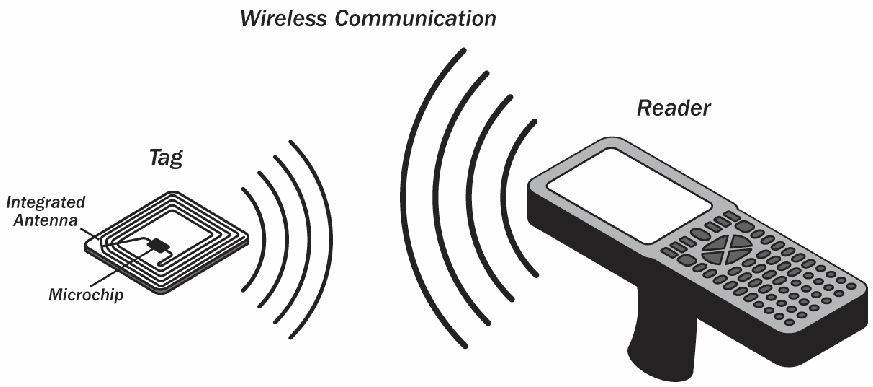
図2-1. 単純なRFサブシステムの例。線画である。左には巻線状のアンテナを持つ平たい正方形の Tag(タグ)があり、引出線で Integrated Antenna(内蔵アンテナ)と Microchip(マイクロチップ)が示されている。右には画面、キーパッド、ピストル型のグリップを備えた携帯型の Reader(リーダー)がある。両者の間には、それぞれの機器から相手へ向かって同心の弧が広がり、上に Wireless Communication(無線通信)と記されている。
Figure 2-1. An Example of a Simple RF Subsystem
図2-1. 単純なRFサブシステムの例
Sections 2.3.1 and 2.3.2 discuss tag and reader characteristics in more detail. Section 2.3.3 explains the fundamentals of tag-reader communication.
第2.3.1節および第2.3.2節では、タグとリーダーの特性をさらに詳しく説明します。第2.3.3節では、タグとリーダー間の通信の基礎を説明します。
2.3.1 Tag Characteristics
2.3.1 タグの特性
The market for RFID tags includes numerous different types of tags, which differ greatly in their cost, size, performance, and security mechanisms. Even when tags are designed to comply with a particular standard, they are often further customized to meet the requirements of specific applications. Understanding the major tag characteristics can help those responsible for RFID systems identify the tag characteristics required in their environments and applications. Major characteristics of tags include:
RFIDタグ市場には多種多様なタグがあり、コスト、サイズ、性能、セキュリティ機構はそれぞれ大きく異なります。特定の規格に準拠するよう設計されたタグであっても、特定のアプリケーションの要件を満たすために、さらにカスタマイズされることが多くあります。主要なタグ特性を理解すれば、RFIDシステムの責任者が、自らの環境およびアプリケーションで必要となるタグ特性を特定するのに役立ちます。タグの主な特性には、次のものがあります。
•Identifier format,
•識別子の形式、
•Power source,
•電源、
•Operating frequencies,
•動作周波数、
•Functionality, and
•機能、ならびに
•Form factor.
•形状。
Sections 2.3.1.1 through 2.3.1.5 examine these characteristics in detail.
第2.3.1.1節から第2.3.1.5節では、これらの特性を詳しく検討します。
2.3.1.1 Identifier Format
2.3.1.1 識別子の形式
Every tag has an identifier that is used to uniquely identify it. There are a number of data formats available for encoding identifiers on tags. System designers often want to use identifiers that have a standard structure, with certain groups of bits representing particular fields. A tag identifier format that is used across many industry sectors is the Electronic Product Code (EPC). This format was developed by the industry group EPCglobal. EPCglobal is a joint venture between Global Standards One (GS1), which was formerly known as European Article Numbering (EAN) International, and GS1 US, which was formerly known as the Uniform Code Council (UCC). The tag identifier format consists of four data fields:
すべてのタグには、それを一意に識別するために使用される識別子があります。タグ上で識別子を符号化するために、複数のデータ形式を利用できます。システム設計者は、特定のビット群が特定のフィールドを表す、標準的な構造を持つ識別子を使用したいと考えることが多くあります。多くの業界分野で使用されるタグ識別子形式の一つがElectronic Product Code(EPC)です。この形式は業界団体EPCglobalによって開発されました。EPCglobalは、以前はEuropean Article Numbering(EAN)Internationalとして知られていたGlobal Standards One(GS1)と、以前はUniform Code Council(UCC)として知られていたGS1 USとの合弁事業です。タグ識別子形式は、次の4つのデータフィールドから成ります。
•The Header, which specifies the EPC type,
•Header。EPCの種類を指定します。
•The EPC Manager ID, which uniquely identifies the organization that is responsible for assigning the object class and serial number bits (often the manufacturer of the item),
•EPC Manager ID。オブジェクトクラスおよびシリアル番号のビット割当てを担う組織(多くの場合、製品の製造元)を一意に識別します。
•The Object Class, which identifies a class of objects, such as a certain model of television set, and
•Object Class。特定のテレビのモデルなど、オブジェクトのクラスを識別します。
•The Serial Number, which uniquely describes the instance of that class of objects (e.g., a particular television set).
•Serial Number。そのオブジェクトクラスの個々のインスタンス(例えば、特定のテレビ1台)を一意に記述します。
Using a standard identifier format makes it easier for organizations to decode identifiers. When a machine reads a standard identifier, it can parse the identifier and decode its fields. The machine may need to request information from a remote computer to look up an identifier. When the database is distributed across several organizations and many servers, a standard identifier format with specified fields greatly facilitates the look up process. Therefore, standard identifier formats should be used whenever an RFID system will be used across multiple organizations.
標準識別子形式を使用すると、組織は識別子をデコードしやすくなります。機械が標準識別子を読み取ると、その識別子を解析し、各フィールドをデコードできます。機械は、識別子を検索するために、リモートコンピュータへ情報を問い合わせる必要が生じる場合があります。データベースが複数の組織や多数のサーバーに分散している場合、フィールドが規定された標準識別子形式は検索処理を大幅に容易にします。したがって、RFIDシステムを複数の組織にまたがって使用する場合は、標準識別子形式を常に使用すべきです。
If an organization does not expect its tag identifiers to be read by external parties or is concerned that the association of a tag with the organization or specific classes of objects is a business or privacy risk, then it may choose to develop and implement its own identifier format that does not reveal this information. Options include random or serialized identifiers that do not reveal information about the tagged item (e.g., its object class). Such identifiers can be encoded on many standards-based tags. These tags reserve memory for standard identifier formats but the memory does not have to be used for that purpose.
組織が、自らのタグ識別子を外部の関係者が読むとは想定していない場合、またはタグと組織や特定のオブジェクトクラスとの関連付けが業務上もしくはプライバシー上のリスクになると懸念する場合、こうした情報を明らかにしない独自の識別子形式を開発して実装することがあります。選択肢には、タグ付きアイテムに関する情報(例えば、そのオブジェクトクラス)を明らかにしないランダム識別子や連番識別子があります。このような識別子は、多くの標準準拠タグに符号化できます。これらのタグは標準識別子形式用のメモリ領域を確保していますが、そのメモリをその目的に使用する必要はありません。
The data format chosen for an RFID system should be adequate for the entire life cycle of the system. Certain data formats may not have enough bits to uniquely encode all the tags that will be used in a particular application. For example, a supply chain RFID system may need longer identifiers to identify the large number of items that it will manage. The identifier data format also has security implications. For example, standard formats such as EPC allow an adversary to quickly obtain intelligence about a business activity by decoding the manager and object class fields.4
RFIDシステムで選択するデータ形式は、システムのライフサイクル全体にわたって十分なものであるべきです。特定のデータ形式では、特定のアプリケーションで使用されるすべてのタグを一意に符号化するのに十分なビット数がないことがあります。例えば、サプライチェーンRFIDシステムでは、管理する多数のアイテムを識別するために、より長い識別子が必要となることがあります。識別子のデータ形式にはセキュリティ上の影響もあります。例えば、EPCのような標準形式では、攻撃者がmanagerフィールドおよびobject classフィールドをデコードすることで、業務活動に関する情報を迅速に得ることができます。4
2.3.1.2 Power Source
2.3.1.2 電源
Tags need power to perform functions such as sending radio signals to a reader, storing and retrieving data, and performing other computations (e.g., those needed for security mechanisms). Tags can obtain this power from a battery or from electromagnetic waves emitted by readers that induce an electric current in the tags. The power requirements of a tag depend on several factors, including the operating distance between the tag and the reader, the radio frequency being used, and the functionality of the tag. In general, the more complex the functions the tag supports, the greater its power requirements. For example, tags that support cryptography or authentication require more energy than tags that are limited to transmitting an identifier.
タグは、リーダーへの無線信号の送信、データの保存および取得、その他の計算(例えば、セキュリティ機構に必要とされる計算)などの機能を実行するために電力を必要とします。タグは、バッテリーから、またはリーダーが放射する電磁波によって電流をタグ内に誘導することで、電力を得ることができます。タグの電力要件は、タグとリーダーの動作距離、使用する無線周波数、タグの機能など、複数の要因によって決まります。一般に、タグがサポートする機能が複雑であるほど、必要な電力は大きくなります。例えば、暗号機能または認証をサポートするタグは、識別子の送信に限られるタグより多くのエネルギーを必要とします。
Tags are categorized into four types based on the power source for communication and other functionality:
タグは、通信およびその他の機能に用いる電源に基づき、次の4種類に分類されます。
•Passive,
•パッシブ、
•Active,
•アクティブ、
•Semi-active, and
•セミアクティブ、ならびに
•Semi-passive.
•セミパッシブ。
A passive tag uses the electromagnetic energy it receives from a reader’s transmission to reply to the reader. The reply signal from a passive tag, which is also known as the backscattered signal,5 has only a fraction of the power of the reader’s signal. This limited power significantly restricts the operating range of the tag. It also means that passive tags can only support data processing of limited complexity. On the other hand, passive tags typically are cheaper, smaller, and lighter than other types of tags, which are compelling advantages for many RFID applications.
パッシブタグは、リーダーからの送信を受けて得た電磁エネルギーを利用して、リーダーに応答します。パッシブタグからの応答信号は後方散乱信号とも呼ばれ、5リーダー信号のごく一部の電力しか持ちません。この限られた電力により、タグの動作範囲は大幅に制限されます。また、パッシブタグがサポートできるデータ処理の複雑さも限られます。一方、パッシブタグは一般に、他の種類のタグより安価で、小型かつ軽量であり、多くのRFIDアプリケーションにとって大きな利点となります。
An active tag relies on an internal battery for power. The battery is used to communicate to the reader, to power on-board circuitry, and to perform other functions. Active tags can communicate over greater distance than other types of tags, but they have a finite battery life and are generally larger and more expensive. Since these tags have an internal power supply, they can respond to lower power signals than passive tags.
アクティブタグは、電力を内部バッテリーに依存します。バッテリーはリーダーとの通信、搭載回路への給電、その他の機能の実行に使われます。アクティブタグは他の種類のタグより長距離で通信できる(can)が、バッテリー寿命には限りがあり、一般に大型で高価です。内部電源を持つため、パッシブタグより低電力の信号に応答できます(can)。
A semi-active tag is an active tag that remains dormant until it receives a signal from the reader to wake up. The tag can then use its battery to communicate with the reader. Like active tags, semi-active tags can communicate over a longer distance than passive tags. Their main advantage relative to active tags is that they have a longer battery life. The waking process, however, sometimes causes an unacceptable time delay when tags pass readers very quickly or when many tags need to be read within a very short period of time.
セミアクティブタグは、リーダーから起動信号を受信するまで休止状態を保つアクティブタグです。その後、タグはバッテリーを使ってリーダーと通信できます(can)。アクティブタグと同様に、セミアクティブタグはパッシブタグより長距離で通信できます(can)。アクティブタグと比べた主な利点は、バッテリー寿命が長いことです。ただし、起動処理によって、タグがリーダーの前を非常に速く通過する場合や、ごく短時間に多数のタグを読み取る必要がある(need)場合に、許容できない時間遅延が生じることがあります。
A semi-passive tag is a passive tag that uses a battery to power on-board circuitry, but not to produce return signals. When the battery is used to power a sensor, they are often called sensor tags. They typically are smaller and cheaper than active tags, but have greater functionality than passive tags because more power is available for other purposes. Some literature uses the terms “semi-passive” and “semi-active” interchangeably.
セミパッシブタグは、搭載回路への給電にバッテリーを使いますが、応答信号の生成には使わないパッシブタグです。バッテリーをセンサーの給電に使う場合、センサータグと呼ばれることが多くあります。一般にアクティブタグより小型で安価ですが、他の用途に利用できる電力が多いため、パッシブタグより高い機能を備えます。文献によっては、「セミパッシブ」と「セミアクティブ」という用語を同じ意味で使うものもあります。
2.3.1.3 Operating Frequencies
2.3.1.3 動作周波数
The radio frequencies at which a tag transmits and receives signals have implications for:
タグが信号を送受信する無線周波数は、次の点に影響します。
•Tag performance characteristics, including operating range, speed of tag reads, and RFID data transfer rate. In general, as a tag’s operating frequency increases, its signals are able to carry more data.6 As a result, higher frequency readers are also able to read more tags in a given period of time. In addition, RFID systems that operate at ultra high frequency (UHF) and microwave frequencies are typically designed to have a longer operating range than LF and high frequency (HF) systems.7 For most applications, the increased speed and operating range are considered advantages. One exception is applications for which security or privacy is a significant concern, such as those that involve financial transactions or personal data. In these cases, the ability of an adversary to read the data more quickly and from a longer distance typically is considered a risk that requires mitigation.
•タグの性能特性。動作範囲、タグ読取り速度、RFIDデータ転送速度などが含まれます。一般に、タグの動作周波数が高くなるほど、信号が運べるデータ量は増えます。6その結果、高周波数のリーダーは、一定時間内により多くのタグを読み取ることも可能です。また、超高周波(UHF)およびマイクロ波周波数で動作するRFIDシステムは、一般に、低周波(LF)および高周波(HF)システムより長い動作範囲を持つよう設計されます。7ほとんどのアプリケーションでは、速度と動作範囲の向上は利点と見なされます。例外は、金融取引や個人データを伴うものなど、セキュリティまたはプライバシーが重大な懸念となるアプリケーションです。このような場合、攻撃者がデータをより速く、より遠くから読み取れることは、一般に軽減が必要なリスクと見なされます。
•The ability of the tag’s signal to penetrate materials. As a general rule, higher frequencies are less able to penetrate substances such as metals or liquids than lower frequencies. Depending on the application, the penetration capabilities of a particular frequency can be either a benefit or a shortcoming. For example, LF communication typically is a requirement when tags are placed inside an animal (or humans, in some emerging medical applications) because RF attenuation in living tissue, which is mostly water, increases significantly as frequency increases. In applications in which security is a significant concern, an organization may want to use a frequency range than can be blocked by a particular material because this enables effective security shielding that might not otherwise be available. Table 2-1 summarizes the ability of RF signals to penetrate various substances.
•タグ信号が物質を透過する能力。一般則として、高い周波数は、金属や液体などの物質を低い周波数ほど透過できません。アプリケーションによって、特定の周波数の透過能力は利点にも欠点にもなり得ます(can)。例えば、生体組織(水分が大半を占める)内でのRF減衰は周波数の上昇に伴って大幅に増えるため、タグを動物(または新たな医療アプリケーションの一部では人間)の体内に置く場合、LF通信が通常必須となります(requirement)。セキュリティが重大な懸念となるアプリケーションでは、特定の物質によって遮断できる(can)周波数帯を組織が使いたいと考える場合があります(may)。それにより、他の方法では得られない(might)効果的なセキュリティシールドが可能になるからです。表2-1に、RF信号が各種物質を透過する能力をまとめます。
•The likelihood of radio interference. Radio interference is another reason why transmitted signals may not be properly received. Determining the potential sources of radio interference for a particular RFID implementation requires a site survey. RFID systems may experience radio interference from other systems that operate in the same or nearby frequency band. Interference often is exacerbated when using high power readers or when many readers are collocated. Table 2-2 lists potential sources of interference for RFID systems.
•無線干渉の可能性。無線干渉も、送信信号が適切に受信されない(may)原因となります。特定のRFID実装における無線干渉源の可能性を判断するには、現地調査を必要とします(requires)。RFIDシステムは、同じまたは近接する周波数帯域で動作する他のシステムから無線干渉を受けることがあります(may)。高出力リーダーを使用する場合や多数のリーダーを同じ場所に配置する場合、干渉が悪化することが多くあります。表2-2に、RFIDシステムに対する干渉源の候補を示します。
•The international portability of tags. The types of systems that use various portions of the electromagnetic spectrum can differ from jurisdiction to jurisdiction because not all regulators assign the same frequencies for the same purposes. If an RFID application requires transporting tags across multiple regulatory jurisdictions, then the system needs to use a frequency range permitted in all of the jurisdictions. Regulations impacting RFID often change, so organizations that use or plan to use RFID technology internationally should monitor relevant developments. Currently, there are frequencies within the LF, HF, and UHF bands that are permitted in most jurisdictions. Also, some tags are frequency-agile, so they can respond to one frequency in one jurisdiction and another in a different jurisdiction.8
•タグの国際的な可搬性。電磁スペクトルの各部分を使うシステムの種類は、法域によって異なる場合があります。すべての規制当局が同じ目的に同じ周波数を割り当てるわけではないためです。RFIDアプリケーションで複数の規制法域をまたいでタグを輸送する必要がある場合、システムはすべての法域で認められた周波数帯を使用する必要があります。RFIDに影響する規制は頻繁に変わるため、RFID技術を国際的に使用する組織、または使用を計画する組織は、関連する動向を監視すべきです。現在、LF、HF、UHF帯には、ほとんどの法域で認められている周波数があります。また、周波数可変型のタグもあり、ある法域では一つの周波数に、別の法域では別の周波数に応答できます。8
Table 2-1. Impact of Selected Materials on RF Transmissions9, 10
表2-1. 選択した材料がRF伝送に及ぼす影響9、10
| Material | LF 30-300 kilohertz (kHz) | HF 3-30 MHz | UHF 300 MHz-1 GHz | Microwave > 1 GHz |
|---|---|---|---|---|
| 125 or 134 kHz (common US RFID usage) | 13.56 MHz11 (Worldwide ISM band) | 433.5-434.5 915 MHz12 (common US RFID usage) | 2.45 GHz13 (Worldwide ISM band) | |
| Clothing | Transparent | Transparent | Transparent | Transparent |
| Dry Wood | Transparent | Transparent | Transparent | Absorbent |
| Graphite | Transparent | Transparent | Opaque | Opaque |
| Metals | Transparent | Transparent | Opaque | Opaque |
| Motor Oil | Transparent | Transparent | Transparent | Transparent |
| Paper Products | Transparent | Transparent | Transparent | Transparent |
| Plastics | Transparent | Transparent | Transparent | Transparent |
| Water | Transparent | Transparent | Absorbent | Absorbent |
| Wet Wood | Transparent | Transparent | Absorbent | Absorbent |
| 材料 | LF 30-300 キロヘルツ(kHz) | HF 3-30 MHz | UHF 300 MHz-1 GHz | マイクロ波 > 1 GHz |
|---|---|---|---|---|
| 125または134 kHz(米国で一般的なRFID利用) | 13.56 MHz11(世界共通のISMバンド) | 433.5-434.5 915 MHz12(米国で一般的なRFID利用) | 2.45 GHz13(世界共通のISMバンド) | |
| 衣類 | 透過 | 透過 | 透過 | 透過 |
| 乾燥した木材 | 透過 | 透過 | 透過 | 吸収 |
| 黒鉛 | 透過 | 透過 | 不透過 | 不透過 |
| 金属 | 透過 | 透過 | 不透過 | 不透過 |
| モーターオイル | 透過 | 透過 | 透過 | 透過 |
| 紙製品 | 透過 | 透過 | 透過 | 透過 |
| プラスチック | 透過 | 透過 | 透過 | 透過 |
| 水 | 透過 | 透過 | 吸収 | 吸収 |
| 湿った木材 | 透過 | 透過 | 吸収 | 吸収 |
Table 2-2. Common Sources of RF Interference
表2-2. 一般的なRF干渉源
| Frequency Range | RFID Applications | Possible Interference Sources in US |
|---|---|---|
| Less than 500 kHz | Access control, animal tagging, automobile immobilizers, EAS systems, inventory control, and track and traceability applications | Maritime radio and radio navigation applications |
| 1.95 MHz - 8.2 MHz | EAS systems | Aeronautical radio, amateur, land mobile, maritime mobile radios, and radio location applications |
| 13.553 - 13.567 MHz | Access control, item-level tagging, EAS systems, and smart card applications | ISM applications and private land mobile radio |
| 433.5 - 434.5 MHz | In-transit visibility and supply chain applications | Amateur radio and radio location applications |
| 902 - 928 MHz | Railcar, supply chain, and toll road applications | ISM applications including cordless phones and radio location |
| 2.40 - 2.50 GHz | Real-time location systems (RTLS), and supply chain applications | ISM applications including Bluetooth, cordless phones, and Wi-Fi as well as radio location, and satellite technologies |
| 周波数範囲 | RFIDアプリケーション | 米国で想定される干渉源 |
|---|---|---|
| 500 kHz未満 | アクセス制御、動物へのタグ付け、自動車のイモビライザー、EASシステム、在庫管理、追跡およびトレーサビリティのアプリケーション | 海上無線および無線航行のアプリケーション |
| 1.95 MHz - 8.2 MHz | EASシステム | 航空無線、アマチュア無線、陸上移動無線、海上移動無線、および無線位置決定のアプリケーション |
| 13.553 - 13.567 MHz | アクセス制御、アイテムレベルのタグ付け、EASシステム、およびスマートカードのアプリケーション | ISMアプリケーションおよび私設陸上移動無線 |
| 433.5 - 434.5 MHz | 輸送中の可視化およびサプライチェーンのアプリケーション | アマチュア無線および無線位置決定のアプリケーション |
| 902 - 928 MHz | 鉄道車両、サプライチェーン、および有料道路のアプリケーション | コードレス電話や無線位置決定を含むISMアプリケーション |
| 2.40 - 2.50 GHz | リアルタイム位置情報システム(RTLS)、およびサプライチェーンのアプリケーション | Bluetooth、コードレス電話、Wi-Fiのほか、無線位置決定や衛星技術を含むISMアプリケーション |
2.3.1.4 Functionality
2.3.1.4 機能
The primary function of a tag is to provide an identifier to a reader, but many types of tags support additional capabilities that are valuable for certain business processes. These include:
タグの主な機能はリーダーに識別子を提供することですが、多くの種類のタグは、特定の業務プロセスに有用な追加機能をサポートします。具体例は次のとおりです。
•Memory. Memory that is nonvolatile enables data to be stored on tags and retrieved at a later time. This memory is either write once, read many (WORM) memory or re-writeable memory, which can be modified after initialization. Non-volatile memory enables more flexibility in the design of RFID systems because RFID data transactions can occur without concurrent access to data stored in an enterprise subsystem. However, adding memory to a tag increases its cost and power requirements. Section 3 discusses RFID application requirements and provides additional information about the circumstances under which the use of re-writable memory would be a desirable approach. In general, when this document refers to memory, it is referring to non-volatile memory. In contrast, volatile memory, which is also used in tags, supports tag computations and does not retain data after it is powered down.
•メモリ。不揮発性メモリを使うと、タグにデータを保存し、後で取得できます(can)。このメモリは、一度だけ書き込み、その後は何度でも読み取れる(WORM)メモリ、または初期化後に変更できる書換え可能メモリのいずれかです。不揮発性メモリにより、エンタープライズサブシステムに保存されたデータへ同時にアクセスしなくてもRFIDデータのトランザクションを実行できる(can)ため、RFIDシステムの設計に柔軟性が増します。一方、タグにメモリを追加するとコストと電力要件が増加します。第3節ではRFIDアプリケーションの要件を論じ、書換え可能メモリの使用が望ましい(would)アプローチとなる状況について補足します。一般に、本書でメモリと言う場合は不揮発性メモリを指します。これに対し、タグで使用される揮発性メモリはタグの計算を支援し、電源を切るとデータを保持しません。
•Environmental sensors. The integration of environmental sensors with tags is an example of the benefit of local memory. The sensors can record temperature, humidity, vibration, or other phenomena to the tag’s memory, which can later be retrieved by a reader. The integration of sensors significantly increases the cost and complexity of the tags. Moreover, while many tag operations can be powered using the electromagnetic energy from a reader, this approach is not workable for sensors, which must rely on battery power. Tags integrated with sensors typically are only used with high-value, environmentally sensitive, or perishable objects worthy of the additional expense.
•環境センサー。環境センサーをタグに統合することは、ローカルメモリの利点の一例です。センサーは温度、湿度、振動その他の現象をタグのメモリに記録できます。そのデータは後でリーダーにより取得できます。センサーの統合により、タグのコストと複雑さは大幅に増します。さらに、多くのタグ動作はリーダーからの電磁エネルギーで駆動できる一方、この方法はセンサーには実用的でなく、センサーはバッテリー電力に依存しなければなりません。センサーを統合したタグは、追加費用に見合う高価値、環境影響を受けやすい、または腐敗しやすい対象物にのみ使用されるのが一般的です。
•Security functionality, such as password protection and cryptography. Tags with on-board memory are often coupled with security mechanisms to protect the data stored in that memory. For example, some tags support a lock command that, depending on its implementation, can prevent further modification of data in the tag’s memory or can prevent access to data in the tag’s memory. In some cases, the lock command is permanent and in other cases, a reader can “unlock” the memory. EPCglobal standards, standards developed jointly by the International Organization for Standardization (ISO) and the International Electrotechnical Commission (IEC), and many proprietary tag designs support this feature. Some RFID systems support advanced cryptographic algorithms that enable authentication mechanisms and data confidentiality features, although these functions are most commonly found on RFID-based contactless smart cards and not tags used for item management. Some tags offer tamper protection as a physical security feature.
•パスワード保護や暗号などのセキュリティ機能。オンボードメモリを持つタグには、そのメモリに保存されたデータを保護するセキュリティ機構が組み合わされることが多くあります。例えば、一部のタグはロックコマンドをサポートします。その実装によっては、タグのメモリ内データのそれ以上の変更を防止できる(can)ほか、データへのアクセスを防止できます(can)。ロックコマンドが永続的な場合もあれば、リーダーによってメモリを「ロック解除」できる場合もあります(can)。EPCglobal規格、国際標準化機構(ISO)と国際電気標準会議(IEC)が共同で策定した規格、多くの独自タグ設計が、この機能をサポートします。一部のRFIDシステムは、認証機構およびデータ機密性機能を可能にする高度な暗号アルゴリズムをサポートしますが、これらの機能は、アイテム管理用のタグよりもRFIDベースの非接触型スマートカードに搭載されることが最も多いです。物理的セキュリティ機能として改ざん防止機能を備えるタグもあります。
•Privacy protection mechanisms. EPCglobal tags support a feature called the kill command that permanently disables the tag from responding to subsequent commands. The primary objective of the kill command is to protect personal privacy. Unlike the lock command, the kill command is irreversible. The kill command also prevents wireless access to a tag’s identifier, in addition to any memory that may be on the tag. While the lock command provides security, the primary objective of the kill command is personal privacy. RFID tags could potentially be used to track individuals that carry tagged items or wear tagged articles of clothing when the tags are no longer required for their intended use, such as to expedite checkout or inventory. The ability to disable a tag with the kill command provides a mechanism to prevent unauthorized access to and illegitimate use of product information stored in the tag.
•プライバシー保護機構。EPCglobalタグは、キルコマンドと呼ばれる機能をサポートし、以後のコマンドにタグが応答しないよう恒久的に無効化します。キルコマンドの主な目的は個人のプライバシー保護です。ロックコマンドとは異なり、キルコマンドは元に戻せません。キルコマンドは、タグ上にメモリがある(may)場合にはそのメモリに加えて、タグ識別子への無線アクセスも防止します。ロックコマンドはセキュリティを提供しますが、キルコマンドの主な目的は個人のプライバシー保護です。RFIDタグは、会計処理や在庫管理の迅速化など本来の用途でタグが必要でなくなった(required)後も、タグ付きアイテムを携帯する人やタグ付き衣類を着用する人の追跡に使われる可能性があります(could)。キルコマンドでタグを無効化できることにより、タグに保存された製品情報への不正アクセスと不正利用を防ぐ仕組みが得られます。
2.3.1.5 Form Factor
2.3.1.5 形状
The form factor of a tag refers to its shape, size, packaging, and handling features. To a large extent, a tag’s form factor is determined by the characteristics previously discussed, such as power source and functionality. Some important aspects regarding a tag’s form factor include the size of the tag, the weight of the tag, and the method by which the tag is affixed to and removed from its associated object. Tags typically vary in size from smaller than a postage stamp to about the size of a common document stapler. Active tags typically are significantly larger and heavier than passive tags because they have an onboard power supply. Tags that integrate environmental sensors are also larger and heavier than those without this functionality. While increasing the computing functionality of a tag increases its cost and power requirements, it may not have an impact on its form factor because the microchip on a passive tag is one of the tag’s smallest components. On most passive tags, the largest component on the tag is its antenna.
タグの形状とは、その形、サイズ、パッケージング、および取扱い上の特性を指します。タグの形状は、電源や機能など、前述した特性によって大きく決まります。形状に関する重要な要素には、タグのサイズと重量、およびタグを関連する対象物に取り付け、そこから取り外す方法があります。タグのサイズは通常、切手より小さいものから一般的な書類用ホッチキス程度までさまざまです。アクティブタグはオンボード電源を持つため、一般にパッシブタグより大幅に大型で重いものです。環境センサーを統合したタグも、その機能を持たないタグより大型で重いものです。タグの計算機能を高めるとコストと電力要件は増加しますが、パッシブタグのマイクロチップはタグの最小構成要素の一つであるため、形状には影響しない場合があります(may)。ほとんどのパッシブタグでは、タグ上で最大の構成要素はアンテナです。
Tags can be attached to items using an adhesive or can be embedded within the item. The primary concern when a tag is attached to an item is how easily it might be detached, whether accidentally or maliciously. Tags attached to items also are more vulnerable to harsh environmental conditions such as dust, debris, humidity, precipitation, and extreme temperatures. However, the vulnerability is intentional in some cases. For example, RFID tags known as frangible tags allow users to deactivate tags by tearing the tag’s antenna from its circuitry. Organizations can create frangible tags on-site using a printer similar to the one shown in Figure 2-2. Tags that are embedded in objects (e.g., smart cards, animal tissue, plastic housing) are less vulnerable to tampering and environmental conditions.
タグは、粘着剤を使ってアイテムに取り付けることも、アイテムの内部に埋め込むこともできます。タグをアイテムに取り付ける場合の主な懸念は、偶発的であれ悪意によるものであれ、どれほど容易に取り外され得るかです。アイテムに取り付けたタグは、ほこり、破片、湿度、降水、極端な温度などの厳しい環境条件にもさらされやすい傾向があります。ただし、意図的にそのように設計されている場合もあります。例えば、フラジルタグとして知られるRFIDタグでは、アンテナを回路から引き裂くことで利用者がタグを無効化できます。組織は、図2-2に示すものに類似したプリンターを使って、現場でフラジルタグを作成できます。スマートカード、動物の組織、プラスチック筐体など、対象物に埋め込まれたタグは、改ざんや環境条件の影響を受けにくい傾向があります。
RFIDタグ付きラベルを印字・出力する据置型プリンター。 [装飾の画像。本文を読むのに必要のない装飾のため、この非公式サイトには掲載していません。原本 PDF を参照してください。]
Figure 2-2. RFID Tag Printer
図2-2. RFIDタグプリンター
2.3.2 Reader Characteristics
2.3.2 リーダーの特性
The tag and the reader must comply with the same standard in order to communicate. If a tag is based on a proprietary design, a reader must support the same communication protocol to communicate with that tag. In many cases, if proprietary tags are used, only proprietary RFID readers from the same vendor can be used. Reader characteristics that are independent of tag characteristics include:
タグとリーダーが通信するには、同じ規格に準拠していなければなりません(must)。タグが独自設計に基づく場合、リーダーはそのタグと通信するために同じ通信プロトコルをサポートしなければなりません(must)。多くの場合、独自タグを使用すると、同じベンダーの独自RFIDリーダーのみを使用できます(can)。タグ特性とは独立したリーダーの特性には、次のものがあります。
•Power output and duty cycle,
•出力電力およびデューティサイクル、
•Enterprise subsystem interface,
•エンタープライズサブシステムインターフェース、
•Mobility, and
•可動性、ならびに
•Antenna design and placement.
•アンテナの設計および配置。
These reader characteristics are discussed in Sections 2.3.2.1 through 2.3.2.4.
これらのリーダー特性については、第2.3.2.1節から第2.3.2.4節で説明します。
2.3.2.1 Power Output and Duty Cycle
2.3.2.1 出力電力およびデューティサイクル
In most cases, standards and regulations will determine the permitted power output and duty cycle of the readers. A reader’s duty cycle is the percentage of time that the device is emitting energy over a specified period. For example, a reader that communicates for 30 seconds every minute has a 50% duty cycle. Readers that communicate with passive tags need greater power output than those that communicate with active tags because the signal must be strong enough to reach the tag and enable the backscatter to return to the reader. In general, readers with greater power output and duty cycles can read tags more accurately, more quickly, and from longer distances, but the greater power output also increase the risk of eavesdropping.
多くの場合、規格および規制によって、リーダーに許容される出力電力とデューティサイクルが決まります。リーダーのデューティサイクルとは、指定期間のうち装置がエネルギーを放射している時間の割合です。例えば、1分ごとに30秒間通信するリーダーのデューティサイクルは50%です。パッシブタグと通信するリーダーは、アクティブタグと通信するものより高い出力電力を必要とします。信号がタグに到達し、後方散乱がリーダーに戻るのに十分な強度でなければならないためです。一般に、出力電力とデューティサイクルが高いリーダーほど、タグをより正確かつ迅速に、またより遠距離から読み取ることができますが、出力電力が高いほど盗聴のリスクも高まります。
2.3.2.2 Enterprise Subsystem Interface
2.3.2.2 エンタープライズサブシステムインターフェース
All readers have an RF subsystem interface to communicate with tags. Most also have a second interface to communicate with the enterprise subsystem. The enterprise subsystem interface supports transfer of RFID data from the reader to enterprise subsystem’s computers for processing and analysis. In most cases, the enterprise subsystem interface is used for remote management of the readers. The interface may be a wired (e.g., Ethernet) or wireless (e.g., Wi-Fi or satellite) link. Many systems use Simple Network Management Protocol (SNMP) to monitor the readers and alert administrators of conditions that warrant attention.
すべてのリーダーは、タグと通信するためのRFサブシステムインターフェースを備えます。ほとんどのリーダーは、エンタープライズサブシステムと通信するための第2のインターフェースも備えます。エンタープライズサブシステムインターフェースは、処理および分析のためにリーダーからエンタープライズサブシステムのコンピュータへRFIDデータを転送します。多くの場合、このインターフェースはリーダーの遠隔管理に使用されます。インターフェースのリンクは、有線(例:Ethernet)の場合も無線(例:Wi-Fiもしくは衛星)の場合もあります。多くのシステムでは、Simple Network Management Protocol(SNMP)を使ってリーダーを監視し、注意を要する状態を管理者に通知します。
2.3.2.3 Mobility
2.3.2.3 可動性
A reader’s interface with an enterprise subsystem may be wired or wireless. Most wired readers are in fixed locations and support applications in which the tags approach the reader. Some wired readers offer limited mobility using cables. Figure 2-3 shows a reader portal that reads tags on a pallet of boxes moving through the portal. Figure 2-4 shows reader antennas mounted above each toll lane in a series of toll booths. As vehicles pass through one of the toll lanes, the reader reads a transponder that is attached to that vehicle’s windshield.
リーダーとエンタープライズサブシステムとのインターフェースは、有線でも無線でもよいです。有線リーダーの大半は固定位置にあり、タグがリーダーに近づくアプリケーションを支援します。一部の有線リーダーはケーブルを使って限定的な可動性を備えます。図2-3は、ポータルを通過する箱のパレット上のタグを読み取るリーダーポータルを示します。図2-4は、一連の料金所において各料金レーンの上に取り付けられたリーダーアンテナを示します。車両が料金レーンを通過すると、リーダーはその車両のフロントガラスに取り付けられたトランスポンダーを読み取ります。
荷物を積んだフォークリフトがRFIDゲートを通過する図の左側。 [装飾の画像。本文を読むのに必要のない装飾のため、この非公式サイトには掲載していません。原本 PDF を参照してください。]
パレット積み荷を載せたフォークリフトと、RFIDゲート支柱・読取装置を示す図の右側。 [装飾の画像。本文を読むのに必要のない装飾のため、この非公式サイトには掲載していません。原本 PDF を参照してください。]
Figure 2-3. Fixed Reader in Item Management Application
図2-3. アイテム管理アプリケーションにおける固定リーダー
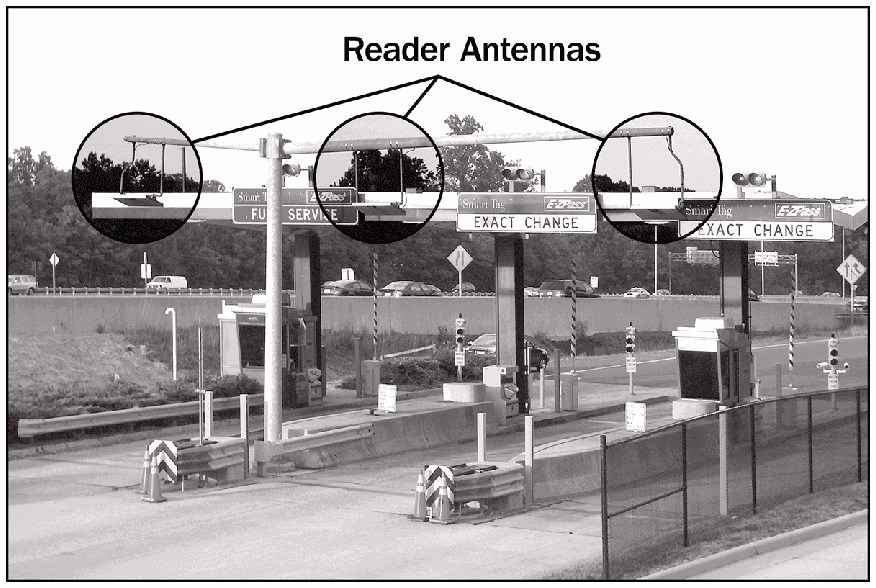
図2-4. 自動料金徴収アプリケーションにおける固定リーダー。高速道路の料金所の白黒写真である。車線の上の門形の架台に FULL SERVICE、EXACT CHANGE の標識と E-ZPass、Smart Tag のロゴが掲げられている。架台上の 3 か所を円形に拡大した挿入図に、架台に取り付けたアンテナ装置が写っており、3 つの挿入図から伸びる線が上部の Reader Antennas(リーダーのアンテナ)という表示に集まる。手前には料金所のブース、カラーコーン、フェンスが写っている。
Figure 2-4. Fixed Reader in Automatic Toll Collection Application
図2-4. 自動料金徴収アプリケーションにおける固定リーダー
In contrast, wireless readers support applications in which personnel must move around to read tags.14 Figure 2-5 shows an example of a mobile handheld reader. A mobile reader usually uses different communications protocols on its RF and enterprise subsystem interfaces, even though both interfaces are wireless. Institute of Electrical and Electronics Engineers (IEEE) 802.11, also known as Wi-Fi, is a common protocol for the enterprise subsystem interface, although it is also used for the RF interface on some active tag implementations. The most common RF interface protocols are defined in ISO/IEC standards, which include ISO/IEC 14443, ISO/IEC 15693, and the ISO/IEC 18000-series.
これに対し、無線リーダーは、タグを読み取るために要員が移動しなければならない(must)アプリケーションを支援します。14図2-5に、携帯型ハンドヘルドリーダーの例を示します。両方のインターフェースが無線であっても、モバイルリーダーは通常、RFインターフェースとエンタープライズサブシステムインターフェースで異なる通信プロトコルを使用します。Institute of Electrical and Electronics Engineers(IEEE)802.11(Wi-Fiとしても知られる)は、エンタープライズサブシステムインターフェースで一般的なプロトコルですが、一部のアクティブタグ実装ではRFインターフェースにも使用されます。最も一般的なRFインターフェースプロトコルはISO/IEC規格で定義されており、ISO/IEC 14443、ISO/IEC 15693、ISO/IEC 18000シリーズが含まれます。
RFIDインテロゲーター(携帯型リーダー)の図。 [装飾の画像。本文を読むのに必要のない装飾のため、この非公式サイトには掲載していません。原本 PDF を参照してください。]
Figure 2-5. Mobile Handheld Reader
図2-5. モバイルハンドヘルドリーダー
2.3.2.4 Antenna Design and Placement
2.3.2.4 アンテナの設計および配置
Readers use a wide variety of antenna types. Each type has a different coverage pattern. To reduce the likelihood of eavesdropping and minimize interference with other radios, the coverage should only encompass a range sufficient to communicate with the intended tags. Antennas may be integrated into the device or may be detachable. Readers that support detachable antennas are better suited for applications that require specific coverage areas because an antenna can be selected or customized to meet those requirements.
リーダーには多様な種類のアンテナが使われ、それぞれ異なるカバレッジパターンを持ちます。盗聴の可能性を低減し、他の無線機器との干渉を最小限に抑えるため、カバレッジは意図したタグとの通信に十分な範囲だけを包含すべきです。アンテナは装置に内蔵されている場合も、取り外し可能な場合もあります。取り外し可能なアンテナをサポートするリーダーは、特定のカバレッジ領域が必要なアプリケーションに適しています。要件に合うアンテナを選択またはカスタマイズできるためです。
Antennas can be mounted for a particular application. Figures 2-3 and 2-4 in Section 2.3.2.3 show examples of item tracking and automatic toll payment applications. Antennas can also be mounted on forklifts to identify items when they are moved from one location to another. In industrial applications, antennas are often placed in tunnels around a production line’s conveyor belt.
アンテナは特定のアプリケーションに合わせて取り付けることができます(can)。第2.3.2.3節の図2-3および図2-4は、アイテム追跡および自動料金支払いアプリケーションの例を示します。フォークリフトにアンテナを取り付け、アイテムがある場所から別の場所へ移動されたときに識別することもできます(can)。産業用アプリケーションでは、製造ラインのコンベヤーベルトを囲むトンネル内にアンテナを設置することが多くあります。
2.3.3 Tag-Reader Communication
2.3.3 タグとリーダー間の通信
Tag-reader communication is achieved by using a common communications protocol between the tag and the reader. Tag-reader communication protocols are often specified in RFID standards. Prominent international standards include the ISO/IEC 18000 series for item management and the ISO/IEC 14443 and ISO/IEC 15693 standards for contactless smart cards. The most recent EPCglobal Class-1 Generation-2 standard is essentially equivalent to the ISO/IEC 18000-6C standard. A more detailed explanation of RFID standards can be found in Appendix A on RFID Standards and Security Mechanisms.
タグとリーダー間の通信は、両者に共通する通信プロトコルを使用して実現します。タグとリーダー間の通信プロトコルは、RFID規格で規定されることが多くあります。主要な国際規格には、アイテム管理向けのISO/IEC 18000シリーズ、および非接触型スマートカード向けのISO/IEC 14443とISO/IEC 15693があります。最新のEPCglobal Class-1 Generation-2規格は、ISO/IEC 18000-6C規格と実質的に同等です。RFID規格の詳細な説明は、Appendix A「RFID Standards and Security Mechanisms」で確認できます。
Tag-reader communication characteristics that affect performance and security include:
性能およびセキュリティに影響するタグとリーダー間の通信特性には、次のものがあります。
•How tag-reader communication is initiated,
•タグとリーダー間の通信がどのように開始されるか、
•How a reader identifies particular tags, and
•リーダーが特定のタグをどのように識別するか、ならびに
•How far away a tag or reader’s signal can be reliably detected or interpreted.
•タグまたはリーダーの信号を確実に検出または解釈できる(can)距離。
These are discussed in detail in Sections 2.3.3.1 through 2.3.3.3.
これらについては、第2.3.3.1節から第2.3.3.3節で詳しく説明します。
2.3.3.1 Communication Initiation
2.3.3.1 通信の開始
Tags and readers can initiate RF transactions in two general ways:
タグおよびリーダーは、一般に次の2つの方法でRFトランザクションを開始できます(can)。
•Reader Talks First (RTF). In an RTF transaction, the reader broadcasts a signal that is received by tags in the reader’s vicinity. Those tags may then be commanded to respond to the reader and to continue transactions with the reader.
•Reader Talks First(RTF)。RTFトランザクションでは、リーダーが信号をブロードキャストし、リーダーの近傍にあるタグがそれを受信します。その後、それらのタグはリーダーの指示を受けて応答し、リーダーとのトランザクションを継続することがあります(may)。
•Tag Talks First (TTF). In a TTF transaction, a tag communicates its presence to a reader when the tag is within the reader’s RF field. If the tag is passive, then it transmits as soon as it gets power from the reader’s signal to do so. If the tag is active, then it transmits periodically as long as its power supply lasts. This type of transaction might be used when it is necessary to identify objects that pass by a reader, such as objects on a conveyer belt.
•Tag Talks First(TTF)。TTFトランザクションでは、タグがリーダーのRFフィールド内に入ると、リーダーに自身の存在を通知します。タグがパッシブの場合、リーダーの信号から電力を得て送信可能になると、直ちに送信します。タグがアクティブの場合、電源が持続する限り定期的に送信します。この種のトランザクションは、コンベヤーベルト上の物体など、リーダーの前を通過する物体を識別する必要がある場合に使用されることがあります(might)。
Readers and tags in an RFID system typically operate using only RTF or only TTF transactions, not both types. Active tag TTF operation may be easier for an adversary to detect or intercept, because active tags send beaconing signals even when they are not in the presence of a reader. The adversary could eavesdrop on this communication without risking detection because in TTF transactions the adversary never has to send a signal to ascertain the tag’s presence.
RFIDシステム内のリーダーとタグは、通常、RTFまたはTTFのいずれか一方だけで動作し、両方の方式を使うことはありません。アクティブタグのTTF動作は、攻撃者に検出または傍受されやすい場合があります。アクティブタグはリーダーが近くにいない場合にもビーコン信号を送るためです。TTFトランザクションでは、タグの存在を確かめるために攻撃者が信号を送信する必要がないため、攻撃者は検知されるリスクなしにこの通信を盗聴できます。
2.3.3.2 Singulation
2.3.3.2 タグの個別選択(Singulation)
Singulation is the process by which a reader identifies a particular tag. This capability is critical whenever multiple tags are in close proximity. For instance, when a reader issues a command to modify a tag’s memory, neighboring tags should not accidentally execute the same command. Similarly, when a reader sends a query to a tag, the reader should not receive a response from multiple tags.
Singulationとは、リーダーが特定のタグを識別するプロセスです。複数のタグが近接している場合、この機能は不可欠です。例えば、リーダーがタグのメモリを変更するコマンドを発行したとき、隣接するタグが誤って同じコマンドを実行すべきではありません。同様に、リーダーがタグにクエリを送信したとき、複数のタグから応答を受け取るべきではありません。
In the EPCglobal Class-1 Generation-2 standard, the singulation protocol requires the reader to broadcast commands to all tags within its operating range. By issuing additional commands, the reader may limit interrogation to tags with specific memory contents. Tags respond with a random number. Once the reader acknowledges this number, verifying that no tag collision has occurred, the tag will transmit its unique ID to the reader. The reader may then request another random number that it uses to address the tag in subsequent communication. The random number has significantly fewer bits than the tag’s identifier, which simplifies the processing of later transactions and prevents transmission of the unique identifier by the reader.
EPCglobal Class-1 Generation-2規格では、singulationプロトコルにより、リーダーに動作範囲内のすべてのタグへのコマンドのブロードキャストを要求します(requires)。追加コマンドを発行することで、リーダーは特定のメモリ内容を持つタグに問い合わせ対象を限定することがあります(may)。タグは乱数で応答します。リーダーがこの数値を確認応答し、タグ衝突が発生していないことを検証すると、タグは一意のIDをリーダーに送信します(will)。その後リーダーは、後続の通信でタグをアドレス指定するための別の乱数を要求することがあります(may)。この乱数はタグ識別子より大幅にビット数が少なく、後続トランザクションの処理を簡素化し、リーダーが一意識別子を送信することを防ぎます。
Some RFID technologies do not support singulation. For example, ISO 11784/11785 animal tracking tags have no collision detection or avoidance mechanism because multiple tags are not usually read in close proximity for this type of application.
一部のRFID技術はsingulationをサポートしません。例えば、ISO 11784/11785の動物追跡タグには衝突検出または衝突回避機構がありません。この種のアプリケーションでは、通常、近接した複数のタグを同時に読み取らないためです。
2.3.3.3 Signal Propagation Distance
2.3.3.3 信号伝搬距離
The communications link between a tag and a reader typically is bi-directional. The reader transmits a signal to a tag over the forward channel. The tag responds on the back channel, which is also called the reverse channel or backscatter channel. When RFID systems use passive tags, signals on the forward channel typically are much more powerful than those on the back channel. Therefore, signals on the forward channel can be detected or properly received over longer distances. This difference has important implications for RFID communications security, including both the vulnerability of RF subsystem traffic and the mechanisms used to protect it. Some relevant operational ranges related to various communications objectives are:15
タグとリーダー間の通信リンクは、通常、双方向です。リーダーは順方向チャネルでタグに信号を送信します。タグは逆方向チャネルで応答し、このチャネルは逆チャネルまたは後方散乱チャネルとも呼ばれます。RFIDシステムがパッシブタグを使う場合、順方向チャネルの信号は通常、逆方向チャネルの信号よりはるかに強いものです。したがって、順方向チャネルの信号は、より長い距離でも検出または適切に受信できます(can)。この差は、RFサブシステムの通信トラフィックの脆弱性や、それを保護するための機構など、RFID通信セキュリティに重要な影響を与えます。各種通信目的に関係する運用範囲には、次のものがあります。15
•Nominal operating range, which is the distance, often specified by standard, over which authorized transactions are expected to occur;
•公称動作範囲。認可されたトランザクションが行われると想定される距離であり、多くの場合、規格で指定されます。
•Back channel eavesdropping range, which is the distance over which a rogue receiver can reliably interpret a tag’s response to a legitimate reader;
•逆方向チャネルの盗聴範囲。不正な受信機が、正規リーダーに対するタグの応答を確実に解釈できる(can)距離。
•Rogue skimming (or scanning) range, which is the distance over which a rogue reader operating above regulated power limits can reliably communicate with a tag;
•不正なスキミング(またはスキャン)範囲。規制上限を超える電力で動作する不正なリーダーがタグと確実に通信できる(can)距離。
•Rogue command range, which is the distance over which a rogue reader can execute a tag command that does not require the reader to successfully receive information from the tag;
•不正コマンド範囲。不正なリーダーが、タグから情報を正常に受信することを必要としないタグコマンドを実行できる(can)距離。
•Forward channel eavesdropping range, which is the distance over which a rogue receiver can reliably listen to the transmissions of an authorized reader; and
•順方向チャネルの盗聴範囲。正規のリーダーの送信を不正な受信機が確実に傍受できる(can)距離。ならびに
•Forward channel traffic analysis range, which is the distance over which a rogue receiver can detect the presence of a reader’s signal without having to reliably interpret its content.
•順方向チャネルのトラフィック分析範囲。不正な受信機が、信号の内容を確実に解釈することなくリーダー信号の存在を検出できる(can)距離。
Eavesdropping ranges can be significantly greater than the nominal operating ranges listed in product literature. For example, ISO/IEC 14443 tags have a typical operating range that is usually between 7 and 15 centimeters.16 However, security researchers have used a portable, low-power device to demonstrate that the rogue scanning range of an ISO/IEC 14443 contactless smart card is at least 25 centimeters (cm).17 Researchers have also successfully eavesdropped on ISO/IEC 14443 communications from distances up to 15 meters using fixed antennas and receivers that were tuned to the frequency of interest.18
盗聴可能範囲は、製品資料に記載された公称動作範囲を大幅に上回ることがあります(can)。例えば、ISO/IEC 14443タグの一般的な動作範囲は通常7~15センチメートルです。16しかし、セキュリティ研究者は、携帯型の低電力装置を使い、ISO/IEC 14443非接触型スマートカードの不正スキャン範囲が少なくとも25センチメートル(cm)であることを実証しました。17また研究者は、対象周波数に調整した固定アンテナと受信機を用い、最大15メートル離れた位置からISO/IEC 14443通信の盗聴にも成功しています。18
If the potential adversary does not need a reply from a passive tag to achieve its objective, then the adversary can be much farther away. For instance, for many tags, a reader does not need to receive a message from the tag before writing to the tag’s memory. This attack is not possible for certain commands in EPCglobal Class-1 Generation-2 tags, because mandatory cover-coding requires the reader to receive a key from the tag before issuing a command.19 Cover-coding is a technique used to obscure the content of messages from readers to tags and is described in more detail in Section 5.3.2.1.
潜在的な攻撃者が目的を達成するためにパッシブタグからの応答を必要としない(need)場合、その攻撃者ははるかに遠くにいることができます(can)。例えば、多くのタグでは、リーダーがタグのメモリに書き込む前にタグからメッセージを受信する必要はありません(need)。EPCglobal Class-1 Generation-2タグの一部コマンドでは、この攻撃は不可能です。必須のカバーコーディングにより、コマンドを発行する前にリーダーがタグからキーを受け取ることを要求する(requires)ためです。19カバーコーディングとは、リーダーからタグへのメッセージの内容を不明瞭にする技法であり、第5.3.2.1節で詳しく説明します。
Similarly, an adversary can be farther away if that adversary obtains information from the mere detection of the signal, even if the signal is too weak to reliably decode. The presence of a signal indicates that RFID activity is occurring, which an adversary could use to infer that a shipment has arrived. An adversary may also be able to determine the number of transactions taking place even if that adversary cannot identify the nature of those transactions, but this nonetheless could be used infer the level of business activity. This type of intelligence gathering is called traffic analysis, and it can be performed over much greater distances than eavesdropping.
同様に、攻撃者は、信号が弱すぎて確実にデコードできない場合であっても、信号の存在を検知するだけで情報を得られるなら、より遠くにいることができます(can)。信号の存在はRFID活動が発生していることを示し、攻撃者はこれを利用して貨物が到着したと推測できます(could)。攻撃者は、取引の性質を特定できない場合でも、行われている取引の数を判定できることがあり(may)、それでも業務活動の水準を推測するのに利用できます(could)。この種の情報収集はトラフィック分析と呼ばれ、盗聴よりはるかに遠距離から実施できます(can)。
2.4 Enterprise Subsystem
2.4 エンタープライズサブシステム
The enterprise subsystem connects readers to computers running software that can store, process, and analyze data acquired from RF subsystem transactions to make the data useful to a supported business process. For example, an RFID system in a retail clothing store has an RF subsystem that can read the identifier associated with each tagged garment. The enterprise subsystem matches the identifier to the garment’s record in a database to determine its price and the number of other items of a similar type that remain in inventory. Some simple RFID systems consist of an RF subsystem only (e.g., RFID-based key systems in which a reader can make an access control decision without access to other computers). However, most RFID systems have both an RF subsystem and an enterprise subsystem.
エンタープライズサブシステムは、RFサブシステムのトランザクションから取得したデータを保存、処理、分析できる(can)ソフトウェアを実行するコンピュータにリーダーを接続し、支援対象の業務プロセスにデータを役立てます。例えば、小売衣料品店のRFIDシステムには、タグ付き衣料品ごとに関連付けられた識別子を読み取ることができる(can)RFサブシステムがあります。エンタープライズサブシステムは、その識別子をデータベース内の衣料品レコードと照合し、価格と、同種の在庫残数を判定します。一部の単純なRFIDシステムはRFサブシステムだけで構成されます(例:他のコンピュータにアクセスせず、リーダーがアクセス制御の判断を行うことができる(can)RFIDベースの鍵システム)。ただし、ほとんどのRFIDシステムはRFサブシステムとエンタープライズサブシステムの両方を備えます。
The enterprise subsystem consists of three major components, which are shown in Figure 2-6, and described in Sections 2.4.1 through 2.4.3:
エンタープライズサブシステムは、図2-6に示し、第2.4.1節から第2.4.3節で説明する3つの主要構成要素から成ります。
•Middleware,
•ミドルウェア、
•Analytic systems, and
•分析システム、ならびに
•Network infrastructure.
•ネットワークインフラストラクチャ。
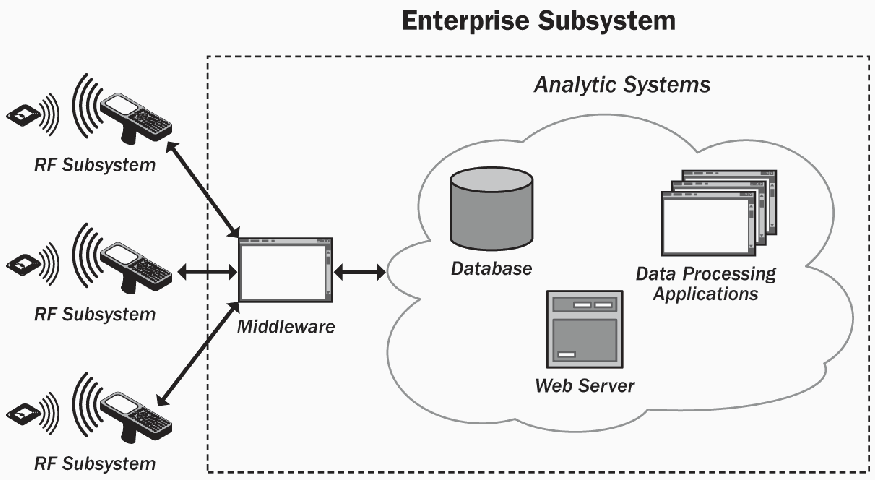
図2-6. RFIDシステムのアーキテクチャ。左に、タグと携帯型リーダーの間に電波の弧を描いた RF Subsystem(RFサブシステム)のアイコンが 3 つあり、それぞれ両方向の矢印で Middleware(ミドルウェア)に接続している。Middleware は Enterprise Subsystem(企業サブシステム)と題した破線の枠の中にあり、両方向の矢印で Analytic Systems(分析システム)と記した雲に接続している。雲の中には Database(データベース)、Web Server(Webサーバー)、Data Processing Applications(データ処理アプリケーション)がある。
Figure 2-6. RFID System Architecture
図2-6. RFIDシステムのアーキテクチャ
2.4.1 Middleware
2.4.1 ミドルウェア
RFID middleware is responsible for preparing data collected from readers in the RF subsystem for the analytic systems that directly support business processes. Middleware hides the complexity and implementation details of the RF subsystem from the analytic systems. This allows the developers and users of the analytic systems to focus on the business implications of RFID data rather than the intricacies of wireless communication. For example, middleware filters duplicate, incomplete, and erroneous information it receives from readers. Middleware filtering is especially useful for applications in which large numbers of tags are in close proximity and for challenging RF environments, such as those containing reflective materials. The middleware can immediately transfer the filtered data to the analytic systems or aggregate and store it for later retrieval.
RFIDミドルウェアは、RFサブシステム内のリーダーから収集したデータを、業務プロセスを直接支援する分析システム向けに準備する役割を担います。ミドルウェアは、RFサブシステムの複雑さや実装の詳細を分析システムから隠します。これにより、分析システムの開発者や利用者は、無線通信の細部ではなくRFIDデータが業務に及ぼす影響に集中できます。例えば、ミドルウェアはリーダーから受け取った重複、不完全、誤った情報をフィルタリングします。多数のタグが近接するアプリケーションや、反射材を含む環境など厳しいRF環境では、ミドルウェアのフィルタリングが特に有用です。ミドルウェアはフィルタリングしたデータを分析システムに直ちに転送するか、後で取得できるよう集約して保存することができます。
System administrators also use middleware to monitor and manage readers. For example, system administrators use middleware to adjust the power output and duty cycle to reduce the number of transaction errors. Many middleware products also support event-based triggers that perform actions automatically under certain conditions. Middleware transaction logs help with the identification of anomalous behavior, which could help an organization detect unauthorized use of the RFID system. Many middleware products also provide additional features, such as support for printing RFID labels that provide benefits beyond data and device management.
システム管理者は、リーダーの監視および管理にもミドルウェアを使用します。例えば、システム管理者は出力電力とデューティサイクルを調整して、トランザクションエラーの数を減らします。多くのミドルウェア製品は、特定の条件下で自動的に動作するイベントベースのトリガーもサポートします。ミドルウェアのトランザクションログは異常な動作の特定に役立ち、組織がRFIDシステムの不正使用を検知する助けとなります。多くのミドルウェア製品は、RFIDラベルの印刷サポートなど、データおよび装置管理を超える利点を提供する追加機能も備えます。
2.4.2 Analytic Systems
2.4.2 分析システム
Analytic systems are composed of databases, data processing applications, and Web servers that process the data outputs of middleware based on business requirements and user instructions. They contain customized business logic for each business process they support. For example, the analytic systems of an RFID system supporting logistics may include customized rules for automated inventory management, procurement, shipping, receiving, and billing.
分析システムは、データベース、データ処理アプリケーション、Webサーバーから成り、業務要件と利用者の指示に基づいてミドルウェアからのデータ出力を処理します。分析システムには、支援する各業務プロセスに合わせた業務ロジックが含まれます。例えば、物流を支援するRFIDシステムの分析システムには、在庫の自動管理、調達、出荷、受領、請求のためにカスタマイズされた規則が含まれる場合があります。
Analytic systems are often enterprise applications that draw inputs from multiple sources, many of which may not involve the RF subsystem. For example, some RFID systems are designed to co-exist with or complement existing AIDC systems (e.g., bar code technology). Analytic systems also correlate RFID data with non-RFID business records imported from other databases, such as records from business partners, customers, logistics service providers, and suppliers. Therefore, analytic systems are often based on commercial database software or legacy applications20 that support processing of data other than RFID data. Analytic systems that are a part of the EPCglobal Network and process data based on tags that comply with EPCglobal standards are called EPC Information Services (EPCIS).
分析システムは多くの場合、複数のソースから入力を得るエンタープライズアプリケーションであり、その多くはRFサブシステムを伴いません(may)。例えば、一部のRFIDシステムは既存のAIDCシステム(例:バーコード技術)と共存または連携するよう設計されています。分析システムは、取引先、顧客、物流サービスプロバイダー、供給業者など、他のデータベースから取り込んだ非RFIDの業務記録とRFIDデータを相関させることもあります。したがって、分析システムは、RFID以外のデータの処理もサポートする商用データベースソフトウェアまたはレガシーアプリケーション20を基盤とすることが多くあります。EPCglobal Networkの一部であり、EPCglobal規格に準拠するタグのデータを処理する分析システムは、EPC Information Services(EPCIS)と呼ばれます。
2.4.3 Network Infrastructure
2.4.3 ネットワークインフラストラクチャ
Network infrastructure enables communication between the RF and enterprise subsystems, as well as among components of the enterprise subsystem. Some important characteristics of network infrastructure include:
ネットワークインフラストラクチャは、RFサブシステムとエンタープライズサブシステム間、およびエンタープライズサブシステムの構成要素間の通信を可能にします。ネットワークインフラストラクチャの重要な特性には、次のものがあります。
•The physical and logical topology of the network, and
•ネットワークの物理および論理トポロジー、ならびに
•Data communications protocols.
•データ通信プロトコル。
2.4.3.1 Physical and Logical Topology
2.4.3.1 物理および論理トポロジー
The topology of a network describes how network computing elements are physically and logically connected to each other. Physical topology describes the network’s cable plant or air interfaces. Logical topology describes how the communications links between devices are arranged. Network communications devices often are configured so that the logical topology is different than the physical topology. For example, communications equipment can be configured to create virtual private networks (VPN) that logically combine and segment physical networks to achieve performance and security objectives.
ネットワークトポロジーとは、ネットワークコンピューティング要素が物理的および論理的にどのように相互接続されているかを表します。物理トポロジーは、ネットワークのケーブル設備または無線インターフェースを表します。論理トポロジーは、装置間の通信リンクがどのように構成されているかを表します。ネットワーク通信装置は、論理トポロジーが物理トポロジーと異なるよう構成されることが多くあります。例えば、通信機器を構成して仮想プライベートネットワーク(VPN)を作成すれば、性能およびセキュリティの目的を達成するため、物理ネットワークを論理的に結合し、また分割できます(can)。
The physical topology of a network infrastructure supporting an RFID system depends on the physical location of the components in its enterprise subsystem. For example, the RF to enterprise subsystem connections are physically located near readers.
RFIDシステムを支援するネットワークインフラストラクチャの物理トポロジーは、エンタープライズサブシステム内の構成要素の物理的位置によって決まります。例えば、RFサブシステムとエンタープライズサブシステムとの接続は、物理的にリーダーの近くに配置されます。
The appropriate physical location of middleware servers depends on the level of traffic generated by the readers. If RFID transactions are relatively infrequent (e.g., an access control system with relatively small numbers of users), then the location of middleware is not critical. In this context, the middleware can be placed in a central location to serve multiple readers. If the business process requires large numbers of tags to be read quickly (e.g., multiple checkout stations in a busy store), then middleware is located near the readers to avoid latency problems and data throughput restrictions associated with many wide area networks. In some cases, middleware capabilities are incorporated into the communication switches to which the readers connect, so RFID-related traffic does not need to traverse even a single device before it is filtered and processed. This configuration is often termed an edge processing network because the switches are considered at the network’s edges.
ミドルウェアサーバーの適切な物理的位置は、リーダーが生成するトラフィック量によって決まります。RFIDトランザクションの頻度が比較的低い場合(例:利用者数が比較的少ないアクセス制御システム)、ミドルウェアの場所は重要ではありません。この場合、ミドルウェアを中央の場所に配置し、複数のリーダーにサービスを提供できます。業務プロセスで多数のタグを迅速に読み取ることを要求する場合(例:繁忙店における複数の会計レーン)、多くの広域ネットワークに伴う遅延の問題やデータスループットの制約を避けるため、ミドルウェアはリーダーの近くに配置されます。一部のケースでは、ミドルウェア機能がリーダーの接続先である通信スイッチに組み込まれるため、RFID関連トラフィックはフィルタリングおよび処理される前に、単一の装置さえも通過する必要がなくなります。この構成は、スイッチがネットワークのエッジにあると見なされるため、エッジ処理ネットワークと呼ばれることが多くあります。
The physical location of analytic systems usually depends on how an organization manages its enterprise applications. If the analytic systems are dedicated to the RFID application, then organizations often place these systems near readers and middleware. On the other hand, some organizations locate their analytic systems in remote data centers to take advantage of the centers’ physical security, on-site technical personnel, and business continuity infrastructure (e.g., electric generators, enterprise data backup, high-availability communications equipment). If the analytic systems integrate both RFID and non-RFID information systems, then it is unlikely that the location of the RF subsystem will significantly influence the location of the analytic systems.
分析システムの物理的位置は通常、組織がエンタープライズアプリケーションをどのように管理しているかによって決まります。分析システムがRFIDアプリケーション専用の場合、組織はこれらのシステムをリーダーやミドルウェアの近くに配置することが多くあります。一方、組織によっては、物理的セキュリティ、現地の技術要員、事業継続インフラストラクチャ(例:発電機、エンタープライズデータのバックアップ、高可用性通信機器)を活用するため、分析システムを遠隔データセンターに配置します。分析システムがRFIDおよび非RFIDの情報システムの両方を統合する場合、RFサブシステムの場所が分析システムの位置に大きく影響する(will)可能性は低いです。
When the enterprise subsystem components are distributed across an organization’s network, the resulting physical topology can be complex, but depending on the network’s configuration, the logical topology might be relatively simple. Many organizations create virtual local area networks (VLAN) for the distributed enterprise subsystem devices that make them appear to each other as if they were on the same network segment. VLANs reduce latency that causes performance problems on networks with large numbers of time-sensitive transactions. They also isolate traffic from other systems, which improves security.
エンタープライズサブシステムの構成要素が組織のネットワーク全体に分散している場合、結果として物理トポロジーは複雑になり得る(can)が、ネットワークの構成によっては論理トポロジーは比較的単純な場合があります(might)。多くの組織は、分散したエンタープライズサブシステム装置向けに仮想ローカルエリアネットワーク(VLAN)を作成し、それらの装置が同じネットワークセグメント上にあるかのように相互に見えるようにします。VLANは、時間制約のあるトランザクションが多数あるネットワークで性能問題を引き起こす遅延を低減します。また、他のシステムからトラフィックを分離し、セキュリティを高めます。
2.4.3.2 Data Communications Protocols
2.4.3.2 データ通信プロトコル
Data communications protocols are a critical component of a network’s performance, reliability, and security. A complete discussion of data communications protocols is beyond the scope of this guide, but readers should be able to distinguish between link-layer and network-layer protocols to understand how RFID enterprise subsystem network infrastructures work and are secured. Link-layer protocols specify how devices communicate with each other over a common medium, or link. Network-layer protocols (sometimes called internetwork protocols) describe how data traffic is routed across multiple network links, possibly over many types of media.
データ通信プロトコルは、ネットワークの性能、信頼性、セキュリティを左右する重要な要素です。データ通信プロトコルの詳細な説明は本ガイドの範囲外ですが、RFIDエンタープライズサブシステムのネットワークインフラストラクチャの動作とセキュリティを理解するため、読者はリンク層プロトコルとネットワーク層プロトコルを区別できるようにしておくべきです。リンク層プロトコルは、共通の媒体またはリンク上で装置同士がどのように通信するかを規定します。ネットワーク層プロトコル(インターネットワークプロトコルと呼ばれることもある)は、複数のネットワークリンクをまたぎ、場合によっては多種類の媒体を経由するデータトラフィックの経路制御方法を記述します。
The most common link-layer protocol connecting RFID enterprise subsystem components is Ethernet (IEEE 802.3), which is the same link-layer protocol used to connect most office computers to local wired networks. Ethernet has no built-in security functionality, which means other complementary data communications protocols must provide any required protection.
RFIDエンタープライズサブシステムの構成要素を接続する最も一般的なリンク層プロトコルはEthernet(IEEE 802.3)であり、これはほとんどのオフィスコンピュータを有線ローカルネットワークに接続するためにも使われるものと同じです。Ethernetにはセキュリティ機能が組み込まれていないため、必要な保護は他の補完的なデータ通信プロトコルが提供しなければなりません。
In most RFID implementations, data communication within the enterprise subsystem is wired communication. The exception is mobile readers, which connect to the enterprise subsystem using a wireless link-layer protocol, such as Wi-Fi (IEEE 802.11).21 Wi-Fi’s characteristics are significantly different than the link-layer protocols supporting communication between tags and readers. In particular, Wi-Fi equipment supporting Wi-Fi Protected Access (WPA) includes numerous security features, such as strong authentication and encryption.22
ほとんどのRFID実装では、エンタープライズサブシステム内のデータ通信は有線です。例外はモバイルリーダーであり、Wi-Fi(IEEE 802.11)などの無線リンク層プロトコルを使ってエンタープライズサブシステムに接続します。21 Wi-Fiの特性は、タグとリーダー間の通信を支えるリンク層プロトコルとは大きく異なります。特に、Wi-Fi Protected Access(WPA)をサポートするWi-Fi機器には、強力な認証や暗号化など、多数のセキュリティ機能が含まれます。22
The most common network-layer protocol for enterprise subsystem communication is the IP. Since most modern computers are IP-enabled, enterprise subsystem components, such as middleware and analytic systems, can easily communicate across the enterprise and over external networks, including the Internet. The ability to communicate with a diverse range of computers and their application services also represents a security risk. IP-enabled enterprise subsystem components are subject to the same protocol attacks as any other IP-enabled computer.
エンタープライズサブシステム通信で最も一般的なネットワーク層プロトコルはIPです。現代のコンピュータの大半はIPに対応しているため、ミドルウェアや分析システムなどのエンタープライズサブシステム構成要素は、組織内およびインターネットを含む外部ネットワークを介して容易に通信できます。多様なコンピュータやそれらのアプリケーションサービスと通信できることは、セキュリティリスクにもなります。IP対応のエンタープライズサブシステム構成要素は、他のあらゆるIP対応コンピュータと同じプロトコル攻撃の対象となります。
2.5 Inter-Enterprise Subsystem
2.5 企業間サブシステム
The inter-enterprise subsystem connects enterprise subsystems together when information needs to be shared across geographic or organizational boundaries, such as in a supply chain application. Not all RFID systems contain inter-enterprise subsystems. The largest government inter-enterprise subsystem is currently the US Department of Defense’s (DoD) Global Transportation Network. The DoD improves its logistics and operational efficiency by tracking DoD assets and personnel from their origin to their destination.
企業間サブシステムは、サプライチェーンアプリケーションなど、地理的または組織的な境界を越えて情報を共有する必要がある(needs)場合に、エンタープライズサブシステム同士を接続します。すべてのRFIDシステムが企業間サブシステムを含むわけではありません。現在、政府最大の企業間サブシステムは、米国国防総省(DoD)のGlobal Transportation Networkです。DoDは、DoDの資産および要員を出発地から目的地まで追跡することで、物流および運用の効率を改善しています。
While many potential methods for building inter-enterprise subsystems exist, EPCglobal’s inter-enterprise approach is a standards-based architecture that has broad industry support and publicly available documentation for review. This section focuses on EPCglobal’s approach to the inter-enterprise subsystem for illustrative purposes, but the basic functional requirements described in the discussion of the EPCglobal standards would also apply to any alternative inter-enterprise subsystem architecture.
企業間サブシステムを構築する方法は多数ありますが、EPCglobalの企業間アプローチは、業界で広く支持され、公開レビュー可能な文書が入手できる標準ベースのアーキテクチャです。本節では説明のため、EPCglobalの企業間サブシステムへのアプローチに焦点を当てます。ただし、EPCglobal規格の説明で示す基本的な機能要件は、他の企業間サブシステムアーキテクチャにも適用されます(would)。
2.5.1 Open System Networks
2.5.1 オープンシステムネットワーク
RFID systems with inter-enterprise subsystems are called open or online systems because multiple entities have the ability to access tag-related information. In contrast, RFID systems that operate entirely within an enterprise, and thus have no inter-enterprise subsystem, are called closed or offline systems. EPCglobal is developing standards for an open infrastructure that will share data associated with EPCs over the Internet among participating organizations that agree to share such data.
企業間サブシステムを持つRFIDシステムは、複数の組織がタグ関連情報にアクセスできるため、オープンシステムまたはオンラインシステムと呼ばれます。これに対し、一つの企業内で完結して動作し、企業間サブシステムを持たないRFIDシステムは、クローズドシステムまたはオフラインシステムと呼ばれます。EPCglobalは、データ共有に同意した参加組織間で、EPCに関連付けられたデータをインターネット経由で共有するオープンインフラストラクチャの規格を策定しています。
To create an open system, each participating organization grants partner organizations access to its analytic systems. The access can occur over a network dedicated for this purpose, a public network such as the Internet, or a VPN that emulates the characteristics of a dedicated network using the infrastructure of a public or shared network. Both dedicated networks and VPNs are sometimes called extranets, to denote that information is shared outside the enterprise, as opposed to intranets, which are restricted to internal users. To enable extranet access, the implementing organization likely modifies its network firewall to permit RFID-related traffic to traverse the enterprise network boundary and also creates access privileges for external users on the analytic systems themselves. Companies typically sign agreements or memoranda of understanding that describe the roles and responsibilities associated with the access before enabling it.
オープンシステムを構築するには、各参加組織がパートナー組織に自らの分析システムへのアクセスを許可します。アクセスには、この目的専用のネットワーク、インターネットなどの公衆ネットワーク、または公衆ネットワークや共有ネットワークのインフラストラクチャを使って専用ネットワークの特性を模倣するVPNを利用できます。専用ネットワークとVPNはいずれも、企業外で情報を共有することを示す「エクストラネット」と呼ばれることがあります。これは、内部利用者に限定されるイントラネットと対照的です。エクストラネットアクセスを可能にするため、実装組織は、RFID関連トラフィックが企業ネットワーク境界を通過できるようネットワークファイアウォールを変更し、分析システム自体に外部利用者用のアクセス権も作成する可能性が高いです。企業は通常、アクセスを有効にする前に、アクセスに関する役割と責任を記載した契約または覚書に署名します。
Figure 2-7 shows how various EPCIS might be connected in an open system network.
図2-7に、オープンシステムネットワークで複数のEPCISがどのように接続され得るか(might)を示します。
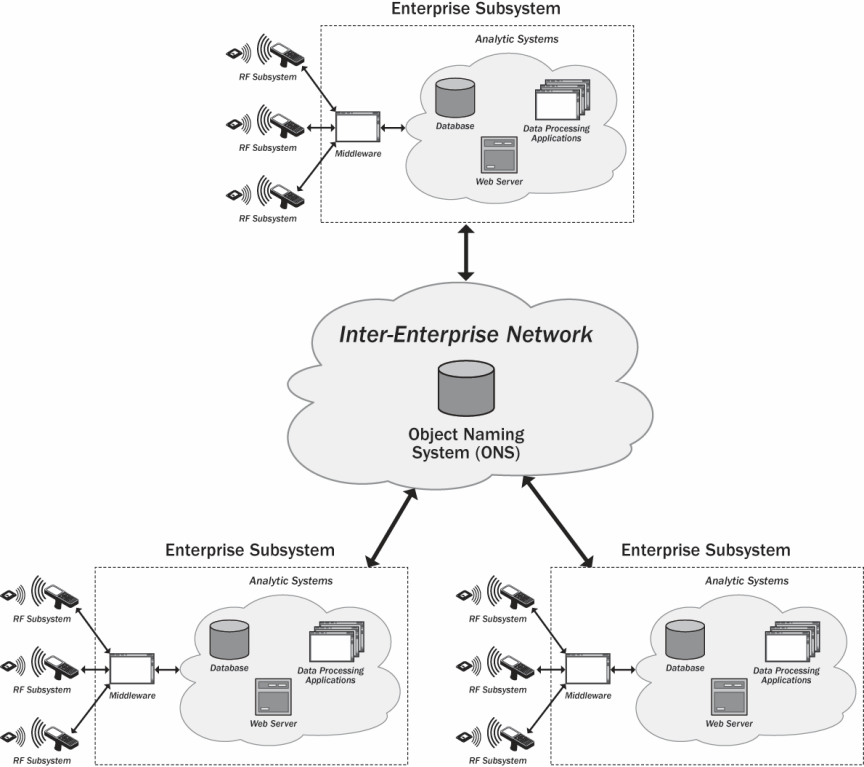
図2-7. 企業間アーキテクチャ。図2-6 と同じ企業サブシステムが上に 1 つ、下に 2 つあり、それぞれ Enterprise Subsystem(企業サブシステム)と題した破線の枠に入っている。各枠では、3 つの RF Subsystem(RFサブシステム)が両方向の矢印で Middleware(ミドルウェア)に接続し、Middleware が両方向の矢印で、Database、Web Server、Data Processing Applications を含む Analytic Systems(分析システム)の雲に接続している。中央には Inter-Enterprise Network(企業間ネットワーク)と記した雲があり、その中に Object Naming System (ONS) と記したデータベースがある。3 つの企業サブシステムはそれぞれ両方向の矢印で企業間ネットワークに接続している。
Figure 2-7. Inter-Enterprise Architecture
図2-7. 企業間アーキテクチャ
2.5.2 Object Naming Service (ONS)
2.5.2 Object Naming Service(ONS)
Finding information about a tagged object in an open system is a challenge because the information could be located in any one of a number of analytic systems. To solve this problem, EPCglobal created the Object Naming Service (ONS), which is a global distributed database of EPC tag identifiers. Users query the ONS with a particular EPC, and the ONS returns the address information from the EPCIS that contains information associated with that EPC. The user then queries the EPCIS directly to obtain the desired data. The ONS is a resolution mechanism that directs an EPC query to where information associated with that EPC can be found on the network. In order to do that, the ONS utilizes two tiers of resolution services coordinated with the segments on the EPC string: the Root ONS and the Local ONS.
オープンシステム内でタグ付きオブジェクトに関する情報を見つけるのは困難です。情報が複数の分析システムのいずれかに存在し得る(could)ためです。この問題を解決するため、EPCglobalは、EPCタグ識別子のグローバルな分散データベースであるObject Naming Service(ONS)を作成しました。利用者が特定のEPCを指定してONSに問い合わせると、ONSは、そのEPCに関連付けられた情報を含むEPCISのアドレス情報を返します。その後、利用者はEPCISに直接問い合わせ、必要なデータを取得します。ONSは、EPCクエリを、ネットワーク上でそのEPCに関連する情報を見つけられる(can)場所へ案内する名前解決機構です。その処理のため、ONSはEPC文字列のセグメントに対応する2階層の名前解決サービス、すなわちRoot ONSとLocal ONSを利用します。
•The Root ONS is a community service administered by EPCglobal that provides an authoritative lookup service indexing all EPC Managers with the addresses of their Local ONS.
•Root ONSはEPCglobalが管理するコミュニティサービスであり、すべてのEPC Managerを索引化し、それぞれのLocal ONSのアドレスを提供する権威ある検索サービスを提供します。
•The Local ONS is a software component maintained and operated locally by EPCglobal Network members. The Local ONS provides the authoritative database in which all EPCs issued by a specific EPC Manager are indexed with the addresses of their EPCIS location.
•Local ONSは、EPCglobal Networkメンバーがローカルに維持・運用するソフトウェアコンポーネントです。Local ONSは、特定のEPC Managerが発行したすべてのEPCを索引化し、それぞれのEPCISの場所のアドレスと対応付ける権威あるデータベースを提供します。
When a member of the EPCglobal Network queries the network for information about an EPC, the Root ONS utilizes the EPC Manager Number segment to direct the EPC query to the EPC’s data owner (i.e. the EPC Manager). From there, the EPC Manager’s Local ONS utilizes the object class segment to direct the query to the EPCIS that stores information for that EPC.
EPCglobal NetworkのメンバーがEPCに関する情報をネットワークに問い合わせると、Root ONSはEPC Manager Numberセグメントを使い、EPCクエリをそのEPCのデータ所有者(すなわちEPC Manager)へ転送します。次にEPC ManagerのLocal ONSは、object classセグメントを使い、そのEPCの情報を保存するEPCISへクエリを転送します。
The ONS extends the Internet’s Domain Name System (DNS) to support resolution of an EPC with its corresponding EPCIS. ONS EPC resolution works similarly to the name resolution that Internet users employ whenever visiting Web sites or sending e-mail messages, but with some significant differences, which are presented in Table 2-3.
ONSは、対応するEPCISへのEPC名前解決をサポートするため、インターネットのDomain Name System(DNS)を拡張します。ONSによるEPC名前解決は、インターネット利用者がWebサイトを訪問したり電子メールを送信したりする際に用いる名前解決と似ていますが、重要な違いがいくつかあり、それらを表2-3に示します。
Table 2-3. Comparison of Traditional DNS and ONS Resolution Transactions
表2-3. 従来のDNSとONSの名前解決トランザクションの比較
| Traditional DNS | ONS | Discussion |
|---|---|---|
| User enters a text-based Uniform Resource Locator (URL) into a Web browser or an e-mail address into a messaging client. Examples: http://www.nist.gov/ john.doe@mail.nist.gov | EPC Uniform Resource Identifier (URI) is converted to a fully qualified domain name. Example: urn:epc:id:sgtin:0513347 is converted to: 004106 | The EPC is first translated into a form that DNS can interpret. The Root ONS is the domain onsepc.com. The Root ONS is built upon the Internet DNS. |
| The messaging client sends the query to a local DNS resolver, which queries a DNS server to resolve the domain name (e.g., www.nist.gov or mail.nist.gov). DNS contains host (A) records for Web servers and other Internet hosts. DNS contains mail exchanger (MX) records for mail servers. | The Root ONS forwards the query to a Local ONS resolver to resolve the converted URI. The Root ONS portion of DNS has Naming Authority Pointer (NAPTR) records for EPCs. | The transactions are identical, but they involve different types of records in DNS. |
| DNS returns an IP address for the relevant server. Example: 129.6.13.23 | The Local ONS returns a service registration entry for the relevant EPCIS. Example: http:/ In this example, subsequent communication with epcis.nist.gov occurs using Web Services Description Language (WSDL). | An IP address alone is insufficient for the Web services on which most RFID applications rely. ONS supports several types of service registrations, which define how applications will interact with the EPCIS. |
| The Web browser or messaging client uses the IP address to contact the server at that address. | Where required, the Local ONS resolves the domain name in the response using traditional DNS methods and then directs the EPC query to the specified service to get information about the EPC. | ONS-based RFID applications require additional steps to resolve the service registration. |
| 従来のDNS | ONS | 説明 |
|---|---|---|
| 利用者はWebブラウザーにテキスト形式のUniform Resource Locator(URL)を入力するか、メッセージングクライアントに電子メールアドレスを入力します。 例: http://www.nist.gov/ john.doe@mail.nist.gov | EPC Uniform Resource Identifier(URI)を完全修飾ドメイン名に変換します。 例: urn:epc:id:sgtin:0513347 は次のように変換されます。 004106 | EPCはまず、DNSが解釈できる形式に変換されます。 Root ONSは onsepc.com ドメインです。Root ONSはインターネットDNS上に構築されています。 |
| メッセージングクライアントはクエリをローカルDNSリゾルバーに送信し、リゾルバーはドメイン名(例:www DNSにはWebサーバーやその他のインターネットホスト用のホスト(A)レコードが含まれます。 DNSにはメールサーバー用のメール交換(MX)レコードも含まれます。 | Root ONSはクエリをLocal ONSリゾルバーに転送し、変換済みURIを解決します。 DNSのRoot ONS部分にはEPC用のNaming Authority Pointer(NAPTR)レコードがあります。 | トランザクションは同じですが、DNS内の異なる種類のレコードを使用します。 |
| DNSは該当サーバーのIPアドレスを返します。 例: 129.6.13.23 | Local ONSは該当するEPCISのサービス登録エントリーを返します。 例: http:/ この例では、その後 epcis.nist.gov との通信にWeb Services Description Language(WSDL)を使用します。 | 多くのRFIDアプリケーションが依存するWebサービスには、IPアドレスだけでは不十分です。ONSは複数種類のサービス登録をサポートし、アプリケーションがEPCISとどのように連携するかを定義します。 |
| WebブラウザーまたはメッセージングクライアントはIPアドレスを使って、そのアドレスのサーバーに接続します。 | 必要な場合、Local ONSは従来のDNS方式を使って応答内のドメイン名を解決し、その後、指定されたサービスにEPCクエリを転送してEPCに関する情報を取得します。 | ONSベースのRFIDアプリケーションでは、サービス登録を解決するための追加手順が必要となります。 |
Much like the DNS, the Root ONS is accessible by any Internet user. Some organizations may choose to implement their own Local ONS that is not connected to the EPCglobal Root ONS. Using an independent ONS limits the applications and users that can access it. This characteristic is a beneficial feature for organizations that require their EPCs to remain confidential, but is overly restrictive for organizations that expect large numbers of external users or that cannot anticipate a priori who will have a legitimate need for the EPC records (e.g., individual retail consumers seeking support after purchase of a tagged object).
DNSと同様に、Root ONSはあらゆるインターネット利用者からアクセス可能です。一部の組織は、EPCglobal Root ONSに接続されていない独自のLocal ONSを実装することがあります。独立したONSを使うと、アクセスできるアプリケーションと利用者が制限されます。この特性は、EPCを機密に保つことを求める組織には有益ですが、多数の外部利用者を想定する組織や、誰がEPCレコードを正当に必要とするか、事前に予測できない組織(例:タグ付きオブジェクトの購入後にサポートを求める個人消費者)には過度に制限的です。
2.5.3 Discovery Service
2.5.3 Discovery Service
The EPCglobal Discovery Services are still in the early phases of development and use cases are still being developed to better understand the needs and requirements for this service. The concept of the EPCglobal Discovery Services is similar to ONS in that it is envisioned to return network addresses where data related to an EPC can be found. However, the Root ONS only provides information regarding where a particular tag was commissioned. It does not provide information regarding the history of a particular tag’s transactions. Multiple entities along the supply chain would benefit from having quick access to this information that ONS does not offer. Discovery services offer a potential mechanism to make this information available over an inter-enterprise subsystem.
EPCglobal Discovery Servicesは開発の初期段階にあり、このサービスのニーズと要件をよりよく理解するためのユースケースもまだ開発中です。EPCglobal Discovery Servicesの概念は、EPCに関連するデータを見つけられる(can)ネットワークアドレスを返すよう構想されている点でONSに似ています。しかし、Root ONSが提供するのは、特定のタグがどこで登録されたかに関する情報だけです。特定のタグのトランザクション履歴に関する情報は提供しません。サプライチェーン上の複数の組織は、ONSが提供しないこの情報に迅速にアクセスできることで便益を得ます(would)。Discovery Servicesは、企業間サブシステムを通じてこの情報を利用可能にする潜在的な仕組みを提供します。
The EPCglobal Discovery Services can be viewed as a search engine that provides a means to locate the network addresses of all EPCIS services that may have information about a specific EPC (not just the EPCIS service of the EPC Manager). For instance, it is envisioned that the EPCglobal Discovery Services will ultimately return multiple pointers from the multiple organizations that have collected information about the tagged object at some point in the object’s life cycle. In addition, the EPCglobal Discovery Services may provide a cache for selected EPCIS data and may enforce authorization policies with respect to access of the aforementioned data. It is envisioned that more than one EPCglobal Discovery Service may operate in parallel, and may compete against each other and/or cater to particular audiences with specific information requirements.
EPCglobal Discovery Servicesは、特定のEPCに関する情報を持つ可能性がある(may)すべてのEPCISサービス(EPC ManagerのEPCISサービスだけではない)のネットワークアドレスを見つける手段を提供する検索エンジンと見なせます(can)。例えば、EPCglobal Discovery Servicesは最終的に、対象物のライフサイクル中のいずれかの時点でタグ付きオブジェクトに関する情報を収集した複数組織から、複数のポインターを返すと想定されています(will)。さらに、EPCglobal Discovery Servicesは、選択されたEPCISデータのキャッシュを提供することがあり(may)、当該データへのアクセスに関する認可ポリシーを適用することもあります(may)。複数のEPCglobal Discovery Serviceが並行して稼働することが想定されており(may)、それらは互いに競合すること、および/または特定の情報要件を持つ利用者層にサービスを提供することがあります(may)。
2.6 Summary
2.6 要約
RFID is an innovation in AIDC technology that provides significant advantages over earlier technology, such as optical scanning of bar codes. These advantages include the ability to identify objects without optical line of sight over significant distances and the ability to work reliably both indoors and outdoors.
RFIDはAIDC技術の革新であり、バーコードの光学スキャンなど従来技術に対して大きな利点をもたらします。これらの利点には、光学的な見通し線なしにかなりの距離から対象物を識別すること、および屋内外の両方で確実に動作することが含まれます。
The components of an RFID system can be categorized into three subsystems:
RFIDシステムの構成要素は、次の3つのサブシステムに分類できます(can)。
•The RF subsystem,
•RFサブシステム、
•The enterprise subsystem, and
•エンタープライズサブシステム、ならびに
•The inter-enterprise subsystem.
•企業間サブシステム。
Every RFID system includes an RF subsystem, which is composed of (1) tags attached to or embedded in objects and (2) readers that query the tags. Important characteristics of tags include their identifier format, the source of their power, the radio frequencies over which they operate, their size and shape, and additional functionality they support, such as security features and connections to environmental sensors. Important characteristics of readers include their power output, duty cycle, antenna design, and interface to the enterprise subsystem, which can be either wireless or wired. A wireless enterprise interface enables the reader to be mobile. Important aspects of tag-reader communication include the singulation protocol, the encoding scheme, and the distance over which tag and reader signals can be reliably received.
すべてのRFIDシステムはRFサブシステムを含み、RFサブシステムは、(1) 対象物に取り付けられるか埋め込まれるタグ、(2) タグに問い合わせるリーダーから構成されます。タグの重要な特性には、識別子形式、電源、動作周波数、サイズと形状、ならびにセキュリティ機能や環境センサー接続などの追加機能があります。リーダーの重要な特性には、出力電力、デューティサイクル、アンテナ設計、エンタープライズサブシステムとのインターフェースがあり、後者は無線または有線のいずれかです。無線エンタープライズインターフェースにより、リーダーは移動可能となります。タグとリーダー間の通信で重要な点には、singulationプロトコル、符号化方式、タグおよびリーダーの信号を確実に受信できる距離があります。
In many RFID systems, the tags and readers are supported by an enterprise system that is composed of middleware, analytic systems, and networking services. The middleware filters data, aggregates data, and manages readers and other RFID devices. Analytic systems process and store this information to support business processes. Lastly, the networking services are used to provide the connections among the components of enterprise subsystem and between the enterprise subsystem and the RF subsystem.
多くのRFIDシステムでは、タグとリーダーを、ミドルウェア、分析システム、ネットワークサービスから成るエンタープライズシステムが支援します。ミドルウェアはデータをフィルタリング、集約し、リーダーやその他のRFID装置を管理します。分析システムは、この情報を処理および保存して業務プロセスを支援します。最後に、ネットワークサービスは、エンタープライズサブシステムの構成要素間、およびエンタープライズサブシステムとRFサブシステム間の接続を提供するために使用されます。
RFID systems that share information across organizational boundaries, such as supply chain applications, also have an inter-enterprise subsystem. The RF, enterprise, and inter-enterprise subsystems together allow an RFID system to support business processes. The versatile components of these subsystems allow an RFID system to be tailored to the needs of a particular application. If an inter-enterprise subsystem is constructed to EPCglobal specifications, then it will have a local ONS and an EPCIS, and may utilize the EPCglobal Root ONS and Discovery Services. The Root ONS provides an authoritative lookup for an EPC identifier that returns pointers to the resources from the organization that created that identifier. Finally, EPCglobal Discovery Services are envisioned to serve as a type of search engine for an EPC identifier that can return pointers to multiple organizations that have information related to that EPC identifier (e.g., companies in the supply chain that have completed a transaction with a particular tag and registered information related to its EPC in their EPCIS).
サプライチェーンアプリケーションなど、組織の境界を越えて情報を共有するRFIDシステムには、企業間サブシステムもあります。RF、エンタープライズ、企業間の各サブシステムを組み合わせることで、RFIDシステムは業務プロセスを支援できます。これらサブシステムの多用途な構成要素により、RFIDシステムを特定のアプリケーションのニーズに合わせて調整できます。企業間サブシステムがEPCglobal仕様に従って構築される場合、Local ONSとEPCISを備えるほか、EPCglobal Root ONSおよびDiscovery Servicesを利用することがあります。Root ONSはEPC識別子の権威ある検索を提供し、その識別子を作成した組織のリソースへのポインターを返します。最後に、EPCglobal Discovery Servicesは、EPC識別子に関する情報を持つ複数組織(例:特定のタグとのトランザクションを完了し、そのEPCに関連する情報を自らのEPCISに登録したサプライチェーン企業)へのポインターを返す検索エンジンの一種として構想されています。
3. RFID Applications and Application Requirements
3. RFIDアプリケーションおよびアプリケーション要件
RFID technologies are being deployed by many organizations because they have the potential to improve mission performance and reduce operational costs. To achieve these goals, RFID systems must be engineered to support the specific business processes that the organization is automating. Applications for RFID technologies are diverse because of the wide range of business processes that exist.
多くの組織がRFID技術を導入しています。これは、ミッション遂行能力を向上させ、運用コストを削減できる可能性があるためです。これらの目標を達成するには、組織が自動化する特定の業務プロセスを支援するようRFIDシステムを設計しなければなりません(must)。存在する業務プロセスが広範であるため、RFID技術のアプリケーションは多様です。
RFID security risks and the controls available to mitigate them are also highly varied. Typically, only a subset of the full range of technologies, risks, and controls is applicable to any given RFID implementation. Important business drivers that shape RFID application requirements and the resulting characteristics of RFID systems include:
RFIDのセキュリティリスクと、それらを軽減するために利用できる管理策も大きく多様です。通常、あらゆるRFID実装に適用されるのは、技術、リスク、管理策の全範囲の一部に限られます。RFIDアプリケーション要件と、その結果としてのRFIDシステムの特性を形作る重要な業務要因には、次のものがあります。
•The general functional objective of the RFID technology (i.e., the application type),
•RFID技術の一般的な機能目的(すなわちアプリケーションの種類)、
•The nature of the information that the RFID system processes or generates,
•RFIDシステムが処理または生成する情報の性質、
•The physical and technical environment at the time RFID transactions occur,
•RFIDトランザクションが行われる時点の物理的および技術的環境、
•The physical and technical environment before and after RFID transactions take place, and
•RFIDトランザクションの実施前および実施後の物理的および技術的環境、ならびに
•The economics of the business process and RFID system.
•業務プロセスおよびRFIDシステムの経済性。
This section discusses each of these characteristics in greater detail and provides an overview of common types of RFID applications.
本節では、これらの特性をそれぞれ詳しく説明し、一般的なRFIDアプリケーションの種類を概説します。
3.1 RFID Application Types
3.1 RFIDアプリケーションの種類
There are many types of RFID applications, of which some of the most common are asset management, asset tracking, automated payment, and supply chain management. The key characteristic differentiating one RFID application from another is the purpose of identifying the tagged items. Table 3-1 lists reasons why an organization might want to identify an item and the general application type that best corresponds to those reasons.
RFIDアプリケーションには多くの種類があり、特に一般的なものとして、資産管理、資産追跡、自動支払い、サプライチェーン管理があります。RFIDアプリケーションを他と区別する主な特性は、タグ付きアイテムを識別する目的です。表3-1は、組織がアイテムを識別したい理由と、それに最もよく対応する一般的なアプリケーションの種類を示します。
Table 3-1. RFID Application Types
表3-1. RFIDアプリケーションの種類
| Purpose of Identification | Application Type |
|---|---|
| Determine the presence of an item | Asset management |
| Determine the location of an item | Tracking |
| Determine the source of an item | Authenticity verification |
| Ensure affiliated items are not separated | Matching |
| Correlate information with the item for decision-making | Process control |
| Authenticate a person (holding a tagged item) | Access control |
| Conduct a financial transaction | Automated payment |
| 識別の目的 | アプリケーションの種類 |
|---|---|
| アイテムの存在を判定する | 資産管理 |
| アイテムの位置を判定する | 追跡 |
| アイテムの出所を判定する | 真正性検証 |
| 関連するアイテムが分離されないようにする | 照合 |
| 意思決定のために情報をアイテムと関連付ける | プロセス制御 |
| 人物(タグ付きアイテムを所持)を認証する | アクセス制御 |
| 金融取引を行う | 自動支払い |
Application types are not mutually exclusive; an implementation can combine elements of several application types. For example, both access control systems and sophisticated asset management systems include tracking features. Supply chain management is a tracking application that spans organizational boundaries and often includes process control and payment transactions.
アプリケーションの種類は相互に排他的ではなく、実装は複数種類の要素を組み合わせることができます。例えば、アクセス制御システムと高度な資産管理システムはいずれも追跡機能を含みます。サプライチェーン管理は、組織の境界をまたぐ追跡アプリケーションであり、プロセス制御や支払いトランザクションを含むことが多くあります。
Personnel responsible for designing and implementing RFID systems should understand what application types apply to their implementation so that they can select appropriate security controls. For example, the security controls needed to protect financial transactions in automated payment systems are different than those needed for tracking applications. The personnel should also understand that an adversary may leverage RFID technology for an unintended purpose. For example, a warehouse may use RFID technology to determine what items it has in its current inventory, but an adversary may use the same system to track an item’s whereabouts after it leaves the warehouse. In this case, an asset management system is later used to enable an unauthorized tracking application, perhaps used by an adversary to locate high value targets.
RFIDシステムの設計および実装を担当する要員は、適切なセキュリティ管理策を選択できるよう、自らの実装にどのアプリケーション種類が当てはまるかを理解すべきです(should)。例えば、自動支払いシステムで金融取引を保護するために必要な(needed)セキュリティ管理策は、追跡アプリケーションに必要な(needed)ものとは異なります。要員はまた、攻撃者がRFID技術を意図しない目的に利用する(may)可能性があることも理解すべきです(should)。例えば、倉庫は現在の在庫にどのアイテムがあるかを判定するためにRFID技術を使うことがある(may)が、攻撃者は同じシステムを使ってアイテムが倉庫を出た後の所在を追跡できる(can)ことがあります(may)。この場合、資産管理システムが後に、攻撃者が高価値の標的を特定するために使うなど、無許可の追跡アプリケーションを可能にするために利用されます。
The remainder of Section 3.1 examines each of the application types mentioned in Table 3-1, as well as supply chain management. The section uses hypothetical examples to illustrate the key characteristics of each application type and highlights how they differ from one another. The section also incorporates other examples of each application to provide additional information on current and potential applications of the technology.
第3.1節の残りでは、表3-1に示した各アプリケーション種類とサプライチェーン管理を検討します。本節では、各アプリケーション種類の主な特性を例示し、それぞれの違いを明らかにするため仮想例を用います。また、技術の現在および潜在的なアプリケーションについて補足情報を提供するため、各アプリケーションの他の例も取り上げます。
3.1.1 Asset Management
3.1.1 資産管理
RFID-based asset management systems are used to manage inventory of any item that can be tagged. Asset management systems using RFID technology offer significant advantages over paper-based or bar code systems, including the ability to read the identifiers of multiple items nearly simultaneously without optical line of sight or physical contact. These features increase the speed of common asset management tasks, which improves operational efficiency and effectiveness.
RFIDベースの資産管理システムは、タグを付けることができる(can)あらゆるアイテムの在庫管理に使用されます。RFID技術を用いる資産管理システムは、紙やバーコードのシステムに比べて大きな利点があり、その中には、光学的な見通し線や物理的接触なしに、複数アイテムの識別子をほぼ同時に読み取れる能力が含まれます。これらの機能により、一般的な資産管理作業の速度が上がり、運用効率と有効性が向上します。
Perhaps the simplest form of asset management is Electronic Article Surveillance (EAS), which accounts for items in retail stores.23 For example, EAS tags are placed on electronic equipment, clothing, books, and many other consumer goods at major retailers. After a customer purchases an item, the sales clerk deactivates the tag. If a person attempts to leave the shop with unpurchased goods, readers at the doors will detect the activated tag and trigger an alarm. In this case, the RFID technology determines only one thing: whether or not the EAS tag is still operating, indicating that the item has not been properly checked out.
資産管理の最も単純な形態として、店舗のアイテムを計数する電子商品監視(EAS)があります。23例えば、大手小売店では電子機器、衣類、書籍など多くの消費財にEASタグを取り付けます。顧客が商品を購入すると、販売員がタグを無効化します。人が未購入の商品を持って店外へ出ようとすると、出口のリーダーが有効なタグを検知し、警報を作動させます(will)。この場合、RFID技術が判定するのは、EASタグがまだ作動しているかどうか、すなわち商品が適切に会計処理されていないかどうかだけです。
Most RFID-based asset management systems provide additional functionality. For example, at a doctor’s office, the medical records clerk can quickly scan the filing system on a monthly or quarterly basis to determine how many medical records are present or missing. The records clerk can also instantly compare the list of missing records with a list of those known to be checked out of the filing system. Without RFID technology, this task could take hours or days to complete by hand. Bar code technology, such as that found at a supermarket, would require physical handling of each medical record, which is labor-intensive.
RFIDベースの資産管理システムの多くは、追加機能を提供します。例えば、診療所では、医療記録係が月次または四半期ごとにファイリングシステムを素早くスキャンし、存在する医療記録や見当たらない医療記録の数を判定できます。記録係は、見当たらない記録の一覧を、ファイリングシステムから貸し出されたことが分かっている記録の一覧と即座に比較することもできます。RFID技術がなければ、この作業を手作業で完了するのに何時間、場合によっては何日もかかる可能性があります。スーパーマーケットなどで使われるバーコード技術では、各医療記録を物理的に取り扱う必要があるため、労働集約的です。
RFID is also an enabling technology for smart shelves and smart cabinets, which automatically maintain continuous inventories of the items they hold by tracking items entering and leaving. Items are reordered automatically when inventory is low. The smart shelves and cabinets can also be used for theft prevention, alerting personnel when many high-value items are taken at the same time, and perhaps activating a camera to record the event.
RFIDはスマートシェルフやスマートキャビネットを実現する技術でもあります。これらは、出入りするアイテムを追跡して収納品の在庫を継続的かつ自動的に維持します。在庫が少なくなると、自動的に再注文します。スマートシェルフやキャビネットは盗難防止にも使用できます(can)。例えば、多数の高価値アイテムが同時に持ち出された場合に要員へ警告し、場合によってはカメラを作動させて状況を記録することもあります。
3.1.2 Tracking
3.1.2 追跡
Tracking applications are used to identify the location of an item, or more accurately, the location of the last reader that detected the presence of the tag associated with the item. Many tracking applications are part of an asset management system. One difference between relatively simple asset management systems and tracking systems is that an asset management system can detect the presence of an item with readers at a single location. In contrast, tracking systems require more than one reader, as well as a network, so that a central system can aggregate and correlate information received from each of the readers.
追跡アプリケーションは、アイテムの位置、より正確にはアイテムに関連付けられたタグの存在を最後に検知したリーダーの位置を識別するために使用されます。多くの追跡アプリケーションは資産管理システムの一部です。比較的単純な資産管理システムと追跡システムの違いの一つは、資産管理システムでは一つの場所にあるリーダーでアイテムの存在を検知できる(can)点です。これに対し、追跡システムでは、中央システムが各リーダーから受信した情報を集約し、相関させることができるように、複数のリーダーとネットワークを必要とします(require)。
At transportation hubs (such as ports or train stations), readers are placed throughout the facility. The security staff can track the location of its employees wearing RFID-equipped identification badges as they pass through doors or gates. In addition to restricting access to specific areas of the facility, these RFID-enabled identification badges help the security department locate specific staff members during emergency situations and to monitor building evacuations during fire alarms.
港や駅などの交通拠点では、施設全体にリーダーが配置されます。警備員は、RFID対応識別バッジを着用する職員がドアやゲートを通過する際、その位置を追跡できます(can)。施設内の特定区域へのアクセスを制限するだけでなく、このRFID対応識別バッジは、緊急時に特定の職員を警備部門が特定したり、火災警報時の建物からの避難を監視したりする助けとなります。
Tracking applications can also be used to measure sports performance. Some companies sell systems to track athletes during races. This application requires each racer to wear a unique tag that is registered with the tracking system. Such systems can be used for any mass start event, including bicycling, running, or triathlons. Different events may require the athletes to wear the tags in a certain way to be detected by the system. For example, runners may be required to put the tag in one of their shoes or cyclists may be required to mount the tag on their bicycles.
追跡アプリケーションはスポーツの成績測定にも使用できます(can)。競技中の選手を追跡するシステムを販売する企業もあります。このアプリケーションでは、各競技者が追跡システムに登録された一意のタグを着用する必要があります(requires)。このようなシステムは、自転車競技、ランニング、トライアスロンなど、集団一斉スタートの競技に使用できます(can)。競技によっては、システムに検知されるため選手にタグの特定の着用方法を求めることがある(may, require)。例えば、ランナーはタグを靴の一方に入れるよう求められる(required)ことがあり(may)、自転車選手はタグを自転車に取り付けるよう求められる(required)ことがあります(may)。
3.1.3 Authenticity Verification
3.1.3 真正性検証
In authenticity verification applications, the tag provides evidence of the source of a tagged item. Authenticity verification often is incorporated into a tracking application. The originating source of the tag creates a record of the initialization transaction, either on the tag or in an enterprise subsystem database. When readers subsequently query the tag, they can determine if it originated from a proper source. For authenticity verification systems to provide appropriate levels of assurance, they typically need to incorporate cryptography and mechanisms to prevent cloning.24 Digital signatures use cryptography to provide the property of non-repudiation, which means the signatory cannot later deny creating the signature.25 Authenticity verification applications can use digital signatures to establish evidence of authenticity and enable later verification. The pharmaceutical industry is using RFID for authenticity verification to reduce the prevalence of counterfeit drugs.
真正性検証アプリケーションでは、タグがタグ付きアイテムの出所を示す証拠を提供します。真正性検証は追跡アプリケーションに組み込まれることが多くあります。タグの発行元は、初期化トランザクションの記録をタグ上またはエンタープライズサブシステムのデータベースに作成します。その後リーダーがタグに問い合わせると、正規の出所から発行されたかどうかを判定できます(can)。真正性検証システムが適切な保証レベルを提供するには、通常、暗号と複製を防ぐ機構を組み込む必要があります(need)。24デジタル署名は暗号を使って否認防止性を実現します。これは署名者が後に署名を作成したことを否定できない(cannot)ことを意味します。25真正性検証アプリケーションはデジタル署名を使って真正性の証拠を確立し、その後の検証を可能にすることができます(can)。製薬業界では、偽造薬の発生を減らすため、真正性検証にRFIDを使用しています。
3.1.4 Matching
3.1.4 照合
In a matching application, two tagged items are matched with each other and a signal (e.g., a light or tone) is triggered if one of the items is later matched with an incorrect tagged item. The most common matching application today occurs in hospitals and involves placing bracelets with tags on mothers and their newborn babies. If a new mother is accidentally given another woman’s infant, the system issues an alert. Similar technology allows day care centers to match children to parents or guardians, and hospital patients to their medicines and designated visitors. In the future, RFID tags might match airline passengers with their checked luggage to prevent theft and inadvertent mistakes.
照合アプリケーションでは、タグ付きの2つのアイテムを互いに照合し、後でどちらかのアイテムが誤ったタグ付きアイテムと照合された場合に信号(例:ライトまたは音)を作動させます。現在最も一般的な照合アプリケーションは病院で使われ、母親と新生児にタグ付きブレスレットを装着します。新しい母親に誤って別の女性の乳児が渡されると、システムが警報を発します。類似技術は、保育施設で子どもと親または保護者を、また病院で患者とその薬や指定訪問者を照合します。将来的には、RFIDタグが航空旅客と預け入れ荷物を照合し、盗難や不注意による取り違えを防ぐことがあります(might)。
3.1.5 Process Control
3.1.5 プロセス制御
Process control applications allow business processes to use information associated with a tag (or the item attached to the tag) to take a customized action. A common process control application is the facilitation of product design variations in manufacturing processes. For example, a tag might be affixed to the frame of a product on an assembly line in a manufacturing plant. The tag’s identifier would be associated with desired features of the finished product. At each station in the assembly process, a reader would read the tag and take an appropriate action, such as adding a specialized component or using a particular color of paint. In another typical application, sensors are attached to tags to measure factors such as temperature, humidity, or shock. Information from the sensors can be used to make decisions regarding the tagged items. For example, a perishable product may be discarded if it has been exposed to room temperature for more than a threshold period of time.
プロセス制御アプリケーションでは、業務プロセスがタグ(またはタグに取り付けられたアイテム)に関連付けられた情報を使って、個別化された動作を実行します。一般的なプロセス制御アプリケーションの一つは、製造工程における製品設計のバリエーションを容易にすることです。例えば、製造工場の組立ライン上で、製品のフレームにタグを取り付けることがあります(might)。完成品に望まれる特性はタグの識別子に関連付けられます(would)。組立工程の各ステーションで、リーダーがタグを読み取り、専用部品を追加する、または特定の塗料色を使用するといった適切な動作を行います(would)。別の一般的なアプリケーションでは、温度、湿度、衝撃などの要因を測定するためにセンサーをタグに取り付けます。センサーからの情報は、タグ付きアイテムに関する判断に使用できます(can)。例えば、腐敗しやすい製品は、室温に所定の時間を超えてさらされていた場合、廃棄されることがあります(may)。
In asset management, tracking, and matching applications, each reader only needed to capture the tag’s identifier (a number permanently assigned to the tag) and apply a timestamp to the transaction. In process control applications, additional information beyond the tag’s identifier is normally associated with each tag. That information could reside on the tag itself or in a networked database. In either case, the additional information introduces a level of complexity not found in the previously discussed applications. Implementing organizations have additional design issues to consider, such as exactly what information needs to be recorded, where it should be stored, how it should be protected, and their customers’ expectation of privacy for that information.
資産管理、追跡、照合アプリケーションでは、各リーダーはタグの識別子(タグに恒久的に割り当てられた番号)を取得し、トランザクションにタイムスタンプを付与するだけでよかった(needed)。プロセス制御アプリケーションでは、通常、タグ識別子以外の追加情報が各タグに関連付けられます。その情報はタグ自体、またはネットワーク接続されたデータベースに存在し得ます(could)。いずれの場合も、追加情報により、前述のアプリケーションにはなかった複雑さが生じます。実装組織は、記録する必要がある(needs)情報の正確な内容、どこに保存すべきか(should)、どのように保護すべきか(should)、その情報に関する顧客のプライバシー期待など、追加の設計課題を考慮する必要があります。
3.1.6 Access Control
3.1.6 アクセス制御
Access control systems use RFID to automatically check if an individual is authorized to physically access a facility (e.g., a gated campus or a specific building) or logically access an information technology system. Some systems are implemented using contactless RFID smart cards instead of mechanical keys. Every individual that is given access to specific areas must carry one of these cards. Locked doors or turnstiles typically protect the areas. To unlock them, authorized personnel must present their smart cards near the appropriate reader.26 The door or turnstile will unlock once the reader has authenticated the smart card. The system can be configured such that only certain cards can be used to unlock certain doors or turnstiles. The possession of the cards may also be combined with a password, personal identification number (PIN), or biometric (e.g., fingerprint or retina scan) for additional security.
アクセス制御システムはRFIDを使い、個人が施設(例:ゲート付きキャンパスや特定の建物)に物理的にアクセスする権限、または情報技術システムに論理的にアクセスする権限を自動確認します。一部のシステムは、機械式鍵の代わりに非接触型RFIDスマートカードを使って実装されます。特定区域へのアクセスを許可された各個人は、そのようなカードを携帯しなければなりません(must)。通常、施錠されたドアや回転式ゲートが区域を保護します。ロックを解除するには、認可された要員が適切なリーダーの近くにスマートカードを提示しなければなりません(must)。26リーダーがスマートカードを認証すると、ドアまたは回転式ゲートは解錠します(will)。特定のドアや回転式ゲートの解錠に使用できる(can)カードを限定するよう、システムを構成できます(can)。追加のセキュリティのため、カード所持をパスワード、個人識別番号(PIN)、または生体情報(例:指紋や網膜スキャン)と組み合わせることもあります(may)。
There are two general types of access control systems: online and offline. Online systems have readers that are networked to a central computer. In an online system, each card is linked to a specific person. Each reader is supplied by the central computer with a list of individuals that can access the corresponding area. Since this system is networked, the central computer can provide updated access lists to the readers. In contrast, offline systems are not networked. In offline systems, the card lists the rooms that the holder can access, perhaps also listing an expiration date. When someone attempts to access a room using the card, the reader checks that the card contains one of the permitted identifiers before allowing entry.
アクセス制御システムには、オンラインとオフラインの2つの一般的な種類があります。オンラインシステムでは、リーダーが中央コンピュータにネットワーク接続されます。オンラインシステムでは、各カードが特定の個人に紐付けられます。中央コンピュータから各リーダーに、そのリーダーが対応する区域にアクセスできる(can)個人の一覧が提供されます。このシステムはネットワーク接続されているため、中央コンピュータは更新済みアクセス一覧をリーダーに提供できます(can)。対照的に、オフラインシステムはネットワーク接続されません。オフラインシステムでは、カードに保有者がアクセスできる(can)部屋が記載され、有効期限も併せて記載されることがあります。カードを使って部屋に入ろうとすると、リーダーは入室を許可する前に、カードに許可された識別子のいずれかが含まれることを確認します。
RFID technology is also used in automobile key applications, which is effectively a type of access control. There are two basic types: immobilizers and push-button keyless start. With immobilizers, a tag is embedded into a key similar to a traditional vehicle key; the tag in the key is read by a reader in the dashboard or steering column. For the key to start the vehicle, it must both have the right shape for the ignition system and contain the tag. Duplication of these keys is significantly more difficult and costly than traditional keys, which has helped to reduce vehicle thefts. The second automobile key application type is push-button keyless start, which allows a driver to start a vehicle without putting a physical key in the ignition. Instead, each driver simply carries a key fob into the vehicle. Once the key fob is detected, the vehicle is started by pushing a start button on the dashboard.
RFID技術は、自動車の鍵にも使われ、これは実質的にアクセス制御の一種です。基本的な種類はイモビライザーとプッシュボタン式キーレス始動の2つです。イモビライザーでは、従来型の車両キーに似た鍵にタグが埋め込まれ、ダッシュボードまたはステアリングコラムのリーダーが鍵内のタグを読み取ります。鍵で車両を始動するには、点火装置に適合する形状を持ち、かつタグを内蔵していなければなりません(must)。これらの鍵の複製は従来の鍵より大幅に困難で費用もかかり、車両盗難の減少に役立ってきました。自動車の鍵のもう一つの種類であるプッシュボタン式キーレス始動では、運転者が物理的な鍵を点火装置に差し込まずに車両を始動します。運転者はキーフォブを車内に持ち込むだけで十分です。キーフォブが検知されると、ダッシュボードの始動ボタンを押して車両を始動します。
3.1.7 Automated Payment27
3.1.7 自動支払い27
RFID technology automates a variety of financial transactions, including fare collection on public transit systems,28 toll collection on roads, fuel charges at gas station pumps, and retail payment using credit cards with embedded RFID tags. The US General Services Administration (GSA) Smart Card Program provides RFID-based cards that support financial transactions.29 The main advantages over other payment forms are speed and convenience; RFID-based automated payment systems do not require users to physically exchange cash or cards with clerks or machines.
RFID技術は、公共交通機関の運賃徴収、28道路の通行料徴収、ガソリンスタンドの給油料金、RFIDタグを内蔵したクレジットカードによる小売支払いなど、さまざまな金融取引を自動化します。米国一般調達局(GSA)のSmart Card Programは、金融取引を支援するRFIDベースのカードを提供します。29他の支払い方法に対する主な利点は速度と利便性です。RFIDベースの自動支払いシステムでは、利用者が現金やカードを店員または機械と物理的にやりとりする必要がありません(require)。
Automated payment systems are a specialized form of access control in which access is granted to credit or debit a financial account. Like other access control systems, they require additional security protections to prevent fraud and abuse. In the case of automated payment, integrity and confidentiality controls are needed as well as protection against duplicating or modifying tags; users should not be able to alter debit and credit amounts, and bystanders should not be able to record account numbers or other transaction details. For these reasons, the protocols and cryptography that support automated payment systems typically are considerably more complex than those that support physical access control systems.
自動決済システムはアクセス制御の特殊形態であり、金融口座に貸方記入または借方記入を行うためのアクセスを許可します。ほかのアクセス制御システムと同様に、不正行為や悪用を防ぐため追加のセキュリティ保護を必要とします。自動決済では、完全性および機密性の管理策に加え、タグの複製または変更に対する保護も必要です。利用者が借方額および貸方額を変更できないようにすべきであり、傍観者が口座番号やその他の取引詳細を記録できないようにすべきです。このため、自動決済システムを支えるプロトコルと暗号は、一般に、物理アクセス制御システムを支えるものよりかなり複雑です。
Automated payment systems can be online or offline. Online systems, which are the most common, store and process the financial data in a central system networked with the readers. Offline systems require the smart card to store “electronic cash” and handle debit and credit transactions, which involve more sophisticated computing and increase the cost of each card. One advantage of offline systems is that they can support the same user anonymity achieved with cash, while centralized systems must link users to their accounts. However, because most users do not demand complete anonymity, the additional complexity and expense of offline systems make them relatively uncommon.
自動決済システムはオンラインにもオフラインにもできます。最も一般的なオンラインシステムでは、リーダーとネットワーク接続された中央システムに金融データを保存し、処理します。オフラインシステムでは、スマートカードが「電子現金」を保存し、借方・貸方トランザクションを処理する必要があり、これにはより高度な計算が伴い、カード1枚あたりのコストが増加します。オフラインシステムの利点の一つは、現金と同等の利用者匿名性をサポートできることです。一方、集中型システムでは利用者を口座に紐付けなければなりません。ただし、ほとんどの利用者は完全な匿名性を求めないため、オフラインシステムに伴う追加の複雑さと費用により、オフラインシステムは比較的普及していません。
One example of an automated payment system is currently being used by large resorts and cruise ships. Guests are issued RFID-enabled identification cards upon check-in. These cards are linked to credit card accounts and enable passengers to pay for meals and gift shop items. They are also used for identification when guests disembark the ship or leave the resort grounds.
現在、大型リゾートやクルーズ船で使用されている自動支払いシステムの例があります。宿泊客にはチェックイン時にRFID対応識別カードが発行されます。これらのカードはクレジットカード口座に紐付けられ、乗客は食事やギフトショップの商品を購入できます。カードは宿泊客が船を下りたりリゾートの敷地を出たりする際の識別にも使われます。
3.1.8 Supply Chain Management
3.1.8 サプライチェーン管理
Supply chain management involves the monitoring and control of products from manufacture to distribution to retail sale. Supply chain management typically bundles several application types, including asset management, tracking, process control, and payment systems. An important distinguishing feature of supply chain management systems is that they span multiple organizations, each of which uses RFID technology that interoperates with the others. When a system is not under one organization’s control, it is referred to as an open system. The previously discussed systems are closed systems because a single organization manages them.30 Open systems are inherently more vulnerable than closed systems because the network, application and operational interfaces between organizations provide an adversary with more potential avenues to attack the system.
サプライチェーン管理では、製造から流通、小売販売に至る製品を監視し、制御します。サプライチェーン管理は通常、資産管理、追跡、プロセス制御、支払いシステムなど複数のアプリケーション種類を組み合わせます。サプライチェーン管理システムを特徴づける重要な点は、複数組織にまたがり、それぞれの組織が相互運用するRFID技術を使用することです。システムが単一組織の管理下にない場合、オープンシステムと呼ばれます。前述のシステムは単一組織が管理するため、クローズドシステムです。30オープンシステムは、組織間のネットワーク、アプリケーション、運用インターフェースを通じて攻撃者にシステム攻撃の潜在的な経路をより多く与えるため、本質的にクローズドシステムより脆弱です。
Supply chain systems can record information about products at every stage in the supply chain. Ideally, tags are affixed to products during the manufacturing process or soon afterward. As a product moves through the supply chain, to the end customer, and later to post-sale service, the tag’s identifier can be used by all supply chain participants to refer to a specific item. In addition, supply chain systems that use active tags can track larger objects such as cargo containers. Tags on these containers can store a manifest of the items shipped in each container. This manifest can be automatically updated when items are removed from the container.
サプライチェーンシステムは、サプライチェーンの各段階で製品に関する情報を記録できます。理想的には、製造工程中またはその直後にタグを製品に取り付けます。製品がサプライチェーンを通って最終顧客に届き、その後の販売後サービスに進むまで、タグの識別子はサプライチェーン参加者全員が個別のアイテムを指すために使用できます。さらに、アクティブタグを使うサプライチェーンシステムは、貨物コンテナなど、より大きな対象物を追跡できます。これらのコンテナ上のタグは、各コンテナに積載されたアイテムのマニフェストを保存できます。アイテムがコンテナから取り出されると、このマニフェストを自動的に更新できます。
The information collected by a supply chain RFID system offers many benefits. By more accurately tracking products throughout their life cycle, participants can realize improved speed and accuracy of ordering, automated invoicing and payment, fewer supply shortages with lower inventory levels, and reduced shrinkage (product loss or theft). Furthermore, RFID-based supply chain systems give management programs better visibility into the supply chain, which enables identification of bottlenecks, targeted recalls, and new forms of market research. Such systems also generate an electronic pedigree for each item. This feature gives buyers evidence of the item’s freshness, so they can identify if its useful life has expired. It also provides buyers evidence of a product’s authenticity, so buyers can determine if it is an unauthorized clone.
サプライチェーンRFIDシステムが収集する情報には多くの利点があります。製品をライフサイクル全体にわたりより正確に追跡することで、参加者は発注の迅速性と正確性の向上、請求および支払いの自動化、在庫水準を抑えたままの供給不足の減少、ならびに在庫減耗(製品の紛失または盗難)の削減を実現できます。さらに、RFIDベースのサプライチェーンシステムは、管理プログラムにサプライチェーンのより高い可視性をもたらし、それによってボトルネックの特定、対象を絞った製品回収、新しい形態の市場調査を可能にします。このようなシステムは、各アイテムの電子的な来歴情報も生成します。この機能により、購入者はアイテムの鮮度を示す証拠を得て、有効期間が切れているかどうかを確認できます。また、製品が真正であることの証拠も得られるため、無許可の複製品かどうかを判定できます。
3.2 RFID Information Characteristics
3.2 RFID情報の特性
Once an organization determines the general application type that corresponds to the business process it wants to enhance or enable with RFID technology, it should characterize the information that will be processed by the system. At the low end of the data requirement spectrum is the case of EAS. In EAS, systems, the necessary information is conveyed in a single bit: either the tag is functioning (the item has not yet been sold), or it is has been deactivated (the product has been sold). For this reason, EAS is referred to as a one-bit or single-bit application. Similarly, in the case of relatively simple asset management systems, the only data required is the identifier on the tag. The RFID system merely records which items are present or have been read by the reader. Matching applications also have relatively simple data requirements because they just link one identifier with another.
組織が、RFID技術で強化または実現しようとする業務プロセスに対応する一般的なアプリケーション種類を決めた後、システムで処理される情報の特性を明らかにすべきです。データ要件が最も低いケースはEASです。EASシステムでは、必要な情報は1ビットで表されます。タグが機能している(商品がまだ販売されていない)か、無効化されている(商品が販売済みである)かのいずれかです。このため、EASは1ビットまたはシングルビットのアプリケーションと呼ばれます。同様に、比較的単純な資産管理システムでは、必要なデータはタグ上の識別子だけです。RFIDシステムは、どのアイテムが存在するか、またはリーダーに読み取られたかを記録するだけです。照合アプリケーションも、単に一つの識別子を別の識別子に結び付けるため、比較的単純なデータ要件を持ちます。
Data storage requirements increase in tracking applications. The system needs to record which of multiple readers last read the tag and at what time. As the tracking systems get more complex, more data is collected, such as changes in the possession of the item (e.g., someone signing for a package) or the particular contents of a container. Process control applications further increase data requirements because they use the recorded specifications of an item to customize actions in the business process.
追跡アプリケーションではデータ保存要件が増えます。システムは、複数のリーダーのうちどれが最後にタグを読み取ったか、またその時刻を記録する必要があります(needs)。追跡システムが複雑になるにつれて、アイテムの保有者の変更(例:荷物の受領署名)や、コンテナ内の具体的な内容など、より多くのデータが収集されます。プロセス制御アプリケーションでは、記録されたアイテム仕様を使って業務プロセス内の動作を個別化するため、データ要件がさらに増えます。
Supply chain management systems are the most data-intensive RFID application. They not only process data, but they must also maintain information about the data, such as the formats the various organizations in the supply chain use to store and transmit data and the network addresses of database servers that contain data about tagged items.
サプライチェーン管理システムは、データ量が最も多いRFIDアプリケーションです。データを処理するだけでなく、データに関する情報も維持しなければなりません。例えば、サプライチェーン内の各組織がデータの保存と送信に使う形式や、タグ付きアイテムのデータを含むデータベースサーバーのネットワークアドレスです。
When determining the appropriate RFID technology and security controls for a given RFID application, the personnel responsible should ask three questions regarding each data element in the RFID system:
特定のRFIDアプリケーションに適したRFID技術およびセキュリティ管理策を決める際、担当者はRFIDシステム内の各データ要素について、次の3つの質問をすべきです(should)。
•Is it considered sensitive or confidential?
•機密性の高い情報または機密情報と見なされますか。
•Could the data element be easily correlated or combined with other data to allow someone to infer sensitive or confidential information through indirect means?
•そのデータ要素は、間接的な手段を通じて機密性の高い情報または機密情報を誰かが推測できるよう、他のデータと容易に相関付けたり組み合わせたりできる(Could)か。
•Does it change, and if so, how frequently?
•変化しますか。変化する場合、その頻度はどの程度か。
In many cases, the data element is not sensitive. Organizations need to examine and invest in security controls to protect RFID data depending on the sensitivity level of that data. They also need to consider how data elements might be combined with other data to make inferences or build profiles, particularly if data elements are shared across organizations or stored for long periods of time.
多くの場合、データ要素は機密性の高い情報ではありません。組織は、データの機密性レベルに応じてRFIDデータを保護するセキュリティ管理策を検討し、投資する必要があります。また、特にデータ要素が組織間で共有されたり長期間保存されたりする場合、推論やプロファイル作成のためにデータ要素が他のデータとどのように組み合わされる可能性があるかも考慮する必要があります。
Another important characteristic of the data is whether it changes over time. In general, tag identifiers never change, but the data associated with the identifier can change. For example, in asset management applications, the RFID system may maintain information about product features such as make, model, size, color, and serial number. These product features typically will be written once and then will not change while the item remains in the system. However, if the asset management application’s primary focus is tracking containers rather than specific items, then the data changes frequently as the container is reused to store and transport new items. In access control applications, if a tag acts as a key for a particular item, such as an automobile, then nothing should change once the tag is linked with that item. If the access control application allows a security administrator to change someone’s access to different areas and rooms based on changing business roles, then the system must store data related to the access rules.
データのもう一つの重要な特性は、時間とともに変化するかどうかです。一般にタグ識別子は変わりませんが、識別子に関連付けられたデータは変化し得ます。例えば、資産管理アプリケーションでは、RFIDシステムが製品のメーカー、モデル、サイズ、色、シリアル番号などの特性情報を維持することがあります。通常、これらの製品特性は一度だけ書き込まれ、その後、アイテムがシステム内にある間は変化しません。ただし、資産管理アプリケーションが特定のアイテムではなくコンテナの追跡を主な目的とする場合、コンテナが新たなアイテムの保管や輸送に再利用されるため、データは頻繁に変化します。アクセス制御アプリケーションで、タグが自動車など特定のアイテムの鍵として機能する場合、そのアイテムにタグを紐付けた後は何も変化すべきではありません。アクセス制御アプリケーションで、セキュリティ管理者が業務上の役割の変化に応じて、人物の異なる区域や部屋へのアクセスを変更できる場合、システムはアクセス規則に関するデータを保存しなければなりません。
In general, the implementation specifics rather than the application type determine the extent to which data must be modified. When data elements change, the supporting technology must support write transactions and must have an access control mechanism to protect the integrity of the data. Sections 5.3.1 and 5.3.3.1 provide information on authentication and access control methods. When an element does not change, it does not require this support. Organizations planning RFID implementations should analyze what data is required to support the business process and which elements must be modifiable. One important factor is whether tags and their identifiers will be used once and discarded, or reused. The results of this exercise will help organizations identify appropriate RFID technology and security mechanisms to meet their requirements.
一般に、データをどの程度変更しなければならない(must)かは、アプリケーション種類より実装の詳細によって決まります。データ要素が変化する場合、それを支える技術は書込みトランザクションをサポートしなければならず(must)、データの完全性を保護するアクセス制御機構も備えなければなりません(must)。第5.3.1節および第5.3.3.1節に、認証およびアクセス制御方式に関する情報があります。要素が変化しない場合、この機能は必要ありません(not require)。RFID導入を計画する組織は、業務プロセスの支援に必要な(required)データと、変更可能でなければならない(must)要素を分析すべきです(should)。タグと識別子が一度だけ使用され(will)廃棄されるのか、再利用されるのかも重要な要素です。この検討の結果は、要件を満たす適切なRFID技術およびセキュリティ機構を組織が特定する助けとなります(will)。
3.3 RFID Transaction Environment
3.3 RFIDトランザクション環境
The conditions under which readers query tags are a significant determinant of an RFID system’s technology requirements. The most important parameters regarding the RFID transaction environment include:
リーダーがタグに問い合わせる際の条件は、RFIDシステムの技術要件を大きく左右します。RFIDトランザクション環境に関する最も重要なパラメータには、次のものがあります。
•The distance between the reader and the tag,
•リーダーとタグの間の距離、
•The amount of time in which a transaction must be completed, and
•トランザクションを完了しなければならない(must)時間、ならびに
•Whether or not the reader has access to a network and can use the network to store related data.
•リーダーがネットワークにアクセスでき、関連データの保存にネットワークを使用できる(can)かどうか。
Sections 3.3.1 through 3.3.3 discuss these parameters.
第3.3.1節から第3.3.3節では、これらのパラメータを説明します。
3.3.1 Distance between Reader and Tag
3.3.1 リーダーとタグの間の距離
Distance requirements often determine the type of tag that can be deployed. The distance between the reader and the tag also has security implications. In general, longer distances between the reader and the tag could make it easier for an adversary to eavesdrop on their communications. Longer distances also allow an adversary to use their own reader to perform unauthorized transactions more easily (as discussed in Section 2.3.3.3).
距離要件によって、導入できるタグの種類が決まることが多くあります。リーダーとタグの間の距離は、セキュリティにも影響します。一般に、リーダーとタグ間の距離が長いほど、攻撃者が両者の通信を盗聴しやすくなります。また、距離が長いほど、攻撃者が自分のリーダーを使って不正なトランザクションをより容易に実行することも可能にします(第2.3.3.3節参照)。
In some cases, the RFID system designer has considerable latitude in setting the distance between reader and tag. For example, an application controlling access to a garage might require drivers to place an RFID-enabled badge within inches of a reader or it might require a general proximity of several feet to a RFID-enabled transponder within the vehicle. The choice is essentially an application design decision that may include such factors as cost and convenience.
場合によっては、RFIDシステムの設計者は、リーダーとタグの間の距離の設定についてかなりの裁量を持ちます。例えば、ガレージへのアクセスを制御するアプリケーションでは、運転者にRFID対応バッジをリーダーから数インチ以内にかざすよう求めることもあれば、車内のRFID対応トランスポンダーに対して数フィート程度まで近づけばよいとすることもあります。この選択は基本的にアプリケーション設計上の判断であり、コストや利便性などの要因を含むことがあります。
In other cases, the distance between reader and tag is dictated by the environment in which the RFID system will be deployed. For example, a toll payment application that identifies vehicles on a highway may require that readers query tags from a distance of several meters. In this case, the minimum read distance is a requirement for the design of the RFID system.
その他の場合、リーダーとタグの間の距離は、RFIDシステムが導入される環境によって決まります。例えば、高速道路上の車両を識別する通行料金支払いアプリケーションでは、リーダーが数メートル離れた位置からタグに問い合わせることを求められる場合があります。この場合、最小読取距離はRFIDシステム設計上の要件です。
3.3.2 Transaction Speed
3.3.2 トランザクション速度
Transaction speed can be measured in a variety of ways. A common metric is the number of tags read per second. The main reasons why an application has requirements related to the speed of transactions are:
トランザクション速度はさまざまな方法で測定できます(can)。一般的な指標は、1秒当たりに読み取るタグ数です。アプリケーションにトランザクション速度の要件がある主な理由は、次のとおりです。
•Readers are expected to communicate with multiple tags nearly simultaneously and cannot do so if each transaction takes longer than a certain period of time.
•リーダーは複数のタグとほぼ同時に通信することが期待されており、各トランザクションが一定時間を超えると、それができません(cannot)。
•Tagged items are in motion and only reside in a reader’s operating range for a limited period of time.
•タグ付きアイテムが移動しており、リーダーの動作範囲にとどまる時間が限られています。
•The system’s users may perceive the application as a nuisance if transactions take longer than a short period of time to complete.
•トランザクションの完了に短時間を超える時間がかかる場合、システム利用者がそのアプリケーションを煩わしいと感じる(may)可能性があります。
For example, in some inventory applications, operators may need to confirm the entire inventory at the end of each business day. In this case, each transaction must be completed within a small fraction of a second or the process may take too long to finish. Similar issues may arise when trying to read the tags of athletes in a tracking system designed to measure race times. In this case, if the transactions take too long, there is a chance that some participants in the race may go out of range before the reader identifies them.
例えば、一部の在庫管理アプリケーションでは、担当者が各営業日の終了時に全在庫を確認する必要がある場合があります。この場合、各トランザクションを1秒のごく短い割合以内に完了しなければならず、そうでなければ処理が終わるまでに時間がかかりすぎることがあります。競技時間の測定を目的とする追跡システムで選手のタグを読み取る際にも、同様の問題が生じることがあります。この場合、トランザクションに時間がかかりすぎると、リーダーが識別する前に一部の参加者が通信範囲外に出る可能性があります。
Many security mechanisms introduce latency into RFID transactions. Additional steps are needed to perform authentication, encryption, cover-coding, and other security-related procedures. Each additional step takes time. When considering security controls, organizations need to balance the business impact of each security control’s effect on transaction speed with the protection it provides.
多くのセキュリティ機構はRFIDトランザクションに遅延を加えます。認証、暗号化、カバーコーディング、その他のセキュリティ手順を実行するには追加の手順が必要です(needed)。手順を追加するたびに時間がかかります。セキュリティ管理策を検討する際、組織は各管理策がトランザクション速度に与える業務上の影響と、それが提供する保護とのバランスを取る必要があります(need)。
3.3.3 Network Connectivity and Data Storage
3.3.3 ネットワーク接続性およびデータ保存
Whether or not an RFID system’s readers are networked with database applications has major implications for the architecture of the RFID system and its security. When an application needs to link data with tags, the data needs to be stored somewhere. If the readers are networked with databases, then the data can be stored in the databases. Otherwise, the data must be stored on the tags.
RFIDシステムのリーダーがデータベースアプリケーションとネットワーク接続されているかどうかは、RFIDシステムのアーキテクチャおよびセキュリティに大きく影響します。アプリケーションがデータをタグと関連付ける必要がある場合、そのデータをどこかに保存する必要があります。リーダーがデータベースとネットワーク接続されていれば、データをデータベースに保存できます。そうでなければ、データをタグ上に保存しなければなりません。
When data is stored centrally on database servers, the tag only needs to contain an identifier, which links the tag to its associated information. In this architecture, the vast majority of the data processing occurs on the supporting systems to which the reader is connected. On the other hand, when data is stored on tags, the tags must have some form of memory and support both write and read transactions.
データをデータベースサーバーに集中的に保存する場合、タグには関連情報へのリンクとなる識別子だけが必要です(needs)。このアーキテクチャでは、データ処理の大部分はリーダーが接続する支援システム上で行われます。一方、データをタグ上に保存する場合、タグは何らかのメモリを備え、書込みと読取りの両方のトランザクションをサポートしなければなりません(must)。
Regardless of where data is stored, the data’s integrity must be protected. If the data is sensitive, its confidentiality must also be protected. The methods for achieving this include authentication, access control, encryption, and physical security. However, database servers and tags implement these methods in different ways. Nearly all commercial database servers support a wide variety of configurable security controls, but most tags do not. In general, RFID systems that use networked readers to access database servers are preferable to those that store data on tags, both in terms of cost and security. However, a system may require local storage of data on tags for several reasons, including:
データの保存場所にかかわらず、データの完全性は保護しなければなりません(must)。データが機密性の高い情報であれば、その機密性も保護しなければなりません(must)。これを実現する方法には、認証、アクセス制御、暗号化、物理的セキュリティがあります。ただし、データベースサーバーとタグでは、これらの方法の実装が異なります。ほぼすべての商用データベースサーバーは、設定可能な多様なセキュリティ管理策をサポートしますが、ほとんどのタグはサポートしません。一般に、データベースサーバーにアクセスするためネットワーク接続されたリーダーを使用するRFIDシステムは、コストとセキュリティの両面から、データをタグ上に保存するシステムより望まれます。ただし、システムは、次のような複数の理由により、タグ上へのローカルデータ保存を必要とする場合がある(may, require):
•Extending the network to a remote RFID reader is not feasible or is more expensive than using tags that support the required functionality.
•リモートRFIDリーダーまでネットワークを延伸することが実現不可能であるか、必要な(required)機能をサポートするタグを使用するより費用が高いです。
•Accessing the data from the network introduces unacceptable latency.
•ネットワークからデータにアクセスすると、許容できない遅延が生じます。
•Network availability is inherently poor, perhaps as a result of harsh operating conditions, which makes accessing data on tags a more reliable approach.
•おそらく過酷な動作条件のためにネットワークの可用性が本質的に低く、タグ上のデータにアクセスする方が信頼性の高い方法となります。
•The participants in an open system have determined that the risk of storing data on tags is less than the risk of opening their networks to external entities.
•オープンシステムの参加者が、タグ上にデータを保存するリスクは、外部組織にネットワークを開放するリスクより低いと判断しています。
•Each tag must collect and store information from a sensor or other data source before it can communicate with a networked reader.
•各タグは、ネットワーク接続されたリーダーと通信できる(can)ようになる前に、センサーまたは他のデータソースから情報を収集して保存しなければなりません(must)。
•Users want control over when personal data is shared and therefore prefer that it remain on the tag and not in an enterprise database.
•利用者は個人データを共有する時点を管理したいため、企業データベースではなくタグ上に保持することを望みます。
3.4 The Tag Environment between Transactions
3.4 トランザクション間のタグ環境
RFID system requirements depend on what happens between transactions, as well as during transactions. Relevant factors before and after reader communication include:
RFIDシステムの要件は、トランザクション中だけでなく、トランザクション間に何が起きるかにも左右されます。リーダーとの通信の前後に関係する要因には、次のものがあります。
•Whether or not the business process requires that the tag collect data about its environment, and
•業務プロセスでタグがその環境に関するデータを収集することを必要とする(requires)かどうか、ならびに
•The human, technical, and environmental threats that pose risks to the tag’s integrity.
•タグの完全性を脅かす人的、技術的、環境的脅威。
These factors are discussed in Sections 3.4.1 and 3.4.2.
これらの要因については、第3.4.1節および第3.4.2節で説明します。
3.4.1 Data Collection Requirements
3.4.1 データ収集要件
In some applications, each tag is attached to a sensor that stores data in memory that is accessible to the tag. The memory may belong to the sensor, to the tag, or to a combined device. In some cases, the application’s core purpose is to capture this data, and RFID technology merely provides a vehicle to access it remotely. In other cases, the sensor data supports an asset management or tracking application, and the objective is to take measurements to ensure that storage or transport conditions are as expected.
一部のアプリケーションでは、各タグにセンサーが取り付けられ、そのセンサーがタグからアクセス可能なメモリにデータを保存します。メモリはセンサー、タグ、または統合装置のいずれかに属する場合があります。場合によっては、このデータの取得がアプリケーションの中心的な目的であり、RFID技術はリモートからデータにアクセスする手段を提供するにすぎません。それ以外の場合、センサーデータは資産管理または追跡アプリケーションを支援し、保管または輸送条件が想定どおりかを確かめる測定を目的とします。
3.4.2 Human and Environmental Threats to Tag Integrity
3.4.2 タグの完全性に対する人的脅威および環境的脅威
Tags are vulnerable to a variety of threats that could adversely impact the business processes that they support. Selecting appropriate RFID technology and security controls depends on the level of the threat in the environments in which the tags are expected to reside. Some human threats to tags include the ability of an adversary to:
タグは、それが支援する業務プロセスに悪影響を及ぼす可能性がある(could)さまざまな脅威にさらされます。適切なRFID技術およびセキュリティ管理策の選択は、タグが存在すると想定される環境の脅威レベルによって決まります。タグに対する人的脅威には、攻撃者が次のことを行う能力が含まれます。
•Damage or destroy a tag,
•タグを損傷または破壊する、
•Remove the tag from the item to which it was attached,
•タグを取り付けられたアイテムから取り外す、
•Replace a tag with another one, or
•タグを別のタグと交換する、または
•Clone a tag and use the clone for an unintended purpose.
•タグを複製し、その複製を意図しない目的に使用します。
For example, in an EAS application, someone might remove or disable a tag to steal an item from a store without triggering an alarm. Alternatively, someone could replace a tag with one from a lower-priced item before purchasing the tagged item. In an access control application, someone might replace a tag with one that has greater access. If the replaced tag were attached to a picture identification badge, an adversary might be able to effectively gain the privileges of another person while appearing legitimate to personnel who visually check the badge.31
例えば、EASアプリケーションでは、誰かがタグを取り外すか無効化し、警報を作動させずに店舗から商品を盗むことがあります(might)。あるいは、タグ付き商品を購入する前に、誰かがタグをより安価な商品のタグと交換することもあり得ます(could)。アクセス制御アプリケーションでは、誰かがより高いアクセス権を持つタグに交換することがあります(might)。交換されたタグが写真付き身分証明バッジに取り付けられていた場合、攻撃者は要員がバッジを目視確認した際に正規の人物に見せかけながら、実質的に別人の権限を得ることがあります(might)。31
Environmental threats to tags include extreme heat, cold, moisture, vibration, shock, and radiation (including sunlight). Any risk assessment of environmental threats should also consider the impact of these conditions to the material to which the tag is attached and the glue or other mechanism that attaches the tag to the item. Impacts of harsh environmental conditions include degradation of tag performance, destruction of the tag, and separation of the tag from its associated item.
タグに対する環境的脅威には、極端な高温や低温、湿気、振動、衝撃、放射線(日光を含む)があります。環境的脅威のリスク評価では、これらの条件がタグの取付対象となる材料、およびタグをアイテムに取り付ける接着剤やその他の機構に与える影響も考慮すべきです(should)。厳しい環境条件による影響には、タグ性能の低下、タグの破壊、タグと関連アイテムの分離が含まれます。
Organizations need to assess the likelihood of these threats in their environment and set requirements for their RFID technology accordingly. In general, human threats are more likely to be realized if outsiders (e.g., customers or members of the general public) have physical access to the tags and therefore the means to engage in malicious behavior. Human threats are also more likely if people have an incentive to perform the attack, such as some form of financial gain or access to a restricted resource.
組織は、環境内でこれらの脅威が発生する可能性を評価し、それに応じてRFID技術の要件を設定する必要があります。一般に、部外者(例:顧客または一般市民)がタグに物理的にアクセスでき、悪意ある行為を行う手段を持つ場合、人的脅威が現実化する可能性が高いです。金銭的利益や制限された資源へのアクセスなど、攻撃を行う動機がある場合にも、人的脅威が現実化する可能性が高いです。
3.5 RFID Economics
3.5 RFIDの経済性
Cost-benefit tests can be applied to any technology project, but the RF subsystem of an RFID system has differentiating characteristics, especially regarding security. Table 3-2 examines the key factors to consider.
費用対効果の評価はあらゆる技術プロジェクトに適用できる(can)が、RFIDシステムのRFサブシステムには、特にセキュリティに関して他と異なる特性があります。表3-2では、考慮すべき主な要因を検討します。
Table 3-2. Economic Factors for Traditional IT Systems versus RFID Systems
表3-2. 従来型ITシステムとRFIDシステムの経済要因
| Economic Factor | Traditional Systems | RFID | Discussion |
|---|---|---|---|
| Target of protection | Primarily, the information that the system stores and processes. Secondarily, the hardware and software components of the system. | In asset management and tracking systems, organizations typically are more concerned with protecting the item being tagged (especially against theft) than the information that the system processes. Similarly, in RFID-based access control systems, the ultimate objective typically is protecting physical assets rather than information. | The value of the information and physical assets is entirely dependent on the specific implementation. In general, it is easier to place a value on physical assets than information assets because physical assets have a known price and depreciation schedule. |
| 経済要因 | 従来型システム | RFID | 説明 |
|---|---|---|---|
| 保護対象 | 主としてシステムが保存および処理する情報。副次的には、システムのハードウェアおよびソフトウェア構成要素。 | 資産管理および追跡システムでは、組織は通常、システムが処理する情報よりもタグ付けされたアイテム(特に盗難防止)の保護を重視します。同様に、RFIDベースのアクセス制御システムの最終的な目的は、通常、情報ではなく物理資産を保護することです。 | 情報資産および物理資産の価値は、具体的な実装に完全に依存します。一般に、物理資産には既知の価格と減価償却期間があるため、情報資産より価値を設定しやすい傾向があります。 |
| Economic Factor | Traditional Systems | RFID | Discussion |
|---|---|---|---|
| Number of units | Systems can involve anything from a handful to several thousand users and components; only the very largest IT systems exceed this scale. | Small-scale RFID applications typically are not economical. RFID systems can involve from hundreds to millions of tags. | In implementations with many RFID tags, small changes in the unit cost of tags (e.g., several cents a tag) can have enormous impacts on the total cost of the system and, therefore, its economic feasibility. Small changes in the unit costs of traditional IT system components typically do not impact the economic viability of the implementation. |
| First (or upfront) cost of security functionality | Basic security functionality (e.g., authentication and encryption) usually is bundled into commercial-off-the-shelf operating systems, database software, and network components; it does not increase the upfront cost of the system from the consumer’s perspective. | Incorporating basic security functionality significantly increases the cost of a tag. Encryption that is commonly supported on traditional IT systems is currently cost-prohibitive on tags for most applications. | The upfront cost associated with security functionality likely is a more significant factor in RFID procurement decisions than it is for traditional IT systems. |
| Operational complexity and cost of basic security controls | While costs can vary greatly, many controls such as passwords are commonplace and are not perceived as unnecessarily burdensome. Many enterprises require users to have complex unique passwords that change at least every 90 days. | Assigning unique tag passwords or periodically changing tag passwords may be administratively unmanageable in many RFID applications. | The operational costs of even basic security controls such as passwords need to be carefully considered when setting policy for and designing an RFID implementation. |
| 経済要因 | 従来型システム | RFID | 説明 |
|---|---|---|---|
| 数量 | システムの規模は、数人から数千人の利用者や構成要素まであり得ます。この規模を超えるのは、最も大規模なITシステムだけです。 | 小規模なRFIDアプリケーションは通常、経済的ではありません。RFIDシステムには数百から数百万のタグが関わる場合があります。 | 多数のRFIDタグを用いる実装では、タグの単価のわずかな変動(例:1タグあたり数セント)が、システムの総コスト、ひいては経済的実現可能性に非常に大きな影響を与える可能性があります。従来のITシステム構成要素の単価のわずかな変動が、実装の経済的実現可能性に影響することは通常ありません。 |
| セキュリティ機能の初期(先行)コスト | 基本的なセキュリティ機能(例:認証や暗号化)は通常、市販の(COTS)オペレーティングシステム、データベースソフトウェア、ネットワーク構成要素に組み込まれており、利用者の視点ではシステムの初期コストを増やしません。 | 基本的なセキュリティ機能を組み込むと、タグのコストが大幅に増加します。従来のITシステムで一般的にサポートされている暗号化は、現状ではほとんどのアプリケーションでタグに搭載するにはコストが高すぎます。 | セキュリティ機能に伴う初期コストは、従来のITシステムの場合よりも、RFIDの調達判断においてより重要な要因となる可能性が高いです。 |
| 基本的なセキュリティ管理策の運用の複雑さとコスト | コストは大きく異なり得ますが、パスワードなど多くの管理策は一般的であり、過度に負担が大きいとは受け止められていません。多くの企業は、利用者に複雑で一意のパスワードを持たせ、少なくとも90日ごとに変更するよう求めています。 | 一意のタグパスワードの割り当てやタグパスワードの定期的な変更は、多くのRFIDアプリケーションで管理上対応しきれない場合があります。 | パスワードのような基本的なセキュリティ管理策であっても、その運用コストは、RFID実装の方針を定め設計する際に慎重に検討する必要があります。 |
3.6 Summary
3.6 まとめ
RFID technology can support a wide range of applications—from asset management and tracking to access control and automated payment. The business requirements for these applications are as varied as the applications themselves. In particular, they are implementation-specific and depend on such factors as:
RFID技術は、資産管理や追跡からアクセス制御、自動支払いまで、幅広いアプリケーションを支援できます。これらのアプリケーションの業務要件は、アプリケーション自体と同様に多様です。特に、要件は実装に固有であり、次のような要因によって決まります。
•The nature of the information that the RFID system manages, including its sensitivity and how it changes over time,
•RFIDシステムが管理する情報の性質(機密性や時間経過に伴う変化を含む)、
•The RFID transaction environment, including the distance between reader and tag, the required speed of the transactions, and the level of network connectivity during the transaction,
•リーダーとタグ間の距離、トランザクションの必要な(required)速度、トランザクション中のネットワーク接続レベルなど、RFIDトランザクション環境、
•The characteristics of the tag environment between transactions, such as whether tags collect data from sensors and the human and environmental threats that tags face, and
•タグがセンサーからデータを収集するかどうか、タグが直面する人的・環境的脅威など、トランザクション間のタグ環境の特性、ならびに
•The economics of RFID technology and security controls.
•RFID技術およびセキュリティ管理策の経済性。
This page has been left blank intentionally.
このページは意図的に空白にしてあります。
4. RFID Risks
4. RFIDのリスク
RFID technology enables an organization to significantly change its business processes to:
RFID技術により、組織は業務プロセスを大幅に変更し、次のことを実現できます。
•Increase its efficiency, which results in lower costs,
•効率を高め、コストを削減する、
•Increase its effectiveness, which improves mission performance and makes the implementing organization more resilient and better able to assign accountability, and
•有効性を高め、ミッション遂行能力を向上させ、実装組織のレジリエンスと説明責任の割当て能力を改善する、ならびに
•Respond to customer requirements to use RFID technology to support supply chains and other applications.
•サプライチェーンやその他のアプリケーションを支援するため、RFID技術を使用したいという顧客の要件に応えます。
The RFID technology itself is complex, combining a number of different computing and communications technologies to achieve the desired objectives. Unfortunately, both change and complexity generate risk. For RFID implementations to be successful, organizations need to effectively manage that risk, which requires an understanding of its sources and its potential characteristics.
RFID技術自体は複雑であり、望ましい目的を達成するために複数の異なるコンピューティング技術および通信技術を組み合わせています。残念ながら、変化と複雑さはいずれもリスクを生じさせます。RFID実装を成功させるには、組織はそのリスクを効果的に管理する必要があり、そのためにはリスクの発生源と潜在的な特性を理解することが求められます。
This section reviews the major high-level business risks associated with RFID systems so that organizations planning or operating these systems can better identify, characterize, and manage the risk in their environments. The risks are as follows:
本節では、RFIDシステムに関連する主な上位レベルの業務リスクを概説し、これらのシステムを計画または運用する組織が、自らの環境におけるリスクをより適切に特定、特徴付け、管理できるようにします。リスクは次のとおりです。
•Business Process Risk. Direct attacks on RFID system components potentially could undermine the business processes the RFID system was designed to enable.
•業務プロセスリスク。RFIDシステム構成要素への直接攻撃により、RFIDシステムが実現するよう設計された業務プロセスが損なわれる可能性があります(could)。
•Business Intelligence Risk. An adversary or competitor potentially could gain unauthorized access to RFID-generated information and use it to harm the interests of the organization implementing the RFID system.
•ビジネスインテリジェンスリスク。攻撃者または競合相手がRFIDによって生成された情報に無許可でアクセスし、それを使ってRFIDシステムの実装組織の利益を損なう可能性があります(could)。
•Privacy Risk. Personal privacy rights or expectations may be compromised if an RFID system uses what is considered personally identifiable information for a purpose other than originally intended or understood. The personal possession of functioning tags also is a privacy risk because it could enable tracking of those holding tagged items.
•プライバシーリスク。RFIDシステムが、個人識別情報と見なされる情報を当初意図または理解されたものとは異なる目的に利用する場合、個人のプライバシー権またはプライバシーに関する期待が損なわれる(may)可能性があります。機能しているタグを個人が所持すること自体もプライバシーリスクです。タグ付きアイテムを所持する人の追跡を可能にする(could)ためです。
•Externality Risk. RFID technology potentially could represent a threat to non-RFID networked or collocated systems, assets, and people.
•外部性リスク。RFID技術は、RFIDを使用しないネットワーク接続または同じ場所にあるシステム、資産、人々に対する脅威となる可能性があります(could)。
An important characteristic of RFID that impacts all of these risks is that RF communication is invisible to operators and users. In other AIDC and IT systems, it often is easier to identify when unauthorized behavior is occurring. This section characterizes the risks listed above in more detail. The security controls that mitigate these risks are discussed in Section 5.
これらすべてのリスクに影響するRFIDの重要な特性は、RF通信が運用者や利用者には見えないことです。他のAIDCおよびITシステムでは、不正な動作の発生を特定しやすいことが多くあります。本節では、上記のリスクをさらに詳しく特徴付けます。これらのリスクを軽減するセキュリティ管理策は第5節で説明します。
4.1 Business Process Risk
4.1 業務プロセスリスク
RFID systems typically are implemented to replace or enhance a paper or partially automated process. Organizations implementing RFID systems could become reliant on those systems, which if not implemented properly with business continuity planning might be less resilient to disruptions than the systems they replace. For example, suppose that a warehouse replaces its paper-based inventory management system with an RFID-enabled system. The paper system involves storing completed forms at the warehouse and sending form duplicates to a central office, while the new RFID system locates its backend database servers at a single computing center. In this environment, the paper system might be more resilient to a local disaster than the RFID system, despite the increased efficiency, accuracy, or effectiveness of the RFID-enabled business process.
RFIDシステムは通常、紙ベースまたは部分的に自動化されたプロセスを置き換えるか、強化するために実装されます。RFIDシステムを実装する組織は、そうしたシステムに依存するようになる可能性があります(could)。業務継続計画を適切に組み込まずに実装した場合、置き換える前のシステムより障害への耐性が低くなります(might)。例えば、倉庫が紙ベースの在庫管理システムをRFID対応システムに置き換えるとします。紙システムでは、記入済みフォームを倉庫に保管し、複製を中央事務所に送ります。一方、新しいRFIDシステムでは、バックエンドデータベースサーバーを単一のコンピューティングセンターに置きます。この環境では、RFID対応業務プロセスの効率、正確性、有効性が高まるにもかかわらず、局地災害に対して紙システムの方がRFIDシステムより耐性が高い(might)可能性があります。
Failure in any component or subsystem of the RFID system could result in system wide failure. In the warehouse example, system wide failure might result from many causes, such as loss of the network connection between the warehouse and the computing facility, a software virus that disables critical middleware functionality, or a new source of radio interference that prevents readers from accurately reading tags. If an RFID system is rendered unavailable for any reason, then potential impacts can range from a deceleration of the business process to the loss of critical business or operational records. If the system is mission critical, then the consequences could be devastating to the organization’s performance.
RFIDシステムのいずれかの構成要素またはサブシステムの障害は、システム全体の障害につながる可能性があります。倉庫の例では、倉庫とコンピューティング施設間のネットワーク接続の喪失、重要なミドルウェア機能を無効にするソフトウェアウイルス、またはリーダーがタグを正確に読み取れなくする新たな無線干渉源など、多くの原因でシステム全体の障害が生じる可能性があります。RFIDシステムが何らかの理由で利用できなくなった場合、業務プロセスの遅延から、重要な業務記録または運用記録の喪失まで、影響はさまざまです。システムがミッションクリティカルであれば、その結果は組織の業績に壊滅的な影響を及ぼし得ます。
Table 4-1 reviews some of the factors that determine the level of business process risk.
表4-1では、業務プロセスリスクのレベルを決める要因の一部を概説します。
Table 4-1. Factors Influencing Business Process Risk
表4-1. 業務プロセスリスクに影響する要因
| Factor | Discussion |
|---|---|
| The importance of the RFID-supported business processes to the mission of the organization | The tighter the link between the RFID-supported business process and the mission of the organization, the greater the impact will be if the business process is degraded or disabled. Organizations whose core business is logistics or asset management stand the most to lose when their supporting RFID systems fail. If an organization’s primary mission is outside these areas, it is less likely to be impacted. For example, a hospital whose primary mission is patient care could be significantly inconvenienced with the loss of an RFID system, but medical care is likely to continue regardless of the system’s status. |
| The robustness of business continuity planning or fallback procedures that can be implemented when the RFID system is unavailable | In many applications, the fallback procedure is trivial to implement, in which case business process risk is relatively low. For example, a push-button keyless start automobile key could be designed to operate as a physical key when the RFID system is not functioning properly. If an RFID-based automated payment system is down, cash and credit cards are viable alternatives. In many cases, bar codes or visual inspection of tagged items may provide a workable interim solution until the RFID system returns to operation. In general, as the complexity of the system increases, so does the risk and, consequently, the need for business continuity planning. Plans should include the ability to use geographically distributed personnel and enterprise equipment so that timely recovery is possible in case of local disasters. |
| The environment in which the RFID technology is located | Important environment factors include the existence of radio frequency interference, electrostatic discharge, vibration, abrasion, extreme temperatures, or humidity. The presence of physical access controls also is a key determinant of the risk to business processes from human threats. Public and densely populated areas pose more risk than tightly controlled or remote areas. |
| The existence of adversaries with the motivation and the capability to perform RFID attacks | Individuals or groups with malicious intent are more likely to target organizations with a high public profile, such as government agencies, than less well-known entities. Individuals seeking financial gain are likely to target RFID systems that support financial transactions and systems that involve high-value assets. For example, individuals may try to replace the tag on a high value item in a retail store with a tag from a low value item to purchase the high value item at a reduced cost. The computer attacker seeking a challenge is also a threat for all systems. |
| The presence and effectiveness of RFID security controls | The stronger the controls and countermeasures, the lower the risk. These controls are discussed in more detail in Section 5. |
| 要因 | 説明 |
|---|---|
| RFIDが支える業務プロセスの、組織のミッションに対する重要性 | RFID支援業務プロセスと組織のミッションとの結び付きが強いほど、その業務プロセスが劣化または停止した場合の影響は大きくなります。中核事業が物流または資産管理である組織は、支援するRFIDシステムが故障すると最大の損失を被ります。組織の主要なミッションがこれらの分野以外にある場合、影響を受ける可能性は低いです。例えば、主なミッションが患者ケアである病院では、RFIDシステムの喪失により大きな不便が生じる可能性はありますが、システムの状態にかかわらず医療は継続される可能性が高いです。 |
| RFIDシステムが利用できない場合に実施できる、業務継続計画または代替手順の堅牢性 | 多くのアプリケーションでは代替手順の実施は容易であり、その場合、業務プロセスリスクは比較的低いです。例えば、プッシュボタン式キーレス始動の自動車キーは、RFIDシステムが正常に機能しない場合、物理的な鍵として動作するよう設計できます。RFIDベースの自動支払いシステムが停止した場合、現金やクレジットカードが有効な代替手段となります。多くの場合、RFIDシステムが復旧するまで、バーコードまたはタグ付きアイテムの目視検査が実用的な暫定策となる場合があります。 一般に、システムの複雑さが増すほど、リスクも増し、結果として業務継続計画の必要性も高まります。計画には、局地災害時に迅速な復旧を可能にするため、地理的に分散した要員および企業設備を利用する能力を含めるべきです。 |
| RFID技術が配置される環境 | 重要な環境要因には、無線周波数干渉、静電気放電、振動、摩耗、極端な温度、湿度の有無が含まれます。物理的アクセス制御の有無も、人的脅威による業務プロセスリスクの重要な決定要因です。人が密集する公共の場所は、厳格に管理された区域や遠隔地よりリスクが高いです。 |
| RFID攻撃を実行する動機と能力を持つ攻撃者の存在 | 悪意を持つ個人や集団は、あまり知られていない組織より、政府機関など知名度の高い組織を標的にする可能性が高いです。金銭的利益を求める個人は、金融取引を支援するRFIDシステムや高価値資産を含むシステムを標的にする可能性が高いです。例えば、小売店の高価値商品に付けられたタグを低価値商品のタグと交換し、商品を安く購入しようとする個人もいる場合があります。挑戦を求めるコンピュータ攻撃者も、すべてのシステムにとって脅威です。 |
| RFIDセキュリティ管理策の有無と有効性 | 管理策や対抗措置が強力であるほど、リスクは低くなります。これらの管理策については第5節で詳しく説明します。 |
Unlike most of the other risks, business process risk can occur as a result of both human action and natural causes. Moreover, human causes may be intentional or unintentional. For example, a tag might fail to perform its intended function because someone removed it from its packaging, an employee accidentally damaged it with a box cutter, or a severe storm covered it in ice.
他のリスクの多くとは異なり、業務プロセスリスクは人為的行為と自然原因のいずれからも生じます(can)。さらに、人為的原因は意図的な場合も意図しない場合もあります(may)。例えば、誰かがタグを包装から取り外した、従業員が誤ってカッターナイフで損傷させた、または激しい嵐で氷に覆われたため、タグが意図した機能を果たさない(might)ことがあります。
An example of an intentional attack on an RFID business process is cloning, which occurs when an adversary reads information from a legitimate RFID tag and then programs another tag or device to emulate the behavior of the legitimate tag. Documented examples of cloning have occurred in tags used for financial payment32 and access control.33 Another attack on an RFID business process would be removing a tag from the item it is intended to identify and attaching it to another unrelated item. Someone might, for example, perform such an attack to get a better price on an expensive item in a store.
RFID業務プロセスに対する意図的攻撃の例が複製です。複製とは、攻撃者が正規のRFIDタグから情報を読み取り、その後別のタグまたは装置に正規タグの動作を模倣させることです。金融支払い32およびアクセス制御33に使われるタグで、複製の事例が報告されています。RFID業務プロセスに対する別の攻撃として、本来識別する対象のアイテムからタグを取り外し、無関係な別のアイテムに取り付けることが考えられます(would)。例えば、店舗で高価な商品をより安く購入するために、このような攻撃を行う者もいます(might)。
Potential problems are not just limited to the RF subsystem. If the network supporting the RFID system is down, then the RFID system is likely down as well. In supply chain applications, network failures at any point in the chain have the potential to impact the business processes of any subsequent link in the chain. For example, if a supplier is unable to write manifest data to a tag, then the recipient cannot use that data in its operations even if its RFID readers and network infrastructure are fully functional. Servers hosting RFID middleware, databases, analytic systems, and authentication services are all points of failure. Any efforts to assess business process risk need to be comprehensive, because such a wide variety of potential threats exist. All of these threats have the potential to undermine the supported business process and therefore the mission of the implementing organization.
潜在的な問題はRFサブシステムだけに限られません。RFIDシステムを支えるネットワークが停止すれば、RFIDシステムも停止する可能性が高いです(likely)。サプライチェーンアプリケーションでは、チェーン内のどの地点で発生したネットワーク障害も、後続するあらゆるリンクの業務プロセスに影響を与える可能性があります。例えば、供給業者がタグにマニフェストデータを書き込めない場合、受取側は、RFIDリーダーとネットワークインフラストラクチャが完全に機能していても、そのデータを業務で使用できません(cannot)。RFIDミドルウェア、データベース、分析システム、認証サービスをホストするサーバーは、いずれも障害点です。多種多様な脅威が存在するため、業務プロセスリスクを評価する取り組みは包括的である必要があります(need)。これらすべての脅威は、支援対象の業務プロセス、ひいては実装組織のミッションを損なう可能性があります。
4.2 Business Intelligence Risk
4.2 ビジネスインテリジェンスリスク
RFID is a powerful technology, in part, because it supports wireless remote access to information about assets and people that either previously did not exist or was difficult to create or dynamically maintain. While this wireless remote access is a significant benefit, it also creates a risk that unauthorized parties could also have similar access to that information if proper controls are not in place. This risk is distinct from the business process risk because it can be realized even when business processes are functioning as intended.
RFIDは強力な技術であり、その理由の一つは、以前は存在しなかった、または作成や動的な維持が困難だった資産や人に関する情報に、無線でリモートアクセスできることです。この無線リモートアクセスは大きな利点である一方、適切な管理策がなければ、無許可の当事者も同様にその情報へアクセスできるリスクを生み出します。このリスクは、業務プロセスが意図どおりに機能している場合でも実現し得るため、業務プロセスリスクとは異なります。
A competitor or adversary can gain information from the RFID system in a number of ways, including eavesdropping on RF links between readers and tags, performing independent queries on tags to obtain relevant data, and obtaining unauthorized access to a back-end database storing information about tagged items. Supply chain applications may be particularly vulnerable to this risk because a variety of external entities may have read access to the tags or related databases. The risk of unauthorized access is realized when the entity engaging in the unauthorized behavior does something harmful with that information.
競合相手または攻撃者は、リーダーとタグ間のRFリンクを盗聴する、関連データを得るためタグに独自に問い合わせる、タグ付きアイテムの情報を保存するバックエンドデータベースに無許可でアクセスするなど、さまざまな方法でRFIDシステムから情報を得ることができます(can)。外部組織がタグまたは関連データベースへの読取りアクセス権を持つ場合がある(may)ため、サプライチェーンアプリケーションは特にこのリスクにさらされやすい傾向があります(may)。無許可の行為をする組織が、その情報を使って有害なことを行うと、不正アクセスのリスクが現実化します。
In some cases, the information may trigger an immediate response. For example, someone might use a reader to determine whether a shipping container holds expensive electronic equipment, and then break into the container when it gets a positive reading. This scenario is an example of targeting.
場合によっては、その情報が即時の反応を引き起こすことがあります。例えば、誰かがリーダーを使って輸送コンテナに高価な電子機器が入っているかを調べ、肯定的な読取り結果が出たときにコンテナへ侵入することがあります。これは標的化の一例です。
In other cases, data might also be aggregated over time to provide intelligence regarding an organization’s operations, business strategy, or proprietary methods. For instance, an organization could monitor the number of tags entering a facility to provide a reasonable indication of its business growth or operating practices. In this case, if someone determined that a warehouse recently received a number of very large orders, then that might trigger an action in financial markets or prompt a competitor to change its prices or production schedule.
他の場合、組織の業務、事業戦略、専有方式に関する情報を得るため、データが時間をかけて集約される(might)こともあります。例えば、組織が施設に入るタグ数を監視し、事業成長や運用慣行の妥当な指標を得る(could)ことがあります。この場合、倉庫が最近非常に大きな注文を複数受けたと誰かが判断すれば、それが金融市場での行動を引き起こしたり、競合相手に価格や生産計画を変更させたりする(might)可能性があります。
Table 4-2 reviews some of the factors that determine the level of business intelligence risk.
表4-2では、ビジネスインテリジェンスリスクのレベルを決める要因の一部を概説します。
Table 4-2. Factors Influencing Business Intelligence Risk
表4-2. ビジネスインテリジェンスリスクに影響する要因
| Factor | Discussion |
|---|---|
| The existence of adversaries with the motivation and the capability to perform RFID attacks | For an attack to be successful, the attacker must have the knowledge and tools necessary to perform the attack and a motive for engaging in malicious behavior. Many organizations have known adversaries and consequently need to implement countermeasures against that threat. Other organizations may not have identifiable adversaries with the required characteristics. However, organizations should proceed with caution because they may not be able to anticipate who may be an adversary in the future. For example, disgruntled employees always represent an insider threat even if the organization has not experienced attacks to date. |
| The usefulness or relevance of information available to the adversary | The most critical item is what information is stored on tags. With the exception of some access control applications, if tags contain only identifiers, then the risk is substantially lower than it would be if tags store data about the tagged item. Information potentially stored on tags that could be of great value to an adversary includes personal records, location history, container manifests, and sensor measurements. Some adversaries might obtain valuable intelligence from the mere existence of a tag or knowledge of the number of tags at a particular location. For example, if the tagged item is associated with an individual, then it could reveal the presence of that person at a specific location. Similarly, the number of tags at a location provides information about inventory levels. Accordingly, organizations need to consider how an adversary might use information about the presence of a tag as well as data stored on the tag. |
| The location of RFID components | If tagged items are located in public areas, business intelligence risk is considerably higher than it would be if tags stay within access-controlled facilities. Another consideration is the ability of radio communication to occur beyond the physical perimeter. For example, if an adversary can read tags outside of a facility’s fence, then the business intelligence risk is higher than it would be if signals were limited to a few feet and could not easily penetrate walls. The physical location of supporting IT infrastructure can also play a role in risk determination. |
| The presence and effectiveness of RFID security controls | The use of controls such as database access controls, password-protection, and cryptography can significantly mitigate business intelligence risk if applied properly. Section 5 discusses these controls in more detail. |
| 要因 | 説明 |
|---|---|
| RFID攻撃を実行する動機と能力を持つ攻撃者の存在 | 攻撃が成功するには、攻撃者が攻撃の実行に必要な知識とツールを持ち、悪意ある行動に及ぶ動機を持っていなければなりません。多くの組織には既知の攻撃者がおり、その結果、その脅威に対する対抗措置を実施する必要があります。それ以外の組織には、必要な特性を備えた攻撃者を特定できない場合もあります。しかし、将来誰が攻撃者になるかを予測できない場合があるため、組織は慎重に進めるべきです。例えば、不満を抱く従業員は、組織がこれまで攻撃を経験していなくても、常に内部脅威となります。 |
| 攻撃者が入手できる情報の有用性または関連性 | 最も重要なのは、タグにどのような情報が保存されているかです。一部のアクセス制御アプリケーションを除き、タグが識別子のみを含む場合、タグ付けされたアイテムに関するデータをタグが保存している場合よりも、リスクは大幅に低くなります。攻撃者にとって大きな価値を持ちうる、タグに保存される可能性のある情報には、個人記録、位置履歴、コンテナの積荷目録、センサー測定値が含まれます。 攻撃者の中には、タグの存在そのものや、特定の場所にあるタグの数を知るだけで、価値のあるインテリジェンスを得る者もいます。例えば、タグ付けされたアイテムが個人に関連付けられている場合、その人物が特定の場所にいることが明らかになる可能性があります。同様に、ある場所のタグの数は、在庫水準に関する情報を提供します。したがって、組織は、タグに保存されたデータだけでなく、タグの存在に関する情報を攻撃者がどのように利用しうるかを検討する必要があります。 |
| RFID構成要素の設置場所 | タグ付けされたアイテムが公共の場所にある場合、ビジネスインテリジェンスリスクは、タグがアクセス制御された施設内にとどまる場合よりも大幅に高くなります。もう1つの考慮事項は、無線通信が物理的な境界の外でも行われうることです。例えば、攻撃者が施設のフェンスの外からタグを読み取れる場合、信号が数フィート以内に限られ壁を容易に透過できない場合よりも、ビジネスインテリジェンスリスクは高くなります。支援するIT基盤の物理的な設置場所も、リスクの判定に影響する場合があります。 |
| RFIDセキュリティ管理策の有無と有効性 | データベースのアクセス制御、パスワード保護、暗号などの管理策は、適切に適用すれば、ビジネスインテリジェンスリスクを大幅に軽減できます。これらの管理策については第5節で詳しく説明します。 |
4.3 Privacy Risk
4.3 プライバシーリスク
RFID technology raises several important privacy concerns. One concern is that organizations may collect personal information for a particular purpose, such as to complete a financial transaction or grant an individual access to a facility, and then later use that information for a different purpose that the individual finds undesirable, such as to conduct a direct marketing campaign. Another concern is that organizations that are implementing RFID systems to serve a particular business process might not be aware of how the RFID information could be used for unintended purposes, such as the targeting or tracking of individuals, or the potential disclosure of personal practices or preferences to unauthorized third parties.
RFID技術はいくつかの重要なプライバシー上の懸念を生じさせます。一つは、組織が金融取引の完了や施設への個人の入場許可など特定の目的で個人情報を収集し、その後、個人が望ましくないと考える別の目的(例:ダイレクトマーケティング)にその情報を利用する(may)可能性があることです。もう一つは、特定の業務プロセスを支援するRFIDシステムを導入する組織が、RFID情報が個人の標的化や追跡、または個人的な習慣や嗜好の無許可の第三者への開示など、意図しない目的に利用され得る(could)ことに気付いていない(might)可能性があることです。
There are privacy risks from the perspective of the individual and from the perspective of the organization implementing RFID technology. The privacy risk from the perspective of the individual is the unauthorized revelation of personal information and the personal consequences of that breach. The privacy risk from the perspective of the implementing organization might include:
RFID技術を導入する組織と個人の双方の観点から、プライバシーリスクが存在します。個人の観点におけるプライバシーリスクは、個人情報が無許可で明らかにされること、およびその漏えいによる個人的な影響です。導入組織の観点におけるプライバシーリスクには、次のものが含まれる場合があります。
•Penalties if the organization does not comply with privacy laws and regulations,
•プライバシー法令および規制を遵守しない場合の罰則、
•Customer avoidance or boycott of the organization because of real or perceived privacy concerns about RFID technology,
•RFID技術に関する実際または認識上のプライバシー懸念による、顧客の回避または組織のボイコット、
•Being held legally liable for any consequences of the weak privacy protections, and
•不十分なプライバシー保護によるあらゆる結果について法的責任を問われること、ならびに
•Employees, shareholders and other stakeholders might disassociate with the organization due to concerns about corporate social responsibility.
•企業の社会的責任に関する懸念を理由に、従業員、株主、その他のステークホルダーが組織との関係を断つ(might)こと。
Business objectives often conflict with privacy objectives. Organizations can benefit from the analysis and sharing of personal information obtained with RFID technology. At the same time, these activities may potentially violate the privacy rights or expectations of citizens and consumers. Similarly, methods to protect personal privacy may pose a business process risk. For example, consumers may want tags to be disabled at point-of-sale so that they cannot be used for tracking purposes afterwards. However, if it is easy to disable a tag at point-of-sale, then it may also be easier for adversaries to disable tags prior to point-of-sale, thereby disrupting the business process. Moreover, organizations may want to use tags after point-of-sale for post-sale support, recalls, and other purposes.
業務目標とプライバシー目標はしばしば衝突します。組織はRFID技術で取得した個人情報を分析し共有することで利益を得ます(can)。同時に、こうした活動は市民や消費者のプライバシー権またはプライバシーに関する期待を侵害する(may)可能性があります。同様に、個人のプライバシーを保護する方法は業務プロセスリスクを生じさせる(may)可能性があります。例えば、消費者は販売時点でタグを無効化し、その後の追跡に使われる(cannot)ようにすることを望みます(may)。しかし、販売時点でタグを容易に無効化できるなら、販売前に攻撃者がタグを無効化することも容易になり、業務プロセスが妨害される(may)可能性があります。さらに、組織は販売後サポート、製品回収、その他の目的で販売後もタグを使用したい(may)場合があります。
Privacy risk may increase when an individual possesses tags from multiple organizations because someone reading the tags can now combine and correlate information to profile individuals in ways that none of the organizations alone might have anticipated. For example, if a consumer purchases a tagged item and the tag is not disabled or removed, then the seller or someone else could subsequently use the tag to reveal the presence of that person at a another location and time. The consumer may have purchased the item with cash, presuming to remain anonymous in the transaction. However, if she also carries another tag that reveals her identity, such as an RFID-enabled identification card, then someone may be able to surreptitiously read both tags to establish an association between the purchased item and her identity that had not previously existed. As people possess more tagged items and readers become more prevalent in everyday life, the potential for more complex associations and inferences increases.
複数の組織のタグを個人が所持すると、プライバシーリスクが高まる(may)可能性があります。タグを読む者が情報を組み合わせ相関させることで、どの組織も単独では予測していなかった(might)方法で個人のプロファイルを作成できる(can)ためです。例えば、消費者がタグ付き商品を購入し、そのタグが無効化も取り外しもされていない場合、販売者または他の誰かが後でタグを使い、その人物が別の場所に別の時刻にいたことを明らかにする(could)可能性があります。消費者は取引で匿名性を保てると考え、現金で商品を購入したかもしれません(may)。しかし、RFID対応識別カードなど、身元を明らかにする別のタグも携帯していれば、誰かが両方のタグをひそかに読み取り、購入品と本人の身元との間に以前は存在しなかった関連性を確立できます(may)。人々がより多くのタグ付きアイテムを所持し、日常生活でリーダーがより普及するにつれ、より複雑な関連付けや推論の可能性が高まります。
Other factors that impact the level of privacy risk include:
プライバシーリスクのレベルに影響するその他の要因には、次のものがあります。
•Whether personal information is stored on tags,
•個人情報がタグ上に保存されているかどうか、
•Whether the tagged items are considered personal (e.g., pharmaceuticals or devices that would reveal a medical condition, or a book that might reveal a political or religious affiliation),
•タグ付きアイテムが個人的なものと見なされるかどうか(例:病状を明らかにする(would)医薬品や機器、政治的または宗教的な所属を明らかにする(might)書籍)、
•The likelihood that the tag will be in the proximity of compatible readers,
•タグが互換性のあるリーダーの近くにある(will)可能性、
•The length of time records are retained in analytic or archival systems, and
•分析システムまたはアーカイブシステムに記録を保持する期間、ならびに
•The effectiveness of RFID security controls, in particular:
•RFIDセキュリティ管理策の有効性、特に次の点:
•The efficacy of tag memory access control and authentication mechanisms,
•タグメモリのアクセス制御および認証機構の有効性、
•The ability of tags to be disabled after their use in a business process has been completed, and
•業務プロセスでの使用完了後にタグを無効化する能力、ならびに
•The ability of users to effectively shield tags to prevent unauthorized read transactions.
•無許可の読取りトランザクションを防ぐため、利用者がタグを効果的に遮蔽する能力。
For additional information on privacy considerations, see Section 6.
プライバシー上の考慮事項については、第6節を参照されました。
4.4 Externality Risk
4.4 外部性リスク
RFID systems typically are not isolated from other systems and assets in the enterprise. Every connection point between the RFID system and something outside the RFID system represents a potential vulnerability for the entity on the other side of the connection, whether that is an application process, a valued asset, or a person. Externality risks are present for both the RF and enterprise subsystems of an RFID system. The main externality risk for the RF subsystem is hazards resulting from electromagnetic radiation, which could possibly range from adverse human health effects to ignition of combustible material, such as fuel or ordnance. The main externality risk for the enterprise subsystem is successful computer network attacks on networked devices and applications. Computer network attacks can involve malware (e.g., worms and viruses) or attack tools that exploit software vulnerabilities and configuration weaknesses to gain access to systems, perform a denial of service, or cause other damage. The impact of computer network attacks can range from performance degradation to complete compromise of a mission-critical application.
RFIDシステムは通常、企業内の他のシステムや資産から隔離されていません。RFIDシステムとその外部との各接続点は、接続相手がアプリケーションプロセス、価値ある資産、または人のいずれであっても、相手側にとって潜在的な脆弱性となります。外部性リスクはRFIDシステムのRFサブシステムとエンタープライズサブシステムの両方に存在します。RFサブシステムの主な外部性リスクは電磁放射による危険であり、人の健康への悪影響から、燃料や弾薬などの可燃物への着火まで及ぶ可能性があります。エンタープライズサブシステムの主な外部性リスクは、ネットワーク接続された機器やアプリケーションに対するコンピューターネットワーク攻撃の成功です。コンピューターネットワーク攻撃には、マルウェア(ワームやウイルスなど)や、ソフトウェアの脆弱性と構成上の弱点を悪用してシステムに侵入し、サービス拒否を実行し、またはその他の損害を与える攻撃ツールが使われる場合があります。攻撃の影響は、パフォーマンスの低下からミッションクリティカルなアプリケーションの完全な侵害まで及び得ます。
Because the externality risk by definition involves risks outside of the RFID system, it is distinct from both the business process and business intelligence risks; externality risks can be realized without having any effect on RFID-supported business processes or without revealing any information to adversaries.
外部性リスクは定義上RFIDシステムの外部にあるリスクを含むため、業務プロセスリスクおよびビジネスインテリジェンスリスクのいずれとも異なります。外部性リスクは、RFIDが支援する業務プロセスに影響を与えず、攻撃者に情報を漏らすこともなく発生する可能性があります。
4.4.1 Hazards of Electromagnetic Radiation
4.4.1 電磁放射による危険
RFID technology, like any other radio technology, relies on the use of electromagnetic radiation to communicate information. The potential risk of electromagnetic radiation includes:
RFID技術は、他の無線技術と同様に、情報を伝達するために電磁放射を利用します。電磁放射による潜在的な危険には次があります。
•Hazards of electromagnetic radiation to people (HERP),
•人に対する電磁放射の危険(HERP)。
•Hazards of electromagnetic radiation to ordnance (HERO),
•弾薬に対する電磁放射の危険(HERO)。
•Hazards of electromagnetic radiation to fuel (HERF), and
•燃料に対する電磁放射の危険(HERF)。そして
•Hazards of electromagnetic radiation to other materials, including medical supplies such as blood products, vaccines, and pharmaceuticals.
•血液製剤、ワクチン、医薬品などの医療用品を含む、その他の物質に対する電磁放射の危険。
As of the publication of this document, no documented examples have been identified that any of these hazards have been realized with respect to RFID technology, which typically operates at power levels below those that would cause a concern. Moreover, no research has suggested the realization of these risks with respect to RFID technology is likely, although interaction with some medical devices has been the subject of research studies.34 The US Federal Communications Commission (FCC) promulgates regulations to protect citizens against unsafe radio transmissions by requiring equipment testing and certification. The FCC limits for general population/uncontrolled exposure are tabulated in Appendix E.
本資料の発行時点では、RFID技術に関連してこれらの危険が実際に発生したことを示す記録済みの事例は確認されていません。RFIDは通常、懸念を生じさせる水準より低い電力で動作します。また、一部の医療機器との相互作用が研究対象となったことはあるものの、RFID技術に関してこれらのリスクが実現する可能性を示唆する研究もありません。34米国連邦通信委員会(FCC)は、機器の試験および認証を義務付け、安全でない無線送信から市民を保護する規則を公布しています。一般住民/非管理環境でのばく露に関するFCCの上限値は付録Eに表で示します。
In addition, DoD regulations require HERO and HERF evaluation of RF systems.35 It is important to note that RFID systems may be within exposure limits when initially installed, but later exceed limits if operators increase the emitted power of readers, perhaps to improve the performance and reliability of the system.
さらに、国防総省(DoD)の規則はRFシステムに対してHEROおよびHERFの評価を求めています。35 RFIDシステムは初期設置時にはばく露上限内であっても、システムの性能や信頼性を高めようとして運用者がリーダーの送信電力を引き上げると、後に上限を超える場合があることに注意が必要です。
Nevertheless, the critical consequences that would result from any realization of the risk suggest that organizations exercise prudence when fielding RFID technology, especially in complex electromagnetic environments. Electromagnetic signals and waves can reflect, interfere, and resonate in unintended ways in complex electromagnetic environments that include metal objects such as metal doors, window frames, and metal enclosures. This can result in unexpected or unintended signal and field cancellation, interference, summation, or resonance. This makes it difficult to accurately predict specific localized field levels from radiated power alone. Some factors that may warrant additional examination of electromagnetic radiation hazards include:
それでも、リスクが現実化した場合の重大な結果を考えると、特に複雑な電磁環境でRFID技術を導入する際、組織は慎重に対応すべきです。金属製のドア、窓枠、筐体などが存在する複雑な電磁環境では、電磁信号や波が予想外の形で反射、干渉、共振することがあります。その結果、信号や電界が予期せず、または意図せず相殺、干渉、加算、共振する可能性があります。このため、放射電力だけから局所的な電界強度を正確に予測するのは困難です。電磁放射の危険について追加調査が必要となり得る要因には、次があります。
•The use of RFID equipment that has not been certified by the FCC or that has been modified to operate outside of FCC mandated limits36 (both of which are illegal in the US but may be legal in other countries), and
•FCCの認証を受けていないRFID機器、またはFCCが義務付ける上限36を超えて動作するよう改造された機器を使用すること(いずれも米国では違法ですが、他国では合法の場合があります)。そして
•Operating RFID equipment in environments in which signal reflections and other electromagnetic effects can focus radiation in unintended ways.37
•信号反射やその他の電磁効果により、意図しない形で放射が集中する環境でRFID機器を運用すること。37
4.4.2 Computer Network Attacks
4.4.2 コンピューターネットワーク攻撃
RFID technology represents a new attack vector on an enterprise network. Once RFID systems are implemented, a possibility exists that attackers could reach non-RFID and enterprise subsystem computers through a reader, although no such attack is known to have successfully occurred to date. If the system involves wireless handheld readers, then the wireless link between the reader and the networked middleware servers is another point of entry. Once RFID servers are compromised, they can be used to launch attacks on other networked systems. Attack possibilities include the introduction of malware (e.g., a worm or virus) or the exploits of a single adversary compromising one computer at a time. Once additional systems are compromised, all types of adverse consequences to the IT infrastructure are possible, including loss of confidentiality, integrity, and availability.
RFID技術は、企業ネットワークに対する新しい攻撃経路となります。RFIDシステムを実装すると、リーダーを介して攻撃者がRFID以外のコンピューターやエンタープライズサブシステムのコンピューターに到達する可能性が生じます。ただし、これまでにそのような攻撃が成功したことは確認されていません。システムに無線ハンドヘルドリーダーが含まれる場合、リーダーとネットワーク接続されたミドルウェアサーバーの間の無線リンクも侵入経路となります。RFIDサーバーが侵害されると、他のネットワーク接続システムへの攻撃に利用され得ます。攻撃方法には、マルウェア(ワームやウイルスなど)の侵入や、単独の敵対者が一度に1台ずつコンピューターを侵害する方法があります。追加のシステムが侵害されると、機密性、完全性、可用性の喪失を含め、ITインフラストラクチャーにあらゆる種類の悪影響が生じる可能性があります。
While the risk of network compromise through an RFID interface is considered low, it is possible, especially as the number of RFID reader, middleware, and enterprise applications increases. RFID air-interface protocols do not support the execution of remote commands on the RFID interface, but if the reader accepts data formats outside those expected by the protocol, then conceivably an adversary could exploit a buffer overflow vulnerability on a reader by sending it non-compliant data. If the system is poorly designed, the adversary may be able to insert code or commands in memory buffers read by processes that can execute administrative functions such as disabling security controls. The potential consequence is that the adversary could gain full control of the device and use that control to attack other systems.
RFIDインターフェースを通じたネットワーク侵害のリスクは低いと考えられますが、特にRFIDリーダー、ミドルウェア、エンタープライズアプリケーションの数が増えると、その可能性はあります。RFIDの無線インターフェースプロトコルは、RFIDインターフェース上でリモートコマンドを実行する機能をサポートしていません。しかし、リーダーがプロトコルの想定外のデータ形式を受け入れる場合、プロトコル非準拠データを送信してリーダーのバッファオーバーフロー脆弱性を悪用できる可能性があります。システム設計が不適切であれば、敵対者が、セキュリティ管理策の無効化などの管理機能を実行できるプロセスが読み取るメモリバッファにコードまたはコマンドを挿入する可能性があります。その結果、敵対者が機器を完全に制御し、その制御を使って他のシステムを攻撃できるおそれがあります。
Although no known instance of this type of attack has occurred in a real-world application, RFID security specialists have demonstrated RFID viruses in a controlled laboratory environment.38 An RFID virus is a small program encoded on a tag that becomes active once it has been read and is then passed to the middleware or database of an IT system. If the system is poorly designed, the virus could possibly take advantage of internal software weaknesses in middleware or database products to replicate itself to other tags. This distinguishes the risk from AIDC technologies such as bar codes that cannot be changed after manufacture because they do not contain modifiable memory.
この種の攻撃が実環境のアプリケーションで発生した事例は知られていませんが、RFIDセキュリティの専門家は、管理された実験室環境でRFIDウイルスを実証しています。38 RFIDウイルスとは、タグに符号化された小さなプログラムであり、読み取られると活動を開始し、ITシステムのミドルウェアまたはデータベースへ渡されます。システム設計が不適切な場合、ウイルスはミドルウェア製品またはデータベース製品の内部ソフトウェアの弱点を利用し、自身を他のタグへ複製する可能性があります。この点で、製造後に変更できるメモリを含まないため書き換え不能なバーコードなどの自動識別・データ収集(AIDC)技術とはリスクが異なります。
Some factors influencing the magnitude of the risk to the IT infrastructure and the applications they support are presented in Table 4-3.
ITインフラストラクチャーと、それが支援するアプリケーションに対するリスクの大きさに影響する要因を表4-3に示します。
Table 4-3. Factors Influencing Cyber Attack Risk
表4-3. サイバー攻撃リスクに影響する要因
| Factor | Discussion |
|---|---|
| The characteristics of connected hosts and networks | The greatest factor determining the risk from an RFID system is the number and value of the systems with which it interconnects. Each host represents both a potential source of and target of attacks. If external network access is limited, risk is limited as well. |
| Vulnerability of RFID software | The ability of RFID components to be breached largely depends on the assurance of the implementing software (e.g., reader drivers, middleware, and analytic systems). Poorly developed software might be more easily compromised. |
| Physical proximity to RF subsystem | The likelihood that an adversary with both the skills and motivation to compromise RF subsystem components depends heavily on whether the adversary is able to get within reasonable proximity to the components so that RF communication is possible. When tags and readers are in public or easily accessible spaces, greater risk exists than when they are not in these areas. However, RFID enterprise servers can still be breached from network-based attacks even if the attacker has no access to RF subsystem components. |
| Presence and effectiveness of security controls | Known, effective, and widely available strategies exist for preventing or limiting the impact of most computer network attacks. Professionals designing RFID products can mitigate and even eliminate these risks through secure development practices, including simple steps such as data validation. However, these strategies are only effective if they are implemented properly. |
| 要因 | 説明 |
|---|---|
| 接続されたホストおよびネットワークの特性 | RFIDシステムのリスクを決定する最大の要因は、そのシステムが相互接続するシステムの数と価値です。各ホストは、攻撃の発生源にも標的にもなりうます。外部ネットワークへのアクセスが限られていれば、リスクも限られます。 |
| RFIDソフトウェアの脆弱性 | RFID構成要素が侵害される可能性は、主として、実装するソフトウェア(例:リーダードライバー、ミドルウェア、分析システム)の保証水準に左右されます。開発が不十分なソフトウェアは、より容易に危殆化される可能性があります。 |
| RFIDサブシステムへの物理的近接 | RFサブシステムの構成要素を侵害する技能と動機を持つ攻撃者が、それらの構成要素にRF通信が可能な距離まで接近できるかどうかが、侵害される可能性を大きく左右します。タグとリーダーが公共の場所や容易にアクセスできる空間にある場合は、そうでない場合よりリスクが高いです。ただし、RFIDエンタープライズサーバーは、攻撃者がRFサブシステムの構成要素にアクセスできなくても、ネットワークベースの攻撃によって侵害される可能性があります。 |
| セキュリティ管理策の有無と有効性 | ほとんどのコンピューターネットワーク攻撃の影響を防止または制限するための、既知で効果的かつ広く利用可能な戦略が存在します。RFID製品を設計する専門家は、データ検証などの単純な手順を含む安全な開発手法を通じて、これらのリスクを軽減し、さらには排除することもできます。ただし、これらの戦略は、適切に実装された場合にのみ効果を発揮します。 |
4.5 Summary
4.5 まとめ
For RFID implementations to be successful, organizations should effectively manage their risk. The major categories of risk are as follows:
RFIDの導入を成功させるには、組織がリスクを効果的に管理すべきです。主なリスクのカテゴリーは次のとおりです。
•Business Process Risk. This encompasses threats and vulnerabilities that could cause part or all of the RFID system to fail. Potential impacts range from a deceleration of the business process to the loss of critical business or operational records. Business process risk can occur for many reasons, including human action (either benign or malicious) and natural causes. Factors influencing business process risk include the importance of the RFID-supported business processes to the mission of the organization, the robustness of business continuity planning, and the environment in which the RFID technology is located. The cloning of tags and attacks on enterprise subsystem networks are examples of threats to business processes.
•業務プロセスリスク。RFIDシステムの一部または全体を停止させるおそれのある脅威と脆弱性を含みます。潜在的影響は、業務プロセスの遅延から重要な業務記録または運用記録の喪失まで及びます。業務プロセスリスクは、善意または悪意による人的行為、自然要因など、さまざまな理由で発生します。影響要因には、RFIDが支援する業務プロセスの組織ミッションにおける重要性、業務継続計画の堅牢性、RFID技術が設置される環境が含まれます。タグの複製やエンタープライズサブシステムネットワークへの攻撃は、業務プロセスに対する脅威の例です。
•Business Intelligence Risk. This involves threats and vulnerabilities that could permit unauthorized parties to gain access to sensitive or proprietary information. A competitor or adversary can gain information from the RFID system in a number of ways, including eavesdropping on RFID transactions, reading tags, and gaining access to RFID-related databases. The risk of unauthorized access is realized when the entity engaging in the unauthorized behavior does something harmful with that information. In some cases, the information may trigger an immediate response, such as breaking into a container holding valuable goods. In other cases, data may also be aggregated over time to provide intelligence related to an organization’s customers, operations, business strategy, or proprietary methods.
•業務インテリジェンスリスク。権限のない者が機密情報または専有情報にアクセスできるようにする脅威と脆弱性に関するリスクです。競合相手または敵対者は、RFID通信の盗聴、タグの読み取り、RFID関連データベースへのアクセスなど、さまざまな方法でRFIDシステムから情報を得ることができます。不正行為を行う者がその情報を用いて有害な行為をした場合に、不正アクセスのリスクが現実化します。場合によっては、その情報が、価値ある物品を収めたコンテナへの侵入など、即時の行動を引き起こすことがあります。また、データを長期間にわたり集積し、組織の顧客、運用、事業戦略、または専有手法に関する情報を得ることもできます。
•Privacy Risk. Privacy rights or expectations may be compromised if an RFID system uses what is considered personal information for a purpose other than originally intended or if a third party uses the presence of tagged items to profile individuals. In the case of the latter, the primary privacy risk is likely borne by the consumer, not the organization that implemented the RFID system. Nevertheless, the RFID implementing organization still has privacy-related risks, including penalties from non-compliance with existing privacy regulations, legal liability, and the reaction of consumers, employees, public interest groups, and other stakeholders.
•プライバシーリスク。RFIDシステムが、当初の目的以外に個人情報とみなされる情報を使用する場合、または第三者がタグ付き物品の存在を利用して個人のプロファイルを作成する場合、プライバシーの権利または期待が損なわれる可能性があります。後者の場合、主なプライバシーリスクを負うのは、RFIDシステムを実装した組織ではなく消費者である可能性が高いです。それでも、既存のプライバシー規則への違反による罰則、法的責任、消費者、従業員、公益団体、その他の利害関係者の反応など、RFIDを実装する組織にもプライバシー関連のリスクがあります。
•Externality Risk. Every connection point between an RFID system and other systems represents a potential vulnerability. One externality risk for an RF subsystem is hazards resulting from electromagnetic radiation, which could possible range from adverse human health effects to ignition of combustible material, such as fuel or ordnance. The main externality risk for an enterprise subsystem is successful attacks on networked hosts and applications. Computer network attacks can involve malware or attack tools that exploit software vulnerabilities and configuration weaknesses to gain access to systems, perform a denial of service, or cause other damage. The impact of computer network attacks can range from performance degradation to complete compromise of a mission-critical application.
•外部性リスク。RFIDシステムと他のシステムとの各接続点は、潜在的な脆弱性を表します。RFサブシステムに対する外部性リスクの1つは電磁放射による危険であり、人の健康への悪影響から、燃料や弾薬などの可燃物への着火まで及ぶ可能性があります。エンタープライズサブシステムの主な外部性リスクは、ネットワーク接続されたホストやアプリケーションへの攻撃の成功です。コンピューターネットワーク攻撃には、マルウェアや、ソフトウェアの脆弱性および構成上の弱点を悪用してシステムへ侵入し、サービス拒否を実行し、その他の損害を与える攻撃ツールが使われる場合があります。その影響は、パフォーマンスの低下からミッションクリティカルなアプリケーションの完全な侵害まで及び得ます。
This page has been left blank intentionally.
このページは意図的に空白にしています。
5. RFID Security Controls
5. RFIDセキュリティ管理策
This section discusses security controls that can potentially mitigate the business risks associated with RFID systems. As previously discussed, RFID implementations are highly customized. As a result, the security controls listed are not all applicable or effective for all RFID applications. Organizations need to assess the risks they face and choose an appropriate mix of controls for their environments, taking into account factors such as regulatory requirements, the magnitude of the threat, cost and performance.
本節では、RFIDシステムに関連する業務上のリスクを軽減し得るセキュリティ管理策を説明します。前述のとおり、RFIDの実装は高度にカスタマイズされます。そのため、以下のセキュリティ管理策がすべてのRFIDアプリケーションに適用でき、また有効であるとは限りません。組織は、規制要件、脅威の規模、コスト、パフォーマンスなどを考慮し、自らが直面するリスクを評価して環境に適した管理策の組み合わせを選択する必要があります。
Federal agencies should refer to Federal Information Processing Standards (FIPS) Publication 200, Minimum Security Requirements for Federal Information and Information Systems and NIST Special Publication 800-53 (as amended), Recommended Security Controls for Federal Information Systems, when developing or revising policies related to an RFID system. NIST Special Publication 800-100, Information Security Handbook: A Guide for Managers may also be helpful as it provides a broad overview of information security program elements to assist managers in understanding how to establish and implement an information security program.
連邦政府機関は、RFIDシステムに関連する方針を策定または改訂する際、Federal Information Processing Standards (FIPS) Publication 200, Minimum Security Requirements for Federal Information and Information Systems と NIST Special Publication 800-53 (as amended), Recommended Security Controls for Federal Information Systems を参照すべきです。NIST Special Publication 800-100, Information Security Handbook: A Guide for Managers も、管理者が情報セキュリティプログラムを確立・実装する方法を理解するのに役立つ、情報セキュリティプログラムの構成要素の全般的な概要を示すため、参考になる場合があります。
This section covers security controls applicable to most RFID implementations. It does not address the security of RFID-enabled smart cards and payment systems. This section also does not discuss security controls related to general IT systems, such as network infrastructure, databases, and Web servers because these are already covered by other security requirements and guidelines. For example, EPCIS servers, which can be accessed by trading partners through the Internet, should be protected by the same types of controls that would be used for any other Internet-facing system (e.g., encryption of sensitive communications, access control to prevent unauthorized access to data and systems) to ensure the security of the data collected by the RFID system. Guidelines on topics such as IT server, application, database, and network security are available from many sources, including NIST’s Computer Security Resource Center (CSRC).39
本節では、ほとんどのRFID実装に適用できるセキュリティ管理策を扱います。RFID対応スマートカードおよび決済システムのセキュリティは扱いません。また、ネットワークインフラストラクチャー、データベース、Webサーバーなど、一般的なITシステムに関するセキュリティ管理策も扱いません。これらは他のセキュリティ要件および指針で既に取り上げられているためです。例えば、インターネット経由で取引先がアクセスできるEPCISサーバーは、RFIDシステムが収集したデータのセキュリティを確保するため、他のインターネット公開システムと同じ種類の管理策(機密通信の暗号化、データおよびシステムへの不正アクセスを防ぐアクセス制御など)で保護すべきです。ITサーバー、アプリケーション、データベース、ネットワークのセキュリティに関する指針は、NISTのコンピューターセキュリティリソースセンター(CSRC)を含め、多くの情報源から入手できます。39
RFID security is a rapidly evolving discipline. Although promising research is noted when applicable, this section focuses on controls that are presently commercially available.
RFIDセキュリティは急速に進展している分野です。該当する場合には有望な研究に言及しますが、本節では現在商用利用可能な管理策に焦点を当てます。
The RFID security controls discussed in this section are divided into three groups:40
本節で説明するRFIDセキュリティ管理策は、次の3つのグループに分けます。40
•Management. A management control involves oversight of the security of the RFID system. For example, the management of an organization might need to update existing policies to address RFID implementations, such as security controls needed for an RF subsystem.
•管理。管理策とはRFIDシステムのセキュリティを監督することです。例えば、組織の管理者はRFID実装に対応するため、RFサブシステムに必要なセキュリティ管理策など、既存の方針を更新する必要がある場合があります。
•Operational. An operational control involves the actions performed on a daily basis by the system’s administrators and users. For example, RFID systems need operational controls that ensure the physical security of the systems and their correct use.
•運用。運用管理策とは、システム管理者とユーザーが日常的に実施する行為を指します。例えば、RFIDシステムでは、システムの物理的セキュリティと適切な使用を確保する運用管理策が必要です。
•Technical. A technical control uses technology to monitor or restrict the actions that can be performed within the system. RFID systems need technical controls for several reasons such as protecting data on tags, causing tags to self-destruct, and protecting wireless communications.
•技術。技術的管理策は、技術を利用してシステム内で実行可能な行為を監視または制限します。RFIDシステムでは、タグ上のデータ保護、タグの自己破壊、無線通信の保護など、複数の理由から技術的管理策が必要です。
The information provided for each control includes:
各管理策について次の情報を示します。
•A description of the control and how it works,
•管理策の説明とその仕組み。
•The types of implementations or applications where the control might be helpful,
•管理策が役立つ可能性のある実装またはアプリケーションの種類。
•The benefits that the control provides, such as which risks it mitigates, and
•管理策がもたらす便益(軽減するリスクなど)。そして
•The weaknesses of the control, including why it might not be effective in some environments, and what residual risks and other concerns remain even if the control is implemented.
•管理策の弱点。これには、一部の環境で有効でない可能性がある理由や、実装後も残る残留リスクその他の懸念を含みます。
The summary at the end of Section 5 summarizes the controls and maps them to the risk categories discussed in Section 4.
第5節の末尾にあるまとめでは、管理策を要約し、第4節で説明したリスクカテゴリーに対応付けます。
5.1 Management Controls
5.1 管理策
Management controls are typically involved in risk assessment, system planning, and system acquisition, as well as security certifications, accreditations, and assessments. The sub-sections below discuss management controls for RFID systems in more detail.
管理策は一般に、リスク評価、システム計画、システム調達、ならびにセキュリティ認証、認可、評価に関わります。以下の各節では、RFIDシステムの管理策をさらに詳しく説明します。
5.1.1 RFID Usage Policy
5.1.1 RFID利用方針
Control: An RFID usage policy describes the authorized and unauthorized uses of RFID technology in an organization and the personnel roles assigned to particular RFID system tasks. Federal agencies should follow FIPS Publication 199, Standards for Security Categorization of Federal Information and Information Systems, when developing the RFID usage policy.
管理策:RFID利用方針は、組織内で許可されるRFID技術の用途と許可されない用途、およびRFIDシステムの特定の業務に割り当てられる要員の役割を定めます。連邦政府機関はRFID利用方針を策定する際、FIPS Publication 199, Standards for Security Categorization of Federal Information and Information Systems に従うべきです。
The usage policy also should be consistent or integrated with the organization’s privacy policy, which addresses topics such as how personal information is stored and shared. The RFID usage policy should also address privacy issues associated with the tag identifier formats and the potential disclosure of information based on solely on the tag identifier format selected. Additional information resources are found in the privacy guidelines in Section 6.
利用方針は、個人情報の保存方法や共有方法などを扱う組織のプライバシー方針とも整合させるか、統合すべきです。RFID利用方針では、タグ識別子の形式に伴うプライバシー問題と、選択したタグ識別子形式だけから情報が開示される可能性にも対処すべきです。追加の情報源については、第6節のプライバシー指針を参照されました。
Applicability: All organizations that use RFID technologies or are considering using them.
適用対象:RFID技術を使用する、または使用を検討しているすべての組織。
Benefits: The policy establishes the framework for many other security controls. It provides a vehicle for management to communicate its expectations regarding the RFID system and its security. It enables management to take legal or disciplinary action against individuals or entities that do not comply with the policy.
便益:この方針は、他の多くのセキュリティ管理策の枠組みを確立します。管理者がRFIDシステムとそのセキュリティに関する期待を伝える手段となります。方針に従わない個人または組織に対して、管理者が法的措置または懲戒措置を取れるようにします。
Weaknesses: The existence of a policy does not ensure compliance with the policy. A policy needs to be coupled with the implementation and enforcement of appropriate operational and technical controls to be effective.
弱点:方針が存在しても、その遵守は保証されません。有効にするには、適切な運用上および技術上の管理策の実装と適用を方針に組み合わせる必要があります。
5.1.2 IT Security Policies
5.1.2 ITセキュリティ方針
Control: IT security policies describe the approach to achieve high-level security objectives of the usage policy. The IT security policies related to RFID should cover each RFID subsystem, including network, database and application security in the enterprise and inter-enterprise subsystems; they should not just be limited to security of tags and readers in the RF subsystem.
管理策:ITセキュリティ方針は、利用方針の高水準のセキュリティ目標を達成するためのアプローチを示します。RFIDに関するITセキュリティ方針では、各RFIDサブシステムを対象とし、企業内および企業間サブシステムにおけるネットワーク、データベース、アプリケーションのセキュリティを含めるべきです。RFサブシステムのタグやリーダーのセキュリティだけに限定すべきではありません。
IT security policies for RFID systems should address:
RFIDシステムのITセキュリティ方針では、次の事項に対処すべきです。
•Access control to RFID information, especially records contained in RFID analytic system databases,
•RFID情報、特にRFID分析システムのデータベースに格納された記録へのアクセス制御。
•Perimeter protection, including port and protocol restrictions for network traffic between the RF and enterprise subsystems and between the enterprise subsystem and a public network or extranet,
•境界保護。これにはRFサブシステムとエンタープライズサブシステムの間、およびエンタープライズサブシステムとパブリックネットワークまたはエクストラネットの間を流れるネットワークトラフィックについて、ポートとプロトコルを制限することを含みます。
•Password management, particularly with respect to the generation, distribution, and storage of tags’ access, lock, and kill passwords,
•パスワード管理。特にタグのアクセスパスワード、ロックパスワード、キルパスワードの生成、配布、保存。
•Management system security for readers and middleware, including the use and protection of SNMP read and write community strings,41
•リーダーおよびミドルウェアの管理システムのセキュリティ。SNMP読み取り/書き込みコミュニティ文字列の使用と保護を含みます。41
•RFID security training for system administrators and operators, and
•システム管理者および運用者向けのRFIDセキュリティトレーニング。そして
•Management of associated cryptographic systems, including certification authorities and key management.
•認証局および鍵管理を含む、関連する暗号システムの管理。
Applicability: All RFID implementations, particularly those with enterprise subsystems or inter-enterprise subsystems.
適用対象:すべてのRFID実装。特にエンタープライズサブシステムまたは企業間サブシステムを持つ実装。
Benefits: Well-crafted security policies govern the mitigation of business risks associated with the use of RFID technologies. The policies provide requirements and guidelines for the individuals designing, implementing, using, and maintaining RFID systems. For example, IT policies help the personnel designing RFID systems or procuring system components to make appropriate decisions. Similarly, they help system administrators correctly implement and configure software and related network components.
便益:適切に作成されたセキュリティ方針は、RFID技術の利用に伴う業務上のリスクの軽減を規律します。RFIDシステムを設計、実装、使用、保守する個人向けに要件と指針を提供します。例えばIT方針は、RFIDシステムを設計する要員やシステム構成要素を調達する要員が適切な判断を下すのに役立ちます。同様に、システム管理者がソフトウェアや関連ネットワーク構成要素を正しく実装・構成するのにも役立ちます。
Weaknesses: The existence of a policy does not ensure compliance with the policy. A policy needs to be coupled with the implementation and enforcement of appropriate operational and technical controls to be effective.
弱点:方針が存在しても、その遵守は保証されません。有効にするには、適切な運用上および技術上の管理策の実装と適用を方針に組み合わせる必要があります。
5.1.3 Agreements with External Organizations
5.1.3 外部組織との合意
Control: When data associated with an RFID system needs to be shared across organizational boundaries, formal agreements among the participating organizations can codify the roles and responsibilities, and in some cases the legal liability, of each organization. These formal agreements are usually documented as a Memorandum of Agreement (MOA) or Memorandum of Understanding (MOU). The MOU or MOA specifies the network connections and authentication mechanisms to be used, the data to be shared, and the manner in which data should be protected both in transit and at rest. It may also address controls on vendors, subcontractors, and other third parties to the extent they have access to the system.42
管理策:RFIDシステムに関連するデータを組織の境界を越えて共有する必要がある場合、参加組織間で正式な合意を結び、各組織の役割と責任、場合によっては法的責任を明文化できます。こうした正式な合意は通常、合意覚書(MOA)または理解覚書(MOU)として文書化されます。MOUまたはMOAでは、使用するネットワーク接続と認証メカニズム、共有するデータ、転送中および保存中のデータを保護する方法を定めます。ベンダー、下請業者、その他の第三者がシステムにアクセスできる範囲で、それらに対する管理策を扱う場合もあります。42
If the inter-enterprise application requires tag passwords to be shared across organizations, then the MOU or MOA should specify how these passwords will be generated, stored, and shared. The memorandum may specify IT security controls such as methods of authentication, access control, or encryption that participating organizations shall implement to protect the passwords.
企業間アプリケーションで組織間のタグパスワード共有が必要な場合、MOUまたはMOAでは、パスワードの生成、保存、共有方法を規定すべきです。覚書では、参加組織がパスワードを保護するために実装しなければならない認証、アクセス制御、暗号化などのITセキュリティ管理策を定めてもよいです。
Applicability: Any RFID system involving more than one organization, which is most common in supply chain applications.
適用対象:複数の組織が関与するあらゆるRFIDシステム。サプライチェーンのアプリケーションで最も一般的です。
Benefits: Having an MOA or MOU significantly reduces the potential for subsequent misunderstandings and security breaches. They enable signatories to communicate their respective security requirements while also realizing the benefits of the business partnership that led them to collaborate in the development and use of the RFID system.
便益:MOAまたはMOUがあれば、後に誤解が生じたりセキュリティ侵害が発生したりする可能性が大幅に減ります。各署名者は、それぞれのセキュリティ要件を伝えつつ、RFIDシステムの共同開発・利用に至った業務提携の便益も得られます。
Weaknesses: Monitoring an external organization’s enforcement of an agreement is difficult without full access to its systems and personnel, which is unlikely. As a result, violations may occur without detection. This risk can be mitigated with independent audits if signatories agree to hire third-parties to conduct such audits.
弱点:外部組織のシステムや要員に全面的にアクセスすることは困難であり、その可能性も低いため、合意の遵守を監視するのは困難です。その結果、違反が検知されないまま発生する可能性があります。署名者が第三者に監査を依頼することに合意すれば、独立監査によってこのリスクを軽減できます。
5.1.4 Minimizing Sensitive Data Stored on Tags
5.1.4 タグに保存する機密データの最小化
Control: Instead of placing sensitive data on tags, the data could be stored in a secure enterprise subsystem and retrieved using the tag’s unique identifier.
管理策:機密データをタグに格納する代わりに、安全なエンタープライズサブシステムに保存し、タグ固有の識別子を使って取得できます。
Applicability: Applications that use tags with on-board memory and process data that is either considered sensitive or that could be combined with other data to infer sensitive information.
適用対象:オンボードメモリを持つタグを使用し、機密とみなされるデータ、または他のデータと組み合わせると機密情報を推測できるデータを処理するアプリケーション。
Benefits:
便益:
•Adversaries cannot obtain information from the tag through rogue scanning or eavesdropping.
•敵対者は不正なスキャンや盗聴を通じてタグから情報を取得できません。
•Data encryption and access control is often more cost-effectively performed in the enterprise subsystem than in the RF subsystem.
•データの暗号化とアクセス制御は、RFサブシステムよりもエンタープライズサブシステムで実施する方が費用対効果に優れることが多くあります。
Weaknesses:
弱点:
•Adversaries can often obtain valuable information from the identifier alone. For example, knowledge of the EPC manager ID and object class bits in certain EPC formats may reveal the make and model of a tagged object concealed in a container. An adversary might target containers based on the perceived worth of their contents.
•敵対者は識別子だけから有用な情報を得られる場合が多くあります。例えば、特定のEPC形式でEPCマネージャーIDとオブジェクトクラスのビットを知ると、コンテナに隠されたタグ付き物品のメーカーやモデルが判明する場合があります。敵対者は、内容物の価値が高いと思われるコンテナを標的にする可能性があります。
•Placing data in the enterprise subsystem makes the availability of that data contingent on the availability of the network. Retrieving data over a network also introduces a small delay, which could be unacceptable for some applications. Section 3.3.3 discusses why organizations might choose to store data on tags even after taking into consideration the risks of doing so.
•データをエンタープライズサブシステムに格納すると、そのデータを利用できるかどうかがネットワークの可用性に左右されます。ネットワーク経由でデータを取得する場合はわずかな遅延も生じ、アプリケーションによっては許容できないことがあります。こうしたリスクを考慮しても組織がタグへのデータ保存を選ぶ理由については、第3.3.3節で説明します。
5.2 Operational Controls
5.2 運用管理策
There are several types of operational controls:
運用管理策には複数の種類があります。
•Physical access controls restrict access to authorized personnel where the RFID systems are deployed.
•物理的アクセス制御は、RFIDシステムの設置場所へのアクセスを許可された要員に制限します。
•Proper placement of RF equipment helps avoid interference and reduce hazards from electromagnetic radiation.
•RF機器を適切に配置することで、干渉を避け、電磁放射による危険を減らします。
•Organizations can destroy tags after they are no longer useful to prevent adversaries from gaining access to their data.
•タグが不要になった後で組織が破壊し、敵対者によるデータへのアクセスを防ぐことができます。
•Operator training can help ensure that personnel using the system follow appropriate guidelines and policies.
•運用者向けのトレーニングにより、システムを使用する要員が適切な指針と方針に従うようにできます。
•Information labels and notice can inform users of the intended purposes of the RFID system and simple methods users can employ to mitigate risk.
•情報ラベルや通知は、RFIDシステムの意図された用途と、ユーザーがリスクを軽減するために使える簡単な方法を知らせることができます。
The sub-sections below discuss operational controls for RFID systems in more detail.
以下の各節では、RFIDシステムの運用管理策をさらに詳しく説明します。
5.2.1 Physical Access Control
5.2.1 物理的アクセス制御
Control: Physical access controls include fences, gates, walls, locked doors, turnstiles, surveillance cameras, and security guards. When the objective is to limit radio communication over a short distance, room walls or partitioned stalls might provide adequate protection if they are opaque to the relevant radio frequencies that the RF subsystem uses.
管理策:物理的アクセス制御には、フェンス、ゲート、壁、施錠されたドア、回転式ゲート、監視カメラ、警備員が含まれます。短距離の無線通信を制限することが目的であれば、部屋の壁や仕切り区画が、RFサブシステムで使用する該当無線周波数を遮断する場合、十分な保護となることがあります。
Applicability: All RFID implementations except those in which RFID tags or other system components are in public areas.
適用対象:RFIDタグまたはその他のシステム構成要素が公共の場所にある場合を除く、すべてのRFID実装。
Benefits: Physical access controls limit the ability of an adversary to get close enough to RFID system components to compromise RFID data security or to modify, damage, or steal RFID system components. Physical security applies to all RFID subsystems. In the RF subsystem, the primary objective of the control is to prevent unauthorized radio communications. In the enterprise and inter-enterprise subsystems, the primary objective is to prevent physical access to system components.
便益:物理的アクセス制御は、敵対者がRFIDシステムの構成要素に接近し、RFIDデータのセキュリティを侵害したり、構成要素を改変、損傷、盗難したりする能力を制限します。物理的セキュリティはすべてのRFIDサブシステムに適用されます。RFサブシステムでは、主な目的は許可されていない無線通信を防ぐことです。エンタープライズおよび企業間サブシステムでは、主な目的はシステム構成要素への物理的アクセスを防ぐことです。
Examples of risks that are mitigated by physical access controls include:
物理的アクセス制御によって軽減されるリスクの例を次に示します。
•Unauthorized reading and writing of tag data,
•タグデータの不正な読み取りおよび書き込み。
•Rogue and cloned tags,
•不正タグおよび複製タグ。
•Reader spoofing,
•リーダーのなりすまし。
•Denial of service resulting from radio interference or unauthorized commands,
•無線干渉または不正コマンドによるサービス拒否。
•Targeting,
•標的化。
•Physical destruction of RFID equipment, and
•RFID機器の物理的破壊。そして
•HERF/HERO/HERP.
•HERF/HERO/HERP。
Weaknesses:
弱点:
•Physical access controls are not a countermeasure for radio interference from legitimate radios located within a perimeter designed to block external emissions,
•外部からの電波放射を遮断するよう設計された境界内にある正規の無線機器からの電波干渉は、物理的アクセス制御では対抗できません。
•The effective range of RF signals may be much longer than stated operating ranges, thereby allowing many attacks to occur using customized directional antennas and other technologies (see Section 2.3.3.3 for additional information on relevant operating ranges),
•RF信号の実効到達距離は公称動作距離より大幅に長い可能性があり、カスタム指向性アンテナなどの技術を用いた多くの攻撃を可能にします(該当する動作距離については第2.3.3.3節を参照してください)。
•Physical access controls do not protect against attacks by insiders (i.e., those granted access to the area),
•物理的アクセス制御は、内部関係者(すなわち、その区域へのアクセスを許可された者)による攻撃を防ぎません。
•HERF/HERO/HERP still exists with respect to radiation emitted within the physical perimeter, and
•物理的な境界内で放射される電磁放射に関して、HERF/HERO/HERPの危険は依然として存在します。そして
•Physical controls may fail to contain radio signals as expected if ductwork or other openings allow radio signals to escape.
•ダクトその他の開口部から無線信号が漏れる場合、物理的制御で電波を想定どおりに封じ込められないことがあります。
5.2.2 Appropriate Placement of Tags and Readers
5.2.2 タグとリーダーの適切な配置
Control: RFID system equipment can be placed to minimize unnecessary electromagnetic radiation. Tags and readers can be kept away from:
管理策:RFIDシステム機器は、不要な電磁放射を最小限にする位置に設置できます。タグとリーダーは、次の対象から離して配置できます。
•Fuel, ordnance, and other materials that could cause harm if exposed to electromagnetic radiation,
•電磁放射にさらされると損害を生じるおそれのある燃料、弾薬、その他の物質。
•Humans and sensitive products (e.g., blood, medicine) that might be harmed by sustained exposure to RF subsystem radiation,
•RFサブシステムの放射に継続的にさらされると被害を受けるおそれのある人や機微な製品(血液、医薬品など)。
•Metal and reflective objects that can modify and amplify signals in unintended and potentially harmful ways, and
•意図せず、また潜在的に有害な形で信号を変化または増幅させ得る金属物体や反射物。そして
•Legitimate radios with which the RF subsystem communication will cause interference.
•RFサブシステムの通信によって干渉が生じる正規の無線機器。
Applicability: All environments in which the organization deploying RFID systems determines the location of the RF equipment (which excludes many consumer and supply chain applications).
適用対象:RFIDシステムを導入する組織がRF機器の設置場所を決定するすべての環境(多くの消費者向けアプリケーションおよびサプライチェーンアプリケーションを除きます)。
Benefits:
便益:
•Reduced risk of interference with legitimate radios
•正規の無線機器との干渉リスクを低減します。
•Reduced risk of eavesdropping and unauthorized RF subsystem transactions
•盗聴およびRFサブシステムの不正な取引のリスクを低減します。
•Mitigation of HERF/HERO/HERP
•HERF/HERO/HERPの危険を軽減します。
Weaknesses:
弱点:
•Tag location cannot always be controlled, such as when tags are used to track mobile items (e.g., hospital cart) or items in transit (e.g., pallet on a truck).
•タグが移動する物品(病院のカートなど)や輸送中の物品(トラック上のパレットなど)の追跡に使われる場合など、タグの場所を常に制御できるとは限りません。
•Radio interference may persist even if the tags or readers are placed in a new location that is still sufficiently close to other radios.43
•タグまたはリーダーを、他の無線機器に十分近い新たな場所へ移動しても、電波干渉が続くことがあります。43
5.2.3 Secure Disposal of Tags
5.2.3 タグの安全な廃棄
Control: Secure disposal involves physically or electronically destroying tags, as opposed to just discarding them, when they are no longer needed to perform their intended function. Physical destruction may involve manual tearing or shredding using a paper shredder. Electronic destruction can be accomplished by using a tag’s kill feature or using a strong electromagnetic field to render a tag’s circuitry permanently inoperable. When a tag supports an electronic disabling mechanism, it usually is the preferred way to disable a tag before it is disposed because it can be accomplished without touching each tag, thereby reducing the cost of the effort. The kill feature is also discussed in Section 5.3.3.3.
管理策:安全な廃棄とは、タグが意図された機能を果たすために不要になったときに、単に捨てるのではなく、物理的または電子的に破壊することです。物理的破壊には、手作業で引き裂くことやシュレッダーで細断することが含まれます。電子的破壊は、タグのキル機能を使うか、強い電磁界を利用してタグの回路を恒久的に動作不能にすることで実施できます。タグが電子的な無効化メカニズムを備える場合、廃棄前にタグを無効化するには通常これが望まれます。各タグに触れずに実施できるため、作業コストを削減できます。キル機能については第5.3.3.3節でも説明します。
Applicability: RFID applications in which the continued operating presence of a tag after it has performed its intended function poses a business intelligence or privacy risk (e.g., an adversary can subsequently use the presence of the tag to track items or people).
適用対象:タグが意図された機能を果たした後も動作可能な状態で残ることで、業務インテリジェンスまたはプライバシー上のリスクが生じるRFIDアプリケーション(例えば、敵対者がタグの存在を利用して物品または人を追跡できる場合)。
Benefits: Destroying or disabling tags:
便益:タグを破壊または無効化することで、
•Eliminates the possibility that they could be used later for tracking or targeting, and
•後に追跡や標的化に利用される可能性を排除します。そして
•Prevents access to sensitive data stored on tags.
•タグに保存された機密データへのアクセスを防ぎます。
These benefits apply to both business intelligence and privacy risks.
これらの便益は、業務インテリジェンスリスクとプライバシーリスクの両方に当てはまります。
Weaknesses:
弱点:
•Even if minimal, the effort it takes to destroy a tag increases the tag’s life cycle cost, which is a concern if very low costs are required to justify an RFID-enabled business process.
•タグの破壊に必要な作業がわずかであっても、タグのライフサイクルコストは増加します。これは、RFIDを導入した業務プロセスを正当化するために非常に低いコストが必要な場合に問題となります。
•Destruction of a tag precludes the ability to use it for future value-added applications such as post-sale product support, targeted recalls, receipt-free returns, expiration date monitoring, and sorting assistance for recycling.
•タグを破壊すると、販売後の製品サポート、対象を絞ったリコール、レシート不要の返品、有効期限の監視、リサイクルのための選別支援など、将来の付加価値アプリケーションに再利用できなくなります。
5.2.4 Operator and Administrator Training
5.2.4 運用者および管理者のトレーニング
Control: Operator and administrator training provides personnel with the skills and knowledge necessary to comply with RFID usage, IT security, and privacy policies, as well as agreements with external organizations. In most RFID implementations, personnel will perform various roles, which might require different training materials for each role. For example, an administrator of middleware might need different information than an operator of a mobile reader. Appropriate security and privacy training addresses at least three points:
管理策:運用者および管理者のトレーニングは、RFID利用方針、ITセキュリティ方針、プライバシー方針、ならびに外部組織との合意を遵守するために必要な技能と知識を要員に提供します。ほとんどのRFID実装では、要員がさまざまな役割を担うため、役割ごとに異なるトレーニング資料が必要になる場合があります。例えば、ミドルウェアの管理者には、モバイルリーダーの運用者とは異なる情報が必要な場合があります。適切なセキュリティおよびプライバシーのトレーニングでは、少なくとも次の3点に対処します。
•What constitutes unauthorized use,
•何が不正使用に該当しますか。
•How to detect that unauthorized use might be occurring, and
•不正使用が発生している可能性をどのように検知しますか。そして
•To whom to report violations.
•違反を誰に報告しますか。
If HERF/HERO/HERP risks are present, appropriate security training covers mitigation techniques, such as safe handling distances.
HERF/HERO/HERPのリスクがある場合、適切なセキュリティトレーニングでは、安全距離などの軽減技法を扱います。
If tags are destroyed or recycled, training should cover how to perform these functions. For example, operators might be trained how to clear tag memory before reuse.
タグを破壊または再利用する場合、トレーニングではこれらの作業方法を扱うべきです。例えば、運用者は再利用前にタグメモリを消去する方法のトレーニングを受けてもよいです。
Applicability: All RFID implementations.
適用対象:すべてのRFID実装。
Benefits: Operator training helps ensure that the system is used and maintained properly. Training also helps operators identify security violations and take appropriate actions to prevent their reoccurrence.
便益:運用者向けのトレーニングは、システムが適切に使用・保守されるようにするのに役立ちます。また、運用者がセキュリティ違反を特定し、再発を防ぐために適切な対応を取るのにも役立ちます。
Weaknesses: Training alone cannot ensure proper operation of the system or compliance with policy.
弱点:トレーニングだけでは、システムの適切な運用や方針の遵守を保証できません。
5.2.5 Information Labels / Notice
5.2.5 情報ラベル/通知
Control: A written message is affixed to or distributed with each tag or is posted near readers. The notice may inform users of the purposes of the RFID system or advise users on how to minimize privacy or other risks (e.g., place an RFID-enabled access card or transponder in metal foil or a sleeve that shields RF radiation when the card or transponder is not in use).
管理策:書面によるメッセージを各タグに貼付または同梱するか、リーダーの近くに掲示します。通知では、RFIDシステムの目的をユーザーに知らせたり、プライバシーなどのリスクを最小限にする方法を助言したりできます(例えば、RFID対応アクセスカードまたはトランスポンダーを使用していないときは、RF放射を遮蔽する金属箔またはスリーブに入れます)。
Applicability: All applications in which there is a risk that could be mitigated with simple informational messages. The control is particularly relevant to consumer applications in which privacy is a concern.
適用対象:簡単な情報メッセージによって軽減できるリスクがあるすべてのアプリケーション。プライバシーが懸念される消費者向けアプリケーションに特に関係します。
Benefits: Information labels or notices can communicate basic information about risks that might otherwise be left unknown by users that are able to take simple steps to mitigate the risk (e.g., remove a tag or place it in a shielded sleeve).
便益:情報ラベルまたは通知は、リスクを軽減する簡単な手段(タグを取り外す、遮蔽スリーブに入れるなど)を実行できるユーザーに対し、そうしなければ知られないままになる可能性のある基本的なリスク情報を伝えられます。
Weaknesses: Distributing a notice is no guarantee that it will be read or understood. Notice is not an appropriate communications medium for complex concepts or instructions that may require formal training.
弱点:通知を配布しても、読まれたり理解されたりする保証はありません。正式なトレーニングを必要とする場合がある複雑な概念や指示を伝える手段として、通知は適切ではありません。
5.2.6 Separation of Duties
5.2.6 職務分離
Control: RFID system duties are distributed among various personnel roles to minimize the damage resulting from an inadvertent or malicious activity of a single person. The general principle of the control is that malicious collusion between two or more authorized users is much less likely than one person engaging alone in inappropriate behavior.
管理策:一人の不注意または悪意のある行為から生じる損害を最小限にするため、RFIDシステムの職務を複数の要員の役割に分散させます。この管理策の一般原則は、1人で不適切な行為を行うよりも、許可された複数のユーザーが悪意を持って共謀する可能性の方がはるかに低いということです。
One example of separation of duties is having different personnel (1) attach tags to objects and (2) read the tags. If an individual performed both functions, the individual could intentionally put the wrong tag on an object to circumvent the objectives of the business process. For example, a store clerk could affix tags intended for low-priced items on high-priced items, and then later work the checkout scanner while the clerk’s accomplice purchased the items. The system would not know that the tags had been switched, but if another person performed the checkout, he or she might be suspicious of the checkout total, which could uncover the plot.
職務分離の例として、(1)物品にタグを取り付ける要員と、(2)タグを読み取る要員を分ける方法があります。同一人物が両方の作業を行うと、業務プロセスの目的を回避するため、意図的に誤ったタグを物品に取り付ける可能性があります。例えば、店員が高額商品に低価格商品のタグを付け、その後、共謀者が商品を購入する際に店員自身がレジのスキャナーを操作できます。タグが付け替えられたことはシステムには分かりませんが、別の人が会計を担当すれば、合計金額を不審に思い、不正を見抜ける可能性があります。
Applicability: RFID applications in which an insider might have a motive to perform unauthorized RFID transactions. This scenario is most likely to occur when tags support commercial transactions, especially those related to high-value objects.
適用対象:内部関係者が不正なRFID取引を行う動機を持ち得るRFIDアプリケーション。この状況は、商取引、特に高価値物品に関する取引をタグが支援する場合に最も発生しやすい傾向があります。
Benefits: Separation of duties helps to reduce fraud and malicious damage, because any user attempting to engage in such activities would be forced to collude with at least one other user. Separation of duties also reduces errors, because a second operator will often catch mistakes made or missed by the first.
便益:不正または悪意のある損害を企てるユーザーは、少なくとももう1人のユーザーと共謀せざるを得なくなるため、職務分離は不正行為や悪意のある損害を減らすのに役立ちます。また、2人目の運用者が最初の運用者の誤りを発見することが多いため、職務分離はミスも減らします。
Weaknesses: Multiple employees still could collude to commit fraud or violate the RFID usage policy. Also, organizations with a limited staff may not be able to perform complete separation of duties.
弱点:複数の従業員が共謀して不正を行ったり、RFID利用方針に違反したりする可能性は残ります。また、人員が限られる組織では、職務を完全に分離できない場合があります。
5.2.7 Non-revealing Identifier Formats
5.2.7 情報を明かさない識別子形式
Control: RFID tags are assigned identifiers using identifier formats that do not reveal any information about tagged items or the organization operating the RFID system. Non-revealing identifier format options include serially assigning identifiers and randomly assigning identifiers.44
管理策:RFIDタグには、タグ付き物品やRFIDシステムを運用する組織について情報を明かさない識別子形式を用いて識別子を割り当てます。情報を明かさない識別子形式には、識別子を順番に割り当てる方式とランダムに割り当てる方式があります。44
In contrast, if an adversary reads an identifier that is encoded with a standardized format, such as the EPC format, that adversary may be able to discern the manufacturer or issuer of the item, as well as the type of item. For example, all cans of a soft drink from a certain manufacturer will have the same EPC manager
これに対し、敵対者がEPC形式などの標準形式で符号化された識別子を読み取ると、その物品の製造者または発行者や、物品の種類を判別できる場合があります。例えば、ある製造者の特定のソフトドリンクの缶は、すべて同じEPCマネージャー
ID and object class bits if their identifiers are encoded in an EPC identifier format. Figure 5-1 shows an example 96-bit EPC and how it can be parsed into the four aforementioned, individual fields.
IDおよびオブジェクトクラスのビット(それらの識別子がEPC識別子形式で符号化されている場合)。図5-1に96ビットEPCの例と、それを前述の4つの個別フィールドに分解する方法を示します。

図5-1. 96ビットEPCの例。7 セグメント風の字体で 01-005FC5B-0001A3-026A45E29 という識別子が印刷され、ハイフンで 4 つのフィールドに分かれている。下には各フィールドの名前とビット数が記されている。Header(ヘッダー)8 ビット(01)、EPC Manager(EPC マネージャー)28 ビット(005FC5B)、Object Class(オブジェクトクラス)24 ビット(0001A3)、Serial Number(シリアル番号)36 ビット(026A45E29)である。
Figure 5-1. Example 96-bit EPC
図5-1. 96ビットEPCの例
Tags must have programmable identifiers to support the control. Even tags that are designed to support standard tag formats can still be assigned non-standard identifiers in the field. However, some tags have factory-initialized identifiers that cannot be modified after manufacture.
この管理策に対応するには、タグがプログラム可能な識別子を持つ必要があります。標準タグ形式をサポートするよう設計されたタグであっても、現場で標準外の識別子を割り当てることはできます。ただし、工場出荷時に識別子が初期設定され、製造後に変更できないタグもあります。
Applicability: Any applications in which the implementing organization determines that the revelation of a tag’s identifier is a business intelligence risk.
適用対象:タグ識別子の開示が業務インテリジェンス上のリスクであると導入組織が判断するすべてのアプリケーション。
Benefits: Adversaries cannot obtain information about tagged items from the identifier alone.
便益:敵対者は識別子だけからタグ付き物品に関する情報を取得できません。
Weaknesses:
弱点:
•The use of non-revealing identifier precludes an organization from realizing benefits that come from standard identifier formats that reveal organization and item type information. For example, standard identifier formats are particularly advantageous when designing and maintaining distributed databases in inter-enterprise systems. Lookup and query functions are much easier in such databases when the identifiers provide information on where item data is located.
•情報を明かさない識別子を使用すると、組織や物品の種類を明らかにする標準識別子形式から得られる便益を組織が享受できなくなります。例えば、標準識別子形式は企業間システムの分散データベースを設計・保守する際に特に有利です。識別子から物品データの所在が分かれば、そのようなデータベースで検索や照会をはるかに容易に行えます。
•If identifiers are assigned randomly, then a potential exists that two tags may be assigned the same identifier. The likelihood of such an event is very small, but it could lead to errors in the supported business process.45
•識別子をランダムに割り当てる場合、2つのタグに同じ識別子が割り当てられる可能性があります。その事象が発生する可能性は非常に低いですが、支援対象の業務プロセスでエラーにつながるおそれがあります。45
•If there is logic in how the identifiers are assigned, an adversary may uncover the method that is used, which would defeat the control. For example, an adversary knows that an identifier was assigned to a certain item and that all items of that type were assigned sequentially, then the adversary may be able to deduce the approximate range of identifiers that correspond to items of that type. Similarly, when identifiers are serialized, the adversary may be able to deduce the approximate time of the assignment based on the identifier.
•識別子の割り当てに規則性がある場合、敵対者がその方法を見破り、管理策を無効化する可能性があります。例えば、ある物品に割り当てられた識別子を敵対者が知っており、その種類の物品すべてに連番で識別子が割り当てられている場合、敵対者はその種類の物品に対応する識別子のおおよその範囲を推測できる可能性があります。同様に、識別子が連番であれば、敵対者は識別子から割当て時期のおおよその推測ができる場合があります。
5.2.8 Fallback Identification System
5.2.8 フォールバック識別システム
Control: A fallback identification system provides an alternative means to identify, authenticate, or verify an object when the RFID system is unavailable or an individual tag is inoperable. Options include text labels and AIDC technology such as bar codes.46 The fallback may consist of just an identifier, or it may also include additional data about the tagged object. The fallback system is accompanied by standard operating procedures and operator training to ensure that personnel know when and how to use it.
管理策:フォールバック識別システムは、RFIDシステムが利用できない場合や個別のタグが動作しない場合に、物品を識別、認証、または検証する代替手段を提供します。選択肢には、テキストラベルやバーコードなどの自動識別・データ収集(AIDC)技術があります。46フォールバック手段は識別子のみでもよく、タグ付き物品に関する追加データを含めてもよいです。要員がいつどのように使用するかを把握できるよう、フォールバックシステムには標準運用手順と運用者トレーニングを併せて用意します。
Applicability: All RFID applications.
適用対象:すべてのRFIDアプリケーション。
Benefits: Duplicating tag identifiers and data on a label provides a fallback in case of malicious or accidental tag damage, reader malfunction, or enterprise subsystem network outage. The redundant data can also be used to verify that tag data has not been altered improperly.
便益:タグ識別子とデータをラベルにも複製しておけば、タグが悪意または偶発的に損傷した場合、リーダーが故障した場合、またはエンタープライズサブシステムのネットワークが停止した場合の代替手段となります。冗長化されたデータは、タグデータが不正に改変されていないことの検証にも使用できます。
Weaknesses: This control has several potential weaknesses, including:
弱点:この管理策には次のような潜在的な弱点があります。
•Damage to the tag could render both the stored data and the printed data unusable. Similarly, many enterprise subsystem outages that would affect the RFID system would also affect its fallback alternative.
•タグが損傷すると、保存データと印刷データの両方が使用できなくなる場合があります。同様に、RFIDシステムに影響を与えるエンタープライズサブシステムの停止は、フォールバック手段にも影響することが多くあります。
•The data stored on the label is visible, so it may be easier for unauthorized parties to gain access to it than it would be to read the data from the tag.
•ラベル上に保存されたデータは見えるため、タグからデータを読み取るよりも、権限のない者が容易にアクセスできる場合があります。
•The text label or bar code might not provide the same data capacity as RFID memory, although two-dimensional bar codes can encode at least as many bits as standards-based tag identifiers.
•テキストラベルやバーコードはRFIDメモリと同等のデータ容量を持たない場合があります。ただし、二次元バーコードでは、標準ベースのタグ識別子と同数以上のビットを符号化できます。
•Text labels and AIDC technologies are static, so they do not provide a complete fallback solution for applications in which tag data changes over time. However, some identification information is still likely to be better than none in most applications.
•テキストラベルとAIDC技術は静的であり、タグデータが時間の経過とともに変わるアプリケーションに完全なフォールバック手段を提供しません。ただし、ほとんどのアプリケーションでは、何もないよりも一部の識別情報がある方が望まれます。
5.3 Technical Controls
5.3 技術的管理策
There are a number of technical controls currently available for RFID systems, and many others are under development in industrial and university research labs. This section focuses on technical controls that are commercially available as of the publication date of this document. Supplementary information on selected emerging security technologies is provided in footnotes. Many of the technical controls listed are specified in standards, while others are available only in proprietary systems.
現在RFIDシステム向けに利用できる技術的管理策がいくつかあり、工業系および大学の研究室ではさらに多くの管理策が開発中です。本節では、本資料の発行日時点で商用利用可能な技術的管理策に焦点を当てます。選択された新興セキュリティ技術に関する補足情報は脚注に示します。ここに挙げる技術的管理策の多くは標準で規定されており、他の管理策は独自システムでのみ利用できます。
Many technical controls related to a tag require the tag to perform additional computations and to have additional volatile memory. Accordingly, a tag that uses such technical controls requires a more sophisticated microchip than those that do not use such controls. In the case of passive tags, the tags may also need to be closer to readers to obtain the required power to perform these computations. Alternatively, readers may need to operate at greater power levels, although this may not be feasible or permitted in many cases. These inherent characteristics of passive tags can limit the use of certain technical controls in some environments.
タグに関連する技術的管理策の多くは、追加の計算処理と揮発性メモリをタグに要求します。そのため、そのような管理策を使用するタグには、それを使用しないタグより高度なマイクロチップが必要となります。パッシブタグの場合、計算に必要な電力を得るため、タグをリーダーに近づける必要が生じることもあります。あるいはリーダーの動作電力を上げる必要がありますが、多くの場合、これは実現可能でないか、許可されない場合があります。パッシブタグに固有のこうした特性は、一部の環境で特定の技術的管理策の使用を制限する可能性があります。
Technical controls exist for all components of RFID systems, including the RF, enterprise, and inter-enterprise subsystems. This section focuses on technical controls for the RF subsystem. Many controls also exist for the enterprise and inter-enterprise subsystems, but these typically apply to IT systems in general rather than to RFID systems in particular. Readers are encouraged to read other NIST IT system and network security guidelines, many of which are listed in Appendix D.
RFIDシステムのRF、エンタープライズ、企業間サブシステムを含むすべての構成要素に対して技術的管理策が存在します。本節ではRFサブシステムの技術的管理策に焦点を当てます。エンタープライズおよび企業間サブシステムにも多くの管理策がありますが、通常はRFIDシステム固有ではなく、一般的なITシステムに適用されます。読者には、付録Dに多数掲載されている他のNIST ITシステムおよびネットワークセキュリティ指針も参照することを推奨します。
The general types of RF subsystem controls include controls to:
RFサブシステムの一般的な管理策には、次の対策が含まれます。
•Provide authentication and integrity services to RFID components and transactions,
•RFIDコンポーネントおよび取引に認証と完全性保護を提供します。
•Protect RF communication between reader and tag, and
•リーダーとタグ間のRF通信を保護します。そして
•Protect the data stored on tags.
•タグに保存されたデータを保護します。
Examples of each of these types of controls are discussed in depth in Sections 5.3.1 through 5.3.3, respectively.
これら各種類の管理策の例は、それぞれ第5.3.1節から第5.3.3節で詳しく説明します。
5.3.1 Authentication and Data Integrity
5.3.1 認証およびデータ完全性
While a wide variety of authentication methods exists for IT systems, the most common techniques for the RF subsystem of RFID systems are passwords, keyed-hash message authentication codes (HMAC), and digital signatures. In some cases, the primary objective of the authentication technology is to prevent unauthorized reading from or writing to tags. In other cases, the objective is to detect cloning of tags. Authentication techniques based on cryptography often provide integrity services for data included in the authentication transaction; in other words, an adversary cannot modify data in the transaction without the reader or tag detecting the change.
ITシステムには多種多様な認証方法がありますが、RFIDシステムのRFサブシステムで最も一般的な技術は、パスワード、鍵付きハッシュメッセージ認証コード(HMAC)、デジタル署名です。認証技術の主な目的が、タグの不正な読み取りまたは書き込みを防ぐ場合もあれば、タグの複製を検知する場合もあります。暗号技術に基づく認証技法は、認証取引に含まれるデータの完全性を確保する機能も提供することが多くあります。つまり、敵対者が取引内のデータを変更しても、リーダーまたはタグがその変更を検知できます。
5.3.1.1 Password Authentication
5.3.1.1 パスワード認証
Control: A tag does not permit password-protected commands to be executed unless they are accompanied by the correct password. Protected commands may include those that support reading and writing of tag data, memory access control (Section 5.3.3.1), and the kill feature (Section 5.3.3.3).
管理策:正しいパスワードが添付されていない限り、タグはパスワード保護されたコマンドの実行を許可しません。保護されるコマンドには、タグデータの読み取りと書き込み、メモリアクセス制御(第5.3.3.1節)、キル機能(第5.3.3.3節)を支援するコマンドが含まれる場合があります。
Organizations properly implementing this control will develop a password management system to support it. The password management system addresses all stages of the password, including generation, conveyance, and storage. From a security perspective, effective password generation involves random selection of each password. 47 Whenever possible, the passwords are assigned to each tag in a physically secure environment to reduce the likelihood of eavesdropping. Tags should not share passwords, although this may not be administratively feasible in some environments, such as those in which the reader is not expected to have access to a networked database of tag passwords. In inter-enterprise applications such as supply chains, multiple organizations may need to access databases that contain tag identifiers and passwords. Authenticating external entities likely will require additional security systems. While in traditional IT systems, passwords are often changed on a periodic basis (e.g., every 90 days); in RFID systems, such changes may be infeasible, especially if the tags are not always accessible to the organization assigning the passwords.
この管理策を適切に実装する組織は、パスワード管理システムを開発することになります。パスワード管理システムでは、パスワードの生成、伝達、保存を含むすべての段階を扱います。セキュリティの観点から、パスワードを効果的に生成するには、それぞれのパスワードをランダムに選びます。47 可能な場合は盗聴の可能性を減らすため、物理的に安全な環境で各タグにパスワードを割り当てます。タグ間でパスワードを共有すべきではありませんが、リーダーがタグパスワードのネットワークデータベースにアクセスできないと想定される環境などでは、管理上実現できない場合があります。サプライチェーンなどの企業間アプリケーションでは、複数組織がタグ識別子とパスワードを含むデータベースへアクセスする必要がある場合があります。外部エンティティを認証するには、追加のセキュリティシステムが必要となる可能性が高いです。従来のITシステムではパスワードを定期的(例えば90日ごと)に変更することが多いですが、RFIDシステムではそのような変更が実現困難な場合があります。特に、パスワードを割り当てた組織が常にタグへアクセスできるとは限らない場合がそうです。
Applicability: Any application where authorized execution of a particular command represents a business process, business intelligence, privacy, or externality risk.
適用対象:特定コマンドの認可された実行が、業務プロセス、業務インテリジェンス、プライバシー、または外部性のリスクとなるすべてのアプリケーション。
Benefits: The likelihood that tags will be used for unauthorized purposes is greatly reduced.
便益:タグが不正な目的に使用される可能性を大幅に低減します。
Weaknesses:
弱点:
•Password management for RFID systems is complex, particularly if the application deploys large number of tags or if passwords must be shared across organizational boundaries as might be the case in supply chains.
•RFIDシステムのパスワード管理は複雑です。特に、アプリケーションが大量のタグを展開する場合や、サプライチェーンで起こり得るように組織の境界を越えてパスワードを共有する必要がある場合は複雑になります。
•Adversaries can intercept passwords transmitted over the air and then use them at a later time to perform unauthorized transactions.48
•敵対者は無線で送信されるパスワードを傍受し、後で不正な取引を実行するために使用できます。48
•If the application environment precludes access to an on-line tag password database (e.g., mobile readers in remote locations), then the implementing organization may need to take simplifying measures, such as assigning the same password to multiple tags. In cases such as these, the compromise of a single password could compromise the integrity of the entire system.
•アプリケーション環境のためオンラインのタグパスワードデータベースへアクセスできない場合(遠隔地のモバイルリーダーなど)、導入組織は複数タグに同じパスワードを割り当てるなど、簡略化措置を取る必要がある場合があります。このような場合、1つのパスワードが侵害されるとシステム全体の完全性が損なわれる可能性があります。
•RFID passwords can be obtained through brute force methods (i.e., cycling through all possible passwords) when the tag technology is limited to short passwords.49
•タグ技術が短いパスワードしか扱えない場合、RFIDのパスワードは総当たり(すなわち、可能なすべてのパスワードを順に試すこと)によって入手されうます。49
•RFID passwords can be revealed through power analysis attacks on some types of passive tags.50
•一部の種類のパッシブタグでは、電力解析攻撃によってRFIDのパスワードが暴かれうます。50
5.3.1.2 Keyed-Hash Message Authentication Code (HMAC)
5.3.1.2 鍵付きハッシュメッセージ認証コード(HMAC)
Control: Both the reader and the tag share a common secret key that can be used in combination with a hash algorithm to provide one-way or mutual authentication between tag and reader. When HMAC is applied to messages, it also ensures the integrity of data in the messages. HMAC is specified in FIPS Publication 198.51 HMAC supports any cryptographic hash algorithm, but Federal agencies must use one of the secure hash algorithms (SHA) specified in FIPS Publication 180-2.52 HMAC is not specified in any RFID standard, but it is available in proprietary designs.
管理策:リーダとタグが共通の秘密鍵を共有し、それをハッシュアルゴリズムと組み合わせて用いることで、タグとリーダの間で一方向認証または相互認証を実現できます。HMACをメッセージに適用すると、メッセージ内のデータの完全性も確保されます。HMACはFIPS Publication 198で規定されています。51 HMACは任意の暗号学的ハッシュアルゴリズムに対応しますが、連邦政府機関はFIPS Publication 180-2で規定されたセキュアハッシュアルゴリズム(SHA)のいずれかを使わなければなりません。52 HMACはどのRFID標準でも規定されていませんが、独自設計の製品では利用できます。
Applicability: Applications in which passwords are considered to offer an inadequate authentication mechanism, perhaps because the risk of eavesdropping is high. Applications that require evidence of a tag’s authenticity.
適用対象:パスワードでは認証メカニズムとして不十分とみなされるアプリケーション(盗聴リスクが高い場合など)。タグの真正性を示す証拠が必要なアプリケーション。
Benefits: The advantages of HMAC relative to password authentication include that HMAC:
便益:パスワード認証と比較したHMACの利点は次のとおりです。
•Provides evidence of tag’s authenticity,53
•タグが真正であることの証拠を提供します。53
•Provides integrity protection,54 and
•完全性保護を提供します。54
•Does not transmit secrets over-the-air, which eliminates the risk of eavesdropping inherent with clear text passwords.
•秘密情報を無線で送信しないため、平文パスワードに伴う盗聴リスクを排除します。
Weaknesses:
弱点:
•The management of HMAC keys provides similar challenges to those of password management and may not be practical if mobile readers do not have reliable access to an HMAC key management system.
•HMAC鍵の管理にはパスワード管理と同様の課題があり、モバイルリーダーがHMAC鍵管理システムへ安定してアクセスできない場合、実用的でない可能性があります。
•The authenticity claims associated with HMAC authentication only hold when the HMAC key remains secret. If an adversary has physical access to a tag and can obtain its HMAC key, then the adversary can clone the tag. This attack, however, assumes that that the adversary has some level of expertise, both in reverse engineering the HMAC-capable tag and in producing a reasonable facsimile.
•HMAC認証で主張できる真正性は、HMAC鍵が秘密に保たれている場合に限られます。敵対者がタグに物理的にアクセスでき、HMAC鍵を取得できるなら、タグを複製できます。ただし、この攻撃には、HMAC対応タグをリバースエンジニアリングし、十分に精巧な複製品を作成する技能が敵対者にあることが前提となります。
•When HMAC keys are shared across organizations, authenticity claims rely on an implicit trust between the organizations that may not be present in practice.
•HMAC鍵を組織間で共有する場合、真正性の主張は組織間の暗黙の信頼に依存しますが、実際にはその信頼が存在しない場合があります。
•HMAC requires greater computing power than password comparisons, and therefore requires more complex tag designs to support it.
•HMACはパスワード比較よりも高い計算能力を必要とするため、対応するタグの設計がより複雑になります。
5.3.1.3 Digital Signatures
5.3.1.3 デジタル署名
Control: Readers digitally sign tag identifiers, time stamps, and related event data to provide for non-repudiation of tag transactions. The resulting signatures are stored on tags for subsequent verification, although recording signatures in enterprise subsystem databases provides additional assurance of the tag’s chain of custody.
管理策:リーダが、タグ識別子、タイムスタンプ、および関連するイベントデータにデジタル署名を施し、タグトランザクションの否認防止を実現します。生成された署名は後で検証できるようにタグに格納されますが、エンタープライズサブシステムのデータベースにも署名を記録すれば、タグの管理の連鎖(chain of custody)について追加の保証が得られます。
Digital signatures are based on asymmetric cryptography, also commonly referred to as public key cryptography. Federal agencies implementing digital signature technology must comply with FIPS Publication 196, Entity Authentication Using Public Key Cryptography. The use of digital signature technology in the context of RFID systems is also referred to as authenticated RFID. It typically works as follows:
デジタル署名は公開鍵暗号に基づき、公開鍵暗号とも呼ばれます。デジタル署名技術を実装する連邦政府機関は、FIPS刊行物196「公開鍵暗号を使用したエンティティ認証」に準拠しなければなりません。RFIDシステムでデジタル署名技術を使用することは、認証済みRFIDとも呼ばれます。通常、次のように機能します。
1.The tag has a permanent unique identifier than cannot be modified after manufacture.
1.タグは製造後に変更できない恒久的な一意の識別子を持ちます。
2.The reader generates a public/private key pair and obtains a corresponding public key certificate.
2.リーダーは公開鍵・秘密鍵のペアを生成し、対応する公開鍵証明書を取得します。
3.The reader uses a specified hash algorithm to compute a message digest of the tag’s identifier and possibly other transaction-related data, encrypts the message digest with its private key to create a digital signature for the transaction, and stores the resulting signature on the tag.
3.リーダーは指定されたハッシュアルゴリズムを用いてタグ識別子と場合によってはその他の取引関連データのメッセージダイジェストを計算し、秘密鍵でそのダイジェストを暗号化して取引のデジタル署名を作成し、生成した署名をタグに保存します。
•4. Other readers read the signature, decrypt it with the first reader’s public key, and compute the identical message digest to determine if a match exists. If the message digests match, then verification procedure provides assurance of the authenticity of the earlier transaction. If the message digests do not match, then either the transaction data has been altered or an unauthorized device created the digital signature.
•4. 他のリーダは署名を読み取り、最初のリーダの公開鍵で復号し、同一のメッセージダイジェストを計算して一致するかどうかを判定します。メッセージダイジェストが一致すれば、この検証手順によって以前のトランザクションの真正性が保証されます。メッセージダイジェストが一致しなければ、トランザクションデータが改変されたか、許可されていないデバイスがデジタル署名を作成したかのいずれかです。
5.The other readers can store their own event transactions on the tag or record them in enterprise subsystem databases for later queries regarding the tag’s chain of custody.
5.他のリーダーは、自らのイベント取引をタグに記録するか、タグの保管履歴を後から照会できるようエンタープライズサブシステムのデータベースに記録できます。
Applicability: Applications that require more robust evidence of authenticity than provided by HMAC technology, including authentication of multiple chain of custody events. Applications that require verification of authenticity without network connectivity.
適用対象:HMAC技術より強固な真正性の証拠が必要なアプリケーション(複数の保管履歴イベントの認証を含みます)。ネットワーク接続なしで真正性を検証する必要があるアプリケーション。
Benefits: Digital signatures offer several advantages relative to HMAC authentication, including:
便益:デジタル署名には、HMAC認証と比較して次のような利点があります。
•Digital signature systems do not require tags to store cryptographic secrets. Instead, readers maintain private keys. In password and HMAC authentication, both the tag and the reader must share a secret for the system to function, but there are no shared secrets in the public key cryptosystems that support digital signatures. Tags are typically much more vulnerable to compromise than readers, so eliminating the need to store secrets on tags enhances overall system security. One private key and one or more public key certificates are on the reader. Integrity is needed for the certificates, but not confidentiality.
•デジタル署名システムでは、タグに暗号秘密情報を保存する必要がありません。代わりに、リーダーが秘密鍵を管理します。パスワード認証やHMAC認証ではシステムを機能させるためにタグとリーダーの双方が秘密情報を共有しなければなりませんが、デジタル署名を支える公開鍵暗号システムには共有シークレットがありません。タグは一般にリーダーよりはるかに侵害されやすいため、タグに秘密情報を保存する必要をなくすことでシステム全体のセキュリティが向上します。リーダーには1つの秘密鍵と1つ以上の公開鍵証明書が保存されます。証明書には完全性が必要ですが、機密性は必要ありません。
•In many cases, digital signatures do not require network connectivity to successfully perform the authentication function. In password and HMAC authentication, a reader is unlikely to have the memory to store the passwords or keys for large numbers of tags. With digital signatures, a reader may only need to store the public key certificate of the entity that initialized the tags or perhaps a relatively small number of readers. In inter-enterprise systems, each participating organization only has to share the public keys of its readers rather than provide its partners reliable network access to a password or secret key database.
•多くの場合、デジタル署名は認証機能を正しく実行するためのネットワーク接続を必要としません。パスワード認証やHMAC認証では、多数のタグのパスワードや鍵を保存するメモリをリーダーが備えている可能性は低いです。デジタル署名では、タグを初期化したエンティティ、または比較的少数のリーダーの公開鍵証明書だけをリーダーに保存すればよい場合があります。企業間システムでは、各参加組織は、パスワードまたは秘密鍵データベースへの安定したネットワークアクセスを相手組織に提供する代わりに、自組織のリーダーの公開鍵だけを共有すれば十分です。
•Digital signatures are compatible with existing RFID tag standards. HMAC requires tags to support hash algorithms and to implement a challenge-response protocol, neither of which are included in existing RFID standards. On the other hand, in authenticated RFID systems, tags can receive, store, and transmit digital signatures with existing read and write commands because the complexity resides in readers or middleware.
•デジタル署名は既存のRFIDタグ標準と互換性があります。HMACを使用するには、タグがハッシュアルゴリズムとチャレンジ・レスポンスプロトコルをサポートする必要がありますが、どちらも既存のRFID標準には含まれていません。一方、認証済みRFIDシステムでは、複雑な処理をリーダーまたはミドルウェア側で行うため、既存の読み取り・書き込みコマンドを用いてタグがデジタル署名を受信、保存、送信できます。
Weaknesses:
弱点:
•A system of digital signatures requires a public key infrastructure (PKI), including registration and certification authorities, revocation functions, and associated policies and practice statements. Successfully implementing and operating a PKI requires careful planning and considerable expertise. In addition, readers or middleware need to support digital signature and other PKI functionality that is not commonly found in current RFID technology.
•デジタル署名システムには、登録局、認証局、失効機能、関連する方針と実務声明を含む公開鍵基盤(PKI)が必要です。PKIの実装と運用を成功させるには、慎重な計画と相当な専門知識が必要となります。さらに、リーダーまたはミドルウェアには、現在のRFID技術では一般的でないデジタル署名その他のPKI機能をサポートする必要があります。
•Digital signatures systems require more memory than found on many current tags. For example, NIST recommends that RSA signatures have a length of 1024 bits, and a length of 2048 bits after 2010.55 Additional memory is required to store identifying information related to the transaction. Providing chain of custody evidence requires storing a digital signature and related identifying information for each transaction.
•デジタル署名システムには、現行の多くのタグが備えるよりも多くのメモリが必要です。たとえば、NISTはRSA署名の長さを1024ビット、2010年以降は2048ビットとすることを推奨しています。55 トランザクションに関連する識別情報を格納するには、さらにメモリが必要となります。管理の連鎖の証拠を提供するには、トランザクションごとにデジタル署名と関連する識別情報を格納する必要があります。
•Digital signatures that are not generated by the tag are subject to replay attacks. An adversary could query a tag to obtain its evidence of authenticity (i.e., the digital signature created by a previous reader) and then replicate that data on a cloned tag.
•タグが生成しないデジタル署名はリプレイ攻撃の対象となります。敵対者はタグに問い合わせ、過去のリーダーが作成したデジタル署名という真正性の証拠を取得し、そのデータを複製タグに再現できます。
•The use of digital signatures to support authentication of readers to tags would require tags to support relatively complex cryptographic functions beyond the capacity of most common tag designs. Consequently, password or symmetric key authentication systems likely will support tag access control, as opposed to tag authenticity verification, for the foreseeable future.
•リーダーのタグに対する認証を支援するためにデジタル署名を使うには、一般的なタグ設計の処理能力を超える比較的複雑な暗号機能をタグがサポートしなければなりません。そのため、当面はタグの真正性検証ではなくタグアクセス制御に、パスワード認証または共通鍵認証システムが使われる可能性が高いです。
5.3.2 RF Interface Protection
5.3.2 RFインターフェース保護
Several types of technical controls focus on the RF interface to tags, including:
タグのRFインターフェースを対象とする技術的管理策には次のようなものがあります。
•Cover-coding can be used to obscure the content of messages from readers to tags.
•カバーコーディングを用いて、リーダーからタグへのメッセージ内容を分からないようにします。
•Data can be encrypted prior to its transmission.
•データを送信前に暗号化します。
•Shielding can be installed to limit eavesdropping and rogue scanning.
•盗聴および不正なスキャンを制限するため、遮蔽を設置します。
•The selection of an operating radio frequency can be used to avoid interference from other sources or achieve certain operating characteristics such as the ability to propagate through metals, liquids, and other materials that are opaque to many frequencies.
•動作周波数を選択して他の発生源からの干渉を避けたり、多くの周波数を通さない金属、液体、その他の物質を通過させるなど、特定の動作特性を実現したりします。
•Reader and active tag transmission characteristics can be tuned to reduce the likelihood of eavesdropping and help mitigate interference and the hazards from electromagnetic radiation.
•リーダーとアクティブタグの送信特性を調整し、盗聴の可能性を減らすとともに、干渉および電磁放射の危険を軽減します。
•The RF interface for tags can be temporarily shut off to prevent unauthorized access when the tag is not expected to be used for authorized purposes.
•タグを許可された目的で使用する予定がない場合に不正アクセスを防ぐため、タグのRFインターフェースを一時的に停止します。
•The RF interface may be turned off by default until a user takes an action to activate it.
•ユーザーが有効化操作を行うまで、RFインターフェースを既定で停止しておいてもよいです。
•Readers may periodically poll tags to determine the presence of the tags, assess system health, and acquire environmental data.
•リーダーは定期的にタグへポーリングし、タグの存在を確認し、システムの健全性を評価し、環境データを取得してもよいです。
These controls are discussed further in Sections 5.3.2.1 through 5.3.2.8.
これらの管理策については第5.3.2.1節から第5.3.2.8節で詳しく説明します。
5.3.2.1 Cover-Coding
5.3.2.1 カバーコーディング
Control: Cover-coding is a method for hiding information on the forward channel from eavesdroppers.
管理策:カバーコーディングは、盗聴者からフォワードチャネル上の情報を隠す方法です。
In the EPCglobal Class-1 Generation-2 standard, cover-coding is used to obscure passwords and information written to a tag using the write command. The EPCglobal Class-1 Generation-2 cover-coding protocol works as follows:
EPCglobal Class-1 Generation-2標準では、カバーコーディングを使って、パスワードと、writeコマンドでタグに書き込む情報を分からないようにします。EPCglobal Class-1 Generation-2のカバーコーディングプロトコルは次のように動作します。
1.The reader sends a message to the tag requesting a key.
1.リーダーはタグに鍵を要求するメッセージを送ります。
2.The tag generates a random 16-bit number (i.e., the key) and returns it to the reader.
2.タグはランダムな16ビット数(すなわち鍵)を生成し、リーダーへ返します。
3.The reader produces ciphertext (i.e., a message unintelligible to an eavesdropper who cannot intercept the key) by applying an exclusive-or (XOR) operation56 to the key and the plain text.
3.リーダーは、鍵と平文に排他的論理和(XOR)演算56を適用し、暗号文(鍵を傍受できない盗聴者には理解できないメッセージ)を生成します。
56 The XOR operation is a binary operation denoted with the symbol “\(\oplus\)” that works as follows: \(1 \oplus 1 = 0\); \(1 \oplus 0 = 1\); \(0 \oplus 1 = 1\); \(0 \oplus 0 = 0\). When the XOR operation is applied to two multi-bit strings, the XOR operation is applied to the first bit of the each string to produce the first bit of the result, the second bit of each string to produce the second bit of the result, and so on. To work properly, the inputs to the XOR operation must be of equivalent length, and the output is also of the same length.
56 XOR演算は「\(\oplus\)」という記号で表す二項演算であり、次のように動作します。\(1 \oplus 1 = 0\)、\(1 \oplus 0 = 1\)、\(0 \oplus 1 = 1\)、\(0 \oplus 0 = 0\)。XOR演算を複数ビットの2つの文字列に適用する場合、各文字列の第1ビットにXOR演算を適用して結果の第1ビットを生成し、各文字列の第2ビットに適用して結果の第2ビットを生成し、以下同様に適用します。正しく動作させるには、XOR演算への入力が同じ長さでなければならず、出力も同じ長さになります。
4.The reader sends the ciphertext to the tag.
4.リーダは暗号文をタグに送信します。
5.The tag applies the XOR operation using the ciphertext and the key it generated to recover the plain text.57
5.タグは、暗号文と自身が生成した鍵を用いてXOR演算を適用し、平文を復元します。57
Cover coding is an example of minimalist cryptography because it operates within the challenging power and memory constraints of passive RFID tags.58 By itself, the XOR operation would be considered a trivial encryption algorithm in traditional cryptography, but it nonetheless mitigates risk to an acceptable level in many RFID environments.
カバーコーディングは、パッシブRFIDタグの厳しい電力およびメモリーの制約の範囲内で動作するため、ミニマリスト暗号の一例です。58 XOR演算そのものは、従来の暗号では単純な暗号化アルゴリズムとみなされますが、それでも多くのRFID環境ではリスクを許容可能な水準まで軽減します。
Figure 5-2 illustrates how cover-coding works. As shown in the figure, the passive tag’s back channel signal is weaker than the reader’s forward channel signal. This will always be the case for a passive tag, which must use the forward channel to power both its computations and the backscattered signal. In the figure, the adversary is able to eavesdrop on the forward channel but not the back channel. So long as this condition holds, the adversary will not be able to learn the random number sent from the tag and therefore will be unable to decipher cover coded information.
図5-2は、カバーコーディングの仕組みを示しています。図に示すとおり、パッシブタグのバックチャネル信号は、リーダのフォワードチャネル信号よりも弱いものです。パッシブタグは、フォワードチャネルを使って自身の計算と後方散乱信号の両方に電力を供給しなければならないため、これは常に当てはまります。図では、攻撃者はフォワードチャネルは盗聴できますが、バックチャネルは盗聴できません。この条件が成り立つ限り、攻撃者はタグから送られる乱数を知ることができず、したがってカバーコーディングされた情報を解読できません。
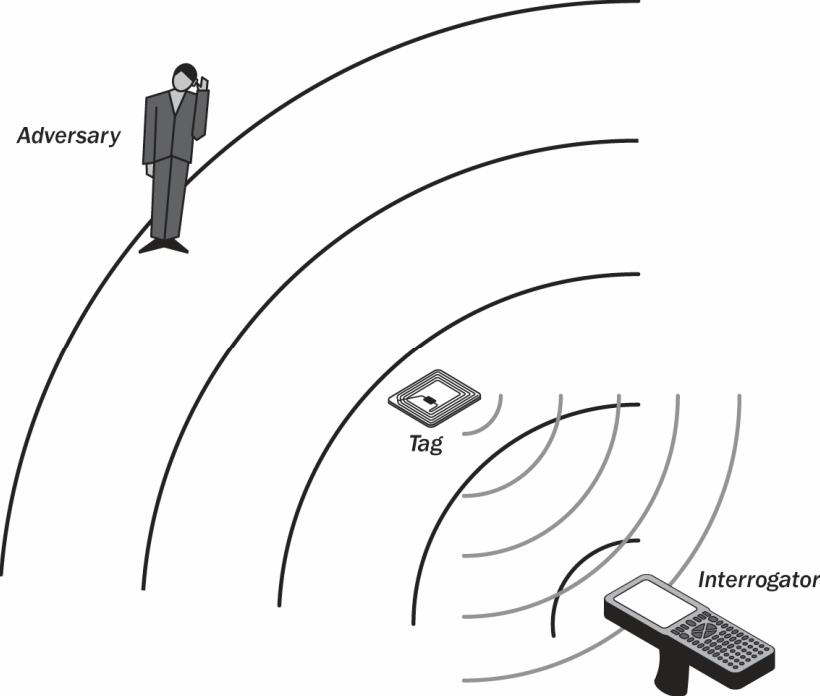
図5-2. カバーコーディング。線画である。右下の Interrogator(インテロゲーター、携帯型リーダー)から黒い大きな同心の弧が広がり、中央の Tag(タグ)を越えて左上に立つ男性の Adversary(敵対者)まで届いている。Tag からは灰色の小さな同心の弧が Interrogator へ向かって広がり、Adversary までは届いていない。
Figure 5-2. Cover-Coding
図5-2. カバーコーディング
57 The XOR operation is symmetric. For instance, given key \(\mathrm{K}\), plaintext \(\mathrm{P}\), and ciphertext \(\mathrm{C}\), if \(\mathrm{P} \oplus \mathrm{K} = \mathrm{C}\), then \(\mathrm{C} \oplus \mathrm{K} = \mathrm{P}\).
57 XOR演算は対称です。例えば、鍵\(\mathrm{K}\)、平文\(\mathrm{P}\)、暗号文\(\mathrm{C}\)について、\(\mathrm{P} \oplus \mathrm{K} = \mathrm{C}\)であれば、\(\mathrm{C} \oplus \mathrm{K} = \mathrm{P}\)となります。
Applicability: Cover coding is useful when eavesdropping is a risk that requires mitigation, but adversaries are expected to be at a greater distance from the tags than readers. Intelligible reception of back channel signals from a passive tag requires proximity of less than four meters in most applications. In many applications, an adversary’s reception equipment would be conspicuous if it were located within this range. In contrast, reader signals can be detected at distances of a kilometer or more under ideal conditions.
適用対象:盗聴を軽減すべきリスクとみなす一方、敵対者はリーダーよりタグから遠い位置にいると想定される場合に、カバーコーディングが有用です。ほとんどのアプリケーションでは、パッシブタグのバックチャネル信号を理解可能な形で受信するには4メートル未満まで近づく必要があります。多くのアプリケーションでは、敵対者の受信機器がこの範囲内にあれば目立ちます。これに対して、理想的な条件下ではリーダー信号を1キロメートル以上離れた場所から検知できます。
Cover-coding is designed for RF subsystems in which the forward channel carries stronger signals than the back channel, which essentially limits the control to passive tags. EPCglobal Class-1 Generation-2 technologies support cover-coding. Proprietary technologies support similar features.
カバーコーディングは、フォワードチャネルの信号がバックチャネルより強いRFサブシステム向けに設計されており、基本的にパッシブタグに限られる管理策です。EPCglobal Class-1 Generation-2技術はカバーコーディングをサポートします。独自技術にも同様の機能があります。
Benefits: Cover-coding helps prevent the execution of unauthorized commands that could disable a tag or modify the tag’s data. Consequently, cover-coding mitigates business process, business intelligence, and privacy risks.
便益:カバーコーディングは、タグを無効化したりタグデータを変更したりする不正コマンドの実行を防ぐのに役立ちます。そのため、業務プロセス、業務インテリジェンス、プライバシーのリスクを軽減します。
Weaknesses:
弱点:
•If an adversary can intercept a key distributed on the back channel, the adversary could decrypt any ciphertext message generated with that key.
•敵対者がバックチャネルで配布された鍵を傍受できる場合、その敵対者はその鍵で生成されたあらゆる暗号文を復号できます。
•The effectiveness of cover-coding depends on the performance of the tag’s random number generator. If the random number is predictable due to a flaw in the tag’s design or cryptanalysis, then an adversary can learn the key and decrypt subsequent communication.
•カバーコーディングの有効性は、タグの乱数生成器の性能に依存します。タグ設計の欠陥または暗号解析のために乱数が予測可能であれば、敵対者は鍵を知り、その後の通信を復号できます。
5.3.2.2 Encryption of Data in Transit
5.3.2.2 転送中のデータ暗号化
Control: Data collected or processed by the tag is encrypted prior to over-the-air transmission.
管理策:タグが収集または処理するデータを、無線送信の前に暗号化します。
Applicability: Applications that require an effective countermeasure to the threat of eavesdropping and for which cover coding offers inadequate protections. Tags typically only require on-board encryption capabilities to protect the confidentiality of data in transit if they collect or process data from sensors or other directly connected sources. In these cases, no alternative exists to hide the content of the data over-the-air because the data originates on the tag.
適用性:盗聴の脅威に対する有効な対策を必要とし、カバーコーディングでは十分な保護を提供できないアプリケーション。タグがセンサーまたはその他の直接接続されたソースからデータを収集または処理する場合、通常、タグには転送中データの機密性を保護するオンボード暗号化機能だけが必要となります。このような場合、データはタグ上で生成されるため、無線経由のデータ内容を隠す代替手段はありません。
On-board cryptography for confidentiality is not required for applications in which readers are the only source of data. In these cases, the data can be encrypted in the enterprise subsystem or by a reader before it is written to the tag and then retrieved in its encrypted form from the tag when needed. If the tag never has to perform computations on the data, then it never has to decrypt it, but merely store it. Encryption of data at rest is also discussed in Section 5.3.3.2.
リーダーだけがデータのソースであるアプリケーションでは、機密性確保のためのオンボード暗号処理は必要ありません。このような場合、データをタグに書き込む前に、エンタープライズサブシステムまたはリーダーで暗号化し、必要なときにタグから暗号化された形式のまま取り出せます。タグがデータに対する演算を行う必要がなければ、復号する必要はなく、保存するだけで十分です。保存データの暗号化については、第5.3.3.2節でも説明します。
Proprietary tag designs support encryption for over-the-air confidentiality, but EPCglobal and ISO/IEC 18000 standards do not as of the date of this publication.
独自仕様のタグ設計では無線経由の機密性を確保する暗号化がサポートされていますが、本書の発行日時点ではEPCglobalおよびISO/IEC 18000規格ではサポートされていません。
Benefits: Encryption of data in transit prevents successful eavesdropping of over-the-air RFID transactions.
利点:転送中データを暗号化すると、無線経由のRFIDトランザクションの盗聴を成功させることができなくなります。
Weaknesses:
弱点:
•Data encryption requires a key management system, which can be complex to manage and operate.
•データ暗号化には鍵管理システムが必要であり、その管理と運用は複雑になることがあります。
•Cryptographic functions may introduce an unacceptable delay in RFID systems that require very fast read or write transactions.
•非常に高速な読み取りまたは書き込みトランザクションを必要とするRFIDシステムでは、暗号機能によって許容できない遅延が生じる場合があります。
•Cryptographic functions require additional power to complete, which could impact applications that use passive tags.
•暗号機能の実行には追加電力が必要であり、パッシブタグを使用するアプリケーションに影響する可能性があります。
•Tags that support onboard encryption currently are more costly than those that do not. One reason for the increased cost is that onboard encryption requires additional logic gates to perform the necessary computations. Most low-cost passive tags do not have enough logic gates to perform complex encryption algorithms.59
•現在、オンボード暗号化をサポートするタグは、サポートしないタグより高価です。コスト増加の理由の一つは、オンボード暗号化に必要な計算を行うために追加の論理ゲートが必要となることです。ほとんどの低コストのパッシブタグには、複雑な暗号アルゴリズムを実行するだけの論理ゲートがありません。59
5.3.2.3 Electromagnetic Shielding
5.3.2.3 電磁シールド
Control: RF shielding encloses an area with a conducting material that limits the propagation of RF signals outside of the shielded area. Shielding can vary in size and form depending on the application.
管理策:RFシールドは、導電性材料で領域を囲み、シールド領域の外へのRF信号の伝搬を制限します。用途に応じて、シールドの大きさや形状は異なります。
For example, some RFID-enabled travel documents are protected by a metallic anti-skimming material. This material helps to prevent adversaries from reading the embedded tag when the passport cover is closed. Shipping containers are sometimes shielded to prevent the reading of tags during transit. Shielding is also placed in walls, partitions, or stalls to prevent RF emissions from leaving a confined area. When readers are placed in tunnels on industrial production conveyor belts, the tunnels may be shielded to reduce radio interference. Wrapping a tag in aluminum foil is also an effective means of shielding.
たとえば、RFID対応の旅行書類の一部は、金属製のスキミング防止材で保護されています。この材料は、パスポートの表紙を閉じたときに内蔵タグを敵対者が読み取るのを防ぐのに役立ちます。輸送中にタグが読み取られないよう、輸送用コンテナをシールドすることもあります。電波放射が閉鎖空間から漏れるのを防ぐため、壁、仕切り、またはブースにもシールドが設置されます。産業用生産コンベヤーベルトのトンネル内に読み取り装置を配置する場合、無線干渉を低減するためにトンネルをシールドすることがあります。タグをアルミ箔で包むことも、有効なシールド方法です。
Figure 5-3 shows how shielded partitions can separate collocated readers to prevent interference. The readers near forklift A can operate without inadvertently reading tags on boxes on forklift B due to the shielding in the partition that separates the portals. Shielding may be necessary when middleware is unable to correctly filter duplicate read events from the two portals.
図5-3は、接近して配置された読み取り装置間の干渉を防ぐため、シールドされた仕切りで分離する方法を示します。フォークリフトA付近の読み取り装置は、ポータルを隔てる仕切りのシールドにより、フォークリフトB上の箱のタグを誤って読み取ることなく動作できます。ミドルウェアが2つのポータルからの重複読み取りイベントを正しくフィルタリングできない場合、シールドが必要となることがあります。
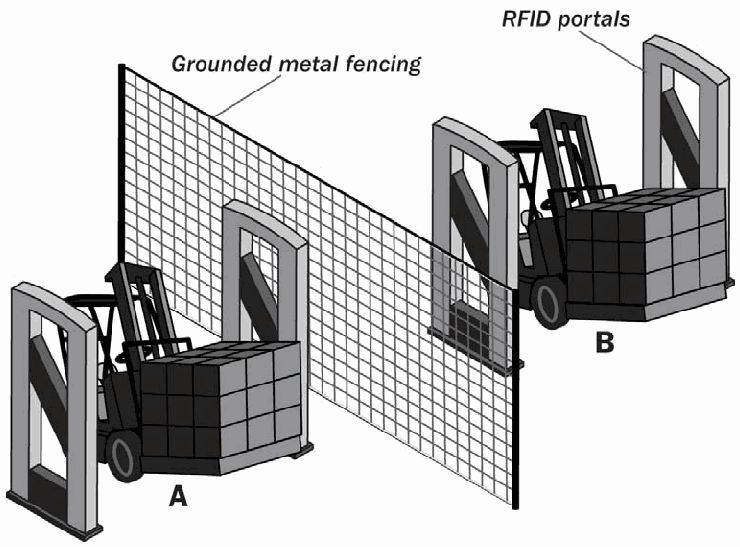
図5-3. 接地された金属フェンスによるシールド。2 台のフォークリフトの線画で、左手前の A と右奥の B が、それぞれ箱を積んだパレットを運んで 1 対の門形の RFID portals(RFID ポータル)を通っている。2 つのポータルの間には Grounded metal fencing(接地された金属フェンス)と記した網状のパネルが立ち、A と B を隔てている。
Figure 5-3. Grounded Metal Fencing as Shielding
図5-3. 接地された金属フェンスによるシールド
Applicability: Shielding is applicable for contexts in which eavesdropping or RF radiation is a concern, and the use of temporary shielding would not stop valid transactions.
適用性:盗聴またはRF放射が懸念され、一時的なシールドを使用しても正当なトランザクションを停止させない状況に適用できます。
Benefits: Shielding can limit the ability of eavesdroppers or unauthorized readers to collect data from an RFID system.
利点:シールドにより、盗聴者または許可されていない読み取り装置がRFIDシステムからデータを収集する能力を制限できます。
Weaknesses:
弱点:
•Shielding can prevent or hinder legitimate transactions. For example, shielded containers require objects to be physically removed from the shielding material. This prevents an implementing organization from realizing one of the key benefits of RFID technology, which is to read tags remotely without optical line of sight and additional handling.
•シールドは正当なトランザクションを妨げたり、阻止したりする可能性があります。たとえば、シールドされたコンテナでは、物品をシールド材から物理的に取り出す必要があります。これにより、実装組織はRFID技術の主要な利点の一つ、すなわち光学的な見通し線や追加の取扱いなしにタグを遠隔で読み取る利点を得られなくなります。
•It may still be possible for an adversary to place a radio inside the shielded area. The radio could be used for malicious purposes, such as eavesdropping on RFID transactions or causing interference.
•敵対者がシールド領域内に無線機を設置できる可能性は残ります。その無線機は、RFIDトランザクションの盗聴や干渉の発生など、悪意のある目的に利用されるおそれがあります。
5.3.2.4 Radio Frequency Selection
5.3.2.4 無線周波数の選択
Control: RFID technology can communicate over various radio frequencies, including those in the LF, HF, UHF, and microwave bands. Particular fixed frequencies can be assigned to an RFID application to avoid or reduce the effects of radio interference. Some tag technologies can perform frequency hopping within a limited frequency range, but in these cases, the technique is used primarily to avoid collisions with other tag transactions, not radio interference with different types of radio systems.60 In some cases, the implementing organization may need to obtain a license to use a particular desired frequency. Table 2-2 in Section 2.3.1.3 lists potential sources of interference on common RFID frequencies.
制御:RFID技術は、LF、HF、UHF、およびマイクロ波帯を含むさまざまな無線周波数で通信できます。無線干渉の影響を回避または低減するため、RFIDアプリケーションに特定の固定周波数を割り当てることができます。一部のタグ技術は限られた周波数範囲内で周波数ホッピングを実行できますが、この手法は主に他のタグトランザクションとの衝突回避に用いられ、異なる種類の無線システムとの無線干渉回避には用いられません。60場合によっては、実装組織が希望する特定周波数を使用するために免許を取得する必要があります。一般的なRFID周波数における干渉源の候補は、Section 2.3.1.3のTable 2-2に示します。
Ideally, an RF site survey will be performed before an RFID system is installed to determine what frequencies are already in use. After the RFID system is installed, site surveys can be conducted to determine if the RF characteristics of the site have changed (e.g., new sources of interference).
理想的には、RFIDシステムの設置前にRFサイト調査を実施し、すでに使用されている周波数を特定します。RFIDシステムの設置後にもサイト調査を行い、サイトのRF特性が変化したか(たとえば、新たな干渉源が加わったか)を判定できます。
Applicability: All implementations whose radio frequency is not determined by other application requirements. Organizations that implement a closed RFID system have more freedom to select an operating frequency because they do not have to interoperate with other organizations. However, if tags are based on a particular air interface standard, the range of potential frequencies will be limited to those supported by the standard.
適用性:無線周波数が他のアプリケーション要件によって決定されていないすべての実装。クローズドRFIDシステムを実装する組織は、他の組織との相互運用が不要なため、動作周波数をより自由に選択できます。ただし、タグが特定のエアインターフェース規格に基づく場合、選択可能な周波数範囲はその規格がサポートするものに限られます。
Benefits: Radio frequency selection permits the avoidance of RF interference with other radio systems that could disrupt the RFID system or other technologies. A particular frequency might be desirable because of radio interference on other frequency bands. Some frequencies also have desirable propagation characteristics, such as the ability to penetrate certain materials.
利点:無線周波数の選択により、RFIDシステムまたは他の技術を妨害し得る他の無線システムとのRF干渉を回避できます。他の周波数帯に無線干渉がある場合、特定の周波数が望ましいことがあります。また、特定の材料を透過できるなど、伝搬特性が望ましい周波数もあります。
Weaknesses:
弱点:
•It may be difficult to identify sources of interference. For example, bug zappers have been found to create interference in passive RFID trials.61 Interference can be caused by poorly grounded motors, noisy relays, old fluorescent light ballasts, and other devices that generate unintended RF noise in nearby environments. Each RFID technology deployment should be tested in its intended environment prior to production use to identify these sources of interference.
•干渉源の特定が困難な場合があります。たとえば、虫取り器がパッシブRFID試験で干渉を引き起こすことが確認されています。61接地不良のモーター、ノイズの多いリレー、古い蛍光灯安定器、および周辺環境で意図しないRFノイズを発生させるその他の装置も干渉源となります。各RFID技術の導入は、これらの干渉源を特定するため、本番利用前に予定環境で試験すべきです。
•New sources of interference can be later introduced at the site.
•新たな干渉源が後から現場に持ち込まれる可能性があります。
•When implementing an inter-enterprise RFID system, all organizations involved in the system will have to agree on a tag type that supports all the frequencies that the organizations collectively intend to use.
•複数企業間RFIDシステムを実装する場合、関係するすべての組織は、共同で使用する予定のすべての周波数をサポートするタグタイプに合意する必要があります。
5.3.2.5 Adjustment of Transmission Characteristics Other than Frequency
5.3.2.5 周波数以外の送信特性の調整
Control: Operators adjust the level of transmitted RF energy from a reader or active tag. The use of particular antenna types and configurations can also determine the direction of transmitted RF energy. Additionally, the duty cycle of a reader can be controlled.
制御:運用者は、読み取り装置またはアクティブタグから送信されるRFエネルギーのレベルを調整します。特定のアンテナの種類や構成を用いて、送信RFエネルギーの方向を決めることもできます。さらに、読み取り装置のデューティサイクルを制御できます。
Applicability: All applications for which eavesdropping, radio interference, or hazards of electromagnetic radiation are a concern.
適用性:盗聴、無線干渉、または電磁放射の危険が懸念されるすべてのアプリケーション。
Benefits: Reducing transmitted power can:
利点:送信電力を低減すると、次の効果が得られる:
•Reduce the likelihood that an adversary can intercept communication,
•敵対者が通信を傍受する可能性を低減する、
•Limit radio interference with other legitimate radios, and
•他の正当な無線機との無線干渉を制限する、および
•Lessen hazards of electromagnetic radiation.
•電磁放射の危険を軽減します。
Weaknesses: The drawback of reducing transmission power or the duty cycle is performance degradation, especially with respect to back channel communication from a passive tag. For instance, readers might fail to detect the presence of valid tags. Also, changes in the physical environment or the introduction of new radio equipment can impact the power levels required for consistently successful transactions. Consequently, the benefits of power adjustments based on a site survey can be negated by changes to the environment.
弱点:送信電力またはデューティサイクルを低減する欠点は、性能が低下することであり、特にパッシブタグからのバックチャネル通信に影響します。たとえば、読み取り装置が正当なタグの存在を検出できないことがあります。また、物理環境の変化や新しい無線機器の導入によって、トランザクションを一貫して成功させるために必要な電力レベルが変わる可能性があります。その結果、サイト調査に基づく電力調整の利点は、環境の変化によって損なわれる場合があります。
5.3.2.6 Temporary Deactivation of Tags
5.3.2.6 タグの一時的な無効化
Control: The RF interface on some proprietary tags can be turned off temporarily. Tag manufacturers have different methods of turning their tags on and off. For example, some tags are designed so that the tag is on or off depending upon which end is inserted into a mounting clip. Other tags have replaceable batteries that can be removed to deactivate them.
管理策:一部の独自仕様タグでは、RFインターフェースを一時的に停止できます。タグメーカーによってタグの電源をオン/オフする方法は異なります。例えば、マウンティングクリップに差し込む端をどちらにするかでオン/オフが切り替わるよう設計されたタグがあります。交換可能な電池を取り外して無効化できるタグもあります。
If the control is implemented, tags would be turned on inside a designated area where the RF subsystem operates. When the tags leave that area, they would be turned off. For example, in a supply chain application, tags may be turned off to prevent unauthorized transactions during shipment. When the tags arrive at their destination, they would be powered on again and managed. Conversely, tags used for in-transit visibility may be turned on for their trip and turned off when they reach their destination.
この管理策を実装する場合、RFサブシステムが稼働する指定区域内でタグをオンにします。タグがその区域を離れるとオフにします。例えばサプライチェーンアプリケーションでは、輸送中の不正な取引を防ぐためタグをオフにしてもよいです。タグが目的地に到着したら、再び電源を入れて管理します。逆に、輸送中の可視性を確保するために使うタグは、輸送中はオンにし、目的地に着いたらオフにしてもよいです。
Applicability: This control is most useful when communication between readers and a tag is infrequent and predictable. For example, a warehouse might store items for an annual event, such as a holiday celebration or parade. In this case, the RFID confers a benefit only for a short period each year, but could remain vulnerable to rogue transactions if left operational for the rest of the year.
適用性:リーダーとタグ間の通信が頻度の低い予測可能なものである場合に、この管理策が最も有効です。例えば、倉庫では祝祭やパレードなど年次イベント向けの物品を保管する場合があります。この場合、RFIDの便益が得られるのは年に短期間だけですが、残りの期間も運用状態のままなら不正な取引に対して脆弱な状態が続きます。
Benefits: Deactivating tags temporarily:
利点:タグを一時的に無効化することで、
•Prevents unauthorized tag transactions during periods of inactivity, and
•停止期間中のタグの不正取引を防ぎます。そして
•Extends the battery life of active tags.
•アクティブタグの電池寿命を延ばします。
Weaknesses:
弱点:
•If operators or system software fail to reactivate the tag when it is needed, then the missing transactions resulting from the tag’s RF silence could adversely impact the supported business process.
•必要なときに運用者またはシステムソフトウェアがタグを再有効化しないと、タグがRF通信を行わないために取引が欠落し、支援対象の業務プロセスに悪影響が及ぶ可能性があります。
•If turning a tag on or off requires human intervention, then this control would result in additional labor expense, which could be significant for systems that process large numbers of tags. The potential increased labor required to operate the system could negatively affect the business case for RFID relative to other AIDC technologies.
•タグのオン/オフに人手が必要な場合、この管理策によって追加の人件費が発生し、多数のタグを処理するシステムでは大きな費用となる可能性があります。システム運用に必要な人手の増加は、他のAIDC技術と比べたRFIDのビジネスケースに悪影響を与える場合があります。
•Even if the activation and deactivation process is automated, it introduces a delay that might not be acceptable for many time-sensitive applications.
•有効化・無効化のプロセスが自動化されていても遅延が生じるため、多くの時間制約の厳しいアプリケーションでは許容できない場合があります。
5.3.2.7 Tag Press-to-Activate Switch
5.3.2.7 タグの押下式有効化スイッチ
Control: The tag remains deactivated by default unless a user or operator takes a positive action, such as holding a press-to-activate switch on the tag to turn it on. When the switch is on, the tag is capable of RF communication, but when pressure on the switch is released, the tag returns to its default deactivated status so that tag transactions can no longer occur.
管理策:ユーザーまたは運用者が、タグ上の押下式有効化スイッチを押し続けるなど、明示的な操作をしない限り、タグは既定で無効のままです。スイッチを押している間、タグはRF通信を行えますが、押す力を解除すると既定の無効状態に戻り、タグ取引を行えなくなります。
Applicability: Primarily access control or automated payment applications in which the holder of the tag desires or requires control over when tag transactions occur.
適用性:主に、タグの保持者がタグ取引の発生する時期を制御したい、または制御する必要のあるアクセス制御や自動決済のアプリケーション。
Benefits: A press-to-activate switch provides a user with physical control over when and where the tag can respond to a reader. Consequently, this control mitigates privacy and business intelligence risks by providing a countermeasure to the threat of eavesdropping and the execution of unauthorized tag commands. Eavesdropping would be limited to the immediate vicinity of authorized readers and tracking beyond the immediate vicinity of the authorized readers would not be possible.
便益:押下式有効化スイッチにより、ユーザーはタグがリーダーに応答する時と場所を物理的に制御できます。そのため、盗聴や不正なタグコマンド実行の脅威に対抗し、プライバシーおよび業務インテリジェンスのリスクを軽減します。盗聴は認可されたリーダーのすぐ近くに限られ、認可されたリーダーの近辺を越えて追跡することはできなくなります。
This control also provides assurance that a person is knowingly in possession of the tag, and that it has not been intentionally or inadvertently separated from that person. For example, this control could be useful in ticketing or access control applications in which the objective is to get an accurate count of the number of individuals present, and to prevent spare tags in pockets or bags from interfering with the accuracy of the count.
この管理策は、本人がタグを認識して所持しており、意図的または偶発的に本人から離れていないことについても保証を与えます。例えば、在場者数を正確に把握し、ポケットやバッグにある予備のタグが人数の正確性を損なわないようにすることが目的のチケット発行またはアクセス制御アプリケーションで有用な場合があります。
Weaknesses:
弱点:
•Requiring the user to activate the tag would require some level of instruction, however minimal, which might add a cost or delay in the business process. For example, the user would need to know when and for how long they would need to activate the tag.
•ユーザーにタグの有効化を求めるには、最小限であっても何らかの説明が必要であり、業務プロセスのコストまたは遅延を増加させる場合があります。例えば、ユーザーはいつ、どのくらいの時間タグを有効にする必要があるかを知らなければなりません。
•Some users may consider activating a switch to be an inconvenience, which could hinder user acceptance of the technology.
•一部のユーザーはスイッチを有効化する操作を煩わしいと感じ、技術の受容が妨げられる可能性があります。
•A press-to-activate switch could distract the user from other functions that the user is performing. For example, a press-to-activate switch is not an appropriate control for an automated toll-payment system because the user needs to have both hands available for driving the vehicle.
•押下式有効化スイッチにより、ユーザーが他の作業に集中できなくなる場合があります。例えば、運転中は両手を使える必要があるため、自動料金収受システムにこの管理策を使うのは適切ではありません。
5.3.2.8 Tag Polling
5.3.2.8 タグのポーリング
Control: A reader periodically queries the tag to determine its continued presence and operating status.
管理策:リーダーはタグが引き続き存在し、動作しているかを確認するため定期的に問い合わせます。
Applicability: Process control or asset management applications in which a design objective is periodic or near continuous monitoring. Examples include medical facilities that require real-time inventory of certain medical supplies or systems that collect sensor data. Tag polling also is applicable for high-value business processes that require early indications of system failures or performance problems. This control is most effective in applications in which those with access to the tags are trusted or when detaching the tag is not feasible (e.g., when a tag is embedded in another item such as a poker chip).
適用対象:定期的またはほぼ継続的な監視を設計目標とするプロセス制御または資産管理アプリケーション。例として、特定の医療用品のリアルタイム在庫管理が必要な医療施設や、センサーデータを収集するシステムがあります。システム障害またはパフォーマンス問題の兆候を早期に把握する必要がある高価値の業務プロセスにもタグのポーリングは適用できます。タグへのアクセス権を持つ人が信頼されている場合、またはタグを取り外すことが現実的でない場合(ポーカーチップなど別の物品にタグが埋め込まれている場合など)に、この管理策は最も有効です。
Benefits: Operators obtain timely information about system failures, item theft, or unusual environmental conditions that enables them to proactively address problems.
利点:運用者は、システム障害、物品の盗難、または異常な環境状況に関する適時の情報を得られるため、問題に先回りして対処できます。
Weaknesses: Tag polling:
弱点:タグのポーリングは、
•Reduces the battery life of active and semi-active tags,
•アクティブタグおよびセミアクティブタグの電池寿命を短くします。
•May not detect critical events in a timely manner if the polling frequency is too low,
•ポーリング頻度が低すぎると重大な事象を適時に検知できない場合があります。
•Is a business intelligence risk if the tag polling enables an adversary to perform traffic analysis, or track or target tags that might have otherwise remained silent, and.
•タグのポーリングによって敵対者が通信トラフィック分析を行ったり、通常なら通信しないタグを追跡または標的化できたりする場合、業務インテリジェンス上のリスクとなります。そして
•Could be circumvented in some cases by detaching the tag, taking the item, and leaving the tag behind so that it continues to signal its presence to readers.
•タグを取り外して物品を持ち去り、タグをその場に残してリーダーに存在を知らせ続けることで、場合によっては回避できます。
5.3.3 Tag Data Protection
5.3.3 タグデータ保護
Technical controls currently available for protecting tag data include:
タグデータを保護するために現在利用可能な技術的管理策には次があります。
•Tag memory access control, which can restrict use of tag commands and protect data stored in a tag’s memory,
•タグメモリアクセス制御。タグコマンドの使用を制限し、タグのメモリに格納されたデータを保護できます。
•Encrypting the data on tags,
•タグ上のデータを暗号化します。
•The kill feature, which can prevent subsequent unauthorized use of a tag, and
•キル機能。タグのその後の不正使用を防止できます。そして
•Tamper protection.
•改ざん防止。
These controls are described in more detail in Sections 5.3.3.1 through 5.3.3.4.
これらの管理策については第5.3.3.1節から第5.3.3.4節で詳しく説明します。
5.3.3.1 Tag Memory Access Control
5.3.3.1 タグメモリアクセス制御
Control: Many tags support a password-protected lock feature which provides read or write protection to memory. In some RFID technologies, the lock feature is permanent and in others it is reversible. For example, the EPCglobal Class-1 Generation-2 has five areas of memory, each of which can be protected using the lock command. 62 The memory is either both read- and write-protected, or only write-protected, depending on the parameters issued with the command. The EPCglobal Class-1 Generation-2 UHF standard also has a permalock feature. If engaged, permalock will make the lock status (locked or unlocked) permanent for all or part of a tag’s memory. ISO/IEC 18000-3 Mode 2 supports both read and write protecting all areas of memory with a 48-bit memory access password. Finally, Mode 2 of the ISO/IEC 18000-3 standard describes a lock pointer, which is a memory address. All areas of memory with a lower address than the lock pointer are write-protected, while those areas of memory above the pointer address are not.
管理策:多くのタグは、メモリの読み取りまたは書き込みを保護するパスワード付きロック機能を備えます。RFID技術によって、ロック機能が恒久的なものと、解除可能なものがあります。例えば、EPCglobal Class-1 Generation-2では5つのメモリ領域があり、それぞれをlockコマンドで保護できます。62 コマンドに指定するパラメーターに応じて、メモリは読み取りと書き込みの両方が保護されるか、書き込みのみが保護されます。また、EPCglobal Class-1 Generation-2のUHF標準にはpermalock機能もあります。これを有効にすると、タグメモリの全体または一部についてロック状態(ロック済みまたは未ロック)が恒久的に固定されます。ISO/IEC 18000-3 Mode 2は、48ビットのメモリアクセスパスワードを使って、すべてのメモリ領域の読み取りと書き込みを保護できます。最後に、ISO/IEC 18000-3標準のMode 2では、メモリアドレスであるロックポインターを規定しています。ロックポインターより小さいアドレスのすべてのメモリ領域は書き込み保護され、ポインターアドレスより大きい領域は保護されません。
The effectiveness of tag memory access controls depend on proper management of passwords. Section 5.3.1.1 provides additional information on password authentication.
タグメモリアクセス制御の有効性は、パスワードを適切に管理できるかに依存します。パスワード認証については第5.3.1.1節で追加情報を示します。
Applicability: All applications that store data on tags.
適用対象:タグにデータを保存するすべてのアプリケーション。
Benefits: A write-protect lock command will prevent the contents of a tag’s memory from being altered. A read-protect lock command will prevent unauthorized users from reading or accessing the data on tags.
利点:書き込み保護ロックコマンドにより、タグメモリの内容が変更されるのを防ぎます。読み取り保護ロックコマンドにより、権限のないユーザーがタグ上のデータを読んだりアクセスしたりするのを防ぎます。
Weaknesses:
弱点:
•The password length on many tags is too short to provide meaningful memory access protection. Even when the technology supports longer passwords, password management is challenging (see Section 5.3.1.1 on password authentication for additional information).
•多くのタグでは、パスワードが短すぎて、意味のあるメモリアクセス保護を提供できません。技術がより長いパスワードをサポートしていても、パスワード管理は困難です(詳細については、パスワード認証に関するSection 5.3.1.1を参照してください)。
•Locking a tag’s memory does not prevent data loss from electromagnetic interference or physical tag destruction.
•タグのメモリをロックしても、電磁干渉やタグの物理的破壊によるデータ損失は防げません。
5.3.3.2 Encryption of Data at Rest
5.3.3.2 保存データの暗号化
Control: Data stored on a tag is encrypted before it is written to the tag. The control does not require that the tag encrypt or decrypt data. Instead, the encryption is performed by either the reader, middleware, or other enterprise subsystem components.
制御:タグに保存されるデータは、タグに書き込む前に暗号化します。この制御では、タグ自体がデータを暗号化または復号する必要はありません。暗号化は、読み取り装置、ミドルウェア、またはその他のエンタープライズサブシステム構成要素が実行します。
Applicability: All applications that store additional data beyond an identifier on the tag that needs to be kept confidential on the tag. If the encryption and decryption functions are performed in the enterprise subsystem, then network access is required to read the content of data stored on the tag, which makes the control unsuitable for mobile readers that do not always have real-time network access.
適用性:タグ識別子以外に、タグ上で機密に保つ必要のある追加データを保存するすべてのアプリケーション。暗号化および復号機能をエンタープライズサブシステムで実行する場合、タグに保存されたデータの内容を読み取るにはネットワークアクセスが必要となるため、常時リアルタイムでネットワークにアクセスできないモバイルリーダーにはこの管理策は適しません。
Benefits: Data encryption protects sensitive tag data from being read by individuals with unauthorized access to the tags.
利点:データ暗号化により、タグへの不正アクセス権を持つ者が機密タグデータを読み取ることを防ぎます。
Weaknesses:
弱点:
•Data encryption requires a key management system, which can be complex to manage and operate.
•データ暗号化には鍵管理システムが必要であり、その管理と運用は複雑になることがあります。
•Sending tag data to network components for encryption or decryption is a source of network latency, when in conjunction with the time to complete cryptographic functions may introduce an unacceptable delay in RFID systems that require very fast read or write transactions.
•暗号化または復号のためタグデータをネットワーク構成要素に送信すると、ネットワーク遅延が発生します。また、暗号処理の完了時間と相まって、非常に高速な読み取りまたは書き込みトランザクションを必要とするRFIDシステムでは許容できない遅延が生じる場合があります。
5.3.3.3 Kill Feature
5.3.3.3 キル機能
Control: The kill feature permanently disables a tag’s functionality using a remote command. The most common implementation of the kill feature is the EPCglobal kill command. The EPCglobal Class-1 Generation-2 kill command is password-protected using a 32-bit password different from the access password.63
制御:キル機能は、リモートコマンドを使用してタグの機能を恒久的に無効化します。キル機能の最も一般的な実装はEPCglobalのキルコマンドです。EPCglobal Class-1 Generation-2のキルコマンドは、アクセスパスワードとは異なる32ビットパスワードで保護されます。63
Applicability: RFID applications that encounter business intelligence and privacy risks after a tag has moved beyond its intended functional environment (e.g., after a tag moves beyond the supply chain in which it served inventory and checkout functions). EPCglobal tags are the only standards-based tags that support a kill feature.
適用性:タグが本来の機能環境を離れた後(たとえば、在庫管理や精算機能に利用されていたサプライチェーンをタグが離れた後)に、ビジネスインテリジェンス上およびプライバシー上のリスクが生じるRFIDアプリケーション。キル機能をサポートする規格準拠タグはEPCglobalタグだけです。
Benefits: Using the kill feature prevents a tag from being reused improperly. The kill feature was designed and implemented in EPCglobal tags primarily to protect consumer privacy. It also protects improper access to tag data used in business processes. For example, discarded tags that have not been disabled may be read by adversaries to gain access to data, such as which products an organization or individual is purchasing or using.
利点:キル機能を使用すると、タグの不適切な再利用を防げます。キル機能は主に消費者のプライバシーを保護するため、EPCglobalタグに設計・実装されました。また、業務プロセスで使用するタグデータへの不適切なアクセスも防ぎます。たとえば、無効化されずに廃棄されたタグを敵対者が読み取り、組織または個人が購入または使用している製品などのデータにアクセスするおそれがあります。
Weaknesses:
弱点:
•The existence of a kill feature represents a significant business process threat to an RFID system. If an adversary who learns the kill password improperly disables tags that should remain in operation, the supported application will not function properly because it will not be able to perform transactions on the disabled tags. This risk is particularly salient for organizations that assign the same password to multiple tags because doing so could enable an adversary to disable large numbers of tags with a single compromised password.
•キル機能の存在は、RFIDシステムに対する重大な業務プロセス上の脅威となります。キルパスワードを知った敵対者が、稼働を継続すべきタグを不正に無効化すると、無効化されたタグとのトランザクションを実行できず、対応するアプリケーションが正しく機能しなくなります。同じパスワードを複数のタグに割り当てる組織では、このリスクが特に顕著です。侵害されたパスワード一つで多数のタグを無効化できる可能性があるためです。
•Once killed, a tag cannot be used for any further application involving the asset (e.g., recalls, receipt-less product returns).
•いったんキルされたタグは、その資産に関わる以後のいかなるアプリケーション(たとえばリコール、レシートなし返品)にも使用できません。
•If an organization assigns a weak (e.g., short or easily guessed) password for the kill command, unauthorized parties can kill the tag at will.64 Moreover, the longer a tag maintains the same password, the more likely it is that the password will be compromised.
•組織がキルコマンドに弱い(たとえば短い、または推測しやすい)パスワードを割り当てた場合、権限のない者が任意にタグをキルできます。64さらに、タグが同じパスワードを長期間維持するほど、そのパスワードが侵害される可能性は高くなります。
•Data stored on the tag is still present in the tag’s memory after it is killed (although it can no longer be accessed wirelessly), and therefore still may be accessible to someone with physical access to the tag.65
•タグ上に保存されたデータは、キルされた後もタグのメモリ内に残ります(ただし、無線ではアクセスできなくなります)。したがって、タグに物理的にアクセスできる者には、引き続きアクセス可能な場合があります。65
•Although the kill command was added to tags as a potential solution for privacy concerns, consumers cannot easily detect whether a tag has been deactivated.66 Moreover, typical consumers cannot easily kill tags on their own because this action requires a reader and knowledge of the kill password.
•プライバシー上の懸念への対策候補としてキルコマンドがタグに追加されたものの、消費者はタグが無効化されたかどうかを容易に検出できません。66さらに、一般の消費者は自分でタグをキルすることも容易ではありません。この操作には読み取り装置とキルパスワードの知識が必要だからです。
5.3.3.4 Tamper Resistance
5.3.3.4 改ざん耐性
Control: Certain RFID tags have tamper resistant or tamper-evident features that help prevent an adversary from altering the tags or removing them from the objects to which they are attached. One simple type of tamper resistance is the use of a frangible, or easily broken, antenna; if a tag of this type is removed, the electric connection with the antenna is severed, rendering the tag inoperable. Other, more complex types of RFID systems monitor the integrity of objects associated with the tags to ensure that the objects have not been compromised, altered, or subjected to extreme conditions.
制御:一部のRFIDタグには、敵対者がタグを改変したり、取り付けられた物体から取り外したりするのを防ぐのに役立つ改ざん耐性機能または改ざん検知機能があります。単純な改ざん耐性の一種は、破断しやすい脆弱なアンテナを使用することです。この種のタグを取り外すとアンテナとの電気的接続が断たれ、タグは動作不能となります。より複雑なRFIDシステムでは、タグに関連付けられた物体の完全性を監視し、物体が侵害、改変、または極端な条件にさらされていないことを確認します。
Applicability: Applications in which tags are frequently outside of the direct control of the implementing organization and therefore vulnerable to tampering. Tamper resistance and tamper-evident features are currently only available on specialty RFID tags that are designed for tamper resistance to support specific buyer requirements.
適用性:タグが実装組織の直接管理外に置かれることが多く、そのため改ざんに対して脆弱なアプリケーション。改ざん耐性機能および改ざん検知機能は現在、特定の購入者要件に対応するよう設計された特殊なRFIDタグでのみ利用できます。
Benefits: This control helps to prevent adversaries from breaking the association between a tag and its corresponding object. The more complex tamper-resistant / tamper-evident tags provide health and status monitoring of the attached objects to ensure that they have not been opened, manipulated, damaged, or subjected to extreme temperature, humidity, or shock.
利点:この制御は、タグと対応する物体との結び付きを敵対者が断つのを防ぐのに役立ちます。より複雑な改ざん耐性/改ざん検知タグは、取り付けられた物体が開封、操作、損傷されていないこと、または極端な温度、湿度、衝撃にさらされていないことを確認するため、物体の健全性と状態を監視します。
Weaknesses: Sophisticated adversaries may be able to defeat the tamper resistance mechanisms. This is dependent upon the implementation of the tamper resistance feature. For example, a sophisticated adversary may be able to repair a frangible antenna. In addition, tamper-resistance / tamper-evidence technologies do not prevent the theft or destruction of the tag or its associated items.
弱点:高度な能力を持つ敵対者は、改ざん耐性メカニズムを破ることができる場合があります。これは改ざん耐性機能の実装方法によります。たとえば、高度な能力を持つ敵対者は破断しやすいアンテナを修復できることがあります。また、改ざん耐性/改ざん検知技術は、タグまたは関連物品の盗難や破壊を防ぎません。
5.4 Summary
5.4 要約
Organizations should use a combination of management, operational, and technical controls to mitigate the business risks of implementing RFID systems. Table 5-1 maps the presented controls to the categories of risks that they mitigate. Because each RFID implementation is highly customized and each organization’s requirements are different, the security controls discussed in this section are not all applicable or effective for all RFID applications. Organizations need to assess the risks their RFID implementations face and choose the appropriate controls, taking into account factors such as regulatory requirements, the magnitude of threats, and cost and performance implications of the controls. For example, a remote warehouse may have little need to protect against eavesdropping, but it may require redundant processes in case of system failure. Traditional security controls are often preferable to RFID-specific controls. For example, if RFID data can be stored in an enterprise database rather than on tags, then physical and network security controls for the database server probably are more practical than using tags with cryptographic capabilities.
組織は、RFIDシステムを実装する業務上のリスクを軽減するため、管理的、運用的、および技術的制御を組み合わせて使用すべきです。表5-1は、提示した制御と、それらが軽減するリスクのカテゴリとの対応を示します。各RFID実装は高度に個別化され、組織ごとに要件が異なるため、この節で説明するセキュリティ制御のすべてが、すべてのRFIDアプリケーションに適用可能または有効というわけではありません。組織は、規制要件、脅威の規模、制御のコストおよび性能への影響などを考慮しながら、RFID実装が直面するリスクを評価し、適切な制御を選択する必要があります。たとえば、遠隔地の倉庫では盗聴対策の必要性は低いかもしれませんが、システム障害に備えた冗長プロセスが必要な場合があります。従来型のセキュリティ制御は、RFID固有の制御より望ましいことが多くあります。たとえば、RFIDデータをタグ上ではなくエンタープライズデータベースに保存できるなら、暗号機能を持つタグを使用するより、データベースサーバーに物理的およびネットワークのセキュリティ制御を適用する方が実用的である可能性が高いです。
Table 5-1. RFID Controls Summary
表5-1. RFID管理策の要約
| Control | Risk Mitigated by Control | |||||
|---|---|---|---|---|---|---|
| 4.1 Business Process Risk | 4.2 Business Intelligence Risk | 4.3 Privacy Risk | 4.4 Externality Risk | |||
| 4.4.1 Hazards of Electro-magnetic Radiation | 4.4.2 Computer Network Attacks | |||||
| Management | 5.1.1 RFID Usage Policy | X | X | X | X | X |
| 5.1.2 IT Security Policies | X | X | X | X | ||
| 5.1.3 Agreements with External Organizations | X | X | X | X | ||
| 5.1.4 Minimizing Data Stored on Tags | X | X | X | |||
| Operational | 5.2.1 Physical Access Control | X | X | X | X | X |
| 5.2.2 Appropriate Placement of Tags and Readers | X | X | X | |||
| 5.2.3 Secure Disposal of Tags | X | X | X | |||
| 5.2.4 Operator and Administrator Training | X | X | X | X | X | |
| 5.2.5 Information Labels / Notice | X | X | X | X | ||
| 5.2.6 Separation of Duties | X | X | ||||
| 5.2.7 Non-revealing Identifier Formats | X | X | ||||
| 5.2.8 Fallback Identification Systems | X | |||||
| Technical | 5.3.1.1 Password Authentication | X | X | X | X | |
| 5.3.1.2 HMAC | X | X | X | X | ||
| 5.3.1.3 Digital Signatures | X | X | ||||
| 管理策 | 管理策により軽減されるリスク | |||||
|---|---|---|---|---|---|---|
| 4.1 業務プロセスリスク | 4.2 ビジネスインテリジェンスリスク | 4.3 プライバシーリスク | 4.4 外部性リスク | |||
| 4.4.1 電磁放射の危険 | 4.4.2 コンピューターネットワーク攻撃 | |||||
| 管理 | 5.1.1 RFID利用方針 | X | X | X | X | X |
| 5.1.2 ITセキュリティ方針 | X | X | X | X | ||
| 5.1.3 外部組織との合意 | X | X | X | X | ||
| 5.1.4 タグに保存するデータの最小化 | X | X | X | |||
| 運用 | 5.2.1 物理的アクセス制御 | X | X | X | X | X |
| 5.2.2 タグとリーダーの適切な配置 | X | X | X | |||
| 5.2.3 タグの安全な廃棄 | X | X | X | |||
| 5.2.4 運用者および管理者のトレーニング | X | X | X | X | X | |
| 5.2.5 情報ラベル/通知 | X | X | X | X | ||
| 5.2.6 職務分離 | X | X | ||||
| 5.2.7 情報を明かさない識別子形式 | X | X | ||||
| 5.2.8 フォールバック識別システム | X | |||||
| 技術 | 5.3.1.1 パスワード認証 | X | X | X | X | |
| 5.3.1.2 HMAC | X | X | X | X | ||
| 5.3.1.3 デジタル署名 | X | X | ||||
| Control | Risk Mitigated by Control | |||||
|---|---|---|---|---|---|---|
| 4.1 Business Process Risk | 4.2 Business Intelligence Risk | 4.3 Privacy Risk | 4.4 Externality Risk | |||
| 4.4.1 Hazards of Electro-magnetic Radiation | 4.4.2 Computer Network Attacks | |||||
| 5.3.2.1 Cover-Coding | X | X | X | |||
| 5.3.2.2 Encryption of Data in Transit | X | X | ||||
| 5.3.2.3 Electromagnetic Shielding | X | X | X | |||
| 5.3.2.4 Radio Frequency Selection | X | X | ||||
| 5.3.2.5 Adjustment of Transmission Characteristics | X | X | X | |||
| 5.3.2.6 Temporary Deactivation of Tags | X | X | X | |||
| 5.3.2.7 Tag Press-to-Activate Switch | X | X | ||||
| 5.3.2.8 Tag Polling | X | |||||
| 5.3.3.1 Tag Access Controls | X | X | X | X | ||
| 5.3.3.2 Encryption of Data at Rest | X | X | X | |||
| 5.3.3.3 Kill Feature | X | X | ||||
| 5.3.3.4 Tamper Resistance | X | X | ||||
| 管理策 | 管理策により軽減されるリスク | |||||
|---|---|---|---|---|---|---|
| 4.1 業務プロセスリスク | 4.2 ビジネスインテリジェンスリスク | 4.3 プライバシーリスク | 4.4 外部性リスク | |||
| 4.4.1 電磁放射の危険 | 4.4.2 コンピューターネットワーク攻撃 | |||||
| 5.3.2.1 カバーコーディング | X | X | X | |||
| 5.3.2.2 転送中のデータ暗号化 | X | X | ||||
| 5.3.2.3 電磁シールド | X | X | X | |||
| 5.3.2.4 無線周波数の選択 | X | X | ||||
| 5.3.2.5 送信特性の調整 | X | X | X | |||
| 5.3.2.6 タグの一時的な無効化 | X | X | X | |||
| 5.3.2.7 タグの押下式有効化スイッチ | X | X | ||||
| 5.3.2.8 タグのポーリング | X | |||||
| 5.3.3.1 タグアクセス制御 | X | X | X | X | ||
| 5.3.3.2 保存データの暗号化 | X | X | X | |||
| 5.3.3.3 キル機能 | X | X | ||||
| 5.3.3.4 改ざん耐性 | X | X | ||||
This page has been left blank intentionally.
このページは意図的に空白にしてあります。
6. RFID Privacy Considerations
6. RFIDのプライバシーに関する考慮事項
While this document is primarily about securing RFID systems, privacy issues are often interrelated with security considerations in a manner that one cannot be discussed without the other. For example, protecting privacy often requires technical security controls related to data confidentiality. This section explains what types of information are considered personal, reviews a number of privacy considerations that impact the life cycle of RFID systems, explains general privacy controls, and lists privacy guidance with which US Federal agencies are required to comply.
本書は主としてRFIDシステムのセキュリティを扱いますが、プライバシーの問題はセキュリティ上の考慮事項と相互に関連していることが多く、一方を他方から切り離して論じることはできません。たとえば、プライバシー保護にはデータの機密性に関する技術的セキュリティ制御が必要となることが多くあります。この節では、どのような情報が個人情報とみなされるかを説明し、RFIDシステムのライフサイクルに影響するプライバシー上の考慮事項を検討し、一般的なプライバシー制御を説明するとともに、米国連邦政府機関が遵守を義務付けられているプライバシー指針を列挙します。
Privacy regulations and guidance are often complex and change over time. Organizations planning, implementing, or managing an RFID system should always consult with the organization’s privacy officer, legal counsel, and chief information officer when developing and enforcing privacy policy related to the system.
プライバシー規制や指針は複雑で、時間の経過とともに変わることが多くあります。RFIDシステムを計画、実装、または管理する組織は、システムに関するプライバシーポリシーの策定・実施に際して、常に組織のプライバシー担当者、法律顧問、および最高情報責任者に相談すべきです。
6.1 Types of Personal Information
6.1 個人情報の種類
Federal privacy laws predominantly address the requirements for assessing, managing and safeguarding data defined as personal information. Figure 7-1 provides a taxonomy of personal information that is useful in describing privacy considerations for RFID systems.
連邦政府のプライバシー法は、個人情報と定義されるデータの評価、管理および保護に関する要件を主に扱います。図7-1は、RFIDシステムのプライバシー上の考慮事項を説明するのに有用な個人情報の分類体系を示します。
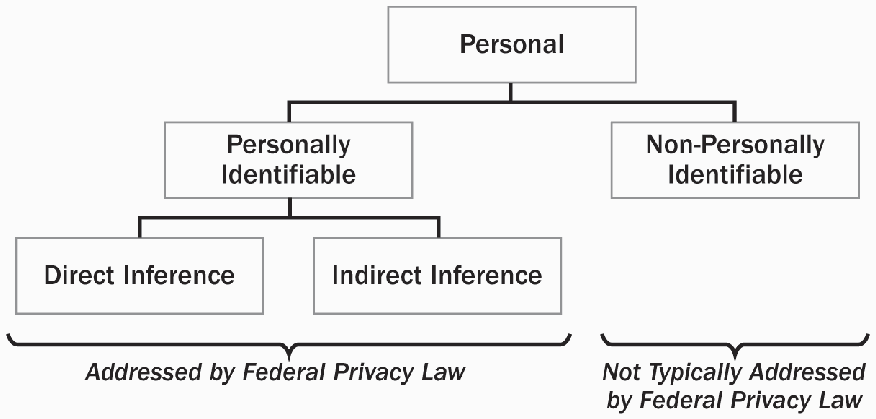
図6-1. 個人情報の分類体系。木構造の図である。Personal(個人に関する情報)は Personally Identifiable(個人識別可能)と Non-Personally Identifiable(個人識別不可能)に分かれる。Personally Identifiable は Direct Inference(直接推定)と Indirect Inference(間接推定)に分かれる。Direct Inference と Indirect Inference の下の括弧には Addressed by Federal Privacy Law(連邦プライバシー法の対象)、Non-Personally Identifiable の下の括弧には Not Typically Addressed by Federal Privacy Law(通常は連邦プライバシー法の対象外)と記されている。
Figure 6-1. Taxonomy of Personal Information
図6-1. 個人情報の分類体系
For the purposes of current privacy regulation, the most important distinction about the information being addressed is whether personal information is personally identifiable information (PII) or non-personally identifiable information. PII is information that can be used to uniquely identify, locate, or contact an individual.67 Examples of data elements that typically are considered PII include, but are not limited to, an individual’s full name, social security number, passport number, financial account or credit card numbers, and biometric data such as fingerprints. Individual data elements associated with characteristics that many people share are generally not considered PII. Examples include age, gender, city of residence, religious affiliation, and medical conditions.
現行のプライバシー規制において、対象情報に関する最も重要な区別は、その情報が個人識別可能情報(PII)か、個人識別不可能情報かです。PIIとは、個人を一意に識別、所在特定、または連絡するために使える情報です。67一般にPIIとみなされるデータ要素には、氏名(フルネーム)、社会保障番号、パスポート番号、金融口座番号またはクレジットカード番号、指紋などの生体データが含まれますが、これらに限られません。多くの人が共有する特性に関する個々のデータ要素は、通常PIIとはみなされません。例として年齢、性別、居住都市、宗教、病状があります。
Sometimes multiple pieces of information, none of which alone is considered PII, might still uniquely identify a person when combined. For example, NIST may employ only one 39-year old female with a residence in Roanoke, Virginia. In this case, the employer, age, gender, and city of residence are not PII elements by themselves, but become PII when they are presented together. This scenario is an example of PII established through indirect inference, while data elements such as a driver’s license number constitute PII through direct inference.
単独ではPIIとみなされない複数の情報でも、組み合わせると個人を一意に識別できる場合があります。たとえばNISTに、ロアノーク(バージニア州)在住の39歳の女性が1人しかいないとします。この場合、雇用主、年齢、性別、居住都市は単独ではPII要素ではありませんが、組み合わせて提示されるとPIIになります。この例は間接的推論によって成立するPIIであり、運転免許証番号などは直接的推論によるPIIです。
As a general rule, privacy laws govern the management of PII inferred through both direct and indirect means. The same laws, however, usually do not address data elements that individuals perceive as personal information but do not meet the criteria of PII as defined by the E-Government Act of 2002. For example, people anonymously walking down the street may perceive a loss of privacy if someone with a reader can ascertain the books they are reading or the medicine they are taking, but not their identities, by remotely scanning various tagged items in a bag, purse or on one’s person. In this case, the individuals remain anonymous but may perceive a compromise of privacy because they do not have control over the personal information they reveal to others. To address these concerns, organizations implementing RFID systems may choose to mitigate the risk associated with these scenarios. In these cases, the range of privacy considerations is not limited to those required by law.
一般に、プライバシー法は直接的および間接的手段で推定されるPIIの管理を規律します。しかし、個人が個人情報と認識していても、2002年電子政府法に定義されたPIIの基準を満たさないデータ要素は、通常、同じ法律の対象となりません。たとえば、匿名で街を歩く人々は、リーダーを持つ誰かがバッグ、財布、または身に付けたさまざまなタグ付き物品を遠隔スキャンすることで、本人の身元は分からなくても、その人が読んでいる本や服用している薬を判別できる場合、プライバシーが失われたと感じることがあります。この場合、個人は匿名のままですが、他者に明かす個人情報を自分で制御できないため、プライバシーが侵害されたと感じる可能性があります。こうした懸念に対処するため、RFIDシステムを実装する組織は、このような状況に伴うリスクを軽減することを選択してもよいです。この場合、プライバシー上の考慮事項の範囲は、法律で義務付けられたものに限られません。
6.2 The Applicability of Privacy Considerations to RFID Systems
6.2 RFIDシステムにおけるプライバシー上の考慮事項の適用性
RFID systems support a large variety of business processes, not all of which involve personal privacy. Examples of RFID systems that likely do not have privacy considerations include those supporting industrial processes, animal tracking, and asset management systems in which the assets are never associated with individuals during their life cycle. Privacy considerations exist when the system uses, collects, stores, or discloses personal information. An RFID system might use or disclose personal information in one of several ways:
RFIDシステムは多種多様な業務プロセスを支援しますが、すべてが個人のプライバシーに関わるわけではありません。プライバシー上の考慮事項がない可能性が高いRFIDシステムの例として、産業プロセス、動物追跡、ライフサイクルを通じて個人と結び付けられない資産の管理があります。システムが個人情報を使用、収集、保存、または開示する場合、プライバシー上の考慮事項が生じます。RFIDシステムは次のような方法で個人情報を使用または開示することがある:
•Personal information such as a name or account number may be stored on the tag or in a database in the enterprise subsystem.
•氏名や口座番号などの個人情報がタグ上またはエンタープライズサブシステム内のデータベースに保存される場合があります。
•A tag may be associated with a personal item such as a blood sample, a bottle of prescription medicine, or a folder of legal documents that might be outside of the individual’s possession.
•血液サンプル、処方薬の瓶、法的書類のフォルダーなど、個人の所持を離れることのある私物にタグが関連付けられる場合があります。
•A tag may be associated with an item that often travels with an individual, such as a tagged box or a vehicle part in an automobile or truck the individual often drives.
•タグ付きの箱や、個人がよく運転する自動車・トラックの車両部品など、個人とともに移動することの多い物品にタグが関連付けられる場合があります。
The RFID system does not have to store personal information to have privacy implications. For example, the tag on a bottle of prescription medicine may identify the drug in the bottle, but not the identity of the person for whom the prescription was written. Nonetheless, the individual taking the medicine may still perceive the possession of the drug as personal information if scanned and read by another, as it might reveal information about a medical condition that the individual considers private.
RFIDシステムがプライバシーに影響するために個人情報を保存する必要はありません。たとえば処方薬の瓶のタグは薬を識別しても、処方を受けた人の身元を識別しないことがあります。それでも他者がスキャンして読み取ると、本人が私的と考える病状を明らかにする可能性があるため、薬を服用する人はその薬の所持を個人情報と認識する場合があります。
Similarly, the individual does not have to own a tagged item for the RFID system to have privacy implications. For example, if an employee carries an employer-tagged computer or tools, then RFID technology potentially could be used to track the employee’s whereabouts. The employee may agree to be on-call after business hours but could consider his or her location during those times as personal information.
同様に、システムがプライバシーに影響するために個人がタグ付き物品を所有している必要はありません。従業員が雇用主のタグ付きコンピューターや工具を持ち運ぶ場合、RFID技術で従業員の所在を追跡できる可能性があります。従業員は勤務時間外の待機に同意していても、その時間帯の所在を個人情報とみなすことがあります。
While the concepts of privacy and PII are not new, RFID technology is an example of a technology that introduces new complexity to the landscape of privacy considerations for several reasons. For example, RFID technology increases the likelihood that someone can create PII through indirect means. RFID technology creates opportunities to record, store, and process item-specific information related to business transactions more easily than ever before. In addition, the breadth of items in everyday life that will be incorporated into RFID systems is expected to increase in the coming years. The increase in the coverage of information systems in our daily life combined with the increase of the level of detail of information in those systems will likely create new opportunities for combining data elements to generate PII. Advances in Internet search and data mining software also will facilitate the ability to capture PII from large volumes of what previously might have been considered uncorrelated data. All of these trends can occur even if PII is not recorded on tags themselves.
プライバシーとPIIの概念は新しくありませんが、RFID技術は複数の理由からプライバシー上の考慮事項に新たな複雑さをもたらします。たとえば、間接的手段でPIIを作り出せる可能性が高まります。RFID技術により、業務トランザクションに関する品目固有情報をこれまで以上に容易に記録、保存、処理できます。今後数年間で日常生活のRFIDシステムに組み込まれる品目の範囲も拡大すると予想されます。日常生活での情報システムの範囲拡大と、システム内情報の詳細度向上が組み合わさり、データ要素を結合してPIIを生成する新たな機会が生まれる可能性が高いです。インターネット検索やデータマイニングソフトウェアの進歩も、従来無関係とみなされた大量データからPIIを収集しやすくします。タグ自体にPIIが記録されていなくても、これらの傾向は生じ得ます。
Several inherent features of RFID tags make enforcement of privacy controls more difficult than traditional information technology systems. Organizations may face challenges enforcing privacy policies when they cannot be coupled with effective security controls. RFID uses wireless communication, which is more vulnerable to eavesdropping and other attacks than the wired systems on which most traditional IT systems reside. In many applications, RFID tags will travel between organizations and often will be found in public areas, which means they cannot benefit from physical security commonly provided to most traditional IT systems. In general, RFID computing resources are limited and are not capable of implementing sophisticated technical controls. As this document describes, many techniques exist to mitigate these security and privacy risks, and these are expected to improve over time. However, the economics of many RFID applications will require low cost tags with limited functionality, which has significant implications for privacy protections. Finally, in many applications, especially those involving passive tags, identifiers can live beyond the usefulness of the application for which they were intended, but still may store PII or be used to generate PII when combined with other data. While traditional IT systems have well-established policies and procedures for the retention and destruction of data, destroying or disabling tags may be infeasible once they are outside the control of the organization managing the RFID system.
RFIDタグの本質的な特性により、従来のITシステムよりプライバシー制御の実施が難しくなります。効果的なセキュリティ制御と組み合わせられない場合、プライバシーポリシーの実施に課題が生じることがあります。RFIDは無線通信を使うため、従来型ITシステムの大半が使う有線システムより盗聴その他の攻撃に脆弱です。多くの用途でタグは組織間を移動し、公共の場所にも置かれるため、従来型ITシステムに通常提供される物理的セキュリティの恩恵を受けられません。RFIDの計算資源は限られ、高度な技術的制御を実装できないのが一般的です。本書が説明するように、セキュリティおよびプライバシーリスクを軽減する技法は多く、今後の改善が見込まれます。しかし多くのRFIDアプリケーションの経済性から、機能の限られた低コストタグが必要となり、プライバシー保護に重大な影響を及ぼします。さらに多くのアプリケーション、特にパッシブタグでは、識別子が本来の用途の終了後も存続し、PIIを保存したり他データと組み合わせてPIIを生成したりする場合があります。従来型ITシステムにはデータ保持・破棄の確立された方針と手順がありますが、管理組織の制御外に出たタグの破壊や無効化は実行不可能な場合があります。
RFID technology may introduce new privacy considerations that are not fully understood today. Privacy regulation and principles evolve to meet the demands of new IT systems. For instance, technical advances such as the Internet, electronic databases, and analytic system software have made the collection and sharing of PII easier than it was in a world of paper files. RFID technology further extends the reach of IT systems and the collection and sharing of information that might be considered personal. While today RFID readers typically are located in designated locations to support a particular business process, in the future readers may be ubiquitous and capable of supporting multiple objectives. For example, today an RFID system might be implemented to provide access control to a facility using RFID-enabled badges. Badge holders are unlikely to possess other tagged items. In the future, badge holders may routinely carry a number of tagged items, and the badge reader may be used to scan them and create a profile as well as authenticate the badge. The data collected might be shared with third parties for justifiable business needs and with legitimate data sharing agreements. The systems might be implemented with disclosure and consent, but may not be effective because individuals and organizations cannot reasonably understand all the potential uses of the data or predict what type of transactions might create PII through indirect inference. For these reasons, new privacy tools and concepts may need to be developed to address the complexity introduced by RFID technology.
RFID技術は、現在十分に理解されていない新たなプライバシー上の考慮事項をもたらす可能性があります。プライバシー規制や原則は新しいITシステムの要求に応じて発展します。インターネット、電子データベース、分析ソフトウェアなどの進歩により、紙のファイルの時代よりPIIの収集・共有が容易になりました。RFID技術はITシステムの到達範囲と、個人情報とみなされ得る情報の収集・共有をさらに拡大します。現在、読み取り装置は通常、特定の業務プロセスを支援する指定場所にありますが、将来は遍在し複数の目的を支援する可能性があります。たとえば現在、RFID対応バッジによる施設のアクセス制御があります。バッジ所持者が他のタグ付き物品を持つ可能性は低いです。将来は多数のタグ付き物品を日常的に携帯し、バッジ読み取り装置がそれらをスキャンしてプロファイルを作成するとともにバッジを認証する場合があります。収集データは正当な業務上の必要性に基づき、正当な共有契約の下で第三者と共有される可能性があります。情報開示と同意を伴ってシステムを実装しても、個人や組織がデータの潜在的用途をすべて理解したり、間接的推論でPIIを生じさせる取引を予測したりできないため、同意が有効でない可能性があります。こうした理由から、RFID技術がもたらす複雑さに対応する新しいプライバシーツールや概念の開発が必要となる場合があります。
6.3 Privacy Principles
6.3 プライバシー原則
An organization’s privacy policy is most effective when it is based on principles that reflect a thorough understanding of privacy-related risks. Well-formulated principles lead to a baseline set of privacy requirements that can be further tailored to address organization-specific or application-specific considerations. In 1973, the US Department of Health, Education, and Welfare (HEW) (now the Department of Health and Human Services) issued a report entitled Records, Computers, and the Rights of Citizens. This report recommended that Congress enact legislation adopting a “Code of Fair Information Practice” for automated personal data systems and many of its ideas were eventually incorporated into the Privacy Act of 1974.68 The HEW Fair Information Practices listed five main privacy objectives:
組織のプライバシーポリシーは、プライバシー関連リスクを十分に理解し、それを反映する原則に基づくと最も効果的です。適切に策定された原則は、組織または用途固有の考慮事項に対応できるよう調整可能な基本的プライバシー要件につながります。1973年、米国保健教育福祉省(HEW)(現在の保健福祉省)はRecords, Computers, and the Rights of Citizensと題する報告書を発行しました。この報告書は、議会に対し、自動化された個人データシステムに「公正な情報慣行規範」を採用する法律の制定を勧告し、その考え方の多くは最終的に1974年プライバシー法に盛り込まれました。68 HEWの公正な情報慣行は、次の5つの主なプライバシー目標を掲げた:
•There must be no personal data record-keeping systems whose very existence is secret;
•その存在自体が秘密である個人データ記録システムがあってはなりません。
•There must be a way for an individual to find out what information is in his or her file and how the information is being used;
•個人が、自分のファイルにどの情報があり、どのように使用されているかを知る手段がなければなりません。
•There must be a way for an individual to correct information in his or her records;
•個人が自分の記録内の情報を訂正する手段がなければなりません。
•Any organization creating, maintaining, using, or disseminating records of personally identifiable information must assure the reliability of the data for its intended use and must take precautions to prevent misuse; and
•個人識別可能情報の記録を作成、維持、使用、または配布する組織はすべて、意図した用途に対するデータの信頼性を確保し、誤用を防ぐ予防措置を講じなければなりません。
•There must be a way for an individual to prevent personal information obtained for one purpose from being used for another purpose without his or her consent.
•ある目的のために取得した個人情報が、本人の同意なく別の目的に使用されるのを個人が防ぐ手段がなければなりません。
In 1980, the Organisation for Economic Co-operation and Development (OECD) adopted Guidelines on the Protection of Privacy and Transborder Flows of Personal Data, which provide a framework for privacy policy that has been referenced in US Federal guidance and internationally.69 Table 6-1 lists the OECD basic principles for privacy and data protection, their definitions, and discusses how each might be addressed in the context of an RFID system.
1980年、経済協力開発機構(OECD)は「プライバシー保護と個人データの越境流通に関するガイドライン」を採択しました。これは米国連邦政府の指針および国際的文書で参照されるプライバシーポリシーの枠組みを示します。69表6-1はOECDのプライバシーおよびデータ保護の基本原則、その定義、およびRFIDシステムでの扱い方を示します。
Table 6-1. OECD Basic Principles: Guidelines on the Protection of Privacy and Transborder Flows of Personal Data
表6-1. OECD基本原則:プライバシー保護と個人データの越境流通に関するガイドライン
| # | OECD Privacy Principle | Definition | RFID Considerations |
|---|---|---|---|
| 1 | Collection Limitation | There should be limits to the collection of personal data. Any such data should be obtained by lawful and fair means and, where appropriate, with the knowledge or consent of the data subject. | Organizations can enforce this principle on their own information systems but may not be able to prevent others from surreptitiously collecting PII through indirect means, such as correlation of tag data with other data sources, including other tagged items in the individual’s possession and databases maintained by organizations other than the one issuing the tag. |
| 2 | Data Quality | Personal data should be relevant to the purposes for which they are to be used. The data should be accurate, complete, and be kept up-to-date. | Organizations may establish procedures for data quality, but strict enforcement could be challenging given the volume of data processed in many RFID systems. Independent audits and sampling techniques may mitigate this risk. The data stored on tags or in enterprise subsystem databases may not be up-to-date or accurate if there is an extensive period of time between read transactions that would synchronize information. Managing data quality may be challenging for RFID applications involving multiple enterprises, such as supply chains. Audit records that can identify which |
| # | OECDプライバシー原則 | 定義 | RFIDに関する考慮事項 |
|---|---|---|---|
| 1 | 収集の制限 | 個人データの収集には制限を設けるべきです。そのようなデータは合法かつ公正な手段で取得し、適切な場合にはデータ主体に知らせるか、その同意を得るべきです。 | 組織は自らの情報システムではこの原則を実施できますが、タグを発行した組織以外が管理するデータベースや、個人が所持する他のタグ付き物品など、他のデータソースとタグデータを関連付ける間接的手段による第三者のひそかなPII収集までは防止できない場合があります。 |
| 2 | データ品質 | 個人データは使用目的に関連したものであるべきです。データは正確かつ完全で、最新の状態に保たれるべきです。 | 組織はデータ品質の手順を定めてもよいですが、多くのRFIDシステムで処理されるデータ量を考えると、厳格な実施は困難となる可能性があります。独立監査やサンプリング手法によってこのリスクを軽減できる場合があります。 情報を同期する読み取りトランザクションの間隔が長い場合、タグまたはエンタープライズサブシステムのデータベースに保存されたデータは最新でない、または正確でない可能性があります。 サプライチェーンなど複数企業が関わるRFIDアプリケーションでは、データ品質の管理が困難な場合があります。どの時点でどのデータ要素にどのエンティティが責任を負っていたかを特定できる監査記録は |
| # | OECD Privacy Principle | Definition | RFID Considerations |
|---|---|---|---|
| entities were responsible for which data elements at which time are critical to the success of data quality efforts. | |||
| 3 | Purpose Specification | The purposes for which personal data are collected should be specified not later than at the time of the data collection. Subsequent use should be limited to the fulfillment of those purposes. In the event subsequent purposes arise, they should be specified on each occasion of change and compatible with the original purposes. | Organizations should be able to specify their own purposes for collecting personal data but may not be able to determine the potential purposes of those engaged in surreptitious reading of tags. In some cases, even the existence of a tag could be used for tracking or targeting purposes for which there are few practical countermeasures. RFID applications involving multiple enterprises should be accompanied by an MOU or MOA clearly delineating the purposes for which RFID data may be used, as each party to the agreement may be unfamiliar with the potential purposes of other parties. |
| 4 | Use Limitation | Personal data should not be disclosed, made available or otherwise used for purposes other than those specified. | Similar to the collection limitation, organizations can enforce this principle on their own information systems but may find it challenging to prevent authorized parties from surreptitiously reading tags for other purposes. |
| 5 | Security Safeguards | Personal data should be protected by reasonable security safeguards against such risks as loss or unauthorized access, destruction, use, modification or disclosure of data. | This document describes several security mechanisms for safeguarding personal data. The adequacy of any given set of safeguards needs to be evaluated in the context of a particular RFID system. |
| 6 | Openness | There should be a general policy of openness about developments, practices, and policies with respect to personal data. Means should be readily available of establishing the existence and nature of personal data, the main purposes of their use, as well as the identity and usual residence of the data controller. | No characteristic of RFID technology prevents a general policy of openness although this principle may not be consistent with RFID applications supporting intelligence or law enforcement missions because of the secrecy required for their effectiveness. |
| 7 | Individual Participation | An individual should have the right to learn whether a data controller has data relating to the individual, and, if so, to obtain that data within a reasonable time period, at a charge that is not excessive, and in a readily intelligible form. If a request is denied for some reason, the individual should be given reasons for the denial and be able to challenge the denial. The individual should also be able to challenge data relating to him and, if the challenge is successful to have the data erased, rectified, completed, or amended as appropriate. | Organizations should be able to design RFID systems consistent with this principle in most cases, especially when the system manages sensitive PII data elements, such as a Social Security Number or financial account number. The individual participation principle, however, was created at a time when the amount of data stored was relatively limited. In some applications, the nature of the data and the large number of transactions may determine what level of individual participation is realistic. For example, many casinos now have RFID-enabled poker chips to prevent fraud and improve the accuracy of bets. The casino may establish a procedure to enable an individual to challenge specific pay outs, but not dispute precisely which chip was used for which bet even if this information is stored in the system for some period of time. |
| 8 | Accountability | A data controller should be accountable for complying with measures which give effect to the principles stated above. | In general, nothing about RFID technology prevents accountability with the caveat that organizations may not be able to limit access to tags when they are outside of their control. In this case, proper |
| # | OECDプライバシー原則 | 定義 | RFIDに関する考慮事項 |
|---|---|---|---|
| どのエンティティが、どの時点でどのデータ要素に責任を負っていたかは、データ品質の取り組みの成功に不可欠です。 | |||
| 3 | 目的の特定 | 個人データを収集する目的は、遅くともデータ収集時までに特定すべきです。その後の利用は、当該目的の達成に限定すべきです。後から別の目的が生じる場合は、変更の都度その目的を特定し、当初の目的と両立するものとすべきです。 | 組織は個人データを収集する自らの目的を特定できるべきですが、タグを秘密裏に読み取る者が想定する利用目的までは特定できない場合があります。場合によっては、タグの存在そのものが追跡または標的化の目的に利用され得ますが、これに対する実効的な対策はほとんどありません。 複数企業が関与するRFIDアプリケーションでは、RFIDデータを利用できる目的を明確に定めた覚書(MOU)または協定(MOA)を付随させるべきです。協定の各当事者が、他の当事者の想定する利用目的を把握していない場合があるためです。 |
| 4 | 利用の制限 | 個人データは、特定された目的以外の目的で開示、提供、またはその他の方法により使用すべきではありません。 | 収集の制限と同様に、組織は自らの情報システムではこの原則を適用できますが、許可された関係者が別の目的で秘密裏にタグを読み取ることを防ぐのは難しい場合があります。 |
| 5 | セキュリティ保護措置 | 個人データは、データの紛失、権限のないアクセス、破壊、使用、変更または開示などのリスクから、合理的なセキュリティ保護措置によって保護すべきです。 | 本書では、個人データを保護するための複数のセキュリティメカニズムを説明します。個々の保護措置一式が十分かどうかは、特定のRFIDシステムの状況に照らして評価する必要があります。 |
| 6 | 公開性 | 個人データに関する開発、慣行およびポリシーについて、一般的な公開方針を設けるべきです。個人データの存在と性質、主な利用目的、ならびにデータ管理者の身元および通常の居住地を確認する手段を容易に利用できるようにすべきです。 | RFID技術の特性によって一般的な公開方針が妨げられるわけではありません。ただし、情報活動または法執行任務を支援するRFIDアプリケーションでは、有効性を確保するために秘密保持が必要となり、この原則と両立しない場合があります。 |
| 7 | 個人参加 | 個人は、データ管理者が自分に関するデータを保有しているかを知る権利を持つべきであり、保有している場合は、合理的な期間内に、過大でない料金で、容易に理解できる形式でそのデータを取得する権利を持つべきです。何らかの理由で要求が拒否された場合、個人には拒否理由が示され、拒否に異議を申し立てることができるべきです。また、個人は自分に関するデータにも異議を申し立てることができ、その申し立てが認められた場合は、適切にデータを削除、訂正、補完または修正してもらうべきです。 | 多くの場合、組織はこの原則に沿ったRFIDシステムを設計できるべきであり、特に社会保障番号や金融口座番号など機微なPIIデータ要素をシステムが管理する場合はそうです。ただし、個人参加の原則は、保管されるデータ量が比較的限られていた時代に作られました。一部のアプリケーションでは、データの性質および取引件数の多さによって、現実的な個人参加の水準が決まる場合があります。例えば現在、多くのカジノでは、不正を防止し賭けの精度を高めるためにRFID対応のポーカーチップを使用しています。カジノは、特定の払戻しに異議を申し立てる手順を設けることはできますが、システムに一定期間情報が保管されていても、どの賭けにどのチップが使われたかを厳密に争うことまでは認めない場合があります。 |
| 8 | 説明責任 | データ管理者は、上記の原則を実効化する措置への準拠について説明責任を負うべきです。 | 一般に、RFID技術そのものが説明責任を妨げることはありません。ただし、タグが組織の管理外にあるとき、そのアクセスを制限できない場合があります。この場合は、適切な |
| # | OECD Privacy Principle | Definition | RFID Considerations |
|---|---|---|---|
| disclosure of the risk is appropriate. RFID applications involving multiple parties should be accompanied by an MOU or MOA that specifies which entity is accountable for which privacy principle at which time. |
| # | OECDプライバシー原則 | 定義 | RFIDに関する考慮事項 |
|---|---|---|---|
| リスクを適切に開示することが妥当です。 複数当事者が関与するRFIDアプリケーションには、どのエンティティがどの時点でどのプライバシー原則に責任を負うかを定めた覚書(MOU)または協定(MOA)を付随させるべきです。 |
6.4 Privacy Requirements for Federal Agencies
6.4 連邦政府機関のプライバシー要件
This section provides an overview of the following Federal privacy statutes and guidance that pertain to Federal agencies and, in many cases, other organizations that handle, process, or share data with Federal agencies:
本節では、連邦政府機関、および多くの場合に連邦政府機関とデータを取り扱い、処理し、または共有するその他の組織に関係する、以下の連邦政府のプライバシー関連法令および指針の概要を示します。
•Privacy Act of 1974,
•1974年プライバシー法、
•Section 208 of the E-Government Act of 2002,
•2002年電子政府法第208条、
•Section 522 of the Consolidated Appropriations Act of 2005,70
•2005年統合歳出法第522条、70
•Federal Information Security Management Act (FISMA),71 and
•連邦情報セキュリティ管理法(FISMA)、71、および
•OMB memoranda on the implementation of privacy requirements.
•プライバシー要件の実施に関するOMBメモランダム。
This section is not intended as an interpretation of law, legal advice, or a mandate for any organization. Federal officials responsible for RFID systems should consult with the senior agency official for privacy72, legal counsel, and other privacy compliance-related officials to appropriately identify and integrate privacy controls into RFID systems. RFID privacy stakeholders also may include the Office of the Chief Information Officer, the organizational components that the RFID system supports, and the office implementing the Freedom of Information Act (FOIA).
本節は、法律の解釈、法的助言、または組織に対する義務を示すものではありません。RFIDシステムに責任を持つ連邦政府職員は、RFIDシステムにプライバシー管理策を適切に特定して組み込むため、プライバシー担当上級機関職員72、法律顧問、およびその他のプライバシーコンプライアンス担当職員に相談すべきです。RFIDのプライバシー関係者には、最高情報責任者室、RFIDシステムが支援する組織部門、ならびに情報公開法(FOIA)を実施する部門が含まれる場合もあります。
Collaboration among RFID project managers and privacy officials will help ensure greater understanding of privacy initiatives currently in place, provide for greater efficiencies in the use and sharing of agency resources, and lower the risk of RFID projects. Additionally, collaboration can better ensure privacy controls are considered early in the system development life cycle and avoid costly retrofitting of solutions.
RFIDプロジェクトマネージャーとプライバシー担当職員が協力することで、現在実施中のプライバシー施策への理解を深め、機関リソースの利用および共有を効率化し、RFIDプロジェクトのリスクを低減できます。また、協力によってシステム開発ライフサイクルの早期にプライバシー管理策を検討できるようになり、解決策を後から高コストで改修する事態を避けやすくなります。
While Federal agencies must meet certain privacy requirements as a matter of legal compliance, organizations not covered by the mandates may implement privacy controls for other purposes, such as to maintain the trust and confidence of their customers and business partners, or to protect or enhance their reputation. These organizations may still find it useful to review requirements for Federal agencies to determine what might be appropriate for their environment.
連邦政府機関は法令遵守として一定のプライバシー要件を満たさなければなりませんが、義務の適用を受けない組織も、顧客やビジネスパートナーの信頼を維持する、評判を保護または高めるなど、他の目的でプライバシー管理策を実施できます。こうした組織も、自らの環境に適切なものを判断するため、連邦政府機関向け要件を確認すると有益な場合があります。
6.4.1 Privacy Act of 1974
6.4.1 1974年プライバシー法
For over 30 years, the cornerstone of federal information privacy law has been the Privacy Act of 1974 (“the Privacy Act”), (5 USC § 552a), which was written before the widespread adoption of IT as the primary means of managing data. The Privacy Act regulates the collection, use, maintenance, and dissemination of personal information about US citizens or aliens lawfully admitted for permanent residence. The Privacy Act applies only to records about individuals maintained by agencies in the executive branch of the government. It also only covers information filed within a system of records, which is a group of files that:
30年以上にわたり、連邦情報プライバシー法の基盤となってきたのは1974年プライバシー法(以下「プライバシー法」)(5 USC § 552a)です。同法は、データ管理の主要な手段としてITが広く採用される前に制定されました。プライバシー法は、米国市民または合法的に永住を認められた外国人に関する個人情報の収集、使用、維持および配布を規制します。同法は、政府の行政機関が維持する個人に関する記録にのみ適用されます。また、記録システム、すなわち次のような一群のファイルに格納された情報のみを対象とする:
•Contain an individual's name, Social Security Number (SSN), or some other unique personal identifier (such as employee number) AND at least one other element of personal information about the individual (such as date of birth); and
•個人の氏名、社会保障番号(SSN)、またはその他の固有の個人識別子(従業員番号など)と、個人に関する少なくとも一つの他の個人情報要素(生年月日など)を含むこと。および
•Are retrieved by an individual's name, SSN, or personal identifier.
•個人の氏名、SSN、または個人識別子によって検索できること。
6.4.2 E-Government Act of 2002
6.4.2 2002年電子政府法
Title II, Section 208 of the E-Government Act of 2002 (“Section 208”) prescribes the establishment of a privacy framework for agencies to manage compliance with privacy mandates passed since 1974. The Act contains several provisions likely to apply to RFID systems, including requirements to:
2002年電子政府法第II編第208条(以下「第208条」)は、1974年以降に制定されたプライバシー義務への遵守を管理するため、政府機関がプライバシー枠組みを確立することを定めています。同法には、RFIDシステムに適用される可能性が高い複数の規定が含まれ、以下の要件などがあります。
•Perform a privacy impact assessment (PIA),73
•プライバシー影響評価(PIA)を実施すること。73
•Ensure employees, business partners and contractors are informed and educated of their responsibility to protect PII (if the RFID system manages or generates PII),
•RFIDシステムが個人識別情報(PII)を管理または生成する場合、従業員、ビジネスパートナーおよび請負業者に、PIIを保護する責任を周知し、教育すること。
•Evaluate IT system and business model privacy risks for program activities and their information systems, and
•プログラム活動およびその情報システムに関するITシステムとビジネスモデルのプライバシーリスクを評価すること。および
•If the RFID system contains an inter-enterprise subsystem that enables external parties to access RFID information through a Web site, then the RFID system manager may also be required to:
•RFIDシステムに、外部関係者がウェブサイトを通じてRFID情報にアクセスできる企業間サブシステムが含まれる場合、RFIDシステム管理者には以下も求められる場合があります。
•Ensure Web site privacy policies and notices adhere to Federal requirements,
•ウェブサイトのプライバシーポリシーおよび通知が連邦政府の要件に準拠することを確保します。
•Comply with Web site tracking technology requirements, and
•ウェブサイトのトラッキング技術に関する要件を遵守します。および
•Develop and implement a machine-readable privacy policy plan.
•機械可読なプライバシーポリシー計画を策定し、実施します。
The Act also requires that agencies designate a point of contact for privacy compliance and related matters. This official should be consulted throughout the life cycle of the RFID system.
同法は、プライバシー遵守および関連事項の連絡窓口を各機関が指定することも求めています。この職員には、RFIDシステムのライフサイクルを通じて相談すべきです。
6.4.3 Federal Information Security Management Act (FISMA)
6.4.3 連邦情報セキュリティ管理法(FISMA)
Title III of the E-Government Act of 2002 provides for FISMA provisions. The purpose of FISMA is to provide a comprehensive framework for the management of federal information security, including the establishment of a minimum level of controls to protect information and information systems, the improved oversight of agency information security programs, and the use of commercially developed information security products. For the past two years, OMB has required that in addition to the quarterly reporting on compliance with FISMA security requirements, agencies must now report on their privacy compliance posture with federal laws (for instance, the Privacy Act of 1974 and Section 208 of the E-Government Act of 2002). In Fiscal Year (FY) 2006, OMB’s Instructions for Preparing the FISMA and Privacy Management Report74 prescribed that information and information systems must be categorized and have an appropriate number of security controls and privacy considerations given to each. In addition, OMB stated that there must be a mechanism in place to monitor the security controls and privacy risks, as well as to determine the security and privacy deficiencies of the system.
電子政府法第III編は、FISMAの規定を定めています。FISMAの目的は、連邦情報セキュリティ管理の包括的な枠組みを提供することであり、情報および情報システムを保護するための最低限の管理策の確立、政府機関の情報セキュリティプログラムに対する監督の強化、商用開発された情報セキュリティ製品の利用を含みます。過去二年間、OMBはFISMAセキュリティ要件への遵守に関する四半期報告に加え、連邦法(1974年プライバシー法および2002年電子政府法第208条など)に対するプライバシー遵守状況も政府機関が報告するよう求めています。会計年度(FY)2006年に、OMBの「FISMAおよびプライバシー管理報告書の作成指示」74は、情報および情報システムを分類し、それぞれに適切な数のセキュリティ管理策とプライバシー上の考慮事項を割り当てるよう定めました。さらにOMBは、セキュリティ管理策とプライバシーリスクを監視し、システムのセキュリティおよびプライバシー上の欠陥を判定する仕組みを整備しなければならないと述べました。
6.4.4 Consolidated Appropriations Act of 2005
6.4.4 2005年統合歳出法
Section 522 of the Consolidated Appropriations Act (“Section 522”) prescribes privacy rules for the Departments of Treasury and Transportation, as well as Independent Agencies, but does not currently apply to agencies outside this group. Section 522 extends the mandates in Section 208 of the E-Government Act of 2002 to include requirements that agencies:
統合歳出法第522条(以下「第522条」)は、財務省、運輸省および独立機関にプライバシー規則を定めますが、現時点ではこのグループ以外の機関には適用されません。第522条は、電子政府法(2002年)第208条の義務を拡張し、政府機関に以下を求めます。
•Assure that the use of technologies sustain and do not erode privacy protections relating to the use, collection, and disclosure of information in an identifiable form,
•識別可能な形式の情報の使用、収集および開示に関するプライバシー保護が、技術の利用によって維持され、損なわれないことを保証します。
•Assure that technologies used to collect, use, store, and disclose information in identifiable form allow for continuous auditing of compliance with stated privacy policies and practices governing the collection, use and distribution of information in the operation of the program,
•識別可能な形式の情報を収集、使用、保管および開示する技術によって、プログラム運用における情報の収集、使用および配布を規律する、明示されたプライバシーポリシーおよび慣行への遵守を継続的に監査できるようにします。
•Assure that personal information contained in Privacy Act systems of records is handled in full compliance with fair information practices as defined in the Privacy Act of 1974,
•プライバシー法の記録システムに含まれる個人情報を、1974年プライバシー法で定義された公正な情報慣行に完全に準拠して取り扱います。
•Evaluate legislative and regulatory proposals involving collection, use, and disclosure of personal information by the Federal Government,
•連邦政府による個人情報の収集、使用および開示に関する立法案および規制案を評価します。
•Conduct privacy impact assessment of proposed department rules on the privacy of information in an identifiable form, including the type of personally identifiable information collected and the number of people affected,
•収集する個人識別情報の種類および影響を受ける人数を含め、識別可能な形式の情報のプライバシーに対する省庁規則案のプライバシー影響評価を実施します。
•Prepare a report to Congress on an annual basis on activities of the department that affect privacy,
•プライバシーに影響する省庁活動について、毎年議会に報告書を作成します。
•Ensure that the Department protects information in an identifiable form and information systems from unauthorized access, use, disclosure, disruption, modification, or destruction,
•識別可能な形式の情報および情報システムを、不正アクセス、使用、開示、妨害、改変、または破壊から保護することを確保する、
•Train and educate employees on privacy and data protection policies to promote awareness of and compliance with established privacy and data protection policies,
•確立されたプライバシーおよびデータ保護方針への認識と遵守を促進するため、従業員に同方針を訓練・教育する、
•Establish privacy and data protection procedures and policies,
•プライバシーおよびデータ保護の手順と方針を確立する、
•Ensure compliance with the departments’ established privacy and data protection policies,
•各省庁が確立したプライバシーおよびデータ保護方針への遵守を確保する、
•Record with each agency’s Inspector General a written report of the agency’s use of information in identifiable form, along with its privacy and data protection policies, and
•各機関の監察総監に、識別可能な形式の情報の使用およびプライバシー・データ保護方針に関する書面報告を提出する、
•Ensure each agency performs an independent, third party review of the use of information in identifiable form.
•各機関が識別可能な形式の情報の使用について独立した第三者レビューを実施することを確保します。
6.4.5 Office of Management and Budget (OMB) Privacy Memoranda
6.4.5 行政管理予算局(OMB)のプライバシー覚書
OMB has issued several memoranda that provide policy guidance and instructions for the implementation of privacy laws, including:75
OMBは、プライバシー法の実施に関する政策指針および指示を示す複数の覚書を発行しています。これには次が含まれる:75
•OMB Memorandum 03-22, Guidance for Implementing Section 208 of the E-Government Act of 2002, provides information to agencies on implementing the privacy provisions of the E-Government Act of 2002.
•OMB Memorandum 03-22, Guidance for Implementing Section 208 of the E-Government Act of 2002 は、2002年電子政府法のプライバシー条項を各機関が実施するための情報を提供します。
•OMB Memorandum 05-08, Designation of Senior Agency Officials for Privacy, was issued in support of the Administration’s commitment to protecting information privacy, and required each executive Department and agency to identify to OMB the senior official who has the overall agency-wide responsibility for information privacy issues. The senior agency official should have authority within the agency to consider information privacy policy issues at a national and agency-wide level.
•OMB Memorandum 05-08「プライバシー担当上級機関職員の指定」は、情報プライバシー保護に対する政権の取り組みを支援するために発行され、各省庁・機関に、情報プライバシー問題全般を担当する上級職員をOMBに届け出るよう求めました。この職員は、国および機関全体のレベルで情報プライバシー政策を検討する権限を機関内で有すべきです。
•OMB Memorandum M-06-15, Safeguarding Personally Identifiable Information, reemphasizes agencies’ responsibilities to appropriately safeguard sensitive personally identifiable information and to train its employees on their responsibilities in this area. It explains how Senior Agency Officials for Privacy should conduct FISMA reporting, review their policies and processes, and take corrective action as appropriate to ensure adequate safeguards prevent the intentional or negligent misuse of, or unauthorized access to PII.
•OMB Memorandum M-06-15, Safeguarding Personally Identifiable Information は、機微な個人識別可能情報を適切に保護し、職員をその責任について訓練する各機関の責任を再確認します。プライバシー担当上級機関職員が、FISMA報告をどのように行い、方針・プロセスを見直し、PIIの意図的または過失による誤用や不正アクセスを防ぐ十分な保護策を確保するために、適宜是正措置をどのようにとるべきか(should)を説明します。
•OMB Memorandum M-06-16, Protection of Sensitive Agency Information, provides a checklist for safeguarding information removed from or accessed outside of an agency’s physical location.
•OMB Memorandum M-06-16, Protection of Sensitive Agency Information は、機関の物理的所在地から持ち出された情報、またはその外部からアクセスされる情報を保護するためのチェックリストを提供します。
•OMB Memorandum M-06-19, Reporting Incidents Involving Personally Identifiable Information and Incorporating the Cost for Security in Agency Information Technology Investments, provides updated guidance on the reporting of security incidents involving PII. It explains new requirements related to security and privacy with which agencies must comply beginning with fiscal year (FY) 2008 budget submissions for IT.
•OMB Memorandum M-06-19, Reporting Incidents Involving Personally Identifiable Information and Incorporating the Cost for Security in Agency Information Technology Investments は、PII関連のセキュリティ事案報告に関する更新指針を示します。ITの2008会計年度(FY)予算提出から各機関が遵守しなければならない(must)セキュリティ・プライバシー要件を説明します。
•OMB Memorandum M-06-20, FY 2006 Reporting Instructions for FISMA and Agency Privacy Management, provides FISMA security quarterly reporting instructions that will apply annually beyond FY 2006 unless amended. It also includes quarterly reporting instructions for agencies’ privacy compliance management activities.
•OMB Memorandum M-06-20, FY 2006 Reporting Instructions for FISMA and Agency Privacy Management は、改正されない限りFY 2006以降も毎年適用されるFISMAセキュリティ四半期報告指示を示します。また、機関のプライバシー遵守管理活動の四半期報告指示も含みます。
6.5 Health Insurance Portability and Accountability Act (HIPAA) of 1996
6.5 1996年医療保険の携行性と責任に関する法律(HIPAA)
The HIPAA privacy and security rules represent a national effort to protect individuals’ personal health information (PHI)76 from unwarranted access and disclosure. The covered entities include all health care providers, insurers, third-party administrators, and the business partners of these entities.
HIPAAのプライバシー規則およびセキュリティ規則は、個人の保護対象保健情報(PHI)76を不当なアクセスや開示から守る国家的取り組みを示します。対象事業体には、すべての医療提供者、保険者、第三者管理者、およびこれらの事業体のビジネスパートナーが含まれます。
The privacy rule defines PHI as health information that can be associated with a specific individual. It describes the policies, procedures, and business service agreements required to control the access to and use of PHI. In all but a few circumstances, disclosure of PHI is only permitted if the organization has obtained the individual's consent in advance. The security rule addresses an organization’s infrastructure requirements to assure secure and private communication, as well as the confidentiality of patient information.
プライバシー規則は、特定の個人に関連付けられる保健情報としてPHIを定義します。PHIへのアクセスおよび使用を管理するために必要な方針、手順、業務サービス契約を定めます。少数の例外を除き、組織が事前に本人の同意を得ている場合に限りPHIの開示が許されます。セキュリティ規則は、安全でプライベートな通信と患者情報の機密性を確保するための組織インフラ要件を扱います。
To comply with HIPAA, organizations must identify how RFID-enabled business processes create, collect, store, monitor, transmit, or share PHI. In particular, organizations should explore how PHI may be established through indirect means, including scenarios in which information obtained from RFID tags may be combined with other data to infer someone’s identity or link it with health information. One example mentioned previously is the possibility that, without implementation of appropriate controls, someone may be able to identify that an individual is consuming prescription drugs or a particular type of drug by surreptitiously reading information on a tagged label. Scenarios involving medical devices may present similar risks. Perhaps the greatest HIPAA privacy compliance challenges occur when RFID-tagged medical services and products are delivered or purchased outside the boundaries of hospitals or doctor offices because it is more difficult to enforce controls in these circumstances.
HIPAAを遵守するには、組織はRFID対応業務プロセスがどのようにPHIを作成、収集、保存、監視、伝送、または共有するかを特定しなければなりません。特に、RFIDタグから得た情報を他のデータと組み合わせ、個人の身元を推定したり保健情報と結び付けたりする状況など、間接的手段でPHIが成立する可能性を検討すべきです。前述の例では、適切な制御がなければ、タグ付きラベルの情報をひそかに読み取ることで、個人が処方薬または特定種類の薬を服用していると特定される可能性があります。医療機器にも同様のリスクがあります。HIPAAプライバシー遵守の最大の課題は、RFIDタグ付き医療サービスや製品が病院・診療所の外で提供または購入される場合に生じる可能性が高いです。こうした状況では制御の実施がより困難だからです。
6.6 Federal CIO Council Privacy Control Families
6.6 連邦CIO評議会のプライバシー制御ファミリー
Organizations may be required to implement privacy controls to comply with the laws and regulations discussed earlier in this section or they may do so voluntarily to protect and improve relationships with customers, business partners, and employees. To assist agencies with their privacy programs, the Federal Chief Information Officers (CIO) Council (“CIO Council”) developed a reference model that describes 17 privacy control families. Many of the privacy control families are closely related to the security controls discussed in detail in Section 5. How controls within these families will be implemented for RFID systems will vary depending on the characteristics of the business process the RFID system supports. For RFID technology supporting transportation initiatives will likely have a different set of privacy controls those involving delivery of healthcare. However, both would likely involve privacy controls within the notice and consent family. The control families and related considerations for RFID systems are presented in Table 6-2.
組織は、本節で前述した法律・規則を遵守するため、または顧客、ビジネスパートナー、従業員との関係を保護・改善するために自主的に、プライバシー制御を実施する場合があります。機関のプライバシープログラムを支援するため、連邦最高情報責任者(CIO)評議会(「CIO評議会」)は17のプライバシー制御ファミリーを記述する参照モデルを作成しました。多くのファミリーはSection 5で詳述するセキュリティ制御と密接に関連します。RFIDシステムでの制御の実施方法は、システムが支援する業務プロセスの特性によって異なります。輸送施策を支援するRFID技術では、医療提供に関わるものとは異なるプライバシー制御が必要となる可能性が高いですが、どちらも通知・同意ファミリーの制御を含む可能性が高いです。RFIDシステムの制御ファミリーと関連考慮事項をTable 6-2に示します。
Table 6-2. Federal CIO Council Privacy Control Families
表6-2. 連邦CIO評議会のプライバシー管理策ファミリー
| # | Federal CIO Council Control Family | Definition | RFID Considerations |
|---|---|---|---|
| 1 | Policies and Procedures | Creating policies and procedures governing the appropriate use of personal information and implementing privacy controls | RFID systems should be supported by appropriate policies and procedures. Privacy policies should be consistent or integrated with an RFID usage policy that describes the authorized and unauthorized uses of RFID technology. |
| 2 | Privacy as Part of the Development Life Cycle | Implementing privacy reviews and controls throughout the information system development life cycle | RFID systems that have potential privacy implications should include privacy considerations throughout the development life cycle. Federal agencies will likely have to conduct a PIA prior to implementing an RFID system and subsequent major changes. Section 7 (Recommended Practices) provides additional information on the appropriate actions at each stage in the development life cycle. One of the most significant privacy challenges for RFID systems is the end of the life cycle, when tags are no longer required to support the intended business purpose. At this point, the tags may no longer be in the possession of the organization that issued them, but they may still store identifiers or other data that could reveal PII |
| # | 連邦CIO評議会管理策ファミリー | 定義 | RFIDに関する考慮事項 |
|---|---|---|---|
| 1 | 方針および手順 | 個人情報の適切な利用を規定する方針および手順を策定し、プライバシー管理策を実施すること | RFIDシステムには、適切な方針および手順を整備すべきです。プライバシー方針は、RFID技術の許可された用途および許可されていない用途を記述するRFID利用方針と整合させるか、これに統合すべきです。 |
| 2 | 開発ライフサイクルの一部としてのプライバシー | 情報システムの開発ライフサイクル全体を通じてプライバシー審査および管理策を実施すること | プライバシー上の影響が生じる可能性のあるRFIDシステムでは、開発ライフサイクル全体を通じてプライバシーを考慮すべきです。連邦機関は、RFIDシステムの導入前およびその後の大幅な変更前に、PIAを実施する必要が生じる可能性が高いです。セクション7(推奨実務)では、開発ライフサイクルの各段階で適切に行うべき措置について追加情報を示します。RFIDシステムにおける最も重大なプライバシー課題の一つは、意図した業務目的を支えるためにタグが不要となるライフサイクルの終点です。この時点で、タグは発行した組織の管理下になくなっている可能性がありますが、PIIを明らかにし得る識別子その他のデータをなお保存している場合があります。 |
| # | Federal CIO Council Control Family | Definition | RFID Considerations |
|---|---|---|---|
| though either direct or indirect means. In many cases, collection or destruction of the tags is infeasible or cost prohibitive. | |||
| 3 | Assigned Roles, Responsibilities, and Accountability | Identifying general and specific roles and responsibilities for managing and using personal information and ensuring accountability for meeting these responsibilities | The policies and procedures governing the RFID system should assign roles and responsibilities. As mentioned previously, accountability can be difficult when tags are outside of the control of the implementing organization or when the RFID application involves an inter-enterprise subsystem. Audit records of RFID transactions can help mitigate this risk. |
| 4 | Monitoring and Measuring | Monitoring the implementation of privacy controls and measuring their efficacy | The organization’s privacy officer and legal counsel should be consulted during the design, execution, and reporting of monitoring and measuring activities. Privacy monitoring may be conducted in conjunction with RFID security assessments, which are recommended to be performed at regular and/or random intervals. |
| 5 | Education and Awareness | Ensuring managers and users of personal information are made aware of the privacy risks associated with their activities and of applicable laws, policies, and procedures related to privacy | If an RFID system has potential privacy implications, privacy training should include a broad range of personnel extending beyond those that manage and operate the system. Some members of the public have significant concerns about the ability of RFID technology to compromise their privacy and may contact the organization to express those concerns or ask detailed questions about how the RFID and technology is used. Accordingly, any personnel routinely interacting with the public should be prepared for such interactions and be able to direct concerns and questions to appropriate staff in the organization. The staff to which inquiries are referred should receive comprehensive privacy training and know how the organization uses RFID technology and information systems to support business processes and protect PII. |
| 6 | Public Disclosure | Publicly disclosing privacy policies and procedures for a program or system | Privacy policies related to RFID systems should be publicly disclosed. In some intelligence and law enforcement applications, public disclosure may not be consistent with the need to maintain program secrecy, but this does not obviate the need to maintain such policies and procedures even if not disclosed. |
| 7 | Notice | Providing notice of the information practices to the individual before collecting personal information | Notice related to the RFID system is likely to be provided in the context of information disseminated about the business process it supports. Notice may take different forms, such as a mass mailing, a sign posted near readers, or a statement on a Web site. Notice should describe the purposes for which data might be used. For example, in consumer applications, customers might be contacted for post-sale activities such as a customer satisfaction survey. |
| 8 | Consent | Gaining consent from the individual to use their personal information | Whenever an organization collects data elements considered PII, it should obtain the individuals’ consent prior to using the information. For some intelligence and law enforcement applications, consent may be inconsistent with program secrecy. |
| # | Federal CIO Council Control Family | Definition | RFID Considerations |
|---|---|---|---|
| 直接的または間接的な手段によっても。多くの場合、タグの回収または破棄は実行不可能であるか、費用が過大となります。 | |||
| 3 | 役割、責任および説明責任の割当て | 個人情報の管理および利用に関する一般的および具体的な役割・責任を特定し、それらの責任の履行に対する説明責任を確保すること | RFIDシステムを規定する方針および手順では、役割と責任を割り当てるべきです。前述のとおり、タグが導入組織の管理下にない場合、またはRFIDアプリケーションに企業間サブシステムが含まれる場合、説明責任の確保は困難になり得ます。RFID取引の監査記録は、このリスクの軽減に役立ちます。 |
| 4 | 監視および測定 | プライバシー管理策の実装を監視し、その有効性を測定すること | 監視・測定活動の設計、実施および報告にあたっては、組織のプライバシー責任者および法律顧問に相談すべきです。プライバシー監視はRFIDセキュリティ評価と併せて実施してもよく、その評価は定期的および/または無作為な間隔で実施することが推奨されます。 |
| 5 | 教育および意識向上 | 個人情報の管理者および利用者に、自身の活動に伴うプライバシーリスクと、プライバシーに関する適用法令、方針および手順を認識させること | RFIDシステムにプライバシー上の影響が生じる可能性がある場合、プライバシー研修は、システムの管理・運用担当者に限らず幅広い職員を対象とすべきです。RFID技術がプライバシーを侵害する可能性について強い懸念を持つ一般市民もおり、その懸念を伝えたり、RFID技術の利用方法について詳細を尋ねたりするために組織へ連絡する場合があります。したがって、一般市民と日常的に接する職員は、そのような対応に備え、懸念や質問を組織内の適切な職員につなげられるようにすべきです。問い合わせを受ける職員は包括的なプライバシー研修を受け、組織が業務プロセスの支援およびPIIの保護のためにRFID技術と情報システムをどのように利用するかを理解すべきです。 |
| 6 | 一般公開 | プログラムまたはシステムのプライバシー方針および手順を一般公開すること | RFIDシステムに関するプライバシー方針は一般公開すべきです。一部の情報活動および法執行アプリケーションでは、プログラムの秘匿性を維持する必要性と一般公開が両立しない場合があります。しかし、公開しない場合であっても、そのような方針および手順を維持する必要性がなくなるわけではありません。 |
| 7 | 通知 | 個人情報を収集する前に、情報取扱慣行を本人に通知すること | RFIDシステムに関する通知は、同システムが支援する業務プロセスについて提供される情報の中で行われる可能性が高いです。通知には、一斉郵送、リーダー付近に掲示する標識、ウェブサイト上の説明など、さまざまな形式があります。通知では、データが使用され得る目的を説明すべきです。例えば、消費者向けアプリケーションでは、顧客満足度調査など販売後の活動のために顧客へ連絡する場合があります。 |
| 8 | 同意 | 個人情報を使用するために本人から同意を得ること | 組織がPIIとみなされるデータ要素を収集する場合は常に、その情報を使用する前に本人の同意を得るべきです。一部の情報活動および法執行アプリケーションでは、同意を得ることがプログラムの秘匿性と両立しない場合があります。 |
| # | Federal CIO Council Control Family | Definition | RFID Considerations |
|---|---|---|---|
| In addition, consent may not be possible during medical emergencies. The scope of the consent is a key issue; holders of tagged items may not fully appreciate all the potential ways in which data may be correlated with other sources, especially as data sharing and search technologies evolve. In these circumstances, some may argue that it is difficult to achieve informed consent, even if the potential for data sharing is disclosed. Moreover, some consent requirements may become either impractical or unenforceable as readers become more ubiquitous in everyday life, especially if they are imbedded in consumer devices such as mobile phones or personal digital assistants. | |||
| 9 | Minimum Necessary | Collecting the minimum amount of personal information necessary to accomplish the business purpose | Organizations should collect only PII data elements necessary for business purposes. Moreover, in RFID systems, PII should be stored in enterprise subsystem databases rather than on tags whenever possible. However, the value of RFID technology is its ability to support rapid collection of highly specific data without optical line of sight. Inevitably more data is collected than is necessary. A major challenge for RFID systems is how to filter and discard unnecessary data so as to not overwhelm computing resources. While these processes are primarily designed to achieve cost and performance objectives, they may also incorporate privacy principles. |
| 10 | Acceptable Use | Ensuring that personal information is used only in the manner provided on the notice, to which the individual consented, and in accordance with the publicly disclosed practices | Organizations should implement controls to enforce its RFID usage policy. Depending on the environment, controls related to notice, consent and disclosure may not be appropriate or effective due to the factors discussed above. |
| 11 | Accuracy of Data | Ensuring that personal information is accurate, particularly if harm or denial of benefits may result | RFID systems can employ recommended practices for user forms and IT database controls to ensure data accuracy. |
| 12 | Individual Rights | Providing individuals an opportunity to access and correct their personal information and to seek redress for privacy violations | Organizations should establish an appeal process to correct inaccurate data, particularly if an individual has been harmed or denied benefits due to the error. The volume and level of detail of data collection made possible through RFID technology may preclude individual access to all information linked to that individual, particularly if the information is distributed across multiple enterprises. Determining the appropriate balance between individual rights and the benefits that RFID technology conveys likely will generate considerable discussion which is beyond the scope of this document. |
| 13 | Authorization | Ensuring that the individual authorizes all new and secondary uses of personal information not previously identified on the original | Organizations should notify and seek authorization from users whenever there are significant changes in the planned use of personal data. However, as mentioned in the consent family above, the potential ways in which data collected using RFID technology |
| # | 連邦CIO評議会管理策ファミリー | 定義 | RFIDに関する考慮事項 |
|---|---|---|---|
| さらに、医療上の緊急時には同意を得られない場合があります。同意の範囲は重要な問題です。タグ付き物品の所持者は、特にデータ共有技術や検索技術の進展に伴い、データが他の情報源と相関付けられる可能性のある方法をすべて十分に理解できない場合があります。このような状況では、データ共有の可能性を開示したとしても、インフォームド・コンセントの実現は困難だと主張する者もいるでしょう。さらに、リーダーが日常生活に広く浸透し、特に携帯電話や携帯情報端末などの消費者向け機器に組み込まれると、一部の同意要件は実行困難または執行不能となる場合があります。 | |||
| 9 | 必要最小限 | 業務目的の達成に必要な最小限の個人情報を収集すること | 組織は業務目的に必要なPIIデータ要素のみを収集すべきです。さらに、RFIDシステムでは、可能な限りPIIをタグではなく企業サブシステムのデータベースに保存すべきです。ただし、RFID技術の価値は、光学的な見通し線なしで非常に詳細なデータを迅速に収集できる点にあります。その結果、必要量を超えるデータが必然的に収集されます。RFIDシステムの大きな課題は、計算資源に過度の負荷をかけないよう、不要なデータをどのようにフィルタリングして破棄するかです。これらのプロセスは主としてコストおよび性能の目標を達成するために設計されますが、プライバシー原則を組み込むこともできます。 |
| 10 | 許容される利用 | 個人情報が、通知に記載され本人が同意した方法、および公開された慣行に従ってのみ使用されることを確保すること | 組織はRFID利用方針を執行する管理策を実装すべきです。環境によっては、前述の要因により、通知、同意および開示に関する管理策が適切でない、または有効でない場合があります。 |
| 11 | データの正確性 | 特に損害または便益の拒否につながる可能性がある場合に、個人情報の正確性を確保すること | RFIDシステムでは、データの正確性を確保するため、利用者フォームに関する推奨実務およびITデータベース管理策を採用できます。 |
| 12 | 個人の権利 | 本人が自身の個人情報にアクセスして訂正し、プライバシー侵害に対する救済を求める機会を提供すること | 組織は、個人が誤りによって損害を受けた場合、または便益を拒否された場合に、特に不正確なデータを訂正できる異議申立て手続きを確立すべきです。RFID技術によって可能となる大量かつ詳細なデータ収集により、特に情報が複数の企業に分散している場合、本人が自分に関連付けられたすべての情報にアクセスできなくなる可能性があります。個人の権利とRFID技術がもたらす便益との適切な均衡を判断するには相当な議論が予想されますが、それは本書の範囲外です。 |
| 13 | 承認 | 当初の収集通知で特定されていない個人情報の新たな利用および二次利用すべてについて、本人の承認を確保すること | 個人データの予定された利用に重大な変更がある場合は常に、組織は利用者に通知し、承認を求めるべきです。ただし、上記の同意ファミリーで述べたように、RFID技術を用いて収集したデータが利用され得る方法は |
| # | Federal CIO Council Control Family | Definition | RFID Considerations |
|---|---|---|---|
| collection notice | can be combined to make inferences about an individual may not be readily understood by those individuals, which can complicate informed consent or authorization. Furthermore, it must be recognized that third parties may be able to surreptitiously read or recognize the presence of tags, and may use any information obtained for unknown purposes without authorization. Organizations that implement authorization systems to mitigate risks within their control should determine how authorizations will be obtained, authenticated, and stored prior to new uses of data. | ||
| 14 | Chain of Trust | Establishing and monitoring third-party agreements for the handling of personal information | If an organization contracts with a third-party to handle personal information, the third-party should be contractually obligated to comply with the organization’s RFID usage, privacy, and IT security policies. In inter-enterprise RFID applications, such as those supporting supply chains, the MOU or MOA between participating organizations should include provisions for monitoring the agreements. These agreements are critical because in many cases the parties of the agreements may be unaware of how the other parties could potentially use the RFID system to manage PII. For example, a pharmaceutical company tags its products without any PII, but a pharmacy may later use the tag to associate the product with an individual account, thereby entering PII into the RFID system unknown to the manufacturer. |
| 15 | Risk Management | Assessing and managing risks to operations, assets, and individuals resulting from the collection, sharing, storing, transmitting, and use of personal information | Section 4 of this document describes the risks that arise with RFID systems, including privacy risk. Methods for the management of these risks are discussed in Sections 5, 6, and 7. |
| 16 | Reporting and Response | Providing senior managers and oversight officials the results of the monitoring and measuring of privacy controls and responding to privacy violations | The organization’s privacy officer, legal counsel, and the operational managers of RFID systems should be included in the reporting of results and involved in responses to privacy violations. |
| 17 | Security Measures | Implementing the appropriate safeguards to assure confidentiality, integrity and availability of personal information | This document lists a number of potential security measures that can be employed to safeguard personal information. The appropriateness of these measures depends on the characteristics of the RFID technology and the nature of the business process it supports. |
| # | Federal CIO Council Control Family | Definition | RFID Considerations |
|---|---|---|---|
| 当初の収集通知で特定されていない | 組み合わせて本人に関する推論を導き出せる可能性があることは、本人に容易に理解されない場合があり、インフォームド・コンセントまたは承認を複雑にし得ます。さらに、第三者がひそかにタグを読み取ったり、その存在を認識したりし、取得した情報を不明な目的のため承認なく使用する可能性があることを認識しなければなりません。自らの管理下にあるリスクを軽減するため承認システムを実装する組織は、データの新たな用途に先立ち、承認をどのように取得、認証および保存するかを決定すべきです。 | ||
| 14 | 信頼の連鎖 | 個人情報の取扱いに関する第三者との契約を確立し、監視すること | 組織が個人情報の取扱いを第三者に委託する場合、当該第三者には、組織のRFID利用方針、プライバシー方針およびITセキュリティ方針を遵守する契約上の義務を課すべきです。サプライチェーンを支援するものなど、企業間RFIDアプリケーションでは、参加組織間のMOUまたはMOAに契約の監視に関する規定を含めるべきです。契約当事者は、他の当事者がPII管理のためにRFIDシステムをどのように利用する可能性があるかを知らない場合が多いため、これらの契約は重要です。例えば、製薬会社がPIIを含めずに製品へタグを付けても、薬局が後にそのタグを使って製品を個人のアカウントに関連付け、製造元の知らないうちにRFIDシステムへPIIを入力する場合があります。 |
| 15 | リスク管理 | 個人情報の収集、共有、保存、伝送および利用から生じる、業務、資産および個人へのリスクを評価し、管理すること | 本書のセクション4では、プライバシーリスクを含むRFIDシステムに伴うリスクを説明します。これらのリスクを管理する方法はセクション5、6および7で論じます。 |
| 16 | 報告および対応 | 上級管理者および監督担当者にプライバシー管理策の監視・測定結果を報告し、プライバシー侵害に対応すること | 組織のプライバシー責任者、法律顧問、およびRFIDシステムの運用管理者を、結果の報告に含め、プライバシー侵害への対応に関与させるべきです。 |
| 17 | セキュリティ対策 | 個人情報の機密性、完全性および可用性を保証するための適切な保護策を実施すること | 本書は、個人情報の保護に利用できる複数のセキュリティ対策を列挙します。これらの対策の適切性は、RFID技術の特性およびそれが支援する業務プロセスの性質によって異なります。 |
6.7 Industry Resources Addressing RFID Privacy
6.7 RFIDプライバシーを扱う業界リソース
The EPCglobal Guidelines on EPC for Consumer Products are a set of principles that are intended to address the need for privacy and consumer trust (i.e., Consumer Notice, Consumer Choice, Consumer Education, and Record Use, Retention and Security). The Guidelines were created to provide a responsible basis for the use of EPC technology for consumer items. It is anticipated that these principles will continue to evolve with advances in EPCglobal technology and its applications. Additional information on the EPCglobal Guidelines on EPC for Consumer Products and a Frequently Asked Questions document is provided on the EPCglobal Inc Web site at http://www.epcglobalinc.org/public/ppsc_guide/.
EPCglobalの「消費者製品向けEPCガイドライン」は、プライバシーと消費者の信頼の必要性(消費者への通知、消費者の選択、消費者教育、記録の使用・保持・セキュリティ)に対応することを意図した原則で構成されます。このガイドラインは、消費者向け製品にEPC技術を責任ある形で使用する基盤を示すために作成されました。これらの原則は、EPCglobal技術と用途の進歩に伴い今後も発展すると見込まれます。ガイドラインおよびよくある質問の詳細はEPCglobal Inc Webサイト http://www.epcglobalinc.org/public/ppsc_guide/ に掲載されています。
The Center for Democracy and Technology drafted Privacy Best Practices for Deployment of RFID Technology77 as a stakeholder response to privacy challenges posed when personally identifiable information is involved.
民主主義・技術センターは、個人識別可能情報が関わる場合のプライバシー課題に対する利害関係者の対応として、「RFID技術導入のためのプライバシー・ベストプラクティス」77を起草しました。
6.8 Summary
6.8 要約
Privacy considerations are interrelated with security considerations. A key objective of any RFID security program is to identify risks and controls for safeguarding PII. An organization implementing a security and privacy program for an RFID system should consult its privacy officer and legal counsel throughout the information system development life cycle.
プライバシー上の考慮事項はセキュリティ上の考慮事項と相互に関連します。RFIDセキュリティプログラムの主要目的は、PIIを保護するリスクと制御を特定することです。RFIDシステム向けのセキュリティ・プライバシープログラムを実施する組織は、情報システム開発ライフサイクル全体を通じてプライバシー担当者と法律顧問に相談すべきです。
A privacy program may protect different types of personal information. Some information is personally identifiable, meaning that someone can use it to identify a particular individual. Other information may not be personally identifiable, but individuals may still consider it private even in settings where they are anonymous. For example, an individual anonymously traveling on a public bus may not want other passengers to know what items are in her handbag.
プライバシープログラムは異なる種類の個人情報を保護する場合があります。個人識別可能な情報は特定の個人を識別するために使えます。個人識別可能でなくても、匿名の状況で本人が私的とみなす情報もあります。たとえば公共バスに匿名で乗る人は、ハンドバッグの中身を他の乗客に知られたくないことがあります。
Information that is not PII typically is not subject to legal requirements, but many people may still consider this information personal and worthy of safeguards. Therefore, organizations may still choose to implement privacy controls voluntarily to safeguard information its customers, business partners, employees, and other stakeholders consider personal.
PIIでない情報は通常、法的要件の対象になりませんが、多くの人はそれでもこの情報を個人情報とみなし、保護に値すると考える場合があります。したがって組織は、顧客、ビジネスパートナー、従業員、その他の利害関係者が個人情報とみなす情報を守るため、自主的にプライバシー管理策を実施してもよいです。
Federal law governs Federal government agencies’ collection and handling of PII. Relevant statutes include the Privacy Act of 1974, the E-Government Act of 2002, FISMA, and the Consolidated Appropriations Act of 2005. OMB memoranda provide policy guidance and instructions for agencies’ implementation of these laws. The privacy of health information is covered by HIPAA, which applies to non-Federal as well as Federal entities.
連邦法は連邦政府機関によるPIIの収集と取扱いを規律します。関連法令には1974年プライバシー法、2002年電子政府法、FISMA、2005年統合歳出法が含まれます。OMB覚書は、各機関によるこれらの法律の実施に関する政策指針および指示を示します。保健情報のプライバシーはHIPAAが対象とし、連邦・非連邦双方の事業体に適用されます。
The Federal CIO Council developed a list of privacy control families that provide a reference framework for those integrating privacy principles into RFID systems. In some cases, controls can serve to enhance both security and privacy. In other cases, the privacy controls complement security controls. Since RFID implementations are typically highly customized, the privacy controls listed are not always applicable or may not be effective for all RFID systems.
連邦CIO評議会は、プライバシー原則をRFIDシステムに統合する際の参照枠組みとなるプライバシー制御ファミリーの一覧を作成しました。場合によっては、制御がセキュリティとプライバシーの両方を強化します。別の場合には、プライバシー制御がセキュリティ制御を補完します。RFID実装は通常高度に個別化されるため、列挙されたプライバシー制御がすべてのシステムに適用できるとは限らず、有効でない場合もあります。
7. Recommended Practices
7. 推奨される実践
As explained in Sections 2 through 5, there are numerous ways to implement and configure RFID systems to support a wide variety of applications. RFID systems typically must be highly customized to support the business processes they automate; no one-size-fits-all approach will work across implementations. Nevertheless, organizations can benefit from following some general principles when using RFID technology. This section describes a set of recommended security practices that can help organizations manage RFID risks to an acceptable level.
Sections 2から5で説明したように、RFIDシステムには多様な用途を支援する多くの実装・構成方法があります。RFIDシステムは、自動化する業務プロセスを支援するため高度に個別化する必要があるのが一般的であり、すべての実装に通用する万能な方法はありません。それでもRFID技術を使う際に一般原則に従えば、組織に利点があります。本節ではRFIDリスクを許容可能な水準に管理するのに役立つ、推奨セキュリティ実践を説明します。
To be most effective, RFID security controls should be incorporated throughout the entire life cycle – from policy development to operations. This section references a five-phase life cycle to help organizations determine the most appropriate actions to take at each point in the development of the RFID system. The life cycle is based on a model introduced in NIST Special Publication 800-64, Security Considerations in the Information System Development Life Cycle. Organizations may follow a project management methodology or life cycle model that does not directly map to the phases presented here, but the types of tasks and their sequencing are probably similar. The phases of the life cycle are as follows:
RFIDセキュリティ管理策を最も効果的にするには、方針策定から運用まで、ライフサイクル全体を通じて組み込むべきです。本節では、RFIDシステムの開発の各時点で組織が最も適切な措置を決定できるよう、5段階のライフサイクルを参照します。このライフサイクルは、NIST Special Publication 800-64, Security Considerations in the Information System Development Life Cycleで紹介されたモデルに基づきます。組織は、ここに示す段階に直接対応しないプロジェクト管理方法論またはライフサイクルモデルに従う場合もありますが、タスクの種類と順序はおそらく類似しています。ライフサイクルの各段階は次のとおりである:
•Phase 1: Initiation. This phase covers the tasks that an organization should perform before it starts to design its RFID system. These tasks include conducting a risk assessment and developing policy and requirements with which the RFID system must comply.
•Phase 1: 開始。組織がRFIDシステムの設計を始める前に実施すべきタスクを扱います。これらのタスクには、リスク評価の実施、およびRFIDシステムが遵守しなければならない方針と要件の策定が含まれます。
•Phase 2: Acquisition/Development. For the purposes of this guide, the acquisition/development phase is split into two sub-phases:
•Phase 2: 取得/開発。本ガイドでは、取得/開発段階を2つの下位段階に分ける:
•Phase 2a: Planning and Design. In this phase, RFID network architects specify the standards with which the RFID system must comply, the network infrastructure that will support the system, and the technical characteristics of the RFID system, including the types of tag and readers that will be deployed. This phase should also include site surveys of the facilities and relevant IT infrastructure.
•Phase 2a: 計画・設計。この段階でRFIDネットワーク設計者は、RFIDシステムが遵守しなければならない規格、システムを支えるネットワーク基盤、および導入するタグやリーダーの種類を含むRFIDシステムの技術的特性を定めます。この段階には、施設および関連するIT基盤の現地調査も含めるべきです。
•Phase 2b: Procurement. In this phase, the organization specifies the RFID components that must be purchased, the feature sets and protocols they must support, and any standards on which they must be based.
•Phase 2b: 調達。この段階で組織は、購入しなければならないRFIDコンポーネント、それらがサポートしなければならない機能群およびプロトコル、ならびに準拠すべき規格を定めます。
•Phase 3: Implementation. In this phase, procured equipment is configured to meet operational and security requirements, RFID data is integrated with legacy enterprise systems, and staff are trained in the proper use and maintenance of the system.
•Phase 3: 実装。この段階では、調達した機器を運用要件およびセキュリティ要件を満たすように構成し、RFIDデータを既存のエンタープライズシステムと統合し、要員にシステムの適切な使用および保守を訓練します。
•Phase 4: Operations/Maintenance. This phase includes security-related tasks that an organization should perform on an ongoing basis once the RFID system is operational, including conducting periodic security assessments, applying security-related software patches, and reviewing RFID event logs.
•Phase 4: 運用/保守。RFIDシステムの稼働後に組織が継続的に実施すべきセキュリティ関連タスクを含み、定期的なセキュリティ評価、セキュリティ関連ソフトウェアパッチの適用、RFIDイベントログのレビューなどがあります。
•Phase 5: Disposition. This phase encompasses tasks that occur when a system or its components have been retired, perhaps as a result of a significant upgrade. These tasks include preserving information to meet legal requirements and disabling or destroying tags and other components when they are taken out of service.
•Phase 5: 廃止。大規模なアップグレードの結果などにより、システムまたはそのコンポーネントを廃止するときに行うタスクを含みます。これらのタスクには、法的要件を満たすための情報の保存、およびタグその他のコンポーネントを使用停止にする際の無効化または破壊が含まれます。
The practices presented in this section are provided in tables corresponding to the life cycle phases. Each practice is accompanied by a brief explanation of the rationale for its inclusion and is rated as “recommended” or “should consider.” Organizations are strongly encouraged to adopt the “recommended” practices. Failure to implement them significantly increases the risk of an RFID security failure. Organizations should also examine each of the “should consider” practices to determine their applicability to the target environment. A “should consider” practice should be rejected only if it is infeasible or if the reduction in risk from its implementation does not justify its cost.
本節の実務は、ライフサイクルの各段階に対応する表に示します。各実務には、採用理由の簡潔な説明と、「推奨」または「検討すべき」の評価が付されています。組織には「推奨」の実務を採用することを強く推奨します。これらを実施しないと、RFIDセキュリティ障害のリスクが大幅に高まります。組織は、「検討すべき」とされた各実務についても、対象環境への適用可能性を確認すべきです。「検討すべき」実務を却下すべきなのは、実行不可能な場合、または実施によるリスク低減が費用に見合わない場合に限られます。
Organizations should develop their RFID security controls based not only on the practices in the tables, but also using other guidelines on security controls. FIPS Publication 199, Standards for Security Categorization of Federal Information and Information Systems, establishes three security categories— low, moderate, and high—based on the potential impact of a security breach involving a particular system. NIST Special Publication 800-53 (as amended), Recommended Security Controls for Federal Information Systems, provides minimum management, operational, and technical security controls for information systems based on the FIPS Publication 199 impact categories. The information in NIST Special Publication 800-53 should be helpful to organizations in identifying controls that are needed to protect networks and systems, which should be used in addition to the specific practices for RFID systems listed in this document. Federal agencies should also use NIST Special Publication 800-37, Guide for the Security Certification and Accreditation of Federal Information Systems, to evaluate their RFID system and select appropriate security controls.
組織は、表の実務だけでなく、他のセキュリティ管理策に関する指針も用いてRFIDセキュリティ管理策を策定すべきです。FIPS Publication 199, Standards for Security Categorization of Federal Information and Information Systemsは、特定のシステムに関するセキュリティ侵害の潜在的影響に基づき、低・中・高の3つのセキュリティカテゴリを定めています。NIST Special Publication 800-53 (as amended), Recommended Security Controls for Federal Information Systemsは、FIPS Publication 199の影響カテゴリに基づき、情報システムの最低限の管理的、運用的および技術的セキュリティ管理策を示します。NIST Special Publication 800-53の情報は、ネットワークおよびシステムの保護に必要な管理策を特定するうえで組織の助けとなるはずであり、本書に記載するRFIDシステム固有の実務に加えて使用すべきです。連邦機関も、RFIDシステムを評価し適切なセキュリティ管理策を選択するため、NIST Special Publication 800-37, Guide for the Security Certification and Accreditation of Federal Information Systemsを使用すべきです。
The RFID policies that an organization develops should be consistent with existing IT and operations policies. However, in some cases, the organization may need to modify the existing policies to accommodate the introduction of an RFID system.
組織が策定するRFID方針は、既存のIT方針および運用方針と整合させるべきです。ただし、RFIDシステムの導入に対応するため、既存方針の変更が必要となる場合もあります。
Some large organizations may divide RFID-related duties among various teams. For example, one group may be responsible for the RF subsystem, while another might focus on the enterprise subsystem. To assist with this division of labor, the tables in this section identify the affected subsystem or components (e.g., tag or reader) for each of the listed practices.
大規模な組織の中には、RFID関連の職務を複数のチームに分担させる場合があります。たとえば、あるグループがRFサブシステムを担当し、別のグループがエンタープライズサブシステムを担当することがあります。この分担を支援するため、本節の表では各実務について、影響を受けるサブシステムまたはコンポーネント(タグまたはリーダーなど)を示します。
The tables can also serve as checklists. In particular, the status column on the right is blank so that RFID support staff or auditors can use it to measure progress toward implementation of the practices.
各表はチェックリストとしても使用できます。特に、右端の状況欄は空欄であり、RFID支援要員または監査担当者が実務の実装状況を測るために使用できます。
Table 7-1. RFID Security Checklist: Initiation Phase
表7-1. RFIDセキュリティチェックリスト:開始段階
| Initiation Phase | |||||
|---|---|---|---|---|---|
| # | Security Practice | Rationale / Discussion | Affected Components | Recommended or Should Consider | Checklist Status |
| 1 | Perform a risk assessment to understand RFID threats, the likelihood that those threats will be realized, and the potential impact of realized threats on the value of the organization’s assets.78 | All risks should be considered, including the risk of RFID systems to other enterprise information systems and the risk that the existence of RFID will enable adversaries to collect information about an organization’s activities that could adversely impact its ability to perform its mission. For supply chain applications, the risk assessment should consider threats that occur when the RFID tags are located outside the organization’s control, such as when tagged items are in transit. The risk assessment is an important input to the development of the RFID usage policy because it identifies which RFID activities pose an acceptable risk to the organization’s information resources and which do not. In particular, it can help determine which type of RFID technology may be appropriate for the desired application (e.g., active versus passive tags). The risk assessment should also determine whether the RFID system will collect, store, process or share PII or enable PII to be inferred through direct or indirect means. A complete privacy impact assessment should be conducted for any RFID systems involving PII. | ALL | Recommended | |
| 開始段階 | |||||
|---|---|---|---|---|---|
| # | セキュリティ実務 | 根拠/説明 | 対象コンポーネント | 推奨または検討すべき | チェックリスト状況 |
| 1 | RFIDの脅威、その脅威が現実化する可能性、および現実化した脅威が組織資産の価値に及ぼす潜在的影響を把握するため、リスク評価を実施します。78 | RFIDシステムが他のエンタープライズ情報システムにもたらすリスクや、RFIDの存在によって敵対者が組織の活動に関する情報を収集し、任務遂行能力に悪影響を及ぼし得るリスクを含め、すべてのリスクを考慮すべきです。サプライチェーン用途では、タグ付き物品が輸送中である場合など、RFIDタグが組織の管理外にあるときに生じる脅威をリスク評価で考慮すべきです。 リスク評価は、どのRFID活動が組織の情報資源にとって許容可能なリスクであり、どれがそうでないかを特定するため、RFID利用方針の策定に重要なインプットとなります。特に、所望の用途に適切なRFID技術の種類(アクティブタグかパッシブタグかなど)の判断に役立ちます。 リスク評価では、RFIDシステムがPIIを収集、保存、処理または共有するか、あるいは直接的または間接的手段によりPIIを推論可能にするかも判定すべきです。PIIを含むRFIDシステムについては、完全なプライバシー影響評価を実施すべきです。 | すべて | 推奨 | |
| Initiation Phase | |||||
|---|---|---|---|---|---|
| # | Security Practice | Rationale / Discussion | Affected Components | Recommended or Should Consider | Checklist Status |
| 2 | Establish an RFID usage policy that specifies what assets should be tagged, who is authorized to use RFID technology, and for what business purposes this authorization applies. | An RFID usage policy is the foundation on which subsequent security controls are based. The policy should cover all components of the RFID system, including tags, readers, and support systems (e.g., middleware and analytic systems). The policy should distinguish between the levels of access provided to those that use the system, those that administer it, and those that need access to its data, including external business partners. For instance, logistics administrators may be granted the ability to modify a reader’s configuration (duty cycle, power output, network settings, RF frequency settings, Transmission Control Protocol (TCP) ports, etc.) while operations personnel may only be able to scan tags. External parties should almost never get access to an organization’s readers, but they might need read access to certain database elements. The policy should also address the collection and handling of sensor data that might be transmitted over the RFID system. The RFID usage policy should also integrate privacy policies and practices. All statements made in privacy compliance documentation should be reflected in and supported by the RFID usage policy. | ALL | Recommended | |
| 3 | Establish an RFID privacy policy. | Federal government agencies are required to create a Privacy Impact Assessment (PIA) if the RFID system will store or manage personal information. While privacy policy is not within the scope of this publication, the technical security controls that result from the policy are within the scope of the publication. For example, implementation of the privacy policy might require the use of the kill command or an alternative means to disable tags. Requirements related to data sharing limitations may need to be supported by certain authentication and access control methods. A privacy policy should be in place before RFID system architects determine the appropriate security controls. | ALL | Recommended | |
| 開始段階 | |||||
|---|---|---|---|---|---|
| # | セキュリティ実務 | 根拠/説明 | 対象コンポーネント | 推奨または検討すべき | チェックリスト状況 |
| 2 | タグ付けする資産、RFID技術の使用を許可される者、およびその許可が適用される業務目的を定めるRFID利用方針を確立します。 | RFID利用方針は、その後のセキュリティ管理策の基礎となります。この方針は、タグ、リーダー、支援システム(ミドルウェアや分析システムなど)を含むRFIDシステムのすべてのコンポーネントを対象とすべきです。システムを利用する者、管理する者、および外部業務パートナーを含むデータへのアクセスが必要な者に付与するアクセスレベルを区別すべきです。たとえば、物流管理者にはリーダーの構成(デューティサイクル、出力電力、ネットワーク設定、RF周波数設定、Transmission Control Protocol (TCP)ポートなど)を変更する権限を付与し、運用担当者にはタグをスキャンする権限のみを付与する場合があります。外部関係者には、ほぼ決して組織のリーダーへのアクセスを認めるべきではありませんが、特定のデータベース要素への読み取りアクセスが必要となる場合があります。また、この方針では、RFIDシステムを介して送信される可能性のあるセンサーデータの収集および取扱いも扱うべきです。 RFID利用方針にはプライバシー方針および実務も統合すべきです。プライバシー遵守文書に記載されたすべての表明は、RFID利用方針に反映され、同方針によって裏付けられるべきです。 | すべて | 推奨 | |
| 3 | RFIDプライバシー方針を確立します。 | RFIDシステムが個人情報を保存または管理する場合、連邦政府機関はPrivacy Impact Assessment (PIA)を作成することが義務付けられています。プライバシー方針自体は本刊行物の範囲外ですが、その方針から生じる技術的セキュリティ管理策は本刊行物の範囲内です。たとえば、プライバシー方針の実装には、killコマンドまたはタグを無効化する代替手段の使用が必要となる場合があります。データ共有の制限に関する要件は、特定の認証方式およびアクセス制御方式による裏付けが必要となる場合があります。RFIDシステム設計者が適切なセキュリティ管理策を決定する前に、プライバシー方針を整備すべきです。 | すべて | 推奨 | |
| Initiation Phase | |||||
|---|---|---|---|---|---|
| # | Security Practice | Rationale / Discussion | Affected Components | Recommended or Should Consider | Checklist Status |
| 4 | Establish HERF/HERO/HERP policies if applicable. | If the risk assessment identifies risks related to human health, fuel, ordnance, or other sensitive materials (e.g., pharmaceuticals) that are not fully mitigated by the RFID usage policy, then the organization should require additional controls to prevent the associated hazard from being realized. A separate policy is needed for each hazard type (HERF/HERO/HERP/other sensitive materials) because each one has distinct issues. Organizations facing these hazards should also consult safety and regulatory experts in this area to ensure their approaches are valid and comply with legally-mandated FCC exposure limits.79 | RF Subsystem | Recommended | |
| 5 | Enhance the organization’s information security policy to account for the presence of RFID systems. | The introduction of RFID technology represents a new challenge to the security of the enterprise network that should be mitigated by policy and associated technical, operational, and management controls. Elements of the network security policy that might require revision include (a) perimeter security (i.e., firewalls and extranets), (b) database security, (c) application security, and (d) wireless connections (i.e., between readers and the enterprise network). Typically a firewall separates readers from the enterprise network that hosts RFID database and application servers. Policies related to database and application security should cover authentication, access control, and development practices to reduce the likelihood of malicious code insertion, exploitation of buffer overflow vulnerabilities, and other attacks. In addition, if readers are connected to the enterprise infrastructure via a wireless link, then the policy should require mutual authentication between the reader and its network access point. It should also provide for data confidentiality and integrity services for wireless traffic, if needed. | ALL | Recommended | |
| 開始段階 | |||||
|---|---|---|---|---|---|
| # | セキュリティ実務 | 根拠/説明 | 対象コンポーネント | 推奨または検討すべき | チェックリスト状況 |
| 4 | 該当する場合、HERF/ | リスク評価により、人の健康、燃料、兵器類、その他の機微な物質(医薬品など)に関するリスクが特定され、RFID利用方針で十分に軽減されない場合、組織は関連する危険の顕在化を防ぐ追加管理策を要求すべきです。危険の種類(HERF/ | RFサブシステム | 推奨 | |
| 5 | RFIDシステムの存在を考慮するよう、組織の情報セキュリティ方針を強化します。 | RFID技術の導入はエンタープライズネットワークのセキュリティに新たな課題をもたらすため、方針ならびに関連する技術的、運用的および管理的管理策によって軽減すべきです。改訂が必要となる可能性があるネットワークセキュリティ方針の要素には、(a)境界セキュリティ(ファイアウォールおよびエクストラネットなど)、(b)データベースセキュリティ、(c)アプリケーションセキュリティ、(d)無線接続(リーダーとエンタープライズネットワーク間など)があります。通常、ファイアウォールは、RFIDデータベースおよびアプリケーションサーバーをホストするエンタープライズネットワークからリーダーを分離します。データベースおよびアプリケーションセキュリティに関する方針では、悪意あるコードの挿入、バッファオーバーフロー脆弱性の悪用、その他の攻撃の可能性を低減するため、認証、アクセス制御および開発慣行を扱うべきです。また、リーダーが無線リンク経由でエンタープライズ基盤に接続される場合、方針ではリーダーとネットワークアクセスポイント間の相互認証を要求すべきです。必要な場合には、無線トラフィックに対するデータ機密性および完全性サービスも規定すべきです。 | すべて | 推奨 | |
| Initiation Phase | |||||
|---|---|---|---|---|---|
| # | Security Practice | Rationale / Discussion | Affected Components | Recommended or Should Consider | Checklist Status |
| 6 | Establish an RFID security and privacy training program for operators of the RFID system. | Many RFID risks are best mitigated when the personnel operating the system are aware of the risks and the associated countermeasures. The training program should cover the RFID usage policy and teach administrators and operators how to identify and report violations of the policy. If the system involves PII, operator training should explain how individuals and PII should be handled to sustain privacy protections. NIST Special Publication 800-50, Building an Information Technology Security Awareness and Training Program, contains detailed guidelines on designing, developing, implementing, and monitoring an IT security awareness and training program.80 | ALL | Should Consider | |
| 開始段階 | |||||
|---|---|---|---|---|---|
| # | セキュリティ実務 | 根拠/説明 | 対象コンポーネント | 推奨または検討すべき | チェックリスト状況 |
| 6 | RFIDシステム運用者向けのRFIDセキュリティおよびプライバシー訓練プログラムを確立します。 | RFIDシステムを運用する要員がリスクと関連する対策を認識している場合、多くのRFIDリスクを最も効果的に軽減できます。訓練プログラムではRFID利用方針を扱い、管理者および運用者に方針違反の特定と報告方法を教えるべきです。システムにPIIが関係する場合、プライバシー保護を維持できるよう、個人およびPIIの取り扱い方を運用者訓練で説明すべきです。NIST Special Publication 800-50, Building an Information Technology Security Awareness and Training Programには、ITセキュリティ意識向上・訓練プログラムの設計、開発、実装および監視に関する詳細な指針が記載されています。80 | すべて | 検討すべき | |
Table 7-2. RFID Security Checklist: Planning and Design Phase
表7-2. RFIDセキュリティチェックリスト:計画・設計段階
| Planning and Design Phase | |||||
|---|---|---|---|---|---|
| # | Security Practice | Rationale / Discussion | Affected Components | Recommended or Should Consider | Checklist Status |
| 7 | Identify the RFID standards with which the RFID system will comply. | The selected RFID standards in effect determine the types of tags that will be deployed and the operating frequencies on which RF subsystem communication will occur. The standards also specify the available technical security mechanisms. For instance, some tags support passwords while others do not. An organization may also choose a standard to support a particular operating frequency to avoid unwanted RF interference, improve performance, and reduce technical problems. The choice of operating frequency is often closely associated with relevant regulations and the application area (e.g., healthcare, supply chain, security access control, and animal tracking). | RF Subsystem | Recommended | |
| 8 | Include security and privacy considerations in RFID system investment and budget requests. | Including security and privacy planning in funding plans ensures that adequate resources are available for implementation of appropriate controls. Including these considerations in budget planning and analysis also increases the likelihood that cost-effective approaches will be selected to mitigate risk. Budget requests should also demonstrate that plans for the RFID system are consistent with the information technology architecture of the implementing organization. | ALL | Recommended | |
| 計画・設計段階 | |||||
|---|---|---|---|---|---|
| # | セキュリティ実務 | 根拠/説明 | 対象コンポーネント | 推奨または検討すべき | チェックリスト状況 |
| 7 | RFIDシステムが準拠するRFID規格を特定します。 | 選択したRFID規格によって、導入するタグの種類およびRFサブシステム通信に用いる動作周波数が実質的に決まります。また、規格は利用可能な技術的セキュリティ機構も規定します。たとえば、パスワードをサポートするタグもあれば、サポートしないタグもあります。望ましくないRF干渉を避け、性能を向上させ、技術的問題を減らすため、特定の動作周波数をサポートする規格を選択する場合もあります。動作周波数の選択は、関連規制および用途分野(医療、サプライチェーン、セキュリティアクセス制御、動物追跡など)と密接に関連することが多くあります。 | RFサブシステム | 推奨 | |
| 8 | RFIDシステムの投資および予算要求にセキュリティとプライバシーの考慮事項を含めます。 | 資金計画にセキュリティおよびプライバシーの計画を含めることで、適切な管理策を実装するための十分な資源を確保できます。予算計画および分析にこれらの考慮事項を含めることは、リスク軽減のために費用対効果の高い方策が選ばれる可能性も高めます。予算要求では、RFIDシステムの計画が実装組織の情報技術アーキテクチャと整合していることも示すべきです。 | すべて | 推奨 | |
| Planning and Design Phase | |||||
|---|---|---|---|---|---|
| # | Security Practice | Rationale / Discussion | Affected Components | Recommended or Should Consider | Checklist Status |
| 9 | Conduct a site survey to determine the proper location of readers and other devices given a desired coverage area. | The estimated usable range of readers and tags should not extend beyond the physical boundaries of the facility whenever possible. The survey should note the location of metal or reflective objects and RF absorbing materials such as water that have the potential to adversely affect the operation of the RFID system. The site survey should also identify potential radio interference between the RFID system and other RF sources at the site or in neighboring facilities. | RF Subsystem | Recommended | |
| 10 | Determine approach to RF emissions control. | The approach should be based on the risk assessment and site survey. In many cases, physical security may offer the best mechanism to protect against unauthorized use of RFID technology, including attacks involving reader spoofing and jamming, modification of tag data, and eavesdropping. When this is not possible, countermeasures such as shielding and adjusting the power level of the reader may be employed. The selected approach might involve the location of readers and tagged assets, the placement of blocker devices, the power levels at which RF components operate, and the potential need for additional perimeter security (e.g., fences around warehouses). | RF Subsystem | Recommended | |
| 11 | Identify an approach to securing network management traffic, using dedicated networks and encryption when feasible. | If network management traffic is left unprotected, adversaries might be able to breach the RFID system, enabling a number of subsequent attacks, including those that could disable the system or compromise confidential data. The approach to securing network management traffic depends largely on the technical architecture. If network management occurs over Web interfaces, then Secure Sockets Layer (SSL) or Transport Layer Security (TLS) should be employed. In some cases, devices such as readers will be managed using SNMP. In these cases, SNMP version 3 is the preferred protocol, and community strings should be changed from defaults to complex character strings (i.e., mix of upper and lower case, both alphabetic and numeric characters). | Enterprise Subsystem and Readers | Recommended | |
| 計画・設計段階 | |||||
|---|---|---|---|---|---|
| # | セキュリティ実務 | 根拠/説明 | 対象コンポーネント | 推奨または検討すべき | チェックリスト状況 |
| 9 | 所望のカバレッジ範囲に基づいてリーダーその他のデバイスの適切な設置場所を決定するため、現地調査を実施します。 | 可能な限り、リーダーおよびタグの推定有効範囲は施設の物理的境界を越えないようにすべきです。調査では、RFIDシステムの動作に悪影響を及ぼす可能性のある金属物または反射物、水などのRF吸収材の位置を記録すべきです。また、現地調査では、施設内または近隣施設のRFIDシステムと他のRF源との間で生じ得る無線干渉も特定すべきです。 | RFサブシステム | 推奨 | |
| 10 | RF放射を制御する方法を決定します。 | 方策はリスク評価および現地調査に基づくべきです。多くの場合、リーダーのなりすましや妨害、タグデータの改変、盗聴を伴う攻撃を含め、RFID技術の不正使用から保護する最善の仕組みとして物理的セキュリティが有効な場合があります。それが不可能な場合は、遮蔽やリーダーの出力レベル調整などの対策を用いてもよいです。選択する方策には、リーダーおよびタグ付き資産の位置、ブロッカーデバイスの配置、RFコンポーネントの動作電力レベル、追加の境界セキュリティ(倉庫の周囲のフェンスなど)の必要性が関係する場合があります。 | RFサブシステム | 推奨 | |
| 11 | 可能な場合は専用ネットワークおよび暗号化を使用して、ネットワーク管理トラフィックを保護する方法を特定します。 | ネットワーク管理トラフィックを保護しないと、敵対者がRFIDシステムに侵入し、システム停止や機密データ侵害などの攻撃につながるおそれがあります。保護方法は主として技術アーキテクチャによります。Webインターフェースで管理する場合、Secure Sockets Layer (SSL)またはTransport Layer Security (TLS)を使用すべきです。リーダーなどのデバイスをSNMPで管理する場合があります。この場合、SNMP version 3が推奨プロトコルであり、コミュニティ文字列はデフォルトから複雑な文字列(すなわち、大文字と小文字の両方、および英字と数字を組み合わせたもの)に変更すべきです。 | エンタープライズサブシステムおよびリーダー | 推奨 | |
| Planning and Design Phase | |||||
|---|---|---|---|---|---|
| # | Security Practice | Rationale / Discussion | Affected Components | Recommended or Should Consider | Checklist Status |
| 12 | Design a network firewall between the RF subsystem and the enterprise network.81 | A firewall can enforce a security policy on the information flow between the RF subsystem and any attached network, allowing only authorized protocols and services to traverse this boundary, such as those needed for readers to communicate with middleware servers and for management consoles to monitor and configure readers. This configuration limits the ability of an adversary that compromises RFID equipment to exploit vulnerabilities on non-RFID systems that also reside on the network. Appropriate firewall placement depends on the network architecture. For example, if middleware is integrated into the switches to which the readers connect, the firewall may be included in the switch or may reside between the middleware and the enterprise network. On the other hand, if middleware servers are located inside an enterprise network (e.g., at a remote data center), then the firewall may reside between the readers and the middleware. | Enterprise Subsystem | Should Consider | |
| 13 | Develop RFID audit processes and procedures that identify the types of security relevant events that should be captured, and determine how audit records will be securely stored for subsequent analysis. | Audit records are necessary for forensic analysis of security and privacy incidents and also support real-time intrusion detection capabilities in many cases. The audit procedures should be reviewed for privacy protection considerations to determine if audit records contain or could be used to create PII. Ideally, audit data should be forwarded to a dedicated audit server that can preserve the integrity of event logs even when other RFID system components have been compromised. To facilitate implementation and compliance, existing audit processes and procedures for other enterprise information systems should be leveraged whenever appropriate. Events to be captured should include, at a minimum, unsuccessful authentication attempts. | Enterprise Subsystem and Readers | Recommended | |
| 14 | Develop a password management system for tags that support password-protected features. | The password management system should specify how passwords are generated, assigned, stored, shared, and discarded. Passwords should be randomly generated. When passwords are written to tags using over-the-air mechanisms, additional care should be taken to avoid eavesdropping. When passwords are stored in enterprise databases, the databases have authentication and access control mechanisms to prevent unauthorized reading of the passwords. MOUs and MOAs with external organizations should cover roles and responsibilities related to the handling of passwords. | Tags | Recommended | |
| 計画・設計段階 | |||||
|---|---|---|---|---|---|
| # | セキュリティ実務 | 根拠/説明 | 対象コンポーネント | 推奨または検討すべき | チェックリスト状況 |
| 12 | RFサブシステムとエンタープライズネットワークの間にネットワークファイアウォールを設計します。81 | ファイアウォールは、RFサブシステムと接続ネットワーク間の情報フローにセキュリティ方針を適用し、リーダーとミドルウェアサーバーの通信や管理コンソールによるリーダーの監視・構成に必要なものなど、許可されたプロトコルおよびサービスだけがこの境界を通過するようにできます。この構成により、RFID機器を侵害した敵対者が、同じネットワーク上にある非RFIDシステムの脆弱性を悪用する能力を制限できます。適切なファイアウォールの配置はネットワークアーキテクチャによります。たとえば、ミドルウェアがリーダーの接続先スイッチに統合されている場合、ファイアウォールはスイッチに含めるか、ミドルウェアとエンタープライズネットワークの間に配置してもよいです。一方、ミドルウェアサーバーがエンタープライズネットワーク内(リモートデータセンターなど)にある場合、ファイアウォールはリーダーとミドルウェアの間に配置してもよいです。 | エンタープライズサブシステム | 検討すべき | |
| 13 | 捕捉すべきセキュリティ関連イベントの種類を特定し、後続分析のために監査記録を安全に保存する方法を定めるRFID監査プロセスおよび手順を策定します。 | 監査記録はセキュリティおよびプライバシーインシデントのフォレンジック分析に必要であり、多くの場合、リアルタイム侵入検知機能も支えます。監査記録にPIIが含まれるか、または監査記録からPIIを生成できるかを判断するため、プライバシー保護の観点で監査手順を見直すべきです。理想的には、他のRFIDシステムコンポーネントが侵害されてもイベントログの完全性を保持できる専用監査サーバーに監査データを転送すべきです。実装および遵守を容易にするため、適切な場合には他のエンタープライズ情報システム向けの既存監査プロセスおよび手順を活用すべきです。捕捉対象イベントには、少なくとも認証失敗を含めるべきです。 | エンタープライズサブシステムおよびリーダー | 推奨 | |
| 14 | パスワード保護機能をサポートするタグ向けのパスワード管理システムを開発します。 | パスワード管理システムでは、パスワードの生成、割当て、保存、共有および廃棄の方法を定めるべきです。パスワードはランダムに生成すべきです。無線経由の仕組みを使ってタグにパスワードを書き込む場合、盗聴を避けるため特別な注意を払うべきです。パスワードをエンタープライズデータベースに保存する場合、データベースに、パスワードの不正な読取りを防止する認証およびアクセス制御機構を備えます。外部組織とのMOUおよびMOAでは、パスワード取扱いに関する役割と責任を扱うべきです。 | タグ | 推奨 | |
| Planning and Design Phase | |||||
|---|---|---|---|---|---|
| # | Security Practice | Rationale / Discussion | Affected Components | Recommended or Should Consider | Checklist Status |
| 15 | Determine approach to tag memory protection, if applicable. | Important considerations include what data elements require read or write protection and whether write protection for certain elements must be permanent. In some applications, the tag identifier may be modifiable while in others it must be permanently fixed. | Tags | Recommended | |
| 計画・設計段階 | |||||
|---|---|---|---|---|---|
| # | セキュリティ実務 | 根拠/説明 | 対象コンポーネント | 推奨または検討すべき | チェックリスト状況 |
| 15 | 該当する場合、タグメモリを保護する方法を決定します。 | 重要な考慮事項には、どのデータ要素に読取り保護または書込み保護が必要か、また特定要素の書込み保護を恒久的にする必要があるかが含まれます。用途によってはタグ識別子を変更可能にする一方、別の用途では恒久的に固定しなければなりません。 | タグ | 推奨 | |
Table 7-3. RFID Security Checklist: Procurement Phase
表7-3. RFIDセキュリティチェックリスト:調達段階
| Procurement Phase | |||||
|---|---|---|---|---|---|
| # | Security Practice | Rationale / Discussion | Affected Components | Recommended or Should Consider | Checklist Status |
| 16 | Procure products that use FIPS-validated cryptographic modules.82 | Federal agencies are required to use FIPS-validated cryptographic modules. Cryptographic modules that are not FIPS-validated cannot be assured of providing the level of cryptographic protection intended. Identify all expected uses of cryptography, including those that will be used to secure data traffic in the enterprise subsystem. Significant resource constraints on tags preclude the use of cryptography for many applications, but if an organization decides that the additional expense of cryptography is required to protect sensitive information, then the corresponding cryptographic modules must be FIPS-validated. | ALL | Recommended | |
| 17 | Procure products that are functionally capable of supporting the organization’s security and privacy policy. | If a product that does not support the security and privacy policy is deployed, non-compliance is guaranteed. For example, if the RFID usage policy requires data confidentiality between the reader and the enterprise subsystem, then the readers need to support appropriate cryptographic services on their enterprise interface. In general, tags do not have cryptographic data functionality, but data encrypted elsewhere can be stored on a tag if it has sufficient capacity, which typically is the case for active tags only. If a requirement exists to read or write protect certain data elements on a tag, then the organization should procure tags that support the desired memory access protections. | ALL | Recommended | |
| 調達段階 | |||||
|---|---|---|---|---|---|
| # | セキュリティ実務 | 根拠/説明 | 対象コンポーネント | 推奨または検討すべき | チェックリスト状況 |
| 16 | FIPS検証済み暗号モジュールを使用する製品を調達します。82 | 連邦機関はFIPS検証済み暗号モジュールを使用することが義務付けられています。FIPS検証を受けていない暗号モジュールが意図したレベルの暗号保護を提供する保証はありません。エンタープライズサブシステムのデータトラフィック保護に用いるものを含め、暗号の想定用途をすべて特定します。タグの大幅な資源制約により、多くの用途では暗号を使用できませんが、機微情報の保護に暗号の追加費用が必要だと組織が判断する場合、対応する暗号モジュールはFIPS検証済みでなければなりません。 | すべて | 推奨 | |
| 17 | 組織のセキュリティ方針およびプライバシー方針を機能面でサポートできる製品を調達します。 | セキュリティ方針およびプライバシー方針をサポートしない製品を導入すれば、要件不遵守は避けられません。たとえば、RFID利用方針がリーダーとエンタープライズサブシステム間のデータ機密性を要求する場合、リーダーはエンタープライズインターフェース上で適切な暗号サービスをサポートする必要があります。一般にタグは暗号データ機能を備えませんが、十分な容量があれば、他所で暗号化したデータをタグに保存できます。これは通常、アクティブタグに限られます。タグ上の特定データ要素に読取り保護または書込み保護が必要な場合、組織は所望のメモリアクセス保護をサポートするタグを調達すべきです。 | すべて | 推奨 | |
| Procurement Phase | |||||
|---|---|---|---|---|---|
| # | Security Practice | Rationale / Discussion | Affected Components | Recommended or Should Consider | Checklist Status |
| 18 | Procure readers, middleware, and analytic systems that log security relevant events and forward them to a remote audit server. | Audit technology helps ensure that the organization can detect unauthorized behavior and take actions to prevent or limit the extent of a security breach. If software components do not support audit event forwarding, then the organization should ensure that the supporting operating systems do so. At a minimum, the events should contain the tag ID, reader ID, and the reader timestamp for security relevant events. | Readers and Enterprise Subsystem | Recommended | |
| 19 | Procure readers and server platforms that support the selected approach to securing network management traffic. | The network management architecture only can be implemented if the selected products support it. Potential protocols include SNMP version 3 or the encapsulation of management traffic within SSL/TLS or Internet Protocol Security (IPsec) tunnels. | Readers and Enterprise Subsystem | Recommended | |
| 20 | Procure readers and server platforms that support Network Time Protocol (NTP). | NTP allows distributed devices to synchronize timestamps, which is critical to effective log analysis because it allows audit personnel to establish accurate event sequences across multiple devices. Many applications also need to obtain very accurate measurements of the time elapsed between transactions. | Readers and Enterprise Subsystem | Recommended | |
| 21 | Procure an auditing tool to automate the review of RFID audit data. | Audit tools often are more effective than humans at distilling relevant information from multiple sources. In large enterprise RFID deployments, reviewing the amount of data generated could overwhelm technical support staff if they do not have appropriate tools to assist them with this task. | Enterprise Subsystem | Should Consider | |
| 22 | Procure readers that can be upgraded easily in software or firmware. | This capability enables the readers to receive security patches and enhancements released after product shipment. | Readers | Recommended | |
| 調達段階 | |||||
|---|---|---|---|---|---|
| # | セキュリティ実務 | 根拠/説明 | 対象コンポーネント | 推奨または検討すべき | チェックリスト状況 |
| 18 | セキュリティ関連イベントを記録し、リモート監査サーバーに転送するリーダー、ミドルウェアおよび分析システムを調達します。 | 監査技術は、組織が不正な挙動を検知し、セキュリティ侵害の防止または影響範囲の限定に向けた措置を講じられるようにします。ソフトウェアコンポーネントが監査イベント転送をサポートしない場合、組織はそれを支えるオペレーティングシステムが転送を行うよう確保すべきです。最低限、セキュリティ関連イベントにはタグID、リーダーID、およびリーダーのタイムスタンプを含めるべきです。 | リーダーおよびエンタープライズサブシステム | 推奨 | |
| 19 | 選択したネットワーク管理トラフィック保護方式をサポートするリーダーおよびサーバープラットフォームを調達します。 | ネットワーク管理アーキテクチャは、選択した製品がそれをサポートする場合にのみ実装できます。候補となるプロトコルには、SNMP version 3、または管理トラフィックをSSL/ | リーダーおよびエンタープライズサブシステム | 推奨 | |
| 20 | Network Time Protocol (NTP)をサポートするリーダーおよびサーバープラットフォームを調達します。 | NTPにより分散デバイスのタイムスタンプを同期できます。これにより監査担当者が複数デバイスにまたがるイベントの正確な順序を確立できるため、効果的なログ分析に不可欠です。また、多くのアプリケーションでは、トランザクション間の経過時間を非常に正確に測定する必要があります。 | リーダーおよびエンタープライズサブシステム | 推奨 | |
| 21 | RFID監査データのレビューを自動化する監査ツールを調達します。 | 監査ツールは、多数の情報源から関連情報を抽出するうえで、人間より効果的なことが多くあります。大規模なエンタープライズRFID導入では、適切な支援ツールがなければ、生成データ量のレビューが技術支援要員の処理能力を超えるおそれがあります。 | エンタープライズサブシステム | 検討すべき | |
| 22 | ソフトウェアまたはファームウェアを容易にアップグレードできるリーダーを調達します。 | この機能により、製品出荷後に公開されたセキュリティパッチおよび機能強化をリーダーに適用できます。 | リーダー | 推奨 | |
Table 7-4. RFID Security Checklist: Implementation Phase
表7-4. RFIDセキュリティチェックリスト:実装段階
| Implementation Phase | |||||
|---|---|---|---|---|---|
| # | Security Practice | Rationale / Discussion | Affected Components | Recommended or Should Consider | Checklist Status |
| 23 | Harden all platforms supporting RFID components (e.g., middleware, analytic systems and database servers). | Organizations should apply secure operating system and database configurations to all relevant hosts. See other NIST guidelines for recommended configuration information.83 | Enterprise Subsystem | Recommended | |
| 24 | Ensure that readers that support user authentication have strong, unique administrative passwords. | To protect against dictionary attacks, administrator passwords on readers should not be easy to guess. | Readers | Recommended | |
| 25 | Secure wireless interfaces on readers. | If the reader is mobile, it likely will have a second wireless interface to connect to the enterprise subsystem. In this case, the second interface should have a secure configuration.84 | Readers | Recommended | |
| 26 | Assign unique passwords to tags. | When tags support passwords, organizations should not use a common password for multiple tags. Otherwise, a compromised password on one tag could have much wider consequences. Managing unique passwords requires the implementing organization to maintain a password database and support remote queries of the database, which might not be feasible in all environments. | Tags | Should Consider | |
| 27 | Lock tag memory. | The organization should lock tag memory to meet business and security requirements as determined in the planning and design phase. | Tags | Recommended | |
| 実装段階 | |||||
|---|---|---|---|---|---|
| # | セキュリティ実務 | 根拠/説明 | 対象コンポーネント | 推奨または検討すべき | チェックリスト状況 |
| 23 | RFIDコンポーネントを支えるすべてのプラットフォーム(ミドルウェア、分析システム、データベースサーバーなど)を堅牢化します。 | 組織は、関連するすべてのホストに安全なオペレーティングシステムおよびデータベース構成を適用すべきです。推奨構成に関する情報は、他のNISTガイドラインを参照してください。83 | エンタープライズサブシステム | 推奨 | |
| 24 | ユーザー認証をサポートするリーダーに、強固で一意の管理者パスワードが設定されていることを確保します。 | 辞書攻撃から保護するため、リーダーの管理者パスワードは推測しやすいものであってはなりません。 | リーダー | 推奨 | |
| 25 | リーダーの無線インターフェースを保護します。 | リーダーがモバイル型の場合、エンタープライズサブシステムへの接続用に第2の無線インターフェースを備える可能性が高いです。この場合、第2のインターフェースを安全に構成すべきです。84 | リーダー | 推奨 | |
| 26 | タグに一意のパスワードを割り当てます。 | タグがパスワードをサポートする場合、組織は複数のタグで共通パスワードを使用すべきではありません。そうしなければ、1つのタグのパスワード侵害がはるかに広範な影響を及ぼす可能性があります。一意のパスワード管理には、実装組織によるパスワードデータベースの維持と、そのデータベースへのリモート照会のサポートが必要であり、すべての環境で実現可能とは限りません。 | タグ | 検討すべき | |
| 27 | タグメモリをロックします。 | 組織は、計画・設計段階で決定した業務要件およびセキュリティ要件を満たすため、タグメモリをロックすべきです。 | タグ | 推奨 | |
| Implementation Phase | |||||
|---|---|---|---|---|---|
| # | Security Practice | Rationale / Discussion | Affected Components | Recommended or Should Consider | Checklist Status |
| 28 | Disable all insecure and unused management protocols on readers and enterprise subsystem components. Configure remaining management protocols for least privilege. | Disabling all insecure and nonessential management protocols eliminates potential methods that an adversary can use when attempting to compromise a host. Examples of insecure management protocols include SNMP version 1 and SNMP version 2. If SNMP version 3 is used, configure it for least privilege (i.e., read only) unless write access is required (e.g., to change configuration settings as part of an automated incident response procedure). | ALL | Recommended | |
| 29 | Activate logging and direct log entries to a remote audit server. | Logs enable security and support staff to identify potential security issues and respond accordingly. Using a remote central logging server facilitates reviews of logs across the enterprise and ensures the integrity of log data when RFID components are compromised. | Readers and Enterprise Subsystem | Should Consider | |
| 30 | If applicable, initiate a HERF/HERO/HERP compliance program to include operator training, posting of notices, and application of labels to sensitive materials. | If personnel are reminded of risks to their safety, they are more likely to engage in behavior that will prevent the realization of those risks. The compliance program should comply with Occupational Health and Safety Administration (OSHA) regulations regarding workplace safety.85 Notices should appear in the same or comparable locations as other OSHA notices. | RF Subsystem | Recommended | |
| 実装段階 | |||||
|---|---|---|---|---|---|
| # | セキュリティ実務 | 根拠/説明 | 対象コンポーネント | 推奨または検討すべき | チェックリスト状況 |
| 28 | リーダーおよびエンタープライズサブシステムのコンポーネント上で、安全でない、または未使用の管理プロトコルをすべて無効にします。残す管理プロトコルには最小限の権限を設定します。 | 安全でない管理プロトコルおよび必須でない管理プロトコルをすべて無効にすることで、敵対者がホスト侵害を試みる際に利用できる手段を排除できます。安全でない管理プロトコルの例にはSNMP version 1およびSNMP version 2があります。SNMP version 3を使用する場合、書込みアクセスが必要なとき(自動化されたインシデント対応手順の一環として構成設定を変更する場合など)を除き、最小権限(すなわち読取り専用)に構成します。 | すべて | 推奨 | |
| 29 | ロギングを有効にし、ログエントリをリモート監査サーバーに送ります。 | ログにより、セキュリティ担当者および支援要員は潜在的なセキュリティ問題を特定し、適切に対応できます。リモート集中ログサーバーを使用すると、エンタープライズ全体のログレビューが容易になり、RFIDコンポーネントが侵害された場合にもログデータの完全性が確保されます。 | リーダーおよびエンタープライズサブシステム | 検討すべき | |
| 30 | 該当する場合、運用者訓練、告知の掲示、および機微な物質へのラベル貼付を含むHERF/ | 要員に安全上のリスクを注意喚起すれば、それらのリスクの顕在化を防ぐ行動をとる可能性が高まります。遵守プログラムは、職場安全に関するOccupational Health and Safety Administration (OSHA)規則に準拠すべきです。85 告知は他のOSHA告知と同じ場所または同等の場所に掲示すべきです。 | RFサブシステム | 推奨 | |
Table 7-5. RFID Security Checklist: Operations/Maintenance Phase
表7-5. RFIDセキュリティチェックリスト:運用/保守段階
| Operations/Maintenance Phase | |||||
|---|---|---|---|---|---|
| # | Security Practice | Rationale / Discussion | Affected Components | Recommended or Should Consider | Checklist Status |
| 31 | Test and deploy software patches and upgrades on a regular basis.86 | Newly discovered security vulnerabilities of vendor products should be patched to prevent inadvertent and malicious exploits. Patches should also be tested before implementation to ensure that they work properly. | ALL | Recommended | |
| 運用/保守段階 | |||||
|---|---|---|---|---|---|
| # | セキュリティ実務 | 根拠/説明 | 対象コンポーネント | 推奨または検討すべき | チェックリスト状況 |
| 31 | ソフトウェアパッチおよびアップグレードを定期的にテストして導入します。86 | ベンダー製品で新たに発見されたセキュリティ脆弱性には、意図しない悪用および悪意ある悪用を防ぐため、パッチを適用すべきです。パッチは、正しく機能することを確認するため、実装前にもテストすべきです。 | すべて | 推奨 | |
| Operations/Maintenance Phase | |||||
|---|---|---|---|---|---|
| # | Security Practice | Rationale / Discussion | Affected Components | Recommended or Should Consider | Checklist Status |
| 32 | Review audit logs frequently. | Frequent reviews of audit logs allow security and support personnel to identify security issues and take corrective or preventative measures quickly. All components of the RFID system should generate event logs. Automated logging tools can assist with log review and send real time alerts in response to critical events, such as repeated failed authentication attempts during a short time period. RFID middleware products often provide advanced audit capabilities, including “dashboards” that allow administrators to monitor the activities of readers in real time.87 | ALL | Recommended | |
| 33 | Perform comprehensive RFID security assessments at regular and/or random intervals. | Security assessments, or audits, are an essential tool for checking the security posture of an RFID system and identifying corrective actions necessary to maintain acceptable levels of security. The assessments should include monitoring of the RF spectrum to determine potential sources of RF interference and to identify ongoing surveillance or attacks. The assessment should also verify configuration settings on all RFID components. | ALL | Recommended | |
| 34 | Designate an individual or group to track RFID product vulnerabilities and wireless security trends. | Assigning responsibility to an individual for tracking wireless security issues helps ensure continued secure implementation of the organization’s RFID systems. | ALL | Should Consider | |
| 運用/保守段階 | |||||
|---|---|---|---|---|---|
| # | セキュリティ実務 | 根拠/説明 | 対象コンポーネント | 推奨または検討すべき | チェックリスト状況 |
| 32 | 監査ログを頻繁にレビューします。 | 監査ログを頻繁にレビューすることで、セキュリティ担当者やサポート担当者はセキュリティ上の問題を特定し、是正措置または予防措置を速やかに講じることができます。RFIDシステムのすべての構成要素がイベントログを生成すべきです。自動ログ記録ツールはレビューを支援し、短時間に繰り返される認証失敗などの重大イベントに対してリアルタイムの警告を送信できます。RFIDミドルウェア製品は多くの場合、管理者が読み取り装置の活動をリアルタイムで監視できる「ダッシュボード」など、高度な監査機能を備えます。87 | すべて | 推奨 | |
| 33 | RFIDセキュリティ評価を定期的および/または無作為の間隔で包括的に実施します。 | セキュリティ評価(監査)は、RFIDシステムのセキュリティ態勢を確認し、許容可能なセキュリティ水準を維持するために必要な是正措置を特定する重要な手段です。評価には、RF干渉の潜在的な発生源を特定し、継続中の監視または攻撃を見つけるため、RFスペクトルの監視を含めるべきです。また、すべてのRFID構成要素の構成設定も検証すべきです。 | すべて | 推奨 | |
| 34 | RFID製品の脆弱性および無線セキュリティの動向を追跡する担当者またはグループを指定します。 | 無線セキュリティ問題の追跡責任を担当者に割り当てることで、組織のRFIDシステムを継続的に安全に実装できます。 | すべて | 検討すべき | |
Table 7-6. RFID Security Checklist: Disposition Phase
表7-6. RFIDセキュリティチェックリスト:廃棄段階
| Disposition Phase | |||||
|---|---|---|---|---|---|
| # | Security Practice | Rationale / Discussion | Affected Components | Recommended or Should Consider | Checklist Status |
| 35 | When disposing of tags, disable or destroy them. | The appropriate disposal or destruction mechanism depends on the type of tag, the level of assurance required, and the cost of the destruction. When tags contain memory, this memory should be rendered inaccessible. Options include the kill command and physical destruction. Many tags can be rendered inoperable by cutting them with a box knife, scissors, or other sharp object. The antenna on some tags can be separated from their transmitters by tearing them by hand, although accessing the tag data is still possible through physical analysis. Even if a tag contains nothing but an identifier, destruction may be advisable if there is the potential for an adversary with knowledge of the tag encoding protocol to correlate the identifier with other information, such as tag ownership. This attack is particularly salient for EPCglobal tags, because of the potential to discern the identity of the EPC Manager from the pointers returned by the Root ONS. In many cases, the tag identifier also reveals the serial number of the asset. On the other hand, many organizations may determine that that this risk is acceptable, especially if database records corresponding to a particular identifier are erased or disabled when the tag is no longer needed. | Tags | Should Consider | |
| 36 | When disposing of an RFID component, ensure that its audit records are retained or destroyed as needed to meet legal or other requirements. | Information contained in the audit records may be needed even after an RFID component is discarded (e.g., for an investigation of a subsequently discovered security breach). Organizations should identify the legal requirements for data retention that apply to their operations.88 When log events are forwarded to a central audit server, regular backup of the server facilitates the retention of records. When a log server does not exist, the disposal process may include capturing the existing log data and storing it on alternative media, such as CD-ROM or tape. On the other hand, retention of audit records may raise a privacy concern in some applications. For example, records may reveal sensitive personal information or associate a person with particular items or transactions in a manner that violates privacy laws or policy. In these cases, the requirement may be to destroy the records after a certain period of time or after they are no longer needed. | ALL | Recommended | |
| 廃棄段階 | |||||
|---|---|---|---|---|---|
| # | セキュリティ実務 | 根拠/説明 | 対象コンポーネント | 推奨または検討すべき | チェックリスト状況 |
| 35 | タグを廃棄する際は、無効化または破壊します。 | 適切な廃棄・破壊方法は、タグの種類、必要な保証水準、破壊コストによって異なります。タグにメモリがある場合、そのメモリにはアクセスできないようにすべきです。選択肢にはキルコマンドと物理的破壊があります。多くのタグはカッターナイフ、はさみ、その他の鋭利な物で切断すれば動作不能にできます。一部のタグでは手で引き裂いてアンテナを送信機から分離できますが、物理解析によるタグデータへのアクセスはなお可能です。タグに識別子しか含まれない場合でも、タグ符号化プロトコルを知る攻撃者が識別子をタグの所有権など他の情報と関連付ける可能性があるなら、破壊が望ましいことがあります。 この攻撃は特にEPCglobalタグで重要です。Root ONSが返すポインターからEPC Managerの識別情報を推測できる可能性があるためです。多くの場合、タグ識別子から資産のシリアル番号も判明します。一方、多くの組織はこのリスクを許容可能と判断する場合があります。特に、タグが不要になったときに、特定の識別子に対応するデータベース記録が消去または無効化される場合はそうです。 | タグ | 検討すべき | |
| 36 | RFID構成要素を廃棄する際は、法的要件その他の要件を満たすため、必要に応じて監査記録を保持または破棄します。 | RFID構成要素の廃棄後も、監査記録の情報が必要となる場合があります(例:後に発見されたセキュリティ侵害の調査)。組織は業務に適用されるデータ保持の法的要件を特定すべきです。88 ログイベントを中央監査サーバーに転送する場合、サーバーを定期的にバックアップすれば記録の保持に役立ちます。ログサーバーがない場合、廃棄プロセスに既存ログデータの取得と、CD-ROMやテープなど別媒体への保存を含めてもよいです。 一方、監査記録の保持が一部の用途でプライバシー上の懸念を生むことがあります。たとえば、記録が機微な個人情報を明らかにしたり、プライバシー法または方針に反する形で個人を特定の物品や取引に結び付けたりする場合があります。その場合、一定期間後または不要となった時点で記録を破棄することが要件となる可能性があります。 | すべて | 推奨 | |
| Disposition Phase | |||||
|---|---|---|---|---|---|
| # | Security Practice | Rationale / Discussion | Affected Components | Recommended or Should Consider | Checklist Status |
| 37 | Recycle retired tags. | In some cases, recycling may involve putting the tags back into service. This type of recycling is not recommended when tag memory contains confidential data, but may be cost effective otherwise. Recycling may also involve using discarded tag material for other purposes in a similar manner to recycling programs for household plastics and metals. Both forms of recycling address a concern about the environmental impact of large scale consumer and industrial uses of tags. | Tags | Should Consider | |
| 廃棄段階 | |||||
|---|---|---|---|---|---|
| # | セキュリティ実務 | 根拠/説明 | 対象コンポーネント | 推奨または検討すべき | チェックリスト状況 |
| 37 | 使用終了したタグをリサイクルします。 | 場合によっては、リサイクルによってタグを再び運用に戻すことがあります。タグメモリに機密データが含まれる場合、この種のリサイクルは推奨されませんが、それ以外では費用対効果が高い可能性があります。リサイクルには、家庭用プラスチックや金属のリサイクル制度と同様、廃棄タグの材料を別の用途に用いることも含まれます。いずれのリサイクルも、消費者および産業における大規模なタグ利用が環境に与える影響への懸念に対処します。 | タグ | 検討すべき | |
This page has been left blank intentionally.
このページは意図的に空白にしてあります。
8. Case Studies
8. 事例研究
This section presents two hypothetical case studies to illustrate how RFID security might be implemented in practice. Although the case studies are fictional, they are intended to resemble real-world activities, including how decision makers address common and expected RFID security problems and their solutions. The case studies do not cover all of the aspects of RFID system engineering or operations that an organization may encounter in its RFID implementation, but rather a representative sample of salient issues. The two case studies are as follows:
本節では、RFIDセキュリティが実際にどのように実装されるかを示すため、2つの仮想事例を紹介します。事例は架空ですが、意思決定者が一般的かつ予想されるRFIDセキュリティ上の問題とその解決策にどう対処するかを含め、現実の活動に似せています。事例は、組織がRFIDを実装する際に遭遇し得るRFIDシステムのエンジニアリングや運用のすべての側面を扱うものではなく、重要な問題を代表例として示します。2つの事例は次のとおり:
•Case Study #1: Personnel and asset tracking in a health care environment, and
•事例研究#1:医療環境における人員および資産の追跡、ならびに
•Case Study #2: Supply chain management of hazardous materials.
•事例研究#2:危険物のサプライチェーン管理。
In each case study, the fictional organization followed the information system development life cycle introduced in NIST Special Publication 800-64, Security Considerations in the Information System Development Life Cycle, and the practices discussed in Section 7.
各事例の架空組織は、NIST Special Publication 800-64, Security Considerations in the Information System Development Life Cycleで導入された情報システム開発ライフサイクルと、Section 7で説明された実践に従いました。
8.1 Case Study #1: Personnel and Asset Tracking in a Health Care Environment
8.1 事例研究#1:医療環境における人員および資産の追跡
The Contagion Research Center (CRC) is a health care facility dedicated to the study of highly contagious diseases—those transmitted through casual human contact. The Center has 40 beds for patient care, a radiology unit with two rooms of sophisticated imaging equipment, and four laboratories with various diagnostic and research capabilities. The Center confronts the same management issues as many hospitals, including locating portable diagnostic equipment when needed and accounting for missing assets. Another important concern is the ability to quickly locate patients and staff as they move about the facility. Poor asset management results in higher costs, reduced efficiency, and lower quality of care.
伝染病研究センター(CRC)は、日常的な人との接触で伝播する高度感染性疾患の研究を専門とする医療施設です。同センターには患者用40床、高度画像診断機器を備えた2室の放射線部門、診断・研究機能を持つ4つの研究室があります。センターは多くの病院と同じ管理上の問題に直面しており、必要時に携帯型診断機器を見つけることや、所在不明の資産を把握することが含まれます。患者や職員が施設内を移動する際にすばやく所在を把握する能力も重要です。資産管理が不十分だと、費用増加、効率低下、医療の質の低下につながります。
The mission of the CRC also leads to specialized requirements. To prevent unnecessary outbreaks of disease and to understand how transmission occurs, CRC needs to track the interactions among its staff, patients, and visitors. These tracked interactions provide useful information to researchers about who came into contact with whom and at what time. Additionally, CRC must alert caregivers of disease-specific protocols when they are in close proximity to particular patients, including prohibiting staff contact in some cases. It must track blood, urine, and stool samples from patient to laboratory. Finally, CRC would like to track the history of in-house diagnostic equipment and trace how the equipment is used to support patients throughout each day. Currently, paper processes are used to achieve these objectives, but they are very labor-intensive and error-prone, sometimes with fatal consequences.
CRCの使命には特殊な要件もあります。不要な感染拡大を防ぎ、伝播経路を理解するため、CRCは職員、患者、訪問者間の接触を追跡する必要があります。この接触記録は、誰がいつ誰と接触したかに関する有用な情報を研究者に提供します。さらにCRCは、特定の患者に近接した介護者に疾患別手順を警告し、場合によっては職員の接触を禁止しなければなりません。血液、尿、便の検体を患者から研究室まで追跡する必要もあります。最後に、施設内診断機器の使用履歴を追跡し、日々患者を支援するためにどう使われるかをたどりました。現在はこれらの目的を達成するため紙の手続きを用いていますが、非常に労働集約的で誤りが生じやすく、時には致命的な結果を招きます。
CRC executives tasked the CRC’s Chief Information Officer (CIO) to use RFID technology to improve the CRC’s traditional asset management function, as well as meet its specialized requirements. Working with the CRC executives, the CIO commissioned a project to reengineer CRC business practices using RFID technology as a primary tool to improve organizational performance.
CRCの経営幹部は、従来の資産管理機能の改善と特殊要件への対応のため、CRCの最高情報責任者(CIO)にRFID技術の活用を指示しました。CIOは幹部と協力して、組織の業績改善の主要手段としてRFIDを用い、CRCの業務慣行を再設計するプロジェクトを立ち上げました。
8.1.1 Phase 1: Initiation
8.1.1 フェーズ1:開始
The first step in the project was to conduct a risk assessment to help shape the final scope of the project and identify the most appropriate uses of the RFID technology, as well as potential controls to mitigate the accompanying risk. Some risks identified during the assessment were as follows:
プロジェクトの最初の段階では、最終的な範囲を定め、RFID技術の最適な用途と、それに伴うリスクを軽減する潜在的制御を特定するため、リスク評価を実施しました。評価で特定されたリスクには次があった:
•RFID systems could open a “backdoor” to the CRC computer network, which could result in the compromise of mission-critical systems and research archives.
•RFIDシステムがCRCのコンピューターネットワークへの「バックドア」となり、ミッションクリティカルなシステムや研究アーカイブが侵害されるおそれがあります。
•Anyone eavesdropping on RFID transactions could compromise the privacy of patient medical records.
•RFIDトランザクションを盗聴する者が患者の医療記録のプライバシーを侵害するおそれがあります。
•The CRC could be held liable for violations of the privacy provisions of Health Insurance Portability and Accountability Act (HIPAA).
•CRCが医療保険の携行性と責任に関する法律(Health Insurance Portability and Accountability Act、HIPAA)のプライバシー条項違反について責任を問われるおそれがあります。
•The radio frequencies used by the RFID system could interfere with wireless patient sensors and medical telemetry devices, which could impact quality of care and research results.
•RFIDシステムが使う無線周波数が、患者用ワイヤレスセンサーや医療テレメトリ装置に干渉し、医療の質や研究結果に影響するおそれがあります。
•Dermal contact with RFID tags might be a potential vector for the transmission of some highly contagious diseases.
•RFIDタグとの皮膚接触が、一部の高度感染性疾患の伝播経路となる可能性があります。
The risk assessment also concluded that some RFID risks were minimal or nonexistent in the CRC environment. The worst case for expected patient and staff exposure to RF radiation was forecasted to be significantly below any level that might adversely affect their health. CRC already had a well-enforced policy that prohibits the storage of fuel or ordnance at the facility, and the use of potentially explosive material such as ether and oxygen tanks was tightly controlled. The likelihood that an adversary would attempt to use the CRC RFID system to gather intelligence or target personnel was deemed negligible.
リスク評価では、CRC環境におけるRFIDリスクの中には最小または存在しないものもあると結論付けました。患者および職員が受けると予想されるRF放射の最悪ケースは、健康に悪影響を及ぼす可能性のある水準を大幅に下回ると予測されました。CRCには施設での燃料や兵器の保管を禁じる十分に実施された方針がすでにあり、エーテルや酸素ボンベなど爆発性の可能性がある物質の使用も厳しく管理されていました。敵対者がCRCのRFIDシステムを情報収集や職員の標的化に使おうとする可能性は無視できると判断されました。
As a result of the risk assessment, the CRC enhanced its network security policy to require that the RFID system be separated from other network systems using a firewall that permits only required data and management traffic to traverse the network boundary. The network security policy also was amended to require user authentication to all non-stationary RFID readers and encryption of wireless traffic between mobile readers and access points. Existing policy regarding secure server configurations and least privilege89 data access would extend to the RFID systems without requiring any modifications. The CRC also decided that it would not institute a new requirement for wireless intrusion detection, but it would revisit this decision during the following fiscal year.
リスク評価を受け、CRCはネットワークセキュリティ方針を強化し、必要なデータ通信と管理トラフィックだけがネットワーク境界を通過できるファイアウォールでRFIDシステムを他のネットワークシステムから分離するよう求めました。方針はさらに、すべての固定されていないRFID読み取り装置に対するユーザー認証と、モバイル読み取り装置とアクセスポイント間の無線通信暗号化を義務付けました。セキュアなサーバー構成と最小権限89によるデータアクセスに関する既存方針は、変更なしでRFIDシステムにも適用されます。CRCはワイヤレス侵入検知の新要件は導入しないことにしましたが、翌会計年度にこの判断を再検討することとしました。
The CRC also conducted a privacy assessment based on information collected during the risk assessment. As a result, the CRC privacy policy was revised to account for the introduction of RFID technology. The revision noted that any patient data collected by the RFID system would be subject to the CRC’s internal procedures implementing HIPAA regulations. A final determination was made to update patient release forms to include a statement that inherent risks exist with wireless communications and that network security controls were implemented to help mitigate these risks.
CRCはリスク評価で収集した情報に基づきプライバシー評価も実施しました。その結果、プライバシー方針を改訂してRFID技術の導入を反映しました。改訂では、RFIDシステムが収集する患者データにはHIPAA規則を実施するCRC内部手順が適用されると明記しました。最後に、無線通信には本質的なリスクがあり、ネットワークセキュリティ制御を実施してその軽減を図っている旨を患者の同意書に記載することを決定しました。
Based on the project charter and the updated security and privacy policies, the CIO led an interdisciplinary team of medical practitioners and information technology professionals to develop the business and functional requirements for the RFID system. These requirements formed the basis for the phases of the project that followed.
プロジェクト憲章と更新されたセキュリティ・プライバシー方針に基づき、CIOは医療従事者とIT専門家からなる学際チームを率いて、RFIDシステムの業務要件と機能要件を策定しました。これらの要件が後続フェーズの基礎となりました。
8.1.2 Phase 2: Acquisition/Development
8.1.2 フェーズ2:調達/開発
The acquisition and design phase of the project involved planning the RFID system. One design decision was to select the tag type for each application. Many of the items to be tracked, including laboratory samples and disposable supplies, were numerous and would be scanned at very close ranges (within 10 centimeters). For these items, passive tags made the most sense, given their low cost. People, high-value assets, and mobile equipment such as carts, gurneys, and wheelchairs needed to be tracked as they moved around the facility. The readable range for these applications needed to be at least a few meters. The team considered active tags, but worried that they could cause interference problems when located in the radiology unit. Accordingly, they selected semi-active tags, which are less likely to emit radiation inadvertently and which have a considerably longer battery life than active tags, but which still have effective operating ranges within CRC’s requirements.
このプロジェクトの調達・設計フェーズではRFIDシステムを計画しました。設計上の決定事項の一つは、用途ごとのタグ種類の選択でした。検体や使い捨て用品など追跡対象の多くは数が多く、ごく近距離(10センチメートル以内)で読み取られます。そのため、低コストのパッシブタグが最適と判断しました。人員、高価な資産、カート、担架、車椅子などの移動機器は施設内を移動中に追跡する必要がありました。これらの用途では数メートル以上の読み取り範囲が必要でした。チームはアクティブタグを検討しましたが、放射線部門で干渉問題を引き起こす可能性を懸念しました。そこで、意図せず放射を出す可能性が低く、アクティブタグより電池寿命がかなり長い一方、CRCの要件を満たす有効動作範囲を持つセミアクティブタグを選択しました。
The next step was to plan the location of the stationary readers and the frequencies at which they would operate. In preparation for this exercise, CRC had qualified individuals perform a site survey, which recommended locations for the readers and identified existing spectrum utilization within the facility. They found that patient sensors and medical telemetry devices were operating at low frequencies (125 kHz) and at ultra high frequency ranges (915 MHz). Frequencies throughout and above the radio spectrum were identified in the radiology unit. Based on this information, the design team determined that the passive RFID system would operate in the high frequency range (13.56 MHz), and the semi-active RFID system would operate at microwave frequencies (2.45 GHz).
次の段階は固定読み取り装置の設置場所と動作周波数の計画でした。この作業の準備としてCRCは適格な担当者にサイト調査を依頼し、読み取り装置の設置候補を推奨させ、施設内の既存のスペクトル利用状況を特定しました。患者用センサーと医療テレメトリ装置は低周波(125 kHz)および極超短波帯(915 MHz)で動作していることが分かりました。放射線部門では、無線スペクトル全域およびその上の周波数が確認されました。この情報に基づき、設計チームはパッシブRFIDシステムを高周波帯(13.56 MHz)、セミアクティブRFIDシステムをマイクロ波周波数(2.45 GHz)で動作させると決定しました。
While the risk of eavesdropping from locations outside the facility was considered to be very low, the design team still thought it would be of value to mitigate the risk to the greatest extent feasible. Therefore, they ensured that design drawings placed readers away from windows and exterior walls. Preferred locations were over doorways in rooms and on ceiling mounts in hallways. The devices would be prohibited in the radiology unit, but would be placed at entries to the unit. Previously installed shielding in the walls would prevent emissions from impacting the operation of the imaging equipment inside the unit.
施設外の場所から盗聴されるリスクは非常に低いと評価されましたが、設計チームは可能な限りリスクを軽減する価値があると考えました。そのため、設計図では読み取り装置を窓や外壁から離して配置しました。望ましい場所は部屋の出入口上部と廊下の天井でした。放射線部門内への装置設置は禁止し、部門の入口に設置することとしました。壁に既設のシールドがあるため、放射線部門内の画像診断機器の動作に放射が影響することは防げます。
The design team determined that stationary readers would be connected to the RFID middleware infrastructure using Ethernet, which is also used to network the desktop computers and servers in the building. To accomplish this, the plan called for the installation of additional network cabling and drops, and use of the existing Ethernet switches, which had considerable excess capacity. Having the RFID systems, desktops, and servers all cabled into the same switches created a risk that the RFID system could be used as a platform to launch an attack on the rest of the network. To mitigate this risk, the design called for a dedicated VLAN to host the RFID-related network hosts. Traffic could only pass from the RFID VLAN to other network segments if it traversed the network firewall required by policy in the initiation phase.
固定読み取り装置は、建物内のデスクトップコンピューターやサーバーのネットワークにも使用されているイーサネットでRFIDミドルウェア基盤に接続することになりました。そのため追加のネットワークケーブルと接続口を設置し、十分な余剰容量を持つ既存のイーサネットスイッチを使用する計画としました。RFIDシステム、デスクトップ、サーバーを同じスイッチに接続すると、RFIDシステムがネットワークの他の部分への攻撃基盤として利用されるリスクが生じます。このリスクを軽減するため、RFID関連ホスト専用のVLANを設ける設計としました。開始フェーズで方針により要求されたネットワークファイアウォールを通過した場合にのみ、RFID VLANから他のネットワークセグメントへトラフィックを通過させます。
Once the architecture was completed, the CIO assigned two members of the design team to the job of procuring the system with her review and approval. They paid particular attention to the products’ audit and management capabilities. Four vendors provided demonstrations of their products and submitted bids.
アーキテクチャ完成後、CIOは設計チームの2名に、自身によるレビューと承認の下でシステムを調達する担当を割り当てました。製品の監査・管理機能を特に重視しました。4社のベンダーが製品のデモを行い、入札を提出しました。
8.1.3 Phase 3: Implementation
8.1.3 フェーズ3:実装
The various components of the system arrived over a three-week period following the procurement effort. The implementation team followed the CRC secure configuration guidelines when building all the servers hosting RFID enterprise software and databases. The implementation team configured all the audit events and alerts on the RFID systems to be directed to a CRC audit server cluster that supports all of the CRC IT infrastructure. They also ran a vulnerability scan on all hosts after the installation to identify remaining weaknesses. Approximately a dozen minor issues were discovered and quickly resolved, mostly through the application of software patches. The last step in preparing the infrastructure was to configure the firewall traffic filters and VLAN architecture specified during the acquisition/development phase.
調達後3週間にわたり、システムの各構成要素が到着しました。実装チームはRFIDエンタープライズソフトウェアおよびデータベースをホストする全サーバーの構築に際し、CRCのセキュア構成ガイドラインに従いました。RFIDシステムのすべての監査イベントと警告を、CRCのIT基盤全体を支援する監査サーバークラスターに転送するよう構成しました。設置後、残存する弱点を特定するため全ホストの脆弱性スキャンも実施しました。約12件の軽微な問題が発見され、主にソフトウェアパッチを適用して速やかに解決しました。基盤準備の最後の段階では、調達/開発フェーズで指定されたファイアウォールのトラフィックフィルターとVLANアーキテクチャを構成しました。
Applying tags to all the items within the scope of the project was a challenging and time-consuming task. When possible, tags were positioned on items in such a way as to minimize the probability of tampering, destruction, or removal. They were also placed where patients are unlikely to experience dermal or respiratory contact, therefore reducing the probability that a tag’s surface could ever be a mechanism for the spread of disease. Tags on patients were embedded in hospital admission wrist bracelets. Tags for staff and hospital personnel were embedded in their hospital identification cards, which are typically worn around the neck on a lanyard or on a retractable leash attached to the belt.
プロジェクト対象の全品目にタグを付ける作業は困難で時間がかかりました。可能な場合、改ざん、破壊、取り外しの可能性を最小限にする位置にタグを取り付けました。また、患者が皮膚や呼吸器で接触しにくい場所に配置し、タグ表面が疾病拡散の媒介となる可能性を下げました。患者用タグは病院の入院用リストバンドに埋め込みました。職員・病院スタッフ用タグは職員証に埋め込み、通常は首からランヤードで下げるか、ベルトに付ける巻き取り式リールに装着しました。
8.1.4 Phase 4: Operations/Maintenance
8.1.4 フェーズ4:運用/保守
The operation of the new systems proceeded as expected. CRC experienced a reduction in asset losses resulting from better tracking and some personnel mentioned that the system significantly reduced paperwork. The system also provided benefits to CRC research. In one case, patients in separate rooms under the supervision of different medical teams contracted a particular illness. These facts initially led the CRC epidemiologists to believe that an airborne pathogen caused the disease. Subsequent analysis of the RFID data showed that a medicine cart handled by several nurses’ aides was the likely infection vector by transferring the disease from patient to patient through dermal contact.
新システムは予想どおり稼働しました。追跡の改善によりCRCの資産損失は減少し、事務作業が大幅に減ったと述べた要員もいました。システムはCRCの研究にも利点をもたらしました。ある事例では、異なる医療チームが担当する別々の病室の患者が特定の感染症にかかりました。これらの事実から、CRCの疫学者は当初、空気感染病原体が原因と考えました。その後のRFIDデータ分析により、複数の看護助手が扱った薬剤カートが、皮膚接触を通じて患者から患者へ感染を移した可能性の高い感染経路であることが分かりました。
The operations phase also included the management of the RFID system. Hospital IT personnel received pages when systems were malfunctioning and took corrective actions as necessary. Recently, audit records showing excessive numbers of malformed read transactions led to the detection of an unauthorized radio in the proximity of one of the readers.
運用フェーズにはRFIDシステムの管理も含まれました。システムに不具合が生じると病院のIT要員にページャーで通知され、必要な是正措置を講じた。最近、形式不正な読み取りトランザクションが異常に多いことを示す監査記録から、読み取り装置の近くにある不正無線機が検出されました。
8.1.5 Phase 5: Disposition
8.1.5 フェーズ5:廃止
The new RFID system has not been in operation long enough to encounter significant disposition issues, but the CRC has instituted procedures for the disposal of RFID tags. The passive tags on disposable items are discarded along with the item. In the case of tags on blood, urine, and stool samples, the tags are disposed as hazardous medical waste. Semi-active tags on patients are disposed of as medical waste upon death or discharge. Data did not need to be removed from the tags prior to disposal because the tags only stored an identifier. Semi-active tags on physical assets are reassigned when the asset is retired. If a tag is malfunctioning, it is physically disabled to ensure inoperability and discarded with office waste.
新しいRFIDシステムは、重大な廃止上の問題に遭遇するほど長期間運用されていませんが、CRCはRFIDタグの廃棄手順を導入しています。使い捨て品のパッシブタグは、その品目とともに廃棄します。血液、尿、便の検体に付けたタグは、危険医療廃棄物として処分します。患者に付けたセミアクティブタグは、死亡時または退院時に医療廃棄物として処分します。タグには識別子しか保存されていないため、廃棄前にデータを消去する必要はなかった。物理的資産に付けたセミアクティブタグは、資産の廃止時に再割当てします。タグが故障している場合、動作不能を確実にするため物理的に無効化し、事業系廃棄物として廃棄します。
8.1.6 Summary and Evaluation
8.1.6 概要および評価
The system involving read-only passive and semi-active tags is helping reduce costs and improve research. Security risks were identified early, and risks were managed to an acceptable level. Table 8-1 presents a summary of how each risk identified in the risk assessment was subsequently addressed.
読取り専用のパッシブタグおよびセミアクティブタグを用いるシステムは、コスト削減と研究の改善に役立っています。セキュリティリスクは早期に特定され、許容可能なレベルに管理されました。表8-1に、リスク評価で特定した各リスクにその後どのように対処したかを要約します。
Table 8-1. CRC Risk Management Strategy
表8-1. CRCリスク管理戦略
| Risk | Mitigation Approach |
|---|---|
| Exploitation of “backdoor" to IT network | • Stationary readers kept away from windows and exterior walls • VLAN isolates RFID network from other network segments • Network firewall restricts traffic to/from RFID network • Servers hosting RFID middleware, analytic systems, and databases are built with secure configurations • RFID audit events are sent to centralized audit server that is continuously monitored by operations personnel |
| Compromise of patient information confidentiality | • Stationary readers kept away from windows and exterior walls |
| Radio interference with diagnostic sensors and equipment | • 13.56 MHz frequency selected to minimize interference with other devices |
| リスク | 軽減策 |
|---|---|
| ITネットワークへの「バックドア」悪用 | • 固定リーダーを窓および外壁から離して設置 • VLANによりRFIDネットワークを他のネットワークセグメントから分離 • ネットワークファイアウォールによりRFIDネットワークとの間のトラフィックを制限 • RFIDミドルウェア、分析システムおよびデータベースをホストするサーバーを安全な構成で構築 • RFID監査イベントを集中監査サーバーに送信し、運用要員が継続的に監視 |
| 患者情報の機密性侵害 | • 固定リーダーを窓および外壁から離して設置 |
| 診断センサーおよび機器との無線干渉 | • 他のデバイスとの干渉を最小限にするため13.56 MHz周波数を選択 |
| Risk | Mitigation Approach |
|---|---|
| Spread of disease | • Tag placement minimizes chances of dermal or respiratory contact • Tags in contact with patient or lab samples are discarded as medical waste |
| リスク | 軽減策 |
|---|---|
| 疾病の拡散 | • タグの配置により皮膚または呼吸器への接触可能性を最小化 • 患者または検査検体に接触したタグは医療廃棄物として処分 |
8.2 Case Study #2: Supply Chain Management of Hazardous Materials
8.2 ケーススタディ #2: 危険物質のサプライチェーン管理
The Radionuclide Transportation Agency (RTA) oversees the movement of radioactive research materials between production facilities, national laboratories, military installations, and other relevant locations. The RTA oversight of the supply chain for these materials involves many of the same issues as in most any other supply chain. The agency wants to know who is in possession of what quantity of materials at any given time. It also wants to locate materials at a site quickly, without having to search through numerous containers to find them. Bar code technology does not provide that capability.
Radionuclide Transportation Agency (RTA)は、放射性研究材料が生産施設、国立研究所、軍事施設その他の関連拠点間を移動する状況を監督します。これら材料のサプライチェーンに対するRTAの監督には、他の多くのサプライチェーンと共通する課題が含まれます。同機関は、任意の時点で誰がどの量の材料を保有しているかを把握しました。また、多数の容器を探し回らずに、拠点内の材料を迅速に見つけました。バーコード技術ではその機能を提供できません。
Some of RTA’s requirements are more unique. For instance, much of the transported radionuclide material must be closely monitored because extreme temperatures or excessive vibration can make it useless for its intended applications. Consequently, RTA wants temperature and vibration sensors to continuously measure environmental conditions and record readings on the tag. Additionally, the handling of RTA-regulated materials is a homeland and national security issue. If the materials were to fall into unauthorized hands, they could endanger the public welfare.
RTAの要件には、より固有のものもあります。たとえば、極端な温度または過度の振動によって意図した用途に使えなくなる可能性があるため、輸送される放射性核種材料の多くは綿密な監視が必要です。そのためRTAは、温度センサーおよび振動センサーで環境条件を継続的に測定し、測定値をタグに記録することを求めています。さらに、RTA規制対象材料の取扱いは、国土安全保障および国家安全保障上の問題です。材料が権限のない者の手に渡れば、公共の福祉を脅かす可能性があります。
8.2.1 Phase 1: Initiation
8.2.1 フェーズ1:開始
The project team began with a risk assessment, which identified a number of concerns, the most significant of which were as follows:
プロジェクトチームはリスク評価から着手し、いくつかの懸念事項を特定しました。最も重大なものは次のとおりである:
•An adversary could identify and target a vehicle containing RTA-regulated material.
•敵対者がRTA規制対象材料を積載した車両を識別し、標的にする可能性があります。
•An adversary could eavesdrop on tag transactions to learn the characteristics of the material, which could help determine whether it is worth stealing.
•敵対者がタグのトランザクションを盗聴して材料の特性を知り、それを盗む価値があるか判断する手掛かりにする可能性があります。
•An adversary could damage or disable a tag, making it easier to steal material without detection.
•敵対者がタグを損傷または無効化し、検知されずに材料を盗みやすくする可能性があります。
•An adversary could alter sensor or manifest data stored on the tag in an effort to undermine the business processes for which the material is being used.
•敵対者が、材料の業務利用プロセスを損なう目的で、タグに保存されたセンサーデータまたはマニフェストデータを改変する可能性があります。
•The radiation from readers could accidentally cause combustion of collocated volatile materials when several of them are operating concurrently in close proximity.
•複数のリーダーが近接して同時に動作した際、リーダーからの放射が近くにある揮発性物質の燃焼を偶発的に引き起こす可能性があります。
To help address the risks, RTA established a policy that required that tagged items only be identifiable during embarkation, debarkation, and storage, but not during transport. The policy further stated that tag-reader communication should be authenticated whenever technically feasible with commercial-off-the-shelf systems. The RTA conducted a privacy assessment that identified that the system would handle PII due to the need to associate materials with particular individuals, although most such information was already contained in existing logs. The agency updated its privacy disclosure statement for employees and contractors to account for the new technology. Finally, it required that all personnel involved in handling of the tagged materials be provided RFID security and privacy awareness training. The agency already had a HERF policy, but everyone agreed the introduction of the RFID system would require the agency to revisit the efficacy of these HERF-related controls.
リスクへの対処を支援するため、RTAは、タグ付き品目を積込み、荷卸しおよび保管中にのみ識別可能とし、輸送中は識別できないよう求める方針を確立しました。また同方針では、市販既製システムで技術的に実現可能な場合は、タグとリーダー間の通信を認証すべきとしました。RTAはプライバシー評価を実施し、材料を特定個人と結び付ける必要があるため、システムがPIIを取り扱うことを特定しました。ただし、そのような情報の大半は既存ログにすでに含まれていました。同機関は、新技術を考慮して従業員および請負業者向けのプライバシー開示文を更新しました。さらに、タグ付き材料の取扱いに関与するすべての要員にRFIDセキュリティおよびプライバシー意識向上訓練を提供するよう義務付けました。同機関にはすでにHERF方針がありましたが、RFIDシステムの導入に伴い、HERF関連管理策の有効性を再検討する必要があるとの認識で一致しました。
8.2.2 Phase 2: Acquisition/Development
8.2.2 フェーズ2:調達/開発
The acquisition/development phase focused on the planning and design of the RFID system. The nature of the supply chain was such that tagged items would be located at numerous facilities, including future facilities not yet known at time the design was created. However, some general parameters were known. For instance, readers would need to read tags from distances up to 10 meters, and this capability is typically only found in active tags.
取得/開発段階では、RFIDシステムの計画および設計に重点を置きました。サプライチェーンの性質上、タグ付き品目は多数の施設に置かれ、その中には設計時点でまだ特定されていない将来の施設も含まれます。しかし、いくつかの一般的なパラメータは判明していました。たとえば、リーダーは最大10 meters離れたタグを読み取る必要があり、この機能は通常、アクティブタグでのみ得られます。
The design team spent a significant amount of time on how to mitigate risks associated with the RF link between the readers and the tags. It determined that the risk of eavesdropping and rogue RFID transactions could be within acceptable levels if adversaries were located at least 100 meters from the storage area.90 The few facilities that could not maintain a perimeter of that distance would rely on bar code technology, which RTA understood would significantly increase labor costs at these sites relative to those using RFID because people would need to be hired to scan items and open containers to inventory their contents.
設計チームは、リーダーとタグ間のRFリンクに関連するリスクの軽減方法に多くの時間を費やしました。敵対者が保管区域から少なくとも100 meters離れていれば、盗聴および不正なRFIDトランザクションのリスクを許容可能なレベルにできると判断しました。90その距離の境界を維持できない少数の施設ではバーコード技術を用いることとしました。RTAは、RFIDを使用する施設と比べて、品目のスキャンや内容物の棚卸しのための容器開封を担当する要員を雇う必要があるため、これら施設の人件費が大幅に増加すると認識していました。
To address the requirement of preventing readings during transport, the design team specified mechanisms for shielding containers and vehicles. The shielding would prevent adversaries from determining that items inside a vehicle were tagged, thereby reducing the risk of targeting. In the case of shielded transport vehicles, tags could be read when they were removed from the vehicle at debarkation. Many vehicles were shielded prior to the RFID program to prevent harmful radiation from escaping the vehicle. When vehicles were not shielded, tarp-like shielding could be placed around containers within the vehicle and then easily removed when they leave the vehicle. While some users would benefit from the convenience of reading tags from outside the vehicle, the risk this introduced outweighed any potential advantage it offered. Indeed, the primary objectives of the RFID system were to identify the facility at which a radionuclide sample was located and to quickly find items once stored, neither of which necessitated readings when the item was in transport.
輸送中の読取りを防ぐ要件に対応するため、設計チームは容器および車両を遮蔽する仕組みを指定しました。この遮蔽により、敵対者が車両内の品目にタグが付いていることを判定できなくなり、標的化リスクを低減できます。遮蔽された輸送車両では、荷卸し時にタグを車両から取り出した後に読み取ることができます。多くの車両は、RFIDプログラム以前から有害放射線の車外漏出を防ぐため遮蔽されていました。車両が遮蔽されていない場合は、車内の容器の周囲に防水シート状の遮蔽材を設置し、車両から出す際に容易に取り外すことができます。車両外からタグを読み取れる利便性を享受する利用者もいますが、それによって生じるリスクは、得られる可能性のある利点を上回りました。実際、RFIDシステムの主な目的は放射性核種サンプルがある施設を特定し、保管後に品目を迅速に見つけることであり、いずれも輸送中の読取りを必要としませんでした。
The tags were also password-protected using a proprietary technology to prevent unauthorized parties from reading or writing to the tags. Because custody of the tags moved from one organization to another, the RTA decided to host a central password database that could be remotely accessed by the RFID middleware of each participating organization. To limit access to the central database to business partners, it was placed on a VPN called RTAnet to which each of the partner organizations connected. The VPN isolates the RFID activity from public networks, thereby making it difficult for an outside adversary to perform a successful attack.
権限のない者によるタグの読取りまたは書込みを防ぐため、独自技術を用いてタグをパスワード保護しました。タグの管理主体が組織間で移ることから、RTAは参加各組織のRFIDミドルウェアがリモートアクセスできる中央パスワードデータベースをホストすることにしました。中央データベースへのアクセスを業務パートナーに限定するため、各パートナー組織が接続するRTAnetというVPN上に配置しました。このVPNはRFID活動を公衆ネットワークから分離するため、外部の敵対者による攻撃成功を困難にします。
The team also had to tackle the HERF risk. Although the probability was small that readers would cause combustion of volatile materials stored near radionuclide material, the devastating consequences of its realization still made it a significant concern. The primary mechanism was to use an HF system because it would be less likely to cause combustion than higher frequency UHF and microwave technology. New guidelines also required a separation of five meters between fuel and tagged items unless the volatile materials were shielded.
チームはHERFリスクにも対処する必要がありました。リーダーが放射性核種材料の近くに保管された揮発性物質を燃焼させる確率は低かったが、ひとたび発生した場合の甚大な結果から、依然として重大な懸念事項でした。主な対策はHFシステムの使用であり、より高い周波数のUHFおよびマイクロ波技術より燃焼を引き起こす可能性が低いためです。また、新しい指針では、揮発性物質が遮蔽されていない限り、燃料とタグ付き品目の間に5メートルの距離を設けることも求めていました。
8.2.3 Phase 3: Implementation
8.2.3 フェーズ3:実装
The implementation phase was straightforward, given the extensive planning in the previous phase. The first task was to conduct a pilot test of the system to identify potential problems before they adversely impacted the full supply chain. The test exercise uncovered several interoperability issues with RTAnet devices. In particular, some of the readers did not work properly with the middleware because an undocumented feature conflicted with the settings RTA selected for its equipment. The vendor issued a patch to its software that solved the problem.
前段階で広範な計画を行っていたため、実装段階は順調に進みました。最初のタスクは、潜在的な問題がサプライチェーン全体に悪影響を及ぼす前に特定するため、システムのパイロットテストを実施することだった。テストにより、RTAnetデバイスとの相互運用性に関する問題がいくつか明らかになりました。特に、一部のリーダーは、文書化されていない機能がRTAの機器設定と競合したため、ミドルウェアと正常に動作しませんでした。ベンダーは問題を解決するソフトウェアパッチを発行しました。
8.2.4 Phase 4: Operations/Maintenance
8.2.4 フェーズ4:運用/保守
Once the system was fully operational, the RTA was able to obtain regulatory information more quickly than before, which reduced the labor time required to support the program. Suppliers and consumers of the regulated materials also decreased their paperwork. They also were able to better match supply of materials with demand for them, since authorized organizations could retrieve information about the quantities present at each site.
システムが完全稼働すると、RTAは規制情報を以前より迅速に取得できるようになり、プログラム支援に必要な作業時間が削減されました。規制対象材料の供給者および消費者も書類作業を減らせました。また、権限を付与された組織が各拠点の保有量に関する情報を取得できるため、材料の供給を需要により適切に合わせられるようになりました。
The operations phase also included security monitoring. All participating organizations signed a MOU that covered sharing of information pertaining to possible intrusions or security exploits and proper management of PII. The MOU also included a provision that prohibited participating organizations from using PII for any purpose not explicitly stated in the MOU. This close cooperation enabled one of the suppliers and a national laboratory to recognize a recurring attack pattern across facilities that might otherwise have been ignored.
運用段階にはセキュリティ監視も含まれていました。参加組織はすべて、侵入またはセキュリティ悪用の可能性に関する情報共有およびPIIの適切な管理を定めたMOUに署名しました。このMOUには、MOUに明示されていない目的で参加組織がPIIを使用することを禁止する条項も含まれていました。この緊密な協力により、ある供給者と国立研究所は、そうでなければ見過ごされた可能性のある、複数施設にまたがる反復的な攻撃パターンを認識できました。
8.2.5 Phase 5: Disposition
8.2.5 フェーズ5:廃止
As a new program, RTA has not actively confronted disposition issues. It plans to instruct participating organizations to retire their RFID systems as they would any other system holding data that RTA deems sensitive. In most cases this involves using disk wiping utilities to delete sensitive files. With regard to tag disposition, RTA’s position is that organizations are free to recycle tags so long as they clear sensor and manifest data before affixing a tag to a new item.
新しいプログラムであるため、RTAは廃止問題にまだ積極的に対処していません。RTAは参加組織に対し、RTAが機微とみなすデータを保有する他のシステムと同様の方法でRFIDシステムを廃止するよう指示する予定です。多くの場合、ディスク消去ユーティリティを使用して機微ファイルを削除します。タグの廃止についてRTAは、新しい品目にタグを付ける前にセンサーデータおよびマニフェストデータを消去する限り、組織はタグを自由に再利用できるとの立場です。
8.2.6 Summary and Evaluation
8.2.6 概要および評価
The RTA RFID initiative allowed the agency to exercise more effective oversight of the transportation of radionuclide material while also reducing the regulatory compliance cost of impacted organizations. Some important security concerns had been raised, particularly with regards to the possibility that an adversary might use the RFID tags as targeting devices. Early identification of these risks allowed them to be managed during each stage of the systems. A listing of the main risks and the corresponding mitigation approach is presented in Table 8-2.
RTAのRFID施策により、同機関は放射性核種材料の輸送をより効果的に監督できると同時に、影響を受ける組織の規制遵守コストも削減できました。特に、敵対者がRFIDタグを標的化装置として利用する可能性など、重要なセキュリティ上の懸念が提起されていました。これらのリスクを早期に特定したことで、システムの各段階で管理できました。主なリスクと対応する軽減策を表8-2に示します。
Table 8-2. RTA Risk Management Strategy
表8-2. RTAリスク管理戦略
| Risk | Mitigation Approach |
|---|---|
| Targeting of transport vehicles | • Shielding of vehicles and containers to prevent electromagnetic emissions |
| Eavesdropping to gather intelligence | • Physical facility perimeter at least 100 meters from storage locations |
| Disabling tags to allow material movement to go undetected | • Shielding during transport • Physical access controls |
| Altering sensor or manifest data stored on the tag to undermine mission | • Shielding during transport • Physical access controls • Password-based authentication for write transactions |
| リスク | 軽減策 |
|---|---|
| 輸送車両の標的化 | • 電磁放射を防ぐため車両および容器を遮蔽 |
| 情報収集を目的とする盗聴 | • 物理的な施設境界を保管場所から少なくとも100メートル離す |
| 材料の移動を検知されないようにするためのタグ無効化 | • 輸送中の遮蔽 • 物理的アクセス制御 |
| 任務を損なうためにタグ上のセンサーデータまたはマニフェストデータを改変 | • 輸送中の遮蔽 • 物理的アクセス制御 • 書込みトランザクションに対するパスワードベース認証 |
| Risk | Mitigation Approach |
|---|---|
| Combustion of collocated volatile materials | • Use of less risk-prone radio frequency (i.e., HF) • Five meter separation between tags and volatile materials |
| リスク | 軽減策 |
|---|---|
| 近接する揮発性物質の燃焼 | • リスクの低い無線周波数(すなわちHF)を使用 • タグと揮発性物質の間に5メートルの距離を確保 |
Appendix A—RFID Standards and Security Mechanisms
付録A—RFID標準とセキュリティメカニズム
RFID readers and tags must conform to the same standards and designs to be interoperable. These standards and designs also can be used to coordinate the use of certain tags across multiple enterprises and in the supply chain. Common standards and designs may facilitate training, future equipment procurement, and equipment upgrades. Some readers and some tags can operate using multiple standards. This appendix describes international and industrial standards for RFID systems, as well as security mechanisms used in those standards. It also discusses regulations for frequencies used by various RFID standards and non-standard implementations. For the updates on the status of any particular standard, readers should refer to the standard body’s official Web site.
相互運用性を確保するには、RFIDリーダーとタグが同じ規格および設計に適合しなければなりません。これらの規格および設計は、複数の企業間やサプライチェーンにおける特定タグの使用調整にも利用できます。共通の規格および設計は、訓練、将来の機器調達、機器アップグレードを容易にする場合があります。一部のリーダーおよびタグは複数の規格で動作できます。本付録では、RFIDシステムの国際規格および業界規格と、それらの規格で使用されるセキュリティ機構について説明します。また、各種RFID規格および非標準実装で使用される周波数に関する規制も論じます。特定規格の状況に関する最新情報については、規格策定団体の公式Webサイトを参照すべきです。
A.1 International Standards
A.1 国際規格
RFID standards have been developed by national and international standards groups such as the ISO and the IEC. There are separate standards for contactless smart cards and for item management.
RFID規格はISOやIECなどの国内・国際標準化団体によって策定されています。非接触スマートカードと品目管理には別個の規格があります。
ISO/IEC 14443 and ISO/IEC 15693 are the most popular smart card standards.
ISO/IEC 14443およびISO/IEC 15693が最も広く使われているスマートカード規格です。
•ISO/IEC 14443 describes proximity smart cards which have an intermediate range up to 10 cm and operate at 13.56 MHz. The standard contains four parts: (1) physical characteristics, (2) radio frequency power and signaling, (3) initialization and anti-collision, and (4) transmission protocols. ISO/IEC 14443 has two variants known as ISO/IEC 14443A and ISO/IEC 14443B which have different communications interfaces. Readers that are ISO/IEC 14443 compliant must be able to communicate using ISO/IEC 14443A and ISO/IEC 14443B. ISO/IEC 14443A parts 1 through 4 are used in the DoD Common Access Card (CAC), which serves as an identification card. The CAC has a FIPS-approved algorithm.
•ISO/IEC 14443は、最大10 cmの中距離で13.56 MHz動作する近接型スマートカードを規定します。この規格は、(1)物理的特性、(2)無線周波数電力および信号方式、(3)初期化および衝突防止、(4)伝送プロトコルの4部からなります。ISO/IEC 14443には通信インターフェースが異なるISO/IEC 14443AおよびISO/IEC 14443Bの2種類があります。準拠読み取り装置は両方式で通信できなければなりません。ISO/IEC 14443Aの第1~4部は身分証として機能するDoD共通アクセスカード(CAC)に用いられます。CACはFIPS承認済みアルゴリズムを備えます。
•ISO/IEC 15693 operates at 13.56 MHz and describes vicinity smart cards which can be read from a farther distance than proximity cards. Such cards have a range of up to approximately 1 meter.
•ISO/IEC 15693は13.56 MHzで動作し、近接型カードより遠距離から読み取れる近傍型スマートカードを規定します。読取範囲は最大約1メートルです。
ISO/IEC 18000 is an RFID standard for item management and describes the air interface for various frequencies. Each standard within the ISO/IEC 18000 family defines communications parameters and applies to a specific electromagnetic frequency. ISO/IEC 18000-1 covers general parameters, and ISO/IEC 18000-2 through 18000-7 cover specifics for particular frequency ranges.
ISO/IEC 18000は品目管理向けRFID規格であり、さまざまな周波数のエアインターフェースを規定します。ISO/IEC 18000ファミリー内の各規格は通信パラメーターを定義し、特定の電磁周波数に適用されます。ISO/IEC 18000-1は一般パラメーターを扱い、ISO/IEC 18000-2から18000-7は特定周波数帯の詳細を扱います。
•ISO/IEC 18000-2 covers frequencies below 135 kHz. It has two types, A (Full Duplex) and B (Half Duplex). These types are different on the physical layer. A full duplex tag can communicate with a reader while the reader is simultaneously communicating with the tag. A half duplex tag supports bi-directional communication with a reader but only one device, the tag or the reader, can communicate at the same time.
•ISO/IEC 18000-2は135 kHz未満の周波数を対象とします。これにはA(全二重)とB(半二重)の2つのタイプがあります。両タイプは物理層が異なります。全二重タグは、リーダがタグと通信しているのと同時にリーダと通信できます。半二重タグはリーダとの双方向通信に対応しますが、同時に通信できるのはタグかリーダのいずれか一方の機器だけです。
•ISO/IEC 18000-3 covers frequencies operating at 13.56 MHz and describes two non-interfering and not interoperable modes of operation. Users are recommended to use just one mode for any single application. Both modes use a 64-bit identifier.
•ISO/IEC 18000-3は13.56 MHz動作を扱い、互いに干渉せず相互運用もできない2つの動作モードを規定します。単一アプリケーションでは一方だけを使用することが推奨されます。両モードとも64ビット識別子を使います。
•Mode 1 has a locking feature that is not protected by a password. If the tag receives the lock command, it locks the corresponding area of memory permanently. Lock can be applied selectively to different blocks of memory.
•モード1には、パスワードで保護されないロック機能があります。タグがロックコマンドを受信すると、対応するメモリ領域を恒久的にロックします。ロックはメモリの異なるブロックに選択的に適用できます。
•Mode 2 has a 48-bit password used to protect memory access. The tag can be configured to require or not require this password. If required, then read and write commands will require the reader to issue the correct 48-bit password. The lock command can be used to permanently write protect a block of memory. Mode 2 also has a 16-bit lock pointer which is located in unaddressable memory. The lock pointer points to a word in memory. All complete blocks of memory at addresses less than the number stored in the lock pointer cannot be overwritten.
•モード2には、メモリへのアクセスを保護するための48ビットのパスワードがあります。タグは、このパスワードを要求するかどうかを設定できます。要求する設定の場合、読み取りコマンドと書き込みコマンドでは、リーダが正しい48ビットのパスワードを発行する必要があります。ロックコマンドを使うと、メモリのブロックを恒久的に書き込み禁止にできます。モード2には、アドレス指定できないメモリに置かれた16ビットのロックポインタもあります。ロックポインタはメモリ内の1ワードを指します。ロックポインタに格納された数値より小さいアドレスにある完全なメモリブロックはすべて上書きできません。
•ISO/IEC 18000-4 covers systems operating at 2.45 GHz. This standard has two modes: a passive tag reader-talks-first mode and a battery assisted tag-talks-first mode.
•ISO/IEC 18000-4は2.45 GHzで動作するシステムを扱います。この規格には、パッシブタグで読み取り装置が先に通信するモードと、電池補助タグでタグが先に通信するモードの2つがあります。
•ISO/IEC 18000-5 was developed for 5.8 GHz operation but this standard was withdrawn.
•ISO/IEC 18000-5は5.8 GHz動作用に策定されましたが、撤回されました。
•ISO/IEC 18000-6 defines three types of tags. Types A and B operate at 860 to 930 MHz, but they use different encoding and anti-collision methods on the forward channel. Type C is equivalent to the EPCglobal Class-1 Generation-2 standard.
•ISO/IEC 18000-6は3種類のタグを定義します。タイプAとBは860~930 MHzで動作しますが、フォワードチャネルで異なる符号化および衝突防止方式を用います。タイプCはEPCglobal Class-1 Generation-2規格に相当します。
•ISO/IEC 18000-7 is an RTF protocol for an RFID system that operates at 433 MHz. Tags have a 32-bit tag ID and a 16-bit manufacturer ID. Readers are given a 16-bit identifier as well. A 32-bit password can be set on the tags. A bit, referred to as the “secure bit” in the standard, is set to determine if the tag is password protected or not. If protected, read/write of the User ID, User ID Length, Routing Code, and memory are password protected. ISO/IEC 18000-7 supports optional command database query commands that are transmitted to all tags. The queries are sent in multiple steps and can use logical operators such as clear, and, and-or, and relational operators such as equal, less than, greater than, and not. Tags that receive all steps of the query will do an internal database search and readers can retrieve the results of these queries.
•ISO/IEC 18000-7は433 MHz動作RFIDシステム向けのRTFプロトコルです。タグは32ビットのタグIDと16ビットの製造者IDを持ち、読み取り装置にも16ビット識別子が割り当てられます。タグには32ビットパスワードを設定できます。「セキュアビット」と呼ばれるビットでパスワード保護の有無を示します。保護される場合、User ID、User ID Length、Routing Codeおよびメモリの読み書きはパスワードで保護されます。ISO/IEC 18000-7は全タグに送信する任意のコマンドデータベース照会をサポートします。照会は複数段階で送信され、clear、and、and-orなどの論理演算子とequal、less than、greater than、notなどの関係演算子を使えます。全段階を受信したタグは内部データベースを検索し、読み取り装置は結果を取得できます。
There are also a number of item management-related standards for the application of livestock tracking.91
家畜追跡用途には品目管理関連の規格も複数あります。91
A.2 Industry Standards
A.2 業界規格
The most prominent industry standards for RFID are the EPCglobal specifications and standards for supply chain and patient safety applications. All EPCglobal specifications developed to date are for passive, RTF RFID systems. Four specifications have been developed by EPCglobal: Class-0 UHF, the Class-1 Generation-1 HF, the Class-1 Generation-1 UHF, and the Class-1 Generation-2 UHF specifications. Of these specifications, the Class-1 Generation-2 specification has been approved by EPCglobal as a standard.
RFIDの最も著名な業界規格は、サプライチェーンおよび患者安全用途のEPCglobal仕様・規格です。これまでのEPCglobal仕様はすべてパッシブ型、リーダー先行通信(RTF)のRFID向けです。4仕様が策定された:Class-0 UHF、Class-1 Generation-1 HF、Class-1 Generation-1 UHF、Class-1 Generation-2 UHF。Class-1 Generation-2仕様はEPCglobalにより規格として承認されました。
The first specification developed by EPCglobal was the EPCglobal Class-0 specification for 900 MHz UHF operation. The intent of this specification was to establish a low cost identification tag. The Class-0 specification provides three main features: an EPC, a 16-bit cyclic redundancy check (CRC),92 and a self-destruct feature. The self-destruct feature is also known as the kill feature. When a reader issues the kill command and the appropriate 24-bit password, the tag no longer responds to any commands. 93 The Four EPC identifiers described in the standard are shown in Table A-1.
最初に策定されたEPCglobal仕様は、900 MHz UHF動作用のClass-0でした。低コストの識別タグを確立することを意図していました。主な機能はEPC、16ビット巡回冗長検査(CRC)92、自己破壊機能の3つです。自己破壊機能はキル機能とも呼ばれます。読み取り装置がキルコマンドと適切な24ビットパスワードを発行すると、タグは以後いかなるコマンドにも応答しません。93 規格記載の4種類のEPC識別子を表A-1に示します。
Table A-1. EPC Identifier Formats
表A-1. EPC識別子形式
| EPC Type | Header Size | First Bits | EPC Manager ID | Object Class | Serial Number | Total |
|---|---|---|---|---|---|---|
| 64 bit Type I | 2 | 01 | 21 | 17 | 24 | 64 |
| 64 bit Type II | 2 | 10 | 15 | 13 | 34 | 64 |
| 64 bit Type III | 2 | 11 | 26 | 13 | 23 | 64 |
| 96 bit and more | 8 | 00 | 28 | 24 | 36 | 96 |
| EPCタイプ | ヘッダーサイズ | 先頭ビット | EPC管理者ID | オブジェクトクラス | シリアル番号 | 合計 |
|---|---|---|---|---|---|---|
| 64ビット タイプI | 2 | 01 | 21 | 17 | 24 | 64 |
| 64ビット タイプII | 2 | 10 | 15 | 13 | 34 | 64 |
| 64ビット タイプIII | 2 | 11 | 26 | 13 | 23 | 64 |
| 96ビット以上 | 8 | 00 | 28 | 24 | 36 | 96 |
Next, two EPCglobal Class-1 Generation-1 specifications were developed: one for HF operation and one for UHF operation. The HF specification defines a tag that operates at 13.56 MHz and has three main features: an EPC, a 16-bit cyclic redundancy check, and a self-destruct feature. Its kill code is 24 bits.94 There currently are no commercial products based on the EPCglobal Class-1 Generation-1 specification for 13.56 MHz and nearly all references to EPC Class-1 Generation-1 tags refer to the UHF specification. This is because 13.56 MHz offers operating ranges of up to one meter, which is not as useful in item management as UHF, which can offer operating ranges of several meters. The UHF specification defines a tag that operates at 860 MHz – 960 MHz and has an EPC identifier, an error detection code, and a kill command. The EPC shall be a valid EPC that contains four subfields: a header, an EPC manager ID, an object class, and a serial number. The error detection is performed using a 16-bit CRC. The kill password is 8 bits.95
次に、EPCglobal Class-1 Generation-1仕様がHF用とUHF用に策定されました。HF仕様は13.56 MHzで動作するタグを定め、EPC、16ビットCRC、自己破壊機能を備えます。キルコードは24ビットです。94 13.56 MHz仕様の商用製品はなく、EPC Class-1 Generation-1タグへの言及のほぼすべてはUHF仕様を指します。13.56 MHzは最大1メートルの動作範囲で、数メートルに達するUHFほど品目管理に有用でないためです。UHF仕様は860 MHz~960 MHz動作のタグを定め、EPC識別子、エラー検出コード、キルコマンドを備えます。EPCはヘッダー、EPC管理者ID、オブジェクトクラス、シリアル番号の4サブフィールドを含む有効なEPCでなければなりません。エラー検出には16ビットCRCを使い、キルパスワードは8ビットです。95
The EPCglobal Class-1 Generation-2 standard is the only specification that became a standard ratified by EPCglobal.96 The previous Class-0 and Class-1 Generation-1 tags are expected to be phased out and replaced by Class-1 Generation-2 tags. It describes tags with five major features: an EPC, a tag identifier (TID), a kill command, an optional password-protected access control, and an optional user memory. The tag identifier is used to identify the design and features of the individual tag. This is necessary since tags may have optional or custom commands and features. CRCs are used in some communications and for the EPC. There is a 32-bit kill password and a 32-bit access password. The standard also implements a lock command which can temporarily or permanently make an area of memory write-protected or read-and-write protected.97 EPCglobal Class-1 Generation-2 tags also use a cover-coding method to obscure information that is sent from a reader to a tag. Cover-coding is explained in Section 5.3.2.1.
EPCglobal Class-1 Generation-2規格は、EPCglobalが承認した唯一の規格です。96以前のClass-0およびClass-1 Generation-1タグは段階的に廃止され、Generation-2タグに置き換えられる見込みです。同規格はEPC、タグ識別子(TID)、キルコマンド、任意のパスワード保護アクセス制御、任意のユーザーメモリの5機能を備えます。タグ識別子は各タグの設計・機能を識別します。タグが任意または独自のコマンド・機能を持ち得るため必要です。一部の通信およびEPCにはCRCを用います。キルパスワードとアクセスパスワードはいずれも32ビットです。ロックコマンドはメモリ領域を一時的または恒久的に書込み禁止、あるいは読み書き保護にできます。97 Generation-2タグは読み取り装置からタグへ送信される情報を難読化するカバリングコーディング方式も使います。Section 5.3.2.1を参照してください。
A.3 Security Mechanisms in RFID Standards
A.3 RFID規格におけるセキュリティメカニズム
Table A-2 provides an overview of the security mechanisms offered by several RFID standards.
表A-2は複数のRFID規格が提供するセキュリティメカニズムの概要を示します。
Table A-2. Security Mechanisms in RFID Standards98
表A-2. RFID規格におけるセキュリティメカニズム98
| RFID Standard (application) | Technical Features | Security Mechanisms | |||
|---|---|---|---|---|---|
| Band | Range (m) | Data | Confidentiality/ | Integrity | |
| EPCglobal Class-0 (supply chain) | UHF | 3 | 64 or 96-bit identifier that is factory programmed | Readers singulate tags using static and/or dynamically generated random numbers | Parity bits and CRCs are used for error detection |
| EPCglobal Class-1 Generation-1 (supply chain) | UHF | 3 | 64 or 96-bit identifier that is factory programmed or WORM | None in standard | Lock command that permanently write protects all memory CRC error detection Commands are sent with 5 parity bits |
| EPCglobal Class-1 Generation-2 / ISO/IEC 18000-6C (supply chain) | UHF | 3 | Supports identifiers up to 496 bits, user defined memory, and R/W memory | Cover-coding masks reader-to-tag communications Readers address tags using 16-bit random numbers | Areas of memory can be locked, which write protects those areas Areas of memory can also be permanently locked CRC error detection |
| ISO/IEC 18000-2 (item management) | LF | < 0.010 | 64 bit identifier, and up to 1 kbyte of R/W memory | None in standard | Memory blocks can be permanently locked CRC error detection |
| ISO/IEC 18000-3 (item management) | HF | < 2 | 64 bit identifier, R/W memory | Mode 2 has 48-bit password protection on read commands | Memory blocks can be permanently locked Mode 2 has a lock pointer that stores a memory address. This feature write protects all areas of memory below that stored address Mode 2 has 48-bit password on write commands CRC error detection |
| ISO 11784/11785 (animal tracking) | LF | < 0.010 | 64-bit identifier | None in standard | CRC error detection |
| ISO/IEC 14443 (contactless smart cards) | HF | ≈ 0.07 to 0.15 | Type A: 32, 56, or 80 bit identifier Type B: 32 bit identifier | None in standard99 | CRC error detection |
| RFID規格(用途) | 技術的特徴 | セキュリティメカニズム | |||
|---|---|---|---|---|---|
| 帯域 | 範囲(m) | データ | 機密性/匿名性 | 完全性 | |
| EPCglobal Class-0(サプライチェーン) | UHF | 3 | 工場でプログラムされた64または96ビット識別子 | 読み取り装置は静的および/または動的に生成した乱数を使用してタグを個別選択する | パリティビットとCRCをエラー検出に使用 |
| EPCglobal Class-1 Generation-1(サプライチェーン) | UHF | 3 | 工場でプログラムされたもの、またはWORMの64または96ビット識別子 | 規格に規定なし | ロックコマンドで全メモリを書込み禁止にする CRCエラー検出 コマンドは5パリティビット付きで送信 |
| EPCglobal Class-1 Generation-2 / ISO/IEC 18000-6C(サプライチェーン) | UHF | 3 | 最大496ビットの識別子、ユーザー定義メモリ、読み書きメモリをサポート | カバーコーディングで読み取り装置からタグへの通信をマスクする 読み取り装置は16ビット乱数でタグを指定する | メモリ領域をロックして書込み禁止にできる メモリ領域を恒久的にロックすることも可能 CRCエラー検出 |
| ISO/IEC 18000-2(品目管理) | LF | < 0.010 | 64ビット識別子および最大1 kbyteの読み書きメモリ | 規格に規定なし | メモリブロックを恒久ロック可能 CRCエラー検出 |
| ISO/IEC 18000-3(品目管理) | HF | < 2 | 64ビット識別子、読み書きメモリ | モード2では読み取りコマンドを48ビットパスワードで保護 | メモリブロックは恒久ロック可能 モード2のロックポインターはメモリアドレスを保持します。この機能により、保持されたアドレスより下のメモリ領域がすべて書込み禁止になる モード2では書き込みコマンドも48ビットパスワードで保護 CRCエラー検出 |
| ISO 11784/11785(動物追跡) | LF | < 0.010 | 64ビット識別子 | 規格に規定なし | CRCエラー検出 |
| ISO/IEC 14443(非接触スマートカード) | HF | ≈ 0.07~0.15 | タイプA:32、56、または80ビット識別子 タイプB:32ビット識別子 | 規格に規定なし99 | CRCエラー検出 |
| RFID Standard (application) | Technical Features | Security Mechanisms | |||
|---|---|---|---|---|---|
| Band | Range (m) | Data | Confidentiality/ | Integrity | |
| ISO/IEC 15693 (vicinity smart cards) | HF | 1 | 64 bit identifier, and up to 8 kbytes R/W memory | No protection on the read command No onboard encryption or authentication | Lock feature permanently write-protects memory CRC error detection |
| RFID規格(用途) | 技術的特徴 | セキュリティメカニズム | |||
|---|---|---|---|---|---|
| 帯域 | 範囲(m) | データ | 機密性/匿名性 | 完全性 | |
| ISO/IEC 15693(近傍型スマートカード) | HF | 1 | 64ビット識別子および最大8 kbytesの読み書きメモリ | 読み取りコマンドは保護されない オンボード暗号化または認証なし | ロック機能でメモリを恒久的に書込み禁止にする CRCエラー検出 |
A.4 Proprietary Designs
A.4 独自仕様の設計
Numerous companies have created their own proprietary RFID tag designs, many of which are based on open standards. In the case of proprietary designs, readers of this document are encouraged to seek information from the vendors about these products.
多くの企業が独自仕様のRFIDタグ設計を開発しており、その多くはオープン規格に基づきます。本書の読者は、独自仕様製品についてベンダーから情報を得ることが推奨されます。
Two prominent examples of proprietary tags that are, in effect, proprietary extensions of open standards, but offer extended features are item management tags and contactless smart cards. Item management tags that are based on the air interface defined by ISO/IEC 18000-7 are widely used to monitor shipments of cargo containers. US DoD uses these tags to track military cargo. Proprietary tags based on ISO/IEC 18000-7 operate at 433 MHz, can have a range of 100 meters, and can have user memory up to 128 kilobytes. Contactless smart cards are often based on ISO/IEC 14443 and are widely used in public transportation and can also be used in access control, financial payment, gaming, loyalty card programs, and toll road payment. Many contactless smart cards are enhanced with proprietary extensions and security features.
独自仕様の主な例として、オープン規格の独自拡張に相当し機能を拡張した品目管理タグと非接触スマートカードがあります。ISO/IEC 18000-7のエアインターフェースに基づく品目管理タグは貨物コンテナの輸送監視に広く使われ、米国国防総省は軍需貨物の追跡に用います。ISO/IEC 18000-7ベースの独自タグは433 MHzで動作し、通信範囲は100メートル、ユーザーメモリは最大128 kilobytesです。非接触スマートカードはISO/IEC 14443ベースのものが多く、公共交通機関で広く使われるほか、アクセス制御、金融決済、ゲーム、ポイントカード、料金道路の支払いにも使用できます。多くは独自拡張やセキュリティ機能で強化されています。
This page has been left blank intentionally.
このページは意図的に空白にしています。
Appendix B—Glossary
付録B—用語集
Selected terms used in Guidelines for Securing Radio Frequency Identification (RFID) Systems are defined below.
Guidelines for Securing Radio Frequency Identification (RFID) Systemsで使用される用語のうち、選定したものを以下に定義します。
Active Tag: A tag that relies on a battery for power.
アクティブタグ: 電源としてバッテリーに依存するタグ。
Analytic Systems: IT systems that process the information outputs produced by middleware. Analytic systems may be comprised of databases, data processing software, and Web services.
分析システム: ミドルウェアが生成した情報出力を処理するITシステム。分析システムは、データベース、データ処理ソフトウェアおよびWebサービスで構成される場合があります。
Authenticated RFID: The use of digital signature technology to provide evidence of the authenticity of a tag and possibly chain of custody events.
認証済みRFID: タグの真正性、および場合によっては管理連鎖上のイベントを証明するためにデジタル署名技術を使用すること。
Back Channel: The channel on which a tag transmits its signals.
バックチャネル: タグが信号を送信するチャネル。
Backscatter Channel: The type of back channel used by passive tags. Since passive tags do not have a local power source, they communicate by reflecting or backscattering electromagnetic signals received from a reader.
後方散乱チャネル: パッシブタグが使用するバックチャネルの一種。パッシブタグは内蔵電源を持たないため、リーダーから受信した電磁信号を反射または後方散乱させて通信します。
Cloned Tag: A tag that is made to be a duplicate of a legitimate tag. A cloned tag can be created by reading data such as an identifier from a legitimate tag and writing that data to a different tag.
複製タグ: 正規タグの複製として作成されたタグ。正規タグから識別子などのデータを読み取り、そのデータを別のタグに書き込むことで作成できます。
Closed System: A system that is self-contained within an enterprise. Closed systems do not have an inter-enterprise subsystem.
クローズドシステム: 企業内で自己完結するシステム。クローズドシステムには企業間サブシステムがありません。
Cover-Coding: A technique to reduce the risks of eavesdropping by obscuring the information that is transmitted. The EPCglobal Class-1 Generation-2 and ISO/IEC 18000-6C standards use cover-coding to obscure certain transmissions from readers to tags. A more detailed description of how cover-coding is used in these two standards can be found in Section 5.3.2.1 on cover-coding.
カバーコーディング: 送信情報を不明瞭化して盗聴リスクを低減する技法。EPCglobal Class-1 Generation-2およびISO/IEC 18000-6C規格は、リーダーからタグへの特定の送信を不明瞭化するために使用します。これら2規格でのカバーコーディングの使用方法の詳細は、カバーコーディングに関するSection 5.3.2.1を参照してください。
Duty Cycle: The percentage of time that a device is operating over a specified period. For example, a reader that is emitting energy to communicate with tags for 15 seconds every minute has a duty cycle of 25%.
デューティサイクル: 指定期間中にデバイスが動作している時間の割合。たとえば、毎分15 secondsタグと通信するためエネルギーを放射するリーダーのデューティサイクルは25%です。
Eavesdropper: A party that secretly receives communications intended for others.
盗聴者: 他者宛ての通信を秘密裏に受信する者。
Electronic Product Code (EPC) Identifier: One of the available formats for encoding identifiers on RFID tags. The EPC is a globally unique number that identifies a specific item in the supply chain. This number may be used to identify a container, pallet, case or individual unit.
Electronic Product Code (EPC)識別子: RFIDタグ上に識別子を符号化する形式の1つ。EPCはサプライチェーン内の特定品目を識別する世界的に一意な番号です。この番号は、コンテナ、パレット、ケースまたは個別単位の識別に使用できます。
Electronic Product Code Information Services (EPCIS): An inter-enterprise subsystem that facilitates information sharing using the EPCglobal network. EPCISs provide information services necessary for the storage, communication and dissemination of EPC data in a secure environment.
Electronic Product Code Information Services (EPCIS): EPCglobalネットワークを用いた情報共有を促進する企業間サブシステム。EPCISは、安全な環境においてEPCデータを保存、通信および配布するために必要な情報サービスを提供します。
Enterprise Subsystem: The portion of the RFID system that analyzes, processes, and stores information collected by the RF subsystem. The primary role of the enterprise subsystem is to make the data collected by the RF subsystem useful for a supporting business process. An enterprise subsystem is made up of middleware, analytic systems, and network infrastructure.
エンタープライズサブシステム: RFサブシステムが収集した情報を分析、処理および保存するRFIDシステムの部分。主な役割は、RFサブシステムが収集したデータを支援対象の業務プロセスに有用なものとすることです。エンタープライズサブシステムは、ミドルウェア、分析システムおよびネットワーク基盤で構成されます。
Form Factor: The physical characteristics of a device or object including its size, shape, packaging, handling, and weight.
フォームファクター: サイズ、形状、パッケージ、取扱いおよび重量を含む、デバイスまたは物体の物理的特性。
Forward Channel: The channel on which a reader transmits its signals.
フォワードチャネル: リーダーが信号を送信するチャネル。
Inter-Enterprise Subsystem: The portion of the RFID system that connects multiple enterprise subsystems together. The inter-enterprise subsystem consists of network infrastructure, a naming service, and possibly a discovery service. Inter-enterprise subsystems are most commonly associated with supply chain applications.
企業間サブシステム: 複数のエンタープライズサブシステムを相互接続するRFIDシステムの部分。企業間サブシステムはネットワーク基盤、ネーミングサービス、および場合によってはディスカバリーサービスで構成されます。企業間サブシステムは、サプライチェーン用途に最もよく関連付けられます。
Jamming: A deliberate communications disruption meant to degrade the operational performance of the RF subsystem. Jamming is achieved by interjecting electromagnetic waves on the same frequency that the reader to tag uses for communication.
妨害: RFサブシステムの運用性能を低下させることを目的とする意図的な通信妨害。リーダーとタグ間の通信に使用される周波数と同じ周波数の電磁波を割り込ませて行います。
Kill Command: A command that readers can send to tags that uses electronic disabling mechanisms to prevent tags from responding to any additional commands.
キルコマンド: リーダーがタグに送信できるコマンドであり、電子的な無効化機構を用いてタグが以後のコマンドに応答しないようにします。
Lock Command: A command that readers can send to a tag to block access to certain information on the tag.
ロックコマンド: タグ上の特定情報へのアクセスを遮断するために、リーダーがタグに送信できるコマンド。
Lock Pointer: A memory pointer that points to a target area of memory and write protects all memory locations less than the target location. This form of access control is implemented in ISO/IEC 18000-3.
ロックポインター: メモリ内の対象領域を指し、対象位置より前のすべてのメモリ位置を書込み保護するメモリポインター。この形式のアクセス制御はISO/IEC 18000-3に実装されています。
Middleware: Software that aggregates and filters data collected by RFID readers and possibly passes the information to an enterprise subsystem database. Middleware may also responsible for monitoring and managing readers.
ミドルウェア: RFIDリーダーが収集したデータを集約およびフィルタリングし、場合によってはエンタープライズサブシステムのデータベースに情報を渡すソフトウェア。ミドルウェアはリーダーの監視および管理も担う場合があります。
Minimalist Cryptography: Cryptography that can be implemented on devices with very limited memory and computing capabilities, such as RFID tags.
ミニマリスト暗号: RFIDタグなど、メモリおよび計算能力が非常に限られたデバイスに実装できる暗号。
Object Naming Service: An inter-enterprise subsystem for the EPCglobal Network that provides network resolution services that direct EPC queries to the location where information associated with that EPC can be accessed by authorized users.
Object Naming Service: EPCglobal Networkの企業間サブシステム。EPC照会を、そのEPCに関連付けられた情報に権限のある利用者がアクセスできる場所へ転送するネットワーク解決サービスを提供します。
Open System: A system that allows entities from different enterprises to access information related to tags used in the system. Open systems use an inter-enterprise subsystem to share information between entities.
オープンシステム: 異なる企業の主体が、システム内で使用されるタグに関連する情報にアクセスできるシステム。オープンシステムは企業間サブシステムを使用して主体間で情報を共有します。
Passive Tag: A tag that does not have its own power supply. Instead, it uses RF energy from the reader for power. Due to the lower power, passive tags have shorter ranges than other tags, but are generally smaller, lighter, and cheaper than other tags.
パッシブタグ: 独自の電源を持たず、代わりにリーダーからのRFエネルギーを電力として使用するタグ。電力が低いため他のタグより通信範囲は短いですが、一般に他のタグより小型、軽量かつ低価格です。
Permalock: A security feature that makes the lock status of an area of memory permanent. If the area of memory is locked and permalocked, then that area is permanently locked. If the area of memory is unlocked and permalocked, then that area is permanently unlocked.
パーマロック: メモリ領域のロック状態を恒久化するセキュリティ機能。メモリ領域がロックされた状態でパーマロックされると、その領域は恒久的にロックされます。ロック解除状態でパーマロックされると、その領域は恒久的にロック解除状態となります。
Reader: A device that can wirelessly communicate with tags. Readers can detect the presence of tags as well as send and receive data and commands from the tags.
リーダー: タグと無線通信できるデバイス。リーダーはタグの存在を検知し、タグとの間でデータおよびコマンドを送受信できます。
Reader Spoofing: The act of impersonating a legitimate reader of an RFID system to read tags.
リーダーなりすまし: タグを読み取るため、RFIDシステムの正規リーダーになりすます行為。
Reader Talks First: An RF transaction in which the reader transmits a signal that is received by tags in its vicinity. The tags may be commanded to respond to the reader and continue with further transactions.
リーダー先行通信: リーダーが信号を送信し、近傍のタグが受信するRFトランザクション。タグはリーダーに応答し、後続のトランザクションを続けるよう指示される場合があります。
Reverse Channel: See back channel
リバースチャネル: バックチャネルを参照
RF Subsystem: The portion of the RFID system that uses radio frequencies to perform identification and related transactions. The RF subsystem consists of two components: a reader and a tag.
RFサブシステム: 識別および関連トランザクションを実行するために無線周波数を使用するRFIDシステムの部分。RFサブシステムはリーダーとタグの2つのコンポーネントで構成されます。
Semi-Active Tag: A tag that uses a battery to communicate but remains dormant until a reader sends an energizing signal. Semi-active tags have a longer range than passive tags and a longer battery life than active tags.
セミアクティブタグ: 通信にバッテリーを使用しますが、リーダーが起動信号を送るまで休止状態を保つタグ。セミアクティブタグはパッシブタグより通信範囲が長く、アクティブタグよりバッテリー寿命が長いです。
Semi-Passive Tag: A passive tag that uses a battery to power on-board circuitry or sensors but not to produce back channel signals.
セミパッシブタグ: 搭載回路またはセンサーへの給電にバッテリーを使用しますが、バックチャネル信号の生成には使用しないパッシブタグ。
Shrinkage: Product loss or theft that results in declining revenue.
商品減耗: 収益の減少につながる商品の紛失または盗難。
Singulation: A function performed by a reader to individually identify any tags in the reader’s operating range.
シンギュレーション: リーダーの動作範囲内にある各タグを個別に識別するため、リーダーが実行する機能。
Skimming: The unauthorized use of a reader to read tags without the authorization or knowledge of tag’s owner or the individual in possession of the tag.
スキミング: タグの所有者または所持者の許可も認識もないまま、リーダーを不正に使用してタグを読み取ること。
Smart Card: A plastic card containing a computer chip that enables the holder to purchase goods and services, enter restricted areas, access medical, financial, or other records, or perform other operations requiring data stored on the chip.100
スマートカード(Smart Card):コンピュータチップを内蔵したプラスチック製のカードであり、所持者は、商品やサービスの購入、制限区域への立ち入り、医療記録・金融記録その他の記録へのアクセス、またはチップに格納されたデータを必要とするその他の操作を行うことができます。100
Supply Chain: The network of retailers, distributors, transporters, storage facilities, and suppliers that participate in the sale, delivery, and production of a particular product.101
サプライチェーン(Supply Chain):特定の製品の販売、配送、生産に関与する小売業者、流通業者、輸送業者、保管施設、供給業者のネットワーク。101
Tag: An electronic device that communicates with RFID readers. A tag can function as a beacon or it can be used to convey information such as an identifier.
タグ: RFIDリーダーと通信する電子機器。タグはビーコンとして機能するか、識別子などの情報を伝達するために使用できます。
Tag Talks First: An RF transaction in which the tag communicates its presence to a reader. The reader may then send commands to the tag.
タグ先行通信: タグが自身の存在をリーダーに通知するRFトランザクション。リーダーはその後、タグにコマンドを送信できます。
Traffic Analysis: The analysis of patterns in communications for the purpose of gaining intelligence about a system or its users. Traffic analysis does not require examination of the content of the communications, which may or may not be decipherable. For example, an adversary may be able to detect a signal from a reader that could enable it to infer that a particular activity is occurring (e.g., a shipment has arrived, someone is entering a facility) without necessarily learning an identifier or associated data.
トラフィック分析: システムまたはその利用者に関する情報を得る目的で、通信パターンを分析すること。トラフィック分析では、判読できる場合もできない場合もある通信内容を調べる必要はありません。たとえば敵対者は、リーダーからの信号を検知することで、識別子や関連データを必ずしも知ることなく、特定の活動(例: 貨物の到着、誰かの施設への入場)が発生していると推測できる場合があります。
Transponder: See Tag
トランスポンダー:「タグ」を参照してください。
This page has been left blank intentionally.
このページは意図的に空白にしてあります。
Appendix C—Acronyms and Abbreviations
付録C—頭字語と略語
Selected acronyms and abbreviations used in Guidelines for Securing Radio Frequency Identification (RFID) Systems are defined below.
Guidelines for Securing Radio Frequency Identification (RFID) Systemsで使用する主な頭字語および略語を以下に定義します。
AIDC — Automatic Identification and Data Capture
AIDC — 自動識別・データ取得(Automatic Identification and Data Capture)
AIT — Automatic Identification Technology
AIT — 自動識別技術(Automatic Identification Technology)
ANSI — American National Standards Institute
ANSI — 米国規格協会(American National Standards Institute)
ASCII — American Standard Code for Information Interchange
ASCII — 情報交換用米国標準コード(American Standard Code for Information Interchange)
CAC — Common Access Card
CAC — 共通アクセスカード(Common Access Card)
CD-ROM — Compact Disc Read Only Memory
CD-ROM — 読み出し専用コンパクトディスク(Compact Disc Read Only Memory)
CFR — Code of Federal Regulations
CFR — 連邦規則集(Code of Federal Regulations)
CIO — Chief Information Officer
CIO — 最高情報責任者(Chief Information Officer)
cm — Centimeter
cm — センチメートル(Centimeter)
CRC — (fictional) Contagion Research Center
CRC — (架空の)感染症研究センター(Contagion Research Center)
CRC — Cyclic Redundancy Check
CRC — 巡回冗長検査(Cyclic Redundancy Check)
CSRC — Computer Security Resource Center
CSRC — コンピュータセキュリティリソースセンター(Computer Security Resource Center)
DNS — Domain Name System
DNS — ドメインネームシステム(Domain Name System)
DoD — Department of Defense
DoD — 国防総省(Department of Defense)
E3 — Electromagnetic Environmental Effects
E3 — 電磁環境影響(Electromagnetic Environmental Effects)
EAN — European Article Number
EAN — 欧州商品番号(European Article Number)
EAS — Electronic Article Surveillance
EAS — 電子商品監視(Electronic Article Surveillance)
EPC — Electronic Product Code
EPC — 電子製品コード(Electronic Product Code)
EPCIS — Electronic Product Code Information Services
EPCIS — 電子製品コード情報サービス(Electronic Product Code Information Services)
FCC — Federal Communications Commission
FCC — 連邦通信委員会(Federal Communications Commission)
FIPS — Federal Information Processing Standard
FIPS — 連邦情報処理標準(Federal Information Processing Standard)
FISMA — Federal Information Security Management Act
FISMA — 連邦情報セキュリティマネジメント法(Federal Information Security Management Act)
FOIA — Freedom of Information Act
FOIA — 情報自由法(Freedom of Information Act)
FY — Fiscal Year
FY — 会計年度(Fiscal Year)
GHz — Gigahertz
GHz — ギガヘルツ(Gigahertz)
GRS — General Records Schedule
GRS — 一般記録スケジュール(General Records Schedule)
GS1 — Global Standards One
GS1 — Global Standards One
GSA — General Services Administration
GSA — 一般調達局(General Services Administration)
HERF — Hazards of Electromagnetic Radiation to Fuel
HERF — 燃料に対する電磁放射の危険(Hazards of Electromagnetic Radiation to Fuel)
HERO — Hazards of Electromagnetic Radiation to Ordnance
HERO — 兵器に対する電磁放射の危険(Hazards of Electromagnetic Radiation to Ordnance)
HERP — Hazards of Electromagnetic Radiation to People
HERP — 人体に対する電磁放射の危険(Hazards of Electromagnetic Radiation to People)
HEW — Health, Education and Welfare
HEW — 保健・教育・福祉(Health, Education and Welfare)
HF — High Frequency
HF — 短波(High Frequency)
HIPAA — Health Insurance Portablity and Accountability Act
HIPAA — 医療保険の携行性と説明責任に関する法律
Hz — Hertz
Hz — ヘルツ(Hertz)
ID — Identifier
ID — 識別子(Identifier)
IEC — International Electrotechnical Commission
IEC — 国際電気標準会議(International Electrotechnical Commission)
IEEE — Institute of Electrical and Electronics Engineers
IEEE — 米国電気電子学会(Institute of Electrical and Electronics Engineers)
IP — Internet Protocol
IP — インターネットプロトコル(Internet Protocol)
IPsec — Internet Protocol Security
IPsec — インターネットプロトコルセキュリティ(Internet Protocol Security)
ISM — Industrial, Scientific, and Medical
ISM — 産業・科学・医療(Industrial, Scientific, and Medical)
ISO — International Organization for Standardization
ISO — 国際標準化機構(International Organization for Standardization)
IT — Information Technology
IT — 情報技術(Information Technology)
ITL — Information Technology Laboratory
ITL — 情報技術研究所(Information Technology Laboratory)
ITU — International Telecommunication Union
ITU — 国際電気通信連合(International Telecommunication Union)
kHz — Kilohertz
kHz — キロヘルツ(Kilohertz)
LAN — Local Area Network
LAN — ローカルエリアネットワーク(Local Area Network)
LF — Low Frequency
LF — 低周波(Low Frequency)
m — Meter
m — メートル(Meter)
MHz — Megahertz
MHz — メガヘルツ(Megahertz)
MOA — Memorandum of Agreement
MOA — 合意覚書(Memorandum of Agreement)
MOU — Memorandum of Understanding
MOU — 覚書(Memorandum of Understanding)
MRI — Magnetic Resonance Imaging
MRI — 磁気共鳴画像法(Magnetic Resonance Imaging)
MX — Mail Exchanger
MX — メール交換サーバ(Mail Exchanger)
NIST — National Institute of Standards and Technology
NIST — 米国国立標準技術研究所(National Institute of Standards and Technology)
NTP — Network Time Protocol
NTP — ネットワークタイムプロトコル(Network Time Protocol)
OCIO — Office of the Chief Information Officer
OCIO — 最高情報責任者室(Office of the Chief Information Officer)
OECD — Organisation for Economic Co-operation and Development
OECD — 経済協力開発機構
OET — Office of Engineering and Technology
OET — 技術工学局(Office of Engineering and Technology)
OMB — Office of Management and Budget
OMB — 行政管理予算局(Office of Management and Budget)
ONS — Object Naming Service
ONS — オブジェクトネーミングサービス(Object Naming Service)
OSHA — Occupation Safety and Health Administration
OSHA — 労働安全衛生局(Occupation Safety and Health Administration)
PIA — Privacy Impact Assessment
PIA — プライバシー影響評価
PII — Personally Identifiable Information
PII — 個人を特定できる情報(Personally Identifiable Information)
PIN — Personal Identification Number
PIN — 個人識別番号(Personal Identification Number)
PKI — Public Key Infrastructure
PKI — 公開鍵基盤(Public Key Infrastructure)
RF — Radio Frequency
RF — 無線周波数(Radio Frequency)
RFC — Request for Comments
RFC — Request for Comments
RFID — Radio Frequency Identification
RFID — 無線周波数識別(Radio Frequency Identification)
RSA — Rivest Shamir Adelman
RSA — Rivest Shamir Adelman
RTA — (fictional) Radionuclide Transportation Agency
RTA — (架空の)放射性核種輸送機関(Radionuclide Transportation Agency)
RTF — Reader Talks First
RTF — リーダ先行通信(Reader Talks First)
RTLS — Real-Time Location System
RTLS — リアルタイム位置特定システム(Real-Time Location System)
R/W — Read/Write
R/W — 読み書き(Read/Write)
SHA — Secure Hash Algorithm
SHA — セキュアハッシュアルゴリズム(Secure Hash Algorithm)
SNMP — Simple Network Management Protocol
SNMP — 簡易ネットワーク管理プロトコル(Simple Network Management Protocol)
SP — Special Publication
SP — 特別刊行物(Special Publication)
SSL — Secure Sockets Layer
SSL — セキュアソケットレイヤー(Secure Sockets Layer)
SSN — Social Security Number
SSN — 社会保障番号(Social Security Number)
TCP — Transmission Control Protocol
TCP — 伝送制御プロトコル(Transmission Control Protocol)
TID — Tag Identifier
TID — タグ識別子(Tag Identifier)
TLS — Transport Layer Security
TLS — トランスポート層セキュリティ(Transport Layer Security)
TTF — Tag Talks First
TTF — タグ先行通信(Tag Talks First)
UCC — Uniform Code Council
UCC — Uniform Code Council
UHF — Ultra High Frequency
UHF — 極超短波(Ultra High Frequency)
URI — Uniform Resource Identifier
URI — 統一資源識別子(Uniform Resource Identifier)
URL — Universal Resource Locator
URL — Universal Resource Locator
US — United States
US — 米国(United States)
USC — United States Code
USC — 合衆国法典(United States Code)
VHF — Very High Frequency
VHF — 超短波(Very High Frequency)
VLAN — Virtual Local Area Network
VLAN — 仮想ローカルエリアネットワーク(Virtual Local Area Network)
VPN — Virtual Private Network
VPN — 仮想プライベートネットワーク(Virtual Private Network)
WORM — Write Once, Read Many
WORM — 追記型(Write Once, Read Many)
WPA — Wi-Fi Protected Access
WPA — Wi-Fi Protected Access
WSDL — Web Services Description Language
WSDL — Webサービス記述言語(Web Services Description Language)
XOR — Exclusive-or
XOR — 排他的論理和(Exclusive-or)
This page has been left blank intentionally.
このページは意図的に空白にしてあります。
Appendix D— Information Resources
付録D—情報資源
The lists below contain information resources that may be helpful for organizations planning or operating RFID systems.
以下の一覧には、RFIDシステムを計画または運用する組織に役立つ可能性のある情報リソースを掲載します。
Print Publications and Books
印刷刊行物および書籍
K. Finkenzeller, RFID Handbook: Fundamentals and applications in contactless smart cards and identification, 2nd edition. Munich: John Wiley & Sons Ltd., 2003.
K. Finkenzeller, RFIDハンドブック:非接触スマートカードおよび識別における基礎と応用, 第2版. Munich: John Wiley & Sons Ltd., 2003.
S. Garfinkel, Ed., and B. Rosenberg, Ed., RFID Applications, Security, and Privacy. Upper Saddle River, New Jersey: Pearson Education, Inc., 2006.
S. Garfinkel, 編, and B. Rosenberg, 編, RFIDの用途、セキュリティおよびプライバシー. Upper Saddle River, New Jersey: Pearson Education, Inc., 2006.
S. Lahiri, RFID Sourcebook. Pearson Education, 2005.
S. Lahiri, RFID Sourcebook. Pearson Education, 2005.
Articles and Other Published Materials
論文およびその他の刊行資料
29 CFR § 1910.97. Nonionizing radiation.
29 CFR § 1910.97. 非電離放射線.
47 CFR § 15.247. Operation within the bands 902 - 928 MHz, 2400 - 2483.5 MHz, and 5725 - 5850 MHz.
47 CFR § 15.247. 902~928 MHz、2400~2483.5 MHz、および5725~5850 MHzの帯域内での運用。
American Bankers Association, "Keyed Hash Message Authentication Code," American National Standards Institute (ANSI) X9.71, Washington, D.C., 2000.
American Bankers Association, "鍵付きハッシュメッセージ認証コード," American National Standards Institute (ANSI) X9.71, Washington, D.C., 2000.
Auto-ID Center, "Draft protocol specification for a 900 MHz Class 0 Radio Frequency Identification Tag," February 23, 2003, http://www.epcglobalinc.org/standards/specs/900_MHz_Class_0_RFIDTag_Specification.pdf.
Auto-ID Center, "Draft protocol specification for a 900 MHz Class 0 Radio Frequency Identification Tag," 2003年2月23日, http://www.epcglobalinc.org/standards/specs/900_MHz_Class_0_RFIDTag_Specification.pdf.
Auto-ID Center, "Technical Report, 13.56 MHz ISM Band Class 1 Radio Frequency Identification Tag Interface Specification: Candidate Recommendation, Version 1.0.0," February 1, 2003, http://www.epcglobalinc.org/standards/specs/13.56_MHz_ISM_Band_Class_1_RFID_Tag_Interf ace_Specification.pdf.
Auto-ID Center, "Technical Report, 13.56 MHz ISM Band Class 1 Radio Frequency Identification Tag Interface Specification: Candidate Recommendation, Version 1.0.0," 2003年2月1日, http://www.epcglobalinc.org/standards/specs/13.56_MHz_ISM_Band_Class_1_RFID_Tag_Interf ace_Specification.pdf.
Auto-ID Center, "Technical Report, 860 MHz - 930 MHz Class 1 Radio Frequency Identification Tag Radio Frequency & Logical Communication Interface Specification Candidate Recommendation, Version 1.0.1," November 14, 2002, http://www.epcglobalinc.org/standards/specs/860MHz_930_MHz_Class_1_RFID_Tag_Radio_Fr equency_Logical_Communication_Interface_Specification.pdf.
Auto-ID Center, "Technical Report, 860 MHz - 930 MHz Class 1 Radio Frequency Identification Tag Radio Frequency & Logical Communication Interface Specification Candidate Recommendation, Version 1.0.1," November 14, 2002, http://www.epcglobalinc.org/standards/specs/860MHz_930_MHz_Class_1_RFID_Tag_Radio_Fr equency_Logical_Communication_Interface_Specification.pdf.
J. Blau, "FIFA boots chip ball from 2006 soccer World Cup," December 6, 2005, http://www.infoworld.com/article/05/12/06/HNfifaboots_1.html.
J. Blau, "FIFA、2006年サッカーワールドカップからチップ入りボールを排除," December 6, 2005, http://www.infoworld.com/article/05/12/06/HNfifaboots_1.html.
Center for Democracy and Technology, "CDT Working Group on RFID: Privacy Best Practices for Deployment of RFID Technology," Interim Draft, May 1, 2006, http://www.cdt.org/privacy/20060501rfid-best-practices.php.
Center for Democracy and Technology, "CDT RFID作業部会:RFID技術導入におけるプライバシーのベストプラクティス," Interim Draft, May 1, 2006, http://www.cdt.org/privacy/20060501rfid-best-practices.php.
R. Cleveland Jr. and J. Ulcek, "Questions and Answers about Biological Effects and Potential Hazards of Radiofrequency Electromagnetic Fields," Federal Communications Commission
R. Cleveland Jr. and J. Ulcek, "Questions and Answers about Biological Effects and Potential Hazards of Radiofrequency Electromagnetic Fields," Federal Communications Commission
Consolidated Appropriations Act, 2005, Public Law No. 108-447.
Consolidated Appropriations Act, 2005, Public Law No. 108-447.
Department of Defense, "Directive 3222.3: DoD Electromagnetic Environmental Effects (E3) Program," September 8, 2004, http://www.dtic.mil/whs/directives/corres/pdf/d32223_090804/d32223p.pdf.
Department of Defense, "Directive 3222.3: DoD電磁環境影響 (E3) プログラム," September 8, 2004, http://www.dtic.mil/whs/directives/corres/pdf/d32223_090804/d32223p.pdf.
E-Government Act of 2002, Public Law No. 107-347, 116 Stat. 2923.
2002年電子政府法、Public Law No. 107-347, 116 Stat. 2923.
EPCglobal, "EPC Radio-Frequency Identity Protocols Class-1 Generation-2 UHF RFID Protocol for Communications at 860 MHz – 960 MHz Version 1.0.9," January 2005.
EPCglobal, "EPC無線周波数識別プロトコル Class-1 Generation-2 UHF RFIDプロトコル(860 MHz – 960 MHz通信向け)Version 1.0.9," January 2005.
EPCglobal, "Guidelines on EPC for Consumer Products," September 2005, http://www.epcglobalinc.org/public/ppsc_guide/.
EPCglobal, "消費者製品向けEPCガイドライン," September 2005, http://www.epcglobalinc.org/public/ppsc_guide/.
Federal Information Security Management Act of 2002, Public Law No. 107-347, 116 Stat. 2946.
2002年連邦情報セキュリティ管理法、Public Law No. 107-347, 116 Stat. 2946.
M. Feldhofer, J. Wolkerstorfer and V. Rijmen, “AES implementation on a grain of sand,” IEE Proceedings, Information Security, vol. 152, issue 1, pp. 13-20, October 2005.
M. Feldhofer, J. Wolkerstorfer and V. Rijmen, “砂粒上のAES実装,” IEE Proceedings, Information Security, vol. 152, issue 1, pp. 13-20, October 2005.
S. Garfinkel, "Adopting Fair Information Practices to Low Cost RFID Systems," presented at the Fourth International Conference on Ubiquitous Computing, Göteberg, Sweden, 2002.
S. Garfinkel, "Adopting Fair Information Practices to Low Cost RFID Systems," presented at the Fourth International Conference on Ubiquitous Computing, Göteberg, Sweden, 2002.
"Generation 2 Security," ThingMagic, Cambridge, Massachusetts, White Paper, 2005.
"Generation 2のセキュリティ," ThingMagic, Cambridge, Massachusetts, White Paper, 2005.
J. Guerrieri and D. Novotny, “HF RFID Eavesdropping and Jamming Tests,” Electromagnetics Division, Electronics and Electrical Engineering Laboratory, National Institute of Standards and Technology, Boulder, Colorado, Report Number 818-7-71, 2006.
J. Guerrieri and D. Novotny, “HF RFIDの盗聴および妨害試験,” Electromagnetics Division, Electronics and Electrical Engineering Laboratory, National Institute of Standards and Technology, Boulder, Colorado, Report Number 818-7-71, 2006.
"Guidelines on the Protection of Privacy and Transborder Flows of Personal Data," Organisation for Economic Co-operation and Development (OECD), Paris, France, 1980.
"プライバシー保護と個人データの越境流通に関するガイドライン," Organisation for Economic Co-operation and Development (OECD), Paris, France, 1980.
Intelligent Transportation Systems, US Department of Transportation, "What is ITS?," November 7, 2006, http://www.its.dot.gov/its_overview.htm.
Intelligent Transportation Systems, US Department of Transportation, "What is ITS?," November 7, 2006, http://www.its.dot.gov/its_overview.htm.
"ITU Internet Reports 2005: The Internet of Things," International Telecommunications Union, Geneva, Switzerland, 2005.
"ITU Internet Reports 2005: The Internet of Things," International Telecommunications Union, Geneva, Switzerland, 2005.
A. Juels, "Minimalist cryptography for low-cost RFID tags," in the Fourth Conference on Security in Communication Networks, 2004, pp. 149-164.
A. Juels, "低コストRFIDタグ向けミニマリスト暗号," in the Fourth Conference on Security in Communication Networks, 2004, pp. 149-164.
A. Juels, R. L. Rivest, and M. Szydlo, “The Blocker Tag: Selective blocking of RFID tags for consumer privacy,” in Eighth ACM Conference on Computer and Communications Security, 2003, pp. 103-111.
A. Juels, R. L. Rivest, and M. Szydlo, “ブロッカータグ:消費者プライバシーのためのRFIDタグの選択的ブロック,” in Eighth ACM Conference on Computer and Communications Security, 2003, pp. 103-111.
A. Juels, "RFID Security and Privacy: A Research Survey," IEEE Journal on Selected Areas in Communications, vol. 24, no. 2, pp. 381-394, February 2006.
A. Juels, "RFIDセキュリティとプライバシー:研究調査," IEEE Journal on Selected Areas in Communications, vol. 24, no. 2, pp. 381-394, February 2006.
I. Kirschenbaum and A. Wool, "How to build a low-cost, extended-range RFID skimmer," in Fifteenth USENIX Security Symposium, 2006, pp. 43-57.
I. Kirschenbaum and A. Wool, "How to build a low-cost, extended-range RFID skimmer," in Fifteenth USENIX Security Symposium, 2006, pp. 43-57.
H. Krawczyk, M. Bellare, and R. Canetti, "HMAC: keyed-hashing for message authentication," Internet Engineering Task Force, Request for Comments (RFC) 2104, February 1997.
H. Krawczyk, M. Bellare, and R. Canetti, "HMAC:メッセージ認証のための鍵付きハッシュ," Internet Engineering Task Force, Request for Comments (RFC) 2104, February 1997.
Office of Management and Budget, "Designation of Senior Agency Officials for Privacy," Executive Office of the President, Washington, D.C., OMB Memorandum 05-08, February 11, 2005.
Office of Management and Budget, "プライバシー担当上級機関職員の指定," Executive Office of the President, Washington, D.C., OMB Memorandum 05-08, February 11, 2005.
Office of Management and Budget, "FY 2006 Reporting Instructions for FISMA and Agency Privacy Management," Executive Office of the President, Washington, D.C., OMB Memorandum 06-20, July 17, 2006.
Office of Management and Budget, "FY 2006 Reporting Instructions for FISMA and Agency Privacy Management," Executive Office of the President, Washington, D.C., OMB Memorandum 06-20, July 17, 2006.
Office of Management and Budget, "Incorporating and Funding Security in Information Systems Investments," Executive Office of the President, Washington, D.C., M-00-07, 2000.
Office of Management and Budget, "情報システム投資へのセキュリティの組込みと資金確保," Executive Office of the President, Washington, D.C., M-00-07, 2000.
Office of Management and Budget, "Instructions for Preparing the FISMA Report and Privacy Management Report," Executive Office of the President, Washington, D.C., OMB Memorandum 05-15, June 13, 2005.
Office of Management and Budget, "FISMA報告書およびプライバシー管理報告書の作成指示," Executive Office of the President, Washington, D.C., OMB Memorandum 05-15, June 13, 2005.
Office of Management and Budget, "OMB Guidance for Implementing the Privacy Provisions of the E-Government Act of 2002," Executive Office of the President, Washington, D.C., OMB Memorandum 03-22, September 26, 2003.
Office of Management and Budget, "2002年電子政府法のプライバシー規定を実施するためのOMBガイダンス," Executive Office of the President, Washington, D.C., OMB Memorandum 03-22, September 26, 2003.
Office of Management and Budget, "Protection of Sensitive Agency Information," Executive Office of the President, Washington, D.C., OMB Memorandum 06-16, June 23, 2006.
Office of Management and Budget, "機関の機微情報の保護," Executive Office of the President, Washington, D.C., OMB Memorandum 06-16, June 23, 2006.
Office of Management and Budget, "Reporting Incidents Involving Personally Identifiable Information and Incorporating the Cost for Security in Agency Information Technology Investments," Executive Office of the President, Washington, D.C., OMB Memorandum 06-19, July 12, 2006.
Office of Management and Budget, "個人を特定できる情報に関するインシデントの報告および機関の情報技術投資へのセキュリティコストの組込み," Executive Office of the President, Washington, D.C., OMB Memorandum 06-19, July 12, 2006.
Office of Management and Budget, "Safeguarding Personally Identifiable Information," Executive Office of the President, Washington, D.C., OMB Memorandum 06-15, May 22, 2006.
Office of Management and Budget, "Safeguarding Personally Identifiable Information," Executive Office of the President, Washington, D.C., OMB Memorandum 06-15, May 22, 2006.
Office of the Under Secretary of Defense for Acquisition, Technology, and Logistics, "Radio Frequency Identification (RFID) Policy," July 2004, http://www.acq.osd.mil/log/rfid/Policy/RFID%20Policy%2007-30-2004.pdf
Office of the Under Secretary of Defense for Acquisition, Technology, and Logistics, "Radio Frequency Identification (RFID) Policy," July 2004, http://www.acq.osd.mil/log/rfid/Policy/RFID%20Policy%2007-30-2004.pdf
Y. Oren and A. Shamir, "Power Analysis of RFID Tags," discussed at the Cryptographers Panel of the Fifteenth RSA Conference, San Jose, 2006.
Y. Oren and A. Shamir, "RFIDタグの電力解析," discussed at the Cryptographers Panel of the Fifteenth RSA Conference, San Jose, 2006.
Permanent Citizens Advisory Committee to the Metropolitan Transportation Authority, "In your pocket: using smart cards for seamless travel," October 2004, http://www.pcac.org/reports/pdf/Smart%20Card%20Exec%C9ive%20Summary.pdf.
Permanent Citizens Advisory Committee to the Metropolitan Transportation Authority, "ポケットに入れて:スマートカードによるシームレスな移動," October 2004, http://www.pcac.org/reports/pdf/Smart%20Card%20Exec%C9ive%20Summary.pdf.
T. Phillips, T. Karygiannis, and R. Kuhn, "Security standards for the RFID market," IEEE Security and Privacy, vol. 3, issue 6, pp. 85-89.
T. Phillips, T. Karygiannis, and R. Kuhn, "Security standards for the RFID market," IEEE Security and Privacy, vol. 3, issue 6, pp. 85-89.
Privacy Rights Clearinghouse, "RFID Position Statement of Consumer Privacy and Civil Liberties Organizations," November 20, 2003, http://www.privacyrights.org/ar/RFIDposition.htm.
Privacy Rights Clearinghouse, "消費者プライバシーおよび市民的自由団体によるRFIDに関する見解," November 20, 2003, http://www.privacyrights.org/ar/RFIDposition.htm.
M. Rieback, B. Crispo, and A. Tanenbaum, "Is Your Cat Infected with a Computer Virus?" in the Fourth IEEE International Conference on Pervasive Computing and Communications, 2006, pp. 10.
M. Rieback, B. Crispo, and A. Tanenbaum, "あなたの猫はコンピューターウイルスに感染しているか?" in the Fourth IEEE International Conference on Pervasive Computing and Communications, 2006, pp. 10.
L. Sullivan, "IBM Shares Lessons Learned From Wal-Mart RFID Deployment," October 15, 2004, http://informationweek.com/story/showArticle.jhtml?articleID=49901908.
L. Sullivan, "IBM Shares Lessons Learned From Wal-Mart RFID Deployment," October 15, 2004, http://informationweek.com/story/showArticle.jhtml?articleID=49901908.
US Department of Health, Education, and Welfare, Records, Computers, and the Rights of Citizens, Washington, D.C.: US Department of Health, Education, and Welfare, 1973.
US Department of Health, Education, and Welfare, Records, Computers, and the Rights of Citizens, Washington, D.C.: US Department of Health, Education, and Welfare, 1973.
Internet Resources
インターネットリソース
| Organization | URL |
|---|---|
| Auto-ID Labs | http:/ |
| Automatic Identification Technology Office | http://www.dodait.com/ |
| EPCglobal | http:/ |
| FCC OET Bulletins | http:/ |
| GSA Smart Card Web Site | http://www.smart.gov/ |
| International Organization for Standardization | http://www.iso.org/ |
| NIST Computer Security Guideline Publications | http:/ |
| OMB Information Policy | http:/ |
| RFID Journal | http:/ |
| 組織 | URL |
|---|---|
| Auto-ID Labs | http:/ |
| Automatic Identification Technology Office | http://www.dodait.com/ |
| EPCglobal | http:/ |
| FCC OET Bulletins | http:/ |
| GSA Smart Card Web Site | http://www.smart.gov/ |
| International Organization for Standardization | http://www.iso.org/ |
| NIST Computer Security Guideline Publications | http:/ |
| OMB Information Policy | http:/ |
| RFID Journal | http:/ |
General NIST Security Resources
NISTの一般的なセキュリティリソース
| Document | URL |
|---|---|
| FIPS Publication 140-2, Security Requirements for Cryptographic Modules | http:/ |
| FIPS Publication 180-2, Secure Hash Standard (SHS) | http:/ |
| FIPS Publication 196, Entity Authentication Using Public Key Cryptography | http:/ |
| FIPS Publication 198, The Keyed-Hash Message Authentication Code (HMAC) | http:/ |
| FIPS Publication 199, Standards for Security Categorization of Federal Information and Information Systems | http:/ |
| FIPS Publication 200, Minimum Security Requirements for Federal Information and Information Systems | http:/ |
| SP 800-12, An Introduction to Computer Security: The NIST Handbook | http:/ |
| SP 800-14, Generally Accepted Principles and Practices for Securing Information Technology Systems | http:/ |
| SP 800-30, Risk Management Guide for Information Technology Systems | http:/ |
| SP 800-31, Intrusion Detection Systems | http:/ |
| SP 800-34, Contingency Planning Guide for Information Technology Systems | http:/ |
| SP 800-35, Guide to Information Technology Security Services | http:/ |
| Document | URL |
|---|---|
| SP 800-37, Guide for the Security Certification and Accreditation of Federal Information Systems | http:/ |
| SP 800-40v2, Creating a Patch and Vulnerability Management Program | http:/ |
| SP 800-41, Guide to Firewall Selection and Policy Recommendations | http:/ |
| SP 800-44, Guidelines on Securing Public Web Servers | http:/ |
| SP 800-47, Security Guide for Interconnecting Information Technology Systems | http:/ |
| SP 800-48, Wireless Network Security: 802.11, Bluetooth, and Handheld Devices | http:/ |
| SP 800-50, Building an Information Technology Security Awareness and Training Program | http:/ |
| SP 800-53, Revision 1, Recommended Security Controls for Federal Information Systems | http:/ |
| SP 800-57, Recommendation on Key Management | http:/ |
| SP 800-64, Security Considerations in the Information System Development Life Cycle | http:/ |
| SP 800-65, Integrating Security into the Capital Planning and Investment Control Process | http:/ |
| SP 800-68, Guidance for Securing Microsoft Windows XP Systems for IT Professionals | http:/ |
| SP 800-70, The NIST Security Configuration Checklists Program | http:/ |
| SP 800-77, Guide to IPsec VPNs | http:/ |
| SP 800-90, Recommendation for Random Number Generation Using Deterministic Random Bit Generators | http:/ |
| SP 800-97, Establishing Wireless Robust Security Networks: A Guide to IEEE 802.11i | http:/ |
| SP 800-100, Information Security Handbook: A Guide for Managers | http:/ |
This page has been left blank intentionally.
このページは意図的に空白にしてあります。
Appendix E—FCC Exposure Limits
付録E—FCCの曝露限度
FCC Maximum Permissible Exposure Limits for General Population/Uncontrolled Exposure102
一般公衆/管理されていない曝露に対するFCCの最大許容曝露限度102
| Frequency Range (MHz) | Electric | Magnetic Field Strength (\(\mathrm{H}\)) (A/m) | Power Density (\(\mathrm{S}\)) (\(\mathrm{mW/cm^2}\)) | Averaging Time \(|\mathrm{E}|^2\), \(|\mathrm{H}|^2\), or \(\mathrm{S}\) (minutes) |
| Field | ||||
| Strength | ||||
| (\(\mathrm{E}\)) | ||||
| (V/m) | ||||
| 0.3-1.34 | 614 | 1.63 | (100) | 30 |
| 1.34-30 | \(824/\mathrm{f}\) | \(2.19/\mathrm{f}\) | (\(180/\mathrm{f}^2\)) | 30 |
| 30-300 | 27.5 | 0.073 | 0.2 | 30 |
| 300-1,500 | - | - | \(\mathrm{f}/1{,}500\) | 30 |
| 1,500-100,000 | - | - | 1.0 | 30 |
| 周波数範囲(MHz) | 電 | 磁界強度(\(\mathrm{H}\))(A/m) | 電力密度(\(\mathrm{S}\))(\(\mathrm{mW/cm^2}\)) | 平均時間 \(|\mathrm{E}|^2\)、\(|\mathrm{H}|^2\)、または\(\mathrm{S}\)(分) |
| 界 | ||||
| 強度 | ||||
| (\(\mathrm{E}\)) | ||||
| (V/m) | ||||
| 0.3-1.34 | 614 | 1.63 | (100) | 30 |
| 1.34-30 | \(824/\mathrm{f}\) | \(2.19/\mathrm{f}\) | (\(180/\mathrm{f}^2\)) | 30 |
| 30-300 | 27.5 | 0.073 | 0.2 | 30 |
| 300-1,500 | - | - | \(\mathrm{f}/1{,}500\) | 30 |
| 1,500-100,000 | - | - | 1.0 | 30 |
| Frequency Range (MHz) | Electric Field Strength (E) (V/m) | Magnetic Field Strength (H) (A/m) | Power Density (S) (mW/cm2) | Averaging Time |E|2, |H|2, or S (minutes) |
|---|---|---|---|---|
| 0.3-1.34 | 614 | 1.63 | (100) | 30 |
| 1.34-30 | 824/f | 2.19/f | (180/f2) | 30 |
| 30-300 | 27.5 | 0.073 | 0.2 | 30 |
| 300-1,500 | - | - | f/1,500 | 30 |
| 1,500-100,000 | - | - | 1.0 | 30 |
| 周波数範囲(MHz) | 電界強度(E)(V/m) | 磁界強度(H)(A/m) | 電力密度(S)(mW/cm2) | 平均時間 |E|2、|H|2、またはS(分) |
|---|---|---|---|---|
| 0.3-1.34 | 614 | 1.63 | (100) | 30 |
| 1.34-30 | 824/f | 2.19/f | (180/f2) | 30 |
| 30-300 | 27.5 | 0.073 | 0.2 | 30 |
| 300-1,500 | - | - | f/1,500 | 30 |
| 1,500-100,000 | - | - | 1.0 | 30 |
These general population / uncontrolled exposure limits are applicable in two situations. The first situation is general public exposure. The second situation is when employees are exposed and are either not fully aware of the potential for exposure or cannot control the exposure. The FCC also has published maximum permissible exposure limits for occupational or controlled exposure.
一般公衆/非管理ばく露限度は2つの状況に適用されます。1つ目は一般公衆のばく露です。2つ目は、従業員がばく露しますが、その可能性を十分に認識していないか、ばく露を制御できない場合です。FCCは、職業上または管理下のばく露に対する最大許容ばく露限度も公表しています。
This page has been left blank intentionally.
このページは意図的に空白にしてあります。
Appendix F—Index
付録F—索引
Access control, 1-1, 2-7, 2-14, 2-16, 3-1, 3-4, 3-5, 3-7, 3-8, 3-10, 3-11, 4-2, 4-3, 4-4, 4-5, 5-1, 5-2, 5-3, 5-4, 5-5, 5-11, 5-15, 5-22, 5-23, 5-26, 5-27, 6-3, 7-4, 7-5, 7-6, 7-8, 8-7, A-3, A-5, B-2
アクセス制御, 1-1, 2-7, 2-14, 2-16, 3-1, 3-4, 3-5, 3-7, 3-8, 3-10, 3-11, 4-2, 4-3, 4-4, 4-5, 5-1, 5-2, 5-3, 5-4, 5-5, 5-11, 5-15, 5-22, 5-23, 5-26, 5-27, 6-3, 7-4, 7-5, 7-6, 7-8, 8-7, A-3, A-5, B-2
Active tag, 2-5, 2-9, 2-10, 2-11, 2-12, 2-17, 3-6, 5-15, 5-20, 5-21, 7-9, 8-2, 8-4, 8-6, B-1, B-3
アクティブタグ, 2-5, 2-9, 2-10, 2-11, 2-12, 2-17, 3-6, 5-15, 5-20, 5-21, 7-9, 8-2, 8-4, 8-6, B-1, B-3
Analytic system, 2-14, 2-15, 2-16, 2-17, 2-18, 2-19, 2-22, 4-3, 4-8, 5-2, 6-3, 7-4, 7-10, 7-11, 8-4, B-1
分析システム, 2-14, 2-15, 2-16, 2-17, 2-18, 2-19, 2-22, 4-3, 4-8, 5-2, 6-3, 7-4, 7-10, 7-11, 8-4, B-1
Antenna, 2-2, 2-9, 2-10, 2-12, 2-14, 2-21, 4-7, 5-5, 5-20, 5-24, 5-25, 7-14
アンテナ, 2-2, 2-9, 2-10, 2-12, 2-14, 2-21, 4-7, 5-5, 5-20, 5-24, 5-25, 7-14
Asset management, 1-1, 3-1, 3-2, 3-3, 3-4, 3-5, 3-6, 3-7, 3-9, 3-10, 3-11, 4-2, 5-22, 6-2, 8-1
資産管理, 1-1, 3-1, 3-2, 3-3, 3-4, 3-5, 3-6, 3-7, 3-9, 3-10, 3-11, 4-2, 5-22, 6-2, 8-1
Asymmetric cryptography, 5-13
公開鍵暗号, 5-13
Authenticated RFID, 5-13, 5-14, B-1
認証付きRFID, 5-13, 5-14, B-1
Authentication, 1-2, 2-4, 2-8, 2-17, 3-7, 3-8, 3-11, 4-3, 4-5, 5-3, 5-9, 5-10, 5-11, 5-12, 5-13, 5-14, 5-15, 5-23, 5-26, 7-4, 7-5, 7-8, 7-11, 7-13, 8-2, 8-7, A-5, D-2, D-4
認証, 1-2, 2-4, 2-8, 2-17, 3-7, 3-8, 3-11, 4-3, 4-5, 5-3, 5-9, 5-10, 5-11, 5-12, 5-13, 5-14, 5-15, 5-23, 5-26, 7-4, 7-5, 7-8, 7-11, 7-13, 8-2, 8-7, A-5, D-2, D-4
Automated payment, 1-1, 3-1, 3-2, 3-5, 3-11, 4-2, 5-22
自動決済, 1-1, 3-1, 3-2, 3-5, 3-11, 4-2, 5-22
Automatic Identification and Data Capture (AIDC), 2-1, 2-16, 2-21, 4-1, 4-8, 5-9, 5-10, 5-21
自動識別・データ取得(AIDC), 2-1, 2-16, 2-21, 4-1, 4-8, 5-9, 5-10, 5-21
Automatic Identification Technology (AIT), D-4
自動識別技術(AIT), D-4
Back channel, 2-13, 2-14, 5-16, 5-17, 5-21, B-1, B-3
バックチャネル, 2-13, 2-14, 5-16, 5-17, 5-21, B-1, B-3
Backscatter, 2-5, 2-10, 2-13, 5-12, 5-16, B-1
後方散乱, 2-5, 2-10, 2-13, 5-12, 5-16, B-1
Backscatter channel, 2-13, B-1
後方散乱チャネル, 2-13, B-1
Backscattered signal, 2-5, 5-16
後方散乱信号, 2-5, 5-16
Bar code, 2-1, 2-16, 2-21, 3-2, 4-2, 4-8, 5-9, 5-10, 8-5, 8-6
バーコード, 2-1, 2-16, 2-21, 3-2, 4-2, 4-8, 5-9, 5-10, 8-5, 8-6
Business intelligence risk, 4-1, 4-3, 4-4, 4-6, 4-8, 5-9, 5-22, 5-26
ビジネスインテリジェンスリスク, 4-1, 4-3, 4-4, 4-6, 4-8, 5-9, 5-22, 5-26
Business process risk, 4-1, 4-2, 4-3, 4-5, 4-8, 5-26
ビジネスプロセスリスク, 4-1, 4-2, 4-3, 4-5, 4-8, 5-26
Chief Information Officer (CIO), 6-6, 6-10, 6-14, 8-1, 8-2, 8-3
最高情報責任者(CIO), 6-6, 6-10, 6-14, 8-1, 8-2, 8-3
Cloned tag, 4-3, 5-5, 5-15, B-1
クローンタグ, 4-3, 5-5, 5-15, B-1
Closed system, 3-5, B-1
クローズドシステム, 3-5, B-1
Common Access Card (CAC), A-1
共通アクセスカード(CAC), A-1
Cover-coding, 2-14, 3-8, 5-11, 5-15, 5-16, 5-17, 5-27, A-3, A-4, B-1
カバーコーディング, 2-14, 3-8, 5-11, 5-15, 5-16, 5-17, 5-27, A-3, A-4, B-1
Cryptography, 1-2, 2-4, 2-8, 3-3, 3-5, 4-4, 5-11, 5-13, 5-14, 5-16, 5-17, 7-9, B-2
暗号, 1-2, 2-4, 2-8, 3-3, 3-5, 4-4, 5-11, 5-13, 5-14, 5-16, 5-17, 7-9, B-2
Asymmetric cryptography, 5-13
公開鍵暗号, 5-13
Minimalist cryptography, 5-16, B-2, D-2
ミニマリスト暗号, 5-16, B-2, D-2
Direct inference, 6-2
直接推論, 6-2
Domain Name System (DNS), 2-20, 2-21
ドメインネームシステム(DNS), 2-20, 2-21
Duty cycle, 2-9, 2-10, 2-15, 2-21, 5-20, 5-21, 7-4, B-1
デューティサイクル, 2-9, 2-10, 2-15, 2-21, 5-20, 5-21, 7-4, B-1
Eavesdrop, 2-10, 2-12, 2-13, 2-14, 3-7, 4-3, 4-9, 5-4, 5-6, 5-8, 5-11, 5-12, 5-13, 5-15, 5-16, 5-17, 5-19, 5-20, 5-22, 5-26, 6-3, 7-7, 7-8, 8-2, 8-3, 8-5, 8-6, 8-7, B-1, D-2
盗聴, 2-10, 2-12, 2-13, 2-14, 3-7, 4-3, 4-9, 5-4, 5-6, 5-8, 5-11, 5-12, 5-13, 5-15, 5-16, 5-17, 5-19, 5-20, 5-22, 5-26, 6-3, 7-7, 7-8, 8-2, 8-3, 8-5, 8-6, 8-7, B-1, D-2
Edge processing network, 2-16
エッジ処理ネットワーク, 2-16
Electronic Article Surveillance (EAS), 2-7, 3-2, 3-6, 3-10
電子商品監視(EAS), 2-7, 3-2, 3-6, 3-10
Electronic Product Code (EPC), 2-3, 2-4, 2-16, 2-18, 2-19, 2-20, 2-21, 2-22, 5-4, 5-8, 5-9, 5-12, 5-23, 5-25, 6-13, 7-14, A-2, A-3, B-1, B-2, D-2
電子製品コード(EPC), 2-3, 2-4, 2-16, 2-18, 2-19, 2-20, 2-21, 2-22, 5-4, 5-8, 5-9, 5-12, 5-23, 5-25, 6-13, 7-14, A-2, A-3, B-1, B-2, D-2
Electronic Product Code Information Services (EPCIS), 2-16, 2-18, 2-19, 2-20, 2-21, 2-22, 5-1, B-1
電子製品コード情報サービス(EPCIS), 2-16, 2-18, 2-19, 2-20, 2-21, 2-22, 5-1, B-1
Enterprise subsystem, 2-2, 2-8, 2-9, 2-10, 2-11, 2-14, 2-16, 2-17, 2-18, 2-21, 2-22, 3-3, 4-6, 4-7, 4-8, 4-9, 5-1, 5-3, 5-4, 5-8, 5-10, 5-13, 5-14, 5-17, 5-24, 6-2, 6-4, 6-12, 7-2, 7-7, 7-8, 7-9, 7-10, 7-11, 7-12, B-1, B-2
エンタープライズサブシステム, 2-2, 2-8, 2-9, 2-10, 2-11, 2-14, 2-16, 2-17, 2-18, 2-21, 2-22, 3-3, 4-6, 4-7, 4-8, 4-9, 5-1, 5-3, 5-4, 5-8, 5-10, 5-13, 5-14, 5-17, 5-24, 6-2, 6-4, 6-12, 7-2, 7-7, 7-8, 7-9, 7-10, 7-11, 7-12, B-1, B-2
EPC manager ID, 2-4, 5-4, 5-9, A-3
EPCマネージャID, 2-4, 5-4, 5-9, A-3
EPCglobal, 2-3, 2-5, 2-6, 2-8, 2-12, 2-13, 2-14, 2-16, 2-18, 2-19, 2-20, 2-21, 2-22, 5-15, 5-17, 5-19, 5-23, 5-24, 5-25, 6-13, 7-14, A-2, A-3, A-4, B-1, B-2, D-2, D-4
EPCglobal, 2-3, 2-5, 2-6, 2-8, 2-12, 2-13, 2-14, 2-16, 2-18, 2-19, 2-20, 2-21, 2-22, 5-15, 5-17, 5-19, 5-23, 5-24, 5-25, 6-13, 7-14, A-2, A-3, A-4, B-1, B-2, D-2, D-4
Ethernet, 2-10, 2-17, 8-3
イーサネット, 2-10, 2-17, 8-3
European Article Number (EAN), 2-3
欧州商品番号(EAN), 2-3
Externality risk, 4-1, 4-6, 4-9, 5-11, 5-26
外部性リスク, 4-1, 4-6, 4-9, 5-11, 5-26
Extranets, 2-18, 5-3, 7-5
エクストラネット, 2-18, 5-3, 7-5
Federal Communications Commission (FCC), 2-7, 4-6, 4-7, 7-5, D-1, D-4, E-1
連邦通信委員会(FCC), 2-7, 4-6, 4-7, 7-5, D-1, D-4, E-1
Federal Information Processing Standards (FIPS), 5-1, 5-2, 5-12, 5-13, 7-2, 7-9, A-1, D-4
連邦情報処理標準(FIPS), 5-1, 5-2, 5-12, 5-13, 7-2, 7-9, A-1, D-4
Federal Information Security Management Act of 2002 (FISMA), 1-1, 6-6, 6-8, 6-9, 6-14, D-2, D-3
2002年連邦情報セキュリティマネジメント法(FISMA), 1-1, 6-6, 6-8, 6-9, 6-14, D-2, D-3
Form factor, 2-3, 2-8, B-1
フォームファクタ, 2-3, 2-8, B-1
Forward channel, 2-13, 5-15, 5-16, 5-17, A-2, B-2
フォワードチャネル, 2-13, 5-15, 5-16, 5-17, A-2, B-2
Frangible antenna, 5-25
破断性アンテナ, 5-25
Frangible tag, 2-9
破断性タグ, 2-9
Freedom of Information Act (FOIA), 6-6
情報自由法(FOIA), 6-6
General Records Schedule (GRS), 7-14
一般記録スケジュール(GRS), 7-14
General Services Administration (GSA), 3-5, D-4
一般調達局(GSA), 3-5, D-4
Global Standards One (GS1), 2-3
Global Standards One(GS1), 2-3
Hazards of Electromagnetic Radiation to Fuel (HERF), 4-6, 4-7, 5-5, 5-6, 5-7, 7-5, 7-12, 8-5, 8-6
燃料に対する電磁放射の危険(HERF), 4-6, 4-7, 5-5, 5-6, 5-7, 7-5, 7-12, 8-5, 8-6
Hazards of Electromagnetic Radiation to Ordnance (HERO), 4-6, 4-7, 5-5, 5-6, 5-7, 7-5, 7-12
兵器に対する電磁放射の危険(HERO), 4-6, 4-7, 5-5, 5-6, 5-7, 7-5, 7-12
Hazards of Electromagnetic Radiation to People (HERP), 4-6, 5-5, 5-6, 5-7, 7-5, 7-12
人体に対する電磁放射の危険(HERP), 4-6, 5-5, 5-6, 5-7, 7-5, 7-12
Header, 2-3, A-3
ヘッダ, 2-3, A-3
Health Insurance Portability and Accountability Act (HIPAA), 6-9, 6-10, 6-14, 8-2
医療保険の相互運用性と説明責任に関する法律(HIPAA), 6-9, 6-10, 6-14, 8-2
High Frequency (HF), 2-5, 2-6, 2-7, 2-14, 5-19, 8-3, 8-6, 8-8, A-2, A-3, A-4, A-5, D-2
短波(HF), 2-5, 2-6, 2-7, 2-14, 5-19, 8-3, 8-6, 8-8, A-2, A-3, A-4, A-5, D-2
IEEE 802.11, 2-17, 7-11, D-5
IEEE 802.11, 2-17, 7-11, D-5
IEEE 802.3, 2-17
IEEE 802.3, 2-17
Indirect inference, 6-2, 6-3
間接推論, 6-2, 6-3
Industrial, Scientific, and Medical (ISM), 2-7, A-3, D-1
産業・科学・医療用(ISM), 2-7, A-3, D-1
Inference, 3-7, 4-5, 6-13
推論, 3-7, 4-5, 6-13
Direct inference, 6-2
直接推論, 6-2
Indirect inference, 6-2, 6-3
間接推論, 6-2, 6-3
Information Technology (IT), 1-2, 2-1, 2-2, 3-4, 3-10, 3-11, 4-1, 4-4, 4-7, 4-8, 5-1, 5-2, 5-3, 5-7, 5-10, 5-11, 5-26, 6-3, 6-6, 6-7, 6-9, 6-12, 6-13, 7-1, 7-2, 7-3, 7-6, 7-11, 7-14, 8-2, 8-3, 8-4, B-1, D-3, D-4, D-5
情報技術(IT), 1-2, 2-1, 2-2, 3-4, 3-10, 3-11, 4-1, 4-4, 4-7, 4-8, 5-1, 5-2, 5-3, 5-7, 5-10, 5-11, 5-26, 6-3, 6-6, 6-7, 6-9, 6-12, 6-13, 7-1, 7-2, 7-3, 7-6, 7-11, 7-14, 8-2, 8-3, 8-4, B-1, D-3, D-4, D-5
Institute of Electrical and Electronics Engineers (IEEE), 2-11, 2-13, 2-17, 4-7, 5-18, 7-11, A-4, D-2, D-3, D-5
Institute of Electrical and Electronics Engineers(IEEE), 2-11, 2-13, 2-17, 4-7, 5-18, 7-11, A-4, D-2, D-3, D-5
Inter-enterprise subsystem, 2-2, 2-17, 2-18, 2-21, 2-22, 5-2, 5-3, 5-5, 5-10, 6-7, 6-11, B-1, B-2
企業間サブシステム, 2-2, 2-17, 2-18, 2-21, 2-22, 5-2, 5-3, 5-5, 5-10, 6-7, 6-11, B-1, B-2
Interference, 2-6, 2-7, 2-12, 4-2, 4-6, 4-7, 5-4, 5-5, 5-6, 5-15, 5-18, 5-19, 5-20, 5-23, 7-6, 7-7, 7-13, 8-2, 8-4
干渉, 2-6, 2-7, 2-12, 4-2, 4-6, 4-7, 5-4, 5-5, 5-6, 5-15, 5-18, 5-19, 5-20, 5-23, 7-6, 7-7, 7-13, 8-2, 8-4
International Electrotechnical Commission (IEC), 2-5, 2-8, 2-11, 2-12, 2-14, 3-4, 5-17, 5-23, A-1, A-2, A-3, A-4, A-5, B-1, B-2
国際電気標準会議(IEC), 2-5, 2-8, 2-11, 2-12, 2-14, 3-4, 5-17, 5-23, A-1, A-2, A-3, A-4, A-5, B-1, B-2
International Organization for Standardization (ISO), 2-5, 2-8, 2-11, 2-12, 2-13, 2-14, 3-4, 5-17, 5-23, A-1, A-2, A-3, A-4, A-5, B-1, B-2, D-4
国際標準化機構(ISO), 2-5, 2-8, 2-11, 2-12, 2-13, 2-14, 3-4, 5-17, 5-23, A-1, A-2, A-3, A-4, A-5, B-1, B-2, D-4
Internet Protocol (IP), 2-17, 2-20, 7-10
インターネットプロトコル(IP), 2-17, 2-20, 7-10
Internet Protocol Security (IPsec), 7-10, D-5
Internet Protocol Security(IPsec), 7-10, D-5
Internetwork, 2-17
インターネットワーク, 2-17
Intranet, 2-18
イントラネット, 2-18
ISO 11784, 2-13, A-2, A-4
ISO 11784, 2-13, A-2, A-4
ISO 11785, 2-13, A-2, A-4
ISO 11785, 2-13, A-2, A-4
ISO 14223, A-2
ISO 14223, A-2
ISO/IEC 14443, 2-5, 2-11, 2-12, 2-14, 3-4, A-1, A-4, A-5
ISO/IEC 14443, 2-5, 2-11, 2-12, 2-14, 3-4, A-1, A-4, A-5
ISO/IEC 15693, 2-11, 2-12, 3-4, A-1, A-5
ISO/IEC 15693, 2-11, 2-12, 3-4, A-1, A-5
ISO/IEC 18000-1, A-1
ISO/IEC 18000-1, A-1
ISO/IEC 18000-2, A-1, A-4
ISO/IEC 18000-2, A-1, A-4
ISO/IEC 18000-3, 5-23, A-1, A-4, B-2
ISO/IEC 18000-3, 5-23, A-1, A-4, B-2
ISO/IEC 18000-4, A-2
ISO/IEC 18000-4, A-2
ISO/IEC 18000-5, A-2
ISO/IEC 18000-5, A-2
ISO/IEC 18000-6, 2-12, A-2, A-3, A-4, B-1
ISO/IEC 18000-6, 2-12, A-2, A-3, A-4, B-1
ISO/IEC 18000-7, A-1, A-2, A-5
ISO/IEC 18000-7, A-1, A-2, A-5
Jamming, 2-14, 7-7, B-2, D-2
ジャミング, 2-14, 7-7, B-2, D-2
Keyed-Hash Message Authentication Code (HMAC), 5-11, 5-12, 5-13, 5-14, 5-26, D-1, D-2, D-4
鍵付きハッシュメッセージ認証コード(HMAC), 5-11, 5-12, 5-13, 5-14, 5-26, D-1, D-2, D-4
Kill, 2-8, 2-14, 5-3, 5-6, 5-11, 5-23, 5-24, 5-25, 5-27, 7-4, 7-14, A-2, A-3, B-2
キル, 2-8, 2-14, 5-3, 5-6, 5-11, 5-23, 5-24, 5-25, 5-27, 7-4, 7-14, A-2, A-3, B-2
Link-layer, 2-17
リンク層, 2-17
Local Area Network (LAN), 2-17
ローカルエリアネットワーク(LAN), 2-17
Lock, 2-8, 2-14, 5-3, 5-12, 5-23, 7-11, A-1, A-3, A-4, A-5, B-2
ロック, 2-8, 2-14, 5-3, 5-12, 5-23, 7-11, A-1, A-3, A-4, A-5, B-2
Lock command, 2-8, 5-23, A-1, A-3, A-4, B-2
ロックコマンド, 2-8, 5-23, A-1, A-3, A-4, B-2
Lock pointer, 5-23, A-2, A-4, B-2
ロックポインタ, 5-23, A-2, A-4, B-2
Logical topology, 2-16, 2-17
論理トポロジ, 2-16, 2-17
Low Frequency (LF), 2-5, 2-6, 2-7, 5-19, 8-3, A-4
長波(LF), 2-5, 2-6, 2-7, 5-19, 8-3, A-4
Magnetic Resonance Imaging (MRI), 4-6
磁気共鳴画像法(MRI), 4-6
Malware, 4-6, 4-7, 4-9
マルウェア, 4-6, 4-7, 4-9
Matching, 1-1, 3-1, 3-3, 3-4, 3-6
照合, 1-1, 3-1, 3-3, 3-4, 3-6
Memorandum of Agreement (MOA), 5-3, 5-4, 6-5, 6-6, 6-13
合意覚書(MOA), 5-3, 5-4, 6-5, 6-6, 6-13
Memorandum of Understanding (MOU), 5-3, 5-4, 6-5, 6-6, 6-13, 8-7
了解覚書(MOU), 5-3, 5-4, 6-5, 6-6, 6-13, 8-7
Microwave, 2-5, 2-7, 5-19, 8-3, 8-6
マイクロ波, 2-5, 2-7, 5-19, 8-3, 8-6
Middleware, 2-14, 2-15, 2-16, 2-17, 2-22, 4-2, 4-3, 4-7, 4-8, 5-3, 5-7, 5-14, 5-18, 5-24, 7-4, 7-8, 7-10, 7-11, 7-13, 8-3, 8-4, 8-6, 8-7, B-1, B-2
ミドルウェア, 2-14, 2-15, 2-16, 2-17, 2-22, 4-2, 4-3, 4-7, 4-8, 5-3, 5-7, 5-14, 5-18, 5-24, 7-4, 7-8, 7-10, 7-11, 7-13, 8-3, 8-4, 8-6, 8-7, B-1, B-2
Minimalist cryptography, 5-16, B-2, D-2
ミニマリスト暗号, 5-16, B-2, D-2
National Institute of Standards and Technology (NIST), 1-1, 2-14, 2-17, 5-1, 5-3, 5-10, 5-11, 5-12, 5-14, 6-2, 7-1, 7-2, 7-3, 7-6, 7-8, 7-9, 7-11, 7-12, 7-13, 8-1, D-2, D-4, D-5
米国国立標準技術研究所(NIST), 1-1, 2-14, 2-17, 5-1, 5-3, 5-10, 5-11, 5-12, 5-14, 6-2, 7-1, 7-2, 7-3, 7-6, 7-8, 7-9, 7-11, 7-12, 7-13, 8-1, D-2, D-4, D-5
Network Time Protocol (NTP), 7-10
Network Time Protocol(NTP), 7-10
Network-layer, 2-17
ネットワーク層, 2-17
Object class, 2-4, 2-20, 5-4, 5-9, A-3
オブジェクトクラス, 2-4, 2-20, 5-4, 5-9, A-3
Object Naming Service (ONS), 2-19, 2-20, 2-21, 2-22, 7-14, B-2
Object Naming Service(ONS), 2-19, 2-20, 2-21, 2-22, 7-14, B-2
Occupational Safety and Health Administration (OSHA), 7-12
労働安全衛生局(OSHA), 7-12
Office of Management and Budget (OMB), 1-1, 6-6, 6-8, 6-9, 6-14, D-3, D-4
行政管理予算局(OMB), 1-1, 6-6, 6-8, 6-9, 6-14, D-3, D-4
Office of the Chief Information Officer (OCIO), 6-6
最高情報責任者室(OCIO), 6-6
Offline system, 2-18, 3-4, 3-5
オフラインシステム, 2-18, 3-4, 3-5
Online system, 2-18, 3-4, 3-5
オンラインシステム, 2-18, 3-4, 3-5
Open system, 2-18, 2-19, 3-5, 3-9, B-2
オープンシステム, 2-18, 2-19, 3-5, 3-9, B-2
Organisation for Economic Co-operation and Development (OECD), 6-4, D-2
経済協力開発機構(OECD), 6-4, D-2
Passive tag, 2-5, 2-9, 2-10, 2-13, 2-14, 5-10, 5-12, 5-16, 5-17, 5-18, 5-21, 5-25, 6-3, 7-3, 8-2, 8-4, A-2, B-1, B-2, B-3
パッシブタグ, 2-5, 2-9, 2-10, 2-13, 2-14, 5-10, 5-12, 5-16, 5-17, 5-18, 5-21, 5-25, 6-3, 7-3, 8-2, 8-4, A-2, B-1, B-2, B-3
Permalock, 5-23, B-2
パーマロック, 5-23, B-2
Personal Health Information (PHI), 6-9, 6-10
個人健康情報(PHI), 6-9, 6-10
Personally Identifiable Information (PII), 4-1, 6-1, 6-2, 6-3, 6-4, 6-5, 6-7, 6-8, 6-9, 6-10, 6-11, 6-12, 6-13, 6-14, 7-3, 7-6, 7-8, 8-5, 8-7, D-3
個人識別情報(PII), 4-1, 6-1, 6-2, 6-3, 6-4, 6-5, 6-7, 6-8, 6-9, 6-10, 6-11, 6-12, 6-13, 6-14, 7-3, 7-6, 7-8, 8-5, 8-7, D-3
Physical topology, 2-16, 2-17
物理トポロジ, 2-16, 2-17
Privacy, 1-1, 1-2, 2-4, 2-5, 2-8, 2-13, 3-4, 4-1, 4-3, 4-4, 4-5, 4-6, 4-9, 5-2, 5-6, 5-7, 5-11, 5-17, 5-22, 5-24, 5-25, 5-26, 6-1, 6-2, 6-3, 6-4, 6-6, 6-6, 6-7, 6-8, 6-9, 6-10, 6-11, 6-12, 6-13, 6-14, 7-3, 7-4, 7-6, 7-8, 7-9, 7-14, 8-2, 8-5, A-4, D-1, D-2, D-3
プライバシー, 1-1, 1-2, 2-4, 2-5, 2-8, 2-13, 3-4, 4-1, 4-3, 4-4, 4-5, 4-6, 4-9, 5-2, 5-6, 5-7, 5-11, 5-17, 5-22, 5-24, 5-25, 5-26, 6-1, 6-2, 6-3, 6-4, 6-6, 6-6, 6-7, 6-8, 6-9, 6-10, 6-11, 6-12, 6-13, 6-14, 7-3, 7-4, 7-6, 7-8, 7-9, 7-14, 8-2, 8-5, A-4, D-1, D-2, D-3
Privacy Impact Assessment (PIA), 6-7, 6-8, 6-10, 7-3, 7-4
プライバシー影響評価(PIA), 6-7, 6-8, 6-10, 7-3, 7-4
Process control, 1-1, 3-1, 3-3, 3-4, 3-5, 3-6, 5-22
プロセス制御, 1-1, 3-1, 3-3, 3-4, 3-5, 3-6, 5-22
Process control application, 3-3, 3-4, 3-6
プロセス制御アプリケーション, 3-3, 3-4, 3-6
Public key, 5-13, 5-14, D-4
公開鍵, 5-13, 5-14, D-4
Public key cryptography, 5-13, D-4
公開鍵暗号, 5-13, D-4
Public Key Infrastructure (PKI), 5-14
公開鍵基盤(PKI), 5-14
Radio Frequency (RF), 2-1, 2-2, 2-3, 2-4, 2-5, 2-6, 2-7, 2-10, 2-11, 2-12, 2-13, 2-14, 2-15, 2-16, 2-17, 2-21, 2-22, 3-10, 4-1, 4-2, 4-3, 4-6, 4-7, 4-8, 4-9, 5-1, 5-2, 5-3, 5-4, 5-5, 5-6, 5-7, 5-10, 5-11, 5-15, 5-17, 5-18, 5-19, 5-20, 5-21, 5-27, 7-2, 7-4, 7-5, 7-6, 7-7, 7-8, 7-12, 7-13, 8-2, 8-6, 8-8, A-1, A-2, A-3, B-1, B-2, B-3, D-1, D-3
無線周波数(RF), 2-1, 2-2, 2-3, 2-4, 2-5, 2-6, 2-7, 2-10, 2-11, 2-12, 2-13, 2-14, 2-15, 2-16, 2-17, 2-21, 2-22, 3-10, 4-1, 4-2, 4-3, 4-6, 4-7, 4-8, 4-9, 5-1, 5-2, 5-3, 5-4, 5-5, 5-6, 5-7, 5-10, 5-11, 5-15, 5-17, 5-18, 5-19, 5-20, 5-21, 5-27, 7-2, 7-4, 7-5, 7-6, 7-7, 7-8, 7-12, 7-13, 8-2, 8-6, 8-8, A-1, A-2, A-3, B-1, B-2, B-3, D-1, D-3
Reader, 1-1, 1-2, 2-1, 2-2, 2-3, 2-4, 2-5, 2-6, 2-8, 2-9, 2-10, 2-11, 2-12, 2-13, 2-14, 2-15, 2-16, 2-17, 2-21, 2-22, 3-2, 3-3, 3-4, 3-5, 3-6, 3-7, 3-8, 3-9, 3-11, 4-2, 4-3, 4-5, 4-7, 4-8, 5-2, 5-3, 5-5, 5-6, 5-7, 5-8, 5-10, 5-11, 5-12, 5-13, 5-14, 5-15, 5-16, 5-17, 5-18, 5-19, 5-20, 5-21, 5-22, 5-24, 5-25, 5-26, 6-2, 6-3, 6-11, 6-12, 7-1, 7-2, 7-4, 7-5, 7-7, 7-8, 7-9, 7-10, 7-11, 7-12, 7-13, 8-2, 8-3, 8-4, 8-5, 8-6, 8-7, A-1, A-2, A-3, A-4, A-5, B-1, B-2, B-3
リーダ, 1-1, 1-2, 2-1, 2-2, 2-3, 2-4, 2-5, 2-6, 2-8, 2-9, 2-10, 2-11, 2-12, 2-13, 2-14, 2-15, 2-16, 2-17, 2-21, 2-22, 3-2, 3-3, 3-4, 3-5, 3-6, 3-7, 3-8, 3-9, 3-11, 4-2, 4-3, 4-5, 4-7, 4-8, 5-2, 5-3, 5-5, 5-6, 5-7, 5-8, 5-10, 5-11, 5-12, 5-13, 5-14, 5-15, 5-16, 5-17, 5-18, 5-19, 5-20, 5-21, 5-22, 5-24, 5-25, 5-26, 6-2, 6-3, 6-11, 6-12, 7-1, 7-2, 7-4, 7-5, 7-7, 7-8, 7-9, 7-10, 7-11, 7-12, 7-13, 8-2, 8-3, 8-4, 8-5, 8-6, 8-7, A-1, A-2, A-3, A-4, A-5, B-1, B-2, B-3
Reader jamming, 2-14, 7-7, B-2, D-2
リーダのジャミング, 2-14, 7-7, B-2, D-2
Reader spoofing, 5-5, 7-7, B-2
リーダのなりすまし, 5-5, 7-7, B-2
Reader Talks First (RTF), 2-12, A-2, B-2
Reader Talks First(RTF), 2-12, A-2, B-2
Real-time location system (RTLS), 2-7
リアルタイム位置測定システム(RTLS), 2-7
Reverse channel, 2-13, B-3
逆方向チャネル, 2-13, B-3
RF interference, 2-6, 2-7, 2-12, 4-2, 4-6, 4-7, 5-4, 5-5, 5-6, 5-15, 5-18, 5-19, 5-20, 5-23, 7-6, 7-7, 7-13, 8-2, 8-4
RF干渉, 2-6, 2-7, 2-12, 4-2, 4-6, 4-7, 5-4, 5-5, 5-6, 5-15, 5-18, 5-19, 5-20, 5-23, 7-6, 7-7, 7-13, 8-2, 8-4
RF subsystem, 2-2, 2-3, 2-10, 2-13, 2-14, 2-15, 2-16, 2-17, 2-21, 2-22, 3-10, 4-3, 4-6, 4-8, 4-9, 5-1, 5-2, 5-4, 5-5, 5-6, 5-10, 5-11, 5-17, 5-21, 7-2, 7-5, 7-6, 7-7, 7-8, 7-12, B-1, B-2, B-3
RFサブシステム, 2-2, 2-3, 2-10, 2-13, 2-14, 2-15, 2-16, 2-17, 2-21, 2-22, 3-10, 4-3, 4-6, 4-8, 4-9, 5-1, 5-2, 5-4, 5-5, 5-6, 5-10, 5-11, 5-17, 5-21, 7-2, 7-5, 7-6, 7-7, 7-8, 7-12, B-1, B-2, B-3
RSA signature, 5-14
RSA署名, 5-14
Secure Hash Algorithm (SHA), 5-12
セキュアハッシュアルゴリズム(SHA), 5-12
Secure Sockets Layer (SSL), 7-7, 7-10
Secure Sockets Layer(SSL), 7-7, 7-10
Semi-active tag, 2-5, 5-22, 8-2, 8-4, B-3
セミアクティブタグ, 2-5, 5-22, 8-2, 8-4, B-3
Semi-passive tag, 2-5, B-3
セミパッシブタグ, 2-5, B-3
Sensor tag, 2-5
センサタグ, 2-5
Serial number, 2-4, 3-7, 7-14, A-3
シリアル番号, 2-4, 3-7, 7-14, A-3
Shrinkage, 3-6, B-3
棚卸減耗, 3-6, B-3
Simple Network Management Protocol (SNMP), 2-10, 5-3, 7-7, 7-10, 7-12
Simple Network Management Protocol(SNMP), 2-10, 5-3, 7-7, 7-10, 7-12
Singulation, 2-13, 2-21, B-3
シンギュレーション, 2-13, 2-21, B-3
Skimming, 2-13, 5-18, B-3
スキミング, 2-13, 5-18, B-3
Smart card, 1-1, 1-2, 2-1, 2-7, 2-8, 2-9, 2-12, 2-14, 3-2, 3-4, 3-5, 5-1, A-1, A-4, A-5, B-3, D-1, D-3, D-4
スマートカード, 1-1, 1-2, 2-1, 2-7, 2-8, 2-9, 2-12, 2-14, 3-2, 3-4, 3-5, 5-1, A-1, A-4, A-5, B-3, D-1, D-3, D-4
Social Security Number (SSN), 6-1, 6-5, 6-7
社会保障番号(SSN), 6-1, 6-5, 6-7
Spoofing, 5-5, 7-7, B-2
なりすまし, 5-5, 7-7, B-2
Supply chain, 2-2, 2-4, 2-7, 2-17, 2-21, 2-22, 3-1, 3-2, 3-5, 3-6, 4-1, 4-3, 5-3, 5-6, 5-11, 5-21, 5-24, 6-4, 6-13, 7-3, 7-6, 8-1, 8-5, 8-6, A-1, A-2, A-4, B-1, B-2, B-3
サプライチェーン, 2-2, 2-4, 2-7, 2-17, 2-21, 2-22, 3-1, 3-2, 3-5, 3-6, 4-1, 4-3, 5-3, 5-6, 5-11, 5-21, 5-24, 6-4, 6-13, 7-3, 7-6, 8-1, 8-5, 8-6, A-1, A-2, A-4, B-1, B-2, B-3
Supply chain management, 3-1, 3-2, 3-5, 3-6, 8-1, 8-5
サプライチェーン管理, 3-1, 3-2, 3-5, 3-6, 8-1, 8-5
Tag, 1-2, 2-1, 2-2, 2-3, 2-4, 2-5, 2-6, 2-8, 2-9, 2-10, 2-11, 2-12, 2-13, 2-14, 2-15, 2-16, 2-17, 2-18, 2-19, 2-21, 2-22, 3-2, 3-3, 3-4, 3-5, 3-6, 3-7, 3-8, 3-9, 3-10, 3-11, 4-1, 4-2, 4-3, 4-4, 4-5, 4-8, 4-9, 5-1, 5-2, 5-3, 5-4, 5-5, 5-6, 5-7, 5-8, 5-9, 5-10, 5-11, 5-12, 5-13, 5-14, 5-15, 5-16, 5-17, 5-18, 5-19, 5-20, 5-21, 5-22, 5-23, 5-24, 5-25, 5-26, 5-27, 6-2, 6-3, 6-4, 6-5, 6-10, 6-11, 6-12, 6-13, 6-13, 7-1, 7-2, 7-3, 7-4, 7-6, 7-7, 7-8, 7-9, 7-10, 7-11, 7-14, 7-15, 8-2, 8-3, 8-4, 8-5, 8-6, 8-7, 8-8, A-1, A-2, A-3, A-4, A-5, B-1, B-2, B-3, D-1, D-2, D-3
タグ, 1-2, 2-1, 2-2, 2-3, 2-4, 2-5, 2-6, 2-8, 2-9, 2-10, 2-11, 2-12, 2-13, 2-14, 2-15, 2-16, 2-17, 2-18, 2-19, 2-21, 2-22, 3-2, 3-3, 3-4, 3-5, 3-6, 3-7, 3-8, 3-9, 3-10, 3-11, 4-1, 4-2, 4-3, 4-4, 4-5, 4-8, 4-9, 5-1, 5-2, 5-3, 5-4, 5-5, 5-6, 5-7, 5-8, 5-9, 5-10, 5-11, 5-12, 5-13, 5-14, 5-15, 5-16, 5-17, 5-18, 5-19, 5-20, 5-21, 5-22, 5-23, 5-24, 5-25, 5-26, 5-27, 6-2, 6-3, 6-4, 6-5, 6-10, 6-11, 6-12, 6-13, 6-13, 7-1, 7-2, 7-3, 7-4, 7-6, 7-7, 7-8, 7-9, 7-10, 7-11, 7-14, 7-15, 8-2, 8-3, 8-4, 8-5, 8-6, 8-7, 8-8, A-1, A-2, A-3, A-4, A-5, B-1, B-2, B-3, D-1, D-2, D-3
Active tag, 2-5, 2-9, 2-10, 2-11, 2-12, 2-17, 3-6, 5-15, 5-20, 5-21, 7-9, 8-2, 8-4, 8-6, B-1, B-3
アクティブタグ, 2-5, 2-9, 2-10, 2-11, 2-12, 2-17, 3-6, 5-15, 5-20, 5-21, 7-9, 8-2, 8-4, 8-6, B-1, B-3
Cloned tag, 4-3, 5-5, 5-15, B-1
クローンタグ, 4-3, 5-5, 5-15, B-1
Frangible tag, 2-9
破損性タグ, 2-9
Passive tag, 2-5, 2-9, 2-10, 2-13, 2-14, 5-10, 5-12, 5-16, 5-17, 5-18, 5-21, 5-25, 6-3, 7-3, 8-2, 8-4, A-2, B-1, B-2, B-3
パッシブタグ, 2-5, 2-9, 2-10, 2-13, 2-14, 5-10, 5-12, 5-16, 5-17, 5-18, 5-21, 5-25, 6-3, 7-3, 8-2, 8-4, A-2, B-1, B-2, B-3
Semi-active tag, 2-5, 5-22, 8-2, 8-4, B-3
セミアクティブタグ, 2-5, 5-22, 8-2, 8-4, B-3
Semi-passive tag, 2-5, B-3
セミパッシブタグ, 2-5, B-3
Sensor tag, 2-5
センサタグ, 2-5
Tag identifier (TID), 2-3, 2-4, 2-19, 3-7, 5-2, 5-10, 5-11, 5-13, 5-23, 7-9, 7-14, A-3
タグ識別子(TID), 2-3, 2-4, 2-19, 3-7, 5-2, 5-10, 5-11, 5-13, 5-23, 7-9, 7-14, A-3
Tag Talks First (TTF), 2-12, B-3
Tag Talks First(TTF), 2-12, B-3
Transponder, 2-2, 2-10, 3-8, 5-7, B-3
トランスポンダ, 2-2, 2-10, 3-8, 5-7, B-3
Tag identifier (TID), 2-3, 2-4, 2-19, 3-7, 5-2, 5-10, 5-11, 5-13, 5-23, 7-9, 7-14, A-3
タグ識別子(TID), 2-3, 2-4, 2-19, 3-7, 5-2, 5-10, 5-11, 5-13, 5-23, 7-9, 7-14, A-3
Tag Talks First (TTF), 2-12, B-3
Tag Talks First(TTF), 2-12, B-3
Targeting, 4-3, 4-4, 5-5, 5-6, 6-5, 8-6, 8-7
標的化, 4-3, 4-4, 5-5, 5-6, 6-5, 8-6, 8-7
Topology, 2-16
トポロジ, 2-16
Logical topology, 2-16, 2-17
論理トポロジ, 2-16, 2-17
Physical topology, 2-16, 2-17
物理トポロジ, 2-16, 2-17
Tracking, 1-1, 2-1, 2-2, 2-7, 2-8, 2-12, 2-13, 2-18, 3-1, 3-2, 3-3, 3-4, 3-5, 3-6, 3-7, 3-8, 3-9, 3-10, 3-11, 4-1, 4-4, 4-5, 5-3, 5-6, 5-8, 5-22, 5-24, 6-2, 6-5, 6-7, 7-6, 7-13, 8-1, 8-2, 8-4, A-2, A-4, A-5
追跡, 1-1, 2-1, 2-2, 2-7, 2-8, 2-12, 2-13, 2-18, 3-1, 3-2, 3-3, 3-4, 3-5, 3-6, 3-7, 3-8, 3-9, 3-10, 3-11, 4-1, 4-4, 4-5, 5-3, 5-6, 5-8, 5-22, 5-24, 6-2, 6-5, 6-7, 7-6, 7-13, 8-1, 8-2, 8-4, A-2, A-4, A-5
Tracking application, 3-1, 3-2, 3-3, 3-6, 3-9
追跡アプリケーション, 3-1, 3-2, 3-3, 3-6, 3-9
Traffic analysis, 2-13, 2-14, 5-22, B-3
トラフィック分析, 2-13, 2-14, 5-22, B-3
Transmission Control Protocol (TCP), 7-4
Transmission Control Protocol(TCP), 7-4
Transponder, 2-2, 2-10, 3-8, 5-7, B-3
トランスポンダ, 2-2, 2-10, 3-8, 5-7, B-3
Transport Layer Security (TLS), 7-7, 7-10
Transport Layer Security(TLS), 7-7, 7-10
Ultra High Frequency (UHF), 2-5, 2-6, 2-7, 5-12, 5-19, 5-23, 5-25, 8-3, 8-6, A-2, A-3, A-4, D-2
極超短波(UHF), 2-5, 2-6, 2-7, 5-12, 5-19, 5-23, 5-25, 8-3, 8-6, A-2, A-3, A-4, D-2
Uniform Code Council (UCC), 2-3
Uniform Code Council(UCC), 2-3
Uniform Resource Identifier (URI), 2-20
Uniform Resource Identifier(URI), 2-20
Universal Resource Locator (URL), 2-20, D-4
Universal Resource Locator(URL), 2-20, D-4
Virtual Local Area Network (VLAN), 2-17, 8-3, 8-4
仮想ローカルエリアネットワーク(VLAN), 2-17, 8-3, 8-4
Virtual Private Network (VPN), 2-16, 2-18, 8-6, D-5
仮想プライベートネットワーク(VPN), 2-16, 2-18, 8-6, D-5
Virus, 4-2, 4-6, 4-7, 4-7, D-3
ウイルス, 4-2, 4-6, 4-7, 4-7, D-3
Web Services Description Language (WSDL), 2-20
Web Services Description Language(WSDL), 2-20
Wi-Fi, 2-7, 2-10, 2-11, 2-17, 7-11, D-5
Wi-Fi, 2-7, 2-10, 2-11, 2-17, 7-11, D-5
Wi-Fi Protected Access (WPA), 2-17
Wi-Fi Protected Access(WPA), 2-17
Write once, read many (WORM), 2-8, A-4
追記型(Write once, read many:WORM), 2-8, A-4